
The Flying Frisby - money, markets and more
647 episodes — Page 4 of 13
Bitcoin’s Looking Great. Gold Not So Much.
This is a free preview of a paid episode. To hear more, visit www.theflyingfrisby.comToday, we are going to look at gold, bitcoin, and our way of playing it, MicroStrategy (NASDAQ:MSTR), which has now 10xd (!) since we first covered it last year. Amazing.Finally, there'll be a short update on gold miners. Remember them?Let’s start with gold.Gold - and most other metals - has been hit since the U.S. election last week. It’s down $200, or about 7%, with U.S. dollar strength being a big factor (the dollar has been storming higher since October).While I think this bull market might be punctured, as I put it last week, and that gold probably has a bit further to fall, I am not unduly worried. 2024 has hitherto been a great year for gold, and it remains an essential long-term core holding.It is an even more essential holding for UK investors. I think sterling has big problems ahead of it, and gold serves as your hedge against crap governments.If you are thinking of buying gold to protect yourself in these uncertain times, I recommend The Pure Gold Company. Pricing is competitive, quality of service is high. They deliver to the UK, US, Canada and Europe or you can store your gold with them. More here.Labour or Tory - I’m no fan of either. They’re both as bad as each other, in my view. The less government there is, the better things run. But that's irrelevant idealism. Of greater concern here is reality: there has never been a Labour Government that did not devalue sterling.* Blair and Brown crashed sterling in 2007-8 (though until then their record was okay);* Under Wilson, Callaghan, and Healey, we ended up going to the IMF in 1976. Callaghan and Wilson also devalued in 1967.* Cripps and Attlee devalued in 1949.* Ramsay MacDonald’s National Government, which followed Labour from 1929-31, took us off the gold standard in 1931.Why should this Labour Government be any different? If anything, it is even less competent. Sterling devaluation is coming. How exactly might not yet be clear. I rather suspect it’ll be an attempt to make us competitive against an ultra-streamlined US, but that’s just a guess. You must own some gold (and some bitcoin) in such an environment: non-government money.Gold under Trump - What Gives? What’s coming?

Long America, Short the UK
This is a free preview of a paid episode. To hear more, visit www.theflyingfrisby.comI’m sending out today’s missive a day later than usual because I wanted to see the market reaction to the US election results and leave a little time to digest it all.Broadly speaking, I am happy with the result, and I believe the world will be a better place for it than the alternative. We’ll see less technocracy, less deep state , and less overseas intervention; more pro-energy, pro-Bitcoin, and pro-business policy; and a stance that’s anti-seed oil (go RFK!), anti-subsidised, environmentally harmful green quackery, and anti two-tiered, inequitable woke ideology.Any administration that puts perhaps the most competent person alive, Elon Musk, in a prominent role, has got to be net positive.But be careful what you wish for and of that. Donald Trump is not, as his most ardent supporters seem to think, going to save the world, nor any such. You need to fix money and tax to do that, and while he might tweak the latter, there will not be wholesale reform. And he is going to print lots of the former. Trump will run deficits, US debt will grow as a result and the nefarious consequences of fiat will take other forms.If there are financial problems looming for the US, I suspect their roots lie in the bond markets, where yields are rising.In short, the better alternative won. There will be more opportunity in the US than there otherwise might have been, but Trump is no Javier Milei. America isn’t yet ready for that.The initial market reaction give us some insight into where things are headed in the next few months.If you are thinking of buying gold to protect yourself in these uncertain times, I recommend The Pure Gold Company. Pricing is competitive, quality of service is high. They deliver to the UK, US, Canada and Europe or you can store your gold with them. More here.How did markets react?First up, and something I’m particularly pleased about: bitcoin has broken to new highs, hitting $75,000 yesterday. I’m particularly pleased because new highs in bitcoin usually bring a lot of noise. This time, the noise got drowned in the election frenzy, which means there’s plenty more hype in the tank.Our chosen vehicle for bitcoin exposure, MicroStrategy (NASDAQ: MSTR), is now north of $250. This has been an incredible win for readers, as we first covered it last year at an adjusted $35. It’s risen 8x, compared to bitcoin’s 150%—that’s some outperformance.I wrote back in September that Q4 is usually bitcoin’s best season, and that is bearing out.Stock markets also rose, as you would expect with someone as pro-business as Trump. The Dow rose 3.5%, the S&P 500 climbed 2.5%, and the Nasdaq about 2.6%.During Trump’s last presidency, stock markets more than doubled, though with two major wobbles along the way, one due to Covid. Something similar this time around is not an unreasonable expectation—unless you subscribe to this view. If so, that would take the S&P 500 to around 12,000. Quite the number.What I found especially encouraging was the outperformance of small caps. The Russell 2000 was up 6%. Small caps have underperformed for years and are due for a run. Trumponomics clearly suits them.An interesting tidbit: Trilogy Metals (TSX: TMQ), a mining company I follow with two promising copper assets in Alaska, the development of which were blocked by the Biden administration on environmental grounds, saw its price rise 108% yesterday . Investors seem confident it will now get the green light.I expect similar stories across the mining, oil, and gas sectors. This is a time to be investing in the USA.On the other hand, commodities, especially metals, sold off. Copper fell 3%, with zinc and iron ore dropping by similar amounts. Crude couldn’t make up its mind: it came down a bit, then rallied, then ended the day flat. Natural gas was similarly indecisiveGold, silver and platinum all sold off, as the US dollar itself rallied quite sharply, rising 1%. Gold was off almost 3%, silver by almost 5%. Not good, though mostly a reaction to the dollar. Looks like those particular bull markets are, for the time being, punctured. That’s not me telling you to sell your gold by the way. Don’t. You are going to need it. Particularly if you are British.Which brings me to the UK and last week’s budget. I promised you my thoughts on it.
The Endgame for Fiat? Currency, Credit, and the Case for Gold
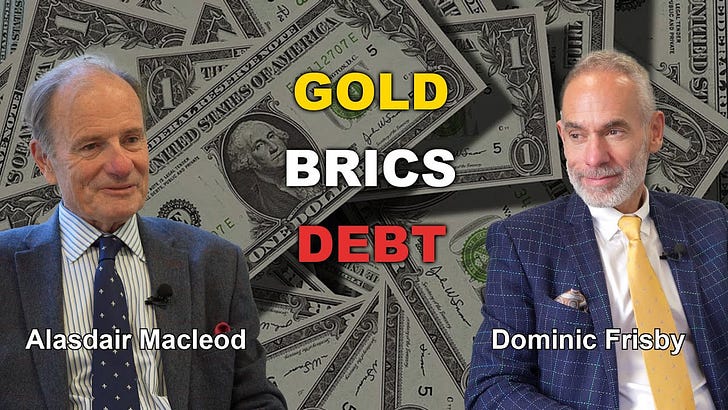
I am travelling this weekend so today’s thought piece is a conversation, which Mining Network recorded last week week between veteran gold guru, Alasdair Macleod, and myself. It’s heavyweight goldbug stuff. I hope you enjoy it.You can watch it below, but I have also ripped the audio so you have the option to listen to that if you prefer to escape the clutch of your screens. If you are thinking of buying gold to protect yourself in these uncertain times, I recommend The Pure Gold Company. Pricing is competitive, quality of service is high. They deliver to the UK, US, Canada and Europe or you can store your gold with them. More here.I’ll be MCing this year’s Moneyweek Summit this coming Friday November 8th. Readers of the Flying Frisby can get a 20% discount by entering the code FRISBY20And if you are interested in hearing more from Alasdair, he has a Substack too. This is a public episode. If you'd like to discuss this with other subscribers or get access to bonus episodes, visit www.theflyingfrisby.com/subscribe

HODL Gone Wild: Meme Stock Mania in the Age of Algos
I’m in Buenos Aires this week, so I might be a little slow reporting on today’s budget, but I’ll come to it, don’t you worry.Shortly before Covid hit, I became CEO of a Canadian company by the name of Cypherpunk Holdings (HODL.CN). I was very pleased with that ticker symbol—HODL. My idea. But I did not have a clue what would happen as a result …I’m writing about the company today because, even though I stood down four years ago, I know a number of readers bought shares because I was the CEO. It’s quite a story.Mining entrepreneur Marc Henderson controlled a shell company that had just received a large payout from the Mongolian government for some uranium assets it had seized illegally, as you do, and he wanted to use the opportunity to start a crypto business. We knew each other from way back, and he approached me because of my book.He also brought in Canadian bitcoin entrepreneur Moe Adham, and Moe and I put together a proposal to become a privacy tech investment company.We were both quite ideological about it. We had grave concerns about the increasing imposition on our privacy from both Big Brother and Big Tech. We felt it was only going to increase, and that therefore there would a need for privacy tech—anything from VPNs to private messaging apps such as Signal, to bitcoin and privacy coins. How right we were. Look at some of the stuff that went on during Covid.Perhaps where we misjudged was that we thought there would be a large appetite for privacy tech amongst the general public as a result. It turns out most of the general public care more about convenience than they do about their privacy, at least online. In many cases, they don’t even realise what they are sacrificing.Buying gold to protect yourself in these uncertain times? I recommend The Pure Gold Company. Pricing is competitive, quality of service is high. They deliver to the UK, US, Canada and Europe or you can store your gold with them. More here.Once we were up and running—and, believe me, there was a lot of compliance—I brought in my mate, bitcoin OG Jon Matonis, and we began the process of acquiring bitcoin. We would hold large amounts of bitcoin. (This was before Michael Saylor’s Microstrategy, which has been a big winner for the portfolio since we tipped it last summer it around $30 - now $220 - especially as bitcoin closes in on all-time highs). Upgrade your subscription.One of our key investors was poker champion Tony Guoga, who bought an enormous stake in the company and eventually joined the board to become Chairman.I stood down shortly after my dad died in April 2020. (From a financial point of view, that was a mistake, as I would have several million options now with the stock itrading at two bucks).But, despite the good work that the company was doing on the ground, the great investments it was making, and the phenomenal board, it just kept trundling along sideways, largely ignored by the investment community and trading at around half its NAV. Like a champ, Tony Guoga kept on buying stock, especially on dips, building up an enormous position. He owns about 35% of the company. Talk about management being aligned with the interests of the shareholders.Recently, however, the company had a rebrand. With all the bitcoin ETFs, it was pointless holding bitcoin, they thought, and the company decided to focus instead on SOL, which lacks a mainstream investment vehicle. Sol Strategies Ltd became the new name, and, a few months earlier, they brought in a new CEO, Leah Wald, as well.In the last fortnight, the shares have gone absolutely nuts—going from around twelve cents to above C$2. There have been several catalysts. First, Leah has made a number of well-received appearances in the media that have generated some interest in the stock. Second, it has become the easiest way to get exposure to SOL. Third, "HODL" is also the US ticker symbol for one of the bitcoin ETFs, and many Canadians, typing in HODL, accidentally bought this company instead. LOL.Veteran traders will know the chart pattern the stock has played out. I believe it’s known as the hockey stick.Just incredible. And look at the volumes that have come in. The market cap of the company went from about C$17m to C$335 at the top of the market yesterday. Guoga’s stake alone went from about C$6m to north of C$115m.For years, the company was trading at half its NAV of C$30. Suddenly it’s trading at ten times.From a technical point of view, it shows just what can happen to a company after it builds all that cause trading sideways for many years. When it spikes, it can really spike.I gather that it’s become something of a meme stock, so who knows when this will end? The algorithms have taken charge, especially on the US OTC markets where it also has a listing (CYFRF) and it is having daily swings of something like 30%.It even makes Lightbridge (LTBR) look calm. Have you seen that, by the way? $14 yesterday. It was $3 a fortnight ago, when I wrote it up.Another hockey stick:My broker c

Breathing Easy Again: How I Got Rid of My Asthma at 50
This is a free preview of a paid episode. To hear more, visit www.theflyingfrisby.com(NB: At the end of this piece there is a short note on Lightbridge Corp (NASDAQ:LTBR), which has tripled since I covered it a fortnight ago).I have suffered from asthma for as long as I can remember.Others have it worse than me. I had always been able to manage it with drugs – salbutamol mostly – but, all the same, there was always that lurking thought that if I forget my inhaler and have an attack, I could be in trouble.Then, suddenly, in my early 50s, it disappeared.It is not uncommon to grow out of your asthma. It happens to a lot of people. But my asthma was not getting better; it was getting worse as I grew older. I can’t prove it, but I think I got rid of it. Here is what I did.How Bad Was My Asthma?As is quite common for people my age, I was not breastfed as a baby – science thought it knew better than Mother Nature – and the allergies I suffer from – the main ones being to animal hair and pollen, which result in hay fever and asthma – are a result of that, I’m sure. It’s part genetic too: my dad had asthma but grew out of it in his adolescence. None of my four kids, who I’m delighted to say were all breastfed, have it.There were two main triggers: animal hair, cats especially, and exercise. Sometimes going from warm to cold (e.g., going outside in winter) would bring it on, and it was worse during the hay fever season.As a child, we had cats – Persian ones too – and we didn’t get rid of them until I was nine. I can’t believe it took that long to figure out I was allergic to them; whenever I left the house, my asthma noticeably improved. But I took drug after drug every day, morning, noon, and night – Intal and Ventolin. We moved and got rid of the cats, fortunately. As a teenager, I got quite strong and fit: I played a lot of rugby and football. I found I could get through matches without needing the inhaler at all. But cats would always destroy me. Within ten minutes of being in a house with cats, I would be wheezing. I was just so sensitive to them. Prolonged exposure would take a day or two to recover from.It was so frustrating going to people’s houses and having to leave because of my asthma, or having to sit there and wheeze, while the owners scrabbled about putting the cat outside or hoovering. Made no difference. Every year on Christmas Eve, I would have the annual asthma attack when visiting my uncle and aunt.As I got into my late 20s and 30s and the fitness of my youth waned – not helped by smoking too much weed at university – I found myself needing my blue inhaler (salbutamol) more frequently again to play sport.By the time I got to my 40s, I often found myself getting wheezy for no apparent reason, and I was using the blue inhaler almost every day.Doctors advised me to use the brown inhaler – QVAR (beclomethasone) – every day, rather than salbutamol, and the brown did indeed clear it up so that I didn’t have to use the blue. But I don’t like taking drugs every day, and every time I tried to wean myself off the brown, I found my asthma had got even worse. I was too dependent.By my late 40s, I was quite overweight, and even though I did a lot of aerobic sport – running and football – I was heavily dependent on puffers.We had a dog too, and even though it was a hypoallergenic poodle, I was still sensitive to its hair.Alcohol made my asthma worse, especially red wine. Also, if I drank, there was always the risk I would then smoke, which of course made it bad the next day.Here I am today, and I have not used a puffer in maybe two years. I play football most weeks, tennis sometimes, I run, and do sprint training and cycling, including hill training.But this week came the acid test. I went for a drink at a some friends house, and they have a cat. I spent a very long evening there and did not leave until 3 AM. No puffer required. I went back the following day and spent several hours there. No puffer. Then again two days later (I really like these friends!). Still no puffer. My nose didn’t even run.I could still feel the allergy. But I was not remotely wheezy.For me, this is quite extraordinary. Fifty years of asthma have gone.How Did I Do It? (Plus a Note on Lightbridge)I’m going to spell out all the things I did. It might be that it was a combination of all of them.
Silver and Gold: The Week That Could Change Everything
This is a free preview of a paid episode. To hear more, visit www.theflyingfrisby.comNB If you missed Sunday’s piece about what next to do with Lightbridge after its incredible rally - 3x in a week - it is here. This week has the potential to be one of the most significant weeks in the history of money.36 world leaders, including China’s Xi Jinping, India’s Narendra Modi, and UN Secretary-General António Guterres, are meeting in Kazan, Russia for the BRICS summit. The main agenda of the summit is de-dollarization. Even The Guardian has noticed. “One of the main aims of the summit,” it says, “will be to speed up ways to reduce the number of dollar transactions, and so mitigate the US ability to use the threat of sanctions to seek to impose its political will.”I’m not convinced the 36 nations in attendance are quite ready to abandon the dollar, or even make overt declarations of war against it, but for sure we will gain insights as to where we are in the grand scheme of this inevitable move away. We will learn where we are with the alternative payment systems being developed, be it BRICS Pay or mBridge.The most powerful weapon these nations have against the dollar is gold—far stronger than China’s yuan, or Russia’s rouble, or any other currency basket or crypto amalgam they come up with. Gold is universal money, and its value is understood by all. There has never been a global reserve currency that did not start out backed by gold. How ready these nations are to re-adopt it, we shall soon discover.In any case, gold has been rallying relentlessly into the de-dollarisation story. We are at $2,740/oz now. Amazing. Perhaps this is a case of ‘buy the rumour, sell the news.’ Whatever. Could be in the short or even medium term. But that’s not the attitude. Owning physical gold is an urgent necessity at the moment. Things are just too precarious. You don’t want to be letting go of long-term core holdings on the basis of potential short-term movements.I am watching developments closely.If you are buying gold to protect yourself in these uncertain times, I recommend The Pure Gold Company. Pricing is competitive, quality of service is high. They deliver to the UK, US, Canada and Europe or you can store your gold with them. More here.The Silver Surge: Is $50 the Next Stop?In the meantime, ever unreliable silver has been playing catch-up. It’s gone through all that resistance around $30-33 and has, having done a near-perfect inverted head and shoulders, now broken up to $35. I think it’s going back to $50.There is some resistance at $35, $37.50, and $44.You know my views on silver. It’s the metal with the most potential yet, if it can find a way, it will always let you down.Its natural price is 1/15th of the gold price, because there is only 15 times as much silver in the earth’s crust as there is gold. With gold at $2,700, silver “should” therefore be $180.In fact, there is a case for silver to be higher than that because, while all the gold that has ever been mined remains, the silver does not—it has been consumed. So above-ground silver stocks do not reflect gold stocks.The problem is that silver has long since been demonetised. It lost its monetary status when the world adopted gold standards after the various gold rushes in the second half of the 19th century. Without this official backing, silver is only going to be an industrial metal, albeit a precious one. Gold may no longer be an official medium of exchange, but central banks still buy and hoard it, as do corporations and private investors. The Bank of International Settlements recognises it as a Tier 1 Capital Asset. The same does not apply to silver.Silver, as we know, also has a multitude of industrial uses, which are only going to increase as the world gets more computerised and electric. There is also some evidence of silver shortages—over 200 million ounces this year, a similar amount to annual jewellery demand. Total annual silver demand is around 1.2 billion ounces—the second highest on record. 836 million ounces of that come from new mine supply, 180 million ounces from recycling, and the rest from sales of existing supply.Demand looks something like this:* 61% industrial (electrical, electronics, photovoltaics, photography & other) * 17% Jewellery * 5% Silverware * 17% Investment When silver moves, it moves fast, and it can turn on a sixpence, so it’s important not to get wedded to the silver story. The thing to remember about silver is, like errant girlfriends with personality disorders, if it can let you down, it will. The lovemaking will be unforgettable, you will have the time of your life, but, as sure as eggs are eggs, it will break your heart. Manage your risk.As I say, there is not a lot standing in the way of silver and $50. In that scenario, the miners will go to the moon.If it goes to $50, that will only be the third time in silver’s history it made it here—1980 and 2011 being the other two occasions. Third time lucky and all that. If it bre
Shaping the Earth: The Amazing History of Mining
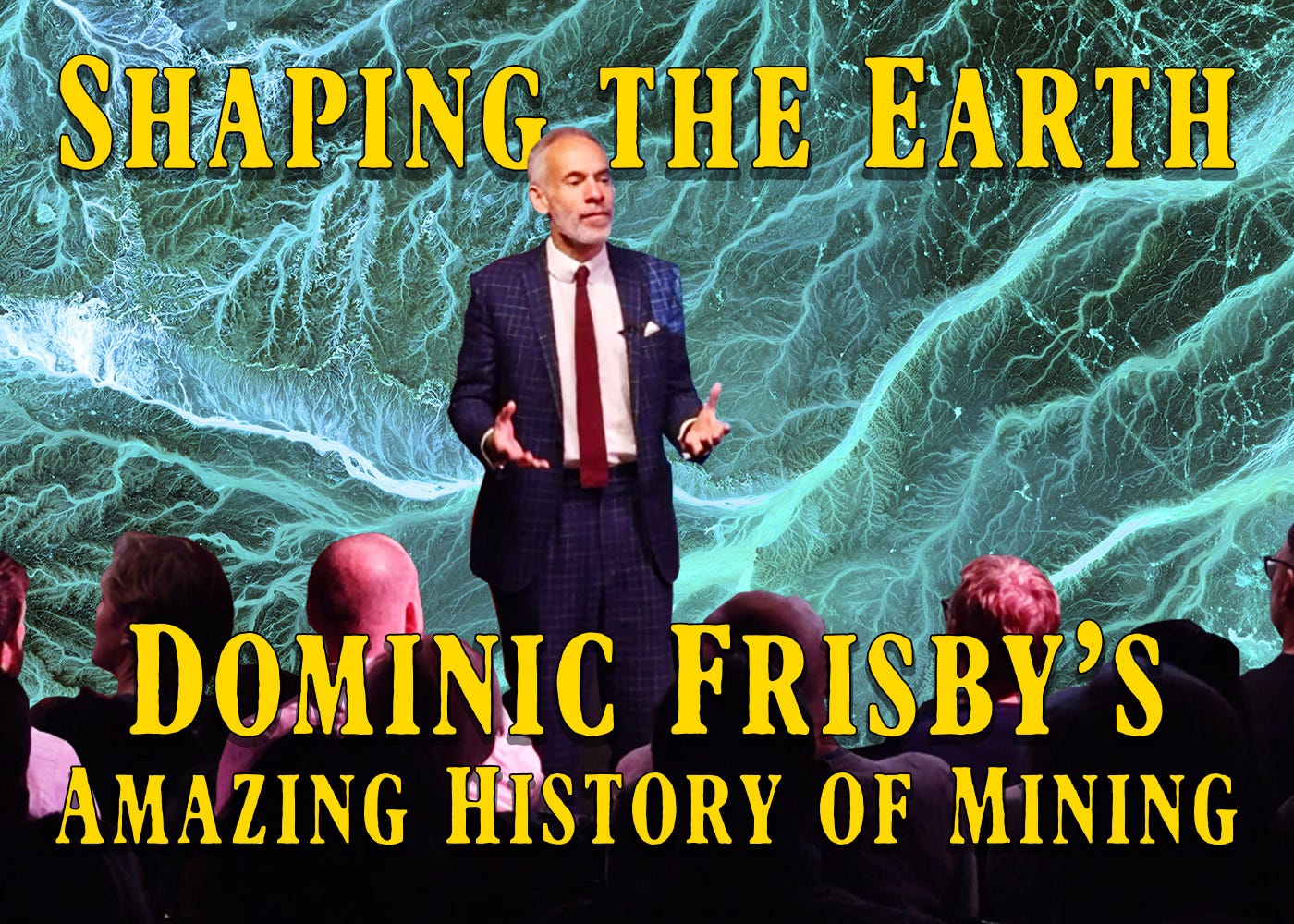
Here’s something a little different as your Sunday thought piece today - my Edinburgh “lecture with funny bits”. I hope you enjoy it. It lasts 50 minutes, so next time you fancy a bit of “edutainment” give it watch.The first part is available to all, and you can unlock the full experience by becoming a paid subscriber. I was super-pleased with this one, as I think I might have mentioned ;)Meanwhile, I wanted to share my thoughts about the amazing share price action we have seen in Lightbridge Corp (NASDAQ:LTBR). The stock really has exploded, more than doubling since I wrote about it last week. What was a $3 stock is now trading at $7.Here’s the original piece, in case of interest - I covered it in in last Sunday’s thought piece on SMRs too.The volumes are insane. What to make of it all? And what to do next?Let’s start with a chart showing the recent price action.Some volume came into the stock on Monday, as I said it would, with my write up in Moneyweek, but what really ignited things were, first, Google announcing it has signed a deal to secure energy from Kairos Power, which will build seven small modular reactors (SMRs); then Amazon announcing that SMRs are part of its plan to transition to clean power. The entire sector went bananas, making last week’s pieces extremely timely. Lightbridge Corp in particular went nuts.Average trading volumes are normally less than 350,000. But look at the volumes that followed those announcements. Wednesday 3.4 millionThursday 1.1 millionFriday 7.5 millionOver the course of the week almost 13 million shares changed hands. The company has just 14 million shares outstanding!What to read into this?I looked at the outstanding interest in the options market and there is quite high interest at the $5 strike price with November and February expiry, but not enough to account for this kind of volume.When you see trading volumes of that sign, it can sometimes be a bullish indicator - a change in ownership - but it can also be a bearish indicator - lots of people looking to get out.I have to say, when a market is the kind to you this quickly, it is best to take at least a little profit. There’s no doubt uranium is hot again, and that SMRs are the future, but there is also some excess. It‘s obviously up to you what you choose to do. This stock was once trading above $800, so there is plenty of room for it to move back up. But I’m thinking to take some money off the table this week. Buy yourself a treat. And enjoy the lecture. This is a public episode. If you'd like to discuss this with other subscribers or get access to bonus episodes, visit www.theflyingfrisby.com/subscribe
Why Cash Keeps Us Free
Something a little different for you today.I am speaking at the Battle of Ideas this weekend on three rather different matters:* Immigration and Demographics* Who Is the World’s Greatest Comic?* Why Cash Keeps Us FreeDo come. You can get tickets here. With this years Battle in mind, the Academy of Ideas asked me to write one of its Letters on Liberty. Here it is for your reading or listening pleasure. (There is a PDF version here).It begins with this note from the Academy.What are Letters on Liberty?It’s not always easy to defend freedom. Public life may have been locked down recently, but it has been in bad health for some time.Open debate has been suffocated by today’s censorious climate and there is little cultural support for freedom as a foundational value. What we need is rowdy, good-natured disagreement and people prepared to experiment with what freedom might mean today.We stand on the shoulders of giants, but we shouldn’t be complacent. We can’t simply rely on the thinkers of the past to work out what liberty means today, and how to argue for it.Drawing on the tradition of radical pamphlets from the seventeenth century onwards - designed to be argued over in the pub as much as parliament - Letters on Liberty promises to make you think twice. Each letter stakes a claim for how to forge a freer society in the here and now.We hope that, armed with these Letters, you take on the challenge of fighting for liberty. Academy of Ideas teamWhy Cash Keeps Us Free by Dominic FrisbyGive most people the choice of living and working anywhere in the world, I bet the large majority would choose the US. For all its many shortcomings, it’s still the land of opportunity. It’s exciting, it’s dynamic. Wonderful things can happen there. In terms of tech, with Silicon Valley and all the ensuing social media and ecommerce, it is very much the world leader. And yet, Americans still use cheques.When was the last time you used a cheque in Europe? Donkey’s years ago. As much as 5 per cent of all financial transactions in the US last year were by cheque. For all its modernity, the US is - in terms of fintech - a good 10 years behind Europe or Australia. Not only do they use cheques, but people in the US still go out with cash in their pockets. Bunch of luddites.However, things are slowly changing, and the US is following the rest of the developed word to cashlessness. It is inevitable, I’m afraid. Technology is destiny.It’s also a great shame. Cash empowers its usersWhen I pay you in cash, nobody else gets in on the transaction - it’s a direct transfer from me to you. No grubby middlemen can cream off their percentage. No prying eyes of the state can monitor what we do. Big Tech can’t glean information from the exchange, to be used at some later stage to sell you stuff or, worse, report back to Big Brother, Big Insurance or whichever Big wants in on your data. Nobody can stop you making the transaction. With cash, you can buy and sell and store your wealth outside of the financial system, if you so choose. There are plenty of reasons, both practical and moral, to do this.Cash means control. Just take the recent de-banking scandals from Canada to the UK, where truckers had their fundraised money withheld because of their views on lockdown, and a UK politician was kicked out of Coutts for holding the wrong opinions. Both the Canadian truckers and their families, and Nigel Farage, had one thing in common – they held views outside of the liberal mainstream. And because their money wasn’t under their mattresses but in banks and websites, they lost control of their own cash.Indeed, instability is nothing new. We are repeatedly told how, in 2008, we were ‘on the brink’, how close the system was to imploding. Surely, then, it makes practical sense to keep money outside of the system? When Cyprus’ banks teetered on the cliff of financial disaster in 2011, there were bail-ins. Ordinary people’s money, sitting in deposit accounts, was sequestered to save the system. If your life savings were threatened with confiscation to bail out an organisation you considered profligate, I imagine you too would want little part of it.What you do with your money says more about you than what you say - no wonder so many want access to this information.Indeed, the former governor of the Bank of England, Mervyn King, has admitted that banking is not fixed - and we will see financial panic again. It makes sense to hoard some cash, if only as emergency money.In 2016, the Japanese central bank imposed negative rates to try to goad people into spending rather than saving, as the ageing Japanese are prone to do. The spectre of being charged a fee to keep your money in the bank loomed, and so much cash was then withdrawn that the country sold out of safes. Who can blame the Japanese? In Germany, Denmark and Switzerland, some high-net-worth individuals with more than 100,000 euros were charged for being wealthy. There was plenty of talk of confiscation and bail-i
The Future of Energy - Small Modular Reactors (SMRs) and How to Invest
Quick heads up. I have made some video versions of recent articles. Here they are, in case you are a watcher rather than a reader:I don’t know about you, but I use artificial intelligence (AI) all the time. ChatGPT has become my right-hand man. It gives me advice (really – and good advice too), it helps me make decisions, it gives me exercise workouts, recipes, it proofreads what I write, it helps me write titles, it even helps me write song lyrics. Midjourney does all the imaging for this newsletter. Even a simple Google search now involves lots of AI.I know I’m not alone. Almost everyone is using AI, consciously or not.Guess what? AI requires bucket loads of power. That’s why Microsoft recently agreed to pay Constellation Energy, the new owner of America’s infamous nuclear power station, Three Mile Island, a sizeable premium for its energy. There is cheaper wind and solar power to be had in Pennsylvania, but it isn’t as reliable as nuclear, 24 hours a day.It’s not just AI. The widespread political desire to rid ourselves of fossil fuels means the world needs electricity, and fast.Nuclear is the solution, of course. But nuclear takes a lot of time, even with AI now “re-routing” the anti-nuclear narrative. It takes especially long in the UK where any kind of infrastructure project requires billions to be spent on planners, lawyers and consultants before a brick is even lifted.It’s so stupid of course. Nuclear power stations have been operating commercially for 70 years, providing reliable, affordable, and almost infinitely renewable “clean” electricity. Nuclear has the best safety record of any energy technology. Almost all environmental concerns, such as waste disposal, have been solved. But if you want to know the name of the point at which stupidity, hypocrisy, waste and weakness meet, it’s called British Energy Policy.Layer upon layer of safety is demanded in nuclear plant design. The regulatory process is slow, cumbersome, and complex. There is a long lead time between planning, building, and operation, which adds to expense. Political uncertainty meant many proposals for nuclear power stations in the UK were shelved. It all drives away investment.But governments around the world are waking up to the fact that the silver bullet is nuclear-powered. Thus, the narrative is changing. The dawn of the new age of nuclear power is upon us, and it can’t come quickly enough.That’s why the focus has shifted to small modular reactors (SMRs). These have been operational for almost 70 years now in submarines, aircraft carriers, and ice-breakers, but in the last few years, land-based SMRs have been developed to generate electricity.They use simple, proven technology, and are safer than current nuclear power stations. They can be manufactured in factories and then rapidly erected on-site. Modular refers to the design principle of breaking down a system into small, independent, and interchangeable components, or “modules”, that can easily be combined, modified, or replaced without affecting the rest of the system. This flexibility means they are scalable. It aids manufacture, transportation, and installation while reducing construction time and costs.SMRs don’t occupy much land, so they have little impact on the landscape. Some can even be constructed underground – surely preferable to wind turbines and solar farms. In the UK, they could be erected on the redundant sites of closed nuclear and coal-fired power stations, where grid connections are readily available. A 440 megawatt (MW) SMR would produce about 3.5 terawatt hours (TWh) of electricity per year, enough for 1.2 million homes – or to provide power to Wales, the Northeast of England, or two Devons. It would require about 25 acres of land. A solar farm would need 13,000 acres for the same output; a wind farm, 32,000 acres. Three 440MW SMRs would be enough for London, which has around 3.6 million homes.What’s more, their output is not dependent on the weather. Reliability is why Microsoft paid a premium of more than 85% for Three Mile Island’s power. SMRs produce electricity that can easily be adjusted to meet the constant, everyday needs of the grid (baseload), and they can also ramp up or down to follow changes in demand throughout the day. They spin in sync with the grid, so they help keep everything stable. When they’re running, they act like a steady hand, providing momentum that makes it easier to manage sudden changes in electricity supply or demand.Why not subscribe to this amazing publication?How To InvestThere are all sorts of ways to invest in nuclear power. The simplest and least risky is to buy the metal itself. Current demand for uranium stands at around 200 million pounds per year, while mining output totals only 140 million pounds. Another 25 million pounds comes from secondary sources, such as scrap and recycling. So there is a uranium supply deficit. I’m surprised the price isn’t higher. London-listed Yellowcake (LSE:YCA) has been set up with th

Nocturia No More – How to Stop Peeing in the Night
This is a free preview of a paid episode. To hear more, visit www.theflyingfrisby.comFinal call for my “lecture with funny bits” about mining this Thursday. Hope to see you there. But here it is, finally, the follow-up to How to Sleep Well, in which we address the bane of many who would sleep well: peeing in the night.Did you know one in three adults over 30 and more that half of adults over 50 wake up to pee at least once a night? The interruption damages the precious rhythm of sleep, especially later in the night when getting back to sleep again is harder.The problem plagued my dad for decades, and it was bladder issues that eventually took him. His peeing was a major source of misery, especially in his later years, and my eyes still well up now when I think how much pain and discomfort he was in. Unfortunately, like father like son and all that, I have my father’s bladder. I’m only 55. I’ve been having to get up in the night for at least 25 years now. It is not uncommon for me to have to get up as many as five times. On a really bad night, it can get to ten.For years, I accepted this as my genetic destiny. But with this sudden turnaround in my health and fitness—in which I have rid myself of many things I thought I was stuck with—and not wanting to follow in Dad’s footsteps, I’ve put some considerable effort to this issue in the last few months.I’m delighted to report that I have made real progress. Twice this week, I have got through the night without having to pee at all. It’s been 25 years since that happened for me, and the exhilaration I felt the following morning was quite something. I even got 100% sleep scores on my Whoop.If buying gold to protect yourself in these uncertain times, let me recommend The Pure Gold Company. Pricing is competitive, quality of service is high. They deliver to the UK, US, Canada and Europe or you can store your gold with them.Five things I did which made a differenceThe condition of having to pee in the night is called nocturia. I started by going to the doctor, where I had all sorts of tests: blood tests, urine tests, and the infamous finger up the bum. Everything came back fine. No prostate or bladder issues. The only thing they found was that my kidney function was sub-optimal.There are five stages of kidney function, with stage 1 being optimal and stage 5 being failure. I’m stage 2, “mildly reduced function,” which is not ideal, but it’s also not abnormal for someone my age. In any case, it’s often asymptomatic.So if everything is mostly working down there, why all the peeing? I have a theory which I’ll come back to in a moment.By the way, while I remember: fasting does not help. When fasting, if you’re like me, you will consume loads of liquid—soup, herbal tea—to fool your body into thinking you’re full. All that liquid means a lot of peeing.Also, fasting puts your body into a state of ketosis, which makes your kidneys work harder. Ergo more peeing.However, the health benefits of fasting, especially weight loss, are so great that, in my view, they outweigh the increased peeing.1. SupplementsI tried a million different supplements:* Pumpkin seeds* Linseed / Flaxseed* Walnuts (also good for Omega 3)* Zinc* Selenium* Pygeum Africanum* Magnesium* Vitamin D (though I also read that it makes you pee more—you can’t win)* QuercetinI’m not convinced any of them made a significant difference, but I mention them because they were part of the process.2. BoozeSorry, but it’s a killer. Especially, beer. Lots of liquid plus the diuretic effects of alcohol. Try not drink as much, try and drink your booze earlier in the day, away from bedtime. Best of all, don’t drink at all.If you need help cutting down on booze, get a Whoop. I explain how they help here. 3. Fluid ManagementConsume your fluids earlier in the day. Avoid drinking anything for at least three hours before bed, even if it means going to bed a bit thirsty (though that might not be great for your kidneys).This makes a huge difference - it will reduce your peeing by as much as 40% I’d say.At the same time as making sure I didn’t drink three hours before bed, I started doing two other things. I think it these three things in tandem that made the difference.4. Getting your body out of the habitOften I’d wake up in the night with the feeling that I needed to pee, when I didn’t even need to. I began to suspect that my body had simply got into the habit of waking up. I needed to break the cycle. How to do that?
Gold’s meteoric rise is signalling something very important indeed. Here is what you need to know
This is a free preview of a paid episode. To hear more, visit www.theflyingfrisby.comYou can watch a video of this article here: For the first time in history, gold went above £2,000/oz yesterday.This is a huge landmark in the decline of sterling.Of course, nobody in the UK echelons of power is talking about it.We are, however, because it matters. Who is buying so much gold that price keeps going up? Why are they buying? There are hugely significant developments taking place in Asia that have the potential to reshape the global financial order.This bull market is not like previous bull markets. It’s not driven by retail buying. What’s driving it is far more significant than that.Clowns to the left, cretins to the rightHere is gold in pounds since Gordon Brown sold ours in 1999. It’s quite something—over ten times higher! What a clown.Meanwhile, in other currencies, gold continues its march. Here it is in dollars, the preferred benchmark, over the past three years. This is proper bull market stuff.I know I have said this a million times, but I really urge you, if you haven’t already, to diversify out of sterling—indeed any form of fiat money—and use gold as your savings vehicle.The gold price action is telling us something.The way this government is going—it’s proving almost as rudderless as the Tories were, and in record time—sterling could have real problems, and soon.To my knowledge, not one influencer in the Labour Party, over the course of its conference this week, mentioned stewarding the currency, protecting its value, or any of that stuff. Just as every government before it has, they will use sterling devaluation to compensate for their deficit spending.The pound is only holding up in the forex markets because the Bank of England did not cut rates last week, when the Federal Reserve and the ECB have gone into a rate-cutting cycle.Perhaps, more significantly, no one in the Labour Party is discussing what is happening in Asia. Central banks are buying gold in huge quantities. They are no longer waiting for the price to pull back before making their purchases. Perhaps most significantly of all—they are not reporting all their gold purchases. It is happening on the quiet.If you want to buy gold to protect yourself in these uncertain times, let me recommend The Pure Gold Company. Pricing is competitive, quality of service is high. They deliver to the UK, US, Canada and Europe or you can store your gold with them.De-dollarisation is happening in front of our very eyesThe implications for the West are huge. But, despite the geopolitical significance, this issue is nowhere close to the Labour radar.This goes back to early 2022 and the Russian invasion of Ukraine when the US confiscated Russia’s US$300 billion. Most of the rest of Asia looked at that and thought, “we need to de-dollarize.”China, as we know, has quietly been reducing its holdings of US Treasuries. It now holds $777 billion in US Treasuries, which is about 10% of the US national debt held by foreign entities. This compares to 22% in November 2013. That is quite the reduction.China has also, as we know, been accumulating vast amounts of gold.Analyst Jan Nieuwenhuijs calculates that China has bought 1,600 tonnes of gold since Covid. I think the number is higher. That is on top of the 370 tonnes it mines annually—and most of that mining is state-owned. I was having dinner with a VIP Chinese investment banker last night. I asked him about the Chinese mentality and de-dollarisation. “It is a matter of pride,” he said. China does not want to be beholden to the US. Global reserve currency status is a goal. There has never been a global reserve currency that did not start out backed by gold.For now, it continues operating by its doctrine, “we must not shine too brightly,” but all the while it is accumulating gold and reducing its dollar dependency.But it is by no means the only country doing this.Saudi Arabia was “caught” a fortnight ago secretly buying 160 tonnes of gold in Switzerland—kudos to Jan Nieuwenhuijs for the scoop. “One thing is for certain,” says Jan. “Saudi Arabia owns much more gold than it wants the world to believe.”This is significant because Saudi Arabia was such a key player in establishing the petrodollar in the early 1970s after the US came off the gold standard, enabling the dollar to retain its status as the global reserve currency.Saudi Arabia could be quietly repositioning itself as an ally of the next global superpower. It could also, as we shall see, be at the heart of a new global payments system.The new international payments system which bypasses the US dollar
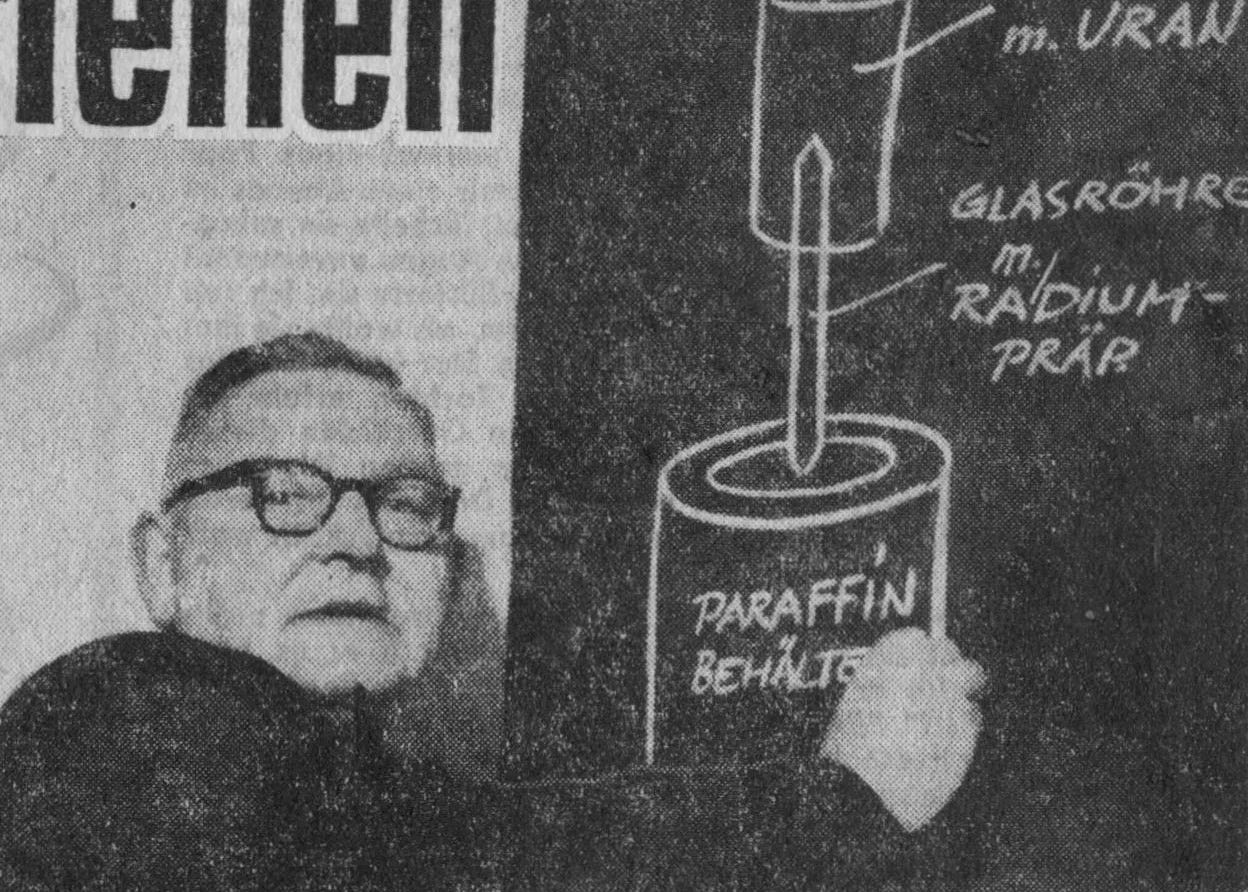
The Alchemist Who Conned Himmler
I’m delaying the follow up to last week’s piece on sleep for another week because I am still experimenting ;). In the meantime, I hope today’s little story will put a smile on your face.And a reminder there are just a handful of tickets left for my “lecture with funny bits” at the Museum of Comedy on October 10th - October 9th was cancelled - sorry. This is a super interesting show, even though I say so myself. If you are free, I really recommend it.In 1914, a young German named Heinz Kurschildgen started his first job as an apprentice in a dye factory in his hometown of Hilden. He became fascinated by the chemicals he was working with, and built a small laboratory at home to conduct experiments.Before long, he thought he had found a way to make gold, and even persuaded several investors to give him money. However, it soon became clear that he couldn’t make gold and found himself prosecuted for fraud. The courts let him off on the grounds that mentally he was not all there, but only on condition that he solicited no further investments with schemes to make gold. He was soon claiming he could make other transmutations, and became something of a joke figure in his hometown, where a bust was even erected in his honour, albeit ironically, inscribed with the words: “For the genius gold-maker, from his grateful hometown.”But in 1929, he returned to his first calling, which was kidding people he could make gold. He approached German President Paul von Hindenburg and Head of the Reichsbank, Hjalmar Schacht, with a proposal to make the gold they needed to pay off Germany’s WWI reparations.These had been set at 132 billion gold marks, which translates to 47,300 tonnes. To give you an idea how unrealistic a figure this was: it was an amount not far off all the gold that had ever been mined in history by that time. That would take quite some alchemy.But Kurschildgen was not a man to be deterred. He raised a load more money, defrauded his clients, and ended up with another 18 months in jail.You really should subscribe to this wonderful publication.After his release, he was soon at it again. This time, he approached the newly elected Nazi government with a plan to make petrol from water. Chief Scientific Advisor, Wilhelm Keppler, paid him a visit and Kurschildgen agreed to reveal his methods and surrender the rights to the government. Meanwhile, his claims about being able to make gold piqued the interest of SS leader Heinrich Himmler, who had a notoriously superstitious streak and a fascination with alchemy. Himmler started generously funding Kurschildgen to conduct his experiments. But Reichsanstalt physicists soon declared his contraptions useless, and Kurschildgen ended up in a concentration camp.“Himmler has fallen for a gold and petrol maker,” said Joseph Goebbels in his dairy. “He wanted to defraud me, too. I knew what he was about straight away”.After two years Kurschildgen was released for good behaviour. Himmler had him put straight back in the camp. On no account did he want this embarrassing story becoming public.After the war, Kurschildgen tried to get recognized as a victim of Nazi persecution, so he could claim compensation. “The Gestapo would stop at nothing to get my invention," he told the courts. As with most of his ventures, his petition was unsuccessful.Even so, you can’t fault the man’s ambition.Until next time,PS Don’t forget Shaping the Earth on October 10th.If you are interested in buying actual gold in these uncertain times, then look no further than my recommended bullion dealer, the Pure Gold Company. Premiums are low, quality of service is high, and you get to deal with a human being who does not moonlight as an alchemist! This is a public episode. If you'd like to discuss this with other subscribers or get access to bonus episodes, visit www.theflyingfrisby.com/subscribe
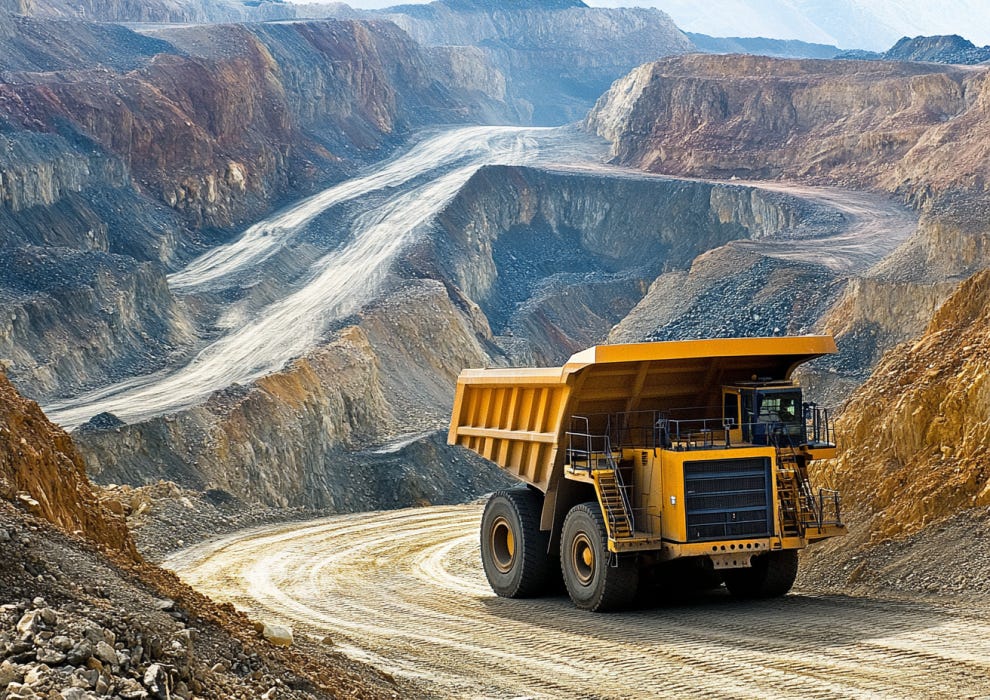
Commodities and Gold Miners Have Never Been Cheaper—Does Anyone Care?
This is a free preview of a paid episode. To hear more, visit www.theflyingfrisby.comThere are just a handful of tickets left for my “lecture with funny bits” at the Museum of Comedy on October 10th - October 9th got cancelled - events beyond our control, sorry. This is a super interesting show, even though I say so myself. If you are free, I really recommend it.Some charts have been doing the rounds this week, and I wanted to take a look at them today, as a couple of you have been asking about them.The first is this one, which shows that, relative to stocks, commodities are as cheap as they have ever been.I have little doubt that there will be another bull market in commodities, that it will come when people are least expecting it, and that, when it does come, it will blow everyone’s minds, just as previous commodity supercycles have done.But here’s the thing: we have got better at producing commodities. Modern farming methods mean we can produce more grains and softs at cheaper prices than ever before. Yes, sometimes there are events beyond human control that get in the way—bad weather being the most obvious example—but the broader trend will always be towards lower prices (especially if you use ratios and thereby strip out the fiat factor).But these are the commodities that we grow. What about fossil fuels and metals, which are finite resources? We’ve long since taken the easy stuff.Well, yes. But the same logic still applies. Modern mining means we can now explore far-flung corners of the earth and economically produce from much lower-grade rock. The same applies to fossil fuels. Fracking is an example. This new technology meant that previously uneconomic deposits became economic. The result was a glut of supply and lower prices.So, while I do not doubt that commodities will have their day, I also look at the chart above and see no reason why they can’t get cheaper still. The trend of the last two or three years is lower. That ratio could quite easily go back and retest its 2020 lows. It could go even lower.There is a lot of value to be had from ratio charts, but you also have to factor in basic stuff like improved productivity. However, there are other factors too. Many think we are heading towards some huge international conflict. If so, international trade will suffer, countries will start stockpiling, and commodity prices will quickly revert to 1973-4/1999/2008 levels.Are you buying gold to protect yourself in these uncertain times? Let me recommend The Pure Gold Company. Premiums are low, quality of service is high and you deal with a human being who knows their stuff.Here’s another ratio that is doing the rounds: gold miners versus goldNow this one is pretty compelling. Time to pile in to gold miners? Let’s see. and let’s also check in on the miners we own.

How To Sleep Well
This is a free preview of a paid episode. To hear more, visit www.theflyingfrisby.comInnocent sleep … sore labor’s bath,Balm of hurt minds, great nature’s second course,Chief nourisher in life’s feast.William ShakespeareSleep is so important to your well-being. Your mind works better when you sleep well. Your moods improve. Your outlook improves. Your physical condition improves. Your health improves. Life is better when you sleep well.We spend—get this—a full third of our lives asleep. Yet how much do we treasure sleep? How much do we guard our sleep time? How much effort do we put toward improving our sleep?Like so many things in this modern, fiat world of declining standards, the value of sleep has been overlooked.Science may only just be starting to acknowledge the benefits of good sleep, but it’s something we’ve intuitively known since forever. From time immemorial, art and literature have been filled with references to the value of a good night’s sleep. The Ancient Greeks, Hippocrates among them, knew it was a prerequisite for good health. Many cultures considered dreams to be a form of contact with the divine.I used to think I had mastered the art of sleeping. In the last couple of years, I’ve learned this is far from the case. However, I’ve put in a lot of work and now, in my newfound role as health guru, I feel I’m in a position to dish out some advice on how to improve your sleep.England cycling coach David Brailsford used to talk about the incremental effects of marginal gains. Sleep improvement is very much the same. There are lots of little things you can do, and, with the accumulation of these, you will see vast improvements.Here are ten ways to improve your sleep, including how to deal with waking up in the night, bedtime habits, alcohol’s impact, melatonin, peeing in the night and more … 1. How to get to sleepI always struggled to get to sleep, even as a youngster. I can remember lying in bed for endless hours, really trying to get to sleep and not being able to. When you’re lying in bed trying to sleep, and you can’t, that is when the demons come: unwelcome thoughts creep into your mind and then start looping over and over. It’s good to be able to fall asleep quickly.I now realise one of the reasons I got into the habit of drinking too much was that, after a few drinks, whenever I lay down, I would go straight to sleep. Drinking was a way of avoiding that difficult period of trying to get to sleep.My other method was doing loads and loads of physical activity and then going to bed absolutely shattered. Not always possible.So, here’s the first lesson I’ve learned, and this is the best hack ever.First thing in the morning, go outside and get 15 or 20 minutes of sunshine. Do this as soon as you wake up. Make your morning cup of tea or coffee, then take it outside and get some sun. Even if it’s cloudy and cold in the middle of winter, go outside and stand where the sun would be. Open your eyes towards it. You’ll still get some rays.This has been shown to regulate your circadian rhythms. In my view, it’s the single best thing you can do to help you fall asleep at night.You’ll find, like magic - or is it clockwork? - that as soon as the sun goes down that evening, you’ll start feeling tired.2. Darkness.Darkness aids sleep. Blackout curtains in the bedroom are a good idea, but if that’s too much hassle, there’s a simpler, cheaper solution: sleep masks.I’ve only lately taken to wearing sleep masks in bed (I’ve always used them when travelling) and I’ve come to love them. Go for a silk one—they’re very comforting. I use this silk one by Alaska Bear.3. Breathe BetterThere is a simple product for this too. Mouth tape. Stick a little bit of this tape across your mouth and it forces you to breathe through your nose. You’ll be amazed. You sleep so much better if you only breathe though your nose.I’m currently using this light weight one and I like it. My son prefers this heavy duty stuff, which might be better as a stating point to change your breathing habits.If you sleep on your back and then snore, mouth tape can really help out.4. Get a sleep trackerI use the Whoop fitness tracker, which you wear on your wrist.When I compare my data with friends using other devices like Garmin, Apple, Fitbit, Whoop, and Aura, there’s quite a bit of divergence between the brands, particularly on calories burnt. I don’t think it really matters: it’s the act of monitoring and tracking that leads to improvements.Whoop seems to generally regarded as the best for tracking sleep though. An unintended but incredibly beneficial side effect of getting a Whoop is that it will massively cut down your drinking. More on this in a moment.5. Room temperature

Bitcoin, Japan and a Tin Miner
This is a free preview of a paid episode. To hear more, visit www.theflyingfrisby.comDon’t forget Shaping The Earth, “my lecture with funny bits” in London this October 9th and 10th at the Museum of Comedy. Please come if you fancy a bit of “learning and laughter”.Three subjects I want to briefly look at today, starting with everyone’s favourite non-government money.There were rich promises of huge gains in bitcoin with the launch of the bitcoin ETFs and the halving cycle. Neither has quite materialised.Bitcoin is “only” up by 30% this year, though to read some of the commentary, you’d think this is another Bitcoin winter.The problem is that most of those gains came in February. For the other eight months of 2024, we’ve been generally stagnant. In fact, since March, we’ve been making a series of lower lows and lower highs and are clearly in a downtrend—hence the despondency.However, despondency is often the ally of the contrarian investor, and with that in mind, I want to share a table with you (borrowed from Coinglass).It shows Bitcoin’s quarterly performance. I’m sharing this now because we’re heading into Q4, which has historically been Bitcoin’s best quarter, with average returns close to 90%.Seasonal patterns aren’t always the most reliable indicator, but the odds are favourable: seven positive Q4s against just four negative ones.Better than Q1, which is 50:50; Q2 with seven positive and five negative; and Q3, which shows five positive and seven negative years (including this one, which isn’t over yet).Let’s hope those averages hold.I argue that Bitcoin should be a core holding. Many don’t like bitcoin, but the potential is so huge that, in my view, the greater risk is not owning it rather than owning it.My guide to buying Bitcoin is here. And here, I detail the easiest way for UK investors to gain exposure via a traditional broker.How Japan finances the world - and why we should be worriedAbout a month ago we explained the summer turmoil and the unwinding of the yen carry trade. The big question we all want to know the answer to is: was that it? Are we done now, or is there more to come?

Heat Rash Hell: A 35-Year Struggle and the Bee Pollen That Saved Me
This is a free preview of a paid episode. To hear more, visit www.theflyingfrisby.comYou can watch a video of this article:When I was 19, I started getting these weird heat rashes. Every day, whenever I got hot, these debilitating, paralysing heat rashes would envelop me. Burning, bumpy, red weals suddenly covered my body. So itchy—you wanted to scratch everywhere, though scratching brought no relief. Once the rash started, there was nothing I could do. I just had to wait for it to pass, which would take about half an hour.I didn’t even have to get so hot that I broke sweat for the rash to come on. Just walking briskly would do it, getting flustered, wearing a layer too many, even having a shower.And it came every day, usually mid-morning.I thought it might be stress that was causing it, but it was the other way around: these rashes were causing the stress.I found a way of coping with it: do intense exercise every morning and actually induce the rash. Then it seemed to burn itself out for the rest of the day.But the next morning, it would be back again.I went to see doctors about it. None of them knew what it was. As GPs often do when they don’t know the answer, they brushed it aside, “Oh, it’s probably stress.” I wasn’t making this up! But unless I actually had an attack in front of the GP, there was no way of showing them what it was.I saw a dermatologist, who gave me anti-depressants. I saw Chinese herbalist after Chinese herbalist, who all concocted these disgusting teas for me to drink. Lord knows what damage I did to my liver drinking that stuff. I saw an acupuncturist who declared brightly that he could cure it. But he couldn’t.It made my life a nightmare, because you never quite knew when the rash was going to hit. What if it came on when I was on stage? During that all-important meeting? When I was with a girl I liked? It was a source of acute embarrassment.The condition disappeared, bizarrely, if I went to the tropics. Why, Lord knows. But as soon as I got home, back it came. Then I noticed the condition also disappeared in the summer. What was that about? I realised the antihistamine I was taking for hay fever also prevented these rash attacks.But I didn’t want to take antihistamine every day—that couldn’t be healthy—so, once the hay fever season was over, I would go back to keeping it at bay by trying to do intense exercise every morning and burning it off.When I got married and had kids, aged 30, this became impossible, so I resigned myself to daily antihistamine. This started with Clarityn (Loratadine), moved onto Zirtek (which I hated because if I drank alcohol, I used to get incredibly drunk and that led to a lot of bad decisions and mistakes) and, eventually, Xyzal, which I found I only needed to take every other day. The potential long-term damage of sustained anti-histamine use was a gamble I was prepared to make to avoid the daily nightmare of this condition.If you are buying gold to protect yourself in these uncertain times, then let me recommend The Pure Gold Company. Premiums are low, quality of service is high and you deal with a human being who knows their stuff. Eventually, I discovered that the problem I had was a condition called heat-induced cholinergic urticaria. I went to see a specialist at St Thomas' Hospital. “There is no cure,” she told me. “Sometimes it clears up by itself,” she told me, “sometimes not. You’re lucky antihistamine stops it. For many that doesn’t work.” I volunteered to be a guinea pig so she could experiment on me as part of her research into the condition. I would go to the hospital, have a hot bath, my skin would erupt, and then she’d prod me and prick me and nod and mutter, but it got me no nearer to a cure.Here I am at 54, and it has not cleared up.What is the cause?I’m still not quite sure if something I did caused it. Urticaria is from the same allergic school of illnesses as asthma, eczema, and hay fever, from which I suffer a little (asthma especially if I run or am near cats), so it might be hereditary or genetic. It affects young men more than any other group, which is what I was.I’ve been on numerous forums where fellow sufferers discuss the condition, and a lot of us took the antibiotic tetracycline. I took it for years as a teenager to help with my acne. God, it makes me cross that I was allowed—even encouraged—to take it for so long. Bloody doctors, or one in particular (no longer with us so I won’t name him and speak ill of the dead), and my mother’s blind trust in them. I thought it might be tetracycline.I had spent two months in Egypt just before I got my first outbreaks, and I got very ill with Giardia, a form of dysentary. Maybe I lost some essential bacteria in my stomach or something, or got leaky gut. (I’ve taken a million probiotics and all the rest of it—didn’t work).Also just before the first outbreaks, I got the sh*t kicked out of me in a park in Milan by a group of young Italians - I mean properly beaten up, 7 v 1 and I made the

Why Are We So Fat and Unhealthy? Seed Oils Explained
This is a free preview of a paid episode. To hear more, visit www.theflyingfrisby.comYou can watch a video of this article here: Robert F. Kennedy has been grabbing headlines this week, not just for his alliance with Donald Trump, but for his criticisms of the American food industry, which he holds responsible for the epidemic of obesity and poor health.I can’t believe what he has to say is even considered controversial, when it’s so obvious it’s true. Yet Time, The Guardian, The New York Times, and all the usual suspects have all come out to smear him.Surely it’s clear? Processed food is bad for your health. Processed food causes obesity. Processed food is the cause of many modern illnesses. Don’t eat processed food. It is bad for you.I’m not a doctor. Then again, I’m not an economist either. I’m just a guy who gets interested in stuff, especially systems—how they work and what their effects are.In the noughties, I became very interested in our systems of money, largely because I couldn’t understand why houses cost so much relative to what people earn. Before long, I felt I had a good grasp of how money works. I ended up writing a film that became an internet sensation (and got horribly plagiarised in the process), several books, and umpteen articles, all making the case that if the West is to save itself and create a level playing field, we need sound money. Whether that’s based on gold or bitcoin doesn’t really matter. Money needs to be independent, rather than a tool of government.Recently, I’ve become very interested in health - on particular, improving mine. For years, I have been unable to understand why I—and millions like me—could never keep weight off.I have become convinced that seed oils are to health what fiat money is to the economy. It is that fundamental, in my mind. Thanks to bitcoin and gold, the fiat money narrative genie is out of the bottle. Fiat is not going to die tomorrow—it will probably take decades —but more and more people are realizing how bad it is and are taking steps to escape the system via alternative money. The same thing needs to happen with seed oils. I find myself becoming as passionate about this as I was about money 15 years ago. Why are so many people obese? Why are so many people, who work on their health, diet, and fitness still 10 or 20 pounds heavier than they’d like to be? Why were so many people skinny in the 60s and 70s, but not now? Are people greedier now than they were then? They can’t be. We are the same human beings. Indeed, we exercise more.What’s changed is processed food. It barely used to exist. Now it’s almost impossible to avoid. The main enabler of processed food, the thing that gives it such a long shelf life, is seed oil.What are seed oils?"Seed oils" is a catch-all term for the various vegetable oils that have replaced animal fats to become a mainstay of the Western diet: sunflower oil, rapeseed oil, canola oil, soybean oil, corn oil, palm oil, margarine, and so on. Anything hydrogenated is bad.Seed oils were mostly invented for industrial purposes, but because of their price and properties, “entrepreneurial” companies, assisted by regulators, quack research, and lots of PR, gradually added them to their food products, so that seed oils have now, mostly, replaced animal fatsJust look at how they’re made. You gather seeds from plants such as soy, corn, cotton, safflower, or rapeseed; heat the seeds to extremely high temperatures, so the fatty acids oxidize; process the seeds with petroleum-based solvents such as hexane to extract the maximum amount of oil; add chemicals to remove the foul smell (this deodorization process produces harmful fatty acids); and then add more chemicals to change the colour and appearance of the oil. Not healthy. One of their properties is that they don’t break down easily (they can thus help lengthen food’s shelf life). The problem, it seems, is that the human body can’t properly break them down either.Okinawa in Japan became famous for its longevity, with many people living well into their 90s and 100s. Then along came Western processed food, and suddenly there is an increase in obesity, diabetes, and other modern illnesses. The once famously long-lived population is now seeing both a decline in life expectancy and an increase in health problems that were previously unknown.When correlation equals causationThis chart shows the consumption of vegetable oil in the US since the late 19th century. We didn’t used to eat seed oils; we ate animal fats. You can see they change in diet.Sugar often gets the blame for the rise in obesity, but if you look at current US sugar consumption, it’s not that different from what it was in the 1930s or 40s. Obesity has grown, while sugar consumption has remained broadly flat.Now, let’s look at vegetable oil consumption and obesity rates. They correlate. And in this case, correlation is causation.

The Most Important Price in the World
This is a free preview of a paid episode. To hear more, visit www.theflyingfrisby.comA cock-up at HQ some of you didn’t see Sunday’s piece about a scam in the gold bullion markets. Here it is ICYMI: Also in video format if you prefer.Now we look at what must be the most important price in the world: that is the price of the global reserve currency, the US dollar.Does it go up or down from here?There is probably no more important question in global finance to know the answer to.If the dollar is falling, it usually signals boom times for assets: equities and commodities especially. The US prints and spends, and then exports the inflation. Money gets loose and the party rocks.But when the dollar is strong, everyone gets the jitters.Today the US dollar is seriously oversold.Conversely, the inverse trade—gold—is at all-time highs. US equity markets are flirting with all-time highs, while the euro and the yen, even the pound, have been soaring.What’s more: the US General Election is coming. On which note, how about this for a chart? Since 1985, the dollar has declined with the Republicans - Reagan, Bush x2 and Trump - and rallied with the Democrats - Clinton, Obama, and Biden.Who wins in November has a big impact on the priceBut there’re several months to go till November, and a lot can change in just a few weeks.Let’s start with US dollar index, which tracks the dollar against the currencies of the US’s main trading partners', over the past year. Look at the RSI.The RSI has gone beneath 30 for the first time in over a year. You would typically expect a reversal from these levels.Look at the 3-month rally the dollar had starting in July 2023, the last time it was this oversold, it was quite something.In fact, based on this, I have taken a small short position in cable, betting that the dollar will rise against the pound.Last week, Fed Chief Jerome Powell indicated that the Federal Reserve is now ready to start cutting rates, which should be bearish for the dollar. However, oversold is oversold."The time has come for policy to adjust." he said. "My confidence has grown that inflation is on a sustainable path back to 2%."The market is somewhat divided as to whether that cut will be 0.25% or 0.5%, but lower rates go. The inflation—by their definition—monster has been tamed.“The 2-year yield has fallen to 3.9% compared to base rates at 5.5%, which is the bond market’s way of pricing in future rate cuts,” says Charlie Morris at Bytree. (Have you subscribed to his letter? You should.) "The difference, at -1.6%, means that a full rate-cutting cycle lies ahead. Indeed, this reading is more pronounced than seen in 2001 and 2008, implying the cuts could come thick and fast."2001 and 2008 were major turning points in the US dollar. What about sentiment?To gauge this, I ran some polls on various WhatsApp chats and Twitter/X. What did they show?
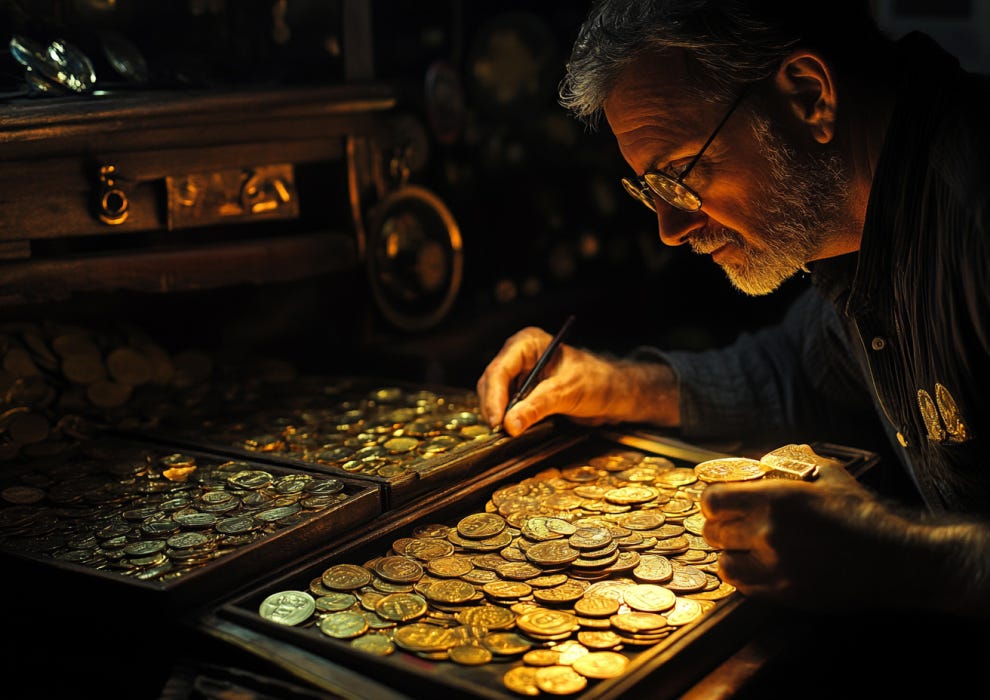
Beware of this Scam
You can also watch this article in video format here:There are some unscrupulous bullion dealers out there who are taking advantage of rookie buyers who don’t entirely know what they are doing when buying gold.I am not going to name names. But don’t fall the scamIf a dealer tries to flog you graded coins, in almost all cases they are trying to rip you off. Don’t pay a premium for graded coins.You are not buying gold to try and be clever and hope that your coin gets some kind of rarity value. In most cases, that will not happen. There are clever people who know this market better than you already playing this game. Don’t get involved. Your priority is to get as much gold for your money as possible. You are buying gold to preserve purchasing power, not to lose it. If a dealer tells you that some recent sovereign, for example, is extremely rare, that it was one of the last coins minted under Queen Elizabeth or some such, and that it has been graded and has a special certificate and blah blah, and it therefore carries a huge premium, they are trying to pull a sly one. The reality is that the extra premium paid is almost impossible to claw back when you come to sell.It really annoys me that bullion dealers are doing this. When buying gold, trust is everything and they are breaching that. You are buying gold for safety, not to be ripped off.Eventually, the FCA or the Office For Fair Trading or someone will eventually come after the dealers, but it will be too late. We all know how slow these organisations can be and by this point many more people will have been scammed. Why do dealers do it? A dealer might buy a large stock of coins from the Mint. Coins are often of a slightly different quality. Dealers then send them off and pay a small fee to get them graded according to their Mint State. The scale ranges from MS-60 to MS-70, with MS-70 being a perfect, flawless coin. They then charge a large premium for coins with high grades, even though they barely paid any premium when they bought the coins The margins when dealing in gold are on the slim side - sometimes just a few percent. But if they get an additional premium for the rarity, that margin can rise to 100%. No wonder there are so many unscrupulous salesman trying to flog graded coins. Fractional coins—¼ or 1/2 sovs for example—or older coins do trade at a higher (though not enormous) premium. These can trade for 15-20% above the spot value of the gold content. But you are likely to get that back when you sell. (Demand for fractional coins has increased this last year while it has fallen for 1oz coins).But for graded coins you can end up paying 100% premium to the spot value of the gold, yet when you come to sell you get little more than the spot value. So when you come to sell, you can lose over 70% even if the spot price of gold has increased. It’s like buying a painting by a modern artist and being told by the vendor he’s more famous than he is, only to find out later on that he isn’t.Don’t fall for it. And spread the word. The more people that know about this the better.If you are interested in buying gold in these uncertain times, then check out my recent report, and look no further than my recommended bullion dealer, the Pure Gold Company. Premiums are low, quality of service is high, and you get to deal with a human being who knows their stuff and won’t try and flog you graded coins at rip-off premiums.IMPORTANT: somebody keeps impersonating me on various social media, including on here asking readers to message them on WhatsApp. It is not me. Don’t engage. Please report and DON’T send any money.Finally, my Edinburgh Fringe show Shaping the Earth, a “lecture with funny bits” about the history of mining, is coming to London October 9th and 10th to the Museum of Comedy. Please come if you fancy a bit of “learning and laughter”. It’s a really interesting show, even though I say so myself. This is a public episode. If you'd like to discuss this with other subscribers or get access to bonus episodes, visit www.theflyingfrisby.com/subscribe

When Are House Prices Going to Crash?
If you would rather watch this piece go here:IMPORTANT: somebody has been impersonating me on Substack, on Instagram and on YouTube. Please don’t engage. Report and block. And please DON’T send any money.Thanks to all who came to see Shaping The Earth up in Edinburgh. The show got incredible feedback. I am doing it in London October 9th and 10th at the Museum of Comedy. Please come if you fancy a bit of “learning and laughter”. House prices have to come down some time. But when exactly? That’s what we all want to know. So here’s your answer.The declines start in the US and Canada in 2025, followed by the UK, Europe and Australia in 2026.That’s what the 18-year property cycle says, at least.Today we explore that cycle and what it says about house prices.18 Years of Boom and BustEconomist Fred Harrison, who first covered the theory in his 1983 book, The Power in the Land, is very much the Godfather of the idea that real estate follows a predictable pattern over an 18-year period. I first stumbled across Harrison in 2005, when so many were sure house prices had to come down (needless to say they didn’t), on reading his brilliantly prophetic article for MoneyWeek, arguing that we were two or three years from the top. Wasn’t he right. Today, by most accounts, property should have already crashed. Real estate prices bear little resemblance to earnings. With the rise in interest rates that followed Covid, mortgage-holders found themselves with higher costs. Some were forced to sell, while prospective buyers could no longer afford to borrow as much as before. Increased taxes - I’m looking at you, Stamp Duty in the UK - have only added to the unaffordability.And yet, while the market may be slow and stagnant in many parts of the country and indeed the world, it is not exactly crashing.There was one school of thought that was steadfast in all the house-price bearishness which followed Covid, saying property’s time to crash had not yet come. They were the acolytes of the 18-year cycle in real estate. Yet again they’ve been proved right. Real estate peaks in 2026, they said. After that we get four years of decline.You know my views on cycles. We have the seasons, days and nights, the moons, menstruation, the cycle of life - cycles are turning all around us. There are economic and investment cycles too: bull markets and bear markets, commodities super-cycles, Gordon Brown was always blathering on about the economic cycle, mining is cyclical. New technology goes through a clear cycle as it evolves and is adopted. On the other hand, it’s easy to look back at the past, find some random pattern and declare it a cycle. Actually trading them in real time is a very different matter. In fact, the human need for narrative and the fact that cycles make for good copy mean it’s very easy to get wedded to the idea of a cycle, when a very different reality is staring you in the face. After 2008 many got it stuck in their heads that this was Kondratiev Winter and the next Great Depression, and, as a result, missed one of the most rip-roaring bull markets in history. With all that said, the 18-year cycle in real estate has proved remarkably reliable, and, says Akhil Patel, author of The Secret Wealth Advantage, and one of Harrison’s great disciples, it goes all the way back to the turn of the 19th century. (I’ll show you that data in just a sec).Looking to buy gold in these uncertain times? Check out my recent report, and look no further than my recommended bullion dealer, the Pure Gold Company. Premiums are low, quality of service is high, and you get to deal with a human being who knows their stuff.Broadly speaking, there are four phases to the cycle - and it actually lasts about 18 and a half years.* Years one to seven. A silent rally followed by …* A mid-cycle slowdown or dip at around the seven year mark.* The explosive phase. That’s when house prices really get on the map. Think 1983 to 1989 or 2002 to 2007. In the last couple of years you get a classic blow-off top - the winners’ curse.* Finally, the correction which lasts around four years. Think 1989 to 1993 or 2008-2011. Then the cycle starts again.Here it is, illustrated.This is, says Akhil, “primarily a North American phenomenon, though Britain and Europe follow the US and, increasingly, emerging markets do as well.”Here, for the historians out there, is a table from Akhil’s book that shows the data in the US going all the way back to 1800.Recent turns of the cycleThere is no doubt the cycle has played out in the UK over my lifetime. (The US is typically 6 months to a year ahead of the UK ). From the mid-1970s through to 1989 there was an extraordinary boom in the UK, followed by that infamous crash from 1989 to 1993 and negative equity so bad that thousands simply posted their keys in the letter box and walked away from their homes. Prices peaked in the third quarter of 1989 at £63,000, before falling to £51,000.But in 1993 things got going again. By the turn of the 20th c
The Power of Dead Hangs and How They Improve Your Health
(And, no, I’m not standing on a stool!)After the unexpected popularity of my post about weight loss (still can’t believe it had 11 million views), I am trying something a little bit different this Sunday morning with this short video about dead hangs, while doing a dead hang. I am planning to cover alternative health a bit more frequently on here in the Sunday morning thought pieces. (NB If you want to try dead hangs, but aren’t yet ready to hang fully, try resistance bands or standing on a step and still putting as much weight as possible through your shoulders).Enjoy!In case you missed them, last Sunday’s post on immigration was extremely popularAnd we also had an update this week on the Dolce Far Niente portfolioTRANSCRIPT:Hey Siri. Timer in 2 minutes.Today, I’m going to talk to you about dead hangs. I’m going to try and do a 2-minute dead hang while recording this video. Not sure if I can last two minutes while talking.I had a motorcycle crash when I was 27, and I've had problems with my neck ever since.Then, last year, I got a trapped nerve in my shoulder and I was in agony. My osteopath helped a lot. I did about 3 or 4 minutes of neck stretches most days. However, the problem continued.And it was only after I started doing dead hangs a few months ago, that my neck issues, shoulder issues and trapped nerve mostly cleared up.Dead hangs are great. Everything we do, whether exercising or just sitting, compresses the spine. Dead hangs stretch it all out.As well as decompressing the spine, they have all sorts of beneficial side-effects. * They improve your posture.* They re-aligning the spine.* They stretch out all the evils of sitting at a desk in front of a screen all day.* They increase neck and shoulder strength, flexibility and mobility.* They stretch through your torso, particularly if you swing from side to side, improving your stomach and core strength. * They are great for your grip strength, your fingers and forearms. * And holding the position for extended periods is probably good for your determination too.So get a pull up bar. The ones you hang in your doorway are you but the ones you put on the wall are better, like this one, and keep hanging every day. At first you’ll only be able to hang for 10, 20 or 30 second, but keep doing it and you’ll quickly increase the time you can hang for.Then you can start hanging in different ways. You can extend the width of your grip. swing, do one-armed hangs. Try and do a couple or three dead hangs a day and they will benefit you in all sorts of unexpected ways, I promise. I can’t think of a physical more beneficial way of spending a couple of minutes than a dead hang. When it finishes you get this rush of pain, this exhilaration through your shoulders.And I’m hoping it finishes pretty soon. Hey, Siri, how long on timer?Hey, Siri, how long on timer?It didn’t set!Tell your friends about this amazing video.Here’s the original weight loss post, in case of interest.Charlie Morris is one of my closest mates and he writes what I think is one of the best investment newsletters out there, in fact a suite of them. I urge you to sign up for a free trial. This is a public episode. If you'd like to discuss this with other subscribers or get access to bonus episodes, visit www.theflyingfrisby.com/subscribe

The Truth About Immigration - And Where It's Going
To watch this piece, go to: 1. There are more people in the world than ever - and we all want better livesThere are some 8.2 billion people in the world - more than ever - and, whether it’s people displaced by war, famine, or lack of water, or (the big one) people seeking a better life with more opportunity, more us are on the move than ever.Some stats:4.6 billion live on less than $10/day.7 billion live on less than $40/day. 7 billion!While the number of people in extreme poverty (below $2.15/day) has capitulated in South Asia, East Asia, and the Pacific, it is rising in sub-Saharan Africa.I was interested to know what the global population by ethnicity is (search engines do not make that easy to find out), but, broadly speaking, it looks something like this (obviously there are lots of mixed race people):* Asian (Chinese, Japanese, Korean, etc.): ~3.2 billion / 43%* Indian (India, Pakistan, Bangladesh, Nepal, Sri Lanka): ~1.5 billion / 20%* Black African: ~1.4 billion / 19%* White European: ~750 million / 10%* Middle Eastern (Arab, Persian, Kurd, Turk, etc.): ~500 million / 7%* Amerindian (North and South America): ~100 million / 1%* Pacific Islander: ~12.5 million / 0.2%Visualised:Though this is rapidly changing with Asian growth, the majority of the world’s wealth lies in the predominantly white (for the time being) countries of Western Europe and North America. There are a gazillion different reasons put forward as to why this might be, which differ according to worldview, ranging from slavery to IQ to system of rule. Regardless of what the reason is, Western Europe and North America have become the prime destinations for migrants. That is where the money is. Language is a huge and overlooked factor too. Most people around the world speak some English. If the migrant speaks German, they might prefer Germany, but English is more widespread, and that means greater numbers will favour the Anglo-Saxon nations.But the population of Western Europe is less than 200 million, 265 million if you include the UK. The population of the U.S. is 345 million. We are tiny in the global context.The difference in the weight of numbers is staggering. (Another good stat for you: more people are born in Nigeria each year than in all of Europe).2. Modern transportationBecause of planes, trains, and automobiles, not to mention boats (fossil fuels and engines, basically), people are able to travel further and faster than ever before.Forget Around the World in 80 Days, itself a miracle in 1872 when the Jules Verne story was published, now, it’s almost (not quite) possible to get around the world in 24 hours.Meanwhile, the days of the medieval serf, who was tied to his land and not allowed to travel, are long gone (for the most part—there are bits of Africa and Asia where you are still tied).3. Modern mediaMedia and communication are more advanced than ever. Whether it’s TV, film, or, most crucially, social media, the whole world is able to see how the other half lives. As of 2023, there are approximately 6.8 billion smartphone users worldwide, representing about 85% of the global population.This has increased awareness of better lives to be had, and it has stoked desire. Modern communication has also enabled travellers to exchange information on how to move.So you have:* more people than ever* better transport than ever* more awareness than ever * more desire than ever.That is why the mass movement of people is now at levels never before seen in history. That is also why it is only going to increase.This is a point that nobody in a position of influence in the media or politics seems to be making. Global migration levels are not going down. They are going up.So instead of brushing the issue under the carpet and calling people racist, immigration is a conversation we need to be having.What is the plan in the face of migration levels that are inevitably going to increase? Do we want more people? Fewer people? More of certain types of people? What is the optimum number of people? Who are the optimum people? People with certain qualifications? People from certain cultures—Judeo-Christian/Muslim/Buddhist/Hindu? People of certain ethnicities? Must they pass wealth tests, skills tests, IQ tests, values tests? What?How can this all be agreed? By referendum? By poll?And once agreed (fat chance), how can it all be ensured?Spoiler: it won’t be. We are not even going to properly talk about, let alone do anything. At least not until it’s too late (if it isn’t already).Instead, we will see the further South Africanisation of everything, and yet more internal division while these issues of immigration continue unaddressed.If you are young, I really wouldn’t hang about. There is a whole world out there. I’d go and be a migrant yourself.Until next time, DominicLooking to buy gold in these uncertain times? Then check out my recent report, and look no further than my recommended bullion dealer, the Pure Gold Company. Premiums are low, quality of

Rout in the Markets: What Happened? And What to Do Now ...
This is a free preview of a paid episode. To hear more, visit www.theflyingfrisby.comIMPORTANT: somebody has been impersonating me on here and asking readers to message them on WhatsApp. Obviously it is not me. Don’t engage. Stop engaging and block, if you have started. And DON’T send any money.I am now at the Edinburgh Fringe with Shaping the Earth, a “lecture with funny bits” about the history of mining. The show is going great guns. I’m then taking it to London on October 9th and 10th to the Museum of Comedy. Please come if you fancy a bit of “learning and laughter”. The Edinburgh link is here. And the London link is here.But today, just as the title suggests, I am going to explain the extraordinary volatility we have seen in markets all over the world this week. I’ll then look at what we should be doing next. What should we do with our gold/bitcoin/oil and gas/equities and all the rest of our holdings?The trigger for all of this lies in the Land of the Rising Sun.The Japanese yen has been undervalued for a long time. For the first time, perhaps in my living memory, Japan has become a cheap—well, not super expensive—country to visit. Against the dollar, pound, and euro, then yen was at multi-decade lows.The main reason for the weak yen is Japanese monetary policy. The Japanese central bank has suppressed rates for many years in an effort to stimulate the Japanese economy. It hasn’t worked, but like so many policymakers, when confronted with a failed policy, the reaction is not to change tack but to double down. In 2016, rates actually went negative.But even as the rest of the world raised rates to try and counter the inflation that came post-COVID, Japan kept them low, creating quite the differential.Until last week, Japan had only raised rates once in 17 years—by 0.25% in March.Here are 15 years of the yen against the US dollar so you can see just how weak the currency had got.Talk about a long-term bear market.This situation created what is known as the Yen Carry Trade. You borrow in yen, pay a very low rate of interest, and then use the money to buy other assets that pay a better yield. It might be other currencies, bonds, equities, or even cryptocurrencies.Let’s say you borrow at below 1% and buy a government bond in another currency that yields 5%. The arbitrage is pretty generous, and the risk is very low. Borrow at below 1% and buy something like an S&P 500 tracker, which might grow by 10-15%, and the rewards are handsome.The longer this situation has gone on, the more capital has gone into this trade, and the greater the risk taken on. Not unlike the British riots (too much immigration for too long when nobody voted for it), this has been a powder keg waiting to blow for a long time. All that was required was the spark.
Why Do Olympic Winners Bite Their Gold Medals?
I am now at the Edinburgh Fringe with Shaping the Earth, a “lecture with funny bits” about the history of mining. I’m then taking the show to London on October 9th and 10th to the Museum of Comedy. Please come if you fancy a bit of “learning and laughter”. The Edinburgh link is here. And the London link is here.ALSOIMPORTANT: somebody has been impersonating me on here and asking readers to message them on WhatsApp. Obviously it is not me. Don’t engage. Stop engaging and block, if you have started. And DON’T send any money.“They don't give you gold medals for beating somebody. They give you gold medals for beating everybody.” Michael Johnson, sprinterWhy do Olympic winners bite their gold medals? The short answer is: for no other reason than a photographer just told them to. But the tradition of biting gold goes back a long way.You might have seen pirates in movies biting their coins too. While such hard-toothed individuals might inspire excitement in modern audiences, ordinary merchants and traders, indeed anyone handling money, used to bite their coins too: it was a rude test of the purity of the metal. Prospectors in the 19th-century gold rushes also used this method to differentiate between real gold and fool’s gold? As well as scraping (to look for plate) or indenting to test softness, biting might involve a little bending too, using the teeth as a clamp to bend against. If the metal is soft and malleable, it was likely pure gold or silver. Hard and brittle, it could indicate that the coin was counterfeit or mixed with other metals. Too soft, however, and the coin was likely lead, coated with gold, a common counterfeit in the 19th century. (Lead is softer than gold). The method might expose crude forgeries, but it would by no means have been foolproof. Copper was added to gold coins from the Tudor period onwards, which would have made them harder, and the bite test that much less reliable, though in Mediaeval times biting might have worked better. Coins, such as Florence’s florin, the standard of the day, were 24 carat, thin, and relatively soft. The bite test might have exposed forgeries.Weighing is more effective, and any merchant would have a set of scales, though perhaps not a pirate. The stamp of the issuer, ideally a reputable royal, also went a long way to certifying authenticity. For the prospectors of the gold rushes, however, who only required a simple differentiation between actual and fool’s gold, the bite test would have been more dependable. We have always used our bodies to measure things.Looking to buy gold in these uncertain times? Then check out my recent report, and look no further than my recommended bullion dealer, the Pure Gold Company. Premiums are low, quality of service is high, and you get to deal with a human being who knows their stuff.What are gold medals made of?Today’s Olympic winners needn’t bother biting their gold. The last time an Olympic gold medal was made of solid gold was over a hundred years ago in 1912 in Stockholm.The gold medals at the 1896 Olympics in Athens, when the Games were first revived, did not contain any gold. They were made of silver and gilded with a thin layer of gold. The same happened at Paris in 1900.Things perked up for the athletes in 1904 at the St. Louis Olympics, when the gold medals were made of 12-karat gold (50% gold, 50% copper). There was a considerable upgrade in 1908 in London, when the gold medals were 22-karat gold, weighing almost an ounce (25g). This proved the peak. (Just as it was probably Britain’s peak too). There were 109 gold medals handed out. That’s over 100 ounces. Expensive!Steady debasement followed. At the 1912 Stockholm Olympics the gold medals were 18-karat gold. From 1920 in Antwerp onwards, the medals were back to gilded silver.Today the International Olympic Committee stipulates that modern Olympic gold medals must weigh at least 500 grams, and contain at least 6g of gold. Olympic gold medals remain largely of silver (93%), copper (6%), plated with about 6 grams of (a bit more than a 1/5 ounce) of gold. A gold medal is thus roughly 1% gold. At the 2022 Olympics in Tokyo, the metals to make the medals came from a recycling initiative. The Japanese handed in nearly 80,000 tonnes of electrical gadgets, including laptops, digital cameras, gaming devices and 6 million phones. The appliances yielded 32kg/1,000 ounces of gold, 3,500 kg/113,000 ounces of silver and 2,200kg of copper. (There is, I learn, about eighty times as much gold in one tonne of cellphones than there is a typical tonne of rock at a gold mine). All 5,000 medals were made from the recycled materials, which were identified using Vanta X-ray fluorescence analyzers, which can identify metals and accurately determine their karat value in a matter of seconds.Until next time,DominicCharlie Morris is one of my closest mates and he writes what I think is one of the best investment newsletters out there, in fact a suite of them. I urge you to sign up for a fre
The rise and fall of the horse, how it relates to gold and a question
Good Sunday afternoon to you,I was blown away by the response to Wednesday’s article about weight loss. The Twitter/X summary got more than 10 million views. Here it is, in case you missed it. Going forward, I am thinking of writing more alternative health stuff, as there seems to be a huge appetite for it. But today it’s business as usual: gold. And I have a question for you …The Great Steppe stretches approximately 5,000 miles from the Pacific coast of China through Mongolia, Siberia, Xinjiang, Kazakhstan, Russia, Ukraine, and Romania, reaching the Danube Delta and Hungary.Vast stretches of grassland, savanna, and shrubland—harsh and dry, devoid of trees and large vegetation—are sandwiched between forests to the north and mountains and deserts to the south. This region has connected Central Europe, Eastern Europe, Western Asia, Central Asia, East Asia, and South Asia since the Paleolithic Age, serving as a predecessor to the Silk Road and the Eurasian land bridge.This ocean of grass is one of the world’s largest ecosystems. Many remarkable species—elk, gazelle, brown bear, leopard, and tiger—have made it their home. So have many great nomadic empires—the Xiongnu, the Scythians, the Mongols, the Huns, and the Göktürk Khaganate—all famous for their ferocity, horsemanship, and military might.The open space gives rise to mighty extremes of weather—howling winds, unbearable heat by day, and freezing cold by night. Humans could only survive by breeding creatures—goats, sheep, camels, and cattle—even hardier than themselves. Of all of these, perhaps the most essential to human survival and evolution was the horse.The horse was first domesticated on the Steppe about 6,000 years ago, probably by the Botai people in present-day Kazakhstan. Their horses—likely similar to today’s Mongolian horse—were small, stocky, and hardy, able to travel long distances in trying conditions. The horse enabled tribes to guide their flocks over large distances as they searched for new grazing lands. It facilitated trade and exchange, and allowed them to form huge and terrifying armies.The fearsome Scythians were the first to use horses in battle, carrying stones, clubs, and bows as weapons. These marauding armies inspired fear. Their warriors were such brilliant horsemen that it seemed they and their horses were one creature, giving rise to the Greek myth of the centaur: wild, untamed, and violent; strong, fast, and ferocious; drunken, lawless, and lustful, with the upper body of a man and the lower body of a horse.The Greeks had a complicated relationship with the Scythians, both admiring and fearing them. Chiron, one of the centaurs famous for his wisdom and knowledge of medicine, tutored many of the greatest Greek heroes, including Hercules, Achilles, and Jason. Perhaps the Greeks exaggerated their barbarity to contrast it with their own sophistication and culture.In any case, while the centaur has endured in myth, it was not long before it was realized that man and beast were not one, and the practice of horse-riding spread beyond the Great Steppe. The horse became the primary mode of land transport for thousands of years.You really should subscribe.Then the Industrial Revolution came along. The first steam locomotive was developed in England in 1804. By the mid-19th century, railroads had become the primary mode of transportation for people and goods across much of the world. It was the beginning of the end for horses as a primary mode of transportation.In the late 19th and early 20th centuries, the automobile emerged. “Horseless carriages,” they were called. Karl Benz developed the first gasoline-powered car in 1885. By the early 1900s, cars had become a common sight on many roads, further diminishing the need for horses.Inventor Alexander Winton sought investment for his Winton Motor Carriage Company. “Get a horse!” a banker told him. “You’re crazy if you think this fool contraption you’ve been wasting your time on will ever displace the horse.”Winton continues:“From my pocket, I took a clipping from the New York World of November 17, 1895, and asked him to read it. He brushed it aside. I insisted. It was an interview with Thomas A. Edison: ‘Talking of horseless carriages suggests to my mind that the horse is doomed… Ten years from now you will be able to buy a horseless vehicle for what you would pay today for a wagon and a pair of horses. The money spent in the keep of the horses will be saved and the danger to life will be much reduced.’”The banker threw back the clipping and snorted, “Another inventor talking.”Today, the horse is, for the most part, an expensive luxury. Its use is often just symbolic.How does this relate to goldHere is my question:Could you say the same about gold?The horse was transport for 6,000 years. It was transport for almost as long as gold was official money. It was “natural transport.”But just as transport changes as technology evolves, so does money.Perhaps gold is to money as the horse is to tra

My Accidental Journey to a Six-Pack
In the last few years, I have gone from this to this. I’ve written about my weight loss before, but, just in the last two or three months, something has really accelerated, and I’m not quite sure what.I’m now 54. I’ve suddenly got a six-pack. Well, sort of. A four-pack. I’ve lost 48 pounds (22 kg). My metabolic age has come down from 57 (when I was 51) to 49. I am super fit and bursting with energy.Even at the age of 22, when I had just left drama school and won a British Open Martial Arts Tournament (BOMAT 1991 - I’ve got the trophy somewhere if you don’t believe me), I don’t think I was nearly as defined. I’m the same welter weight as I was then too.What’s the secret? There isn’t one. I’d love to say this was all deliberate, but really, it has happened by accident. I was overweight, started fasting to lose weight, and it spiralled from there. Normally, I put the weight back on, but this time it’s not only stayed off, but I have lost more weight and got into better shape.I thought I should describe some of my habits here, in case you find them beneficial. I don’t think it is one thing that has done it. I think it is the aggregation of everything.So here we go: 12 habits to transform your health. If you are interested in following me down this route, don’t try and do all of these at once. Do one, then gradually add others. Baby steps …1. FastDo the 5:2 diet. It takes effort, but it works. It is probably the single most effective thing you can do to lose weight. Fasting brings mental clarity too. Watch videos, listen to podcasts, read, indoctrinate yourself, then do it. After a while, you look forward to the feeling of being hungry and the good feeling you get after: I call the morning after a fast the inverted hangover because you feel so good.2. Avoid Seed OilsBy seed oils, I mean all the industrial oils that have only entered our diet in the last 50 or so years and that human beings were never supposed to eat - vegetable oil, sunflower oil, rapeseed oil, canola oil, palm oil - all that stuff. These things were invented to be industrial oils, and they’ve made their way into our food supply and they are poison. Why is obesity such a problem? Look no further than seed oils for your answer. 100 years ago, Americans got zero calories from seed oils; now they make up a third of their daily intake. In this case, correlation is causation. Things like olive oil, butter, tallow, and coconut oil are fine. Seed oils are in everything. Assume what you are considering eating contains seed oil and only eat it when you have ascertained that it doesn’t.Tell someone you know about this.3. Dead HangsI think these might have been the transformer, as I’ve only been doing them a few months. Get a pull-up bar. You can get ones that you hang in your doorway or, better, get one outside for your garden and hang from it. At first, you will only be able to hang for a short time, but keep hanging every day so that eventually you can hang for two minutes. Then do two two-minute hangs per day. I only started doing dead hangs to cure my various neck ailments (too much computer), but they have had all sorts of unintended, beneficial side effects. They improve your posture, they stretch out all the evils of sitting in front of a screen all day, they sort out your neck problems, your shoulder problems, they stretch through your torso. I can’t think of a more physically beneficial way of spending two minutes than a dead hang.4. Get a Whoop Whoop is a health and fitness tracker watch which focuses on sleep and recovery. I got one to improve my sleeping habits. Sleep is the new exercise, as I’m sure you know. It measures, among other things, heart rate variability (HRV), which plummets when you drink. You then get a big red warning which puts you off drinking. The unintended consequence, then, of getting a whoop was that my alcohol consumption has gone from having a couple of drinks or more most days - half a bottle of wine a day kind of stuff - to almost zero. I now crave not drinking. It’s not just the calories in alcohol, it’s the bad decisions you make after drinking, particularly late-night bingeing. Not drinking also improves sleep and general health. I did not plan to give up booze. I like booze. I love beer. I love wine. I like drinking. If you told me I had to give up drinking, I would’ve said no. But that’s what happens when you get a Whoop. So get a Whoop. Plus your sleeping habits improve too.5. Have a partner you want to look good forI had one - now sadly no more - but I’m sure it made me generally up my physical game. She was also extremely health-conscious and got me into all sorts of good habits. It helps to have a partner with whom you can eat well and exercise well. It makes you accountable too.Sometimes splitting up with someone you like or love can be great for your weight too. Maybe that’s what happened to me!You really should subscribe to this wonderful publication.6. Cider vinegarIt’s better for you than Ozempic. It’s c
Gold or Silver: Which Should You Buy?
This is a free preview of a paid episode. To hear more, visit www.theflyingfrisby.comIMPORTANT: somebody has been impersonating me on here and asking readers to message them on WhatsApp. Obviously it is not me. Don’t engage. Stop engaging and block, if you have started. And DON’T send any money.It’s a question that comes up a lot. In fact, a friend was asking me just this week, so let’s try and resolve it here and now, once and for all: gold or silver - which should you buy?Full disclosure: in my own portfolio at one stage I was geared as much as 70% towards silver and 30% towards gold. But in 2011, when silver went to $50, I rolled into gold and never went back. My physical allocation is now probably something like 90% gold and 10% silver.(For clarity’s sake: we are not talking about mining companies - these are a different kettle of fish altogether - just physical metal).Make no mistake: silver has a great deal more potential than gold. There is every possibility that the silver price could triple or quadruple from today’s price just below $30/oz. It could even go to $200. But my experience of 20 years investing in silver is that if it can find a way of disappointing, it will. The out-and-out silver bugs all scream manipulation, and maybe the silver market is manipulated and repressed. For sure, if all the longs on the futures exchanges were to hold out for delivery, the silver price would go shooting up. There is not the physical supply to deliver on all the contracts. That applies to many commodities, though none, it seems, consistently to the same extent as silver. But why invest in something if forces stronger than you are repressing it?It is unlikely, meanwhile, that gold will triple or quadruple from today’s price of $2,300/oz unless we enter into some kind of currency crisis or extreme inflation.Then again, the silver price could easily halve from $30/oz. I don’t think a 50% correction in gold is likely, outside of some deflationary financial panic or liquidity crisis such as we saw with COVID in 2020. In any case, any such correction would be temporary.Reasons to Buy SilverMy friend was told to buy silver because the silver-to-gold ratio at 80 is high and should come lower. Let’s consider that argument.There is 15 times as much silver in the earth’s crust as there is gold, and throughout all of history, the monetary ratio between the two reflected natural supply. Fifteen silver coins got you a gold coin.But silver stopped being used as money in the late 19th century. The many gold rushes of the period increased gold supply so that most countries around the world followed Britain’s model and adopted pure gold standards (more on this here). By 1900, China was the only major country in the world on a bi-metallic standard, which included silver. Every other nation was on gold.In my lifetime, the silver-to-gold ratio has only once gone back to its natural levels of 15, and that was in 1980 for an afternoon, when the Hunt brothers’ attempt to corner the silver market reached its climax. The reality is that the silver-to-gold ratio has been gradually getting higher for a generation now, averaging between 50 and 85, though going above or below those levels at times of market extremity. In 2020, it went to 125.Reality check - this is a long-term uptrend.I accept that the silver-to-gold ratio “should” be 15. In fact, perhaps it should be even lower because silver gets consumed, while gold does not. But in practice, I don’t think that ratio will ever go to 15 in my lifetime, certainly not for any extended period.The other argument that my friend was given to buy silver instead of gold was that silver has many industrial uses. This is indeed the case. It has many more than gold, even if gold’s biggest source of demand is jewellery. (More on gold’s industrial uses here).Gold’s use throughout history has been to store or display wealth. Silver’s has been to exchange it. Silver no longer has that use, nor is it likely to. We don’t use metal as a medium of exchange anymore, nor are we likely to. Money is digital.Gold is the store of value, not silver, which is expensive and bulky to store. Gold is the constant.We don’t buy gold to become millionaires. We buy gold to protect the value of what we have already earned. Gold will continue to do that. Silver might not.Silver is much more speculative. It has the potential to earn you more money than gold, but it also has the potential to lose you more than gold.Why not own a bit of both?Where to buy gold or silver?I’ve used many bullion dealers over the years. The dealer I like most, and with whom I have an affiliation deal, is the Pure Gold Company. Premiums are low. Quality of service is high. You get to deal with a human being. You can take delivery of your gold or store it online with them in their vaults. They deliver to the UK, US, Canada and Europe. (If you speak to them, tell them I sent you). I also like Goldcore.Why are you buying gold or silver?Are you buying

From Medicine to Outer Space: The Many Industrial Uses of Gold and Their Effect on the Gold Price
I am bringing my Edinburgh Fringe “lecture with funny bits” about the history of mining to London on October 9th and 10th to the Museum of Comedy. Please come if you fancy a bit of “learning and laughter”. The Edinburgh link is here. And the London link is here.Let’s start with an overview of gold demand as it currently stands.Never mind central banks, investment banks, or private investors—almost 50% of annual gold demand comes from the jewellery industry. It is, by some margin, the single largely buyer of gold. Another 23% is investment demand, and 21%—last year at least—came from central banks. Just 6% of demand is industrial (excluding jewellery, of course).Jewellery, investment, and central bank demand have all been increasing in recent years. However, a change in macroeconomic circumstances could easily mean, for example, that central banks become net sellers. It's not like it hasn't happened before. But, while de-dollarisation remains a growing theme, I do not see that as likely for several years at least. Similarly, investment demand could easily shrink. Jewellery demand is more constant, and it increases when people feel rich and decreases when they don’t.Gold’s main use has always been and will always be to store and display wealth—in other words, investment and jewellery. Technological demand is rather at the margin, but might we see demand growth there? Let’s investigate. Interestingly, one huge potential increase in demand will come, ironically perhaps since that is where gold came from, at the final frontier in outer space.At the Final Frontier - Also On Your PhoneBoth silver and copper are better conductors of electricity than gold, but gold is more resistant to corrosion and oxidation. Therefore, it finds considerable use in electronics as a coating, especially where long-term stability is important. It is used to cover connectors, switches, and relay contacts; in printed circuit boards, microprocessors, and memory chips. This resistance means it finds considerable use in both aerospace and outer space, where it is used to coat satellite components and spacecraft. It can reflect infrared radiation and protect craft from overheating—especially important in the wild temperature fluctuations of outer space. It is also used in the heat shields which protect sensitive equipment from high temperatures during re-entry into Earth's atmosphere. The umbilical cord that binds an astronaut to their spacecraft is plated with gold. The visors of astronaut helmets are plated with gold to protect their eyes from harmful ultraviolet radiation. The MOXIE (Mars Oxygen In-Situ Resource Utilization Experiment) instrument, which forms part of NASA’s Mars exploration programme, is plated with gold. Its purpose is to create oxygen from carbon dioxide, effectively replicating the role of plants on Earth, so that a human mission to Mars can one day take place.Ultimately, gold’s permanence is the fundamental reason for its use. You need durable materials. When you send a spacecraft to outer space, you can’t repair it. This usage is not yet significant enough to radically alter gold demand, but that could change, and quite dramatically so, as space exploration increases.At the 2022 Olympics in Tokyo, the metals to make the medals came from a recycling initiative. The Japanese handed in nearly 80,000 tonnes of electrical gadgets, including laptops, digital cameras, gaming devices and 6 million phones. The appliances yielded 32kg/1,000 ounces of gold and 3,500 kg/113,000 ounces of silver. There is, I learn, about eighty times as much gold in one tonne of cellphones than there is a typical tonne of rock at a gold mine. Increased high tech means increased gold demand, but perhaps not enough to effect the price.Optics and Other High Tech UsesGold's reflective properties, combined with its stability, mean it finds use in optics—in lenses and mirrors, especially space telescopes, to reflect infrared light. Gold plates the mirrors of the celebrated James Webb telescope, the largest optical telescope in space, to optimise the mirrors’ function, allowing it to view objects too old, distant, or faint for the Hubble Space Telescope. For example, the first stars, the formation of the first galaxies, and the detailed atmospheric characterization of potentially habitable exoplanets.There is a Canadian company, Totenpass, which has been developing some interesting gold tech, also related to gold’s longevity: “a permanent digital storage drive constructed from solid gold that requires no energy and has no movable parts. Digital data is written onto the drive by way of a proprietary light-diffraction process which imprints images, documents, and other files that can be stored as either human readable without the aid of computers or machine-readable with the employment of a smartphone. This technology allows for the permanent storage of precious digital data, thereby eliminating any future dependence on the internet and the vast amounts

What Happens When You Destroy Money: The Challenges of Everyday Life in Turkey
Over the last decade, the Turkish lira has seen declines of more than 95% against the US dollar. It took just ₺1.50 to buy it dollar ten years ago. Now it takes ₺33. The lira has been one of the world’s worst-performing currencies - and in a fiat world, that is saying something - rivalled only by the Venezuelan bolivar and the Argentinian peso.While in Istanbul last week, I spoke to two young professionals, Emre, 25, and İlker, 27, about life under the lira. Both are bright, articulate, and empathetic young men who speak three languages fluently - English, German, and Turkish - as well as competent French.Given that the currency has been so bad, I was expecting to see more widespread use of foreign money, but in fact, lira are changing hands everywhere - you see people all over the place with wads of them. “You have to use lira,” they explained. “It is the national currency.” Even with such dire inflation, there is still trade. The economy still functions, albeit badly. (That said everything in the airports was denominated in euros).Food, energy, travel, housing, consumer goods - everything has gone up in price, but, surprise, surprise, wages have not gone up by nearly as much. The result is that ordinary people have been impoverished.“The average wage in Istanbul is about £650 per month,” they told me. (One thing that impressed me was how immediately they could translate the lira into pounds, dollars, or euros).“What about the receptionist in my hotel or a waiter?”“Maybe £500. A taxi driver working all hours, maybe £800.”With those kinds of earnings, it is hard to make ends meet. “That’s why everybody wants to meet a tourist,” they smiled in reply.“What do you do?” I asked. “Do you spend money as soon as you have it? Before it loses purchasing power?”“Yes,” they said. “There is no point saving. When we were students a few years ago, you could save for maybe three years and buy a car. Now it would take you 20 years. There is no point saving in lira. We spend the money as soon as we have it.”“Even on stupid things,” added Emre, pointing to his Casio watch. “You may as well.”Everyone is the same, apparently. They spend as soon as they earn. There is no point saving a currency that will soon be worth less. The rates of interest paid do not compensate, especially given that you usually have to tie your money up for one, two, or three years to obtain decent rates, and the inflation risk of doing that is too great.Interest rates have been quite the issue in Turkey, by the way. Mainstream Islamic finance prohibits interest, something they claimed Turkish President Recep Tayyip Erdoğan exploited. Until 2023 Erdoğan kept a lid on rates (they are now 50%), arguing that high rates cause inflation. He repeatedly replaced central bank governors who resisted low rates.“How do people save?” I asked.“Gold,” came the answer straight away. Everyone who can buys gold, even tiny amounts below a gram.“Silver?” I asked.“Not so much.”I asked them if they use Revolut or similar to hold foreign currencies. They had no idea what Revolut was (probably a good thing, given what can happen), but it seems most banks also offer the ability to hold euros, pounds, and dollars, and so citizens tend to convert their lira as quickly as they can.“What about bitcoin?”“Not really,” they said. “Some young people.”I was surprised by that. I saw a few adverts for bitcoin-related products out there. But apparently gold is more common.“What about saving up to buy a house?”They both laughed at the impossibility. And there isn’t even a lot of debt in the Turkish housing market. Mortgages, as we know them in the West, don’t really exist, though there are ways to borrow money. Housing is still unaffordable“So people aren’t starting families then?”“No, we can’t. Our population growth is starting to turn negative.”“So you two are not close to starting a family.”They shook their heads sadly. “What do we have to offer?”I felt so sorry for these two young men. Both would be good husbands and fathers.“When people do start families, they rent small flats. Mum works, dad works, grandparents work.”This is something I saw directly. The taxi that met me at the airport had mum and dad in the front and their two kids asleep in the back, while dad continued working into the night.A typical one-bed flat might be about £500 per month. There is not really the same culture of flat-sharing among young professionals that we have in the UK, except maybe for students, and most young people stay with their parents until they marry.I struggled to understand how anyone could make any money in such a situation. All asset owners are doing is protecting their wealth against the currency debasement; they are not actually growing it. “Who’s the richest person in the country?” I wondered.“Erdoğan,” they both said immediately. “Officially, probably the Koç family. They own Fenerbahçe, the football club. But really it is almost certainly Erdoğan.”The state of the currency and the politic
How to Protect Your Wealth Under a Labour Government Part 3
This is a free preview of a paid episode. To hear more, visit www.theflyingfrisby.comI started out with the intention of writing just one article on this subject, but it has become three. It’s a big subject … (Here is part one and here is part two, if you are not already up to speed)The latest polls show Labour comfortably in excess of 400 seats, maybe even 500.They are going to have such a thumping majority (with less than 50% of the vote - how crap is first past the post), together with a Blob which, broadly speaking, is theologically aligned, that they are going to be able to do pretty much what they like. There is scope for a lot of invasive government. The socialist mindset does not respect private property. It feels entitled to it. So today I wanted to further explore wealth taxes and what Labour might do, should the socialist-leaning instincts in the party come to the fore during those first 100 days and beyond.Wealth taxes are hard to collectLet us start with the golden rule of taxation, something with which readers of Daylight Robbery, the definitive book on taxation, will be familiar, as articulated by Louis XIV’s minister of finance, Jean-Baptiste Colbert.The art of taxation consists of so plucking the goose as to obtain the most possible feathers with the least possible hissing(If you haven’t read Daylight Robbery - How Tax Shaped Our Past and Will Change Our Future, by the way, I urge you too. I think it’s the best of my books and one of the things I will go to my grave feeling proud of).With that Colbert quote in mind, let us turn to wealth taxes. I’ve often argued that one reason we don’t see as many wealth taxes as you might expect is that, in practical terms, they are not as simple as they might seem. Income Tax works well because it is easy to collect. The employer collects it for the government - and faces harsh penalties if they don’t, so the onus is on them. Ditto VAT: only it is the seller on whom the responsibility to collect falls.Wealth taxes, however, rely on declarations. There is much more scope for non-compliance, whether deliberate or accidental. Say the government wanted to impose a 5% net worth tax. It would have to find out about your real estate, both at home and abroad, and reach a fair valuation for that. It would have to find out about your stocks and bonds, your possessions, your vehicles, your savings, your ISAs, your pensions, your cryptocurrencies, your art, your antiques. Anyone who has ever had to value an estate for Inheritance Tax purposes knows what a headache this is. It can take many months.The government can force banks to collect a lot of this information, and the bank can then get heavy with you, if you don’t comply (this is a route I think we will go), but there is still an awful lot of scope for non-compliance, avoidance, and evasion. Most will be truthful about what they own; but many will not - and hope that HMRC does not have the resources to investigate them properly, which it doesn’t. Many people have valuable things - from antiques to lost bitcoin wallets - that they don’t even know have value or can’t access. Note: I’m not saying a “net worth tax” won’t happen - I’d give it a 50:50 chance - just that they are not quite as easy as they sound. The goose will hiss a lot.That said, I do think that, for sure, we will see changes to wealth reporting requirements, which is a first step in that direction.You really should subscribe to this letter.But if not a net-worth tax, here are some wealth taxes that could quite easily be imposed:* A savings tax. Savings are relatively easy to prove and then tax. Banks are the ally of government here. There is some £1.5 trillion held in savings accounts in the UK, so there is plenty there to be tapped (though a lot of this is in ISAs, which are supposed to be tax free). Starmer has made noises about ordinary working people not having savings, so I doubt he will have too many qualms about sticking his snout in that particular trough. The complaint is that people have already paid tax on their savings when they earned the money in the first place, plus they pay taxes on the interest.* An equity and bonds holdings tax. Again, relatively easy to prove - banks and brokers to report and collect. I doubt, however, Starmer will tax gilt holdings or remove the CGT exemption on gilts: he will want that particular income tap to remain free-flowing.* Taxes on ISAs. The tax-free goalposts on ISAs can quite easily be changed, and there are a lot of people who have built up large pots, which no doubt Labour will be eying. The £20 grand annual allowance might be reduced or, more likely, there will be a maximum tax-free cap of, say, £100 grand. As to whether they can tax existing holdings, difficult but not impossible.* Tax relief on pension contributions. The sixty grand limit will probably come down and the tax-free lump sum will probably not be quite so tax-free.* An off-shore wealth tax. You have to declare any holdings you have o
How to Protect Your Wealth Under a Labour Government Part 2
This is a free preview of a paid episode. To hear more, visit www.theflyingfrisby.comWe have a General Election coming up in the UK, and citizens of this once-great nation want to know how to protect what they have worked for from the incoming Labour Government, which, you can be sure, is going to be sniffing around like a spaniel on luggage in an airport. We now have the Labour Manifesto, so we can start to be a bit more specific than we were in part one of this series. (Here, also, is part three).I stress: this is only the manifesto. There is a long history of governments doing things they didn’t mention in their manifestos or failing to honour manifesto commitments. Roosevelt’s confiscation of Americans’ gold is one example that springs to mind, but that might just be because I have just been writing about it. There are plenty of examples in the UK too, even with the current government - increases to National Insurance, the Covid money splurge, failures on renters’ reform, home building, immigration pledges, social care, and so on. Circumstances change and so will pledges, especially with a Prime Minister who has quite a track record when it comes to changing tack. Do not be surprised by the surprises that are inevitably coming.The broad argument of part one is that the pound will continue to be debased. It will buy you a lot less in five years than it does now. Whether we will see the 33% declines in the pound’s purchasing power we have seen since 2020, I’m not sure, but the way to hedge yourself is to own non-government money - gold and bitcoin.Labour has pledged to “keep mortgage rates low” and to “retain the 2% inflation target,” which means it will keep a lid on interest rates, or try to, especially with official inflation now having come down to 2%. That all furthers my argument that the pound will continue to lose purchasing power.Labour has a gazillion things it wants to spend money on, ranging from Great British Energy to new teachers, breakfast clubs, and increased NHS appointments, so it is going to need low rates. It has also said it plans to move the “current budget into balance” and “ensure debt is falling.” All I can say is good luck with that. No chance. Spending is going to increase, and, even with the inevitable currency debasement, it is going to need to find tax revenue too. That means higher taxes.But higher taxes where? Taxes, relative to GDP, are already at their highest levels since World War Two, and Labour has promised no increases in National Insurance, Income Tax rates, or VAT. It has also pledged to cap corporation tax at 25% throughout the Parliament.Some increased revenue, it says, will come from clamping down on tax avoidance and modernising HMRC. A lot easier said than done.The big unmentionables have been Council Tax, Capital Gains Tax, and Inheritance Tax. All three, I expect, will go up. Council Tax valuation bands are based on 1991 property prices. That is an obvious anachronism to “update,” though council tax goes to local coffers and Labour will be more interested in revenue at the national level. Even so, it is an obvious area of tax revenue growth. Not a lot you can do to avoid it, except move.Inheritance Tax, meanwhile, will not come down and will probably go up. It is, of course, morally wrong to want to pass the wealth you have earned and already paid taxes on to your heirs. Changes will be justified on the grounds of unearned wealth and exploit the politics of envy. The rate could rise to 50%, I suppose, while areas of relief - the seven-year gift rule, perhaps, the relief on main homes - could be removed. All I can say is plan early.Capital Gains Tax, meanwhile, is likely to rise. Starmer has avoided saying it won’t. I expect to see it rise to levels concomitant with Income Tax with similar bands (i.e., 40% above £37k and 45% above £125k). The way to avoid this is by not transacting, which is what most will do unless they really have to, and so the effect of CGT rises will be market atrophy.Labour will also come after your pensions too - there is so much capital there - with those in the private sector likely to take a bigger hit than those in the state.There is also a lot of blurb about the launch of Great British Energy to “harness Britain’s sun, wind and wave energy” with a windfall tax on oil and gas giants. That makes British oil and gas companies uninvestable. It says it will “deliver one hundred percent clean power by 2030,” though we know that clean power is neither clean nor green . They clearly haven’t read their Alex Epstein, and it all means that essential fossil fuel will inevitably get more expensive, and the country will function less well as a result. Labour says it is going to reduce energy bills. Not possible without subsidies somewhere else, and these have to be paid for.The Housing MarketFollowers of Fred Harrison and the 18-year property cycle will note that Britain’s housing market is heading towards a cycle high, with collapse starting
Money Illusion and the Fragile Fantasy of Modern Currency
At a drinks party in around 2011 or 2012, I had the ear of Andrew Feldman, aka Baron Feldman of Elstree, former Chairman of the Conservative Party—he of “swivel-eyed loons” fame, though he never actually said that. (Andrew is a friend, by the way.)“Tell George Osborne to buy back the gold Gordon Brown sold,” I advised.“At these prices?” smiled Andrew with a mix of incredulity, amusement, and polite condescension.“Yes!” I said. “It might be good publicity, even. Or do it secretly, and announce it afterward. The important thing is getting the gold back. We will need it at some point. Why not just quantitatively ease the money and buy it back? You’re doing that and buying bonds.”Andrew laughed at my joke, which wasn’t a joke, and then wandered off in search of someone more sane to talk to.Given the government has this extraordinary power to create money out of nothing, why don’t they just print money and buy hard assets with it?Park that thought for a moment.A couple of months ago, I was at Liz Truss’s book launch—aren’t you impressed with all this name-dropping?—and I ran into Mark Littlewood, former director of the IEA and now of PopCon. I started bending his ear about the media’s failure to report on the Bank of England and how it had shafted Truss with its advanced notice of gilt sales, Quantitative Tightening, which began the day before Kwasi Kwarteng’s budget and led to a collapse in the gilt market, the blame for which was then left at Kwasi Kwarteng’s doorstep. Mark nodded. “Do you think I don’t know?” said Liz.“I would love to be able to grill Andrew Bailey in public,” I said. “Or just ask him one question with people watching. I know exactly what I’d ask him.”“What?” said Mark.“If the Bank of England can print money, why do we need taxes?”Mark laughed and, thinking I was asking him that question, replied, “Money illusion.”Money illusion is one of those economic terms that is pretty self-explanatory, but here is an example. Most of know a hundred pounds does not buy you today what it bought you ten years ago, but we still think in terms of past prices. (Old people do this more, for obvious reasons). A worker might feel great with a 5% raise, but if inflation is 7%, he is actually earning less than before. This has been an ongoing process for decades with the result that, in real terms, wages are lower.Here’s the Wikipedia definition (edited by me):In economics, money illusion, or price illusion, is a cognitive bias where money is thought of in nominal, rather than real, terms. In other words, the face value (nominal value) of money is mistaken for its purchasing power (real value) at a previous point in time. The term was coined by Irving Fisher in Stabilizing the Dollar, and popularized by John Maynard Keynes in the early twentieth century. Fisher also wrote a book on the subject, The Money Illusion, in 1928.Mark and I both doubted that Bailey would give that as the answer, even if he thought it, which we doubted he would. If governments started printing money and buying assets, many would start questioning money, and faith in fiat might quickly evaporate. If governments worldwide started doing it (eg Britain prints money and starts buying land in France) you are in race-to-the-bottom territory. It would be a race to the bottom for fiat currency.Even if Bailey thought money illusion was the answer, he certainly wouldn’t say it because that in itself undermines fiat.Modern money has nominal value, but not intrinsic value. It relies on illusion (and the law) to function. The more you debase it, the less likely that illusion is to hold. Maybe money delusion is more accurate. Obviously, the backing of the law makes a great difference, as does the fact that taxes must be collected in this money, but, boy, is the system vulnerable. Illusions can last a long time. But when they shatter, they shatter very quickly, and then there is nothing.I don’t say the system will pop. It has been going on for a long time. But I do observe that it very easily could.It’s why I recommend both gold and bitcoin. Both are money in and of themselves: one is the product of nature, the other the product of extraordinary amounts of computer power. Neither relies on anyone else.If you liked this article, please tell a friend.If you are interested in buying gold, check out my recent report. I have a feeling it is going to come in very handy.My recommended bullion dealer is the Pure Gold Company.Life After the State - Why We Don’t Need Government (2013), my first book, is now back in print - with the audiobook here: Audible UK, Audible US, Apple Books. I recommend the audiobook ;)And if you are in the Scottish neck of the woods this August, look out for me at the Edinburgh Fringe. I’ll be performing one of my “lectures with funny bits”. This one is all about the history of mining. As always, I shall be delivering it at Panmure House, where Adam Smith wrote Wealth of Nations. It’s at 2pm most afternoons. You can get tickets here. This

How To Protect Your Wealth Under A Labour Government - Part One
While Prime Minister Rishi Sunak, like a jilted boyfriend turned desperado, is announcing a new policy every day, future Prime Minister Keir Starmer’s strategy has been to be as vague and non-committal as possible about everything, and get elected on the back of the Tories being so useless. It makes sense: the less he promises now, and the less specific he is, the more scope he will have when he comes to power to do what he wants.Such is the topsy-turvy Orwellian world in which we live. Labour’s five missions—massive cringe—read like something that should be on the Conservative Party website. Labour declares upfront, first and foremost, that its “first duty” is “to protect our country – through economic stability, secure borders, and strong defence.” I’m sure this is all part of Starmer’s strategy to win over the middle and rid himself of the ghosts of Labour incompetence. “I’ve changed the Labour Party so we are back in service of working people,” he boasts. “Together we can change Britain.”So what exactly will this huge change that is coming to Britain entail?One of the few things Labour has been specific about is VAT on school fees. This has generated a lot of negative press, particularly in the mainstream media, which is heavily populated by people who went to public school and send their kids there too. But with only 7% of children actually going to public school, I guess Labour has figured, in these times of envy, that this will be a vote-winner. While it purports to be an attack on the rich, in real terms it is an attack on the middle classes, many of whom will now put their kids into state schools. The extra burden of this on an already overburdened sector does not justify the limited increase in revenues that will come from VAT, never mind the practicalities of imposing this charge and the schools that will go bust as a result. But extra revenue is not what this is about. It’s exploiting the politics of envy.Nevertheless, there is one clear thing we can infer from it: the middle class is going to get shafted. Where it tries to be independent and self-sufficient, it will find itself dragged into state dependency. That is not change, though. This is a process that has been going on for decades—since the imposition of fiat money, in fact. And that, I’m afraid, is the broad brush stroke. The details may be different, but the direction is the same. We are going to see more government, more spending, more technocracy, more bureaucracy, more quangos, more regulation, more taxation, further declines in the purchasing power of money, further erosion of individual liberty, more state solutions to things that would sort themselves out perfectly well if government stayed out of it, and so on. We will also see further steps in the direction of supranational bodies, one-world government, and all the rest of it. Change is not coming. Continuity is.So the absolute first thing you have to do is keep as much wealth as you can outside the system. Do not hold sterling, or any other fiat money for that matter. Yes, sterling is holding up moderately well in the forex markets, which know Labour will win, but that is just comparing it with other fiat currencies. Use gold and bitcoin as your savings vehicles. They will outperform sterling quite comfortably by the time of the next government. Make a note of what £100,000 currently buys you. It will buy you a lot less in five years. If you are interested in buying gold, check out my recent report. I have a feeling it is going to come in very handy.My recommended bullion dealer is the Pure Gold Company.Labour’s Five Missions* Get Britain Building AgainLabour promises to “strengthen public finances” and “reform planning laws, so we build more houses, giga factories (SIC), windfarms, roads, labs, and ports, developing the skills needed to do so.” It will “reduce energy bills and invest in the jobs and industries of the future via our Green Prosperity Plan and Great British Energy, a new publicly owned clean generation company.” And it will build more homes (heard that one before?).This all means more state: more state spending, planning, regulation, subsidy, and action. You don’t need me to tell you where that leads.* Switch on Great British Energy“A new publicly owned, clean energy company that ensures jobs are created here in Britain to cut your energy bills, create 500,000 new, skilled jobs in the industries of the future, and deliver energy security.”What could possibly go wrong? All that green energy stuff has been an unbridled success so far without a whiff of corruption. * Get the NHS Back on Its FeetIt promises to “pay doctors and nurses overtime to work evenings and weekends to cut the backlog, cut waiting times by giving the NHS the staff and technology it needs, end the 8am scramble for GP appointments, improve cancer survival rates, and reduce deaths from heart disease and suicide, with more care in the community so patients aren’t stuck in hospital.”Sounds great. W

How The News Lies
I am experimenting again with a video this Sunday morning. (Podcast listeners can still get just the audio). Enjoy :)It was August 2018. Brexit Derangement Syndrome was only just starting to kick in, though the effort to derail it was underway. In comedy circles, I still was not talking very openly about having voted for Brexit—it would be another six months before I wrote 17 Million F Offs.I was doing a show at the Edinburgh Fringe, my financial gameshow.Now something happens to a performer at the Fringe. There are so many shows and so much competition that you will do (almost) anything to get publicity and draw attention to your show. The Fringe is a distillation of the entertainment industry; all the best things about it and the worst, all the highs and lows, seem to get magnified there. My PR man texted me and asked if I wanted to do a short spot about Brexit and comedy for Channel 4 News. I said yes. He said to go to the Pleasance at 5pm. They wanted someone who voted Leave.I met the film crew there, and the presenter— I have no idea what his name was—was a very nice, very charming young Englishman in his early 30s. University-educated, probably public school, made me feel very at ease. We found a little alcove, and our interview began.“In a comedy club, what do you say when heckled about Brexit?” he asked me.Now there are three types of comedy gigs. One is where the audience has come to see you; two is when they have come to see comedy (not necessarily you); and three, the worst type of gig, is when they neither come to see you nor comedy.Comedy clubs mostly come under category two (unless you are doing a solo show).I answered the question truthfully: “I MC a lot of nights. My job is to create a warm and friendly atmosphere. Audiences in comedy clubs are fairly mixed. So, I tend to avoid talking about Brexit, as you risk losing half the room, which is not good for the night.”“Sure, but what would you say if someone heckled you about Brexit?”“Well, I don’t talk about it, so they don’t.”“But if you did?”“But I don’t.”This went round in circles for a bit. Then he changed his approach. “And if someone heckled you about voting Leave?”“Well, they don’t because I don’t talk about it.”“No, but what if they did?”“Well, they don’t. As I say, in a regular comedy club, with a mixed crowd, if you come down very heavily on one side, you risk losing half the room. I’m the host. I don’t like to do that. It might be different if I was doing a show specifically about it, but I’m not.”“Well, what if you were?”“Well, I’m not. And if I was doing a show about voting leave, I doubt many remainers would come.”“But what if they did?”It just kept going round and round in circles. I thought I was being reasonably articulate about the need to be diplomatic in a mixed room if you are the host, and I made the same point several times, each time phrasing it slightly differently, but he just was not having it. He kept coming back to this same question.“But if someone heckled you about voting Leave, what would you say?”Eventually, somewhat exasperated, I said, “Oh, I don’t know. ‘Whatever, loser.’ Something like that.”He smiled and quickly drew the interview to a close. We parted company with, apparently, good will expressed. I had spent probably five minutes explaining the need to be diplomatic and a microsecond with that last line.Later that day, I watched the clip from Channel 4 News. Guess which part of the interview they used?“Leaver comedian calls people who voted Remain losers,” ran the headline of the vid on the Channel 4 site, or some such (I can’t find the vid now to quote it accurately).The only clip from the interview they used was me saying, “Whatever, loser,” even though it was totally misrepresentative of the rest of the interview. Then in the comments beneath, I remember reading a load of remarks along the lines of, “Well, how is that funny?”, “Remind me to never go and see that guy,” “Leavers just aren’t funny,” and so on.I won’t say I was shocked by how disingenuous the process was, but I was shaking my head wearily. I explained it to myself along the lines that he had gone into the interview wanting a certain clip that he could use to illustrate a story he had already formed in his head. He would not stop until he got that clip, and he had no interest in anything else I said. I suppose that’s a kind way of looking at it—a trap I often fall into. On the other hand, he was a lying cheat, and the clip he showed of me was completely misrepresentative. It could have been quite damaging to me reputationally, but fortunately, the clip was so short, and not that many people will have watched it.If nothing else, it showed me just how untruthful the news is.You really cannot trust it. No wonder so many have lost faith.When you have a reporter brimming with ambition (the same ruthless ambition that actors, singers, comedians, and other media stars have), the most important thing is their career. Everything else, including the
Ethereum ETF: Another Game Changer for Crypto Markets
This is a free preview of a paid episode. To hear more, visit www.theflyingfrisby.comTwo bullish developments for Bitcoin and cryptocurrencies this week: first, Donald Trump, who is currently the favourite to be the next US President, declared, 'I am very positive and open-minded towards cryptocurrency companies and all things related to this new and burgeoning industry. Our country must be the leader in the field; there is no second place.'Those words will have been written for him, but they nevertheless show that policies, should he win the election, as currently looks likely, will be favourable. That has to be good for the sector.Second the Ethereum ETF got green lit this week in the US, so today we consider the implications of that, and give our outlook on the sector more generally.First up, ether has rallied. It’s risen by about a third from $2,900 a coin to within spitting distance of $4,000.I must confess to being somewhat flummoxed by Ethereum. (If you want to read my guide, it is here). Briefly: its founding principle is to use blockchain technology for purposes beyond an alternative system of digital money. Known as "the world's programmable blockchain," it can be used to “codify, decentralize, secure, and trade just about anything.” Charlie Morris of Byte Tree likens it to a decentralized App Store (you should all read his letter by the way). Developers can use the platform to build and publish smart contracts and distributed applications (dApps), and it is a kind of marketplace for financial services (DeFi), NFTs (non-fungible tokens), games, and apps, all of which can be paid for in ether.The Bitcoin maximalists don’t like it. Ethereum is not properly decentralized. The numerous forks that have taken place in reaction to hacks prove this—they would not be possible with a properly decentralised platform. Too many coins were pre-mined and handed out to founders. Ethereum 2.0 met with delay after delay. Transaction costs, known as gas fees, can get exorbitant. Its blockchain is not that robust. In short, it’s something of a ticking time bomb.Well, maybe. But its founder, Vitalik Buterin, a billionaire many times over by the time he was 28 (just in case you weren’t feeling inadequate enough already this morning), will know all this. He is a genius, and I satisfy myself that by owning Ethereum, I am effectively long Buterin—not unlike being long Elon Musk by owning Tesla.Ethereum also has numerous competitors—not least Solana, but also Binance Smart Chain, Polkadot, Cardano, Terra, and Fantom - which may or may not be a good thing. Many of these are technologically superior, say critics—faster, more robust.Price-wise ethereum been something of a laggard. Its all-time high was $4,800 and it’s about a thousand bucks, or 20%, below that. That said, it does tend to move later in bull markets - and by more.But despite all of this, Ethereum remains by some margin the number two cryptocurrency by market cap—at $465 billion—followed by Tether, which has another purpose altogether ($110 bn), then Binance Coin ($89 bn). By way of comparison, HSBC has a market cap of $165 bn. And you thought crypto was a passing fad.So what can we expect with the launch of this new ETF?
The Accidental Gold Standard
A slightly-longer Sunday morning thought piece than usual today, but one that is well worth the effort I hope you’ll discover.A reminder that:* This August I am going to the Edinburgh Fringe to do one of my “lectures with funny bits”. This one is all about the history of mining. As always, I shall be delivering it at Panmure House, where Adam Smith wrote Wealth of Nations. It’s at 2pm most afternoons. Please come. Tickets here.* My first book and many readers’ favourite, Life After the State - Why We Don’t Need Government (2013), is now back in print - with the audiobook here: Audible UK, Audible US, Apple Books. I recommend the audiobook ;)Isaac Newton, who, along with William Shakespeare, Leonardo Da Vinci and Aristotle, must be one of the cleverest individuals to have ever lived, made groundbreaking contributions to physics, mathematics, optics, mechanics, philosophy and astronomy. The laws of motion, the theory of gravitation and the reflecting telescope were among his many contributions. He was also a brilliant alchemist, obsessed with theology and biblical prophecy. As if that isn’t enough, he is credited with the design of the Gold Standard, the primary monetary system of the world for over two hundred years. Today we explore how this brilliant system was accidental.In 1695, counterfeit coins accounted for more than a tenth of all English money in circulation. Massive LOL: the English used the counterfeit coins, in particular, to pay their taxes. The Exchequer that year reported no more than ten good shillings for every hundred pounds of revenue. Coin clipping was also a major problem, especially of old coins, and silver coins were disappearing from circulation altogether. Silver was worth more on the continent as bullion than it was in the UK as tender, so arbitrageurs shipped coins abroad, melted them down, and sold them for gold. Everyone from the Jews to the French was blamed, but by 1695 it was almost impossible to find legal silver in circulation. It had all been melted down and sold.This all led to a scarcity of money, which inhibited trade. More damage was caused to the English nation in just one year by bad money than “by a quarter century of bad kings, bad Ministers, bad Parliaments and bad Judges”, said the historian Thomas Babington Macaulay.King William begged the House of Commons to respond to the crisis and, seeking help, Secretary of the Treasury, William Lowndes wrote letters to England’s wisest men, asking their advice: among them, philosopher John Locke, architect Sir Christopher Wren, banker Sir Josiah Child, and scientist, Sir Isaac Newton.Newton was in his mid 40s and probably not far off the peak of his powers. He had published his most famous work, the Philosophiæ Naturalis Principia Mathematica, just eight years earlier in 1687, and it had established him as the smartest man in the country. He would now put his great mind to money.With the formation of the Bank of England the previous year, Newton had become aware of the possibilities of paper money. “If interest be not yet low enough for the advantage of trade,” he wrote, “the only proper way to lower it is more paper credit till by trading and business we can get more money.” He could see that token value and intrinsic value were not necessarily one and the same.It was also obvious to Newton that the currency criminals were rational actors. They would continue to clip, counterfeit, and sell abroad while there was profit in it. Bullion smuggling carried the death sentence, yet still it went on. Coercion alone would not be enough to stop it from happening. The market itself needed to be changed.He came up with two measures. First, to deal with the clipping, all coins minted prior to 1662 should be called in, melted down, and, using machines, re-made into coins that had a single consistent edge. With no more hand-hammered coins in circulation, clipping coins would become that much more difficult. Re-minting the entire country’s coin, however, at a time of such primitive machinery, was no small undertaking. Second, to deal with the silver issue, the amount of silver in coins should be lowered so that the silver content and the face value of the coin were the same.The thought of such a devaluation went against the psyche. The idea that token value and intrinsic value might be different was alien and Newton’s second proposal was not widely welcomed. There were 20 shillings to a pound, so a shilling should contain a concomitant amount of silver. Newton may have thought that the token was more important than the silver content, but landowners and the government, which was largely made up of them, would lose 20% of their silver by Newton’s proposal. In 1696 Parliament approved the recoinage, but stipulated the new coins maintain the old weights. Newton warned that the silver outflow would continue.The following year, nudged by John Locke, Charles Montague, the Chancellor of the Exchequer, sent Newton a letter notifying him that the

Why We Need Anonymity on the Internet
A few years ago I wrote a script called Four Murders and Some Funerals, about an old lady who is the victim of a terrible miscarriage of justice. Seeking revenge she murders one of the perpetrators (by accident - long story, but it works), discovers she’s a natural at bumping people off, does away with the other three, and ends up becoming a vigilante serial killer - righting wrongs wherever she finds them and usually where the law has failed. I still think it was a pretty good script, though it never got made - a bit like Miss Marple, only more savage and retributionist. Anyway, as a result of writing said script, I had to come up with a number of original ways by which an old lady might kill people: I had one person pushed down a lift shaft, another electrocuted in the bath, another shot and another poisoned. This all involved quite a bit of research, especially the various poisons. Should our heroine use cyanide, polonium, fentanyl or botulinum, for example?For obvious reasons, I wasn’t quite comfortable googling all the questions I had, so I took to Tor, DuckDuckGo and internet anonymity. I’m glad I did because, believe you me, how to murder someone is one heck of an internet rabbit hole to go down. Before long I was reading about hiring Chechen hitmen and lord knows what else. Obviously, in the grand scheme of things, researching a script about a murderer is a fairly trivial use case for internet anonymity. But I don’t think the day is far away when your internet search history - which Google keeps forever, by the way, unless you take steps to delete it - will be taken into account for things like insurance risk, profiling, social credit score, by potential employers and so on. I don’t think several days researching how to kill someone reflects particularly well. Of relevance, one of my followers tells me that Justin Trudeau is trying to impose a law whereby police can retroactively search the Internet for ‘hate speech’ violations and arrest offenders, even if the offence occurred before the law existed.But you don’t have to be asking questions about how to kill someone to want anonymity. You might be living under some extreme theological regime, asking questions like is there a god; or under a totalitarian regime, asking questions about freedom; or under a corrupt and incompetent regime, asking questions about vaccine safety. You get the point. Anonymity protects you. It limits the power that others have over you and the ability they have to control you. It enables you to protect your reputation, and stop things from being used against you, especially out of context. It gives you greater control over your own data and thus your destiny. But let’s say I did actually want to kill someone, and that I even researched how to do it, before deciding not to. The only crime I would be guilty of is thought. But if my search history can be used against me, it doesn’t matter if, ten years later I have moved on from the murder thing, it’s still there, and if the police or some activist decided to uncover it, I would, in the eyes of many, forever be guilty of murder, even if I had committed no such crime, beyond thinking about it - which, I bet, most of us have at some point in our darkest hours.For me the most powerful use case is freedom of thought. Being anonymous is liberating. I’m sure that is why masked balls proved so popular. If you know you are being watched, you are less likely to explore new ideas outside the mainstream, ideas which family, friends, colleagues or even society may dislike. These might be philosophical, political or theological ideas, scientific or artistic. We might want to express thoughts we otherwise feel unable to express. A lot of things, if judged from a different time or place, by people who lack complete knowledge or understanding, may seem odd or worse intolerable. Anonymity protects against having to worry about how actions are perceived and against constantly having to justify them. Anonymity is the nemesis of censorship.Get your friends to read this.This happened to a comedian friend of mine the other day. I don’t want to say his name, because I don’t want to draw attention to the doxxing. He was posting anonymously on Telegram. Some ideological opponent spent hours following him, going through his material and then exposed his identity, publishing all the stuff he had been saying in order to try and lose him his job. (Which he nearly did: he got suspended but thankfully re-instated). They did something similar to the tycoon Paul Marshall, who had an anonymous Twitter account.The most compelling real life example of why we need internet anonymity must be Satoshi Nakamoto. We would not have bitcoin without it. For sure, many will say, “bah, bitcoin”, but we are talking here about one of the most revolutionary technologies ever invented, and one that has the potential (I don’t say it will, I say it has the potential) to fix our broken political and economic systems peacefully. H

Brown's Bottom: 25 Years On
Good morning,As an experiment, today’s Sunday morning thought piece is in video. If you prefer, you can also read it below. You should also be able to read and listen, as many like to do.Let me know what you think.This week, May 7th, marks the 25th anniversary of one the UK’s greatest ever financial blunders. There is no shortage of them, but this one really stands out: that is Gordon Brown’s decision to sell more than half of Britain’s gold. The decision and then its implementation were both of such cack-handed incompetence that for many the only possible explanation is conspiracy. We will come to that in a moment.Every now and then the government does something that makes your ears prick up and think, “Well what are they doing that for?” This was one of those times. I knew nothing about gold or investing back then, but, even I, could see it was a dumb and needless thing to do. That’s the most amazing thing: Brown was under no pressure to sell. He was under no pressure to do anything. Even non-libertarians will struggle to explain why we need government when they are this incompetent.It wasn’t just me. The tabloids said the decision was, “catastrophic.” Gold traders called it, “appalling”. Parliament was outraged. Foreign central banks were too. What was Gordon Brown thinking?It was two years into Brown’s new job as Chancellor of the Exchequer. At the time, the UK held approximately 715 tonnes of gold, worth around $6.5 billion. The value of the country’s gold amounted to about half of its US$13 billion foreign currency reserves and the Treasury wanted to “achieve a better balance in the portfolio”. There was, it said, too much exposure to a single asset, which paid no interest and its price was volatile. Via a written question in the House of Commons the Government suddenly announced that it would be holding a series of auctions for its gold reserves, starting in six weeks, with an eventual plan to sell 415 tonnes by 2002. Eddie George, the Governor of the Bank of England, raised “strong objections” as he and Gordon Brown clashed, but he was “outgunned by a coalition of the treasury and some of his own senior officials”. "The sale of the gold was not something that we recommended at the Bank,” George later said. “We did not think it was a good idea to sell such a large amount of gold at once. However, the decision was taken by the Chancellor and his advisors, and we respected their right to make that decision."London was still (just) at the epicentre of the gold market and its numerous gold traders thought the decision was nuts. Gold prices move in decades-long cycles, they told Bank of England officials, and the price was likely a lot nearer the bottom than the top. “The timing of the decision was ludicrous. We told them, ‘You are going to push the gold price down before you sell’,” said Peter Fava, then head of precious metal dealing at HSBC. “We thought it was a disastrous decision; we couldn’t understand it.” Revealing the timings and amounts for sale so far in advance would cause traders to short the asset, and that would drive the gold price lower.Not only did Brown give a six-week advance notice to the market that the UK would be selling, driving away any potential buyers and sending speculators short in advance of the sale, the UK had even lent one fifth of its gold out, which speculators borrowed and sold in order to front run the UK’s sale. Sure enough, the price fell 10% by the time of the first auction in July to lows not seen since shortly after the US abandoned the gold standard in 1971. No wonder so many see this as the worst decision in British financial history.Here is the timing of that first sale illustrated. £150/oz. Today we are at £1,900/oz. What a bunch of clowns. As soon as the commitment was made, a consortium of central banks - including the European Central Bank and the Bank of England - signed the Washington Agreement on Gold in September 1999, limiting gold sales to 400 tonnes per year for 5 years. This triggered a reversal in price, a 25% rally in a week. Such gains have never been seen before or since. If you are interested in buying gold, check out my recent report. I have a feeling it is going to come in very handy in the not-too-distant future. My recommended bullion dealer is the Pure Gold Company.In total, the UK eventually sold 395 tonnes over 17 auctions from July 1999 to March 2002, at an average price of US$275 per ounce, raising approximately US$3.5 billion. I have had it said to me many times that China was on the other side of the trade, but that is something we will never know. Never explain as conspiracy that which can be explained by incompetence runs the wisdom, but this was so incompetent even those who favour that line of thinking struggle to explain Brown’s logic.It was done to diversify UK assets, runs the standard explanation. Gold pays no interest, Brown wanted a yield. How was Brown to know interest rates would fall for the next 20 years? Many, especia
Why It Is Inevitable That Modern Buildings Will Be Ugly.
I love how easy it is to predict things about you based on what you like or dislike.Did you know, for example, that if you buy fresh fennel, you are likely to be a low insurance risk? If you like traditional architecture and old buildings, you are more likely to have a conservative, right-of-centre worldview. Whereas if you like modern architecture, you will lean to the left.For what it’s worth, there are plenty of 20th-century buildings that I find beautiful. I like Art Deco; I like Bauhaus stuff; I think a lot of modern US residential architecture is great. But I think a lot of more recent Deconstructivist and Parametric stuff has disappeared up its state-funded backside and has no chance of standing the test of time. Post-war social housing the world over is verging on the sinful, it is so ugly, not a patch on the almshouses built a century before for the same purpose, when mankind was far less “advanced”. Meanwhile, the glass-fronted apartment and office blocks that blight cities worldwide may be nice to look out from, but to look at they are horrible.When I look at, for example, what has been built in Lewisham, Elephant and Castle or along the banks of the Thames, you have to wonder what on earth people were thinking. What a wasted opportunity to build something with beauty that endures.I was looking out on the Thames from Canary Wharf the other day. Here is what we built.Here is what was possible.In any case, it is inevitable that most modern architecture will not be beautiful. Inevitable! It is built into the system. Let me explain why.Yes, there is regulation. When final say falls to the regulator, not the creator, and he/she never thinks in terms of beauty, only rules and career risk, and construction is always planned with his or her approval in mind, you immediately clip your wings and more. Imagine Michelangelo, Rembrandt, or Beethoven requiring regulatory approval for their work. Under this banner falls health and safety, bureaucracy, the technocratic mentality, planning, standardisation of materials and their mass production, and more.But there is something even more fundamental, which makes lack of beauty inevitable. That is the system of measurement itself. In the past, before mass-produced tape measures were a thing, we made do with the most immediate tools we had to measure things: the human body. Traditional weights and measures were all based around the human body. A foot is, well, a foot. A hand is a hand. A span is a hand stretched out. An inch is a thumb. There are four thumbs to a hand, six to a span, 12 to a foot, 18 to a cubit, which is the distance from elbow to fingertip. A yard is a pace, which happens to be three feet as well. A fathom is the arms stretched out - two yards, or six feet. It goes on: a pound is roughly what you can hold comfortably in your hand. A furlong is the distance a man of average fitness can sprint for. A stone is what you can carry without strain. A US pint is a pound of water, enough to quench a thirst, and so on. Man is indeed the measure of all things, to paraphrase Protagoras. Spread the truth about weights and measures.Da Vinci noticed it. “Nature has thus arranged the measurements of a man: four fingers make one palm. And four palms make one foot; six palms make one cubit; four cubits make once a man's height," he says in his notes for Vitruvian Man.It turns out the feet are very similar the world over and have been throughout history. The foot, for example, was the principal unit in the design of Stonehenge. Here are some different feet from around the world and from throughout history:The cubit was the principal unit of the Pyramids. The pound is the oldest measure of all and goes all the way back to the Babylonian mina.Here’s the thing: proportion is inherent to traditional weights and measures because they derive from the human body, which is proportionate. We are biologically programmed to find the proportions of the human body attractive. The religious will argue that God made man in his own image. Traditional weights and measures derive, therefore, from God, or his image at least, and so are divine.The metric system, on the other hand, is not based on the human body, but on the earth itself. A metre is supposed to be one 10 millionth of the distance from the North Pole to the Equator (though one of French scientists measuring the distance forged the data, so the measure is flawed). The idea of a system based on the earth itself rather than the human body was to achieve a “universal measure based on the perfection of nature” and “a system for all people for all time” to use the words of those who commissioned the measure in the years after the French Revolution. Metric may have a brilliantly simple and comprehensible design, based around the number 10, but unlike traditional weights and measures, proportion is not intrinsic to it. For the purposes of science and for safety, as I argue in my lecture with funny bits, How Heavy?, a universal sys
The British Pound: Big Falls Coming?
This is a free preview of a paid episode. To hear more, visit www.theflyingfrisby.comI was going to call this article “a tale of national betrayal.” Sterling is a national disgrace. If ever there was something that symbolised the decline of Britain from world leader to tin pot sh*te show, it is our currency. The US dollar has lost at least 93% of its purchasing power since World War Two. The pound, which was a few cents shy of $5 at the onset of war and today sits at $1.24, has lost an additional 75% against the US dollar.It’s shocking. An appalling betrayal by successive leaderships. When you devalue your currency, you devalue your entire country: the people’s labour, their savings, their assets.As long-time readers will know, I have identified a long-term cycle in the pound, and the next capitulation is due this year. If this plays out, then the pound is about to hit the skids.Don’t get wedded to the idea of a cycleLet me start with my usual disclaimer: it’s easy to look back at the past, find some arbitrary pattern, declare it a cycle, write some persuasive copy, and, all of a sudden, you’re a guru. When things don’t pan out as they should, you blame some outside factor, usually the government.Cycles do exist. We have the seasons, the moons, the cycle of life. There are good times and bad times. There are investment cycles too: bull markets and bear markets, the Kondratiev cycle, the 18-year cycle in real estate, commodities super-cycles, the 4-year presidential cycle. Mining is cyclical. New tech goes through a clear cycle as it evolves. I’m a big believer in the hype cycle. Yet actually trading them in real time is hard.Thinking in terms of cycles does help you to frame the bigger picture: it can give you an idea where you are in the grand scheme of things. But you can easily get wedded to the idea of a particular cycle, and then it’s very hard to break the mindset, even if real life right in front of you is telling a very different story.I remember people in the years after the Global Financial Crisis (GFC) being wedded to the idea of Kondratiev Winter and the next Great Depression. The Dow was going to 1,000, they said. It never went close and here we are today above 38,000. The problem was that the Kondratiev Winter argument was persuasive, and once you’ve been hooked by a narrative, it’s hard to break its shackles.If you are interested in buying gold, check out my recent report. I have a feeling it is going to come in very handy in the not-too-distant future. My recommended bullion dealer is the Pure Gold Company.So to Frisby’s FluxWith all that said, I am now going to argue that there is an 8ish-year cycle in the British pound that goes all the way back to 1968, at least. I’ve called it Frisby’s Flux, because I was the first to observe it and I’ve got to get my name on something.We’ll start with a quick skim through recent sterling history, then we’ll look at a chart, and finally, we’ll look at what’s coming next.In November 1967, the British government devalued the pound by 14% from $2.80 to $2.40 in order to “achieve a substantial surplus on the balance of payments consistent with economic growth and full employment”.In the early 1970s, after the Nixon Shock, the pound rallied against the dollar, but fast forward to 1976, eight (ish) years on, and we are in the year of the IMF crisis when Chancellor Dennis Healy is said to have gone “cap in hand” to borrow money from them. $3.9bn was the agreed sum, at the time the largest loan ever requested. Inflation in the UK reached 24%. From high to low, sterling lost around 40%, reaching $1.60.The pound recovered, and by the early 1980s, sterling was back above $2.40.Move forward eight years and we come to 1984 when the pound would drop by more than 55% to reach an all-time low against the dollar – $1.04 - in early 1985. This was during the miners’ strike and shortly after the Falklands War, but the real issue was extraordinary US dollar strength, something which took collusion between the G5 nations of France, Germany, Japan, the US and the UK and the Plaza Accord of 1985 to depreciate it.Again sterling would recover – this time to $2.Eight years later and we come to the notorious cycle low of 1992 and Black Wednesday, the day that sealed George Soros’s reputation with his bet against the pound. Sterling fell to $1.40 – a 30% loss - as the Bank of England took the UK out of the European Exchange Rate Mechanism.Eight years later, in 2000, the Dotcom bubble collapsed, and the pound lost 20% of its value, again falling to $1.40. (The pound is geared to financial markets. When they struggle it usually does too).But again it recovered. By 2007, it was above $2.10. Can you imagine? The pound above two bucks, and not so long ago.Then, in 2008, came the GFC and, yup, the pound lost 35%, hitting a low of $1.36. What did I say about the pound being geared to financial markets?The next low came in 2016 with the infamous Flash Crash , shortly after Theresa May's spe
Fiat Money Collapse, the Remonetization of Gold and Hyperbitcoinization
This is a free preview of a paid episode. To hear more, visit www.theflyingfrisby.comCards on the table: A Western fiat money collapse, along the lines of Zimbabwe, Venezuela, or Weimar hyperinflation, despite unsustainable deficit spending and un-payable government debt, is not something I think we are likely to see. Many more knowledgeable souls than myself deem it inevitable, but more probable in my view is just the continued debasement of currency and the erosion of its value, so that, with the incremental effects of compounding, a generation from now fiat will have lost another 90% or more of its purchasing power. Heck, the pound has already lost a third of its value just this decade. Since the beginning of the century, it has fallen by over 90%.I guess that constitutes collapse. It all hangs on how you define collapse, I suppose, and over what timeframe.Yet, there's one scenario I can envision that could lead to a more rapid collapse, and it's one we might even be careering towards: war. If tensions between East and West escalate into full-blown conflict, you can be sure the East will attack Western currencies, just as the US weaponized banking and the dollar following Russia's invasion of Ukraine.China has lots of gold, as we know, much more than it says it does. Russia has plenty. Shanghai Cooperation Nations are all accumulating. US gold has not been audited for decades, casting doubts over whether it even exists. As for British gold, I wonder what happened to that! In short, Western fiat money is extremely vulnerable should the East decide to attack it. (For the time being at least, I don’t expect it to: China has some $3.25 trillion in reserves, and another $800 billion in US Treasuries. Why collapse their value?)But whether Biden or Trump wins in the US elections this autumn, neither is going to balance the books. Nor will Labour here in the UK. So you know that both the pound and the dollar are going to see their value steadily eroded for the next five years. Deficit spending will continue and debts will increase.Indeed, outside of a full-on deflationary tightening or collapse - I mean Paul Volcker in 1980 scale tightening - it is impossible for fiat money to see its purchasing power grow. Supply is going to increase, and purchasing power will decline. This is built-in, inherent, and inevitable. Hence why I advocate owning alternative, non-government money - gold and bitcoin.Today, I want to explore a scenario in which Western currencies come under attack and are forced to back their currencies with gold. I understand Russia briefly did this in March 2022. In other words, what happens to the gold price if gold gets remonetized?Similarly, we’ll explore potential bitcoin prices in the event of hyperbitcoinisation (where bitcoin becomes the dominant global money). The Remonetisation of Gold

Why Being Gay Makes You Stronger
I have a friend from school who is obviously gay. We’ve all known it for a long time, yet, for whatever reason, he has never been able to come out. He has never been able to admit to himself what is so apparent to everyone else. He’s miserable. Has been for years.I’m not sure if I were gay, if I would be able to come out.I have actually tried to be gay. Well, sort of. In the dark years of my late 30s and divorce, I thought a couple of times being gay might save me from having to deal with the alien species that is woman, so I tried watching gay porn. I was just bored by it. Within a few minutes I was looking at second-hand cars on Autotrader. I have never found men remotely attractive, even if I can admire a beautiful male physique. The only time I might possibly waver is if they are all dolled up in drag, with glamorous dresses, heels, breasts, makeup, wigs, and all the rest of it. But take the wig off and any spell is broken. In any case, to come out as gay requires coming to terms with the truth. I think it is a very brave thing to do.I think that’s why so many great social commentators and comedians are gay. Never mind the obvious love of performing and attention; why, for example, a disproportionately large number of actors and dancers are gay. (By disproportionate, I mean the ratio of gay to straight increases in acting and dancing relative to what it is across the broader population). I mean, because of this phenomenon, whereby gay people are able to speak truths; in many cases, truths that straight people are unable or too shy or polite or repressed to express. How often, for example, when watching a gay performer, does the word “outrageous” burst out of the mouths of those watching, often accompanied by a gasp and the hand going over the mouth? Yes, what they are doing or saying may be outrageous, but it is usually outrageous because it is an unspoken truth.The act of coming out is enabling because it requires tremendous honesty. That honesty is then carried into other areas of life. I’m sure that’s why, for example, Douglas Murray, is able to say the things that many of us are thinking, but few of us dare articulate. Coming out teaches you to be truthful, and truth is power.Even an entertainer like Kenny Everett was so baring of his soul, thereby revealing his vulnerability; I’m sure that is one of the reasons he was so loved. Also, because he was so funny; but often being funny is just being truthful where a subject is taboo.In my immediate circle, it is usually my gay friends who are the boldest. I immediately think of comedian Scott Capurro, who has been in the news quite a bit recently for upsetting people. The reason Scott upsets people so regularly is that so much of what he says is so close to the bone. If it were me, I would pull back. But Scott, like so many gay people, is fearless.Many of the greatest warriors in the ongoing culture wars are gay. I’m sure it is for the same reason: in this age of increasing censorship, the importance of speaking truth is ever more needed, and gay people are not scared of the truth. They have learnt to come to terms with it What’s more, a lot of gay people feel like outsiders, even if we live in much more inclusive times compared to say a century ago. So perhaps, by speaking truths, they do not feel there is as much risk to them as to someone on the inside. Or maybe, by being an outsider—whether by sexuality, or by something else (race, political belief, whatever)—you are forced out on a limb, and that in itself is bracing.They say the fool was often the only one who spoke truth to Power. I bet a lot of the time the fool was gay. This is a public episode. If you'd like to discuss this with other subscribers or get access to bonus episodes, visit www.theflyingfrisby.com/subscribe

What's Going On With Gold? Massive OTC Options Position?
This is a free preview of a paid episode. To hear more, visit www.theflyingfrisby.comI wanted to take a look at the gold price today. As I'm sure you are aware, it has been extraordinarily strong in recent weeks.$2,100/oz, or just below, was resistance for four long years. Each attempt - and there were at least three - to get through that level stuttered and stalled. Then, last month, after a false break late last year, we broke out. Gold has not looked back, suddenly putting on over $200 and behaving like something out of the spivvier end of the cryptocurrency markets.

How to Give Birth
All four of my children were born at home. I feel extremely fortunate about this - they should too. Four wonderful experiences. I will forever be in debt to Louisa and Jolie.When, twenty-four years ago, my then wife, Louisa, told me she wanted to give birth to our first child at home, I thought she was off her rocker, but I gave her my word that we would at least talk to a midwife, and we did just that. Within about five minutes of meeting Tina Perridge of South London Independent Midwives, a lady of whom I cannot speak highly enough, I was instantly persuaded. Ever since, when I hear that someone is pregnant, I start urging them to have a homebirth with the persistence of a Jehovah’s Witness or someone pedalling an upgrade to your current mobile phone subscription. I even included a chapter about it in my first book Life After the State - Why We Don’t Need Government (2013), (now, thanks to the invaluable help of my buddy Chris P, back in print - with the audiobook here [Audible UK, Audible US, Apple Books]).I’m publishing that chapter here, something I was previously not able to do (rights issues), because I want as many people as possible to read it. Many people do not even know home-birth is an option. I’m fully aware that, when it comes to giving birth, one of the last people a prospective mum wants to hear advice from is comedian and financial writer, Dominic Frisby. I’m also aware that this is an extremely sensitive subject and that I am treading on eggshells galore. But the word needs to be spread. All I would say is that if you or someone you know is pregnant, have a conversation with an independent midwife, before committing to having your baby in a hospital. It’s so important. Please just talk to an independent midwife first. With that said, here is that chapter. Enjoy it, and if you know anyone who is pregnant, please send this to them.We have to use fiat money, we have to pay taxes, most of us are beholden in some way to the education system. These are all things much bigger than us, over which we have little control. The birth of your child, however, is one of the most important experiences of your (and their) life, one where the state so often makes a mess of things, but one where it really is possible to have some control.The State: Looking After Your First BreathThe knowledge of how to give birth without outside interventions lies deep within each woman. Successful childbirth depends on an acceptance of the process.Suzanne Arms, authorThere is no single experience that puts you more in touch with the meaning of life than birth. A birth should be a happy, healthy, wonderful experience for everyone involved. Too often it isn’t.Broadly speaking, there are three places a mother can give birth: at home, in hospital or – half-way house – at a birthing centre. Over the course of the 20th century we have moved birth from the home to the hospital. In the UK in the 1920s something like 80% of births took place at home. In the 1960s it was one in three. By 1991 it was 1%. In Japan the home-birth rate was 95% in 1950 falling to 1.2% in 1975. In the US home-birth went from 50% in 1938 to 1% in 1955. In the UK now 2.7% of births take place at home. In Scotland, 1.2% of births take place at home, and in Northern Ireland this drops to fewer than 0.4%. Home-birth is now the anomaly. But for several thousand years, it was the norm.The two key words here are ‘happy’ and ‘healthy’. The two tend to come hand in hand. But let’s look, first, at ‘healthy’. Let me stress, I am looking at planned homebirth; not a homebirth where mum didn’t get to the hospital in time.My initial assumption when I looked at this subject was that hospital would be more healthy. A hospital is full of trained personnel, medicine and medical equipment. My first instinct against home-birth, it turned out, echoed the numerous arguments against it, which come from many parts of the medical establishment. They more or less run along the lines of this statement from the American College of Obstetrics and Gynaecology: ‘Unless a woman is in a hospital, an accredited free-standing birthing centre or a birthing centre within a hospital complex, with physicians ready to intervene quickly if necessary, she puts herself and her baby’s health and life at unnecessary risk.’Actually, the risk of death for babies born at home is almost half that of babies born at hospital (0.35 per 1,000 compared to 0.64), according to a 2009 study by the Canadian Medical Association Journal. The National Institute for Health and Clinical Excellence reports that mortality rates are the same in booked home-birth as in hospitals. In November 2011 a study of 65,000 mothers by the National Perinatal Epidemiology Unit (NPEU) was published in the British Medical Journal. The overall rate of negative birth outcomes (death or serious complications) was 4.3 per 1,000 births, with no difference in outcome between non-obstetric and obstetric (hospital) settings. The study did find
Your Definitive Guide to Buying and Investing in Gold
As promised, here is my updated guide to buying and investing in gold. I really think it is important that you own some, given what governments are doing to currency. Spool down to the bottom if you want to see this guide in video form.I have also made this available as a PDF, which you can download here:(If that PDF doesn’t work, try this link)The best book about gold is The Secret History of Gold. Get your copy in the US here. In the UK here And elsewhere here.We are living in a world of uncertainty. There is inflation, war, political discontent, financial instability and, perhaps most concerning of all, state incompetence everywhere you look. The case for owning gold, for having wealth stored outside the system, where it is nobody else’s liability, is as strong as it has ever been. “Put 10% of your net worth in gold, and hope it doesn’t go up,” is something I am very fond of saying. If gold is going up, it usually means something somewhere isn’t right.That’s very much the case today.How to invest in gold.There are five ways:* You can go old school and buy bullion - coins or bars. * You can buy gold stored in vaults in places like London, Jersey, Zurich or Singapore. This gold is allocated to you. * You can buy ETFs via your stock broker. These are funds that store gold. The price of the fund tracks the gold price, and you own shares in the fund. (See footnote , if you need to understand what an ETF is).* You can buy gold companies - refiners, royalty companies, miners and so on.* You can buy futures, CFDs or spreadbets. I’m not talking today about buying mining companies (if you are interested in mining companies, consider a paid subscription, as gold mining companies are one of my areas of expertise). Nor am I talking about futures, CFDs or spread betting the gold price. Neither safeguards your wealth. They are speculations. In the right market they can make you a lot of money. In the wrong market, they can also lose you a lot.Upgrade your subscription here.Today we are talking about old school, physical goldI’ll put to one side arguments about whether gold is a good investment or not (I think it is), and whether I think it is going up or down. I’ll simply explain what is the easiest, cheapest and, perhaps above all, safest way to buy gold.A note on ETFsETFs are a simple way to get exposure to the gold price. It’s not really the same as owning actual metal, so the purists tend to veer away from ETFs, but institutions like them, as do traders, because they are easy to buy and sell. You buy an ETF just as you would buy any stock or share through your broker. London-listed gold ETFs include RMAU.L and PHAU.L. The world’s biggest is the NYSE-listed GLD. Costs - for example storage - are baked into the price.To buy an ETF, you need an account with a broker, such as Hargreaves Lansdown or Interactive Investor. You deposit money and buy through them.I steer away from ETFs mainly because they are too easy to get shaken out of. When you buy physical gold, to sell can be a bit of an undertaking, so it’s less likely to be done on a whim. Owning physical turns you into a long-term investor. It may be that you never sell at all and end up passing the gold on to your heirs.So where do you buy gold from?I’ve used many bullion dealers over the years. The dealer I like most, and with whom I have an affiliation deal, is the Pure Gold Company. Premiums are low. Quality of service is high. You get to deal with a human being. You can take delivery of your gold or store it online with them in their vaults. They deliver to the UK, US, Canada and Europe. (If you speak to them, tell them I sent you). I also like Goldcore.In theory, there is not a great deal of difference between an ETF and storing your gold online with a bullion dealer. Both are extremely convenient, whether for buying or selling. Both give you exposure to the gold price. But I favour the storing-it-with-a-bullion-dealer route, as, somehow, you are less likely to sell. ETFs make it too easy to sell and so weaken your hands.If you are buying coins, then beware of this scam.Where are you going to put your gold?Once you’ve decided where to buy your gold, the next question is: where to put it? Different people with different circumstances have different solutions.Some people have a safe at home and keep their gold there. Some keep their gold in safety deposit boxes. Others never take delivery at all, and keep it safely stored in a vault with the dealer in sensible places like Zurich, Jersey or Singapore.I’m not convinced homes in our “vibrant” British cities are safe, so these are not options I would take, but … I know one guy that has all his gold stored in a sock in his loft. I know another that has buried it in his garden, and only his close family know the location - he has quite a bit of land. I know another that keeps his gold and silver in plain sight - he uses the bars as doorstops. Nuts you may say, but how about this? He got burgled and the burglars didn’
The Power of Energy and Why You Want to Own It
This is a free preview of a paid episode. To hear more, visit www.theflyingfrisby.comWith gold hitting new highs yesterday and the importance of owning some, in my view, as paramount as ever, I am going to send out my report on how to buy gold later today or tomorrow. If it is old hat to you, please just ignore the email.If you prefer, you can also download the PDF version here:(If that PDF doesn’t work, try this link)In the meantime, today I want to take a look at oil. It is having a nice, quiet run.What fossil fuels have made possibleThere were some really interesting comments following this week’s Sunday morning thought piece about declining birth rates. You lot are clever.My argument is that unaffordable housing has been a major cause of declining birth rates: people are having smaller families later in life, for the simple reason that they cannot afford anywhere to live. Dan Shaw replied as follows:For the housing cost argument to be credible, it needs to explain what has changed. Basic necessities, including housing, have consumed the vast majority of people’s incomes until very recently in the developed world. They still do for most people today in the global south (where birth rates are also falling). Fiat inflation is undoubtedly eroding real income in the developed world, but it is only regressing disposable income towards historic norms when people were happy to start families. Why will people not start families when they have roughly the same wealth, in real terms, as their greatest generation (great) grandparents? Why are people in the global south, who have never seen Western wealth, also not having children?Let’s put aside the issue of birth rates - they is not the focus of today’s piece, but Sunday’s. Instead let us ask: what was it that created this unique period in the 20th-century West, when ordinary middle-class people could afford housing and other basic necessities, and still have plenty of income left over for cars and other luxury items? It goes against almost all of history. The answer must surely be fossil fuels. The energy they granted made us incredibly productive. It made 20th-century progress possible.Today a variety of factors are undermining that: fiat money and the debasement of currency; restrictive planning laws and overregulation; and of course, a needless focus on other, more inefficient and wasteful energy sources.The world seems to be slowly coming to its senses regarding fossil fuels, thank goodness, and, like them or not, they are clearly going to have an enormous role to play in powering economies for, at a guess, at least a hundred more years or until a superior form of energy is found. This is why they make up a core 10% of the Dolce Far Niente portfolio.Whether it’s mines, farms, or factories, trucks, cars, boats, trains, or planes, or heating and cooling, we need fossil fuels, and they are going to make life a lot better for a lot of people.Global economies seem to be ticking over reasonably well and finding their feet again. In particular, Chinese manufacturing data seems to be quietly improving. China and India are certainly growing consumption. Attempts to electrify western economies, well-meaning though they may be, seem to be coming apart, meanwhile. In short, oil demand is on the up.This is confirmed by the latest oil market report from the International Energy Agency, which says: “Global oil demand is forecast to rise by a higher-than-expected 1.7 mb/d in 1Q24 on an improved outlook for the United States and increased bunkering” (refueling of cargo vessels). Meanwhile: “World oil production is projected to fall by 870 kb/d in 1Q24 vs 4Q23 due to heavy weather-related shut-ins and new curbs from the OPEC+ bloc.”The combination of falling production and increased demand is what has led to higher prices.Here’s Brent crude over the last two years, and you can see that nice solid low around $72.50, and the recent run from December to today’s price of $88.The seasonal patterns favour a continuation of this run for at least another few weeks. January to May tends to be the best time of year to be long oil. Things tend to get dicey in the autumn. (Though beware of attaching too much importance to seasonals; they are more an additional rather than core reason for an investment decision).Oil is still relatively cheapI have two very interesting long-term charts to show you next.First, is the long-term ratio between gold and oil. When this chart is high, oil is expensive relative to gold. When low, as is the case now (to an extent), oil is cheap relative to gold.On a long-term basis, of the two, you probably have to say oil is the better bet. It’s not often you will hear me say that! To be clear: I advocate owning both.This next chart is also interesting from a very long-term perspective. It shows energy as a percentage of the S&P500.This has been creeping down for years - ever since $150 oil in 2008, but it has been creeping back up since Covid. You might validly ar
Demographics, Destiny and Decline. Oh, and Dumb Economic Models
Back in 2011, a landmark study by the United Nations Population Fund warned that the global population would reach 15 billion by the end of the century, “putting a catastrophic strain on the planet's resources unless urgent action is taken to curb growth rates.”Cue lots of subsidies, initiatives, hand-wringing, wasted money, damaging narratives, damaging policy, and articles in the Guardian.Here we are today, and suddenly the issue is population decline. By 2100, 97% of the world’s countries will have a shrinking population, according to a study published in The Lancet, leading to “staggering social change”. The Telegraph followed with a ludicrously sensationalist headline: "World population to fall for the first time since the Black Death."Cue, no doubt, lots more subsidies, initiatives, hand-wringing, wasted money, damaging narratives, damaging policy, though, perhaps not so many articles in the Guardian. The last thing that publication wants is westerners reproducing. Not white ones, anyway.The problem is economic modelling. It is wrong as often as it is right. Tossing a coin or consulting a psychic is just as reliable. Economic models commonly rely on extrapolating trends, which can work for a bit - trend-following is a highly effective investment strategy, after all - but they are largely based on the assumption that current conditions will persist, when they usually don’t, particularly when projecting decades out. Something unforeseen happens, such as lots of people making decisions an economist didn’t expect, and this changes everything.Yet such flawed models, even though nothing more than projections that only carry more weight than Mystic Meg because they were delivered on a spreadsheet by a bloke with a PhD, become the basis for huge and expensive decisions by policymakers. We have seen it with climate change, with Covid, with economic policy, and with anything the OBR touches. The consequences are sometimes really harmful to people: lockdown policy being the most obvious recent example. It was based on flawed data and it was deeply destructive. Net Zero is the next one. Everyone can see it, yet still policy-makers persist.I was, broadly speaking, persuaded in the early 00s by the arguments that population growth was inevitable. I am less persuaded by the idea that we will now see population decline, though perhaps I shouldn’t be. Fertility rates are coming down: globally, between 1950 and 2021, they fell by more than half: from 4.8 children to 2.2 - and there is not a nation where they haven’t fallen. Annual global births peaked at 142 million in 2016, falling to 129 million by 2021.But whatever. Nobody knows what’s going to happen. There could be a nuclear war and the population might sink below a billion. Global planning laws could be eased, just as the world abandons fiat money for gold and bitcoin, with the result that house prices come down, just as people realize that seed oils, processed food, and tap water have all been making them infertile, and, as a result, we suddenly get a population boom. So much of this is economic. In Developing Countries, people tend to have fewer children as they get richer and live longer. Irony of ironies, in the richer, Developed World, the main reason people have fewer children is that they can’t afford them. Italians, being Catholic, are associated with large families and lots of brothers, sisters and cousins. But when Elon Musk, himself a prolific reproducer, observed yesterday that Italian birth rates hit their lowest level since the country was unified in 1861, he got this reply: The main reason people are not reproducing is expense. What is the biggest expense in your life? Your government. It takes roughly 50% of everything you will ever earn. The next biggest expense is a house, something few can afford. With less government and cheaper housing, westerners would pretty quickly start reproducing again. What government is going to stand for less of itself and cheaper houses? Not one that I can see, except maybe in Argentina.The idea that government is going to fix a problem of its own creation. Please. It will only make it worse. I do know that stuff often happens for reasons we can’t explain, so the last thing we want is the planners meddling, especially with something as significant as this, when their models are so flawed. It doesn’t matter if the global population goes up or down; human beings will find a way of coping. We always do. The last thing we need is more government intervention based on spurious data.So what if growth falls? GDP growth is a bogus measure, anyway. Dimwitted, short-sighted obsession with GDP has been one of the major reasons mass immigration has gone so unchecked, if not encouraged, with such terrible consequences to local culture, history, and tradition, never mind locals’ opportunity and earnings.GDP focuses on quantity not quality. It neglects individual quality of life. It ignores income and wealth distribution. It ignor

Why Every Cuban Father Wanted His Daughter To Be A Hooker
Good Sunday morning to you,I am putting back my promised piece on gold miners until mid-week, so keep a look out for that. Meanwhile, Life After the State - Why We Don’t Need Government (2013), my first book, and many readers’ favourite, which fell out of print last year, is now, thanks to the invaluable help of my new buddy Chris P, back in print (Amazon, Apple Books), with the audiobook here (Audible, Apple Books). I’m very proud of the some of the reviews it had - “A brilliant book,” Steve Baker; “A must read,” Merryn Somerset Webb; “Something extraordinary,” James Harding; “Incredibly readable", Al Murray and so on.But, as is often the way, my favourite review came from a “random on the internet”, an Amazon reviewer: “The most important book I have read in a long time. I’ve just bought five extra copies, and plan to force it on all I meet, in the manner of a Jehovah’s Witness.” :)Today, for your Sunday morning thought piece, I thought I’d publish a short extract. I hope you enjoy it.(First edition paper backs are now trading hands, by the way, for over £200. No hardbacks for sale - so all those who helped fund it back in the day, if you’ve still got your copy it’s worth something).In the 1990s, when I was in my twenties, I was mad about Latin America. I loved the people, the tropical weather, the forests, the mountains, the beaches, the language, the ancient history – and I was nuts about the music. All I wanted to do was go there and have adventures. Every year I would catch a cheap Boxing Day flight and come back at the beginning of February. I went to all sorts of wonderful places: Colombia, Bolivia, Brazil, Chile, Guatemala, Peru, Honduras and, in 1996, Cuba.This wasn’t at the height of Cuban repression. Fidel Castro was still president and the very worst of the poverty that followed the collapse of the Soviet Union was now behind it. But the country was still desperately poor.Havana was an amazing place, full of contrasts. The only cars were either huge American classics – symbols of booming 1950s USA that looked like something off the set of Back to the Future – or dour and bleak Ladas that had been imported from the Soviet Union in the 1970s and 80s, symbolic of the Cold War and communism. There were magnificent Art Deco or Art Nouveau buildings, yet there’d be a hole in the roof, or part of it had fallen down. There were pro-Castro symbols and slogans everywhere you looked, but the walls on which they were painted would be crumbling. The entire city looked like it needed re-rendering.After one obligatory, over-priced night in a government hotel, I found a room in a Havana apartment belonging to a well-educated Cuban family. Luis was a political economist and a professor, no less; Celia was a doctor. They had three young children: two girls and a boy.I had gone to Cuba with preconceived notions about what an amazing place it was. Any problems it had were entirely due to sanctions and other American punishments, I thought. It had the best health service in the world, the best education in the world and was a shining example to the greedy West on how things could be run. I don’t know where I got those ideas from – conversations at university, probably – but Luis quickly put me right.‘What is the point of a great hospital, if there is no medicine?’ he would whisper to me. ‘What is the point of great schools when you have no paper?’ I didn’t have an answer.I say whisper. Criticism, even indoors, was always whispered. Many Cubans would loudly declare how wonderful the regime was, surreptitiously look about to check no potential informant was in earshot, then come up close and whisper, ‘I hate Castro’ – or something along those lines. So oppressive was the regime that paranoia, secrets, denial and deception permeated every area of life. People didn’t dare to be honest. They were too scared of what the repercussions might be.Some Cuban friends of mine in London had told me before I left, ‘You need dollars. You can’t buy anything with pesos.’ I was a pretty intrepid explorer in those days and dismissed this advice. I thought I’d be able to get off the beaten track into the real Cuba, where I could use pesos like real Cubans. But my friends were right. You couldn’t. There was, simply, nothing available to buy with pesos. There were no shops or businesses that accepted pesos, except the odd street stall that sold ice cream or bits of cooked dough, loosely described as pizza. Cubans got their bread and other essentials with ration books and a lot of queuing.Western goods did exist. Clothing, electrical and hardware goods, and food and drink – Havana Club rum, beer, cheese and cured meats, for example – were sold in grey, colourless supermarkets. The supermarkets were not at all cheap and, despite the fact that they were state-run, would only accept US dollars – one of the many hypocrisies I would encounter.So the only way anyone could buy anything was with US dollars at a state-run store. However, most peop
The Art of HODLing
Good morning to you,I am going to be sending out two pieces in fairly quick succession: first, today’s, some commentary on the latest bitcoin price action, and then another, tomorrow hopefully, about gold mining.It looks like bitcoin (currently $67,000, down from highs of $73,500) is now “enjoying” a correction. Microstrategy (NDX:MSTR) has 5xd, since we covered it in the summer, and some profit-taking is inevitable. My own strategy though is to HODL. I don’t think this is the end of the cycle. Longer term I think bitcoin goes higher, even if it is short-term overbought and over-heated. I know of no strategy that has consistently beaten HODL, so that is what I am going to continue to doThere is an expression you will have heard me use from time to time: “from false moves come fast moves in the opposite direction”. Sometimes you will see a move above an old high, a “false breakout”, before a market reverses. At the moment the breakout above the old high to $73,500 then the reversal looks like it could be one of those. It may do that. It may not. You never know. But the risk with bitcoin is not having a position. My preferred interpretation is: “ongoing correction in a bull market”. But these are the kind of doubts that haunt you when climbing the wall of worry. There is nothing a bull market likes to do more than throw you off. Hence HODL.It has been said before, but I say it again: were you to sell your bitcoins for pounds dollars or euros, you would effectively be swapping a technologically superior form of money for one that is technologically inferior. When looked at in these terms, selling bitcoin for fiat makes little sense. When bull markets come along you always kick yourself for not owning enough bitcoin, so, again, HODL.I met a city friend of mine at a drinks party last night and he was telling me how many institutions are buying $200,000 btc September call options: that means some traders in institutions are, in effect, making leveraged bets that bitcoin will be $200,000 in 6 months time. Buying such high risk, out-of-the-money calls could be seen as symptomatic of excess bullish sentiment. It signals irrational exuberance. It signals catch-up trade - trying to make up the money you missed out by not being positioned sooner. But that institutional money, with all the information it has about order-flows and all the rest of it, is making such bets is also a bullish sign. I, for one, hope those call options come good.Altcoin Season is Upon Us - or It WasFinally, another anecdote from earlier in the week, which shows just how hot things were getting, this one about altcoin season. Fortunes, sometimes life-changing fortunes, get made and lost, though mostly lost, in altcoin season. It was upon us. My son’s mate from uni, age 23, is now a trader. On Tuesday he was bragging on their Snapchat about a win he just had. LocalAI - I have no idea what that is - began trading on Monday. On Tuesday it was up over 17,000%. You read that right. On a Tuesday.I took a look at it on Wednesday. It had just fallen over 60%.The following day it nearly tripled, before falling 50% again. Nuts!How to navigate it all? It’s a full-time job keeping up with what’s going on in the altcoin world and they are not something I know a great deal about, I’m relieved to say. I’m familiar with about ten. Fortunately, I know a man who does. So let me take this opportunity to recommend Charlie Morris’s Bytefolio. Charlie is a former fund manager from HSBC, who ran the billion-dollar Absolute Return fund for 20 years. He also wrote the extremely popular Fleet Street Letter for many years, before handing it over to Nigel Farage and his team. Charlie now runs a suite of letters at Bytetree. He was early to the bitcoin story, back in 2014. He has almost unrivalled knowledge of portfolio management and asset allocation, of technical analysis and trend following, and he applies it to the world of crypto and altcoins. So take a look and see what you think - you get the first month free. The crypto letter is ace, but I also like his more mainstream Multi-Asset Investor and his speculative Venture too.Right, I’ll be back very soon, tomorrow hopefully, talking gold mines. Will I ever learn?Until then, This is a public episode. If you'd like to discuss this with other subscribers or get access to bonus episodes, visit www.theflyingfrisby.com/subscribe
How the Economy Works: Tutorial with App Man
Good Sunday morning to you,We have a pot pourri of offerings for you today. First, I posted the above sketch on Twitter yesterday and it struck a nerve. I thought you might also enjoy it on here. It’s eight years since I recorded it, but it is still as apposite as ever.In other, more serious news, I met with Campbell Smyth, Chairman of Fitzroy Minerals (FTZ.V), yesterday, and we have a long old chinwag about the state of the mining and metals markets. You can listen to that interview here or on your podcast app:Trees of LifeAnd, finally, my buddy Mark O’Byrne, formerly of Irish bullion dealer, Goldcore, got in touch about his new and rather beautiful coins: Trees of Life, they are known as, and they are available in both gold (0.1 oz and 1 oz) and silver (silver 1 oz). He sent me a couple of the silver ounce coins to review and they are really rather beautiful. Here is a pic:Let me help out a mate and give them a little plug.On one side is the Tree of Life, a symbol, common to many religions and mythologies, not least Celtic and Nordic, of balance, fertility, wisdom and strength. On the other side is the Rising Sun, symbolising dawn, a new day, new beginnings and the end of darkness. There is the Harp, Éire’s sacred musical instrument and national emblem. (Ireland is the only nation in the world that has a musical instrument as its national emblem - bet you didn’t know that). And there is the Tri Spiral. This spiral is carved onto a large stone at the back of the tomb of Newgrange, one of Ireland (and indeed the Earth’s) oldest and most sacred places, thought to pre-date both Stonehenge and the Pyramids.You can find out more about these coins, likely, I would have thought, to become collectors’ items at Tara Coins. With St Patrick’s Day little more than a week away, these should make lovely gifts. Order yours at any of:* GoldBank in Ireland* Merrion Gold in Ireland* Bullion By Post in the UK* APMEX in the US* Bullion By Post in the US * Celtic Gold in Germany: Enjoy your Sunday,Dominic This is a public episode. If you'd like to discuss this with other subscribers or get access to bonus episodes, visit www.theflyingfrisby.com/subscribe