
The Flying Frisby - money, markets and more
647 episodes — Page 2 of 13

Markets in a Time of War
This is a free preview of a paid episode. To hear more, visit www.theflyingfrisby.comWar creates uncertainty. Lots of it. And how we all hate uncertainty. Markets don’t like it either.What’s going to happen? How long does it go on for? Where do things go from here?Iran will be an in-and-out job like Maduro. Actually the regime is more entrenched than that. It’s only going to last four weeks. America’s preparing for a 100-day war. Britain is getting dragged into World War Three. It’s Cuba next. Aaaagh. Help.At times like this it pays to zoom out and take stock of the bigger picture.So today I’m going to do that.With a BIG Forecast.I’ve studied the charts, applied some simple technical analysis, all with a striaghtforward question in mind: where is all this going?We are going to look at:* Gold* Silver* Bitcoin* Crude oil* Copper* The S&P 500* The pound* The US dollarAnd I am going to give you my forecast.Before we begin, though, take a moment.Where do you think these markets will be by the end of the year?* Will gold be higher or lower? What about silver?* Will Bitcoin break $150,000 or fall back below $60,000?* Will oil go to $100 a barrel?* What about the stock market?* And the pound?Make a note of your answers.Now let’s see how they compare with mine.Gold$4,400 low / $5,600 high by 31 Dec 2026Gold bull markets don’t last forever, but they do tend to last a decade, if the last 60 years are anything to go by, and we are midway through this one. Chinese accumulation is not over, de-dollarisation is not over, central bank re-allocation is not over. Institutions, governments and private investors are still underweight. About the only group that isn’t underweight is readers of the Flying Frisby.We are currently experiencing a mid-cycle consolidation, much as we experienced in 2006: gold went vertical from $540 to $720 then fell back and traded sideways, with an upwards bias for the next 18 months. Five years later it was $1,920.My forecast: gold range trades. $5,150 is the current price. Gold will flirt with its old highs at $5,600. It will test $4,500 as well. Buy the dips. It’s going higher. Just not quite yet.If you live in a third world country such as the UK, I urge you to own gold or silver. The pound will be further devalued, as will the euro and dollar. The bullion dealer I recommend is The Pure Gold Company. More here.For the mining companies to work, gold only needs to stay around these levels. The GDXJ-gold ratio - small mining companies v gold - is in an uptrend, though it’s butted up against resistance and the 2020 highs. It can go a lot higher, though maybe it needs a breather.SilverIt’s the one everyone wants to know about.Silver is basically a leveraged bet on gold plus industrial cyclicality. It can underperform brutally and it can overshoot like crazy too.

Shock and Awe - and Then What?
This is a free preview of a paid episode. To hear more, visit www.theflyingfrisby.comYesterday, the US and Israel launched a joint attack on Iran, targeting key military and other strategic facilities. The Ayatollah Khamenei - supreme leader of Iran for 36 years - has already been confirmed dead, killed in the strikes along with several other senior officials. In retaliation, Iran has struck US military bases, Israel, and targets across the Middle East. Supposedly safe Dubai has been hit. We pray for every innocent caught up in this, wherever they are.We have a major conflict in the Middle East on our hands. Again.ICYMI, here is the week’s commentary. I’m glad we were positioned for this oil rally.The early signsThis operation was reportedly planned for months and rumours about its imminence have been circulating for as long. President Trump has promised to obliterate Iran’s nuclear programme and end the regime. Many Iranians have been pictured celebrating in the streets. This regime was massacring protesters only last month. Iranians may not mourn its end.The succession question seems open. One hopes Israel and the US have plans in this regard, but, with no vice-supreme-leader position, there is bound to be something of a power vacuum, even if a three-person council has temporarily assumed power. The US-Israeli intention may be for this conflict to be swift and decisive, but the pattern of US warfare, as long as I can remember, is that it scores big, decisive victories early - so convincing that you think it will be a walkover - and then the enemy regroups, and the conflict drags on far longer than anyone hoped. The nature of the military industrial complex, and how it is funded, means the incentive is rarely to wrap things up quickly, I am sorry to say, and that might have rather a lot to do with this repeating pattern.We don’t yet know how this one ends, but the US already has a typically big early score with Ayatollah Khamenei now dead. I really would not be surprised to see the rest of the pattern repeat.If you live in a third world country such as the UK, I urge you to own gold or silver. The pound will be further devalued, as will the euro and dollar. The bullion dealer I recommend is The Pure Gold Company. More here.What happened last timeYou’re no doubt wondering what the effect of this will be on prices and the answer is: perhaps not what you expect.

The Canterbury Tales and the AI Panic
Good Sunday to you,Geoffrey Chaucer wrote The Canterbury Tales in around 1400, and it is considered one of the first great works of English literature.Try reading it today and you might question the “English” part. Here’re the opening lines:Whan that Aprille with his shoures soote,The droghte of March hath perced to the roote,It does not get much easier.Canterbury Tales is the story of group of pilgrims who walk from Southwark to Canterbury Cathedral. I have done the pilgrimage myself and I would urge you to as well. The structure is quite simple. To pass the time, the pilgrims have to a storytelling contest and so each tells his or her tale. There are around thirty pilgrims - in effect, thirty professions, and so we get the Knight’s Tale, the Miller’s Tale, the Wife of Bath’s Tale and so on.Here is the interesting part. Since the story was written in 1400 we have had, off the top of my head, the printing press, the Agricultural Revolution, the Industrial Revolution, steam power, fossil fuels, the internal combustion engine, electricity, aviation, nuclear power, computers, the internet, smartphones and now artificial intelligence.And yet, if you look the list of characters below, every single one of Chaucer’s professions still exists in some recognisable form today.You could go all the way back to the dawn of civilisation and argue the same thing. We still have farmers. We still have merchants. We still have lawyers, doctors, religious people, soldiers, landlords, craftsmen, entertainers, administrators and hustlers.AI will change the nature of the job, but it will not erase the underlying human needs that created it.Machines put many farm labourers out of work at the turn of the 19th century, but they also generated enormous productivity, which created new industries and new jobs, and, it’s worth noting, productivity which enabled us to be able to ban slavery. The net result was not mass permanent unemployment but rising prosperity.What Actually ChangesWhat does get destroyed is power structure.Feudalism has gone. The Church no longer dominates European politics - not the Christian Church, anyway. Guilds have faded. The landed aristocracy has all but gone. In their place we have the modern State, bureaucracy, multinational banks, global corporations, Big Tech, Big Pharma, the mainstream media and so on.AI is more likely to erode existing hierarchies than to eliminate work altogether. It will compress middle layers. It will reduce friction. It will concentrate power in some places and decentralise it in others.If you live in a third world country such as the UK, I urge you to own gold or silver. The pound will be further devalued, as will the euro and dollar. The bullion dealer I recommend is The Pure Gold Company. More here.The winners are likely to include: platforms, energy producers, owners of scare assets, large scale infrastructure, those who control distribution. AI is already being used in manufacturing, agriculture and mining, but so much to replace jobs as to increase productivity. You can’t help feeling the physical economy is a better place to be than parts of the digital - at least for now, though I guess robots are next if those Chinese videos doing the rounds are anything to go by.Who else wins? AI and machine learning engineers, obviously, certain content creators, those who get good at prompting will find it useful for anything from medicine to plumbing to consultancy.The losers will be among those whose job is mainly to control access to or verify information that AI can now do instantly. Think: interpreters and translators, proofreaders and editors, coders, copywriters and journalists, graphic designers, sales reps, basic financial advisors. I think long-distance drivers’ days are numbered too.The work doesn’t disappear but the pricing power and margins collapse.Legacy media distribution - not the content creators themselves, but the distribution gatekeepers who controlled which creators reached audiences. Publishers who mainly performed filtering rather than editing, talent agencies for routine work, certain music labels.The job may technically exist but the power and economics drain away.Chaucer’s Cast, ModernisedFinally, below is Chaucer’s professional cross-section of medieval England. I have added approximate modern equivalents.* Narrator – content creator (!)* Host – Event organiser, podcast presenter* Knight – Army officer* Squire – Cadet, trainee officer* Knight’s Yeoman – Bodyguard, fixer, executive assistant* Prioress – Headmistress, senior religious leader* Second Nun – Clergy* Nun’s Priest – Chaplain* Monk – Monk* Friar – Fundraiser, community organiser* Merchant – Import–export, trader, entrepreneur* Clerk – Researcher* Man of Law – Barrister, judge* Franklin – Wealthy landowner, landlord, businessman* Haberdasher – Fashion retailer, Etsy seller* Carpenter – Builder* Weaver – Textile manufacturer* Dyer – Industrial processor* Tapestry-maker – Textile artisan* Cook – Chef* Shi

Powering the Machine
This is a free preview of a paid episode. To hear more, visit www.theflyingfrisby.comI’m watching amazing video after amazing video made by AI. They’re almost as gripping as the Lowe-Farage blood feud.Hollywood is being “dis-intermediated”, to use the tech lingo. Just as television went from scheduled to on demand, now the content itself is moving that way. Want a different ending to Game of Thrones? Soon you will generate it. And that’s just video. What about everything else? Even if just a fraction of the AI hype actually scales, one thing is certain: we are going to need more electricityMore data centres. More compute. More cooling. More fabrication. More automation. Doesn’t matter where you are in the world - Asia, Africa, America, Europe - energy consumption is going to go up.Because that is what humans do. As we evolve, we consume more energy. We also get better at consuming energy. It’s called progress.Despite ESG orthodoxy, wind and solar subsidy and build, and everything else, global oil consumption keeps rising. That’s because it is currently the best form of energy.Cheap energy is the foundation of industrial competitiveness. An economy cannot compete if its energy costs twice as much as its rivals.Despite this inevitability, those in charge of energy policy - and Western Europe is the biggest offender - would have us consume less energy, and make it more expensive.So, because of the idiots, this sector has been starved of investment capital.It’s all summarised here in the bell curve.Even in the US, the sector has been starved of investment. Currently energy represents about 3.3% of the total S&P 500 market value. I know times have changed but in the early 1980s this was above 25%.Here is S&P energy to S&P ratio over the last 25 years.Time to put your capital to work, folks, if you haven’t already. The house view is that oil and gas companies are where gold miners were 18 months ago. Unloved and under-owned, often tightly run, often cash generative and cheap.We’ve been calling for higher energy prices in 2026 and we’ve been rolling investment capital into the sector. Dr John’s timely article early in the new year should be your starting point.Today we go a step further.We’ll explore how to invest in this theme, plus I’ll tell you the three largest oil and gas positions in my own portfolio. I’ve got an exciting small-cap Colombian gas story to tell you about. Exotic.The setupHere is the 5 year chart of Brent Crude. We have seen the spike, the collapse, the rebound and the drift. What matters is that the market has repeatedly found support around $59 (blue line), a level of support which goes back to April 2021Today we are $67.After a strong January, Brent has eased back, but if you can take a 12 to 18 month view, weakness toward $60 looks more like opportunity to me.On the equity side, XOP, the US oil and gas explorers and producers ETF, has carved out what looks like a massive inverted head-and-shoulders base over the last ten years. It traded near $270 in 2014. Today it’s $145.That is super bullish.

The AI Shock Is Coming. So Is the Printing.
This is a free preview of a paid episode. To hear more, visit www.theflyingfrisby.comGood Sunday to you,In case you missed them, I put out two articles this week. Here they are.By now I am sure you will have stumbled across Matt Shumer’s essay Something Big Is Happening, which has gone bananas viral. Eighty-one million views on X alone. That’s even more than We’re All Far Right Now.Shumer describes how AI capability is improving exponentially, meaning that most screen-based jobs face imminent and major disruption. By that he means all but disappearing. His advice is blunt: get good at using AI now; assume much of what you do will be automated, and thus your doing it will soon be redundant; and start saving up, there’s economic upheaval coming.It’s perhaps the best articulated essay there is describing this bleak view of what is coming.From my own little vantage point, I’m not nearly so pessimistic. I use AI a lot, and I use it more and more. Its rapid improvement over the last six months has been obvious, though it still cannot recognise humour, let alone write it - humour that’s actually funny, anyway. So it’s rather like the BBC comedy department in that regard.EDIT: Having written that last paragraph, I just watched this. It is a perfect Frat Pack joke. I’ve now watched a load of other clips made with AI movie generator Seed Dance 2.0 from Byte Dance (parent company of TikTok), and I’ve a mind to short Disney first thing on Monday morning. The content is breathtaking, even the comedy.I use AI as a sounding board, for legal and regulatory questions, bureaucratic procedures, personal advice, career and business advice, videos, images. I use it to proof read copy, in the case of PR which I hate writing, I use it to actually generate copy; it helps me with titles, SEO summaries and research. I am not at the point where it writes my articles for me, and I like to think I would not let that happen, but I know others are: I am increasingly reading pieces in respectable broadsheets that are clearly written by bots.That represents a lot of work I might once have given to other people.On the other hand, if I had needed to pay someone proper money to do it, I probably would not have done it at all. In that sense it is not so different from the democratisation of media that followed the turn of the 21st century, when filmmaking, podcasting and publishing suddenly became accessible to anyone with a laptop.From a personal point of view I know I have lost a shedload of voiceover work to AI, and what used to be my main source of income no longer is. More annoying, my voice, with the countless documentaries, promos, trailers and ads I’ve voiced over the years, has been harvested, modelled and copied like mad. Not a lot I can do. But the net result to the world is more content, better content, produced faster and at lower cost.I’m not sure quite how end-of-days it all is. But Shumer’s finger is on the pulse in a way mine is not.Let’s assume he is more right than I am. What then?Two things follow.First, AI is deflationary. Services get cheaper. Productivity rises. Labour loses bargaining power.Second, governments will not sit back and watch demand collapse. If employment and incomes come under pressure, the political response will be fiscal support, especially if it win s elections. This means more borrowing, therefore lower interest rates, and more money-printing. Different routes, same destination: easy money.That is essentially the conclusion reached by analyst Lyn Alden in her latest newsletter, though her reasoning is more technical. The Federal Reserve has already moved from balance sheet reduction back to ongoing expansion. Not a dramatic “QE moment”, but a structural, steady increase to keep the financial plumbing functioning. She calls it the “gradual print”.Jefferies’ Chris Woods, whose Greed & Fear letter I have come to rather like, arrives at a similar place via politics. The US government is now so sensitive to interest costs that sustained tight policy is unrealistic. If markets wobble or growth weakens, intervention returns. Monetary restraint will not survive contact with fiscal reality.Hedge fund billionaire, Ray Dalio’s argument, laid out in his latest offering, is similar, though simpler and colder. The United States is late in a long-term debt cycle, with borrowing rising faster than income. There are three ways out: austerity, default or money printing. The US will choose the third. If foreign buyers will not fund the deficits at acceptable rates, the central bank ultimately does. Different language, same conclusion.Which brings me to an interview I listened to this week, between Grant Williams and Rabobank’s Michael Every. Every thinks stable coins will act as the funding vehicle. Every’s argument is more macro than AI or the Fed. He believes we are seeing a structural shift in the global economic system, comparable to the late Soviet period. With Communism in its final throes, Gorbachev tried to tran

Bitcoin in a Bear Market: What's Really Going On?
An extra piece for you this week. I had planned to follow up on Dr John’s timely piece on oil and gas today, but it will have to wait.We need to talk about bitcoin.Since peaking at $126,000 in early October, the bitcoin price has been in freefall, and the declines have accelerated this year. Earlier in the week, it touched $60,000 - declines of over 50% from peak to trough. Today it sits at $67,000.Call it what it is. It’s a bear market.Here’s a 2-year chart so you can see the price action. All the gains of 2025 have been given back and we are back at 2024 levels.Bitcoin has become a software proxyMy first observation is that bitcoin’s decline since October has coincided exactly with a brutal selloff in software stocks, even as hard assets - gold, silver, and other metals - have caught one heck of a bid.Just a few years ago, hard assets had no value, it seemed. Forget land, mining, the real economy. It was all about digital, software, IP, trademarks. How things have changed.This chart appeared in a WhatsApp group and I don’t know who made it to give credit, but the story is clear: Bitcoin has become a software proxy and vice versa.The correlation is striking. As concerns around AI have hammered software more generally, bitcoin has followed. Hardware plays within tech have held up Maybe they're next to be hit. That remains to be seen.When the mainstream media calls the bottom - the next wave of bitcoin obituariesThe Financial Times, wrong about bitcoin since 2009, came out with its latest stupidity this week claiming that bitcoin is $69,000 overvalued. Yesterday the Daily Mail joined the Retard Gang in telling us bitcoin will go to zero.Remember: just as media frenzy often indicates the peak of a market, so does a media scrum at the bottom. All we need is a high-profile article from the Economist and the lows will be in.I get that some people don’t like bitcoin, and bitcoiners can be obnoxiously vocal when the price is rising, but nocoiners can be just as bad. The amount of people trolling me about bitcoin - cc-ing me into tweets telling me how badly it’s doing, slagging off Michael Saylor, sharing “going to zero” articles - has risen sharply.The more evolved and widespread these narratives, the more people repeating them, the closer we are to an end.On which note, here is a longer-term weekly chart of bitcoin. That weekly RSI is close to all-time lows. Doesn’t mean this is the end. But you get these kinds of sentiment extremes at the end of cycles, not at the beginning. Join this elite readership.Where we go from hereThis is a bear market. Crypto winter is upon us once again. The trend is down.But the trend will end. It always does.Looking at the above charts, there’s a lot of price memory in the $50-70,000 range. Bitcoin spent much of 2021 and 2024 here. I expect $50,000 - or just below - to hold. I give that a more than 50% probability.But it’s bitcoin. So anything is possible. A typical bitcoin monster correction would see us go all the way back to the 2022 lows at ~$15,000. I don’t see that as likely - especially as the preceding bull market wasn’t that mammoth - maybe 10% probability.It’s also possible the lows are already in, but my gut tells me this bear market has a bit longer to play out. It’s not a short sharp correction like we saw in the spring of last year around the Tariff Tantrum ™, but more of a grinder. Corrections happen in price and time, and I feel this one has a few more twists to it, especially as markets generally are not quite as easy as they were a couple of months ago.My outlook at the beginning of this year was that the S&P 500 would follow the typical trajectory of the second year of a US presidency - and that points to a rocky second and third quarter with a strong final quarter. That has implications for liquidity and sentiment more generally. Bitcoin is the same technological genius creation it always was. It hasn’t changed. Only perception has changed, as it always does.It has been repeatedly demonstrated that bitcoin is a volatile asset that goes to the extremities of both pessimism and optimism, that it is cyclical and that it crucifies hubris. Those cheering the bear market clearly haven’t learned.Instead of celebrating, I urge the skeptical to take advantage of this bear market and use it to learn.On which note, if you’re new to bitcoin, my 2014 book Bitcoin: the Future of Money? is a good place to start.Bitcoin isn’t dead. It’s just going through a bear market. They happen.What’s the story that takes bitcoin higher, then?Remember: narrative follows price.When the price starts rising, all sorts of reasons will get attached and the story will form. Just as now with the price falling, all sorts of bearish narratives have emerged. Quantum Computing is going to end it. Jeffrey Epstein hijacked it. The core devs have fallen out. Strategy (NASDAQ.MSTR) is going bust. Whatever.It doesn’t matter what the story is. That will come. Price leads.Quantum BSWhen you go to a bitcoin con

Take It With a Pinch of Salt
I can’t tell you how many messages I am getting from people about silver.Have I seen this video, read this article, looked at this data, listened to this podcast. JP Morgan is about to go bust, the paper markets are overwhelmed, the price is manipulated, China is setting the real price, this is a reset. And so on.The problem with speculative manias, especially when silver is involved, is that enormous amounts of misinformation get spread, much of it about things you and I, as ordinary investors, can do nothing about.Take it all with a pinch of salt is my advice.What I find interesting is that similar amounts of misinformation are being spread about bitcoin. The price is being manipulated on the futures markets, Strategy is about to go bust, Michael Saylor is this, that and the other, and so on. It’s game over.The only real difference is that one is in a bull market, which may or may not be over, and the other is in a bear market, which may or may not be over. Sentiment for both is at extremes, albeit at different ends of the investment spectrum.During every crypto winter I’ve known, people start to give up on it. The future is no longer what it once was. The tech is flawed. It’s going to zero. It’s not real. It’s a scam invented by the CIA, Jeffrey Epstein, Elon Musk, take your pick.Again, take it all with a pinch of salt.Remember, neither situation is permanent.There is a case for owning both, and I do in my portfolio.I’d rather bitcoin was $150,000 and more, of course I would. But I’ll take a sportsman’s bet that, from current levels over the next 12 months, bitcoin will outperform gold, and probably silver.I know some readers prefer tangible precious metals. Others prefer bitcoin. Both points of view are fine. Each to their own. But I’m an own-both guy. Over the past six months the disappointment in bitcoin has been more than offset by the gains in precious metals. In previous years the reverse has been true, and the reverse will be true again.With the extraordinary accumulation of gold by central banks, the rising price, Triffin’s Dilemma, and de-dollarisation, I do think it is possible some kind of reset is coming as far as gold is concerned. The price does need to go much higher for it to overtake the dollar as central banks’ primary reserve asset. It has already overtaken US Treasuries.But that does not mean silver is going to be remonetised. Silver’s monetary role was always as a medium of exchange, and we now live in a world where exchange is almost entirely digital. Yes, I would prefer to be paid in physical silver. There is something quite spiritual about being paid for a job in physical silver. But so what. Convenience wins.Silver’s role as a store of wealth was minimal. That is where gold still has use.Yes, silver has umpteen industrial uses. It is a critical metal and in short supply. A rising gold price will carry silver higher too, just as it has platinum in recent months. But I don’t buy the monetary reset arguments as far as silver is concerned.I do get them about gold though.Anyway, good Sunday to you.This week I appeared on Geoff Norcott’s podcast. If you fancy a watch or a listen, here are links to Spotify and Apple podcasts.If you live in a third world country such as the UK, I urge you to own gold or silver. The pound will be further devalued, as will the euro and dollar. The bullion dealer I recommend, whereever you are int he world, is The Pure Gold Company. More here.ICYMI here is this week’s commentaryThis coming week I’ll be looking at the tax loss trades and I am aiming to have more on oil as well.Until next timeDominic This is a public episode. If you'd like to discuss this with other subscribers or get access to bonus episodes, visit www.theflyingfrisby.com/subscribe

A Bull Market Flush – and a Management Red Flag
This is a free preview of a paid episode. To hear more, visit www.theflyingfrisby.comPhew. I need to write about something else apart from silver and gold. But I have to look at the price action we have seen this week, and I will say this. It was violent. Extraordinary, even. But it wasn’t necessarily bearish.Sharp sell-offs like those we saw on Friday and Monday are characteristic of bull markets. In bear markets, corrections are grinding and protracted. Selling pressure is persistent. Value erodes slowly amid deteriorating fundamentals.Bull markets behave differently. They flush. Explosively.Late entrants and overleveraged speculators get shaken out. Stops are tight. Everyone is climbing the wall of worry. When a correction comes, a cascade of stop losses gets triggered all at once. Hence the violence.BTW the latest Atlas Pulse came out on Friday, as level-headed as always. It’s the best gold and silver newsletter out there, in my view. Get your copy here - it’s free.This is not just a precious-metals phenomenon. It’s a broader market truism. I’ve seen it in equities, other commodities, you get it all the time in tech - especially bitcoin. Indeed the action we are seeing in bitcoin at the moment is typical of a bear market. The selling is grinding and relentless, rather than sharp and explosive.What’s more the gold and silver miners behaved well, and in a way that is consistent with a bull market flush. Yes, they saw significant selling. But gold corrected 21% and silver 41%. GDX (the large mining companies) only corrected 19% and SIL (the large silvers) 24%. Most importantly, they recovered faster. You would not have got a bounce like that in a bear market.The relative strength is telling. If this were a reversal, the miners would have sold off by more. They didn’t.If you live in a third world country such as the UK, I urge you to own gold or silver. The pound will be further devalued, as will the euro and dollar. The bullion dealer I recommend is The Pure Gold Company. More here.What’s more, theh miners only need $4,000 gold and $50 silver to be highly profitable. But if higher prices are the new normal, then a lot of previously uneconomic mines - particularly the low-grade, bulk-tonnage in Canada - are going to become economic. Heck, even STLLR Gold (TSX.STLR) might work. I should probably delete that last sentence.How the landscape has changed from a couple of years ago.Such huge potential, but …In other news, I sat through the Comstock Inc (AMEX:LODE) conference call yesterday. An hour of my life I won’t get back.The asymmetric potential of this company remains enormous. But that call was a red flag bonanza.With the silver story what it is, and a clear path for this company to become North America’s largest silver producer, this stock should be trading above $15.

Genius or Madman?
This is a free preview of a paid episode. To hear more, visit www.theflyingfrisby.comI am rotating some of my gold and silver profits into oil and gas, as I think energy is next. I will have more on this very soon. I promise. But we need to talk gold and silver today, plus we have an update on top pick Metals Exploration (MTL.L)I thought Monday was the top. Silver went from $100/oz to $115/oz over the weekend and then on Monday in US hours reversed and gave back all those gains. It looked like we were shaping up for an island reversal.Here we are on Wednesday and, as I write, we are at $115 again.This is one strong market.If you live in a third world country such as the UK, I urge you to own gold or silver. The pound will be further devalued. The bullion dealer I recommend is The Pure Gold Company. Pricing is competitive, quality of service is high. They deliver to the UK, the US, Canada and Europe or you can store your gold with them. More here.Let’s all do the Randolph?I have a friend. We’ll call him Randolph (which I read means “”wolf shield” - cool, huh?). He’s about 30 and he works in the City, as a quant analyst or something. After some extensive research, a few months back he put 95% of his entire portfolio into a silver mining company by the name of Hycroft Mining (NASDAQ.HYMC). It was $5.Bear in mind, he has no real estate, so to put 95% of his entire portfolio into something can’t be that far off 95% of his entire net worth.The research he’d done into both silver and, specifically, into the situation that was Hycroft, and the trust he had in his own judgment, gave him the conviction he needed to go for it.Today the stock is trading at $50. He’s 10xd his money.Randolph was talking to me about the company in December when it was $13. I resisted. I got so many ideas thrown at me, I can’t buy them all and I already had my silver exposure via Sierra Madre (SM.V) which was going and continues to go great guns. (It has almost tripled since December so it’s not like I can complain).But you always hear about the ones you should have bought. The ones you were tipped that then collapsed - they get forgotten very quickly.So good for Randolph. Events have proved him right. You’ve got to be in it, to win it, and all that.But what if events had gone against him? What if silver had turned down 30%? He’d have been up the proverbial, and some.But it didn’t and he’s been proved right.My buddy Simon Catt, by the way, who was in Hycroft even before Randolph, thinks Hycroft can go up another 10x from here. He could be right. I am just too cautious about buying things that have moved this much. Maybe I shouldn’t be. I didn’t buy bitcoin at $10 because it had just 10xd.But, as I say, you only remember the ones that went up.The price is always there to remind you and eat away at you.The ones you didn’t buy that collapsed - the gazillion of shitcoins and shitcos I’ve avoided over the years - I’ve no idea what they even are. I should put them all on a spreadsheet, calculate how much I’ve saved by avoiding them and use the money I haven’t lost to buy myself a new frock.I don’t advocate doing what Randolph did because there is so much that can go wrong.When it does go wrong, the person who advocated it will get the blame as much as the person who actually did it. More importantly, it’s a poor way to manage riskBut I’ve done something similar myself. And ballsy bets can and do work - when you get them right. But they are better done when young I’d say. If they do go wrong, you still have plenty of time to recover.My mate Swen Lorentz, who writes the exemplary Undervalued Shares says he sees it among his readers. “Many went from 10k to 100k and then from 100k to 1m with ballsy bets. Thereafter things can become more normal.”The problem is when you ‘re wrong.Position sizing - especially when using leverage - is everything.Charlie Morris’s monthly gold report, Atlas Pulse is, in my view, the best gold newsletter out there. Get your copy here. No pay nada.Where you need to be with silver right nowWith all the above in mind, here is where I think you need to be with silver. The easy money has been made. In the miners and leveraged silver plays, the asymmetry is no longer what it was.Yes, I can see a bananas scenario in which the calls of the most ardent silver bulls prove true and silver goes to $300/oz or even $700/oz. Unlikely, though possible. In such a scenario, Hycroft and Sierra Madre and many other silver miners besides will be 10 baggers and more, even from today’s prices.But silver could just as easily top at $125, and go back to $25.The more elevated a price gets the more vulnerable that market becomes. It’s only a month ago that silver was $50 and that felt high.Many will feel differently and want to be all in. Animal spirits and all that. But Auntie Dominic says you should be in a position with speculative silver plays, where you now have your original investment off the table, and have banked some profit.The rest you c

$100 silver, $5,000 gold (almost). Wow.
With all sorts of rumours about physical shortages of silver, for your Sunday thought piece today, I spoke to precious metals dealer Joshua Saul to try and find out what is really happening in the metals markets.Joshua Saul has been dealing gold and silver bullion for 20 years. He’s never seen anything like what’s happening now.His key points: silver is catching up from decades of undervaluation. The gold-silver ratio historically sat at 15:1. In recent years it hit 100:1. That’s not a price quirk - it’s a structural anomaly that’s now correcting.Supply can't keep up. Most silver comes as a byproduct of other mining, so production can't respond quickly to price spikes. Industrial demand is surging (solar, EVs, data centres). Mints are sold out. China's quietly accumulating. Physical premiums are spiking globallyThe Pure Gold Company has metal, but only because they have large contractual commitments with the Royal Mint, but he’s clear - this is unprecedented. Even 2008 didn’t look like this.Find out more about the Pure Gold Company, here.NB: I was trying out a new camera and I know it looks crap. Won’t happen again.Meanwhile, ICYMI, here is this week’s commentary.Until next time,DominicPS Let me give my buddy Charlie a plug. His monthly gold report, Atlas Pulse is, in my view, the best gold newsletter out there. Get your copy here. No pay nada. This is a public episode. If you'd like to discuss this with other subscribers or get access to bonus episodes, visit www.theflyingfrisby.com/subscribe

Japan Wobbles
This is a free preview of a paid episode. To hear more, visit www.theflyingfrisby.comThis has been for ages one of those things that has been going to happen that never actually happens.But on Monday there were signs it is actually going to happen.I’m talking about some kind of financial crisis in Japan, whether in its currency, its debt markets or a bit of both. Because it’s so far away, we tend to overlook in Western Europe what a big deal Japan is: but it’s the world’s 4th largest economy - only the US, China and Germany have greater GDP.But its debt-to-GDP is 230% - 4 times Germany’s (~63%), more than double the UK’s (100%) and almost double the US’s (~124%). But it has sustained these “unsustainable” levels for so long it’s now normal. Shorting the yen has been the great widow maker.In addition to roughly $10 trillion of government debt, Japan also carries around $8 trillion of non-financial sector debt, including corporate and household borrowing. This is not new. What may be new is the market’s willingness to continue absorbing it at the margin.On Monday Japan Prime Minister Sanae Takaichi called a snap election for February 8th, seeking a stronger mandate for her coalition government. She has high approval ratings, I read, and is looking to capitalise on them, restoring the Liberal Democratic Party's majority in the powerful lower house. Even so, though she is favourite, this is also a gamble.If you live in a third world country such as the UK, I urge you to own gold or silver. The pound will be further devalued. The bullion dealer I recommend is The Pure Gold Company. Pricing is competitive, quality of service is high. They deliver to the UK, the US, Canada and Europe or you can store your gold with them. More here.Takaichi will run on a platform of more stimulus. The worry is how she “pays” for her proposed cuts to food taxes. It’s not totally unlike the Liz Truss situation, when she proposed tax cuts without material cuts to spending.How much is enough?I just don’t get it with governments. Something doesn’t have the desired effect. Instead of stopping and reassessing, they do more. Ooh, this petrol isn’t putting out the fire. Let’s add more petrol.But the result of her announcement was that Japanese borrowing costs rose sharply to all-time highs (again). 30-year yields posted their biggest daily jump since 2003, and 10-year yields surged 19 basis points. Not quite such a record breaking rise but the sharpest since 2022.Japan’s bond market, long regarded as the safest and dullest corner of global finance, is suddenly being treated as risky. Compounding the problem is the fact that Japanese insurers, historically reliable buyers of long-dated bonds when yields rose, have become net sellers. That removes a key stabilising force.Charlie Morris monthly gold report, Atlas Pulse is, in my view, the best gold newsletter out there. Get your copy here. No pay nada.At some point the Bank of Japan may step in and buy bonds to calm things down. That’s what usually happens. The risk, however, is that Japan is deemed even more fiscally permissive, the yen weakens further, and inflationary pressures stoke.If the yen carry trade unravels - that is the financial world borrowing Japanese yen at low rates and using the money to invest elsewhere - then everything unravels, and we get the 2020s version of 2008. It’s been threatening to happen a long time, but it never quite does. But hot money - aka liquidity - will get sucked out of everything from gold and silver to the stock market to the bond markets to bitcoin, and the world gets a massive margin call. The bottom line is that this raises the risk of more global market volatility. If Japan, long the calmest corner of global finance, becomes unstable, everything priced on the assumption of low and stable interest rates needs to repice. Risk-on flips to risk-off. Speculative assets get hit.Add all the Greenland stuff to the mix and everything looks very shaky all of a sudden.Periods like this are not necessarily about bold calls. They’re about deciding where you refuse to be sloppy. So I am taking some action.

Venezuela Just Proved Why You Need Sovereign Money
If the stories are to be believed, and the first casualty of war is truth and all that, Venezuelan President Nicolas Maduro sent some 3.6 million ounces of gold - $16 billion in today’s money - to Switzerland before 2017, when the EU brought sanctions against Venezuela.Switzerland last week froze his accounts and the accounts of some 36 others with close ties. We don’t know how much money he had in them, or how many accounts there were, but the figure doing the rounds is $10 billion.It has also emerged that Tether has been freezing “wallets identified as being involved in the Venezuelan oil trade.” As much as 80% of Petroleos de Venezuela’s oil revenue is believed to be transacted in tether. This could be a total figure in the billions too.We also know that Venezuela was mining bitcoin for many years - when the price was a lot lower - but we don’t know what they did with the coins. Did they fall into Maduro’s hands? Were they sold? Were they held?The number doing the rounds here that it owns 600,000 BTC (~$60 billion). That would put Venezuela up there with Michael Saylor and Strategy. It’s three times the 198,000 coins the US government itself is said to own.There’s a seed phrase I’d like to know. Where are the keys, I wonder?And where did the proceeds of Venezuela’s enormous oil, gold and other natural resource exports end up, exactly? Only some of them we know. At this point we remind you that the Venezuelan currency itself - the bolivar - collapsed in hyperinflation and has little to no value. Beware national currencies, particularly under socialist regimes. They don’t last.There are several things I take away from all of this.First, the US dollar - whether via SWIFT or stablecoin - remains the number one international currency of choice, even for America’s enemies.Second, tether and other US dollar stablecoins might be convenient - you don’t have to use banks - but Tether will do what the US government tells it to do, and if the government wants your assets frozen, Tether will freeze them.Stablecoins, then, have a central point of failure. If someone can freeze them, they are not sovereign. And just as the US froze Russian US dollar assets after its invasion of Ukraine, so can and will it freeze the stablecoin assets of its enemies too.What did that 2022 freezing of Russian assets trigger? The mother of all bull markets in gold, and then silver and miners.What will this freezing trigger? A bull market in bitcoin. Possibly. Likely.It’s already creeping back up.While the US does its geo-political, strategic, critical minerals thing, quaint old Western Europe is sinking deeper into higher taxes and - I’m sure they’re coming eventually - capital controls. In fact, capital controls already exist in effect, banks are so heavily regulated and limiting of what you can send and to whom.The value of permissionless, international money just went up.You need to own money that they can’t touch, whether by seizure or debasement.Meanwhile …Gold and silver continue to go bananas - the latter especially.So many roads lead to gold at the moment, it’s hard to see when this stops.The inevitable debasement of national currencies off the back of uncontrollable government spending. Gold. Dedollarisation. Gold. Increasing geo-political uncertainty - Iran, Venezuela. Gold. Reshoring of US industry - highly inflationary. Gold. Revaluation of US gold holdings. Gold. Looming crisis from Japan as yields spike. Gold. China’s ambitions for its currency and trade. Gold. Triffin’s dilemma. Gold. AI putting everyone out of work leading to more money printing. Gold. Declining competence of and as a result faith in institutions worldwide. Gold.The dollar has now fallen to a 40% share of global central bank reserves, while gold is now at 30% on the back of its higher price and central bank accumulation. (Note currency and reserves are not the same).We are in a major capital rotational event the like of which occurs only every few decades.Typical portfolios are still underweight gold.If you live in a Third World Country such as the UK, I urge you to own gold or silver. The pound is going to be further devalued. The bullion dealer I recommend is The Pure Gold Company. Pricing is competitive, quality of service is high. They deliver to the UK, US, Canada and Europe or you can store your gold with them. More here.Own bothAs regular readers will know, I advocate owning both bitcoin and gold. The two assets have many similarities in that they are non-government, independent money. But the fundamental difference is that one is physical and one is digital.Both have their uses, and I have little patience with this notion that one must choose one or the other.In that regard, as with many others, my worldview is aligned with that of Charlie Morris (whose newsletters I urge you to subscribe to. There are lots of free options, including Atlas Pulse, which I love). Remember many years ago Charlie was calling for $7,000 gold by the end of this decade an

My Terrible Predictions for 2026
It’s that time of year again.What’s going to happen? What does the future hold?We all want to know. Knowing what’s going to happen makes you feel better.NostreDominic is here to tell you.Here are 19 predictions for 20261. Gold Breaks $5,000Gold doesn’t quite have the year it had in 2025, but it has a good year nonetheless and rises above $5,000/ozOn which note: Charlie Morris’s monthly gold report, Atlas Pulse is, in my view, the best gold newsletter out there. Get your copy here. No pay nada.2. S&P 500 FrustrationThe S&P500 will spend much of 2026 in a frustrating range trade with a couple of nasty pullbacks. We see an interim peak in April-May, followed by a weak summer, but a strong final quarter means we end the year with a 10-15% gain.The problem of disproportionately few stocks (41 is it?) being responsible for most of the gains remains.3. Inflation Finds New FormsInflation doesn’t die, it mutates. Headline inflation looks reasonably controlled (by recent standards), enabling leaders to declare that it is controlled or some other BS. Despite this “victory”, inflation finds other ways to rob you.4. Bitcoin Hits $150,000Bitcoin has a good year. With escalating geo-political conflict, as well as capital controls and tax grabs, more and more people wake up to the value of permissionless, apolitical currency. Falling trust in fiat - never mind government institutions - becomes more culturally entrenched. Bitcoin goes to $150,000.5. Starmer Survives (Just)Prime Minister Keir Starmer manages another year. His position gets even more precarious after a bad showing in the May local elections, but it is still only 2026 and the next General Election is not till 2029. Too early to oust him just yet.6. Government Spending: The Unstoppable ForceGovernment spending keeps on increasing. Even if they wanted to, they just can’t stop it. Western Europe continues, therefore, its great march on the road to serfdom7. But No Sovereign Debt CrisisDespite the mathematics verging on the impossible, government debt continues to outpace GDP (it has grown at three times the pace this century) but the inevitable sovereign debt crisis that is coming to the UK, Western Europe and perhaps even the US, is somehow averted.By saying it won’t happen, it will happen. I know it.8. British Stocks Shine Despite Economic StagnationBritain’s economy continues to stagnate, but British stocks do well. Rather like Japan circa 2015, the valuations are so cheap that mergers and acquisitions are inevitable. Foreign money takes advantage.9. Oil RecoversOil, currently lagging metals, begins to turn around. Brent crude stays above $55 and flirts with $80 a barrel.10. UK Energy Costs Stay ElevatedEnergy costs in the UK remain high because Millibrain. Limited growth is the result.If you live in a Third World Country such as the UK, I urge you to own gold or silver. The pound is going to be further devalued. The bullion dealer I recommend is The Pure Gold Company. Pricing is competitive, quality of service is high. They deliver to the UK, the US, Canada and Europe or you can store your gold with them. More here.11. Critical Minerals BoomI would venture that the decision to overthrow Venezuelan President Maduro was as much about critical minerals - so-called strategic metals et al - and China’s chokehold on them, as it was oil and gas, narco-terrorism, Russian drones and liberating the poor suffering people.To the US’s credit it is trying to put the China chokehold problem right. The UK and Europe are hopeless. But this process, especially re-shoring industry, is highly inflationary, hence my comment about inflation finding new forms.It is a good year to be invested in both industrial and critical minerals, and the related stocks end the year considerably higher than when they began.This is something I’ll be looking at a lot next year12. Emerging Markets RallyEmerging markets have a good year. Commodities, innit.13. The Pound Weakens A BitThe pound gradually weakens against the US dollar. High is $1.37, low is $1.25. Or thereabouts.14. Silver. Triple Digits.Silver goes above $100. There I’ve said it. Now watch it crash.15. AI-Powered Government OverreachA highly worrying development. Government Blob bodies, such as Ofcom and HMRC in the UK (though this problem is global), make increasing use of AI to make their processes more efficient. This enables them in a really bad way.This is already happening. In 2026 people start to wake up to the fact.I like AI. But it enables Big Bureaucracy. Beware.16. UK Property: More Stagnation The stagnation, particularly at the upper end of the market, continues. And why wouldn’t it? Moving is too expensive.While nominal prices might be flat or slightly up, real prices are down, liquidity is poor, transactions fall.17. Rents Stay ElevatedBecause so many now prefer to rent so they don’t have to pay moving taxes, and because the game is now over for amateur landlords, who continue to exit the market due to the increased cost
What I Want From 2026 (And Why I'm Telling You)
Happy New Year to you.This time last year I did something I’d never done before, which was to publish my New Year’s resolutions.I was nervous about doing it because, despite constantly putting stuff out on the internet, I’m actually quite private about some things, and it made me feel quite vulnerable publishing them.However, publicly stating goals pushes you to achieve them. You’re making yourself accountable, so you’re more likely to deliver. It also clarifies what you’re actually looking for, and solidifies goals beyond abstract ideas. It can also prompt those reading them to help in some way, whether through advice, introductions or collaboration.I’m glad I did it, and I’m sure it helped me achieve a lot of those goals.Here they are, in case of interest:The health, body and mind stuff I pretty much succeeded at - I stayed fit, I drank even less (to the point of barely drinking at all), my fasting fell by the wayside and so my weight has crept up a little. I hit my reading target - just - though really I should read a lot more.Money was also a goal hit with gold, silver and most Flying Frisby tips all performing well (though let’s be honest last year was a bonanza year for pretty much everyone except bitcoin maximalists).On the love and family side of things, I think I did ok - you’ll have to ask my kids and mother if I have been a good father/son. My other big target of settling down with a certain Miss Downing was an abject failure, which is probably for the best all things considered, and I am grateful to my Guardian Angel for stepping in there.On the work and career front I should consider the year a success. The live shows were brilliant, sold out, we have a lot of dates in for the spring. The book has also done well. It’s coming out in the US next year.Above all I have got Kisses on a Postcard moving forward, which was the most important target of the year.The two big failures were that I didn’t finish two writing projects I had in mind - my Gilbert and Sullivan and Peasants Revolt musicals - nor did I do many gigs in the US or practice my uke every day, but I probably asked a bit too much of myself.All in all I should consider 2025 an annus perhaps not quite mirabilis, but certainly bonus, prosperus, felix et secundus - and be very grateful for itSo what are my goals this year?They’re not unlike last year.Love and Family* Be a good dad to Samuel, Eliza, Lola and Ferdie, and to daughter-in-law, Millie.* Be a good grandad to Cecilia.* Be a good son to my mum.* Get a girlfriend.Kisses on a Postcard* Get the script as good as it can possibly be (happening as we speak).* Get a s**t hot director and cast* Raise 10 million quid* Shoot the next great musical.Easy!MoneySame as last year. Invest well and grow my net worth - and the net worth of Flying Frisby readers - by at least 20%. I beat that by some margin in 2025 in what, looking back, was a gift of a year thanks to gold, silver and the miners.If you live in the Third World Country such as the UK, I urge you to own gold or silver. The pound is going to be further devalued. The bullion dealer I recommend is The Pure Gold Company. Pricing is competitive, quality of service is high. They deliver to the UK, the US, Canada and Europe or you can store your gold with them. More here.Hard to see things being as easy in 2026, but I’ve got my eye on a few things. I will keep you very much in the loop.You know you should.Work & Career - Laughter, Acclaim, Opportunity* Grow the Flying Frisby by 20% in subscribers and revenue. Break into the Top 50. (Currently 60th)* Comedy - keep storming the gigs, land more tour dates in bigger venues selling more tickets* Promote The Secret History of Gold really well in the US when it launches in May* Build my online presence as both comic and commentator - I’ve got a specific plan for this* Keep writing songs and material, get better at the uke and make a start on guitarHealth, Body & MindI’m 76kg (12 stone/167lb). My weight has crept up these last few months, mainly since my habit of fasting has fallen by the wayside. I hit 67kg (10 ½ stone, 147lb) at one point in 2024 leading to several interventions from friends telling me I looked like a lesbian Gary Lineker. Maybe. But I felt great. I reckon my ideal weight is 72kg (11st 7, 160lb). So get there and stay there. Which means:* Fasting more regularly* Weights two or three times a week* Something aerobic two or three times a week* Daily stretching - dead hangs, pelvic floors, neck exercises* Stay off the booze* Eat more protein and starve that sweet tooth* Play more racket sports (good for the brain apparently). More tennis and table tennis, get into padel and pickleball.PLUS* Morning breathing practice and regular meditation/prayer* Read another 15 booksWish me luck!What about you - what are your goals for the year? Stick them in the comments if you fancy making yourself accountable tooIn the meantime, let me wish you a happy, healthy and prosperous 2026.I’ll be back mid-wee

My Terrible Predictions, My Terrific Portfolio
Good Sunday to you, Before we begin, let me flag this week’s commentary. This a trade with a remarkably successful hit rate, a clear timescale and a relatively easy risk to manage - you know pretty quickly if it isn’t working. 8 of last year’s 9 ideas worked. By my reckoning you will find the biggest bargains of the year tomorrow, Monday December 22, and Tuesday December 23. So take a look: Right, so today I am marking my own homework.Every year, as old timer’s will know, I like to offer some predictions for the year ahead - usually 10, but with inflation being what it is, it ends up higher. Today we look back and see how I did. The usual disclaimers apply - the more outlandish the prediction, the more entertaining - so the more likely I am to make it. But the less likely it is to actually happen. I try to strike a balance …As events change, so do opinions. Process is gradual. But when you jump a year, with no scope to revise as events turn in a different direction, quoted out of context and with the benefit of hindsight, predictions can look really, really stupid. Don’t judge me, bro.I often find that the worse my predictions, the better my portfolio performs, which is odd, but there you go.If you want to read last year’s piece in full, it’s here. But I’ll quote quite copiously below.A reminder of the scoring system: 2 points for a direct hit, 1 for a quite good, 0 for a miss, and -1 for an epic fail, giving me a maximum of 30 and a minimum of -10. How did I do? Let’s find out. 1. The long overdue correction in the UK housing market finally begins.You can read my reasoning here, but it boiled down to: richer people being net sellers as they leave the UK, few foreign buyers, fewer buyers more generally because of high moving costs (Stamp Duty etc), little bullish sentiment in the economy meaning a reluctance to borrow and invest and the 18-year-property cycle turning down.What actually happened is by no means clearcut, but I’ll try and summarise.Price growth and transaction volume were relatively high in the first 3 months, until Stamp Duty changes came into effect in April, after which the market became “subdued”. Overall, the north saw some increase, while London fell 2.4% in the year to October. Average growth was 1.7%, which is some 2% below official inflation rates - real inflation is of course much higher - meaning there have been price falls in real terms. This is even with the Bank of England bringing rates down, thereby enabling more money to enter the market via increased borrowing.Overall, transactions volumes increased by 9% on 2024, to get back in line with the 10-year average, though there is a very different story at the upper end of the market.The housing market has big problems, especially in the south, but it hasn’t cratered - though nor has it soared. I’m giving myself 1 point. 2. Keir Starmer survivesEveryone thought he was toast this time last year - and he is - but my argument that “it’s too early for Labour MPs, worrying about their seats, to give him the shove” prevailed. 2 points. 3. Gold hits $3,000.And the rest. It’s $4,300 as I write and going higher. I was too conservative. 1 point. BTW. If you live in a Third World Country such as the UK, I urge you to own gold or silver. The pound is going to be further devalued. The bullion dealer I recommend is The Pure Gold Company. Pricing is competitive, quality of service is high. They deliver to the UK, the US, Canada and Europe or you can store your gold with them. More here.4. Microstrategy (NASDAQ:MSTR) becomes a top 100 company by market cap.Oops. When Strategy hit $450 in July, its market cap would have been around $130 billion, making it perhaps a top 300 company but not a top 100. It would have needed to get above about $250 billion to make the cut. And since then it has the skids so badly it’s now a tax loss opportunity.-1.5. Bitcoin goes to $200,000 then crashesI got the crash bit right. Sort of. $126k was the high, having begun the year at $91k. Today it’s $88k. 0 points.6. Sterling has big problemsNope. It’s had a good year. -1.7. X thrives, Blue Sky dies, Blogging Blue SkiesWell sort of. X saw strong numbers growth in the first part of the year, but these have tailed off. It is now a key place to go for breaking news and a leading news app, but by no means the Governor. The exodus to Blue Sky has slowed, but BS (LOL) is still growing albeit at a much slower rate. Blogging, as evidenced by Substack, is thriving. I’ll give myself 1 point.8. The S&P500 Rises 10%15% actually. We predicted a decent year, despite year 1 of the electoral cycle tending to be the weakest. 1 point. Do I get 2? Nah.9. Oil ranges.Oil would neither crater nor moonshot, we argued. We saw a range of $60-90. Its actually been $55-80. 1 point.10. Small Caps ThriveThe Russell 2000 has had a good year - rising 12% - but the large caps are still winning. 1 point.11. The US Dollar Index breaks out to 20-year highs. Oops. I was looking for a high around 117 in th

Taxing Ourselves Into Oblivion
I was having breakfast with my son, daughter-in-law and grand child earlier in the week. He is 25, she is 24, and baby is 5 weeks old.They’re both pretty successful in their jobs - both in sales, on commission, so very much performance-based - and they both work very hard. They are ambitious. They want a big house with a big family, and plenty of money to live off. Pretty normal ambitions, really, and once upon a time not so impossible to achieve.I’m extremely proud of them both for having gone against the grain and had their first child so young. I’m also proud of how they have both adapted to parenthood. They live with me, so I see every day how utterly devoted they are, how much effort they put in, how they are learning and flourishing. The way Millie has thrown herself into motherhood and totally dedicated herself to her child is a thing to behold. Breast feeding on demand, everything. It really is a joy to see.Because they’ve started a family young, there is a very real chance they will go on to have a very big family. They both say that is what they want. My son, Samuel, has now gone back to work, while Millie is on maternity leave. But having both made several successful deals, and with a backlog of outstanding commission coming payable too, they found themselves between them paying £26,000 of taxes last month - 50% of the £53,000 they earned was taken, when you factor in the student loans they have to repay. (They might get some of that back at the end of the year).To earn that kind of money in a month at such a young age is just brilliant - I see how hard both of them work, the hours they put in, early morning after early morning, late night after late night, the persistence - and I’m proud of them. It is not easy. None of their university colleagues are doing anything like as well, at least in financial terms.With the bonanza month they both had, they could have paid off significant chunks of their student loans. But no such luck. The tax man cometh first.Meanwhile, they are so far from being able to buy a house for their young family - not just in the area they grew up, but anywhere in Greater London - it’s a joke. I like having them live with me, don’t get me wrong, but the fact that even a couple as successful as this are miles away from owning a property of reasonable enough size to start a family makes my blood boil.We live in a Victorian terraced house in South London that was built 150 years ago for a working-class man and his family. Yet a working-class man could never afford to buy this house now, even though it’s 150 years old - never mind the highest-earning couple in their peer group.The most commonly given reason why people do not have bigger families earlier in life is expense. And what is the greatest expense in your life? Altogether now, “your government”. By far and away. Lower that expense and people will have bigger families again, earlier in life. (Even the cost of housing itself - the second biggest expense in a typical life - would come down with less government - less planning permission, less building regulation, less market intervention for political ends, less fiat and so on).Quite a few of the houses in our street are owned by the council. An old lady who lived in one of them recently died, and her house was given to a Somali family. So the taxes that Samuel and Millie are paying, and would like to have been able to use towards their own family, are being used to house another family not just from another country, but another continent never mind another culture. I’ve no doubt their needs are great. They get the house they need. We pay. How many more families not from the UK are we expected to sponsor - and delay/minimize our own procreation for?We are literally taxing our own to enable to the procreation of others. As I say in the title, we are taxing ourselves into oblivion.“Have you ever known taxes to actually go down?” My son asked me.“Well,” I said. “They came down a bit in 1980s under Thatcher”.It might feel relatively recent to me, but that was a good 15 years - half a generation - before my son was born in 2000. And even under Thatcher and Reagan, it’s worth remembering, the state actually grew.The state continued to grow in the 90s and 00s, and, by the time you factor in all the various stealth taxes that got introduced, not least fiscal drag - perhaps the most odious of the lot - as well as currency debasement, so did taxes.Now, because of fiscal drag, you see teachers paying higher rates of Income Tax. It’s not in any way exceptional in London to earn more than 50 grand. You haven’t got a hope of having any kind of lifestyle, if you don’t. I dread to think how many Londoners - those that work hard at least - are paying higher rates of tax. And for what?What chance do these people have of buying a home and starting a family?And all this money is being taken to spent on what, exactly? Not potholes, that’s for sure.I think the question my son was really asking w

3 Ways to Profit from the Boom in Illegal Immigration
This is a free preview of a paid episode. To hear more, visit www.theflyingfrisby.comBefore we come to the main thrust of today’s piece, there is something I need to flag. We are just coming into North American tax loss selling season, and a number of you have asked if I will be putting together a portfolio of tax loss trades this year.The answer is, “maybe”.I’m not sure how well it will work this year for reasons you are about to find out, but it’s something I am still considering, and I will I try to have a list of options for next week’s missive. By my reckoning the dates when you’ll find the biggest bargains this year will be Friday December 19, Monday December 22 and Tuesday December 23, though the window stretches from next week all the way to New Year’s Eve.What am I talking about?At the end of the year in the US and Canada, investors (both retail and institutions) sell their worst performing stocks in order to realise losses to offset against gains elsewhere in order to reduce their tax bill.This selling tends to climax in the last two or three days of trading before Christmas and it means badly performing stocks, particularly illiquid ones, get way oversold only to experience something of a rally in the first few weeks of the following year as the selling dissipates.So the trade is simple: buy as the selling climaxes and then flip sometime in February (my Canadian broker says March and last year this proved very true).Nothing is guaranteed in this cruel world (except the further debasement of your national currency), but it is a trade with a remarkably successful hit rate, and a clear timescale. It also becomes apparent pretty quickly if it isn’t working, enabling you to exit any losers early.If you live in a Third World Country such as the UK, I urge you to own gold or silver. The pound is going to be further devalued. The bullion dealer I recommend is The Pure Gold Company. Pricing is competitive, quality of service is high. They deliver to the UK, the US, Canada and Europe or you can store your gold with them. More here.By all means go back and audit me, but last year I believe 8 of the 9 ideas worked.Some picks work better than others. Some years work better than others, but gains of 20-50%, even doubles sometimes, are not uncommon. The trade works particularly well in smallcap Canadian resource stocks, as, when they are bad, they are really bad, and can get hugely oversold. However, this year Canadian resource stocks, particularly gold and silver miners, have had a bonanza year, so there won’t be much tax selling there. In fact, markets more generally have been strong, so there is not the normal flood of dogs to be sold. However, I have some ideas. Crypto Treasury Companies, for example, could be big winners because of the huge losses they have generated. So keep an eye out and I will try and have something for you this time next week. Be ready to move quickly, as well, so have some cash to play with.Right. Changing the subject. Why both legal and illegal immigration is set to increase I can’t go online now without seeing something about uncontrolled immigration. Yesterday saw the sentencing of two Afghan 17 year olds for raping a 15-year-old girl in Leamington Spa. (Spoiler: they weren’t 17. They’ve lied about their age, on that I’ll bet the house. Not that anyone in authority will have noticed). And it’s not just online, it’s in the world around me. I live in south London, so I see it all the time. I travel a lot around the country doing gigs and the changing demographics of the UK are everywhere, even in the remotest parts of the country. I think a little bit of immigration is a good thing, but this is happening too fast and on too big a scale.When a business messes up badly, it goes bust and another, better run business comes along and does the job better. When a state body messes up badly, a load more money gets spent on an inquiry - in the case of the rape gangs £65 million - usually headed by a Blob insider (in this case Starmer appointed peer Baroness Anne Longfield). The mess gets whitewashed as much by time as anything, and the state body continues as before, dysfunctional as ever, if not more so.Unlike those operating in a free market, the state as it currently functions, is incapable of reacting to the new realities of the world around us. There are more people than ever before in the world, and more of them than ever are on the move. Thanks to better planes, trains, boats and cars, they are able to move further and faster than ever before. Thanks to smart phones, which over 90% of the world’s adult population now has, better information about how and where to go gets spread. Smart phones also create FOMO - you gaze at the life you could have - so there is more desire to move than ever before. And the fact that 3 billion people earn less than $40/day means there is a greater urge to move than ever. This is the reality of the world in which we live. It is patently obvious mass migra

Sell the Cutlery: Why This Silver Bull Market Won't Last Forever
This is a free preview of a paid episode. To hear more, visit www.theflyingfrisby.comI found myself at a very VIP event last night at the home of a well-known politician. There was a heck of lot of money, age and experience in the room. I felt like I’d gone back in time to the City of the 1980s.I got talking to an old boy who, it turned out, had made his money in mining. He had worked at one point for the Hunt Brothers (who famously tried to corner the silver market in 1980). He had speculated in Australian’s Poseidon bubble (1969-70), one of the mothers of all speculative mining frenzies. He recalled a stock he had bought at 10c, offloading his final shares at A$120, only to watch it go to A$280. (50 years on, he was still cross with himself for selling too soon, even though it soon went all the way back to 10c).“Are we in a secular bull market for mining stocks now?” I asked him. He didn’t seem to think we are.“What about gold and silver?” “Silver’s at $53,” he smiled.“$58,” I corrected him.“$58!” he said. “Gosh. I must go home and sell the cutlery.”There was a photograph in a large silver frame on the sideboard. We discussed the merits of selling that.I tell this story for a reason. Bull markets like this one in silver do not come along very often. The old boy know that - and he knew what to do. Because silver bull markets don’t last forever.And when they end, they really end. You can make informed and educated guesses where the top will be. Getting out at the absolute top can be done but it requires so much good fortune that it is near impossible.In the Poseidon bubble, the old boy was selling on the way up, only to see his stock double and more again after he’d unloaded his final tranche. He made money. A lot of money. He didn’t make as much as he could have made - and is still, more than fifty years on, cross with himself.Yet he also didn’t lose anything when the bubble popped.Is that not more important?Yet, bizarre thing the human mind is, we seem to get more cross with ourselves for selling too early than we do for overstaying our welcome and riding the collapse all the way down.If you live in the Third World Country such as the UK, I urge you to own gold or silver. The pound is going to be further devalued. The bullion dealer I recommend is The Pure Gold Company. Pricing is competitive, quality of service is high. They deliver to the UK, the US, Canada and Europe or you can store your gold with them. More here.That amazing cup and handleSilver has now broken out of that incredible cup-and-handle formation that has been building since the 1970s. We have spoken about it before. The standard view is that, in a cup-and-handle pattern, the distance from the rim to the bottom of the cup will be your target to the upside. In this case, $3.50 was the low in the early 1990s. The distance from $50 to $3.50 is $46.50, giving us a target of $96 or thereabouts.$96.50 then. It could get there. I don’t say it will, but it could.You can argue that based on logarithmic charts and percentage falls, the targets should be even higher. I’ve read some as high as $700/oz. It’s possible. $50 in 1980 was a similarly elevated figure.
When Your Gold Heist Becomes Someone Else's Gold Heist
Good Sunday to you,A bit of admin before we come to today’s thought piece.First, in case you missed it, here is this week’s commentary, mostly ranting about the budget, the UK’s inept leadership and what actions you, as an investor, should take:And this week I also appeared on comedian Geoff Norcott’s podcast, What Most People Think. Here are the links to the show on Apple and Spotify, if of interest.But for your thought piece today, we have another great little World War Two gold story which didn’t make the cut. The farcical journey of Albanian and Italian gold (NB: a tonne of gold is about a medium-sized suitcase full).As the Nazis took both Austria and Czechoslovakia with ease, Italian Prime Minister Benito Mussolini grew anxious to flex his own muscles.Albania would be his target. Geographically, culturally and historically, it made sense: Albania had been part of the Roman Empire even before northern Italy.In April 1939, Italy invaded with a force that contained 400 planes, 300 small tanks, 12 warships, and 22,000 men. But some untrained Albanian locals with the help of a few soldiers managed to drive them back into the sea. Such was 20th century Italian warfare.The Italians made it on the second attempt, however, and the capital, Tirana, fell.The Albanian King Zog gave an impassioned speech on the radio, urging resistance, but nobody heard it because Albania at the time had fewer than 2,000 radios, and the Italians soon managed to jam the airwaves anyway. Shortly after giving the speech, like the true patriot he was, he fled the country, taking enough gold with him to lead a long life of luxury in exile, eventually ending up in Egypt as a guest of King Farouk, to whom he had to pay $20 million for refuge.Albania's founders believed in gold, and their currency, the lek, was based on it. Inflation, as a result, had been nonexistent. The central bank was established in the summer of 1925, and it had worked hard to build up its gold holdings. At home, it had encouraged citizens to swap their jewellery for paper money. That private gold was then added to the nation's gold holdings. Whenever possible, the country increased its gold holdings in London.But by the time of the invasion in 1939, most of Albania's 2.3 tonnes was in Italy anyway, where it had been sent for safekeeping. The Italians managed to confiscate quite a bit more in coins and jewellery from citizens.We fast forward four years.The Italian dilemma: give their gold to the Nazis or the Allies? In 1943, Allied forces moved north from Africa into Sicily and then Italy: the invasion of the soft underbelly of Europe had begun.Hectic days followed the ousting of Mussolini in July. The Italian Fascists were still nominally in charge. They declared Rome an open city in the hope of avoiding Allied air attacks. But by September 1943, the Nazis had control of the capital and central Italy, and they wanted Italy's gold moved to Berlin, while they still had control of the area.They began confiscating the gold of Italian citizens in Rome, especially Italian Jews. The amounts demanded were unrealistic, but Roman Jews reached into their family treasures, their synagogues and institutions to turn in what they had. The Pope, Pius XII, heard about the demands and authorised Catholic churches to lend Jews gold so they could reach the quota.But the big prize was in the Italian Central Bank, and several Nazi organisations had their eyes on it: Himmler's SS, Göring's Four Year Plan, von Ribbentrop's Foreign Office, and Funk's Reichsbank. Even the Bank of International Settlements (BIS), which was worried about its investments in Italy, started making demands that Italy send it gold. Initially, the governor of the Italian bank, Vincenzo Azzolini, made out that he was offended by the idea, but he soon realised the BIS was a better option than Berlin, whichever Nazi department received it.The Italians did not know what to do. On the one hand, they did not want the Nazis to have their gold, but nor did they want the invading Allies to have it either. They thought of sending it to Sardinia, they thought of sending it to the Swiss border. They sent small amounts of gold to branch offices around Italy, but the Bologna gold went missing, as did much of the Milan gold - now supposedly in Turin, but actually hidden in a well. They even sent some to colonial outposts in Benghazi, Rhodes and Addis Ababa.The Albanian gold Italy had stolen was still sitting in the Italian bank's vault, so, under pressure from the Nazis, they sent that up to the Reichsbank in Berlin, while they tried to come up with a solution.The following day, Niccolò Introna, the Italian bank's deputy general manager, had his plan: to build a false wall in the bank's underground vaults. He would then backdate documents to show the gold had been moved to Potenza, a town in the Italian south that was about to fall into Allied hands, but hide the gold behind the wall.Bank governor Azzolini approved the plan, but t

Further Steps on the Road to Serfdom
There will be no growth in the UK.Chancellor Reeves’ budget was designed to placate left-wing back benchers, who want greater spending, and the bond markets. In that, it has succeeded. For now.The ever-shrinking part of the country that actually builds wealth (and remember there are only 3 ways to build real wealth: you grow stuff, you mine stuff or you make stuff. Everything else is just pushing it about) is being further taxed to pay for it all. There are now extra taxes on property, dividends and savings, while fiscal drag means more people will pay higher rates of income tax (closing in on 25% of workers by 2030, apparently), further diminishing their chances of improving their lot. Never mind the currency debasement of the money they are being paid in.Stealth taxes, such as fiscal drag, get my goat because they are so disingenuous. But perhaps of greater concern are doors which have been opened to new sources of taxation. The extra levy on high value properties, for example, has been set at £2,500 per year for properties in the £2-£5 million bracket, and £7,500 for properties above.A £2 million house in London is not some decadent billionaire plaything: it is often a mere terraced house built 150 years ago for an ordinary working man and his family.My friend, who is uber successful and very left wing, has an expensive house in Hampstead. She was actually happy about this tax, because she thought it was fair - and because she thought she was going to get hammered for higher taxes elsewhere. What she doesn’t realise is that this is just the beginning. The door is now open to further property taxes and the only way is up.What’s more, as currency gets debased, fiscal drag means more and more properties will fall into this category.Income Tax began as a tax only on higher earners. Within a few decades, ordinary workers were hit. Now they’re paying higher rates. These new property taxes will go the same way.Never mind that you bought the property with taxed income, and then paid stamp duty. It’s endless.Between that, landlord taxes, extra tenant protection, Section 24 and the plethora of petty regulation, the age of the small landlord in Britain is now over. Renting, like so many other parts of the economy, will become the domain of larger corporations. And we will all lose because of it.It also means that real estate is over as an investment. All it really was was a shield against currency debasement, but those days are now behind us.Similarly, the door is now open for local authorities to charge a visitor levy. This tourist tax will start small and then rise, like every other tax in history. We already have the tax on moving that is stamp duty, now we have this. If you tax movement, people will move less. If you have no movement, you have no growth. It really isn’t that difficult.They do not seem to understand that capital flows to where it is welcome. If you tax it, it will not come; it will go. What is the golden rule of the magnum opus? More taxes or higher rates do not equal greater revenue. But the reverse.We are now, as you know, taxed at the highest rate since the Second World War. What is the money going on? You don’t need me to tell you how much is being spaffed. Waste, fraud, incompetence, misallocation. Government is the most inefficient means of spending money there is. As if to prove my point, they couldn’t even make the announcement about how they’re going to spend your money competently. They’ve spent the last few months leaking stuff. Leaking is a tool of government, so when it backfires, at least we have some karma. Meanwhile, the source of the leak, the OBR, rarely if ever gets a prediction right. How much is being drained from the productive to fund that thing? How many bad choices are made as a result of its utterances?The state is already disproportionately large and it is only going to get bigger Where do the salaries of those who work for the state come from? The ever-decreasing sector of the economy that actually builds wealth. Even if you are providing some essential state service and are being well paid to do it, you are still a dependent, because it is the shrinking part of the economy that actually builds wealth that is the ultimate source of your wages.Millionaires and billionaires, assuming they haven’t made their wealth through crony capitalism or government subsidy, are not the problem - they are the solution. We want to attract them here, not frighten them away. They create employment. Our lives are better for likes of Jeff Bezos and Elon Musk, not worse. The same goes for investment, profit, saving, trade, growth. We want to attract them not deter them.The opposite applies to deficit spending, money printing, currency debasement, suppressed interest rates, high taxes, tax traps, welfare, dependency, regulation and bureaucracy. You want to deter them not attract them. Yet I am afraid all we are doing is the latter.If you pay people to be unproductive, you will get more unpr

The 10 Largest Slaving Civilisations in History
The Romans enslaved 160 million people. The Mughals 112 million. The Mali Empire 57 million. Your Sunday deep dive into the data they don’t teach in schools.We have crunched the numbers across 5,000 years of human civilisation, and ranked the results. What we found will surprise you - and might just change how you think about the past.Substack subscribers see this first, before it goes to X, Facebook, Insta and YouTube next week.Know others who should see this?If of interest, the research for this video can be found here.My thanks go to Goat, for making the video, and to Andy at Red Creative for the studio.If you live in a Third World country, such as the UK, I urge you to own gold or silver. The bullion dealer I recommend is The Pure Gold Company. Pricing is competitive, quality of service is high. They deliver to the UK, the US, Canada and Europe or you can store your gold with them. More here.Moving onto other matters, ICYMI here is this week’s commentaryMeanwhile, have you read it yet? “Possibly the best-time book ever,” says Merryn Somerset Webb. The Secret History of Gold - Money, Myth, Politics and Power is available at all good bookstores. Finally, I appeared on the Shepheard Walwyn Podcast, interviewed by Jonathan Brown, this week. Here it is - talking gold.Until next time,Dominic This is a public episode. If you'd like to discuss this with other subscribers or get access to bonus episodes, visit www.theflyingfrisby.com/subscribe

Why I'm Feeling Bearish (And What I'm Doing About It)
This is a free preview of a paid episode. To hear more, visit www.theflyingfrisby.comI don’t mean to get all bearish on you.Bearish copy - it’s all going down, it’s going to crash - gets more eyeballs than “everything’s fine”. Bearish commentators usually have bigger followings. Bad news sells.But bears are usually wrong. They’ve predicted 13 of the last two corrections.The fact is, as human beings progress and economies grow, markets tend to rise. This is doubly so when the underlying unit of account - the pound, the euro, the dollar - is being systematically debased. (Which makes the underperformance of the FTSE these last 25 years even more incredible by the way). Stock markets, especially in the US, have become places to park capital, where you can reduce erosion by inflation.So that’s my disclaimer out of the way.I’m feeling bearishWe’ll start with bitcoin. It’s a leading indicator for the Nasdaq and tech. It’s sold off - from $125,000 in early October to $90,000 a coin on Monday. Remember: I targeted $90,000 a coin a few weeks back.The crypto summer was muted, so we can expect this crypto winter to be similarly muted - no 90% corrections in other words. But we are almost 30% down already.Strip out the noise and HODL is my advice. That’s what I’m doing. There has been no better investment strategy over the last 15 years and I’m sticking with it. But a crypto winter is upon us, it seems. Let’s hope it’s a mild one.Here’s the chart. Look at the 50 day moving average in red. This is the third time in since 2024 that we have been in this situation.One correction lasted most of 2024 - well, March to October - the other took up the first five months of this year. They passed.Also worth noting is how each correction seems to have three spikes down - three drives to the bottom. This time around we have only had one, so maybe a couple more to go. That is not a prediction by the way: just an observation.The corrections in gold and silver have been more muted. But I have to say the silver chart concerns me. Double top or what?I thought the October correction would go deeper than it did, but it held up at the 50 day moving average (red line). That’s a sign of strength. This rebound rally, dead cat bounce - whatever you want to call it - has taken us right back to the old highs, while gold and the S&P500 both made lower highs. That is also a sign of relative strength.But the second high was not confirmed by the silver miners, that is not good. And now we have a double top on our hands, until we don’t.I would think we have one more leg down to get through plus some sideways consolidation to digest the gains of earlier this year. Here is gold, FYI, which has conspicuously made a lower high. This one might want to go into the $3 thousands for a bit.The stock market has this ridiculous Nvidia situation to get through. $4.4 trillion market cap - and that’s after the recent pullback. 40 stocks account for something like 60% of the market cap of the five hundred stocks in the S&P. It needs to rebalance, otherwise it’s an index of 40 stocks with 460 hangers-on. Corrections are how these things happen.So I am feeling über cautious. There is nothing wrong with having cash in times like this - it means you can buy stuff.On the other hand, the year end rally is approaching - so maybe we should just stay long. As with bitcoin, the way to play the stock market since 2009 when the S&P500 reached 666 - it is ten times that today! - has been simply to hold on through. With so many conflicting messages, it’s hard to know what to do. Dolce Far Niente … Italian for HODL.With all that in mind, I want to just skim through some of my speculative positions and give you my latest opinion on them. we are going to look at Metals Exploration (MTL.L), Comstock (LODE.NYSE), Lightbridge (LTBR), Minera Alamos (MAI.V) and more. Time to sell? Time to buy more?Let’s see. A review of the speculative portfolioWe’ll start with Metals Exploration (MTL.L), my largest position.
You can't tax robots
Good Sunday to you,As your thought piece this week, we have my interview with Kitco News, talking gold, tax, deficits and more with Jeremy Szafron. I’ve ripped the audio so that those who listen to the podcast can hear it as well.These signed copies of Secret History of Gold have proved quite popular, so I have ordered another box. (They make good Christmas presents). If you would like one, please email me - frizzers at gmail.com. Note: they are cheaper via Amazon (via me I have to charge you postage) but you don’t get my signature or a message. Finally, ICYMI is this week’s commentary, in which we check in on the Dolce Far Niente portfolio.Until next time,Dominic I urge you to own gold or silver, especially if you live in the Third World Country such as the UK. The bullion dealer I recommend is The Pure Gold Company. Pricing is competitive, quality of service is high. They deliver to the UK, the US, Canada and Europe or you can store your gold with them. More here. This is a public episode. If you'd like to discuss this with other subscribers or get access to bonus episodes, visit www.theflyingfrisby.com/subscribe

Bitcoin's Correction: Time to Panic or Time to HODL?
This is a free preview of a paid episode. To hear more, visit www.theflyingfrisby.comI’ve been writing so much about gold and silver lately, I need to cover something else.But my quick take: as seemed likely, gold and silver have gone into one of their corrective phases. This is likely to last several months, in the humble opinion of this writer. There’ll be false dawns, which catch everyone out, and false deaths too, with the overall trend being sideways.In the event of a broader stock market correction - which is long overdue given the scale of this rally since the Tariff Tantrum™ in the spring - gold and, especially, silver will sell off along with everything else. That doesn’t mean gold isn’t a safe haven. It just means there is a lot of hot money in gold, which quickly gets liquidated in a sell-off.But, yes, this incredible rally we have seen in the S&P500 since the Tariff Tantrum™ is looking exhausted and seems to be rolling over.Bitcoin is taking a hit too - although not as big a hit as the broader crypto space - and bitcoin is what I want to look at today.Here is one crypto trader’s desk, as pictured on Twitter during Tuesday’s sell-off.That’s what happens when you use too much leverage.What do they say about taking the emotion out of trading?Bitcoin - what gives?So many things have happened this year which have blown winds in bitcoin’s favour* A newly elected US administration which very pro crypto* A deliberately weaker dollar and the debasement trade* The launch of the bitcoin ETFs in the US increasing access to much larger flows of capital* Strength in tech stocks generally* A risk-on appetite* The halving cycleAnd moreYet bitcoin feels like it hasn’t quite delivered. A new high of ‘only’ $125,000.The latest narrative doing the rounds is this idea that the launch of the bitcoin ETFs is like bitcoin’s IPO. Just as when a big tech stock IPOs, a lot of early seed money takes the opportunity to exit, so are many early bitcoin investors - so-called OGs - now moving on. That would explain the many coins that have been moved from previously dormant wallets to exchanges over the last six months.Maybe.What can I say?You can either decide that bitcoin’s time is done. It’s game over. Move on.Or you can treat this like another of the numerous shake-outs that have taken bitcoin in the 16 years since its inception. The story was getting a bit tired. It needs a shake-out to ruffle a few feathers and purge.The moral of every previous correction can be summed up in 4 letters: HODL.It looks like we may have got a bit of a crypto winter to get through. If the winter reflects the previous summer, then this one shouldn’t be too bad. But consolidation phases can be frustrating, so the secret is to be quite zen about the whole thing and keep your eye on the bigger picture.Bitcoin bear markets can be painful, but the beauty of them is that, unlike mining bear markets which can go on for a decade or more, they tend to be short lived.Treat bear markets as opportunities. They’re a good time to build positions, build businesses and more. Go and watch some Michael Saylor videos and re-indoctrinate yourself.But on no account lose your position. Bull markets come along when you least expect them.Everything is looking a bit red at the moment - gold, silver, the S&P500, bitcoin. It might be the end of this cycle. but it’s not the end of the world.I don’t know when or where this bitcoin correction ends. My guess is around $90,000 but that’s nothing more than a guess. Perhaps we revisit $75,000 - which is the level we hit during the Tariff Tantrum™ earlier this year.But it’s just as possible that dip below $100k on Tuesday was a fake-out, and the bear market is already done.I thought this graphic was interesting.There is plenty more room for future buying as governments and corporations try to increase their positions.By the way I get that some readers like bitcoin and others don’t. That’s fine. Each to their own. However, if you are in the latter camp, you do not need to email me and tell me bitcoin is not real money/quantum computing is going to destroy it/it is an invention of the deep state/ it is a scam. Please also feel no need to regurgitate Peter Schiff tweets either. (I’m fairly sure he is paid to slag bitcoin off by the way).Turning now to the clusterfook that is the UKBuying bitcoin ETFs in the UK - t he hows, whats and whysIt’s semantics, but you can’t actually buy ETFs in the UK you have to buy ETNs. I’m not even going to bother trying to explain it. It’s regulatory bollocks and not worth wasting time or brain power over.October 8th, the date when the FCA decided UK citizens are allowed to buy bitcoin ETNs is now behind us, but the farce is not.I first found out about bitcoin in December 2010 when it was 22c. I was sent my first coins soon after. I wrote the first book on bitcoin from a recognised publisher in 2014. Yet this morning I just attempted to complete the FCA’s form to get me approved to buy a bitcoin ETN -
Fifty tourists, one phone box and what Britain keeps throwing away
Good Sunday to you,I am headed to Birmingham and Huddersfield week after next. If you are in either neck of the woods, come and see the show.Don’t it always seem to go That you don’t know what you’ve got ‘til it’s goneJoni MitchellBack in the 1980s I remember the newly privatised British Telecom, in its wisdom, decided to get rid of Britain’s red telephone boxes and replace them with things made of glass or was it perspex? The originals were designed, I’ve since read, by one Giles Gilbert Scott, who got the gig as a result of a design competition. (I’ve since learned he also designed Battersea Power Station, so he was quality).British Telecom wanted a rebranding, so somebody at HQ decided to waste lord-knows-how-much money getting rid of however many phone boxes there were around the country - they’re cast iron so this was not an easy job, nor a cheap one - and replace them with something better, which inevitably turned out to be worse.Here’s the iconic before:Here’s what they replaced them with:I barely remember these. You probably don’t either. Because they were soon got rid of and replaced with these. Why did they bother?The glass replacements are just so bland you cannot not even describe them as ugly. They are just characterless nothings. Why people in corporations feel this need to glassify everything - it’s happened to buildings as well, of course - is beyond me. I guess they think it’s “dynamic”. (Indeed, they’ve done something similar to language).BT justified the rebranding by saying existing phone boxes got vandalised: prostitutes and mini cab drivers left their calling cards in them, people pissed in them. All of this is true, but there were other ways of dealing with these issues. (It’s not unlike the many invented problems being cited today to justify hoisting digital ID on us). The bottom line is that the powers that be wanted a rebrand. Good for their egos, I guess. And thanks to the privatisation they now had bucket loads of capital to spend on it.Whatever. They spent a shedload and made it worse. So there I was walking along Parliament Square the other day and what did I see but a this huge queue of tourists lining up to have their photo taken by a phone box. Not one of the glass ones obviously. And I mean huge queue. See for yourself.I would say there are 40 or more people in that queue. If they each take 45 seconds for their photo, that’s a good 30-minute wait.The rest of the world loves the English for who we are. For our history, our culture, our style, our character, our charm, our order, our beauty. That’s why so many tourists flock here. Why are we incapable of appreciating ourselves and loving what we have created? - instead choosing to self-hate and apologise for what we have done.The rest of the world wants the England of red phone boxes, afternoon tea, good manners and Downton Abbey. They don’t want England for its diversity (diversity is not London’s greatest strength, despite what they mayor may tell you - London’s greatest strength is that it is the capital of England, not Diversityland), nor for its gender-neutral toilets, glass fronted buildings, low trust communities or its street crime. They want England for the English.So the point of today’s missive.A few years ago somebody got the no-doubt-very-well-paid gig erecting cycle sheds around the capital. Here was an opportunity to design something iconic, something which added to London - like the old red buses, black taxis, post boxes and, yes, the phone boxes. Things that characterise London, and thus things that people love London for. Here’s what we got. They even put a picture of a bicycle on the side, just in case you’re totally moronic.Talk about a wasted opportunity.They look like budget Anderson shelters.And what’s the shelf life of one of those. Ten years, maybe?Can you see tourists seventy or eighty years from now queuing up for half an hour to get their photo taken next to one?Oh well.If you enjoyed reading this, please share it far and wide.Lots of things to share with you this week* Here ICYMI is this week’s commentary:* Here is a piece from my comedy Substack about Prunella Scales, who died on Monday. It also contains an episode of a 1975 sitcom you’ve probably never heard of but in which she was absolutely brilliant. I urge you to watch it - you will thank me.* I made an appearance on Jeremy McKeown’s new podcast, along with Tim Price, to talk gold.If you live in a Third World country, such as the UK, I urge you to own gold or silver. The bullion dealer I recommend is The Pure Gold Company. Pricing is competitive, quality of service is high. They deliver to the UK, the US, Canada and Europe or you can store your gold with them. More here.* And, finally, on Friday morning at 07.34 GMT, I became a grandad. Please welcome Cecilia (name not yet confirmed) to the group.As we are headed into Christmas present season, if you are unable to follow the tradition of the Wise Men and gift actual gold, how about a book ab

How Do We Know When It's The Top?
You probably saw my post from ten days ago in which I argued that the vast numbers of people queuing up outside bullion stores in Singapore and Sydney to buy gold and silver were not a good sign.As it turns out, they were not. Gold and silver have put in a top - an interim, mid-cycle top, in my view, not the top - and we can now expect many months of sideways, shake-out, frustrating consolidation to generally piss everyone off. It’s important, in such times, to keep your eye on the bigger picture, which in this case is the inevitable debasement of currency, so as not to lose your position.You’ll know, I’m sure, the story of Joe Kennedy’s shoe shine boy. In 1929, so the story goes, the boy who was polishing the celebrated investor’s shoes started giving him stock tips. If the shoe shine boy has bought in, thought Joe Kennedy Snr, who else is left to buy? That persuaded him that the top was close and he famously sold just before the crash.That story is often cited to illustrate the idea that retail investors are sheep. They’re stupid. You should do the opposite to what retail is doing and so on.I don’t think it’s anything like that simple.There are some retail investors who are stupid. There are plenty who are rookies and naive. But there are plenty who are thoughtful, wise and, as a result, very good investors. By the same token, I have met many fund managers, analysts and more from respected institutions who are thick as pigshite. (I have met plenty of geniuses too). Give me the choice between some blogger and an institutional research report, you’ll often get far more insight from the former. I frequently read bulletin boards, or chats on Twitter, as part of my research into a company.It wasn’t institutions who got into bitcoin early, it was retail. Even now many institutions shun it, particularly in bureaucratic banana republics such as the UK. Who were the smart guys? The people that bought earliest. Retail.Obviously, if you start getting investment tips from a shoe shine boy/taxi driver/barber (my Albanian barber is forever shilling me shitcoins) or your nan’s carer’s mate, that is usually a bad sign, but it doesn’t mean that ordinary folk are stupid.With the above in mind, I stumbled across this video from another legend of American investing, Jim Simons. At the time of his death in 2024, the hedge fund manager’s net worth was north of $30 billion, making him the 55th-richest person in the world.He describes January 21, 1980, when, at the afternoon fix, gold went to $850 /oz - a blow-off top that would not be seen again for almost 30 years.I write about that 1980 blow-off top, by the way, and how it was “illusory” in the Secret History of Gold (BTW the audiobook is getting barnstorming reviews).The point I draw from the Simons talk is that retail was selling gold. People were not buying, they were selling.In other words, retail nailed the top of the market. My mum remembers the gold fever - and indeed the silver fever (silver spiked to $50 three days earlier on January 18). Even today, 45 years on, the silver price is lower than it was then - that’s how insane that spike was.She recalls people queuing up to sell their family silver. Not to buy it. To sell it.So that is something I am looking for to tell than this bull market is close to an end: when retail, ordinary people, start selling their physical in droves. We are not there yet.Even towards the end of the last bull market which peaked in 2011, everywhere you went, there were signs saying, “We buy any gold”. Retail was selling.Comedian Gary Delaney and I even wrote a sketch in which a wizard (Gandalf) pulls a ring from the fire, reads the inscription, hands it to a hobbit (Frodo), who nods thoughtfully and says something along the lines of, “I understand what I must do.” We then cut to him going into a shop with a sign outside that says, “We buy any gold.”I still think that sketch is funny, but of course TV didn’t want it. Wrong age, wrong sex, wrong colour - never mind wrong views.If you enjoyed today’s article, please tell a friend..Until next time,DominicIf you live in a Third World country, such as the UK, I urge you to own gold or silver. The bullion dealer I recommend is The Pure Gold Company. Pricing is competitive, quality of service is high. They deliver to the UK, the US, Canada and Europe or you can store your gold with them. More here. This is a public episode. If you'd like to discuss this with other subscribers or get access to bonus episodes, visit www.theflyingfrisby.com/subscribe

Six Goals and Nine Dreams
Good Sunday to you,Before we go to today’s piece, let me flag this week’s commentary - on the action in the gold and silver markets, in case you missed it. A blip or the start of something more significant?So to the osteopath who isn’t an osteopathI first met Michelle Davies at a James Delingpole event. She was buying one of my books and wanted to pay in bitcoin, which got her an immediate gold star. She mentioned quite matter-of-factly that she was an osteopath who had been struck off and, “would I like some treatment?”.As a man with many ailments accumulated over the decades, a large portion of which I have given up trying to heal, I couldn’t see much downside to the offer. She might even be able to cure one of the incurables. “Why not?”, I thought.A few days later, in a studio near Worcester, she placed her hands behind my head, went still for a moment, announced that my energy channels were “terrible - blocked, nought out of ten,” manipulated my neck and head for a bit, muttered to herself, sighed, told me off for swearing, got me to speak into a microphone, and then began “sending me frequencies.” I left feeling oddly lighter.So I went back.“I’m trying to have a lucid dream,” I told her. “But I’m not making much progress.”I explained the difference between a vivid dream, which is what it says on the tin, and a lucid dream, which is a dream in which you know you are having a dream, while you have the dream. Keener readers will remember to “get better at lucid dreaming” was one of my ambitions for 2025.“Oh,” she said. “I might be able to help with that.” And she went to work on my channels again.That night, I had nine dreams. Nine. Normally I’d be lucky to remember one or two. None were fully lucid, but still - progress.I went back again. “Can you help me with my ankle?” I’ve got flat feet and my ankles are very stiff as a result. I’ve broken my right ankle five times.She held it, paused, and began to cry. “There’s so much pain here,” she said. “I can’t fix it completely,” she declared, “but I can make it much better”.My ankles are one of the many banes of my life. I still play football, but I am incapable of “putting my laces through it” - that is shooting with my instep. I’ve not been able to shoot properly since I was in my early 20s. It hurts so much - my foot involuntarily winces moments before I strike, so my whole game is little passes with the inside of my foot. It’s limiting. I might get one goal in a game of six-a-side, maybe two if I’m lucky. Usually I don’t score.“When are you playing next?” she asked.“Tomorrow.”“I’ll broadcast to you,” she said.The following night I scored six goals. SIX.“Have you been having shooting lessons?” one of the other players asked, both miffed and baffled.“What is your biggest goal in life? Michelle asked at another session.“To get Kisses on a Postcard made,” I said.I explained what it is. We came up with a mantra, which I recorded and she layered with one of her frequencies. I began playing it each morning while doing the gentle stretches, which she told me to do, in bed. Three weeks later, I closed the seed funding round I had up to then been struggling with - oversubscribed, no less. All coincidence, I’m sure. But Kisses on a Postcard is finally moving forward.Osteopath No MoreMichelle Davies was a local osteopath in Worcester who had been practising for 25 years. Among the many things she found she was good at treating were sinusitis, asthma, anxiety, depression, baby colic & reflux, sleep issues and infections. The patient testimonials on her website confirmed as much.However, in 2016 the General Osteopathic Council (GOsC) got in touch. In case you are not familiar, GOsC is osteopathy’s contribution to The Blob, the army of unaccountable regulators which runs, if that’s the right word, Britain, answerable to no man. (If you think the government is in charge, you’re deluded).In the great British tradition of unelected bureaucrat, GOsC has discovered the elixir of Blob: a toxic mix of arrogance, incompetence, paperwork and regulatory overreach, which will satisfactorily obstruct any attempt at progress. GOsC explained to Michelle that osteopathy can only cure 12 things, and these do not include the items which Michelle had found she could treat. Unless she removed the 75 patient testimonials, she would face a Fitness to Practise case. She did as she was told and removed the lot.“But I can and have treated these things,” she thought. “I’ve got 75 testimonials to prove it”.So, in 2021, she brought a claim against GOsC for damages, arguing that their actions had limited her professional scope and censored the public’s voice. GOsC questioned her fitness to practise, demanded a psychiatric assessment and access to her medical notes. She refused and was struck off. She could no longer call herself an osteopath. In fact, she eventually got a criminal record for, checks notes, “impersonating an osteopath”. (Read her google reviews, if you want the patients’ side of thi

The Correction Has Arrived
This is a free preview of a paid episode. To hear more, visit www.theflyingfrisby.comWe worried it would come, and now it has.The dreaded correction.Silver and gold have been clobbered, hit for something like 6 and 9% from their highs at one point. The miners have been hit for more. GDX is down 15% from its Friday highs.This is quite the slap down, the biggest I can remember for years.What can I say? It was coming.How cruel a mistress is silver! She did exactly what she needed to do to suck everyone in, even the doubters like myself: went through $50 to $54, persuaded everyone that this time it’s different, sucked them in and then slapped them down. Oh, silver!Today we consider what to do next, and we’ll start with the big picture.There are several possible scenarios. Here are three of them:* That’s it. The bull market’s over. Silver reached $50, as it did it 1980 and 2011. Now it corrects, and it’ll be another decade or more before it gets there again. Batten down the hatches: we are going into another bear market. What we saw in the miners was just a 9-month relief rally, much as we got in 2016. Normal gold mining behaviour - relentless declines, in other words - will soon resume.* You don’t understand, gold is being remonetized. This is a new paradigm. Buy the dips. We’ll be back at new highs before you know.* Nothing goes up in a straight line, not even gold when it is re-entering the money system. Bull markets shake you off. We are going into a sideways correction that is going to last as long as a year. Possibly longer. It is going to frustrate everyone, bull and bear alike. The weak, hot money needs to be purged, the system cleansed of excess, before this thing can get going again. It’s a mid-cycle shake out.Which of these is it?And, most importantly of all, what do we do now?I’m going to give you my opinions on gold, silver, the miners, and the speculative positions in which we own stock.I’m also going to give you some target prices.This is what I think happens next.
How much gold does China really have in 2025?
Two items on the agenda today.First, my interview with Konstantin Kisin and Francis Foster for Triggernometry has been released. Here it is on YouTube, Spotify and Apple PodcastsSecond, using a different methodology to that which I used in Secret History of Gold (have you read it yet?), I am going to estimate China’s gold reserves.I was planning to take a look at top silver pick, Sierra Madre Gold and Silver (TSX-V:SM) today, after my meeting with CEO Alex Langer last week, but I will leave that till tomorrow now, meaning you get an extra piece this week you lucky things.China’s Hidden Gold Empire: How Much Does Beijing Really Hold?I regard this as one of the most important subjects in geo-politics, which is why I repeatedly come back to it.It doesn’t matter if you issue the global reserve currency, if you don’t make anything you are in the doo-doo, and this is something the Trump administration is attempting to address with tariffs, a weaker dollar and, more subtly, the managed decline of the US dollar as global reserve currency. It’s all part of Triffin’s Dilemma. As a result, neutral gold’s role as global reserve asset is re-surging.History’s “golden” rule will soon apply again: he who has the gold makes the rules. (If you are interested in the origins of the phrase by the way, it’s all here).This different methodology only came to me overnight, and I don’t know what the conclusion will be yet, though I suspect it will arrive at a figure which is more conservative than what I have argued previously. Here we go.Here, for context, are world central bank holdings, as officially stated.My argument has long been that China has considerably more than the 2,300 tonnes it says it does.The People’s Bank of China (PBOC), by the way, is the main custodian, but other state entities, such as China Investment Corporation (the sovereign wealth fund), State Administration of Foreign Exchange and the army also own gold.Remember China is the world’s largest importer of gold, the largest consumer and the largest producer. it’s been that since 2007 when it overtook South Africa.I am going to use round numbers, as they are more digestible, and when there is a spread - eg 500-1,000 tonnes, take the middle number, ie 750 tonnes.It is impossible to know just how much gold China has imported, because so many transactions are private, particularly those which go through London, Switzerland or Dubai. The Hong Kong gold is better disclosed.However, most - though not all - of the gold which goes to China goes through the Shanghai Gold Exchange (SGE). SGE withdrawals from 2007 to mid 2025 total 29,500-30,000 tonnes, based on aggregated data from the Shanghai Gold Exchange (SGE) and World Gold Council (WGC) reports.However, the SGE is just a flow metric. It does not represent total consumption. Some of that gold which passes through will have been double counted, either as a result of re-selling and re-cycling, or because of China’s booming money-laundering business and the circular trade with Hong Kong. Estimates for double-counting range from 10% (World Gold Council) to 30% (analyst Koos Jansen). Let’s take the middle 20% figure - 6,000 tonnes - and that leaves us with 23,250 tonnes of SGE gold.Undisclosed goldThe PBOC likes 400oz bars, as traded in London, and these do not trade on the SGE, which uses smaller kilo bars, 3kg or 12.5kg bars. 400oz is about 12.4kg by the way. So a lot of those London imports will not go through the SGE, and so are in addition to the numbers above.Analysts mostly concur that, while reported imports via London, Switzerland and Dubai total 3,500-4,500 tonnes, another 2,000-3,000 tonnes (mostly post-2009, accelerating since 2022) have gone unreported.2,500 tonnes is the middle figure, then. Add that to the 23,250 tonnes of SGE and our total is now 25,750 tonnes.If you live in a Third World country, such as the UK, I urge you to own gold or silver. The bullion dealer I recommend is The Pure Gold Company. Pricing is competitive, quality of service is high. They deliver to the UK, the US, Canada and Europe or you can store your gold with them. More here.Chinese gold productionAround 55% of Chinese gold production is state owned, and this century China has mined roughly 7,500 tonnes.70-80% of Chinese production is sold through the Shanghai Gold Exchange (SGE) - so we have already counted that - the other 20-30% goes to the state.Using estimates from the mid-range. 25% of those 7,500 tonnes, therefore - 1,875 tonnes - has gone to the state. The rest has been sold through the SGE.Add 1,875 tonnes to the total and we are at 27,625 tonnes.By the way, I have not included overseas Chinese gold production, of which there is a lot. Some of this product is sold on international markets and never actually reaches China. But what does reach China gets sold through the SGE and so has already been counted.Finally, we have to add in gold held in China, whether as bullion or jewellery, prior to 2000. The World Gold Council

Gold at $4,000, Silver at $50: The Top or Just the Beginning?
This is a free preview of a paid episode. To hear more, visit www.theflyingfrisby.comThis might mark the top of the market, folks.The BBC just invited me on to talk about the gold price.Though it was the World Service, not BBC 1, so maybe this is just an interim top.Here’s the interview, in case you want to listen:Another danger sign. Jim Cramer, the world’s greatest contrarian indicator, to everyone’s surprise, is all of a sudden a “confirmed gold bug.”Gold is at $4,000. Silver is at $49.Many of the miners are spiking. Capital, so hard to come by for a mining company barely six months ago, is now being thrown at them. And it’s being taken. Who is going to buy all this paper in four months’ time when it comes free trading?‘The whole population are going crazy . . . Old as well as young are daily falling victim to the gold fever.’That was an old man in 1849 talking, quoted in the Secret History of Gold. It could just as well be now.By the way, folks, with gold at record highs, The Secret History of Gold should surely should be the next book you read.I must confess, folks. I am torn.There is just too much hot money sloshing about. Everyone’s talking gold. That is usually time to take cover.Then again, this market has the potential to go a lot higher. There is a very real chance both the silver and gold price could double before this is over. What that would do to the mining companies …Today we offer eight reasons this market could go a lot higher.And, in the interests of balance, we offer five reasons it is peaking right here, right now.We will start with eight reasons it is going higher.1. Institutional Money Is Still on the SidelinesThe investment world is under-allocated to gold. In the last bull market we reached 8% allocation. Today we are only at 2%.Even gold ETF holdings themselves are below 2021 levels.We are even more under-allocated to miners.2 The 60/20/20 Revolution: Gold Gets Equal Billing with BondsTraditional portfolio allocation Is m hanging. It used to be 60:40 equities to bonds. But, with the generational secular bull market in government bonds now over, Morgan Stanley’s Chief Investment Officer, Mike Wilson is advocating instead for a 60/20/20 mix. Where one leads, others follow. Gold would have equal status to bonds, as it should. Funds the world over 20% allocated to gold! This one is potentially huge.3 Bull Markets Last a Decade -We’re Only a Few Years In1971 to 1980, 2001 to 2011. When did this one start? Late 2018? Late 2022? We might only be three years into this one.Higher prices beget higher prices.4 The Debt Monster Has Barely Woken UpThis debt crisis has barely got going. Further fiat debasement is inevitable. Your pound, euro or dollar is going to buy you a lot less 10 years from now. That is INEVITABLE. It’s inherent to the system.You don’t want to be storing your capital in fiat.If you live in a Third World country, such as the UK, I urge you to own gold or silver. The bullion dealer I recommend is The Pure Gold Company. Pricing is competitive, quality of service is high. They deliver to the UK, the US, Canada and Europe or you can store your gold with them. More here.That’s four strong reasons already - and we have another four to go. Followed by five warning signs we could be at the top right now. 5 Central Banks Are Re-M onetising Gold (unoffically)
Conversations, Polls and Bull Markets
Good Sunday to you,With bitcoin breaking out to record highs overnight, what a good morning it is indeed.Below is this week’s commentary in case you missed it. Gold keeps on going up. So does silver. So do miners. When does the party end?On the subject of which here are the results of my twitter poll, which make for interesting reading. General consensus is, as I argued, that gold is in innings 6 of 9.But silver is only in innings one, apparently, even if breathing down the neck of $50. Gotta to love those silver bulls!Mining too is early. \We shall see.For you consideration today, I thought I would share this podcast I recorded with Aussie Josh Szeps earlier in the week, talking about everything, really.Enjoy!If you live in a Third World country, such as the UK, I urge you to own gold or silver. The bullion dealer I recommend is The Pure Gold Company. Pricing is competitive, quality of service is high. They deliver to the UK, the US, Canada and Europe or you can store your gold with them. More here.Until next time,DominicPS Secret History of Gold is going great guns. If you haven’t got your copy, here are links to get it on Amazon and Waterstones and all good bookshops. I hear the audiobook, read by me, is excellent.Amazon is currently offering 20% off.It might be, as Merryn Somerset webb says, “the best timed book" ever. This is a public episode. If you'd like to discuss this with other subscribers or get access to bonus episodes, visit www.theflyingfrisby.com/subscribe

The Hardest Part: Knowing When to Sell
This is a free preview of a paid episode. To hear more, visit www.theflyingfrisby.comNB I have further thoughts on the Semler Scientific deal (NASDAQ:SMLR) which you can read at the end of today’s piece.It’s hard, nigh impossible to call the top in a bull market.If you can get out within 10% of the top, you have done very well. Most don’t.We have been waiting a long time, but we are in a bull market now: not just for gold, but for silver, platinum and the companies that mine these precious metals.It feels very frothy.But is this just a rush before an interim top early in a secular bull market?Or are we nearing the top?Where are we in the cycle now? Which innings of nine, to use the baseball analogy?The other day I suggested we were in innings six - for gold at least. I got a lot of stick for saying that, which probably means I’m right.But I put some polls up on my various WhatsApp chats and the general consensus was 6 for the metal, 3 for the miners.I also have this poll running on X, so you can see current consensus. It’s far from conclusive.It’s important to remember that a bull market in gold and a bull market in gold mining companies are not one and the same. Of course, there is a lot of crossover between the two, but it is possible to have one without the other.From 2022 to 2024, for example, as gold climbed, mining stocks were largely flat or falling. The reverse can also happen. Gold can be going nowhere, while mining stocks can rise. In fact, this is not uncommon, because when gold is flat and volatility disappears, investors get a clearer idea of what the price of the final product is going to be, what the profitability of a mine will be, and that security can enable investment to flow.As you know I have a target of $7,000 gold by the end of this decade, maybe even $10,000 if we get a proper blow-off top.If you live in a Third World country, such as the UK, I urge you to own gold or silver. The bullion dealer I recommend is The Pure Gold Company. Pricing is competitive, quality of service is high. They deliver to the UK, the US, Canada and Europe or you can store your gold with them. More here.We’re closing in now on $4,000. But just because I have a target of $7,000 gold doesn’t mean we will get there. Anything but.Another target I’m looking for is for central banks around the world to hold roughly 40% of their reserves in gold. We’re currently just above 25%. We were at 20% barely a year ago. A combination of higher gold prices and increased reserves through accumulation will mean we get to 40% pretty quickly.Central banks’ total gold holdings are currently 36,000 tonnes, according to the ECB. For some context, all the gold that has ever been mined - and of course still exists - amounts to 216,000 tonnes. 36,000 tonnes is quite the share.Central banks are currently accumulating at a rate of 1,000 tonnes per year, says Reuters, which has been the case since 2022 and the freezing of Russian US dollar assets. Annual gold supply is 3,600 tonnes or thereabouts. Given that half of that is taken up with jewellery, that doesn’t leave a lot left over for everyone else (only about 800 tonnes - hence this bull market).Central bank holdings have already overtaken US debt, as you can see from the chart above, and the euro. Next stop is to exceed their US dollar holdings (currently 48%). We’ll get there soon enough, as they accumulate gold, the gold price rises and the relative value of the US dollar holdings recedes.$7,000 gold would take us there near enough.Another target is a Dow-to-gold ratio well below 10, perhaps at 5 where it reached in 2011. (Some have a target below 2 for this one, as we saw in 1929 and 1980, which would mean a gold price in the tens of thousands. Unlikely, I would have thought, but not impossible: it has happened before).With the Dow currently at 46,400, and gold at $3,900 we are currently at 12.Note that the gold to oil ratio has never been this low ever, barring the insanity of Covid when oil went negative. Does that make oil a buy and gold a sell? Probably.This is a key reason mining companies are starting to do so well. Energy is their biggest input cost. Gold is their output. If they can’t make money now, they won’t ever make money.I have lived through a long and painful bear market for mining. It began in 2011. It’s been over a decade, with brief respites in 2016 and 2020, almost relentlessly down. It’s made me extremely cynical. Maybe I’ve got too much recency bias.But the HUI, the index of unhedged gold producers, is butting up against its old 2011 highs, rather like silver, which we will come to in a moment. I know this chart is not adjusted for inflation, but even so it is a concern. Then again, if it goes through, there is no overhead resistance. It would be a proper, mega breakout.Either way, these last few months have been nuts.I remain of the view that for gold, the metal, as I said the other day, we’re in innings six. Mining I’m not so sure.I stole these pictures from

A Special Announcement
Good Sunday to you,I have a short announcement today, one I’m very excited about, as this week’s thought piece.Please feel free to comment, share, or get in touch if it sparks your interest.Thank you for being a subscriber to the Flying Frisby.Until next time,DominicHere, ICYMI, is the week’s commentary: This is a public episode. If you'd like to discuss this with other subscribers or get access to bonus episodes, visit www.theflyingfrisby.com/subscribe
Bull Markets Don't Last Forever
This is a free preview of a paid episode. To hear more, visit www.theflyingfrisby.comBefore we begin today’s piece, let me flag this video I made based on my recent article about Triffin’s Dilemma. 13 mins long and hopefully worth the effort. Might be the most important thing you watch this week.With all the narratives that come with a gold bull market - and also a bitcoin bull market - that we're heading to some kind of money reset, the dollar or the pound is going to collapse, we are going to end up on a gold or bitcoin standard and so on - you have an end goal. The bull market will continue until we reach that eventuality.However, I doubt very much we go back to a gold standard. Yes, gold's role as reserve asset increases, ditto bitcoin, but I don't see a return to the gold standards of the 19th or 20th century. Much more likely is a Hayekian world of competing currencies.The 20th century gold standards were bogus anyway - which is why they failed. There was no gold in circulation. Americans weren't allowed to own it. When Britain returned to a gold standard in 1925, the British government ensured there was little gold actually circulating. It minted zero gold coins, while the Bank of England hoarded what it already had. ( It's all in the book, if you're interested).The Secret History of Gold is available to at Amazon, Waterstones and all good bookshops. I hear the audiobook, read by me, is excellent. Amazon is currently offering 20% off.There was plenty of gold in circulation under the gold standards of the 19th century, but we are not going back to them because we barely use physical cash any more. We are not going to pay for physical things with gold or silver coins in the way we once did.It might be that China gives the yuan some gold backing, and makes its (digital) notes interchangeable with gold, but I find that unlikely. It might also be that gold backing is used to make US Treasuries more attractive, as economist Judy Shelton, former advisor to Donald Trump, has proposed.Again, though possible, I would give it a low probability.The gold bull markets of the 1970s and 2000s did not end with gold standards. I doubt this one will. A gold standard is a political ideal. Real life is a lot more mucky.Unlike gold, gold bull markets do not last forever, any more than tech or any other kind of bull markets do.And this bull market is getting hot. That's for sure. Gold is at $3,700/oz. While the mainstream press are not really covering it, there has been a definite change in tone online. Silver is starting to lead. Gold miners are starting to deliver.Towards the end of previous gold bull markets, I usually get invited on to the BBC to talk about gold. Massive name drop, I was actually fraternising with BBC Director General, Tim Davie, this week - enough to get a selfie at least - but I am currently so far from being invited on to the BBC, whether for my satirical songs or for my market commentary - even with a new book on gold just out - that I believe we are a way from that.(In another age, I would have been a fixture on BBC radio. I have got the voice. I have got the intellect. But obviously, wrong age, wrong sex, wrong colour and all of that. Wrong views too).Anyway, back to more important matters.Things got hot and spicy with gold in the spring, as we warned, not unlike now. But we didn't feel it was the top. We just needed to go sideways for a few months, which we have.With physical gold, especially if you live in a Third World country like the UK, there is a strong argument never to sell. Even during gold's bear market (2011-2020), gold was a brilliant hedge against woeful sterling.If you buying gold or silver to protect yourself in these “interesting times” - and I urge you to - as always I recommend The Pure Gold Company. Pricing is competitive, quality of service is high. They deliver to the UK, the US, Canada and Europe or you can store your gold with them. More here.You could just hold your gold and then pass it on to your heirs. Bitcoin's the same. But then again you might want the money for something else.In the 1970s gold went from $35/oz (an artificially low price due to US suppression) all the way to $850/oz.But that $850 mark was just as much an illusory price. Though it has been logged in people's minds for decades ever since, the reality is it reached that price during one spike on one afternoon. The Cold War was looking grim: the Soviet Union had just invaded Afghanistan a month before. The Iranian hostage crisis was making everyone panic (the hostages were released the day before the spike). It was the day after US President Ronald Reagan had been inaugurated. Nobody yet knew what a success he was going to be. There was an ongoing and severe crisis in the US bond markets, which had sent interest rates above 10%.In other words, there was a lot going on. And yet gold only hit $850 for an afternoon. Hardly anyone sold the top of that spike.The launch to $850 gold began in December 1979 wit

The Tax That Ate the Housing Minister
I'm not an Angela Rayner fan. Not for a second. I think she is a button-pushing hypocrite who is the living embodiment of the socialists George Orwell described in Animal Farm. But I also rather suspect she is not nearly as monstrous as she is depicted by those on the other side of the political argument. I also don't think we have seen the last of her and she'll be back again within 18 months.However, I do not buy this narrative that she took bad advice. She's no different to the rest of us. She doesn't like paying tax. She wants to minimize what she has to pay.I've taken advice many times on all matter of subjects. We all have. Often I've been given advice I didn't want to hear - and as a result I've chosen to ignore it. Instead, I've listened to the advice that was what I wanted to hear, even if it was bad.Trying to fob this off on bad advice is both disingenuous and a deferral of responsibility.We all know what is or isn't going to be our main home. It's only when confronted with the option of paying £70,000 or £30,000 that we start mentally to fudge things and get into grey areas and legal niceties.Of course, she knew she had to pay the full £70,000. But like anyone faced with an OTT £70 grand tax bill, she's thinking "Shoot, that's a lot of money. I don't want to pay that." I don't blame her for thinking that. The reason most people in this country who would otherwise be moving are not is that same cost of Stamp Duty.It's patently an awful tax. It punishes people for moving, and so creates immobility. It gums up the housing market. It gets in the way of all the knock-on economic activity that stems from people moving. It taxes transactions not wealth: two people with identical houses pay totally different amounts of tax depending purely on whether they've just moved. It hurts the young and mobile most. It disincentivises downsizing. And on and on and on.Now this "house tax" has undone, of all people, the Housing Minister. Surely that in itself should tell the powers that be that it needs doing away with, as, more generally, the complexities of almost all UK taxes. But there is no chance of that happening, and Chancellor Rachel Reeves and those who advise her will go on wondering why they can't get Britain's economy moving.If you are buying gold or silver to protect yourself in these “interesting times” - and I urge you to the way things are going - my recommended bullion dealer is The Pure Gold Company. Pricing is competitive, quality of service is high. They deliver to the UK, the US, Canada and Europe or you can store your gold with them. More here.I used to go out with a tax lawyer once upon a time and she would always say, “Don’t try and evade taxes. It’s not worth the agro”. Here we have a case in point. Now Rayner not only has to pay the full amount, plus fines, she has lost her job and a large chunk of the income by which she would pay it with the result that, not only has trying to dodge forty grand cost her her career, she might lose her new flat to it as well. And - do you know what? - given the way the housing market is going, because, in part, of Stamp Duty, I bet she won't find a buyer who'll pay the £800 grand she paid for it.After all the times she has called out others for not paying taxes, and nastily, there is a lot of karma here. Whatever. The more important message is that for umpteen reasons Stamp Duty needs abolishing.Until next time,DominicPS If you missed my midweek commentary here it is:PPS And if you haven’t yet bought my book, WTF?!The Secret History of Gold is available to at Amazon, Waterstones and all good bookshops. I hear the audiobook, read by me, is excellent.Amazon is currently offering 20% off.It had a great review in Moneyweek this week from Dr Matthew Partridge - “this book is destined to become a classic that should be at the top of your reading list.” You can read that review here. This is a public episode. If you'd like to discuss this with other subscribers or get access to bonus episodes, visit www.theflyingfrisby.com/subscribe
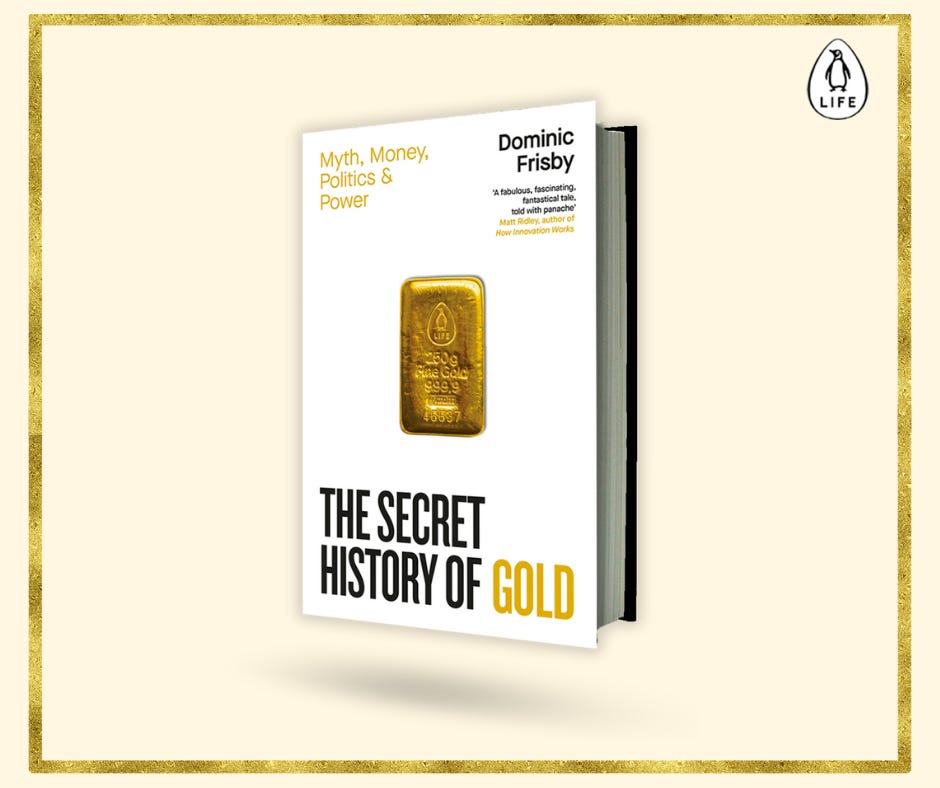
The Useless Metal That Rules the World
The Secret History of Gold comes out this week. Here for your viewing pleasure is a fim about gold based on the first chapter.“Gold will be slave or master”HoraceIn 2021, a metal detectorist with the eyebrow-raising name of Ole Ginnerup Schytz dug up a hoard of Viking gold in a field in Denmark. The gold was just as it was when it was buried 1,500 years before, if a little dirtier. The same goes for the jewellery unearthed at the Varna Necropolis in Bulgaria in 1972. The beads, bracelets, rings and necklaces are as good as when they were buried 6,700 years ago.In the Egyptian Museum in Cairo, there is a golden tooth bridge — a gold wire used to bind teeth and dental implants — made over 4,000 years ago. It could go in your mouth today.No other substance is as long-lasting as gold — not diamonds, not tungsten carbide, not boron nitride. Gold does not corrode; it does not tarnish or decay; it does not break down over time. This sets it apart from every other substance. Iron rusts, wood rots, silver tarnishes. Gold never changes. Left alone, it stays itself. And it never loses its shine — how about that?Despite its permanence, you can shape this enormously ductile metal into pretty much anything. An ounce of gold can be stretched into a wire 50 miles long or plate a copper wire 1,000 miles long. It can be beaten into a leaf just one atom thick. Yet there is one thing you cannot do and that is destroy it. Life may be temporary, but gold is permanent. It really is forever.This means that all the gold that has ever been mined, estimated to be 216,000 tonnes, still exists somewhere. Put together it would fit into a cube with 22-metre sides. Visualise a square building seven storeys high — and that would be all the gold ever.With some effort, you can dissolve gold in certain chemical solutions, alloy it with other metals, or even vaporise it. But the gold will always be there. It is theoretically possible to destroy gold through nuclear reactions and other such extreme methods, but in practical terms, gold is indestructible. It is the closest thing we have on earth to immortality.Perhaps that is why almost every ancient culture we know of associated gold with the eternal. The Egyptians believed the flesh of gods was made of gold, and that it gave you safe passage into the afterlife. In Greek myth, the Golden Apples of the Hesperides, which Hercules was sent to retrieve, conferred immortality on whoever ate them. The South Americans saw gold as the link between humanity and the cosmos. They were not far wrong.Gold was present in the dust that formed the solar system. It sits in the earth’s crust today, just as it did when our planet was formed some 4.6 billion years ago. That little bit of gold you may be wearing on your finger or around your neck is actually older than the earth itself. In fact, it is older than the solar system. To touch gold is as close as you will ever come to touching eternity.And yet the world’s most famous investor is not impressed.‘It gets dug out of the ground in Africa, or some place,’ said Warren Buffett. ‘Then we melt it down, dig another hole, bury it again and pay people to stand around guarding it. It has no utility. Anyone watching from Mars would be scratching their head.’He’s right. Gold does nothing. It does not even pay a yield. It just sits there inert. We use other metals to construct things, cut things or conduct things, but gold’s industrial uses are minimal. It is a good conductor of electricity, but copper and silver are better and cheaper. It has some use in dentistry, medical applications and nanotechnology. It is finding more and more use in outer space — back whence it came — where it is used to coat spacecraft, astronauts’ visors and heat shields. But, in the grand scheme of things, these uses are paltry.Gold’s only purpose is to store and display prosperity. It is dense and tangible wealth: pure money.Though you may not realise it, we still use gold as money today. Not so much as a medium to exchange value but store it.In 1970, about 27 per cent of all the gold in the world was in the form of gold coinage and central bank or government reserves. Today, even with the gold standard long since dead, the percentage is about the same.The most powerful nation on earth, the United States, keeps 70 per cent of its foreign exchange holdings in gold. Its great rival, China, is both the world’s largest producer and the world’s largest importer. It has built up reserves that, as we shall discover, are likely as great as the USA’s. If you buying gold or silver coins to protect yourself in these “interesting times” - and I urge you to - as always I recommend The Pure Gold Company. Pricing is competitive, quality of service is high. They deliver to the UK, the US, Canada and Europe or you can store your gold with them. More here.Ordinary people and institutions the world over use gold to store wealth. Across myriad cultures gold is gifted at landmark life events — births and wedding

Breaking the Exorbitant Privilege: The Coming Monetary Revolution
There is a video version of this article to view here:There is a shift of enormously significant proportions taking place. In magnitude it will prove as significant as Bretton Woods in 1944, when the dollar became the de facto global reserve currency, and the Nixon Shock of 1971, when the US abandoned the last vestiges of its gold standard.This shift is going to shape the global financial landscape over the next few years. You need to understand what is happening, so that you can position yourself and your family.You may even be able to profit handsomely from the transition.Today we explain US dollar policy: what is going on and, more importantly, where it is all going.Ready? Here goes.The Manufacturing Imperative and The Curse of the Reserve CurrencyAmerica wants to bring manufacturing back on shore. We all know this. US President Donald Trump has said it repeatedly, his VP JD Vance has said it, and so has his Treasury Secretary Scott Bessent, who keeps reminding us that it is now time to prioritise Main Street over Wall Street.Part of the reshoring of US manufacturing involves tariffs, as we know all too well. Part of it involves weakening the US dollar to make US exports more competitive. Again Trump, Vance and Bessent have all said it.However, there is a problem, and that problem has a name: Triffin's Dilemma.You might think it's an advantage to issue the global reserve currency. You can issue dollars. Everyone else has to work for them. The French called it "America's exorbitant privilege." But this was a status the US engineered for itself during the Bretton Woods Agreement that determined the monetary order at the end of World War Two.What has happened, however, is that it has made the US fat and lazy, especially since 1971 when the US abandoned the ties of the dollar to gold.To supply the world with dollars, the US must run trade deficits. That is to say it must buy more than it sells. Persistent trade deficits have, over time, eroded its industrial base. Factories and jobs have gone offshore. Foreign nations have used their profits to invest in US capital markets and its debt. Meanwhile financial markets - aka Wall Street - have grown and grown, as America financialized.The Trump administration gets it in a way its predecessors did not. Vance has actually called the dollar's reserve status a "tax" on American producers.What's more, as this process has continued, the credibility of the dollar itself is being called further into doubt.Trump wants to revitalise America's Rust Belt. But there is more to it than that. As the curtains pulled back with Covid, the extent to which the US has been operating with its trousers down was exposed: an excessive dependence on China and its supply chains for too many strategically essential products, especially related to health, tech and the military. Then, during the Ukraine conflict, NATO found itself unable to match Russian production. The US, in short, is struggling to produce critical goods. It's why Trump keeps harping on about rare earth metals. It is vulnerable.The answer is to engineer a "managed decline" of the dollar as global reserve asset.The Golden Exit StrategyThis was already happening organically. China, for example, has been reducing its holdings of US treasuries for ten years now - quite gradually - although its US dollar holdings remain above $3 trillion.Meanwhile, China - and many other countries along the Silk Road besides - have been increasing their gold holdings, and quite dramatically. (In my view China has at least four times as much gold as it says it does. You can read more on this in my book). The process is known as de-dollarisation. Just a few months ago gold overtook the euro to become the second most held asset by central banks, while the dollar itself fell beneath 50% for the first time this century.We are not seeing a move towards any other national currency as global reserve, but towards the neutral but universal asset that is gold, as analyst Luke Groman points out. That suits all the main players. Gold is neutral, and both the US (supposedly) and China have lots of it.Indeed, a gold revaluation would be a "win-win" for both. A higher gold price would strengthen US fiscal flexibility while boosting Chinese consumers' wealth, encouraging domestic consumption and reducing trade imbalances.There is the potential to leverage the US's 261 million ounces (8,133 tonnes) of gold reserves, currently marked to market at just $42/oz. There are two ways this might be done. Economist Judy Shelton has proposed issuing Treasuries that are in part backed by gold to offset the inflation/debasement risk to make them more attractive to buyers. The other possibility (which has gone from, as Bessent put it, "we are not doing this" to "we are not doing this yet") is to revalue the gold from $42 to the current price of $3,300/oz, which would create over $850 billion of reserves without having to incur any extra debt. That would help with the US's cur
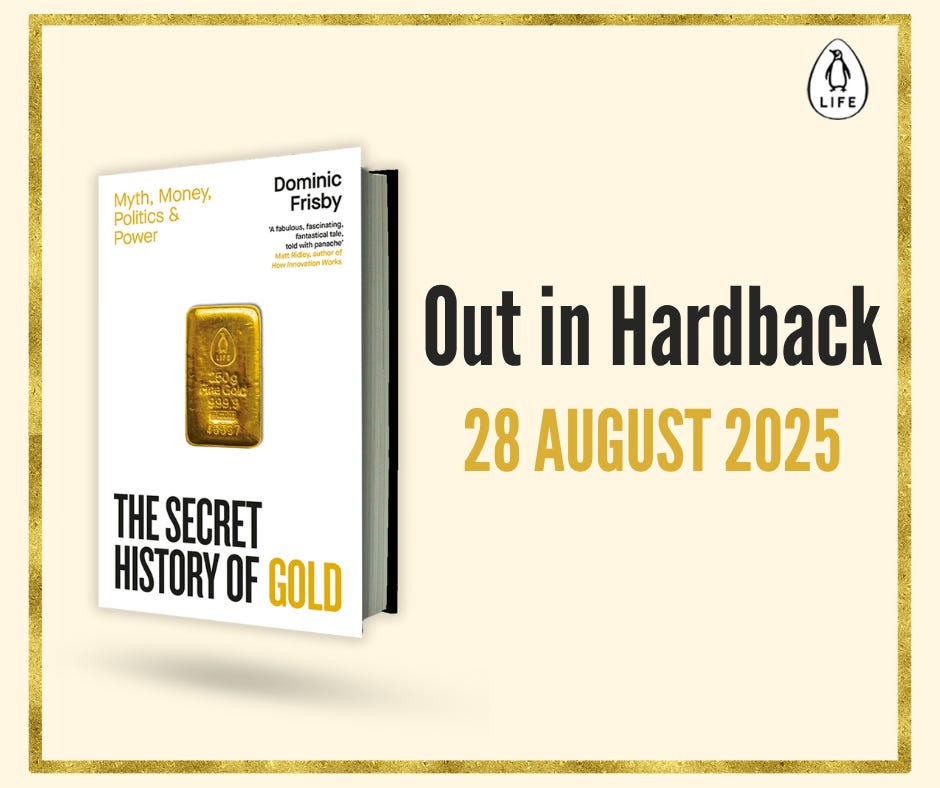
In Full Promo Mode
NB Sundays, as ever, are for thought pieces, lately all about gold as my book on that subject is about to come out. Midweek remains for markets We are now into launch week, so lots to promote: Secret History of Gold FeverThis week I’ve been in interview mode* Above we have me telling Ian Collins on Talk TV how rubbish the government is. * Here is me talking to Tom Winnifrith* Here James Delingpole.I have been working on a short film as well, which I hope to have ready for tomorrow.The book also had its first review - in the Telegraph.Here is what people have said so far“A fabulous, fascinating, fantastical tale” Matt Ridley, author of How Innovation Works”It doesn’t just tell you about gold – it makes you feel its weight through history. It’s just so interesting," Toby Young, Spectator”Written with both insight and Dominic’s signature humour, this is essential reading for anyone who wants to understand the lengths human beings will go to for the promise of riches,” Rory Sutherland, author of Alchemy.“This delightful book is a most insightful and enjoyable romp through history and a well-researched, educational tour de force,” James Turk, author of The Money Bubble”Dominic Frisby’s writings about economics and finance are, like his comedy, intelligent, beautifully crafted and always ahead of the curve. The Secret History of Gold is well-informed, utterly coherent and very, VERY timely.” Liam Halligan, Telegraph“Dominic Frisby is most trusted source of information for anything to do with gold,” Konstantin Kisin, Triggernometry”Well-researched and razor-sharp. Written with passion, principle - and the occasional punchline,” Al Murray, comedian and historian”Possibly the best-timed book ever,” Merryn Somerset Webb, Bloomberg“A brilliant, highly readable guide to the most alluring material of all,” Luke Johnson, investor and entrepreneur."Understand the history of gold, and you start to see what politicians and central banks would rather you didn’t. Dominic reveals all with clarity and force,” Rob Dix , author of The Price of Money.“Frisby entertains impressively and convincingly … his tales of German and Japanese gold-hunting during the Second World War are eye-popping … a colourful and sly adversary to contemporary financial and political pieties,” Simon Ings, the TelegraphThe Secret History of Gold is available at Amazon, Waterstones and all good bookshops. The book comes out on August 28.Amazon is currently offering 20% off.Until next time,Dominic This is a public episode. If you'd like to discuss this with other subscribers or get access to bonus episodes, visit www.theflyingfrisby.com/subscribe

Henry VIII: The King Who Robbed a Nation
NB I will put out my thoughts on the Comstock Inc (LODE.NYSE) earnings call in my mid-week commentary. A reminder: Sundays are for thought pieces, currently around gold as my book on that subject is about to come out. Midweek is for market stuff.“I'm Henry the Eighth, I am!Henry the Eighth, I am, I am!”Fred Murray and R. P. WestonHistory has given Henry VIII mixed reviews. Never mind the wife-killing, he was the king who boldly stood up to papal supremacy, paving the way for freedom, Reformation and the buccaneering spirit which marked the Tudor age. That said, I doubt Henry knew at the time what the long-term consequences of his papal stand-off would be.His Great Debasement, however, must be one of the greatest inflationary thefts by a ruler on their people in British history. Even William Pitt pales in comparison. Never speak ill of the dead and all that, but extravagant (and not in a good way), power-mad, and hypocritical are all adjectives that spring to mind about Henry VIII. Historian Simon Sebag Montefiore goes further, declaring him egotistical, paranoid and tyrannical, and listing him as one of History's 101 Monsters, alongside Vlad the Impaler and Adolf Hitler.How prosperity ended serfdomWhen Henry VIII was crowned king in 1509, the national finances were in rare good shape. His predecessor Henry VII had broken the mould of mediaeval English monarchs. Rather than wage war, he avoided it. His reign saw just one overseas conflict. He pursued marriages and alliances overseas instead. He had a formidable business brain: rather than resist economic change and new technology, he encouraged it - and then taxed it. In doing so, he built up extraordinary wealth for the Crown. He became the first English king for centuries to run a surplus. Imagine! His taxation and legislation of the nobility ended the power of the barons and, effectively, feudalism itself, while establishing the freedom of the mercantile classes to trade. England got its first blast furnace, and so began its iron industry. The wool trade blossomed, and the farming of sheep accelerated the decline of serfdom (land no longer needed working in the same way), and the country was changing to a money- rather than land-based economy. Henry VII also had new coins issued to ensure a standard currency. Weights and measures were also standardised (though not for the first nor the last time).Things however changed with his son, Henry VIII - and rapidly. One of Henry VIII’s first acts, two days after his coronation, was to arrest the two men responsible for collecting his father’s taxes, Sir Richard Empson and Edmund Dudley. He charged them with high treason and they were duly executed. Today’s HMRC officers don’t know how lucky they are.War is an expensive business, when you lose.Not a man known for his humility, he was happy to usher in the idea that kings had Divine Right, an issue that, 100 years later, would cause a civil war and the death of 200,000 people. Never mind his Great Debasement, which we will come to in a moment, the idea that a king was appointed by God and had Divine Right must be another of the greatest frauds perpetrated on a nation by its rulers. Anyone who dissented was treasonous or heretical, often executed without formal trial - or simply banished.He got involved in numerous costly and largely unsuccessful wars both on the continent and up north in Scotland. War is an expensive business when you lose. These, coupled with a personal extravagance that people are still talking about, meant he was constantly on the verge of financial ruin.To pay for it all he introduced numerous new taxes, including a tax on beards, which, given his own facial hair, has to go down as one of the ruling classes’ great do-as-I-say-not-as-I-do moments. In 1523 he demanded 20% of people’s income. (20% seems like a pipe dream today). He sold crown land, dissolved monasteries, and seized the assets of over 800 religious houses—land, gold, silver, everything—under the guise of reforming the church and rooting out corruption. Any money paid to Rome and the Pope was “redirected” to the royal coffers. In doing so he robbed local communities of their support systems - almshouses and so on. But still he couldn’t get enough money - and so he ordered what became known as the Great Debasement. The amount of gold and silver in coins was reduced and, in some cases, replaced entirely with copper.Subscribe! Upgrade! You know you want to.Bad money drives out good - Gresham’s observation which became lawIt began in 1542 with a secret indenture. Production of current coins would continue, but new coins would also be secretly minted, including the previously unsuccessful testoon, with significantly less gold and silver. The coins would be stockpiled in Westminster Palace. But in 1544, a lack of bullion arriving at the mint prompted the government into phase two of the scam and the debased coins were allowed to enter general circulation. Merchants soon discovered the new

The Largest Movement of Wealth in History
NB To help you visualise: a tonne of gold would be about the size of a beachball, albeit one you couldn’t lift, or a medium-sized suitcase. If it were a cube, it would have sides just under 15 inches/37.5 centimetres."The only thing that really frightened me during the war was the U-boat peril."Winston ChurchillNow that France had fallen, it was time for Operation Sea Lion: Germany's invasion of Britain. It would start with air and naval attacks to soften British defences before an amphibious assault. The Battle of Britain was about to begin.Britain had 501 tonnes of gold stored overseas, more than half of which was in Canada—over 10,000 bars. (Head of the Bank of England, Montagu Norman, had been buying Canadian mine production steadily through the 1930s.) But in the vaults of the Bank of England, it had some 1,100 tonnes of gold stored, along with another 800 tonnes stored for other nations. They could not let Adolf Hitler have it.Safety lay on the other side of the Atlantic Ocean, but German U-boats were hunting. Over the course of the war, they would sink over 3,000 Allied ships. History was not reassuring either, given the sinking of SS Laurentic in 1917, when some 39 tonnes were lost to the bottom of the ocean just off the coast of Ireland.If you’re enjoying this post, please like and share. Thank you:)But beyond keeping the gold from Hitler, Britain needed weapons, food and other war essentials. America's strictly enforced Neutrality Act meant Britain had to pay in gold or US dollars.In 1940, the British people were forced to register any securities — bonds and stock certificates — they owned. The Churchill government, with its newfound wartime powers, then confiscated them and, wishing to ship British wealth to safety in Canada, secretly moved them, along with several hundred tonnes of gold, to the Scottish port of Greenock. (Take note: your wealth is not safe if your country goes to war).From there, in June 1940, they were shipped to Halifax aboard the light cruiser HMS Emerald. HMS Emerald made it. The British treasure was put on trains, with the gold sent to Ottawa, and the securities shipped to Montreal, with the Bank of Canada now acting as a sort of surrogate Bank of England.Buying gold or silver to protect yourself in these ‘interesting’ times? I urge you to. The bullion dealer I use and recommend is the Pure Gold Company. Pricing is competitive, quality of service is high. They deliver to the UK, the US, Canada and Europe or you can store your gold with them. More here.But the following month, July 1940, saw the big gamble. 1,500 tonnes of gold were loaded onto five ships. $163 billion worth in today’s money. Offshore, they met the battleship HMS Revenge, a cruiser, and three destroyers, which served as their escort across the Atlantic: a flotilla of nine under the command of Admiral Ernest Archer. En route, two ships encountered fog and came to a halt for fear of icebergs. Another had engine trouble and had to drop out of the convoy, to be escorted by HMS Bonaventure. But somehow the mission was a success. Not a single bar went missing. It was the largest treasure shipment in history, either by land or sea.At one point, it was thought three cases were missing, but a mess steward who overheard a conversation between two officers said he had been tripping over something in the kitchen: three boxes had been stored among the whisky. Most of the gold was spent buying weapons and other essentials from the US, and never made it back to the UK.Perhaps they needn't have bothered. Over the next months, to the surprise of many, the Royal Air Force successfully defended British airspace against the German Luftwaffe. Victory in the Battle of Britain would be a turning point in the war. In September 1940, Hitler shelved Operation Sea Lion and his plans to invade Britain. He had other battles to fight.Stories like this fill the pages of The Secret History of Gold (although this one didn’t actually make the cut).The Secret History of Gold is available to pre-order at Amazon, Waterstones and all good bookshops. I hear the audiobook, read by me, is excellent. The book comes out on August 28.Hurry! Amazon is currently offering 20% off. Until next time,Dominic This is a public episode. If you'd like to discuss this with other subscribers or get access to bonus episodes, visit www.theflyingfrisby.com/subscribe

Game Over for Bitcoin Treasury Companies?
This is a free preview of a paid episode. To hear more, visit www.theflyingfrisby.comThe UK Financial Conduct Authority has announced that it is loosening its anti-bitcoin stance. From October 8th retail UK investors will now be able to buy bitcoin ETFs.Finally.The ban came in with bitcoin at $5,000. Today it's $115,000. That’s $110,000/coin UK investors have been protected from. Great job guys. Where will it be on October 8th? Who knows.Does this announcement mark the top of the market for bitcoin? There would be a poetic irony if it did, but it won't. Bitcoin is so much bigger than the FCA.At present, it does not even look like a case of buy the rumour, sell the news. Bitcoin has actually sold off a few percent since the announcement.But this change in tack is going to have a huge impact. It's about a lot more than British retail investors. It's global.It's going to have an impact on the bitcoin treasury companies around the world, and it's going to have an impact on the bitcoin price itself.Here’s why.We’ll start with the announcement itself from David Geale, executive director of payments and digital finance at the FCA:'Since we restricted retail access to cETNs, the market has evolved, and products have become more mainstream and better understood. In light of this, we're providing consumers with more choice, while ensuring there are protections in place. This should mean people get the information they need to assess whether the level of risk is right for them.'Blah blah, waffle waffle. Absolutely no ownership of the FCA's calamitous regulation whatsoever. Fortunes have been lost to British investors because of the FCA. How is it these bodies are so totally unaccountable? Perhaps everyone who was involved in that decision should be made to compensate British investors for their loss of earnings."We're providing consumers with more choice,". Please. There's gaslighting for you right there.Moving on.NB Don’t forget my brilliant book about bitcoin, if you want to learn more about the space.There is also my new book The Secret History of Gold, which comes out later this month. Amazon is currently offering a discount, so order yours now. Obviously, UK investors are now going to be able to buy bitcoin ETFs through their brokers, which means we can hold them in our SIPPs and ISAs. I gather there is roughly £3 trillion in UK pensions, £750 billion in ISAs, £500 billion in SIPPs and quite a bit more in other brokerage accounts. So that is a lot of capital that can now come into bitcoin which previously could not.But there is a lot more to it than that.The institutional floodgates are about to open. Former HSBC fund manager and ByteTree CEO, Charlie Morris, who knows this world as well as anyone, has this to say.The lifting of the ban by the UK regulator of bitcoin exchange traded products will have a far greater impact on the market than many believe. It's not just retail but institutions too. Many funds around the world are connected to London whether it be custodians, administrators, distribution, or trade execution. The ban meant that a single touchpoint with the UK would prevent allocation to bitcoin. From 8 October, this will no longer apply. Not only will U.K. retail investors boost demand for bitcoin ETPs, but a far bigger deal will be the opening up to institutions and funds around the world. It's a monumental moment for bitcoin which will become a global institutional asset over the next decade.(By the way you should subscribe to Charlie's newsletters. They're excellent. There are free and paid options. Here's the link).You saw my piece a few weeks ago about the global shadowbanning of bitcoin. London and the FCA had a huge role to play in that. One example: a banker I know in Zurich could not buy bitcoin products for one of his high net worth clients because of the ban. He was by no means alone. We have taken a step forward to the lifting of the shadowban, though not the final step by any means. As we noted, the funds buying bitcoin are still the 'pirates' rather than the big players, but this is still a move towards the legitimisation and normalisation of bitcoin.If bitcoin can get to something like 2% of portfolios worldwide, which it eventually will, well woof is all I can say.What about the treasury companies? What next for them?

Trust Me, I’m Stalin
“They will never see their gold again, just as they do not see their own ears.”Josef StalinGold’s strength is that its value exists in and of itself. It’s nobody else’s liability. Unlike money in the bank or a bond, it carries no promise from a third party, and its value is not dependent on the creditworthiness of any issuer or guarantor. Hand it to someone else and its value is transferred. It is a “bearer” asset, effectively owned by whoever has possession of it. For this reason gold has been the target of many a heist. Quickly resmelt it, and its provenance is very hard to prove.So there is one obvious problem with gold: that is keeping it safe. It’s all very well having a pot of gold, but if somebody comes along and takes it from you, as Alexander did from the Persians, or the Conquistadors from the Incas, then you’re left with nothing at all.When the Spanish Civil War broke out in 1936, the Soviet Union, under Joseph Stalin, supported the Spanish Republican government. The Nazis supported their opponents, the revolutionary fascist forces led by General Franco. At the time Spanish gold reserves, some 635 tonnes, were the fourth largest in the world.Much of that treasure had been accumulated during WWI, when Spain had stayed neutral. Selling stuff to the British seems to have been the really big earner: 70% of Spanish gold holdings were British sovereigns.With Franco just 20 miles from the capital, the Republicans were on the verge of defeat. Never mind the fascists, there were also rumours that Catalan separatists had hatched plans to take the gold from Madrid to Barcelona. All that gold was at risk.Finance minister, Juan Negrín, and Prime Minister, Francisco Largo Caballero, leant on President Azaña to sign a secret decree to move the gold - some 10,000 cases - to a place “which in his [Negrín’s] opinion offers the best security”. Azaña signed and the gold was moved, starting the next day, to Cartajena on the south coast, as far from Franco’s armies as possible. The Spanish soldiers who transported the cases thought they were lifting munitions. A fifth of it was then shipped to Marseille where it was traded for French francs, which the Republicans used to fund their side of the war. The rest, 510 tonnes, would be sent to Joseph Stalin in Moscow for safekeeping.Even if Bolshevik sympathisers, what were Negrín and Caballero thinking? The Russians had already demonstrated that they had no qualms about seizing other people’s gold. In 1916, the Romanian government sent its treasury of 91 tonnes of gold to Tsarist Russia for safekeeping, worried that it was vulnerable to the Central powers when Romania had just joined WWI on the side of the Entente. Shortly afterwards, during the Great October Revolution, communists, led by Lenin, seized power, sequestered the gold and refused to give it back. Though small amounts were returned in 1935, 1956, and 2008, “as a gesture of goodwill”, the large majority was retained. As you can imagine, it has been something of a sore spot in diplomatic relations between the two nations ever since.It seems Negrín and Caballero did not know the story. In any case, Caballero actually wrote to Stalin asking if he would “agree to the deposit of approximately 500 tonnes of gold.” Two days later, he got a reply from the Soviet leader, not previously known for his prompt responses. No surprise: Stalin would be “glad” to take the gold.Buying gold or silver to protect yourself in these ‘interesting’ times? The bullion dealer I use and recommend is the Pure Gold Company. Pricing is competitive, quality of service is high. They deliver to the UK, the US, Canada and Europe or you can store your gold with them. More here.Alexander Orlov was the Russian agent in charge of transporting the booty. Negrín gave him fake documents to show he was an US official from the Bank of America, in case he should be stopped. Negrín, who, remember, was finance minister, had thought Bank of America was the US central bank. That would be the Federal Reserve. Russian agent Orlov didn’t realise either. It’s extraordinary.Four Russian ships came to Cartagena to collect the bounty, and the gold was loaded on. There was a discrepancy of 100 cases between Orlov and Spanish treasurer Mendez Aspe’s number: Aspe said 7,800 cases, Orlov 7,900. Orlov said nothing. He reported the discrepancy to his superiors, who told him, “Do not worry about figures. Everything will be counted anew in Moscow. Do not mention your figure to anybody.” Aspe didn’t even get a receipt off Orlov (who had been instructed not to give him one). “Don’t worry, my friend,” said Orlov, “it will be issued by the State Bank of the Soviet Union, when everything is checked and weighed.” We will never know whether Orlov miscounted or whether those 100 boxes went missing.It took them three nights to load the four ships. The Russians then left Cartagena for Odessa in the Black Sea, escorted by the Spanish as far as Italy. From Odessa it was loaded onto a fre
The Sweetness of Doing Nothing: Another Year of Lazy Gains
This is a free preview of a paid episode. To hear more, visit www.theflyingfrisby.comThe idea behind Dolce Far Niente was to create a portfolio of low-risk investments for today’s market conditions, that you can buy and, pretty much, forget about. You don’t have to keep checking prices every day. Hence “Dolce Far Niente” - “the sweetness of doing nothing.” No worries would be the Australian translation.Asset allocation is WAY more important than individual stock-picking. I could pick the best biotech company in the world, but if biotech is in a bear market, I almost needn’t bother. I’m better off out of the sector. But similarly, if a sector is in a full-on bull market, even pigs fly.The starting point for the portfolio, which we began on October 1, 2023, was as follows.* Gold: 15%* Bitcoin: 5%* Special situations: 10% (the ”fun” part of the portfolio, for example some of the smallcaps I write about on here)* Uranium: 5% (reduced to 2.5% as things got frothy)* Oil and Gas: 10%* Bonds and Wealth Preservation: 20%* Equities (35%)* UK & Europe (20%)* US (25%)* Smaller cos and private equity (30%)* Asia (15%)* Japan (5%)* EMs (5%)No allocation to real estate.Please like and share this post. It helps :)Since that October 2023 starting point, certain assets - gold, bitcoin and US equities - now account for far greater percentages, with energy, bonds and wealth preservation not having done so well.If you are starting this portfolio now, I would still recommend sticking to the original allocation and letting things grow.Really, I should re-allocate, but I don’t want to sell any bitcoin and I don’t want to sell any gold. In fact, to be honest, there is a very strong case for just owning bitcoin and being done with everything else. But that wouldn’t be balanced and that’s not what this portfolio is about.The only change we have made since October 2023 was to reduce uranium from 5% to 2.5% in February 2024. Uranium felt a bit frothy was the reason. More a gut- than evidence-based decision, and it proved the right one. I’m going to make one, quite major change to the portfolio today - in the equities department. More on this in a moment.Lastly, do as I say, not as I do. In my own portfolio, my allocation to bonds and wealth preservation is tiny: maybe 2%. I am overweight gold, bitcoin and special situations (smallcaps mostly).At some stage, I will get my comeuppance as a result, and it won’t be the first time. Then I’ll swear to change my habits, and then I will - for a bit - and then I won’t. But a more sensible investor would keep their portfolio to the above allocation.Let’s examine things in a bit more detail1. Gold (15%)It’s done very well. Up about 80% since we started the portfolio.My firm belief is that everybody should own some gold in their portfolio. Especially now.(If you do not yet own any, my guide to investing in gold is here. If you are looking to buy gold or silver, the bullion dealer I recommend is the Pure Gold Company.There is also, of course, the soon-to-be definitive book on the subject. Here it is on Amazon, and Waterstones is currently running an offer.💥 Pre-order now at Waterstones and get 25% off.Use code SUMMER25 at checkout to get your 25% discount.Hurry! Offer ends today, July 31.2. Bitcoin (5%)A huge win. Up about 450%The potential of bitcoin remains so extraordinary, as I often say, I see the risk is not so much owning it, but not owning it.Our bitcoin proxy for UK investors, who have been shut out of the sector by the FCA, is Strategy (NASDAQ:MSTR). That’s done even better. Up over 1,500%. My sources tell me UK investors will be able to buy bitcoin ETFs from November. That’s what Charlie thinks anyway, and you should all subscribe to his letter.3. Special situations (10%)These are the small- and mid-caps that I sometimes write about on here.We have had some big winners, and some big fat dogs too.If you want to know what are currently my 7 biggest positions, here they are.4. Uranium (2.5%)Glad we reduced this to 2.5% when we did.Yellowcake (YCA.L) is our vehicle. We reduced around 700p in February 2024. It’s now 500pNow is probably not a bad time to buy back that 2.5%, but I’ll wait.5. Oil and Gas (10%)The iShares Oil and Gas ETF (SPOG.L) - North American oil and gas companies, basically - is my primary vehicle by which to play this. It’s off a little, but it’s outperformed oil itself. I’m also of the view now that North Sea oil and gas’s time is coming and the government will u-turn on this as well.Did you see Donald Trump’s comments today? One of the many ways he made Keir Starmer wriggle and squirm.

The Secret’s Out: My New Book on Gold Is (Almost) Here
I’m delighted to announce my new book, The Secret History of Gold - Myth, Money, Politics and Power, published by Penguin Life. It tells the epic tale of humanity’s oldest and most treasured currency – from its explosive cosmic origins to its role in the power games of modern geopolitics.Watch the unboxing above 👆Waterstones is running an offer. 💥 Pre-order now and get 25% off. Use code SUMMER25 at checkout to get your 25% discount. Hurry! Offer ends July 31. Here’s the blurb:Gold (noun): A precious, yellow metal, prized for its beauty. Inert, immune to corrosion, highly malleable though with little utility. Seen as pure wealth.The Secret History of Gold tells the epic tale of the world’s oldest, and most treasured, currency. From its origins in the formation of the solar system to its role in both ancient myth and modern finance, Dominic Frisby explores, with wit and brevity, how gold has shaped human civilisation.Gold has inspired men to do the most brilliant – and terrible – things. It has lured explorers, conquerors and thieves. It has sparked wars, it has built empires, it has empowered leaders, good and bad. What readers have said so far:“A fabulous, fascinating, fantastical tale, told with panache by a superb taleteller.” Matt Ridley, author of How Innovation Works.”It doesn’t just tell you about gold – it makes you feel its weight through history. It’s just so interesting.” Toby Young, Spectator”Written with both insight and Dominic’s signature humour, this is essential reading for anyone who wants to understand the lengths human beings will go to for the promise of riches.” Rory Sutherland, author of Alchemy.“This delightful book is a most insightful and enjoyable romp through history and a well-researched, educational tour de force.” James Turk, author of The Money Bubble”Dominic Frisby’s writings about economics and finance are, like his comedy, intelligent, beautifully crafted and always ahead of the curve. The Secret History of Gold is well-informed, utterly coherent and very, VERY timely.” Liam Halligan, Telegraph“My most trusted source of information for anything to do with gold,” Konstantin Kisin, Triggernometry”Well-researched and razor-sharp. Written with passion, principle - and the occasional punchline.” Al Murray, comedian and historian”Possibly the best-timed book ever,” Merryn Somerset Webb, Bloomberg”A brilliant, highly readable guide to the most alluring material of all,” Luke Johnson, investor and entrepreneur.”Understand the history of gold, and you start to see what politicians and central banks would rather you didn’t. Dominic reveals all with clarity and force,” Rob Dix, author of The Price of Money.if you prefer, here’s a link to Amazon.Prefer to listen? I hear the audiobook, read by me, is very good ;) Here it is on Audible and via Apple.Please like, share - all that stuff - it helps.Thank you for your support – and stay tuned. I’ll be banging on about gold quite a lot in the coming weeks… This is a public episode. If you'd like to discuss this with other subscribers or get access to bonus episodes, visit www.theflyingfrisby.com/subscribe

The Shadowbanning of Bitcoin
This week I was listening to Merryn Talks Money. My old boss and great friend, Merryn Somerset Webb, was discussing portfolio allocation - which assets should make up the 40 in a 60:40 bond-to-equity portfolio - with Nataliia Lipikhana, executive director at JP Morgan . Merryn asked if bitcoin should be one of the assets to include, alongside gold. Lipikhana, who, until then, had spoken widely, fluently and knowledgeably about a range of subjects, suddenly stonewalled.“We don’t cover it so we can’t talk about it,” she said.Awkward pause.Merryn laughs. “At all?”“No,” says Lipikhana.Another pause.“Ok,” says Merryn. “Totally understand,” and she changed the subject.This is a symptom of something much bigger that has been at play throughout the institutional world, and not just in the UK, since the emergence of bitcoin and other cryptocurrencies.They’ve been shadowbanned.We know of course about the UK’s Financial Conduct Authority, how its regulations went against the pronouncements of various Chancellors, and how it effectively excluded UK citizens from the sector. Something similar has long been happening at the institutional level. “Most private banks will not accept bitcoin ETF orders for their clients, despite being able to deal with elective professionals,” a fund manager friend (who prefers to stay anonymous) tells me. “This applies in countries where there is no ban because the bank will have links to London. Even in the US, the traditional institutions will ban bitcoin internally.”Here’s a list of the biggest holders of the iShares gold ETF. Many of banking’s biggest names are there.Now here’s a list of the iShares bitcoin ETF’s biggest holders. There is nothing like the same institutional weight.(Goldman and Morgan Stanley will be market making on behalf of hedge fund clients)“Lipikhana probably feels she might get the sack if she comments on bitcoin,” my fund manager friend continues. “So she doesn’t”.You know my saying, “A bubble is a bull market in which you don’t have a position”. For years now, banks have been talking their clients away from this sector, often using that argument that it’s a bubble. This pre-dates the ETFs by ten years or more.Wall Street and the City don’t like bitcoin because they didn’t get there first. Smelly private investors did. They missed out on this epic opportunity and, rather than embrace it, they ignore it.They don’t control it. They can’t manipulate it. Don’t talk about bitcoin. Perhaps it’ll go away.Well, it hasn’t and it won’t. It is here to stay.Now with the emergence of the both the ETFs and the bitcoin treasury companies, bitcoin is edging its way further and further into the financial mainstream.“You get bitcoin at the price you deserve,” runs the saying. Ain’t it so.What this means for investors is that there is a huge wall of institutional money that is still to come into the sector. It will eventually. Bitcoin is the most technologically advanced money in history. Now that real estate is gone as a vehicle to protect against currency debasement (too highly legislated and taxed), the need for an effective savings vehicle is only greater. Bitcoin is the best savings vehicle there is.I love gold. You know I do. I think it has an enormous strategic role to play in the coming years, and should play a part in every portfolio. But bitcoin appreciates by more. It beats stocks. It beats bonds. It beats commodities.But JP Morgan would rather not comment.If you enjoyed this post, please like or share - it helps :)PS Don’t forget my brilliant book about bitcoin, if you want to learn more about the space. This is a public episode. If you'd like to discuss this with other subscribers or get access to bonus episodes, visit www.theflyingfrisby.com/subscribe

You Would Be the Chancellor Who Sold Britain’s Bitcoin
(I am sending this week’s commentary early this week due to travel)Dear Chancellor,Me again.I am the author of Bitcoin: The Future of Money? (2014), generally agreed to the first book on bitcoin from a recognised publisher.I write with regard to the proposed sale of the UK’s bitcoin. Since bitcoin was first introduced in 2009 - invented in reaction to the loose monetary policies of the Global Financial Crisis - bank bail outs, quantitative easing, zero interest policies etc - and the economic injustices they created, the protocol has grown from nothing to a market cap above $2 trillion. A whole new economy has emerged around the technology where none previously existed, providing countless opportunities for individuals, entrepreneurs and nations alike.Initially the domain of a few coders, it is now finding mass adoption at the corporate and even national level. The US is recognizing the digital asset’s importance, as it introduces its Strategic Bitcoin Reserve, while China, according to estimates, holds 190,000 coins.Initially, the UK was at the heart of the Bitcoin story. Satoshi Nakamoto, the pseudonymous inventor, wrote in British English, cited UK media, and many early meetups and conferences took place here. Chancellors George Osborne and Rishi Sunak both expressed their desire for the UK to become a global hub for this emerging technology. But the FCA took an opposing view and made it increasingly difficult for UK citizens to participate, so that we have now fallen behind.Opinion about bitcoin is divided. Those who use the technology regularly believe it is not just likely, but inevitable, that it will become the world’s dominant monetary network. Many others – typically the older generation, economists or legacy finance – dismiss it as a bubble, often without having tested the tech in any meaningful way.Whichever side of the debate you fall on, the fact that Bitcoin has become the most desired digital asset in the world is indisputable.Among the many features that make bitcoin unique is that its supply is finite. With its estimated 61,000 confiscated bitcoins, the UK has been gifted an extraordinary opportunity. We now hold roughly 0.3% of total supply.I understand that politics demands a focus on the short term – the next Budget, the next election – but I urge you to approach your decision with long-term vision. Please consult with people who regularly use the technology. Do not make this decision based solely on advice from people who never use bitcoin. Take Bulgaria, for example. In 2017, it sold all of its seized bitcoin to cover a short-term budget gap. Those coins today would be worth enough to eliminate the country’s entire national debt. From a strategic perspective, the UK’s bitcoin holdings represent a once-in-a-generation opportunity. As fiat currencies decline in purchasing power and the global economy moves toward digital and AI-driven systems, this asset could help Britain re-establish itself as an economic superpower with significant geopolitical leverage and monetary independence.An opportunity of this kind is not to be thrown away lightly.Once those coins are sold, we will never be able to buy them back.If bitcoin becomes a hundred trillion dollar network – as some project – the UK's share could prove transformational. That may sound fanciful today, but every surprise in bitcoin’s history has been to the upside.There is also your personal political legacy to consider.You would be the Chancellor who sold Britain’s bitcoin.That will be how people remember you – just as Gordon Brown, for all else he did, is remembered primarily for needlessly selling Britain’s gold at the bottom of the market. For the rest of your life, every timebBitcoin rises in price, people will look at what you sold our coins for and say: “This is how much she lost us.” You are consigning yourself to that fate.Do you want that to be your legacy?So once again, I implore you: take advice from people who understand this technology and its potential. Don’t just listen to nocoiners.If you sell bitcoin for fiat you are swapping a superior asset for an inferior one. It is that simple.The trade might bring short-term benefit, but it does nothing to address the underlying structural issues facing this country. If, however, you hold on to the bitcoin – and understand how to integrate it into policy – perhaps create a UK Strategic Reserve - you may find it solves many of our problems.As bitcoiners often say, “bitcoin fixes this.”I hope you read and consider this letter with an open-mind.Yours sincerely,Dominic FrisbyAuthor of Bitcoin: The Future of Money?Writer of The Flying Frisby newsletterPS Please like, share - all that stuff. Thank you! This is a public episode. If you'd like to discuss this with other subscribers or get access to bonus episodes, visit www.theflyingfrisby.com/subscribe

Bitcoin Can Make Your Rich But Gold Might Save you
At Freedom Fest 2025 last month, I joined a very sensible panel - grown up people saying intelligent things - in a gold vs bitcoin debate, from which I came way thinking, “Oh, that was quite good”. It has just been released, so I thought I would share it for your Sunday thought piece.As always if you enjoy the discussion, please like it and share. It he… This is a public episode. If you'd like to discuss this with other subscribers or get access to bonus episodes, visit www.theflyingfrisby.com/subscribe
Gold: The Only Thing Standing Still
I wanted to take a look at gold today.I’m going to dust off my powers of divination — or as they call it in the City, technical analysis - and see if we can figure out where it is going next.As things got frothy back in April, I argued that the market was probably due a breather. The summer is usually gold’s weakest season. Why this should be I don’t know, but it is. You’ll often find it makes a low in May or June, then re-tests that low in July or August, then things pick up in the autumn or fall, as our more literal cousins call it. In any case, I’m pleased to report that gold has basically range-traded, or consolidated, since the frothy days of April, between $3,500 and $3,100. The $3,000 level has more than held, which makes me wonder if we shall ever see gold with a $2,000 handle ever again. Unless there is a 2008 or Covid-style panic, I rather doubt we will.Meanwhile, the RSI (see the bottom panel below) has come off, meaning the heat has come out of the market, which is good.Since the US confiscation of Russian assets in 2022, pretty much every pull back to 50-day moving average (red line) has been bought, and they continue to be bought. The average is now flattening out, as you would expect with this summer consolidation, rather as it did late last year. Some sideways consolidation is good. Ideally, you want to see the short-, medium- and long-term moving averages all flatten and converge. There often follows a big move higher.The long-term moving averages (1 year and so on - not shown here) still have a bit of catching up to do (they are around $2,850 at the minute), which they will and fairly quickly as the gold price continues this sideways action.We also have something of a triangle forming (see blue lines) - with lower highs and higher lows. Triangles are seen as continuation patterns. In other words, whatever was the direction going into the formation will be the direction coming out. Up, that is to say. I rather think this triangle will complete just as the moving averages converge.When you look at gold against other currencies, the same process can be seen: a summer consolidation after an excellent winter and spring. If you are in any doubt as to whether you should own gold or not, let me answer that for you in the words of the former HSBC fund manager Charlie Morris, who now writes Atlas Pulse, one of the best newsletters out there - (you should subscribe it’s free). “Gold should be the cornerstone of an investment portfolio,” he says. “It is remarkable how few professional investors understand this”.Charlie may have a point. Look how underweight gold western portfolios are. Below 2%. Nuts.The Trump administration is going to run enormous deficits. It is not attempting to hide the fact. The same goes for the Starmer administration in the UK. The Labour backbenchers, who now seem to control policy, will not allow reduced spending. We saw that last week. Most EU nations have not got their spending under control. It means further declines in the purchasing power of the dollar, pound and euro are inevitable. Gold is your protection. What’s more, as demonstrated by the enormous buying coming out of Asia from Shanghai Cooperation Nations, China especially, it is clear gold is becoming a highly important strategic asset again. It is this buying, plus some huge options trading in China, that is driving this bull market, and it began shortly after, as I say, the seizure of Russian US dollar assets. Metals Daily’s Ross Norman, whose track record forecasting the gold price is second to none, tells me: “We are confident that there is significant unreported central bank gold buying which, coupled with some pretty heady options plays from within China, accounts primarily for a near doubling in the gold price over the last 18 months or so. He goes on:The days when central banks telegraphed their moves in advance in the interest of transparency are long gone (thank you Gordon) and they are far more nuanced and opportunistic in their approach. With Asian central banks very much under-weight gold reserves, and energised by a growing debt crisis, further fuelled by the trend to reduce dollar holdings and you have a perfect set-up for a continuing gold bull run. At the moment the East invests in gold while the West divests which actually sums up the last 30 years between those hemispheres.This bull market is consolidating. It is not over. Whether it’s because of de-dollarisation or your nation’s deficit spending, there is demand for gold, which is going to send the price higher. It may be an analogue asset in a digital world. But you will be glad you own it. Until next time,DominicIf buying gold or silver to protect yourself in these ‘interesting’ times, the bullion dealer I use and recommend is the Pure Gold Company. Pricing is competitive, quality of service is high. They deliver to the UK, the US, Canada and Europe or you can store your gold with them. More here.Some recent articles which may be of interest

An Open Letter to Rachel Reeves
NB Somebody on social media is impersonating me again, sliding in to DMs, soliciting investment. Please ignore, block, report etc. Here they are on Substack.Right, here we go.Dear Chancellor Reeves“Revenue cannot be derived unless the land is productive.”— Ali ibn Abi Talib, the fourth caliphI hope you have a moment to consider what I have to say.My name is Dominic Frisby. Among other things, I am the author of a well-received book on the history of taxation, Daylight Robbery: How Tax Shaped Our Past and Will Change Our Future.I am writing to you about Stamp Duty — a tax that is causing stagnation, where you need growth.At present, if I wish to buy a house, I must first sell other assets to fund the purchase. This incurs capital gains tax. Then, on buying the property, I face another sizeable tax in the form of Stamp Duty. So I am taxed twice on the same money.The alternative is simply to stay put and do nothing, thereby paying no tax at all. Unsurprisingly, this is what most people do, which is why turnover in the housing market is so poor.How much economic activity is lost, when I stay put?* The stocks and shares I might have sold miss out on the fresh investment they would otherwise receive from their new buyer — investment so vital for businesses to grow.* All the economic activity that follows a house purchase vanishes: estate agents, conveyancing solicitors, surveyors, removals companies, builders, decorators, materials suppliers, architects, furniture shops, DIY stores.* I do not take out a new mortgage or insurance policy, nor hire tradesmen to upgrade kitchens, bathrooms or gardens, nor set up new utilities, broadband contracts or local services.* I do not trigger a purchase chain, meaning the person I would have bought from does not buy somewhere else, and all the activity that would create is lost too.* Nor do I relocate for work, missing new job opportunities, so the economy loses the productivity boost of people moving closer to better jobs.When I stay put, there is no revenue at all for the Exchequer — neither from Stamp Duty, nor from VAT on all these goods and services, nor from increased corporation tax on profits, nor from higher Income Tax on increased earnings, nor from the local spending that supports countless jobs and wages. Instead, there is stagnation where there could have been growth.Stamp Duty, largely a creation of the Tories, has immobilised the country.Britain desperately needs growth. Growth requires turnover. The best way to encourage turnover is to remove barriers to trade. Taxes — whether tariffs or duties, whatever form they take — are the biggest barriers of all.When Rishi Sunak temporarily reduced Stamp Duty during Covid, we saw exactly this effect: turnover increased, economic activity surged. Revenue to the Exchequer followed.A permanent removal of Stamp Duty would trigger a powerful boost not just to the property market but to the entire economy, meaning the government, too, would have more money to spend on whatever it sees fit. There is so much pent up demand, the resulting economic growth might even be enough to save this government at the next election.What’s more, the Tories imposed these duties, so it is an opportunity to score some points against their failure.It would, quite literally, get Britain moving again.Counter-intuitive as it may seem, the golden rule of taxation is that lower taxes and fewer taxes lead to higher revenues. History shows this time and again.In the words of John F KennedyIt is a paradoxical truth that tax rates are too high today and tax revenues are too low and the soundest way to raise the revenues in the long run is to cut the rates now.I hope you will give this serious thought.With kind regards,Yours sincerely,Dominic FrisbyPS If you enjoyed this letter, please like, share and all that stuff. It helps.You can find more on this subject in this video:Why not upgrade?If you are buying gold or silver to protect yourself in these ‘interesting’ times - and I urge you to own gold, given how governments are debasing currency - the bullion dealer I use and recommend is the Pure Gold Company. Pricing is competitive, quality of service is high. They deliver to the UK, the US, Canada and Europe or you can store your gold with them. More here.Finally, ICYMI, here is this week’s mid-week piece: This is a public episode. If you'd like to discuss this with other subscribers or get access to bonus episodes, visit www.theflyingfrisby.com/subscribe

Frisby’s Magnificent Seven
This is a free preview of a paid episode. To hear more, visit www.theflyingfrisby.comMany thanks for completing my weekend polls (here they are if you missed them: paying subscribers / non-paying). Your answers were extremely useful: roughly the right amount of content, stick with the audio, the balance of investment ideas and other stuff is about right, and the price too is about right (interestingly, paying subscribers thought that, non-paying less so — that put a smile on my face). Also: keep writing about what I know.You’re a bit more equivocal about the video content. There are more gold than bitcoin bugs in the readership, with a healthy number are in the “own both” camp.And so many of you joined my Comedy Substack, it became one of Substack Humor’s fastest movers. Yippee. Thank you!Today I am going to tell you about my seven largest investment positions.Take note: the asset allocation I advocate is the Dolce Far Niente portfolio. This is 15% in gold, 5% in bitcoin, and we have a large allocation to global equities, especially the US. It also has a 10% allocation to risky/fun investments: small caps, special situations and so on (the kind of flutters I write about here). The reason for this allocation is to minimise risk and any damage caused by losses.Do as I say, not as I do and all that. My personal allocation does not fully correspond to the Dolce Far Niente, partly for lack of discipline, partly because I have a greater appetite for risk and will stomach bad losses, if they come around, partly because I am overweight bitcoin.My largest positions As I am sure you know, my two largest positions are in bitcoin and gold. In my view everyone should have an allocation to these assets. Given the debasement of currency taking place worldwide, the greater risk is not owning them. On which note …If you want to buy gold or silver to protect yourself in these interesting times, the bullion dealer I use and recommend is the Pure Gold Company. Pricing is competitive, quality of service is high. They deliver to the UK, the US, Canada and Europe or you can store your gold with them. Find out more here.But we will put those to one side. After bitcoin and gold, my seven largest positions are: