
The Flying Frisby - money, markets and more
647 episodes — Page 5 of 13
The State of Metals and Mining
Campbell Smyth, Chairman of Fitzroy Minerals (FTZ.V), joins me to talk about the state of mining and metals.Lots of interesting insights in to copper, gold, lithium, oil and other essential commodities. This is a public episode. If you'd like to discuss this with other subscribers or get access to bonus episodes, visit www.theflyingfrisby.com/subscribe
I Keep Saying It: The Risk Is Not Owning Bitcoin
Bitcoin is off on one its runs, it seems. Congratulations to all who bought and held. It is now trading at all-time highs in 30 different currencies around the world, currencies representing more than 60% of the world’s population. How about that for a thought?From China and India to Congo and Sudan, it’s like a Noel Coward song.In US dollars, we are flirting with $60,000, still roughly 15% from the peak of US$69,000, the all-time high back in late 2021.In British pounds, the all-time high was around £48,000. We are touching that now.Meanwhile, Microstrategy (NDX.MSTR), which we suggested as a means to play bitcoin via a traditional broker, and avoid the FCA-created headaches of buying and investing bitcoin in the UK, is going great guns. $960 now. It was $350 when we first recommended it in the summer. Is it too late to buy?No. I haven’t been asked on TV to talk about it yet. See me on the box, then you can start getting concerned that the top is near. (Here’s one from BBC Daily Politics towards the end of a previous cycle. Chief Economist Dr Savvas Savouri. LOL)There is no doubt that the market is hot, hot, hot at the moment, and when markets get this hot, that usually means it’s time to back off. Cripes, the amount of excitement on social media is screaming run away. But bitcoin is like one of those metals - tungsten or tantalum - which can withstand abnormally high levels of heat. The evidence of previous bull markets is that bitcoin gets overbought and stays overbought.It’s usually better to buy when the markets are quiet, when nobody cares. But that is not where we now are.I have repeatedly argued that the risk with bitcoin is not owning it; it is not owning it. That hopefully makes sense in print. The potential of this thing is so abnormally huge, why would you not want to have a position?We are talking about the most technologically brilliant system of money ever invented. Own a piece of the pie.Why bitcoin will supercede other moniesRemember the old rhyme: Money is a matter of functions four:A medium, a measure, a standard and a store.National currencies are a good-ish medium of exchange - within national borders. But even then, they have their shortcomings. They are useless for micropayments. The smallest amount you can pay in the UK is 1p. Most banks and credit card companies won’t even process amounts that small. Even medium-sized transactions can be problematic. I wasted about an hour of my life this morning on the phone to Lloyds Bank as their security blocked a transfer of £3,950 that I was trying to make. In the grand context of things, that is not a huge sum, but Lloyds’ alarms went off and that was it. One hour gone. (During my peak productive time too. That’s one of the reasons this missive is late).But for cross-border transactions, national currencies are crap. Forex fees, paperwork, slow transaction speeds. If I want to send a payment to someone who operates with a different currency of, say, £1, via a bank, the costs are prohibitive. Revolut is about my only option - and that has issues. If I want to send a micropayment of, say, one-tenth of a cent, it is just impossible. But industries based around micropayments are a huge area of potential growth, especially in a world of artificial intelligence and the internet of things: streaming, apps, games, in-app and in-game purchases, rewards, likes, donations, tipping, credit card verification, identity verification, wifi access, public document access, libraries, parking, phone calls, public transport, pay-per-use in cloud computing, exchange of or access to information via the internet of things, content licensing, ad-free browsing, access to news and journalism. These are all areas that will see enormous use for micropayments.National currencies do not enable the micropayments economy, they are a barrier to it, especially across borders.At then other end of the scale, somebody just transferred the bitcoin equivalent of $1.3bn for a fee of $2. It took a minute or two. No forms, permits or declarations were required. You can send huge amounts or tiny amounts of money across borders for a fraction of the effort. Bitcoin is a good medium of exchange for the internet. It will only get better.You should subscribe to this letter. It’s really good.And what a store of value!The pound has lost a third of its purchasing power just since 2020, according to Truflation. Since Jan 2020 bitcoin meanwhile has gone from £5,000 to almost £50,000. Which is the better store of value? Measured in the constant that is gold, the pound has lost 90% of its purchasing power just this century (Gold was £150/oz in 1999. Today it is over £1,500/oz). Meanwhile, since its inception in 2009, bitcoin has been the world’s best performing asset. So what if it’s volatile.Finally, we have the last two functions of money: measure and standard. A measure - in other words, a unit of account - needs to be constant to be effective. National currencies, because of the constant deb
Dimwitted Housing Policy and the Destruction of Britain
You might have seen in the news a couple of days back that, to make Britain’s unaffordable housing affordable, Chancellor Jeremy Hunt and the Treasury are considering a scheme whereby people can buy homes with a deposit of just 1% and get a 99% mortgage.Thus, in theory, you could buy a one million pound home with just a ten-grand deposit.(I expect they will cap it below that level, but you get the point).It has become a cliché of the internet, but we say it anyway: “what could possibly go wrong?” It’s good to see the lessons from 2008 have been learned.Who would guarantee these loans should the buyer default? You would. You probably didn’t know this, but you’re already guaranteeing £4 billion under the existing mortgage guarantee scheme. You could soon be guaranteeing a whole lot more.Remember how they used taxpayer money to bail out the banks in 2008 and it was called “socialism for the rich”? This is the same thing, except this time they are bailing out the housing market. The Tories have this annoying (and mendacious) habit of leaking a policy to the press before it is actually policy to see how it goes down. I say mendacious because it is misleading. If they had any actual first principles by which they operated, then they would not do this. Instead, what sets policy is what Tories think might make them popular.In any case, I would hope this is another one of those test-the-water leaks, rather than something we will see come the next Budget in March, because it will send prices higher, just like its predecessor Help To Buy did, and that is the last thing we want. The solution to unaffordable housing is lower prices, not more debt.But regardless of whether the scheme gets the go-ahead or not, it still tells us all we need to know about how the Blob is going to fix Britain’s housing crisis: it isn’t. Instead, it’s going to come up with increasingly innovative ways to bring more debt into the market and thereby send prices even higher.It was the same after the Global Financial Crisis in 2008. There was a chance to let the whole thing reset. Instead, we got suppressed interest rates, Quantitative Easing and then Help To Buy, all of which protected the already-haves at the expense of the have-nots. Labour won’t make a jot of difference, by the way. It is just as bereft of first principles. That is how Keir Starmer is going to win the next General Election: by not standing for anything. Not that it matters who wins. The Blob still runs the place.The destructive effects of high house pricesIt makes me weep what high house prices have done to this country. I see an entire generation, if not two, psychologically damaged, almost beyond repair, because they cannot afford somewhere decent to live.They feel inadequate. They delay starting families, or have smaller families, or have no children at all because they cannot afford anywhere to house them. They then hate themselves because they have no children.The result of smaller families later in life is population decline. The Blob then says there aren’t enough young people and opens the doors to mass immigration. Guess what happens then? Cheap imported labour pushes wages down, but increases demand for housing and essential services. State systems are too slow to adapt. Housing gets even more unaffordable. It is the most vicious of vicious circles.Locals are then told that priority in the workplace must be given to the newcomer because diversity. Complain and you are racist. Your history is bad, by the way. And you wonder why everything is such a clusterfook.Why do you think so many young people are so nihilistic? Because deep down they know they are never going to be able to afford anywhere decent to live, never mind pay off their student loans or have a family. They are, effectively, excluded from society. But stop drinking lattes and work harder.Who do you know who can afford to buy somewhere where they grew up? I know I can’t, and I’m part of the One Percent. It’s the opposite of progress. When people can’t afford to live where they gre w up, they lose touch with their roots, their traditions, their culture, the very land. And you wonder why we have lost touch with who we are.All because of stupid house prices.Houses themselves are not that expensive. Look here’s a 1,400 sq ft, 4-bed house with a 145 sq ft porch for £45,000. Delivery in six weeks.Looks nice, no? (You’ll need someone to put it together).The issue is land, and it’s a needless issue that goes all the way back to one of the most insidious and stupid bits of legislation ever enacted, The Town and Country Planning Act of 1947. When you create debt, you create money. The more money you bring into a market, the higher prices go. See student loans for more details. When that market is limited in how much it can expand, which is the case with UK housing because of restrictive planning laws, you get our situation where houses have gone up by three and half times more than wages.All the Treasury is doing wi

Why Do We Speak So Badly?
The self-improvement industry is just enormous. It’s worth $41 billion worldwide says this report, but, by the time you factor in everything from health and diet to training and education to media, I think it’s much, much bigger than that. We are almost all of us looking to improve ourselves in some way. We might spend fortunes and hours getting fit, strong or supple. We might spend ages making ourselves look beautiful. It never ceases to amaze me how long my eldest daughter can spend getting herself ready for work. She’s only going to work! We might spend hours reading or listening podcasts about how we can improve our performance, our habits or our psychology. Of Amazon’s best selling books last year three of the top ten can be filed under self-improvement (Atomic Habits by James Clear and two Nathan Anthony books on healthy eating). But there is one thing we don’t seem to spend any time trying to improve, and that is how we speak Occasionally, clips of people being interviewed way back when appear on Twitter or Facebook. Just ordinary folk. What is so amazing to me is just how beautifully people spoke. Compare that to the noises that come out of some peoples mouths today: the awful vowel sounds, the poor diction, even the language itself is frequently just so ugly. Even actors and broadcasters, who are supposed to be professional speakers, are mostly dreadful. Little priority is given to excellence in voice and speech. When I hear actors in period dramas, I want to despair. Leading politicians are mostly awful. Listen to Rishi Sunak: the Prime Minister’s voice is puny. I had a father who was a theatrical, obsessed with the spoken word and I guess that has always made me look at the world - or should I say listen to the world - from that angle. He and I used to work together loads on various exercises. Then at drama school we spent hours and hours on voice and speech: humming, singing, diction exercises - exercising your tongue with little bits of wood between your teeth to stretch it (I can’t even remember what those bits of wood are called. Edit: bone props - thanks to reader Nicholas Benson).“Articulatory agility is a desirable ability manipulating with dexterity the lips, the teeth and the tip of the tongue”. We had to say that over and over. I guess that stood me in good stead because voiceovers became my primary source of income for 25 years. But even I don’t think I’ve done a voice or speech exercise in over a decade, and when I catch myself speaking I often think, “sloppy”.Elocution lessons were a big thing once upon a time. People would actively try to improve the way they spoke in order to improve their situation. I guess, because of microphones and amplified sound, the need has gone away, though we are still judged on how we speak.I know that there are plenty of voice and speech coaches today, but in general, this is one area of self-improvement that doesn’t seem to have taken off. How I wish it would. How often do you see somebody, who looks absolutely magnificent, only for them to open their mouth and then something horrendous comes out? But if you should criticise somebody’s voice or speech, that makes you a snob. “They can’t help how they speak,” comes the retort. Yes, they can. Voice and speech are physical skills. They improve with exercise. In the same way that we have a culture of exercise and sport, I wish we had a culture of improving our voice and speech as well.It would make such a difference.Never mind free speech. Let’s have some good speech. Until next time,DominicPS Don’t forget my two shows this week on Feb 14th and 15th at the Museum of Comedy in London. All about gold. And delivered with impeccable diction.If you are looking to buy gold in these uncertain times, let me recommend the Pure Gold Company, with whom I have an affiliation deal. They deliver to the UK, US, Canada and Europe, or you can store your gold with them. More here.And, if you missed it, here is something interesting from earlier in the week: This is a public episode. If you'd like to discuss this with other subscribers or get access to bonus episodes, visit www.theflyingfrisby.com/subscribe

Russia Has Been Using Gold to Pay for Iranian Drones
This is a free preview of a paid episode. To hear more, visit www.theflyingfrisby.comRussia has been buying military drones from Iran and it has been paying for them with gold. This story seems to have gone largely unnoticed, but for those of us interested in the developing narrative that is de-dollarisation, this story has ramifications. A quick word about gold and national currenciesWe all know gold retains its role as store of value - otherwise central banks would no longer keep it, nor would ETFs be a thing. This is never going to change, by the way. Gold has always been and will always be used as a store and display of value. But gold has never been much of a medium of exchange, except for high value transactions. This role usually fell to silver and other metals. Under the classical gold standards of the 19th century gold did find some use. The old pound coin - aka the sovereign - was 22 carat gold, for example, and national currencies were supposed to be interchangeable with gold. But any role gold had then has gone now. Except in extremis, such as in times of war, when gold finds function as a money of last resort, gold has not been used as currency, as a medium of exchange, for over a hundred years.The remonetisation of gold, and the inevitable resulting official upwards revaluation, as governments tie their currencies to it once again to shore up their value, has been the dream of many a gold bug for many a yearIn order to free themselves from the clutches of the US and its banking system, those countries that make up the Shanghai Cooperation Organisation (most of Asia) have long since wanted a settlement currency that is not the US dollar. The problem is what? Which national currency can the likes of China, India, Russia, Iran and the various stans all agree on and trust in?One possible solution is the internationally recognized money that is the shiny yellow stuff. Another is the rather less shiny, digital equivalent.That gold has been used to settle a large debt between two SCO nations is, therefore, a very significant development. It may just be an “extremis” case, resulting from sanctions on Iran and Russia. It may also be a step in the direction of remonetisation. Our misleading mediaFirst, let me clear up the fake news.I first spotted the story at Ross Norman’s site Metals Daily and, with Ross’s kind help, have since done some digging.“Moscow paid billions in gold bullions to Iran for Shahed drones, leaked documents reveal” says the headline at Indian news site, First Post. “Leak reveals minister's claim that $1.75 billion contract was signed for 6,000 Shaheds and Kremlin ‘paid in literal gold’”, says the subtitle at the Telegraph. (Versions of this story are eyebrow-raisingly similar, leading me to think one has copied and pasted it from the other. But in doing so, with so little vetting, they have also copied and pasted what is misleading). Here is Andrew Buncombe in the Telegraph:”Moscow signed a $1.75 billion contract for 6,000 of the unmanned aerial vehicles from an offshoot of the Islamic Republic’s Revolutionary Guard Corps (IRGC) last year, according to leaked documents posted online by a hacker group called the Prana Network.It reportedly paid in gold bullion, shipping more than two tonnes to the manufacturer Sahara Thunder.”The thing is - and what neither journalist appears to have noticed - is that two tonnes of gold do not amount to $1.75 billion. Two tonnes are around $130 million. Some digging leads us to Defence Blog (edit: this site has since gone down) and then the original source for the story, in Ukranian, at news agency Militarnyi. The short of it is that a group of hackers, Prana Network, infiltrated the emails of Iranian company “IRGC Sahara Thunder”. Moreover, the maths reported at the Telegraph and elswehere are out (I can talk). Russia, it seems has a licence to construct up to 6,000 drones using Iranian parts within 30 months at a price of around $193,000/unit, or $290,000 per unit when ordering 2,000. But, as reader L has pointed out, 6,000 units at $193,000/unit only equates to $1.16 billion. Only at $290,000/unit you arrive at the $1.75 billion figure. But the important takeaway is this. Russia has been conducting financial transactions and payments with Iran in gold. In February 2023, the Russian organization “Alabuga Machinery” transferred 2.06 tonnes of gold bars to Sahara Thunder. We presume this is as payment for services and goods.So the story is slightly different, but the point is the same. Russia and Iran have been using gold as currency.What else, one wonders, has Russia been using gold to buy? And off whom?The shortcomings of gold in international tradeTo use gold is a long-winded way of doing business. Gold is heavy. There are security issues. They will have had to fly it over. (The logistics of transporting gold are one reason bitcoin will probably win the battle to be the default settlement currency outside of the banking system).Under classical

The Power of Exchange: Catalyst for Human Prosperity
In his book Rational Optimist: How Prosperity Evolves, Matt Ridley argues that Homo sapiens overtook the stronger Neanderthals and, indeed, the rest of the animal kingdom, to become the dominant species on earth, by doing something no other animal does – by exchanging things. “There was a point in human pre-history,” he says, when “people for the first time began to exchange things with each other, and that once they started doing so, culture suddenly became cumulative, and the great headlong experiment of human economic “progress” began. Exchange is to cultural evolution as sex is to biological evolution.”This applies not just to the exchange of objects, but the exchange of ideas, knowledge and information, of skills and services – just about anything. “If I catch the food, you cook it” means that I could specialize in catching – and become better at it – while you specialize in cooking and become better at that. With my superior catching and your superior cooking we both now enjoy considerably better lifestyles. Mankind also progresses through the subsequent improvement of catching and cooking techniques, which are then passed on to t he next generation. There is an exchange taking place right now. You are reading my material. I benefit from your eyeballs and the increased awareness of my work that every writer so desperately craves. You are benefitting from my words in that you might find entertainment, interest or wisdom in them. We are only able to do what we do today because of what was done in the past. It is only because of the cumulative work of millions of people – from Steve Jobs to Alan Turing to Shakespeare to millions of people who I’ll never know or even hear of – that I am able to write this essay on this Mac. I don’t know how to build a Mac, I don’t know how to extract the oil necessary to manufacture its component parts; I can’t make paper or ink or printing presses, yet, because of the cumulative effects of the exchanges of millions of people, I’m now able to exchange my work – itself the product of studying the work of many others – with you.The collective intelligence of mankind is far, far greater than what can be held in the mind of even the brightest individual that ever lived. That collective intelligence keeps on growing. There is no limit to it. ‘The extraordinary thing about exchange,’ says Ridley, ‘is that it breeds: the more of it you do, the more of it you can do. And it calls forth innovation.’ The more we exchange, the more we progress. This accumulation of intelligence over generations has led to a situation where, even a hundred years ago, to quote the French philosopher Ernest Renan, ‘The simplest schoolboy is now familiar with truths for which Archimedes would have sacrificed his life’.But the reverse applies as well. The less we exchange, the less we progress. Exchange is limited under oppressive, totalitarian or bureaucratic regimes, which is why they are overtaken by freer neighbours. When we stop exchanging altogether, there is regression.10,000 years ago, as Ridley argues, rising seas cut off Tasmania from mainland Australia. Isolated, the possibilities for exchange diminished. Technologically, the Tasmanian people actually regressed.It follows, therefore, that for individuals, families, communities, nations – indeed mankind – to prosper and progress, conditions need to be as conducive as possible for trade and exchange. It really is that simple. That should be the primary agenda of every policy-maker and leader in the world: to create an environment conducive to exchange. This means a marketplace where, from tax to tariff to bureaucracy, there are as few barriers to exchange as possible. It means a marketplace where there is trust and confidence. It means a market in which ownership of property is secure. It means a marketplace where participants can operate without coercion or crime; where good practice is rewarded with success and bad practice meets with failure. It also means a marketplace whose medium of exchange – money – is dependable.I’m talking, of course, about a free market.Until next time,Don’t forget to check out Wednesday’s piece, if you missed it: This is a public episode. If you'd like to discuss this with other subscribers or get access to bonus episodes, visit www.theflyingfrisby.com/subscribe

Why keeping things clear and simple doesn’t always pay
I’ve had it beaten into me from an early age how important it is to write clearly and simply. My father, himself a writer, drilled it into me. In my teenage years and into my 20s, we used to work together like mad on things I had written, trimming them down, rephrasing, editing, and he would always talk about the importance of clarity, as he taught me the craft of writing. “Make it easy for the reader,” he would say.As I’ve said many times, the discipline of comedy also forces clarity. If the audience doesn’t understand, they don’t laugh and you die.But in academia and across the financial world, and probably elsewhere, no such discipline applies. In fact, it often pays not to be clear. In the case of finance, if you can obfuscate a little, you are less likely to be caught out or have things thrown back at you. Former Chair of the Federal Reserve, Alan Greenspan, who could speak in total gobbledygook if he needed, called what he did “purposeful obfuscation”. How right was George Orwell, another clear speech advocate, when he said “the great enemy of clear language is insincerity”.In the case of academia, unreadable sentences and long words can make you look cleverer than you actually are.There are so many books that have become wildly popular, which I’ve tried to read, and found unreadable. Thomas Pickety’s Capital In The 21st Century, for example. In the past I’ve tried and failed with James Joyce, Umberto Eco (except for The Name of the Rose), Gabriel Garcia Marquez, Kurt Vonnegut, Herman Melville, Salman Rushdie, Joseph Heller, Stephen Hawking, Ayn Rand, Mary Shelley, Virginia Woolf, Marcel Proust and more. Let’s be honest I’ve tried and failed to complete Homer, Dante and the Bible (King James version), as well. Maybe I lack persistence, but a large part of me thinks, “if you haven’t made the effort, why should I?”Picketty’s book sold millions of copies, but the stats from Amazon showed that hardly anyone actually finished it. It became one of those books that was cool to talk about having read, without anyone actually heaving read it. I settled for the Wikipedia entry - and I’m not even sure I finished that.Subscribe to this amazing publication and all your ailments will be cured.I’m currently working on a new book about gold and so I find myself reading a lot more than usual, as I research. Here is something, I’ve observed. Often you will stumble across a website where the writer has put some history or science or economics in beautifully clear and simple language. To do that takes effort. Such websites can become the most fantastic reference points. But sometimes because something is so simply written, I somehow think that by citing it - as I should - it doesn’t reflect very well on me. But cite some unreadable academic trove and that makes me look clever - even if I haven’t actually read it.As people who have read my books will know, I am pretty scrupulous about my citations. But if I find myself drawn to the temptation, for sure others will be too. People will cite the stuff they haven’t actually read, and not cite the stuff they have read. The unclear, pompous, badly written stuff with long words and endless sentences ends up getting the recognition, while the better, simpler stuff, where the writer has worked harder to make it easier for the reader, gets overlooked and even plagiarised. It’s the opposite of a virtuous circle. It’s another symptom of the midwit-dominated society in which we live, I suppose. The flannel gets the acclaim, the clear and simple stuff at either end of the bell curve not so much.We all think that we are not getting the credit we deserve. But I do sometimes wonder if perhaps I had worked less hard to make my stuff readable, I would have got more recognition - especially from the establishment (whatever that is). I’ve had so much stuff plagiarised over the years: books and articles, jokes and stand-up routines, even a film I helped write. It leaves a very sour taste in the mouth. But I don’t think I’ll ever bring myself to deliberately write unreadable stuff. I’m too programmed to try and keep things clear. Ah, the crosses we have to bear.On reading this, my girlfriend said I need to read the book The Four Agreements. Those agreements are: "Be impeccable with your word", "Do not take anything personally", "Do not make assumptions" and "Always do your best". She may have a point. It had better be clearly written …Tell your mates about this amazing article.Live shows coming upIf you have not seen my lecture with funny bits about gold, we have two more dates in London lined up for Feb 14 and 15.And I am taking my musical comedy show, An Evening of Curious Songs, on a mini tour in the spring with dates in London, Somerset, Hampshire, Surrey and Essex. This is a really fun show.Here are the dates and places.* London, Crazy Coqs, W1. Wednesday March 20th. On sale now.* Bordon, Hampshire. Saturday March 23. On sale now.* Guildford, Surrey. Friday April 5. On sale now. * Bath, So
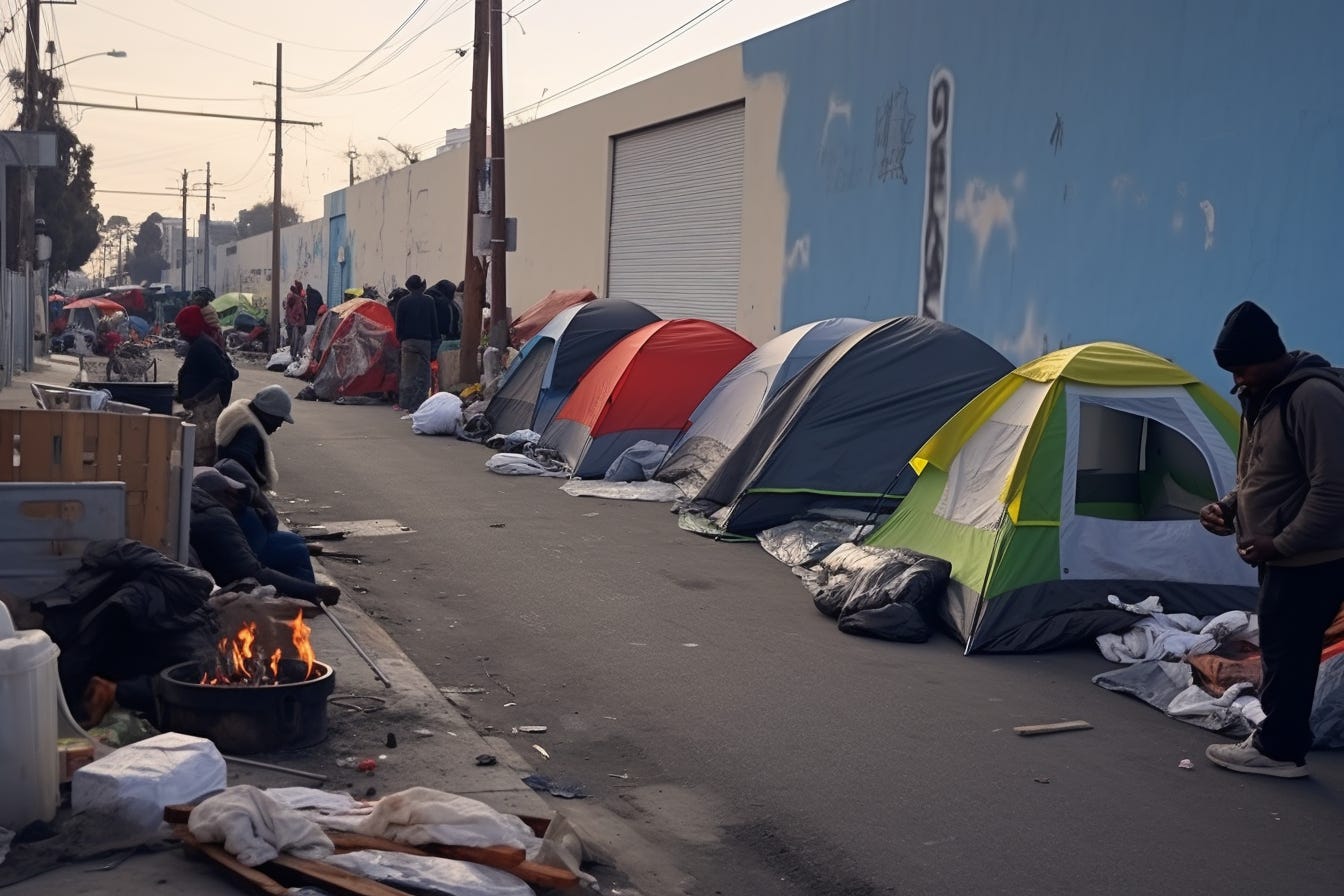
From Palm Springs to Skid Row: A Tale of Two Californias
I have been in California - Riverside, LA and Palm Springs - for the last month, helping out with a family issue over there. I wanted to share a couple of thoughts I had about the golden state, where, as wealth and poverty collide, there are two very different realities.My first wake up call was in the supermarket - Stater Bros. Just how expensive has the US has become, especially for a European with weak currency. I used to think America was cheap. You think food prices in the UK are bad. I’d say they are twice as expensive in California, if not more. $4.99 for four large onions and they weren’t even organic onions. Fruit, veg, fish, meat. Name your staple. The US ain’t cheap any more. Obviously, exchange rates are a factor and the pound, at $1.27, is not exactly strong, if one thinks back to the heady days north o f two bucks. But currency aside, ordinary living is getting very expensive for our transatlantic cousins. (Houses are no longer cheap either, for what it’s worth).Fuel, on the other hand, is around $4.80/gallon, which works out around £1/litre, compared to £1.45-50/litre over here. Americans are still complaining about it though. For them that’s expensive. Guess it is when you factor in how big their cars are.(Gosh, I enjoyed living under US weights and measures, or as they call them English weights and measures. They are so much more intuitive than metric. More on that here, if you want to see my lecture on the subject). Second hand cars also seemed cheap, by the way, though my finger is not really on the pulse. I was just strolling round the classic car shops in Palm Springs, where you can pick up a Rolls Royce Corniche in attractive beige (I didn’t realise there was such a thing) for $50k. That felt to me like less than you would pay here. Also, in Palm Springs people will tell you how nice your car is. Here they’ll just nick it.The roads, by the way, are very crowded indeed, and boy are freeways manic. Palm Springs was like a dreamland. Sheltered from the cruel realities that are inflicting the rest of the world, the news feels a long way away. But there was a very different story in LA, 90 minutes up the road. My kids wanted to see Skid Row (where many drug addicts and homeless have taken root), so we drove around there for a bit. Even in a car with the locks on, I did not feel comfortable at all halted at traffic lights. I once had a run-in with a group of homeless people on a freezing winter’s day in Hillbrow, Johannesburg - an experience I will never forget, and a story for another day. This reminded me of that. (Later, a Lyft driver told us Skid Row is by no means as bad as it gets. Places like Watts and Compton are too dangerous to even drive through). Skid Row borders on Downtown LA and, at the turn of a corner, you suddenly see all kempt streets and offices. The juxtaposition is stark. From there we went to the Walk of Fame for a stroll, where, within a few minutes of getting out of the car, we were almost knocked over by a huge (and I mean heavy weight world champion, 6 foot 8 basketball player huge) homeless black man with a very loud voice, running down the street, screaming platitudes at a much smaller, richly dressed and armed black man, who was chasing him, yelling at him to never be seen round here again. This was all in the first hour. My younger daughter (aged 19) turned to me and said she had never felt so unsafe in any city ever. She had a point. The drug addicted homeless seemed to be everywhere. Surely the sheer weight of numbers means something. In Venice, we watched a Latino man with a t-shirt stolen from TJ Max spend 10 minutes attempting to scan the bar code from the label of the stolen shirt onto the button at a pedestrian crossing, while the machine repeatedly told him to “wait”. Finally, exasperated, he threw his hands in the air and walked straight into the road to be hit by a passing car (fortunately not injured). The following day we visited Rodeo Drive in Beverly Hills. It is so wealthy, clean and curated, it is verging on the make believe. There, you are abnormal if you haven’t had cosmetic surgery of some kind. Was ever there such a fairy land of a place. I don’t think I’ve ever seen such extreme poverty and wealth so immediately juxtaposed as in LA. Something ain’t right, as the saying goes, and, I dare say, something’s going to give. It was probably my imagination, projecting fears and biases, but at times it felt like we were just a couple of short steps away from breakdown: a city on the brink. My general theory, or rather Alex McCarron’s theory which I’ve adopted, of the South Africanisation of everything applies here too.The following day we hung out in West Hollywood and Silvertown, where, I should say, things felt more normal, whatever that means. I really liked the vibe. Best of all, I liked the canals around Venice. They are just glorious. Almost as nice as the River Thames upstream.As for LA’s future, well… The city was built on the movie industry

What to do, what to do? My advice to the young
(If you prefer, you can watch this article in video form here)The youngster setting out on life in the west has a major problem. We live in a society that penalises hard work. Punitively and relentlessly.As Daylight Robbery readers will know, over the course of a life, half of everything a typical worker earns will be taken from him by the government. More if you factor in inflation. People think a house is the most expensive purchase you will ever make. It isn’t. It is, by far and away, your government. And it’s a forced purchase as well.Not only is the produce of your labour confiscated, it is spent on things on which you may often be philosophically opposed: wars, waste, masks, rainbow road crossings, corruption, human rights lawyers, Stonewall. I could go on.But that is the bind in which the western citizen finds himself. It is the price he must pay for a civilised society.So the typical worker finds himself working hour upon hour merely to stay afloat, his produce confiscated, week in week out. We can’t all be Elon Musk, much as we would like to be. Unless you have a very well paid job indeed, this is your reality. It is very hard to get on. You are trapped.To make it worse, the money you are paid in also loses its value. Relentlessly. Thus what you got to keep is taken from you too.This will remain your reality, unless you change it.One solution, as I outline here, is to convert as much of your pay as possible into strong currency, but with 50% of your earnings constantly confiscated it is still a rough deal. (And don’t say income taxes are lower than that, I know they are. There are many other taxes we must pay too.)So what to do?The answer is leave. Go somewhere where taxes are lower and the currency is stronger. Then you will be rewarded for your labour. And through your labour, you might actually be able to save and improve your lot.I have never been crazy about Dubai. I’ve always found the place a bit false. It lacks culture. I prefer places that are a bit more organic. I’d rather be in a quaint English village with an old pub and a beautiful church, wandering through the City with its mysterious, historical back alleys or lounging in some terracotta Mediterranean villa. What’s more, the thought of the slave labour on which Dubai was built makes me feel very uncomfortable. In my stand-up act I sometimes do a joke: “as a stand-up you need some ready-made put-downs in case you have problem people in the audience, so I have been working on my put-downs, and the best I’ve been able to come up with is … You look like the sort of person that likes Dubai.” (Some audiences - usually cultured ones - love that joke, others are baffled by it)But all that said, every time I have been to Dubai I have had a good time. A very good time in fact. And I have always been well looked after.But here’s the thing. There is no Income Tax in Dubai. VAT is just 5%. There is no Stamp Duty. There is no TV tax. There is no Council Tax. Petrol is cheap. Corporation tax is much lower. Booze, fags and sugary drinks face 50% excise duties. But who cares? You drink too much anyway.As for the money you are paid in, UAE dirham, well, that’s pegged to the US dollar. It’s not ideal, but it’s better than the pound. So go the UAE, work, keep what you earn and, even in a relatively low-ranking job, in five years you will suddenly you’ll find yourself in a very different, much stronger position than if you had stayed in UK, Europe or any high tax jurisdiction.Look at how crap our governments are. Why enable them? Live shows coming upIf you have not seen my lecture with funny bits about gold, we have two more dates in London lined up for Feb 14 and 15. Please come.And I am taking my musical comedy show, An Evening of Curious Songs, on a mini tour in the spring with dates in London, Somerset, Hampshire, Surrey and Essex. This is a really fun show.Here are the dates and places.* London, Crazy Coqs, W1. Wednesday March 20th. On sale now.* Bordon, Hampshire. Saturday March 23. On sale now.* Guildford, Surrey. Friday April 5. On sale now. * Bath, Somerset. Saturday April 6. On sale now.* Southend, Essex . Sunday April 14. On sale now.Buying gold?Interested in protecting your wealth in these extraordinary times? Then be sure to own some gold bullion. I use The Pure Gold Company, whether you are taking delivery or storing online. Premiums are low, quality of service is high, you can deal with a human being. I have an affiliation deal with them. This is a public episode. If you'd like to discuss this with other subscribers or get access to bonus episodes, visit www.theflyingfrisby.com/subscribe

VIDEO: What to do, what to do? My advice to the young
If you prefer to read this piece, you can do that here. Live shows coming upIf you have not seen my lecture with funny bits about gold, we have two more dates in London lined up for Feb 14 and 15. Please come.And I am taking my musical comedy show, An Evening of Curious Songs, on a mini tour in the spring with dates in London, Somerset, Hampshire, Surrey and Essex. This is a really fun show.Here are the dates and places.* London, Crazy Coqs, W1. Wednesday March 20th. On sale now.* Bordon, Hampshire. Saturday March 23. On sale now.* Guildford, Surrey. Friday April 5. On sale now. * Bath, Somerset. Saturday April 6. On sale now.* Southend, Essex . Sunday April 14. On sale now.Buying gold?Interested in protecting your wealth in these extraordinary times? Then be sure to own some gold bullion. I use The Pure Gold Company, whether you are taking delivery or storing online. Premiums are low, quality of service is high, you can deal with a human being. I have an affiliation deal with them. This is a public episode. If you'd like to discuss this with other subscribers or get access to bonus episodes, visit www.theflyingfrisby.com/subscribe

VIDEO: Go You, Go Me, Go Substack
If you prefer, you can read or listen to this piece here.Live shows coming upIf you have not seen my lecture with funny bits about gold, we have two more dates in London lined up for Feb 14 and 15. Please come.And I am taking my musical comedy show, An Evening of Curious Songs, on a mini tour in the spring with dates in London, Somerset, Hampshire, Surrey and Essex. This is a really fun show.Here are the dates and places.* London, Crazy Coqs, W1. Wednesday March 20th. On sale now.* Bordon, Hampshire. Saturday March 23. On sale now.* Guildford, Surrey. Friday April 5. On sale now. * Bath, Somerset. Saturday April 6. On sale now.* Southend, Essex . Sunday April 14. On sale now.Buying gold?Interested in protecting your wealth in these extraordinary times? Then be sure to own some gold bullion. I use The Pure Gold Company, whether you are taking delivery or storing online. Premiums are low, quality of service is high, you can deal with a human being. I have an affiliation deal with them. This is a public episode. If you'd like to discuss this with other subscribers or get access to bonus episodes, visit www.theflyingfrisby.com/subscribe

Crystal Ball Chronicles: Predictions for 2024
It’s that time of year again. Time to get out the crystal ball and tell you precisely what is going to happen in the next 12 months. Here are 15 predictions for 2024.Remember the rules of the game: I score 2 points for a direct hit, 1 for a good call, zero for a miss and minus one for a “David Lammy on Mastermind” fail. As I do every year, I shall come back and mark my homework next December.New years are fairly arbitrary things. January 1st rarely marks an actual turning point. Trends that were trends in the autumn and winter tend to continue into January, February and beyond, until they dissipate and run out of steam. There are occasional dramatic events, but life is mostly a gradual process. It’s only when you jump back or forward 12 months that things look so different. This time last year the S&P500 was struggling to the point that many saw a meltdown coming. We got no such thing - in fact, quite the opposite. The stock market rose 25% in one of its best years ever. 20 years ago, if you could step forward and see, I don’t know, the state of our institutions, or the demographics of your capital city, you’d risk having some kind of cerebral haemorrhage. Change is gradual, it is the incremental effects of tiny change compounded over time that are so formidable. We’ll start, however, with an ongoing gradual process that I don’t see reversing in 2024.1. The Great Decline goes on. It may not feel like it in this Great Decline, but life generally, believe it or not, is getting steadily better, at least from a technological point of view.But technology is subject to the improving forces of competition and free markets, our systems of government are not. They are from a different era and should be obsolete, but they persist. They are not improving but stultifying.The prediction: everywhere the state’s tentacles reach remains a drain on productivity. Our once great institutions continue to fall apart, like zombie meth addicts, stumbling towards dysfunction. (I’m going to write a song called Nothing Works Anymore). The New Woke Religions of Climate Change, the NHS and White=Bad endure, exhausting resources and minds. The ordinary worker desperately trying to improve his lot is bled dry by taxes, inflation, housing costs and the voracious state monster. Fiat loses yet more of its purchasing power. The South Africanisation of everything continues. 2. Gold to new highs. $2,400 here we come.It’s not all bad, however. This is a good year for the anti-fiat trades. Gold breaks out. Finally.3. Bitcoin goes to new highs as well. The barrier that is the all-time high at $69,000 falls. The ETF, the halving, the money printers and the tech itself all play their part. If there is one thing bitcoin has taught me, it is never to underestimate how high it can go.4. But ethereum, for reasons that escape me, outperforms bitcoin. I wrote what is generally agreed to be one of the first books about crypto. But the industry has moved so fast, I am mostly baffled by it. What are most of these coins actually for? But one observation I have made is that ethereum always seems to move later in the cycle, and by more. Why should this time be different?5. The US dollar trends sideways. The US dollar has been trending sideways for over a year now, frustrating bull and bear alike. It should be lower. I’m in the US at the moment and it feels very expensive: food is almost twice as expensive as in the UK, I’d say. But the dollar is the best house in a bad fiat neighbourhood. Prediction: it continues to range-trade.6. Sterling has problems. According to my eight year cycle of the pound - something in which I am steadily losing confidence - this should be the year the pound hits rock bottom. What is the catalyst? Gilt issues, perhaps. Unsustainable deficits. Something political is another likely answer, given this is an election year. On which note …7. The Tories are eviscerated.They had their chance and they blew it. Come the General Election this year, the voters are unforgiving. Few vote Tory. But voters also know that Labour is just as bad, so Labour does not win by anything as much as it should. There are lots of protest votes and no votes. The SNP is similarly annihilated. The shortcomings of our political system are there for all to see. But nothing that needs to changes. (See prediction one)8. Uranium keeps on going up. There’s a supply squeeze. We have been warning about it. Regime change in Russia could fix it. Don’t see that happening. Taking out the old highs at $140/lb is not so impossible. But let’s aim low to avoid disappointment. Uranium hits $125/lb in 2024.9. Fast and processed food companies have problemsThe food industry has got two problems on its hands. One is the weight loss drugs, the most famous example of which is Ozempic. A lot of people are taking it and that means a lot of people are eating a lot less. Two is the rise of anti-seed-oil narratives. More and more studies are showing the link between seed oils and obesity,

Where do thoughts go?
Shortly after my father died, I remember saying to my eldest daughter: where do thoughts go? What happens to them?My father was a writer, so many of the thoughts he had he wrote down and preserved in some way. But what happened to all the ones he didn’t record over the course of his life? Is that it - they are just gone?Studies suggest a typical person has 7,000 thoughts a day. Others put that number ten times higher at 70-80,000. That seems a lot to me. (Some people, from what I can see, don’t even reach double figures). 80,000 thoughts/day would work out at close to one thought per second. It depends how you define what a thought is, I guess. Many thoughts are repetitive: we have the same thought over, often because we forget we have had it. But whether 7,000 or 70,000, we have a lot of thoughts. So …Of those many thoughts you have each day, how many do you actually recognise or acknowledge? A tiny percentage. Of those thoughts you do recognise, how many do you then articulate or speak aloud in some way? Again a tiny percentage. We are at a tiny percentage of a tiny percentage.Of those thoughts that you articulate, how many do you actually record - perhaps write down? Of those you record, how many do you act on and and turn into something? An even tinier percentage.So, of all the thoughts we have, a tiny percentage of a tiny percentage of a tiny percentage get recorded, and an even tinier percentage actually become something. Now let’s extrapolate that over a life. A typical lifespan is 27,000 days. That makes 189 million or 1.89 billion thoughts over the course of your life (depending on whether you are a 7,000 or 70,000/day person). Now let’s extrapolate this across human history - all the thoughts that every human being has had ever. 117 billion lives have been lived, google tells me. 117 billion multiplied by 189 million or 1.89 billion is a lot of thoughts. What happened to them all? Where did they go? Where are they now? Is there some ethereal warehouse up the street where they are all stored?If those thoughts are now gone - unrecorded, unacted upon - what, then, was the point of having them?Recording my thoughts has always been something that’s obsessed me rather. Even as a child, I used to keep a diary and try to record as many of the things that I thought (the interesting ones, at least) as possible, especially as I worried I might never have that thought again. I’ve got piles of notebooks, not to mention the notes and voice files in my phone and on my computer. But I never go back through them and I doubt anyone else ever will, so I may as well have not bothered. Those thoughts are going to disappear, even though I wrote them down and attempted to preserve them. What was the point of having them?Park that thought for a moment, while I ask you a question. Why Christianity and Judaism succeeded where other religions failedOf the plethora of religions that existed around the Middle East three or four thousand years ago, why did Judaism survive, but none of the others? Is it because the Jews are God’s chosen people (as my Jewish friends constantly like to remind me every time I bring this question up)?Or is it because the Jews wrote theirs down? Other religions were passed on orally. Even better: the Jews inscribed their Ten Commandments in stone.Why did Christianity supersede all the pagan religions of Northern Europe during the Dark Ages? The Northmen were the superior force militarily, surely their pagan religions should have conquered too. With the likes of Odin, Thor and Loki, or the druidic religions of the Celts, many of those pagan religions were much cooler than Christianity. Why did Christianity conquer? Because the bible was written down. Pagan religions and traditions were passed on orally. It’s a much less reliable way of transferring thought.So you can see then both the power of preserving thought and the influence it can have on history. Please subscribe to this amazing publication.Do thoughts exist?Do thoughts have matter? This is a question that occupies the minds of philosophers far more profound than me. Thoughts must have some kind of matter, runs the argument, because it takes energy to have them. If we do a lot of thinking, we get tired. The brain uses at least 20% of the body’s energy, even though it makes up 2% of the body’s mass. Perhaps a thought is just a little parcel of energy.But, I ask again, what happens to thoughts after we have them? If we don’t record or articulate them in some way, are they just gone? Or is there some kind of ethereal depository where all thoughts get stored? Some kind of collective human consciousness warehouse that we haven’t discovered yet.I’m one of these people that thinks most invention is discovery. Just as Alexander Fleming did not invent penicillin, he discovered it, so did, say, Thomas Edison (and many others) not so much invent the lightbulb as discover the technology that makes lightbulbs work. Did man invent the wheel or did he discov

Go You, Go Me, Go Substack and a Happy New Year
I am very happily surprised by the success this Substack, the Flying Frisby, is having, and by the way it is growing.I’d like to say it’s all down to you. A lot of it really is: for reading and supporting this letter. Thank you.A lot of it is down to me too for writing it. Aren’t I wonderful?But a lot of it is down to the platform itself. I think Substack is great. I have encountered some of the most brilliant writing on here, stuff I don’t think I ever would found otherwise - either because it would have been in too remote a corner of the internet for me to have ever come across it, or because, without this platform, it might never have got written in the first place. In a virtuous loop, this centre of good writing is leading to more good writing. Free thought is leading to more free thought. Everywhere blossoms. It has become the most fertile platform for philosophy, commentary and the arts. It has created a virtuous circle. Hobbies are becoming livelihoods. Isn’t that great? With free everything, the internet devalued content. Substack reverses that. It’s OnlyFans for highbrow people.I used to think I was a brilliant forecaster of trends. I now realise it’s just that if I am thinking it, a lot of other people are thinking it too. But I’ve found I am putting more and more time and effort into Substack, both as a creator of content and a consumer of it. If I am, others are too. The platform will grow as a result, while both creator and consumer, buyer and seller, will benefit. On the other hand, I only have so much time. With more of it expended here, I find less time available for my other endeavours (and there are lots of them). I’m supposed to be writing a new book for example. How often when I sit down to write do I find myself knocking out a Substack instead. Creating content is addictive. When readers like it all sorts of dopamines go offMy career, if you could call it that, has taken a surprise turn as a result of this Substack, which I only started it as a result of a chance conversation in the pub.This is all a lot of pre-amble to say how much I am enjoying writing this letter, how surprised I have been by its success and how grateful I am to you for both reading and supporting it.Thank you very much.I wish you all a wonderful 2024.DominicPS If you missed my piece, How To Change Your Social Status, I made a video verson of it here:PPS And if you fancy a festive LOL, here’s me entertaining the masses at the Free Speech Union Christmas Bash. This is a public episode. If you'd like to discuss this with other subscribers or get access to bonus episodes, visit www.theflyingfrisby.com/subscribe

How To Change Your Social Status
Here are all the links mentioned in the vid:* An Evening of Curious Songs on Tour* Show about gold in London Feb 14/15* Buy gold - Pure Gold Co* Bitcoin guide. If you prefer to read this article, you can do that here: This is a public episode. If you'd like to discuss this with other subscribers or get access to bonus episodes, visit www.theflyingfrisby.com/subscribe

Investment Nostradamus or Just Guessing? A Recap of Frisby's 2023 Forecasts
As long-time readers/sufferers will know, at the beginning of the new year I like to make some predictions for the 12 months ahead. The bolder the prediction, the more entertaining the copy, though the less likely it is to actually happen. Herein lies the eternal conflict at the heart of so much market commentary. What is more important: getting lots of eyeballs or being right? Today we mark our own homework. We look back at last year’s effort and we count up the points. The scoring system: 2 points for a direct hit, 1 point for a nearly right, 0 for a fail and minus 1, if the prediction is David-Lammy-on-Mastermind-level bad. (For those readers not familiar with David Lammy, he is a UK politician from the “everyone who does not agree with me is a Nazi” school of philosophy, who appeared on one of the UK’s flagship quizzes and was really, really bad). I like this exercise because it demonstrates just how much perspective can change over time. While we can change strategy as events develop, the copy from last year stays and back then things looked very shaky. The stock market was imploding, and the end was nigh. Now it all looks rather better.Next week I’ll put together some predictions for 2024, but here’s how 2023’s batch panned out. Subscribe to The Flying Frisby.* Brent crude oil, then at $80, to hit three figures. We felt commodities would have a good year with China’s re-opening increasing demand. It didn’t. The highest Brent got was $95. Zero points.* Copper would go to $4.80/lb, we said, on the same theme, and we were wrong about that too. It got to $4.30. Not quite Lammy-on-Mastermind levels of failure, but a big fat zero nonetheless. * Yield becomes a thing again. “With choppy, uncertain markets, but sticky inflation, investing for yield rather than capital growth becomes a much bigger theme in 2023.” It seems painfully obvious now, I can’t believe it wasn’t a year ago, but a lot of investors, particularly those with lots of capital, have been quite happy to take safe 5 or 6% yields. Two points.* S&P500. Things looked very dicey in the stock market this time last year. Many were declaring end of days. We said no such thing. It was “a classic recessionary bear market”, we argued. It looks obvious now. It wasn’t then. The S&P500, 3,800 at the time, would get back towards its old highs of 4,800. It has done just that. We are at 4,770. A big fat two points.* Emerging Markets outperform, we said. They didn’t. Zero. * Biotech becomes a thing again too, we said, thinking that after so many years of underperformance, perhaps it was due some time in the sun. Nope. While it has been extremely strong these last two months, it was flat over the year. Zero. (Don’t worry the predictions get better).* European banks have a good time of it too. They did. Up somewhere between 15 and 20%, depending on which measure you use. Even Deutsche Bank is up. Two points.* Bitcoin has a good year. Hard to think it was $17,000 a year ago. ”There are so many reasons to be bullish about bitcoin, yet sentiment could not be worse.” It’s tripled. Two points.* Silver, on the other hand, “fails to deliver yet again.” While many this time last year were saying $30 was on the way, we bitterly observed that “If you can count on anything in this cruel world, it’s that silver will let you down”. It began the year at $24 and, one year on, that is where we remain. $26 was the high. Two points.* US dollar. “Up and down” range-trading was our prediction for the US dollar, and that is what we got. Though the US dollar index ended the year at 101, we tentatively ventured that it would end higher than the 102 where it started. Just the one point. * Central Bank Digital Currencies. Delighted to be wrong about this one, as they are evil. “A nation with a population greater than 15 million rolls out its first CBDC,” we said. No nation did. (Nigeria doesn’t count, as it already had one). Zero points. (Here’s my comic song about CBDCs, if you haven’t already seen it).* Ukraine. Dominic Frisby is your first port of call for Ukraine War analysis, I know. But my outlook was “The Ukraine War will not end before October. There will not be a nuclear war and Vladimir Putin will still be Russia’s president by year end.” Even though Hamas took it off the front pages, it goes on. Two points. * Gold. It “retests its old highs around $2,080. But then it finds a way of being frustrating. It always does. It’s gold.” That is where we are. Two points.* Finally, sports. Man City win the league, I said, and they did. (At that point Arsenal were way ahead). Got that right, but the relegation I got wrong: Southampton, Wolves and Bournemouth were for the chop, but no. Wolves and Bournemouth both managed to stay up. Leeds and Leicester went down. One point.A grand total of 16 points. Not great, but not awful either. Kind of like my school reports.I hope you had a very Merry Christmas. I wish you good fortune, health, wealth and prosperity in 2024. May you make good decisio
How to Change Your Social Status
You can, if you prefer, watch this article in video form here:I was having a coffee with an Anglo-Italian friend of mine the other day, and he began telling me about his grand-parents. They were “contadini”, which translates literally as “peasants”, though the term peasant does not have such pejorative connotations in Italy as it does here. They called themselves “mezzadri” or “sharecroppers”. A landowner allowed them to work his land, in exchange for half of everything they produced on it. The other half they got to keep. Selling that half of the produce was how they got money. My friend’s family had been doing this for generations, never actually breaking above that status to become landowners themselves.There are many parallels to the mediaeval serf, who had to work the land of his lord in exchange for his subsistence and protection. Just as the serf was the descendent of the Roman slave, so was the contadino the descendent of the serf, though contadini were not as subjugated, except by their circumstances.It is not so different to the plight of the young western worker today, particularly at the lower end of the pay scale, who has, by the time you factor in inflation and other taxes, half of everything he earns taken from him by the state, and is unable to buy a place to live. In any case, in 1966 Grandad left Italy and the peasant existence, followed by Grandma in 1967, and they came to work in England. With union law quite protective at the time, most Italians in the UK found themselves either setting up small businesses or working for other small businesses belonging to friends or family, especially in the catering industry. (My grandad, who was also Italian, ran a sandwich shop in Victoria). They were paid in British pounds, and largely in cash, on which they are unlikely to have paid much Income Tax. While the British pound was not exactly a beacon of fiscal rectitude, it was a lot better than the Italian lira, which suffered numerous devaluations and became something of a laughing stock currency. This meant that the money Grandad and Grandma were paid in kept its value, at least on a relative basis.Several years passed. My friends’ grandparents worked hard and saved. Then in 1970 they went back to Italy and bought themselves an apartment. It may only have been an apartment, but for the first time in the family’s history they owned property. They carried on working in the UK and by 1976 they were able to buy some of the land on which they had previously been contadini. Their social status had changed - from peasant to landowner.It was a common thing among Italian emigrants throughout the 20th century. When they went back home, they had so much more money than those who had stayed.They hadn’t had particularly good jobs in England. They were waiters. They were only able to do what they did for two reasons: one, the money they were paid in and saved in was so much stronger than the Italian lira; two, operating in the cash economy and receiving much of their income in tips, which were not taxed back then, they did not have 50% of the produce of their labour confiscated, whether by landowner, lord or state.There is an important message to this story, both about how society works and about how you should position yourself.The unspoken crime of the 20th and 21st centuriesActually, there are many crimes, let’s just say this is a big one. Not only are workers fleeced by the amount of tax that they have to pay (most of which is then wasted on government incompetence or worse), they are fleeced because the money they are paid loses its value. Owning property has been one of the few ways by which ordinary people have been able to protect themselves against the extraordinary currency debasement of the 20th and 21st century. As I constantly argue, property prices are a functon of money supply, and property is unaffordbale as a result of relentless money supply growth. So much newly created money goes into property, that houses have become financial assets, an effective hedge against currency debasement. As house prices have gone up, it feels like wealth has been created, but it is just an illusion. All that has happened is that property owners have been had that part of their portfolio shielded from the debasement. Storing your wealth in property proved a much better place to keep it than cash, be it sterling, lira, euro or dollar. Plus your main home goes untaxed, so you don’t get fleeced that way either.My Italian friend described his confirmation some 35 years ago. One family member gave him a gold sovereign. Another gave him twenty newly minted pound coins, which my friend still has in the original packaging. Which has kept its value? Those pound coins might have some collectors’ interest, but £20 buys you a heck of a lot less now than it did 30 years ago. The sovereign meanwhile has kept its purchasing power, as gold always does.When you work, you expend energy. The money you are paid for your expended effo
Why You Should Own Some Bitcoin
This is a free preview of a paid episode. To hear more, visit www.theflyingfrisby.comIt is now almost 15 years since Satoshi Nakamoto announced his new invention, bitcoin, to the world. Since then it has grown and grown. Like most things online, bitcoin has divided people. It has its admirers and it has its detractors. They argue with as much vitriol as the political left and right. But the admirers have won: if bitcoin was going to die, it would have died by now. It hasn’t. It’s thriving. It has more than 100 million users and its market cap is roughly $750 billion.The most common reason I hear for not wanting to invest is, “I don’t understand it.”So what is bitcoin? It is a new system of digital money for the internet. You might call it cash for the internet.Unlike pounds or dollars, this money is not issued by a government. Instead it is issued by an international network of computers, according to an open source protocol. There is no government involvement in bitcoin. It is apolitical money. Its value is determined by the market: what people are prepared to buy it for.Then people demand to know how it works. Fine. You explain the blockchain, decentralised ledgers, the problem of double spending, Byzantine generals, mining and all the rest of it, and a glazed look comes into their eyes. They go away shaking their heads and decide they don’t understand it.Most people don’t know how the combustion engine works. They still use cars and buses. Most people don’t know how hypertext transfer protocol works. They still use the World Wide Web. Most people don’t understand what simple mail transfer protocol is. They still send and receive emails. Almost everybody, including the Governor of the Bank of England, does not understand how our modern system of money, banking and credit works. I struggle to find a single politician who can explain how money is created. We all still use money. You do not need to understand how it works in order to use it. All you have to understand is that it does work.Bitcoin does work. As I say, if it didn’t, it would’ve died by now. But it hasn’t. It’s thriving.To give you an idea just how robust bitcoin is, the network is more powerful than the world’s top 500 supercomputers combined. The protocol has been studied and verified by about a gazillion nerds. The technological superiority of bitcoinOne thing that distinguishes this apolitical money from pounds or dollars or euros - money issued by government - is that there is a finite supply: 21 million coins. Governments cannot tinker with bitcoin’s money supply with political objectives in mind and create more of it. A finite and limited supply means bitcoin’s value is likely to increase, unlike the purchasing power of government money, which decreases as more and more of it gets created. (If you dispute this, ask yourself what a pound buys you today compared to ten, twenty or fifty years ago).Each coin is divisible to 8 decimal places. The smallest denomination is the satoshi or sat . There are thus 100 million satoshis to a bitcoin. A dollar would be around 2,500 sats. A penny would be about 35 sats, one cent about 25 sats. This means you can send micropayments which amount to 1/35th of one penny. Try getting a bank to process a payment of that size.Micropayments open up so many possibilities for economic growth.Imagine if, instead of getting a like for your YouTube video or Twitter, Insta or Facebook post, you got a sat. A meaningless amount to the person paying it. But a million sats instead of a million likes would be over $400. Not bad. Micropayments will dramatically enable the internet of things. It is a huge growth area. The Internet is, broadly speaking, a borderless medium. I can communicate with pretty much anyone in the world instantaneously, as long as they have an internet connection. But if I want to cross borders in the real world, this is a time consuming process, requiring visas and passports and security checks and all the rest of it. If I want to send money to other parts of the world, this too can be a burdensome process, requiring forms, forex conversion, customs declarations, money laundering enquiries, and goodness knows what else. If I wanted to send a payment to someone else in the world of, say, 10p it is just impossible. This limits the possibilities of government money.Government currencies are also limited by national borders, by population and economic size. Even the US dollar, which is the reserve currency of the world, is limited. Try opening a US dollar account outside of the US. It is problematic. If you are living in remote, rural Africa or Asia, it is well nigh impossible. It is hard enough, getting a bank account in your own currency. But with bitcoin, you can send to anyone anywhere, huge value transactions or tiny value transactions, and the transfer is frictionless and almost instantaneous. Technically, it is a superior form of money to government currency. It is backed, as I say, by a rigorous

Why so many bad decisions?
Good Sunday morning to you,Today’s piece is all about decision-making and the decline of family in the west.Before I crack on, I just wanted to flag a couple of things.Wearing my comedy hat, I’m taking An Evening of Curious Songs on a mini tour in the spring - shows in London (Crazy Coqs), Somerset, Surrey, Essex and Hampshire. Tickets make great Christmas pressies, so please take a look.And my new album, It’s ALL True, is out. CDs also make great Christmas pressies for errant uncles, so check that out too in the DF shop.So to today’s piece - Why so many bad decisions?I’ve recently been looking at my family tree on one of those ancestry websites, and I was amazed to see just how big some of the families were in 19th and early 20th Century England. Having nine or 10 brothers and sisters was not unusual.Today, families are much smaller. All sorts of reasons have been proffered for that. Matt Ridley argues that families get smaller as people grow wealthier and live longer. In poorer countries, you might have lots of children, knowing that a significant number will not make it through pregnancy, childbirth and early childhood, let alone the teenage years. With the longer safer lives we now have in the west, you can have two or three kids and know that the likelihood is that they will make it safely to adulthood. Stat of the day: in 1850, life expectancy in Britain was 40 for men and 42 for women. Today it is double that. Be grateful you are alive in Britain today - you get to live twice as long.But when parents themselves are asked why they don’t have more children, the most commonly given reason is cost. People ca no’t afford to have more kids. The biggest expense of bringing up a child - government aside (the state takes half of everything you will ever earn) - is somewhere to live. We can no longer afford to buy the large homes our Victorian ancestors built to house their families, so just putting a roof over their head is problem enough. I’ve written endlessly about house prices being a function of cheap, debt-based, fiat money, and it’s quite easy to, therefore, attribute declining family size to fiat.The average cost of raising a child to 18 is now over two hundred grand. Add in school fees and you can double that number. To age 18, you say. Most kids now stay at home well into their 20s. If you look at who has big families today, it is most unusual to see an ordinary middle-class family with five or more kids. It tends to be only the very rich, who can afford it, the very poor, who get state aid and thus can also afford it (especially if housing is covered), or the very religious. On that note, my friend Simon Evans argues, and I’m paraphrasing, that we have smaller families because religion has died. One primary purpose of religion is to get you to reproduce, he suggests. Without religion egging us on, many of us will take the sex, but we might forego the added burden of having to bring up the ensuing children.There’s probably something to all of these explanations. But, whatever the cause, families have got much, much smaller. That is indisputable.My parents divorced when I was just a few months old. I hardly saw my father at all when I was young due to various court rulings, and that led him to set up an organisation called Families Need Fathers. He wrote about his divorce at great length and to considerable acclaim. My mother worked and I went to boarding school. So I never grew up with lots of brothers and sisters or a big family. It’s a life I’ve never known, without wishing to sound sad, one I’ve always wanted and wished for. How I would love to have been one of HE Bates’ Darling Buds of May (I imagine we all would, though tral life is never as idyllic as fiction).I only ever knew one of my grandparents, the other three died either before or shortly after I was born. That’s that life expectancy thing again. So I’m always quite envious when I see, for example, those Asian families with several generations - nanny and grandad, mum and dad and the kids, and perhaps even their kids - all living under the same roof. I know it’s crowded, but it’s also kind of idyllic, particularly if you have a big enough house. When I travelled round Latin America, I adored those large Spanish Colonial homes built around a courtyard. Different parts of the family could occupy different apartments, so they had some privacy, but at the same time they were always close together.I once to listened to an audiobook about willpower and decision-making. I’m afraid I can’t remember the name. (This always happens to me with kindle and audiobooks. You don’t look at the cover every time you open it to remind you, so you forget what it is you are reading or listening to). Nevertheless, the author argued that we make different decisions when we are being monitored. For example, if you believe in God and you believe God is all-seeing, the decisions you make will be informed by that. You will be less likely to sin, for example, if you

The Inexorable Rise of the Far Right
This post now in video form This is a public episode. If you'd like to discuss this with other subscribers or get access to bonus episodes, visit www.theflyingfrisby.com/subscribe
We are conquering ourselves
This post in video form This is a public episode. If you'd like to discuss this with other subscribers or get access to bonus episodes, visit www.theflyingfrisby.com/subscribe
We are conquering ourselves
Good Sunday morning to you,Last week’s thought piece on the inexorable rise of the Far Right has become my most read Substack ever. Check it out, if you haven’t already.Today we continue on a similar theme.Enjoy!I’m currently working on a new book about gold, and, as gold often leads to war - or is it the other way round? - I’ve found myself reading rather a lot about conquerors and conquest. There are certain things all conquerors do, from invade to plunder to strip the conquered of their wealth, power, history and identity. What is so bizarre about today in Britain and Western Europe is that we are doing all these things to ourselves, voluntarily. Let me explain.As the armies of Alexander the Great marched east, overpowering all who stood in their way to form probably the first great empire the world had ever known and, in terms of land mass, one of the biggest (even to this day), the annihilation of the cultural identities of those they conquered soon followed. Locals were raped, pillaged, subjugated and enslaved. Coinage was a far more important tool of propaganda then than it is now, and Alexander had his armies confiscate gold and silver bullion everywhere they went; melt it down and then re-struck with Greek gods: Athena, goddess of wisdom and war; Nike, goddess of Victory; Zeus, god of power; and Heracles, god of strength, portrayed in the likeness of Alexander himself (at this point rulers had not yet started depicting their own heads). Conquered people quite literally had their own history and legend struck off. Alexander’s coins meanwhile were standardised throughtout his empire.As well as “Romanizing” the Celts - imposing Roman language, law, custom and governance on them - the Romans actively persecuted Celtic druids and destroyed their sacred groves. After William I conquered Britain, he took Anglo-Saxon land and gave it to his cronies; he imposed heavy taxes, strict laws and a new kind of feudal system; he replaced Anglo-Saxon English with Norman French in the courts and other centres of rule; he made ecclesiastical changes to better control the church. Any kind of rebellion met with swift and ruthless repression. Even if 1,000 years later, World War Two was not so different. Both the Nazis and the Japanese did everything in their power to strip those they conquered of their cultural identity.As well as possession of land and confiscation of wealth, the annihilation of local history, myth, hero and legend has always been a tool of the conqueror, part of the suppression and subjugation that follows invasion. Even today the US, not technically an empire and forever trying to distance itself from anything imperial, nevertheless controls much of the globe and its prime resource, oil, with its military. It also exports its culture in such a domineering way that everyone else confuses their own history with that of the US. Like its military, American cultural narratives dominate the world, and distort everybody else’s. You would think, for example, that there had never been any slavery in history, except for that in America, in the 200 years from when the nation was formed to its outlawing in 1865, never mind that the British outlawed it 2 generations earlier. In fact, slavery has existed since before civilization began and still goes on today, with some 21 to 45 million trapped in it. In just seven years between 1938 and 1945, Germany enslaved a number equivalent to 400 years of Transatlantic Slave Trade. Include Japan and the number is double. American cultural narratives dominate.But here is what is so weird about what is happening today, under the rudderless leadership that is representative social democracy. In the past if you wanted to occupy the lands of other people, you would have to conquer them and take their lands by force. Today no such force is required. In fact, in Britain, Tony Blair actually legislated for it. So did Boris Johnson. Not only do we import our own invasion, we actually subsidise it. The £8 million a day spent housing illegal migrants in hotels is just one example of this.Once imported, we then start re-writing our own history or apologising for it; from positive discrimination in the media to invisible casting (for some but not all) we change of our stories to better represent these new people, both at the expense of the locals and opportunity for them and at the expense of truth.Here, for example, is what, according to the BBC, an English family in Roman Britain looked like. The latest nuts example from the BBC. The plague was clearly racist. With headlines like that, we satirists are being put out of a job.We all know about the anti-white middle-aged man narrative of recent years - pale, male and stale and all that - and the discrimination he now encounters when attempting to find work. We have all seen how the modern British family is represented in advertising: there is, it seems, no such thing as a non-multi-cultural family. The latest evolution is anti- young, b

Navigating the Chills of Junior Mining
Good morning to you,Sunday’s piece on the inexorable rise of the far right and what to do about it has struck quite a few nerves. Check it out here, if you haven’t already.In today’s piece - considerably less political - which was first published in Moneyweek last Friday, we consider the sorry state of junior mining.Enjoy!DominicMining is infamously cyclical. But if ever there was an industry that blows desert hot and arctic cold, it is the subsector of small cap and early-stage companies known as junior miners. And boy has it been blowing cold.Many of the old hands are saying this is the worst bear market they have ever known. Worse than the 2013-15, when junior mining had a near-death experience, following the boom of the 2000s; worse than the bear market of the 1990s that came with colossally depressed metals prices at the end of a 20-year bear market and then the Bre-X scandal. Bre-X was one of the scams of the century. The Canadian gold mining company falsified gold samples from its mine in the middle of nowhere in Indonesia. The stock went up over 1,000-fold, from pennies to a C$6 billion valuation, before the fraud was exposed. Many were defrauded and the sector went into a prolonged depression, starving it of capital. The story became the basis for the film, Gold, starring Matthew McConaughey.Mining needs capital. It typically takes more than 15 years to take a mine from discovery to production. That’s 15 years of drilling, development and mine building with no chance profit in sight - unless you sell your deposit to someone else who then has to find the capital to take it into production. Millions, sometimes billions of dollars are needed. There is no immediate return, there is no guaranteed return. Why invest in something with such long time horizons when you can invest in some tech play that will have its app uploaded to the app store, potentially generating revenue in a matter of months? The gains are quicker and the aggro is lower.A lot can happen in those 15 years developing a mine. The metals markets can change, from supply shortages sending prices higher to glut sending prices lower. The money markets can change - interest rates can go up, for example. The political situation can change - politicians might seize strategic assets or impose windfall taxes, anti-mining lobby groups might block development, ESG narratives might take hold and prevent progress. It might be that after 10 years of drilling you discover the deposit is not quite as economic as you once hoped.The Cycle TurnsMining is hard. Many walk away. Then there’s no capital in the sector. With no capital, there’s no new metal supply coming to market. Then there’s a shortage of metal. Then, suddenly, we need to invest. Then capital floods the sector. It all starts to look rosy again. People make lots of money. Projects that will never make it to production start to get financed. Investors start to lose money. Rinse and repeat.With Vladimir Putin’s invasion of Ukraine in 2022, commodities prices sky-rocketed. Supply chains were disrupted. Russian natural resources - and there are a lot of them - were now effectively off-line to the west. Nickel was probably the poster-child of the parabola. It suddenly spiked from around $17,000 to $100,000. The London Metals Exchange had never seen anything like it. Monday March 7th, 2022, was the date. That was the peak of the market. A bear market took hold. It has left the eyes of anyone invested in the sector bleeding. It doesn’t matter if the metal being mined is base or precious, strategic or industrial, junior mining is in the doghouse. Metals prices themselves might not be that disastrous - gold is close to $2,000/oz. Copper is not far off $8,500/tonne. Iron ore is at $130/tonne. I’ve seen worse. The senior producers - the likes of BHP Billiton or Glencore - are not faring that badly either. It’s the juniors - the development plays, the explorers - that have been slaughtered. There are exceptions. Uranium for example. We need uranium. Kazakhstan, the world’s largest producer, is struggling to get its uranium to market in the west. It has Russia to the north, China, which will not export, the east. Afghanistan and Iran to the south. Ukraine to the east. It’s geographically problematic. For that reason I like uranium and I think it’s going higher. But more than 90% of the mining companies in the uranium mining ETFs will not see any production for at least a decade, probably two. Taking a uranium mine to production is an even longer process than for most other metals. The ETFs might be going up, but the companies within them are drains of capital. The only compelling reason to invest in them is that the value of their resources are perceived to be increasing. I wouldn’t touch them myself. You are better off just owning the metal. Yellowcake (YCA.L), which stores it, is the way to play it.You could say the same for gold. Mining is supposed to give you leverage to the metal. That has not happene

The Inexorable Rise of the Far Right
I was never particularly interested in politics growing up. My father was an active social democrat, and I remember him jumping up and down with excitement when the SDP was formed, as David Owen, Roy Jenkins, and Shirley Williams broke away from the Labour Party. Even as a student, I never got interested beyond having a feeling that something wasn’t right. I felt I should be left-wing - that that was the right thing to be, but I never felt particularly engaged, only alienated. My vague understanding of political ideology was that Stalin and the Bolsheviks were far left and Hitler and the Nazis were far right - I didn’t realise Nazi meant national socialist back then - but that far left and far right were actually quite close in philosophy. Horseshoe theory, basically.It seemed actual far right was something that didn’t really exist in the UK. There was Oswald Mosley, but he was a bit of a laughing stock, and the National Front was tiny and ineffectual. In my mid-to-late 30s, as a result of studying gold, sound money and limited government, I discovered libertarianism. For the first time, here was a political philosophy that resonated with me. Government is inherently incompetent, inefficient and inequitable. The more it does, the worse things seem to get. The less it does, the better. “A multiplicity of individual decisions,” to quote John Cowperthwaite, former Governor of Hong Kong, “will produce a better and wiser result than a single decision by a Government or by a board with its inevitably limited knowledge of the myriad factors involved, and its inflexibility.”It always amazes me that somebody who advocates peace, free trade, less government, and, in the case of anarchism and anarcho-capitalism, no government at all, can be sectioned off with Nazis and labelled far right. Far right involves more government not less. To say far-right libertarian, as the Guardian did the other day to describe Argentina’s new president Javier Milei, is surely oxymoronic. Or maybe just plain moronic.At best it’s lazy and ignorant. At worst it’s the stuff of smearing and straw men, and wilfully dishonest. I used to think it’s the former. Now most of the time I realise it’s the latter.I am proud to have written the Libertarian National Anthem, which distils libertarian philosophy. The lyrics read:Arise libertarians above totalitariansOur guide is the mighty invisible hand.Reject state controllers, collectors, patrollers.Our choices are better than government plans.Taxation is a form of theft.Free markets and free trade are best.Free speech, free movement, free minds and free choice.Our actions are all voluntary,Not coerced or compulsory.War we abhor, socialism does not work.No debt or inflation, no stealth confiscation,No pigs in the trough at the gravy to drink,No state education to brainwash our nation,No experts dictate what to do, what to think.We scorn your fiat currency.Gold and bitcoin is our money.We own ourselves and we live and let live.We take responsibility.Life, love and liberty.Leave us alone, let a thousand flowers bloom.How is any of that far right?(If you want to watch the video of the above, which I heartily recommend, it is here). Buying gold in the uncertain times? My recommended bullion dealer is The Pure Gold Company, whether you are taking delivery or storing online. Premiums are low, quality of service is high. They deliver to the UK, US, Canada and Europe, or you can store your gold with them. I have an affiliation deal. More here.What actually is “far right’?Time for a Wikipedia definition: Historically, "far-right politics" has been used to describe the experiences of fascism, Nazism, and Falangism. That’s what I thought. But here’s the problem. They’ve done that change-the-definition thing:Contemporary definitions now include neo-fascism, neo-Nazism, the Third Position, the alt-right, racial supremacism and other ideologies or organizations that feature aspects of authoritarian, ultra-nationalist, chauvinist, xenophobic, theocratic, racist, homophobic, transphobic, or reactionary views. So, basically, now far right can be anything you don’t agree with. The name derives from the left–right political spectrum, with the "far right" considered further from center than the standard political right.Of course, the whole prism of left and right is false, in any case. Authoritarian v libertarian is much more telling, and the political compass is the best scale of all. But so overused is the term far right that the political compass is starting to look something like this.I have argued many times, starting with Life After the State, that healthcare, education and welfare would all be cheaper and of a higher standard, if the government stayed out of it. The internet is the most powerful learning tool ever created and it’s (almost) free. In the context of the times, the Friendly Societies of the 19th century were much better providers of care than the state equivalent we have today. But, somehow, if you argu

Why You Should Own Stocks Now
This is a free preview of a paid episode. To hear more, visit www.theflyingfrisby.comGood morning to you from sunny California, where I am visiting my dear mother.If you missed them last week:* Check out my interview with Lyn Alden.* As well as the silver stock with a 47 million ounce surprise. * And, if you are thinking about buying gold in these uncertain times, be sure to speak to The Pure Gold Company.Today, though, it’s the stock market. We think it’s going up. Now could be the time to invest. Here’s why …The tricky month of October, the month of choice for the stock market crash, is now behind us. There was a wobble. A very wobbly wobble. But the blob held. The stage is now set for a juicy rally into year end.November to January is, historically, the best three month period of the year for the S&P500, the index of the largest 500 companies in America, while November to April is the best six month period. We are at the beginning of that run.If you bought the Dow Jones Industrial Average on November 1 every year since 1950 and sold it six months later on April 30, a ten grand stake would now be $1.2 million, give or take. But if you did the reverse and bought the Dow on May 1st and sold it on October 31, you would barely be at breakeven. That is some difference, particularly when you add currency deprecation into the mix. One option gives you breakeven over 73 years, less inflation, the other option gives you $1.2 million. Don’t ask me to explain why this is. It might be some kind of self-perpetuating, herd mentality thing. It might just be that different people do different things at different times of the year. I swim more in summer, for example. (I know that sounds trite, but you take my point). But there is more. This is the third year of the four-year US Presidential Cycle. It might be because the powers that be are trying to get everything looking hunky dory in time for the next election. It might just be one of those things. But third years are very good years for stocks, the years in which the strongest gains come - one of the reasons I was arguing in January that this would be a good year for stocks. This year has been particularly good, especially in the Nasdaq - I gather it had one of its best first six months ever. In 2019, President Donald Trump’s third year, there was a 27% rally in the S&P500. Prior to that, from 1933 to 2015, the average gains have been 16%, compared to 6% for the other three years. That November-to-April run is even stronger in the third year of the US Presidential cycle. We are at the most bullish time of year in the most bullish year. The portents are good. It may not feel that way after the October we have just had. October, is almost always the most volatile month. Octobers are often so horrible that nobody wants to buy. That in itself is almost reason to buy. “Buy when you don’t want to, sell when you don’t want to,” is not bad, as stock market adages go.Sentiment models are looking good. Last week’s AAII sentiment survey, which measures retail sentiment, showed 50% bears. Hedge fund sentiment is similarly contrarian bullish: long/short funds are the most defensively positioned in 11 years. Insider purchases are up and exceed insider sales. The bond markets have calmed down. Inflation, as they measure it, looks like it’s calming down in the US too. Finally we got a Zweig Breadth Thrust buy signal. I’m not going to try and explain that technical signal here. Google is your friend. Just know that it is bullishWe heard a lot of talk about an impending stock market crash last month. I’m of the mind that if it was going to happen, it would already have happened. Last week saw an eye-watering reversal and short-covering rally. We can expect a bit of digestion over the next few days, before things get going again.So how to play all this?
A Deep Dive into Broken Money
An engaging conversation with financial expert Lyn Alden as we explore the past, present, and potential future of money through the lens of technology.Lyn's new book, Broken Money, challenges conventional wisdom about monetary systems, emphasizing the crucial role of technology in shaping the way we exchange value. From the significance of the printing press and the telegraph to the rise of Bitcoin, we discuss into the intricate relationship between technology and money; the impact of central bank digital currencies (CBDCs) and how Bitcoin fits into the financial landscape. A thought-provoking conversation about the evolving world of finance.Subscribe to this amazing publication. This is a public episode. If you'd like to discuss this with other subscribers or get access to bonus episodes, visit www.theflyingfrisby.com/subscribe
ARC Conference Day 1 Recap:
I went to the ARC conference yesterday - to give it its full name the Alliance for Responsible Citizenship. It is an organisation set up by Jordan Peterson, Paul Marshall, Philippa Stroud, Alan McKormick and others to “develop a better narrative in response to life’s most fundamental social, economic, philosophical and cultural questions”. I spent much of the day taking notes, and I thought I’d write them up here so that readers can enjoy a distilled version, without the rigours of having to travel to the depths of London SE and sitting through a lot of talking.“What’s it like?” Merryn Somerset Webb texted on her way in that morning. “A bit like a religious gathering,” I replied, (something Tim Stanley also observed in a barbed piece in the Telegraph). I’m quite happy with that, because I am one of the believers. I have to say the organisers have put together quite a roster of speakers, one massive oversight aside, which was not having me speak.Philippa Stroud and Jordan Petersen hosted the morning events, which began with recently removed US speaker of the house Kevin McCarthy. Peterson, who had made a brave choice of suit even by his standards - and, I say with a little concern, looked exhausted - made the point that we each have a responsibility to do our own little bit, if we are to improve things.In this Noah’s Flood of podcasts through which we are currently living, I’m kind of done with conversations. So many people now just seem to be regurgitating the words of others. So few seem to say anything original or interesting. We are caught in this media merry-go-round in which everyone is just commenting on what everyone else has said and nobody actually seems to be creating anything. Moreover, I am kind of done with panels. Three guests, sitting on chairs, a host, who keeps opening it up the the audience, where the conversation then loses all direction. Give me strength. It’s always a good way to go into an event with low expectations because when reality exceeds expectation you end up happy. So it was here. (Read more on the secret of happiness). Laurence Fox, who is a buddy and with whom I hung out, was in a similarly jaded frame of mind. The right is great at identifying what the problem is, he said to me over coffee and a fag, but no good at doing anything about it. The problem, I suggested, is that many don’t actually know what to do, which is why so much talking goes on. Perhaps the answer lies in Peterson’s solution. We each have to do our own little bit in our own little worlds, doing whatever we do. That’s the nature of free markets and free everything: it starts with the individual and it is a bottom-up thing.The first panel was about narrative. That had former Aussie deputy PM John Anderson, who was excellent on the fact that in the Anglosphere, we have stopped telling our own story and, as a result, lost sight of who we are and what we stand for. This was a recurring theme throughout the day. Somali-Dutch activist, Ayaan Hersi, talking about Hamas and Islamic extremism, added that “their story is not your story and your story is not their story”, so it is never going to work. She may not have meant it, but that is actually quite a strong argument against multiculturalism. And I loved this line from US author Os Guiness: “freedom is not the power to do what you like. It is the power to do what you ought”I went into the break keen to do my own little bit and put the world right, and ran into my old boss from GB News, Angelos Frangopoulos, who was similarly invigorated. I had a good chat with him. I then ran into Jimmy Carr, of all people, who I know of old, and had a good chat with him too. I then met Holly Valance, who is a famous actress from Neighbours, if you didn’t know (I didn’t) and had a good chat with her about home education. So, never mind the roster of speakers, the calibre of audience was pretty good too.The next session was hosted by Fraser Nelson of the Spectator, another of the many UK media outlets which has forgone the opportunity to give me work. There was a talk by MP Miriam Cates about mental health and the decline of family. I agreed with pretty much every point she made, but don’t read your speeches, speak them, Mmiriam. They have more impact when you do.Next Nelson would interview a chap over videolink to the states, Jonathan Haidt, and my heart sank. Why have I come all this way to watch a live zoom call? Guess what? It was brilliant.It was about children and mobile phones. Moral of the story? Don’t let your kids anywhere near them. Mental health, depression, anxiety and suicide rates among young women in the Anglosphere and Nordic countries are all all at all time highs. They are not so bad among religious conservatives, they are much higher in cultures where female independence is strong, especially left wing, secular liberals (who tend to be allowed on their phones more). It has rocketed since 2010 when we all got smartphones. He talked about the importance of play
Is It Time to Pay Attention to the Japanese Yen?
Good morning to you,We are talking Japanese currency today.First, in case you missed them last week, check out:The story of my pilgrimage got a big and positive response from readers. This piece on the true value of UK housing also got a big response.If you haven’t already, and if speculative silver mining stocks are of interest: watch this interview with Alex Langer of Sierra Madre Gold and Silver. And, finally, a big thank you to all who came to my gold lecture on Thursday. What a great night. A reminder that due to sell-outs, we have added some extra London dates - February 14th and 15th. You can get tickets here.Right, the yen. I can’t help thinking there are some real opportunities coming …The currency has been weak as hell for a long time. Against the US dollar it is at lows not seen since this century. We all know what a rotten currency the pound has been. It has lost a third of its purchasing power just since 2020. A third! Against the constant that is gold, it has lost 90% of its purchasing power since 1999.And yet against the yen, the pound is at seven-year highs, not far off the pre-2008-financial-crisis levels. In those days a pound got you two dollars, instead of the $1.21 it gets you today.In terms of trading volume, then yen is the third most important currency in the world, after the dollar and the euro, accounting for around 17% of global daily forex turnover. Given that is thought to be $7.5 trillion, we are talking about around $1.3 trillion of daily trading volume. No small beer.Why has the yen been so weak?The main reason is that, while other central banks, especially the Federal Reserve, have raised rates, the Bank of Japan (BoJ) has not. It has ignored rising inflation (perhaps because Japan has had issues with deflation for so long). Indeed the BoJ has been creating digital money and buying extraordinary amounts of government bonds with it in order to cap rates. The BoJ now owns over half of Japanese national debt. My mind boggles when I read stuff like that. How can it be possible to print so much money and buy so much debt without apparent consequence? This is BoJ’s so-called yield curve control. I wish they’d print money and buy me a mansion. Or even just a nice car.Suppressed rates lead to the yen carry trade - borrowing yen at a cheap rate and holding other currencies that pay a better yield. But when the carry trade reverses, as in 2007-8, it tends to reverse very quickly.The yen, as a result, also tends to act as a safe haven currency: during times of panic, such as we saw in 2008, there is rapid flight to the yen in a rush to unwind the carry trade.Here is a very long term chart of dollar-yen going all the way back to 1987. (When the chart is rising, so is the US dollar).The dollar made its low - or the yen its high, depending on how you view things - in late 2011 and 2012. Since then the yen has halved. 50% declines for a major currency is kind of a big deal.Look at the speed at which that thing came down between 1990 and 1995, between 1998 and 1999, from 2007 to 2011 and in 2015-16. When that thing moves, it moves. (We’ll come to another yen currency pair that moves even faster in just a moment).Here’s the last three years zoomed in. Kind of very double toppy.I’m not going to pretend to be any kind of an expert on Japanese policy, plans or goals, but I ask, at a certain point, if the BoJ will step in to shore up the currency? Surely they must. Everything I read tells me they will. If so, at what point?The 150 level is one commonly cited number. 150 is where we are now. But I stress this is only rumour. A related question is: how long will so-called yield curve control go on for? Indeed, how long can it go on for?Again, I can’t pretend to know the answer. Little old me is struggling to get his head around the fact that it has even been able to go on at all, let alone this long.So to that yen currency pair that really moves. Ooof, take a look at this one. This is where I think the money is going to be made.The British pound and the Japanese yenHere’s a long term chart. (When the red line is rising, the pound is rising and the yen is falling. And vice versa).Again, during those periods of yen strength, this thing came down like a stone. Between 1990 and 1995 (especially 1992 - that was Black Wednesday in the UK). From 1998 to 2000. 2007-8 - Gosh! it really came down then. And then 2015-16. It also ties in with my 8-year cycle of the pound: it is even more apparent when viewed in yen.As so much of the British economy is built on finance, sterling tends to be strong when financials are strong. It sells off during market panics - which is when money flees to the yen. Thus the pound and then yen are inverted.Sterling has been weak against most currencies since the summer. Cable (pound-USD) has gone from $1.31 to $1.21. The 8-year-cycle in the pound seems to be playing out again. But against the yen it has hardly moved. It’s the same price it was in June-July.Here is pound-yen sinc
Einstein's 8th Wonder: Compound Interest and the Rule of 72
Before we get started today, if you haven’t already seen it, check out my interview with Alex Langer of Sierra Madre. There could be quite an opportunity setting up with this silver mining company.And if you haven’t read this piece on UK (and US) house prices yet, you might like it - it’s proved quite popular. Right. The Eighth Wonder of the World …How can you turn a tiny sum into a large one?Speculate in small caps is one way. The problem is you risk losing your shirt.There is another, safer path. All you need is time - lots of it - and some discipline.You will often hear it said that time in the market is more important than timing the market. There is a lot of wisdom to the adage, though, in defence of timing, get it right and you gain significant advantage. The underlying wisdom of the adage derives from the power of compounding, what Albert Einstein called the eighth wonder of the world. “He who understands it, earns it. He who doesn’t, pays it,” he is said to have said. (It is one of those attributed quotes, but it’s better coming from Einstein than anyone else, I suppose). If I offered you a million quid upfront, or a magical penny that doubles in value every day for 30 days, would you take the million quid? I imagine you would. You fool! A penny that doubles every day would be worth over five million on day thirty.But here’s the thing: it is the effect of compounding in the later stages that is breathtaking. The early stages are muted. Take that magical penny. On day 10, it’s only worth a fiver. By day 20 it’s north of five grand. But it’s in the last three or four days that the vast sums are made. Take a look at this table.Compounding works even for relatively low annual returns. To benefit from it you have to start as early as you possibly can, re-invest everything you make and, ideally, keep adding. But it enables you to turn small sums into large ones. Just ask Warren Buffet. This table shows the effects of compounding at different rates of return, but it assumes you don’t add to the initial pot. If you do that, the effects are more dramatic.Tell your kids about compounding, and get them saving and investing. They’ll thank you.To really benefit from compounding you also need to keep fees and taxes to a minimum. Thus the maximum gets re-invested. Avoid losses like the plague. Keep adding to the pot, and the compounding works even more in your favour. There is a really cool tool here at Monevator, which allows you to see the effects. An initial deposit of £5,000, with £2,000 added every year and a 7% rate of return becomes half a million in forty years and a million in 50.Invest just £2,150 every year at 7% and in fifty years you will have a million quid. But at the same rate over a fifteen year period to get to a million you would have to invest £33,800 - fifteen times as much.The table below, courtesy of Visual Capitalist, demonstrates the maths.The rule of 72There is also a useful predictive tool which can tell you how long it will take for your money to double, assuming you compound at a certain rate. It’s called the rule of 72.Further to some correspondence with reader K the other day, I thought I should tell you about it.Divide 72 by your annual rate of return and that will tell you the number of years it will take your portfolio to double.Put in mathematical terms it looks something like this: 72 ÷ by rate of interest/return = number of years.Let’s say you have a 5% annual rate of return. 72 divided by 5 is 14.4, so that’s how long it will take for your money to double: 14 years five months, give or take. At 10% you will double your money every seven years. (The rule of 72 does not take inflation into account).At the suppressed interest rates of the 2008 to 2021 period, it’s a very different story. Savings left in cash at 0.1% would take 720 years to double.Of course, if you lose money, in a given year, it’s a very different story. Compound purists avoid losses like the plague, as we all should, and, most of the time, steer clear of cyclical sectors that can be prone to prolonged bear markets - unless they feel they can time them. That’s why compounding works well in conjunction with a diversified portfolio. You can read more on portfolios here.Until next time … This is a public episode. If you'd like to discuss this with other subscribers or get access to bonus episodes, visit www.theflyingfrisby.com/subscribe
The (Not-So) Lost Treasure of Sierra Madre
Here is an interview with Alex Langer, CEO of Sierra Madre Gold and Silver. This video was exclusive to paid subscribers, but I am now releasing it for one and all.I own stock in this company. I know that we are in the thralls of a really bad junior mining bear market, and thus that you might not have the appetite for speculative silver development plays, but I still think there might be an opportunity here. Have a listen. (You can listen to it above or via Apple podcasts, Spotify or your regular podcast provider). See what you think. If you prefer you can watch the video of the interview. The transcript is here. My previous notes on the company are here and here. (My guide to investing in silver is here, and if you want to buy physical, here is where to go).Sierra Madre Gold and Silver (SM.V)Share price: C$0.36cFully diluted: 148m sharesMarket Cap: C$59mCash: US$9mYou can find out more about Sierra Madre here. Buying Canadian stocksIf you don’t have a broker who can deal with Canadian stocks, Interactive Investor is a cheap and usually fairly reliable option for UK investors.They have their shortcomings, but they are cheap. If you sign up with them, say I referred you – [email protected] – and you will get a year for free, while I gets a referral fee.If you have signed up with Interactive Investor in the past, please can you drop me a line at the above email and let me know.Disclaimer:I am not regulated by the FCA or any other body as a financial advisor, so anything you read above does not constitute regulated financial advice. It is an expression of opinion only. Resource stocks are famously risky, especially small and midcaps, so please do your own due diligence and if in any doubt consult with a financial advisor. Markets go down as well as up. Especially small and midcap resource stocks. I do not know your personal financial circumstances, only you do, but never speculate with money you can’t afford to lose.Further to my email last week, A Hidden Gem in The Silver Markets, about Sierra Madre Gold and Silver (SM.V), here is my interview with the CEO, Alex Langer. This is a public episode. If you'd like to discuss this with other subscribers or get access to bonus episodes, visit www.theflyingfrisby.com/subscribe
The True Value of UK Housing: A Financial Reality Check
Before we get started today, if you haven’t already seen it, check out my interview with Alex Langer of Sierra Madre. There could be quite an opportunity setting up with this silver mining company.There are just a handful of tickets left for my lecture with funny bits about gold in London on October 19. I’m not sure when I will next be doing this show so book early to avoid disappointment and all that.And, if you haven’t yet seen Programmable Money, I think you will be amused.Right, house prices. They are in free fall …“Fastest fall in 14 years” said the Guardian on the back of the latest numbers from the Halifax, which reported year-on-year falls of 4.7%. The Telegraph was similarly gloomy. ”London house prices slump,” said City AM. “6 months of consecutive declines,” noted the FT. The latest Nationwide numbers showing declines of 5.3% are even worse.But, some context. Here are house prices since 1950. Relentless. The current declines are a mere blip, though it may not fee like that. I have long-argued that houses are, in effect, financial assets whose prices are largely determined by the availability and cost of money. When lending is loose and money is cheap, house prices rise. When lending tightens and the cost of money goes up, so do house prices fall. With rising rates, the reality of this is now plain to see.It would seem that the housing market peaked in summer 2022. I know nominally it was November, but in reality it will have peaked 6 to 9 months before that because of the various lags in house price data reporting. (There is a chap called Charlie on Twitter, who is very good on this by the way). Housing data lags the market because moving home is such a slow process: you decide to move, you put your house on the market, you wait for a buyer, it takes time to exchange and complete, then there are several months more before the Land Registry actually reports the transaction. But from August 2022 to August 2023, according to Bank of England data, mortgage lending has fallen by 43%, while the number of approvals is down 36%. Of course house prices are falling.How far do house prices fall?The answer to that lies with the Bank of England Monetary Policy committee, gilt markets, interest rates and all the rest of it. Sterling also has issues, which is going to put upward pressure on rates. But with another million or so cheap fixed rate deals coming to end in the next year, and another million the year after that, something like two million households are going to be hit with much higher mortgage costs. Just how much will those costs be? The genius that is Merryn Somerset Webb, as always, has the answer: “Mortgage on 350k at 2%: £1484 a month and total payment £445,126. Mortgage on £350k at 5.5%: £2149 a month and total £644,745. To get payment back to £1484, you can only borrow £243k (total payment 447k). And that's why house prices are falling.”Considerable problems lie ahead. All in all, I don’t think the worst is over by a long chalk and, a year from now, I think we will see distressed selling, along with opportunities for bargain hunters. This could all have happened in 2008, but the powers-that-be saw fit to suppress rates and print money. Then we got Help to Buy. I don’t quite know what they will do this time around - no doubt something is being planned - but in the meantime it seems we are seeing the beginning of the unwinding of a 30-year, generational bull-market/bubble. By way of reference, here is the that infamous Jean-Paul Rodrigue illustration of the lifecycle of a bubble. (I used to have this on my wall, I liked it so much). I would argue that we are probably in the fear stage, with the bull trap having come during Covid, but it may be we are still in the denial phase. As with so much academic projection, real life is never quite as neat and tidy.At the same time, as those of us who were around in 2008 will testify: all ye who call the end of the UK housing market bubble, beware. The housing market has a nasty habit of making bears look stupid. Some see a correction of 35% or more in nominal terms. Others are more muted at 5-10%. Both are possible. In the short term I think housing goes lower. A 1989-94 scenario looks more likely than 2008-11, though I reserve the right to change my mind, as events unfold. So to gold Here you can see gold vs sterling since 1999 when Gordon Brown sold ours for £150/oz or thereabouts. Today, such is the rise of gold (or the decline of sterling more like), we are at £1,500/oz.Josh Saul of Pure Gold Company has reported to me numerous times over the past year how many buy-to-let and other property investors have been selling real estate and buying gold. When will they flip back into property?Gold is the oldest money in the world, it is a constant, so I like to take a periodic look at house prices measured in gold. Of course, we do not use gold to buy houses. We use sterling. But as the verse goes:“Money is a matter of functions four.A medium, a measure, a st

New Orleans Investment Conference 2023
There is an absolutely stellar line up of speakers at New Orleans Investment Conference in November: Dave Collum, Rick Rule, Matt Taibbi, Peter Schiff, Konstantin Kisin, Lyn Alden, Danielle DiMartino Booth, Jim Rickards and many more besides, yours truly among them.So I got together with Brien Lundin, the organizer, to chat about the event, as well as to get his take on the state of the markets. You can listen to this conversation here, or via Apple podcasts, Spotify or your regular podcast provider. Ths video version of the conversation is here.If you happen to be in that neck of the woods, please come and say hi. I hope to see you there. It’s a great event: New Orleans is unique.And if New Orleans is too far to travel, there is always my gold show in London on October 18th. This is a public episode. If you'd like to discuss this with other subscribers or get access to bonus episodes, visit www.theflyingfrisby.com/subscribe

The Do Very Little Portfolio
This is a free preview of a paid episode. To hear more, visit www.theflyingfrisby.comWhen it comes to investment returns, asset allocation, as I said on Monday, has repeatedly proven to matter more than individual stock picking: the market you choose matters more than the companies you select within that market. With this in mind, if you haven’t already, check out the pieces I have recently put together about portfolio allocation:* My own…
Introducing the Dolce Far Niente Portfolio
This is a free preview of a paid episode. To hear more, visit www.theflyingfrisby.comYou can find vehicles by which you can play this portfolio here.But, after a lot of hype, here it is: the do-very-little portfolio.Lots of us have busy lives. We don’t have time to constantly monitor companies, markets, technological developments, politics and all the rest of it. We have other things going on that we prefer to or have to devote our attention to.Yet we want to invest our money well - safely, sensibly, profitably. We want our money to be invested in areas that will thrive in that not-too-distant future. We might also want to have a bit of fun with an investment every now and then. Soliciting comments from paid subscribers earlier this year, the above describes many of you. With all this in mind, I have come up with the do-very-little portfolio. I was originally going to call it the Do F All portfolio, but, as it involves a bit of action taken every now and then, I’ve gone with do-very-little. A portfolio that does not require constant monitoring, only the occasional re-balance, but that should do well given the broader macroeconomic conditions in which we find ourselves.Here I am writing this missive at breakfast on a beautiful terrace in southern Italy, overlooking the sea, in one of those villages where nobody seems to do much and yet they lead long, full and contented lives, and the phrase “dolce far niente” comes to mind. What better name for this portfolio?The portfolio I am going to propose has something of the cockroach to it. It’s not as immune as Harry Browne’s portfolio which I covered the other day. It is probably overweight equities and underweight bonds. But it also contains plenty of possibilities to grow. Cockroach with a bit of spice. It’s similar, but not the same as my own portfolio (which is not for everyone).When it comes to investment returns, asset allocation has been repeatedly proven to be more important than individual stock picking. The market you choose matters more than the securities you select within that market. It’s more important to be in crypto or energy or biotech or banking when that sector is rising than it is to pick the best coin or company. Similarly, it’s more important to be out of that sector when it’s tanking. In other words, it doesn’t matter so much which horse you bet on, as which race you are in. We have a large allocation to energy, for example, especially oil, gas and uranium. I think conditions are all good for these. But that will not always be the case. In the 1970s and the 2000s you wanted to own energy. In the 1980s and 90s you probably needn’t have bothered. So here we go. The Dolce Far Niente portfolio. What does it look like?The Dolce Far Niente Portfolio

Invest Like a Cockroach and Thrive in All Economic Climates
A quick heads up before we come to today’s piece: I am taking my “lecture with funny bits” about gold to the West End for one night only. October 19th is the date. (That’s the show I did at the Edinburgh Fringe). If you like gold, you will like this show. I promise. It’s super interesting. You can get tickets here. Hopefully, see you there.So, continuing the recent theme of portfolio allocation, today we talk cockroaches …I narrated a documentary once about cockroaches. Never mind the repulsion we may feel towards them, they really are the most amazing creatures. In fact, that repulsion may work in their favour because nobody wants anything to do with them, thereby bettering their chances of survival. Cockroaches have been around since before the dinosaurs. According to Wikipedia, they are some 320 million years old, having originated during the Carboniferous period. They are hardy as hell. They can survive and thrive in tropical heat or in freezing, sub-Arctic temperatures below minus one hundred degrees (Fahrenheit or Celsius). They can survive the dryness of the desert where there is no access to water, but they can also survive in and under water. Many cockroaches even survived the nuclear bombs dropped on Hiroshima in 1945 - they are known to be resistant to radiation. You can even cut off a cockroach’s head and it will live on, at least for a bit.How nice to have a portfolio that is as hardy. We should all have something of the cockroach to our portfolios.In the wake of the Global Financial Crisis back in 2009 I remember seeing a presentation by Marc Faber in which he described a portfolio for all economic weathers. It broke down as follows:* 25% gold and cash. * 25% equities. * 25% bonds. * 25% real estate. Dylan Grice, who at the time was an analyst with SocGen, advocated something similar. He called it the Cockroach Portfolio, after that most hardy of creatures.But the idea of a permanent, cockroach portfolio for all weathers was probably first popularised by an American investment advisor, Harry Browne, who died in 2006. Browne was also an author and politician. His books, mostly centred around investment, sold more than 2 million copies, and in 1996 and 2000 he was the Libertarian Party’s presidential nominee. But, as an investment advisor, in 1982 he developed what is known as “the permanent portfolio” investment strategy, which he then wrote about in his 1999 personal finance book, Fail-Safe Investing: Lifelong Financial Security in 30 Minutes. This portfolio would assure "you are financially safe, no matter what the future brings."Browne’s idea was that there are four macroeconomic environments - four seasons if you like: inflation, deflation, growth and recession. One of those macroeconomic environments would always apply.So his portfolio was allocated in such a way that some of it would perform well in each of those seasons.* 25% in US stocks. That would do well in times of growth. * 25% in long-term U.S. Treasury bonds. These would also do well during times of growth - and in deflation too. * 25% in cash. That’s for recession. * 25% in gold, meanwhile, would see you through the inflation.All in all, therefore, Browne’s portfolio for all economic seasons looked something like this. (You would re-balance once a year to maintain that allocation)Browne’s differs from Grice and Faber’s because it contained no allocation to real estate.But there you have it: a portfolio allocation that might even make it through a financial nuclear financial fall-out like a cockroach.I have two criticisms. First, if you go back to 1982, when Browne first conceived this portfolio, the S&P500 has outperformed by some margin. Sure, the cockroach portfolio is much less volatile, but what’s the point of it, when you can just get an S&P tracker? You could argue that this has been an extraordinary period for US equities, but even so …Indeed, if you want total cockroach, why not own gold and gold alone? Gold, being indestructible, is even more hardy. It’s been around a lot longer, and it lasts a lot a lot longer. When you, me, humanity and the cockroach itself are all long gone, gold will still be there shining away. (If you are interested in buying gold, by the way, Pure Gold Company is the place).The reason not to just own gold is that you want diversificationA word on diversificationLook at some of the richest people you know and I’ll bet you close to none of them made their fortune by having a diversified portfolio. They might have made their money from their profession or by building a successful business, in property, bitcoin or trading. Out of an inheritance or a divorce, maybe. Perhaps they wrote a book, a film, a play or a song that turned out to be a smash hit. Perhaps they are a celebrity or sports star. Whatever. Most of the time they were anything but diversified. Rather they were concentrated.But if the majority of the super rich made their money being concentrated, they kept it by being diversifiedThe purp
The Sorry State of Junior Mining
This is a free preview of a paid episode. To hear more, visit www.theflyingfrisby.comLots of exciting things coming up on this Substack in the next couple of weeks. If you missed them last week, be sure to check out:* Dr John’s special report on North American oil and gas plays. A real opportunity setting up here. * Another opportunity also seems to be setting up in uranium: read about the coming supply squeeze and how to play this (almost)…

Ten Reasons I’m Voting to Leave the EU
I wrote this article for Moneyweek the day before the EU referendum, on June 22, 2016. I thought with everything that has happened since, as your Sunday morning thought piece, this was well worth re-reading and thinking about. It’s amazing how many of these things remain issues, especially immigration, and how few have been properly acted upon.It’s also amazing just how our leaders have failed us. Brexit was such an opportunity to “reset”, to start again, to re-design our country at a time when so many are craving change. In that regard, you would probably have to say that Boris was the biggest missed opportunity of the lot, especially given the mandate he had in 2019. I love Europe, but I want to leave the EUIt’s obvious. But based on some of the things I’m reading on social media and elsewhere, it needs saying again. Voting to leave the European Union (EU) is not voting for Boris or Nigel or anyone else. The elected Conservative government will remain in power until there is another election, at which point we can vote for a different party if we so wish. This is simply a vote on whether we should remain part of the administrative body that is the EU. It does not mean you will no longer be able to travel to France. It does not mean your continental friends will not be able to come to the UK. And it doesn’t mean we will no longer be able to trade with our European brothers.I should say, my grandparents were Italian. I speak five European languages, three fluently. I have lived several years of my life on the continent, and I do business with people in Europe all the time. I’m a europhile.And I want out of the EU. Here are ten reasons why.1. Centralised power is the wrong way to goPeople thrive most in societies in which power is distributed as thinly and widely as possible. In such environments they are happier, healthier, wealthier, freer, and they achieve more.The EU, by design, centralises power in Brussels. We are moving into an age of decentralisation and localisation. The EU is the wrong model for the times.2. Fringe nations perform better Since the inception of the EU in 1993, the economies of Norway, Switzerland and Iceland (even with its financial crisis) – the fringe nations – have on a per capita basis dramatically outperformed their neighbouring EU economies.We would be a fringe nation and that would suit us.3. Regulation should be localAround 65% of regulation is now set in Brussels. It is of a one-size-fits-all variety, and so often inappropriate to local circumstances. Rather than facilitate progress, regulation hinders it. Yet, once in place, regulation is hard to change. Rather than get cut, it is added to. We already have too much in our lives. What we need would be much better set locally, according to local needs and circumstances.4. The economic disaster that is southern EuropeWe now have 39% youth unemployment in Italy, 45% in Spain and 49% in Greece. These countries are unable to do the things they need to do to kickstart their economies because decisions are being taken on their behalf; not locally, but in Brussels. I cannot support with my vote an organisation that has inflicted such misery on its people. Reform of a bureaucratic organisation like that from within is an impossible undertaking.5. Immigration policy is becoming ever more importantThere are more and more people in the world and – whether it’s those displaced by wars, by lack of water, by poverty, hunger or lack of opportunity – more and more of them are on the move. We are in a migration of people of historic proportions.The UK, in the way it currently operates, will struggle with immigration levels over 300,000 a year (and growing every year) for a sustained period. We don’t have the infrastructure. I wonder how we get those numbers down. I’m not sure we can, either in or out of the EU. It is a tide in the affairs of men. But we are in a better position to do it with total control of our own borders and border policy.6. Trade deals are a red herringAs a percentage share, British trade with the EU, despite the single market, has fallen by almost 20% since 1999. British trade with the US, on the other hand, has grown. We have no official trade deal with the US.Here’s a chart of exports for your delectation.There is no point having a common market if the economies of the countries you’re in that market with are dying. 7. Further integration with the EU = economic declineWhen Britain joined the Common Market in 1973, the EU (as it is now) produced 38% of the world’s goods and services – 38% of global GDP. In 1993, when the EU formally began, it produced just under 25%. Today the EU produces just 17%.The obvious explanation for this is the rise of the Asian economies, which have taken on a bigger share of global GDP. But why then has the US’s share not fallen by as much? The US’s share of global GDP stood at 30% in 1973, 27% in 1993, and stands at 22% today. That’s a 55% drop for the EU versus a 27% drop for the US.Run aw
Landmark court ruling for bitcoin
This is a free preview of a paid episode. To hear more, visit www.theflyingfrisby.comNews broke late yesterday of what could prove a landmark court ruling for bitcoin.Even the Financial Times, which has been talking bitcoin down for over ten years now, called it “a big win”.The reason this is potentially such a big ruling is that it opens the door for a bitcoin ETF. (See footnote if you want to know what an ETF is).NB If you are interested in buying bitcoin, here is my guide. The exchange I use is Coin Corner. And here is an even simpler method, if you want to go via your broker.Some background:The Greyscale Investment Trust (OTC:GBTC), which listed in 2013, buys and holds bitcoin. So in buying the trust - which you buy or sell as you would any other security (unless you are British, thanks to FCA rulings) - you are, in effect, buying bitcoin, or at least getting exposure to the bitcoin price. GBTC now has something like $17 billion under management. However, being a trust, you cannot sell your GBTC shares and redeem them for bitcoin. You can only sell your shares in the trust to someone else. This means in effect that the trust cannot sell its bitcoin: the amount of bitcoin in the trust can only increase (as it issues more shares). At first, the trust traded at a considerable premium to the bitcoin price - as it was the only way investors could own bitcoin via a broker. At times GBTC traded at double the value of its bitcoin holdings. However, in recent years, this reversed, so that by December last year the trust was trading at a 50% discount to the bitcoin price. What was the point of owning the trust then, if it doesn’t track the bitcoin price?Greyscale had a problem. The solution was to convert the trust into an ETF and for years Greyscale has been trying to get permission. Thus would it be able to buy and sell bitcoin according to market demand. But the US Securities and Exchange Commission (SEC) rejected its application. The SEC has repeatedly ruled against other bitcoin ETF applications too. There have been so many. The Winkelvoss brothers tried to get one listed. So did Cathie Wood. They were all rejected. There are currently at least half a dozen other proposals under consideration from the likes of BlackRock, WisdomTree and Fidelity, but the short of it is that the SEC, like the FCA here in the UK, does not like crypto. Indeed, SEC Chair, Gary Gensler, has issued a plethora of regulatory actions against the likes of Coinbase and Binance, the latter being the largest crypto exchange in the world. (To be balanced, the SEC has greenlit ETFs based on bitcoin futures, but it has argued, and not so unreasonably given its remit, that bitcoin trades on unregulated exchanges and can be prone to market manipulation).Yesterday, however, a federal appeal’s court in Washington ruled that the SEC was wrong to reject the Greyscale’s bitcoin ETF application brought last year. “The denial of Grayscale’s proposal was arbitrary and capricious because the Commission failed to explain its different treatment of similar products,” said one of the three judges.The Grayscale appeal focused on one simple question: whether it could offer a spot bitcoin ETF that would expose retail investors to the real-time price of bitcoin. The fact is there is a lot of demand for a bitcoin spot ETF, not just in the US but worldwide. We shall see if the SEC now appeals, but the short of it is that a spot bitcoin ETF now looks a lot more likely.What are the implications for the bitcoin price?An ETF will open up entirely new markets for bitcoin both at the retail and the institutional level. It will bring a lot more money into bitcoin. With bitcoin’s limited supply that has to be very bullish.It also opens up the door for ETFs in the likes of ethereum, litecoin and bitcoin cash. And all three rallied strongly on the news.By way of example, you just need to see what happened to bitcoin cash when it listed on EDX Markets in June, opening up the door for a lot more money to come into the sector. The price went up 200%. I think a lot of buyers might have thought they were buying bitcoin, but the price still rallied.A word of warning, however. And I’ll bet you this is what happens when we eventually get a bitcoin ETF.
The Rise and Fall of Sound Money in Ancient Rome
This is the last of these pieces about gold in ancient history. I’m back from the Edinburgh Fringe now, and more regular market commentary will resume. Lots of exciting things happening on this Substack. If you missed them this week, check out Wednesday’s piece on uranium, the coming supply squeeze and how to play this (almost) inevitable bull market. On Monday I covered bitcoin - in particular, how UK investors can get exposure via a traditional broker (and thus have it in their SIPP or ISA). And Friday I told the story of one of the maddest gigs I have ever done.Coming up this week: Dr John will be sharing his picks of the North American oil and gas plays. Plus together, with Dr John and Charlie Morris of Bytetree, I have been working on the the Do F All portfolio: a do-very-little portfolio for the hands-off investor, who wants to invest his or her money safely and well, without constantly having to monitor it. There’ll be a podcast and a piece about that very soon.So look out for all of those. For now, your Sunday morning thought piece, a historical piece with many parallels to today: the Romans and the debasement of money. The Roman Empire is probably more famous for debasing its currency, than for its money itself. But for that debasement to have been so prolonged (it went on for hundreds of years) and, some might say, effective, it needed an established, widely recognised and credible money as a starting point. Here look at the rise and full of sound money in Ancient Rome. There are many parallels to today.The geology of central Italy is not particularly abundant in gold and silver, and it was only really after Rome began expanding beyond central Italy in the third century BC that it started using gold and silver. Commodity money tends to be determined by the resources available. Bronze (copper and tin) is abundant in the area, and bronze, in the form of weights - aes rude, often as heavy as 11oz (300g) - was the early currency of choice. As the Republic expanded, so did access to gold and silver, either from loot, tribute or mine supply, and so did these precious metals make their way into Roman money. The first silver denarius was minted in 211BC. Within 50 or 60 years Roman coinage was widespread across Italy. Much of the silver to mint the coins came from mines in Macedonia, which Rome now controlled. For the next 500 years this silver coin, containing about just over 1/8th of an ounce (4g) of silver - a little bit more than the weight of a 1p coin - would be the backbone currency of Rome. One denarius was exchangeable for ten asses (the aes rude evolved to become the as) - hence its name “of ten”, or tenner. It was 95-98% pure silver. To give you some kind of benchmark, sterling silver is only 92.5% pure. The purchasing power of a denarius would be more than the underlying metal value - ranging between 1.5 and 3 times the value. That’s seigniorage for you.The denarius lives on today, especially in many Latin languages. The Italian word for money is “denaro”, “dinero” is Spanish, “dinheiro” is Portugese, “denar” is Slovenian. In many Arab nations, the currency is the dinar. The symbol for the English penny used to be ‘d’ - as in 1d.Heads of emperors appeared on coins, and so, as a result, did their use as imperial propaganda. The more coins circulating around the ever-growing empire, spreading the message of Roman imperial might, the better.As a side note, consider this Trajan denarius from AD 101. On the reverse we see Providentia, Roman goddess of foresight, overlooking a globe (the world, the empire).Similarly, this Roman aureus of Hadrian from 117AD, when he became emperor, and when the Roman empire was at its most extensive, shows, on the reverse, Trajan, the previous emperor (on the right) passing a globe - the empire - to Hadrian who accepts it. This Hadrian sestertius (there were four of these brass coins to a denarius) tells the same story.This surely kills the notion that people thought the earth was flat. Several centuries earlier Aristotle had argued that the world was round saying. "the Earth is spherical". While in 240 BC, Greek astronomer Eratosthenes actually calculated the circumference of the earth, and accurately, by measuring the angles of shadows.Coin clipping and the debasement of moneyThe infamous debasement only began shortly after the Republic became Empire, and control of money passed from the Senate to the Emperor. It lasted several hundred years. By the first century AD, taxation and tribute only covered around 80% of the imperial budget. The shortfall was met by mining and the loot of newly conquered nations. But the empire was no longer expanding at the same rate, so this was becoming an increasingly risky strategy. Shortfalls, especially under extravagant emperors, became increasingly common. The solution to excess spending, as today, was not to rein it in, but to debase the currency. In AD64 Nero reduced both the amount of silver in a denarius (to 3.5grams) as well
The Richest Man In History
I once presented a documentary for Italian TV which declared that Jakob Fugger - Fugger the Rich - was the richest man in history. He was a German who made his fortune in the 16th century through gold and copper mines, lending money to kings and popes and, above all, by selling absolution. By the time he died his net worth was equivalent to nearly 2.5% of European GDP, tantamount to half a trillion dollars in today’s money.But, according to the internet (and we all know the internet is never wrong) there was someone even richer - a Malian gentleman, Mansa Musa the Ninth, or King Musa IX.The BBC deems his wealth “indescribable”, placing him above the likes of Augustus Caesar, Andrew Carnegie, John D Rockefeller, William The Conqueror and Colonel Gaddafi in its Wealth Hall of Fame. Fugger doesn’t even get a look in.So who was this Mansa Musa the Ninth?Musa was born in 1280 in Mali in West Africa. At some point in his early 20s he became Mansa. The eighth Mansa, his brother Abu Bakr, had wanted to go and explore the edge of the Atlantic Ocean and Musa stood in for him while he was gone. Bakr never came back and so did Musa become Mansa. Many of those out there with a dark view of human nature argue that Musa actually saw to it that Bakr never came back. The whole “exploring the edge of the Atlantic Ocean” thing was just a ruse. Who knows? Perhaps Bakr did make it to the edge of the Atlantic Ocean, also known as Brasil, found it to his liking, as many visitors there do, and decided to settle there.At the time the Mali empire extended through 2,000 miles of West Africa - from what today is Niger in the east, through parts of Mali, Burkina Faso, Guinea, Senegal, Mauritania, Sierra Leone and Gambia. With land ownership came ownership of the natural resources that lay within - and that’s how Musa came to be so rich. Salt, gold and slaves. He sold hundreds of thousands of slaves to the Middle East, pioneering a pan African slave trade that still exists to this day. Those slaves he didn’t sell he put to work in his mines. West Africa has always had lots of gold. Even today Ghana is Africa’s second largest producer, beaten only by South Africa, whose premium deposit, the Witswatersrand Basin, was only discovered in 1886 by an Australian mining prospector called George Harrison. Harrison, by the way, in what must be considered among the worst business deals in history, worse even than record label Decca passing on Harrison’s namesake’s band, the Beatles, seventy years later, sold his stake for £10. Harrison was never heard of again, but his discovery would provide the world with over 20% of all the gold ever mined. But, until the Wits Basin, West Africa was top dog. Indeed, according to the British Museum, something like half of the Old World’s gold came from the Mali Empire. Musa sure did enjoy the trappings. He had tens of thousands of slaves to his name and in 1324 set off with 12,000 of them and a retinue of 38,000 others, including soldiers and entertainers - all of them dressed in gold, brocade and silk, apparently - on a pilgrimage to Mecca. Like today’s mega billionaires, Musa liked attention. He didn’t have rocket ships, Twitter or appearances on Saturday Night Live to get it, so Musa’s means was this hajj - a pilgrimage to Mecca, the spiritual home of Islam. The 2,800 mile round trip took him some two years. Each slave carried some four pounds of gold, while camels behind towed as many as 300 pounds of gold dust, so that the entire transit had some 18 tons of gold in tow. There were heralds who bore gold staves, and, en route, every Friday, this devout servant of Islam had a mosque built, so the story goes.When he arrived in Cairo, he went shopping. He did the same in Medina and Mecca. The sudden, dramatic rise in the supply of gold in those cities caused an inflationary collapse that took some 12 years to recover from.Ever the businessman, the devaluation of the gold price because of the sudden new supply was apparent to Musa, so on his way back from Cair,o Musa then borrowed from money-lenders all the gold he and his retinue could carry. Cynics out there argue that his strategy - causing inflation then collapse - was a deliberate ploy to undermine the Cairo economy and relocate Africa’s commercial centre out to Mali in the West - to Gao or Timbuktu.Over the course of his reign Musa conquered some 24 cities (and their surrounding districts) - among them Timbuktu, which he took on his way back from Mecca. Once back in Mali, Musa started throwing about his gold there too. For 440 pounds of gold, he hired the services of poet and architect, Abu Isaq Silla, to give Timbuktu a makeover. Universities and mosques were built and Timbuktu became something of a cultural centre - the “Paris of the Medieval World”, according to some. One of Musa’s buildings, the Sankore Madrassah, where maths, science, languages and the Koran were taught, is still operating today in the same capacity.Musa died in 1337, at the ripe old a
The Midas Touch and World Trade
The story of Midas, and how everything he touched turned to gold, is perhaps the most famous golden myth of all. His touch led to one of the most successful, long-lasting and under-rated technologies in history: coinage.Midas was King of Phrygia (now part of Turkey) and Dionysus - more commonly known as Bacchus - the god of wine, parties and pleasure - was passing through with his entourage, revelling as they went. Waking up one morning after a heavy night, Dionysus discovered that his tutor, Silenus, was missing. Silenus was a satyr, half man half goat. He had been drinking and he’d wandered off and fallen asleep in a rose garden, a garden that belonged to King Midas. Midas enjoyed spending time there with his daughter, who he loved more than anyone else in the world.Midas found Silenus lying on the ground and took him in, no doubt nursing a hangover. Silenus stayed with Midas for over a week, delighting him with songs and stories, enjoying his wine, food and hospitality. On the eleventh day, Midas took Silenus back to Dionysus, who was so delighted to see his old mentor safe and well, he offered Midas whatever reward he wished for. Midas thought hard and then asked that everything he touched should turn to gold. Dionysus urged the king to reconsider, but Midas was sure and so Dionysus granted his wish.Initially, Midas was delighted. He turned a twig, then a stone to gold. When he got home, he touched every rose in his garden, and they all turned to gold. Delighted, he ordered his servants to make him a feast, but, when his food and drink turned to gold, it dawned on him that perhaps his gift was a bane.His daughter came to him, crying that their roses had lost their smell. Midas hugged her and she too turned to gold. What had been his beloved daughter was now a statue, albeit a golden one. Despairing, he prayed to Dionysus to deliver him from his curse. “Go and wash your hands in the River Pactolus,” Dionysus told him.Midas did so. Dionysus’s cure worked. Midas’ power flowed into the water and the sands of the river turned to gold. Whatever he put in the water, his daughter included, was turned back into what it had been before Midas touched it. So does that part of Midas’ story end.The obvious moral to the tale is of the tendency of lust for wealth to overpower good sense, to make us lose sight of what we love. But there is another tale that Midas left there in the sands of the River Pactolus. The Western World’s First CoinsAt its height, the Lydian empire stretched across all western Asia Minor, and the Pactolus flowed right through the middle. The Lydians were, around 700BC, says the Greek historian Herodotus, “the first of all those we know to introduce the use of gold and silver coins and the first to deal in retail trade."The Chinese might have something to say about that. Their bronze spade money and knife money dates back to the 16th century BC and the late Shang Dynasty. The money gets its name from its shape, which resembles a spade or hoe, with a pointed end, a flat or round base, and a central hole for stringing them together. But it wasn’t round, so technically I suppose it isn’t coinage as we know it.Given that we still use coins today, coinage has proved a remarkably successful technology. Indeed the Chinese ‘yuan’ and Japanese ‘yen’ both mean ‘round shape’ – referring, of course, to the shapes of coins. “History became legend, legend became myth,” wrote Peter Jackson in his screenplay for The Fellowship Of The Ring and here is a case in point. Midas did actually exist. Most Greek mythological figures did before they became legend. Something similar happens now. The sports stars of today will become the gods, heroes and legends of tomorrow, just as those of our childhood now enjoy such status. One of Midas’ descendents was the Lydian King Alyattes I, the first western king to mint coins. He minted his coins from the alluvial electrum (a gold-silver alloy) found in the beds of the Pactolus, the gold left there by Midas. These coins, the western world’s first coins, formed the base of the Lydian empire.Alyattes’ innovative son, Croesus, had the electrum coins of his father melted down to separate the gold from the silver, and then re-minted. On one side of his new coins was the image of a lion and a bull, on the other were punch marks to show their value. (Faces did not appear on coins till later). Effectively, Croesus launched not only the first imperial currency in the history of the world, but the bi-metallic standard.His coins were not only accepted, but demanded throughout Asia Minor, Greece and beyond. This universal acceptance played a key role in developing Lydia’s prosperity. With his coins circulating so widely and effectively, Croesus' reputation as an extremely rich man was secured for all time. Not only was he as rich as Croesus, he had, it seems, the Midas Touch. That touch lasted. His basic denomination was subdivided into smaller denominations of thirds, sixths and twelfths an
Jason and the Golden Fleece: A Legendary Quest
We continue with my series about gold in pre-history today with one of the earliest and most enduring of the golden myths: Jason and the Golden Fleece. This story, which took place about a generation before the Trojan War, starts out as a hero’s quest, but develops into a story of betrayal and vengeance with, like many a Greek myth, a tragic ending. In Iolcos, Pelias usurped his brother Aeson, the rightful king, to take the throne. He then had all Aeson’s descendents killed. People were ruthless in those days.Aeson’s son Jason, however, survived the massacre, saved by a wheeze: when he was born, his mother had all her servants cry to fool Pelias into thinking he was still-born. She then smuggled Jason away to be reared by Chiron, “the wisest and justest of all the centaurs.” Chiron was the son of Cronos and would count among his high-achieving students Achilles, Odysseus, Hercules, Theseus and Perseus. Meanwhile, an oracle warned Aeson “to fear the man with one sandal”. No doubt feeling guilty about his ill-gotten kingship, he lived in dread of that prophecy.When Jason was fully grown, he set off to Iolcos to claim his throne. On his way, he chanced upon an old lady trying to cross a river and helped her across. In doing so he lost his sandal. Little did he know, that old lady was Hera, wife of Zeus, Queen of the Gods. She would become his ally.In Iolcos, Jason was announced as a man in one sandal. He came before King Pelias, revealed who he was and claimed the kingdom. Pelias agreed to cede the kingdom, but only on one condition: that Jason brought him the fleece of the golden ram. He had set Jason an impossible task, a task that would take him beyond the known world (which at this point was about as far as the Black Sea), to the barbarian kingdom of Colchis. But Jason agreed.The fleece, so the story went, was of a magical ram that had once belonged to Zeus. It hung from a tree in a sacred grove, guarded by bulls with hooves of brass and breath of fire, and a dragon that never slept, whose teeth became soldiers when planted in the ground. The fleece belonged to Aietes, King of Colchis, son of the sun god, Helios, no less. Another oracle had foretold that Aietes would lose his kingdom, if he lost his fleece. I love how legends and myths are born out of truths and here is a case in point. East of the Black Sea in what today is Georgia - in Colchis in other words - sheepskins were used to pan gold from rivers. The fleeces were stretched over a wooden frame and then submerged in rivers, where the tight curls of the sheep’s coat would catch nuggets and specks of gold carried down in the rushing water from placer deposits upstream. The fleeces were then hung in trees to dry, after which the gold was combed out. If you have a wet fleece full of alluvial gold hanging to dry in a tree, you are going to make sure it is well guarded - by bulls and dragons, if necessary. It’s quite easy to see how this practice had evolved into the myth of a golden fleece as the story spread east from the other side of the Black Sea. Three Impossible TasksJason had a ship, the Argo, built. He assembled a crew - the Argonauts - a band of heroes which included such luminaries as Hercules, the twins Castor and Pollux, Peleus (father of Achilles), Orpheus (the musician) and Atlanta (the virgin huntress who would never marry). They set off on what is seen by some as the first long-distance voyage ever undertaken, perhaps the first time a Greek had successfully navigated the hostile currents of the Bosphorus. En route, the Argonauts stopped on the Isle of Lemnos, inhabited by a band of women who had killed their husbands. There they fathered a new people with them, the Minyae. Sounds like a good holiday. They fought giants with six arms, they killed harpies, they navigated the clashing rocks of the Bosphorus and eventually arrived in Colchis. There King Aietes set Jason an impossible task - actually three - if he wanted to claim the fleece as his own. He had to harness the fire-breathing oxen and plough a field with them. He had to sow a field with dragon’s teeth and fight the army of phantom soldiers that resulted. And, finally, he had to overcome the dragon.Needless to say, Jason was discouraged, but Hera, Jason’s ally, leant on Aphrodite, goddess of love, to lend a hand. She sent her son, Eros, to shoot one of his arrows and it struck Aietes’ daughter, Medea, who fell in love with Jason. Medea gave Jason an ointment to protect him from the oxen’s fire. She showed him how to defeat the phantom soldiers with a rock that would confuse them into fighting each other. She gave him a potion to send the dragon to sleep, so that he could take the fleece. With the fleece in hand, Jason and his Argonauts attempted their escape. To help them, Medea murdered her brother and threw pieces of his body into the sea. Grief-stricken, Aietes stopped to collect the pieces of body, allowing Jason, Medea and the Argonauts to get away.There were as many adventu
Sun, sand and success
In my late teens and early 20s I was obsessed with beaches. I had always liked them, we all do, but I think it was a trip to Thailand in 1989 that triggered the obsession. Being on Koh Phangan back then when there was barely any power on the island - you had to go to back to Koh Samui for the full moon parties - smoking joints, lounging about in hammocks, philosophising with my mates, talking about our futures, watching the world go by, swimming, snorkelling, playing endless games of frisbee and volleyball on the white sands as sunny days drifted into beautiful sunsets, is a time I will always cherish. After that trip, I used to endlessly contemplate beaches - didn’t matter if they were tropical or Cornish, Mediterranean or in Bournemouth - they all have something to appreciate and enjoy. As a young writer trying to get stuff published, I wrote and wrote about them. Then, in 1996, The Beach was published. Alex Garland’s debut novel caught a zeitgeist and took the world by storm, eventually becoming a film with Leonardo di Caprio. Anything beach related would now be copycat. Garland owned the subject and I had to move on.I always wanted to end up on a tropical beach somewhere. I’ve left it a bit late, but the dream still lingers, though, like many a dream of my youth, it’s somewhat faded.Today, generally speaking, the thought of a really crowded beach, packed with sardine holidaymakers, fills me with a certain amount of horror. It probably does you. I’d pick the Maldives over St Tropez pretty much any day of the week (even though I’ve never actually been to the Maldives). As for Bournemouth beach in a heatwave, I’ll almost certainly pass.Subscribe to this eminent publication.A Free Market Success StoryThis week my two sons and I have come to Ksamil in the south of Albania for a boys’ holiday. I put a post on Twitter - should we go to Bulgaria and the Black Sea or Kotor in Montenegro? Something Tom Winnifrith said persuaded me to come to Albania instead. I liked the idea of flying to Corfu and then getting the ferry across. And I heard the beaches were nice. We arrived after a journey that was a lot more drawn out than I would have liked, went for an early evening stroll and oh, how my heart sank. The beaches were probably the most crowded I have ever seen. Crap music blared out. You seem to have to hire sunbeds, which cost €25 - there are three of us, have I got to pay €75 a day just to get on the beach? Negativity prevailed.The following morning I spoke to Ilir, the extremely helpful proprietor of the 6 Milje hotel, where we are staying. “What do people normally do with their phones when they go swimming?” I asked him.“You have to understand, the beaches here are not like the beaches in Italy or Spain, public beaches, and maybe your stuff isn’t safe,” he said. “Here in Albania nothing gets stolen”. I raised a doubtful eyebrow.“The beaches are privately owned,” he explained.He had said the magic words and my ears pricked up. “It means you have to pay, ha ha ha,” he laughed. “They want the money. But everything is taken care of.”I couldn’t help myself. “Are you familiar with the Tragedy of the Commons?” I asked. “When everybody uses the resource but nobody looks after it, because nobody owns it. You see it in the oceans, in the common parts of social housing -”“Yes, yes,” he said dismissively.I don’t know how these Albania beaches were procured in the first place. The way assets were seized after the fall of communism in Russia was not exactly salubrious. I expect something similar happened in Albania as communism went down here. Ilir agreed.“Probably,” he said. “But somebody has to pay,” he went on. “They made a big investment. Before Ksamil was just rocky. They brought in all the sand.”Beach replenishment is very expensive, my two sons then told me with great authority. They had both studied it in geography. They went on to discuss whether it is beach replenishment or beach nourishment. I now approached my first day on an Albanian beach looking at things through a more optimistic (and biased) lens.Each stretch of beach does seem to be owned by a different business, often linked to a restaurant or bar nearby. The businesses are competing every day to fill their sun loungers, so each is trying to make its bit of beach as attractive as possible. The result is clean, well kept beaches with an enormous range of sun loungers - from premium sun loungers a yard from the sea with curtains around them for privacy and champagne service to bargain basement folding metal things at the back (not that bargain basement). Whichever stretch of beach you go to, you are politely greeted by that section’s “head of loungers”. He sorts out your umbrella, he asks you if there is anything else you need, he will keep an eye on your stuff. It turns out €20 for a pair of loungers plus an umbrella is about the going rate for the mid-range stuff. I’ll pay that just to know my cash and phone are safe. (This remains, by the way, very much

Our Instinct for Gold Is Primal
I’m doing a show about gold at the Edinburgh Fringe. If you are in Scotland between August 4th and August 20th, plesase come. It’s at Panmure House in the room in which Adam Smith wrote Wealth of Nations. You can get tickets here.Thousands of years before the dawn of civilisation, as prehistoric man hunted and gathered his way through the Stone Age, he might have come across six native metals - metals which occur in nature in a relatively pure state: silver, tin, lead, iron, copper and goldHe found gold in river beds - nuggets, mixed in with sediment, relatively easy to find, collect and shape. Gold doesn’t naturally combine with other metals in nature, so it is easy to identify. It shone, it glistened and so man adorned himself with it - as well as with bones, teeth, precious stones and shells. Archaeological evidence from Spanish caves shows that gold was used by human societies as early as 40,000 years ago. This predates agriculture and the development of settled communities. It is the earliest example of human use of any kind of metal, and its purpose was as jewellery. The first records of man using copper came tens of thousands of years later. Lead, tin and iron’s first use, when advances in metallurgy took us into the Bronze Age, came even later. The use of gold for personal adornment was an established practice, even in prehistory. (Even copper’s first use was as jewellery). It is easy to make anthropological interpretations. Gold, a symbol of beauty, power and status, also indicates reproductive fitness: Look at me, I have access to this rare, shiny substance.Stone Age man had the same basic instincts as we do today - the same urges, desires and compulsions: fear, desire, love, hate, greed. Nothing inspires greed like gold. Survival is the most basic compulsion: to find water, food and shelter, for yourself and for those close to you. Then there is the survival of your species: the need to reproduce. If you are to survive, thrive and reproduce, so does the species as a whole grow stronger. Thus can an individual’s self-interest be good for the species as a whole. What often goes unmentioned, though, is our instinct for beauty. What we find beautiful is also often good for us in some way. We are instinctively repulsed or alarmed by things that are dangerous – snakes, spiders, a cliff edge, loud noises - but things that aid our survival we find beautiful - the sound of running water, a fit and healthy potential mate, an open landscape with water, varied animal and plant life, good visibility and shelter. And we find gold beautiful. The experience of beauty, whether derived from nature, art, music or even mathematics, correlates with activity in the emotional brain - in the medial orbito-frontal cortex. Beauty has long been associated by philosophers with truth and purity – also qualities commonly associated with gold. Our instinct for gold and the emotions it inspires from beauty to desire are basic. There has not been a culture in all history that did not appreciate the value of gold. It is a primal instinct. “The desire for gold,” said Wall Street trader Gerald Loeb, “is the most universal and deeply rooted commercial instinct of the human race.”The artefacts found in those Spanish caves suggest that the people who lived in them had some basic skills. (Gold, which is relatively soft, is fairly easy to shape even using simple tools). Like shells, bones, stones, even hand axes, gold would have been used as reward as well as for decoration: as an expression of gratitude, as a prize for completing a task, for heroic deeds, as a tool in barter and exchange - as early money, in other words,. Even in prehistory gold was performing the role it has always performed - and always will: to store, display and exchange value. Subscribe to this brilliant newsletter.Transcendent Treasure: Gold's Link to the DivineGiven its unique characteristics - beautiful, eternal, immutable - it is no surprise that gold found special status at the dawn of civilization. Our prehistoric ancestors cherished gold even before they were able to speak. Nor did that captivation fade after pre-history. Whether Asian, African, American, Mediterranean, Germanic or Celtic, gold occupies a place in the history and mythology of almost every ancient culture, the most valuable of all metals. As money, it was at the core of all their economies, however primitive.Today we know of 90 metals or more. Many you’ve probably never heard of, let alone touched or seen. The likes of Cesium, Nihonium, Flerovium, Moscovium, Livermorium, Yttrium or Zirconium. Until the 13th century we knew of just seven: gold, silver, copper, tin, lead, iron, and mercury. There were also only seven known celestial bodies: the sun, the moon, Mars, Mercury, Jupiter, Venus and Saturn. Each metal came to be associated with a celestial body - silver with the moon, iron, rusty and red, with Mars, Mercury with its namesake, Jupiter with tin. With its glimmering yellow colour, gold

Gold: the closest you will ever come to touching eternity
NB My next Best In Class, in which I identify the go-to stocks in the natural resources sector, is out tomorrow. Keep an eye out for that. (Only for paid subscribers).Today, though, gold …I am going to the Edinburgh Fringe this August to do one of my lectures with funny bits. This one is about gold - its history, its fascination, its future. It really is the most amazing metal, not least because it is, as Spandau Ballet famously sung, indestructible. Life may be temporary, but gold is permanent. No other substance is as durable, not diamonds, not tungsten carbide, not boron nitride. You can shape this enormously ductile metal into pretty much anything. An ounce of gold can be stretched into a wire fifty miles long. You can beat it into a leaf just one atom thick. Yet there is one thing you cannot do and that is destroy it. You can change its form by dissolving it in certain chemical solutions or alloying it with other metals. You can even vaporise it. But the gold will always be there. It is theoretically possible to destroy gold through extreme methods such as nuclear reactions, but in practical terms, gold is indestructible. That makes it unique among natural substances: the closest thing we have on Earth to immortality. Perhaps that is why practically every ancient culture we know of associated gold with the gods, why the Egyptians believed it had magical powers that gave you safe passage into the afterlife. In a museum in Cairo you will find a golden tooth bridge made for a well-to-do Egyptian 4,500 years ago. It is good enough to go in someone’s mouth today, (though I would give it a good scrub first). In 2021 a metal detectorist by the name of Ole Ginnerup Schytz unearthed a Viking gold hoard in a field near Jelling in Denmark. The gold was just as it was when it was buried 1500 years earlier, if a little dirtier. Gold does not corrode, it does not tarnish, it does not break down over time. All the gold that has ever been mined, save the tiny amounts dissolved in aqua regia (nitrohydrochloric acid), still exists in the world in one form or another. Some may have been lost, but none of it has been destroyed. What’s more, it will always exist. Even tiny specks of gold dust are permanent.Park that thought for a moment, as we consider how gold came into existence. No one really knows the answer to that.Divine creation is one widely held theory. Another is that gold’s origins lie in supernovae and the collision of neutron stars. Scientists think they actually witnessed gold being created in August 2017. Some 130 million light-years away, two neutron stars, each as small as a city but heavier than the sun, collided. The collision caused a colossal convulsion known as a kilonova. An enormous amount of energy was then released in the form of gravitational waves and electromagnetic radiation, including visible light, which was observed by telescopes around the world as it rippled through space and time to Earth. Astronomers were able to measure the amount of heavy elements produced by the collision, because of the multiple wavelengths and bright optical and infrared glow. Something like 16,000 earth masses of material was hurtled into space, says Harvard astronomer Edo Berger, creating “10 times the Earth's mass in gold and platinum alone". (Gold, by the way, makes up about one millionth of the Earth's mass, and most of that is still in the planet's core.) "It makes it quite clear that a significant fraction, maybe half, maybe more, of the heavy elements in the Universe are actually produced by this kind of collision," said physicist Patrick Sutton of the Laser Interferometer Gravitational-Wave Observatory in the US. High temperature and high pressure in the cores of neutron stars, argue scientists, cause atomic nuclei to capture free neutrons in a process known as "neutron capture." The resulting nuclear reactions then lead to the formation of gold. When these neutron stars eventually die, they explode as supernovae, and disperse the gold and other elements that were created into space. Perhaps the Incas and Aztecs were not so wrong to see gold as the tears of the sun. Our solar system (the sun and everything that orbits it) was formed from the cloud of gas and dust – a so-called solar nebula - that resulted from one such stellar collision. Small, solid objects - planetesimals - then formed by accretion: the process of gravitational attraction by which small particles in space stick together. These planetesimals grew and grew, through continued accretion and collision, to eventually form the planets. In short, gold was present in the dust that formed the solar system four and a half billion years ago. Being permanent, it is exactly the same today as it was then. Isn’t that an amazing thought? That little bit of gold you may be wearing on your person is older than the Earth itself. In fact, it is older than the solar system, as old as stardust. To touch gold is as close as you might ever come to touching etern

The Rise and Fall of UK House Prices
Despite being built of bricks, a house is, in many ways, a financial asset. This is because, for the most part, we use finance - debt - to buy real estate. Mortgages, aka “death grips”, have been around for hundreds of years. Debt has been around since before human beings settled on the fertile plains between the Tigris and the Euphrates. But mortgages in the UK only hit the mainstream in the 20th century. First, after WWI, following Prime Minister David Lloyd George’s 1918 promise to build “homes fit for heroes”, and then, probably more so, in the 1950s and 1960s as the Tory government reduced Stamp Duty and lent money to building societies as part of its pledge to create a “property-owning democracy”. In the 1950s and 60s home ownership went from below 30% to above 60%.On the one hand, the mortgage enabled many people to get on the housing ladder in the first place. The financing also enabled more properties to be built. But on the other hand, introduce debt into a market, you introduce more money into that market with the consequence of higher prices. See student loans for more details. If house prices were determined only by the amount of available cash, they would be lower and more in line with earnings. But they are not.House prices are determined by the amount of debt that is available, which in turn is determined by the cost of money (interest rates), general risk appetite and so on. That is why prices are now so out of kilter with earnings. Once upon a time, and not so long ago, house prices were 3 times earnings. Now in London they are north of 10 times.Why houses cost so muchThe widely accepted view is that houses are unaffordable because we do not build enough and this has lead to a shortage of supply. The stats I would always call on to counter this argument are that between 1997 and 2007 the housing stock grew by 10%, but the population only grew by 5%. If house prices were a function of supply and demand, they should have fallen slightly over this period. They didn’t. They rose by more than 300%. The cause of house price rises is the unrestrained supply of something else: money. Mortgage lending over the same period went up by 370%.I was just doing some research this morning as those numbers are so out of date, but the latest numbers do not tell such a different story. In the ten years to 2021 the housing stock in England and Wales grew by just above 6%. The population grew by a similar amount - 6.5% in England and quite a bit less - 1.4% - in Wales. But average UK house prices over the same period went from £167,000 to to £270,000 (more in England). Mortgage lending, meanwhile, more than doubled (from £153bn to £316bn) over the same period.The relationship between money supply, aka credit, and house prices is obvious.Research by thinktank Positive Money shows that over 50% of the money created by banks when they lend now goes into mortgages. All that newly created money going to into a market where supply is constrained by planning laws will inevitably push up pricesThese two charts from Positive Money illustrate the relationship between credit creation and house prices.Here is London.I’m not saying population growth doesn’t affect house prices. It does. So do dumb planning laws and the restrictions they place on new build. But neither to the same extent as money or credit supply.Even the Telegraph admitted this yesterday, albeit accidentally, saying: “The jump in house price cuts corresponds directly with a doubling of mortgage rates”.The Bank of England does not factor money supply or house prices into its measures of inflation, it only includes a basket of consumer goods and services. These goods and the services are prone to the deflationary forces of globalisation and increased productivity: that is to say the shirt on your back has got a lot cheaper because it is now made in Bangladesh where labour is a lot cheaper than it was in Manchester, or wherever it was made a few decades ago.Thus the Bank has been able to say inflation is low for decades, it has kept interest rates too low for decades, money has been too cheap for decades, people have borrowed for decades and house prices have risen for decades.Quick - tell someone about this amazing article.Peak cheap labourOf late, we have hit something of a deflationary limit, albeit a temporary one. First, Covid-19 hit supply chains and that has pushed up prices. Second, the trend is towards more not less government intervention, regulation and taxation, which also puts upwards pressure on prices. Third, where does the world now go to find cheaper labour than in Bangladesh or China? Africa, maybe, or machines. But, for the time being, we have hit peak cheap labour.Thus has inflation spread, even by the Bank’s measures, and it is forced to raise interest rates. Rising rates push up the cost of borrowing. Many that have borrowed can no longer service their debts, and so look to reduce their debts or offload the assets they have borrowed again
How to Invest in Zinc
Before we begin today’s piece, a quick reminder for those who might find themselves in the Scottish neck of the woods this August, I am doing a show at the Edinburgh Fringe all about gold.It’s from August 4th to 20th at 2pm. Please come if you are in town- you can get tickets here.Plus an added bit of history: it takes place in the room in which Adam Smith wrote Wealth of Nations. Hopefully, I will see you there.And, if you would like me to speak at your event or to advertise on these pages, please drop me a line.Copper, they say, is the metal with a PHD in economics. Gold, eternal and indestructible, will protect your wealth. It might even give you safe passage into the afterlife, at least that’s what the Ancient Egyptians thought. Zinc, on the other hand, stinks.That is the cruel verdict the poets of the investment world have bestowed on zinc, and there is plenty of truth to the maxim. In the spring of 2022, zinc was flirting with $4,500 a tonne. Here we are 14 months on and the price is down $2,000 - $2,400/t at time of writing. Not only does zinc stink, it sinks.It’s a story common among metals, but zinc really has been bad. Amongst LME-traded metals only nickel has been worse.China’s post-Covid bounceback was supposed to herald good times for metals investors. No such luck. Global demand for zinc fell by 4% last year, led by a decline of 6% in Chinese demand. The International Lead and Zinc Study Group (ILZSG) forecast supply shortfalls of 150,000 tonnes last October. For the first four months of 2023, it has just reported that the global market for refined zinc was in surplus by 138,000 tonnes. That’s probably why the price of zinc keeps sinking.Zinc stockpiles at the London Metals Exchange (LME) were low at the start of the year, equivalent to less than two days' worth of global consumption. While stockpiles are low, there is always a chance of supply shortages and then price spikes, but they have since quadrupled and spreads suggest further inventory is expected. It is hard to be bullish when there is no shortage of supply and no unusually large demand.Here, for your information, is a chart showing 50 years of zinc prices. That said there is a clear long-term trend since 2000 of higher lows.Just over $4,500/t was the all-time high in 2008, during a decade in which all raw materials boomed. You can see the barren commodities depression of the 1990s, by the end of which zinc had slid to $750/t; the incredible boom of the 2000s; more depression between 2011 and 2015.2016 and 2017 were good years for zinc - by then there was a considerable shortage in supply. Exploration and development budgets had been slashed almost to zero, and there were genuine shortages of the metal.Things turned down again in 2018, leading to an eventual low in 2020 at the height of the Covid panic below $2,000/t. It fell pretty much in tandem with emerging markets, as is often the way with commodities. Much of zinc’s poor performance can be explained by its ties with steel. Zinc was caught in the crossfire of trade wars and, in particular, the tariffs on steel products. Coming out of 2020, however, it had a bonanza run, eventually peaking in early 2022 with quite some spike, caused by Vladimir Putin’s invasion of Ukraine. We were back near $4,500/t. Since then we have been in near free fall. It would appear the 2020 Covid-19 lows at 2,000/t are beckoning again.Around $2,400/t, however, most mines do not make money. Many actually lose. A prolonged period around these levels will trigger output cuts. It’s already starting to happen. For example, Sweden's Boliden (BOL.ST), recently put its cash-flow-negative Tara mine in Ireland under maintenance. 650 workers laid off. Closing a mine is not only damaging to communities, it is expensive. Such decisions are not taken lightly. But stinking zinc has its first victim. Tara is Europe's largest zinc mine, the eighth-largest in the world. Other mines will probably have to close too. There are thought to be 22 significant zinc mines outside China (including Tara) with all-in-sustaining costs higher than $2,400/t. This will lead to a shortage of supply and, eventually, price rises. Thus does the mining cycle of life - and death - continue to turn.Why do we need zinc?First isolated in India around the year 1300 (much earlier than in Europe), zinc now is the fourth most used metal in the world, after iron, copper and aluminium. Its main use is in the construction industry: the frames of buildings, bridges, roofs, staircases, beams and piping all contain zinc. A coating of zinc over iron or steel protects the metal beneath from rusting. It is also used in alloys (brass and bronze), in compounds with a range of applications, particularly in batteries – from everyday AAs and AAAs to silver-zinc batteries in aerospace – and, increasingly, in fertiliser.Around 60% of zinc usage is in the form of galvanised steel, which is widely used in the construction and automotive sectors. That is where demand
British Pound to Crash in 2024?
Before we begin today’s piece, a quick reminder for those who might find themselves in the Scottish neck of the woods this August, I am doing a show at the Edinburgh Fringe all about gold. It’s from August 4th to 20th at 2pm. Please come if you are in town- you can get tickets here.Plus an added bit of history: it takes place in the room in which Adam Smith wrote Wealth of Nations. Hopefully, I will see you there. So, the pound …An alert just went off in my calendar: “start looking to short the pound”, it says. Why would one short strength?Look at the pound these last few months, it has been very strong, very strong indeed. You wouldn’t know it to listen to many financial commentators, who so often seem consumed with national self-loathing, but against a basket of foreign currencies, the pound actually flirting with six-year highs (it’s got a bit further to go against the euro and the US dollar, though, largely, we tend to think of pound-dollar, aka cable, as the defining measure). Charlie Morris of Bytetree argues that the pound has become the carry trade. (When you borrow at a low-interest rate in one currency and invest in another currency at a higher rate of return).We are in an equities bull market of sorts, and the pound, as the currency of a nation geared to finance, tends to be strong when financial assets are strong. During times of financial crisis, it is much weaker.Whatever the explanation for recent pound strength, I set the alert some three or four years ago - before the strength kicked in. What was I thinking?It’s based on a cycle I’ve identified. As far as I know, I’m the first to observe this cycle, so, with Brand Frisby in mind, I’ve named it after myself: Frisby’s Flux - the eight year cycle in the pound. Before I explain the cycle, let me issue a disclaimer. As outlined last week, it’s easy to look back at history, find some arbitrary pattern and declare it a cycle. Real life in real time is often a very different matter. Nevertheless, cycles can help frame where we are in the grand scheme of things. My observation is that every eight years, the pound seems to crash. We start in 1976, the year of the IMF (International Monetary Fund) crisis. At one point, inflation reached 24%. The Labour government borrowed $3.9bn, at the time the largest loan ever requested. From high to low, sterling lost around 40%, reaching $1.60.But it recovered. By the early 1980s sterling was back above $2.40.Then came the next bear phase, in which the pound would drop by more than 55% and reach an all-time low against the dollar – $1.04. This was the era of the Falklands War and then the miners' strike. The low came shortly after 1984, in early 1985.On the other side of the trade, the US dollar was showing extraordinary strength – so much so that France, Germany, Japan, the US and the UK eventually colluded to depreciate it. This was the Plaza Accord of 1985. Again sterling would recover – this time to $2.Eight years on, in 1992, sterling hit another significant low. This was Black Wednesday, when the Bank of England took the UK out of the European Exchange Rate Mechanism (ERM). It fell from $2 to $1.40 – a 30% loss. The killing that George Soros made selling the pound sealed his reputation.Eight years later, around 2000, as the dotcom bubble collapsed, so the pound lost 20% of its value. (What did I say about the pound being geared to finance?). But again it recovered. By 2007 it was above $2.10. Can you imagine? The pound above two bucks only 16 years ago.Then we got the financial crisis of 2008 and, yup, the pound lost 35%, hitting a low of $1.36.The next low came in 2016 with Brexit then the infamous Flash Crash of 2016, shortly after Theresa May's speech at the Conservative Party Conference. Having been above $1.70 at one point earlier in this cycle, it hit a low of $1.14, according to some measures. The overall drop from high to low was almost 35%.The subsequent bull market was probably the limpest in living memory. The 2016 low was retested in the Corona panic of 2020, but then we get a good rally to $1.42 by summer 2021.After that, with so much political upheaval, the pound turned down. When the Bank of England broadcast that it would be selling the UK gilts it had printed the money to buy during Quantitative Easing, and Chancellor Kwasi Kwarteng then gave us his low-tax budget, panic hit the markets and the pound hit an intraday low of a $1.04 (the same low it hit in 1985). Since then we have had quite some rally.Here’s the illustration of everything I’ve just described. Don’t you love charts? They get to the point much quicker.Did the 8-year cycle low come early? Was that it in 2022? Or can we expect it some time in 2024?When I first wrote about Frisby’s Flux, as long ago as 2017 it may have been, I suggested that we should be looking for a high some time in 2022-2023, as an opportunity to go short. Hence why I put that notification in my calendar. This current rally might be providing us with just one

"The digital transformation of property"
A must-watch/listen interview with Miami-based, Michael Saylor, Chairman and co-founder of Nasdaq-listed MicroStrategy Inc (NDX:MSTR).Michael is one of the most articulate proponents of bitcoin, having shot to fame in 2020 speaking so passionately about it in numerous interviews. With his company buying over 140,000btc, Microstrategy, effectively, keeps its treasury in bitcoin.In this interview we discuss:* the state of bitcoin* the future of bitcoin* how changes in accounting will enable corporates to purchase more bitcoin* how 7% inflation destroys companies* why Turkey should buy bitcoin* gold vs bitcoin* Lightning, micro-transactions and their likely effect on the bitcoin priceWatch the video version of this interview here.Don’t forget my Edinburgh Show this August, if you are in Scotland.Subscribe to The Flying Frisby for more amazing content.Useful links:Michael on TwitterThe Saylor Academy.Hope.com - bitcoin education site This is a public episode. If you'd like to discuss this with other subscribers or get access to bonus episodes, visit www.theflyingfrisby.com/subscribe

The Bug in our Thinking
Hugh is an author with experience in business, market research, psychotherapy, academia and performance. He has collaborated with Paul McKenna on many best-selling self-help books in UK and USA, and leads workshops in negotiation, qualitative research, hypnosis, performance and presentation skills, practical philosophy and authentic storytelling.His latest book, which we discuss today, is The Bug in our Thinking. In a world awash with illusion and misinformation this is a guide towards clarity. It has philosophy for non-philosophers, hypnosis for non-hypnotists and stories for hungry hearts. Get the paperback here, or the kindle version here.Here is the video version of this interview. Please subscribe to The Flying Frisby. This is a public episode. If you'd like to discuss this with other subscribers or get access to bonus episodes, visit www.theflyingfrisby.com/subscribe