
The Flying Frisby - money, markets and more
647 episodes — Page 3 of 13

The UK Investor: Protected from Profits Since 2020
This is a free preview of a paid episode. To hear more, visit www.theflyingfrisby.comOh, my goodness me. I don’t think I’ve ever seen volatility like it.We have a huge speculative bubble on our hands, and it’s popping.What’s more, this bubble is full of chancers, charlatans and chief executive officers.The Mail has got onto the story. That is not a good sign. If I told you ten days ago that the price of a share you just bought would rise from 6p to 40p in a week, you’d be pretty happy.Then again, if I told you on Monday that something you owned was going to drop by 60% the following day, you’d be pretty unhappy.That’s what happened with the UK-listed bitcoin treasury companies.Nobody said it would be easy.Today we are going to try and make some sense of what is going on. We have a comprehensive list of all the UK companies jumping on this nutty bandwagon. And, most importantly, we consider what to do next.Let’s start with a timely reminder: owning a speculative bitcoin treasury company is not the same as owning bitcoin. One is a crazy speculation, the other is the future money system of the world. Bitcoin treasury stocks ≠ bitcoinI hope that is clear.Now a rant.The Great British FCA Crypto FarceI’m looking at the price of Coinsilium (AQUIS:COIN) this morning. It is ranging from 60p to 30p, i.e. doubling and halving. This situation means the beloved UK market makers might be creaming off enough money to keep them in caviar and truffles for the foreseeable future, but the ordinary retail investor is getting hammered.In the course of 7 trading days, Coinsilium has gone from 6p to 90p to 30p.The bitcoin price, meanwhile, is pretty much unchanged.This situation is almost entirely a creation of the FCA, with its decision to “protect” UK investors from the dangers of cryptocurrencies. That protection began in 2020 when bitcoin was $5,000. Today it’s $105,000. That’s a $100,000 per coin increase—a 21x or 2,000% gain—UK investors were protected from.Remember UK Chancellor Rishi Sunak spinning his “Britcoin” BS?“It’s my ambition to make the UK a global hub for cryptoasset technology, and the measures we’ve outlined today will help to ensure firms can invest, innovate and scale up in this country.We want to see the businesses of tomorrow – and the jobs they create – here in the UK, and by regulating effectively we can give them the confidence they need to think and invest long-term.This is part of our plan to ensure the UK financial services industry is always at the forefront of technology and innovation.”Nobody told the FCA! How was any of that even remotely possible when the FCA had banned the sale of crypto derivatives to UK consumers, and effectively regulated cryptoasset technology out of existence in the UK?Did the two departments even speak before he trotted out that rollocks?Of course they didn’t. They are different departments.It’s as though the UK government is inherently incompetent.Remember UK Chancellor George Osborne publicising himself buying bitcoin at an ATM? The FCA made ATMs illegal.Remind me. Who voted for the FCA? Or indeed Ofcom? Or Ofsted?Why do these bodies have such extraordinary power?It’s enough to make you a libertarian.In any case, we now have this situation of extraordinary pent-up demand, built up over many years, with hundreds of billions of pounds in ISAs and pensions wanting exposure. The result is this insane volatility in UK bitcoin treasury companies.Smarter Web Company (AQUS:SWC) went from 2.5p to above 600p, giving it a market cap over a billion. It has just £45 million in assets. Great work, FCA.Today it’s sitting just below 300p.Japan has similarly prohibitive anti-bitcoin regulations, and has thereby created the market leader in this second wave of bitcoin treasury companies, Metaplanet (3350:TYO). (Strategy (NASDAQ:MSTR) was the leader in phase one.)The Japanese company announced this week that it has raised another $500 million, with which it is going to pay down its 0% debt and buy more bitcoins. Why is it paying down its debt? Presumably to clean up its balance sheet so it can raise further capital on better terms to buy more bitcoin (it has targeted 1% of total supply, which would be 210,000 bitcoin). The Japanese market is starved of bitcoin access. Metaplanet is exploiting this situation.Despite a flat bitcoin price, there was a worldwide sell-off of treasury companies starting on Monday. The sell-off coincided, as these things always seem to, with coverage in the mainstream press. In this case, the Mail marked the top with a piece on the Smarter Web Company.Pretty much all the treasury sh1tcos are now down 50–70%. Is that it? Game over? Or was that just phase one?I’ve seen this play out many times over the years. I’ve seen it with uranium sh1tcos in 2006, gold junkcos, silver rubbishcos, graphite flybynights, helium hotaircos and moreIt doesn’t take a genius to work out where all this is going, and a lot of people are going to make a lot of money. A lot more are going
Portable Wealth in a Wobbly World
I am writing today’s dispatch from Prague Airport, on my way back to Blighty.What a splendid city Prague is, and what a lovely bunch the Czechs are.It feels like this is still very much a high-trust society. Twice I left my bag in public places – full of very nickable laptop, passport and other gubbins – and both times I came back to find my bag untouched, but safely put to one side. At night the city felt safe. It was very clean – I actually started looking out for litter and I couldn’t see any anywhere, whether in the centre or the suburbs, where I was staying. I always think litter – or lack thereof – is a good indicator of how much people really care about their surroundings, how loyal to and invested in their area they feel, and, indeed, how well brought up they are.The Czechs were lovely: polite, hard-working, respectful, full of ambition and drive, and good looking.The story is that Hitler went to university in Prague and loved the place that so much that, when the Nazis invaded in 1939, he ordered that the city should not be bombed but preserved. I heard the story last time I was here, and heard it again this time. But then I just fact-checked this story and apparently it is total rollocks - Hitler never went to university anywhere, nor did he visit Prague. Perhaps the city survived because the Czechs decided not put up any resistance, so the Nazis went unopposed, which meant they didn’t need to bomb anything.In any case, the city is preserved and you can feel the history as you stroll about the stunning centre. It makes you cry for all the cities that did get flattened in WWII and the memories that disappeared with them.The food was lovely. So was the beer. I even had a couple. All in all, travel, board and lodging cost half of what they do in London, I’d say, at a guess.Just as I did last time I was here, I came away enamoured with the place, feeling that I must come back soon.As for the conference itself, BTC Prague, there were a few GenXers and Boomers – including my new friends Larry Lepard (check out his book), James Lavish (check out his fund) and George Bodine (check out his art) – as well as myself – but 85%+ of attendees were under 50, I’d say, with a large chunk under 30.If you are young, starting out and wondering what to do, I would urge you to get involved with the Bitcoin movement. There are so many different ways to do so, depending on where your talents, skills or interests lie. You can be artist, scientist or journalist, engineer, entrepreneur, traveller or surfer-dude. It really doesn’t matter. You’ll find a path that suits you. It all feels so dynamic and full of opportunity. It’s brim full of doers. Everyone is so supportive. There is plenty of capital to invest. You can make quick progress.Another thing to note: there are a lot of extremely clever people in this movement. Average IQ levels in Bitcoin are, I’ve little doubt, much higher than you typically find elsewhere.Conversation, naturally, was dominated with talk of the bitcoin treasury companies, and the incredible price action we are seeing there. To use the baseball analogy, which innings of 9 are we in? I generally made the case that we are in perhaps 5 or 6, with Michael Saylor and MicroStrategy (NASDAQ:MSTR) in 2020 having been innings one. Some of the old-timers - who, it has to be said, have missed this particular wave - dismissed it as the ICO or DEFI craze of this cycle. They may have a point.But James Van Straten, the bright young mind behind the transformation of Coinsilium (AQUIS:COIN), told me in no uncertain terms that, as far as the UK is concerned, ball one of innings one has only just be thrown. There is £1.2 trillion of capital in UK pensions and ISAs and, thanks to the FCAs anti-bitcoin rulings, several years of pent-up demand. We shall see.What’s different between this and ICO/DeFi madness is that the bitcoin treasury companies are holding something real and strong, while the narrative is only just getting going.People were very kind about my presentation, and I got asked to do a second one the following day, which I hurriedly wrote. I’ll share both with you as soon as I get the vids, but my main arguments were:* With the changing nature of the global workforce, the rise of the gig and freelance worker, especially the digital nomad (billions of people will soon be on the move), demand for borderless money and portable wealth is inevitably going to grow.* Save strong currencies; spend weak ones.* By investing in bitcoin (the currency), you benefit from the cumulative, combined IQ of everyone involved in Bitcoin (the movement).* With such extraordinary potential, the risk is not so much owning bitcoin as not owning it.As you would expect from someone with my chequered past, I threw in lots of jokes as well.Join this amazing movement.But the main event was the Michael Saylor presentation on Saturday afternoon.My goodness me, the 60-year-old former aerospace engineer has become a rock star. He was mobbed. H
The Dollar's Demise Is No Longer A Conspiracy Theory
This is a free preview of a paid episode. To hear more, visit www.theflyingfrisby.comI am travelling to the bitcoin conference in Prague this week - come say hi if you’re there - so you are likely to get a lot of bitcoin-related content over the next fortnight, as I re-indoctrinate myself.Indeed, we are talking bitcoin and gold today — and we start with this.The Bitcoin Treasury BoomUK-listed Coinsilium (AQUIS:COIN), as flagged last Sunday, is jumping on the bitcoin treasury bandwagon. It has risen over 600% in the 10 days since I covered it. It was 6p. Now it's over 40p. Its market cap it £135 million. It only owns 25 bitcoins. (Worth around £2 million).Nuts. But there you go.I have taken my original stake off the table. I’ll let the rest run, as I think it will. Its recently announced placement was four times oversubscribed.Bitcoin treasury companies are the new sh1tcoins. There will soon be more of them than there are sh1tcoins, the way things are going. It will probably all end in tears - for which we will have the FCA to thank, because it has outlawed investors from buying bitcoin ETFs and the like - but, while the music is playing, we dance. The other possibility, of course, is that productive companies follow the zombie company lead, at which point the entire corporate financial model changes. Every company becoms a bitcoin treasury company. I actually think there’s a good chance of this happening, and I’ll explain why in a moment.But let me just remind you — and myself — that owning a bitcoin treasury company is not the same as owning bitcoin. It’s a speculation, a substitute, but it’s not the same.(BTW I bought some bitcoin with Revolut the other day, and I found the process very simple - though I quickly sent the money to another, safer wallet. Strike and CoinCorner are other UK options.)The non-US bitcoin treasury plays are doing better than the US, which is interesting. Strategy (NASDAQ:MSTR) and Semler (NASDAQ:SMLR), for example, are not moving. (They will if bitcoin breaks to new highs above $110,000, as it is trying to do, but for now it’s all about the UK and Japan, and the dumb regulations that have created this situation).Gold Is Now Number TwoThis week has seen something of a landmark development, meanwhile. Gold has overtaken the euro to become the second-most held asset by central banks. 20% of central bank reserves are now held in gold, against 16% in euros.Also of considerable note — and largely unreported — US dollar holdings have fallen below 50% for the first time in almost 30 years. They now sit at 46%. De-dollarisation is happening, folks, right in front of our eyes.If you are enjoying this post, please like it, share it and all that stuff. Thank you.This 20% gold figure compares with just 10% ten years ago. I’ve little doubt this will double again over the next 10 years - and we’ll be at 40%.Even ECB Chief Lizard, Christine Lagarde, has noticed. “The accumulation of gold by central banks continued at a record pace,” she says. “Some countries have been actively exploring alternatives to traditional cross-border payment systems.”That last sentence is telling. It further confirms what we all knew was happening. It’s not just as a store of value that the US dollar’s central role is subsiding, but as a medium of exchange.Gold is reclaiming its historical role as a core international holding. Make sure you own some.If you are buying gold or silver to protect yourself in these ‘interesting’ times, the dealer I use and recommend is the Pure Gold Company. Pricing is competitive, quality of service is high. They deliver to the UK, the US, Canada and Europe or you can store your gold with them. Find out more here.In the same press release Lagarde says:“Offering solutions for settling wholesale financial transactions recorded on distributed ledger technology platforms in central bank money will increase the efficiency of European financial markets and the global appeal of the euro.”That’s reptilian speak for “the euro CBDC is coming soon”. The EU CBDC Beast could begin as soon as this year. It will be rolled out first at the institutional level. Then it will be forced on the minions (which I don’t think will work, by the way, for reasons explained [here] — but that doesn’t mean they won’t try).Turning to what might prove the Big Kahuna.The Real Crisis: Government Spending Can’t StopWe have another rapidly developing plotline, and this announcement was widely overlooked by the press - probably on government orders, but perhaps because, as Occam’s Razor would have it, they’re thick. It is, in my view, a highly significant development, and is going to open the door to a ton of money-printing.

The Comedian Who Turned His Life Around With Bitcoin And Time
I have a friend — we’ll call him Steve. Steve’s a comedian — a very good one. He started around the same time as me, maybe a bit later. Back in the day, we all thought Steve was going to be a huge star. If there were any justice in the world, he would have been. But there isn’t. We all know that. Steve ended up one of those many jobbing, circuit comedians, with a brilliant act — good enough to storm pretty much any room under any circumstances — but who never seemed to get beyond the circuit. There are plenty of unknown, but brilliant acts like Steve, believe me.Maybe he didn’t have the right mindset — I don’t know. If you want my opinion, I think he over-thought things. But what do I know?Steve was always interested in investing and, in his spare time (comedians have plenty of that) he began speculating with his earnings. Steve liked to do things properly, and investing was no different. He studied hard, researched, read loads, watched videos, listened to podcasts, scrutinised company reports and accounts, evaluated the fundamentals. He did everything you’re supposed to do.It didn’t work out. Steve lost money. Consistently. Bad choices dogged him.As Covid took hold in 2020, Steve took stock of his 20 years on the circuit. Where was he was in life? What he had achieved?Just as he never broke out of the circuit, Steve had never broken into the higher tax bracket either. Despite scrupulous and honest accounting, he had never once made it beyond the basic band. He had no property — which, for a man closing in on 50, was unimpressive. He had very little in the way of savings, even though he was frugal. No pension. The comedy circuit was already in recession. Now Covid had shut it down. Things were looking bleak.Then Steve started watching Michael Saylor videos.Michael Saylor is the billionaire genius Chairman of Strategy (NASDAQ:MSTR) who, amidst all the money printing during Covid, was trying to protect his corporate treasury from erosion by inflation. This led him to bitcoin, which he embraced. He became one of its most articulate proponents, while his company — which had been all but dormant, share-price-wise, for 20 years — suddenly took off like a rocket. He gave birth to the bitcoin treasury model that is becoming so widespread today.Everything Saylor said made sense to Steve. Not only that — it chimed with him. Bitcoin is stored energy. Investing in bitcoin is like buying Apple, Amazon, Google, or Facebook a decade ago. They’re all dominant technology networks, so destined to grow. The more you obsess over timing the market, the more mistakes you make. The best strategy is to buy bitcoin and wait. It will have a market cap in the multi-trillions. All that stuff.Steve had known about bitcoin for many years. But he never invested. He bought shares in Lloyds instead.He changed tack. He decided he was going to do for himself what Saylor had done for Strategy.He began buying bitcoin with any spare cash he had. In his ISA, he bought Strategy.He started bitcoin wallets for his nephews, nieces, and godchildren and bought them small amounts of bitcoin on their birthdays and at Christmas.Something unlikely happened: Steve’s investments started going up.By now he was obsessing over Michael Saylor videos. Watching and rewatching them. Finding old interviews and presentations and marvelling at the consistency of message — and Saylor’s extraordinary gift for spotting and riding technological trends.“There’s not a single interview that man has done that I haven’t watched,” Steve told me the other day.Steve sold every stock he owned. He couldn’t buy bitcoin through his broker — thanks, FCA — so he bought Strategy instead, then other bitcoin treasury companies, last year, including the amazing Metaplanet.Meanwhile, everything he earned he sent straight to an exchange and converted to bitcoin. Only the bare essentials he needed to cover that month’s bills did he keep in fiat. Steve turned his entire personal operation into a bitcoin treasury.What’s more, he didn’t told anyone he’d done this. Except with me — because he knows I know and love bitcoin.He doesn’t mind when bitcoin sells off — it just means he can buy more on the cheap. He thinks it is inevitable — because of its superior technology — that bitcoin becomes the world’s dominant money system. That individuals, corporations and countries will store their capital in bitcoin, rather than fiat, so they do not suffer erosion by inflation (which is inevitable, because governments everywhere are incapable of reining in their spending — even with Elon Musk in charge).He just keeps on accumulating, keeps on watching Saylor vids, and keeps on keeping his head down.There are lots of people like Steve. I read about them every day. I just met a load out here at Freedom Fest in California.I’m headed to BTC Prague next week. I know I’ll meet a load more there. (If you’re in Prague, by the way, come say hi. And if you’re thinking of going, you can get 10% off tickets using code
Gold at $3,300. Platinum on a Tear. Silver at the Gates.
This is a free preview of a paid episode. To hear more, visit www.theflyingfrisby.comGreetings to you from Palm Springs, California,Something most unusual is happening in financial markets, the like of which I haven’t seen for years.Junior mining companies are behaving well.Silver is going up. Platinum is going up.It feels like a proper bull market.These things have been utter dogs for years. So cripes — is this overdue or what. It had reached the point where I never thought I’d see a bull market in these things again in my lifetime.It’s worth noting that this phenomenon seems largely confined to precious metals.The base metals are not seeing the same price action.By way of reference, here is platinum. It has gone off like a rocket. Almost 40% in two months.And long-time readers who held onto platinum pick Tharisa (THS.L) are starting to see that come back to life, thank goodness.Typically, you would expect to see platinum trading at 1.25 times the gold price — $4,000/oz in other words. At the moment it’s $1,250, so there is plenty of future potential in that particular market.Silver, meanwhile, if it can get above $37, where there is some historical resistance, I think goes back to $50.Here’s the long-term silver chart, which is looking remarkably symmetrical. We’re butted up against resistance now, as you can see. After that the next line is at $44 — but if it gets to $44, I think it goes to $50.If that happens, those who hold silver miners — particularly my favourite junior producer — are going to make a lot of money. 🙂But, as I say, this is, for now, a precious metals thing. Copper doesn’t look too bad, but zinc, tin, lead, iron ore — they’re all either flat or falling.If you are buying gold or silver, the bullion dealer I use and recommend is the Pure Gold Company. Pricing is competitive, quality of service is high. They deliver to the UK, the US, Canada and Europe or you can store your gold with them. Find out more here.Gold, meanwhile, is consolidating above $3,300/oz, while the miners and other precious metals play catch up.How about that for a chart. Talk about trend!Let’s take a closer look at my two largest holdings.I think both these junior gold plays are buys by the way, one of them in particular.
Should You Invest in Golden Art and Collectibles? Why Rarity Doesn't Always Pay
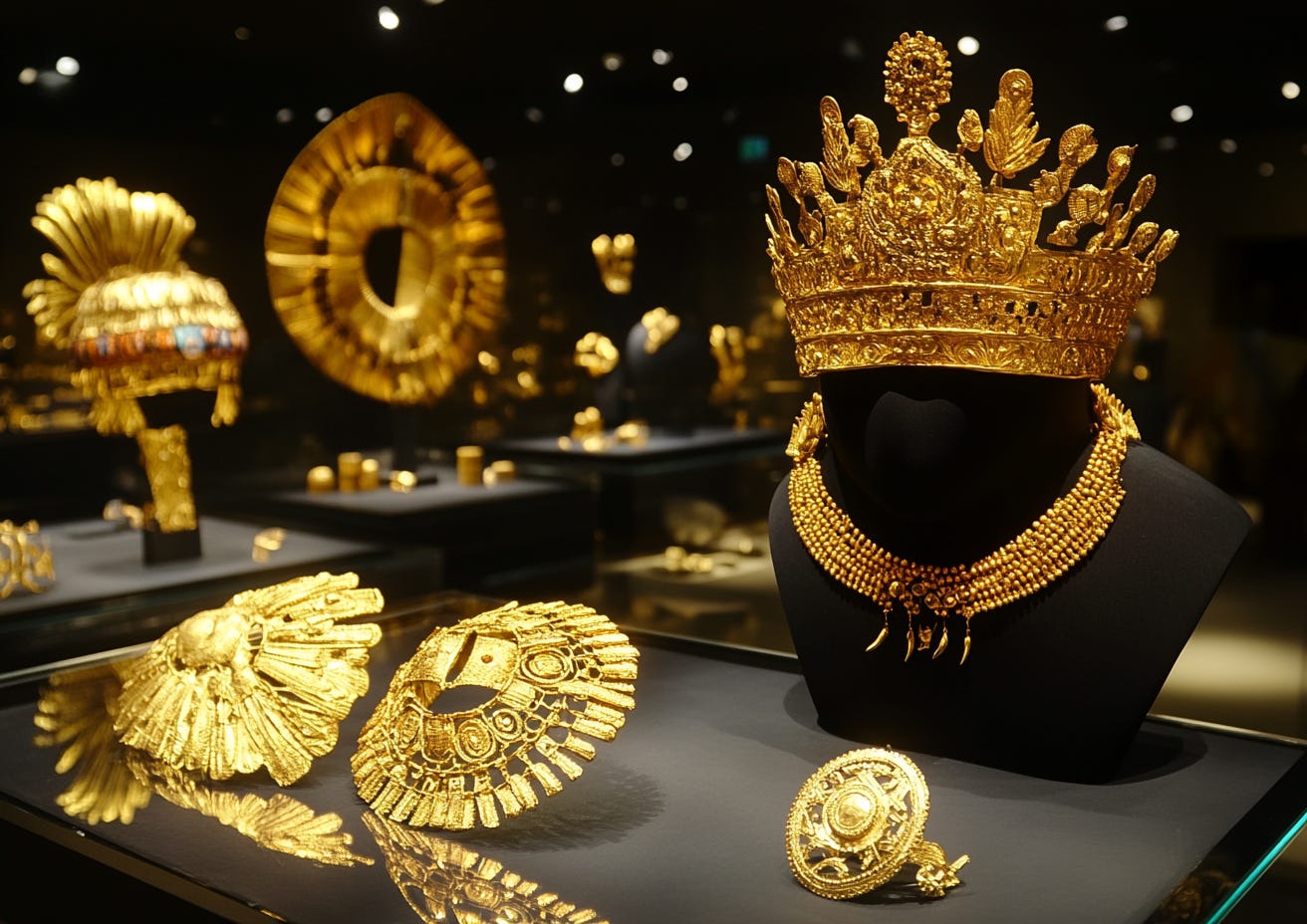
This is a free preview of a paid episode. To hear more, visit www.theflyingfrisby.comLet me quickly flag three things: * There is a short note at the end of this piece on the subject of bitcoin treasury companies, which I know is of interest to some of you. * We now have a video version of last week’s thought piece about the housing market. * I am in Palm Springs, California, all next week. If any readers from that neck of the woods fancy meeting up, I’ll be performing at the Punching Up Comedy Night with Adam Carolla, Thai Rivera and Lou Perez, and also doing various panels at Freedom Fest on gold and bitcoin. You should be able to find me via this QR code. Or send me an email or message.Right, gold … today we ask: Should you invest in gold collectibles?The gold at the Museo del Oro in Bogotá, Colombia, is one of the most stunning collections you will ever see – diadems, helmets and crowns, rings, necklaces and bracelets, beads and breastplates, even fishhooks and penis covers. The smiths of ancient South and Central America were quite brilliant artisans. The Spaniards who saw their work said Aztec goldsmiths were more skilled than their European counterparts.In Mexico, the conquistadors found life-size figures of men and women, great jars and pitchers, half pottery-half gold vases sculpted in relief with birds, animals and insects, and more. In Peru and Ecuador, the conquistadors found miniature gardens made of gold – earth of gold granules, gold cornstalks, and gold figures of men and llamas.Unfortunately, what sits in the Museo del Oro is just a fraction of what was made. The Spaniards valued bullion on weight alone, ascribing no value to art, beauty or workmanship. Most got melted down before being sent home. What they sent to their king intact got melted down once back in Europe. “What was being destroyed was more perfect than anything they enjoyed and possessed,” said a young priest travelling with the conquistador Francisco Pizarro.The conquistadors were by no means alone in this. It has happened repeatedly through history. Though gold may last, art made from gold rarely does. People always seem to melt it down. That should mean ancient gold workings should command an even higher premium for their antiquity, because they have survived the meltdown risk. But for some reason, it doesn’t seem to work like that.You can’t destroy gold, as I’m sure you know. It lasts forever and never loses its shine. It was present in the dust that formed the solar system, and sits in the Earth’s crust today, just as it did when our planet was formed some 4.6 billion years ago.That means that little bit of gold you may be wearing on your finger or around your neck is actually older than the Earth itself. In fact, it is older than the solar system. Who knows? It might once have adorned a pharaoh or sat in a conquistador’s treasure chest. Gold may be antique, but it’s very rare that you get vast premiums for its antique value.Buying gold or silver? The dealer I use and recommend is the Pure Gold Company. Pricing is competitive, quality of service is high. They deliver to the UK, the US, Canada and Europe or you can store your gold with them. Find out more here.The gold coinage that never wasIf you buy a gold sovereign minted recently, you would typically pay £600 to £630. For a Victorian sovereign minted 150 years ago or more – which has the same gold content – you would pay £660 to £680. So, for all that history and antique value, you pay just 10%. Sovereigns are not uncommon. A billion are thought to have been struck. So you get little rarity value. But even so, you’d think you would get more of a premium.The main exception is the 1937 sovereign struck for Edward VIII. Since he abdicated a few weeks before the coins were struck, they were never circulated. They are often called the “coinage that never was”, and only a few were ever minted. One sold in 2020 for £1 million. That’s quite the premium. But this is rare.About ten years ago, I picked up a Justinian solidus, minted in 600AD – the solidus was the dominant coin of the Mediterranean after the Roman aureus. I got it for a 20% premium to the spot value of the metal. And I bought it from a shop in W1, so I was paying the Mayfair premium too.An ingot recovered from the SS Central America, which famously sank off the Carolina coast in 1857 carrying Californian gold to New York (and triggered a financial panic because so much bullion was lost), recently went up for auction. It weighed 649 ounces, but it was only 21-carat gold (.875 purity). If melted down, you would have 568 ounces of pure gold, which, at today’s price of $3,300 per ounce, would have a spot value of $1.9 million. It sold for $2.1 million, including the buyer’s premium – little more than the spot value, in other words.Antique gold very rarely catches the huge premium you might think it deserves. Beware graded coinsUnscrupulous coin dealers will often try to flog you graded coins. If a dealer tells you tha

House-Hunting in Stab City, SE4
Enjoyed this vid? Then please like, share and all that stuff. It helps!If you want to read the original article on which this video is based, hee it is.Subscribe to this amazing publication, why don’t you?.If you are thinking of buying silver or gold bullion to protect yourself in these ‘interesting’ times - and I recommend you do - the bullion dealer I use and recommend is the Pure Gold Company. Pricing is competitive, quality of service is high. They deliver to the UK, the US, Canada and Europe or you can store your gold with them. Find out more here.Join my new WhatsApp channel This is a public episode. If you'd like to discuss this with other subscribers or get access to bonus episodes, visit www.theflyingfrisby.com/subscribe

The Romance of Silver
If you enjoy this article. Please like it, share it and so on. It all helps. I thank you.It’s time for my annual slagging off of silver. Why now?Because, according to one of my WhatsApp chats, it’s breaking out.Silver is always breaking out. It never actually does.Was ever there a metal with as much potential as silver? Probably not.Was ever there a metal you could so wholly depend on to let you down? If there is, I’m not aware of it (though these past 15 years, platinum has been running it close).But maybe, just maybe this time is different.Really?Let’s start with a bit of gossip from the front line.I have three mates who are CEOs of silver mining companies, as you do. All three of them, based in Latin America, have reported back with the same story.Typically, a miner would pay a company — usually a refiner — to take ore off their hands, treat and smelt it, so it can be sold. So-called off-take agreements would usually amount to $120–180 per tonne of ore. But, at the moment, refiners aren’t charging anything. Somebody is subsidising it all.Could it be that humongous, commodity-guzzling nation that begins with a C, I wonder?It wants silver for all those solar panels Ed Miliband is buying.The way things are behaving and moving at the moment, it’s starting to feel like we are moving into a proper commodities bull market. Maybe 2021–22 was just the appetizer.Stop! Don’t get excited. It’s silver we’re talking about here.The case for silver runs roughly as follows:We are in an age of currency debasement, therefore you want to own hard assets. In such an inflationary environment, the monetary metals — gold and silver — perform best. Silver has been money since forever. It is natural money etc etc.Let’s just address that before we move on.Gold is still used as money in the store-of-value sense of the word. National banks keep it. Institutions keep it. Individuals keep it. Gold’s role was always more store of value than medium of exchange. Historically, we used silver, copper and nickel for all but high-value transactions.Silver was not used as a store of value to the extent gold was. Its function was more, as I say, as a medium of exchange. That role has long gone. The gold rushes of the 19th century did for silver.Long story — it’s in my book, which comes out in August — but to cut it short, the vast increase in gold supply enabled nations to abandon silver. In the case of the US, it was the Coinage Act of 1873 — or as silver bugs like to call it, the Crime of ’73 — that began the end of silver as official money. In the UK — largely thanks to the Portuguese discoveries of gold in Minas Gerais (again, long story, it’s in the book) — the process began a good 150 years earlier.In these cashless times, there is little chance of silver regaining its role as medium of exchange.As a result, looking at gold-to-silver ratios — it now takes about 100 ounces of silver to buy an ounce of gold — and saying we are going back to the historical average of 12 or 15:1 is mistaken. There may well only be 15 times as much silver in the Earth’s crust as gold (making 15:1 the natural ratio) but without its role as money, this is just not going to happen. Not for any prolonged period.In the last 100 years, we have only touched this level once — Thursday, March 27, 1980. Uncommon circumstances. Two brothers were trying to corner the silver market.Silver’s role as money is as good as over. Silver bugs hate me when I say that. But I can only say it like I see it.Physical silver in your possession is nobody else’s liability — I get that — and it is outside of the financial system — I get that too. There are many reasons to invest in silver. I own physical silver. But expecting it to be monetised again should not be one of them.If you are thinking of buying silver or gold bullion, the bullion dealer I use and recommend is the Pure Gold Company. Pricing is competitive, quality of service is high. They deliver to the UK, the US, Canada and Europe or you can store your gold with them. Find out more here.If Armageddon comes, you’ll be glad you own silver — maybe — but there will be bigger problems on your plate. Like Armageddon.Everywhere silverSilver has widespread industrial use, especially in these times of mass electrification. You could write a book about the industrial uses of silver, there are so many. It might not be a very good book, but it would be long.From medical equipment to electrical appliances, it’s almost harder to find things that don’t contain silver than things that do. Every smartphone has silver in it; every computer; every jet engine; every solar panel. The best batteries contain silver. It’s used in detergent, deodorant, wart treatment, antimicrobial lab coats, 3D printing, plastics, jewellery, wood preservation, water purification — it’s like a picks-and-shovels play on new tech and the growing middle class of the developing world.Annual silver demand stands at around 1.2 billion ounces. Roughly 60% of that demand — 70
The Coming Corporate Bitcoin Stampede and How to Play It.
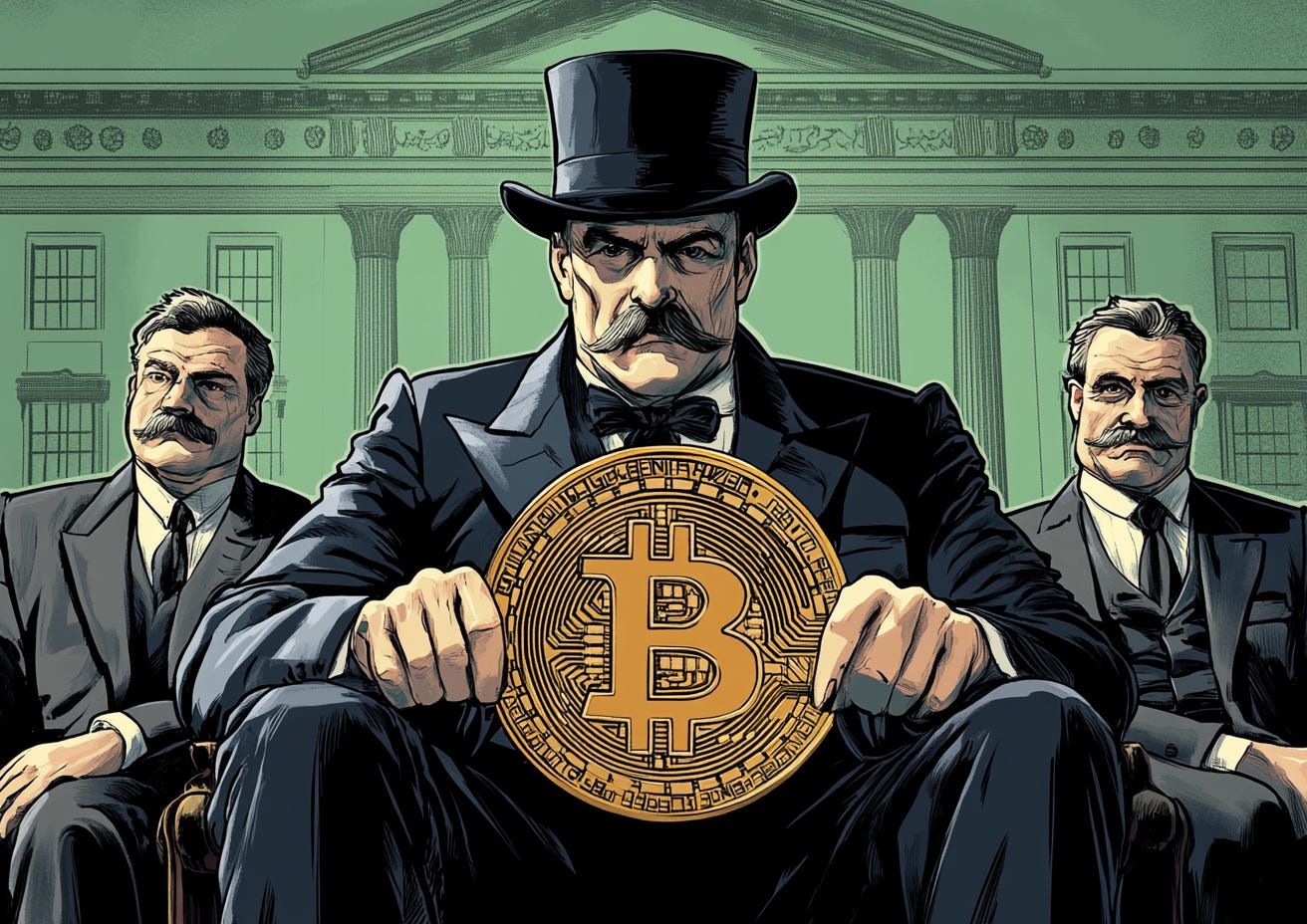
Please do not share, copy, reproduce or distribute any part of this report without my express permission. Thank you.Many thanks to all the new subscribers who have joined this week, both paid and unpaid. I put this video of my recent North Sea Oil piece up on YouTube, X et al and it generated something of a flurry.So welcome. I hope you both enjoy and benefit from The Flying Frisby.Before we get started I just wanted to note that Comstock Lode seems to be catching a nice tail wind, which is good. Enjoy the ride. The AGM is later today for the keener of you out there.But we are looking at bitcoin today, and exploring an alternative way to invest in it.I’m going through one of those phases where I feel like I don’t own enough bitcoin.So I’ve bought more.And I’ve bought it in my SIPP - UK-speak for my retirement account.I’ll explain how in a second.Let’s just have a quick look at the bitcoin price, and note that we are once again breaking out to new highs.I know it feels like you are late to the bitcoin story, and yes we all wish we bought it at $10, when we first heard about it. But we didn’t. We are where we are, and this story is a long way from being over.The next chapter in the odyssey is corporate adoption, and that story is just getting started.I explained the bitcoin corporate treasury model a fortnight ago here, and I’ve made the article freely available to all, so please take a look, but the TLDR is this.Following a template set by billionaire genius Michael Saylor, more and more companies are converting their treasuries to bitcoin as a means to store value and escape currency debasement. Not only that, they are issuing paper—stock, debt, convertible notes—and using the capital raised to buy more bitcoin. In effect, they are creating fiat money from nothing—it is a debt-based system, after all—and using it to buy a finite digital resource (one that, of course, cannot be created through debt).Many are scratching their heads and saying, “How can this be? It’s not possible! It’s a bubble.”What Saylor is actually doing, among other things, is exposing the flaws of debt-based fiat currency. There are now some 70 companies employing this strategy. This will eventually be a stampede, which I urge you to front-run. Corporations have much deeper pockets than private investors, meaning this latest cycle in bitcoin’s mass adoption could become a mega mania.Shareholders welcome dilution if it means more bitcoin. The problem of corporate dilution has been flipped on its head. Once, if a company issued 20% more stock, you would expect the stock to fall by a concomitant amount to reflect the dilution. But if you’re using paper to buy bitcoin, the reverse applies. You can’t dilute enough. The purpose of a bitcoin treasury company is to acquire as much bitcoin as possible on behalf of all shareholders, by whatever means.Here is a case in point.Japanese hotel company Metaplanet (3350:TYO) had a small chain of low-budget hotels across Southeast Asia. Covid decimated the business, and it never fully recovered.A year ago, seeking a new direction, CEO Simon Gerovich began copying the Saylor model and started using his cash flow to buy bitcoin, then he began issuing debt. Since spring 2024, when the company began its strategy, the stock has risen thousands of percent from below ¥20 to north of ¥1,000. Last year, it was one of the best-performing companies in the world, if not the best. How about this for a chart?In the time that bitcoin has risen 60%, Metaplanet has risen more than 7,000%. (Saylor’s Strategy (NASDAQ:MSTR) has also outperformed bitcoin. Bitcoin treasury companies give you gearing).With its crap currency and suppressed bond yields, bitcoin is an obvious place for Japanese investors to put their capital, except the government has got in the way.As with the UK, dumb regulations make it very hard for Japanese investors to buy bitcoin directly. (This came as a result of Mt. Gox, the first bitcoin exchange, which went bust after being hacked in 2013-14). To give you an idea how ponderous things are, to register with a bitcoin exchange in Japan , regulators demand you get a letter by snail mail to verify your address. Nuts.What’s more, when the Japanese sell, they must pay capital gains tax at 55%.But Metaplanet is a Tokyo-listed company, so investors are buying that instead in their retirement accounts and via their brokers. Far less hassle. Just as, back in 2023, I urged UK readers to buy Strategy as a way to play bitcoin (we are up around 1,000%), Metaplanet has become Japan’s bitcoin vehicle—indeed, much of Asia’s.For several days in a row, the company has gone limit-up, and trading has been halted. The mother of all short squeezes seems to be taking place. It’s the most shorted stock in all of Japan - and the short sellers are struggling to cover.This bubble has, quite literally, been caused by state regulation. We wouldn’t be in this situation if it was easy to buy bitcoin. It’s enough to make you a libertar
House-Hunting in Brockley, Stab City, SE4
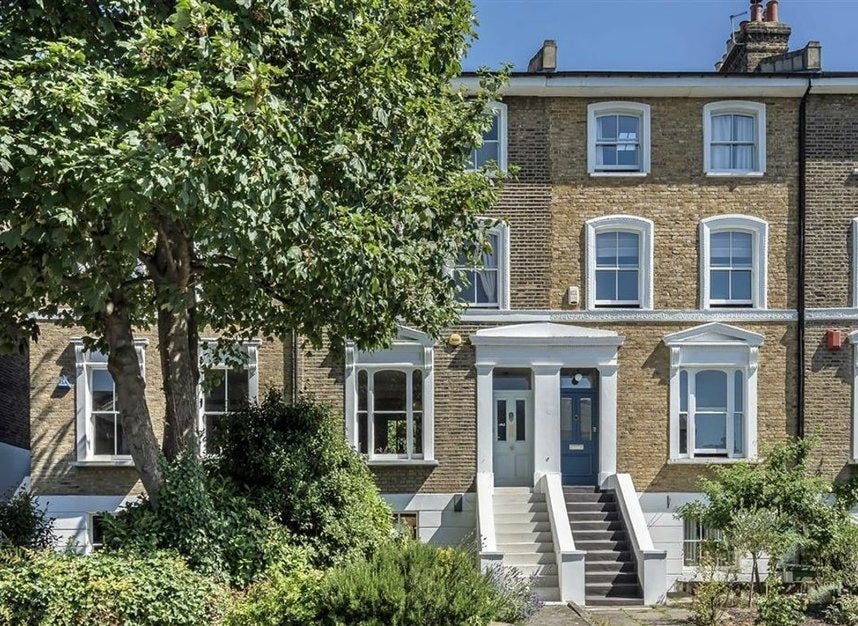
There is also now a video version of this article, if you prefer, here:I’ve been viewing houses this past fortnight, so I thought I’d share my anecdotal 2p on the state of the London property market.I’m looking in Brockley, SE4, which, if you don’t know it, used to be rough AF, but is now where all the cool kids are. The area has benefited from the various London rail line extensions – you can be in Shoreditch or Canary Wharf in 15 minutes; the Jubilee and Elizabeth lines are a similarly short step away – and that has attracted the slay crew to the area. The road links though are still horrendous though, made worse by 20mph speed limits and bus lane misallocation of essential road space. The drive to west London is interminable.Brockley has a good stock of beautiful detached, semi-detached and terraced Victorian houses. For example: With its proximity to Greenwich and the river docks, it was once a wealthy area, though, like most of south-east London, it got bombed to heck in the war.There are plenty of nice parks too. One of them, Hilly Fields, was modelled on Hampstead Heath, and there are many gorgeous houses in the roads running off it. Not quite Hampstead gorgeous, but getting there.Brockley also has the highest density of cemeteries in London, if you fancy dying any time soon, it’s highly convenient. It is, I gather, London’s most haunted area.It is only a bit stabby. Nothing like as bad as neighbouring Lewisham. (Maybe “only a bit stabby” will one day become part of estate agents’ jargon, perhaps to replace “vibrant”. I can’t believe how normalised stabbing now is that I’m talking like that.)The stabbiness is offset, however, by the plethora of nice restaurants, cafés, bars, craft ale breweries, the farmers’ market, mini-festivals, pilates studios et al. I understand, in Browns, the area boasts London’s best coffee and, in Babur, its best Indian restaurant. (Technically Babur is in Honor Oak, but, like England and many of its foreign sporting greats, we’ll claim it as our own.)I shot this vid from the steps up to the station.Brockley feels younger and more up-and-coming than the once-cool areas to the west like Queen’s Park, Kensal Rise, Clapham and so on, probably because of its easy access to east London. (A lot of people from Hackney move down here.)I moved here begrudgingly and skint in 2015 and have grown to really like it.But what about the housing market?I’ve known markets in which estate agents don’t give you the time of day, there are so many prospective buyers, but – perhaps because they know I am an unencumbered buyer – the agents are maybe not quite all over me, but certainly on my case: lots of emails, phone calls and the rest of it. That indicates it’s more of a buyers’ market.But, while I would describe the housing market here as slow, it is not dead. Stuff has been going under offer in the two weeks I’ve been looking, though rarely at asking.With the costs of moving – Stamp Duty is 10% above £925k, and 12% above £1.5m, plus an extra 5% if you own another property – buyers have got to really want to buy.Sellers, meanwhile, have to really want to sell, which often entails reducing their asking prices. Stuff which is unrealistically priced is staying on the market a long time. Look at this one (actually up the road in Honor Oak):This is a 5,000-square-foot property, not so nice inside, but with access to a 2-acre private garden behind with its own tennis court – quite something in London. From £2.5 million to £1.75 million and they still can’t shift it. (It needs a lot of money spending on it.)On the other hand, there don’t seem to be many forced sellers – people who can’t make their payments – and we won’t get any house price crash, long-awaited or not, until that is a reality.I imagine Brockley, as a young, trendy area, is busier than other parts of town, but that is my overall feel: slow, but not dead.I’ve looked at a few family houses. I can’t really comment on flats, but I gather there is an oversupply of 2-bed flats across London, and it is really hard to shift them. I’m not sure if this applies to Brockley or not.It doesn’t feel as expensive as it did around 2019–2022 (realised sales prices are a fraction lower, but there is obviously currency debasement to consider too), but nor does it feel super cheap. We’re a long way off where we were in, say, 2013, even though grander parts of London – Kensington and Chelsea, for example – are back at those 2013 levels.Where does the housing market go from here? It all depends on two things: interest rates and Stamp Duty.Britain’s zombie housing market, brought to you by Stamp Duty.If rates go lower, the market will not collapse. There won’t be the forced sellers. We’ll continue as we are: stagnant. If rates go higher, the market is in trouble.But get rid of Stamp Duty, and you’d have a flurry of activity across the country tomorrow. People aren’t moving because of the amount of dead money involved. Stamp Duty has immobilised the country.If

The Great Orange Man’s Market Moves: What's Next?
This is a free preview of a paid episode. To hear more, visit www.theflyingfrisby.comI’ve had a flood of new readers sign up to the Flying Frisby this week, I’m delighted to report, largely as a result of this article on bitcoin treasury companies and of this video on North Sea oil and the next Labour U-turn, which has been doing the rounds on the net.So welcome everyone. I hope you enjoy the ride.Today’s piece is going to be a bit of a hotchpotch, as I gather my thoughts and tidy up a few loose ends.We’ll start with the macro. Are we in a bull market? Are the animal spirits back in command? Or have we just gone through a bear market rally?It all depends on tariffs, I guess, and what is going on in the Great Orange Man’s mind. What plans does he have? That I cannot answer, but I will say the S&P500 looks like it might have just put in a lower high.We want to be above that blue line.If he goes full tariff again, all bets - well most - are off.But thanks to the Great Orange Man’s pronouncements on uranium, our speculation Lightbridge Fuels (NASDAQ:LTBR) is now enjoying another of its spikes. If he goes full tariff again, all bets - well most - are off.But thanks to the Great Orange Man’s pronouncements on uranium, our speculation Lightbridge Fuels (NASDAQ:LTBR) is now enjoying another of its spikes.Sell the spikes, buy the dips has been the play here. We are on one such spike now, so if the recent pattern continues (it won’t continue forever, nothing does, but it might for a bit) then lighten up between $15 and $20 and buy if it goes back to $9 is the trade.Sell the spikes, buy the dips has been the play here. We are on one such spike now, so if the recent pattern continues (it won’t continue forever, nothing does, but it might for a bit) then lighten up between $15 and $20 and buy if it goes back to $9 is the trade.We have quite a well defined, trade-able range emerging here, as defined by the blue lines below.I don’t see it going back to the $2.50-$3 area, where we were lucky enough to first stumble upon this stock, but $8.50-9 looks like the new floor. For now.Remember: this was an $800 stock once upon a time, so there is a lot of upside left. One should probably keep some money on the table, in case we don’t get the dip.Tell your friends.The next Starmer U-turnTurning next to the issue of the re-opening of the North Sea. Since posting that video our Glorious Leader has tightened ties with the EU, and in particular relevance here, its net zero goals. The UK now commits to net zero obligations “at least as ambitious as the EU”. “Want to get out of net zero?,” says Lord Frost in the Telegraph, “Tough: you can’t, unless the EU agrees”.That said I am sure Captain FlipFlop will find a way of flipflopping his way round any North Sea ties and then spinning it. There is a review this week. Surely even this government will realise importing Norwegian gas for (net) zero tax take, fewer jobs and a higher carbon footprint than producing our own makes (net) zero sense. More importantly it is gifting Reform. Maybe the needs of the Treasury mean Milibrain - Miliband gets overruled. We will know more as soon as today.Adding another bitcoin treasury company to my portfolioIn a moment, I am going to take a look at Comstock Lode (NYSE:LODE), further to its AGM this week. I know I keep talking about this company, but it might be the one we all retire on - hence my outsized attention.But first I also want to continue on the bitcoin treasury company story.(Despite the outperformance of the treasury companies of late, I still prefer bitcoin and think it should be a core holding. The treasury companies are rather more speculative. However, given the hassle involved, I understand why some in the UK prefer the treasury companies).How about this for nuts? The UK’s Smarter Web Company (ISIN: GB00BPJHZ015) hit a market cap of £175 million yesterday. Its assets: it has about £5 million in bitcoin.The dude who founded it, Andrew Webley, was a month ago running a web design firm in Guildford with net assets of less than £50,000. In the company's Retail Investor IPO document, he committed to invest a minimum of £30,000...through his ISA”. (h/t Glen Goodman)This will not end well. And we have the FCA to thank. It has made it so difficult to buy bitcoin, investors are buying this company and others like it instead.If, like many readers, you are playing this one, make sure you get your original investment out, is my advice …Meanwhile, Metaplanet (3350:TYO) briefly lost a third of its value last week, falling below ¥800. Now it’s above ¥1,200, at all-time highs, trading at 450% of the value of its bitcoin.It’s a mania all right.I’m adding another position, in a stock which has some recent history of manias.What is it? Ah-ha …

Glasgow: OMG
Good Sunday morning to you,I am just on a train home from Glasgow, where I have been gigging these past two nights. I’ve had a great time, as I always seem to do when I go north of the wall.But Glasgow on a Saturday night is something else. My hotel was right next to the station and so I was right in the thick of it. If I ever get to make a cacatopian, end-of-days, post-apocalyptic thriller, I’ll just stroll through Glasgow city centre on a Friday or Saturday night with a camera to get all the B roll. It was like walking through a Hieronymus Bosch painting only with a Scottish accent. Little seems to have changed since I wrote that infamous chapter about Glasgow in Life After the State all those years ago. The only difference is that now it’s more multi-ethnic. So many people are so off their heads. I lost count of the number of randoms wandering about just howling at the stars. The long days - it was still light at 10 o’clock - make the insanity all the more visible. Part of me finds it funny, but another part of me finds it so very sad that so many people let themselves get into this condition. It prompted me to revisit said chapter, and I offer it today as your Sunday thought piece.Just a couple of little notes, before we begin. This caught my eye on Friday. Our favourite uranium tech company, Lightbridge Fuels (NASDAQ:LTBR), has taken off again with Donald Trump’s statement that he is going to quadruple US nuclear capacity. The stock was up 45% in a day. We first looked at it in October at $3. It hit $15 on Friday. It’s one to sell on the spikes and buy on the dips, as this incredible chart shows.(In other news I have now listened twice to the Comstock Lode AGM, and I’ll report back on that shortly too). ICYMI here is my mid-week commentary, which attracted a lot of attentionRight - Glasgow.(NB I haven’t included references here. Needless to say, they are all there in the book. And sorry I don’t have access to the audio of me reading this from my laptop, but, if you like, you can get the audiobook at Audible, Apple Books and all good audiobookshops. The book itself available at Amazon, Apple Books et al).How the Most Entrepreneurial City in Europe Became Its SickestThe cause of waves of unemployment is not capitalism, but governments …Friedrich Hayek, economist and philosopherIn the 18th and 19th centuries, the city of Glasgow in Scotland became enormously, stupendously rich. It happened quite organically, without planning. An entrepreneurial people reacted to their circumstances and, over time, turned Glasgow into an industrial and economic centre of such might that, by the turn of the 20th century, Glasgow was producing half the tonnage of Britain’s ships and a quarter of all locomotives in the world. (Not unlike China’s industrial dominance today). It was regarded as the best-governed city in Europe and popular histories compared it to the great imperial cities of Venice and Rome. It became known as the ‘Second City of the British Empire’.Barely 100 years later, it is the heroin capital of the UK, the murder capital of the UK and its East End, once home to Europe’s largest steelworks, has been dubbed ‘the benefits capital of the UK’. Glasgow is Britain’s fattest city: its men have Britain’s lowest life expectancy – on a par with Palestine and Albania – and its unemployment rate is 50% higher than the rest of the UK.How did Glasgow manage all that?The growth in Glasgow’s economic fortunes began in the latter part of the 17th century and the early 18th century. First, the city’s location in the west of Scotland at the mouth of the river Clyde meant that it lay in the path of the trade winds and at least 100 nautical miles closer to America’s east coast than other British ports – 200 miles closer than London. In the days before fossil fuels (which only found widespread use in shipping in the second half of the 19th century) the journey to Virginia was some two weeks shorter than the same journey from London or many of the other ports in Britain and Europe. Even modern sailors describe how easy the port of Glasgow is to navigate. Second, when England was at war with France – as it was repeatedly between 1688 and 1815 – ships travelling to Glasgow were less vulnerable than those travelling to ports further south. Glasgow’s merchants took advantage and, by the early 18th century, the city had begun to assert itself as a trading hub. Manufactured goods were carried from Britain and Europe to North America and the Caribbean, where they were traded for increasingly popular commodities such as tobacco, cotton and sugar.Through the 18th century, the Glasgow merchants’ business networks spread, and they took steps to further accelerate trade. New ships were introduced, bigger than those of rival ports, with fore and aft sails that enabled them to sail closer to the wind and reduce journey times. Trading posts were built to ensure that cargo was gathered and stored for collection, so that ships wouldn’t swing idl
The Next Labour U-Turn
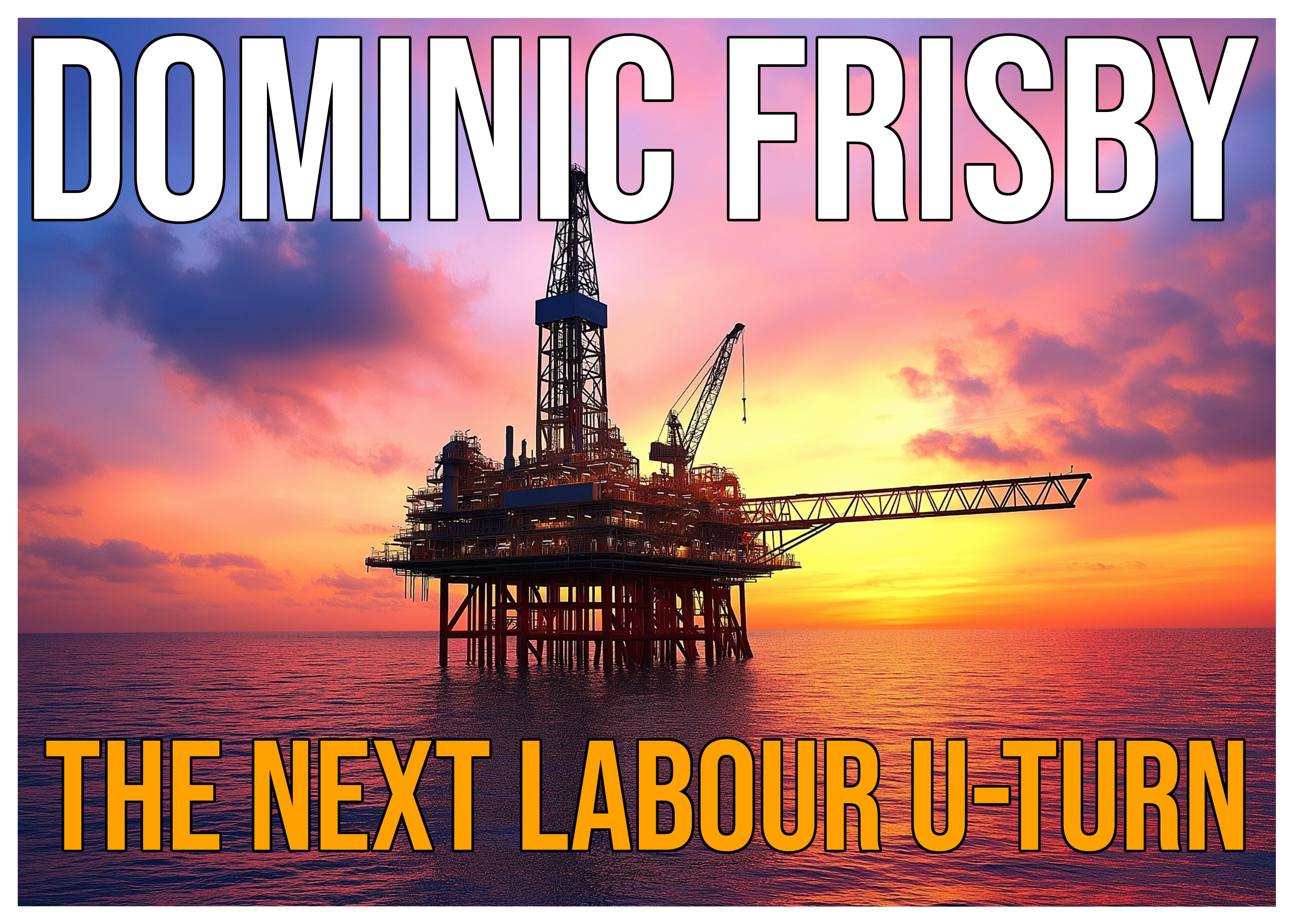
Tell your friends about this vid.You’ll find the full list of North Sea Oil Cos here, in the second half of the article:Subscribe to this wonderful publication.If you are thinking of buying gold to protect yourself in these uncertain times, the bullion dealer I use and recommend is the Pure Gold Company. Pricing is competitive, quality of service is high. They deliver to the UK, the US, Canada and Europe or you can store your gold with them. Find out more here. This is a public episode. If you'd like to discuss this with other subscribers or get access to bonus episodes, visit www.theflyingfrisby.com/subscribe

Why John Cleese is the World's Greatest Comedian
At the Battle of Ideas last October I went head to head with comedians Simon Evans, Nick Dixon, Paul Cox, Cressida Wetton and Ethan Green to debate who is the greatest. I made the argument that it was John Cleese. My initial pitch has just been released, so here, for your Sunday morning consideration, it is. I ended up winning the debate, but it was a close shave.Who, in your view, is the greatest? And why? Please let me know in the comments.If you enjoyed this video, please give it a like, share it somewhere, all that stuff. Thank you!And please subscribe to this excellent Substack, if you haven’t already.Speaking of comedy, there are still a handful of tickets left for my show on Tuesday, if you happen to fancy some subversive musical satire. That’s the Mid-Year Review on Tuesday, May 20 in London in sunny East London. I am just going through the set list - it is going to be an epic night. In other news, for long-suffering shareholders in STLLR Gold, the company just announced its latest PEA and MRE. We have been waiting a long time, and the market did not like it one bit. While the resource, 11 million ounces, is huge, the CAPEX to build this mine, $1.87 billion, is even huger. At $3/oz in the ground, it’s hard to think of a mining company that’s as cheap. But those ounces are cheap for a reason. Here, in case you missed it, is my write up from yesterday.Until next timeDominicIf you are thinking of buying gold to protect yourself in these uncertain times, the bullion dealer I use and recommend is the Pure Gold Company. Pricing is competitive, quality of service is high. They deliver to the UK, the US, Canada and Europe or you can store your gold with them. Find out more here. This is a public episode. If you'd like to discuss this with other subscribers or get access to bonus episodes, visit www.theflyingfrisby.com/subscribe

Is BBC Comedy Politically Biased?
Today, using the political compass as our mapping tool, we explore diversity of opinion in BBC Radio comedy.The political compass, as I’m sure you know, incorporates the, in my view, more important authoritarian and libertarian, as well as left and right.If you enjoyed this video, please give it a like, share it somewhere, all that stuff. Thank you!And please subscribe to this excellent Substack, if you haven’t already.In case you missed them, here are my pieces from earlier in the week.Gigs Coming UpHere is a list of shows I have coming up, in case of interest.The big one is The Mid-Year Review Wearing on next Tuesday, May 20 in London. Otherwise it’s:* London, Crazy Coqs, May 14. SOLD OUT. (Waiting list only)* London, Backyard, May 20. The Mid Year Review Tickets here* Sevenoaks, Out of Bounds Comedy Club, July 11. Tickets here.* Bedford, Quarry Theatre, July 27. Tickets here.* London, Crazy Coqs, Sept 24. Tickets here.* London, Crazy Coqs, Nov 5. Tickets here.* London, Crazy Coqs, Dec 3. Tickets here.Happy Sunday! Until next time,DominicIf you are thinking of buying gold to protect yourself in these uncertain times, the bullion dealer I use and recommend is the Pure Gold Company. Pricing is competitive, quality of service is high. They deliver to the UK, the US, Canada and Europe or you can store your gold with them. Find out more here. This is a public episode. If you'd like to discuss this with other subscribers or get access to bonus episodes, visit www.theflyingfrisby.com/subscribe

Bitcoin’s Corporate Revolution: How Michael Saylor Is Reshaping Finance
Fun fact: the only countries that own more bitcoin than the UK are the US (which own 207,000) and China (194,000). The UK has 61,000 bitcoin - worth almost $6 billion.They are mostly seized bitcoin, a lucky legacy from the early days when the UK was at the heart of bitcoin’s evolution. (Remember Satoshi Nakamoto wrote in British English, the Times was referenced in the Genesis block, and many of the early conferences and meet-ups happened here). The FCA, in its wisdom, put a stop to all that, and so we fell behind.The stupidest thing our Chancellor can do, even with the parlous state of the national finances, is to sell those bitcoin. History would look back on her as an even greater fool than Gordon Brown for selling the national gold.This legacy has given the UK an extraordinary advantage in the global arms race that is bitcoin adoption. We would be mad to spurn it.Meanwhile, something extraordinary is taking place in the corporate world of bitcoin adoption, and I think it is going to accelerate rapidly very soon.It is being spearheaded by Michael Saylor, Chairman and Founder of Strategy (NASDAQ:MSTR).I recommended MicroStrategy, as it used to be called, to readers back in August 2023, largely because it was a means to get bitcoin exposure via your broker. You wouldn’t have to jump through all the hoops of buying bitcoin through exchanges, which the FCA has made so difficult.It has been a big win for readers, having more than 12x’d since we tipped it, outperforming bitcoin by a considerable margin. (Bear in mind it has undergone a 10-for-1 stock split since that article.)You really should upgrade your subscription :)Strategy now has some 555,450 bitcoin, meaning it has more bitcoin than any other publicly traded company in the world (excluding the ETFs, which now hold 1.35 million). Note again: there will only ever be 21 million bitcoins - rather less if you discount the 2.5 million that have likely been lost, and the 1.3 million that Satoshi never touched and probably never will).Saylor is also the world’s most articulate and charismatic proponent of bitcoin. The man is a genius, and I do not use that word lightly. He has turned Strategy from a quiet, business intelligence software firm, which traded sideways for 20 years with a market cap less than $2 billion, into one of the most talked-about and traded stocks in North America with a market cap north of $100 billion. Options traders love it.His method for doing so - extraordinarily bold at the time, though now it looks easy - was brilliantly simple. He bought bitcoin. He was worried about the erosion of the value of the corporate treasury due to inflation and currency debasement. he started slowly. Then, in buying bitcoin and using it, as tends to happen, he caught the bitcoin bug. He started issuing paper - stock, debt, convertible notes - and bought more bitcoin. Just last week he bought another 1,895 bitcoin, funding the purchase with sales of common and preferred stock.In effect, he is creating money out of (almost) nothing and using it to buy the hardest money in the history of mankind. (Sorry, goldbugs - and you know I’m on your team - but bitcoin is harder money, because the supply is more finite).In doing so, he has enabled many of his investors to retire early.But he has also set in motion something quite extraordinary.Other companies are starting to follow his model. I’m surprised more haven’t, but it takes extraordinary courage and vision to do what he did, as demonstrated by the fact that more companies haven’t copied him. They’re too cautious. Even with him having blazed the trail and shown the way.I think there’s a very good chance Strategy becomes a trillion dollar company, while Michael Saylor becomes the world’s richest man.To call the pre-bitcoin Strategy a zombie company is harsh, but it was not really going anywhere. Interestingly, it is zombie or near-zombie companies with large treasuries that are most likely to follow the Saylor model. Their need for a new direction is greater.Microsoft (NASDAQ: MSFT) recently gave Saylor 5 minutes - 5 minutes! - to pitch his model to them, and duly ignored it. It is their loss. But Microsoft is Microsoft. At the moment, it doesn’t need bitcoin, and it doesn’t need to take the risk.GameStop (NYSE: GME), on the other hand, is a different matter. Remember GameStop from 2021 and all those memes during lockdown? The video game retailer had more than 3,000 outlets, and its business model was considered defunct. People buy games online now. But some private investors noted that the short position exceeded 100% of the issued shares of the company, and started buying. The ensuing short squeeze sent the stock from $17 to north of $500, and, it is said, almost broke Wall Street. (Not quite, but you get the point).The problem is GameStop’s business model is somewhat defunct. This year, it closed over 400 stores. This week, it sold its Canadian outlets.But the company has about $4.7 billion in cash, low debt

Cats, Comedy, Kilburn and Currency
I thought I might share a few random bits and bobs from my little life for you to ponder today, starting with various interviews.Here I am on the mighty James Delingpole’s podcast, talking about most subjects, though squabbling about conspiracy theories.Then there is this interview with Jasmine Birtles for the Money Magpie podcast, talking mostly about gold and property. (Audio on Spotify; video on YouTube). Also this radio interview with ABC Australia, I was quite pleased with. Here it is.And, if bitcoin is your thing, here I am on the Discovering Bitcoin podcast.Right. That’s all the interviews done.A Thief in our MidstTurning to matters closer to home, there is a beautiful cat, pictured below, which belongs to a Chinese lady, who lives three doors up. She visits my garden every morning (the cat not the Chinese lady) as I am getting my 15 minutes of sun, purrs seductively, gets stroked, and then wanders off on its day to do who knows what. If I leave the back door open, she will come into my house and visit me at my desk, stretch out luxuriantly and, if I pick her up, start padding my chest pleasantly. I thought we had become friends.Well, you can’t trust anyone.I now discover this feline fiend has been sneaking into my son’s room to steal his socks, which it then brings back to its owner three doors up. Here it is. Caught red handed.A Rare Trip to the TheatreOn Wednesday I went to see The Comedy About Spies in the West End. It’s not something I would have normally gone to watch, but my friend Tom Woods had some tickets he couldn’t use and so off I went with my next door neighbour. I thought it was terrific. Thank you Tom!I’m obsessed with farce. Always have been since I first watched Fawlty Towers as a little boy. (I actually did my university thesis on Fawlty Towers). It’s my favourite form of theatre by a country mile. I love the precision of it, along with the heightened emotion and panic. Done well there is no better narrative form, in my opinion. Films like Midnight Run and TV series like Curb Your Enthusiasm, in my view, embrace farcical plot schemes. But if you want a farce in its purest form on film, watch What’s Up Doc. Just the best.The premise of The Comedy About Spies is a little bit forced, but the jokes are fab, there are hundreds of them, one after the other, they are brilliantly executed and with incredible precision - it’s wonderful to see a show this tight. By the end I even found myself moved by the characters. I LOLed many times. What can I say? It’s really good. What’s your favourite farce? Let me know in the comments.The South Africanisation of EverythingIn other, less positive news, on Tuesday evening I found myself walking down the Kilburn High Road for the first time in about 25 years. It was always a bit rough around the edges - up there with Elephant & Castle and Streatham High Road as one of London's most worst thoroughfares - but my God it was eye-opening as to where the UK is going / has gone.Litter everywhere, people off their faces, drugs being dealt openly on the street, beggars, a woman knocked over by a bloke cycling a Lime bike on the pavement, the bloke unapologetic, little trust between visible between people in this multi-cultural mayhem. Talk about lack of cohesion. (I drove through Harlesden the other night and that was bad too).It confirmed my theory of the South Africanisation of everything. (Actually it’s my friend Alex’s theory, but I have purloined it). It prompted me to dig up this piece from a couple of years back, which at one point was the most read piece on this ‘ere Substack. On re-reading it now, I’m rather proud of it. Recommended.The Secret History of GoldIn personal news, I am glad/relieved to say I submitted the final proofs for my new book on gold which comes out in August - the Secret History of Gold (I haven’t actually announced it yet, which I will in due course). Writing a book is an enormous undertaking. Publicising it is an even greater one. I’m glad stage one is complete.How about this for a fact?In 1930 the price of gold was £4.25 per ounce, as it was in 1716 when Isaac Newton set the price over 200 years earlier. FOUR POUNDS 25p. Today it's £2,475 per ounce. From £4.25 to £2,475. That's how much we've been robbed by currency depreciation.How have they (successive governments) been able to get away with this?Because representative democracy does not work is why.Thank goodness for gold. Thank goodness for bitcoin. Speaking of which:As always, if you are looking to buy gold, the bullion dealer I use and recommend is the Pure Gold Company. Pricing is competitive, quality of service is high. They deliver to the UK, the US, Canada and Europe or you can store your gold with them. Find out more here.The Mid-Year ReviewWearing my satirical comedy hat, I have a big gig coming up on May 20 in East London. These nights are usually pretty memorable - and for the right reasons.If you are free, come along. You can get tickets here. It would be great to

Rare Signal Flashes Bullish: Is the Tariff Tantrum Over? US Mining Boom Incoming?
This is a free preview of a paid episode. To hear more, visit www.theflyingfrisby.comI spoke about gold this week to ABC Australia. This little interview may be of some interest. Here it is. Meanwhile …It’s as though the whole tariff thing never happened, the way stock markets are rallying. I think it’s seven green days in a row now.Everybody is getting very excited about a rare technical signal we got last Thursday - - there have only been 16 of them since the S&P500 was created in 1957, including the latest on April 24, 2025. But this signal has a 100% reliability record, and has been followed by average 6-month returns of 15% and a 12-month returns of 23%. That’s a pretty stellar record. So I just wanted to offer my 2p.The indicator - the Zweig Breadth Thrust Indicator (ZBT) - was first observed in the 1986 Martin Zweig book, Winning on Wall Street (which I confess to not having read). It occurs when a market swings from an oversold to an overbought reading within 10 trading days.Eight of them have occurred since the book was published: in 2004, in 2009 (shortly after the March lows at 666), in 2011 after the taper tantrum, in 2013, 2015, 2018 and in 2023 twice. Now we have one coming off the “tariff tantrum”, as I’ve just dubbed it.However, before you go out and gamble your entire life savings, note that back in 2015 technical analyst Tom McClellan published a detailed study of ZBT signals, which went back much further than the 1957 formation of the S&P500 - all the way to 1928.During the bear market of the 1930s Great Depression, there were multiple occurrences of the signal - 14 of them - and it was horribly unreliable: 10 led to losses or negligible gains, 2 preceded strong rallies, and 2 were flat. It was useless, in other words.So, in short, it’s been good since 1957, but was rubbish before. A bit like stereos.There are plenty of reasons to remain cautious. The high levels of volatility we are witnessing are consistent with a bear market not a bull market. There are also high levels of uncertainty: what is actually going to happen with tariffs? Nobody quite knows. I’m not sure even the President. Plus we are going into May, usually a weak time of year for the stock market. And it may be that the consequences of Trump’s tariff talk have not yet been felt in the US on the ground. One argument is that there has been a huge drop off in container ships leaving China. A container would typically take 30 days to reach LA, and another 10-20 days to get to the major cities - Houston, Chicago, New York et al. So the drop-off in container ships leaving China after Liberation Day won’t be felt until mid-May. If there is a pick up in shipments, that wouldn’t be felt till another month after that. Some are saying supply shortages are coming to the US. Have a read of this and see what you think. Markets usually price this kind of stuff in, but you never know. Cui bono?Among the sectors that should benefit from Trump’s America first policies are US domestic mining and manufacturing. Here the regulatory environment is changing fast. Trump signed an executive order on March 20 with the aim of accelerating production of critical minerals. Federal agencies have actually been mandated to look to the US for priority metals - copper, gold, nickel, uranium and so - when they previously looked abroad. We are already seeing faster permitting. I hear that formerly dormant projects are seeing activity for the first time in years. Emails are being answered promptly, applications are being processed, even in states like California. This new environment is positive for oil and gas producers, miners, explorers and developers in the US. The problem is that commodity prices have dropped off a cliff. There’s always a catch.Even so, one company that should benefit from this new macro environment is this potential multi-bagger.On which, note I wanted to give you a related heads up.

Which Foods Contain Seed Oils? An Exposé
We have a video for your Sunday thought piece today, in which I walk round my local supermarket and identify all the foods which have seed oils (spoiler - almost all of them).Ever wondered which foods in your supermarket are packed with seed oils? Join me on a clandestine mission around my local shop to unveil some hard truths about pizzas, hummus, sausage rolls, and even granola. Seed oils infiltrate nearly every packaged item—and you should care. By the way, my original piece on seed oils is one of the most read articles on this substack, interestingly enough. Here is is, if you haven’t already read it:I hope you find it useful and/or entertaining.Have a lovely Sunday.DominicPS ICYMI, here’s my midweek commentary:As always, if you are looking to buy gold, the bullion dealer I use and recommend is the Pure Gold Company. Pricing is competitive, quality of service is high. They deliver to the UK, the US, Canada and Europe or you can store your gold with them. Find out more here. This is a public episode. If you'd like to discuss this with other subscribers or get access to bonus episodes, visit www.theflyingfrisby.com/subscribe
Things Are Getting Frothy - Here Are Six More Reasons Not to Sell Your Gold
This is a free preview of a paid episode. To hear more, visit www.theflyingfrisby.comGold again today. I just can’t stop writing about it.Another day. Another new high. We touched $3,500 in the early hours of yesterday morning.That’s 27 new highs in the gold price so far this year.Yet there is still something about this bull market that doesn’t feel right or complete: it’s not confirmed by silver, which should be trading north of $50. Instead it’s mired around $32. Nor is this bull market confirmed by the miners, which, in most cases, are nowhere near all-time highs.Nevertheless, on the basis of gold’s price relative to equities, commodities and houses, as outlined last week, gold is starting to look expensive. Is it time to have an eye on the exit?In the short term, maybe. It’s overbought. We are going into a weak time of year for gold (May to August). But that’s why I like physical. It stops you trading!How about this for a chart?It now takes more work than at any time in the last 100 years to buy an ounce of gold.This is as much a function of declining wages in real terms, and the erosion in value of fiat, as it is the price of gold, but all the same it’s pretty incredible: how we’ve all been lied to!There are, though, many signs that gold is now fully valued.But these are not normal times.And a “proper” bull market will see blow-off tops in silver and the miners. We don’t have that yet.Let me give you six more reasons (ie largely previously unmentioned reasons) not to be selling your gold.1. You live in the UK.(This is one I have mentioned before). Do not be fooled by the fact that the pound has been performing relatively well in the foreign exchange markets this year. It has lost 37% of its purchasing power since 2020 and has repeatedly proven to be a rotten store of value.The interest on UK gilts is rising, meaning it is getting increasingly expensive for the government to pay for its own debt. We’re above Liz Truss levels and the trend is rising.We’ve got high energy costs too.What this government is actually doing to rein in its spending is one thing. What needs to be done is something else. There is no Elon Musk taking the guillotine to it all. The scale of our government inefficiency, waste, corruption, misallocation of capital is both larger, relative to GDP, and more entrenched than in the US. At the level of government we are not even having a conversation about what needs to be done, let alone actually doing anything.Nor is there any likelihood of this country re-industriali sing. We’ll just have to hope people buy our services, what few we offer. In the meantime we’ll keep borrowing to pay for stuff.The only way is currency debasement. There has never been a Labour government that did not devalue sterling. Think this one will be any different? Do not store your wealth in sterling. They take enough from you in taxes as it is. Don’t let them take any more.As always, if you are looking to buy gold, the bullion dealer I use and recommend is the Pure Gold Company. Pricing is competitive, quality of service is high. They deliver to the UK, the US, Canada and Europe or you can store your gold with them. Find out more here.2. Chinese retailI’m endlessly wittering on about China’s central bank buying gold, but one thing I confess I’ve overlooked is Chinese retail buying. Its real estate and stock markets have both been rubbish, the former especially, so they are buying gold instead. Then think about the sheer size of China’s retail market: over a billion potential buyers. Never mind central bank buying, the potential scale of this thing is enormous. What if they al buy an ounce each?When do they stop buying and start selling? When their real estate and stock markets pick up … Meanwhile, China’s central bank, the PBOC, which says it bought 5 tonnes last month, actually bought ten times that. (De-dollarisation, which is perhaps the biggest factor of the lot, except re-monetisation, does not even make it onto this list as I‘ve covered it so many times before).3. What about Western retail? What about Western institutions? Western retail and institutional investors have been slow to this bull market and are under-allocated. As my buddy Ross Norman says, “this gold rally has not, to date, been driven by retail investors buying coins and bars, high net clients clamouring for physical, nor institutions buying the gold ETF, not even speculative flows to any great extent. This has been an incredibly low participation rally. A stealth run even”. Portfolios are roughly 2% allocated to gold at present. They were four times that at the peak of the last bull market in 2011. That means a lot of room for more Western buying.Since the confiscation of Russian assets, central banks have bought every pullback to the 50-day moving average. But it’s not just central banks now, retail and institutional investors the world over are coming to the party. And if you think they’re underweight gold, wait until you see how underwei
When Should You Sell Your Gold?
This is a free preview of a paid episode. To hear more, visit www.theflyingfrisby.comCongratulations to all who bought. Gold is now trading above $3,300. Goldman Sachs has raised its target to $4,000/oz. It’s all going swimmingly. But nothing lasts forever.(Actually gold does, but you know what I mean).So, today, I want to ask: when do we sell our gold?To answer that question, I am going to look at some long-term ratios.How is gold looking relative to stocks, to other commodities and against house prices? (We’ll look at gold versus house prices in the US, the UK and Australia).There is a strong argument, by the way, for never selling your gold, especially if you’re in a country such as the UK with an unreliable national currency. If you don’t need the money, keep the gold and pass it on to your heirs - and tell them to do the same. But macro conditions are not always as gold-friendly as they are now. See the 1980s and 90s for more details.What’s more, given how these trade wars are unfolding, with unpayable levels of debt across the western world and China’s extraordinary accumulation of gold, there is a significant chance - say, 25% - that gold ends up being remonetized somehow.(If China wants global reserve status for its yuan, it’ll almost certainly have to make it exchangeable for gold - meaning higher gold prices. But even if not, all China has to do is declare it’s real gold holdings, and the price will rocket).In the event of remonetisation, which also means some kind of crisis, gold prices will be dramatically higher. However, it’s also likely that your gold would either be confiscated or heavily taxed, so that the gains from the revaluation (aka fiat devaluation) pass to the state rather than the citizen, as happened in the US under Roosevelt in 1933.But let us leave such speculation for another day.As always, if you are looking to buy gold, the bullion dealer I use and recommend is the Pure Gold Company. Pricing is competitive, quality of service is high. They deliver to the UK, the US, Canada and Europe or you can store your gold with them. Find out more here.Gold vs StocksI want to start with the Dow-to-Gold ratio: how many ounces of gold does it take to buy the Dow?There is much history in this chart. It’s quite something.You can see how, most of the time, the ratio stays within that green band. It is only at points of maximum extremity that it goes beyond, such as:* The peak of the stock market in 1929* The Great Depression in 1932* The suppression of gold in the 1960s, ending with the collapse of the gold standard in 1971* The peak of 1970s gold mania, inflation, and the Soviet invasion of Afghanistan* The end of the gold bear market in 2000 and the peak of DotcomToday, with gold at $3,300 and the Dow at 40,000, it takes 12 ounces of gold to buy the Dow - and we are in the low- to mid-range of that green prediction band.At the peak of the last gold bull market in September 2011, the ratio reached 5.7.To reach such a level again, either the gold price would have to double (possible) or the Dow would have to halve (unlikely, I would have thought). Most probable is something along the lines of the Dow falling 25% and gold rising another 50%.Would this ratio ever go to 1:1, as it did in 1980? If so, we would be looking at a gold price in the tens of thousands.It’s possible, I suppose.I think a ratio of 5-8 is a reasonable possible target. Here’s a similar history of gold against the S&P 500:Today, we are at 1.7. It takes 1.7 oz to buy the S&P.The ratio reached 0.2 in the 1930s and 1940s. It went to 0.13 in 1980.I doubt we’ll see that again.But that 2011 level of 0.6, or perhaps even a little below if things get really spicy, is not an unreasonable target, I suppose. That could mean the S&P500 at 4,200 and gold at $7,000/oz. Something like that.So that’s some bull food for you.In the interests of balance, let’s now put some bearish fodder on the menu.We’ll start with gold versus oil - and the bad news. Then we’ll look at gold and house prices.

The Mystery of America's Gold - VIDEO
I’m excited to share a brand-new video diving into one of the most gripping questions in finance and geopolitics: How much gold does America actually have? You may have read my piece on this from a few weeks back. Here it is in video form: a deep dive into the rumours, history, and high stakes surrounding US gold reserves—and what the upcoming audit might reveal. My thanks go to Will Freeman for all his hard work crafting this. Whether you’re revisiting the mystery or uncovering it for the first time, this is a story that matters in today’s world. Please let me know what you think in the comments.Given everything that is going on in the world, we recommend people to own some gold in the portfolio. Our recommended bullion dealer I recommend is the Pure Gold Company. Pricing is competitive, quality of service is high. They deliver to the UK, the US, Canada and Europe or you can store your gold with them. More here.And if you missed yesterday’s piece - also on gold - here it is. This is a public episode. If you'd like to discuss this with other subscribers or get access to bonus episodes, visit www.theflyingfrisby.com/subscribe
The Great Gold Rush: Central Banks Lead the Charge
Gold broke out to new highs on Friday: $3,237/oz. It is proving one of the prime beneficiaries of all the market mayhem, and no surprise. Gold is your hedge against government, and this is all a creation of government.Where to park capital? Equities are all over the place and will continue to be for the foreseeable future. With US authorities transparent about wanting it lower, the US dollar is not the safe haven it’s been since 2007 in market sell-offs. As for treasuries, they’ve become a weapon in the trade wars.Inert gold, on the other hand, is neutral. It doesn’t care which side of the trade wars, the culture wars, or any other wars you’re on, and at the moment, it seems everyone wants a piece.China, we learn thanks to the sleuthing of analyst Jan Nieuwenhuijs, bought another 570 tonnes in 2024. Who knows how much more it has bought in 2025? To put that 570-tonne number in perspective, the UK’s total holdings are 310 tonnes.Tell your friends.What’s driving it all?This move in gold started shortly after the US confiscated $300 billion in Russian state holdings after Russia’s invasion of Ukraine. It hasn’t been driven by retail. Central bank buying has pushed up the price.If you’re not on Team US or Team G7, why own assets they can confiscate, like dollars or treasuries?Own gold instead. The US would have to invade you to take your gold—or send in Kelly’s Heroes.In 1950, gold made up 70% of international reserves. In the noughties, it was just 10%. The dollar, meanwhile, reached 60%, with the euro at another 20%.Now gold is at 20%, the dollar at 45%, and the euro at 15%. The trend is clear, as this cool little video from Nieuwenhuijs and Money Metals shows:In my opinion, we’ll be at 40% five years from now.Here’s gold since late 2022. Every pullback has been bought. It’s as though someone with deep pockets is saying, “Buy the pullback every time it hits the 50-day moving average (red line).”The UK seems to have been forgotten in this global rout, but I have little doubt the chickens of our shocking national finances and woeful productivity will soon come home to roost in the form of a sterling crisis. That’s when we overlooked Britishers will be mighty glad we have our gold.Gold is now £2,475/oz. Another year of this, and we’ll be north of £3,000.Summer is approaching, and May to August is typically when gold is weakest. Take advantage of pullbacks, is my advice. Do what the Chinese are doing. They’re smarter than we are (when it comes to gold, at least).With oil having cratered, we should finally see gold miners fetch a proper bid. (They are already moving a little). Energy can represent 15% to 40% of mining costs. Lower costs and a higher price for the final product should mean they make more money, and thus higher share prices. (I’ll cover miners again soon, I promise, though I am worried I’ll jinx it)Here’s something Charlie Morris observed—and you really should subscribe to his gold newsletter, Atlas Pulse; it’s top dog in a crowded field - it’s free. GDX is the largest gold mining ETF by far. Despite higher gold prices, it’s seen outflows of 25% over the past year. When inflows start, these things will rocket. The sector is tiny relative to the capital out there.Here’s three years of Brent, FYI. It’s almost the reverse of gold. Good for mining.If you’re interested in buying gold, by the way - and you should own some, if you don’t already, given everything that is going on - the bullion dealer I recommend is the Pure Gold Company. Pricing is competitive, quality of service is high. They deliver to the UK, the US, Canada and Europe or you can store your gold with them. More here.A 2-minute video for your Sunday entertainmentI’ve got lots of content coming up over the next fortnight. I’ve just returned from two days of bitcoin conferences, so I’m fired up about that. I’ve got that gold mining piece to write. I have a lot more to say about gold. I have a fab video to share with you which I will send out tomorrow. And I want to explore where we should deploy capital in all this market mayhem: which sectors will do well in tariff wars, and which won’t. So, plenty to come.You ought to subscribe.In the meantime, as it’s the weekend, enjoy this silly little 3-minute vid I put together for my comedy Substack - not to be taken seriously - about alien invaders on planet Earth stealing our gold at the dawn of civilization. (Click the image below)Finally, if you’re interested in gold and haven’t already seen it, here’s my guide to investing int he shiny stuff. This is a public episode. If you'd like to discuss this with other subscribers or get access to bonus episodes, visit www.theflyingfrisby.com/subscribe

The Trump Reset: Why Markets Are Melting and What’s Next
This is a free preview of a paid episode. To hear more, visit www.theflyingfrisby.comI don’t normally put out market commentary on a Sunday, especially on a Sunday evening, but the events of last week were so extraordinary I feel I have to.We are in full-on crash mode, it seems. The price action reminds me of the Covid panic or even 2008. It almost doesn’t matter what you own. Portfolios around the world have been battered.The declines in the final two days of last week, since so-called “Liberation Day”, when President Trump announced his tariffs, are roughly as follows:* Bitcoin: -1%* Gold: -3%* S&P 500: -9%* Nasdaq: -10%* Brent Crude: -12.5%* Copper: -13% (phew!)Magnificent Seven:* MSFT: -6%* GOOGL: -7%* AMZN: -13%* META: -14%* NVDA: -15%* TSLA: -15%* AAPL: -17%We are, of course, very long gold and bitcoin here at The Flying Frisby, so I guess we’ve come out of this comparatively unscathed. What’s more, we have a good allocation to wealth preservation in the Dolce Far Niente portfolio. But our speculative positions, like everyone’s, have been hit, and I’m angry with myself for not getting more defensive sooner. I’ve been saying for some time I don’t like the price action one bit- eg here and here - and the words of that freaky preacher keep ringing in my ears.In any case, there’s no point beating myself up. Life is easy in hindsight. Investing is even easier.I spent considerable time on Friday and Saturday reading and watching interviews, trying to understand exactly what these tariffs are about and what the implications are, and I think I have come up with something of a roadmap.We’ll start by explaining the plan. Then we’ll look at what comes next. And, finally, we’ll look at what to do with some of our recent speculations.Why our opinion is irrelevantI’m a free-trade guy, or at least I was. I’m not quite sure what I am any more. But I’m not going to waste my time - or yours - here with arguments about whether tariffs are a good thing or not. There’s no point. My time - and yours - would be as well spent howling at the moon. As far as I know, Donald Trump isn’t a reader of The Flying Frisby. He knows his own mind and he’s not going to turn to this Substack, or any of our social media feeds, for policy advice.Don’t be like DT. Subscribe to the Flying Frisby.Tariffs are here, and they’re here to stay. Trump is attempting a major economic redesign - the kind of reset that those who rail against economic injustice have been calling for for years. Now it’s here, and as we look at our portfolios, many of us aren’t so sure we want it.What I want to understand, first, is the logic behind the tariffs, then their implications, so we can best navigate them.The first thing to note I’ve already said: Trump isn’t going to backtrack. As I watched tumbling share prices on Friday, I thought to myself—he’s going to backtrack. He has to. But Trump isn’t the Conservative Party, or indeed the Labour Party, changing tack at the slightest sign of discontent. Critics say he’ll cave if stocks keep tanking, I’m not so sure. His track record suggests otherwise, and he’s put a loyal and strong team together to back him up and implement his plan.He’s going to give his tariffs longer than a couple of days to have an impact.Many say Trump hasn’t properly thought this through. Of course, he has. He’s been thinking about it night and day for years. He’ll have been thinking about little else as he wrestles with the problem of how to reinvigorate industrial America. That doesn’t mean his plan will work, but the idea he hasn’t thought about it is just a facile invention of Trump perma-critics to use against him.Trump may be a bit of a clown - he has a comedic instinct and can’t resist a gag - but he’s not stupid. Clowns rarely are.Why Trump’s doing what he’s doingTrump intensely dislikes the decimation of industrial America, which began in the 1980s and still continues, with the outsourcing of manufacturing to Asia and elsewhere. Even 40 years ago , he was giving interviews about this (hence why I say he has thought it through) and he wants to restore it. That’s part of what he means when he says, “Make America great again.”He can see that while the American coasts may have thrived, thanks largely to finance and tech, much of what is in between has not. This is the America he wants to make great again.There are two reasons he wants to revive American industry. First, is that he believes the model by which America takes on debt to buy cheap stuff from China is unsustainable and has to stop - and the sooner the better. So it’s for the good of the American economy. Second, is for reasons of security. While China and the US may be trading partners now, they are also rivals, and if your rival is making your essential military and strategic equipment and components, whether it’s semi-conductors, industrial and consumer electronics, pharmaceuticals or battery and energy storage systems, you have a big problem on your hands. Covid exposed just ho
Labour’s Right Turn: Why North Sea Oil Is the Next Big Win
This is a free preview of a paid episode. To hear more, visit www.theflyingfrisby.comTo watch a video version of this article, click here:We have more stock tips for you today with multibag potential.But first, let’s get political.Remember how the Conservative Party from David Cameron onwards effectively abandoned the right and became social democrats?Increased state spending everywhere, so that instead of shrinking the state they grew it, more taxes, higher taxes, more planning and regulation, more quangos and experts, ‘owning’ the NHS, green subsidies, Net Zero, social liberalism, MPs who didn’t represent the views of the membership, increased immigration, weaker policing, increased crime - and so on. Those were the days, eh?The Tories were so bereft of first principle, and so terrified of the left, particularly the left-wing media, that they pandered to it and eventually became it.I remember going on podcasts 18 months ago making the argument that Labour would do the same thing and lurch right. After an insert-disparaging-adjective-here first six months, which saw Prime Minister Keir Starmer’s approval ratings drop below even those of Rishi Sunak, we are starting to see that happen.With the books not balancing, suddenly spending is being cut. Not by a lot, but it’s happening. Starmer has axed NHS England, something the Tories would never have dared do, criticising “two layers of bureaucracy”. We have what the Independent calls “Austerity 2.0” with cuts to disability benefits and welfare spending. The foreign aid budget has been cut to spend more on defence. All of a sudden he is as champion of small businesses. Heck, he’s even fixing the potholes. Meanwhile, he is boasting on X about “securing our borders” and “removing illegal immigrants at the highest rate in 8 years”.“If you don’t have the right to be in this country, then you shouldn’t be here. It’s that simple,” he said yesterday. Does that sound like a Labour leader or Nigel Farage?When fantasy meets realityThe next right-wing shoe to drop is fossil fuels.Ed Miliband’s fantasies of climate justice and clean energy are slowly being exposed. His green delusion is going to be abandoned. If an economy is to grow, then it must consume more energy, not less. Wind and solar power are too expensive and too unreliable, never mind the damage they do to the environment and the carbon footprint they leave. They are already pledging to paint offshore wind farms black because of all the birds they are killing. Finally, an admission of the wildlife these things destroy.Offshore wind is not going to replace oil and gas. Fossil fuels remain a better, cheaper, cleaner and more reliable source of energy. For an already heavily taxed country that is living well beyond its means, where growth is the only thing that can save it, with the added pressure of Trump tariffs soon coming, needlessly expensive energy is not possible.The Reform party is making the cost of Net Zero one of its main lines of attack. All Labour has to do is further abandon the left of its party, a process which is already half complete, just as the Tories abandoned the right, and let Miliband go, which is inevitable anyway, and the Reform weapon is blunted.All the above is preamble to my main argument today. North Sea oil and gas is going to stage a comeback. This is going to happen, as sure as eggs are eggs. Political and economic reality mean it is inevitable. Otherwise, the national finances, and with them the Labour Government, evaporate. Power is more important to politicians than adhering to any zealotry, green or otherwise.The ban on new North Sea oil and gas licenses will be lifted. The taxes on North Sea oil companies will be lowered to incentivise activity (it’s effectively 78% at present. Are legislators demented?). And all those companies that saw their businesses and market caps decimated by this deluded religion are going to make a comeback. Some will multiply many times over. That’s what I think is going to happen, anyway. This also means, for we observers on the foothills of inconsequence, the time is nigh to buy North Sea oil and gas companies. So what are these companies and how do we invest?

Britain Still Does Rule The Waves
If you enjoyed this video, please share it.A rant for you this Sunday morning. Enjoy!If you are buying gold to protect yourself in these uncertain times - and you should if you do not already own some - as always I recommend The Pure Gold Company. Pricing is competitive, quality of service is high. They deliver to the UK, the US, Canada and Europe or you can store your gold with them. More here.By the way, in case of interest, I have the following comedy shows coming up int he next fortnight.* Bath, April 3. Tickets here. SOLD OUT* Bordon, Hampshire. April 12. Tickets here.* London, Crazy Coqs, May 14. SOLD OUT. (Waiting list only)* London, Backyard, May 20. The Mid Year Review Tickets here* London, Crazy Coqs, Sept 24. Tickets here.* London, Crazy Coqs, Nov 5. Tickets here.* London, Crazy Coqs, Dec 3. Tickets here. This is a public episode. If you'd like to discuss this with other subscribers or get access to bonus episodes, visit www.theflyingfrisby.com/subscribe

Cranking Testosterone After 50: My Playbook
How I boosted my testosterone with no TRT—exercise, sleep, fasting and diet.Based on this article: This is a public episode. If you'd like to discuss this with other subscribers or get access to bonus episodes, visit www.theflyingfrisby.com/subscribe
The Mystery of America’s Gold
You can read the story below or the video version here: From this week’s Moneyweek Magazine …Two rumours have been swirling around the gold markets for many years. Some have called them conspiracy theories. Others note that conspiracy theories often prove true. What’s the difference between conspiracy and truth? About 30 years.The first is that China has far more gold than it says it does. We actually now know this to be true. The other is that America has far less than the 8,133 tonnes of gold it says it possesses.This rumour has been doing the rounds since 1971, when Peter Beter, a lawyer and financial adviser to former president John F. Kennedy, said he had been informed that gold in Fort Knox had been removed. He went on to write a best-selling book about it: The Conspiracy Against the Dollar.The problem is a total lack of transparency on the part of the US authorities, something that according to current US president Donald Trump, and the head of the Department of Government Efficiency, Elon Musk, will not be the case for much longer.Roosevelt triggers a boomBut to understand this situation we need to go back in time, all the way to 1933, when US president Franklin D. Roosevelt famously devalued the US dollar and revalued gold upwards by 70%, from $20 an ounce (oz) to $35/oz, in order to bolster growth. US gold reserves would increase to unprecedented levels in the next 15 years.Some of the gold came from US citizens. It was now illegal for them to own gold and they had to hand any they owned over to the authorities. Some came from the fact that the government then bought all US mined supply (the upwards revaluation of gold triggered a mining boom) and any gold imported to the US assay office. The US even began buying gold on foreign markets to protect the new higher price.Thus US official holdings in 1939 on the eve of World War II totalled 15,679 tonnes. They would only increase. With Nazi invasions, European nations sent all the gold they could across the Atlantic, either for safekeeping or to buy essential supplies; 1949 saw the high watermark of US gold holdings – 22,000 tonnes, as much as half of all the gold ever mined.In July 1944, with it clear that the Allies were going to win the war, representatives from the 44 Allied nations met at the Mount Washington Hotel in Bretton Woods for the United Nations Monetary and Financial Conference to design a new system of money for the new world order.International accounts would be settled in dollars, and those dollars were convertible to gold at $35/oz. Countries had to maintain exchange rates within 1% of the US dollar. In effect, the US was on a gold standard, and the rest of the world was on a dollar standard.The system relied on the integrity of the US dollar to work, and that integrity was in question, even before the end of the war. The June 1945 Federal Reserve Act reduced required gold reserves for notes outstanding from 40% to 25%, and against deposits from 35% to 25%. Between 1944 and 1954, because of increased supply, the dollar lost a third of its purchasing power, though the $35 Bretton Woods price remained.“Six major European countries,along with the UK, co-ordinated sales to suppress the gold price”US government spending was soaring, and it began running balance of payments deficits – made worse by the costs of foreign aid, America’s new welfare systems and maintaining a military presence in Europe and Asia. Gold began leaving the US. By 1965 reserves had fallen by 9,500 tonnes, down 40% from the 1949 peak.Successive US administrations tried to stop the outflow, without success. Dwight D. Eisenhower banned Americans from buying gold overseas, Kennedy imposed the “equalisation tax” on foreign investments, and Lyndon B. Johnson discouraged Americans from travelling altogether. “We may need to forgo the pleasures of Europe for a while,” he said.Fears that the dollar would devalue following the election (won by Kennedy) sent the gold price in London to $40/oz. The Bank of England, in collusion with the Federal Reserve, began increasing gold sales to keep the price down.Thus did the London gold pool begin, with the addition of six major European nations the following year (Belgium, France, the Netherlands, West Germany, Italy and Switzerland), which co-ordinated sales to suppress, or “stabilise”, to use their word, the gold price and defuse unwanted, upward market pressure.But the pool struggled against growing demand. In 1965, an ounce of gold was still $35, but the purchasing power of the dollar had decreased by 57% from 1945, while gold reserves had also fallen sharply. The culprit was the costs of the US government, in particular the Vietnam War and president Johnson’s enormous welfare spending.If you are buying gold to protect yourself in these uncertain times - and you should if you do not already own some - as always I recommend The Pure Gold Company. Pricing is competitive, quality of service is high. They deliver to the UK, the US, Ca

The Storm Is Starting: A Market Reckoning Looms
This is a free preview of a paid episode. To hear more, visit www.theflyingfrisby.comEverything looks decidedly shaky all of a sudden. Trump is swinging the wrecking ball. Markets are tanking. What to do?A bear market was long overdue, but now that we are teetering on the edge of one, it doesn’t feel very nice.Markets don’t like uncertainty, and there is a lot of it about at the moment. President Trump likes to create it. It’s one of his negotiating tactics. And he is creating one heck of a lot of it.Unlike his previous presidency, when he made a lot of noise but wasn’t able to get much actually done, this time around he seems to be shaking up a world order that has been in place for decades, both internationally and at home.Is he serious about America no longer being the world’s policeman? It seems he is. It began with a global freeze on most U.S. foreign aid as part of his “America First” policy, and USAID’s closure is reverberating internationally. Many have lost their jobs; some 10000 grants and contracts have been canceled, disrupting global aid programmes and more. So much of it was illegitimate, bent, or wasteful. Elon Musk called it “beyond repair” and an “evil criminal organization,” boasting of feeding it “into the wood chipper.” Maybe so. Doesn’t mean ending it will be easy. Anything but.There have been cuts to the federal workforce; numerous bodies, such as the Social Security Administration and the Consumer Financial Protection Bureau, have been targeted.But at present, the administration is moving quickly and breaking things. Many support what is happening. Many don’t. Nobody knows quite how far this will go, but it seems a lot further than anyone anticipated.Europe is going to have to pay its way, and he really means it. What are the implications of that?What is going to happen between Russia and Ukraine? What deal does he have in mind? Will Presidents Putin and Zelensky go along with it?What’s going on with tariffs? Are they really about the revenue (I don’t think so) or about something else? What are the implications there?What is the reaction from Trump’s political opponents going to be? They’ve started attacking Tesla factories. They hate him so much they could not even bring themselves to applaud when a terminally ill child with brain cancer was given an honorary Secret Service award. Whether it’s in the courts or on the streets, they will oppose everything he does. They would rather have corruption, waste, and no transparency than have Donald Trump.The amounts that have been saved so far are disputed. DOGE claimed $55 billion in the first month. Others have it closer to $15 billion. Either is peanuts in the context of the $2 trillion figure Elon Musk touted during the campaign and reiterated post-inauguration. This would represent roughly 30% of the federal budget ($6.75 trillion 2024). We are a long way from that. There are a thousand billions in a trillion.Musk is aiming for $1 trillion to be cut from the U.S. deficit in the first year. We are a long way from that too. Even with all the cuts, one Reuters analysis shows that spending has actually increased under Trump, largely due to the increase in interest payments on that extraordinary $36 trillion U.S. national debt. President Joe Biden increased that debt by $8 trillion—31%. Though, to be fair to him, Trump increased it by almost $8 trillion (40%) in his first term.I remember when it was below $10 trillion, and that seemed like a lot.If you are buying gold to protect yourself in these uncertain times - and you should if you do not already own some - as always I recommend The Pure Gold Company. Pricing is competitive, quality of service is high. They deliver to the UK, the US, Canada and Europe or you can store your gold with them. More here.Was he right?Remember this freaky interview I posted back in October?The preacher man who described Trump’s assassination with uncanny accuracy, then talked about a mighty crash. People are always predicting crashes and getting it wrong, but this guy was amazing.Aaaaagh. Scary!As I say, if there is one thing markets don’t like, it is uncertainty. And we have that in abundance. Nobody quite knows how this is going to pan out. I, for one, am incredibly optimistic. The sooner the system is drained of corruption, waste, rent-seeking, non-productive endeavour, crony capitalism, non-accountability, and all the rest of it, the better, in my view.But I recognise there is a mountain, and more, of upheaval to get through first.Thank goodness we have such a large allocation to gold. It is behaving like a trooper. Who knows? A mining boom might even come out of this.But the stock market does not like it one bit.

Testosterone After 50: How to Crank It Up Without Needles
This is a free preview of a paid episode. To hear more, visit www.theflyingfrisby.comBeware: imposters! Anyone appearing to be me, but soliciting you to chat on Telegram or WhatsApp or anywhere is NOT ME. It is someone trying to scam you out of your money.Video version of this article here: We are talking testosterone today.I posted this video on YouTube the other day of me breaking the Lewisham dead hang record. Dead hangs are not the greatest spectator sport, so it might be one to watch sped up. In any case, somebody in the comments asked if I had been taking some kind of testosterone supplement. The answer is, “sort of.”Testosterone is something I have been meaning to write about for a while, and it is something I have been experimenting with, so here goes.I haven’t had TRT - testosterone replacement therapy - or anything like that, but I have been looking to improve my testosterone levels, and I think I have had some success.Getting your levels up, whether man or woman, will make you feel A LOT better.Physically, higher testosterone levels mean more energy, more muscle, more fat burn, better sleep, better cardiovascular health and blood flow, better bone density and less inflammation. These are all super important once you pass 50.You’re stronger, basically.Mentally, with more testosterone, your concentration improves, you become more targeted - that’s another way of saying your focus improves (I don’t like the word focus) - your spirits are higher, your confidence improves, you get bolder, more assertive and more driven. I have noticed improvements to all of the above.One thing, in particular, I have also noticed is a lower tolerance of fools, a higher appetite for risk and much more of a DNGAF attitude, which is something I’ve always wished I had more of. I had a blood test in September 2023 and it showed my testosterone level as 577 ng/dL. The normal range is 200-750ng/dL. An athlete in his early 20s might have levels above that. So my levels were above average - upper-middle - without being amazing. Testosterone peaks at 18 (probably why young men get into such trouble), then declines ever after. After 30 it declines at 1% per annum. But once you pass 45 - take note - there is an acceleration in decline. That is what we need to address.I haven’t done another test, but I know my levels have improved. I can feel it. And I think I am well above 600ng/dL.Here is how to improve your testosterone1. ExerciseLift weightsRegular strength training boosts testosterone production, especially in the short term. Resistance training stimulates muscle growth, which signals the body to release more testosterone. Intensity matters - heavier weights with lower reps has a bigger impact. Compound movements such as squats, press-ups, bench presses and deadlifts are particularly effective.SprintSprints are more effective than light jogging. In fact, any kind of HIIT is good. I usually jog for 2 or 3 miles then do 4 30-second sprints up a hill at the end. It takes me about half an hour in total. Short, maximum-effort sprints (even just 6-10 seconds at 90-100% effort) with full recovery periods (1-2 minutes) work best. Play some competitive sportAny kind of competitive sport is good. Tennis, table tennis even. I still play footy - 6-a-side. I’ve found in the last year I am going in for challenges that I would not have attempted ten years ago.But, of the above three, resistance training is the most important.2. Other habitsSleepGood sleep is as important as exercise, perhaps even more so. The majority of your testosterone is produced when you are asleep. 7-9 hours is optimal. 5-6 hours and your levels drop by 10-15% in just a few days. One 2011 study found young men restricted to 5 hours of sleep had testosterone levels closer to someone 10-15 years older.My guide to sleeping better is here, but … go to bed an hour earlier.Use mouthtape when you sleep - breathing through your nose is better for testosterone. Lord knows why but that’s what the bros say.What next?

The Sweetness of Doing Nothing: Checking In on the Lazy Investor Portfolio
This is a free preview of a paid episode. To hear more, visit www.theflyingfrisby.comAt the moment it is relentless. I suppose I should take it as a compliment, but every day, sometimes several times per day some new account masquerading as me pops up. I block, report and delete as soon as I get wind of it, but I can’t be in front of my computer 24/7. Please be aware: I don’t use Telegram. I never invite people to chat on WhatsApp. So if somebody who appears to be me solicits you to join them on Telegram, WhatsApp or anywhere else, it is not me. It is someone who is trying to scam you.Let me start today’s note with a very warm welcome to the many new readers who have signed up the Flying Frisby. Many have signed up because of the recent promotion for Lifetime Membership. That ends today, so if it’s caught your eye, time is running out. For a one-off payment of just £450/$570 you will get full access to the Flying Frisby for life.Click the button below and you will see the option - I stress this is a one-off paymentToday, with stock markets looking very wobbly indeed, I thought it would be a good time to check in on the Dolce Far Niente portfolio.Dolce Far Niente, as I’m sure you know, means “the sweetness of doing nothing”, and the idea was to create a strong, long-term portfolio * which will grow and thrive* with which you will not have to constantly tinker* about which you will not to have to constantly worry. You can just leave it alone and let it be.It emphasises strategic asset allocation - being in the right market - above individual stock picking.So, with so many new readers, and with it being six months since we last looked, let’s check in on it today.1 Gold (15% allocation)Gold is the ultimate Dolce Far Niente asset. It does nothing but sit there and look sweet. The shine may be coming off everything else, but it will never come off gold. It’s up 55% since inception in October 2023 and going strong.My firm belief is that everyone should own some gold. Especially now.My guide to investing in gold is here. If you are looking to buy gold, try the Pure Gold Company.2. Bitcoin (5% allocation)HODL is another way of saying Dolce Far Niente, and, even with the current shake out, bitcoin has been another winner. It has more than tripled since inception (a 233% gain).Some will argue bitcoin has no place in a “low risk” portfolio such as this. I’d argue that the greater risk is not owning bitcoin.For those in the UK who can’t buy it directly or buy the ETFs, our vehicle to play bitcoin via a UK-broker, and circumvent/satisfy ill-conceived-FCA regulation, was to own Nasdaq-listed Strategy Inc (Nasdaq:MSTR).This is one volatile stock, and the chart now looks nasty, but its President Michael Saylor is a genius. He embraces volatility, seeing it as a feature not a flaw. And the company has been another winner, up 9x since the inception of the portfolio, even after the recent correction.By the way, Strategy is proving a leading indicator for bitcoin - it was already falling when bitcoin was re-testing its old high. That makes it a super-useful forecaster. Take note.3. Special Situations (10%)This is the fun/painful part of the portfolio. Lightbridge (NASDAQ:LTBR) was a big winner here, as was and the tax-loss trade (time to exit this one if you haven’t already). Junior miners, Condor and tax-loss trade aside, continue to suck.By the way, check out this nuts Lightbridge chart. The bots must have got hold of it. Surely one be one to buy on the dips and exit on the spikes.4. Uranium (5% allocation, reduced to 2.5%)I reduced the uranium allocation to 2.5% in February 2024, because it all felt too frothy. That has proved a good decision, as the price has since come down. We are in proper bear market now.I don’t like uranium miners. Most of them will not see any production for years, decades even and are, therefore, drains on capital. We own the metal itself.

No Plan B: The Art of Winning with David Haye
Another video for this Sunday morning, based on the very popular New Year’s How To Win piece. I hope you draw some inspiration from it. (I meant to put it out in Jan, but didn’t).Please like, watch, share and all those other things.All the bestDominicPS Could I draw your attention to a couple of things…Lifetime Membership Many people do not know about this, so, for one week only, I am running promotion. For a one-off payment of just £450/$570 you will get full access to the Flying Frisby for life. Click the button below and you will see the option - I stress this is a one-off paymentPlease consider upgrading your subscription - and if one of last year’s flyers - Lightbridge, Novavax or Microstrategy worked for you, then consider this a way of saying thank you!PPS As always, if buying gold to protect yourself in these uncertain times, I recommend The Pure Gold Company with whom I have an affiliation deal. Pricing is competitive, quality of service is high. They deliver to the UK, the US, Canada and Europe or you can store your gold with them. More here.PPPS This week’s commentary about my recent experiences in the US and, in particular, Tesla, went down a storm. ICYMI here it is: This is a public episode. If you'd like to discuss this with other subscribers or get access to bonus episodes, visit www.theflyingfrisby.com/subscribe
Autopilot to Utopia: Tesla's Road to Monopoly and the American Dream 2.0
If you missed last week’s special report, I urge you to take a look. Some of these are already starting to move, and fast .And so to today’s piece. Tesla .I am just back from a two-week trip to the States, and what a time I had.I felt so privileged to be there at what feels like the dawn of a new golden age for this most amazing of countries.The first week I spent in Palm Springs, California, visiting my mum, and the second in Naples, Florida. Quite the contrast. One was Meltdown Central, the other was in a state of jubilation. Everyone everywhere was talking about the USAID revelations.I did not know Naples. What a stunning place. Hot, sunny, green, humid, beautiful (the architecture is lovely, even the newbuilds—that’s traditional measures for you), polite, safe, cultured, healthy, delicious food. Life seems to slow down as soon you arrive. What’s happening elsewhere no longer seems to matter. Were I to go there and settle, I think I would lose all ambition.The problem with settling there, though, is price. It has the most expensive real estate in the US. One house was for sale for $295 million. Even Satoshi Nakamoto would wince at paying that.“I told my kids, when they were growing up,” said Mike, who I was having dinner with, “this is not the real world. Naples is not reality. It’s something else. They needed to know that.”I turned to his son—Matty Ice—the man who had brought me to Naples to talk tax, bitcoin, and other such things on the Runway Pod, an entrepreneur and family man in his early 30s. “Well, I’m not leaving. Why would I?”It turns out lots of people come to Naples on a temporary basis, then decide to stay.It’s not just Naples real estate that is expensive, by the way. The whole of the US has got super dear. I paid $18 for a pint of beer in Miami airport. I had dinner at a friend’s—he paid $60 for three steaks for the barbeque. I thought steak was cheap in the US. In a Palm Springs supermarket, I paid $4.99 for three organic onions. They saw me coming.In general, I would say food is twice the price it is here in the UK. And that’s with a strong dollar. The country has got very expensive. Inflation is a big, big issue.My eldest son works in recruitment—in the chemicals industry—and most of the time he is recruiting in the US. He says US workers get paid three times the money for doing the same job as a UK worker - in that industry at least,But, whether it’s Naples, neighbouring Fort Myers, or Miami, Florida; or Los Angeles or Palm Springs, California, there is also a lot of money in America. You can see it everywhere. It is several standard deviations of wealth up from the UK. The wealth is visible in the houses—even the middle-class houses—in the cars, in the clothes, in the prices. We in the UK have been left behind. It was not always like this.That wealth gap is only going to get bigger, as the UK continues to pursue high taxes, big regulation, mass migration, and zero growth, while the US goes in the other direction. The place is full of opportunity.Go to the US. Move there if you can, especially if you are young. The US was already something special, but something really special is happening there: the Washington purges are cleaning the place up. You’ve read the news, you’ve been on X, you’ve seen what’s going on. You really don’t need me to tell you.But watch what you eat. I put on 5 pounds (2 kilos) in just two weeks. Mind you, I couldn’t stop eating. The food is yum. (People in the gym kept asking me how I got to be so lean - “by not living in America, and not eating American food” I explained).I don’t believe this level of political reform would have happened to anything like the same extent without the involvement of Elon Musk. He really is doing God’s work rooting out all that corruption. What emerges will be so much cleaner, more efficient, more honest, and more united.But of all the things I actually witnessed in person, do you know what most blew my mind?I did not expect this.It wasn’t $295 million dollar houses. It wasn’t all the private aircraft in Naples airport next to where we were recording.It was driving in a Tesla on autopilot. I’d never done it before. I know I am late to this, but OMG.Matty typed our destination into his computer, put the car into self-driving mode. Off it went.The Tesla was a noticeably better driver than I am. It positioned itself on the road well, staying in the middle of the lane at all times. It cornered beautifully. It maintained the exact right distance to the car ahead. It knew the speed limits of all the roads we drove on. It knew when the lights were changing and set off straight away. It has a 360-degree awareness—a human can only look in one direction—and knew exactly what other cars nearby were doing. It didn’t get impatient and start doing silly things like jumping lights.With machine learning, each Tesla is feeding info back to HQ, so that every car is learning from the others’ experiences. Teslas know the roads - every inch of them - be

Live with Dominic Frisby
Join me for my next live video in the app This is a public episode. If you'd like to discuss this with other subscribers or get access to bonus episodes, visit www.theflyingfrisby.com/subscribe
Preparing for a New Economic Era - Gold in the Age of Trump
This is a free preview of a paid episode. To hear more, visit www.theflyingfrisby.comHundreds of tonnes of gold - so much so that there is now something of a shortage in London - have made their way across the Atlantic to the US to get ahead of Trump tariffs. Something like 400 tonnes have gone to the Comex alone, never mind what's gone to the private vaults of HSBC, JP Morgan et al.With a shortage of physical gold for delivery in London, waiting times now as long as eight weeks, and the Bank of England refusing to comment, there are all sorts of rumours flying about. It's not a great situation for London, which is normally the epicentre of the physical gold markets.I don't think we're going to get a proper run on gold, but it's possible nonetheless, and if we do, talk about unintended consequences...A bit of zip in the normally quite sleepy physical markets.Today, however, I wanted to give my outlook on gold for 2025. Before I do this, I have two things to plug:One is my mate Charlie Morris' newsletter, Atlas Pulse. This monthly gold report is, in my view, the best out there bar none, and it's free. More here.And, two, if you are thinking of buying gold - and I think everyone should own some - my preferred bullion dealer is the Pure Gold Company. You should get your gold or silver from them.Gold’s Silent SurgeThe gold price has been rising relentlessly since November 2022.Here we are in early 2025, within a few dollars of all-time highs at $2,800.Gold is at or close to all-time highs against the Japanese yen, the euro, the Swiss franc, the Great British peso, the Aussie and Canadian dollars, and pretty much any other fiat currency you care to mention.And yet I don't recall seeing much mention of this anywhere. This is very much a stealth bull market, the best kind of bull market. It means there is plenty more hype left in the can.Private investors are almost completely ignoring gold. In Germany, normally one of the biggest buyers of physical, I gather we are seeing net selling in the retail markets. One reason is there's profit to be had, especially for those who bought during Covid - of which there are many . Two, because the economy is in the toilet and people need the money. Higher rates in recent years have dampened both investment and speculative demand for gold.A lot of the money that fuels the junior end of the mining markets also comes from retail buying, and if they're not buying bullion, they are certainly not buying miners: hence the atrophy there.So who is buying then, if the price keeps on going up? The answer, as regular readers of the Flying Frisby will be able to tell you straight away, is central banks, especially in Asia. This trend accelerating after the US began freezing Russian assets following its invasion of Ukraine.China imported 124 tonnes just in November, writes Jan Nieuwenhuijs of the Gold Observer. It has bought 1,050 tonnes since the Russian Freeze, and it is buying 400 oz bars from London, which are almost certainly making their way to the People's Bank of China - 400 oz bars do not trade on the Shanghai Gold Exchange. It is also buying roughly three times as much as it declares.The explanation is obvious. Central banks need reserve assets which other governments can't freeze, so-called bearer assets. Gold, which is value in and of itself, is the answer. There is no equal.Here we see gold as a percentage of central bank reserves is now at 20%.I doubt we go back to the heady pre-WWII days when gold made up 80-90% of reserves - money was not fiat then - but you can see the trend is very much up. It has been for 10 years now. The percentage has doubled in that time. I see no reason why it can't double again in the next ten years. 40 % of reserves held in gold seems like a reasonable number, a conservative number.Nations are, says Nieuwenhuijs, "obviously preparing for a multipolar world in which the dollar's role as a reserve asset will be gently reduced."You can look at all this and describe the process as natural and sensible asset allocation: diversification away from other government currencies, especially the US dollar. Or you can proclaim that other nations are preparing to abandon the dollar and for a new gold standard. It's probably about 80% former and 20% latter. That may well change - but we are not there yet.While nations might not be so much abandoning the dollar as they are simply increasing their gold holdings, they, are, however, reducing their holdings of US Treasuries. De-dollarisation and diversification.At the moment, the whole process is covert and benign, but it may become a lot more significant a few years from now.I urge you too to be diversified and own plenty of gold. It may well be that you are going to need it, and you're better off booking your seat on the lifeboat now while they are still available. This is especially the case if you are in the UK: there has never been a Labour government that didn't devalue, and this particular lot are flip-floppin

Aliens from The Planet Nibiru Invade Earth and Steal Gold
Here’s one for you.Thousands of years ago aliens landed on earth. They came in great space ships, which the ancients took to be chariots of the gods, and they came for gold. They were the Anunnaki from the planet Nibiru, according to ancient astronaut theory, which derives from author Zecharia Sitchin's interpretations of Sumerian texts. Tall and imposing, with features both human and otherworldly, they were seen as deities. They needed gold dust to suspend in their planet’s atmosphere to protect it from the solar radiation that was slowly destroying it.But the primitive hominids they found here, such as homo erectus, were useless, so they combined their alien DNA with them to create a worker race capable of mining the gold they had come for: Homo sapiens. They established mining colonies in Africa and in the Fertile Crescent, which became the cradle of civilisation. The Anunnaki taught humans many things – agriculture, astronomy, mathematics, writing and record keeping - to ensure their mining operations ran smoothly. Eventually, they departed, taking vast quantities of gold with them, but they left behind some of what they had created. Evidence of their existence can be found in myths, ancient mines, ancient texts and, of course, in the Megalithic structures they created such as the Pyramids and Stonehenge.There is actually some evidence that the capstones on top of the pyramids – the pyramidia – were gilded with a layer of gold or electrum (gold-silver alloy), which, of course, would add to the many celestial and religious connotations of these structures. It’s also thought we could not build them today.This is one of the reasons we associate gold with the gods.That’s my story and I’m sticking to it.Tell your friends about this ancient alien race.If you haven’t already, take a look at my buddy Charlie Morris’s monthly gold report, Atlas Pulse. It is, in my view, the best gold newsletter out there, and, best of all, it’s free. Sign up here.And, of course, if you are buying gold to protect yourself in these uncertain times, as always I recommend The Pure Gold Company. Pricing is competitive, quality of service is high. They deliver to the UK, the US, Canada and Europe or you can store your gold with them. More here.You really should subscribe.I mucked up the title of my mid-week piece, so in case you missed it here it is: This is a public episode. If you'd like to discuss this with other subscribers or get access to bonus episodes, visit www.theflyingfrisby.com/subscribe

Racism, Rape and The Rotherham Effect: The Truth Behind the Grooming Gangs in Britain
I regard the crimes committed by the Pakistani Rape Gangs as some of the most barbaric, if not the most barbaric, given the scale of them, ever to have been perpetrated on British soil.Yet, while I knew they were bad, I don’t think I realized quite how bad they are.I’ve just finished playing a judge - Judge Peter Rook - in a new "verbatim film," which recreates the sentencing word for word of one of the most notorious grooming cases in Oxford. What went on is horrifying.It’s called "The Grooming Gangs Cover-Up." It is produced by Phelim McAleer and Ann McElhinney, founders of the Unreported Story Society, which specializes in verbatim dramas, plays, and podcasts, and it comes out this Tuesday, January 21. Here’s the trailer:At times, I could not believe the words that were coming out of my mouth.I remember telling my elder son and daughter about these rape gangs back in the mid-2010s. Neither believed such a thing was possible. My son started googling. Even on the internet, there was little evidence of what was going on. Rapists are predominantly white, he concluded, and that was that in their minds.The internet had smothered the story.In 2020, when everybody was squabbling over Brexit, there was this campaign to get the Remainer anthem - Beethoven’s "Ode To Joy" conducted by André Rieu - to the top of the charts in time for the day we left. Fighting a rearguard action, Leavers then tried to get my song about Brexit, "17 Million F*ck Offs," to Number One. The result is that quite a few singles got sold. The media loved the story, and it was all over the papers. But there is one thing they left out: that I donated the proceeds to the Maggie Oliver Foundation, a charity set up to help the victims of rape gangs. Even that got covered up. (I don’t know what Rieu did with his royalties).Midjourney, an AI art app which I use to illustrate these articles, refuses to design me a picture to illustrate the title of today’s piece. Cover up, like the crimes themselves, is still happening.A couple of years ago, my daughter-in-law was drugged by a Pakistani Bolt driver who had offered her a drink of water. This was in London - not Rotherham or Telford. Fortunately, the drug only kicked in after she had arrived at her destination and her friends looked after her. But what would have happened if that man had "helped out" by offering to take her home? How many other young girls have not been so lucky?I put a picture of the guy online along with a warning. There were a lot of comments underneath. Many of them were deemed racist. Such is the extent of the brainwashing in the name of multiculturalism, a comment is now deemed of greater concern than actual deeds. What is racism, anyway?I define it as the wilful persecution of someone on the grounds of their race. These white girls were the victims of racism. And sexism. And paedophilia. And rape. And GBH. And, in some cases, murder.They were targeted because of their race. They were called "white w****s," "white c*nts," and "white slags," and no amount of contempt was enough for them. Yet, of course, they were white, and apparently, whites cannot be the victims of racism. Whites are privileged, you know that.When is this two-tiered insanity going to stop? Is it not clear how much damage these false, progressive narratives, which we have let thrive, are doing?We need a clear discussion followed by a definition - not the definition of a race grifter - of what racism is. And the rules need to be the same for everyone. No more multi-tiered nonsense.These were racist crimes. And they went on for so long because those who should have put a stop to them were scared of being labelled racist. Rather than risk that slur, they threw children under the bus. Woke is, truly, cancerous. If you live in a remote rural village, and somebody of unusual appearance comes along, and you stare at them, that does not make you racist. Staring at what is unusual to you is normal. If you use a word that is now considered out-of-date, perhaps as a result of not mixing in sophisticated urban circles, with zero harmful intent that does not make you racist. However, if you target a little girl because she is white, then groom her, inject her with drugs, rape her, and then sell her body to people you know so they can rape her - well, that is racist. And a whole lot more besides.Let the truth be toldAt lunch the other day, I started to read out to my family some of the judge’s sentencing remarks, which detail what happened. We got about two sentences in before it all got to be too much, and they didn’t want to hear it. No surprise. What happened is beyond awful.Read the below if you can stomach it.How can one human being do something like this to another?The beauty of these verbatim dramas is that the creators cannot be accused of sensationalism or exaggeration. It is the truth. That is what needs to come out. We have to learn about what has happened if only to motivate ourselves and our leaders into doing som
America's Economic Boom vs. Stock Market Doom?
This is a free preview of a paid episode. To hear more, visit www.theflyingfrisby.comHeads up: there is now a video version of last week’s predictions piece, if you fancy:Onwards …I am bullish on America.For all its failings, I think it’s still, as comedian Lewis Schaffer is forever telling me, “the greatest country in the world.”The new administration has huge hurdles ahead of it - not least sorting out the excess spending on its military-industrial complex and atrocious healthcare system, though perhaps "system" is not the word I should be using. The administration also faces considerable resistance from its ideological opponents who prevail in the deep state.But if Donald Trump, Elon Musk, Vivek Ramaswamy, RFK, et al. get just a third of the stuff they have planned over the line, then the economy is going to boom like hell. There is a lot of money in that country, a lot of entrepreneurial spirit, and a lot of opportunity. Just the size of the US alone means it is, in itself, an enormous market.However, while the economy and the stock market are bedfellows, they do not always march forward hand in hand. How often this century have we seen stock markets boom while life for the ordinary working person becomes ever harder? Inflation, for example, eats away at his effective earnings, and he struggles to keep up, while the same inflationary dynamic actually pushes up stock markets.The reverse can also apply. There might be an economic boom "on the street," but stock markets, on the other hand, might be flat. Perhaps they already advanced a year ahead of the boom in anticipation. Perhaps life made better for the American worker by, say, tariffs does not suit global companies like Apple, and so stock prices retreat.So, while I am bullish on America, am I bullish on US stocks?I must confess to being rather more ambivalent, as there are a number of headwinds and warning signs.Let’s look at some of them.First, there is the small (by that I mean large) matter of the US dollar.

Bitcoin to $200K, Sterling Collapses, the US Dollar and Gold Soar: My 15 Bold Predictions for 2025!
Enjoy!Why not subscribe to this fantastic substack?Here’s the original article if you prefer to read or listen” If you are buying gold to protect yourself in these uncertain times, I recommend The Pure Gold Company. Pricing is competitive, quality of service is high. They deliver to the UK, the US, Canada and Europe or you can store your gold with them. More here.And If you haven’t already, take a look at my buddy Charlie Morris’s monthly gold report, Atlas Pulse. It is, in my view, the best gold newsletter out there, and, best of all, it’s free. Sign up here. This is a public episode. If you'd like to discuss this with other subscribers or get access to bonus episodes, visit www.theflyingfrisby.com/subscribe

Why Hal Finney Is Not Satoshi Nakamoto
ICYMI (there were problems with the site mid-week), check out my forecasts for 2025, always one of my more popular pieces of the year.He has invented an entirely new digital system of money with the potential to change the world as we know it. He has watched it grow to a market cap of over two trillion dollars, with as many as 100 million users worldwide, including actual nations, and the US President promising a strategic bitcoin reserve in his 2024 election campaign. He has half the internet nosing about and trying to figure out who he is. His own coins are worth about $100 billion, making him one of the richest people on earth.Yet he has managed to stay completely unknown and anonymous. It is almost unbelievable.Never mind Big Foot, the Mary Rose or the Loch Ness Monster, the mystery of ‘Who is Satoshi Nakamoto?’ is perhaps the greatest mystery the world has ever known - or not known.There have been thousands of investigative attempts, articles, blog posts and discussion groups involving probably millions of man hours dedicated to pinning down this man, with names bandied about from Elon Musk to little known computer scientists. They have all failed. Satoshi’s identity is as bulletproof as his code.For my 2014 book, Bitcoin: the Future of Money?, from which today’s piece is taken, I ventured on the same doomed journey. I spent many months poring over the 80,000 words Satoshi wrote in the three years he was active online, looking for clues. What unusual words did he use? Does he make any spelling mistakes? Does he have any quirky grammatical habits? I analysed it in such detail I can tell you where he places brackets, how he uses hyphens, even how many spaces he uses after a full stop and how that changed – all in the hope of finding idiosyncrasies that appear in the writing of other Cypherpunks - clues which might lead me to him.Profiling a genius – some broad brushstrokes‘I’ve had the good fortune to know many brilliant people over the course of my life, so I recognize the signs.’ Hal FinneySatoshi reached such high levels of expertise in so many different fields that many believe he can’t possibly be one person. He is a polymath. It is not just the breadth and depth of his knowledge, but, more importantly, its specificity that makes him unique.In order to first conceive a new system of electronic cash, one would have to have thought extensively about the nature of money and its history. Money is a subject that has found more interest in the last few years with the emergence of bitcoin, the 2000s bull market in gold, the financial crisis and the growth of libertarianism, but, in 2007–8, when bitcoin was conceived and first introduced, books and academic papers on the subject were few and far between. The subject did not have broad appeal.How many of those who cared actually had the ability to design a system like this? It is one thing declaring what needs to be done; it is another putting it into practice.Satoshi must have had expertise in computer coding, mathematics, databases, accounting, peer-to-peer systems, digital ownership, law, smart contracts, cryptography and monetary history.He had to have had experience in academia. The act of submitting a white paper, its presentation, the impeccable referencing – it all denotes academia, even government.It’s also easy to infer from the way bitcoin was launched that Satoshi had experience in open-source tech start-ups.The resilience of the code suggests he had computer hacking experience. Moreover, his ability to keep his identity hidden, despite the fact that half the internet is trying to figure out who he is, suggests significant practical experience in staying anonymous. It also means he has the trust of those who know him, if anyone did, to keep his secret.Then there’s the matter of his prose. It is consistent and of such a high standard it seems he must have had experience as a writer – perhaps he was a blogger, an academic or an author. He was also quite humble and dismissive of his ability in this regard. ‘I’m better with code than with words’, he said.It’s clear from his posts that he had the awareness to see shortcomings in his system, and the patience not to try to do too much too quickly. He had the foresight to perceive problems before they arose and the meticulousness to prepare for them. He appears to have remained calm and measured in the face of difficulty, but also of his own success. He treated those two imposters just the same. Signs of arrogance are hard to find.Then there’s the way that bitcoin was introduced to the world. PR, like economics, is not an exact science. Sometimes something gains traction, sometimes it doesn’t – and there’s no explaining why. Bitcoin has been a PR masterstroke. The coverage it has received has been enormous. It gets more publicity than gold, which is the oldest form of money there is. Satoshi cannot take all of the credit for this, but he has to take some of it. He understood when to make his ideas known,

The Frisby Forecast: What Happens in 2025
Bitcoin to $200,000k anyone? Sterling to crash? The US dollar to 20 year highs? As for silver …OK, folks. It’s predictions time.As ever, the eternal conflict applies: the more outlandish the prediction, the more entertaining it is to read about - but the less likely it is to actually happen.On these pages, we attempt to strike a balance.Here are 15 things to look out for in 2025.Here is a video version of this article, if you prefer: 1. The long overdue correction in the UK housing market finally begins.“Record Boxing Day bounce,” says Rightmove. Read beyond the headline and you get this: “Our data shows a 26% increase in the number of new properties listed for sale compared to Boxing Day 2023, which previously held the record.” They’re trying to spin more sellers.More sellers means more supply.Meanwhile… houses are overpriced. The economy is not booming, so people have less money. Labour’s higher taxes also mean buyers have less capital to spend. Higher mortgage rates mean there is less money to borrow, and, thus, less newly created money to come into the market and prop up prices. The rich are not coming to Britain - they are leaving, if they haven’t already left.More supply of houses, but less money to buy them with.Meanwhile, stamp duty is a massive deterrent to buyers. Never mind people choosing not to move because of it, anyone buying a second or third home - they’re as good as gone: who is going to pay 5% stamp duty for a second or third home? Not many people, I wouldn’t have thought. More supply, less money, fewer buyers.Then there is the general perception of the economy. Psychologically, people are not feeling rich, nor are they bullish about the economy, meaning fewer people will take the plunge.What about investment from overseas?See my earlier comment about stamp duty. The cost of buying drives away investment.Moreover, the UK is not currently well looked upon. Rich Americans, for example (normally a good source of buyers), are not going to pile in given, one, the costs of buying and, two, how the UK is currently perceived over there.Then Labour are going to loosen planning laws and build a whole load more houses - well, they say they are - meaning even more supply.As if that wasn’t enough, 2026 is the year the 18-year-cycle in property turns down. If houses don’t turn down this year, I’ll declare this market permanently immune.2. Keir Starmer survivesHis premiership is already looking dicey. It’s one crisis after another, and it’s difficult to see how he survives, especially with all the rape gang stuff.However, I think short-term PMs became a bit normalised in the Cameron-May-Johnson-Truss-Sunak era. Cameron went because of Brexit. May went for the same reason. Johnson got his landslide, handed to him by Farage, but then Covid came along, and Johnson, under a lot of pressure from the Left, got the shove from Tory MPs with whom he was never particularly popular anyway, worried about their seats. Not having been elected, Truss and Sunak were toast before they even started.None of that applies to Starmer. I admit he is looking shaky, particularly under this extraordinary pressure from Elon Musk. But I still think it’s too early for Labour MPs, worrying about their seats, to give him the shove, and it’s normal for a PM to last the full term - what happened under the Idiots Tories was not normal - so somehow Starmer survives the year.3. Gold hits $3,000.I’m not wildly bullish about gold at the moment, at least in US dollar terms, though I still think it is absolutely essential you own some. One, because at some point the China gold story is going to hit the mainstream, and suddenly there will be a scramble for gold. It probably won’t be this year, but you never know, and gold is one particular lifeboat you want to have ready in advance. Second, if you are in the UK, I think sterling has problems - more on this in a moment - and your wealth is much better stored in shiny yellow metal than it is in British government digital stuff. (You would normally say British government paper, but it isn’t paper anymore).On which note, if you are buying gold to protect yourself in these uncertain times, I recommend The Pure Gold Company. Pricing is competitive, quality of service is high. They deliver to the UK, the US, Canada and Europe or you can store your gold with them. More here.And If you haven’t already, take a look at my buddy Charlie Morris’s monthly gold report, Atlas Pulse. It is, in my view, the best gold newsletter out there, and, best of all, it’s free. Sign up here.$3,000 - landmark number though it is - is only 12.5% higher than where we are. We could easily see that by June.4. Microstrategy (NASDAQ:MSTR) becomes a top 100 company by market cap. Currently, Deutsche Telecom (market cap US$145 bn) is 100th. Microstrategy is $85 billion at time of writing. It joins the elite. What a pick this has been for readers.5. Bitcoin … I was in Miami on New Year’s Eve at Michael Saylor’s - strictly on reconn

Declaring Your Goals Can Help You Achieve Them in 2025
Last year I did one of those Landmark Forum personal development courses, which, by the way, I recommend.One of the takeaways was that one should publicly declare one’s goals and aspirations. In doing so, several things happen.You make yourself more accountable. Knowing that others now know your goals pushes you to take stronger action to achieve them. You thus become more committed to them. The act of public statement also solidifies goals both in your mind and in the public perception, thereby moving them beyond an abstract idea to something more concrete. The act of articulating goals also clarifies what it is you are actually looking for and may even give you new insights.Support networks can also emerge: friends, family, peers, contacts are more likely to help in some way, if they know what you are trying to achieve. They might introduce you to helpful people. Those who have been down similar paths might be able to offer advice, assistance or collaboration.You will have something to keep referring back to, better enabling you to track progress, which will further reinforce the whole thing.Finally, making such a declaration makes you vulnerable, but that is actually empowering and liberating. It reduces internal conflict; while others might empathise and want to help you for your honesty.With all this in mind, I thought I would share my New Year resolutions with you. I hope you find some interest, amusement or even motivation in them.Some are quite personal, but for reasons stated above, I’ve decided to post them anyway. I hope it is not TMI.I always tend to overdo it with my resolutions - reach for the sky and then, even if you fall short, you still end up pretty high.So here they are:Health, Body & Mind* Stay fit and strong. Weights two or three times a week. Something aerobic two or three times a week. Plenty of stretching. Daily deadhangs, pelvic floors, breathing and neck exercises.* Keep drinking less.* Fast once a week.* Eat more protein.* Get good at lucid dreaming. (Lucid dreams are when you are aware you are in a dream, while you dream - dreaming is something I have got very interested in of late).* Read at least 15 books. I read a fair bit, but most of it is online. I hardly seem to read actual books any more - my phone always takes priority. Put this right.* Try and do some mindfulness meditation stuff once per week.Money* Invest well and grow my net worth - and the net worth of Flying Frisby readers - by at least 20%. On which note, if you are buying gold to protect yourself in these uncertain times, I recommend The Pure Gold Company. Pricing is competitive, quality of service is high. They deliver to the UK, the US, Canada and Europe or you can store your gold with them. More here.Work & Career - Laughter, Acclaim, Opportunity* Continue producing consistent, interesting content for this Substack and grow it - both subscribers and revenue - by 25%.Apropos of which, why not subscribe?* Get better at PR and marketing, significantly grow my online presence - both as comic and commentator - and build a bigger following. ( I have a plan here).* Finish my musical about the Peasants’ Revolt.* Write my Gilbert and Sullivan musical.* Write stage and screen adaptations of Kisses on a Postcard.* Make something significant happen with Kisses on a Postcard. I’ve put that in bold because it is perhaps the most important of all to me. We are talking about something that could be as big as Oliver! or The Sound of Music, if there are any producers reading this.* Try and get some comedy gigs in the US and grow a presence there* Get more gigs and better gigs in the UK, working towards a full-scale tour.* Keep writing the songs, making people laugh and produce another album by year end (I try and produce one a year).* Get my new book, The Secret History of Gold, as good as possible; and market it as well as possible, especially in China and the US. (It’s due out in August).* Practice my uke and singing most days and get better at both.A lot of asks: I think I might be going against everything I said here on Wednesday.Enjoying this article? Then why not subscribe …Love and Family* Be the best father I can be to Samuel, Eliza, Lola and Ferdie. Set a good example. Love them unreservedly. Help them fulfil their potential. Spend more time doing memorable things with all of them, but especially Eliza and Ferdie, as they lost out a bit this year.* Find a nice place to live and settle down happily with Miss Downing in a lasting, fulfilling relationship.* Be a good son to my mother, and justify the unreserved love she has shown in me.Not a lot then.I realise I am asking a lot of both myself and the universe, but the whole point of these resolutions is to be bold. I’m not going to say I won’t achieve all these goals, as that defeats the purpose (I never manage all of them but I’M NOT GOING TO SAY THAT). If nothing else, at least I’ll have something interesting to write about this time next year.This isn’t all about me.
How To Win: Lessons From A Champion
I was at a big family function on Christmas Eve, where I ran into my brother-in-law, who used to be a world champion boxer.David Haye is his name. Way back when, his sister and I were married, and he is uncle to my two oldest children. I don’t know if that makes him former brother-in-law. Whatever.I still maintain that the world doesn’t quite know what an exceptional boxer David was. His speed and power were second to none. The wins in France against Jean-Marc Mormeck to win the cruiserweight World Title, after being knocked down in the fifth, and then in Germany against the unbeaten Russian Nikolai Valuev, who at 23.4 stone and 7 feet, was the largest heavyweight in history, were two of the greatest British overseas wins ever.In winning both cruiserweight and heavyweight world titles, he achieved something only two other boxers, Evander Holyfield before him and Oleksandr Usyk after, have managed. That tells you how good he was. Yet, he is not quite seen in the same light as those other two, largely because of injuries and losses later in his career.I’ve known David since he was 16, and he was going to be the heavyweight champion even then. It was almost all anyone in the family talked about.What I always most admired about him is his singularity and clarity of purpose; that and his breathtaking, fearless honesty. He hides nothing. He tells it like he sees it and then lives with the consequences. Jordan Peterson would be proud.It’s that singularity of purpose - that winning mentality - I want to talk about today.As a youngster, David used to spar with a fighter who was naturally more gifted but never made it through the amateur ranks. “He would rather be the guy who could have made it,” David used to say. “The guy sat in the pub 10 years from now telling everyone he could have made it. He would rather be that than take the necessary risks and make the necessary sacrifices to actually make it.”I was always incredibly struck by that attitude.Burn the ships: have no plan BWe all met up at David’s mum and dad’s, my old in-laws, on Christmas Eve. All our kids were there, and it was a lovely family do. David’s son, Cassius, who is 16, is turning out to be quite the tennis player. I reminded them of a story from when Cassius was seven or eight.We were having lunch, and I said that tennis was a great sport to get good at because, unlike, say, football, if it doesn’t work out, you can always get a job as a tennis coach. You can go anywhere in the world and have a pretty nice life.I looked to my right and saw David fuming, “What are you telling him that sh*t for? Why are you putting those kinds of doubts in his head?”I was thinking like a risk-manager, I guess. The sports stars of old always used to get a trade first. Not so David.His mentality reminded me of a story about Spanish conquistador Hernán Cortés, which I tell in my new book on gold to be published later this year. Cortés landed in Mexico in 1519. His purpose was to find gold and to conquer. He had 508 soldiers and 11 ships. On landing, he scuttled 10 of them. It meant there was no escape. His men now had to win - or die.Speaking of gold, have you signed up for Charlie Morris’s monthly gold report, Atlas Pulse? It is, in my view, the best gold newsletter out there, and, best of all, it’s free. More here.Later that night, David and I back-and-forthed on texts a bit, and I told him the Cortés story. And so we come to the point of today’s missive - and it’s an appropriate one, given we are in the season of New Year's resolutions.David sent this message back in reply, which I think is one of the most brilliant texts - about winning, clarity, singularity of purpose - I have ever received. So I publish it in full here:Yes, I’ve heard the same story, and it’s a lesson that resonates deeply with me—not just in the abstract, but in how I’ve lived my life and shaped the mindset of my children. When Cortés sank his ships, he left his men with no option but to succeed. That’s not just a story of conquest; it’s a metaphor for the winning mindset. When there’s no retreat, no Plan B, the path becomes clear. The mind and body focus completely on achieving the one goal that matters. That same principle was drilled into me from an early age. My dad told me I could box aged 10, but only if I was the best. There was no room for half-hearted effort or second thoughts. From the moment I said I wanted to be the heavyweight champion of the world—the pinnacle of the sport—every decision I made aligned with that goal. There was no ambiguity, no backdoor exit. Winning wasn’t just a possibility; it was the only outcome.That’s the mindset I’ve passed on to Cassius and Kingston. He wants to be the best tennis player in the world, and he knows what that means: living full-time in Spain, training in the blazing heat on clay courts, and pushing his body and mind to the limit every single day. He understands, like I did, that greatness demands clarity and sacrifice. It’s about burning the
From Communism to Crypto: Why Czechs Love Bitcoin
Interview recorded at Labit 2024 in Buenos Aires with Matyas Kuchar, who organises Bitcoin Prague, Europe’s biggest bitcoin conference.A pleasant chat about the state of bitcoin, and, in particular, how far advanced bitcoin adoption is in the Czech Republic. This is a public episode. If you'd like to discuss this with other subscribers or get access to bonus episodes, visit www.theflyingfrisby.com/subscribe

When Hindsight Meets Foresight - How Did My Crystal Ball Fare?
Every January, I like to make some predictions about the year ahead. Then, in my final post of the year, which this will probably be, I go back and review them. That’s what we are doing today.Before I begin, just a couple of things:* In case you missed it, check out Friday’s piece on North American tax loss selling. It has 9 ideas for short-term trades, which could come good by February.* And there is now a video version of "The Chainsaw and the Swamp: A Tale of Two Economies" for your Sunday morning viewing pleasure.Right. Here we go …Predictions are funny things. The more outlandish the prediction, the more entertaining the copy, but the less likely it is to actually happen. What is more important: getting lots of eyeballs or being right?I like this exercise because it demonstrates just how much perspective can change over time. While we can change strategy as events develop, what I wrote a year ago does not, so when you look back at stuff you got wrong, you can look foolish, even if you changed tack in real time. On the other hand, if you got stuff right, people go - well that was obvious.So the rules of my little game are this: I score two points for a direct hit, one for a good call, zero for a miss, and minus one for a "David Lammy on Mastermind" fail.I made 15 predictions. Here they are:1. The Great Decline goes on.I was pleased with this one, even if it was rather negative.“Everywhere the state’s tentacles reach remains a drain on productivity. Our once-great institutions continue to fall apart, like zombie meth addicts, stumbling towards dysfunction... The ordinary worker desperately trying to improve his lot is bled dry by taxes, inflation, housing costs, and the voracious state monster. Fiat loses yet more of its purchasing power. The South Africanisation of everything continues.”Gosh, it’s depressing and negative. Things may be changing on the other side of the pond, but they are not in Europe. Two points.2. Gold breaks out to new highs and goes to $2,400. And some. $2,790 was the high. We’re now at $2,620. Two points.3. Bitcoin goes to new highs as well.Yup. We are at $98,000 as I write. $108,000 was the high. Two points.4. For reasons I don’t understand, ethereum outperforms bitcoin.Ethereum always seems to move later in the cycle and by more, hence the prediction. But in 2024 bitcoin outperformed. Zero points.5. The US dollar trends sideways.It didn’t. The US Dollar Index began the year at 100 and ended about 8% higher around 108. Another big fat zero.6. Sterling has problems.Cable began the year at around $1.27 and it’s now at $1.25, having been as high as $1.34. So it’s down a bit. But the eight-year cycle low that I am looking for has not materialized. I’m sure it’s coming, but zero points.7. The Tories are eviscerated.Pleased with this one.They had their chance and they blew it. Come the General Election this year, the voters are unforgiving. … The SNP is similarly annihilated. The shortcomings of our political system are there for all to see. But nothing that needs to change does. Roughly 80% of the country did not vote Labour, yet they got 63% of the seats. Incredible. And they call it democracy. Two points.8. Uranium to hit $125/lb.Nope. The highest it got was $105/lb, and that was in January. It spent the rest of the year declining; it's now at $73. Minus one. Totally wrong.9. Fast and processed food companies have problems.I think I am early to this. Let’s see what RFK does. But, by way of proxy, McDonald's is flat on the year; Burger King (Restaurant Brands International) is down 14%; KFC is off about 10%.Good call. Two points.Seed oils are losing.10. Good year for the Japanese yen. It has to go up sometime right? It’s so cheap.Nope. It went down. Minus one.11. The S&P500 has a good year.I’ll say. It’s up 25%. Way above expectation. Two points.12. Small caps outperform.Apart from a brief spell in summer, they didn’t. It feels like they are starting to, but nope. Zero points.13. UK house prices. Atrophy and stagnation, but no meltdownThat feels about right. About 50% of stuff on the market isn’t selling, apparently. I’m not surprised; the cost of moving is so high. Two points.14. Silver. Can it stage a meaningful rally above $30?Nope, I said. It went to $34 in October. Now it’s $29. Was that rally meaningful? Well, it did better than I thought it would. Zero points.15. Liverpool win the league; Sheffield United, Burnley, and Luton are relegated.Got the losers right but not the winners. 1 point.All in all, not a great showing. 13 points.Oddly enough, whenever I score low on the predictions, I have a much better year in the portfolio. That was the case this year, where we have had some real winners in the Flying Frisby: bitcoin and MicroStrategy, obviously, but also Lightbridge and Novavax too. Meanwhile, the low-risk Dolce Far Niente portfolio is rocking it.Happy Christmas everyone. Thank you for being a subscriber.And why not gift someone a subscription this Christmas?I’ll have some

The Chainsaw and the Swamp: A Tale of Two Economies
This is a free preview of a paid episode. To hear more, visit www.theflyingfrisby.comIt was the best of times, it was the worst of times, it was the age of wisdom, it was the age of foolishness, it was the epoch of belief, it was the epoch of incredulity, it was the season of Light, it was the season of Darkness, it was the spring of hope, it was the winter of despair, we had everything before us, we had nothing before us …Charles Dickens, A Tale of Two Cities, 1859There is a video version of this article here, if you prefer.Here is the world I think we are heading into over the next couple of years.On one side of the Atlantic, we have Argentina and its new president, Javier Milei, taking a chainsaw to the state in every conceivable way. I was there last month and I fell head over heels in love with the place. Every day it seems another state body is having its budget cut.It’s like everything I argued for all those years ago in Life After the State - Why We Don’t Need Government is suddenly happening in the real world, and it is wonderful.The result of all this is an economic boom that is starting to take everyone’s breath away – even free market acolytes are surprised.You must invest in Argentina. You must have a position. What is happening there is equivalent to Eastern Europe after the fall of Communism, China at the turn of the 21st century, or the UK and US at the beginning of the Reagan-Thatcher era.With libertarianism being the dominant belief system of the Internet, and Milei, the poster boy for anarcho-capitalism, an internet sensation, you can rest assured that Argentina’s success story is not going to be kept a secret. The Internet is going to let everyone know about it.Then to the north, we have the USA. Who was the first foreign leader to be invited to meet President-elect Donald Trump? You betcha. It was Javier Milei. That tells us where things are going.We have passionate libertarians Elon Musk and Vivek Ramaswamy taking the knife to government and the deep state – I cannot emphasise enough how gripping a belief system libertarianism is once it takes hold - look what it’s done to me - and it has clearly taken hold of these two.We also have a Trump administration that is much more organised and wiser than the previous incarnation, as well as more state shrinking. It knows who its enemies are and it seems ready for them.The US may be “minarchist-light” compared to Argentina, but even so, an economic boom is coming to this most entrepreneurial of countries. A lot of people are going make a lot of money.So you must also have a position in the US. It is already the world’s biggest economy. How much is it going to grow with so many bureaucratic barriers of state removed?The Stagnant Side of the StreetThen we turn to the other side of the Atlantic. “The stagnant side of the street” to misquote the song.Here in the UK, we have gone the other way. We are increasing taxes. We are increasing state spending. We are growing government, and, in doing so, creating more barriers to innovation, invention, and entrepreneurship. Most of Western Europe is the same. These are countries run by blobs, by regulators and planners for regulators and planners, by technocrats who know better than you.Here’s an example of the government helping. On 6 October 2020, when the FCA announced it was clamping down, bitcoin was $10,000. Today it's $97,500. I make that $87,500 per coin of gain that the UK citizen has been protected from. Great job guys. The UK was once at the vanguard of this breakthrough technology. Satoshi used English spelling, he quoted the Times. He may well have been British. Now we are bringing up the rear.It is just so much harder and more expensive to do anything entrepreneurial in the UK, whether it’s setting up a business in the first place, hiring, the taxes you have to pay, the cost of regulation and compliance, or the exorbitant cost of housing and property, which drains capital that could be better invested elsewhere.Buying gold to protect yourself in these uncertain times? I urge you to. My recommended bullion dealer is The Pure Gold Company. Pricing is competitive, quality of service is high. They deliver to the UK, the US, Canada and Europe or you can store your gold with them. More here.Prime Minister Keir Starmer is currently in the Gulf trying, as he says, to secure investment for the UK. “This government will build on partnerships that drive our mission to kickstart economic growth and put money back in working people's pockets,” he said yesterday. It’s obvious that he thinks economic growth comes from government rather than the private sector. He actually thinks government spending is going to help. He does not realize because spending inevitably leads to higher taxes, and taxes stifle growth.I bet if you listed ten businesses and said which of these are wealth-creating and which are just wealth-extracting, he would not know the difference: it is not a thought process his mind would ever en

The Orwellian Nightmare of Central Bank Digital Currencies - And Why It Won't Happen
If you are looking for some entertaining Christmas presents, we have some celebratory “One of the 17 Million” Brexit mugs, my new album and other goodies for sale in the Dominic Frisby Shop. Take a look. Something positive for you this Sunday morning - and why we should be grateful for government incompetenceThe idea of Central Bank Digital Currencies (CBDCs), money that governments and their planners will be able to programme, rightly fills many of us with an Orwellian sense of dread.“Did you not have the vaccine? Oh, well then you don’t qualify for the next payment.”“Have you been saying wrong things on social media? Then you don’t get the good loan rates.”“We suspect that you might not have paid the right rate of tax, therefore we are deducting what we think you owe and it’s up to you to prove otherwise. You want the money back? Please hold …. Your call is important to us.”CBDCs allow for almost unimaginable interference in our lives, intrusions on our privacy and liberty, never mind meddling in the economy. Chinese social credit scores would be just the start of it.When you combine the instincts of, say, the current Labour administration to intervene, together with its incompetence, the ramifications are truly horrifying.Some say CBDCs are inevitable. Technology is destiny and all that. I’m a bit more optimistic. Hete’s why.CBDCs have been piloted in numerous countries and fully implemented in:* The Bahamas - the "Sand Dollar"* Nigeria - the "eNaira"* Jamaica - "JAM-DEX"* The Eastern Caribbean Currency UnionNowhere has got them to work. The Bahamas is generally touted as the CBDC success story. My buddy, Dave Skarica, who lives there says, “LOL. I have never seen one person use it.”Why have they failed? People don’t use them. When they do use them, they don’t work. People prefer the legacy systems they know.CBDCs are yet another government IT project that is doomed to fail.If you are thinking of buying gold to protect yourself in these uncertain times, I recommend The Pure Gold Company. Pricing is competitive, quality of service is high. They deliver to the UK, the US, Canada and Europe or you can store your gold with them. More here.You might say the internet was a government IT project. It was . The U.S. government - via ARPA and later DARPA - provided crucial funding that led to the development of key protocols like TCP/IP. But the Internet succeeded because of the immense infrastructure that millions of people, mostly working in their own self-interest, since built over many decades on top of it.Our modern system of debt-based fiat money should long since have imploded under the weight of all the abuse and debasement successive governments have heaped upon it. But it has survived, indeed thrived as a medium of exchange, albeit a terrible store of wealth, because of the incredible fintech architecture that has been built on top of it, again by millions of people over many decades mostly acting in their own self-interest. That architecture is probably what has saved the system. Fiat money is just promissory - worse than that it is a promise of something that isn’t even there - but the incredible advances in communication technology that we have seen in the last 150 years - telecommunications, digital technology and all the rest of it - have all enabled the sending and recording of those promises. The fortunes that have been invested have all helped the system evolve and indeed preserved it.Fiat money worked as countries gradually abandoned gold standards over the course of the 20th century because they were the only currencies citizens knew. The payment and saving infrastructure was already built and normalised. The coins and notes and cheques and bank accounts all functioned perfectly well, and there were no alternatives. The removal of the gold backing did not really impact the overall architecture.Government currencies worked in the first place because they were based on gold and silver, which everybody already used and instinctively knew had value. When they weren’t debasing their money, rulers, or those working for them, often actually improved the system: coinage, for example, certified the amount of precious metal in a coin and the ruler’s stamp legitimised it. Money was based on something people already knew and used and understood. Not so CBDCs. They have no existing infrastructure around them, nor is their use normal. Governments will not be able to design anything decent. They will need the private sector to do that, and this will take many years, perhaps decades before it gets as good as the infrastructure around existing payment systems. It would also take many years and lots of nudges for people to change habitsThe private sector is not going to invest the required amount of money in payment systems if people are not going to use it, so you will end up with a situation, a bit like green energy, where governments will have to spend billions subsidising it in order to make it work, but the
Danes, Dykes, and Denarii: How Did The Pound Come About?
“If once you have paid him the Dane-geld, You never get rid of the Dane.”Rudyard KiplingThe winter of 406-407 was bitterly cold across Europe. The Rhine froze over, enabling hordes of Vandals, Alans - I love the fact that there was a tribe of Alans - and Suebi to make their way across the river, and into the Roman empire. They were violent with hunger, from the cold and greedy for what they had admired for so long on the other side.The response from Rome was slow, weak and inadequate.In Britain, Rome had already lost the north and west to warlords. The Roman armies in Britain, who, at best, had been paid with debased money, feared these Germanic tribes would cross into Britain next, so, led by Constantine III, who declared himself “Western Roman Emperor”, they made their way across the Channel and into Gaul, leaving ‘Britannia’ to fend for itself. We do not really know if it was Rome that gave up Britain, or Britain that gave up Rome, but, either way, the Dark Ages had well and truly begun.Gold , silver and bronze coins had been widespread under the Romans. They were used to pay taxes, and often re-minted to pay the army and the civil service. But after Constantine III’s departure, few coins were either minted or imported. Judging by the numerous hoards found from the period, many people buried their money - presumably to keep it safe in this unruly new environment of no military protection and merciless invasion from Angles, Saxons and other tribes from the continent. With the lack of new supply, existing coins were re-used. Clipping - cutting off the edges to steal metal - became widespread. The previously vigorous late Roman monetary system crumbled. It was not for another 200 years that minting properly started up again.The Anglo-Saxon invaders initially used gold more for adornment rather than as currency. Though there are examples of earlier Anglo-Saxon coins, King Eadbald of Kent was the first Anglo-Saxon whose name we actually know to mint coins. This was around 625AD - small, gold coins called scillingas (shillings), modelled on coins from France. Numismatists now call them thrymsas.As the century progressed, these coins grew increasingly pale, until there was very little gold in them at all. From about 675, small, thick, silver coins known as sceattas came into use in all the countries around the North Sea, and the gold shilling was superseded by the silver penning, or penny. As money, gold fell out of use almost altogether, though silver had something of a boom.It is thought the word ‘penny’, like the German ‘pfennig’ derives from the pans into which the molten metal for making them was poured. ‘Pfanne’ is the German for ‘pan’. Another theory is that it derives somehow from the denarius, as the symbol for the penny used to be the d. Likely a bit of both.The Mercian King Offa, he of dyke fame, who reigned for almost 40 years from 757 to 796, must be one of the greatest Anglo-Saxon kings, certainly the greatest of the 8th century. As well as his dyke, which protected his kingdom from Welsh invaders, and provided a barrier by which he could collect duties, he is credited for the widespread adoption of the silver penny and pound as a unit of account (though the pound was in use before his reign, he still gets the credit). His coins, with portraits and intricate designs, were as accomplished as anywhere in Europe at the time. His system, though probably imported from Charlemagne and the Franks, for reasons which will become clear, almost certainly dates back to the Romans. 12 silver pence equalled a scilling. 20 scillingas, or 240 pennies (12 x 20), equalled a pound weight of silver. Thus did the pound we still use today get its name - it was, simply, a pound weight of sterling silver.The Latin word for a "pound" is libra and the pound sign, £, is a stylized writing of the letter L. The d meanwhile used for pence comes from the Latin denarius. The roots of the British system of money are Roman.Offa’s system remained standard until at least the 16th century and, in many ways, until decimalization in 1971. You had to add up each unit of currency separately in this format: £3.9.4, which would be spoken "three pounds, nine shillings and four pence," or "three-pounds, nine and four." To add, you would calculate each unit separately, then convert pence to shillings, leaving leftover pence in the right column. Then convert the shillings to pounds (with leftover shillings in the middle column). And then add up the total pounds. It sounds complicated when you explain it, especially to those oriented in metric, but, like all traditional measures, it is quite intuitive in practice.On this note, have you seen my lecture about weights and measures? It’s superb! Offa’s systems were gradually consolidated over the subsequent centuries, especially as the kingdoms of Anglo-Saxon Britain began to merge. In the 860s, for example, the kingdoms of Mercia and Wessex formed an alliance by which coinage of a common design co
The Shale Gas Revolution Is Dead ... Here's What To Do Now
This is a free preview of a paid episode. To hear more, visit www.theflyingfrisby.comIt’s difficult to look beyond bitcoin and MicroStrategy (NASDAQ:MSTR) at the moment, the later in particular. Nobody expected this, not even Chairman Michael Saylor. The returns have been astonishing. A couple of readers have reported to me that the gains have been life-changing. Wow! What an email to receive. It’s easy to get hubristic when you have a big win. Instead, let us express gratitude for the good fortune that has smiled upon us. But look beyond we must, and so today I want to look at what I can only describe as a stealth bull market - natural gas. The price is creeping up, and few are talking about it.Natural gas is a bit like silver: if it can disappoint, it will. So we begin this piece with that reminder. Natural gas has broken the soul of many a wiser man than me.On the other hand, the next five years look pretty positive.It’s obvious that the world is going to go nuclear now, and that Small Modular Reactors (SMRs) are going to provide the power AI so badly needs. However, it will be a good five years before they on stream, so what is going to provide the power in the interim?The answer is natural gas.There is a problem, however: Supply.America's Gas Wells Are Drying UpThe North American Shale Gas Revolution dramatically changed the outlook for fossil fuels. Peak Oil was a huge theme leading up to the Global Financial Crisis, and then it disappeared, almost overnight.Between 2005 and 2020, US natural gas production grew by 90%, with shale accounting for the bulk of it. In 2005, shale gas made up about 5% of US natural gas production; by 2020, it was over 75%. By 2017, the US had become a net exporter, especially of more transportable liquefied natural gas (LNG).The price, meanwhile, plummeted. Good for consumers!Here’s the long-term chart so you can see those price declines since 2005. From almost $16 to $3.50 today (as low as $1.50 earlier this year, where it has formed an attractive double bottom - you know how I like those).Obviously, we in the UK and Europe pay way more for our natural gas than they do in North America. It’s so dumb; we have enough to supply ourselves in the UK. But we don’t because fracking is deemed environmentally damaging. So we import gas from abroad, which is produced by, you guessed it, fracking. I guess if it is fracked somewhere else, it’s less harmful. Not Then there are the transport costs and the environmental costs that come with that.Anyway …Spanning Ohio, New York, West Virginia, and Pennsylvania, Marcellus is the largest natural gas-producing field in the United States, contributing over 25% of production. In 2010, output was 2 billion cubic feet per day (bcf/d). By 2023, it exceeded 35 bcf/d, but production has been falling for almost a year now. We are currently at 26.7 bcf/dThe next largest is Haynesville, in Louisiana, Texas, and parts of Arkansas. Extraction costs here are higher, and production stands at 16 bcf/d, but it is slowing here too, according to analysts Goehring & Rozencwajg.One of the few areas of growth is the Permian Basin, in Texas and New Mexico, currently around 23 bcf/d, but even there, growth is modest.Now, it might be that the reason for stagnating growth is low prices - they often are - and higher prices will result in increased production. They usually do. That is the way with commodities.But natural gas prices have already doubled this year, and they keep on creeping up.The other interpretation is that the North American Shale Gas Revolution has passed its peak.With America’s new president, you can expect plenty more investment in production than under the Democrats, and that should bring the price down, but the gas price has actually risen - from $2.70 to $3.50 - since the election.It might also be that Russian gas taps come back online to the EU sometime next year, which means America will lose its new market.But all of this conjecture is factored into the price. And that is rising.How to invest all this

The Changing Face of Britain
Let’s start with some headline stats which emerged this week.* The number of migrants to Britain has doubled since Covid.* 747,000 “permanent-type” migrants moved to the UK last year, the OECD said, up from 488,400 in 2022.* This marks a 53% year-on-year rise.* The four countries seeing the biggest surge in migration are the UK, South Korea, Australia, and the United States.* Note: Three of those four countries are English-speaking. This is something I have long argued: the UK will inevitably see higher than average migration levels because people prefer to go where they can speak the language, and more people have some English than other languages.Meanwhile, our birth rate has dropped to 1.4 children per woman, the lowest on record. The net result is that the demographics of this country are changing dramatically and rapidly. Different people means a different culture.The demographics of primary schoolsMigration measures, particularly illegal migration, are not entirely accurate. If someone has entered the country covertly, for example, there's often no record. Nor are censuses entirely accurate. Some don’t fill the census in, many don’t fill it in accurately, especially if here illegally, if they don't understand what it is, or if someone is claiming the single person council tax discount. There is a lot of scope for double counting for people with multiple addresses - students and so on.However, pretty much everyone who has kids sends them to school. There is no hiding, no double counting and so on, so the numbers you get from the schools’ census are pretty accurate.White British now make up 61% of UK primary school kids. 37% are of minority ethnic background. The remaining 2% are unclassified. (In secondary schools, minority ethnic accounts for 36.6%).Minority ethnic includes Asian (13.4% of primary school kids), White non-British (8%), Black (6.5%), and Mixed (7.8%).Bear in mind that these figures are for the whole UK. This includes primary school kids in remote rural areas, where British ethnicity will likely comprise over 90%.White British was at 64.9% in 2020-21 and minority ethnic at 33.7%. The numbers are changing fast. From 65 to 61% in three years. Ten years ago it was 70%.This 61/37 ratio compares with 85/15 in 2002. Previously, I extrapolated that White British would be a minority in primary schools by 2035. But with the current trends, especially considering that migrants tend to have larger families than locals, white British could become a minority in primary schools as soon as 2030, or just after. The demography of primary schools will, within a generation, reflect the demography of the country.I doubt this is what the majority of British people want.But it's not a topic that's being discussed, let alone addressed, in the echelons of power. Instead, it's being brushed under the carpet.Well, it will soon be too late. This is an urgent and pressing issue. Without wishing to sensationalise, the future of the British people and their homeland really is at stake. Demography is destiny after all.You really should subscribe to the Flying Frisby.If you are thinking of buying gold to protect yourself in these uncertain times, I recommend The Pure Gold Company. Pricing is competitive, quality of service is high. They deliver to the UK, US, Canada and Europe or you can store your gold with them. More here.More on this: This is a public episode. If you'd like to discuss this with other subscribers or get access to bonus episodes, visit www.theflyingfrisby.com/subscribe