
The Flying Frisby - money, markets and more
647 episodes — Page 7 of 13

Is that it, then? Is the bear market over?
We’ve seen incredible rallies across the board this week.After a worrying sell-off late in the day and into the close on Friday, the Dow and S&P500 all both took off on Monday, rallying by over 3%. They then followed through with gains of another 3% on Tuesday.The Nasdaq was up by even more.Given that tech was so totally beaten up, I guess the bigger rally is no surprise. You could apply the same logic to precious metals. Silver, sold down into the abyss, rose by eight and a half percent on Monday. The call for a multi-week rally in silver is looking good.Even the once internationally sought-after currency that is sterling has seen a barnstormer. A week ago everyone was talking about parity with the US dollar. It was all over the headlines (which usually means it’s time to take the other side of the trade). Even Turkey’s President Erdogan, with a display of hypocritical chutzpah that would capture the admiration of even the most duplicitous of tyrants, was deriding it. It has “blown up”, he said. He’s not been looking in the forex mirror lately at his own lira, it seems.Sterling went from $1.03 almost to $1.15.What we’re looking at is a typical short squeezeI want this bear market over as much as you probably do, and I hate to go all prophet of doom on you, but these kinds of rip roaring rebounds are just that: rebounds. They are not so typical of bull markets.Let me give you some depressing stats. 1929, 1931, 1932 and 1933 were among the worst years of in US stockmarket history. Famously so. Yet, on a percentage basis, the ten biggest rallies in the Dow Jones Industrial Average i n the first half of the 20th century all took place in those years.Prior to this decade, the best days in the stockmarket since 1950 were, says JC Parets of All Star Charts, in 1987, 2002, 2008 & 2009. Again, 2009 aside, not a great time to buy stocks.These kinds of spikes are not typical of bull markets. That’s not to say they don’t happen in bull markets, but they are more typical of bear markets. Bull markets tend to grind higher. Increased volatility, heightened fear and risk, big up days and big down days, short squeezes: these are all things you see in bear markets.Indeed, it’s a typical short squeeze. There have been lots of sellers. There are lots of people with big bets that prices will continue falling – a lot of shorts – and suddenly there are no more sellers in this crowded market. As the price turns, the shorts quickly cover their positions – which means there are suddenly lots of buyers – and the market rockets higher. It’s the sudden and rapid covering of positions that causes the spike up.Of course, sometimes you get these spikes at the final low. March 2009 was one example. March 2020, at the height of the Corona panic, was another. The problem is that on the way to that final low there have been many such up days and down days, so, in real time, you don’t actually know which this is the final one.“From false moves come fast moves in the opposite direction” is a phrase you may have heard me utter on these pages several times. Friday’s move down was one such example. A break down to new lows, below the June lows, everyone thinks we are going lower. Rumours are flying about. There’s an emergency meeting of the Federal Reserve Bank on Monday. Credit Suisse is going under. The implications of this are bigger than Lehman in 2008. Then the market turns around and rips everybody’s faces off.Rip-roaring up-days are are normal for bear marketsAs I write now, most markets have turned down again – though at present it looks more like consolidation action after the gains of the last couple of days.Here’s the S&P500 over the past year. Just look how many rip roaring up-days there have been in 2022, and yet it has been a horrible year for longs.An obvious magnet for this move is that falling blue trend line just around 4,010. Another potential target would be the 3,850-3,900 area.I’ve also shown that false move from which this fast move has come: the break below that dashed blue line which marks the June lows. What do you think? Is the final low or have got more bear market action to come?Price action tends to set the narrative, and the stockmarket tends to lead the broader economy, so even if you are of the mind that this economic downturn is not over, the stockmarket can still quite easily go higher. We are going into a good seasonal period for stocks. There’s probably too much pessimism about. We have the US mid-term elections in a month, which will give us a better idea of where things are going politically. I’ll change my opinions as events develop. I always do. We all do. But for now I think the likelihood is that this is a bear market rally.And, as for silver, I don’t think this is the beginning of the big kahuna to $50. Low- to mid-20s is my target.And if you happen to be in the Louisiana neck of the woods next week, or fancy a trip, I’ll be speaking at the New Orleans Investment Conference, which runs from October 12-1
The end of cheap money: is this finally it for UK house prices?
Back in 2007 comedian Susan Murray phoned me up with a question.She was just arranging a new mortgage and she wanted to know where I thought interest rates were going. Should she get a fixed or a variable rate mortgage?I couldn’t make that decision for her, of course. But I could see there were underlying problems with the economy – quite serious ones – so the safest option, if there was affordable, seemed to be a fixed-rate mortgage. In the event something goes seriously wrong in the broader economy, at least she was protected against spiralling interest rates.Susan went and fixed her mortgage at 6%. Turns out it was pretty much the top of the market for mortgage rates. They duly plunged as central banks slashed rates and then printed money following the financial crisis. She’s never forgiven me. “Cost me a ruddy fortune that bloke” she always complains whenever my name comes up.Cheaper mortgages mean more expensive housesI may have seen 2008 coming – I was such a gold bug at the time – but I did not foresee quantitative easing nor the extent to which interest rates would fall. Money got so cheap.By September 2021, barely a year ago, you could get a five-year fixed rate deal for 1.3%. It seems inconceivable today that money could be so cheap. To be fair, it seemed almost inconceivable at the time. No wonder everyone levered themselves up the eyeballs.I have long argued that, more than anything, it is cheap money that has driven up house prices. Everywhere you look the standard solution to unaffordable housing is that we need to build more, especially in and around London. But London has been a building site for a decade or more. Goodness knows how many new build flats there now are, but all that new build hasn’t brought prices down. As I’m forever quoting: between 1997 and 2007 the housing stock grew by 10%, but the population only grew by 5%. If house prices were a function of supply and demand, they should have fallen slightly over this period. They didn’t. They rose by more than 300%.Then you see that mortgage lending over the same period went up by 370% and you quickly realise it was newly created money that pushed up prices in a decade of loose lending, which gave birth to the national obsession that is house prices. Houses were no longer places to live, but financial assets. If you introduce new debt into a market, the higher prices will go. Look at student loans.Mortgage lending doubled again in the ten years from 2009 to 2019 and house prices rose by over 50%.Cut off the tap that is cheap money, and house prices will quickly come to levels concomitant with earnings. The two have long since been distant friends.In 1995 the house price to income ratio was below three – even in London it was only just above. Now it’s seven. The average house is seven times average income. In London it’s 11. And we wonder why families have got so small.Are interest rates only going one way from here?With inflation spiralling, bond rates rising and the US dollar spiking, money is suddenly not so cheap any more. And it’s getting more and more expensive. The UK is not alone in this, by any means, but the problem is more acute here because our economy is so geared to house prices.The Bank of England has made an absolute mess of protecting the currency, declaring it will not hesitate, while hesitating. Rather like the way it broadcast its gold sales to the market between 1999 and 2002, thereby sending the gold price to all time lows around $250/oz, so it is now broadcasting its gilt sales and quantitative tightening – and it has sent that particular market plunging too. The announcement sparked the sharp sell-off in gilts that began the day before Chancellor Kwasi Kwarteng’s mini-Budget. It’s as though the two departments – the Treasury and the Bank of England – don’t coordinate.The trigger may have been the Bank of England’s announcement, or Kwarteng’s budget. Whatever. The cause is over ten years of QE, zero interest policies and all the rest of it.It’s interesting through. At the first signs of panic, they started printing again. That tells us where they will go. Yesterday morning I would have said that interest rates can only going to go one way, and that means the cheap money taps that drive house prices to such unaffordable levels are now being turned off. Lenders clearly felt the same way. I gather over 900 mortgage products were removed from the market in under 24 hours. Smashing the record around 400 set during the Covid panic.But then the Bank of England started printing again.The UK housing market, particularly in and around London, has been an irrational, insatiable monster for decades. Anyone who calls the top has ended up with egg on their face. But we are levered up to the eyeballs. It’s not just a matter of no more cheap money coming in. There is also the other side of the coin, something I remember from 1989-1993. People can’t make their interest payments, so they start to sell. If house prices come down 10
On PayPal, Toby Young, Bitcoin, Culture Wars and the Separation of Money and State
Bitcoin was built in reaction to all the money printing that went on in the wake of the financial crisis. The Times’ headline “Chancellor on Brink of Second Bailout for Banks” was even embedded into the very first block in the blockchain – the genesis block. Here was a money system that nobody, whether government or hacker, could print or debase. The rules were set in code. The inflation rate was clearly laid out. And the system, rather than rely on trust – whether in banks, central banks, payment providers or governments – was based on mathematical proof and computer power.So here is an apolitical, censorship-resistant, trust-less, hard money.And we saw a very good use case for it this week.PayPal plays the cancel gameJournalist Toby Young, who is associate editor of The Spectator, has, for as long as I’ve known him, been setting up organisations to try and improve people’s lives. Disappointed with the lowering of standards in schools, he was one of the founders of the first Free School in West London. In 2020 he set up the Free Speech Union to help defend people threatened with cancellation. And his news and commentary website the Daily Sceptic was born in reaction to all the misinformation and censorship, especially by big tech, that emerged during Covid. Young’s views are actually pretty moderate. He’s a centre right, old school Conservative. But his ideological enemies do not like him at all and they work tirelessly to bring him down. He has lost something like five jobs because of what he calls the “offence archaeologists” digging up things he said decades ago, quoting them out of context and then being offended.Last week, PayPal, out of the blue, closed down his personal account for “breaching its Acceptable Use Policy”. Then, barely a few minutes later, it shut down the account for his news and commentary website the Daily Sceptic. Then a few minutes after that it closed down the accounts for the Free Speech Union.This is no small disruption, and it undoes the many hours, days, months and years of hard work his team have put in building up their subscriber bases. About a quarter of the Daily Sceptic’s donor revenue arrives via PayPal and a third of the Free Speech Union’s 9,500 members pay their dues via PayPal, Young says.Young says, “I did some Googling and discovered that numerous organisations and individuals with dissident political views have had their accounts closed by PayPal recently, particularly on the three issues you’re not allowed to be sceptical about: the lockdown policy and other Covid restrictions, the mRNA vaccines, and the ‘climate emergency.The Daily Sceptic frequently publishes articles on those subjects and the Free Speech Union may have fallen foul of another taboo – defending people who’ve got into trouble with HR departments for expressing their gender critical views.” How is PayPal able to do this without warning? Because it can.Young is by no means the first. It did the same thing to Wikileaks in 2010, probably under pressure from the US government about whom Wikileaks was disclosing unwanted information. (Unfortunately, this backfired as donors began using bitcoin and the bitcoin Wikileaks received rocketed in value to make Wikileaks a potentially very rich organisation (assuming it managed to hold on to some of them).It did the same to Alex Jones. Earlier in the year it cancelled academic and biologist Colin Wright for articulating his criticisms of the view that sex is a social construct. Just yesterday Us For Them, the parent group which campaigned to keep schools open during Covid lost their account, and so did another group Gays Against Groomers.PayPal founder Peter Thiel is an outspoken libertarian and probably on the same philosophical side of the argument as Young, but he is also a businessman. Paypal will do whatever is asked of it in order to survive. You can be sure that, in order to survive as a business and effectively become a challenger bank, especially early in its evolution, it will have had to demonstrate that it could not be used as a vehicle for any kind of illicit activity, especially money-laundering, and this is why it can be so stringent. It will toe the line wherever necessary.But Thiel is no longer Paypal’s CEO and, like so much of big tech, what started out one way is now not on board with the free speech ideals of its founders, as evidenced by all the censorship that goes on. Indeed more and more evidence is growing that big tech, especially Twitter, is censoring content according to the instructions of the US government.A number of prominent individuals have spoken up in favour of Young - from Lord Frost to Joanna Clery to Luke Johnson - and a number of others have closed their PayPal accounts, so it may be that the Young accounts get re-instated under pressure.But the moral of the tale remains. You are using trusted third parties that can no longer be trusted. If you use non-government money - ie bitcoin - the taps cannot be turned off quite

The Look
About 25 years ago, I was giving a speech at my father’s 65th birthday party. There were seventy or eighty people at the dinner and, as Dad was a playwright, most of them were theatricals.I’m a comedian, it was a fun occasion, so I wanted the speech to be funny. There were a few entertainment VIPs in the room, so there were professional as well as personal reasons to make sure my speech was as good as possible. But it was also a very personal occasion - a landmark in my dad’s life - so there was no way I was going to crowbar in bits from my act. I wanted the speech to be special: I love my Dad very much and I wanted to say so publicly. But I also didn't want the speech to descend into an embarrassing, gushing, sentimental affair. It was by no means the hardest speech I've ever had to give, but there was still a balance that I had to get right, and I felt a bit of pressure because there were so many professional performers in the room who were way more experienced than me.As I was speaking, and I guess I was feeling a little nervous, I noticed someone looking at me. Of course, the whole room was looking at me, but this was the only person I noticed. He had friendly blue eyes, narrowed in a frown of intense concentration, and he seemed deeply interested in what I had to say, and very sympathetic to the difficulties I was having making such a speech. I don't know if I was projecting my own imagination, but there was a wise, kindly look to him. I’d never noticed anybody listen like that before.It was a few moments before I realised it was the actor, Timothy West. Thinking about it later, it made sense to me why Timothy West had been such a popular actor with his peers. He listened so well. In a room of eighty people all doing the same thing– his was the listening I noticed.(Any aspiring actors reading this: work on your listening. It’s a crucial, yet underrated skill and one that is rarely taught. Teaching is concentrated around the bits when you are doing the talking. Watch what wonderful listeners many great actors are.)Fast forward a couple of years and I was doing a set on the Radio 4 show, Loose Ends. This was around 1999 and, in those days, the show was recorded live, but the only audience you would have were the four or five other guests on the show who would be sitting in the studio with you, along with the host, Ned Sherrin. You got some real VIPs on that show - I used to do it quite a bit. Off the top of my head, I remember appearing with Jackie Collins, Danni Minogue, Divine Comedy, Mariella Frostrup, Sir Humphrey Burton, The Proclaimers, and many more besides. But most of them would be thinking about their own bits, so doing comedy in that little studio to four or five people who weren’t that interested could be a bit like doing comedy into the void. Comedy is hard without an audience - even if by the time it made it out of the radio, it seemed to work. I think it was the first time I had done the show, so I was nervous. There I was, doing my Ludwig The Bavarian act, all dressed up in my lederhosen costume, with all sorts of nerves rushing through my head as I did my act to no audience, when there it was again. The look. The kindly, listening, I-know-what-you’re-going-through-and-I’m-on-your-side look. This time it was Michael Parkinson, one of the guests on the show. While all the other guests, and, to an extent, Ned, were wrapped up in their own stuff, Parkinson took time out to listen to me. Straight away I understood why he had been such a successful chat show host.Thank you for reading The Flying Frisby. This post is public so feel free to share it.The Today ProgrammeWe move on over ten years to 2012 and my first book, Life After the State, which, as the title suggests, makes the case for a lot less government in our lives. On the day it was published I was invited onto Radio 4's Today programme to talk about the role of the state. My publisher, Dan Kieran of Unbound, told me 'getting on the Today programme is the Holy Grail for an author. You’re very lucky. You’re on at the best time, peak listening time, just before 9. Everybody will be listening. The prime minister will be listening.”To say I was nervous is an understatement. 'This is the Today programme,' I told myself. 'For really clever people. It’s not for comedians who’ve decided they want to write about economics. It’s the BBC, the Ministry of Media. The last thing they’ll suffer is some non-economist comedian calling for a smaller state. You are so going to be found out.’In the Green Room beforehand, I could barely speak. 'Would you like a cup of coffee?' 'Oh, no thanks. Actually, yes please. Er no, no. Actually, yes. Erm, not sure.' ‘I’m sorry?’I was to be interviewed by James Naughtie and there was a nice chap by the name of Neal Lawson from left-wing think tank, Compass, who would take the opposing side of the debate. There were various other people in the studio, all deep in notes and preparation for their next slot. None of them
Silver the cheap precious metal that could be set for a multi-week rally
US inflation numbers came in on Tuesday at 8.3%. The markets were expecting something lower – after all, the oil price had fallen back, not to mention most commodities.8.3% was above expectations and the markets did not like it one bit. Down they went like liquid through an open sluice. Hopes and dreams of a sustained recovery since the June carnage went with them.Actually, not totally.While the S&P 500, which I use as a barometer for global markets, has been making a sequence of lower highs since the beginning of the year – ie, the broader trend is down – it has also been making a series of higher lows since June, meaning the intermediate trend is up.Yesterday’s lows are still higher than last week’s lows, which were higher than the July lows, which were higher than the June lows. So there is something of an intermediate term up-trend in place.If you draw a trendline off both the lows and the highs, they are both still intact and you end up with something of a wedge pattern, as the chart below shows.If you dabble in such dark arts as day trading, or short-term flips, I would wager that the odds – in the short term – favour going long with a stop just below that rising trend line, with a target somewhere near the falling blue line around 4,200. That said, as we have just seen, rallies could fail at any time, so if the market moves in your favour, you would want to keep moving your stops up to protect any gains.Unlike some patterns – double tops, head and shoulders highs and lows, for example, which I find quite useful – I have over the years found wedges to be utterly useless as predictive tools. So I am not going to forecast off the back of it.A long-term downtrend will, in a month or two, assuming both those trend lines hold, which is some assumption itself, shortly butt up against a jittery, shorter-term uptrend and one of them will prevail. Seasonally, we are in a bad time of year for markets. The last four Septembers have all seen sell-offs of between 5% and 20%, so stockmarket-wise, I do not see this as a time to be taking huge risks or making large bets. It’s a time for prudence and capital conservation.Silver – huge potential that’s never realisedI was, however, encouraged by the action in precious metals, in particular the dogs of recent months silver and platinum. Yes, they sold off, but on a relative basis they help up well.This comes on the back of an extraordinary day on Monday when silver rose some 5%. My ambivalence towards silver is long since documented. There is no other metal with as much potential. It is both a monetary metal and an industrial metal, used in virtually every computer related application you can think of – every phone, every computer contains silver – not to mention all the bio and other tech.It “should” be a play on both currency debasement and technological progress. Yet in practice it proves to be neither and, at $19, is trading at the same price it was in 1980. There is about 15 times as much silver in the earth’s crust as there is gold, hence there is an argument that silver should be 1/15th the gold price, which is what it was historically – over $100, in other words. But I have been listening to such arguments for 20 years and the metal never delivers.Silver aficionados scream manipulation, but they have been screaming that since the 1970s. Why would you want to own something whose price is deliberately suppressed by powers far greater than you? Surely you would want to own something whose price is artificially boosted. There’s more profit in it.I own silver, quite a bit in fact, and I own some silver miners. Because one day, you never know, it might actually go to the moon. That’s its planet after all. I want to make sure I’ve got a seat on the rocket if it does. I don’t think I could live with myself if it went there and I didn’t have exposure, having written about it so much over the years. But I’ve long since stopped holding my breath. Thank you for reading The Flying Frisby. This post is public so feel free to share it.Silver could be about to go on a multi-week bull run That said, I do think silver could enjoy a multi-week rally from here and I’ll explain why. The COMEX is the world's largest futures and options trading exchange for metals. There are three groups of traders: the commercials, the large speculators and the small speculators. The commercials tend to be seen as the smart money, and, as they are often acting on behalf of miners, they tend to be sellers and so they tend to be short.Every Friday evening, the positions of the various traders the previous Tuesday, three days before – the open interest, as it is known – is announced. On Friday we discovered something extraordinary. That the commercials are net long – ie buyers – for only the third time in 40 years. That suggests a genuine shortage of metal. Meanwhile the speculators, who for the most part do not have metal to deliver, are net short. This opens up the possibility for a short squeeze. Ane

How to be happy
I’m as guilty of this as anyone, but many of us make life more difficult than it needs to be. Achieving basic happiness, or at least avoiding what depresses us, might actually be quite simple.Is happiness, simply, when reality exceeds expectation?When I was a young man I was chronically ambitious. I would lie in bed as a student, dreaming about my future, making Faustian pacts, yet nothing would satisfy me. You could have offered me fame, glory, wealth, the keys to the city and more, and it would not have been enough. I wanted everything. When we discussed our futures, my friend, Gideon, gifted and hugely competent, but not remotely ambitious, used to say: “I just want to be happy.” I thought that was loser talk. Looking back, he was probably right.How often do you watch a film or a show because somebody was raving about it for it to turn out nothing like as good as you were hoping? You end up disappointed. But if you saw the same film with no or low expectations, and it’s pretty good, you might walk away feeling quite elated. Life is the similar. If reality comes in below expectation then we end up disappointed. If it comes in above expectation then we end up happy. Hence this useful formula:Reality > expectation = happinessExpectation > reality = unhappinessBy this formula, then, to achieve happiness you should simply lower your expectations.There is a lot to be said for that. But then there is also a lot to be said for ambition and optimism, which the mindset of low expectation negates. Ultimately, this way of thinking boils down to perception. Your life is no different - it’s the same film - it’s just a matter of how you look at it. Thus should we practice gratitude.Nevertheless, I’m not sure perennially low expectation is a way to live.We are all animalsDespite what we may think of ourselves, no matter how cultured, we are, when all is said and done, animals. If you keep a dog, you will know that, to be happy, a dog needs plenty of outdoor exercise and fresh air, regular and proper food, sleep, love and company. Absent any of these and the animal quickly becomes depressed. Human beings are the same. We have certain basic needs without which we end up depressed. The cause of depression is often (not always) the continued absence of one of these basics.With that in mind, here are seven animal essentials we all need to be happy. If you are depressed, it’s not unlikely one of these is missing in your life. Get it back and you might find other things fall into place. (The problem with depression is that you lose the motivation to do so).I’m not saying that you can’t be depressed or unhappy, if you have all of these things. You can. But a lot of the time, the cause is that one of these is absent. Get it back in your life, and you will find your depression sorts itself out.1 SunThe sun is the giver of all life on Earth, the source of all energy, of light, heat and gravity. Most of us do not get enough of it. We spend too much time indoors under artificial lights. The darker your skin, the more sun you need - and sun can hard to come by in colder northern European climes - but you need sun, whether you’re light or dark. Our ancestors spent most of the day outdoors. When the opportunity presents itself, get plenty of sun, all over your body. We need sun. Only use enough sun block to prevent burning. As soon as you can, wean yourself off. A close family member got herself into the most terrible depressed state last winter. I’m convinced it’s because she did not see sunlight for months, instead lying in bed all day watching crap on her phone.It’s no accident the sun is often depicted with a smile on his face. Get more sun.2 WaterIt’s as obvious a basic requirement as the sun, yet most of us don’t drink enough. Got a bit of a headache? Constipated? Feeling stiff? Allergic? Lethargic? Hungry when you know you’re not? Drink a large glass of water.Just under a pint should do it. That would be pound of water, roughly half a litre. You’ll be amazed how many niggles it clears up.A large glass of water should be the first thing you drink every morning, when you wake up. And don’t drink it cold. Drink it at room temperature or just below. 3 Food Two meals a day is plenty. Avoid snacks. Don’t eat crappy, processed food. Avoid seed oils and ingredients the names of which you don’t understand. Use simple foods - meat, fish, veg, fruit - close to their naturally occurring state (ie unprocessed). Spend time preparing food. Ideally, eat with other people - eating should be a shared communal activity. Regular eating times - routines - are good. And say grace before you eat - it focuses the table, it unifies the group, it expresses gratitude, helps mark where you are and grounds you. Doesn’t matter if you don’t believe in god, saying grace is still a good ritual.Also, rather than eat crap on the run, skip meals. Fasting is good.If you are overweight and want to lose weight, fast. The 5:2 diet works and, most importantly, it is su
Will Liz Truss as PM mark a turning point for the pound?
“Pound crashes to weakest level since 1985 in blow to Truss” ran the headline on the Telegraph website yesterday.“The Bank of England had one job today”, as economist Shaun Richards put it, “which was to talk up the pound and instead their waffling sees it at US $1.14.” Theresa May Flash Crash aside, that’s a 37-year low.And that’s measuring it against the dollar. If you measure the pound’s purchasing power against essential basics such as energy or houses, its performance has been way more woeful.It’s not just the pound, even if it is one of the worst offenders. It’s all fiat money. I’ve been banging on about it for 20 years but I may as well bang on some more: fiat money and its devaluation is the greatest and most pernicious intergenerational theft in history. Devaluing your currency boosts assets but devalues labour When you devalue money, among numerous other things, you devalue salaries, which is to devalue labour. All the young have is their labour. You boost the value of assets meanwhile, which is what the old have acquired over the course of their lives. The net result is to transfer wealth from young to old. Compounded over decades, 5% one year, 8% another, this process has been devastating. Don’t get me started on the knock-on effects: smaller families started later in life and all the rest of it. So many people of my generation and above think they are business geniuses because they paid the market rate for a house 30 or 40 years ago. You are not. Systematic and incremental devaluation by successive administrations was “what did it”.The Bank of England, the Federal Reserve Bank, the European and Japanese Central Banks – central banking has a lot to answer for. It feels like we might finally be in some kind of endgame for fiat money now. Mind you, I thought we were in the endgame in 2008, so I’m probably wrong this time around as well. I’ve no doubt some new magic words even more unintelligible than “quantitative easing” are being conjured up as I write.Right rant over. I had to get that off my chest. Let us move on. Does a new PM mean you should go long the pound?We have a new government. Money is the issuance of government. The weak pound is all over the headlines. So I thought it would be an interesting exercise today to look, first, at the performance of the pound by successive governments over the past generation. And then to consider whether one should be buyer or seller here.“Buy on silence, sell on headlines,” is a good little investment motto that I’ve just invented. When something makes the headlines, there is often not a lot of narrative left in the tank, the story is mature and the next stage is exhaustion. It’s standard contrarian market psychology. Does the fact that the weak pound has made the headlines mean it’s time to take the other side of the trade and go long? Could be.We’ll start with a chart of the pound against the dollar – aka cable – since 1970. And by the way, the dollar has a much larger market cap than the pound, so what is going on on the other side of the pond tends to have a greater effect on cable than what is happening here. That is the case at present. The pound is weak, but so is the euro, the yen and any other number of currencies you care to mention – except the Russian rouble. Current pound weakness is as much a function of US dollar strength as anything. The chart of the pound against the euro over the last three years is much flatter.In any case, cable is the benchmark, so here is the pound against the dollar since 1970, when it was $2.40 (!).The broader trend is down, but there are periods of relative strength – 1976-1981, 1985-1991, 2000-2007. We’ve basically been in a downtrend since 2007, shortly after Tony Blair stood down and Gordon Brown became PM. It is what is known in the game as a secular bear market. Now we consider the same chart, but this time I have overlaid the government. Even though several prime ministers have led successive governments – Wilson, Thatcher, Major and Blair for example – for the sake of clarity and simplicity I have marked the chart by PM. Needless to say the dates of the red and blue lines are approximate. The first observation I make is that, despite their reputation for fiscal competence, the Tories have not been good stewards of the currency. In the case of Edward Heath and David Cameron, the pound was marginally stronger when they stood down than it was when they took office. Despite his presiding over Black Wednesday and the ERM fiasco, for John Major the pound was only a few per cent lower than it was when he started.But in the case of – and this surprised me – Margaret Thatcher, plus Theresa May and Boris Johson it was lower. Labour’s record is mixed. Harold Wilson saw it lower, Jim Callaghan higher (that surprised me too). Tony Blair has the best record of all – it went from roughly $1.60 to $2.10 – and Gordon Brown the worst.That said Blair was one of the few PMs – perhaps the only one – to stand down from a posi
How heavy? and other matters
Morning All,A slightly admin-y email today.First up: How Heavy? - the surprisingly popular "lecture with funny bits" I did at the Edinburgh Fringe this year- is coming to London’s West End for a short run later this month at the Museum of Comedy on September 28th and 29th.It's a show about the history of weights and measures, and is, I promise you, a VERY interesting subject. Weights and measures effectively determine how you perceive the world. It's a nice, early 7pm start. You'll be done by 8pm - free to go and have dinner or whatever you fancy - and will give your evening a strong intellectual foundation.Please come along. You can get tickets here.Second up: there have been some significant announcements by two of the companies in my portfolio - major holdings - in the last 24 hours. I will be updating paid subscribers on these asap, hopefully later today.Third up: this article was supposed to all subscribers last week, but due to a cock-up at HQ it only went out to paid subscribers. The YouTube version has been very popular - it’s obviously caught a nerve - so in case you want to read it, here is a link:Until next time.Dominic This is a public episode. If you'd like to discuss this with other subscribers or get access to bonus episodes, visit www.theflyingfrisby.com/subscribe
A new global reserve currency in the making - and the west is asleep at the wheel.
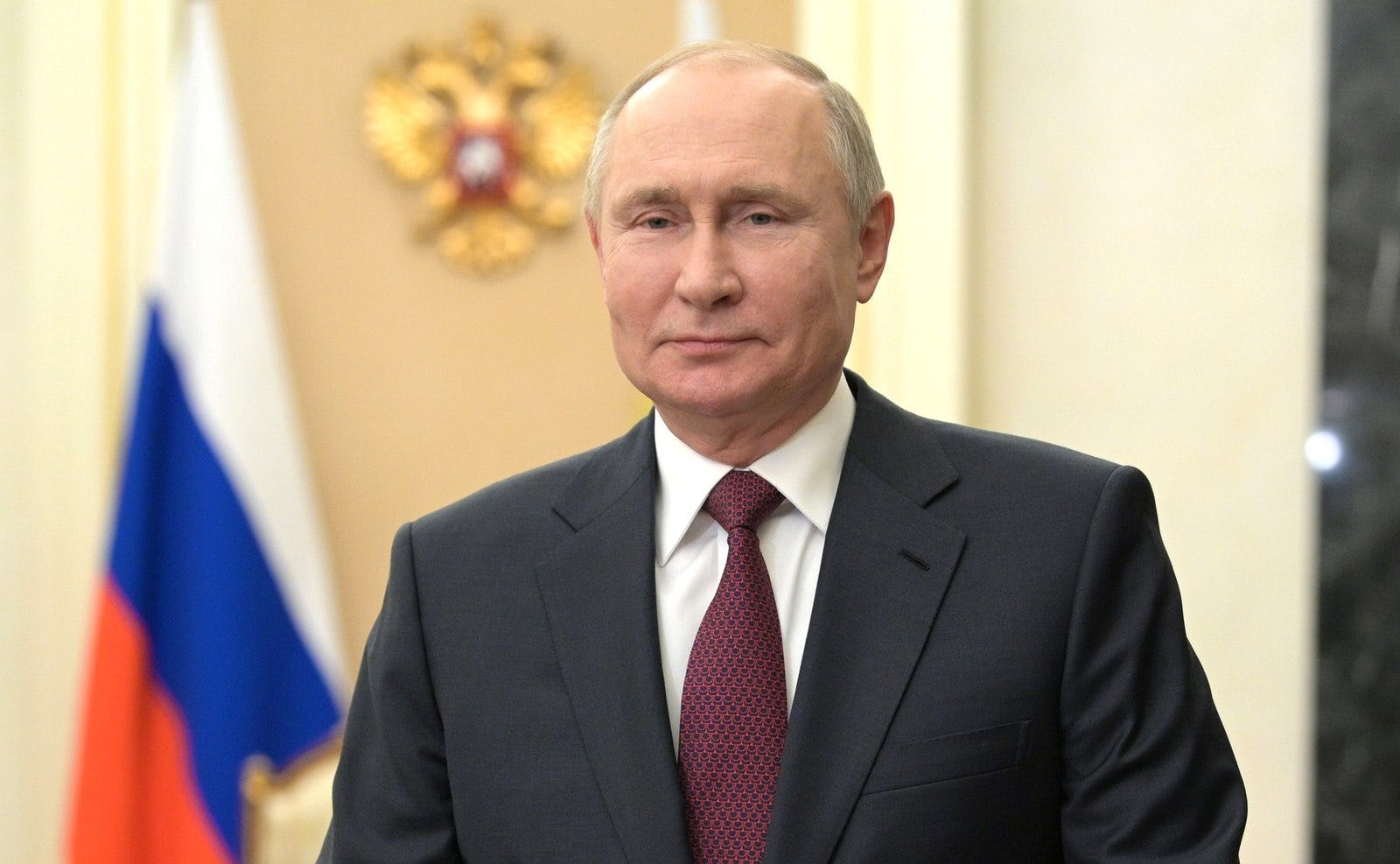
My apologies if you have received this twice. Cock up at HQ.Over a Zoom call earlier in the week, I heard some people discussing the “Russian Davos” which they had attended back in June. I didn't even know such a thing existed, such is my Western, Ptolemaic view of the world. (Ptolemaic, by the way, to save you having to look it up, means you think you are at the centre of the universe, and everything revolves around you).So the Russian Davos, or as it’s properly known, the St Petersburg International Economic Forum, held in June, is an annual event that began in 1995 to signal the (then) new Russia. It would attract global political leaders, business titans, finance bigwigs and all the usual shizzle. The event went ahead this year, though, for obvious reasons, the VIP headcount was significantly down. Gone were the likes of (once) German chancellor Angela Merkel, ECB chief Christine Lagarde, Goldman Sachs' Lloyd Blankfein, Citi's Vikram Pandit and ExxonMobil's Rex Tillerson. Top billing went to presidents of Egypt (via video link), Kazakhstan, Armenia and other allied states.There were representatives from the likes of China, India, Iran, Serbia, Turkey, Venezuela, Egypt, Belarus, Central African Republic, Nicaragua and the United Arab Emirates. Quite a collection. Non-Western nations that have not imposed sanctions had greater prominence. The Western economy has been shaped by cheap commodity prices The official title of the forum was "New Opportunities in a New World", and the recurring theme was how to improve trade between non-Western powers in a US dollar controlled world of sanctions. "A new form of international cooperation: how will payments be made?" was the title of one such talk. Time and time again the conversation came back to a new, non-Western international currency.Which brings me to the second strand of thought that makes up today’s piece: the latest contribution from Credit Suisse analyst, Zoltan Pozsar. Pozsar has long since argued that Bretton Woods III, a new world monetary order, is happening before our eyes and that new money systems east of Europe will be based around commodity-based currencies.In his latest, War and Industrial Policy, Pozsar, who I am fast becoming a fan of, argues that there were three forces that shaped the western economy before Covid - cheap immigrant labour, cheap Chinese goods and cheap gas. Such a trinity is no longer possible in a world in which international trust is fast evaporating. “The “cartoon” version goes like this: China got very rich making cheap stuff, and then wanted to build 5G networks globally and make cutting-edge chips with cutting-edge lithography machines, but the US said “no way”. As a result, Chimerica is going through a messy divorce. The two sides don’t talk anymore.” Meanwhile, “Russia got very rich selling cheap gas to Europe, and Germany got very rich selling expensive stuff produced with cheap gas.” Those two sides aren’t talking any more either. “Chimerica does not work anymore and Eurussia does not work either,” he says and now, in the divorce, it seems Russia and China are “getting it on”. Meanwhile, out west, QE and zero interest rate policies are no longer possible in a world without cheap Chinese and Russian exports. There is now a rush to regain control of key technologies, especially microchips, and key commodities, especially oil and gas (and soon in my opinion metals and grains). Pozsar adds straits to the key list - the Taiwan Strait, the Strait of Hormuz, and the Bosporus Strait.“I think that four themes (re-arm, re-shore, re-stock, and re-wire the electric grid) will be the defining aims of industrial policy over the next five years … the global order is at stake.”Inflation or not, high rates or not, there is a commodity-intensive demand shock coming that “could easily drive another commodity super-cycle.”So to the third strand. “The issue of creating an international reserve currency based on a basket of currencies of our countries is being worked out,” Vladimir Putin said last month.In this regards we have former Kremlin adviser, now Minister in Charge of Integration and Macroeconomics of the Eurasia Economic Union (EAEU), and an influential economist, Sergey Glazyev. He is, according to some reports, supervising the adoption of a new money system for the EAEU and China. “The world’s new monetary system, underpinned by a digital currency, will be backed by a basket of new foreign currencies and natural resources”. “A currency like this can be issued by a pool of currency reserves of BRICS countries, which all interested countries will be able to join. The weight of each currency in the basket could be proportional to the GDP of each country (based on purchasing power parity, for example), its share in international trade, as well as the population and territory size of participating countries. In addition, the basket could contain an index of prices of main exchange-traded commodities: gold and other precious metals
An eternal lesson for investors from a ill-fated silver mine
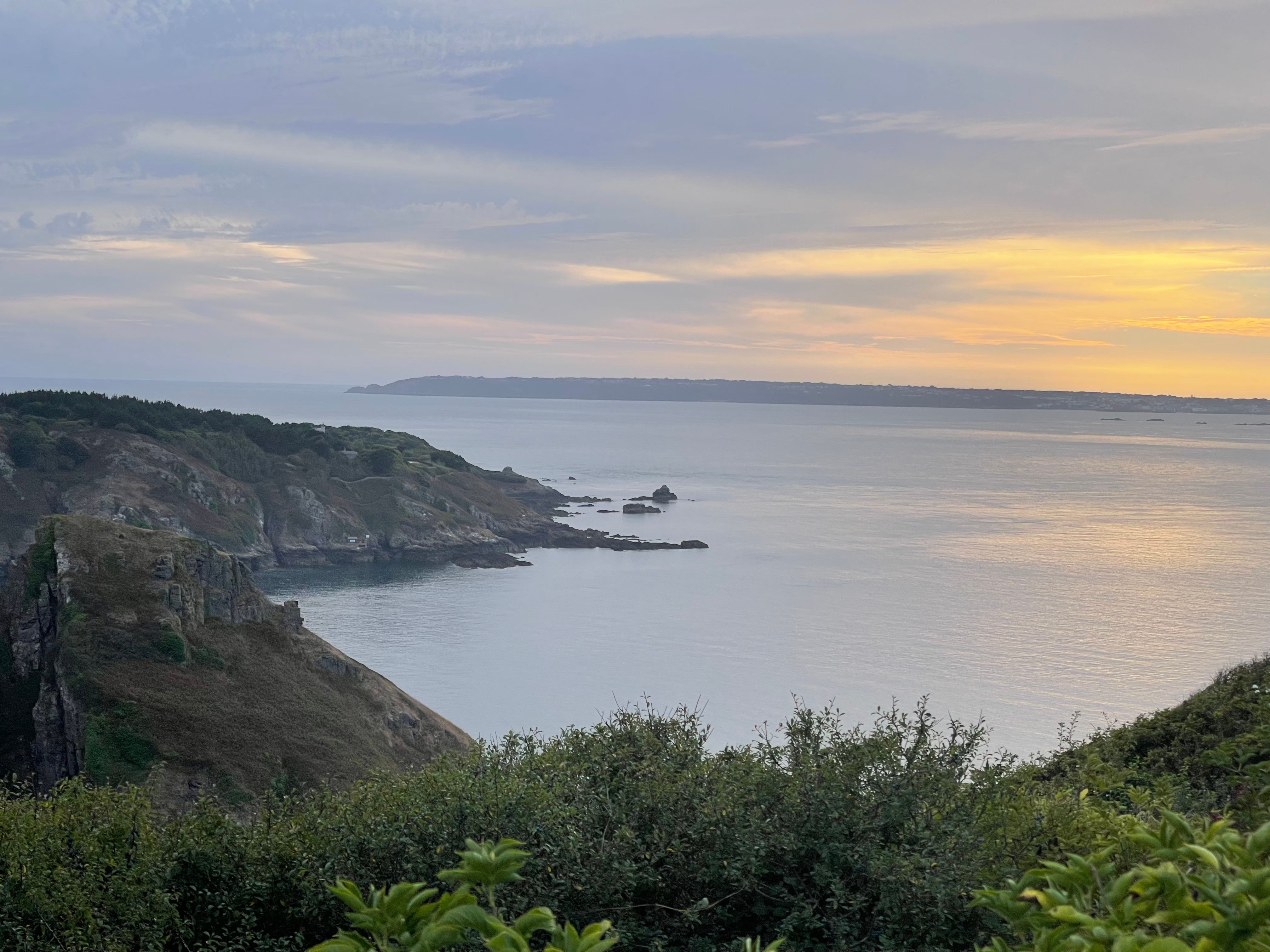
While on holiday in Sark this week, I stumbled across a book in the local post office: “Silver Mining On Sark” by David Synnott, which describes an ill-fated mining operation on the island between 1836 and 1847. Books are distilled knowledge, and I love the stuff you can find in them. Often stuff you don’t find online.“Plus ça change, plus c’est la même chose”, runs the old French saying. It applies to mining, it seems, as much as anything. We don’t use canaries any more; mines are powered by diesel and electricity, not horse-, donkey- or and manpower; helmets have torches instead of candles and there is underground lighting; and a higher premium is placed on human life than in the early 1800s, when workers were much more disposable. But the game is exactly the same: you’re trying to extract metal from rock and sell it at a higher price than you mine it for. The tricks of the trade, aka scams, are the same too. So let me tell you the story of Sark’s silver mine. How a silver mine brought the boom times to a tiny island Sark, by the way, is a tiny island about two miles square, located between Guernsey and Jersey in the English Channel – much closer to France (25 miles) than England, which is over 200 miles away. Remains show the island was inhabited in Neolithic times, but for many periods in the island’s history there was nobody here at all. Today it has around 500 residents. There are famously no cars on the islands – only tractors, horses, bikes and mobility scooters – and no street lights, giving you probably the best view of the night sky in Europe. It’s famous for its harsh, windswept landscape with sheer cliffs and jagged rocks. It still has a feudal lord – who, by the way I beat at table tennis – and its own parliament. In the early 1800s the language spoken here – the patois – was similar to Old Frankish. Very different from the Cornish spoken by the miners who would soon settle there. If you take a boat trip round the island, there are visible copper salts leaching in the cliffs – which no doubt explains its appeal during the Bronze Age – and it was these visible salts that attracted prospectors to the island in the early part of the 19th century. The Cornish at the time had one of the most evolved mining cultures in the world (also dating back to the Bronze Age), and they were operating mines as far afield as Argentina, North America (especially California, Wisconsin, Pennsylvania, Michigan and Virginia – in Chesapeake they even have a Cornish accent) and South Africa, where they operated the world’s largest copper mine at Okiep, 300 miles north of Cape Town. They were in Australia and New Zealand as well.Even the great Mark Twain – he of “a mine is a hole in the ground with a liar standing next to it” fame – was of Cornish descent. In 1835, funded by an English mining adventurer called John Hunt – adventurer is a far better term than entrepreneur, is it not? – a team of Cornish miners arrived on the island to mine the copper. They soon found lead and silver nearby, and began mining that too. And so was Sark’s Hope Mine built. They should have called it the No Hope Mine – what was prospering in 1839 went badly wrong. How? Profits erased by extravagant dinners and lax accounting In the age old tradition of mining, management misled the shareholders. When the ore body was clearly not enough to support the mine, the mine captain deceived where possible to keep the game going. Management had a vested interest in doing so, even if it was no longer profitable. Their salaries depended on it. There were also some two hundred Cornish workers were employed by the mine, together with their wives (who may also have been employees – “bal maidens”, they were known as) and their families. Sark’s population soared to 790, the highest ever recorded. Management no doubt felt loyalty to its people, as well as their own salaries.As they chased ore, expanding the mine with the promise of finding more silver, the mine extended some 800 yards and with tunnels 300 feet out to sea where they were mining 20 fathoms – 120 feet – below sea level. You can imagine the noise in those tunnels when there’s a storm blowing overhead, waves crashing and all the rest of it. They actually had quite an ingenious device in play should the mine ever flood that would save the mine and some of its occupants. General equipment could be brought in from Guernsey, but the speciality stuff had to be acquired from Cornish suppliers, with the effect that Guernsey and London shareholders capital went to the “picks and shovels” suppliers in Cornwall. Management would go on jollies to Guernsey for their count house dinners, a tradition they had brought over from Cornwall – dinners which acquired legendary status for their extravagance – where news of the mine would be delivered to shareholders. (The count house is the mine office, where the managers worked and where the miners were paid. You’ll still find pubs or estuarants in Cornwall called the C
Talking free cities with Peter Young
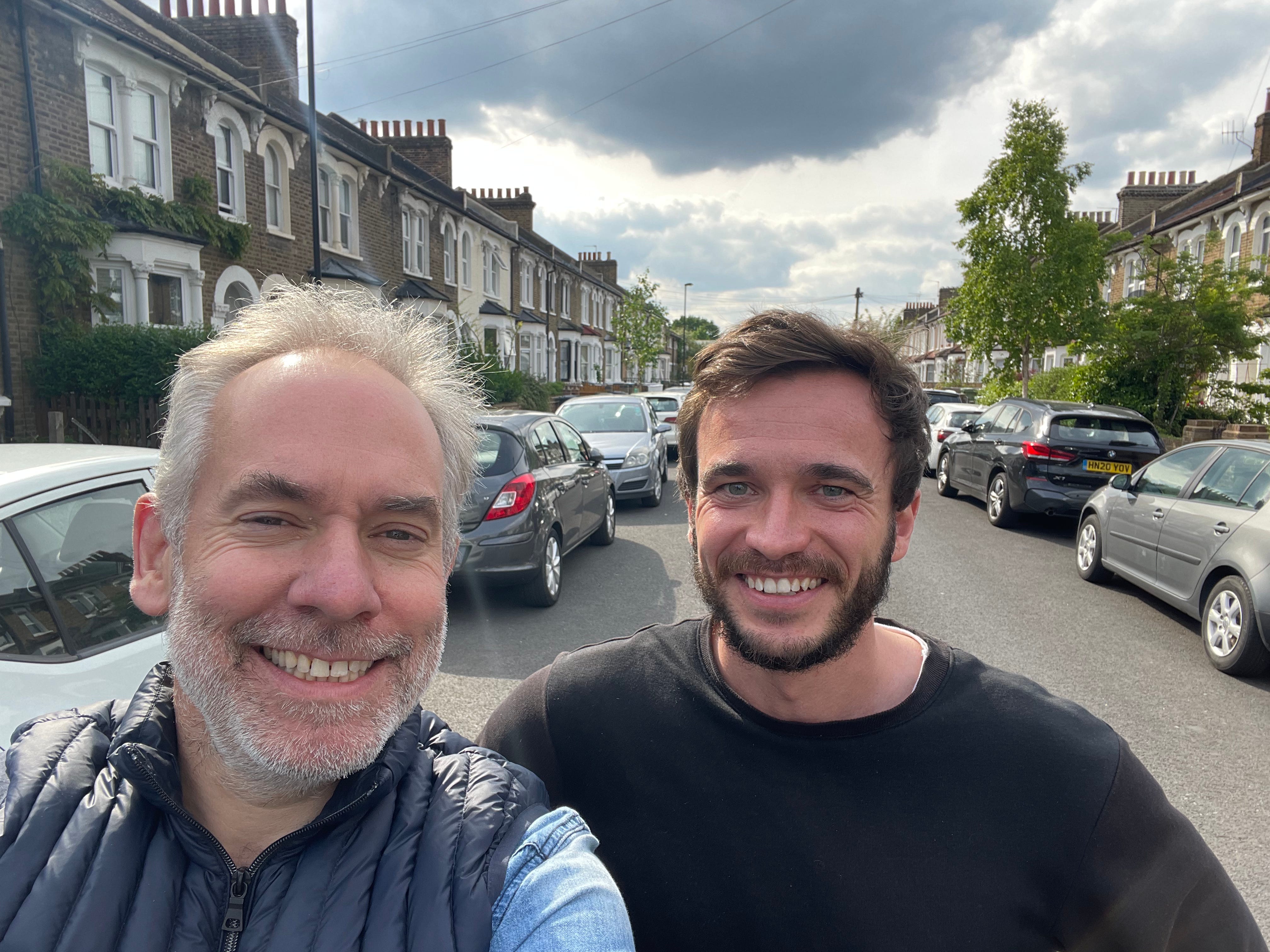
A interview in today’s programme with a highly eloquent young man, Peter Young, of the Free Cities Foundation. Peter discusses China (he lived there for ten years), the Free Speech Foundation and, finally, whether today’s young will end up poorer than their parents. For details on Peter’s October conference in Prague, visit Life Time Liberty.The Flying Frisby is a reader-supported publication. To receive new posts and support my work, consider becoming a free or paid subscriber. This is a public episode. If you'd like to discuss this with other subscribers or get access to bonus episodes, visit www.theflyingfrisby.com/subscribe

A New Addition to The Flying Frisby
There have been some developments behind the scenes at The Flying Frisby, which are going to add considerable value. In addition to my own contributions, starting this week, once per month for paid subscribers only, Dr John Wolstencroft is going to be writing for this Substack, sharing some of his investment ideas and research.I first met Dr John in 2006 at a dinner and talk by commodities trader Mark Shipman for a spread betting company. It was clear then that here was a formidable intellect and we discovered a shared interest in junior mining companies. John’s a doctor in computer science, by the way, not medicine, and at another dinner in 2007 - this time for a silver miner in which John had invested (and did extremely well in making 20 times his money) - John coined the expression “global margin call” to describe what he thought might be ahead. 2008 and the Global Financial Crisis duly followed and John began to acquire prophet-like status in my perceptions.I interviewed him many times on my podcast - then called Frisby’s Bulls and Bears - and in particular I remember one interview - 18 Steps to Mining Ruin - (YouTube version here) - in which he described how a junior mining company can take itself from a p/e of just 1 to a p/e of 100 in 18 easy steps. We were in the early stages of the mining bust, so again his words were prophetic. Many companies unwittingly followed his model.He might have these visionary qualities, but he can’t pronounce his own name. The L of Wolstencroft is, I argue, silent - as in calm, yolk or Holborn - and so Wolsten should almost rhyme with Worcester. John, however, smiles patronisingly and reminds me that it’s his name and not mine - the subtext being that he’ll pronounce however he damn well likes.Since the 2012-13 mining bust, John has taken a much more cautious, risk-averse approach to investment - seeking out safety, value, yield and so on. He is a great champion of investment trusts, a sector he follows closely. Penny stocks and the like are not for him. Well, they are. But not here .With this in mind, I have asked him to contribute to The Flying Frisby, as I felt he would add value for paid subscribers. While I can focus on the racier stuff, as well as bullion and bitcoin - all of which can multiply manifold in times of plenty - John will focus on much lower-risk investment trusts and the like, which will be more defensive and preserve capital in trickier times (such as now).John will be writing for The Flying Frisby roughly once per month, with the first of his missives - on oil and gas - to be published later this week. So look out for that. I’m thinking of calling his letters - Sensible Investment Trusts With Dr John - or something like that.This is still an experiment, but I think it will work out.Welcome Dr John.The Flying Frisby is a reader-supported publication. To receive new posts and support my work, consider becoming a free or paid subscriber.. This is a public episode. If you'd like to discuss this with other subscribers or get access to bonus episodes, visit www.theflyingfrisby.com/subscribe
The US dollar is rising to dangerous levels
After a month or so of welcome respite, the dreaded US dollar has got stronger again. It really is the scourge of everything.Stockmarkets have been walloped, the yen, pound and euro have been walloped, and commodities have been walloped. Again.The US dollar index shows the dollar against the currencies of its major trading partners – the yen, the euro and so on – so it is perhaps the most useful vehicle to study the dollar. Given the magnitude of foreign exchange markets and the fact the US dollar is the global reserve currency, I see its price as the most important price in the world. Here we see the US dollar index over the past three years. You can see that textbook double bottom it made in 2021, with the pattern completing in June. We were writing about it – see here and here.Since then, through all of the financial and inflationary turmoil of the past year, it has marched inexorably higher. Now it’s retesting its highs around 109.My stated fear for some time is that it goes to 120. Why 120? There is some history there.Here is the dollar since 1980. You can see that 120 is the level it got to shortly after the turn of the century – and where it peaked around 2001-2002, helping to usher in that epic bull market in commodities.It actually got to 165 in 1985 – after Fed chair Paul Volcker tightened a lot quicker and harder than anybody else (not unlike what is happening now). The G5 nations – France, Germany, Japan, the UK and the US – then agreed to weaken it so as to reduce the mounting US trade deficit. What followed were epic bull markets in both the Japanese yen and the German mark, and the stage was set for Japan’s “lost decade”.This agreement was known as the Plaza Accord. I don’t think we are quite at Plaza Accord levels of concern yet, by the way. Heaven knows what happens to the UK and Europe if the dollar goes to 165 again. But if it gets through 109, I would say 120 is back on the cards, possibly even this year, more likely early next.The US dollar is the best of a bad bunchThe euro just slid below parity with the dollar yesterday. The last time that happened was around the turn of the century (when it got to $0.82). It’s at 20 year lows. The pound’s at $1.17 – that’s flash crash, Theresa May Conservative Party Conference depths of rubbish.The reasons the US dollar is rising are fairly obvious. Capital is panicking and the dollar is the first place it goes to in a panic. It “should” be gold that capital flees to, really, but it isn’t. It’s the dollar. Then there’s the fact that the Federal Reserve Bank, America’s central bank, is tightening faster and more aggressively than the Bank of Japan, the Bank of England or the European Central Bank. Europe and the UK, meanwhile, have a plethora of gas-related problems and looming winter crises that they could do without.Forex-wise, the US dollar is the best house in a bad neighbourhood. You could say the same about its economy more generally.Yesterday was a grim day in the stockmarket, but there were some observations I was happy to make. First, that base metals – copper, zinc, tin, iron ore, and so on – which took one hell of a beating in June, actually held up quite well. That would suggest that they may have already made their lows.The action in precious metals – platinum and silver especially – over the past week has been less encouraging. Ditto bitcoin.Oil, meanwhile, looks like it is making an interim bottom and turning up. The last thing central planners want now is higher oil prices, but the market gods will care very little about that.Might be time to load up again on oil stocks if you are not already loaded. But more broadly speaking, these are risky markets, to put it mildly. Stay defensive, conserve capital, hunker down and await more benevolent financial times.If you are in or close to London towards the end of the month, I will be performing my lecture with funny bits, How Heavy?, about the history of weights and measures at the Museum of Comedy in London on September 28 and 29. You can buy tickets here.The Flying Frisby is a reader-supported publication. To receive new posts and support my work, consider becoming a free or paid subscriber.This article first appeared at Moneyweek. This is a public episode. If you'd like to discuss this with other subscribers or get access to bonus episodes, visit www.theflyingfrisby.com/subscribe

Gold, the sun and the gods
How did gold come into existence? No one really knows.Its origins are thought to lie in supernovae and the collision of neutron stars. It was present in the dust which formed the solar system four and a half billion years ago and came to earth via the asteroids that then bombarded the planet.According to the Bible, gold and silver are products of God. “The silver is mine, and the gold is mine, saith the Lord of hosts” in the book of Genesis. Although - given that in those days the distinction between God and King was not that always that distinct - that might he been a ploy to control capital.Given its unique characteristics - beautiful, eternal, immutable - it is no surprise that gold found special status at the dawn of civilisation. Our prehistoric ancestors cherished gold even before they were able to speak. Nor did that captivation fade after pre-history. Whether Asian, African, American, Mediterranean, Germanic or Celtic, gold occupies a place in the history, legend, mythology and folklore of almost every ancient culture: the most prized of all metals. Today we know of 90 or more metals. Many you’ve probably never heard of, let alone touched or seen. The likes of Cesium, Nihonium, Flerovium, Moscovium, Livermorium, Yttrium or Zirconium. But until the 13th century we knew of just seven: gold, silver, copper, tin, lead, iron, and mercury. There were also only seven known celestial bodies: the sun, the moon, Mars, Mercury, Jupiter, Venus and Saturn. Each metal came to be associated with a celestial body - silver, light and shining, with the moon, iron, rusty and red, with Mars, Mercury with its namesake, Jupiter with tin. With its glimmering yellow colour, gold was associated with the sun.To the ancient Greeks, and other cultures besides, the sun was a golden chariot driven by the sun god, Apollo, across the sky each day. The Egyptian sun god Ra was depicted as a yellow blaze of gold. The Incas of South America believed gold to be the “sweat of the sun.” The Latin word for gold, aurum, derives from Aurora, the goddess of dawn, who rose each morning to announce the sun’s arrival. The root of the word by which the Celts and Greeks referred to gold was the Sanskrit “Harat” which means colour of the sun. The symbol for the Sun (a circle with a dot in it - ☉) was once the alchemical symbol for gold. Plato and Aristotle both thought gold was obtained by combining intense sunlight with water. We actually find gold in tiny particles embedded in ancient rocks, or as grains or nuggets in riverbeds where it collects after rushing water eroded away the rocks.There are seven days of the week too, and so did each metal come to be associated with a day. Gold’s day, of course, was Sunday.Unlike feminine silver, gold is a masculine metal, connected not just with the sun but with the lion, a symbol of strength. It represents wealth, prosperity, authority and charisma. It was an aid to healing, to protection, to growth, and knowledge - all qualities associated with the sun and the gods of the sun. The ancient Greek sun god Apollo was also the god of healing and diseases, while his son, Asclepius, was the god of medicine. Apollo delivered people from epidemics. What’s that about Vitamin D (which we get from sunlight) being an aid against COVID, while Vitamin D deficiency is linked to more severe cases? Apollo was also a god who could bring ill-health and deadly plague.Gold, like obscurity, is immortal. It is permanent, never rusting, nor tarnishing. In the museums of Cairo you will find a golden tooth bridge made 4,500 years ago for a pharaoh and it is good enough to go in your mouth today. Gold represented perfection, purity and excellence - “neither moth nor rust devoureth it”, said an ancient Greek text. Because of gold’s imperishable characteristics many imbued it with divine qualities, and it is forever associated with the eternal, the permanent and the incorruptible. Kings and queens decorated their bodies with gold to demonstrate their power, to impress, to dazzle, to command and to authenticate their god-like status. In ancient Egypt gold was a royal prerogative and pharaohs were buried with their gold to aid their travel into the next world. Tutankhamun, whose father was the sun god, Ra, was buried in a golden shrine. Gold was a gift from and given to the gods. Indeed it was the breath of the gods.The myth of the Golden Apples of Hesperides is that they conferred immortality on whoever ate them. From Hercules’ quest for these golden apples to Arthur’s for the Holy Grail to Frodo’s to destroy the precious ring of power, gold is a symbol of incorruptible quest, ambition, or purpose. Even today the young student gets a gold star, the athlete a gold medal. It is a symbol of achievement.For numerous reasons, I am a believer that everybody’s investment portfolio should have an allocation to gold. My recommended dealer is The Pure Gold Company. The Flying Frisby is a reader-supported publication. To receive new posts and s
How to protect your wealth as inflation hits new record highs
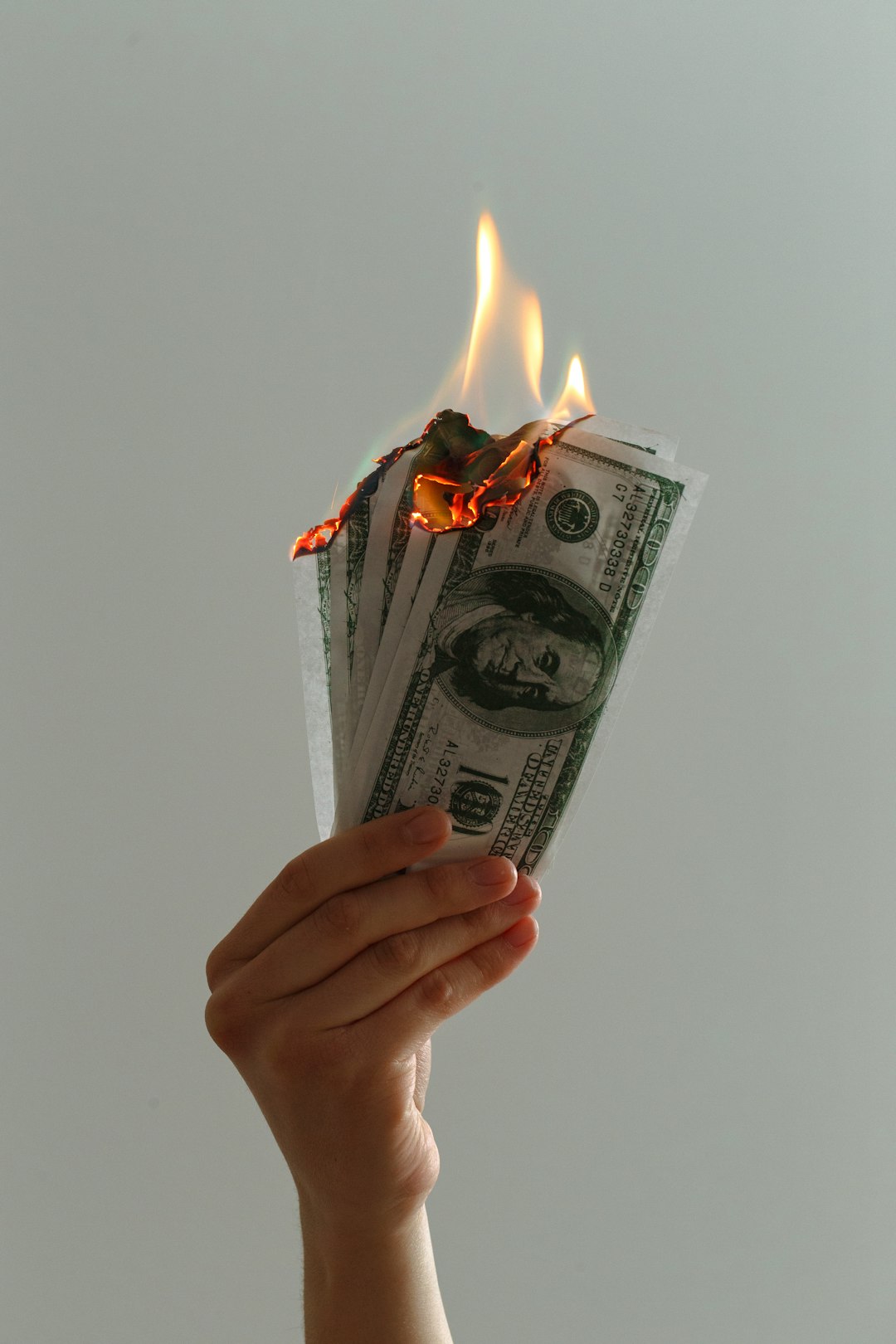
Inflation in the UK has just hit 10.1%, says the Office for National Statistics. That is five times the Bank of England’s stated target of 2%. FIVE TIMES! Sorry to shout. The joy of the public sector is that you can be this bad at your job and still keep it. Inflation hasn’t been this high in over 40 years.Are you prepared?None of this should be a surpriseWhen you delve below the surface, it gets a lot worse. Retail Price Inflation (the old measure) is 12.3%.Energy prices are rising. We all know that. Food prices too. But the Bank of England base rate is still 1.75%. Carnage or not, it is going to have to go up. That means borrowing costs are going to go up. And house prices are likely to come down.The pain of all this is going to eat into your wealth. On the one hand the value of your most prized asset – your house – is flat or falling. On the other, your costs – from food to energy to monthly mortgage repayments – are all rising. And it’s doubtful your income is keeping up with the increase in costs.A lot of people are going to lose their jobs and their livelihoods in the squeeze (though no one at the Bank of England).And so much of this is self-inflicted.I get so cross when I hear officials say, “no one could have predicted this” and it is “beyond anyone’s control”. We have been warning about it for years on these pages.If the market set the price of money, you can bet your bottom dollar that rates would have risen a lot higher a lot quicker.What are the causes? There’s deglobalisation – China especially has been exporting its cheap labour and deflation for so long, low prices had become normalised. Now nobody trusts anyone any more and globalisation has slowed. You can’t blame those in charge for that.There are the Covid-supply chain issues and the punitive, punishing-the-British-for-Brexit legislation on the continent that is hampering trade and thus raising end costs. Dimwitted, short-sighted, beholden-to-the-Green-lobby energy policy leading to a failure to invest in fossil fuels and nuclear has put up energy costs.Failure to measure inflation properly for decades (especially not including house prices in CPI) has meant interest rates have been too low for too long and asset prices have got totally out of kilter. And finally – yet perhaps, along with artificial rates for years, most significantly – hundreds of billions of money created at no cost through Quantitative Easing, first post 2008 and then through Covid. In short: printing money, debasing money, misguided energy policy and bureaucracy. Too much government has caused this.Now the chickens are coming home to roost. The irony is there is a scramble for cash, even though cash is now officially losing 10% per annum.This must be one of the most difficult investment landscapes I have ever known. How to protect your wealthThe most obvious asset to own in all of this is gold. Yes, in US dollars at least, gold has been a dog since the spring. Not as big a dog as other metals, or indeed tech (until a month ago), but it hasn’t exactly been doing what it did last time all this was happening in the 1970s, although dont forget it has a 50% correction mid decade. The US dollar being so strong has masked things.But let’s look at gold in sterling, and the story is different. Here we see gold in pounds over the last ten years.It was £700/oz in 2015. Today it’s £1,480. A double. It’s in a clear uptrend, and has been a good, low risk hedge against incompetent leadership and the incompetent management of the pound.You can see how gold has been making a series of higher lows – since 2015 in fact. Each sell-off comes to an end at a higher price than the last.Even since 2021 this has been the case. The current sell-off since the spring Russia’s-invasion-of-Ukraine-high has been painful. But the low in July was higher than the lows in January. That is long-term bull market action.My concern looking at that chart is a potential double top just above $1,550. Maybe it all ends there. Maybe it has already ended there.But while this sequence of higher lows continues – and looking at the mess around me – I am going to give the bull market the benefit of the doubt.Self-inflicted or not, the Bank of England is caught between a rock and a hard place. It’s damned if it puts up rates and it’s damned if it doesn’t. It’s going to have to. Looking forward to the winter, it’s easy to see a host of problems – energy shortages, more Covid, further escalation in Ukraine, squeezed citizens, no end of political discontent.I don’t know where all this ends. Often I can see where stuff is going, but this I can’t without getting shudders. We’ll find a solution. We always do. We are human beings, we work, we create, we innovate, we solve problems and life gets incrementally better. But it feels like we are early- to mid-series rather than going into the final episode.So my advice is to own some gold. I’m glad I do. It helps me sleep at night. It’s about the one part of my portfolio that I’m

A fond farewell to a MoneyWeek legend
John Stepek is leaving MoneyWeek. I’ve known for a while, but as his final day was yesterday and we have just had his leaving drinks, so the implications are just sinking in. I first started writing for MoneyWeek in 2006, which means John has been my editor for 16 years. Week in week out, he’s had to plough through my twaddle. I reckon I have written at least 800 Money Mornings in that time (one Money Morning per week for 16 years), though the figure is probably closer to a thousand, as I’ve often written two per week. Plus the stuff I’ve written for the main mag. Each Money Morning averages 1,000 words, often more, so I make that close to a million words of mine that John has read, suffered and edited. What a saint. A happy accidentI’ve been racking my brains as to a memorable and suitable present to buy him, to say thank you. Then it came to me. What more appropriate way of expressing my gratitude than through a Money Morning itself. For all our plans, for all “the best laid schemes o’ mice an’ men”, life has a habit of taking the accidental route and so it was with my relationship with John. Although it never went, “gang aft a-gley.” Now if John was editing this, he would demand that I explain that Scottish poet Robbie Burns reference. I would say, “everyone knows that quote, we don’t need to explain it.” John would insist we do. And, in order not to patronise those that do know it, I would then find a way of explaining that “gang aft a-gley” means “go wrong” without overtly looking like I am explaining it. The result would be something along the lines of what you’ve just read. You now know, if you were in any doubt, that “The best laid schemes o’ mice an’ men. Gang aft a-gley” is a quote by Scottish poet Robbie Burns meaning, “even good plans go wrong”, but you don’t feel patronised because I’ve explained it, while apparently talking about something else. I learned how to do that through working with John.In MoneyWeek, of course, usually what needs explaining isn’t a great Scottish poet, but some incomprehensible financial or mining jargon. Back to the point. My relationship with both John and MoneyWeek all happened by accident. Back in 2006, as a jobbing comedian and voiceover artist, I had made a bit of money and I was trying to figure out what to do with it. In fact, specifically, I was trying to figure how to turn the pot I had into three or five million quid in order that I could make the musical Kisses on a Postcard happen. I didn’t entirely trust the fund managers I had met to achieve the unrealistic and astronomical multiples I was hoping for. So I started a podcast and began interviewing all these clever people I saw talking on the internet, such as Jim Rogers, Jim Dines and James Turk, to see if I could figure out a plan. Commodities and gold in particular seemed the route, and the show was called Commodity Watch Radio. One of the people I interviewed was Merryn, who said did I want to write a newsletter about commodities? I said I wasn’t sure I was equipped to do that. She said come into the office and have a chat. In I went to meet Merryn and the then MD Toby Bray. There was also some quiet bloke in the corner, John Stepek. We agreed that thrusting me into a newsletter might be a little premature, but John had started this daily email, Money Morning, and perhaps I could start writing, say, one per week and then we’d see how it goes and take it from there? Fine, I agreed.Here we are 16 years on and it’s still going. A temporary plan became permanent. A bit like Income Tax. MoneyWeek’s quiet, consistent rock Clarity has always been one of John’s priorities, but also neutrality. “You’re great on the financial stuff and the macro stuff, Dominic, but when you get onto politics, you get ranty. You confirm the biases of those who agree with you, you annoy those who don’t and you alienate the undecided,” he once said to me. That expression has always stayed with me: “alienate the undecided”. In today’s polarised worlds, if you want notoriety, it pays to be an Owen Jones or a Tucker Carlson, but that was never measured John’s priority, nor is it the MoneyWeek way, which aims to stay broadly neutral on politics. John has always edited my stuff quickly and well, but he’s never been precious about his edits. I, on the other hand, am a control freak, and John has let that be. He doesn’t seem to mind me re-editing his edits - no control freak he. The resulting compromise has almost invariably been a better piece. I have learned so much about writing in our time together. I always wanted to be a writer. I went to drama school because all the best writers started out as actors. But, bizarrely, it wasn’t the entertainment industry that ever gave me the break. It was finance, MoneyWeek, Merryn Somerset Webb and John Stepek. I’ve since written three books, several films and endless content, as you probably know. And here’s the bizarre thing: in all that time, I’d say I have met John in person fewer than ten ti
Why do we use the weights and measures we do?
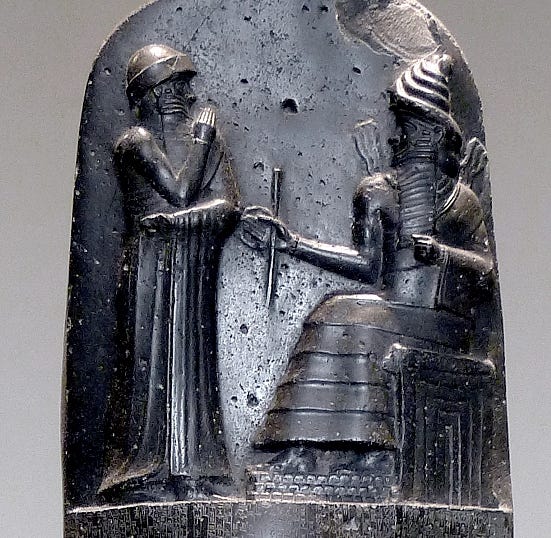
The Edinburgh Fringe Festival starts this week. It’s the world’s biggest arts festival, an event that sells more tickets than any other event in the world, with the exception of the Olympic Games.I shall be making my way up to Scotland’s capital to make my own little contribution, a new show that I haven’t finished writing yet (!), “a lecture with funny bits”, about the eternal subject that is weights and measures. Why do I say eternal?Because people have been arguing about them, and trying to impose them since forever.How French revolutionaries tried to decimalise timeThe very first legal documents we have from Ancient Mesopotamia depict rulers with the rod and ring – a yardstick and a measuring string – usually being handed to them by God, as they try and standardise measures in law. Ancient Egyptian documents, illustrations and hieroglyphs abound with similar references. Scales are prominent too.The opening words of the Bible establish our basic measures of time – the day and the week. This is something the French Revolutionaries tried to do away with in 1792 when they decimalised time. One week would be ten days. One day would be ten hours. One hour would contain 100 decimal minutes, and each decimal minute, 100 decimal seconds. Thus one day would be 100,000 decimal seconds per day. When the proles discovered that meant one day off in ten, rather than in seven, the system began to meet with considerable resistance and duly kicked out. The revolutionaries may have got their metric weights and distances over the line, but time was a step too far. What is a “step” by the way, but a measure? A vague but useful measure that fitbits and iPhones and health apps have become obsessed with. I did 14,126 steps yesterday. (It was a long day). What about you?“There is to be one measure of wine throughout our kingdom, and one measure of ale, and one measure of corn,” proclaims Magna Carta. “One breadth of cloths … and let weights be dealt with as with measures.”Even today, when Boris Johnson made announcements about being able to use imperial measures again, the culture wars kicked off. In his 2019 election manifesto Johnson pledged “an era of generosity and tolerance towards traditional measurements”. To the Guardian, however, this was xenophobia and pseudoscience.Which is best – “free market” imperial or “central planning” metric?I often go to the Edinburgh Fringe to do “lectures with funny bits”. In 2016 I did one about tax, which would eventually become my book Daylight Robbery. In 2019, I did one about the philosophies of Adam Smith and how they related to the economics of the Fringe, which would eventually become a film, Father of the Fringe. This time around I thought it would be interesting to do one about weights and measures. I’ve since discovered the subject is enormous and endless, which is why I haven’t finished writing it yet. (It’s going to be held in Adam Smith’s old front room at Panmure House, so a wonderful historic setting.)The inevitable question that gets asked is: which system is better – imperial or metric? I would answer, with the bland neutrality of the on-the-fence politician, that they both have their place.I grew up with the metric system. That was what I was taught at school. But as I’ve grown older, I’ve found myself thinking more and more in imperial. Feet make more sense to me than 30, 60, or 90 centimetres, or 1.2, 1.5 or 1.8 metres. Inches – a thumb pressed down – make more sense than centimetres. A hair’s breadth means more than a micrometre. I find it easier to orient myself around pints than I do litres, around pounds – the amount you can easily hold in your hand – than I do kilos, and around yards – a pace – than I do metres.But the problem with imperial is that it was never a designed system in the way that metric is. Most measures emerged over time through use. Impractical measures got abandoned, and practical ones stuck. The buku was the distance from which the cry of a buffalo could be heard in Russia. No doubt an extremely useful measure in a country with such vast expanses of land, but of little use today. The pound we use today, however, roughly corresponds with the Babylonian “mesa”. Shoe sizes are defined by barleycorns. A fathom is one’s arms outstretched – 6 foot. A really useful distance, especially for depth. 6 foot is the depth to which in water we can just about stand up in - or bounce - without having to swim.But there are a gazillion measures that found common use in history that have fallen by the wayside. It’s very much a market driven system.Yet as soon as you start to analyse it with the logic of the planner, imperial measures look nuts. Just take a look at some of the flow charts to explain imperial measures on Wikipedia and elsewhere if you want to understand how nuts it looks. Why can’t we just have both?Americans have a “dry gallon” and a “liquid gallon”. What’s more, their gallon is not the same as our imperial gallon (one of the reasons petrol there se
Who’s buying gold right now and why?
Are the people at the top – the directors – buying or selling shares in their own company?If they are buying, that’s usually a good sign. But if they’re selling, not so good.They might be selling because they need the money for something: to buy a property for example, to pay school fees, to settle some debts.Then again, they might be selling because they don’t like the look of what’s going on.Directors’ dealings can offer telling signals as to whether insiders think the company is about to thrive or dive. That’s why so many follow them.With that in mind, I had a meeting with Joshua Saul yesterday, CEO of bullion dealer and storage company, the Pure Gold Company. He told me something that I found fascinating - similar to the value of director dealings as a potential indicator. I’d like to share that knowledge with you today.Who’s been buying bullion and why?Why are doctors queuing up to buy gold?The Pure Gold Company must now be one of Europe’s top bullion dealers, with a large and varied customer base, from institutions to individuals. As such, it knows who is buying, who is selling and to what extent.But, to help them make the right investments, it also makes an effort to get to know its clients: are you old or young? What do you do for a living? Why are you interested in buying gold? And so on. As a result, it gains an insight into people’s professions and motivations and that data, “both quantitative and qualitative”, to use Saul’s words, “reveals trends about the market”.There has, over the past couple of months, been a marked increase in buying from two professions: doctors and investment bankers. Weird, huh? The latter I sort of get, but the former.Most doctors I know work pretty hard. Their diaries are full and their time is precious. Unlike many other professions, I would venture that their ability to monitor markets, research investment ideas and so on is limited. (Any doctors out there, please correct me if I’m wrong).You have to be bright to make it through medical school, to qualify and practice, so doctors, for the most part, are not stupid. But at the same time, I would venture, as a rule, that their fingers are not particularly on the investment pulse, unless their investments are somehow related to the medical field – which gold isn’t.So what gives with doctors buying bullion?Doctors for the most part have money. It’s a well-paid profession. In some cases very well paid. And they are making money all the time. “My belief,” says Saul “is, first, they’ve been too busy up until now to take much of an active role in their investments, but having seen their pensions fall, have started to to be more proactive – driven primarily by safety and security”.Makes sense. They’ve been making good money, but on the other hand, they have been watching the value of their Isas and pensions fall quite dramatically. As a result, they are turning to the alternatives, which are gold and silver.Investment bankers are getting keen on gold again“Why then has there not been an uptick in, say, lawyers or pilots or computer programmers?” I ask. There has been, it turns out, but the most notable increase has been doctors – by 44% in the last four weeks – and, as we are about to consider, investment bankers. Investment bankers’ buying of coins and bars has increased by a – quite astounding, in my view – 59% over the past four weeks. I have to say, the implications of a 59% jump in investment bankers buying gold for their personal portfolios has some alarm bells ringing. What’s going on at the banks? Are there problems looming? What do they know that we don’t? Something similar was going in the lead up to the Lehman crisis.Possibly so. When asked about their motivation and timing, says Saul, many cited counterparty risk, exacerbated by the severe inflationary environment. Political uncertainty has been a factor too. Many fear inflation. The high cost of sitting in cash while waiting for opportunities in other asset classes, has become too high. The other factor cited was the consequences of escalating interest rates at a time of high and increasing debt, both individually and nationally. Overall, says CEO Saul, there has been a 39% increase in people purchasing gold bars and coins in July compared to the monthly average over the last 12 months, and a 42% increase in people purchasing silver bars and coins.Perhaps more tellingly, there has been a 67% increase in people selling equities within their pension to purchase physical gold bars within the same vehicle. This type of knowledge may mean absolutely nothing. I don’t think it’s reason alone to go out, sell everything, buy gold and run for the hills. But it’s one of those telling insights, I’d say, to have at the back of your mind as you make your broader macro investment decisions – how you determine your asset allocation. People are buying bullion. Especially investment bankers. It also explains the uptick in people asking me how to buy bullion. If you’re concerned ab

How high are rates going to go?
I was at a dinner the other night with a buddy who is a much cleverer investor than I am. The conversation went something like this.Clever Mate: “Inflation is 10%. Rates are going to have to go to 10% to get it under control. I’m 60% in cash.”Me: “The system can’t take rates at 10%.”Clever Mate shrugs. There is an awkward silence.Clever Mate: “It will have to.”Another more awkward silence follows as I digest the implications. Do central bankers have what it takes to tackle inflation?Have today’s central bankers – the liof Jerome Powell, Christine Lagarde and Andrew Bailey – got the bottle to “do a Volcker” and put rates up to these kinds of levels? (In 1981, then-Federal Reserve chairman Paul Volcker raised the Fed Funds rate to 20%.).It’s not just the chair or the governor, of course – though they will be the ones making the announcement – but the boards behind them. To make such a decision, with such ramifications, would not just require extraordinary bottle, but extraordinary conviction as well. It’s hard to have one without the other. I’m not sure Bailey or Lagarde have the right belief systems. In the case of Lagarde, I’m as sure as dammit the career and reputational risk would be intolerable to her.So my view, on this side of the Atlantic at least, is that a softly, softly approach will prevail and that rates will go up slightly, while those in charge prevaricate and hope that this unfortunate inflationary episode does prove to be temporary and passes.We will have a clearer idea of Powell’s intentions later this week when he makes his announcement.But here’s the point. Volcker is widely credited with curtailing the inflation of the 1970s. However, when he was appointed in 1979, inflation was long entrenched. From the Vietnam War to the abandonment of the gold standard in 1971 to the oil crisis of 1973 and through all the economic turmoil of the 1970s, inflation was not something new or just a few months old, as this episode is today. Volcker’s hiking of rates came off the back of a decade of this and, what’s more, President Carter appointed him specifically to do what he did. Even against all of that, his actions still provoked enormous ire.Today’s central bankers do not have the same backdrop. The inflation narrative is too new, and there is still the hope that this is all temporary. So my forecast is for them to do the least possible for now, with Powell probably remaining the boldest of the three. Rates may have to go to 10%, as my buddy argues, but the stage is not yet set – and this current pullback in commodities may give them some respite.Inflation redefined I had a thought in the shower this morning, as you do, and it was this.The classic definition of inflation, as regular readers will long since know, is “the expansion of the supply of money and credit with the consequence of higher prices.” You inflate – blow up – the money supply and, as a result of there being more money about the place, prices go up.However, because of semantic shifts (which is a high-falutin way of saying “a shift in the meaning of language over time”) this is no longer the definition of inflation. Inflation now just means “higher prices”. Somewhere along the line, whether due to a conspiracy by central planners and bankers is not known, the bit about expanding the supply of money and credit got dropped. The semantic shift has gone a stage further still. Inflation no longer means just rising prices, but rising prices of goods and services included in the core price index (CPI) measure of inflation. So house prices rising, for example, doesn’t mean inflation. It’s nuts because, as we know, the main reason house prices go up is because of an increase in the supply of money and credit – more and cheaper mortgages.However, such semantic shifts are beyond the power of this lowly writer to control. So there is little more I can do than rage, rage against the dying of the light, then go about my day.Anyway, I’ve got through the preamble, so here’s the thought. Inflation, by its modern definition, actually leads to a shrinking of the money supply, or at least it should do, if central banks follow their remits to curb it. If inflation is 10% then rates go up to curb it (though perhaps not as high as 10%). As rates rise, many deleverage and pay down debt. (Leverage is another means by which money and credit are created). If rates rise a lot, this can become a scramble.In other words, with inflation (by today’s definition) the supply of money and credit contracts. That means asset prices – house, bond and equity prices – fall, as they are what we use leverage to buy. Even car prices. (Finance costs more).These are mostly not included in CPI, but in such a deflationary event as interest rates rising to levels concomitant with current CPI inflation, you can expect CPI to fall too. To summarise, inflation originally meant the expansion of the money and credit supply with the consequence of higher prices. Today inflation, and the cent
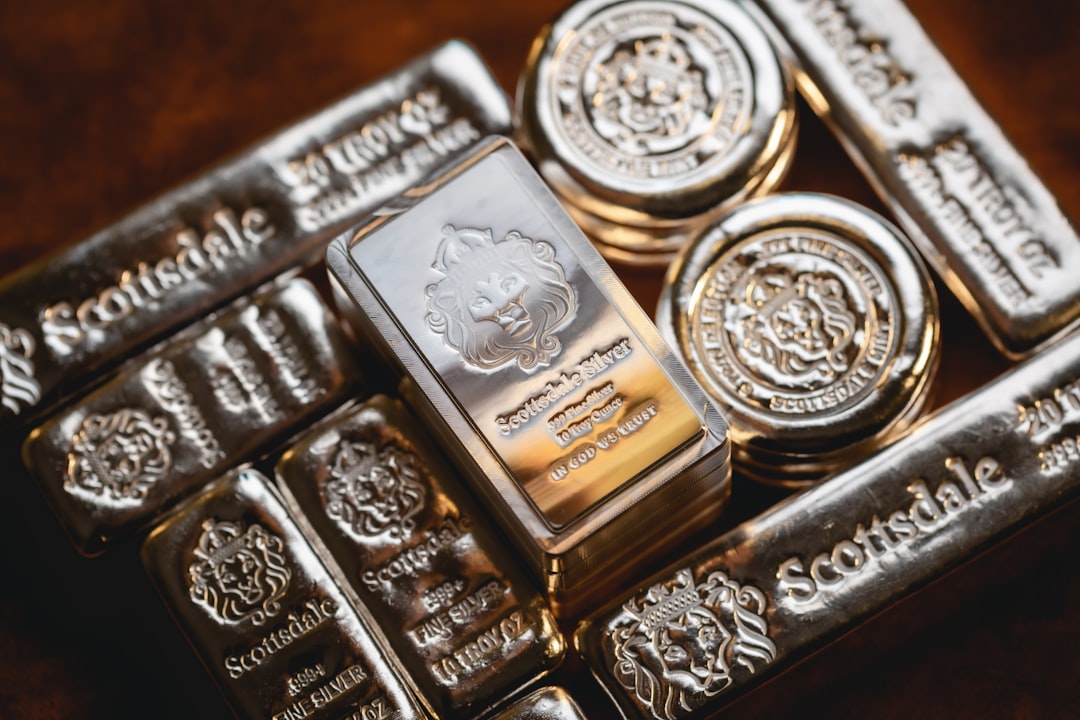
These two precious metals will be screaming buys when the dollar turns
Metals are not going to stop crashing until the US dollar turns.I’ve been banging on about that for some time. I don’t know when that will be. Nor does anyone. But this US dollar action feels like the parabolic blow-off that you get towards the end of bull markets, rather than the creeping disbelief you get at the beginning.I’m hearing talk of forex interventions coming. That may or may not be so. So I’m not ready to pull the trigger just yet. But… I’m closely following the price action of two metals that look remarkably cheap. They are silver and platinum. I mentioned them last week.Platinum looks cheap, regardless of what happens nextThe case for platinum, the main use of which is in catalytic converters for diesel engines, is pretty simple. You would normally expect it to trade at a 25% premium to gold. That is the historical average. But demand has been shattered since the Volkswagen emissions scandal of 2015 and the subsequent move away from diesel engines.Gold is currently at $1,720/oz. If history is any guide, platinum “should” be north of $2,000/oz. It isn’t though. It’s $830.I don’t really know what’s going to change on the demand side. Platinum may have a major role to play in fuel cells and the hydrogen economy (as a catalyst), but so far this has not been perceived as significant enough to push the price higher.In any case, here is a 20-year chart of platinum. I’ve drawn a dashed blue line around $780 and you can see the platinum has been below this level just once in almost 20 years – during the Corona panic of March 2020.It went to $600/oz intraday back then. Otherwise the $770 area has been the floor.So if you can pick platinum up below $800, let’s just say your downside is likely limited.And now to the disappointment that is silverSilver is not quite as clear cut. Oh, silver! How I used to love it back in the noughties. Experience changed my view. Was there ever a metal with so much potential? Silver is to electronics and modern tech as sugar or salt is to food. It is in just about everything. Then there is its monetary allure as well. Didn’t silver go to $50 during the inflation of the 1970s? Aren’t you supposed to take refuge in precious metals during inflationary episodes? Here we are in 2022 and silver has fallen off a cliff. It’s sitting at $18. For five years between 2015 and 2020 that $19-20 area was resistance. Technical analysis 101 says $19-20 should now be support. But silver – being silver – has cut straight through it.It went to $12 in the corona panic and $8 in 2008, but the $14 zone has for many years been a pivotal price zone.Here’s a long-term chart with a dashed line drawn at the $14 mark.Can it get to $14 on this move? It would be extraordinary, given the amounts of money that have been printed, for it to go that low. There should be some support at $18 and at $16, but it’s silver, so never underestimate its capacity to disappoint.If the US dollar index goes to 120, a number I’ve been harping on about for months, then silver will get that low. And in a panic it will probably surpass it (if surpass is the right word).As I say, I’m not quite ready to pull the trigger. My appetite for risk has been somewhat tempered by the market action of recent months. But, as with platinum below $800, your downside is limited buying silver at $14 or below.When I say buying silver or platinum, I don’t necessarily mean going down to the bullion shop and buying bars, nice though they are. I mean physical metal stored in vaults, ETFs (exchange-traded funds), mining companies, even options or spread betting the price (though these last two are only for the experienced and highly risk-aware, so if you don’t already know how to do it, I suggest you don’t).If we get to those kinds of levels I’ll put out another piece explaining in more detail some ways to play it. I must say if silver goes to $14 I’m likely to get out the leverage.But I’m not quite ready to pull the trigger yet. Bottom fishing is a dangerous, and often expensive game. However, silver and platinum are very much coming into the “buy” zone. And at a certain point they will be irresistibly cheap. I’d say we are nearly there, but not quite yet. Patience…For those after physical metal, my current recommended bullion dealer in the UK is The Pure Gold Company, whether you are taking delivery or storing online. Premiums are low, quality of service is high. You can deal with a human being. In Ireland it’s Goldcore. Both deliver to the UK, US, Canada and Europe, or you can store your gold with them. I have affiliation deals with both. This is a public episode. If you'd like to discuss this with other subscribers or get access to bonus episodes, visit www.theflyingfrisby.com/subscribe

What will stop the dollar’s devastating bull run?
We suggested a couple of weeks back that oil might due a hit as seemed the only sector that hadn’t been walloped and so it has turned out. Both Brent and West Texas Intermediate slid back below $100 a barrel joining metals on the downward slope. Metals have been battered even harder, of course, with silver – as often seems to be the way – leading the fall downwards. How can silver be trading below $20 an ounce? How can platinum be below $850?I’m not saying they aren’t going lower. They probably are. But there’ll come a time in the future when we’ll be wondering how on earth it was possible to buy these metals at these prices. Silver below $20. Platinum below $850. Platinum is half the price of gold!Remember when nickel went to $100k per tonne? It’s $21k now.Wheat’s at $800. It was $1,300 in March. Corn, oats, soybeans, lumber – you name it, there’s pain. Never underestimate the bust-to-boom-to-bust potential of raw material markets, I guess is the lesson. They always seem to return whence they came. With this rout in commodities prices, this inflationary episode could yet prove to be transitory. (I stress I’m using the word inflation with its modern meaning: rising prices of goods in the CPI basket. The other kind of inflation – debasing money by creating too much of it – isn’t going anywhere). The villain in the piece has been the US dollar. The dollar index is now at 107. Can it go higher? Maybe. It’s come a long way already.June of last year we thought it had made a double bottom at 89-90. 103 was the huge line in the sand. It got through that at the second attempt. 120 is the next big one. It really would be an outlier if it got there – but this is a time of outliers. The euro is now $1.01. Parity beckons. In 2000, with the dotcom chaos, it got to 82c (this was also before it had fully launched across member states). Is it going there again? Again, it would be an outlier, but it’s possible.The pound’s at $1.18. I wouldn’t rule out parity there either.Could capitulation by the Bank of Japan mark the end of the dollar bull run?But I will say this. “Long dollar” is a crowded trade. Everybody’s talking about it. When it turns – and it will sooner or later – there’s going to be a lot of money made on the other side of this trade. FX traders are going to be all over it. Long anything anti-dollar – gold, the euro, perhaps even the yen.The yen’s at lows not seen since the Asian crisis of 1998. But could Japan have its own “Swiss bank” moment?I’m referring to 2015, when Switzerland announced that it was going to abandon the franc’s peg to the euro (it was pegged at 1.20 euros to the franc) and the franc instantly shot up 20% as a result. That is an astonishing amount for a major currency. The move destroyed many a forex trader’s fortune, not to mention the many people who had Swiss-denominated mortgages and other forms of debt. Many of them were from poorer nations with weaker currencies.The yen is not pegged to any currency, but the Bank of Japan has committed to holding its benchmark 10-year government bond yield to 0.25%. With this so-called yield curve control, it pins down borrowing costs and “stimulates growth” (ergo cause asset price inflation - except that it hasn’t worked for years).For decades now, shorting Japanese bonds (ie betting on higher yields) has been the mother of all widow-maker trades. I’m not ready to fall into that trap, even if Japan’s buying of its own bonds has gone nuts. The government now owns over 50% of its own bonds, and the rate of purchase has accelerated as it tries to hold the 10-year yield at 0.25%, even as the rest of the developed world starts “quantitative tightening” (ie doing the opposite). Don’t fight the printers. You’ll lose.But even with private sector savings exceeding the fiscal deficit and so much government buying, there is a possibility Japan has to stop defending the 0.25% mark. It may be because yields get too low relative to other nations’. It may just be that inflation pushes it over the brink (and a weaker currency means higher inflation).But, cripes, there is some reversal in the yen (and thus in the dollar) that is waiting to happen.Here’s the yen since 1990 (when the red line falls, the yen is getting weaker – the Y-axis shows how many dollars you can buy for 10,000 yen).I don’t know when the dollar turns – but there’s going to be a mad scramble when it does. This is a public episode. If you'd like to discuss this with other subscribers or get access to bonus episodes, visit www.theflyingfrisby.com/subscribe

Crash dead ahead - or have we hit rock bottom already?
A week or so ago, the selling action in the stock market had grown so bad that a number of folks thought a crash was back on the cards. It started to feel like that again this week.But crashes are rare events. They don’t come along very often.The 21st century has seen two so far. That’s rather a lot by the standards of the previous century, when there were perhaps five or six in the US over the course of 100 years – 1907, 1929, 1937, 1962, 1987 and 1990. It depends how you define crash of course. You could argue there were just three. The probability is, then, that if you forecast or expect a crash, you are going to be wrong. Even the great short sellers who made fortunes during crashes – Jesse Livermore in 1929, Stanley Druckenmiller in 2008 – will tell you that 90% of their fortunes were made on the long side, especially in growth stocks. (That’s what Druckenmiller says, at least).Yet, a bit like ghosts and UFO landings, crashes make for good copy. Predicting crashes gets you lots of clicks and lots of followers. I think we all have an innate obsession with them. The thought of a crash and losing everything lingers at the back of every investor’s mind, the worst-case scenario.But, as I say, selling pressure got so extreme a week or so ago that it really started to feel like a full-on crash could be on the cards. Stock markets rallied a bit, then sold off again, then rallied. The pressure might have eased, but I can tell you, I was feeling the heat, and I bet you were too.What triggered me was a recollection of 2008, when markets had been in abject decline for some months, but the oil price kept rising. It made its way all the way to $150 a barrel, or thereabouts, in July of that year, before capitulating along with everything else by the autumn.It occurred to me that something similar wass happening this year. Markets generally were declining, while the oil price kept on rising.Oil price surges are driven by genuine demand, but there is always a lot of hot speculative money in there as well, which means the rises and the sell-offs can be a bit more racy than perhaps they otherwise would be.What previous crashes can tell us about what might happen nextIn any case, history often rhymes, as the saying goes, and humans will always be humans with the same psychology, and so there is some value to fractal patterns – that is, looking for similar price patterns from different periods – if you are looking to ascertain how likely certain outcomes are.I spent some time at the weekend comparing the price action of various asset prices in the lead up to the crashes of 2000 and 2008 – the S&P 500, gold, copper, Brent crude and the long bond – compared to the price action of late.I’m not going to post a chart as there are too many squiggly lines, and it’s confusing. But the sequence has been as follows: bonds made a high at the beginning of December 2021, then relentlessly declined. Stock markets (S&P 500) peaked at the beginning of January 2022, then relentlessly declined. Brent, gold and copper all peaked in March, with gold and copper all going into relentless decline. Oil then had another rally and peaked in early June. Now we are having a bit of a relief rally in stocks.So to summarise – bonds, then stocks, then precious and base metals, then oil. Then relief rally in stocks.Turning to 2008, bonds rallied, as everything else crashed, so there is no correlation. But otherwise the sequence is similar. Stocks peaked in October 2007, then gold and copper peaked in March 2008. Gold then fell, but copper had another rally, eventually peaking with oil in July. Then they began their fall. Stocks had a relief rally for a couple of months. Then in September we went into global free fall.Bonds aside then, the sequence is similar enough to be concerning.As for 2000, bonds peaked over a year ahead of stocks, declined, but then rallied as stocks fell.Gold peaked six months ahead of stocks – which peaked in March 2000. (Gold was at the end of its worst bear market ever, so I am not even sure comparisons are valid here). But then copper and oil peaked shortly after stocks re-tested their highs in October 2000.So leaving aside bonds, there is a definite sequence of stocks peaking, followed by base metals and oil a few months after, then the big declines.We are following a similar sequence now. Sentiment is so low, and markets so oversold, there is a part of me that thinks we have already seen the low. But I’m also conscious that a relief rally in stocks now, with weakness in metals and energy, is worryingly close to the 2008 crash template, and to an extent the 2000 template.So stay defensive. Maybe not time to bet the house just yet. This is a public episode. If you'd like to discuss this with other subscribers or get access to bonus episodes, visit www.theflyingfrisby.com/subscribe
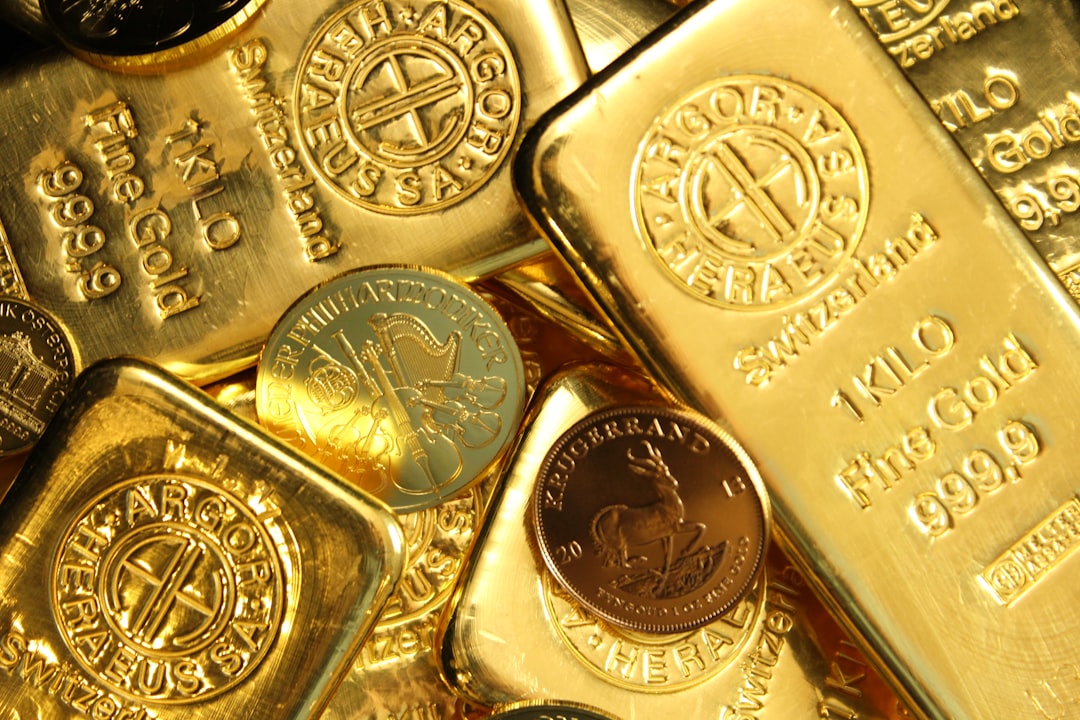
One day, Rodney, gold will shine
I haven’t covered the perennial disappointment that is gold for a while, and I felt the metal is overdue some attention, so that will be the subject of today’s missive. I say perennial disappointment, because gold “should” be so much higher. In any case, it’s summer. Usually, the best time of year to buy each year is in the June to August timeframe, so perhaps it’s time to allocate some funds that way. I stress “usually”, not always. A summer low in gold is frequent enough to be noticeable, but not consistent enough to be reliable. A bit like your errant teenager’s mood swings.In terms of price, the high for the year was $2,080 per ounce – printed in March shortly after you know who invaded you know where.The low for the year was $1,780 – that came in January. We also came close to that figure in May ($1,785 was the low).And today we are meandering around the $1,820 mark, which is also where the 52-week moving average lies. That’s actually quite a telling little fact. For all the declines we’ve seen elsewhere in stocks, bonds and crypto, and the ensuing erosion of wealth, gold sits at its one-year average. In other words, it’s done what it’s supposed to: preserved its value, and preserved your capital.And that’s with the US dollar so strong. Gold has been doing better than you thinkGold has actually done rather better against other currencies. The chart below shows gold in dollars (red), but also gold measured in pounds (blue), Japanese yen (green) and euros (yellow).You can see that against all those three currencies, gold is not far off its all-time highs. If you’re Japanese, European or British - all good then.Here’s another way of looking at the same thing. This is gold against 18 national currencies in 2021. It might be down a little against some of them – the US and Canadian dollars, the Chinese yuan, the Brazilian real, the Mexican peso and the Russian ruble (how has the ruble been so strong?!).But it’s up, significantly in some cases, against others – the Argentinian peso, the Swiss franc, the euro, the pound, the Korean won, the Japanese yen and, of course, the Turkish lira.Gold’s price is being determined then by the much bigger market that is the US dollar, as much as anything. Where’s the US dollar going next? Your guess is as good as mine. Monetary policy is tighter there than elsewhere, it’s the first port of call for capital in a panic, and so the dollar keeps rising. Currently at 104 on the index, it could go all the way to 120. Unlikely, but it’s been there before. If it does, gold almost certainly won’t be going anywhere significant.But of course, if the dollar heads lower – and it will if other countries start to tighten as much as the Americans – then gold will make a move. I gather analysts at Goldman Sachs have just put a $2,500 year-end target on gold. That would be nice.Is gold heading for a repeat of the 1970s?So many comparisons are being made between today and the 1970s. Politically and economically there are parallels galore. The big differences are technological. Nevertheless, gold had one of its best ever decades in the 1970s, going from $35/oz in 1971 to $850 (albeit briefly) early in 1980. It was bonanza time for gold mining.But even within that bonanza decade, gold went through a near two-year bear market in 1975-76 that saw it fall by nearly half – going from around $200/oz to $100. Imagine if gold went to $1,000 now. That would be hard to swallow. Here is gold during its glory years. Longer term, the fundamentals of out-of-control inflation, geopolitical instability, escalating de-globalisation and weak, unpopular leadership all tend to be drivers of flight to gold. But it remains an analogue asset in a world, where all the value is digital.It was me that first made this comparison many years ago, though I still haven’t decided what the answer is. The horse was transport for thousands of years. It was “natural transport”. With the invention of the car it became irrelevant.Gold too was money for thousands of years, “natural money”. But with digital technology and modern communications, is it now as irrelevant to finance and the horse is to transport?Or, like King Arthur to the English, will gold return to finance to save the people in their hour of need?I guess, until it actually does shows up, we’ll never know the answer From a technical perspective, that enormous cup-and-handle formation, built up over a decade, remains in play and looks ready to propel gold higher. I’ve illustrated it here.Cups and handles are another of those commonly observed chart patterns – like “double tops” or “head and shoulders” – which are fairly self-explanatory. This one was first observed in the 1980s. Investopedia calls it a “technical chart pattern that resembles a cup and handle”. It is considered a very bullish signal.If it plays out, it will give Goldman Sachs their target. And some.I own gold and I’m glad I do. I may be rude about it, but I love it. And it’s the one part of my portfolio
Size does matter
I keep thinking about that interview with Stanley Druckenmiller.Druckenmiller, a legend in US investing, worked with George Soros for many years, 12 of them as lead portfolio manager of Soros’s Quantum Fund, when he, among other things, spearheaded the infamous “Black Wednesday” raid on the pound in 1992 that forced the UK out of the European exchange rate mechanism (ERM). His own fund’s performance over many decades, year-in, year-out, is almost without equal.The part that really struck home with me is what he says was the key thing he learnt from Soros: “sizing”. Others might call that: how much to speculate or invest. Others: how much to risk. Others: how much of your portfolio to allocate. “Sizing is 70% to 80% of the equation. Part of the equation is seeing the investment, part of the equation is seeing myself in a good trading rhythm. It’s not whether you’re right or wrong, it’s how much you make when you’re right and how much you lose when you’re wrong”.“I believe in streaks,” he says, “Like in baseball. Sometimes you’re seeing the ball, sometimes you’re not. And my number one job is to know when I’m hot and when I’m not. When I’m hot, I need to turn the dial straight up. When you’re cold the last thing you should do is make big bets to get even. You need to turn yourself down.”The reason this has struck home with me – and perhaps might with you as well – is that I am not hot at the moment. I’ve had streaks when I’ve been great. Every stock I cover, every call I make, every buy or sell is red hot and bang on the knuckle. I could go through old articles and pick winners that eclipse other commentators.Perhaps you followed me into these trades and made out like bandits as a result.But I’ve also had streaks when I’ve been awful. And I could go through old articles and find you plenty of those too – articles that, when looked back on now, make me look a laughing stock.Perhaps you followed me into those and made out like a bandit who’s just been put in jail.Looking back, I first thought my hot streak came to an end in the spring, in early March. I was bullish on metals – I bought into the decade-of-under-investment narrative (and I still do) – but failed to fully heed to the Ukraine invasion “pop and drop” factor, followed by the impact of China lockdowns, never mind the broader market weakness.But now I realise my mistakes go back further – into 2021 – with a failure to see the tech bear market for what it was sufficiently early to have gone on the defensive. One part of my portfolio was doing well, so perhaps it concealed the other.Then, of course, since the spring decline of everything, I’ve taken some big hits. I imagine you have too. And I have been too slow to react.That’s another thing Druckenmiller talks about by the way: act first, research later. Markets move quickly, ideas spread fast, especially good ones, so it pays to get positioned. You can always exit if your research changes the story.As well as a failure to recognize what was what, or only half recognising it, and being slow to move, my risk management was poor. So to Druckenmiller’s “how much you lose when you’re wrong” – my answer? “Too much”. I should know better, and I’m more than a bit cross with myself. Nevertheless, I have been on a bit of a tidying-up exercise, re-evaluating positions and so on. I’ve also been working on my fitness as I believe that helps you make good decisions. What I’m betting on nowRightly or wrongly, I sold down some of my oil positions last week, as I felt oil could be the next shoe to drop in these ongoing liquidations. I sold down another couple of positions elsewhere that I felt had got tired so as to have some cash in case this bear market has another leg down (none of the companies discussed with paid subscribers, don’t worry).I spent some time comparing the movements of various asset classes from 2005-09 to the movement today. My memory was that stocks peaked, then a few months later metals peaked, then oil peaked – then a few months after that everything crashed.The sequence has been similar this year, so I am now concerned that another crash is on the cards. I tend not to bet on crashes, or indeed predict them, as they are rare occurrences. With two big ones this century and maybe three or four whoppers in the last, they tend to be outlier events. Predicting crashes may get you extra hits and clicks, but more often than not, you’re wrong.But my revaluation has now persuaded me that whether we crash or not in the autumn, I think we are bouncing now. It might be a change in trend (we have seen the low) or a counter-trend rally (further lows to come). So I’ve actually ended up, after selling a bit, now buying a bit (a simple long on the S&P 500). This might all sound contradictory, but trading and investing often are. You change your mind. I’m glad to have reached where I’ve reached, because it has been the result of thought, analysis and conscious decision-making, rather than laziness, following other
The impossible situation in which energy and metals producers find themselves
I wanted to discuss the natural resources industry today – energy and mining – because I see an industry caught between a rock and a hard place. If I get a bit ranty, I apologise. But this impossible situation makes me get a little frothy at the mouth, because it is in large part so unnecessary – and not the making of the industry itself, but of idiotic policy.We, as investors, however, need to understand the binds in which businesses find themselves, so here goes.We’ll start with supply chains.Disrupted first by Covid-19, then the Ukraine War, then more lockdowns in China, supply chains are still not working as they should. You don’t need me to tell you that delays cost money. Imagine a workforce ready to go, and being paid – but without the right equipment to get started. Money is draining out of one side and nothing is coming in on the other. This is particularly punishing where capital is tight. And boy, is capital tight in mining.Then there is, as we all know, dramatic inflation in input costs, especially energy. Budgets to production are going up, up and up. Money is also tight because of lack of investment. This lack of investment takes many forms. First there is under-investment from outside. ESG (environmental, social and governance) guidelines determine where many fund managers allocate capital. Oil, gas and mining, for obvious reasons, tend not to score so well on ESG, so capital is not allocated there and the industry is starved of funds.What’s so hypocritical is that ESG demands, and the decarbonised future it wants, require enormous amounts of the very products that its investment guidelines steer it away from: metals. Copper, tin, silver, lithium, cobalt, palladium, platinum, nickel, manganese, rare earths – the list goes on. They are all essential to a low-carbon future. But how are they to be produced without investment?Vast amounts of carbon must be burnt to achieve decarbonisation, yet oil and gas have also suffered from lack of investment. It’s one of the reasons prices are now so high – lack of new supply. Yet instead the companies involved are accused of ramping up the price and profiteering. The industry is wary of expansion tooThen there is a lack of investment from within. The industry still has memories of 2013-14, when mining in particular had, as metals analyst, Nicholas Snowden of Goldman Sachs puts it, a “near death experience”. The collapse in the oil price decimated energy too.This near-death experience followed the bonanza of the 2000s, when it seemed that metals and energy prices could only go higher, driven first by China’s seemingly insatiable appetite for natural resources, and then the money printing post-2008, during which the US exported incredible amounts of inflation. But those soaring prices suddenly came to a halt. Supply met demand, prices collapsed and with them the oil, gas and mining industries. Many companies went under. People lost their jobs and their livelihoods. Worse still, those who work in the mining industry tend to have a habit of investing in mines too – so their investments went down the Swannie as well.As a result there is “internalised trauma” – Snowden’s words again – and it is now uber-cautious. Nobody wants to be the stupid guy who blows fortunes on projects that prove uneconomic. So despite all the shortages in energy and metals we keep reading about, the industry is still cautious – probably a sensible mental space to be in.Rising commodities prices, especially those of oil and gas, may largely down to ten years of underinvestment, yet still the industry is reluctant to go all in. But can you blame it? Look at what’s happening in markets across the board. We’ve got a spiralling US dollar, crashing bonds and equities, and money is tightening. Even the UK housing market looks dodgy. The next asset class that looks like it is puking is, despite everything, oil (and policy makers would actually welcome that). I was listening to a debate on Bloomberg last week between someone from the US government and someone from the US oil and gas industry. The former was demanding that oil companies re-invest their profits in the ground – in exploration – so that production can be increased and the load on the US consumer lightened. The latter was arguing that profits should be returned to investors in the form of dividends, as that’s why they invested in the first place. The former then, basically, said that if you don’t re-invest your profits in the ground of your own accord, we are going to force you to do it by government mandate. That’s hardly going to entice further investment!What if companies are forced to put their profits back into the ground, and the price of the underlying commodity collapses? That’s what the industry is so terrified of, so it tries to find a balance between re-investment and rewards to existing investors.Why should they re-invest capital, when governments have said they want an end to fossil fuels? What’s the point?You (literally
A great interview with Stanley Druckenmiller
I don’t listen to as many interviews and podcasts as I used to, or indeed as I should (more fool me), but this interview this week with legendary investor, Stanley Druckenmiller, happened across my desk and I highly recommend it, if you can find the time. It’s long, but well worth it.Druckenmiller founded Duquesne Capital in 1981 and closed it 2010 with some $12bn in assets. He is said to have made $260 million in 2008 alone. He was also, from 1988 to 2000, lead portfolio manager of George Soros’ Quantum Fund. (Many of the best parts of the interview regard what he learnt from Soros).There are great stories, insight and wisdom, and a great deal to learn from him.Here are some of my take-aways:In his 45 years as a chief investment officer, today’s set-up is like nothing Druckenmiller has ever seen, because the bond market is so distorted with all the central bank buying of the last 12 years. He is not sure how it pans out. Normally, if he sees a bear market, he would hide in bonds. But that is not such an obvious option, when is inflation 8% and they are only yielding 3%. (Currently he seems to be mostly on the sidelines - more on this in a moment).“Once inflation gets above 5% it has never come down unless the Fed funds rate gets above CPI. And that is currently 8%.” He doesn’t think the Fed funds can get to 8%.He is generally bearish regarding today’s markets, but also makes the point that he has an overly bearish mindset, and part of his process is managing that. 90% of his fortune, and of any good short-seller, he says came on the long side, in growth stocks (in his case). The maths is with you.Think a year aheadStock markets are predictive - particularly companies within the stock market. The homebuilders, the truckers, retail - they can all tell you where the economy is going 6 months or a year from now. (He thinks a recession is likely). Retail investors tend to focus on what’s happening right now, and that is why they do not outperform. Current fundamentals are already reflected in the price. His advice is to focus intensely on what moves the stock price - what’s going to change 18 to 24 months from now? Will the company be in better shape? How are people going to react to that change?“My number one advice: Do not invest in the present. The present does not move stock prices. Change moves them.”He is not a fan of the diversification advocated in business schools. A big problem for investors is stale longs and stale shorts, he says. One should have a good knowledge of all asset classes and be able to switch between them. The act of doing that keeps you on your toes. It keeps you thinking and questioning.If you have an idea, it often pays to act quickly on it, then do the research later. Today markets move quickly and there is often not time to wait on a good idea. If an idea appeals intuitively and fits with his macro thinking, he tends to invest quickly and then do further research. If he is wrong, he can get out quickly. Good ideas tend to spread fast in the market - people talk. When an idea catches on, a security moves fast, erasing much of the trade potential, so it is important to be in as early as possible. Soros has spoken of this strategy in his books as well.Never mind the market, what about you?A key thing he learned from Soros is that “sizing is 70% to 80% of the equation ... Part of the equation is seeing the investment, part of the investment is seeing myself in a good trading rhythm. It’s not whether you’re right or wrong it’s how much you make when you’re right and how much you lose when you’re wrong.”“I believe in streaks,” he says, “Like in baseball. Sometimes you’re seeing the ball, sometimes you’re not, and one my number one jobs is to know when I’m hot and when I’m not. When I’m hot, I need to turn the dial straight up. When you’re cold the last thing you should do is make big bets to get even. You need to turn yourself down.”He applies this same logic to those who work for him. Placing big bets with those within his firm, who are on a winning streak, and often even betting against those who are on losing streaks. We could perhaps apply the same logic to those we follow - to commentators such as myself: know when they are hot and when they are not. (I am not hot at the moment FWIW).Many great traders talk of the need for humility and part of Druckenmiller’s success lies, I guess, in knowing when to be humble - knowing when he’s off. On one occasion in 2000, he went to Africa for six months, switched out of the market altogether - no screens, no papers nothing - came back and made 40% in a month.Macro chaos comingDruckenmiller sees “macro chaos” in the years ahead and feels investors will need to be able to switch between assets. He is worried about global trade and does not rule out a return to the 1930s.He thinks blockchain is going to be very big three to five years from now, a major feature of finance - but has no major positions. He is too old to compete. He may go back to sho
How much further will bitcoin fall?
Like Brexit, Trump, what a woman is, the BBC or vaccines, bitcoin has proved itself one of the battlegrounds in the ongoing culture war. Some people like it a lot. “Bitcoin fixes this” is the slogan, and bitcoin is thought to be the answer to any number of societal problems – from unaffordable housing, to government overreach, to the financial inclusion of the unbanked, the world’s poorest.There are many, however, who take the other view. It’s only used by drug dealers and money-launderers. It’s a Ponzi scheme, it can’t scale and it’s destroying the environment.The latter have been rather noisy of late. The reason? Bitcoin’s crashed. Again…Bitcoin has had a painful crash – but this isn’t that unusualLet’s start with the price. What was $67,500 back in November is now $21,000. It touched $20,000 on Monday. I make that a 70% haircut. Not good.But not so abnormal either. Bitcoin has had at least six corrections of 80% in its 13-year life – I make that one almost every two years. And yet, on broader time horizons, the network continues to grow, the number of users increases and the price appreciates. That kind of volatility is hard to stomach (particularly if you have a large portion of your net worth tied up in it, or, worse, on leverage) and it makes the case for it to become some kind of default money system harder to press. But it is what it is: a new technology whose purpose is to be money. It’s about as speculative a boom-bust vehicle as you could ever hope to design.As I see it, there have been two factors driving the price action.First, we are in the midst of one of the most vicious bear markets in my memory. Just about every asset there is is being battered. (Will oil be the next to go? I am starting to wonder.)We are talking about deleveraging across the board and, in such a macro environment, there is little time for speculative growth plays like bitcoin, the future of money or not. Panic is acute. There is a rush for cash. Never mind that, after you account for inflation, cash is losing 10% per annum. For now cash is king – specifically the US dollar, which is breaking out of its range to 19-year highs.I’m worried this goes to 120, by the way. If it does (as we have been warning for some time), never mind bitcoin, all assets are in even deeper trouble, be they stocks, commodities or other national currencies. We might even need another Plaza Accord.But of all the sectors to have been walloped by this bear market, tech, the darling of the preceding bull market, has been hit hardest. Bitcoin may not be a Nasdaq stock, but it trades as though it is, and the Nasdaq has been hit hard.The wider cryptocurrency sector is in panic mode The second catalyst to drive crypto prices lower comes from within the sector itself. We wrote a few weeks ago about the collapse of stablecoin Luna and suggested bitcoin would go to $20,000 then with the sudden rush for liquidity. But it didn’t. It held up. The latest scandal to dog crypto – which has a knock on from Terra and Luna – is around Celsius. And that has driven it to $20,000.Celsius is one of those lending platforms which paid what seemed like extraordinary rates of interest if you stake your crypto coins with them. They would then lend those coins out. Sort of like banking, really, but with cooler buzzwords. 7% was what it paid for bitcoin, I gather, up to 18% for others. If it sounds too good to be true, it probably isn’t true.With falling crypto prices this year, many have been withdrawing their crypto, creating for Celsius a liquidity crisis of its own. The collapse in value of its Terra holdings has only made things worse, while it borrowed ether from customers and staked it in such a way that it is now tied up and can’t sell.It’s a clusterflip. But it then emerged that it had sent over $300m in coins to exchange FTX. It looked like a rug pull. Cue a market panic, as everyone tried to get their coins back, and in many cases, sell what they have. Before long, Binance, the world’s biggest exchange, also halted withdrawals (only for a period though).Reading this I imagine most neutrals would not want to get involved in this space at all. Well, fair enough. I remain of the mind that bitcoin is an extraordinary technological breakthrough and I want to keep my shares in what is the most powerful computer network ever built. Others won’t feel the same way – and perspectives get messed with in bull and bear markets. We are at one of those points where everything looks awful.How much further will bitcoin fall from here?I’ve suggested before several times that bitcoin might come back to $20,000. That was its level in 2017 at the end of that particular episode (before it then went back to $3,000). It’s an obvious pivotal price point. The next question to ask ourselves is: will $20,000 hold?Well, if this bear market in everything carries on for much longer, the short answer is, “no”. Everything will be going lower. Here’s a chart with a dashed line at the $20,000 mark. Le
Copper faces "an impossibly tight future"
Further to last week’s piece on, “acquiring the right investment psychology” (if you missed it here is the link) I enjoyed listening to Bloomberg’s Odd Lots podcast this week with Goldman Sachs metals strategist, Nicholas Snowdon.The recent price action in metals has cast doubts in my mind as to the secular bull market. I needed gee-ing up with some bull food. I came away from the conversation wanting to buy as many metals producers as I possibly can…The outlook for copper is very bullish“By the middle of this decade, we're forecasting the largest ever deficit in the copper market,” says Nicholas Snowden of Goldman Sachs. “So just two years away from now. And by the end of the decade, the largest ever long-term deficit. It's just an impossibly tight future.”When I hear stuff like that from randos on the internet I tend to call “BS” – it’s usually sensationalising or click bait, so my instinct is to filter out. But when it’s coming from respectable employees of respectable institutions, the implications are rather different. Let’s start with the recent correction in copper prices. That was caused, says Snowden, by weak Chinese demand (due to their Covid lockdowns). There were also higher than expected exports from Russia (!). But both of these are transitory.The longer-term bull market is underpinned by two factors. First there is increased demand due to decarbonisation, net zero, etc. That will require a lot of copper and there is no obvious substitute. Second, there has been a chronic lack of investment in the sector. This is a drum we have been beating on these pages, but it is nice to hear that view endorsed by a Goldman Sachs analyst.Demand for copper this year will come in at around 24 million tonnes. Of that, about 22.5m tonnes is “normal” – copper in construction, wiring and so on. Only 1.5m tonnes of demand is “green”, decarbonisation-related demand. That is to say for electric vehicles (EVs), EV infrastructure and so on. By 2025 this “green” demand will double. By 2030, that number is projected to be 6-7m tonnes. In other words, green copper demand will rise from being about 5% to 20% of annual global demand.Where is that extra supply going to come from? Production is set to increase slightly this year, but then it flatlines after that when it needs to rise to meet the new demand.In the bull market of the 2000s, Snowden observes, projects were quickly approved, investment flowed, and supply reasonably quickly caught up with the increased demand (from China mostly). It’s different now. “Over the last two years,” he says, “even though copper demand has doubled, there hasn't been a single new copper mine approved.” I can’t believe that not a single copper mine has been approved – but perhaps not a significantly-sized one.“The number one constraint on the copper mining industry is the experience of the last cycle. Because the mining industry faced a near-death experience in 2013 and 2014, as a result of the overbuild in response to high prices in the mid-to-late 2000s. Now you have a much more conservative mentality amongst management teams in the mining sector, reflecting that experience.”I’ll say. The memory of 2013-14 still lingers, and not just in my mind. We won’t forget it in a hurry. “Internalised trauma,” Snowden calls it, and it slows down investment.Meanwhile, the permitting process, largely for environmental reasons, has got a lot slower. What would take 6-to-12 months now takes two to three years. Chile is the world’s largest producer, but it is also one of the hardest places to get a copper project going.That slows investment, as does the ESG influence on investor allocation. Less capital goes to mining because it does not tend to score well through the ESG filter.Another observation we have made on these pages, particularly as regards oil and gas, is the talent factor. Mining is hard. Who wants to work in mining when you can earn more, while risking less in tech? The gains are quicker and the aggro is lower. “You've got a real bottleneck now on skilled labour in the industry,” says Snowden. “There aren't enough engineers to a project.” That puts upwards pressure on wages and from there on capex and ultimately on prices.In short, painful memories of previous over-expansion are holding back investment; opening mines is harder because of increased regulation; and there’s a shortage of people. There are no obvious substitutes for the metalSubstitution – using something other than copper – might look like a solution. After all, other metals conduct electricity too. But there are practical issues with all of these too. Aluminium for example - but you need a lot more of it so it’s no good for anything that requires small space. There’re also supply issues. The decade of underinvestment has led to a shortage of supply of base metals across the board. The incentive to substitute is low. As Snowden notes, the cost of the copper content of an EV is a small part of the overall cost of the EV. So the
Tax Water Not Work
As regular readers of my stuff will know, I’m of the view that a society should be designed around direct democracy and very low levels of land value tax (LVT), what Milton Friedman called “the least bad tax”. I may dream of Ancapistan, a land of no government, but the reality is that taxation of some kind, even if it be voluntary, is inevitable. There has never been a civilisation without taxation.Ideally, land value tax would replace ALL other taxes. However, if you offered me LVT in the UK and all other taxes, income tax especially, slashed to 10, 15 or even 20%, I’d bite your hand off. My friends in the countryside hate the idea, and I get angry messages about it, but the reality is that it is the owners of prime city centre real estate, the likes of the Crown, the Grosvenor Estate, major institutions and so on, who would bear the brunt, not ordinary homeowners or someone with 10 acres of field with no planning permission. (In my book Daylight Robbery, I argue for location value tax - it’s the same as land value tax, but I use the word “location” because the location of the land - ie city centres - is more important than the actual amount of land).In any case, LVT is not going to happen here in the UK. Introducing a major new tax is too big an undertaking. It’s easier for politicians to raise and lower the taxes they already impose, and tinker round the edges of the existing system. LVT would be a whopping vote-loser in a nation whose primary concept of wealth is the value of their house. Just explaining it, never mind getting it across the line, is hard enough. (If you want an explainer, by the way, there is one here and another here). Anyway this is all pre-amble, and I’m not here today to discuss the merits - or lack thereof - of LVT. For the purposes of this blog, just take my word that LVT keeps the relationship between ruler and citizen, between governor and governed, in healthy, transparent check. With LVT you would pay fewer taxes and lower levels of tax - ie less tax overall.So I’ve been trying to come up with a politically possible means by which* LVT can be implemented and shown in practice to work* Beautiful housing can be made affordable to ordinary people without collapsing the housing market or having to reform the fiat money system* Corporations, particularly crony capitalist building companies, planners, regulators and government are kept out of it, and people can be left to their own ingenious devicesAnd, by George, I think I’ve got it.Here’s my idea. I stress: it is just an idea I am working through so there are bound to be flaws. I’d be grateful for any comments, pointers, thoughts, statistics, data, and so on.Water Location Value TaxSummary:Today’s unaffordable housing is a consequence of both our system of planning and our system of money. They have conspired. But wholesale reform to either as good as politically impossible. With Britain’s over-leverage to housing, the financial repercussions of markedly lower house prices are politically intolerable. Instead we propose to bypass the housing market altogether with an initiative to re-populate the underused rivers, keys, docks and canals of Britain with houseboats, barges and floating homes. Local authorities and the land registry will determine who “owns” the water and the land beside it (most water is nationally owned). That which is not needed for transportation (eg the middle of rivers) will be parcelled off into small plots to be sold to individual owners – not corporate entities – on which they can then build or buy, then moor floating homes and other edifices. An annual Water Tax will then be levied along the lines of Henry George’s Single Tax (land value tax), based on the rental value of the plot, payable to the local authority and to the body in charge of the waterway, usually the Canal River Trust.20 housing ministers since 1999The unaffordability of housing has been for twenty years or more one of the biggest issues in the country. As if to illustrate the priority this problem is being given in Whitehall, we have this:In fact, we have had two more, since Esther McVey and this chart: Christopher Pincher Stuart Andrew and Steward Andrew. I make that 20 different housing ministers since Hilary Armstrong in 1999. It’s not what you would describe as evidence of a long-term strategy.It seems absurd that we should have any crisis at all. A house does not cost a lot of money to build. In China it has long been the case that a 3D printer can build a home in a day for about £3,000. Here in the UK you can buy a flatpack 3-bed house, which takes 6-7 hours to erect, yours for £24,000. The interior of one of architect, Renato Vidal’s 3-bed, flat-packed homes, £24,000. Meanwhile, there is no shortage of land. Little more than 4% of the land in England and Wales is built on, even less in Scotland. This was the finding of the National Ecosystem Assessment in 2011: just 1.1% of rural and urban land in England and Wales has domestic proper
Sometimes you gotta have faith
I remember having lunch once upon a time with a fun manager of the old-school, refined Englishman variety. He rather took me aback towards the end of the meal when he started talking about this company his fund had put money into…You need faith – but you need to back that faith with something real Previously so understated, my fund manager acquaintance became wildly enthusiastic about this company, speaking with surprising zeal - and passionate volume - about cash flow and profit margins. I almost wondered if it was the same chap.“He’s fallen too much in love,” I thought. “He’s never going to be able to sell.”Then I took stock. “This is one of the most successful fund managers in the business,” I thought. “If I compare my investment success to his, well, he is clearly a lot better at it than I am. But … he’s in love with this company to the point of being delusional.”It was then that I had a bit of a lightbulb moment about the psychology of being long. Never mind our refined fund manager. I could just have easily been describing Tesla investors, silver bugs or bitcoin maximalists when I use the word “zeal”.You need that zeal – or belief – as an investor. If you’re too cynical, you’ll be one of those people who has been declaring since forever that bitcoin or Tesla or whatever “is a bubble”, and you’ll miss out on some of the greatest investment opportunities of our lifetimes.Then again you need to be cynical too. Otherwise how do you sell?Bearish articles seem to command a lot more wide nods of agreement – never mind hits – than bullish ones. Bears are hallowed as geniuses when bear markets come around. Yet bears have also predicted 37 of the last three declines. They’re wrong much more often than they’re not – at least, the permabears are.There’s a time to be bearish and a time to be bullish. But human beings progress and thus economies tend to grow over time. So the bullish stance tends – over time – to be the correct one.The key is to be cynical and disbelieving in the face of rubbish investments, and deeply credulous when confronted with not-so-rubbish ones. Easy to say, hard to do.You’ve got to know when to hold ‘em, know when to fold ‘em, know when to walk away, know when to run, as Kenny Rogers once sang.How to know? There’s no substitute for knowledge and experience. That’s how to know when to channel your youthful bravado, and when your wizened cynic.I think we are instinctively bearish. I say that because instinct enables us to evaluate risk and take precautions. There could be a vicious predator in those trees. There probably isn’t, but there might be, so let’s act as though there is – that way we’ll survive. Let’s assume the seas will be rough tomorrow, and have a lifeboat in place.So how do we overcome our instinctively bearish psychologies in a bull market? If you’re not a 100% technical-driven investor – which is most of us, even if we do stare at charts – how do you stay bullish through a bull market, so that you stay invested and keep riding the thing up? Belief is the answer. You need some of our fund manager’s belief. But that belief needs to be founded on something. Knowledge. The more you read, listen to podcasts, and generally do your research, the more you will know. If you can back up your beliefs or theories with hard facts, truth, data and information, then you reinforce them. Your belief is not then superstition or delusional. It is fact-based - “evidence-based” to use the naff expression that is now so commonplace.How I’m approaching markets right nowHow am I applying this in today’s markets?I was of the mind that there was a major shortage in most commodities, due largely to a decade of underinvestment, and that as a result, prices of energy and metals were going higher. The action in commodities over the last couple of months has shaken that belief.I could also see that the Russian invasion of Ukraine had panicked prices a lot higher than perhaps they should have gone, given current levels of supply and demand – so we did seem to need a correction. And we got one.But it’s the sell-off as a result of falling demand from China for metal, as a result of its lockdown, that has surprised me. And the grinding action that has followed. So I’m back to reading, researching and thinking. Have the facts around this bull market changed? Perhaps a little – but not nearly as much as the price. Is this ESG, “net zero” transformation still ongoing? There is a growing realisation dawning about how much it is going to cost, but I still think decarbonisation and the electrification of everything remains a huge theme for this decade. That requires a huge amount of metal and energy.I’m looking at my portfolio of investments. I like what most of the companies are doing. I like how they are going about things. I like the sectors they are in. I can see increasing demand for their products. So I’ve got very little I want to sell – not at current prices, at least. Should I buy more, then? Ach, I’m expos

My mission to revive my father’s long-lost WW2 musical masterpiece
I have an odd professional life. I double as a financial writer and a comedian. It seems to work. I specialise in unacceptable songs. You’re bound to have stumbled across one of them at some point. Apparently, I’m Nigel Farage’s favourite comic. I’ve just made what many would consider a comical investment. I have put more money than I care to think about into a theatrical venture on which I am almost certainly going to lose my shirt. It’s got a cast of over 50, a 15-piece orchestra and more. But I don’t care, because this is more important than money. My father, Terence Frisby, had a full and successful life. His play There’s A Girl In Soup was, for a time, the longest-running comedy in the history of the West End and a worldwide hit with runs on Broadway and across Europe (in Paris with Gérard Depardieu, in Rome with Domenico Modugno). It was made into a film with Peter Sellers and Goldie Hawn, and my father won the Writer’s Guild Award for the screenplay. His sitcom Lucky Feller, starring David Jason as one of two working-class brothers living in a council flat in south-east London (sound familiar?) was one ITV’s most successful sitcoms of the 1970s, and, another of his sitcoms, That’s Love, would become one of ITV’s most successful sitcoms of the 1980s. He made fortunes, lost fortunes, won awards, had a string of high profile court cases and beautiful girlfriends, a glamorous wife (my mum) - for a bit - and plenty of fresh air.But there was one thing that nagged away at him constantly, like squirrels in the attic of his mind. It was that he never saw the best thing he ever wrote on the West End stage or on screen. That thing is Kisses on a Postcard.How Kisses on a Postcard got its name In 1940, when my father was seven and his brother, my uncle Jack, was eleven, they were evacuated from their family in south-east London to escape the Blitz. Millions of children across the country met with the same fate. Neither they nor the parents knew where they were going, who they would be staying with or for how long.“Whatever happens, you stay together,” insisted their mum, my grandmother. “You got that? You stay together!” Then, to turn it into an adventure for the two boys, she invented a secret code for them. “When you get there,” she said, handing them a stamped, addressed postcard, “you find out your new address, you write it on this card and you post it to me. Got it? Now, here’s the code. You know how to write a kiss - with a cross? Well, put one kiss if it's horrible and I'll come straight there and bring you back home. You put two kisses if it's all right. And three kisses if it's nice. Then I'll know.”The two boys were put on a train along with the rest of their school, each with a gas mask, some sandwiches and a label round their neck with their name on. They ended up in a tiny village in Cornwall, where they were herded into the school hall and picked at random by whichever local would take them.Jack and Terry were chosen by a Welsh ex-coal miner and his wife, Auntie Rose and Uncle Jack, who lived in a tiny cottage by the railway with their soldier son Gwyn. Inside, they found a room packed with things: a cat curled beside the stove: a canary in a cage; oil lamps - there was no electricity here; and two First-World-War shells in their cases, over six inches tall, standing on either side of the clock on the mantelpiece. Outside in the yard, there was a pig and chickens; beyond that a valley with endless woods, a rushing river, fish to catch, streams to dam, paths, tracks, a quarry to climb. And, best of all, at the bottom of the yard lay the main line from London to Penzance. Trains!That night, on a borrowed mattress on the floor, staring at the postcard, they considered their code. They covered the card with kisses and posted it the next morning.My father would spend the next four years in that Cornish village. While many had horrible experiences as vackies, my father didn’t. He called it his second childhood. Kisses on a Postcard tells the story of those two boys and the tiny Cornish village during the war, with its conflicts, kindness, pettiness, generosity and gossip, turned on its head, first by the arrival of so many children, then by the arrival of American soldiers, prior to D-Day – a whole regiment of black GIs. No one in the village had ever seen a black man.Having had the theatre thrust upon me since an early age, I’m not as crazy about it as some. My view is that theatre disappeared up its own backside in somewhere around 1974 never to return - certainly the subsidised stuff, anyway. Kisses was only ever staged many years ago as a tiny community theatre project in North Devon, with mostly amateur performers, but it was like nothing I ever saw. Suddenly, I understood why Dad loved the theatre so much and just what a brilliant medium it can be. It became one of my lifetime missions to get Kisses on, and anyone who knows me will know that I have constantly been hustling for over 20 years trying
Think the oil price is high now?
Back in 2016 we learnt a new word. “Lustrum”. It means a five-year period. Given how long decades are, I can’t believe it doesn’t find more use. Even if we don’t use the word, we investors often think in terms of lustrums. Many of the investments we make are made with a three-to-five-year time horizon in mind.Which is precisely why I started using the word. We had identified a trade of the lustrum. It was oil. So how’s it doing?Oil still looks very cheap relative to most other assetsVery well, is the answer. But it hasn’t been an easy ride. At times we have really had to bury our heads in the sand. Crude was in the mid-$30s when we recommended it, but at one stage we found ourselves $60 underwater! How is that even possible, you might wonder? Well, of course, oil went negative back in 2020.But like all normal humans when presented with facts they don’t want to hear, we put our hands over our ears, shouted, “blah, blah, blah fishcakes” and went and played table tennis. It won’t last, we thought, and we were right. In fact, we should have bought more.Our reasoning back in March 2016 was that oil was extraordinarily cheap relative to other assets, be they stock markets, tech stocks, houses, gold, or even other commodities. It could go lower, we reasoned. Then again it might not. But, we observed, it was an anomaly that it should be trading at the same price it had been in the 1980s given how much money has been printed since.So here we are six years later, with oil three times the price or more, how’s the trade looking now? Do we sell?The trade is maturing nicely, I’d say. But, to use an analogy, although the wine in the cellar is getting finer all the time, it’s not yet at its most drinkable.Why oil could go to $300Let’s consider some long-term ratios, starting with oil vs stocks. This chart shows how many units of the S&P 500 you can buy with a barrel of West Texas Intermediate (WTIC – the US benchmark). Currently you get 0.03 of an S&P 500 unit (4,135) for a barrel of oil ($114).When the chart is falling, oil is getting cheaper relative to stocks. When it is rising, oil is getting more expensive. So you can see that it fell through the ‘80s and ‘90s, as the oil price declined, yet it rose through the ‘00s as the oil price made its way from $10 to $150/barrel.You would expect this ratio to fall over time as oil production techniques improve and stock market valuations increase as economies grow. Nevertheless, we are nowhere near the “sell” zone. If anything, we are still in the “buy” zone. The ratio is the same price it was in 2002. No reason here to sell our oil and move the money back into stocks. Call me again when the ratio is at 0.06 or 0.07. That’s another way of saying I see oil getting at least twice as expensive relative to stocks as it is now before this is over.If the S&P 500 is 4,000, a 0.07 ratio gives you an oil price of $280. Mark my words – $300 oil is not such an outlier.Here’s WTIC vs the Nasdaq. Again you would expect Nasdaq valuations to improve over time versus oil because of the scalability of digital and the growth in that sector. But on a relative basis, oil again looks very cheap and is still a buy.Whre’s it going back to? 0.04 maybe? Doesn’t look unreasonable.Using the ETF VNQ as a proxy for US housing, here is WTIC vs housing since 2004. It was three times higher before the end of the last bull market.And finally here is crude against gold – how many ounces can you get for a barrel? The answer is 0.06 of an ounce.This ratio tends to be much tighter over time – just as oil production techniques improve so do gold mining techniques, and there isn’t the growth-of-companies factor to push it lower.We are somewhere in the low-to-middle range. Call me when it gets above 0.1. If gold is $1,850 an ounce that would mean oil at $185/barrel.It’s not just relative – there are strong fundamental reasons for oil to go up too So we’ve looked at relative valuations. What about the fundamental reasons to expect a higher oil price?First, there’s 14 years of money printing and inflation. A lot of that money is going to go into the basic human requirement that is energy. Even if they print less, the money has still been created and oil is essential. Unless there is a sudden 2008-style debt destruction moment, that money will remain.Second, despite the fracking revolution, and the improved productivity it brought about, for almost ten years now there has been huge underinvestment in the sector. From lack of new discoveries through to aging pipelines, this means higher costs.Misguided anti-fossil fuel narratives perpetrated across the media and social media have made this sector toxic. Few want anything to do with it. Talent goes elsewhere, and with it investment. So productivity declines.Governments have exacerbated the lack of investment with their pursuit of green energy and net zero. They clearly don’t get it. The narrative now is windfall taxes. That’s only going to further disincentivize investmen
On the beauty of redheads
Back in the early 1990s comedienne Mandy Knight did a show at the Edinburgh Fringe called, “Some of my best friends are ginger”. I always thought it was an inspired title, exposing a double standard that still persists today, and it always stayed with me.Then, a few years back I presented a series for Italian TV about beauty, Senso Della Bellezza - Sense of Beauty - and we did a feature on red heads. I thought it would be a nice piece today to mine that feature and expand on it, explore the history of redheads, and thereby celebrate the unjustly mocked 1% of the global population that carry the MC1R gene.The Book of Genesis is perhaps the first book to have been written down and, in the book of Genesis we have the first celebrity redhead, and a victim of some treachery, Esau. Esau came home hungry one day after a long shift in the fields, and his brother Jacob offered him a bowl of soup, but only in exchange for something: his birthright, his first-born son status. Esau, who seems to have been a bit of short-term thinker, put his stomach first and he accepted. Thus did Jacob inherit, and so did Jacob - and not Esau - go on to become one of the Fathers of the Israelites. All things considered, it was probably better for the Israelites that he did.Esau was born red all over “like a hairy garment”, and one interpretation is that Esau had some recessive Neanderthal gene - the theory is that Neanderthals had red hair, although I do not suggest red heads are any more Neanderthal than the rest of us. The genetic mutation responsible is different to the one that which causes red hair in modern humans.Red hair occurs most commonly in people of Germanic or Celtic origin. Ireland has the most red heads per capita at around 10%, but the highest density of red heads and thus the red head capital of the world is actually Edinburgh. No wonder Mandy’s show did so well there.It’s thought that the reason red heads are more commonly found in colder climates is that it is actually an advantage to be pale, where sunlight is sparse. The lighter skin of red heads improves the absorption of sunlight, which is vital for the production of vitamin D by the body. Red hair is also relatively common among Ashkenazi Jews. Many Jews in literature have been portrayed with red hair. Shylock in Shakespeare’s Merchant of Venice and Fagin in Dickens’ Oliver Twist, being two of the most famous. Judas, the betrayer of Christ, is often portrayed as a redhead.During the Inquisition in Italy and Spain, where red hair is less common, those with red hair were identified as Jews, even if they weren’t actually Jewish. Today the commission for Racial Equality do not monitor cases of discrimination and hate crimes against redheadsRedheads were first mentioned in literature by the Greek poet Xenophanes around 500BC describing the Thracians, who it seems were red headed and blue eyed. The Ancient Greeks seemed to be particularly admiring of red heads. In men red hair was associated with honour and courage, while in women red hair was associated with beauty. Homer says the heroes Menelaus and Achilles were both redheads, while Helen of Troy, the most beautiful woman that ever lived, was also a red head.Aphrodite, Goddess of beauty and love was also red headed. (During the Renaissance, Botticelli and, especially, Titian were always painting beautiful women with red hair to the extent that titian now means auburn).The hair of female statues in Ancient Greece was often painted red - the Greeks loved the colour red.Many slaves in ancient Greece and Rome were the northern territories. Red headed slaves would often fetch a higher price, as they were thought to bring good luck. Red wigs were given to actors depicting slaves in Greek and Roman theatre. Indeed one fringe theory to explain modern mocking of redheads is that it stems from the Roman subjugation and persecution of Celts after the Romans arrived in the British Isles.Aristotle was not as keen as other Ancient Greeks is supposed to have said that "Those with tawny coloured hair are brave; witness the lions. But the reddish are of bad character; witness the foxes."Romans seemed just as admiring of red heads as the Greeks, particularly among the fierce Gaulish tribes, who Titus Levy said, “stand first in reputation for war … with their tall bodies, long red hair, huge shields, very long swords, and songs and yells as they go into battle, they terrify their foes.”From the Gauls to the Vikings to the Celts there has always been this connection between martial strength and flame-colored hair. The English warrior queen Boudicca was a red head. Perhaps the greatest warrior of the lot, Ghenghis Khan, was “long-bearded, red-haired, and green-eyed.”Egyptian pharaohs were found to have hair with reddish pigments, among them ‘Rameses the Great’, the most powerful of them all, and Cleopatra. Alexander the Great, Richard the Lionheart, the great Ottoman naval commander Hayreddin Barbarossa (Red Beard), Queen Elizabeth I
Don't fight the Fed
Not being a Fed-watcher, I have been rather slow to this particular narrative, I’m afraid, and it only really dawned on me last week as I was losing money trying to catch falling knives in the stock market.It was Zoltan Pozsar writing for Credit Suisse who switched on the lightbulb for me. He’s the new rockstar among institutional market strategists.A couple of other analysts have reached the same conclusion.It’s this: the Federal Reserve and America’s other policy-making powers that be, actually want the stock market lower…The Federal Reserve really does want to fight inflation I’ve heard so much hot air coming out of government officials’ mouths over the years that I think my mind is actually programmed now not to believe a word they say. It’s not that I’m treating what they say with a healthy dose of cynicism. I’ve reached unhealthy levels of cynicism. My default, so low is my trust, is now not only not to believe a word they say: it is to assume they are lying. Probably not a good place.It turns out that sometimes those in power do actually tell the truth. I got my first surprise dose of this earlier this year from Foreign Secretary Liz Truss, when she warned that the Russian troops on the other side of the Ukraine border were about to invade. Pull the other one, I thought. Russia wouldn’t do that. It turned out that Truss was talking straight, and her intelligence was correct.When US president Joe Biden said his top economic priority was getting inflation down, my inner cynic muttered: “yeah, course it is mate.” It turns out what he was saying might actually, believe it or not, be true. The Federal Reserve’s primary mandate is to keep inflation down. It might be that chief, Jerome Powell, is taking this mandate at face value. All that stuff about his hero being Paul Volcker might even be true too.Lower asset prices help the cause.Back in 2008, and for many years since, everyone in Policymakerland was worried about deflation, and every effort went into staving it off. So we got QE, ZIRP (zero interest rate policy) and all the rest of it. We got very used to it. It went on for so long, it became normalised. The idea that they would ever do anything else seemed far-fetched. But, no, in Policymakerland they are genuinely worried about inflation, and so asset prices are not going to be defended. Au contraire. They want them to fall.Bear markets mean financial conditions tighten. Tighter financial conditions mean lower money velocity and lower inflation, according to modern definitions at least.The Fed is talking tough, and it might be that talking tough does a lot of the job for them – and they might not have to actually act as tough as they talk.If they can get stock prices down a bit, house prices down a bit, and a lot more caution around the place, with just a bit of jawboning, then the need for higher rates will diminish, and the western world might not actually implode. Falling crypto markets help the cause too. There won’t be that particular thorn in the Federal side exposing the shortcomings of fiat money.Tighter conditions will put some upward pressure on unemployment, which means the upward pressure on wages will go away too, and that will help reduce inflation.If this has to happen sometime, that time is now, in the second year of an election cycle. Come 2023, the priority will shift to getting the economic conditions in place to win the next election. Part of this of course is lower inflation, but they will want the correction in the past and asset prices moving back up again.OK. So if you buy this theory - how far do stocks fall?How low can the S&P 500 go?Currently we are at 3,970 on the S&P 500, having been as high as 4,800, and over the last couple of days the bulls appear to have regained control of the tape. The low was 3,800 - off about 20% from the highs. Another 10% or 15% would take us to the low 3,000s.While we could bounce a little here, I’m inclined to think we haven’t yet seen the lows. Best-case scenario, I’m going to say 3,600 – that’s the post Corona-panic high. Worst case? Down around 3,000 at the 2019 highs. Most likely, I’m going to guess somewhere in the middle at 3,400 – the 2020 pre-lockdown highs. Remember these are just guesses.But the bottom line is this: the “print-money-and-protect-asset-prices-at-all-costs” narrative has gone. It’s history. The issue is no longer deflation, by their definition. Now it’s about inflation. They’ve been able to ignore it for years by crooked measures, ignoring asset prices and all the rest of it. They can’t any longer. That’s what they are now fighting.As they say, “don’t fight the Fed”.It won’t be the case forever. Elections have to be won. But it seems the case for now. Psychologically, we might need some despair and maximum pessimism before the bear market can be deemed over. There still seems to be too much optimism about. We need to be at that point of perception that the bear market is entrenched and we are never going to get out of

The lesson leaders never learn: high taxes do not mean greater revenue
‘Due to our low tax policy . . . revenue has increased.’John James Cowperthwaite, Hong Kong Financial Secretary, 1961-71Fourteenth-century Tunisian, Ibn Khaldun, is probably the greatest philosopher of the Islamic Golden Age. In his magnum opus, The Muqaddimah, he wrote: ‘In the early stages of an empire, taxes are light in their incidence, but fetch in large revenue. As time passes and kings succeed each other, they lose their tribal habits in favour of more civilised ones. Their needs and exigencies grow . . . owing to the luxury in which they have been brought up. Hence they impose fresh taxes on their subjects . . . and sharply raise the rate of old taxes to increase their yield . . . But the effects on business of this rise in taxation make themselves felt. For businessmen are soon discouraged by the comparison of their profits with the burden of their taxes . . . Consequently, production falls off, and with it the yield of taxation.’ Never mind his own Islam, he might have been describing Rome or Greece before, or Britain or the US after. Low taxation and small government accompany the ascent of great civilisations, high taxation and big government their demise.It may be counter-intuitive, but it is an observation that goes back centuries. Low tax rates often bring in greater revenue, while higher tax rates bring in less.Khaldun was not the first to make this observation. It was the guiding philosophy of the fourth caliph, Ali. Take great care, he instructed his governors, ‘to ensure the prosperity of those who pay taxes. The proper upkeep of the land in cultivation is of greater importance than the collection of revenue for revenue cannot be derived unless the land is productive.’ If conditions are bad, then suspend taxes, he advised. “Do not mind the loss of revenue on that account, for that will return to you one day manifold in the hour of greater prosperity of the land and enable you to improve the condition of your towns and to raise the prestige of your state.”Hong Kong’s John James Cowperthwaite acted by the same philosophy and would always push for the low- or no-tax option. Eventually, ‘funds left in the hands of the public will come into the Exchequer’, he said, but ‘with interest’.In 1924, US Secretary of the Treasury Andrew Mellon wrote, ‘It seems difficult for some to understand that high rates of taxation do not necessarily mean large revenue to the government, and that more revenue may often be obtained by lower rates.’But perhaps the most famous proponent of this argument was the American economist Arthur Laffer.In 1974, Laffer was having dinner in Washington DC with two of (recently impeached) President Richard Nixon’s former advisers, Dick Cheney and Donald Rumsfeld, as well as a writer for the Wall Street Journal by the name of Jude Wanniski. Laffer was arguing that the incumbent president Gerald Ford’s recent tax increases were flawed and would not lead to increased government revenue. To illustrate his argument, so the story goes, he drew a curve on a napkin showing the relationship between tax rates and revenue. At very low rates of tax, government revenue is low; but it is also low at high rates (because the economy is weaker, profits are down, earnings are down, evasion is higher and so on), so the curve is bell-shaped. The top of the bell is the point of maximum revenue – that is, the sweet spot at which to place tax rates if your goal is to maximise government revenue. Laffer’s argument caught the imagination of those present; Wanniski would later dub it ‘the Laffer Curve’, even though Laffer later stressed, ‘The Laffer Curve, by the way, was not invented by me,’ and mentioned many others, from Keynes to Khaldun, who had observed the same phenomenon (perhaps we should call it the Fourth Caliph Curve). As President J. F. Kennedy once said, ‘It is a paradoxical truth that tax rates are too high today and tax revenues are too low, and the soundest way to raise the revenues in the long run is to cut the tax rates.’ It is a lesson that mankind continually seems to forget, and one that continually needs re-teaching. Hence today’s post.(That was an adapted extract from Daylight Robbery, How Tax Shaped our Past and Will Change our Future). This is a public episode. If you'd like to discuss this with other subscribers or get access to bonus episodes, visit www.theflyingfrisby.com/subscribe
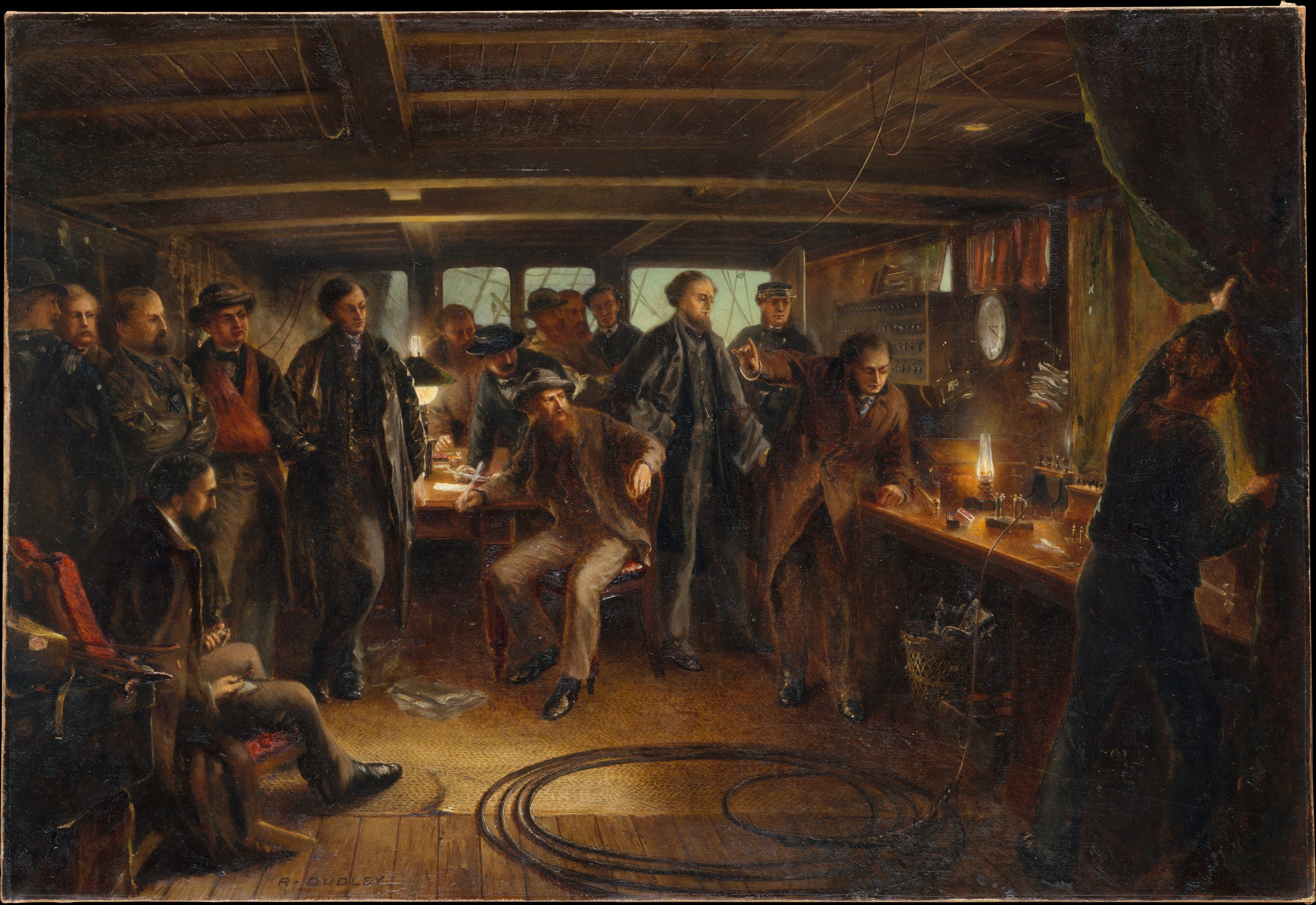
Money is language
You might call it the cable that changed history.In the mid-19th century there were various attempts to lay cables across the Atlantic Ocean between Britain (Ireland) and the US. It took several failures, numerous bankruptcies and over ten years before they got it right. But eventually they did and on July 27 1866 Queen Victoria broadcast a message to US President Johnson. Here’s what it said: Osborne, July 27, 1866To the President of the United States, WashingtonThe Queen congratulates the President on the successful completion of an undertaking which she hopes may serve as an additional bond of Union between the United States and England.Johnson replied:Executive MansionWashington, July 30, 1866To Her Majesty the Queen of the United Kingdom of Great Britain and IrelandThe President of the United States acknowledges with profound gratification the receipt of Her Majesty's despatch and cordially reciprocates the hope that the cable which now unites the Eastern and Western hemispheres may serve to strengthen and perpetuate peace and amity between the governments of England and the Republic of the United States.(Signed) Andrew JohnsonMoney is a form of communication technologyTo send a message by ship could take ten days or more. Now it was a matter of minutes. So somebody came up with the slogan "two weeks to two minutes".Transmission speeds improved rapidly. Morse code became words. It was soon possible to send multiple messages at once. By the end of the 19th century, Britain, France, Germany and the US were all linked by cable.Personal, commercial and political relations were altered for all time.Back then gold was money of course, as were paper notes representing gold. You couldn’t send gold down the cable, however, nor paper. But you could send a promise.And, within a fortnight of Queen Victoria’s message, that’s what two parties who trusted each other did. An exchange rate between the dollar and the pound was agreed and then published in the New York Times on August 10.That is why, to this day, the pound-dollar exchange rate, GBPUSD, is known as cable.Promises, promises, promises“All money is a matter of belief,” said Adam Smith. He had a point.Look at a twenty pound note (if you still use them) and you will see the words “I promise to pay the bearer”. Money is promissory.Of course, promises disappear. Gold doesn’t. The two are quite different forms of money: one is belief, the other is real. Nevertheless, since the dawn of civilisation, we have been using promissory money. In Ancient Mesopotamia, man used mud tokens - a cone or a sphere- representing sheep or barley, baked inside clay balls to log debts owed. Over time, he found it more efficient, rather than bake tokens in balls, to inscribe pictures of the tokens in the mud for the same purpose. That is how the first system of writing came about. In Ancient China, man recorded his debts on bits of leather. After the invention of printing he started using paper. Today the promises are recorded and exchanged between trusted third parties on computers.Millions, probably billions of promises are sent across the internet every second, transferring as quick as words, probably quicker. Not only does (promissory) money evolve with communication technology, it is often the spur, the impetus for communication technology to evolve. Now bitcoin, with its blockchain, obviates the need for trusted third parties altogether. That is one of many reasons it is so special. Here is a money communication network backed instead by mathematical proof and the most powerful and resilient computer network ever known to man: the trusted third party is the blockchain.Why would you not want to own a share of such a breakthrough technology? That, effectively, is what owning some bitcoin is – owning shares in a new monetary technology. And it’s not like they are doing any roll backs.Money has evolved like languageMy purpose with this is to illustrate a point: if you’re sending important promises, you need good communication tools. What is money, then, but a form of communication?Let’s explore further. It’s often said (by me at least) when considering politicians: look at what they do, not at what they say. What we do says more about us than what we say. What we do with our money says even more.And what we do with our money communicates value, not just between buyer and seller, but across the economy. What is the price of this thing? What is its value? The answer is constantly being sent and received, digested and acted upon; and so does the economy constantly, incrementally evolve and develop with each new signal: the how, why and when, of what needs producing and where.Money then is like a language. Constantly evolving and changing. Nobody is really in charge. Not even central bankers. Our fiat system wasn’t really planned. It has just constantly evolved, with billions of people contributing in their own different ways simply by using it. The architects of fiat money did not pla
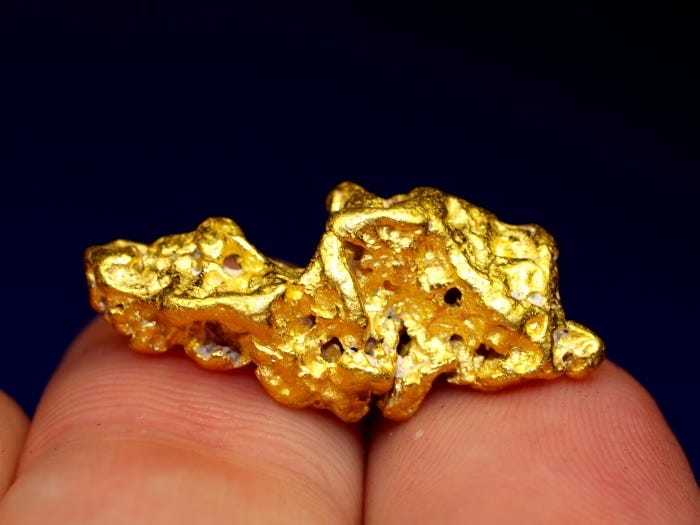
Why our instinct for gold is primal
Thousands of years before the dawn of civilisation, as prehistoric man hunted and gathered his way through the Stone Age, he came across 6 metals - the six native metals, which occur in nature in a relatively pure state: silver, tin, lead, iron, copper and gold. He found gold in river beds - nuggets, mixed in with sediment, relatively easy to collect and shape.Man adorned himself with it - as well as with bones, teeth, precious stones and shells. This was long before the Bronze Age and the discovery of smelting, when he started using copper, tin and lead.The oldest records we have of man using metal are fragments of gold in Spanish caves inhabited by Paleolithic Man, dating back perhaps as much as 40,000 years. The first records of man using copper came tens of thousands of years later. Lead, tin and iron’s first use came even later.The beauty of gold - dense, glimmering, shining - as well as its imperviousness no doubt captivated Stone Age Man the same way it does his 21st century descendants. We are the same animals, after all, with the same instincts.Gold is symbol of power and status, and of reproductive fitness - look at me I have access to this shiny substance. Like shells, bones and stones, even hand axes - gold was not only used as decoration, but as reward - as an expression of gratitude, as a prize for completing a task, for heroic deeds, as a tool in barter and exchange. In other words, it functioned as early money. Even in prehistory gold was performing the role it has always performed - and always will: to store and display and exchange value.Stone Age man had the same instincts we do today - the same urges, desires and compulsions. Survival is the most basic compulsion. You have to find water, food and shelter, for yourself and for those close to you. Then there is the survival of your species: you have to reproduce. If you survive, thrive and reproduce, so does the species as a whole grow stronger. Our self-interest is good for the species as a whole. And so we have the same basic instincts: fear, desire, love, hate. What often goes unmentioned is our instinct for beauty. What we find beautiful is often good for us in some way. It is why man has always sought beauty.We are instinctively repulsed or alarmed by things that are dangerous – snakes, spiders, a cliff edge, loud noises. Things that aid our survival we find beautiful - the sound of running water, a fit and healthy potential mate, an open landscape with water, varied animal, bird and plant life, good visibility and shelter. With its unique characteristics, beautiful yet impervious, gold found special status in our psyche even before the dawn of civilisation. Our prehistoric ancestors cherished it before they were able to speak. Our instinct for gold, the emotion it inspires, is as eternal as the metal. It is a primal instinct.Beauty is truth, truth beauty,—that is allYe know on earth, and all ye need to know.John KeatsADDENDUM: Good point from tinopener1A version of this article originally appeared at Glint. This is a public episode. If you'd like to discuss this with other subscribers or get access to bonus episodes, visit www.theflyingfrisby.com/subscribe
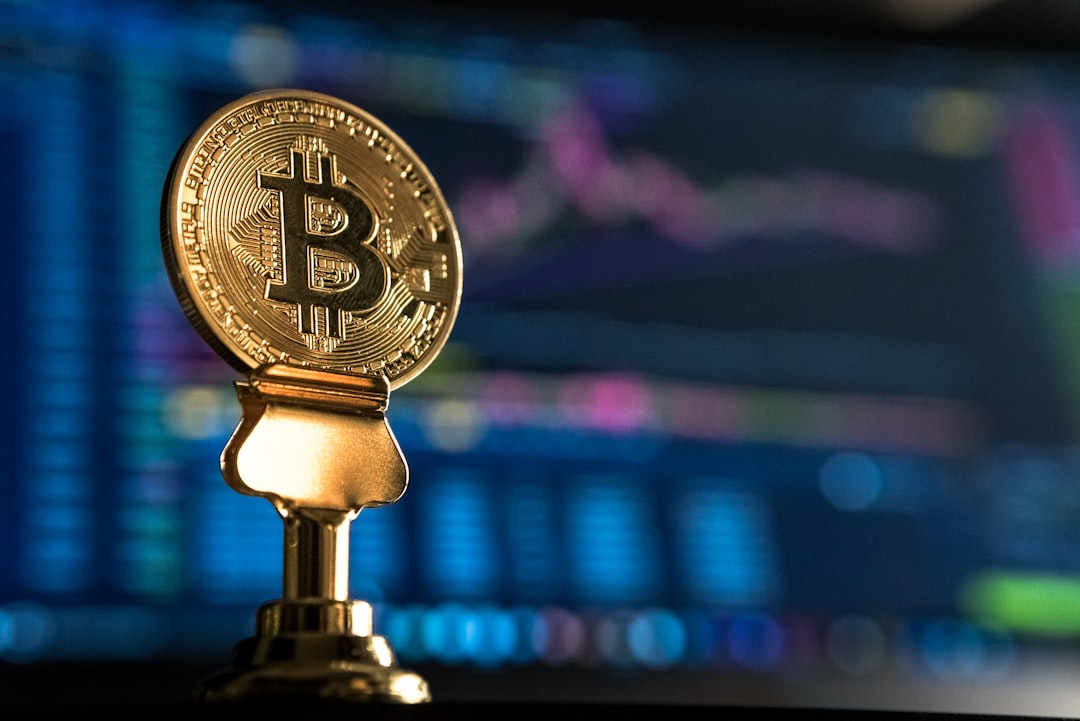
How low will bitcoin go?
With the entire crypto sector crashing – I thought I should give you some thoughts on bitcoin this morning.Needless to say, it’s not pretty.At all.Faith in crypto has been battered, in most cases, quite rightlyThis time last year, bitcoin went on one its monster runs above $60,000. It then had one of its monster crashes. I can’t remember if it was in Moneyweek or on Twitter, but somewhere I suggested that a reasonable target for the correction might be $20,000. $20,000 was the old high from the 2017 boom and bust and an obvious pivotal price point.But the correction stopped at $30,000, or just below. The conclusion I drew – and on current evidence wrongly drew – was that, as bitcoin matured, its volatility was declining. The 90% corrections of previous bull markets were now 50-60% corrections.Bitcoin had a second run above $60,000 in the autumn, followed by another of its humongous corrections, and lo and behold, $30,000 held again (actually just below, but I use round numbers as they are more readable).As an asset, bitcoin has become highly correlated to the Nasdaq and tech stocks and, as we all know, tech stocks have been walloped. Peloton, for example, which we wrote about yesterday, is down over 90%.So over the past fortnight, I was quite encouraged to see bitcoin holding up quite well relative to other tech stocks. $30,000 looked like it was a floor.Then we got the collapse in the protocol Terra, and its so-called stablecoin UST, and the sector has been absolutely battered.This is big, and it’s going to take some recovering from. The bubble of 2016 was verging-on the-fraudulent ICOs. Today it’s staking and stable coins. The yields on staking – over 20% in some cases – were unsustainable and so they have not been sustained. (If you’re baffled as to what I’m talking about here, don’t worry, you haven’t missed out and at this stage it’s very much for the best). Hundreds of thousands of people have lost money, in some cases fortunes, and as someone who has lost big money in the past, I offer my deepest sympathy. You start blaming yourself for your greed and stupidity, you feel huge shame, worse you start thinking you have betrayed your family, you think you will never get your life back and you sink into a horrible depression. In some cases, people will feel suicidal. I’ve been there (although not the suicide bit) and it is not nice. Yes, you made a poor judgment and it has cost you, but you haven’t betrayed your family. You were only trying to better your lot and thereby make all of your lives better. There is nothing wrong with that. The reputational damage of this episode to crypto is considerable. All those who declared that “crypto is a fraud” are now looking wise, while those, myself to an extent included, who made the argument that bitcoin is a hedge against currency debasement are looking stupid, given that it is off some 65% from its highs.Bitcoin will survive (again) but it’s likely to hit $20,000 and could go even lowerOf course, bitcoin and crypto are not one and the same. Bitcoin remains a product of technical and open-source genius, but forever in its wake, and surrounding it, are disasters, gaffes, frauds and scams. Altcoins, NFTs, the Metaverse, Defi, staking, whatever the latest buzz thing is – all of it is puking value, and the bubble has well and truly burst. Again.And there lies the keyword – again. This is not the first time this has happened, and it will not be the last. And, for all the junk that surrounds it, bitcoin keeps on keeping on.The sector has lost some $1.7trn in value. That is a number similar to the subprime losses that triggered the Global Financial Crisis. But in crypto there are no bail outs. As I write it sits at $27,500. I would have thought we will see a retest $20,000. All the better if not. Oddly this episode might prove good for bitcoin in that it will produce a lot more bitcoin maximalists and hodlers.We hope $20,000 holds, but these are horrible, horrible, horrible markets – and I’m not just talking about crypto. It was oil going bananas in 2008, rising to $150 a barrel, which triggered that collapse. It seems like something not too dissimilar is happening now, following oil’s spike to $130 last month.There will be a lot of forced sellers out there – leveraged players across the board. So we are going to see a lot of liquidation. My advice, if you own quality assets, and you don’t have to sell, is not to. Gold, bitcoin, good companies – whatever. Their price may go lower, but if you are not confident you can beat the market, then don’t sell. Because just as bubbles always burst, so does quality always come good. And bitcoin itself – I’m not talking about other crypto – bitcoin itself is a quality asset: the single-most resilient information technology system in the world, backed by the most powerful computer network ever created.There’s even a chance it could go back to its corona-panic lows of March 2020. Heck, everything else seems to be going that way. That
The tech bubble has burst. But I still want a Peleton.
Did you buy a Peloton in the lockdown? I know a couple of people that did. I nearly did. I certainly looked at them online and lusted after one. But then I didn’t get round to buying one. Can’t remember why not. It might have been the waiting list. It might be because I don’t have anywhere to put it…The tech bubble has well and truly burstA Peloton, by the way, is an indoor exercise bike that comes with an app with loads of classes built in, so you can have someone shout at you while you cycle. They do treadmills and things as well.Peloton Interactive (Nasdaq:PTON) was one of the go-to stock darlings of the Covid tech boom. It IPO’d in September 2019 at $29 a share. The IPO price was probably a bit high because over the next month the stock fell by a third to $20. It rallied a bit, but at the height of the Covid panic in March 2020 it sunk even lower to $17.Then people like me started wondering how we could exercise during a lockdown. Over the next nine months the stock went up ten times. By January 2021 it was $171. Then it started falling. Yesterday it hit $11.That’s a fall of somewhere between 93% and 94%. It’s now trading at roughly a third of the IPO price. It can still fall by another 93%.But I still think I want a Peloton. Though where would I put it?Netflix (Nasdaq:NFLX) has gone from $700 in December to $177 yesterday. It’s “only” fallen by 75%. But my kids still watch Netflix. I don’t. But that’s because I’m a stroppy old grinch who doesn’t like TV. I can’t bear actors with shoddy diction, you see, and there are rather too many of them. They brutalise the language and nobody seems to care (except me). Another example of falling standards.Amazon (Nasdaq:AMZN) has gone from $3,773 to $2,177 yesterday. It’s “only” down 43% and it actually makes money. Or so I’m told.Whatever, I still use Amazon ALL the time.The tech bubble has well and truly burst. But tech companies are a lot more real than they were in 2000, last time around.The bursting cannot be blamed on Vladimir Putin and the war in Ukraine, I don’t think. It was a speculative bubble and speculative bubbles, even though they can go on much longer than is “rational”, pop. Suppressed interest rates and digital money printers endlessly brr-ing keep them going, but one day they pop.And it’s not like these declines are confined to Nasdaq stocks.Over the last week the defi protocol Terra has fallen by over 90% and, in doing so, collapsed the entire bitcoin and cryptocurrency ecosystem. We are deep in the bleak cryptocurrency midwinter and eyes are bleeding.Over in the similarly stupidly speculative sector that is junior mining, pain is apparent across the board. Markets are puking. Selfies of speculators now seeking work at McDonald’s abound.The bearish factors at play are obvious - the war in Ukraine, rising geopolitical tension, inflation, interest rates that don’t reflect inflation, fear that interest rates will soon have to reflect inflation, and the likely popping of the global debt bubble.Ukraine aside, these aren’t anything new, it’s just now they all seem to matter, when previously they didn’t.Where can you hide? Bonds are tanking, stocks are tanking, commodities are tanking, precious metals are tanking, crypto is tanking, even cash is tanking – in that it’s losing 10% of its purchasing power every year.Well, that last point may be true, but during a global margin call, cash suddenly starts to look valuable. The good thing about bear markets is that they don’t last forever. I don’t know when this one will end, but it will end, eventually.At a certain point, real businesses with cash flow are going to look very attractive - if they don’t already.The secret I guess is to look around at all those companies you wanted to buy when times were good. Have they changed? No? Well, now’s your chance to pick them up at a discount. When TVs and computers are on sale, people queue overnight round the block to get their bargains. When stocks are on sale, everybody panics and sells.The lesson is to always keep some cash in reserve for times like this. The problem is you spend it when you think something is cheap. It falls by more and you don’t have any cash left to buy it when it is cheaper.Gosh these markets are difficult. The sheer speed of the declines over the last month have been extraordinary.Are we at peak panic yet? I can see lots of opportunities out there. But I don’t think we are quite at the final flush point yet. But I dare say we are not that far away.This would seem to be a bear market of the grinding variety. Far more painful than the short and sharp crash-boom variety we saw during Covid.Stay safe! Awful expression, but I guess in this case it means don’t use too much leverage. This is a public episode. If you'd like to discuss this with other subscribers or get access to bonus episodes, visit www.theflyingfrisby.com/subscribe
Pay for what you use, not what you produce
There are about 65 million people in the UK and 60 million acres of land – almost enough, in theory, for an acre each. (It’s not quite that simple, of course, and not all acres are equal.) Yet about two-thirds of the land – 40 million acres – is owned by fewer than 6,000 people. Land is the most basic form of wealth there is, so if there is a more telling statistic about the unequal distribution of wealth in this country, I’d like to know what it is. And it’s been that way since 1066.Today, so distorted is our system of taxation, many landowners actually receive subsidies for for land. The rest of us, meanwhile, must pay council tax. The largest landowners, whether families or institutions, exploit tax loopholes. Some families pass land from one generation to the next via the tax avoidance vehicle that is the trust, while the rest of us must pay inheritance tax.The complexity and inconsistency of our tax systems are to blame for so much wealth inequality. One group - large institutions, the super-rich, the government - has the resources to find the loopholes and exploit them, the rest of us don’t: and so pay more on a proportional basis. Complexity allows there to be one rule for some and another for everybody else.About the only way the person who starts out with nothing can improve his or her lot is through labour. And yet we tax labour constantly and heavily. The worker pays the vast majority of taxes: 40% of government revenue comes from income tax and national insurance, with another 20% from VAT.The wealth of the super-rich does not derive from their labour, however. It derives from the appreciation in the value of their land, their houses, their stocks, their shares, their bonds, their fine art – what economists call their assets. These go untaxed, unless you sell. So most don’t.If you want to redistribute wealth naturally, rather than via the moral minefield that is state re-allocation, the answer lies in changing the way we tax people.Instead of taxing our labour – what we produce – why don’t we tax what we use? Instead of taxing the wealth that is earned, why don’t we tax the wealth that is unearned? I’m talking about land. Nobody made the land. Nature gave it to us. By building on it, or farming it, or mining it, you have improved it, but the land itself was always there. So let us look solely at the unimproved value of the land. This is easy to assess.Obviously real estate in city centres commands an extremely high value, remote rural farmland very little.If you want the right to occupy a piece of land, and you want the government to protect your title to that land, then a rent should be paid to the community that reflects the value of that land, because it is the needs of the community which have given that land value. The least bad taxWhat I’m describing might sound extremely left wing, but the granddaddy of rightwing economists, Milton Friedman, described it as the, “least bad tax”: that is LVT – land value tax.Who would pay the most if we hand land value tax in the UK? Whoever occupies the most valuable real estate. The Queen (she owns most of it - or rather the crown does), the Duke of Westminster (or rather the Grosvenor Trust, which owns the land), the Duke of Buccleuch, the Duke of Atholl, Captain Alwyne Farquharson, pension funds, utility companies and large government bodies such as the Forestry Commission and the Ministry of Defence.The late duke may have been a canny businessman, but he did not invent anything new, he did not bring some amazing new product or service to the world, which we all wanted to use. His ancestors benefited from the corn laws 200 years ago and the estates were built. Now planning laws are such that few can build anything new. The estate, which owns some of the most desirable land in London, was effectively handed a monopoly and the duke made good from the fact that so many people want to live and work in London.There’s big money to be made in land banking but there is nothing creative about it. You are not bringing anything new to the world or improving it. It is simply exploiting the restrictive planning laws in this country that prevent progress and money supply growth. It is crony capitalism at its worst.If you don’t want to pay land value tax, you don’t have to. This is a tax that is voluntary. You simply sell the land to someone who is prepared to.The amounts of tax payable are clear. It’s an easy tax to administer. It doesn’t require 10 million words of tax code. And there need be no loopholes. The land is here – it is not in the Cayman Islands – and you are the owner.The Green party actually has LVT in its manifesto, but it has it in addition to other taxes. LVT should replace other taxes.Remember the mantra: don’t tax labour, tax land. Not only would it make for a much healthier, happier and more productive society, it would make for one in which wealth is more fairly distributed and one in which the relationship between government and citizen is held

If the US dollar keeps rising from here, it’s going to hurt
Stock markets have taken quite a tumble this past week or so, and there has been a great deal of noise about the end of the tech bubble. Even with some 70%-plus corrections, many tech companies’ valuations remain extraordinarily high. What seems to have gone rather less reported is the extraordinary battering that metals have taken too. Whether base or precious, ferrous or platinum group, Russia-centric or dispersed, they have been walloped. The reason? Their nemesis has risen…The US dollar is the most important price in the worldWe have have been fretting about the US dollar for some time now. A year ago in June, over at Moneyweek, we wrote that “everything hinges on the direction of the dollar” and then in November we warned investors to “beware - the most important price in the world is rising”.We were worried, first, it would rise and then that it was rising. Well, talk about risen.The US dollar has been, of late, doing its best impersonation of bitcoin on one of its bull runs. It’s gone parabolic. And right now, it’s at a particularly critical juncture.The problem with the dollar is that, when it rises, everything else tends to go down the swanny – generally speaking, of course. It’s a bit of a chicken and egg job. I’m never quite sure if the dollar is rising because everything else is tanking, or if everything else is tanking because the dollar is rising.In any case, we speculators prefer an environment in which asset prices rise and the dollar falls. We may give it the big one about the Federal Reserve’s money printing, but we still want them to do it – if it means the well being of our portfolios is preserved.Central bankers and politicians are not the only hypocrites!But back in June we identified two key levels for the US dollar: 88-9 and 103.This is the US dollar index we are talking about here. That’s the US dollar measured against the currencies of its major trading partners – the euro and the Japanese yen mostly, with a bit of pound sterling, Swiss franc, Canadian dollar, and Swedish krona thrown in.The only currency that has been outperforming the dollar of late has been the Russian rouble. Go figure. But note that one is the petrocurrency and the other is gas money. Fossil fuels pay. Indonesia should start demanding rupiahs for its coal (it’s the world’s largest exporter).In any case, after its bonanza of the last 12 months, the dollar index now stands at 103. With the exception of the dotcom bust era 2000-2002, this would be as high as it has been since 1985, when the G5 nations had to get together and agree to devalue it.Yet even with its relative might, US inflation still stands at 8.5%. That’s fiat currency for you.Investors should pray that the US dollar starts falling from hereI cannot stress enough what an important technical level 103 is. If the dollar goes above 103 and stays there, what is currently an eye-watering situation is going to become eye-bleeding.If it makes a high here, or does a false move and a fast one in the other direction, then the long metals, anti-US dollar, inflation trade is back on.In fact, it’s pretty extraordinary how well metals have done this past year, given US dollar strength. That’s shortages and years of under-investment for you. Wait and see what happens to them if the dollar starts falling!In any case, let’s take a look at the long-term chart of the US Index to give you an idea of where we are in the grand scheme of things.This recent rally looks miniscule on the 40-year chart, but let me tell you, it’s been quite something. As anyone who followed it through 1984, 2008 and 2014 will tell you, parabolic US dollar moves can go on longer than you think. But dollar moves also tend to end with spikes such as the one we have just seen. And 103 is an obvious place for a spike to end. The Fed has raised the federal funds rate by 50 basis points at its rate-setting meeting this week, as expected, and the pressure has eased off. But one wonders if general geopolitical jitters are a bigger factor here.Bottom line - and without trying to second guess policy-makers - if we get a move above 103, 120 comes back into the frame. That really would hurt. Below 103, pressures ease.But in this increasingly nuts world, the only real surprise seems to be no surprises. This is a public episode. If you'd like to discuss this with other subscribers or get access to bonus episodes, visit www.theflyingfrisby.com/subscribe

Avoid China’s stock market
I was lucky enough to attend the Students for Liberty conference, LibertyCon 2022, in Prague last weekend.Oh, my goodness. What a beautiful city is Prague!I’d never been before, but I shall be returning ASAFP.While there, I heard a talk by Li Schoolland, a Chinese-American business woman, who is the Director of External Relations Asia Pacific for the Acton Institute. She fled China in 1984, having survived Chairman Mao’s Cultural Revolution.She made the case that China, not the US, is the “paper tiger”. What did she mean and what does it imply for investors and the Chinese economy?China is in troubleThe expression “paper tiger” is used to describe something that appears powerful or threatening, but is in fact weak and vulnerable. The term was made famous by the notorious chairman of the Chinese Communist Party and founder of the People’s Republic of China, Mao Zedong, in 1957. He said: “All the reputedly powerful reactionaries are merely paper tigers. The reason is that they are divorced from the people. “Look! Was not Hitler a paper tiger? Was Hitler not overthrown? I also said that the tsar of Russia, the emperor of China and Japanese imperialism were all paper tigers. As we know, they were all overthrown.“US imperialism has not yet been overthrown and it has the atom bomb. I believe it also will be overthrown. It, too, is a paper tiger”.There’s rather a lot to unpick there. As time is of the essence, we shall ignore that classic of the Godwin’s Law genre (whoever mentions Hitler first loses the argument), as well as the hypocrisy of criticising authoritarian rulers for being divorced from the people when you are an authoritarian ruler.Schoolland’s main argument was that today China’s regime is “divorced from the people” and so is a paper tiger. As an authoritarian, corrupt and often incompetent planned economy, it is vulnerable. The events of the past week would seem to bear her out.“Don’t buy Chinese stocks!” she said. There are so many frauds. Many exist solely to secure funds, with no operating business behind them. Over 60% of China’s market capitalisation is state owned. “If you buy stocks, you are supporting an authoritarian regime.” Even something like TikTok (ByteDance is the parent company) is “under the regime”. I’ve been unable to verify this: but Schoolland argued that, never mind its use as a surveillance tool, if you read the small print, then once uploaded, your videos effectively become the property of the Chinese state.Like TikTok, central bank digital currencies (CBDCs) – a field in which China very much has the lead – are a useful surveillance tool. Those tools will now be used on all those athletes who downloaded money apps during the Olympics. As well as to control, they will be used to market stuff. The app will know if you need a loan, say, as well as what type of loan and what your circumstances are, and so will begin marketing financial products to you.Property is no better as an asset class. Over 30% of the build cost of a property in China is government bribery, she says. I’m not quite sure how you verify that figure, but it doesn’t sound implausible.Meanwhile, despite all the pictures you might see of amazing buildings in China’s cities, says Schoolland, more than 43m people still live on less than a dollar a day – although that has come down from more than a hundred million in the 2000s.China is heavily indebted too, which makes it vulnerable. Its debt-to-GDP ratio, Schoolland argues, is greater than the stated 70%. It’s closer, in fact, to 275%.Shanghai is unravelling with the extended lockdown there. Supply chains are breaking down. There is much discontent and, Schoolland insists, revolution is very much in the air. China needs a new system, not just a new leader, she says.How to play China’s efforts to revive growthThe evidence of the past few weeks hints that Schoolland may well have a point. Supply chains have been disrupted, inflation is biting – especially in food and energy prices, interest rates are being held down, the currency’s at its weakest since late 2020, international funds are selling out of Chinese assets, attempts to lure domestic investment into capital markets aren’t working, the stock market is down over 20% this year – and a slowing property market is also eroding wealth. On top of everything else, the evidence of the last two years is that viruses are beyond government control, and that lockdowns do more damage than good. Nevertheless, President Xi Jinping remains committed to “covid zero”. Irony of ironies, he blames covid on the germ warfare of “US imperialism”.But you can’t just ignore China as an investor. It’s too big. The way to play it, for me, is to be in the business of selling it stuff. President Xi has committed to boosting infrastructure construction to bolster the economy. Planned investment this year amounts to at least $2.3 trillion, according to Bloomberg. Load up on base metal mining stocks, is my advice.Base metals and their miners
Thank goodness for fossil fuels
When I look at the things fossil fuels have made possible for mankind, I sometimes shake my head and wonder why we loathe them so much.The energy created by fossil fuels have opened up so many possibilities for so many people. We can go just about anywhere, quickly and safely. It really is possible to experience the whole world. The trading opportunities that have opened us mean the whole world can be brought to us, without our having to leave our warm, safe, well lit homes. We live longer, better, safer lives thanks to fossil fuels. We can communicate with anyone anywhere. We have instant access to unlimited information. Billions have been brought out of poverty thanks to this unique, low-cost, reliable energy source. We enjoy lives and luxuries even the most decadent figures in history from Marie Antoinette to Caligula could never have dreamed of. Life expectancy has rocketed, As Alex Epstein says, and poverty has plummeted.We still have a long way to go, of course. Perfection has not yet been attained. I question the morality of trying to abandon these energy sources when there are still billions of poor in the world who have yet to experience the luxuries we now take for granted that have been made possible. It’s like pulling up the ladder after you’ve climbed, so that others cannot climb too.And we have got so much better at consuming these energy sources too. Even in my lifetime the smoggy air of London has got cleaner. Stone Age man would burn down a whole chunk of forest just to trap an animal. As human beings progress we get consume more energy and we consume it better.I know this is a view that many will not hold, but wake up to the benefits of fossil fuels, embrace them, celebrate them, don’t denigrate them, and for the good of man invest in them too. It’s your moral duty!They are even making the transition to renewable energy possible. That’s what so few seem to get. To get your green revolution, all the metal that’s required for wind turbines, lithium batteries and solar panels, to then manufacture and transport them on site, you’re going to have to burn a heck of a lot of fossil fuel. This is a public episode. If you'd like to discuss this with other subscribers or get access to bonus episodes, visit www.theflyingfrisby.com/subscribe
What the UK Population Will Look Like In 2035
It’s a touchy subject, to put it mildly, but today we consider UK demographics. What will the UK population look like in 2035? Very different from today is the answer.I happened upon these Department of Education statistics, as you do, from the January 2021 school census. They are telling.White British now make up 64.9% of UK primary school kids, while what the DoE calls “minority ethnic” makes up 33.7% (the remaining 1.6% is unclassified). Minority ethnic means Asian (12%), white non-British (8%), black (6%) and mixed (6%) - the category my two eldest kids come under.Bear in mind that this is the whole of the UK. So it includes primary school kids in remote rural parts of the country, where British will make up probably over 90%. Where I am in south-east London in the borough of Lewisham - white British makes up a much lower percentage. I’d guess less than 20% of some classrooms.This 65/34 ratio compares with roughly 80/20 in 2006, and 85/15 in 2002. So that's a roughly 70% increase of minority ethnic in 15 years, or 125% in 19. I hope I have those calculations right - statisticians please correct me, if I haven’t. Another 70% rise in 15 years would take us to 58% - thus white British minority in primary schools - by 2035. What is the case in primary schools will within a generation or two reflect the country as whole. Demography is destiny, as the saying goes. Here are those stats visualised:You will notice a slight levelling off in the past couple of years. That will be, I venture, Covid slowing the movement of people. Possibly also some white Europeans seeing their children as “white British”, particularly as they get older and into secondary school. (My thanks to AW for the charts).Given the pandemic, it is probably not wise to adjust the trend off the last data point. Thus we project those trends as follows:At some point between 2030 and 2035, white British are likely to be a minority in Primary Schools. White British are already a minority in state nursery schools (although the headcount is much lower so as to be, statistically, not so significant).White British have long since been a minority in London. That landmark was reached in the mid-noughties. I couldn’t find the results of the 2021 Birmingham census (I gather they are not out yet), but white British are, at least according to the BBC, likely to already be a minority there too. (In 2011 they were at 53%). What to make of it all?Some will see this as a good thing - champions of multi-culturalism, those who don’t like white people or feel Britain needs to atone for the Empire and so on - others will not. Is it a good thing? A bad thing? It almost doesn’t matter what your opinion is. It is not something that British people were ever given a vote on and that is the trajectory we are now on. There are more people in the world than ever before. More of them than ever before are on the move - whether displaced by wars, by lack of water, by poverty, hunger - or whether they’re simply looking for better opportunities. Can you blame people for wanting to move to improve their lot? It’s quite natural and normal. As we have better planes, trains, and automobiles - and boats - than ever before, people are able to move quicker and further than ever before. This is a global migration of people of historic proportions, a tide in the affairs of men.As libertarian who isn’t crazy about the idea of national borders I’ve always had a fairly relaxed attitude towards movement of people. If you want free minds and free markets you have to have free movement as well. However, if you want an expansive and benevolent welfare state, then open borders don’t work. Infrastructure, transport, schools, healthcare, welfare all get overwhelmed, and locals will feel that they are not getting what they pay tax for.Free markets can quickly adapt to large scale mass movement of people. Businesses won’t complain if they have more people to sell to, or cheaper labour to employ. State systems - education and the NHS, for example, heavily unionised and regulatory, as they are - cannot move so quickly. Nor, with such restrictive planning laws, and the way land is distributed, can home building. The reality of the social democratic world in which we live today is that we do have national borders and an expansive welfare state.The UK, in the way it currently operates, will struggle with immigration levels over 200,000 a year for a sustained period. We don’t have the infrastructure. Net migration is currently at 313,000, though I imagine Covid will have changed that.My eldest son, who is an Afro-Caribbean, Anglo-Saxon, Latin, Nordic, Celt, was saying to me the other day how Britain is better off geographically than Ukraine, because, as an island, we are so much harder to invade. The immigration we have seen over the last twenty years would suggest otherwise.But how do you get the numbers down? Do you even want to get the numbers down? I gather something like 700,000 people come to the UK
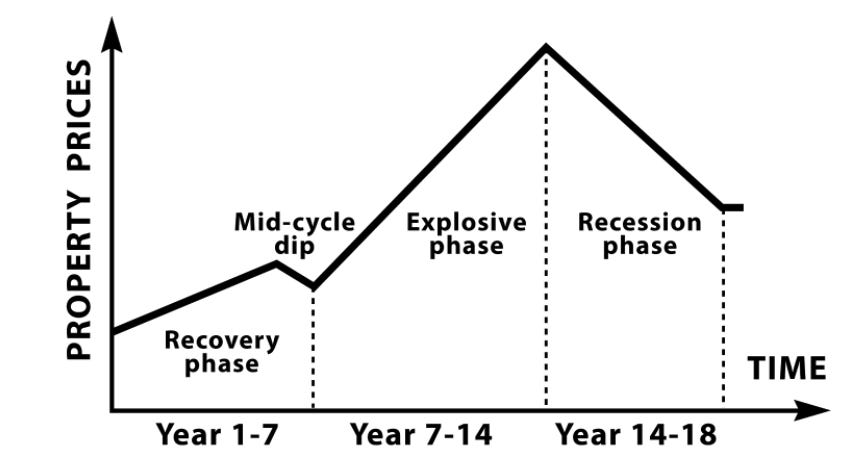
Why house prices will crash in 2025
It’s a national religion for some, heresy for others. Today we look at house prices.But we do not consider property through the window of the estate agent’s, but rather through the prism of an 18-year cycle, one that was brought to public attention by economist Fred Harrison is his cult classic Boom Bust: House Prices, Banking and the Depression of 2010. He published it in 2005 so, if you’re into forecasting, that’s some title…Cycles are often what you want them to beBefore we start, let me issue my usual disclaimer on cycles. Cycles exist everywhere: the seasons of the year, night and day, the life cycles of plants and animals. They exist within our own bodies in the form of circadian rhythms. They exist, sort of, in markets too – there are good times and bad times, bull markets and bear markets, four-year presidential cycles, commodity super-cycles and more. Mining companies, in particular, go through clear cycles – perhaps phases is a better word – from exploration and discovery, through development and mine building, to actual production.I’m a keen observer of hype cycles. How much of this story is known? How much more hype is left in the tin? Or is this story now tired?And cycles can make for good copy. Kondratiev made his name pedalling them. We like reading about them because they bring a veneer of certainty where there is in fact, often none.But cycles – especially in markets – are also arbitrary, random and uncertain. It’s easy for an academic to look back at history, find a pattern and declare it a cycle. When real life doesn’t fit the model, you’ll hear something like: “Well, the war upset the cycle”, or “they printed loads of money, so the cycle didn’t work out” or whatever. Cycles in markets are not fixed and predictable in the same way as the days and weeks of the year. And they are not so apparent in real time - only in the rear view mirror.You get the point. There is a certain amount of salt to pinch when it comes to cycles.Nevertheless they are useful instruments. I know some who swear by them, especially Harrison’s, whose book was clearly brilliant in its forecast. I remember thinking in 2005: “This market is nuts. It has to crash”. Many felt the same way, including many of the brightest minds in the City. A whole website - housepricecrash.co.uk – sprung up around the theme. Many of us were certain the game was about to end. Then I stumbled across this brilliantly prophetic article by Harrison in MoneyWeek saying, “No, we are a couple or three years from the top”. He was right. After last week’s missive on house prices versus gold, I was thinking about our distorted property market and the spectre of rising interest rates. The thought occurred to me that we must be close to Harrison’s next peak. Lo and behold, Merryn Somerset Webb interviewed him in the latest MoneyWeek podcast.Harrison’s short answer is that 2026 will see the top of the market. We have another three years, in other words.A quick guide to the 18-year property cycleLet me quickly explain how his thinking works. His idea – and it is more about land prices than it is house prices, though the two tend to rise and fall together – is that property tends to see 14 years of price growth, followed by four years of decline.Broken down an 18-year cycle might something like this:Harrison says he can follow prices back some 200 years to find this clear 18-year cycle at play. I don’t have all the data to cross check back that far, but I do have the data going back to 1951 (care of Nationwide), so let us at least check that. Before World War II, property was not the overpriced monster it is today. Home ownership was lower (sub-25% most of the time – most people rented from private landlords) and mortgages hardly existed (they only really reared their heads in the 1930s), so the cycle, even if visible, would not have been as pronounced as it is in today’s debt-ridden fiat era.The top of the last cycle (in the UK) actually came in the third quarter of 2007. The average house price then fell from £183,000 to £149,000 in the first quarter of 2009. It would be 2012 before the market properly got going again.There was definitely a buying window during that 2009 to 2012 period, but prices, especially in London, did not fall by anything as much as many buyers were hoping. That’s mostly because there were few forced sellers, because interest rates were slashed. Had there been, then house prices would have come down by a lot more. They fell by a lot more than 18% if you were a foreigner, however, as the pound lost a good 30% in the foreign exchange markets (measured mostly against the US dollar).Go back 18 years and you have the crash of 1989-94. Prices peaked in the third quarter of 1989 at £63,000, before falling to £51,000. Things got going again in the mid-to-late 1990s. The pound lost a lot of value in the forex markets then too.The cycle is working well.Going back 18 years further takes us to 1971-72. The 1970s were a horrible decade economi

How an independent Scotland could become the richest country on earth
An independent Scotland could become the richest country on earth. I’m not joking. It has all the necessary ingredients. Let me explain.Each year the World Bank, the IMF and the CIA each independently publish a list of the richest countries in the world - as measured by GDP per capita at purchasing power parity.The UK sits at a rather disappointing 26th but topping those rankings, year after year, you have the likes of Qatar, Luxembourg, Singapore, Brunei, Norway and Switzerland.(I’m discounting Ireland because its figures are distorted by the number of corporations domiciled there)Some of these nations have got on that laist thanks to their oil. But oil isn’t everything – otherwise the likes of Saudi Arabia (17th), Russia (57th) or Iran (65th) or Venezuela (don’t know) would feature.Others have got there because they are financial or commercial centres. But the same regulatory options that have enabled them to be so are open to other countries - they have just not been adopted.There is, however, one characteristic common to all the top ten ranking nations. It is that they are small. The UAE is the most populous on this list with 10 million; Switzerland 8 million; Singapore and Norway both have around 5 million; Qatar 3 million; the rest are all sub 1 million.The US (13th - 330 million) and the Netherlands (15th - 17 million) are the only large nations to feature in the top 15. In 1950, and indeed in 1970, the US was top. Back then though, its states were semi-autonomous and, on a gold standard, its money was independent. As its state has grown and power become more centralized, its ranking has slid.This is because there is a direct correlation between the size of the state and the wealth of the people - the bigger the former, the smaller the latter. The more power is concentrated, the less wealth is spread.But in a small nation, forced to live from a smaller tax base, there is more of a limit to how big state institutions can grow. Monitoring becomes more efficient, it is harder to obfuscate, so there is more transparency and accountability, and less waste. Change is easier to implement, making a nation flexible, dynamic and competitive. With fewer people, there is less of a wealth gap between those at the top and the bottom.The evidence of history is that the free-est countries with the widest dispersal of power have always been the most prosperous and innovative.The city-states of pre- and early-Renaissance Italy are a good example. There was no single ruling body except for the Roman Catholic Church. If people, ideas or innovation were suppressed in one state, they could quickly move to another, so there was competition. Venice, in particular, showed great innovation in turning apparently useless marsh into a unique, thriving city. Renaissance Italy became breathtakingly prosperous and produced some of the greatest individuals that ever lived.But it would be overtaken by Protestant northern Europe. The bible was translated into local vernacular, and Gutenberg’s printing press furthered the spread of knowledge – and thus the decentralization of power. The pace was set by Holland, also made up of many small states, then Britain led the pack. In spite of its union with Scotland and its later empire building, England would disperse centralized power by reducing the authorities of the monarch after the Civil War of 1642–51, and later by linking its currency to gold.Since its unification in the late 19th century, Italy has been nothing like the force it once was, blighted by infighting, bureaucracy, organized crime, corruption, rent- seeking, inflation and division. Its state is bloated, its political system dysfunctional.So back to Scotland.With independence it would have the opportunity to enact the same legislation, taxation and regulation that other top ten countries on that list employ, following, say, the blueprint of Singapore. It already has a rich tradition in trade, finance and banking.It has the oil.And, with just five million people, it is small.It has all the ingredients to be the richest country on earth – on a per capita basis. It has ‘the triple’. I can think of no other nation in the world with such a wonderful opportunity.The Scottish contribution to the world, whether in engineering, invention, industry or finance, has been astounding. Think Adam Smith, Alexander Fleming, John Logie Baird, James Watt. You cannot doubt Scottish talent - they are a formidable people. But they do not dominate the global stage as they once did. There will be a tough period of adjustment to get through, yes, but independent, living off their tax base, with dynamism and self-belief restored, they can do so once again.But, first, they must make the right choices.This article originally appeared in the Independent. This is a public episode. If you'd like to discuss this with other subscribers or get access to bonus episodes, visit www.theflyingfrisby.com/subscribe
How much gold does it take to buy a house in the UK?
Today we return to one of my favourite subjects, and one that we periodically visit: UK house prices measured in gold.As regular readers will know, I am firmly of the mind that unaffordable housing in the UK (and indeed across most of the developed world) is as much a consequence of our system of money and credit as it is of dumb, prohibitive planning laws.If interest rates reflected actual inflation, the story would be very different. I’m not talking about the consumer price index (CPI) measure targeted by the Bank of England (and even that now stands at over 6%). I’m talking about the inflation of the money supply, whether via debt expansion or quantitative easing (QE), and the resulting costs felt. House prices are currently rising at roughly 11% a year, and you’re telling me inflation is only 6%? Pull the other one.The incremental effects of these rises – 7% one year, 12% the next – over many decades have made house prices ludicrously unaffordable to young people. It’s been going on since at least the early 1990s, and the days when Ken Clarke was chancellor, and before. Salaries have not kept up.If interest rates rose to reflect our current 11% house price inflation then the ensuing rush for the exit would pretty quickly make house prices affordable again. The entire house-of-cards economy would come crashing down too, but that’s another matter.For this reason, we conduct the occasional exercise of measuring house prices in sound money. Gold has served this role since the Stone Age, and so we bow to the wisdom of Mother Nature, and use it here.The pound in your pocket has lost a lot of value compared to a house…The average price of a house in the UK is now £274,000 according to the Office for National Statistics and the Land Registry. The average salary is £31,285, so house prices are at roughly nine times earnings.The house-prices-to-earnings ratio in most big cities, especially in the south, is much more distorted than that. It was three times when I bought my first flat in London in 1993.We’ll start with house prices in pounds. This chart goes all the way back to 1953, when mortgages barely existed. Debt is the big driver of house prices – if there is no debt in a market, prices will reflect local cash levels and be much lower. Introduce debt, and up go prices. (Debt, even with all that QE, remains the biggest supply of new money).On the other hand, debt makes it possible to do things now you would otherwise not be able to do – like buy a house. But keep debt costs low and more money enters the system, prices stay high and the economy “grows”. That’s why the authorities prefer to keep interest rates down.“You’ve never had it so good”, was the government’s cry at the time, as the Tories actively encouraged a “property-owning democracy”. Stamp duty was cut and the government lent money to building societies, so they could issue mortgages. Home ownership rose from 29% in 1951 to 45% by 1964, and the train of higher prices was put in motion. They rose by over 50% during that period. The above chart is astonishing in its relentless rise higher. It looks like bitcoin! The crash of the early 1990s, in which hundreds of thousands of people lost their homes amid surging interest rates, is a mere blip. Far fewer lost their homes in 2008, because rates were slashed.But looked at from another perspective, you can see just how much value your money has lost. In 1953, the average house cost £1,891. Today it’s 150 times that. The pound has lost more than 99% of its purchasing power in 70 years. Money. Huh! It’s a fraud. But you can’t do without it.… but the gold in your vault has notNext we turn our attention to UK house prices measured in a much sounder form of money - one that central banks can’t print. This is the same house prices measured in gold since 1953.As you can see, it’s rather a different story.Back in 1953 the average house cost 150 ounces of gold. Same price as in 2020. Wait a minute, what?And today a house will cost you 205 ounces of gold. Wait a minute you’re telling me house prices are only up 30% since 1953?If you measure them in gold, yup.In 1980 you could buy the average UK house for 50 ounces of gold. You could have done so in the 1930s as well (not shown on the chart). In 2004, with gold sitting at around $400 an ounce, and the average house at £150,000, it took over 700 ounces to buy a house. The noughties aside, the long-term “normal” price of a British house in gold terms ranges between 150 and 300 ounces.So what’s next for the house price to gold ratio?I thought the end was nigh for the housing bubble in 2007. I was wrong. I didn’t foresee interest rates being slashed like that. Woe betide anyone who calls the top in housing. The only thing that will send house prices lower is increased rates – though even at 3% or 4% there would be problems. No policy-maker wants falling house prices on their watch, partly because they own houses, partly because of the damage to their reputation and part
Where are interest rates going?
Here’s something to contemplate this Sunday morning: where are rates going?In many ways it’s the most important question in finance - the biggest question in investing: what is the future price of money going to be?Policy makers are caught between a very big rock and a very hard place. Official UK inflation stands at 8.5%. It’s higher if you use the traditional RPI as a measure. But real inflation is much higher still. Official measures only look at the price of goods and services, which are mostly prone to the deflationary forces of increased productivity. If you include things like house prices and financial assets inflation is much, much higher - over 10%. The same argument applies pretty much everywhere across the developed world.Looked at another way, money is losing value at over 10% per year. The same salary in a year’s time will effectively be 10% lower in that it will buy you 10% less . The purchasing power of your savings will be 10% lower. The already extraordinarily large inequality gap between asset owners (the rich, the old) and everyone else (the young) will be 10% bigger.Any responsible central bank, whose core remit is to keep a lid on inflation, would “do a Volcker” and hike up rates until this messy situation is under control. But they can’t. There is too much debt in the system. If rates were put up to a level that reflected actual inflation - ie north of 10% - the housing market would collapse, stock markets would collapse, the bond markets would collapse and government’s own debt servicing costs would go bananas. Their budgets would be blown. In other words the whole system comes tumbling down. It’s a house of cards.So they will make a lot of noise, edge rates up by ¼% here and ½% there and hope this unfortunate inflationary episode goes away.Good luck with that.Thanks very much for reading. Please check out my paid letter. Our stocks are starting to lift off. It looks like we are in a bull market. Bull markets don’t last forever, but they are fun when they do. This is a public episode. If you'd like to discuss this with other subscribers or get access to bonus episodes, visit www.theflyingfrisby.com/subscribe
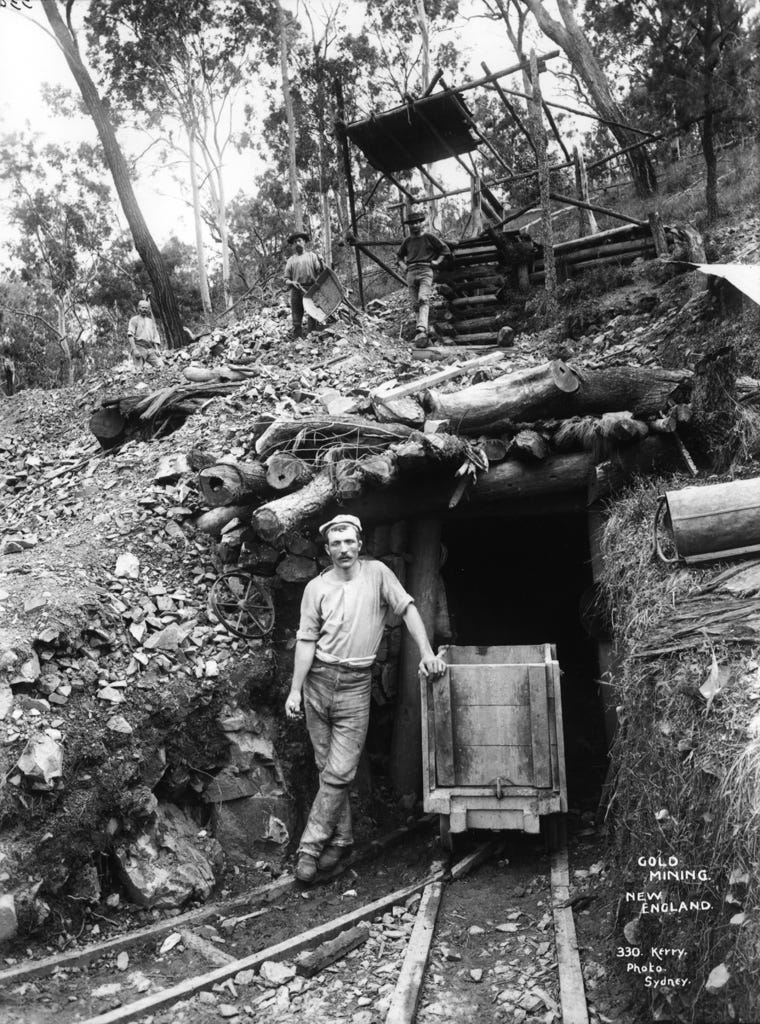
Are gold miners finally set to outperform plain old gold?
If you want to listen to this article, you can via the button above. “Look at what they do, not at what they say.”If you are seeking truth of any kind, this is a great maxim to live by - particularly when it comes to politicians. And lovers.And indeed mining CEOs.My advice today is to apply the maxim to your author, because there is a marked divergence between what I say on the subject of gold mining companies and what I actually do.We’ll start with what I say…Here’s why everyone believes that gold miners are a leveraged play on goldTalk to any grizzled goldbug who remembers the 1930s – there must be one or two that were there at the time – and one or two more that have read about them. In the US, the story went as follows. After the stock market crash of 1929, the US sunk into an economic recession that became known as the Great Depression. In order to fund a government stimulus programme, the President, Franklin D Roosevelt, confiscated his citizens’ gold. It became illegal for Americans to own gold. Like the loyal citizens they were, Americans handed their gold in and the authorities gave them dollars in exchange at the official exchange rate of $20 per ounce.Roosevelt then devalued those dollars by 40%. The official price of gold would now be $35 per ounce. Some moaned, while many didn’t notice, but the cannier folk thought: “We might not be able to own gold, but we can own gold mining companies – and their profit margins have just gone bananas.” Homestake was the biggest gold miner in North America at the time. Its share price multiplied many times over. It became the investment of the decade.Fast forward to the 1970s, a decade which policy-makers seem intent on re-living in some kind of Black Mirror parallel universe situation. Inflation was rampant, money was debased, the gold standard was abandoned and there was an energy crisis. The decade ended with Russia invading a neighbouring country, in this case Afghanistan.Gold went from $35 to (briefly) $850 over the course of the decade. But gold miners – whoosh. They multiplied and multiplied and multiplied. They were the investment of the decade.Thus has it been implanted in our psyche that gold miners give you leverage to the gold price. When gold goes up, gold miners go up by more.Except they don’t.Gold miners have been terrible investments compared to boring old goldHere we now present Exhibit A, which is the ratio between the HUI, the index of unhedged gold miners, and gold since the mid-1990s. The chart has been falling since late 2003. In other words, gold has been outperforming gold shares. Apart from odd bouts of outperformance, this has been the case for more than 15 years now.Barrick, off and on the world’s largest gold mining company, has had a good couple of years since it changed management. Even so, it is still trading at the same price it was in 2005. Gold was selling for less than $500 an ounce in 2005. It’s $1,900 now.In 2018, Barrick was trading at the same price it was in 2001. In 2001, gold was $250.In other words, what has been the point of owning gold miners, when you could simply have owned gold? And some would argue what is the point of gold, when you can own bitcoin?So how do to explain the underperformance of miners? The reason, in my view, aside from a proliferation of incompetence among management, is that, starting in around about 2003, when that chart peaked, we saw a plethora of different ways by which ordinary investors could buy and hold gold.Aside from taking delivery of bullion itself, we saw the rise of online storage companies – Goldmoney, Bullion Vault, Goldcore and so on. The exchange traded funds (ETFs), by which investors and institutions could buy and hold gold via a broker, came into existence. Cheap online brokers became commonplace. If you wanted something a bit racier, there were spreadbets, futures, CFDs, covered warrants, leveraged ETFs and more. Why bother with individual company risk with some many options? They made the gold miner’s role as the levered way to play gold even more redundant. Has that changed? No. It’s very hard to intellectually justify owning a gold miner in the face of the above. So that is what I say.But what do I do? I own a load of gold miners. I’m overweight gold miners. I’ve spent a lot of time researching mining companies. I think the ones I own are really good – exceptional even. But they are still gold miners – and sector allocation usually proves more important than individual company selection.I do look at that above ratio and suggest that it has made a low and is now rising. The low came at the end of 2015 and it was re-tested in the coronavirus panic of 2020. It looks like it’s on the rise. I also note an odd divergence over the last month, as the chart below shows. Gold sold off. Gold miners didn’t. They actually outperformed. What gives?Gold is in red. The miners are in blue. See the outperformance??Gold mining companies are better run, generally, than they were. There are
Copper is set for a long bull market – here’s how to invest
Commodity prices have started to cool – with the exception of one industrial metal that is in short supply but is an essential ingredient in almost everything. Dominic Frisby looks at copper.The Substack picks are here See acast.com/privacy for privacy and opt-out information. This is a public episode. If you'd like to discuss this with other subscribers or get access to bonus episodes, visit www.theflyingfrisby.com/subscribe