Neuroscience Meets Social and Emotional Learning
413 episodes — Page 5 of 9
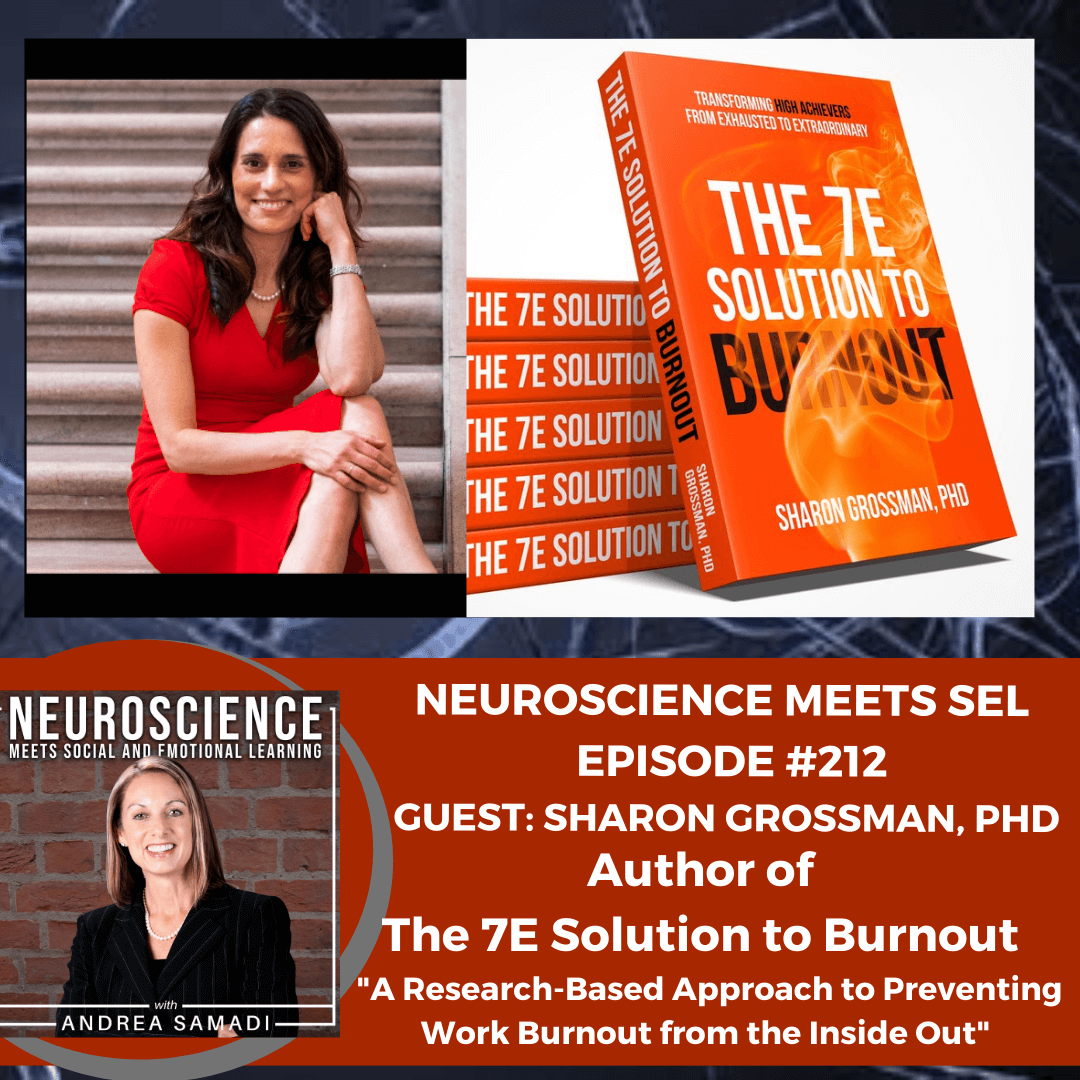
S7 Ep 212The Burnout Doc, Sharon Grossman, PhD on ”A Research-Based Approach to Preventing Work Burnout From the Inside Out.”
Are you a doctor, attorney, high level manager, CEO or business professional in a high stress environment? And did you know that according to a recent Gallup Poll that teaching, and nursing are tied for daily stress? Teaching can be a lonely profession when educators lack support, training and strategies for classroom management, leading to lack of job satisfaction, disintegrating health, depression, and teacher attrition. Whatever profession you are in, we can’t escape the demands of everyday life, so on today’s episode we will cover new strategies for overcoming work burnout before it takes a toll on our health, job satisfaction, productivity, and motivation. Today, on EPISODE #212, we will be speaking with Dr. Sharon Grossman, otherwise known as the Burnout Doc who will provide us with a fresh perspective of an age-old problem, with tools and strategies that she has used on many of her own clients, to take the steps to prevent work burnout BEFORE it occurs. Watch this episode on YouTube here https://youtu.be/kDjQCyffiCk On this episode you will learn: ✔︎ How we can recognize work burnout vs boredom or lack of challenge. ✔︎ Knowing how and when to set boundaries when the workload is too high. ✔︎ What to do the minute you feel "resentful" at work. ✔︎ What's at the root of work burnout. ✔︎ Tips for creating your ideal work environment. For returning guests, welcome back, and for those who are new here, I’m Andrea Samadi, author, and educator, with a passion for learning, understanding difficult concepts, and breaking them down so that we can all use and apply the most current research to improve our productivity and results in our schools, sports environments, and modern workplaces. Today we are going to look at work burn out from a different angle. We did launch the year with Nick Jonsson on EPISODE #188[i] on “Strategies for Overcoming Stress, Anxiety and Depression in the Workplace” and Mood and Stress Expert Erika Ferzst on EPISODE #198[ii] on “Using Your Brain to Prevent Workplace Burnout” but I saw something different with our next guest and here’s why. Dr. Grossman sent me an email that went above and beyond ANY email I’ve ever received. She took a considerable amount of time not only create a VIDEO introduction to her work, but to let me know how the content on our podcast resonated with her and her work with stress management. She mentioned all of the ways that we would have a great conversation, as we dig deeper into our theme of Season 7 on “Brain Health and Well-Being.” I sometimes even forget myself what our theme is (even though I have a note on my computer monitor to remind me and keep me on track) but Dr. Grossman not only knew our theme, but how she could provide new insight and ideas into work burnout, with the brain in mind, and take our content to another level. What I didn’t know after her incredible introduction that caught me off guard as I began to read her book, The 7E Solution to Burnout[iii] is I realized that Dr. Grossman is not much different from anyone else, EXCEPT for the fact that she experienced work burnout herself, and noticed that she was not going above and beyond for her clients, so she created a system that she used herself, in addition to now sharing it with others, to impact change to combat work burnout and she wants to share he system with all of us. I can’t wait to dive deeper into some solutions for this issue that I’m sure many of you listening have faced in the past, if you aren’t experiencing it to some extent today, with some ideas of how an understanding of our brain can help us to better manage our mind while under stress. Let’s meet Dr. Grossman… Welcome, Dr. Sharon Grossman, thank you for such an engaging intro to your work that you sent over. You really did make a memorable impression. Way to set the bar high and create an immediate interest on a topic that I know you can see we’ve covered a few times on the podcast. INTRO Q: Dr. Grossman, can we begin wi
S7 Ep 211Brain Fact Friday on ”The Neuroscience of Dreams: Expanding Our Self-Awareness”
Everything you’ve got in your life is an expression of your level of awareness (Bob Proctor) and when you change your level of awareness, everything starts to shift. It’s fascinating. Today’s podcast I’m going to share how my awareness expanded as I began researching for an upcoming interview and what’s absolutely amazing about this experience, is that “once the mind has been expanded, it will never go back to its original state. Awareness is not something you lose.” (Bob Proctor). On this episode we will cover: ✔︎ Why lifelong learning is important for expanding our levels of awareness. ✔︎ What we all should know about dreaming and the brain. ✔︎ Review of our sleep cycle and REM sleep. ✔︎ Tips for remembering our dreams. ✔︎ Opening our mind up for new ways to improve creativity, business ideas, and sports training with our dream world. For returning guests, welcome back, and for those who are new here, I’m Andrea Samadi, author, and educator, with a passion for learning, understanding difficult concepts, and breaking them down so that we can all use and apply the most current research to improve our productivity and results in our schools, sports environments, and modern workplaces. On today’s EPISODE #211, “The Neuroscience of Dreams: Expanding Our Self-Awareness” I’m going to cover how an understanding of neuroscience connected to our dreams, could open up doors of possibility in our lives. This topic is not one that I was planning on covering, but as my awareness expanded while researching for an upcoming interview, I thought back to when some other topics that many people perceived as “weird”, are now readily accepted in our schools and workplaces, and perhaps, as new research and studies evolve, this topic could provide us with a new way of creative problem solving, or ways to generate new ideas in the business world, or even a new tool for mental rehearsal in the sports world. Before we get into this episode, I do want to start out by thanking you, the listener for tuning in. While writing this episode, I woke up to an email from Anuj Agarwal, the founder of Feedspot, who ranks podcasts based on content, followers, and traffic, letting me know that we had made ranking for The Best 30 Neuroscience Podcasts.[i] For those who have listened to our earlier episodes, you’ll know that I didn’t set out to go in this direction of Neuroscience, (it wasn’t even on my roadmap) but we ended up here by chance, when an educator urged me to go in this direction almost 10 years ago. So to hit this achievement, in a relatively new field of study for me, without a background in science (other than the fact I did teach 9th grade Biology for a semester), it’s a true honor, and I’m beyond grateful to continue to host this podcast, and that you are finding these episodes as helpful as I am. This is the reason why I thought about launching this podcast in the first place—to show that anyone can learn and apply these skills, backed by science, whether you have a science degree or not. This cutting-edge research is important for all of us to know, understand and apply and I’ll be researching in this field anyway, so I figured, I might as well share what I’m learning on this platform. With our analytics, I can see where listeners are tuning in from by Country, and do appreciate all the messages you send to me on social media, letting me know that you listen and what you are learning. I can now put some faces to the downloads, as I got to recently meet Sarah Eaton, from Queensland, Australia, who works with the Australian Government, and Ellie Mercado from Ossining, NY working in the field of education with social and emotional learning among many others who tag me on posts, and let me know this information is helpful and important. We do have a Facebook Group[ii], if you do want to stay connected to others around the globe as well. Moving on now to this week’s episode, and Brain Fact Friday, where I want to make a connection to an
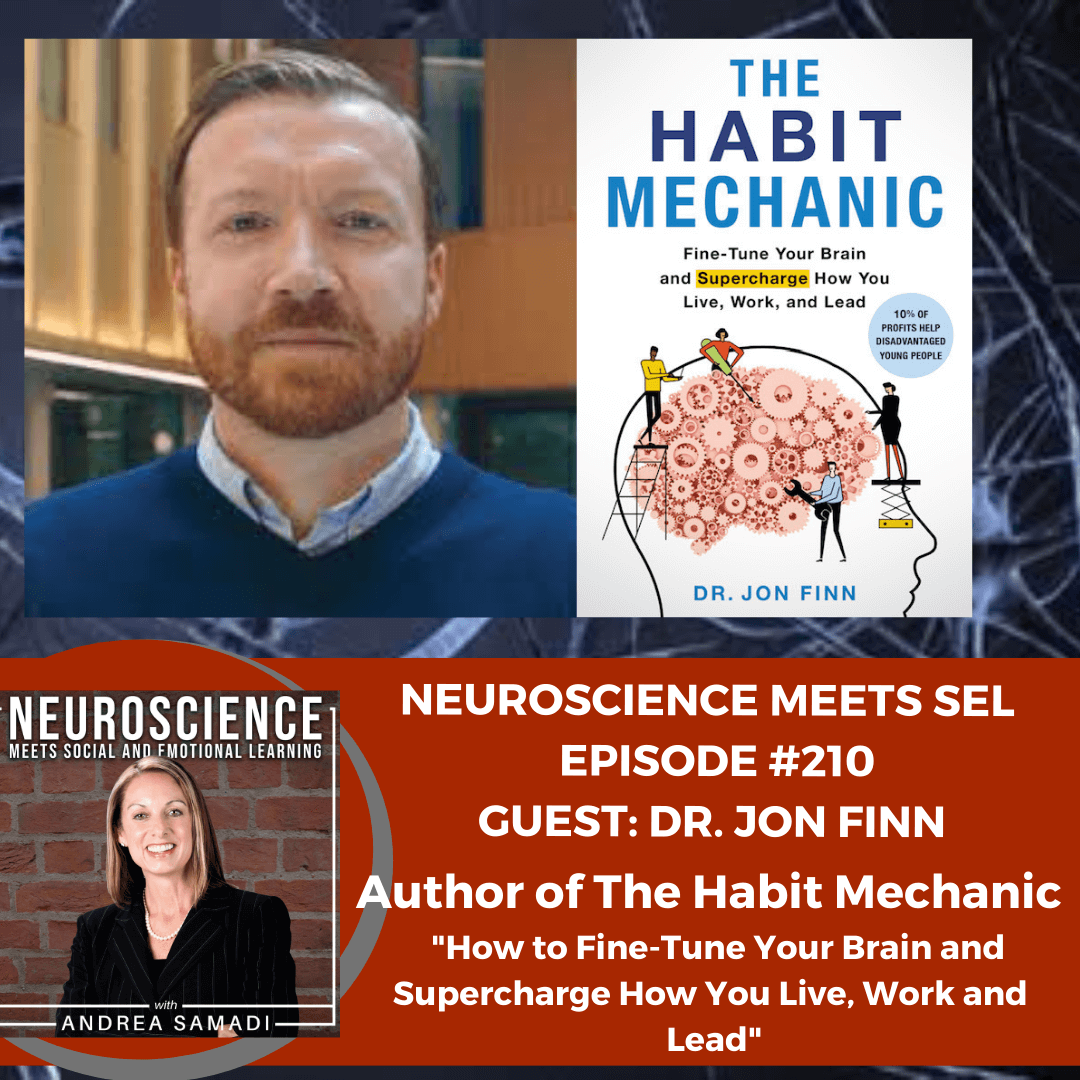
S7 Ep 210Dr. Jon Finn, author of the Best Selling Book, The Habit Mechanic on ”How to Fine-Tune Your Brain and Supercharge How You Live, Work and Lead”
“If you don’t truly understand how your brain and body work, it will be more difficult to maximize your potential” (Dr. Jon Finn[i], author of the Best-Selling book, The Habit Mechanic[ii]) which took Dr. Finn over 20 years to write, and was not intended to be read once, and left on a shelf to collect dust. This book contains Dr. Finn’s life’s work, “where he’s trained and coached over 10,000 people: Global businesses, high-growth start-ups, individuals, elite athletes, coaches and teams, leading educational institutes, and families” to thrive and succeed in our challenging modern world. This book is exactly what I have been looking for, as it is full of practical and simple exercises in each section that we can all apply for immediate results, backed by science. Watch this interview on YouTube here https://youtu.be/CO-_znUut28 On this episode you will learn: ✔︎ How Dr. Finn, from Leeds, UK, took three psychology related degrees to inform his work with The Habit Mechanic and his Tougher Minds Consulting Firm. ✔︎ What Dr. Finn discovered made Roger Bannister's training more "efficient and effective" than his competitors. ✔︎ How he has used his Habit Mechanic Model to develop high performing sports teams. ✔︎ Simple and easy ways that we can all fine-tune our habit-building muscles. ✔︎ Strategies to teach others how to do the same. ✔︎ Unique visuals for improving time management, and overcoming obstacles. Dr. Finn, who founded the award-winning Tougher Minds Consultancy, and has three psychology-related degrees, has been working in the field of resilience, performance, and leadership science for over 20 years, and through his work, has uncovered WHY people fail, while trying their very best. For returning guests, welcome back, and for those who are new here, I’m Andrea Samadi, author, and educator, with a passion for learning, understanding difficult concepts, and breaking them down so that we can all use and apply the most current research to improve our productivity and results in our schools, sports environments, and modern workplaces. On today’s EPISODE #210, we will explore Dr. Finn’s cutting-edge insights from psychology, behavioral science, neuroscience, and world champions that helps organizations develop “Habit Mechanics” and “Chief Habit Mechanics” (we will uncover the difference between the two) building resilient people, outstanding leaders, and world-class teams. I’ve been looking for a book that bridges the science with all of the strategies we’ve been covering on this podcast, and today we will connect the dots with theory, practice and results, as we ALL learn how to “fine-tune our brain, and supercharge how we live, work and lead.” Before we meet Dr. Finn, I have to give you a bit more of his background, because when reading his book, I was floored with how he connected the research to habit building, with examples that we can all understand and remember. Dr. Finn and his colleagues have a collective experience of over 100 years in helping people, leaders, teams and organizations build better habits. They have worked extensively in the highest levels of elite sport, advised the Government and think tanks, had their work featured in The Sunday Times, The Sunday Telegraph, People Management and T.E.S, published peer-reviewed papers and popular books within the area of performance psychology, and helped 10,000s of people be their best more often. His company, Tougher Minds work globally and I’ll include a list of the people, teams and organizations they have helped fulfil their potential in the show notes. – ING– Janus Henderson Investors– Aon– HSBC– Mercedes– Chaucer– John Deere Financial– The Professional Golfers’ Association– Premier League Football Managers– Deloitte– The Rugby Football League– The Scottish Golf Union– Yorkshire County Cricket Club– European Tour Golfers– Sky Sports– England Athletics– Rugby League Super League Head Coaches Let’s meet Dr. Jon Finn and uncover why traditional approa
S7 Ep 209Using Neuroscience to Impact Change
On this episode we will cover: ✔︎ The importance of making mistakes and failing forward✔︎ How an understanding of the most current research can improve productivity and results in our schools, sports and workplaces✔︎ An important ingredient for change to occur✔︎ A review of past episodes to consider what change you could initiate in your workplace✔︎ Prepare for our NEXT EPISODE #210 with Dr. Jon Finn the author of The Habit Mechanic. “You never change things by fighting the existing reality. To change something, build a new model that makes the existing model obsolete.”--American architect, systems theorist, author, inventor, philosopher and futurist, Buckminster Fuller This quote made me think of why we launched this podcast in the first place. Not to fight against all the models that we struggle with in our world today, but to offer solutions like Sir Ken Robinson[i] did with his thought-provoking case of creating an educational system that nurtures, rather than undermines creativity. If you haven’t watched Sir Ken’s TED talk in a while, I encourage you to go back to it (it’s got over 72 million views)—and you’ll see how the concepts he talks about are still as valid today, as they were in 2006. Sir Ken’s TED Talk reminded me that “all children have exceptional capacity for innovation” and that “creativity is as important as literacy” in our schools, but we tend to squander it. I could “ponder deeply” (Greg Link, EPISODE 207) about that for a while, and am always looking for ways to increase creativity and innovation for our next generation of students in the classroom. Sir Ken said something else that hit me on a deep level on his famous TED talk, as I sat at my desk, listening to his words, knowing that he’s been gone for some time, but he’s not really gone. His legacy lives on as he makes me think about his words and write this episode, making connections to past episodes and speakers, and sharing these thoughts with you, wherever you might be listening to this podcast. With one of his examples, he said “If you are not prepared to be wrong, you’ll never come up with anything original” when he shared a story of a four-year-old who wasn’t afraid to be wrong and then he brought it back to how school teaches us that mistakes are the worst things you can make. Making me think again-- Am I afraid of making mistakes? Not so much anymore, but take me back to 7th grade, being wrong in class (in front of everyone) probably would have prevented me from trying in the future without someone there to encourage the idea of failing forward, which is such an important concept for us to all learn early. With today’s episode on “The Neuroscience of Change” I’m hoping that we can all take Sir Ken’s advice, and be prepared to be wrong, with the hopes that it somehow moves us forward. Looking back and connecting the many dots over my career, I know I wouldn’t be here today on this podcast if an educator didn’t sit me down in his office, and show me where he thought I was wrong and could improve my work and career path with this understanding of simple neuroscience as the solution. But it did take action on my part without worrying about the outcome. We’ve got to be prepared to be wrong first, Sir Ken reminds us. What about you? Do you have ideas that you would like to move forward with—to impact change? Maybe in your school, or to be used in sports with athletes, or in your workplace? These episodes were created in the how-to format to generate ideas for all of us. I hope we can all ponder deeply about this, think about where we would like to see change, write down some thoughts and ideas, and see if these ideas can take us to somewhere new, somewhere we’ve never been before, as we make connections with the neuroscience of change. For returning guests, welcome back, and for those who are new here, I’m Andrea Samadi, author, and educator, with a passion for learning, understanding difficult concepts, and breaking them down so tha
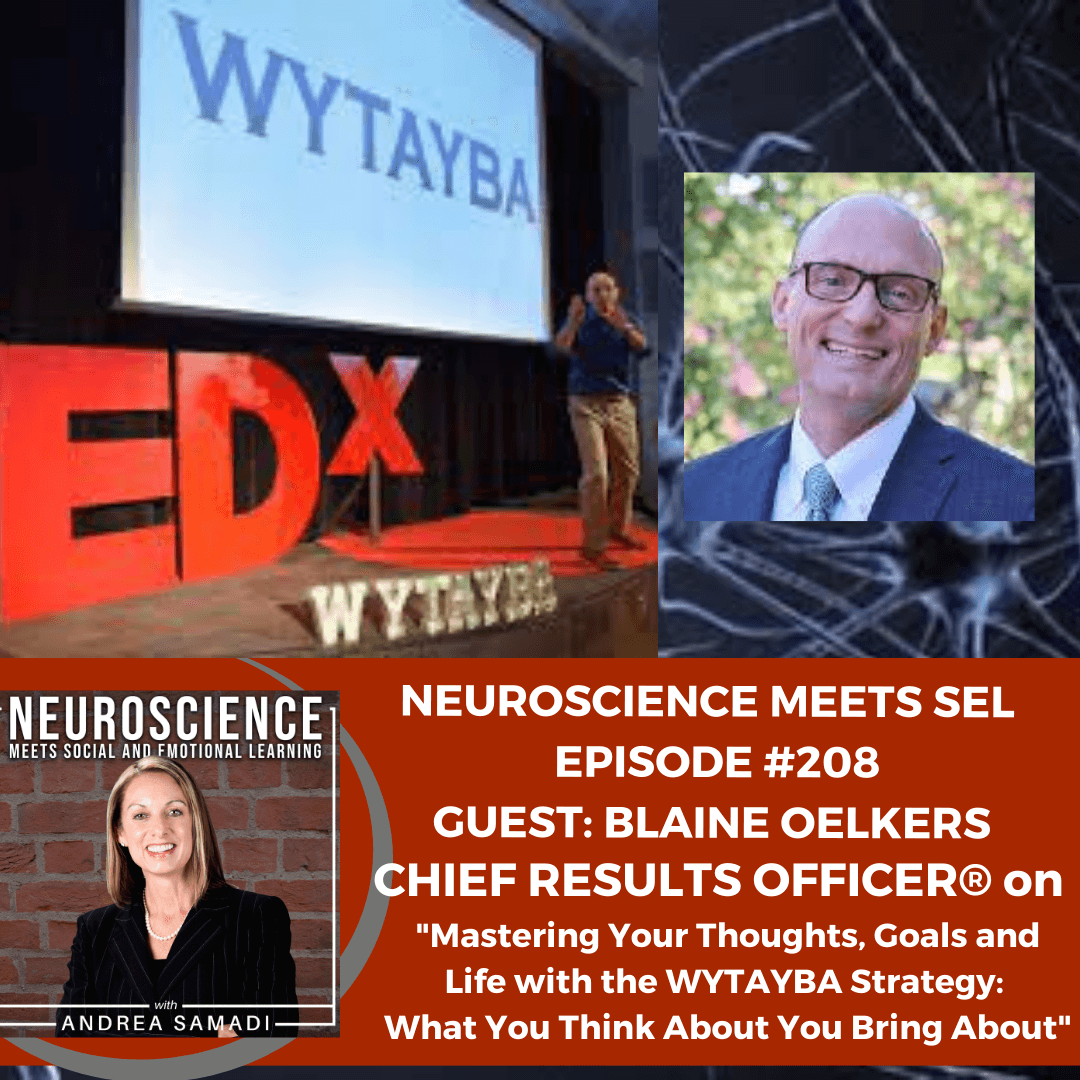
S7 Ep 208Blaine Oelkers on Mastering Your Thoughts, Goals, and Life with the WYTAYBA Strategy--What You Think About You Bring About
Welcome back to The Neuroscience Meets Social and Emotional Learning podcast, EPISODE #208, I’m Andrea Samadi, author and educator from Toronto, Canada, now in Arizona, and today’s guest ties in perfectly to what we have been talking about on this podcast the past few months. Before I introduce him, I have to mention that he contacted me through LinkedIn and asked if I was looking for podcast guests. I always am and do have a running list of people I reach out to as our topic is specific, tied to how the most current brain research can help us to improve our productivity and results. Watch this interview on YouTube here https://youtu.be/rZ5s3MBa91I On this episode you will learn: ✔︎ Who is Blaine Oelkers, and why did it take 3 seconds for Andrea to notice something unique about his work? ✔︎ The mistake that 99.9% of people who read the book Think and Grow Rich make. ✔︎ What were in the "missing pages" of Think and Grow Rich that Blaine Oelkers discovered? ✔︎ What is the "secret" that we should all know, while studying Think and Grow Rich. ✔︎ Strategies to become crystal-clear with whatever it is that we want to create. ✔︎ How neuroscience supports what Napoleon Hill teaches in Think and Grow Rich. ✔︎ Simple strategies to break and form new habits. ✔︎ The importance of "cleaning" your mind. If you recall, our last episode with Greg Link[i], who partnered and worked with the late Dr. Stephen Covey with the 7 Habits of Highly Effective People mentioned how many of the principles that they used for success over the years took some time before they were accepted in the corporate world, let alone the K-12 school market, so when I come across someone who’s an expert, or even known as a Chief Results Officer, I want to know who they are, who and what and who they have studied, and how exactly they are getting these high levels of results that most of us want, but take such hard work to achieve. While researching our next guest, Blaine Oelkers[ii], a lifetime entrepreneur, a graduate of Purdue University and Stanford University’s Entrepreneurship program, I learned that he’s coached 1000’s of people with what he calls their Personal Implementation Plans (PIPs) elevating his clients to a higher level of productivity and results that he calls You 2.0, when I saw exactly what I was looking for. It's rare for someone to teach these success principles, without having studied with one of the “greats” at least for a period of time, so I always look to see where their love of self-improvement began. I will be sure to ask Blaine this question, but it became clear to me that he has a sound knowledge of the most influential success books when I saw that he has taught the book we covered to launch our year with, Think and Grow Rich, and has some tips to help us to be more effective while studying this book, along with some lost passages! At this point in my research, I ‘m beyond curious how he knows this top secret information and wonder if it has to do with the fact that he shared the stage with American author and entrepreneur, Jim Rohn. I suppose we will all have to find this out in the interview. Let’s meet Blaine Oelkers and see if we can kick our productivity up a notch and uncover where he learned these secrets for success from. Welcome Blaine. Thanks so much for reaching out to me. I’m not sure if you noticed that it took me about 3 minutes to write back to you that you were a perfect fit for the podcast! INTRO Q: I mention in the backstory that I’m always looking for people who can take our understanding of productivity and success to higher levels, and I have to open up with the question I was thinking the whole time I was researching you—where did your love for self-improvement begin, who did you study, and what do you think makes you stand out from others in this field—I saw it immediately. Q1: I opened the year with a 6-part series on Think and Grow Rich[iii] after studying this book for the past 3 years with Paul Marti
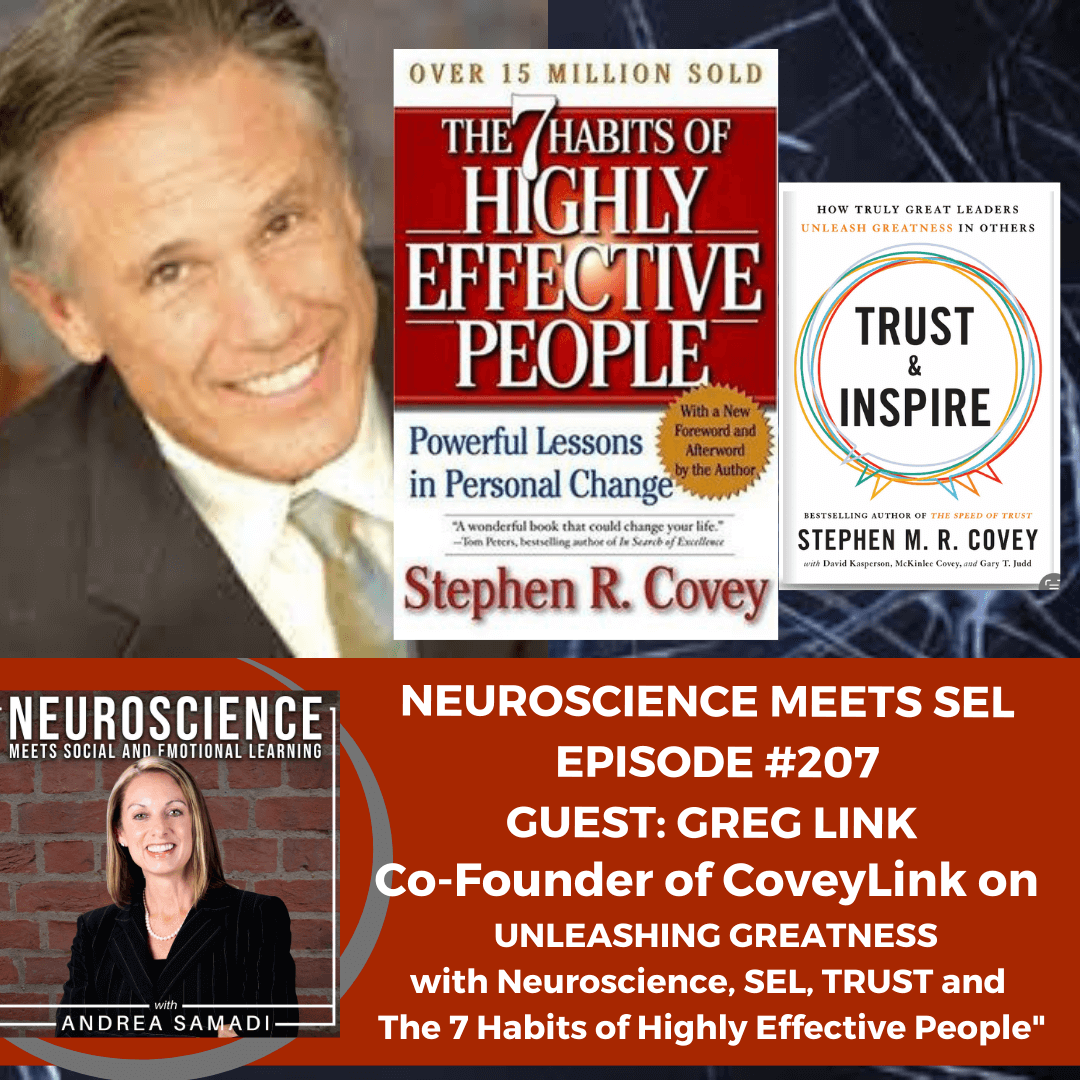
S7 Ep 207Co-Founder of CoveyLink, Greg Link on ”Unleashing Greatness with Neuroscience, SEL, Trust and the 7 Habits”
Have you ever felt “The Speed of Trust?” It’s the “shortest route to results” (Robert Allen, author of Multiple Streams of Income), and “the one thing that affects everything else you’re doing. It’s a performance multiplier which takes your trajectory upwards, for every activity you engage in, from strategy to execution.” Stephen R. Covey I felt “The Speed of Trust” from the moment I asked our next guest if he would come on the podcast, knowing full well that he hasn’t spoken on a podcast or radio show since around 2014, but I know that “when trust is high, communication is easy, instant and effective.” Watch this interview on YouTube here https://youtu.be/kCRjLyCKE40 On this episode you will learn: ✔︎ Who was behind the marketing strategy that took Stephen Covey’s 7 Habits Book to sell over 40 million copies worldwide (surpassing the popular Think and Grow Rich book) in 40 languages. ✔︎ How exactly did Greg Link come to meet and partner with the late Dr. Stephen Covey and what dots were connected as he looks back over his career now. ✔︎ How “Inspired Action” a term coined by Jack Canfield helped many leaders forge a path where no one had ever been before. ✔︎ What the Covey Organization learned from taking their book to Japan, and how they became the best-selling foreign business book in Japan. ✔︎ How Dr. Covey simplified the 7 Habits, and his vision for this book from the beginning. ✔︎ The challenges that Dr. Covey had as they began their work in the K-12 school market, how they overcame these challenges, and created The Leader in Me program. ✔︎ How they overcame daily obstacles they faced and used the 7 Habits to move forward. ✔︎ How he came up with the idea for the 8th Habit. ✔︎ How Greg’s expertise was recognized in the motivational speaking industry. ✔︎ Why Trust was a trait that was the center of The Speed of Trust, Smart Trust and their new book Trust and Inspire. ✔︎ What advice did Dr. Covey give Greg Link that changed his life, and how can you use this advice today? Welcome back to The Neuroscience Meets Social and Emotional Learning podcast, EPISODE #207, I’m Andrea Samadi, author and educator from Toronto, Canada, now in Arizona, and today’s guest is someone I have mentioned often on this podcast. For returning guests, you’ll be able to figure it out quickly. For those who are new, welcome. This episode is very special to me in many ways—not just with the fact that I consider myself beyond lucky to have had the opportunity to have met some of the world’s most influential people at a time in my life (late 20s) when this influence was important for the direction that I would take, that would land me exactly where I am now, all these years later. While listening to today’s episode, my hope is that this story inspires you in some way, to take action with whatever it is you are working on as I take you on a trip that goes back over 20 years ago, with the lessons learned along the way highlighted, so that you can see how some of the top influencers in the world have faced challenge, had doubts, fears and worries, and even unthinkably difficult life challenges that they all had to overcome, just like you and me. What was unique with this opportunity that I had while working in the motivational speaking industry in the late 1990s, is that I was driven to keep in touch with many of the speakers who came in over the years, (as you can see from this podcast) and this platform allows us all to continue to learn and grow from them with what author Jack Canfield would call Inspired Action (that I’ll cover in a minute). Today’s guest, I know we can all learn from which is why I knew I had to ask him to share his experience on this podcast. If you think back to our final episode of The Think and Grow Rich book study, EPISODE #196[i] that we launched 2022 with, we opened with a quote from Bob Proctor, who said ““You can’t just THINK and GROW RICH, you’ve got to do something with those thoughts” and it reminded me of
S7 Ep 206Brain Fact Friday on ”The Neuroscience of Trust”
Did you know that “trust is the highest form of human motivation? It brings out the very best in people. But it takes time and patience.” Stephen Covey For returning guests, welcome back, and for those who are new here, I’m Andrea Samadi, author, and educator, with a passion for learning, understanding difficult concepts, and breaking them down so that we can all use and apply the most current research to improve productivity and results in our schools, and modern workplaces. Today’s EPISODE #206, is on a topic inspired by one of my early influencers, “The Neuroscience of Trust.” This episode came to me as I’m preparing for our next episode next week, with someone I have quoted often on this podcast, Greg Link[i], the co-founder of the Covey Leadership Center. Greg was the one who orchestrated the strategy that led Dr. Stephen R. Covey’s book, The 7 Habits of Highly Effective People: Powerful Lessons in Personal Change, (1989)[ii] to become one of the two best-selling business books of the 20th century according to CEO Magazine, selling over 20 million copies in 38 languages. Greg created the marketing momentum that helped propel Covey Leadership Center from a start-up company to a $110-plus million-dollar enterprise with offices in 40 countries. You’ll need to tune into our next episode #207 to learn more from Greg Link’s incredible experience working with Dr. Covey, and with individuals and companies around the world, where Greg will share what qualities are important and integral for success for our students in today’s classrooms, and in our modern workplaces as we dive into our topic of “Unleashing Greatness with Neuroscience, SEL, Trust, and the 7 Habits.” While researching Greg, who I met when he came to work in the seminar industry in 2002, I was reminded of a topic that he thought was so important that he wrote a book about it with Stephen M.R. Covey (the son of the late Stephen R. Covey) called Smart Trust: The Defining Skill That Transforms Managers into Leaders.[iii] If you look up quotes from Stephen Covey on trust, you can see how important this skill was to him. He said, “trust is the glue to life” and “the one thing that affects everything else you’re doing. It’s a performance multiplier which takes your trajectory upwards, for every action you engage in, from strategy to execution.” The quote I like the most is where he says that “the first job of a leader—at work or at home—is to inspire trust. It’s to bring out the best in people by entrusting them” and what I learned from Greg and his book Smart Trust, is that “we have to extend trust to others, to get it back.” This seems counterintuitive, or not what we’d expect to hear, especially in a low-trust world, where many of us don’t want to be too naïve, and too trusting on one side of trust, or we don’t want to be too suspicious either, on the other side of trust. So how do we use Smart Trust, and find the right balance with this skill that transforms managers into leaders? If you read the book, you will see where Greg had a huge AHA moment with his relationship with trust, when someone extended trust to him. Leaders go first, they extend their trust to others, by walking their talk, by showing their character and competence (by doing what they say they will do) and watch how people respond around them (not with blind trust, but with Smart Trust) and you will be surprised that when you give trust, most often, you’ll get it back. Greg does mention cases where trust is not possible to be restored, like for those who invested their money with Bernie Madoff[iv] who was known for defrauding thousands of investors out of tens of billions of dollars over a time span of around 17 years, it would be difficult for trust to be restored in this case, but he affirms that “it’s possible to restore and regain trust”[v] and possibly even on a deeper level with time and transparency. Which brought me to wonder, where does trust exist in our brain? DID YOU KNOW T
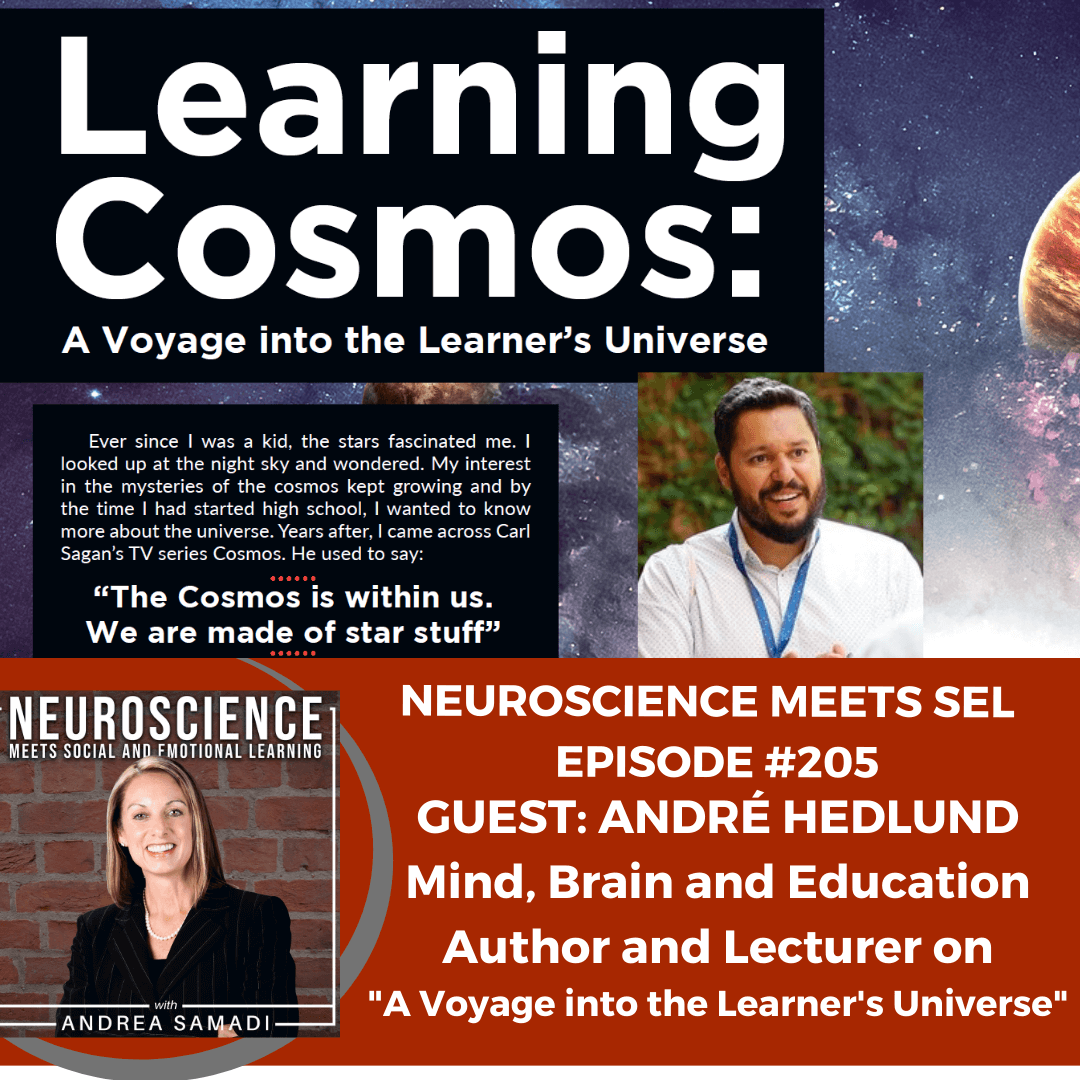
S7 Ep 205Author and Educational Consultant André Hedlund on ”A Voyage into the Learner’s Universe: A Macro View of Neuroscience and SEL”
Have you ever wondered WHO exactly YOU are? We are more than our name, our job title or perhaps how we are viewed in our personal lives. Whatever part of the world you are listening to this podcast from, today’s episode is going to stretch your mind, like it did mine, as we expand our field of view from our individual schools or workplaces to our cities, to go far outside of where we operate on a day-to-day basis to think on a different level than we usually think about ourselves, or those around us. We are going to use a brilliant article written by author, Chevening Alumnus (MSc in Psychology of Education--University of Bristol) and former National Geographic Learning Consultant, Andre Hedlund[i] called Learning Cosmos: A Voyage into the Learner’s Universe[ii] to help take our imaginations on a trip, where we will “consider the multitude of principles, theories and frameworks that address learning, and compare (them) to the expanding universe. Different spheres, each one influencing the others.” Watch this interview on YouTube with visuals here https://youtu.be/wsJ8NpYawdM On this episode you will learn: ✔︎ How Andre Hedlund compared learning to the Cosmos for a Macro vs Micro view of learning. ✔︎ How the 6 SEL Competencies compare to the Cosmos and Larger Universe. ✔︎ How Andre took the most current and well-known educational frameworks and theories and mapped them to the Cosmos for a deeper look at learning. ✔︎ How looking at something from a new angle (Macro vs Micro) can give you a new perspective, solve problems, and open your eyes to new possibilities. Today Andre will look at neuroscience and psychology and try to bring together principles about cognition, emotion, attitudes and beliefs, motivation, learning design, and context (many of the topics we have been talking about on this podcast for the past 3 years) into an illustration that resembles the universe so we can see how we fit into our world, from a different point of view, and Andre’s hope is that this “Learning Cosmos Angle can help students, teachers, schools, families and policymakers admire and reflect on the amazing universe surrounding our learners.” (Hedlund). Welcome back to The Neuroscience Meets Social and Emotional Learning podcast, EPISODE #205, I’m Andrea Samadi, author and educator from Toronto, Canada, now in Arizona, and today’s guest is an expert in Education, the Science of Learning, Neuroscience, Psychology, Pedagogy, and the Methodology Behind how we learn. If you are interested in neuroscience and learning, which I’m sure you are, if you’ve been tuning into our podcast, I know this episode will expand your thinking, like it did mine, as we hear from Andre’s perspective why neuroscience alone cannot tell us how we learn. We must look at psychology and education for these answers, but next, he takes it a step further with an empowering, mind-boggling thought. Imagine this if you will… “The Cosmos is within us. We are all made of star stuff. We are a way for the Universe to know itself.” –Astrophysicist, Carl Sagan[iii] This quote opens Andre’s article, and it took me back to the day I was first introduced to this topic of neuroscience, before I knew how the brain and learning were connected. I had many questions. How on the earth (pun intended) is the learning connected to Cosmos? Wait, what is the Cosmos again? It’s been a while since I studied the planets and I never really got into Star Trek or those out of space shows. What does it mean when he says “the cosmos is within us?” I’ve been wrapped up in the brain for the past few years and had to look up what exactly this means. The funny part of researching and coming up with some questions for Andre to help us to dive deeper into this topic, was that I shared on LinkedIn that I was looking forward to this interview, as I spent Friday night reading Andre’s new book, The Owl Factor: Reframing Your Teaching Philosophy A Reflective and Practical Guide for Teachers and Trainers, a
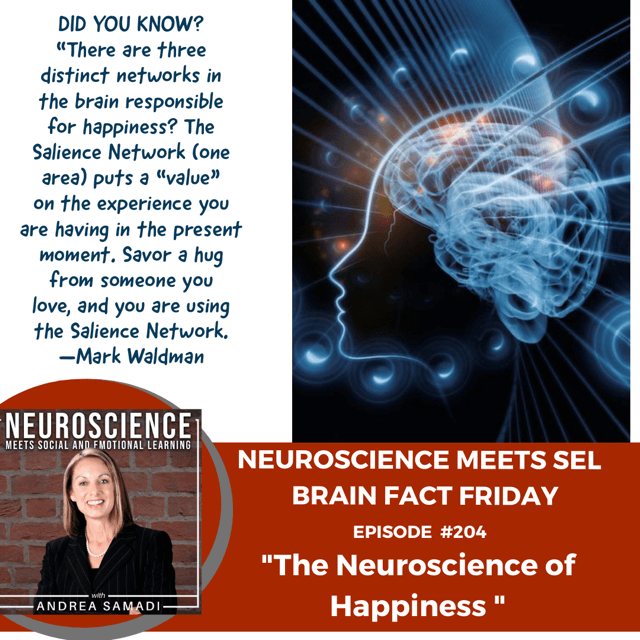
S7 Ep 204Brain Fact Friday on ”The Neuroscience of Happiness”
Did you know that “from a neuroscientific standpoint, happiness is experienced in different ways depending on your state of mind?” Mark Waldman For this week’s Brain Fact Friday, and EPISODE #204, with all that is going on in the world, I wanted today’s episode to take a closer look at how we can all find happiness in our life, even during the most difficult times, and look at happiness through a neuroscientific lens. If we can do this, I am confident that we will all walk away from this episode with a way to generate happiness, with our brain in mind. Welcome back! I'm Andrea Samadi, author, and educator from Toronto, Canada, now in Arizona, and we launched this podcast almost 3 years ago, with the goal of taking the mystery out the science behind high performance strategies, so that we can all apply the most current brain research, to improve productivity and results in our schools, sports and modern workplaces. I became interested in success strategies to improve performance in the late 1990s while working with some of world’s top performers in the motivational speaking industry and saw immediately how important these skills were for our future generations. For those who have been with us since we launched, thank you for coming back, for listening, and supporting the podcast over the years. The topics we cover each week seem to be never-ending, as more research continues to be uncovered, each episode connects back to past episodes that you might remember from our earlier days. Bringing us to this week’s Brain Fact Friday. Did you know that “there are three distinct networks in the brain responsible for happiness? It hit me while recording our Top 10 Episodes of All Time[i] when psychologist Dr. Francis Lee Stephens said “no one ever comes to me saying my thinking is awful. They come with—I feel like garbage.” How do we look for happiness, or positive feelings when we “feel” like garbage? We covered The Neuroscience of Happiness way back in November 2019 on EPISODE #29[i] and I remember it being such an important topic, that I created a PowerPoint Presentation on YouTube[ii] to go along with this episode where we dove into the recipe for peak performance, with strategies to boost our serotonin levels to generate more happiness. We took a closer look at the neuroscience of anxiety, with ideas to calm our limbic, emotional brain. We were almost a year into the pandemic, and nothing has changed with the importance of mental health and well-being since we recorded EPISODE 29, but today, I want to look at happiness with the latest neuroscience research I’ve recently learned from Mark Waldman, adding a new perspective, hoping that whatever is going on in our lives, wherever you are listening from in the world, that you can look at happiness with this new lens, a neuroscientific lens, and see if the ideas I’ll share can help you today can generate more happiness in your life, as well as mine, as I put these strategies into practice right along with you. This week I learned that the latest neuroscientific research suggests there are three distinct networks in the brain that generate happiness. As we take a closer look at these three networks, I hope we can think of some NEW strategies to bring real happiness, into our day, with this new knowledge of the specific network of the brain that this feeling is being generated in. 1. Frontal Parietal Network: also called the Central Executive Network (CEN) or our Thinking Network that controls our everyday thoughts and memories about what happiness means to you. Waldman reminds us that these memories are “mostly based on old beliefs and memories of the past and that happiness is something that only occurs briefly in the present moment.” Remember: that your beliefs about happiness are embedded in the past, and that you can think back to old memories that made you happy, but this level of happiness won’t last forever. HOW DO WE GENERATE MORE HAPPINESS USING THE CEN: Have yo
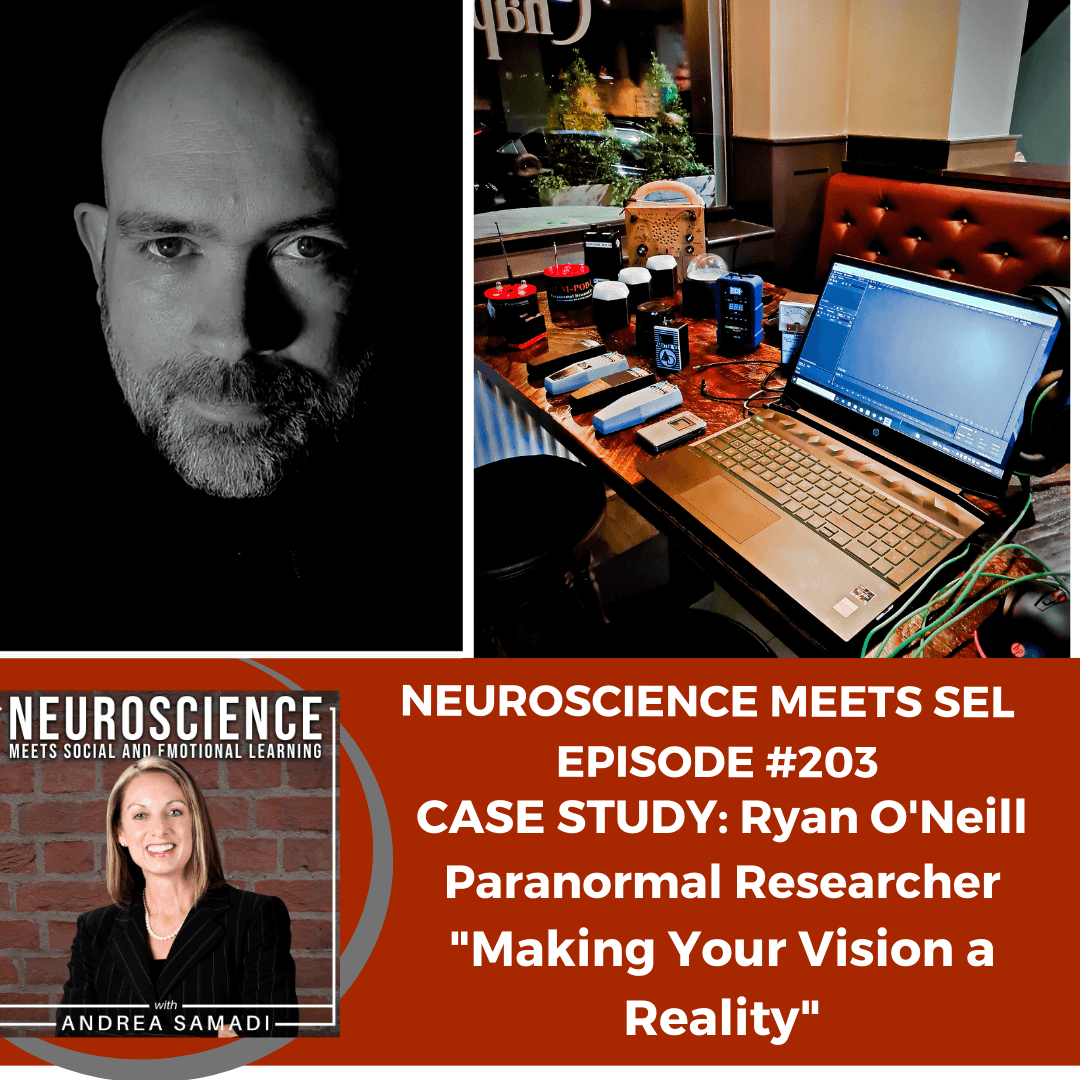
S7 Ep 203Case Study with Paranormal Researcher, Ryan O’Neill on ”Making Your Vision a Reality”
"Whatever it is you are going after, you’ll do it when you believe it." Napoleon Hill Watch this interview on YouTube here https://youtu.be/tsBpdG1DpaE On this episode you will learn: ✔︎ How Ryan O'Neill rose to the top of his field using specific success strategies that we've been teaching since the late 1990s. ✔︎ How Ryan used these principles to home-school his daughter and help her to create a successful future. ✔︎ The pathway from setting to achieving large goals-what to expect. ✔︎ Creating a new identity in the process-how to integrate your belief with your behavior. ✔︎ Overcoming obstacles and criticism and why what other people say or think doesn't matter. Welcome back to the Neuroscience Meets Social and Emotional Learning podcast, EPISODE #203, with a Case Study of someone who did just that—he believed in his vision and rose to the top of his field but only once his family got there first. Welcome back. I'm Andrea Samadi, author, and educator from Toronto, Canada, now in Arizona, and launched this podcast to bring the most current neuroscience research and success strategies directly to you, whether you are a teacher in the classroom, or looking for new ideas to improve productivity in your workplace, my goal is to bring the experts to you with clear strategies that we can all use to implement for immediate results. This week, I’m speaking with Ryan O’Neill, a Paranormal Researcher from Scotland, UK, who I met around 10 years ago, when he signed up to take our first certification program, where we taught the success principles in my first book The Secret for Teens Revealed[i] that turned into our Level Up Program[ii] for schools. Years before we narrowed our focus with teachers, we worked with individuals, all over the world (teachers, coaches, and parents) who were looking for a curriculum they could use whether it was to improve young people’s mindset with sports, in the classroom or with their personal lives. Many people who studied Bob Proctor’s work in the seminar industry, came our way, looking to narrow their focus with these timeless principles for young people. Ryan stuck out to me as unique, back then, as he signed up for the program to use the principles to help his children to learn these concepts. He knew that school wasn’t teaching them these important skills, and I still remember as he was going through each of the lessons with me, back then it was on Skype, he would then go on and teach the lesson to his daughter Tammy who was a teen at the time, just figuring out her life’s purpose. I remember she soared with these success principles that she saw her Dad taking seriously, and she did the same. She knew that these unique principles could help her to achieve high levels of success in her life, and she continues to use them to this day, as she’s put them on autopilot with her daily habits. His other daughter Rhian also became involved with this work, and did some voiceovers along the way that still exists in our work today. Ryan had such a strong belief in these principles, that he ended up helping us to create The Secret for Teens DVD program, that you can still find on Udemy.[iii] He was an integral part of our work in those early days when we were just starting out, as he had a keen mastery of seeing something that wasn’t yet there, and his belief was contagious, as he began checking off goal after goal that he had set out to achieve. I’ll get to the heights that Ryan has reached in his career using this skill of bringing his goals to completion with my questions, but when I saw how much he has achieved since those early days we worked together, I had to bring him on the podcast to feature his story as a case study so he can share how exactly he applied the success principles to achieve these outstanding results. Let’s meet Ryan O’Neill, from Scotland, UK, who has always been crystal clear of his life’s purpose “of researching, studying and sharing his open-minded discoveries, into a
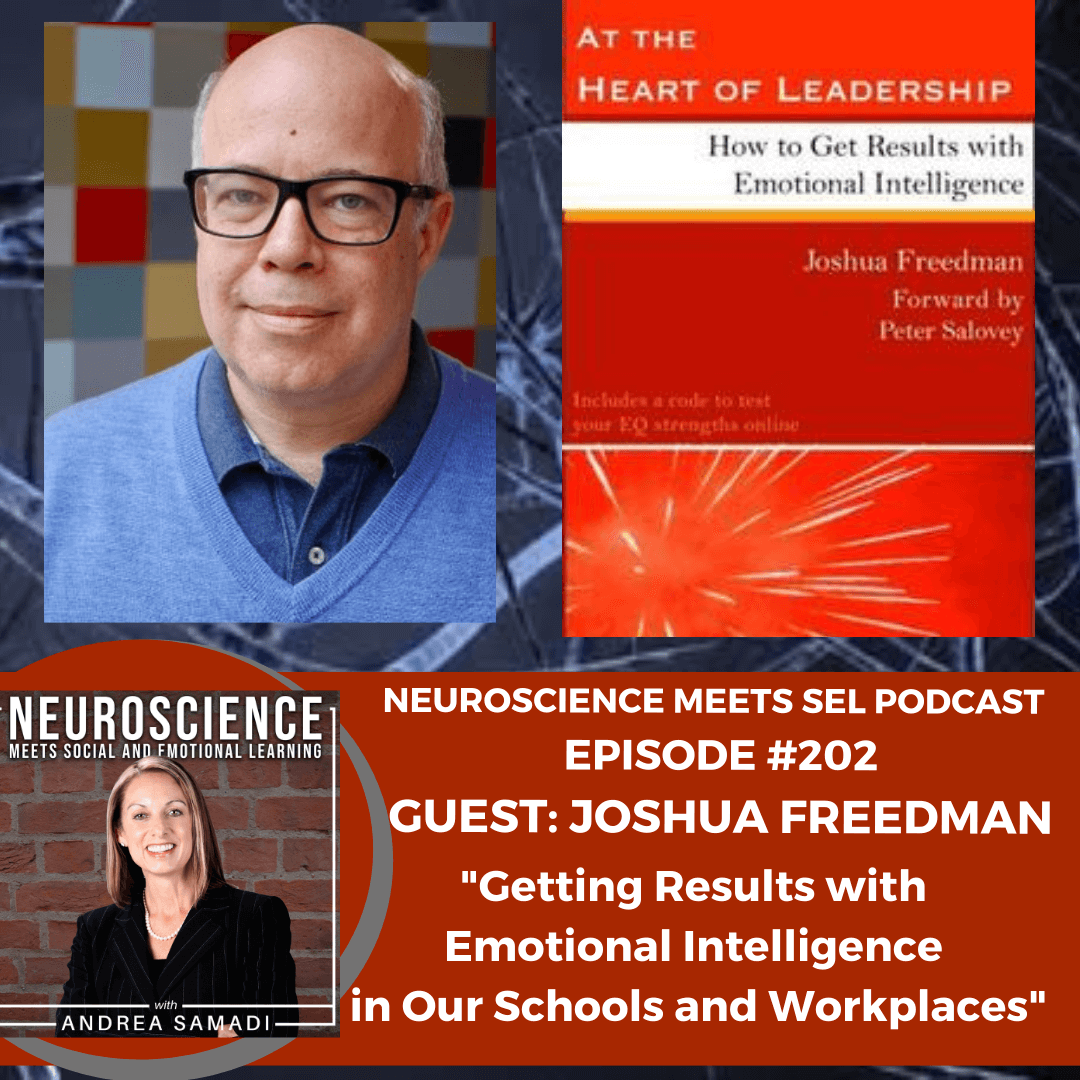
S7 Ep 202Emotional Intelligence Pioneer, Joshua Freedman on ”Getting Results with Emotional Intelligence in Our Schools and Workplaces.”
“We teach what we most need to learn” Joshua Freedman Watch this interview on YouTube here https://youtu.be/xE0F0l9tbqo Welcome back to the Neuroscience Meets Social and Emotional Learning podcast, EPISODE #202, with someone I’ve been wanting to speak with since the early days of launching our podcast. He’s a specialist on emotional intelligence, with connections that link him to Daniel Goleman’s[i] earliest work, as the CEO and one of the co-founders of Six Seconds[ii], the global community growing emotional intelligence that began in 1997, around the time I had my AHA Moment and realized how important these skills are for our students in the classroom. He’s an educator, author of 5 books, researcher and parent, who translates the latest neuroscience of emotion into practical insights we can all use to connect, solve problems, lead, and live better lives. On this episode you will learn: ✔︎ What led Joshua Freedman, one of the leading experts of emotional intelligence in our schools and workplaces, to discover the SEL/Neuroscience connection in the late 1990s. ✔︎ How the 6Seconds.org SEL Model is different than ALL other models and why EVERYONE working with SEL must see this model. ✔︎ A simple 3 step approach to implement emotional intelligence in our lives, as well as our students in the classroom, or in the workplace. ✔︎ How to use our emotions as a guidance system and what to be aware of with certain emotions (like trust). ✔︎ How to get involved with 6Seconds.org with their FREE SEL resources, assessments, programs and services. Before I introduce you to this week’s guest, I’ve got to say that for someone who has spearheaded the movement of EQ in our schools and workplaces for over 3 decades, his humble and kind nature will show you that he practices what he teaches. Welcome back. I'm Andrea Samadi, author, and educator from Toronto, Canada, now in Arizona, and like many of you listening, have been fascinated with learning and understanding and applying the science behind high performance strategies that we can use to improve our productivity in our schools, our sports, and workplace environments. My vision is to bring the experts to you, share their books, resources, and ideas to help you to implement their proven strategies, whether you are a teacher working in the classroom or in the corporate environment. Let’s get right into this topic, and meet this week’s guest, Joshua Freedman, the CEO of 6 Seconds, and dive into the field of emotional intelligence in our schools, sports and workplace environments. I know that after these questions, we will all look at “emotional intelligence” with a new lens. Welcome Joshua, it’s wonderful to meet you after all the years I’ve followed your work. Joshua, I don’t know if you know this, (or remember) as I know that you do many of these interviews, but when we first launched this podcast, I did reach out to you, and even had a spot on your calendar. You are the only interview to date that I wrote the week of, and said I needed more time to research you, because I didn’t feel fully prepared for the interview. Do you remember this by chance? What happened—I usually read each person’s book and come up with some questions on how their work applies to the field of SEL and neuroscience, but when I began to research you, I saw that where your work began, and realized I needed to think about your questions as one of the leaders behind the movement of this field of emotional intelligence, to bring more meaning to today’s discussion and make sure I didn’t leave anything out. A sincere thank you for speaking with me today and letting me thoroughly prepare the questions for you so we can go deep into this topic of how to get results with emotional intelligence. INTRO QUESTION: While researching your background, Joshua, I listened to some of your interviews[iii], and was surprised to see that your introduction to this field came in a similar way to mine. We were both first year teac
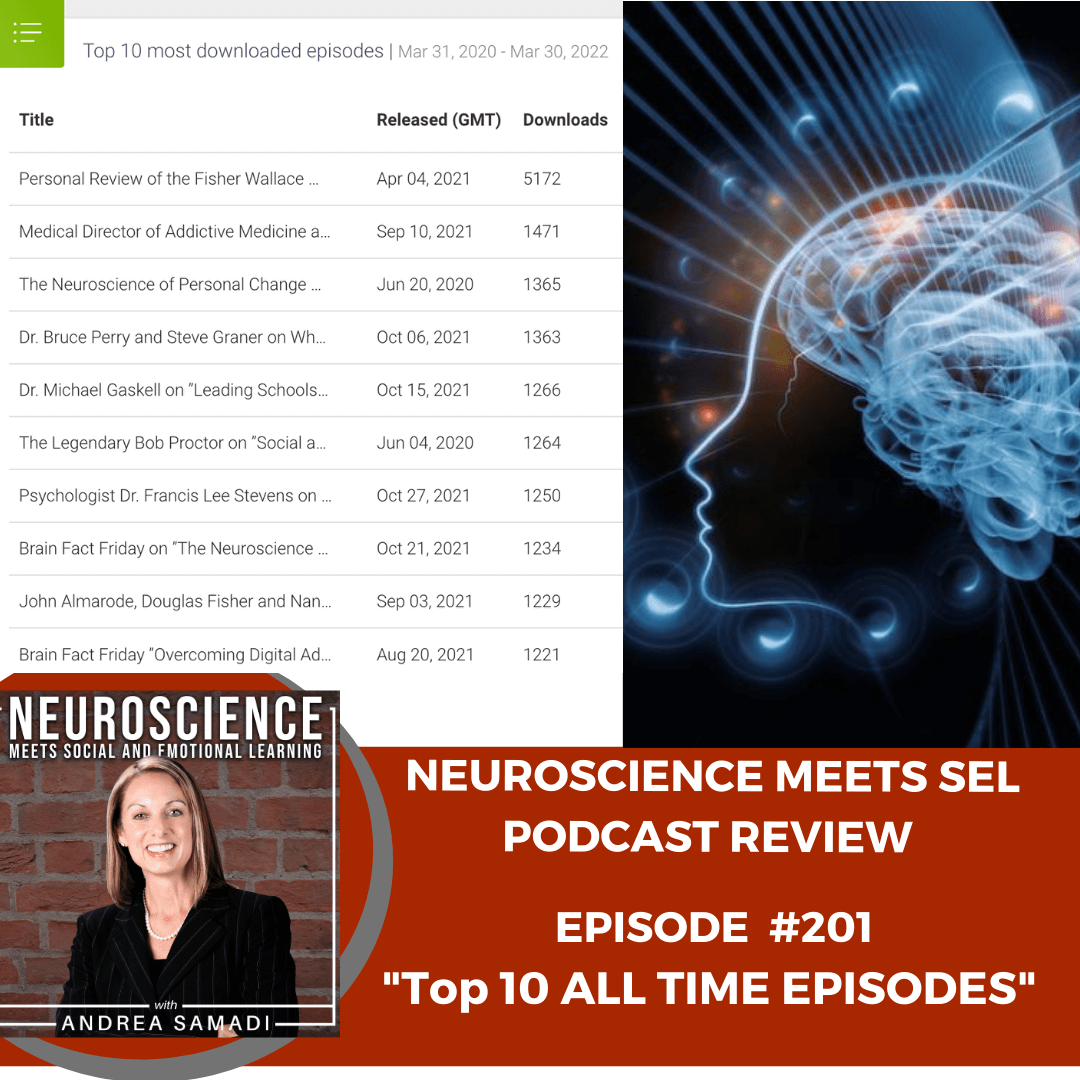
S7 Ep 201The Top 10 ALL TIME Episodes on The Neuroscience Meets Social and Emotional Learning Podcast
“Learn continually—there’s always one more thing to learn” Steve Jobs Welcome back to the Neuroscience Meets Social and Emotional Learning podcast, for episode #201 on “The Lessons Learned from our Top 10 All-Time Episodes” as we reflect on the episodes that YOU chose to be the most impactful since we launched back in June 2019. For those returning, welcome back, and for those new, I'm Andrea Samadi, author, and educator from Toronto, Canada, now in Arizona, and like many of you listening, have been fascinated with learning and understanding and applying the most current research that we can ALL use to improve our productivity in our schools, our sports, and workplace environments. I launched this podcast as a solution to bring these ideas directly to you. As we are now well into our 7th season, with a focus on brain health and well-being this year, it hit me while recording our 200th episode, that it would be helpful to take a look back and review the top lessons learned since launching this podcast over three years ago. There’s so much content that’s been covered, and while I can’t mention every episode, you can always go back and scroll through the website[i] and pick episodes that stand out to you when looking for something new to learn. I still listen to these older episodes, and always pick something of value from each one. Like we said as we recapped our 200th episode, we picked high quality guests intentionally, and the content reflects these high caliber speakers. What I Wish I Knew When We First Launched This Podcast: While preparing for this episode, I glanced at the top 10 all-time episode list (that I have included in the show notes) and a few things came to my mind that I thought would be helpful to share with this review. Before I get to the lessons learned from our top episodes, I wanted to share some lessons learned from the production side of things. Many people reach out to me asking questions about “how do you launch a podcast” or “what would you have done differently if you were to do everything over again?” There’s definitely ONE THING I would have done differently. If you scroll all the way down on our Podbean website to our first 6 months,[ii] you might see the downloads next to each episode are lower than you might expect up until December 2019. This is not just because we were starting out, (earlier episodes averaged around 300 downloads in the beginning, compared to 1,000 per episode now, but I’ll tell you one of the biggest errors I made launching this podcast, that impacted our numbers right from the beginning. If you look, next to each episode, you can see the number of downloads for that episode, and in the beginning, (episodes created in 2019) I saved the audio files in the M4A format which is the format that Camtasia (where I do my editing) defaults to, after saving an audio file. For those listening who don’t deal with audio files, think about it as one of those errors that you want to prevent others from EVER doing in the future. Who knew that Spotify, our third largest source of traffic, (with Apple Podcasts as our first, and Podbean, our host as second) only accepts MP3 audio files, so when setting up this podcast, I realized 6 months into it, that I had an error message on the connection to Spotify and zero downloads from this source? It took 6 months to notice this error because there’s a lot with launching a podcast, but a mistake like this had to be fixed sooner than later. To do this, we had to reformat all audio files from M4A format to MP3 for our podcast to appear on Spotify, and that meant that any episode created in 2019, was reset to zero. This was a huge lesson to learn, (when downloads are important for the spread of your podcast) but I’m glad we fixed it early on. If you are thinking of launching a podcast, be sure to record ALL audio files in the MP3 format. I wish I knew this in the beginning. There weren’t any other big AHA moments from the production si
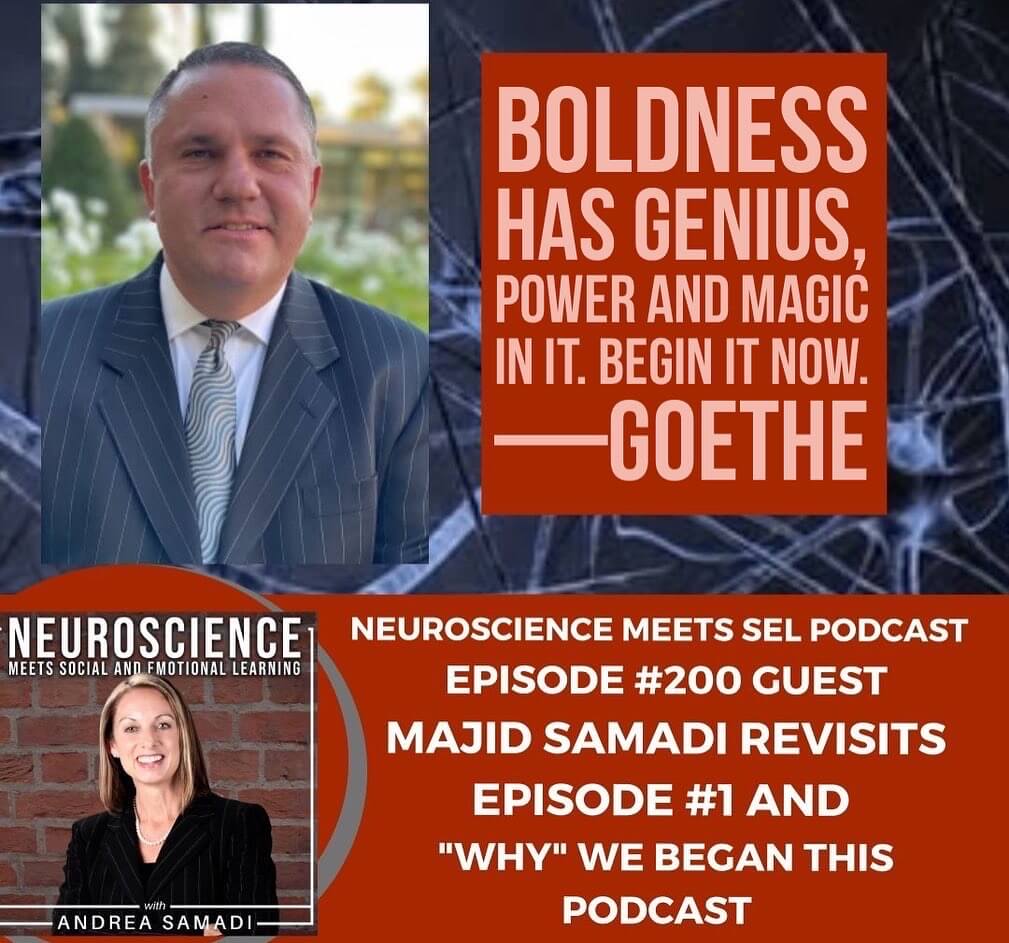
S7 Ep 200200th Milestone Episode with Majid Samadi (Returning Guest) from EPISODE 1 on ”Why We Began This Podcast”
All organizations start with WHY, but only the great ones keep their WHY clear year after year.”― Simon Sinek, Start with Why: How Great Leaders Inspire Everyone to Take Action Watch the interview on YouTube here https://youtu.be/hP854mDG9do On this episode you will learn: ✔︎ The vision for The Neuroscience Meets SEL Podcast, from Majid Samadi's eyes, watching the podcast grow from the early days when it was just an idea. ✔︎ Why SEL skills are important in today's classrooms, and Emotional Intelligence training in our corporate workplaces. ✔︎ How Andrea held her vision for interviewing high quality guests with an experience over 12 years ago, of running The Teen Performance Magazine. ✔︎ The TOP 3 Guests from Majid's point of view in the past year. ✔︎ How to monetize a podcast, and why this step is crucial to sustain any idea. ✔︎ The "behind-the-scenes" of this podcast, from someone whose office is next door to where all interviews are conducted. Welcome back to the Neuroscience Meets Social and Emotional Learning podcast, for our 200th episode milestone, with a reflection back on “The Why Behind Our Podcast” which is the #1 question people ask me when I share that I host this podcast. I hope that we can all learn something about “why we do what we do” as we reflect back on the past 100 episodes (that covers 2021 and the beginning of 2022). I’ve asked a special returning guest from episode #1[i], Majid Samadi, senior regional sales director at Lexia Learning[ii], and my husband, to join me as we reflect back on “why we do what we do”, as Simon Sinek would say. Welcome back. I'm Andrea Samadi, author, and educator from Toronto, Canada, now in Arizona, and like many of you listening, have been fascinated with learning and understanding and applying the science behind high performance strategies that we can use to improve our productivity in our schools, our sports, and workplace environments. My vision with this podcast began 3 years ago, and I think it’s important to step back and take a look at “why” we began this podcast, since “the why” should be behind all of our work to keep us moving forward. As we think about “why” we do what we do, I hope that you reflect on why you do what YOU do, and see if you can gain insights from your why, to drive you to new levels of awareness, as we do the same. I chose Majid Samadi to join me on this episode, because he’s really good at launching big ideas, especially those ideas that have a clear “why” behind them. It was Majid who encouraged me to publish my first book, The Secret for Teens Revealed to put the ideas I learned from the seminar industry into writing, and when I mentioned that I was thinking about launching a podcast in early 2019, when my website had a podcast theme, his first words were “how can I help you to begin?” You would think that the person in our household who met Simon Sinek (me) would be his biggest fan, but Majid would be a much bigger fan of Sinek’s work than me. Every year he trains his sales team (at Lexia Learning—a company that provides structured literacy solutions and professional learning to students and educators across the country) on Sinek’s “The Golden Circle” so that his sales team launches their year with a clear why behind what they will be doing, to kickstart their year. I’m always looking for a new angle to think about “why we do what we do” and I recently saw Mathew Portell’s[iii] keynote speech at Butler University’s 6th Annual Educational Neuroscience Symposium and it opened my eyes to a new way to approach this episode. Mathew Portell, who is currently in his sixth year as principal of Fall-Hamilton Elementary, an internationally recognized innovative model school for trauma-informed practices in Metro Nashville Public Schools, opened up his keynote for the Neuroscience Symposium with a completely NEW way of looking at our why. At least it was for me. Before I bring Majid on, I wanted us to all think about why we do what we d
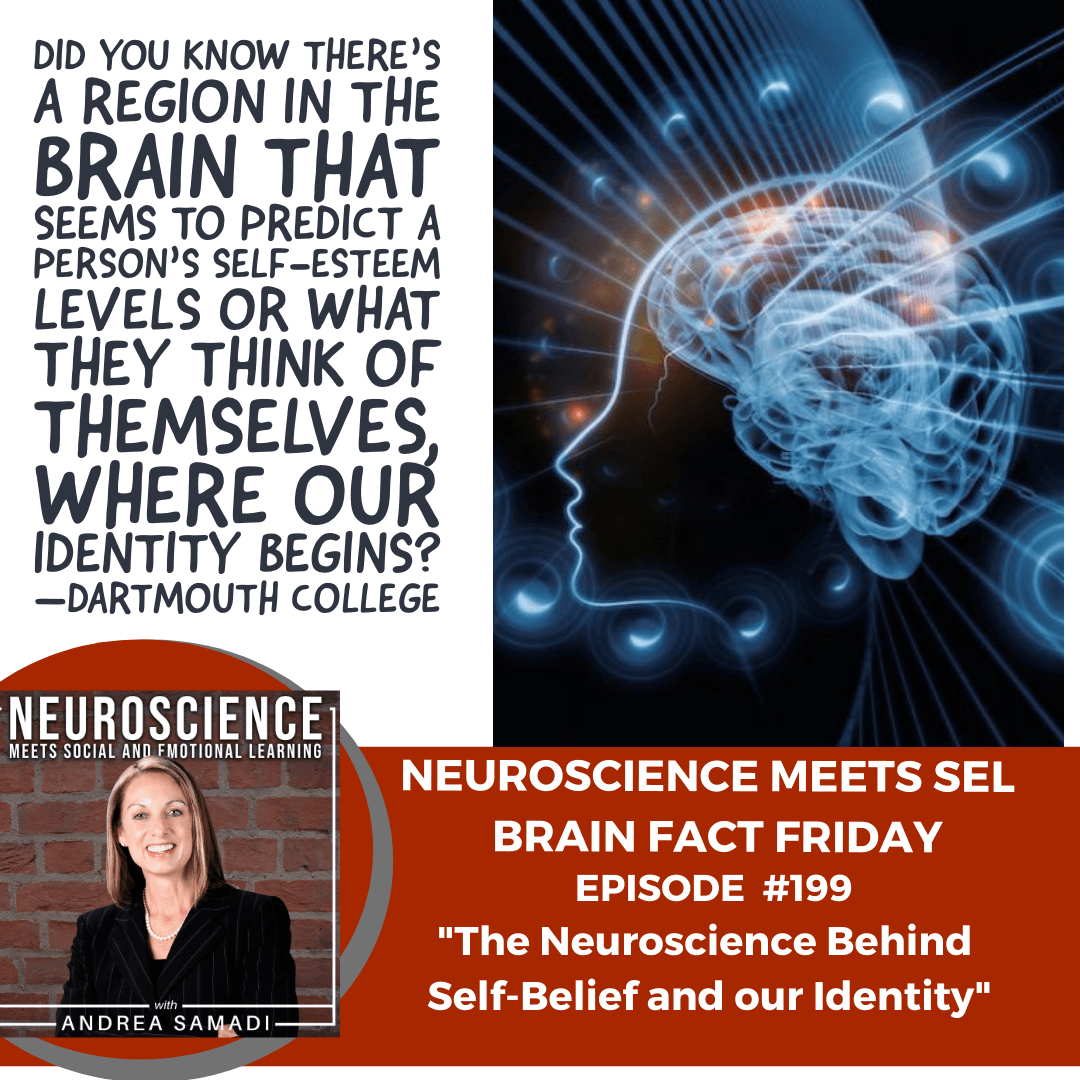
S7 Ep 199Brain Fact Friday on ”The Neuroscience Behind Self-Belief and Our Identity”
“All things are possible if you believe.”[i] “Our results are all based on our beliefs” “If we don’t like what’s going on outside, we’ve got to go inside, and change our beliefs.”[ii] --Bob Proctor Welcome back to the Neuroscience Meets Social and Emotional Learning podcast, for episode #199 on “The Neuroscience Behind Self-Belief” that I want to dive into instead of the episode I was planning on writing this week, (a deep dive into David A. Sousa’s NEW Edition of How the Brain Learns), that I will release next week instead. For those new, welcome, I'm Andrea Samadi, author, and educator from Toronto, Canada, now in Arizona, and like many of you listening, have been fascinated with learning and understanding the science behind high performance strategies that we can use to improve our productivity in our schools, our sports, and workplace environments. My vision is to bring the experts to you, share their books, resources, and ideas to help you to implement their proven strategies, whether you are a teacher working in the classroom or in the corporate environment. Sometimes we must listen to what’s going on around us, and I got the message loud and clear this week, that made me pivot towards this topic of self-belief. This week I met my good friend, Patti Knoles, for coffee. We used to work together years ago when we both worked for Bob Proctor in the seminar industry, and although we live in the same state, it’s been a few years since we met up in person, but after the news earlier this month, we decided to meet and share some memories. Patti Knoles with her daughter, Jessica Knoles NOTE-- For those who follow this podcast and tuned into our final episode of our Think and Grow Rich Book Study[iii], you will know that my mentor, Bob Proctor sadly passed away earlier this month and I dedicated that final episode to him. After I released that episode, I knew I needed more time to just process everything and wasn’t finished. I wanted to stay open to what else I could cover, that would make an impact for everyone else who tunes in, while saying goodbye to the man behind the work that I do, so I just kept my eyes and ears open and went to meet Patti for coffee. Patti Knoles, is a quiet, yet fierce force behind many creative efforts with Bob Proctor’s seminars, since the late 1990s when I first met her. She’s a graphic designer by trade, but so much more than that. She’s a true visionary, with a talent of combining her creative ability, with her imagination and thoughtfulness, bringing something powerful out in her work. It was Patti who I asked to design the covers of my two books, because I wanted her talent to shine through with my work, which it did. The Secret for Teens Revealed[iv] that was published in 2008 won an outstanding book sales award, and the publisher funded my second book, Level Up[v] with this incentive that ended up helping thousands of teens globally to go after their dreams, and live the life they imagined.[vi] Think about this for a second. When we know what we want, we’ve got to start with writing it down. Writing causes thinking, thinking creates an image and this is where ALL ideas begin. Patti was able to take what I wrote down and turn it into an image that would later impact thousands of others around the world. Your ideas, or what you want to create, really do have the ability to change the world. I wonder if you believe that? When I met Patti for coffee, she had a bag, and a gift for me that I’ve got to say was the most thoughtful gift I’ve ever received. To honor Bob’s legacy, Patti created coffee mugs that had a photo of Bob, saying “Live Like Bob” and on the side she inscribed “BE. DO. HAVE. GIVE.” which she had heard him say often. There was so much thought to this gift, but the icing on the cake came with the card that had a whole bunch of sayings that I know Bob said all the time, that have stuck in my head over the years. I’ve got the card and mug on my desk as a great reminder to
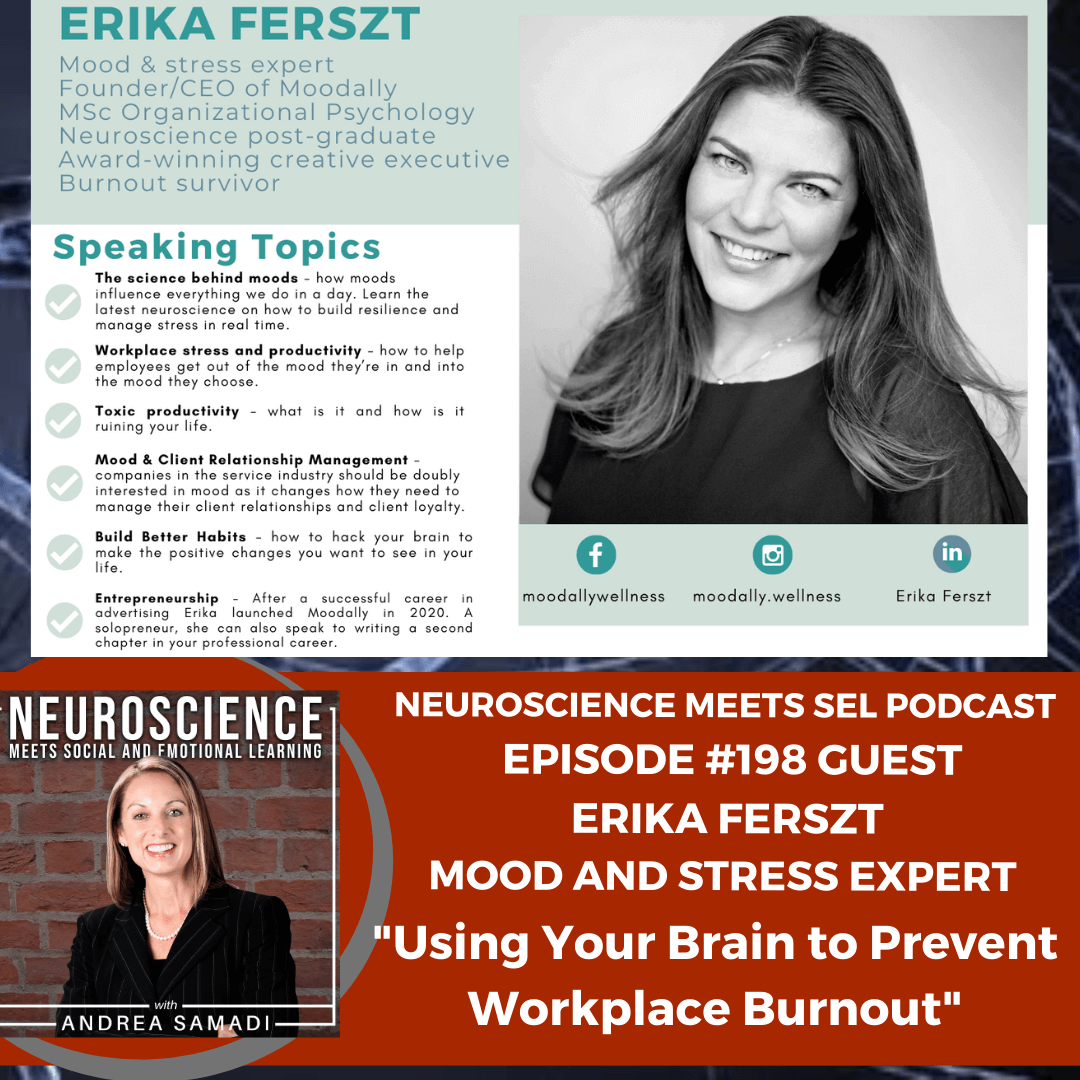
S7 Ep 198Mood and Stress Expert Erika Ferszt on ”Using Your Brain to Prevent Workplace Burnout”
Welcome back to the Neuroscience Meets Social and Emotional Learning podcast, for episode #198 with mood and stress expert, Erika Ferszt, who was a senior creative executive for over 20 years and for 10 of those years, led all of the advertising, media and digital efforts for Ray Ban. She must have made such an impact with her work that the Ray-Ban Erika’s were named after her! Watch our interview on YouTube here https://youtu.be/y-vFVaiBPrw On this episode you will learn: ✔︎ The signs and symptoms of work burnout that led Erika to leave a job she loved and create an app to help reduce workplace stress. ✔︎ How her health scare led her to pursue 2 years of Postgraduate studies in neuroscience. ✔︎ How someone without a science background can understand and teach neuroscience in a way that it's simple and easy to use. ✔︎ What she offers at Moodally.com for corporate executives. ✔︎ How a stress management program like her app can help improve self-efficacy, so we can better manage our daily stress. In 2015 she suffered a burnout episode and was hospitalized for 10 days with stress-related vision loss, and through this experience, went back to school to study the relationship between stress, the brain and the mind and founded her company Moodally.com as a result. If you’ve been following our podcast, you will see clearly why I have asked Erika to join us today, for season 7 of this podcast where we are focused on brain health and well-being. Welcome back. I'm Andrea Samadi, author, and educator from Toronto, Canada, now in Arizona, and like many of you listening, have been fascinated with learning and understanding the science behind high performance strategies that we can use to improve our productivity in our schools, our sports, and workplace environments. My vision is to bring the experts to you, share their books, resources, and ideas to help you to implement their proven strategies, whether you are a teacher working in the classroom or in the corporate environment. Today’s guest, Erika Ferszt, loved her job with Ray Ban. She will tell her story, explaining it was not like she was working for a terrible boss in a toxic work environment, but quite the opposite as she loved her work, but when her body reacted to the constant stress it was under, she was forced to make some changes, that led her to a whole new path in life. Let’s meet Erika and hear how her burnout led her to create Moodally.com and a whole new life. Welcome, Erika, thank you for meeting me on a Friday night (I think??). Are you in Italy now? (I know you said Europe). There was so much to your story, when I saw it that resonated with me when I saw the path that you took after your health scare, but I have to start with a question that’s not so obvious (like tell me where this all started). Intro Question: I’ve got to say that most people I know here in the US push themselves hard work wise. You know, the American Dream can be had, but there’s a price to pay, and I’m always watching those close to me, looking for a sign that the push is too much, and now we can measure if our body is recovered or not with these wearable devices that can tell us if we need to rest and slow down. Were there ANY signs or symptoms that you can think of, looking back, with that episode, that you were close to burn-out? Q1: So, you land in hospital, with quite a scary situation. I’ve lost my eyesight before, but it was temporary, and in one eye only, and I found out later, after I freaked out because I couldn’t drive the kids to school, that it’s common (it was an ocular migraine and I Googled it by looking out of one eye while calling my eye doctor) but your vision loss lasted much longer and was serious (and when I Googled loss of myelin sheath around the optic nerve I almost wish I hadn’t. Can you share what the stress did to your optic nerve to cause the vision loss, did you Google it and notice what I could have been, and with everything that you learned
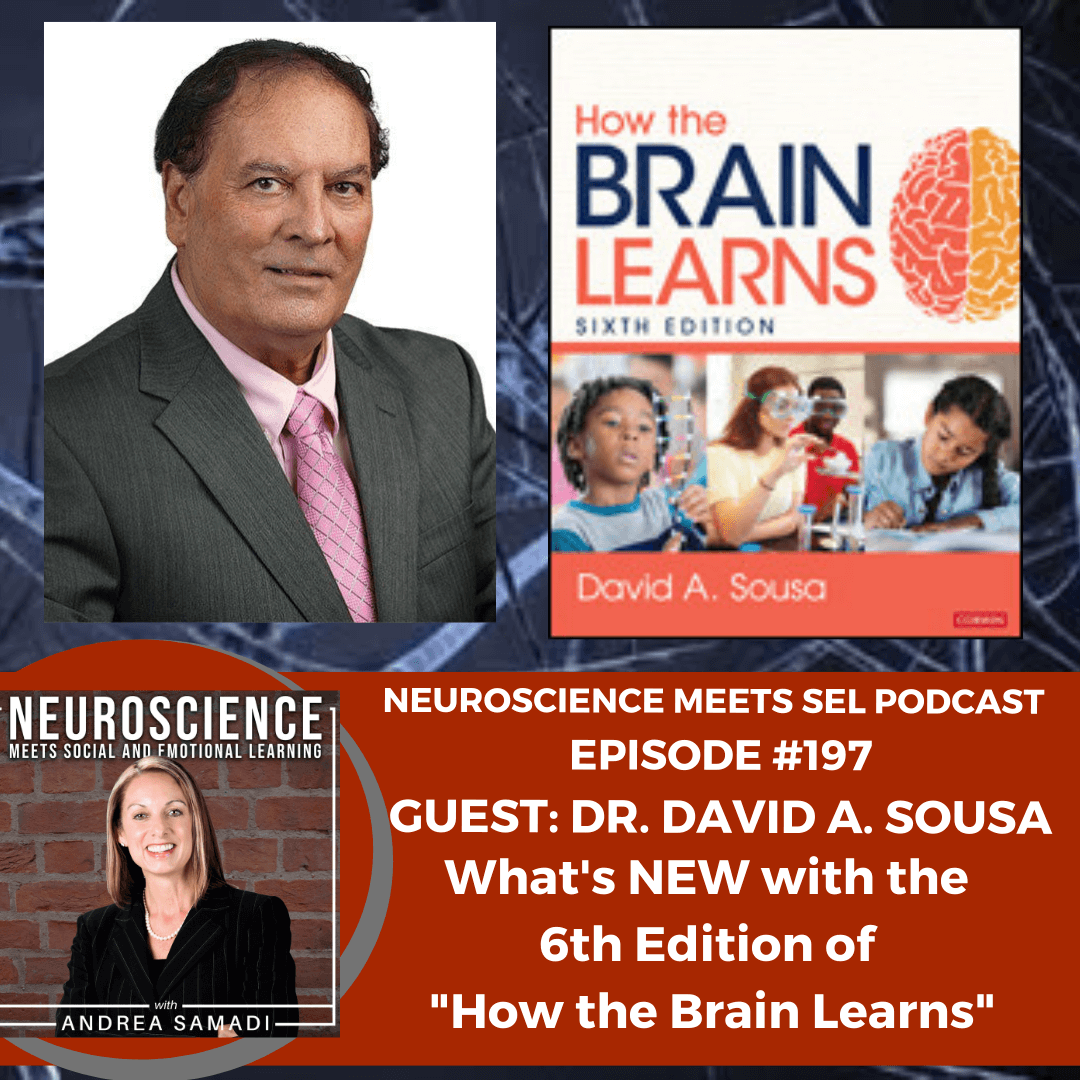
S7 Ep 197Returning Guest Dr. David A. Sousa on ”What’s NEW with the 6th Edition of How the Brain Learns”
Welcome back to the Neuroscience Meets Social and Emotional Learning podcast, episode #197 with a special returning guest, David A Sousa, who we first spoke with back in August 2020 on episode #78[i]. Click here to watch this interview on YouTube https://youtu.be/148InRAxFts On this episode you will learn: ✔︎ What's new with the 6th edition of Dr. David Sousa's "How the Brain Learns" The importance of the cognitive component of social-emotional learning The importance of student engagement, especially through academic teams Connections between Bloom’s Taxonomy and current instructional strategies, such as teaming and project/maker learning Strategies that ALL teachers can implement to reduce stress in the classroom and improve student learning/engagement. What happens in the brain when we are learning something new. How to make practice PERMANENT and transfer knowledge into memory. What we can learn from the specialized areas of the brain How the science of reading can help us as teachers with the learning process I’m thrilled to have the chance to speak with David Sousa again, as It was David Sousa’s How the Brain Learns book Series[ii] that is now in its 6th Edition (that includes How the Brain Learns, How the Brain Learns to Read, How the Gifted Brain Learns, and How the Special Needs Brain Learns) that I was given by an educator who put me on the path of helping others to understand how learning occurs in the brain. When reading this series, I was told from other respected colleagues that this book series is one that every educator should read, and after our first interview, was contacted from educators all over the country (and world) with how helpful this series has been for them. How the Brain Leans has helped me as a parent to understand how my own children learn (specifically with reading) and gave me more understanding and patience to help put into practice some of the secrets for accelerating literacy that we have dove into on this podcast, since this first interview with David Sousa, almost 2 years ago now. For those new, or returning guests, welcome back! I'm Andrea Samadi, author, and educator from Toronto, Canada, now in Arizona, and like many of you listening, have been fascinated with learning and understanding the science behind high performance strategies that we can use to improve our productivity in our schools, our sports, and workplace environments. My vision is to bring the experts to you, share their books, resources, and ideas to help you to implement their proven strategies, whether you are a teacher working in the classroom or in the corporate environment. A bit about David Sousa, he’s an international consultant in educational neuroscience, has written more than 20 books for educators and parents on ways to use brain research to improve teaching and learning. He has conducted workshops for more than 200,000 educators in hundreds of school districts on brain research and science education at the Pre-K to Grade 12 and university levels. He has presented at national conventions of educational organizations and to regional and local school districts across the United States, Canada, Europe, Australia, New Zealand, and Asia. Dr. Sousa has a bachelor of science degree in chemistry from Bridgewater (Massachusetts) State University, a master of arts degree in teaching science from Harvard University, and a doctorate from Rutgers University. His teaching experience covers all levels. He has taught high school science and has served as a K–12 director of science, a supervisor of instruction, and a district superintendent in New Jersey schools. He has been an adjunct professor of education at Seton Hall University and at Rutgers University. He has received awards from professional associations, school districts, and Bridgewater State University (Distinguished Alumni Award), as well as several honorary doctorates for his commitment and contributions to research, professional development, and scien
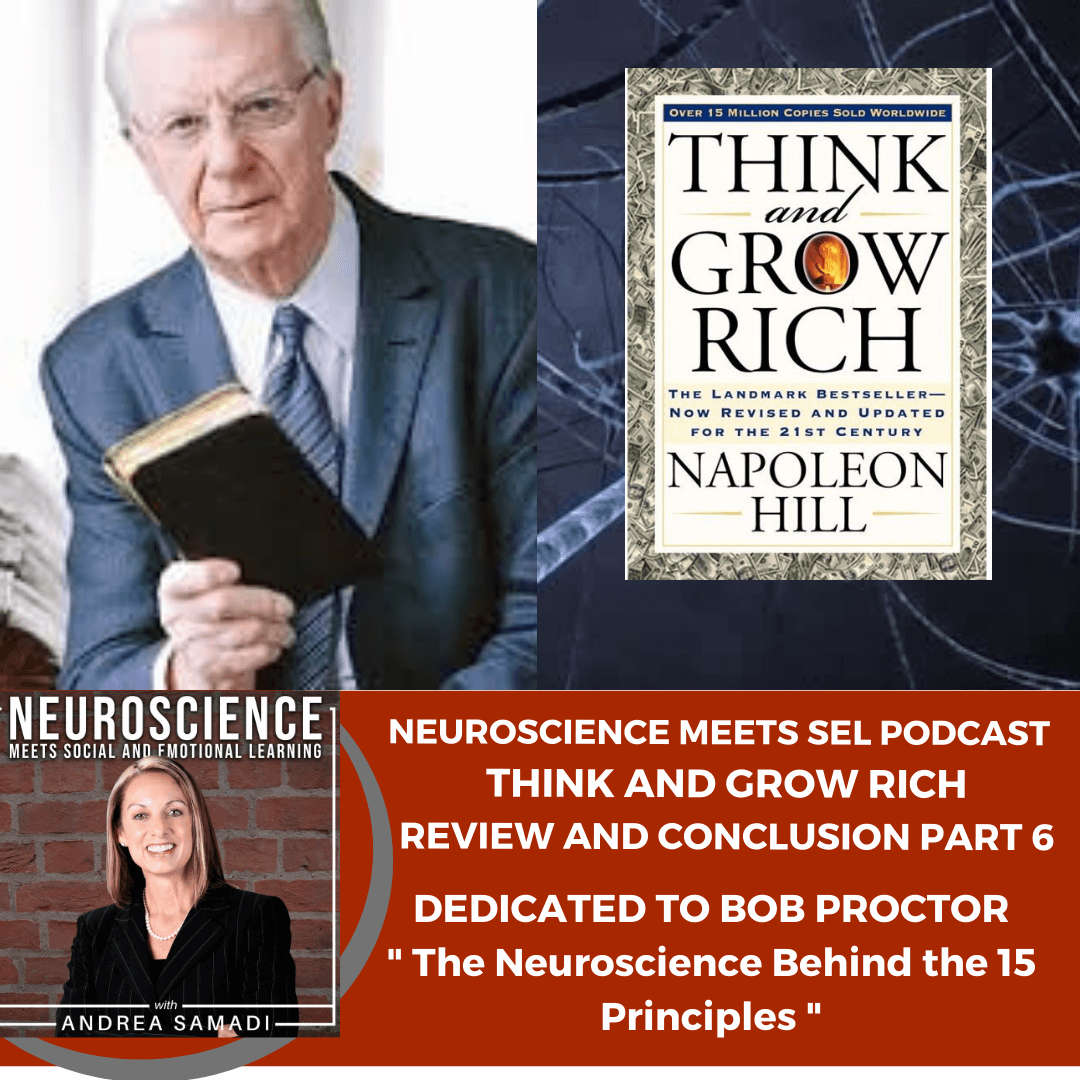
S7 Ep 196In Memory of the Legendary Bob Proctor ”The Neuroscience Behind the 15 Success Principles” of Napoleon Hill’s Classic Book, Think and Grow Rich
Welcome back to PART 6, EPISODE #196 and our final episode of this series, where we will cover the final chapters and add “The Neuroscience Behind the Timeless Goal-Setting Principles” in Napoleon Hill’s Classic book, Think and Grow Rich to ensure we make 2022 Our Best Year Ever with brain-science in mind. This episode I’m dedicating to the man who has been reading this book for his entire life, who I have mentioned often in this series and podcast, Bob Proctor, who was the first person to see more in me than I could see in myself. It was Bob who asked me “What do you really want?” when I was in my late 20s, and just figuring it all out. He did catch me off guard with this question, but it didn’t take long to map out the vision, as crazy as it seemed at the time, when you have someone who believes in you to push you along the way, the vision becomes clear. Once you know what you want, and have a crystal-clear vision of it, it really is our duty to make it happen in our lifetime. Bob is the perfect example of someone who took action, inspiring millions globally, and someone I will forever be grateful that I crossed paths with. I found out that Bob was gravely ill, while finishing this episode, thought it was important to recognize his influence as an example for all of us, to put something into our goals this year that we have never done. Using Bob’s example, do something wildly different this year, than you ever have previously. He said many things that are forever stuck in my head, but I found a quote that makes sense to close out our book study that I think will stick with all of us. He said, “You can’t just THINK and GROW RICH, you’ve got to do something with those thoughts.” I’m hoping that this year, we are all looking for quantum leap results, that take us far beyond where we’ve ever been before. I have been studying success principles, and how successful people became that way, since the late 1990s when my paths crossed with Proctor. I saw these ideas could transform results for our students in the classroom, years before we talked about how important our mindset was after Carol Dweck’s[i] work made its impact on the field of education, and I wrote my first book, The Secret for Teens Revealed [ii] to document these success principles that are echoed throughout Napoleon Hill’s Think and Grow Rich book, and aren’t difficult to understand, but implementing them in our daily life is where the hard work comes in. Here’s my challenge to you—to go through each of the PARTS in this series and see what you can do to truly make a difference and impact with whatever it is you are doing this year. We’ve covered the 15 principles used by some of the wisest people in the world, and I want to add a sense of urgency for all of us to kick it into high gear this year. Think and act in a wildly different way than we have previously. This will take some focus, but the results will be well worth the effort. Remember that Hill says you haven’t read this book until you’ve read it 3 times? We can come back to this series next year and continue to apply the principles with the new experiences built over this year. This series is not only for you, the listener, I am doing the work right along with you! If you want to see my interview with Bob Proctor, and where my vision began, go back to episode #66[iii] and EPISODE #67[iv] on the Top Lessons learned working with him for 6 years which is one of our most downloaded episodes, and one I still receive feedback and messages about. With this episode today, I knew I had to tie in the most current brain research, so that we can look at ways to improve our current goal-setting/achieving process, with strategies that will take the guess work out of our year, to make a difference for all of us, since the strategies I will share are all peer reviewed, and have been proven scientifically to be the most effective way to achieve whatever it is that we are working on this year. When I say I want
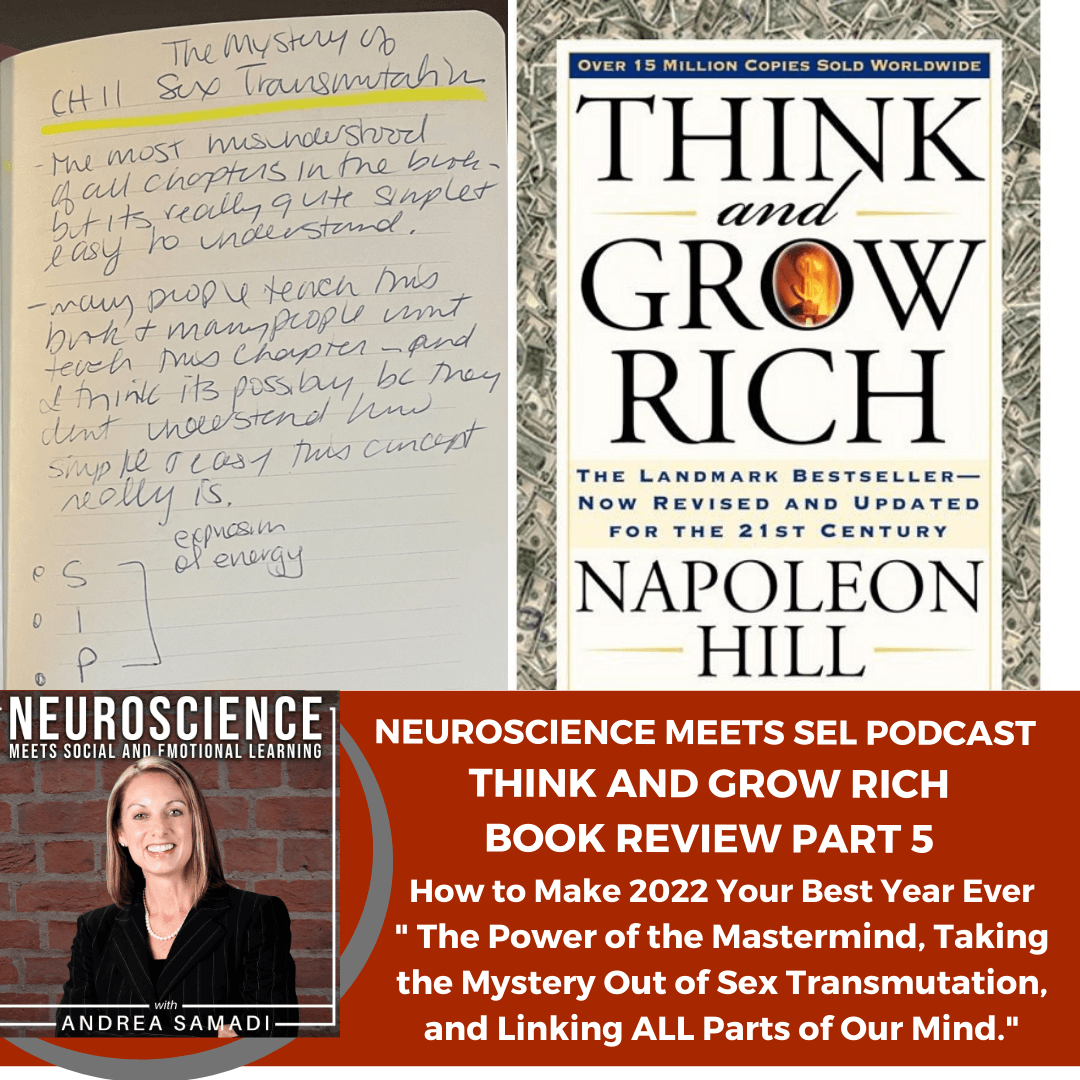
S7 Ep 195Think and Grow Rich Book Review PART 5 on ”The Power of the Mastermind, Taking the Mystery Out of Sex Transmutation, and Linking ALL Parts of Our Mind.”
Welcome back to PART 5 of Making 2022 Your Best Year Ever with EPISODE #195 on “The Power of the Mastermind, Taking the Mystery Out of Sex Transmutation, and Linking ALL Parts of Our Mind” as we continue our deep dive into Napoleon Hill’s Classic book, Think and Grow Rich, that has sold over 15 million copies worldwide. Before I go on with this episode, I just want to say that out of those 15 million copies of this book sold, I wonder how many people of those 15 million people read the book the way that Napoleon Hill intended? I know I didn’t until Paul Martinelli taught me how to read it, and I know from doing this book study that I’m only scratching the surface of these 15 principles, used by some of the wisest people in the world. Hill himself would say that if you haven’t read the book three times, or completed the exercises, you haven’t read the book yet! I hope this book study is helping you to dive deeper into these important chapters of one of this classic and timeless book, and that you are gaining a deeper awareness as we’re reading this book together. On this episode, you will learn: ✔︎ Review PART 1, 2, 3 and 4 to Reinforce the First 9 Chapters of Think and Grow Rich. ✔︎ What "power" can be felt and seen when we Mastermind with Others. ✔︎ What is the "Irresistible Force" That Hill Says Gifts Us With a Super Power for Action? ✔︎ How Do ALL Parts of Our Mind Work Together? For those new, or returning guests, welcome back. I'm Andrea Samadi, author, and educator from Toronto, Canada, now in Arizona, and like many of you who tune in, have been fascinated with learning, understanding, and applying the most current brain research to improve productivity in our schools, our sports, and workplace environments. If you have been following our book study of Napoleon Hill’s Classic book, Think and Grow Rich, we are nearing the end of this study. Just to review, you will recall how PART 1 began with a reminder from Grant Cardone that “in order to get to the next level of whatever it is that we are doing, we must think and act in a wildly different way than we previously have been.”[i] We outlined all of the 15 principles that we will be diving into (have covered 9 of them so far) and in PART 2[ii] we looked at the importance of positive thinking, being crystal clear with what we want, and choosing faith over fear in pursuit of our goals. PART 3[iii] we examined the importance of putting these goals on autopilot with what Hill calls “autosuggestion” and then further honing our craft by studying, learning, and developing specialized knowledge that will separate you from others, making you truly unique with your talent that you’ll continue to perfect in your lifetime, while using your imagination to keep building and perfecting whatever it is that you want to create in your life. PART 4[iv] we dove deep into why organized planning, decision-making and persistence are important and timeless leadership characteristics, with strategies to help all of us to improve our persistence muscles. Leading us to the final chapters of the book with the last two episodes that will cover Chapter 10 on the Power of the Mastermind, Chapter 11 (one of the most misunderstood chapters in the book) The Mystery of Sex Transmutation, Chapter 12, The Subconscious Mind on this episode, and the final episode in this series, that will cover Chapter 13, The Brain, Chapter 14, the Sixth Sense and 15 on Outwitting the Ghosts of Fear. Before I began recording these episodes, I didn’t know how many it would take to cover these chapters thoroughly, but if you are like me, and just want to learn, keep listening and see if you can add anything new to your goal-setting/achieving process. I had no idea it would cover the entire month of January to properly review this book. We really could keep going all year, as each principle we could talk about for an entire month. Therefore, I think it’s important to revisit this book, every year, as we are working
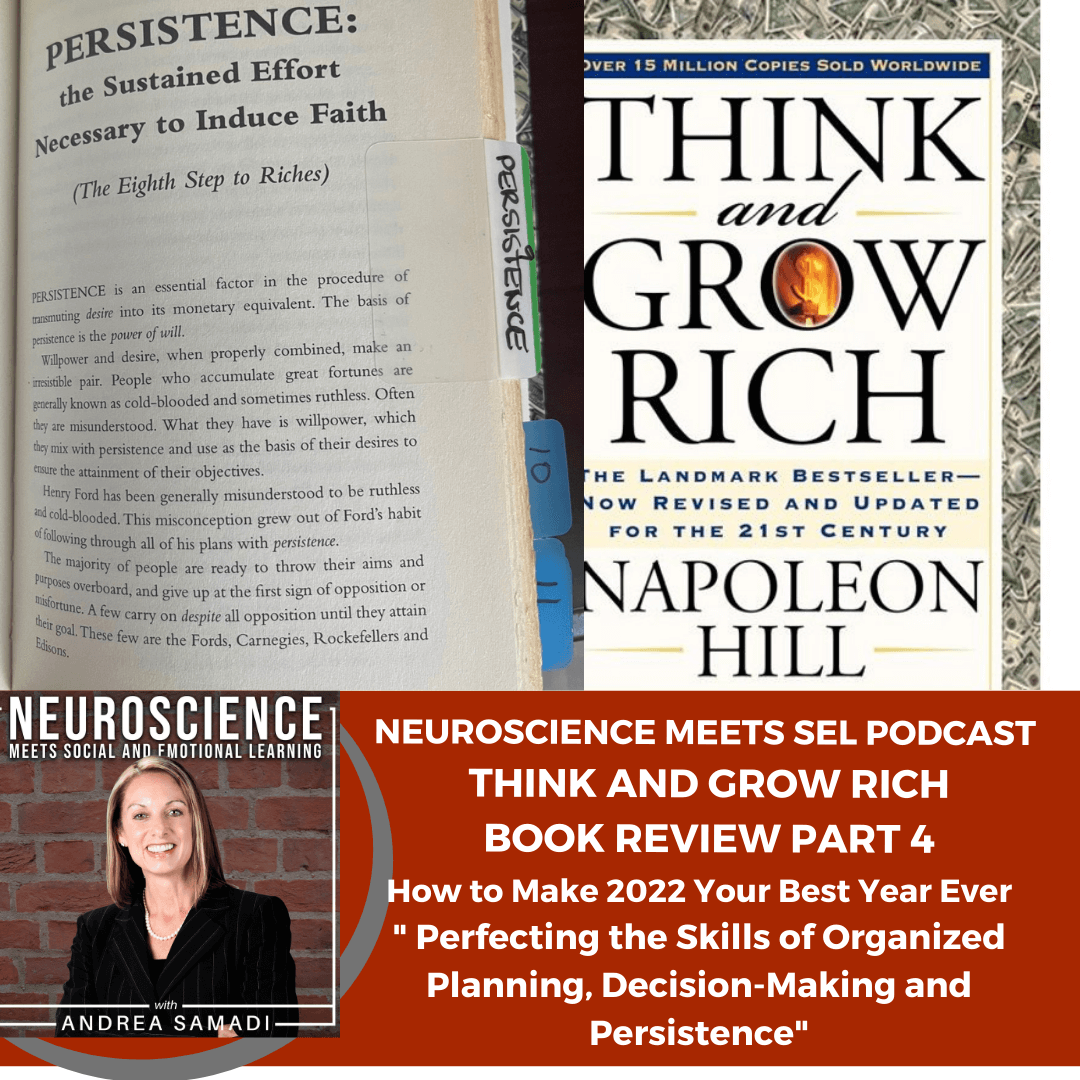
S7 Ep 194Think and Grow Rich Book Review PART 4 on ”Perfecting the Skills of Organized Planning, Decision-Making and Persistence”
Welcome back to PART 4 of Making 2022 You Best Year Ever with EPISODE #194 on “Perfecting the Skills of Organized Planning, Decision-Making and Persistence” as we continue our deep dive into Napoleon Hill’s Classic book, Think and Grow Rich, that has sold over 15 million copies worldwide. On this episode, you will learn: ✔︎ Review PART 1, 2, 3 to Reinforce the First 6 Chapters of Think and Grow Rich. ✔︎ Why the Skills of Organized Planning , Decision-Making and Persistence are important and Timeless Leadership Characteristics. ✔︎The Major Attributes of Leadership. ✔︎ The Major Causes of Failure in Leadership. ✔︎ Strategies to Improve Your Decision-Making and Persistence Muscles. For those new, or returning guests, welcome back. I'm Andrea Samadi, author, and educator from Toronto, Canada, now in Arizona, and like many of you who tune in, have been fascinated with learning, understanding, and applying the most current brain research to improve productivity in our schools, our sports, and workplace environments. This month, I decided to share my notes with you on a book that I have been studying every January since 2018, with Paul Martinelli, who has studied this book for most of his career. It was the book that my mentor Bob Proctor has studied for his entire life, over 57 years, and a book that some of the wisest people in the world have studied. If you have been following our episodes of Napoleon Hill’s Classic book, you will recall how PART 1 began with a reminder from Grant Cardone that “in order to get to the next level of whatever it is that we are doing, we must think and act in a wildly different way than we previously have been.”[i] We outlined all of the 15 principles that we will be diving into and in PART 2[ii] we looked at the importance of positive thinking, being crystal clear with what we want, and choosing faith over fear in pursuit of our goals. PART 3[iii] we examined the importance of putting these goals on autopilot with what Hill calls “autosuggestion” and then further honing our craft by studying, learning, and developing specialized knowledge that will separate you from others, making you truly unique with your talent that you’ll continue to perfect in your lifetime, while using your imagination to keep building and perfecting whatever it is that you want to create in your life. Now we move into Chapter 7 on Organized Planning, Chapter 8 on Decision, and Chapter 9, my all-time favorite, on Persistence. If you think about it, we have developed our vision in the first six chapters, have probably created a plan to move towards what we want, and are using our mind, our five senses, and even thinking beyond our five senses with our 6 faculties of the mind that we reviewed on episode #67.[iv] These next three chapters are integral for making sure our plans stay on track, that we take continual action steps towards our crystal-clear vision, with a never give up attitude. Which leads us to… Chapter 7 Organized Planning This chapter holds some timeless secrets for success that are so important, you can go to Amazon and find hundreds of books that focus on “organization” whether in your personal or professional life. You can browse through Netflix and find shows based on the importance of keeping your home “organized” with the show Tidying Up with Marie Kondo[v] where she explains the energy that frees up when your home goes from disorderly to orderly. Hill reminds us in the beginning of this chapter on the importance of organized planning when he states “if the plan you adopt does not work successfully, replace it with a new plan” (CH7, Page 117, TAGR) and that “temporary defeat should only mean one thing—the certain knowledge that there is something wrong with your plan.” (CH7, Page 117, TAGR). Remember Thomas Edison “failed” 10,000 times before he perfected the incandescent light bulb. “A QUITTER NEVER WINS AND A WINNER NEVER QUITS” Hill suggests writing this sentence out on a piece of paper “and
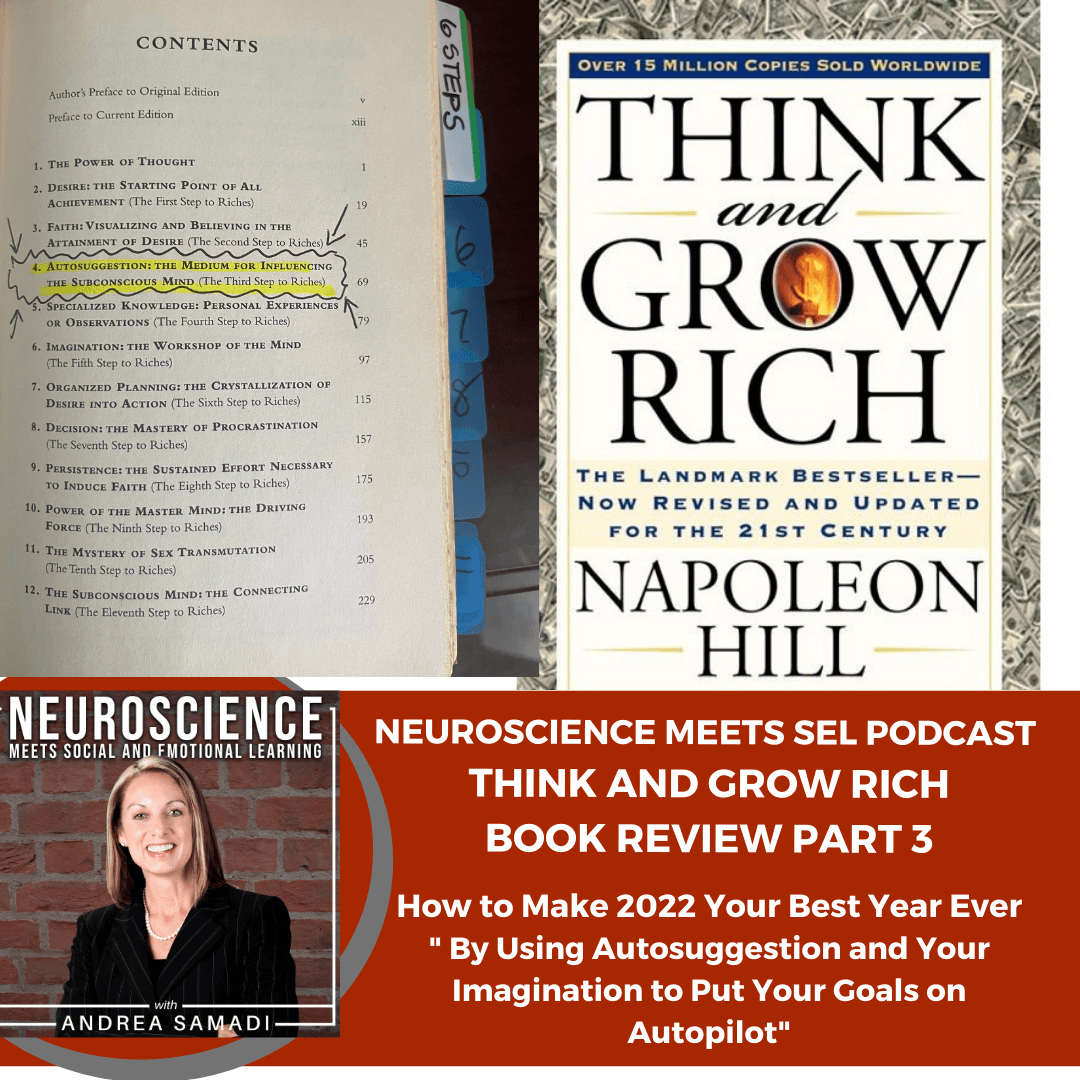
S7 Ep 193Think and Grow Rich Book Review PART 3 ”Putting Our Goals on Autopilot with Autosuggestion and the Imagination”
Welcome back to PART 3 of Making 2022 You Best Year Ever with EPISODE #193 on “Making Your Goals Automatic by Putting Autosuggestion into Practice with Your Imagination“ as we continue our deep dive into Napoleon Hill’s Classic book, Think and Grow Rich, that has sold over 15 million copies worldwide. On this episode, you will learn: ✔︎ Review PART 1 and 2 to Reinforce the First 3 Chapters of Think and Grow Rich. ✔︎ Chapter 4: How to Use Autosuggestion to Set Your Goals on Autopilot. ✔︎ Chapter 5: Why We Must Acquire and Know How to Use Specialized Knowledge to Reach High Levels of Success ✔︎ Chapter 6: Why Imagination is Everything. For those new, or returning guests, welcome back to Season 7 of our Podcast. I'm Andrea Samadi, author, and educator from Toronto, Canada, now in Arizona, and like many of you who tune in, have been fascinated with learning, understanding, and applying the most current brain research to improve productivity in our schools, our sports, and workplace environments. This month, I decided to share my notes with you on a book that I have been studying every January since 2018, with Paul Martinelli, who has studied this book for most of his career. It was the book that my mentor Bob Proctor has studied for his entire life, over 57 years, and a book that some of the wisest people in the world have studied. If you have been following our episodes of Napoleon Hill’s Classic book, you will recall how PART 1 began with a reminder from Grant Cardone that “in order to get to the next level of whatever it is that you are doing, you must think and act in a wildly different way than we previously have been.”[i] We outlined all of the 15 principles that we will be diving into and in PART 2 we looked at the importance of positive thinking, being crystal clear with what we want, and choosing faith over fear in pursuit of our goals. Before I began recording these episodes, I didn’t know how many it would take to cover these chapters thoroughly, but if you are like me, and just want to learn, keep listening and see if you can add anything new to your goal-setting/achieving process. We really could keep going all year, as each principle we could talk about for an entire month. Therefore, I think it’s important to revisit this book, every year, as we are working on new goals, to continue to improve our own process, and take our understanding of each principle, to a new level. Whatever it is you are working on—a new job or position at work, or smaller steps to a huge vision that you have, it’s normal to be skeptical of anything new, especially when the ideas are so abstract. At first glance the title of this book sounds crazy. Think and Grow Rich! Sounds a bit out there. The only reason I am covering this book on this podcast, is because it is such a classic, and has the ability to challenge anyone’s “thinking” and the principles have been used successfully from some of the wisest people in the world. I have met many people while working in the speaking industry who had successfully created beautiful lives with these principles, and they kept coming back to deepen their study, awareness and understanding. It’s a process. When I read about how Jim Carrey[ii] used these ideas when he first came into the film industry, visualizing his first $10M check, I wasn’t surprised at all. For this episode we will move into chapter 4 on Autosuggestion, Chapter 5 on Specialized Knowledge, and Chapter 6 on Imagination. What I’m noticing is how these chapters all work together, like my mentor Proctor says, “like the colors of the rainbow” as we think back to PART 1 of this book study and remember this whole process began with the realization that we must think about what we want (or desire as Hill would say) with a high degree of clarity, increasing our awareness of the world, adding an unwavering belief and expectation around the attainment of what we want, (by choosing faith over fear, overcoming all obstacles) and then
S7 Ep 192Nick Jonsson on ”Strategies to Overcome Isolation, Stress, Anxiety and Depression in the Workplace”
With the rise of mental health issues and with the COVID pandemic forcing less and less interactions amongst co-workers and leaders, senior leaders in many organizations are suffering numerous new ailments and challenges. With this workplace scenario continuing to be a problem, as times progress with more and more complications arising, many leaders are reaching breaking points in their personal lives. With no one to reach out to, many of these leaders may be suffering from what Nick Jonsson, the Co-founder and Managing Director of Executives Global Network in Singapore, calls “executive loneliness” that arises when top executives are exposed to extreme and prolonged stress, resulting in an increase in anxiety, isolation, and depression. Watch this interview on YouTube here. https://youtu.be/b6TCGyysI-A On this episode, you will learn ✔︎ What is "Executive Loneliness" and how has the Pandemic caused us to make our mental and physical health a priority? ✔︎ Nick's story and why he is passionate about talking about what others would rather shy away from. ✔︎ What is "smiling depression" and how to recognize when change is needed for yourself, and others. ✔︎ 5 Steps to Recovery outlined in Nick's book "Executive Loneliness" ✔︎ Where to begin to make changes with our physical and mental health. ✔︎ What increasing your activity looks like and how to measure it. We just uncovered on EPISODE #188 “Putting Your Mental and Physical Health First”[i] the shocking statistic that “one-quarter of Americans intend to improve their mental health in 2022”[ii] and that according to a poll conducted by the American Psychiatric Association, “almost 70 million adults resolve to find ways to improve their mental health this coming year”[iii] but Nick Jonsson, from Singapore, shows us that this is a global issue, and he wants to raise awareness of this phenomenon, no longer being quiet about the issues he has personally faced himself. For those new, or returning guests, welcome back! I'm Andrea Samadi, author, and educator from Toronto, Canada, now in Arizona, and like many of you listening, have been fascinated with learning and understanding the science behind high performance strategies that we can use to improve our productivity in our schools, our sports, and workplace environments. My vision is to bring the experts to you, share their books, resources, and ideas to help you to implement their proven strategies, whether you are a teacher working in the classroom or in the corporate environment. In his book, Executive Loneliness,[iv] Nick Jonsson outlines that most executives and leaders often do nothing to address this phenomenon of “loneliness” for fear of appearing unsuccessful and frowned upon. Worst, he shares that not addressing it exacerbates the negative and difficult feelings, to the point where it becomes more and more difficult for them to function. Ultimately, it takes a toll on their whole life.[v] As we were looking for leaders around the world to launch of year, with a focus on physical and mental health, Nick Jonsson was the one I wanted to launch our year with to be our first interview of 2022. If you follow Nick on social media, (and I’ll put all his links in the show notes) you will notice that he puts his physical health first (which we have shown on this podcast is one of the top health staples to make an impact on your overall physical and mental health) –you will see him riding his bike, hiking, and training at his local pool. Let’s meet Nick Jonsson and see what we can learn together with his experience and knowledge, to put our mental and physical health first this year. Welcome Nick! Nick, I like to open up the podcast with a question where we can get to know you a bit better, and just from looking over your social media posts over the holidays, it was more like a lesson in Geography, with health and wellness, and family tied in. INTRO: Can you share a bit about what you’ve been up to over the holidays, tha
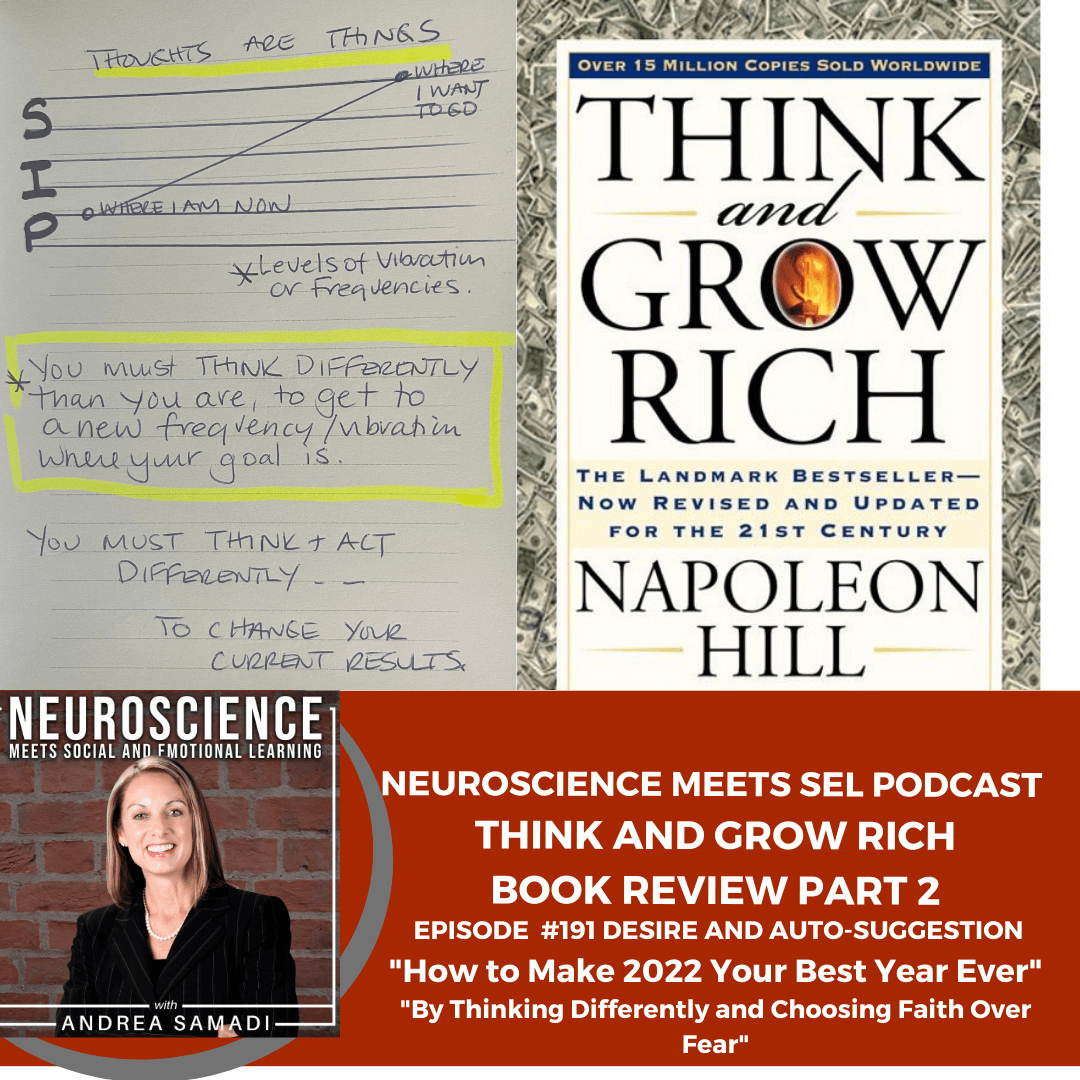
S7 Ep 191Think and Grow Rich Book Review PART 2 ”Thinking Differently and Choosing Faith over Fear.”
Welcome back to PART 2 of Making 2022 You Best Year Ever with EPISODE #191 on “The Importance of Thinking Differently and Choosing Faith over Fear” as we continue our deep dive into Napoleon Hill’s Classic book, Think and Grow Rich, that has sold over 15 million copies worldwide. Be sure to click here to access the images in the show notes. For those new, or returning guests, welcome back to Season 7 of our Podcast I'm Andrea Samadi, author, and educator from Toronto, Canada, now in Arizona, and like many of you who tune in, have been fascinated with learning, understanding, and applying the most current brain research to improve productivity in our schools, our sports, and workplace environments. This month, I decided to share my notes with you on a book that I have been studying every year, with Paul Martinelli, who has studied this book for most of his career. On our first episode[i] and PART 1 of this book study, where we cover the Author’s Introduction and Desire chapter, we opened with a quote from Undercover Billionaire Grant Cardone, who said, “In order to get to the next level of whatever you’re doing, you must think and act in a wildly different way than you previously have been” and this is where I wanted to begin this episode, with reviewing Chapter 1 “Thoughts Are Things” with the idea that we must “think” in a wildly different way than we previously have to obtain NEW results in 2022. On this episode, you will learn ✔︎ How to go from fear to hope, using faith, in pursuit of your goals. ✔︎ How to “think” wildly different than you did last year. ✔︎ Examples of people who “thought” their way to their goals, making their ability to “think” the best investment of their lifetime. ✔︎ The 6 STEPS you must take every day, that will put your goal on autosuggestion. ✔︎ Common mistakes made when goal-setting/achieving. ✔︎ 4 steps to overcome your fears, helping you to break through to new levels in 2022. ✔︎ How to becoming unwavering with our faith, helping us when obstacles appear. How Do We “Think in a Wildly Different Way” to Get New Results? The answer is--by expanding our awareness. I’m sure you see now why studying Think and Grow Rich by reading and thinking about every word we are reading is so very important. We could spend a whole year studying this book, which is why I think we should all keep reading it, gaining more awareness long after January and this book study ends. Look at it this way. Remember the last lesson where we looked at how ideas are formed, and how it’s up to us to act on our ideas and bring them to fruition. IMAGE: Levels of Frequencies of Thought Look at the image in the show notes of the levels of frequency and think of this as an example of where you are now, or the thoughts, feelings, and actions you are currently living with, giving you a certain result. Then imagine all the lines above where you are now, leading to where you want to go. Think of these frequencies like radio stations. To tune into the radio station you want, you need to turn the dial to that frequency. This is exactly the same idea to think about when we want to tune into the frequency that our goals exist on. And it won’t be with the level of thinking you have at your current level. That’s the whole point of Marshall Goldsmith’s book What Got You Here, Won’t Get You There: How Successful People Become Even More Successful.[ii] To ATTAIN your goal, or a new result, you will need to “think and act in a wildly different way that you previously have been” like Grant Cardone, reminded us. That’s because the goal is on a different frequency than where you are now. To hit this NEW target, you will need to think NEW thoughts, take NEW actions, that will create NEW results, and none of them will be what you are currently doing. When I first saw this image, I remember wondering “well how on the earth do I magically get on the same level of vibration as the thing that I really want?” and the first time I did this exercise
S7 Ep 190Think and Grow Rich Book Review PART 1 ”How to Make 2022 Your Best Year Ever”
“In order to get to the next level of whatever you’re doing, you must think and act in a wildly different way than you previously have been. You cannot get to the next phase of a project without a grander mind-set, more acceleration, and extra horsepower.” Grant Cardone, author of the 10X Rule: The Only Difference Between Success and Failure [i] Be sure to click here to access the images in the show notes. MAKING 2022 YOUR BEST YEAR EVER: WITH CHANGE I chose this quote to launch this episode, and our 7th Season of The Neuroscience Meets SEL Podcast with Grant Cardone,[ii] who I’ve been watching for years before he starred on Undercover Billionaire[iii] when I saw him working with (at that time) 16 year-old Caleb Maddix[iv], teaching this young man, who is now in his 20s, how to truly make an impact on the world and live his life with a success mindset. Since the day I watched him coaching this teen, I realized he has a heart for helping our next generation to become successful, while inspiring the rest of the world with his 10x Rule book, countless programs that focus on financial education, and encouraging anyone who will listen to shift their mindset to make 2022 their Best Year ever. To do that, Cardone reminds us that we must all THINK differently and “change what we did last year.” For those new, or returning guests, welcome back to Season 7 of our Podcast and Happy New Year! I'm Andrea Samadi, author, and educator from Toronto, Canada, now in Arizona, and like many of you who tune in, have been fascinated with learning, understanding, and applying the most current brain research to improve productivity in our schools, our sports, and workplace environments. I wanted our first episode to launch our 7th Season to be different from past years. Instead of releasing an episode with goal setting or achieving tips, I challenge you to do something different this year. We all know that in order to achieve different results in 2022, we must CHANGE and I’m pretty sure we all have a list of things that we want to do differently to really make a mark on this year, but to make sure I was on track, I thought I’d better check in with what Uncover Billionaire, Grant Cardone is suggesting we change this year, since his results are proof that he knows what he’s talking about. Cardone suggests in order to make this change, we must keep 6 things in mind that will drive us towards our goals. We must have: Discipline: By waking up early, watching the sunrise, and getting to bed early. This practice gives you 2 extra hours to launch your day, which translates into an extra month a year to work on your dreams or yourself. It will also help you to become highly motivated and will be a driver for your year, boosting our Confidence: To further drive what you are doing and help you to fill up your calendar with meaningful work where you will create your Action Plan with Activity: and be open to listening to Feedback: From the marketplace (or your network) on how you can improve. Surrounding Yourself with Your Network: Of other like-minded, successful people who will encourage you/holding you accountable. And there is only one outcome-- Success: This is Our Duty/Obligation. We Must WIN/SUCCEED in 2022. To truly make an impact on this year, so it’s our best year ever, I think we should all take a look at what Cardone suggests and do whatever it takes so that we achieve our end result (or whatever it is we are working on) at the end of this year. But how exactly do we do this? Make 2022 Your Best Year Ever by Studying the Best-Selling book Think and Grow Rich[v] I challenge you to practice Cardone’s TIP #1 with me, and develop discipline by waking up early, and study the #6th All-time Amazon Best-Seller, Think and Grow Rich with me this month. This is a book that has sold over 15 million copies worldwide, that has timeless principles used by some of the greatest minds of the 20th century, and I hope that together, we will uncover some new
S6 Ep 189Understanding Hormesis: Why Stress and Adversity Make Us Physically and Mentally Stronger”
I know we’ve all heard of the old saying “What doesn’t kill you makes you stronger” but have you ever wondered if science could open our eyes to what exactly this means? I’ve wondered this, and it led me to this week’s Brain Fact Friday where we will explore hormesis or the idea that “short, intermittent bursts of stressors can actually trigger a cascade of cellular processes that enhance overall health, slow aging, and make you more resilient to future stress (both physical and mental).”[i] On this episode you will learn: ✔︎ How our cells respond to short, intermittent periods of stress. ✔︎ A look into 2 pathways that are important for longevity (The Sirtuin and mTOR). ✔︎ 4 Ways to boost our health, using hormesis or stress, making us physically and mentally stronger. For those new, or returning guests, welcome back! I'm Andrea Samadi, author, and educator from Toronto, Canada, now in Arizona, and like many of you who tune in, have been fascinated with learning, understanding, and applying the most current brain research to improve productivity in our schools, our sports, and workplace environments. The purpose of this podcast is to take the mystery out of this new discipline that backs our learning with simple neuroscience to make it applicable for us all to use right away, for immediate results. I had no idea while initially researching for this episode that neuroscientist and tenured professor in the Department of Neurobiology at the Stanford University School of Medicine, Dr. Andrew Huberman, would be hosting Dr. David Sinclair[ii] (a Professor in the Department of Genetics from Harvard Medical School) on the Huberman Lab Podcast this week, and covering this very topic on “The Biology of Slowing and Reversing Aging”[iii] where the idea of hormesis was discussed throughout. I do recommend this episode for those who want to take a deeper dive into the science of anti-aging, longevity and the fascinating work that Dr. David Sinclair is doing in this field, in addition to Dr. Peter Attia’s Podcast, The Drive, on “Dr. Sinclair, Ph.D. Slowing Aging, sirtuins, NAD, and the epigenetics of aging.”[iv] If you are listening to this, and thinking “What? She’s lost me! What is she even talking about? Slowing down the ageing process? What is NAD and what are sirtuins?” Just remember to keep an open mind--this podcast focuses on looking for the research from the most reputable place (Pubmed.gov), learn what the experts in the field have to say about what they are discovering, and then we break down the research in smaller pieces, so that we can all make it applicable in our daily life, whether we’ve taken a neuroscience course, or not. What I’ve learned from studying closely with neuroscience researcher Mark Robert Waldman the past few years, is that we must be open to what the research says and keep our egos (and judgements) out of whatever it is we want to prove. I’m working hard on an abstract that supports the importance of educational neuroscience as a new discipline in our schools, versus the old model of learning, and although there is research that supports my hypothesis, it’s still a new field, and I must remember what Dr. Sinclair tells his students, that “most things we thought were true are not…or will change over time.”[v] I’m now on my third revision of this abstract, because it’s not easy to step away from what we want to believe, and leave it up in the air, because we might be wrong about everything, when it comes to looking at life through the lens of a scientist. Just keep an open mind, especially when you hear that Dr. Sinclair, now at the forefront of anti-aging research, after all the criticism he’s received over the years, is in the late stages of clinical trials of working on something that mimics exercise in a pill to speed up metabolism. The next few years are going to really blow our minds with what is possible, and I hope that we can all embrace new ideas, with open minds and make the needed chan
S6 Ep 188Brain Fact Friday on ”Putting Our Mental and Physical Health First”
As we are in the middle of our holiday season, wherever you might be listening around the world, rushing about, tying up loose ends with work, with a focus somewhere in our heads towards whether we are ready, or not, for the holiday, where we can spend that quality time with those we love, I want to release a quick episode to thank you, the listener, for your support with this podcast. This year, we were listed in the Top 15 Best SEL Podcasts for 2021,[i] and Top 20 Best Neuroscience Podcasts for 2021[ii] and I owe this honor to you. Without listeners, and high quality guests, there is no podcast, so thank you for tuning in, sharing the episodes that you enjoy, and sending me messages and feedback with new ideas to continue to feature the leading experts in neuroscience, education and the brain. For those new, or returning guests, welcome back! I'm Andrea Samadi, author, and educator from Toronto, Canada, now in Arizona, and like many of you who tune in, have been fascinated with learning, understanding and applying the most current brain research to improve results in our lives (whether we are a teacher in the classroom, or using these ideas in the corporate space). This podcast uses Seasons to separate our content, and as we move into Season 7 at the start of the New Year, our theme will remain “Brain Health and Well-Being” as my friend Dan Vigliatore[iii] Health and PE Teacher from Toronto, Canada reminded me this year, that there’s more to this podcast than providing meaningful content around neuroscience. Wellness education must be at the heart of everything we do, since our brain is involved in everything that we do, and everything that we are, and I do want to make that apparent for those listening, like Dan noticed. Especially with the fact that I began my teaching career as a PE teacher in the late 1990s. As we move into 2022, and plan for a new year of content, around the theme of Brain Health and Well-Being to optimize our cognitive, social and emotional competencies, I’m truly honored to have this opportunity to host this podcast, because the strategies that we are uncovering in each episode are not only for you, but they are transforming my results, as well! I do look forward to uncovering new ideas, strategies and research in this field in the New Year that we can all use to take our results to new heights. Especially since it’s such an interesting time in our world. Last night, we were speaking with our pediatric cardiologist who told us that at the beginning of the Pandemic, almost 2 years ago, it was very quiet in his offices, and now, with the new spike in COVID cases, he is busy with new patients coming in, with symptoms they weren’t experiencing in the early stages of the virus[iv], showing us how important our health remains for us. With everything going on in the world today, I’m sure that YOU will have health in the back of your head this whole time, knowing full well that 2022 is only a few days away, and before we know it, we will all be back in the swing of a New Year, with our old schedules, homework routines reestablished, and hopefully, healthy habits back on track, so for just a minute, I want take this moment to stop, pause and think about what’s important at this time of year. Instead of releasing an episode about setting goals, like we did to launch the New Year Last year, with EPISODE #103[v] on “The Neuroscience of Leadership: 3 Ways to Reset, Recharge and Refuel Your Brain for Your Best Year Ever” that I still think is a good episode to revisit, for this week’s BRAIN FACT FRIDAY and EPISODE #188, I want to cover “Putting Our Physical and Mental Health First: To Ensure a New Generation of Thriving Adults.” Our next generation needs us to model the way. The signs pointing in this direction have been clear the whole time of the Pandemic, but have you noticed there’s a sense of urgency around mental and physical well-being at this time? I saw it with one of my first XMAS cards th
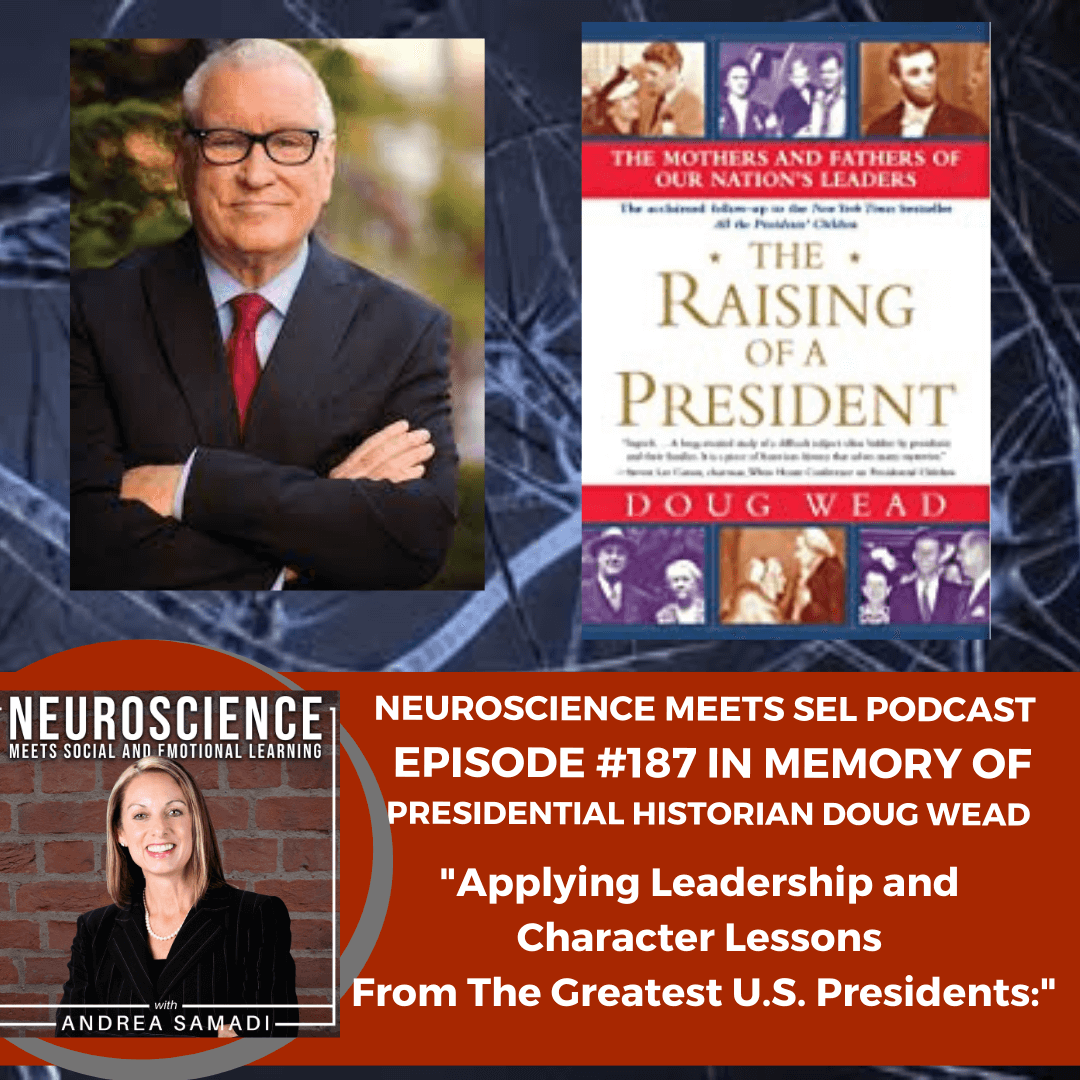
S6 Ep 187In Memory of Presidential Historian Doug Wead on ”Applying Leadership and Character Lessons From the Greatest U.S. Presidents”
“We are not limited by money, but rather by the poverty of our own dreams.” Doug Wead Watch this interview on YouTube here. https://youtu.be/VN2Ng6mMtHc On this episode you will learn: ✔︎ Why it's important that we ask others for help with our goals.✔︎ How Andrea met the advisor to 2 American Presidents, and how he helped her to create Character and Leadership programs for the K-12 School Market.✔︎ A Look back at an interview with Andrea and Doug in 2014 on the Greatest US Presidents.✔︎ A Formula for Leadership that Doug noticed with many US Presidents involving a Mamma's Boy and an Absent Father. Welcome back to the Neuroscience Meets Social and Emotional Learning Podcast for EPISODE #187 with a release of one of our earlier interviews that we released long before we launched this podcast from March, 2014 in memory of my mentor, Presidential Historian, and advisor to two American Presidents, Doug Wead[i], who passed away unexpectedly on Friday December 10th.[ii] You can listen to the back story of how I met Doug, and his impact on the work we’ve been doing in the field of education on this podcast, since the knowledge and ideas he shared with me back then, are relevant for us today. REMEMBER: This is one of my earlier interviews, and the sound quality is not the same as it is today with advancements in technology and experience. I do hope you enjoy this interview on “The Greatest or Best US Presidents” where I asked him the following questions: Who was the greatest of all US Presidents? Which Presidents showed great leadership? Can you explain this formula for leadership that you discovered studying our past Presidents? (A mama’s boy with an absent Father)? Will we ever see a female President? How is Barack Obama doing as a President? He was the US President at the time of this interview (March, 2014). How is President Obama doing as a Father? What was President Gerald Ford like as a person, since Doug knew him personally? Final Thoughts of how Doug’s career led him to the Whitehouse. Wow, what a man! Doug had an incredible career working in the Whitehouse, inspiring many around the world, and it all began with his vision to feed people who were starving to death in Cambodia. In 1970 he co-founded the Charity Awards and was a part of the founding of Mercy Corps which has distributed $2 billion of food and medicine around the world and my hope is that he has inspired you in some way to take action with your goals, whatever they might be. With that, we say goodbye, and I’ve got to say, this is one connection that I am grateful I wasn’t too afraid to reach out to ask for help. BIO: Doug Wead is a New York Times bestselling author and former adviser to two American Presidents. He served as special assistant to the president in the George H.W. Bush White House. Mr. Wead's books are known for their primary sources. He has interviewed six American presidents, seven first ladies, 19 presidential children and twelve presidential siblings. In 1970 he co-founded the Charity Awards and was a part of the founding of Mercy Corps which has distributed $2 billion of food and medicine around the world. FOLLOW ANDREA SAMADI: YouTube Channel: https://www.youtube.com/c/AndreaSamadi Website https://www.achieveit360.com/ LinkedIn: https://www.linkedin.com/in/samadi/ Facebook: https://www.facebook.com/Achieveit360com Neuroscience Meets SEL Facebook Group https://www.facebook.com/groups/2975814899101697 Twitter: https://twitter.com/andreasamadi Instagram: https://www.instagram.com/andreasamadi/ RESOURCES: Newsmax https://www.newsmax.com/politics/doug-wead-presidential-historian-obit/2021/12/13/id/1048472/ Mount Rushmore https://en.wikipedia.org/wiki/Mount_Rushmore REFERENCES: [i] www.dougwead.com [ii] https://www.charismanews.com/culture/87802-top-of-the-week-conservative-political-commentator-doug-wead-a-lifelong-pentecostal-dies-of-heart-failure-at-75
S6 Ep 186Brain Fact Friday on ”Using Neuroscience to Understand the Introverted and Extroverted Brain”
DID YOU KNOW “that the brains of introverts and extroverts are measurably different? MRI technology reveals that the dopamine reward network is more active in the brains of extroverts while introverts have more grey matter.”[i] I posted a graphic this week with this brain fact written on it on social media, and it drew more feedback and comments than usual, making me think that this needs to be this week’s Brain Fact Friday. Welcome back to the Neuroscience Meets Social and Emotional Learning Podcast for BRAIN FACT FRIDAY and EPISODE #186 on “Using Neuroscience to Understand the Introverted and Extroverted Brain” DID YOU KNOW "That MRI technology reveals that the dopamine reward network is more active in the brains of extroverts while introverts have more gray matter?" (Deane Alban).On this episode you will learn:✔︎ Where the terms introvert and extrovert originated from.✔︎ Characteristics of an introvert, extrovert and what's in between.✔︎ 3 ways the Introverts' and Extroverts' brains differ.✔︎ How you can use this information to improve your workplace productivity and social life. After I posted this graphic on social media that you can see in the show notes, John Harmon, Mind/Brain Researcher from EPISODE #170[ii] made a comment that really made me think, which is the purpose of this podcast. I want us to all think on a deeper level about understanding how our brain functions and impacts our results. He said “this makes sense to me since extroverts engage in more high energy personal interactions. Conversations trigger more emotional ups and downs, including rewarding thoughts and feelings. Especially feelings. With introverts, solitary activity tends to be much more even-keeled emotionally. Feelings of reward are weaker and less frequent. Therefore, the dopamine-laden neural networks that coincide with this feeling will be less active as well.” I had to stop and think after reading John’s thoughts, and it took me inside my own brain. I could those times that I’m stepping away from my usual introverted self where I’m studying, reading and researching in my quiet office, towards a more extroverted persona when I’m speaking in public, and interacting with larger groups, that this high energy interaction results in a spike of dopamine that I enjoy, but not for too long, as I crave the quiet and solitude of my office to bounce back, and recharge before another event. John’s comments made me want to dive a bit deeper into understanding our personality traits, especially over the holidays when we may be interacting with others more on a social level. If we can understand ourselves and others at the brain level, it might give us more clarity and awareness throughout this holiday season and into the New Year, helping us to see why we feel the way we do, and see beyond the labels of introversion and extroversion. When I typed introverts and extroverts into Pubmed.gov[iii] where I’ve been taught to look for the most current brain research, I found 170 articles ranging from different topics like Childhood experiences and adult health[iv] or Introversion/extroversion, time stress and caffeine: effects on verbal performance[v] I knew that this would be a good topic to take a closer look at if there were this many abstracts to read. If you want to dive deeper than I go with this Brain Fact, you can easily go to www.pubmed.gov and type in the words introvert and extrovert to see the studies that have been done on this topic. Also, if you want a quick reminder of how to tie in the most current neuroscience research to your next presentation, go back and listen to EPISODE #124 on “How to Be a Neuroscience Researcher in 4 Simple Steps”[vi] and you can easily add brain research to your work. So, back to this week’s Brain Fact Friday on Introverts and Extroverts. It was Carl Jung who created these terms in the first place, way back in 1920. He deduced that “extroverts gained their energy from their social interactions and exter
S6 Ep 185Brain Fact Friday on ”Using Neuroscience to Repattern Our Brain”
DID YOU KNOW that research from the Max Plank Institute for Human Cognitive and Brain Science in Germany, led by neuroscientist John Dylan-Haynes has shown that the decisions we make daily to act on something, begins “automatically and without involvement of our consciousness”[i] up to 7 seconds BEFORE we take the action we are thinking about? I learned this from Adele Spraggon,[ii] the author of Shift, in this week’s interview #184, while talking about her 4 STEP re-patterning process to break habits for an improved 2022 and it got me thinking about how we could use and understand this brain fact to take our results to new heights, especially as we are preparing for a New Year. If you are like me, and have ever done something and then wondered “why did I just do that?” then this episode is for you! Welcome back to the Neuroscience Meets Social and Emotional Learning Podcast for BRAIN FACT FRIDAY and EPISODE #185 on “Using Neuroscience to Repattern Our Brain.” For those new, or returning guests, welcome back! I'm Andrea Samadi, author, and educator from Toronto, Canada, now in Arizona, and like many of you listening, have been fascinated with learning and understanding the science behind high performance strategies that we can use to improve our productivity in our schools, our sports, and workplace environments. This week’s Brain Fact Friday took me back to the late 1990s, when I worked in the personal development industry[iii] and first learned about how our results were all determined by our thoughts, feelings and actions. I’ll put an image I want you to see in the show notes. I used to have this picture taped to my wall so I could see it every day from the speaker I worked with. I’m sure he used to carry it around when he would speak to people one on one, explaining that our thoughts come first. We think an idea (I really want this goal) and then we add emotion or feeling to this goal, that charges us up as we picture ourselves in possession of that goal, changing our body state, and getting us to take action of some sort, moving us in the direction of this goal. The action steps that we take (calling someone, getting mentored and getting ideas to take NEW actions) give us new information that we didn’t have before, and this in turn, changes our conditions, circumstances, and environment, taking us to places beyond where we have ever been before and we achieve our goals, the end result. This is how I was taught how to bridge the gap between goal setting and achieving, over 20 years ago, and how I’ve tackled every single goal since then. I’ve taught this concept to thousands of people (of all different ages) around the world over the years through the books and courses I’ve created. They are old, but the information is still relevant. If you want to take a look, you can access some of my first online courses on Udemy[iv]. On the back of my first book, The Secret for Teens Revealed,[v] I even wrote something that showed how important it was to distinguish the difference between a goal setter and achiever. I wrote: “When we look at people who have achieved great things, we often believe they are more talented than the rest of us, or luckier, or more well-connected. But the only thing that separates the successful from everybody else is that they have learned to bridge the gap between setting goals and achieving them. They have developed ways of behaving and—more importantly—ways of thinking that enable them to get what they want.” I knew when I wrote that in 2008 that there was a fine line between setting and achieving goals, and that we must have an unwavering mindset around the goal we are going after, but what I didn’t know, that I learned this week, was that our thinking precedes our actions by up to seven seconds and is pre-determined with a pattern or neural pathway that’s created in my brain, as unique as my own fingerprint long before I take any action. Understanding this pattern is behind why some
S6 Ep 184”Shift” Author, Adele Spraggon on ”Using Science to Break Up with Your Bad Habits for a Successful 2022!”
As we are finalizing Q4 of 2021, with the holidays on the horizon, I know that you are probably like like me, and on the lookout for any new strategy that we can learn that will take our game to a new level in 2022. I’ll cover our lessons learned this year in another episode, and have some fun ideas coming up as we approach episode #200, but as you know, we are always looking for brain-aligned strategies that we can all use to implement immediately, and I found something that I think we should all know about, with our next speaker. She was recognized in 2021 as the Top Behavior Expert of the Year[i] with her 4 STEP re-patterning approach that digs deep into our subconscious mind, so we can change those habits or behaviors that we’ve got running on auto-pilot, for new and improved results in 2022. If there are ANY new brain-aligned strategies that I come across in my research, I will find them, and share them with you here. Watch the interview on YouTube here https://youtu.be/U7N0JzxJHO0 Learn more about Adele Spraggon and her Shift book https://www.adelespraggon.com/ On this episode you will learn: ✔︎ ONE question you can ask yourself at the end of the year, to free up your energy for 2022. ✔︎ How habits are formed in the brain (good and bad ones). ✔︎ How Adele Spraggon found a NEW 4 STEP re-patterning approach that does NOT involve replacing an OLD habit with a NEW one. ✔︎ How to know if our habits and patterns are working for us, or not. ✔︎ How Adele's simple and easy to use 4-STEP re-patterning method can help you to jumpstart your 2022. ✔︎ The benefits of re-patterning old, outdated habits. Welcome back to the Neuroscience Meets Social and Emotional Learning Podcast for EPISODE #184 with an award-winning author, thought leader, international trainer and fearless speaker, Adele Spraggon[ii]. Her book, Shift, 4 Steps to Personal Empowerment[iii] has won three awards for its powerful message of inspiration and hope and is sweeping the globe, transforming how people are setting and achieving their goals. For those new, or returning guests, welcome back! I'm Andrea Samadi, author, and educator from Toronto, Canada, now in Arizona, and like many of you listening, have been fascinated with learning and understanding the science behind high performance strategies that we can use to improve our productivity in our schools, our sports, and workplace environments. My vision is to bring the experts to you, share their books, resources, and ideas to help you to implement their proven strategies, whether you are a teacher working in the classroom or online, a student, or in the corporate environment. I want to welcome Adele Spraggon, from my hometown of Toronto, Canada today, and get straight to some questions that I hope will give us a new look at goal setting/achieving with our brain in mind, and be the perfect episode for us as we leap into 2022. Welcome Adele, thank you very much for joining me today and sharing your book and proprietary 4 STEP repatterning approach with our listeners at this very important time of year. Adele, we have a common thread that I learned when I began reading your book and studying your work. We both began our work in the personal development field and before I get to my first question for you, I noticed as we connected on LinkedIn that we have a couple of speakers and authors in common from my hometown. Just curious to see if we were in similar circles when I lived in Toronto, did you attend Gerry’s Book Publishing seminar or any of Bob’s events? I know we both noticed there was something wrong with the way that we were initially taught HOW to set and achieve goals. (think/feel/act (that I learned in the late 1990s) vs FEEL/ACT/THINK) where we use what neuroscientists call interoception to FEEL before we act. This was missing from everything we were taught right from our first days in school, through college and into our careers. I noticed this distinction over the past couple of ye
S6 Ep 183Dr. Simone Alicia, The Self-Esteem Doctor on ”Self-Esteem: Why We Must Have it To Succeed.”
Have you ever held back something about yourself that you are either aware of consciously, or not, without realizing how impactful sharing this part of you could be for your career, or how many more people you could help when the shields come down, and you finally allow others to see yourself for who you are? Watch the interview on YouTube here. https://youtu.be/CmPlSZKc-NA On this episode you will learn: ✔︎ How Dr. Simone Alicia made the connection between the fashion runway, and helping young people tap into reservoirs of self-esteem. ✔︎ How she began teaching young people brain-aligned solutions with success, years before knowing this is what she was doing. ✔︎ How her life skyrocketed when she became authentic, and began using her background as a runway model to help others. ✔︎ How you can join and help her self-esteem mission at www.theselfesteemdoctor.com Our next guest, a former model turned educator, who has brushed shoulders with Jamie Foxx and Will Smith, did just that, for many years, until she questioned why she was holding back this critical piece of who she was, and it opened the doorway for her career, helping many young people in the process. Welcome back to the Neuroscience Meets Social and Emotional Learning Podcast for EPISODE #183 with Dr. Simone Alicia, otherwise known as the Self Esteem Doctor. For those new, or returning guests, welcome! I'm Andrea Samadi, author, and educator from Toronto, Canada, now in Arizona, and like many of you listening, have been fascinated with learning and understanding the science behind high performance strategies that we can use to improve our productivity in our schools, our sports, and workplace environments. My vision is to bring the experts to you, share their books, resources, and ideas to help you to implement their proven strategies, whether you are a teacher working in the classroom or online, a student, or in the corporate environment. Today’s guest, Dr. Simone Alicia, or the Self-Esteem doctor was introduced to me over Thanksgiving week. When I began researching her work, I was shocked at the many similarities in her life, to mine. Not that I was a runway model, like she was, as exciting as that looks, but we were both educators, who saw a serious need to help young people with their self-esteem. She built her business through the fashion runway, helping young people to find their potential this way, launching a magazine[i] (twice a year) just like we did with The Teen Performance Magazine[ii] where we interviewed celebrity teens to help improve the self-esteem of young people by showing them that even celebrities suffer with self-doubt, and how they overcame their insecurities. Dr. Simone Alicia says it best herself that "Self Esteem is a mindset. It’s a focused belief about yourself and your ability to succeed in life. This is your path to clarity, wholeness and lasting happiness. It is the key for you and for everyone. Life’s too short to wait, align with the greatness within you and do it now!” she says and I agree 100%. Life is short—so don’t hold back, with anything. Dr. Alicia went on to create incredible resources on her YouTube Channel,[iii] with online courses[iv], and has been a keynote speaker with many different organizations around the country.[v] She has her own podcast that people as young as age 6 and up, will find engaging and motivating. I was drawn to Dr. Simone Alicia because I’ve always been curious as to why we hold ourselves back. It began when I was younger and missed opportunities because I was afraid of taking risks, and it’s why I began working with young people and self-esteem in the late 1990s, with the hopes that even one of the young people we’ve helped, goes on to accomplish their wildest dreams and this is exactly what Dr. Alicia said inspires her. It’s like Marianne Williamson’s poem where she says “our deepest fear is not that we are inadequate. Our deepest fear is that we are powerful beyond measure. It is our light
S6 Ep 182Brain Fact Friday on ”Accelerating Literacy: Understanding How the Brain Learns to Read”
DID YOU KNOW that “How quickly and successfully the brain learns to read”[i] is greatly influenced by the student’s ability to speak. “It is important to understand what cognitive neuroscience has revealed about how the brain processes the spoken word” (Souza, page 11) when looking to unlock the secret for accelerating literacy with our students, or children. On this episode you will learn: ✔︎ How the brain learns to read. ✔︎ Why it's so important that our children/students learn to read by 3rd grade. ✔︎ Strategies that you can use today to accelerate reading with your emergent bilingual students, or struggling readers. Welcome back to the Neuroscience Meets Social and Emotional Learning Podcast for BRAIN FACT FRIDAY and EPISODE #182 on “Accelerating Literacy: Understanding How the Brain Learns to Read” For those new, or returning guests, welcome! I'm Andrea Samadi, author, and educator from Toronto, Canada, now in Arizona, and like many of you listening, have been fascinated with learning and understanding the science behind high performance strategies that we can use to improve our productivity in our schools, our sports, and workplace environments. For this week’s Brain Fact Friday, I’m deep in the middle of preparing for a presentation with Assistant Superintendent Greg Wolcott[ii], and his Learning Abilities Summit. If you are an educator, looking for new ideas and strategies for your students, please do visit his Summit page to learn more.[iii] For a reasonable cost, he offers training for educators that’s available virtually, from people around the country who share their expertise to accelerate learning for your students. I highly recommend following these Summits and offering them to your staff for professional development. As an educational consultant, I first began making the connection with how the brain impacts learning back in 2014 and began creating presentations around what I was learning years before I had launched this podcast. One project was with an educational publisher who asked me to create a whitepaper on how ELL (English Language Learners or our Emergent Bilingual) students learn to read. This was right in the middle of watching my youngest daughter struggle with learning to read in 1st grade (she’s now in 5th grade struggles much less) but as we begin, I have to say that I have not only taught these strategies to educators, and created training materials with them, but have personally used them with my own daughter as learning to read is not only a challenge for our ELL students, but many English speaking students as well. Before I offer some of the strategies, I discovered in my research to create this whitepaper to accelerate literacy, I think it's always important to dig deeper into "the why" behind looking for solutions to the most common challenges our students are facing when learning to read. We know that every child learns at their own pace, but there are important metrics to notice with reading and I did ask Dr. Daniel Ansari, Professor and Canada Research Chair in Developmental Cognitive Neuroscience and Learning about these benchmarks when it comes to numeracy and math on our interview #138[iv] this past summer. If you want to review the important metrics he suggests for math, please do revisit his interview by looking at the references in the show notes. But getting back to literacy—I want to share some statistics (and these are US statistics for our international listeners) but you will get the point no matter where you are listening to this podcast. I’m sure it wouldn’t shock you to know the problems that illiteracy is causing in America (and internationally) but if we dig just a bit deeper, did you know that: 2/3 of students who cannot read proficiently by the end of 4th grade will end up in jail or on welfare. Over 70% of America’s inmates cannot read above a 4th grade level. 1 in 4 children in America grow up without learning how to read at all. Students who don't read
S6 Ep 181Brain Fact Wednesday on ”The Neuroscience of an Effective Gratitude Practice”
Did you know that there is crucial component of mental, psychological, and social health that is often overlooked[i] and that “Gratitude is a mindset that activates your prefrontal cortex and sets the context for your experience such that you can derive tremendous health benefits?”[ii] Dr. Andrew Huberman On this episode you will learn:✔︎ Why your gratitude practice might be outdated, like mine, without brain-science in mind. ✔︎ The physical, psychological and social benefits of an effective gratitude practice. ✔︎ The most effective way to practice gratitude, with your brain in mind. ✔︎ 5 STEPS for an effective Gratitude Practice that will help you tap into the mental, psychological and social benefits. If you are like me and have a gratitude journal that sits on your desk, and you might have heard of the many health benefits that being grateful can have on you and your life, but you aren’t really sure if your gratitude practice is truly an effective one—then, this Brain Fact Friday is for you. Welcome back to the Neuroscience Meets Social and Emotional Learning Podcast for EPISODE #181 on “The Ingredients of an Effective Gratitude Practice.” I'm Andrea Samadi, author, and educator from Toronto, Canada, now in Arizona, and like many of you listening, have been fascinated with learning and understanding the science behind high performance strategies that we can use to improve our own productivity in our schools, our sports, and workplace environments. We can achieve outstanding and predictable outcomes with whatever it is we are working towards, when we act intentionally, with our brain in mind. For those of us in the United States, we are approaching Thanksgiving, where we traditionally think of what we are grateful for. I know our Canadian listeners have had this holiday last month, as I watched friends and family celebrate, but I always wonder why there is just one holiday that puts an emphasis on practicing gratitude, especially when there are so many studies that show the clear benefits that gratitude has on our life. You can see for yourself. Go to www.pubmed.gov and type in the word gratitude and fMRI and you will see many recent studies that show how “gratitude leads to benefits for both mental health and interpersonal relationships”[iii] and when you look at the researchers immersed in this work, you will see University Professor and Chair in Neuroscience, Antonio Damasio’s[iv] name come up often with his contributions to the understanding of brain processes that underlie emotions, feelings, decision-making and consciousness, in addition to his work with gratitude. I’m sure those of you listening to this podcast would know that gratitude is good for your brain, and if you dig deeper into it, you would have discovered that “scientifically speaking, regular grateful thinking can increase happiness by as much as 25%, while keeping a gratitude journal for as little as three weeks results in better sleep and more energy.”[v] But as I dug deeper into the research behind this episode, I started to see there was much more to creating the benefits of a gratitude practice when you dive into the Science of Gratitude like the impressive and respected podcaster, Dr. Andrew Huberman[vi] who covered this topic on his podcast this week. I highly suggest listening to his podcast, where I had many AHA Moments, for a thorough look at the why gratitude has such a profound impact on our health and well-being. Then I came across professor of psychology, at the University of CA, who has studied more than one thousand people, from ages eight to 80, and found that people who practice gratitude consistently report a host of benefit that go far beyond helping us to be happier and well rested. Robert Emmons, a leader in the positive psychology movement, editor in chief of the Journal of Positive Psychology and Professor of Psychology at the University of California, Davis, is the author of over 200 original publications in peer‑
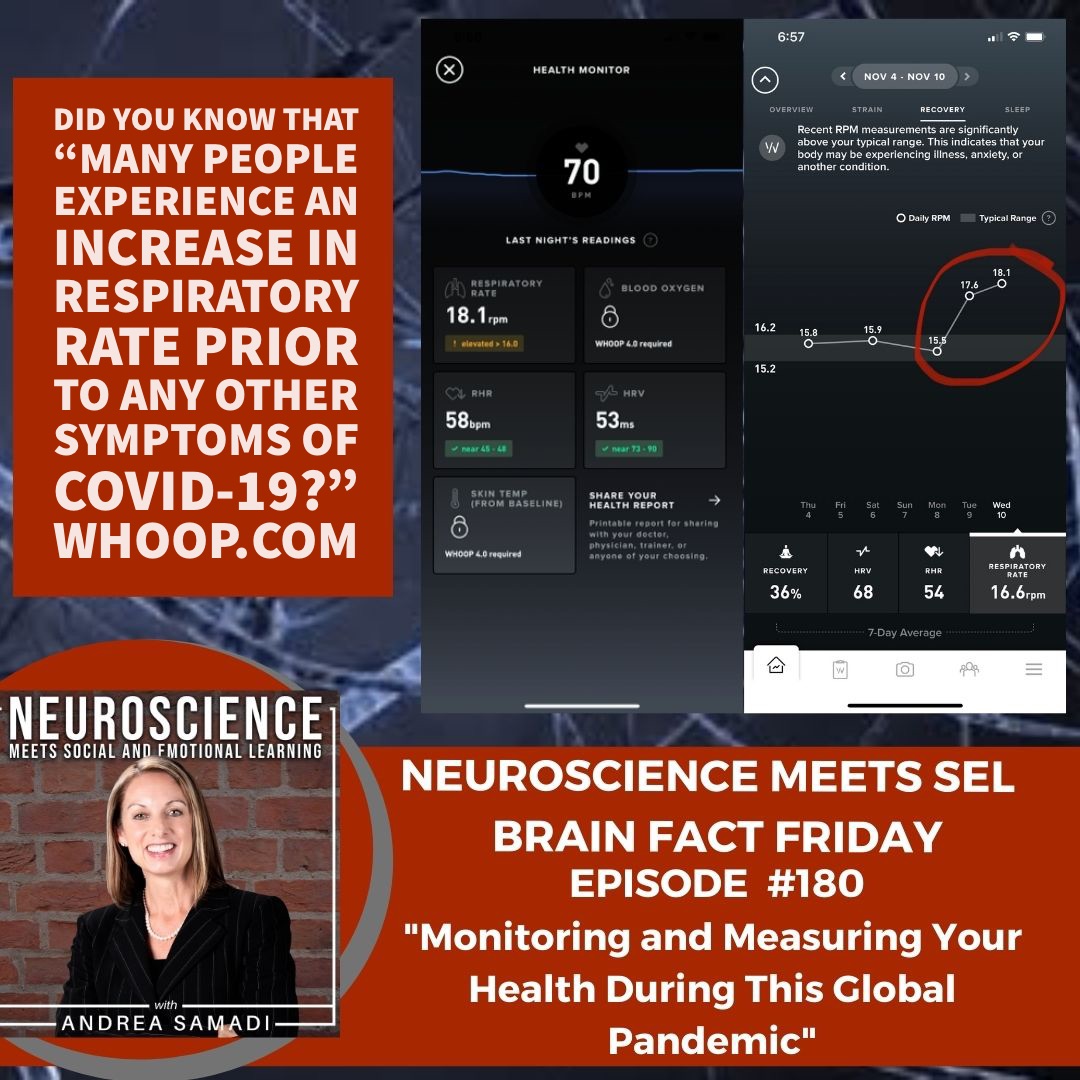
S6 Ep 180Brain Fact Friday on ”Monitoring and Measuring Your Health During This Global Pandemic”
Did you know that “many people experience an increase in respiratory rate prior to any other symptoms of COVID-19?”[i] Welcome back to the Neuroscience Meets Social and Emotional Learning Podcast for Brain Fact Friday and EPISODE #180 on “Monitoring Your Health During the Global Pandemic.” I'm Andrea Samadi, author, and educator from Toronto, Canada, now in Arizona, and like many of you listening, have been fascinated with learning and understanding the science behind high performance strategies that we can use to improve our own productivity in our schools, our sports, and workplace environments. We can achieve outstanding and predictable outcomes with whatever it is we are working towards, when we act intentionally, with our brain in mind. This week’s Brain Fact Friday hit me unexpectedly, when I woke up and saw something that caught my attention with the Whoop Fitness Tracker I’ve been wearing, since I interviewed Kristen Holmes on EPISODE #134 earlier this year.[ii] BRAIN FACT FRIDAY: Changes to Respiratory Rate Are An Early Warning of COVID-19 Did you know that “many people experience an increase in respiratory rate prior to any other symptoms of COVID-19?”[iii] I woke up to an exclamation mark next to my daily vitals that I watch, and never having seen something like this, I clicked on it to see that my respiratory rate had risen, higher than usual. Not thinking much about this, I clicked on the chart, and noticed it had jumped up significantly from 15.5 to 17.6 rpm and the note at the top of the screen said my “recent RPM measurements are significantly above your typical range. This indicates that your body may be experiencing illness, anxiety, or another condition.” I felt completely normal, but remembered reading something that WHOOP had covered with a Pro Golfer who noticed his respiratory rate jumped up prior to a positive COVID test, and I searched for that article. WHOOP measures respiratory rate [iv] during sleep using a phenomenon called Respiratory Sinus Arrhythmia. Emily Capodilupo from Whoop explains that “when you breathe in your heart rate increases, and when you breathe out it decreases. Typically people average between 12 and 20 respirations per minute (RPM)” and this data set usually doesn’t change much on a daily basis. But when it does, it’s something to pay attention to. Not feeling any symptoms at all at this point, and being double vaccinated, I didn’t think I had COVID, but seeing a jump in these numbers made me wonder. When I read the article WHOOP posted last June about pro golfer Nick Watney, who noticed his respiratory rate increased (similar to mine) before he was to play in the second round of the PGA Tour’s RBC Heritage tournament[v], and this rise in respiratory rate seemed like a “pretty consistent tell-tale sign” so like Nick, I was tested, and sure enough it was positive. This was long before any symptoms had hit, allowing me to take a proactive approach to recovery and isolation, and when the symptoms did hit (a temperature increase and the worst nausea I’ve felt since pregnancy) I was prepared for them. So, for this week’s Brain Fact Friday, did you know the science behind respiratory rate and COVID-19 and why this finding is so important? “COVID-19 is a lower respiratory tract infection. The infected cells are the alveoli, the point of contact in your lungs to your blood. As they get damaged, your ability to get oxygen into the blood and get carbon dioxide out becomes less efficient. In order to compensate, you have to take more breaths.” (Mark Van Deusen, WHOOP.com) which explained why my respiratory rate increased. I also noticed that it was more difficult to take deep breaths, and my lungs felt like they used to feel after swimming laps of a pool (something I haven’t done in years). While WHOOP is not a medical device, and this Week’s Brain Fact Friday is not medical advice, but to provide additional information to help you to understand the importance of staying o
S6 Ep 179Sun Sachs, CEO of Rewire Fitness on Their First-To-Market ”Neuro Performance Mobile App for Athletes”
“What if we could practice for those most difficult moments that we will face in competition, for those moments when your mind begins to unravel, and self-doubt starts to creep in? How could this type of practice change our lives? Not only for sport, but for anything that requires mental toughness?” Sun Sachs, Rewire Fitness Watch the interview on YouTube here. https://youtu.be/vJf_avKW5g4 Download the Rewire Fitness App FREE TRIAL here. www.rewirefitness.app/360 Stay tuned for today’s episode #179 with Sun Sachs, CEO and Co-Founder of Rewire Fitness[i] who will explore this very important question with a human performance platform that he created, combining his passion with endurance sports and software development, to create an app that many of us have been looking for, providing evidence-based solutions for tracking your readiness to perform, building mental resilience, and improving your mind/body recovery. For those new, or returning guests, welcome! I'm Andrea Samadi, author, and educator from Toronto, Canada, now in Arizona, and like many of you listening, have been fascinated with learning and understanding the science behind high performance strategies that we can use to improve our productivity in our schools, our sports, and workplace environments. I can’t even tell you how excited I am to share this new platform with you. At a time when mental resilience is crucial for the entire world, not just those who know the importance of mental toughness for sport, but for every one of us, myself included, this is a skill that requires daily practice. Every athlete knows the importance of mental resilience in sport and would tell you that at least 50-90% is mental when it comes to the focus and precision needed for their performance, but if you ask them “how much time do you spend training your mind?” most will not have a solid answer for you. I receive many emails from people around the world with different ideas and suggestions from the podcast, and I’m laser focused with the direction we are going and the speakers we are looking for, but every once in awhile, someone comes in front of me, and if I had read the email quickly, or not taken the time to understand exactly what their product is, it would have been a missed opportunity. This was the case when I was saw the email from Rizala Carrington from Rewire Fitness that came in just a few days before the end of October. The heading of her email said “First to Market Neuro Performance for Athletes” and in the body of the email I saw something about an app that “unlocks human performance” with major investments from Under Armour and elite athletes such as NBA All-Star Kyle Korver. On this episode you will learn: - Sun Sach’s journey as an athlete and why he founded Rewire (would love to know this!) - Why cognitive fatigue is a blind spot for most athletes (I wonder what solution he has?) - Why most readiness trackers are using an incomplete data set (YES! As a fitness tracker user, I’ve noticed this and I wonder what they see is missing/the solution). - Tips for accelerating mind/body recovery (YES! What do they suggest?) - Why the traditional way of building mental resilience is flawed (exactly! I don’t have all the answers but know there must be a better way than just pounding the pavement). This began my conversation with Rewire Fitness, and I can’t even tell you how excited I am about this app. I signed up right away, so that I could experience the product before creating their questions, and each day, kept emailing Rizala with how impressed I was. If you are an athlete, or a regular person like me, looking to take your performance to new heights, sit back, and listen to this interview and when it’s over, I highly recommend going to their site, Rewire Fitness,[ii] and starting your own journey with the FREE trial they offer. Let’s meet Sun Sachs, the CEO and co-founder of Rewire Fitness, and explore this app together. Welcome Sun Sachs, it’s incredibl
S6 Ep 178Dr. Brian Stenzler on ”DREAM Wellness: Taking Your Mental and Physical Health to New Heights.”
Welcome back to the Neuroscience Meets Social and Emotional Learning Podcast for EPISODE #178 with Dr. Brian Stenzler,[i] M.S., D.C. the CEO of Dream Wellness on his new book “DREAM Wellness: 5 Keys to Raising Kids for a Lifetime of Physical and Mental Health” where the DREAM in the title of his book stands for (Diet, Relaxation, Exercise, Adjustment and Mental Wellness). Watch the interview on YouTube here. https://youtu.be/gIEnOiH1fUM Take the DREAM SCORE Assessment here https://dreamwellness.com/dreamscore In this interview you will learn: ✔︎ How healthy you are, according to Dr. Stenzler’s DREAM SCORE Assessment. ✔︎ Recommendations to improve areas of weakness from the DREAM SCORE with tips from the DREAM Wellness book. ✔︎The 5 Keys for DREAM Health and why they are important for everyone. I'm Andrea Samadi, author, and educator from Toronto, Canada, now in Arizona, and like many of our listeners, have been fascinated with learning and understanding the science behind high performance strategies that we can use to improve our own productivity in our schools, our sports, and workplace environments. My vision is to bring the experts to you, share their books, resources, and ideas to help you to implement their proven strategies, whether you are a teacher working in the classroom, a parent, or in the corporate environment. The purpose of this podcast is to take the fear out of this new discipline that backs our learning with simple neuroscience to make it applicable for us all to use right away, for immediate results. I first met Dr. Stenzler in 2014 when I was at a conference in San Diego with brain training and business expert, John Assaraf, and I was cutting it close to making it to the airport on time on the last day of the event. Dr. Stenzler was standing next to me, and offered to give me a lift so I could stay a bit longer and not have to worry about the time. When you meet him, you will see that this is who he is. Offering to take me to the airport (when we had only just met that minute) is just a small testament to who he is. Although he had been helping thousands of people with his chiropractic work (at the time he was President of the California Chiropractic Association) when the coronavirus global pandemic hit our world in March 2020, he knew that his book was urgent, and important, and he made it a priority. In 1996, Dr. Stenzler and his business partner Dr. Gregg Baron first trademarked the term D.R.E.A.M. to make it easy for people to remember what a wellness lifestyle entailed and in 2021 he published his book, DREAM WELLNESS to bridge the gap from the current reactive system of “healthcare” toward a proactive model of wellness by providing the tools and venue for one’s journey. To give you some history on Dr. Stenzler, by the year 2003, he had two successful DREAM Wellness locations on Long Island, New York. His unique holistic approach towards helping people express their true perfection has enabled DREAM Wellness to expand to the west coast where there are currently three thriving locations in San Diego (Del Mar, Pacific Beach and Santee). By offering a wide range of holistic and wellness services under one roof and traveling around the globe to consult with businesses and organizations, Dr. Stenzler is truly living his DREAM. He is the picture of health that you can see for yourself in the picture of him in the show notes that was taken just last Wednesday when he was attending a conference at a hotel not far from my house. I ran out to say hello, we exchanged books, and in a short conversation, Dr. Stenzler was there to offer ideas and suggestions, saying “how can I help you” with what you are working on. I’m honored to call him one of my friends and love the work that he is doing to inspire physical and mental health in our next generation. Without further ado, let’s meet Dr. Brian Stenzler. Welcome Dr. Stenzler, so good to see you again. Brian speaks, and I ask “Hey, how was your confere
S6 Ep 177Horacio Sanchez, Jon Lieff MD, Howard Rankin Ph.D, and Tom Beakbane on ”The Most Significant Insight from Neuroscience That Could Transform Education”
Welcome back to the Neuroscience Meets Social and Emotional Learning Podcast for our very FIRST Panel Interview and EPISODE #177. Watch the interview on YouTube here. https://youtu.be/vIcdMG-a6Ag For those new, or returning guests, welcome! I'm Andrea Samadi, author, and educator from Toronto, Canada, now in Arizona, and like many of you listening, have been fascinated with learning and understanding the science behind high performance strategies that we can use to improve our own productivity in our schools, our sports, and workplace environments. This week, I’m thrilled to welcome back 4 guests to our very first panel interview, with Horacio Sanchez, from www.resiliencyinc.com, Dr. Jon Lieff, MD from www.jonlieffmd.com, Dr. Howard Rankin, PhD. from www.hownottothink.com, and Tom Beakbane, author of How to Understand Everything. Consilience: A New Way to See the World" This panel was actually Tom Beakbane’s idea, after his EPISODE #144[i] this summer, he mentioned that he had listened to Dr. Lieff’s episode on his book, The Secret Language of Cells, and thought it would be a good idea if we hosted a panel discussion in the near future. Not wanting to miss any opportunity to learn something new, I agreed, and wrote down the idea, thinking of late Fall for this panel discussion. When the time felt right, I emailed Horacio Sanchez, Jon Lieff, Howard Rankin and Tom Beakbane with the idea, and all agreed immediately, and it was set in stone. Today I want to welcome back all 4 speakers to our discussion, and will give their background, so you can see where they have come from, as you listen to their thoughts and ideas on this episode. The topic for today will be “What is the most significant insight from neuroscience that can transform the future of education” so as I read through each speaker’s bio, you can think of how their experience can contribute to this topic, with some ideas that we can all take away and think about the action steps that we can bring to our schools or workplaces. I really do believe that these ideas can transform our results, and it just takes you, the listener, to implement one idea at a time, for this change to occur. Here’s today’s panelists. 1. Horacio Sanchez https://www.resiliencyinc.com/ We have had Horacio on the podcast twice before, so this will be his third episode. What I love about Horacio is that he was mentioned as an expert in educational neuroscience in our first interview with Ron Hall, from Valley Day School, who said what he learned from Horacio changed the trajectory of his career in education. I just remember putting an image of him in Ron Hall’s video and thought for someone making such an impact in the field I’m most interested in; I should learn more about his work. And that’s where my friendship with Horacio began. You can listen to both his episodes to learn more: EPISODE #74 we covered “How to Use Brain Science to Improve Instruction and School Climate” with a focus on his book The Education Revolution, and on EPISODE #111 we focused on his most recent book “The Poverty Solution.” https://andreasamadi.podbean.com/e/resiliency-expert-and-author-horacio-sanchez-on-finding-solutions-to-the-poverty-problem/ https://andreasamadi.podbean.com/e/leading-brain-science-and-resiliency-expert-horatio-sanchez-on-how-to-apply-brain-science-to-improve-instruction-and-school-climate/ 2. Jon Lieff, MD https://jonlieffmd.com/ Our next panelist, Dr.Jon Lieff, I was introduced to last summer, with his new book, The Secret Language of Cells that we discussed on EPISODE #143. His topic was fascinating and inspired me to write EPISODE #147 on “Improving Mental Clarity by Understanding our Brian States, Brain Fog, and How It’s Created” and gave me a new understanding of how our cells communicate with each other, how T cells send messages to the neuron to stop making so many memory cells when we are stressed, creating brain fog and making me think of new ways to support brain health. I had l
S6 Ep 176Brain Fact Friday on ”The Neuroscience of Communication: Why Our Brain Doesn‘t Like the Word, NO!”
Welcome back to the Neuroscience Meets Social and Emotional Learning Podcast for Brain Fact Friday and EPISODE #176 on “The Neuroscience of Communication: Why Our Brain Doesn’t Like the Word No!” I'm Andrea Samadi, author, and educator from Toronto, Canada, now in Arizona, and like many of you listening, have been fascinated with learning and understanding the science behind high performance strategies that we can use to improve our own productivity in our schools, our sports, and workplace environments. We can achieve outstanding and predictable outcomes with whatever it is we are working towards, when we act intentionally, with our brain in mind. This week’s Brain Fact Friday hit me this weekend when I was handed a book and asked what I thought of it. It was Jack Carew’s You’ll Never Get No for an Answer[i] with a copyright date of 1987! I looked at the cover of the book, and it was clearly written in the 1980s. The author was on the cover, dressed in a suit and pointing at you, the reader with the intention of making a connection. My gut reaction was far from what the author intended. I thought, “oh no, I can’t see how there’s anything relevant in this book, for today’s workplace” feeling that sense of neural dissonance or conflict at the brain level, but if this book wasn’t exceptional, I don’t think large sales organizations would still be using it, around the world, over 3 decades after it was written. I usually read books through Kindle on my iPhone, so when I have a physical copy, I love to flip through and see what I notice from the pages. We all have our styles of what we are looking for, and I noticed the interior looked “old” and I thought old-school, when I saw that the print wasn’t crisp or modern looking. And there weren’t many testimonials, just a couple, but the one on the front cover stood out. It was by Og Mandino, American author of the best-selling book, The Greatest Salesman in the World.[ii] Og is the most widely read inspirational and self-help author in the world. He was the former president of Success Unlimited magazine, the first recipient of the Napoleon Hill Gold Medal for literary achievement, a member of the International Speakers Hall of Fame and honored with the Masters of Influence by the National Speakers Association. Og Mandino sadly passed away in 1996 but his books continue to inspire thousands of people all over the world. So if a pro like Og Mandino said this book was “one of the most powerful and helpful books on salesmanship” that he had ever read, my brain went directly to Confirmation Bias, and I thought I had better not judge a book by its cover, and read it right away! I was shocked to see how Jack’s 10 strategies, written over 34 years ago, were timeless and relevant for anyone who wants to get their point across to someone else, not just those who are in sales. We all need to be able to persuade others whether it’s coming to a consensus in your personal life, or in the workplace, there is a power behind being able to naturally influence someone, without the use of force, which we all know negates. As I was reading his book, I wondered how his strategies could be connected to simple neuroscience, just like The Neuroscience of Personal Change, EPISODE #68[iii] where we took Stephen Covey’s 7 Habits book and connected each habit to brain science. I thought about the 10 unique strategies that Jack used to show us how to position ourselves to never receive that dreaded “no, I’m not interested” in whatever it is you are selling, or whatever idea you are trying to convey, and this thought inspired this week’s brain fact Friday on “The Neuroscience of Communication: Why Our Brain Doesn’t Like the Word No!” and with this I mean not just with the word no, but looking at how the words you choose, and how exactly you say them can influence someone, or not. I know Chris Gargano mentioned this in episode #166 when he was taking about leadership in the workplace. In a world where
S6 Ep 175Brain Fact Friday on ”The Neuroscience of High Performance: Improving Focus and Clarity”
Welcome back to the Neuroscience Meets Social and Emotional Learning Podcast for Brain Fact Friday and EPISODE #175 that was inspired by our recent interview with Dr. Francis Lee Stevens whose book that was just released this week on Amazon, Affective Neuroscience in Psychotherapy[i] that reminded us that we can accelerate our results, experience less stress and psychopathology (like depression and anxiety) when we can understand the emotional science (affect is the scientific word for emotion) that can be mapped and understood within the depths of the human brain. To access the images in the show notes, click here. There were many AHA Moments during our interview with psychologist Dr. Stevens this week, but with mental health at the forefront of this podcast, and the fact that we are now into the last quarter of 2021, I wanted to provide something that we could all use to give us clarity and focus to finish this year on a strong, high note. When I thought about what Dr. Stevens taught us, and why an application of affective neuroscience could help patients with psychological disorders, I thought about that for a while and wondered how this week’s Brain Fact Friday could bring us to a heightened sense of clarity, focus and direction that would give us a razor’s edge advantage in our life, with whatever it is we are working on or moving towards, and set us up with the right footing for a solid Q1 in 2022. In Today’s Brain Fact Friday, You Will Learn: ✔︎ Why a calm brain is important to achieve ANY level of success. ✔︎ Strategies to calm our brain/regulate ourselves before we can access the thinking/decision-making parts of our brain. ✔Why a calm, regulated brain, precedes mental clarity, needed for high performance. ✔︎ How to calm or regulate ourselves before we can access knowledge, well-being and high-performance. From Focus to Calmness Dr. Stevens taught us some great strategies that can help us to understand our emotions, and even reconsolidate past traumatic memories, but there was something I knew I was missing that comes before we can access those higher, thinking parts of the brain that we need when thinking or making decisions. Today’s topic is not just about how we can use the understanding of our brain to focus, so we can accomplish more, Friederike Fabritius dove deep into the neuroscience behind the focused brain on episode #27.[ii] She reminded us of the recipe needed for achieving peak performance as a mix of fun, and fear along with focus”[iii] but that’s not where I wanted to go with this episode. Then I saw it and it was as clear as ice as I thought about some of our past speakers. I mentioned to Dr. Stevens that in order to apply any of the lessons he uses with his patients for accelerated results, and improved well-being, we had to get to a place of calmness, where we could step back from the busyness of our world and allow our thinking brain (or our Central Executive Network) to come back online. We have to be able to switch from our Thinking (Central Executive) Network to our Imagination (Default Mode Network) for this calmness to occur. I did talk about the importance of switching between our brain networks to allow for these flashes of creativity and insight to flow in episode #48 which is a good episode to review.[iv] For this week’s brain fact Friday, I want to add a sense of calmness behind our clarity to push us forward. I remember my mentor Bob Proctor always saying to accelerate your results you need to “Speed Up and Calm Down” and he would give us examples of how he stayed focused by saying no to what’s unimportant and direct 100% of his energy and focus to what is. If you want to accelerate your results, it begins with a calm brain, that’s focused and ready for speed. From Calmness to Clarity Then we can take this calmness and laser focus to clarity. Clarity is one of the six habits that Brendon Burchard found that research shows pointed the needle towards high-performance vs
S6 Ep 174Psychologist Dr. Francis Lee Stevens on ”Affective Neuroscience in Psychotherapy: Science-Based Interventions for Our Emotions”
Welcome back to the Neuroscience Meets Social and Emotional Learning Podcast EPISODE #174 with Dr. Francis Lee Stevens who works as a psychologist in Worcester, MA. He has taught a variety of classes in psychology and neuroscience and his research focuses on affective neuroscience applications to psychotherapy. Today we will dive deep into his new book, coming out on November 27th, Affective Neuroscience in Psychotherapy: A Clinician’s Guide for Working with Emotions and will explore how Dr. Stevens has taken the latest developments in affective neuroscience and applies these science-based interventions with a sequential approach for helping patients with psychological disorders. Learn more about Dr. Stevens https://www.drfrancisstevens.com/ Watch this interview on YouTube here https://youtu.be/2H-g1xg6FRY In this episode you will learn: ✔︎ What Dr. Stevens saw was missing from previous forms of psychotherapy. ✔︎ Why changing our thinking doesn't change how we feel, and what he suggests instead. ✔︎ What Affect Reconsolidation is--that changes difficult emotions and feelings. ✔︎ How an understanding of the science of the brain works together with the practice needed for a new model of intervention. ✔︎ What we should all know about our emotions, how to dig deeper into our past to unlock memories, and deal with the feelings that keep us stuck. I'm Andrea Samadi, author, and educator from Toronto, Canada, now in Arizona, and like many of our listeners, have been fascinated with learning and understanding the science behind high performance strategies that we can use to improve our own productivity in our schools, our sports, and workplace environments. My vision is to bring the experts to you, share their books, resources, and ideas to help you to implement their proven strategies, whether you are a teacher working in the classroom, a parent, or in the corporate environment. The purpose of this podcast is to take the fear out of this new discipline that backs our learning with simple neuroscience to make it applicable for us all to use right away, for immediate results. What I think is fascinating as we are exploring this topic together, is that education is not the only field that can benefit from the understanding of simple neuroscience and “there are equivalent fields that seek to translate neuroscience findings to law (e.g. Royal Society, 2011a)[i] economics (e.g. Glimcher & Fehr, 2013)[ii] and social policy (e.g. Royal 2011b)[iii] bringing in research in behavior regulation, decision-making, reward, empathy and moral reasoning.” (Thomas, Ansari, Knowland, 2019). When I received an email from Dr. Stevens about his new book that he wrote to help patients with psychological disorders with science-based interventions, I was very interested in learning more. If American psychologist Dr. Daniel Amen, whose book The End of Mental Illness we reviewed on episode #128[iv] believes that “normal” is a myth and that 51%[v] of us will have a mental health issue in our lifetime (like post-traumatic stress, depression, anxiety, addiction, or an eating disorder—to name a few) then it’s clear that it’s more normal than not, to have a mental health problem and we must all pay attention to the first sign of any mental health issue, for ourselves, but especially our younger generations, since it’s critical for children’s success in school and life. Research shows that “students who receive social-emotional and mental health support achieve better academically”[vi] and “mental health is not simply the absence of mental illness but also encompasses wellness promotion; social, emotional, and behavioral health; and the ability to cope with life’s challenges. Left unmet, mental health problems are linked to costly negative outcomes such as academic and behavior problems, dropping out, and delinquency. Mental and behavioral health problems not only affect students’ short-term classroom engagement, but also interfere with long-term develo
S6 Ep 173Brain Fact Friday on ”The Neuroscience of Belief”
Welcome back to the Neuroscience Meets Social and Emotional Learning Podcast for Brain Fact Friday and EPISODE #173 on “The Neuroscience of our Beliefs” where we will take a deeper dive into what are beliefs are, how they impact our day-to-day life, habits, successes, and failures, and how we must pay attention to them “because they can make the difference between life and death, health and illness” (Larry Dossey, MD)[i] and increased clarity in our life. In Today’s Brain Fact Friday, You Will Learn: ✔︎ What are beliefs from the perspective of neuroscience? ✔︎ What's the problem with what we believe? ✔︎ Understanding our Cognitive Biases. ✔︎ Becoming a Better Believer in 3 Steps. For those who are new here, I'm Andrea Samadi, author, and educator from Toronto, Canada, now in Arizona, and like many of you listening, have been fascinated with learning and understanding the science behind high performance strategies that we can use to improve our own productivity in our schools, our sports, and workplace environments. The purpose of this podcast is to take the fear out of this new discipline that backs our learning with simple neuroscience to make it applicable for us all to use right away, for immediate results. This week’s Brain Fact Friday comes to you as I am in the final stages of writing a research paper, or an abstract to complete a year-long neuroscience certification course I have been taking with Mark Robert Waldman, who began teaching me how to understand the impacts of neuroscience on the brain and learning, back in 2014. I know that I was one of his very first students who began working with him years before he launched his training program that is rigorous, and not everyone who joins, completes it. Learning anything new requires consistent focus and effort, and my hopes are to continue to translate the most current and accurate neuroscience research, to be useful in your daily life through this podcast. Once this abstract is graded, I will share it with you for a more in depth look at the future of educational neuroscience, with a look back at where it began, some of the criticism it’s faced, while sharing the impact I see it having on our future generations of teachers and learners. Stay tuned for this, and for more interviews coming next week, but until then, for this week’s Brain Fact Friday, we will examine how beliefs show up in our brain and what we should all know about what we believe and how to sharpen and even challenge our beliefs, for improved results. If I asked you right now to define what a belief is, I am sure we would all come up with a different definition. But did you know that from the perspective of neuroscience that all beliefs (factual beliefs, self-beliefs, social beliefs, monetary beliefs, health beliefs) just to name a few- are “incomplete predictions, formed in the Default Mode Network (Imagination Network—the yellow and orange areas in the brain in the image below). These predictions (whatever it is that we believe) combine subjective feelings (that are mostly imaginary and a product of the DMN-our Imagination Center) with factual observations, forming an emotional cognitive bias which is embedded into our long-term memory. IMAGE SOURCE: Mark Waldman “Beliefs and the Brain” showing what our beliefs look like in our brain in the Default Mode (Imagination) Network. Remember that “all beliefs have limitations, and every one of them contains assumptions and inaccuracies concerning the true nature of the world.” (Born to Believe, Mark Waldman and Dr. Andrew Newberg)[ii] SUMMARY: “Our beliefs are incomplete predictions about the future, formed as a part of our imagination network, combining current feelings with factual observations, with bits and pieces of old memories, forming a cognitive bias (whether you are right or wrong—this is how your brain sees the world). Your brain doesn’t care if it’s true or false, right, or wrong. It will create what you need to help you to go
S6 Ep 172Dr. Michael Gaskell on ”Leading Schools Through Trauma: A Data-Driven Approach to Helping Children Heal”
Welcome back to the Neuroscience Meets Social and Emotional Learning Podcast EPISODE #172 with a veteran principal from New Jersey, USA, who has actively been writing about highly relevant solutions to problems in educational leadership since 2018, Michael Gaskell. Michael’s second book, Leading Schools Through Trauma[i], was just published this September, and his first book, Microstrategy Magic[ii], last fall. Watch this interview on YouTube here https://youtu.be/V7sJTeFi-1c Learn more about Dr. Gaskell here https://www.facebook.com/Mikesmicrominute/ See past Neuroscience Meets SEL Podcast Episodes here https://www.achieveit360.com/episodes/ On Today's Episode You Will Learn: ✔︎ Why we must NEVER give up on a struggling student. ✔︎ What we should ALL know about being trauma-informed in today's schools. ✔︎ What Dr. Gaskell's 3-STEP Process says about the importance of educator well-being. ✔︎ How to recognize trauma, and next steps for working with our students in the classroom. ✔︎ The Pygmalion Effect and why our belief in our students matters. ✔︎ What Dr. Gaskell would say to a new, first year teacher, who is struggling in the classroom. ✔︎ Putting Together a Trauma-Informed Plan in your school. ✔︎ The importance of surveys for Teacher Training and Implementation. ✔︎ Actionable Ideas That You Can Implement Immediately. I'm Andrea Samadi, author, and educator from Toronto, Canada, now in Arizona, and like many of our listeners, have been fascinated with learning and understanding the science behind high performance strategies that we can use to improve our own productivity in our schools, our sports, and workplace environments. My vision is to bring the experts to you, share their books, resources, and ideas to help you to implement their proven strategies, whether you are a teacher working in the classroom or online, a student, or in the corporate environment. When I first began presenting on the topic of stress, learning and the brain in 2016, in those early days of learning about how the brain works and responds to stress, I started to receive messages from teachers around the country (and the world) with questions about how to handle students suffering from the damaging effects of trauma. Educators would attend the webinar presentations I was offering, and their emails requesting help at the end of these presentations were urgent. Since starting this work, I have always replied personally to every single email that comes in, but the ones about trauma I know I didn’t have the best answers for, and I remember not knowing exactly how to answer these questions. I only knew from my viewpoint or experience working with behavioral students in my first-year teaching what worked for me back then, but I definitely lacked the strategies that are needed more than ever in our schools today, and understand now why being trauma-informed is so important. I’m grateful that this podcast has not only given us a platform to what’s new and relevant, timely and important as it relates to educational neuroscience and leadership, but where else would we all gain access to the leaders around the world, working directly with the most innovative ideas in educational reform, productivity, and results. I want to thank you again, for all who tune in, and offer interview ideas and suggestions. The reach goes beyond those early days when we would host those webinars, now into over 154 countries, and we remain in the TOP 100 charts for iTunes in the category of education/how-to) in many of these countries around the world. This is only the beginning of our vision for this work so we can answer the questions that I know we all have, with the leading experts in this field. Which brings us to our next guest, Michael Gaskell, who has a unique story, because he’s not only writing from his experience working in schools, and offering trauma-informed solutions from what he has seen working in his day to day world, but Michael takes it a step dee
S6 Ep 171Robin Hills on ”Practicing Emotional Intelligence and Resilience for Business: During Times of Change”
Welcome back to the Neuroscience Meets Social and Emotional Learning Podcast EPISODE #170 with Robin Hills,[i] the director of Ei4Change, a company specializing in educational training, coaching and personal development, focused around emotional intelligence, positive psychology and neuroscience. Watch this interview on YouTube here https://www.youtube.com/watch?v=2xBhcVYj7No Learn more about Robin Hills here https://ei4change.com/ See past Neuroscience Meets SEL Podcast Episodes here https://www.achieveit360.com/episodes/ On Today's Episode You Will Learn: ✔︎ What is Emotional Intelligence and Why is it Critical for Future Workplace Success? ✔︎ How can we Learn, Measure, Practice and Assess Emotional Intelligence in the Workplace? ✔︎ What is Resilience and how can we strengthen this skill in ourselves and others? ✔︎ During Difficult Times, What Should We Keep in Mind That Guarantees Happiness and Future Success? I'm Andrea Samadi, author, and educator from Toronto, Canada, now in Arizona, and like many of our listeners, have been fascinated with learning and understanding the science behind high performance strategies that we can use to improve our own productivity in our schools, our sports, and workplace environments. My vision is to bring the experts to you, share their books, resources, and ideas to help you to implement their proven strategies, whether you are a teacher working in the classroom or online, a student, or in the corporate environment This week’s guest, Robin Hills, who I found out is well connected with some of our past guests, Dan Hill from EPISODE #163[ii], who taught us how to “Read the Emotions in Others” and the author of The Leading Brain, Friederike Fabritius from EPISODE #27[iii] joining us all the way England this week. Robin has taught over 250,000 people in 185 countries how to build resilience, increase their self-awareness and understanding of others. After my interview with Dr. Perry this week, I have been thinking about the upside-down triangle, or Dr. Perry’s “Sequence of Engagement” where he mentioned that ALL information comes in through the brainstem, and we have been programmed to REACT to what we take in from our 5 senses, instead of take a few minutes to PAUSE, and RESPOND. I’m hoping that our conversation with Robin will give us some practical ideas that we can all take away, to make ourselves better teachers, leaders, and parents, looking at emotional intelligence through his lens, and make us better supervisor/leaders in our workplaces, parents, teachers, and coaches. If you want to learn more about Robin’s programs, you can see books, courses, and audio programs through his website[iv] that cover the most comprehensive and detailed education of any emotional intelligence organization and are today used in educational establishments in different parts of the world. Let’s meet Robin Hills and see if we can Sharpen Our Saw with our EI skills. Welcome Robin! Q1: Robin, thank you for joining me today, all the way from the UK, where I was born (Worthing, Sussex). Welcome! Intro Story: Robin, I was watching another podcast you did[v] recently to learn more about you as I was thinking up some questions on your work and saw some of the English Countryside behind you. I haven’t been back to England since 8th grade when I went on this school exchange program. Seeing the trees behind you, and thinking of my questions, I remember this experience I had that is relevant to what we are going to talk about today. Can I share this story with you, with the idea that you give me some EI insight into what you see? So, I was back in 8th grade and there was a school exchange program where I would go to England for 3 weeks, and someone would come stay with me for 3 weeks. Since I came into the program late, I was partnered up with a boy for this exchange, and we were very different personality wise. I arrived from the big city of Toronto to this small town in Bristol, called Hallatrow,
S6 Ep 170Cognitive Neuroscience Researcher John Harmon on ”Our Brain and Mind Under Pressure”
Welcome back to the Neuroscience Meets Social and Emotional Learning Podcast for EPISODE #170 with John Harmon, an independent researcher who's developed a new way to define the mind and map it to the brain, called the MA (Memory Activation) Method. This cognitive neuroscience tool enhances CNS (Central Nervous System) medicine, natural language processing, cognitive computing and most of applied neuroscience. John’s goal aligns directly with ours on the podcast—to enhance humanity’s understanding, appreciation and use of the human mind, and its manifestation in the brain. Watch this interview on YouTube here https://www.youtube.com/watch?v=FCjPIikAISU Learn more about John Harmon here https://www.neuralnetworkbiomarkers.com/ See past Neuroscience Meets SEL Podcast Episodes here https://www.achieveit360.com/episodes/ On Today's Episode You Will Learn: ✔︎ How to get comfortable with not knowing everything when it comes to neuroscience, the brain, and learning. ✔︎ John's Core Research translated so we can all understand how our brain maps to learning something new. ✔︎ The importance of belief with our goals, and with anything we want to accomplish, like health, or eliminating pain. ✔︎ What we need to know about how our brain works under pressure (throwing a football in a game) or taking a test. For those who are new here, I'm Andrea Samadi, author, and educator from Toronto, Canada, now in Arizona, and like many of our listeners, have been fascinated with learning and understanding the science behind high performance strategies in our schools, our sports, and workplace environments. My vision for this podcast is to bring the experts to you, share their books, resources and ideas to help you to implement their proven strategies, and take the fear out of this new field of educational neuroscience. My hope is that this podcast will bridge the gap between the science, theory and application. I picked the perfect guest to do this today, because he will agree with me that this topic is not easy to explain conceptually. This is the reason why I record these podcasts using video so that I can add images to explain the concepts discussed that we might at first glance think of as difficult and dismiss them. But they are important and I hope that we can learn them together. It’s been a few years that I have followed John Harmon’s research through LinkedIn, where we connected, and I noticed that he often comments and what I call “plusses” an idea or takes it to the next level with his understanding. I started to read his comments in my early days of learning this field, because it helped me to see things through a new lens, from someone more immersed in the field than me, but when learning anything new, it takes effort. This is when you know that true learning is taking place. Whatever John would write, I would have to stop and really think about what he was saying. Here’s an Example: Neuroscience News Posted an article recently called Single Neurons Might Behave as Networks[i] and someone commented on their LinkedIn post[ii] “Why wouldn’t they behave as networks?” and I could agree with his train of thought as I have done a few episodes talking about Brain Network Theory[iii] and how we need to now think of the neural networks in the brain versus single parts of the brain, or neurons operating individually. Someone else chimed in to give their thoughts saying “isn’t the discovery here that a single neuron can function as its own self-contained network?” and John Harmon plussed this comment by providing his thoughts of his take-away of the article where he offers “the article as I read it talks about individual neurons and their function in the context of a larger network activity” and that “if a neuron doesn’t function as part of a network, then it’s a noisy neuron—ie. It doesn’t contribute, or is a part of, any stored mental process (perception, recognition, meaning, executive control, goals, language, attention, intention
S6 Ep 169Brain Fact Friday on ”Improving Self and Social-Awareness” After Reading Dr. Perry‘s ”What Happened to You”
Welcome back to the Neuroscience Meets Social and Emotional Learning Podcast for Brain Fact Friday and EPISODE #169 on “Improving Your Self and Social-Awareness” through Dr. Perry’s What Happened to You[i] book and our insightful interview with Dr. Perry and Steve Graner on EPISODE #168. In Today’s Brain Fact Friday, You Will Learn: ✔︎ How to improve your self and social-awareness after reading this book by thinking about the areas that hit you on an emotional level.✔︎ Tips for cleaning up your emotions, so that we can be more resilient in the face of adversity.✔︎ Strategies that you can use right away to apply The Neurosequential Model in your classroom, sports, or other work environments. After speaking with Dr. Perry and Steve Graner this week on a deep dive of the book he wrote with Oprah Winfrey What Happened to You, I could pick out many important lessons to focus on for this week’s brain fact Friday, and will revisit this interview in future episodes, but if I had to pick just one, it would be to see if you can use the lessons in his book to improve your self and social awareness. Dr. Perry reminded us that “there’s motor, cognitive, social and emotional capabilities that remain unexpressed in many people” and the purpose of this podcast is to help us as parents, teachers and coaches to understand these SEL competencies in ourselves, and others, with strategies that we can all use to further develop these skills that are not automatic. They require practice. I picked out 6 SEL competencies to focus on in this podcast, and you can go back and listen to the Lessons Learned from our TOP 100 Episodes[ii] that ties in these 6 SEL Competencies as a review. HOW TO IMPROVE YOUR SELF-AWARENESS: As you’re reading Dr. Perry’s book, whether it’s your first read, or 21st read, I encourage you to think about what parts give you an emotional charge. Dr. Perry mentioned that he went back and forth from Oprah’s difficult emotional stories, to challenging neuroscientific topics on purpose, to provide a regulating back and forth pace, just like we do with athletics, and high intensity interval training, There was an intentionality to the way the book was written to help us to not become overwhelmed with the content and they do remind us in the beginning, that if we do, to just put the book down, and come back to it. The end of the book powerfully ties in Oprah’s story where she makes sense of her life and relationship with her mother. With this lesson in mind, can you make sense of your own life by looking for themes of what happened you? What themes came up for you while reading the book? If you haven’t read the book yet, it’s not difficult to think about things that push your buttons, whether at home or in the workplace. Think about your interactions with others and whether these themes show up in your life. Dr. Dan Siegel[iii] talks about being able to “Name it to Tame it” and Marc Brackett from the Yale Center for Emotional Intelligence reminds us that we can unlock the power of our emotions with the “Permission to Feel.”[iv] Write them down and when you are ready, you can pick the one that stands out the most to you and clean it up. Self-awareness goes a long way here. Go back and listen to Dr. Carolyn Leaf’s BONUS EPISODE[v] on Cleaning Up Your Mental Mess to help you to make sense of whatever it is that comes up for you when reading this book. She has a simple 5-step process that can be used to help you to unpack and make sense of these emotions that we all have, (Dr. Leaf herself uses this process to keep her mind operating optimally) so that emotions are expressed and healed, instead of turned inwards into toxic thoughts that will impact our mental health and well-being. This does take some time to first of all identify emotions that are bothering us, and then making sense of where they came from, to clean them up, but there’s nothing like the feeling of having a clear mind when we are able to do this. HOW TO IMPR
S6 Ep 168Dr. Bruce Perry and Steve Graner on What We Should ALL Know About ”What Happened to You” and Writing a Book with Oprah Winfrey
Welcome back to the Neuroscience Meets Social and Emotional Learning Podcast EPISODE #168 with a much-awaited conversation with someone I have been quoting since we launched this podcast, after getting to know his work on a deeper level when I tuned into a video training series[i] he conducted during the beginning of the Pandemic to help people around the world to better understand how the brain works while under stress. I learned specific ideas on how to reach those who were most affected during and after those very difficult days from this video series that he created for educational purposes for people to view and share. I learned so much from this series that connected the dots for me with trauma and the brain, while inspiring our episode #52[ii] on "Igniting Your Personal Leadership to Build Resiliency.” Watch this interview on YouTube here https://youtu.be/ixOZFwTAtCQ Learn more about The Neurosequential Network here https://www.neurosequential.com/ See past Neuroscience Meets Social and Emotional Learning Podcast Episodes here. https://www.achieveit360.com/episodes/ On This Episode You Will Learn: ✔︎ What drew Steve Graner to work with The Neurosequential Network, and how he used his background in sports to create the Neurosequential Model for Education. ✔︎ What Dr. Perry learned from writing a book with his good friend, Oprah Winfrey. ✔︎ Why we must all understand our genes and past to understand why we behave the way that we do. ✔︎ Dr. Perry's vision to help others in many sectors like sports, education, caregiving, and supervision to become "brain-aware" ✔︎ What we should all know about the brain and how to regulate, relate and reason with others at home and in our workplaces. ✔︎ What is the power differential and why it is so important for our students in the classroom and our workplaces--especially if you are in a position of leadership. Last summer, I reached out to American psychiatrist, Dr. Bruce Perry, who is currently the senior fellow of the Child Trauma Academy in Houston, Texas and an adjunct professor of psychiatry and behavioral sciences at the Feinberg School of Medicine in Chicago, with the hopes he could come on the podcast and help us to dive deeper with an understanding of how traumatic events impact the brain. I was specifically concerned with the impacts of the Pandemic generationally, because one of his trainings explained the research from families from the Katrina Disaster in 2005 showed how the offspring of those families exposed to this level of stress response had an increase of substance abuse issues. I thought about the Pandemic and how I was hearing about the increase in depression, anxiety and substance use increasing, and wondered if Dr. Perry could provide some ideas on how to reduce the impact that the Pandemic was having on the world, our future generations, educational systems and he let me know that he would come on the podcast, as soon as his next book that he was writing was complete. I understood, as writing a book takes intense focus, so I went back to work, and knew we would have a conversation in the future. This spring, I watched the release of that book he was writing and realized it was with Oprah Winfrey called What Happened to You: Conversations on Trauma, Resilience and Healing[iii], and knew that when the timing felt right, I would reach out, to have that discussion on this new book that I knew would answer all of the questions I had. I'm Andrea Samadi, author, and educator from Toronto, Canada, now in Arizona, and like many of our listeners, have been fascinated with learning and understanding the science behind high performance strategies that we can use to improve our own productivity in our schools, our sports, and workplace environments. My vision is to bring the experts to you, share their books, resources, and ideas to help you to implement their proven strategies, whether you are a teacher working in the classroom or online, a student, or in the
S6 Ep 166Vice President, Executive Producer, The New York Jets, Chris Gargano on ”Accelerating Leadership for Maximum Impact and Results”
Welcome back to the Neuroscience Meets Social and Emotional Learning Podcast EPISODE #166 with Chris Gargano, who is now in his sixth year with the New York Jets as vice president, executive producer where he oversees JETS 360, which is responsible for all Jets produced content – including video production, social media and editorial – with a goal of providing football fans an all-access pass to unique, engaging, quality content over a variety of platforms. Chris has also just started his fourth year teaching leading leadership at NYU, which is what led him to this podcast. Watch this interview on YouTube here. https://www.youtube.com/watch?v=NM1i-YEAIzA Follow the New York Jets here https://www.newyorkjets.com/video/jets360-live Follow Chris Gargano: https://www.linkedin.com/in/chris-gargano/ On This Episode You Will Learn: ✔︎ How Chris knew that a career in sports broadcasting was the right path for him, right from childhood. ✔︎ How an injury caused him to pivot towards broadcasting, and then later, pivoted towards lifelong learning again. ✔︎ What led Chris to our podcast for his leadership students at NYU. ✔︎ The characteristics of a championship head coach, and team. ✔︎ How he prioritizes a work/life balance with a busy schedule. ✔︎ The future of leadership--building self-awareness in our future generations. I'm Andrea Samadi, author, and educator from Toronto, Canada, now in Arizona, and like many of our listeners, have been fascinated with learning and understanding the science behind high performance strategies that we can use to improve our own productivity in our schools, our sports, and workplace environments. My vision is to bring the experts to you, share their books, resources, and ideas to help you to implement their proven strategies, whether you are a teacher working in the classroom or online, a student, or in the corporate environment. I first met Chris Gargano just a couple of weeks ago when we connected on LinkedIn and his background immediately caught my attention aside from the fact he works for the New York Jets. I will let Chris tell you his story, with the hopes that it will inspire you to reach new heights and I can tell you that from someone who has led some of the best “teams behind the teams” that he will empower you to take a closer look at how he sees top performers reach those high ranks, and it all begins with the topic of leadership. Let’s meet Chris Gargano, and see if we can leverage his life story, to push us closer to where we are all going. Welcome Chris Gargano! Thank you for taking the time out of your busy season that has just begun, and I know there is never a slow time with your work, so thank you for taking the time to be here today. Chris, before I get to the questions I have for you, I mention in the show notes that you run JETS 360 that’s responsible for all JETS related content, and as someone who also produces content, without a production team like you have over there, I wonder if you can give us any tips for what you do to catch people’s attention with the graphics/videos/content that you create to connect you’re your fans? I was sorry to see the results of your game on Sunday but know that mindset is a huge part of the game here, and I know you are going to give us some new ways of looking at life and how you deal with wins/losses through the lens of someone behind the scenes of the top performers you get to work with every day. I’m looking forward to what we can all learn from your experiences. Q1: Chris, can you take us back to where your vision for your career began, when you were a student in the classroom, before your college days, before you had this incredible opportunity to work in broadcasting and media production with teams like the NY Jets and the previous teams you worked with (Oakland Raiders and San Francisco Giants) was there any defining moment that you can recall when you thought “aha” this is what I am meant to do? Q2: What happened to t
S6 Ep 167Brain Fact Friday on ”The Neuroscience of Learning”
Welcome back to the Neuroscience Meets Social and Emotional Learning Podcast for Brain Fact Friday and EPISODE #167 on “The Neuroscience of Learning” that was inspired with an upcoming interview with cognitive neuroscience researcher John Harmon, who will take us through how learning happens in the brain as well as understanding what happens when performing a task (like throwing a football) while under stress. In Today’s Brain Fact Friday, You Will Learn: ✔︎ The two most important ingredients required for learning and how they relate to your brain. ✔︎ Why being a know-it-all will get you nowhere when it comes to teaching and learning. ✔︎ How to use self-reflection to become more self-aware of your own learning process. I'm Andrea Samadi, author, and educator from Toronto, Canada, now in Arizona, and like many of our listeners, have been fascinated with learning and understanding the science behind high performance strategies in our schools, our sports, and workplace environments with ideas that we can all use, understand and implement immediately. This week, while preparing for our upcoming interviews, I had the opportunity to stop and think before writing this week’s Brain Fact Friday. Sometimes life is so busy, that we miss this opportunity to reflect on where we began, and where we are going, and just peddle forward without this reflection, missing some powerful moments of learning. Whatever it is that you are working on, take a minute to look back to where you started. It will help you to see how far you have come, and give you boost that I’m sure you could use at this moment. This will create momentum to help propel you forward, while increasing your own self-confidence with this self-reflection. This is actually a question in Brendon Burchard’s High Performance Planner[i] that was written based on the world’s largest study of high performers and how they increase productivity and win. When looking at where we started with this podcast, June 2019, I thought back to some of the earlier episodes and remember before I was 100% comfortable with this topic, I would spend a lot of time preparing for interviews, reading EVERY book the person had written and carefully crafting their questions. Looking back now, I know it was because I wanted to be prepared, but I also didn’t want to appear like I didn’t know what I was talking about. Listening to these old episodes is another story, and not easy to do because we can easily pick up many areas that needed to be improved, (content as well as technical) but we must all start somewhere, and progress happens when we do. We can all benefit from looking back to day 1 of whatever we are working on- what can you LEARN from this? Once you have looked at where you began, look at where you are now, so I fast-forwarded to episode #144 that was recorded this past summer with Tom Beakbane,[ii] on “How to Understand Everything” and episode #146 with expert in psychology, cognitive neuroscience and neurotechnology, Dr. Howard Rankin, Ph.D.[iii] on “How Not to Think” I started to realize that it was ok that I didn’t understand everything and saying so was freeing. I stopped reading every single book written by the person to be interviewed and stuck to their most recent and relevant book. While being prepared is important to me, I still practice interview questions, but stopped overdoing it, and think that this new awareness made me more relaxed with this whole process. Self-awareness goes a long way and anything we can learn to help us to improve is something we should take note of. I wonder if anything stuck out for you when looking back at where you first began to where you are now? With this new awareness, I was finally comfortable enough to invite someone on the podcast whose work in this new field of neuroscience still puzzles me. It’s not like I could even explain what he does with his work, without reading his BIO but John Harmon said it best himself while preparing for his int
S6 Ep 165Brain Fact Friday on ”The Neuroscience of Leadership: Using Your Brain to Lead Others More Effectively”
Welcome back to the Neuroscience Meets Social and Emotional Learning Podcast for Brain Fact Friday and EPISODE #165 on “The Neuroscience of Leadership: Using Your Brain to Lead Others More Effectively” that was inspired by a conversation I had on the phone with our next guest, whose interview will be recorded today, and released over the weekend. You will need to tune into our next episode to hear who he is, but I can say that he is with his 6th season with the NY Jets (football) and his 4th year teaching leadership at NYU which led him to our podcast. When speaking with him, he mentioned had found our episode #68[i] “The Neuroscience of Personal Change with Stephen R. Covey’s 7 Habits of Highly Effective People” when he was looking for ideas for his leadership class at NYU and liked how we had added the brain science to Covey’s best-seller that has sold more than 25 million copies since its first publication. When we hung up, I thought about the fact that Covey’s book impacted so many people around the world, but since it was first published in 1989 he was missing something critical to our next generation of leaders: an understanding of the Leading Brain, which let me to think about our good friend Friederike Fabritius all the way back to EPISODE #27[ii] who wrote The Leading Brain: Neuroscience Hacks to Work Smarter, Better, Happier for this week’s Brain Fact Friday. In Today’s Brain Fact Friday, You Will Learn: ✔︎ Why Maslow’s Hierarchy of Needs is WRONG when it comes to Neuroscience. ✔︎ What IS the Neuroscience of Leadership? ✔︎ The Best Ways to Lead with the Brain in Mind in our Schools and Workplaces. ✔︎ How to Reach Peak Performance or Flow with our Work. ✔︎ What Too Much, or Too Little Stress Does to the Brain. For those who are new here, I'm Andrea Samadi, author, and educator from Toronto, Canada, now in Arizona, and like many of our listeners, have been fascinated with learning and understanding the science behind high performance strategies in our schools, our sports, and workplace environments. My vision for this podcast is to bring the experts to you, share their books, resources and ideas to help you to implement their proven strategies, and take the fear out of this new field of educational neuroscience. My hope is that this podcast will bridge the gap between the science, theory, and application of these ideas for improved results in your life. Our next few interviews coming up are exciting for me, as they all demonstrate just how important and timely this understanding of the brain is for all of us to learn and apply whether we are a teacher in the classroom or using these ideas in a corporate environment, as an employee, or CEO in a leadership role, an understanding of how our brain works is critical these days. With each episode we release, connections are made to past episodes and the learning builds just like we were taking a course together. If you are new here, go back through the episodes and see if there are ones that catch your eye. Take notes and think about how you could best apply the strategies suggested in each episode. I promise you this will be life changing when we begin to live our lives with our brain in mind. For this Week’s Brain Fact Friday, I’m going back to the first lesson I saw on The Leading Brain, by Friederike Fabritius that was published on YouTube Dec.11th, 2016[iii] where she explains why an understanding of the brain is important for a group of business leaders. She begins her presentation by quizzing the group to see what they know about Maslow’s Hierarchy of Needs[iv] to see what they can remember about this model that is “a motivational theory in psychology comprising of a five-tier model of human needs”[v] that begins with the need of food, water, sex, and sleep. Once these needs are met, we desire safety (and you can think about how important it is for our students to feel safe in our schools, or employees in the workplaces-without this safety, learning or n
S6 Ep 164Brain Fact Friday on ”How to Read the Emotions of Others in Our Schools, Sports and Classroom Environments”
Welcome back to the Neuroscience Meets Social and Emotional Learning Podcast for Brain Fact Friday and EPISODE #164 that ties back into our interview released this week, episode #163 with Dr. Dan Hill on “Facial Coding: How to Read the Emotions in Others” since there was so much he explained in that interview that I think is important for all of us to think about, and dig deeper with, whether we are using these ideas in our schools, sports environments or workplaces. For those who are new here, I'm Andrea Samadi, author, and educator from Toronto, Canada, now in Arizona, and like many of you listening, have been fascinated with learning and understanding the science behind high performance strategies in our schools, our sports, and workplace environments with ideas that we can all use, understand and implement immediately. My vision for this podcast is to bring the experts to you, share their books, resources and ideas to help you to implement their proven strategies and a day doesn’t go by that I don’t hear from someone who has found this information to be important and useful in their life. Thank you for the feedback. We can all use motivation at times. If you take a quick look through our episodes that began in June 2019, you will notice this podcast draws many high-level guests who have spearheaded the understanding of how our brains works, tied to social and emotional learning (in our schools or sports environments) or emotional intelligence (as it’s called in our workplaces) to help us to all improve our results. This has always been the goal of the podcast that was originally going to be a course for an educational publisher, until a turn of events caused me to decide to release my best work with the hopes it would help those who are looking to implement the most current brain research into their work. This is just the beginning of the vision I have but can clearly see that this is a topic that holds an international interest, so I will continue to create content to help us to all understand and implement this research in the new field of educational neuroscience. In Today’s Brain Fact Friday, You Will Learn: ✔︎ The Top Emotions Dr. Hill Looks for when using his Facial Coding System to Read Others. ✔︎ How to Apply Facial Coding in Your Classroom, Workplace or Sports Teams. ✔︎ What We Should All Know, Understand and Look for With Other People’s Emotions. Which Leads us to This Week’s Brain Fact Friday: After editing and re-listening to Dr. Dan Hill, from episode #163, I had 2 major takeaways. THE PIVOT: The first takeaway I had was that Dr. Hill pioneered a successful career using facial coding, when he had to pivot his career focus in his early years. Many of us listening would recognize and understand this pivot, as we have done it in our own careers ourselves. Back in my early days as a teacher (I was trained by the Raptor’s Coach as a Level 1 Technical Coach) and the pivot is something you never forget. If you remember it on a basketball court, it’s a hard turn, where you stop and shift directions quickly and suddenly, turning your back to your original direction. This is exactly what Dr. Hill had to with his career and reminded me of mine. I had to learn how the brain works in 2014 when an educator sat me down and gave me the most valuable feedback I have ever received, and I know that the pandemic caused many of my friends and colleagues to also make some sort of shift with their work. Have you ever had to make a pivot? Last week I heard from someone I am working on bringing on the podcast who works in the field of professional sports, with a well-known sports team that I hear about daily, since it’s my husband’s favorite team and this person also made a noticeable pivot in their career towards leadership when he recognized that lifelong learning was his ticket for future success, bringing him to this podcast to see what else he could learn. We connected on LinkedIn, and when we spoke on the phone,
S6 Ep 163Dan Hill, Ph.D. ”The Faces Guy” on ”How to Read the Emotions in Others” for Schools, Sports and the Workplace
Welcome back to the Neuroscience Meets Social and Emotional Learning Podcast EPISODE #163 with Dr. Dan Hill, Ph.D. an internationally recognized expert on the role of emotions in politics, business, sports and pop culture, who has spoken to audiences in over 25 countries. There are two currencies in life, he says, “There’s dollars and emotions.” For over 20 years now, Dan has specialized in the latter – often in terms of business applications, and often by analyzing facial expressions because he asserts “the most valuable 25 square inches of visual territory on earth runs from the eyebrows to the mouth.” There, people best reveal and communicate the affective responses that so often drive their behavior, whether in the marketplace, the workplace, their personal lives, or in realms like politics, and sports. Watch the interview on YouTube here.https://youtu.be/fT_SNrZM6rA Learn more about Dr. Dan Hill https://www.sensorylogic.com/ See past Neuroscience Meets Social and Emotional Learning Podcast Episodes https://www.achieveit360.com/episodes/ Back story 0-6:10 Interview with Dan Hill 6:10-1:10:25 In Today's Episode, you will learn: ✔︎ How to use facial coding to improve your results in your personal and professional life. ✔︎ Examples of how Dr. Hill used this skill in professional sports and in the classroom. ✔︎ The origins of facial coding beginning with Leonardo da Vinci, Darwin, Duchenne and Dr. Ekman. ✔︎ How Dr. Hill discovered this tool and how he has used it to build a successful career. ✔︎ Theory of Mind and Facial Coding--what emotion he stays away from. ✔︎ Our future leaders--What emotions will make them successful. If you want to be more successful in life, happier in your marriage, be an expert at handling your kids, a better manager at work, a more effective coach in sports, a better hiring manager, close more sales, or negotiate a better deal for yourself, an understanding of how to read someone else’s facial expressions is imperative. To capture and quantify emotions, Dan pioneered the use of facial coding (the analysis of facial expressions) in market research starting in 1998 and his company, Sensory Logic, Inc[i]., has done work for over half of the world’s top 100 consumer oriented, B2C companies. Dan has received seven U.S. patents related to facial coding and is also a certified Facial Action Coding System (FACS) practitioner[ii], which is a popular course, offered by someone I have studied in depth, Paul Ekman[iii] who’s a well-known psychologist and co-discoverer of micro expressions. Dr. Ekman was named one of the 100 most influential people in the world by TIME Magazine[iv] in 2009, has worked with many government agencies, domestic and abroad and has compiled over 50 years of his research to create comprehensive training tools to read the hidden emotions of those around you and believes we can all improve our ability to do this, with training[v] and Dan Hill has this training. IMAGE SOURCE: The New York Times November 18, 2014 https://nyti.ms/3nCE7co I'm Andrea Samadi, author, and educator from Toronto, Canada, now in Arizona, and like many of our listeners, have been fascinated with learning and understanding the science behind high performance strategies that we can use to improve our own productivity in our schools, our sports, and workplace environments. My vision is to bring the experts to you, share their books, resources, and ideas to help you to implement their proven strategies, whether you are a teacher working in the classroom or online, a student, or parent working in the corporate space. Our guest for this week’s podcast, Dan Hill, whose latest books consist of Famous Faces Decoded: A Guidebook for Reading Others;[vi] Two Cheers for Democracy: How Emotions Drive Leadership Style[vii]; and First Blush: People’s Intuitive Reactions to Famous Art[viii] will help us to take a deep dive into understanding why we need to be able to read the emotions in others. His earlier, busin