Neuroscience Meets Social and Emotional Learning
413 episodes — Page 7 of 9
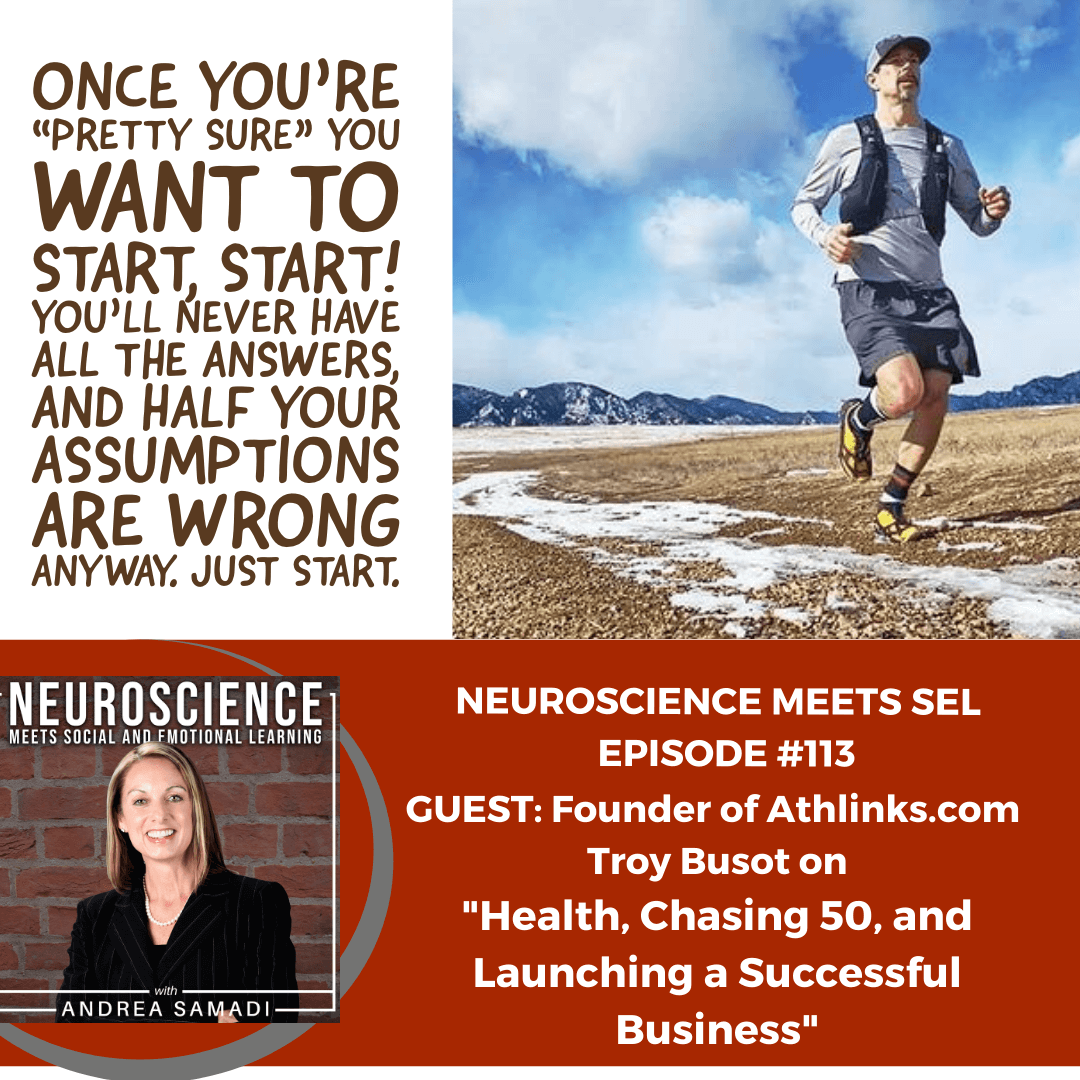
S5 Ep 113Founder of Athlinks, Troy Busot on "Launching a Successful Business, Health and Chasing 50"
Welcome back to the Neuroscience Meets Social and Emotional Learning Podcast EPISODE #113, with Troy Busot, the Founder of Athlinks[i], the world’s largest racing database with a mission of making it easier for people to race more often and have more fun in the process. Watch this interview on YouTube here. With this episode, you will learn: How Troy Busot, the founder of Athlinks.com helped Andrea to launch her business 10 years ago. How Troy took an idea, and created the world's largest racing database. The Secret to launching a business, or any idea. The importance of failing fast, identifying and fixing deficiencies. Hello and Welcome back! I’m Andrea Samadi, a former educator who has been fascinated with learning the science behind high performance strategies in schools, sports and the workplace, for the past 20 plus years. Our initial goal with this podcast was to close the gap recent surveys show exists in our workforce where 58 percent of employers say college graduates aren’t adequately prepared for today’s workforce, with a particular gap in social and emotional skills. Research shows that social-emotional skills like social awareness, self-regulation, and growth mindset (the skills that we covered early in the podcast episodes) are crucial to college and career readiness. The outcomes of developing these intelligences are vast as they impact our performance, leadership, personal excellence, time management, and decision-making. And if you have been listening to our podcast for some time, you will know that we’ve uncovered that if we want to improve our social and emotional skills, and experience success in our work and personal lives, it all begins with putting our brain health first. We’ve mentioned that daily exercise is one of the top 5 health staples that’s a known brain-health and Alzheimer’s prevention strategy, from our episode #87[ii] helping us to take our results, productivity and health to these higher levels. Our guest today, Troy Busot, has always impressed me by the way that he and his family took their health and fitness seriously, and his dedication to his health, spilled over into his work life, as a successful entrepreneur. He’s my old neighbor—his family used to live directly across the street from me, but they moved to another state, and now like many of us, we stay in touch via social media where we recently connected on some of his latest missions and to brainstorm ideas with our podcasts. Not only is Troy the CEO of Athlinks.com, but he also runs the Athlinks Podcast, a high-quality podcast that features interviews with athletes around the world as they prepare for events. I will tell you more about Troy, the company he founded, his podcast, and how he gave me that push that I needed to launch my business, achieveit360.com over 10 years ago, but first, let me tell you about what he invented. He’s the founder of Athlinks--the best way to track all of your race results in one place. Basically it’s a Results Database for those who compete in races. Each year, over 40 million athletes in the U.S. cross a finish line at an endurance event, but with the recent Pandemic, these numbers have been reduced to under 10 million, but you get the picture. There’s a lot of people who train long and hard, pushing themselves to these higher limits. For most people, it's not about the medals. It's about the results. It's about getting better each race - going faster, going farther, beating a rival, or lifting up a loved one. It’s about the hours, minutes, and seconds scribbled on the back of a race bib or on a row in a spreadsheet. Athlinks (or my old neighbor Troy) set out to make capturing those rewards as simple as typing your name into a search box. This was his idea, and he’s the mastermind behind this company, who pulls in times for running races, triathlon, swimming, cycling, mountain biking ... pretty much any timed endurance sport that you can think of - if they can find the results, they
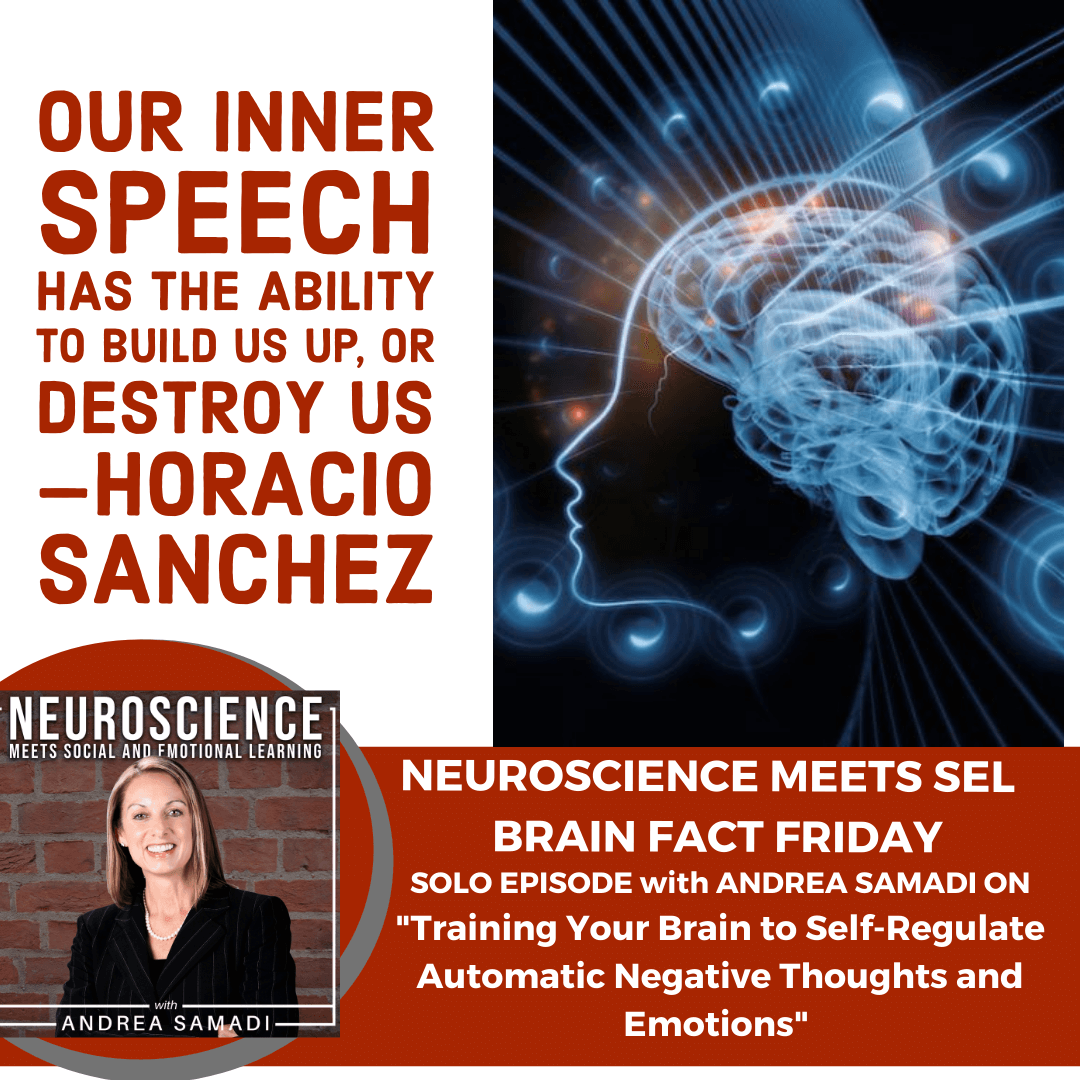
S5 Ep 112Brain Fact Friday on "Training Your Brain to Self-Regulate Automatic Negative Thoughts and Emotions"
bonusWelcome back to the Neuroscience Meets Social and Emotional Learning Podcast, for our second Brain Fact Friday! When we recorded episode #109[i] we announced we would be pulling out an important Brain Fact every Friday to dive deep into some of the brain-based strategies we are offering in each episode, so we can be sure to implement these important concepts in our schools, workplaces and lives. BRAIN FACT: Here’s our Brain Fact for this week from Horacio Sanchez, who we had an insightful interview with for Episode #111[ii] on his new book “Finding Solutions to the Poverty Problem.” “Did you know that when we engage in inner speech, all the mechanisms of outer speech and the auditory process activate in the brain. Therefore, what we say to ourselves is just like hearing it said by someone else to us. Inform students (and ourselves) that inner speech can build them up or destroy them.” (Horacio Sanchez)[iii] I brought up the damaging effects of Automatic Negative Thinking on one of our early episodes, #14 on Self-Regulation[iv]. The skill of managing our thoughts, emotions and behavior comes under the competency of self-regulation (one of the 6 social and emotional learning competencies that we covered in the beginning episodes of this podcast). What is Self-Regulation and Why is it So Important? It’s “the ability to manage your emotions and behavior in accordance with the demands of the situation. It includes being able to resist highly emotional reactions to upsetting stimuli, to calm yourself down when you get upset, adjust to a change in expectations and (the ability) to handle frustration”[v] In other words, it’s the ability to bounce back after a setback or disappointment, and the ability to stay in congruence with your inner value system. Using Self-Regulation to Manage Negative Thinking in the Workplace I’ve got to say, this topic has come up recently as stress in the workplace is at an all-time high. Things are going to happen on a day to basis that you might not like, and you might have the urge to say every negative thought in your head, out loud, in the heat of the moment, to get your point across. Then, we could spend the rest of the day brewing over the incident and playing the negative thoughts over and over again. We must have a strategy to stop them from ruminating or continuing in a loop, since we know that switching off these negative thoughts is an important step towards self-regulation, moving forward and preventing further problems. Besides, Horacio’s quote tells us that this type of negative thinking can destroy us. An effective strategy used in cognitive behavioral therapy[vi] is to say the word “SWITCH” in your head as you focus on switching the negative emotion that you feel to something more positive. This takes some practice, that’s for sure. I’ve always used the strategy of saying “STOP” when this happens and changing the thought pattern in my head to something more productive. Also, remembering to RESPOND to situations with questions to dig deeper, and learn more, instead of REACTING with emotion is always a better solution. When difficult situations arise, we have three choices. We can approach (by asking questions), avoid, or attack.[vii] The best results obviously occur when we are able to respond to a situation (approaching it with understanding) rather than react (by avoidance or attack) by asking questions to uncover more and see if there might be something we are missing or some sort of miscommunication that could explain the conflict. We always have a choice on how we respond to situations. The research is clear that mindfulness and meditation can help increase the gap between a stimulus and our response to it, so those who have developed their own practice, will find making this choice to respond vs react, much easier.[viii] How to Teach Self-Regulation to Our Children or Students? The ability to control one's behavior, emotions, and thoughts is an integral skill to be taught
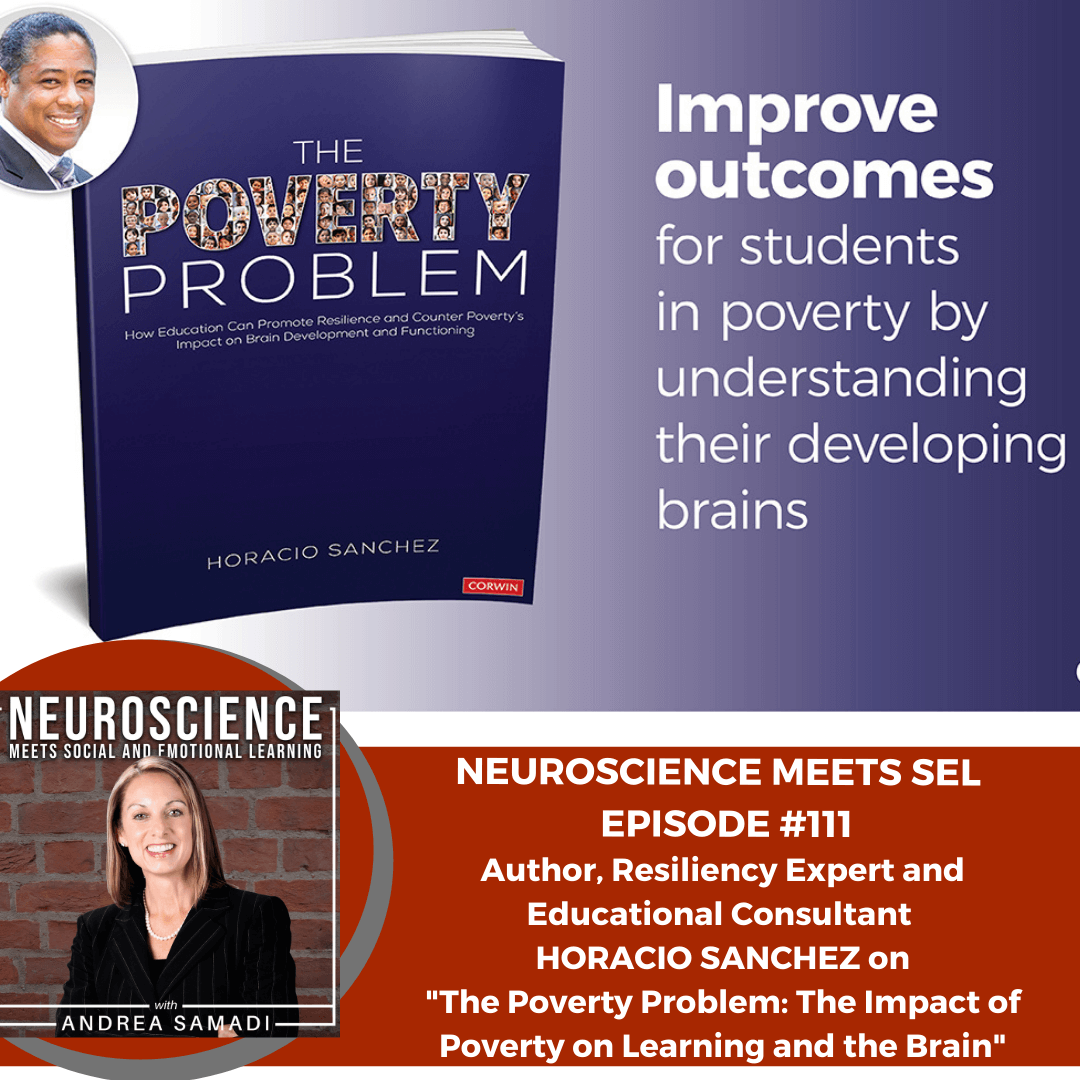
S5 Ep 111Resiliency Expert and Author Horacio Sanchez on "Finding Solutions to The Poverty Problem"
Welcome back to the Neuroscience Meets Social and Emotional Learning Podcast episode #111 with our 3rd returning guest, whose interview episode #74[i] made an impact on many of our listeners (and me) as we were right in the first few months of the Pandemic. If you are new here, my name is Andrea Samadi, and I’m a former educator who created this podcast to bring the most current neuroscience research, along with high performing experts who have risen to the top of their field, with specific strategies or ideas that you can implement immediately, whether you are an educator, or in the corporate space, to take your results to the next level. If we want to improve our social, emotional and cognitive abilities, it all starts with an understanding of our brain. You can watch the interview on YouTube here. Going back to today’s guest and our first interview—while many of my questions for our guest, on episode #74 were focused on Horacio Sanchez’s, book The Education Revolution [ii]published by Corwin Press, that addresses the decline in empathy, increase in obesity, and the impact of implicit bias on minority students, our conversation turned to focus on the problems we were seeing in the world at that moment (July 2020) highlighting the need for racial change through an understanding of race and culture. I knew that Horacio was deep into his next book, The Poverty Problem: How Education Can Promote Resilience and Counter Poverty's Impact on Brain Development but had not read it, nor made the connection between this book, the implicit biases that we all have, how to understand where they originated from in order to self-correct them and where to even begin to make these changes. If you have not yet watched our first interview, I recommend reviewing it before this one.[iii] A Bit About Horacio Horacio Sanchez who is recognized as one of the nation’s prominent experts on promoting student resiliency and applying brain science to improve school outcomes as they relate to diverse topics such as overcoming the impact of poverty, improving school climate, engaging in brain-based instruction, and addressing issues related to implicit bias. His new book was just released in January of this year, The Poverty Problem: How Education Can Promote Resilience and Counter Poverty's Impact on Brain Development and Functioning.[iv] If you follow Horacio on Twitter @ResiliencyInc, you will see the excitement this book is creating with educators around the country who are receiving their books, attending his trainings and learning how to Improve outcomes for students in poverty by understanding their developing brains. I highly recommend following Horacio on LinkedIn, as he has a daily brain tip where he shares brain tips and how they are relevant for student learning. Horacio’s new book covers how economic hardship is changing our students’ brain structures at a genetic level, producing psychological, behavioral, and cognitive issues that dramatically impact learning, behavior, physical health, and emotional stability. But there is hope. He offers solutions that will change minds, attitudes, and behaviors. You will learn about how problems develop between people of different races, how the brain develops in persistent poverty, and how it might react to solutions. In addition: The lack of culturally competent instruction and its impact on students of color Poverty's effect on language development and how it can be positively influenced The importance of reading How to counteract the effects of the widespread stress in lower SES environments Remember: “Children make up 23% of the U.S. population and account for almost 33% of those living in poverty, making the education system our most distressed institution. In The Poverty Problem, you’ll learn how to increase students’ perseverance and confidence and positively impact outcomes by arming yourself with research-based instructional strategies that are inspiring, realistic, and proven to w
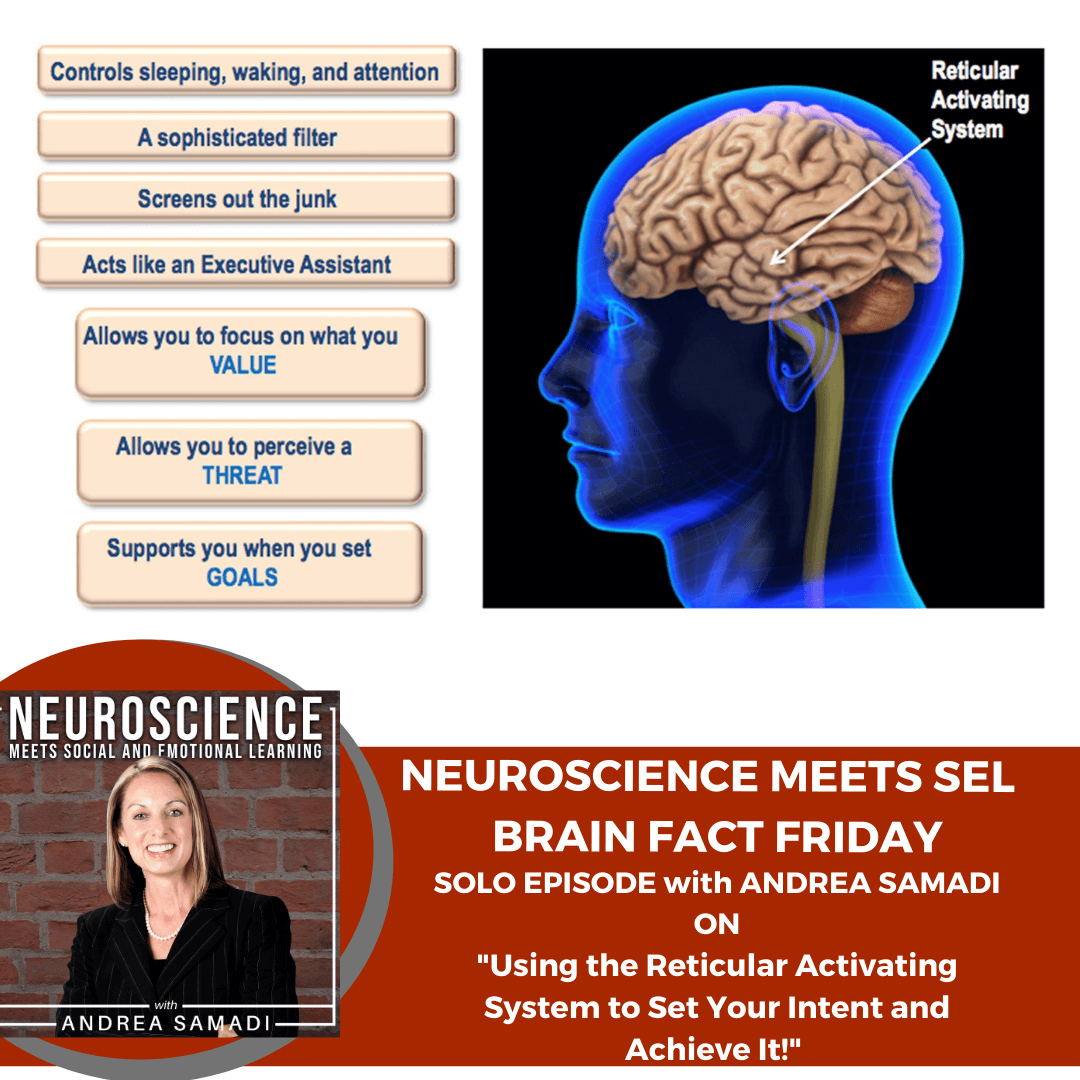
Brain Fact Friday on "Using the Reticular Activating System to Set Your Intent and Achieve it!"
bonusWelcome back to the Neuroscience Meets Social and Emotional Learning Podcast, for our very first Brain Fact Friday episode. When we recorded episode #109[i] on “Achieving Quantum Level Results Using Price Pritchett’s You Squared Principles” we announced we would be pulling out an important Brain Fact every Friday to dive deep into some of the brain-based strategies we are offering in each episode. I love how my good friend Samuel Holston and Kirin Goy pull out their brain tools on their podcast Brain Tools[ii] or how Lewis Howes has his 5 Minute Fridays on The School of Greatness Podcast.[iii] And I did mention one of the top strategies for taking your results to the next level is to find a mentor who is achieving outstanding results and do what they are doing—so we are following in their footsteps. BRAIN FACT: Did you know that Giuseppe Moruzzi, from the University of Pisa, is responsible for discovering the Reticular Activating System? What is the Reticular Activating System and How Can it Help You? To achieve your goals, or things that you want in your life, learn how to understand and use your Reticular Activating System[iv] which is a filter in your brain that helps you to focus on the things that are important to you. If you have heard the idea that “energy flows where your attention goes” this explains why putting some focus on what you want to create in your life is so important. Be very careful of where you are putting your focus, because your RAS will help you to achieve whatever you are focused on, good or bad. There really is a power of making your environments work for you, not against you. Tobias van Schneider explains how the Reticular Activating System (RAS) that’s a “bundle of nerves at our brainstem that filters out unnecessary information, so the important stuff gets through.”[v] He believes that the Reticular Activating System can be trained, and I agree. Using the Reticular Activating System So let’s apply this important brain discovery to our daily life. First, think of when you have noticed this system at work in your life. I remember a time I met someone at an event, and I asked him what he did for a living. He said, “I’ll tell you, but then watch out, because you will never forget me, and you’ll see what I invested EVERYWHERE” and he went on the share he was one of the people responsible for the MAXON ® Liftgate you see on the back of trucks. He was right. I never forgot him, and think of him every time I see that yellow Maxon sign while driving. That’s my RAS at work. So how do we use this part of our brain to achieve our goals? Just knowing that it’s there is a start. We have a part of our brain that helps us to filter out what we don’t need, and focus on what we do need. This is why saying your goals out loud is so important. Know what you want, say it out loud, expect it, and let your brain help you to achieve what you want. It’s really that simple. Sorry if now you will also see the MAXON sign everywhere. This also happened to me when someone mentioned the country Botswana. I had never heard of this country at the time, but after hearing about it, for some reason, I couldn’t stop hearing about it. IT appeared on the news, in the articles I was reading, and reminded me again that what we focus on, we notice—everywhere. I hope you have found our first episode of Brain Fact Friday to be helpful. Stay tuned for EPISODE #111 next week with Horacio Sanchez on his new book, the Poverty Problem.[vi] REFERENCES: [i] Neuroscience Meets SEL Podcast Episode #109 with Andrea Samadi https://andreasamadi.podbean.com/e/achieving-quantum-leap-results-using-price-pritchetts-you-squared-principles/ [ii] Brain Tools Podcast with Samuel Holston and Kirun Goy https://braintools.podbean.com/ [iii] Lewis Howes School of Greatness Podcast https://lewishowes.com/sogpodcast/ [iv] What is the Reticular Activating System May 2013 https://www.youtube.com/watch?v=QCnfAzAIhVw [v] If You Want it, you might get it.
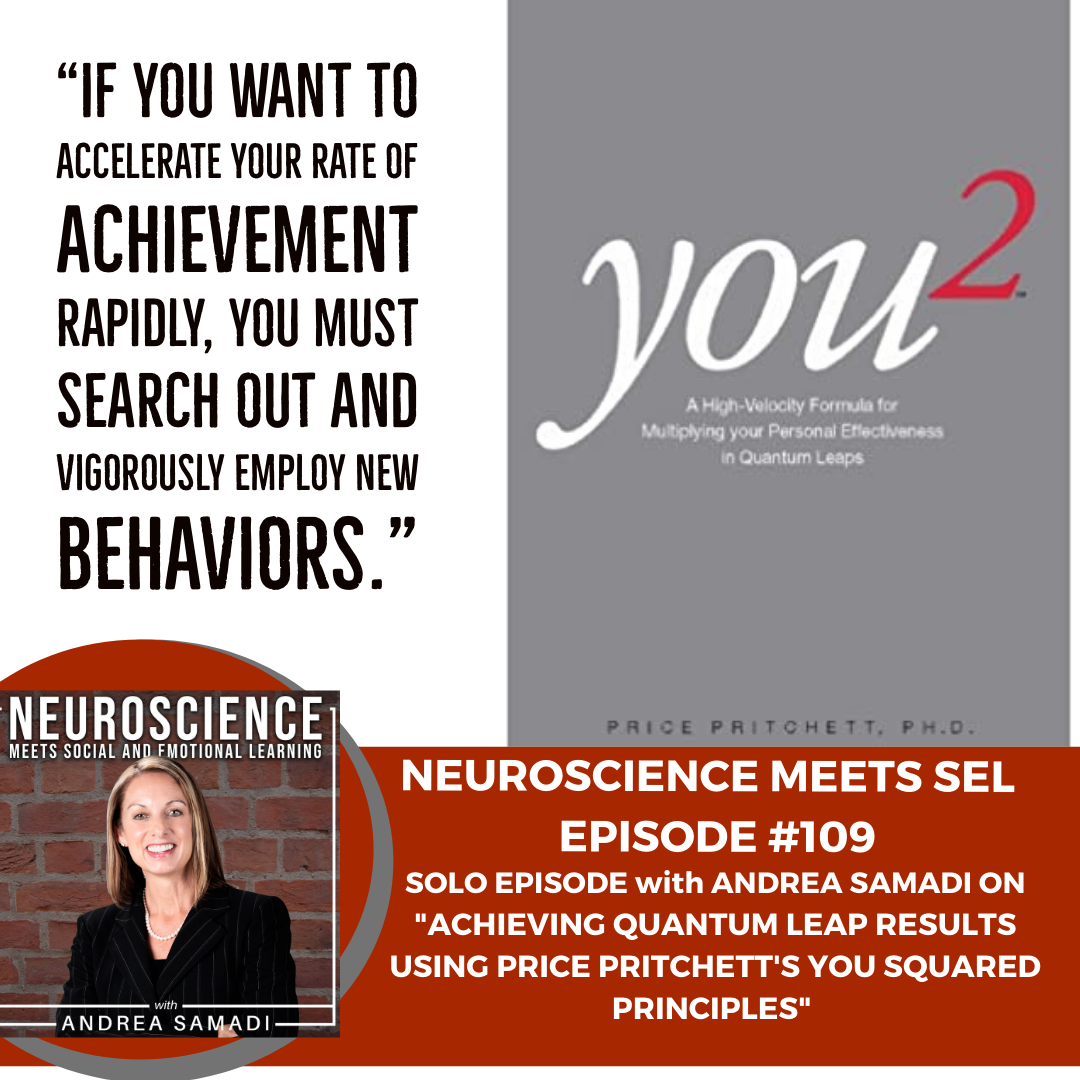
S5 Ep 109Achieving Quantum Leap Results Using Price Pritchett's "You Squared" Principles
Welcome back to the Neuroscience Meets Social and Emotional Learning Podcast EPISODE #109 with a special episode where I want to take a minute to thank anyone who has ever downloaded an episode or come on a guest to the podcast. Without you (the listener) or our guest speakers, there is no podcast, and there would be no chance that we would have hit our milestone of surpassing 50,000 downloads since our launch in June 2019. I want to take a minute to share why hitting 50,000 downloads is such a big deal and why we couldn’t have done this on our own. It took a year and 8 months to attain this goal (that I’ve had my eye on since last summer) and if you are not a podcaster, these numbers don’t have as much meaning as those out there who create and release content and wonder—will anyone actually find what I have just created interesting, helpful and meaningful? When starting anything new, you are building something out of nothing, and the only way to do this is to have a vision of where you are going. For me, it started with “I hope I can get 100 people to listen to this podcast. That would be incredible!” Our first month we had 27 downloads (probably my good friends and family—thank you!), month 2 was 204 downloads, month 3, 248, then 396, jumping up to 1,648 in December 2019. What’s crazy is that if I look back to February 2020, or this time last year, our monthly numbers started to hit the thousands each month, but we were still just at 7,800 downloads in total. I’ve included a graph in the show notes so you can see these results. If you are listening on iTunes, go over to Podbean to see these graphs. https://andreasamadi.podbean.com/ So, How Did We Go From 7,800 Downloads to 51,800 Downloads in Just One Year? When we launched the podcast, we did one episode a week, except for the beginning of the Pandemic last summer, we released 3 episodes in a week a couple of times, just due to the fact that we had extra time, most people we wanted to interview were available, and we knew the more episodes we released, the higher the downloads, which is exactly how the numbers increased so quickly. If we want quantum leap results, it takes effort, focus, persistence and hard work. There’s actually a formula that I learned in the late 1990s when I was given Price Pritchett’s book “You Squared: A High Velocity Formula for Multiplying your Personal Effectiveness in Quantum Leaps.”[i] Who doesn’t want to achieve exponential improvement in their performance, or multiply their personal effectiveness? “You don’t have to be content with improving things incrementally or gradually—You Squared implies an explosive jump in your personal performance that puts you far beyond the next logical step.” (Price Pritchett) So of course, I was looking for that exponential leap with our numbers, and not sure what the secret was. Since I always have the You Squared book on my desk, one day I looked up Pritchett and contacted his offices to see if I could have him on the podcast to discover what I was missing and share it with our listeners at the same time. He isn’t doing interviews anymore, but I will have one of his team members on this year and we will dive deeper into the principles of his book. The tips I’m going to share with you on this episode today are for anyone who is building something from nothing. You might have an idea in the back of your head, and aren’t sure where to begin, or you’ve been given a new sales territory, and you just can’t see how you will accomplish your goal. Whatever it is that you are looking to do, there are some secrets to achieving your goals, and I highly recommend reading Pritchett’s book, You Squared to begin with. Here’s Some Tips for Accelerating Your Rate of Achievement, and they all involve a shift in your mental mindset. Tip #1 Learn from Those Who Have Already Paved the Path Seek out those who have risen to the top, and model what they are doing. They had to have started where you are at some point.
S5 Ep 108CEO of Fisher Wallace Laboratories Kelly Roman on "Wearable Medical Devices for Anxiety, Depression, and Sleep/Stress Management"
Welcome back to the Neuroscience Meets Social and Emotional Learning Podcast episode #108 with Kelly Roman, the Co-Founder and CEO of Fisher Wallace Laboratories[i], an FDA-regulated manufacturer of wearable medical devices for the treatment of insomnia, anxiety and depression, as well as wellness devices for sleep and stress management (Circadia®). Watch the interview on YouTube here. Fisher Wallace has over 70,000 patients and 10,000 subscribers using their devices and has continued to run three sizable clinical trials during the pandemic, investigating how neurostimulation is a strong contender as a treatment for anxiety and depression compared to drug use. Welcome to the Neuroscience Meets Social and Emotional Learning Podcast. My name is Andrea Samadi, and if you are new here, I’m a former educator who created this podcast to bring the most current neuroscience research, along with high performing experts who have risen to the top of their field, with specific strategies or ideas that you can implement immediately to take your results to the next level. I can’t tell you how excited I am to speak with Kelly Roman today, as we have been on the topic of mental health and well-being on this podcast for the past few months, because this is an area that most people are interested in these days. There’s a serious need here. When I was covering the most important brain-health strategies, after watching the Alzheimer’s: The Science of Prevention Documentary[ii] last year, it became clear that sleep was one of the top 5 health staples that we should all be aware of. I covered this last December with a review of these top 5 health staples[iii] where getting a good quality sleep was a staple that is shown as an Alzheimer’s prevention strategy. When I was first introduced to Kelly Roman, and saw that the company he co-founded, Fisher Wallace Labs has created wearable devices to help improve sleep, while also treating anxiety and depression, I wanted to learn more. If you take one look at their website, you can see their appearance on the TV Show, the Drs. where a patient shares that she has been wearing the device for just a week, and is already sleeping better. The more I began to research this company, and their wearable devices, the more excited I became. I started to think up what questions I would ask our guest, and wondered: If these devices are helping people to improve sleep, and reduce anxiety and depression, what else could they possibly do? Could a wearable device help to improve someone’s mood and consequently help someone who struggles with addiction to stay sober? The questions could go on…let’s see what Kelly Roman, the co-founder of Fisher Wallace Laboratories has to say. --------Interview starts here---------------------------- Welcome Kelly, thank you so much for taking the time to speak with me today. I’ve got to say that my mind was going 100 miles an hour when I was creating your questions. An FDA-regulated manufacturer of wearable medical devices for the treatment of insomnia, anxiety and depression, as well as wellness devices for sleep and stress management—we can go in so many directions here. But I’ve got to start with sleep-- Q1: We’ve created a clear case on this podcast over the past 6 months for the importance of getting a good night sleep as it’s one of the top 5 health staples that we should all be aware of for Alzheimer’s Prevention. Can you explain what you are focused on at Fisher Wallace (wearable home use vs other forms- Electro Convulsive Therapy/Transcranial Magnetic Stimulation) how do these devices work, and how does this improve someone’s sleep? Q2: Kelly, my husband is a volunteer for the Maricopa Sheriff’s office here in Phoenix, he’s a commander for one volunteer units, and the stories I hear from those working in police/fire these days, it’s extremely stressful, and he lived in New Jersey, covering New York City for work, (where you live) and can deal with high stress s
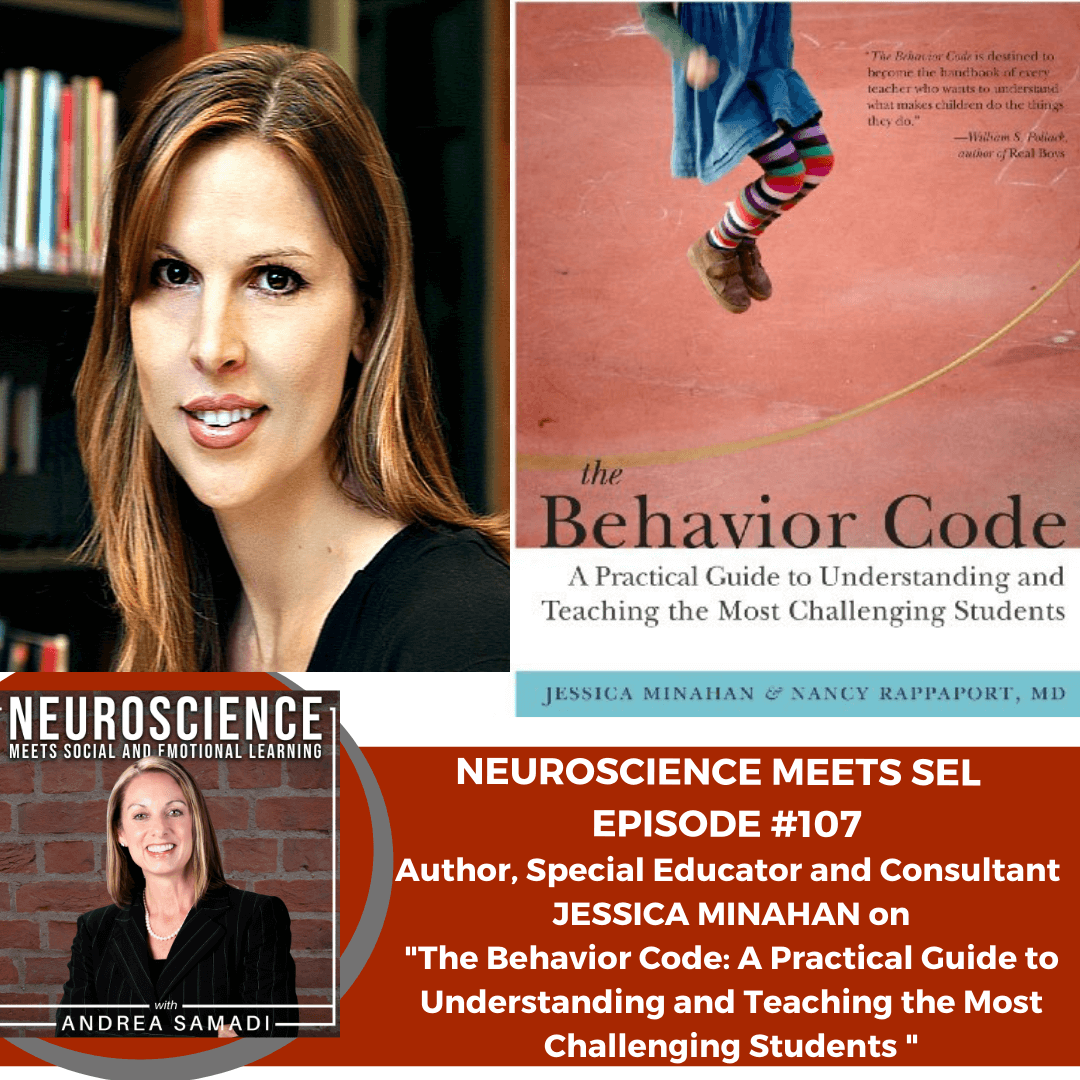
S5 Ep 107Behavior Analyst and Author Jessica Minahan on her book "The Behavior Code: A Practical Guide to Understanding and Teaching the Most Challenging Students"
Welcome back to the Neuroscience Meets Social and Emotional Learning Podcast episode #107 with Jessica Minahan[i], the author of The Behavior Code: A Practical Guide to Understanding and Teaching the Most Challenging Students[ii] In this much needed book, based on a collaboration dating back nearly a decade, the authors Jessica Minahan, a behavioral analyst and Nancy Rappaport, a child psychiatrist—reveal their systematic approach for deciphering causes and patterns of difficult behaviors and how to match them with proven strategies for getting students back on track to learn. Watch the interview on YouTube here. My name is Andrea Samadi, and if you are new here, I’m a former educator who created this podcast to bring the most current neuroscience research, along with high performing experts who have risen to the top of their field, with specific strategies or ideas that you can implement immediately, whether you are an educator, or in the corporate space, to take your results to the next level. If you have ever heard my story of where my career began, you would know why I would be so interested to speak with Jessica about the strategies in The Behavior Code. My first job out of The University of Toronto’s Faculty of Education, was a behavioral class. I felt overwhelmed and frustrated by the lack of resources to manage and teach my students and this was one of the catalysts that drew me towards social and emotional learning in the late 1990s. If only I had read this book back then, I wouldn’t have struggled so much. Let me tell you more about Jessica: She is a licensed and board-certified behavior analyst (BCBA), author, special educator, and consultant to schools internationally. Since 2000 she has worked with students who struggle with mental health issues and challenging behavior in public school systems. She specializes in training staff and creating behavior intervention plans for students who demonstrate explosive and unsafe behavior. She also works with students who have emotional and behavioral disabilities, anxiety disorders, or high-functioning Autism. Her particular interest is to serve these students by combining behavioral interventions with a comprehensive knowledge of best practices for those with complex mental health profiles and learning needs. She is a blogger on The Huffington Post[iii], the author of The Behavior Code: A Practical Guide to Understanding and Teaching the Most Challenging Students,[iv] with Nancy Rappaport (Harvard Education Press, 2012), and author of The Behavior Code Companion: Strategies, Tools, and Interventions for Supporting Students with Anxiety-Related or Oppositional Behaviors [v](Harvard Education Press, 2014).] She holds a Bachelor in Science in Intensive Special Education from Boston University and a dual master’s degree in Special Education and Elementary Education from Wheelock College. She has a certificate of graduate study (CGS) in teaching children with Autism from the University of Albany and received her BCBA training from Northeastern University in Boston. She is sought-after internationally to speak on subjects ranging from effective interventions for students with anxiety to supporting hard-to-reach students in full-inclusion public school settings. How did I come across Jessica’s work? A couple of Saturday mornings ago, I was at my desk getting caught up from the week, and an email came in from Greg Wolcott, who I mention often on the podcast. He’s an assistant superintendent from Chicago who has not only been a guest a couple of times on the podcast, but is a huge supporter. He often brainstorms ideas, topics, and guest speakers with me, and this time, when he sent me Jessica’s name, and told me that he was on a webinar with her, and that I should take a look at her work, I knew I needed to speak with her the minute I saw the title of her book. If you are a current teacher, former teacher, or thinking about being a teacher, I am sure that you would w
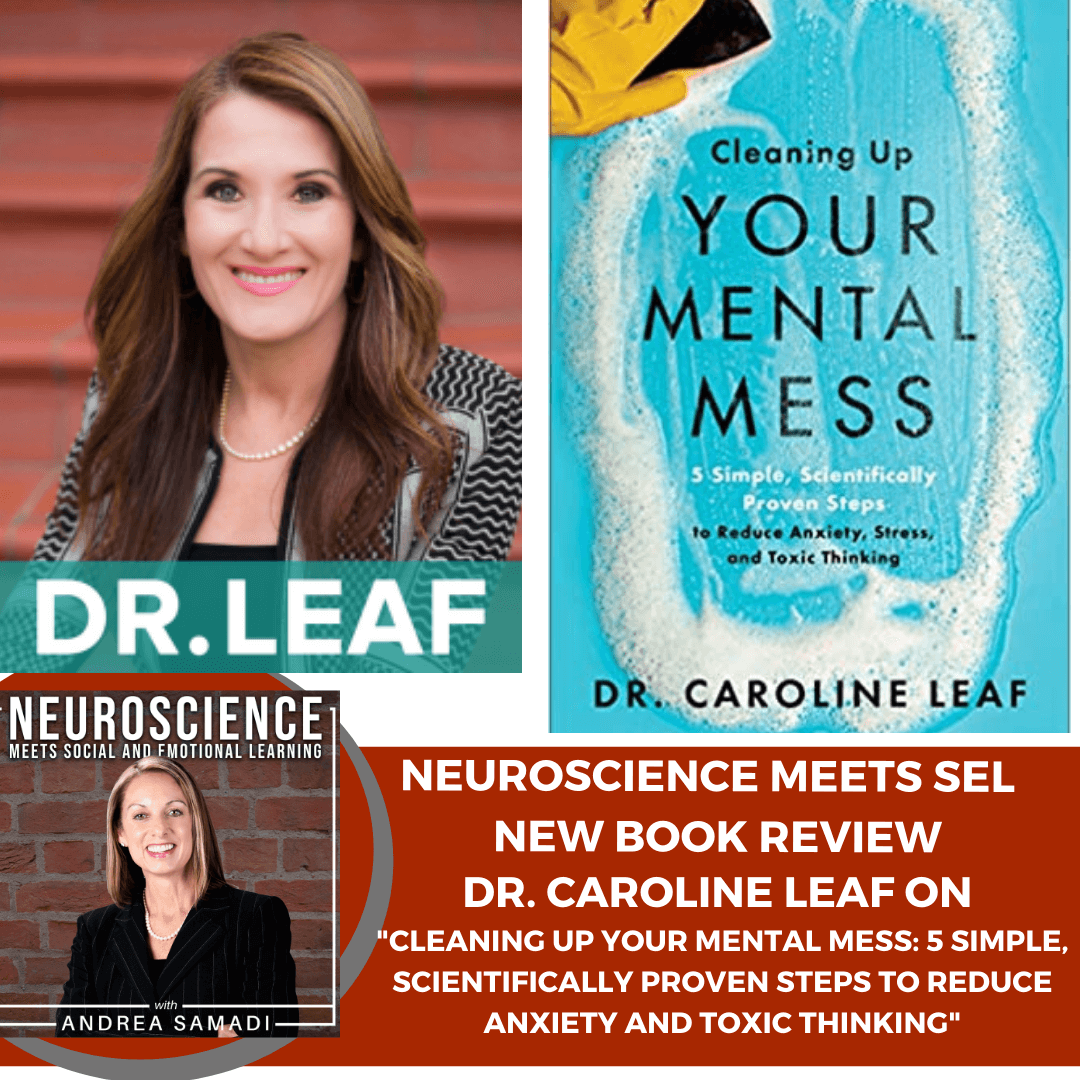
S5 Ep 106Review of Neuroscientist and Best-Selling Author Dr. Caroline Leaf's "Cleaning Up Your Mental Mess" Coming March 2nd!
Welcome back to the Neuroscience Meets Social and Emotional Learning Podcast episode #106. This episode is a deep dive into Dr. Carolyn Leaf's NEW book that is coming out March 2, 2021 and App "Cleaning Up Your Mental Mess." Stay tuned for the interview that will be released on March 1, 2021. My name is Andrea Samadi, and if you are new here, I’m a former educator who created this podcast to bring the most current neuroscience research, along with high performing experts who have risen to the top of their field, with specific strategies or ideas that you can implement immediately, whether you are an educator, or in the corporate space, to take your results to the next level. If we want to improve our social, emotional and cognitive abilities, it all starts with an understanding of our brain. This week we are going to take a deep dive into the work of Dr. Carolyn Leaf[i], as we did record a bonus interview with her this week, but this episode will be released on March 1st, one day before the release of her new book, Cleaning Up Your Mental Mess: 5 Simple, Scientifically Proven Steps to Reduce Anxiety, Stress and Toxic Thinking.[ii] This book is timely and important, backed by clinical research and illustrated with compelling case studies, where Dr. Leaf provides a scientifically proven five-step plan to find and eliminate the root of anxiety, depression, and intrusive thoughts in your life so you can experience dramatically improved mental and physical health. This 5 step plan will build a healthy new and automated neural network in 63 days, the length of time to properly build a new habit. Dr. Leaf told me “I truly believe that mental mess is something we all experience often and that it isn’t something we should be ashamed of. She mentions that “this is my profession, and I still have to clean up my mind daily. The events and circumstances of life aren’t going anywhere; people make a lot of decisions every day that affect us all, suffering of some sort for you and your loved ones is inevitable. That said, I wholeheartedly believe that although the events and circumstances can’t be controlled, we can control our reactions to these events and circumstances. This is mind-management in action!” Which to me is exactly what self-regulation is all about. Dr. Leaf leverages the strategies she has developed working with patients over the last 38 years (which to me is shocking since she doesn’t look a day over 35, but she was doing research in the 1980s that complements the work that Dr. Daniel Amen was doing back then) and she’s taken her years of research to teach her readers how to foster and cultivate the power of their own thinking and direct their own brain changes. Mind-management, when done correctly, helps facilitate talk between the conscious, the subconscious, and the nonconscious mind. This, in turn, gets brainwaves flowing in a healthy way, optimizing brain function. This is done by implementing the Neurocycle, a simple, clinically researched mind-management tool for personal use to address anxiety, depression, toxic thinking, inability to concentrate, irritability, exhaustion and burnout before they take over your mind. Last week I was speaking with my good friend Nancy, who asked me what book I was currently reading, and I shared with her that I was reading Dr. Leaf’s book to prepare for her interview, and that her book was coming out on March 2nd so it wasn’t out just yet. My friend went over to Amazon, read the title description, and told me “I need this book NOW” so I decided to release a deep dive into Dr. Leaf’s work so we can all prepare for the release of this important book, become familiar with her research and get a head start at Cleaning Up our Mental Mess. I’ll share the back story to how I came across Dr. Leaf’s work when I release her bonus episode next month, but I will share that I don’t believe in accidents, or that things happen by chance or luck. I believe that we are all faced with mult
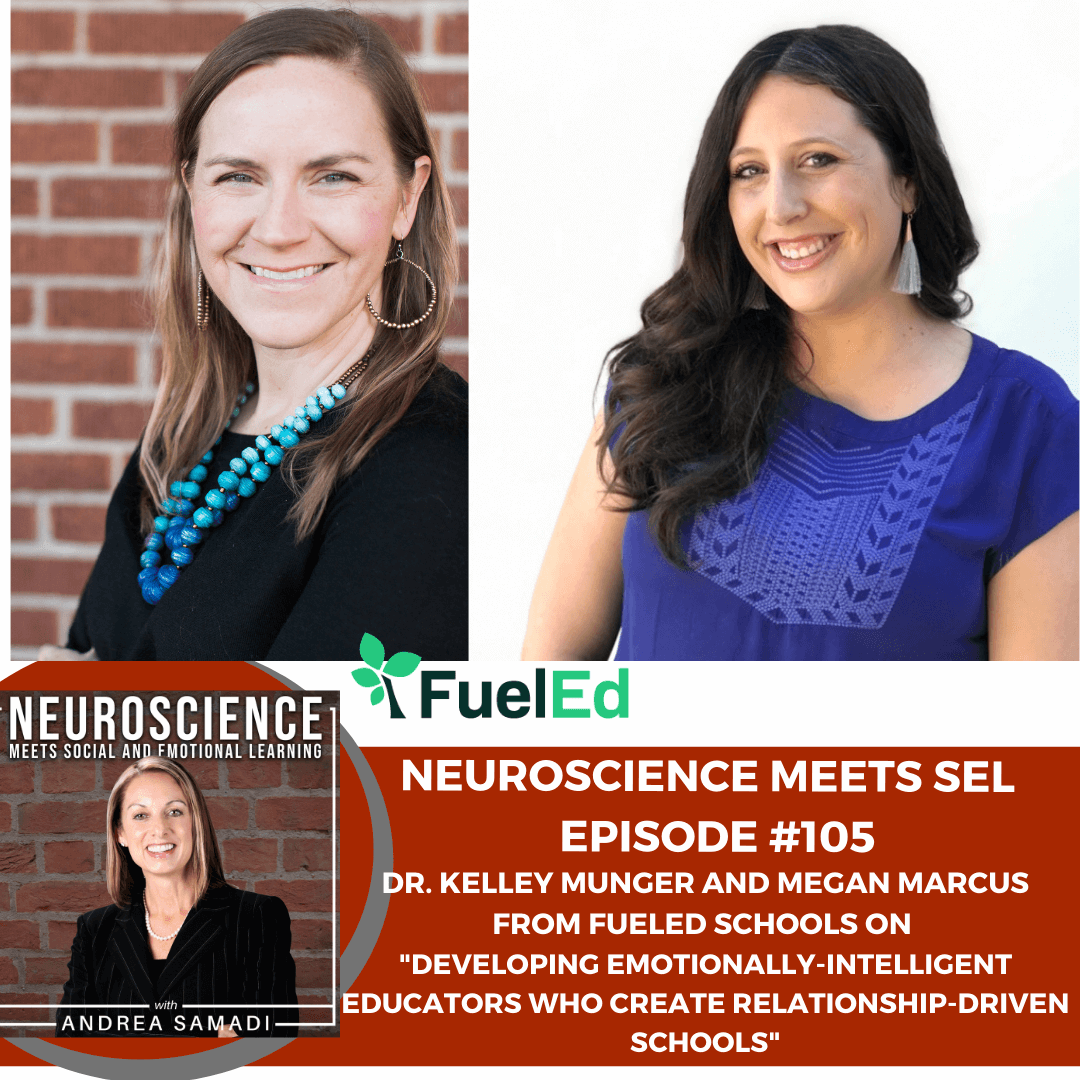
S5 Ep 105Dr. Kelley Munger and Megan Marcus from FuelEd Schools "Developing Emotionally Intelligent Educators Who Create Relationship-Driven Schools"
Welcome back to the Neuroscience Meets Social and Emotional Learning Podcast, episode #105 with Dr. Keeley Munger (researcher) and Megan Marcus, (founder) of FuelEd, a non-profit organization that builds educator emotional intelligence and relationship-driven schools. Watch the interview on YouTube here. Here’s some background on our guests today, before we get into the questions: Megan Marcus holds a bachelor’s degree in psychology from the University of California at Berkeley and masters’ degrees in psychology from Pepperdine University and in education, policy, & management from Harvard University. She served as lead researcher for the book, The Social Neuroscience of Education: Optimizing Attachment & Learning in the Classroom,[i] which explores how teacher-student relationships trigger neural plasticity and optimal academic, social and emotional learning. Her experiences working on this book while training to be a counselor served as both inspiration and the research foundations for FuelEd. Dr. Kelley Munger crafts and executes research projects that enhance our understanding of social and emotional development in educational environments while also bridging the gap between science and practice. What a perfect match for the Neuroscience Meets Social and Emotional Learning podcast. Welcome Megan and Kelley. When I saw that you were focused on educator SEL at FuelEd and that my career began as a classroom teacher over 20 years ago with a classroom of behavioral students that I couldn’t manage, I knew I had to speak with you and learn more about what you have built with FuelEd that is having such a significant impact on our schools. Thanks so much for being here today. I know how important educator SEL is from not only all of the SEL experts that I have been interviewing on this podcast, but personally since I found my first year of teaching behavioral students to be extremely difficult without any emotional intelligence skills to draw from, since these skills were left out of my teacher training. Can you tell me more about why you decided to focus on working directly with educators instead of students at FuelEd? I did an episode when I first launched this podcast on the Why Behind Implementing an SEL program in your school or District, or an emotional intelligence program in the workplace, but with all of your research, What do you think is the best starting place when it comes to helping educators grow socially and emotionally? We all know that it was an incredibly difficult year (last year) with many schools thrown into distance learning last spring with the start of the Pandemic. How do you see this year impacting the emotional lives of educators specifically? What do you think educators will need in order to address the large-scale trauma and stress they have experienced this year? It’s been a few years now, but in 2018 I entered an educational policy contest to see if I could help put more of a focus on educator well-being with this awareness. The premise of the paper that I wrote that didn’t win the contest, but was a great learning experience, was that “Teaching has become a high-stress occupation, leading to educator burnout, demoralization1 in the profession, and eventual instructor dropout, creating a negative impact on society and costing $7.3B in the United States with all of the training that needs to occur. Recent studies have shown that “students’ cortisol levels were much higher if the educator was overwhelmed or experiencing burn-out.”3 “People are finally seeing what negative stress does to the body, what that does to the psyche, and what it does to school engagement. I spent hours researching this topic and met some incredible people who were doing research in this area. When I first began presenting on the topic of stress and the brain in 2016, I saw that schools in Canada seemed to be ahead of us here in the US, putting a huge focus on this topic back then. Why do you thin
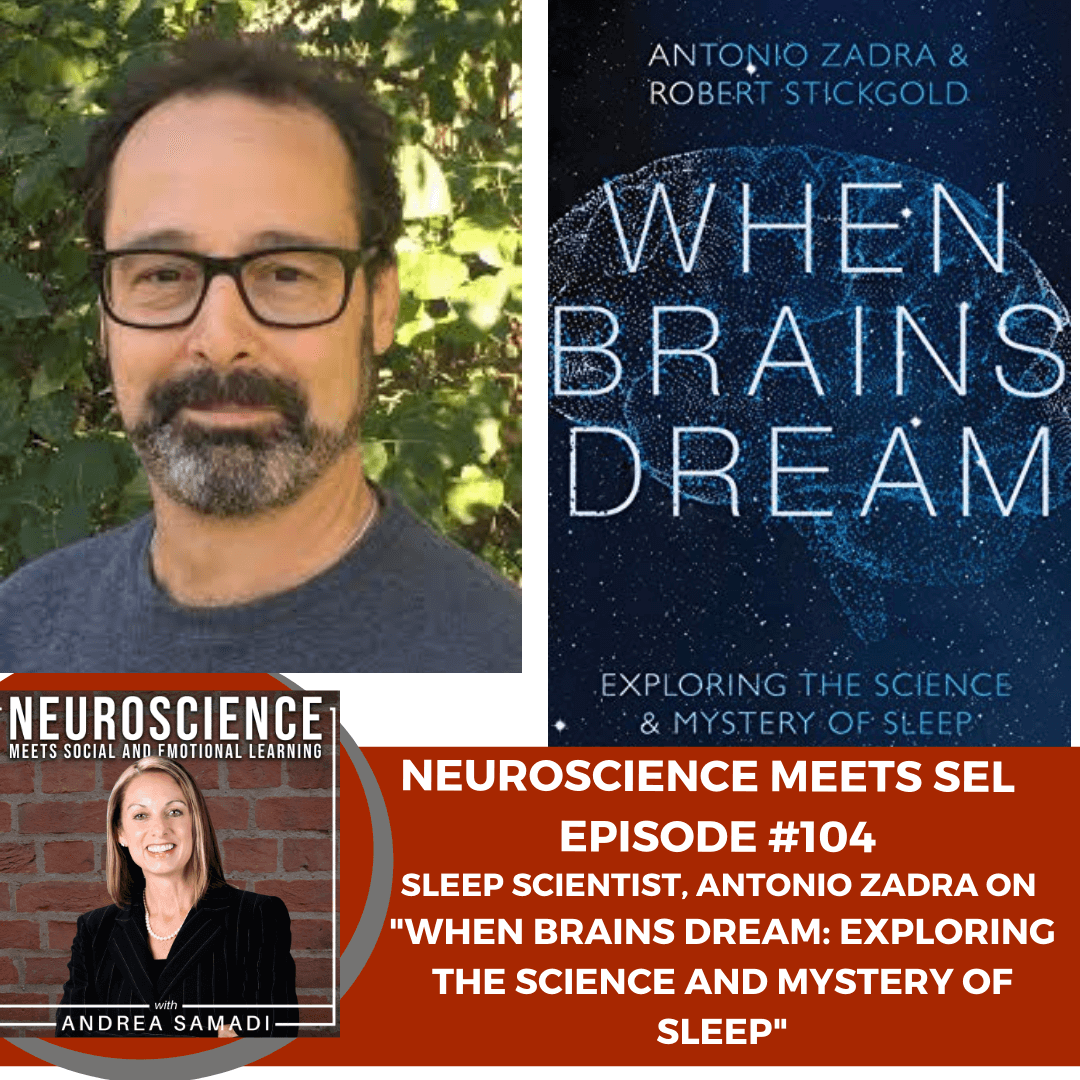
S5 Ep 104Sleep Scientist Antonio Zadra on "When Brains Dream: Exploring the Science and Mystery of Sleep."
Welcome back to the Neuroscience Meets Social and Emotional Learning Podcast, episode #104. Watch this interview on YouTube here. Our guest today came to me when I was referred to his book on one of my neuro-coaching training calls with Mark Robert Waldman[i], from episode #30 when I asked a question that was sent to me from a close friend from the UK, on dreams. Mark Waldman told me that he was anxiously awaiting the NEW book, When Brains Dream: Exploring the Science and Mystery of Sleep[ii] and I immediately looked up the book, and contacted the author, Antonio Zadra, to appear on our podcast. He agreed, and the rest is history! Before I get to the interview, I want to give you a bit more background information on this book, and the authors, and what you can expect before picking it up. I’ve got to say that what I expected from this book, continually changed as I began to read it, and it took me deeper and deeper into the mysterious world of our dreams. Antonio Zadra and Robert Stickgold bring together state-of-the-art neuroscientific ideas and findings to propose a new and innovative model of dream function called NEXTUP—Network Exploration to Understand Possibilities. By detailing this model’s workings, they help readers understand key features of several types of dreams, from prophetic dreams to nightmares and lucid dreams. When Brains Dream reveals recent discoveries about the sleeping brain and the many ways in which dreams are psychologically, and neurologically, meaningful experiences; The book explores a host of dream-related disorders; and explains how dreams can facilitate creativity and be a source of personal insight. Antonio Zadra[iii] is a professor at the Université de Montréal and a researcher at the Center for Advanced Research in Sleep Medicine. He has appeared on PBS's Nova and BBC's Horizon. Welcome Tony, thank you so much for agreeing to share more about your new book, When Brains Dream today. Q1: Tony, when we first spoke, I mentioned to you that I had been writing down my dreams since the late 1990s (off and on) it started when the speaker, Bob Proctor from episode #66[iv], who I worked for, suggested that I could learn a lot of insight from journaling about dreams, but nothing was more powerful than my first conversation with you. You taught me a valuable lesson, that “we cannot interpret other people’s dreams, only our own.” Can you share why this is important for all of us to understand, as we all probably have the same urge to ask “what does this dream mean?” and what should we be thinking of asking instead when searching for meaning with our dreams? (Ch 12 Working with Dreams). Q2: How can readers use your model NEXTUP (Network Exploration to Understand Possibilities) to understand prophetic dreams, nightmares or lucid dreams? Q3: Before we look at working with dreams, can you explain that while Freud’s influence on dreams was great, (you cover his influence in Chapter 3) what powerful scientific and clinical work was being done on dreams way before Freud? Q4: What made you become interested in studying about dreams, and becoming a dream scientist? Q5: I have to ask, the biggest question about dreaming that you cover in chapter 7. Why do we dream? I always thought our dreams were our wishes or fears, something from the past, unresolved issues, and something triggered by a current event. What would you say? Why do we dream? Q6: What are the contents of most dreams and how can they facilitate creativity and have our dreams be a source of personal insight? 6 PART B Also, you mention in chapter 12 that “20 percent of dream material can be confidently traced to waking-life sources.” Where is the rest of 80% coming from? Our non-conscious? The collective consciousness that I know you mentioned. Q7: When we were talking about 2 of my dreams before this call, you noticed that water was a theme in both dreams, and one included flowing water that you mentioned can be metaphor for our e
S5 Ep 103The Neuroscience of Leadership: 3 Ways to Reset, Recharge and Refuel Your Brain for Your Best Year Ever
Welcome back to the Neuroscience Meets Social and Emotional Learning podcast, episode #103, where we will cover “The Neuroscience of Leadership: How to Reset, Recharge and Refuel Your Brain for Your Best Year Ever.” As we are now well into the New Year of 2021, with 2020 behind us as a distant but not forgotten memory, have you taken the time to close out the old year and welcome in the new? Whatever planning activity you do, I’ve added some ideas to this episode that I’ve collected over the years of working directly with the top leaders in motivation and success that really do add new energy to fuel this new year, with practical neuroscience tied to each strategy. The idea is to look at your year with your brain in mind and see if this new lens can create the best year ever for you. We all intuitively know that there’s a mental energy boost that comes along with “being ahead” of the game, and for those who work in our classrooms, you know that this year, getting ahead with our students looks much different than prior years, with perhaps a phone call before the start of the year to welcome your new students, break the ice, or tie something personal into your lessons that helps you to quickly connect on a deeper level, setting the tone for your year. Getting ahead also translates into the workplace, with significant advantages in sales, for instance, knowing and planning where your sales will come from and having a solid pipeline, sets the tone for the rest of the year, much like the sports team who gets that first point early in the game, there’s a competitive advantage to this that builds momentum. Many people will be starting new jobs or careers with the mergers and resets that occurred from 2020, and the strategies that I am going to share with you, will be relevant to those of us who are starting something new, looking to refuel for a new year, recharge our batteries in 2021, shift, pivot and building momentum early, to set the rhythm for your best year ever. For those who work as entrepreneurs, this is the way we launch every year. For me, it’s been since I left the corporate space in 2012, so this will be my ninth New Year implementing these strategies. The first year, on Day One of working on my own, I remember calling my good friend Patti Knoles, who had been in business for herself for many years, and saying “Patti, I’m so scared! What if what I am planning to do doesn’t work out?” I don’t remember exactly what she said, but I do remember where I was at the time, and that whatever she said made me feel better. I think she said something like “how will you know if you don’t try?” and she was right—that’s the same words of wisdom that I give to those people, including one of my former sales managers, who called me after they have made this leap recently, for any thoughts, ideas or suggestions on how to be successful working from home, for yourself. Whether in business for ourselves, or working for someone else, it takes a certain mental mindset to be 100% in charge of our results—our day, income, and life, and I know that it can also be quite scary, so for those of you facing 2021 with this new lens, here are some strategies that you can implement that will put you ahead of the game mentally, which I’m confident will change your results and set you up, for your best year ever. Idea #1: Create Early Wins to Increase Motivation, Creativity and Overcome Challenges. Michael D. Watkins, the cofounder of Genesis Advisers, a leadership development company, and the author of The First 90 Days: Critical Success Strategies for New Leaders at All Levels[i] shares that “the single most important principle to making a successful transition in times of change, is to get early wins to build momentum fast.”[ii] We talked about this in the introduction, how achieving early wins creates a new rhythm and momentum that changes your mindset to help you to focus on the success you are destined for, with greater outcomes, b
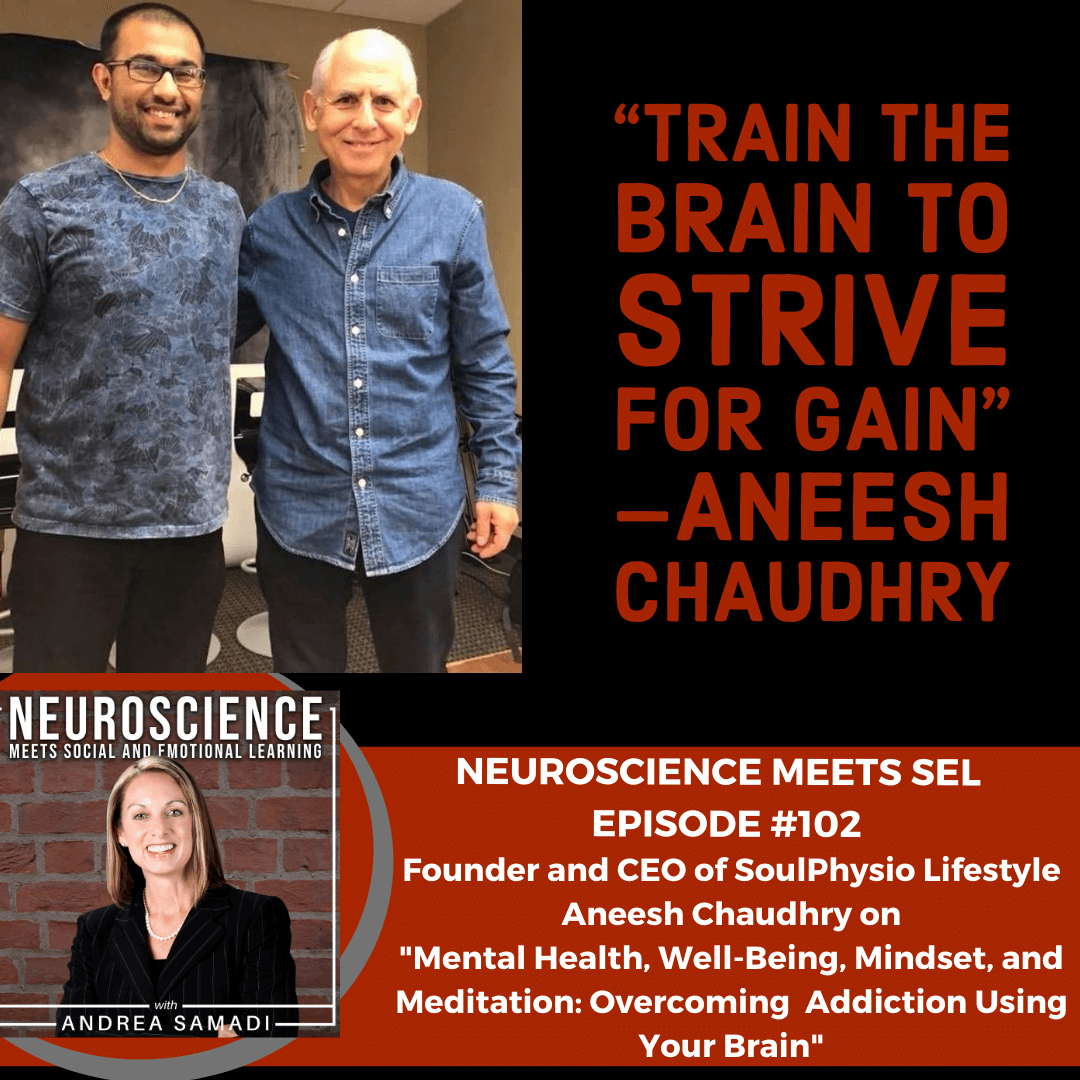
S5 Ep 102Aneesh Chaudhry on "Mental Health, Well-Being and Meditation: Overcoming Addiction Using Your Brain"
Welcome back to the Neuroscience Meets Social and Emotional Learning podcast, episode #102 with Aneesh Chaudhry, the CEO of SoulPhysio Lifestyle that was born largely from his own personal struggles. Watch the interview on YouTube here. As we start a new year, and Season 5 of the podcast, we will continue where we left off with Season 4, with a focus on Health and Wellness, that will take a shift to the importance of brain health, mental health and well-being. If we want to improve our results, and the brain is involved in everything that we do, and everything that we are, then we must put our attention towards understanding how we can optimize this organ—our brain. We all know that 2020 was difficult for many people, but those who struggled the most were those who already were struggling. The Centers for Disease Control found that from a survey in June 2020, adults in the United States reported “considerably elevated adverse mental health conditions associated with COVID-19”[i] and that “40.9% of over 5,000 respondents reported an adverse mental or behavioral health condition, including symptoms of anxiety disorder, trauma-related symptoms, new or increased substance use, or thoughts of suicide.”[ii] When I was introduced to Aneesh Chaudhry, through a mutual friend, you will see why I took one look at the work he is doing and knew immediately that I had to interview him in our first podcast to launch 2021, to provide some hope and direction for those who might either know someone who is struggling at this time or going through their own personal struggle. Aneesh dealt with significant Mental Illness and Addiction through his teenage years into his early twenties. He was diagnosed with conditions including depression, anxiety, bipolar, and this led him to search for answers as to why he was feeling the way he did. A Major shift occurred for Aneesh when he had his brain scanned in 2013 at Amen Clinics. He learned that the brain can heal itself, where his brain might be imbalanced, leading him to have the symptoms he was having. These answers gave him hope and direction that catapulted him into years of diligent study and lifestyle change. He got his bachelor’s degree in Psychology with a concentration of Behavioral Neuroscience. Aneesh also has a list of certifications in the area of health and wellness, including a Brain Health Coach Certification through Amen Clinics, making him a true expert in the field of Mental Health, Wellbeing and Neuroscience. Welcome Aneesh, thank you so much for agreeing to come on the podcast to share your incredible story that really does defy the odds, showing the dedication you have in this area. Q1: Aneesh, when we first spoke, on New Year’s Eve of all days, it really hit me that you understood this topic at the brain level, and this means that you have a grasp of something that we were never taught about in school, and most families that have these issues usually end up sweeping problems like addiction, mental illness or depression, under a rug, never to be discussed or addressed out loud, which doesn’t solve the problem. I shared with you that when I first encountered someone with a serious addiction, I was at a loss of what to do. Now this was going back 20 years ago, when I didn’t find out all my answers to whatever I wanted to solve through Google (that had just gone live a few years before this). I spent hours at the library reading books, trying to understand alcoholism, and why one person can have one drink and not be bothered with a second, while another person just can’t do this. It baffled me that something so important was never taught to us in school. Can you share just how deep your addiction to marijuana and alcohol was, how you think it began, and how were you able to defy the odds and make it to the other side to recovery? Q2: For people listening, this can be a challenging time of year, (with the Pandemic aside which we all know amplified this issue) whether they
S4 Ep 101Lessons Learned From Our FIRST 100 Episodes
Welcome back to the Neuroscience Meets Social and Emotional Learning podcast, episode #101, where we will review highlights from the past 100 episodes, that began in June 2019, with a behind the scenes lens, where we will take a look at the results created from this podcast, with the goal to inspire listeners to not just implement the ideas offered in each episode, but to think about what Horacio Sanchez from EPISODE #74 reminded me this week, of “the impact possible when you have an idea, nurture it, and watch it grow.” (Horacio Sanchez, EPISODE #74[i]). My name is Andrea Samadi, and if you haven’t met me yet, I’m a former educator who created this podcast to bring the most current neuroscience research, along with high performing experts who have risen to the top of their field, with specific strategies or ideas that you can implement immediately, whether you are an educator, or working in the corporate space, to take your results to the next level. Before we get to the episode, and the highlights learned from our guests, I want to share some of the unexpected results that have come as a byproduct of this podcast to perhaps light a spark under anyone who might be thinking of new ways to create brand awareness, or market their business in 2021. If you have been thinking of ways that you can extend your voice, message and reach, I highly recommend this mode of delivery. I also want to thank everyone who has supported us with this mission, come on as a guest, or downloaded an episode. We wouldn’t exist without the guests who offer their time, expertise, and strategies designed to help our listeners (in over 132 countries) who tune in on a regular basis and take the ideas offered to make an impact locally in their schools, communities, businesses and workplaces. I appreciate the feedback and messages received via social media and email and look forward to the next 100 episodes. As long as there is still growth, I will continue to produce new episodes. So Here are 3 Lessons Learned Looking Back at the 100 Episodes. LESSON 1: WHEN THERE’S A NEED, CAN YOU PUT A SPIN ON IT? I saw a serious need in the area of social and emotional learning that was being implemented in schools around the country and the world, and many educators didn’t know the best way to begin their implementation. I thought it would be a good place to gather “best practices” from experts around the world to offer their ideas that we could all learn from and apply to our own lives. But I knew I needed a bigger idea than just a podcast about social emotional learning in our schools, or emotional intelligence training in our workplaces. Too many people were already doing this. But not that many people were teaching the basics of practical neuroscience as it relates to this topic. The idea to combine neuroscience and social/emotional learning came with the thought that “success in life, and in college and career specifically, relies on student’s cognitive, (the core skills your brain uses to think, read, remember, and pay attention) social and interpersonal skills, (including the ability to navigate through social situations, resolve conflicts, show respect towards others, self-advocate and learn how to work on a team with others) and emotional development (including the ability to recognize and manage one’s emotions, demonstrate empathy for others and cope with stress).” In the corporate world, these skills aren’t new, but they are “newly important” and of high urgency to develop in our future generations. I’ve mentioned this quote before but think it’s important enough to repeat. A recent survey showed that 58 percent of employers say college graduates aren’t adequately prepared for today’s workforce, and those employers noted a particular gap in social and emotional skills. This is where our goal with this podcast began—to close this gap by exploring six social and emotional learning competencies as a springboard for discussion and tie in how an under
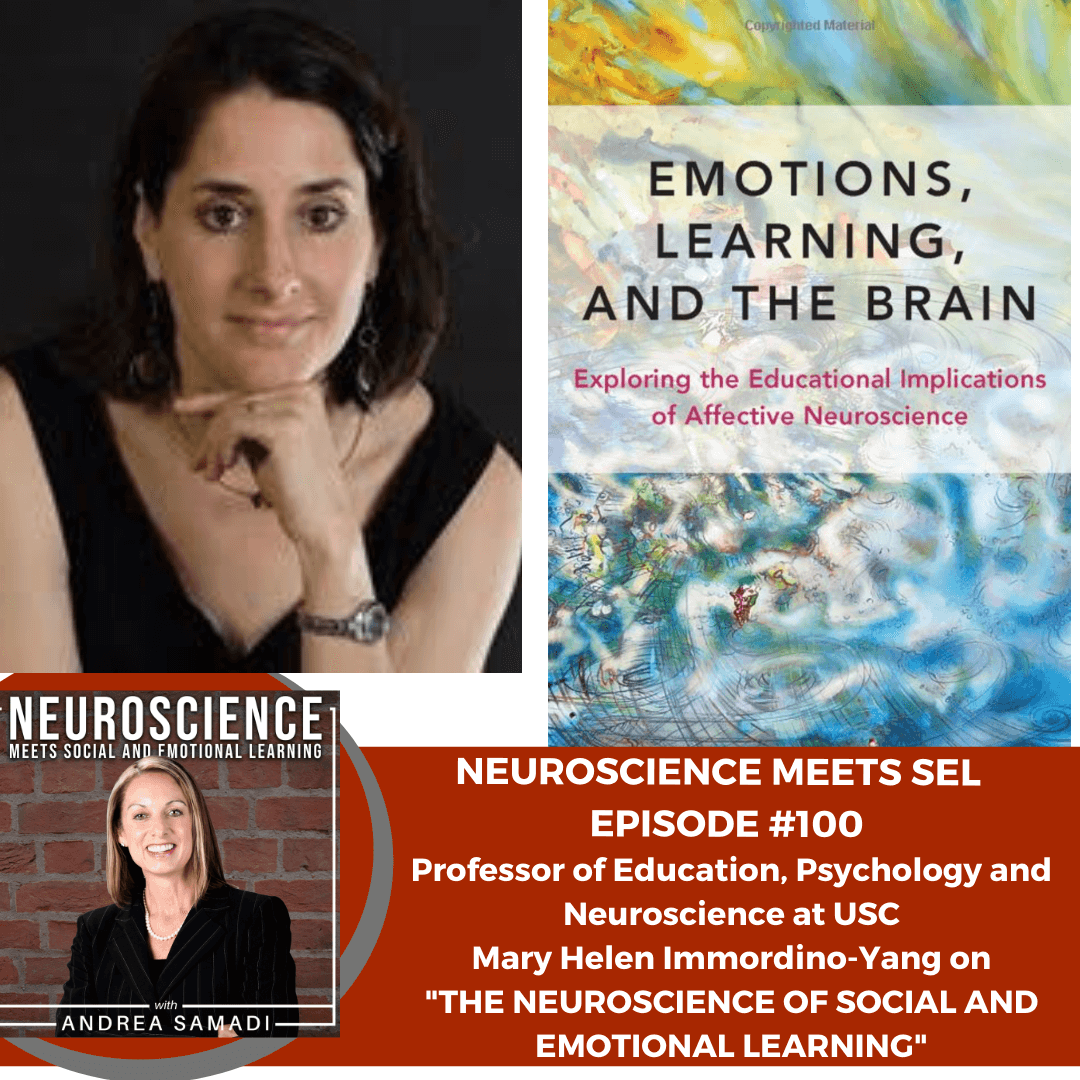
S4 Ep 100Professor Mary Helen Immordino-Yang on "The Neuroscience of Social and Emotional Learning"
Welcome back to the Neuroscience Meets Social and Emotional Learning podcast, episode #100—this episode is a very special one, that comes full circle for all of the listeners who have ever wondered, “what exactly is the neuroscience of social and emotional learning?” You can watch the interview on YouTube here. Today, this question will be solved with Dr. Mary Helen Immordino-Yang, who is a Professor of Education, Psychology and Neuroscience at the University of Southern California and Director of the USC Center for Affective Neuroscience, Development, Learning and Education (CANDLE)[i]. She studies the psychological and neurobiological development of emotion and self-awareness, and connections to social, cognitive and moral development in educational settings. What I find to be powerful about Dr. Mary Helen is that although she is a former public junior-high-school science teacher, who went on to earn her doctorate at Harvard University and has received numerous awards for her work and research, she is able to set us straight when it comes to understanding how the emotions we have with others, and our social interactions can change our brain, and literally shape who we are, with powerful findings that she can prove with FMRI scans. Welcome Mary Helen, it’s beyond incredible to finally have this opportunity to speak with you, after studying your work when I first started on this mission to learn and understand the basics of neuroscience back in 2015 when an educator urged me to take this path to integrate neuroscience into the programs I had developed for the school market. I’m sure I first saw you speaking somewhere with Dr. Daniel Siegel, who we had on with episode #28[ii] on “Mindsight: The Basis of Social and Emotional Intelligence” then when I saw you come on his PEPP MWE UP Community Chats this past July[iii], I immediately reached out to speak with you when I saw that your life’s work provides the evidence for the powerful connection with neuroscience and social and emotional learning. Thank you so much for being here today. Dr. Daniel Siegel said this, and I have to repeat it, because your research truly has shown incredible pioneering and achievement when it comes to showing through your social-emotion experiments, how what we think, feel and the emotions that we have—can physically change the structure of our brains. I am so grateful to have you here today and after writing your questions, I decided that it made perfect sense to have your interview as the 100th episode, to show the impact that we can have when we connect neuroscience to social and emotional learning. Q1: You said it really well on Dan’s event, and I have put this link in the show notes so you don’t have to repeat what you said there, but can you share how you started to look at the connection with the social and emotional brain. You mention that in 2001/2002 there wasn’t much out there on culture and the brain, and then when you looked at emotion, it was just some basic stuff about the amygdala lighting up with certain emotions, and the social brain was still in its infancy. Where did this idea begin to work with Antonio Damasio[iv] measuring brain activity and connecting our relationships and emotions to our future results? My thoughts: When I was urged by a school administrator to write another book that included the most current brain research to the programs I was offering schools in Arizona through a Character Education Grant, I began to look for those who were out in the world, teaching educational neuroscience. I found Judy Willis, and Dan Siegel, David Sousa who was showing how the brain learns to read, and some others, but wanted to find those who saw how neuroscience connected to social and emotional learning (the name of the podcast) because I saw how these social skills were changing the results of students, I just wasn’t measuring their brains in FMRI scanners. Your work really is bringing the research to re-think the next g
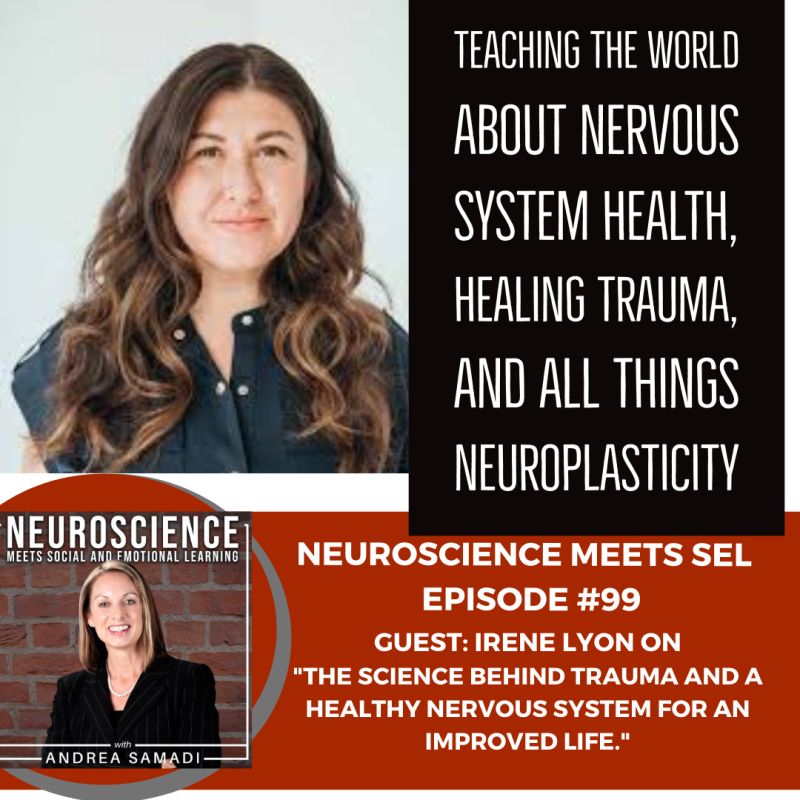
S4 Ep 99Irene Lyon, Msc on "The Science Behind Trauma and a Healthy Immune System for an Improved Life"
Welcome back to the Neuroscience Meets Social and Emotional Learning podcast, episode #99 with Irene Lyon[i], MSC. who teaches the world’s leaders and coaches how to work with the nervous system to heal trauma, and live full and productive lives. To date her online programs[ii] have reached people in over 63 countries and Irene clearly has a knack for making complex information easy for ALL of us to understand and apply to our lives, which is exactly the type of person I am always looking for on this podcast. Watch the interview on YouTube here. My name is Andrea Samadi, and if you are new here, I’m a former educator who created this podcast to bring the most current neuroscience research, along with high performing experts who have risen to the top of their field, with specific strategies or ideas that you can implement immediately, whether you are an educator, or in the corporate space, to take your results to the next level. If we want to improve our social, emotional and cognitive abilities, it all starts with an understanding of our brain. Welcome Irene, thank you so much for taking the time to speak with me today, as we are approaching our 100th episode! We are always looking for people who can take complex concepts and help explain them so that we can all use them in our daily lives for improved results, so thank you for being here to help us to better understand trauma, our nervous system and our results. INTRO: Before we get to the questions, can you explain exactly what you do as a nervous system specialist and somatic neuroplasticity expert and perhaps who some of your mentors were for you when you began this work? Q1: Since this topic is of high interest, I’m looking forward to diving deeper into the area of trauma so we can all gain more awareness and understanding of what trauma looks like for each person as an individual. I’ve just started to scrape the surface of this topic in the yearlong neurocoaching program I am taking with the study of Joseph LeDoux on trauma, fears, anxiety and memory consolidation. LeDoux says that each person has their own anxiety level, and we respond to trauma or difficult situations in different ways because our brains are “one of a kind, they are wired differently from our genes and our life experiences.” (LeDoux). Can you explain the science of trauma, and why one person could easily walk away from an accident or traumatic situation, yet another person’s life completely unravels with the same incident? What’s happening on the brain level for this to occur? Q2: Can you explain what you learned from Steven Hoskinson, that pretty much ALL chronic and mental illness (conditions that affect our thinking, feeling, mood and behavior) can be connected to dysregulation of the nervous system and unresolved traumatic stress? Q3: What is your 21 Day Nervous System Tune Up[iii] where you take people from a sick nervous system with emotional symptoms like depression, anxiety, stress, fatigue, immune system troubles to a healthy nervous system that includes improved sleep, a boosted immunity, elevated energy levels, and a regulated gut health? We’ve looked closely at Dr. Stephen Porges’ Polyvagal Theory on our episode #59[iv] and most listeners who follow this podcast know of the importance of understanding our Central Nervous System when it comes to managing our stress response, but can you share how you show people how to break through anxiety, burnout and chronic symptoms by healing the nervous system—what you teach in your Smart Body, Smart Mind Course[v]? Q4: I have to ask you just one question on your dissertation that you wrote in 2008 while pursuing your Masters in Research in Australia within the biomedical and health sciences, since the topic of your dissertation ties into where we have ended the year on this podcast, with a focus on health and anti-aging strategies. I know this area is of high interest for our listeners since episodes that focus on health and the brain h
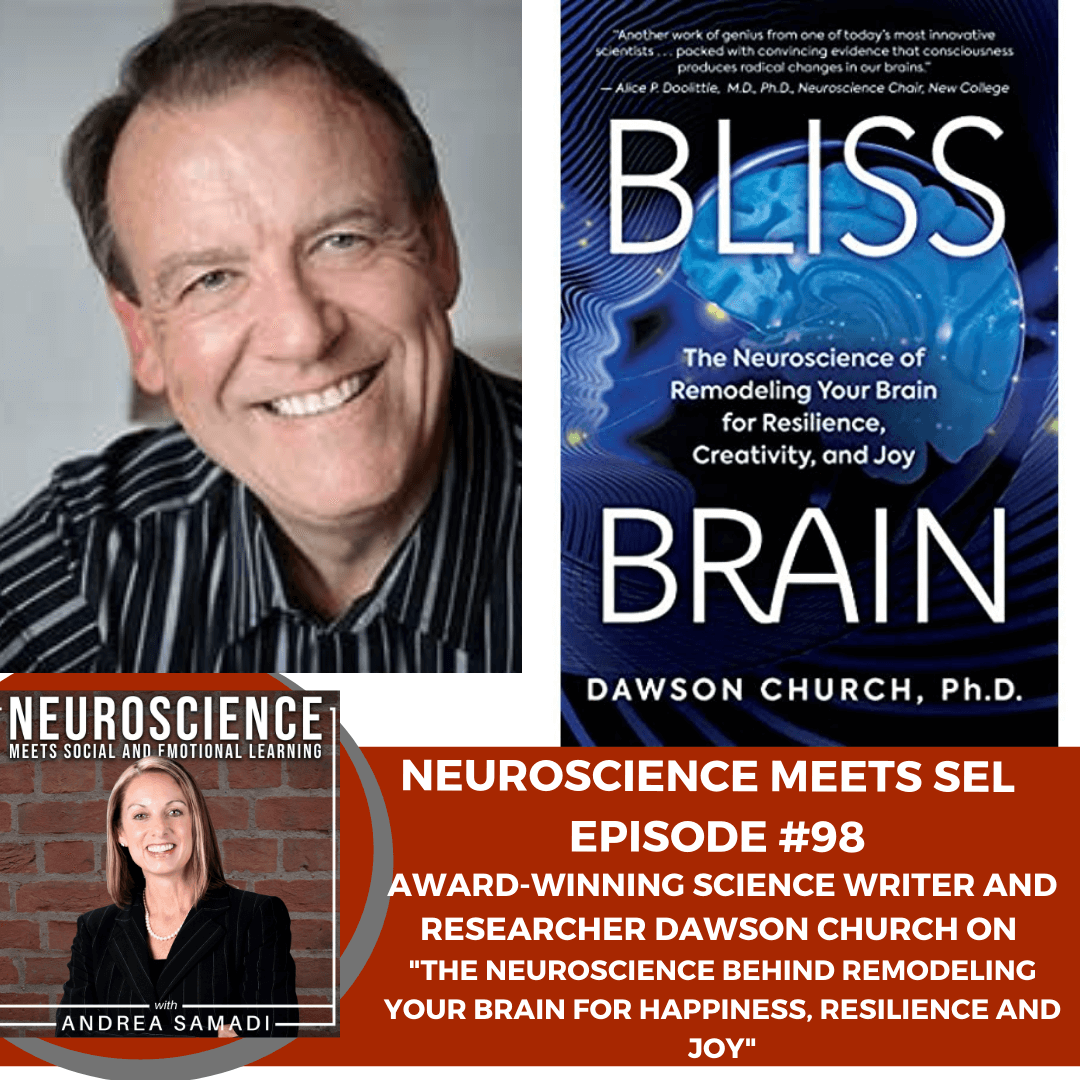
S4 Ep 98Dr. Dawson Church on "The Science Behind Using Meditation: Rewiring Your Brain for Happiness."
Welcome back to the Neuroscience Meets Social and Emotional Learning podcast, episode #98 with researcher Dr. Dawson Church[i], the author of the new book called Bliss Brain: The Neuroscience of Remodeling Your Brain for Resilience, Creativity and Joy[ii]. Dr. Church is an award-winning science writer who blends cutting-edge neuroscience with the stories of people who’ve had firsthand experience of brain change. Neural plasticity—the discovery that the brain is capable of rewiring itself—is now widely understood. But what few people have grasped yet is how quickly this is happening, how extensive brain changes can be, and how much control each of us exerts over the process of our thinking. You can watch the YouTube interview here. My name is Andrea Samadi, and if you are new here, I’m a former educator who created this podcast to bring the most current neuroscience research, along with high performing experts who have risen to the top of their field, with specific strategies or ideas that you can implement immediately, whether you are an educator, or in the corporate space, to take your results to the next level. If we want to improve our social, emotional and cognitive abilities, it all starts with an understanding of our brain. Welcome Dr. Church, thank you for taking the time to speak with me today, and sharing the fascinating research you have been doing for the 50-plus years you’ve spent investigating human potential since first learning to meditate as a teenager, is that correct? Dr. Church, before getting to the questions, I’ve got to say that I loved seeing Dave Asprey, the author of the book, Superhuman, and the creator of Bulletproof Coffee as your Foreword. I’m a longtime Dave Asprey follower and fan and loved to see his perspective where he mentions that the top performers he’s come across in his career, those people he calls “Game Changers” all meditate to improve the quality of their life. Q1: This interview is timely and important, since the world is experiencing such difficult times, (on a day to day basis we are all experiencing significant change no matter what part of the world we are living in) your book is needed, and I do hope that people around the world listening to this episode will read your book (Bliss Brain) and implement the ideas. Can you explain what you have discovered to be the secret for tuning our brain towards positivity, directing our thoughts, habits and behaviors to support a long and happy life? Q2: Most people who are listening to this podcast are aware of the importance of meditation, but I do hear some places where people often get stuck with their practice. Can you explain how it’s possible to release emotions that keep us in a reactive state—responding to the past—rather than the present so we can learn to be in the moment, rather than somewhere else? Q3: I remember when I first started to meditate (around 2014), it was because I received a course as a gift that included a meditation program, and I thought I had better use it, knowing I would be asked what I thought about it. I started with sessions that were about 30 minutes long and found it to be a huge learning curve, mainly to sit still and clear my mind. Why do people find it so hard with learning to meditate? What can you tell us about our brain so that we can bypass this roadblock to learning to implement this valuable and important skill? Q4: I think everyone could use more resilience these days, with the world we are living in. It’s not easy to push forward during such adverse times. Can you explain what your research has shown about how we can learn to relax, even during the most stressful times, explain the brain waves associated with relaxation and resilience, and what exactly does this do to the body/its effect on aging or even our energy? Q5: What exactly happens to the brain when we meditate? What health and cognitive benefits do we receive? Q6: What is “the bliss molecule” and how can we access it?
S4 Ep 97Kirun Goy and Samuel Holston from the Brain Tools Podcast on "The Neuroscience Behind our Habits, Addictions, Love/Fears."
Welcome back to the Neuroscience Meets Social and Emotional Learning podcast, episode #97 with Samuel Holston and Kirun Goy, the hosts of one of my favorite podcasts, Brain Tools[i] which focuses on practical brain science for everyday people. Samuel and Kirun provide engaging science-backed episodes to help you to learn how your brain works when it comes to sleep, stress, communication and so much more. What I love about their podcast that’s different from others (besides the fact that they are absolutely hilarious, while covering a very serious topic) is that they offer a regular episode, then they have a 20 minute break-out episode with 6 practical brain tools, or steps, that you will need to master, to be successful with the brain tip for that episode. It’s a great way to access the strategies quickly and easily, to ensure implementation. Watch the interview on YouTube here. I first met Samuel on LinkedIn, when we first connected last summer, and became immediate friends, with neuroscience and emotional intelligence in common. At that time, I had no idea just how much I would learn from their podcast, and that we would check back in with each other occasionally, offering ideas, suggestions, tips and encouragement for eachother. I learned that Samuel began studying neuroscience at age 15 and I immediately asked him to be a guest on our podcast. It took a few months, but they were finally ready, and I grabbed this opportunity to speak with them both today. So here’s a bit about Samuel: On top of being the co-host of the Brian Tools Podcast, he’s a freelance copywriter from Melbourne Australia. He says he’s not a scientist but has been obsessed with the brain (cognitive) science since he was 15 years old. And a bit about Kirun: In addition to being the co-host of the Brain Tools Podcast, Kirun Goy is the Director of Elevate Education where he co-founded the Singapore branch that helps over 40,000 students each year across 10 countries in Asia with workshops and online courses focused on improving learning skills. This is Andrea Samadi, on the Neuroscience Meets Social and Emotional Learning Podcast and I’m excited to welcome both Samuel Holston (located in Australia) and Kirun Goy (in Singapore) to the podcast today! How’s it going for you both? Before I get to your questions, I would love to know how you both met. I am guessing at University of Melbourne? Once you answer that questions, I want to know how on the earth did you both decide to start your podcast Brain Tools? Q1: For the past 2 months, I have been focused on health and the brain, especially after watching this documentary from Dr. Perlmutter called Alzheimer’s the Science of Prevention a few months ago, inspiring me to take a closer look at health as it relates to our results, knowing that there’s so many components to look at when it comes to improving our results. Now I know you are both way younger than me, and not yet worried about some of the things that pop into our minds when you are getting older, but tell me, why did you pick sleep as your FIRST episode? Sleep is one of the TOP 5 health staples[ii] that we know we must focus on for brain health and longevity. Why did you find it important to launch your podcast with[iii]? Q2: Your second episode focuses on well-being[iv], and I think this is a hot topic these days. You list self-awareness as one of the tools for well-being, to understand what your stress response looks like. (When stressed, do you go into fight, flight, or freeze mode)? I just had someone suggest this strategy a couple of episodes ago, and I know that when I’m stressed, I pick up my shoes and find a mountain to run up, so I’m guessing that my stress response is flight…How would you encourage people to learn more about their stress style? Should we just ask our friends and family, hey, when I’m stressed, what exactly do I do? Q3: From your episode on “Overcoming Fear[v]” I want to know, what happens at the brain level
S4 Ep 96Dr. Daniel Stickler on "Expanding Awareness for Limitless Peak Performance, Health, Longevity and Intelligence."
Welcome back to the Neuroscience Meets Social and Emotional Learning podcast, episode #96 with Dr. Daniel Stickler, MD, a former vascular surgeon who concluded that traditional medicine is not the best route for ideal health. He is now the Co-Founder and Chief Medical Officer of The Apeiron Center for Human Potential (Apeiron meaning Limitless) and is the visionary pioneer behind systems-based precision lifestyle medicine, which is a new paradigm that redefines medicine from the old symptoms-based disease model to one of limitless peak performance. His work now focuses on longevity, epigenetics and lifestyle optimization and along with his work at the Apeiron Center, he’s the Medical Director for the Neurohacker Collective, a Google consultant for wearable technology, AI in healthcare and a guest lecturer at Stanford University on Epigenetics in Clinical Practice. Watch the interview on YouTube here. I was introduced to Dr. Stickler from Luke DePron[i], whose interview opened up my awareness to a whole new level with even just a glance of the title “Limitless Peak Performance and Human Potential, Epigenetics, Aging and Anti-Aging, and the Future of Being a Healthy Human.” For those listening, I urge you to be open minded and think about your own potential. Wouldn’t you like to be limitless? Wouldn’t you like to improve your longevity? Turn back the hands of time a few years? Let me introduce you to Dr. Daniel Stickler, who has no doubt in his mind that these are all things that will be commonplace in the next 10 years, even the thought of living to and perhaps past 150 years of age. Get ready to have your mind expanded and pay close attention if you have been searching for ways to increase your productivity, well-being, and results This is Andrea Samadi, on the Neuroscience Meets Social and Emotional Learning Podcast and my guest today is Dr. Daniel Stickler, an author, speaker, medical pioneer and expert in human optimization. Welcome Dr. Stickler, what an incredible honor to have this chance to speak with you today. Thank you so much for your time, and for all you doing to expand the world’s awareness of what is truly possible when it comes to human potential. Dr. Stickler, I’m sure anyone listening will be as intrigued as I was at what exactly you are doing with this whole new paradigm of health and performance. Before we get to the questions, can we just start with the idea of your work being a new paradigm for health and performance and how what you are doing will change the way we perceive the world, just like when Roger Bannister ran the 4 minute mile and changed people’s perceptions of their ability to do the same? Q1: Dr. Stickler, the reason I asked you to come on this podcast, is because I had been looking to dive deep into the TOP 5 health stapes that have been proven to prevent Alzheimer’s Disease[ii] after I watched Dr. David Perlmutter’s Science of Prevention Documentary[iii] and was looking to learn more about each of these 5 health staples. When I saw your podcast with Luke DePron, I wanted to dig deeper into what you are doing, since it seems that your work takes these 5 health staples to a whole new level. Health Staple 1: Daily Exercise Health Staple 2: Getting Good Quality Sleep Health Staple 3: Eating a Healthy Diet Health Staple 4: Optimizing our Microbiome Health Staple 5: Intermittent Fasting Can you explain how you discovered this new world that opened through the lens of genetics and epigenetics and how your fascination for personalized human systems led to the fact that we truly have the ability within us to take charge of our destiny and become the architects of our own future? What is our DNA is versus our epigenetics, and how we can change the expressions of our genes with the application of these health staples like nutrition, exercise, sleep, meditation? THOUGHT: This is powerful right here! Most people are not optimizing these 5 health staples, but to make quantum leap changes li
S4 Ep 95Dr. Sandy Gluckman on "Reversing Children's Behavior and Mood Problems by Treating Root Causes."
Welcome back to the Neuroscience Meets Social and Emotional Learning podcast, episode #95 with Learning, Mood, Behavior, Author, Educator and Speaker Dr. Sandy Gluckman. You can watch the interview on YouTube here. Dr. Sandy Gluckman describes her quest as saving the next generation from a growing explosion of learning, behavior and mood problems. Her work is rooted in the science that shows that children will thrive when parents thrive. Dr. Sandy empowers parents to raise healthy, resilient, confident children primed for success, by showing them how to first heal themselves. Dr Gluckman is sought after for her expertise on a range of children’s challenges such as Anxiety, Defiance, Emotional Resilience, Self-Worth, Screen Addiction, Stress as a Survival Mechanism and the Sensitive Child. Rather than offering quick-fix, superficial solutions to these complex issues, Dr Sandy uses science to teach parents how to create the kind of parent-child neurochemistry that prevents and heals these problems. Welcome Dr. Gluckman! Thank you so much for being available to speak with me today. I have to say, that when I was reading your book, Parents Take Charge[i], and saw the acknowledgements, I can see how you fit in perfectly with the content we have been focused here on this podcast, especially with our most recent jump that focuses on health and mental wellbeing. If we are not healthy physically and emotionally, how on the earth can we expect ourselves to perform at high levels, and we definitely can’t expect it of our children, right? I can see that many who have inspired your work, we have been focused on for the past year and a half on this podcast, with Dr. Dan Siegel a year ago this week, Dr. Amen with his daughter Chloe Amen’s interview[ii] on Change Your Brain, Change Your Grades, and then inspiring the brain scan content,[iii] Stephen Porges with his Polyvagal Theory[iv], and most recently with our focus on health and the brain with Dr. Mark Hymen, and his recent program, Alzheimer’s The Science of Prevention that really did inspire our health and wellness episodes.[v] Your life’s work is a perfect match for us, and I am so grateful to have this chance to speak with you. Today, our topic with you is Reversing Children’s Behavior and Mood Problems by Treating the Root Causes and before I even get to your questions, I have to put my background in context for you, since your work, and this podcast will probably make some things come full circle for me, as well for those listening who might work with or know children with behavior or mood problems. Back in the late 1990s, I was a teacher in Toronto, and I worked with behavioral students. It was my first teaching assignment right out of teacher’s college, and I had no training at all on how to deal with difficult students, and also had hardly any strategies for managing my own stress. I have had author and educational neuroscience leader, Dr. Lori Desaultels[vi] on twice to this podcast, and her work, along with Michael McKnight, focuses on how the students’ behavior usually is a reaction to the teacher or parent’s state of mind. I now know stress reducing strategies that help me on a daily basis, but I wish I knew them when I first started my career. Q1: Can you take me back to the beginning of your professional career, with students in their last year of high school in South Africa, and what made you begin to wonder “why did some students have a robust, healthy and feisty spirit, while others did not?” How did this question inspire you to further your studies and obtain a PhD in clinical psychology, and dive deep into how different people respond to stress? Q2: In your book, Parents Take Charge, you introduce a new way of healing children’s learning, behavior and mood problems, with the story of an 11-year old named David, who was having some challenges with learning at school, was diagnosed with a bunch of different disorders like ADHD, OCD, and depression, an
S4 Ep 94Personal Trainer and Fitness Model Jason Wittrock on "Nutrition, Intermittent Fasting and the Ketogenic Diet."
Welcome back to the Neuroscience Meets Social and Emotional Learning podcast, episode #94 with personal trainer and fitness model, Jason Wittrock. Watch the interview on YouTube here. My name is Andrea Samadi, and if you are new here, I’m a former educator who created this podcast to bring the most current neuroscience research, along with high performing experts who have risen to the top of their field, with specific strategies or ideas that you can implement immediately, whether you are an educator, or in the corporate space, to take your results to the next level. If we want to improve our social, emotional and cognitive abilities, it all starts with an understanding of our brain. I first found our next guest, Jason Wittrock late 2016/ 2017 when I was searching for answers with my diet. I was at a crossroads with my health, and knew I needed to do some things differently, I just didn’t know exactly what to do, and I had heard some friends in some of my online groups talking about how they were drinking keto coffee, and experiencing health benefits, like increased energy and weight loss. So I went to YouTube, and typed in “how to make keto coffee” and Jason Wittrock’s video came up called “Keto Coffee”[i] and my journey began here, taking my health to a whole new level, and have never looked back. I’m sure there are thousands of stories just like mine. Welcome Jason, thank you so much for your time today to come on the podcast and share what you have been doing with your YouTube videos, inspiring people around the world with their health, nutrition and lifestyle for years. Jason, I’ve got to tell you this. Back when I first found your videos, I saw something different with what you were doing. This was the beginning of my health journey, but it did stick, and here we are all these years later speaking. There’s a few things that I wanted to tell you that stuck out to me, looking back, about why I think the results stuck and it’s that you really come across that you want to help people. You said quite a few times on your videos, as you spoke 100 miles an hour about what you were doing, the products you were using and why, you said “hey, I’m just trying to help” and it really did come across that you were, so I listened. You said “look, some guy just did this diet for 45 days, that’s awesome, make it a lifestyle” so I did, and pretty sure I posted a million times on my social media about how much I was loving keto coffee, and your fat bombs[ii] (those were awesome)! I’m just one person, so can just image the ripple effect of your work. Way to go and thank you for what you are doing. So let’s get to some questions here-- Q1: Jason, I reached out to you, as I have recently recorded an episode on the TOP 5 Health Staples[iii] that have been proven to prevent Alzheimer’s Disease and that I’m looking to dive deeper into these 5 health strategies. I thought of you a few times when I was thinking about when I changed my diet after watching your videos. Can you share how your journey to health began, and what’s been happening with you since I first saw your videos? Health Staple 1: Daily Exercise Health Staple 2: Getting Good Quality Sleep Health Staple 3: Eating a Healthy Diet Health Staple 4: Optimizing our Microbiome Health Staple 5: Intermittent Fasting Q2: A few years ago, it was a huge paradigm shift for me to think about putting butter in my coffee. I’m not sure about other people, but you are talking to someone who used to count calories (not anymore) and used to be terrified of eating anything high in fat. I did some research, and then watched you making your keto coffee, then bought exactly the same ingredients, then trusted you. Now this is all from a YouTube video, and maybe from one other person I knew who was drinking coffee this way who I also trusted. Now, we’ve got Dave Asprey and his Bulletproof Coffee products, but back then, he was just getting started with that and I didn’t know about it. What ar
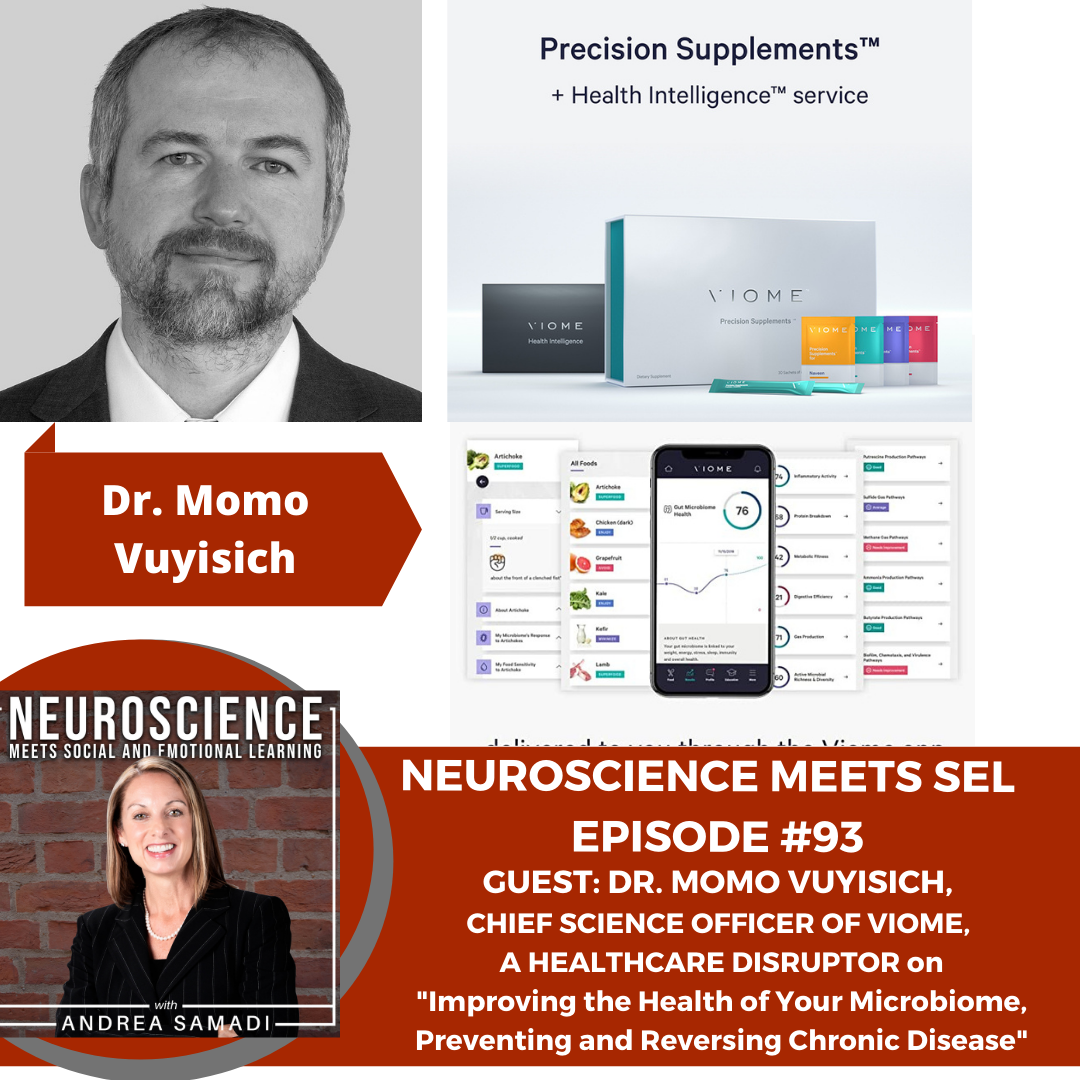
S4 Ep 93Dr. Momo Vuyisich on "Improving the Health of Your Microbiome, Preventing and Reversing Chronic Disease."
Welcome back to the Neuroscience Meets Social and Emotional Learning podcast, episode #93 with Dr. Momo Vuyisich, the co-founder and chief science officer of Viome[i], a healthcare disruptor that’s using IA to analyze your gut microbiome to make personalized nutritional recommendations. You can watch the interview on YouTube here. I’m excited to introduce you to Momo Vuyisich, the chief science officer at Viome, who leads their efforts in product development and clinical research. Momo knows all too well of the importance of the gut/brain connection and how we can take control of our own life and health by optimizing our gut microbiome with personalized nutritional recommendations using Viome testing. Before co-founding Viome in 2016, Momo spent 12 years at Los Alamos National Laboratory[ii], where he was the leader of the Applied Genomics team. His research focused on applying modern genomics to the areas of gut microbiomes, host-pathogen and microbial inter-species interactions, pathogen detection, cancer biology, toxicology, infectious diseases, and antibiotic resistance. In this episode, you will learn How Momo, the founder of Viome.com reversed his rheumatoid arthritis with a change in diet. Forward thinking strategies for taking your health into your own hands. What your poop can tell you about your health. What exactly is microbiome testing and how it works. A vision of the future where chronic disease is preventable and diet is personalized. “Today we have 100% of the science and technology needed to cure every chronic disease and every cancer.” Momo Vuyisich “The only way to predict the future is to invent it.” Momo Vuyisich Welcome Momo, thanks so much for taking the time out of your day to be here today. INTRO Momo, I mentioned to you that I recently did an Dr Q1: Can you give us your background, and what brought you to where you are today, inspiring your work with Viome, whose on a mission to help the world understand what we uniquely need to be healthy, and ultimately prevent and reverse chronic disease like Alzheimer’s, Diabetes, Parkinson’s, MS and Obesity? Q2: I don’t want to repeat the incredible information you gave Luke DePron on his podcast, so I am posting the links to his episode in the show notes.[iii] For those of us like me who were beginners to understanding what the microbiome is, and the gut/brain connection, you did offer an incredible resource for everyone to check out. You suggested to look up Dr. Robynne Chutkan and her book[iv], The Microbiome Solution, and she has a new book out now called Gut Bliss. She also did a great intro to understanding the microbiome for CBS Morning News that you can see on her website.[v] Can you give a quick overview on why it’s so important for us to understand our gut microbiome, the gut/brain connection and why true health begins in the gut? Q3: Before I heard Luke’s podcast with you, I knew that we need to protect our gut microbiome, and that taking a probiotic can help balance our gut and keep us healthy. I also had heard about prebiotics, or foods that were good for gut health, and do try to stick to low glycemic foods. After listening to some of your podcasts, I know there are medicines (like antibiotics, acid reflux medicine, NSAIDS and birth control pills) that can damage our microbiome and foods that can either help or hurt us, and perhaps that the foods I am choosing from the glycemic index might be spiking my blood sugar? Can you explain why probiotics are limiting and why different foods can be beneficial to my microbiome, but not yours? Q4: How are you helping people to understand what they uniquely need to be healthy and allow them to take back control of their health? What exactly do you do at Viome? Q5: What are you focused on now at Viome, what is your 10-year vision, and what do you need to get there? Thank you very much for your time today, Momo. For people who want to learn more about Viome, they can go to Viome.com and lear
S4 Ep 92Author and Neuroscience Educator Sarah Peyton on "Brain Network Theory, Default Mode Network, Anxiety and Emotion Regulation."
Welcome back to the Neuroscience Meets Social and Emotional Learning podcast, episode #92 with neuroscience educator, author and trainer, Sarah Peyton[i]. You can watch the interview on YouTube here. My name is Andrea Samadi, and if you are new here, I’m a former educator who created this podcast to bring the most current neuroscience research, along with high performing experts who have risen to the top of their field, with specific strategies or ideas that you can implement immediately, whether you are an educator, or in the corporate space, to take your results to the next level. If we want to improve our social, emotional and cognitive abilities, it all starts with an understanding of our brain. I’m so grateful to have been introduced to Sarah Peyton, a neuroscience educator, and author of the book, Your Resonant Self: Guided Meditations and Exercises to Engage Your Brain’s Capacity for Healing[ii]. I took one look at Sarah’s work and website, and immediately had 100 questions for her. She also does have a workbook coming out to accompany this book, this summer. I will put the links in the show notes to learn more.[iii] Welcome Sarah, thank you so much for your time today, to share your knowledge and resources with us. Q1: Sarah, Brain Network Theory is now being talked about all over the place, listeners of this podcast, who follow the most current neuroscience research, will have heard about it. There are many books being written on this NEW Brain Network Theory (I’ve mentioned Dr. Srini Pillay and his book about the power of the unfocused mind in past episodes). I’ve been working closely with Mark Waldman (from EPISODE 30)[iv] this past year and know that applying Brain Network Theory to our life can be powerful. Just as a reminder of what Brain Network Theory is all about, if you were to go to www.pubmed.gov and search for the most recent studies on the brain, instead of looking at different parts of the brain, like we used to do, we now know and study different networks in the brain to gain understanding, and we can measure and see the activity in each of these brain networks. This is a fascinating discovery that comes to life with these images that we’ve all seen with different regions of our brain lighting up. Sarah, can you go over some of the brain function networks you cover in the beginning of your book and how an understanding of these networks can help us with our understanding of the world, and our perhaps ways we can improve our results? (seeing the world, decision-making, discerning importance, dorsal attention, listening, sensing and moving)? Q2: How does trauma show up in the brain? Q3: I did cover the Default Mode Network in EPISODE #48[iv] and mention the fact that this Default Mode Network involves those thought processes that can include worry, doubts and fears like “don’t try that, it didn’t work out last time” and so on. Swiss Psychologist Piaget called this “inner speech” that can be positive or negative, depending on what you are thinking. Chapter 1 of your book begins with “How We Talk to Ourselves: The Default Mode Network” that talks about our beliefs, our self-talk and strategies to overcome some of these limiting beliefs. How would you suggest we first of all identify, and then eliminate limiting beliefs from our brain to improve our results? Q4: The Default Mode Network has also been linked to the Imagination. Marty Seligman, the founder of positive psychology calls the DMN the Imagination Network and my mentor, Mark Waldman created a diagram which he refers to as a map to simplify the 5 major brain networks, and he intentionally put the DMN or Imagination as the largest area, possibly because it develops so early in life and plays such an important role in child and brain development. How would you explain the Default Mode Network and why is it so important for us to understand this network in our brain with our early years of development in mind? Q5: On EPISODE #53[v], w
S4 Ep 91Behavior Experts Drs. Jessica and John Hannigan on "SEL From a Distance: Tools and Processes from Anytime, Anywhere."
Welcome back to the Neuroscience Meets Social and Emotional Learning podcast, episode #91, with Jessica and John Hannigan, the authors of the brand-new book, SEL From a Distance: Tools and Processes for Anytime, Anywhere. [i] This is a timely and importance topic, with the pandemic this year, and subsequent switch to distance learning combined with recent instances of racial injustice has put a spotlight on the cracks in the practice of social and emotional learning (SEL). I launched this podcast in June of 2019 when I saw the need to highlight leaders in the field of SEL, but now, more than ever before, schools are shifting their focus and prioritizing SEL competencies—around the nation and the world. Watch this interview on YouTube here. My name is Andrea Samadi, and if you are new here, I’m a former educator who created this podcast to bring the most current neuroscience research, along with high performing experts who have risen to the top of their field, with specific strategies or ideas that you can implement immediately, whether you are an educator, or in the corporate space, to take your results to the next level. If we want to improve our social, emotional and cognitive abilities, it all starts with an understanding of our brain. Today I am thrilled to have behavior experts Jessica and John Hannigan, who have drawn together a collection of tools and processes for social and emotional learning that can be applied in any learning environment with their NEW book, SEL from a Distance. Dr. Jessica Hannigan is an assistant professor in the Educational Leadership Department at California State University, Fresno. She works with schools and districts across the nation on designing and implementing effective behavior systems. Her expertise includes response-to-intervention (RTI) behavior, multi-tiered systems of supports (MTSS), positive behavior interventions and supports (PBIS), social and emotional learning (SEL), and more. John E. Hannigan, EdD , is an executive leadership coach for Fresno County Superintendent of Schools in California. He has served in education for over 15 years as a principal, assistant principal, instructional coach, and teacher. Under his leadership, his school has received numerous awards and recognitions, including California State Distinguished School, Gold Ribbon School, Title I Academic School, Positive Behavioral Interventions and Supports (Platinum Level). Hannigan, Jessica,Hannigan, John E. (2106-02-06T23:28:15). SEL From a Distance (Kindle Locations 410-414). SAGE Publications. Kindle Edition. In SEL from a Distance, you’ll learn: The five SEL competencies and dozens of easy to use processes for building skills in each. How to identify challenging behaviors and prioritize, define mastery, and teach the SEL skills necessary to address them. Tips for identifying, teaching, modeling, and reinforcing SEL skills in a virtual setting. Strategies for applying SEL to the needs of your unique learning environment. Welcome Jessica and John, thank you so much for taking the time to speak with me today, and sharing this new resource for those listening around the world. For this interview, I did want to read what others are saying about this new book, with a question attached to each testimonial. I really do think that everyone listening should go to the link below, and grab a copy of this book, whether you are an educator, or someone looking for ideas to implement social and emotional learning competencies with your children, this book is a must read. Just to give you both some background, since we are just meeting, my interest in social and emotional learning goes back over 20 years ago, when I was a frustrated educator, with no resources in the area of behavior management. When I see a book like yours, I really do want the world to know about it. Here’s what other leaders in the field of education are saying about your book: INTRO QUESTIONS “People are seeing the imp
S4 Ep 90Host of the Live Great Lifestyle Podcast, Luke DePron on "Neuroscience, Health, Fitness and Growth."
Welcome back to the Neuroscience Meets Social and Emotional Learning podcast, episode #90 with Luke DePron, a Men’s Health & Performance Coach[i], and graduate of Exercise Science, Kinesiology. Luke has done everything from personal training with 100s of clients, to working alongside Drs of Chiropractic as a corrective exercise specialist, training Olympic level athletes, to performance work with world champion mixed martial arts fighters. Watch this episode on YouTube here. Currently Luke works as a Men’s Online Health and Performance Coach—learn more at http://www.livegreatlifestyle.com/ where he helps men step into a lifestyle approach of exercise and nutrition to transform their physique, energy, and confidence. He’s also the Host of the Live Great Lifestyle Podcast[ii] where he’s interviewed former Navy Seals, Mixed Martial Arts world champions, New York Times best-selling authors, personal development speakers, Olympic athletes, adventure athletes, Doctors, Nutrition experts, and inspirational leaders carving unique paths in the world to inspire and empower you to level up your health, fitness, mindset, and lifestyle. Exactly the type of person I look for as a speaker on this podcast. I love that Luke is a believer that stepping out of your comfort zone leads to growth, and he’s always aiming high, routinely practicing Jiu-Jitsu, was a participant on the History Channels show The Selection: a mock special forces selection process led by Navy Seals, was a contributing writer for Huffington post, hosted the La Jolla International Fashion Film Festival, has performed as an actor in local San Diego films, and even worked as a runway model once. Welcome Luke, what a diverse background. I’m so grateful for our connection on Linkedin, and really do appreciate you referring our last interview with Dr. Erik Won that I just did yesterday. I know that you are the host ofThe Live Great Lifestyle podcast with a mission to inspire and empower men to live their life to its greatest potential. Can you give an overview of your past, (that’s full of achievement as much as I know you don’t like to boast about it) and how your past brought you to where you are now? I loved your interview with Dr. Erik Won and the Wave Neuroscience team. I learned so much from your interview. I did stop your podcast often to take notes, as learning Dr. Won’s method of measuring the brain is much different than my experience with a SPECT scan. What made you see the importance of understanding neuroscience as it relates to health/wellness? Diving Deeper- when studying and learning about the brain, there is a learning curve. I remember the first time my good friend, Mark Waldman, a neuroscience researcher sat down with me on Skype in my first attempts at learning “how the brain works” and I can honestly say, I had no idea what he was talking about. I had never studied the brain. I might as well have been learning Spanish. When I listened to your interview with Dr. Won, you had a solid understanding of how his EEG brain mapping technology worked with the rhythm of the brain. You mentioned to me later that you actually went into their offices and had your brain scanned at Wave Neuro. Can you explain what you learned from Dr. Won’s EEG and how did you learn enough about his technology to dive deeper with your questions with him as it relates to athletes and training? Who has inspired you the most as it relates to applying brain science to your work? What is your vision for your podcast and fitness training? I don’t see you as the average trainer. What are you doing differently than others? For those who want to learn more about you, and follow your Live Great Lifestyle podcast podcast, I will put a link in the show notes, and what’s the best way to learn more about you? Is it LiveGreatLifestyle.com? Thank you, Luke, first of all for all you have done to support the work I’m doing here. I really wouldn’t have anyone to interview without people l
S4 Ep 89President of Wave Neuroscience Dr. Erik Won on "Ground-Breaking Technology That is Changing the Future of Mental Health"
Welcome back to the Neuroscience Meets Social and Emotional Learning podcast, episode #89 with Dr. Erik Won, a Harvard trained doc turned Navy flight surgeon before becoming CTO of Boeing Aerospace. Now he is the President and CMO of Wave Neuroscience, a company dedicated to creating a world where every individual—regardless of socioeconomic status, can improve their mind. Erik and the team at Wave Neuroscience are the world leading experts in Brain Health, Brain Injuries, PTSD, Depression/Anxiety among others. The tech they’ve pioneered involves using computational analytics to solve problems that have never been tackled before in the mental health space and they are doing it non-evasively, with no medications of any kind. Watch the interview with Dr. Won on YouTube here. I feel so lucky to have been introduced to Dr. Won, from another podcaster, Luke DePron,[i] a former actor, turned lifestyle and fitness entrepreneur who told me that I needed to take a look at the WaveNeuro[ii] Science Team. Luke sent me a link to the podcast he did with Dr. Erik Won and Navy Seal Ned Mason[iii], (if you want to listen to it, you can access it in the show notes). I was blown away with what Erik and his team are doing. If you have been interested in our past few episodes where we talk about the importance of looking at the brain, to improve performance, you will know that this is not just something that is for those involved in Special Operations in the military, elite athletes, or for people who are struggling with a brain disorder. The WaveNeuro Science Team is dealing more and more with mainstream people, like you and me, who are looking to improve their performance. Welcome Dr. Won, thank you so much for agreeing to come on the podcast to share what you are doing to help the world to improve their brains and minds with this groundbreaking technology. Before we get to the questions, I wanted to let you know that I watched your interview with Dhru Purohit (Proit) on his Broken Brain Podcast, and I’m so glad I watched that interview, prior to this one. My last podcast episode was with Dr. Andrew Newberg, the Director of Research at the Marcus Institute of Integrative Health at Thomas Jefferson University Hospital, who has dedicated his research to a topic he calls neurotheology, or connecting our brain to our spiritual and religious nature, so when I heard that you actually considered becoming a priest, early in your career, I didn’t think it was an accident that I have this opportunity to interview you after Dr. Newberg, and learn how you chose your current career path, driving you with your mission and purpose to help people with their mental health, which we need more than ever these days. Dr. Won, to get straight into the questions, I was drawn to your work after listening to your interview with Luke DePron because my husband and I recently had a SPECT image brain scan, to see if we could learn anything about ways to improve our health. I was taking tons of notes and had to rewind the interview a few times to learn how you are measuring the activity in the brain and diagnosing ways to optimize brain health with your ground breaking technology. What is the difference between a SPECT image brain scan, and how you are scanning brains at WaveNeuro.com using EEG? Can you explain exactly how the EEG scans work? Let’s say, if I’m an athlete with a traumatic brain injury, and I come in to get an EEG scan, what would your technology and treatment program look like after the scan? From the brain scans that you have done, what are seeing in the brains of regular people vs elite athletes? Is a faster processing brain better? Can you look at someone and guess, oh they are healthy, I bet their brain is processing on the higher side? What has surprised you the most from the research you have been doing the past 10 years, and over 10,000 brain scans? I know that brain scans seem to be something that elite athletes do, to improve perfor
S4 Ep 88Neuroscientist Andrew Newberg M.D. on Demystifying the Human Brain with "Neurotheology, Spect Scans and Strategies for the Aging Brain."
Welcome back to the Neuroscience Meets Social and Emotional Learning podcast, episode #88 with Dr. Andrew Newberg, M.D[i]. an American neuroscientist who is the Director of Research at the Marcus Institute of Integrative Health at Thomas Jefferson University Hospital,[1] and the author of ten books (translated into 6 languages), and over 200 articles on neuroimaging in neuropsychiatric disorders and also on neuroscience and religion. Watch the interview on YouTube here. I’m thrilled to have this opportunity to speak with Andrew, as he has been exploring the topic of neurotheology, which addresses the relationship between the brain and religious experiences, since his teenage years. Andrew is the co-author of the bestselling book, How God Changes Your Brain[ii] (2009) which was chosen by Oprah for her book club that same year[iii] and Why God Won’t Go Away: Brain Science and the Biology of Belief (2001)[iv] which both explore the relationship between neuroscience and spiritual experience. He has also co-authored Words Can Change Your Brain (2013)[v] Why We Believe What We Believe: Uncovering our Biological Need for Meaning, Spirituality and Truth (2008)[vi] and The Mystical Mind: Probing the Biology of Belief (1999). The latter book received the 2000 award for Outstanding Books in Theology and the Natural Sciences presented by the Center for Theology and the Natural Sciences[vii] which is an organization that focuses on building bridges between theology and science. I’ve got some powerful, insightful, thought provoking questions for Andy, and I know you will find this topic interesting, especially with his ability to share his insights and years of research, from the point of view of pure science. My name is Andrea Samadi, and if you are new here, I’m a former educator who created this podcast to bring the most current neuroscience research, along with high performing experts who have risen to the top of their field, with specific strategies or ideas that you can implement immediately, whether you are an educator, or in the corporate space, to take your results to the next level. If we want to improve our social, emotional and cognitive abilities, it all starts with an understanding of our brain. Welcome Andy and thank you so much for sharing your knowledge of this fascinating topic on the podcast today. For anyone who knows your schedule, this is a rare opportunity, and I’m grateful for Mark Waldman[viii] for connecting us after the webinar you did last week where you addressed many powerful and mind-boggling questions that connect theology and neuroscience that I know will benefit those who listen to this podcast in different part of the world. Q1: Andy, I have had so much interest in this podcast, even before we had booked our time to speak today. I just put up a graphic with your book cover “How God Changes Your Brain” and the messages started coming in on all social media accounts. Then I quoted something you say in the book “the more you think about God, the more you alter the neural circuitry of in specific parts of the brain”...and then you say with the utmost confidence that “God can change your brain.” (Andrew Newberg M.D. and Mark Robert Waldman, How God Changes Your Brain). Can we begin here? Where did your interest in religion and the human brain begin? What is Neurotheology? What does neuroscience say about whether there is a God or not? Q2: I have to ask it. I grew up going to church every Sunday, (Presbyterian), read and studied the Bible, and really do believe in the 10 Commandments but I still don’t really know how I would explain God, other than the fact that I just believe he exists and I do feel more connected to God/spirit when I’m in nature. I know that you have scanned the brains of Franciscan nuns and charted the neurological changes that happen in the brain. What is God? Is God the same as consciousness? What does your research show about religion and the human brain? Is there a certa
S4 Ep 87"The Top 5 Brain Health and Alzheimer's Prevention Strategies" with Andrea Samadi
Welcome back to the Neuroscience Meets Social and Emotional Learning podcast, episode #87 on “5 Important Brain Health and Alzheimer’s Prevention Strategies That Everyone Should Know” My name is Andrea Samadi, and if you are new here, I’m a former educator who created this podcast to bring the most current neuroscience research, along with high performing experts who have risen to the top of their field, with specific strategies or ideas that you can implement immediately, whether you are an educator, or in the corporate space, to take your results to the next level. If we want to improve our social, emotional and cognitive abilities, it all starts with an understanding of our brain. If you have been following this podcast, you will know that my husband and I had a SPECT image brain scan completed at Dr. Amen’s Clinics, to see if there was anything that we needed to be aware of, to make targeted improvements to our brain health and life, with the idea of preventing cognitive decline, and looking to see if we showed signs of Alzheimer’s that can be seen in the brain years before signs and symptoms show up. If you missed episode #84[i] where I revealed my results of the brain scan, go back and listen to this episode before you listen to this one. If we want to take our results the next level, the best way to do this is by getting a clear picture of what is going on with the organ, your brain, that controls pretty much everything that you do. You might be like me and don’t have any signs or symptoms that you notice, that are giving you problems, but you want to be as healthy as you can to tackle life’s everyday challenges, with more ease. Or, you might be like my friend Doug Sutton, who shared on episode #82[ii] that he was experiencing brain fog and low energy. You can do what we did and get a SPECT image brain scan and follow the treatment plan based on what your scans show. Our plan begins with taking brain health supplements, hyperbaric oxygen therapy, improving our sleep and looking closer at our current health with blood tests. We are working closely with Dr. Creado, from Dr. Amen’s Chicago Clinic as we implement these new strategies for improvement. Many people begin to feel better subjectively and can feel mentally sharper from these strategies. I can say that some of the supplements that we began taking from Dr. Amen’s Brain MD[iii], like their Brain and Body Power Max, I felt an immediate difference with clarity and the ability to focus. After a year or more, many people choose to rescan their brain to see what changes occur physically from their treatment plan. There is also another option for looking at your brain that I have recently learned about. I was contacted on LinkedIn, by one of my connections, another podcaster, Luke DePron,[iv] a former actor, turned lifestyle and fitness entrepreneur who told me that I needed to take a look at the WaveNeuro[v] Science Team. He sent me a link to the podcast he did with Dr. Erik Won and Navy Seal Ned Mason[vi], and when I listened to it, I was blown away with what they are doing. If you have been interested in our past few episodes where we talk about the importance of looking at the brain, to improve performance, you will know that this is not just something that is for those involved in Special Operations in the military, elite athletes, or for people who are struggling with a brain disorder. The WaveNeuro team is dealing more and more with mainstream people, like you and me, who are looking to improve their performance. Stay tuned, as I have on the radar, to interview Dr. Erik Won and Ned Mason, to dive deeper into how they are measuring the brain with EEG (electroencephalogram) that is designed to measure the electrical activity of the brain) to see what parts of the brain are cycling too fast or too slow, and then optimizing these parts from this data. To put it plain and simple, I was speaking with WaveNeuro’s Head of PR, Sean Bartlett, and he reminde
S4 Ep 86University of Phoenix President Peter Cohen on "A Positive Vision for K-12 and Higher Ed Campuses"
Welcome back to the Neuroscience Meets Social and Emotional Learning podcast, episode #86 with Peter Cohen, who was appointed the eighth president of University of Phoenix in April, 2017[i], bringing more than 20 years of leadership in the education and learning science sectors. Watch the YouTube interview here. My name is Andrea Samadi, I’m a former educator who created this podcast to bring the most current neuroscience research, along with high performing experts who have risen to the top of their field, with specific strategies or ideas that you can implement immediately, whether you are an educator, or is the corporate space, to take your results to the next level. I am thrilled to have the opportunity to speak with Peter Cohen today. As the 8th President of the University of Phoenix, Peter has been focused on further accelerating the University-wide transformation in service of its vision to be recognized as the most trusted provider of career-relevant higher education for working adults. After 20 years of leadership in the field of education, he brings a deep understanding of the potential for technology to improve the quality of education—an understanding he has developed through a career focused on innovation in service of students and improved learning outcomes. Prior to his work at the University of Phoenix, many of us from the Educational Publishing world, would know Peter when he was the CEO of Pearson Education’s School Group, (where I first met him) or Group President of U.S. Education at McGraw-Hill, overseeing the company's U.S. K-12 and higher education businesses where he helped the organization reimagine learning in the digital world. Peter was on the forefront of change in the education industry, driving the both company’s roll out of multiple technology tools, which is why I reached out to him, at a time when technology has never been so important in our lives. Welcome Peter! Thank you so much for being available with your time to share your knowledge and vision for the state of education, at a time where we really need a positive angle. Just to give our listeners some background, I first met you when you came on board as the CEO of Pearson Education’s School Group, when I was working for Pearson Digital Learning, (for the K-12 School Market) in the Chandler, Arizona offices. This was back in 2008, and I can still remember your introductory speech to our group, like it was yesterday. We were all packed into a tiny room, full of sales reps, and our managers, all with the hopes of making an impact on student learning in the classroom. I remember as you stool at the front, that your passion for education and making a difference with student learning was evident back then. Q1: Can you give us a snapshot of your background, and why you have always been so passionate about education, specifically with the power of technology, making education accessible and engaging for everyone? Q2: Fast forward 12 years, from that day we first met at Pearson, I don’t think any of us in that room would have predicted the surge and importance of online learning, as we see it today. I say this with some disappointment with the group that you spoke to back then, Pearson’s Digital Division, that no longer exists. From your point of view, what is the state of education as you see it today with the power of bringing online learning to the forefront in our K-12 schools as well as your vision for higher ed campuses? Q3: I saw an article you shared on social media that highlighted a positive point of view of the power of connection that higher ed plays an important role with[ii]. I thoroughly enjoyed my University years, and then had the opportunity to work with Higher Ed campuses in the southwest here, with Pearson’s Longman division before I was with the Digital Team, and I know you have a birds-eye view of what’s happening in Higher Education across the country. I wonder what you are seeing with the first few week
S4 Ep 85Neuroscientist Dr. Sarah McKay on "High-Performing Brain Health Strategies That We Should All Know About and Implement"
Welcome back to the Neuroscience Meets Social and Emotional Learning podcast, episode #85 with Dr. Sarah McKay, an Australian neuroscientist, speaker, author, media personality and founder and director of Think Brain and the Neuroscience Academy suite of training programs whose purpose is to explain the brain so you can apply neurobiology to your life and work, which is exactly what we are focused on with this podcast. You can watch the YouTube interview here. My name is Andrea Samadi, and if you are new here, I’m a former educator who created this podcast to bring the most current neuroscience research, along with high performing experts who have risen to the top of their field with specific strategies or ideas that you can implement immediately, to take your results to the next level. I encourage everyone who wants to learn more about the brain to go to Dr. McKay’s website www.drsarahmckay.com[i] and learn more about her books, online courses, workshops, writing, teaching and online training programs that she has created so you can easily access, understand and implement evidence-based neuroscience strategies into your everyday life and work. But here is where things get exciting. You’ve GOT to watch Dr. Sarah McKay’s TEDx on “Indulging Your Neurobiology[ii]” that has over 27,000 views. I’ve seen Sarah speak many times over the years, and most recently just last week, as she was a speaker in Helen Maffini’s Preschool Neuroscience Summit[iii] where I also spoke, so I watched her session to get some ideas for how I would connect her knowledge, to the topics of the podcast, to help those listening understand her knowledge and insight as she is an expert on “explaining the brain” and then applying brain strategies to your life. You’ll learn more about Dr. McKay’s TEDx, her most recent book, The Women’s Brain Book, and some important brain strategies that I have picked out that I think we all should be aware of. Welcome Sarah, it’s wonderful to speak with you in person after following your work since I first heard you speak on John Assaraf’s Brain-a-Thon in 2017. I just had no idea until I was preparing my questions for you, that your work would tie directly into what I am working on right now. Before we get to the questions, I’ve got to tell you that the first minute of your TEDx Talk, I almost dropped my pen as I was taking notes, as it is all about the importance of sleep, or taking naps, and our brain health. The last 3 podcast episodes I’ve done, were about the importance of getting a spect image brain scan, if you want to optimize your results by looking at your brain, and in EPISODE #84, I share the results of my brain scan from Dr. Amen’s Clinics that revealed my brain might be showing areas of cognitive weakness due to not enough sleep. We can hear strategies to improve our brain over and over again, but unless we actually begin to implement them, we will not have the opportunities that comes along with enhancing the brain. Intro question: I know we’ve heard it over and over again, but coming from an expert on explaining the brain, can you explain, why is sleep so important for our neurobiology? Q1: Sarah, I just love your work, but I also love the story behind you that you can see on your website “about[iv]” section. I relate to it, partly because I would love to live on the beaches of Australia, but also, it was a book that changed the direction of my life. How exactly did Oliver Sack’s book impact you so profoundly that you became fascinated with the human brain that launched you into the work you do today “explaining the brain” with your books, presentations and courses? Q2: I was reading your book this weekend, The Women’s Brain Book: The Neuroscience of Health, Hormones, and Happiness[v] and it caught my eye in chapter 2 on childhood, the question “Are resilient children born or made?” especially since resiliency was a part of my spect image brain scan results (Dr Amen measures resiliency as a part o
S4 Ep 84BRAIN SCAN RESULTS "How a Spect Scan Can Change Your Life" with Andrea Samadi PART 3
Welcome back to the Neuroscience Meets Social and Emotional Learning podcast, episode #84. This is PART 3 of our past 2 episodes on “How Looking at Your Brain Can Change Your Life” with a deeper dive into What We Learned from Getting a SPECT Image Brain Scan at Dr. Amen’s Clinic in Costa Mesa, CA. The results are in (or at least mine are). My husband’s results won’t be in until next week. The reason I’m sharing my findings is so that you can see how important it is to look at your brain. It’s not important to know my results specifically, but how someone can be doing all the right things, and still have the ability to take their results to the next level with what they learn from looking at their brain. I hope that you can take away some new insights that open your eyes to why brain-health is so important, and consider looking at your brain, if you can. Read this episode here for larger images:https://www.achieveit360.com/how-a-spect-scan-can-change-your-life-part-3-with-andrea-samadi/ Just a quick update for those who are new here, my name is Andrea Samadi, I’m a former educator who created this podcast to bring awareness, ideas and strategies to our most pressing issues facing educators in their workplace, or parents working from home or in the corporate space, to keep us all working at our highest levels of productivity. The goal is to bring the most current brain research and practical neuroscience, connected to our social and emotional skills, to take our results to the next level. We can do this when we do everything with our brain in mind, since our brain controls pretty much everything that we do. This episode, we are looking at How a Brain Scan can change your life. I mentioned the results of my brain scan are here, but first, just to review, PART 1 of this Brain Scan Series, we spoke with my friend Doug Sutton[i], who had a SPECT image brain scan a few years ago when he was noticing low energy and brain fog. He went to Dr. Amen’s Clinics, one of the most respected psychiatrists in the country, who began looking at the brain, taking his practice to a whole new level. Dr. Amen believes that “when your brain works right, you work right” and his work is focused on helping people improve their lives by improving their brains. The decision to get a brain scan completely changed Doug’s life and gave him an entirely new perspective of this organ that controls pretty much everything that he does. His scan showed him that he had been exposed to toxic mold that might have been contributing to some of the health issues he was having, and he learned about things that could have harmed his brain (competitive kickboxing that he did in his early 20s) that gave him a new perspective of this organ he had not thought twice about in the past. He kept up with his treatment plan and has never been happier, and sharper, mentioning the experience to be life changing. PART 2, was about my husband and I’s visit to Amen Clinics[ii] in CA. We made the decision to get a brain scan after interviewing Dr. Shane Creado from EPISODE #72[iii] on sleep strategies. It was Dr. Creado who suggested “why don’t you just go and get your brain scanned” when I asked him specific questions to help optimize my brain after our interview. In PART 2, I did review what a SPECT image brain scan is, what it can detect, and the main thing that we are looking for, is to see what type of brain we have based on the amount of blood flow going to the Prefrontal Cortex that controls our Executive Functions, as well as anything that he could see that would be important for us to know now, (Dementia and Alzheimer’s can be seen years before symptoms show up) so we could work on optimizing our brain for improved results. The scan could tell us that we have the perfect amount of blood flow to our brain (which I don’t think is the case or we probably wouldn’t have gone), too little—that Dr. Amen calls hypofrontality) since “hypo” is a prefix that means “less” like h
S4 Ep 83What is a SPECT Brain Scan and How Exactly Can it Change Your Life? with Andrea Samadi PART 2
Welcome back to the Neuroscience Meets Social and Emotional Learning podcast, episode #83. This is PART 2 of our last episode on “How Looking at Your Brain Can Change Your Life” with a deeper dive into what we learned from getting a SPECT Image Brain Scan at Dr. Amen’s Clinic in Costa Mesa, CA. For those who are new here, my name is Andrea Samadi, I’m a former educator who created this podcast to bring awareness, ideas and strategies to our most pressing issues facing educators in the workplace, or parents working from home or in the corporate space, to keep us all working at our highest levels of productivity. The goal is to bring the most current brain research and practical neuroscience, connected to our social and emotional skills, to take our results to the next level. Last episode we did a case study of my friend Doug Sutton, whose whole life changed when he made the decision to get a SPECT image brain scan from Dr. Amen’s Clinics. While Doug was having some noticeable issues with his health, like brain fog and his energy levels, I made the decision to get the scan just to improve and optimize what we are already doing, as well as to see if there is anything they notice that we should be aware of now. When I was interviewing Dr. Shane Creado, episode 72 on “Sleep Strategies that Will Guarantee a Competitive Advantage” I wanted to know specific strategies that I could use to optimize my performance and results, and he suggested “why don’t you just go and get your brain scanned. This way, we can look at the results, and see exactly what type of brain you have, and he could make more targeted suggestions from there. Stay tuned for PART 3 of this Brain Scan Series where I will share my results, after I have had the chance to speak with Dr. Creado later next week. This is where the process began for my husband and I. Since I had posted about the fact we were going, I have received so many messages from friends asking “What did you learn? Why exactly did you go? How much did it cost? What was the test like? Does the test reveal a snapshot of your brain as it is today, or in general?” All of these are great questions, and the reason I figured I would break up the experience into parts. If you have considered getting a brain scan, and you are either like Doug, you’ve been noticing some symptoms (brain fog, maybe memory problems, low energy) and you want to look at the organ that controls pretty much everything that you do, and everything that you are, then this podcast episode series is for you. Or maybe you are like me, you don’t have any symptoms, but you just want to get an accurate snapshot of what is happening in your brain, so you can optimize your results, and at least know what’s going on with the most important organ in your body. So, here’s what I would recommend you do if you are thinking about it. Start with doing as much research as you can about Dr. Amen,[i] Amen Clinics[ii] and The Brain Warrior’s Way Podcast that he and his wife host, to hear from the many guests he interviews, showcasing different ways to put your brain health first.[iii] Dr. Amen, one of the most famous psychiatrists in the country, found that looking at the brain could tell you a lot about someone when treating them. Adding SPECT Imaging Brain Scans to psychiatry, took his practice to the next level. On his website, you will find all of the locations he has offices (east coast, west coast, and central locations like their Chicago office where Dr. Creado works out of). There’s a lot of free resources you can access, as you learn more about what issues you might be facing, thinking of solutions that he recommends. Once you have trust in his work, the decision to call and learn more about moving ahead with a brain scan is much easier. He has a wonderful overview of the process on how to read the scans called “Brain SPECT Imaging Made Ridiculously Simple”[iv] on his blog. In this overview you will learn: Why Dr. Amen started doing
S4 Ep 82"How a Brain Scan Changed My Brain and Life" with Doug Sutton: PART 1
Welcome back to the Neuroscience Meets Social and Emotional Learning podcast, episode #82 on “How Looking at Your Brain Can Change Your Life” with a case study from one of my friends, business growth expert, Doug Sutton, who had a SPECT brain imaging scan a few years ago through Dr. Daniel Amen’s Clinics, when he was noticing some mental fog and lower energy levels. I remember seeing the testimonial from Amen clinics come through social media and the headline I read was powerful! It said, “When Doug made the decision to look at his brain, it changed his life.”[i] You can watch the interview on YouTube here. I know that this episode will help all of us, including myself, to really think about the fact that “if our brain is working right, we will work right.” (Dr. Daniel Amen, from Amen Clinics). For those who are new here, my name is Andrea Samadi, I’m a former educator who created this podcast to bring awareness, ideas and strategies to our most pressing issues facing educators in the workplace, or parents working from home or in the corporate space, to keep us all working at our highest levels of productivity. The goal is to bring the most current brain research and practical neuroscience, connected to our social and emotional skills, to take our results to the next level. After quoting Dr. Daniel Amen, (one of the most well-known psychiatrists and brain disorder specialists) from Amen Clinics, for most of the episodes I have done on this podcast, and after interviewing Dr. Shane Creado, episode #72 on “Peak Sleep Performance for Athletes”[ii] one of the sleep doctors who works out of his Chicago clinic, and his daughter, Chloe Amen on episode #11 on the book that she helped Daniel to revise called “Change Your Brain, Change Your Grades.”[iii] I wondered what I would learn about my current and future health, by doing a brain imaging scan from Daniel’s Clinics. I took the online course Dr. Amen and Tana (his wife) did this Spring called “The End of Mental Illness”[iv] to continue learning more about brain health, and the prize they were offering was a FREE brain scan. This was the first time I even thought about getting my own brain scanned, so I took the class, completed all of the work required for the contest, but didn’t win. I forgot about it until I interviewed Dr. Shane Creado, on episode #72 and I started to see how important sleep was for our brain health. It was Dr. Creado who suggested I contact Amen Clinics and set up a SPECT scan to take a look and see what is going on and he could offer more targeted tips for me based on what he sees. Dr. Amen always says, “How do you know, if you don’t look?” So of course, I’m schedule to get a SPECT image scan of my brain next week, and my husband is coming along with me so we can both learn ways that we can look at the current state of our brain health, with the goal of optimizing our brain and future. I’m not sure what we will learn, but I thought a good first step would be to speak with Doug Sutton and learn first-hand from his brain scan experience what he learned, and how it not only impacted, but changed his life. Sit back, take some notes, and if you have ever thought about getting a brain scan, I’m sure you will be convinced after this episode. Welcome Doug! Thank you so much for writing back so quickly about this. I know it’s been quite some time since we hung out through the seminars, but thank goodness for social media, we can reach out and connect as if no time has passed. Before we get into the questions, I’d love to know how everything is going for you these days. When we were speaking, you told me that you had a client that would be a great match for this podcast [v] and they were. I am definitely going to reach out to them for an interview. What work do you do? Q1: Doug, can you share what brought you to even consider going to get a brain scan? I know that you mention in your testimonial video that you were experiencing brain fog, and lower energy
S3 Ep 81Critical Thinking and the Brain with Andrea Samadi
Welcome back to the Neuroscience Meets Social and Emotional Learning podcast, episode #81. This episode was inspired by someone I grew up with, Alex, who sent me a DM on social media this week asking me “do you have anything I can use to help my team to learn, develop and improve their critical thinking skills?” Since “thinking” is such an important skill, originating in the cortex, or top layer of the brain, I thought it would be a good topic to cover this week. Alex, this one is for you. For those who are new here, my name is Andrea Samadi, a former educator who created this podcast to bring awareness, ideas and strategies to our most pressing issues facing educators in the workplace, or parents working from home or in the corporate space, to keep us all working at our highest levels of productivity. Each episode we provide you with specific tools, resources and ideas to implement proven strategies backed by the most current neuroscience research to help you to help improve daily productivity, achievement and results. This week we are looking at thinking, specifically what we can do to improve our thinking skills. Have you recently heard yourself or someone else, say “I’m so busy, I can barely think?” or have you ever told your kids to be quiet so you can “think?” I’ve heard it and said it myself more so these days than usual, as our schedules just seem to be getting busier and busier each month with the new events unfolding in the world, with the fact that many children are going back to school “distance learning” at home, while parents are working, (and we all remember how that went in the Spring) so many of us are finding it difficult to “think, focus and concentrate” under these new conditions that require us to put in a bit more effort than we might have been used to in the past. I hope you find these strategies on thinking as helpful as I have and find ways to implement just one or two of them, to make life flow easier all of us as we move into the final half of 2020. Thinking and the Brain Before we look at strategies to improve our thinking skills, I want to dive deeper into what exactly thinking is as it happens in the brain. When you are thinking, your neurons (86 billion of them) are shooting messages back and forth. This firing of neurons uses “2/3 of your brain’s energy”[i] and “is powered by a molecule called ATP (Adenosine Triphosphate if you can remember that from 9th grade Science class) which is generated by the mitochondria (the powerhouse of the cell) which burns glucose” that gives us the energy we need to think. This means that our brain runs on this simple sugar, and if we are low on this fuel, it’s harder for the brain to work. So, we must remember to eat, to provide the fuel our brain needs to think, and rest. But eating and rest are only a part of the solution. There’s much more that we can do to optimize the power of our thinking brain. We have mentioned in previous episodes (#23 Understanding the Difference Between Your Mind and Your Brain)[ii] about ways we can strengthen our brain and thinking with the power of “the unfocused” mind. In previous episodes, we did hear this point mentioned by some of the top thinkers in the world. Bob Proctor, on episode #66[iii] mentioned this fact when he pointed out that at the beginning of Earl Nightingale’s “The Strangest Secret” program, Earl talks about the famous Nobel Prize Winner Dr. Albert Schweitzer who recalled being asked by a reporter “what’s wrong with man today?” and Dr. Schweitzer thought about it for a minute, and then answered “They simply don’t think” which makes sense to me, because I know that life runs smoother when I can take the time I need to think. Eric Jensen also talked about the power of taking breaks in relation to learning in episode #79 when he said he asked Dr. Terry Sejnowskji, a leading scientist from the Salk Institute who co-authored the book called Learning How to Learn.[iv] Eric asked Dr. Sejnowski about t
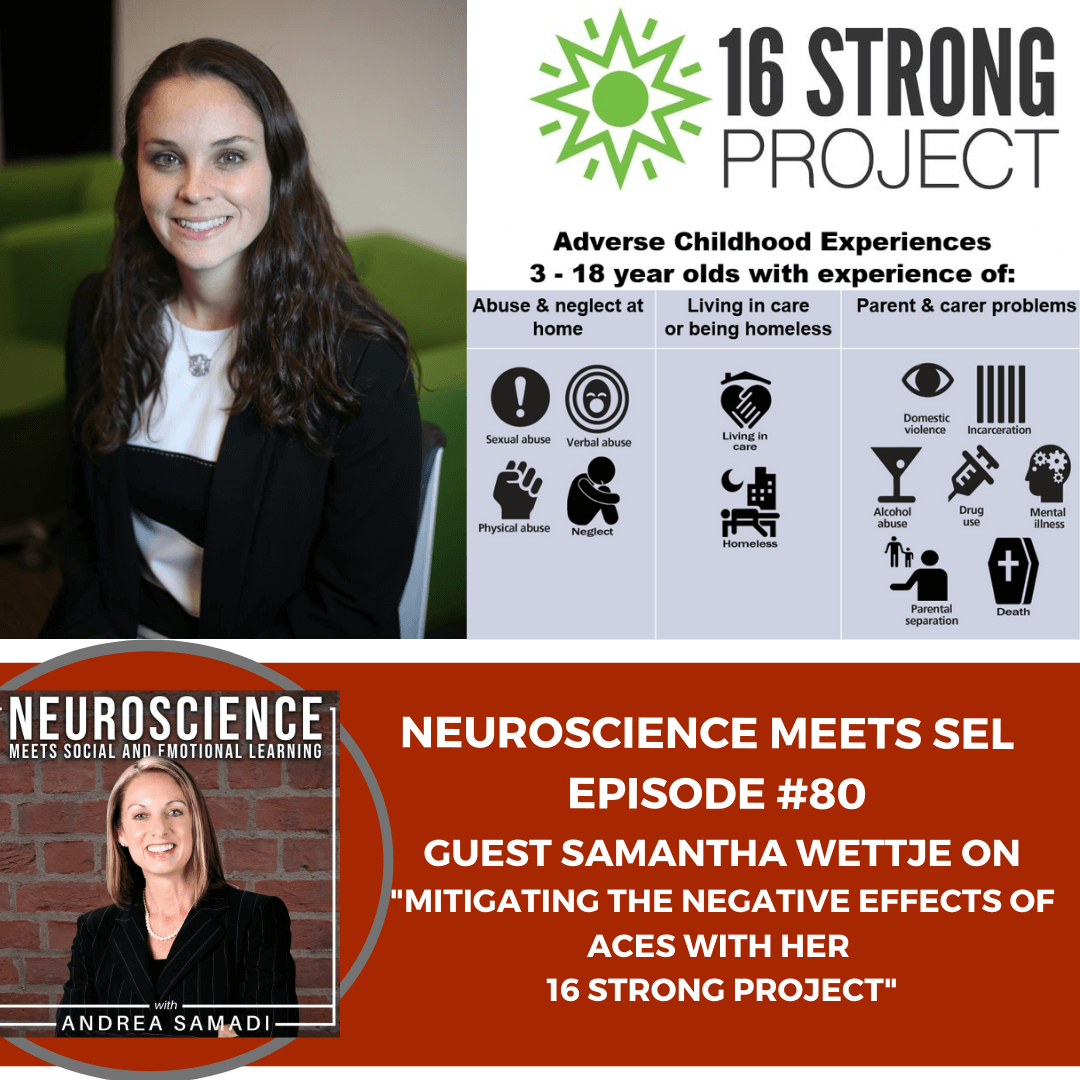
S3 Ep 80Harvard's Samantha Wettje on "Mitigating the Negative Effects of ACES" with her 16 Strong Project.
Welcome back, we have reached episode #80 on the Neuroscience Meets Social and Emotional Learning podcast. You can watch this interview on YouTube here. My name is Andrea Samadi, I’m a former educator who created this podcast to bring the most current neuroscience and educational research, matched with social and emotional skills, with interviews from experts from all different fields, to bring awareness, ideas and strategies to our most pressing issues that we are facing, as educators, or parents, to keep all of us working at our highest levels of productivity. I’ve been interested in understanding why some people reach such high levels of achievement, and others don’t…since the late 1990s, and recent discoveries in neuroscience has accelerated our understanding of this. I do appreciate the feedback I’ve received through social media. It helps me to know that these topics are helping to bring some new thoughts, ideas and hope when times have never been so uncertain. Today we have Samantha Wettje, the Founder of the 16Strong Project[i], created in 2018 at the Harvard Graduate School of Education. If you are in the field of education, you will have heard of the importance of understanding ACES (Adverse Childhood Experiences that we did touch on with our last episode) and our next guest is on a serious mission to help our next generation of learners recognize and navigate the challenges they might be facing as a result of ACES in their life. When I received an email from one of Samantha’s colleagues about her 16Strong Project, I remember exactly where I was, because it really is true that when you attach emotion to a memory, it’s something you don’t ever forget. When I read that Samantha had created this project in response to her experience of living with a mentally ill and addicted parent, I literally stopped what I was doing to read more. Is all I needed to see in the email was ACES[ii], (that we just spoke about with Eric Jensen on Episode #79[iii], Harvard and Project…and I was writing an email back to find a time that we could speak so I could learn more about the 16Strong Project, and here we are. Welcome Samantha, it truly is an honor to speak with you today. I do hope that we can use this platform to help more people learn about this incredible initiative you have created in response to one of the largest problems facing young people today. Q1: Can you give some background as to why you started the 16Strong Project, and what does 16 Strong mean to you? Q2: I felt connected to this project BEFORE we spoke on the phone because I had been thinking for quite some time that I needed to find someone that I could speak to on this podcast who had defied the odds that we hear associated with ACES. It’s not an easy topic to bring up with someone, so it was just an idea circled on chart paper on my wall. Find someone to talk about ACES. Eric Jensen opened the conversation in EPISODE #79, giving a brief overview of what ACES are, and the fact that a higher score predicts later life adversity. I know when you are launching a project, it might seem like the project is important to you but will the rest of the world agree. How did my response to your email give you more awareness about the importance and urgency of the 16Strong Project? Q3: I follow the work of Dr. Daniel Amen[iv], probably one of the most famous psychiatrists and brain disorder specialists in the country. He has been working with Justin Bieber on his brain health, (he likes to call mental health brain health since when our brain works right, we work right—so his work is all around keeping our brain healthy). Something I found interesting from his work is that it is being “normal” is a myth. He says that “51% of us will have a mental health issue in our lifetime”[v] (post traumatic stress, depression, anxiety, addiction, eating disorder) just to name a few that are the most common issues he sees young people for. I know how important th
S3 Ep 79Brain-Based Learning Author Eric Jensen on "Strategies for Reversing the Impact of Poverty and Stress on Student Learning"
Welcome back to the Neuroscience Meets Social and Emotional Learning podcast, episode #79 with Eric Jensen, a leading authority on the science and applications of brain research in education for more than 20 years. Watch the interview on YouTube here. For those who are new here, my name is Andrea Samadi, I’m a former educator who created this podcast to bring the most current neuroscience and educational research, matched with social and emotional skills, with interviews from experts who have risen to the top of their field with specific strategies or ideas that you can implement immediately, to take your results to the next level. Thank you so much Eric, for coming on this podcast today. Where have I reached you? Just to give some background of Eric Jensen and his work: Dr. Eric Jensen is a former teacher and Top 30 Global Guru. He co-founded an academic enrichment program, held in 16 countries with over 85,000 graduates. Jensen has authored over 30 books[i] including 3 bestsellers with his 2 most recent being Brain-Based Learning (in its 3rd edition)[ii] and Poor Students Rich Teaching[iii]. He is also member of the invitation-only Society for Neuroscience.[iv] Eric, I know that your background has been focused around students and poverty, and how poverty impacts the brain and learning, specifically as it relates to trauma and stress. While our stress levels seem to keep jumping up to new levels each month as new stressors arise, we’ve got it handled here, as we have both parents working together with our children. I can’t help but think of those families who don’t have the resources or support that they need and would like to hear your thoughts of solutions that teachers and families could be looking at to better support students at this critical time in our world. Q1: Can we start off with a brief overview of what stress does to the brain, specifically when we are trying to learn (if we are a student) or complete our work (if we are in the corporate space) as well as to think about the dangers of emotion contagion. What can we do these days to prevent stress from wreaking havoc on our lives, and improve our resiliency with a mind/body integration? Q2: Right now, it’s such an odd time in the world with this global pandemic, but this podcast audience reaches into over 110 countries, and I know that the tips you have for us in the US, will be relevant to those around the world. Can we talk about the topic that I know you focused on with your doctoral dissertation, the fact that 1/5 children grow up in poverty? How does poverty impact a child’s brain? Q3: I mentioned in the beginning, that many children are preparing to go back to school (at least virtually in my State) this week, and I did just interview authors Doug Fisher and Nancy Frey on their book about Distance Learning which provided some great suggestions for transitioning to 100% online learning. I still can’t help thinking of low-income families, and how they are coping. Our stress levels are high here as we are adapting to our new schedules, creating new workspaces, (suddenly we realized I need to buy 2 new desks with chairs) new routines, and expectations. What support or words of encouragement would you have for teachers serving low income students who might not have everything they need and their parents as we transition back to school virtually? Q4: How does exposure to stressors in the home (that we’ve heard of from children with ACES—Adverse Childhood Experiences) influence a child’s working memory? What strategies do you have to teach students with poverty in mind to help students with impulse regulation, visual/spatial skills, language skills, cognitive skills, social and emotional skills and conflict resolution? Q5: I heard you say that “our DNA is not our destiny” and I just loved hearing this because we don’t choose our parents. Next week I’m speaking with the Founder of the 16 Strong Project, created out of Harvard’s Grad School of Edu
S3 Ep 78Award Winning Author David A. Sousa on "How the Brain Learns"
Welcome back to the Neuroscience Meets Social and Emotional Learning podcast, episode #78 with David A. Sousa, an international educational consultant and author of more than 16 books that suggest ways that educators and parents can translate current brain research into strategies to improve learning. Watch the interview on YouTube here. It was David Sousa’s How the Brain Learns book Series[i] that is now in its 4th Edition (that includes How the Brain Learns, How the Brain Learns to Read, How the Gifted Brain Learns, and How the Special Needs Brain Learns) that I was given by an educator when I was urged to add the most current brain research to my programs. When reading this series, I was told from other respected colleagues that this book series is one that every educator should read. It also helped me as a parent of a struggling reader to understand how my own child learns to read and gave me more understanding and patience to help put into practice some of the secrets for accelerating literacy that I will share throughout this interview. I also discovered How the ELL Brain Learns[ii] that helped me to create a webinar for an educational publisher called “Nine Brain-Based Strategies to Skyrocket Literacy and Achievement”[iii] and there’s also Differentiation and the Brain and How the Brain Learns Mathematics. The Leadership Brain suggests ways for educators to lead more effectively in today’s schools. He also has a book for educators, Engaging the Rewired Brain that examines how technology changes the way students' brains function and how educators can adapt instruction to keep students motivated and The Power of Student Teams[iv]: Achieving Social, Emotional and Cognitive Learning in Every Classroom Through Academic Teaming[v] that describes a path to predictable success for every student, in every classroom, in every school—all backed by student data, neuroscience research, and experiences from superintendents, school leaders, teachers, and students who have made the shift, teaching through the power of student teams. David is a member of the Cognitive Neuroscience Society[vi], has conducted workshops in hundreds of school districts on brain research, instructional skills and science education at the K-12 to University levels. Welcome David, thank you so much for taking the time to speak with me today. It feels surreal after studying your books for the past 6 years. Q1: David, I really don’t think that I would have understood how the brain learns, enough to teach it to others without your How the Brain Learns Series that I was given 6 years ago, but at first, it wasn’t like I read the books and understood the workings of the brain instantly. I was a bit intimidated by the memory charts and thought that understanding this topic might a bit over my head without a degree in neuroscience. I was lucky to have a neuroscience researcher to help me with my questions, and with time, I really started to understand this fascinating organ that I had never really thought of before. Can you go back a bit to BEFORE you wrote these books and share where this series originated from, in addition, how did you take into consideration that many people, like me, at first glance, might be afraid of the complexity of this topic? Q2: I love how each book starts with a practitioner’s corner, assessing your current knowledge of reading, or myths about giftedness, or the special needs brain, to bring out some important differences with how the brain learns to read. Can you explain what happens (in the brain) when a child is learning how to read, and perhaps some of the secrets that we can look for to accelerate reading, like “how quickly and successfully the brain learns to read is greatly influenced by the student’s ability to speak?” and how is the Gifted Brain Different than the Special Needs Brain, or the ELL Brain when it’s learning to read? Q3: We’ve all heard the statistics about the importance of reading proficiency by 3rd
S3 Ep 77University Professors and Authors Doug Fisher and Nancy Frey on "Developing and Delivering High Quality Distance Learning for Students."
Welcome back to the Neuroscience Meets Social and Emotional Learning podcast, episode #77 with Doug Fisher and Nancy Frey, who are both professors at San Diego State University in Educational Leadership where they focus on policies and practices in literacy and school leadership. Watch the interview on YouTube here. For those who are new here, my name is Andrea Samadi, I’m a former educator who created this podcast to bring the most current neuroscience and educational research, matched with social and emotional skills, with interviews from experts who have risen to the top of their field with specific strategies or ideas that you can implement immediately, to take your results to the next level. My vision is to bring the experts to you, share their books, resources and ideas to help you to implement their proven strategies, whether you are a teacher working in the classroom or online, a student, or parent working in the corporate space. Welcome Doug and Nancy, it’s wonderful to meet you after enjoying your books for the past few days. Doug and Nancy are also both teacher leaders at Health Sciences High & Middle College, an award-winning open-enrollment public school in the City Heights neighborhood of San Diego that they co-founded in 2007. For over 2 decades, they have dedicated their work to the knowledge and skills teachers and school leaders need to help students attain their goals. Their shared interests include instructional design, curriculum development, and professional learning. Doug and Nancy have co-authored numerous articles and books on literacy, and leadership that I’ve included links to in the show notes, including: This is Balanced Literacy,[i] The Teacher Clarity Playbook, PLC+,[ii] All Learning is Social & Emotional[iii], The Teacher Credibility and Collective Efficacy Playbook,[iv] and most recently The Distance Learning Playbook[v] with co-author John Hattie[vi]. I couldn’t start this podcast, without acknowledging John Hattie’s Visible Learning Research[vii] and the fact that he is the co-author of your Distance Learning Playbook. I 100% agree with the write-up I saw in your book that says “The pandemic teaching of mid 2020 was not distance learning but rather crisis teaching.” But starting now, teachers have the opportunity to prepare for distance learning with purpose and intent.”[viii] I’d love to learn how the idea of The Distance Learning Playbook came about and why it was important for you to include John Hattie as your co-author. (Discuss the playbook style of PD book and about John’s Visible Learning research). My next question for you ties into our last podcast, episode #76 with Michael Horn on “Using a Positive Lens to Explore Change and the Future of Education”[ix] where he spoke about the importance of embracing technology as an important component of our future, and the article you wrote for SmartBrief.com on “4 Steps for Powerful Distance Learning Experiences”[x] ties right into this topic. This morning I had both my girls go “back to school” online and I was grateful that I felt a bit more prepared for this after getting ready for this interview and reading that article. Could you outline these 4 steps as many schools and families are like me, in the beginning stages of going back to school, with distance learning being the platform to launch the school year, before students transition to in person learning? Because this podcast focuses on social emotional learning, I’d love to dig a little deeper into the concept of the all-important teacher-student relationship. I know that building relationships is one of John Hattie’s teaching effects from one of our earlier episodes, #7 with Assistant Superintendent Greg Wolcott, who wrote his book Significant 72 based on the importance of student-teacher relationships.[xi] What type of impact do those relationships have on student learning and how do teachers build those relationships from a distance? Tying in closely with the t
S3 Ep 76Speaker and Writer Michael B. Horn on "Using a Positive Lens to Explore Change and the Future of Education."
Welcome back to the Neuroscience Meets Social and Emotional Learning podcast, episode #76 with Michael Horn, the author and coauthor of multiple books, white papers, and articles on education, including the award-winning book Disrupting Class: How Disruptive Innovation Will Change the Way the World Learns [i], (a book I think that everyone should read as it describes how disruptive technologies will personalize and revolutionize learning) making complete sense with what’s happening with online learning in the world today. He also wrote the Amazon-bestseller Blended: Using Disruptive Innovation to Improve Schools [ii]and his most recent book, Choosing College: How to Make Better Learning Decisions Throughout Your Life.[iii] that was written to help students and parents stay ahead of the curve as they make important college decisions. Watch this interview on YouTube here. Podcast Intro and Background on Michael Welcome Michael! It was fun to hear your reaction to some of my questions yesterday, that dig back a few years. I first saw you speak, Michael, at the ASU/GSV Summit in San Diego in 2016[iv] when our company was nominated for the McGraw Hill Innovation Award[v] in K-12 Education and wanted to watch this event, learn from the speakers, through streaming video. The title of my notes this year was “Aha Moments from the Eyes of a Disruptor” so I must have been reading your book Disrupting Class at that time. It was from this event that I learned about disruptive ed tech companies like Class Dojo, Clever and Remind who were all skyrocketing their online services within the school market (and now most people have these apps on their phones) and I knew this conference was one that I needed to stay connected to, and learn from these speakers, with you being one of them, if I wanted to stay at the forefront of innovation in education. Things really have changed since 2016, haven’t they? Thank you so much for meeting up with me, to share your vision of education with those who are listening. I’ve been on your email list, ever since that 2016 summit, and felt that it was time I reach out to you when your email subject matter read “Why Developing Character in Schools Matters” as I have been focused on a Character Manual for Educators to put these of these concepts into practice. Q1: Michael, I have so many questions that range from the K12 market, into higher education, and then I found your podcast Class Disrupted[vi] that you started when the coronavirus pandemic disrupted education and changed everything we as parents, teachers, or workers know about what it means to go to school. I listened to a few episodes, and loved them with my favorite being the one about “Why can’t Sal Khan just teach everyone?” Can you give an overview of your podcast, and what your vision is so our listeners can check it out and stay with your content? Q2: Let’s go back to 2016 to that ASU GSV Summit (this was the one that Bill Gates was a keynote speaker), these were the good old days in education. I was watching some of these ed tech companies talking about their growth. It’s crazy for me to look back and see that Class Dojo was only founded 9 years ago, and Coursera 8 years ago or that the Remind app back then was only in 50% of public schools (I am sure they are in 100% by now). We can all see that online education and technology has disrupted education. Remember Moore’s Law[vii] that shocked Gordon Moore, Intel’s co-founder and author of Moore’s Law that states that “computing power will double every two years.” What advice would you have for schools/teachers/parents that were not ready or set up for this wave of online education that we are all now getting used to? Q3: As a parent of 5-year-old twins, what are you focused on at home with their learning? I know routines are important, but what does a typical day look like for you? I’m asking mainly because I’m hoping to hear that someone whose written all these boo
S3 Ep 75Director of Rutgers SEL and Character Development Lab, Maurice J. Elias on "Boosting Emotional Intelligence Through Sports, Academics and Character."
Welcome back to the Neuroscience Meets Social and Emotional Learning podcast, episode #75 with Maurice Elias, a Professor of Psychology at Rutgers University[i], Director of the Rutgers Social-Emotional Learning Lab[ii], Academic Director of The Collaborative Center for Community-Based Research and Service at Rutgers and he is one of the members of CASEL (Collaborative for Social and Emotional Learning) which our listeners will know as a trusted source for knowledge about high-quality, evidence-based social and emotional learning programs.[iii] Prof. Elias lectures nationally and internationally to educators and parents about students’ emotional intelligence, school success, and social-emotional and character development. Among Dr. Elias’ numerous books are ASCD’s Promoting Social and Emotional Learning: Guidelines for Educators, the Social Decision Making/Social Problem-Solving curricula for grades k-8, Emotionally Intelligent Parenting, and many others that I will reference in this interview. Watch the interview on YouTube here. Podcast Introduction and Backstory of Maurice Elias My name is Andrea Samadi, I’m a former educator who created this podcast to bring the most current neuroscience research, matched with social and emotional skills, with interviews from experts who have risen to the top of their field with specific strategies or ideas that you can implement immediately, to take your results to the next level. My vision is to bring the experts to you, and help you to implement their proven strategies, whether you are a teacher working in the classroom or online, a student, or parent working in the corporate space, for immediate results. When I was first introduced to Maurice Elias, it was from Corwin Press’s Marketing Department, who explained to me that his work fit directly into what we are doing with this podcast. When I looked at his website, and the Rutgers Social and Emotional Learning lab, it looked familiar—I know I have been on his page before, while researching leaders in this field, and within a minute of watching a YouTube video of his work from back in 2010[iv] that describes Emotion in Education, I wish I had been introduced to him 10 years ago. Welcome Maurice, it’s wonderful to meet you. Thank you so much for agreeing so quickly to share all the work you have been doing to transform education. After reading a couple of your books, I couldn’t stop thinking about what would have happened, if I had met you 10 years ago when I worked at Pearson Education... At that time, I was working as a sales rep, selling programs and services to the school market and someone reminded me recently of how hard I tried to put social and emotional learning content into one of the products we were selling. For those who have been following this podcast, you will know that I have had this vision for teaching these skills in the classroom for the past 20 years, and finally decided to approach Pearson’s Product Development team with this vision and was told “let’s take it slow, and poll some educators, and see how they respond.” It just wasn’t the right time. If only I had met you back then, Maurice, I would have just played the video I saw of you in 2010 called Emotions in Education to help them catch the vision that you explained in be “the foundation of what learning is all about.”[v] I would have had the right person, with the right sense of the urgency for this vision but so glad to be meeting you now! Q1: Maurice, as a Professor of Psychology at Rutgers University and the Director of the Social-Emotional and Character Development Lab that guides school-based efforts on SEL and character development, I wonder how and when your vision for SEL and Character began and what’s the vision that you hold now for your SECD lab[vi] and SEL in schools? Q2: I’ve always thought that character was an integral component to SEL and I can see that you agree calling your lab social and emotional and charac
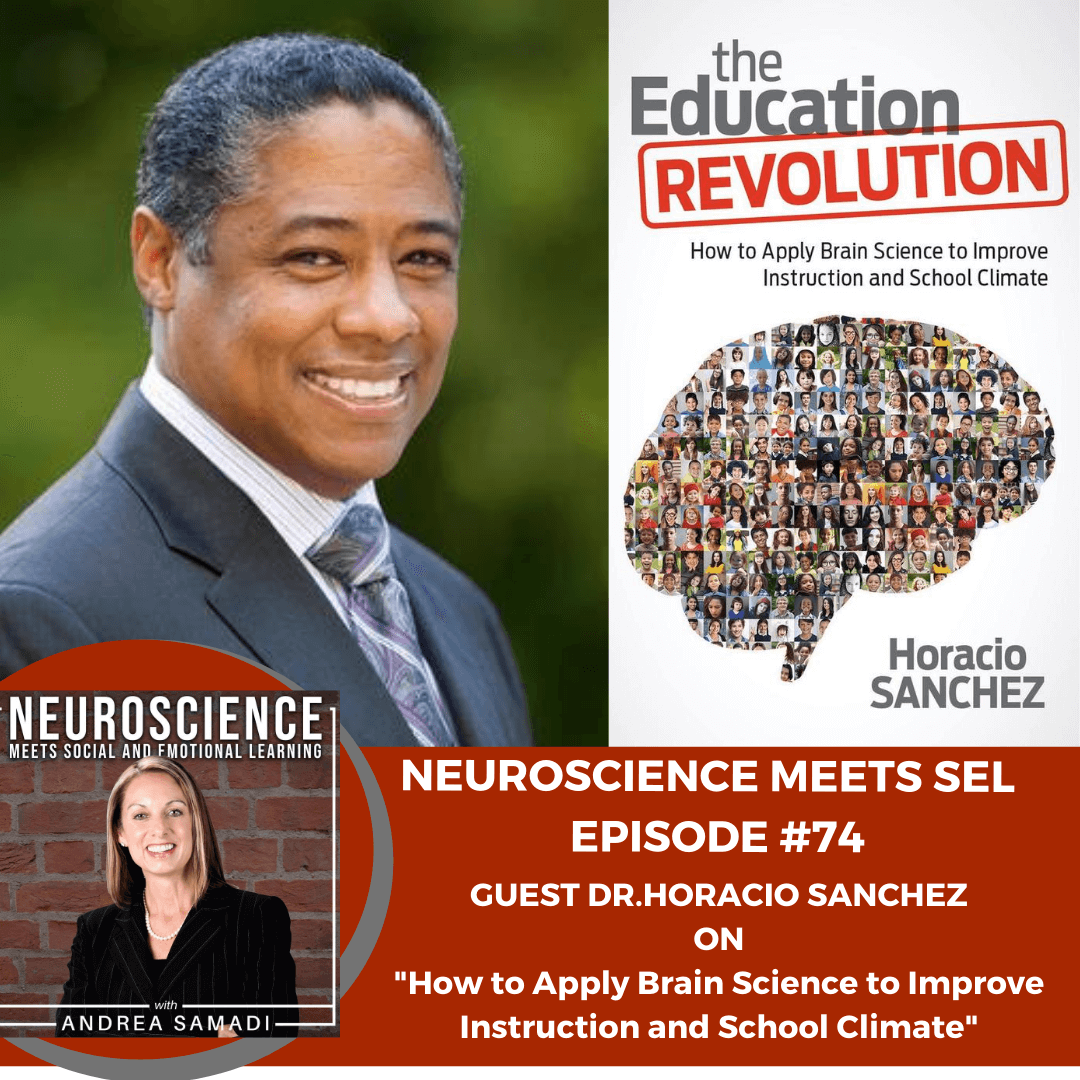
S3 Ep 74Brain Science Author, Horacio Sanchez Addresses Race, Culture and "How to Apply Brain Science to Improve Instruction and School Climate"
Welcome back to the Neuroscience Meets Social and Emotional Learning podcast, episode #74 with Horacio Sanchez, the President and CEO of Resiliency Inc.,[i] an agency leader in helping schools improve climate, instruction, and discipline with tools and resources that include his most recent book The Education Revolution.[ii] Watch the interview on YouTube here. My name is Andrea Samadi, a former educator who created this podcast to bring the most current neuroscience research, along with high performing experts with specific strategies or ideas that you can implement immediately, to take your results to the next level. Welcome Horatio, it’s an honor to have you on today, especially knowing that one of our early interviews, EPISODE #3 with Ron Hall, from Valley Day School, Pennsylvania on “Launching Your Neuroeducational Program”[iii] features you in the show notes and YouTube video (2:51)[iv] I highly recommend listeners go back to the video interview, and hear Ron Hall’s story of meeting Horatio by chance at an educational conference, where he says that “in 10 minutes (of his presentation) he saw his future in education change right in front of his eyes.” I want to give a bit more information on your background, since your background is vast in the field of neuroeducation, which is what we focus on here on this podcast. Horacio Sanchez is recognized as one of the nation’s prominent experts on promoting student resiliency and applying brain science to improve school outcomes. Horacio has been a teacher, administrator, clinician, mental health director, and consultant to the Department of Education in North Carolina, Pennsylvania, and other states. His diverse education and background have helped him to merge research, science, and practice which is why he has been so successful in the field of neuro education. His best-selling book, The Education Revolution published by Corwin Press, addresses the decline in empathy, increase in obesity, and the impact of implicit bias on minority students. Welcome Horacio, I have so many questions to ask you, and hope that we can get them all in! Q1: I like how you named your company Resiliency Inc as the word resiliency is important these days in education. Can you tell the story that I heard you tell on a podcast with John Williams, where you talk about how resiliency is built? (early days were hard, every day was a struggle, then they progress with hard work, effort, and now you have only good days and better days). Q2: As a former publishing rep, I have visited thousands of schools in the US (mostly in the Southwest region) and know that you can “feel” a school’s climate within minutes of walking into a school, sometimes even from the parking lot. We’ve all felt this feeling—and you know that our students feel it also. How do you improve school climate and what outcomes does a school typically see with your school climate improvement plan? Q3: One of the motivators for me doing the work that I’m doing with SEL/neuroscience began in the late 1990s with the Columbine tragedy being a huge motivator to take action. With all of your knowledge with students with emotional disorders, why do you think we have these incidents in the US? (My friends in Australia say they have not had one school shooting ever). What types of programs, or things should parents and educators be aware of to prevent these incidents from happening in the future? (connecting with the shy/anxious type) Q4: These days, it’s very clear that students are not learning as much as they could be or should be learning. Parents are just not equipped to be teachers, and I’m talking from the heart, as a parent with a teaching degree, with more resources for my 2 kids at home to learn while schools have not been in session. With a sense of urgency, I’m thinking about students in poverty who will be struggling more these days with less instruction, especially if parents are working. How does culture and po
S3 Ep 73Chris Manning, Ph.D. on "Using Neurowisdom to Improve Your Learning and Success in Life"
Welcome back to the Neuroscience Meets Social and Emotional Learning podcast, episode #73 with Chris Manning, Ph.D., who is a distinguished clinical professor of finance, real estate and entrepreneurship at Loyola Marymount University. He has authored and co-authored more than 30 articles published in both academic and professional journals (including the Harvard Business Review), and he continues to serve on the editorial board of the Journal of Real Estate Research. Watch the interview on YouTube here. My name is Andrea Samadi, and if you are new here, I’m a former educator who created this podcast to bring the most current neuroscience research, along with high performing experts who have risen to the top of their field with specific strategies or ideas that you can implement immediately, to take your results to the next level. Today we have Chris Manning, who co-authored the book Neurowisdom: The New Brain Science of Money, Happiness and Success[1], with my mentor Mark Robert Waldman, and he is the only business professor I know who applies contemplative values and empathetic dialog when working with his Executive MBA students and corporate leaders. It is, in many ways, the psychology of business and work under one umbrella. Thank you so much for agreeing to come on the podcast and sharing with our audience your knowledge on the brain as it relates to business success. Chris, I just met you last week on Mark Waldman’s webinar, but I’ve known about you for years, through Mark Waldman. I didn’t know about your interest and vision to bring this concept you call Neurowisdom to your Executive MBA students. Q1: As simple as possible for our podcast listeners, please tells us What is NeuroWisdom all about? Answer: NeuroWisdom is about learning to use your brain better to be more self- aware and self-directed to better achieve your goals and enjoy your life more; Several years ago, Mark Waldman and I published our research findings learned from teaching our Loyola Marymount University Executive MBA NeuroLeadership course in a popular book (that we could also use as a textbook for our graduate level NeuroLeadership course): This book, NeuroWisdom: The New Brain Science of Money, Happiness and Success, has now been turned into an online interactive course[2] complete with audios and videos to help people learn how to use their own brains better. (I recommend your listeners go MarkRobertWaldman.com[3] to check out our new and improved NeuroWisdom interactive online flipbook course complete with audios and videos and also look over our 10 free ebooks on related topics while there.) In essence, our book discusses the practical application of recent Neuroscience discoveries about our brains that can enable a person to learn more efficiently, with less stress and more joy and become more successful (at whatever that means to them whether it be their career, relationships, an advanced graduate professional degree, or merely making more money). Q2: What are the practical useful applications of recent Neuroscience discoveries that your book explains that our listeners can use every day in their life pursuits? Answer: We call them the “Four Pillars of Wealth” in our book (referring to a person’s search for both “inner and outer wealth”) and they are really more about “How to take advantage of your brain’s natural patterns and tendencies to better learn and achieve things in life” While we all often “get in the way” (or “block”) our natural healthy motivations, and our natural abilities to learn and get ahead in the world, our book explains how to accept and take advantage of four natural brain circuits in everyone’s brain that supports our learning and how get what we want in life. Q3. What are the actual “Four Pillars of Wealth” you talk about in NeuroWisdom and how does each of them help people learn better (faster, easier, and with less stress and more joy) to overcome whatever obstacles get in the w
S3 Ep 72Dr. Shane Creado on "Sleep Strategies That Will Guarantee a Competitive Advantage"
Welcome back to the Neuroscience Meets Social and Emotional Learning podcast, episode #72 with sleep medicine physician, sports psychiatrist and author of the NEW book that I couldn’t put down, “Peak Sleep Performance for Athletes: The Cutting-Edge Sleep Science That Will Guarantee a Competitive Advantage”[i] Dr. Shane Creado. I highly recommend watching this interview here on YouTube with the visual images. My name is Andrea Samadi, and if you are new here, I’m a former educator who created this podcast to bring the most current neuroscience research, along with high performing experts who have risen to the top of their field with specific strategies or ideas that you can implement immediately, to take your results to the next level. I am beyond excited to have Shane Creado[ii] here today. He is a double board-certified sleep medicine doctor and psychiatrist who practices functional sleep medicine, integrative psychiatry, and sports psychiatry, putting all those skills together to uncover underlying factors that sabotage the patients, comprehensively treats them, and helps them to achieve their goals. That shows dedication. I want to give you just a bit about Dr. Creado’s background that shows where this dedication to helping others improve their lives began: He completed an undergraduate degree in physical therapy, went on to do an MD. He then went on to a fellowship in Sleep Medicine at the University of Wisconsin because of the huge overlap between sleep and psychiatric issues. As he believed in optimization, not normalization, he devoted his time to optimizing brain health in professional athletes, executives and anybody who is interested in peak performance. If you have not yet listened to episode #71 from last week, I did a deep dive into his book to prepare for this interview so we could maximize our time together. Welcome Shane, thank you so much for writing back so quickly and agreeing to come on the podcast. I know how busy medical professionals are--these days especially, and I know that you are working with patients in between this podcast. I didn’t expect that I would be able to get this time with you, so thank you so much! After reading your book and recording episode #71 about the most important concepts from your book, I had so many questions. INTRO/PRE QUESTIONS: Shane, I first heard you on Tana Amen and Dr. Amen’s Brain Warrior’s Way Podcast[iii], and then watched your YouTube Live with Tana Amen this week to be sure that the questions I ask you, don’t overlap with questions you have recently answered, but before we dive into the questions, can you explain what you do with Amen Clinics in Chicago? Why would someone come and see you? Can anyone come into Amen Clinics for a SPECT SCAN[iv], or do you need to be referred with a specific issue? Q1: I love how you named your book Peak Sleep Performance for Athletes, as I know you are talking about concepts that EVERYONE can apply. I always look at elite athletes, or friends I see in exceptional shape and always ask them the same question “What foods do you eat and how do you train” to see if I can learn something. When you wrote this book, what message did you want to get across to those who work with elite athletes, as well as the regular person reading it, who may not be an elite athlete, but wants to train, live, eat and act like one? Q2: I came across something you said in your book that I thought was so profound, I instantly created a graphic and shared it as many places as I could. You mention “your brain health and sports performance cannot be optimized unless your sleep is optimized. Once this is achieved, your quality of life will skyrocket. When you sleep well, the fabric of your life will change. When this happens, it will have a ripple effect.” This podcast is all about improving our results with the understanding of neuroscience that I think is relatively new. 20 years ago, no one was asking me “what are you doing to improve your brain
S3 Ep 71Self-Regulation and Sleep with a Deep Dive into Dr. Shane Creado's "Peak Sleep Performance for Athletes"
Welcome back to the Neuroscience Meets Social and Emotional Learning podcast, I’m so grateful that you are here, listening with me at this time when there’s a lot of chaos and uncertainty in the world. I’m sure you are feeling it—I most certainly am—but I do know that this chaos that we are feeling will always be here. There’s always going to be something happening in the world, and we must be prepared and stay in control, without letting outside influences impact our results. This is one of the key strategies used by the most successful people in the world. They have all have developed sound systems, with a clear plan to follow, and they don’t ever veer of their path. This uncertainty surely has the ability to knock the best of us, even the most productive, off course, without a clearly defined plan in place. My name is Andrea Samadi, and if you are new here, I’m a former educator who created this podcast to bring the most current neuroscience research, along with high performing experts who have risen to the top of their field with specific strategies or ideas that you can implement immediately, to take your results to the next level. First of all, I want to thank everyone who has followed, supported and shared this content. With this episode, we are now at over 20,000 downloads, reaching over 110 countries. I’m so thankful for the opportunity to create and share these ideas with such a wide audience. This has been the most powerful learning opportunity I have ever been involved with, and with each expert that we bring on here, we are learning the most current success strategies, to help us to all stay on track. Here’s what we have covered so far on this podcast, so you can see where we started and where we are going. Season 1 EPISODES 1-33 introduced the social, emotional and interpersonal competencies to help parents, educators and those in the workplace to bridge the noticeable gap with SEL Competencies like growth mindset, responsible decision-making, self-awareness, social awareness, self-regulation and relationship building. We know that interventions that address these competencies increased students’ academic performance by 11 percentile points[i], compared to students who did not participate in such programs. Students learning these competencies also showed improved classroom behavior, an increased ability to manage stress and depression, and better attitudes about themselves, others, and school. The case is clear that these competencies are important for us to practice whether we are a teacher working in the classroom, a parent working with our children at home, or even how we interact with each other in the workplace. Implementing these SEL competencies are the first step towards bridging the gap that employers have noticed exists in the workplace today. Season 2 EPISODES 34-67 introduced more high-level experts with cognitive strategies from many different fields, with a focus on improving learning, focus, attention, goal setting, planning, perseverance and problem solving. These are the core skills that our brain uses to think, read, remember, reason and pay attention and each guest explained how they use these skills for improved, consistent, predictable results in their field. Moving into Season 3 now, with EPISODES 68 and onwards we are diving deeper into these 5 competencies by connecting them to well-known authors and experts and bringing in a cognitive connection. The more ideas, thoughts, and strategies that we can implement in our day to day lives, with our brain in mind, the more productive we will be. If we can learn to do everything with our brain in mind, the results will not only show up in our personal or academic/work lives, but we will be increasing our emotional intelligence at the same time—a skill that will prepare us for future life success. This week, episode #71 focuses on applying self-regulation (everything that we do to feel better) with a close look at Dr. Shane Creado’

S3 Ep 70Self-Regulation and Behavior Change for Leaders with David R. Hawkins’ "Power vs Force"
Welcome back to the Neuroscience Meets Social and Emotional Learning podcast, episode #70 Applying Self-Regulation to Move to Higher Levels of Consciousness and Results with David R. Hawkins’ Power vs Force book to analyze the hidden determinants of human behavior. My name is Andrea Samadi, and if you are new here, I’m a former educator who created this podcast to bring the most current neuroscience research, along with high performing experts who have risen to the top of their field with specific strategies or ideas that you can implement immediately, to take your results to the next level. Today we are going to take a closer look at Human Behavior. The past 4 episodes have touched on identifying paradigms or habits that we want to change, with some ideas on how to change them with episode #67 with a Deep Dive into the Most Important Lessons I Learned from Bob Proctor’s Seminars[i] and episode #68 The Neuroscience of Personal Change, with a Deep Dive into Dr. Stephen Covey’s 7 Habits of Highly Effective People[ii]. I have received the most feedback about these 2 episodes, out of all the episodes we’ve done in the past year, so thank you for everyone who listened sent me messages about what you learned from the awareness and application of these 2 episodes. When writing these lessons, they often take many different turns and directions and you never know how they will turn out. I’m so glad to hear they have been helpful. I know that we can still go a bit deeper into looking at human behavior, with some serious introspection, that will improve our self-awareness, as we take serious inventory of what’s working in our life, and what’s not working. When I first heard the term “paradigm” when I worked with Bob Proctor in the late 1990s, it took me a few years to understand what he was talking about. Then it took me many more years to figure out what paradigms weren’t serving me. Then, after writing them down, and staring at them, it took me a few more years to decide I was going to change a couple of them at a time. We all have paradigms that are working for us—so we will want to keep those and be aware of the ones that are preventing us from reaching those higher levels of achievement. If you want to identify your paradigms (positive and negative ones): take out a piece of paper and write out all of the behaviors that you do habitually. You will be able to identify your habits that are working for you (they’ll be the ones helping you to produce better results in your life) and the ones that are not working for you (the ones that hold you back). Circle the habits that are NOT working for you and pick one or two that you want to change. I suggest reviewing episode #35 How to Use Your Brain to Break Bad Habits[iii] as I go into detail here on how to substitute bad habits for more productive ones, with brain science in mind. For the next 90 days, you focus on changing just one habit, and this will take discipline. It will take the ability for you to give yourself a command and follow it. For example: I am going to switch this habit for a new one—like maybe you want to stop drinking coffee, so you substitute coffee for hot lemon water in the morning instead. If you really want to stop the old habit, you will be ready to make this switch. I want to give a shout out here to Mandy Krueckeberg, a social worker who follows this podcast. I recently saw her post on her FB that she was on day 1 of cutting out coffee in her diet, and she did it by replacing the habit she wanted to change (coffee) with something that made her feel better (by drinking cinnamon tea). When I was writing this episode, she was on day 3 of this habit change and the longer she keeps this up, the more likely it will be that this habit change will be a success as her brain will lock into the new neural pathway she’s creating. She applied discipline to achieve the results she was looking for. Awesome work Mandy! There are also tools that you can use to
S3 Ep 69Certified Neurocoach Ben Ampil on "Using Your Brain to Manage Your Behavior and Results"
Welcome back to the Neuroscience Meets Social and Emotional Learning podcast, episode #69 with Ben Ampil, a US-Certified Neuroscience Coach and Neuro-Linguistic Programming (NLP) Trainer who I have watched all over the news this weekend, even though he is located in the Philippines, his positive message about using your brain to manage your behavior is having a global impact and following. Watch the interview with visuals here on YouTube. My name is Andrea Samadi, and if you are new here, I’m a former educator who created this podcast to bring the most current neuroscience research, along with high performing experts who have risen to the top of their field with specific strategies or ideas that you can implement immediately, to take your results to the next level. I’m beyond excited to speak with Ben Ampil today and we’ve been chatting about our topic the past week or so, adding new thoughts and ideas to his message as things in the world are changing on a daily basis, but Ben’s message remains consistent. He has had extensive corporate experience in the various cross-functional disciplines of General Management, in a variety of Industries and has also been a Keynote Speaker in Conferences in Neuroscience in London and in Bangkok. His background and speaking history is top notch, and I know that he will share some insights to make us all think differently after this interview about the best ways for us to manage our behavior with our brain in mind. Welcome Ben! All the way from Manila, Philippines! This was fun setting up this interview and making sure we had the time zone correct. You are so right, nothing is going to stop us from finding the right time to speak together and from now on, I will be mindful about what it means for me to say “see you tomorrow” because my tomorrow and your tomorrow are 15 hours apart. Q1: Since connecting with you on LinkedIn, I noticed many similarities with how much we are both passionate about the topic of neuroscience. It’s an area I lose track of time when I’m learning and studying and spend all of my spare time with. What got you interested and passionate about the field of Neuroscience? Q2: I’ll never forget the first person who introduced me to this topic. He was a school administrator and he urged me to take my work in this direction. He handed me a bunch of books off his bookshelf, one of them was a series from David Souza on How the Brain Learns[i] (to Read, the Special Needs Brain, the Gifted Brain, the ELL Brain etc) and at first glance of this book series, without any knowledge of how the brain works, it can be an intimidating topic. You’ve created some acronyms to help demystify an otherwise intimidating topic like “Neuroscience” Can we break this down a bit? 2 A) CHANGE OUR PARADIGMS vs BEHAVIOR: The past few podcasts I’ve taken a deep look at the fact that in order to make significant change in our life, we need to change our paradigms vs our behavior….Can you explain how our brains work with your acronym BATMAN and keep in mind that we don’t want to just change our behavior, but change some of our old ways of thinking or beliefs that might be keeping us stuck? 2 B) WHAT ARE SOME STRATEGIES FOR OVERCOMING THE FEAR WE MIGHT BE FEELING IN THE WORLD TODAY? (Real fears like you’ve lost your job, or someone you know is really struggling with something or even a perceived or imagined fear?) SCORE 2 C) Over the weekend, I created a graphic based on Dr. Bruce Perry’s concept of the Power Differential that describes the fact that there is this power differential that puts one person at a cognitive disadvantage and can cause significant issues with leadership and communication (it describes what happens to a young child’s brain when dealing with an adult, or when anyone gets pulled over by a policeman for speeding etc. What are triggers the fear we feel coming from the amygdala and what are some solutions we can keep in mind to offset this instinctive fear? SCARF as
S3 Ep 68The Neuroscience of Personal Change with Stephen R. Covey‘s ”The 7 Habits of Highly Effective People”
Today’s episode #68 started out with me wanting to take a look the most important concepts from Dr. Amen’s “Thrive by 25”[i] online course that dives deep into understanding brain basics that we should all understand for ourselves as well as to better understand others, since brain health strategies will lead to a better brain and life. But—while writing this episode, I was sitting in an empty lobby of what used to be a busy local resort, looking around at what was once the hustle and bustle of business people, hurrying off to their events, or families rushing off to the pool to spend time together and the fact that the world has literally STOPPED STILL really made me think. This place looked like a Ghost Town, almost like in a movie where the scene freezes. It made me freeze and think. Things around the world have changed like night and day over the past few months starting with the COVID-19 Pandemic, with the danger of infection and death, and the change continues as the world now faces racism, riots, and global economic upheaval. I thought that this episode needs to go a bit deeper than I was planning at first, and really needs to address the Neuroscience of Change. Since we usually reject anything that we aren’t familiar with, I thought this episode could look at how to consider a change with our thinking or perspective, resulting in a change in behavior around some of the critical issues our world is facing, to see where we can take individual responsibility. If we can add the understanding of how our brain works optimally and how we can improve ourselves by really thinking about some of these issues our world is facing, we can become more empathetic towards others, and set the stage for the much needed change our world needs. If nothing is done at this time, we will look back and there will be no change, but if we can all do some self-reflection, and make our own personal and individual change, 20 years from now, we will know if our actions made a difference. While still thinking about the new direction of this episode, I read a social media post from my mentor, Greg Link[ii], who I’ve mentioned in past episodes. As co-founder of the Covey Leadership Center, Greg was the one who orchestrated the strategy that led Dr. Stephen R. Covey's book, The 7 Habits of Highly Effective People: Powerful Lessons in Personal Change, (1989) to become one of the two best-selling business books of the 20th century according to CEO Magazine, selling over 20 million copies in 38 languages. He created the marketing momentum that helped propel Covey Leadership Center from a start-up company to a $110-plus million-dollar enterprise with offices in 40 countries. When he writes something, I always pay attention and what he has to say is always insightful and profound. This time, what he wrote was full of his own personal insight on what was happening in the world today, tied to the 7 Habits book, and he was talking about Habit #5. For such a popular business book, that sold so many copies, you would think I would know the habits off by heart. If you were to ask a room of 100 people “who knows about the 7 Habits Book?” most people should raise their hand, but few people (including myself) can actually name the habits. Did you know the habits were divided up into 3 segments? Habits 1-3 are focused on how we manage ourselves, habits 4-6, how we lead others, and habit 7 how we unleash our potential. The 8th Habit[iii] is a whole new book, published years later in 2004 and it focuses on “Finding your voice and inspiring others to find theirs.” There’s never been a time like this in our world, and more than ever right now, we need to think about how we are managing ourselves, how we lead others, and how we can unleash our potential, and find our voice, in a way that inspires others to do the same. If we can do these 4 things, I am sure that when we look back to this time period, 20 years later, there’ll be some change. If it’s been aw
S2 Ep 67Expanding Your Awareness with a Deep Dive into the Most Important Concepts from Bob Proctor’s Seminars
Today we are going to take a deep dive into the most powerful and important concepts from Bob Proctor’s seminars. If you have not yet heard episode #66[i], be sure to check out this episode first, to get some context behind how I met Bob Proctor, and how he influenced the work we are doing here today. I do suggest going to the show notes and writing down some of the ideas you learn from this episode, since these are some extremely powerful ideas that really can make an impact on your life. These concepts were learned from 6 years of working directly with Bob’s seminars, taking his courses over and over again, and then repeating them periodically over the past 24 years. These ideas changed the trajectory of my life, and I want to share them with you so you can have access them, and see if their application can impact your world, as much as it did for mine. I first met Bob when I was a teacher in Toronto, because his director of sales, Mark Low, lived next door to me at the time, and when I asked him what he did for a living, my whole world changed when he handed me Bob’s You Were Born Rich[ii] book. Be sure to look in the show notes for the links, as Bob gives this book away for FREE on his website under his tips and tools section. Go there, download his book, and this lesson will make more sense once you have had a chance to look at the book first. Before I go into a deep dive of this book, which was also the first seminar I ever attended live (in May 1998), I want to give a backstory that you could relate to, if you’ve ever invested hours of your time creating something. Here’s how I remember this story (and remember from EPSIODE #44 “12 Mind-Boggling Facts About the Brain”[iii] that memories are not 100% accurate, so I’m telling you a story that I remember hearing many years ago and some of the details might be inaccurate, with the way that I’m remembering the events, but you will get the main idea of this story. So, when Bob was first writing this book, (my copy of the book shows a copyright date of 1997 which was just a year before my first seminar with him) and it was years before everyone carried their own personal laptop around. When I think back to writing reports or essays in school at this time, I used a typewriter, so I think that’s how Bob wrote his first book—the manuscript was a physical copy that he had typed, and he would carry it around with him to add more ideas to it, before he sending it off to the publisher. On his way to the publisher, he took a taxi, again, years before we went everywhere via Uber, and he left the only copy of the book in the taxi. This story made me think of all those times I had written something, and then the computer crashed, and the document was not saved, or the times that I just lost something another way, and the only solution was to recreate what you’d lost, and that’s exactly what Bob did with this book. When you are reading it, think of the years of work that went into the stories in each chapter, and these are all true stories—I knew many of the people he wrote about—and then imagine that one day, these ideas were completely lost, and he had to recreate them again, for the world to gain access to them. It will give you an entirely new perspective when you are reading this book. Bob mentions in episode #66 that “he always believed he would reach the goals that he set and believed in the material and that goals are set not to GET—but to GROW.” It’s who we become that’s important in this process, not the things that we accumulate along the way, but the knowledge we acquire and how we use it to help others. When Bob first met me, he asked me “What do you really want?” and it took me back a bit because no one had ever asked me this before. I had to really think about it. I remember not being sure, but in the Born Rich Workbook we had the chance to revisit this and write out our heart’s desire. I still have the workbook from 1998 and what I wrote back then, isn’t far

S2 Ep 66The Legendary Bob Proctor on ”Social and Emotional Learning: Where it All Started”
Welcome back to the Neuroscience Meets Social and Emotional Learning Podcast. If you’ve been listening to our podcast and wonder what exactly we do at Achieveit360.com, go to our website and take a look.[i] We provide courses, books and tools for teachers to implement Character and SEL programs in the classroom along with other consulting services that can be used in the corporate workplace. You can watch this interview on YouTube, but you won't be able to hear the backstory, unless you listen through your favorite podcast channel. Listen to all past episodes here. Here’s the Back Story behind the programs and services that were inspired by our guest today, Bob Proctor. You can go to our website’s About Us[ii] section to see an outline of the last 20 years, and you will see a picture of him at the top of the page, but first let me explain who he is. In 1961, Bob Proctor started studying the book, Think and Grow Rich[iii] (right now it’s showing as #1 in Entrepreneurship Books on Amazon) and this book transformed his life. If you’ve been lucky enough to see Bob Proctor speak live, you’ll see this book and one look at it, you’ll know he’s been reading it every day. He listened to Earl Nightingale’s condensed recording of the book thousands of times, he said he would put this record player in his car and listen to it (back in the days that I can still remember when we had vinyl records before music and audio recordings became available online). He then created his own position that allowed him to work shoulder-to-shoulder with Earl Nightingale at Nightingale-Conant (that at the time was the largest distribution house for personal development programs). He worked there until 1973, before leaving to start his own personal development company where he’s been training people around the world ever since. Today, Bob has studied thousands of books, continues to read Think and Grow Rich every day, and is considered the world’s foremost expert on the human mind. I can personally say that Bob Proctor is one of the rare speakers out there who truly lives and breathes what he teaches, with full integrity—he walks his talk and inspires those around him to do the same. I was fortunate enough to cross paths with Bob in the late 1990s when I was a school teacher in Toronto, when I asked my neighbor, Mark Low, what he did for a living, and he didn’t say much, but he handed me Bob’s You Were Born Rich[iv] book that I read the next day in a staff meeting (hiding it behind my binder as I pretended I was listening to the meeting) and my life was never the same after that day. The book was not just about being rich financially, but was about being rich in potential, saying that we all have deep reservoirs of talent within ourselves, and that we have greatness locked up inside ourselves...everyone has reservoirs of great talent and ability within us and if we can bring it to the surface we can accomplish anything we want. I really liked that idea. That was 24 years ago, and it’s definitely been a journey that started when I quit my job as a teacher and went to work in his offices selling seminars. I want to share some of the top lessons learned from Bob, before we go into the interview. I will definitely do a deep dive into his content after this episode, as it’s so valuable, but looking back to the day I met him, here are my biggest take-aways. If you have some that you want to share, please tag me on social media when I post this interview and share some of yours. Lesson 1: I learned how to set huge goals that most people would say were crazy when Bob asked me “what do you really want?” When I told him, he told me that there were certain steps I needed to follow, that started with writing my goals down on this card he gave me, and if I did all the things he suggested, and believed in what I was doing, I could have what I wanted. I really believed him and followed what he told me to do. Lesson 2: I learned how to be resourceful and make
S2 Ep 65Dr. Barbara Schwarck on "Using Energy Psychology and Emotional Intelligence to Improve Leadership in the Workplace"
bonusThis is episode #65 with Dr. Barbara Schwarck, CEO of Clear Intentions International, who has been helping people get unstuck and make powerful, lasting life changes for over twenty years. Dr. Schwarck is an award-winning, dual-certified coach with extensive academic training in Psychology, Management, Spirituality and Kinesiology. Through her extensive training, she created her unique Neuro Emotional Coaching, a cutting-edge coaching tool rooted in neuroscience, emotional intelligence, with their implications for leadership, and the Muscle Testing 101 app, a tool for people who want to learn how to use kinesiology. Watch the interview on YouTube here. What’s interesting is that Dr. Schwark and I share some of the same influencers. We have Bob Proctor, my mentor and inspiration behind the work I started with youth, coming on our next episode #66 and Dr. Shwarck, like me, has studied his work along with many others. She has used her technique to successfully coach more than 1000 CEOs, professionals, family business owners and thought-leaders who want to be effective leaders, strong performers, clear communicators and difference-makers. In her private coaching practice, clients work with her on anxiety/depression, self-esteem, relationships and personal growth. Last week, Dr. Schwarck and I spoke on a video conference, and she is located right now in Israel, and she wanted to demonstrate her work before we did this interview. I’m a firm believer in reading energy even if you are not in the same room with someone, you can feel it and Dr. Schwarck is the most advanced person at this skill, that I have ever seen. Through a zoom video, she was able to tap into my energy field and find an area where my subconscious or non-conscious mind was holding me back. Once we identified these 2 areas of work, and we named them, we tamed them (like we just talked about on our last episode with Greg Wolcott) showing me that no matter how much work we are doing on ourselves, there is always something we can do to improve. Welcome Barbara, it’s great to see you again. I feel like we know each other well now, after our last session together and even moreso to hear that you are working with one of my closest friends from high school who is living in Cyprus, Greece right now. What a small world this is! She saw that you were coming up on the podcast this week and sent me a message raving about the results she has created with you. Q1: Barbara, what do you think is at the root of becoming a stronger performer, leader, and be able to communicate with clarity and effectiveness? Q2: How do you use Neuro Emotional Coaching to uncover what is holding you back and when we were speaking, is it always this simple to identify people’s blocks? You picked up where I was incongruent in a few minutes and fixed it just as quickly. Q3: How does someone integrate their beliefs with who they become, especially when they experience quantum leaps with their results? Q4: How exactly would you suggest leaders engage their employees, create stronger teams or become a champion of positive change? Q5: What is emotional intelligence, and can you give some context as to why it’s so important these days and how do you motivate the individual employee? Q6: What are some strategies that people can take away right now to improve their emotional intelligence? Are there strategies to uncover where you have blocks or do you need to work with someone on this one? How are they received in the corporate world today? Thank you so much Dr. Schwarck for your time to share your years of coaching and training to help improve people’s lives and results. If someone wants to reach you, what is the best way for them to find out more about your programs and services? For more information, visit www.clearintentions.net or contact Dr. Barbara Schwarck at [email protected], or USA: +1.412.656.8841 / Israel: +972.54.2178550. REFERENCES: https://clearintentions.net/what
S2 Ep 64Assistant Superintendent Greg Wolcott on "Making Connections with Neuroscience and SEL"
This is episode #64, with a returning guest from our 7th episode, Greg Wolcott, Assistant Superintendent for Teaching and Learning in a suburb of Chicago as well as an adjunct professor and author of the phenomenal book Significant 72: Unleashing the Power of Relationships in Today’s Schools.[i] I first saw Greg on an EdWeek Social and Emotional Learning Webinar back in 2016, where he was talking about this concept that he was using in schools that he called “Significant 72” and this concept wasn’t even a book yet. I thought his idea was powerful—so I wrote it down and began telling his story when I was presenting to educators who could use this idea. It’s really a powerful concept, and I’ll let Greg tell you more about it. When I launched this podcast, a year ago, I was looking for high quality experts to provide tools and resources that we could all apply to take our results to the next level, and I immediately thought of Greg. Watch the interview on YouTube here. We’ve kept in touch over the entire year since we started and he’s reached out to me with thoughts and ideas for how he sees each episode being applied within his schools, and brainstorming new ideas, or applications of how the content can help the education and corporate sectors. He makes connections between speakers that I might not have seen and has been an invaluable resource for me to keep moving forward with new speakers and ideas. Welcome back Greg and thank you so much for all you’ve done to support and cheer me on over here, your help means a lot. Before I get to the questions, can you give an overview of what you do over there, where the concept of “Significant 72” came from and also, what’s your outlook with where things are right now in our schools as we prepare to transition to the summer and into a new year, still living in the midst of a pandemic? Q1: Greg, you sent me a recent presentation that you did called “Creating Connections During a Crisis”[ii] and I loved everything that you presented so I wanted to ask you some questions that would dive a bit deeper into what you covered. We can share you screen here if that helps with the visuals. Can you explain why you think it’s so important right now to prioritize social and emotional learning in today’s educational space? Q2: I saw something that you shared on social media on Twitter, (I think it’s your pinned tweet @GregJWolcott)and it was about how important it is for educators to reach out personally to every student in their class to remain connected, and that tweet you sent had almost 9K likes, and over 2K retweets! I’ve never seen numbers this high. Can you share what stories you are hearing from educators/students who have been keeping in touch during the pandemic and also maybe some students who you’ve heard have been having a tough time with not being in an academic environment so we can keep in mind how important keeping these connections are for our students? Q3: What about the how behind an SEL Implementation? Can you go over the concept of STORY, which is an acronym from your book where you talk about how every student has their own STORY or strengths, tendencies, opportunities, resources and yearnings (which is how you break down this acronym and how SEL and the most current neuroscience research is infused into each of these areas? Starting off the S in STORY, why is it so important for our students, and ourselves to understand our unique strengths? Q4: What about the T in STORY, for tendencies. Why is it important that we understand our tendencies as it ties into the 3 parts of our brain with strategies to overcome those times we become overwhelmed? Q5: What about the O in STORY, opportunity? How do we recognize the opportunities for growth (which is actually one of my top 5 values)—like you talk about understanding our emotions, categorizing them, and then coming up with a strategy to move beyond where we are right now when we are stuck. Can you explain this 3-step proc