Neuroscience Meets Social and Emotional Learning
417 episodes — Page 4 of 9
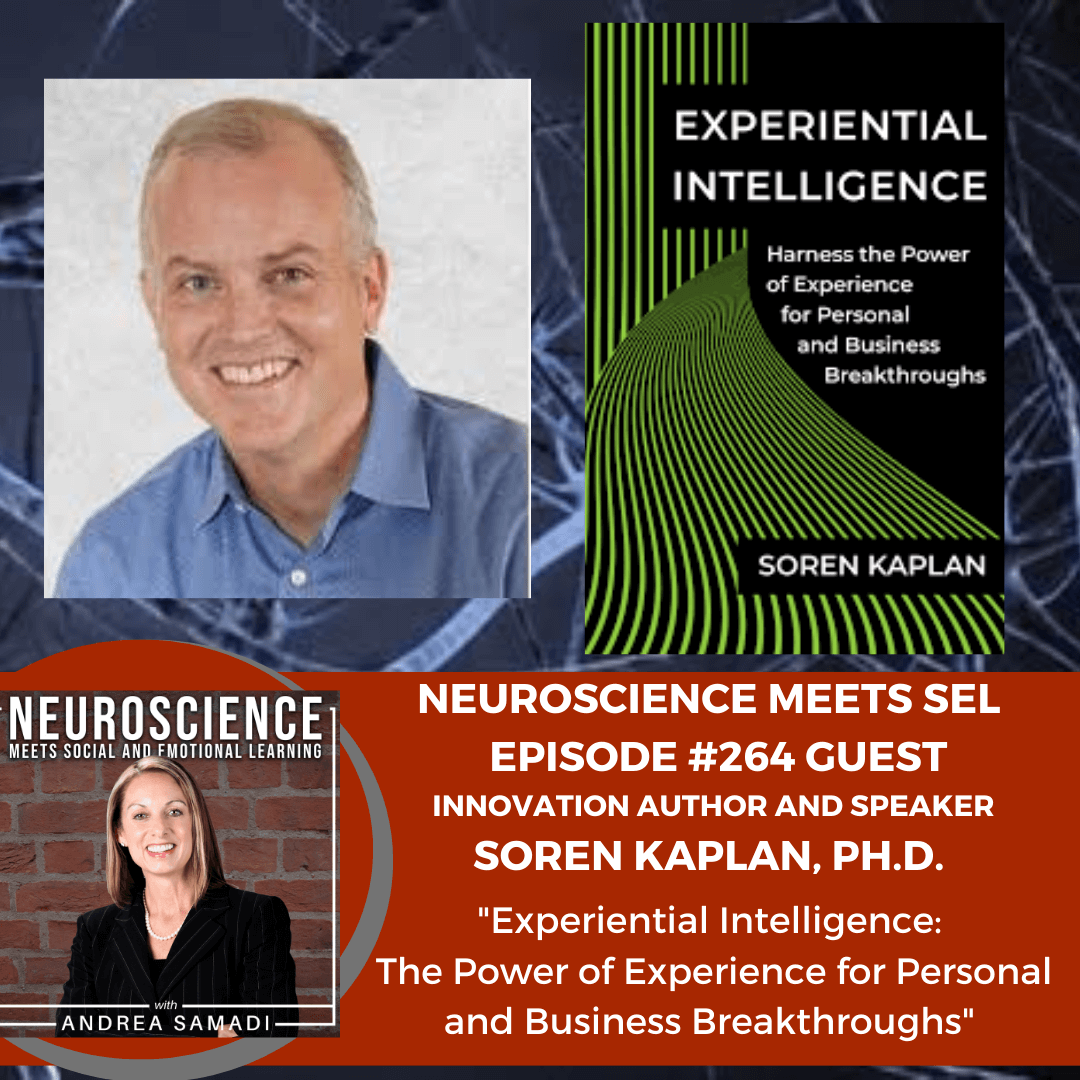
S8 Ep 264Innovation Author and Speaker, Soren Kaplan, Ph.D. on ”Experiential Intelligence: The Power of Experience for Personal and Business Breakthroughs”
“Any new beginning is forged from the shards of the past, not from the abandonment of the past.” Craig Lounsbrough Watch this interview on YouTube here https://youtu.be/M45pacbfyqA On this episode we will cover: ✔ Soren Kaplan's background, and how he became interested in helping high level businesses breakthrough to new heights. ✔ How he has met and worked with some of the world's most well known experts in leadership and innovation. ✔ Where his innate strengths, talents and skills emerged from, skyrocketing his career and personal success. ✔ How we can ALL tap into the missing ingredient he discovered that leads to high levels of success and breakthroughs. ✔ How we can use this missing ingredient that he calls EXPERIENTIAL INTELLIGENCE (XQ) to become better leaders, increase collaboration, innovation and results at home or in the workplace. ✔ How EXPERIENTIAL INTELLIGENCE (XQ) compliments IQ and EQ. ✔ A simple formula for decoding our own EXPERIENTIAL INTELLIGENCE (XQ). ✔ How to use EXPERIENTIAL INTELLIGENCE (XQ) with teams, or individuals. ✔ The research behind EXPERIENTIAL INTELLIGENCE (XQ). ✔ How companies like Google, Apple, IBM and Tesla are embracing EXPERIENTIAL INTELLIGENCE (XQ). When it comes to closing out an old year, and moving into a new one, goal-setting and mindset is at the top of mind for all of us, to jumpstart our New Year on the right foot. This week, I’m in the middle of writing out our TOP 10 episodes of 2022, and getting my head around the final PART of our book review of the Silva Method and I’m thinking about how I can personally improve where we are now with the podcast, to keep moving us all forward with engaging content and speakers that can us to reach new heights with our brain in mind in 2023 and beyond. I wondered, “what am I missing that I haven’t covered yet, that could help move all of us to greater heights?” We have gone deep on this podcast in the past year with using an understanding of our brain to improve our mental and physical health and wellbeing, especially as this all relates to our learning, and we’re now slowing down the year for the holidays, uncovering some new ways to meditate with The Silva Method,[i] and other episodes that we’ll be releasing over the last few weeks of this year to help us to improve creativity, our intuition and focus, but before we close out this year, I wonder, what else is there that can help drive transformation in our schools, sports environments and workplaces? I’ve been thinking about this for the past few weeks, and then I met our next guest, Soren Kaplan, Ph.D., a bestselling and award-winning author, a Columnist for Inc. Magazine, and an affiliate at the Center for Effective Organizations at USC’s Marshall School of Business. Business Insider and the Thinkers50 have recognized him as one of the world’s top management thought leaders and consultants. I was introduced to Soren Kaplan via email letting me know about his NEW book called Experiential Intelligence: (that’s about how to) Harness the Power for Personal and Business Breakthroughs[ii] that follows his other successful books Leapfrogging: The Power of Surprise for Business Breakthroughs[iii] and The Invisible Advantage[iv]. I immediately thought, “This is it! This is what I’ve been looking for. Something else that we can tap into that can be used to transform ourselves, our teams, and our organizations” and something entirely NEW, giving us that “breakthrough” advantage, or quantum leap that I’ve been mentioning all year with Price Pritchett’s You2 book. When I began reading Soren’s book, I noticed from the praise and testimonials at the start, that his supporters were all high levels leaders, sharing what they had learned from Soren’s book, and how “the ability to understand your inherent capabilities as a product of life experiences is the essence of (what Soren has called) experiential intelligence” and how “leaders can harness XQ to unlock their own hidden strengths and
S8 Ep 263A Deep Dive into ”Applying the Silva Method: Speed Learning and Creative Sleep” BOOK REVIEW PART 3
“A genius is a man who has discovered how to increase the intensity of thought to a point when he can freely communicate with sources of knowledge not available through the ordinary rate of thought.” –Napoleon Hill, author of the Best Selling Classic Book, Think and Grow Rich. In PART 3 we cover: ✔ A look at Speed Learning with 2 strategies we can all use right away to learn faster, and remember what we have learned longer. ✔ Creative Sleep, and how to use our sleep to solve problems, improve creativity and intuition in our waking hours, with 4 steps to improving your ability to use and remember your dreams. Welcome back to The Neuroscience Meets Social and Emotional Learning Podcast and PART 3 of our Review of Jose Silva’s Mind Control Program. I’m Andrea Samadi an author and an educator, who like many of you listening, have been fascinated with learning and understanding the science behind ANY high-performance strategy proven to increase our results in our schools, sports, or modern workplaces. If there’s something NEW that I come across that can help us in any way, I’ll investigate it, connect it with the most current research, and then share what I learn with you here. If you’ve been following the past few episodes, you’ll know that I came across Jose Silva’s work with Dr. Hasan Ibne Akram, from EPISODE #260[i], who has launched 7 successful companies, and mentioned that this book completely changed his world. I had heard of this book and Silva’s Program over the years, and many of the concepts that Jose Silva mentions in his book, but had not read it cover to cover, or practiced the audio training that goes along with the book, so I decided to do a complete review of the program, like we did with Napoleon Hill’s book at the start of this year, and see how this book, that was popular in the 80s and 90s could connect to the interviews we’ve done previously on this podcast. Especially when Friederike Fabritius mentioned on EPISODE #258[ii] that our mind can be trained to produce flashes of insight, that can help us in business and our personal lives and what Jose Silva would say could reveal “some astounding things” with a trained mind. I wondered how exactly could our mind be trained... Was daily meditation not enough? If it was, how do I even know if I’m meditating the right way? What was I missing from my current practice? What can we learn from the years of research behind Jose Silva’s popular program that could help all of us to refine our current meditation practice? Then I thought back to a class I took with Jon Kabat-Zinn, the father of mindfulness, who reminded us in this class that we are already perfect, (as we are) and that mindfulness is not about “attaining a certain state, (that brings us to this new level of perfection) but that we are already whole and perfect.” Whatever program we are doing now, the idea of this book review is not to say that Jose Silva’s method is better, or that we might be missing something from what we are already doing, but to see if there’s anything NEW that we cover here, that interests us to dive deeper into, to further enhance our current practice. Jim Kwik, the founder of Kwik Learning[iii], has said that “we’ve discovered more in the past 20 years about our brain than we’ve known in the previous 2,000 years combined” and I think it’s so exciting to share new strategies to help us all, which is the purpose of this podcast. When I learn something new, something that can help me to improve in any way, this energizes me, this gets me all jazzed up, and I know I can’t be the only one like this. I’m sure for those of you who tune into this podcast, can relate to what I’m saying and I’m honored that you’ve chosen me to study with, wherever you might be tuning into this podcast around the world. I love looking at the statistics to see where listeners are tuning in from in over 168 countries, which is a Geography lesson for me when I look at the map of the world. NOTE TO LIST
S8 Ep 262A Deep Dive into ”Applying the Silva Method: Dynamic Meditation and Improved Memory” BOOK REVIEW PART 2
“Once we learn to use our mind to train it, it will do some astounding things for us, as you will soon see.” Jose Silva (August 11, 1914-February 7, 1999) author of The Silva Mind Control Method. On today’s Episode #262 we will cover ✔ A Review of PART 1 of this series (How to access the ALPHA BRAIN STATE, Creating A Mental Screen for Visualization and Problem Solving). ✔ Ch 4- Dynamic Meditation ✔ The 4 Laws that must be in place BEFORE we visualize a goal. ✔ How these 4 Laws mirror Napoleon Hill's Think and Grow Rich book. ✔ 3 STEPS to SOLVE ANY PROBLEM Using the Silva Method. ✔ Ch 5- Improving Memory ✔ Where Silva's Memory Hacks have been seen on previous episodes and in the motivational speaking industry. Welcome back to The Neuroscience Meets Social and Emotional Learning Podcast and PART 2 of our Review of Jose Silva’s Mind Control Program. I’m Andrea Samadi an author and an educator, who like many of you listening, have been fascinated with learning and understanding the science behind ANY high performance strategy proven to increase our results in our schools, sports, and modern workplaces. If there’s something NEW that I come across that can help us in any way, I’ll investigate it, connect it with the most current research, and then share what I learn with you here. At the start of this year, I reviewed Napoleon Hill’s Best-Selling Think and Grow Rich[i] book, with a deep dive into many of the concepts that have been put to a practical test by millions of people around the world over the years. This is THE book that my mentor Bob Proctor spent his lifetime studying, and it remains on my desk as a resource to visit when I need some inspiration, or some wise words of wisdom to push me forward. Then I came across Jose Silva’s work on our resent EPISODE #260, a fascinating program that I had heard about when I worked in the seminar industry, and I knew it was time to slow down the podcast, and see what Jose Silva’s program covered, and if his work could help us all with whatever it is that we are working on. My goal with this review of The Silva Method[ii], is to help all of us to learn something new to refine our current meditation practice whether we are working in our schools to improve learning, in our sports environments for improved results towards a specific goal, or in the corporate workplace to generate new ideas. I wouldn’t have picked this book to review if it hadn’t made such an impact on the world, like Napoleon Hills’ book. In PART 1[iii] of our review, on our last episode, we covered: ✔ CH 1- Using More of Our Mind in Special Ways: An Introduction to the Silva Mind Control Method ✔ What this program has done for others. ✔ Ch 2- Meet Jose ✔ Ch 3- How to Meditate: A review of the brain states (BETA, ALPHA, THETA, DELTA). ✔ How to quickly access the ALPHA STATE to improve creativity, and intuition. ✔ Using A Mental Screen in Your Mind for Heightened Visualization ✔ How to Help Yourself and Others Using a Mental Screen in Our Mind After recording this episode, there were some important parts that I forgot to add in, but since each of these episodes is cumulative, building off the last episode, I’ll be sure to add in anything important along the way. As I’m writing these episodes, as I’m also learning along with you. ***If you are listening to this episode, and have not yet listened to PART 1, please do begin with PART 1 of this series, to maximize each concept we will be learning, and practicing. Each lesson builds off the next, in The Silva Method, which to me could be described as a combination between meditation, and self-hypnosis all in one. I’ll be sharing Silva’s Method, chapter by chapter, with clear examples of how to put it into practice, and how his method can help all of us to train our brain to do some astounding things. I wanted to cover The Silva Method on this podcast, as years ago, no one spoke about the power of hypnosis, or meditation, in our corporate workplaces, or in our school
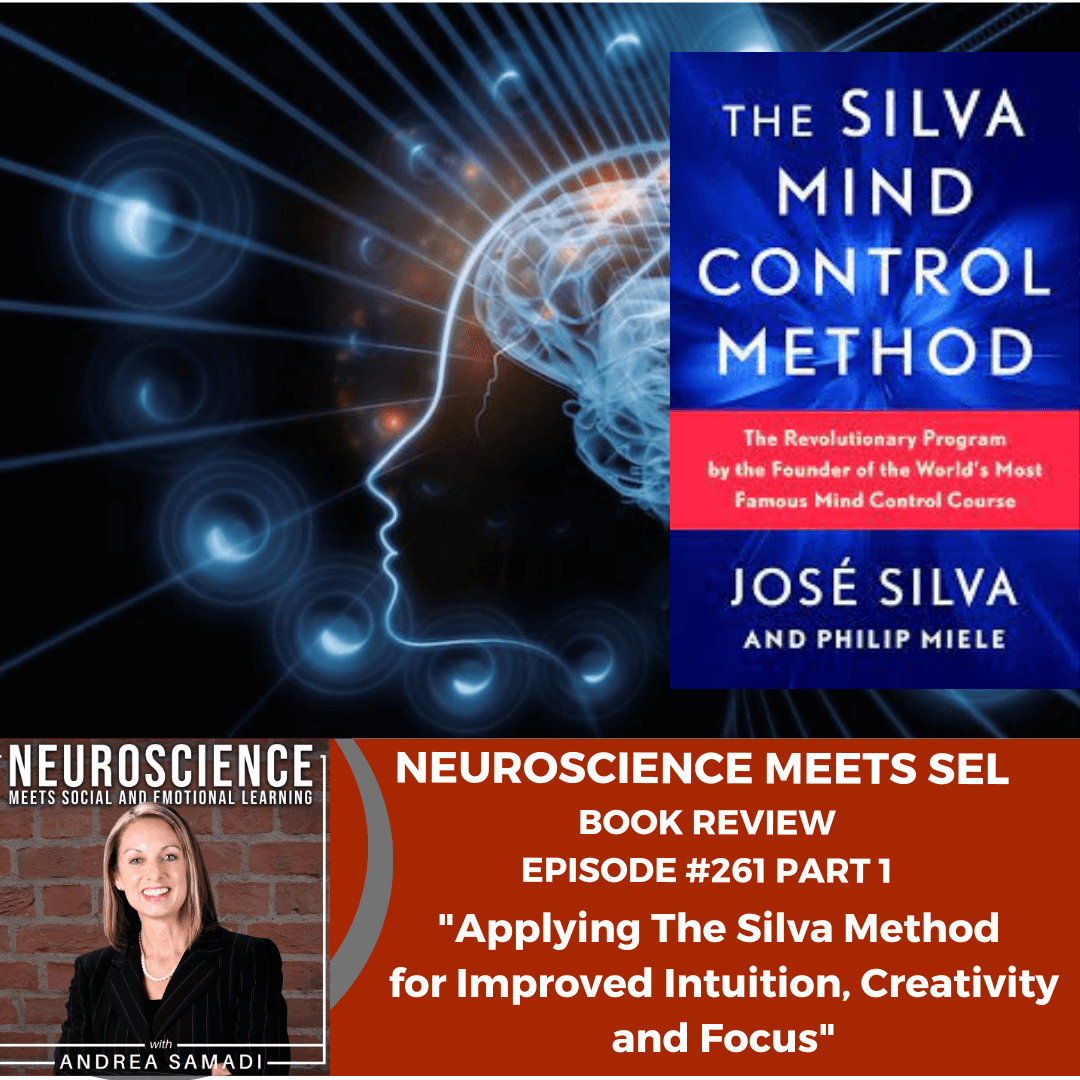
S8 Ep 261A Deep Dive into ”Applying the Silva Method: For Improved Intuition, Creativity and Focus” BOOK REVIEW PART 1
“Once we learn to use our mind to train it, it will do some astounding things for us, as you will soon see.” Jose Silva (August 11, 1914-February 7, 1999) author of The Silva Mind Control Method. Welcome back to The Neuroscience Meets Social and Emotional Learning Podcast I’m Andrea Samadi and like many of you listening, have been fascinated with learning and understanding the science behind high performance strategies to increase our results in our schools, sports, and modern workplaces. As we are in the midst of holiday season here with Thanksgiving this past week in the US, and Christmas fast approaching, we will be narrowing our focus here on the podcast and resuming interviews in the New Year. Until then, this episode will launch a series where I’ll be taking us on a deep dive into the benefits of developing a meditation practice. While I’m sure those who tune into this podcast already have a practice in place, I wanted to cover a meditation method that I came across years ago, that our last interview, with Dr. Hasan Ibne Akram reminded me about. The goal of this series is to help all of us to reduce stress with this practice, but also to see if we can learn something new, and refine our practice for those who work in our schools to improve learning, in our sports environments for improved focus and concentration towards a specific goal, and in the corporate workplace for ideas to improve creativity and focus. We will begin this series reviewing Jose Silva and Philip Miele’s The Silva Mind Control Method[i] that’s based on the Revolutionary Program by the Founder of the World’s Most Famous Mind Control Course. Ch 1: Using Our Mind in Special Ways This course is something I came across while working in the seminar industry, and while interviewing Dr. Hasan Ibne Akram, on our last EPISODE #260[ii], he reminded me of Jose Silva’s program, that helped him with his self-esteem as a teenager, in addition to his studies, and a few other areas of his life, and this reminded me that I had come across Jose Silva’s work years ago. I’d actually forgotten about this book, and many of the techniques we learned that were adaptations of Silva’s work, and I thought that since meditation is helping so many people around the world, and it’s now mainstream in our schools, with athletes, and in the corporate world, it would be fascinating to look closer at Jose Silva’s Method, to see if it could help all of us to enhance our current meditation practice, myself included. Then I dove into The Silva Method, and realized his work is going to need to be broken up over a few episodes, like we did with The Think and Grow Rich[iii] book review, just to make it applicable for all of us, and give each chapter careful consideration as we look to see what parts of The Silva Method, could help us to improve our own lives. I wanted to release this episode last Friday, but in order to cover this topic properly, I knew I had to review the Silva Method thoroughly myself, do exactly what he instructs us to do, and not cut any corners. So this weekend, instead of recording, I reviewed and practiced the strategies in the first three chapters of this book, making more connections to past episodes, and increasing my learning and understanding before sharing these ideas with you. If you listened to our episode #258 with Friederike Fabritius, on her new book, The Brain-Friendly Workplace, I asked her what science has to say about those flashes of insight that we ALL have access to for improved creativity and performance, and she explained that “when you are relaxed, your brain waves slow down to the alpha state.” Friederike further explained that we can measure these brain waves with EEG scans and that at moments of insight, or those AHA Moments, the brain has “gamma oscillations” that can be trained and measured that she called “The Gamma Insight Effect.” After speaking with Friederike, I wondered HOW we could ALL train our brain to reach these le
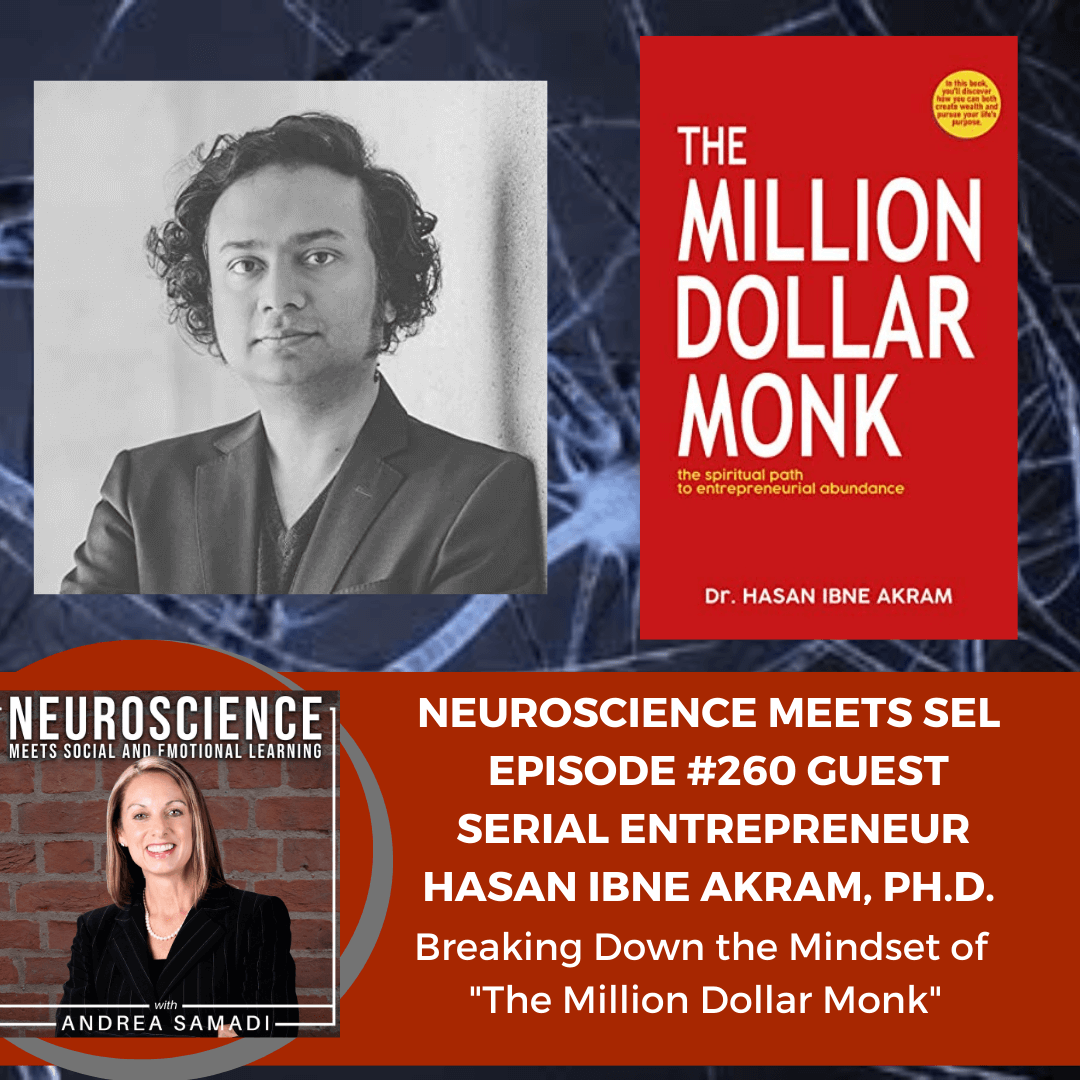
S8 Ep 260Serial Entrepreneur and Computer Scientist, Hasan Ibne Akram, Pd. D. on Breaking Down the Mindset of ”The Million Dollar Monk”
“If you’re going to live, leave a legacy. Make a mark on the world that can’t be erased.” Maya Angelou Watch this interview on YouTube here https://youtu.be/oxdz07FUMOc On this episode we will cover: ✔ How Dr. Hasan Ibne Akram found The Neuroscience Meets SEL Podcast, and what resonated with him, with our content. ✔ Why after building 7 companies, Dr. Hasan is looking at leaving a legacy that lasts far beyond this lifetime. ✔ Where Dr. Hasan has been focused in the business world (Brainvincible and Matrickz) and why he wants to help others to achieve financial freedom. ✔ For the man known to be "The Most Disciplined Man in Germany" what discipline means to him. ✔ What he thinks discipline can do for someone over long periods of time. ✔ What he cautions us about with being tied to the outcomes of our daily results. ✔ How this book he came across when he was 16 (that I also read) completely changed who he was, increased his self-esteem and skyrocketed his success in business and life. ✔ How he thinks people like Edison, Einstein and Michael Jackson used the principles in this book, to reach breakthrough levels in their life and work. ✔ About the strangest longevity strategy he's ever heard! Welcome back to The Neuroscience Meets Social and Emotional Learning Podcast where we bridge the gap between theory and practice, with strategies, tools and ideas we can all use immediately. I’m Andrea Samadi and launched this podcast to share how important an understanding of our brain is for our everyday life and results. It’s probably taken me 3 and a half years of hosting this podcast, (looking back now) to see how much these weekly interviews have expanded my own self-awareness by picking the brains of some of the most brilliant minds on the planet in high performance, connecting their strategies to the most current brain research, and then sharing what I’m learning with you here on the podcast. If our results really are tied back to our level of awareness, then it makes sense to me that we keep sharing the success secrets, used by those who have risen to the top, with the goal that we can ALL do the same, and take our results to those higher levels of achievement. For today’s EPISODE #260, we will be speaking with a serial entrepreneur from Munich, Germany, Dr. Hasan Ibne Akram[i], someone who has been obsessed with high performance and biohacking for years. Since 2005, he’s created disruptive companies in multiple industries (automotive with his company Matrickz[ii], brain and performance, with his company Brainvincible[iii], and real estate to name a few) that are changing the way we live, think, and work. Dr. Hasan reached out to me as he had been enjoying our podcast, and wanted to share his perspective and journey, that he thought could bring value to our audience and I agreed. I watched a few of his other interviews, and one that he did a year ago, with Craig Ballantyne[iv] (who’s a well-known business coach and entrepreneur from my hometown, Toronto, Canada) called “The Millionaire Monk’s Abundance Formula[v]” stuck out to me, so I listened to it. It was here that I learned Dr. Hasan and I have a lot of our influencers in common that he mentioned opened his mind to the possibilities that exist when you fully optimize the power of your brain and mind. The program he created, Brainvincible helps those in schools, sports or the workplace to improve their communication and creativity skills, helps athletes to optimize their skills and abilities to achieve precision and regeneration, as well as helping students to improve their study habits to achieve higher grades. I had to look at who Dr. Hasan studied, and what motivated him to create a course like this, and low and behold, Dr. Hasan, from Munich, Germany, took the same course that I took many years ago, where we both learned how to use the power of visualization to create what we wanted in our life, and use our imagination to solve problems. Dr. Hasan learned
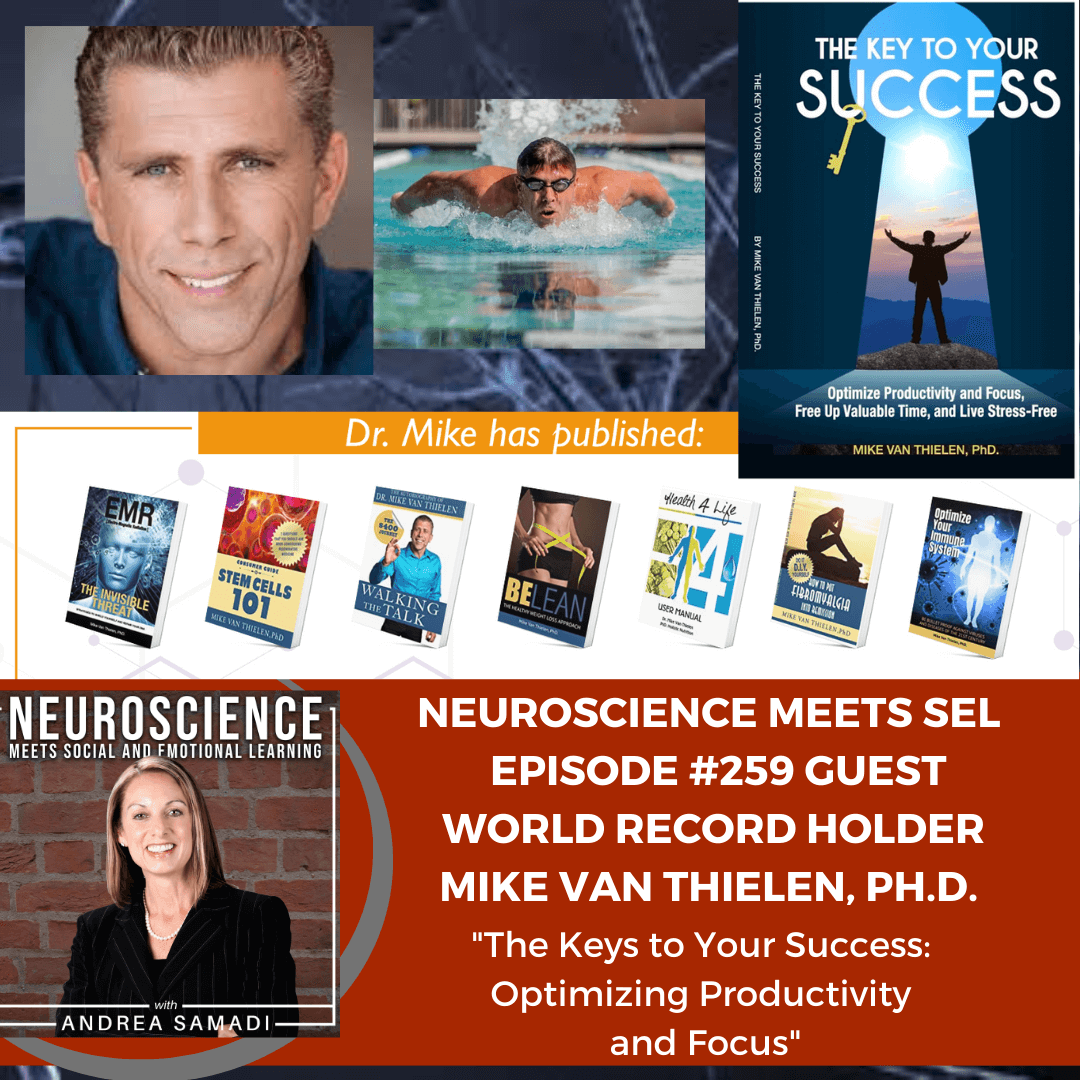
S8 Ep 259World Record Holder, Mike Van Theilen, Ph.D. on ”The Keys to Your Success: Optimizing Productivity and Focus”
“One can only perform at maximum potential when in optimal health. Optimal health can easily be obtained and maintained.” --Dr. Mike Van Thielen, whose mission is to help those who really and truly want to regain their health and live longer. Dr. Mike, has written many books[i], in the field of health, wellness, productivity, and biohacking, that all cover important topics that I know we are all interested in on this podcast. Watch this interview on YouTube here https://www.youtube.com/watch?v=yY0nOaiQVFc On this episode we will learn: ✔ Some of the secrets to Dr. Mike's success as a World Record Holder (swimming). ✔ How he learned to optimize his productivity and focus to achieve higher levels of success/laser focus in school/sports/work. ✔ Why he believes "failure is not an option" and why he doesn't practice one of Michael Phelp's training secrets. ✔ Advice he would offer to anyone looking to make an explosive leap with their results. ✔ How to develop discipline. ✔ The importance of knowing your purpose, and discovering what you are passionate about in life. ✔ The role of dopamine as it relates to focus and concentration. ✔ Forward thinking preventative health and why it's important for everyone to put their health first. Welcome back to The Neuroscience Meets Social and Emotional Learning Podcast where we bridge the gap between theory and practice, with strategies, tools and ideas we can all use immediately, applied to the most current brain research to heighten productivity in our schools, sports environments and modern workplaces. I’m Andrea Samadi and launched this podcast to share how important an understanding of our brain is for our everyday life and results. My vision is to bring the experts to you, share their research, books, ideas and resources to help you to implement their proven strategies, whether you are a teacher working in the classroom or in the corporate environment. As a podcast host, I do come across many people, in different areas of the world, and to stay focused, I do stick to a certain theme each season, or I’d be all over the place with researching guests and questions. For this season, we are focused on brain health as it relates to learning, and I’m looking to show how important an understanding of our brain is, for our results and productivity. When I came across Dr. Mike’s work, I didn’t even read all of his credentials, as I saw two things that caught my eye. He was the assistant coach and therapist for the Belgian Olympic swim team for the Olympic Games in Atlanta in 1996. Dr. Mike himself is a current World Record Holder in swimming[ii]. He also holds 28 U.S. National Titles and 2 YMCA National records. He is a proud member of the exclusive WSA – World Sports Alumni, holds a PhD in Holistic Nutrition and is also the Founder of Health Freedom movement. He’s a sought-after speaker who has often shared the stage with celebrities who I’ve met during my time in the motivational speaking industry, like Les Brown, Brian Tracy, and Darren Hardy, owner of Success Magazine. He’s also an entrepreneur with vast business experience and a proven track record of establishing and developing successful business operations. Dr. Mike owned several anti-aging clinics in central and northeast Florida and was the CEO of an innovative stem cell clinic, treating top athletes including NFL players and heavyweight boxing champions.Along with his successful career he has managed to be a philanthropist by raising money through many charity events to those who need it most. While I speak often about my time in the motivational speaking industry on this podcast, I haven’t mentioned that I spent many of my high school years teaching swimming lessons to pay for my University degree, and would watch these two Belgium swim coaches who would come in every Saturday morning, at the crack of dawn, and run the most incredible swim practices that I’ve ever seen. They had these kids zipping up and down the lanes. I
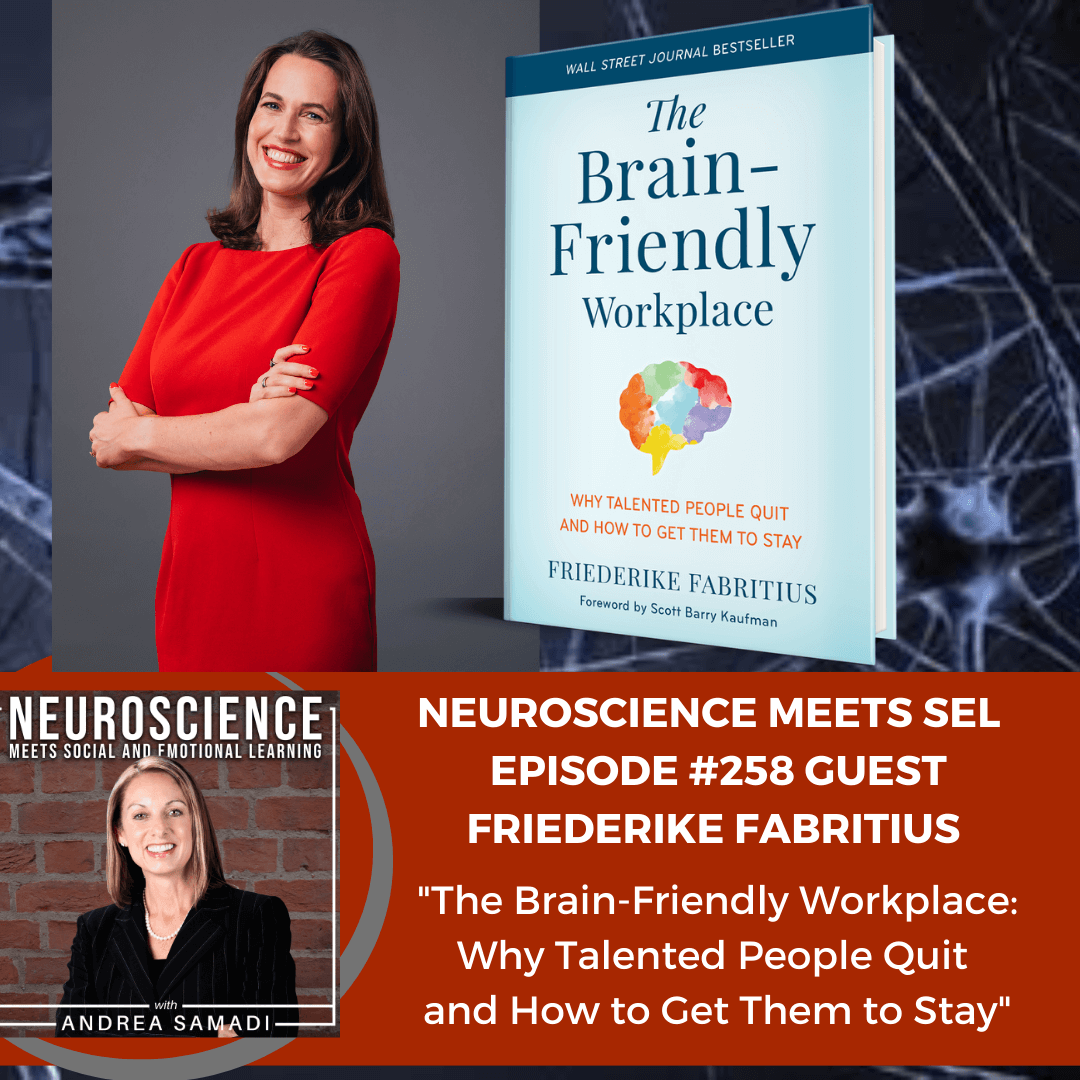
S8 Ep 258Neuroscientist, Wall Street Journal Best-Selling Author, Friederike Fabritius on her NEW book ”The Brain-Friendly Workplace: Why Talented People Quit and How to Make Them Stay”
"The old corporate paradigm of extreme hours, little sleep, endless meetings, and nonstop travel is dead. No one wants to go back to that. It's bad for performance and for everyone's mental and physical health. The future of business is hybrid and requires a flexible new paradigm that helps everyone reach peak performance: the brain-friendly workplace." (Friederike Fabritius) Watch this interview on YouTube here https://youtu.be/Mmv9PmuioFs On this episode we will learn: ✔ How to create a workplace of the future. A Brain-Friendly Workplace. ✔ How an understanding our brain-type, can help us to be happier and more productive in the workplace. ✔ What is causing the "Neuro-Gap" and why is it important to have different brain-types represented at the higher levels of corporations or organizations. ✔ How can someone with ambition and persistence, move forward into a management position? What should they be prepared to show if their brain-type isn't often represented in these higher level positions? ✔ What is lateral or creative thinking, versus linear thinking, and why are both important in the workplace? ✔ Where do those "flashes of insight" come from, that creative people can see? Can science prove this type of thinking to be useful? ✔ What are the 4 brain types, or neurosignatures, and how can we be sure we understand them for ourselves, and for others? ✔ Why is understanding our optimal level of stress important for our workplace productivity and happiness? ✔ An example of when Friederike used her neurosignature under pressure. ✔ What to expect from some of the interviews in The Brain-Friendly Workplace ✔ An important tip from John Medina on the "power problem" that happens at the brain level, for people in positions of leadership. FOLLOW FRIEDERIKE FABRITIUS Website https://friederikefabritius.com/ LinkedIn https://www.linkedin.com/in/friederikefabritius/ Twitter https://twitter.com/FriederikeFab YouTube https://www.youtube.com/channel/UC8wD4PRM2RablIfUVDzT2WA Facebook https://www.facebook.com/FriederikeFabritius Amazon: www.amazon.com/author/friederikefabritius SEE PAST NEUROSCIENCE MEETS SOCIAL AND EMOTIONAL LEARNING PODCAST EPISODES https://www.achieveit360.com/episodes/ There’s much more to this new workplace, overriding old, outdated paradigms, than meets the eye, and Friederike Fabritius’s NEW book, The Brain-Friendly Workplace is FULL of ideas to help all of us adapt our workplace, so that our brains will work at their best. Welcome back to The Neuroscience Meets Social and Emotional Learning Podcast where we bridge the gap between theory and practice, with strategies, tools and ideas we can all use immediately, applied to the most current brain research to heighten productivity in our schools, sports environments and modern workplaces. I’m Andrea Samadi and launched this podcast to share how important an understanding of our brain is for our everyday life and results. My vision is to bring the experts to you, share their research, books, ideas and resources to help you to implement their proven strategies, whether you are a teacher working in the classroom or in the corporate environment. Be sure to listen to the EPISODE prior to this one, #257, as I do cover a DEEP DIVE to put us all in the right mind-set, or should I say, brain-set, for today’s interview. I’m so very excited for today’s interview, EPISODE #258, as we have a returning guest, from one of our early episodes, #27[i], Friederike Fabritius, all the way from Germany, who dove deep into her book, The Leading Brain: Neuroscience Hacks to Work Smarter, Better, Happier when we first launched our podcast back in 2019. What was crazy about finding Friederike back then, is that I found her on YouTube, from a presentation she did on Leadership and the Brain, and it really helped me to understand the chemicals involved in the brain during peak performance, and what it looks like when the brain is involved in FLOW, which is something I thi
S8 Ep 257Brain Fact Friday: A DEEP DIVE into The Brain-Friendly Workplace by Friederike Fabritius ”Understanding Our Neurosignature for Improved Happiness at Work”
Welcome back to The Neuroscience Meets Social and Emotional Learning Podcast where we bridge the gap between theory and practice, with strategies, tools and ideas we can all use immediately, applied to the most current brain research to heighten productivity in our schools, sports environments and modern workplaces. I’m Andrea Samadi and launched this podcast to share how important an understanding of our brain is for our everyday life and results. On this episode we will cover: ✔ What are the 4 neurosignatures that Friederike Fabritius identifies in her NEW book, The Brain-Friendly Workplace. ✔ How to use these neurosignatures to improve workplace productivity, happiness and flow. ✔ 3 TIPS for using neurosignatures in YOUR workplace. ✔ Preparing for EPISODE #258 with Friederike Fabritius. ALL IMAGES FROM THE BRAIN-FRIENDLY WORKPLACE ARE CREDITED TO CAROLIN NISCHWITZ For this week’s Brain Fact Friday, and Episode #257, I want to cover Friederike Fabritius’s new book The Brain-Friendly Workplace: Why Talented People Quit and How to Get Them to Stay[i] as I’ve been reading her book, preparing for our interview Friday morning, and our NEXT episode, and I know I won’t be able to cover everything in one interview. This book is beyond comprehensive and has enough science within it to cover our Brain Fact Fridays for the rest of this year. Friederike has been carefully writing this book since our last interview EPISODE #27[ii] back in 2019, when we first launched this podcast, and there are many Aha moments, and connections I’ll highlight on the next episode, when we speak with her, but for today’s Brain Fact Friday, I want to cover something important that her book taught me. It’s the title of her book, The Brain Friendly Workplace, that explains what we all need to happy at work. My goal with this episode is to share Friederike’s science-backed brain discovery of the “neurosignature” that she introduces in the introduction of this book, and how we can all use it to increase our awareness, the meaning we create throughout our day, and add a sense of autonomy with our work. Then I’ll share an example that shows how her discovery of the “neurosignature” will highlight what we all need to be successful and happy in the modern workplace, with our brain in mind, and that it’s not about changing the people (with more training) but it’s about changing the workplace. With this paradigm shift in mind, I’ll get straight to the point here—- For this week’s Brain Fact Friday, Did YOU KNOW THAT: We all have our own “neurosignature,” a unique mix of four key brain chemicals that strongly affects our personality and how we process stress and information?” Once we understand our unique “neurosignature” we can learn how to hit our “optimal stress point” and manipulate our “fun, fear, and focus” which is the recipe for reaching peak performance in the workplace. In this place of peak performance, Ideas will flow. You’ll feel energized, inspired, and alive. You’ll also gain a valuable framework for understanding colleagues and those you interact with their different “neurosignatures.” You’ll get more done in less time You’ll see why changing the workplace is needed, over expecting employees to change with more training. Understanding our unique “neurosignature” is a technique that provides a competitive advantage allowing you work with the flow, rather than against it. This is the whole premise of Friederike Fabritius’s NEW book, The Brain Friendly Workplace where she’s created a new vision for the future of our modern workplaces. What are the 4 Neurosignatures? Friederike says there are 4 brain systems that we can fall into. Can you recognize yourself? Others you work with? What about those you live with? THE DOPAMINE NEUROSIGNATURE: Friederike says that “people high in dopamine are curious, energetic, and future-oriented. Inventors and entrepreneurs tend to have this neurosignature. They get bored easily and are always lookin
S8 Ep 256Brain Fact Friday: ”Think Like an FBI Profiler: Using the Neuroscience of Curiosity to Improve Learning.”
“What interests me in life is curiosity, challenges, the good fight with its victories and defeats.”--Paulo Coelho Welcome back to The Neuroscience Meets Social and Emotional Learning Podcast where we bridge the gap between theory and practice, with strategies, tools and ideas we can all use immediately, applied to the most current brain research to heighten productivity in our schools, sports environments and modern workplaces. I’m Andrea Samadi and launched this podcast to share how important an understanding of our brain is for our everyday life and results. Like you, I’m interested in learning and applying the research, to our everyday life. On today’s episode #256 and this week’s Brain Fact Friday, I wanted to take what we learned from Dr. Chantel Prat earlier this week on EP#255[i], and her book The Neuroscience of You[ii], and dive a bit deeper to increase our learning with whatever it is we are interested or curious about. At the end of our interview with Dr. Prat, I shared how much I learned about myself from reading her book, and how learning inspires me (which is why I am motivated to keep producing podcast episodes that can help all of us take our results to new heights—with what we are learning and applying here, and why I’m always looking to fill in the gaps in with my knowledge). Do you know what I mean here? Have you ever found someone who knows something that you don’t know, (you notice the knowledge gap) and then you were motivated, or even energized to glean their knowledge to enhance your life? I know that each of us will be curious about something in the world and I’m so grateful that you’ve chosen this podcast to learn from, along with me. I’m always looking to answer the question “What is it that YOU’RE curious about?” so I can create episodes that are helpful, and Chapter 7 of Dr. Prat’s book dives much deeper into the research behind curiosity and the brain, that I know will help you with whatever it is you are working on, or those you hope to motivate around you, but today, my goal to inspire you, even energize you a bit, when I show you WHAT happens in our brain when we are curious, WHY being curious prepares our brain for learning, and how we can use this to inspire those around us to naturally want to learn more. On this episode we will learn: ✔ What happens to our brain when we are curious. ✔ Why being curious prepares our brain for learning. ✔ How we can inspire OURSELVES and OTHERS to naturally want to learn more and make learning unforgettable. Now, just before writing this episode, something caught my eye, and my curiosity was piqued, pulling my attention towards something I found to be interesting. NOTE—this is why it’s important to turn off your phone (or put it away) when you need to focus. I didn’t do this, and my eye was caught by an ad that was right in line with my area of interest (which is a whole other story how we are all targeted daily to buy things based on what we search for on the internet, or even what we are talking about) but this ad drew me to a class from Former Special FBI Agent John Douglas (where the Netflix series MindHunter[iii] was created based on his work, and his book MindHunter[iv]). This class, called How to Think Like an FBI Profiler[v] changed how I saw this week’s Brain Fact Friday and I’m grateful that I had a chance to learn something new from being curious. On today’s episode I not only want to cover the psychology and neuroscience of curiosity, and how we can use this trait to improve our learning, but I want to do this through the eyes of an FBI Profiler and what my curiosity helped me to learn. Former Special Agent John Douglas (and his masterclass) taught me many tips for becoming a MindHunter and recognize the signs of bad people, or ways to avoid violent criminals, but for this week’s Brain Fact Friday, I want to focus on how to use our curious mind to understand ourselves better, with our brain in mind, by profiling OURSELVES fi
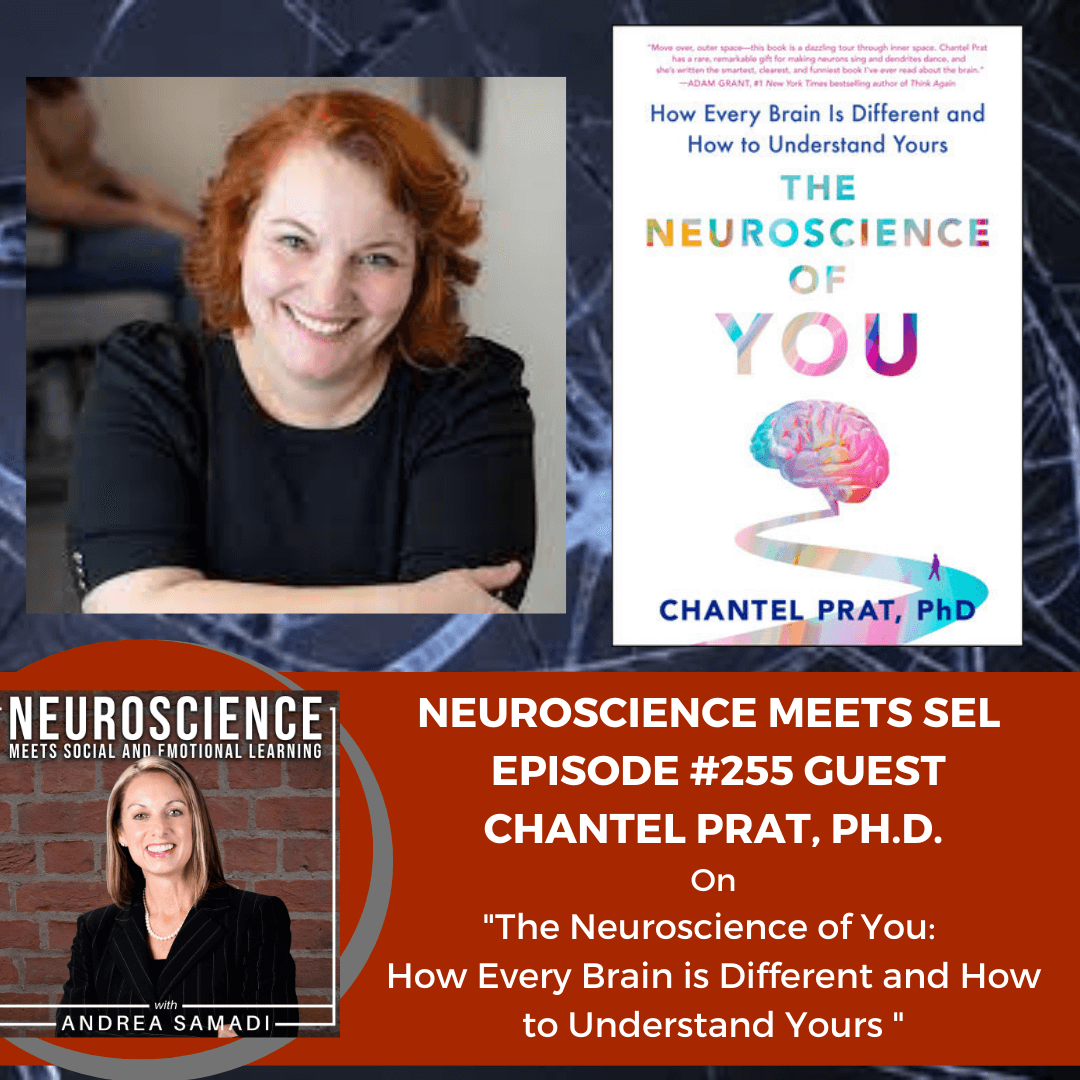
S8 Ep 255Chantel Prat, Ph.D. on ”The Neuroscience of You: How Every Brain is Wired Differently and How to Understand Yours.”
“As human beings, our job in life to help people realize how rare and valuable each of us really is, that each of us has something that no one else has—or ever will have.” Chantel Prat, PhD who quotes Fred Rogers, in her new book, The Neuroscience of You. Watch this interview on YouTube here https://youtu.be/JCpD9vGe4As On this episode we will learn: ✔ How to understand ourselves better, before understanding others, with our brain in mind. ✔ Why Dr. Anna Lembke said "The Neuroscience of You" is "smart, funny, and irreverent" and a "must read for any budding neuroscientists out there." ✔ What happens at our brain level when we are out of synch with someone else? ✔ A review of Theory of Mind and why it's crucial for our success and "predicts the way a team will perform." ✔ How to improve our Theory of Mind and learn how to "Read the Mind" in others. Welcome back to The Neuroscience Meets Social and Emotional Learning Podcast where we bridge the gap between theory and practice, with strategies, tools and ideas we can all use immediately, applied to the most current brain research to heighten productivity in our schools, sports environments and modern workplaces. I’m Andrea Samadi and launched this podcast to share how important an understanding of our brain is for our everyday life and results. My vision is to bring the experts to you, share their research, books, ideas and resources to help you to implement their proven strategies, whether you are a teacher working in the classroom or in the corporate environment. For today’s EPISODE #255, we will be speaking with Dr. Chantel Prat, Ph.D.,[i] who I’ve mentioned a few times on this podcast. I came across Dr. Prat’s NEW book, The Neuroscience of You[ii] that she just released this August while researching for EP #245 back in September, on “Using Neuroscience to Recognize Individuality and Uniqueness”[iii] because her name kept coming up when I was searching for “using neuroscience to understand diversity.” When I started reading her book, it was clear to me that Dr. Prat is heavily invested in the research that helps all of us to first of all understand ourselves on a deeper level, which will help us to understand others. If you look at the Levels of Consciousness Model that I drew out from EP 151, you can see that I have listed Dr. Prat’s work in the fully aware column, as I think this is what her work prepares us for. While you can see our podcast has touched on different levels of consciousness, and since this is such a difficult concept that many scientists still cannot explain, I think it makes things easier if we can map concepts out so we can see what we are talking about visually. I know that after today’s episode, Dr. Prat will open our eyes and awareness a bit more to see who we are, in relation to those around us, with some new ideas for creating synergy with those we are no in synch with. Here’s a bit about Dr. Prat. Chantel Prat is a Professor at the University of Washington in the Departments of Psychology, Neuroscience, and Linguistics, and at the Institute for Learning and Brain Sciences, the Center for Neurotechnology, and the Institute for Neuroengineering. A cognitive neuroscientist by training, her interdisciplinary research investigates the biological basis of individual differences in cognition, with an emphasis on understanding the shared neural mechanisms underpinning language and higher-level executive functions. In English…I would translate that to “Dr. Prat helps us to understand ourselves and others” which is why she kept coming up when I was search for understanding unique differences, or that all brain are not alike. Dr. Chantel Prat was the first neuroscientist to directly link two human brains through technology. Her research has explored virtual reality, neural linking, and the diversity of our brains throughout development. Learning about the science of our brains and nervous systems empowers us with greater ability to build the
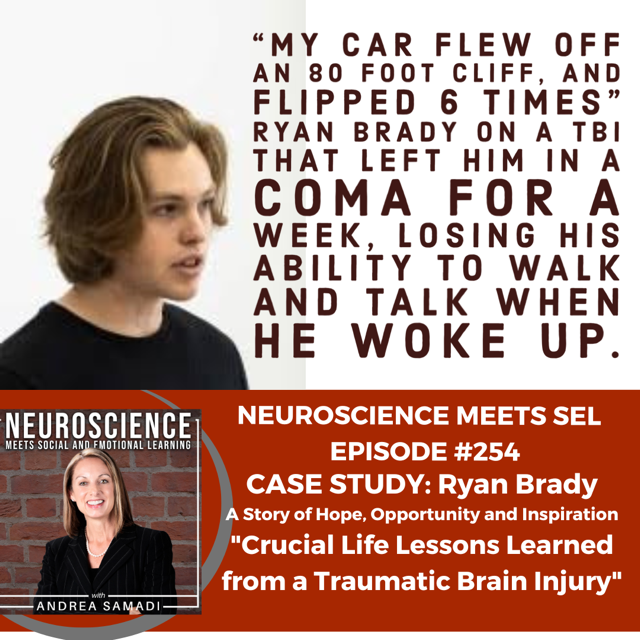
Ep 254CASE STUDY with Ryan Brady ”Life Lessons Learned While Recovering from a Traumatic Brain Injury: A Story of Hope, Opportunity and Inspiration”
“The best way to predict your future, is to create it!” Abraham Lincoln Watch this inspiring interview on YouTube here https://youtu.be/aG_B3aLSLEc Welcome back to The Neuroscience Meets Social and Emotional Learning Podcast where we bridge the gap between theory and practice, with strategies, tools and ideas we can all use immediately, applied to the most current brain research to heighten productivity in our schools, sports environments and modern workplaces. I’m Andrea Samadi and launched this podcast to share how important an understanding of our brain is for our everyday life and results. My vision is to bring the experts to you, share their research, books, ideas and resources to help you to implement their proven strategies, whether you are a teacher working in the classroom or in the corporate environment. For today’s EPISODE #254, we’ll be speaking with Ryan Brady[i], an avid public speaker who has put into practice many of the concepts that we’ve covered on this podcast. Ryan went from having a traumatic brain injury when he was a teen, to re-learning how to walk and talk. What caught my eye with Ryan’s story is that as a young man, he was able to see the positive side of his brain injury, that occurred when his car went over an 80-foot cliff, flipped 6 times, breaking his neck, back, wrist and collar bone. This resulted in a Traumatic Brain Injury, that listeners to this podcast will understand the horrific impacts of this injury to his brain on learning, memory and his ability to function in the world. But what he did while recovering is mind-blowing! He studied, learned, and then created a company, Digital Prodigee (that creates mobile apps for businesses) and took his company to 7 figures of revenue in 7 months. His story is a true story of resilience in the business world and you can hear it for yourself with his TED Talk[ii], that I think everyone on the planet should listen to. I’m personally excited to speak with Ryan, as I began interviewing young entrepreneurs back in 2012, years before launching this podcast when I ran The Teen Performance Magazine, and hearing Ryan’s story took me back to many of the young leaders I interviewed when I was first launching this magazine, hoping to inspire our next generation of entrepreneurs with these interviews. This idea didn’t take off as well as I had hoped, but it was a valuable experience to learn from some of the youngest leaders and most brilliant minds I’ve ever come across, many who I’ve kept in touch with, or watched their results skyrocket over the years. Let’s meet Ryan Brady, and see what we can learn from this entrepreneur about mindset, vision, and brain health, for a refreshing new perspective on life. Something I think we could all use today. Welcome Ryan Brady, thank you for joining me on the podcast today. What part of the world are you in today? Ryan, I’m always looking for new perspectives on this podcast, and hadn’t even listened to your TED Talk when I replied to your team that I wanted to speak with you as I saw something unique about your ability to help others start their own business…then I saw the whole TBI story, that took your story to a whole new level. INTRO Q: Can you begin with what type of kid you were BEFORE your car flew off an 80 foot cliff? I’m curious if your positive/forward-thinking mindset was there BEFORE the accident, or do you that the accident changed your perspective? Q1: I couldn’t tell your story even close to how you tell it. Can you give us a quick synopsis, and I’ll put your TED Talk in the show notes for those who want to hear the whole story? What’s the short version of your accident and how it helped you to see things in a different light? Q1B: Did you have a positive mindset BEFORE the accident, or do you think it came as a result of it? Q2: Like I just said, I’m always looking for a unique story to share on this podcast, to help all of us to improve our mindset, with an understanding of our brain at th
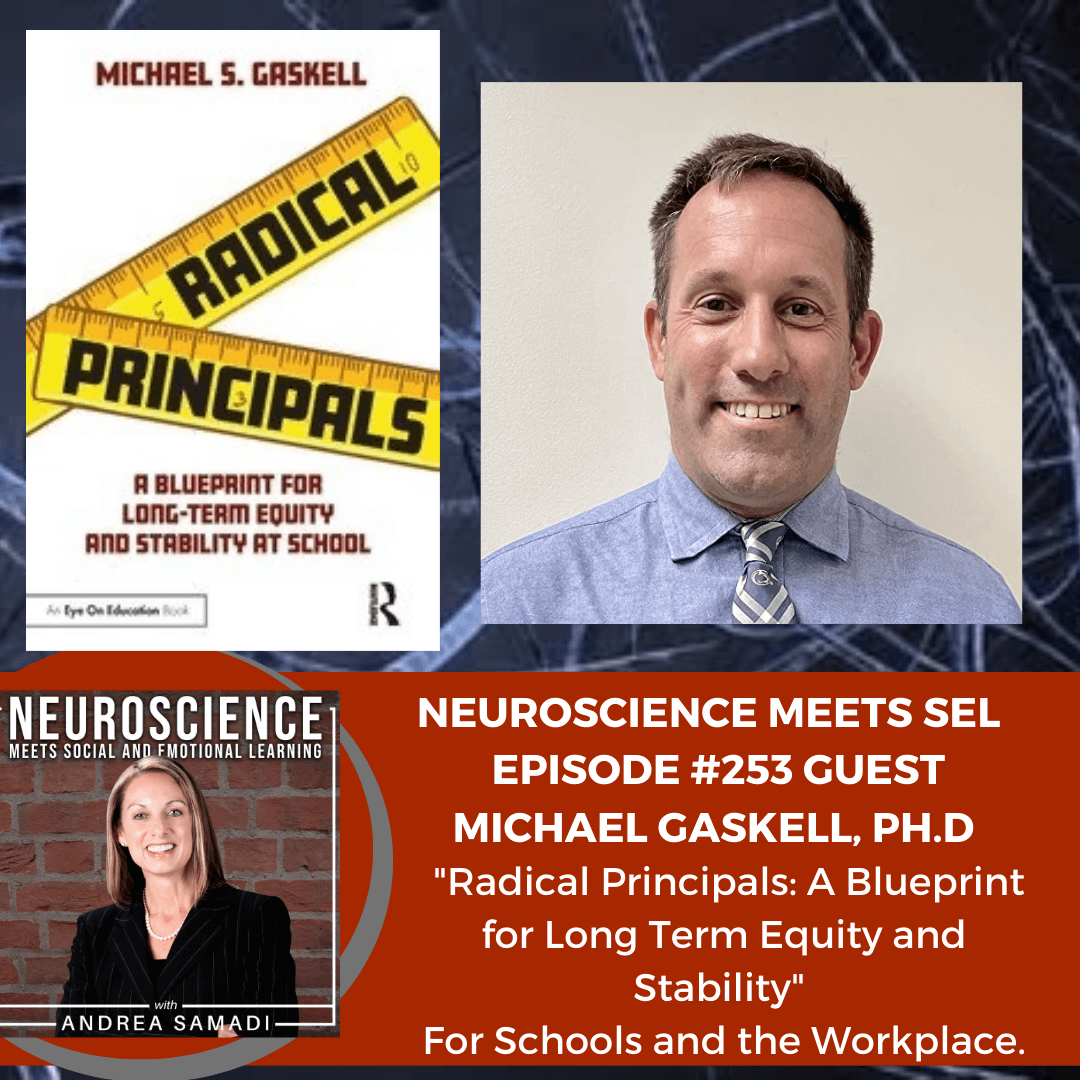
S8 Ep 253Michael Gaskell, Ph.D on ”Radical Principals: A Blueprint for Long-Term Equity and Stability” for Schools and the Workplace.
“Radical approaches are the sorts that are crazy the day before they are brilliant. The payoff is enormous, especially for children who are disadvantaged. Students are the real winners of fearlessly Radical Principals” Dr. Michael Gaskell And I will add that “our world needs radical thinking, creative ideas and imagination.” On this episode we will cover: ✔ How "radical approaches" are beneficial for those in a position in leadership for building creativity, and breaking through to new heights. ✔ How timing, idea stacking and mentoring can be used to conserve time and energy needed for leaders to generate new ideas by freeing up time/resources. ✔ What are some strategies for handing negative misinformation, or managing the negative forces of online exchanges? ✔ How are you using support networks (mastermind groups) to empower Radical Principals to create safe zones, leading to more innovation? ✔ What is Radical Loyalty and how can you build this to breed more success in your school or organization? ✔ How to tackle difficult topics like countering the effects of institutionalized inequities. ✔ How to help our next generation to recognize the consequences of their online presence. Welcome back to The Neuroscience Meets Social and Emotional Learning Podcast where we bridge the gap between theory and practice, with strategies, tools and ideas we can all use immediately, applied to the most current brain research to heighten productivity in our schools, sports environments and modern workplaces. I’m Andrea Samadi and launched this podcast to share how important an understanding of our brain is for our everyday life and results. My vision is to bring the experts to you, share their research, books, ideas and resources to help you to implement their proven strategies, whether you are a teacher working in the classroom or in the corporate environment. Today’s EPISODE #253, we have returning guest, Michael Gaskell, a veteran principal from NJ, USA, whose episode #172 on “Leading Schools Through Trauma”[i] sits in our TOP 10 most downloaded episodes at #6, with over 1500 downloads. Dr. Michael Gaskell is Principal in East Brunswick, NJ., and he models the pursuit of lifelong learning as he serves to mentor new principals through the New Jersey Leaders to Leaders program. An NJPSA Stars recipient, he has been published in over 3 dozen articles in education journals and blogs, including Education Post, eSchoolNews, NASSP, Edtech and ASCD Smartbrief, and has made the most-read section of ASCD Smartbrief numerous times, which coincides the fact his last episode remains in our TOP 10 all time most listened to episodes. Mike presents at national conferences, and started his own podcast in January of this year, where he interviews successful adults like Diamond Dallas Page, how he conquered his dyslexia and anxiety associated with it. Mike has published two books: Leading Schools Through Trauma and Microstrategy Magic. Dr. Gaskell works tirelessly to support instructional excellence and student success, for his school community, and most importantly, for the wellness and equity of all children. He’ll be joining us today to share his new book, Radical Principals[ii]: A Blueprint for Long-term Equity and Stability at School, that will be released November 2022, but is currently available for pre-order through the link in the show notes. Dr. Gaskell obviously loves writing and intends to continue offering his contributions to support learners and educators in written and presentation format. Let’s welcome back Dr. Michael Gaskell for a second time, and learn together about his new book, Radical Principals, and how we can all inspire change in our schools and workplaces, with radical thinking, creative ideas and imagination. Intro Q: it’s so good to have you back here, Michael/Dr. Gaskell, especially after your first interview made such an impact on our audience, sitting in the top 10 all time most listened to episodes. I’ve
S8 Ep 252Brain Fact Friday on ”Using Neuroscience to Improve Fitness, Longevity and Overall Health.”
It’s one of the Top 5 health staples that we’ve covered often on this podcast, but Dr. Peter Attia[i], Canadian-American physician, known for his medical practice that focuses on the science of longevity, says that “exercise might be the most potent “drug” we have for extending the quality and perhaps quantity of our years of life.” On this episode we will cover: ✔ What the current research says for improving fitness, longevity and overall health. ✔ Look at the workouts from Dr. Peter Attia and Dr. Andrew Huberman, who dive deep into this topic on their recent podcast episodes. ✔ Compare their workouts to mine, and look for gaps using the most current research to see if we can all improve our workout routines with longevity in mind. ✔ Use Attia's Rule in this process. Welcome back to The Neuroscience Meets Social and Emotional Learning Podcast where we bridge the gap between theory and practice, with strategies, tools and ideas we can all use immediately, applied to the most current brain research to heighten productivity in our schools, sports environments and modern workplaces. I’m Andrea Samadi and launched this podcast to share how important an understanding of our brain is for our everyday life and results. Like you, I’m interested in learning and applying the research, to our everyday life. On today’s episode, I want to share the research I saw recently to improve fitness, longevity and overall health, with Dr. Peter Attia’s work who was recently featured on Dr. Andrew Huberman’s podcast. Dr. Attia, has a fascinating origin story, as he started his career as a cardiac surgeon, and then found he had a heart condition, so he began to dive into the research to see how he could improve the quality of his own life. On today’s episode #252, and this week’s Brain Fact Friday, we will take Dr. Attia’s advice, look at what he does himself, and what he recommends for others he trains, compare it to how others, like Dr. Huberman are training, and then how I’ve been training. I’m hoping we will find areas to tweak or improve, with Dr. Attia’s research in mind, that focuses on longevity and overall improvements in health and fitness. The overall goal with this episode is to have all of us use the research to inform our current exercise program, uncover our gaps, and see if there are any ways that we can improve what we are doing, with longevity research in mind. I wanted to cover this topic, as I’m always looking to improve what I’m doing, but find that when there’s so much to do, or so many different exercise or nutrition plans to follow, I notice I don’t do anything new at all, and just do the same thing, which changes nothing. The point of this episode is to look at moving our needle even just a little bit, and see if there is something we can all do, even if it’s a small tweak, to build a better 2.0 version of ourselves, to make this year our best year ever, or at least give us a running start at 2023. Biohack Tip Advice For this episode, I plan on following Attia’s Rule[ii] which Dr. Huberman coined that basically addresses the ton of exercise and nutrition advice flying around out in the world. This rule says “don’t quibble about nutrition or supplementation until you’ve dialed in your own exercise/strength protocol,” and I wouldn’t even consider writing this episode, if I wasn’t putting my own health first, using Attia’s Rule as a guide. Dr. Attia says that nutrition and health arguments are a waste of your time until you’ve completed a certain set of criteria. He says don’t bother unless you can: Dead hang for a minute Wall sit for two minutes Have a VO2 max of at least 75th percentile for your age group. Before writing this episode, I wanted to be sure that I qualified for Attia’s Rule. Here’s how I fared with his criteria. Dead Hang[iii]: I had to find a park down the street from my house to try a dead hang, as I’ve never done one before. In Canada, I remember doing fitness testing for running in school, b
S8 Ep 251Brain Fact Friday on ”Exploring Consciousness: Using Neuroscience to Expand Our Awareness”
Welcome back to The Neuroscience Meets Social and Emotional Learning Podcast where we bridge the gap between theory and practice, with strategies, tools and ideas we can all use immediately, applied to the most current brain research to heighten productivity in our schools, sports environments and modern workplaces. I’m Andrea Samadi and launched this podcast to share how important an understanding of our brain is for our everyday life and results. Like you, I’m interested in learning and applying the research, to our everyday life. On this episode we will cover: How can being “mindfully aware in the present moment” benefit us? An overview of the Levels of Consciousness that take us from coma, unaware, to full wakefulness and awareness. How to expand our level of awareness through effective study (using the most current neuroscience research). Break down this complex idea of consciousness, so we can all improve an area on the map, moving us towards full awareness. Use this understanding to better understand ourselves and others. This week’s Brain Fact Friday came to me this week while on a training call with Mark Waldman, in his neurocoaching program, that consists of all of the students he has worked with over the years[i] all over the world. Some students have been certified, and share their knowledge with others, like Michael Kirton, an Australian clinical psychologist and author who specializes in child development, mental health issues and trauma, and he often joins the calls to share how he is making an impact in his community with the understanding of mindfulness based coaching, training or therapy. I tune into these calls as I’m always looking for something new to share on the podcast, that we could all use to improve our results. This week, were talking about what it means to be “mindfully aware in the present moment” that Jon Kabat-Zinn coined in his definition of mindfulness to be the “awareness that arises through paying attention, on purpose, in the present moment, non-judgmentally”[ii] which Waldman says is a key secret for experiencing optimal health and wellbeing. We covered an overview of Brain Network theory on EP #48 and the importance of being able to mindfully shift between our imagination, (DMN) awareness (SN) and thinking (EN) to increase our creativity and results, while reducing stress. The funny thing I’ve noticed with writing these episodes, and implementing what I’m writing, I’ve got to say that when I’m in a high stress situation, the last thing I’m thinking about is being “mindfully aware” in the present moment. But with time, small things like learning to breathe properly while experiencing stress, that we learned from Rohan Dixit, on EP #228[iii] is putting me miles ahead of where I used to be without a mindfulness-based stress reduction strategy. While I wish I had the opportunity to study and learn directly with monks deep in the Himalayas, like Rohan Dixit did before he founded Lief Therapeutics, and invented a wearable device that tracks HRV in real-time to help us to learn how to breathe when we are stressed, interviewing those who’ve taken the time to do the research, and then sharing this research on the podcast, is my next best option. We’ve all heard of the research that backs up how important these brief moments of mindfulness can be, whether it’s in our everyday life, or even in the classroom, during learning, as Professor Kimberly Shonert-Reichl’s research (from The University of British Columbia) shows that these brief moments “promote curiosity, creativity and pro social behavior.”[iv] The key to being mindfully aware is to focus on the present moment, instead of what’s happened in the past, or what we think might happen in the future, and learn to breathe, or focus on our breath, which brings our mind into this present moment. While on this training call with Mark Waldman, a new student asked “what about when I’m dreaming” where’s my level of awareness here?” and w
S8 Ep 250Brain Fact Friday on Success is Nonlinear: Using Neuroscience to Achieve Quantum Leaps, the Kaizen Way.
Welcome back to The Neuroscience Meets Social and Emotional Learning Podcast where we bridge the gap between theory and practice, with strategies, tools and ideas we can all use immediately, applied to the most current brain research to heighten productivity in our schools, sports environments and modern workplaces. I’m Andrea Samadi and launched this podcast to share how important an understanding of our brain is for our everyday life and results. Like you, I’m interested in learning and applying the research, to our everyday life. For this week’s Brain Fact Friday, I want to look at the Japanese term “Kaizen” that means “change for the better” or “continuous improvement” as we enter the last quarter of 2022. If you follow this podcast, we launched our year with a 6 PART study of the bestselling book, Think and Grow Rich, that ended with EPISODE #196[i] on “The Neuroscience Behind the 15 Success Principles of Napoleon Hill’s Classic Book, Think and Grow Rich” ensuring that we all make 2022 our best year ever with this detailed study. I’ve been studying this book chapter by chapter, at the start of every year, since 2019, which doesn’t seem like a long time, but if you go back to this book study, you’ll see that it’s quite intensive. The notes I share came from 2 of my mentors who have studied this book for their entire life. It took me to the beginning of February to properly cover these 15 success principles, with enough content in this series to continue to study this book, every year, for the rest of OUR lives, and we will still pick up something new. We will cover this on today’s episode, but success with these principles doesn’t happen immediately. But it will happen, with time, which is why I think it’s crucial to revisit this book (and success principles) throughout the year, to be sure the concepts are being applied, not just in January, when we are starting our year, but every month of the year, right through to end of Q4. There are 6 STEPS in this book, that I’ve written on my wall, that when read aloud every day, causes an increase in the amplitude of our thinking, until eventually, our goals become so engrained in our mind, that they become on autosuggestion in our thoughts throughout our day. Napoleon Hill intended this book to be studied over and over again, not just once, but multiple times, for results to occur. We opened this 6 PART series at the start of the year with a quote from Undercover Billionaire Grant Cardone, who said, “In order to get to the next level of whatever we’re doing, we must think and act in a wildly different way than we previously have been” and I know I’ve repeated this quote often throughout the year, (on various episodes) but I’m doing it on purpose, since making any sort of change takes time. It doesn’t happen overnight, or immediately, or how our brain wants to see things unravel, because success is nonlinear[ii]. I heard this concept the other day, and it made me stop and think for a minute. When you hear “success in nonlinear” what do you think about? I thought about that image of the person riding their bike with their plan in mind, towards their goal, but in reality, there are many obstacles along the way. We all will have our ups and downs, but what I’m hoping to show with this episode, is that our results will happen predictably, by taking certain actions, day in and day out, with our desired outcomes in our mind, that eventually become on autosuggestion, as we move towards our goals, overcoming the obstacles along the way. This will encourage all of us, that no matter what results we see today, in front of our eyes, that we must never give up, as you might just be giving up 3 feet before gold,[iii] (which is a concept from Chapter 1 of Napoleon Hill’s Think and Grow Rich book) that says “one of the most common causes of failure is the habit of quitting when one is overtaken by temporary defeat.” (Napoleon Hill, Chapter 1, Think and Grow Rich). Which brings to
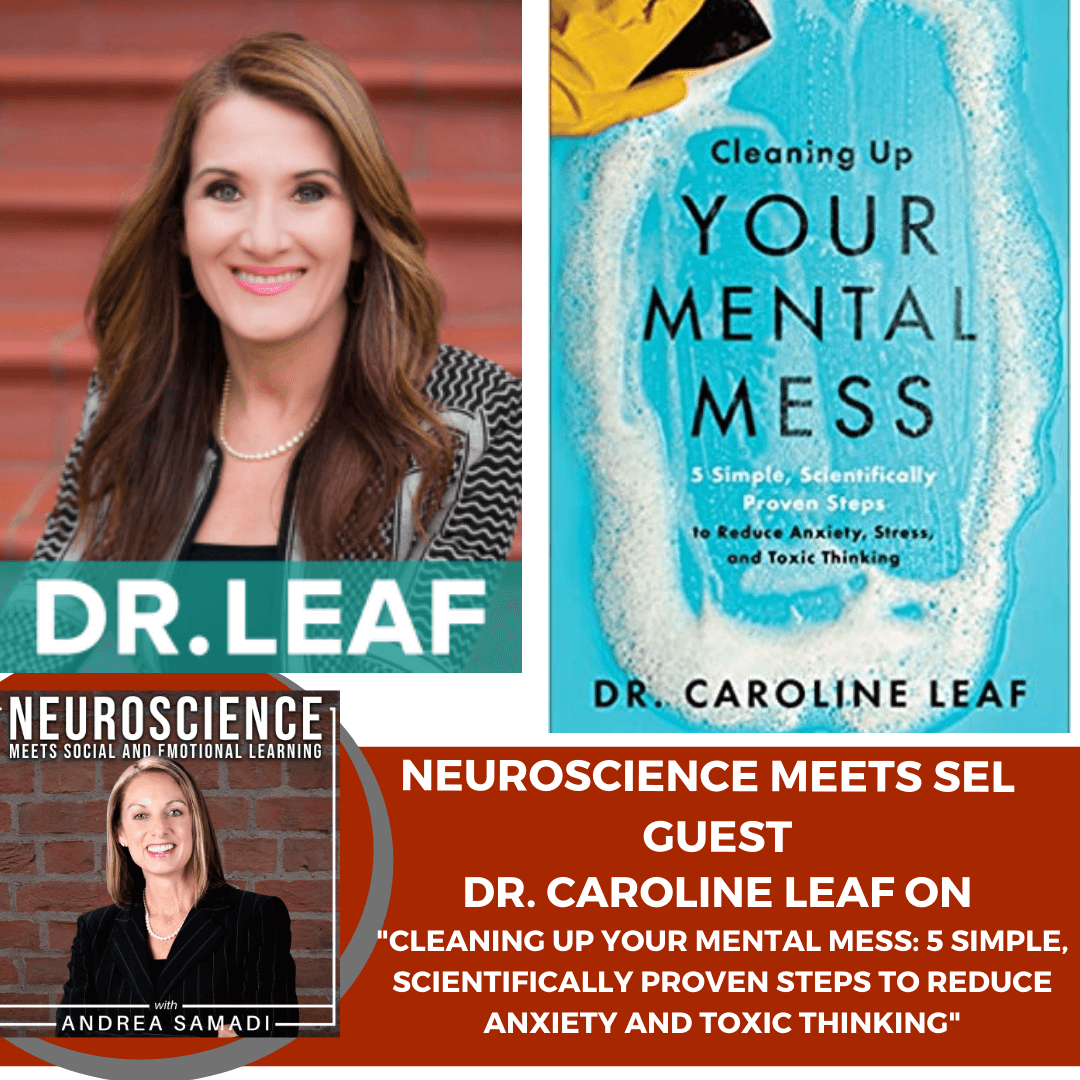
S5 Ep 110World renowned Neuroscientist Dr. Caroline Leaf on ”Cleaning Up Your Mental Mess: 5 Simple, Scientifically Proven Steps to Reduce Anxiety and Toxic Thinking.”
bonusToday we have a special BONUS episode on the Neuroscience Meets Social and Emotional Learning Podcast with a very insightful backstory for how we came to meet our next guest. But first, if you are new here, my name is Andrea Samadi, and I’m a former educator who created this podcast to bring the most current neuroscience research, along with high performing experts who have risen to the top of their field, with specific strategies or ideas that you can implement immediately, whether you are an educator, or in the corporate space, to take your results to the next level. If we want to improve our social, emotional and cognitive abilities, it all starts with an understanding of our brain. You can watch this interview on YouTube here. ----------------BACKSTORY----------------- I first heard our next guest on Dr. Daniel and Tana Amen’s Brain Warrior’s Way Podcast[i] right at the start of the Pandemic last May 2020 where I learned about a “Step 5 Process to Managing Trauma.” At the time of this interview, many people around me were just beginning to feel the stressors and pressure that this global pandemic was having on the world, and I began to pay attention to what this speaker was saying. I usually listen to my podcasts early morning and takes notes on my phone, and I began quickly writing what I was learning on this podcast. This speaker caught my attention because she mentioned that she had spent 25 years in the in South Africa in the worst areas—working with local schools, and community centers where she would teach them about their brain and their mind, and her work had such an incredible impact on those around her, they would fill these rooms, with standing room only. I know what it takes to fill a room, coming from my work in the speaking industry, working closely with Bob Proctor Seminars, so I knew she had to be doing something outstanding to draw this much interest. This podcast episode ended and I went back to my usual work life and interviewing new speakers. At that time, I was referred to a publisher and was working with many of authors connected to this polisher (Corwin Press), and my interview schedule filled up through the summer, and I wasn’t looking for new guests, I was just trying to keep up with the demand to interview the ones I had in cue. Then I had an email from one of my LinkedIn contacts, John Prucha[ii], from Atlanta, GA, who I heard from occasionally as he was enjoying the podcast episodes and often would send me his thoughts and feedback. One day he sent me a private message asking if I had considered reaching out to Dr. Carolyn Leaf[iii] for the podcast. At the time he sent me the message, I was swamped with the line-up of guests, but I do take all referrals seriously, and wrote down Dr. Leaf’s name on my desk. And went back to work as usual. A couple of weeks later I was working on a Character Book that I am creating, and this time, I am doing the interior design of the book, instead of sending it to a publisher, and I was looking for some headings to go along with the lessons I was creating. For each Character Trait, like Attentiveness, I have created ways to learn this attribute, and had the heading THINK (with some tips on what to think about before studying how to become more attentive), LEARN (the actual lesson on attentiveness), TAKE ACTION (with an activity to implement attentiveness into your daily life) and I was searching for the last heading. What happens to people after they learn a new skill? When I don’t know the answer to something, I usually type it into Google and see what comes up. I typed in THINK, LEARN, and the FIRST thing to come up was a book called Think, Learn, Succeed: Understanding and Using Your Mind to Thrive at School, the Workplace and Life[iv] by Dr. Caroline Leaf! If you had been in my office, you would have seen me glance at the note on my desk as my brain processed, “Hey, wasn’t that the same person who John Prucha from LinkedIn asked me to contact
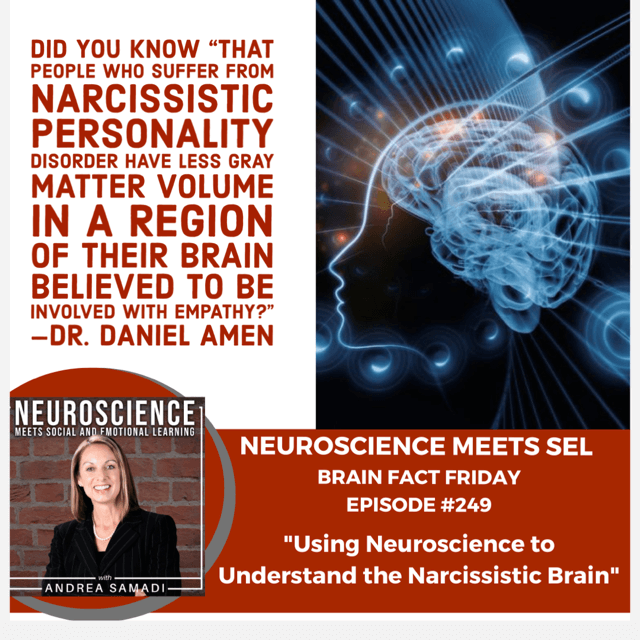
S8 Ep 249Brain Fact Friday on ”Using Neuroscience to Understand the Narcissistic Brain”
“When I look at narcissism through the vulnerability lens, I see the shame-based fear of being ordinary. I see the fear of never feeling extraordinary enough to be noticed, to be loveable, to belong, or to cultivate a sense of purpose.” Brené Brown. And when I look at narcissism through the vulnerability lens, I see the spirit in that person, desperately trying to be seen for their talents, skills and abilities, but something keeps this person’s spirit in the shadows and I wonder what that is. On today’s episode we will examine: ✔ Narcissism through the vulnerability lens ✔ What is narcissism and how is it diagnosed. ✔ What the narcissistic brain looks like. ✔ 3 STEPS to move you forward if you think you are a narcissist, if you live with one, or if you work with one. Welcome back to The Neuroscience Meets Social and Emotional Learning Podcast where we bridge the gap between theory and practice, with strategies, tools and ideas we can all use immediately, applied to the most current brain research to heighten productivity in our schools, sports environments and modern workplaces. I’m Andrea Samadi and launched this podcast to share how important an understanding of our brain is for our everyday life and results. For this week’s Brain Fact Friday, I want to look at something I saw this past week about the narcissistic brain. We hear this word so often these days, thrown around when describing someone who is self-centered, someone who is unlikeable when they exclaim, “That person is such a narcissist!” Narcissistic personality disorder (NPD) is “a condition where people have an inflated sense of self-importance and a deep-seated need for attention and admiration. Those living with NPD show a distinct lack of empathy for the feelings and needs of others.”[i] In writing this episode, I want to come from the “vulnerable” angle (like Brené Brown mentioned in her quote) and look at what we can learn about the brain of someone who meets at least 5 of the criteria for what we call narcissistic personality disorder.[ii] My goal with this episode is to help all of us to understand the “why” behind narcissism, a personality disorder that is not difficult to miss when you either work with, or live with someone who shows even a few of the criteria that’s needed for a clinical diagnosis. American psychologist, and brain disorder specialist, Dr. Daniel Amen, from Amen Clinics, says that “6.2% of the American population has a narcissistic personality disorder” that often begins in early adulthood. What’s interesting, is that “Psychologically speaking, narcissism is a personality trait that every person possesses to some degree. Like any characteristic, it exists on a spectrum. We all fall somewhere along the narcissistic continuum” and a certain amount of self-centeredness is healthy.”[iii] While writing this episode, I remembered something sleep medicine physician, and sports psychiatrist Dr. Shane Creado from EP #72[iv] said to me when he analyzed my brain scan from Amen Clinics, and I went back to that episode #84[v] to look at what he saw. I remember he said something about my deep limbic system being the brightest part of my emotional brain and that he saw this area overactive in people who hold themselves to high standards. I wondered for a minute. Oh no, does this make me a narcissist? Curious, I sent him a text late last night to double check what he meant by that and he sent me a wonderful explanation this morning, affirming that narcissism is complex, and operates on a spectrum. He explained why we all need a certain amount of it, to be focused on our goals, or things that we want to achieve, which explained why he saw this area light up brightly with people who are perfectionists, like I tend to be with this podcast. When releasing content out to the world, I have to be careful of what I say, and how I say it, especially when I’m interviewing someone, and what I create goes into the world for anyone to watch, and will
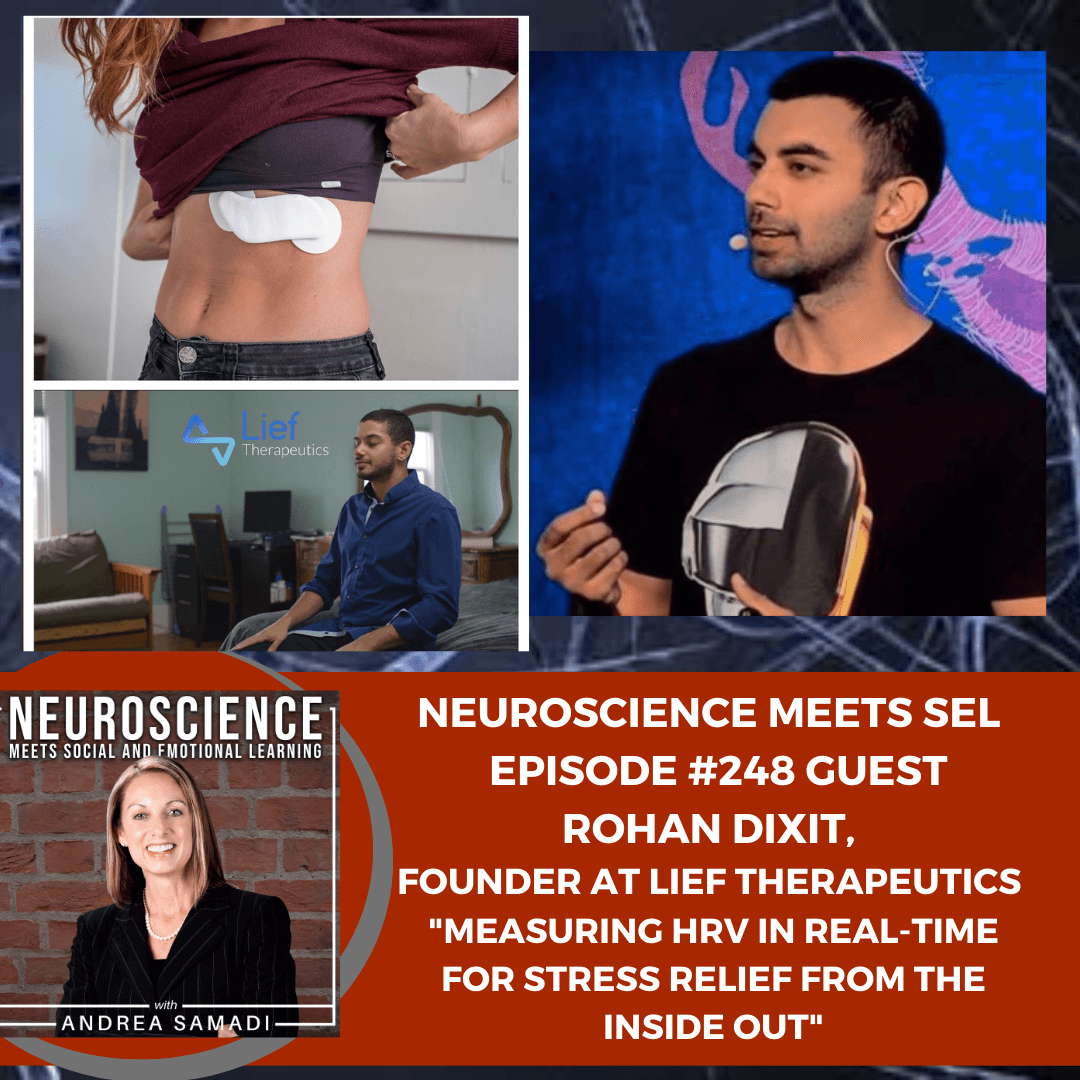
S8 Ep 248Neuroscientist Rohan Dixit, Founder of Lief Therapeutics on ”Measuring HRV in Real-Time for Stress Relief From the Inside Out”
"Heart rate variability has really come to the forefront in the last 40 years as being the most important biomarker for tracking health and recovery on a regular basis, and not just health and recovery, but resilience." (Neurohacker Collective) Watch this interview here on YouTube: https://youtu.be/8wbt2o-lO1I It’s something we’ve covered on past episodes[i] including our most recent EP #228 where we reviewed Heart Rate Variability, what it is, why it’s important to track, with tips to increase it, for increased capacity throughout our day. On this episode we will learn: ✔ How Rohan Dixit created a wearable device for stress relief, based on his own personal struggles. ✔ The ONE THING that most of us are missing when it comes to improving our mental health and well-being. ✔ How Rohan came across HRV in his research and why as a neuroscientist he looked outside of the brain for a solution for our mental health and well-being. ✔ REVIEW: What is HRV and why it is an important biomarker to measure. ✔ Why tracking HRV in real-time helpful for our mental well-being. ✔ How we can all improve our stress levels by looking at our data. ✔ What is biofeedback and how does it work? ✔ The most common ways to decrease our HRV, that we should all be aware of. ✔ The research behind HRV as a drug-free solution to stress and anxiety reduction. ✔ How to get started and receive 15% off your first month using the code ANDREA. NOW IMAGINE THIS! What if you could see your HRV in real time throughout the day, so you know what’s helping this important score, or hurting it? We will cover this on today’s episode as we meet with Rohan Dixit, the founder of Lief Therapeutics (a wearable stress relief device) that’s designed to help us to overcome stress and worry from the inside out. Stay tuned and we’ll explain how this ground-breaking device can help ALL OF US to improve our health, as we learn self-regulation strategies using the device, that will eventually become a habit, showing us how to break free of anything that might be holding us back. Welcome back to The Neuroscience Meets Social and Emotional Learning Podcast, where we cover the science-based evidence behind social and emotional learning (for schools) and emotional intelligence training (in the workplace) with tools, ideas and strategies that we can all use for immediate results, with our brain in mind. I’m Andrea Samadi, an author, and educator with a passion for learning specifically on the topics of health, wellbeing and productivity, and launched this podcast to share how important an understanding of our brain is to our everyday life and results using the most current brain research. If there’s a tool, strategy or resource that I find, that could be helpful to improve productivity and results, whether we are a teacher in the classroom, a coach or in the modern workplace, I will share it here. On today’s episode #248, we will be speaking with Rohan Dixit, the founder of Lief Therapeutics, to see if we can sharpen our saw with our understanding of HRV, a biomarker that’s known for tracking health and recovery as well as resilience. What I think is absolutely incredible with this wearable stress relief device, is that you’ll see that the point of wearing this device, is to train us to breathe in a certain way to relieve our stress, anxiety and worry (that it will pick up) and then help to calm us down, so we won’t need to rely of the device. Rohan’s mission is not about the money he could make with the device, but truly about helping people to be able to manage their own problems, without the use of medicine, or pills, or those things we do that we know relieve stress in the short term, but are bad for our overall health in the long term. I can’t wait to speak with Rohan Dixit, and explore the technology he created in his garage, (he’s a real Steve Jobs story) and the idea was based on his own personal struggles with anxiety and depression when he was younger, that h
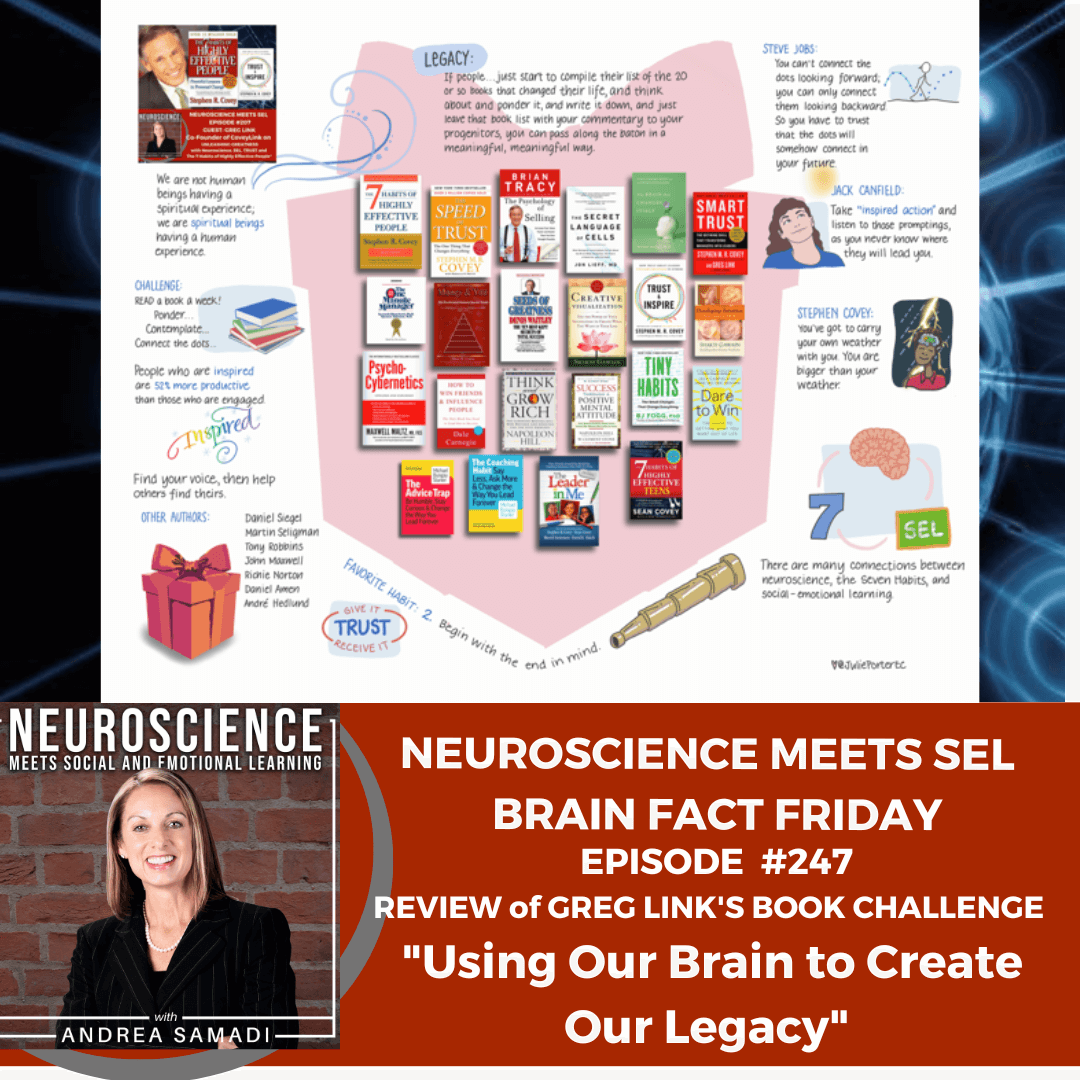
S8 Ep 247Brain Fact Friday: Review of Greg Link’s Book Challenge ”Using Neuroscience to Create Our Legacy”
“We are not human beings having a spiritual experience, we are spiritual beings having a human experience.” On this episode we will cover: ✔ Brain Fact: DID YOU KNOW THAT "95% of the decisions we make take place in our subconscious mind?" (Deane Alban). ✔ A review of EP #207 with Greg Link with his tips to INTENTIONALLY create a legacy, reading a book a week. ✔ Applying the 7 Levels of Awareness to our Daily Life to Be INTENTIONAL With the Life We Create. ✔REMINDER: To see and recognize the "spirit" in everyone. What does this mean to you? On today’s episode we will be diving into this quote…to see how much of our life we really do have control over. At the end of this episode I hope to show that with being intentional about every action we are taking, that we don’t leave anything up to chance, and that we can in fact, create an exciting life, and future, without relying on chance or luck, and there’s magic in the creation process, that illuminates the fact that there’s much more to who we are. I am not just my name, Andrea Samadi (or the human being you see), there’s a spiritual side to me, and there’s a spiritual side to you. Do you see it? Do you see the spiritual side in others? Once you see it, you won’t be able to see anything else, and I hope we can all begin to see the “spirit” in each other. Welcome back to The Neuroscience Meets Social and Emotional Learning Podcast where we bridge the gap between theory and practice, with strategies, tools and ideas we can all use immediately, applied to the most current brain research to heighten productivity in our schools, sports environments and modern workplaces. I’m Andrea Samadi, (and I hope by now you see I’m more than just my name, and that you know the “why” behind this podcast without me saying it each week. With that in mind, for this week’s Brain Fact Friday, I want to go back to EP #207[i] with my dear friend Greg Link, the cofounder of CoveyLink who worked directly with Dr. Stephen Covey for many years, with our episode on “Unleashing Greatness with Neuroscience, SEL, Trust and the 7 Habits.” On this episode, Greg opened up with the quote I read at the start of this episode, from his back porch in Sedona, Arizona, reminding me just how much the 7 Habits connected to the brain, social and emotional learning and to this magical thing we call life. It was an extraordinary opportunity to speak with Greg on this day, as he hadn’t spoken publicly for almost a decade, since I saw him last, and when I got the prompting to ask him to come on the podcast, there was no way I was going to ignore it, or worry about whether he would say no, or not. Just a reminder, for those who haven’t listened to episode #207 (go back and check it out—here’s the link to the YouTube interview[ii]) but I met Greg Link when I worked in the motivational speaking industry, when he was brought to help some of the speakers to gain more traction, and solve some of their problems with his experiences. Greg had recently skyrocketed Dr. Stephen Covey’s 7 Habits of Highly Effective People book that sold over 40 million copies since its first publication, and many leaders in the industry were looking to learn from his success. On this episode, Greg gave us a running list of the books that influenced his life, and urged us to do the same to leave a powerful legacy behind. As we are now in the final weeks of Q3 in 2022, I’ve focused the past few Brain Fact Fridays on Building a Stronger 2.0 version of ourselves, so we can all get a running start to 2023, and when I was interviewing Greg Link, I knew it was going to be an epic interview that I would refer back to often. I just didn’t know how powerful it was going to be at the time, but looking back now, connecting the dots backwards, after just a few months, this episode now has over 1100 downloads. I knew after we recorded that episode that I’d need to do a follow up and be sure to highlight his Legacy Building Activity. With that in mind, for
Ep 246Jeff Kleck on ”Using Neuroscience to Inspire Thinkers: In Schools, Sport and the Workplace”
“Like Martin Luther King, I have a dream. I dream that someday all teachers will teach students how to think rather than make them think. I dream that all students will understand how their brains work and use the knowledge to be successful and excel in whatever endeavor they choose.” Arizona School Administrator, Jeff Kleck Watch this interview on YouTube here https://youtu.be/2pDRrOOcX5s On this episode we will learn: ✔ About the educator who inspired Andrea to move in the direction of neuroscience in 2014. ✔ How he became interested in neuroscience, introducing Andrea to Carol Dweck and David A. Sousa. ✔ The moment of truth when Jeff met Andrea and gave her feedback that changed the direction of her work. ✔ How to handle criticism, and move forward even when it's difficult to hear. ✔ After 40 years in education, Jeff Kleck shares brain-based strategies he's used with students, athletes and his own children. Welcome back to The Neuroscience Meets Social and Emotional Learning Podcast, where we cover the science-based evidence behind social and emotional learning (for schools) and emotional intelligence training (in the workplace) with tools, ideas and strategies that we can all use for immediate results, with our brain in mind. I’m Andrea Samadi, an author, and educator with a passion for learning specifically on the topics of health, wellbeing and productivity, and launched this podcast to share how important an understanding of our brain is for our everyday life and results using the most current brain research to inform our decisions. Our guest today is someone I’ve mentioned often on this podcast, but one day, I realized that I know very little about the person who encouraged me to pivot in the direction of neuroscience, back in 2014. Every interview I’ve ever done, someone always asks me “How did you end up doing a podcast on the topic of neuroscience?” and I tell the same story about how an educator urged me to go in this direction many years ago. I’m very intentional about the people I ask to come on the podcast. They are usually someone who is making an impact in the field of health, wellness, and education in some way, or has had an impact on my direction, and the work I’ve been doing over the years and while creating the questions for Dr. Ginger Campbell, who’s well known for her podcast Brain Science[i], I stopped to think for a moment about how on the earth I ended up where I am today and I thought about our next guest. I never ignore those flashes of insight that interrupt me while working, as the connections I’ve made over the years are the only reason I am here today, working in this field of educational neuroscience, and so very passionate about it, with the incredible opportunity to think, learn and create every day. And I wouldn’t have had the courage to move in the direction of Neuroscience, without the guidance of our next guest, Jeff Kleck,[ii] who is now the principal at Valley Christian School in Phoenix. I look forward to talking neuroscience with Jeff, someone I’ve not seen since he helped me to create my second book, Level Up: A Brain-Based Strategy. On today’s episode #246, we’ll be speaking with Jeff Kleck, and see if I can fill in the blanks of where his passion for neuroscience began, what he’s doing now to help educators understand how their brain impacts learning, and what he thinks of the future of educational neuroscience in our schools, sports and workplace environments. Let’s welcome my mentor to this field of educational neuroscience, Jeff Kleck. Intro: Welcome Jeff! It’s incredible to see you again. Was it 2014 when we met last? Maybe 2015? Somewhere back then… Jeff, I reached out to you, as I mention in the back story that I never ignore those flashes of insight that come while working, and I was writing Dr. Ginger Campbell’s interview questions, and for a moment, I was stumped. How on the earth did I get here, asking the host of the top neuroscience podcast questio
S8 Ep 245Brain Fact Friday ”Using Neuroscience to Recognize Individuality and Uniqueness”
Welcome back to The Neuroscience Meets Social and Emotional Learning Podcast. I’m Andrea Samadi, and launched this podcast just over 3 years ago, with a vision to bridge the gap between theory and practice, and help all of us (whether we are a teacher in the classroom, or in the modern workplace) to understand the most current brain research, and how to use it, for improved productivity and results. On this episode we will cover: ✔ That we are all unique and our brain makes us this way. (Chantel Prat, Ph.D) ✔ If we want to change ourselves in any way, this change must involve our brain. (Chantel Prat, Ph.D). ✔ We can change our brain for the better, by repeatedly taking action towards our goals, and strengthening our “roads” or neural pathways.✔ We can also change our brains for the worse. (Dr. Andrew Huberman) ✔ As human beings, our job is to help people realize how rare and valuable each of us really is. (Chatel Prat, Ph.D). For this week’s Brain Fact Friday, I want to leverage off something we’ve been talking about on the past few episodes, that we are all unique, and our brain makes us this way with “a pattern of connectivity as unique as our fingerprints.” (Deane Alban). Have you ever wondered “what makes you unique from others? Or why you do things a certain way?” I certainly have wondered this, and I think back to the days I worked in the motivational speaking industry and when discussing how change occurs, we went straight to the importance of understanding our paradigms, or habitual behavior and that if we want to experience change, we would need to change these habits, that began with changing our thoughts, feelings and actions, to attain the newly desired results. But now I see that there’s a simple answer to why we are unique, or do things in a certain way. I recently came across Chantel Prat’s book, The Neuroscience of You: How Every Brain is Different and How to Understand Yours[i] and I thought back to last week’s Brain Fact Friday, and EP 244[ii] where we looked at how we are all unique, and it’s our brain that makes us this way, and I wondered what we could learn from Chantel’s book, that just came out last month, to help us to figure out who we are, with our brain in mind. I haven’t finished reading her book yet, but the answer to “why we do what we do” stems from the fact that “my brain makes me this way.” (location 34, The Neuroscience of You, Prat). Prat tells the story of when she first realized this to be true, when she took a course that described the famous story of Phineas Gage, who was a railway worker who made an error that caused an iron spike to blast through his left cheek and out the top of his head, and this essentially changed the personality of Phineas Gage. For this week’s Brain Fact Friday, I’m taking this AHA moment from Chantel Prat’s The Neuroscience of You to help us to understand ourselves on a deeper level. “If you change your brain, you change the person.” I could think about this one for the next year! I’m always looking for ways that we can improve our productivity and results, (and change ourselves for the better) and it would make sense to me that if we want to change ourselves in any way, that this change must take place in the brain, which will change the person. How exactly do we change our brain? Chantel Prat tells us that we can soak our brain in cortisol by increasing our stress levels, and this in fact will change our brain. But that’s not the change I’m looking for. Or we can shrink our brain with the research that Dr. Andrew Huberman[iii] provided for us on his eye-opening podcast episode on “What Alcohol Does to Your Body, Brain and Health” which is also not the answer I was looking for. Or we can repeatedly take certain actions to strengthen the neural pathways or “roads” in our brain, and with time, these pathways strengthen, making whatever we are learning simpler, and easier to perform. This is getting closer to the change I’m hoping we all can att
Ep 244Brain Fact Friday ”Using Neuroscience to Change Our Perception”
“If we have very strong beliefs about something, evidence to the contrary could be sitting right in front of us, but we may not see it because what we perceive is entirely different.” (Dr. Joe Dispenza, speaker, researcher and author who is passionate about the fields of neuroscience, epigenetics, and quantum physics, pushing the limits of possibility). On this episode we will cover: ✔ How to change our perceptions, or what we believe, using the most current brain research. ✔ That we each have a pattern of connectivity in our brain as unique as our fingerprint. ✔ How each person, with a unique brain, learns and behaves differently, based on how it's wired. ✔ 2 Strategies to improve health, well-being, productivity and resiliency, by measuring your personal fitness metrics. ✔The importance of accepting other people's differences. Welcome back to The Neuroscience Meets Social and Emotional Learning Podcast. I’m Andrea Samadi, and launched this podcast just over 3 years ago, with a vision to bridge the gap between theory and practice, with strategies, tools and ideas we can all use immediately to take what we know (our current knowledge) and apply what we know to the most current brain research for new results, and heightened productivity in our schools, sports environments and modern workplaces. Like Dr. Dispenza, I believe in pushing the limits of what’s possible, and hope this podcast helps those who tune in, to do the same. As I’m writing this episode, it’s September 1st and I can’t believe how fast time flies. If we think back to the start of this year[i], we looked at how to make 2022 our best year ever, with what will we change, or do differently this year, to attain NEW results and I wonder, have YOU “thought in a wildly different way than you previously have been to get to the next level of what YOU are doing?” (Grant Cardone). If the answer is YES, then congratulations, you’re well on your way to new conditions and circumstances in 2023, but if the answer is “not yet” then let’s see what else we can do, together, using neuroscience to challenge our perceptions and change our old habits and behaviors, for new results, with our health in mind. Changing our Perceptions, of What We Believe: For this week’s Brain Fact Friday, and EPISODE #244, I wanted to look at how exactly we create behavior change, using science to challenge our old beliefs. How can we change our perception or what we believe? To do this, we will go deeper into EP #239, where we looked at “Building a Stronger 2.0 Version of Ourselves”[ii] where we picked something that we wanted to change, with the bigger picture of what this change would mean, using our motivation based on our values, holding our focus on what we wanted to change, with a 90-day plan to make this change stick. But, what if we see the evidence, (we know that whatever it is we want to change is bad for us), we really want the change, but there’s nothing compelling enough for us to make this change, like Dr. Dispenza’s quote said. “If we have very strong beliefs about something, evidence to the contrary could be sitting right in front of us, but we may not see it because what we perceive is entirely different.” (Dispenza) Our beliefs (old habits and behaviors) will override the desired behavior change. Which leads me to this week’s Brain Fact Friday. DID YOU KNOW THAT: “Your brain has a pattern of connectivity as unique as your fingerprint?”[iii] This episode is not about swaying you to believe what I believe, but to have you challenge your own beliefs, knowing my brain is different from your brain, and see if you can look at something from a different point of view, while I’m doing the same. Just like Dr. Ginger Campbell told us on our last EPISODE #243, as the host of the longest running podcast on Neuroscience, she acknowledges that what she’s learned over the years is that everyone will have their own beliefs and perceptions about things, and since our brains are all
S8 Ep 243Dr. Ginger Campbell, MD on ”Exploring Brain Science: For Career and Life Success”
Our guest today, Dr. Ginger Campbell has been running her Brain Science Podcast[i] since 2006, and anyone who studies the topic of Neuroscience would have come across her work, as a pioneer, where she launched her podcast all those years ago because she believes that “understanding how our brain really works is essential for being a good citizen in the 21st Century.”[ii] Watch this interview on YouTube here https://youtu.be/W6QeFM6-9lI On this episode we will learn: ✔ Podcast Hall of Fame, 2022, Dr. Ginger Campbell, host of the Brain Science Podcast: Why an MD began podcasting. ✔ Why Dr. Ginger believes that understanding our brain, is essential for being a good citizen in the 21st Century. ✔ Top lessons she has learned from hosting the Brain Science Podcast since 2006. ✔ What is that feeling of certainty? ✔ Where does intuition come in, and can we trust it? ✔ Is interoception (listening to what we feel in our body) reliable? ✔ What about solving our problems in our dreams? Is this reliable? ✔ What about premonitions? Can we trust them? ✔ Why do emotions make our memories stick? ✔ Things to consider with our thinking? We think, therefore we are wrong? ✔ How to distinguish neuroscience from pseudoscience? ✔ Dr. Ginger's thoughts on neuroscience in the field of education. Welcome back to The Neuroscience Meets Social and Emotional Learning Podcast, where we cover the science-based evidence behind social and emotional learning (for schools) and emotional intelligence training (in the workplace) with tools, ideas and strategies that we can all use for immediate results, with our brain in mind. I’m Andrea Samadi, an author, and educator with a passion for learning specifically on the topics of health, wellbeing and productivity, and launched this podcast to share how important an understanding of our brain is to our everyday life and results using the most current brain research. On today’s episode #243, we will be speaking with Dr. Virginia “Ginger” Campbell, MD, who is a physician, author and science communicator who was just inducted into the 2022 Podcast Hall of Fame. She also runs the podcast Books and Ideas, that includes more diverse guests including science fiction writers. Dr. Campbell spent over 20 years as an emergency physician in rural Alabama, and in 2014 she went back to the University of Alabama in Birmingham where she completed a Fellowship in Palliative Medicine which is an approach aimed at optimizing quality of life and mitigating suffering among people with serious, complex and often terminal illnesses. She now practices Palliative Medicine in Birmingham, Alabama and enjoys sharing her passion for science—especially neuroscience. When I was referred to Dr. Campbell for this interview, I almost jumped out of my chair and wrote back quickly, knowing how timely our conversation would be as I was editing our recent interview with physician and neurologist, Dr. Douyon. I know that Dr. Ginger will open our eyes even further to help us ALL to connect the dots with our brain, as it relates to our health and wellbeing. Let’s welcome Dr. Ginger Campbell, and get right into her thoughts about Brain Science, and see what we will learn from her deep and vast experience to help us to all take our understanding of the brain, and our health, to new heights. Welcome Dr. Ginger! Thank you for joining me today. INTRO: So, Dr. Ginger, from my email to you, I’m sure you know that I’m a follower of your work as a pioneer not only in the podcasting world, but as someone who has successfully been helping people to understand how their brain works (which is why we launched this podcast. Can you tell us where your career began, what need did you see, and how did you find your way to podcasting in those early days when I’m sure you needed to understand how to create your own code and website? Q1: Dr. Ginger, now that we have an understanding of your background, I wanted to begin our questions today by telling you how honor
S8 Ep 242Brain Fact Friday on ”Changing Behavior by Understanding Our Brain”
“Many of the most significant public health challenges faced today have a behavioral component. To change individuals’ behavior, we need to understand and change the brain.”[i] From Professor Huda Akil, a Syrian-American neuroscientist Welcome back to The Neuroscience Meets Social and Emotional Learning Podcast. I’m Andrea Samadi, and launched this podcast just over 3 years ago, with a vision to bridge the gap between theory and practice, and help all of us (whether we are a teacher in the classroom, or in the modern workplace) to understand the most current brain research, and how to use it, for improved productivity and results. On this episode we will cover: ✔ Why we must understand our brain, in order to change our behavior. ✔ 2 Brain Facts learned from Dr. Andrew Huberman's most recent podcast on "The Effects of Alcohol on the Brain and Body" ✔ Why Chronic Disease Prevention means thinking with our brain health in mind. ✔ 4 Steps to change our behavior with our brain in mind. For this week’s Brain Fact Friday, I wanted to tie our past few episodes together, starting with EPISODE #239 where we talked about “Using Neuroscience to Build a Stronger 2.0 Version of Ourselves.”[ii] On this episode we looked at how we can change our identity by reviewing our self-image. We looked at where our self-image is formed (in the front of our brain) and how people who have stronger pathways in this part of the brain, will have higher, long-term self-esteem, which I think we can all agree would help us to move forward, towards this newer, stronger, 2.0 version of ourselves. Then we looked at the concept of Praxis, or integrating our beliefs with our behaviors, as a way to step into this brand new 2.0 version of ourselves where we can become an entirely NEW person, overriding our old identity, building a new image of our self, over time, with hard work and persistence. Then, physician and neurologist, Dr. Philippe Douyon[iii] advised us with his experience of facing 2 kidney transplants, that the power for health and happiness, really is in our own hands, but he gave us a sense of urgency, telling us that we only have ONE brain, ONE body and ONE life. If we really want to improve ourselves in any way, everything points back to understanding what’s happening with this organ that controls everything that we do. Next week, we will be speaking with Dr. Ginger Campbell, MD, who was just inducted into the 2022 Podcast Hall of Fame. Dr. Ginger has been running her Brain Science Podcast[iv] since 2006, and anyone who studies the topic of Neuroscience would have come across her work, as a pioneer, where she launched her podcast all those years ago because she believes that “understanding how our brain really works is essential for being a good citizen in the 21st Century.”[v] When I think about why we launched this podcast, where we look for leaders around the world who are using the most current research, to help us to all see that success, health and happiness is possible for all of us, when we do things a certain way, and I would say, that this certain way, is with our brain in mind. Not to say that this way (with our brain in mind) is the only way to accomplish success, but if we are going to look at our life, and we only have a short time here to do whatever it is that we want with our time, I think to live up to our full potential, it’s important to remember that we only have one brain, and to be aware of what helps it, or hurts it. Dr. Douyon’s company mission: “One brain, one body, one life” makes me think seriously about the consequences of every action I’m taking. While I enjoy every interview I’ve ever done, something magical happens when all of our episodes begin to thread together with a common theme, and I think that Dr. Douyon noticed the lights turning on in our interview. It’s starting to sink in. To change an individuals’ behavior, we need to understand and change the brain. Which leads me to this week’s Brain
BONUS Episode ”A Deep Dive into the Top 5 Health Staples” and Review of Seasons 1-4
bonusWelcome back to the Neuroscience Meets Social and Emotional Learning podcast, with a special episode, recorded for Podbean’s Wellness Week. When I first launched this podcast, in June 2019, using Podbean as my host, of course, it was a bit by chance, as I had just purchased a new template for my website that had a podcast theme, and the developer who helped me to build the site said “you can delete the podcast section if you don’t want to host a podcast” and I thought about it for a minute, and was already conducting interviews for the programs and services I was offering in my membership area, so I told him, “let’s just keep it” and I went over to Google and searched for “what is an RSS feed” and “how to launch a podcast.” I had no idea at that moment just how powerful that one decision would be, leading me to launch something that would connect me to leaders around the world, be downloaded in over 100 countries, become my biggest learning opportunity I’ve ever had, and open up many doors, all from just one decision. I also started this podcast because I saw a serious need in the area of social and emotional learning that was being implemented in schools around the country and the world, but many educators didn’t know the best way to begin their implementation. We all know that “success in life, and in college and career specifically, relies on student’s cognitive, (the core skills your brain uses to think, read, remember, and pay attention) social and interpersonal skills, (including the ability to navigate through social situations, resolve conflicts, show respect towards others, self-advocate and learn how to work on a team with others) and emotional development (including the ability to recognize and manage one’s emotions, demonstrate empathy for others and cope with stress)” but what are these skills, and what exactly is the best way to implement them?[i] In the corporate world, these skills aren’t new, but they are “newly important” and of high urgency to develop in our future generations. A recent survey showed that 58 percent of employers say college graduates aren’t adequately prepared for today’s workforce, and those employers noted a particular gap in social and emotional skills. This is where our goal with this podcast began—to close this gap by exploring six social and emotional learning competencies as a springboard for discussion and tie in how an understanding of our brain can facilitate these strategies. Hence the title of the podcast, Neuroscience Meets Social and Emotional Learning. If we want to improve our social, emotional and cognitive abilities, it all starts with an understanding of our brain. Season 1: Consists of 33 episodes that begin with introducing six the social and emotional competencies (building a growth mindset, making responsible decisions, becoming self-aware, increasing social-awareness, managing emotions and behavior and developing relationships) along with an introduction to cognitive skills that I call Neuroscience 101 where we introduce some of the most important cognitive strategies, or the core skills your brain uses to think, remember and pay attention. CONTENT: In this season, you will learn about understanding your mind vs your brain, mindfulness and meditation, the 3 parts of your brain, achieving peak performance, and improving awareness, mindsight, rewiring your brain for happiness, and experiential learning. We interviewed Ron Hall from Valley Day School who talked about how he launched his neuroeducation program into his school, Jennifer Miller on “Building Connections with Parents and Educators,” Helen Maffini on her Mindful Peace Summit and “Launching Mindfulness and Meditation in our Schools,” Greg Wolcott on “Building Relationships in Today’s Classrooms,” 14 year old Adam Avin on “Improving Our Mental Health in Our Schools,” Clark McKown from xSEL Labs on “SEL Assessments” and how we can actually measure these skills, Sam Roberts on her experience of “Win
S8 Ep 241Physician and Neurologist, Philippe Douyon, MD on ”How to Rewire Our Brain for Health and Happiness”
“Finally, we have an expert in the field of neuroscience and neurology, who breaks down the complex concepts and demystifies the workings of the brain, while putting the power back in our hands. Through his thoughts and reflections on neuroplasticity and neuroinfluences, Dr. Philippe Douyon, a physician and neurologist, unlocks the true power of the brain to help us heal and reach our full potential.” Dr. Sidor, Quadruple board-certified Psychiatrist who reviews the book of our next guest, Dr. Philippe Douyon. Watch this interview on YouTube here https://youtu.be/qYUR3CAN1VQ On this episode we will learn: ✔ How Dr. Douyon came up with a unique approach to life when it comes to health and chronic disease, or any serious health challenge that might be thrown our way. ✔ What he learned from overcoming kidney failure, Covid, dialysis and from undergoing a successful kidney transplant. ✔ What he noticed was missing from medical school that was important to help patients heal and recover. ✔ Why positive thinking is crucial for overcoming illness and for our overall health and wellbeing. ✔ How he did dialysis "his way." ✔ His thoughts of the impact of alcohol and other unhealthy food/drink on the brain? ✔ His Pyramid of Neurological Health vs Our 5 Health Staples. ✔ How to help people make the decision towards health, one step at a time. ✔ His tips for health and wellness that we can all benefit from. Welcome back to The Neuroscience Meets Social and Emotional Learning Podcast, where we cover the science-based evidence behind social and emotional learning (for schools) and emotional intelligence training (in the workplace) with tools, ideas and strategies that we can all use for immediate results, with our brain in mind. I’m Andrea Samadi, an author, and educator with a passion for learning specifically on the topics of health, wellbeing and productivity, and launched this podcast to share how important an understanding of our brain is to our everyday life and results using the most current brain research. On today’s episode #241, we will be speaking heart to heart with Dr. Philippe Douyon, a board-certified neurologist who has a unique outlook of approaching life, when it comes to health and overcoming chronic disease, or any serious challenge that might unexpectedly be thrown our way, taking us by surprise. Not only has Dr. Douyon's philosophy helped countless patients with medical, neurological, and mental health disorders, but it's the same philosophy that he used himself to overcome kidney failure, Covid, dialysis, and undergo a successful kidney transplant. He is the author of the book, Neuroplasticity: Your Brain's Superpower[i], that focuses on how to use our brain's ability to adapt and learn to heal to overcome life’s serious challenges. He also has an online course called Take Charge of Your Brain[ii] that teaches us how our lifestyle choices, directly influence our brain and health. I’m not going to hold back with my questions, as I’m certain that the research is loud and clear, that many neurological disorders (that we’ve been talking about on this podcast), like Alzheimer’s, dementia, stroke, or Parkinson’s disease, can be prevented with lifestyle changes. What I love about Dr. Douyon’s work, is that everything he shares about health and wellbeing is what I learned years ago in the personal development industry, that he now matches with the most current brain research. Concepts like: Our thoughts do matter when it comes our mental and physical health and well-being. How to STOP victim mentality (poor me thinking) especially when it comes to our neurological makeup. How to increase our levels of success, even when we’ve lost hope with our health. As a board-certified neurologist, Dr. Douyon shows us how we can in fact take charge of our health, with our brain in mind. He believes that success in life and business starts in the brain and is on a mission to spread his empowering message that we CAN rewir
S8 Ep 240Trent McEntire on ”Using Movement to Fire Up Your Brain” for Students, Athletes and Seniors.”
“We have a brain for one reason and one reason only -- that’s to produce adaptable and complex movements. Movement is the only way we affect the world around us… I believe that to understand movement is to understand the whole brain. And therefore it’s important to remember when you are studying memory, cognition, sensory processing, they’re there for a reason, and that reason is action.” From neuroscientist Daniel Wolpert Watch this interview on YouTube here https://youtu.be/wiSPswItU70 On this episode you will learn: ✔ How Trent McEntire discovered a way to "unlock" his brain through movement, and change his life forever. ✔ How his discovery impacted his ability to go from a struggling reader, to someone who enjoys reading books. ✔ How he took his discovery and created a brain-training program for students, athletes and anyone struggling with a neurological disorder. Welcome back to The Neuroscience Meets Social and Emotional Learning Podcast, where we cover the science-based evidence behind social and emotional learning (for schools) and emotional intelligence training (in the workplace) with tools, ideas and strategies that we can all use for immediate results, with our brain in mind. I’m Andrea Samadi, an author, and educator with a passion for learning specifically on the topics of health, wellbeing and productivity, and launched this podcast to share how important an understanding of our brain is to our everyday life and results--whether we are a teacher in the classroom, a student, or in the modern workplace. On today’s episode #240, we will be speaking with Trent McEntire, from Fire Up Your Brain™[i] where you can see the Brain-Based Training Programs that he developed by chance (for kids, seniors and athletes) when he stumbled across the answer to something that unblocked his brain, through moving the body, leading him to develop The Fire Up your Brain Program™, unleashing his mission to help others around the globe with this discovery. We just heard from Joshua Gillis on EPISODE #238[ii] about how important movement is for “unblocking” the brain, especially with athletes, so when I read Trent’s story, I was blown away with how our last episode, helped me to make sense of how Trent’s invention could possibly “Fire Up Your Brain” since we just learned about how some simple movements that Joshua created, had a profound impact on world-class athletes, who had almost given up hope of getting better. Then I read his story, and it caught me off-guard a bit. From looking at Trent’s videos, and even the pictures of him on his website, I would guess he was a retired pro athlete of some sort, who had invented something that made a difference for his team, and extended this tool for kids and seniors, but there was much more to his story than meets the eye. Trent was born with a mild form of Cerebral Palsy, and experienced pain and stiffness every day from the time he was a child. Now my mind is going back to our recent episode with Ashok Gupta[iii], where he created an advanced brain retraining program to help people relieved chronic pain by breaking the vicious inflammation loop, and I wonder how Trent was able to move past his pain, using his love for sports and repair his own body. I’ll put Trent’s BIO in the show notes, but think he will tell his story in a way that we will all feel the heart behind the Fire Up Your Brain Program™, and participate with Trent’s mission to spread the word of his work. Let’s meet Trent McEntire, and learn how we can Fire Up Our Brain, unlocking us to new heights in school, sports and the workplace. Welcome Trent, thank you for meeting up with me today to take us behind the story of this incredible invention you’ve created to Fire Up Our Brains. I’m going to guess that you are still in Michigan? INTRO Q: Trent, if you were able to look at the back story I wrote, you will have seen that I wouldn’t have guessed that you had overcome so much in your past, including the pain and
S8 Ep 239Brain Fact Friday: Using Neuroscience to Build a Stronger 2.0 Version of You.
“It doesn’t matter how hard we work, or how many hours we put in, if OUR Paradigm (or mental program that has exclusive control over our habitual behavior) does not change, the results will ultimately remain the same, year after year.” Bob Proctor, from the Paradigm Shift Seminar. Welcome back to The Neuroscience Meets Social and Emotional Learning Podcast, where we cover the science-based evidence behind social and emotional learning (for schools) and emotional intelligence training (in the workplace) with tools, ideas and strategies that we can all use for immediate results. I’m Andrea Samadi, and for this week’s Brain Fact Friday, I want to revisit how exactly we change our identity, to build a stronger, more resilient, 2.0 version of ourselves, by reviewing our self-image and self-belief that we covered on EPISODE #199[i] that had over 1300 downloads, showing me that you are just as interested in this topic as I am. In this episode we will discuss: ✔ What is PRAXIS (the application of a theory) and how can we use this idea? ✔ What is our self-image vs our self-esteem? ✔ How is our self-image/identity formed? ✔ How do we identify gaps or areas we can improve? ✔ How can we change our self-image/identity? ✔ Can our confidence levels be seen by others? ✔ Can we predict a person’s self-esteem levels (or what they think of themselves) by looking at their brain? ✔ 4 Steps to create a 2.0 version of YOU! What is PRAXIS and How Can We Use it For Improved Results? This weekend I was thinking about life, and how we just get one shot to make it a meaningful one. I’m sure I’m not alone with this line of thinking, especially these days, when it comes to acknowledging how fragile life really is. Earlier this month, I lost another mentor—Mark Low, who was my neighbor in Toronto, who was the one who handed me “the” book that would change my life forever. You can read the story I’ve told often in the show notes[ii] but for this episode, after thinking about how precious life is, and all the lessons I’ve learned from the many mentors along the way, there was one profound lesson that stood out to me, that I want to tie into this episode that I’ll dedicate it, to my neighbor, Mark Low. When I first went to work in the motivational speaking industry, back in the late 1990s, I was hired by my neighbor, Mark, to help with administrative tasks, that eventually moved into sales, leading me to travel to each of the seminars and learn from all the speakers and connections made over the years and I talk about everyone I’ve learned from often on this podcast. In those early days, I would receive a paycheck from Mark’s company, that was called The Praxis Group. I remember looking at my check one day, and asking Mark “Hey, what does Praxis mean?” and he looked over at me from the desk on the other side of the room (we worked out of his parent’s basement back then, with our desks facing a wall that was covered in charts with our upcoming seminars, and he replied, “Andrea, it’s when you integrate your beliefs with your behaviors.” That’s was it. He just stopped for a minute and watched my face looking confused, and he added that “people really change when this happens and that they become an entirely new person” with this concept of Praxis. I looked up the definition that Miriam Webster[iii] gives today and it says that Praxis is the “practical application of a theory” or the “practice of an art, science or skill.” If you look up “becoming a better version of you” these days, the topic is still of high interest. I remember thinking “that’s incredible”, as I love everything about change, growth, or skill-building but looking back now, I’m sure it took me over 22 years to get the full understanding of the meaning of Praxis and how exactly we integrate our beliefs with our behavior to attain this sought-after change which happens when we repeat the new habits of what we want, over and over again. I had to dig a bit, but I did find an old
S8 Ep 238Joshua Gillis on ”Neuro-FunC-tional Training Centering the Mind-Body Connection to Release Our Highest Potential”
“We have seen that the brain grows by use and that the more you use it, the better it will function.” Glenn Doman, the creator of the Doman Method"[i] Watch this interview on YouTube here https://youtu.be/KUF52WCNRxU I’d like to add, that the more we understand how our brain works, the more we will actually use it! On the episode we will explore: ✔ The work of Joshua Gillis, Neuro-Integrator, and the outstanding results he has been having with world class athletes from the world of ice-hockey, to skiing, and wrestling. ✔ Where his work with "unlocking blocks in the brain" began. ✔ What we should all know about our the evolution of our brain and why movement is critical for "unlocking" our true potential. ✔ An Intro to the Neuro Func APP used to improve sports performance, cognitive abilities, and behavioral intelligence. ✔ How to access the FREE sessions in the APP to try it out. Welcome back to The Neuroscience Meets Social and Emotional Learning Podcast, where we cover the science-based evidence behind social and emotional learning (for schools) and emotional intelligence training (in the workplace) with tools, ideas and strategies that we can all use for immediate results. I’m Andrea Samadi, an author, and educator with a passion for learning specifically on the topics of health, wellbeing and productivity, and launched this podcast to share how important an understanding of our brain is to our everyday life and results--whether we are a teacher in the classroom, a student, or in the modern workplace. On today’s episode #238, we will be speaking with Joshua Gillis[ii], who is on a mission to spread his groundbreaking knowledge in neuroscience to as many people as possible, and maybe even convince them to become a member of the small but growing, NOWLiving community. Before we get into WHAT exactly Joshua Gillis has discovered in this field, I’ve got to say that something about his work stuck out to me when his team contacted me. While preparing for interviews, I want to be sure the topic is in line with our season theme of brain health as it relates to learning, and Joshua’s work goes deep into the brain and learning, which I saw with some of his teachers and colleagues who included Glenn Doman (USA), Blythe and Godard (UK) and (I hope I’m getting this one right, as I’m not well versed in Russian) Svetlans Masgutova (RUSSIA). This is quite a powerful list, but the minute I saw Glenn Doman, my mind went back to 1999 when I was working in the seminar industry, and the speaker I worked for, opened the seminar with the work that Glenn Doman was doing in PA, helping children with special needs accomplish the impossible. If you’ve ever heard my story, in those early days after I left the teaching field, I was still trying to figure out where I was meant to be working, and I would write down anything important that caught my attention when it came to helping young people live up to the potential we know we all have. When the speaker told us about Glenn Doman’s work, where we took a young boy named Brendon, who was severely handicapped, and was told he would “just live his life like a vegetable” and with the method of using his brain and movement, they had this young boy up and running (and I forget the time frame) but that’s not what was important. It was the fact his life changed 180 degrees from what everyone expected of him. I thought the story was profound enough to write his name and phone number on the first page of my seminar notes, where we I was supposed to be learning about how our mind is connected to our earning potential. That weekend, I couldn’t stop wondering about what made such an impact for that young boy and it wasn’t difficult for me to find the notes I jotted down from that seminar. IMAGE 1: My first introduction to the work of Glenn Doman in 1999 led me to purchase all of his books, and raise my two children with the Doman Method. The problem with this #1 Best Selling Parenting Series was the
Ep 237Brain Fact Friday on ”How Conflict and Arguments Impact the Brain and Body”
Welcome back to The Neuroscience Meets Social and Emotional Learning Podcast, where we cover the science-based evidence behind social and emotional learning (for schools) and emotional intelligence training (in the workplace) with tools, ideas and strategies that we can all use for immediate results. On this episode we will cover: ✔ The future of educational neuroscience. ✔ A mid-year look at our goals. ✔ How unresolved issues impact our brain and body. I’m Andrea Samadi, and for this week’s Brain Fact Friday, I wanted to tie in our interviews from this week with something we can all use right away. I thought about what my friend Kate is building with YungMash Collective that we covered on EPISODE #235[i]—a mentoring community for young adults ages 18-30 to learn how to apply the most current cutting edge neuroscience to their lives to solve problems with their brain in mind. When Kate’s Dad heard this interview, he told her “what a noble cause” which is exactly what Simon Sinek said to me when he heard of my mission to make an impact in the field of education. It made Kate’s day to have her Dad’s support with her project… Then I thought about Dr. Loretta Breuning’s Habits of a Happy Brain book that we just covered on EPISODE #236[ii] and I’m amazed at how new this topic of applying an understanding of our brain is, for improving our everyday life and results. Before this interview, I wouldn’t have thought about the serotonin boost that our mission would give both Kate and I, as Dr. Breuning taught us many things about how to increase our happy chemicals, and how serotonin increases when we have a sense of pride with our work, or social importance. IMAGE: From Habits of a Happy Brain by Dr. Loretta Breuning It’s only been recently that I began making the connection between the work we are doing here on the podcast, improving our results, and what our brain has to do with it all. We’ve mentioned in recent episodes that “the first academic departments devoted to studying neuroscience didn’t appear until the 1960s” (National Geographic) proving this is a relatively new field of study to glean strategies from, and guide us towards an improved life. Since we are now mid-year, in Q3 of 2022, I thought back to the beginning of the year, where we launched our 6 PART Think and Grow Rich[iii] book review on “How to Make 2022 Your Best Year Ever” and remembered that we opened each episode with a quote from Grant Cardone who said “In order to get to the next level of what you are doing, you must think in a wildly different way than you previously have been.” Leading me to These Mid-Year Thoughts: Are you thinking in a wildly different way than you did last year? What are you doing differently? What NEW results have you attained? Have you broken any records, or moved beyond where you’ve ever been before? Are you making an “effect” (which means a change) in the world? Have you stopped to integrate your NEW success into your current life? Remember, during our Think and Grow Rich book study, we said “it’s our DUTY or OBLIGATION” to win in 2022? Do you think you are winning? After thinking about these questions myself, I opened my email to see a note from Michael Thomas, the Director of the Centre for Educational Neuroscience at Birkbeck, University of London letting me know he has a new book coming out called Educational Neuroscience: The Basics[iv] that we will dive into a bit later this fall on the podcast. I had written Michael Thomas’ name on my desk last summer (June 2021) with a reminder for me to reach out to him after the interview with Professor and Canada’s Chair in Developmental Cognitive Neuroscience Dr. Daniel Ansari, from EPISODE #138[v] on The Future of Educational Neuroscience. I knew Michael Thomas as a pioneer in the field and if it wasn’t clear to me 3 years ago, when we scratched down the name of The Neuroscience Meets Social and Emotional Learning as a podcast title, it’s clear as ice now, Educational Neurosc
S8 Ep 236Loretta Breuning, Ph.D. on ”Habits of a Happy Brain: Rewiring Your Brain to Boost Serotonin, Oxytocin, and Endorphin Levels”
The secret of being happy is accepting where you are in life and making the most out of every day…. Or is it? Is there a secret to happiness that we can uncover by looking into the chemicals in our brain? We will find this out today. Watch this interview on YouTube here https://youtu.be/6Sb8wAsvwQ8 On the episode we will explore: ✔ A deep dive into the four happy chemicals in our brain. ✔ How to move past old patterns, behaviors and stress response circuits in our brain, for new results. ✔ Healthy ways to increase our happiness neurotransmitters. ✔ Vicious cycles we should all be aware of, and ways to break these cycles. ✔ How to rewire a "low trust" brain and what we can learn from how monkeys build trust in others. Welcome back to The Neuroscience Meets Social and Emotional Learning Podcast, where we cover the science-based evidence behind social and emotional learning (for schools) and emotional intelligence training (in the workplace) with tools, ideas and strategies that we can all use for immediate results. I’m Andrea Samadi, and on today’s episode #236, we have Loretta Breuning, the Founder of the Inner Mammal Institute,[i] Professor Emerita of Management at California State University and the author of Habits of a Happy Brain[ii] and Status Games: Why We Play and How to Stop. Her work has appeared in The Wall Street Journal, Psychology Today, Real Simple and numerous podcasts. Loretta helps people to build their power over their mammalian brain chemistry, reminding us that “happiness comes from chemicals we’ve inherited from earlier mammals: dopamine, serotonin, oxytocin and endorphin levels. When you know how they work in animals, your ups and downs make sense. Our happy chemicals evolved to reward survival behaviors, not to make us feel good all the time. But you can feel good more often when you understand nature’s operating system.” Let’s meet Dr. Loretta Breuning and learn together, how to retrain our brain to boost our serotonin, dopamine, oxytocin and endorphin levels, for a happier and healthier life by understanding why these neurotransmitters are important for happiness to occur in the present moment of our lives. Welcome Loretta, thank you for coming on the podcast. We have been focused on our brain as it relates to learning, and when I saw your book, Habits of a Happy Brain I jumped to learn more about it, because who doesn’t want to learn more about our brain chemistry, especially when it comes to retraining our brain for happiness. INTRO Q: Can we start with where your interest in this topic began? How did you go from being a University Professor, to writing books about our brain chemistry and connecting us back to our “inner mammal” and how our brain is wired for survival? Q1: You mentioned something in another interview[iii], that I think is important for us to understand. You said “we are all wired by our early experiences because this is when we have the most neuroplasticity.” What should we all know about how our brains are wired, that makes us all unique, right down to the level of the neurons in our brain? Q1B: So, if we are to dive deeper into this, you know how we all have a trauma response, or when we are stressed, or experiencing overwhelm, we experience either fight (anger/irritability) flight (let’s talk about something else and avoid all of this) freeze (unable to move and disassociate), or fawn (where you keep the peace as a people please to avoid conflict)…all of these reactions hard-wired from our early experiences. I’m sure each of us, if asked, could think about which trauma response we use predominately. Once we are aware of our stress response circuit, what do we do with that? Is it enough to just pay attention to whatever it is that’s causing a reaction and notice if it’s really a threat to you, or if we can just move beyond it? Q2: When I think about happiness, I don’t usually think about what’s going on at the brain level (until reading your book). I’m thinking, I
S8 Ep 235Katherine Alexander-Dobrovolskaia on ”YungMash Collective: A Peer-to Peer Mentoring Community Based on Cutting-Edge Neuroscience”
"The world is full of magic things, patiently waiting for our senses to grow sharper." W.B. Yeats Watch this interview on YouTube here https://youtu.be/-hQVyUdiBmk On the episode we will explore: ✔ Why Kate launched a Peer-to Peer Mentoring and Empowering Global Community for young adults, ages 18-30. ✔ Who is Masha, who inspired Yung Mash Collective? ✔ Why Kate felt a sense of urgency to launch this Foundation a few months after losing her daughter, Masha, to a rare form of Cancer. ✔ What neuroscience cannot explain--the spiritual side of losing someone in the physical world. ✔ Lessons Bob Proctor taught in his seminars about the beauty of death, dying and the spiritual realm. ✔ Why some people "feel" things. Are they real? ✔ Kate's vision for YungMash Collective as place for young people to find answers to their problems, from trained Certified Neurocoaches. Welcome back to The Neuroscience Meets Social and Emotional Learning Podcast, where we cover the science-based evidence behind social and emotional learning (for schools) and emotional intelligence training (in the workplace) with tools, ideas and strategies that we can all use for immediate results. I’m Andrea Samadi, an author, and educator with a passion for learning specifically on the topics of health, wellbeing and productivity, and launched this podcast to share how important an understanding of our brain is to our everyday life and results--whether we are a teacher in the classroom, a student, or in the modern workplace. On today’s episode #235, we are featuring return guest, Katherine Alexander-Dobrovolskaia who joined us last June, for our very first LIVE event[i] that we recorded from Hawaii. For today’s episode, we welcome Kate back where she will share how she has turned an absolutely heart breaking loss into something life-changing for others with the launch of YungMashCollective, a new peer-to-peer global mentoring and empowering community based on cutting edge neuroscience, after losing her daughter, Masha, to a rare form of Cancer this past March. Kate, who I met over 10 years ago in a community for those looking to learn how to apply the basics of neuroscience to our daily life, remained in close contact with me over the years, and she later joined Mark Waldman’s Neurocoaching Certification Program where we worked together to be sure we were both on track, completing the assignments. While it took me over two years to complete the course, Kate came into the program with a force to be reckoned with, motivating me to complete the lessons, so we could make use of the knowledge and certification program, to help others, with a sense of urgency. Kate completed her certification that first year, just before her daughter’s health began to decline. I’ll let Kate tell her story, and how she is using her Neuroscience Certification to help others with this new foundation that she launched, YungMash Collective, to honor her daughter, Masha, and her gift to help others with problems they were struggling with. Let’s welcome my dear friend Kate, from the UK, and hear how she has turned her heartbreaking personal journey around, with her understanding of the brain, and this new Foundation to help others. Welcome Kate. It’s always incredible to see you, especially face to face. INTRO Q: To begin, I just don’t have the words. Your story breaks my heart, as it would for any parent listening but especially for someone who saw everything happen first hand. Can you share what happened to your daughter, Masha, and orient our listeners to the why behind the YungMashCollective[ii]? Q1: I know as a parent, we want our children to excel out in the world with whatever it is they are doing, especially when it comes to helping others along the way. While I’m sure you knew of Masha’s many talents, were there some things you didn’t know until you met with her friends at the vigil that night? What did you learn from gathering Masha’s friends together and the power th
S8 Ep 234Ashok Gupta on ”Health and Happiness: Getting to the Root of Chronic Pain and Illness (Long Covid, Fibromyalgia, Chronic Fatigue and Others).
“If you do not make time for your wellness, you be forced to make time for your illness.” Watch this interview on YouTube here https://youtu.be/3u2sCwB_mSg Welcome back to The Neuroscience Meets Social and Emotional Learning Podcast, where we cover the science-based evidence behind social and emotional learning (for schools) and emotional intelligence training (in the workplace) with tools, ideas and strategies that we can all use for immediate results. I’m Andrea Samadi, an author, and educator with a passion for learning specifically on the topics of health, wellbeing and productivity, and launched this podcast to share how important an understanding of our brain is to our everyday life and results--whether we are a teacher in the classroom, a student, or in the modern workplace. This month, you might have noticed that we are breaking into a new season on the podcast, Season 8, where we are focusing on brain health and learning with a look at how an understanding of our brain can have an immediate improvement on our life, as well as our future generations. If you have followed our past few episodes, you’ll recall me mentioning our guest for today, Ashok Gupta, who is a well-known Neuroplasticity "brain retraining" expert who has spent the last 25 years researching the effects of the brain and the mind on illness. He suffered from a condition called ME, or Chronic Fatigue Syndrome, around 25 years ago when he was studying at Cambridge University. Through neurological research that he conducted, he managed to get himself 100% better. He then set up a clinic to treat others, and published the well- known neuroplasticity “brain retraining” recovery program he created, known as the Gupta Program[i] in 2007. He has published several medical papers, interviews experts in the field himself, like his recent interview with Dr. Joe Mather, medical director of a well-known functional medicine clinic in England called the Ruscio (ru-show) Institute[ii], and is continually researching these chronic conditions. Recently, a randomized controlled trial was published showing the Gupta Program (that Ashok created himself) was highly effective compared to a control. The program now is used to support people with a wide variety of chronic illnesses, (like Chronic Fatigue Syndrome, and Fibromyalgia, among others that you can see listed on his website) and Ashok Gupta is now on a mission to research and support people with chronic illness through this drug free and revolutionary, integrated and holistic approach. When I was first introduced to Ashok and his brain-training program I thought of all the people I know personally who have had the frustrating experience of going to the doctor for something they know feels “off” in their body (whether an illness, or pain from an accident or injury” and the doctor says “there’s nothing physically wrong with them” and sends them off with a prescription for something (anti-anxiety medicine, or an anti-depressant) which doesn’t work, because it doesn’t come close to addressing the root cause. If you’ve ever wondered why our body seems to hold onto an old injury, or what’s at the root of chronic disease like fibromyalgia, that causes years of frustration, lack of focus in the workplace and decreased productivity, there is a solution, and the answer shockingly comes with an understanding of our brain. Let’s meet Ashok Gupta, and see how neuroscience is connected to chronic pain, and illness, and what he has seen from thousands of his patients around the world who use The Gupta Program. Welcome Ashok, thank you for coming on the podcast to share the years of research you have done in the field of chronic pain and illness. What part of the UK have we reached you today? INTRO Q: To begin, I want to start from the beginning of your story because it really is incredible to see what you have built. I have watched some of your recent podcasts that people can access in the show notes[iii] and everythin
S8 Ep 233Top 12 Neuroscience Meets Social and Emotional Learning Podcast Interviews on YouTube
Welcome back to The Neuroscience Meets Social and Emotional Learning Podcast, where we cover the science-based evidence behind social and emotional learning (for schools) and emotional intelligence training (in the workplace) with tools, ideas and strategies that we can all use for increased results. I’m Andrea Samadi, and launched this podcast to share how important an understanding of our brain is for our everyday life and results--whether we are a teacher in the classroom, or in the modern workplace, and release content to help all of us, specifically on the topics of health, wellbeing and productivity. This weekend, I heard a message from New York Times Best Selling author of the book, High Performance Habits, Brendon Burchard[i], that got me thinking about where we are right now in the world today. He said that while there might have been times during the Pandemic where we laid low, or held back in protective mode, the pendulum has swung the other way now, and that there is a high need for us ALL to be “more productive as a nation”[ii] as we enter this next phase of the economy, and showing up with our A-game is not just timely, but crucial. I know that listeners of this podcast are high performing, with learning new things at the top of your list, so with this in mind, for today’s EPISODE #233, I wanted to go back and review our TOP 12 Most viewed YouTube Video Interviews, as chosen by you, the listener, so we can all go back to the basics, and review some of the most important lessons learned on this podcast, since we launched just over 3 years ago. I used to love listening to radio icon, Casey Kasem’s American Top 40[iii] back in the 1980s on my clock radio when I was in high school, where he would leave you in suspense as he counted backwards, to the #1 song, but for this countdown, I will start with our #1 most listened to episode, with something I remember about each one, or the speaker, and a link that we can all use to revisit, and “Sharpen our Saw”[iv] as Dr. Stephen Covey would say, as we can go back and review these most listened to episodes with the 7th Habit. Since I keep an eye on the numbers of this podcast, whether it’s with the audio interviews, or video, I thought it was interesting that the Top 10 list holds 8/10 people who were in our early interviews, or the 1st 100 interviews, with 2 people who came in later, and rose to the top. While I think ALL interviews hold important lessons, let’s begin with our Top 12. Let the Countdown Begin… The #1 most watched interview, is our first interview with Douglas Fisher and Nancy Frey, EPISODE #77 on “Developing and Delivering High Quality, Distance Learning”[v] that we can all remember came right as parents and teachers were thrown unexpectedly into the world of online learning. Watch this interview by clicking here https://youtu.be/7nLe3P50j4Q and review their tips to help all of us succeed in this every changing world. Don’t miss their return to the podcast for EPISODE #161 with their new book with John Almarode, “How Learning Works”[vi] where they tie learning and the brain What I will never forget with both these interviews is the timing of them. I’m sure no one will ever forget just how disastrous it was bringing our children to at home learning, and by the time we got to revisit everyone, for EPISODE 161, we were right in the middle of the Pandemic, and I remember in the second interview, we ALL had terrible colds. None of us cancelled this interview, that we did at 6am PST but we all said prayers for family members who were struggling with COVID, and we covered the content, using all of our energy to do so. I do receive emails about 2 two specific interviews from Education Departments in different parts of the country who ask if they can use them as models for their students on best practices for interviewing as well as for the content provided, which brings me to think about the fact that regardless of how we are feeling before we have to pr
S8 Ep 232Brain Fact Friday: PART 2 on ”Chronic Pain and the Brain: It IS All in Your Head”
Welcome back to The Neuroscience Meets Social and Emotional Learning Podcast, where we cover the science-based evidence behind social and emotional learning (for schools) and emotional intelligence training (in the workplace) with tools, ideas and strategies that we can all use for increased results. I’m Andrea Samadi, an author, and educator with a passion for learning specifically on the topics of health, wellbeing and productivity, and launched this podcast to share how important an understanding of our brain is for our everyday life and results--whether we are a teacher in the classroom, or in the modern workplace. For today’s EPISODE #232 and Brain Fact Friday, I wanted to stay on the theme of chronic pain and disease as we prepare to speak with Dr. Ashok Gupta[i] next week, a well-known Neuroplasticity "brain retraining" expert who has spent the last 25 years researching the effects of the brain and the mind on chronic pain and illness. I have so many questions for him, and hope you will tune into this next episode where I know he will answer everything, and give us all a solid plan for how to move forward to live healthier, more productive lives with our brain in mind. After posting last week’s Brain Fact Friday, where we looked at chronic pain and the brain, asking “is it all in our head” I received many messages, including one from cognitive neuroscience researcher John Harmon, from EPISODE #170[ii] who added to our post on LinkedIn, saying that “most neuroscientists who study pain say it IS in the brain. And beliefs about bodily pain -- such as "I think this treatment will reduce my pain" -- are (obviously) in the brain also. There is a very real physical connection between pain perception and one's beliefs, emotion, attitudes and the rest of the mind.” He sums this all up saying, “If the mind (including pain and thoughts and beliefs about it) = a set of functional neural networks, it’s easy to see how the mind can either amplify, or dampen, pain -- via the two sets of FNNs (functional neural networks) either amplifying, or working to dampen, one another.” This shows me something I’ve thought about for years—that it does matter what we think about. Which brings me to this week’s Brain Fact Friday. DID YOU KNOW THAT “Negative thoughts cause your brain to immediately release chemicals that affect every cell in your body, making you feel bad; while the opposite is also true—positive, happy, hopeful thoughts release chemicals that make you feel good. Your thought patterns can also have long-term effects. Repetitive negative thinking may promote the buildup of the harmful deposits seen in the brains of people with Alzheimer’s disease and may increase the risk of dementia, according to a 2020 brain imaging study in Alzheimer’s & Dementia.”[iii] (Dr. Amen, Your Brain is Always Listening. In the world famous physician Dr. Daniel Amen’s recent book that he published in the middle of the Global Pandemic, Your Brain is Always Listening, he affirms that it’s not just the thoughts we are thinking about our health and wellness that are damaging for us, but how we think about everything that we do. If Your Brain is Always Listening,[iv] it makes sense to me that it’s fed positive thoughts about our mental AND physical health just like what John Harmon said about “the real connection between pain perception and one’s beliefs, emotion, attitudes and the rest of the mind.” This is one reason why I don’t like sarcasm. I don’t think it’s funny at all to poke fun of yourself or another person for anything. I’m pretty serious about this, as it just hits a chord with me. If I ever hear someone putting themselves down in any way, I’ll mention it and say something like “well that’s not true” hoping it will switch that person’s mind from this practice that I didn’t realize until writing this episode could contribute to the risk of this person developing dementia later in life. It’s important what we think about whether it’s in rel
S8 Ep 231UPDATE: One Year Later on ”My Personal Review of the Fisher Wallace Wearable Sleep Device for Anxiety, Depression, and Sleep Management”
Welcome back to The Neuroscience Meets Social and Emotional Learning Podcast, where we cover the science-based evidence behind social and emotional learning (for schools) and emotional intelligence training (in the workplace) with tools, ideas and strategies that we can all use for increased results. I’m Andrea Samadi, an author, and educator with a passion for learning specifically on the topics of health, wellbeing and productivity, and launched this podcast to share how important an understanding of our brain is for our everyday life and results--whether we are a teacher in the classroom, or in the modern workplace. For today’s episode, I wanted to look back over the past 3 years and cover the most asked question that I receive via email, which stems from EPISODE #120 from last April 2021, on “My Personal Review of the Fisher Wallace Wearable Medical Device for Anxiety, Depression, Sleep and Stress Management”[i] which remains our most listened to episode of all time. We do have all of our past interviews that you can watch on YouTube[ii] and I would like to review our Top 25 in the near future (as chosen by YOU) because this is one very powerful list, with some surprises, and others who have remained at the top of the list every time I look. Until then, I thought I’d answer the most asked question that comes in to me via email since it has to do with this most downloaded episode. It’s no surprise that EPISODE #120 of “My Personal Review of the Fisher Wallace Wearable Medical Device” has had over 5,500+ downloads since we know that there has been “a global increase in depression and anxiety with tens of millions of additional cases reported globally in 2020”[iii] and from the emails I’ve received, it’s clear that people are searching for answers. The question that I’ve answered the most since publishing that episode is: “Do you still use the Fisher Wallace Device that you reviewed last year? If so, why?” If you want to review our interview with Kelly Roman, the CEO of Fisher Wallace[iv] that markets this wearable medical device, that’s cleared by the FDA, for depression, insomnia and anxiety, I’ll link our interview from last February 2021[v] in the show notes and you can learn directly from Kelly Roman on why this device was described by Forbes as “one of four technologies innovating mental health.” But to answer this question: I absolutely, 100% still use the Fisher Wallace wearable device, every day for two 20 minute intervals. ***It’s important to note that this is not a paid endorsement of the product. When I interviewed Kelly Roman, I had not yet tried the device, and during the interview I mentioned that my brain scan with Amen Clinics showed signs of sleep deprivation,[vi] and I didn’t know how exactly I should fix that, other than “get more sleep.” At the end of the interview, Kelly offered to send me a device to try and see what I noticed, and I agreed. While the details of this interview I had to review to remember, I didn’t forget that I I didn’t plan on wearing the device past the trial period. I remember thinking “I’ll see what happens” and just couldn’t imagine that this device would become a part of my daily routine along with my morning meditation. ***Also, another important reminder that I am not a medical doctor, and none of the advice, ideas or strategies I offer on this podcast should be taken as medical advice. Back to the question…Do you still use the Fisher Wallace device, and why? When I went back and reviewed the interview myself, I remember that I had never heard of a wearable device that was designed for anxiety, depression and insomnia. Even though these devices are not new, Kelly Roman shared with me that they actually originated from Russia in the 1960s and were called “electrosleep” devices, yet I still had never heard of a device like this for home use. While I knew my sleep could use improving, I definitely didn’t suffer from insomnia, that neuroscientist Matt Walker dives d
S8 Ep 230Brain Fact Friday ”Chronic Pain and the Brain: Is it All in Your Head?”
Welcome back to The Neuroscience Meets Social and Emotional Learning Podcast, where we cover the science-based evidence behind social and emotional learning (for schools) and emotional intelligence training (in the workplace) aligning our lives to the most current brain research. This week's Brain Fact Friday will explore:✔ How neuroscience is a new field of study--where it began in academics in 1960, and where it is today.✔ How fMRI scans changed the way we can look at and study the brain.✔ Where advancements in neuroscience are going (in education and other sectors).✔ How fMRI scans can help us to learn more about chronic pain and disease. IMAGE CREDIT: PAGE 51 of National Geographic's June 10, 2022 Issue on The Brain: Discover the Way Your Mind Works. I’m Andrea Samadi, an author, and educator with a passion for learning specifically on the topics of health, wellbeing and productivity, and launched this podcast to share how important an understanding of our brain is for our everyday life and results--whether we are a teacher or student in the classroom, or in working the modern workplace. This season, Season 8 of the podcast, and our third year of creating content, I wanted to take a deeper dive into the importance of brain health since this 3 pound organ of remarkable matter that we all have, our brain, literally controls everything for us. We all have a brain, but it still boggles my mind that we were never taught how to use it. We have now entered this “new era of neuroscience”[i] where we are gaining a deeper understanding of what makes us human, and the latest breakthroughs in science that can propel us all forward in ways we never could without the latest discoveries in science. When we think about how new these concepts are, this topic is truly fascinating, and I can understand why there is so much interest in this podcast, along with others of the same theme. Who wouldn’t want to know the latest secrets of the brain, and how they are relevant to our daily life? This topic is a relatively new field of study, where the first academic departments that focused on studying neuroscience didn’t begin until the 1960s, and then “for the next 40 years, brain science was hyper-focused on establishing the basics like What is a neuron? How do brain cells communicate with each other? What are the brain’s functional areas that map onto behaviors?” (National Geographic, page 5) This solid foundation does help us to learn about different parts of the brain and uncover their functions, but I’m sure that you are like me, and have more questions that there are answers for when it comes to uncovering the mysteries within our brain. When fMRI scans came about in the early 2000s, this changed the way we could look at the activity within the brain, and advancements in our understanding took a fast track, going far beyond just what we could see looking at the brain through a microscope. I’ve mentioned it before on this podcast, that in the early days of studying neuroscience, we went from seeing research that was focused on different parts of the brain (like the amygdala or hypothalamus) to seeing entire networks in the brain as technology advanced. Studies became focused more on the neural pathways, or the interconnected brain, bringing to light that when we take an action, it’s not just one part of the brain we should consider, but the “immense networks of the brain working together, sometimes across blurred borders and multiple functions.” (National Geographic, Page 6, The Interconnected Brain). It’s taken some time (well, it’s taken over 60 years since those early academics began studying neuroscience) but we are now finally seeing positions in the field of education turn up in certain states where leaders like Dr. Lori Desautels[ii], an Assistant Professor at Butler University, just shared that in her state (Indiana) schools that were just a few years ago beginning to add social and emotional learning department heads,
S8 Ep 229Howard Rankin, Ph.D on ”Falling to Grace: The Art and Science of Redemption”
“The one who falls and gets back up is so much stronger than the one who never fell” Watch this interview on YouTube here https://youtu.be/BkGLDGqmfUU On the episode you will learn: ✔ How a personal story from Howard Rankin, can help all of us reach our highest levels of potential. ✔ The power of honesty and truthfulness with relationships. ✔ Why seeing the "spirit" in others is so very important. ✔ The steps we can expect to take if a "Fall" happens so we can recover quickly and gracefully. ✔ The importance of rising above our "primitive brain" when dealing with difficult situations. ✔ What happens to our physical and mental health if we hold "trauma" within. Welcome back to The Neuroscience Meets Social and Emotional Learning Podcast, for EPISODE #229. I’m Andrea Samadi, author, and educator, with a passion for learning, understanding difficult concepts, and breaking them down so that we can all use and apply the most current research to improve our productivity and results in our schools, sports environments, and modern workplaces. Today we are welcoming Howard Rankin back for the 4th time to the podcast, to cover his newly released book, Falling to Grace.[i] Before reading Howard’s book this month, I had no idea of his story. I saw his book come out in April, on his birthday and knew we would have him back on the show to discuss it, knowing it would be full of thought-provoking lessons, but I had no idea just how personal, and deep his story would be. If you recall, Howard Rankin first appeared on the podcast this time last year for EPISODE #146[ii] where he taught us “How Not to Think” and that our thinking is full of cognitive biases. While reading this new book, I found myself asking a question, that he would answer later in the book, showing me that it’s easy to jump to a conclusion but that we should all be aware of the “limitations of our thinking.” This book also brought to light that we are all “spiritual beings having a human experience” and the importance of seeing the spirit in everyone, and treating them without judgment as we never know what their internal struggles might be. We learned from Dr. Marie Gervais on EPISODE #214[iii] on her book The Spirit of Work that there’s a shift when can see someone’s spiritual side, and can also connect science to everything that we do. If you have ever looked at someone and noticed their spirit, you will know exactly what I mean. I’ll never forget the first time I looked at someone and saw them shining brightly, seeing their potential that they were unaware of. They were sitting in front of me, and it’s a moment I’ll never forget, and was probably one of the reasons why I do what I do today. We all have tremendous potential within us, and this podcast was designed to help us to become aware of it, then use it. But sometimes things happen in our life that make us question the direction we are going, but there is always a way around life’s obstacles. Howard’s book shows us that we can move beyond anything and connect our internal struggles to the most current brain research, in this quest to move towards redemption and healing. I knew Howard lost his license as a psychologist and that it was important to cover, but I didn’t know how…which didn’t really matter to me. None of us are exempt from the story Howard will share—no one is exempt from Falling, in our personal or professional lives, but if we do, will we know how to Fall to Grace, with the lessons Howard shares for us? Howard’s story of tremendous loss and pain hold lessons we can all benefit from, especially if we want to reach our highest levels of productivity and achievement in this thing we call life. And if there’s something inside holding us back (like Howard will share) or anything else that might be bothering us, internally—that there is a way around it, to what he calls redemption—and it’s available for anyone who wants to do the work to achieve it. “We can be redeemed only to the extent to wh
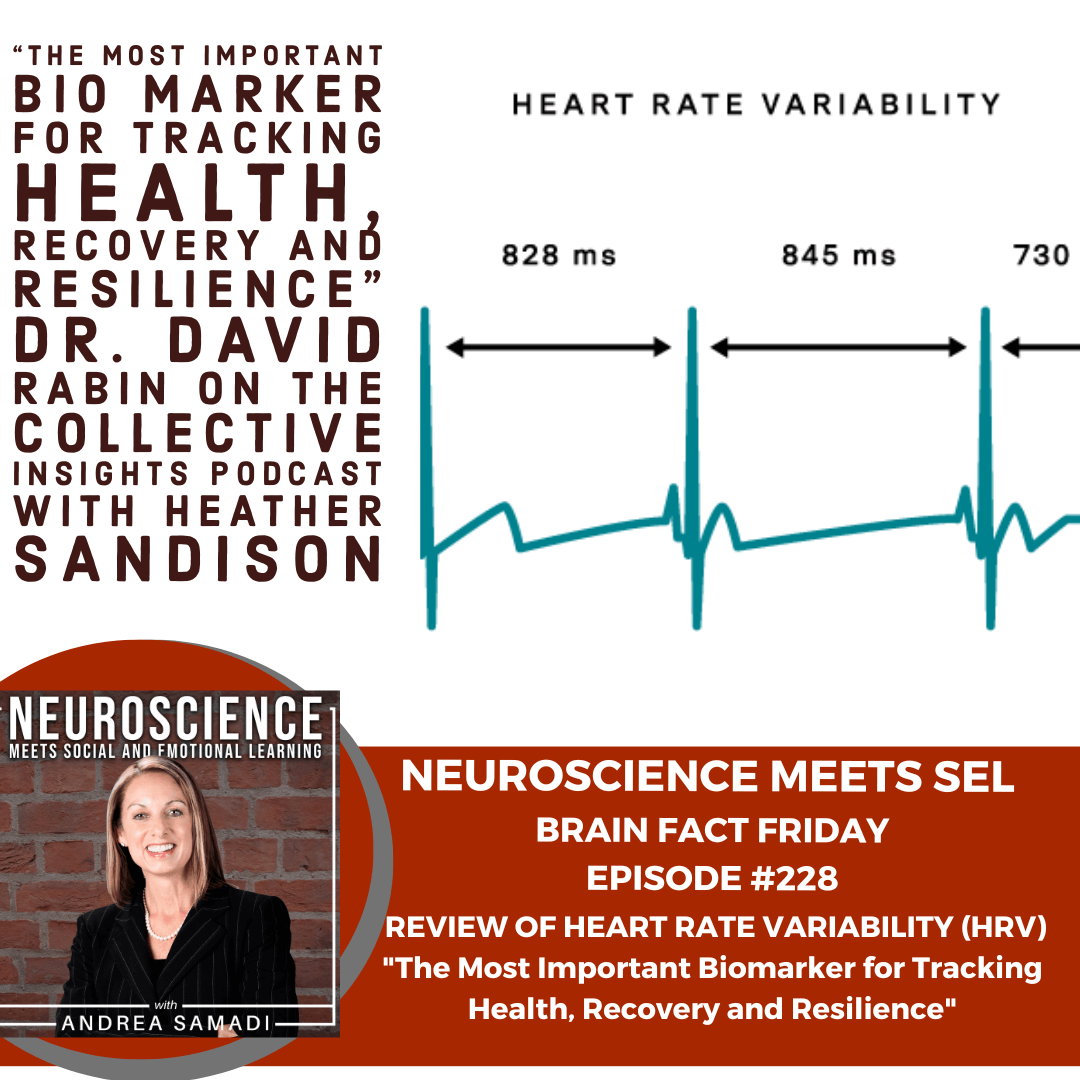
S8 Ep 228Brain Fact Friday ”Review of Heart Rate Variability: The Most Important Biomarker for Tracking Health, Recovery and Resilience.”
Welcome back to The Neuroscience Meets Social and Emotional Learning Podcast, where we cover the science-based evidence behind social and emotional learning (for schools) and emotional intelligence training (in the workplace) with tools, ideas and strategies that we can all use for immediate results. I’m Andrea Samadi, an author, and educator with a passion for learning specifically on the topics of health, wellbeing and productivity, and launched this podcast to share how important an understanding of our brain is for our everyday life and results--whether we are a teacher or student in the classroom, or in working the modern workplace. For today’s Brain Fact Friday, I wanted to revisit a topic that we have covered once already on the podcast, Heart Rate Variability or HRV. We covered an introduction to the importance of understanding HRV back in April of 2021 on EPISODE #125[i] on “What is HRV and Why is it Important for Tracking Health, Recovery and Resilience?” I wanted to go back to this episode and the basics of HRV because it’s such an important number to measure and understand “not just for health and recovery on a regular basis, but (for) resilience.” (Neurohacker.com) Recently, I found myself not being able to explain what it is, or knowing exactly how I can manipulate it for improved results, leading me to take a closer look at what it is, or go back to HRV Basics. What is Heart Rate Variability (HRV) and Why is it Considered “the Most Important Biomarker--a measure that captures what’s going on in a cell at any given moment that can serve as an early warning system for your health?”[ii] Unless you have been training with a forward-thinking coach, you’re an elite athlete, or someone who has taken a serious interest in measuring their performance, most of us have not heard of, or really understand what exactly heart rate variability means. From the name, we can tell it has something to do with our heart rate. Maybe you’re like me and you measure your own HRV and have even studied it to see what exactly it is, but when it comes to explaining it to someone else, you just say when asked what it is “that it’s just an important number to know.” When I heard that Dr. Rabin, a board-certified psychiatrist and neuroscientist, would consider HRV to be “the most important biomarker for tracking health” I knew it was time to revisit HRV closely so that I could better understand it myself, and explain it to others with more confidence. I wondered: What is HRV again? Why is it the most important biomarker for tracking health, recovery and resilience? What tools can I use to measure it? Besides clean eating, sleep and rest, how else can I improve this important number? Can I dive deeper and look at my HRV, and see if I can manipulate a higher score by doing things a certain way when I’m experiencing high stress or having an off day? How can I stay motivated when life is difficult to keep pushing forward and have more high HRV days than low? REMINDER: WHAT IS HRV? After reviewing EPISODE 125, where we covered “What is HRV and Why is it Important?” I remembered that this number measures a person’s ability to bounce back from stress. Kristen Holmes and Emily Capodilupo from Whoop are HRV experts and they remind us on their most recent review of HRV that “it’s the timing between the beats of your heart and that the variability comes from the sympathetic side (where we take action) and the parasympathetic side (where we rest or digest).”[iii] BALANCING OUR PARASYMPATHETIC AND SYMPATHETIC NERVOUS SYSTEM: Our goal is to find balance between the two parts of our autonomic nervous system. When there’s balance, we will see a lot of variability, or a HIGH HRV that tells us that our nervous system is balanced and that “you have a lot of resources that are available and ready to use.” (Kristen Holmes/Emily Capodilupo, Whoop’s HRV 101 Podcast). This is why more and more athletes are using wearable devices like Whoop, or there’s
S8 Ep 227CASE STUDY: Manjula Veeranna from India on ”Transforming Lives with a Brain-Based Classroom”
Welcome to The Neuroscience Meets Social and Emotional Learning Podcast, where we cover the science-based evidence behind social and emotional learning (for schools) and emotional intelligence training (in the workplace) with tools, ideas and strategies that we can all use for immediate results. When we understand how the brain works, we can be better equipped to help our students focus their attention and improve their results. Watch this interview on YouTube here https://youtu.be/jqRo1e30PkM I’m Andrea Samadi, an author, and educator with a passion for learning specifically on the topics of health, wellbeing and productivity, and launched this podcast to share how important an understanding of our brain is to our everyday life and results--whether we are a teacher in the classroom, or in the modern workplace. We have moved onto Season 8 of the podcast with a focus on our brain as it relates to learning, and today we have a case study, of someone who has been using the concepts she learned from self-study to create a brain-based program in her schools and community in India where they have already trained over 300 educators with her curriculum at the Institute of Cognitive Learning Sciences.[i] On the episode you will learn: ✔ How an ambitious, forward-thinking educator, has created brain-based K-12 curriculum in India. ✔ How Manjula learned the most current neuroscience research before seeking out a certification with Dr. Kieran O’Mahony. ✔ The differences Manjula saw with the US Educational System and India. ✔ How she plans to impact change in the classroom, one teacher at a time. Manjula sent me a message via my website, all the way from India, letting me know that she had listened to EPISODE #220[ii] with Dr. Kieran O’Mahony and Rich Carr on “Brain Centric Design” and she let me know she was a student of Dr. Kieron’s programs, and wanted to share what she was doing in India. I could tell that she was very excited about the work they were doing and so I wrote back quickly, and we set up a Zoom call to talk. I will let Manjula explain what she is doing with schools in India, the need she saw to change the way typical classrooms were operating by inspiring teachers, not forcing them to do something they didn’t want to do. She shared with me how she began to study neuroscience using as much free content as she could find online, (including our podcast) before she became certified, and began creating change one school at a time in India. When you meet Manjula, I’m hoping that she will inspire you to keep searching for those students who need a bit of a push to reach their full potential. She was told as a young girl that she was below-average in school, and felt disconnected with her grades, but as she grew older, she wanted to prove to herself (and others) that she did indeed have unlimited potential and the will to make significant change in her community. You can’t miss the fire in her spirit. Let’s meet Manjula from India, and see how she is using brain-based learning to inspire students in the classroom. Welcome Manjula, it’s wonderful to see you again. I’ve got to say, it was powerful meeting you yesterday on Zoom, and hearing about the work you are doing in India. INTRO Q: To open up, can you share your story and background. What is life like growing up, and going to school in India? Q1: How did you become interested in studying and learning about the brain? What resources did you learn from in the very beginning? Who have you been learning from? Q2: What training did you take after you began to see how brain-based education could help students and teachers in India? Q3: Who inspired you to reach for your highest potential in life? Q4: When did you see that change towards brain-based learning was needed? Q5: What did you notice about the differences between what family/school/student life is like in India vs the United States where you were learning your training? (values). Q6: Do teenagers in India do the
S8 Ep 226Brain Fact Friday ”Using Neuroscience to Explain Why Our Dreams Are So Weird, Highly Emotional, and Often Forgotten”
“As long as we dare to dream and don’t get in the way of ourselves, anything is possible—there’s truly no end to where our dreams can take us.” Hilary Swank On the episode you will learn: The Neuroscience behind ✔ Why our dreams are so weird, highly emotional and often forgotten. ✔ With a BRAIN STRATEGY you can use to improve your waking life, with your brain and sleep in mind. For returning guests, welcome back, and for those who are new here, I’m Andrea Samadi, author, and educator, with a passion for learning, understanding difficult concepts, and breaking them down so that we can all use and apply the most current research to improve our productivity and results in our schools, sports environments, and modern workplaces. On today’s EPISODE #226 and Brain Fact Friday, we are going to dive deeper into the research of Dr. Baland Jalal, who has studied the phenomenon of sleep paralysis and dreams for the past decade, and see what we can learn from our brain, while dreaming. To do this, we are going to review what’s happening to the brain during sleep paralysis, and during our REM/dream state to see what we can learn from this understanding. I hope this will open up our level of awareness and help us to understand how our dream world can impact our everyday, waking world. What is Sleep Paralysis? Dr. Jalal and I discussed this terrifying experience in depth on our recent interview, episode #224[i] and most of us can relate to this experience, but wonder what it is, and why it happens, in addition to many other questions I had about dreams themselves. You can see Dr. Jalal’s lectures on this topic, where he explains what happens to our brain when we sleep and that we even see things we might say were ghosts. Now that I have heard Dr. Jalal’s explanation of what happens to our brains when we are dreaming, I definitely think of my brain now, when analyzing my dreams, with this new awareness. Which brings us to this week’s Brain Fact Friday where I want to explore sleep paralysis, why dreams are so weird, and why are they highly emotional, and do this, with our brain in mind. SLEEP PARALYSIS DID YOU KNOW that during REM sleep (when we dream) there’s a part of the brain in the brain stem that paralyzes the body to keep us (and our sleeping partner) safe[ii] and another part of our brain (the cortex) that’s responsible for our perceptual awareness. Occasionally, we can wake up when we are still in REM sleep, and are perceptually aware, but unable to move as we are paralyzed. This is sleep paralysis, and can feel terrifying, if you have no idea what’s going on. I learned from Dr. Jalal that in this state we can also see what we think is a ghost, or which he explains is “an illusion that your brain creates” in the Temporal Parietal Junction (that’s close to our Occipital or Visual Lobe) that can project a sense of our self, outside of our body. Have you ever felt or seen something like this and thought it was a ghost? Seeing something like this, paired up with feeling paralyzed can be a terrifying experience as I told him in the interview, and he agreed, with his own sleep paralysis experience. Then, our brain doesn’t like the feeling of incompleteness and it will make up a story of what you are seeing. Dr. Jalal explains that in all of the years he has done this work, he has found that our cultural background can influence what we think we are seeing. It took me some time to make the connection, but the ghost I saw, was not far off from an 18th Century Englishman, or even someone wearing the outfits of the guards at Buckingham Palace. I did grow up with a photo of the Queen Elizabeth and Prince Phillip in my house, and this made me think it could have been the reason why my ghost was of British decent when I was actually in a house in Vancouver, Canada. My brain created this image from a past, cultural memory. WHY ARE DREAMS SO WEIRD? DID YOU KNOW that there’s a part of our brain called the Dorsolateral PFC[iii] (a reg
S8 Ep 225CASE STUDY: Ellie Mercado, Assistant Principal from Ossining, NY on ”Embedding Social and Emotional Learning with an Equity Lens”
"Every child deserves a champion: an adult who will never give up on them, who understands the power of connection and insists they become the best they can possibly be." Rita Pierson, Educator. Watch this interview on YouTube here https://youtu.be/feNGn-cpPP8 For returning guests, welcome back to The Neuroscience Meets Social and Emotional Learning Podcast for EPISODE #225 with a case study from someone I’ve mentioned before on the podcast, Elizabeth Mercado, from Ossining Union Free SD, New York, who you will see is a strong force with a goal to support ALL students, with the most comprehensive SEL plans that I’ve ever seen. I’ll be sure to link her plans and resources in the show notes for you to access and use it you would like, since her goal is to help all of us to move our students forward, with as much support as possible. This interview takes a look at SEL with an equity lens, with clear examples of how to begin, what to do, and what SEL looks like in her District. I do love hearing how people around the globe are implementing the ideas we share with you on this podcast (it really does help with new ideas and motivation) and Ellie Mercado, an Assistant Principal in Ossining, NY, let me know that she was inspired by what she was learning to support her students and staff. Little did I know just how much she would inspire me, with her story and thorough SEL plans that I think everyone in education could benefit from. You will see in this interview that I made more connections with her story, that I think is important to share with everyone here, because just one new piece of information or motivation, can have a huge ripple effect on the world. A bit about Elizabeth Mercado: She’s an ENL immigrant student who came at twelve years old from the Dominican Republic without speaking English, to a poor neighborhood in the South Bronx, living in a 1500 sq feet apartment with 8 children ages 12 and younger and 4 adults, and experienced first-hand what it is to have challenges growing up and in school. This experience gave her an in depth understanding of the impact of how our cultural, racial/ethnic, linguistic, and economic backgrounds can impact our learning. This is why she’s passionate about being an educator and wants to create the best learning environment for her staff and students in the Ossining Community where many of them come from a similar background. She believes that ALL students can be successful. She is a middle school and early childhood assistant principal for the last seven years and one year as an elementary early childhood assistant principal whose goal is to provide her students with a safe, trusting and nurturing learning environment where they feel included, respected, supported; recognizing that every student and staff member has unique strengths. She believes it is important to be intentional about all that they do since it makes a difference: the images on the walls; pictures in the books, holidays recognized; accepting and celebrating all; promoting student agency, voice and choice is all critical so students feel that they belong. I hope that Elizabeth’s story inspires you, whether you are working in a school, or in some other capacity, to think of where to begin when looking at SEL through an equity lens. Let’s meet Elizabeth Mercado. Welcome Ellie, It’s incredible to meet you finally after all the support you have sent our way with the podcast. I’m so grateful that you reached out to us and shared your SEL implementation with us. I’ve never seen anything as thorough, with a clear way to begin and knew immediately that we needed to share your work on the podcast. Thank you for being here when I know time is always hard to come by. Intro Q: I’ve got to start and leverage off the emotions I felt watching your presentation with how you are implementing SEL with an equity lens at Ossining SD in New York[i], because your story shows exactly why SEL skills are important in our scho
S8 Ep 224Harvard Neuroscientist Dr. Baland Jalal Explains ”Sleep Paralysis, Lucid Dreaming and Premonitions: Expanding our Awareness into the Mysteries of Our Brain During Sleep”
“Dreams are one of the great mysteries of science. In their bizarre complexity, they can reveal deeper truths about who you are at the most basic level.” Researcher at Harvard University and the World’s leading expert on sleep paralysis, Dr. Baland Jalal Watch this interview on YouTube here https://youtu.be/nE15JIqy5rU On the episode you will learn: ✔ Who is Dr. Baland Jalal, and how did he find his way to study neuroscience and sleep, becoming the world’s leading expert on sleep paralysis? ✔ How is Dr. Baland connected to Francis Crick, who discovered the double helix of the DNA structure and Dr. V.S. Ramachandran? ✔ What is sleep paralysis and what happens to the brain while this is occurring? ✔Why is the time just before we go to sleep and the time just before we wake up important for increasing our creativity or gaining insight? ✔ Are premonitions real, and can we access important information from our dreams? ✔Can we actually travel to places we have never been? ✔ What is lucid dreaming and how can we gain insight from what we see in these dreams? ✔Can lucid dreaming be beneficial for our waking hours? ✔What advancements in neuroscience do you think could help us in the future with our dreams? For returning guests, welcome back, and for those who are new here, I’m Andrea Samadi, author, and educator, with a passion for learning, understanding difficult concepts, and breaking them down so that we can all use and apply the most current research to improve our productivity and results in our schools, sports environments, and modern workplaces. On today’s EPISODE #224 (that was postponed from April due to our guest’s busy travel and work schedule) we are going to go beyond where we’ve ever gone before on this podcast, and cover some topics that you might have questions about, like I did, and I’ve found Dr. Baland Jalal[i], from Harvard, the world’s leading expert on sleep paralysis, who has published 48 peer reviewed academic papers as well as a book from Cambridge University Press, to answer our questions. We’ve covered dreams before, on EPISODE #104[ii], with Sleep Scientist Antonio Zadra and his book When Your Brain Dreams: Exploring the Science and Mystery of Sleep but I left out some parts of the dream world that I thought might be too weird for this podcast, until I heard Dr. Jalal connecting the brain to our dreams, and this changed everything for me. I mentioned on EPISODE #211, that when I first was introduced to Dr. Jalal, his team sent me an email with his Harvard Bio and a write-up about his work on dreams but little did I know that his work would open my mind to places it’s never been before, as I began to explore sleep paralysis (something I’ve experienced—just once which was enough for me, I just had no idea there was a name for it), lucid dreams (that I flat out thought I was crazy for having), and learning how my brain operates while dreaming, which revealed more truths about who I am at the core than I knew before coming across Dr. Jalal’s work. I’ve gone on to study English scientist and professor of neuroscience, Mathew Walker and often tune into his podcast that’s all about sleep, the brain and the body[iii] to see how we can all learn more about ways to improve our sleep, which we all know to be one of our top 5 health staples. I did create this podcast to bring credibility to some of the concepts that used to be considered weird, but now, science and FMRI scans show why these practices that 20 years ago were not mainstream, are now commonly used in our schools and work environments. Before watching Dr. Jalal’s lectures, I don’t think I would openly talk about the experiences I’ve had with the dream world, but I thought if I’ve experienced these things, what if our listeners have also, wherever you are listening to this podcast in the world, and perhaps hearing from Dr. Jalal WHAT these bizarre things called dreams actually are, WHY we have them, and see if they can expand our self-awaren
S8 Ep 223Reducing the Risk of Alzheimer’s Disease by Understanding Sleep and the Brain
Did you know that according to English scientist and professor of neuroscience and psychology, Mathew Walker, the author of Why We Sleep: The New Science of Sleep and Dreams that current research shows “that there appears to be a causal affect between sleep and our risk for Alzheimer’s Disease?” For this week’s Brain Fact Friday and Neuroscience Meets Social and Emotional Learning Podcast EPISODE #223 we are going to take some of the most noticeable lessons learned from our recent podcast with Dr. John Denboer, on “This is Dementia: Disrupting the Decline”[i] and see what we can learn from Mathew Walker’s most current research. This way, we can take a proactive approach to our sleep, optimizing our potential for learning, memory and retention, and see what we can learn about this devastating disease that affects “6.5M Americans, and is expected to double by 2050.” This topic goes hand in hand with our theme of Season 8 of our podcast: where our focus is on Brain Health and Learning with a look at How an Understanding of Our Brain Can Improve Learning in Ourselves (adults, teachers, workers) as well as our future generations of learners. On this episode we will cover: ✔︎What is the difference between Alzheimer's and Dementia ✔︎What the most current research says about the connection between Alzheimer's Disease and sleep. ✔︎11 risk factors that we can learn more about to mitigate Alzheimer's Disease. ✔︎A look at the 2 proteins that damage and change the brain. ✔︎What we can do right now to mitigate Alzheimer's Disease by understanding sleep and our brain. What is Alzheimer’s and What is Dementia? On our interview with Dr. Denboer, who has spent most of his career working with patients on disrupting dementia, we began our interview defining each of these terms, since many of us aren’t sure exactly what they are, and if we don’t know what they are, how can we be sure we are being proactive with preventing them? Dementia: is a general term for “decline in mental ability severe enough to interfere with daily life”[ii] and there’s not just one form of dementia. There’s Alzheimer’s, Vascular Dementia, Lewy Body Dementia, Frontotemporal Dementia, and Mixed Dementia. Alzheimer’s is “a degenerative brain disease that leads to dementia symptoms and gradually worsens over time.”[iii] We opened up our interview with Dr. Denboer with a quote from Dr. Babak Nayeri, a clinical associate professor from the University of Arizona who said “Dementia is not an aging disease; however, it is the most common disease of the aging population.” (from the Netflix documentary, This is Dementia). “Though the greatest known risk factor for Alzheimer’s is increasing age, the disease is not a normal part of aging.”[iv] 11 Risk Facts of Alzheimer’s Disease One of America’s leading psychiatrists and brain health experts, Dr. Daniel Amen, who we’ve spoken often about on this podcast, believes that Alzheimer’s (that damages the hippocampus or memory center of our brain) and is responsible for “the disease-memory impairment”[v] is “a lifestyle disease similar to heart disease and type 2 diabetes and that our everyday habits contribute to our everyday risk.”[vi] Dr. Amen lists 11 risk factors that increase our probability for Alzheimer’s (with the acronym Bright Minds) and sleep is the S in this acronym. You can read the rest of the risk factors here[vii] but to review them quickly, they are: B: For blood flow problems R: For retirement and aging I: For inflammation G: For genetics H: For head trauma T: For toxins M: For mental health problems I: For immune system problems N: For neurohormone problems D: For diabesity (that seriously impacts brain health and memory) S: For sleep that we will dive deeper into today. Which leads us to this week’s Brain Fact Friday, that we opened up this episode with. Did you know that according to English scientist and professor of neuroscience and psychology, Mathew Walker, that current research shows “that there
S8 Ep 222Jason Littlefield and Erec Smith from EmpowerED Humanity on ”A Framework for SEL Through the Lens of Human Dignity and Neuroscience”
In order to learn something new, looking at something from a different perspective can shed some light. Today we are going to “See the world through a different lens” specifically with a new look at “Transformative SEL.”[i] Watch this interview on YouTube here https://youtu.be/dY28tux0tq8 On this episode you will learn: ✔ How Jason Littlefield and Erec Smith of EmpowerED created a Framework for SEL when they noticed something was missing with Transformative SEL. ✔ How they envision empowering educators, youth and communities by strengthening the neural pathways to peace and resilience through mindfulness and social and emotional learning. ✔How you can work with Jason and Erec with their mission. For returning guests, welcome back, and for those who are new here, I’m Andrea Samadi, author, and educator, with a passion for learning, understanding difficult concepts, and breaking them down so that we can all use and apply the most current research to improve our productivity and results in our schools, sports environments, and modern workplaces. On today’s EPISODE #222 we are going to look at SEL through a different lens with the work of Jason Littlefield and Erec Smith from EmpowerED Humanity[ii] whose work established in 2017 to provide educators, students, and communities a framework for life, leadership, and learning, focuses on fortifying the individual and increasing societal cooperation with a value-centered identity, human dignity, disrupting mindsets of fear/judgment with inquiry and compassion. Their Work Has 3 Pathways of Practice That: Build awareness and equanimity (mental calmness) Kindness and compassion towards self and others and Celebrate common humanity, breaking the walls of indignity (or that treatment that causes one to feel shameful). I spoke with Jason prior to our interview, as I know that the podcast guests I have chosen over the past 3 years have been addressing SEL as it relates to our brain and learning, but there was something missing that became apparent to me as we have not yet discussed diversity, equity and inclusion that are all important components of social and emotional learning. THEIR MISSION[iii] Empowering educators, youth and communities by strengthening the neural pathways to peace and resilience through mindfulness and social and emotional learning. Their framework, Empowered Humanity Theory focuses on fortifying the individual and increasing societal cooperation by centering a value-centered identity, human dignity, disrupting mindsets of fear/judgment with inquiry and compassion, and intentionally engaging in 3 Pathways of Practice: Practices that build awareness and equanimity Practices that build kindness and compassion towards self and others Practices that celebrate common humanity, and break the walls of indignity That also includes 3 Attitudes: 1) Establishing a value-centered identity 2) Cultivating mindsets of inquiry/compassion over fear & judgment 3) Navigating self and others with a dignity lens. They believe this framework fills a gap that we need at this moment to inspire us to empower humanity and affect the wellbeing of future generations in profound ways. It’s up to us to make the shift. Let’s meet Jason Littlefield and Erec Smith, and dive into their Framework to view SEL through the lens of human dignity and our shared humanity, to see where we could expand our awareness and close any existing gaps. INTRO: Welcome Jason and Erec, thank you for coming on the podcast today. Jason, when I saw your email and noticed how long you worked as an SEL Specialist, I thought that there must be something that you noticed was missing with the way that SEL was being implemented into our schools, and like we said in our email correspondence, your vision to empower humanity and affect the wellbeing of future generations in profound ways is important and timely. Before we begin with our questions to dive into this topic, I’ve got to say first that I was a bit nervous t
S8 Ep 221Dr. John Denboer on ”This is Dementia: Disrupting the Decline”
“Dementia is not an aging disease; however, it is the most common disease among the aging population.” Dr. Babak Nayeri, Clinical Associate Professor from the University of Arizona, from the Netflix Documentary, This is Dementia. Watch this interview on YouTube here https://youtu.be/-U-slBBIEIA On this episode you will learn: ✔ Who is Dr. John Denboer, what he built, and lost in his passion to help mitigate dementia. ✔ What Dr. Denboer learned raising funds for a high growth startup. ✔ What is the difference between Alzheimer’s Disease and Dementia? ✔ What can we all do now to mitigate this debilitating disease. ✔ How a tattoo with personal and professional meaning motivates Dr. Denboer to keep moving forward with his work. Welcome back to The Neuroscience Meets Social and Emotional Learning Podcast, for EPISODE #221. For those who are new here, I’m Andrea Samadi, author, and educator, with a passion for learning, understanding difficult concepts, and breaking them down so that we can all use and apply the most current research to improve our productivity and results in our schools, sports environments, and workplaces. This month, we are breaking into a new season on the podcast, Season 8, where our focus will be on Brain Health and Learning with a look at How an Understanding of Our Brain Can Improve Learning in Ourselves (adults, teachers, workers) as well as our future generations of learners. If you’ve been following our podcast over the seasons, you will know that our content took the turn towards health and wellness around September 2020 with a BONUS EPISODE where we covered the Top 5 Brain Health and Alzheimer’s Prevention Strategies[i] after watching Dr. David Perlmutter’s Alzheimer’s The Science of Prevention Documentary.[ii] We took a closer look at Daily Exercise, Sleep, Eating a Healthy Diet, Optimizing our Microbiome, and Intermittent Fasting) as strategies we can all use to improve our brain health with the goal of preventing one of the most devastating degenerative diseases that affects “more than 5 million Americans (that is closer to 6 million now after reading our next guest’s book) and is the most common form of dementia, a term that describes a variety of diseases and conditions that develop when nerve cells in the brain die or no longer function normally.”[iii] This number has reached “over 80 million cases globally and is expected to double to be 150 million cases by 2050.”[iv] (Denboer). On today’s episode #221, we will be speaking with Dr. John Denboer, a former clinical neuropsychologist who specializes in early stage preventative medicine - including cognitive, physical exercise and nutrition – with a goal of slowing down the natural decline in patients with dementia. At peak, his practice served in the range of 10,000 patients in the US supported by over 100 employees. I listened to a recent podcast Dr. Denboer did with Graham Brown on the XL Podcast[v] and learned that while Dr. Denboer has a passion for disrupting Dementia (the umbrella for degenerative diseases likes Alzheimer’s and Parkinson’s) that there have been many ups and downs in his start up journey as a pioneer in this field of health and wellness, disrupting Dementia. In today’s interview, I’ll ask him about the lessons he’s learned along the way, the importance of family, and to explain his mission to make a difference for dementia sufferers and their loved ones before the global numbers go from 55 million people living with Dementia to doubling these numbers in the next 20 years. ***Just to note that John Denboer is not a current licensed psychologist / neuropsychologist / doctor and cannot provide medical advice. While researching Dr. Denboer I did see some things online that made me wonder why he is not a current licensed psychologist, and if you know me, getting to the truth of something is important. Instead of sweeping what I saw under the rug, I will ask him directly to explain what happened, so we can cover his jou
S8 Ep 220Rich Carr and Dr. Kieran O’Mahony from Brain-centric Design on ”The Surprising Neuroscience Behind Learning With Deep Understanding”
"Your brain has a capacity for learning that is virtually limitless, which makes every human a potential genius." Michael J. Gelb Watch this interview on YouTube here https://youtu.be/xP3lTXlwcPQ On this episode you will learn: ✔︎ How did Rich Carr (radio and communications) go from working with Paul Allen (Microsoft Co-founder) to working with Dr. Kieran O'Mahony in the field of neuroscience? ✔︎ What's Missing with the Behaviorist Method (rewards/punishment) that's used in our schools and workplaces? ✔︎ What is the Brain-centric Design and how can it be used to accelerate results in ANY industry? ✔︎ What should we all know about our brains to demystify them? ✔︎ What should we all know about learning and the brain? ✔︎ What do YOU have in common with Jeff Bezos? ✔︎ How can YOU get involved with Dr. Kieran O'Mahony and Rich Carr with Brain-centric Design? Welcome back to the Neuroscience Meets Social and Emotional Learning Podcast, EPISODE #220! For returning guests, welcome back, and for those who are new here, I’m Andrea Samadi, author, and educator, with a passion for learning, understanding difficult concepts, and breaking them down so that we can all use and apply the most current research to improve our productivity and results in our schools, sports environments, and modern workplaces. My goal with this podcast to make the research applicable for all of us to use-whether we have a background in science, or not. On today’s episode #220, we have Rich Carr and Dr. Kieran O’Mahony whose pedagogic model, Brain-centric Design[i], is enjoying rapid acceptance in schools and businesses with high praise from different sectors including Nike executives who say that upon implementing these ideas, “their learners (athletes) not only understood their positions better, but also reached their goals faster” (Brain-centric Design, Praise, Michele Jordan, Fortune 100 Learning Director) from the Department of Defense, noted that “this process invites us to lean in and become interactive with our learning, enabling us to grasp topics quickly and most importantly with vastly greater retention.” (Ken Robinson, Department of Defense) The feedback from those in the classroom who have begun implementing these ideas follow suit, saying “Brain-Centric Design took the guesswork out of the classroom and highlighted the scientific reasons behind the success” (Ellen Thompson, Fortune 100 Learning and Quality Specialist) who highlighted how great it felt to “identify the positive traits of cognitive flexibility, social—emotional engagement and adaptive expertise” that she already possessed. Rich and Kieran’s model explains that while behaviorist pedagogy might sound like the best way for students to learn in the classroom, or for employees to be motivated in the workplace, that there’s a more effective way to learn with the brain in mind, and this is exactly why we cover the most current neuroscience research on this podcast. Who knew that learning the most current research in neuroscience would be so important to the world? I certainly didn’t when launching this idea just under 3 years ago this month, but it’s clear with the number of downloads we receive all over the world (in 168 countries now) that this is an important and timely topic for us all to pay attention to. As we are now moving into Season 8 of the podcast, with a focus on Brain Health and Well-Being as it relates to learning, Richard Carr and Kieran O’Mahony’s Brain-centric Design fits right in as they focus on the training and certification of Communicators, Coaches, and Educators to form a deep understanding in the pedagogy of their program: Brain-centric Design: The Surprising Neuroscience Behind Learning with Deep Understanding[ii]. Because their framework is aligned with how the brain processes information, and how people’s brain loves to learn, (especially something new) its inherent design places any learning space in a psychologically safe framework. They will
S8 Ep 219Secret Millionaire, Hilary Decesare on her new book coming June 9th ”ReLaunch: Spark Your Heart to Ignite Your Life.”
Watch this interview on YouTube here https://youtu.be/naWMRm8tqck On this episode you will learn: ✔︎ How Hilary Decesare, who made her first million at 32, got involved with giving back and ended up on the TV Show, Secret Millionaire. ✔︎ How the story of Hilary's Mom, connected with Andrea and an untold story with her and Bob Proctor. ✔︎ What Hilary learned from leaving her home, and going into a poverty struck area in Long Beach, CA. ✔︎ What is the 3HQ™ Method to help people move from their head, to their heart, to higher self. ✔︎ How anyone can reLaunch their personal or professional life. ✔︎ How John Assaraf helped Andrea and Hilary to ReLaunch their life and business. ✔︎ How to begin, and join Hilary's book launch on June 9th. For returning guests, welcome back, and for those who are new here, I’m Andrea Samadi, author, and educator, with a passion for learning, understanding difficult concepts, and breaking them down so that we can all use and apply the most current research to improve our productivity and results in our schools, sports environments, and modern workplaces. On today’s EPISODE #219, we will be speaking with an award-winning business expert, international best-selling author, host of “The reLAUNCH Podcast”[i] and “The reLAUNCH" on Voice America's Talk Show Network, Hilary DeCesare who I feel a connection to, even before we’ve met. This interview will be interesting for me to see how this connection unfolds during the interview, and if it becomes apparent. She’s a sought-after speaker, founder of The Relaunch Co., and previously one of Oracle’s top account managers worldwide, who brings fresh energy to industry leaders, CEOs, and solopreneurs. She holds a psychology degree and a range of certifications in her field, and has been featured on ABC’s hit TV series Secret Millionaire. Her insights have been seen on ABC, NBC, CBS, Fox, and mentioned in the Huffington Post, Yahoo, Market Watch, and others. As an innovator in neuropsychology as it relates to business and life, Hilary DeCesare has cultivated her experience to illuminate a heart-driven path to conquer today’s shifting landscape, re-imagining personal and professional success. When I received an email introduction to Hilary’s work, I noticed that she was on the TV Show, Secret Millionaire, that I’ve seen and find inspiring. I love seeing people give back after they have found their way in this world, and Hilary Decesare definitely has a purpose to help others find their way which is what her new book, and podcast are all about. I had no idea just how much Hilary’s work would connect with mine, with many parallels that I hope will become apparent in the interview. This is one of those interviews that I know how has the ability to completely transform someone listening. When ignoring her intuition resulted in fearing for her life at the edge of Niagara Falls, this award-winning Silicon Valley CEO and entrepreneur Hilary DeCesare was shocked into realizing she needed a deep reassessment of who she was and why. The answers surfaced where she least expected—her late mother. In RELAUNCH! Spark Your Heart to Ignite Your Life, Hilary immerses the reader in a world of neuroscience, to uncover a powerful secret that we all harbor: The 3HQuotient. This is the power to leverage the three H's—the Heart, the Head and the Higher Self. Stay tuned and learn some of the top lessons and personal stories from Hilary as well as from other experts like John Gray, John Assaraf and Jim Fortin. Let’s meet Hilary Decesare, and see what she can share to help all of us to see the silver lining of what’s happening in the world today, and for anyone out there, thinking of a reLaunch (maybe a new career path, or considering a new direction) this is her specialty. Welcome Hilary Decesare, it’s such a pleasure to meet you. Hilary, like you’ve said on your podcast, reLAUNCH, you mentioned how lucky you feel to get to speak to such incredible people like your last guest
S7 Ep 218Brain Fact Friday on ”Using Neuroscience and Dr. Covey’s 5th Habit to Find Peace and Hope During Difficult Times”
This has been a tough week in the United States and while being interviewed on Tom Schimmer’s[i] educational podcast on Monday that focuses on learning, leadership, and life, he asked me what keeps me up at night related to education, and my answer to him was “school shootings” since they don’t seem to be going away. This was a day before the next mass school shooting would hit the news around the world. This has been a really tough week for everyone, in addition to the stress the world is already facing, and I’m sure those listening to this episode outside of the US can feel the turmoil, and have many questions. While I certainly don’t have all the answers, I do have some thoughts that I think can provide some insight and hope for those who tune in. After this incident, while working on releasing our next episode, nothing felt right to me as I was writing, and so I figured the best solution was to take a break from our usual episodes, and think of ways that we could use this platform to amplify the voices left behind (like Chey and Pav have done do well)[ii] and highlight those who have been working in the trenches, to provide solutions for those impacted by the events like we saw repeated this week. For returning guests, welcome back, and for those who are new here, I’m Andrea Samadi, author, and educator, with a passion for learning, understanding difficult concepts, and breaking them down so that we can all use and apply the most current research to improve our productivity and results in our schools, sports environments, and workplace environments. For today’s episode, #218, and this week’s Brain Fact Friday, we are going to look at how neuroscience can help us to understand what’s happening in our world today, with some strategies that we can all use to move us from a world of chaos, towards hope. Now this episode feels right to me. Before we take a look at these brain-based solutions, getting a bigger picture overview of the events that occurred this week is important. The k12 school shooting database lists some charts and graphs that provide visuals of this issue documenting “each and every instance a gun is brandished, is fired, or a bullet hits school property (in the US) for any reason, regardless of the number of victims, time, day of the week.” There’s a map that you can click on to see the incidents that have occurred by state[iii], and it’s eye-opening. Click on the link in the show notes and see for yourself. There wasn’t ONE state in the US that was exempt. You can see some that have less incidents, but country wide, you can see no one remains unaffected. There’s also another graph that shows some of the most recent and well-known incidents next to ones we might not all know by name, all the well-known incidents highlighted in red. We can see Columbine in 1999 with 13 people killed, Sandy Hook in 2012 with 26, Sante Fe 2018 (10), Parkland, Florida, 2022 (17) and now Uvalde, Texas with 21 killed this week. I share these numbers and visuals as a way to show that what Mathew Portell said is right on the mark. Moments of silence aren’t solutions. It’s time to speak up. But what exactly do we say? How can we “Seek to Understand?” when things are so horrible and abnormal? Dr. Covey’s timeless principles can help us all here. We must first Seek to Understand[iv], using Dr. Stephen Covey’s Habit #5. How do we understand such difficult tragedies in our world? The Brain of a School Shooter: This takes me back to the work of American Psychologist, Dr. Daniel Amen[v], whose work looking at the brain through SPECT Image Scans[vi] (that looks at blood flow and activity in the brain—where he looks to make improvements and further balance the flow to improve brain function) his work and scans weren’t widely accepted when he began years ago, but he now helps people who come to his offices across the country (from well-known sports athletes, to celebrities, to regular people) to look at their brain to get to
S7 Ep 217Brain Fact Friday on ”Science-Based Tricks to Improve Productivity and Never Forget Anything”
Did you know that “the shorter we sleep, the shorter our life will be?[i]” Professor Matthew Walker, The New Science of Sleep and Dreams On this episode you will learn: ✔︎ A review of the importance of sleep on our physical and mental health. ✔︎ How lack of sleep attacks the memory centers of our brain. ✔︎ 2 science-based strategies to improve memory and never forget anything ever again. ✔︎ Tips for how to use these strategies in your life for improved results. Have you ever said, “I’ll sleep when I’m dead” or pushed through your work possibly doing an all-nighter, thinking that you’ll catch up over the weekend? The most current research shows that this is a really bad idea, as Matthew Walker, the author of the book, Why We Sleep, tells us that “lack of sleep attacks the hippocampus (where memory and learning take place) and increases the risk for various forms of cancer.”[ii] We have covered the importance of sleep on this podcast in many different places, including a BONUS episode in December 2020 where we talked about sleep as one of The Top 5 Health Staples[iii] we should all pay attention to, but Professor Matthew Walker reminds us that “as we are getting older, our learning and memory abilities fade and decline...and that a physiological signature of aging is that our sleep gets worse” which contributes to cognitive or memory decline. I don’t know about you, but as I’m going through the next 50+ years of my life, I’d like to have a sharp memory, in addition to a healthy body that can help me to do the things I want to do with work and family and when I find something that’s NEW and INTERESTING, I will share it with you, wherever you might be listening to this podcast, so it can help you in your personal and professional life. My hope is that today’s Brain Fact Friday makes us all think about how we can improve our sleep, memory and overall health as I share the most current research, and how I’m applying it for improved results and productivity. We are now nearing the end of Season 7 of the podcast on “Brain Health and Well-Being” and will begin Season 8 in June, on “Brain Health and Learning.” Having a theme for each season helps me to stay focused on the guests we bring on, as well as the questions I ask them. If there is a topic of interest to you, please send me a message[iv] and let me know. Today we are going to take a deeper look at the importance of sleep on our learning, memory and overall health, as we prepare to speak with the world’s leading expert on sleep paralysis, Dr. Baland Jalal, from Harvard University, who will help us to connect the brain to some of our weirdest sleep experiences, with the hopes that this connection can help us to all learn something new, and perhaps use some new strategies to make sleep a priority that will in turn improve our memory and learning in our waking hours. While researching for our next interview with Dr. Baland Jalal[v], I’ve been looking at what some of the leading experts have discovered about our dreams and sleep. I did explore what I was learning on EPISODE #211 on “The Neuroscience of Dreams: Expanding Our Self-Awareness”[vi] to open up the door for this interview and always want to remind everyone of EPISODE #104 with Antonio Zadra on “When Brains Dream”[vii] but today I want to highlight how our sleep is important for learning and memory consolidation, hoping the Dr. Jalal will deepen our understanding of our dream world, take some of the mystery out of what happens to our brain during sleep, and bring some strategies to the forefront that we can use to improve our productivity in the 16 hours of our waking day. So Why is Sleep So Important and Critical to Look at For Our Health, Well-Being and Productivity? Professor and Neuroscientist Matthew Walker, from the University of California, reveals a recent study with adults who got 6 hours of sleep vs 8 hours, and they noticed that in the “6 hours of sleep group, that certain genes were turned off (the