Neuroscience Meets Social and Emotional Learning
413 episodes — Page 2 of 9
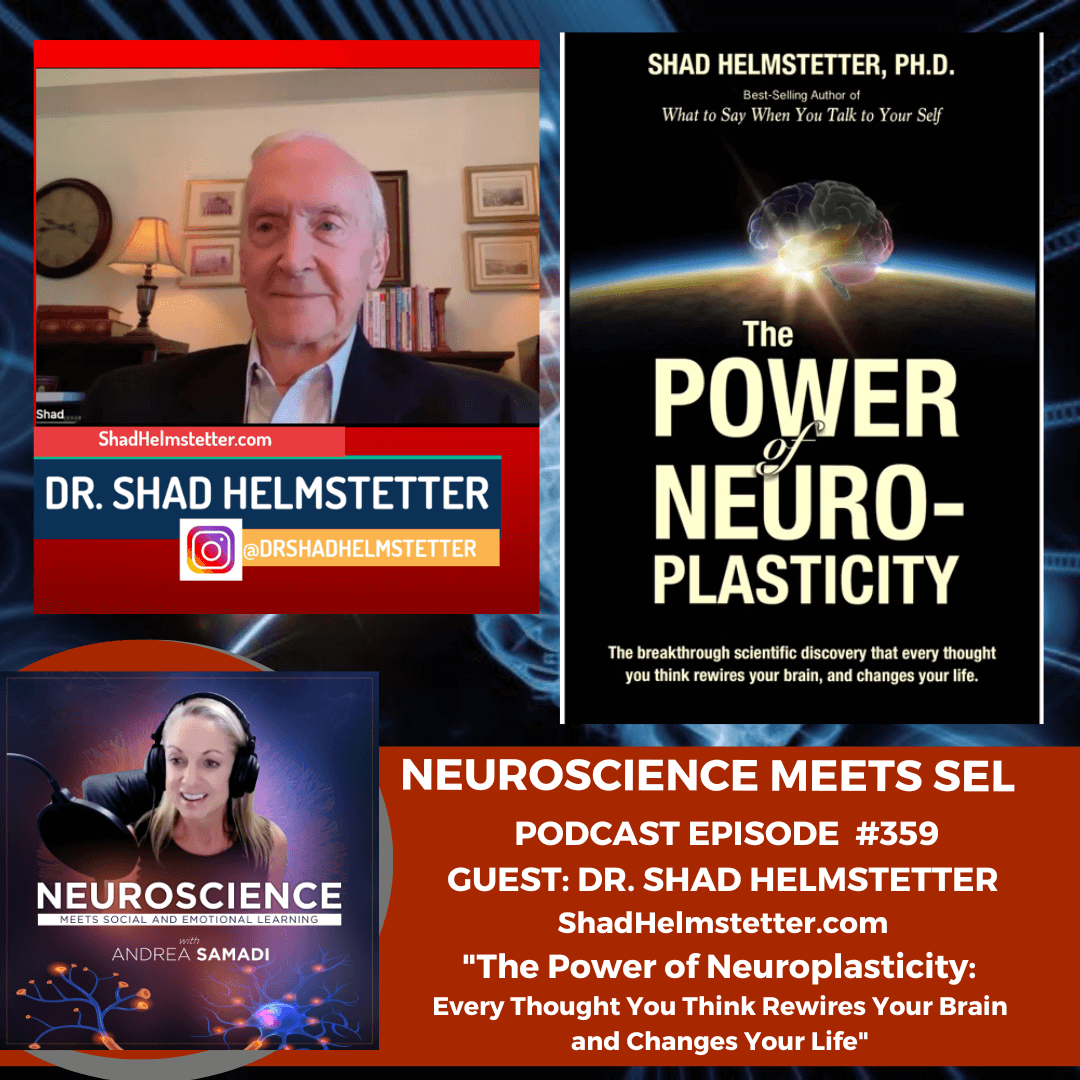
S13 Ep 360Unlocking the Power of Self-Talk for Success and Well-being with Shad Helmstetter, Ph.D.
In this illuminating episode of the Neuroscience Meets Social and Emotional Learning Podcast, host Andrea Samadi sits down with Dr. Shad Helmstetter, a best-selling author renowned for his work in personal growth and self-talk. Dr. Helmstetter shares his profound insights into the science of self-talk and neuroplasticity, revealing how the language we use with ourselves can radically transform our lives. Watch our interview of YouTube here https://youtu.be/zaVGEjVj__Y Listeners will discover how Dr. Helmstetter's research connects age-old principles of success with cutting-edge neuroscience. The episode delves into practical strategies for reprogramming the brain through positive self-talk, the significance of learning the language of success, and the steps anyone can take to improve their mindset. Whether you're an educator, a parent, or simply someone seeking personal improvement, this episode offers valuable lessons on how to harness your inner dialogue for greater achievement, fulfillment, and happiness. Welcome back to SEASON 13 of The Neuroscience Meets Social and Emotional Learning Podcast, where we connect the science-based evidence behind social and emotional learning and emotional intelligence training for improved well-being, achievement, productivity and results—using what I saw as the missing link (since we weren’t taught this when we were growing up in school), the application of practical neuroscience. I’m Andrea Samadi, an author, and an educator with a passion for learning and launched this podcast 6 years ago with the goal of bringing ALL the leading experts together (in one place) to help us to APPLY this research in our daily lives. On today's EPISODE #359 we will cover: ✔ Dr. Shad Helmstetter's background that led him to create an APP that teaches how to reprogram the brain with positive self-talk ✔ Where our self-talk originated from, and how we can change it, rewire our brain, and put our lives on a trajectory for success. ✔ What is the language of success vs the language of those who are deemed to fall short of their goals? ✔ How can we teach this language to ourselves, our children, students or large groups, to permanently rewire their brain for success? For today’s EP #359, we meet with the best-selling author of more than twenty books in the field of personal growth, Shad Helmstetter, Ph.D. What caught my attention with our next guest was NOT this huge list of books he has written, or that he had appeared on over 1200 radio and television programs, including repeat appearances on Oprah Winfrey, ABC, NBC, CBS, and CNN News, or even that his self-talk audio programs are listened to thousands of individuals and families worldwide. There was something else that set our next guest apart from the others. What caught my attention was when I saw a passage in his book, The Power of Neuroplasticity, that described the EXACT mission or quest that I have been on, since looking back at the days I worked for motivational speaker Bob Proctor[i], and always wondered like our next guest “why do some people fail while others succeed?” I even wrote this question on the back of my first book, The Secret for Teens Revealed, and have been on a mission to connect science to these age-old principles that I have witnessed change many people’s lives. We have covered Napoleon Hill’s Think and Grow Rich[ii] book on this podcast, as well as Wallace D. Wattles’ The Science of Getting Rich[iii], and after looking at this question, I always came to the SAME conclusion. It HAS GOT to come down to the fact that successful people “think and act” in a certain way. So when I came across Shad Helmstetter, I wanted to learn what he has discovered that connects the age old books that we have covered on this podcast, to science. I wondered what he has discovered about “why are some people, day to day, happier, more productive, more fulfilled than others? What makes the difference? It is kismet, a kind of fate” he asks in his
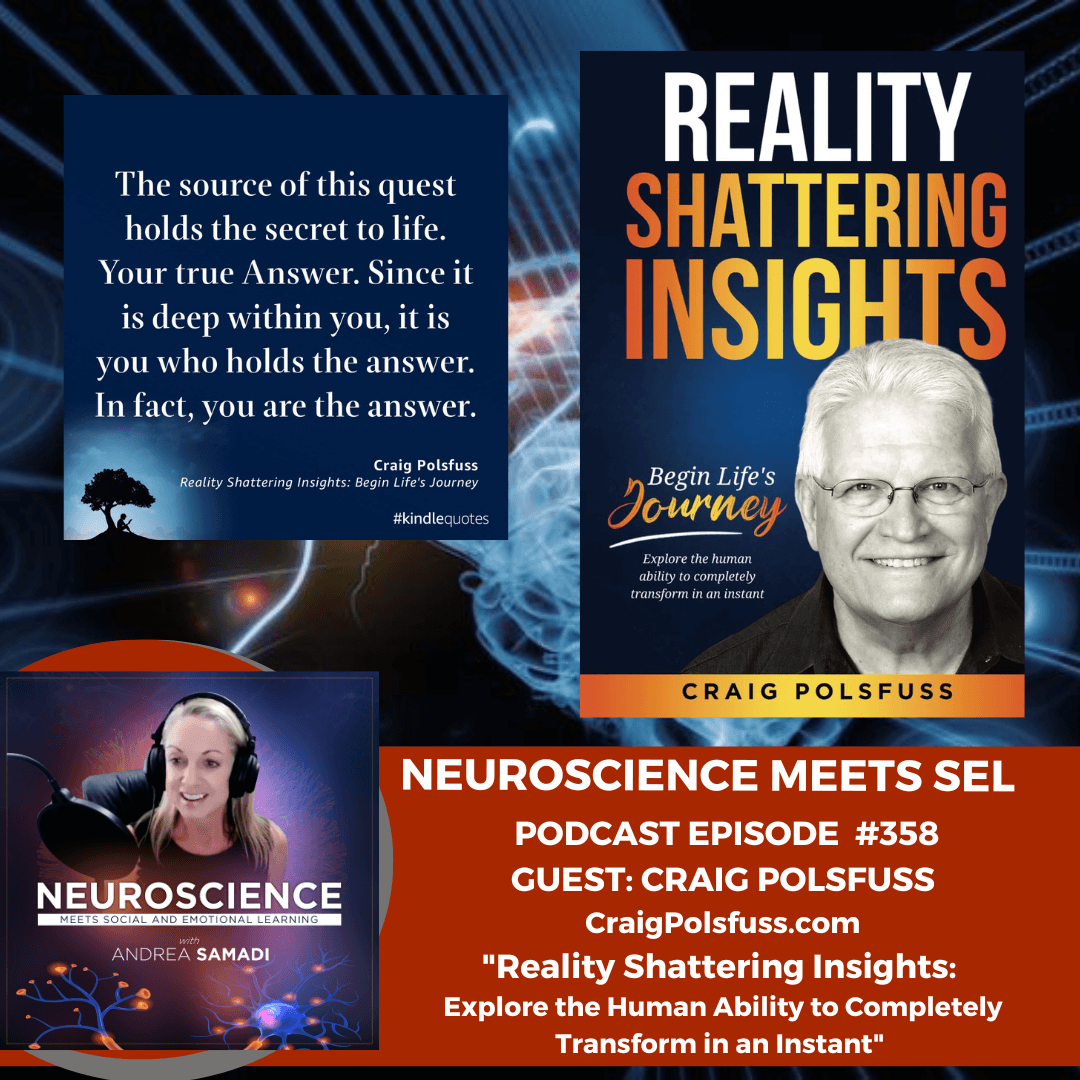
Ep 359"Unlocking Reality Shattering Insights: A Roadmap for Human Transformation" with Craig Polsfuss
Welcome to another enlightening episode of the Neuroscience Meets Social and Emotional Learning podcast. In today's episode, we delve deep into the transformative world of practical neuroscience with our special guest, Craig Polsfuss, a pioneering psychologist and author. Polsfuss introduces us to his groundbreaking book, Reality Shattering Insights, and shares his unique journey of integrating psychology, spirituality, and brain science to enhance mental well-being, performance, and spiritual insight. Join us as we explore how understanding and tapping into deeper consciousness can lead to life-changing insights and self-discovery. Learn to listen to your inner whispers and discover how to transform mental and emotional landscapes from within, moving from the intellect into the heart and beyond. Watch interview on YouTube here https://youtu.be/2Hu6_poYLn8 Welcome back to SEASON 13 of The Neuroscience Meets Social and Emotional Learning Podcast, where we connect the science-based evidence behind social and emotional learning and emotional intelligence training for improved well-being, achievement, productivity and results—using what I saw as the missing link (since we weren’t taught this when we were growing up in school), the application of practical neuroscience. I’m Andrea Samadi, an author, and an educator with a passion for learning and launched this podcast 7 years ago with the goal of bringing ALL the leading experts together (in one place) to help us to APPLY this research in our daily lives. On today's EPISODE #358 we will cover: ✔ How licensed psychologist and former clinical social worker Craig Polsfuss, (among the pioneers of the Three Principles movement in the 1980s) bridged psychology, spirituality, and brain science to help people achieve mental well-being, top performance and spiritual insight. ✔ Uncover the formula to create your own Reality Shattering Insights. ✔ Learn how tap into a deeper consciousness that can lead to life-changing insights and self-discovery. For today’s EP #358, we meet with a pioneering psychologist and author of the book published just last November, Reality-Shattering Insights[i], the first in a 4-book series entitled VoLT: The Vortex of Living Truth. Today’s guest, Craig Polsfuss, a licensed psychologist and former clinical social worker, who pioneered the Three Principles movement in the 1980s after a powerful awakening. With nearly five decades of experience, he integrates psychology, spirituality, and brain science to help people achieve mental wellbeing, top performance, and spiritual insight. The "reality-shattering insights" that he shares inside his book will open your eyes, if you are looking for answers, to questions you might not have even known that you were asking yourself. Before we meet Craig Polsfuss, and begin our journey of self-discovery: A discovery that will take us from our head to our heart, and from our heart, into the depths of our soul. I’ve got to say that this episode is not like ANY I have done before, as Craig covered questions I have had for a very long time. Questions that came up when I first studying Wallace D. Wattles’ The Science of Getting Rich book, 25 years ago, that we covered on EP 315[ii] with a 7-PART series. This book was one of the seminars that I sold in the late 1990s when I worked with speaker Bob Proctor. I always wondered “what is that thinking stuff that Wattles describes in his syllabus?” If you signed up for this seminar, you would have been given this syllabus to take home with you laminated. I’ve got at least 10 of them still today in my office. Back then I had no idea what Wattles was describing. That stuff he says “permeates, penetrates, and fills the interspaces of the universe.” And that “a thought in this substance produces the thing that is imaged by the thought.” I always thought it was some sort of “intelligence” but it wasn’t until this past January, while studying this book series with Paul Martinelli, w
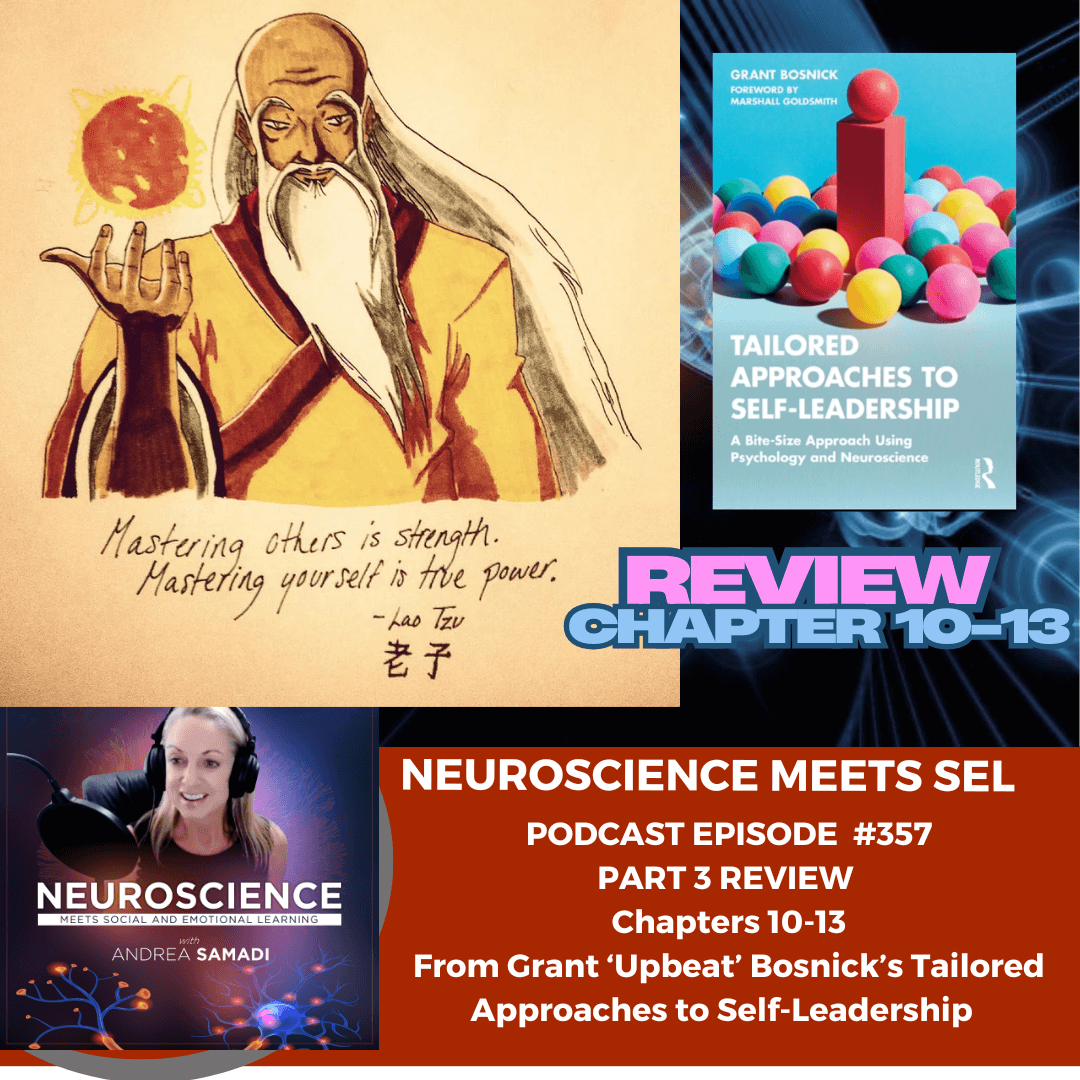
S13 Ep 358Unlocking the Power of Persuasion, Time Management, and Change: PART 3 Chapters 10-13 (Grant Bosnick)
Welcome back to Season 13 of the Neuroscience Meets Social and Emotional Learning Podcast! In this episode, we explore Part 3 of our review of Grant Bosnick's book on self-leadership, focusing on Chapters 10 to 13. Discover how the latest neuroscience research can enhance your skills in persuasion, time management, change, and agility. Dive deep into the nuances of persuasion and influence, learn effective time management techniques, understand the brain's response to change, and enhance your mental and physical agility. Join us as we uncover insightful strategies to apply in your leadership journey. And we will now resume PART 3 of our 4-PART review, to sum up last year, 2024, and our entire year studying one book, Grant Bosnick’s “Tailored Approaches to Self-Leadership: A Bite Size Approach Using Psychology and Neuroscience” that we first dove into with our interview on EP #321[i] the end of January 2024. The goal was that each week, we focused on learning something new, (from Grant’s book) tied to the most current neuroscience research, that builds off the prior week, to help take us to greater heights this year. It honestly shocked me that this series took the entire year. We began with PART 1[ii] and the first 5 chapters of the book. PART 2[iii] we reviewed chapters 6-9 of Grant Bosnick’s Tailored Approaches to Self-Leadership, and today, PART 3, today, we will review chapters 10-13. We will finish with PART 4, Chapters 14-16 after we release our FIRST interview of 2025, coming next weekend. ((On today's EPISODE #357 PART 3 of our review of Grant Bosnick’s Tailored Approaches to Self-Leadership, we will cover)): ✔ EP 336 Chapter 10[iv]“The Neuroscience of Persuasion and Influence” ✔ EP 337 Chapter 11[v] “The Neuroscience of Time Management” ✔ EP 339 Chapter 12[vi] “The Neuroscience of Change” ✔ EP 342 Chapter 13[vii] “Mastering Mental and Physical Agility” If you have not yet taken the leadership self-assessment, or if you would like to re-take it to see if the results are different for you than last year, you can click the link here to find the quick test. I re-took the assessment for 2025, and did notice some similarities and some differences. See what you notice about yourself. I noticed that pathways 2 and 3 are my high areas of focus this year, and that I can drop pathway 6 from my focus. What about you? If you have a few minutes to spare, take this leadership self-assessment again, and see if you notice any changes in your areas of focus for 2025. Did any of your pathways shift for you, since last year? This is an incredible way to be laser focused on pathways that will move the needle of success for YOU this year. ✔ EP 336 Chapter 10 “The Neuroscience of Persuasion and Influence” On this episode, we looked at Jack Carew’s classic book from 1987 called You’ll Never Get No For an Answer that was covered on EP 176.[viii] Carew looked at the unique strategies that American Author and Salesman Og Mandino encouraged us all to read to improve our communication and influence with others and I noticed that Strategy 2 was to stop looking out for number one and always look for how you can help others first. So, after noticing this, I went straight to Chapter 10 of Grant Bosnick’s book, on “Persuade and Influence” to see what he had to say on this topic. Right off the bat, in the opening of this chapter, Bosnick asks us to think about how we would persuade someone else to do something, like give you a pen you would like to have, for example, or ask for a promotion, or ask someone to do something you would like them to do. Then he differentiates the word persuade that he says “we can think of as quick, more direct, more for short-term or immediate gain” (Chapter 10, Bosnick, Tailored Approaches to Self-Leadership) while influence he says “is softer, more subtle, much more for longer term and lasting gain.” (Chapter 10, Bosnick, T
S13 Ep 357Unlocking the Secrets of Self-Leadership: PART 2: Chapters 6 to 9 Review (Grant Bosnick)
Welcome to Part 2 of our in-depth review of Grant Bosnick's 'Tailored Approaches to Self-Leadership.' In this episode, we delve into the significance of hydration for brain health, discovering 'aha' moments through creative insights, and the influential power of expectations on our well-being and success. We also explore the neuroscience behind staying mentally strong and regulate emotions effectively through improved sleep patterns. Join us as we unravel these fascinating research-backed strategies to enhance your self-leadership skills. Welcome back to SEASON 13 of The Neuroscience Meets Social and Emotional Learning Podcast, where we connect the science-based evidence behind social and emotional learning and emotional intelligence training for improved well-being, achievement, productivity and results—using what I saw as the missing link (since we weren’t taught this when we were growing up in school), the application of practical neuroscience. I’m Andrea Samadi, an author, and an educator with a passion for learning and launched this podcast 6 years ago with the goal of bringing ALL the leading experts together (in one place) to help us to APPLY this research in our daily lives. And we will now resume PART 2 of our 4-PART review, to sum up last year, 2024, and our entire year studying one book, Grant Bosnick’s “Tailored Approaches to Self-Leadership: A Bite Size Approach Using Psychology and Neuroscience” that we first dove into with our interview on EP #321[i] the end of January 2024. The goal was that each week, we focused on learning something new, (from Grant’s book) tied to the most current neuroscience research, that builds off the prior week, to help take us to greater heights this year. It honestly shocked me that this series took the entire year. Last week, we began with PART 1[ii] and the first 5 chapters of the book. Today we will review chapters 6-9 of Grant Bosnick’s Tailored Approaches to Self-Leadership. ((On today's EPISODE #356 PART 2 of our review of Grant Bosnick’s Tailored Approaches to Self-Leadership, we will cover)): ✔ EP 327 Chapter 6[iii] “The Hydrated Brain” ✔ EP 330 Chapter 7[iv]“Aha Moments, Creative Insights/the Brain” ✔ EP 333 Chapter 8[v] “Exploring the Power of Expectations” ✔ EP 335 Chapter 9[vi] “The Neuroscience Behind Staying Strong and Clear-Headed” If you have not yet taken the leadership self-assessment, or if you would like to re-take it to see if the results are different for you than last year, you can click the link here to find the quick test. Self-Assessment Results 2024 vs 2025 I re-took the assessment for 2025, and did notice some similarities and some differences. See what you notice about yourself. I noticed that pathways 2 and 3 are my high areas of focus this year, and that I can drop pathway 6 from my focus. What about you? If you have a few minutes to spare, take this leadership self-assessment again, and see if you notice any changes in yourself for 2025. Did any of your pathways of focus shift since last year? REMEMBER: We are either moving forward into growth, or backwards to safety. (Abraham Maslow). EP 327 Chapter 6 “The Hydrated Brain” For this episode, I remember wondering how on the earth can we narrow the focus of this topic of health and wellness that Bosnick covers thoroughly in Chapter 6? Dr. Peter Attia[vii], a Canadian-American physician, known for his medical practice that focuses on the science of longevity, says that “exercise might be the most potent “drug” we have for extending the quality and perhaps quantity of our years of life.” He created a rule that he thought would help narrow this focus and it was called “Attia’s Rule”[viii] where he suggests that can’t even talk about this topic, unless you have reached a certain level of health yourself. I agree, as this is one area we have been focused on this podcast, and I notice that as I strengthen one area, I lose sight of another. It’s an ongoing quest for balance, and I wouldn’t
S13 Ep 356Mastering Self-Leadership with Neuroscience REVIEW PART 1 Chapters 2-5 (Grant Bosnick)
Welcome back to Season 13 of the Neuroscience Meets Social and Emotional Learning Podcast. In this episode, join Andrea Samadi as we delve into practical neuroscience applications for self-leadership in 2025. Discover how to balance various aspects of life through insights from Grant "Upbeat" Bosnick's book, 'Tailored Approaches to Self-Leadership.' We explore strategies from four key chapters, focusing on leveraging neuroscience to level up your goals, the inspiration behind motivation, the benefits of mindfulness, and the art of achieving flow states. Learn actionable steps for overcoming obstacles and using positive forces to drive personal growth. Whether you're implementing new habits or seeking motivation, this episode serves as a guide to harnessing the full potential of your mind and achieving greater heights. Welcome back to SEASON 13 of The Neuroscience Meets Social and Emotional Learning Podcast, where we connect the science-based evidence behind social and emotional learning and emotional intelligence training for improved well-being, achievement, productivity and results—using what I saw as the missing link (since we weren’t taught this when we were growing up in school), the application of practical neuroscience. I’m Andrea Samadi, an author, and an educator with a passion for learning and launched this podcast 6 years ago with the goal of bringing ALL the leading experts together (in one place) to help us to APPLY this research in our daily lives. Now, we are well into 2025, and if you are listening today, I want to congratulate you. Not everyone chooses to do the work that is needed for self-improvement. It’s something I’m dedicated to working on each year, and like you, those who tune in each week, implementing the ideas we write down in our notebooks, and even the ones we highlight in yellow, this is the hardest work in the room. I just want to recognize you for showing up here, and tuning in to grab some ideas, do this difficult work, and take the ideas that you learn from the research, and put them into action. Like you, I am doing this as well. We interviewed Kristen Holmes, the VP of Performance Science from Whoop.com back in May 2021, on EP134[i] when I had first started using the wearable device to measure my sleep, strain and daily recovery. She told me something I already knew, and that was that my sleep needed work. She said it much sterner than this, but I heard it, loud and clear, especially since my brain scan from Amen Clinics, that we reviewed on EP 84[ii] came back and showed that I was sleep deprived. Changing behaviors, habits and daily routines, and changing the trajectory of our health is all possible, but actually sustaining the change—this is what I’m looking for. This is why I am doing these podcast episodes, and sharing what I’m learning along the way. It took me 4 years to finally improve my sleep, but to do this, I had to sacrifice something else important to me, and that was my early morning workouts. I’m sure if you are listening, you would understand and know exactly what I am saying here. While making improvements with one area of our life, we tend to do this at the expense of another area. I’m determined to prove that we can have it all, and hopefully, at the end of this review, we can all find a way towards improving the balance in the important areas of our lives. REMEMBER: “Mastering others is strength; mastering oneself is true power” - Lao Tsu Now wouldn’t it be great to have a tool (like a map) that tells us what is important to focus on each year, based on what we say is important to us in our work or personal lives? Now sleep is not on the map we are covering today, as we will review the 19 chapters from Grant Bosnick’s book, but I would put sleep right at the top of the list, along with the Top Health Staples that we covered back on a bonus EP we did in 2022[iii] where we first covered the importance of daily exercise, good quality sleep, eating a healthy d
S13 Ep 355Unlocking the Power of Presence: Neuroscience Meets Self-Leadership
Welcome to Episode 354 of the Neuroscience Meets Social and Emotional Learning Podcast! Join host Andrea Samadi as she concludes the 18-week self-leadership series with Grant Bosnick's revolutionary insights into the neuroscience of presence. Discover how your internal thoughts, external behaviors, and interactions shape your presence, and learn practical strategies to enhance your mindfulness and connection with others. This episode dives into Dr. Dan Siegel's 'Wheel of Awareness' meditation, offering three actionable tips to strengthen your presence in daily life. Uncover how to elevate your relationships and productivity by integrating mindfulness practices into your routine. Whether you're striving to be the most interesting or the most interested person in the room, this episode provides valuable guidance. Prepare to close the year with heightened awareness and step into 2025 with a new perspective on leadership and personal growth. On today's episode #354 we continue with the final topic of our 18-Week Self-Leadership Series based on Grant Bosnick’s “Tailored Approaches to Self-Leadership: A Bite Size Approach Using Psychology and Neuroscience” that we first dove into with our interview on EP #321[i] the end of January 2024. The goal was that each week, we focused on learning something new, (from Grant’s book) tied to the most current neuroscience research, that builds off the prior week, to help take us to greater heights this year. It honestly shocked me that this series took the entire year. Our final topic today, will be the neuroscience of presence, and then stay tuned for a review of the entire series to help us to move forward in 2025 with a new lens. ((On today's EPISODE #354 “The Neuroscience of Presence” we will cover)): ✔ Chapter 19 of Grant Bosnick’s Tailored Approaches to Self-Leadership with the topic of presence. ✔ Grant Bosnick’s Presence Framework with examples of subtle and direct presence. ✔ The Neuroscience of Presence using Dr. Dan Siegel’s book Aware: The Science and Practice of Presence ✔ Three Tips to Develop More Presence in our Day to Day Life. ✔ Reflections for using Mindfulness and Meditation to Improve Our Presence. If you’ve taken the leadership self-assessment[ii], look to see if Presence (in Pathway 2), along with inspiration and motivation, persuade and influence, is of a low, medium or high priority for you to focus on this year. I was not surprised to see this pathway is a high area of focus for me as I’m always looking for new ways to motivate, inspire and influence, and presence is something I know I need to work on daily, bringing my attention back to the present moment or you might catch me daydreaming. It made me laugh when Masati Sajady mentioned he noticed this with me, back on EP 348[iii] last year. Our presence is something that can be felt, that’s for sure. Now let’s take this deeper with Grant’s book. Grant opens up chapter 19, his final chapter, by saying that presence “is a product of our internal thoughts, external behaviors and interactions with others. It’s something (he says) that we carry with us at all times, whether we’re walking into a meeting room (or walking anywhere I might add) or sitting at a bus stop.” (Ch 19, Bosnick, Tailored Approaches to Self-Leadership, Page 252). I can demonstrate this one easily because we have all been there. I’ll never forget Dr. Dan Siegel, who we interviewed way back in our early days of this podcast, on EP 28[iv] talking about this topic, as he watched a mother with a young child walking, and the mother was on her cell phone, not present at all. He talked about the many opportunities for connection that were lost in this instance, and I never forgot it, as I’ve been guilty of doing exactly the same thing and potentially losing out on opportunities to make meaningful connections with others. Or think about this. In a conversation, someone is talking to you, and you notice the void. They’ve left the conversation. They
S13 Ep 354Unlocking Empathy: The Neuroscience Behind Understanding Others
Join Andrea Samadi in Episode 353 of the Neuroscience Meets Social and Emotional Learning Podcast as we explore the intricacies of empathy, guided by Grant Bosnick's tailored approaches to self-leadership. Delve into the foundation of empathy as a vital leadership tool, capable of strengthening relationships and achieving better outcomes. Learn about the neuroscience behind empathy, focusing on the role of mirror neurons and the three different types of empathy: cognitive, emotional, and empathetic concern. We also reflect on personal experiences where assumptions led to misunderstandings, highlighting the importance of seeing through another's eyes. Discover practical tips for deepening empathy, cultivating empathetic concern, and applying these insights both personally and professionally to make meaningful connections. This episode calls us to consciously choose empathy, fostering trust and compassion in our interactions. Prepare for our final chapter on the Neuroscience of Presence in the upcoming episodes as we continue to enhance our understanding and application of neuroscience in our daily lives. Welcome back to SEASON 13 of The Neuroscience Meets Social and Emotional Learning Podcast, where we connect the science-based evidence behind social and emotional learning and emotional intelligence training for improved well-being, achievement, productivity and results—using what I saw as the missing link (since we weren’t taught this when we were growing up in school), the application of practical neuroscience. I’m Andrea Samadi, an author, and an educator with a passion for learning and launched this podcast 6 years ago with the goal of bringing ALL the leading experts together (in one place) to help us to APPLY this research in our daily lives. On today's episode #353 we continue with the second last topic of our 18-Week Self-Leadership Series based on Grant Bosnick’s “Tailored Approaches to Self-Leadership: A Bite Size Approach Using Psychology and Neuroscience” that we first dove into with our interview on EP #321[i] the end of January 2024. The goal was that each week, we focused on learning something new, (from Grant’s book) tied to the most current neuroscience research, that builds off the prior week, to help take us to greater heights this year. It honestly shocked me that this series took the entire year. Our final topic will be the neuroscience of presence, and then stay tuned for a review of the entire series to help us to move forward in 2025 with a new lens. Now we have not yet covered empathy as an entire topic on this podcast, (yet) but we did mention it on EP 340[ii] with mediation expert John Ford on “Navigating Workplace Conflicts” with his “The Empathy Set”[iii] Card Program. I also included the topic of Empathy within the Character Education program I created for schools, so I know why Grant would think this topic to be important enough to include on his “roadmap” for success. When I looked back to what I had written over 15 years ago on empathy, I found an image that said “empathy is seeing with the eyes of another, listening with the ears of another, and feeling with the heart of another” which is right in line with how Grant Bosnick opens up Chapter 18 of his book. Grant reminds us that “empathy is the capacity to understand or feel what another person is experiencing from their frame of reference, the capacity to place ourselves in another person’s position, to put ourselves in their shoes, see it from their eyes, their perspective, their way of thinking and feeling.”. ((On today's EPISODE #353 “The Neuroscience of Empathy” we will cover)): ✔ A review of previous episodes where we covered empathy. ✔ The Neuroscience of Empathy ✔ Three Kinds of Empathy (Cognitive, Emotional and Empathetic Concern). ✔ Tips for becoming more empathetic in our daily life to deepen our relationships and improve our outcomes personally and professionally. If you’ve taken the leadership self-assessment[iv], lo
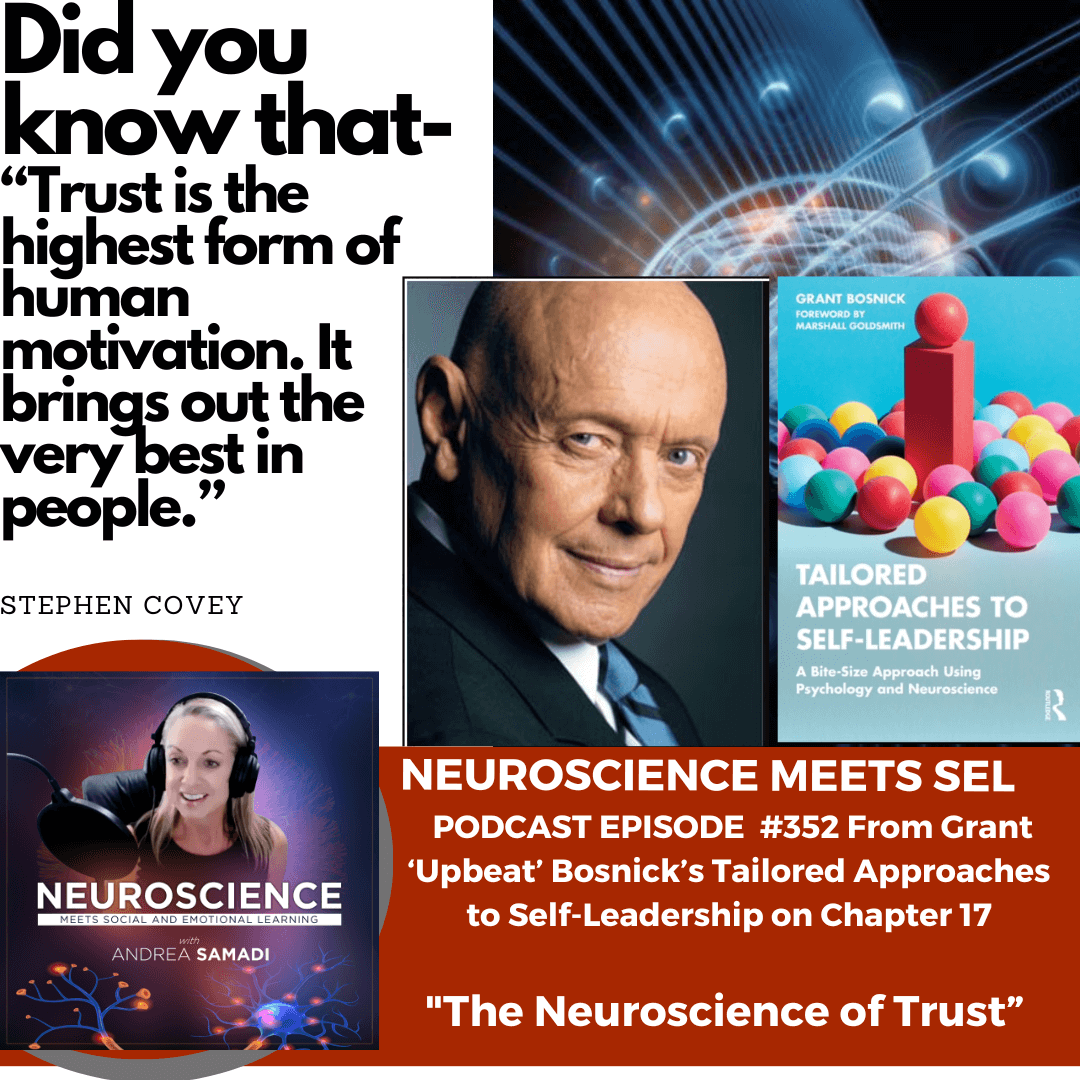
S13 Ep 352Unlocking the Neuroscience of Trust: Strengthening Leadership
Welcome to the latest episode of our podcast series, where we delve into the fascinating topic of trust and its underpinning neuroscience. In episode 352, we revitalize our understanding of trust by revisiting our initial interview with Greg Link from episode 206 and exploring Grant Bosnick's insightful approaches. We unpack the concept of trust as presented in Bosnick's book, emphasizing the five C's for strengthening trustworthiness: Character, Competency, Credibility, Consistency, and Care. Each of these pillars serves as a foundation for building reliable relationships both personally and professionally. Further, we examine critical factors impacting trust, like responsiveness, authenticity, and empathy, shedding light on how these elements foster an environment of trust. This exploration is pivotal for anyone aiming to enhance their self-leadership skills and boost their interpersonal effectiveness. Join us as we push the boundaries of self-leadership, preparing to soar to new heights in the upcoming year with insights that are not only transformative but also actionable. On today's episode #352 we continue with our 18-Week Self-Leadership Series based on Grant Bosnick’s “Tailored Approaches to Self-Leadership: A Bite Size Approach Using Psychology and Neuroscience” that we first dove into with our interview on EP #321[i] the end of January 2024. The goal was that each week, we focused on learning something new, (from Grant’s book) tied to the most current neuroscience research, that builds off the prior week, to help take us to greater heights this year. It’s honestly shocked me that this series took the entire year, and we still have 2 chapters left. The Neuroscience of Empathy and Presence, and then stay tuned for a review of the entire series to take us to new refined heights, in 2025. ((On today's EPISODE #352 “The Neuroscience of Trust” we will cover)): ✔ A review of our FIRST interview where we covered trust with Greg Link,EP 206[ii] ✔ Ch. 17 from Grant Bosnick’s Tailored Approaches to Self-Leadership book on “The Neuroscience of Trust.” ✔ The 5 Cs to strengthen trustworthiness from Grant Bosnick’s work. ✔ Critical factors that impact trust. Review of the Neuroscience of Trust We first covered The Neuroscience of Trust on EPISODE #206, as I was preparing for an interview with Greg Link[i], the co-founder of the Covey Leadership Center. Greg was the one who orchestrated the strategy that led Dr. Stephen R. Covey’s book, The 7 Habits of Highly Effective People: Powerful Lessons in Personal Change, (1989)[ii] to become one of the two best-selling business books of the 20th century according to CEO Magazine, selling over 20 million copies in 38 languages. Greg created the marketing momentum that helped propel Covey Leadership Center from a start-up company to a $110-plus million-dollar enterprise with offices in 40 countries. You can go back to episode #207[iii] to learn more from Greg Link’s incredible experience working with Dr. Covey, and with the fascinating individuals and companies around the world he reviewed with us, where we dove into the topic of “Unleashing Greatness with Neuroscience, SEL, Trust, and the 7 Habits.” While researching Greg Link, who I met when he came to work in the seminar industry in 2002, I was reminded of a topic that he thought was so important that he wrote a book about it with Stephen M.R. Covey (the son of the late Stephen R. Covey) called Smart Trust: The Defining Skill That Transforms Managers into Leaders.[iii] If you look up quotes from Stephen Covey on trust, you can see how important this skill or character trait was to him. He said, “trust is the glue to life” and “the one thing that affects everything else you’re doing. It’s a performance multiplier which takes your trajectory upwards, for every action you engage in, from strategy to execution.” It’s the “shortest route to results” (Robert Allen, author of Multiple Streams of Income). “Trust is the highest form o
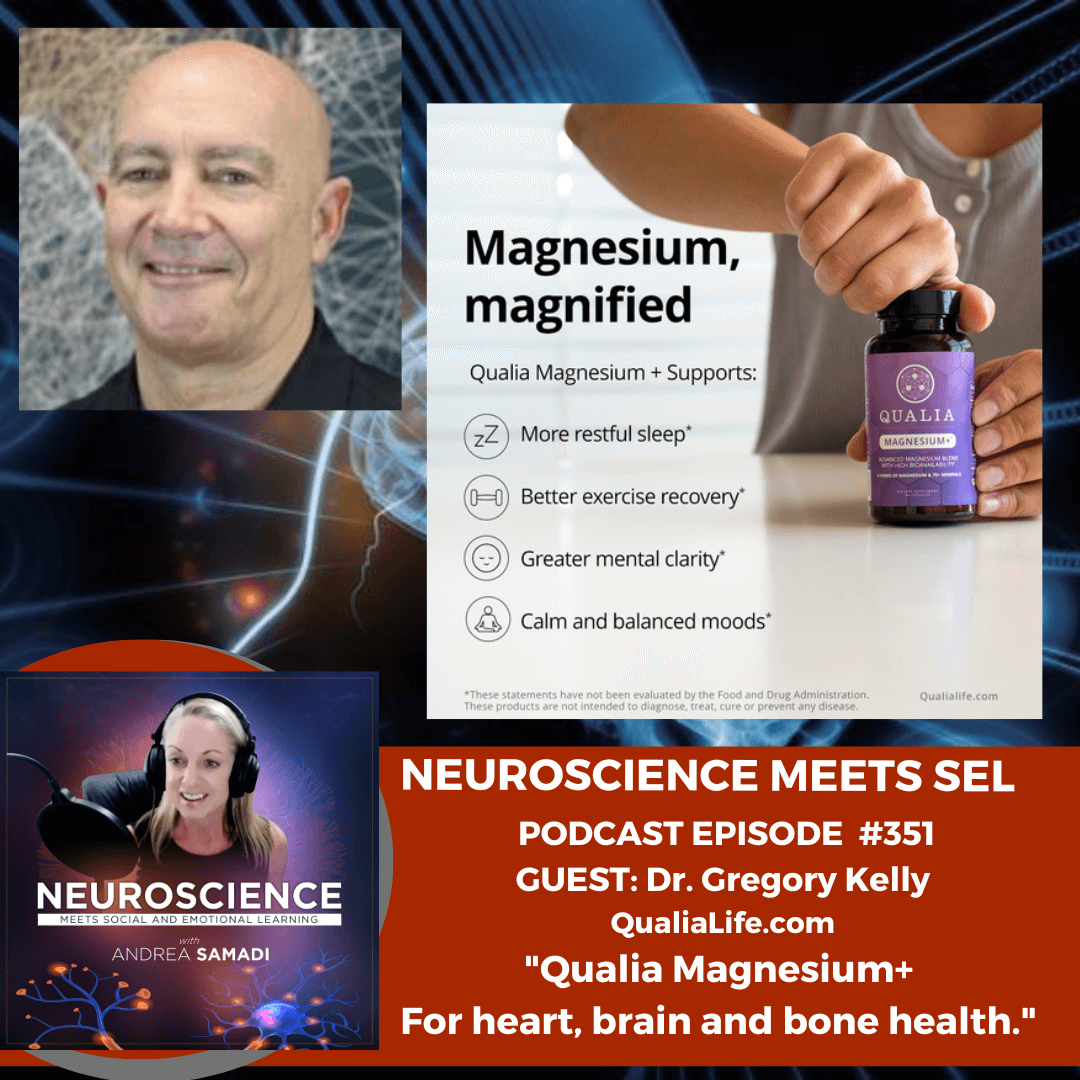
S12 Ep 351Unlocking the Secrets of Magnesium for Brain and Body Health with Dr. Gregory Kelly from Qualia Life
Welcome to the latest episode of the Neuroscience Meets Social and Emotional Learning podcast, where we dive into the cutting-edge fusion of neuroscience and emotional intelligence training. Today, we are thrilled to host Dr. Gregory Kelly for the third time, exploring the science behind Qualia's newest supplement: Magnesium Plus. Join us as Dr. Kelly explains why magnesium is vital for our health, from its role in cellular function and stress management to its impact on aging and brain vitality. Discover the unique formulation of Qualia Magnesium Plus, and learn why it stands out in the crowded supplement market. As our understanding of wellness evolves, so does our need for tools that address modern challenges. Whether you're dealing with stress, seeking better sleep, or wanting to enhance your cognitive functions, this episode offers insights into how magnesium can play a crucial role in your daily regimen. Don't miss this opportunity to learn from a leading expert in natural medicine and take a step towards better health and well-being. Watch our interview on YouTube here https://youtu.be/lzee8WNZwU4 On today's episode #351 we meet with a returning guest, for the third time, Dr. Gregory Kelly from EP 285[i] where we first met him and covered Qualia Senolytic (something I have been taking ever since that interview to optimize aging, supporting cellular function, and then again on EP 305[ii] where we covered Qualia Symbiotic to optimize digestion and mood. On today's EPISODE #351 “Qualia Magnesium+ for Heart, Brain and Bone Health with Dr. Gergory Kelly” we will cover: ✔ Why magnesium is critical to every organ in the body (cellular function and stress management). ✔ The science behind Qualia's NEWEST supplement for brain health: Qualia Magnesium+ ✔ Why THIS supplement stands out from other brands on the market. Today we are covering their most recent product release, Qualia Magnesium+, that I have been taking for the past 2 weeks, so we can learn together WHY this specific product is unique and different from other brands of magnesium on the market, and what I have noticed since taking this supplement. A bit about Dr. Kelly: Gregory Kelly is Director of Product Development at Qualia Life Sciences, naturopathic physician (N.D.), and author of the book Shape Shift. He was the editor of the journal Alternative Medicine Review and has been an instructor at the University of Bridgeport in the College of Naturopathic Medicine, where he taught classes in Advanced Clinical Nutrition, Counseling Skills, and Doctor-Patient Relationships. Dr. Kelly has published hundreds of articles on natural medicine and nutrition, contributed three chapters to the Textbook of Natural Medicine, and has more than 30 journal articles indexed on Pubmed. His areas of expertise include nootropics, anti-aging and regenerative medicine, weight management, sleep and the chronobiology of performance and health. Let’s meet Dr. Gregory Kelly and see what we can learn about the benefits of adding magnesium to our wellness protocol. Welcome back Dr. Kelly, it’s awesome to see you again. How are things going? Interview Questions To open up here, I wonder if we could talk about magnesium, and why it’s critical to every organ in the human body? Magnesium impacts all 12 hallmarks of aging, tell us more about how low magnesium levels can accelerate the aging process. What is the link between magnesium levels and brain health? Can you share studies to support this? How long can we notice the benefits of taking magnesium? Andrea measured using her Whoop device, and noticed a spike around the beginning of December. What are some signs of low magnesium levels and why is it safe to say that deficiencies often go unnoticed? Magnesium Facts & Myths At least half of Americans are deficient in magnesium and what contributes to the deficiency? Why is a comprehensive approach to magnesium supplementation vital and what does that mean? Is there redundancy wh
S12 Ep 350Unlocking Brain Health with Dr. David Stephens
Welcome to Episode 350 of the Neuroscience Meets Social and Emotional Learning Podcast! In this episode, Andrea Samadhi delves into an enlightening discussion with Dr. David Stephens, a clinical psychologist and neuropsychologist renowned for his expertise in brain function and mental health. Discover groundbreaking insights into how glucose can be a game-changer in restoring brain function, mental health, and overall productivity. Dr. Stephens shares his compelling journey that led to the revelation of glucose as a crucial element in brain restoration. From understanding the perceptible differences between glucose and sugar to unraveling common myths about brain health, this conversation is packed with scientific insights that challenge traditional paradigms. You won't want to miss this fascinating exploration of how restoring glucose levels could revolutionize our mental, emotional, and spiritual well-being. Watch our interview on YouTube here https://youtu.be/T0R3uvBbHPE Welcome back to SEASON 12 of The Neuroscience Meets Social and Emotional Learning Podcast, where we connect the science-based evidence behind social and emotional learning and emotional intelligence training for improved well-being, achievement, productivity and results—using what I saw as the missing link (since we weren’t taught this when we were growing up in school), the application of practical neuroscience. I’m Andrea Samadi, an author, and an educator with a passion for learning and launched this podcast 6 years ago with the goal of bringing ALL the leading experts together (in one place) to help us to APPLY this research in our daily lives. On today’s episode #350, we meet with Dr. David Stephens[i], a clinical psychologist, neuropsychologist, and consultant with extensive experience in brain function, restoration and mental health. On today's EPISODE #350 “Unlocking Brain Health with Dr. David Stephens” we will cover: ✔ Groundbreaking insights into how glucose can be a game-changer in restoring brain function, mental health, and overall productivity. ✔ Dr. Stephens shares his compelling journey that led to the revelation of glucose as a crucial element in brain restoration. ✔ The perceptible differences between glucose and sugar ✔ Unravel common myths about brain health, while challenging traditional paradigms. Some quick facts about Dr. Stephens. He was the Former Director of Mental Health for three state prison systems Overseen mental health services in jails throughout the US Academic dean of an accredited graduate school of psychology Correctional and architectural neuroscience consultant Provides brain restoration services to individuals What drew me to Dr. Stephens is that our podcast took a turn towards health and wellness after the Pandemic, and a huge part of this direction has been focused on brain health. We have met many experts along the way who have shared tips and strategies to give us hope in our journey of life, but Dr. Stephens will take this hope to new heights if we can keep our minds open. While the front page of his website features the headline “Humanity Restored” when I went to the research[ii] behind his work, I was taken back a bit. It was all about glucose and its restorative effects on the brain and body. Then I went to the peer reviewed studies[iii] to learn more, and realized that my understanding of glucose (what it is, how is glucose different from sugar (that I consider poison), and how can glucose be used to restore brain function)? All of my questions, I realized needed to be addressed before this interview. So, I watched some interviews Dr. Stephens had with other podcasters, and learned about “How to cure depression with glucose”[iv] and also where his work began where he connects hard science, and neuroscience, to spirituality.[v] Let’s now meet Dr. David Stephens, where I will ask him to share his work and research that he has felt divinely inspired to share, and see if we can take this new kn
S12 Ep 349Unlocking Radical Self-Acceptance: A Journey with Dr. Laura Gallaher
Welcome to today's enlightening episode of the Neuroscience Meets Social and Emotional Learning Podcast. Join host Andrea Samadhi as she explores the insights of Dr. Laura Gallaher, an organizational psychologist and executive coach. Dr. Gallaher shares her earlier days at NASA, revealing how she tackled the challenges following the Columbia shuttle disaster to reshape organizational culture and highlight the importance of psychological safety. Through an engaging conversation, Dr. Gallaher discusses her personal journey towards radical self-acceptance and how it transforms career and personal relationships. Learn how leaders can foster vulnerability and courage to build more productive, aligned, and self-aware teams, and discover the contagious nature of authentic connections based on self-awareness and acceptance. Tune in for an inspiring discussion that blends neuroscience, psychology, and real-life experiences to encourage growth both at work and home. Watch our interview on YouTube here https://youtu.be/b0Pc6bKKWwM On today's EPISODE #349 “Unlocking Radical Self-Acceptance with Dr. Laura Gallaher” we will cover: ✔ Where Dr. Gallaher's career began, leading her to work with NASA. ✔ How can radical self-acceptance transform our career, and personal lives. ✔ Uncover where YOU are on the self-acceptance quadrant, so you can blend science and psychology to take your results to new heights. On today’s episode #349, we meet with Dr. Laura Gallaher, an Organizational Psychologist, Speaker, Facilitator, and Executive Coach. She is the founder and CEO of Gallaher Edge[i], which she started in 2013 where she works with busy executives to help you get your arms around the challenges in your organization. They work with you from the inside out, helping your executive team have conversations you didn’t even know you needed to have. They help to increase self-awareness, team alignment, and shared accountability until your organization runs like a well-oiled machine. Organizations (she asserts) are just people. Her noteworthy career began after the Space Shuttle Columbia exploded upon re-entry in 2003. Following the tragedy, NASA hired Laura and a team of organizational psychologists to change the cultural influences that were deemed to play a role in the accident. She worked for 8 years to positively influence culture, develop leadership capacity, and improve organizational performance at Kennedy Space Center. She holds a Bachelor’s degree in Psychology, and a Masters and PhD in Organizational Psychology. Laura is a Licensed Human Element® Practitioner, a Certified Radical Collaboration Trainer, and a Certified Coach. Let’s meet Dr. Laura Gallaher, and learn together where we could possibly take our personal and work environments to new heights. Welcome Dr. Gallaher. Thank you for joining me today. Are you in Orlando now? I know that you have deep roots in the Phoenix area (and lots of places around the world). INTRO Q: Dr. Gallaher, before asking you questions about your book, and your work, I have to say that there was something that drew me to you, before even looking at your bio. When you first meet someone, I think that what goes on inside us, (our mindset) shows on the outside, and I felt like you had a story to tell of where you began. When did you first learn about the importance of radical self acceptance, and how do you think that we can all use this skill in our personal and professional life? Q1: While coming up for some questions for you, I watched your TED TALK “How to Feel at Home Anywhere”[ii] where you talk about the ability to discover your inner confidence, and your ability to cope with the world (so that literally any place in the world) can feel like home. What drew you to create this TED TALK? Q2: It’s interesting to me that your topic was “How to Feel at Home Anywhere” because I’ve thought about this concept often. While I’ve not worked and travelled to the places and countries that you have (other
S12 Ep 348Unveiling Exponential Intelligence with Masati: Transform Your Life by Shifting Frequencies
Welcome to Episode 348 of the Neuroscience Meets Social and Emotional Learning Podcast, where host Andrea Samadi explores the intersection of neuroscience, emotional intelligence, and social learning. In this enlightening episode, Andrea introduces us to Masati, a visionary thought leader and the CEO and founder of Exponential Intelligence Science. Masati delves into the transformative power of dimensional consciousness and frequency manipulation to eliminate human suffering and unlock human potential. With a unique blend of quantum physics and spiritual insight, Masati reveals how altering one's frequency can lead to profound changes in health, wealth, relationships, and spirituality. Drawing from his extraordinary near-death experiences, Masati shares how these events propelled him to discover a methodology that helps individuals redesign their blueprints for a more fulfilling life. Andrea and Masati discuss the science behind accessing higher dimensions of consciousness, the importance of frequencies in shaping our reality, and practical steps to achieve exponential intelligence. Join Andrea and Masati as they journey through the realms of quantum physics, altered states, and the profound impact of shifting frequencies on personal transformation. This episode is a must-listen for anyone seeking to elevate their life to new dimensions of success and fulfillment. On today's episode #348, we meet with Masati on "Unveiling Exponential Intelligence." Watch our interview on YouTube here https://youtu.be/cXH6-mDO3S0 We will cover: ✔ What is Exponential Intelligence Science and how can we use it to unlock our human potential? ✔ What is Masati's story? How did three near-death experiences lead him towards new abilities like reading frequencies? ✔ What can we learn by blended quantum science with spirituality? Masati is a visionary thought leader and the CEO and Founder of Xponential Intelligence Science, a groundbreaking field dedicated to the study and application of Dimensional Consciousness for the advancement of humanity. With a profound focus on eliminating human suffering and awakening consciousness, Masati leverages his unique understanding of quantum physics, space-time, and the power of frequencies to guide individuals toward profound transformation. Masati, like many we have met on this podcast, believe that when you can learn how to change your frequency, you can change your life. Through XI, (that we will dive deep into today) Masati works on the core frequency level, helping to redesign and reprogram one's blueprint to materialize fast, tangible results in all areas of life, including health, wealth, relationships, and spirituality. When I first was introduced to Masati, I wondered “where has Masati gained his knowledge and understanding of these concepts we talk about often on the podcast, connecting science to the unknown spiritual world” and I understood the minute I saw his bio. After having experienced three near-death experiences, Masati emerged with extraordinary abilities and knowledge far ahead of our time. These experiences ignited his passion for exploring the deeper realms of human potential, leading him to develop Xponential Intelligence (XI), a transformative methodology that empowers individuals to achieve real-time life changes. If you’ve followed our podcast from the beginning, you will know that I first learned about ways to improve our life and results, through motivational speaker, Bob Proctor,[i] who was an expert at improving our thinking, to achieve new results, specifically with breaking through the paradigms that hold us back. He would always say “to reach new heights, you’ve got to go where you’ve never been…(and this starts) with your imagination first.” (Bob Proctor, The Paradigm Shift Seminar). When I saw that over the past 14 years, Masati has shared his expertise with a global audience, reaching over 100 countries through his speaking engagements, podcasts, and personal sess
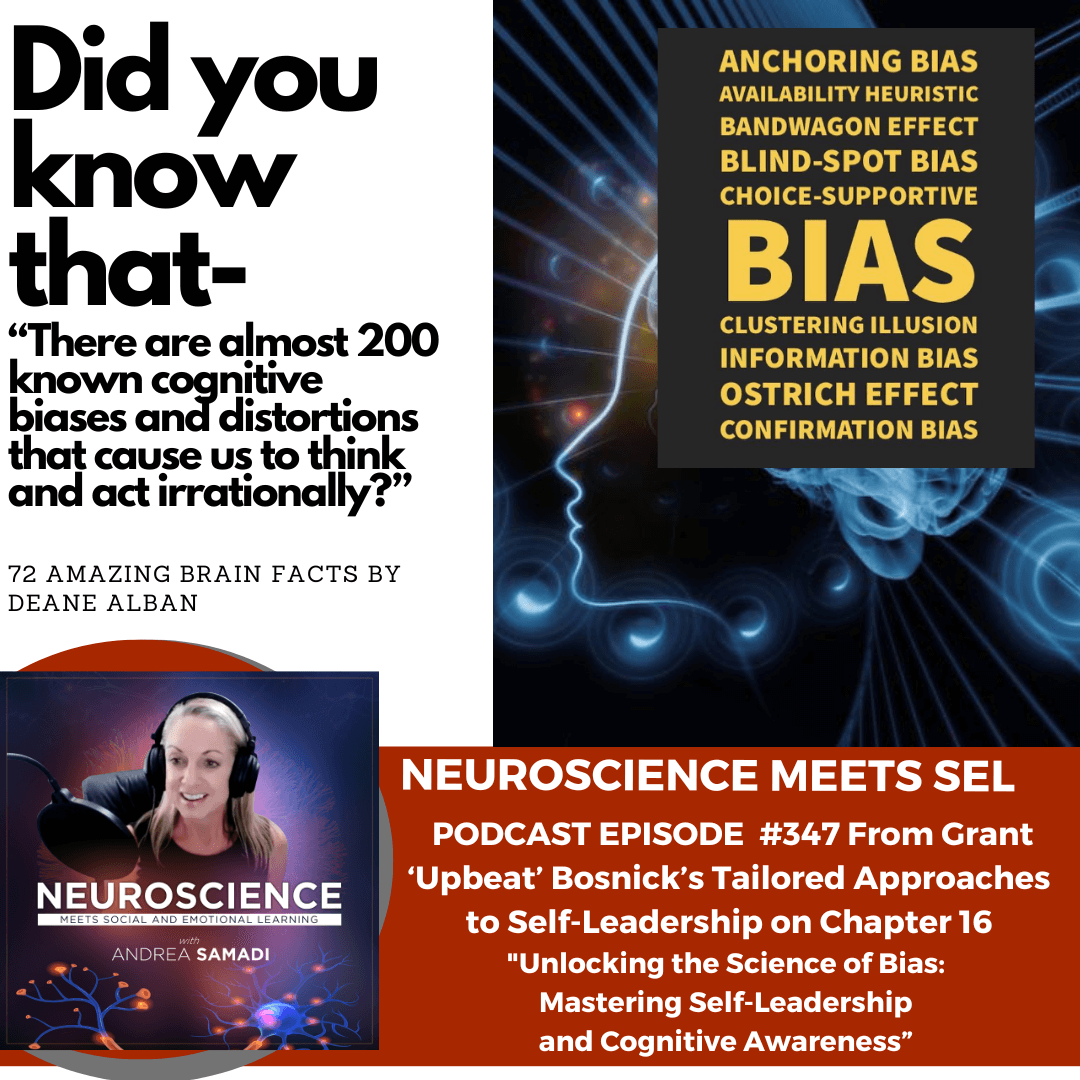
S12 Ep 347Unlocking the Science of Bias: Mastering Self-Leadership and Cognitive Awareness
Welcome back to Season 12 of the Neuroscience Meets Social and Emotional Learning Podcast, where we bridge the gap between neuroscience and emotional intelligence to enhance well-being and productivity. In this episode, host Andrea Samadhi continues the 18-week self-leadership series, focusing on the neuroscience of biases as explored in Grant Bosnick's book, "Tailored Approaches to Self-Leadership." Episode 347 delves into Chapter 16, examining cognitive biases through the lens of current neuroscience research. With insights from past episodes and experts like Jenny Woo and Howard Rankin, Andrea highlights the nearly 200 cognitive biases that influence our decision-making. The episode introduces Bosnick's strategies for identifying and managing these biases using Daniel Kahneman's dual-system theory of thinking. Listeners will learn practical steps to recognize biases, categorize them, and apply thoughtful approaches to mitigate their effects. This exploration aims to enhance self-awareness and improve decision-making processes by leveraging both reflexive and reflective thinking systems. Join us on this enlightening journey to understand the intricacies of human cognition and prepare for upcoming discussions, including the neuroscience of trust. This episode is a valuable resource for anyone seeking to refine their self-leadership skills and cognitive understanding. On today's EPISODE #347 “The Neuroscience of Biases” we will cover: ✔ A review of past episodes where we covered biases. ✔ Chapter 16 of Grant Bosnick’s Tailored Approaches to Self-Leadership on The Neuroscience of Bias. ✔ A review of our two types of thinking (X-system=reflexive/automatic and C-system=reflective/intentional). ✔ 3 Steps to Understand and Manage our Biases ✔ 4 Strategies for Mitigating our Biases For Today, EPISODE #347, we are moving on to Chapter 16, reviewing “The Neuroscience Biases” that we first covered on EP 17[i] with Harvard Researcher, Jenny Woo. On this early episode on our podcast, I mentioned I had just learned that there “are almost 200 known cognitive biases and distortions that cause us to think and act irrationally.” (72 Amazing Brain Facts by Deane Alban). Then we explored cognitive biases even further with EP 146 with our FIRST interview with Howard Rankin, on “How Not to Think”[ii] where he explains why "the more we know, the more we realize we know nothing at all." (Howard Rankin). If you’ve taken the leadership self-assessment[iii], look to see if Biases (in Pathway 6, our final pathway in this book study) along with relationships/authenticity, trust and empathy is of a low, medium or high priority for you to focus on this year. I was not surprised to see this pathway is a high area of focus for me. I remember being surprised at how many common problems occur with our human thinking process, and wondered how to be aware of all of these cognitive biases. Learning is a continual process, and awareness that our thinking contains these biases, is the first step towards improving our thinking process. So what does Grant Bosnick have to say about biases in chapter 16 of his book, Tailored Approaches to Self-Leadership? He opens the chapter with an exercise that came from Daniel Kahneman’s book, Thinking Fast, and Slow[iv] a book that sold more than 2.6 million copies. IMAGE CREDIT: (Ch 16, Biases, Bosnick). If you are listening to this episode, look at the image in the show notes, and don’t forget how you went on to solve this puzzle. Read the instructions and then solve the puzzle. It says “spot the error.” We will come back to the solution at the end of this episode. Bosnick next goes on to define what cognitive biases are, reminding us they are “mental shortcuts that allow us to quickly sort, categorize and make decisions on pieces of information in order to navigate the world in an efficient way. They can be positive, negative or neutral, although most of us probably associate them with the more negative side.”
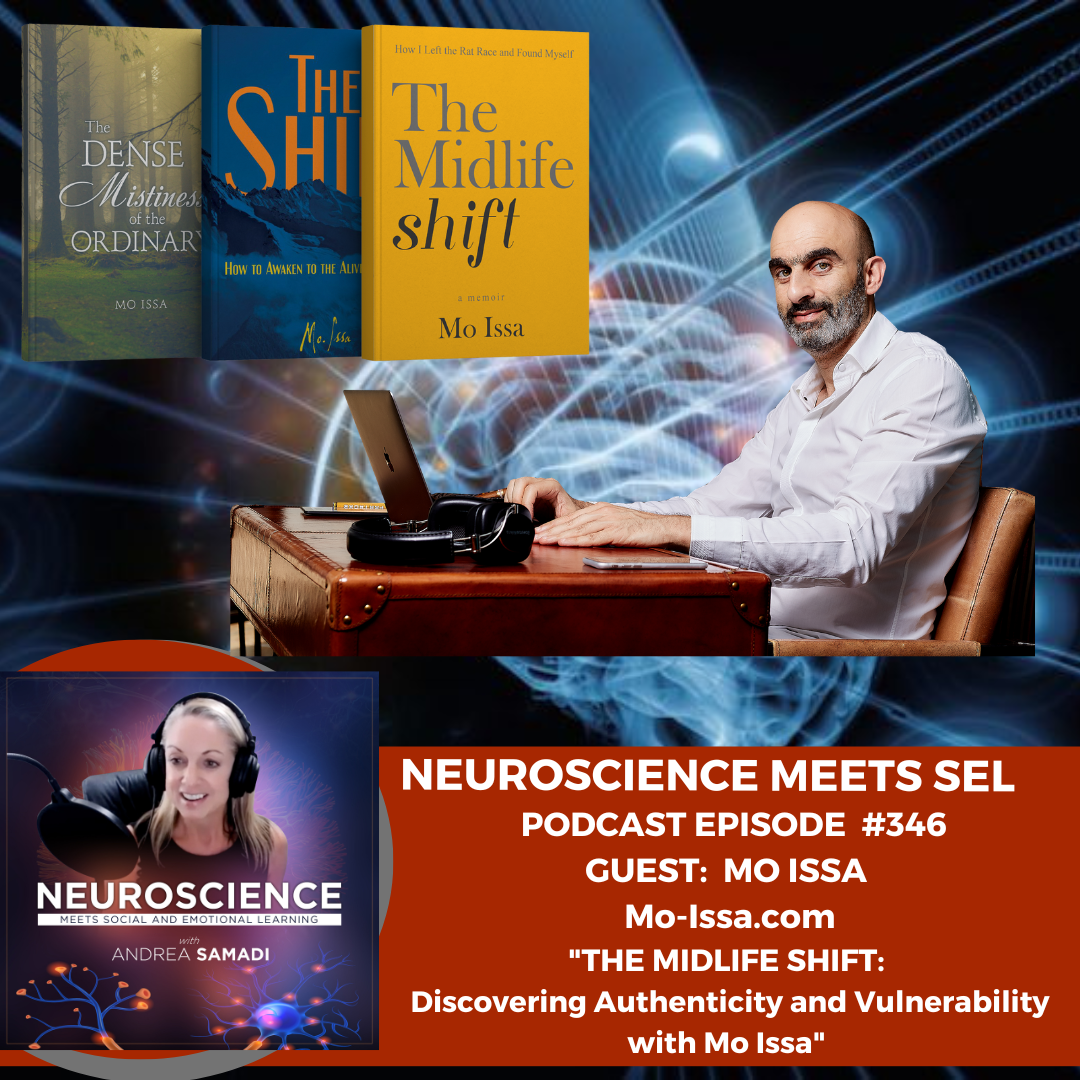
S12 Ep 346The Midlife Shift: Discovering Authenticity and Vulnerability with Mo Issa
Welcome back to Season 12 of the Neuroscience Meets Social and Emotional Learning podcast, where host Andrea Samadhi connects the dots between neuroscience and emotional intelligence for improved well-being and productivity. In this episode, we dive into a transformative journey with Mo Issa, an inspiring author known for his authentic writing and motivational talks. Join Andrea as she reconnects with Mo, a long-time supporter of her work, to explore his latest book, The Midlife Shift. Mo shares his personal journey from living a life of success and prestige to finding deeper meaning and authenticity. Through candid conversations, Mo reveals how vulnerability and self-discovery have reshaped his life, offering invaluable insights for those seeking to live their true, authentic selves. Discover how Mo's experiences with writing, running, and reflection have guided him towards a more fulfilling life. Learn about the importance of embracing vulnerability and simplifying life to enhance self-awareness and personal growth. Whether you're navigating midlife changes or seeking to deepen your self-awareness, this episode provides a profound exploration of living with authenticity and purpose. Watch our interview on YouTube here https://youtu.be/tr661XZK438 On today's EPISODE #346 “The Midlife Shift: Discovering Authenticity and Vulnerability with Mo Issa” we will cover: ✔ An overview of Mo Issa's forthcoming book: COMING NOV 12th, 2024 to Amazon ✔ Mo will share his personal journey from living a life of success and prestige to finding deeper meaning and authenticity. ✔ Mo reveals how vulnerability and self-discovery have reshaped his life, offering invaluable insights for those seeking to live their true, authentic selves. ✔ Andrea and Mo explore ways we can all dive deeper, embrace vulnerability and simplify life to enhance self-awareness and personal growth. On today's episode #346 we meet with someone I’ve known over the years. It was about 10 years ago, that I was connected to our next guest through our mutual friend, motivational speaker, Bob Proctor. At the time, I had no idea how much of a supporter to my work, he would be over the years, and he’s one of the influencers who has helped me to discover, and live on my own authentic path. He was one of the first to use our curriculum for teenagers for a soccer school he ran in Accra, Ghana, and his belief and trust in me, helped me to see this in myself. We never forget those who have helped us along this journey called life, and I’m forever grateful to have met Mo Issa[i], when I was starting out on my journey of self-discovery, where I left the corporate world for a 10-year period, to make an impact in our schools. Over the years I followed Mo’s work, specifically his writing, which until reading his book, that we will cover today, The Midlife Shift[ii], I had no idea how much Mo’s writing would inspire me, to keep going (learning and growing) on my own path. Right on the front page of his website, you can read his own words. He says “I am a writer who believes when we find ourselves stuck in life it is because we lack meaning and don’t feel challenged. (In his books, essays and podcasts, he encourages) making small changes to embrace self-discovery, simplify life, and focus on a deep sense of fulfillment.” (Mo Issa) Let’s meet Mo Issa, an author of three books, who has spoken regularly at conferences and workshops, including TEDx Accra Conference[iii], someone who has read 50 books per year, for the past 10 years, and see what we can learn about living our true authentic life, and improve our own self-awareness in this discovery process. Welcome Mo Issa!! It’s been a long time since we have spoken, thank you for coming on the podcast, and sharing your work with us. I can’t even tell you how much your writing specifically has helped me over the years. This is an important and special interview. Thank you for being here. INTRO: For our audience who might not yet kno
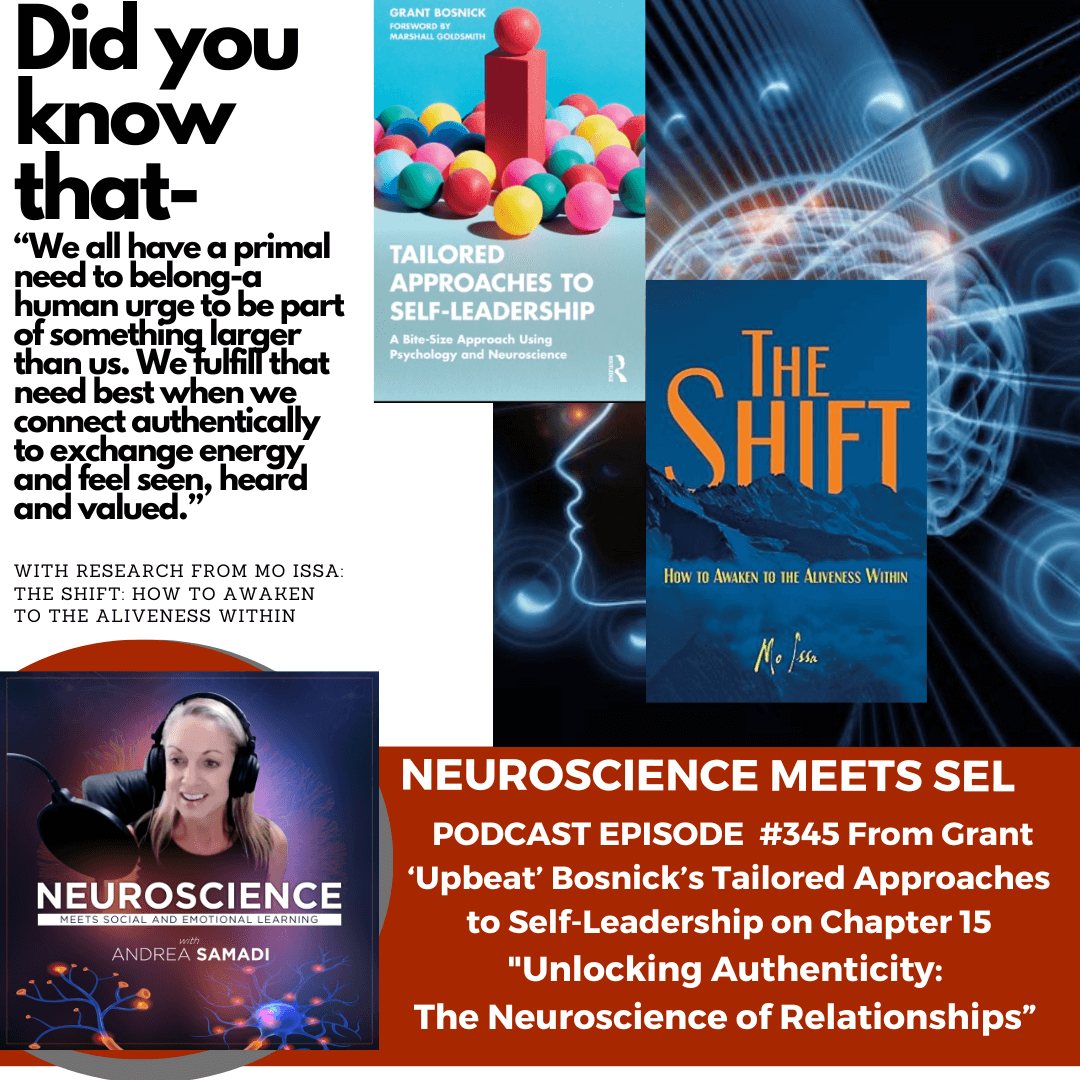
S12 Ep 345Unlocking Authenticity: The Neuroscience of Relationships
Welcome back to Season 12 of the Neuroscience Meets Social and Emotional Learning podcast! In episode 345, we continue our 18-week self-leadership series based on Grant Bosnick's tailored approaches. This week, we dive into Chapter 15, exploring the neuroscience of relationships and authenticity. We revisit key insights on relationship-building from past episodes and introduce the concept of authenticity, drawing on reflections from Andrea Samadi and insights from Mohamed Issa's forthcoming book. Learn what authenticity means, how it impacts our lives, and practical steps for fostering genuine connections with others. Discover the balance between the reflexive and reflective systems in our brain, and how understanding these can enhance our social interactions. Reflect on your unique gifts and talents, and find out how to nurture them to build deeper, more authentic relationships. Join us for an enlightening episode that blends neuroscience with practical advice, helping you to live a more authentic life and improve your personal and professional relationships. On today's episode #345 we continue with our 18-Week Self-Leadership Series based on Grant Bosnick’s “Tailored Approaches to Self-Leadership: A Bite Size Approach Using Psychology and Neuroscience” that we first dove into with our interview on EP #321[i] the end of January. The goal was that each week, we focused on learning something new, (from Grant’s book) tied to the most current neuroscience research, that builds off the prior week, to help take us to greater heights in 2024. On today's EPISODE #345 “The Neuroscience of Relationships and Authenticity” we will cover: ✔ A review of one of our FIRST interviews, with Greg Wolcott EP #7, July 2019 on his book Significant 72 ✔ Ch. 15 from Grant Bosnick’s Tailored Approaches to Self-Leadership book on “Relationships and Authenticity ✔ A review of Mo Issa’s definition of Authenticity from his book, The Shift: How to Awaken to the Aliveness Within ✔ The Neuroscience of Our Social Brain ✔ 4 Steps to Building More Authentic Relationships For Today, EPISODE #345, we are moving on to Chapter 15, reviewing “The Neuroscience of Relationships and Authenticity.” We’ve covered relationships on this podcast, right back to the beginning, with Greg Wolcott EP #7, (July 2019) with his book Significant 72: Unleashing the Power of Relationships in Today’s Classrooms. Greg Wolcott, an Assistant Superintendent from Chicago, IL, has dedicated his life to this topic through his work at Signficant72.com.[iii] It’s here where you can learn more about Greg’s Relationship Mindset Movement, his book, tools, and resources to improve student-teacher relationships in the classroom. Relationships are also one of the six social and emotional competencies that we built our podcast framework upon, knowing how important relationship skills are for our well-being and future success. “Social relationships—both quantity and quality—affect mental health, health behavior, physical health, and (even our) mortality risk.”[iv] If you’ve taken the leadership self-assessment[v], look to see if Relationships and Authenticity (in Pathway 6, our final pathway in this book study) along with biases, trust and empathy is of a low, medium or high priority for you to focus on this year. I was not surprised to see this pathway is a high area of focus for me. While we have covered relationship building often on this podcast, the one topic we have NOT covered yet is authenticity. This is interesting timing for me, as I’m currently reading a book by a good friend, Mohammed Issa[vi], where he covers the topic of authenticity, in depth. It’s the title of chapter 8 of his forthcoming book, The Midlife Shift[vii] (Reclaiming My Authenticity). I remember years before Mo wrote this book, I could tell he was thinking deeply about this topic. In 2021 he sent me a message, and asked me “what does living an authentic life mean to you?” I take questions from Mo seriously o
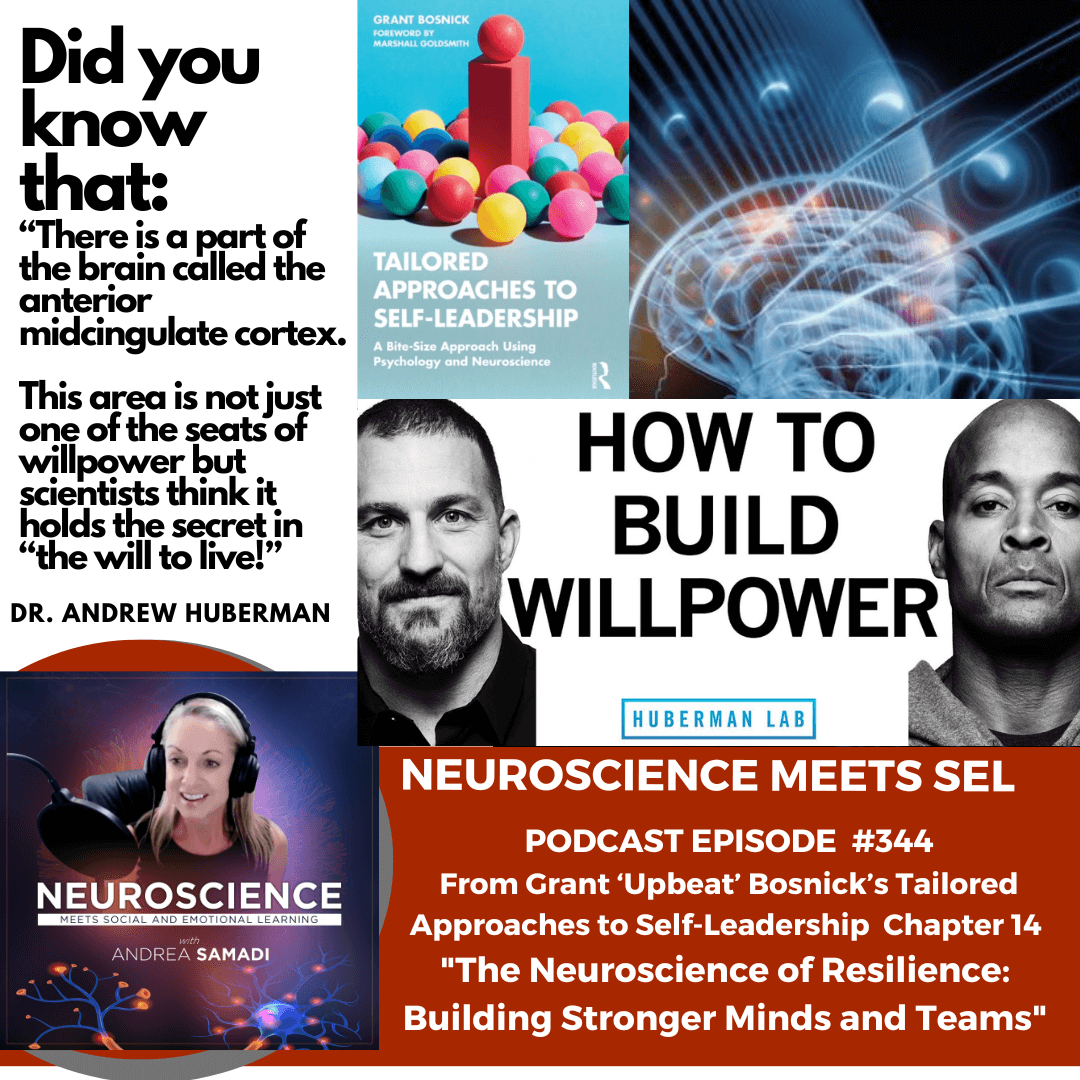
S12 Ep 344The Neuroscience of Resilience: Building Stronger Minds and Teams: Insights from Grant Upbeat Bosnick (Chapter 14)
Welcome back to Season 12 of the Neuroscience Meets Social and Emotional Learning podcast, where we connect the science-based evidence behind social and emotional learning and emotional intelligence training for improved well-being, achievement, productivity, and results using practical neuroscience. In Episode 344, we continue with our 18-week self-leadership series, diving into Chapter 14 of Grant Bosnick's book to explore the neuroscience of resiliency. We revisit past episodes with Horacio Sanchez to understand the factors that contribute to resilience and discuss the intriguing analogies presented by Bosnick, including the donkey in the well and the carrot, egg, and coffee bean story. Learn how to build resilience within yourself and your teams by focusing on Patrick Lencioni's five functions of a high-performing team. Discover how developing willpower, a crucial faculty of the mind, can enhance your ability to overcome adversity. We also delve into new research on the anterior mid-cingulate cortex, a brain region associated with willpower and resilience. Join us as we uncover strategies to harness resilience, strengthen our brains, and emerge stronger from life's challenges. Don't miss this insightful episode that equips you with the tools to face adversity head-on and lead with resilience. On today's EPISODE #344 “The Neuroscience of Resilience: Building Stronger Minds and Teams” we will cover: ✔ A review of past EP 74 and EP 286 on “Building Resiliency, Grit and Mental Toughness” ✔ A review of Horacio Sanchez’s work on resiliency: protective vs risk factors. ✔ Ch. 14 from Grant Bosnick’s Tailored Approaches to Self-Leadership book with 2 intriguing analogies presented by Bosnick, including the donkey in the well and the carrot, egg, and coffee bean story. ✔ Learn how to build resilience within yourself and your teams by focusing on Patrick Lencioni's five functions of a high-performing team. Discover how developing willpower, a crucial faculty of the mind, can enhance your ability to overcome adversity. ✔ Discover how developing willpower, a crucial faculty of the mind, can enhance your ability to overcome adversity. ✔ We also delve into new research on the anterior mid-cingulate cortex, a brain region associated with willpower and resilience. For Today, EPISODE #344, we are moving on to Chapter 14, reviewing “The Neuroscience of Resiliency,” a topic we have covered a few times on this podcast, way back with Horacio Sanchez, who named his Educational Consulting Business Resiliency Inc. back on EP #74[i] and then we did a deep dive Brain Fact Friday on EP #286 “Building Resiliency, Grit and Mental Toughness.”[ii] On this episode we reviewed Horacio Sanchez’s definition of resiliency as “a collection of protective risk factors that you have in your life” and that there are some factors we are born with, and others come in through childhood, family, school, life events and social experiences. Horacio reminds us that “if you have little risk, it takes less to be resilient. But—if you have a lot of risk, it takes a lot more protective factors to offset the scale.” This is why two people can possibly respond in two completely different ways after a traumatic experience. One person walks away, dusts themselves off, and recovers quickly, (they had more reservoirs of resilience to tap into) while the other has a completely different outcome, and needs more assistance to get back on track. With resiliency, we can overcome adversity or difficulty and have good outcomes in our life, but you can see why not everyone is born with exactly the same protective factors needed, so we don’t all have the same levels of resiliency. Horacio mentioned that “25% of the population are naturally resilient” and his work focuses on instilling this trait in those who are not naturally resilient due to the number of risk factors associated to them. To this day, he continues with his mission, flying around the country, helping our next
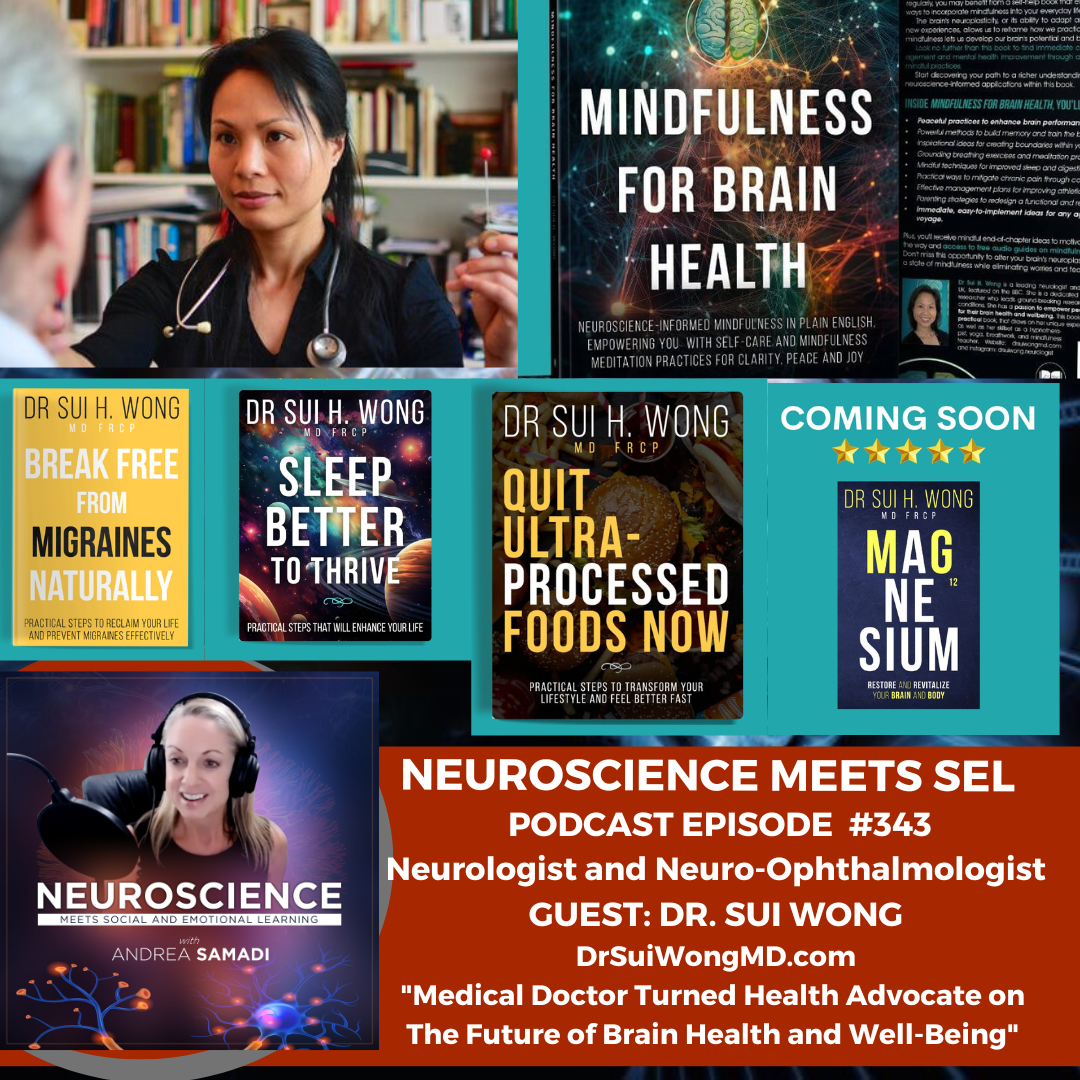
S12 Ep 343Unlocking Brain Health: Insights from a Leading Neuro-Ophthalmologist Dr. Sui Wong
Welcome back to Season 12 of the Neuroscience Meets Social and Emotional Learning podcast! In episode #343, host Andrea Samadi interviews Dr. Sui Wong, a renowned neurologist and neuro-ophthalmologist based in London, UK. With over 110 peer-reviewed publications and extensive research in mindfulness-based cognitive therapy, Dr. Wong shares her holistic approach to improving brain health and patient outcomes. Discover the science behind visual snow syndrome, the impact of lifestyle-specific interventions, and the connection between eye health and neurological disorders like Alzheimer's and Parkinson's. Dr. Wong also delves into the importance of mindfulness, nutrition, sleep, and a balanced lifestyle in enhancing overall well-being. Join us for an insightful conversation that bridges neuroscience with practical strategies for everyday life. Don't miss this episode filled with valuable insights and actionable tips to help you thrive. Welcome, Dr. Sui Wong! Watch our interview on YouTube here https://youtu.be/GwR82IYJTbE EPISODE #343 with Dr. Sui Wong on “Unlocking Brain Health: Insights from a Leading Neuro-Ophthalmologist we will cover: ✔ Dr. Sui Wong's career path in medicine, that led her to write 4 books to help her patients (and the world) improve their brain health. ✔ How understanding our eye health can help us to prevent neurological disorders (like Alzheimer's Disease) in the future. ✔ What we should all understand about our eye health for improved health and longevity. ✔ What common neuro-ophthalmology cases she sees. ✔ Why did she introduce Mindfulness into a study on Visual Snow Syndrome? ✔ What would Dr. Wong add to our list of Top 6 Health Staples? ✔ How to learn from Dr. Wong, and find her books. On today's episode #343 we meet with Dr. Sui H. Wong, a Neurologist and Neuro-Ophthalmologist based in London, United Kingdom. In addition to her clinical work as a medical doctor and physician, Dr. Wong is an active neuroscience researcher, who translates pertinent and clinically relevant questions into research, to improve person-centred patient outcomes. Additionally, she has the qualifications and experience to consider a broader spectrum of lifestyle-specific interventions. Dr Wong’s holistic approach in empowering patients has been recognized with many awards, and this is just the beginning for her. When I was introduced to Dr. Wong, an active neuroscience researcher with a mission of translating important clinically relevant questions into research for improved person-centred patient outcomes, I knew I had to speak with her. She is a widely published author and researcher with over 110+ peer-reviewed publications in medical journals, chapters and conference abstracts, to date. I looked at the articles Dr. Wong has published, and one caught my eye. She’s done extensive research that you can find in Ophthalmology Journals, like a recent article that I’m going to paraphrase, but it was called Visual Snow Syndrome (which is a neurological condition where individuals see persistent flickering white, black, transparent or colored dots across the whole visual field) After Mindfulness-Based Cognitive Therapy.[i] We have spent some time on this podcast walking through Pubmed.gov, and if you go there, and put Mindfulness into the search bar, you will come up with over 30,000 results. Let’s meet Dr. Sui Wong, and see what we can learn from her decades of research and her thoughts on what lifestyle-specific interventions she recommends. Welcome Dr. Wong, thank you for coming on the podcast today, and meeting me, all the way from the UK (where I was born)(Worthing, Sussex). Welcome. Q1: Can you give us an overview of why you chose this path and ended up in Neuro-Ophthalmology with an explanation of what you do with your work? Q2: How can understanding our eye health help us to prevent neurological disorders in the future? We’ve covered Alzheimer’s Prevention strategies and I wonder what you would with the impo
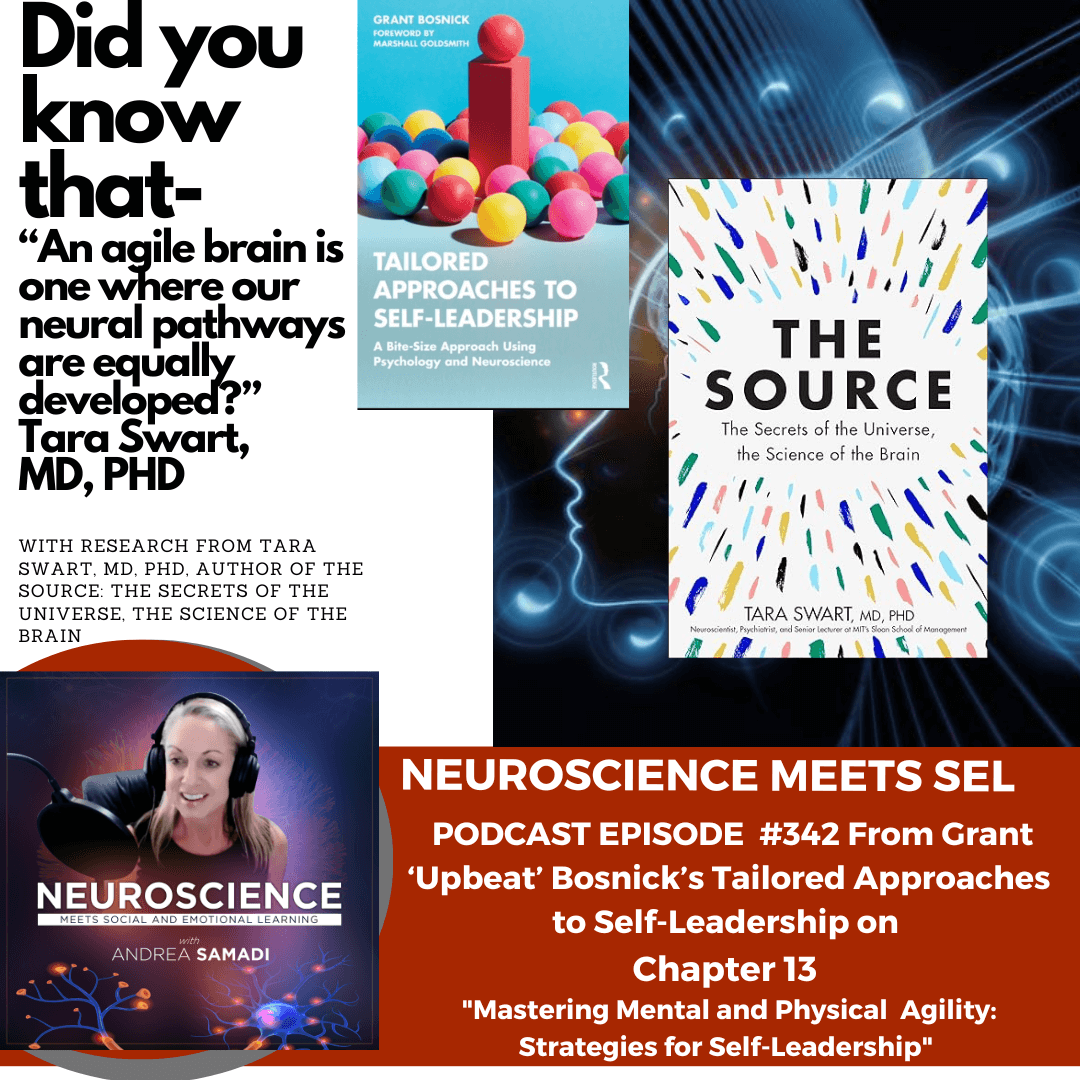
S12 Ep 342Mastering Mental and Physical Agility: Strategies for Self-Leadership Insights from Grant Upbeat Bosnick (Chapter 13)
Welcome back to Season 12 of the Neuroscience Meets Social and Emotional Learning podcast! In episode 342, we continue our 18-week self-leadership series inspired by Grant Bosnick's book, diving deep into Chapter 13, which focuses on the neuroscience of agility. Join Andrea Samadi as she explores how physical and mental agility play critical roles in our ability to handle sudden changes and stressors. Discover practical strategies to enhance your mental agility, build resilience, and thrive in the face of adversity. This episode not only highlights the importance of maintaining physical fitness but also delves into the science behind mental flexibility. Learn how to identify and manage your stressors, strengthen your neural pathways, and become anti-fragile in both your personal and professional life. Stay tuned for insights from neuroscientist Tara Swart and actionable tips to improve your brain's agility, ensuring you are better prepared to navigate life's challenges. Don't miss this enlightening episode and the upcoming interview with Dr. Sui Wong on resilience! On today's episode #342 we continue with our 18-Week Self-Leadership Series based on Grant Bosnick’s “Tailored Approaches to Self-Leadership: A Bite Size Approach Using Psychology and Neuroscience” that we first dove into with our interview on EP #321[i] the end of January. The goal was that each week, we focused on learning something new, (from Grant’s book) tied to the most current neuroscience research, that builds off the prior week, to help take us to greater heights in 2024. So far, it’s taken us 8 months to cover the first 13 chapters thoroughly, and we still have 6 chapters to go. After this week on agility, we have chapter 14 on resilience, 15 on relationships and authenticity, 16 on biases, 17 on trust, 18 on empathy and the final chapter 19 (and one of my target areas to focus on this year), the topic of presence. When we finish each of these chapters, we will put them all together, with a review of each one, in one place. It really has surprised me that a thorough study of this book will take the entire year to complete. On today's EPISODE #342 we will cover: ✔ The Neuroscience of Mental and Physical Agility ✔ An overview of our personal and professional stressors ✔ Why being antifragile can help us overcome life’s obstacles and challenges ✔ Characteristics of an Agile Brain ✔ 6 Pathways of an Agile Brain ✔ 4 STEPS to Developing an Agile Brain for Future Problem Solving Success For Today, EPISODE #342, we are moving on to Chapter 13, covering “The Neuroscience of Agility” which came out as a low priority for me with the with 0% (Pathway 5) along with Change and Resilience. If you’ve taken the leadership self-assessment[ii], look to see if Agility (in Pathway 5) along with change and resilience, is of a low, medium or high priority for you to focus on this year. I was surprised to see this topic showing up with a low priority, not because this topic is something that I don’t think about daily, but it was when I read the first few paragraphs of Grant Bosnick’s chapter 13, on Agility, where I was reminded that we are talking about physical agility, in addition to mental agility, and as I’m getting older, I notice this area requires extra effort to stay on top of. While the self-assessment says this is not an area of focus for me, it’s one of my TOP priorities at the moment. Grant Bosnick opens up this chapter by talking about a basketball player who pivots by “maintaining one foot having contact with the ground without changing its position on the floor and utilizes the other foot to rotate their body to improve position while in possession of the basketball. In life and business, when we are faced with a change or challenge immediately in front of us (Bosnick says) it is the same.” (Chapter 13, Bosnick, Tailored Approaches to Self-Leadership). He reminds us that “in basketball, to be agile and pivot, a player needs to be physically fit and h
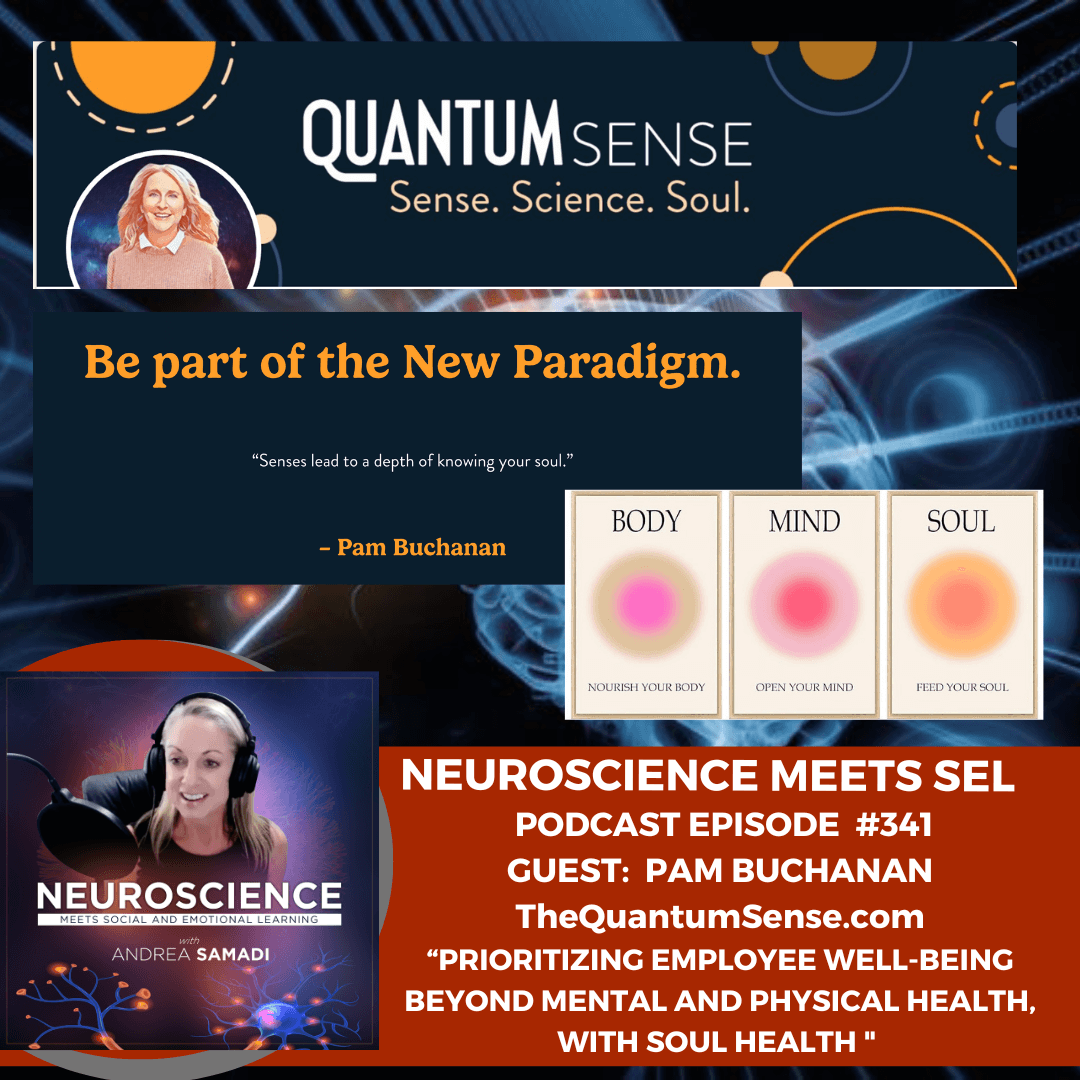
S12 Ep 341Unlocking the Power of Soul Health: A Conversation with Pam Buchanan
Welcome back to Season 12 of the Neuroscience Meets Social and Emotional Learning podcast! In this enlightening episode, we delve into the intersection of neuroscience, corporate innovation, and soul health with Pam Buchanan, founder of QuantumSense. Pam shares her journey from the high-paced boardrooms of Silicon Valley to exploring the concept of soul health, which she believes is crucial for achieving true well-being and productivity. Watch our interview on YouTube here https://youtu.be/4SNJuB3hfEg Throughout her career, Pam has been at the forefront of innovation, from introducing mutual funds to the banking industry to working alongside visionaries like Elon Musk and Mark Zuckerberg at NASDAQ. Now, through QuantumSense, she aims to bring the concept of soul health to the masses, offering programs that help reduce anxiety, increase energy, and boost overall life satisfaction. Join us as we explore how practical neuroscience can be integrated with soul health to create a paradigm shift in the workplace and beyond. Pam shares actionable insights and tools that you can start using today to improve your energy levels and overall well-being. Don't miss this thought-provoking discussion that could redefine how you approach your mental, physical, and soul health. For more information, visit our website and stay tuned for more episodes that bridge the gap between science and practical application. EPISODE #341 with Pam Buchanan on “Unlocking the Power of Soul Health” we will cover: ✔ How practical neuroscience can be integrated with soul health to create a paradigm shift in the workplace and beyond. ✔ Actionable tools you can start using today to improve your energy levels and overall well-being. ✔ Ideas to BEGIN thinking about soul health, in addition to our physical and mental health. On today's episode #341, we welcome Pam Buchanan, founder of Quantum Sense, a consulting agency for the new paradigm, something we talk about often on this podcast. After Pam took an introspective look at how she was able to perform throughout her career – which required her to be able to keep up with the pace of Silicon Valley – she accredited her successes to more than physical and mental health. She began what would be over a decade of research and self-examination to eventually define this as Soul Health. Throughout her personal and professional life, Pam has a long-history of being at the forefront of innovation. She was among the first to bring mutual funds to the banking industry in the 80s, and she identified unicorn startups to take to the public markets.Prior to starting Quantum Sense, Pam served as a Managing Director at Nasdaq for 15 years and was responsible for identifying, building, and maintaining relationships with pre-IPO, companies, founders, c-level executives, venture capital and private equity firms. It is in this role where she was in the boardrooms and minds of some of the world’s greatest innovators including Elon Musk and Mark Zuckerberg. Pam understands how the corporate mindset has evolved over the past few decades and is ready to lead the next evolution through Soul Health. Now, as the Founder of Quantum Sense, Pam is drawing from her wide-ranging experience and ability to distill and convey complex concepts to bring Soul Health to the masses. She has developed programs and services designed for companies proven to help their employees reduce anxiety, increase energy, create focus, boost creativity and ultimately improve their overall satisfaction in the office and life. If you look at the direction our podcast is taking, you will see that while I’m always looking for ways to connect the most current brain research to improve our productivity and results, I am also extremely wide open to what else is out there. What else could we all be thinking, and doing, that might be a paradigm shift from our old ways of thinking in the workplace, but ways that will be necessary for us to ALL reach these higher levels o
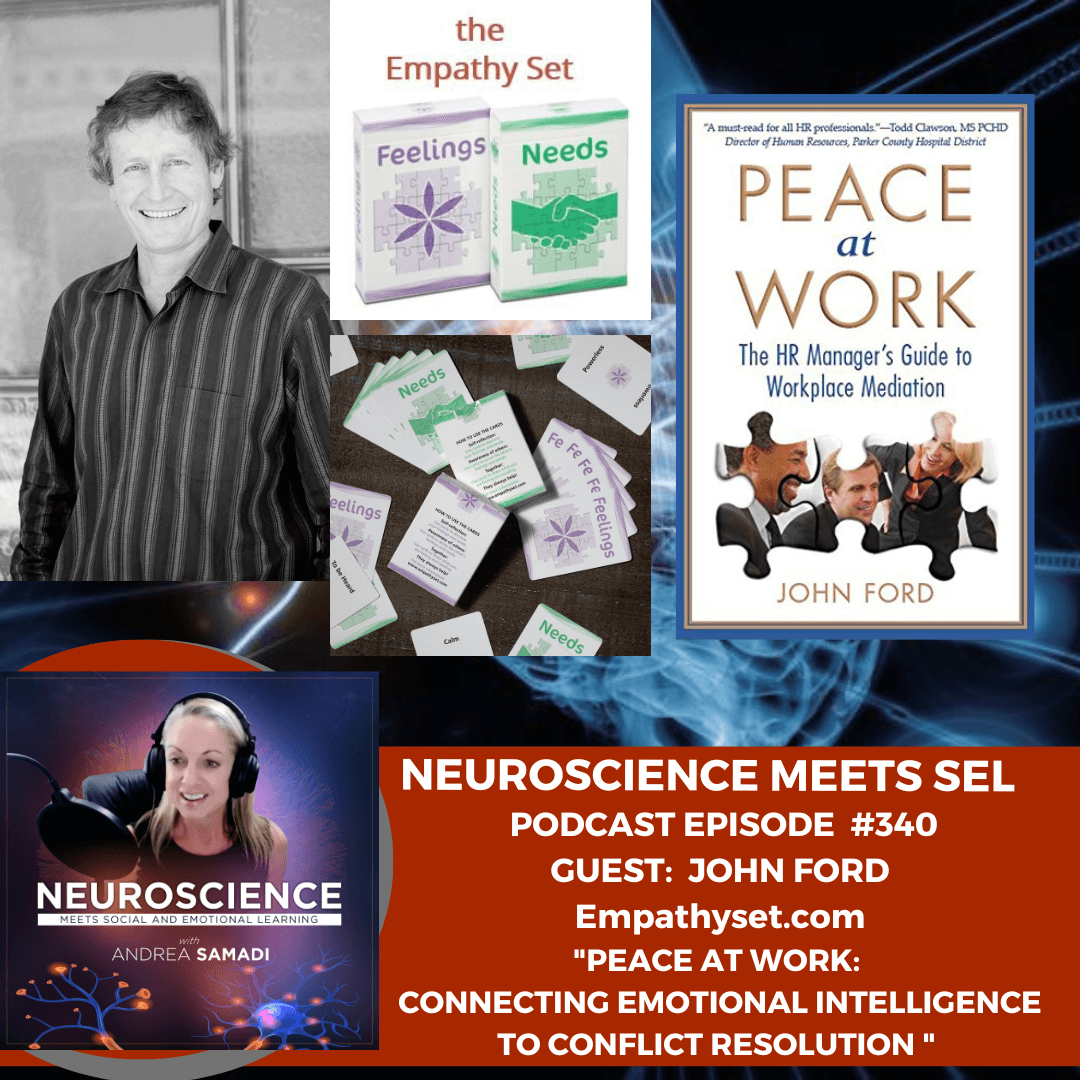
S12 Ep 340Navigating Workplace Conflicts: Insights from a Mediation Expert, John Ford
Welcome back to Season 12 of the Neuroscience Meets Social and Emotional Learning podcast! In episode number 340, host Andrea Samadi speaks with John Ford, an experienced workplace mediator and author of "Peace at Work: The HR Manager's Guide to Workplace Mediation." With a wealth of expertise in conflict resolution, emotional intelligence, and soft skills training, John shares his journey from practicing law to becoming a mediator. He discusses the importance of trust, effective communication, and addressing conflict head-on in both personal and professional settings. Discover practical tools like talking sticks and empathy cards, and learn how to apply neuroscience and emotional intelligence to navigate conflicts and improve workplace dynamics. Don't miss this insightful conversation that bridges the gap between science and everyday application! Watch our interview here https://youtu.be/NShwQio_QAk EPISODE #340 with John Ford on “Peace at Work: Connecting Emotional Intelligence to Conflict Resolution” we will cover: ✔ The importance of acquiring Emotional Intelligence Skills for conflict resolution in our workplaces of the future. ✔ The influencers who inspired John Ford's work (Daniel Goleman, John Gottman, Ken Cloke and many more. ✔ Tools and resources to support Conflict Resolution in our workplaces. On today's episode #340, we welcome John Ford[i] BA. LLB (UCT) Founder, Author of Peace at Work: the HR Manager’s Guide to Workplace Mediation, who is an experienced workplace mediator and works as a Conflict Resolution Coach and Workplace Mediator. He’s also a past president of the Association for Dispute Resolution of Northern California and served as managing editor for Mediate.com for over 10 years. Currently, he teaches negotiation and mediation through UC Law SF (formerly UC Hastings). When I saw the work John has been doing, providing soft skills training on communication, conflict resolution, emotional intelligence, assertion, negotiation, mediation, dealing with difficult behavior, customer service, nonverbal communication, de-escalation, stress management, diversity and inclusion, I knew I had to have him on the podcast. I saw the importance of teaching our next generation of students these important social and emotional learning skills over 25 years ago, working with 12 teenagers, who turned their results in school, sports and their personal lives around, in a matter of weeks. I had to learn more about John Ford’s pathway that took him from practicing law, to working on workplace mediation, training others in these important emotional intelligence training skills. Let’s meet John Ford, and see what we can learn from his vast experience with conflict resolution to see how he gains trust, with a calming effect in the most difficult and tense situations. Welcome John, thank you for meeting with me today. Where have we reached you today? (I’m located in Arizona). Q1: John, can you share what inspired you to transition from practicing law to focusing on workplace mediation and soft-skills training? Q2: Can you also explain how your work was influenced by all of these researchers and influencers that our listeners would know well. Like Daniel Goleman, the author of Emotional Intelligence, neuroscientist Antonio Damasio, John Gottman’s evidence-based research as well as Paul Ekman’s work on facial expressions. Q3: What are some other books that you can point us to improve these important skills, books, like Difficult Conversations (Douglas Stone, Bruce Patton and Sheila Hein), or Nonviolent Communication to help us to improve how to better communicate our feelings in our work and personal lives? Q4: I see you have created tools to help express our feelings without using blame (which we all know takes us down a pathway to more conflict). I don’t remember how long along it was that I learned to take “you made me feel” out of my vocabulary, since no one can make me feel anything. It was a good lesson to
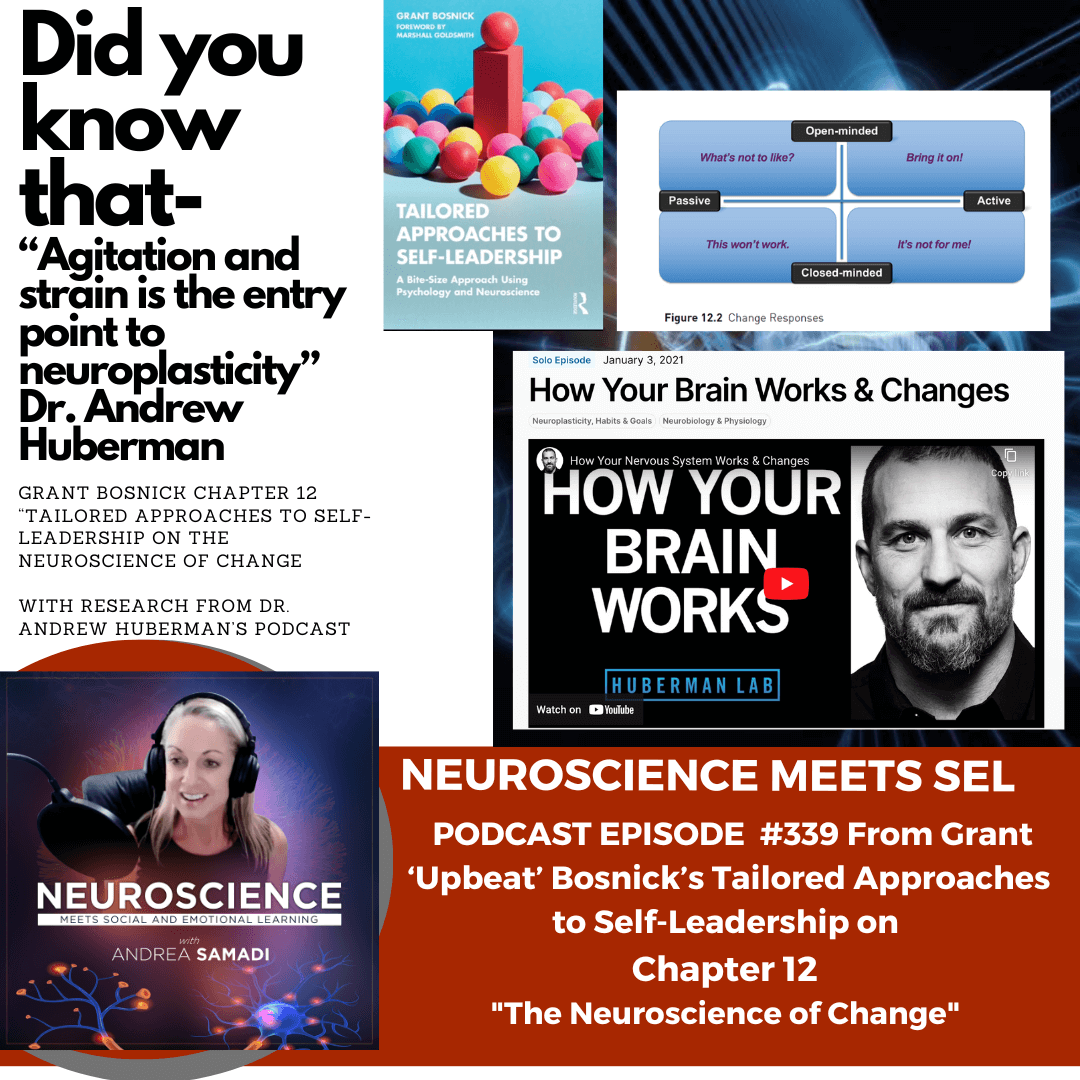
S12 Ep 339Embracing Change: The Neuroscience Behind Thriving in 2024 Insights from Grant Upbeat Bosnick (Chapter 12)
In episode 339, we delve into Chapter 12 of Grant's latest book, exploring the cutting-edge neuroscience of change. Building on seven months of in-depth discussions, this episode aims to equip you with the knowledge to thrive in 2024 by understanding how our brain interprets change as either a reward or a threat. We'll revisit key episodes that have previously tackled the concept of change, including insights from futurist Chris Marshall and renowned neuroscientists. Discover how your brain's response to social and emotional threats can be as powerful as its response to physical dangers, and learn practical strategies to navigate these challenges. Gain a deeper understanding of Maslow's hierarchy of needs and its evolution into self-determination theory. Explore Bosnick's ACRES model—Autonomy, Competence, Relatedness, Equity, and Sureness—to see how meeting these needs can help you embrace change and achieve your goals. Join us as we unpack Dr. Huberman's insights on how to harness neuroplasticity to create lasting behavioral changes. Learn how to manage the agitation and strain that come with pushing past your comfort zone, and find out how to build a positive change network to support your journey. Whether you're looking to enhance your agility, resilience, or overall well-being, this episode offers valuable tools and reflections to help you navigate and embrace change with confidence. Welcome back to SEASON 12 of The Neuroscience Meets Social and Emotional Learning Podcast, where we connect the science-based evidence behind social and emotional learning and emotional intelligence training for improved well-being, achievement, productivity and results—using what I saw as the missing link (since we weren’t taught this when we were growing up in school), the application of practical neuroscience. I’m Andrea Samadi, an author, and an educator with a passion for learning and launched this podcast 6 years ago with the goal of bringing ALL the leading experts together (in one place) to help us to APPLY this research in our daily lives. On today's episode #339 we continue with our 18-Week Self-Leadership Series based on Grant Bosnick’s “Tailored Approaches to Self-Leadership: A Bite Size Approach Using Psychology and Neuroscience” that we first dove into with our interview on EP #321[i] the end of January. The goal was that each week, we focused on learning something new, (from Grant’s book) tied to the most current neuroscience research, that builds off the prior week, to help take us to greater heights in 2024. So far, it’s taken us 7 months to cover the first 12 chapters thoroughly, and we still have 7 chapters to go. After this week on change, we have chapter 13 on agility, 14 on resilience, 15 on relationships and authenticity, 16 on biases, 17 on trust, 18 on empathy and the final chapter 19 (and one of my target areas to focus on this year), the topic of presence. When we finish each of these chapters, we will put them all together, with a review of each one, in one place. On today's EPISODE #339 we will cover: ✔ The Neuroscience of Change ✔ How our brains sense rewards versus threats ✔ How social and emotional threats are the same as physical threats ✔ Review of Maslow’s Hierarchy of Needs ✔ Review of Self Determination Theory ✔ Triggers to watch for during times of change. ✔ How to Change Our Nervous System to change our actions and behaviors, and leave behind a legacy we are proud of. For Today, EPISODE #339, we are moving on to Chapter 12, covering “The Neuroscience of Change” which came out as a low priority with 0% (Pathway 5) along with Agility and Resilience. I wasn’t surprised to see this topic showing up with a low priority for me this year, mostly because I love change, and am constantly looking for new ways to do things. If I am doing the same things over and over again, I can tend to get bored, so it’s important to find new angles, and challenges, daily to inspire the most creativity. If you’ve ta
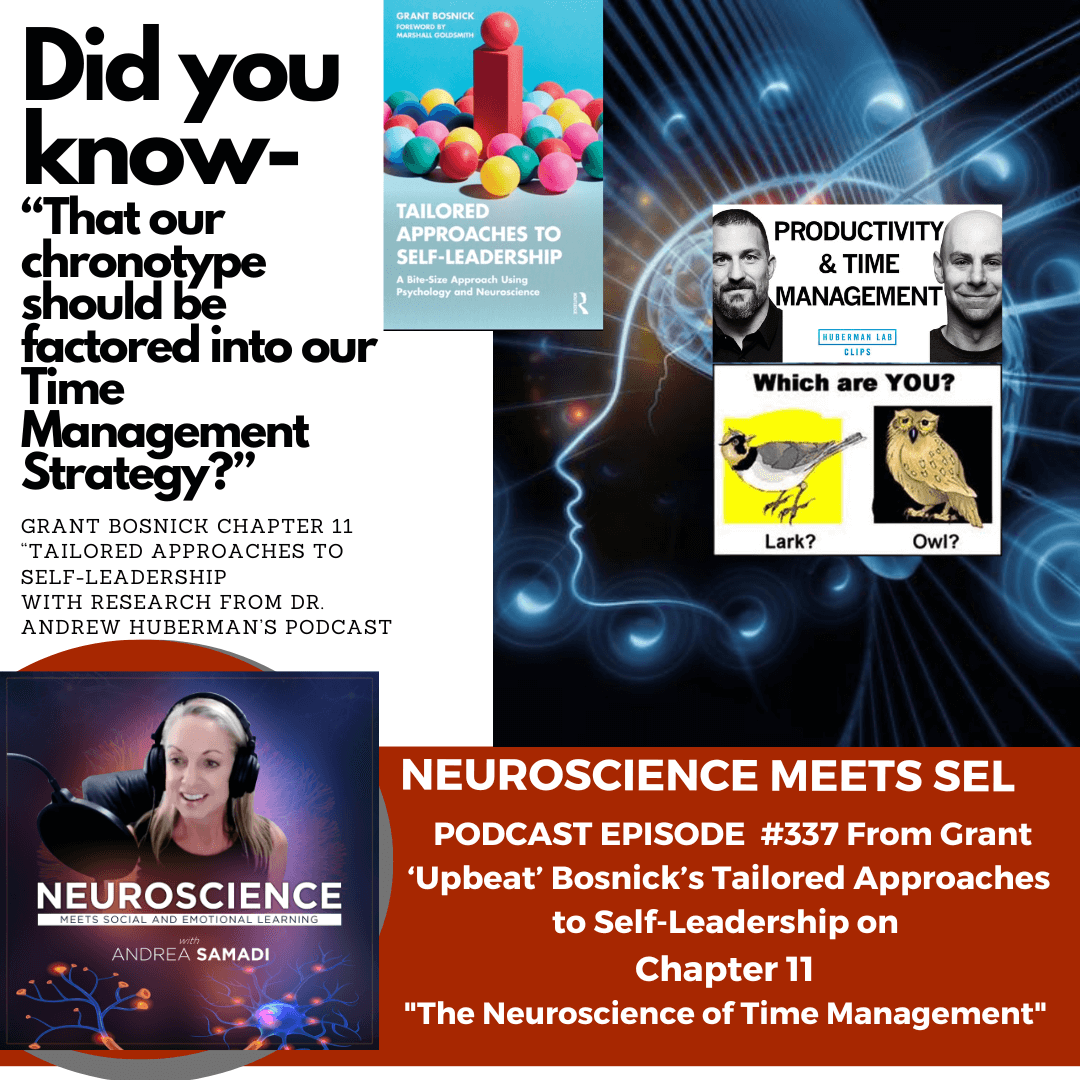
S12 Ep 337Time: Insights from Grant 'Upbeat' Bosnick: The Neuroscience Behind Effective Time Management Chapter 11
Welcome back to Season 12 of the Neuroscience Meets Social and Emotional Learning podcast, where we connect science-based evidence with practical applications for improved well-being, achievement, and productivity. I'm Andrea Samadi, your host, and today we're diving into episode number 337, continuing our 18-week self-leadership series based on Grant Bosnick's tailored approaches to self-leadership. In this episode, we explore chapter 11 of Grant's book, focusing on the neuroscience of time management. Discover how understanding your chronotypes and managing your energy can lead to better productivity and creativity. We'll share insights from Kent Healy's perspective on time management and highlight practical strategies from renowned experts like Stephen Covey and Brendon Burchard. Learn how to prioritize tasks, avoid common time traps, and use your peak energy periods for deep work. Whether you're an early bird or a night owl, this episode provides valuable tips to make the most out of your 84,600 seconds each day. Join us as we uncover the science behind effective time management and how it can transform your personal and professional life. Don't miss out on these powerful insights to help you reach greater heights in 2024. Welcome back to SEASON 12 of The Neuroscience Meets Social and Emotional Learning Podcast, where we connect the science-based evidence behind social and emotional learning and emotional intelligence training for improved well-being, achievement, productivity and results—using what I saw as the missing link (since we weren’t taught this when we were growing up in school), the application of practical neuroscience. I’m Andrea Samadi, an author, and an educator with a passion for learning and launched this podcast 6 years ago with the goal of bringing ALL the leading experts together (in one place) to help us to APPLY this research in our daily lives. On today's episode #337 we continue with our 18-Week Self-Leadership Series based on Grant Bosnick’s “Tailored Approaches to Self-Leadership: A Bite Size Approach Using Psychology and Neuroscience” that we first dove into with our interview on EP #321[i] the end of January. The goal was that each week, we focused on learning something new, (from Grant’s book) that builds off the prior week, to help take us to greater heights in 2024. On today's EPISODE #337 we will cover: ✔ We'll share insights from Kent Healy's perspective on time management and highlight practical strategies from renowned experts like Stephen Covey and Brendon Burchard.✔ Discover how understanding your chronotype and managing your energy can lead to better productivity and creativity. ✔ Learn how to prioritize tasks, avoid common time traps, and use your peak energy periods for deep work.✔ How will YOU manage your time, with brain science in mind? For Today, EPISODE #337, we are moving on to Chapter 11, covering “The Neuroscience of Time Management” which came out as a low, or RED priority for me at 8%, and again, not because this topic isn’t important for me, but I’ve already put strategies for time management into place, so this is not an area I need to focus on this year. It’s interesting to see how each of these lessons play out in our daily life, putting theory into practice. This morning I had to chance to see why this topic showed up as low importance for me to work on this year. I had slotted on my calendar to write this episode, (a Saturday), I started my day at 4am (with early meditation, then some time in the sauna) before hitting the hiking trails for what I call a long 7-mile hike, that I do only if I am fully rested, to guarantee a good day of focused writing. While driving back from this this hike, I had a call from a good friend I had not seen in quite a few years, who wanted to see if we could meet for coffee. I know the time required to write, record and edit this episode, so I told her this was my priority for the weekend, and that I could let her know if I f
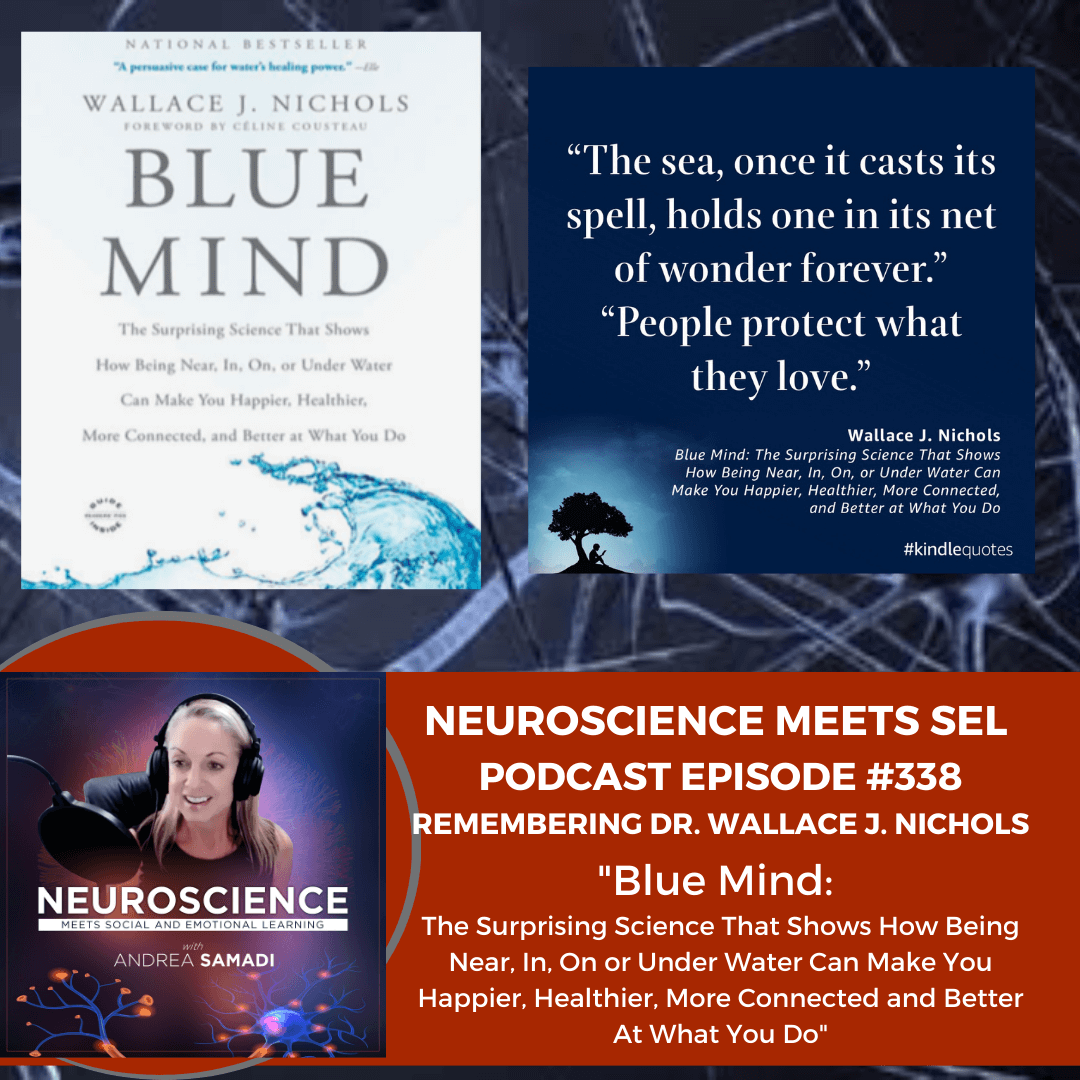
S12 Ep 338Remembering Dr. Wallace J Nichols: Blue Mind: Exploring the Water-Brain Connection
In this episode of the Neuroscience Meets Social and Emotional Learning podcast, host Andrea Samadi revisits a profound interview with Dr. Wallace J. Nichols, the author of the best-selling book "Blue Mind." Dr. Nichols delves into the fascinating connection between our brains and water, inspired by his extensive research and personal experiences. Andrea reflects on Dr. Nichols' groundbreaking work, which explores how being near, in, on, or underwater can enhance our happiness, health, and overall well-being. This episode covers the origins of the Blue Mind theory, its scientific backing, and practical ways to apply it in daily life to combat stress, anxiety, and burnout. As we honor Dr. Nichols' legacy, Andrea encourages listeners to practice Blue Mind, understand their personal connection to water, and extend this healing practice to others. Tune in to discover how the magical and mysterious connection to water can transform our lives. On today's episode #338 we will revisit a previous interview #297[i] from last summer to remember the author of the best-selling book, Blue Mind, Dr. Wallace J. Nichols, who made such an impact on the world with his Blue Mind Movement, and is no longer with us today. While this is a difficult episode to write, I know it’s an important one as I could use the tips I know we are going to cover myself at the moment. I’m also sure there are others in the world who could benefit from revisiting the surprising science that shows how being near, in, on, or under water can make you happier, healthier more connected and better at what you do. I could have left this episode until a later date, even closed to World Blue Mind Day coming up July 23rd (later this month) as I stared at a blank document and the words just wouldn’t come out. Then when I finally did start writing, last month, the document was erased, so it just must not have been the right words. Or maybe this episode was meant to be written near the ocean as I’m sitting next to the Gulf of Mexico, while writing this. Or maybe even written from the point of view, of being under the water, looking around, and up, to “see” what can be felt deeply with this mysterious brain/mind connection. Before sitting down to write this episode, I noticed sea turtles swimming around in the ocean, up close to us, and everyone mentioned how rare this was. I just kept thinking of Dr. Nichols telling me (in our interview this time last year) that he studied sea turtles for 30 years, and remembered him mentioning that he was hoping someone else more qualified (like Dr. Oliver Sachs) would write the book he wanted to write, connecting the deep mysterious ocean with the intricacies of our brain. While revisiting our interview, I wondered: What else could we learn from Dr. Nichols that we might have missed the first time? You know when you read a good book twice you always see something new. This is because you’ve changed since the first time, and you bring new experiences with you. I wonder what doors this second look would open for all of us? How can I improve my own Blue Mind Practice? Dr. Nichols mentioned that even if we are doing ok, practicing Blue Mind could still help us, but for those people who are in Red Mind (feeling anxious) this practice could save your life. It’s another tool to add to our tool kit to prevent us from reaching Grey Mind (or Burn out). How can revisiting this episode help others close to me (starting with my own family) helping them to practice Blue Mind in our daily lives? Also not being afraid of the hardest science in the room (our emotions) and keep talking openly about our feelings, and to not be afraid to reach out to others if we feel Red Mind or anxious thoughts. How can we highlight Dr. Nichols’ work so that we ALL can do what he suggests we do, by finding “our water, pay attention to how it feels and then take someone else with you” to experience the deep mysteries felt with this Blue Mind that’s backed by scienc
S11 Ep 337Insights from Grant 'Upbeat' Bosnick: "Unlocking the Science of Persuasion and Influence" Chapter 10
Welcome back to Season 11 of the Neuroscience Meets Social and Emotional Learning Podcast, where we connect the science-based evidence behind social and emotional learning and emotional intelligence training for improved well-being, achievement, productivity, and results using practical neuroscience. In today's episode, number 336, we continue our 18-week Self-Leadership Series based on Grant Bosnick's tailored approaches to self-leadership. We delve into Chapter 10, exploring the neural science of persuasion and influence. This topic emerged as a key focus area for 2024, providing insights into why understanding persuasion and influence is essential for long-term success. We revisit past episodes and notable works like Jack Carew's You'll Never Get No for an Answer and Mark Waldman's Words Can Change Your Brain. Learn about the three modes of persuasion—logos, pathos, and ethos—as well as practical strategies for improving your persuasive approach. Discover how to apply six scientifically validated principles of persuasion by Dr. Robert Cialdini, focusing on reciprocity, scarcity, and authority. These principles can help you build lasting influence and effectively communicate your ideas. Join us as we explore the difference between persuasion and influence and how to use these skills to achieve your goals while helping others. This episode is dedicated to Monica Gilfillan, a highly influential figure in education, whose support and inspiration remind us of the power of helping others first. Don't miss out on these valuable insights to enhance your self-leadership journey. Subscribe, review, and rate our podcast to stay updated with new episodes! On today's EPISODE #336 we will cover: ✔ The difference between persuasion and influence. ✔ Strategies to improve our persuasion muscles and ways to become more influential for longer lasting relationships and impact. ✔ 3 Tips to Put the Science of Persuasion and Influence into Practice in our Daily Lives. ✔ Dedicated to Monica Gilliflan, a highly influential figure in education, whose support and inspiration remind us of the power of helping others first. On today's episode #336 we continue with our 18-Week Self-Leadership Series based on Grant Bosnick’s “Tailored Approaches to Self-Leadership: A Bite Size Approach Using Psychology and Neuroscience” that we first dove into with our interview on EP #321[i] the end of January. The goal was that each week, we focused on learning something new, (from Grant’s book) that builds off the prior week, to help take us to greater heights in 2024. For Today, EPISODE #336, we are moving on to Chapter 10, covering “The Neuroscience of Persuasion and Influence” which came as a surprise to me that Pathway Two, showed up as my highest area of focus for 2024. When I looked at the topics that are listed in this pathway, I can see why this area is a work in progress for me, and this self-assessment picked up that I need to make these 3 areas listed in this pathway, a priority in 2024. I’m paying attention to what neuroscience says about persuade and influence, in addition to inspiration, motivation that we covered on EP 324[ii] and presence, that’s the last chapter in this book, and I think the most important. (at least for me). If you’ve taken the leadership self-assessment[iii], look to see if Persuade and Influence is of a low, medium or high priority for you to focus on this year. Thinking back on past episodes, I know we have not yet covered this topic entirely, except for the time I was asked to review Jack Carew’s classic book from 1987 called You’ll Never Get No For an Answer that was covered on EP176.[iv] We explored “Why Our Brains Don’t Like the Word No” and revisited Mark Waldman’s book from 2013 Words Can Change Your Brain where we were reminded that “Words can heal, or hurt—if you were in an fMRI scanner (that can take a video of the neural changes happening in your brain) (and you were told a firm NO! for something) we coul
S11 Ep 336Insights from Grant 'Upbeat' Bosnick "Emotion Regulation: The Neuroscience Behind Staying Strong and Clear-Headed" Chapter 9
Welcome back to Season 11 of the Neuroscience Meets Social and Emotional Learning Podcast! In episode 335, we delve into the neuroscience of emotion regulation, a crucial skill for personal and professional success. Host Andrea Samadi continues the 18-week self-leadership series inspired by Grant Bosnick’s book, focusing on strategies to enhance our ability to manage emotions effectively. We explore practical tips from Bosnick, such as labeling emotions, creating distance from them, and reframing situations to view them more positively. Additionally, we highlight the importance of sleep for emotion regulation, drawing insights from experts like Dr. Andrew Huberman and Dr. Matthew Walker. Discover how improving your sleep quality can lead to better emotional control and overall well-being. Join us as we connect the dots between neuroscience, sleep, and emotional intelligence to help you achieve greater heights in 2024 and beyond. On today's episode #335 we continue with our 18-Week Self-Leadership Series based on Grant Bosnick’s “Tailored Approaches to Self-Leadership: A Bite Size Approach Using Psychology and Neuroscience” that we first dove into with our interview on EP #321[i] the end of January. The goal was that each week, we focused on learning something new, (from Grant’s book) that builds off the prior week, to help take us to greater heights in 2024. For Today, EPISODE #335, we are moving on to Chapter 9, covering “The Neuroscience of Emotion Regulation” which showed up on my leadership self-assessment as a low, RED score, of 20%, but again, not because it’s not something I don’t need to pay attention to, this is something I pay attention to daily, right up there with physical health that is listed in Pathway Four of Grant’s Self-Leadership Map. If you’ve taken the leadership self-assessment[ii], look to see if Emotion Regulation is of a low, medium or high priority for you to focus on this year. Before looking at what Grant Bosnick has to say about Emotion Regulation in Chapter 9 of his book, I looked around to see what else I could find on this topic. We actually have already covered this topic as one of the six social emotional learning competencies that we launched this podcast with, back in August, 2019[iii] and we called that episode “Self-Regulation: The Foundational Learning Skill for Future Success.” In this early episode, we defined self-regulation as “the ability to manage your emotions and behavior in accordance of the situation. It includes being able to resist highly emotional reactions to upsetting stimuli, to calm yourself down when you get upset, adjust to a change in expectations and (the ability) to handle frustration”[iv] In other words, it’s the ability to bounce back after a setback or disappointment, and the ability to stay in congruence with your inner value system. HOW TO HELP OUR CHILDREN WITH EMOTION REGULATION: We covered some tips on this early episode to help our children to practice this skill, and strengthen their “self-regulation” muscles, beginning with: Naming the emotion they are experiencing at a given moment, with a strategy (like stopping to take some deep breaths when something frustrates or overwhelms them) so they can keep working, and move forward. Uncovering what motivates each of us to develop intrinsic motivation that can help propel us forward. Taking brain breaks, or “unfocused moments” that allow for the brain to solve problems during these resting states. WHAT GRANT BOSNICK SUGGESTS FOR EMOTION REGULATION: Then we covered some tips to help us to continue to strengthen these self-regulation skills in the workplace, and I wondered what Grant Bosnick had to say in chapter 9 of his book on this topic. Within the second paragraph of this chapter, he explains the science behind emotion regulation when he outlines that “neuroscience has shown us that the exact same feelings we get from a physical threat also occur as social and emotional threats.” (Page 91,
S11 Ep 335Diving into The Mindset of a Champion: Insights from Nigerian-American Basketball Player, Ike Diogu
Welcome back to Season 11 of the Neuroscience Meets Social and Emotional Learning Podcast! In Episode #334, host Andrea Samadi reconnects with Ike Diogu, a former Division I college athlete turned pro, whose impressive mental mindset left a lasting impact on her over 20 years ago. Watch this interview on YouTube here https://youtu.be/hvBHF4ectQI EPISODE #334 with Nigerian-American Basketball Player, Ike Diogu on "The Mindset of a Champion" we will cover: ✔ Ike's journey from ASU to the NBA and Beyond. ✔ How his upbringing, influenced by his family shaped his mental toughness ✔ How his coach, teammates and personal values played a role in his success in the NBA and as the captain of the Nigerian Basketball Team. ✔ How Ike inspired Andrea, over 20 years ago, to continue working with students and social and emotional learning skills. Discover the story of Ike's journey from Arizona State University to the NBA, and how his upbringing, influenced by a deep-thinking father and supportive siblings, shaped his mental toughness. Learn how Ike's coach, teammates, and personal values played a role in his success, both in the NBA and as a captain of the Nigerian national basketball team. Andrea and Ike delve into the importance of mental preparation, goal setting, and the power of a supportive environment. Ike shares his experiences from the Rio 2016 Olympics and his ongoing passion for basketball and mentoring others. This episode is a testament to the power of social and emotional learning, and the impact of mental mindset on achieving extraordinary results. Don't miss this inspiring conversation that highlights the intersection of neuroscience, emotional intelligence, and athletic excellence. On today's episode #334 we meet with someone who caught my eye, over 20 years ago when I worked with athletes at Arizona State University. Sitting in front of Ike Diogu, years before his exciting career would unfold, I just knew he would be successful. I was in my late 20s, and hadn’t published my first book yet, The Secret for Teens Revealed, that was written with the purpose to help our next generation sharpen the skills that were integral for achieving goals (in school and sports). It designed to develop certain ways of behaving and more importantly, thinking, that would enable young people to achieve whatever it is that they want in life. Working with elite College athletes at ASU, I thought would be a great place to test out the chapters of this book (Chapter 1- Developing a Winning Attitude, Chapter 2- Developing Your Mind, Chapter 4-Goal-Setting and Persistence, Chapter 5-Building Your Confidence Formula for Predictable Results for Success). You get the point here. So, one day, I asked Ike a series of questions to “feel out” where his mindset was, and I’m not kidding, he almost knocked me out of my chair. Whatever I asked Ike, he had a well-thought out answer, that told me for certain that he didn’t need the book I wanted to publish. He had already learned these skills at a young age, that I knew would skyrocket his future success. I just remember thinking “where will Ike Diogu end up?” and while I didn’t follow his career over the years, I did see his photo on the wall one day, going down to the baggage claim at Arizona’s Sky Harbor Airport, and it was then that I thought back to the moment I knew this young man had everything he needed, for an exciting and successful life. Of course I was going to look for him, and see if he would be open to coming on the podcast. We’ve learned about the Daily Grind in the NHL on EP #38[i], Accelerating Leadership in the NFL on EP #166[ii] but I knew I’ve always been missing the Mindset of the Athlete. I’m honored, and so excited to connect back with Ike Diogu,[iii] who I’ve not seen face to face for over 20 years, and dive into “The Mindset of a Division 1 College Athlete Turned Pro.” Welcome Ike! Thank you for agreeing to meet up with me here, and filling me and our listeners in to what you
S11 Ep 334Insights from Grant 'Upbeat' Bosnick: "The Neuroscience of Expectations" Chapter 8
Join us on episode 333 in the 11th season of the Neuroscience Meets Social and Emotional Learning Podcast. Our mission, as always, is to equip you with actionable, scientifically supported methods to hone social-emotional learning skills, boost productivity and promote overall well-being. This episode continues our 18-week self-leadership series informed by Grant Bosnick's proven strategies. In this installment, we turn our attention to the crucial role of expectations in our lives. Starting off the discussion in the engaging world of Grant Bosnick's book, we dissect the meaning and importance of expectations. We then explore the crucial aspects of emotion regulation, persuasive traits, effective time management, and the vast concept of change. This episode revisits key moments from our previous chapters, ranging from the neuroscience of goals to the significance of hydration on brain performance, AHA moments, creative insights, and more. The highlight of the episode is an in-depth exploration of the science of expectations, underpinned by Grant Bosnick and David Robson's book, 'The Expectation Effect.' Here, we probe the profound influence of positive and negative expectations on our daily life, mindset, goal achievement, and even health. Inspired by teachings from luminary mentors like Bob Proctor, this illuminating exploration of expectations is designed to leave you with a fresh perspective. Stories from an unforgettable seminar 20 years ago bring to life the immense power of expectations. Understanding the neuroscience connections, we further explore dopamine and its correlation with our level of expectations. Practical tips to apply these psychological insights in day-to-day life are provided as we take you on an intellectual journey from theory to practice. Throughout the episode, you will discover how to better regulate your expectations to boost your happiness, productivity, and confidence. This intellectual journey will equip you with the tools to tap into the power of expectation and unlock a better version of yourself. Expect the best and join us to uncover the enormous potential within you. Stay tuned for our next episode, 'The Neuroscience of Emotion Regulation', as we continue our intellectual journey. Welcome back to SEASON 11 of The Neuroscience Meets Social and Emotional Learning Podcast, where we connect the science-based evidence behind social and emotional learning and emotional intelligence training for improved well-being, achievement, productivity and results—using what I saw as the missing link (since we weren’t taught this when we were growing up in school), the application of practical neuroscience. I’m Andrea Samadi, an author, and an educator with a passion for learning and launched this podcast 5 years ago with the goal of bringing ALL the leading experts together (in one place) to help us to APPLY this research in our daily lives. On today's episode #333 we continue with our 18-Week Self-Leadership Series based on Grant Bosnick’s “Tailored Approaches to Self-Leadership: A Bite Size Approach Using Psychology and Neuroscience” that we first dove into with our interview on EP #321[i] the end of January. The goal was that each week, we focused on learning something new, (from Grant’s book) that builds off the prior week, to help take us to greater heights in 2024. Today we cover Chapter 8, “The Neuroscience of Expectations” and l look at what Grant Bosnick covers on this topic, as well as a deeper dive into David Robson's book, The Expectation Effect. We will cover: ✔ What is the meaning and importance of expectations? ✔ An unforgettable moment when Andrea first encountered the power behind our expectations. ✔ We will explore the science of expectations to boost your happiness, productivity, and confidence. ✔ 3 TIPS for applying The Neuroscience of Expectation to your daily life. ✔ Ideas to trouble-shoot applying this concept, along with belief, to achieve your goals and dreams
S11 Ep 333Dr. Wallace Panlilio and Dr. Artyom Zinchecko on "Unleashing The Wisest Learners in Our Next Generation"
In the 332nd episode of the Neuroscience Meets Social and Emotional Learning podcast, we have an informative discussion with the distinguished authors of the 'Wisest Learners' series, Dr. Wallace and Dr. Artyom. We delve deep into the intersection of neuroscience, social and emotional learning, and its implications for personal growth and productivity. Listeners will discover invaluable insights on learning strategies, the role of emotions in cognitive control, and how environmental regularities shape memory and attention. See this interview on YouTube here https://youtu.be/lk7jJZDqrPo Our conversation explores the significant developmental transitions children undergo around the age of 12 and the bewilderment many parents experience during this time. By discussing the principles laid out in their book, our guests illuminate the importance of a holistic approach to child development from an early age and its profound impact on academic performance and lifelong learning. Specific focus is given to the concept of 'automaticity', which simplifies complex cognitive functions in children. Moving on to practical application, the discussion underscores the critical role of granting children autonomy in their learning journey. Real-life examples highlight how granting autonomy in choices, like book selection, can inculcate a lifelong love for reading and writing. However, an important balance is emphasized to avoid stifling a child's natural curiosity with excessive parental control. A notable part of our conversation is an analogy comparing essential life skills to multivitamins, emphasizing the necessity for multiple principles in education rather than relying on single solutions. The role of parents in a child's education is underlined with varied involvement approaches and their effects. The interaction concludes with important practical suggestions for parents, emphasizing the importance of role-modelling and consistent communication with children. This enlightening episode provides a unique fusion of theoretical understanding and practical guidance, making it essential listening for anyone seeking to better understand how to nurture resilient and joyful learners. Whether you're a parent, educator, or just interested in the fascinating world of cognitive neuroscience, buckle up for this insightful journey into the art and science of parenting based on neuroscience and social and emotional learning. EPISODE #332 with Dr. Wallace Panlilio and Dr. Artyom Zinchenko “The Wisest Learners: Unleashing Neuroscience, Education, and Athletic Ability” we will cover: ✔ How a Cognitive Neuroscientist from Germany, met an experienced School Administrator in the Philippines, to create “The Wisest Learners” book series. ✔ How can we use an understanding of our brain, to bring the joy back into learning for our children and students? ✔ What KEY take-aways should we know about using our brain to be “wise” learners? ✔ How to apply these scientific principles in your school, workplace or sports environment to take your students/children to greater heights? On today's episode #332, we meet Dr. Wallace Panlilio II and Dr. Artyom Zinchenko, the authors of the Wisest Learners[i] Book Series. Dr. Artyom Ph.D is an accomplished author and cognitive neuroscientist with extensive experience in the field. He earned his Doctorate in Cognitive Neuroscience from the Max Plank Institute for Cognitive Human and Brain Sciences in Germany and is now a researcher and a faculty member at LMU in Munich. He’s also a father of 2 children. Dr. Wallace is an experienced educator and entrepreneur with a Ph.D. in Educational Psychology from the University of Philippines and has served as a headmaster (school administrator) for 14 years. He holds 2 master’s degrees in entrepreneurship and educational leadership and is always looking at ways to further optimize the results of the students in his schools. Without further ado, let’s meet the authors of The Wisest
S11 Ep 332Transformative Strides "Connecting the Dots with Mindfulness, Neuroscience and SEL" with Allison Morgan, Founder of Zensational Kids
In this transformative episode, join us as we engage with renowned pediatric occupational therapist and founder of Zensational Kids, Allison Morgan. Learn how yoga and mindfulness integrated into her therapy sessions have improved her clients' physical, emotional, cognitive, and behavioral wellness. Discover her motivation for writing curriculums for pre-K through high school students and the unique challenges that come with it. Dive into the importance of balancing the human nervous system and its impact on children’s functionality. Watch our interview on YouTube here https://youtu.be/mtj4zuuirbc Uncover our conversation concerning the urgent need for increased mental health and social-emotional learning programs in schools, especially in light of the post-pandemic stress faced by many students. Learn about Allison’s incredible journey as a pediatric occupational therapist and her vision to alleviate the struggles of today's students, teachers, and parents through innovative solutions. Delve into the profound significance of social and emotional learning in an educational setting. Gather valuable insights on the teaching and learning dynamics and the vital role educators play in creating their classroom's atmosphere. Learn how to utilize mindfulness and self-awareness strategies to revolutionize the classroom environment and the importance of educators' mental and emotional well-being. Discover practical ways you can begin incorporating these strategies into your classroom or homeschooling routine today with our plethora of free resources. Subscribe to Allison's free video program for more resources, empowering discussions, and actionable strategies for your personal and professional growth. On today's episode #331, we have our final interview before the summer months. Today we will be meeting with Allison Morgan, the Founder of Zensational Kids.[i] She is a pediatric occupational therapist, author, international public speaker, and educational trainer driven to empower youth and the adults that care and serve them. She is passionate about training educators, parents, mental health professionals, and allied health professionals, giving them effective techniques to develop skills such as self-awareness, management skills, compassion, and resilience so they can model and authentically teach these skills to children. EPISODE #331 with Allison Morgan on “Making the Neuroscience, Mindfulness and SEL Connection” we will cover: ✔ Where Allison made the Mind, Body, Neuroscience Connection with her work as a pediatric occupational therapist. ✔ Allison’s Vision for the Schools of the Future. ✔ Uncover the urgent need for increased mental health and social-emotional learning programs in schools. ✔ Learn how yoga and mindfulness integrated into her therapy sessions have improved her clients' physical, emotional, cognitive, and behavioral wellness. ✔ How to Access Allison’s work for a free to implement NEW strategies immediately. Allison began integrating yoga and mindfulness into her therapy sessions with children in 2007. Discovering the multitude of physical, emotional, cognitive, and behavioral benefits these practices offered her occupational therapy clients and recognizing the need for more mental health and social-emotional learning programs in schools, Allison began writing curriculum and developing teacher training programs to help others share these practices. For those who have followed our work over the years, you’ll know that when I came across Allison, I was thinking I wish I had known Allison in 2014 when we launched our curriculum into the school market, and got to see first-hand just how difficult that would be. She is the author of curriculums for pre-K through high school-age students: (which is not easy to be focused on both elementary and secondary students at the same time. They are both vastly different, requiring completely different strategies). Young Explorers: Yoga and Mindfulness in Early Chi
S11 Ep 331Insights from Grant 'Upbeat' Bosnick and the Eureka Factor "AHA Moments, Creative Insight and The Brain" Chapter 7
Welcome to Episode 330 of the Neuroscience Meets Social and Emotional Learning Podcast, a part of our 18-week series on self-leadership. Join host Andrea Samadi and author Grant Bosnick as they explore the neuroscience theory behind creating solid health habits, establishing goals, and increasing productivity for greater achievement and well-being. Tap into the power of the AHA moment, and learn how to foster these spontaneous occurrences for instant performance improvement. Bosnick shares insights from his book "Tailored Approaches to Self-Leadership" and offers strategies for organizations to solve problems creatively using innovative thought processes. Uncover the crucial role physical and mental health play, particularly the significance of adequate hydration for brain health and daily water intake recommendations. Learn about the concept of neuroplasticity and see examples of creative problem solving applied in real-life situations. Listen as we bring to light interesting perspectives from Professor Hod Lipson from Columbia University on AI and innovation, discuss the Silva Method, and recall our first series on creativity and innovation. Take inspiration from figures like Albert Einstein and learn about hypnosis from the work of Dr. David Spiegel. Cultivate self-awareness and personally tailored plans using our practical five-step method to foster more 'aha' moments. Experience the magic of wisdom acquisitions drawn from a poignant poem by Stuart Edward White. Ready to supercharge your personal and professional growth? Listen to our exciting and educational podcast that delves deep into the interaction of neuroscience and social and emotional learning. Don't forget to subscribe for more insightful episodes. On today's episode #330 we continue with our 18-Week Self-Leadership Series based on Grant Bosnick’s “Tailored Approaches to Self-Leadership: A Bite Size Approach Using Psychology and Neuroscience” that we first dove into with our interview on EP #321[i] a few weeks ago. Now that we have started this series, I hope you can see how practicing and strengthening the skills we are learning each week, is cumulative. Each week, we are learning something new, that builds off the prior week, to help take us to greater heights in 2024. We can even map out our “Journey of the Mind” as we go along the way. REVIEW Chapters 2, 3, 4, 5 and 6 It’s here I’m hoping we will take the information we are learning, connect the dots to form knowledge and then apply this knowledge to our daily life. This is where we go from theory to practice with this podcast and it’s the application of what we are learning that contains the magic. REFLECT Back to Chapter 2 on The Neuroscience of Goals (and Kurt Lewin’s Force Field Theory): What are you doing today to gain the momentum needed to reach NEW and HEIGHTENED levels of performance this year? How are you improving your mental and physical health to gain the momentum we talked about in this chapter? REFLECT Back to Chapter 3 on The Neuroscience of Inspiration: How are you using people or places that inspire you, to take your results to greater heights? Think about this as it relates to your physical and mental health. What else can you do to take more action in this area? REFLECT Back to Chapter 4 on The Neuroscience of Mindfulness: Where are you in your Mindfulness Journey? Mindfulness, and breathing was listed often in Chapter 4. How is mindfulness helping you with your physical health? REFLECT Back to Chapter 5 on The Neuroscience Behind Peak Performance: How are you practicing “getting into flow?” When do you notice it the most? Is it during physical exercise, or meditation? Are you practicing this state to gain 5x more productivity in this state? REFLECT BACK to Chapter 6 on The Science Behind our Physical Health: Where we narrowed our focus from a wide and complex field, to something we can implement immediately with “The Hydrated Brain for Improving Our Cognitive Performance.
S11 Ep 330Exploring Neurotechnology with Nolan Beise "Measuring Changes in Brain Function Linked to Health"
Join us in the riveting Season 11 of the Neuroscience Meets Social and Emotional Learning Podcast as we delve into the exciting world of neurotechnology. Our featured guest, Nolan Beise, is the CEO of Circl, a path-breaking Canadian neurotechnology company, whose pioneering strides in brain-computer interfaces and brainwave-sensing technology are reshaping our understanding of the human mind. Raised in Toronto, Nolan’s academic pursuits led him from a secluded town in Northern Vancouver Island to become a top academic at the University of Toronto and later found companies like Suva Technology and Circl. In this episode, we discuss the scientific insights behind brain health, cognitive performance, and the possible applications of neurotech in various sectors from dementia care and first responder training to professional sports. Watch our Interview on YouTube here https://youtu.be/J78FZ9CTHTg As mental health issues surge globally, innovative technological advances offer a new spotlight of hope. From detecting early signs of cognitive impairment to managing the brain's capacity for a 'mental garbage can', this episode touches upon personalized intervention strategies, monitoring brain health, and enhancing treatment efficacy. We also delve into the associated health risks that may arise from mental burnout, such as sleep disruption and reduced cognitive prowess. With an aim to offer affordable and accessible brain health technology, Nolan envisions a future where tools akin to Fitbits for the brain can help people understand their brain's evolution and proactively tackle changes detrimental to their mental wellbeing. This episode is a must for anyone interested in exploring neuroscience, brain health, technology, and optimizing human potential. EPISODE #329 with the CEO of Circl.com Nolan Beise, we will cover: ✔ Nolan Beise’s vision to help the world to improve their brain health and cognitive performance in the future. ✔ How his Circl Headset takes older brain scan tools to new heights with measuring our brain’s function as it relates to our health, detecting early signs of cognitive impairment. ✔ Why we should be paying attention to our brain health TODAY to prevent major neurodegenerative diseases in the future and the health risks associated with burnout. ✔ Where Nolan’s focus is with this headset today, and his vision for this device in the next 5-10 years. Today, we meet with someone who is from my hometown, Toronto, Canada, but now is in Victoria, British Columbia. Our next guest, Nolan Beise is the CEO of Circl[i], a Canadian neurotechnology company pioneering brain-computer interfaces designed to understand the human mind by producing research-grade brainwave-sensing headbands and related software applications. Before Circl, Nolan founded Suva Technology, a company specializing in mobile EEG research software. He also brings a wealth of experience from his time as a Senior Advisor at Mitacs. In addition to these, Nolan holds a Ph.D. in Biochemistry from the University of Toronto and a Bachelor of Science Degree in Biochemistry from the University of Victoria. With his extensive background in both science and business, Nolan is dedicated to advancing neurotechnology and shaping the future of brain-computer interfaces. When I see someone like Nolan, dedicating his career to helping the world to improve brain performance using brain wave tracking technology that he has pioneered, I want to have a conversation with him. I have some questions for Nolan that I hope will spark some innovation in our thinking as it relates to the future of health and wellness. Let’s meet Nolan Beise and see what we can learn together about ways to improve our mind and brain health in the future. Welcome Nolan! Was I correct that while you went to school at the University of Toronto, you are now in British Columbia? INTRO: I went to Teacher’s College in Toronto, at U of T back in the late 1990s. I remember all of dreams I ha
S11 Ep 329Exploring Neuroscience and Gamification in Financial Literacy Education with D. Alexis Samuels
Join us in episode 328 of the Neuroscience Meets Social and Emotional Learning Podcast for an insightful discussion with D. Alexis Samuels, the founder of Brain Game Learning Systems, FineLitX, Global Corporation, and Prosperity Nation. Discover how he integrates neuroscience and gamification to educate and uplift underserved communities, with a special focus on financial literacy, socio-emotional learning, and legal and ethical understanding. Watch this interview on YouTube here https://youtu.be/R8FUuCR403o Alexis Samuels uses game-based learning systems rooted in neuroscience to make complex topics accessible and enjoyable. Here, you will learn how his innovative approaches are not only educating but altering behaviours and perspectives, instilling hope and inspiring success in individuals and communities. You will get a glimpse into the founder's journey, from his humble beginnings to his endeavours to tackle financial illiteracy and fear, and why he believes financial literacy is vital for mental well-being and socio-emotional learning. We delve deep into the workings of Brain Game Learning Systems, FinLitX, and Prosperity Nation, explaining how concepts from neuroscience are incorporated into games and curriculum. Hear how the companies collaboratively tackle challenges of poverty, targeting school systems and non-profits alike, and partnering with institutions like Notre Dame University on groundbreaking research studies. This episode provides a unique look into the link between neuroscience and financial literacy, shedding light on the role of dopamine in learning and the effectiveness of rewards and affirming feedback in education. As a major takeaway, experience how the combination of neuroscience, gamification and financial literacy can create compelling, immersive, and educationally-rich experiences, with potential to greatly impact cognitive and social development in societies. We also talk about real-life applications of these techniques through a credit score-based game, showing how such innovative approaches can reduce fear and anxiety towards adult responsibilities, and spark much-needed conversations. Get ready to transform the way you view education, financial literacy, and neuroscience, and begin to see the game-changing potential when these fields intersect. Lastly, we touch on the broader societal relevance of neuroscience today, underlining its potential for personal improvement and the urgent need for more active discussions to raise awareness. Join us in unpacking how neuroscience can hold the key to unlocking a world of possibilities in cognitive and social development. EPISODE #328 with D. Alexis Samuels on “Making the Neuroscience and Money Connection for our Next Generation” we will cover: ✔ Discover how Alexis integrates neuroscience and gamification to educate and uplift underserved communities, with a special focus on financial literacy, socio-emotional learning, and legal and ethical understanding. ✔ Learn about his game-based learning systems rooted in neuroscience to make complex topics accessible and enjoyable. ✔ What BIG NAMES have taken notice of Alexis Samuels and his work on ending generational poverty? ✔ Learn how his innovative approaches are not only educating but altering behaviours and perspectives, instilling hope and inspiring success in individuals and communities. ✔ Look closer into the link between neuroscience and financial literacy, shedding light on the role of dopamine in learning and the effectiveness of rewards and affirming feedback in education. ✔ How you can get involved with D. Alexis Samuels to help him reach more people with his noble mission On today's episode #328 we meet with someone who caught my attention through LinkedIn. He sent me a direct message, like people do often (I do appreciate these messages), and he was letting me know he was enjoying the podcast, highlighting that his passion was to help bridge the gap with the latest discoveries in b
S11 Ep 328Insights from Grant 'Upbeat' Bosnick: "The Hydrated Brain for Improving Our Cognitive Performance" Chapter 6 on Physical Health
Join us as we revisit episode 327 of the "Neuroscience Meets Social and Emotional Learning Podcast", where we hone in on the critical relationship between hydration and brain health. Host Andrea Samadi delves into the sixth chapter of Grant Bosnick’s book during an 18-week self-leadership series, elucidating how focusing on our physical health can sharpen our cognitive performance. This episode is a paradigm shift, captivating listeners with the powerful impacts of nutrition and hydration on the brain. Andrea explores the benefits of water for our brain health and productivity, explaining how adequate hydration can improve concentration, cognition, mood and memory. The episode also explores other aspects of physical health like exercise, sleep and mindfulness, and how they contribute to overall wellness, well-being, achievement and productivity. Welcome back to SEASON 11 of The Neuroscience Meets Social and Emotional Learning Podcast, where we connect the science-based evidence behind social and emotional learning and emotional intelligence training for improved well-being, achievement, productivity and results—using what I saw as the missing link (since we weren’t taught this when we were growing up in school), the application of practical neuroscience. I’m Andrea Samadi, an author, and an educator with a passion for learning and launched this podcast 5 years ago with the goal of bringing ALL the leading experts together (in one place) to help us to APPLY this research in our daily lives. On today's episode #327 we continue with our 18-Week Self-Leadership Series based on Grant Bosnick’s “Tailored Approaches to Self-Leadership: A Bite Size Approach Using Psychology and Neuroscience” that we first dove into with our interview on EP #321[i] just a few weeks ago. Now that we have started this series, I hope you can see how practicing and strengthening the skills we are learning each week, is cumulative. Each week, we are learning something new, that builds off the prior week, to help take us to greater heights in 2024. In this 18-week Series that we began in the beginning of February, we are covering: ✔ Powerful tactics from this Grant Bosnick’s award-winning book that illustrates how change and achievement are truly achievable both from internal ('inside out') and external ('outside in') perspectives. ✔Listeners will grasp the immense power of self-leadership and its transformative effect on personal growth and success by applying the neuroscience Grant has uncovered in each chapter. ✔Explore practical strategies for habit formation and the impact of a self-assessment system. ✔Gain insights from Grant's expert advice on maintaining a balance between strengths and weaknesses while chasing after your goals. ✔Embark on an intellectual journey that has the power to elevate personal achievement and self-awareness to uncharted levels while we map out our journey over this 18-week course. There is great power and self-awareness that comes along with mapping out a plan designed specifically for YOU and I do encourage everyone to take Grant Bosnick’s Leadership Self-Assessment[ii] so you can see the areas for you that score a high, medium of low level of importance for you to focus on this year. For Today, EPISODE #327, Chapter 6, “The Science Behind our Physical Health” we narrow our focus from a wide and complex topic to something we can implement immediately: Today we will consider “The Hydrated Brain for Improving Our Cognitive Performance” ✔ A Review of the Top Health Staples that we have covered on this podcast over the years, specifically since the Pandemic. ✔ How Dehydration Affects Our Cognitive Performance ✔ Tips Grant Bosnick Suggests for Keeping Our Brain Hydrated ✔ Focusing on One Area of Your Physical Health at a Time Today we dive into Chapter 6 of Grant Bosnick’s book as we cover “The Science Behind Our Physical Health” which came out as LOW importance (red score) for me, alongside emotion regulation. If y
S11 Ep 327Insights from Grant 'Upbeat' Bosnick: The Neuroscience of Peak Performance and Happiness (Flow) Chapter 5
Welcome back to the 11th season of the Neuroscience Meets Social and Emotional Learning podcast. In today's enlightening episode, we unfold the phenomenon of 'flow'—a state of profound immersion leading to peak performance. Our exploration is rooted in the teachings of Grant Bosnick and psychologist Mike Csikszentmihalyi, as we look at how strategies like rigorous self-awareness, customized planning, and potential improvement assessment contribute to achieving this state of blissful productivity. We delve deeper into the neuroscience of flow by understanding the brain changes that occur during this state. This discussion is enriched with insights from neuroscientist Arne Dietrich. We learn about the shift from conscious to subconscious intrinsic system that results in heightened creativity and enhanced mood—making tasks appear effortless and enjoyable. The episode also sheds light on the key neurochemicals responsible for inducing and sustaining the flow state - dopamine, noradrenaline, serotonin, and endorphins. This understanding paves the way to comprehend the ecstasy felt during flow, accompanied by an absence of pain and hunger, resulting in a beautifully enhanced mood. Flow is reported to multiply productivity and happiness. It accelerates learning and creativity while improving problem-solving skills. We conclude the episode with practical tips to help you understand better, induce and maintain flow and thus multiply productivity, reach your goals, and experience profound joy in your efforts. On today's episode #326 we continue with our 18-Week Self-Leadership Series based on Grant Bosnick’s “Tailored Approaches to Self-Leadership: A Bite Size Approach Using Psychology and Neuroscience” that we first dove into with our interview on EP #321[i] just a few weeks ago. Now that we have started this series, I hope you can see how practicing and strengthening the skills we are learning each week, is cumulative. Each week, we are learning something new, that builds off the prior week, to help take us to greater heights in 2024. In this 18-week Series that we began in the beginning of February, we are covering: ✔ Powerful tactics from this Grant Bosnick’s award-winning book that illustrates how change and achievement are truly achievable both from internal ('inside out') and external ('outside in') perspectives. ✔Listeners will grasp the immense power of self-leadership and its transformative effect on personal growth and success by applying the neuroscience Grant has uncovered in each chapter. ✔Explore practical strategies for habit formation and the impact of a self-assessment system. ✔Gain insights from Grant's expert advice on maintaining a balance between strengths and weaknesses while chasing after your goals. ✔Embark on an intellectual journey that has the power to elevate personal achievement and self-awareness to uncharted levels while we map out our journey over this 18-week course. There is great power and self-awareness that comes along with mapping out a plan designed specifically for YOU and I encourage everyone to take Grant Bosnick’s Leadership Self-Assessment[ii] so you can see the areas for you that score a high, medium of low level of importance for you to focus on this year. EPISODE #326, Chapter 5, “The Neuroscience of Flow” we will cover: ✔ A Review of Peak Performance and Using Flow for Increased Productivity in the Workplace with EP 27 with Friederike Fabritius. ✔ What is the Flow State? ✔ How to prepare for the Flow State. ✔ What does the Flow State feel like? ✔ Getting into Flow ✔ The Neuroscience of Flow ✔ The Benefits of Flow in the Workplace and Beyond ✔ 4 TIPS for Getting into the Flow State to Increase Productivity Today we dive into Chapter 5 of Grant Bosnick’s book as we cover “The Neuroscience of Flow” which came out as MEDIUM importance (orange score) alongside the topics of Mindfulness[iii] that we covered last week. Flashback to Friederike Fabritius on Peak Performance What
S11 Ep 326Insights from Grant 'Upbeat' Bosnick's Tailored Approaches to Self-Leadership: The Neuroscience of Mindfulness (Chapter 4)
Dive into the deep corners of mindfulness and neuroscience in this captivating episode of the Neuroscience Meets Social and Emotional Learning Podcast. Join us as we delve into Grant Bosnick's insightful book, 'Tailored Approaches to Self-Leadership' while exploring the neuroscience of mindfulness. In episode 325, we introduce you to PQ Reps, a robust method to build mental muscles for better mental resilience and executive control over daily distractions. Unpack how to effectively apply neuroscience to amp up your mindfulness practice and make noticeable progress over time. Learn about the impressive benefits of incorporating PQ Reps into your routine, from the perspective of Positive Intelligence founder Shirzad Chamine. Enhance your understanding of concepts such as Lewin's field theory, the practice of setting concrete goals, and the neuroscience of inspiration. You will find out how to effectively use your mind to create your future by design instead of letting it happen by default. Whether you're seeking to deepen your existing mindfulness practice or exploring ways to kick-start one, this episode offers practical guidance backed by science. Remember, every giant leap begins with a small step. Start today with the PQ Reps and set yourself up for a more mindful 2024. In this 18-week Series, we will cover: ✔ Powerful tactics from this NEW award-winning book that illustrates how change and achievement are truly achievable both from internal ('inside out') and external ('outside in') perspectives. ✔Listeners will grasp the immense power of self-leadership and its transformative effect on personal growth and success. ✔Explore practical strategies for habit formation and the impact of a self-assessment system. ✔Gain insights from Grant's expert advice on maintaining a balance between strengths and weaknesses while chasing after your goals ✔Embark on an intellectual journey that has the power to elevate personal achievement and self-awareness to uncharted levels. EPISODE #325 Chapter 4 “The Neuroscience of Mindfulness” ✔ A review of our past episodes where we covered the topic of Mindfulness. ✔ Defining Mindfulness and where many people begin their practice. ✔ Putting Mindfulness into practice using PQ Reps, coined by Positive Intelligence Founder, Shirzad Chamine, to build our mental muscles over time. ✔ My challenge to you to keep working on Mindfulness for improved productivity in our personal and work lives. On today's episode #325 we continue with our 18-Week Self-Leadership Series based on Grant Bosnick’s “Tailored Approaches to Self-Leadership: A Bite Size Approach Using Psychology and Neuroscience” that we first dove into with our interview on EP #321.[i] During this interview, I told Grant that his book contained a thorough and deep overview of the Neuroscience of Self-Leadership, and I felt like each of the 18 chapters could be covered in 18 weeks, for all of us to gain a better understanding of the application of the science he picked out for each chapter. So I decided to cover EACH chapter here, with a map towards our progress over the next 18 weeks, and to set our season theme to the Neuroscience of Self-Leadership that will be our focus until June of this year. Today we will be looking at Chapter 4 of this book on “The Neuroscience of Mindfulness.” This is a topic that scored on the MEDIUM side of urgency for me, (ORANGE) on the Leadership Self-Assessment.[ii] I hope that you have taken your self-assessment[iii], so you can follow along with your most urgent to least urgent areas of importance with your year. This area surprised me a bit, because I think Mindfulness is a huge part of my day. It’s something that I spend time doing every morning, or else it’s noticeable to me that I’ve missed it. Then I looked back over all the episodes we covered starting with some of our early episodes when I was just learning the ropes with interviewing guests. We started covering mindfulness on EP #25[iv] with Mic
S11 Ep 325Insights from Grant 'Upbeat' Bosnick's Tailored Approaches to Self-Leadership: The Neuroscience of Inspiration (Chapter 3)
Welcome back to Season 11 of the Neuroscience Meets Social and Emotional Learning podcast! Today we are diving into episode 324, where we continue our transformative 18-week Self-Leadership series. We explore the riveting application of practical neuroscience and uncover how it influences our daily life, productivity, and overall well-being. In this episode, we delve into the third chapter of Grant 'Upbeat' Bosnick's book, focusing on the Neuroscience of Inspiration and Motivation – a topic that scored highest in my self-assessment. Grant emphasizes the importance of self-motivation and inspiration in propelling us towards our goals, and we explore how these elements chemically affect our brains. Discover the powerful role inspiring stories and images play in our lives, producing neurochemical oxytocin (facilitating feelings of trust) and dopamine (associated with motivation and reward). Learn how the individuals, places, or things that inspire us can connect, rewire our brains and form new ideas through the process of neuroplasticity. This episode aims to provide listeners with practical steps to integrate the neuroscience of inspiration into their lives. Identify the individuals and factors that inspire and motivate you, visualize the chemical reactions occurring in your brain during moments of inspiration, and finally, understand the implication of this knowledge on a deeper level. Join us as we continue our journey of self-discovery, blending neuroscience with everyday practices to reach unparalleled heights in productivity and performance, creating a future by design, not default. EPISODE #323, Chapter 2, “Using Neuroscience to Level Up Your 2024 Goals” ✔ What is Kurt Lewin’s “Field Theory” and how can we use it to improve our performance towards our goals in 2024? ✔ 3 STEPS for Applying Field Theory into our Daily Life to Reach Heightened Levels of Achievement in 2024. EPISODE #324, Chapter 3, “The Neuroscience of Inspiration” ✔ Uncover WHO or WHAT inspires you. ✔ Learn what happens to our brain when we are inspired (by a person or a thing). ✔ Apply the Neuroscience of Inspiration to our life in 3 steps: WRITE, THINK and LEARN to Level Up Our Results in 2024. On today's episode #324 we continue with our 18-Week Self-Leadership Series based on Grant ‘Upbeat’ Bosnick’s “Tailored Approaches to Self-Leadership: A Bite Size Approach Using Psychology and Neuroscience” that we first dove into with our interview on EP #321.[i] During this interview, I told Grant that his book contained a thorough and deep overview of the Neuroscience of Self-Leadership, and I felt like each of the 18 chapters could be covered in 18 weeks, so I decided to set our season theme to the Neuroscience of Self-Leadership that will be our focus until June of this year. My goal with EACH of these next episodes, covered over the next 18 weeks, is that the application of the neuroscience within each lesson, will change us in some way, create new meaning, giving us NEW AHA Moments, open up NEW portals of creativity, that we can use to accelerate our results in 2024. Before we do this, I highly encourage you to take your own Leadership Self-Assessment so you can see which chapters of Grant’s book come out for you as GREEN or important to focus on now, which chapters are ORANGE and not as important, and which ones for you, came out as RED, and lower priority. As we go through these lessons, just keep an open mind to what it is that you might learn from these three areas. Take note of AHA Moments of learning- from each lesson. Did something jump out at you as important in an area that was of lower priority? (RED) Be sure to circle, or write out the NEW learnings from these lessons that you will put into action to improve your results this year. Remembering that it’s not just thinking in a certain way that will change our results, but we’ve also got to take action with what we learn. Whatever concepts we learn within each chapter, I hope that the sc
S11 Ep 324Insights from Grant 'Upbeat' Bosnick's Tailored Approaches to Self-Leadership: Using Neuroscience to Level Up Your Goals (Chapter 2)
Welcome back to Season 11 of the "Neuroscience Meets Social and Emotional Learning" podcast. Our host, Andrea Samadi, an author and an educator, introduces a compelling 18-week series devoted to self-leadership, drawing on insights from Grant Bosnick's book on the subject. The series, framed through the lens of neuroscience and psychology, aims to empower listeners onto individual pathways of self-discovery. By building stronger and more resilient versions of oneself, we anticipate a transformation in well-being, achievement, productivity, and success. We lay the foundation of this self-discovery journey by looking within – nurturing self-awareness. It is a revisiting of ancient wisdom, as we echo Aristotle's words, "Knowing yourself is the beginning of all wisdom." In conversation with Grant Bosnick, we ponder upon multiple facets of neuroscience and self-leadership. We hope this series evokes new revelations about our neural circuits, catalyzed by the application of neuroscience embedded in each lesson. Being self-aware, acknowledging and overcoming obstacles, and utilizing the forces that propel us, can transform our performance towards our goals in 2024. To fully grasp these concepts and apply them meaningfully, we highly recommend taking your own leadership self-assessment. Equipped with a nuanced understanding of personal strengths and areas of improvement, we hope to inspire a fresh, empowered approach to thinking and leading in 2024. Concluding with a powerful sentiment from Peter Drucker, "Being a self-leader is to serve as chief, captain, president, or CEO of one's own life"—we welcome you to join us in this journey of self-discovery and self-leadership, underpinned by the magnificent world of neuroscience. On today's episode #323 we will begin our Self-Leadership Series based on Grant ‘Upbeat’ Bosnick’s “Tailored Approaches to Self-Leadership: A Bite Size Approach Using Psychology and Neuroscience” that we first dove into with our interview on EP #321.[i] During this interview, I told Grant that his book contained a thorough and deep overview of the Neuroscience of Self-Leadership, that I felt like each of the 18 chapters could be covered in 18 weeks, so I decided to set our season theme to the Neuroscience of Self-Leadership that will be our focus until June of this year. This series will help each of us on our pathways of self-discovery….to get to know ourselves on a deeper level as we build stronger more resilient versions of ourselves in 2024. Since we know that “Knowing yourself is the beginning of all wisdom” Aristotle This is where our podcast began back on episode #2[ii] on Self-Awareness: Know Thyself where we covered 6 Steps for Becoming More Self-Aware back in July of 2019. Remember: Mastering others is strength; mastering oneself is true power” - Lao Tsu While speaking with Grant Bosnick on our recent interview, I let him know that I took his Self-Assessment to leadership that I’ve linked in the resource section below, and that when I was given my results, I scored very low on some areas where I think I might have answered the questions thinking “I’ve got this” (in my head) until I actually read his book, and realized there was much more to some of these areas than I thought. So, for the next 18 weeks, we are going to work through the science in Grant’s book, and see if we can together, apply the research he’s uncovered in his timeless self-leadership principles, to learn something NEW with ourselves, building stronger, more improved 2.0 versions of ourselves with whatever it is we are working on this year. I’m hoping that the science reveals something NEW that you might not have thought of in the past, like we mentioned on PART 4[iii] of our Review of The Silva Method, Dr. Andrew Huberman’s research taught us that “when we see something that’s truly creative, it reveals something to us about the natural world and about how our brains work. It must reveal something that surprises us” for it
S11 Ep 323The Silva Method: Transforming Minds and Paving the Future with the Most Downloaded Series from 2023
In this masterly episode of the Neuroscience Meets Social and Emotional Learning podcast, host Andrea Samadi offers an enlightening retrospective view of the year 2023's most impactful episodes, focusing primarily on the critically-acclaimed four-part series about The Silva Method. Dive into the archives with Andrea as she revisits this profound exploration of the mind, emphasizing the power of a winning attitude, visualization, and the transformative potential of the Silva Method. The episode is a treasure trove of wisdom, insights, and powerful takeaways, offering listeners a unique blend of personal anecdotes, philosophy, and neuroscience, revolving around the theme of harnessing the mind for unparalleled progress. Tune in and join Andrea on this enriching journey as she uncovers the timeless principles that define success and looks forward to exciting developments on the horizon. Learn the secret techniques of diving into various states of human brain - beta, alpha, theta, delta. The discussion digs deeper into the art of mental screening, visualization and dynamic meditation. Listen on as the Silva Method unfold its potential in transforming everyday lives, envisioning a promising future, and maximizing one's innate creativity. This episode also shares the effective use of Dr. Joe Dispenza's meditations for chakra-opening and energy field-expansion through the studies of Dr. Konstantin Korotkov in conflating spirituality and scientific practices. More importantly, listeners are encouraged to appreciate the power of dreams and REM sleep in unlocking the subconscious and boosting creativity and intuition for problem-solving. Regardless of whether you are a first-time listener just joining us in 2024, or a dedicated follower since the podcast's inception, this episode promises an invigorating learning experience, highlighting the role of the Silva Method in personal growth, and its potential for turning life's stumbling blocks into stepping stones for a brighter future. “Before you look at your future, reflect on your past.” (Sam Ade, author of the book Wisdom Untold[i]). (From top 10 2023) On today's episode #322 REVIEW of the TOP 4 Episodes from 2023” we will cover: ✔ PART 1: PRACTICING THE 3 STEPS TO ACCESSING THE ALPHA STATE, USING YOUR MENTAL SCREEN FOR HEIGHTENED VISUALIZATION AND MAKING USE OF WHAT YOU SEE. ✔ PART 2: PRACTICE THE 3-SCENES TECHNIQUE WITH A PROBLEM YOU WANT TO SOLVE ✔ PART 3: TAKE THE DREAM WORLD SERIOUSLY AND SLEEP LONG ENOUGH TO LEARN FROM YOUR DREAMS. ✔ PART 4: USE YOUR IMAGINATION TO TAP INTO YOUR CREATIVE MIND. Welcome back to SEASON 11 of The Neuroscience Meets Social and Emotional Learning Podcast, where we connect the science-based evidence behind social and emotional learning and emotional intelligence training for improved well-being, achievement, productivity and results—using what I saw as the missing link (since we weren’t taught this when we were growing up in school), the application of practical neuroscience. I’m Andrea Samadi, an author, and an educator with a passion for learning and launched this podcast 5 years ago with the goal of bringing ALL the leading experts together (in one place) to help us to APPLY this research in our daily lives. On today's episode #322 we will be taking a close look at the Top episodes of last year as we reflect on our past year. While we are now in the middle of Q1 of 2024, I still think it’s important to “study the past, to define the future” like Confucius said. While thinking about this episode, my good friend and paranormal researcher Ryan O’Neill who we met on EP 203[i] tagged an image he created for me on Facebook, from 11 years ago, and reminded me of this concept when he said “it’s good to look back to see how far you travel.”[ii] Ryan’s post helped me to stop, reflect on the past 11 years, and see that progress forward happens one step at a time. Imagine yourself at the top of a spiral staircase, looking down, and you’ll see how
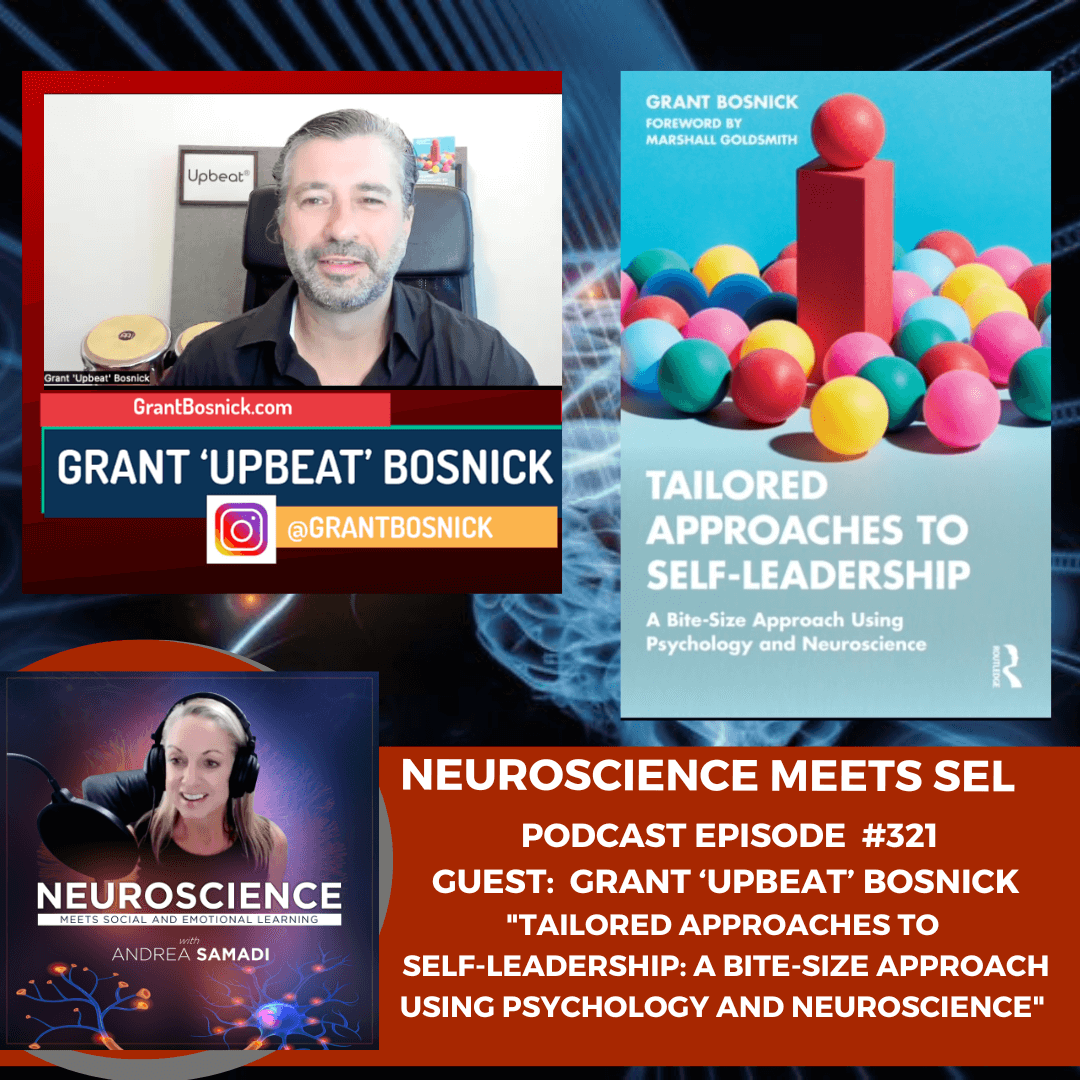
S11 Ep 322Grant 'Upbeat' Bosnick on "Tailored Approaches to Self-Leadership: A Bite Size Approach Using Psychology and Neuroscience"
Don't miss this comprehensive episode of the "Neuroscience Meets Social and Emotional Learning" podcast, where leadership guru and bestselling author, Grant 'Upbeat' Bosnick, discusses powerful tactics from his latest book for mastering self-awareness and personal transformation. Bosnick, recognized by reputable figures such as Scott Friedman and Marshall Goldsmith, presents his unique combination of neuroscience research and practical wisdom with a focus on self-improvement and growth. Watch on YouTube here https://youtu.be/vGweJ0sCJ14 The episode dissects the concepts of his award-winning book "Tailored Approaches to Self-Leadership," illustrating how change and improvement are truly achievable both from internal ('inside out') and external ('outside in') perspectives. Listeners will grasp the immense power of self-leadership and its transformative effect on personal growth and success. Explore practical strategies for habit formation, the significance of sequentially reading chapters, and the impact of a self-assessment system. Gain insights from Grant's expert advice on maintaining a balance between strengths and weaknesses while chasing after your goals. Dive into the information-rich conversation that uncovers the art of learning and the fascinating intricacies of engaging the mind with real-time applications of knowledge. Ultimately, embark on an intellectual journey that has the power to elevate personal achievement and self-awareness to uncharted levels. Round-off this enlightening experience with the rich resources that Grant provides, from beautifully illustrated maps to enhance tracking of personal growth, to video series and companion workbooks designed for tailoring self-leadership strategies. So, ready yourself for a transformative journey of the mind into the world of self-leadership with this gripping episode. On today's episode #321 with Guest: Grant ‘Upbeat’ Bosnick “Tailored Approaches to Self-Leadership: A Bite Size Approach Using Psychology and Neuroscience” we will cover: ✔ Powerful tactics from this NEW award-winning book that illustrates how change and achievement are truly achievable both from internal ('inside out') and external ('outside in') perspectives. ✔Listeners will grasp the immense power of self-leadership and its transformative effect on personal growth and success. ✔Explore practical strategies for habit formation, the significance of sequentially reading chapters, and the impact of a self-assessment system ✔Gain insights from Grant's expert advice on maintaining a balance between strengths and weaknesses while chasing after your goals ✔Embark on an intellectual journey that has the power to elevate personal achievement and self-awareness to uncharted levels. ✔Round-off this enlightening experience with the rich resources that Grant provides, from beautifully illustrated maps to enhance tracking of personal growth, to video series and companion workbooks designed for tailoring self-leadership strategies. Another example that shows us that failure is not an option. Here’s what Scott Friedman, the author of Celebrate! Lessons Learned from the World’s Most Admired Organizations has to say about the book we are going to cover today: Today’s episode really is going to be a journey of the mind… Welcome back to SEASON 11 of The Neuroscience Meets Social and Emotional Learning Podcast, where we connect the science-based evidence behind social and emotional learning and emotional intelligence training for improved well-being, achievement, productivity and results—using what I saw as the missing link (since we weren’t taught this when we were growing up in school), the application of practical neuroscience. I’m Andrea Samadi, an author, and an educator with a passion for learning and launched this podcast 5 years ago with the goal of bringing ALL the leading experts together (in one place) to help us to APPLY this research in our daily lives. On today's episode #321, we will be speaki
S11 Ep 321PART 7 Review of Wallace D. Wattles The Science of Getting Rich on " Acting in A Certain Way" Chapters 11-17
Welcome back to SEASON 11 of The Neuroscience Meets Social and Emotional Learning Podcast, where we connect the science-based evidence behind social and emotional learning and emotional intelligence training for improved well-being, achievement, productivity and results—using what I saw as the missing link (since we weren’t taught this when we were growing up in school), the application of practical neuroscience. I’m Andrea Samadi, an author, and an educator with a passion for learning and launched this podcast 5 years ago with the goal of bringing ALL the leading experts together (in one place) to help us to APPLY this research in our daily lives. On today's episode #320 and PART 7 of our REVIEW of Wallace D. Wattles The Science of Getting Rich, we will cover “How to Act in This Certain Way” with Chapters 11-17. ✔ Chapter 11: ACTING IN THE CERTAIN WAY A PERSON MUST ACT, AS WELL AS THINK ✔ CHAPTER 12: EFFECTIVE ACTION Just as there is an effective and ineffective way to THINK, there is also an effective and ineffective way to ACT. ✔ CHAPTER 13: GETTING INTO THE RIGHT BUSINESS ✔ CHAPTER 14: THE IMPRESSION OF INCREASE We covered Chapter 14 on The Impression of Increase on EP 316 in PART 3 of our review. We started this review with Chapters 4/14/7 in this order, because this was the order that was recommended to me to study this book for maximum results. ✔ CHAPTER 15: THE ADVANCING MAN ✔ CHAPTER 16: SOME CAUTIONS BE CAREFUL WHAT YOU SPEAK ABOUT NEVER ALLOW YOURSELF TO FEEL DISAPPOINTED KEEP STUDYING THIS BOOK ✔ CHAPTER 17: REVIEW Putting PART 1 into ACTION: Finding the Joy in Lean or Difficult Times Putting PART 2 into ACTION: Getting Comfortable with Money Putting PART 3 into ACTION: Living the Impression of Increase Putting PART 4 into ACTION: Practicing Gratitude or Faith in Action Putting PART 5 into ACTION: Developing a Rock Solid Mental Mindset Putting PART 6 into ACTION: Uncovering What You Really Want Putting PART 7 into ACTION: Review each part and APPLY IT! Welcome back to PART 7, of our review of Wallace D. Wattles, The Science of Getting Rich. In this classic book on thinking, this book describes how each of us shapes the events around us, creating much of the positive riches in our own personal and professional lives. Rhonda Byrne, creator of the movie The Secret[i], said she stumbled across The Science of Getting Rich and has "never been the same." This was one of the first seminars I sold when I worked with Bob Proctor back in the late 1990s, and he mentioned to me in our interview on EP 66[ii] that his business took off after Rhonda Byrne’s The Secret took off. There is true magic within the words written within these pages, and like all of the books we dive deep into, it’s the application of what we read here that has the potential to change our life forever. If you enjoyed our Deep Dive into Napoleon Hill’s Think and Grow Rich[iii] book, or the 4 Part Series of The Silva Method,[iv] (that I’m going to revisit after this study is complete) the concepts we will cover in this review go hand in hand with those Deep Dives. I’m currently studying Hill’s “Think and Grow Rich” with Paul Martinelli[v], who teaches this book like no one else and I’m constantly reminded of how important our ability to “think” really is. Napoleon Hill titled his book with four simple words. He picked “think and grow” as the first three, and we covered in this series the power of our thoughts. Now, we are learning through the words of Wallace D. Wattles, that once we know how to think and grow, we can next add the rich part, and he shows us there is a science to this. I always add that it’s not just rich financially, but we grow rich in our knowledge, rich in our potential, and we need money to keep learning, and growing, so yes, rich financially. Bringing us to Chapter 11: ACTING IN THE CERTAIN WAY Have you noticed that up until now, we have been focused on THINKING in a CERTAIN way in this book study? Now we are at a pivot
S11 Ep 320PART 6 Review of Wallace D. Wattles The Science of Getting Rich on ”How to Think in This Certain Way” Chapters 6, 8, 9, 10.
Welcome back to SEASON 11 of The Neuroscience Meets Social and Emotional Learning Podcast, where we connect the science-based evidence behind social and emotional learning (that’s finally being taught in our schools) and emotional intelligence training (used in our modern workplaces) for improved well-being, achievement, productivity and results—using what I saw as the missing link (since we weren’t taught this when we were growing up in school), the application of practical neuroscience. I’m Andrea Samadi, an author, and an educator with a passion for learning and launched this podcast 5 years ago with the goal of bringing ALL the leading experts together (in one place) to uncover the most current research that would back up how our brain learns best. On today's episode #319 we will cover: Chapter 6: HOW RICHES COME TO YOU ✔ Where we learned to listen to the desire that’s seeking expression with and through you and think “how can you create something that give others more USE value than you are taking from them in cash value.” ✔ Ideas for creating Multiple Sources of Income in your life. CHAPTER 8 THINKING IN THE CERTAIN WAY ✔ Where we learned "You must have a clear and definite mental picture of what you want. You cannot transmit an idea unless you have it yourself.” (Ch 8, SGR, Wattles). ✔ Reminders to go back and PRACTICE the skill of putting the image of what you want on the screen of your mind, by reviewing The Silva Method (our most downloaded series from 2023). CHAPTER 9 HOW TO USE THE WILL CHAPTER 10 FURTHER USE OF THE WILL ✔ Reminders to keep developing our WILL to eliminate doubts and fears, and stay focused on whatever it is that we are working towards. Welcome back to PART 6 of our review of Wallace D. Wattles, The Science of Getting Rich. In this classic book on thinking, this book describes how each of us shapes the events around us, creating much of the positive riches in our own personal and professional lives. Rhonda Byrne, creator of the movie The Secret[i], said she stumbled across The Science of Getting Rich and has "never been the same." This was one of the first seminars I sold when I worked with Bob Proctor back in the late 1990s, and he mentioned to me in our interview on EP 66[ii] that his business took off after Rhonda Byrne’s The Secret took off. There is true magic within the words written within these pages, and like all of the books we dive deep into, it’s the application of what we read here that has the potential to change our life forever. If you enjoyed our Deep Dive into Napoleon Hill’s Think and Grow Rich[iii] book, or the 4 Part Series of The Silva Method,[iv] (that I’m going to revisit after this study is complete) the concepts we will cover in this review go hand in hand with those Deep Dives. I’m currently studying Hill’s “Think and Grow Rich” with Paul Martinelli[v], who teaches this book like no one else and I’m constantly reminded of how important our ability to “think” really is. Napoleon Hill titled his book with four simple words. He picked “think and grow” as the first three, and we covered in this series the power of our thoughts. Now, we are learning through the words of Wallace D. Wattles, that once we know how to think and grow, we can next add the rich part, and he shows us there is a science to this. I always add that it’s not just rich financially, but we grow rich in our knowledge, rich in our potential, and we need money to keep learning, and growing, so yes, rich financially. Bringing us to Chapter 6: HOW RICHES COME TO YOU How do riches come to you? My goal for the END of this review, (after our next episode) is to show that without a shadow of a doubt, we ALL have the ability to “Think and Grow Rich” and That there is a Science to Doing This. If we can do the hard work involved (using persistence like while reading chapters 4/14/7 for 90 days) we will sharpen our ability to think, make connections and grow from what we’ve learned. Once we APPLY what we’v
S11 Ep 319PART 5 Review of Wallace D. Wattles The Science of Getting Rich on ” Revealing The Secret Within the Syllabus” Chapters 1, 2, 3 and 5
PART 5 REVIEW of The Science of Getting Rich by Wallace D Wattles Welcome back to PART 5 of our review of Wallace D. Wattles, The Science of Getting Rich. In this classic book on thinking, this book describes how each of us shapes the events around us, creating much of the positive riches in our own lives. Rhonda Byrne, creator of the movie The Secret[i], said she stumbled across The Science of Getting Rich and has "never been the same." This was one of the first seminars I sold when I worked with Bob Proctor back in the late 1990s, and he mentioned to me in our interview on EP 66[ii] that his business took off after Rhonda Byrne’s The Secret took off. There is true magic within the words written within these pages, and like all of the books we dive deep into, it’s the application of what we read here that has the potential to change our life forever. It took me some time to review this book, honestly, because many of the concepts I didn’t fully understand myself. It’s taken me over 25 years to finally grasp the meaning behind the timeless concepts that Wattles wrote about in 1910, and writing this series has helped me to refine my own thinking, in addition to sharing what I’m learning here with you, wherever you might be listening in the world. If you enjoyed our Deep Dive into Napoleon Hill’s Think and Grow Rich[iii] book, or the 4 Part Series of The Silva Method,[iv] the concepts we will cover in this review go hand in hand with those Deep Dives. I read this review about this book and it caught my eye. No student of thought should be without this historic book. Think about this for a minute. Read this book and do it exactly as written and you will see HOW failure is impossible. This is the PERFECT book and series to launch 2024 with. On today's episode #319 we will cover: ✔ CHAPTER 1: THE RIGHT TO BE RICH “There is nothing wrong with wanting more in life. No man is to be happy with little.” (Ch 1, SGR, Wattles) ✔ CHAPTER 2 THERE IS A SCIENCE OF GETTING RICH With some thoughts on what the title of this book makes you think about. ✔ CHAPTER 3 IS OPPORTUNITY MONOPOLIZED? What is it that YOU really want? Do you think you can achieve it? ✔ CHAPTER 4: THE FIRST PRINCIPLE OF THE SCIENCE OF GETTING RICH We covered this chapter on EP 315 in PART 2[v] of this REVIEW where I challenged everyone to read chapters 4/14/7 for 90 days. Keep reading. ✔ CHAPTER 5: INCREASING LIFE Why must we develop our Mind, Body and Spirit? Welcome back to SEASON 11 of The Neuroscience Meets Social and Emotional Learning Podcast, where we connect the science-based evidence behind social and emotional learning (that’s finally being taught in our schools) and emotional intelligence training (used in our modern workplaces) for improved well-being, achievement, productivity and results—using what I saw as the missing link (since we weren’t taught this when we were growing up in school), the application of practical neuroscience. I’m Andrea Samadi, an author, and an educator with a passion for learning and launched this podcast 5 years ago with the goal of bringing ALL the leading experts together (in one place) to uncover the most current research that would back up how our brain learns best. At the end of each year, we review timeless and important books that were recommended to me when I worked in the motivational speaking industry in the late 1990s, and my goal is to see how science can inform us as we move towards our goals in 2024, (whether it with the interviews we will host) or by diving into what I saw working over and over again in the speaking industry, so we can all be the most improved, 2.0 version of ourselves. This year, we are reviewing Wallace D. Wattles The Science of Getting Rich book that was written in 1910. I’ve set the stage for the application of this book by asking us to begin or end our study by reading chapters 4/14/7 in this order for 90 days. The order is important. This is where our review began. If you can do this
S10 Ep 318Dmitri Leonov on ”Taopatch: Understanding Nanotechnology for Health and Wellness of The Future”
Are wearable devices the future of health and wellness? Today’s episode we will take our first step towards a NEW technology, called TAOPATCH that’s been making inroads in the health and wellness industry over the years, and this is just the beginning. Watch this interview here https://www.youtube.com/watch?v=cEquCWcnx9A On today’s episode #318 we speak with the CEO of Taopatch USA, Dimiti Leonov. We will cover: ✔ What is Taopatch nanotechnology and how can it impact our health and wellness in 2024? ✔ What systems in the body are impacted with Taopatch? ✔ How can wearing Taopatch impact our focus, emotions and even our spiritual side? ✔ What are world-class athletes saying about Taopatch? ✔ What does the most current research say about this nanotechnology? ✔ How can you try Taopatch? Welcome back to The Neuroscience Meets Social and Emotional Learning Podcast, where we connect the science-based evidence behind social and emotional learning (that’s finally being taught in our schools today) and emotional intelligence training (used in our modern workplaces) for improved well-being, achievement, productivity and results—using what I saw as the missing link (since we weren’t taught this when we were growing up in school), the application of practical neuroscience. I’m Andrea Samadi, an author, and an educator with a passion for learning and launched this podcast 5 years ago with the goal of bringing ALL the leading experts together (in one place) to uncover the most current research that would back up how the brain. On today’s episode #318, we have Dmitri Leonov, the founder of TAOPATCH USA[i]. Taopatch the nanotechnology device using light therapy with acupuncture. When I see a product that’s NEW, nicknamed The Human Upgrade Device, that addresses health and wellness, enhances physical performance, boosts energy levels, relieves pain, while being used by TOP WORLD-CLASS athletes and kept a secret for a competitive advantage, I want to know what it is. Dmitri reached out to me and offered to share what’s they have discovered with the intersection of technology, wellness and spirituality and how they are combining traditional methods like acupuncture with modern technology like light therapy and nanotechnology. I can’t even tell you how much I’m interested in learning more, especially as I’m personally exploring NEW technologies on this podcast, so when something innovative comes my way, there’s no hesitation to make this interview happen. Let’s meet the CEO of TAOPATCH USA, Dmitri Leonov, and see if he will reveal the secrets from the athletes he has seen using TAOPATCH as one of their best kept secrets in their careers, and what results they are attaining this this NEW Nanotechnology for health and wellness. Welcome Dmitri Leonov. Where have we reached you today? Dmitri, this whole podcast is designed to help all who tune in to find ways to improve ourselves (health, wellness, and even look at our spiritual side) so when I saw TAOPATCH, I knew I had to speak with you. Thanks so much for making this happen! Before we get to this fascinating health and wellness product, I wonder with your background as an entrepreneur, what drew you towards TAOPATCH with your entrepreneurial past? Q1: What is TAOPATCH, how does it work, where is it worn on the body, and who is using it for outstanding results? Q2: What systems in the body are impacted with TAOPATCH? Q3: How does it impact our emotions, focus and even our spirituality? Q4: I’ve been using magnet therapy for years, and even some technology that added far infrared tech (Nikken products). I have seen the power from products like these over the years. What would you say is different, better or more advanced about TAOPATCH than magnet therapy that many of us would be aware of? What’s missing if I’m only using magnets? Q4B: Can you explain what the material that TAOPATCH is made out of (Quantum Dots) and what did the recent Nobel Prize[ii] winners discover with this tech
S10 Ep 317PART 4 Review of The Science of Getting Rich on ”Gratitude: Through the Eyes of Wallace D. Wattles” Chapter 7
“Gratitude is an attitude that hooks us up to our source of supply. And the more grateful you are, the closer you become to your maker, to the architect of the universe, to the spiritual core of your being.” That’s from Bob Proctor, who writes that Chapter 7 on “Gratitude” from The Science of Getting Rich is “a phenomenal lesson.” Welcome to our review of chapter 7 of Wallace D. Wattles’ The Science of Getting Rich, published in 1910. On today's episode #317 and PART 4 of our REVIEW of Wallace D. Wattles The Science of Getting Rich, we will cover: ✔ REVIEW PART 1: Prosperity Thinking vs Poverty Thinking.✔ Why are our thoughts so important for our results?✔ Why are Chapters 4/14/7 important chapters for unlocking the "secrets" for wealth and abundance?✔ Why must we THINK and ACT in a Certain Way to achieve certain results in our life?✔ Why did Wallace D. Wattles see GRATITUDE as an important component for Wealth and Success in 1910?✔ 4 STEPS for practicing Gratitude in our Daily Life. What’s UNIQUE with How to Think and Act in this Certain Way with Gratitude? What’s new, different and unique about this chapter that unlocks the combination to wealth and abundance within the pages of this book, when we read chapters 4/14 and 7 in this order, for 90 days? It’s within this chapter, on Gratitude, a topic that many of us already know about but I’m going to suggest there’s a much deeper way to look at Gratitude, through the eyes of Wallace D. Wattles. For today’s episode, I hope to tap us into how Wattles thought about Gratitude so we can see, feel and experience this word, gratitude, in a deeper, and more meaningful way. We covered this topic already on EP 181 on “The Ingredients of an Effective Gratitude Practice” where we connected the most current brain research to this widely used success principle. But what we have NOT covered yet, is how on the earth did Wallace D. Wattles think of this practice as important and then tie it to wealth and abundance in 1910? What did he suggest that we have NOT discussed yet on this podcast? What have we missed, that’s REALLY important? This is the question I ask EVERYONE at the end of an interview. I don’t want to leave any stones unturned. I’m going to suggest that what we have missed will be revealed when we put these three chapters together, bringing out the “secret within the syllabus of this book” where we learn to THINK AND ACT in this “certain way.” From experience, I can tell you if you follow this activity for 90 days, you will witness strange and marvelous things occur in your world, with constant regularity. You just need to READ and APPLY these 3 chapters, in this order practicing things in this CERTAIN WAY, as Wallace D. Wattles suggests. Then I’m hoping that this review will help you to shorten the time it takes you to experience these AHA moments of learning that took me over 25 years to finally understand and move you quicker towards whatever it is that you want. As I’m writing this episode, I’m STILL uncovering truths that have escaped me previously. Welcome back to The Neuroscience Meets Social and Emotional Learning Podcast, where we connect the science-based evidence behind social and emotional learning (that’s finally being taught in our schools today) and emotional intelligence training (used in our modern workplaces) for improved well-being, achievement, productivity and results—using what I saw as the missing link (since we weren’t taught this when we were growing up in school), the application of practical neuroscience. I’m Andrea Samadi, an author, and an educator with a passion for learning and launched this podcast 5 years ago with the goal of bringing ALL the leading experts together (in one place) to uncover the most current research that would back up how the brain This brings us to chapter 7 of Wallace D. Wattles’ The Science of Getting Rich, published in 1910 on “Gratitude.” When I look in my notebook, the first line I highlighted was line 13
S10 Ep 316PART 3: Review of Wallace D. Wattles The Science of Getting Rich on ”The Neuroscience Behind The Impression of Increase” Chapter 14
“We don’t have to engage in grand, heroic actions to participate in the process of change. Small acts, when multiplied by millions, can transform the world.” Howard Zinn On today's episode #316 and PART 3 of our REVIEW of Wallace D. Wattles The Science of Getting Rich, we will cover: ✔ REVIEW PART 1: Prosperity Thinking vs Poverty Thinking. ✔ Why are our thoughts so important for our results? ✔ Why are Chapters 4/14/7 important chapters for unlocking the "secrets" for wealth and abundance? ✔ Why must we THINK and ACT in a Certain Way to achieve certain results in our life? ✔ What is the Impression of Increase? ✔ What does Neuroscience have to do with this age-old success principle? ✔ 2 TIPS for practicing The Impression of Increase with EVERYONE you interact with. “Increase is what all men and women are seeking: it is the urge of the Formless Intelligence within them, seeking fuller expression…All human activities are based on this desire for increase; people are seeking more food, more clothes, better shelter, more luxury, more beauty, more knowledge, more pleasure—increase in something, more in life.” Wallace D. Wattles, The Science of Getting Rich Welcome back to The Neuroscience Meets Social and Emotional Learning Podcast, where we connect the science-based evidence behind social and emotional learning (that’s finally being taught in our schools today) and emotional intelligence training (used in our modern workplaces) for improved well-being, achievement, productivity and results—using what I saw as the missing link (since we weren’t taught this when we were growing up in school), the application of practical neuroscience. I’m Andrea Samadi, an author, and an educator with a passion for learning and launched this podcast 5 years ago with the goal of bringing ALL the leading experts together (in one place) to uncover the most current research that would back up how the brain. Which brings us to chapter 14 of Wallace D. Wattles’ The Science of Getting Rich, published in 1910 on “The Impression of Increase.” This is one of my favorite chapters, and one I know that my mentor Bob Proctor LOVED practicing The Impression of Increase. Brian Proctor talked about this on our recent interview EP 292[i] this past summer. Brian covers this topic beautifully in his book, My Father Knew the Secret, in the 2nd last chapter on “Supporting Others.” Bob Proctor would practice this principal from Chapter 14 and say to “leave everyone you meet with The Impression of Increase” and I remember when I first began to study this chapter, I wrote in BIG LETTERS at the top of the page to “take the focus off yourself and put it on other people.” Then I circled in the notes section “go out and LOOK for an opportunity to help others.” Now this seems simple enough, right? We talked about the importance of understanding how Giver’s Gain in PART 1[ii] of this study. While I can easily go off on tangents while writing these reviews, I want to stick to how Wallace D. Wattles wrote about this concept FIRST, and then add in ways that I’ve seen others implements this idea. Wattles opens up Chapter 14 by saying “whether you change your vocation or not, you must direct your present actions to the business you are presently engaged” and he goes on to say that “you can get into the business you want by making constructive use of the business you are already established in—by doing your work in this certain way.” The next few lines I highlighted. He says “And, in so far as your business consists in dealing with other people—whether directly, by telephone, or by letter (yes, this book was written in 1910!), the key thoughts to all your efforts must be to convey to their minds the impression of increase.” (Chapter 14, Wattles, SGR). Remember there is an order to “unlocking the combination for success and wealth” in this book, and that’s to read Chapters 4/14 and 7 in this order for 90 days. I’m hoping to complete our review of these 3 chapters before t
S10 Ep 315PART 2: Review of Wallace D. Wattles The Science of Getting Rich on ”Thinking and Acting in a Certain Way” Chapter 4
“A man’s mind may be likened to a garden, which may be intelligently cultivated or allowed to run wild: but whether cultivated or neglected, it must, and will, bring forth. If no useful seeds are put into it, then an abundance of useless weed-seeds will fall therein, and will continue to produce their kind. Just as a gardener cultivates his plot, keeping it free from weeds, and growing flowers and fruits which he requires, so may a man tend the garden of his mind, weeding out all the wrong, useless, and impure thoughts, and cultivating toward perfection the flowers and fruits of right, useful and pure thoughts. By pursuing this process, a man sooner or later discovers that he is the master-gardener of his soul, the director of his life.” (James Allen, As a Man Thinketh, 1902).[i] On today's episode #315 and PART 2 of our REVIEW of Wallace D. Wattles The Science of Getting Rich, we will cover: ✔ REVIEW PART 1: Prosperity Thinking vs Poverty Thinking. ✔ Why are our thoughts so important for our results? ✔ Why are Chapters 4/14/7 important chapters for unlocking the "secrets" for wealth and abundance? ✔ Why must we THINK and ACT in a Certain Way to achieve certain results in our life? ✔ A look at 2 types of thinking with famous examples. ✔ 3 STEPS for changing our Money Mindset. Which brings us to chapter 4 of Wallace D. Wattles’ The Science of Getting Rich, published in 1910. “A man is but the product of his thoughts. What he thinks, he becomes.” Mahatma Ghandi (an Indian lawyer who inspired movements for civil rights and freedom across the world). Bringing us to PART 2 of our Deep Dive into Wallace D. Wattles’ The Science of Getting Rich. Welcome back to The Neuroscience Meets Social and Emotional Learning Podcast, where we connect the science-based evidence behind social and emotional learning (that’s finally being taught in our schools today) and emotional intelligence training (used in our modern workplaces) for improved well-being, achievement, productivity and results—using what I saw as the missing link (since we weren’t taught this when we were growing up in school), the application of practical neuroscience. I’m Andrea Samadi, an author, and an educator with a passion for learning and launched this podcast 5 years ago with the goal of bringing ALL the leading experts together (in one place) to uncover the most current research that would back up how the brain. On today’s episode #315 we launch into a Deep Dive of Wallace D. Wattles The Science of Getting Rich starting with Chapters 4/14/7. If you look at the image in the show notes, you will see a TABBED and very well-read Science of Getting Rich book. This was the book I sent to Paranormal Researcher, Ryan O’Neill from Scotland, UK over 10 years ago, instructing him to read this book, starting with Chapters 4/14/7[ii] for 90 days. He sent me this image of his book, all these years later, well-read and marked up, and his results (that we cover on our interview with Ryan on EP #203[iii]) are a byproduct of him doing things in this certain way, beginning with Chapter 4, The First Principle in the Science of Getting Rich that we will cover today. Next, we’ll move onto chapter 14 on The Impression of Increase that is by far my favorite chapter in this book. I love watching this principle in action in others, and then learning to practice this myself has been something that I think has given me some depth with my character over the years. We’ll move back to Chapter 7 on Gratitude, that ties all these chapters together, before reviewing the other chapters of this book, and coming up with some action steps for implementing these timeless principles in our own lives. If you want a guide, I’ll link a YouTube audio version of these SPECIAL chapters 4/14/7) in the show notes for you and if you look in the comment section, someone knew the power of these chapters in this order revealing their awareness when they wrote “thanks for the combination to the safe.” It’s
S10 Ep 314PART 1 Review of Wallace D. Wattles The Science of Getting Rich on ”Prosperity Consciousness” Introduction
“A person’s right to life means his right to have the free and unrestricted use of all the things which may be necessary to his fullest mental, spiritual and physical unfolding —in other words, his right to be rich.”Wallace D. Wattles On today's episode #314 we will cover: ✔ The hidden meaning behind Wallace D. Wattles' The Science of Getting Rich ✔ What is Prosperity Consciousness vs Poverty Consciousness, and how do YOU think? ✔ Why do Giver's Gain? ✔ How Can We Best Prepare to Learn the Timeless Principles in this book that was published in 1910? “Wait a minute, are you telling me that we are going to cover the importance of developing a prosperity mindset on this podcast?” you ask? How is this related to neuroscience? I’m going to say “yes, we are” and I’ll tie the importance of this to science with Mark Waldman and Chris Manning’s Book Neurowisdom: The New Brain Science of Money, Happiness and Success[i] that focuses on helping people create more “wealth” in their lives. This book opens up in Chapter 1 by asking us to choose if we would pick happiness or wealth, and they said that 90% of the people they surveyed over the past decade actually picked happiness over wealth (Chapter 1, Neurowisdom) but the book goes on to explain that the newest economic research disagrees with this. They found that it’s really the other way around. “Wealth predicts happiness, and the more you make, the happier you actually become.” (Chapter 1, Neurowisdom). This is not the main reason why I finally decided to cover Wallace D. Wattles’ The Science of Getting Rich on this podcast, but if the research says that “our wealth predicts our happiness” I thought that there is never a better time than now, to cover the seminar I sold in the late 1990s, that transformed my thinking from poverty consciousness, to prosperity. Now this didn’t happen overnight, or immediately. I’m going to share my journey over the past 25 years, along with all of the notes I took studying while this book, watching my own paradigms change slowly, and then watching how other people around me would use what they were learning for improved results in their life. Here’s the important part that I don’t want any of us to miss. Once we have learned to successfully use the principles we will be studying in this book ourselves, we can then take the focus off ourselves, and look for ways to give back to others. You will see that there are many messages within the pages of this book, and this one, is what I think to be THE MOST IMPORTANT. I’m hoping that studying these timeless principles in this manner will help you the listener to connect either to my way of thinking, (someone who was raised with one parent who might have instilled poverty consciousness in your mind-or said things to you like “money doesn’t grow on trees” over the years, or those people I’ll use as examples who grasped prosperity thinking with ease, so that you can take the principles and fine-tune your own way of thinking, and acting, to achieve the results I know are possible for all of us. Once we have applied them in our own life, it will be time to look outside of ourselves and give back. The Shortest Summary of The Science of Getting Rich What’s the message behind the Deep Dive we are going to take into Wallace D. Wattle’s classic book on thinking, the book that describes how each of us shapes the events around us, creating much of the positive riches in our own lives? The book that Rhonda Byrne, creator of The Secret, said she stumbled across and has "never been the same?" The book that was behind one of the seminars I sold in the late 1990s when I worked in the motivational speaking industry with Bob Proctor from EP #66[ii]. I did see an article written by John Rogers[iii] that summarized the book and he got it right. He said “Here’s the shortest summary of The Science of Getting Rich you’ll ever read: Think and act creatively to add value to others.” I would agree, but might change it
S10 Ep 313”Decoding Our Thoughts: How to Build a Better Future with the Power of Our Mind” PART 4 Review of Dr. Joe Dispenza’s Work
“As the acceptance of expanded human potential gains mainstream momentum, the question has shifted from “What is possible in our lives?” to “How do we do it? How do we awaken our extraordinary potential in everyday life?” Welcome to PART 4 of our review of Dr. Joe Dispenza’s work. Review of Chapter 4 of Dr. Joe Dispenza’s Becoming Supernatural on The Blessing of the Energy Centers that requires us to now implement everything that we’ve learned in his book. ✔ The Power of Our Energy and Understanding Frequency. ✔ Using Our Mind to Imagine Our Energy and Thoughts ✔ Using our Focus and Concentration to Create Stronger More Powerful Thoughts ✔ How Energy Flows in Our Body: A Look at the 8 Chakras in Our Body ✔ Why We Want to Move Our Energy to the Top 4 Chakras in Our Body to CREATE NEW Ideas in Our Life. ✔ 5 Steps for Putting Dr. Dispenza’s Blessing of the Energy Centers Meditation into Practice. Today we will continue our exploration of how exactly we live up to the full potential we all have within us, or like the name of Dr. Joe Dispenza’s book, Becoming Supernatural: How Common People are Doing the Uncommon. Today as we cover PART 4 of this exploration we will identify clear strategies to awaken the extraordinary potential in each of us, and these will be evidence-based strategies, that are backed by science. We will do this by looking at CH 4 of Becoming Supernatural, a book that is the first-of-its-kind manual that does precisely this: it leads us on a step-by-step journey to achieving our greatest potential in body, health, relationships, and our life purpose and allows us to make that journey at our own pace. Today we will cover Chapter 4 of this book, called “Blessing of the Energy Centers” we will learn exactly HOW to use this powerful energy that we all have, to CREATE something new in our life, or to direct this energy towards healing our body, or tap into increased creativity using our intuitive factors. Today, we bring all PARTS of our study together, and make it all applicable. We will also connect the science to this practice, and places on past podcast episodes where we can strengthen our understanding of these concepts that are difficult to apply, since we were not taught about how to manage our energy in school, nor were we taught about how to harness the power of a meditation practice for healing our body, or creating new results. But we will cover these fascinating topics on today’s episode. I did want to mention how I love hearing from people from all over the world, with their experience of studying Dr. Dispenza’s work. For many who’ve been on this journey for years, this is just a review, and reminder of different ways we can all continue to build on the knowledge we’ve learned over the years. Even Dr. Dispenza himself has mentioned the immense learning that took place for him over the years, which is a good reminder for all of us that we are all on a journey, in this thing called life, and it takes time to unlock our greatest potential. It Takes Time. Awareness. And Practice. I do hope that our review today helps us to ALL unlock more of the mysteries within the unseen world, as we learn to put these concepts into practice into our daily lives. I’m sure we will return to this series in the future, but this is where we will start our journey today. Welcome back to The Neuroscience Meets Social and Emotional Learning Podcast, where we connect the science-based evidence behind social and emotional learning (that’s finally being taught in our schools today) and emotional intelligence training (used in our modern workplaces) for improved well-being, achievement, productivity and results—using what I saw as the missing link (since we weren’t taught this when we were growing up in school), the application of practical neuroscience. I’m Andrea Samadi, an author, and an educator with a passion for learning and launched this podcast 5 years ago with the goal of bringing ALL the leading experts togethe
S10 Ep 312The Frequency Expert, David Wong on ”Master Your Frequency and Take Control of Your Personal, Professional Life and Health”.
"The practice of Qigong combines concentration, meditation, visualization, movement, and biofeedback to command the flow of Qi and direct it where it needs to go to enable the best form of balance and harmony. This balance can be achieved in various forms: cognitive, physical, spiritual, moral, medical, and more." David Wong, The Frequency Expert, from Life of Qi: The Science of Life Force, Qi Gong, and Frequency Healing Technology for Health, and Longevity. Watch this interview on YouTube here: https://youtu.be/bHBkVEmUiQ0 Welcome back to The Neuroscience Meets Social and Emotional Learning Podcast, where we connect the science-based evidence behind social and emotional learning (that’s finally being taught in our schools today) and emotional intelligence training (used in our modern workplaces) for improved well-being, achievement, productivity and results—using what I saw as the missing link (since we weren’t taught this when we were growing up in school), the application of practical neuroscience. I’m Andrea Samadi, an author, and an educator with a passion for learning and launched this podcast 5 years ago with the goal of bringing ALL the leading experts together (in one place) to uncover the most current research that would back up how the brain. On today's episode #312 with David Wong we will cover: ✔ The importance of keeping our energy/frequency high at all times, especially while interacting with others in our personal and professional lives. ✔ What led David Wong to create the Qi Coil Technology to help raise a person's frequency, and improve their life? ✔ What are some other ways we can raise our frequency? ✔ Is there really a frequency for health, wealth and success? How can we "tap into it?" ✔ Where to learn more about David Wong's work, and his vision to raise the frequency of the world. For today’s episode #312 we will be meeting with David Wong[i], also known as "The Qi Master" is a world-renowned Qi (Chee) Energy and Life Force expert. He is a best-selling author, visionary inventor, inspirational speaker, martial artist, qi gong practitioner and entrepreneur. He founded Qi Life, a company that develops cutting-edge technologies for personal wellness. His passion for helping others unlock their human potential through ancient wisdom and modern science was ignited after he successfully self-healed from an incurable digestive disease he had for 10 years by using frequency and energy devices. We are meeting David Wong just at the right time on our podcast. We have just taken a shallow dive into Dr. Joe Dispenza’s work, that’s focused on the importance of maintaining balance with our energy, understanding that can access a Quantum World where anything is possible (healing our body, or improving our personal and professional life). David reached out to me via social media a few months ago, and I knew he was someone I needed to interview. I hadn’t read his book yet, or spent the time researching what he has accomplished in the field to help others unlock their highest potential. I just knew. We found a date and time that seemed far off in the future, and now we are here. Just keep an open mind as we learn from David today. If you look at his website, you see testimonials of his work from doctors and healers from all over the world. He’s followed and supported by Vishen Lakhiani, the CEO of MindValley who reinvented Jose Silva’s Program, as well as Jim Kwik, the World’s #1 Brain Coach. I know there was a time that meditation in the workplace was not an accepted stress reduction strategy, and today most workplaces promotes advanced wellness strategies like this for their employees. With an open mind, we can now learn what else could possibly do to take our results to new heights. Let’s meet David Wong, and see how his work can help us to change our life (our body/mind and spirit) improve our results, our health, and even our wealth. David, it’s wonderful to meet you. I know in our correspondence you
S10 Ep 311”Decoding Our Thoughts: How to Build a Better Future with the Power of Our Mind” PART 3 Review of Dr. Joe Dispenza’s Work
“As the acceptance of expanded human potential gains mainstream momentum, the question has shifted from “What is possible in our lives?” to “How do we do it? How do we awaken our extraordinary potential in everyday life?” Welcome to PART 3 of our review of Dr. Joe Dispenza’s work. On today's EPISODE #311 on "Decoding Our Thoughts: How to Build a Better Future with the Power of Our Mind" and PART 3 of our Review of Dr. Joe Dispenza's work, we will: Review Chapter 3 of Dr. Joe Dispenza's book, Becoming Supernatural on Accessing The Quantum World for improved results in our personal, professional life, or with our health and wellness. STEP 1: DROPPING INTO THE PRESENT MOMENT: OPENING THE DOORWAY TO THE QUANTUM WORLD STEP 2: SETTING A CLEAR INTENTION OF WHAT YOU WANT TO CHANGE IN YOUR LIFE STEP 3: HOW TO CHANGE YOUR ENERGY STEP 4: UNCOVERING WHAT YOU LEARN in THE QUANTUM WORLD STEP 5: RECORDING WHAT HAPPENS AND KEEP WORKING ✔ What science has to say about the Quantum World? ✔ Strategies on how to IMPLEMENT these 5 STEPS into our daily life for improved results (personally, professionally and with our health). Today we will continue our exploration of how exactly we live up to the full potential we all have within us, or like the name of Dr. Joe Dispenza’s book, Becoming Supernatural: How Common People are Doing the Uncommon. Today as we cover PART 3 of this exploration we will identify clear strategies to awaken the extraordinary potential in each of us, and these will be evidence-based strategies, that are backed by science. We will do this by looking at CH 3 of Becoming Supernatural, a book that is the first-of-its-kind manual that does precisely this: it leads us on a step-by-step journey to achieving our greatest potential in body, health, relationships, and our life purpose and allows us to make that journey at our own pace. This book study has taken me some time to think, and consolidate what I’m learning since we released PART 1 the end of September. I needed this time to put Dr. Dispenza’s ideas and meditations into practice, and have spent the past month and a half, immersed in his teachings, filling in the gaps of understanding I’ve had since I first began studying human potential in the late 1990s. As mentioned in the first part of this study, this is a shallow dive, and it’s just the beginning. I do hope that our review today helps us to ALL unlock more of the mysteries within the unseen world, as we learn to put these concepts into practice into our daily lives. I’m sure we will return to this episode in the future, but this is where we will start our journey today. We’ll review what we learned in PART1 and PART 2, preparing us for this exciting journey of our mind, with PART 3 today, where we’ll put it all into action, with something we want to achieve in our own life. Welcome back to The Neuroscience Meets Social and Emotional Learning Podcast, where we connect the science-based evidence behind social and emotional learning (that’s finally being taught in our schools today) and emotional intelligence training (used in our modern workplaces) for improved well-being, achievement, productivity and results—using what I saw as the missing link (since we weren’t taught this when we were growing up in school), the application of practical neuroscience. I’m Andrea Samadi, an author, and an educator with a passion for learning and launched this podcast 5 years ago with the goal of bringing ALL the leading experts together (in one place) to uncover the most current research that would back up how the brain. For those tuning into this episode, and you’ve not listened to PART 1 EP 306[i] yet, or PART 2 EP 310[ii] I do encourage you to begin there. You will learn the background of where I first learned about Dr. Joe Dispenza’s work, and see how he fits into what we’ve been covering on the podcast the past 10 seasons. For today’s episode #311 “Decoding Our Thoughts: How to Build a Better Future with the Power of