Neuroscience Meets Social and Emotional Learning
413 episodes — Page 6 of 9
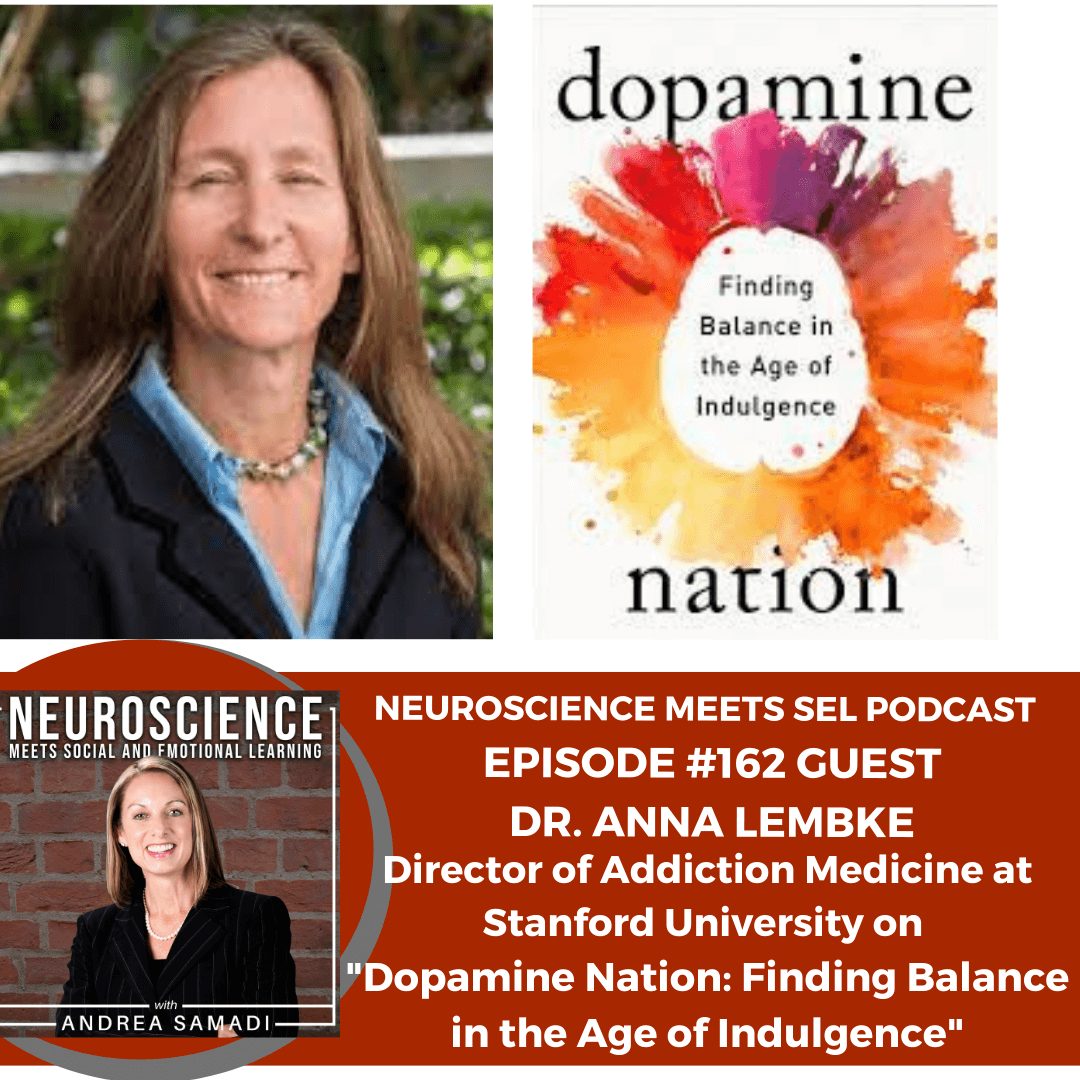
S6 Ep 162Medical Director of Addictive Medicine at Stanford University, Dr. Anna Lembke on ”Dopamine Nation: Finding Balance in the Age of Indulgence”
Welcome back to the Neuroscience Meets Social and Emotional Learning Podcast EPISODE #162 with Professor of Psychiatry and Medical Director of Addiction Medicine at Stanford University, Dr. Anna Lembke.[i] Visit the episode website here. https://www.youtube.com/watch?v=5Pu82wZRZwo Watch the interview with visuals on YouTube here. Backstory and Introduction 0-13:00 minutes Interview with Dr. Lembke 13:00-49:45 Follow Dr. Lembke https://profiles.stanford.edu/anna-lembke To See Past Episodes of The Neuroscience Meets Social and Emotional Learning Podcast https://www.achieveit360.com/episodes/ In Today's Episode, you will learn:✔︎ About the addictive nature of social media, as well as why people become addicted to certain behaviors and substances. ✔︎About her 30 Day Dopamine Fast: An 8 step process that she suggests to help us to reset our brains if we have had a surplus of dopamine in our brain due to over-indulgence that helps many people "kick their bad habits" to the curb. ✔︎ What is happening in the brain when we experience withdrawals when we try to stop a habit or behavior and how to overcome this uncomfortable feeling for increased happiness, mental health and awareness. ✔︎What exactly is the pleasure/pain balance and why we should all be able to recognize when we are getting too much of a good thing. ✔︎How to return to whatever it is that you enjoyed in moderation. You may have seen her in the Netflix Documentary The Social Dilemma [ii] where she discusses the addictive nature of social media, explaining that it taps into “our basic biological imperative to connect with other people—that directly affects the release of dopamine and the reward pathway” (32:35 The Social Dilemma) and she warns us that “there’s no doubt that a vehicle like social media which optimizes this connection between people is going to have the potential for addiction.” Dr. Lembke is more concerned with our children and her children (who appear in the documentary with her) and on today’s podcast, she will arm us with the knowledge that she shares with her own children daily. Her book Drug Dealer, MD: How Doctors Were Duped, Patients Got Hooked and Why It’s So Hard to Stop[iii] (2016) is a good overview of what addiction is, and the dangers of prescription drugs. Her NEW book Dopamine Nation: Finding Balance in the Age of Indulgence[iv] that was just released last month, explores the exciting new scientific discoveries that explain why the relentless pursuit of pleasure leads to pain…and what to do about it. I'm Andrea Samadi, author, and educator from Toronto, Canada, now in Arizona, and like many of our listeners, have been fascinated with learning and understanding the science behind high performance strategies that we can use to improve our own productivity in our schools, our sports, and workplace environments. My vision is to bring the experts to you, share their books, resources, and ideas to help you to implement their proven strategies, whether you are a teacher working in the classroom or online, a student, or parent working in the corporate space. This week’s interview with Dr. Anna Lembke on her NEW book Dopamine Nation is based on true stories of her patients falling prey to addiction and finding their way out again with stories that many of us might find to be shocking, but she explains that “they are just extreme versions of what we are all capable of.” (Dopamine Nation) When reading this book, or listening to this interview, I encourage you to think about your own life, your behaviors and what you might be running from since we are all running from something and like we have mentioned many times before on the podcast, awareness is the key to making any behavior change that can have a lasting impact on our productivity and results. My hope is that we can all take an honest look and find places where we might be leaking energy, to close those gaps, and redirect that energy towards our goals. We covered the topic of addictio
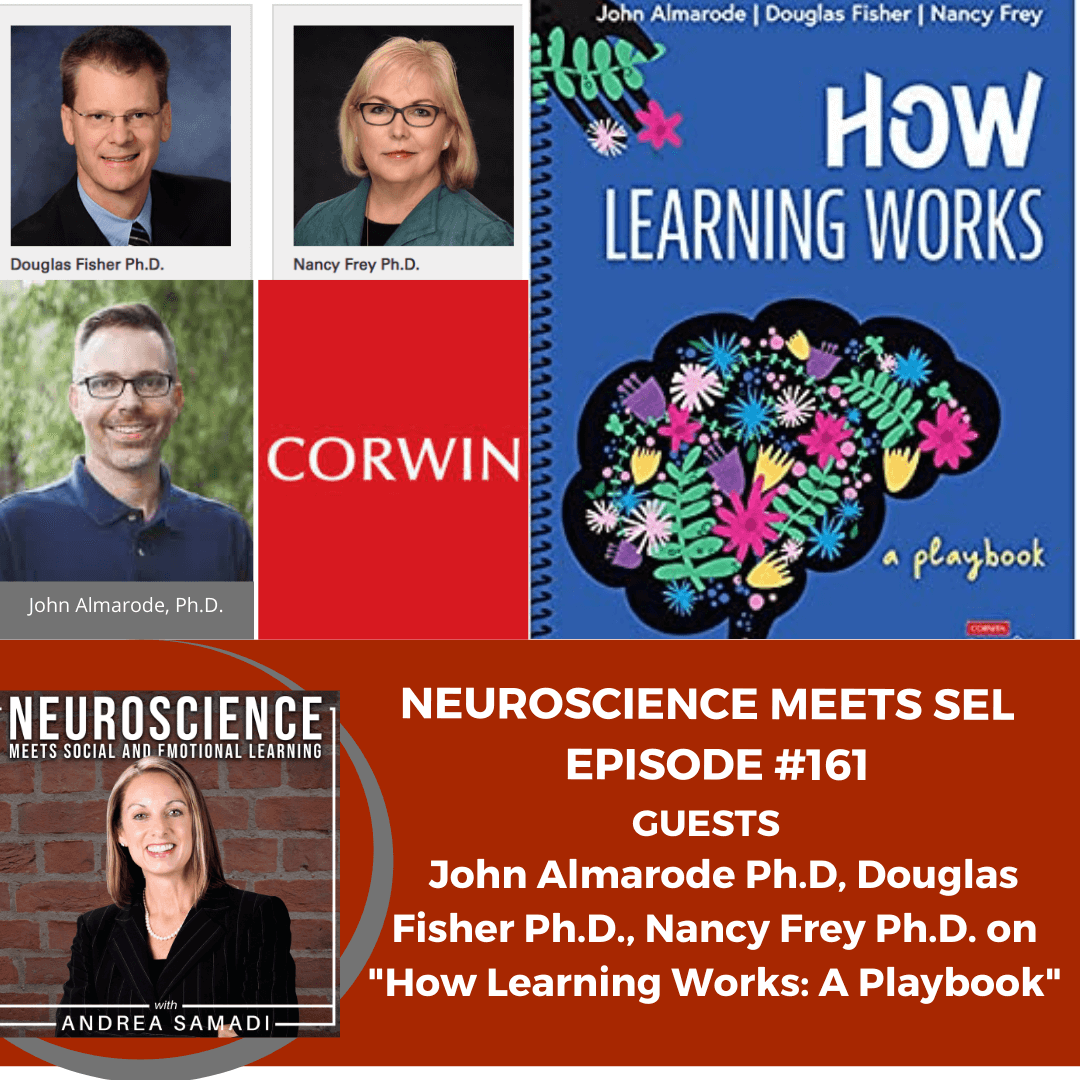
S6 Ep 161John Almarode, Douglas Fisher and Nancy Frey on ”How Learning Works: Translating the Science of Learning in Your Classroom”
Welcome back to the Neuroscience Meets Social and Emotional Learning Podcast EPISODE #161 with 2 returning guests, Douglas Fisher and Nancy Frey from EPISODE #77[i] from last August 2020 on “Developing and Delivering High Quality Distance Learning for Students” that became our most watched YouTube interview and we also have the co-author of their new book that we are diving into today, How Learning Works, John Almarode. Watch this video on YouTube. To Learn More About How Learning Works https://us.corwin.com/en-us/nam/how-learning-works/book279410#description To Learn More About Douglas Fisher and Nancy Frey https://fisherandfrey.com/ To See Past Episodes of The Neuroscience Meets Social and Emotional Learning Podcast https://www.achieveit360.com/episodes/ I'm Andrea Samadi, author, and educator from Toronto, Canada, now in Arizona, and like many of our listeners, have been fascinated with learning and understanding the science behind high performance strategies in our schools, our sports, and workplace environments so this podcast was created to share ideas that we can all use, understand and implement immediately. My vision is to bring the experts to you, share their books, resources, and ideas to help you to implement their proven strategies, whether you are a teacher working in the classroom or online, a student, or parent working in the corporate space. Douglas Fisher, Nancy Frey, John Almarode Background and Short Bio: Just to view our speakers for today, our returning guests Doug and Nancy are also both teacher leaders at Health Sciences High & Middle College[ii], an award-winning open-enrollment public school in the City Heights neighborhood of San Diego that they co-founded in 2007. For over 2 decades, they have dedicated their work to the knowledge and skills teachers and school leaders need to help students attain their goals. Their shared interests include instructional design, curriculum development, and professional learning. Doug and Nancy have co-authored numerous articles and books on literacy, and leadership that I’ve included links to in the show notes, including: This is Balanced Literacy,[iii] The Teacher Clarity Playbook, PLC+,[iv] All Learning is Social & Emotional,[v] The Teacher Credibility and Collective Efficacy Playbook,[vi] and most recently The Distance Learning Playbook[vii] with co-author John Hattie[viii]. Dr. John Almarode has worked with schools, classrooms, and teachers all over the world. John began his career teaching mathematics and science in Augusta County to a wide range of students. Since then, he has presented locally, nationally, and internationally on the application of the science of learning to the classroom, school, and home environments. He has worked with hundreds of school districts and thousands of teachers. In addition to his time in PreK – 12 schools and classrooms, he is an Associate Professor and Executive Director of Teaching and Learning in the College of Education at James Madison University. When you view some of the teacher resources and videos on the Companion Website, you will meet John in the Intro and Purpose Behind this new Playbook. I’m excited to welcome back University Professors Doug Fisher and Nancy Frey, with John Almarode, to dive deeper into their new book, How Learning Works: A Playbook[ix] that unpacks the science of how students learn and translates that knowledge into promising principles or practices that can be implemented in the classroom or utilized by students on their own learning journey. Designed to help educators create learning experiences that better align with how learning works, each module in this playbook is grounded in research and features prompts, tools, practice exercises, and discussion strategies that help teachers to Describe what is meant by learning in the local context of your classroom, including identifying any barriers to learning. Adapt promising principles and practices to meet the specific needs of
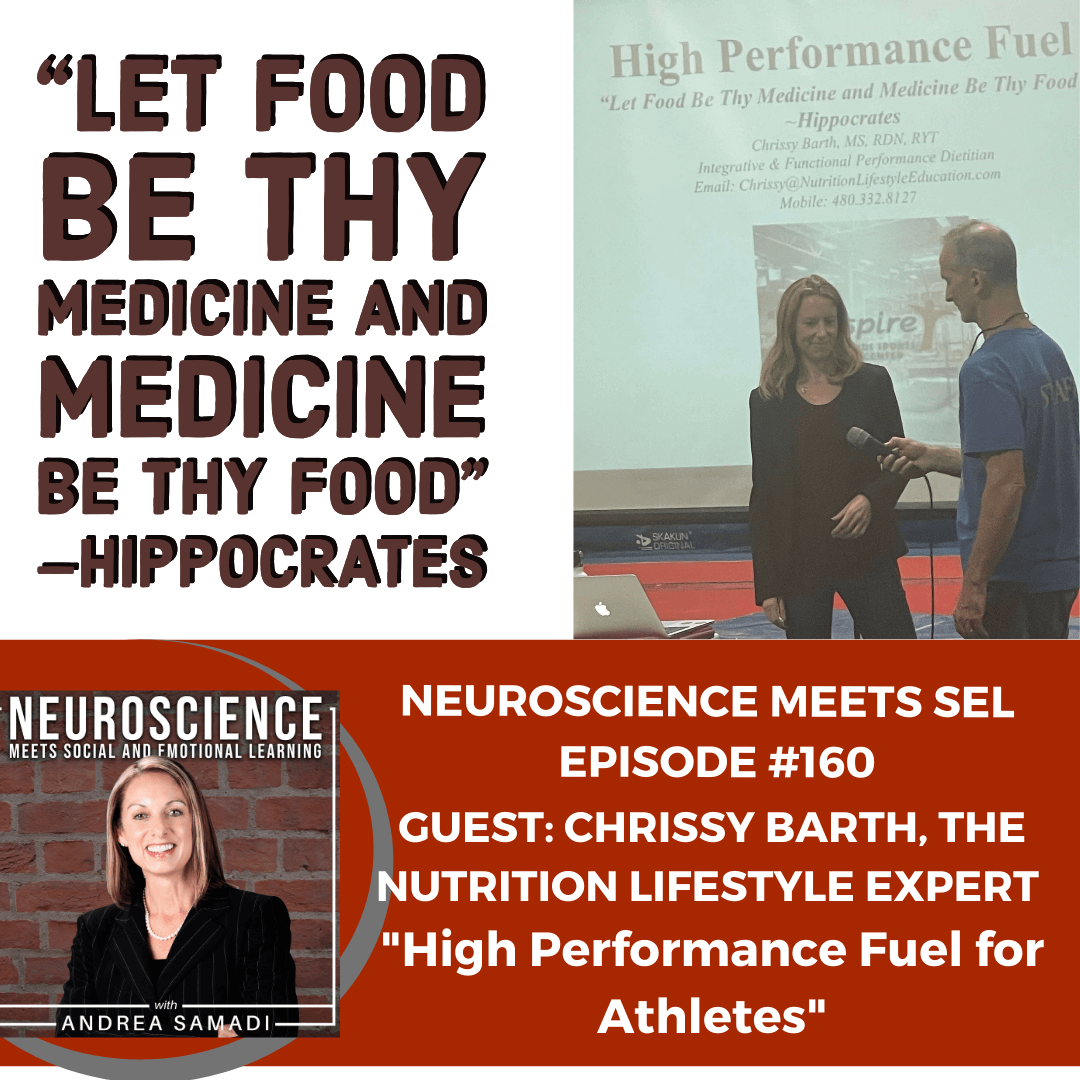
S6 Ep 160Functional Sports Registered Dietician Chrissy Barth on ”High Performance Fuel for Athletes”
Welcome back to the Neuroscience Meets Social and Emotional Learning Podcast for EPISODE #160 with Chrissy Barth, MS, RDN, RYT, an integrative and functional sports registered dietician and mind-body expert in the field of nutrition who is passionate about teaching others about optimal health and performance by taking the confusion out of nutrition. Episode website. Watch this interview on YouTube here. Learn more about Chrissy Barth https://livebreathenutrition.com/ Past Neuroscience Meets Social and Emotional Learning Podcast Episodes https://www.achieveit360.com/episodes/ I'm Andrea Samadi, author, and educator from Toronto, Canada, now in Arizona, and like many of our listeners, have been fascinated with learning and understanding the science behind high performance strategies in our schools, our sports, and workplace environments with ideas that we can all use, understand and implement immediately. I first met Chrissy Barth a couple of weeks ago, when she was asked to speak at our daughter’s gym, to help a team of aspiring gymnasts, improve their nutrition, and be sure they are fueling their bodies efficiently. I was blown away with her presentation, as I always have in the back of my head, what else can I learn to help my family and others when it comes to the Top 5 Health Staples that we have been talking about on this podcast, so I immediately asked Chrissy to join us. A bit more about Chrissy—she is the founder and CEO of Live Breathe Nutrition, LLC and Nutrition Lifestyle Education – nutrition coaching and consulting practices in Phoenix, Arizona where she serves as a nutrition consultant to sports teams, spas, behavioral health programs, medical and training facilities, corporations, and local and national media outlets serving as a media spokesperson. Chrissy is also a Lecturer at Arizona State University where she teaches sports nutrition, complementary health care, human nutrition and entrepreneurship and serves as a mentor to many aspiring future RDs. Chrissy has received many awards but the single highest mark of achievement as a dietitian she has received recognition as Arizona’s Young Dietitian of the Year. Chrissy enjoys giving back to her community and volunteers her time educating youth athletes on the benefits of sports nutrition. Let’s meet Chrissy Barth and sharpen our saw with regards to high performance fuel! Welcome Chrissy! Thank you so much for speaking with me today—I know it’s busy times with back to school and sports in full swing. Intro Q: So I picked up in your presentation the other Friday night where we first met that you worked in MLB. Did you consult with the AZ Diamondbacks or was it another team? I wonder, besides the comment you made about all the Red Bull drinks on the bench, what did you learn from working with a pro sports team? Q1: I picked up so much from your “High Performance Fuel Presentation” and wanted to give our listeners an overview of this presentation, since this is one of the Top 5 health staples that we are focused on with the podcast. And who doesn’t want to learn the tips you would offer to a pro sports team! Can you share what you think are the 6 Keys to Optimal Performance and for those who have athletes in their home, what do you think is crucial for the athlete to be aware of with regards to using food as fuel? Q2: This next question is powerful because you know you can learn something and what’s the point if you don’t implement it in your life to reap the rewards. This next question is where my 2 girls (ages 11 and 9) who were in your presentation the other night, payed attention and implemented what you taught them. I was so proud of them, because nutrition is an area that we have some weaknesses in. Can you break down what should be on an athlete’s plate? What was powerful about what you taught us was that now, on training days, my girls show me their meal plates and break down what you suggested they eat (grains/carbs vs fruits/veggies vs le
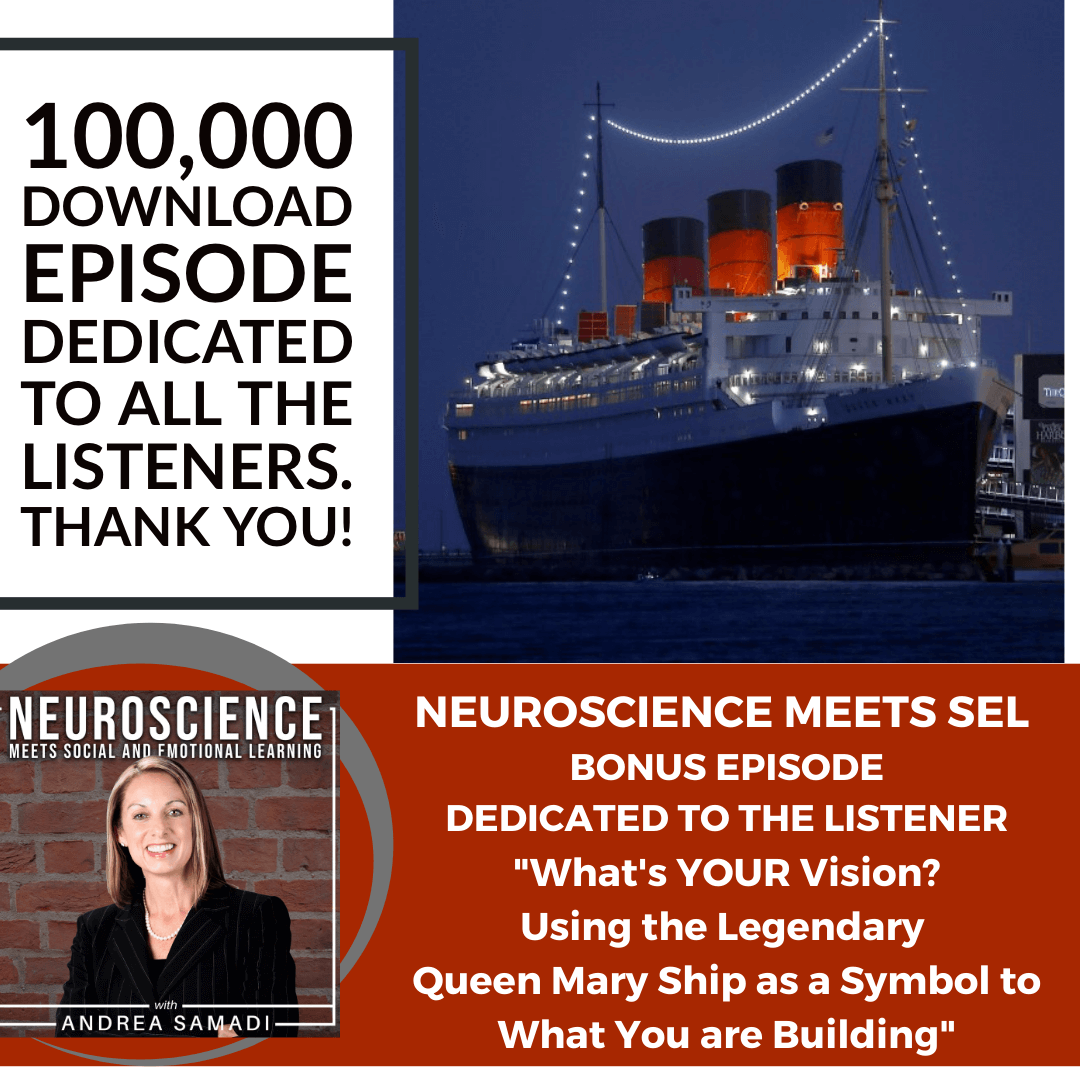
100,000 Download Episode Dedicated to Listeners ”What‘s Your Vision? Using the Queen Mary Ship as a Symbol to What you Are Building”
bonusWelcome back, to a BONUS Neuroscience Meets Social and Emotional Learning episode that I want to dedicate to YOU, the listener. It took this podcast a bit over 2 years to hit the 100k download milestone, and like any goal we have (whether a sales goal or something you want to do, it might seem so far off, you wonder how you’ll ever get there). If you are reading these notes on iTunes, click here to see all images. In February of this year, when we hit the 50k mark, it wasn’t hard to project the download numbers and guess when we would hit this milestone, but it still seemed like a moonshot goal, difficult to imagine, and August (when we projected, we would hit this goal) seemed so far away. Do you know what I mean? Do you have something you are working on where the gap from you are now and where you are going seems like an impossible goal? Even when you have the belief? Even when the evidence is there? I could hear how the episodes were helping people around the world thanks to the messages you sent me, but a part of me had just an ounce of disbelief, and I thought “is this really happening?” wondering if the momentum would continue to build. But the numbers never lie. They kept going up, and each month, we would surpass our monthly goal target. This weekend, while away with the family in Long Beach, CA, I look out of the window and can see the Legendary Queen Mary Ship[i] in the port as I watch our statistics graph project upwards (see image in the show notes) as we break records with our monthly downloads since launching, and surpass the 100k download mark, with the next milestone on our list to hit 1 million downloads which seems much more difficult but yet not impossible as we break this down into smaller targets. The Queen Mary ship is a symbolic metaphor to look at this weekend as “This iconic ship is now a floating museum, and tourist attraction.”[ii] Sadly, the hotel is currently closed but my husband had an opportunity to stay on the ship on one of his work trips, and he took me on a tour on FaceTime, where I asked him to show me all of the rooms that had mystery and intrigue surrounding them. If you are like me, and love a good ghost story, look up the history of The Queen Mary that was named one of the “Top 10 most haunted places on earth”[iii] and look up the story of Stateroom 340B. The scariest thing we noticed was that there was no room 340B. Where it should have been, it was boarded up and no longer accessible for the public, unless things have changed, but we might not ever know this, as we mentioned this spooky hotel is currently closed to the public due to COVID-19. The Queen Mary's Stateroom 340B was boarded up. The Queen Mary Hotel Rooms, just no 340B Stateroom. Andrea Samadi standing in front of the Queen Mary in Long Beach, CA. This retired British ocean liner sailed on the North Atlantic Ocean from 1936 to 1967 from Southampton, a port city on England’s south coast, just 2 hours from where I lived in England before my parents immigrated to Canada. On the Queen Mary Ship’s website, I saw a quote written by King George V that made me think about anything new that goes out into the world. When you’re create something out of nothing, like The Queen Mary before it was named, was known only as “Hull #534”[iv] which was the yard number where it was being built. Whatever it is that you are creating, the hope is that it makes an impact within your local community, rippling that impact throughout your state, country, nation, and eventually throughout the world. Listen to this quote and think about whatever it is that you are creating and I hope it energizes you, like it did for me. "Today we come to the happy task of sending on her way the stateliest ship now in being. It has been the nation’s will that she should be completed, and today we can send her forth no longer a number on the books, but a ship with a name in the world, alive with beauty, energy and strength! May her life among great
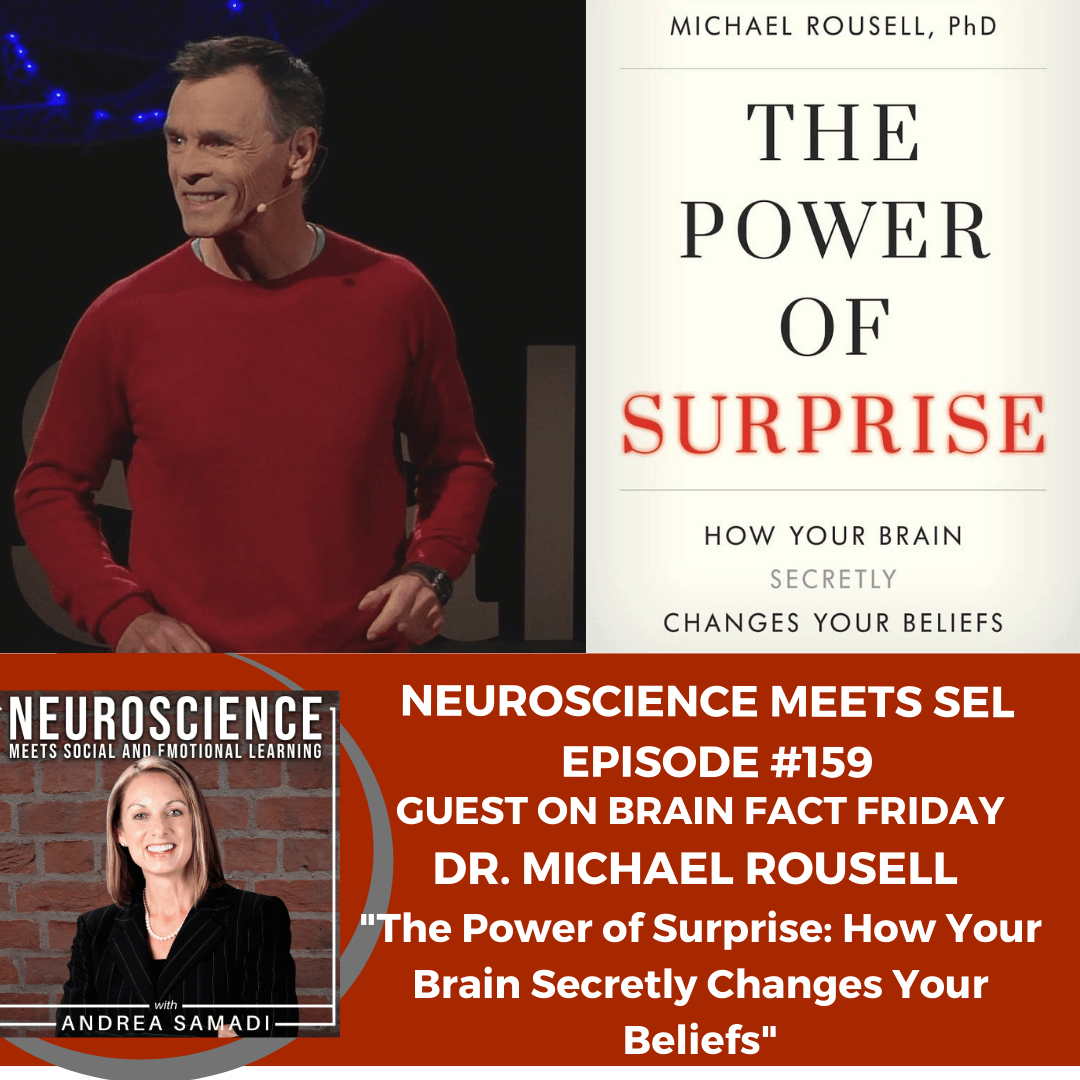
S6 Ep 159Dr. Michael Rousell on ”The Power of Surprise: How Your Brain Secretly Changes Your Beliefs”
Welcome back to the Neuroscience Meets Social and Emotional Learning Podcast for EPISODE #159 with Dr. Michael A. Rousell, PhD[i] a teacher, psychologist, and professor emeritus at Southern Oregon University who has studied how random events transform us. After studying formative events, which are moments that define us, or strongly influence us, for over three decades, Michael Rousell discovered that most of them took place during a spark of surprise and serve as a mechanism to instantly change our beliefs. Watch the interview on YouTube here. Learn more about Michael Rousell and The Power of Surprise Book (coming out Sept.15) I'm Andrea Samadi, author, and educator from Toronto, Canada, now in Arizona, and like many of our listeners, have been fascinated with learning and understanding the science behind high performance strategies in our schools, our sports, and workplace environments with ideas that we can all use, understand and implement immediately. In today’s episode, we will speak with Michael Rousell about his new book, The Power of Surprise: How Your Brain Secretly Changes Your Beliefs.[ii] Michael will show us how surprising events produce invisible influence because they open a window to spontaneous belief change with no warning or conscious awareness. You’ll see how a seemingly minor feature of surprise can be devised to strategically enrich someone’s life (personally or in the workplace) and create positive mindsets, for students or employees while maximizing your influence for those in leadership roles. You can dive deeper into The Power of Surprise by watching Michael’s TED TALK.[iii] 30% DISCOUNT ON The Power of Surprise BOOK https://rowman.com/ use CODE RLFANDF30 (by Sept. 30, 2021) Here’s what people are saying about Michael Rousell’s new book: “Fascinating read chock full of lots of truly novel information and ideas. A must-read for anyone interested in enriching their lives and finding new ways to expand their mind.”—Andrew Newberg, MD, best-selling author of Why We Believe What We Believe. “A fascinating book. The Power of Surprise shows what most of us miss about moments that change us.”—Jonah Berger, New York Times best-selling author of 3 Books, The Catalyst, Contagious, and Invisible Influence In today’s episode you will learn: What happens in the brain when we experience surprise? Why random events transform us, and how they secretly change our beliefs. How to use this understanding of surprise at the brain level to enrich/transform someone else’s life dramatically and instantly (in the workplace or classroom environment). As you are listening to this episode I encourage you to think about where surprise has shown up in your life. Has someone ever said something to you that caught your attention, and made you think? What did you do with this new information? Did you use it? Did that moment change or transform you in some way, like Jonah Berger’s testimonial offered or did you just dismiss it, never to think about it again? And finally, have you ever wondered “what just happened there?” I hope that we can dive a bit deeper and see if we can uncover some meaning behind the element of surprise in your life and offer you a framework to intentionally impact those around you, on a deeper level, with the Power of Surprise. Let’s meet Michael Rousell. Welcome Michael, it’s wonderful to see you again--thank you so much for speaking with me today. We set this interview up months ago, and August seemed so far away at the time! Doesn’t time fly! Q1: I know that if we all think about it, we can come up with a time in our life where we experienced a surprise that had a profound impact on us, but most of us don’t think that deeply about something like this. We plan surprise parties, love surprise gifts, but what makes a surprise so special? Q2: What drew your attention to study the impact that surprise has on someone’s life and belief system? Was there an experience that surprised and chan
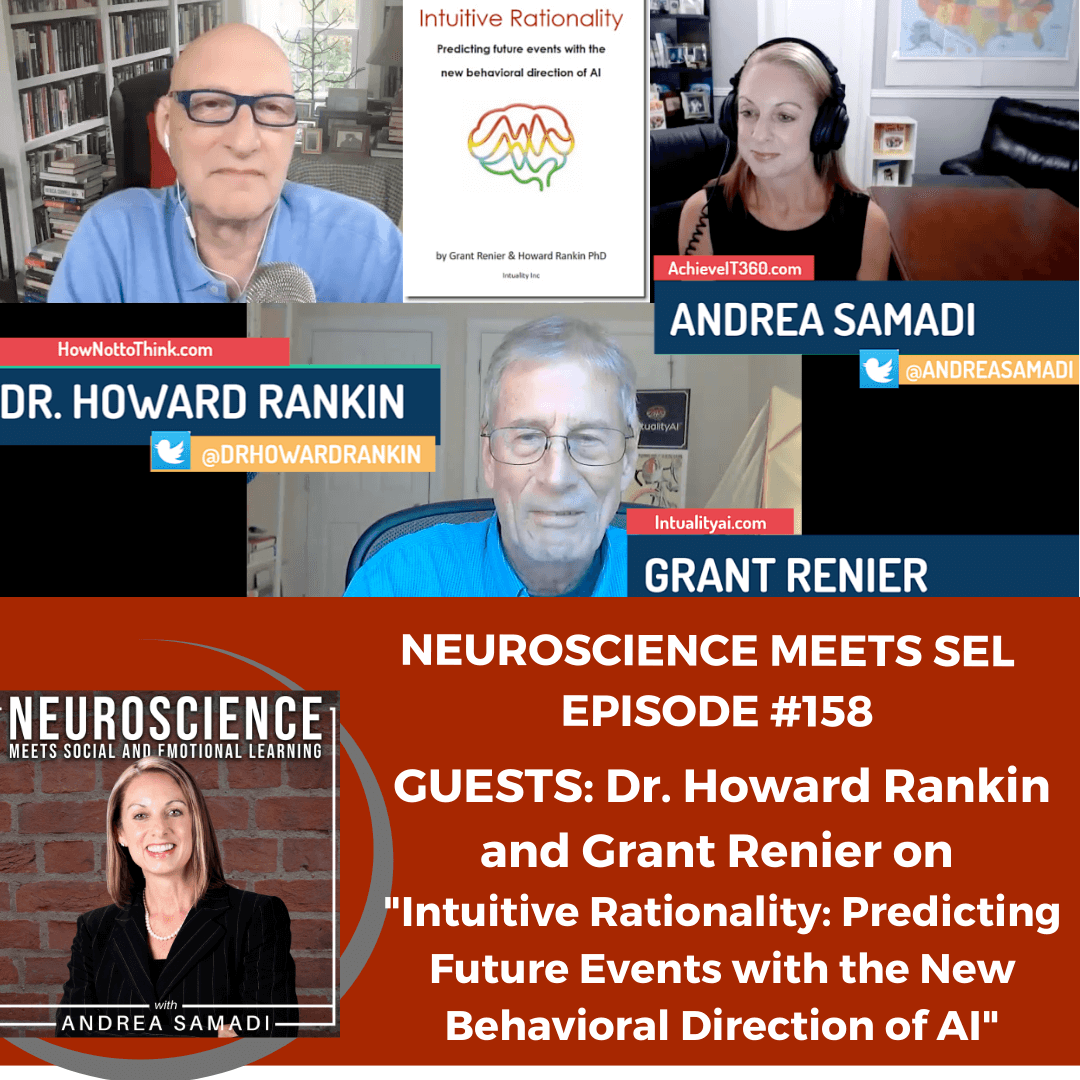
S6 Ep 158Dr. Howard Rankin and Grant Renier on ”Intuitive Rationality: Predicting Future Events with the New Behavioral Direction of AI”
Welcome back to the Neuroscience Meets Social and Emotional Learning Podcast for EPISODE #158 with a return of our popular guest, expert in psychology, cognitive neuroscience and neurotechnology, Dr. Howard Rankin from episodes #146[i] and #152[ii] with Grant Renier, who started his venture into ‘Intuitive Rationality’[iii] 30 years before Nobel Prize winner Daniel Kahneman published his groundbreaking book, Thinking, Fast and Slow[iv] creating a company that uses Intuitive General Intelligence (a knock off term like Artificial Intelligence) to predict near and future events, while taking into account the fundamentals of human behavior. So basically, he has created a predictive technology that can peer into the future of sports predictions, health and medicine. Watch the interview on YouTube here. Learn more about Grant Renier and Dr. Howard Rankin's artificial intelligence system https://intualityai.com/ See past episodes here https://www.achieveit360.com/episodes/ In Today's Episode, you will learn:✔︎ How to Improve Our Strategic Decision-Making Process with the Most Common Cognitive Biases in Mind. ✔︎ How Grant's AI System (that can be used by anyone) can predict sports wins, medicine and financial markets. ✔︎ How Howard and Grant wrote their book, Intuitive Rationality to explain the future of decision-making, through the lens of Artificial Intelligence. I'm Andrea Samadi, author, and educator from Toronto, Canada, now in Arizona, and like many of our listeners, have been fascinated with learning and understanding the science behind high performance strategies in our schools, our sports, and workplace environments with ideas that we can all use, understand and implement immediately. Dr. Rankin and Grant Renier will discuss their new book, Intuitive Rationality, that brings to light the fact that humans are not entirely rational but instead are influenced by several factors in arriving at decisions, like subconscious and environmental processes, and a need for emotional comfort and ideological consistency. These are “heuristics” which are defined as “mental shortcuts” designed to reduce the energy involved in critical thinking and complex processing, showing that pure rationality is almost never practical or possible for human beings and that even the most seemingly rational conclusions are at best probabilities based on the currently known data, which would almost certainly change over time. While these notions are not new, they have appeared in a new context, the 21st century where technology is prevalent and social connection has never been greater. These contemporary processes mean that the various ways that people think have never been more important. Understanding cognitive biases is now critical for anyone in being more aware and efficient in not just their own thinking but also that of others. I know that local police departments now train their employees on cognitive bias, so officers are aware of how their thinking impacts their decision-making on the job, and cognitive bias is an important concept for educators to think about in the classroom, as well in any workplace environment for that matter. Which biases and heuristics are programmed into Intuitive Rationality and how are they incorporated? This new book and our interview will answer these questions, as well as demonstrating the proven success of such a system that is a new direction in artificial intelligence logic. Grant and Howard will introduce this fascinating and paradoxical[v] connection between Intuition and Rationality to help us better understand the strategic decision-making process, to understand how and why we make the decisions that we do, how our world is defined by them, and show how this new approach to artificial intelligence can shift its development to a more human behavior-based logic, leading to a new field of AI-Intuitive General Intelligence. I like the sounds of this! Who doesn’t want to figure out new ways to impro
S6 Ep 157Brain Fact Friday ”Overcoming Digital Addiction Using Neuroscience”
Welcome back to the Neuroscience Meets Social and Emotional Learning Podcast for Brain Fact Friday and episode #157 on a topic that I think we should be aware of: Digital Addictions: Do You Know What’s Happening to Your Brain When You are Using Certain Apps on Your Smartphone, or Using Your Smartphone at All? EXCITING UPDATE: Stay tuned (early September) for an exclusive interview with Dr. Anna Lembke, Professor and Medical Director of Addiction Medicine, Stanford University School of Medicine who inspired this episode. I'm Andrea Samadi, author, and educator from Toronto, Canada, now in Arizona, and like many of our listeners, have been fascinated with learning and understanding the science behind high performance strategies in our schools, our sports, and workplace environments with ideas that we can all use, understand and implement immediately. This week’s Brain Fact Friday kind of snuck its way into my schedule, as I wasn’t planning on writing this topic and think there are many other podcasts that cover the subject of addiction[i] more thoroughly than I ever could, but it all started last Friday night when I was out at dinner with my husband and our two friends that we met on the hiking trails, Scott and Ruth. Scott, a business consultant who travels for his work, was home for a change, so we met up at a local restaurant and chatted about life, and what was on our minds that day. The conversation took a turn towards our phones, that we never have out at the table, and social media, and how addictive some of the apps are for the human brain. Scott mentioned he rarely uses social media, and I think I said something along the lines of “That’s really smart” remembering the Netflix Documentary Social Dilemma[ii] that scared the living daylights out of me. I wrote this down (on my phone) while watching the movie that “Magicians were like the first neuroscientists” What do magicians and neuroscientists have in common? Both are concerned with how the brain works. In magic, people try to fool the brain and in neuroscience, they are trying to understand the brain and this documentary will show you how the creators of technology apps have designed their software to trick or fool the human brain, just like magic, into addiction. When we can use an understanding of neuroscience, or how our brains work in these situations, we can take a powerful stance towards being in control, instead of being controlled by these apps. I was blown away when I heard one of the app developers in this movie, say that he had to develop a code to break his addiction to Reddit. I don’t use Reddit, but completely understood what he was saying. The next morning, we hit the hiking trails as usual, and we ran into Scott and Ruth along the way. Scott told me that he saw an article in the newspaper that might interest me about our conversation last night, and he had put it on the windshield of my car. “Sounds good” I said, forgetting what we were even talking about the night before, and then at the end of the hike, sure enough, he had pinned The Wall Street Journal on my windshield with an article called “Digital Addictions Are Drowning Us in Dopamine[iii]” by Dr. Anna Lembke (who also appeared in the Netflix Documentary Social Dilemma) with a headline that would catch anyone’s attention these days “Rising rates of depression and anxiety in wealthy countries like the US may be the results of our brains getting hooked on the neurotransmitter associated with pleasure.” I read the article written by Dr. Lembke, a psychiatrist and professor at Stanford University and saw that this article was an essay from her forthcoming book (coming out next week-August 24th) called Dopamine Nation: Finding Balance in the Age of Indulgence[iv] that was about a young patient of hers who came to her with debilitating anxiety and depression and what was interesting is that instead of prescribing him antidepressants like she would have done 20 years ago, she uncovered that
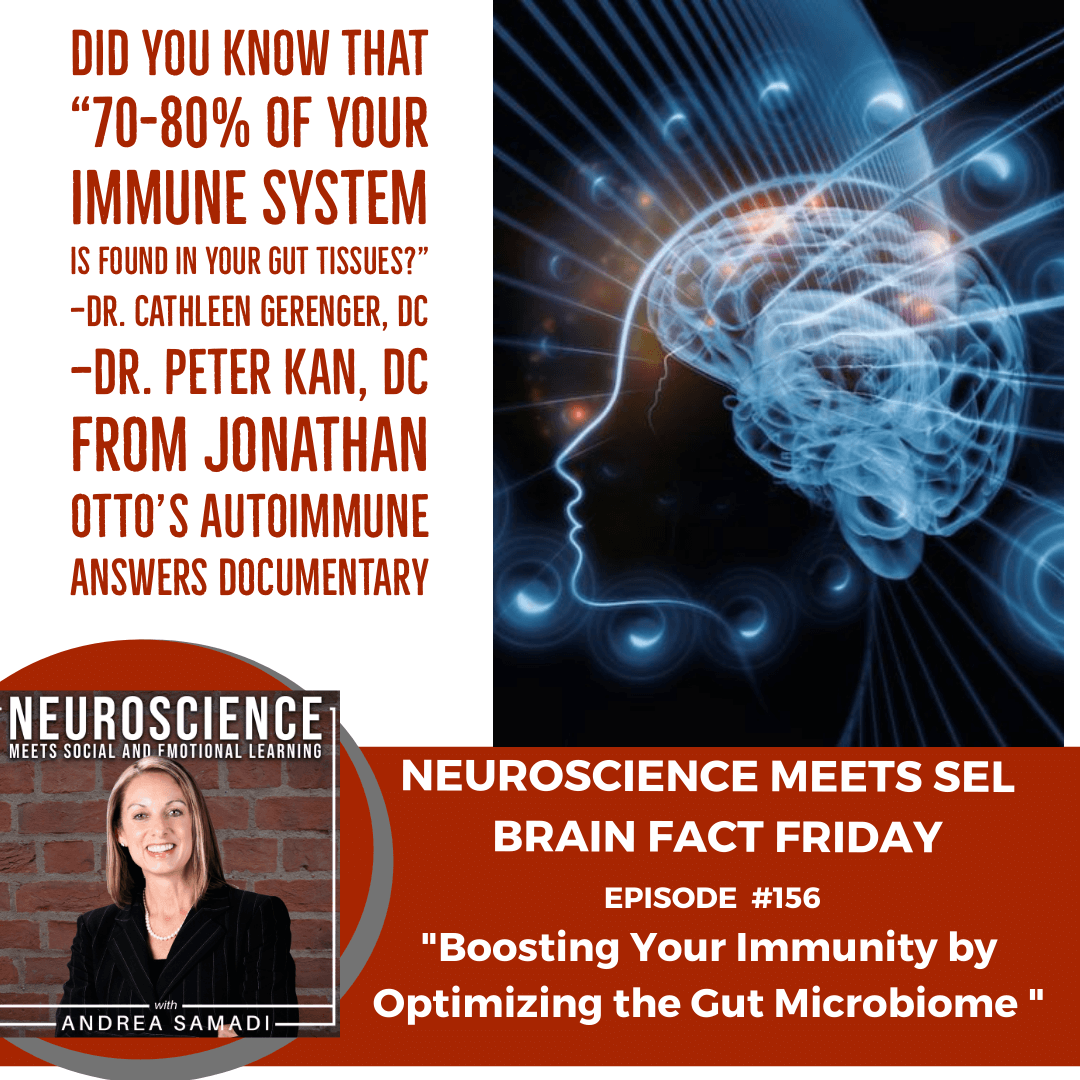
S6 Ep 156Brain Fact Friday on ”Boosting Your Immunity by Optimizing The Gut Microbiome”
Welcome back to the Neuroscience Meets Social and Emotional Learning Podcast for Brain Fact Friday and episode #156 that takes us back to the Top 5 health staples that we introduced at the end of 2020[i] when I was asked to speak at Podbean’s Wellness Week[ii] with Dr. Carolyn Leaf. I’ve listed a reminder to these 5 health staples in the show notes and think it’s important to revisit them using the principle of “spaced repetition” since “where our attention goes, energy flows” (James Redfield) with the idea that as we move in the direction of our goals this next year, that we do so with our physical and mental health in mind. I'm Andrea Samadi, author, and educator from Toronto, Canada, now in Arizona, and like many of our listeners, have been fascinated with learning and understanding the science behind high performance strategies in our schools, our sports, and workplace environments with ideas that we can all use, understand and implement immediately. Medical Disclaimer: Just a reminder—I would consider myself a researcher, sharing preventative and supplemental ideas and strategies related to the most current research on the brain, health and wellness education. In addition to studying directly with Mark Robert Waldman, a leading neuroscience researcher and expert on communication learning and the brain, I spend my evenings, weekends and spare time making connections with our past speakers, so that I can share these ideas to help bring more awareness to the advancements made in this fast moving field. Always seek the advice of your physician or qualified healthcare provider with any questions you may have about your health and remember that you should never disregard medical advice or delay seeking it because of something you learn through this podcast. Back to our episode—You may have noticed the shift towards health and wellbeing at the end of 2020 as we were a good year into the Pandemic, and who wasn’t looking for ways to improve their mental and physical health to improve cognition, productivity, and results. When I look at the top 5 health staples, I know that some of them I can put a check next to, and say “making progress here” and some areas I know I have completely forgotten about, and if these 5 health staples are important for future brain health, mental health and Alzheimer’s prevention, I know it’s important to keep learning as much as possible to further optimize these areas. As I am researching and learning, I will share anything important and relevant on our future Brain Fact Friday episodes. This week I wanted to focus on Health Staple #4 “Optimizing our Microbiome” because I still have questions myself about best practices in this area and making a stronger case for the gut-brain connection as we figure out the best ways to fix, repair and rebuild our body so that we can be the best possible versions of ourselves. To do this, I wanted to share some key findings from Jonathan Otto’s recent documentary Autoimmune Answers[iii] with some ideas that he brings to light to help everyone understand that strengthening our immune system is the key to disease prevention and health, and how understanding Autoimmune Diseases (like Rheumatoid Arthritis, Lupus, Inflammatory Bowel Disease, Fibromyalgia, Multiple Sclerosis or Type 1 Diabetes) all begins with an understanding of the gut-brain connection. We all know the toll that the Pandemic took on our mental health, and I was reminded today with a post on Instagram from Amen Clinics[iv] that “suicide hotlines have seen a significant increase in calls due to (the) Coronavirus” and that “we must continue navigating the challenges brought about by the COVID-19 pandemic.” I think back to my interview with Dr. Carolyn Leaf[v] who I hosted Podbean’s Wellness week with last December, and her most recent book that we covered on a bonus episode this past March reminds us that we must “Clean Up Our Mental Mess” since “unmanaged toxic stress puts our body into low-
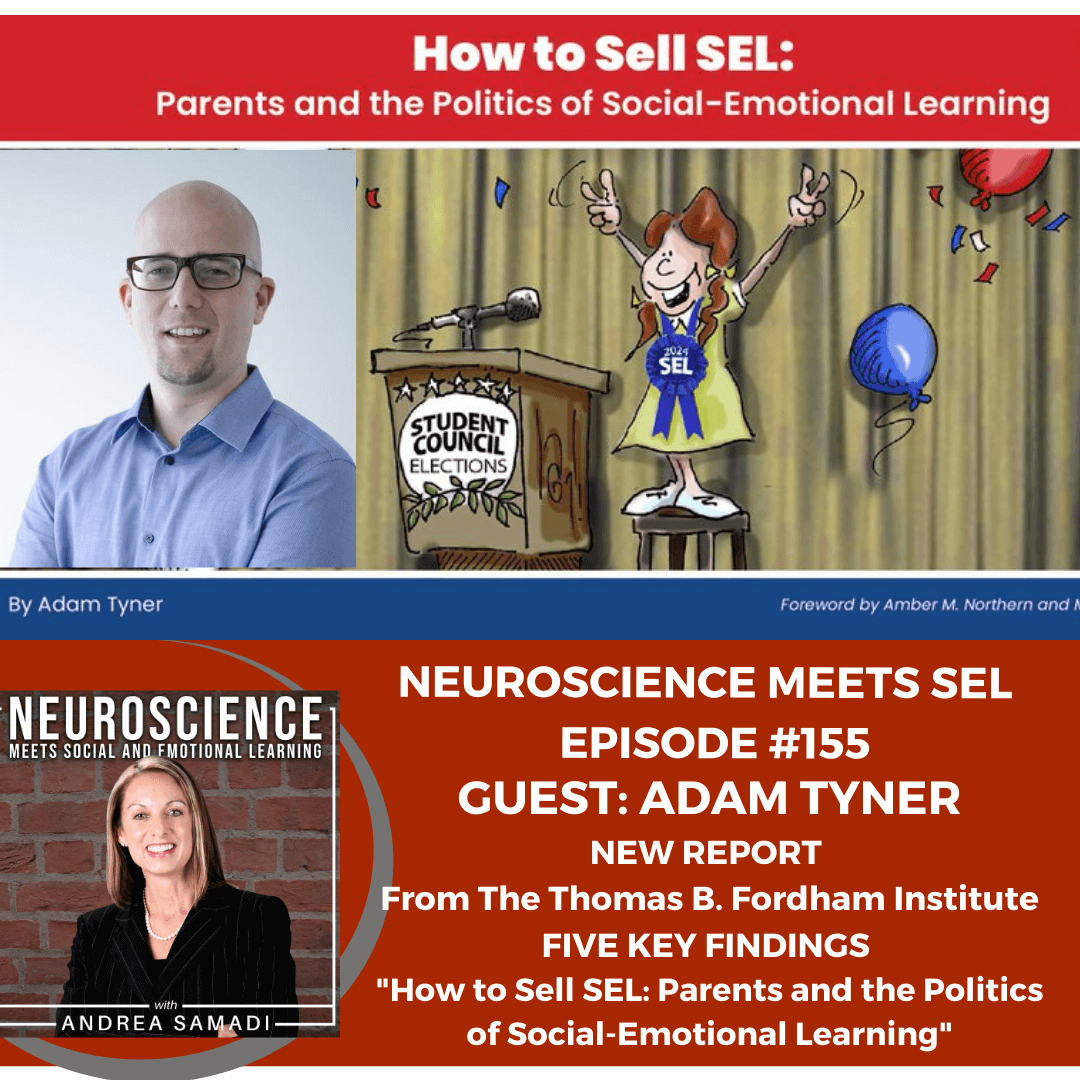
S6 Ep 155NEW REPORT "How to Sell SEL: Parents and the Politics of Social-Emotional Learning" by Adam Tyner, The Fordham Institute
Welcome back to the Neuroscience Meets Social and Emotional Learning Podcast for episode #155 with Adam Tyner from the Thomas Fordham Institute[i] (an organization that promotes educational excellence for every child in America via quality research, analysis, and commentary) on his newly released report How to Sell SEL: Parents and the Politics of Social and Emotional Learning. Watch this interview on YouTube here https://youtu.be/BWe04ByXOpk Access the Online Report here https://sel.fordhaminstitute.org/ Access past episodes here https://www.achieveit360.com/episodes/ On this episode, you will learn: The TOP 5 Findings from Adam Tyner's NEW REPORT "Parents and the Politics of Social-Emotional Learning" I'm Andrea Samadi, author, and educator from Toronto, Canada, now in Arizona, and like many of our listeners, have been fascinated with learning and understanding the science behind high performance strategies in our schools, sports, and workplace environments with ideas that we can all use, understand and implement immediately. We do this by covering the science-based evidence behind social and emotional learning (for schools) and emotional intelligence training (in the workplace). Our podcast provides tools, resources and ideas for parents, teachers, and employees to improve well-being, achievement and productivity using simple neuroscience as it relates to our cognitive (the skills our brain uses to think, read, remember, pay attention), social and interpersonal relationships (with ourselves and others) and emotional learning (where we recognize and manage our emotions, demonstrate empathy and cope with frustration and stress). This past week, as I was researching and learning new ideas for upcoming episodes, I saw a notification come through my phone from Twitter that caught my attention. It was from Victoria McDougald, from the Fordham Institute in Washington DC and she let me know that they were about to release a new report that explores how parents view SEL and how they want it taught in schools. We have all seen how the mental-health challenges imposed by the Covid-19 pandemic have made it more urgent to better support students’ social and emotional learning needs while also advancing their academic learning, so I put down what I was doing and wrote her back immediately. This topic is urgent, timely and important. Every day I see emails about trainings in our schools to support our students SEL needs and the challenges we have all faced are not going away, they are changing and persisting in a way I don’t think any of us imagined. The challenge that I have seen from the very beginning of watching SEL being implemented in schools across the US (starting in 2014 with just 8 States to our present day where all 50 States have some sort of SEL implementation plan) is that educators saw the importance of SEL, but didn’t know where to begin, they weren’t sure which program to use, how to integrate the SEL competencies into the curriculum. Following many of the early SEL webinars, I noticed this was a common theme. This is why we launched The Neuroscience Meets Social and Emotional Learning Podcast in June 2019 to gather ideas, strategies and best practices for those interested in learning more about this topic, with easy-to-understand implementation strategies and ideas for our schools and workplaces. The topics we cover on this podcast were going to be an Introduction to SEL Course with a well-known educational publisher, but when this direction changed, I decided to put this content out into the world, for free, to help support educators and those in the workplace. I had no idea that this podcast would gain a global following, going into 153 countries and approaching 100,000 downloads (over 8K downloads/month) as we noticed that educators and those in the workplace were looking for new ways to sharpen their saw—with these skills that are not new, but are newly important. If this is how educators were feeling
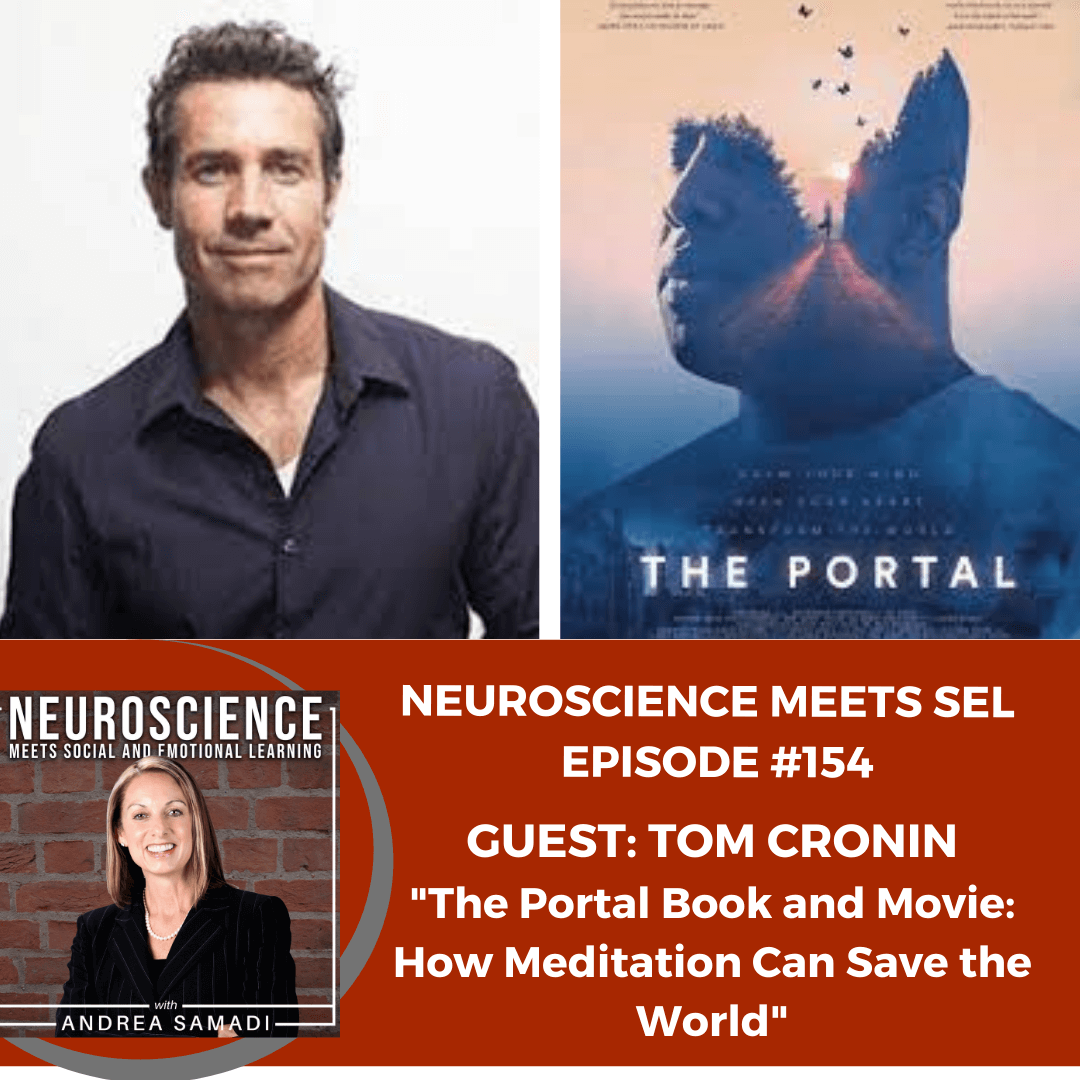
S6 Ep 154Author and Film Producer Tom Cronin on "The Portal Book and Movie: How Meditation Can Save The World"
Welcome back to the Neuroscience Meets Social and Emotional Learning Podcast for episode #154 with someone who travels globally presenting about something we all need to learn how to experience in today’s world--- author of 6 books and the co-creator of the Portal Film/book experience, where he teaches about the power in the stillness and the science behind the stillness—Tom Cronin, also known as The King of Calm.[i] Watch this interview on YouTube here https://youtu.be/veUZ-C5REl4 Learn more about Tom Cronin here https://www.tomcronin.com/ See past episodes of The Neuroscience Meets Social and Emotional Learning Podcast here https://www.achieveit360.com/episodes/ On this episode, you will learn: ✔︎ How Tom Cronin, from Australia, overcame a nervous breakdown by starting a meditation practice, inspiring him to share his story others with The Portal Film and Book. ✔︎ A Deep Dive into the Top 4 Meditation Styles (Concentration, Contemplation, Chanting and Transcendental). ✔︎ Tom’s thoughts on The Plane of Possibility and How to Create Something Out of Nothing. ✔︎ Why meditation is an important and timely topic to change the world during these high-stress and anxiety times. I'm Andrea Samadi, author, and educator from Toronto, Canada, now in Arizona, and like many of our listeners, have been fascinated with learning and understanding the science behind high performance strategies in our schools, sports, and workplace environments with ideas that we can all use, understand and implement immediately. Our guest this week, Tom Cronin[ii] spent 26 years in finance, as one of Sydney Australia’s leading bond and swap brokers. He discovered meditation in the early stages of his career when anxiety and chaos he was experiencing due to stress and poor lifestyle choices led him to a breakdown. He came across meditation, and it completely transformed his life—both personally and professionally. Today Tom is passionate about reducing stress and chaos in people’s lives and his mission is to inspire 7 billion people to meditate daily through his Stillness Project that aims to transform and teach people the power of stillness and calm through the power of deep meditation and coaching. His work in transformational leadership and cultivating inner peace takes him around the world as a speaker, presenting keynotes, hosting retreats and teaching. Tom has appeared on national TV, and featured in Vogue, Daily Telegraph, Sydney Morning Herald, Business Review and many other media outlets. When I first was introduced to Tom Cronin, and looked up his work with The Stillness Project, I knew he was someone I needed to speak with and immediately recognized how important and powerful his mission is. Especially in today’s times. We have featured some speakers on the podcast who have explained meditation, and how to begin, with episode #25[iii] with Mick Neustadt on “How Meditation and Mindfulness Changes Your Life” and episode #28[iv] with Dr. Daniel J Siegel took us a bit deeper with his episode on “Mindsight: The Basis for Social and Emotional Intelligence.” I’m excited to dive even deeper into the power of meditation, exploring what we can all expect with our practice, and where and how to begin, at a time when we could all use stillness, calm and peace in our lives. “When life is built on the stillness of being, it becomes an effortless flow.” –Tom Cronin Let’s meet Tom Cronin! Welcome Tom Cronin, thank you for meeting with me today—all the way from Australia! It’s incredible to speak directly with The King of Calm-just what I need today. INTRO: Tom, before we get to the questions to dive deeper into The Stillness Project, and your Movie and Book The Portal, can you share what even brought you to start looking at meditation in the first place? Especially since it’s been challenging times for many people all over the world, and times where stress is at an all-time high, along with anxiety and depression. Can you share what happened to you tha
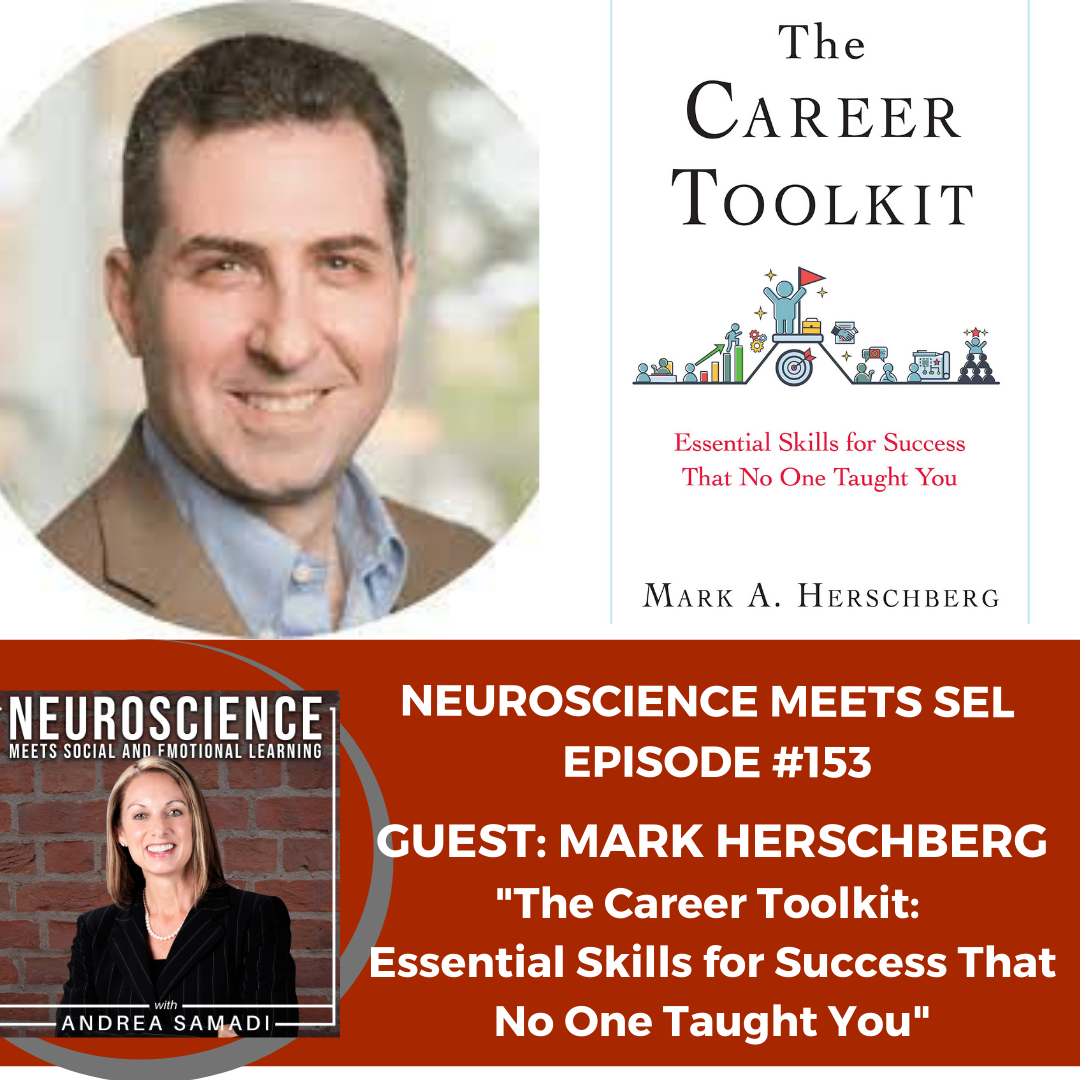
S6 Ep 153Mark Herschberg on "The Career Toolkit Book: Essential Skills for Success That No One Taught You"
Welcome back to the Neuroscience Meets Social and Emotional Learning Podcast for episode #153 with Mark Herschberg[i], the author of The Career Toolkit: Essential Skills for Success That No One Taught You. Watch this interview on YouTube here. https://youtu.be/ifPsPNT36WE Learn more about Mark Herschberg and his Career Toolkit Book here https://www.thecareertoolkitbook.com/ See past episodes here https://www.achieveit360.com/episodes/ I'm Andrea Samadi, author, and educator from Toronto, Canada, now in Arizona, and like many of our listeners, have been fascinated with learning and understanding the science behind high performance strategies in our schools, sports, and the workplace with ideas that we can all use, understand and implement immediately. Our guest for this week, Mark Herschberg, who has spent his career identifying and studying the skill gap that exists for what he calls firm skills, including networking, negotiating, communicating, leading, and career planning. We tend to think of many of these as situational skills, but Herschberg says they are really life skills — none of which are formally taught in school. We have been talking about these skills since the launch of this podcast 2 years ago. We call them social and emotional skills as they are known in our schools emotional intelligence skills in the workplace. I’m extremely interested in speaking to Mark about the gaps that he sees with these skills since a recent survey that I saw and mention often showed that 58% of employers say college graduates aren’t adequately prepared for today’s workforce, and those employers noted a particular gap in social and emotional skills. Students who learn to master these important skills will get ahead faster with less effort and frustration than those who lack these skills. We have spoken a lot about the social and interpersonal skills, emotional and cognitive skills where there is a clear gap on this podcast. These skills do translate into the workplace to help students prepare for life after high school, into college, career and beyond. Just to recap, there are five distinct components of Emotional Intelligence that are important in the workplace: Self-awareness: This is important in the workplace because you need to know yourself first before you can help others with your product or service. Self-regulation: There will be many times in the day where you will be tested and to be able to manage your emotions under pressure is very important. Internal (or intrinsic) motivation: What is motivating you to get up and serve each day? Empathy: is an important skill to have to connect with others. You must be able to see the world through someone else’s eyes. Social skills: are important from ordering your lunch in a restaurant, to picking up your rental car and dealing with the front desk employees in the hotel you are staying at. If students do not learn these skills at an early age, they will struggle with their life and future career. Whatever model or SEL competency a school uses, whether it’s the Casel 5 competencies[ii] that we have modelled our work after, or something similar that Renee Adams explained in EPISODE #151[iii] with the Goleman Emotional Intelligence Training Model, the idea is that we prepare our next generation of students to thrive in this ever-changing world and that we as adults are modelling these skills. Before we meet Mark, I want to share a bit more about the work he has been doing the past few decades, as there is always so much more to someone than meets the eye with the books they write, or their career path. Mark is the author of The Career Toolkit, Essential Skills for Success That No One Taught You. Educated at MIT, Mark has spent his career launching and fixing new ventures at startups, Fortune 500s, and academia. He’s developed new software languages, online marketplaces, new authentication systems, and tracked criminals and terrorists on the dark web. I must ask him something
S6 Ep 152Expert in Psychology, Cognitive Neuroscience and Neurotechnology, Howard Rankin Ph.D.Interviews Andrea Samadi
Welcome back to the Neuroscience Meets Social and Emotional Learning Podcast, episode #152 with a special episode with expert in psychology and cognitive neuroscience, Dr. Howard Rankin who will interview me for a change of pace. Watch the interview on YouTube here https://youtu.be/Sh7_HAGzkhQ See past episodes here https://www.achieveit360.com/episodes/ On this episode you will learn: ✔︎ A review of 3/6 Social and Emotional Learning Competencies ✔︎ Andrea’s Background and Where it All Began ✔︎ How She Started Working with Educational Neuroscience ✔︎ How Her Level Up Programs Were Chosen by AZ Department of Education ✔︎ How to Use an Understanding of the Brain to Impact Behavior ✔︎ How to Use Emotional Intelligence in the Workplace I'm Andrea Samadi, author and educator from Toronto, Canada, now in Arizona, and like many of our listeners, have been fascinated with learning and understanding the science behind high performance strategies in our schools, sports, and the workplace with ideas that we can all use, understand and implement immediately, for improved results. This week, with the 2021 Olympics[i] in full swing, some of the headlines have caught my attention, specifically the story of gymnast Simone Biles, since both of my girls are in competitive gymnastics, with a rigorous training schedule. Assistant Superintendent Greg Wolcott, from Chicago, who has appeared on our podcast twice so far with EPISODE #7[ii] on “Building Relationships in Today’s Classrooms” and again for EPISODE #64[iii] on “Making Connections with Neuroscience and Social and Emotional Learning” pointed out that Biles used "self-awareness, self-management and responsible decision-making to look after her personal well-being" proving that these skills are not just important, but crucial to develop in our children, for future success. As I was preparing to release my interview with Dr. Rankin, I thought it would be important to review these 3 Social and Emotional Learning Competencies and reflect on them to see where we are with them in our personal and professional life. These competencies are the backbone to what we cover on this podcast, with our goals to connect these competencies to the most current neuroscience research, hence the name of our podcast, “Neuroscience Meets Social and Emotional Learning.” Review of Three Important Social and Emotional Learning Competencies: If we think about how these competencies played out for Simone Biles, I’m sure we could all agree that we use these important competencies on a day-to-day basis. It’s not just our students who must think about making responsible decisions, it’s all of us, every day, as we juggle life’s many obstacles like our work, family and all of the changes that come our way in our personal and professional lives. For today’s episode, we will look at the three competencies that Greg Wolcott pointed out she used and see if we can think about them in our daily life. Are you self-aware? How about your self-management? Are you in control of your emotions and behaviors? Do you make responsible decisions? SELF-AWARENESS: We released this episode #2[iv] in July 2019 and this episode gained immediate interest since to “know thyself” is the most substantial achievement we can have in our lifetime. “The major value in life is not what you get. It’s what you become.” (Jim Rohn, American author, speaker and entrepreneur). So, let’s take a deeper look. What is self-awareness, why do we need it, and how can we get more of it? Self-awareness is “the ability to see ourselves clearly, understand who we are, how others see us and how we fit into the world.”[v] When we have self-awareness, we have a power within ourselves because there is a comfort in knowing who exactly we are and where we fit into the larger world around us. Research shows that “people who are more self-aware have stronger relationships, are more creative, competent are better communicators and perform better at work.” Do you kn
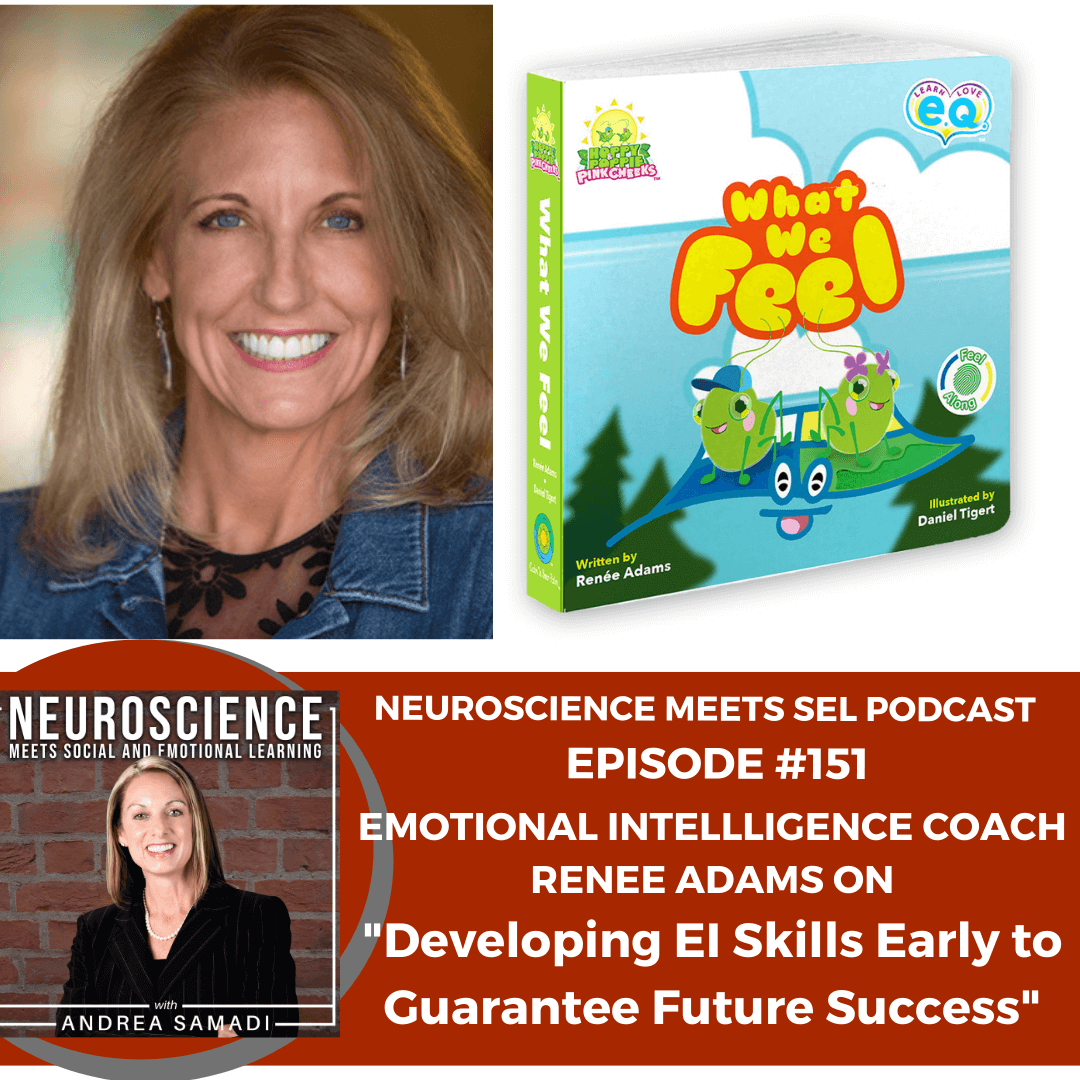
S6 Ep 151Goleman Certified Emotional Intelligence Coach Renee Adams on ”Developing EI Skills Early to Guarantee Future Success”
Welcome back to the Neuroscience Meets Social and Emotional Learning Podcast for episode #151 with certified Goleman Emotional Intelligence coach, Renée Adams. Watch the interview on YouTube.https://youtu.be/aavQGiAAXo8 Download 3 FREE EQ Guides from Renee's website FREE EQ Guides https://hoppypoppie.com/guide-sign-up/ See past episodes here https://www.achieveit360.com/episodes/ On this episode you will learn: ✔︎ Why Renee sees the importance of teaching EI to young children and their parents as critical work. ✔︎ What are the Emotional Intelligence Competencies that the Goleman Training focuses on. ✔︎ What's missing from today's corporate environments? ✔︎ EI strategies that parents can use immediately to reduce stress while at the same time supporting your child at home or in the classroom. Renée Adams[i] is a children’s book author, writing books that teach children and parents foundational Emotional Intelligence skills, including being able to identify and name their emotions. We have seen the importance of this skill that started with our interview #28[ii] with Dr. Daniel Siegel who talks about the importance of naming an emotion to tame it[iii] and then again with the Founding Director of Yale’s Center for Emotional Intelligence, Marc Brackett on episode #22[iv] with his book, Permission to Feel. I'm Andrea Samadi, author, and educator from Toronto, Canada, now in Arizona, and like many of our listeners, have been fascinated with learning and understanding the science behind high performance strategies in our schools, sports, and the workplace with ideas that we can all use, understand and implement immediately. When I was introduced to Renée Adams, I saw her background as a Certified Goleman Emotional Intelligence[v] coach, I immediately contacted her to see if I could pick her brain on many questions that I am asked myself in the area of Emotional Intelligence. Why not ask an expert when I have the chance. Let’s meet Renée Adams. Welcome Renée, thank you for coming on the podcast today to speak with me. Are you still located in Bolder, CO? I almost considered moving to CO from Toronto in the late 1990s, since it was the Columbine tragedy that caused me to move to the US back then. I picked AZ because I really struggled with the altitude in CO. Q1: I did watch some of your other podcasts to learn more about why you started this work centered around Emotional Intelligence, and I will link these episodes in the show notes, but did wonder at what point in your career did you see the importance of teaching Emotional Intelligence to children and parents? Where was the missing link? Q2: I cover 6 social and emotional competencies on this podcast (Mindset, Decision-Making, Self-Awareness, Social Awareness, Self-Regulated Learning/Self-Management, and Relationship Skills) as they closely mirror www.casel.org’s SEL competencies. Can you explain the competencies that were important in your Goleman Certification Program, and maybe how you would teach them to a parent or child? (Self-awareness, self-management, others awareness, relationship management). Q3: When I first launched this podcast, I interviewed my husband on episode #1 on “The Importance of Setting Up an SEL Program in Your School, or Emotional Intelligence Training Program in Your Workplace.”[vi] And it’s funny thinking about it now because he had just got home from traveling and I handed him a list of questions and said “Can you answer these and speak into the mic?” It was a memorable launch to the podcast. Why do you think it’s so important to teach these skills at an early age and what skills do you think are missing from today’s corporate environments? Q4: So growing up, we didn’t talk about our emotions in my home. If I ever cried at all, my Dad would yell at me because he hated to see emotion. And I’m the type that wears my emotions on my sleeve. I couldn’t hide them, not even when I knew I’d get a kick in the behind if I ever
S6 Ep 150Scott Flansburg, The Human Calculator on ”Math Hacks Anyone Can Learn To Transform Your Math Mindset”
Welcome back to the Neuroscience Meets Social and Emotional Learning Podcast for episode #150 with Scott Flansburg[i] who Regis Philbin called “The Human Calculator[ii]” because he can mentally count faster than a calculator. Watch this interview on YouTube here. https://youtu.be/aa8mbxvYqrc Learn more about Scott Flansburg's online programs here. https://scottflansburg.com/a/andrea See past episodes here. https://www.achieveit360.com/episodes/ On this episode you will learn:✔︎ How someone with incredible math abilities has started the National Counting Bee to share his talents with students around the country. ✔︎ 2 NEW WAYS to look at numeracy and math that will change your mindset forever. ✔︎ How Scott Flansburg got into the Guinness World Book of Records for his unique mathematical abilities and what his brain scans revealed about his brain. ✔︎ Scott's vision for the future and how he plans to change the way ALL 3rd graders approach math in the future. I'm Andrea Samadi, author, and educator from Toronto, Canada, now in Arizona, and like many of our listeners, have been fascinated with learning and understanding the science behind high performance strategies in our schools, sports, and the workplace with ideas that we can all use, understand and implement immediately. I do want to thank the listeners who have sent me messages through social media about how you are using these podcast episodes in your personal and professional lives. We are approaching our goal of hitting 200 episodes and 100,000 downloads and couldn’t do this without listeners, or high-quality guests. Back to this episode. After being introduced to Howard Berg[iii], who holds the Guinness World record for speed reading, I was introduced to Dave Farrow[iv], a two-time Guinness World Record holder for correctly memorizing and recalling the exact order of 59 decks of shuffled playing cards. I began to see that extraordinary results are possible, when regular people, like you and me, do certain things in a certain way. I look forward to sharing Scott Flansburg’s story, to see what strategies we can learn and implement to help us all improve our numeracy skills. Yes, he does hold the Guinness World Record for the fastest mental calculation after adding the same number to itself more times in 15 seconds, even faster than anyone could do with a calculator. I’ve heard of the importance of developing strong numeracy skills twice already, from past guests. On episode #138,[v] Professor and Canada Research Chair in Developmental Cognitive Neuroscience and Learning, Dr. Daniel Ansari, affirmed that research shows that students with weak numeracy skills are more likely to default on their mortgage payments in the future, and on episode #146[vi] Dr. Howard Rankin, an expert in Psychology and Cognitive Neuroscience who spoke on the topic of “How Not to Think” agreed that low numeracy skills are a noticeable problem in the US, and that many people have no idea on the concept of “compounding interest.” Let’s see what we can learn from Scott Flansburg. But first, here’s a bit more about him. Since about 1990 Scott Flansburg has regularly given lectures and presentations at schools. He has been a presenter at organizations such as NASA, IBM, The Smithsonian Institution, the National Council of Teachers of Mathematics, and the Mental Calculation World Cup. The latter described Flansburg as “more an auditory than a visual [mental] calculator”. One of Flansburg’s “personal missions” is to use education to elevate math confidence and self-esteem in adults and children. He says “Why has it become so socially acceptable to be bad at math?,” and reminds us that “If you were illiterate, you wouldn’t say that on TV, but you can say that you are bad at math. We have to change the attitude.” He believes students should become proficient with calculation methods rather than relying on table memorization. Scott is the creator of The Counting Bee™[vii], an annual STEM compet
S6 Ep 149Two-Time Guinness World Record Holder Dave Farrow on "Focus, Fatigue and Memory Hacks" for Students and the Workplace.
Welcome back to the Neuroscience Meets Social and Emotional Learning Podcast for episode #149 with Dave Farrow[i], a two-time Canadian Guinness World Record Holder for Most Decks of Playing Cards Memorized in a single sighting in 1996 and again in 2007 when he correctly memorized and recalled the exact order of 59 decks of shuffled playing cards—which is 3068 cards in total, exceeding his previous record of 52 decks (2704 cards). Watch the Interview on YouTube here. https://www.youtube.com/watch?v=rrxuvnCpI0c Learn more about Dave Farrow and his Memory Program https://farrowmemory.com/a/andrea See past episodes here https://www.achieveit360.com/episodes/ On this episode you will learn:✔︎ How Dave Farrow overcame his diagnosis of ADHD and Dyslexia to develop talents that would set him miles apart from the rest in his future.✔︎ The learning strategies that Dave Farrow used to overcome his areas of weakness and work 8x faster than the average person.✔︎ The secret behind how he memorized 59 decks of shuffled playing cards that got him into the Guinness World Book of Records for memory.✔︎ His strategy for memorizing 109 balloon colors (in 60 seconds) winning him the episode on FOX TV's SUPERHUMAN SHOW.✔︎ How Dave Farrow now wants to give back and help others develop SUPERHUMAN MEMORY Powers, Increase Focus and Reduce Brain Fatigue, so they can rise to the top of their career and life. I'm Andrea Samadi, author, and educator from Toronto, Canada, now in Arizona, and like many of our listeners, have been fascinated with learning and understanding the science behind high performance strategies in our schools, sports, and the workplace with ideas that we can all use, understand and implement immediately. I can’t tell you how excited I am to speak with fellow Canadian, Dave Farrow[ii] who wasn’t born with the gift of memory, he was diagnosed with ADHD and dyslexia as a child. To help him to do better at school, Dave created a memory system called “The Farrow Method” which is now a certifiable scientifically proven system for memory backed by a double-blind neuroscience study at McGill University In 2008 Dave was hired by Sony Corporation to live in a window on 5th Avenue in Manhattan and speed read on a Sony E-Reader for literacy in America. In 30 days, he read over 100 books and through his efforts, Sony gave 4.4 million E-Books to schools in America. Over 100 million people watched him in the window read for charity. As a memory expert, David has trained over 10,000 business professionals, students, managers and seminar attendees in memory programs offered in both Canada and the United States, with that number growing each day. Today Dave uses his media savvy and keen understanding of the brain in the public relations sector. He is the founder and CEO of FarrowPR a full-service public relations and marketing firm in Buffalo NY. With his ability to speed read and memorize large amounts of information, Dave is an expert in Nanotechnology and microfluidics and is currently developing a prototype for a robotic moving mannequin with “Start Up New York.” Dave has been a featured guest expert on over 2000 interviews in the media including, The Today Show, Live with Regis and Kelly, Steve Harvey, Discovery Channel and many others. I was introduced to Dave Farrow after episode #145 with Howard Berg[iii] who holds the Guinness World record for speed reading, and immediately started to make connections with his work, and past interviews and episodes. I’m always looking at ways to improve memory, especially after my brain scan at Amen Clinics[iv] showed that I was weak in the area of recall memory or recalling a list of random words and Dr. Creado who did my brain scan evaluation reminded me that “we can change our brain and memory with practice, but we must first of all believe it’s possible.” After seeing how easy it was to remember a list of 10 items with my interview with Howard Berg, I’m dying to learn more from Dave Farrow, a
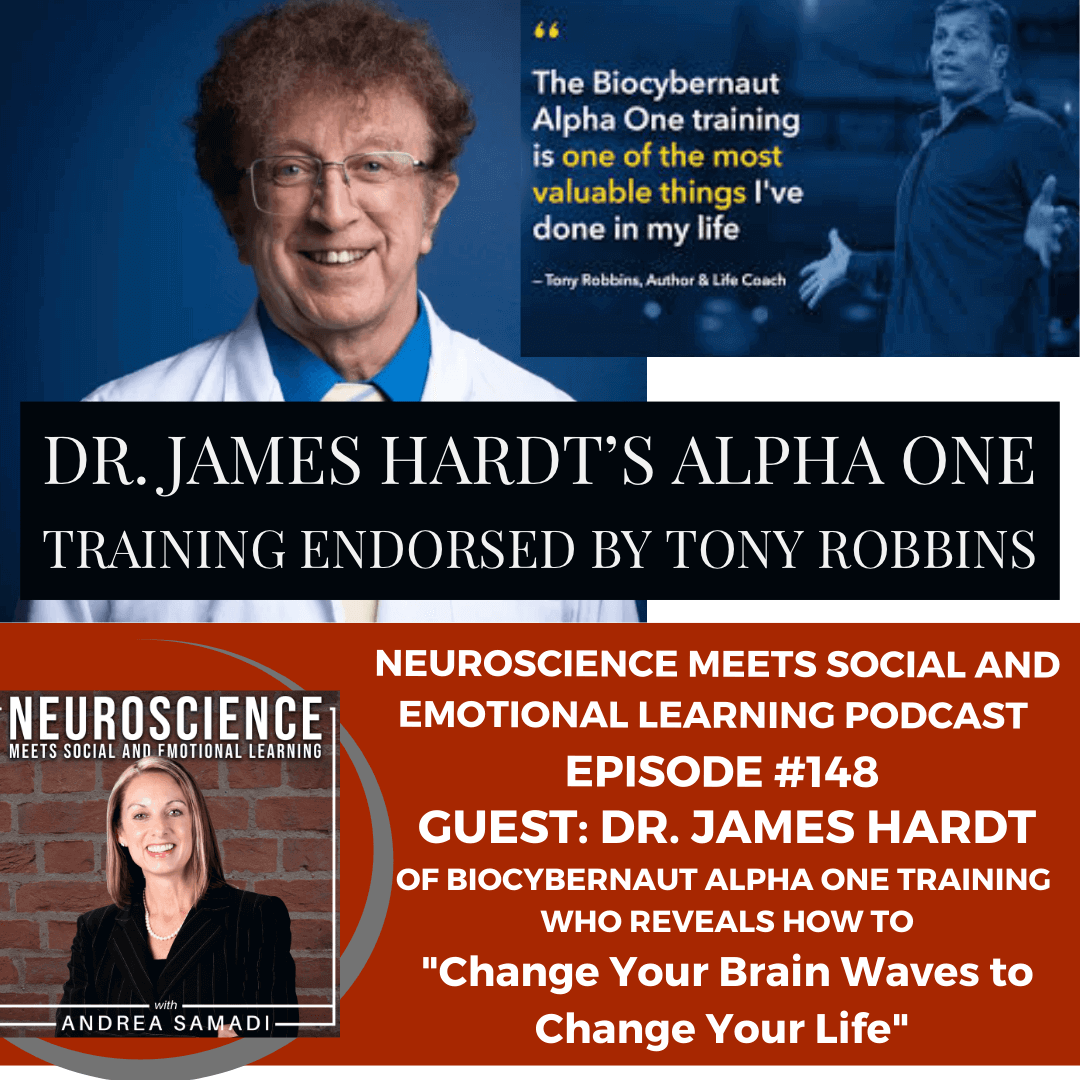
S6 Ep 148Dr. James Hardt of Biocybernaut Alpha Training on "Change Your Brain Waves to Change Your Life"
Welcome back to the Neuroscience Meets Social and Emotional Learning Podcast for episode #148 that I’m hoping will expand your thinking, like it did mine, with our next guest, who has worked with Tony Robbins, leaders of Microsoft and IBM and other high-powered executives to elevate states of consciousness, results and high levels of productivity in elite athletes, to regular people, just like you and me. Watch the interview on YouTube here. Learn more about Dr. Hardt and his Biocybernaut Alpha One Training here https://www.biocybernaut.com/ See past episodes here https://www.achieveit360.com/episodes/ I'm Andrea Samadi, author, and educator from Toronto, Canada, now in Arizona, and like many of our listeners, have been fascinated with learning and understanding the science behind high performance strategies in our schools, sports, and the workplace with ideas that we can all use, understand and implement immediately. This week’s guest, Dr. James Hardt, of the Biocybernaut Institute[i], has devoted his life to the study of the electrophysiological basis of advanced spiritual states. He has travelled the globe in pursuit of his research including his visit to India to study advanced Yogis, from Zen Masters to prayer, Dr. Hardt has continued his relentless pursuit of advanced brainwave and meditation connections that allow people to become the best form of themselves that they can be. He believes it’s possible to “Change Your Brainwaves and Change Your Life.”[ii] Dr. Hardt’s Alpha One Training is you if: You’re a high performing CEO/entrepreneur who wants to connect more effectively with your customers, clients, employers, and employees; You are an athlete who wants to access “the zone” on demand, to live in a Flow State, to improve your results, maximize your training, and turbocharge your practice; You are an artist or writer who wants to deepen and strengthen your visionary capacity and create better than ever before from your highest Flow State; You feel like negativity and traumas have been steering your life for years, ruining your health, relationships and finances; You are a dedicated spiritual seeker, but states of mind like bliss, serenity, gratitude and Oneness are something you only read about in books; You want to radically improve your “emotional intelligence” (EQ) and relationship skills for all good reasons: happier marriage, intimate relationships, better parenting or friendships... Let’s dive into this new world and uncover what Dr. Hardt believes is the key to improved productivity and results. Welcome Dr. Hardt, it’s wonderful to meet you, especially since your offices are in Sedona, AZ, which is just a little over a 2-hour drive from me here in Chandler, AZ. Thank you for being here today. Q1: Dr. Hardt, I am very interested in helping people to use an understanding of their brain for improved results in their personal and professional lives, and just released an episode about the importance of understanding our brain states. Can you give an overview of our brain states, why you think most people are operating in the BETA state, (with high stress) and what happens when we are able to access the ALPHA brain state (where higher levels of productivity are experienced? Q2: I know that Tony Robbins who you have worked with says “There is no problem that can’t be solved in Alpha” and until I saw your work, I only knew of accessing this brain state through a daily meditation and mindfulness practice, where we can feel a sense of calmness, inner peace, and increase productivity, but to access these levels, it takes years of daily practice. For people who might want the benefits from the Alpha Brain state (like higher IQ or EQ) can you explain what is the patented neurofeedback training you have developed, more about your programs, and the best way for people listening to learn more? Q3: I know you have worked with some high-level people like we mentioned Tony Robbins, who I was connected to when I work
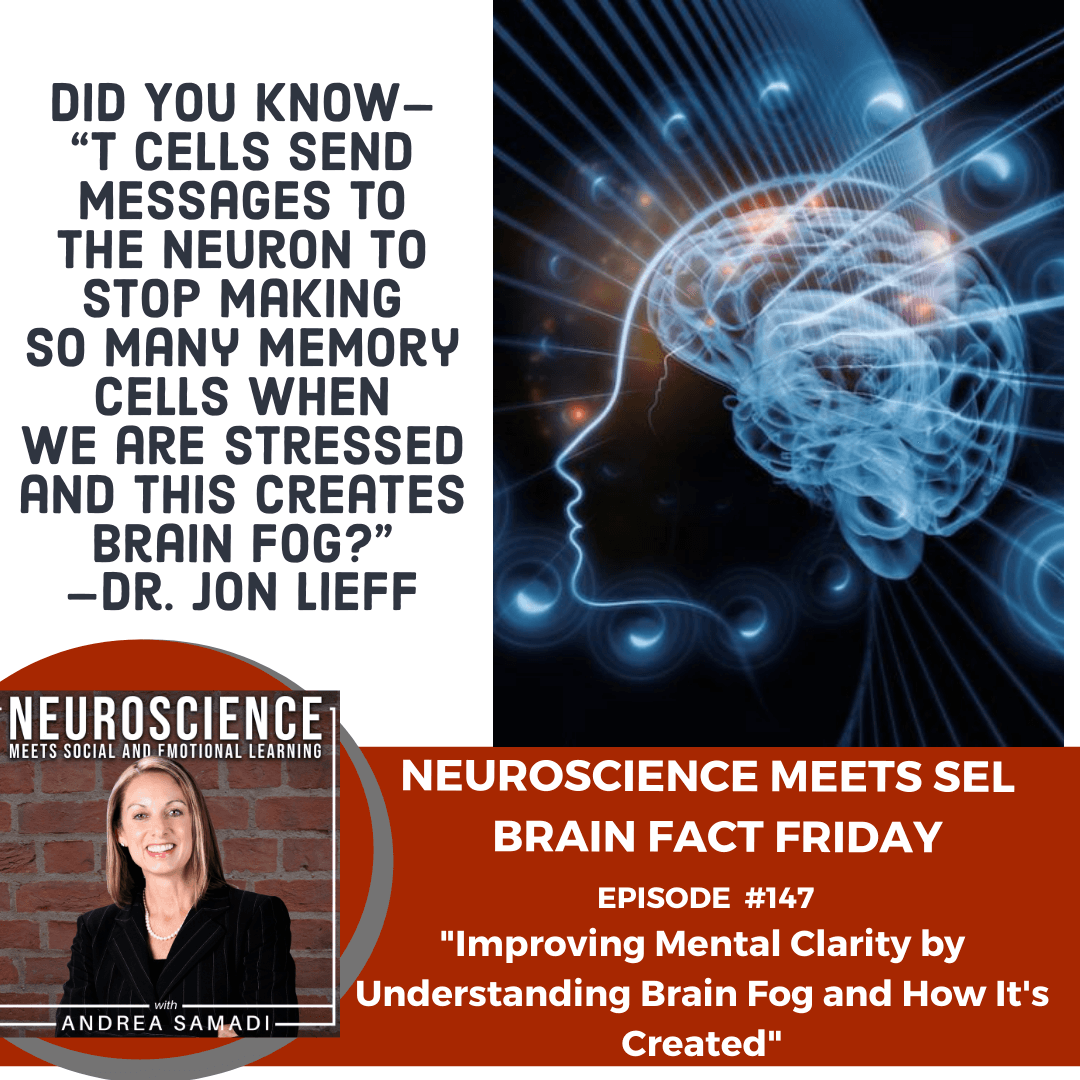
S6 Ep 147Brain Fact Friday on "Improving Mental Clarity by Understanding our Brain States, Brain Fog, and How It's Created"
Welcome back to the Neuroscience Meets Social and Emotional Learning Podcast, for Brain Fact Friday and episode #147 that has taken me back to Dr. Jon Lieff from episode #143[i] and his book The Secret Language of Cells: What Biological Conversation Tells Us About the Brain-Body Connection, the Future of Medicine and Life Itself.[ii] I'm Andrea Samadi, author and educator from Toronto, Canada, now in Arizona, and like many of our listeners, have been fascinated with learning and understanding the science behind high performance strategies in our schools, sports, and the workplace with ideas that we can all use, understand and implement immediately, for improved results. In Today’s Brain Fact Friday You Will Learn: ✔︎ How Brain Fog is Created ✔︎ How the Brain and Immune System Work Together ✔︎ How Cells Communicate with Each other ✔︎ How to Strengthen Our Brain-Mind-Body Connection by Understanding Our Brain State On our last Brain Fact Friday, episode #141, I talk about how meeting Dr. Lieff opened my eyes to the importance of keeping the cells in our body healthy for our future health, productivity, and results and that I had never thought about my health through this lens. His book explores the cellular conversation as a new way of understanding that our cells have constant, intelligent chatter between them, showing there is no separation of brain-body, mind-body or brain-immune and It got me thinking about neurogenesis, (how we create new cells in the brain) reminding me to take my Omega 3-DHA to increase Brain Derived Neurotrophic Factor, (which is the best way to produce new brain cells) and the ties to keeping our brain cells healthy for learning, memory and retention. But what else is there? What are some other ways that I can look at health, wellness and productivity at the cellular level? Which Leads us to This Week’s Brain Fact Friday Have you ever wondered why we get brain fog, or have a harder time thinking when we are stressed? Dr. Jon Lieff shared with me why this happens, and I think it’s important that everyone understands this function of our brain and body. Did you know that the brain and immune system work together? T-cells (an essential part of the immune system, a type of leukocyte or white blood cell) sends a message to the neurons (the cells in the brain and nervous system) to stop making memory cells (when you are stressed) and you get brain fog. Dr. Lieff reminded us in our interview that stress is “at the interface of brain function and inflammation” and that “T cells are essential for dealing with stress…Both brain and immune cells pick up perceptions of stress. Brief stress related to learning or the unexpected can be helpful in stimulating positive brain activity. However, chronic stress (where the body has no way to break from a stressor) can trigger damaging inflammation.”[iii] We have all heard that stress causes inflammation in the body, that “leads to a number of chronic health conditions”[iv] like cancer and viral infections and Dr. Lieff comes to the conclusion that “all processes in the human body, in all animals and plants, and in microbe communities as well, are based on conversations and group decision making among cells.”[v] One of the many fascinating parts of my interview with Dr. Lieff, that I have had many messages about, was where he explained that no one knew there were immune cells near the brain. Cerebral fluid (a colorless fluid that surrounds the brain and spinal cord) he explained “is also for communication and that t-cells get into this fluid and send messages to neurons.”[vi] When there is an infection in our body, the immune cells send “a sick feeling” to our body signaling us to pay attention to what we are feeling and take a rest or break so that healing can take place. Have you ever felt that feeling? You are working and something feels off in your body? Stefanie Faye mentioned the concept of “interoception” (being able to perceive the sensations from ins
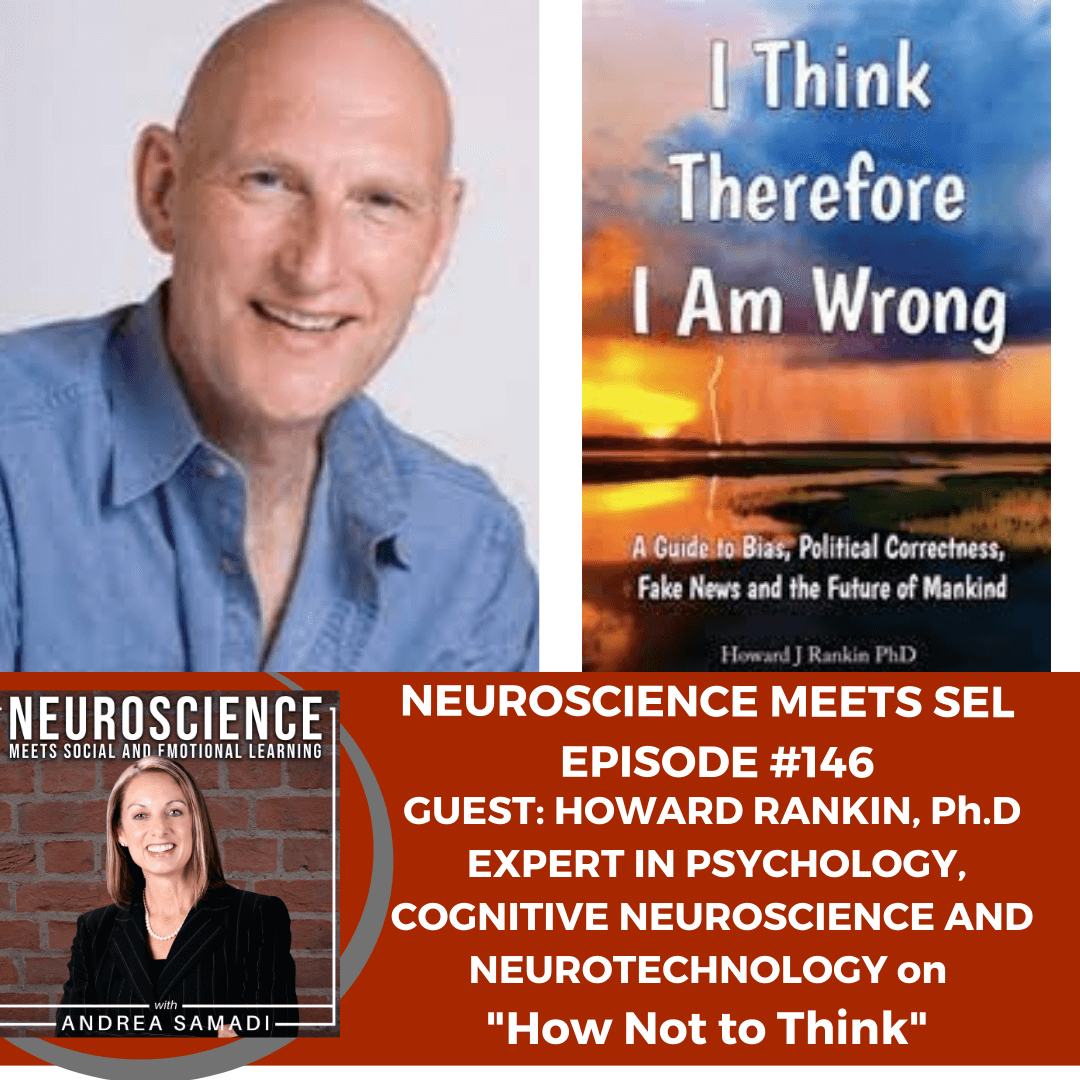
S6 Ep 146Expert in Psychology, Cognitive Neuroscience and Neurotechnology, Howard Rankin Ph.D. on ”How Not to Think”
Welcome back to the Neuroscience Meets Social and Emotional Learning Podcast for episode #146 with Dr. Howard Rankin, the host of the “How Not to Think Podcast” that runs on the premise that "People aren't logical, they're psychological with the emphasis on the psycho," which made me laugh at the same time as it made me think “How are we NOT supposed to think?” and the research on this topic began. Watch the interview on YouTube here. https://www.youtube.com/watch?v=1DlnOXE39aQ Learn more about Dr. Howard Rankin here https://hownottothink.com/ See past episodes here https://www.achieveit360.com/episodes/ On this episode, you will learn: ✔︎ What is the problem with our thinking, and why is it illogical? ✔︎ How awareness is important when making any decision. ✔︎ The importance of looking at things from a different perspective. ✔︎ Why "the more we know, the more we realize we know nothing at all." ✔︎ Why new knowledge opens up our world to new possibilities. ✔︎ How to motivate anyone to learn something new. ✔︎ Why reality is an illusion. ✔︎ Common problems that occur with our human thinking process and how to be aware of them. ✔︎ How self-limiting beliefs influence our results. I'm Andrea Samadi, author and educator from Toronto, now in Arizona, and like many of our listeners, have been fascinated with learning and understanding the science behind high performance strategies in our schools, sports, and the workplace with ideas that we can all use, understand and implement immediately, for improved results. This week’s guest, Dr. Rankin, an expert in cognitive neuroscience, recently published his book I Think Therefore I Am Wrong[i] which looks at the many ways we can sabotage our thinking through cognitive biases, binary thinking, false assumptions and numerous other strategies. The How Not To think Podcast[ii] based on his book, examines how this false reasoning manifests itself in many areas of society through myths, and 'conventional wisdom.' On his podcast that I will be a guest on, Howard speaks with leaders in their fields to examine the impact of faulty thinking that occurs in every sphere of life. Dr. Rankin has extensive expertise and knowledge in the areas of psychology, cognitive neuroscience and neurotechnology. He is also an experienced speaker and best-selling and award-winning author. Dr. Rankin has written 12 books in his own name, co-written another 9, and ghostwritten 30 others, all non-fiction. He has also published more than 30 scientific articles and been a consultant to the NIH and WHO (World Health Organization). His work has been featured in many newspapers and magazines and he has appeared on national networks including CNN, ABC, CBS, BBC, and on “The View” and “20/20”. He hosts the podcast How Not To Think and is the author of I Think Therefore I Am Wrong: A Guide to Bias, Political Correctness, Fake News and The Future of Mankind. Let’s meet Dr. Rankin and see what we can learn about improving how we think. Welcome Dr. Rankin, thank you for being here today to share your knowledge and insights on your recent book, I Think, Therefore I am Wrong that you say is about Epistemology, what our past speaker, Tom Beakbane, on episode #144 said was the origin of his book How to Understand Everything[iii]. Can we start right away with the most obvious question? Q1: What is the problem with our thinking, how is it illogical, and why are people psychological, with an emphasis on the psycho? Q2: What inspired you to write your book, and launch your podcast on this topic? Q3: I love making connections with past speakers and what I see with your work, I connected with Tom Beakbane’s book on How to Understand Everything where he talks a lot about looking at things from a different angle. With all the books you’ve written, you’ve got the knack for uncovering ways to tell something from a different angle, in a way that someone might not have heard it in that way. Why is it important to be able to see thing
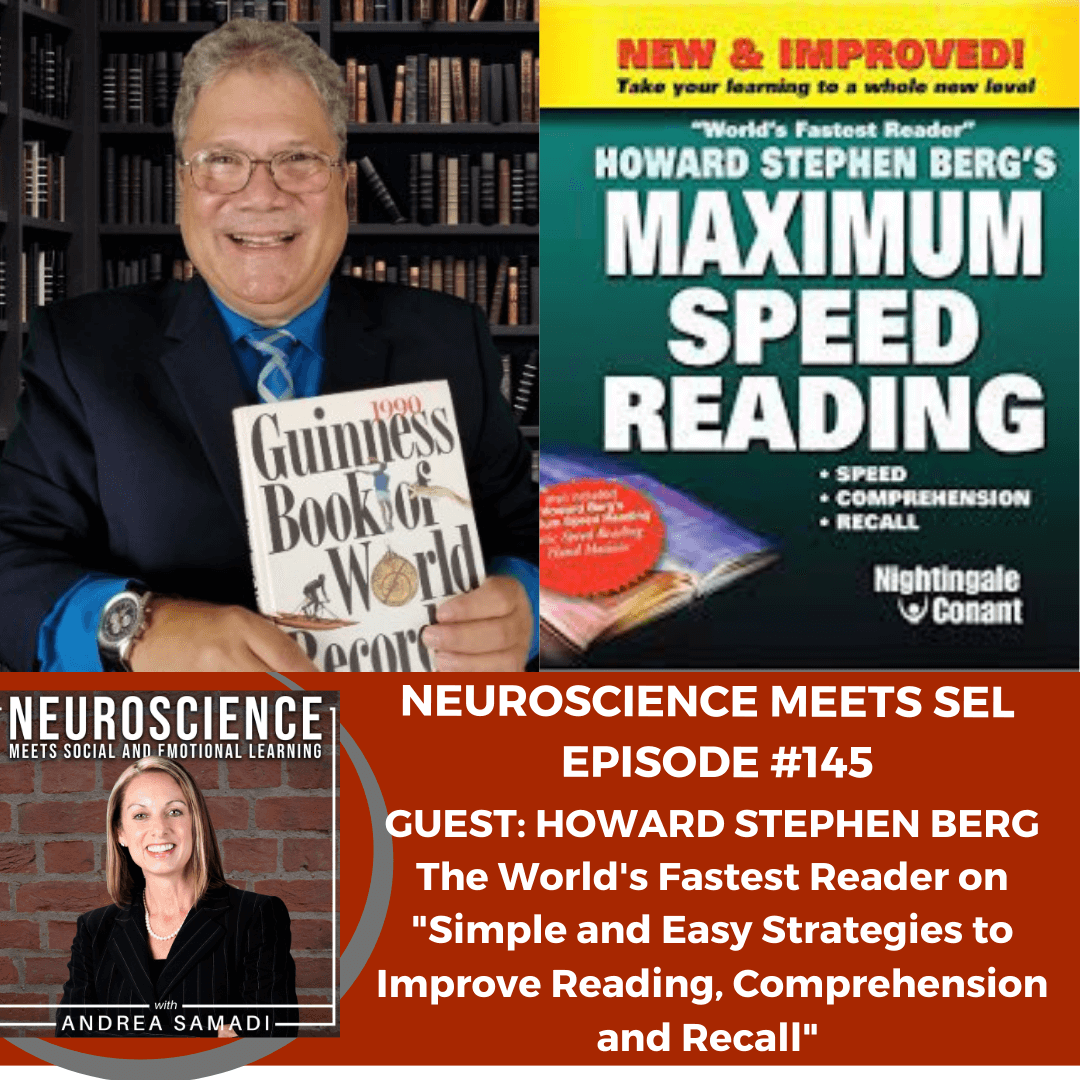
S6 Ep 145The World‘s Fastest Reader, Howard Stephen Berg on ”Strategies to Improve Reading, Comprehension and Recall” for Educators and the Workplace.
Welcome back to the Neuroscience Meets Social and Emotional Learning Podcast for episode #145 with Howard Stephen Berg[i], who is recognized as the world’s fastest reader according to the Guinness Book of World Records with over a 90% comprehension rate, thanks to the cutting edge accelerated learning techniques he has developed over his lifetime while working on ways to speed up reading for himself and for others. Watch the interview on YouTube here https://www.youtube.com/watch?v=Al0B6HzxtEk Access FREE RESOURCES from Howard Berg and visit his website here https://berglearning.com/a/andrea See past episodes here https://www.achieveit360.com/episodes/ On this episode you will learn:✔︎ 5 Steps to Improve Reading Comprehension That We Should All Know (Teachers and the Workplace) ✔︎ Improve Your Reading Speed by 20-40% with a Simple Activity. ✔︎ A Quick Strategy to Improve Your Memory and Recall. ✔︎ Using Humor to Make Learning Memorable. ✔︎ How to Write an EBOOK in 3-5 hours. I'm Andrea Samadi, author and educator from Toronto, Canada, now living in Arizona, and like many of our listeners, have been fascinated with learning and understanding the science behind high performance strategies in our schools, sports, and the workplace with strategies that we can all use, understand and implement, for improved results. On this week’s episode, we have Howard “Speedy” Berg, who has been recognized for setting the world record for speed reading. He is listed in the 1990 Guinness Book of World Records for reading more than 25,000 words a minute and writing more than 100 words a minute. Howard is a graduate of S.U.N.Y, Binghamton where he majored in Biology and then completed a four-year psychology program in one year. His graduate studies at several New York City colleges, focused on the Psychology of Reading. Howard is the Spokesperson for the Sony E-Reader along with Justin Timberlake, Peyton Manning, and Amy Sedaris. He has appeared on over 1,100 radio and television programs including Neil Cavuto, Jon Stewart, and Live With Regis. His brain-based learning strategies have been hailed as a major breakthrough in publications like Forbes, Men’s Health, Red Book, and Bottom Line Magazine, and have been featured in dozens of newspaper interviews throughout North America. I first met Howard Berg in 2013 when I was at a conference in Chicago, and first developing my programs for students in the classroom. I saw the importance of Howard’s work and immediately went to speak with him at the end of the event. When you meet Howard, you will see that his humble nature shines through. He told me to look at his website, and see if there is anything that I see where he could help me. He wasn’t just saying this. He really meant It, and I knew it. I never did follow up with Howard, as my programs went into the school market, and it wasn’t until a few years later that he was showcasing his speed-reading work, that I tuned in to watch him, hoping to learn something new that I could use with my girls. I did learn a speed-reading technique where he teaches anyone to read 20-40% faster, which is a skill we could all use these days. If you want to learn more about Howard’s courses, go to his website berglearning.com and you can access his courses on speed reading (professional level, for kids or student edition), his memory training course, creative writing course, and mind math course. In the meantime, let’s meet Howard Berg and see what he will teach us today! Welcome Howard, it’s wonderful to see you again. I’m not sure if you remember every person you meet, especially not over 7 years ago, but we met at Bill Walsh’s event in Chicago, and I was blown away with what you were showcasing for students at a time I was just creating programs for the school market. I’ve followed you ever since, and am grateful for all of the strategies you have put out into the world. Thanks for being here today. Q1: I know you cover this question on every intervi
S6 Ep 144Author and Marketer Tom Beakbane on ”How to Understand Everything, Consilience: A New Way to Look at the World”
Welcome back to the Neuroscience Meets Social and Emotional Learning Podcast for episode #144 with Tom Beakbane[i], author and president of Beakbane: Brand Strategies & Communications Inc., who has helped generate over $5 billion in brand value for his clients, and discover a new way to see the world. Watch the interview on YouTube here. Visit past episodes here https://www.achieveit360.com/episodes/ On this episode, we will take a mind-altering journey into his book How to Understand Everything: Consilience: A New Way to See the World[ii] There is a new way to understand human beings — and everything else. It’s known as consilience. Consilience is a new paradigm that reveals how things self-organize from the bottom up – in contrast to how we think and communicate, which is from the top down. This new paradigm exposes the realities of human nature on both personal and collective levels revealing the overlap between different domains of life: family, health, business, technology, politics, and spirituality. Consilience will help you see things differently – and make people less puzzling. I'm Andrea Samadi, author and educator from Toronto, Canada, now living in Arizona, and like many of our listeners, have been fascinated with learning and understanding the science behind high performance strategies in our schools, sports, and the workplace with strategies that we can all use, understand and implement, for improved results. When I first came across Tom Beakbane, his work caught my attention, as it was right in line with episode #143 with Dr. Jon Lieff on The Secret Language of Cells. Tom wrote some feedback on my Linkedin post about this interview, and let me know that his work was right in line with Dr. Lieff’s. When I started reading his book, How to Understand Everything, I saw the many connections: Between Understanding the Mind vs the Brain How We Think and Communicate (from the top down) The term consilience which means the “jumping together of different insights and realms of knowledge. What consilience means in the different domains of life, health, business, technology. I started to think about the questions I would ask Tom during our interview, and knew that even after diving into his book, that some discussion was required to be sure that I had a solid grasp of his years of research. I can’t wait to hear what Tom Beakbane has to say in our interview, bringing light to this new way of thinking, and looking at the world. Welcome Tom Beakbane, , thank you very much for speaking with me today. How to Understand Everything: Consilience: A New Way to See the World Q1: From my communication with you this past week, I am sure you could see that I was finding it difficult to come up with questions for you because I want to be sure that I have a solid understanding of your book BEFORE we speak. Why do you think I found the topic difficult (when your book is all about how to understand everything) and it’s right in line with what my prior interviews? What is this new way of thinking or looking at the world, why might I have a hard time seeing it, and how did you discover it? Q2: Searching for the meaning of “mind vs brain” is something I have also been interested in, and I recorded an episode on “Understanding the Difference Between the Mind and the Brain[iii]” on EPISODE #23 when we first began our podcast. I actually asked Dr. Jon Lieff this question in our last episode. Can you give your perspective of what is our mind vs our brain? Q3:Listening to your prior podcasts, I was relieved when other interviewers had not heard of, or used the word consilience that’s in the title of your book (jumping together of ideas of different realms)? Every email you sent me signs off with “wishing you consilience” and I could guess it means something like an integration of something…or a coming together of something…What does consilience mean and can you explain why you think it’s important for looking at life, health, business
S6 Ep 143Jon Lieff, MD on ”The Secret Language of Cells: What Biological Conversations Tell Us About the Brain-Body Connection”
Welcome back to the Neuroscience Meets Social and Emotional Learning Podcast for episode #143 with Dr. Jon Lieff, a nationally recognized neuropsychiatrist and expert on cellular communication science that’s all about how it's our cells communicating with each other that causes feelings, sickness, thoughts, and disease in our bodies. Watch this interview on YouTube here https://youtu.be/IKR6SAS4wSw See past episodes here https://www.achieveit360.com/episodes/ In today's episode, you will learn:✔︎ Dr. Lief's thoughts on what is the mind vs the brain, and a closer look at perception and memory from the cell level.✔︎ Why we get brain fog with depression and chronic stress.✔︎ How acupuncture works and builds our immune system.✔︎ How meditation increases immunity and fights against viruses.✔︎ What we should ALL know about our cells for improved health and wellness.✔︎ Dr. Lief's thoughts on whether the mind can influence your health.✔︎ The fascinating intelligence within each cell and how a liver cell knows what it's supposed to do in the body. This is going to be a fascinating conversation, and the excitement for this episode began the week BEFORE the interview, when I posted Dr. Lieff’s book and information about the interview on social media, with a link to his website, and the buzz began. I know this is a topic of interest for listeners, and I think it’s very important to feature speakers who provide scientific research to answer the questions we might have about ways to improve our health, productivity and results. What you will learn today will open up your mind to new ways of looking at your health and performance, going beyond our brain, and into the cells of our body, that Dr. Lieff says are “the way our health works.”[i] If you are new here, I'm Andrea Samadi, author and educator from Toronto, Canada, now living in Arizona, and like many of our listeners, have been fascinated with learning and understanding the science behind high performance strategies in our schools, sports, and the workplace with strategies that we can all use, understand and implement, for improved results. If you have been listening to our podcast for some time, you will know that we’ve uncovered that if we want to improve our social and emotional skills, and experience success in our work and personal lives, it all begins with an understanding of our brain. And since most of us have not had a crash course in the basics of neuroscience, and how an understanding of our brain can impact learning, I launched this podcast in June 2019 with the goal of interviewing leaders and experts who have risen to the top of their field, using these success principles. Which brings me to our next guest, Dr. Jon Lieff.[ii] What captivated me with Dr. Lieff’s work even before I had read his book, was when I heard him talking about where his interest in the topic of cellular communication began, and he noticed that the books written on this topic were impossible for the average person to understand. This is the whole reason why we started this podcast, with a focus on neuroscience, so we could take the research and break it down so that it is simple and easy for anyone without a background in science to understand. When you meet Dr. Lieff, you will find he is someone who can take high level, complex, scientific concepts, and break them down to be applicable in our daily life. This is what makes his work unique, and I know that it will be what propels him to reach the masses with these sought-after connections between the mind, brain, body and health. Here’s Dr. Lieff’s background so you can see the work he has been involved in for most of his career, leading him to the fascinating work on The Secret Language of Cells. Dr. Lieff is a graduate of Yale and holds a Doctorate in Medicine from Harvard Medical School; he is a known innovator in several medical fields and the leading neuropsychiatrist investigating cellular conversations. His book explores the c
S6 Ep 142Case Study: Michal Ricca on "ReaDefying the Odds of Dyslexia"
Welcome back to the Neuroscience Meets Social and Emotional Learning Podcast for episode #142, with Michal Ricca[i], the Founder of Now I Can Read who created an online literacy program called ReaDefy Learning[ii] for children aged 10-17 who struggle with literacy. Watch the interview on YouTube here. https://youtu.be/B-V003TGVu8 See past episodes here https://www.achieveit360.com/episodes/ We know from our past episode #136[iii] with Lois Letchford, with her dyslexic son who went on to graduate with his Ph.D from Oxford University, that some children need different learning strategies than how they are taught traditionally in the classroom. Michal’s program focuses on the critical life skills of verbal and written language and communication with the backbone of social and emotional skills to help propel these students to excel both inside and outside of the classroom. Michal has a powerful story that I wanted to share, to open up some ideas and strategies if you are a teacher in the classroom, or if you are a parent with a struggling reader at home. For those looking for ideas for the workplace, Michal has a compelling story that she will share on how she took all of her programs online, maximizing her time and efforts with her students, and giving her more balance back in her life. I'm Andrea Samadi, author and educator from Toronto, Canada, now living in the United States, and like many of our listeners, have been fascinated with learning and understanding the science behind high performance strategies in our schools, sports, and the workplace. If you have been listening to our podcast, you will know that we’ve uncovered that if we want to improve our social and emotional skills, and experience success in our work and personal lives, it all begins with an understanding of our brain. When I first met Michael, through LinkedIn, I knew right away that she had created something unique, when I heard that she has been focused on helping struggling students to learn how to read for the past 20 years, and has helped over 1,000 students to read. If you have ever worked with one struggling reader, you will know that it takes someone extremely special to uncover exactly what each student needs, and Michal has this gift. You can learn more about Michal and her programs through her website, but here’s a bit about her background. Michal Ricca, M.Ed. Founded the Academic Associates Center in Williston, VT in 2008. She holds an Advanced Teaching Masters of Education from Northwestern University, a Bachelor’s Degree in Elementary and Special Education, and has over twenty years experience working with students with all types of learning styles and differences. Michal has been trained in Wilson, Orton-Gillingham, Academic Associates, Framing Your Thoughts, MindPlay, and many other techniques, while also having studied at Columbia University with Lucy Calkins herself. Michal is a literacy addict and sees herself as a lifelong learner, staying current with best practice through journals, collegiate discussions, and professional development. Michal pulls from many sources to individualize instruction, but her foundation is the Orton-Gillingham technique. Her program is a multi-sensory and enables students, by using direct instruction, to review, learn new concepts, practice, and to apply what they are learning. Orton-Gillingham has been utilized for over 50 years and is multi-sensory, systematic, structured, sequential, cumulative, and success-oriented. Research states that the effectiveness of quality literacy instruction has less to do with the program used, and more to do with the efficacy of the teacher and the intensiveness of the student’s engagement. Let’s meet Michal Ricca and see what strategies she can bring to light after 20 years of focused work in the field of literacy and social and emotional learning. Welcome Michal. It’s wonderful to have this opportunity to speak with you here. Thank you very much for shari
S6 Ep 141Brain Fact Friday on "Neurogenesis: What Hurts or Helps Your Brain Cells?"
Welcome back to the Neuroscience Meets Social and Emotional Learning Podcast, for Brain Fact Friday and episode #141. In today's episode, you will learn: ✔︎ Tips for regrowing your brain cells (neurogenesis) ✔︎ A reminder of what prevents neurogenesis and hurts your brain I'm Andrea Samadi, author and educator from Toronto, Canada, now living in Arizona, and like many of our listeners, have been fascinated with learning and understanding the science behind high performance strategies in our schools, sports, and modern workplaces of the future. If you have been listening to our podcast, you will know that we’ve uncovered that if we want to improve our social and emotional skills, and experience success in our work and personal lives, it all begins with an understanding of our brain. And since most of us have not had a crash course in the basics of neuroscience, and how an understanding of our brain can impact learning, I launched this podcast in June 2019 with the goal of interviewing leaders and experts who have risen to the top of their field, using these success principles. I’m writing this before recording episode #143 with Dr. Jon Lieff, whose book The Secret Language of Cells: What Biological Conversation Tells Us About the Brain-Body Connection, the Future of Medicine and Life Itself[i], and his book has really got me thinking. We know that brain health is important, but could the cells in our body be important for our health, translating into our productivity, results and future well-being? Just like I had never thought about my brain as it related to my results prior to understanding how important our brain was for our future, I definitely have never thought about my health down to the level of my cells. Or even thought about how brain cells (neurons) are different from the other cells in my body (like organ lining cells, immune cells, or blood vessel cells). Have you? This Leads us to This Week’s Brain Fact Friday: Did you know that “we can regrow brain cells (a process called neurogenesis) that we retain throughout our entire lifetime”[ii] and that the best way to increase neurogenesis (regrow your brain cells) is “when your body produces more BDNF (brain-derived neurotrophic factor.” (Dr. David Perlmutter). We covered an introduction to BDNF on episode #114 “Building a Faster, Stronger, Resilient Brain, by Understanding Brain-Derived Neurotrophic Factor”[iii] and how important BDNF is for learning and memory, with some tips for increasing your BDNF levels. What Helps Your Brain Cells? Exercise releases BDNF: Dr. Ratey, in his book Go Wild explained that researchers were looking at ways to prevent the aging brain and found that “seniors who exercised developed significantly larger hippocampal volumes (the part of the brain responsible for memory processing) improving their memory.”[iv] They found that exercise also “prevented a loss of grey matter overall (which is common in aging) and improved brain function.” (Page 107). Since we are all aging, it makes sense to me that this research is relevant to all of us, not just the aging brain, proving again, of the importance of exercise as one of the health staples we should all be aware of. Nutrition also releases BDNF: Taking Omega-3 DHA also increases your BDNF and helps to increase neurogenesis. “Omega-3 fatty acids have the potential to influence neurogenesis through at least two distinct mechanisms. First, omega-3 fatty acids are incorporated into neuronal membranes…A second potential pathway …(where) these diets may influence neurogenesis is via omega-3 fatty acid modulation of cytokine levels, which in turn regulates immune function.”[v] What Hurts Your Brain Cells? We know that diet and exercise help our brain to build new neurons, but what hurts your brain and kills your brain cells? Chronic stress, lack of sleep, poor diet and chemical and pesticide exposure all prevent neurogenesis and our podcast episode with Dr. Lieff on The Secret Language of
S6 Ep 140Brain Fact Friday "Neuroscience Q&A" Livestream Andrea with Katherine Alexander-Dobrovolskaia
Welcome back to the Neuroscience Meets Social and Emotional Learning Podcast, for Brain Fact Friday, episode #140 and our first Livestream event. I'm Andrea Samadi, author and educator from Toronto, Canada, now living in the United States, (but broadcasting this livestream from my balcony in HI with my co-host Katherine Alexander-Dobrovolskia who is joining us from London, United Kingdom) and like many of our listeners, we have both been fascinated with learning and understanding the science behind high performance strategies in our schools, sports, and the workplace. If you have been listening to our podcast, you will know that we’ve uncovered that if we want to improve our social and emotional skills, and experience success in our work and personal lives, it all begins with an understanding of our brain. For our FIRST Livestream event, I’ve invited my colleague, and good friend Katherine Alexander- Dobrovolskaia, the owner of Talent Investors, who is joining us from London, United Kingdom. Welcome Kate, thank you for coming on my first Live event. You know why I asked you to be here today, right? Kate: give me a guess…maybe something about the fact we are broadcasting from Hawaii…maybe because we’ve been friends for almost 10 years, meeting in John Assaraf’s forum, and now taking our Neurocoaching Certification together? You tell me…. Andrea: Kate, since June is the anniversary of when we launched this podcast (June 2019) and now that we are going into our third year of creating bi-weekly episodes, approaching 100K downloads, reaching over 143 countries, I wanted to do something different. Then add to the mix that this month I hit that mile marker of turning 50, I knew it was time to shake things up. And you’ve always had an eye for innovation with the work you did with your Best Boss Series[i]. When you did that series, interviewing innovators in business, what do you think stuck out with leaders who rose to the top? What kinds of things did you notice they were doing differently from the rest? Kate: Answer about what you learned from your Best Boss Series. Andrea: Well, since this is Brain Fact Friday, I did want to share something we’ve recently learned from our Neuroscience coaching training that we are doing together, and invite the listeners to ask questions in the chat. Anything you’d like to know after listening to this podcast if you have been following us, from how we launched, to secrets of inviting such high-quality guests. What do you want to know? I’ll let Kate answer the questions, and I’ll sit back and relax on my balcony. Q1: Andrea to Kate: Kate, what would you say is something you have learned recently about the brain, as it has applied to your personal and professional life? Kate: Answer…something about the brain that’s helped you personally/professionally? What about you, Andrea? What’s something important that sticks out for you? Andrea: It was probably from episode #100 with Mary Helen Immordino-Yang “We feel, therefore we learn” and the idea that when we connect emotions to learning, what we are studying goes into long-term memory. This brings in Friederike Fabritius’ How the Brain Learns book and her work with peak performance with the idea that we must have FUN with our work to hit those highest levels of peak performance and productivity. Andrea: What about the listeners? Let me know if you have learned anything from this podcast, or any other area about the brain, and how you’ve used these ideas for improved results? Answer anything that comes in on the chat…. Q2: Andrea to Kate: I’ve known you for some time now, I think we were accountability partners at one point in time, helping each other stay on track with the projects we were working on. And then life hits, and you’ve had some extremely difficult times, in addition to the Pandemic. How have you been able to stay on track with life, positivity and look after everything that’s going on personally for you if you want to share w
S6 Ep 139Brain Fact Friday on "The Fascinating Discoveries That Link Math, Literacy and the Brain"
Welcome back to the Neuroscience Meets Social and Emotional Learning Podcast, for Brain Fact Friday and episode #139 on “The Fascinating Discoveries that Link Math, Literacy and the Brain Together.” If you are listening on iTunes, click here to see the images in the show notes. I'm Andrea Samadi, author and educator from Toronto, Canada, now living in the United States, and like many of our listeners, have been fascinated with learning and understanding the science behind high performance strategies in our schools, sports, and modern workplaces of the future. If you have been listening to our podcast, you will know that we’ve uncovered that if we want to improve our social and emotional skills, and experience success in our work and personal lives, it all begins with an understanding of our brain. Our goal with this podcast is to bring the most current neuroscience research to you and make it applicable in your life whether you are a teacher in the classroom, a parent homeschooling, or using these ideas to improve productivity and results in your workplace. The idea is that these strategies will give you a new angle and provide you with a new way of looking at learning, results and productivity, with the brain in mind. As I am researching and uncovering new ideas, I’m also implementing them myself, and making connections to past speakers, so that we can all benefit from the research that is emerging in this new field of educational neuroscience. I want to thank the listeners who have sent me messages through social media[i] about how you are using these ideas in your schools, community and personal lives. It does help to know that these episodes are useful, and how you are using this information, and that it’s not just me who finds the intricacies of the brain and learning to be fascinating. Thanks so much for the messages. Back to this week’s Brain Fact Friday. DID YOU KNOW: There is a test called the finger gnosis test[ii] (a child holds their fingers under the table and has to tell you which fingers you touch) and “this test is a strong predictor of future mathematical ability” (Dr. Ansari taught us this in our last episode) and that “finger movement and counting are closely associated with the brain?” (David Sousa). David A Sousa in his book How the Brain Learns Mathematics found “that the region of the brain that controls finger movement is the same region associated with counting” [iii] and he thought it was interesting that finger movement and counting are closely associated in the brain. I asked Dr. Ansari what he thought about this, and he agreed there might be something to what David Sousa is thinking. This might explain why Dyslexia (a learning disorder that involves a difficulty with reading) and Dyscalculia (a math learning disability where children struggle with number sense) are so closely related. Dr. Ansari mentioned that 50% of children who struggle with math, also struggle with reading. The two go hand in hand. We did cover the societal significance of our children or students learning to read proficiently by 3rd grade with last week’s Brain Fact Friday, episode #137[iv] where we examined the math learning disability dyscalculia, that’s closely related to dyslexia, but here’s a quick reminder of the importance of knowing why literacy is so important, especially understanding the implications of NOT staying on top of our children/students who might be struggling with the foundations of reading, or mathematics, at an early age. When we look at the statistics, the importance of developing the foundational skills of literacy is clear. Just a reminder: 2/3 of students who cannot read proficiently by the end of 4th grade will end up in jail or on welfare. Over 70% of America’s inmates cannot read above a 4th grade level. 1 in 4 children in America grow up without learning how to read at all. Students who don't read proficiently by the 3rd grade are 4 times likelier to drop out of school. Nearly 85
S6 Ep 138Professor and Canada Research Chair Dr. Daniel Ansari in Developmental Cognitive Neuroscience and Learning on ”The Future of Educational Neuroscience”
Welcome back to the Neuroscience Meets Social and Emotional Learning Podcast, EPISODE #138 with Dr. Daniel Ansari[i], a professor and Canada Research Chair[ii] in Developmental Cognitive Neuroscience and Learning in the Department of Psychology and the Brain in Mind Institute[iii] at the University of Western Ontario in London, Ontario where he heads the Numerical Cognition Laboratory.[iv] His name is well-known in the field of educational neuroscience with a focus on numeracy and math which I know our listeners will find fascinating as we make connections with how children acquire math and numeracy, with brain science in mind. You can watch the interview on YouTube here. I'm Andrea Samadi, an educator who has been fascinated with understanding the science behind high performance strategies in schools, sports, and the workplace for the past 20 years. If you have been listening to our podcast, you will know that we’ve uncovered that if we want to improve our social and emotional skills, and experience success in our work and personal lives, it all begins with an understanding of our brain. Our goal with this podcast is to bring the most current neuroscience research to you and make it applicable in your life whether you are a teacher in the classroom or using these ideas to improve productivity and results in your workplace. As I am researching and learning new ideas, I’m also implementing them myself, and making connections to past speakers, so that we can all benefit from the research that is emerging in this new field of educational neuroscience. Which brings me to our next guest, who I came across a few months ago while researching neuroscientists who specialize in the field of education. Dr. Daniel Ansari’s name came up as a speaker at the Dropping Out, What Neuroscience Can Teach Us[v] International Symposium on the long-held paradigms of dropout prevention with his session on “The Best Way for Children to Learn Math” and my attention was caught. When I worked at Pearson Education, (2004-2010) I was on a sales team that had a focus on one product, for dropout prevention at the high school level (NovaNET)[vi] and I spent years promoting this program with the hopes of saving students who were at risk of dropping out. This conference was happening just as I had begun to study the brain and learning in 2015, and I only wish I had found it sooner. I wrote down Dr. Ansari’s name on my desk, with the idea that I would look him up, and see if he would come on the podcast as a guest. Then went back to work on researching in the field of educational neuroscience and the researcher I am working with, Mark Waldman, sent me an article that he thought would be of interest to me with a project I am working on. I opened the article called “Annual Research Review: Educational neuroscience: progress and prospects”[vii] by Michael S.C Thomas, Daniel Ansari, and Victoria C.P. Knowland and immediately contacted Daniel Ansari. I don’t believe in accidents and when someone’s name continues to come to my attention as someone I need to learn from, I don’t waste any time. Without further ado, let’s meet Professor and Canada Research Chair in Developmental Cognitive Neuroscience and Learning, Dr. Daniel Ansari. Welcome Daniel! I was so happy when you wrote back after I contacted you after reading your research abstract on educational neuroscience, thank you so much for being here. Daniel, you let me know when I first contacted you that you were in lockdown in London, Ontario, Canada, that your son was doing his schooling in your office and as I am writing these questions, I saw that schools in Ontario (where I grew up, got my teaching degree, and was a teacher) have according to Professor Prachi Srivastava, a professor at Western University “the longest school closures in Canada. As of today (June 3rd), 23 weeks since March 2020).” What is going on with the schools in Ontario, and how do you think this is impacting student learning?
S6 Ep 137Brain Fact Friday "Understanding Dyscalculia: The Math Learning Disability"
Welcome back to the Neuroscience Meets Social and Emotional Learning Podcast, for Brain Fact Friday and episode #137. In Today’s Brain Fact Friday You Will Learn: ✔︎ Why the Foundational Skills in Literacy and Mathematics are so Important. ✔︎ How Students with Reading Difficulties and Like Students with Math Difficulties. ✔︎ An Introduction to Dyscalculia: The Math Learning Disability. ✔︎ How to Recognize Dyscalculia, and Strategies to Assist Students Who Struggle with Math. ✔︎ Many Celebrities Have Dyscalculia and Dyslexia: It’s Not a Matter of Intelligence. I'm Andrea Samadi, a former educator who has been fascinated with understanding the science behind high performance strategies in schools, sports, and the workplace for the past 20 years. If you have been listening to our podcast, you will know that we’ve uncovered that if we want to improve our social and emotional skills, and experience success in our work and personal lives, it all begins with an understanding of our brain. Our goal with this podcast is to bring the most current neuroscience research to you and make it applicable in your life whether you are a teacher in the classroom or using these ideas to improve productivity and results in your workplace. The idea is that these strategies will give you a new angle and provide you with a new way of looking at learning, with the brain in mind. As I am researching and learning new ideas, I’m also implementing them myself, and making connections to past speakers, so that we can all benefit from the research that is emerging in this new field of educational neuroscience. The Importance of The Foundational Skills: Literacy and Mathematics Which brings us to this week’s Brain Fact Friday and the connections I made while recording episode #136[i] with Lois Letchford, and her son who failed first grade in 1994 when testing revealed he could only read 10 words, had no strengths and a low IQ and was clearly struggling with his academics in his early years. Thank goodness his Mother figured out that he needed to learn how to read with different learning strategies that you can learn about in episode #136, and see how her son defied the odds he was given at an early age and graduated from Oxford University with his Ph.D. What would have happened to Nicholas Letchford if he didn’t have such a happy ending to his story? If he did not find a different way to build those foundational skills that he needed for literacy achievement? I remembered a webinar I prepared for the educational publisher, Voyager Sopris Learning in 2018 on “Nine Brain-Based Strategies to Skyrocket Literacy Achievement”[ii] and in the introduction to this webinar, I talk about the U.S. statistics that emphasize the importance of our children learning to read proficiently by 3rd grade. Did you know that: 2/3 of students who cannot read proficiently by the end of 4th grade will end up in jail or on welfare. Over 70% of America’s inmates cannot read above a 4th grade level. 1 in 4 children in America grow up without learning how to read at all. Students who don't read proficiently by the 3rd grade are 4 times likelier to drop out of school. Nearly 85% of the juveniles who face trial in the juvenile court system are functionally illiterate, proving that there is a close relationship between illiteracy and crime. More than 60% of all inmates are functionally illiterate. And these shocking statistics lead to high drop-out rates, low graduation rates and college completion, illiteracy, incarceration, and welfare, proving that when a student is struggling with their reading, there is so much more at stake than what meets the eye. Then I began researching for episode #138 with Dr. Daniel Ansari, a professor, and Canada Research Chair[iii] in Developmental Cognitive Neuroscience and Learning in the Department of Psychology and the Brain in Mind Institute[iv] at the University of Western Ontario in London, Ontario where he heads the Numerical Cognition Lab
S6 Ep 136Case Study: The Story of Lois Letchford: From Dyslexia to Ph.D. at Oxford "Using Neuroscience to Inspire Learning"
Welcome back to the Neuroscience Meets Social and Emotional Learning Podcast, EPISODE #136 I'm Andrea Samadi, a former educator who has been fascinated with understanding the science behind high performance strategies in schools, sports, and the workplace for the past 20 years. If you have been listening to our podcast, you will know that we’ve uncovered that if we want to improve our social and emotional skills, and experience success in our work and personal lives, it all begins with an understanding of our brain. Watch the interview on YouTube here. My goal with this podcast is to bring the most current neuroscience research to you and make it applicable in your life whether you are a teacher in the classroom, or using these ideas to improve productivity and results in your workplace. As I am researching and learning new ideas, I’m also implementing them myself, and making connections to past speakers, so that we can all benefit from the research that is emerging in this new field of educational neuroscience. Today’s episode features Lois Letchford[i], the author of the book Reversed: A Memoir[ii], that tells the story of her son who failed first grade in 1994. His prognosis was dire. Testing revealed he could read 10 words, had no strengths, and a “low IQ.” The first few chapters of her book are painful for a parent to read, and even worse if you’re a teacher or a coach, knowing how important your role is for shaping the lives of the students who come before you. Her book sets the stage for just how chilling, and impactful their story is. I’ll read it slowly because there’s lots to think about here. Sometimes it is the people no one imagines anything of who do the things that no one can imagine. —THE IMITATION GAME I have to spoil the story, and tell you there is a happy ending, with Lois’ son defying the odds he was given at an early age and graduating with his Ph.D. in 2018 from Oxford University.[iii] I can just see this story as a movie, especially when I saw the book trailer on YouTube[iv], with the beautiful and prestigious University in the background, where scholars go to earn their degrees, where one young man would work harder than most to achieve what many only dream of. This story is of dreams becoming reality, where a Mother used the principles, she learned from Dr. Immordino Yang, to help her son to achieve his dreams. This is our third case study on the podcast, with our first with Bridgid Ruden, and her story of overcoming a severe traumatic brain injury, and then with Barbara Arrowsmith-Young and her story of changing her brain and leaving her learning disability behind. Both of these stories moved me to such an extent that I realized the importance of featuring examples of people who have used the strategies we suggest on this podcast, with outstanding results. Which brings us to the fascinating story of Lois Letchford. She had the opportunity to homeschool her son for six short months. During this time, she applied all the principals of learning provided by Dr. Immordino Yang. It turned her son’s life around – and hers too. Lois Letchford BIO: Lois Letchford specializes in teaching children who have struggled to learn to read. Her creative teaching methods vary depending on the reading ability of the student, employing age-appropriate, rather than reading-age-appropriate, material. Her non-traditional background, multi-continental exposure, and passion for helping failing students have equipped her with a unique skill set and perspective. Originally a physical education teacher, she later completed a Master's in Literacy and Reading from the State University of New York at Albany. Lois has presented her work at The California Reading Association, Michigan Summer Institute, and New York State Reading Association conferences. She is co-president of the Albany City Reading Association and a member of the Australian College of Education. Lois continues to work with students to provide educat
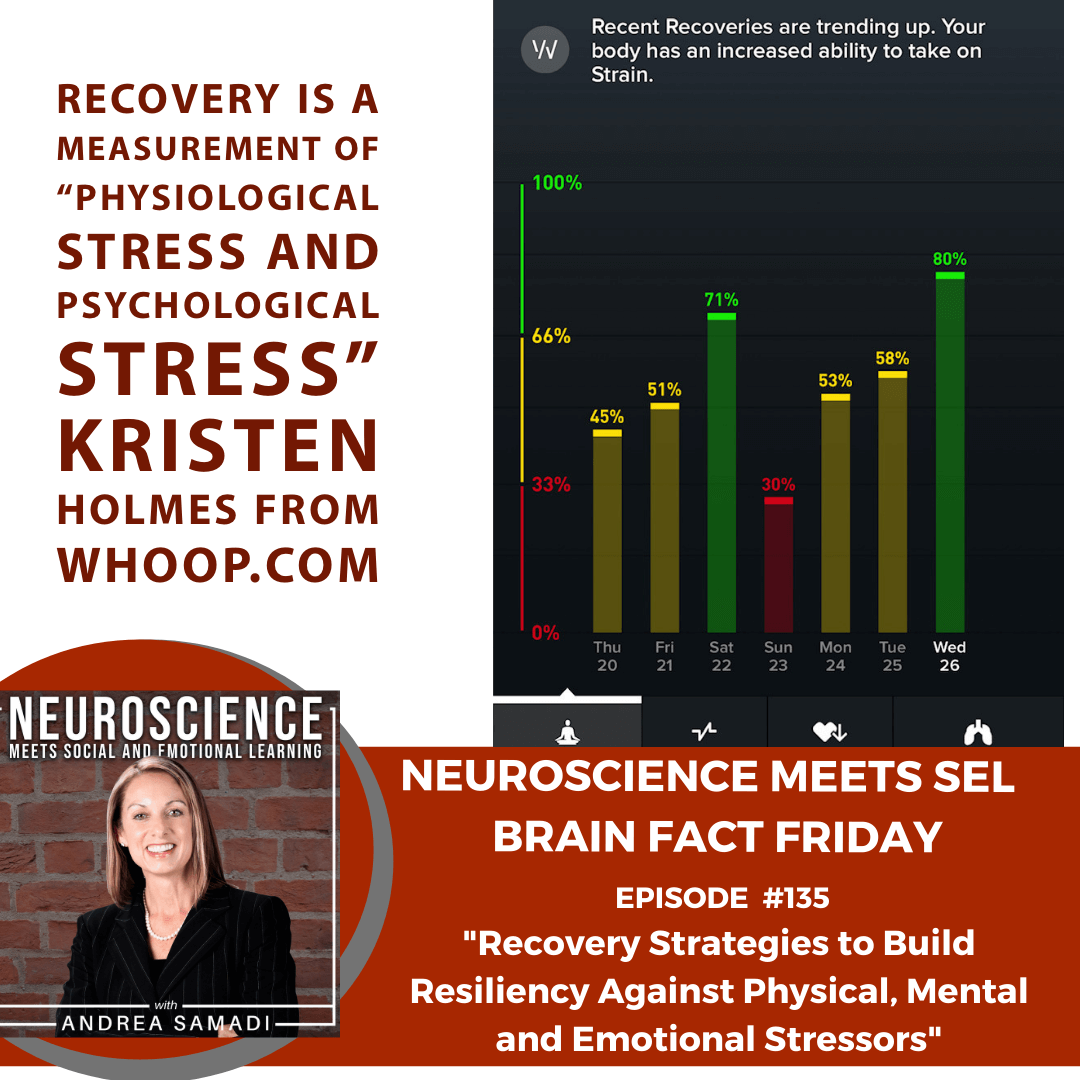
S5 Ep 135Brain Fact Friday "Recovery Strategies to Build Resiliency Against Physical, Mental and Emotional Stressors"
Welcome back to the Neuroscience Meets Social and Emotional Learning Podcast, for Brain Fact Friday and episode #135 on my biggest AHA moment from EPISODE #134 with Kristen Holmes, the VP of Performance Science of WHOOP[i], a wearable personal fitness and health coach that measures sleep, strain, and recovery. To see the images in the show notes, and Andrea's Data, click here. In Today’s Brain Fact Friday You Will Learn: ✔︎ How the wearable health tracker WHOOP measures recovery. ✔︎ Why this data is useful for athletes, and humans in general, for mitigating physical, mental, and emotional stress. ✔︎ Strategies to improve recovery and decrease physical and psychological stress. ✔︎ See Andrea’s data and how she achieved her highest recovery rates using these strategies. ✔︎ How you can measure your own recovery to improve performance and resiliency. Welcome back, I'm Andrea Samadi, a former educator who has been fascinated with understanding the science behind high performance strategies in schools, sports, and the workplace for the past 20 years. If you have been listening to our podcast, you will know that we’ve uncovered that if we want to improve our social and emotional skills, and experience success in our work and personal lives, it all begins with an understanding of our brain. The purpose of this podcast is to bring the most current brain research to you, so you can make it applicable in your life whether you are a teacher in the classroom, or using these ideas to improve productivity and results in your workplace. As I am researching and learning new ideas, I’m also implementing them myself, and making connections to past speakers, so that we can all benefit from the research that is emerging in this new field of educational neuroscience. If you listened to EPISODE #134[ii] with Kristen Holmes, the VP of Performance Science with WHOOP whose Ph.D. work is in multilevel interactions of stress and circadian behavior[iii] or the impact of light on sleep optimization, you’ll know that I first came across Kristen while researching Heart Rate Variability for EPISODE #125[iv] where I started to see how important this one measurement was for tracking health, recovery, and resilience which is crucial to brain health and performance. After listening to the WHOOP podcast, with Founder Will Ahmed, I joined the community so that I could measure my HRV that I learned from Neurohacker Collective[v] is “the most important biomarker”[vi] --a measure that captures what’s going on in a cell at any given moment that can serve as an early warning system for your health. As someone who has been working hard to make use of every second of the day, I thought, “I’ve got to know this number if I want to be operating at my highest capacity.” No one wants to intentionally leave anything on the table to chance or luck and staying on top of these metrics is a guaranteed way to take the guesswork out of human performance. Which leads us to this week’s Brain Fact Friday with a powerful AHA Moment I had during the interview with Kristen Holmes. After a month of measuring my data, and looking at the daily recovery score, I adjusted my behavior based on that number, and thought that recovery was based on the idea that I had to let my body recover physically after those days that I had high strain or exercised harder than usual. Even without measuring this data, we have a pretty good idea of days that we need to rest, based on how we feel. I looked at the recovery score each morning, and it was never showing GREEN which would be 66%-100% recovered. My recovery score (that you can see a snapshot of in the show notes) was either yellow (recovering) or RED (not ready to take on strain) that I thought meant give your body more rest to prevent injury. I even had a chart that told me that multiple days above my optimal strain targets (that averaged a score of 16) will promote fitness gains, but to dedicate time to rest if I continue this behavior,
S5 Ep 134Kristen Holmes from WHOOP.com on "Unlocking a Better You: Measuring Sleep, Recovery and Strain" with a WHOOP Device.
Welcome back to the Neuroscience Meets Social and Emotional Learning Podcast, EPISODE #134 with Kristen Holmes[i], the VP of Performance Science with WHOOP,[ii] a wearable personal fitness and health coach that measures sleep, strain and recovery. Watch the interview on YouTube here. Welcome back, I'm Andrea Samadi, a former educator who has been fascinated with understanding the science behind high performance strategies in schools, sports, and the workplace for the past 20 years. If you have been listening to our podcast, you will know that we’ve uncovered that if we want to improve our social and emotional skills, and experience success in our work and personal lives, it all begins with an understanding of our brain. We’ve also uncovered the “Top 5 Brain Health and Alzheimer’s Prevention Strategies”[iii] that we covered on EPISODE #87 that took us in the direction of health and wellness, with a focus on sleep, exercise, and nutrition as being important for brain health, and optimizing personal and professional results. We even went to Dr. Amen’s Clinic in CA for a brain scan to see what we could learn about further optimizing our brain health, and sleep emerged as an area of weakness for me, along with some other areas we are still working on optimizing. The powerful part of hosting this podcast, is that as I am interviewing guests, and learning, sharing their advice, I’m learning and implementing these ideas myself, as I share them with you. When I was introduced to Kelly Roman, from Fisher Wallace Laboratories, with his wearable medical device to help improve sleep, while reducing anxiety and depression, I immediately jumped at the opportunity to learn more, knowing that I needed help in this area, specifically with sleep. I had no idea how much this device would help me to create more balance in my life, and my review of the Fisher Wallace device, EPISODE #119[iv] has risen to my most downloaded episode, (with over 1250 downloads) beating out EPISODE #68 “The Neuroscience of Personal Change” where I linked Dr. Stephen Covey’s “7 Habits of Highly Effective People” to Neuroscience Strategies. This showed me that while there’s an interest in creating personal change and understanding how to connect practical neuroscience to our daily lives, it shouldn’t come at the expense of our personal health or well-being. Since May is mental health awareness month, and many experts like Dr. Daniel Amen[v] consider brain health to be at the root of mental health, we will continue to dive deeper into ways to improve our own personal health and well-being. Which brings me to today’s guest, Kristen Holmes, the VP of Performance Science with WHOOP whose Ph.D. work is in multilevel interactions of stress and circadian behavior[vi]. I first came across Kristen while researching Heart Rate Variability for EPISODE #125[vii] where I started to see how important heart rate variability was for tracking health, recovery and resilience. I found the WHOOP Podcast[viii] hosted by Will Ahmed and featuring Kristen Holmes and Emily Capodilupo, and I was captivated with what I learned. So captivated that I decided to join the WHOOP community[ix] which means that I can use the device for the amount of time I want to be a member (I joined for a year—but can’t imagine giving this tool up after just a month of use) and wanted to ask Kristen to come on the podcast to help me to further explore the benefits of using this device that appears to have been built with pro athletes in mind. I’m looking forward to learning and sharing the benefits of the WHOOP device, and diving into what I have uncovered after just one month of measuring my sleep, heart rate variability, daily strain and recovery. Welcome Kristen, thank you for being so quick to agree to come on this podcast to help me to learn more about the data using the WHOOP device. Q1: When I look at the reviews on your website, I see a lot of pro athletes using WHOOP, like Justin Thomas (Pro G
S5 Ep 133Brain Fact Friday "Applying Neuroplasticity to Your School or Workplace"
Welcome back to the Neuroscience Meets Social and Emotional Learning Podcast, for Brain Fact Friday and episode #133 on Neuroplasticity, or “the ability for our brain to re-wire, grow, adapt or change throughout a person’s lifetime”[i] Welcome back, I'm Andrea Samadi, a former educator who has been fascinated with understanding the science behind high performance strategies in schools, sports, and the workplace for the past 20 years. If you have been listening to our podcast, you will know that we’ve uncovered that if we want to improve our social and emotional skills, and experience success in our work and personal lives, it all begins with an understanding of our brain. I remember the first time I heard the term “neuroplasticity.” It was in 2014 when I first began learning about the brain and learning, and a teacher in a workshop I was running asked me if I knew what it was, and I remember having an idea about what I thought it was but wouldn’t have been able to explain it without this specific YouTube video[ii] showing how pathways of the brain are strengthened with use and weakened when they are not used, or the “use it, or lose it” idea. I put this video in the show notes, but if you have been learning about the brain for some time, I’m sure you’ve already seen this video, as it’s been around for almost 10 years now and I have to say I’m so grateful for content like this that has helped me to learn the basics of neuroscience that I will continue to share with you, and help you to make connections whether you are using this information in the classroom or workplace. I love hearing new ways the podcast is helping people, most recently from Dorothee Oung, from Madrid, Spain, who let me know she has been guiding coaches to the podcast who are learning the basics of neuroscience to help their clients. I always appreciate knowing how these ideas are being used, and that the content is helpful. Thanks for the note Dorothee. Please do send me a message via social media[iii], as I love hearing where you are listening to this podcast, and how you are using this information. Remember: Knowledge isn’t power, until it’s applied. (Dale Carnegie) Back to this episode. In Today’s Brain Fact Friday You Will Learn: ✔︎ What is neuroplasticity and how this concept works in the brain when learning a new skill, thinking a certain way, or feeling a certain emotion. ✔︎ How neuroplasticity helps us to create new habits, and how we can use it to break habits we don’t want to keep. ✔︎ The controversy behind this topic, and how two of the people we have interviewed ignored the naysayers, and built a powerful career with the foundations of neuroplasticity. Which brings us to this week’s Brain Fact Friday: Did you know that "Neurons that fire together, wire together"[iv] and "neurons that are out of synch, fail to link."[v] I remember writing an article on LinkedIn a few years ago, explaining how we can use this idea which involves the concept that every time we learn a new skill, think a certain way, or feel a certain emotion, we strengthen the connections in our brain for whatever it is that we are reinforcing or repeating, or weaken the connection with less use. Since learning creates a synaptic connection when you are thinking, feeling or doing something new, and with repeated practice, we create a neural pathway in our brain that becomes stronger the more we repeat it, it would make sense that if we want to stop doing something, or break a habit, that we just need to avoid certain thoughts, feelings and actions, making the impulses, or neural connections weaker and weaker. Stefanie Faye spoke about this concept on EPISODE #39[vi], taking it one step deeper, explaining that the brain creates high priority pathways with skills we are practicing and then eliminates low priority pathways with skills we ignore. She shares how the brain re-wires itself using myelin (a mixture of protein and fatty substances that form an insulating
S5 Ep 132The Story of Barbara Arrowsmith-Young "The Woman Who Changed Her Brain and Left Her Learning Disability Behind"
Welcome back to the Neuroscience Meets Social and Emotional Learning Podcast, EPISODE #132 with Barbara Arrowsmith Young, an incredible woman from my hometown, Toronto, Canada, who is otherwise known as “The Woman Who Changed Her Brain”[i] Watch this interview on YouTube here. In this episode, you will learn: ✔︎The heroic story of Barbara Arrowsmith-Young that Dr. Norman Doidge, the author of The Brain That Changes Itself says is “truly heroic, on par with the achievements of Helen Keller.” ✔︎ What specific learning challenges Barbara noticed by 1st grade, and how she struggled through school during the time of the “fixed” brain, before the concept of neuroplasticity. ✔︎ How her parents prepared her for the legacy she would create years after she graduated from OISE’s Faculty of Education in Toronto. ✔︎ How a Russian neuropsychologist Alexander Luria and psychologist Mark Rosenzweig would help her to find the solution she was looking for to overcome her learning challenges and change her brain. ✔︎ What is the Arrowsmith School and Program that serves schools in educational institutions in worldwide? ✔︎ How you can connect with the Arrowsmith School to learn more about their programs to change student’s brains. Welcome back, I'm Andrea Samadi, a former educator who has been fascinated with understanding the science behind high performance strategies in schools, sports, and the workplace for the past 20 years. If you have been listening to our podcast, you will know that we’ve uncovered that if we want to improve our social and emotional skills, and experience success in our work and personal lives, it all begins with an understanding of our brain. I first learned about Barbara Arrowsmith Young when researching for Brian Fact Friday and EPISODE #129 as she was a case study in Dr. Norman Doidge’s book, The Brain That Changes Itself[ii] Dr. Doidge is a Canadian scientist, medical doctor, and psychiatrist who was one of the researchers who put Neuroplasticity on the map and he dedicated a whole chapter in his book to Barbara’s story called “Building Herself a Better Brain” which is exactly what she did. You can read Barbara’s book, The Woman Who Changed Her Brain,[iii] that’s now in its third edition, here. I’ve heard Dr. Daniel Amen say over and over again that “you are not stuck with the brain that you have. You can be empowered to change it for the better[iv]” and Barbara Arrowsmith Young did just that, and more. Her story just below me away. Literally. It was the first time I cried while researching someone, as her story of struggling as a young girl hit a chord for me. The whole reason I do the work I’m doing now, is to help educators or those in the workplace to use the understanding of their brain to improve productivity (whether that’s in the classroom, or the workplace) and when someone is struggling in this area, like many people who have dedicated their life to the field of teaching and learning, most would want to know “why is this person struggling and what can we do to help them past this?” You can watch Barbara Arrowsmith Young’s TEDx Talk, or read her story in Dr. Doidge’s book, to dive deeper into her story, that began when she was told she had a mental defect with her brain when she was younger, would never learn like other children, and would just have to learn to live with these limitations. For those of us who have children who need a little extra help, or who have worked with children with learning disabilities, we know that many times, even though other areas of the brain are highly functioning, and can even appear to make up for those areas of the brain that are not as strong, not addressing the areas of weakness, fixing or correcting them, can cause years of frustration for the child and will show up eventually when the brain becomes tired of working hard to compensate for the weaker areas. This even showed up in my results with my brain scan at Amen Clinics with the X test, or the Connor’s
S5 Ep 131Brain Fact Friday: "Understanding How We Learn: Declarative vs Procedural Systems"
Welcome back to the Neuroscience Meets Social and Emotional Learning Podcast, for Brain Fact Friday and episode #131. Of all the Brain Fact Fridays, so far, this one really made me stop, think and make connections to past episodes, and how the brain learns. To view images in the show notes, click here. Welcome back, I'm Andrea Samadi, a former educator who has been fascinated with understanding the science behind high performance strategies in schools, sports, and the workplace for the past 20 years. If you have been listening to our podcast, you will know that we’ve uncovered that if we want to improve our social and emotional skills, and experience success in our work and personal lives, it all begins with an understanding of our brain. This week’s brain fact came to me when I was asked to appear this past weekend, on Naomi Toland’s[i] Live Q and A with Barbara Oakley[ii] the author of many books, including Learning How to Learn[iii] to ask her a question related to how the brain learns. In this episode, you will learn: ✔︎ The 2 Major Ways the Brain Learns ✔︎ The difference between these 2 modes of Learning: Declarative and Procedural Learning ✔︎ Why one of type of learning might work better for one student than the other. ✔︎ Aha Moments for the Classroom, Sports and Beyond. The first question for Barbara on this call caught my attention, and it was from Phil Stringer[iv], a Department Head of Math, Research Chair of Applied Cognitive Science from Vancouver, Canada, and it was his question that got me thinking. He asked, “how can we move away from a grades-based culture, to a learning culture…or the idea of using points and grades verses just feedback for students” and I got my pencil out right away, knowing that there are a few schools near me who don’t use grades at all. Students just complete assignments, receive feedback, and work at their own pace. Some students are very happy working in this environment, and I wondered what Barbara, the expert on teaching and learning, would say. How the Brain Learns: Her answer blew us all away. The feedback after this event continued all night. She shared her screen and explained that the brain learns through two major systems: The Declarative System: which is like when I am teaching something. Declarative links in the brain occur because we have listened to an explanation of something. The information goes from the working memory, through the hippocampus and puts the new information into long-term memory. I thought back to EPISODE #127[v] “How Emotions Impact Learning and the Brain” and thought how important it is to be sure that students are making connections with their learning with what’s important to them, to sear the new learning and information at the brain level using emotion. Since we “feel” therefore we learn.[vi] The Procedural System: Is built when we practice a skill over and over again without thinking about it. This new information goes through the Basal Ganglia in the brain and deposits the new learning or new skill learned into the long-term memory. Todd Woodcroft talked about this idea on EPISODE #38[vii] with “The Daily Grind in the NHL” and Dr. John Dunlosky mentioned it in EPISODE #37[viii] when he spoke about the importance of spaced repetition as the most effective cognitive strategy for student success. We need both types of learning when learning a new language, math, sports, or when we are learning anything, but Barbara reminds us that some people like to learn declaratively, (with an explanation) like people with Dyslexia, and others on the Autism Spectrum Disorder prefer to learn more procedurally, (with practice) if you are applying this to the classroom. (Source: Barbara Oakley with Naomi Toland and Phil Stringer) https://www.youtube.com/watch?v=pAwzdCc8EPY This brings us to this week’s Brain Fact Friday: “We want people to learn both declaratively (through an explanation) or procedurally (by practicing a skill over and over again) b
S5 Ep 130Case Study: The Story of Bridgid Ruden "Overcoming a Severe Traumatic Brain Injury"
Welcome back to the Neuroscience Meets Social and Emotional Learning Podcast, EPISODE #130 with a fascinating case study/story of Bridgid Ruden[i], a traumatic brain injury survivor, whose life changed on May 24, 2008 with a bicycle accident that would begin her new life inspiring her book Discovering Your Life’s Purpose: From Tragedy to Triumph[ii], as she now inspires people nationally and internationally with her story of resilience. To watch the interview on YouTube click here. To see the images in the show notes if you are listening on iTunes click here. Welcome back, I'm Andrea Samadi, a former educator who has been fascinated with understanding the science behind high performance strategies in schools, sports, and the workplace for the past 20 years. If you have been listening to our podcast, you will know that we’ve uncovered that if we want to improve our social and emotional skills, and experience success in our work and personal lives, it all begins with an understanding of our brain. Before I give the backstory of Bridgid, and why I think her story is important to share, I want to read you a testimonial from the doctor who saw her first CT scan after her bike accident in 2008. “Bridgid, you are a miracle. I remember as your physician telling you these words as I reviewed your brain CT scan from your initial head injury. I believe that you are unique in your positive approach to your recovery, your dedication to sharing your experience, and your commitment to helping and motivating others to overcome their own life obstacles and adversity. I deeply and sincerely admire your efforts and your positive attitude in dealing with a truly difficult and challenging personal experience so that they can benefit from your experience, wisdom, and wit. Although we sometimes are witness to events that are miraculous, sometime the real miracles are people like you.” -Dr. Andrew G. Lee, MD In this episode, you will learn: ✔︎How a Traumatic Brain Injury can happen (statistics) and Bridgid Ruden’s Story. ✔︎ Who was Bridgid Ruden before the accident and how she used pure determination to re-build her brain and life after her accident on May 24, 2008. ✔︎ What her CT brain scans showed after the injury that led to 4 surgeries. ✔︎How Bridgid rebuilt her brain and life with exercise, nutrition, art, music therapy and laughter. I came to meet Brigid Ruden when she reached out to me through our website[iii] to share her story, and at the time her email came in, I was in the middle of writing the review of Dr. Daniel Amen’s book, The End of Mental Illness on EPISODE #128 where we spoke about Traumatic Brain Injury as one of the brain risk factors of head trauma that Dr. Amen considers to be “the silent epidemic that underlies mental illness.” When I saw her email, I was reading it quickly, and saw the following words-severe traumatic brain injury survivor, healing, education, miracles, author, speaker and reiki therapist, and that’s all I needed to see. It’s not often that you see severe traumatic brain injury survivor and author in the same paragraph. Writing a book has to be the most daunting task, requiring brain focus, and here was someone who had survived a severe brain injury with a book about it. I was amazed, curious to learn more and emailed her back immediately. The rest is history. I can’t wait for you to meet this woman whose determination to heal herself has opened her to a whole new life’s purpose. Just to review, we did cover the statistics behind head trauma on episode #128 with a review of Dr. Daniel Amen’s “The End of Mental Illness” book where he called Head Trauma: “The silent epidemic that underlies many mental illnesses.” (Dr. Amen). According to the CDC, “more than 2 million new head injuries occur in the US every year” ranging from falls, to motor vehicle collisions, to sports injuries and Dr. Amen treats many of these injuries at his clinics across the country, saying that his database of “tens of thousan
S5 Ep 129Brain Fact Friday "Using Neuroscience to Lessen the Impact of COVID-19 on Learning"
Welcome back to the Neuroscience Meets Social and Emotional Learning Podcast, for Brain Fact Friday and episode #129. If you are listening on iTunes, click here to see the images. In this episode, you will learn how to lessen the impact that COVID-19 has had on our mental health, well-being and learning by understanding: ✔︎ What brain research can teach us about new ways to position learning for our students. ✔︎ Tips to re-build our student’s brains after the impact of the Global Pandemic. ✔︎ The importance of motivation, learning and the brain. ✔︎ Why neuroplasticity is the most important change in the understanding of our brain in the past 400 years. (Norman Doidge, MD). Welcome back, I'm Andrea Samadi, a former educator who has been fascinated with understanding the science behind high performance strategies in schools, sports, and the workplace for the past 20 years. If you have been listening to our podcast, you will know that we’ve uncovered that if we want to improve our social and emotional skills, and experience success in our work and personal lives, it all begins with an understanding of our brain. We also know that “mental health is brain health”[i] and that research demonstrates that “students who receive social, emotional and mental health support achieve better academically. School climate, classroom behavior, on-task learning, and students' sense of connectedness and well-being all improve as well”[ii] As May is Mental Health Awareness Month, it’s clear that mental health disorders are a worldwide concern, magnified with the effects of the Global Pandemic. Here in the United States, 4 in 10 adults have reported symptoms of anxiety or depressive disorder…up from 1 in 10 adults who reported these symptoms from January-June 2019”[iii] before the Pandemic, and we know that “young adults are already at risk for poor mental health”[iv] but these statistics, along with some comments from some of the educators I speak with often got me wondering “What will be the long-term impacts of COVID-19 on the mental health of our students in our classrooms, let alone the havoc it’s created in the workforce.” Since leaving the corporate world in 2012, I have been focused on creating content to help students and educators implement social and emotional skills, character education, practical neuroscience and leadership,[v] with a focus on well-being, but the recent changes in our world have got me thinking: What are the long-term impacts of COVID-19 on our students’ well-being? How has wearing a mask every day impacted their self-image, their self-esteem, and confidence levels? What will happen to those students who struggle (or are still struggling) with Distance Learning? What are some solutions to these questions that we can implement to bridge the gap that was created with this Global Pandemic? I don’t think I’ll be able to solve everything here in this episode but it’s a starting point. What are your thoughts? I’d love to hear from you with what issues you are facing in your schools and workplaces in different parts of the world, a year after the global pandemic. These questions bring us to this week’s brain fact Friday, and a reminder from our last episode where we reviewed Dr. Daniel Amen’s book, The End of Mental Illness, that we are not stuck with the brain we have. We can change our brain and change our results. Whatever impact the Global Pandemic has had on our student’s social, emotional and cognitive thinking in our schools, or on those in the workplace, I strongly believe that this impact will not last forever, especially with the application of brain science to guide us through this time. For this week’s Brain Fact Friday DID YOU KNOW THAT: “Nature has given us a brain that survives in a changing world by changing itself?” –Dr. Norman Doidge, a Canadian distinguished scientist, medical doctor, a psychiatrist on the faculty of the University of Toronto and Columbia University in New York, and the author

S5 Ep 128Review of Dr. Daniel Amen's "The End of Mental Illness" 6 Steps for Improved Brain Function and Mental Health
Welcome back to the Neuroscience Meets Social and Emotional Learning Podcast, for episode #128 with a review of Dr. Daniel Amen’s book, The End of Mental Illness: How Neuroscience is Transforming Psychiatry and Helping Prevent or Reverse Mood and Anxiety Disorders, ADHD, Addictions, PTSD, Psychosis, Personality Disorders and More.[i] If you are listening on iTunes, click here to see the images. Welcome back, I'm Andrea Samadi, a former educator who has been fascinated with understanding the science behind high performance strategies in schools, sports, and the workplace for the past 20 years. If you have been listening to our podcast, you will know that we’ve uncovered that if we want to improve our social and emotional skills, and experience success in our work and personal lives, it all begins with an understanding of our brain. Since May is Mental Health Awareness month, and every 14 minutes, someone in the country commits suicide, and it’s the 2nd leading cause of death for young people, I thought it was important to cover the one person, the leading expert on this topic, who has a goal to eliminate the stigma around mental illness with the understanding of brain health, and that’s with the world-renowned psychiatrist, brain disorder specialist, New York Times best-selling author and director of Amen Clinics, Dr. Daniel Amen. We’ve had his daughter on the podcast, Chloe Amen, for episode #11[ii] with the book that she helped Dr. Amen to write, Change your Brain, Change Your Grades and we have definitely asked Dr. Amen and his wife Tana to join us on the podcast. We understand that his schedule is tight between running Amen Clinics[iii], The Brain Warrior’s Way Podcast[iv], and making television appearances, like his recent episode with Dr. Oz[v], but we are still working with this with his staff and his schedule with the hope that we can get him on, to give my husband and I a quick overview of our brain scans, and hopefully shed some light on why a brain scan can change your life for those listening. Visiting Dr. Amen’s Costa Mesa clinic was eye-opening, especially from the point of view of two people who didn’t have any obvious symptoms, just to gain more awareness into our health and well-being. It was a process that I think everyone could gain awareness from, whether you are having symptoms that you would like to dive deeper into, or not. If you haven’t yet seen the 3-part series on where I outline what exactly a spect image brain scans, and how it can change your life, you can listen to it here.[vi] For those who are listening that might be interested like we were in visiting his offices, it’s a simple process. Just go to www.AmenClinics.com and schedule a call with their offices to help you to find the best location to visit (in the US) and the best solution for you. There’s no doubt that Dr. Amen is disrupting psychiatry with his brain scans, and the evidence is there on the wall at his clinics. You will see in plain view as you walk to his office, the famous studies he’s conducted. Dr. Amen has published “more than 70 peer-reviewed scientific articles, including some of the largest brain imaging studies ever done…if you type in ‘brain spect’ in the National Library of Medicine’s website www.pubmed.gov it will return more than 14,000 scientific abstracts.”[vii] Dr. Amen was the “principal investigator on the first and largest brain imaging and rehabilitation study on active and retired NFL players, showing high levels of damage, but also the possibility of recovery for many, using the principles in his book…Dr. Amen was also a consultant on the 2015 movie Concussion starring Will Smith”[viii] Since this information is so valuable, I wanted to cover the highlights of his book, The End of Mental Illness that I know we could all benefit from reading. I don’t know anyone who doesn’t know someone who is impacted in some way with their mental health, and Dr. Amen says it pretty clearly that “most of us
S5 Ep 127Brain Fact Friday "How Our Emotions Impact Learning, Memory and the Brain"
Welcome back to the Neuroscience Meets Social and Emotional Learning Podcast, for Brain Fact Friday and episode #127 on Using Brain Network Theory to Understand How Emotions Impact Learning, Memory, and the Brain. To see the images for this episode, click on this link, if you are listening on iTunes. In this episode, you will learn: ✔︎ The how our emotions drive learning. ✔︎ How our memories form, and how to erase unwanted memories. ✔︎ The old way of looking at our brain (The Three Brains) vs (Brain Network Theory). ✔︎ Strategies to create balance in our brain in our classrooms and workplaces. Welcome back, I'm Andrea Samadi, a former educator who has been fascinated with understanding the science behind high performance strategies in schools, sports and the workplace for the past 20 years. If you have been listening to our podcast for some time, you will know that we’ve uncovered that if we want to improve our social and emotional skills, and experience success in our work and personal lives, it all begins with an understanding of our brain. We started Brain Fact Fridays last month to dive a bit deeper into some of top brain strategies we uncover in our interviews, or weekly episodes and from the feedback I have heard, these short episodes are helpful for learning about the brain in quick, easy to digest lessons, so we will continue with Brain Fact Fridays and I do appreciate the feedback! This past weekend, I was asked to be interviewed by Ti-Fen Pan, the host of the Compass Teachers Podcast,[i] from Taiwan. She interviews people around the globe on the most current educational topics, tactics, and resources, and she sent me a list of incredible questions that really made me think. I love taking a break from being the person doing the interviews, and tune into other people’s shows, since I always want to learn something new, that I can share, and Ti-Fen really got me thinking with her podcast questions. How Do Our Emotions Drive Learning? Her first question to me was “what has neuroscience discovered about the relationship with our emotions and learning” and I had to think back to episode #100[ii] with Mary Helen Immordino-Yang, who is a Professor of Education, Psychology and Neuroscience at the University of Southern California and Director of the USC Center for Affective Neuroscience, Development, Learning and Education (CANDLE Center).[iii] Mary Helen is an expert on learning and the brain, especially when it comes to emotions and learning. She wrote the book Emotions, Learning and the Brain,[iv] where she talks about how “We feel, therefore we learn”[v] in Part 1 of her book and this topic is one of her most powerful YouTube publications. She is someone who I know I could spend the rest of my life following and I would learn something new from her every day. She studies the psychological and neurobiological development of emotion and self-awareness, and connections to social, cognitive, and moral development in educational settings. I opened up her book, and if you have come from the field of education, you will recognize Howard Gardner, an American psychologist best known for his theory of multiple intelligences who wrote her foreword reminding us that “30 years ago, we had no idea that one could study human emotions that emerge slowly over time—such as admiration and awe—and compare them psychologically and neurobiologically with emotions that emerge more quickly like surprise or fear.” (page 80. Emotions, Learning and the Brain) This is a whole other topic, and I will be interviewing Mike Rousell[vi] on what the element of surprise does to our brain this summer when his book The Power of Surprise comes out, but Gardner explains that even if we are not scientists ourselves, most of us are intrigued to learn these new scientific findings. I couldn’t agree more, and with the interest that these episodes are creating, I think you would agree with me also. This thought from Howard Gardner, along with Ti- Fe
S5 Ep 126Brain Fact Friday on "Building Resilience: A Pathway for Inner Peace, Well-Being and Happiness."
Welcome back to the Neuroscience Meets Social and Emotional Learning Podcast, for Brain Fact Friday and episode #126 on Building Resilience: A Pathway for Inner Peace, Well-Being and Happiness. If you are listening to this episode on iTunes, click here to see the images in the show notes. This week’s Brain Fact Friday will take a closer look at resiliency, with some simple strategies that you can implement immediately, for improved results in your personal and professional life by accessing this powerful inner resource that will allow you to walk confidently, especially, on uneven ground. Rick Hanson, Ph.D., a psychologist, senior fellow of the Greater Good Science Center at UC Berkeley and New York Times best-selling author is so passionate about this topic, that he wrote an entire book on it, called Resilient: How to Grow an Unshakable Core of Calm, Strength and Happiness.[i] “If we are going to have lasting well-being in a changing world, we’ve got to be resilient. To be resilient, we’ve got to have inner resources.” (Rick Hanson, Talks at Google)[ii] In Today’s Brain Fact Friday we will cover: What does it mean to be resilient? How can we build it in ourselves and others? And how does it create a sense of well-being, an inner sense of peace and happiness? Welcome back, I'm Andrea Samadi, a former educator who has been fascinated with understanding the science behind high performance strategies in schools, sports and the workplace for the past 20 years. If you have been listening to our podcast for some time, you will know that we’ve uncovered that if we want to improve our social and emotional skills, and experience success in our work and personal lives, it all begins with an understanding of our brain. We started Brain Fact Fridays last month to dive a bit deeper into some of top brain strategies we uncover in our interviews, or weekly episodes and from the feedback I have heard, these short episodes are helpful for learning about the brain in quick, easy to digest lessons, so we will continue with Brain Fact Fridays and I do appreciate the feedback! Getting back to today’s BRAIN FACT: DID YOU KNOW: That Mindfulness[iii] leaves a lasting impact on our brain (Rick Hanson) and when we practice mindfulness, we become more compassionate, resilient, and more skillful with others. Rick Hanson quotes “If the mind is like a sailboat, growing inner resources is like strengthening and lengthening its keel. Then you can live more boldly. Trusting you can explore and enjoy the deeper waters of life and handle any storms that come your way.” I first started to take a closer look at resiliency when I interviewed Horacio Sanchez on episode #74[iv] where Horacio, who named his company, Resiliency Inc[v] defined Resiliency as “a collection of protective risk factors that you have in your life.” He explains how there are some factors we are born with, and others come in through childhood, family, school, life events and social experiences. Horacio further explains that “if you have little risk, it takes less to be resilient. But—if you have a lot of risk, it takes a lot more protective factors to offset the scale.” This is why two people can possibly respond in two completely different ways after a traumatic experience. One person walks away, and recovers quickly, while the other has a completely different outcome, and needs more assistance. With resiliency, we can overcome adversity or difficulty and have good outcomes in our life, but you can see why not everyone is born with exactly the same protective factors needed, so we don’t all have the same levels of resiliency. Horacio mentioned that “25% of the population are naturally resilient” so his work focused on instilling resiliency in those who were not naturally resilient due to the number of risk factors associated to them. This is what I love about this inner resource—that it can be instilled in others, or that we can build our own levels of resiliency, our own psy
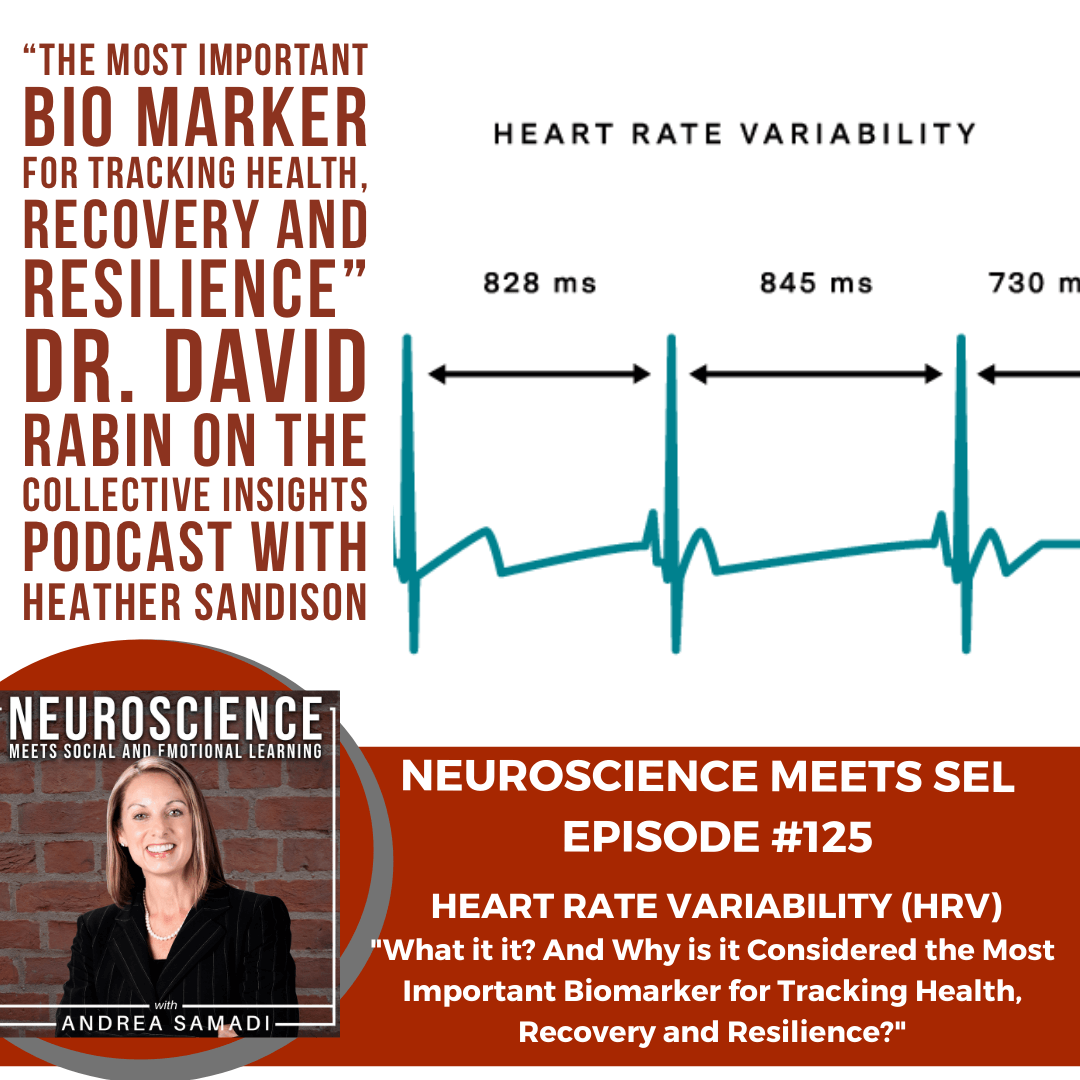
S5 Ep 125What is Heart Rate Variability and Why is it Important for Tracking Health, Recovery and Resilience? with Andrea Samadi
Welcome back to the Neuroscience Meets Social and Emotional Learning Podcast episode #125 on Heart Rate Variability that I just heard as being “The Most Important Biomarker for Tracking Health, Recovery and Resilience”[i] to Optimize Our Results by Dr. David Rabin on Neurohacker[ii] The Collective Insights Podcast with Heather Sandison. ND. My name is Andrea Samadi, I’m a former educator who has been fascinated with understanding the science behind high performance strategies in schools, sports and the workplace for the past 20 years. If you have been listening to our podcast for some time, you will know that we’ve uncovered that if we want to improve our social and emotional skills, and experience success in our work and personal lives, it all begins with an understanding of our brain. If you are listening to this episode on iTunes, click here to see the images in the show notes. Our podcast took a turn towards the importance of health and well-being with the Top 5 Health and Alzheimer’s Prevention Strategies last September 2020 with our episode #87[iii] and we have put a serious focus on these health staples and their importance on cognitive performance, ever since. I want to thank you for listening, and for keeping us in the TOP 100 charts on iTunes in the USA (for How-To/Education Category), Great Britain, Sweden, Mexico, Hong Kong, and many other countries. We appreciate everyone who supports the podcast which helps us to continue to produce content that will help you to further increase productivity and results in schools, sports and the workplace. I’m always looking for ideas and strategies that we can all use to optimize our lives, especially these days, a year after COVID-19 shut down the world, changed the way many of conduct business, run our schools, communities and live our own personal lives. As the focus has taken a serious shift to health, with mental health at the forefront, and well-being in our schools and workplaces, I want to share the most important strategies that I come across and make them actionable for everyone to implement. This brings us to this week’s topic, understanding Heart Rate Variability. What is Heart Rate Variability (HRV) and Why is it Considered the Most Important Biomarker[iv] --a measure that captures what’s going on in a cell at any given moment that can serve as an early warning system for your health. Unless you have been training with a forward-thinking coach, you’re an elite athlete, or someone who has taken a serious interest in measuring their performance, most of us have not heard of, or really understand what exactly heart rate variability means, or why Dr. Rabin, a board-certified psychiatrist and neuroscientist, would consider it to be “the most important biomarker for tracking health.” I started to hear about heart rate variability while interviewing and researching certain guests, starting with Dr. Daniel Stickler[v], who raised his arm in the interview and mentioned that he wore the Whoop[vi] device that tracks his performance, and then again with Kelly Roman[vii], the CEO and Co-founder of Fisher Wallace Laboratories, when we were talking about his wearable medical devices for anxiety, depression, stress management and sleep that were shown to improve heart rate variability. I wrote down the term, thinking, it’s got to be connected to heart rate somehow, and had plans of looking it up to see what exactly it was, so I could learn more about it. The problem was, when researching this term, I seemed to come across very high-level explanations. For those listening who are teachers, we know that when learning a new topic, it really does help to begin at the starting point and build from there. One morning, I came across a post on Instagram from Neurohacker Collective[viii] that caught my attention. I’ve shared the Instagram post in the show notes, where they highlighted one of their recent podcasts that explained the importance of heart rate variability. I i
S5 Ep 124Brain Fact Friday on "How to Be a Neuroscience Researcher in 4 Simple Steps"
Welcome back to the Neuroscience Meets Social and Emotional Learning Podcast, for Brain Fact Friday and episode #124. If you’ve been listening to this podcast, called Neuroscience Meets Social and Emotional Learning, I’m sure you’ve made the connection with the importance of improving our social and emotional skills, in our schools and otherwise called emotional intelligence skills in the workplace with an understanding of how our brain works. This week we interviewed Professor Chuck Hillman, from Northeastern University, and he mentioned that an important concept he would like to see in the future, would be more people like Paul Zientarski, who built his career with the application of Professor Hillman’s brain research. Today’s Brain Fact Friday will teach you how to do this. If you’re interested in how you could be this person in your school or workplace, who could spearhead the implementation of these new evidence-based ideas, I’ll show you how simple it can be so that you can be confident that what you are sharing with your schools or teams is accurate, and not pseudoscience. In 2014, when an educator urged me to add the most current neuroscience research to my programs, I had to quickly learn about the brain and be sure what I was learning was accurate. I didn’t go to school for a degree in Neuroscience which is one route I highly suggest especially through Butler University’s Applied Educational Neuroscience Graduate Program Certificate with Dr. Lori Desautels[i]. I went another route, and found the leading neuroscience researcher, Mark Waldman[ii] to teach me all he knew and later joined his Neuroscience Certification Program[iii] so I could share the most accurate research with others and stay up to date, since this information is always advancing and changing. This is exactly what Paul Zientarski had to do when he began to learn how the brain works from Professor Hillman’s research. Once you have an understanding of how the brain works, and know where to look to attach the most current research studies for your hypothesis, or something you are interested in sharing with others, it’s really not that difficult. We can all be neuroscience researchers, but the key is to find accurate studies that come from a website called Pubmed.gov[iv] not just Google, YouTube or random articles you might find on the internet. This is how I added brain-research to my second book, Level Up: A Brain-Based Strategy to Skyrocket Student Success and Achievement[v] and began speaking on the topic of “Stress, Learning and the Brain” in 2016. My first brain-based presentation for YRDSB Quest Conference[vi] in 2016 filled up and had standing room only. Principles, Superintendents, teachers and students filled the room, with the hopes of learning something new. It was the research that was throughout this presentation that helped me to have the confidence to share this knowledge, and not feel intimidated with the fact that I am not a Cognitive Neuroscientist, but someone who is passionate about the subject, that I would gladly trade my weekends to study and learn more, so I can share it with others. There was one slide that gave credibility to the topic, with the advice of Mark Waldman, who had been presenting on the topic many years before me. It’s funny because he mentioned that studies show if you put an image of the brain in your presentation, it adds instant credibility to what you are saying. I’ll put the slide in the show notes, so you can see how easy it can be to attach a Pubmed Study and picture of a brain, to your next presentation if you want to add neuroscience to your next presentation. You can see my slide where I am talking about what stress does to our brain, as well as our students’ brains. If you are listening to this podcast on iTunes, you can access the images in the show notes here. How Can You Become a Neuroscience Researcher? Here’s 4 simple steps that I know you could implement. STEP 1: First you want to
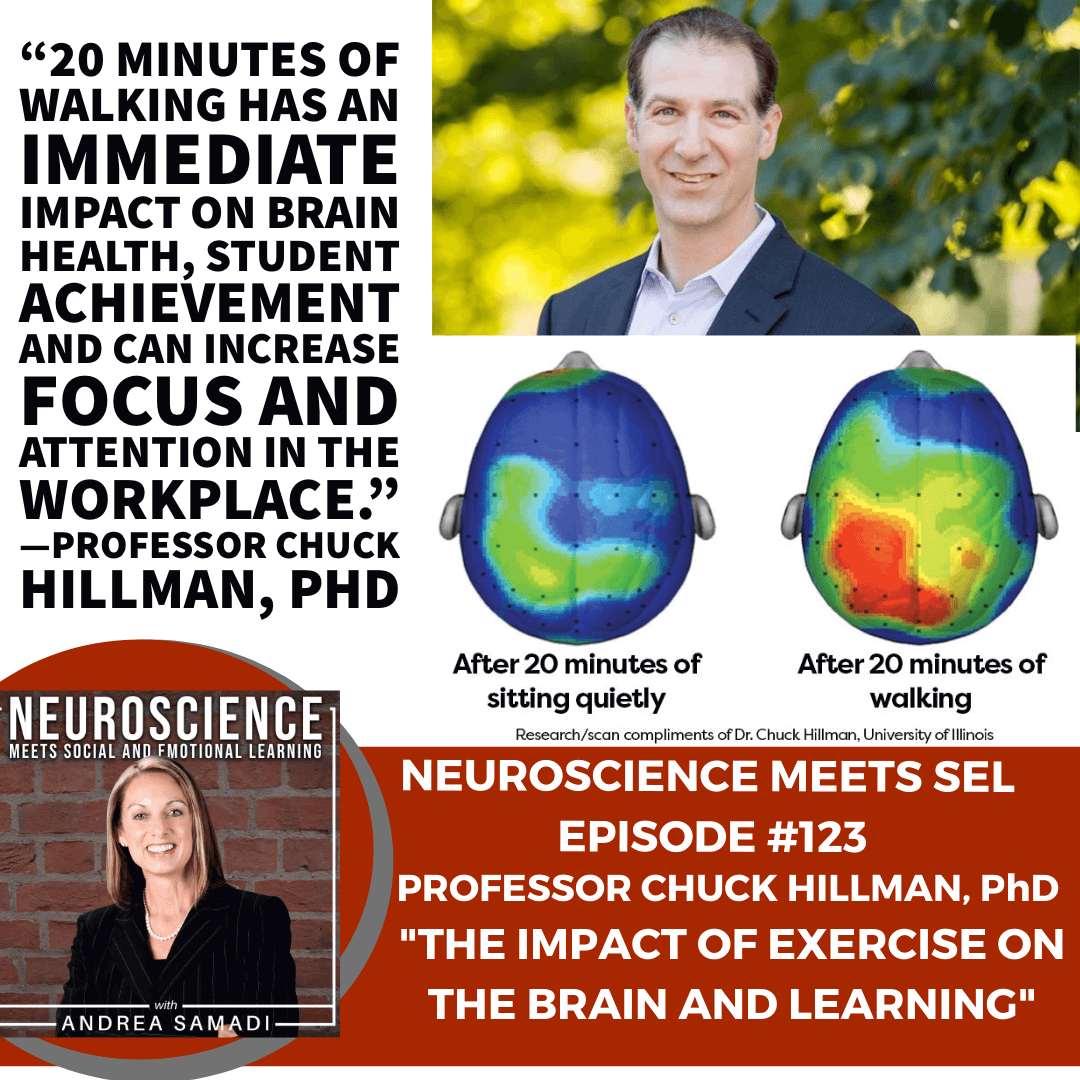
S5 Ep 123Northeastern University Professor Chuck Hillman, PhD on "The Impact of Exercise on the Brain and Learning."
Welcome back to the Neuroscience Meets Social and Emotional Learning Podcast episode #123 with Dr. Charles Hillman, whose research and brain scans on students during his time at the University of IL (from 2000-2016) provided enough science to spearhead Naperville’s Zero-hour PE program that we’ve been covering on the past few podcast episodes (#116,[i] #118[ii], #119[iii], #121[iv], #122[v]) that put physical exercise and its impact on cognition and the brain, on the map. It was Paul Zientarski, the former PE teacher and football coach from Naperville who mentioned Dr. Chuck Hillman’s brain scan studies in our interview #121 and I thought these brain scans were so important, that I covered a deeper dive into the results of these scans on episode #122. You can watch the interview on YouTube here. My name is Andrea Samadi, and if you have been listening to our podcast for some time, you will know that we’ve uncovered that if we want to improve our social and emotional skills, and experience success in our work and personal lives, (in school, sports or the workplace) it all begins with an understanding of our brain. The goal of this podcast is to bring in experts, who’ve risen to the top of their field, and share their knowledge, wisdom and tips that many of us wouldn’t have access to, since this understanding of the importance of our brain and results is relatively new. Here’s more about our guest today, Dr. Hillman received his doctorate from the University of Maryland in 2000, and then began his career on the faculty at the University of Illinois, where he was a Professor in the Department of Kinesiology and Community Health for 16 years. He continued his career at Northeastern University in Boston, Massachusetts, where he currently holds appointments in the Department of Psychology and the Department of Physical Therapy, Movement, and Rehabilitation Sciences. He co-directs the new Center for Cognitive and Brain Health[vi], which has the mission of understanding the role of health behaviors on brain and cognition to maximize health and well-being and promote the effective functioning of individuals across the lifespan. Dr. Hillman has published more than 265 refereed journal articles, 15 book chapters, and co-edited a text entitled Functional Neuroimaging in Exercise and Sport Sciences[vii]. When Paul Zientarski mentioned that it was Dr. Hillman who helped him to make up his mind about making changes to their PE program in Naperville, after he saw the scans of students’ brains after just 20 minutes of walking, I knew I had to find out if Dr. Hillman would come on the podcast. I emailed him at Northeastern University on Saturday afternoon, and he replied early Sunday morning that he was interested helping to expand on the results he discovered through his brain scans. We had a chance to exchange some emails, pick an interview time, and that’s how simple it is when you reach out to someone who really does want to see change occur in the world. Let’s hear from Dr. Hillman. Welcome Dr. Hillman, Thank you so much for such an enjoyable chat Sunday morning, as were picking a time to speak. I know that time is always a factor, when I’m reaching out for the podcast, and do want to maximize our time together, so we can dive a bit deeper into the research that began when you were at the University of IL. Q1: Dr. Hillman, I listened to a podcast that you did with a young man from the UK, Daniel Elias[viii], and I loved his introductory question to you about what it was that began your interest early in your career to study children and the impact that exercise has on their brain? Can we start with where it all began for you? Q2: The research is clear that exercise has a significant impact on student achievement, from your work, and from the results that Naperville was able to create using your research to create their Zero-hour PE program, and from our conversation on Sunday morning, we know how powerful nature can be on our
S5 Ep 122Brain Fact Friday on "Transforming the Mind Using Athletics and Neuroscience"
Welcome back to the Neuroscience Meets Social and Emotional Learning Podcast, for Brain Fact Friday and episode #122. This week we interviewed Paul Zientarski,[i] the former PE teacher from Naperville Central High School, who reinvented physical education using the understanding of simple neuroscience. Then last week’s interview with Dr. John Ratey,[ii] and his book Spark, cemented the idea of the profound impact that exercise has on our cognitive abilities and mental health. Paul Zientarski said many things that caught my attention in the interview and took me by surprise especially with the whole idea of their Zero Hour PE creating such noticeable results with students in the classroom, and even going on to inspire some student to become PE teachers in the future. I thought what their research uncovered at Naperville was important enough to reinforce and take a closer look at why those students at Naperville scored so high on their tests after they took this NEW Physical Education class that blended aerobic activity with an understanding of neuroscience. If you haven’t listened to Dr. Ratey’s episode #116, or Paul Zientarski on #121, be sure to go back and listen after this brain fact. BRAIN FACT: Aerobic activity can transform not only the body, but also the mind. Dr. Ratey said it clearly in his book Spark when he said that “aerobic activity has a dramatic effect on adaptation, regulating systems that might be out of balance and optimizing those that are not—it’s an indispensable tool for anyone who wants to reach his or her full potential.” (Spark, Page 10). By now we all know that exercise increases brain activity, and that the benefits of exercise “come directly from its ability to reduce insulin resistance, reduce inflammation, and stimulate the release of growth factors—chemicals in the brain that affect the health of brain cells, the growth of new blood vessels in the brain, and even the abundance and survival of new brain cells.”[iii] Dr. Chuck Hillman[iv], from the University of IL (now at Northeastern University) conducted a series of brain scans on students and showed what their brain activity looked like after sitting quietly (not much color if you look at the images in the show notes) vs how vibrant the brain looks after even a 20-minute walk. Without knowing anything about fMRI scans, one look at how the brain lights up after exercise, and we all can come to the same conclusion. “Exercise primes the brain, putting it in the right environment for learning.” Hillman took his research a bit further, and divided students (aged 9/10) into 2 groups. Higher fit (if they could run 0.25 miles without stopping) and lower fit if they had to stop in this 0.25 mile run. The students were asked to take a test similar to what you would find on Lumosity.com and the brains of the higher fit students lit up during the easy test, showing more red color (more brain activity) than the lower fit students. The most noticeable difference was during the difficult test, the brains of the higher fit students lit up bright red, showing the increase of brain activity they had access to, and the lower fit students just didn’t have enough brain power during the difficult test. This study clearly shows how the power of exercise and being physically impacts our brain and cognition. Hillman went another step further with his research and created a 9-month intervention PE program, taught by future PE teachers. Half of the students had an hour of PE prior to their school day, and half didn’t attend the PE program. They went straight to school (they called them the wait list group). The brain scans of the one-hour PE group showed a significant increase of brain activity compared to the students who did not take this extra hour of PE each day. If you are listening to this podcast, I am sure that this will get you as excited as Paul Zientarski was when he first saw these results, and what made Dr. John Ratey jump on an airplane when
S5 Ep 121Naperville Central High School's Paul Zeintarski on "Transforming Students Using Physical Education and Neuroscience"
Welcome back to the Neuroscience Meets Social and Emotional Learning Podcast, episode #121 with the former PE teacher from Naperville, IL, Paul Zientarski. Watch the interview on YouTube here. Hello and Welcome back! I’m Andrea Samadi, a former educator who has been fascinated with learning the science behind high performance strategies in schools, sports and the workplace, for the past 20 years. If you have been listening to our podcast for some time, you will know that we’ve uncovered that if we want to improve our social and emotional skills, and experience success in our work and personal lives, it all begins with putting our brain health first. We’ve mentioned that exercise is one of the top 5 health staples that’s a known brain-health and Alzheimer’s prevention strategy, from our episode #87[i] helping us to take our results, productivity and health to these higher levels. Ever since I came across John J Ratey’s book Spark[ii], I have been drawn in, wanting to learn more, so that I can share his research you, with the hope that something he has uncovered, inspires you, like it inspired me, and that together, we make improvements, even small ones, in our lives, that lean us closer towards the health and wellness that we need these days. Today, I am so excited to introduce you to Paul Zientarski, the physical education coordinator from Naperville’s Central High School as well as the football coach who worked closely with Phil Lawler to attain the profound results that put Naperville on the map for outstanding academic achievement with their Zero Hour PE Program. John Ratey described Paul Zientarksi in Spark as “a grey-haired furnace of a man with steady eyes and a fact-is fact delivery with the presence of Mike Ditka and Bill Parcells rolled into one figure of authority.”(Spark, Page 18). This paints the picture of one tough coach, with high expectations and no room for messing around. I have worked with a couple of PE teachers who had this same reputation in the toughest schools in the West end of Toronto, and found that there was always a softer side to this tough exterior, that I felt when I watched Mr. Zientarski’s TED TALK.[iii] You can see for yourself or go to his website where you can learn more about his Learning Readiness PE Program[iv] that reveals the passion he has for his students to learn, and be healthy at the same time. What excites me the most as I am preparing my interview questions for coach, they called Mr. Z, is that not only did he have the vision for what he expected of his team, school and players, but that he had the vision of the “Smart Jock” back then, before everyone was talking about the importance of neuroscience in the classroom. Dr. Ratey recalled saying that when he first met Mr. Z, he was shocked that he heard these coaches saying things he never expected coaches to be saying. He quoted Mr. Z saying, “In our department, we create the brain cells, and it’s up to the other teachers to fill them” (Spark, Page 19) with regards to their academics. I’ve thought long and hard about the questions I want to ask Paul Zientarski, whose presence has been described as that of “a seasoned U-boat commander” (Spark, Page 22) with the hopes that something he says, lights a Spark for the listener, to do something, take some action, using the immense wisdom that transformed Naperville’s well-oiled PE Program. Let’s hear from Mr. Z! Welcome Paul Zientarski! What an honor to have this opportunity to speak with you. Thank you very much for joining me on the podcast today. What part of the country have we reached you today? Q1: Paul, can you take us back to when Phil Lawler[v] (who I was sorry to see lost his battle with Cancer in April, 2010) first came to you with this idea for this new PE program. Dr. Ratey said that it took the longest time to convince you. What do you remember about this new PE idea and what made you want to give it a shot? Q2: As the movement grew, and the media attention c
S5 Ep 120Personal Review of the Fisher Wallace Wearable Medical Device for Anxiety, Depression and Sleep/Stress Management.
Welcome back to the Neuroscience Meets Social and Emotional Learning Podcast, episode #120 with a review and my experience using of the Fisher Wallace Brain Stimulator from episode #108 with Kelly Roman. *NOTE: Andrea Samadi did not receive any incentive or royalty for this review for the Fisher Wallace sleep device. Anyone can test this device, in exactly the same way, as they do offer a 30 day trial period through their website. REVISION ADDED APRIL 5th/2021 at 9:58 marker with TIPS from Kelly Roman, Fisher Wallace Co-founder and CEO. You will learn:✔︎ What to expect if you want to try the Fisher Wallace Brain Stimulator to improve your sleep, anxiety or mood.✔︎ How Andrea Samadi measured and tracked her sleep, using the FitBit App, and improved her sleep from getting around 5 hours and 28 minutes in her baseline week to hitting close to 7 hours of sleep in her final days of the trial.✔︎ How you can try the Fisher Wallace Brain Stimulator for Improved Sleep, Reduced Anxiety or Depression.Access past episodes here: https://lnkd.in/grfaE7y Hello and Welcome back! I’m Andrea Samadi, a former educator who has been fascinated with learning the science behind high performance strategies in schools, sports and the workplace, for the past 20 years. If you have been listening to our podcast for some time, you will know that we’ve uncovered that if we want to improve our social and emotional skills, and experience success in our work and personal lives, it all begins with putting our brain health first. We’ve mentioned that sleep is one of the top 5 health staples that’s a known brain-health and Alzheimer’s prevention strategy, from our episode #87[i] helping us to take our results, productivity and health to these higher levels, so when I had the opportunity to improve my sleep, I jumped on the chance, with the hopes that with what I learn from my experience, could help you, or someone you know who might be struggling with getting enough sleep each night. There isn’t a day that goes by that I don’t hear someone in my network mention that they are working on improving their sleep. If you want to hear the episode with Kelly Roman[ii], the CEO of Fisher Wallace Labs and their wearable medical devices to help improve sleep, while also treating anxiety and depression, go back and listen to episode #108. After this interview with Kelly Roman last February of 2021, I shared with him that my brain scan at Amen Clinics (in July 2020)[iii] showed what Dr. Shane Creado felt my brain showed signs of sleep deprivation, and Kelly graciously offered to send me one of the devices/paired with a Fitbit see if we could improve my sleep. I accepted the offer and promised to take the month-long trial seriously. It’s just a few days after the end of the month, and the results are in. But first, if you’re interested in this device, contact Fisher Wallace Labs[iv] at www.fisherwallace.com or by calling 1-800-692-4380. For just under $500 (they show a discount on their website when I last checked) you will be mailed a kit with the simulator, electrode headset, Velcro headband, sponges, carry case, manual, and shipping label. The Fitbit is separate if you want to measure your results like I did, and something you can purchase on your own. They offer a 30-day Refund Policy. There are videos that you can watch that show you how to use the device right on their website.[v] When I received the Fisher Wallace device, it came quickly, via Fedex, and was simple and easy to set up, after I watched a video through their website. Here’s what I learned: Before doing the month-long trial of wearing the device, Kelly suggested getting a baseline for my sleep, and measure at least 3 days without using the device, to see the quality and quantity of sleep beforehand. I wanted to get the most accurate reading of how I was sleeping before I tested the device, so I did everything I knew would help my sleep like eliminating alcohol one week prior and during the b
S5 Ep 119Brain Fact Friday on "The Key Ingredients of Learning with the Brain in Mind."
Welcome back to the Neuroscience Meets Social and Emotional Learning Podcast, for Brain Fact Friday and episode #119. Hello and Welcome back! I’m Andrea Samadi, a former educator who has been fascinated with learning the science behind high performance strategies in schools, sports and the workplace, for the past 20 years. If you have been listening to our podcast for some time, you will know that we’ve uncovered that if we want to improve our social and emotional skills, and experience success in our work and personal lives, it all begins with putting our brain health first. As I am working closely with neuroscience researcher, Mark Robert Waldman, and learning new ideas that could help improve results for students in our classrooms, or those in the corporate world, I will share with you what I am learning, with the hopes you can implement the new idea in your life, for immediate, improved results. This week’s brain fact goes right along with the past few episodes where we have been talking about the profound impact that exercise has on our cognitive abilities and mental health. Dr. Daniel Amen, (who we’ve talked a lot about on past episodes) and Dr. John J Ratey would both agree that it’s “simply one of the best treatments we have for most psychiatric problems.”[i] Instead of just one brain fact about the importance of exercise on our brain, I have a few-- to really hit the importance of this brain fact home. Here are Your Brain Facts for This Week: Did You Know That: “Physical activity is crucial to the way we think and feel.” (John J Ratey, MD). “Children who exercise regularly are likely to do the same as an adult.” (Spark, Page 12) “Statistics show that about half of those who start out with a new exercise routine drop out within six months to a year” (Spark, Page 260) probably because they jump in at a high intensity, it’s too much, and they give up. If you have heard our past 2 episodes, you will know that Dr. Ratey wrote the book Spark on this topic after he saw Naperville’s scores on the Trends in International Mathematics and Science Study (TIMSS) where they scored #1 in science and #6 in math, in the world, proving that there was something unique that they had discovered with the correlation of exercise and academic achievement. Naperville provided a powerful case study that “aerobic activity can transform not only the body, but also the mind.” (Spark, Page 19) Dr. Daniel Amen often talks about the importance of exercise, or walking 5 days a week, like you are late (he would say) for your brain health. He mentions that “blood vessels age, not your brain cells”[ii] and the best way to keep blood vessels healthy so blood flows to your brain, is with moderate exercise. So for such an important brain fact, that two of the most famous brain experts I know, have focused most of their careers teaching the world about, why isn’t everyone taking advantage of this profound impact of exercise on the brain—for our students in our classrooms and for everyone in the workplace looking for increased productivity. It All Begins With Understanding How Our Brain Works Most us have not had the crash course in this topic. Since we know that our brain is involved in everything that we are and everything that we do, it’s important that we understand how it works, especially when it comes to making habits (like implementing a new exercise program) stick. I was speaking with Victoria Sambursky this week (she is working closely with Dr. Ratey with her company Edominance)[iii] with assessments that unlock personality and behavior, and she was asking me about the best way to break a habit. I shared with her what I cover on episode #35 on “Using Your Brain to Break Bad Habits”[iv] since what we must do to break a habit is the exact opposite of what we must do when forming our new habit, like our new exercise routine that we want to start. I Shared with Her—Here’s How We Break Habits and Here’s How We Form New Ones Learning creat
S5 Ep 118Deep Dive into Best-Selling Author John J. Ratey's Books "Spark, Go Wild and Driven to Distraction."
Welcome back to the Neuroscience Meets Social and Emotional Learning Podcast EPISODE #118 with a deep dive into John J. Ratey’s most recent books including the groundbreaking ADHD “Driven to Distraction” with Dr. Edward (Ned) Hallowell, MD, "Spark: The Revolutionary New Science of Exercise and the Brain" that established Dr. Ratey as one of the world’s foremost authorities on the brain-fitness connection and “Go Wild”, that explores how we can achieve optimal physical and mental health by getting in touch with our roots. During our interview together on EPISODE #116[i], we barely scratched the surface of these three books, so I wanted to take the time to dive a bit deeper into each one of them, keeping in mind the top 5 health staples that we focused on with episode #87.[ii] Dr. Ratey’s interview was insightful and many people from around the world emailed me with feedback about how timely and inspiring they thought Dr. Ratey’s research was, especially with where we are in the world today. Dr. Ratey said himself, “If we are going to have to learn to live with COVID, we’re going to have to learn to be well.” (Episode #116) and I thought about how our podcast took a turn from just focusing on social and emotional skills and neuroscience to a serious focus on the importance of health, around Season 3 and episode #71 (which was July 2020-right in the middle of the Pandemic) when I first started to study Dr. Shane Creado, from Dr. Daniel Amen’s offices on the importance of sleep[iii]. It seems to me that we can’t ask our students in our classrooms, or employees in our workplaces to focus on social, interpersonal, emotional or cognitive skills, without first, putting an emphasis on health. The more I Iearned in this area, the more convinced I became of the mind-brain-body connection that inspired me to take a trip to Dr. Amen’s Clinics in Costa Mesa, CA for a brain scan to see what we could learn to improve the health of my family and share these findings on the podcast. After the 3 episodes where I covered the importance of getting your brain scanned,[iv] there was one person who was integral to me meeting new people in the area of health and wellness and that was Luke DePron, the host of the Live Great Lifestyle Podcast[v] from episode #90.[vi] Luke and I became friends through LinkedIn, and I immediately asked if he would come on the podcast as a guest. Although health is my number one value, and something I block time off each day for, I knew there was so much more that I needed to learn in this area. We only know what we know, and after looking at Luke’s podcast, I was blown away. I highly recommend going to his website[vii] and looking thorough his episodes. I knew there was so much more I needed to learn in this area, and you will find many different topics that go really deep into the area of health and wellness through Luke’s podcast. After an incredible interview, it was Luke DePron who referred me to Dr. Erik Won and the Wave Neuroscience Team for episode #89[viii], Momo Vuyisich, from episode #93.[ix] and Dr. Daniel Stickler, for episode #96.[x] All of these interviews stretched me to think beyond what I knew before in the area of health and wellness and Luke’s podcast helped me to do this. Then, around September of 2020, after watching Dr. David Perlmutter’s Alzheimer’s: The Science of Prevention Series[xi], I began thinking of who I could get to fill in interviews to cover these top 5 health staples that kept appearing everywhere. I knew I could ask Dr. Shane Creado[xii] to cover the importance of sleep, but I had no idea that he would urge me and my husband to get our brains scanned through Amen Clinics and lead us to a whole new level of understanding of our health. Jason Whittrock from episode #94[xiii] was someone I had followed for a few years on social media, and he really left the impression on me that he was there to help people to get in shape and stay in shape. He just seemed genuine, so I sent
S5 Ep 117Brain Fact Friday on ”The Damaging Impact of Sugar on the Brain and Body.”
Welcome back to the Neuroscience Meets Social and Emotional Learning Podcast, for Brain Fact Friday and episode #117. Since we just released the ground-breaking interview with Dr. Ratey on the impact of exercise and nutrition on the brain, I wanted to focus today’s episode on something that he said, that caught my attention. Since last week’s Brain Fact Friday was about “Building a Faster, Stronger, Resilient Brain, by Understanding Brain-Derived Neurotrophic Factor (BDNF)” or the compound that Dr. Ratey says is crucial for preventing cognitive decline and Alzheimer’s Disease, I wanted to focus this episode on something Dr. Ratey said that really made me think. This week's Brain Fact Friday, you will learn: ✔︎ What sugar does to the brain, cognition and well-being.✔︎ How sugar contributes to cognitive decline and Alzheimer's Disease.✔︎ Why sugar is so addictive.✔︎ What surprising things spike blood sugar.✔︎ Healthy ways to naturally lower blood sugar. DID YOU KNOW THAT: High Glucose Levels are Toxic to the Brain and Limits the Production of BDNF He said, did you know that “High glucose levels are toxic to the brain, and limits the production of this glorious compound BDNF that has such a profound effect on cognition and well-being?” I remember a powerful quote from a BONUS episode I did for Podbean’s Wellness week[i] that goes right along with what Dr. Ratey said, coming from Dr. David Perlmutter, who wrote the foreword to Dr. Ratey’s book Go Wild![ii] DID YOU KNOW THAT: Sugar in the brain looks like Alzheimer’s in the Brain? I wrote in this bonus episode, after watching Dr. Perlmutter’s Alzheimer’s The Science of Prevention Series, Did you know that sugar in the brain “looks like Alzheimer’s” in the brain, and that “60% of cognitive decline is related to how you handle blood sugar?”[iii] There was a study that followed “over 5,000 people over 10 years and found that people with high blood sugar had a faster rate of cognitive decline than those with normal blood sugar—whether or not their blood-sugar level technically made them diabetic. In other words, the higher the blood sugar, the faster the cognitive decline.”[iv] So when Dr. Ratey said that “high glucose levels are toxic to the brain” I thought back to this study, and wellness episode, and thought we could take a closer look at how our glucose levels increase, with tips for healthy ways to keep our blood levels stable. I’m sure we all know that sugar is bad news for our brain, our body, and that sugar (a class of molecules called carbohydrates) will give us a rush of energy at first but will make us hungry a few hours later). Now to think that it limits the production of this key protein we all know is important for anti-aging, and Alzheimer’s prevention. Imagine that you have half the equation right. You are exercising, watching what you eat, and allowing some treats in moderation. This would be the perfect way to live your life, according to Dr. Ratey, but I started to wonder, what are some ways that we could unknowingly be raising our glucose levels and preventing the production of this powerful BDNF protein? Other than eating a bunch of sugar, are there other things I could be doing that could possibly be raising my glucose levels without me even knowing it? Until I heard Dr. Ratey talking about how damaging sugar was to our brain, I hadn’t spent much time thinking about this lately. We don’t have to be diabetic to watch or be aware of our blood sugar or glucose levels. I mention in one of my earlier episodes[v] that it was a visit to a foot doctor around 2005 for foot numbness after exercise, that got me to eliminate sugar completely from my diet back then. I was looking for solutions to why I couldn’t feel the top of my foot during exercise, and I didn’t show any signs of diabetes, but this doctor was writing a book, that is now released called Sugar Crush: How to Reduce Inflammation, Reverse Nerve Damage and Reclaim Good Health[vi] and he was con
S5 Ep 116Best Selling Author John J. Ratey, MD on "The Revolutionary New Science of Exercise and the Brain"
Welcome back to the Neuroscience Meets Social and Emotional Learning Podcast EPISODE #116, with best-selling author Dr. John Ratey[i], who is also an Associate Clinical Professor of Psychiatry at Harvard Medical School and an internationally recognized expert in Neuropsychiatry. He has published over 60 peer-reviewed articles, and 11 books published in 17 languages, including the groundbreaking ADHD “Driven to Distraction” series with Dr. Edward (Ned) Hallowell, MD. With the publication of "Spark:The Revolutionary New Science of Exercise and the Brain", Dr. Ratey has established himself as one of the world's foremost authorities on the brain-fitness connection. His most recent book, “Go Wild”, explores how we can achieve optimal physical and mental health by getting in touch with our caveman roots, and how we can “re-wild” our lives. Dr. Ratey lives in Cambridge, Massachusetts, and Los Angeles. Watch the interview on YouTube here. On this episode you will learn:✔︎ Who inspired Dr. Ratey to connect exercise and nutrition to the brain, health and learning?✔︎ Are some people born runners, meant for exercise and others are not?✔︎ What happens to the brain after exercise so that it's primed for learning?✔︎ What is the "disease of civilization" that we all face at some point in our life, before we learn the foods that we should eat and foods we should avoid?✔︎ What is the lesson we should all understand about carbs/sugar/good fats/insulin and glucose?✔︎ What is BDNF and why is it so important for brain health?✔︎ How did one school in Chicago inspire Dr. Ratey to write the book Spark? Hello and Welcome back! I’m Andrea Samadi, a former educator who has been fascinated with learning the science behind high performance strategies in schools, sports and the workplace, for the past 20 years. If you have been listening to our podcast for some time, you will know that we’ve uncovered that if we want to improve our social and emotional skills, and experience success in our work and personal lives, it all begins with putting our brain health first. We’ve mentioned that daily exercise is one of the top 5 health staples that’s a known brain-health and Alzheimer’s prevention strategy, from our episode #87[ii] helping us to take our results, productivity and health to these higher levels. I can’t tell you how excited I am to have come across our guest today, from a referral from someone who was interviewing me a couple of weeks ago. I always participate in Anna Alba’s “Thriving Parents, Happy Student[iii]” Summit, and this year, she asked me “have you read Dr. Ratey’s book called Spark: The Revolutionary New Science of Exercise and the Brain” and I had not. After I had read just the first few pages of his book, I learned about a school in Chicago, called Naperville[iv], that provides a powerful case study on how aerobic activity can transform not only the body, but also the mind. I started making connections between the direction our podcast took last year with Dr. David Perlmutter’s Science of Prevention Series from episode #87 where exercise was listed as a top 5 health staple and Alzheimer’s prevention strategy, and now there was a book all about how this one school was using exercise to transform their student’s academic performance. It took me back to my early days as an educator, and when I used exercise to calm down my students who were labelled behavioral. I was probably onto something back then, without even knowing it. After I learned about the study and research from Naperville, I asked Greg Wolcott, the Assistant Superintendent of Teaching and Learning from episode #64 and one of our first episodes #7, if he had heard of this school and the research and he had. He let me know that Naperville is about 20 minutes from him and he said “I have based interventions with several schools off the research and found MTSS interventions to have the strongest effect after PE.” I emailed Dr. Ratey immediately (it was late in the
S5 Ep 115Denise Cooper on 30 Years of Executive Level Talent Development with "Remarkable Leadership Lessons"
Welcome back to the Neuroscience Meets Social and Emotional Learning Podcast EPISODE #115, with Denise Cooper[i], the author of the book, Remarkable Leadership Lessons[ii], with 30 Years of executive level Talent Development experience. Watch the interview on YouTube here. On this episode you will learn: ✔︎ After 30 years of teaching leadership to executives, what are the most important lessons that we should all know and practice? ✔︎ How can leaders incorporate social and emotional skills into the workplace to improve communication with their team? ✔︎ How can we ensure that all team members hold the same vision? ✔︎ How can we help diverse groups to feel included and help them to step to their next level? ✔︎ How can behavior change happen within an organization? What are the best ways to introduce new ideas for change? ✔︎ Why is collaborative thinking such an important problem-solving skill? Hello and Welcome back! I’m Andrea Samadi, a former educator who has been fascinated with learning the science behind high performance strategies in schools, sports and the workplace, for the past 20 plus years. I can’t tell you how much I’m looking forward to introducing you to Denise Cooper. When I first was introduced to Denise, it was through email, and I took one look at her media kit, and wrote back immediately (within seconds) to her team that I would love to speak with her. I didn’t need an intro phone call to know that Denise Cooper exuded leadership. We set up a call anyway, and I learned so much from our chat together. Denise Serves corporate clients of large, midsize, and smaller companies Coaches senior level executives to continue to succeed in a new or different role Assists high performers struggling with a new scope of responsibility Helps companies develop new leadership strategies during times of management, performance, structural, or business change Works with individuals, departments, or management teams to enable them simply to perform better Through one-on-one coaching, structured leadership training, coursework, team or group workshops, or tailor-made curricula, Denise guides companies and individuals to elevate their game and maximize their company's performance. A review of her book says it all- “Her book answers the hard questions we all ask ourselves in our careers. How do I influence others? How do I get my colleagues to respect me? How do I present with confidence, even if I don't feel it? No one in my life has given me these answers, which makes this book worth its weight in gold to me.” During these times of change, I don’t know anyone who wouldn’t benefit from hearing what Denise has to say. I will create some questions for her, so you can dig a bit deeper into her book, trainings and coursework to help shift your mindset to possibility thinking, and perhaps some breakthroughs of your own. Be sure to look in the show notes for the link to her Masterclass that begins May 17th called “Change Terrifies Us” and without further ado, here’s Denise Cooper. Welcome Denise, thank you for coming on the podcast today to share your knowledge and expertise in the field of leadership, at a time when everyone could do with a refresher course on communication, or thinking differently to hit those breakthroughs we all are looking for. Q1: Denise, when we first spoke, you mentioned where your work began in the area of leadership. Whether we are leading team in the corporate world, working as a school admin, or superintendent, or even leading ourselves in business, what are some of the most important leadership lessons from your book that we should all know about to become better leaders? (leadership is more about you than the other person). Q2: In section 1 of your book, you talk about becoming a Change Leader. How can a leader incorporate some of these important social and emotional skills that I’ve built this podcast on (like self-awareness—the importance of knowing ourselves, or social awareness—getting to k
S5 Ep 114Brain Fact Friday on "Building a Faster, Stronger, Resilient Brain, by Understanding Brain-Derived Neurotrophic Factor (BDNF)"
Welcome back to the Neuroscience Meets Social and Emotional Learning Podcast, for our third Brain Fact Friday and episode #114. This week's Brain Fact Friday, you will learn:✔︎ What is BDNF (brain-derived neurotrophic factor) and what are it's benefits to the brain.✔︎ What we should all understand about BDNF with Alzheimer's Disease, Parkinson's Disease and how our brains learn.✔︎ Exercise, Nutrition and BDNF: What's the Connection?✔︎ Why Putting the Body Under Stress is a Good Thing.✔︎ Sleep, Stress and the BDNF Factor.See past episodes here https://lnkd.in/grfaE7y This week, we recorded 2 ground-breaking interviews with 3 decades of leadership expertise with Denise J Cooper on her book, Remarkable Leadership Lessons[i], and Dr. John Ratey,[ii] an Associate Clinical Professor of Psychiatry at Harvard Medical School and an internationally recognized expert in Neuropsychiatry. Stay tuned for these interviews coming next week, but for today, here’s Brain Fact Friday. Did you know that trace brain-derived neurotrophic factor or BDNF[iii] that Dr. Ratey says is like “Miracle-Gro (or fertilizer) for the Brain” is “the important link that explains why simple exercise can have such a profound effect on cognition and well-being[iv] and that “eating foods with folate, vitamin B12, and omega-3 fats increases BDNF in the brain, just as exercise does?” Dr. Ratey and I dive deep into his 2 books Spark: The Revolutionary New Science of Exercise and the Brain[v], and Go Wild: Eat Fat, Run Free, Be Social and Follow Evolution’s Other Rules for Total Health and Well-Being on our interview coming next week where he explains the importance of BDNF as it relates to diet and exercise (which are 2 of the top 5 health staples we have been focused on the podcast since last year). His book does dive deep into sleep as a health staple, but that’s another story. We will take a closer look at sleep in a later episode. But First, What is BDNF? Brain Derived Neurotrophic Factor (BDNF)[vi] is a protein that’s found in the brain and other parts of the body “involved in plastic changes related to learning and memory [vii] and higher-level cognitive abilities. This signaling protein is the reason why you can sit at your desk with a heightened sense of focus and concentration, after you exercise. Dr. Ratey taught me that “movement places demands on the brain, just as it does on muscle, and so the brain releases BDNF which triggers the growth of cells to meet the increased mental demands of movement”[viii] and the whole brain benefits from this movement. THE BENEFITS OF BDNF BDNF helps with learning, memory, or other higher-level thinking. It grows new neurons and synapses in the brain while also supporting the survival of existing neurons. It increases neurogenesis and can help to heal our brain after a traumatic brain injury.[ix] WHAT WE SHOULD KNOW AND UNDERSTAND ABOUT BDNF? BDNF is reduced in the brain of someone who has developed Alzheimer’s Disease[x] and Parkinson’s Disease[xi] and explains why someone with Alzheimer’s has their memory weakened. BDNF is involved in how long it takes us to learn something[xii]. A child’s rate of learning is higher than an adult, because of their highly plastic brain. This explains why learning a second language is much easier when you are younger, versus trying to learn a new language as an adult. HERE ARE SOME TIPS TO INCREASE BDNF TO BUILD A FASTER, BETTER, STRONGER BRAIN, WHILE IMPROVING RESILIENCE AND RESISTANCE TO STRESS. Exercise and Nutrition releases BDNF: Dr. Ratey, in his book Go Wild explains that researchers were looking at ways to prevent the aging brain and found that “seniors who exercised developed significantly larger hippocampal volumes (the part of the brain responsible for memory processing) improving their memory.”[xiii] They found that exercise also “prevented a loss of grey matter overall (which is common in aging) and improved brain function.” (Page 107). Since we are all aging, i