Neuroscience Meets Social and Emotional Learning
413 episodes — Page 8 of 9
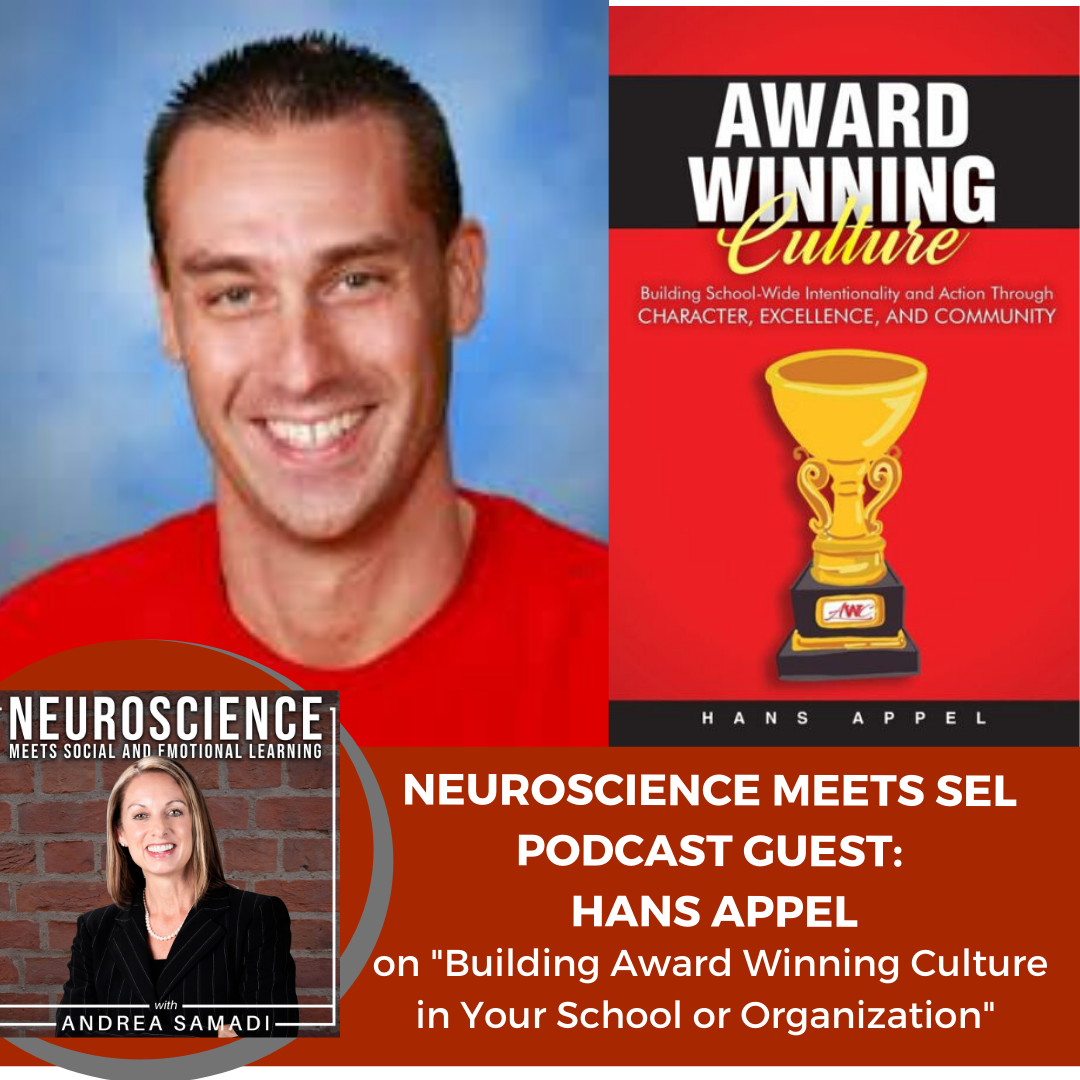
S2 Ep 63Author Hans Appel on "Building an Award Winning Culture in Your School or Organization"
This is episode #63 with Hans Appel, who has been a school counselor from Richland SD, WA for the past 19 years and is the author of the NEW book, Award Winning Culture: Building School-Wide Intentionality Through Character, Excellence and Community[i] that you can find RIGHT NOW on Amazon. My husband has worked closely with this District when he was a Regional VP of Sales with Scholastic and he agrees that they go above and beyond with everything they do, and it’s not surprising to hear that they emerged as International Thought Leaders over there but there’s much more to this story than meets the eye. I look forward to sharing Hans’ background and story for those who would like to replicate Award Winning Culture in their school, workplace or organization. Click here to watch the YouTube interview. Welcome back to the Neuroscience Meets Social and Emotional Learning podcast, my name is Andrea Samadi, I’m a former educator who created this podcast to bring the most current neuroscience research, along with high performing experts who have risen to the top of their field with specific strategies or ideas that you can implement immediately, whether you are a teacher in the classroom, a parent trying to figure out homeschooling and working from home, or someone working in the corporate world, to take your results to the next level. Today we are speaking with Hans Appel, has worked as a counselor in the Richland School District for the past 19 years at Enterprise Middle School since it opened. He’s passionate about school culture, servant leadership, and kindness. In 2018, EMS was awarded the ASCD Whole Child Award for the State of Washington and the Global “Class Act Award” for creating a culture of excellence through kindness, service, and empathy. Additionally, the were selected as a finalist in the 2019 PBIS Film Festival and took top prize in the Community, Parents, and Staff category. When I first spoke with Hans, just last week, to learn more about his background and new book, his humble nature came through. It wasn’t until last night, when I started to read his book “Award Winning Culture” that just became available last Friday, that I got to know and truly understand where Hans’ passion for building school-wide culture emerged from. I could go on with Hans’ bio, but will include more details in the show notes, and urge you to read his book yourself, and his website[ii] where you can learn more about Hans’s story, and about his wife Jen, who is an educator at Enterprise MS. Welcome Hans! Q1: Hans, when we were speaking last week, you were telling me how all of this started but we didn’t speak at all about your personal story that you share in the beginning of your book. For anyone looking to understand how change takes place, I do highly suggest reading this book to get a deeper understanding with someone who has grown up firsthand with ACES (Adverse Childhood Experiences). Before we get to the questions, can you share how you used your difficult upbringing to fuel your passion for change within your local school District? Q2: Can you explain how this all began at Enterprise Middle School that caused you to write your book, Award Winning Culture and create the framework around what you did to cause such an international interest? Q3: Hans, I’m familiar with how important it is to infuse SEL skills into a school, home and emotional intelligence training in our workplaces, with what we’ve been doing here, but many schools or workplaces are not sure how to begin, where to even get started with a program. Can you give some ideas of where someone can start to implement award winning culture within their school or organization to reap the benefits that will follow with a program like yours? Q4: Imagine a school or an organization that has not yet implemented a program, and they are well aware that change needs to occur. The part in your book about the reporter crying when she “felt” the energy of your sc
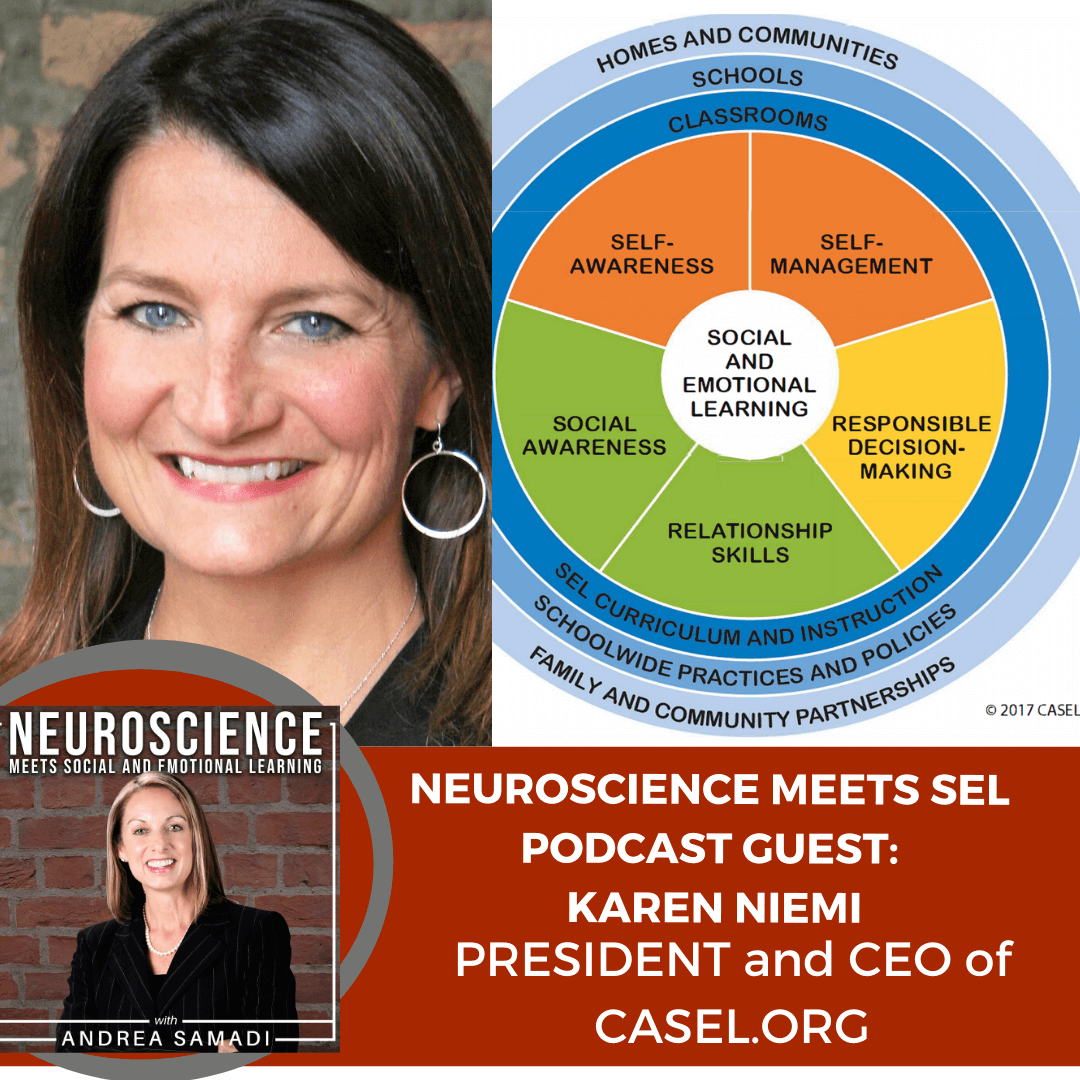
S2 Ep 62CEO and President of Casel, Karen Niemi on "Tools and Strategies to Enhance and Expand SEL in our Schools and Communities"
This is episode #62: with the President and CEO of CASEL (Collaborative for Academic, Social, and Emotional Learning, which is the trusted source for knowledge about high-quality, evidence-based social and emotional learning) Karen Niemi. You can watch the interview on YouTube here. Welcome back to the Neuroscience Meets Social and Emotional Learning podcast, my name is Andrea Samadi, I’m a former educator who created this podcast to bring the most current neuroscience research, along with high performing experts who have risen to the top of their field with specific strategies or ideas that you can implement immediately, whether you are a teacher in the classroom, a parent trying to figure out homeschooling and working from home, or someone working in the corporate world, to take your results to the next level. Today our podcast comes full circle, as anyone who follows our work, will know that we launched this idea almost a year ago, when I saw a huge need for a platform for social and emotional learning when Casel’s first SEL Exchange in 2019,[i] drew an interest from over 850 speakers around the country to present their ideas to help improve our schools, homes and communities with SEL and this inaugural SEL conference drew over 1,500 attendees from 48 states and 30 countries. I am thrilled to have the Karen Niemi, the President and CEO of CASEL here today. Karen oversees and directs all of CASEL’s activities to enhance and expand evidence-based social and emotional learning, including practice, research, communications, policy, and development. This is no small feat, but as an accomplished business leader with a long track record of success in the education sector she blends a deep understanding of school systems and pedagogy with solid business practice and has successfully led educational companies through all stages of growth. She has also helped schools advance their educational mission by making research and best practices accessible and actionable by teachers and administrators and has brought learning tools and strategies to school systems and students nationwide. Welcome Karen, it’s such an honor to have you here today. I must give David Adams from episode #54[ii] a shout out and thanks for introducing us and let you know that we have had a few leaders from Casel, like Clark McKown, the President and Founder of xSEL labs[iii] who is on the advisory board for Casel’s Measuring SEL Initiative[iv] as well as Yale’s Center for Emotional Intelligence Founder Marc Brackett with his important book “Permission to Feel.”[v] Thank you for coming on today to share your thoughts, experiences tools and resources for SEL at such an important time for parents, educators and everyone for that matter. Question 1: I was speaking with the President of a large publishing company to potentially develop an SEL program, and many people in this company, were still unclear of the years of research and data behind implementing SEL in our schools. So, even though there’s this huge interest in SEL, not everyone has caught up yet to the benefits behind implementing an SEL program (in our schools) or even an Emotional Intelligence Training program in our workplaces for those who are in the workforce and are missing these important skills. I pointed them to your research page https://casel.org/research/ and explained about the 11 percentile point academic gain. How can we spread the word of all of the resources that Casel offers, that’s really been the Hallmark of your work since its founding? Can you give an overview of all of the resources that Casel offers? Question 2: There’s a lot of people who work at Casel with your board, staff, consultants, funders and collaborators. I know Linda Dusenbury from following her Collaborating States Initiative[vi] since 2016 as I watched with amazement when SEL standards slowly but surely started being implemented in schools across the country, and I know of some of the people in your re
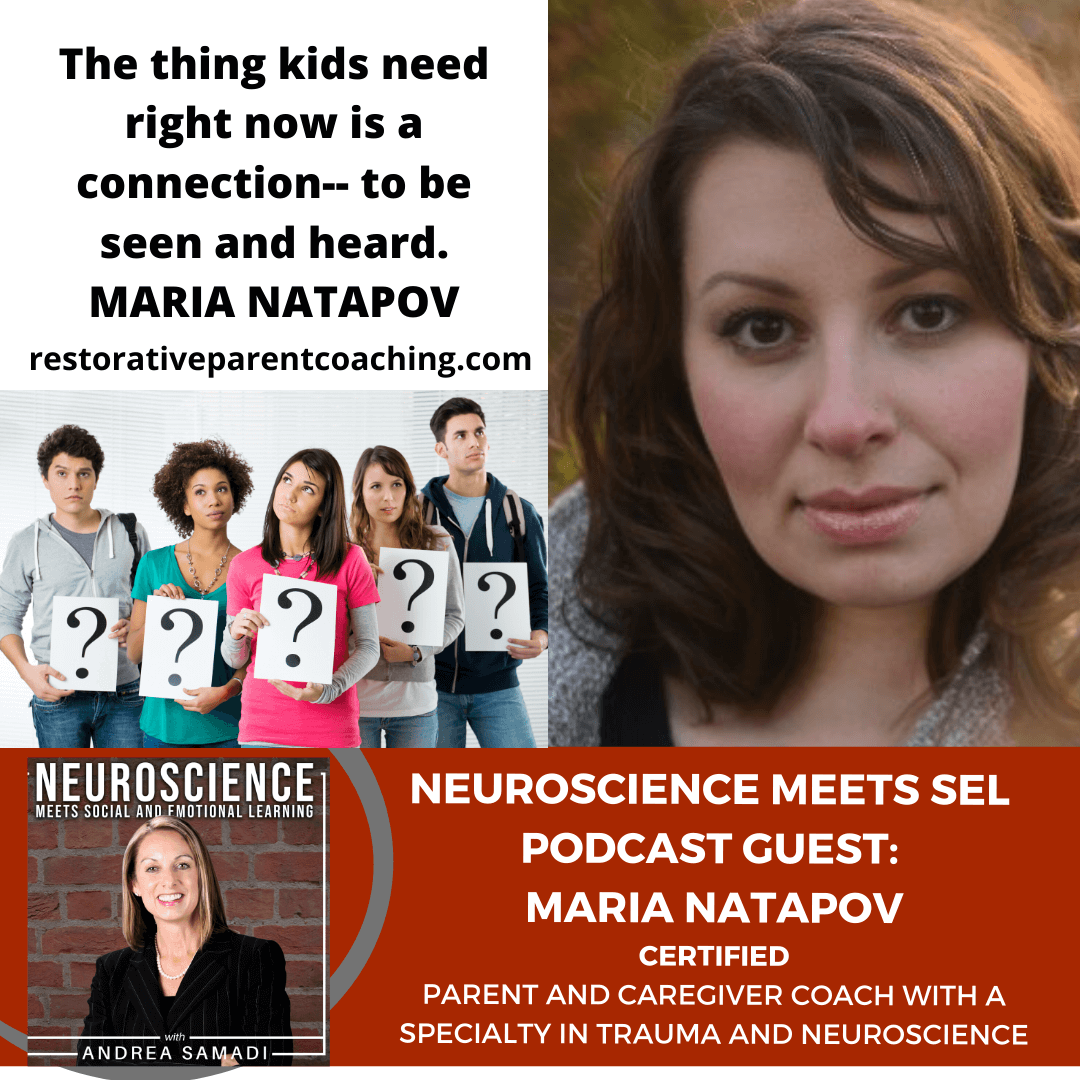
S2 Ep 61Maria Natapov on "Building Autonomy, Self-Confidence, Connection and Resiliency Within Our Children"
This is episode #61: Welcome back to the Neuroscience Meets Social and Emotional Learning podcast, my name is Andrea Samadi, I’m a former educator who created this podcast to bring the most current neuroscience research, along with high performing experts who have risen to the top of their field with specific strategies or ideas that you can implement immediately, whether you are a teacher in the classroom, a parent trying to figure out homeschooling and working from home, or someone working in the corporate world, to take your results to the next level. We’re just a month away from our one year anniversary of when we launched this podcast that is now being listened to in over 95 countries, and we’re thrilled to see that we’ve hit the top 100 charts for Apple iTunes Education How-To Category for multiple countries (Canada, USA, Great Britain, Australia, Sweden and just hit #1 in Switzerland this week) so thank you listeners. I’ve actually lived in 3 of the countries that keep showing up on these charts and am grateful to all our supporters around the world. Today we have someone who I know will share some valuable and timely tips for all of us--Maria Natapov[i], a Certified Parent and Caregiver Coach with a specialty in trauma and neuroscience and its application. Maria teaches practical and actionable parenting techniques to caregivers that bring out the best in their child, with a specialty in healing trauma and breaking its cycles. She partners with parents, teachers, and childcare professionals through individualized, targeted sessions that empower caregivers to curb their child's challenging behaviors and deeply connect while taking care of their own needs. In addition to parent coaching, she has worked as an applied behavioral analysis therapist in home and school settings. Maria moved to the United States from Russia at age 8 and is deeply sensitive to the role that cultural differences play in behavior and parenting. If you were to take the time to hear Maria’s story and background, you would understand where her passion to help other parents navigate through difficult times originated, especially when trauma is involved.[ii] I’ve included a podcast she did on this topic that you can access this in the show notes to learn more about her background. Maria founded Restorative Parent Coaching to help caregivers create nurturing environments in which adults and children can thrive. To watch this interview on YouTube, click here. I first met Maria when she connected with me through social media and saw instantly that we had common ground with our work. The interview questions I’ll be asking today came directly from an article she wrote called “5 Strategies to Mitigate Covid-19 Related Anxiety and Trauma for Children.”[iii] When we connected, I knew immediately that Maria’s work tied into some of our past speakers. I could see her influence from Dr. Daniel Siegel’s work when she mentioned that our children really need to be “seen and heard” during these stressful Pandemic times, and also Dr. Bruce Perry’s work when she speaks about the importance of adults learning how to regulate themselves in order to calm a stressed or anxious child. Welcome Maria, thank you so much for speaking with me today, and sharing your work and ideas with the community. I think that speaking with you is timely and important right now, as many of us are now 2.5 months into working from home (and many people I know now are working a hybrid of home/office hours) while still trying to figure out this new schedule with the addition of home-schooling. How are things going for you right now over there in Massachusetts on the East Coast? I am sure that the timelines are different for some people listening, but here in the US, my 2 girls have been home from school since the beginning of March, and school starts back up again for us here the end of July, and we still aren’t sure of what that is going to look like. I’ve recently
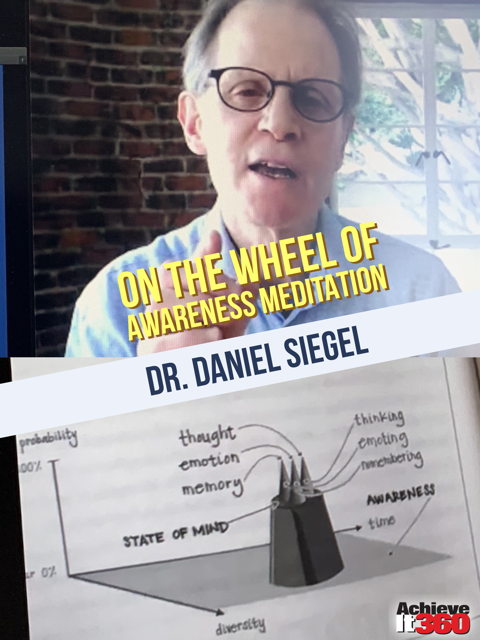
S2 Ep 60The Science and Benefits Behind a Meditation Practice with Dr. Dan Siegel’s Wheel of Awareness.
This is episode #60 on The Science Behind a Meditation Practice with a Deep Dive into Dr. Dan Siegel’s Wheel of Awareness. Welcome to the Neuroscience Meets Social and Emotional Learning podcast, my name is Andrea Samadi, I’m a former educator whose been fascinated with understanding the science behind high performance strategies in schools, sports and the workplace and created this podcast to bring the most current neuroscience research, along with high performing experts who have risen to the top of their field with specific strategies or ideas that you can implement immediately, whether you are a teacher in the classroom, a parent trying to figure out homeschooling and working from home, or someone working in the corporate world, to take your results to the next level. After watching Dr. Daniel Siegel the past few weeks on his “Pep Me Up Talks”[i] where he shares with an audience around the world about his books, tools and resources like the “Wheel of Awareness Meditation”[ii] that I’ve been using every day since preparing for his interview last year, I thought it was important to cover a deep dive into this topic to bring in the science behind meditation, to increase belief and credibility behind these practices that are now commonly seen in our schools, homes and workplaces. We did cover the topic of meditation for beginners with Mindfulness and Meditation Expert Mick Neustadt in episode #25 with “How Meditation and Mindfulness Changes Your Life”[iii] if you want to review that episode. I have been following Dr. Dan Siegel since 2015, reading his books, and learning from his resources, and on the interview I had with him for episode #28 on “Mindsight: The Basis for Social and Emotional Intelligence”[iv] (close to the end of the interview) we talk about what I have been learning from doing the meditation tool that he created. At the time—in October 2019, I had been doing his meditation every morning for 2 months. You can see this part of the interview here at (42:52)[v] where he asks me what I have learned from this practice, and although I downloaded this activity, and explored the Wheel in 2015, I didn’t start doing it daily until I was preparing for his interview, because I knew he would ask me what I had learned from this practice, and when I first tried it, and in the beginning, I honestly found it a bit advanced and confusing and didn’t want to tell him that so I put in some extra effort to understand it. If you have not yet tried “The Wheel of Awareness”[vi] Meditation, please do go to the link and download it, so you can see the image of the wheel, and try it out. This episode might make more sense once you do that and if you feel like I did in the beginning, don’t worry, it’s now been 8 months of practicing this daily and I’m just starting to figure out how to explain it now, so just try it and see what benefits you notice. I wanted to share Dan’s findings of asking thousands of people around the world, over the years first. If you have ever heard him talking about the Wheel of Awareness, you will know that the idea came to him when he bought a custom-made round table for his office so that his patients didn’t have to sit at a regular table. His mediation has evolved over the years as he has shared it with experts, and those who hold scientific evidence of the benefits of incorporating a daily meditation into your routine and life. If you are listening to this podcast, you will want to look at the image of the wheel in the show notes so you can physically see each of the segments I’m going to describe. In his book, Aware: The Science and Practice of Presence, Dr. Siegel explains that there are research-based elements of mind training that should include 3 pillars: focused attention, open awareness and kind intentions towards others.[vii] This practice involves all 3 of these pillars and profound changes happen with the body when you do mind training. He also explains that a 3-pillar meditation
S2 Ep 59Suzanne Gundersen on "Putting The Polyvagal Theory into Practice"
This is episode #59 with Suzanne Gundersen. You can watch the interview with graphics here on YouTube. Thanks for tuning into the podcast today! I’m always excited about the guests we bring on here, as each person has achieved high levels of success in their field and I know they can help others by sharing their knowledge. Our next guest is an expert in a topic that has been on my reading list the past year. When I was speaking with Suzanne Gundersen and she mentioned her life’s work has been based on putting Dr. Stephen Porges’[i], Polyvagal Theory into practice, I stopped what I was doing and asked if she could tell me more about this. For the past year, I’ve been watching trainings from Deb Dana[ii] (whose mentor was Dr. Porges) and just bought her book The Polyvagal Theory in Therapy[iii] and had written down that I wanted to interview an expert on the Polyvagal Theory. Plus, I have heard Dr. Lori Desautels mention Dr. Porges’ work the past year, and so I wasn’t surprised when an expert showed up. If you are new this work, like me, you would know why I would be looking for an expert to explain this theory. Someone who could in simple terms explain what we must all understand about our Central Nervous System when it comes to managing our stress response. These days this understanding is more important than ever before and this is exactly what Suzanne does with two tracks, first is stress education (the science of stress) and secondly, she speaks about nervous system with regulation techniques. Welcome Suzanne, thank you so much for coming on the podcast today to share your knowledge, and programs on such an important topic. Like we spoke about, there are many layers to this theory, and at first glance of all the notes I have taken on it, I still can’t explain it very well. Thanks for helping us break down this theory so we can think about how it can apply for our teachers in the classroom, for us as parents working from home, as well as for those who want to apply this idea in the workplace. Q1: What is “Polyvagal?" and why is this theory so important for us to understand these days? Answer is that it's the science of safety and connection, a map for living our most modern survival strategy, social engagement. Porges theory shows how our evolution has delivered us to human form where our unique communication abilities offers us possibilities for secure and deeply meaningful connections to survive and thrive. Q2: I actually have 2 version of the polyvagal chart (one you sent to me) and what we must know to remap our nervous system as dysregulation occurs. I got the first chart from Dr. Lori Desautels last October when I attended one of her live trainings. Can you give an overview of the Polyvagal chart and what’s happening at each level with the Ventral Vegal (safety), Sympathetic (danger) and Dorsal Vegal (Life Threat) stages so we can recognize these stages in ourselves and others? Crash course on neuroscience three branches most modern VV, then SNS, then PNS, and in order to understand it we have to go way back to when we were fish, strategy to freeze, then amphibians with legs to fight/flight, then humans to communicate. We automatically respond to stress, hierarchically, start with most modern first then use more ancient strategies to keep us alive. When we sense threat, our first reaction is to is to look to another for safe connection to help us know we are safe, we look for facial cues, tone of voice, regulated heart beat, if we don’t receive what we need to know safety and connection, we revert to SNS (mobilization), if doesn’t satisfy, then to PNS freeze. Each stage has a co-relating stress symptoms and body system status (SNS- charged system- increase heart, breath, blood to limbs), SNS- systems release/go limp (drop bowls). Q3: We have been talking on past episodes on the responsibility we have as parents and professionals to keep ourselves regulated (or in the green zone of your chart)
S2 Ep 58"The Wise Emotional Fitness Program" Delivered via Virtual Reality with James MacDiarmid and Natasha Davis
This is episode #58 with James MacDiarmid and Natasha Davis. Thanks for tuning into the podcast today! I’m always excited about the guests we bring on here, as each person has achieved high levels of success in their field and I know they can help others by sharing their knowledge. Our guests today hit a chord with me when I saw their work because their vision, and my vision are 100% aligned. You can watch the interview on YouTube here. A few years ago, I couldn’t stop thinking about a thought I had of teaching social and emotional learning skills via virtual reality. I had some prominent virtual reality companies that I had been following and put up on my wall, with the vision that maybe someday, we would see students learning SEL via these new modes of learning that were highly engaging. I had an image of what the lessons would look like (I could see a forest with students choosing different paths and learning new skills with each pathway that they took). For example, if they made a life decision, it would give them the opportunity to see the effects of this decision and see the reality of “if I do this, this will happen” showing them the consequences of their actions. After my interview with David Adams[i], (episode #54) I received a message on LinkedIn from James MacDiarmid (who had heard David’s podcast) about a potential next guest for the show with a video link for me to learn more about what our next guest had created. When I finally had a chance to watch the video, I have to say, I was blown away. This was the vision I had for SEL brought to life. I watched a walkthrough of a virtual reality lesson from the Wise: Emotional Fitness program and there was even a forest in the video. I wrote back to James with tears in my eyes, that yes, I want to learn more and before I know it, I’m speaking with James from Curiious[ii] - that’s with two ii’s- in Australia via video conference about the Wise program. And here we are today. Let me give you more background on James and Natasha. James has extensive experience in education, learning design and consultancy, with a passion for new technologies and enacting transformational change across whole-school systems. He is a published author, contributing writer for TEDx and was a co-creator for PlayFutures, with the LEGO Foundation[iii] where they focus on bringing learning through play to children around the world. After a few minutes of speaking with James, his passion for building authentic learning opportunities and inspiring future generations came through loud and clear. Natasha[iv], who James explained was the heart and sole of the program, is a clinical psychologist with over 15 years experience designing, researching and implementing emotion regulation and relationship building programs for adolescents and adults. She is the Director of a community-based clinic and has held many leadership positions in private and non-profit sectors. Natasha was the lead subject-matter expert during the development of this truly innovative program. Welcome James and Natasha. Thank you so much for being here, and sharing what you have created, all the way from Australia where it’s already Monday morning over there for you. I wanted to learn more about the Wise Program and have some questions for you. Q1: The first question is for Natasha. First of all, congratulations on what you have created. I think it is purely brilliant. Can you explain where this vision began for you? Q2: What is the methodology behind this program? 'Designed for impact, Wise uses an Inside-Out methodology which equips participants with the practical skills to build strong connections from themselves (Inside) to others and the world around them (Outside). This is enhanced by the blended learning context whereby learning within virtual reality (Inside) is reinforced through the verbal and written self-reflective process, and teaching others the techniques (Outside). By using the principles of behavior
S2 Ep 57"Taking Initiative, Your Brain and Change, and Your Mentors"
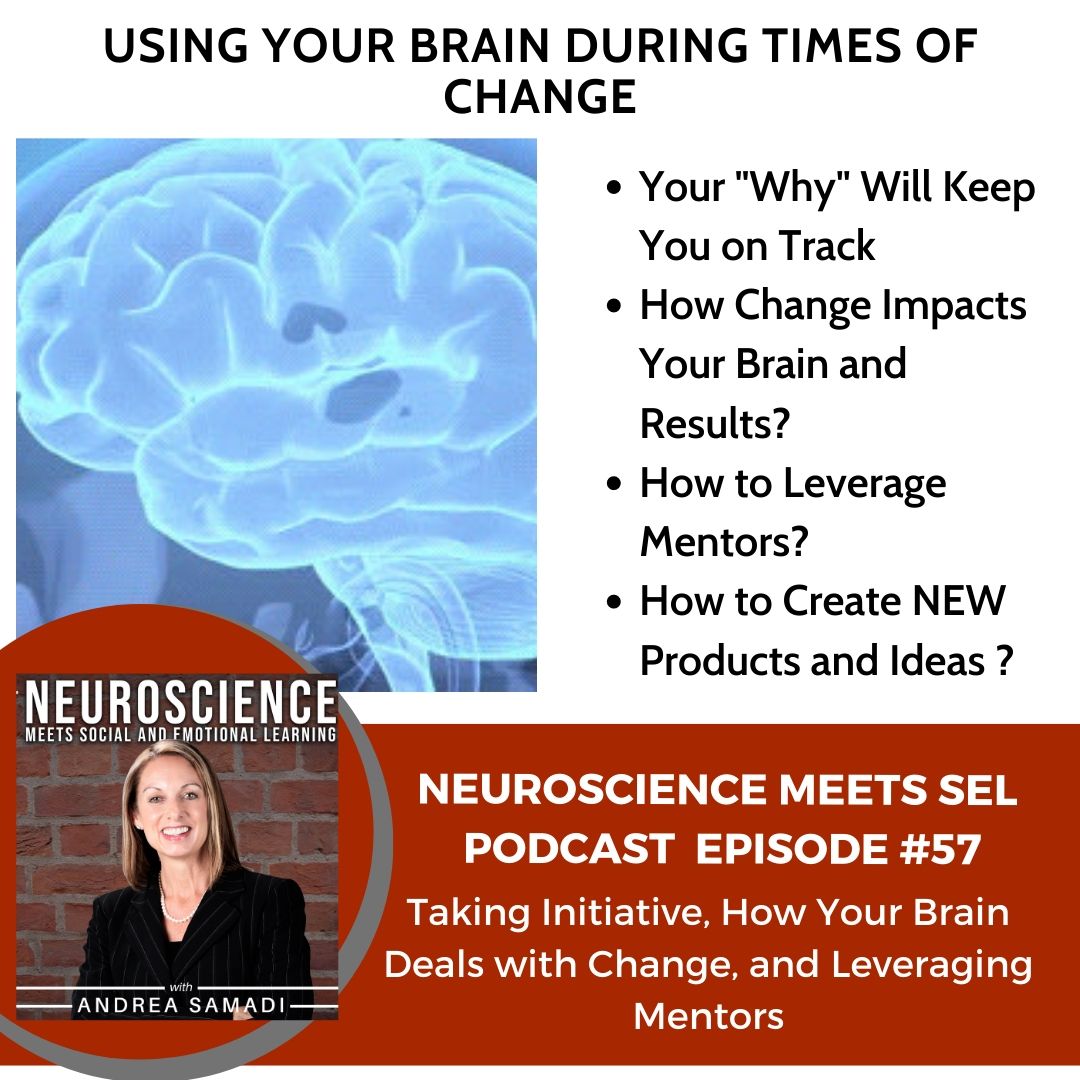
This is episode #57 on “Taking Initiative, Your Brain and Change and Leveraging Mentors” Welcome back to the Neuroscience Meets Social and Emotional Learning podcast, my name is Andrea Samadi, I’m a former educator whose been fascinated with understanding the science behind high performance strategies in schools, sports and the workplace for the past 20 years. Since you are listening to this podcast, I’m sure you are like me, and love to learn, grow, challenge yourself and always are looking for that competitive edge, these days more so than usual, I’m sure. This weekend I had a phone call from Marissa Leinert from Parent Led Academy[i] an organization helping parents to improve their skills at being better parents using social and emotional learning resources. She contacted me via LinkedIn and asked if she could brainstorm some ideas with me on the direction of her business, since she is just starting out this field. I told her to call me and sent her my number because when people take the initiative to reach out, asking for help, I think it’s important to lend a hand, share ideas, contacts and resources if you have them, and collaborate. When we finally connected, we chatted about where she was with her company and I thought back to 20 years ago when I first wrote down the idea that turned into Achieveit360’s programs and services for schools and the workplace, and eventually this podcast. I remembered all of the people who helped me to get to where I am today and thought of a quote by Robin Sharma who said that “Everything is created twice, first in the mind and then in reality.” If you are like Marissa, and have been thinking about an idea that you want to pursue, maybe a new direction for your career, a new product that you want to create, or something and you just aren’t sure of even where to begin, this episode is for you. This episode will focus on some key starting points so you can follow the steps and get moving with something new. Whatever idea you have, that you might be thinking about, start with writing it out, and then expand on your vision by writing down some ideas and see where you can begin to take action. I was lucky enough to have met some of the top leaders in the country who shared their secrets with me over 20 years ago when I first started and I felt that since I had this opportunity, that I had an obligation to take action with the strategies and tips they shared with me. Now that I am being asked more often, how did you get started with this idea, I thought I would share with you the process that I used and hope you find these ideas helpful. Step 1: “Know Your Why” Which Also Can Be Seen as “Know Your Values” Simon Sinek[ii] built his career from this idea and before starting anything new, I always suggest revisiting Simon’s “Golden Circle”[iii] where he talks about the importance of knowing your “Why, Your Purpose, What You Believe.” If everyone in your organization knows this for themselves, then it will be easy to motivate each person towards the common organizational goal. Before any pivot you make, go back and look at your purpose and make sure the new direction aligns to this your why, purpose or values. The “How” or your process will come easy once you’ve identified your “Why” and the “What” you do, or end result will naturally follow. What you believe can also be seen as your values. Once you know the values that are important to you and your organization, everything else becomes crystal clear. For me, I know that we believe that well-being equals achievement and productivity, (with physical and mental health being my #1 value). Everything we create/market/sell/produce must help improve well-being that will lead to an increase of productivity, achievement and results. What are your highest values? Go back and listen to episode 2 “Self-Awareness: Know Thyself”[iv] where we dive deeper into uncovering your values or what’s important in your personal and professional life to
S2 Ep 56Educational Neuroscience Pioneer Dr. Lori Desautels on her NEW book About “Connections Over Compliance, Rewiring Our Perceptions of Discipline”
This is episode #56 with Dr. Lori Desautels, a returning guest who I know everyone loves as much as I do. If you want to hear our first interview with Lori, go back and listen to episode 16[i] with Lori and Michael McKnight on “The Future of Educational Neuroscience in our Schools and Communities.” To watch this interview on YouTube, click here. Welcome to the Neuroscience Meets Social and Emotional Learning podcast, my name is Andrea Samadi, I’m a former educator whose been fascinated with understanding the science behind high performance strategies in schools, sports and the workplace and created this podcast to bring the most current neuroscience research, along with high performing experts who have risen to the top of their field with specific strategies or ideas that you can implement immediately, whether you are a teacher or student in the classroom, or working in the corporate world, to take your results to the next level. Thanks for tuning into the podcast today! If this is your first time here, I am so grateful that you have taken the time to listen. Today I am thrilled at the opportunity to speak with Dr. Lori Desautels for the second time. I first found Lori from her TEDx Talk from Indianapolisi when I was searching for anything in the field on educational neuroscience back in 2014 and watched her videos to understand how parts of the brain worked, how they are interconnected and impact learning. In Lori’s Ted Talk, she mentioned that “neuroscience and education have come together” and it’s a huge connection because every day experiences change the brain structurally and functionally—and I thought, this is incredible that we can finally explain how we can accelerate learning with this understanding of the brain. Over the years as I’ve continue my research in this field, each person I speak with points me back to Lori Desaultel as a pioneer in this field. Her work is groundbreaking as she ties the research into these practices that we must all learn to stay at the height of our productivity and achievement. Welcome Lori, thank you so much for coming back on as a returning guest. I feel like we are old friends now that I had the chance to see you speak live this past October, and with the fact you are sharing your new book with me in real time as you are writing it. I’ve been reading it as you are sending the chapters and emotions really are contagious. Before we dive into the questions, can you tell me more about why this book is so timely, and maybe a bit about the work you are doing on a day to day basis for the field of education. 1- Your new book “Connections Over Compliance, Rewiring Our Perceptions of Discipline” begins with exploring this new perception of discipline with educator and parent brain state. I wish I knew this when I stood in front of my first class as a new teacher (in Toronto in the late 1990s) wondering why no one was listening, and watched their behavior escalate to where I started to count down the days till the school year was over. I had no idea where to even begin...and never would have thought of—with myself. Can you explain why we must “look under the hood at our own brain state” when we are teaching or relating to others? Q2-Im so grateful that brain research is helping us to gain a deeper understanding of how to improve our results, achievement and learning and that leaders like you are spear heading the way with this understanding. How can we better understand a regulated vs dysregulated brain state? These are not terms I was taught in my teacher training classes over 20 years ago. In a perfect world, everyone would be able to recognize when they are becoming dysregulated with strategies to get themselves back on course. What work still needs to happen for this awareness? Q3- I learned about Dr. Bruce Perry from you, and a couple of our most recent podcasts focus on his research. You quote him in the beginning of your book when he states that “The key to the succes
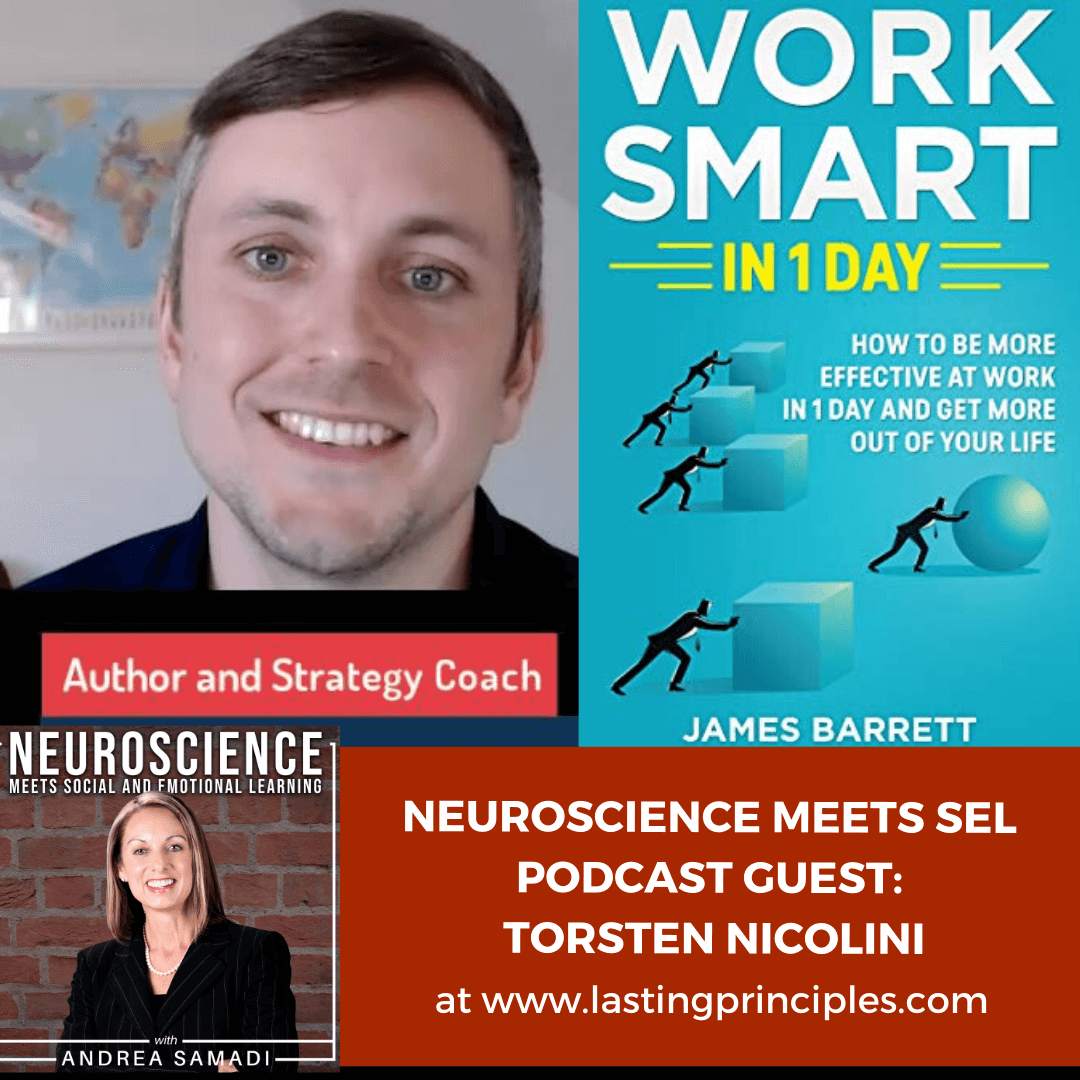
S2 Ep 55Author and Strategy Coach Torsten Nicolini on "Working Smart: How to Improve Productivity and Efficiency at Work"
This is EPISODE #55 with Torsten Nicolini. You can watch this interview on YouTube here. Welcome to the Neuroscience Meets Social and Emotional Learning podcast, my name is Andrea Samadi, I’m a former educator whose been fascinated with understanding the science behind high performance strategies in schools, sports and the workplace and created this podcast to bring the most current neuroscience research, along with high performing experts who have risen to the top of their field with specific strategies or ideas that you can implement immediately, whether you are a teacher or student in the classroom, or working in the corporate world, to take your results to the next level. Thanks for tuning into the podcast today! If this is your first time here, I am so grateful that you have taken the time to listen. I can’t wait to introduce you to our guest today, Torsten Nicolini[i] a Strategy Coach whose joining us today all the way from Germany. who has devoted his life to helping small business owners fulfill their greatest potential by teaching them how to become more successful at work and in life. I first met Torsten last summer 2019 when he contacted me to review his book called Work Smart in One Day: How to Be More Effective at Work and Get More Out of Your Life by James Barrett [ii] (Torsten's pen name) and I get asked to review a lot of books (I must be on a list somewhere because I do get at least a request each week) and I usually just delete the requests because I don’t have the time, but this time, the title caught my attention because I had launched this podcast and had been researching workplace productivity extensively for the past year. When I read Torsten’s "Work Smart in One Day" it felt like a compilation of the most effective productivity strategies, all in one place. Some history, in the late 1990s, I worked in the motivational speaking industry, and worked closely with some of the leading motivational speakers in the world. Of course I had access to all of their books and content that I read extensively. As I read through Torsten’s book, the great speakers of the past echoed in my head as I could see who influenced him, and the strategies in his book were spot on. He's organized them in a way that ANYONE can improve their productivity, and I can tell that he must also operate this way, with the detail of his examples. I reviewed his book that day, and I remember exactly where I was at the time, on a family vacation at a local resort, and I refused to leave the room until I finished his book and review, it was that captivating. A bit about Torsten: - he is currently working "fulltime" as an engineer at an automotive supplier since 2015 (Yazaki) - he accomplished an apprenticeship as a toolmaker in 2009, technician in 2013, Bachelor of Engineering in 2018 an currently studying "part-time" Masters of Enginering that I will finish 2021. - he started to learn about personal development in 2017 (now age of 32) and with this "initiator" I launched a side business in marketing and webdesign, started a blog and different projects for small business owners (website re-design, marketing, etc.) - Since 2018 I am really loving to create content, to write articles and now publishing books. As many of us are in the middle of figuring out how to work from home, and might be looking for new ways to work with some key strategies for better productivity, I thought I would ask Torsten to come on the podcast to share more about his website, the books he is reading and strategies for productivity. Q1: What are Highly Efficient People Doing Better than the Average Person (and how do they manage tasks be increased productivity) Q2: What are some New Habits That Go a Long Way (making you think about a morning routine, if you've not got one already) Q3: How do you eliminate What's Pulling You Down (identify what is stealing your energy) Q4: What are some Tips for Maintaining Your Success (so that it continues all ye
S2 Ep 54Director of SEL, David Adams on "A New Vision of Education: Living Up to The Values We Want for Our Next Generation"
This is EPISODE #54 with David Adams. You can watch the interview on YouTube here. Welcome to the Neuroscience Meets Social and Emotional Learning podcast, my name is Andrea Samadi, I’m a former educator whose been fascinated with understanding the science behind high performance strategies in schools, sports and the workplace and created this podcast to bring the most current neuroscience research, along with high performing experts who have risen to the top of their field with specific strategies or ideas that you can implement immediately, whether you are a teacher or student in the classroom, or working in the corporate world, to take your results to the next level. Thanks for tuning into the podcast today! If this is your first time here, I am so grateful that you have taken the time to listen. I am so excited about our guest today. His name is David Adams, and I’ve been watching his work, seeing his posts on social media and he’s doing some ground-breaking work. I noticed when he spoke on a panel[i] with former CNN host and educational activist Campbell Brown, Founder, The Seventy Four[ii]; (a phenomenal education focused website that I love learning from) Susan Crown, Founder of the Susan Crown Exchange[iii]; (whose mission is to help people acquire the skills needed to succeed and thrive in a rapidly changing and connected world), Marc Brackett, Director Yale Center for Emotional Intelligence[iv] (who did EPISODE #22 on his book “Permission to Feel”)[v] and Karen Niemi, (Neemi) President & CEO, CASEL[vi]. If we are truly “the sum of the five people we spend the most time with” like Jim Rohn once said, you can only guess how impressive his bio is going to be. David is The Urban Assembly’s Director of Social and Emotional Learning,[vii] where his team builds schools' capacity to ensure that all staff and students they work with receive relevant experiences and purposeful instruction to develop the social emotional competencies that impact students’ success in school, work, and life. (Everything that we speak about on this podcast). He is on the Board of Directors for CASEL (The Collaborative for Academic, Social and Emotional Learning) which is the trusted source for knowledge about high-quality, evidence-based social and emotional learning and I have to mention that he was also a Civil Affairs Officer in the United States Army, so you know that he is on a serious mission to achieve results. David, welcome! Thank you so much for being here today. Q1: I’ve read quite a BIO for you, and it seems that when we are dealing with education that we have a certain expectation of what we are looking for (whether it’s our students learning in the classroom, professional development for teachers, or even choosing the right assessments that measure what we are learning). What does it mean to you for a person to be educated? Q2: With everything that you see going on in the world today, why do you think our communities are struggling so much to solve problems across differences? Q3: In your recent article[viii] A New Vision of Education: Reimagining the Social Contract you talk about the fact that nobody is perfect, but we all have a responsibility to strive to live up to the values we want the next generation to embody. You talked about this phenomenon where education level is negatively correlated to the accuracy of perception of people across the political spectrum. Can you explain what you mean here, and why do you think this is the case? Q4: Tell me a little bit about the neuroscience behind this and how SEL specifically improving awareness can help us to all move forward. Q5: What are your final thoughts for how we can use SEL to solve our nation’s most pressing concerns to restore some hope, especially during these uncertain times? Thank you so much for your time today, and for sharing your insights with us. If anyone wants to reach you to learn more about your programs at the Urban Assembly, what is the best w
S2 Ep 53Self-Regulation and Your Brain: How to Bounce Back Towards Resiliency
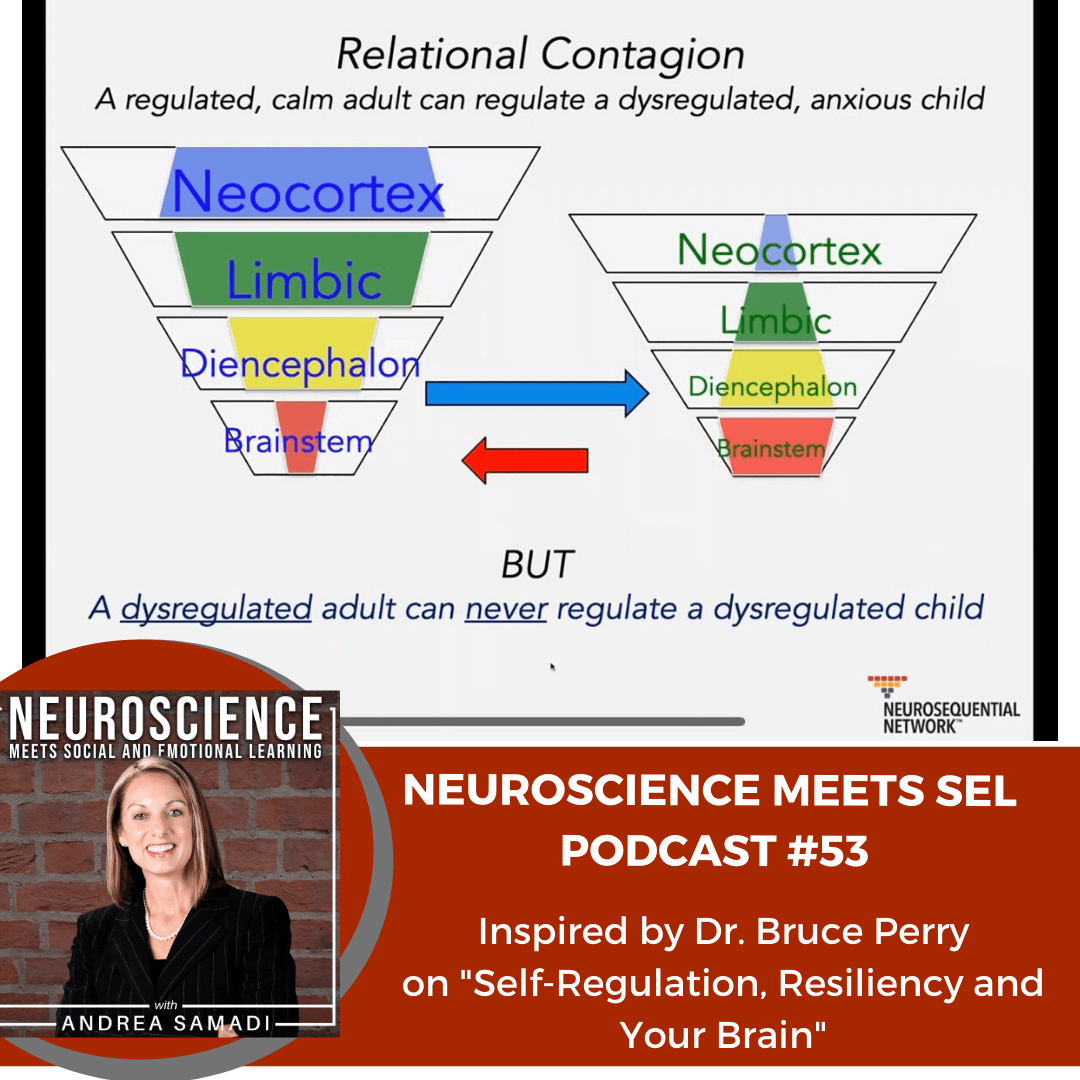
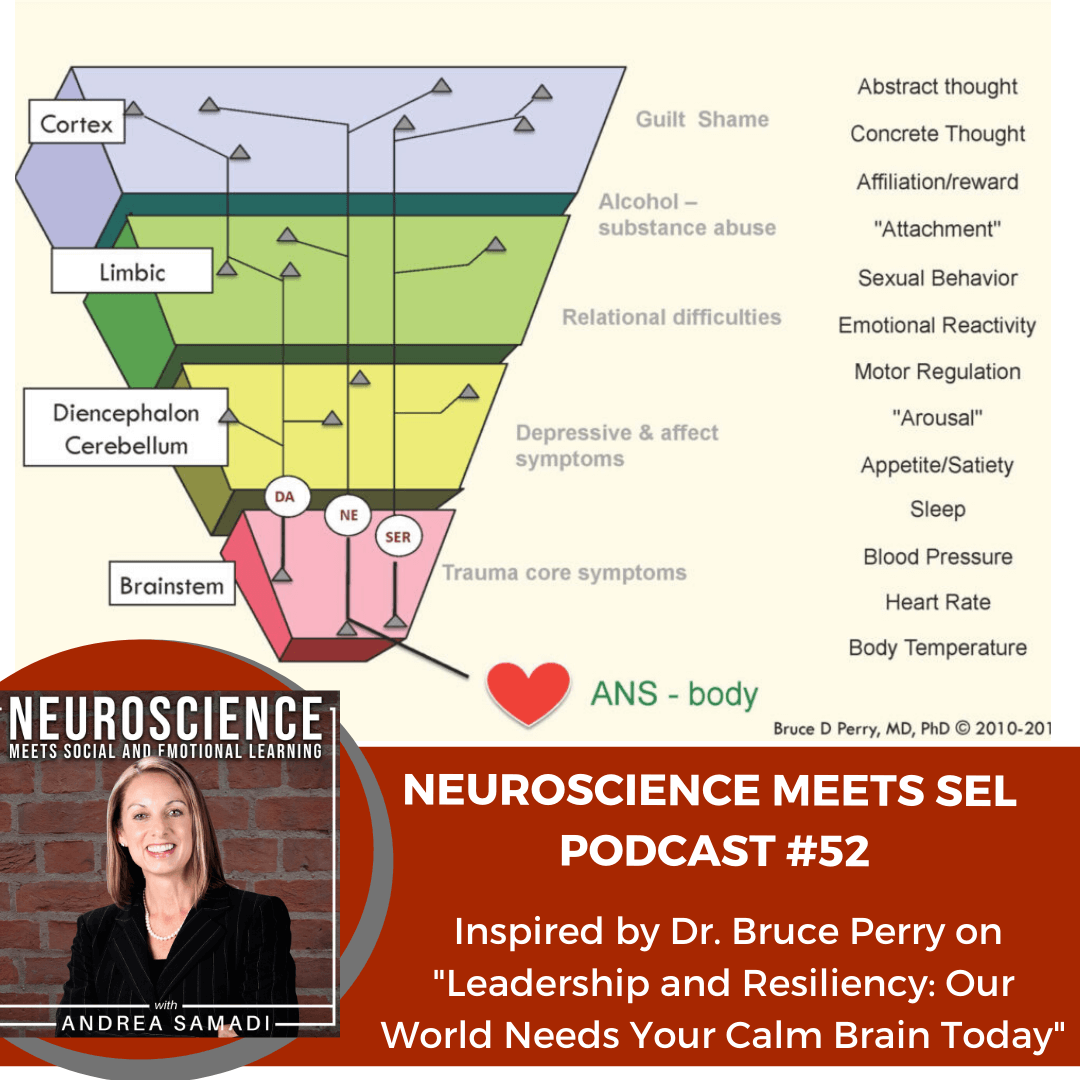
Welcome to EPISODE #53 “Self-Regulation and Your Brain: Strategies to Bounce Back Towards Resilience.” During these strange and different times that we are all living these days, we need to have strategies that we are using on a daily basis to navigate through these challenging times, where we are all feeling the pressure, so we can stay focused on regulating ourselves first, and then in turn, help others around us to stay regulated. You might have had strategies in place before the corona virus pandemic changed our world, but might be noticing that as each day passes, and we recognize more and more stressors and unpredictability facing us, that our baseline is changing, and our resilience levels are not the same. Since we all have a brain, we will all be experiencing this in some way and I’m sure that like me, you will find this information helpful to build your own resilience levels back up to where we are used to having them, so we can resume our day to day life with a feeling of accomplishment, instead of letting the pressures get the best of us. But First, what is Self-Regulation and Why is it So Important? I do recommend going back to EPSIODE 14[i] where we covered self-regulation (one the 6 social and emotional learning competencies that we launched this podcast with) as “the foundational learning skill for future success.” This episode covers self-regulation strategies to help our children as well as for ourselves in the workplace. Just a quick review. Self-regulation is “the ability to manage your emotions and behavior in accordance with the demands of the situation. It includes being able to resist highly emotional reactions to upsetting stimuli, to calm yourself down when you get upset, adjust to a change in expectations and (the ability) to handle frustration”[ii] In other words, it’s the ability to bounce back after a setback or disappointment, and the ability to stay in congruence with your inner value system. These days, this skill takes practice from all of us, and is one of those crucial life skills that I thought was important to cover on a deeper level. The ability to control one's behavior, emotions, and thoughts is an integral skill to be taught to young children as well, so they can form and maintain healthy relationships and connections later in life.[iii] As an adult, self-regulation is crucial to develop as we all know that life is full of ups and downs (and it seems like more so these days than usual) but we must be able to make our way through challenging situations before we can reach any level of achievement and success. It’s these challenging times that give us our future strength. We all know people who seem to bounce back after adversity. A calm, regulated leader can make others feel safer but it’s not by chance –it’s because they have learned how to self-regulate and intentionally get themselves back on course. This is a learned skill and if we are modeling and teaching this skill well, it will strengthen our students/children/workplace organizations, communities, culture and world, putting us all on the pathway of resilience where we can handle challenge and adversity. What does self-regulation look like in the brain? This episode will dive deeper into what’s actually happening in our brain when we become dysregulated, so we can learn how to recognize when we are in this place, and get ourselves back to a regulated, calm state. Image: Dr. Bruce Perry's Neurosequential Network Covid-19 “Stress, Distress and Trauma Series” VIDEO 3 on Emotion Contagion https://www.neurosequential.com/covid-19-resources If you have listened to the last episode[iv], you will know that I have been learning from Dr. Bruce Perry (who is an American psychiatrist and senior fellow of the Child Trauma Academy in Houston, Texas) and his online resources that he has created to help everyone (parents, educators, counselors) to navigate these challenging times with more understanding and he ties the brain
S2 Ep 52"Igniting Your Personal Leadership to Build Resiliency" Inspired by Dr. Bruce Perry
Now more than ever, we need leaders to emerge and take charge whether it’s you as a parent taking charge of your family’s daily schedule, or you as a worker navigating working from home. The powerful news is that you can use your own personal leadership skills to build resilience in your brain that will propel you and those around you forward. As we navigate the constant change we are all experiencing with the corona virus pandemic, I think it’s crucial that we stop and take some time to think about how we can take our own personal leadership skills to the next level to support those around us- those we work with, our families and our community. Understanding how our brains works during times of stress is more important than ever. I highly recommend listening to Episode 26, Simple Strategies for Overcoming the Pitfalls of the 3 Parts of Your Brain.[i] Once we have an understanding of how our brain works, we can use the extra energy we have to build our own personal resiliency, model it in our homes with our family and then reach out to others who might be under more extreme stress and could use your help and support. Together we are stronger. But first, just a reminder of how our brain deals with stress, understanding the 3 levels of stress response. Remember that some stress is good for us. We did cover this in EPSIODE 29 “How to Rewire Your Brain for Happiness and Well-Being to Optimize Learning.”[ii] Here’s a quick review. The Neuroscience of Anxiety: Calming the Basal Ganglia in Your Brain Within our Limbic System, our emotional brain, is the Basal Ganglia that when revved high, makes us feel anxious. Do you know the difference between anxiety (our body’s natural response to stress that can become a mental disorder when someone regularly feels unusually high levels of anxiety) or stress (which is our body’s response to a challenge or demand)? Some anxiety is normal, and the same goes for stress. We know there are 3 levels of stress response. POSITIVE: Mild stress motivates us to complete our work projects or helps us to find solutions to problems that arise. This type of stress keeps us on our toes in our day to day lives and helps us to build resilience (which is the capacity to recover quickly from difficulties). We all want to raise resilient children and model resiliency in our homes, and we are doing this when we can manage this level of stress. We’ve all experienced that brief increase in heart rate when mild elevations in stress hormone levels hit our central nervous system when we need to speak in front of a crowd, play a sport, take a test, or that nervous energy we feel before a job interview. TOLERABLE: Serious, temporary stress responses, buffered by supportive relationships. The key is to have support systems in place for this type of stress. In the times we are facing today, many people are unable to get out and connect face to face with people to help manage this type of stress. I have seen news articles about the devastating impacts this type of stress is having on people. If you know someone who might be in this category, please keep in contact with them. Do your best to call them, and remember that connecting face to face over technology is much better than not at all. TOXIC: Prolonged activation of stress response systems in the absence of protective relationships. This is the one we are most concerned about as this type of stress causes the most damage. I recently learned that after the Hurricane Katrina struck the Gulf Coast in August, 2005, the offspring of people who went through this disaster showed an increase of substance abuse. (Perry, 2020). We must have strategies in place to help us to reduce anxiety and stress so that they don’t interfere with our day to day life. The more we can keep our stress levels on the tolerable side, the more regulated we become, increasing the resiliency we will have for ourselves, our families, our future children, community and workplaces. A calm, reg
S2 Ep 51Fitness Expert Kelly Schmidt on "Easy to Implement Fitness and Nutrition Tips to Maximize Home Workouts and Meal Planning"
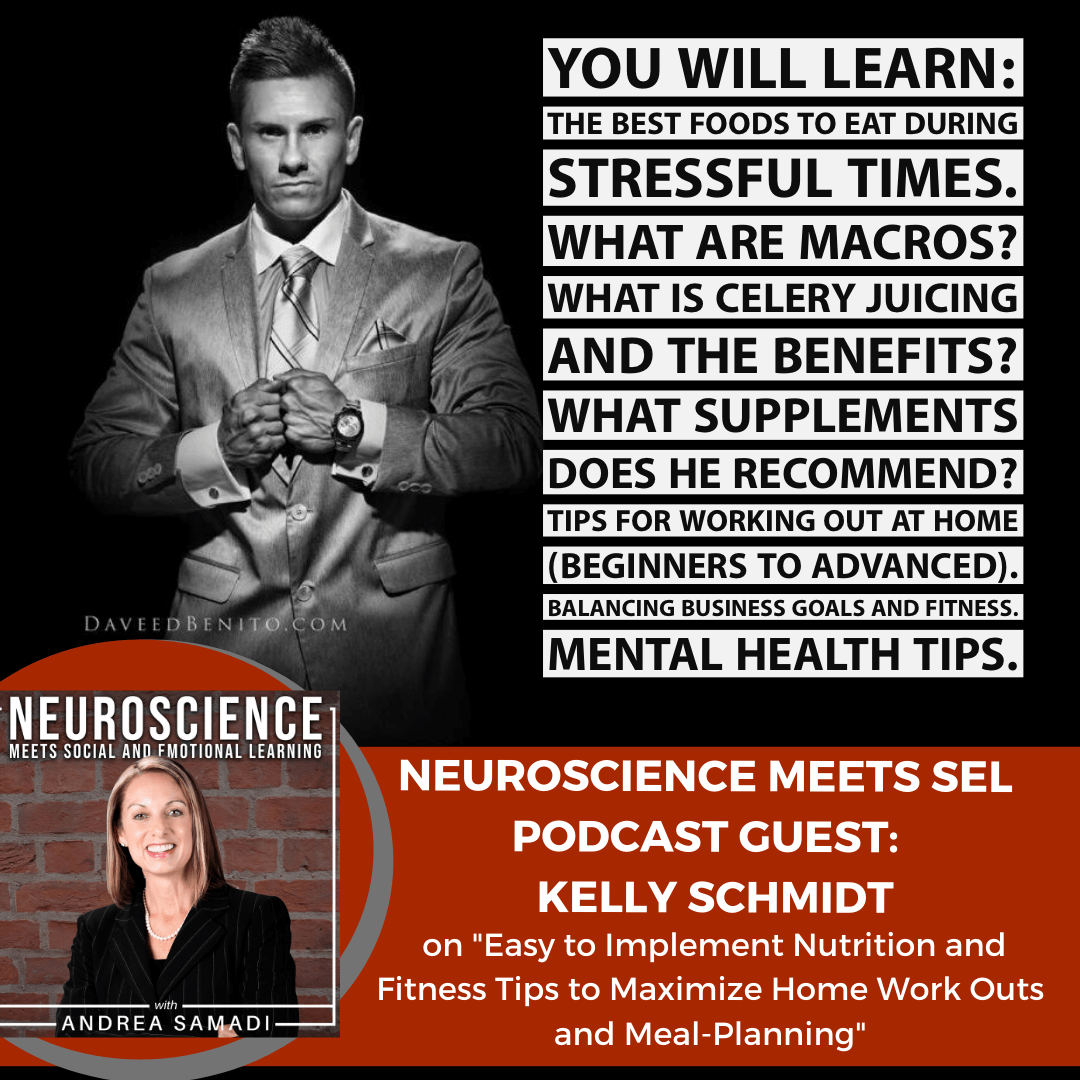
This is episode #51, Welcome to the Neuroscience Meets Social and Emotional Learning podcast, my name is Andrea Samadi, I’m a former educator whose been fascinated with understanding the science behind high performance strategies in schools, sports and the workplace for the past 20 years. Each week we bring you an expert who has risen to the top of their industry with specific strategies that you can implement immediately, whether you are a teacher or student in the classroom, or working in the corporate world, to take your results to the next level. If you are like me, and love to learn, grow, challenge yourself and always are looking for that competitive edge, listen closely to the tips our next guest has to say, and write down the ones that you want to implement immediately. Watch the interview on YouTube here. Our guest today has been training my husband and I since we were dating back in 2006, and I can honestly say that I would never hire another trainer after working with him. He not only challenges our fitness and nutrition goals, but also wants to know what’s going on with our businesses and family life. Let me tell you more about this incredible entrepreneur. Kelly Schmidt[i], is one of the leading personal training and fitness experts in Arizona, who has over 20 years of personal training and health development experience all over the world with his online and in person training programs. When Kelly graduated from high school, he was 115 pounds (which is hard to imagine knowing him today) but he says he felt that he was the little guy, which fueled his transformation that took him to 3rd place in his first professional body building show just 5 years ago (in 2015). He now coaches busy professionals all over the world in person at his gym in Glendale, AZ and with his online training programs to help people fit health and fitness into their lifestyle for long term, sustainable results.[ii] Welcome Kelly! Kelly, the minute I got the notification that all gyms were closing, I thought of you to help people at all different stages of health, with these strange times where we are quarantined inside our homes. You came to my mind immediately because you’ve been working all year with me on workouts, I can do at home so that I spend less time in the gym. I’ve been seeing posts from people all over the place asking questions about the best way to begin an exercise program. I do want to add the disclaimer, that for anyone at the beginning of their health and fitness journey, please do begin with consulting with your healthcare provider before trying anything new. Kelly, thanks, so much for being here today, and sharing your ideas and tips with us to help those who might be at the start of their fitness journey, to those looking for more challenge with a home workout because with you, that’s exactly what you’ll get. The first question I have for you is on nutrition, which is such a wide topic. We all have different health goals (some people want to lose weight, others gain weight, add more muscle) what would you suggest are some best practices for ALL of us with our nutrition these days? I know that you taught us meal-prepping, and what we should be eating/not eating. Has anything you are doing changed? Is there any staple food that you used to buy that you can’t get these days? How has your nutrition stayed the same and how has it changed? I had a doctor years ago get me off sugar when he was researching the impact of sugar on our health and he wrote this book called Sugar Crush: How to Reduce Inflammation, Reverse Nerve Damage, and Reclaim Good Health.[iii] I had some health issues that went away 100% and ever since then, I’ve been wary of even fruits because he had me stop eating anything with sugar, and specifically high glycemic fruits. Do you stay away from any fruits and what do you put in your shakes? What impact do you see sugar having on you? What are macros? How can people figure out what’s the best
S2 Ep 50Shark Tank Season 1 Winner, Tiffany Krumins on "Life After Shark Tank"
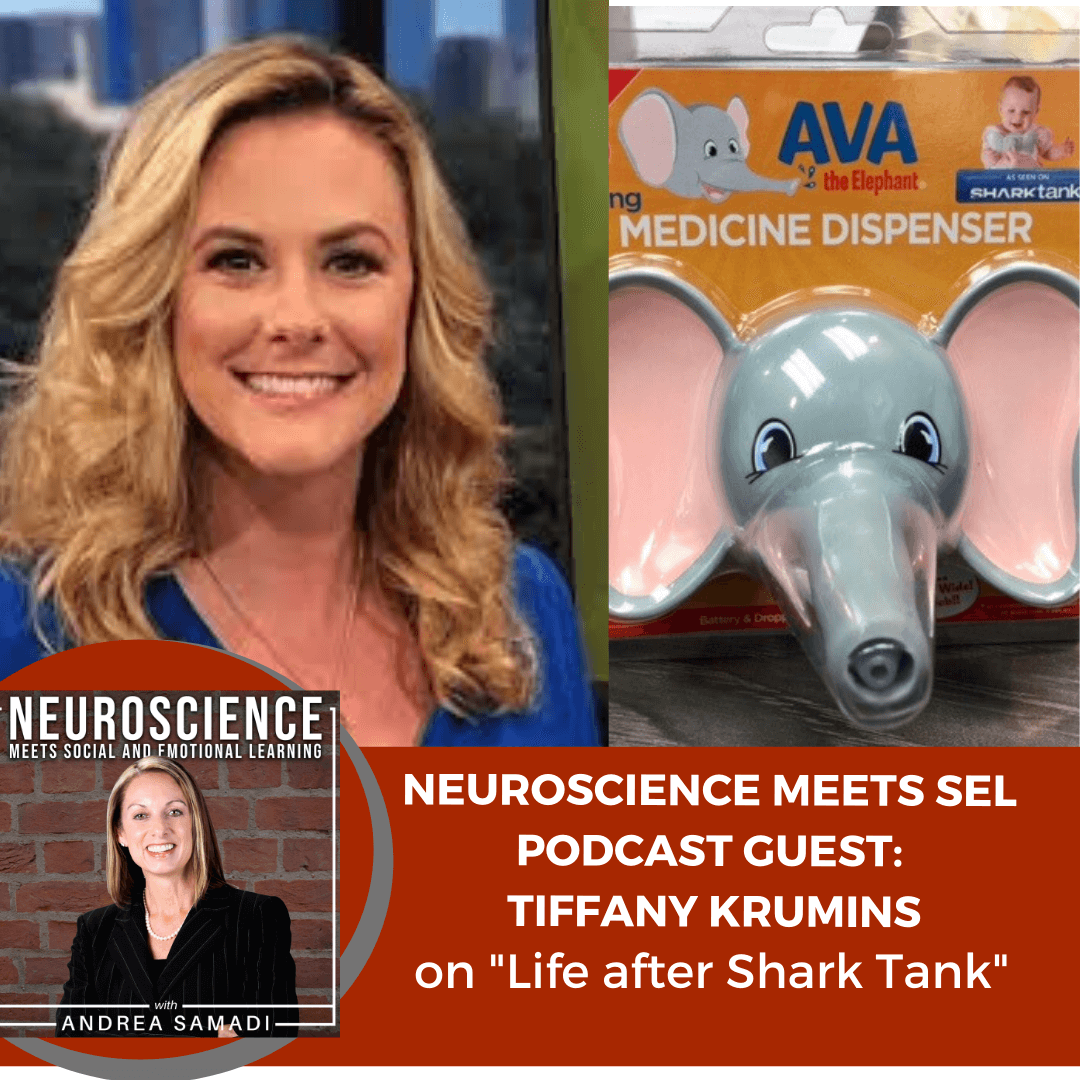
You can listen to this episode on all podcast channels, or watch the interview here on YouTube. Before I introduce our next guest, I wanted to send out a message to everyone listening today, as we are recording this, it’s Monday March 30th, 2020, and there is a lot of turmoil in the world. We just can’t ignore it and jump into our episode without acknowledging where things are with the impact of the Corona virus on our everyday life. Wherever you are, we hope you and your families are safe, have the food and supplies that you need, and are managing through these difficult times. More than ever, we need strategies for our mental health, and well-being. Together we are stronger, and just want to remind you to stay connected as we all figure out our new normal. Now let’s jump into this next episode, which just happens to be EPISODE 50 with Shark Tank Season 1 Success Story (that aired back in 2009)[i] Tiffany Krumins, who was awarded $50,000 to fund her invention Ava the Elephant, a medicine dispenser that was inspired by a sweet-natured boy with Down syndrome who struggled to take his medication. As his nanny, Tiffany tried her best to sooth his anxiety. Using her creativity to invent a plastic medicine dropper, and by imbedding a recordable sound chip from a greeting card, Ava the Elephant was born, and is now one of Shark Tank's most well-known and beloved successes. Tiffany’s story immediately grabbed our hearts because as a former nanny here in Arizona, I related to Tiffany’s entrepreneurial path. We used this product with BOTH our girls in our home, improving our experience of giving the girls their medicine when they were sick, which is never an easy task, so thank you for seeing this invention through. Tiffany's infectious spirit has attracted the attention of media heavy hitters, such as Dr. Oz, Fox Business, Entrepreneur, Forbes, and most recently the Today Show. Tiffany cruised from nanny to inventor to entrepreneur on a wave of creativity, business strategies, and ideas that tugged at her giving heart. A respected inventor, iHeartRadio host,[ii] motivational speaker, successful entrepreneur, and mother of three, Tiffany now leads the Mom Genius[iii] team of passionate entrepreneurs by her daily intention that business success and personal fulfillment are not mutually exclusive. Tiffany, it’s awesome to speak with you after all of these years of following and supporting each other’s work. For those watching, some history for you, Tiffany filmed a video[iv] for our early character ed program with her success story to inspire young entrepreneurs) and she has been supporting and cheering on our programs for the school market, which is exciting now, Tiffany, that you have created your own course for inventors that can be used by anyone, including schools. Welcome Tiffany and thanks so much for doing this on a day that most of us are working AND home schooling our children. Tiffany, it’s been a whirlwind since we first spoke over 10 years ago. Can you give a quick snapshot of what’s happened in your life since your appearance on Shark Tank in 2009? I know a lot has happened to you both personally and professionally Can you tell us about your online course[v] (who it is for, and what it covers)? How has your vision changed since you first launched Ava the Elephant and how have you navigated through this change? How do you stay on track? I know over here, I’ve made many mistakes with product creation and marketing. What were some of your most memorable mistakes? Were there times you felt like giving up and if so, how did you get past that to where you are now? I did see an article that you wrote about “facing your fears of public speaking.” Is this still what you would say sticks out as your biggest learning experience? What have you learned most about yourself[vi] the past 11 years since your appearance on Shark Tank? How have you managed being a mompreneur, raising 3 children and handlin
S2 Ep 49Leadership and Marketing Strategist Dr. Jeffrey Magee on "Managing Fear, Focus and Strategy During Challenging Times."
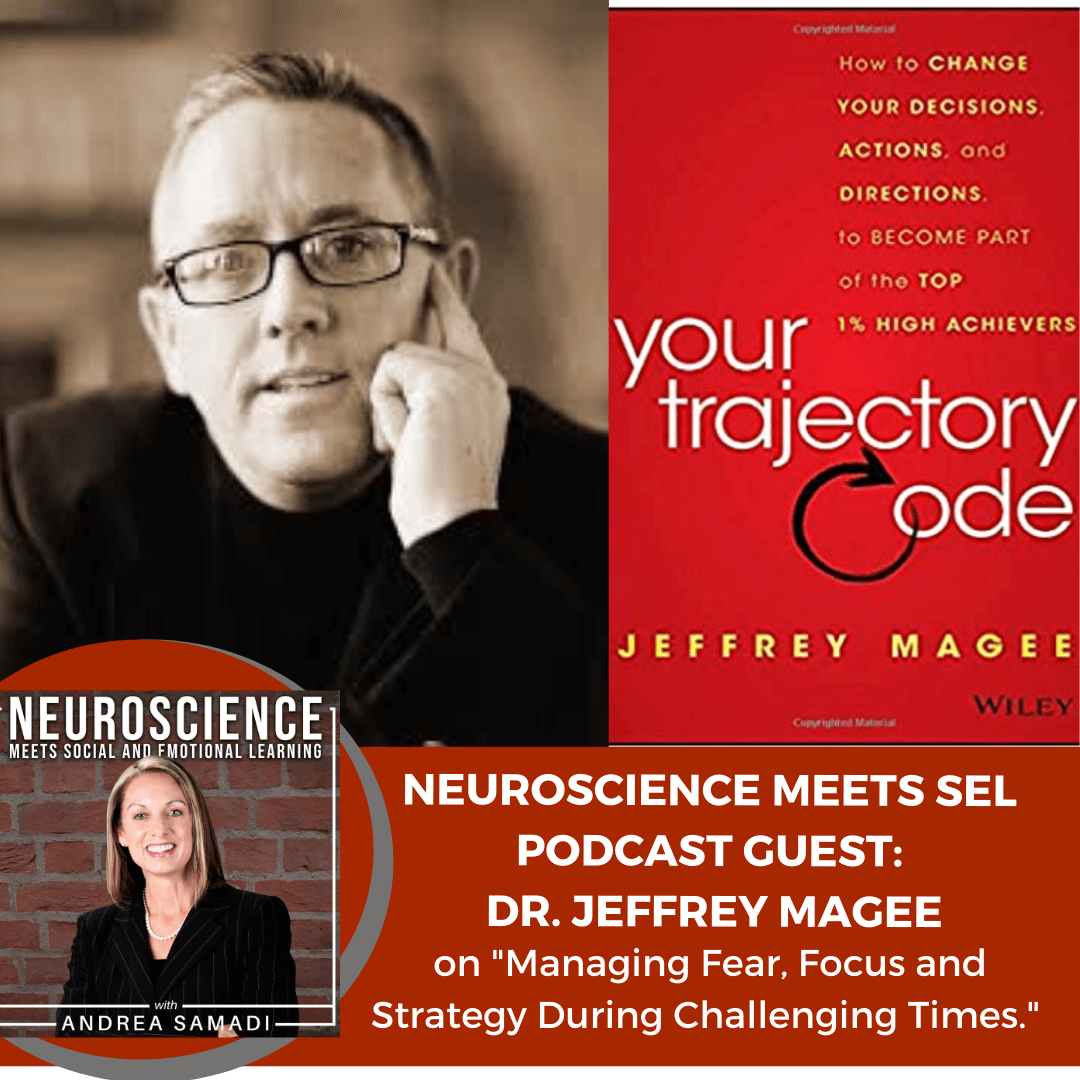
This is episode #49 with someone who is one of today’s leading Leadership and Marketing Strategists and is also a long-time good friend, mentor and colleague of ours here at Achieveit360. Dr. Jeff Magee works with C-Suite, Business Leaders, Military Generals and the top CEOs across America. We first met Dr. Jeff Magee back in 2009 when we partnered with his Professional Performance Magazine and created the Teen Performance Magazine. You can watch the interview on YouTube here. Jeff is the Author of more than 20 books, three college graduate management texts, four best sellers, and is the Publisher of PERFORMANCE/P360 Magazine,[i] former Co-Host of the national business entrepreneur program on Catalyst Business Radio,[ii] and a Human Capital Developer for more than twenty years. You can download a FREE version of the Teen Performance Magazine here.[iii] Welcome Dr. Jeff, it’s incredible to see you and sorry it’s been so long. You literally just popped into my head this morning on my hike and emailed you the minute I returned to my desk. This has been the fastest reply I’ve ever had, but I expect that of you. You don’t waste a second of your time. Thank you so for spending some time with me today. Jeff, I was thinking--just a few hours ago and wondering what other high performers like you are doing to stay focused during these scary times. Can you share how maybe some of your experiences working with the Army National Guard and Military Generals have prepared you for this time, and what are you doing differently? I know that most of your training happens in live events or in person, so how have you pivoted your business the past few weeks? What about your mental mindset? I know in the past when I have been stuck with my business, and I’ve contacted you for ideas, I’ve come away with a list of 20 new ideas to help me to move forward. What are some ways that people can get past places they might be stuck? Perhaps thinking of people who are working from home and now have their children at home that they need to keep busy? What are you doing with your time to add new skills? How has your schedule been the past few weeks? How is it the same or different? What have your learned about yourself and your business the past few weeks? What are you taking away from this experience to improve what you do at JeffreyMagee.com? Any final thoughts, or something I might have missed that you think is important for us to think about as we prepare for the next few months? Thank you so much for the quickest reply I have ever had! If anyone wants to learn more about you and your online training programs they can go to jeffreymagee.com[iv] and find you on social media @drjeffmagee on Twitter. What’s the best way for people to reach you and learn more? REFERENCES: [i] https://www.professionalperformancemagazine.com/ [ii] http://www.catalystbusinessradio.com/index.php [iii] https://www.magcloud.com/browse/magazine/77535 [iv] https://www.jeffreymagee.com/

S2 Ep 48Brain Network Theory: Using Neuroscience to Stay Productive During Times of Change and Chaos
This is episode #48. Welcome to the Neuroscience Meets Social and Emotional Learning podcast, my name is Andrea Samadi, I’m a former educator whose been fascinated with understanding the science behind high performance strategies in schools, sports and the workplace for the past 20 years. I’ve always loved this quote, and it just seems relevant today. “In a time of drastic change, (like our world today) it is the learners who inherit the future. The learned (those who think they know it all) usually find themselves beautifully equipped to live in a world that no longer exists.” (Eric Hoffer, Philosopher) Today’s episode will focus on some strategies to help you to remain productive at work, whether you are working from home, or home schooling your children, AND working, let’s take a look at some evidence-based strategies with the application of the most current, fascinating brain research to help you to stay focused, so when all of this chaos that’s happening in our world today comes to an end, (because it will) you will emerge as stronger, more efficient and knowledgeable, with perhaps a different outlook of some new and improved ways of living your life. I just learned some new ways of thinking from Jim Bunch, who is known as “The Ultimate Life Entrepreneur” –he spent years working side-by-side with Tony Robbins. Jim’s mission is to inspire happiness, health, and wealth worldwide. He is the founder of The Ultimate Game of Life app[i] that I have been using for the past 504 days. I’m counting only because my plan was to use the app for 30 days to recover from a surgery and get my workouts back on track—and 504 days later, I realized there was much more to the app than meets the eye. This week, Jim was talking about some new ways of thinking and reminded us that during these strange times, you’ll notice some things that you have been doing that give you energy and make you stronger.[ii] Think about what they are and amplify those activities. Do more of what gives you energy, and less of what is draining. You’ll notice some things that are becoming obsolete in your life. Notice them and take note of what is replacing them. Are these new ways better than the old way? Be aware of your new way of living and see what you can learn from this time to improve life when it returns to its new normal. What will you keep doing more of, and what will you think about changing or deleting? What new strategies and knowledge can you gain? This can be a powerful time of renewal. Brain Network Theory: The New Brain Science of Reducing Stress Before we dive deep into this week’s episode, let’s take a closer look at the new brain science of overcoming stress and avoiding work burnout called Brain Network Theory—that we should all be aware of to increase positivity, reduce stress and anxiety and increase our work productivity and results. Remember, just like Theory of Mind from EPISODE 46[iii], this is also a theory. Brain Network Theory is now being talked about all over the place, so if you follow the most current neuroscience research, I’m sure you will have heard about it. There are many books being written on this NEW Brain Network Theory (I’ve mentioned Dr. Srini Pillay and his book about the power of the unfocused mind in past episodes). I’ve been working closely with Mark Waldman (from EPISODE 30)[iv] this past week and know that applying Brain Network Theory to our life at this point in time can be powerful. With any theory, just keep an open mind, listen to the ideas, and see how they can fit into your life. So what is Brain Network Theory? If you were to go to www.pubmed.gov and search for the most recent studies on the brain, instead of looking at different parts of the brain, like we used to do, we now know and study different networks in the brain to gain understanding, and we can measure and see the activity in each of these brain networks. Some people use fMRI scans, others use SPECT image scans, but I am sure you
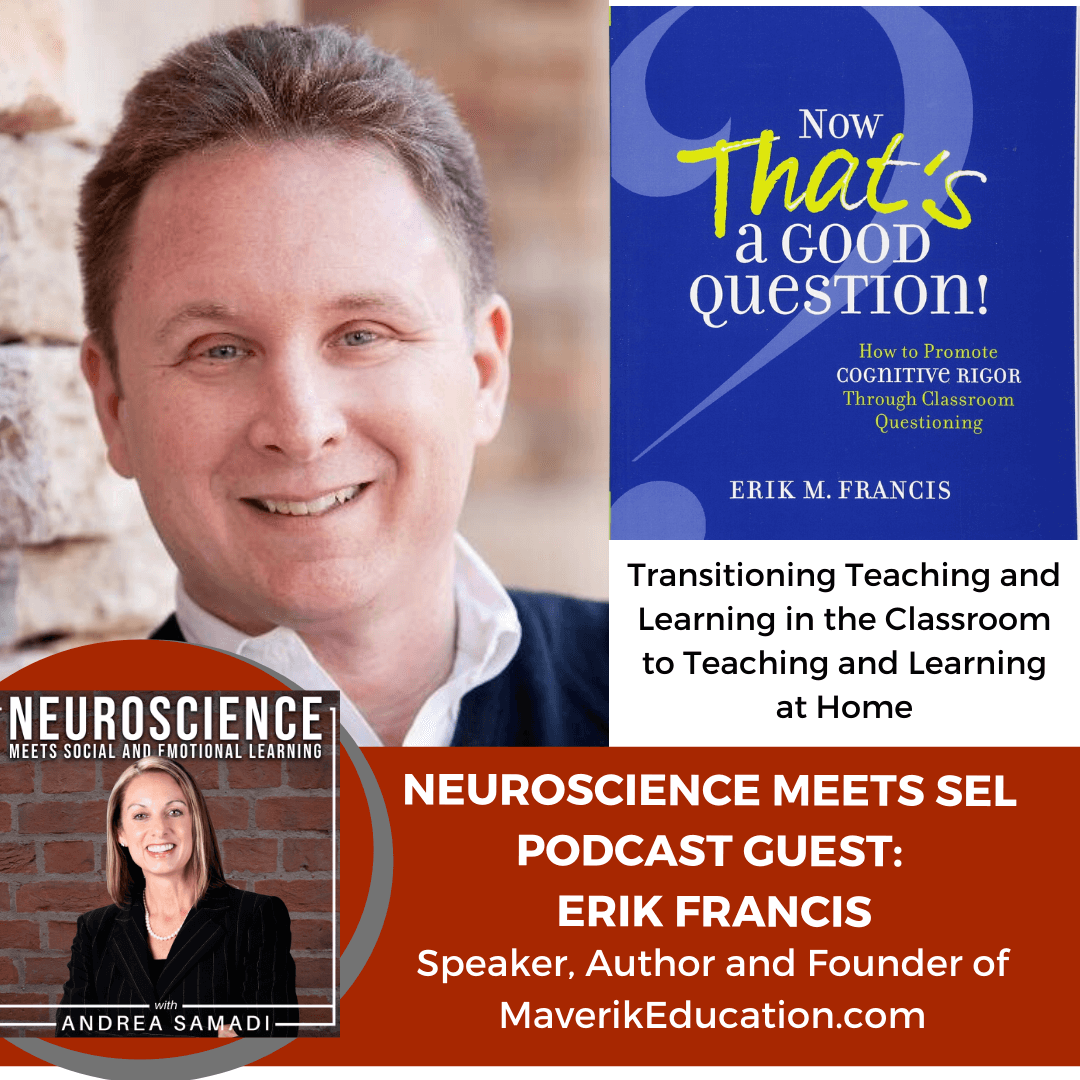
S2 Ep 47ASCD Author Erik Francis on "Transitioning Teaching and Learning in the Classroom to the Home."
This is episode #47 with Erik Francis, our first returning guest to the Neuroscience Meets Social and Emotional Learning Podcast. Erik was just on with us for episode 41 with “How to Use Questions to Promote Cognitive Rigor, Thinking and Learning” with his book, Now That’s a Good Question and because of these strange times we are in right now, I thought it would be perfect timing to ask Erik back to share his thoughts on how to transition from teaching and learning in the classroom, to teaching and learning at home. You can watch the YouTube interview here. Welcome back Erik! Thank you for your willingness to do this, especially on a weekend. Now Erik, we all could benefit from hearing your thoughts of exactly what you are doing to ensure that your girls are still learning while schools have been cancelled for longer than we could have anticipated. Question 1: What are you doing with your girls (middle school/highschool age?) to ensure they are still learning, without stressing everyone out over there? Question 2: I did see a great post from Learning A-Z[i] (the educational company that does the RAZ early readers). I will post a link to this article that I think is great because it covers some of the basics for learning at home. What does your day look like? How have you added in this new daily learning? And are you still keeping your usual daily routines? Question 3: I saw you and Greg Wolcott post something on social media about websites for read a louds and activities. I pulled this resource[ii] up but wasn’t sure what it was. Can you explain how to use these resources? Question 4: How can you tie DOK into what you are doing and make learning enjoyable instead of this “thing” we are doing now. I want to trick my kids into learning. Question 5: What other thoughts do you have on making learning fun, knowing that my next lesson is on Brain Network Theory, where I will be going deep into the 3 networks of the brain, and why rest is so important each hour in order to learn. How are you making this whole experience fun for your girls? I can be a bit of a drill sergeant with mine, so could use some tips to lighten up a bit. Thank you Erik for your thoughts on how to transition from teaching and learning in the classroom to teaching and learning at home. Do you have any other resources that you are working on that you want to direct people to? Stay safe and wishing all the listeners the same. If anyone wants to reach out to Erik for anything, you can email him directly at [email protected] REFERENCES and RESOURCES [i] https://www.learninga-z.com/site/breakroom/school-at-home-tips [ii] https://docs.google.com/document/u/0/d/1OH-_GM-eYefOa7JDNmM6wdUb9fsa1H8k8O_XgPih4m0/mobilebasic
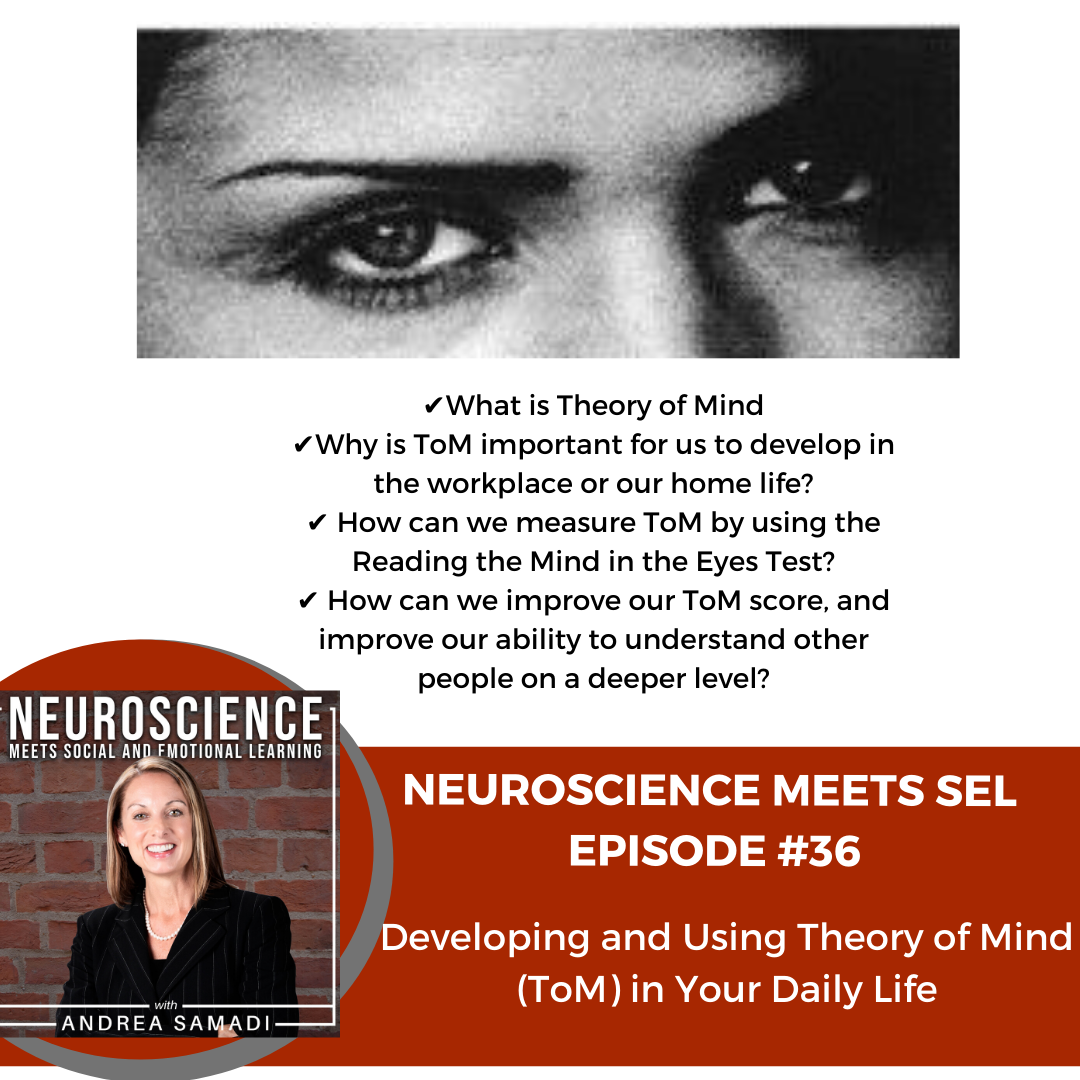
S2 Ep 46As Close to Mind Reading as Brain Science Gets "Developing and Using Theory of Mind in Your Daily Life"
This is episode 46. This week we are on our last solo episode of diving deep into Dr. John Medina’s Brain Rules. I wonder: how are you managing your time during these unexpected life events that are happening in our world today? “You can build up your ‘cognitive reserve,’ or your brain’s innate ability to get a job done, through different types of learning and or through new experiences.” People with a stronger and healthier cognitive reserve—one that’s been strengthened with learned experience—have been shown to be more capable of coping with unexpected life events.” (30 Amazing Facts About Your Brain).[i] I highly encourage using any extra time that you might have in your schedule for learning instead of reading the news or wasting time. This can be a time for all of us to ramp up with our knowledge if we are able to manage the inevitable distraction around us. Welcome to the Neuroscience Meets Social and Emotional Learning podcast, my name is Andrea Samadi, I’m a former educator whose been fascinated with understanding the science behind high performance strategies in schools, sports and the workplace for the past 20 years. Each week we bring you an expert who has risen to the top of their industry with specific strategies that you can implement immediately, whether you are a teacher or student in the classroom, or working in the corporate world, to take your results to the next level. In episode 42[ii], Dr. John Medina gave us some new insights on applying 12 Brain Rules to our daily life. I could spend a year on these rules but have just taken a few of the concepts that stuck out to me as important, to dive deep into. Dr. Medina spoke a bit about Theory of Mind as being “as close to mind reading as brain science gets.”[iii] So why is Theory of Mind so important? Theory of Mind (ToM)[iv] is crucial for everyday social interactions with others[v] as it is used to analyze, judge and infer other people’s behaviors. It is an important “social-cognitive skill that involves the ability to think about mental states, both your own and those of others.”[vi] Psychologists have called this idea a theory because we really do not know exactly what is going on in someone else’s mind, we can only learn to make inferences based on life experience, intuition and practice. Why would this skill be important in the classroom? Imagine how much easier life would be if you could look at your students and be able to know if they were feeling anxious before a test, or even before a sporting event and be able to intervene with a quick strategy to calm their nerves. What about in the workplace? Imagine if you were working in a restaurant, how much easier it would be to serve your customers if you could read facial cues that come along with needing something like an empty water glass, or a utensil or maybe even something like warming up a plate of food that came out and wasn’t hot. The ability to look and read what someone else is thinking makes life much easier in these situations and is a skill that can be learned with practice. Before we take a deeper dive in ToM, I want to tell you when I first learned about this skill. When I was in high school, (In Toronto, Canada where I grew up) there was this awful span of time where there were crimes committed by someone the media called the Scarborough rapist (late 1980s-1990s). Anyone living in Canada at this time would remember when they finally caught this man, who committed these terrible crimes with his wife that ended up being the most horrific crimes in Canadian history, the media changed what they called them to the Ken and Barbie Killers based on their appearance. I remember asking my Mom at the time, “how would I ever know if someone is bad, if these two people could be so evil, yet they don’t look evil at a glance?” My Mom looked at me and said, “you can’t see it in their eyes?” and sat me down at the kitchen table and started what were known as our “reading the mind in the eyes” l
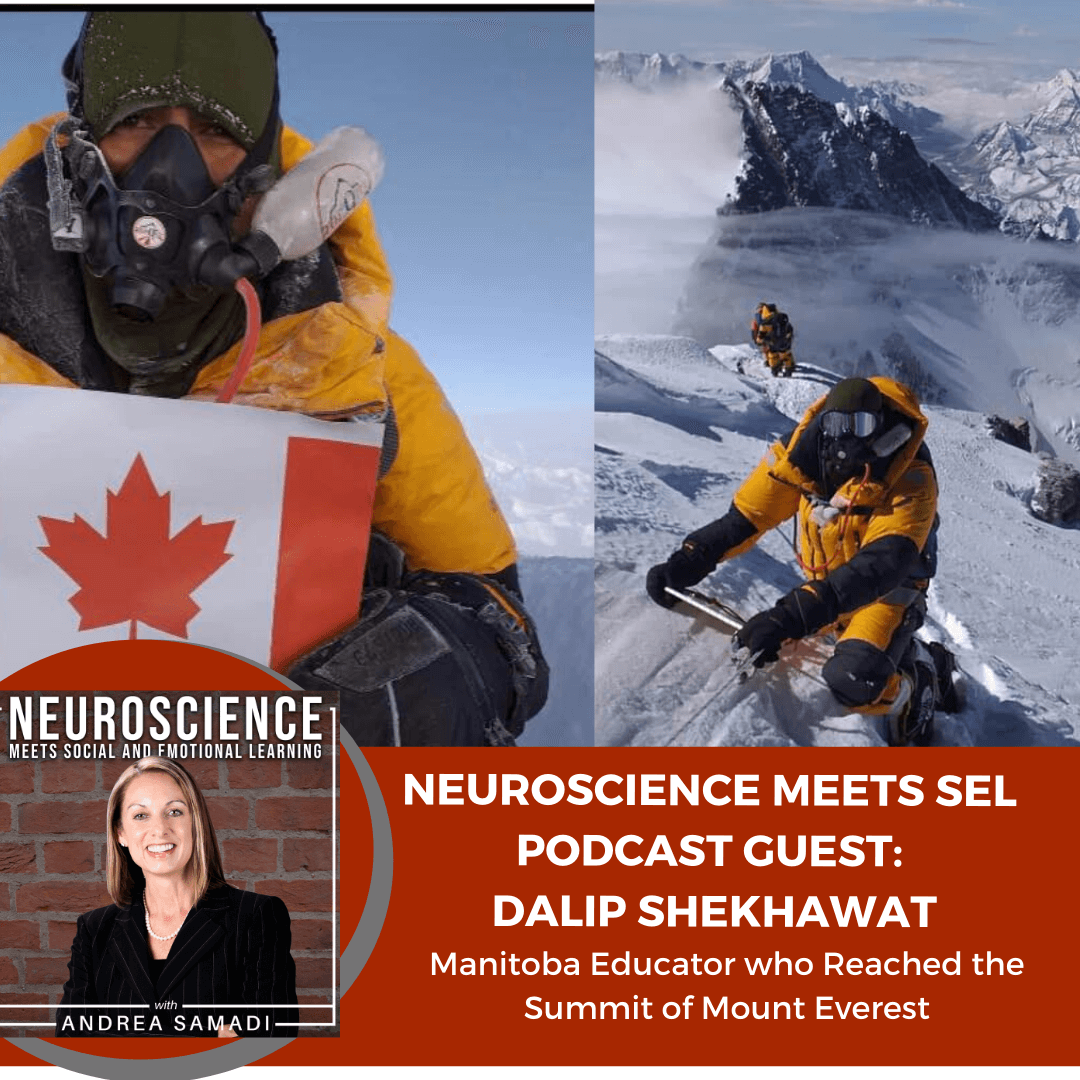
S2 Ep 45Manitoba (Canada) Educator, Dalip Shekhawat on "Life Lessons Learned from Summiting Mount Everest"
This is episode #45 with Dalip Shekhawat, an educator from Manitoba, Canada, who is no stranger to challenge. Last May, Dalip reached the summit of Mount Everest to raise funds for the St. Amand School (in Winnipeg, MB) and is now preparing for his next challenge, that is tied into raising funds for the Wounded Warriors of Canada where he will run a combined distance of more than 500 kilometres (311 miles) over different terrain, in different climates, and at different altitudes, to "simulate the physical adversities these warriors faced." You can watch the interview on YouTube as well. UPDATE: Watch the extended interview with more details on the trip up Mount Everest here. Welcome to the Neuroscience Meets Social and Emotional Learning podcast, my name is Andrea Samadi, I’m a former educator whose been fascinated with understanding the science behind high performance strategies in schools, sports and the workplace for the past 20 years. Each week we bring you an expert who has risen to the top of their field with specific strategies or ideas that you can implement immediately, whether you are a teacher or student in the classroom, or working in the corporate world, to take your results to the next level. Welcome Dalip! I want to first of all thank my friend Sheryl Watt, from Winnipeg, for sending me your story. When I first read about your challenge to summit Mount Everest to raise funds for St. Amant center for people with developmental disabilities, I knew I needed to reach out to you. Then I find out you are in the middle of raising funds for another just as equally important challenge now for the Wounded Warriors[i]. Wow! Thanks so much for speaking with me bright and early on a Sunday morning. Question 1: Dalip, I’m an avid hiker here in Arizona, but I can’t imagine hiking up Mount Everest! What was behind the drive to motivate you to actually summit Mount Everest and then run more than 500 km for your next challenge? Question 2: How did you prepare for Everest last May? I read that you have climbed more than 15 other mountains. Which ones have you hiked and where were they? The last time I looked, I only saw 2 mountains in Manitoba. Also, how are you training for your distance run? Question 3: When I read that 2/6 of those you were hiking with didn’t make it back down, I wondered how on the earth you could prepare yourself for something like this? What mental strength did you need to develop to handle the things that you saw? Was there any point that it crossed your mind to turn around knowing you have a family back home? Question 4: What physical toll did the hike take on your body? And is it true that it takes 2 months to hike to the summit? Take me through the hike from start to finish. Question 5: How did this experience change you? What did you learn about yourself? Thank you Dalip for your quick reply to meet with me for this interview. I know there will be a lot of wisdom that comes from your experiences that others can learn from. For those who are interested in supporting your Wounded Warriors Challenge, I will put the link to the donation page in the show notes. Question 6: Can you give us your final thoughts on why you think it’s so important to raise funds for disadvantaged groups like the Wounded Warriors or the St. Amant School? Thank you again for your time today, Dalip. We look forward to seeing you raise the funds you need for the Wounded Warriors and see what other challenges you set up in the future. Have a wonderful rest of your day. REFERENCES and LINK TO SUPPORT DALIP'S WOUNDED WARRIORS of CANADA CHALLENGE [i] To support Dalip with his Wounded Warriors of Canada Challenge, in any way that you can, please visit and share this link! https://secure.e2rm.com/registrant/FundraisingPage.aspx?registrationID=4668411&langPref=en-CA#&panel1-3
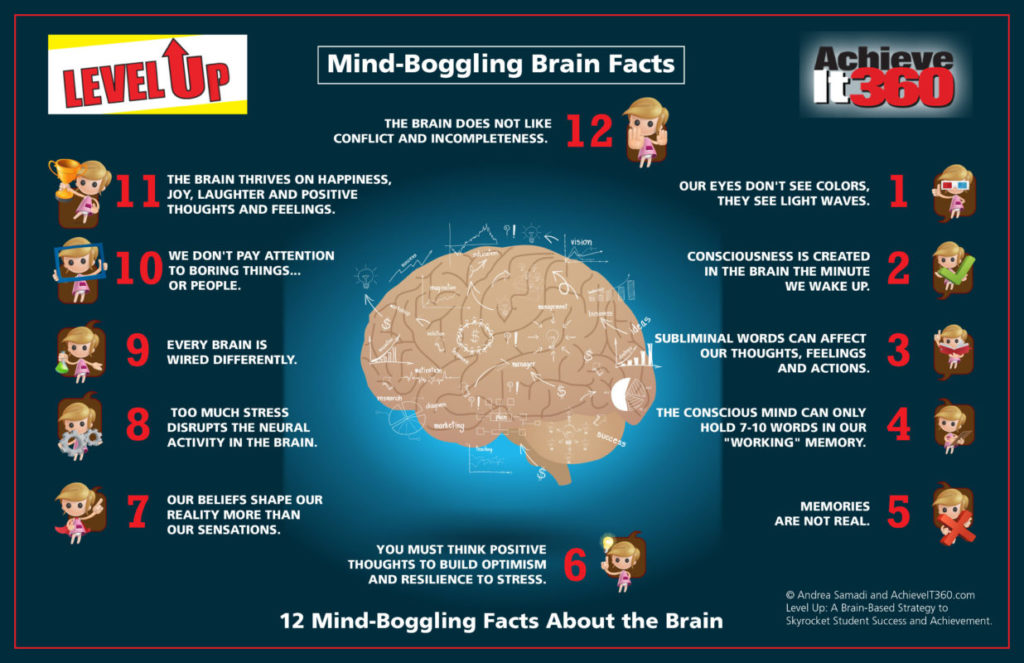
S2 Ep 44Andrea Samadi's "12 Mind-Boggling Discoveries About the Brain"
This is episode #44. Welcome to the Neuroscience Meets Social and Emotional Learning podcast, my name is Andrea Samadi, I’m a former educator whose been fascinated with understanding the science behind high performance strategies in schools, sports and the workplace for the past 20 years. This episode will be focused on “12 Mind-Boggling Discoveries About the Brain” that are outlined in Chapter 3 of my most recent book, Level Up: A Brain-Based Strategy to Skyrocket Student Success and Achievement.[i] Back in 2014 when I was urged to add the most current brain research into my programs, I consulted with one of the leading neuroscience researchers in the country, who I still work very closely with, Mark Robert Waldman. He shared with me some of these discoveries, and then I created the real-world application so that we can start to look at the world with a different lens and improve our own personal and professional awareness. These are my own Brain Rules with two being the same as Dr. John Medina’s. Let’s take a closer look and see how these 12 mind-boggling discoveries about the brain can be applied to your daily life. Mind-Boggling Discovery 1: Did you know that “Our eyes don’t see colors; they see light waves.” This fact reminds us of how colors are created inside our brain. The part of the brain that we actually “see” the world from is our frontal cortex (right above our eyes). What we see is like a movie that blends light waves and sound waves with our emotional experiences that forms a story that is far removed from the reality that actually exists. Colors from what we are looking at are decoded in the brain.[ii] If you can look at the image in the show notes, you will see how our brain really sees color. Light hits what we are seeing with our eyes. This reflected light goes into the pupil and to the back of the eye to the cone cells. These cone cells decode the light waves based on how excited they are, (based on how long their wavelenghts are) and the brain translates the color of what we are seeing. WHAT DOES THIS MEAN IN OUR DAILY LIFE? There is a lot more to what we see than meets the eye. If we think of all that we can “see” with our eyes, we can gain some appreciation for the world, and our place in it. Next time you are in nature, look around and marvel at the sky, the mountains, or the ocean. There is so much to see and experience in the world and when we put our minds and brain to work, we can actually bring our visions that begin in our mind, into reality. This is the creative process. Take time away from your work when you want to create a new result in your life. With this creative process, everything that you create begins first off in your brain, and then when you take action to create it, so it is important to think and imagine what you want in clear detail, in your brain first, where everything we see with our eyes first takes shape. Our brain is involved in everything that we do. This is one of the reasons why writing down our goals is so important because writing stimulates our goals and behavior. It’s the first step of the creative process. Mind-Boggling Discovery 2: Did you know that “Consciousness is created in the brain the minute we wake up?” Have your ever thought about what consciousness is? Stop the recording now and think about it. What is consciousness to you without looking up a definition. When I was first asked this question, I could just come up with the word “awareness.” Consciousness is something that after 2600 years of speculation, everyone agrees that it exists, but so far “no one knows what it is, or how it works.”¹ (Andrew Newburg M.D and Mark Robert Waldman “Words Can Change Your Brain). Various disciplines of science have tried to define what exactly our mind and our conscious awareness is, and Dr. Daniel Siegel tackles the definition with the idea that that “the mind, brain and relationships are all connected” ² (Daniel Siegel M.D. Mindfulness and Neural Integra
S2 Ep 43Deep Dive into Dr. John Medina’s Brain Rules
This is episode #43. Welcome to the Neuroscience Meets Social and Emotional Learning podcast, my name is Andrea Samadi, I’m a former educator whose been fascinated with understanding the science behind high performance strategies in schools, sports and the workplace for the past 20 years. The next three episodes will be solo lessons to dive deeper into Dr. John Medina’s episode #42 that I could probably spend the next year on. For those who have not read his Brain Rules book, or would like a quick review, I’ll outline them briefly with thoughts on why they are so important to implement into YOUR daily life with some applicable strategies. Here are Dr. John Medina’s Brain Rules[i]: If you click on the link in the show notes, you will be taken to his website and can watch a video on each rule. I also highly recommend reading the book, because there are so many examples that will bring these rules to life. RULE 1: EXERCISE: Exercise boosts brain power. Did you know that “aerobic exercise, just twice a week, halves your risk of general dementia? It also cuts your risk of Alzheimer’s by 60 percent.” (Summary Rule 1, Brain Rules, Page 28). I also heard this from Dr. Daniel Amen in his “Thrive by 25”[ii] online course where he talks about a recent study that rigorous aerobic exercise over a 12-week period, was just as effective for those suffering from depression as taking an anti-depressant. This class talked about the fact that aerobic exercise, like brisk walking, swimming, running or cycling seems to solve EVERY brain or health problem. The solutions were always to improve your diet and add aerobic exercise. This should be incentive enough for everyone to be sure they are moving at least 3 times a week for at least 20 minutes, or that’s what Dr. Medina would say will have an impact on your brain and improve cognition, problem solving and emotional regulation. I found it interesting that he mentions that strength training did not improve cognition in the studies, but I still think both strength training and aerobic exercise are important to do on a weekly basis, regardless of whether one is making you smarter or not. The latter will definitely make you stronger and is important to include as we age. RULE 2: SURVIVAL: The human brain evolved, too. I’m sure by now you have heard that the brain’s main function is to keep us safe, something that’s been built in for our survival. If we think about evolution and the survival of the fittest, what happened with the human brain when it evolved and adapted over time was that the brain got smarter with evolution, not stronger. We can clearly see how the human brain and cognition is vastly different than other animals. The human brain consists of 3 main parts (the hindbrain that developed first, that keeps us breathing, the midbrain that keeps us alert and where our emotions are stored and the last part of the brain to develop, the forebrain that holds the most power with our thinking/reasoning, emotional regulation, and cognitive functions. Our ability to think and reason is what separates us from the animal kingdom and a feature of our brain that we shouldn’t waste or take lightly. Since we have this unique ability, I think it’s our responsibility to pay attention to this important part of our brain and continue to develop and improve our thinking and reasoning skills. RULE 3: WIRING: Every brain is wired differently. The experiences that you have in your life, “what you do and learn in life physically changes what your brain looks like—it literally rewires it.” (Summary Rule 3, Brain Rules). This explains why we are all different since “no two people’s brains store the same information in the same place.” (Summary 3, Brain Rules, Page 70). This rule is important to understand since each person we interact with throughout our life will be different with their life experience. We have to learn to read and understand people better, and this can be done with Theory of Mind
S2 Ep 42Dr. John Medina on "Implementing Brain Rules in the Schools and Workplaces of the Future"
This is episode #42! If you are in the field of education, our next guest doesn’t need an introduction. I want to introduce a concept that he would say is “like fairy dust to the brain”[i], and use “virtual transportation” or mental time travel to take a trip down memory lane, visualize and remember when you first heard about Dr. John Medina and his Brain Rules Series[ii] that he wrote with the idea in mind to redesign our schools and workplaces. I was given my first copy of Brain Rules when I worked as an inside sales rep, in a cubicle, for Pearson Education, (2009) by my Sales Manager, who knew I needed to read this book. At the time, I had no idea just how important these Brain Rules would be for me, however, 5 years after this, when my Character and Leadership Programs were chosen by the State of AZ for a Grant, and I was urged by an educator to incorporate brain-based learning into these programs, it was Dr. Medina’s Brain Rules that I grabbed off my bookshelf to understand how the brain impacts learning and achievement. If you have read his book, and it’s impacted you in any way, you must listen to today’s interview. You can listen to the interview here, or watch the visuals on YouTube. Welcome to the Neuroscience Meets Social and Emotional Learning podcast, my name is Andrea Samadi, I’m a former educator whose been fascinated with understanding the science behind high performance strategies in schools, sports and the workplace for the past 20 years. Each week we bring you an expert who has risen to the top of their industry with specific strategies that you can implement immediately, whether you are a teacher or student in the classroom, or working in the corporate world, to take your results to the next level. Welcome Dr. John Medina. John, before we get into the questions, I’ve got to tell you that I emailed you back in 2014 to ask if I could use your book cover and your headshot in my presentations as I mentioned you as an early influencer with my work. Of course, you said yes, and I presented a slide with your book series ever since then so you would understand why I’m thrilled to speak with you today as your work has significantly impacted mine, and I can see that many others feel the same way. Thank you so much for being here today. Question 1: Dr. Medina, I know that you wrote Brain Rules (the 2nd book in your series) to redesign classrooms and workplaces with the brain in mind. These rules are all brilliant, with so much research to validate each rule. Can you give us some concrete examples for those of us looking to implement these rules in the K-12 school or workplaces. Where have you seen your Brain Rules working really well? What exactly would a school or a workplace of the future look like to you? Of your 12 Brain Rules, which ones do you think would impact schools and our workplaces the most? Question 2: Everyone loves this topic, which is obvious with how much interest and feedback I have had with this podcast, but there’s so much pseudoscience out there. What would be some best practices that you suggest preventing the repetition of some of the most common myths, and stay true to current evidence-based research? Question 3: We all want the best for our children and students, (and I know that you feel the same way) and as a parent, there’s nothing I want more for my 2 girls than their happiness. With the clear fact that anxiety and depression are a nation-wide epidemic, (it is so bad where I live in Chandler, AZ that audiences gasp when I talk about the statistics of teen suicide within my local community) so I’m always looking for ways that I can be a better parent and spread the word to change these dismal statistics. What does the research say about the best ways to raise our children/students these days, to be confident, resilient and hopefully bypass anxiety and depression? Question 4: When I was researching your work, watching your Talks at Google[iii] you mention Art Linkletter an
S2 Ep 41ASCD Author Erik Francis on "How to Use Questions to Promote Cognitive Rigor, Thinking and Learning"
This is episode #41 with Erik Francis, an international author of the book Now THAT'S a Good Question! How to Promote Cognitive Rigor Through Classroom Questioning[i] published by ASCD and presenter with over 20 years of experience working as a classroom teacher, a site administrator, an education program specialist with a state education agency, and a professional development trainer. He’s conducted trainings at K-12 schools, colleges, and universities throughout the United States and internationally in Canada and Singapore. You can watch the interview with visuals on YouTube. Welcome to the Neuroscience Meets Social and Emotional Learning podcast, my name is Andrea Samadi, I’m a former educator whose been fascinated with understanding the science behind high performance strategies in schools, sports and the workplace for the past 20 years. Each week we bring you an expert who has risen to the top of their industry with specific strategies that you can implement immediately, whether you are a teacher or student in the classroom, or working in the corporate world, to take your results to the next level. Today, we have Erik Francis, the owner of Maverik Education[ii], where he provides academic professional development and consulting to K-12 schools, colleges, and universities on developing learning environments that challenge students to demonstrate higher order thinking and communicate depth of knowledge (DOK). Welcome Erik. Thank you so much for being here today (on Valentine’s Day of all days) and for the support you’ve given me over the years as I have been navigating my programs and services in the K-12 school market. It’s always a blessing to have a good friend with your knowledge and understanding so thanks for always lending a hand to help us over here and for coming on today to share your knowledge with others. Before I get into the questions I have for you, can we first of all talk about cognition or acquiring knowledge and understanding through thought, experience and the senses. This is a powerful concept as to actually think…takes a lot of effort. Then to think up questions takes even more effort. Q 1: Why did you decide to write your book tying in asking good questions to promote cognitive rigor? When I saw the title of your book, Now That’s a Good Question…it made me think about The Four Agreements and the fact that we all need to get better at asking questions to gain clarity. Q 2: What is cognitive rigor and how can we use questions to challenge anyone to think? What about thinking in the corporate world? Can these concepts transfer into the modern workplace? Q3: I’m really into creating frameworks or graphics of ideas to help bring clarity to complex thoughts or concepts. Then I heard you speak about how someone created a framework of depth of knowledge that spread across the country and was adopted into every state, but it was inaccurate. Can you explain what exactly is depth of knowledge, where the concept came from, and why the D.O.K. Wheel is inaccurate? Other Thoughts: When you created your graphic, did you consult with other educators? What can we learn from this? Can Depth of Knowledge be translated into the workplace? What about in sports? Dok 1- What is the knowledge? Recall and Reproduce. Dok 2- How can that knowledge be used? Apply it or explain it with basic reasoning. Dok 3- Why can this knowledge be used? Think strategically. Dok 4- How else can this knowledge be used? Think extensively. Apply to the Classroom, workplace, sports? Q 4: I’m thinking of when I first saw a graphic created by Casel.org for the 5 sel competencies. I had been working with concepts that we used to call soft skills since the late 1990s and used Casel’s 5 competencies, adding in carol dwecks growth mindset to come up with my framework for SEL. Having a framework brings clarity to complex ideas. When did you first recognize that this graphic needed to be changed? What did you do next to instigat
S2 Ep 40Co-Founder of the Make-A-Wish Foundation Frank Shankwitz on "Lessons from the Wish Man Movie"
This is episode #40 with Frank Shankwitz, the co-founder of the Make-A-Wish Foundation, who was identified as one of the "10 Most Amazing Arizonans"[i] and if you don’t already know who Frank Shankwitz is, I hope that you will go and find his biographical movie on Netflix (The Wish Man) and watch it. I have been following the making of his movie for at least the past 5 years, as we both belong to a networking group that supports entrepreneurial visions. There are few words to describe someone like Frank, but I think it goes so much deeper than just one of 10 amazing Arizonans. Watch the visuals on YouTube here. Frank is a former Arizona Highway Patrol officer turned Wish Man, who granted the "wish" of a 7-year old boy with leukemia, whose wish was to be a Highway Patrol officer. If you watch the movie, you’ll see how Frank made his wish come true and the rest is history with his vision of The Make-A-Wish Foundation. Frank has spent most of his adult life seeking to fulfill the dreams of others no matter how big or small. If you have ever met a child who has gone through leukemia, it’s devastating for the family as well as for the child. A few years ago, my husband’s best friend from high school, called one night to let him know that his daughter, who was my husband’s god daughter, was diagnosed with leukemia and we watched first-hand the years of treatment involved along with everything that goes into ensuring the well-being of that child. Back then, I didn’t realize it was Frank who was behind the Make-A-Wish Foundation (even though I was following the making of his movie, The Wish Man) and that it was his idea behind the organization that gives so much back to families in their years of treatment, to offer some stress relief, peace and support. Frank has changed the lives of thousands of people through his generosity, grit, and belief in the human spirit. Because of his work, he has received the President's Call to Service Award[ii], the Making a Difference in the World, and the Ellis Island Medal of Honor awards.[iii] Frank, it is such an honor to speak with you today. I just wish we could be speaking face to face since we are both located in Arizona. Before we even get into the questions about your book and movie, I do have to first of all honor you for all the years you dedicated to law enforcement through AZ Department of Public Safety. My husband, along with his fulltime job, is a commander with the sheriff’s posse with the Maricopa Sheriff’s office, so we have a deep understanding of the sacrifices that are made by law enforcement officers on a day to day basis when they are going out every day to help, give back, give away their time and often put themselves in the seat of danger, to make a difference. Thank you for these years of service that I see from your LinkedIn began a year after I was born! Question 1: Frank, I watched the formation of your book turn into a movie, though our mutual friend Greg Reid, and I didn’t fully know your story back then until I watched your movie and then followed you through social media. Can you give an overview of where this all started? How did your life become a book, and then a movie which I just watched was in the running for an Oscar? Question 2: Who helped you with all that you needed to know to take your movie to these heights? There are so many little details that you would have needed to know, especially the criteria for an Oscar. Who helped/guided you along the way? Question 3: In our podcast, we talk about social and emotional skills that we see are missing in today’s world. Skills that I know you recognize like empathy for others and giving back. They are making their way into schools, but students are not prepared for the workplace with these basic skills (we call them emotional intelligence skills in the workplace). What skills do you think are missing from our schools, and how do you see this impacting the workplace and society? Question 4: With al
S2 Ep 39Neuroscience Researcher Stefanie Faye on "Using Neuroscience to Improve our Mindset, Self Regulation and Self-Awareness"
This is episode #39 with neuroscience researcher and clinician Stefanie Faye, whose research is focused on brainwaves, heart rhythms and micro-movements[i] that influence our ability to self-regulate and build healthy relationships. Listen to the interview here or watch the YouTube for the visuals. Welcome to the Neuroscience Meets Social and Emotional Learning podcast, my name is Andrea Samadi, I’m a former educator whose been fascinated with understanding the science behind high performance strategies in schools, sports and the workplace for the past 20 years. Each week we bring you an expert who has risen to the top of their industry with specific strategies that you can implement immediately, whether you are a teacher or student in the classroom, or working in the corporate world, to take your results to the next level. I’ve got to give you a bit more background on Stefanie Faye Frank, whose graduate research at New York University and fieldwork at the NYU Phelps lab for neuroscience research, the NYU Institute for Prevention Science and Yeshiva University's Albert Einstein College of Medicine focused on the cross-section of self-directed neuroplasticity, empathy and social justice. For the past decade, she’s been teaching and consulting in countries all over the world by combining scientific insights and her training in monasteries with meditation masters from India, Africa and Vietnam. She has delivered a series of workshops for Google's Analytics Academy in London, Chicago, Tel Aviv, Munich and Singapore focused on the Science of Learning. Stephanie, I am so grateful to have you here today, to share some of your fascinating research with our listeners. I found your work through YouTube[ii], one night, when I was looking to take my understanding of Growth Mindset just a bit deeper for the programs that I offer in the school market. Then I came across one of your videos, that led me to your Mindset Neuroscience Podcast[iii], and then your interview with Maria Xenidou on How to Develop a Growth Mindset[iv] and from here I was blown away with your work, how simple you made everything seem, and I was hooked and wanted to learn everything. I love the FREE online courses you have on your website http://stefaniefaye.com/ and the fact that you are also Canadian (from Calgary) and I grew up in Toronto. Welcome Stefanie! Question 1: Stefanie, I watched your “Mindset Neuroscience” video course, and thoroughly enjoyed the way you connected neuroscience to building a growth mindset. We have covered Growth Mindset on this podcast with episode 20[v] with “Strategies for Overcoming Obstacles and Cognitive Biases.” I’ve mentioned an Ed Week survey that found that “the vast majority of educators believe that a growth-oriented mindset can help improve students’ motivation, commitment and engagement in learning. But the study found that applying those ideas to practice, and helping students shift their mindset around learning, remains an elusive challenge.”[vi] So applying growth mindset has proven to be something that has not been simple or easy to do—whether in the classroom, workplace, or even in the field of athletics. With your experience why is applying growth mindset proving to be so difficult? What’s happening or not happening at the brain level that we can learn from, to improve the application of these strategies? Question 2: You talk about some keys to building a Growth Mindset in your video course and one of the keys is to understand neuroplasticity (the ability for the brain to continually change over our lifespan) or how the brain creates high priority pathways with skills that we are practicing and then eliminates low priority pathways with skills we ignore. Can you explain how the brain re-wires itself using myelin and why patterned repetition is so important at the brain level for those skills we want to improve, develop and keep? Question 3: This is definitely the era where we are coming around mo
S2 Ep 38Assistant Coach to the Winnipeg Jets, Todd Woodcroft on ”the Daily Grind” in the NHL
This is episode #38 with the assistant coach for the Winnipeg Jets, Todd Woodcroft, who has built up a 20-year career that has taken him all over the world in the field of ice hockey. His NHL resume includes stops in Minnesota, Washington, Los Angeles, and Calgary, before joining the Winnipeg Jets in 2016 as an assistant coach. You can watch this interview on YouTube here. Todd won a Stanley Cup in 2012, during his second of four seasons with the Kings. Internationally, he has two gold medals on his resume. One in 2004 with Canada at the International Ice Hockey Federation World Championship, and in 2017 he earned another one with Sweden at the same event. These days you can find him standing behind the Winnipeg Jets next to their head coach, Paul Maurice, where he is challenged on a daily basis to take their team to the end result of making the finals, and then winning the Stanley Cup. Welcome to the Neuroscience Meets Social and Emotional Learning podcast, my name is Andrea Samadi, I’m a former educator whose been fascinated with understanding the science behind high performance strategies in schools, sports and the workplace for the past 20 years. Each week we bring you an expert who has risen to the top of their industry with specific strategies that you can implement immediately, whether you are a teacher or student in the classroom, or working in the corporate world, to take your results to the next level. Welcome Todd, it’s so good to see you face to face after all these years! For those who don’t know, Todd has been a good friend of mine since the late 1990s…we actually sat in teacher training classes together at the University of Toronto, and it’s been crazy Todd, to watch your success over the years. Let me get straight to the questions, so you can get back to work over there…and where are you right now, by the way? Todd, where did this all begin for you? I always knew you were into hockey, but can you give a quick overview of how you broke into coaching in the NHL, some of your early influencers, the coaches and players you have worked with to give our listeners an overview of your background? I know it’s easy for those of us watching a sports game to notice when the team is in synch, working together, really well. How does the identity of a team form to where players begin to work together like clockwork? And then how does it change throughout the season? I’ve heard your team be called “the best face off team in the NHL by far” and know this is your expertise. With skill building, we’ve heard from researchers (we just covered this on our last episode with John Dunlosky) that the best way to learn anything new is with spaced repetition of a skill. In athletics you practice a skill over and over again but how do you know what skills are most important to practice (like puck drops), how do you make these skills priority with such a busy schedule, or without things getting boring? Todd, you’ve got a unique background with your training in education that I’m sure helps you as a coach. With your teaching background in mind, can you think of why the proven method to learn/master a skill works so well in athletics, but it’s really hard to translate into the classroom? We all know to practice a sport over and over again to improve performance (or even a musical instrument or for a dance recital) but when it comes to studying for a test, some students still fall back to cramming vs the evidence-based method of spaced repetition. If you were to visit a classroom, what advice would you offer teachers/students with your experience working with pro athletes on learning new skills? After watching some of the interviews with your players and coaches, and some of your games, I saw that there were quite a few games where you won by just one goal, many in overtime and in the last few minutes or seconds of the game. I’ve also seen that the opposite can happen—in the last few seconds, with a frustrating loss. Ther
S2 Ep 37Dr. John Dunlosky on "Improving Student Success: Some Principles from Cognitive Science"
This is episode #37 with Dr. John Dunlosky, a Professor of Psychology at Kent State University, who has contributed empirical and theoretical work on memory and metacognition, including theories of self-regulated learning and metacomprehension. You can watch this interview on Youtube for the visuals. Welcome to the Neuroscience Meets Social and Emotional Learning podcast, my name is Andrea Samadi, I’m a former educator whose been fascinated with understanding the science behind high performance strategies in schools, sports and the workplace for the past 20 years. Each week we bring you an expert who has risen to the top in their industry with specific strategies that you can implement immediately to take your results to the next level. I’m so excited to introduce you to Dr. John Dunlosky. John’s research has focused on understanding three inter-related components of self-regulated learning: (1) the monitoring of learning, (2) control of study time, and (3) the application of strategies during learning. These three components of learning fall under the rubric of metacognition, which is about people's cognition (the mental processes like thinking, knowing, remembering, judging and problem-solving, all involved in gaining knowledge and comprehension).[i] By studying metacognition in students across the life span, a major goal of his research involves developing techniques to improve student learning and achievement. Welcome John! Thank you so much for taking the time away from your important work to be here to share your research and thoughts for improving student learning. Question 1: I first heard you back in 2016 on an Edweek Webinar, speaking about “deliberate practice” being one of the most effective learning strategies, vs cramming, and I wrote that down and that concept has ended up in all my presentations for the K-12 school market ever since. I recently watched your presentation from the McMaster Symposium on Cognition, Learning and Education[ii] where you dive deep into your research. Can you give an overview of what launched your research with learning strategies and do you think that we can learn ANYTHING with enough deliberate practice over time? Question 2: When you were doing your research to find which learning strategies work the best, what surprised you the most, and what feedback did you hear about your discoveries? Question 3: Knowing what strategies scored the highest in your research (distributed practice—spacing study sessions out over time vs cramming) and retrieval practice or practice test taking using multiple choice, fill in the blanks, or essay type recall) do you see that these methods are used more frequently now by students? What have you seen with the application of your research? Question 4: What happens next? Once a student uses distributed practice and retrieval practice, what is successive relearning? Question 5: It caught my attention that a major aim of your research is to develop techniques to improve the effectiveness of people’s self-regulated learning because self-regulation is the most requested topic I see when working with schools, especially with older students (middle school and high school) and it seems to be the skill that challenges most adults (thinking where we are at the start of the year setting new goals for ourselves and many goal-setter fall off their plan before January is complete). Why did you choose self-regulation opposed to let’s say growth mindset or something, and what are your current goals with your Metacognition and Education Lab?[iii] Note- Self-Regulation is one of the six social and emotional competencies that we dive deep into here on the podcast (episode 14).[iv] Question 6: I was reading your book on the weekend, the first textbook to be written on metacognition, can you share what metacognition is, and why it’s so important for the learning process? Question 7: Is there anything else that’s important that you have uncovered to help improve
S2 Ep 36Creator of The Learning Pit, James Nottingham, on "The Importance of Challenge with Learning"
This is episode #36 with the creator of The Learning Pit®,[i] a sought-after keynote speaker and author of 9 books about teaching, learning and leadership, James Nottingham,[ii] from Northumberland, UK. Within a few minutes of posting about this interview on my social media channels, I had good friends who are deeply invested in teaching and learning from around the world, message me about how excited they were to hear this interview. You can listen to the interview here, or watch the visuals on YouTube. It’s not surprising that The Swedish Teaching Union describes James as “one of the most talked about names in the world of school development.” James’ most recent book, Challenging Learning (2017) describes the theory and practice of guiding students through the “Learning Pit” encouraging them to step out of their comfort zone. This practical book is filled with ideas for making lessons engaging, thought provoking and collaborative. Welcome James! Thanks, so much for taking the time to be here today all the way from the UK. Q1: James, we all know that our educational system worldwide has been under a microscope of discussion for transformation the past few years and that some countries that you are working with are leading in this transformation over others. Just a note, here in Arizona, USA, we are ranked near the bottom[iii] which is scary for me as a parent, but it motivates me to want to do more. Where did your vision to improve education begin and did you ever imagine that you would be creating such an impact? Q2: I dove right into your book, Challenging Learning,[iv] this weekend, and should have known from the title that I would be drawn in as challenge is actually one of my Top 5 values. I don’t work well without it and now have a completely different perspective as to why. Can you explain a bit more about how you Challenge Learning with The Learning Pit®? Q3: Why is challenging students “to question, to wonder, to challenge together”[v] such an important life skill? How does this improve their self-esteem, help them to become more self-reliant and achieve more? Q4: I saw your TEDx about Labels that Limit Learning[vi] and it did surprise me as I thought we are on track over here with our 2 girls, implementing Growth Mindset now, being careful not to tell them they are “so smart” (Carol Dweck) and now I see I’m going down the wrong path with labels even with ones I would think were positive. I often say “just do your best” (with school or sports) not thinking at all that they might translate for them into “they must be THE best” dropping their expectation. Can you explain the research by Jacquelynne Eccles about how labels can lower expectation and impact the effort someone will put into something? Q5: I’ve heard before that we always remember the people in our lives who have challenged us to “think” differently or think at all. And I had some early influencers who impacted me this way, and from reading your book, I can see that you have also. Can you share some of your early influencers and how you went from idea to action with the Ready, Aim, Fire concept with your work? (Clay Shirky/Michael Fullan-who was the Dean of the Faculty of Education at the University of Toronto when I was in teacher’s college in the late 1990s)? Q6: What is your vision with your company Challenging Learning and The Learning Pit® with such a broad audience and staff in 6 countries. Where are you going with this vision in the next few years? Q7: Is there anything else that you think is important that I might have missed? REFERENCES: [i] https://www.jamesnottingham.co.uk/learning-pit/ [ii] https://www.jamesnottingham.co.uk/ [iii] https://www.usnews.com/news/best-states/rankings/education [iv] https://www.jamesnottingham.co.uk/books/ [v] James Nottingham, Learning Challenge (Learning Pit) https://www.youtube.com/watch?v=3IMUAOhuO78 [vi] https://www.youtube.com/watch?v=viHaslVc9cc
S2 Ep 35How to Use Your Brain to Break Bad Habits in 2020
This is EPISODE #35, focusing on understanding how the brain works to break those bad habits that zap your energy so you can have a highly productive 2020. Welcome to the “Neuroscience Meets Social and Emotional Learning” podcast, my name is Andrea Samadi, I’m a former educator who has been fascinated with understanding the science behind high performance strategies in schools, sports and the workplace for the past 20 years. As we are well into our New Year, and new decade, I am sure you have been thinking about ways that you want to improve this year over the last. Have you thought about what specific actions you’ll take? Have you thought about the activities that you’ll start, stop, and continue? This is a good place to start as we are evaluating what worked for us last year, and keep doing more of what’s working, with an awareness of what didn’t work. Once we know what we want to change, then we will look at how the brain forms habits, so we can break them. WHAT YOU WILL START THIS YEAR: Think about positive behaviors that you would like to implement in your life. Do you want to be more self-aware? More proactive? More forgiving? Do you want to take more action, or more doing vs thinking and planning? Look at the START/STOP/CONTINUE graphic in the show notes and think about what actions you want to begin this year. WHAT YOU WILL STOP: Do you have some habits that you need to let go of? You know what they are, the ones that zap your energy, with an impact on your productivity. If you have some habits that are draining you, you’ll be well aware of what they are. Write them down. There’s never a better time than now to become aware of what needs to go this year. WHAT YOU WILL CONTINUE: Think about the things in your life that gave you energy, joy, and happiness. You will probably want to keep those things on your list for 2020. Whatever brought you focus and inspiration, should stay this year. How Exactly Do We Break Bad Habits? This article was originally published on Achieveit360.com blog. We Must Understand How the Brain Learns to Forms Habits, in Order to Break Them. I learned the idea of "neurons that fire together, wire together" from Mark Robert Waldman, (from EPISODE 30)[i] the world's leading expert on communication, learning and the brain. If you think about it, it’s kind of obvious—where your attention goes, your energy flows. Never underestimate your own power and be mindful of where you place your attention, especially when you want to improve your focus. This year be intentional about where you are placing your attention. When "neurons are out of sync, they fail to link"[ii] so when you are not working on or thinking about something that you want, maybe because your attention is being taken away by something else, the neurons will not link, the neural pathways will not be formed, and eventually the neurons for what you want will prune away, since you have not applied the correct focus with your attention. This is exactly why people fail to achieve what they want. They have not properly applied their attention. So how can we safeguard ourselves from this happening in 2020? Let’s dive deeper into our brain to see what’s happening. We have around 100 billion brain nerve cells called neurons that connect the brain to the body. "If you took 100 billion sheets of paper and stacked them on top of each other, it would be 5,000 miles high. That's the distance from Los Angeles to London!" (Dr. Joe Dispenza, TED TALK, Feb 8, 2013). This puts the vastness of your brain into perspective. Each neuron has one axon with many tails (terminals). When you are learning, the axon terminals send electrochemical messages to other neurons across tiny spaces called synapses. Learning creates a synaptic connection when you are thinking, feeling, or actually doing something new. New neural pathways are formed. This is how you create a new habit. Breaking a habit is just the opposite; by avoiding certain thoughts, feelings
S2 Ep 34Lifestyle Entrepreneur Chris Farrell on "Actionable Strategies of High Achievers to Improve Daily Results"
This is episode #34 with Chris Farrell, host of the podcast “Setbacks and Success”[i] where Chris, a former radio/TV presenter turned lifestyle entrepreneur, shares the struggles, obstacles and hurdles in life, and how we can overcome them. Be sure to check out Chris’ podcast where you will see his first episode with the creator of Baywatch, who I am sure I recall he met on an airplane, who shares how this billion dollar brand almost failed, and his second episode is with one of my favorite podcasters, Lewis Howe’s with his School of Greatness[ii]. You can hear this flashback interview here, or on YouTube. Welcome to the “Neuroscience Meets Social and Emotional Learning” podcast, my name is Andrea Samadi, a former educator who has been fascinated with understanding the science behind high performance strategies in schools, sports and the workplace for the past 20 years. Our guest today, Chris Farrell is one of the most respected and successful internet marketers in the industry. Chris’s training products and websites have already helped tens of thousands of people create and grow their online business and I was blessed to be mentored by Chris when I was creating our online courses for Achieveit360. Chris is a popular in demand public speaker – having worked with and spoken on stage with Brian Tracy, the late Dr Stephen Covey, Gary Vaynerchuck, Robert Cialdini, Daymond John, and Harv Eker amongst others. In 2017, Chris began his podcast Setbacks & Success, showcasing the highs and lows of business owners, entrepreneurs, and people doing great things. He travels the world and has one of those personalities where he is drawn to meet people and when he gets to know you, he’s always looking for ways that he can bring value and wants to genuinely help others reach those higher levels of success. He’s Originally from London, England (which explains his accent) – but relocated to Los Angeles. I hope you enjoy this flashback interview, that I felt was very relevant for the launch of this New Year. Even though this was at the start of the year in 2014, I am sure you will find his success strategies helpful and inspiring. REFERENCES: [i] https://setbacksandsuccess.com/podcast/ [ii] https://lewishowes.com/sogpodcast/
S1 Ep 33Author Kent Healy on "Managing Time: Our Greatest Asset"
This is episode #33 with Kent Healy, the co-author of The Success Principles for Teens[i] with Jack Canfield and the co-creator of The Uncommon Life[ii] where you can go to learn more about this phenomenal writer, thinker, entrepreneur and now family man. You can listen to the podcast here or watch Kent's visuals on YouTube. Welcome to the “Neuroscience Meets SEL” podcast, my name is Andrea Samadi, a former educator who has been fascinated with understanding the science behind high performance strategies in schools, sports and the workplace for the past 20 years. Today we have a flashback interview with Kent Healy, someone I discovered by chance, over 14 years ago, when I was researching the most popular books for teens and success, before the release of my first book, The Secret for Teens Revealed. [iii]I came across Jack Canfield’s “Success Principles for Teens” and since I owned his National Bestseller The Success Principles: How to Get From Where You Are to Where You Want to Be,[iv] (if you have never looked at this book—I highly recommend it). After seeing Kent’s connection to Jack Canfield,[v] who is the co-author of the Chicken Soup for Soul Books with Mark Victor Hansen, I thought I had better find out who Kent Healy was, and get to know him better. Back then I wasn’t on Facebook, and don’t remember how I searched to learn more, but I did find out that Kent had written a few books, and he was in his 20s. After a few minutes of thinking about the time I had wasted in my 20s, before I started to manage my time, I read his books and was blown away by the dedication, awareness and motivation that this young man had at an early age. Since I was always looking for high performers, I knew that he could help inspire some of the young people I was working with at the time, and when I needed help with launching Achieveit360 (2012), Kent was the first person I asked to say a few words of inspiration to help this next generation of learners. I hope you enjoy Kent’s thoughts on how the most successful people in the world manage their time, our greatest asset, and think of some ways that you can better manage your time in 2020. Kent Healy: Welcome to AchieveIT360.com my name is Kent Healey. I am the co author of the Success Principles for Teens and the cocreator of TheUncommonlife.com. So I assume since you're on this website you're looking for more, maybe more from yourself, more from your life. I really respect that-- the challenge is, you know, in order to get more, we often start with this question, do I have what it takes to get me to that next level? The problem with this question is it usually leads to a game of comparison, a game that we usually end up losing. So it's one thing to look at somebody else and appreciate and respect, you know, the talents and the skills that they've built. It's another to look at it and then compare yourself to those talents and skills that you're still in the process of building. Basically to say that you're not a leader is to compare yourself to somebody else and focus only on those differences. But if we had to focus on what was most common, one thing that we often overlook is the fact that we all have the same amount of time. It doesn't matter who the person is, you know, whether they're a successful athlete, or a successful business owner or successful in any other way. It's not that they have more hours in a day or more days in a week. It's that they use that time extremely well. And this is why I always say that talent is overrated. So hands down, time is the greatest asset that we have. Time is really the great equalizer more than anything else. It's how we use our minutes that matter most. Successful individuals realize that time is more valuable than skill, than money, than almost any other resource there is. Because with enough time you can hone skills, you can raise capital, you can nurture relationships, and you can summon whatever is required to lead an exceptional life
S1 Ep 32John Assaraf on "Brain-Training, the Power of Repetition, Resourcefulness and the Future"
This is episode #32 with John Assaraf, one of the leading mindset and behavior experts in the world, who has appeared numerous times on Larry King Live, Anderson Cooper and The Ellen DeGeneres Show. You can watch this Flashback interview on YouTube. Welcome to the “Neuroscience Meets SEL” podcast, my name is Andrea Samadi, a former educator who has been fascinated with understanding the science behind high performance strategies in schools, sports and the workplace for the past 20 years. Today we have John Assaraf—he has built 5 multimillion-dollar companies, written 2 New York Times Bestselling books and has been featured in 8 movies, and today, he is the founder and CEO of NeuroGym, a company dedicated to using the most advanced technologies and evidence based brain training methods to help individuals unleash their fullest potential and maximize their personal and professional results. In 2014 when my company was awarded grant funding to run character programs in Arizona schools, I knew I needed to find someone who had a proven path for business success to make sure I had the right systems in place, so I immediately looked up John to see what courses he was teaching and applied to join his “Cloning for Business Success Class” that he was teaching at the time. For those interested, you can see a similar business acceleration mastermind he is currently accepting applications for called The Escape Velocity Mastermind.[i] I had no idea that this class would lead me to brain-training (I was given a FREE course to try that has been a part of my daily routine for the past 6 years), and that this decision would lead me to Mark Robert Waldman, and eventually adding the most current neuroscience research to my programs. It all started with John and with anyone who has met him, or knows his work, you would know that this was a pivotable point in my career as he has such a wealth of knowledge, is an expert at helping people change their behaviors to get the results they want, and he sincerely wants to see other people succeed. To learn more about John, go to www.myneurogym.com and enjoy this Flashback interview from 2016. Keep in mind this was 4 years ago, when he speaks about research that has just emerged. We apologize for the sound quality, but sure you will agree with me that this information is powerful. [i] See John’s most current course Escape Velocity 212 Mastermind http://links.myneurogym.com/EV212 Andrea Samadi: So John, can you explain your story. What were you doing that wasn't working and what made you decide to choose a different path for your life? John Assaraf: You talking about when I was younger, the kid getting myself into a whole lot of trouble. Andrea Samadi: Yes. What made you decide to move past that and stop going that direction that you were going, to the pathway that you're on now? John Assaraf: Well, I grew up with loving parents who taught me right from wrong. What they didn't teach me is how to overcome or even recognize my low self-esteem and that I didn't think I was smart enough or good enough and I don't think, they knew that I thought that way. And I don't, no. That they have the tools to know themselves to grade three and grade five is where my parents finished school. I knew that when I was getting myself into a lot of trouble and that it was the wrong thing to do. But I also didn't know that there was a better way. And it wasn't until I was 19 years old where I met a mentor, somebody who saw a good young kid who was just doing the wrong things. That showed me that there was a different path and he showed me that I could do something that I really loved to do instead of doing what I thought I had to do, which is well, and I had a job, a company that was an electronics company is Phillips Electronics. John Assaraf: And that as the scenario, you know, for eight hours a day and the little three by five cards writing when inventory came in and when inventory went out, and that was, it was m
S1 Ep 31Civilian Astronaut, and Extreme Adventurer Nik Halik on "Overcoming Adversity to Create an Epic Life!"
Welcome to EPISODE #31, this is Andrea Samadi, a former educator who has been fascinated with understanding the science behind high performance strategies in schools, sports and the workplace for the past 20 years. Today we have a flashback interview from 2016. Over the next couple of weeks, I’ll be sharing some of our high-level interviews that are hosted in our online learning portal for schools and the workplace. These interviews are eye-opening with some of the most powerful insights from world leaders, and high achievers from around the globe. This interview was audio only, but there are some visuals on YouTube of Nik's work. Today I want to introduce you to The Thrillionaire® Entrepreneurial Alchemist, Civilian Astronaut, Extreme Adventurer, and Keynote Speaker. Nik Halik is the founder and CEO of Lifestyle Revolution and 5 Day Weekend®. He became a multi-millionaire and amassed great wealth through savvy investments in property, business and the financial markets. Nik’s group of companies have financially educated and life coached over 1 Million clients in over 57 countries. Nik has trekked to over 157 countries, dived to the wreck of the Titanic to have lunch on the bow, been active as a mountaineer on some of the world's highest peaks, performed a HALO skydive above the summit of Mt Everest in the Himalayas, climbed into the crater of an exploding erupting volcano [1,700 Degrees Fahrenheit] for an overnight sleepover and just recently, entering the hermit kingdom of North Korea to expose a sweat shop factory operating illegally for an American conglomerate. To learn more about Nik Halik visit www.nikhalik.com or find him on Twitter @nikhalik or Facebook Nik Halik. He was the back-up Astronaut for the NASA / Russian Soyuz TMA-13 flight to the International Space Station in 2008. He currently remains in mission allocation status for a future flight to Earth's only manned outpost in orbit– the International Space Station with the Russian Federation. Andrea Samadi: He has a crazy background. If you look him up, you can see, and when you get to know Nik, you learn that he's humble down to earth with zero ego. He just wants to do as much as he can to help others. Take a listen to what Nik has to say. His story is so powerful, it will blow your mind on how he's taken his vision for his life and created a screenplay for that vision and how he's living that out now. QUESTIONS NIK WILL UNCOVER Question 1: I’ve never seen anyone who has set and achieved such high goals for themselves. What was the situation that ignited your passion to live life to its fullest? Question 2: How did you heal your body so you could go out into the world and accomplish your goals? Question 3: Nik, you make everything look so simple. Was what you have done difficult? How do you approach the obstacles you have faced? Question 4: Do you still count down each day in your life so you live each day to it’s fullest? NOTE: The ticker website is no longer working, but the concept or idea is valuable. Question 5: What do you do in your down time? Do you watch tv and if so, what are you watching/learning from these days? Introduction: For the first decade of his life, Nick Halik was medically confined to his bedroom, so at age eight he drafted the screenplay of his life, including his top 10 list of goals. At age 14 he opened up his very first business. At age 17 he relocated to Hollywood, California to perform live on stage. At age 19 he bought his very first investment property. Five years later, he became a multimillionaire. Now he owns private homes in the most beautiful places on earth, nature versus the planet and pursues exciting how your adrenaline and Epic adventures. He has summited the highest mountains in the world and visited over 100 countries. He's dived down five miles and had lunch on the bow of the ship wreck Titanic. He empowers thousands of individuals, passionately sharing his life story and insights on how to live a true lif
S1 Ep 30Neuroscience Researcher Mark Robert Waldman on "12 Brain-Based Experiential Learning and Living Principles"
This is episode #30 with Mark Robert Waldman, one of the world’s leading neuroscience researchers on consciousness, communication, and spirituality, and his discoveries have been published in journals throughout the world. You can listen to the podcast here, or watch the interview and presentation on YouTube. Welcome to the “Neuroscience Meets Social and Emotional Learning” podcast, my name is Andrea Samadi, a former educator who has been fascinated with understanding the science behind high performance strategies in schools, sports and the workplace for the past 20 years. Today we have one of the leading neuroscience researchers in the country who I was blessed to be mentored by 5 years ago when I needed to add the most current brain research to my programs. Mark has an international practice as a NeuroCoach, training students and business leaders how to use the latest discoveries in neuroscience to enhance personal and professional development. I can say that if I was able to learn this information, well enough to teach it to others, that anyone can. Mark took his time and was patient as I learned the basics of neuroscience and he taught me in such a way that I never once felt that the information was too difficult to grasp though it did take effort and focus to learn these new concepts. Mark has authored 14 books, including the bestseller How God Changes Your Brain, an Oprah pick in 2012. His new book called NeuroWisdom: The New Brain Science of Money, Happiness, and Success contains 100 evidence-based strategies, with guided audios and videos, showing you how to manipulate and balance the major networks of consciousness, awareness, and imagination. These tools are now used in schools, health centers, and businesses throughout the world. He teaches at Loyola Marymount University and his work has been featured in Time Magazine, the Washington Post, the New York Times, Forbes, Entrepreneur, and Oprah Magazine. He has been on hundreds of radio and television programs including PBS and NPR. For more information, go to www.MarkRobertWaldman.com. You can find Mark on Twitter @MarkRWaldman, LinkedIn or Facebook. Welcome Mark! It’s always fun to speak with you. I’m so grateful for all that you’ve taught me. I know you have a presentation planned and will share your screen with us. Before we dive into your lesson: Can you explain what exactly “Neurowisdom”[i] is (the title of your most recent book) and how we can discover this new voice to guide us towards a greater sense of awareness? Questions Mark will uncover during presentation: Can you explain the new research that shows “you can consciously teach your brain to lower neural activity that generates negativity and fear and increase neural activity that generates confidence and positive decision-making?”[ii] Why is mind-wandering essential for problem-solving and decision-making? “If you don’t allow your brain to enter this highly imaginative state of mental activity before a challenging task, your memory, performance and mental health will be compromised.”[iii] Last summer, I watched the baseball player Wilson Ramos[iv], from the NY Mets, sit and meditate before his game while the other players were warming up. His performance in this game was phenomenal with a homerun and focused play and I did wonder about the science behind his focused mind before the game. What exactly do you mean when you say that “Daydreaming and mind wandering give you direct access to creative talents that are unique to human beings?”[v] Is this our intuition? What talents do we have? When we get flashes of insight how do we know what they mean? Can we misinterpret what we see? How can we best use this talent/skill? How do you teach mindfulness to your Executive MBA students, so they learn to “remain calm, relaxed, and highly focused on achieving more goals with little stress?” [vi] Can you explain what happens when your values are not aligned with your work and why this causes “increase
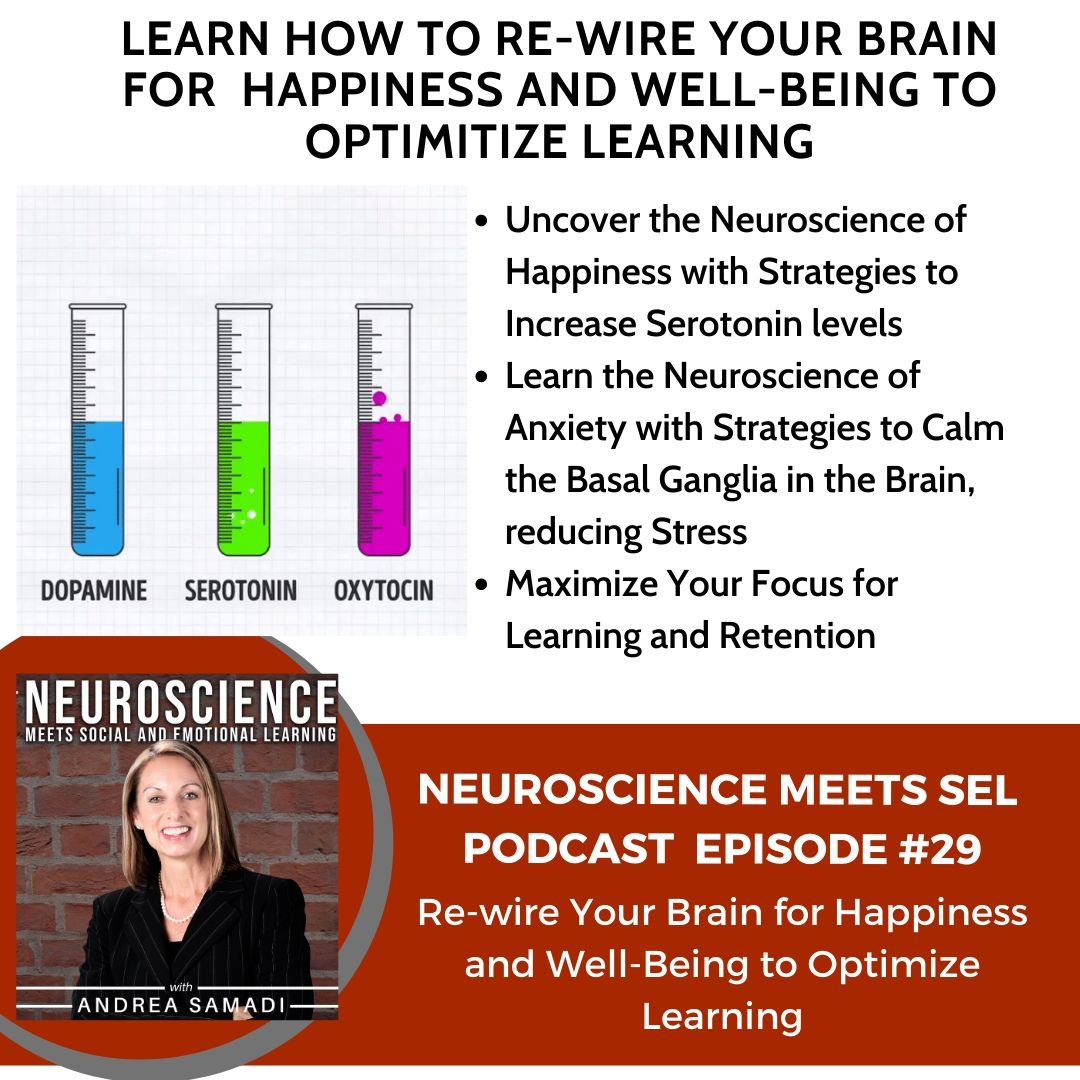
S1 Ep 29How to Re-Wire Your Brain for Happiness and Well-Being to Optimize Learning
Welcome to the “Neuroscience Meets SEL” podcast EPISODE #29, my name is Andrea Samadi, a former educator who has been fascinated with understanding the science behind high performance strategies in schools, sports and the workplace for the past 20 years. Let’s dive right into this topic on “How to Re-Wire Your Brain for Happiness and Well-Being to Optimize Learning.” You can watch this episode on YouTube for the visual effects for more impact and learning. I’m sure most of us are aware that stress is the number one cause behind anxiety, depression, low energy, work burn-out, and cardiovascular disease[i], but do you know how stress impacts our brain? Did you know that: Chronic stress and depression causes measurable brain shrinkage?[ii] “51% of us will have a mental health issue (post-traumatic stress, obsessive-compulsive, personality, anxiety, addiction, or an eating disorder to name a few) at some point in their life”[iii] and that 1/5 students struggle with depression, while ¼ struggle with anxiety which means we have reached epidemic levels with today’s youth. And these shocking statistics impacts society with: Work burn-out Anxiety and Depression Cardiovascular Disease Neurological Disorders and eventually leading to Death Also Impacting our Students: A recent study[iv] shows that if the educator is stressed, the student will also be stressed Stress is impacting our ability to learn Student behavior was also impacted, contributing to more stress for educators Dr. Daniel Amen, a psychiatrist and brain disorder specialist of the Amen Clinics[v] and the father of Chloe Amen from podcast #25 with “Strategies to Change Your Brain to Change Your Grades”[vi] explains that “if you struggle with attention, focus, sadness, anxiety, worry, flexibility, stubbornness, or impulsivity, welcome to the club—this is normal.”[vii] These days it is more normal to have a problem, than not have a problem. Most of us will have a mental health issue in our lifetime—and when it happens, we think that we are the only one and that no one else understands. Dr. Amen has a book coming out in March 3, 2020 called “The End of Mental Illness: How Neuroscience is Transforming Psychiatry and Helping Prevent or Reverse Mood and Anxiety Disorders, ADHD, Addictions, PTSD, Psychosis, Personality Disorders and More.”[viii] If left untreated, these brain disorders can have “serious personal, interpersonal, occupational and social consequences.”[ix] In this podcast episode, we are going to look at the neuroscience of happiness, anxiety, stress, learning and retention with some ideas and strategies to naturally improve each area, so that we can get a handle on life’s largest challenges with an understanding of our brain chemistry. Our goal is to intentionally set ourselves up for success with this new level of awareness. We will cover: A reminder of the recipe for peak performance (fun, fear, focus) from episode #27. What’s the neuroscience of happiness—and how to boost our serotonin levels to generate more happiness. What’s the neuroscience of anxiety (our body’s natural response to stress that can become a mental disorder when someone regularly feels unusually high levels of anxiety) and stress (which is our body’s response to a challenge or demand) with strategies to calm our limbic, emotional brain. What’s the neuroscience of learning and how can we be sure that our brain is primed to learn? All of the answers to these questions can be found within the chemistry of our brain and with how active or hard certain parts of the brain are working. The best course I have taken to understand how my own brain is working is Dr. Amen’s Thrive by 25 Online Course[x] where he outlines some of the most common problems he sees within the brain with natural solutions to overcome each challenge. The most interesting fact I found was that diet and exercise were solutions to the most common brain problems he spoke about, (anxiety/depression/emotional issues) so i
S1 Ep 28Clinical Professor of Psychiatry at the UCLA School of Medicine, Dr. Daniel Siegel on "Mindsight: The Basis for Social and Emotional Intelligence"
Welcome to the “Neuroscience Meets SEL” podcast, my name is Andrea Samadi, a former educator who has been fascinated with understanding the science behind high performance strategies in schools, sports and the workplace for the past 20 years. This episode is available on YouTube and we highly recommend watching the visuals that go along with this interview for a more immersive experience. This is episode #28 with Dr. Dan Siegel, a clinical professor of psychiatry at the UCLA School of Medicine and executive director of the Mindsight Institute where you can find his courses, workshops, books and tools to help anyone understand and apply what can sometimes be complicated scientific concepts and make them easy to understand and applicable to our daily lives. He has dozen books the last time I counted with his most recent parenting book with Dr. Tina Payne called The Power of Showing Up: How Parental Presence Shapes Who our Kids Become and How Their Brains Get Wired[i] coming out Jan. 7th, 2020. Be sure to pre-order your copy as it has already hit the top 20 books in cognitive neuroscience, child development and neuropsychology. Also, he is working on the 3rd edition of his book The Developing Mind. Welcome Dan! Dr. Siegel, I can personally say that I’m a more mindful[ii] parent, more aware[iii] of myself and others, have learned some no-drama discipline[iv] strategies, feel prepared for when my 2 girls reach their teenage years[v], with the reassurance that I don’t have to be perfect, and that I can repair relationships when my buttons have been pushed—all from reading your books the past few years. It’s such an honor to have you here—your influence is significant with the thousands of people around the globe you’ve been helping with your books, mnemonics to remember your strategies, and tools like your Wheel of Awareness Meditation. Thank you for being so accessible so we can take a deeper dive into some of the important concepts of your work. Q1: Dr. Siegel, before I get into the questions I have for you, I wanted to ask what led you to write all of these books and create tools to help our next generation become more aware and connected to each other? Q2: I know we can’t train the next generation of students for the old world; we must do things differently. On our podcast we have been speaking to leaders about the emergence of social and emotional learning skills in our schools and emotional intelligence training programs in the workplace (with people like Casel’s Clark McKown on measuring SEL to Marc Brackett and the importance of Emotional Intelligence and recognizing and naming our feelings. I know you have been working with the Blue School[vi] in New York City. What skills do you think have been missing in our schools and how do we bring these missing skills back for our next generation of students so that we can prepare them for success in the workplace? (3Rs and what else is missing?) Q3: When I was in my late 20s I started to study the mind with a motivational speaker and learned some strategies that really helped me as an adult related to thinking positively, having a good attitude, awareness, you know those skills we used to call “soft skills” but 20 years ago, there just wasn’t the research behind SEL and mindfulness. Then I heard you mention that when you began surveying mental health professionals around the world who should know about the mind that “95% of them had never even been given a lecture on the mind, and probably couldn’t even tell you what the definition of the mind was”[vii] ) so you wondered how can we expect to develop it, without this understanding and explore the concept of the mind in your book, Mindsight: The New Science of Personal Transformation[viii] where you prove that you can define what a healthy mind is, not just describe it. In your book Mindsight, you say that “Mindsight is the potent skill that is the basis for both emotional and social intelligence.” What is Mindsight? W

S1 Ep 27Neuroleadership Pioneer, Friederike Fabritius on "Achieving Peak Performance"
This is episode #27 with a Pioneer in the field of Neuroleadership and author of the book, The Leading Brain, Friederike Fabritius,[i] all the way from Dusseldorf, Germany. You can watch the interview on YouTube here. Welcome to the “Neuroscience Meets SEL” podcast, my name is Andrea Samadi, a former educator who has been fascinated with understanding the science behind high performance strategies in schools, sports and the workplace for the past 20 years. Today we have an inspiring speaker who I’ve been following for the past 3 years. FRIEDERIKE FABRITIUS, MS, is a neuroscientist and pioneer in the field of neuroleadership. She trained at the Max Planck Institute for Brain Research and is an alumna of McKinsey & Company (helping organizations to create change). Friederike delivers brain-based leadership programs to Fortune 500 executives and organizations around the globe to transform how they think, innovate, and navigate change. Her book The Leading Brain: Neuroscience Hacks to Work Smarter, Better, Happier has been translated into several languages and has received numerous awards. Her most recent presentation this year was at Talks at Google[ii] where she describes the recipe for achieving peak performance. Welcome Friederike! I am beyond excited to be speaking with you today. A warm welcome today as you join us here in Arizona, USA all the way from Germany! I wanted to let the listeners know that I recorded an episode yesterday[iii] “Simple Strategies for Avoiding the Pitfalls of the 3 Parts of the Brain” so that today we could dive a bit deeper with our time together. If you are listening now and have not heard that episode, be sure to go back and listen to episode #26 as an overview for today. Q1: I first found you on YouTube when I was searching for a way to understand how our neurotransmitters work in peak performance. I found this video where you explained neuroleadership[iv] just beautifully to top executives in Barcelona, Spain and how we can create peak performance[v] or that flow state we all seek for those high levels of achievement. Can you explain what we need to do to get into peak performance/flow state whether we are an employee looking for improved results in the workplace, an athlete in the field, or a student in the classroom? Q2: What does flow look and feel like? What can we do to stay in this flow state longer to experience that increased productivity you mention in your book where productivity increases by fivefold?[vi] What is guaranteed to throw us out of flow—so that we don’t do that? Q3: On our podcast here “The Neuroscience of SEL” we have spoken a lot about self-awareness and understanding our self so we can make the changes needed for improved results. Can you explain why some people need to be challenged in order to perform at their very best, while others need to have less challenge and less stress to do their best work, and what do these people look like in an organization so people listening can recognize what type of person they are on that performance/stress scale? Q4: We know that the PFC is important for executive functions (like logical thinking, decision-making, or planning) and it’s the part of our brain that determines our level of success in life and with our careers. What strategies do you personally do to strengthen this part of your brain to operate at its best for these high levels of performance? Q5: What do you think are the next most important parts of the brain for anyone to understand specifically for those who are looking to take new actions or create new habits to achieve higher levels of performance? Q6: What about mindfulness and meditation? In your book, you mention that “mindfulness has been shown to physically change several regions of the brain in as little as 8 weeks.” Can you explain what parts of the brain mindfulness improves and how this could help people improve their results in life and at work Q7: In your book, you mention 2 examples of
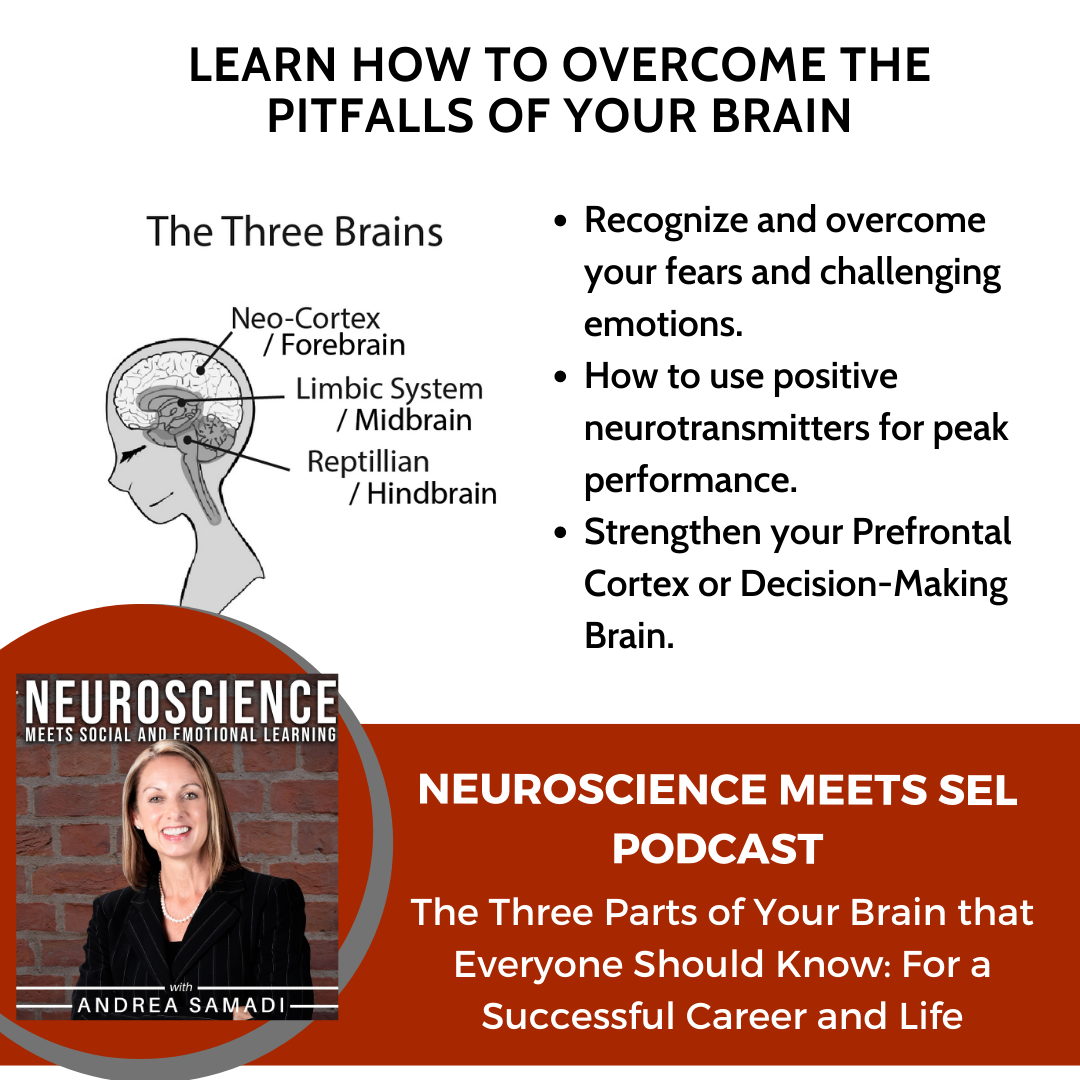
S1 Ep 26Simple Strategies for Overcoming the Pitfalls of the 3 Parts of Your Brain
This episode focuses on understanding the three main parts of your brain and I had to write this lesson and record this prior to the next podcast tomorrow with Dr. Friederike Fabritius as many of my questions to her will rely on the understanding of these three parts of the brain so I thought it was important to record this first. Let’s take a closer look at the human brain, so that the insights Dr. Fabritus will share tomorrow, will have more of an impact. The human brain is the most complex organ in the body. Parts of the brain communicate with each other and enable us to enjoy food, communicate, and feel emotions; the brain shapes our entire world and all of our experiences. Understanding how to harness the power that exists within your own body is the key to unlocking the code that controls your results and future. What this future looks like is up to you. Once you have an understanding of how your brain works, and you have some strategies to overcome the pitfalls associated with the three main parts of your brain, you can set yourself up for a razor’s edge advantage over someone else who might not be paying attention to the largest and most complex organ in the human body. To be honest, I was not paying attention to this part of the body until just a few years ago. No one had ever asked me what I was doing for my brain health—not until I started researching in the area of neuroscience did I know these strategies existed. So, don’t worry if this is new to you. We all start at this place. There are three parts of the brain that I think everyone should understand, whether you are five years old, or 55 years old, we can all understand the basics of how our brain operates for improved results. Understanding the Reptilian Brain: The Ancient Instinctual Brain also known as The Hindbrain The brain stem (imagine this part at the top of your spine on the back of your neck) is the oldest part of the brain and is often referred to as the reptilian brain.[i] This is where vital body functions such as heartbeat, respiration, body temperature, and digestion are all monitored and controlled. The brain stem also holds the reticular activating system (RAS), which is responsible for the brain’s alertness—regardless of whether we’re asleep or awake. This part of the brain functions to keep us alive and safe and works closely with the entire body as well as the limbic system to create our emotional state of mind. The brain stem does not work alone. It is linked to the limbic system above it (in the middle of the brain) to assist, for example, in creating both our fighting states when we feel anger and our fleeing states when we feel fear.[ii] This Ancient Instinctual Brain Controls Our- Sensory motor functions (how our body runs) Survival instinct of fight, flight, freeze, faint[iii] When we understand that we can't help the fact that when we feel fear with something, consciously or unconsciously, our Reptilian Brain reacts on its own with the urge to fight, flight, or freeze. FIGHT- is when we react instead of responding to a situation (those times when we let our emotions take control) FLIGHT- is when we run away FREEZE- is when we stay frozen and don't even try To overcome the pitfalls of the Reptilian Brain, we just need to learn strategies for overcoming our fears that are natural, and instinctual, coming from the part of our brain that was designed to keep us alive. Those who are longtime meditators speak of the ability to take the time to respond to a situation rather than reacting but if you are looking for a quick fix, try these simple strategies.[iv] S-STOP whatever you are doing T-TAKE deep belly breaths to bring more oxygen to your brain O-OBSERVE and think “how am I feeling right now in the moment?” Can you name the emotion? When you can name the emotion, science has proven that soothing neurotransmitters are released to calm you down.[v] P- PROCEED with whatever you are doing with a new awareness. Our next gu
S1 Ep 25Mindfulness and Meditation Expert, Mick Neustadt on "How Meditation and Mindfulness Changes Your Life."
Welcome back to the "Neuroscience Meets SEL" Podcast episode #25 this is Andrea Samadi. This interview will also be available on YouTube. Today we have Mick Neustadt, a retreat teacher at Inward Bound Mindfulness Education,[i] a company that holds in depth mindfulness programs for teens, young adults and parents. Their programs that teach the skills we have been talking about on this podcast like self-awareness, compassion, ethical decision-making, hold retreats across the US, Canada and United Kingdom. Mick is a long-time mindfulness and meditation practitioner and clinical social worker. As a result of 20 years of personal practice Mick has experienced the profound benefits of mindfulness. He realizes that we have a great capacity to connect deeply with our full selves and others. Through dedicated practice we can transform the way that we relate to ourselves, those closest to us, and the world. With his rich background as a therapist, former schoolteacher and coach, Mick brings a wide range of skills and dedication to helping young people on their journey of self-exploration. Since 2011 he has formally taught mindfulness to teens in schools, on retreats and weekly groups. Welcome Mick, thank you for taking the time out of your day to share more about mindfulness, meditation and the philopophy of iBme. Q1: Can you define what “mindfulness” is since this term is used so often these days. Everyone seems to have an idea or thought about what mindfulness programs are. Q2: Can you explain why mindfulness is so important for young people (and adults) to develop especially these days where anxiety and depression are at an all-time high? Q3: How does your retreat work compared to someone using an app like Calm or a guided meditation? Can you explain a bit about your process? (I can see a calendar on your website.)[ii] Can you explain how your retreats work? Q4: Can you explain what the research[iii] says about mindfulness programs? What are the long-term effects of the retreat practice of meditation and mindfulness? 3 months after the retreat, what did the participants notice? And also, would someone receive similar benefits if they just started their own mindfulness practice at home? Q5: I have heard Jon Kabat Zinn who I know has worked with your organization mention that “the real meditation is with how we live our lives.”[iv] –meaning how we change from being stressed, rushed, to being calmer and more present. What parting thoughts would you like to leave us with about how to get started with a meditation program in our daily lives (perhaps from a parent point of view, student, or someone in the workplace) so anyone can learn how to go from knowing to doing, and reap of the benefits of a mindfulness program. Thank you so much Mick for sharing your extensive knowledge in this field. If anyone wants to learn more about you and the programs at iBMe, they can go to ibme.com. What’s the best way for them to reach you? [i] www.ibme.com [ii] https://ibme.com/wp-content/uploads/2016/09/iBme_Sample-Daily-Schedule.pdf [iii] https://ibme.com/wp-content/uploads/2016/09/Galla-Research-on-I mpacts-of-iBme-Research.pdf [iv] Jon Kabat Zinn “From Doing to Being” YouTube published Feb. 16, 2016. https://www.youtube.com/watch?v=q-2QoTYujNg
S1 Ep 24Former Superintendent, Dr. Jeff Rose, of Fulton Co Schools (GA) on Leadership, Innovation and the Future
Welcome back to the “Neuroscience Meets SEL Podcast” episode #24 this is Andrea Samadi. This interview will also be available on YouTube. Our very special guest today, Dr. Jeff Rose, is the founder of Leading Ed Solutions[i], a community of school superintendents and leaders providing solutions, strategy and support so that no one has to lead alone. His successful podcast, Leading Education[ii] focuses on innovative conversations surrounding the most important topics that our modern schools face that are relevant to anyone who wants to lead in education and beyond. The topics he tackles are applicable to any leadership position, providing the most up to date ideas and strategies around these enormous concepts that require new ways of thinking for improvement and change. Jeff has a proven track record of innovation and an unrelenting focus on student achievement. He’s the former Superintendent of Fulton County Schools (which is Atlanta, Georgia’s 4th largest school district) responsible for the leadership, administration and management of over 96,000 students, 105 schools, 14,000 employees and a $1.1 billion general fund budget. During his 23 years in education, he has served as a classroom teacher, principal and a director of school improvement. Welcome Jeff. Thank you so much for coming on the podcast today to share what you are doing to support educational leadership. Jeff, I love your work and your podcast inspired me to get moving on mine over the summer. I want to dive into some questions to hear your perspective on a few of the topics that I thought were the most relevant in our schools and communities today. Q1: I’ve heard you describe education as “the perfect mess” because when you are working, you will have challenges, and everyone has an opinion about these challenges. I’ve also heard this as it relates to business. When you are taking action, things will go wrong and it can all feel like a mess. When you are doing nothing, you won’t have problems to solve, but also won’t have any impact for change. What led you to launch your company, Leading Ed solutions and tackle some of the most challenging problems education has seen in the past few decades to impact change and when did you first think about starting this idea? Q2: There are so many important concepts that you speak about—I love hearing your point of view— but one concept stuck out to me from the earlier episodes when you spoke about how lonely leadership is, when you first felt being lonely at the top and how you got used to this feeling. Unless someone is walking in the shoes of a school superintendent, administrator, or District leader, (or even equate this to those who lead in the corporate world) I know it could be easy to make up what others think your job entails and say things like “Oh, it must be nice….with their xyz assumption.” Hearing your perspective on what leadership is like for those who are given this responsibility is important for anyone who must learn to lead themselves. (We all have heard that to be a good leader is to be a good follower).[iii] Was this why you launched your podcast to give more insight to bridge this gap that exists between school leadership, schools and the community and shed some light with what this leadership role really entails? Q3: You mention that one of the biggest concerns you hear from parents and the community is the rise in student anxiety these days (episode 4)[iv] and I’m seeing it here in my local community in Chandler, Arizona, USA where this time last year we hit 31child/teen suicides in 15 months.[v] This issue is a huge concern and goes on past the pressure to perform academically in the K-12 system to higher education. (I just heard another podcast by Jay Shetty where he interviewed Laurie Santos[vi] who created the most popular course at Yale to combat this issue when she saw how stressed her students were to perform academically at the beginning of their University career.) Your inter
S1 Ep 23Understanding the Difference Between Your Mind and Brain
If I were to ask you what are the qualities that you most want for your children, students, employees, or even for yourself so that you can reach those optimal levels of health, well-being and happiness, (no matter what part of the world you are listening from), the answer would probably sound something like this. “I want to them to develop a healthy mind, to pursue excellence, to have the skills needed to excel independently, to have compassion and empathy for others, to acquire the skills needed in this ever-changing world, or to adopt the mindset of lifelong learning that’s needed to thrive not just survive in this world” –something along those lines that focuses on developing the minds of our next generation with social and emotional skills. In order to bridge this gap between knowing and actually implementing these skills, we must first of all have a clear understanding of what they are. If social and emotional skills are skills that we could say are of the developed mind, and we are moving into cognitive skills of the brain, it leads us to question what is the difference between the mind and the brain before we continue further? Once we have a clear definition of each of these, it’s much easier to continue to develop and implement these strategies needed for improved results. Have you ever thought about what your mind is? What about your brain? And how are they different? Dr. Dan Siegel, a clinical professor of psychiatry at the UCLA School of Medicine and the founding co-director of the Mindful Awareness Research Center at UCLA, (who I’m so excited to share will be coming on the podcast later next month) has spent a considerable amount of time defining the mind.[i] He was shocked when he first started to study the mind and began surveying mental health professionals around the world who should know about the mind that “95% of them had never even been given a lecture on the mind, and probably couldn’t even tell you what the definition of the mind was”[ii] so he wondered how can we expect to develop it, without this understanding? He explores the concept of the mind in his book, Mindsight: The New Science of Personal Transformation[iii] where he proves that you can define what a healthy mind is, not just describe it. His book allows that Mindsight “is the potent skill that is the basis for both emotional and social intelligence.”[iv] He explains that psychology means the study of the mind and behavior and elaborates that “when a parent senses the inner mental life of their child, (their mind) their child does really well in life. This ability to see the mind actually changes the structure of their brain. It’s called neural integration.”[v] Siegel further explains that when we can adopt this practice of “seeing the inner-life” or the minds of our students, children, friends or family members, it makes a considerable difference in the results and well-being that they achieve. Even developing our own practice of being more mindfully present of our own inner mind can “change the ends of the chromosomes in your cells”[vi] proving that what you do with your mind, makes a difference for the health of your body and your relationships. Dan Siegel explains that a neuroscientist would define the mind “as the activity of the brain”[vii] but he could not settle on this definition as a therapist since this would mean our brain would control everything that we do. He came up with a definition in the mid-1990s that made the most sense to him and his colleagues and it was that the mind “is an embodied and relational process—since it’s in the body and it’s in our relationships with one another—that regulates the flow of energy and information.”[viii] This definition really got me thinking. I probably listened to it for a good week. It got me thinking about the flow of energy and information and how it comes into our body through our senses, and what we do with this information to cause the results in our life. One of my fi
S1 Ep 22Yale Center for Emotional Intelligence Founder, Marc Brackett, on his new book "Permission to Feel"
Watch this interview on YouTube here. Marc Brackett, Ph.D., [i]is the Founder and Director of the Yale Center for Emotional Intelligence [ii]and a Professor in the Child Study Center of Yale University. He is the lead developer of the RULER approach,[iii] (the 5 skills of emotional intelligence). RULER is an evidence-based approach to social and emotional learning that has been adopted by nearly 2,000 pre-K through high schools across the United States and in other countries and the approach is seeing huge success.[iv] He also serves on the Board of Directors for the Collaborative for Academic, Social, and Emotional Learning (known as CASEL)[v]. Marc’s new book, Permission to Feel (Celadon/Macmillan) inspires a new mindset around the power of emotions to transform our lives. Instead of the idea that our “emotions get in the way of our success, they are actually the key to it.”[vi] Using science, passion, and lively storytelling, this book serves as a guide for understanding our own and others’ emotions, as well as provides innovative strategies for developing emotional intelligence in adults and children so that emotions help, rather than hinder, our success and well-being. I haven’t been able to put his book down because it captivated me! Welcome Marc! Q1: I am thrilled, excited, motivated, and inspired to be speaking with you—all of those yellow (high energy and pleasant feelings) on your Mood Meter Chart—that tool you developed to help people become aware of their feelings—that’s in the first few pages of your book. I actually watched your Talk at Google[vii] and learned so much—before I had started to read “Permission to Feel” I thought I would introduce this concept of “how do you feel” to my girls (ages 10 and 8) and that it would be just like how we added Growth Mindset into our homework slot. But I had an eye-opening situation that showed me we are not as emotionally literate as I had thought in my household. Can I tell you the story of what happened to get your point of view on the situation? So, a couple of weekends ago we went to see the movie, Lion King, and my two girls were the only kids in the theatre bawling their eyes out when Musafa, the Dad, dies. I thought, let me see if I can give them “Permission to Feel” and implement Marc’s book —so I say, “Why are you crying?” expecting they would say “because the Dad died and I don’t want my Dad to die” and we would start a conversation about that but my oldest just grunted and pushed me away, and the youngest was crying too hard to say anything at all. I realized that we could be doing a better job with talking about emotions in our home. Marc, what happens when we deny the “Permission to Feel” and where would you suggest anyone begin when implementing your RULER approach, whether we are a parent, teacher or employee in the workplace? Q2: Now that I know this approach—and know that knowledge and application are poles apart, can you explain what are the biggest things we should avoid, and what should we watch for to be sure we are properly implementing the RULER approach? Q3: When I first opened your book “Permission to Feel” and saw the Mood Meter Chart I went straight to where I hang out most of the time. (Upbeat, cheerful, lively, focused, and joyful) that’s me—but to get here—takes daily work (meditation and exercise) that has taken some time to figure out what I must do to be my best self. Then I thought about some other people in my world working in high stress careers who hang out in stressed, anxious, frustrated, and worried with different work responsibilities and priorities. What are some strategies you suggest helping people who might be hanging out in the red quadrant who are pressed for time to create this work/life balance? Q4: Can you give a quick background for why this book is so important and timely with such a rise in mental health issues these days? We all know the shocking statistics for our nation’s youth with the current suicide
S1 Ep 21Filmmaker Spencer Taylor on his Educational Documentary "The Death of Recess"
You can watch the interview on YouTube here. Today we have someone I have been watching, cheering on, supporting and giving him all the love I can possibly imagine because when I first heard about his goal to create an educational documentary to impact change on our struggling schools, I knew he would be the one to accomplish this. Spencer Taylor is a filmmaker, the co-founder of Vybesource (a movement of conscious thinkers dedicated to mind, body and soul) and he has spent the past 3 years traveling the world from the US, Canada, Finland, and China, to interview leaders in education for his upcoming documentary “The Death of Recess.” Welcome Spencer from the road…on your way to LV! It’s great to have you here to share what you have been up to the past 3 years. Q1: Can you give some background on your vision for this film that you have been working so hard on, and why you saw the need to get this information into the world? Also, how will this documentary be different than what we are used to watching on Netflix? Q2: What are some of the challenges you have learned about from this interview process and how will someone watching your film be able to make changes? Q3: What are some of the main differences you saw going from the US to Canada and into schools in Finland—where their educational system is labeled as the best in the world with school hours cut in half, little homework, no standardized tests, 50 minute recess and free lunch[i]. What changes do you think we need to focus on here? Q4: What other issues does the film covers and what do you hope to accomplish with the release of this film? Q5: Who was the most impactful interview you did and why? Thank you so much Spencer for taking the time to share the vision of this documentary. This is important work and I know you are beyond busy. I appreciate your time, and all you are doing. What is the best way to support the release of the film moving forward? Contact [email protected] if you are a school with an innovative story that you would like to share. Thanks Spencer! [i] https://news.stanford.edu/news/2012/january/finnish-schools-reform-012012.html
S1 Ep 20Coaching a Growth Mindset: Strategies for Overcoming Obstacles and Cognitive Biases
Welcome back to the “Neuroscience Meets SEL Podcast” EPISODE 20 this is Andrea Samadi. I want to thank everyone who has been tuning into these episodes. In just a few short months of launching, we have reached 20 countries and the feedback has been incredible. Not only am I hearing that the topics are relevant and applicable, but the need is very clear to continue to interview new leaders in this field of social and emotional learning/emotional intelligence and neuroscience and continue to offer ideas and strategies that can be implemented immediately. If you do have feedback or want to reach me directly, you can find me (Andrea Samadi) on LinkedIn or Twitter or send me an email to [email protected] Our initial goal with this podcast was to close the gap recent surveys show exists in our workforce where 58 percent of employers say college graduates aren’t adequately prepared for today’s workforce, and those employers noted a particular gap in social and emotional skills. Research shows that social-emotional skills like social awareness, self-regulation, and growth mindset (the skills that we have been covering in the past episodes) are crucial to college and career readiness. The outcomes of developing these intelligences are vast as they impact our performance, leadership, personal excellence, time management, and decision-making. As we have progressed, these episodes are bringing together leaders and practitioners in the field who have programs, products, books, and ideas to share, with an urgent need to get this message out to impact our schools, communities, and workplaces. As Clark McKown, the President of xSEL Labs, SEL Assessment mentioned in our podcast interview EPISODE 10, “it’s important that we bring people to have conversations (around SEL/emotional intelligence) to propel us forward—bringing the different strands of the SEL movement together—and having them coordinate is going to be (the) key. There’s potential for a whole that’s greater than the sum of its parts.”[i] I hope that you agree with me how important this work is, and if you are finding these episodes helpful, please do share them on your social media so that others can gain access. So far, we’ve covered five of the six social and emotional learning competencies to dive deep into and tie in how an understanding of our brain can facilitate these strategies. The sixth social and emotional competency, Mindset, fits in to the Social and Emotional Track with the ability to understand your own emotions (when you feel like something might be difficult and you become frustrated and ready to give up) as well as the Cognitive Track, using the executive functions of our brain—with the needed ability to persevere, problem solve, and come up with a different strategy. With each competency, we investigate the best practices that you can use to develop and improve your own SEL/Emotional Intelligence and well-being practice, before extending these strategies to your districts, schools, classrooms, workplaces and communities. We must first of all practice the concept ourselves, before we teach others because if we haven’t developed a practice ourselves, our students will pick up on the lack of authenticity and won’t take the concept seriously either. The interviews are designed so that you can hear directly from experts in the field who are using these skills on a daily basis. We want the ideas you take away with you to be actionable whether you are an educator working in a school, an employee or manager in a corporation, or someone just looking to take their skills to the next level. Be sure to look for the resources in the show notes section if you would like to dive deeper into this topic. Moving onto the topic of “Mindset” it’s important to notice that ten years after Carol Dweck’s essential finding that for “children who have a “growth mindset” their intelligence can be developed (and students) are better able to overcome academic stumbling
S1 Ep 19Bob Jerus, Author, Psychologist, University Professor and Founder of the EIQ-2 Emotional Intelligence Training Program on "World Suicide Prevention Day"
Welcome back to the “Neuroscience Meets SEL Podcast” EPISODE 19 this is Andrea Samadi. This interview will be broadcast on YouTube as well as on the regular podcast channel, so be sure to look for the YouTube link in the show notes if you would like to view the video. Today we have Bob Jerus, author of “Mind Matters: Applying Emotional Intelligence for Personal and Professional Success”[i] among five other books on the topic of communication, leadership and sales. His focus is on making performance, teamwork and organizational development happier and more result driven. He’s a certified human resource professional with over 30 years of experience in staffing, development, engagement and organizational development. He founded Success Dynamics International and developed the EIQ-2 Learning Systems. As a university professor and administrator, he developed, taught, administered, delivered and assessed both curriculum and courses at graduate and undergraduate levels for traditional, adult education and on-line programs. He’s taught marketing, management, HR, adult development and psychology with a focus on measurable, sustainable results. Bob has been a trusted advisor for the work we do with Achieveit360, and someone I reach out to often for advice with his in-depth knowledge in a wealth of different areas. Welcome Bob! It’s great to speak to you face to face for a change. Q1: It’s interesting and timely that we are speaking on World Suicide Prevention Day since the one of the last times I reached out to you for advice was to get some help in this area with some challenges I was seeing in our local schools. Can you provide some background on where you started your career and perhaps any words of advice on suicide prevention, since this is your area of expertise? Q2: We see a movement these days to implement social and emotional learning/emotional intelligence programs in our schools and workplaces. Why do you think programs like this are so important right now? Q3: Your book “Mind Matters: Applying Emotional Intelligence for Personal and Professional Success” explains every facet imaginable for success using Emotional Intelligence for Personal and Professional Success. I love how it’s written in a how-to style, connecting the brain and the most recent neuroscience research, with many graphics and visuals to guide the reader towards implementing the wisdom in each chapter. Can you explain why you wrote “Mind Matters” and what is your favorite/most important concept this book teaches? Q4: Self-regulation (managing one’s emotions) is always the most requested topic I am asked about when working with schools. Obviously, this is a skill that must be trained, but in your experience, why is it so difficult to perceive, understand and manage our emotions so that we can find that balance of self-leadership that’s so important in the workplace? Q5: What is your current vision now for your work with Success Dynamics and bringing Emotional Intelligence into the workplace? Q6: Is there anything that I might have missed? Any final words of wisdom that you would like to leave with us to help us to stay focused on applying emotional intelligence for more success in our life? [i] Mind Matters: Applying Emotional Intelligence for Personal and Professional Success” https://www.amazon.com/Mind-Matters-Emotional-Intelligence-Professional/dp/1502441918 RESOURCES: Robert Jerus Article from LinkeIn “Suicide: The Final Answer?” https://www.linkedin.com/pulse/suicide-final-answer-robert-jerus-sphr-always-on-your-mind-2e/?trackingId=RjS3pyL0TOeDZnHnxFtEOQ%3D%3D Emotional Intelligence Training with Bob Jerus http://www.eiq-2.com/
S1 Ep 18Psychologist, Educator and Author Kenneth Kohutek Ph.D. on his new book "Chloe and Josh Learn Grit"
Welcome back to the “Neuroscience Meets SEL Podcast” EPISODE 18 this is Andrea Samadi. This interview will be broadcast on YouTube as well as on the regular podcast channel, so be sure to look for the YouTube link in the show notes if you would like to view the video. Today we have someone I have been friends with for almost 10 years. I’ll never forget seeing the review he left for my first book[i] on Amazon and when I saw his interest in what I was doing, I reached out to him to learn more about how he was using books like mine in schools, to see how I could improve. Dr. Kohutek has spent his adult life working in the fields of psychology, neuropsychology and education. Through the experience of working with a myriad of students in settings ranging from Charter, Title I, Parochial schools, residential treatment centers, and psychiatric hospitals. He’s able to provide examples of situations which many elementary and middle school students experience in today’s educational system. I’ve been interested in his books[ii] over the years, and this is our second interview. We spoke many years ago about enhancing children’s cognitive abilities, years before educational neuroscience was so prevalent in our schools. I was thrilled and honored when he asked me to write the Foreword to his most recent book, “Chloe and Josh Learn Grit and Resilience with Grit Gal” volume 1, available this week at Barnes and Noble[iii] and Amazon[iv] Welcome Dr. Kohutek, who is on campus today at St. Dominic Savio Catholic High School in Austin, Texas. Q1: I love this book, especially with it being the first Foreword I have ever written, thank you for this opportunity! Can you tell me what inspired you to write a book on Grit, Mindset and Resilience? Q2: For years I envisioned tools and books like this in our classrooms and am excited to see the results it will produce. What made you intertwine the social and emotional competencies with the cognitive capabilities—which is exactly what I am doing here on the podcast? Q3: I love how the book covers these skills connected to stories because our brain looks for and stores memories based on emotions and stories are one way to elicit that emotion. Was there a particular student who made you think of Grit Gal providing the insight to overcome each of the seven stories? Q4: Why do you think the discussion questions with each chapter are so important? How can you see each chapter helping a student whether they are working with their teacher in the classroom, or at home, with their family? Q5: Why do you think this book is so timely? Why do most people never develop Grit? Q6: What is your vision for this book? I see that you are already working on Volume 2. What topics are coming up next? Q7: What are your final words of wisdom for us on this topic? Anything that we might have missed that you think is important to share? Q8: Where is the best place for someone to find your book? How can they reach you with any questions? Thank you very much for taking the time out to speak with me today and share this new book. I’m excited to hear about the results it creates for students and teachers as well to follow this series. Best of luck and thanks for all you are doing for students and schools. I know it’s not easy to write a book with a busy schedule of working in at [i] https://www.amazon.com/Secret-Teens-Revealed-Teenagers-Leadership/dp/1604940336 [ii] https://www.amazon.com/Childrens-Cognitive-Enhancement-Program-Combined/dp/0989116441/ref=sr_1_5?keywords=kohutek&qid=1568050887&s=digital-text&sr=1-5-catcorr [iii] https://www.barnesandnoble.com/w/chloe-and-josh-learn-grit-and-resilience-with-grit-gal-kenneth-j-kohutek-ph-d/1133283703?ean=9781982231224 Barnes and Noble [iv] https://www.amazon.com/Chloe-Josh-Learn-Grit-Resilience-ebook/dp/B07XMJBDPQ/ref=sr_1_1?keywords=chloe+and+josh+learn+grit&qid=1568050783&s=gateway&sr=8-1 Amazon
S1 Ep 17Harvard Researcher Jenny Woo on "The Latest Research, Brain Facts and Myths, Growth Mindset, Memory and Cognitive Biases"
Welcome back to the “Neuroscience Meets SEL Podcast” EPISODE 17 this is Andrea Samadi. This interview will be broadcast on YouTube as well as on the regular podcast channel, so be sure to look for the YouTube link in the show notes if you would like to view the video. Today we move into our Cognitive Track with Jenny Woo the founder of award-winning Emotional Intelligence games, 52 Conversations and 52 Essential Relationships and Harvard Graduate School of Education researcher of social and emotional learning. With her game, "52 Essential Conversations,[i]" Jenny has created a tool for parents, counselors, and teachers to support children's social-emotional development that comes with her own podcast channel “52 Conversations to inspire children for life”[ii] where she has in depth episodes on topics that match the lessons in her cards. I have both sets of cards here and have been using them with our family the past few weeks and have been having a blast with them. The game is designed for ages 5 to adult, covering six categories (That align to Casel’s competencies[iii] that we have been covering here on this channel) (self-awareness; relationship skills; self-management; social awareness; responsible decision-making; and diversity, equity, and inclusion) and ask questions such as What is fairness? or What is luck? They can be used in a multitude of ways — as conversation prompts during dinner or daily errands, or in place of playing cards in a game of Go Fish. I used the cards to help stimulate discussion with my own children (ages 7 and 9) on the topic of friendship when my youngest was struggling with this at school. We all gave examples of what being a good friend means, and the examples I am sure will extend outside of our family discussion into her daily life. We all had a blast with the cards and look forward to learning more as we implement them. Her game allows parents and children to learn about one another while developing life skills and preparing them for the world. These cards are used in over 40 countries, all 50 States, in schools and in the workplace, so you can see why I jumped at the chance to speak with Jenny Woo. Welcome Jenny! Thanks so much for taking the time to be here today. As we move into our cognitive track on the podcast, I was looking for experts to interview and was so excited when we connected on Linkedin. Q1: Can you give us some background to how you went from the Corporate world in management consulting to Harvard’s Graduate School of Education and how this switch helped you to find your true calling and create such a timely product to help develop social and emotional skills for children, as well as life skills for adults? Q2: “We’ve seen tremendous advances over the decades in the learning sciences but there are still so many myths out there. Can you help clear up some of the most common myths? For those of you interested, please visit Jenny’s website (in the show notes) for a quiz to see your knowledge of these brain myths.[iv] We only use 10% of our brain. If a child cannot sit in a classroom by 3rd grade, then he/she has an undiagnosed learning disability? The brains of boys/girls develop at different rates? Academic achievement can be negatively affected by skipping breakfast? Some children are born naturally creative. Children learn best when information is presented in their preferred learning style? Some people are left brain/right brain, and this explains how we learn best? Listening to classical music increases children’s cognitive reasoning ability? A common sign of dyslexia is seeing letters backwards. Teens circadian rhythms cause them to sleep/wake up later? Q3: From your research, can you give some strategies that you’ve incorporated into your game to help students/adults with their mindset, knowing that there are days we are all thrown off course? Q4: I recently posted something on Instagram on Cognitive Biases. It was a graphic where I quoted “Did you know t
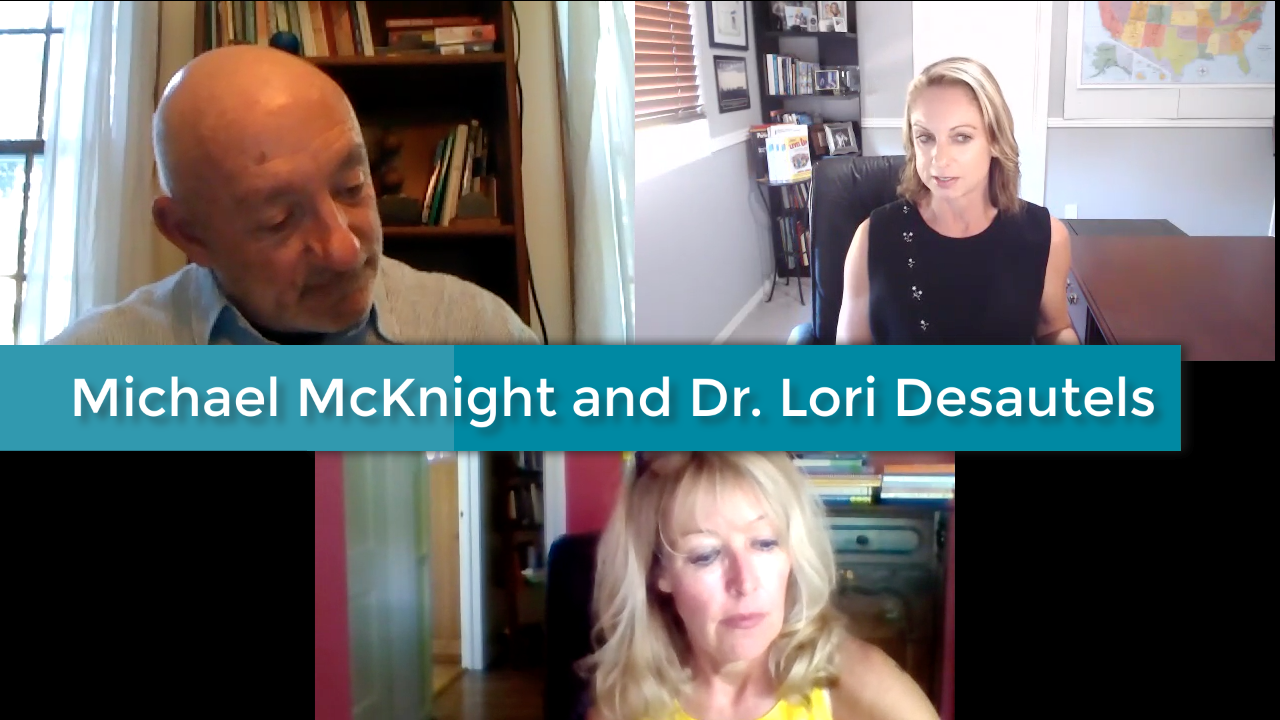
S1 Ep 16Pioneers Lori Desautels and Michael McKnight on "The Future of Educational Neuroscience" in our Schools and Communities
Welcome back to the “Neuroscience Meets SEL Podcast” this is Andrea Samadi. This interview will be broadcast on YouTube as well as on the regular podcast channel, so be sure to look for the YouTube link in the show notes if you would like to view the video. Background and Introduction: Today we have two pioneers in the field of educational neuroscience; Lori Desautels and Michael McKnight. I first found Lori from her TEDx Talk from Indianapolis[i] when I was searching for anything in the field on educational neuroscience back in 2014. It was 5 years ago that I partnered with Arizona’s Dept of Education and was urged from an Arizona educator to write another book that focused on the brain science behind learning, and back then there wasn’t as much information out there as there is now in this field. I found Judy Willis[ii], and learned about the amygdala highjack, read David Souza’s “How the Brain Learns” and John Medina’s “Brain Rules” and hired a neuroscience researcher (named Mark Robert Waldman[iii] ) so I could be sure I had the correct understanding of the brain and learning, but still needed some help to tie everything together. Finally, I found Lori, and watched her videos to understand the other parts of the brain and how they are interconnected. In Lori’s Ted Talk, she mentioned that “neuroscience and education have come together” and it’s a huge connection because every day experiences change the brain structurally and functionally—and I thought, this is incredible that we can finally explain how we can accelerate learning with this understanding of the brain. And then through Lori, had a chance to see Michael’s work and dive deeper into understanding Adverse Childhood Experiences. So, thank you for all you are both for pioneering this field, and helping so many around the world to understand what at first might seem like complex concepts, (if like most of us, we’ve not had a crash course in how our brain works) so this is groundbreaking by making this all so relatable for everyone. I’m thrilled to finally “meet” you both, face to face, after many years of emails, social media replies. Please do follow Lori and Michael’s pages as they both share often about the impact; they are igniting in our schools today. I will add their bios in the show notes, so you can learn more, but want to get straight into some questions. Welcome Lori and Michael! Q1: For new people who are getting to know your work, can you give some background on how you both met and began working together, leading to you writing your two books “Unwritten, The Story of a Living System”[iv] and your most recent book that I haven’t been able to put down “Eyes are Never Quiet: Listening Beneath the Behaviors of our Most Troubled Students”[v] and if you could explain the new movement of being trauma informed? Q2: I can ask this next question two ways, the first focuses on the problem when I ask “what could we possibly do to make an impact on our schools and students today knowing we are in a crisis with drug use, bullying, suicide and suicide ideation, and anxiety” or I could ask it from this point of view where we change the narrative and focus on the solution by asking “how does shifting away from the traditional disciplinary approach to acknowledge the impact of stress on behavior and our students’ ability to focus and learn” shift the results you are both seeing in our schools today? Q3: Can you explain what educators, and parents should understand about the brain and how our emotions impact learning? Q4: I know firsthand about stress in the classroom—my first teaching assignment was a behavioral class back in the late 1990s. Like many teachers, I burned out before I even got started and if you were to ask ANY of my friends back then, I was the least likely to quit. Chapter 1 of your book “Eyes are Never Quiet” was eye-opening and even brought tears to my eyes with the advice that Michael gave an educator (who Lori shared was her d
S1 Ep 15Donte Dre Winrow on "Breaking into a Challenging Career Path"
Welcome back this is Andrea Samadi, thanks so much for your continued support with this podcast. As we are completing our 15th episode, I’m getting a lot of feedback via social media messages and would love to hear more about what you think about these competencies/episodes...and how they might be of use to you whether you are working with students in the classroom, teams in the boardroom, or you are just looking to take your results to that next level. I can clearly see that the last lesson on “Self-Regulation” that the strategies offered were valuable—it does help me when I receive your feedback on what lessons you like and how they are helpful. This was the most requested competency when I was working with the school market, as everyone wants our students to learn how to self-regulate. It’s also a crucial skill for adults to learn. This podcast is not only for you, but I’m learning with each interview and episode. When we started, the end of June, it was to provide tools and resources for you—however, in this process, I am getting the best education—which is a testament to the fact that we learn more when we teach others. Today we have another student who we’ve brought back after 5 years of studying this material, to see how these skills really do transfer from high school into your career for future success. There’s nothing more exciting to me than watching those who can take their results to these higher levels—we all have the ability to do it and then experience the freedom of the life we know we created and had as a vision for—usually one that seemed so far off from reality, but with time, effort, and following that daily grind—one day we wake up and realize we are living the life we had imagined. Then we are amazed, as we look back, connecting the dots, that it wasn’t rocket science, but just following a few simple principles through to completion. So few people follow the principles, or do things in this certain way—to get to these levels, which is why I’m hoping these episodes will offer tips, ideas and strategies to help more people implement these concepts into their daily life. Today’s guest is someone who has been a friend of mine since we published the Teen Performance Magazine back in 2009. His name is Donte Dre Winrow and he learned the power of networking when he was in high school helping him to break into a career path that he’d never had the opportunity for without knowing certain people. Let’s hear how Donte broke through to reach these higher levels of achievement. Click the link to view the video of this interview on YouTube. I’m excited for the cognitive track coming up...as we are nearing the end of the social and emotional competencies. Stay tuned for the last SEL competency and moving into the next track of learning. Thanks for listening. Right now, we are reaching 16 countries, all just from organic sharing on social media, no paid advertising. please do send me a message with your thoughts on these episodes, what you like, what you’d like to see....so I can improve moving forward. You can find me on LinkedIn, Twitter, Facebook or Instagram.
S1 Ep 14Self-Regulation: The Foundational Learning Skill for Future Success
Welcome back to the “Neuroscience Meets SEL Podcast” this is Andrea Samadi. Our goal with this podcast is to close the gap recent surveys show exists in our workforce where 58 percent of employers say college graduates aren’t adequately prepared for today’s workforce, and those employers noted a particular gap in social and emotional skills. Research shows that social-emotional skills like social awareness, self-regulation, and growth mindset are crucial to college and career readiness. The outcomes of developing these intelligences are vast as they impact our performance, leadership, personal excellence, time management, and decision-making. We’ve chosen six social and emotional learning competencies to dive deep into and tie in how an understanding of our brain can facilitate these strategies. With each competency, we’ll investigate the best practices that you can use to develop and improve your own SEL/Emotional Intelligence and well-being practice, before extending these strategies to your districts, schools, classrooms, workplaces and communities. We want the ideas you take away with you to be actionable whether you are an educator working in a school, an employee or manager in a corporation, or someone just looking to take their skills to the next level. Be sure to look for the resources in the show notes section if you would like to dive deeper into this topic. Our next competency is self-regulation.What is Self-Regulation and Why is it So Important? Self-regulation is “the ability to manage your emotions and behavior in accordance with the demands of the situation. It includes being able to resist highly emotional reactions to upsetting stimuli, to calm yourself down when you get upset, adjust to a change in expectations and (the ability) to handle frustration”[i] In other words, it’s the ability to bounce back after a setback or disappointment, and the ability to stay in congruence with your inner value system. The ability to control one's behavior, emotions, and thoughts is an integral skill to be taught to young children as well, so they can form and maintain healthy relationships and connections later in life.[ii] As an adult, self-regulation is important in day to day life as we must learn how to handle and bounce back from life’s challenges and disappointments in our personal and professional lives. This skill is crucial to develop as we all know that life is full of ups and downs and we must be able to navigate through challenging situations before we can reach any level of achievement and success. We all know people who seem to bounce back after adversity. It’s not by luck or chance, it’s because they have learned how to self-regulate and intentionally get themselves back on course. This is a learned skill and one that we must teach or model to our students/children for them to be able to master it as adults. Scott Bezsylko, the executive director of the Winston Prep school explains that they approach self-regulation skills “in the same way (they) approach other skills, academic or social: (they) isolate that skill and provide practice. When you think of it as a skill to be taught — rather than, say, just bad behavior — it changes the tone and content of the feedback you give kids.” [iii] Just like we would create a drill for improving dribbling for a basketball player, or practicing vocabulary words for a spelling test, we can create practice for self-regulation. Self-Regulation Tips for Children The key to teaching these skills to children is to model them, coaching younger children, until they can produce the results on their own.[iv] MODEL SELF-TALK: This works well with younger students as they learn how to identify their emotions. Teachers can model self-regulation in class by naming the emotions they are experiencing since we learn by watching others. Help students to recognize the emotions they have (for example-today I am feeling frustrated because I am stuck on my math problem) and of