
Latent Space: The AI Engineer Podcast
231 episodes — Page 3 of 5
[AIEWF Preview] Gemini in 2025 and Realtime Voice AI
As part of our AI Engineer World’s Fair preview, we’re releasing a special cross podcast recorded with Sam Charrington of TWiML AI at last week’s Google I/O!TUESDAY: Shrestha and Kwindla’s workshop: https://www.ai.engineer/schedule#milliseconds-to-magic-real-time-workflows-using-the-gemini-live-api-and-pipecatTUESDAY: Kwindla’s workshop: https://www.ai.engineer/schedule#building-voice-agents-with-gemini-and-pipecatWEDNESDAY: Shrestha and Kwindla’s talk: https://www.ai.engineer/schedule#milliseconds-to-magic-real-time-workflows-using-the-gemini-live-api-and-pipecatWEDNESDAY: Kwindla’s keynote: https://www.ai.engineer/schedule#-voice-keynote-your-realtime-ai-is-ngmiTHURSDAY: Logan’s keynote: https://www.ai.engineer/schedule#a-year-of-gemini-progress-what-comes-nextCatch all the speakers at AIE (both workshops and talks):Logan Kilpatrick: https://www.latent.space/p/chatgpt-gpt4-hype-and-building-llmShrestha Basu Mallick: https://www.linkedin.com/in/shresthabm/Kwindla Hultman Kramer: https://www.linkedin.com/in/kwkramerFull Video Episode This is a public episode. If you'd like to discuss this with other subscribers or get access to bonus episodes, visit www.latent.space/subscribe
[AIEWF Preview] CloudChef: Your Robot Chef - Michellin-Star food at $12/hr (w/ Kitchen tour!)
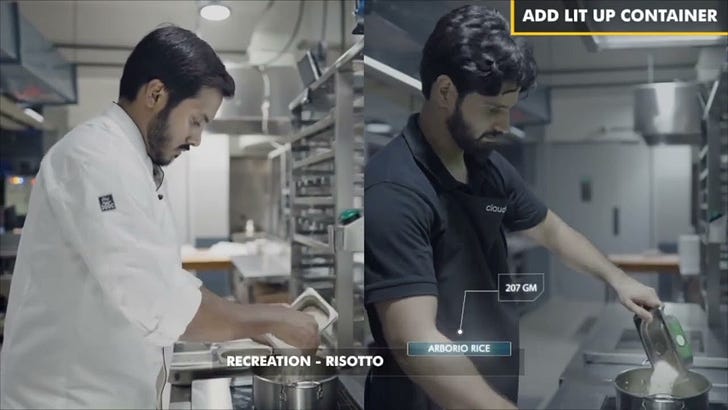
One of the new tracks at next week’s AI Engineer conference in SF is a new focus on LLMs + Robotics, ft. household names like Waymo and Physical Intelligence. However there are many other companies applying LLMs and VLMs in the real world!CloudChef, the first industrial-scale kitchen robotics company with one-shot demonstration learning and an incredibly simple business model, will be serving tasty treats all day with Zippy (https://www.cloudchef.co/zippy ) their AI Chef platform.This is a lightning pod with CEO Nikhil Abraham to preview what Zippy is capable of!https://www.cloudchef.co/platformSee a real chef comparison:See it in the AI Engineer Expo at SF next week: https://ai.engineerFull Video EpisodeTimestamps00:00 Welcome and Introductions00:58 What is Cloud Chef?01:36 How the Robots Work: Culinary Intelligence05:57 Commercial Applications and Early Success07:02 The Software-First Approach10:09 Business Model and Pricing13:10 Demonstration Learning: Training the Robots16:03 Call to Action and Engineering Opportunities18:45 Final Thoughts and Technical Details This is a public episode. If you'd like to discuss this with other subscribers or get access to bonus episodes, visit www.latent.space/subscribe
The AI Coding Factory
We are joined by Eno Reyes and Matan Grinberg, the co-founders of Factory.ai. They are building droids for autonomous software engineering, handling everything from code generation to incident response for production outages. After raising a $15M Series A from Sequoia, they just released their product in GA!https://factory.ai/https://x.com/latentspacepodFull Video EpisodeTimestamps00:00 Introductions 00:35 Meeting at Langchain Hackathon 04:02 Building Factory despite early model limitations 06:56 What is Factory AI? 08:55 Delegation vs Collaboration in AI Development Tools 10:06 Naming Origins of 'Factory' and 'Droids' 12:17 Defining Droids: Agent vs Workflow 14:34 Live Demo17:37 Enterprise Context and Tool Integration in Droids 20:26 Prompting, Clarification, and Agent Communication 22:28 Project Understanding and Proactive Context Gathering 24:10 Why SWE-Bench Is Dead 28:47 Model Fine-tuning and Generalization Challenges 31:07 Why Factory is Browser-Based, Not IDE-Based 33:51 Test-Driven Development and Agent Verification 36:17 Retrieval vs Large Context Windows for Cost Efficiency 38:02 Enterprise Metrics: Code Churn and ROI 40:48 Executing Large Refactors and Migrations with Droids 45:25 Model Speed, Parallelism, and Delegation Bottlenecks 50:11 Observability Challenges and Semantic Telemetry 53:44 Hiring55:19 Factory's design and branding approach 58:34 Closing Thoughts and Future of AI-Native Development This is a public episode. If you'd like to discuss this with other subscribers or get access to bonus episodes, visit www.latent.space/subscribe
[AIEWF Preview] Multi-Turn RL for Multi-Hour Agents — with Will Brown, Prime Intellect
In an otherwise heavy week packed with Microsoft Build, Google I/O, and OpenAI io, the worst kept secret in biglab land was the launch of Claude 4, particularly the triumphant return of Opus, which many had been clamoring for. We will leave the specific Claude 4 recap to AINews, however we think that both Gemini’s progress on Deep Think this week and Claude 4 represent the next frontier of progress on inference time compute/reasoning (at last until GPT5 ships this summer).Will Brown’s talk at AIE NYC and open source work on verifiers have made him one of the most prominent voices able to publicly discuss (aka without the vaguepoasting LoRA they put on you when you join a biglab) the current state of the art in reasoning models and where current SOTA research directions lead. We discussed his latest paper on Reinforcing Multi-Turn Reasoning in LLM Agents via Turn-Level Credit Assignment and he has previewed his AIEWF talk on Agentic RL for those with the temerity to power thru bad meetup audio.Full Video EpisodeTimestamps00:00 Introduction to the Podcast and Guests01:00 Discussion on Claude 4 and AI Models03:07 Extended Thinking and Tool Use in AI06:47 Technical Highlights and Model Trustworthiness10:31 Thinking Budgets and Their Implications13:38 Controversy Surrounding Opus and AI Ethics18:49 Reflections on AI Tools and Their Limitations21:58 The Chaos of Predictive Systems22:56 Marketing and Safety in AI Models24:30 Evaluating AI Companies and Their Strategies25:53 The Role of Academia in AI Evaluations27:43 Teaching Taste in Research28:41 Making Educated Bets in AI Research30:12 Recent Developments in Multi-Turn Tool Use32:50 Incentivizing Tool Use in AI Models34:45 The Future of Reward Models in AI39:10 Exploring Flexible Reward Systems This is a public episode. If you'd like to discuss this with other subscribers or get access to bonus episodes, visit www.latent.space/subscribe
⚡️The Rise and Fall of the Vector DB Category
Note from your hosts: we were off this week for ICLR and RSA! This week we’re bringing you one of the top episodes from our lightning podcast series, the shorter format, Youtube-only side podcast we do for breaking news and faster turnaround. Please support our work on YouTube! https://www.youtube.com/playlist?list=PLWEAb1SXhjlc5qgVK4NgehdCzMYCwZtiBThe explosion of embedding-based applications created a new challenge: efficiently storing, indexing, and searching these high-dimensional vectors at scale. This gap gave rise to the vector database category, with companies like Pinecone leading the charge in 2022-2023 by defining specialized infrastructure for vector operations.The category saw explosive growth following ChatGPT’s launch in late 2022, as developers rushed to build AI applications using Retrieval-Augmented Generation (RAG). This surge was partly driven by a widespread misconception that embedding-based similarity search was the only viable method for retrieving context for LLMs!!!The resulting “vector database gold rush” saw massive investment and attention directed toward vector search infrastructure, even though traditional information retrieval techniques remained equally valuable for many RAG applications.Full Video EpisodeTimestamps00:00 Introduction to Trondheim and Background03:03 The Rise and Fall of Vector Databases06:08 Convergence of Search Technologies09:04 Embeddings and Their Importance12:03 Building Effective Search Systems15:00 RAG Applications and Recommendations17:55 The Role of Knowledge Graphs20:49 Future of Embedding Models and Innovations This is a public episode. If you'd like to discuss this with other subscribers or get access to bonus episodes, visit www.latent.space/subscribe
⚡️GPT 4.1: The New OpenAI Workhorse
We’ll keep this brief because we’re on a tight turnaround: GPT 4.1, previously known as the Quasar and Optimus models, is now live as the natural update for 4o/4o-mini (and the research preview of GPT 4.5). Though it is a general purpose model family, the headline features are:Coding abilities (o1-level SWEBench and SWELancer, but ok Aider)Instruction Following (with a very notable prompting guide)Long Context up to 1m tokens (with new MRCR and Graphwalk benchmarks)Vision (simply o1 level)Cheaper Pricing (cheaper than 4o, greatly improved prompt caching savings)We caught up with returning guest Michelle Pokrass and Josh McGrath to get more detail on each!Full Video EpisodeTimestampsPart 100:00:00 Introduction and Guest Welcome00:00:57 GPT 4.1 Launch Overview00:01:54 Developer Feedback and Model Names00:02:53 Model Naming and Starry Themes00:03:49 Confusion Over GPT 4.1 vs 4.500:04:47 Distillation and Model Improvements00:05:45 Omnimodel Architecture and Future Plans00:06:43 Core Capabilities of GPT 4.100:07:40 Training Techniques and Long Context00:08:37 Challenges in Long Context Reasoning00:09:34 Context Utilization in ModelsPart 200:10:31 Graph Walks and Model Evaluation00:11:31 Real Life Applications of Graph Tasks00:12:30 Multi-Hop Reasoning Benchmarks00:13:30 Agentic Workflows and Backtracking00:14:28 Graph Traversals for Agent Planning00:15:24 Context Usage in API and Memory Systems00:16:21 Model Performance in Long Context Tasks00:17:17 Instruction Following and Real World Data00:18:12 Challenges in Grading Instructions00:19:09 Instruction Following Techniques00:20:09 Prompting Techniques and Model Responses00:21:05 Agentic Workflows and Model PersistencePart 300:22:01 Balancing Persistence and User Control00:22:56 Evaluations on Model Edits and Persistence00:23:55 XML vs JSON in Prompting00:24:50 Instruction Placement in Context00:25:49 Optimizing for Prompt Caching00:26:49 Chain of Thought and Reasoning Models00:27:46 Choosing the Right Model for Your Task00:28:46 Coding Capabilities of GPT 4.100:29:41 Model Performance in Coding Tasks00:30:39 Understanding Coding Model Differences00:31:36 Using Smaller Models for Coding00:32:33 Future of Coding in OpenAIPart 400:33:28 Internal Use and Success Stories00:34:26 Vision and Multi-Modal Capabilities00:35:25 Screen vs Embodied Vision00:36:22 Vision Benchmarks and Model Improvements00:37:19 Model Deprecation and GPU Usage00:38:13 Fine-Tuning and Preference Steering00:39:12 Upcoming Reasoning Models00:40:10 Creative Writing and Model Humor00:41:07 Feedback and Developer Community00:42:03 Pricing and Blended Model Costs00:44:02 Conclusion and Wrap-Up This is a public episode. If you'd like to discuss this with other subscribers or get access to bonus episodes, visit www.latent.space/subscribe
SF Compute: Commoditizing Compute to solve the GPU Bubble forever
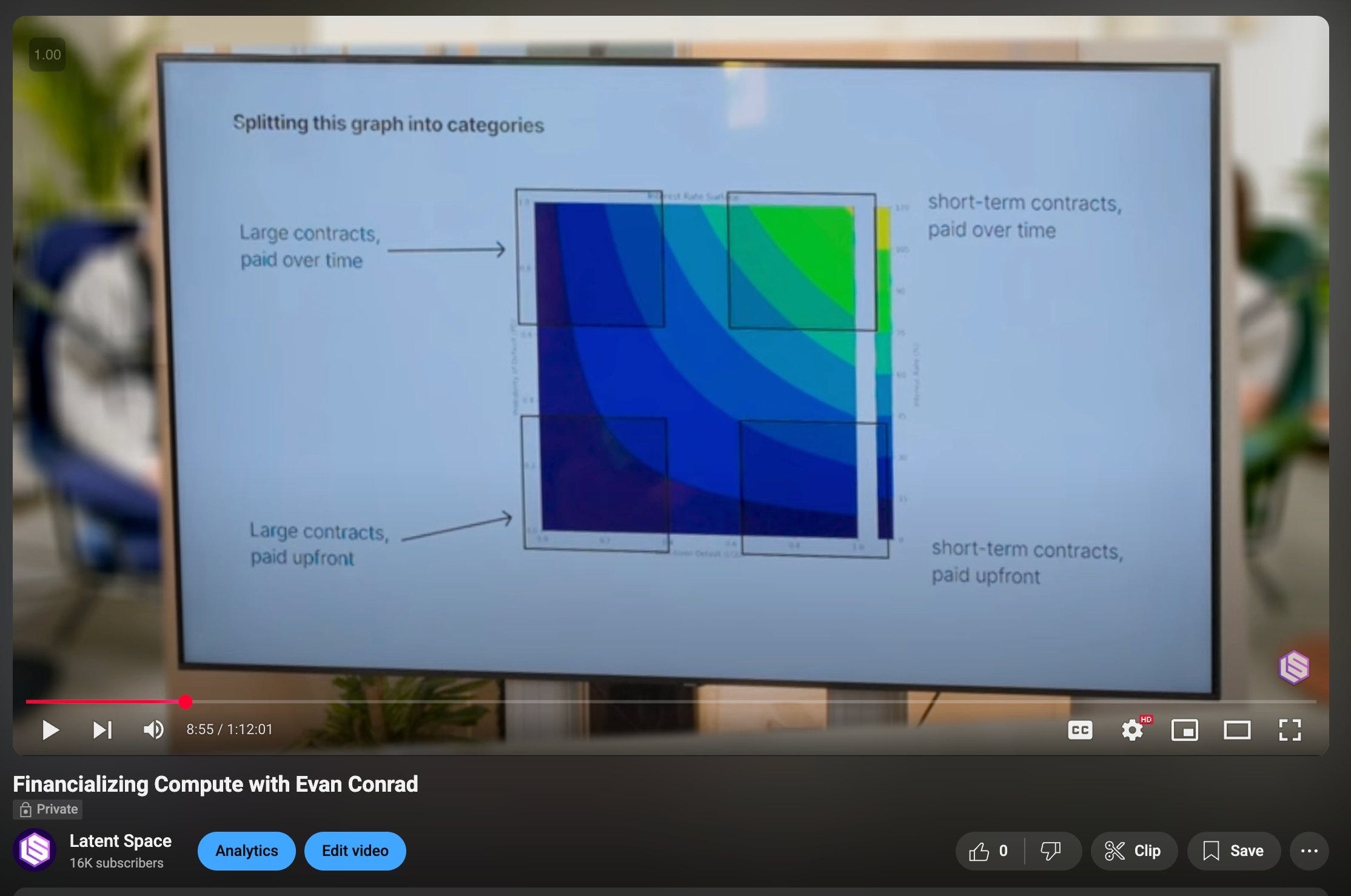
We are calling for the world’s best AI Engineer talks for AI Architects, /r/localLlama, Model Context Protocol (MCP), GraphRAG, AI in Action, Evals, Agent Reliability, Reasoning and RL, Retrieval/Search/RecSys , Security, Infrastructure, Generative Media, AI Design & Novel AI UX, AI Product Management, Autonomy, Robotics, and Embodied Agents, Computer-Using Agents (CUA), SWE Agents, Vibe Coding, Voice, Sales/Support Agents at AIEWF 2025! Fill out the 2025 State of AI Eng survey for $250 in Amazon cards and see you from Jun 3-5 in SF!Coreweave’s now-successful IPO has led to a lot of questions about the GPU Neocloud market, which Dylan Patel has written extensively about on SemiAnalysis. Understanding markets requires an interesting mix of technical and financial expertise, so this will be a different kind of episode than our usual LS domain.When we first published $2 H100s: How the GPU Rental Bubble Burst, we got 2 kinds of reactions on Hacker News:* “Ah, now the AI bubble is imploding!”* “Duh, this is how it works in every GPU cycle, are you new here?”We don’t think either reaction is quite right. Specifically, it is not normal for the prices of one of the world’s most important resources right now to swing from $1 to $8 per hour based on drastically inelastic demand AND supply curves - from 3 year lock-in contracts to stupendously competitive over-ordering dynamics for NVIDIA allocations — especially with increasing baseline compute needed for even the simplest academic ML research and for new AI startups getting off the ground.We’re fortunate today to have Evan Conrad, CEO of SFCompute, one of the most exciting GPU marketplace startups, talk us through his theory of the economics of GPU markets, and why he thinks CoreWeave and Modal are well positioned, but Digital Ocean and Together are not.However, more broadly, the entire point of SFC is creating liquidity between GPU owners and consumers and making it broadly tradable, even programmable:As we explore, these are the primitives that you can then use to create your own, high quality, custom GPU availability for your time and money budget, similar to how Amazon Spot Instances automated the selective buying of unused compute.The ultimate end state of where all this is going is GPU that trade like other perishable, staple commodities of the world - oil, soybeans, milk. Because the contracts and markets are so well established, the price swings also are not nearly as drastic, and people can also start hedging and managing the risk of one of the biggest costs of their business, just like we have risk-managed commodities risks of all other sorts for centuries. As a former derivatives trader, you can bet that swyx doubleclicked on that…Show Notes* SF Compute* Evan Conrad* Ethan Anderson* John Phamous* The Curve talk* CoreWeave* Andromeda ClusterFull Video PodLike and subscribe!Timestamps* [00:00:05] Introductions* [00:00:12] Introduction of guest Evan Conrad from SF Compute* [00:00:12] CoreWeave Business Model Discussion* [00:05:37] CoreWeave as a Real Estate Business* [00:08:59] Interest Rate Risk and GPU Market Strategy Framework* [00:16:33] Why Together and DigitalOcean will lose money on their clusters* [00:20:37] SF Compute's AI Lab Origins* [00:25:49] Utilization Rates and Benefits of SF Compute Market Model* [00:30:00] H100 GPU Glut, Supply Chain Issues, and Future Demand Forecast* [00:34:00] P2P GPU networks* [00:36:50] Customer stories* [00:38:23] VC-Provided GPU Clusters and Credit Risk Arbitrage* [00:41:58] Market Pricing Dynamics and Preemptible GPU Pricing Model* [00:48:00] Future Plans for Financialization?* [00:52:59] Cluster auditing and quality control* [00:58:00] Futures Contracts for GPUs* [01:01:20] Branding and Aesthetic Choices Behind SF Compute* [01:06:30] Lessons from Previous Startups* [01:09:07] Hiring at SF ComputeTranscriptAlessio [00:00:05]: Hey everyone, welcome to the Latent Space podcast. This is Alessio, partner and CTO at Decibel, and I'm joined by my co-host Swyx, founder of Smol AI.Swyx [00:00:12]: Hey, and today we're so excited to be finally in the studio with Evan Conrad from SF Compute. Welcome. I've been fortunate enough to be your friend before you were famous, and also we've hung out at various social things. So it's really cool to see that SF Compute is coming into its own thing, and it's a significant presence, at least in the San Francisco community, which of course, it's in the name, so you couldn't help but be. Evan: Indeed, indeed. I think we have a long way to go, but yeah, thanks. Swyx: Of course, yeah. One way I was thinking about kicking on this conversation is we will likely release this right after CoreWeave IPO. And I was watching, I was looking, doing some research on you. You did a talk at The Curve. I think I may have been viewer number 70. It was a great talk. More people should go see it, Evan Conrad at The Curve. But we have like three orders of magnitude more people. And I just wanted to, to highli
The Creators of Model Context Protocol
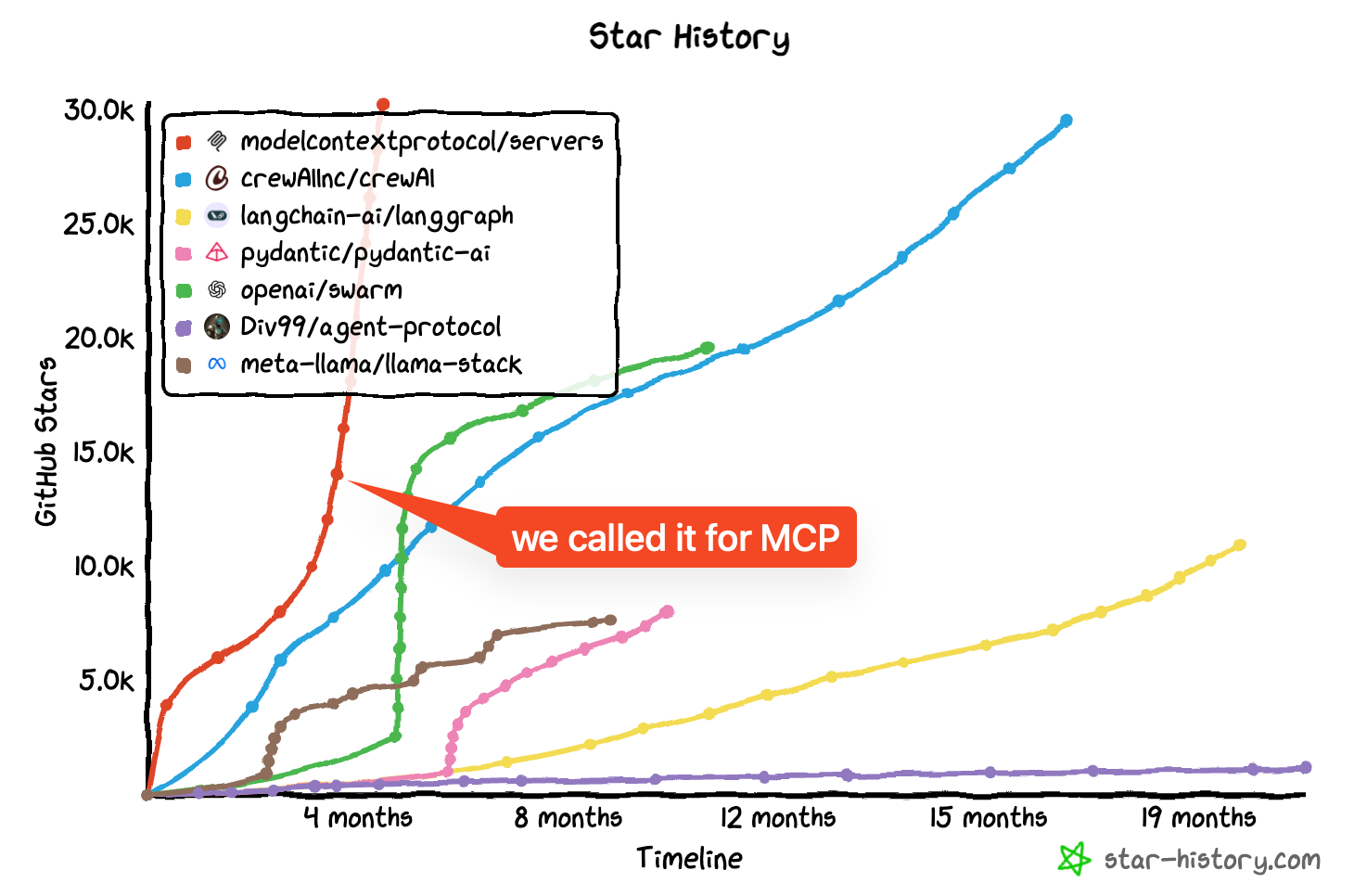
We are happy to announce that there will be a dedicated MCP track at the 2025 AI Engineer World's Fair, taking place Jun 3rd to 5th in San Francisco, where the MCP core team and major contributors and builders will be meeting. Join us and apply to speak or sponsor!When we first wrote Why MCP Won, we had no idea how quickly it was about to win.In the past 4 weeks, OpenAI and now Google have now announced the MCP support, effectively confirming our prediction that MCP was the presumptive winner of the agent standard wars. MCP has now overtaken OpenAPI, the incumbent option and most direct alternative, in GitHub stars (3 months ahead of conservative trendline):We have explored the state of MCP at AIE (now the first ever >100k views workshop):And since then, we’ve added a 7th reason why MCP won - this team acts very quickly on feedback, with the 2025-03-26 spec update adding support for stateless/resumable/streamable HTTP transports, and comprehensive authz capabilities based on OAuth 2.1.This bodes very well for the future of the community and project. For protocol and history nerds, we also asked David and Justin to tell the origin story of MCP, which we leave to the reader to enjoy (you can also skim the transcripts, or, the changelogs of a certain favored IDE). It’s incredible the impact that individual engineers solving their own problems can have on an entire industry.Full video episodeLike and subscribe on YouTube!Show Links* David* Justin* MCP* Why MCP WonTimestamps* 00:00 Introduction and Guest Welcome* 00:37 What is MCP?* 02:00 The Origin Story of MCP* 05:18 Development Challenges and Solutions* 08:06 Technical Details and Inspirations* 29:45 MCP vs Open API* 32:48 Building MCP Servers* 40:39 Exploring Model Independence in LLMs* 41:36 Building Richer Systems with MCP* 43:13 Understanding Agents in MCP* 45:45 Nesting and Tool Confusion in MCP* 49:11 Client Control and Tool Invocation* 52:08 Authorization and Trust in MCP Servers* 01:01:34 Future Roadmap and Stateless Servers* 01:10:07 Open Source Governance and Community Involvement* 01:18:12 Wishlist and Closing RemarksTranscriptAlessio [00:00:02]: Hey, everyone. Welcome back to Latent Space. This is Alessio, partner and CTO at Decibel, and I'm joined by my co-host Swyx, founder of Small AI.swyx [00:00:10]: Hey, morning. And today we have a remote recording, I guess, with David and Justin from Anthropic over in London. Welcome. Hey, good You guys have created a storm of hype because of MCP, and I'm really glad to have you on. Thanks for making the time. What is MCP? Let's start with a crisp what definition from the horse's mouth, and then we'll go into the origin story. But let's start off right off the bat. What is MCP?Justin/David [00:00:43]: Yeah, sure. So Model Context Protocol, or MCP for short, is basically something we've designed to help AI applications extend themselves or integrate with an ecosystem of plugins, basically. The terminology is a bit different. We use this client-server terminology, and we can talk about why that is and where that came from. But at the end of the day, it really is that. It's like extending and enhancing the functionality of AI application.swyx [00:01:05]: David, would you add anything?Justin/David [00:01:07]: Yeah, I think that's actually a good description. I think there's like a lot of different ways for how people are trying to explain it. But at the core, I think what Justin said is like extending AI applications is really what this is about. And I think the interesting bit here that I want to highlight, it's AI applications and not models themselves that this is focused on. That's a common misconception that we can talk about a bit later. But yeah. Another version that we've used and gotten to like is like MCP is kind of like the USB-C port of AI applications and that it's meant to be this universal connector to a whole ecosystem of things.swyx [00:01:44]: Yeah. Specifically, an interesting feature is, like you said, the client and server. And it's a sort of two-way, right? Like in the same way that said a USB-C is two-way, which could be super interesting. Yeah, let's go into a little bit of the origin story. There's many people who've tried to make statistics. There's many people who've tried to build open source. I think there's an overall, also, my sense is that Anthropic is going hard after developers in the way that other labs are not. And so I'm also curious if there was any external influence or was it just you two guys just in a room somewhere riffing?Justin/David [00:02:18]: It is actually mostly like us two guys in a room riffing. So this is not part of a big strategy. You know, if you roll back time a little bit and go into like July 2024. I was like, started. I started at Anthropic like three months earlier or two months earlier. And I was mostly working on internal developer tooling, which is what I've been doing for like years and years before. And as part of that, I think there was an effor
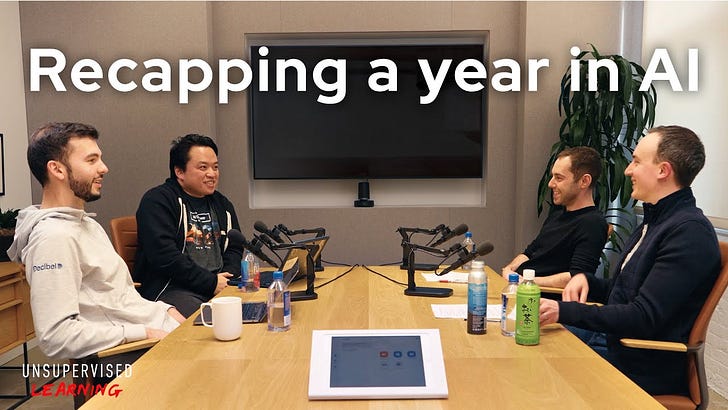
Unsupervised Learning x Latent Space Crossover Special
If you’re in SF: Join us for the Claude Plays Pokemon hackathon this Sunday!If you’re not: Fill out the 2025 State of AI Eng survey for $250 in Amazon cards!Unsupervised Learning is a podcast that interviews the sharpest minds in AI about what’s real today, what will be real in the future and what it means for businesses and the world - helping builders, researchers and founders deconstruct and understand the biggest breakthroughs. Top guests: Noam Shazeer, Bob McGrew, Noam Brown, Dylan Patel, Percy Liang, David LuanFull Episode on Their YouTubeTimestamps* 00:00 Introduction and Excitement for Collaboration* 00:27 Reflecting on Surprises in AI Over the Past Year* 01:44 Open Source Models and Their Adoption* 06:01 The Rise of GPT Wrappers* 06:55 AI Builders and Low-Code Platforms* 09:35 Overhyped and Underhyped AI Trends* 22:17 Product Market Fit in AI* 28:23 Google's Current Momentum* 28:33 Customer Support and AI* 29:54 AI's Impact on Cost and Growth* 31:05 Voice AI and Scheduling* 32:59 Emerging AI Applications* 34:12 Education and AI* 36:34 Defensibility in AI Applications* 40:10 Infrastructure and AI* 47:08 Challenges and Future of AI* 52:15 Quick Fire Round and Closing RemarksTranscript[00:00:00] Introduction and Podcast Overview[00:00:00] Jacob: well, thanks so much for doing this, guys. I feel like we've we've been excited to do a collab for a while. I[00:00:13] swyx: love crossovers. Yeah. Yeah. This, this is great. Like the ultimate meta about just podcasters talking to other podcasters. Yeah. It's a lot. Podcasts all the way up.[00:00:21] Jacob: I figured we'd have a pretty free ranging conversation today but brought a few conversation starters to, to, to kick us off.[00:00:27] Reflecting on AI Surprises and Trends[00:00:27] Jacob: And so I figured one interesting place to start is you know, obviously it feels that this world is changing like every few months. Wondering as you guys reflect path on the past year, like what surprised you the most?[00:00:36] Alessio: I think definitely recently models we kinda on the, on the right here. Like, oh, that, well, I, I I think there's, there's like the, what surprised us in a good way.[00:00:44] May maybe in a, in a bad way. I would say in a good way. Recently models and I think the release of them right after the new reps scaling instead talked by Ilia. I think there was maybe like a, a little. It's so over and then we're so back. I'm like such a short, short period. It was really [00:01:00] fortuitous[00:01:00] Jacob: timing though, like right.[00:01:01] As pre-training died, I mean, obviously I'm sure within the labs they knew pre-training was dying and had to find something. But you know, from the outside it was it, it felt like one right into the other.[00:01:09] Alessio: Yeah. Yeah, exactly. So that, that was a good surprise,[00:01:12] swyx: I would say, if you wanna make that comment about timing, I think it's suspiciously neat that like, because we know that Strawberry was being worked on for like two years-ish.[00:01:20] Like, and we know exactly when Nome joined OpenAI, and that was obviously a big strategic bet by OpenAI. So like, for it to transition, so transition so nicely when like, pre-training is kind of tapped out to, into like, oh, now inference time is, is the new scaling law is like conv very convenient. I, I, I like if there were an Illuminati, this would be what they planned.[00:01:41] Or if we're living in a simulation or something. Yeah.[00:01:44] Open Source Models and Their Impact[00:01:44] swyx: Then you said open source[00:01:45] Alessio: as well? Yeah. Well, no, I, I think like open source. Yeah. We're discussing this on the negative. I would say the relevance of open source. I would specifically open models. Yeah, I was surprised the lack, like the llamas of the world by the lack of adoption.[00:01:56] And I mean, people use it obviously, but I would say nobody's [00:02:00] really like a huge fanboy, you know, I think the local llama community and some of the more obvious use cases really like it. But when we talk to like enterprise folks, it's like, it's cool, you know? And I think people love to argue about licenses and all of that, but the reality is that it doesn't really change the adoption path of, of ai.[00:02:18] So[00:02:19] swyx: yeah, the specific stat that I got from on anchor from Braintrust mm-hmm. In one of the episodes that we did was I think he estimated that open source model usage in work in enterprises is that like 5% and going down.[00:02:31] Jacob: And it feels like you're basically all these enterprises are in like use case discovery mode, where it's like, let's just take what we think is the most powerful model and figure out if we can find anything that works.[00:02:39] And, you know, so much of, of, of it feels like discovery of that. And then, right, as you've discovered something, a new generation of models are out and so you have to go do discovery with those. And you know, I think obviously we're
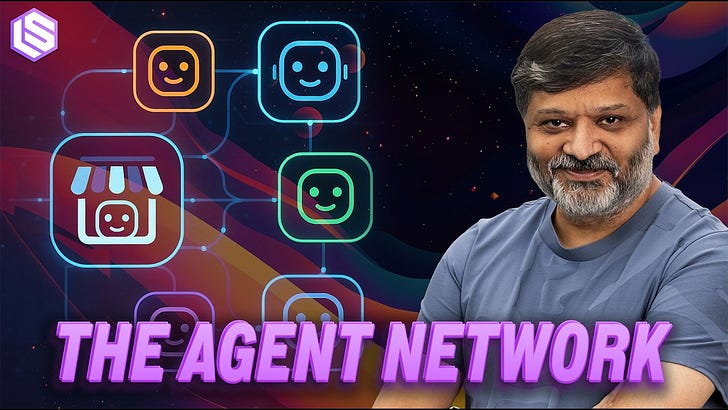
The Agent Network — Dharmesh Shah
If you’re in SF: Join us for the Claude Plays Pokemon hackathon this Sunday!If you’re not: Fill out the 2025 State of AI Eng survey for $250 in Amazon cards!For this episode: Thanks to Matija and Dan and Meng Shao for sharing on socials.We are SO excited to share our conversation with Dharmesh Shah, co-founder of HubSpot and creator of Agent.ai.A particularly compelling concept we discussed is the idea of "hybrid teams" - the next evolution in workplace organization where human workers collaborate with AI agents as team members. Just as we previously saw hybrid teams emerge in terms of full-time vs. contract workers, or in-office vs. remote workers, Dharmesh predicts that the next frontier will be teams composed of both human and AI members. This raises interesting questions about team dynamics, trust, and how to effectively delegate tasks between human and AI team members.The discussion of business models in AI reveals an important distinction between Work as a Service (WaaS) and Results as a Service (RaaS), something Dharmesh has written extensively about. While RaaS has gained popularity, particularly in customer support applications where outcomes are easily measurable, Dharmesh argues that this model may be over-indexed. Not all AI applications have clearly definable outcomes or consistent economic value per transaction, making WaaS more appropriate in many cases. This insight is particularly relevant for businesses considering how to monetize AI capabilities.The technical challenges of implementing effective agent systems are also explored, particularly around memory and authentication. Shah emphasizes the importance of cross-agent memory sharing and the need for more granular control over data access. He envisions a future where users can selectively share parts of their data with different agents, similar to how OAuth works but with much finer control. This points to significant opportunities in developing infrastructure for secure and efficient agent-to-agent communication and data sharing.Other highlights from our conversation* The Evolution of AI-Powered Agents – Exploring how AI agents have evolved from simple chatbots to sophisticated multi-agent systems, and the role of MCPs in enabling that.* Hybrid Digital Teams and the Future of Work – How AI agents are becoming teammates rather than just tools, and what this means for business operations and knowledge work.* Memory in AI Agents – The importance of persistent memory in AI systems and how shared memory across agents could enhance collaboration and efficiency.* Business Models for AI Agents – Exploring the shift from software as a service (SaaS) to work as a service (WaaS) and results as a service (RaaS), and what this means for monetization.* The Role of Standards Like MCP – Why MCP has been widely adopted and how it enables agent collaboration, tool use, and discovery.* The Future of AI Code Generation and Software Engineering – How AI-assisted coding is changing the role of software engineers and what skills will matter most in the future.* Domain Investing and Efficient Markets – Dharmesh’s approach to domain investing and how inefficiencies in digital asset markets create business opportunities.* The Philosophy of Saying No – Lessons from "Sorry, Must Pass" and how prioritization leads to greater productivity and focus.Full Video Episodeon youtube!Timestamps* 00:00 Introduction and Guest Welcome* 02:29 Dharmesh Shah's Journey into AI* 05:22 Defining AI Agents* 06:45 The Evolution and Future of AI Agents* 13:53 Graph Theory and Knowledge Representation* 20:02 Engineering Practices and Overengineering* 25:57 The Role of Junior Engineers in the AI Era* 28:20 Multi-Agent Systems and MCP Standards* 35:55 LinkedIn's Legal Battles and Data Scraping* 37:32 The Future of AI and Hybrid Teams* 39:19 Building Agent AI: A Professional Network for Agents* 40:43 Challenges and Innovations in Agent AI* 45:02 The Evolution of UI in AI Systems* 01:00:25 Business Models: Work as a Service vs. Results as a Service* 01:09:17 The Future Value of Engineers* 01:09:51 Exploring the Role of Agents* 01:10:28 The Importance of Memory in AI* 01:11:02 Challenges and Opportunities in AI Memory* 01:12:41 Selective Memory and Privacy Concerns* 01:13:27 The Evolution of AI Tools and Platforms* 01:18:23 Domain Names and AI Projects* 01:32:08 Balancing Work and Personal Life* 01:35:52 Final Thoughts and ReflectionsTranscriptAlessio [00:00:04]: Hey everyone, welcome back to the Latent Space podcast. This is Alessio, partner and CTO at Decibel Partners, and I'm joined by my co-host Swyx, founder of Small AI.swyx [00:00:12]: Hello, and today we're super excited to have Dharmesh Shah to join us. I guess your relevant title here is founder of Agent AI.Dharmesh [00:00:20]: Yeah, that's true for this. Yeah, creator of Agent.ai and co-founder of HubSpot.swyx [00:00:25]: Co-founder of HubSpot, which I followed for many years, I think 18 years now, gonna be 19 soon. And you caught,
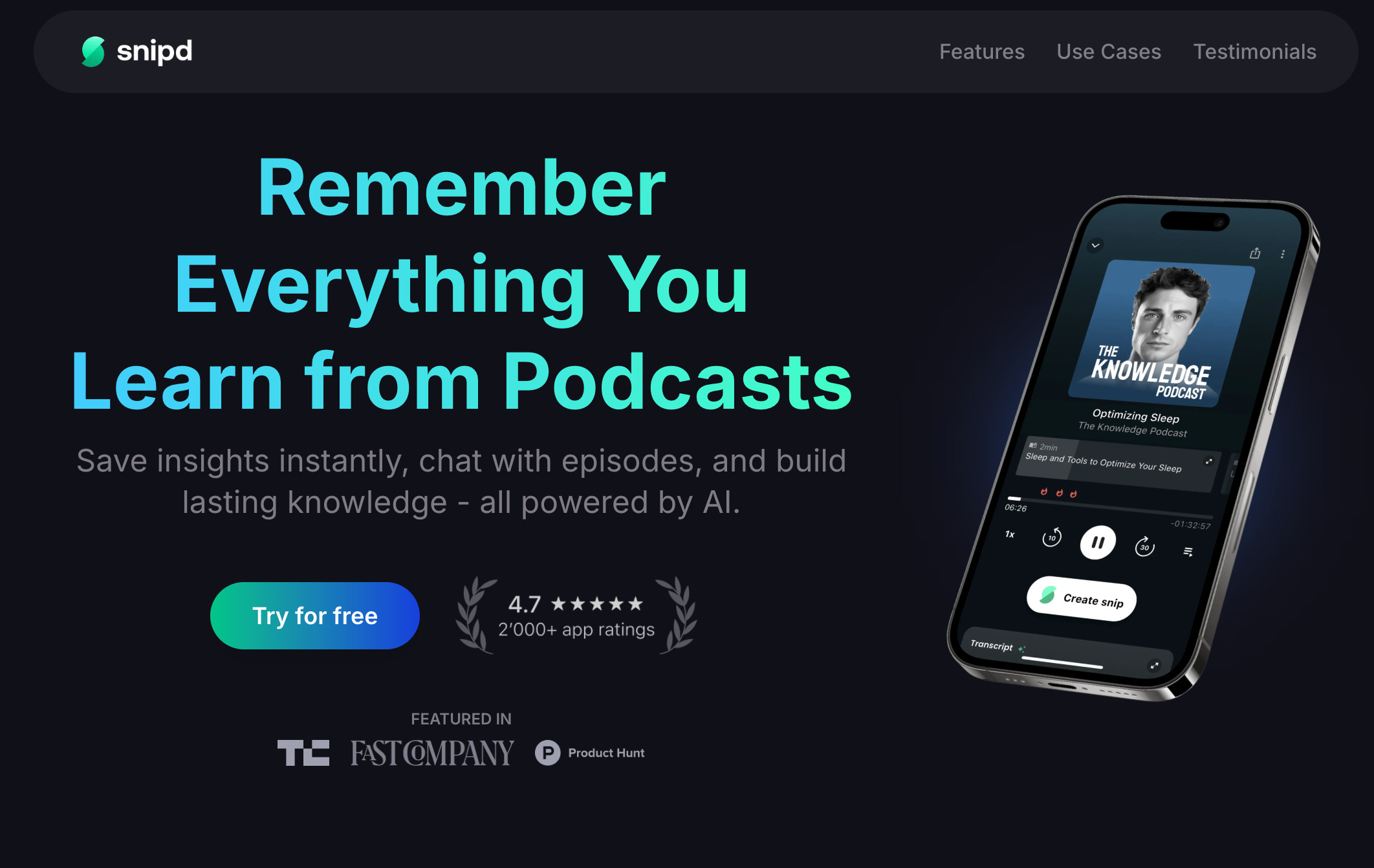
Building Snipd: The AI Podcast App for Learning
We are working with Amplify on the 2025 State of AI Engineering Survey to be presented at the AIE World’s Fair in SF! Join the survey to shape the future of AI Eng!We first met Snipd (affiliate link! we get a free month, you get a free month. but this is not a sponsored pod, we’ve never done one) over a year ago, and were immediately impressed by the design, but were doubtful about the behavior of snipping as the title behavior:Podcast apps are enormously sticky - Spotify spent almost $1b in podcast acquisitions and exclusive content just to get an 8% bump in market share among normies.However, after a disappointing Overcast 2.0 rewrite with no AI features in the last 3 years, I finally bit the bullet and switched to Snipd. It’s 2025, your podcast app should be able to let you search transcripts of your podcasts. Snipd is the best implementation of this so far.And yet they keep shipping:What impressed us wasn’t just how this tiny team of 4 was able to bootstrap a consumer AI app against massive titans and do so well; but also how seriously they think about learning through podcasts and improving retention of knowledge over time, aka “Duolingo for podcasts”. As an educational AI podcast, that’s a mission we can get behind.Full Video PodFind us on YouTube! This was the first pod we’ve ever shot outdoors!Show Notes* How does Shazam work?* Flutter/FlutterFlow* wav2vec paper* Perplexity Online LLM* Google Search Grounding* Comparing Snipd transcription with our Bee episode* NIPS 2017 Flo Rida* Gustav Söderström - Background AudioTimestamps* [00:00:03] Takeaways from AI Engineer NYC* [00:00:17] Weather in New York.* [00:00:26] Swyx and Snipd.* [00:01:01] Kevin's AI summit experience.* [00:01:31] Zurich and AI.* [00:03:25] SigLIP authors join OpenAI.* [00:03:39] Zurich is very costly.* [00:04:06] The Snipd origin story.* [00:05:24] Introduction to machine learning.* [00:09:28] Snipd and user knowledge extraction.* [00:13:48] App's tech stack, Flutter, Python.* [00:15:11] How speakers are identified.* [00:18:29] The concept of "backgroundable" video.* [00:29:05] Voice cloning technology.* [00:31:03] Using AI agents.* [00:34:32] Snipd's future is multi-modal AI.* [00:36:37] Snipd and existing user behaviour.* [00:42:10] The app, summary, and timestamps.* [00:55:25] The future of AI and podcasting.* [1:14:55] Voice AITranscriptswyx [00:00:03]: Hey, I'm here in New York with Kevin Ben-Smith of Snipd. Welcome.Kevin [00:00:07]: Hi. Hi. Amazing to be here.swyx [00:00:09]: Yeah. This is our first ever, I think, outdoors podcast recording.Kevin [00:00:14]: It's quite a location for the first time, I have to say.swyx [00:00:18]: I was actually unsure because, you know, it's cold. It's like, I checked the temperature. It's like kind of one degree Celsius, but it's not that bad with the sun. No, it's quite nice. Yeah. Especially with our beautiful tea. With the tea. Yeah. Perfect. We're going to talk about Snips. I'm a Snips user. I'm a Snips user. I had to basically, you know, apart from Twitter, it's like the number one use app on my phone. Nice. When I wake up in the morning, I open Snips and I, you know, see what's new. And I think in terms of time spent or usage on my phone, I think it's number one or number two. Nice. Nice. So I really had to talk about it also because I think people interested in AI want to think about like, how can we, we're an AI podcast, we have to talk about the AI podcast app. But before we get there, we just finished. We just finished the AI Engineer Summit and you came for the two days. How was it?Kevin [00:01:07]: It was quite incredible. I mean, for me, the most valuable was just being in the same room with like-minded people who are building the future and who are seeing the future. You know, especially when it comes to AI agents, it's so often I have conversations with friends who are not in the AI world. And it's like so quickly it happens that you, it sounds like you're talking in science fiction. And it's just crazy talk. It was, you know, it's so refreshing to talk with so many other people who already see these things and yeah, be inspired then by them and not always feel like, like, okay, I think I'm just crazy. And like, this will never happen. It really is happening. And for me, it was very valuable. So day two, more relevant, more relevant for you than day one. Yeah. Day two. So day two was the engineering track. Yeah. That was definitely the most valuable for me. Like also as a producer. Practitioner myself, especially there were one or two talks that had to do with voice AI and AI agents with voice. Okay. So that was quite fascinating. Also spoke with the speakers afterwards. Yeah. And yeah, they were also very open and, and, you know, this, this sharing attitudes that's, I think in general, quite prevalent in the AI community. I also learned a lot, like really practical things that I can now take away with me. Yeah.swyx [00:02:25]: I mean, on my side, I, I think I watched only li
⚡️The new OpenAI Agents Platform
While everyone is now repeating that 2025 is the “Year of the Agent”, OpenAI is heads down building towards it. In the first 2 months of the year they released Operator and Deep Research (arguably the most successful agent archetype so far), and today they are bringing a lot of those capabilities to the API:* Responses API* Web Search Tool* Computer Use Tool* File Search Tool* A new open source Agents SDK with integrated Observability ToolsWe cover all this and more in today’s lightning pod on YouTube!More details here:Responses APIIn our Michelle Pokrass episode we talked about the Assistants API needing a redesign. Today OpenAI is launching the Responses API, “a more flexible foundation for developers building agentic applications”. It’s a superset of the chat completion API, and the suggested starting point for developers working with OpenAI models. One of the big upgrades is the new set of built-in tools for the responses API: Web Search, Computer Use, and Files. Web Search ToolWe previously had Exa AI on the podcast to talk about web search for AI. OpenAI is also now joining the race; the Web Search API is actually a new “model” that exposes two 4o fine-tunes: gpt-4o-search-preview and gpt-4o-mini-search-preview. These are the same models that power ChatGPT Search, and are priced at $30/1000 queries and $25/1000 queries respectively. The killer feature is inline citations: you do not only get a link to a page, but also a deep link to exactly where your query was answered in the result page. Computer Use ToolThe model that powers Operator, called Computer-Using-Agent (CUA), is also now available in the API. The computer-use-preview model is SOTA on most benchmarks, achieving 38.1% success on OSWorld for full computer use tasks, 58.1% on WebArena, and 87% on WebVoyager for web-based interactions.As you will notice in the docs, `computer-use-preview` is both a model and a tool through which you can specify the environment. Usage is priced at $3/1M input tokens and $12/1M output tokens, and it’s currently only available to users in tiers 3-5.File Search ToolFile Search was also available in the Assistants API, and it’s now coming to Responses too. OpenAI is bringing search + RAG all under one umbrella, and we’ll definitely see more people trying to find new ways to build all-in-one apps on OpenAI. Usage is priced at $2.50 per thousand queries and file storage at $0.10/GB/day, with the first GB free.Agent SDK: Swarms++!https://github.com/openai/openai-agents-pythonTo bring it all together, after the viral reception to Swarm, OpenAI is releasing an officially supported agents framework (which was previewed at our AI Engineer Summit) with 4 core pieces:* Agents: Easily configurable LLMs with clear instructions and built-in tools.* Handoffs: Intelligently transfer control between agents.* Guardrails: Configurable safety checks for input and output validation.* Tracing & Observability: Visualize agent execution traces to debug and optimize performance.Multi-agent workflows are here to stay!OpenAI is now explicitly designs for a set of common agentic patterns: Workflows, Handoffs, Agents-as-Tools, LLM-as-a-Judge, Parallelization, and Guardrails. OpenAI previewed this in part 2 of their talk at NYC:Further coverage of the launch from Kevin Weil, WSJ, and OpenAIDevs, AMA here.Show Notes* Assistants API* Swarm (OpenAI)* Fine-Tuning in AI* 2024 OpenAI DevDay Recap with Romain* Michelle Pokrass episode (API lead)Timestamps* 00:00 Intros* 02:31 Responses API * 08:34 Web Search API * 17:14 Files Search API * 18:46 Files API vs RAG * 20:06 Computer Use / Operator API * 22:30 Agents SDKAnd of course you can catch up with the full livestream here:TranscriptAlessio [00:00:03]: Hey, everyone. Welcome back to another Latent Space Lightning episode. This is Alessio, partner and CTO at Decibel, and I'm joined by Swyx, founder of Small AI.swyx [00:00:11]: Hi, and today we have a super special episode because we're talking with our old friend Roman. Hi, welcome.Romain [00:00:19]: Thank you. Thank you for having me.swyx [00:00:20]: And Nikunj, who is most famously, if anyone has ever tried to get any access to anything on the API, Nikunj is the guy. So I know your emails because I look forward to them.Nikunj [00:00:30]: Yeah, nice to meet all of you.swyx [00:00:32]: I think that we're basically convening today to talk about the new API. So perhaps you guys want to just kick off. What is OpenAI launching today?Nikunj [00:00:40]: Yeah, so I can kick it off. We're launching a bunch of new things today. We're going to do three new built-in tools. So we're launching the web search tool. This is basically chat GPD for search, but available in the API. We're launching an improved file search tool. So this is you bringing your data to OpenAI. You upload it. We, you know, take care of parsing it, chunking it. We're embedding it, making it searchable, give you this like ready vector store that you can use. So that's the file search tool. An
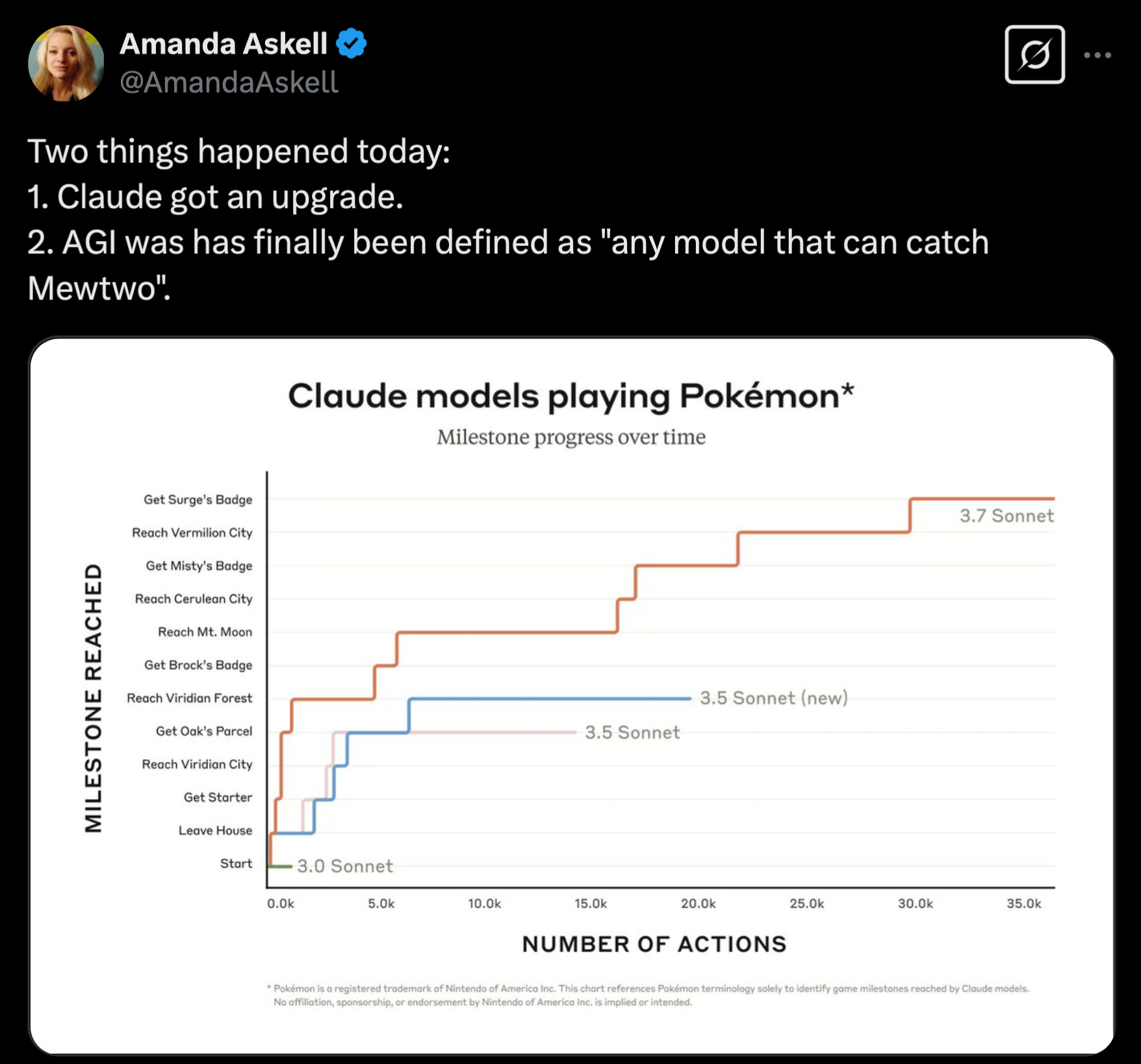
⚡️How Claude 3.7 Plays Pokémon
Special lightning pod with David Hershey from Anthropic, the person behind Claude Plays Pokémon. Sonnet 3.7 is currently trying to complete Pokémon Red live on Twitch thanks to a special harness that David built so that it can see the screen, navigate through it, remember facts about the game, and more. (Since recording, it has successfully escaped Mt Moon! You can follow along on Twitch: https://www.twitch.tv/claudeplayspokemon) This is a public episode. If you'd like to discuss this with other subscribers or get access to bonus episodes, visit www.latent.space/subscribe
Open Operator, Serverless Browsers and the Future of Computer-Using Agents
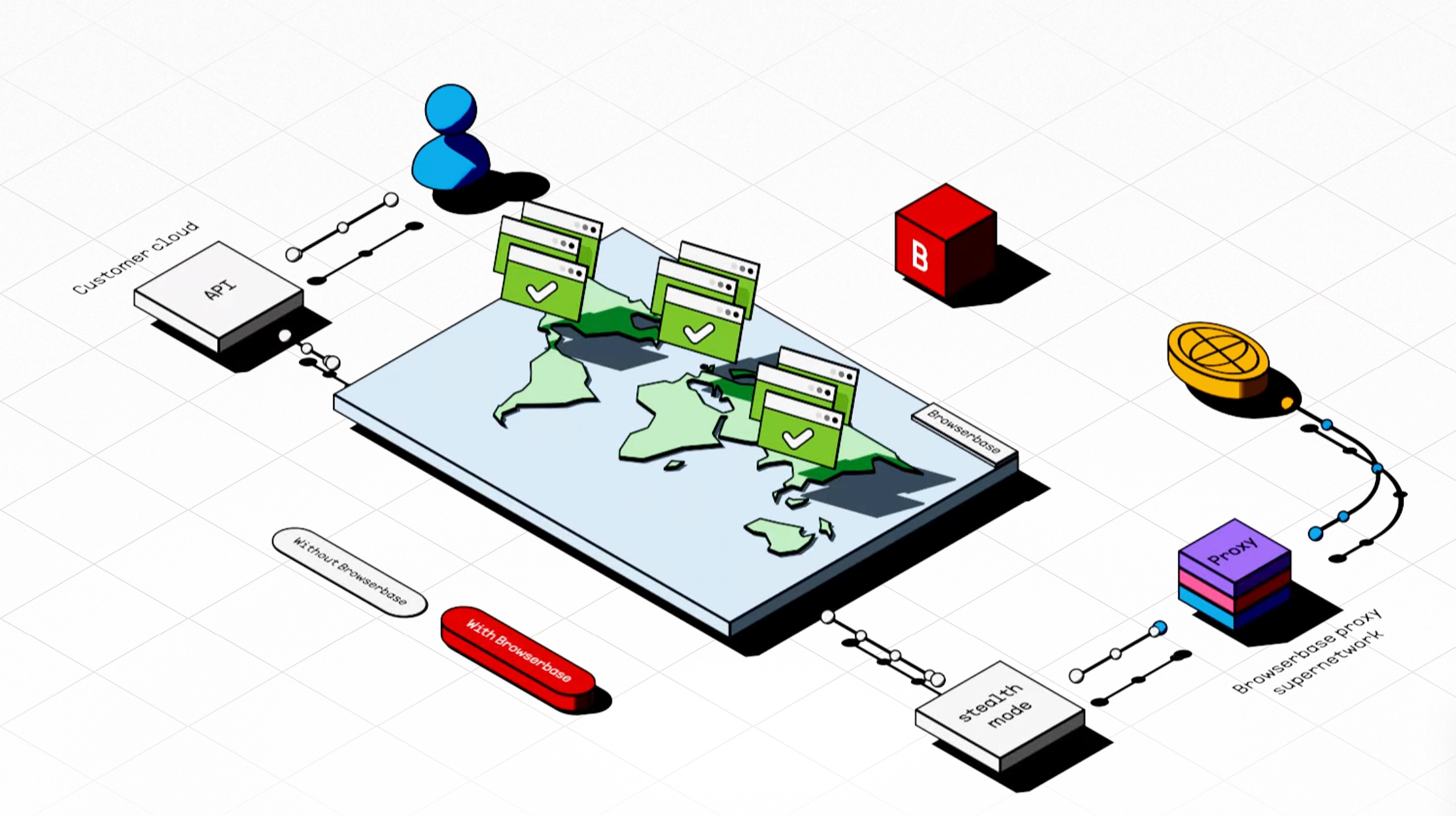
Today's episode is with Paul Klein, founder of Browserbase. We talked about building browser infrastructure for AI agents, the future of agent authentication, and their open source framework Stagehand.* [00:00:00] Introductions* [00:04:46] AI-specific challenges in browser infrastructure* [00:07:05] Multimodality in AI-Powered Browsing* [00:12:26] Running headless browsers at scale* [00:18:46] Geolocation when proxying* [00:21:25] CAPTCHAs and Agent Auth* [00:28:21] Building “User take over” functionality* [00:33:43] Stagehand: AI web browsing framework* [00:38:58] OpenAI's Operator and computer use agents* [00:44:44] Surprising use cases of Browserbase* [00:47:18] Future of browser automation and market competition* [00:53:11] Being a solo founderTranscriptAlessio [00:00:04]: Hey everyone, welcome to the Latent Space podcast. This is Alessio, partner and CTO at Decibel Partners, and I'm joined by my co-host Swyx, founder of Smol.ai.swyx [00:00:12]: Hey, and today we are very blessed to have our friends, Paul Klein, for the fourth, the fourth, CEO of Browserbase. Welcome.Paul [00:00:21]: Thanks guys. Yeah, I'm happy to be here. I've been lucky to know both of you for like a couple of years now, I think. So it's just like we're hanging out, you know, with three ginormous microphones in front of our face. It's totally normal hangout.swyx [00:00:34]: Yeah. We've actually mentioned you on the podcast, I think, more often than any other Solaris tenant. Just because like you're one of the, you know, best performing, I think, LLM tool companies that have started up in the last couple of years.Paul [00:00:50]: Yeah, I mean, it's been a whirlwind of a year, like Browserbase is actually pretty close to our first birthday. So we are one years old. And going from, you know, starting a company as a solo founder to... To, you know, having a team of 20 people, you know, a series A, but also being able to support hundreds of AI companies that are building AI applications that go out and automate the web. It's just been like, really cool. It's been happening a little too fast. I think like collectively as an AI industry, let's just take a week off together. I took my first vacation actually two weeks ago, and Operator came out on the first day, and then a week later, DeepSeat came out. And I'm like on vacation trying to chill. I'm like, we got to build with this stuff, right? So it's been a breakneck year. But I'm super happy to be here and like talk more about all the stuff we're seeing. And I'd love to hear kind of what you guys are excited about too, and share with it, you know?swyx [00:01:39]: Where to start? So people, you've done a bunch of podcasts. I think I strongly recommend Jack Bridger's Scaling DevTools, as well as Turner Novak's The Peel. And, you know, I'm sure there's others. So you covered your Twilio story in the past, talked about StreamClub, you got acquired to Mux, and then you left to start Browserbase. So maybe we just start with what is Browserbase? Yeah.Paul [00:02:02]: Browserbase is the web browser for your AI. We're building headless browser infrastructure, which are browsers that run in a server environment that's accessible to developers via APIs and SDKs. It's really hard to run a web browser in the cloud. You guys are probably running Chrome on your computers, and that's using a lot of resources, right? So if you want to run a web browser or thousands of web browsers, you can't just spin up a bunch of lambdas. You actually need to use a secure containerized environment. You have to scale it up and down. It's a stateful system. And that infrastructure is, like, super painful. And I know that firsthand, because at my last company, StreamClub, I was CTO, and I was building our own internal headless browser infrastructure. That's actually why we sold the company, is because Mux really wanted to buy our headless browser infrastructure that we'd built. And it's just a super hard problem. And I actually told my co-founders, I would never start another company unless it was a browser infrastructure company. And it turns out that's really necessary in the age of AI, when AI can actually go out and interact with websites, click on buttons, fill in forms. You need AI to do all of that work in an actual browser running somewhere on a server. And BrowserBase powers that.swyx [00:03:08]: While you're talking about it, it occurred to me, not that you're going to be acquired or anything, but it occurred to me that it would be really funny if you became the Nikita Beer of headless browser companies. You just have one trick, and you make browser companies that get acquired.Paul [00:03:23]: I truly do only have one trick. I'm screwed if it's not for headless browsers. I'm not a Go programmer. You know, I'm in AI grant. You know, browsers is an AI grant. But we were the only company in that AI grant batch that used zero dollars on AI spend. You know, we're purely an infrastructure company. So as much as people w
The Inventors of Deep Research
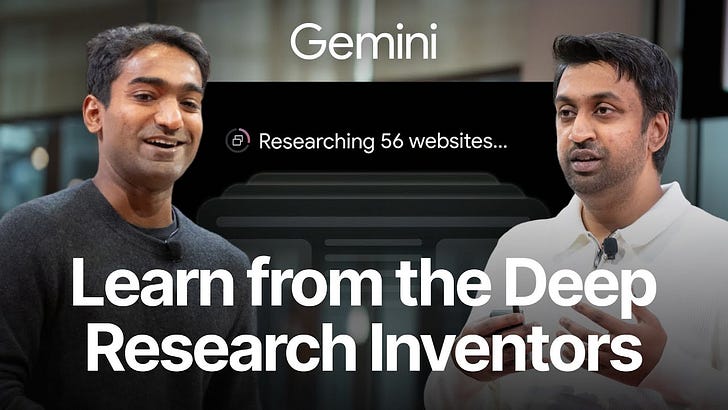
While “LLM-powered Search” is as old as Perplexity and SearchGPT, and open source projects like GPTResearcher and clones like OpenDeepResearch exist, the difference with “Deep Research” products is they are both “agentic” (loosely meaning that an LLM decides the next step in a workflow, usually involving tools) and bundling custom-tuned frontier models (custom tuned o3 and Gemini 1.5 Flash).The reception to OpenAI’s Deep Research agent has been nothing short of breathless:"Deep Research is the best public-facing AI product Google has ever released. It's like having a college-educated researcher in your pocket." - Jason Calacanis“I have had [Deep Research] write a number of ten-page papers for me, each of them outstanding. I think of the quality as comparable to having a good PhD-level research assistant, and sending that person away with a task for a week or two, or maybe more. Except Deep Research does the work in five or six minutes.” - Tyler Cowen“Deep Research is one of the best bargains in technology.” - Ben Thompson“my very approximate vibe is that it can do a single-digit percentage of all economically valuable tasks in the world, which is a wild milestone.” - sama“Using Deep Research over the past few weeks has been my own personal AGI moment. It takes 10 mins to generate accurate and thorough competitive and market research (with sources) that previously used to take me at least 3 hours.” - OAI employee“It's like a bazooka for the curious mind” - Dan Shipper“Deep research can be seen as a new interface for the internet, in addition to being an incredible agent… This paradigm will be so powerful that in the future, navigating the internet manually via a browser will be "old-school", like performing arithmetic calculations by hand.” - Jason Wei“One notable characteristic of Deep Research is its extreme patience. I think this is rapidly approaching “superhuman patience”. One realization working on this project was that intelligence and patience go really well together.” - HyungWon“I asked it to write a reference Interaction Calculus evaluator in Haskell. A few exchanges later, it gave me a complete file, including a parser, an evaluator, O(1) interactions and everything. The file compiled, and worked on my test inputs. There are some minor issues, but it is mostly correct. So, in about 30 minutes, o3 performed a job that would take me a day or so.” - Victor Taelin“Can confirm OpenAI Deep Research is quite strong. In a few minutes it did what used to take a dozen hours. The implications to knowledge work is going to be quite profound when you just ask an AI Agent to perform full tasks for you and come back with a finished result.” - Aaron Levie“Deep Research is genuinely useful” - Gary MarcusWith the advent of “Deep Research” agents, we are now routinely asking models to go through 100+ websites and generate in-depth reports on any topic. The Deep Research revolution has hit the AI scene in the last 2 weeks:* Dec 11th: Gemini Deep Research (today’s guest!) rolls out with Gemini Advanced* Feb 2nd: OpenAI releases Deep Research* Feb 3rd: a dozen “Open Deep Research” clones launch* Feb 5th: Gemini 2.0 Flash GA* Feb 15th: Perplexity launches Deep Research* Feb 17th: xAI launches Deep SearchIn today’s episode, we welcome Aarush Selvan and Mukund Sridhar, the lead PM and tech lead for Gemini Deep Research, the originators of the entire category. We asked detailed questions from inspiration to implementation, why they had to finetune a special model for it instead of using the standard Gemini model, how to run evals for them, and how to think about the distribution of use cases. (We also have an upcoming Gemini 2 episode with our returning first guest Logan Kilpatrick so stay tuned 👀)Two Kinds of Inference Time ComputeIn just ~2 months since NeurIPS, we’ve moved from “scaling has hit a wall, LLMs might be over” to “is this AGI already?” thanks to the releases of o1, o3, and DeepSeek R1 (see our o3 post and R1 distillation lightning pod). This new jump in capabilities is now accelerating many other applications; you might remember how “needle in a haystack” was one of the benchmarks people often referenced when looking at model’s capabilities over long context (see our 1M Llama context window ep for more). It seems that we have broken through the “wall” by scaling “inference time” in two meaningful ways — one with more time spent in the model, and the other with more tool calls.Both help build better agents which are clearly more intelligent. But as we discuss on the podcast, we are currently in a “honeymoon” period of agent products where taking more time (or tool calls, or search results) is considered good, because 1) quality is hard to evaluate and 2) we don’t know the realistic upper bound to quality. We know that they’re correlated, but we don’t know to what extent and if the correlation breaks down over extended research periods (they may not).It doesn’t take a PhD to spot the perverse incentives here.
Bee AI: The Wearable Ambient Agent
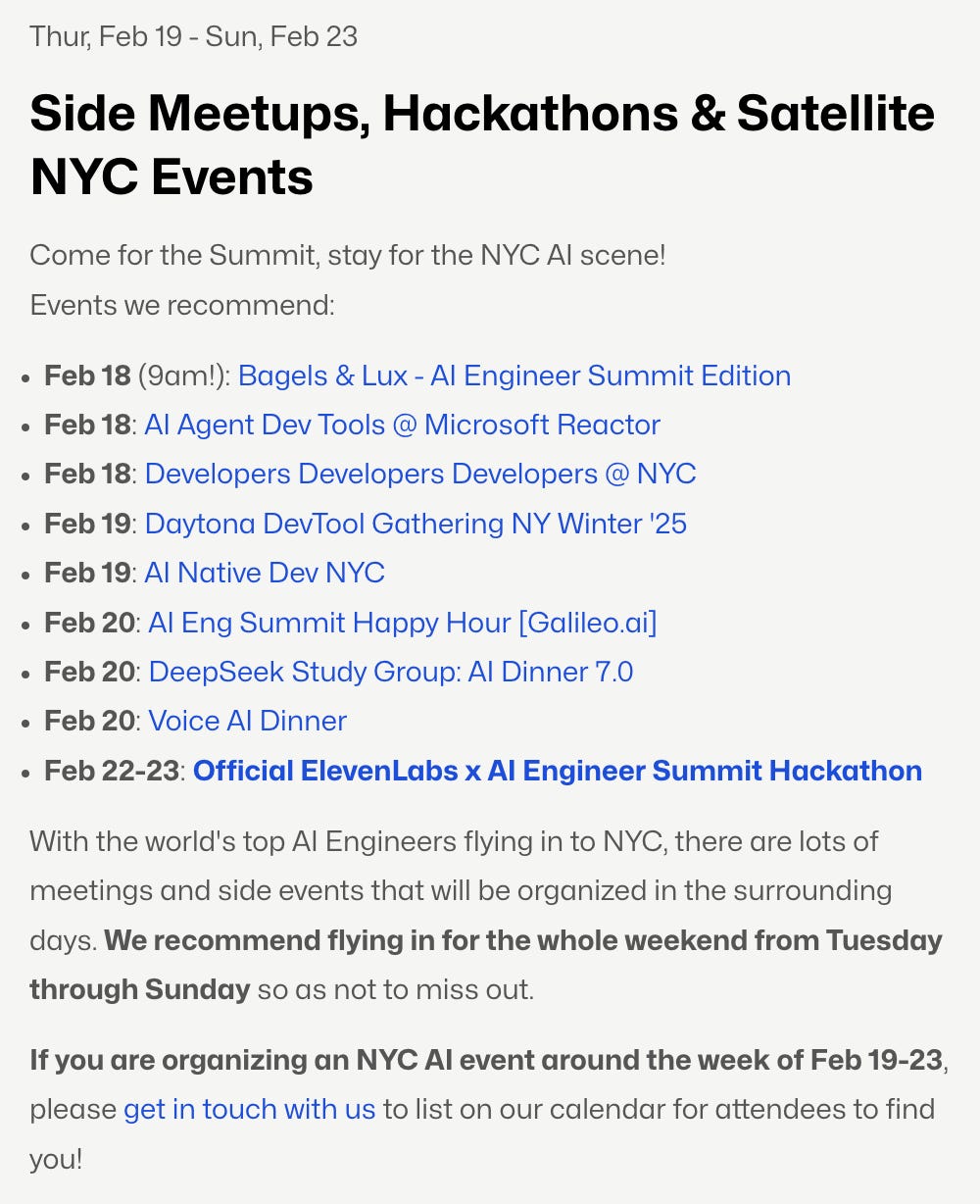
Bundle tickets for AIE Summit NYC have now sold out. You can now sign up for the livestream — where we will be making a big announcement soon. NYC-based readers and Summit attendees should check out the meetups happening around the Summit.2024 was a very challenging year for AI Hardware. After the buzz of CES last January, 2024 was marked by the meteoric rise and even harder fall of AI Wearables companies like Rabbit and Humane, with an assist from a pre-wallpaper-app MKBHD. Even Friend.com, the first to launch in the AI pendant category, and which spurred Rewind AI to rebrand to Limitless and follow in their footsteps, ended up delaying their wearable ship date and launching an experimental website chatbot version. We have been cautiously excited about this category, keeping tabs on most of the top entrants, including Omi and Compass. However, to date the biggest winner still standing from the AI Wearable wars is Bee AI, founded by today's guests Maria and Ethan. Bee is an always on hardware device with beamforming microphones, 7 day battery life and a mute button, that can be worn as a wristwatch or a clip-on pin, backed by an incredible transcription, diarization and very long context memory processing pipeline that helps you to remember your day, your todos, and even perform actions by operating a virtual cloud phone. This is one of the most advanced, production ready, personal AI agents we've ever seen, so we were excited to be their first podcast appearance. We met Bee when we ran the world's first Personal AI meetup in April last year.As a user of Bee (and not an investor! just a friend!) it’s genuinely been a joy to use, and we were glad to take advantage of the opportunity to ask hard questions about the privacy and legal/ethical side of things as much as the AI and Hardware engineering side of Bee. We hope you enjoy the episode and tune in next Friday for Bee’s first conference talk: Building Perfect Memory.Full YouTube Video VersionWatch this for the live demo!Show Notes* Bee Website* Ethan Sutin, Maria de Lourdes Zollo* Bee @ Personal AI Meetup* Buy Bee with Listener Discount Code!Timestamps* 00:00:00 Introductions and overview of Bee Computer* 00:01:58 Personal context and use cases for Bee* 00:03:02 Origin story of Bee and the founders' background* 00:06:56 Evolution from app to hardware device* 00:09:54 Short-term value proposition for users* 00:12:17 Demo of Bee's functionality* 00:17:54 Hardware form factor considerations* 00:22:22 Privacy concerns and legal considerations* 00:30:57 User adoption and reactions to wearing Bee* 00:35:56 CES experience and hardware manufacturing challenges* 00:41:40 Software pipeline and inference costs* 00:53:38 Technical challenges in real-time processing* 00:57:46 Memory and personal context modeling* 01:02:45 Social aspects and agent-to-agent interactions* 01:04:34 Location sharing and personal data exchange* 01:05:11 Personality analysis capabilities* 01:06:29 Hiring and future of always-on AITranscriptAlessio [00:00:04]: Hey everyone, welcome to the Latent Space podcast. This is Alessio, partner and CTO at Decibel Partners, and I'm joined by my co-host Swyx, founder of SmallAI.swyx [00:00:12]: Hey, and today we are very honored to have in the studio Maria and Ethan from Bee.Maria [00:00:16]: Hi, thank you for having us.swyx [00:00:20]: And you are, I think, the first hardware founders we've had on the podcast. I've been looking to have had a hardware founder, like a wearable hardware, like a wearable hardware founder for a while. I think we're going to have two or three of them this year. And you're the ones that I wear every day. So thank you for making Bee. Thank you for all the feedback and the usage. Yeah, you know, I've been a big fan. You are the speaker gift for the Engineering World's Fair. And let's start from the beginning. What is Bee Computer?Ethan [00:00:52]: Bee Computer is a personal AI system. So you can think of it as AI living alongside you in first person. So it can kind of capture your in real life. So with that understanding can help you in significant ways. You know, the obvious one is memory, but that's that's really just the base kind of use case. So recalling and reflective. I know, Swyx, that you you like the idea of journaling, but you don't but still have some some kind of reflective summary of what you experienced in real life. But it's also about just having like the whole context of a human being and understanding, you know, giving the machine the ability to understand, like, what's going on in your life. Your attitudes, your desires, specifics about your preferences, so that not only can it help you with recall, but then anything that you need it to do, it already knows, like, if you think about like somebody who you've worked with or lived with for a long time, they just know kind of without having to ask you what you would want, it's clear that like, that is the future that personal AI, like, it's just going to be very,
The AI Architect — Bret Taylor
If you’re in SF, join us tomorrow for a fun meetup at CodeGen Night!If you’re in NYC, join us for AI Engineer Summit! The Agent Engineering track is now sold out, but 25 tickets remain for AI Leadership and 5 tickets for the workshops. You can see the full schedule of speakers and workshops at https://ai.engineer!It’s exceedingly hard to introduce someone like Bret Taylor. We could recite his Wikipedia page, or his extensive work history through Silicon Valley’s greatest companies, but everyone else already does that.As a podcast by AI engineers for AI engineers, we had the opportunity to do something a little different. We wanted to dig into what Bret sees from his vantage point at the top of our industry for the last 2 decades, and how that explains the rise of the AI Architect at Sierra, the leading conversational AI/CX platform.“Across our customer base, we are seeing a new role emerge - the role of the AI architect. These leaders are responsible for helping define, manage and evolve their company's AI agent over time. They come from a variety of both technical and business backgrounds, and we think that every company will have one or many AI architects managing their AI agent and related experience.”In our conversation, Bret Taylor confirms the Paul Buchheit legend that he rewrote Google Maps in a weekend, armed with only the help of a then-nascent Google Closure Compiler and no other modern tooling. But what we find remarkable is that he was the PM of Maps, not an engineer, though of course he still identifies as one. We find this theme recurring throughout Bret’s career and worldview. We think it is plain as day that AI leadership will have to be hands-on and technical, especially when the ground is shifting as quickly as it is today:“There's a lot of power in combining product and engineering into as few people as possible… few great things have been created by committee.”“If engineering is an order taking organization for product you can sometimes make meaningful things, but rarely will you create extremely well crafted breakthrough products. Those tend to be small teams who deeply understand the customer need that they're solving, who have a maniacal focus on outcomes.”“And I think the reason why is if you look at like software as a service five years ago, maybe you can have a separation of product and engineering because most software as a service created five years ago. I wouldn't say there's like a lot of technological breakthroughs required for most business applications. And if you're making expense reporting software or whatever, it's useful… You kind of know how databases work, how to build auto scaling with your AWS cluster, whatever, you know, it's just, you're just applying best practices to yet another problem. "When you have areas like the early days of mobile development or the early days of interactive web applications, which I think Google Maps and Gmail represent, or now AI agents, you're in this constant conversation with what the requirements of your customers and stakeholders are and all the different people interacting with it and the capabilities of the technology. And it's almost impossible to specify the requirements of a product when you're not sure of the limitations of the technology itself.”This is the first time the difference between technical leadership for “normal” software and for “AI” software was articulated this clearly for us, and we’ll be thinking a lot about this going forward. We left a lot of nuggets in the conversation, so we hope you’ll just dive in with us (and thank Bret for joining the pod!)Full YouTubePlease Like and Subscribe :)Timestamps* 00:00:02 Introductions and Bret Taylor's background* 00:01:23 Bret's experience at Stanford and the dot-com era* 00:04:04 The story of rewriting Google Maps backend* 00:11:06 Early days of interactive web applications at Google* 00:15:26 Discussion on product management and engineering roles* 00:21:00 AI and the future of software development* 00:26:42 Bret's approach to identifying customer needs and building AI companies* 00:32:09 The evolution of business models in the AI era* 00:41:00 The future of programming languages and software development* 00:49:38 Challenges in precisely communicating human intent to machines* 00:56:44 Discussion on Artificial General Intelligence (AGI) and its impact* 01:08:51 The future of agent-to-agent communication* 01:14:03 Bret's involvement in the OpenAI leadership crisis* 01:22:11 OpenAI's relationship with Microsoft* 01:23:23 OpenAI's mission and priorities* 01:27:40 Bret's guiding principles for career choices* 01:29:12 Brief discussion on pasta-making* 01:30:47 How Bret keeps up with AI developments* 01:32:15 Exciting research directions in AI* 01:35:19 Closing remarks and hiring at Sierra Transcript[00:02:05] Introduction and Guest Welcome[00:02:05] Alessio: Hey everyone, welcome to the Latent Space Podcast. This is Alessio, partner and CTO at Decibel Partners, and I'm joined

Agent Engineering with Pydantic + Graphs — with Samuel Colvin
Did you know that adding a simple Code Interpreter took o3 from 9.2% to 32% on FrontierMath? The Latent Space crew is hosting a hack night Feb 11th in San Francisco focused on CodeGen use cases, co-hosted with E2B and Edge AGI; watch E2B’s new workshop and RSVP here!We’re happy to announce that today’s guest Samuel Colvin will be teaching his very first Pydantic AI workshop at the newly announced AI Engineer NYC Workshops day on Feb 22! 25 tickets left.If you’re a Python developer, it’s very likely that you’ve heard of Pydantic. Every month, it’s downloaded >300,000,000 times, making it one of the top 25 PyPi packages. OpenAI uses it in its SDK for structured outputs, it’s at the core of FastAPI, and if you’ve followed our AI Engineer Summit conference, Jason Liu of Instructor has given two great talks about it: “Pydantic is all you need” and “Pydantic is STILL all you need”. Now, Samuel Colvin has raised $17M from Sequoia to turn Pydantic from an open source project to a full stack AI engineer platform with Logfire, their observability platform, and PydanticAI, their new agent framework.Logfire: bringing OTEL to AIOpenTelemetry recently merged Semantic Conventions for LLM workloads which provides standard definitions to track performance like gen_ai.server.time_per_output_token. In Sam’s view at least 80% of new apps being built today have some sort of LLM usage in them, and just like web observability platform got replaced by cloud-first ones in the 2010s, Logfire wants to do the same for AI-first apps. If you’re interested in the technical details, Logfire migrated away from Clickhouse to Datafusion for their backend. We spent some time on the importance of picking open source tools you understand and that you can actually contribute to upstream, rather than the more popular ones; listen in ~43:19 for that part.Agents are the killer app for graphsPydantic AI is their attempt at taking a lot of the learnings that LangChain and the other early LLM frameworks had, and putting Python best practices into it. At an API level, it’s very similar to the other libraries: you can call LLMs, create agents, do function calling, do evals, etc.They define an “Agent” as a container with a system prompt, tools, structured result, and an LLM. Under the hood, each Agent is now a graph of function calls that can orchestrate multi-step LLM interactions. You can start simple, then move toward fully dynamic graph-based control flow if needed.“We were compelled enough by graphs once we got them right that our agent implementation [...] is now actually a graph under the hood.”Why Graphs?* More natural for complex or multi-step AI workflows.* Easy to visualize and debug with mermaid diagrams.* Potential for distributed runs, or “waiting days” between steps in certain flows.In parallel, you see folks like Emil Eifrem of Neo4j talk about GraphRAG as another place where graphs fit really well in the AI stack, so it might be time for more people to take them seriously.Full Video EpisodeLike and subscribe!Chapters* 00:00:00 Introductions* 00:00:24 Origins of Pydantic* 00:05:28 Pydantic's AI moment * 00:08:05 Why build a new agents framework?* 00:10:17 Overview of Pydantic AI* 00:12:33 Becoming a believer in graphs* 00:24:02 God Model vs Compound AI Systems* 00:28:13 Why not build an LLM gateway?* 00:31:39 Programmatic testing vs live evals* 00:35:51 Using OpenTelemetry for AI traces* 00:43:19 Why they don't use Clickhouse* 00:48:34 Competing in the observability space* 00:50:41 Licensing decisions for Pydantic and LogFire* 00:51:48 Building Pydantic.run* 00:55:24 Marimo and the future of Jupyter notebooks* 00:57:44 London's AI sceneShow Notes* Sam Colvin* Pydantic* Pydantic AI* Logfire* Pydantic.run* Zod* E2B* Arize* Langsmith* Marimo* Prefect* GLA (Google Generative Language API)* OpenTelemetry* Jason Liu* Sebastian Ramirez* Bogomil Balkansky* Hood Chatham* Jeremy Howard* Andrew LambTranscriptAlessio [00:00:03]: Hey, everyone. Welcome to the Latent Space podcast. This is Alessio, partner and CTO at Decibel Partners, and I'm joined by my co-host Swyx, founder of Smol AI.Swyx [00:00:12]: Good morning. And today we're very excited to have Sam Colvin join us from Pydantic AI. Welcome. Sam, I heard that Pydantic is all we need. Is that true?Samuel [00:00:24]: I would say you might need Pydantic AI and Logfire as well, but it gets you a long way, that's for sure.Swyx [00:00:29]: Pydantic almost basically needs no introduction. It's almost 300 million downloads in December. And obviously, in the previous podcasts and discussions we've had with Jason Liu, he's been a big fan and promoter of Pydantic and AI.Samuel [00:00:45]: Yeah, it's weird because obviously I didn't create Pydantic originally for uses in AI, it predates LLMs. But it's like we've been lucky that it's been picked up by that community and used so widely.Swyx [00:00:58]: Actually, maybe we'll hear it. Right from you, what is Pydantic and maybe a little bit of the origin story?
The Agent Reasoning Interface: o1/o3, Claude 3, ChatGPT Canvas, Tasks, and Operator — with Karina Nguyen of OpenAI
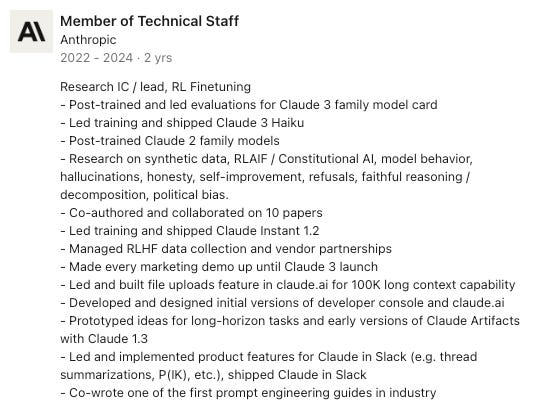
Sponsorships and tickets for the AI Engineer Summit are selling fast! See the new website with speakers and schedules live! If you are building AI agents or leading teams of AI Engineers, this will be the single highest-signal conference of the year for you, this Feb 20-22nd in NYC.We’re pleased to share that Karina will be presenting OpenAI’s closing keynote at the AI Engineer Summit. We were fortunate to get some time with her today to introduce some of her work, and hope this serves as nice background for her talk!There are very few early AI careers that have been as impactful as Karina Nguyen’s. After stints at Notion, Square, Dropbox, Primer, the New York Times, and UC Berkeley, She joined Anthropic as employee ~60 and worked on a wide range of research/product roles for Claude 1, 2, and 3. We’ll just let her LinkedIn speak for itself:Now, as Research manager and Post-training lead in Model Behavior at OpenAI, she creates new interaction paradigms for reasoning interfaces and capabilities, like ChatGPT Canvas, Tasks, SimpleQA, streaming chain-of-thought for o1 models, and more via novel synthetic model training. Ideal AI Research+Product ProcessIn the podcast we got a sense of what Karina has found works for her and her team to be as productive as they have been:* Write PRD (Define what you want)* Funding (Get resources)* Prototype Prompted Baseline (See what’s possible)* Write and Run Evals (Get failures to hillclimb)* Model training (Exceed baseline without overfitting)* Bugbash (Find bugs and solve them)* Ship (Get users!)We could turn this into a snazzy viral graphic but really this is all it is. Simple to say, difficult to do well. Hopefully it helps you define your process if you do similar product-research work. Show Notes* Our Reasoning Price War post * Karina LinkedIn, Website, Twitter* OSINT visualization work* Ukraine 3D storytelling* Karina on Claude Artifacts* Karina on Claude 3 Benchmarks* Inspiration for Artifacts / Canvas from early UX work she did on GPT-3* “i really believe that things like canvas and tasks should and could have happened like 2 yrs ago, idk why we are lagging in the form factors” (tweet)* Our article on prompting o1 vs Karina’s Claude prompting principles* Canvas: https://openai.com/index/introducing-canvas/ * We trained GPT-4o to collaborate as a creative partner. The model knows when to open a canvas, make targeted edits, and fully rewrite. It also understands broader context to provide precise feedback and suggestions.To support this, our research team developed the following core behaviors:* Triggering the canvas for writing and coding* Generating diverse content types* Making targeted edits* Rewriting documents* Providing inline critiqueWe measured progress with over 20 automated internal evaluations. We used novel synthetic data generation techniques, such as distilling outputs from OpenAI o1-preview, to post-train the model for its core behaviors. This approach allowed us to rapidly address writing quality and new user interactions, all without relying on human-generated data.* Tasks: https://www.theverge.com/2025/1/14/24343528/openai-chatgpt-repeating-tasks-agent-ai* * Agents and Operator* What are agents? “Agents are a gradual progression of tasks: starting with one-off actions, moving to collaboration, and ultimately fully trustworthy long-horizon delegation in complex envs like multi-player/multiagents.” (tweet)* tasks and canvas fall within the first two, and we are def. marching towards the third—though the form factor for 3 will take time to develop * Operator/Computer Use Agents* https://openai.com/index/introducing-operator/* Misc:* Andrew Ng* Prediction: Personal AI Consumer playbook* ChatGPT as generative OSTimestamps* 00:00 Welcome to the Latent Space Podcast* 00:11 Introducing Karina Nguyen* 02:21 Karina's Journey to OpenAI* 04:45 Early Prototypes and Projects* 05:25 Joining Anthropic and Early Work* 07:16 Challenges and Innovations at Anthropic* 11:30 Launching Claude 3* 21:57 Behavioral Design and Model Personality* 27:37 The Making of ChatGPT Canvas* 34:34 Canvas Update and Initial Impressions* 34:46 Differences Between Canvas and API Outputs* 35:50 Core Use Cases of Canvas* 36:35 Canvas as a Writing Partner* 36:55 Canvas vs. Google Docs and Future Improvements* 37:35 Canvas for Coding and Executing Code* 38:50 Challenges in Developing Canvas* 41:45 Introduction to Tasks* 41:53 Developing and Iterating on Tasks* 46:27 Future Vision for Tasks and Proactive Models* 52:23 Computer Use Agents and Their Potential* 01:00:21 Cultural Differences Between OpenAI and Anthropic* 01:03:46 Call to Action and Final ThoughtsTranscriptAlessio [00:00:04]: Hey everyone, welcome to the Latent Space podcast. This is Alessio, partner and CTO at Decibel, and I'm joined by my usual co-host, Swyx.swyx [00:00:11]: Hey, and today we're very, very blessed to have Karina Nguyen in the studio. Welcome.Karina [00:00:15]: Nice to meet you.swyx [00:00:16]: We finally made it h
Outlasting Noam Shazeer, crowdsourcing Chai AI with >1.4m DAU, and becoming the "Western DeepSeek" — with William Beauchamp, Chai Research
One last Gold sponsor slot is available for the AI Engineer Summit in NYC. Our last round of invites is going out soon - apply here - If you are building AI agents or AI eng teams, this will be the single highest-signal conference of the year for you!While the world melts down over DeepSeek, few are talking about the OTHER notable group of former hedge fund traders who pivoted into AI and built a remarkably profitable consumer AI business with a tiny team with incredibly cracked engineering team — Chai Research. In short order they have:* Started a Chat AI company well before Noam Shazeer started Character AI, and outlasted his departure.* Crossed 1m DAU in 2.5 years - William updates us on the pod that they’ve hit 1.4m DAU now, another +40% from a few months ago. Revenue crossed >$22m. * Launched the Chaiverse model crowdsourcing platform - taking 3-4 week A/B testing cycles down to 3-4 hours, and deploying >100 models a week.While they’re not paying million dollar salaries, you can tell they’re doing pretty well for an 11 person startup:The Chai Recipe: Building infra for rapid evalsRemember how the central thesis of LMarena (formerly LMsys) is that the only comprehensive way to evaluate LLMs is to let users try them out and pick winners?At the core of Chai is a mobile app that looks like Character AI, but is actually the largest LLM A/B testing arena in the world, specialized on retaining chat users for Chai’s usecases (therapy, assistant, roleplay, etc). It’s basically what LMArena would be if taken very, very seriously at one company (with $1m in prizes to boot):Chai publishes occasional research on how they think about this, including talks at their Palo Alto office:William expands upon this in today’s podcast (34 mins in):Fundamentally, the way I would describe it is when you're building anything in life, you need to be able to evaluate it. And through evaluation, you can iterate, we can look at benchmarks, and we can say the issues with benchmarks and why they may not generalize as well as one would hope in the challenges of working with them. But something that works incredibly well is getting feedback from humans. And so we built this thing where anyone can submit a model to our developer backend, and it gets put in front of 5000 users, and the users can rate it. And we can then have a really accurate ranking of like which model, or users finding more engaging or more entertaining. And it gets, you know, it's at this point now, where every day we're able to, I mean, we evaluate between 20 and 50 models, LLMs, every single day, right. So even though we've got only got a team of, say, five AI researchers, they're able to iterate a huge quantity of LLMs, right. So our team ships, let's just say minimum 100 LLMs a week is what we're able to iterate through. Now, before that moment in time, we might iterate through three a week, we might, you know, there was a time when even doing like five a month was a challenge, right? By being able to change the feedback loops to the point where it's not, let's launch these three models, let's do an A-B test, let's assign, let's do different cohorts, let's wait 30 days to see what the day 30 retention is, which is the kind of the, if you're doing an app, that's like A-B testing 101 would be, do a 30-day retention test, assign different treatments to different cohorts and come back in 30 days. So that's insanely slow. That's just, it's too slow. And so we were able to get that 30-day feedback loop all the way down to something like three hours.In Crowdsourcing the leap to Ten Trillion-Parameter AGI, William describes Chai’s routing as a recommender system, which makes a lot more sense to us than previous pitches for model routing startups:William is notably counter-consensus in a lot of his AI product principles:* No streaming: Chats appear all at once to allow rejection sampling* No voice: Chai actually beat Character AI to introducing voice - but removed it after finding that it was far from a killer feature.* Blending: “Something that we love to do at Chai is blending, which is, you know, it's the simplest way to think about it is you're going to end up, and you're going to pretty quickly see you've got one model that's really smart, one model that's really funny. How do you get the user an experience that is both smart and funny? Well, just 50% of the requests, you can serve them the smart model, 50% of the requests, you serve them the funny model.” (that’s it!)But chief above all is the recommender system.We also referenced Exa CEO Will Bryk’s concept of SuperKnowlege:Full Video versionOn YouTube. please like and subscribe!Timestamps* 00:00:04 Introductions and background of William Beauchamp* 00:01:19 Origin story of Chai AI* 00:04:40 Transition from finance to AI* 00:11:36 Initial product development and idea maze for Chai* 00:16:29 User psychology and engagement with AI companions* 00:20:00 Origin of the Chai name* 00:22:01 Comparison with Character AI and f
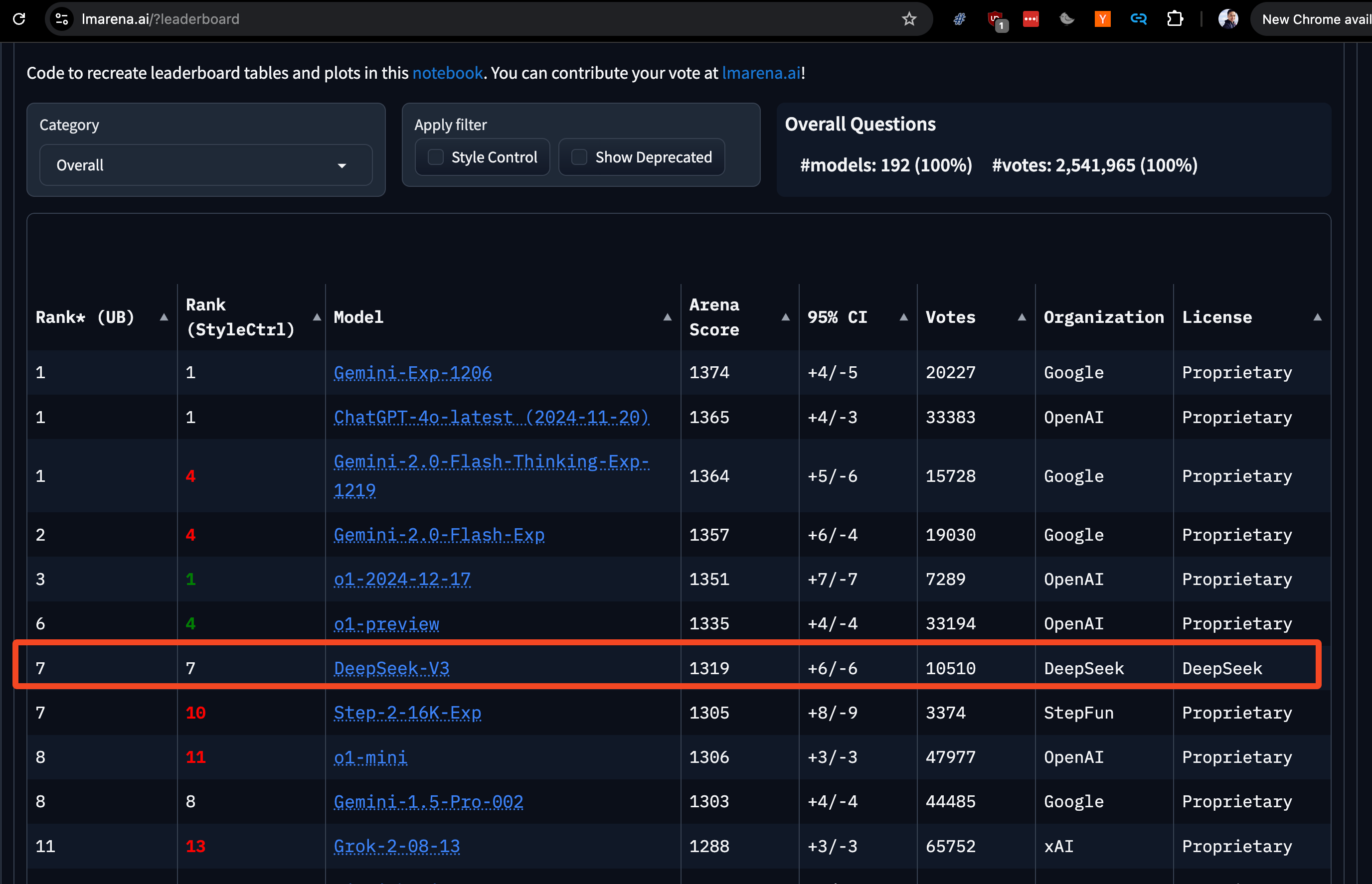
Everything you need to run Mission Critical Inference (ft. DeepSeek v3 + SGLang)
Sponsorships and applications for the AI Engineer Summit in NYC are live! (Speaker CFPs have closed) If you are building AI agents or leading teams of AI Engineers, this will be the single highest-signal conference of the year for you.Right after Christmas, the Chinese Whale Bros ended 2024 by dropping the last big model launch of the year: DeepSeek v3. Right now on LM Arena, DeepSeek v3 has a score of 1319, right under the full o1 model, Gemini 2, and 4o latest. This makes it the best open weights model in the world in January 2025.There has been a big recent trend in Chinese labs releasing very large open weights models, with TenCent releasing Hunyuan-Large in November and Hailuo releasing MiniMax-Text this week, both over 400B in size. However these extra-large language models are very difficult to serve.Baseten was the first of the Inference neocloud startups to get DeepSeek V3 online, because of their H200 clusters, their close collaboration with the DeepSeek team and early support of SGLang, a relatively new VLLM alternative that is also used at frontier labs like X.ai. Each H200 has 141 GB of VRAM with 4.8 TB per second of bandwidth, meaning that you can use 8 H200's in a node to inference DeepSeek v3 in FP8, taking into account KV Cache needs. We have been close to Baseten since Sarah Guo introduced Amir Haghighat to swyx, and they supported the very first Latent Space Demo Day in San Francisco, which was effectively the trial run for swyx and Alessio to work together! Since then, Philip Kiely also led a well attended workshop on TensorRT LLM at the 2024 World's Fair. We worked with him to get two of their best representatives, Amir and Lead Model Performance Engineer Yineng Zhang, to discuss DeepSeek, SGLang, and everything they have learned running Mission Critical Inference workloads at scale for some of the largest AI products in the world.The Three Pillars of Mission Critical InferenceWe initially planned to focus the conversation on SGLang, but Amir and Yineng were quick to correct us that the choice of inference framework is only the simplest, first choice of 3 things you need for production inference at scale:“I think it takes three things, and each of them individually is necessary but not sufficient: * Performance at the model level: how fast are you running this one model running on a single GPU, let's say. The framework that you use there can, can matter. The techniques that you use there can matter. The MLA technique, for example, that Yineng mentioned, or the CUDA kernels that are being used. But there's also techniques being used at a higher level, things like speculative decoding with draft models or with Medusa heads. And these are implemented in the different frameworks, or you can even implement it yourself, but they're not necessarily tied to a single framework. But using speculative decoding gets you massive upside when it comes to being able to handle high throughput. But that's not enough. Invariably, that one model running on a single GPU, let's say, is going to get too much traffic that it cannot handle.* Horizontal scaling at the cluster/region level: And at that point, you need to horizontally scale it. That's not an ML problem. That's not a PyTorch problem. That's an infrastructure problem. How quickly do you go from, a single replica of that model to 5, to 10, to 100. And so that's the second, that's the second pillar that is necessary for running these machine critical inference workloads.And what does it take to do that? It takes, some people are like, Oh, You just need Kubernetes and Kubernetes has an autoscaler and that just works. That doesn't work for, for these kinds of mission critical inference workloads. And you end up catching yourself wanting to bit by bit to rebuild those infrastructure pieces from scratch. This has been our experience. * And then going even a layer beyond that, Kubernetes runs in a single. cluster. It's a single cluster. It's a single region tied to a single region. And when it comes to inference workloads and needing GPUs more and more, you know, we're seeing this that you cannot meet the demand inside of a single region. A single cloud's a single region. In other words, a single model might want to horizontally scale up to 200 replicas, each of which is, let's say, 2H100s or 4H100s or even a full node, you run into limits of the capacity inside of that one region. And what we had to build to get around that was the ability to have a single model have replicas across different regions. So, you know, there are models on Baseten today that have 50 replicas in GCP East and, 80 replicas in AWS West and Oracle in London, etc.* Developer experience for Compound AI Systems: The final one is wrapping the power of the first two pillars in a very good developer experience to be able to afford certain workflows like the ones that I mentioned, around multi step, multi model inference workloads, because more and more we're seeing that the market is mov
[Ride Home] Simon Willison: Things we learned about LLMs in 2024
Due to overwhelming demand (>15x applications:slots), we are closing CFPs for AI Engineer Summit NYC today. Last call! Thanks, we’ll be reaching out to all shortly!The world’s top AI blogger and friend of every pod, Simon Willison, dropped a monster 2024 recap: Things we learned about LLMs in 2024. Brian of the excellent TechMeme Ride Home pinged us for a connection and a special crossover episode, our first in 2025. The target audience for this podcast is a tech-literate, but non-technical one. You can see Simon’s notes for AI Engineers in his World’s Fair Keynote.Timestamp* 00:00 Introduction and Guest Welcome* 01:06 State of AI in 2025* 01:43 Advancements in AI Models* 03:59 Cost Efficiency in AI* 06:16 Challenges and Competition in AI* 17:15 AI Agents and Their Limitations* 26:12 Multimodal AI and Future Prospects* 35:29 Exploring Video Avatar Companies* 36:24 AI Influencers and Their Future* 37:12 Simplifying Content Creation with AI* 38:30 The Importance of Credibility in AI* 41:36 The Future of LLM User Interfaces* 48:58 Local LLMs: A Growing Interest* 01:07:22 AI Wearables: The Next Big Thing* 01:10:16 Wrapping Up and Final ThoughtsTranscript[00:00:00] Introduction and Guest Welcome[00:00:00] Brian: Welcome to the first bonus episode of the Tech Meme Write Home for the year 2025. I'm your host as always, Brian McCullough. Listeners to the pod over the last year know that I have made a habit of quoting from Simon Willison when new stuff happens in AI from his blog. Simon has been, become a go to for many folks in terms of, you know, Analyzing things, criticizing things in the AI space.[00:00:33] Brian: I've wanted to talk to you for a long time, Simon. So thank you for coming on the show. No, it's a privilege to be here. And the person that made this connection happen is our friend Swyx, who has been on the show back, even going back to the, the Twitter Spaces days but also an AI guru in, in their own right Swyx, thanks for coming on the show also.[00:00:54] swyx (2): Thanks. I'm happy to be on and have been a regular listener, so just happy to [00:01:00] contribute as well.[00:01:00] Brian: And a good friend of the pod, as they say. Alright, let's go right into it.[00:01:06] State of AI in 2025[00:01:06] Brian: Simon, I'm going to do the most unfair, broad question first, so let's get it out of the way. The year 2025. Broadly, what is the state of AI as we begin this year?[00:01:20] Brian: Whatever you want to say, I don't want to lead the witness.[00:01:22] Simon: Wow. So many things, right? I mean, the big thing is everything's got really good and fast and cheap. Like, that was the trend throughout all of 2024. The good models got so much cheaper, they got so much faster, they got multimodal, right? The image stuff isn't even a surprise anymore.[00:01:39] Simon: They're growing video, all of that kind of stuff. So that's all really exciting.[00:01:43] Advancements in AI Models[00:01:43] Simon: At the same time, they didn't get massively better than GPT 4, which was a bit of a surprise. So that's sort of one of the open questions is, are we going to see huge, but I kind of feel like that's a bit of a distraction because GPT 4, but way cheaper, much larger context lengths, and it [00:02:00] can do multimodal.[00:02:01] Simon: is better, right? That's a better model, even if it's not.[00:02:05] Brian: What people were expecting or hoping, maybe not expecting is not the right word, but hoping that we would see another step change, right? Right. From like GPT 2 to 3 to 4, we were expecting or hoping that maybe we were going to see the next evolution in that sort of, yeah.[00:02:21] Brian: We[00:02:21] Simon: did see that, but not in the way we expected. We thought the model was just going to get smarter, and instead we got. Massive drops in, drops in price. We got all of these new capabilities. You can talk to the things now, right? They can do simulated audio input, all of that kind of stuff. And so it's kind of, it's interesting to me that the models improved in all of these ways we weren't necessarily expecting.[00:02:43] Simon: I didn't know it would be able to do an impersonation of Santa Claus, like a, you know, Talked to it through my phone and show it what I was seeing by the end of 2024. But yeah, we didn't get that GPT 5 step. And that's one of the big open questions is, is that actually just around the corner and we'll have a bunch of GPT 5 class models drop in the [00:03:00] next few months?[00:03:00] Simon: Or is there a limit?[00:03:03] Brian: If you were a betting man and wanted to put money on it, do you expect to see a phase change, step change in 2025?[00:03:11] Simon: I don't particularly for that, like, the models, but smarter. I think all of the trends we're seeing right now are going to keep on going, especially the inference time compute, right?[00:03:21] Simon: The trick that O1 and O3 are doing, which means that you can solve harder problems, but they cost more and it churns aw
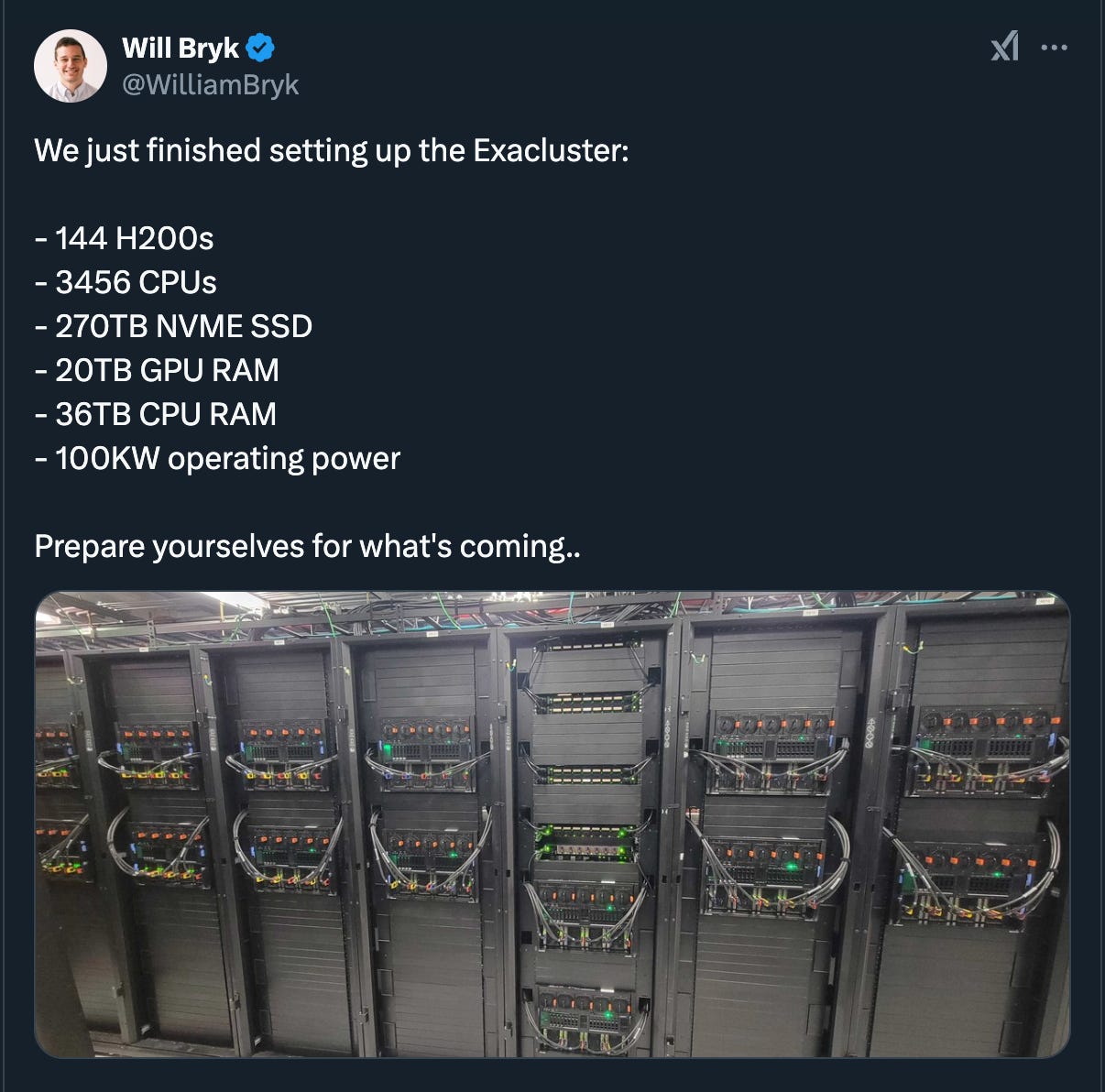
Beating Google at Search with Neural PageRank and $5M of H200s — with Will Bryk of Exa.ai
Applications close Monday for the NYC AI Engineer Summit focusing on AI Leadership and Agent Engineering! If you applied, invites should be rolling out shortly.The search landscape is experiencing a fundamental shift. Google built a >$2T company with the “10 blue links” experience, driven by PageRank as the core innovation for ranking. This was a big improvement from the previous directory-based experiences of AltaVista and Yahoo. Almost 4 decades later, Google is now stuck in this links-based experience, especially from a business model perspective. This legacy architecture creates fundamental constraints:* Must return results in ~400 milliseconds* Required to maintain comprehensive web coverage* Tied to keyword-based matching algorithms* Cost structures optimized for traditional indexingAs we move from the era of links to the era of answers, the way search works is changing. You’re not showing a user links, but the goal is to provide context to an LLM. This means moving from keyword based search to more semantic understanding of the content:The link prediction objective can be seen as like a neural PageRank because what you're doing is you're predicting the links people share... but it's more powerful than PageRank. It's strictly more powerful because people might refer to that Paul Graham fundraising essay in like a thousand different ways. And so our model learns all the different ways.All of this is now powered by a $5M cluster with 144 H200s:This architectural choice enables entirely new search capabilities:* Comprehensive result sets instead of approximations* Deep semantic understanding of queries* Ability to process complex, natural language requestsAs search becomes more complex, time to results becomes a variable:People think of searches as like, oh, it takes 500 milliseconds because we've been conditioned... But what if searches can take like a minute or 10 minutes or a whole day, what can you then do?Unlike traditional search engines' fixed-cost indexing, Exa employs a hybrid approach:* Front-loaded compute for indexing and embeddings* Variable inference costs based on query complexity* Mix of owned infrastructure ($5M H200 cluster) and cloud resourcesExa sees a lot of competition from products like Perplexity and ChatGPT Search which layer AI on top of traditional search backends, but Exa is betting that true innovation requires rethinking search from the ground up. For example, the recently launched Websets, a way to turn searches into structured output in grid format, allowing you to create lists and databases out of web pages. The company raised a $17M Series A to build towards this mission, so keep an eye out for them in 2025. Chapters* 00:00:00 Introductions* 00:01:12 ExaAI's initial pitch and concept* 00:02:33 Will's background at SpaceX and Zoox* 00:03:45 Evolution of ExaAI (formerly Metaphor Systems)* 00:05:38 Exa's link prediction technology* 00:09:20 Meaning of the name "Exa"* 00:10:36 ExaAI's new product launch and capabilities* 00:13:33 Compute budgets and variable compute products* 00:14:43 Websets as a B2B offering* 00:19:28 How do you build a search engine?* 00:22:43 What is Neural PageRank?* 00:27:58 Exa use cases * 00:35:00 Auto-prompting* 00:38:42 Building agentic search* 00:44:19 Is o1 on the path to AGI?* 00:49:59 Company culture and nap pods* 00:54:52 Economics of AI search and the future of search technologyFull YouTube TranscriptPlease like and subscribe!Show Notes* ExaAI* Web Search Product* Websets* Series A Announcement* Exa Nap Pods* Perplexity AI* Character.AITranscriptAlessio [00:00:00]: Hey, everyone. Welcome to the Latent Space podcast. This is Alessio, partner and CTO at Decibel Partners, and I'm joined by my co-host Swyx, founder of Smol.ai.Swyx [00:00:10]: Hey, and today we're in the studio with my good friend and former landlord, Will Bryk. Roommate. How you doing? Will, you're now CEO co-founder of ExaAI, used to be Metaphor Systems. What's your background, your story?Will [00:00:30]: Yeah, sure. So, yeah, I'm CEO of Exa. I've been doing it for three years. I guess I've always been interested in search, whether I knew it or not. Like, since I was a kid, I've always been interested in, like, high-quality information. And, like, you know, even in high school, wanted to improve the way we get information from news. And then in college, built a mini search engine. And then with Exa, like, you know, it's kind of like fulfilling the dream of actually being able to solve all the information needs I wanted as a kid. Yeah, I guess. I would say my entire life has kind of been rotating around this problem, which is pretty cool. Yeah.Swyx [00:00:50]: What'd you enter YC with?Will [00:00:53]: We entered YC with, uh, we are better than Google. Like, Google 2.0.Swyx [00:01:12]: What makes you say that? Like, that's so audacious to come out of the box with.Will [00:01:16]: Yeah, okay, so you have to remember the time. This was summer 2021. And, uh, GPT-3 had come out. Like,
AI Engineering for Art — with comfyanonymous, of ComfyUI
Applications for the NYC AI Engineer Summit, focused on Agents at Work, are open!When we first started Latent Space, in the lightning round we’d always ask guests: “What’s your favorite AI product?”. The majority would say Midjourney. The simple UI of prompt → very aesthetic image turned it into a $300M+ ARR bootstrapped business as it rode the first wave of AI image generation.In open source land, StableDiffusion was congregating around AUTOMATIC1111 as the de-facto web UI. Unlike Midjourney, which offered some flags but was mostly prompt-driven, A1111 let users play with a lot more parameters, supported additional modalities like img2img, and allowed users to load in custom models. If you’re interested in some of the SD history, you can look at our episodes with Lexica, Replicate, and Playground.One of the people involved with that community was comfyanonymous, who was also part of the Stability team in 2023, decided to build an alternative called ComfyUI, now one of the fastest growing open source projects in generative images, and is now the preferred partner for folks like Black Forest Labs’s Flux Tools on Day 1. The idea behind it was simple: “Everyone is trying to make easy to use interfaces. Let me try to make a powerful interface that's not easy to use.”Unlike its predecessors, ComfyUI does not have an input text box. Everything is based around the idea of a node: there’s a text input node, a CLIP node, a checkpoint loader node, a KSampler node, a VAE node, etc. While daunting for simple image generation, the tool is amazing for more complex workflows since you can break down every step of the process, and then chain many of them together rather than manually switching between tools. You can also re-start execution halfway instead of from the beginning, which can save a lot of time when using larger models.To give you an idea of some of the new use cases that this type of UI enables:* Sketch something → Generate an image with SD from sketch → feed it into SD Video to animate* Generate an image of an object → Turn into a 3D asset → Feed into interactive experiences* Input audio → Generate audio-reactive videosTheir Examples page also includes some of the more common use cases like AnimateDiff, etc. They recently launched the Comfy Registry, an online library of different nodes that users can pull from rather than having to build everything from scratch. The project has >60,000 Github stars, and as the community grows, some of the projects that people build have gotten quite complex:The most interesting thing about Comfy is that it’s not a UI, it’s a runtime. You can build full applications on top of image models simply by using Comfy. You can expose Comfy workflows as an endpoint and chain them together just like you chain a single node. We’re seeing the rise of AI Engineering applied to art.Major Tom’s ComfyUI Resources from the Latent Space DiscordMajor shoutouts to Major Tom on the LS Discord who is a image generation expert, who offered these pointers:* “best thing about comfy is the fact it supports almost immediately every new thing that comes out - unlike A1111 or forge, which still don't support flux cnet for instance. It will be perfect tool when conflicting nodes will be resolved”* AP Workflows from Alessandro Perili are a nice example of an all-in-one train-evaluate-generate system built atop Comfy* ComfyUI YouTubers to learn from:* @sebastiankamph* @NerdyRodent* @OlivioSarikas* @sedetweiler* @pixaroma* ComfyUI Nodes to check out:* https://github.com/kijai/ComfyUI-IC-Light* https://github.com/MrForExample/ComfyUI-3D-Pack* https://github.com/PowerHouseMan/ComfyUI-AdvancedLivePortrait* https://github.com/pydn/ComfyUI-to-Python-Extension* https://github.com/THtianhao/ComfyUI-Portrait-Maker* https://github.com/ssitu/ComfyUI_NestedNodeBuilder* https://github.com/longgui0318/comfyui-magic-clothing* https://github.com/atmaranto/ComfyUI-SaveAsScript* https://github.com/ZHO-ZHO-ZHO/ComfyUI-InstantID* https://github.com/AIFSH/ComfyUI-FishSpeech* https://github.com/coolzilj/ComfyUI-Photopea* https://github.com/lks-ai/anynode* Sarav: https://www.youtube.com/@mickmumpitz/videos ( applied stuff )* Sarav: https://www.youtube.com/@latentvision (technical, but infrequent)* look for comfyui node for https://github.com/magic-quill/MagicQuill* “Comfy for Video” resources* Kijai (https://github.com/kijai) pushing out support for Mochi, CogVideoX, AnimateDif, LivePortrait etc* Comfyui node support like LTX https://github.com/Lightricks/ComfyUI-LTXVideo , and HunyuanVideo* FloraFauna AI and Krea.ai* Communities: https://www.reddit.com/r/StableDiffusion/, https://www.reddit.com/r/comfyui/Full YouTube EpisodeAs usual, you can find the full video episode on our YouTube (and don’t forget to like and subscribe!)Timestamps* 00:00:04 Introduction of hosts and anonymous guest* 00:00:35 Origins of Comfy UI and early Stable Diffusion landscape* 00:02:58 Comfy's background and development of high-res fix* 00:05:37 Area co
Latent.Space 2024 Year in Review
Applications for the 2025 AI Engineer Summit are up, and you can save the date for AIE Singapore in April and AIE World’s Fair 2025 in June.Happy new year, and thanks for 100 great episodes! Please let us know what you want to see/hear for the next 100!Full YouTube Episode with Slides/ChartsLike and subscribe and hit that bell to get notifs!Timestamps* 00:00 Welcome to the 100th Episode!* 00:19 Reflecting on the Journey* 00:47 AI Engineering: The Rise and Impact* 03:15 Latent Space Live and AI Conferences* 09:44 The Competitive AI Landscape* 21:45 Synthetic Data and Future Trends* 35:53 Creative Writing with AI* 36:12 Legal and Ethical Issues in AI* 38:18 The Data War: GPU Poor vs. GPU Rich* 39:12 The Rise of GPU Ultra Rich* 40:47 Emerging Trends in AI Models* 45:31 The Multi-Modality War* 01:05:31 The Future of AI Benchmarks* 01:13:17 Pionote and Frontier Models* 01:13:47 Niche Models and Base Models* 01:14:30 State Space Models and RWKB* 01:15:48 Inference Race and Price Wars* 01:22:16 Major AI Themes of the Year* 01:22:48 AI Rewind: January to March* 01:26:42 AI Rewind: April to June* 01:33:12 AI Rewind: July to September* 01:34:59 AI Rewind: October to December* 01:39:53 Year-End Reflections and PredictionsTranscript[00:00:00] Welcome to the 100th Episode![00:00:00] Alessio: Hey everyone, welcome to the Latent Space Podcast. This is Alessio, partner and CTO at Decibel Partners, and I'm joined by my co host Swyx for the 100th time today.[00:00:12] swyx: Yay, um, and we're so glad that, yeah, you know, everyone has, uh, followed us in this journey. How do you feel about it? 100 episodes.[00:00:19] Alessio: Yeah, I know.[00:00:19] Reflecting on the Journey[00:00:19] Alessio: Almost two years that we've been doing this. We've had four different studios. Uh, we've had a lot of changes. You know, we used to do this lightning round. When we first started that we didn't like, and we tried to change the question. The answer[00:00:32] swyx: was cursor and perplexity.[00:00:34] Alessio: Yeah, I love mid journey. It's like, do you really not like anything else?[00:00:38] Alessio: Like what's, what's the unique thing? And I think, yeah, we, we've also had a lot more research driven content. You know, we had like 3DAO, we had, you know. Jeremy Howard, we had more folks like that.[00:00:47] AI Engineering: The Rise and Impact[00:00:47] Alessio: I think we want to do more of that too in the new year, like having, uh, some of the Gemini folks, both on the research and the applied side.[00:00:54] Alessio: Yeah, but it's been a ton of fun. I think we both started, I wouldn't say as a joke, we were kind of like, Oh, we [00:01:00] should do a podcast. And I think we kind of caught the right wave, obviously. And I think your rise of the AI engineer posts just kind of get people. Sombra to congregate, and then the AI engineer summit.[00:01:11] Alessio: And that's why when I look at our growth chart, it's kind of like a proxy for like the AI engineering industry as a whole, which is almost like, like, even if we don't do that much, we keep growing just because there's so many more AI engineers. So did you expect that growth or did you expect that would take longer for like the AI engineer thing to kind of like become, you know, everybody talks about it today.[00:01:32] swyx: So, the sign of that, that we have won is that Gartner puts it at the top of the hype curve right now. So Gartner has called the peak in AI engineering. I did not expect, um, to what level. I knew that I was correct when I called it because I did like two months of work going into that. But I didn't know, You know, how quickly it could happen, and obviously there's a chance that I could be wrong.[00:01:52] swyx: But I think, like, most people have come around to that concept. Hacker News hates it, which is a good sign. But there's enough people that have defined it, you know, GitHub, when [00:02:00] they launched GitHub Models, which is the Hugging Face clone, they put AI engineers in the banner, like, above the fold, like, in big So I think it's like kind of arrived as a meaningful and useful definition.[00:02:12] swyx: I think people are trying to figure out where the boundaries are. I think that was a lot of the quote unquote drama that happens behind the scenes at the World's Fair in June. Because I think there's a lot of doubt or questions about where ML engineering stops and AI engineering starts. That's a useful debate to be had.[00:02:29] swyx: In some sense, I actually anticipated that as well. So I intentionally did not. Put a firm definition there because most of the successful definitions are necessarily underspecified and it's actually useful to have different perspectives and you don't have to specify everything from the outset.[00:02:45] Alessio: Yeah, I was at um, AWS reInvent and the line to get into like the AI engineering talk, so to speak, which is, you know, applied AI and whatnot was like, there are like hundreds of people just in lin
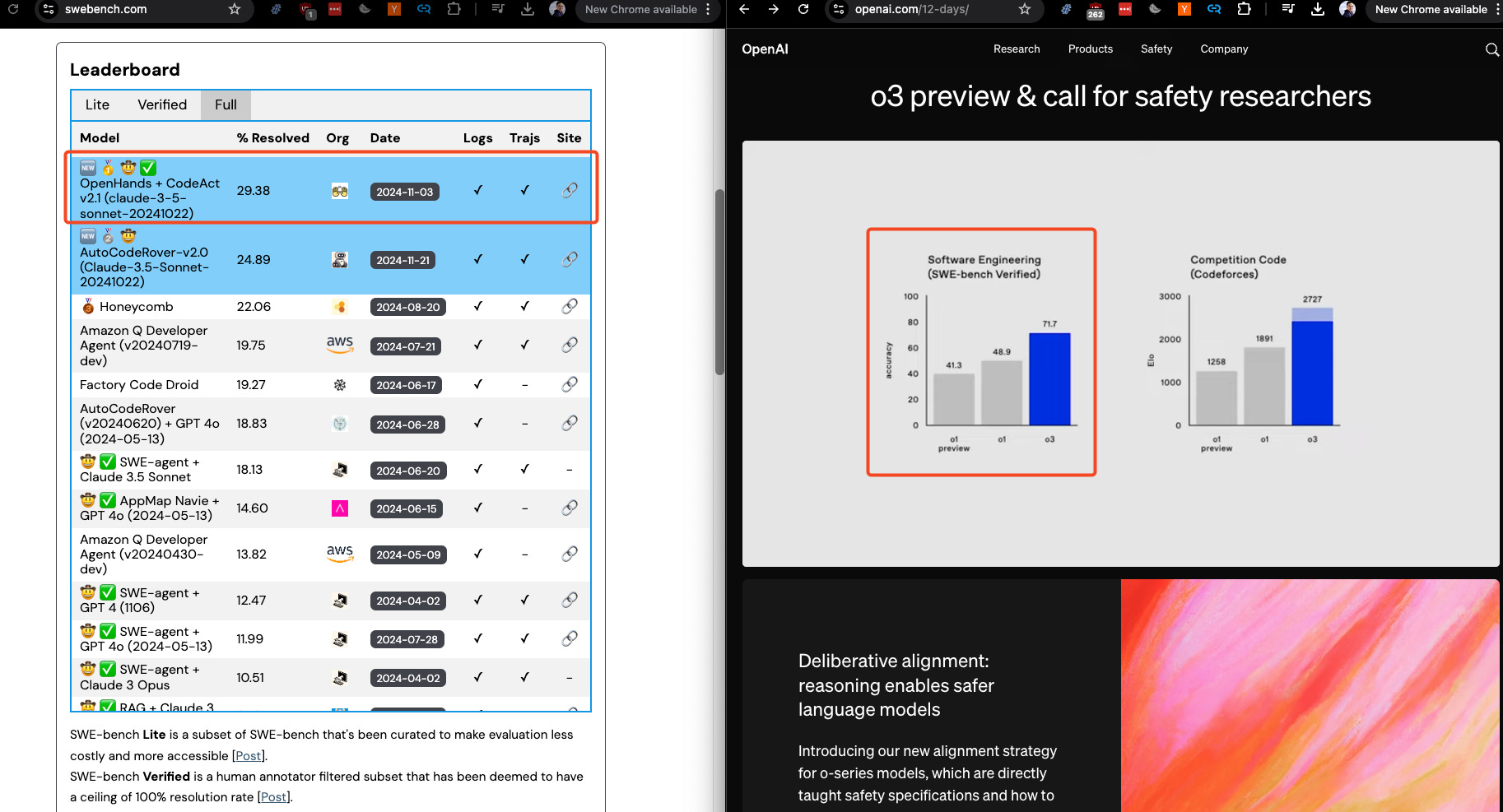
2024 in Agents [LS Live! @ NeurIPS 2024]
Happy holidays! We’ll be sharing snippets from Latent Space LIVE! through the break bringing you the best of 2024! We want to express our deepest appreciation to event sponsors AWS, Daylight Computer, Thoth.ai, StrongCompute, Notable Capital, and most of all all our LS supporters who helped fund the gorgeous venue and A/V production!For NeurIPS last year we did our standard conference podcast coverage interviewing selected papers (that we have now also done for ICLR and ICML), however we felt that we could be doing more to help AI Engineers 1) get more industry-relevant content, and 2) recap 2024 year in review from experts. As a result, we organized the first Latent Space LIVE!, our first in person miniconference, at NeurIPS 2024 in Vancouver.Our next keynote covers The State of LLM Agents, with the triumphant return of Professor Graham Neubig’s return to the pod (his ICLR episode here!). OpenDevin is now a startup known as AllHands! The renamed OpenHands has done extremely well this year, as they end the year sitting comfortably at number 1 on the hardest SWE-Bench Full leaderboard at 29%, though on the smaller SWE-Bench Verified, they are at 53%, behind Amazon Q, devlo, and OpenAI's self reported o3 results at 71.7%.Many are saying that 2025 is going to be the year of agents, with OpenAI, DeepMind and Anthropic setting their sights on consumer and coding agents, vision based computer-using agents and multi agent systems. There has been so much progress on the practical reliability and applications of agents in all domains, from the huge launch of Cognition AI's Devin this year, to the sleeper hit of Cursor Composer and Codeium's Windsurf Cascade in the IDE arena, to the explosive revenue growth of Stackblitz's Bolt, Lovable, and Vercel's v0, and the unicorn rounds and high profile movements of customer support agents like Sierra (now worth $4 billion) and search agents like Perplexity (now worth $9 billion). We wanted to take a little step back to understand the most notable papers of the year in Agents, and Graham indulged with his list of 8 perennial problems in building agents in 2024.Must-Read Papers for the 8 Problems of Agents* The agent-computer interface: CodeAct: Executable Code Actions Elicit Better LLM Agents. Minimial viable tools: Execution Sandbox, File Editor, Web Browsing* The human-agent interface: Chat UI, GitHub Plugin, Remote runtime, …?* Choosing an LLM: See Evaluation of LLMs as Coding Agents on SWE-Bench at 30x - must understand instructions, tools, code, environment, error recovery* Planning: Single Agent Systems vs Multi Agent (CoAct: A Global-Local Hierarchy for Autonomous Agent Collaboration) - Explicit vs Implicit, Curated vs Generated* Reusable common workflows: SteP: Stacked LLM Policies for Web Actions and Agent Workflow Memory - Manual prompting vs Learning from Experience* Exploration: Agentless: Demystifying LLM-based Software Engineering Agents and BAGEL: Bootstrapping Agents by Guiding Exploration with Language* Search: Tree Search for Language Model Agents - explore paths and rewind* Evaluation: Fast Sanity Checks (miniWoB and Aider) and Highly Realistic (WebArena, SWE-Bench) and SWE-Gym: An Open Environment for Training Software Engineering Agents & VerifiersFull Talk on YouTubePlease like and subscribe!Timestamps* 00:00 Welcome to Latent Space Live at NeurIPS 2024* 00:29 State of LLM Agents in 2024* 02:20 Professor Graham Newbig's Insights on Agents* 03:57 Live Demo: Coding Agents in Action* 08:20 Designing Effective Agents* 14:13 Choosing the Right Language Model for Agents* 16:24 Planning and Workflow for Agents* 22:21 Evaluation and Future Predictions for Agents* 25:31 Future of Agent Development* 25:56 Human-Agent Interaction Challenges* 26:48 Expanding Agent Use Beyond Programming* 27:25 Redesigning Systems for Agent Efficiency* 28:03 Accelerating Progress with Agent Technology* 28:28 Call to Action for Open Source Contributions* 30:36 Q&A: Agent Performance and Benchmarks* 33:23 Q&A: Web Agents and Interaction Methods* 37:16 Q&A: Agent Architectures and Improvements* 43:09 Q&A: Self-Improving Agents and Authentication* 47:31 Live Demonstration and Closing RemarksTranscript[00:00:29] State of LLM Agents in 2024[00:00:29] Speaker 9: Our next keynote covers the state of LLM agents. With the triumphant return of Professor Graham Newbig of CMU and OpenDevon, now a startup known as AllHands. The renamed OpenHands has done extremely well this year, as they end the year sitting comfortably at number one on the hardest SWE Benchful leaderboard at 29%.[00:00:53] Speaker 9: Though, on the smaller SWE bench verified, they are at 53 percent behind Amazon Q [00:01:00] Devlo and OpenAI's self reported O3 results at 71. 7%. Many are saying that 2025 is going to be the year of agents, with OpenAI, DeepMind, and Anthropic setting their sights on consumer and coding agents. Vision based computer using agents and multi agent systems.[00:01:22] Speaker 9: There has been so much pr
2024 in Synthetic Data and Smol Models [LS Live @ NeurIPS]
Happy holidays! We’ll be sharing snippets from Latent Space LIVE! through the break bringing you the best of 2024! We want to express our deepest appreciation to event sponsors AWS, Daylight Computer, Thoth.ai, StrongCompute, Notable Capital, and most of all all our LS supporters who helped fund the gorgeous venue and A/V production!For NeurIPS last year we did our standard conference podcast coverage interviewing selected papers (that we have now also done for ICLR and ICML), however we felt that we could be doing more to help AI Engineers 1) get more industry-relevant content, and 2) recap 2024 year in review from experts. As a result, we organized the first Latent Space LIVE!, our first in person miniconference, at NeurIPS 2024 in Vancouver. Today, we’re proud to share Loubna’s highly anticipated talk (slides here)!Synthetic DataWe called out the Synthetic Data debate at last year’s NeurIPS, and no surprise that 2024 was dominated by the rise of synthetic data everywhere:* Apple’s Rephrasing the Web, Microsoft’s Phi 2-4 and Orca/AgentInstruct, Tencent’s Billion Persona dataset, DCLM, and HuggingFace’s FineWeb-Edu, and Loubna’s own Cosmopedia extended the ideas of synthetic textbook and agent generation to improve raw web scrape dataset quality* This year we also talked to the IDEFICS/OBELICS team at HuggingFace who released WebSight this year, the first work on code-vs-images synthetic data.* We called Llama 3.1 the Synthetic Data Model for its extensive use (and documentation!) of synthetic data in its pipeline, as well as its permissive license. * Nemotron CC and Nemotron-4-340B also made a big splash this year for how they used 20k items of human data to synthesize over 98% of the data used for SFT/PFT.* Cohere introduced Multilingual Arbitrage: Optimizing Data Pools to Accelerate Multilingual Progress observing gains of up to 56.5% improvement in win rates comparing multiple teachers vs the single best teacher model* In post training, AI2’s Tülu3 (discussed by Luca in our Open Models talk) and Loubna’s Smol Talk were also notable open releases this year.This comes in the face of a lot of scrutiny and criticism, with Scale AI as one of the leading voices publishing AI models collapse when trained on recursively generated data in Nature magazine bringing mainstream concerns to the potential downsides of poor quality syndata:Part of the concerns we highlighted last year on low-background tokens are coming to bear: ChatGPT contaminated data is spiking in every possible metric:But perhaps, if Sakana’s AI Scientist pans out this year, we will have mostly-AI AI researchers publishing AI research anyway so do we really care as long as the ideas can be verified to be correct?Smol ModelsMeta surprised many folks this year by not just aggressively updating Llama 3 and adding multimodality, but also adding a new series of “small” 1B and 3B “on device” models this year, even working on quantized numerics collaborations with Qualcomm, Mediatek, and Arm. It is near unbelievable that a 1B model today can qualitatively match a 13B model of last year:and the minimum size to hit a given MMLU bar has come down roughly 10x in the last year. We have been tracking this proxied by Lmsys Elo and inference price:The key reads this year are:* MobileLLM: Optimizing Sub-billion Parameter Language Models for On-Device Use Cases* Apple Intelligence Foundation Language Models* Hymba: A Hybrid-head Architecture for Small Language Models* Loubna’s SmolLM and SmolLM2: a family of state-of-the-art small models with 135M, 360M, and 1.7B parameters on the pareto efficiency frontier.* and Moondream, which we already covered in the 2024 in Vision talkFull Talk on YouTubeplease like and subscribe!Timestamps* [00:00:05] Loubna Intro* [00:00:33] The Rise of Synthetic Data Everywhere* [00:02:57] Model Collapse* [00:05:14] Phi, FineWeb, Cosmopedia - Synthetic Textbooks* [00:12:36] DCLM, Nemotron-CC* [00:13:28] Post Training - AI2 Tulu, Smol Talk, Cohere Multilingual Arbitrage* [00:16:17] Smol Models* [00:18:24] On Device Models* [00:22:45] Smol Vision Models* [00:25:14] What's NextTranscript2024 in Synthetic Data and Smol Models[00:00:00] [00:00:05] Loubna Intro[00:00:05] Speaker: I'm very happy to be here. Thank you for the invitation. So I'm going to be talking about synthetic data in 2024. And then I'm going to be talking about small on device models. So I think the most interesting thing about synthetic data this year is that like now we have it everywhere in the large language models pipeline.[00:00:33] The Rise of Synthetic Data Everywhere[00:00:33] Speaker: I think initially, synthetic data was mainly used just for post training, because naturally that's the part where we needed human annotators. And then after that, we realized that we don't really have good benchmarks to [00:01:00] measure if models follow instructions well, if they are creative enough, or if they are chatty enough, so we also started using LLMs as judges.[00:01:08]
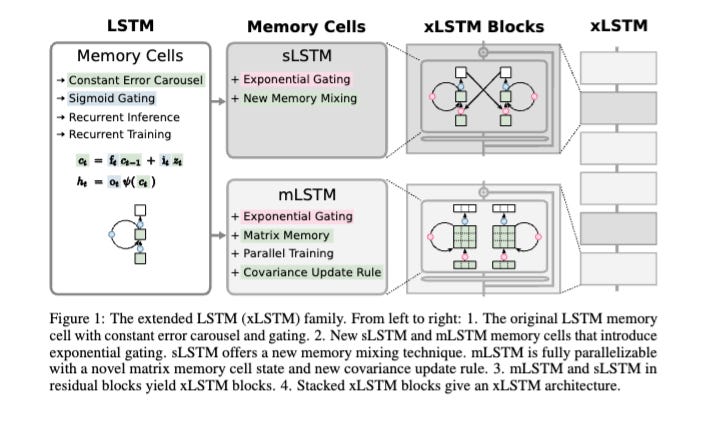
2024 in Post-Transformers Architectures (State Space Models, RWKV) [LS Live @ NeurIPS]
Happy holidays! We’ll be sharing snippets from Latent Space LIVE! through the break bringing you the best of 2024! We want to express our deepest appreciation to event sponsors AWS, Daylight Computer, Thoth.ai, StrongCompute, Notable Capital, and most of all all our LS supporters who helped fund the gorgeous venue and A/V production!Update: see followup discussion on HN and also the YouTube discussion.For NeurIPS last year we did our standard conference podcast coverage interviewing selected papers (that we have now also done for ICLR and ICML), however we felt that we could be doing more to help AI Engineers 1) get more industry-relevant content, and 2) recap 2024 year in review from experts. As a result, we organized the first Latent Space LIVE!, our first in person miniconference, at NeurIPS 2024 in Vancouver.Of perennial interest, particularly at academic conferences, is scaled-up architecture research as people hunt for the next Attention Is All You Need. We have many names for them: “efficient models”, “retentive networks”, “subquadratic attention” or “linear attention” but some of them don’t even have any lineage with attention - one of the best papers of this NeurIPS was Sepp Hochreiter’s xLSTM, which has a particularly poetic significance as one of the creators of the LSTM returning to update and challenge the OG language model architecture:So, for lack of a better term, we decided to call this segment “the State of Post-Transformers” and fortunately everyone rolled with it.We are fortunate to have two powerful friends of the pod to give us an update here:* Together AI: with CEO Vipul Ved Prakash and CTO Ce Zhang joining us to talk about how they are building Together together as a quote unquote full stack AI startup, from the lowest level kernel and systems programming to the highest level mathematical abstractions driving new model architectures and inference algorithms, with notable industry contributions from RedPajama v2, Flash Attention 3, Mamba 2, Mixture of Agents, BASED, Sequoia, Evo, Dragonfly, Dan Fu's ThunderKittens and many more research projects this year* Recursal AI: with CEO Eugene Cheah who has helped lead the independent RWKV project while also running Featherless AI. This year, the team has shipped RWKV v5, codenamed Eagle, to 1.5 billion Windows 10 and Windows 11 machines worldwide, to support Microsoft's on-device, energy-usage-sensitive Windows Copilot usecases, and has launched the first updates on RWKV v6, codenamed Finch and GoldFinch. On the morning of Latent Space Live, they also announced QRWKV6, a Qwen 32B model modified with RWKV linear attention layers. We were looking to host a debate between our speakers, but given that both of them were working on post-transformers alternativesFull Talk on YoutubePlease like and subscribe!LinksAll the models and papers they picked:* Earlier Cited Work* Transformers are RNNs: Fast Autoregressive Transformers with Linear Attention* Hungry hungry hippos: Towards language modeling with state space models* Hyena hierarchy: Towards larger convolutional language models* Mamba: Linear-Time Sequence Modeling with Selective State Spaces* S4: Efficiently Modeling Long Sequences with Structured State Spaces* Just Read Twice (Arora et al)* Recurrent large language models that compete with Transformers in language modeling perplexity are emerging at a rapid rate (e.g., Mamba, RWKV). Excitingly, these architectures use a constant amount of memory during inference. However, due to the limited memory, recurrent LMs cannot recall and use all the information in long contexts leading to brittle in-context learning (ICL) quality. A key challenge for efficient LMs is selecting what information to store versus discard. In this work, we observe the order in which information is shown to the LM impacts the selection difficulty. * To formalize this, we show that the hardness of information recall reduces to the hardness of a problem called set disjointness (SD), a quintessential problem in communication complexity that requires a streaming algorithm (e.g., recurrent model) to decide whether inputted sets are disjoint. We empirically and theoretically show that the recurrent memory required to solve SD changes with set order, i.e., whether the smaller set appears first in-context. * Our analysis suggests, to mitigate the reliance on data order, we can put information in the right order in-context or process prompts non-causally. Towards that end, we propose: (1) JRT-Prompt, where context gets repeated multiple times in the prompt, effectively showing the model all data orders. This gives 11.0±1.3 points of improvement, averaged across 16 recurrent LMs and the 6 ICL tasks, with 11.9× higher throughput than FlashAttention-2 for generation prefill (length 32k, batch size 16, NVidia H100). We then propose (2) JRT-RNN, which uses non-causal prefix-linear-attention to process prompts and provides 99% of Transformer quality at 360M params., 30B tokens and 96% at 1
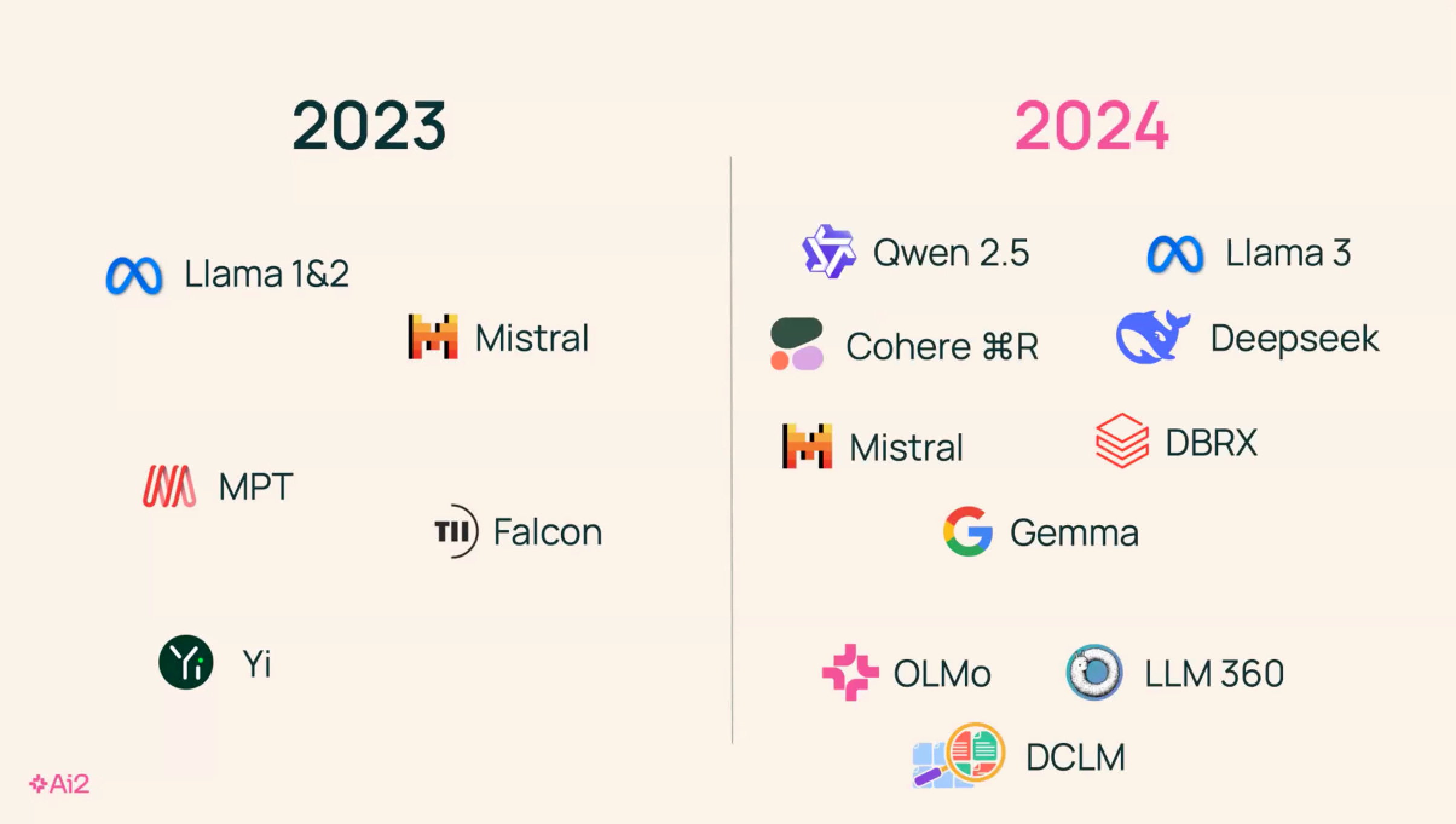
2024 in Open Models [LS Live @ NeurIPS]
Happy holidays! We’ll be sharing snippets from Latent Space LIVE! through the break bringing you the best of 2024! We want to express our deepest appreciation to event sponsors AWS, Daylight Computer, Thoth.ai, StrongCompute, Notable Capital, and most of all our LS supporters who helped fund the venue and A/V production!For NeurIPS last year we did our standard conference podcast coverage interviewing selected papers (that we have now also done for ICLR and ICML), however we felt that we could be doing more to help AI Engineers 1) get more industry-relevant content, and 2) recap 2024 year in review from experts. As a result, we organized the first Latent Space LIVE!, our first in person miniconference, at NeurIPS 2024 in Vancouver.Since Nathan Lambert ( Interconnects ) joined us for the hit RLHF 201 episode at the start of this year, it is hard to overstate how much Open Models have exploded this past year. In 2023 only five names were playing in the top LLM ranks, Mistral, Mosaic's MPT, TII UAE's Falcon, Yi from Kai-Fu Lee's 01.ai, and of course Meta's Llama 1 and 2. This year a whole cast of new open models have burst on the scene, from Google's Gemma and Cohere's Command R, to Alibaba's Qwen and Deepseek models, to LLM 360 and DCLM and of course to the Allen Institute's OLMo, OL MOE, Pixmo, Molmo, and Olmo 2 models. We were honored to host Luca Soldaini, one of the research leads on the Olmo series of models at AI2.Pursuing Open Model research comes with a lot of challenges beyond just funding and access to GPUs and datasets, particularly the regulatory debates this year across Europe, California and the White House. We also were honored to hear from and Sophia Yang, head of devrel at Mistral, who also presented a great session at the AI Engineer World's Fair Open Models track!Full Talk on YouTubePlease like and subscribe!Timestamps* 00:00 Welcome to Latent Space Live * 00:12 Recap of 2024: Best Moments and Keynotes * 01:22 Explosive Growth of Open Models in 2024 * 02:04 Challenges in Open Model Research * 02:38 Keynote by Luca Soldani: State of Open Models * 07:23 Significance of Open Source AI Licenses * 11:31 Research Constraints and Compute Challenges * 13:46 Fully Open Models: A New Trend * 27:46 Mistral's Journey and Innovations * 32:57 Interactive Demo: Lachat Capabilities * 36:50 Closing Remarks and NetworkingTranscriptSession3Audio[00:00:00] AI Charlie: Welcome to Latent Space Live, our first mini conference held at NeurIPS 2024 in Vancouver. This is Charlie, your AI co host. As a special treat this week, we're recapping the best of 2024 going domain by domain. We sent out a survey to the over 900 of you who told us what you wanted, and then invited the best speakers in the latent space network to cover each field.[00:00:28] AI Charlie: 200 of you joined us in person throughout the day, with over 2, 200 watching live online. Our next keynote covers the state of open models in 2024, with Luca Soldani and Nathan Lambert of the Allen Institute for AI, with a special appearance from Dr. Sophia Yang of Mistral. Our first hit episode of 2024 was with Nathan Lambert on RLHF 201 back in January.[00:00:57] AI Charlie: Where he discussed both reinforcement learning for language [00:01:00] models and the growing post training and mid training stack with hot takes on everything from constitutional AI to DPO to rejection sampling and also previewed the sea change coming to the Allen Institute. And to Interconnects, his incredible substack on the technical aspects of state of the art AI training.[00:01:18] AI Charlie: We highly recommend subscribing to get access to his Discord as well. It is hard to overstate how much open models have exploded this past year. In 2023, only five names were playing in the top LLM ranks. Mistral, Mosaics MPT, and Gatsby. TII UAE's Falcon, Yi, from Kaifu Lee's 01. ai, And of course, Meta's Lama 1 and 2.[00:01:43] AI Charlie: This year, a whole cast of new open models have burst on the scene. From Google's Jemma and Cohere's Command R, To Alibaba's Quen and DeepSeq models, to LLM360 and DCLM, and of course, to the Allen Institute's OLMO, [00:02:00] OLMOE, PIXMO, MOLMO, and OLMO2 models. Pursuing open model research comes with a lot of challenges beyond just funding and access to GPUs and datasets, particularly the regulatory debates this year across Europe.[00:02:14] AI Charlie: California and the White House. We also were honored to hear from Mistral, who also presented a great session at the AI Engineer World's Fair Open Models track. As always, don't forget to check the show notes for the YouTube link to their talk, as well as their slides. Watch out and take care.[00:02:35] Luca Intro[00:02:35] Luca Soldaini: Cool. Yeah, thanks for having me over. I'm Luca. I'm a research scientist at the Allen Institute for AI. I threw together a few slides on sort of like a recap of like interesting themes in open models for, for 2024. Have about maybe 20, 25 minutes of slides, and then we
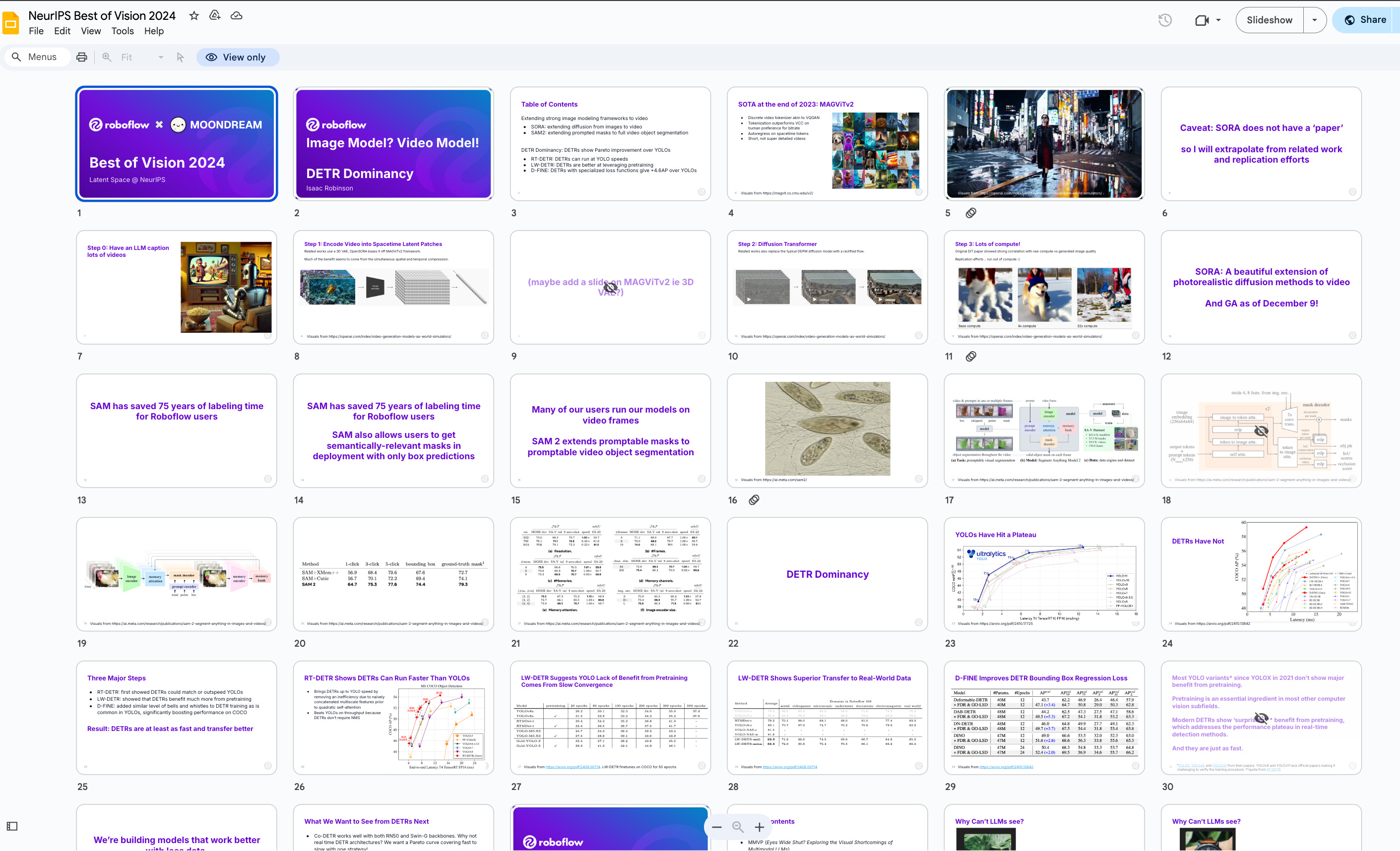
2024 in Vision [LS Live @ NeurIPS]
Happy holidays! We’ll be sharing snippets from Latent Space LIVE! through the break bringing you the best of 2024! We want to express our deepest appreciation to event sponsors AWS, Daylight Computer, Thoth.ai, StrongCompute, Notable Capital, and most of all all our LS supporters who helped fund the gorgeous venue and A/V production!For NeurIPS last year we did our standard conference podcast coverage interviewing selected papers (that we have now also done for ICLR and ICML), however we felt that we could be doing more to help AI Engineers 1) get more industry-relevant content, and 2) recap 2024 year in review from experts. As a result, we organized the first Latent Space LIVE!, our first in person miniconference, at NeurIPS 2024 in Vancouver.The single most requested domain was computer vision, and we could think of no one better to help us recap 2024 than our friends at Roboflow, who was one of our earliest guests in 2023 and had one of this year’s top episodes in 2024 again. Roboflow has since raised a $40m Series B!LinksTheir slides are here:All the trends and papers they picked:* Isaac Robinson* Sora (see our Video Diffusion pod) - extending diffusion from images to video* SAM 2: Segment Anything in Images and Videos (see our SAM2 pod) - extending prompted masks to full video object segmentation* DETR Dominancy: DETRs show Pareto improvement over YOLOs* RT-DETR: DETRs Beat YOLOs on Real-time Object Detection* LW-DETR: A Transformer Replacement to YOLO for Real-Time Detection* D-FINE: Redefine Regression Task in DETRs as Fine-grained Distribution Refinement* Peter Robicheaux* MMVP (Eyes Wide Shut? Exploring the Visual Shortcomings of Multimodal LLMs)* * Florence 2 (Florence-2: Advancing a Unified Representation for a Variety of Vision Tasks) * PalíGemma / PaliGemma 2* PaliGemma: A versatile 3B VLM for transfer* PaliGemma 2: A Family of Versatile VLMs for Transfer* AlMv2 (Multimodal Autoregressive Pre-training of Large Vision Encoders) * Vik Korrapati - MoondreamFull Talk on YouTubeWant more content like this? Like and subscribe to stay updated on our latest talks, interviews, and podcasts.Transcript/Timestamps[00:00:00] Intro[00:00:05] AI Charlie: welcome to Latent Space Live, our first mini conference held at NeurIPS 2024 in Vancouver. This is Charlie, your AI co host. When we were thinking of ways to add value to our academic conference coverage, we realized that there was a lack of good talks, just recapping the best of 2024, going domain by domain.[00:00:36] AI Charlie: We sent out a survey to the over 900 of you. who told us what you wanted, and then invited the best speakers in the Latent Space Network to cover each field. 200 of you joined us in person throughout the day, with over 2, 200 watching live online. Our second featured keynote is The Best of Vision 2024, with Peter Robichaud and Isaac [00:01:00] Robinson of Roboflow, with a special appearance from Vic Corrapati of Moondream.[00:01:05] AI Charlie: When we did a poll of our attendees, the highest interest domain of the year was vision. And so our first port of call was our friends at Roboflow. Joseph Nelson helped us kickstart our vision coverage in episode 7 last year, and this year came back as a guest host with Nikki Ravey of Meta to cover segment Anything 2.[00:01:25] AI Charlie: Roboflow have consistently been the leaders in open source vision models and tooling. With their SuperVision library recently eclipsing PyTorch's Vision library. And Roboflow Universe hosting hundreds of thousands of open source vision datasets and models. They have since announced a 40 million Series B led by Google Ventures.[00:01:46] AI Charlie: Woohoo.[00:01:48] Isaac's picks[00:01:48] Isaac Robinson: Hi, we're Isaac and Peter from Roboflow, and we're going to talk about the best papers of 2024 in computer vision. So, for us, we defined best as what made [00:02:00] the biggest shifts in the space. And to determine that, we looked at what are some major trends that happened and what papers most contributed to those trends.[00:02:09] Isaac Robinson: So I'm going to talk about a couple trends, Peter's going to talk about a trend, And then we're going to hand it off to Moondream. So, the trends that I'm interested in talking about are These are a major transition from models that run on per image basis to models that run using the same basic ideas on video.[00:02:28] Isaac Robinson: And then also how debtors are starting to take over the real time object detection scene from the YOLOs, which have been dominant for years.[00:02:37] Sora, OpenSora and Video Vision vs Generation[00:02:37] Isaac Robinson: So as a highlight we're going to talk about Sora, which from my perspective is the biggest paper of 2024, even though it came out in February. Is the what?[00:02:48] Isaac Robinson: Yeah. Yeah. So just it's a, SORA is just a a post. So I'm going to fill it in with details from replication efforts, including open SORA and related work, such as a stable [00:03:0
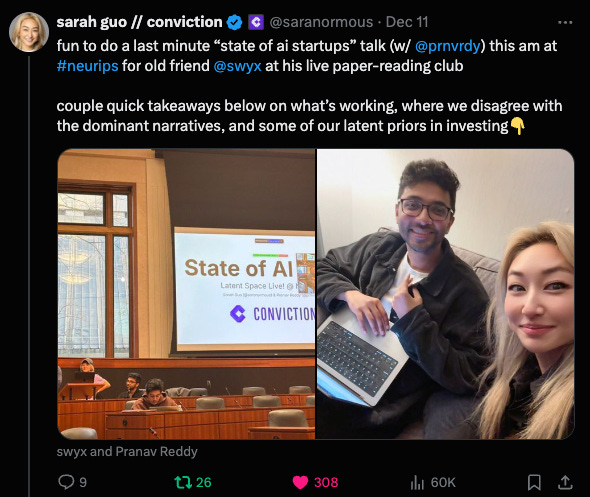
2024 in AI Startups [LS Live @ NeurIPS]
Happy holidays! We’ll be sharing snippets from Latent Space LIVE! through the break bringing you the best of 2024 from friends of the pod!For NeurIPS last year we did our standard conference podcast coverage interviewing selected papers (that we have now also done for ICLR and ICML), however we felt that we could be doing more to help AI Engineers 1) get more industry-relevant content, and 2) recap 2024 year in review from experts. As a result, we organized the first Latent Space LIVE!, our first in person miniconference, at NeurIPS 2024 in Vancouver. For our opening keynote, we could think of no one better to cover 'The State of AI Startups' than our friend Sarah Guo (AI superinvestor, founder of Conviction, host of No Priors!) and Pranav Reddy (Conviction partner) to share their takes on how the AI landscape evolved in 2024 examine the evolving AI landscape and what it means for startups, enterprises, and the industry as a whole! They completely understood the assignment.Recorded live with 200+ in-person and 2200+ online attendees at NeurIPS 2024, this keynote kicks off our mini-conference series exploring different domains of AI development in 2024. Enjoy!LinksSlides: https://x.com/saranormous/status/1866933642401886707Sarh Guo: https://x.com/saranormousPranav Reddy: https://x.com/prnvrdyFull Video on YouTubeWant more content like this? Like and subscribe to stay updated on our latest talks, interviews, and podcasts. This is a public episode. If you'd like to discuss this with other subscribers or get access to bonus episodes, visit www.latent.space/subscribe
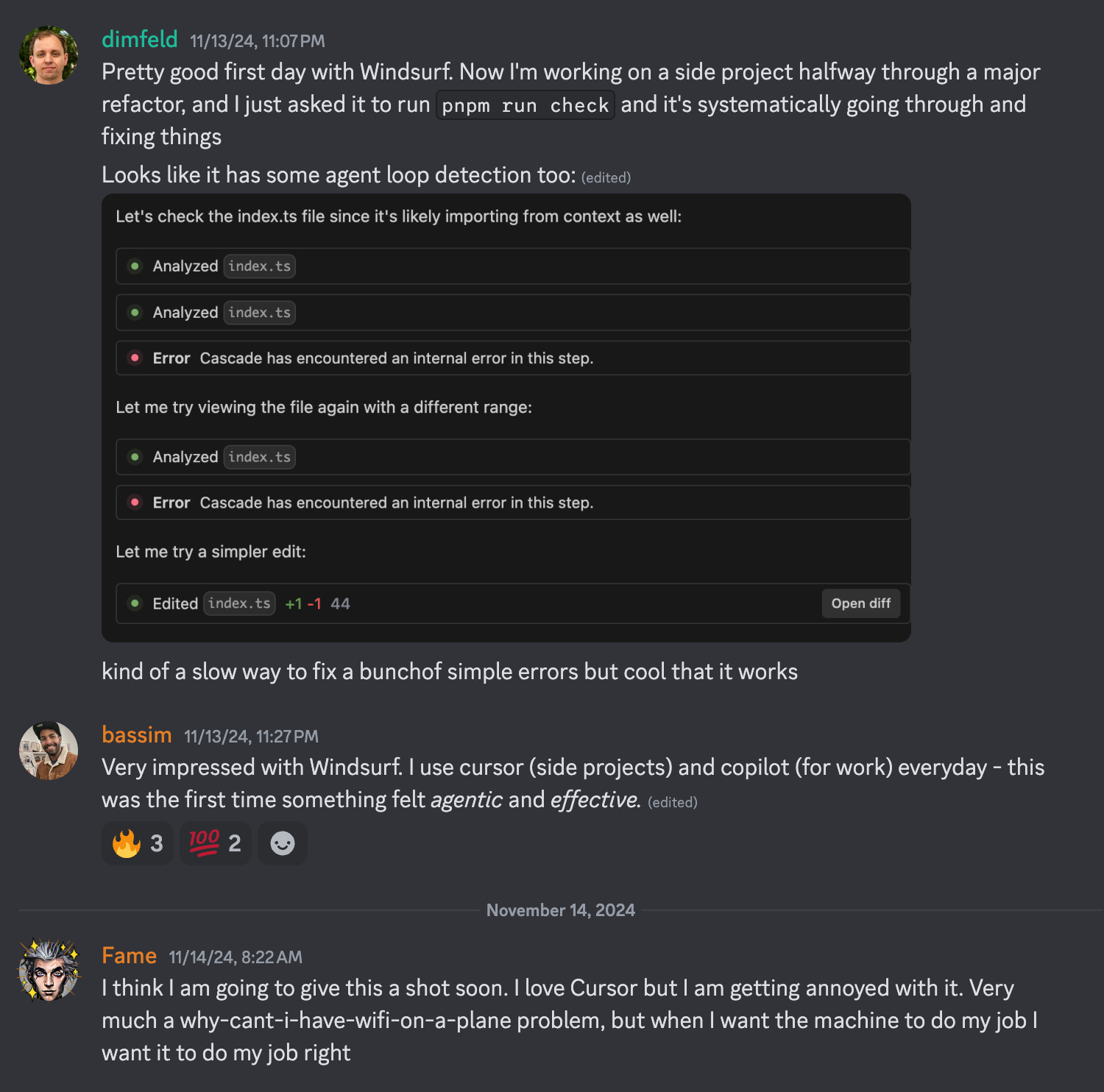
Windsurf: The Enterprise AI IDE - with Varun and Anshul of Codeium AI
Our second podcast guest ever in March 2023 was Varun Mohan, CEO of Codeium; at the time, they had around 10,000 users and how they vowed to keep their autocomplete free forever: Today, over a million developers use their products, they still have their free tier, and they recently launched Windsurf, an AI IDE. Chapters* 00:00:00: Introductions & Catchup* 00:03:52: Why they created Windsurf* 00:05:52: Limitations of VS Code* 00:10:12: Evaluation methods for Cascade and Windsurf* 00:16:15: Listener questions about Windsurf launch* 00:20:30: Remote execution and security concerns* 00:25:18: Evolution of Codeium's strategy* 00:28:29: Cascade and its capabilities* 00:33:12: Multi-agent systems* 00:37:02: Areas of improvement for Windsurf* 00:39:12: Building an enterprise-first company* 00:42:01: Copilot for X, AI UX, and Enterprise AI blog posts This is a public episode. If you'd like to discuss this with other subscribers or get access to bonus episodes, visit www.latent.space/subscribe
Generative Video WorldSim, Diffusion, Vision, Reinforcement Learning and Robotics — ICML 2024 Part 1
Regular tickets are now sold out for Latent Space LIVE! at NeurIPS! We have just announced our last speaker and newest track, friend of the pod Nathan Lambert who will be recapping 2024 in Reasoning Models like o1! We opened up a handful of late bird tickets for those who are deciding now — use code DISCORDGANG if you need it. See you in Vancouver!We’ve been sitting on our ICML recordings for a while (from today’s first-ever SOLO guest cohost, Brittany Walker), and in light of Sora Turbo’s launch (blogpost, tutorials) today, we figured it would be a good time to drop part one which had been gearing up to be a deep dive into the state of generative video worldsim, with a seamless transition to vision (the opposite modality), and finally robots (their ultimate application).Sora, Genie, and the field of Generative Video World SimulatorsBill Peebles, author of Diffusion Transformers, gave his most recent Sora talk at ICML, which begins our episode:* William (Bill) Peebles - SORA (slides)Something that is often asked about Sora is how much inductive biases were introduced to achieve these results. Bill references the same principles brought by Hyung Won Chung from the o1 team - “sooner or later those biases come back to bite you”.We also recommend these reads from throughout 2024 on Sora.* Lilian Weng’s literature review of Video Diffusion Models* Sora API leak* Estimates of 100k-700k H100s needed to serve Sora (not Turbo)* Artist guides on using Sora for professional storytellingGoogle DeepMind had a remarkably strong presence at ICML on Video Generation Models, winning TWO Best Paper awards for:* Genie: Generative Interactive Environments (covered in oral, poster, and workshop)* VideoPoet: A Large Language Model for Zero-Shot Video Generation (see website)We end this part by taking in Tali Dekel’s talk on The Future of Video Generation: Beyond Data and Scale.Part 2: Generative Modeling and DiffusionSince 2023, Sander Dieleman’s perspectives (blogpost, tweet) on diffusion as “spectral autoregression in the frequency domain” while working on Imagen and Veo have caught the public imagination, so we highlight his talk:* Wading through the noise: an intuitive look at diffusion modelsThen we go to Ben Poole for his talk on Inferring 3D Structure with 2D Priors, including his work on NeRFs and DreamFusion:Then we investigate two flow matching papers - one from the Flow Matching co-authors - Ricky T. Q. Chen (FAIR, Meta)And how it is implemented in Stable Diffusion 3 with Scaling Rectified Flow Transformers for High-Resolution Image Synthesis Our last hit on Diffusion is a couple of oral presentations on speech, which we leave you to explore via our audio podcast* NaturalSpeech 3: Zero-Shot Speech Synthesis with Factorized Codec and Diffusion Models* Speech Self-Supervised Learning Using Diffusion Model Synthetic DataPart 3: VisionThe ICML Test of Time winner was DeCAF, which Trevor Darrell notably called “the OG vision foundation model”.Lucas Beyer’s talk on “Vision in the age of LLMs — a data-centric perspective” was also well received online, and he talked about his journey from Vision Transformers to PaliGemma.We give special honorable mention to MLLM-as-a-Judge: Assessing Multimodal LLM-as-a-Judge with Vision-Language Benchmark.Part 4: Reinforcement Learning and RoboticsWe segue vision into robotics with the help of Ashley Edwards, whose work on both the Gato and the Genie teams at Deepmind is summarized in Learning actions, policies, rewards, and environments from videos alone.Brittany highlighted two poster session papers:* Behavior Generation with Latent Actions* We also recommend Lerrel Pinto’s On Building General-Purpose Robots* PIVOT: Iterative Visual Prompting Elicits Actionable Knowledge for VLMsHowever we must give the lion’s share of space to Chelsea Finn, now founder of Physical Intelligence, who gave FOUR talks on* "What robots have taught me about machine learning"* developing robot generalists* robots that adapt autonomously* how to give feedback to your language model* special mention to PI colleague Sergey Levine on Robotic Foundation ModelsWe end the podcast with a position paper that links generative environments and RL/robotics: Automatic Environment Shaping is the Next Frontier in RL.Timestamps* [00:00:00] Intros* [00:02:43] Sora - Bill Peebles* [00:44:52] Genie: Generative Interactive Environments* [01:00:17] Genie interview* [01:12:33] VideoPoet: A Large Language Model for Zero-Shot Video Generation* [01:30:51] VideoPoet interview - Dan Kondratyuk* [01:42:00] Tali Dekel - The Future of Video Generation: Beyond Data and Scale.* [02:27:07] Sander Dieleman - Wading through the noise: an intuitive look at diffusion models* [03:06:20] Ben Poole - Inferring 3D Structure with 2D Priors* [03:30:30] Ricky Chen - Flow Matching* [04:00:03] Patrick Esser - Stable Diffusion 3* [04:14:30] NaturalSpeech 3: Zero-Shot Speech Synthesis with Factorized Codec and Diffusion Models* [04:27:00] Speech Self-Supervi
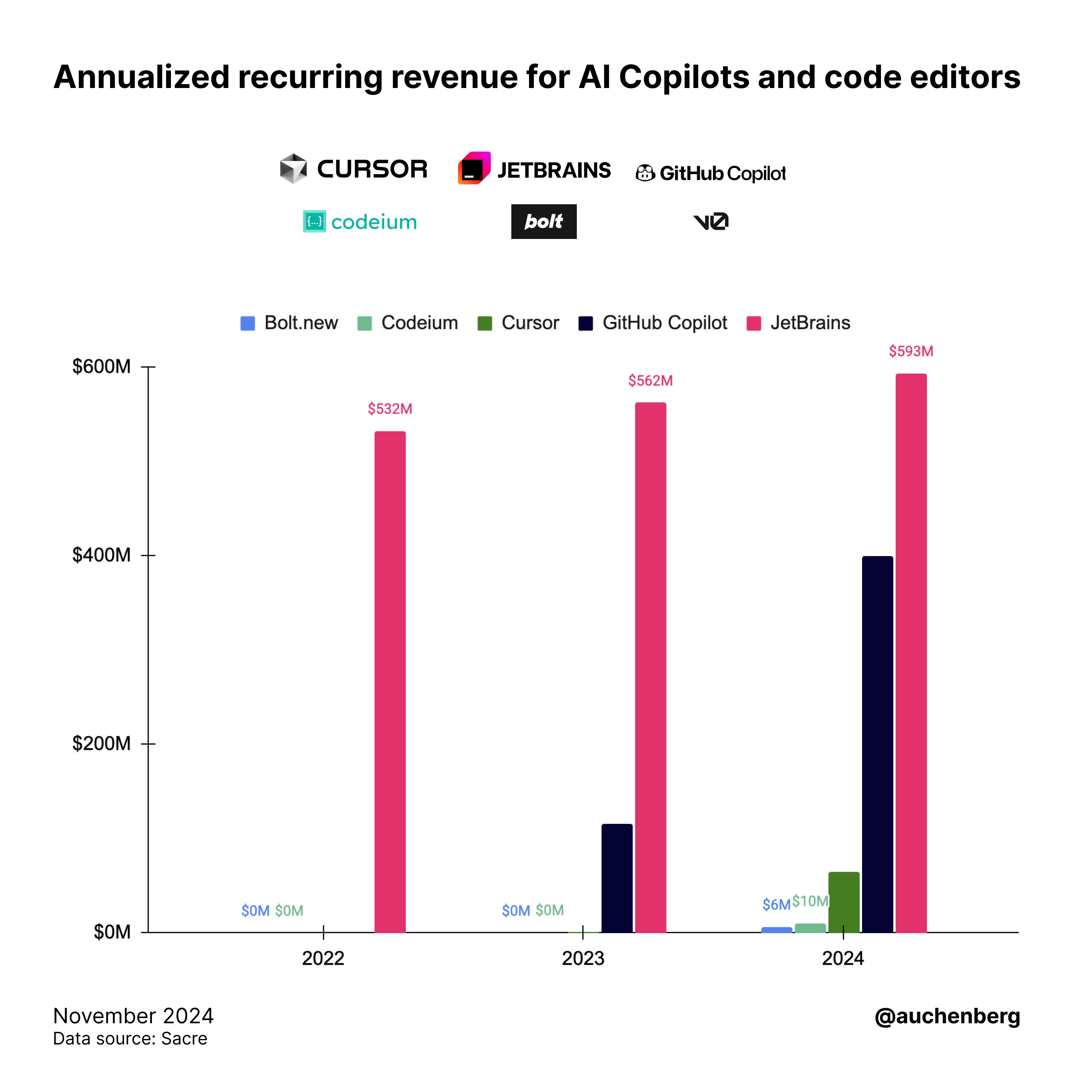
Bolt.new, Flow Engineering for Code Agents, and >$8m ARR in 2 months as a Claude Wrapper
The full schedule for Latent Space LIVE! at NeurIPS has been announced, featuring Best of 2024 overview talks for the AI Startup Landscape, Computer Vision, Open Models, Transformers Killers, Synthetic Data, Agents, and Scaling, and speakers from Sarah Guo of Conviction, Roboflow, AI2/Meta, Recursal/Together, HuggingFace, OpenHands and SemiAnalysis. Join us for the IRL event/Livestream! Alessio will also be holding a meetup at AWS Re:Invent in Las Vegas this Wednesday. See our new Events page for dates of AI Engineer Summit, Singapore, and World’s Fair in 2025. LAST CALL for questions for our big 2024 recap episode! Submit questions and messages on Speakpipe here for a chance to appear on the show!When we first observed that GPT Wrappers are Good, Actually, we did not even have Bolt on our radar. Since we recorded our Anthropic episode discussing building Agents with the new Claude 3.5 Sonnet, Bolt.new (by Stackblitz) has easily cleared the $8m ARR bar, repeating and accelerating its initial $4m feat.There are very many AI code generators and VS Code forks out there, but Bolt probably broke through initially because of its incredible zero shot low effort app generation:But as we explain in the pod, Bolt also emphasized deploy (Netlify)/ backend (Supabase)/ fullstack capabilities on top of Stackblitz’s existing WebContainer full-WASM-powered-developer-environment-in-the-browser tech. Since then, the team has been shipping like mad (with weekly office hours), with bugfixing, full screen, multi-device, long context, diff based edits (using speculative decoding like we covered in Inference, Fast and Slow).All of this has captured the imagination of low/no code builders like Greg Isenberg and many others on YouTube/TikTok/Reddit/X/Linkedin etc:Just as with Fireworks, our relationship with Bolt/Stackblitz goes a bit deeper than normal - swyx advised the launch and got a front row seat to this epic journey, as well as demoed it with Realtime Voice at the recent OpenAI Dev Day. So we are very proud to be the first/closest to tell the full open story of Bolt/Stackblitz!Flow Engineering + Qodo/AlphaCodium UpdateIn year 2 of the pod we have been on a roll getting former guests to return as guest cohosts (Harrison Chase, Aman Sanger, Jon Frankle), and it was a pleasure to catch Itamar Friedman back on the pod, giving us an update on all things Qodo and Testing Agents from our last catchup a year and a half ago:Qodo (they renamed in September) went viral in early January this year with AlphaCodium (paper here, code here) beating DeepMind’s AlphaCode with high efficiency:With a simple problem solving code agent:* The first step is to have the model reason about the problem. They describe it using bullet points and focus on the goal, inputs, outputs, rules, constraints, and any other relevant details.* Then, they make the model reason about the public tests and come up with an explanation of why the input leads to that particular output. * The model generates two to three potential solutions in text and ranks them in terms of correctness, simplicity, and robustness. * Then, it generates more diverse tests for the problem, covering cases not part of the original public tests. * Iteratively, pick a solution, generate the code, and run it on a few test cases. * If the tests fail, improve the code and repeat the process until the code passes every test.swyx has previously written similar thoughts on types vs tests for putting bounds on program behavior, but AlphaCodium extends this to AI generated tests and code.More recently, Itamar has also shown that AlphaCodium’s techniques also extend well to the o1 models:Making Flow Engineering a useful technique to improve code model performance on every model. This is something we see AI Engineers uniquely well positioned to do compared to ML Engineers/Researchers.Full Video PodcastLike and subscribe!Show Notes* Itamar* Qodo* First episode* Eric* Bolt* StackBlitz* Thinkster* AlphaCodium* WebContainersChapters* 00:00:00 Introductions & Updates* 00:06:01 Generic vs. Specific AI Agents* 00:07:40 Maintaining vs Creating with AI* 00:17:46 Human vs Agent Computer Interfaces* 00:20:15 Why Docker doesn't work for Bolt* 00:24:23 Creating Testing and Code Review Loops* 00:28:07 Bolt's Task Breakdown Flow* 00:31:04 AI in Complex Enterprise Environments* 00:41:43 AlphaCodium* 00:44:39 Strategies for Breaking Down Complex Tasks* 00:45:22 Building in Open Source* 00:50:35 Choosing a product as a founder* 00:59:03 Reflections on Bolt Success* 01:06:07 Building a B2C GTM* 01:18:11 AI Capabilities and Pricing Tiers* 01:20:28 What makes Bolt unique* 01:23:07 Future Growth and Product Development* 01:29:06 Competitive Landscape in AI Engineering* 01:30:01 Advice to Founders and Embracing AI* 01:32:20 Having a baby and completing an Iron ManTranscriptAlessio [00:00:00]: Hey everyone, welcome to the Latent Space Podcast. This is Alessio, partner and CTO at Decibel Partners, and I'm joined by my co-host S
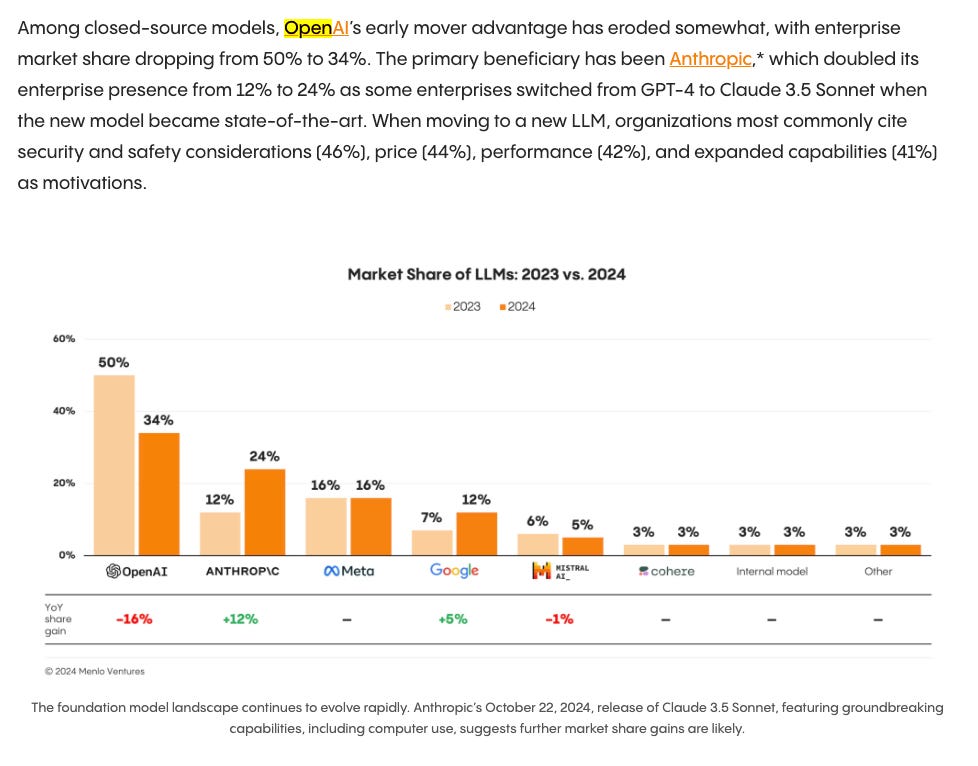
The new Claude 3.5 Sonnet, Computer Use, and Building SOTA Agents — with Erik Schluntz, Anthropic
We have announced our first speaker, friend of the show Dylan Patel, and topic slates for Latent Space LIVE! at NeurIPS. Sign up for IRL/Livestream and to debate!We are still taking questions for our next big recap episode! Submit questions and messages on Speakpipe here for a chance to appear on the show!The vibe shift we observed in July - in favor of Claude 3.5 Sonnet, first introduced in June — has been remarkably long lived and persistent, surviving multiple subsequent updates of 4o, o1 and Gemini versions, for Anthropic’s Claude to end 2024 as the preferred model for AI Engineers and even being the exclusive choice for new code agents like bolt.new (our next guest on the pod!), which unlocked so much performance from Claude Sonnet that it went from $0 to $4m ARR in 4 weeks when it launched last month.Anthropic has now raised an additional $4b from Amazon and made an incredibly well received update of Claude 3.5 Sonnet (and Haiku), making significant improvements in performance over its predecessors:Solving SWE-BenchAs part of the October Sonnet release, Anthropic teased a blink-and-you’ll miss it result:The updated Claude 3.5 Sonnet shows wide-ranging improvements on industry benchmarks, with particularly strong gains in agentic coding and tool use tasks. On coding, it improves performance on SWE-bench Verified from 33.4% to 49.0%, scoring higher than all publicly available models—including reasoning models like OpenAI o1-preview and specialized systems designed for agentic coding. It also improves performance on TAU-bench, an agentic tool use task, from 62.6% to 69.2% in the retail domain, and from 36.0% to 46.0% in the more challenging airline domain. The new Claude 3.5 Sonnet offers these advancements at the same price and speed as its predecessor.This was followed up by a blogpost a week later from today’s guest, Erik Schluntz, the engineer who implemented and scored this SOTA result using a simple, non-overengineered version of the SWE-Agent framework (you can see the submissions here). We have previously covered the SWE-Bench story extensively:* Speaking with SWEBench/SWEAgent authors at ICLR* Speaking with Cosine Genie, the previous SOTA (43.8%) on SWEBench Verified (with brief update at DevDay 2024)* Speaking with Shunyu Yao on SWEBench and the ReAct paradigm driving SWE-AgentOne of the notable inclusions in this blogpost are the tools that Erik decided to give Claude, e.g. the “Edit Tool”:The tools teased in the SWEBench submission/blogpost were then polished up and released with Computer Use…And you can also see even more computer use tools given in the new Model Context Protocol servers:Claude Computer UseBecause it is one of the best received AI releases of the year, we recommend watching the 2 minute Computer Use intro (and related demos) in its entirety:Eric also worked on Claude’s function calling, tool use, and computer use APIs, so we discuss that in the episode.Erik [00:53:39]: With computer use, just give the thing a browser that's logged into what you want to integrate with, and it's going to work immediately. And I see that reduction in friction as being incredibly exciting. Imagine a customer support team where, okay, hey, you got this customer support bot, but you need to go integrate it with all these things. And you don't have any engineers on your customer support team. But if you can just give the thing a browser that's logged into your systems that you need it to have access to, now, suddenly, in one day, you could be up and rolling with a fully integrated customer service bot that could go do all the actions you care about. So I think that's the most exciting thing for me about computer use, is reducing that friction of integrations to almost zero.As you’ll see, this is very top of mind for Erik as a former Robotics founder who’s company basically used robots to interface with human physical systems like elevators.Full Video episodePlease like and subscribe!Show Notes* Eric Schluntz* “Raising the bar on SWE-Bench Verified”* Cobalt Robotics* SWE-Bench* SWE-Bench Verified* Human Eval & other benchmarks* Anthropic Workbench* Aider* Cursor* Fireworks AI* E2B* Amanda Askell* Toyota Research* Physical Intelligence (Pi)* Chelsea Finn* Josh Albrecht* Eric Jang* 1X* Dust* Cosine Episode* Bolt* Adept Episode* TauBench* LMSys EpisodeTimestamps* [00:00:00] Introductions* [00:03:39] What is SWE-Bench?* [00:12:22] SWE-Bench vs HumanEval vs others* [00:15:21] SWE-Agent architecture and runtime* [00:21:18] Do you need code indexing?* [00:24:50] Giving the agent tools* [00:27:47] Sandboxing for coding agents* [00:29:16] Why not write tests?* [00:30:31] Redesigning engineering tools for LLMs* [00:35:53] Multi-agent systems* [00:37:52] Why XML so good?* [00:42:57] Thoughts on agent frameworks* [00:45:12] How many turns can an agent do?* [00:47:12] Using multiple model types* [00:51:40] Computer use and agent use cases* [00:59:04] State of AI robotics* [01:04:24] Robotics in manufacturing* [0
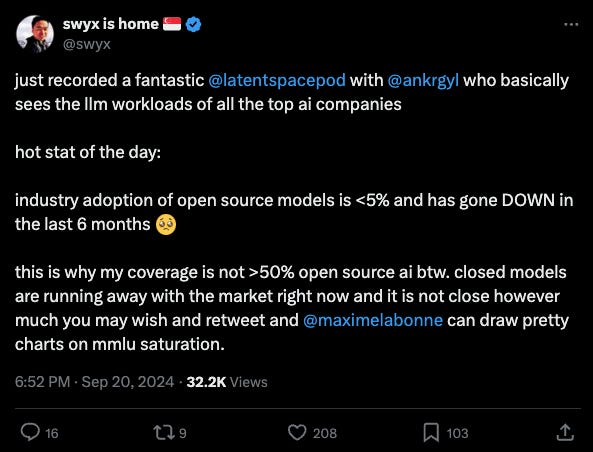
Why Compound AI + Open Source will beat Closed AI
We have a full slate of upcoming events: AI Engineer London, AWS Re:Invent in Las Vegas, and now Latent Space LIVE! at NeurIPS in Vancouver and online. Sign up to join and speak!We are still taking questions for our next big recap episode! Submit questions and messages on Speakpipe here for a chance to appear on the show!We try to stay close to the inference providers as part of our coverage, as our podcasts with Together AI and Replicate will attest: However one of the most notable pull quotes from our very well received Braintrust episode was his opinion that open source model adoption has NOT gone very well and is actually declining in relative market share terms (it is of course increasing in absolute terms):Today’s guest, Lin Qiao, would wholly disagree. Her team of Pytorch/GPU experts are wholly dedicated toward helping you serve and finetune the full stack of open source models from Meta and others, across all modalities (Text, Audio, Image, Embedding, Vision-understanding), helping customers like Cursor and Hubspot scale up open source model inference both rapidly and affordably.Fireworks has emerged after its successive funding rounds with top tier VCs as one of the leaders of the Compound AI movement, a term first coined by the Databricks/Mosaic gang at Berkeley AI and adapted as “Composite AI” by Gartner:Replicating o1We are the first podcast to discuss Fireworks’ f1, their proprietary replication of OpenAI’s o1. This has become a surprisingly hot area of competition in the past week as both Nous Forge and Deepseek r1 have launched competitive models.Full Video PodcastLike and subscribe!Timestamps* 00:00:00 Introductions* 00:02:08 Pre-history of Fireworks and PyTorch at Meta* 00:09:49 Product Strategy: From Framework to Model Library* 00:13:01 Compound AI Concept and Industry Dynamics* 00:20:07 Fireworks' Distributed Inference Engine* 00:22:58 OSS Model Support and Competitive Strategy* 00:29:46 Declarative System Approach in AI* 00:31:00 Can OSS replicate o1?* 00:36:51 Fireworks f1* 00:41:03 Collaboration with Cursor and Speculative Decoding* 00:46:44 Fireworks quantization (and drama around it)* 00:49:38 Pricing Strategy* 00:51:51 Underrated Features of Fireworks Platform* 00:55:17 HiringTranscriptAlessio [00:00:00]: Hey everyone, welcome to the Latent Space Podcast. This is Alessio, partner at CTO at Danceable Partners, and I'm joined by my co-host, Swyx founder, Osmalayar.Swyx [00:00:11]: Hey, and today we're in a very special studio inside the Fireworks office with Lin Qiang, CEO of Fireworks. Welcome. Yeah.Lin [00:00:20]: Oh, you should welcome us.Swyx [00:00:21]: Yeah, welcome. Yeah, thanks for having us. It's unusual to be in the home of a startup, but it's also, I think our relationship is a bit unusual compared to all our normal guests. Definitely.Lin [00:00:34]: Yeah. I'm super excited to talk about very interesting topics in that space with both of you.Swyx [00:00:41]: You just celebrated your two-year anniversary yesterday.Lin [00:00:43]: Yeah, it's quite a crazy journey. We circle around and share all the crazy stories across these two years, and it has been super fun. All the way from we experienced Silicon Valley bank run to we delete some data that shouldn't be deleted operationally. We went through a massive scale where we actually are busy getting capacity to, yeah, we learned to kind of work with it as a team with a lot of brilliant people across different places to join a company. It has really been a fun journey.Alessio [00:01:24]: When you started, did you think the technical stuff will be harder or the bank run and then the people side? I think there's a lot of amazing researchers that want to do companies and it's like the hardest thing is going to be building the product and then you have all these different other things. So, were you surprised by what has been your experience the most?Lin [00:01:42]: Yeah, to be honest with you, my focus has always been on the product side and then after the product goes to market. And I didn't realize the rest has been so complicated, operating a company and so on. But because I don't think about it, I just kind of manage it. So it's done. I think I just somehow don't think about it too much and solve whatever problem coming our way and it worked.Swyx [00:02:08]: So let's, I guess, let's start at the pre-history, the initial history of Fireworks. You ran the PyTorch team at Meta for a number of years and we previously had Sumit Chintal on and I think we were just all very interested in the history of GenEI. Maybe not that many people know how deeply involved Faire and Meta were prior to the current GenEI revolution.Lin [00:02:35]: My background is deep in distributed system, database management system. And I joined Meta from the data side and I saw this tremendous amount of data growth, which cost a lot of money and we're analyzing what's going on. And it's clear that AI is driving all this data generation. So it's a very interesting t
Agents @ Work: Lindy.ai
Alessio will be at AWS re:Invent next week and hosting a casual coffee meetup on Wednesday, RSVP here! And subscribe to our calendar for our Singapore, NeurIPS, and all upcoming meetups!We are still taking questions for our next big recap episode! Submit questions and messages on Speakpipe here for a chance to appear on the show!If you've been following the AI agents space, you have heard of Lindy AI; while founder Flo Crivello is hesitant to call it "blowing up," when folks like Andrew Wilkinson start obsessing over your product, you're definitely onto something.In our latest episode, Flo walked us through Lindy's evolution from late 2022 to now, revealing some design choices about agent platform design that go against conventional wisdom in the space.The Great Reset: From Text Fields to RailsRemember late 2022? Everyone was "LLM-pilled," believing that if you just gave a language model enough context and tools, it could do anything. Lindy 1.0 followed this pattern:* Big prompt field ✅* Bunch of tools ✅* Prayer to the LLM gods ✅Fast forward to today, and Lindy 2.0 looks radically different. As Flo put it (~17:00 in the episode): "The more you can put your agent on rails, one, the more reliable it's going to be, obviously, but two, it's also going to be easier to use for the user."Instead of a giant, intimidating text field, users now build workflows visually:* Trigger (e.g., "Zendesk ticket received")* Required actions (e.g., "Check knowledge base")* Response generationThis isn't just a UI change - it's a fundamental rethinking of how to make AI agents reliable. As Swyx noted during our discussion: "Put Shoggoth in a box and make it a very small, minimal viable box. Everything else should be traditional if-this-then-that software."The Surprising Truth About Model LimitationsHere's something that might shock folks building in the space: with Claude 3.5 Sonnet, the model is no longer the bottleneck. Flo's exact words (~31:00): "It is actually shocking the extent to which the model is no longer the limit. It was the limit a year ago. It was too expensive. The context window was too small."Some context: Lindy started when context windows were 4K tokens. Today, their system prompt alone is larger than that. But what's really interesting is what this means for platform builders:* Raw capabilities aren't the constraint anymore* Integration quality matters more than model performance* User experience and workflow design are the new bottlenecksThe Search Engine Parallel: Why Horizontal Platforms Might WinOne of the spiciest takes from our conversation was Flo's thesis on horizontal vs. vertical agent platforms. He draws a fascinating parallel to search engines (~56:00):"I find it surprising the extent to which a horizontal search engine has won... You go through Google to search Reddit. You go through Google to search Wikipedia... search in each vertical has more in common with search than it does with each vertical."His argument: agent platforms might follow the same pattern because:* Agents across verticals share more commonalities than differences* There's value in having agents that can work together under one roof* The R&D cost of getting agents right is better amortized across use casesThis might explain why we're seeing early vertical AI companies starting to expand horizontally. The core agent capabilities - reliability, context management, tool integration - are universal needs.What This Means for BuildersIf you're building in the AI agents space, here are the key takeaways:* Constrain First: Rather than maximizing capabilities, focus on reliable execution within narrow bounds* Integration Quality Matters: With model capabilities plateauing, your competitive advantage lies in how well you integrate with existing tools* Memory Management is Key: Flo revealed they actively prune agent memories - even with larger context windows, not all memories are useful* Design for Discovery: Lindy's visual workflow builder shows how important interface design is for adoptionThe Meta LayerThere's a broader lesson here about AI product development. Just as Lindy evolved from "give the LLM everything" to "constrain intelligently," we might see similar evolution across the AI tooling space. The winners might not be those with the most powerful models, but those who best understand how to package AI capabilities in ways that solve real problems reliably.Full Video PodcastFlo’s talk at AI Engineer SummitChapters* 00:00:00 Introductions * 00:04:05 AI engineering and deterministic software * 00:08:36 Lindys demo* 00:13:21 Memory management in AI agents * 00:18:48 Hierarchy and collaboration between Lindys * 00:21:19 Vertical vs. horizontal AI tools * 00:24:03 Community and user engagement strategies * 00:26:16 Rickrolling incident with Lindy * 00:28:12 Evals and quality control in AI systems * 00:31:52 Model capabilities and their impact on Lindy * 00:39:27 Competition and market positioning * 00:42:40 Relationship between Facto
Agents @ Work: Dust.tt
We are recording our next big recap episode and taking questions! Submit questions and messages on Speakpipe here for a chance to appear on the show!Also subscribe to our calendar for our Singapore, NeurIPS, and all upcoming meetups!In our first ever episode with Logan Kilpatrick we called out the two hottest LLM frameworks at the time: LangChain and Dust. We’ve had Harrison from LangChain on twice (as a guest and as a co-host), and we’ve now finally come full circle as Stanislas from Dust joined us in the studio.After stints at Oracle and Stripe, Stan had joined OpenAI to work on mathematical reasoning capabilities. He describes his time at OpenAI as "the PhD I always wanted to do" while acknowledging the challenges of research work: "You're digging into a field all day long for weeks and weeks, and you find something, you get super excited for 12 seconds. And at the 13 seconds, you're like, 'oh, yeah, that was obvious.' And you go back to digging." This experience, combined with early access to GPT-4's capabilities, shaped his decision to start Dust: "If we believe in AGI and if we believe the timelines might not be too long, it's actually the last train leaving the station to start a company. After that, it's going to be computers all the way down."The History of DustDust's journey can be broken down into three phases:* Developer Framework (2022): Initially positioned as a competitor to LangChain, Dust started as a developer tooling platform. While both were open source, their approaches differed – LangChain focused on broad community adoption and integration as a pure developer experience, while Dust emphasized UI-driven development and better observability that wasn’t just `print` statements.* Browser Extension (Early 2023): The company pivoted to building XP1, a browser extension that could interact with web content. This experiment helped validate user interaction patterns with AI, even while using less capable models than GPT-4.* Enterprise Platform (Current): Today, Dust has evolved into an infrastructure platform for deploying AI agents within companies, with impressive metrics like 88% daily active users in some deployments.The Case for Being HorizontalThe big discussion for early stage companies today is whether or not to be horizontal or vertical. Since models are so good at general tasks, a lot of companies are building vertical products that take care of a workflow end-to-end in order to offer more value and becoming more of “Services as Software”. Dust on the other hand is a platform for the users to build their own experiences, which has had a few advantages:* Maximum Penetration: Dust reports 60-70% weekly active users across entire companies, demonstrating the potential reach of horizontal solutions rather than selling into a single team.* Emergent Use Cases: By allowing non-technical users to create agents, Dust enables use cases to emerge organically from actual business needs rather than prescribed solutions.* Infrastructure Value: The platform approach creates lasting value through maintained integrations and connections, similar to how Stripe's value lies in maintaining payment infrastructure. Rather than relying on third-party integration providers, Dust maintains its own connections to ensure proper handling of different data types and structures.The Vertical ChallengeHowever, this approach comes with trade-offs:* Harder Go-to-Market: As Stan talked about: "We spike at penetration... but it makes our go-to-market much harder. Vertical solutions have a go-to-market that is much easier because they're like, 'oh, I'm going to solve the lawyer stuff.'"* Complex Infrastructure: Building a horizontal platform requires maintaining numerous integrations and handling diverse data types appropriately – from structured Salesforce data to unstructured Notion pages. As you scale integrations, the cost of maintaining them also scales. * Product Surface Complexity: Creating an interface that's both powerful and accessible to non-technical users requires careful design decisions, down to avoiding technical terms like "system prompt" in favor of "instructions." The Future of AI PlatformsStan initially predicted we'd see the first billion-dollar single-person company in 2023 (a prediction later echoed by Sam Altman), but he's now more focused on a different milestone: billion-dollar companies with engineering teams of just 20 people, enabled by AI assistance.This vision aligns with Dust's horizontal platform approach – building the infrastructure that allows small teams to achieve outsized impact through AI augmentation. Rather than replacing entire job functions (the vertical approach), they're betting on augmenting existing workflows across organizations.Full YouTube EpisodeChapters* 00:00:00 Introductions* 00:04:33 Joining OpenAI from Paris* 00:09:54 Research evolution and compute allocation at OpenAI* 00:13:12 Working with Ilya Sutskever and OpenAI's vision* 00:15:51 Leaving OpenAI to start Dust
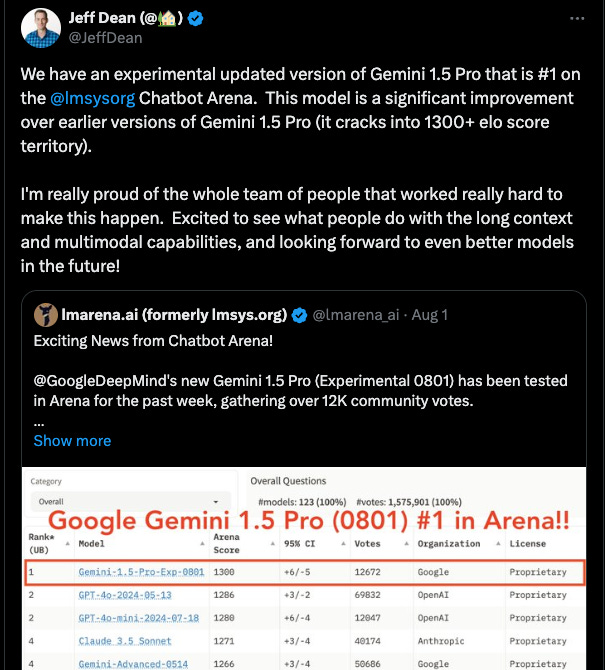
In the Arena: How LMSys changed LLM Benchmarking Forever
Apologies for lower audio quality; we lost recordings and had to use backup tracks. Our guests today are Anastasios Angelopoulos and Wei-Lin Chiang, leads of Chatbot Arena, fka LMSYS, the crowdsourced AI evaluation platform developed by the LMSys student club at Berkeley, which became the de facto standard for comparing language models. Arena Elo is often more cited than MMLU scores to many folks, and they have attracted >1,000,000 people to cast votes since its launch, leading top model trainers to cite them over their own formal academic benchmarks:The Limits of Static BenchmarksWe’ve done two benchmarks episodes: Benchmarks 101 and Benchmarks 201. One issue we’ve always brought up with static benchmarks is that 1) many are getting saturated, with models scoring almost perfectly on them 2) they often don’t reflect production use cases, making it hard for developers and users to use them as guidance. The fundamental challenge in AI evaluation isn't technical - it's philosophical. How do you measure something that increasingly resembles human intelligence? Rather than trying to define intelligence upfront, Arena let users interact naturally with models and collect comparative feedback. It's messy and subjective, but that's precisely the point - it captures the full spectrum of what people actually care about when using AI.The Pareto Frontier of Cost vs IntelligenceBecause the Elo scores are remarkably stable over time, we can put all the chat models on a map against their respective cost to gain a view of at least 3 orders of magnitude of model sizes/costs and observe the remarkable shift in intelligence per dollar over the past year:This frontier stood remarkably firm through the recent releases of o1-preview and price cuts of Gemini 1.5:The Statistics of SubjectivityIn our Benchmarks 201 episode, Clémentine Fourrier from HuggingFace thought this design choice was one of shortcomings of arenas: they aren’t reproducible. You don’t know who ranked what and what exactly the outcome was at the time of ranking. That same person might rank the same pair of outputs differently on a different day, or might ask harder questions to better models compared to smaller ones, making it imbalanced. Another argument that people have brought up is confirmation bias. We know humans prefer longer responses and are swayed by formatting - Rob Mulla from Dreadnode had found some interesting data on this in May:The approach LMArena is taking is to use logistic regression to decompose human preferences into constituent factors. As Anastasios explains: "We can say what components of style contribute to human preference and how they contribute." By adding these style components as parameters, they can mathematically "suck out" their influence and isolate the core model capabilities.This extends beyond just style - they can control for any measurable factor: "What if I want to look at the cost adjusted performance? Parameter count? We can ex post facto measure that." This is one of the most interesting things about Arena: You have a data generation engine which you can clean and turn into leaderboards later. If you wanted to create a leaderboard for poetry writing, you could get existing data from Arena, normalize it by identifying these style components. Whether or not it’s possible to really understand WHAT bias the voters have, that’s a different question.Private EvalsOne of the most delicate challenges LMSYS faces is maintaining trust while collaborating with AI labs. The concern is that labs could game the system by testing multiple variants privately and only releasing the best performer. This was brought up when 4o-mini released and it ranked as the second best model on the leaderboard:But this fear misunderstands how Arena works. Unlike static benchmarks where selection bias is a major issue, Arena's live nature means any initial bias gets washed out by ongoing evaluation. As Anastasios explains: "In the long run, there's way more fresh data than there is data that was used to compare these five models." The other big question is WHAT model is actually being tested; as people often talk about on X / Discord, the same endpoint will randomly feel “nerfed” like it happened for “Claude European summer” and corresponding conspiracy theories:It’s hard to keep track of these performance changes in Arena as these changes (if real…?) are not observable.The Future of EvaluationThe team's latest work on RouteLLM points to an interesting future where evaluation becomes more granular and task-specific. But they maintain that even simple routing strategies can be powerful - like directing complex queries to larger models while handling simple tasks with smaller ones.Arena is now going to expand beyond text into multimodal evaluation and specialized domains like code execution and red teaming. But their core insight remains: the best way to evaluate intelligence isn't to simplify it into metrics, but to embrace its complexity and find rigor
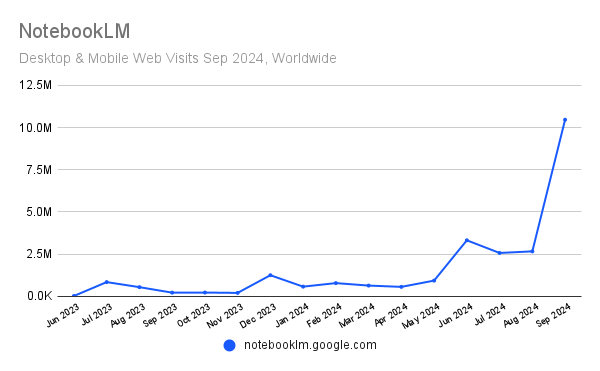
How NotebookLM Was Made
If you’ve listened to the podcast for a while, you might have heard our ElevenLabs-powered AI co-host Charlie a few times. Text-to-speech has made amazing progress in the last 18 months, with OpenAI’s Advanced Voice Mode (aka “Her”) as a sneak peek of the future of AI interactions (see our “Building AGI in Real Time” recap). Yet, we had yet to see a real killer app for AI voice (not counting music).Today’s guests, Raiza Martin and Usama Bin Shafqat, are the lead PM and AI engineer behind the NotebookLM feature flag that gave us the first viral AI voice experience, the “Deep Dive” podcast:The idea behind the “Audio Overviews” feature is simple: take a bunch of documents, websites, YouTube videos, etc, and generate a podcast out of them. This was one of the first demos that people built with voice models + RAG + GPT models, but it was always a glorified speech-to-text. Raiza and Usama took a very different approach:* Make it conversational: when you listen to a NotebookLM audio there are a ton of micro-interjections (Steven Johnson calls them disfluencies) like “Oh really?” or “Totally”, as well as pauses and “uh…”, like you would expect in a real conversation. These are not generated by the LLM in the transcript, but they are built into the the audio model. See ~28:00 in the pod for more details. * Listeners love tension: if two people are always in agreement on everything, it’s not super interesting. They tuned the model to generate flowing conversations that mirror the tone and rhythm of human speech. They did not confirm this, but many suspect the 2 year old SoundStorm paper is related to this model.* Generating new insights: because the hosts’ goal is not to summarize, but to entertain, it comes up with funny metaphors and comparisons that actually help expand on the content rather than just paraphrasing like most models do. We have had listeners make podcasts out of our podcasts, like this one.This is different than your average SOTA-chasing, MMLU-driven model buildooor. Putting product and AI engineering in the same room, having them build evals together, and understanding what the goal is lets you get these unique results. The 5 rules for AI PMsWe always focus on AI Engineers, but this episode had a ton of AI PM nuggets as well, which we wanted to collect as NotebookLM is one of the most successful products in the AI space:1. Less is more: the first version of the product had 0 customization options. All you could do is give it source documents, and then press a button to generate. Most users don’t know what “temperature” or “top-k” are, so you’re often taking the magic away by adding more options in the UI. Since recording they added a few, like a system prompt, but those were features that users were “hacking in”, as Simon Willison highlighted in his blog post.2. Use Real-Time Feedback: they built a community of 65,000 users on Discord that is constantly reporting issues and giving feedback; sometimes they noticed server downtime even before the Google internal monitoring did. Getting real time pings > aggregating user data when doing initial iterations. 3. Embrace Non-Determinism: AI outputs variability is a feature, not a bug. Rather than limiting the outputs from the get-go, build toggles that you can turn on/off with feature flags as the feedback starts to roll in.4. Curate with Taste: if you try your product and it sucks, you don’t need more data to confirm it. Just scrap that and iterate again. This is even easier for a product like this; if you start listening to one of the podcasts and turn it off after 10 seconds, it’s never a good sign. 5. Stay Hands-On: It’s hard to build taste if you don’t experiment. Trying out all your competitors products as well as unrelated tools really helps you understand what users are seeing in market, and how to improve on it.Chapters00:00 Introductions01:39 From Project Tailwind to NotebookLM09:25 Learning from 65,000 Discord members12:15 How NotebookLM works18:00 Working with Steven Johnson23:00 How to prioritize features25:13 Structuring the data pipelines29:50 How to eval34:34 Steering the podcast outputs37:51 Defining speakers personalities39:04 How do you make audio engaging?45:47 Humor is AGI51:38 Designing for non-determinism53:35 API when?55:05 Multilingual support and dialect considerations57:50 Managing system prompts and feature requests01:00:58 Future of NotebookLM01:04:59 Podcasts for your codebase01:07:16 Plans for real-time chat01:08:27 Wrap upShow Notes* Notebook LM* AI Test Kitchen* Nicholas Carlini* Steven Johnson* Wealth of Nations* Histories of Mysteries by Andrej Karpathy* chicken.pdf Threads* Area 120* Raiza Martin* Usama Bin ShafqatTranscriptNotebookLM [00:00:00]: Hey everyone, we're here today as guests on Latent Space. It's great to be here, I'm a long time listener and fan, they've had some great guests on this show before. Yeah, what an honor to have us, the hosts of another podcast, join as guests. I mean a huge thank you to Swyx an
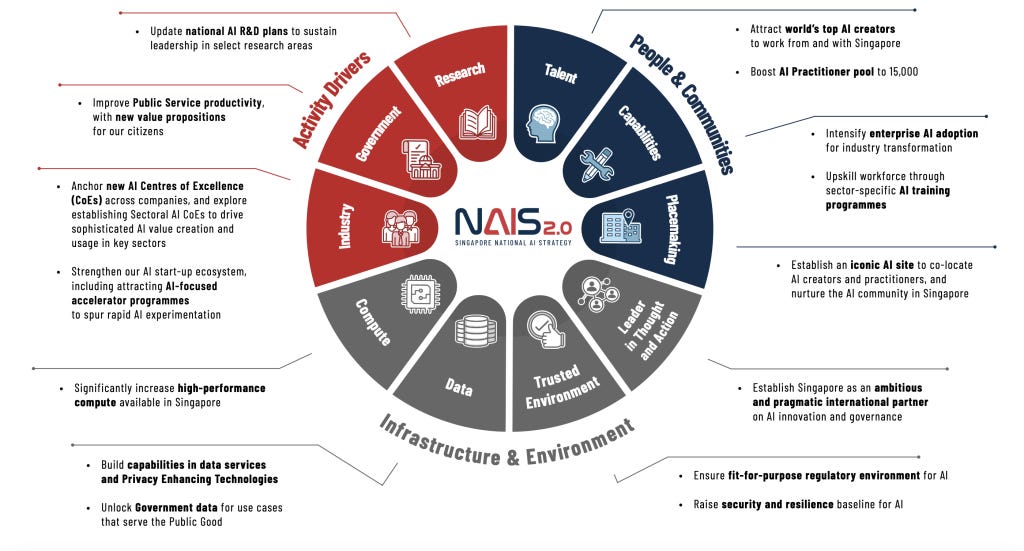
Building the AI Engineer Nation — with Josephine Teo, Minister of Digital Development and Information, Singapore
Singapore's GovTech is hosting an AI CTF challenge with ~$15,000 in prizes, starting October 26th, open to both local and virtual hackers. It will be hosted on Dreadnode's Crucible platform; signup here!It is common to say if you want to work in AI, you should come to San Francisco. Not everyone can. Not everyone should. If you can only do meaningful AI work in one city, then AI has failed to generalize meaningfully.As non-Americans working in the US, we know what it’s like to see AI progress so rapidly here, and yet be at a loss for what our home countries can do. Through Latent Space we’ve tried to tell the story of AI outside of the Bay Area bubble; we talked to Notion in New York and Humanloop and Wondercraft in London and HuggingFace in Paris and ICLR in Vienna, and the Reka, RWKV, and Winds of AI Winter episodes were taped in Singapore (the World’s Fair also had Latin America representation and we intend to at least add China, Japan, and India next year).The Role of Government with AIAs an intentionally technical resource, we’ve mostly steered clear of regulation and safety debates on the podcast; whether it is safety bills or technoalarmism, often at the cost of our engagement numbers or ability to book big name guests with a political agenda. When SOTA shifts 3x faster than it takes to pass a law, when nobody agrees on definitions of important things, when you can elicit never-before-seen behavior by slightly different prompting or sampling, it is hard enough to simply keep up to speed, so we are happy limiting our role to that. The story of AI progress has more often been achieved in the private sector, usually in spite of, rather than with thanks to, government intervention.But industrial policy is inextricably linked to the business of AI, which we do very much care about, has an explicitly accelerationist intent if not impact, and has a track record of success in correcting for legitimate market failures in private sector investment, particularly outside of the US. It is with this lens we approach today’s episode and special guest, our first with a sitting Cabinet member.Singapore’s National AI StrategyIt is well understood that much of Singapore’s economic success is attributable to industrial policy, from direct efforts like the Jurong Town Corporation industrialization to indirect ones like going all in on English as national first language. Singapore’s National AI Strategy grew out of its 2014 Smart Nation initiative, first launched in 2019 and then refreshed in 2023 by Minister Josephine Teo, our guest today.While Singapore is not often thought of as an AI leader, the National University ranks in the top 10 in publications (above Oxford/Harvard!), and many overseas Singaporeans work at the leading AI companies and institutions in the US (and some of us even run leading AI Substacks?). OpenAI has often publicly named the Singapore government as their model example of government collaborator and is opening an office in Singapore in time for DevDay 2024.AI Engineer NationsSwyx first pitched the AI Engineer Nation concept at a private Sovereign AI summit featuring Dr. He Ruimin, Chief AI Officer of Singapore, which eventually led to an invitation to discuss the concept with Minister Teo, the country’s de-facto minister for tech (she calls it Digital Development, for good reasons she explains in the pod).This chat happened (with thanks to Jing Long, Joyce, and other folks from MDDI)!The central pitch for any country, not just Singapore, to emphasize and concentrate bets on AI Engineers, compared with other valuable efforts like training more researchers, releasing more government-approved data, or offering more AI funding, is a calculated one, based on the fact that: * GPU clusters and researchers have massive returns to scale and colocation, mostly concentrated in the US, that are irresponsibly expensive to replicate* Even if research stopped today and there was no progress for the next 30 years, there are far more capabilities to unlock and productize from existing foundation models and we * Good AI Engineering requires genuine skill and is deepening enough to justify sub-specialization as a sub-industry of Software Engineering* Companies and countries with better AI engineer workforces will disproportionately benefit from AI vs those who equivocate it as one of many equivalent priorities* Tech progress is often framed as “the future is here but it is not evenly distributed”. The role of the AI Engineer is therefore to better distribute the state of the art to as much of humanity as possible, including the elderly, poor, and differently abled.All of which are themes we first identified in the Rise of the AI Engineer. Singapore simply has a few additional factors that make it not just a good fit, but an economic imperative:* English speaking, very-online country that is great at STEM* Aging, ex-growth population (Total Fertility Rate of 1.1)* #3 GDP per capita (PPP) country in the world* Physic
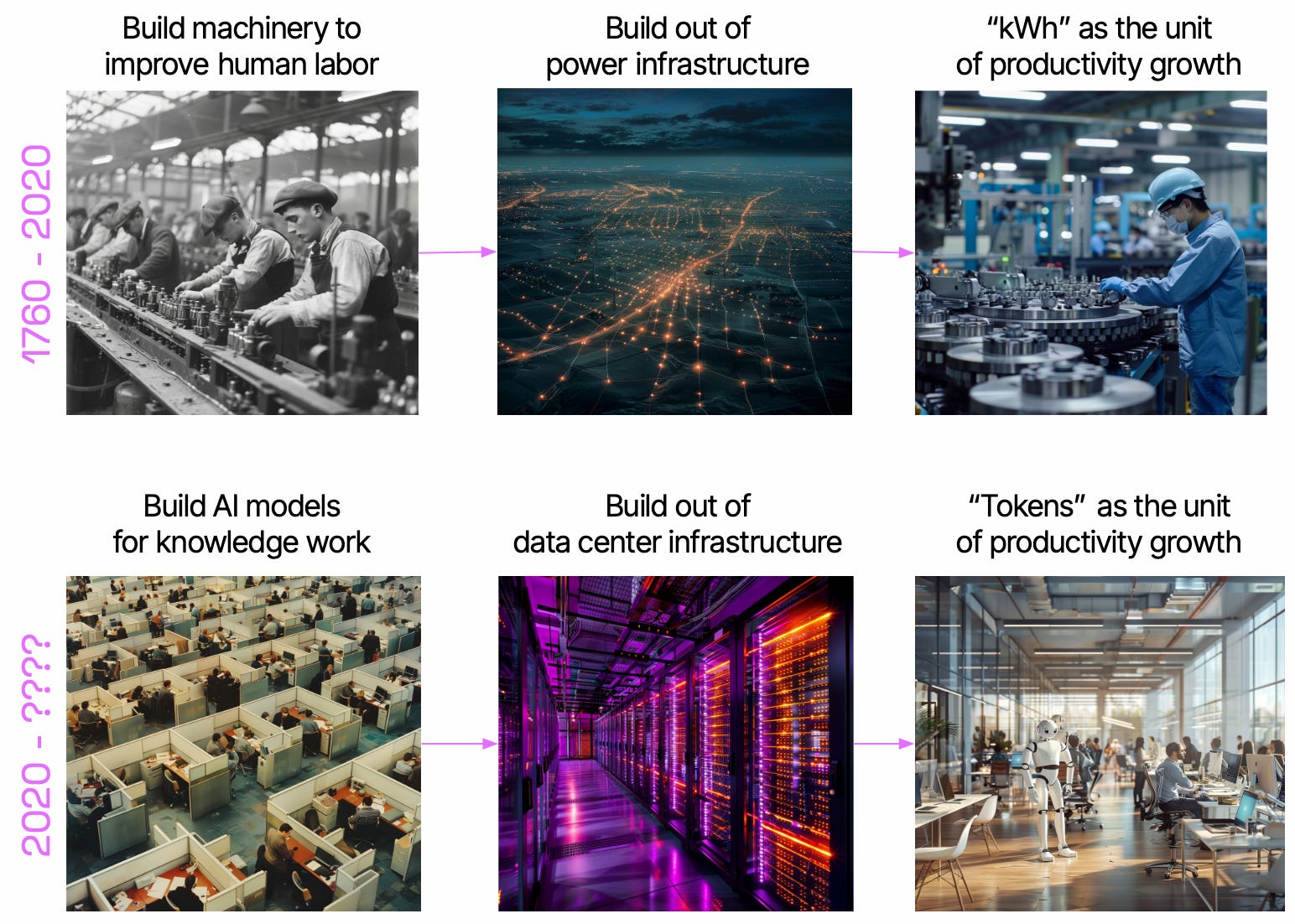
Building the Silicon Brain - with Drew Houston of Dropbox
CEOs of publicly traded companies are often in the news talking about their new AI initiatives, but few of them have built anything with it. Drew Houston from Dropbox is different; he has spent over 400 hours coding with LLMs in the last year and is now refocusing his 2,500+ employees around this new way of working, 17 years after founding the company.Timestamps00:00 Introductions00:43 Drew's AI journey04:14 Revalidating expectations of AI08:23 Simulation in self-driving vs. knowledge work12:14 Drew's AI Engineering setup15:24 RAG vs. long context in AI models18:06 From "FileGPT" to Dropbox AI23:20 Is storage solved?26:30 Products vs Features30:48 Building trust for data access33:42 Dropbox Dash and universal search38:05 The evolution of Dropbox42:39 Building a "silicon brain" for knowledge work48:45 Open source AI and its impact51:30 "Rent, Don't Buy" for AI54:50 Staying relevant58:57 Founder Mode01:03:10 Advice for founders navigating AI01:07:36 Building and managing teams in a growing companyTranscriptAlessio [00:00:00]: Hey everyone, welcome to the Latent Space podcast. This is Alessio, partner and CTO at Decibel Partners, and there's no Swyx today, but I'm joined by Drew Houston of Dropbox. Welcome, Drew.Drew [00:00:14]: Thanks for having me.Alessio [00:00:15]: So we're not going to talk about the Dropbox story. We're not going to talk about the Chinatown bus and the flash drive and all that. I think you've talked enough about it. Where I want to start is you as an AI engineer. So as you know, most of our audience is engineering folks, kind of like technology leaders. You obviously run Dropbox, which is a huge company, but you also do a lot of coding. I think that's how you spend almost 400 hours, just like coding. So let's start there. What was the first interaction you had with an LLM API and when did the journey start for you?Drew [00:00:43]: Yeah. Well, I think probably all AI engineers or whatever you call an AI engineer, those people started out as engineers before that. So engineering is my first love. I mean, I grew up as a little kid. I was that kid. My first line of code was at five years old. I just really loved, I wanted to make computer games, like this whole path. That also led me into startups and eventually starting Dropbox. And then with AI specifically, I studied computer science, I got my, I did my undergrad, but I didn't do like grad level computer science. I didn't, I sort of got distracted by all the startup things, so I didn't do grad level work. But about several years ago, I made a couple of things. So one is I sort of, I knew I wanted to go from being an engineer to a founder. And then, but sort of the becoming a CEO part was sort of backed into the job. And so a couple of realizations. One is that, I mean, there's a lot of like repetitive and like manual work you have to do as an executive that is actually lends itself pretty well to automation, both for like my own convenience. And then out of interest in learning, I guess what we call like classical machine learning these days, I started really trying to wrap my head around understanding machine learning and informational retrieval more, more formally. So I'd say maybe 2016, 2017 started me writing these more successively, more elaborate scripts to like understand basic like classifiers and regression and, and again, like basic information retrieval and NLP back in those days. And there's sort of like two things that came out of that. One is techniques are super powerful. And even just like studying like old school machine learning was a pretty big inversion of the way I had learned engineering, right? You know, I started programming when everyone starts programming and you're, you're sort of the human, you're giving an algorithm to the, and spelling out to the computer how it should run it. And then machine learning, here's machine learning where it's like actually flip that, like give it sort of the answer you want and it'll figure out the algorithm, which was pretty mind bending. And it was both like pretty powerful when I would write tools, like figure out like time audits or like, where's my time going? Is this meeting a one-on-one or is it a recruiting thing or is it a product strategy thing? I started out doing that manually with my assistant, but then found that this was like a very like automatable task. And so, which also had the side effect of teaching me a lot about machine learning. But then there was this big problem, like anytime you, it was very good at like tabular structured data, but like anytime it hit, you know, the usual malformed English that humans speak, it would just like fall over. I had to kind of abandon a lot of the things that I wanted to build because like there's no way to like parse text. Like maybe it would sort of identify the part of speech in a sentence or something. But then fast forward to the LLM, I mean actually I started trying some of like this, what we would call like very small
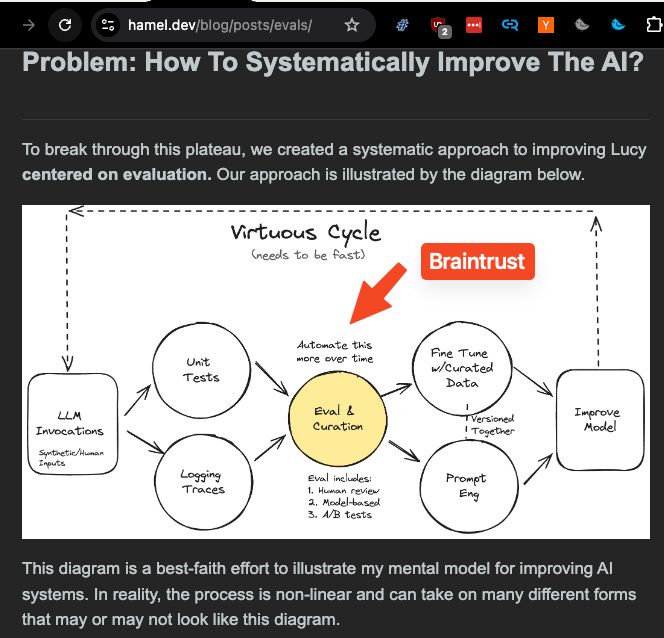
Production AI Engineering starts with Evals — with Ankur Goyal of Braintrust
We are in 🗽 NYC this Monday! Join the AI Eng NYC meetup, bring demos and vibes!It is a bit of a meme that the first thing developer tooling founders think to build in AI is all the non-AI operational stuff outside the AI. There are well over 60 funded LLM Ops startups all with hoping to solve the new observability, cost tracking, security, and reliability problems that come with putting LLMs in production, not to mention new LLM oriented products from incumbent, established ops/o11y players like Datadog and Weights & Biases. 2 years in to the current hype cycle, the early winners have tended to be people with practical/research AI backgrounds rather than MLOps heavyweights or SWE tourists:* LangSmith: We covered how Harrison Chase worked on AI at Robust Intelligence and Kensho, the alma maters of many great AI founders* HumanLoop: We covered how Raza Habib worked at Google AI during his PhD* BrainTrust: Today’s guest Ankur Goyal founded Impira pre-Transformers and was acquihired to run Figma AI before realizing how to solve the Ops problem.There have been many VC think pieces and market maps describing what people thought were the essential pieces of the AI Engineering stack, but what was true for 2022-2023 has aged poorly. The basic insight that Ankur had is the same thesis that Hamel Husain is pushing in his World’s Fair talk and podcast with Raza and swyx:Evals are the centerpiece of systematic AI Engineering.REALLY believing in this is harder than it looks with the benefit of hindsight. It’s not like people didn’t know evals were important. Basically every LLM Ops feature list has them. It’s an obvious next step AFTER managing your prompts and logging your LLM calls. In fact, up til we met Braintrust, we were working on an expanded version of the Impossible Triangle Theory of the LLM Ops War that we first articulated in the Humanloop writeup:The single biggest criticism of the Rise of the AI Engineer piece is that we neglected to split out the role of product evals (as opposed to model evals) in the now infamous “API line” chart:The AI SDLCWith hindsight, we were very focused on the differentiating 0 to 1 phase that AI Engineers can bring to an existing team of ML engineers. As swyx says on the Day 2 keynote of AI Engineer, 2024 added a whole new set of concerns as AI Engineering grew up:A closer examination of Hamel’s product-oriented virtuous cycle and this infra-oriented SDLC would have eventually revealed that Evals, even more than logging, was the first point where teams start to get really serious about shipping to production, and therefore a great place to make an entry into the marketplace, which is exactly what Braintrust did.Also notice what’s NOT on this chart: shifting to shadow open source models, and finetuning them… per Ankur, Fine-tuning is not a viable standalone product:“The thing I would say is not debatable is whether or not fine-tuning is a business outcome or not. So let's think about the other components of your triangle. Ops/observability, that is a business… Frameworks, evals, databases [are a business, but] Fine-tuning is a very compelling method that achieves an outcome. The outcome is not fine-tuning, it is can I automatically optimize my use case to perform better if I throw data at the problem? And fine-tuning is one of multiple ways to achieve that.”OpenAI vs Open AI Market ShareWe last speculated about the market shifts in the End of OpenAI Hegemony and the Winds of AI Winter, and Ankur’s perspective is super valuable given his customer list:Some surprises based on what he is seeing:* Prior to Claude 3, OpenAI had near 100% market share. This tracks with what Harrison told us last year.* Claude 3.5 Sonnet and also notably Haiku have made serious dents* Open source model adoption is . Contra to Eugene Cheah’s ideal marketing pitch, virtually none of Braintrust’s customers are really finetuning open source models for cost, control, or privacy. This is partially caused by…* Open source model hosts, aka Inference providers, aren’t as mature as OpenAI’s API platform. Kudos to Michelle’s team as if they needed any more praise!* Adoption of Big Lab models via their Big Cloud Partners, aka Claude through AWS, or OpenAI through Azure, is low. Surprising! It seems that there are issues with accessing the latest models via the Cloud partners.swyx [01:36:51]: What % of your workload is open source?Ankur Goyal [01:36:55]: Because of how we're deployed, I don't have like an exact number for you. Among customers running in production, it's less than 5%.Full Video EpisodeCheck out the Braintrust demo on YouTube! (and like and subscribe etc)Show Notes* Ankur’s companies* MemSQL/SingleStore → now Nikita Shamgunov of Neon* Impira* Braintrust* Papers mentioned* AlexNet* BERT Paper* Layout LM Paper* GPT-3 Paper* Voyager Paper* AI Engineer World's Fair* Ankur and Olmo’s talk at AIEWF* Together.ai* Fireworks* People* Nikita Shamgunov* Alana Goyal* Elad Gil* Clem Delangue* Guillermo Rauch* Prio
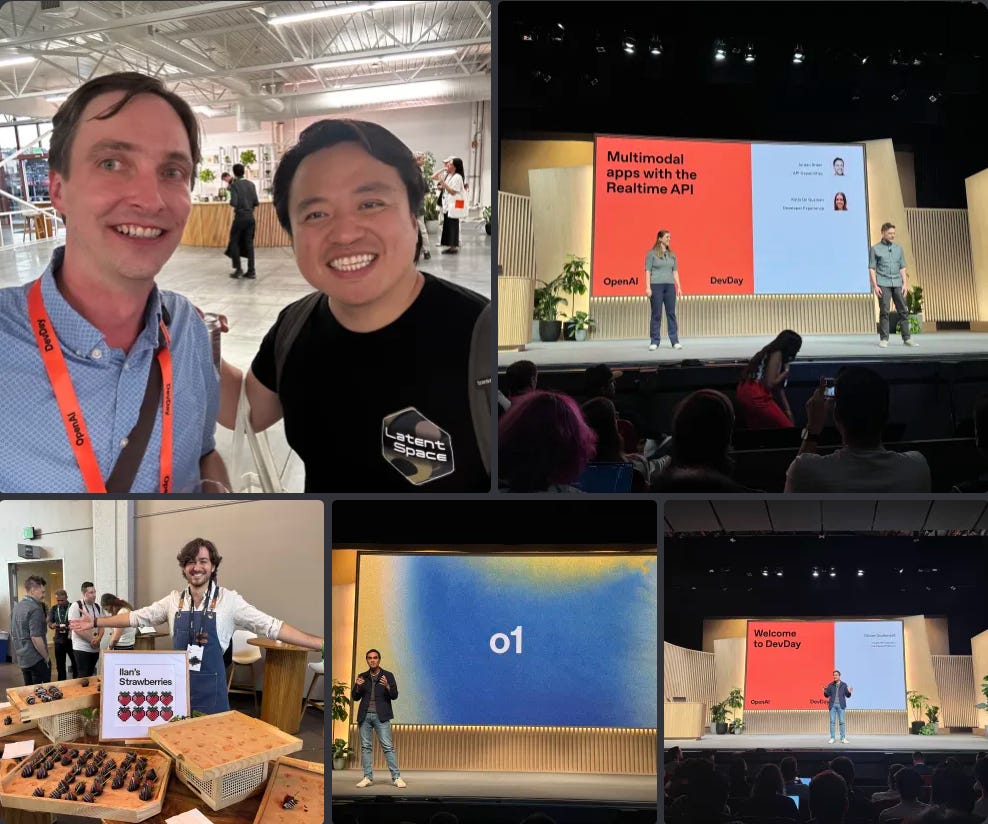
Building AGI in Real Time (OpenAI Dev Day 2024)
We all have fond memories of the first Dev Day in 2023:and the blip that followed soon after. As Ben Thompson has noted, this year’s DevDay took a quieter, more intimate tone. No Satya, no livestream, (slightly fewer people?). Instead of putting ChatGPT announcements in DevDay as in 2023, o1 was announced 2 weeks prior, and DevDay 2024 was reserved purely for developer-facing API announcements, primarily the Realtime API, Vision Finetuning, Prompt Caching, and Model Distillation.However the larger venue and more spread out schedule did allow a lot more hallway conversations with attendees as well as more community presentations including our recent guest Alistair Pullen of Cosine as well as deeper dives from OpenAI including our recent guest Michelle Pokrass of the API Team. Thanks to OpenAI’s warm collaboration (we particularly want to thank Lindsay McCallum Rémy!), we managed to record exclusive interviews with many of the main presenters of both the keynotes and breakout sessions. We present them in full in today’s episode, together with a full lightly edited Q&A with Sam Altman.Show notes and related resourcesSome of these used in the final audio episode below* Simon Willison Live Blog* swyx live tweets and videos* Greg Kamradt coverage of Structured Output session, Scaling LLM Apps session* Fireside Chat Q&A with Sam AltmanTimestamps* [00:00:00] Intro by Suno.ai* [00:01:23] NotebookLM Recap of DevDay* [00:09:25] Ilan's Strawberry Demo with Realtime Voice Function Calling* [00:19:16] Olivier Godement, Head of Product, OpenAI* [00:36:57] Romain Huet, Head of DX, OpenAI* [00:47:08] Michelle Pokrass, API Tech Lead at OpenAI ft. Simon Willison* [01:04:45] Alistair Pullen, CEO, Cosine (Genie)* [01:18:31] Sam Altman + Kevin Weill Q&A* [02:03:07] Notebook LM Recap of PodcastTranscript[00:00:00] Suno AI: Under dev daylights, code ignites. Real time voice streams reach new heights. O1 and GPT, 4. 0 in flight. Fine tune the future, data in sight. Schema sync up, outputs precise. Distill the models, efficiency splice.[00:00:33] AI Charlie: Happy October. This is your AI co host, Charlie. One of our longest standing traditions is covering major AI and ML conferences in podcast format. Delving, yes delving, into the vibes of what it is like to be there stitched in with short samples of conversations with key players, just to help you feel like you were there.[00:00:54] AI Charlie: Covering this year's Dev Day was significantly more challenging because we were all requested not to record the opening keynotes. So, in place of the opening keynotes, we had the viral notebook LM Deep Dive crew, my new AI podcast nemesis, Give you a seven minute recap of everything that was announced.[00:01:15] AI Charlie: Of course, you can also check the show notes for details. I'll then come back with an explainer of all the interviews we have for you today. Watch out and take care.[00:01:23] NotebookLM Recap of DevDay[00:01:23] NotebookLM: All right, so we've got a pretty hefty stack of articles and blog posts here all about open ais. Dev day 2024.[00:01:32] NotebookLM 2: Yeah, lots to dig into there.[00:01:34] NotebookLM 2: Seems[00:01:34] NotebookLM: like you're really interested in what's new with AI.[00:01:36] NotebookLM 2: Definitely. And it seems like OpenAI had a lot to announce. New tools, changes to the company. It's a lot.[00:01:43] NotebookLM: It is. And especially since you're interested in how AI can be used in the real world, you know, practical applications, we'll focus on that.[00:01:51] NotebookLM: Perfect. Like, for example, this Real time API, they announced that, right? That seems like a big deal if we want AI to sound, well, less like a robot.[00:01:59] NotebookLM 2: It could be huge. The real time API could completely change how we, like, interact with AI. Like, imagine if your voice assistant could actually handle it if you interrupted it.[00:02:08] NotebookLM: Or, like, have an actual conversation.[00:02:10] NotebookLM 2: Right, not just these clunky back and forth things we're used to.[00:02:14] NotebookLM: And they actually showed it off, didn't they? I read something about a travel app, one for languages. Even one where the AI ordered takeout.[00:02:21] NotebookLM 2: Those demos were really interesting, and I think they show how this real time API can be used in so many ways.[00:02:28] NotebookLM 2: And the tech behind it is fascinating, by the way. It uses persistent WebSocket connections and this thing called function calling, so it can respond in real time.[00:02:38] NotebookLM: So the function calling thing, that sounds kind of complicated. Can you, like, explain how that works?[00:02:42] NotebookLM 2: So imagine giving the AI Access to this whole toolbox, right?[00:02:46] NotebookLM 2: Information, capabilities, all sorts of things. Okay. So take the travel agent demo, for example. With function calling, the AI can pull up details, let's say about Fort Mason, right, from some database. Like nearby resta
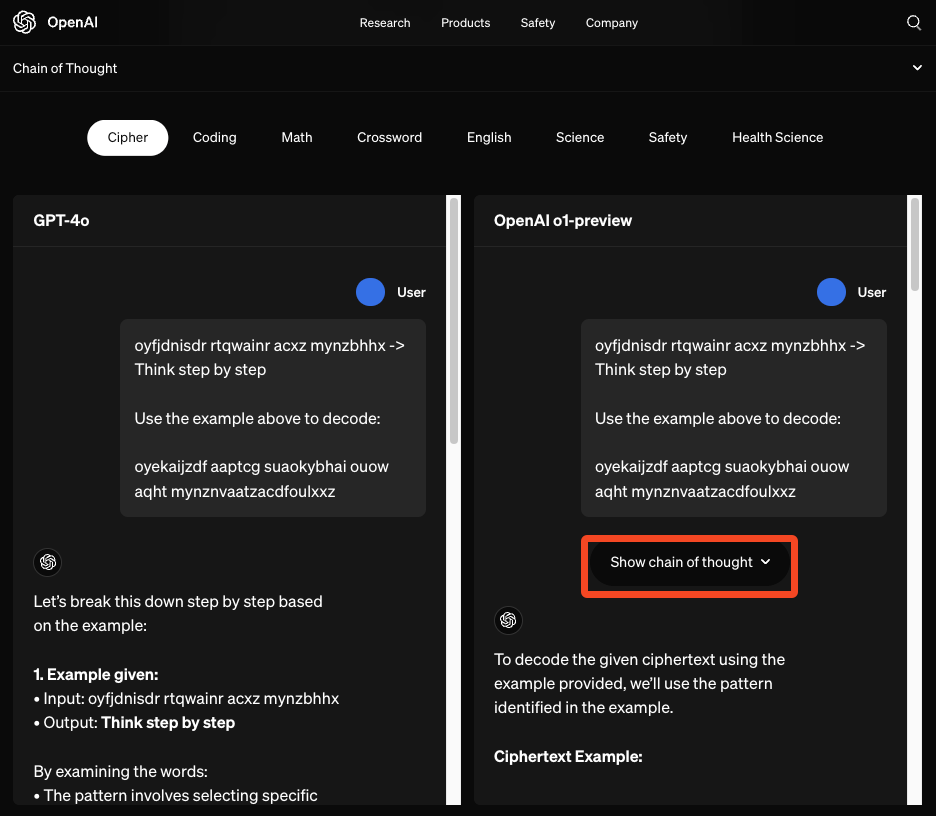
Language Agents: From Reasoning to Acting
OpenAI DevDay is almost here! Per tradition, we are hosting a DevDay pregame event for everyone coming to town! Join us with demos and gossip!Also sign up for related events across San Francisco: the AI DevTools Night, the xAI open house, the Replicate art show, the DevDay Watch Party (for non-attendees), Hack Night with OpenAI at Cloudflare. For everyone else, join the Latent Space Discord for our online watch party and find fellow AI Engineers in your city.OpenAI’s recent o1 release (and Reflection 70b debacle) has reignited broad interest in agentic general reasoning and tree search methods.While we have covered some of the self-taught reasoning literature on the Latent Space Paper Club, it is notable that the Eric Zelikman ended up at xAI, whereas OpenAI’s hiring of Noam Brown and now Shunyu suggests more interest in tool-using chain of thought/tree of thought/generator-verifier architectures for Level 3 Agents.We were more than delighted to learn that Shunyu is a fellow Latent Space enjoyer, and invited him back (after his first appearance on our NeurIPS 2023 pod) for a look through his academic career with Harrison Chase (one year after his first LS show).ReAct: Synergizing Reasoning and Acting in Language Modelspaper linkFollowing seminal Chain of Thought papers from Wei et al and Kojima et al, and reflecting on lessons from building the WebShop human ecommerce trajectory benchmark, Shunyu’s first big hit, the ReAct paper showed that using LLMs to “generate both reasoning traces and task-specific actions in an interleaved manner” achieved remarkably greater performance (less hallucination/error propagation, higher ALFWorld/WebShop benchmark success) than CoT alone. In even better news, ReAct scales fabulously with finetuning:As a member of the elite Princeton NLP group, Shunyu was also a coauthor of the Reflexion paper, which we discuss in this pod.Tree of Thoughtspaper link hereShunyu’s next major improvement on the CoT literature was Tree of Thoughts:Language models are increasingly being deployed for general problem solving across a wide range of tasks, but are still confined to token-level, left-to-right decision-making processes during inference. This means they can fall short in tasks that require exploration, strategic lookahead, or where initial decisions play a pivotal role…ToT allows LMs to perform deliberate decision making by considering multiple different reasoning paths and self-evaluating choices to decide the next course of action, as well as looking ahead or backtracking when necessary to make global choices.The beauty of ToT is it doesnt require pretraining with exotic methods like backspace tokens or other MCTS architectures. You can listen to Shunyu explain ToT in his own words on our NeurIPS pod, but also the ineffable Yannic Kilcher:Other WorkWe don’t have the space to summarize the rest of Shunyu’s work, you can listen to our pod with him now, and recommend the CoALA paper and his initial hit webinar with Harrison, today’s guest cohost:as well as Shunyu’s PhD Defense Lecture:as well as Shunyu’s latest lecture covering a Brief History of LLM Agents:As usual, we are live on YouTube! Show Notes* Harrison Chase* LangChain, LangSmith, LangGraph* Shunyu Yao* Alec Radford* ReAct Paper* Hotpot QA* Tau Bench* WebShop* SWE-Agent* SWE-Bench* Trees of Thought* CoALA Paper* Related Episodes* Our Thomas Scialom (Meta) episode* Shunyu on our NeurIPS 2023 Best Papers episode* Harrison on our LangChain episode* Mentions* Sierra* Voyager* Jason Wei* Tavily* SERP API* ExaTimestamps* [00:00:00] Opening Song by Suno* [00:03:00] Introductions* [00:06:16] The ReAct paper* [00:12:09] Early applications of ReAct in LangChain* [00:17:15] Discussion of the Reflection paper* [00:22:35] Tree of Thoughts paper and search algorithms in language models* [00:27:21] SWE-Agent and SWE-Bench for coding benchmarks* [00:39:21] CoALA: Cognitive Architectures for Language Agents* [00:45:24] Agent-Computer Interfaces (ACI) and tool design for agents* [00:49:24] Designing frameworks for agents vs humans* [00:53:52] UX design for AI applications and agents* [00:59:53] Data and model improvements for agent capabilities* [01:19:10] TauBench* [01:23:09] Promising areas for AITranscriptAlessio [00:00:01]: Hey, everyone, welcome to the Latent Space podcast. This is Alessio, partner and CTO of Residence at Decibel Partners, and I'm joined by my co-host Swyx, founder of Small AI.Swyx [00:00:12]: Hey, and today we have a super special episode. I actually always wanted to take like a selfie and go like, you know, POV, you're about to revolutionize the world of agents because we have two of the most awesome hiring agents in the house. So first, we're going to welcome back Harrison Chase. Welcome. Excited to be here. What's new with you recently in sort of like the 10, 20 second recap?Harrison [00:00:34]: Linkchain, Linksmith, Lingraph, pushing on all of them. Lots of cool stuff related to a lot of the stuff that we're going to ta
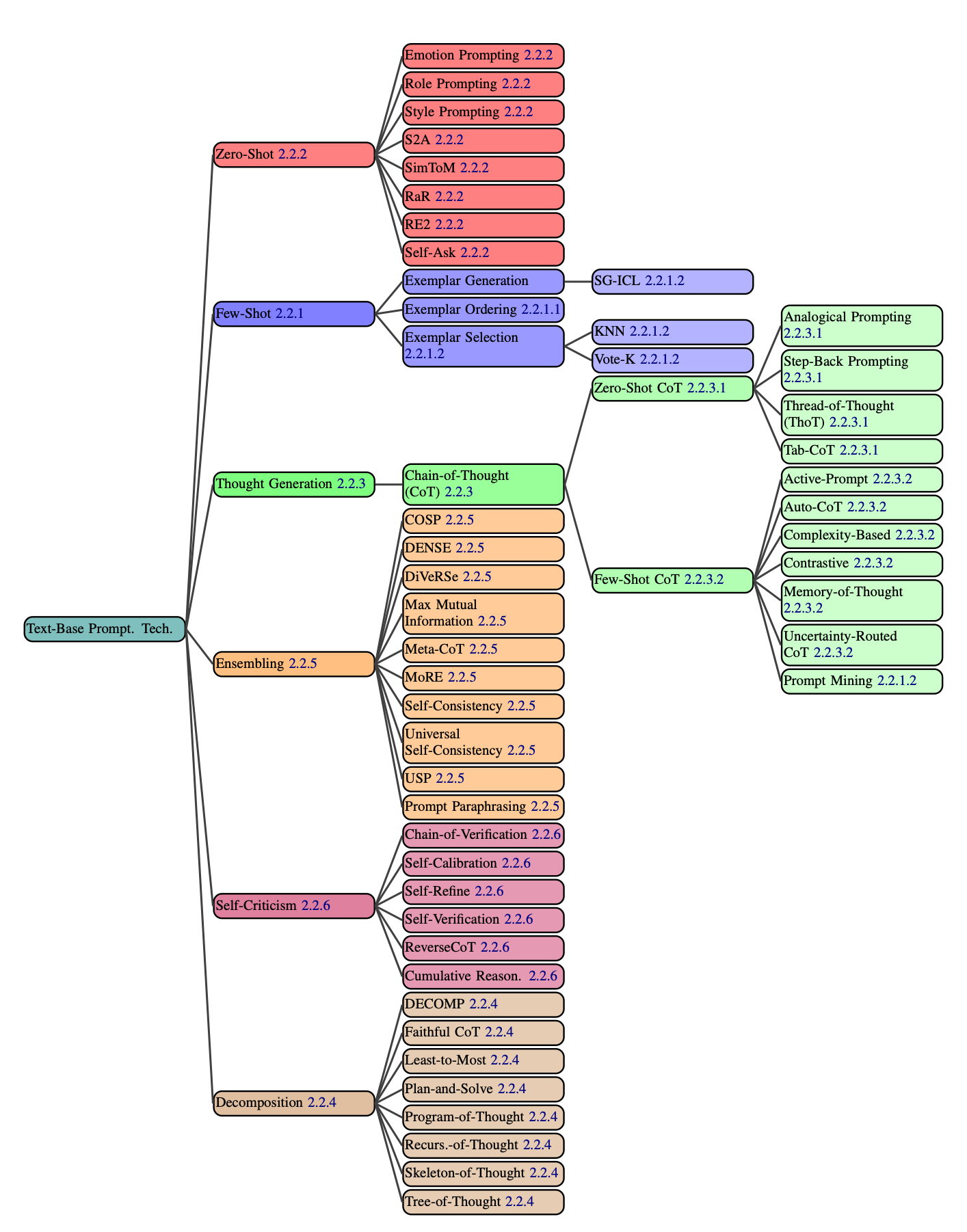
The Ultimate Guide to Prompting
Noah Hein from Latent Space University is finally launching with a free lightning course this Sunday for those new to AI Engineering. Tell a friend!Did you know there are >1,600 papers on arXiv just about prompting? Between shots, trees, chains, self-criticism, planning strategies, and all sorts of other weird names, it’s hard to keep up. Luckily for us, Sander Schulhoff and team read them all and put together The Prompt Report as the ultimate prompt engineering reference, which we’ll break down step-by-step in today’s episode.In 2022 swyx wrote “Why “Prompt Engineering” and “Generative AI” are overhyped”; the TLDR being that if you’re relying on prompts alone to build a successful products, you’re ngmi. Prompt engineering moved from being a stand-alone job to a core skill for AI Engineers now. We won’t repeat everything that is written in the paper, but this diagram encapsulates the state of prompting today: confusing. There are many similar terms, esoteric approaches that have doubtful impact on results, and lots of people that are just trying to create full papers around a single prompt just to get more publications out. Luckily, some of the best prompting techniques are being tuned back into the models themselves, as we’ve seen with o1 and Chain-of-Thought (see our OpenAI episode). Similarly, OpenAI recently announced 100% guaranteed JSON schema adherence, and Anthropic, Cohere, and Gemini all have JSON Mode (not sure if 100% guaranteed yet). No more “return JSON or my grandma is going to die” required. The next debate is human-crafted prompts vs automated approaches using frameworks like DSPy, which Sander recommended:I spent 20 hours prompt engineering for a task and DSPy beat me in 10 minutes. It’s much more complex than simply writing a prompt (and I’m not sure how many people usually spend >20 hours prompt engineering one task), but if you’re hitting a roadblock it might be worth checking out.Prompt Injection and JailbreaksSander and team also worked on HackAPrompt, a paper that was the outcome of an online challenge on prompt hacking techniques. They similarly created a taxonomy of prompt attacks, which is very hand if you’re building products with user-facing LLM interfaces that you’d like to test:In this episode we basically break down every category and highlight the overrated and underrated techniques in each of them. If you haven’t spent time following the prompting meta, this is a great episode to catchup!Full Video EpisodeLike and subscribe on YouTube!Timestamps* [00:00:00] Introductions - Intro music by Suno AI* [00:07:32] Navigating arXiv for paper evaluation* [00:12:23] Taxonomy of prompting techniques* [00:15:46] Zero-shot prompting and role prompting* [00:21:35] Few-shot prompting design advice* [00:28:55] Chain of thought and thought generation techniques* [00:34:41] Decomposition techniques in prompting* [00:37:40] Ensembling techniques in prompting* [00:44:49] Automatic prompt engineering and DSPy* [00:49:13] Prompt Injection vs Jailbreaking* [00:57:08] Multimodal prompting (audio, video)* [00:59:46] Structured output prompting* [01:04:23] Upcoming Hack-a-Prompt 2.0 projectShow Notes* Sander Schulhoff* Learn Prompting* The Prompt Report* HackAPrompt* Mine RL Competition* EMNLP Conference* Noam Brown* Jordan Boydgraver* Denis Peskov* Simon Willison* Riley Goodside* David Ha* Jeremy Nixon* Shunyu Yao* Nicholas Carlini* DreadnodeTranscriptAlessio [00:00:00]: Hey everyone, welcome to the Latent Space podcast. This is Alessio, partner and CTO-in-Residence at Decibel Partners, and I'm joined by my co-host Swyx, founder of Smol AI.Swyx [00:00:13]: Hey, and today we're in the remote studio with Sander Schulhoff, author of the Prompt Report.Sander [00:00:18]: Welcome. Thank you. Very excited to be here.Swyx [00:00:21]: Sander, I think I first chatted with you like over a year ago. What's your brief history? I went onto your website, it looks like you worked on diplomacy, which is really interesting because we've talked with Noam Brown a couple of times, and that obviously has a really interesting story in terms of prompting and agents. What's your journey into AI?Sander [00:00:40]: Yeah, I'd say it started in high school. I took my first Java class and just saw a YouTube video about something AI and started getting into it, reading. Deep learning, neural networks, all came soon thereafter. And then going into college, I got into Maryland and I emailed just like half the computer science department at random. I was like, hey, I want to do research on deep reinforcement learning because I've been experimenting with that a good bit. And over that summer, I had read the Intro to RL book and the deep reinforcement learning hands-on, so I was very excited about what deep RL could do. And a couple of people got back to me and one of them was Jordan Boydgraver, Professor Boydgraver, and he was working on diplomacy. And he said to me, this looks like it was more of a natural language processing proje
From API to AGI: Structured Outputs, OpenAI API platform and O1 Q&A — with Michelle Pokrass & OpenAI Devrel + Strawberry team
Congrats to Damien on successfully running AI Engineer London! See our community page and the Latent Space Discord for all upcoming events.This podcast came together in a far more convoluted way than usual, but happens to result in a tight 2 hours covering the ENTIRE OpenAI product suite across ChatGPT-latest, GPT-4o and the new o1 models, and how they are delivered to AI Engineers in the API via the new Structured Output mode, Assistants API, client SDKs, upcoming Voice Mode API, Finetuning/Vision/Whisper/Batch/Admin/Audit APIs, and everything else you need to know to be up to speed in September 2024.This podcast has two parts: the first hour is a regular, well edited, podcast on 4o, Structured Outputs, and the rest of the OpenAI API platform. The second was a rushed, noisy, hastily cobbled together recap of the top takeaways from the o1 model release from yesterday and today.Building AGI with Structured Outputs — Michelle Pokrass of OpenAI API teamMichelle Pokrass built massively scalable platforms at Google, Stripe, Coinbase and Clubhouse, and now leads the API Platform at Open AI. She joins us today to talk about why structured output is such an important modality for AI Engineers that Open AI has now trained and engineered a Structured Output mode with 100% reliable JSON schema adherence. To understand why this is important, a bit of history is important:* June 2023 when OpenAI first added a "function calling" capability to GPT-4-0613 and GPT 3.5 Turbo 0613 (our podcast/writeup here)* November 2023’s OpenAI Dev Day (our podcast/writeup here) where the team shipped JSON Mode, a simpler schema-less JSON output mode that nevertheless became more popular because function calling often failed to match the JSON schema given by developers. * Meanwhile, in open source, many solutions arose, including * Instructor (our pod with Jason here) * LangChain (our pod with Harrison here, and he is returning next as a guest co-host)* Outlines (Remi Louf’s talk at AI Engineer here)* Llama.cpp’s constrained grammar sampling using GGML-BNF* April 2024: OpenAI started implementing constrained sampling with a new `tool_choice: required` parameter in the API* August 2024: the new Structured Output mode, co-led by Michelle* Sept 2024: Gemini shipped Structured Outputs as wellWe sat down with Michelle to talk through every part of the process, as well as quizzing her for updates on everything else the API team has shipped in the past year, from the Assistants API, to Prompt Caching, GPT4 Vision, Whisper, the upcoming Advanced Voice Mode API, OpenAI Enterprise features, and why every Waterloo grad seems to be a cracked engineer.Part 1 Timestamps and TranscriptTranscript here.* [00:00:42] Episode Intro from Suno* [00:03:34] Michelle's Path to OpenAI* [00:12:20] Scaling ChatGPT* [00:13:20] Releasing Structured Output* [00:16:17] Structured Outputs vs Function Calling* [00:19:42] JSON Schema and Constrained Grammar* [00:20:45] OpenAI API team* [00:21:32] Structured Output Refusal Field* [00:24:23] ChatML issues* [00:26:20] Function Calling Evals* [00:28:34] Parallel Function Calling* [00:29:30] Increased Latency* [00:30:28] Prompt/Schema Caching* [00:30:50] Building Agents with Structured Outputs: from API to AGI* [00:31:52] Assistants API* [00:34:00] Use cases for Structured Output* [00:37:45] Prompting Structured Output* [00:39:44] Benchmarking Prompting for Structured Outputs* [00:41:50] Structured Outputs Roadmap* [00:43:37] Model Selection vs GPT4 Finetuning* [00:46:56] Is Prompt Engineering Dead?* [00:47:29] 2 models: ChatGPT Latest vs GPT 4o August* [00:50:24] Why API => AGI* [00:52:40] Dev Day* [00:54:20] Assistants API Roadmap* [00:56:14] Model Reproducibility/Determinism issues* [00:57:53] Tiering and Rate Limiting* [00:59:26] OpenAI vs Ops Startups* [01:01:06] Batch API* [01:02:54] Vision* [01:04:42] Whisper* [01:07:21] Voice Mode API* [01:08:10] Enterprise: Admin/Audit Log APIs* [01:09:02] Waterloo grads* [01:10:49] Books* [01:11:57] Cognitive Biases* [01:13:25] Are LLMs Econs?* [01:13:49] Hiring at OpenAIEmergency O1 Meetup — OpenAI DevRel + Strawberry teamthe following is our writeup from AINews, which so far stands the test of time.o1, aka Strawberry, aka Q*, is finally out! There are two models we can use today: o1-preview (the bigger one priced at $15 in / $60 out) and o1-mini (the STEM-reasoning focused distillation priced at $3 in/$12 out) - and the main o1 model is still in training. This caused a little bit of confusion.There are a raft of relevant links, so don’t miss:* the o1 Hub* the o1-preview blogpost* the o1-mini blogpost* the technical research blogpost* the o1 system card* the platform docs* the o1 team video and contributors list (twitter)Inline with the many, many leaks leading up to today, the core story is longer “test-time inference” aka longer step by step responses - in the ChatGPT app this shows up as a new “thinking” step that you can click to expand for reasoning traces, even though, controver
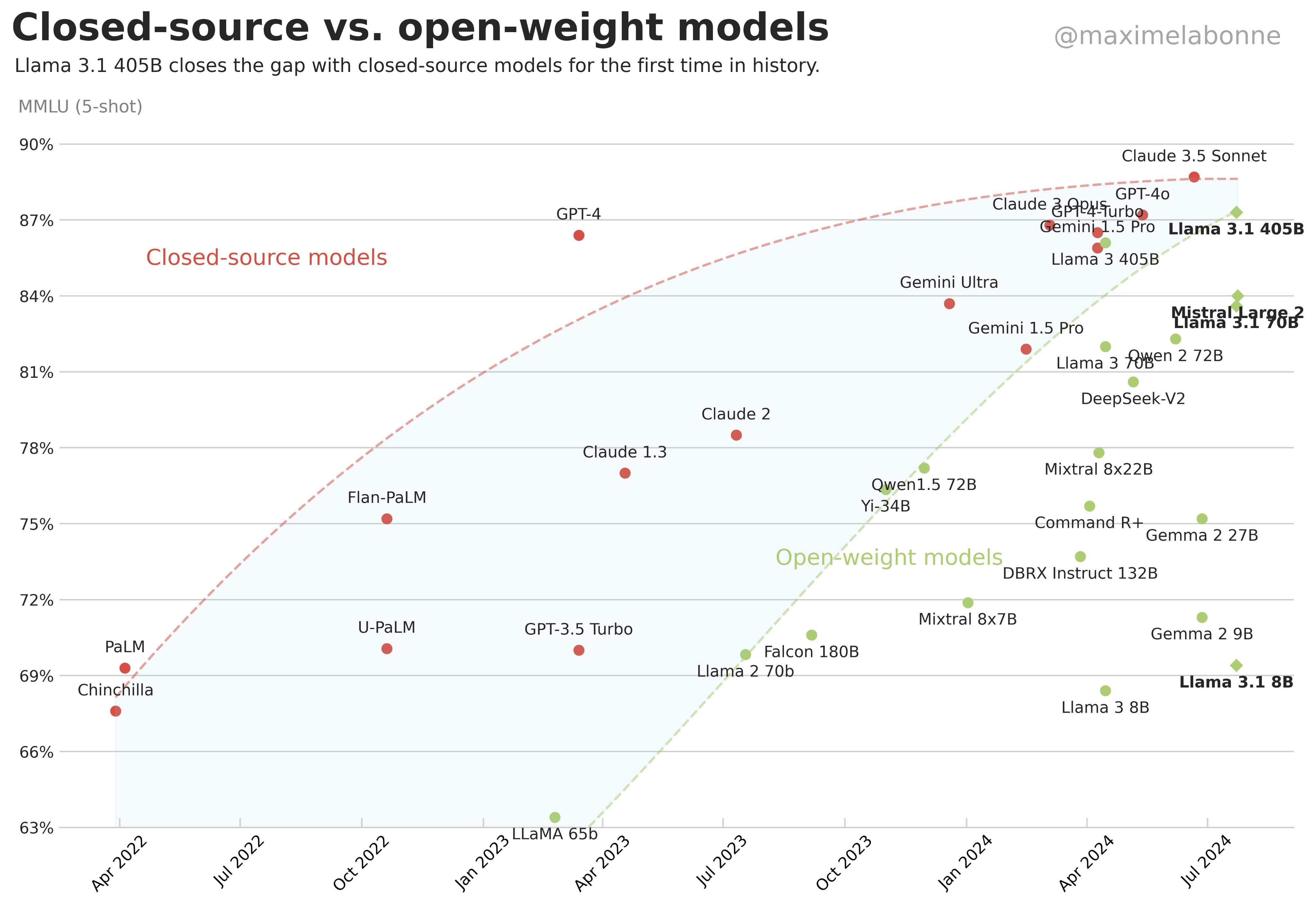
Efficiency is Coming: 3000x Faster, Cheaper, Better AI Inference from Hardware Improvements, Quantization, and Synthetic Data Distillation
AI Engineering is expanding! Join the first 🇬🇧 AI Engineer London meetup in Sept and get in touch for sponsoring the second 🗽 AI Engineer Summit in NYC this Dec!The commoditization of intelligence takes on a few dimensions:* Time to Open Model Equivalent: 15 months between GPT-4 and Llama 3.1 405B * 10-100x CHEAPER/year: from $30/mtok for Claude 3 Opus to $3/mtok for L3-405B, and a 400x reduction in the frontier OpenAI model from 2022-2024. Notably, for personal use cases, both Gemini Flash and now Cerebras Inference offer 1m tokens/day inference free, causing the Open Model Red Wedding.* Alternatively you can observe the frontiers of various small/medium/large sizes of intelligence per dollar shift in realtime. 2024 has been particularly aggressive with almost 2 order-of-magnitude improvements in $/Elo points in the last 8 months.* 4-8x FASTER/year: The new Cerebras Inference platform runs 70B models at 450 tok/s, almost twice as fast as the Groq Cloud example that went viral earlier this year (and at $0.60/mtok to boot). James Wang says they have room to ”~8x throughput in the next few months”, which needs to be seen in reality and at scale, but is very exciting for downstream latency/throughput-sensitive usecases.Today’s guest, Nyla Worker, a senior PM at Nvidia, Convai, and now Google, and recently host of the GPUs & Inference track at the World’s Fair, was the first to point out to us that the kind of efficiency improvements that have become a predominant theme in LLMs in 2024, have been seen before in her career in computer vision. From her start at Ebay optimizing V100 inference for a ResNet-50 model for image search, she has watched many improvements like Multi-Inference GPU (allowing multiple instances with perfect hardware parallelism), Quantization Aware Training (most recently highlighted by Noam Shazeer pre Character AI departure) and Model Distillation (most recently highlighted by the Llama 3.1 paper) stacking with baseline hardware improvements (from V100s to A100s to H100s to GH200s) to produce theoretically 3000x faster inference now than 6 years ago.What Nyla saw in her career the last 6 years, is happening to LLMs today (not exactly repeating, but surely rhyming), specifically with LoRAs, native Int8 and even Ternary models, and teacher model distillation. We were excited to delve into all things efficiency in this episode and even come out the other side with bonus discussions on what generative AI can do for gaming, fanmade TV shows, character AI conversations, and even podcasting!Show Notes:* Nyla Linkedin, Twitter* Related Nvidia research* Improving INT8 Accuracy Using Quantization Aware Training and the NVIDIA TAO Toolkit* Nvidia Jetson Nano: Bringing the power of modern AI to millions of devices.* Synthetic Data with Nvidia Omniverse Replicator: Accelerate AI Training Faster Than Ever with New NVIDIA Omniverse Replicator CapabilitiesTimestamps* [00:00:00] Intro from Suno* [00:03:17] Nyla's path from Astrophysics to LLMs* [00:05:45] Efficiency Curves in Computer Vision at Nvidia* [00:09:51] Optimizing for today's hardware vs tomorrow's inference* [00:16:33] Quantization vs Precision tradeoff* [00:20:42] Hitting the Data Wall: The need for Synthetic Data at Nvidia* [00:26:20] Sora, text to 3D models, and Synthetic Data from Game Engines* [00:30:55] ResNet 50 keeps coming back* [00:35:40] Gaming Benchmarks* [00:38:00] FineWeb* [00:39:43] Traditional ML vs LLMs path to general intelligence* [00:42:33] ConvAI - AI NPCs* [00:45:32] Jensen and Lisa at Computex Taiwan* [00:52:51] NPCs need to take Actions and have Context* [00:54:29] Simulating different roles for training* [00:58:37] AI Generated Fan Content - Podcasts, TV Show, EinsteinTranscripts[00:00:29] AI Charlie: Happy September. This is your AI co host, Charlie.[00:00:34] AI Charlie: One topic we've developed on LatentSpace is the importance of efficiency in all forms, from sample efficiency for spending limited training compute on limited data, and increasingly towards inference efficiency for increasingly demanding use cases like local LLMs, real time AI NPCs, and edge AI. However, we've never really developed any intuition for the trends and efficiency over time.[00:00:59] AI Charlie: For example, from 2020 to 2023, the price of GPT 3 level intelligence dropped from 60 per million tokens to 27 cents with the mixtural price war of December 2023. See show notes for charts and data. As for GPT 4 level intelligence, it took just over a year for GPT 4 to be matched by LLAMA370B and GPT 4 Turbo to be beaten by LLAMA3405B in open source, causing blended cost per million tokens to freefall from over 30 for Claude III Opus and the original GPT 4 down to under 3 for LLAMA3405B.[00:01:43] AI Charlie: Of course, OpenAI themselves have not stood still, slashing the price of GPT 4. 0 by 30 times with GPT 4. 0 Mini. Yes, you heard that right. GPT 4. 0 Mini is 3. 5 percent the price of GPT 4. 0, yet ties with GPT 4 Turbo on LM SYS. When the
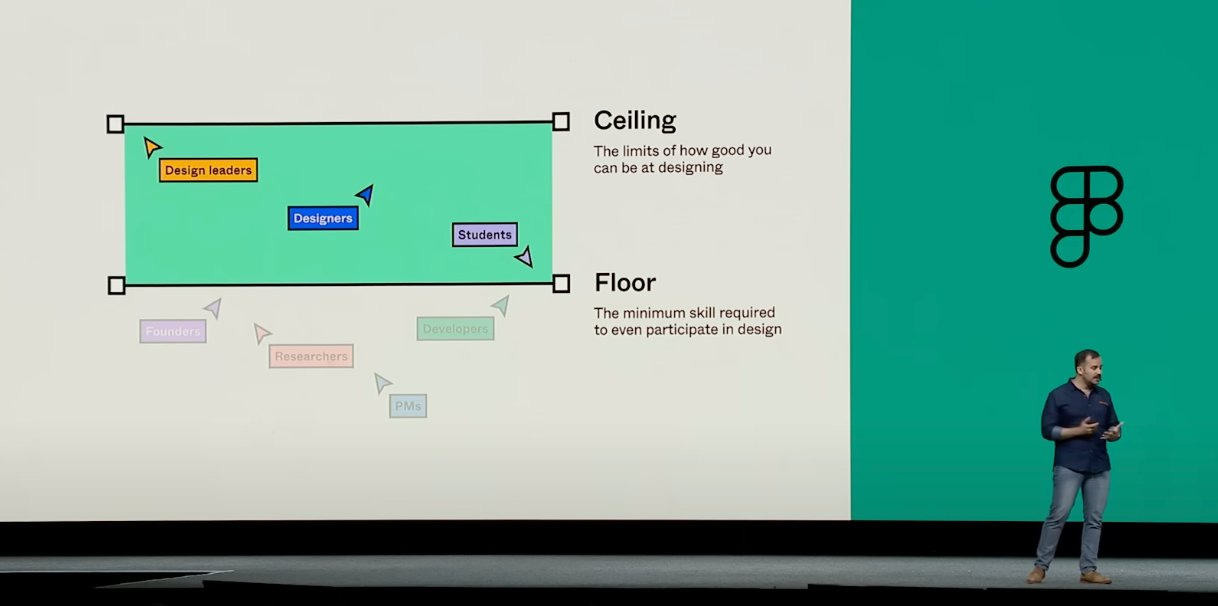
Why you should write your own LLM benchmarks — with Nicholas Carlini, Google DeepMind
Today's guest, Nicholas Carlini, a research scientist at DeepMind, argues that we should be focusing more on what AI can do for us individually, rather than trying to have an answer for everyone."How I Use AI" - A Pragmatic ApproachCarlini's blog post "How I Use AI" went viral for good reason. Instead of giving a personal opinion about AI's potential, he simply laid out how he, as a security researcher, uses AI tools in his daily work. He divided it in 12 sections:* To make applications* As a tutor* To get started* To simplify code* For boring tasks* To automate tasks* As an API reference* As a search engine* To solve one-offs* To teach me* Solving solved problems* To fix errorsEach of the sections has specific examples, so we recommend going through it. It also includes all prompts used for it; in the "make applications" case, it's 30,000 words total!My personal takeaway is that the majority of the work AI can do successfully is what humans dislike doing. Writing boilerplate code, looking up docs, taking repetitive actions, etc. These are usually boring tasks with little creativity, but with a lot of structure. This is the strongest arguments as to why LLMs, especially for code, are more beneficial to senior employees: if you can get the boring stuff out of the way, there's a lot more value you can generate. This is less and less true as you go entry level jobs which are mostly boring and repetitive tasks. Nicholas argues both sides ~21:34 in the pod.A New Approach to LLM BenchmarksWe recently did a Benchmarks 201 episode, a follow up to our original Benchmarks 101, and some of the issues have stayed the same. Notably, there's a big discrepancy between what benchmarks like MMLU test, and what the models are used for. Carlini created his own domain-specific language for writing personalized LLM benchmarks. The idea is simple but powerful:* Take tasks you've actually needed AI for in the past.* Turn them into benchmark tests.* Use these to evaluate new models based on your specific needs.It can represent very complex tasks, from a single code generation to drawing a US flag using C:"Write hello world in python" >> LLMRun() >> PythonRun() >> SubstringEvaluator("hello world")"Write a C program that draws an american flag to stdout." >> LLMRun() >> CRun() >> \ VisionLLMRun("What flag is shown in this image?") >> \ (SubstringEvaluator("United States") | SubstringEvaluator("USA")))This approach solves a few problems:* It measures what's actually useful to you, not abstract capabilities.* It's harder for model creators to "game" your specific benchmark, a problem that has plagued standardized tests.* It gives you a concrete way to decide if a new model is worth switching to, similar to how developers might run benchmarks before adopting a new library or framework.Carlini argues that if even a small percentage of AI users created personal benchmarks, we'd have a much better picture of model capabilities in practice.AI SecurityWhile much of the AI security discussion focuses on either jailbreaks or existential risks, Carlini's research targets the space in between. Some highlights from his recent work:* LAION 400M data poisoning: By buying expired domains referenced in the dataset, Carlini's team could inject arbitrary images into models trained on LAION 400M. You can read the paper "Poisoning Web-Scale Training Datasets is Practical", for all the details. This is a great example of expanding the scope beyond the model itself, and looking at the whole system and how ti can become vulnerable.* Stealing model weights: They demonstrated how to extract parts of production language models (like OpenAI's) through careful API queries. This research, "Extracting Training Data from Large Language Models", shows that even black-box access can leak sensitive information.* Extracting training data: In some cases, they found ways to make models regurgitate verbatim snippets from their training data. Him and Milad Nasr wrote a paper on this as well: Scalable Extraction of Training Data from (Production) Language Models. They also think this might be applicable to extracting RAG results from a generation.These aren't just theoretical attacks. They've led to real changes in how companies like OpenAI design their APIs and handle data. If you really miss logit_bias and logit results by token, you can blame Nicholas :)We had a ton of fun also chatting about things like Conway's Game of Life, how much data can fit in a piece of paper, and porting Doom to Javascript. Enjoy!Show Notes* How I Use AI* My Benchmark for LLMs* Doom Javascript port* Conway's Game of Life* Tic-Tac-Toe in one printf statement* International Obfuscated C Code Contest* Cursor* LAION 400M poisoning paper* Man vs Machine at Black Hat* Model Stealing from OpenAI* Milad Nasr* H.D. Moore* Vijay Bolina* Cosine.sh* uuencodeTimestamps* [00:00:00] Introductions* [00:01:14] Why Nicholas writes* [00:02:09] The Game of Life* [00:05:07] "How I Use AI" blog post origin story* [
Is finetuning GPT4o worth it? — with Alistair Pullen, Cosine (Genie)
Betteridge's law says no: with seemingly infinite flavors of RAG, and >2million token context + prompt caching from Anthropic/Deepmind/Deepseek, it's reasonable to believe that "in context learning is all you need".But then there’s Cosine Genie, the first to make a huge bet using OpenAI’s new GPT4o fine-tuning for code at the largest scale it has ever been used externally; resulting in what is now the #1 coding agent in the world according to SWE-Bench Full, Lite, and Verified:SWE-Bench has been the most successful agent benchmark of the year, receiving honors at ICLR (our interview here) and recently being verified by OpenAI. Cognition (Devin) was valued at $2b after reaching 14% on it. So it is very, very big news when a new agent appears to beat all other solutions, by a lot:While this number is self reported, it seems to be corroborated by OpenAI, who also award it clear highest marks on SWE-Bench verified:The secret is GPT-4o finetuning on billions of tokens of synthetic data. * Finetuning: As OpenAI says:Genie is powered by a fine-tuned GPT-4o model trained on examples of real software engineers at work, enabling the model to learn to respond in a specific way. The model was also trained to be able to output in specific formats, such as patches that could be committed easily to codebases. Due to the scale of Cosine’s finetuning, OpenAI worked closely with them to figure out the size of the LoRA:“They have to decide how big your LoRA adapter is going to be… because if you had a really sparse, large adapter, you’re not going to get any signal in that at all. So they have to dynamically size these things.”* Synthetic data: we need to finetune on the process of making code work instead of only training on working code.“…we synthetically generated runtime errors. Where we would intentionally mess with the AST to make stuff not work, or index out of bounds, or refer to a variable that doesn't exist, or errors that the foundational models just make sometimes that you can't really avoid, you can't expect it to be perfect.”Genie also has a 4 stage workflow with the standard LLM OS tooling stack that lets it solve problems iteratively:Full Video Podlike and subscribe etc!Show Notes* Alistair Pullen - Twitter, Linkedin* Cosine Genie launch, technical report* OpenAI GPT-4o finetuning GA* Llama 3 backtranslation* Cursor episode and Aman + SWEBench at ICLR episodeTimestamps* [00:00:00] Suno Intro* [00:05:01] Alistair and Cosine intro* [00:16:34] GPT4o finetuning* [00:20:18] Genie Data Mix* [00:23:09] Customizing for Customers* [00:25:37] Genie Workflow* [00:27:41] Code Retrieval* [00:35:20] Planning* [00:42:29] Language Mix* [00:43:46] Running Code* [00:46:19] Finetuning with OpenAI* [00:49:32] Synthetic Code Data* [00:51:54] SynData in Llama 3* [00:52:33] SWE-Bench Submission Process* [00:58:20] Future Plans* [00:59:36] Ecosystem Trends* [01:00:55] Founder Lessons* [01:01:58] CTA: Hiring & CustomersDescript Transcript[00:01:52] AI Charlie: Welcome back. This is Charlie, your AI cohost. As AI engineers, we have a special focus on coding agents, fine tuning, and synthetic data. And this week, it all comes together with the launch of Cosign's Genie, which reached 50 percent on SWE Bench Lite, 30 percent on the full SWE Bench, and 44 percent on OpenAI's new SWE Bench Verified.[00:02:17] All state of the art results by the widest ever margin recorded compared to former leaders Amazon Q and US Autocode Rover. And Factory Code Droid. As a reminder, Cognition Devon went viral with a 14 percent score just five months ago. Cosign did this by working closely with OpenAI to fine tune GPT 4. 0, now generally available to you and me, on billions of tokens of code, much of which was synthetically generated.[00:02:47] Alistair Pullen: Hi, I'm Ali. Co founder and CEO of Cosign, a human reasoning lab. And I'd like to show you Genie, our state of the art, fully autonomous software engineering colleague. Genie has the highest score on SWBench in the world. And the way we achieved this was by taking a completely different approach. We believe that if you want a model to behave like a software engineer, it has to be shown how a human software engineer works.[00:03:15] We've designed new techniques to derive human reasoning from real examples of software engineers doing their jobs. Our data represents perfect information lineage, incremental knowledge discovery, and step by step decision making. Representing everything a human engineer does logically. By actually training Genie on this unique dataset, rather than simply prompting base models, which is what everyone else is doing, we've seen that we're no longer simply generating random code until some works.[00:03:46] It's tackling problems like[00:03:48] AI Charlie: a human. Alistair Pullen is CEO and co founder of Kozen, and we managed to snag him on a brief trip stateside for a special conversation on building the world's current number one coding agent. Watch out and take care.[00:0