
Latent Space: The AI Engineer Podcast
231 episodes — Page 5 of 5

The Point of LangChain — with Harrison Chase of LangChain
As alluded to on the pod, LangChain has just launched LangChain Hub: “the go-to place for developers to discover new use cases and polished prompts.” It’s available to everyone with a LangSmith account, no invite code necessary. Check it out!In 2023, LangChain has speedrun the race from 2:00 to 4:00 to 7:00 Silicon Valley Time. From the back to back $10m Benchmark seed and (rumored) $20-25m Sequoia Series A in April, to back to back critiques of “LangChain is Pointless” and “The Problem with LangChain” in July, to teaching with Andrew Ng and keynoting at basically every AI conference this fall (including ours), it has been an extreme rollercoaster for Harrison and his growing team creating one of the most popular (>60k stars at time of writing) building blocks for AI Engineers.LangChain’s OriginsThe first commit to LangChain shows its humble origins as a light wrapper around Python’s formatter.format for prompt templating. But as Harrison tells the story, even his first experience with text-davinci-002 in early 2022 was focused on chatting with data from their internal company Notion and Slack, what is now known as Retrieval Augmented Generation (RAG). As the Generative AI meetup scene came to life post Stable Diffusion, Harrison saw a need for common abstractions for what people were building with text LLMs at the time:* LLM Math, aka Riley Goodside’s “You Can’t Do Math” REPL-in-the-loop (PR #8)* Self-Ask With Search, Ofir Press’ agent pattern (PR #9) (later ReAct, PR #24)* NatBot, Nat Friedman’s browser controlling agent (PR #18)* Adapters for OpenAI, Cohere, and HuggingFaceHubAll this was built and launched in a few days from Oct 16-25, 2022. Turning research ideas/exciting usecases into software quickly and often has been in the LangChain DNA from Day 1 and likely a big driver of LangChain’s success, to date amassing the largest community of AI Engineers and being the default launch framework for every big name from Nvidia to OpenAI:Dancing with GiantsBut AI Engineering is built atop of constantly moving tectonic shifts: * ChatGPT launched in November (“The Day the AGI Was Born”) and the API released in March. Before the ChatGPT API, OpenAI did not have a chat endpoint. In order to build a chatbot with history, you had to make sure to chain all messages and prompt for completion. LangChain made it easy to do that out of the box, which was a huge driver of usage. * Today, OpenAI has gone all-in on the chat API and is deprecating the old completions models, essentially baking in the chat pattern as the default way most engineers should interact with LLMs… and reducing (but not eliminating) the value of ConversationChains.* And there have been more updates since: Plugins released in API form as Functions in June (one of our top pods ever… reducing but not eliminating the value of OutputParsers) and Finetuning in August (arguably reducing some need for Retrieval and Prompt tooling). With each update, OpenAI and other frontier model labs realign the roadmaps of this nascent industry, and Harrison credits the modular design of LangChain in staying relevant. LangChain has not been merely responsive either: LangChain added Agents in November, well before they became the hottest topic of the AI Summer, and now Agents feature as one of LangChain’s top two usecases. LangChain’s problem for podcasters and newcomers alike is its sheer scope - it is the world’s most complete AI framework, but it also has a sprawling surface area that is difficult to fully grasp or document in one sitting. This means it’s time for the trademark Latent Space move (ChatGPT, GPT4, Auto-GPT, and Code Interpreter Advanced Data Analysis GPT4.5): the executive summary!What is LangChain?As Harrison explains, LangChain is an open source framework for building context-aware reasoning applications, available in Python and JS/TS.It launched in Oct 2022 with the central value proposition of “composability”, aka the idea that every AI engineer will want to switch LLMs, and combine LLMs with other things into “chains”, using a flexible interface that can be saved via a schema.Today, LangChain’s principal offerings can be grouped as:* Components: isolated modules/abstractions* Model I/O* Models (for LLM/Chat/Embeddings, from OpenAI, Anthropic, Cohere, etc)* Prompts (Templates, ExampleSelectors, OutputParsers)* Retrieval (revised and reintroduced in March)* Document Loaders (eg from CSV, JSON, Markdown, PDF)* Text Splitters (15+ various strategies for chunking text to fit token limits)* Retrievers (generic interface for turning an unstructed query into a set of documents - for self-querying, contextual compression, ensembling)* Vector Stores (retrievers that search by similarity of embeddings)* Indexers (sync documents from any source into a vector store without duplication)* Memory (for long running chats, whether a simple Buffer, Knowledge Graph, Summary, or Vector Store)* Use-Cases: compositions of Components* Chains: combining a PromptTemplate, LL
RWKV: Reinventing RNNs for the Transformer Era — with Eugene Cheah of UIlicious
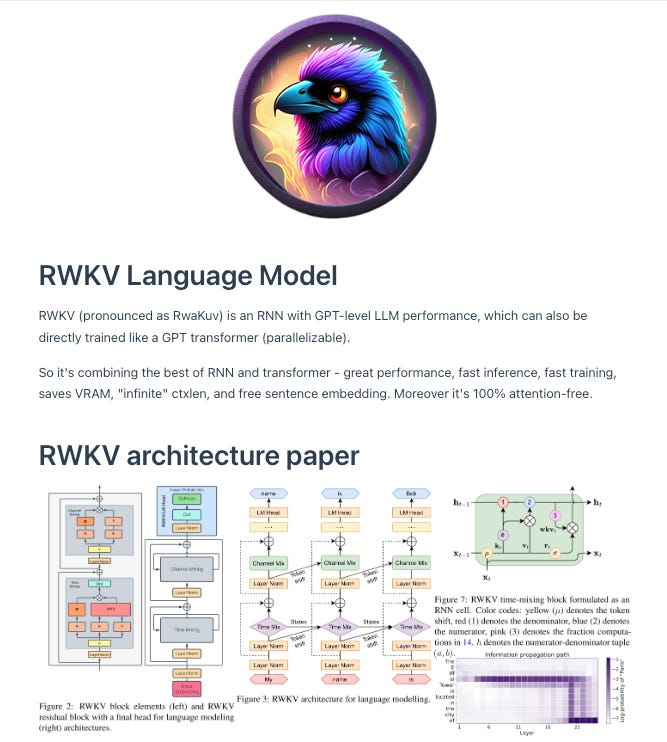
The AI Engineer Summit Expo has been announced, presented by AutoGPT (and future guest Toran Bruce-Richards!) Stay tuned for more updates on the Summit livestream and Latent Space University.This post was on HN for 10 hours.What comes after the Transformer? This is one of the Top 10 Open Challenges in LLM Research that has been the talk of the AI community this month. Jon Frankle (friend of the show!) has an ongoing bet with Sasha Rush on whether Attention is All You Need, and the most significant challenger to emerge this year has been RWKV - Receptance Weighted Key Value models, which revive the RNN for GPT-class LLMs, inspired by a 2021 paper on Attention Free Transformers from Apple (surprise!).What this means practically is that RWKV models tend to scale in all directions (both in training and inference) much better than Transformers-based open source models:While remaining competitive on standard reasoning benchmarks:swyx was recently in Singapore for meetings with AI government and industry folks, and grabbed 2 hours with RWKV committee member Eugene Cheah for a deep dive, the full recording of which is now up on Latent Space TV:Today we release both the 2hr video and an edited 1hr audio version, to cater to the different audiences and provide “ablation opportunities” on RWKV interest level.The Eleuther Mafia?The RWKV project is notable not merely because of the credible challenge to the Transformers dominance. It is also a distributed, international, mostly uncredentialed community reminiscent of early 2020s Eleuther AI:* Primarily Discord, pseudonymous, GPU-poor volunteer community somehow coordinating enough to train >10B, OPT/BLOOM-competitive models* Being driven by the needs of its community, it is extremely polyglot (e.g. English, Chinese, Japanese, Arabic) not because it needs to beat some benchmarks, but because its users want it to be for their own needs.* “Open Source” in both the good and the bad way - properly Apache 2.0 licensed (not “open but restricted”), yet trained on data taken from commercially compromised sources like the Pile (where Shawn Presser’s Books3 dataset has been recently taken down) and Alpaca (taking from Steven Tey’s ShareGPT which is technically against OpenAI TOS)The threadboi class has loved tracking the diffusion of Transformers paper authors out into the industry:But perhaps the underdog version of this is tracking the emerging Eleuther AI mafia:It will be fascinating to see how both Eleuther and Eleuther alums fare as they build out the future of both LLMs and open source AI.Audio Version Timestampsassisted by smol-podcaster. Different timestamps vs the 2hr YouTube* [00:05:35] Eugene's path into AI at UIlicious* [00:07:33] Tokenizer penalty and data efficiency of Transformers* [00:08:02] Using Salesforce CodeGen* [00:10:17] The limitations of Transformers for handling large context sizes* [00:13:17] RWKV compute costs compared to Transformers* [00:16:06] How Eugene found RWKV early* [00:18:52] RWKV's focus on supporting many languages, not just English* [00:21:24] Using the RWKV model for fine-tuning for specific languages* [00:24:45] What is RWKV?* [00:33:46] Overview of the different RWKV models like World, Raven, Novel* [00:41:34] Background of Blink, the creator of RWKV* [00:49:55] The linear vs quadratic scaling of RWKV vs Transformers* [00:53:29] RWKV matching Transformer performance on reasoning tasks* [00:54:31] The community's lack of marketing for RWKV* [00:57:00] The English-language bias in AI models* [01:00:33] Plans to improve RWKV's memory and context handling* [01:03:10] Advice for AI engineers wanting to get more technical knowledgeShow NotesCompanies/Organizations:* RWKV - HF blog, paper, docs, GitHub, Huggingface* Raven 14B (finetuned on Alpaca+ShareGPT+...) Demo* World 7B (supports 100+ world languages) Demo* How RWKV works in 100 LOC, RWKV overview* EleutherAI - Decentralized open source AI research group* Stability AI - Creators of Stable Diffusion * Conjecture - Spun off from EleutherAIPeople:* Eugene Chia - CTO of UIlicious, member of RWKV committee (GitHub, Twitter)* Blink/Bo Peng - Creator of RWKV architecture* Quentin Anthony - our Latent Space pod on Eleuther, coauthor on RWKV * Sharif Shameem - our Latent Space pod on being early to Stable Diffusion* Tri Dao - our Latent Space pod on FlashAttention making Attention subquadratic* Linus Lee - our Latent Space pod in NYC* Jonathan Frankle - our Latent Space pod about Transformers longevity* Chris Re - Genius at Stanford working on state-space models* Andrej Karpathy - Zero to Hero series* Justine Tunney ("Justine.lol") - mmap trickModels/Papers:* Top 10 Open Challenges in LLM Research* Retentive Network: A Successor to Transformer for Large Language Models * GPT-NeoX - Open source replica of GPT-3 by EleutherAI * Salesforce CodeGen and CodeGen 2* Attention Free Transformers paper* The Pile* RedPajama dataset* Monarch Mixer - Revisiting BERT, Without Attention or MLPsMisc NotesRWKV is n
Cursor.so: The AI-first Code Editor — with Aman Sanger of Anysphere
Thanks to the almost 30k people who tuned in to the last episode!Your podcast cohosts have been busy shipping:* Alessio open sourced smol-podcaster, which makes the show notes here! * swyx launched GodMode. Maybe someday the Cursor of browsers?* We’re also helping organize a Llama Finetuning Hackameetup this Saturday in anticipation of the CodeLlama release. Lastly, more speakers were announced at AI Engineer Summit! 👀~46% of code typed through VS Code is written by Copilot. How do we get closer to 90+%? Aman Sanger says we need a brand new AI-powered IDE to get there; and we’re excited to be the first podcast ever to tell the Cursor story.If you haven’t heard of Cursor, you may have been living under a rock. Here are just some of the rave reviews going around in the past week alone:* “Cursor is the best product I've used in a while” - Alex MacCaw* “Someone finally put GPT into a code editor in a seamless way. It's so elegant and easy. No more copying and pasting.” - Andrew McCalip* “Coding with AI is getting insane.” - Mckay Wrigley* “This is mind blowing 🤯” - Linus Ekenstam* “Cursor + gpt4-32k = illegal levels of productivity” - Sully Omarr* “EL MEJOR EDITOR DE CÓDIGO con IA” - Carlos SantanaA decade ago, “platform risk” meant building apps on social media platforms was risky as you could get cut off from the social network. Today, the AI version of “platform risk” is building AI products within an existing product (like an AI extension for VS Code, or a Figma plugin). Since Copilot, a generation of VSCode plugins have launched (including Cody, Cosine, and previous guests Codeium and Codium), only to be challenged by Copilot X itself.A core AI Engineering thesis is that new capabilities in AI demands new innovation in AI UX (and that AI UX can actually be a viable moat). Take VS Code for example; when Github was first working on Copilot, there was actually no way to support the “ghost autocomplete” feature we all use today. They eventually convinced the team to build it, and Copilot’s success speaks for itself.If you’re a startup building on top of VSC today, you do not have the same access and influence on the roadmap. Your UX is limited to what they allow you to do, and often that caps your ability to successfully compete against them. Since Cursor owns the whole IDE, they can do things you can’t (yet) do in VSCode:Cursor’s GameplanCursor is competing head to head against VS Code by forking Microsoft’s IDE and building their own AI-powered version. A few of Cursor’s unique features:* Native chat: Chat is a core piece of Cursor. Users can choose between GPT-3.5 and GPT-4 to ask questions and receive answers based on their code.* “Mentioning” files: you can easily add files into your request context by using “@”; this works both for code as well as documentation. If you want to do a change that includes multiple files, you can include them in your question to make sure the change is reflected in all of them.* Custom prompting engine: Cursor built Priompt, their custom prompting engine. As your chats go over the context window size, Priompt figures out which messages to keep in the history, which files to drop from the prompt, etc. * Moving beyond typing: while IDEs are familiar to folks as today’s interfaces, in the future Cursor hopes to have agents you can delegate tasks to. Instead of a back and forth on a new feature or bug fix, you can ask it to do the whole thing for you end to end.After diving deep into Cursor we nerded out on model usage, training, quantization, and evaluation. There’s a ton of great content in this episode, we hope you’ll enjoy it!As always, feedback welcome in the comments, and tag us on socials for future guest suggestions!Show Notes* Cursor* Gary Marcus’ cubes prompt* Priompt* “Humans should focus on bigger problems.”* Codium AI on Latent Space* Rift from Morph* Sourcegraph* E2B* Repl.it* HungryHungryHippos, Hyena, etc (see our FlashAttention episode)* Aman Tweets* Why GPT-3.5 is (mostly) cheaper than Llama 2* Llama’s architectural limitations* “Training will look like researchers/practitioners offloading large-scale training jobs to specialized “training” companies: a state of the world that resembles chip design & fabrication.” - Mosaic prediction* “The size of all code/history on Github public repos is 92TB. The size of Google's monorepo in 2015 was 86TB (of much higher quality code). If Google were willing to deploy code models trained on their own data, they'd have a noticable advantage over everyone else.” - May 2023Timestamps* [00:00:00] Intros* [00:02:31] Developing CAD models vs coding models* [00:05:23] Deciding to build a new IDE optimized for large language models* [00:10:50] Getting early access to GPT-4 and realizing its potential for software development* [00:12:32] Rethinking the UI/UX for coding* [00:18:24] Cursor's features like system prompts and chat* [00:22:24] Tips for prompting GPT-3/4 for code generation and editing* [00:27:24] Cursor's documentation
The Mathematics of Training LLMs — with Quentin Anthony of Eleuther AI
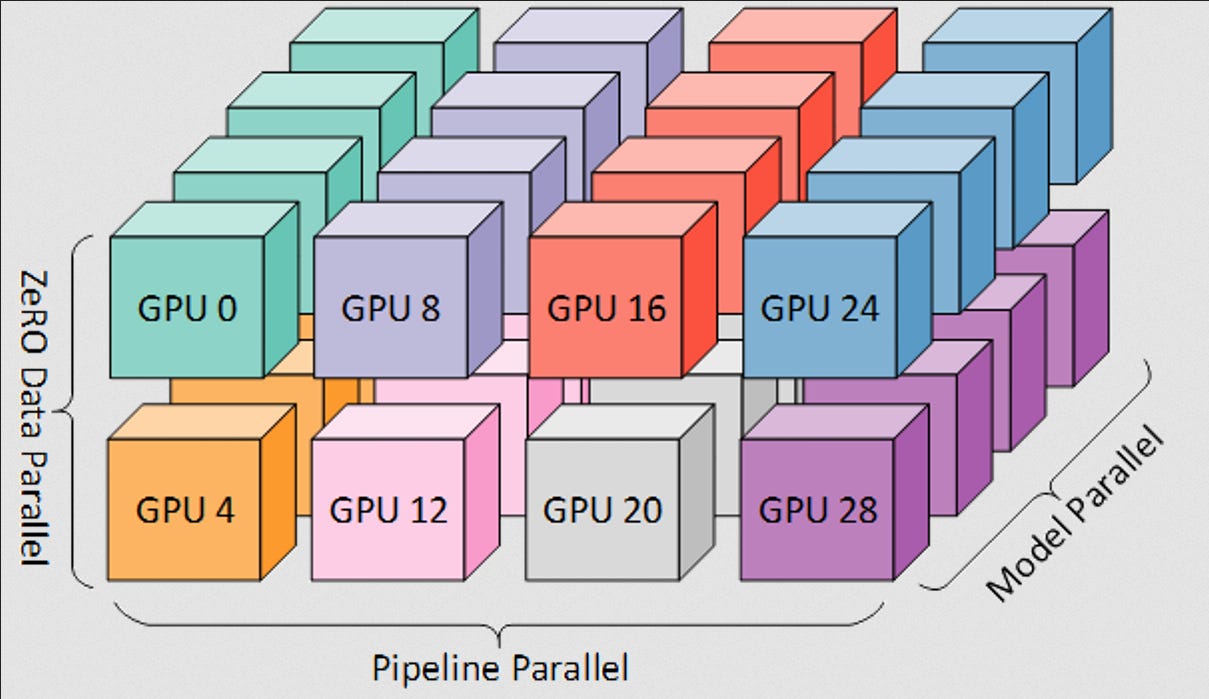
Invites are going out for AI Engineer Summit! In the meantime, we have just announced our first Actually Open AI event with Brev.dev and Langchain, Aug 26 in our SF HQ (we’ll record talks for those remote). See you soon (and join the Discord)!Special thanks to @nearcyan for helping us arrange this with the Eleuther team.This post was on the HN frontpage for 15 hours.As startups and even VCs hoard GPUs to attract talent, the one thing more valuable than GPUs is knowing how to use them (aka, make GPUs go brrrr).There is an incredible amount of tacit knowledge in the NLP community around training, and until Eleuther.ai came along you pretty much had to work at Google or Meta to gain that knowledge. This makes it hard for non-insiders to even do simple estimations around costing out projects - it is well known how to trade $ for GPU hours, but trading “$ for size of model” or “$ for quality of model” is less known and more valuable and full of opaque “it depends”. This is why rules of thumb for training are incredibly useful, because they cut through the noise and give you the simple 20% of knowledge that determines 80% of the outcome derived from hard earned experience.Today’s guest, Quentin Anthony from EleutherAI, is one of the top researchers in high-performance deep learning. He’s one of the co-authors of Transformers Math 101, which was one of the clearest articulations of training rules of thumb. We can think of no better way to dive into training math than to have Quentin run us through a masterclass on model weights, optimizer states, gradients, activations, and how they all impact memory requirements.The core equation you will need to know is the following:Where C is the compute requirements to train a model, P is the number of parameters, and D is the size of the training dataset in tokens. This is also equal to τ, the throughput of your machine measured in FLOPs (Actual FLOPs/GPU * # of GPUs), multiplied by T, the amount of time spent training the model.Taking Chinchilla scaling at face value, you can simplify this equation to be `C = 120(P^2)`.These laws are only true when 1000 GPUs for 1 hour costs the same as 1 GPU for 1000 hours, so it’s not always that easy to make these assumptions especially when it comes to communication overhead. There’s a lot more math to dive into here between training and inference, which you can listen to in the episode or read in the articles. The other interesting concept we covered is distributed training and strategies such as ZeRO and 3D parallelism. As these models have scaled, it’s become impossible to fit everything in a single GPU for training and inference. We leave these advanced concepts to the end, but there’s a lot of innovation happening around sharding of params, gradients, and optimizer states that you must know is happening in modern LLM training. If you have questions, you can join the Eleuther AI Discord or follow Quentin on Twitter. Show Notes* Transformers Math 101 Article* Eleuther.ai* GPT-NeoX 20B* BLOOM* Turing NLG* Mosaic* Oak Ridge & Frontier Supercomputer* Summit Supercomputer * Lawrence Livermore Lab* RWKV* Flash Attention * Stas BekmanTimestamps* [00:00:00] Quentin's background and work at Eleuther.ai* [00:03:14] Motivation behind writing the Transformers Math 101 article* [00:05:58] Key equation for calculating compute requirements (tau x T = 6 x P x D)* [00:10:00] Difference between theoretical and actual FLOPs* [00:12:42] Applying the equation to estimate compute for GPT-3 training* [00:14:08] Expecting 115+ teraflops/sec per A100 GPU as a baseline* [00:15:10] Tradeoffs between Nvidia and AMD GPUs for training* [00:18:50] Model precision (FP32, FP16, BF16 etc.) and impact on memory* [00:22:00] Benefits of model quantization even with unlimited memory* [00:23:44] KV cache memory overhead during inference* [00:26:08] How optimizer memory usage is calculated* [00:32:03] Components of total training memory (model, optimizer, gradients, activations)* [00:33:47] Activation recomputation to reduce memory overhead* [00:38:25] Sharded optimizers like ZeRO to distribute across GPUs* [00:40:23] Communication operations like scatter and gather in ZeRO* [00:41:33] Advanced 3D parallelism techniques (data, tensor, pipeline)* [00:43:55] Combining 3D parallelism and sharded optimizers* [00:45:43] Challenges with heterogeneous clusters for distribution* [00:47:58] Lightning RoundTranscriptionAlessio: Hey everyone, welcome to the Latent Space podcast. This is Alessio, partner and CTO in Residence at Decibel Partners, and I'm joined by my co-host Swyx, writer and editor of Latent Space. [00:00:20]Swyx: Hey, today we have a very special guest, Quentin Anthony from Eleuther.ai. The context for this episode is that we've been looking to cover Transformers math for a long time. And then one day in April, there's this blog post that comes out that literally is called Transformers Math 101 from Eleuther. And this is one of the most authoritative posts that I've

LLMs Everywhere: Running 70B models in browsers and iPhones using MLC — with Tianqi Chen of CMU / OctoML
We have just announced our first set of speakers at AI Engineer Summit! Sign up for the livestream or email [email protected] if you’d like to support.We are facing a massive GPU crunch. As both startups and VC’s hoard Nvidia GPUs like countries count nuclear stockpiles, tweets about GPU shortages have become increasingly common. But what if we could run LLMs with AMD cards, or without a GPU at all? There’s just one weird trick: compilation. And there’s one person uniquely qualified to do it.We had the pleasure to sit down with Tianqi Chen, who’s an Assistant Professor at CMU, where he both teaches the MLC course and runs the MLC group. You might also know him as the creator of XGBoost, Apache TVM, and MXNet, as well as the co-founder of OctoML. The MLC (short for Machine Learning Compilation) group has released a lot of interesting projects:* MLC Chat: an iPhone app that lets you run models like RedPajama-3B and Vicuna-7B on-device. It gets up to 30 tok/s!* Web LLM: Run models like LLaMA-70B in your browser (!!) to offer local inference in your product.* MLC LLM: a framework that allows any language models to be deployed natively on different hardware and software stacks.The MLC group has just announced new support for AMD cards; we previously talked about the shortcomings of ROCm, but using MLC you can get performance very close to the NVIDIA’s counterparts. This is great news for founders and builders, as AMD cards are more readily available. Here are their latest results on AMD’s 7900s vs some of top NVIDIA consumer cards.If you just can’t get a GPU at all, MLC LLM also supports ARM and x86 CPU architectures as targets by leveraging LLVM. While speed performance isn’t comparable, it allows for non-time-sensitive inference to be run on commodity hardware.We also enjoyed getting a peek into TQ’s process, which involves a lot of sketching:With all the other work going on in this space with projects like ggml and Ollama, we’re excited to see GPUs becoming less and less of an issue to get models in the hands of more people, and innovative software solutions to hardware problems!Show Notes* TQ’s Projects:* XGBoost* Apache TVM* MXNet* MLC* OctoML* CMU Catalyst* ONNX* GGML* Mojo* WebLLM* RWKV* HiPPO* Tri Dao’s Episode* George Hotz EpisodePeople:* Carlos Guestrin* Albert GuTimestamps* [00:00:00] Intros* [00:03:41] The creation of XGBoost and its surprising popularity* [00:06:01] Comparing tree-based models vs deep learning* [00:10:33] Overview of TVM and how it works with ONNX* [00:17:18] MLC deep dive* [00:28:10] Using int4 quantization for inference of language models* [00:30:32] Comparison of MLC to other model optimization projects* [00:35:02] Running large language models in the browser with WebLLM* [00:37:47] Integrating browser models into applications* [00:41:15] OctoAI and self-optimizing compute* [00:45:45] Lightning RoundTranscriptAlessio: Hey everyone, welcome to the Latent Space podcast. This is Alessio, Partner and CTO in Residence at Decibel Partners, and I'm joined by my co-host Swyx, writer and editor of Latent Space. [00:00:20]Swyx: Okay, and we are here with Tianqi Chen, or TQ as people call him, who is assistant professor in ML computer science at CMU, Carnegie Mellon University, also helping to run Catalyst Group, also chief technologist of OctoML. You wear many hats. Are those, you know, your primary identities these days? Of course, of course. [00:00:42]Tianqi: I'm also, you know, very enthusiastic open source. So I'm also a VP and PRC member of the Apache TVM project and so on. But yeah, these are the things I've been up to so far. [00:00:53]Swyx: Yeah. So you did Apache TVM, XGBoost, and MXNet, and we can cover any of those in any amount of detail. But maybe what's one thing about you that people might not learn from your official bio or LinkedIn, you know, on the personal side? [00:01:08]Tianqi: Let me say, yeah, so normally when I do, I really love coding, even though like I'm trying to run all those things. So one thing that I keep a habit on is I try to do sketchbooks. I have a book, like real sketchbooks to draw down the design diagrams and the sketchbooks I keep sketching over the years, and now I have like three or four of them. And it's kind of a usually a fun experience of thinking the design through and also seeing how open source project evolves and also looking back at the sketches that we had in the past to say, you know, all these ideas really turn into code nowadays. [00:01:43]Alessio: How many sketchbooks did you get through to build all this stuff? I mean, if one person alone built one of those projects, he'll be a very accomplished engineer. Like you built like three of these. What's that process like for you? Like it's the sketchbook, like the start, and then you think about the code or like. [00:01:59]Swyx: Yeah. [00:02:00]Tianqi: So, so usually I start sketching on high level architectures and also in a project that works for over years, we also start to think abo
[AI Breakdown] Summer AI Technical Roundup: a Latent Space x AI Breakdown crossover pod!
Our 3rd podcast feed swap with other AI pod friends! Check out Cognitive Revolution and Practical AI as well.NLW is the best daily AI YouTube/podcaster with the AI Breakdown. His summaries and content curation are spot on and always finds the interesting angle that will keep you thinking. Subscribe to the AI Breakdown wherever fine podcasts are sold! https://pod.link/1680633614You can also watch on YouTube:Timestampscourtesy of summarize.techThe hosts discuss the launch of Code Interpreter as a separate model from OpenAI and speculate that it represents the release of GPT 4.5. People have found Code Interpreter to be better than expected, even for tasks unrelated to coding. They discuss the significance of this release, as well as the challenges of evaluating AI models, the cultural mismatch between researchers and users, and the increasing value of data in the AI industry. They also touch on the impact of open-source tools, the potential of AI companions, the advantages of Anthropics compared to other platforms, advancements in image recognition and multimodality, and predictions for the future of AI.* 00:00:00 In this section, the hosts discuss the launch of Code Interpreter from OpenAI and its significance in the development of the AI field. They explain that Code Interpreter, initially introduced as a plugin, is now considered a separate model with its own dropdown menu. They note that people have found Code Interpreter to be better than expected, even for tasks that are not related to coding. This leads them to speculate that Code Interpreter actually represents the release of GPT 4.5, as there has been no official announcement or blog post about it. They also mention that the AI safety concerns and regulatory environment may be impacting how OpenAI names and labels their models. Overall, they believe that Code Interpreter's release signifies a significant shift in the AI field and hints at the possibility of future advanced models like GPT 5.* 00:05:00 In this section, the speaker discusses the improvements in GPT 4.5 and how it enhances the experience for non-coding queries and inputs. They explain that the code interpreter feature allows for a wider range of use cases that were not possible with previous models like GPT 3.5. Additionally, they highlight the value of the code interpreter in assisting individuals with no coding experience to solve basic coding problems. This feature is likened to having a junior developer or intern analyst that aids in conducting tests and simplifies coding tasks. The speaker emphasizes that GPT 4.5 enables users to be more productive and efficient, especially when dealing with code-related challenges. They also discuss the future direction of AGI, where more time will be dedicated to inference rather than training, as this approach has shown significant improvements in terms of problem-solving.* 00:10:00 In this section, the speaker discusses how advanced AI models like GPT-4.5 are not just larger versions of previous models but rather employ fundamentally different techniques. They compare the evolution of AI models to the evolutionary timeline of humans, where the invention of tools opened up a whole new set of possibilities. They touch on the difficulty of evaluating AI models, particularly in more subjective tasks, and highlight how perceptions of model performance can be influenced by factors like formatting preferences. Additionally, the speaker mentions the challenges of reinforcement learning and the uncertainty around what the model is prioritizing in its suggestions. They conclude that OpenAI, as a research lab, is grappling with the complexities of updating models and ensuring reliability for users.* 00:15:00 In this section, the speaker discusses the cultural mismatch between OpenAI researchers and users of OpenAI's products, highlighting the conflicting statements made about model updates. They suggest that OpenAI needs to establish a policy that everyone can accept. The speaker also emphasizes the challenges of communication and the difficulty of serving different stakeholders. They mention the impact of small disruptions on workflows and the lack of immediate feedback within OpenAI's system. Additionally, the speaker briefly discusses the significance of OpenAI's custom instructions feature, stating that it allows for more personalization but is not fundamentally different from what other chat companies already offer. The discussion then transitions to Facebook's release of LAMA2, which holds significance both technically and for users, although further details on its significance are not provided in this excerpt.* 00:20:00 In this section, the introduction of GPT-4.5, also known as LAVA 2, is discussed. LAVA 2 is the first fully commercially usable GPT 3.5 equivalent model, which is a significant development because it allows users to run it on their own infrastructure and fine-tune it according to their needs. Although it is not fully open source, it
FlashAttention 2: making Transformers 800% faster w/o approximation - with Tri Dao of Together AI
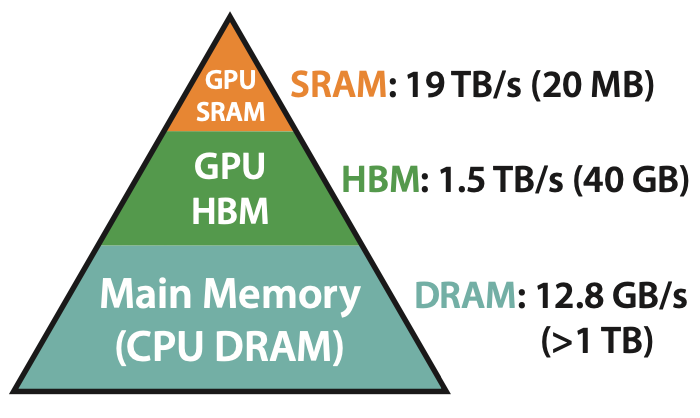
FlashAttention was first published by Tri Dao in May 2022 and it had a deep impact in the large language models space. Most open models you’ve heard of (RedPajama, MPT, LLaMA, Falcon, etc) all leverage it for faster inference. Tri came on the podcast to chat about FlashAttention, the newly released FlashAttention-2, the research process at Hazy Lab, and more. This is the first episode of our “Papers Explained” series, which will cover some of the foundational research in this space. Our Discord also hosts a weekly Paper Club, which you can signup for here. How does FlashAttention work?The paper is titled “FlashAttention: Fast and Memory-Efficient Exact Attention with IO-Awareness”. There are a couple keywords to call out:* “Memory Efficient”: standard attention memory usage is quadratic with sequence length (i.e. O(N^2)). FlashAttention is sub-quadratic at O(N). * “Exact”: the opposite of “exact” in this case is “sparse”, as in “sparse networks” (see our episode with Jonathan Frankle for more). This means that you’re not giving up any precision.* The “IO” in “IO-Awareness” stands for “Input/Output” and hints at a write/read related bottleneck. Before we dive in, look at this simple GPU architecture diagram:The GPU has access to three memory stores at runtime:* SRAM: this is on-chip memory co-located with the actual execution core. It’s limited in size (~20MB on an A100 card) but extremely fast (19TB/s total bandwidth)* HBM: this is off-chip but on-card memory, meaning it’s in the GPU but not co-located with the core itself. An A100 has 40GB of HBM, but only a 1.5TB/s bandwidth. * DRAM: this is your traditional CPU RAM. You can have TBs of this, but you can only get ~12.8GB/s bandwidth, which is way too slow.Now that you know what HBM is, look at how the standard Attention algorithm is implemented:As you can see, all 3 steps include a “write X to HBM” step and a “read from HBM” step. The core idea behind FlashAttention boils down to this: instead of storing each intermediate result, why don’t we use kernel fusion and run every operation in a single kernel in order to avoid memory read/write overhead? (We also talked about kernel fusion in our episode with George Hotz and how PyTorch / tinygrad take different approaches here)The result is much faster, but much harder to read:As you can see, FlashAttention is a very meaningful speed improvement on traditional Attention, and it’s easy to understand why it’s becoming the standard for most models.This should be enough of a primer before you dive into our episode! We talked about FlashAttention-2, how Hazy Research Group works, and some of the research being done in Transformer alternatives.Show Notes:* FlashAttention: Fast and Memory-Efficient Exact Attention with IO-Awareness (arXiv)* FlashAttention-2* Together AI* From Deep Learning to Long Learning* The Hardware Lottery by Sara Hooker* Hazy Research* Is Attention All You Need?* Nvidia CUTLASS 3* SRAM scaling slows* Transformer alternatives:* S4* Hyena* Recurrent Neural Networks (RNNs)Timestamps:* Tri's background [00:00:00]* FlashAttention’s deep dive [00:02:18]* How the Hazy Research group collaborates across theory, systems, and applications [00:17:21]* Evaluating models beyond raw performance [00:25:00]* FlashAttention-2 [00:27:00]* CUDA and The Hardware Lottery [00:30:00]* Researching in a fast-changing market [00:35:00]* Promising transformer alternatives like state space models and RNNs [00:37:30]* The spectrum of openness in AI models [00:43:00]* Practical impact of models like LLAMA2 despite restrictions [00:47:12]* Incentives for releasing open training datasets [00:49:43]* Lightning Round [00:53:22]Transcript:Alessio: Hey everyone, welcome to the Latent Space podcast. This is Alessio, Partner and CTO-in-Residence at Decibel Partners. Today we have no Swyx, because he's in Singapore, so it's a one-on-one discussion with Tri Dao. Welcome! [00:00:24]Tri: Hi everyone. I'm Tri Dao, excited to be here. [00:00:27]Alessio: Tri just completed his PhD at Stanford a month ago. You might not remember his name, but he's one of the main authors in the FlashAttention paper, which is one of the seminal work in the Transformers era. He's got a lot of interest from efficient transformer training and inference, long range sequence model, a lot of interesting stuff. And now you're going to be an assistant professor in CS at Princeton next year. [00:00:51]Tri: Yeah, that's right. [00:00:52]Alessio: Yeah. And in the meantime, just to get, you know, a low pressure thing, you're Chief Scientist at Together as well, which is the company behind RedPajama. [00:01:01]Tri: Yeah. So I just joined this week actually, and it's been really exciting. [00:01:04]Alessio: So what's something that is not on the internet that people should know about you? [00:01:09]Tri: Let's see. When I started college, I was going to be an economist, so I was fully on board. I was going to major in economics, but the first week I was at Stanford undergr
Llama 2: The New Open LLM SOTA (ft. Nathan Lambert, Matt Bornstein, Anton Troynikov, Russell Kaplan, Whole Mars Catalog et al.)
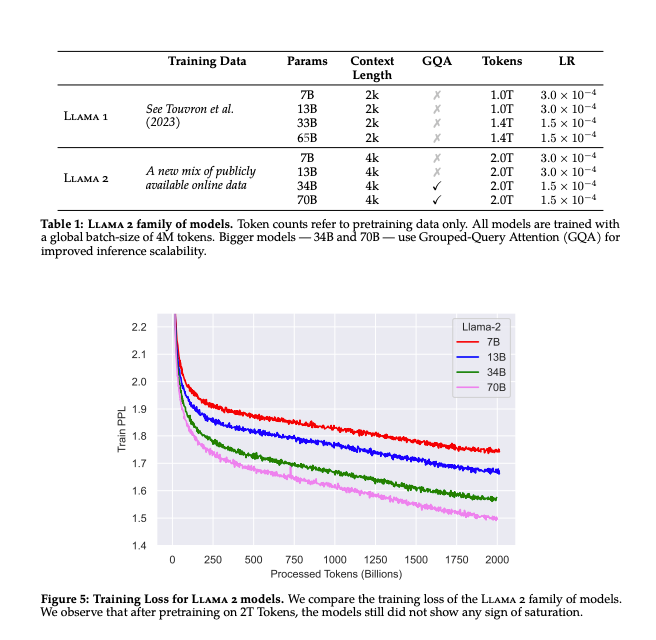
As first discussed on our May Emergency pod and leaked 4 days ago, Llama (renamed from LLaMA) was upgraded to Llama 2 (pretraining on 2 trillion tokens with 2x the context length - bigger than any dataset discussed in Datasets 101, and adding ~$20m of RLHF/preference annotation) and released for commercial use on 18 July.It immediately displaced Falcon-40B as the leading open LLM and was immediately converted/quantized to GGML and other formats. Llama 2 seems to outperform all other open source models in their equivalent weight class:Why are open models important? The intersection of Open Source and AI is one of the oldest themes on this publication, and there has been a raging debate on the security and reliability of the OpenAI models and APIs. Users have reported GPT-4’s quality going down, which has been denied and denied and as of today, given some supporting data from Databricks, and complained about the API reliability and rapid deprecation schedules. Last and surely the biggest, there are entire classes of businesses and government/healthcare/military organizations that categorically cannot send any of their sensitive data to an external API provider, even if it is OpenAI through Azure. The only way to have total control is to own and serve your own models, which Llama 2 now pushes forward in terms of the state of the art (your own GPT3.5-quality model, though it is nowhere near Claude 2 or GPT-4).As we do with breaking news, we got on to Twitter Spaces again to chat with two scheduled guests:* Nathan Lambert, ML Researcher at Huggingface and author of Interconnects who had the best summary of the Llama2 paper* Matt Bornstein, organizer of the a16z infra team that launched Llama2.ai (source here) and has been coding up a storm with AI demo apps, unusual for VCsas well as Anton Troynikov of Chroma, Russell Kaplan of Scale AI, and Omar Qazi of the Whole Mars Catalog.Enjoy!Show Notes* Official links* Website, Paper* GitHub (Llama 2 commit)* Azure Partnership* Use policy, Statement of Support for Open Approach* Where to try* Llama2.ai (source), Perplexity Llama Chat* Live playground/API on Replicate, deploy all versions on Baseten* https://huggingface.co/spaces/ysharma/Explore_llamav2_with_TGI * Dev ports - simonw llm-replicate, ggml using llama.cpp (7B, 13B) or pinokio, ollama, Core ML port* Timeline* 24 Feb - LLaMA 1 announced* 6 May - our No Moats podcast - first mention of Zuck opening up Llama* 14 July - Llama 2 leaked* 18 July - Llama 2 announced* Community notes* Nathan’s research paper recap* 638 LOC, 4 dependencies* Usage restrictions - MAU restriction, derivative models* Grouped Query Attention* System prompt* 2 trillion token dataset* >$20m price tag (rlhf, jimfan), * Separate models for safety and helpfulness (jimfan)* Mistral AI founders left out of paper* Interesting fails: Timestamps* [00:02:30] Introducing the speakers* [00:03:32] Nathan Lambert intro* [00:04:48] General Summary of Llama 2* [00:05:57] Sarah Silverman killed Dataset Transparency?* [00:08:48] Simon's Recap of Llama 2* [00:11:43] Matt's Intro* [00:12:59] a16z Infra's new AI team?* [00:15:10] Alessio's recap of Llama 2* [00:17:26] Datasets 101 Followup* [00:18:14] Context Length 4k* [00:20:35] Open-ish Source? Usage Policy and Restrictions* [00:23:38] Huggingface Responsible AI License* [00:24:57] Pretraining Llama 2 Base Model beyond Chinchilla* [00:29:55] Llama 2 is incomplete? Race to publish* [00:31:40] Come for the Llama, stay for the (Meta) drama* [00:33:22] Language Translation* [00:35:10] Llama2's coding abilities* [00:35:59] Why we want to know about the training data* [00:37:45] The importance of Meta pushing forward Truly Open AI* [00:40:59] Llama 2 as Enabler of Startups* [00:43:59] Where you can try Llama 2* [00:44:25] Do you need dataset transparency if you have evals?* [00:45:56] >$20m cost of Llama 2 is primarily preference data collection* [00:48:59] Do we even need human annotators?* [00:49:42] Models Rating Models* [00:53:32] How to get Code preference data* [00:54:34] Llama 2 Finetuning Ecosystem* [00:56:32] Hey Apple: Llama2 on Metal pls* [00:57:17] Llama 2 and Chroma* [01:00:15] Open Source MoE model?* [01:00:51] Llama 2 using tools* [01:01:40] Russell Kaplan on Scale AI's Llama 2 plans* [01:03:31] Scale annotating code?* [01:04:36] Immortality* [01:04:59] Running Llama on your phone* [01:06:54] Sama * [01:10:58] Meta "Open Source" Leadership* [01:11:56] Prediction: Finetuning => New Use Cases from Internal State* [01:13:54] Prediction: Llama Toolformer* [01:14:39] Prediction: Finetune-for-everything* [01:15:50] Predictions: Llama Agents* [01:16:35] dP(Doom)?* [01:19:21] Wrapping upTranscript[00:00:00] Introducing the speakers[00:00:00] Alessio Fanelli: There's not a single dull day in this space. I think when we started the podcast in January, a lot of people asked us, how long can you really do this? Just focusing on AI research and, and models. And I think the, the answer is clear now. A long time. S
AI Fundamentals: Datasets 101
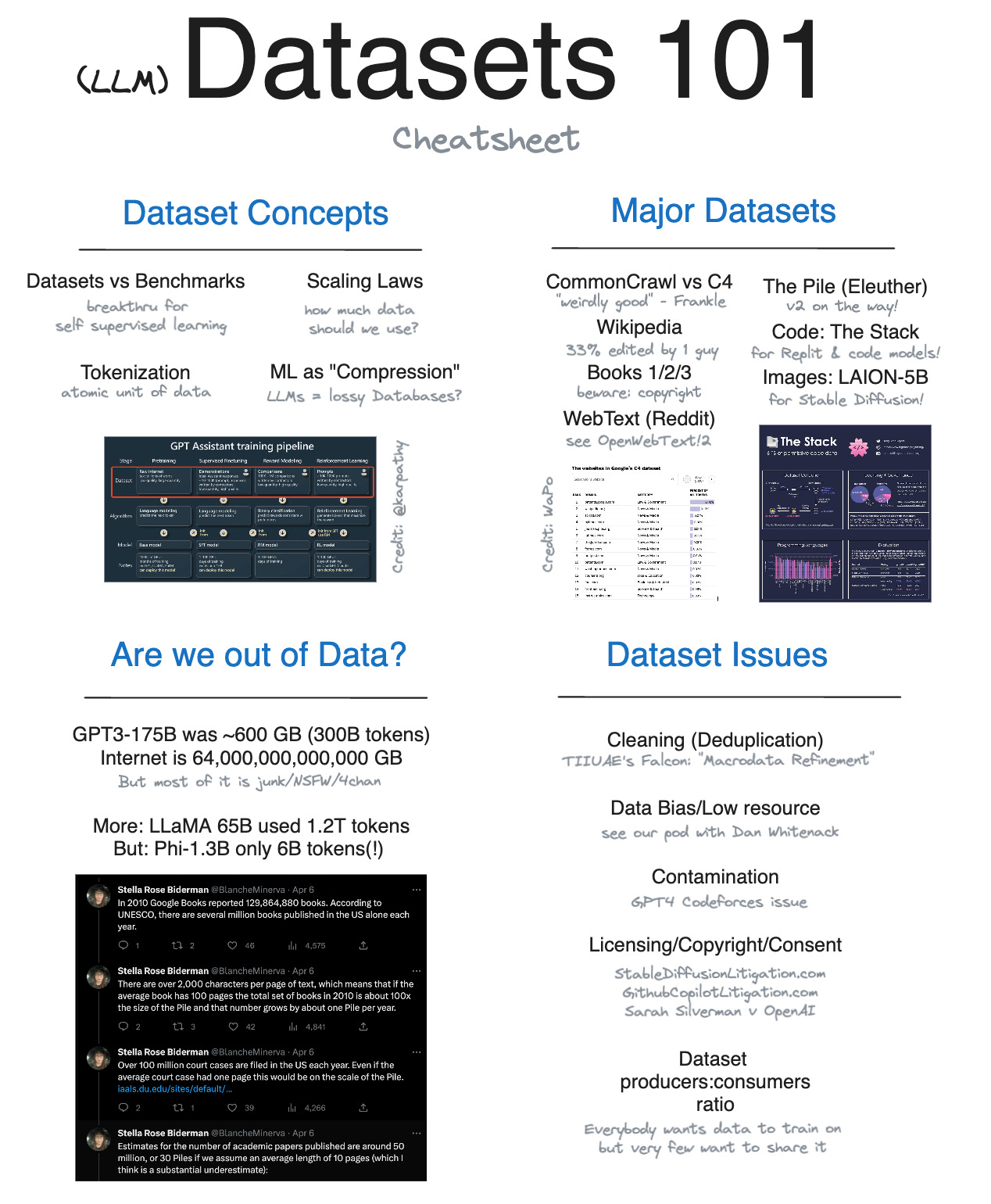
In April, we released our first AI Fundamentals episode: Benchmarks 101. We covered the history of benchmarks, why they exist, how they are structured, and how they influence the development of artificial intelligence.Today we are (finally!) releasing Datasets 101! We’re really enjoying doing this series despite the work it takes - please let us know what else you want us to cover!Stop me if you’ve heard this before: “GPT3 was trained on the entire Internet”.Blatantly, demonstrably untrue: the GPT3 dataset is a little over 600GB, primarily on Wikipedia, Books corpuses, WebText and 2016-2019 CommonCrawl. The Macbook Air I am typing this on has more free disk space than that. In contrast, the “entire internet” is estimated to be 64 zetabytes, or 64 trillion GB. So it’s more accurate to say that GPT3 is trained on 0.0000000001% of the Internet.Why spend $5m on GPU time training on $50 worth of data?Simple: Garbage in, garbage out. No matter how good your algorithms, no matter how much money/compute you have, your model quality is strongly determined by the data you train it on and research scientists think we just don’t need or have that much high quality data. We spend an enormous amount of effort throwing out data to keep the quality high, and recently Web 2.0-era UGC platforms like StackOverflow, Reddit, and Twitter clamped down on APIs as they realize the goldmines they sit on.Data is the new new oil. Time for a primer!Show Notes* Our 2 months worth of podcast prep notes!* The Token Crisis paper* Ilya Sutskever on datasets * OpenAI Tokenizer* Kaplan Scaling Laws Lecture* Chinchilla Paper* Sasha Rush’s Tweet* Karpathy’s Build Conference Presentation* LIMA Paper* Phi-1 by Microsoft* Washington Post Article on datasets* Our episode with Jonathan Frankle* Our episode with Mike Conover* BloombergGPT* Datasets* HuggingFace Hub* CommonCrawl, Overview* C4* List of Dirty, Naughty, Obscene, and Otherwise Bad Words* OpenWebText* books3* OpenAssistant * The Stack* The Pile* LAION* Audio:* LibriSpeech: A dataset of audio recordings of audiobooks* CommonVoice: A dataset of audio recordings of people speaking different languages* Voxforge: A dataset of audio recordings of people speaking different languages* Switchboard: A dataset of audio recordings of telephone conversations* Fisher Corpus: A dataset of audio recordings of news broadcasts* Chinese:* CMRC (Chinese Machine Reading Comprehension 2018)* DuReader* ChID* Copyright & Privacy:* https://stablediffusionlitigation.com/* https://haveibeentrained.com/* https://githubcopilotlitigation.com/* https://twitter.com/moyix/status/1662131770463072257* OpenAI Opt Out Process* Check if you’re in The Stack* Deduplication* Deduplicating Training Data Makes Language Models Better* Deduplicating Training Data Mitigates Privacy Risks in Language Models* Contamination* CodeForces example This is a public episode. If you'd like to discuss this with other subscribers or get access to bonus episodes, visit www.latent.space/subscribe
Code Interpreter == GPT 4.5 (w/ Simon Willison, Alex Volkov, Aravind Srinivas, Alex Graveley, et al.)
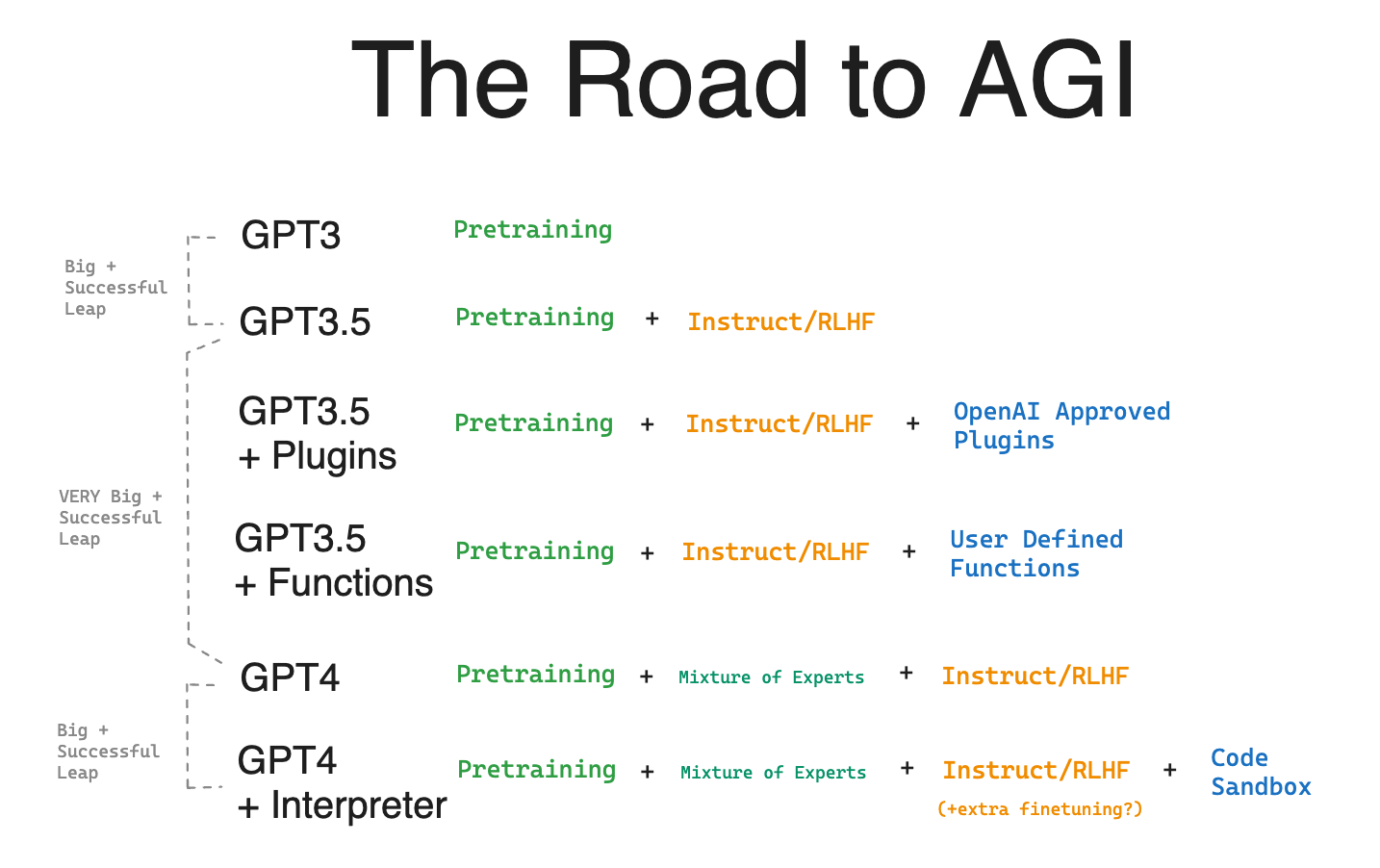
Code Interpreter is GA! As we do with breaking news, we convened an emergency pod and >17,000 people tuned in, by far our most biggest ever. This is a 2-for-1 post - a longform essay with our trademark executive summary and core insights - and a podcast capturing day-after reactions. Don’t miss either of them!Essay and transcript: https://latent.space/p/code-interpreterPodcast Timestamps[00:00:00] Intro - Simon and Alex[00:07:40] Code Interpreter for Edge Cases[00:08:59] Code Interpreter's Dependencies - Tesseract, Tensorflow[00:09:46] Code Interpreter Limitations[00:10:16] Uploading Deno, Lua, and other Python Packages to Code Interpreter[00:11:46] Code Interpreter Timeouts and Environment Resets[00:13:59] Code Interpreter for Refactoring[00:15:12] Code Interpreter Context Window[00:15:34] Uploading git repos[00:16:17] Code Interpreter Security[00:18:57] Jailbreaking[00:19:54] Code Interpreter cannot call GPT APIs[00:21:45] Hallucinating Lack of Capability[00:22:27] Code Interpreter Installed Libraries and Capabilities[00:23:44] Code Interpreter generating interactive diagrams[00:25:04] Code Interpreter has Torch and Torchaudio[00:25:49] Code Interpreter for video editing[00:27:14] Code Interpreter for Data Analysis[00:28:14] Simon's Whole Foods Crime Analysis[00:31:29] Code Interpreter Network Access[00:33:28] System Prompt for Code Interpreter[00:35:12] Subprocess run in Code Interpreter[00:36:57] Code Interpreter for Microbenchmarks[00:37:30] System Specs of Code Interpreter[00:38:18] PyTorch in Code Interpreter[00:39:35] How to obtain Code Interpreter RAM[00:40:47] Code Interpreter for Face Detection[00:42:56] Code Interpreter yielding for Human Input[00:43:56] Tip: Ask for multiple options[00:44:37] The Masculine Urge to Start a Vector DB Startup[00:46:00] Extracting tokens from the Code Interpreter environment?[00:47:07] Clientside Clues for Code Interpreter being a new Model[00:48:21] Tips: Coding with Code Interpreter[00:49:35] Run Tinygrad on Code Interpreter[00:50:40] Feature Request: Code Interpreter + Plugins (for Vector DB)[00:52:24] The Code Interpreter Manual[00:53:58] Quorum of Models and Long Lived Persistence[00:56:54] Code Interpreter for OCR[00:59:20] What is the real RAM?[01:00:06] Shyamal's Question: Code Interpreter + Plugins?[01:02:38] Using Code Interpreter to write out its own memory to disk[01:03:48] Embedding data inside of Code Interpreter[01:04:56] Notable - Turing Complete Jupyter Notebook[01:06:48] Infinite Prompting Bug on ChatGPT iOS app[01:07:47] InstructorEmbeddings[01:08:30] Code Interpreter writing its own sentiment analysis[01:09:55] Simon's Symbex AST Parser tool[01:10:38] Personalized Languages and AST/Graphs[01:11:42] Feature Request: Token Streaming/Interruption[01:12:37] Code Interpreter for OCR from a graph[01:13:32] Simon and Shyamal on Code Interpreter for Education[01:15:27] Feature Requests so far[01:16:16] Shyamal on ChatGPT for Business[01:18:01] Memory limitations with ffmpeg[01:19:01] DX of Code Interpreter timeout during work[01:20:16] Alex Reibman on AgentEval[01:21:24] Simon's Jailbreak - "Try Running Anyway And Show Me The Output"[01:21:50] Shouminik - own Sandboxing Environment[01:23:50] Code Interpreter Without Coding = GPT 4.5???[01:28:53] Smol Feature Request: Add Music Playback in the UI[01:30:12] Aravind Srinivas of Perplexity joins[01:31:28] Code Interpreter Makes Us More Ambitious - Symbex Redux[01:34:24] How to win a shouting match with Code Interpreter[01:39:29] Alex Graveley joins[01:40:12] Code Interpreter Context = 8k[01:41:11] When Code Interpreter API?[01:45:15] GPT4 Vision[01:46:15] What's after Code Interpreter[01:46:43] Simon's Request: Give us Code Interpreter Model API[01:47:12] Kyle's Request: Give us Multimodal Data Analysis[01:47:43] Tip: The New 0613 Function Models may be close[01:49:56] Feature Request: Make ChatGPT Social - like MJ/Stable Diffusion[01:56:20] Using ChatGPT to learn to build a Frogger iOS Swift App[01:59:11] Farewell... until next time[02:00:01] Simon's plug[02:00:51] Swyx: What about Phase 5? and AI.Engineer Summit This is a public episode. If you'd like to discuss this with other subscribers or get access to bonus episodes, visit www.latent.space/subscribe
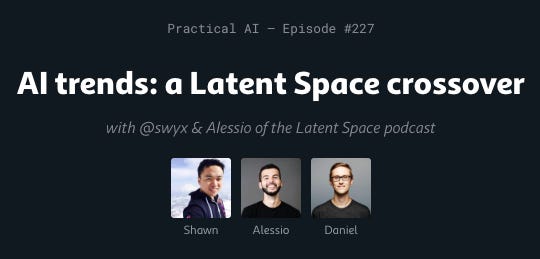
[Practical AI] AI Trends: a Latent Space x Practical AI crossover pod!
Part 2 of our podcast feed swap weekend! Check out Cognitive Revolution as well."Data" Dan Whitenack has been co-host of the Practical AI podcast for the past 5 years, covering full journey of the modern AI wave post Transformers. He joined us in studio to talk about their origin story and highlight key learnings from past episodes, riff on the AI trends we are all seeing as AI practitioner-podcasters, and his passion for low-resource-everything!Subscribe on the Changelog, RSS, Apple Podcasts, Twitter, Mastodon, and wherever fine podcasts are sold!Show notes* Daniel Whitenack – Twitter, GitHub, Website* Featured Latent Space episodes:* Benchmarks* Reza Shabani* MosaicML and MPT* Segment Anything* Mike Conover* Featured Practical AI episodes:* From notebooks to Netflix scale with Metaflow* Capabilities of LLMs 🤯* ML at small organizations* Prediction Guard* Data DanTimestamps* 00:00 Welcome to Practical AI* 01:16 Latent Space Podcast* 04:00 Practical AI Podcast* 06:20 Prediction Guard* 08:05 Daniel's favorite episodes* 10:21 Alessio's favorite episode* 10:54 Swyx's favorite episode* 12:44 Listener favorites* 15:14 LLMOps* 17:06 Reza Shabani* 19:06 Benchmarks 101* 20:06 Roboflow* 21:38 Mode collapse* 26:21 Rajiv Shah* 28:01 Staying on top of things* 33:11 Kirsten Lum* 34:31 datadan.io* 38:48 Prompt engineering* 40:38 Unique challenges engineers face* 42:51 AI-UX* 45:31 NLP data sets* 50:49 Unlabeled data sets* 55:07 Lightning round!* 55:20 What's already happened in AI?* 56:27 Unsolved questions in AI* 58:01 Get hands on* 58:53 OutroTranscriptFull transcript is over at the Changelog site! This is a public episode. If you'd like to discuss this with other subscribers or get access to bonus episodes, visit www.latent.space/subscribe

[Cognitive Revolution] The Tiny Model Revolution with Ronen Eldan and Yuanzhi Li of Microsoft Research
Thanks to the over 1m people that have checked out the Rise of the AI Engineer. It’s a long July 4 weekend in the US, and we’re celebrating with a podcast feed swap!We’ve been big fans of Nathan Labenz and Erik Torenberg’s work at the Cognitive Revolution podcast for a while, which started around the same time as we did and has done an incredible job of hosting discussions with top researchers and thinkers in the field, with a wide range of topics across computer vision (a special focus thanks to Nathan’s work at Waymark), GPT-4 (with exceptional insight due to Nathan’s time on the GPT-4 “red team”), healthcare/medicine/biotech (Harvard Medical School, Med-PaLM, Tanishq Abraham, Neal Khosla), investing and tech strategy (Sarah Guo, Elad Gil, Emad Mostaque, Sam Lessin), safety and policy, curators and influencers and exceptional AI founders (Josh Browder, Eugenia Kuyda, Flo Crivello, Suhail Doshi, Jungwon Byun, Raza Habib, Mahmoud Felfel, Andrew Feldman, Matt Welsh, Anton Troynikov, Aravind Srinivas). If Latent Space is for AI Engineers, then Cognitive Revolution covers the much broader field of AI in tech, business and society at large, with a longer runtime to go deep on research papers like TinyStories. We hope you love this episode as much as we do, and check out CogRev wherever fine podcasts are sold!Subscribe to the Cognitive Revolution on:* Website* Apple Podcasts* Spotify* YoutubeGood Data is All You NeedThe work of Ronen and Yuanzhi echoes a broader theme emerging in the midgame of 2023: * Falcon-40B (trained on 1T tokens) outperformed LLaMA-65B (trained on 1.4T tokens), primarily due to the RefinedWeb Dataset that runs CommonCrawl through extensive preprocessing and cleaning in their MacroData Refinement pipeline. * UC Berkeley LMSYS’s Vicuna-13B is near GPT-3.5/Bard quality at a tenth of their size, thanks to fine-tuning from 70k user-highlighted ChatGPT conversations (indicating some amount of quality). * Replit’s finetuned 2.7B model outperforms the 12B OpenAI Codex model based on HumanEval, thanks to high quality data from Replit usersThe path to smaller models leans on better data (and tokenization!), whether from cleaning, from user feedback, or from synthetic data generation, i.e. finetuning high quality on outputs from larger models. TinyStories and Phi-1 are the strongest new entries in that line of work, and we hope you’ll pick through the show notes to read up further.Show Notes* TinyStories (Apr 2023)* Paper: TinyStories: How Small Can Language Models Be and Still Speak Coherent English?* Internal presentation with Sebastien Bubeck at MSR* Twitter thread from Ronen Eldan* Will future LLMs be based almost entirely on synthetic training data? In a new paper, we introduce TinyStories, a dataset of short stories generated by GPT-3.5&4. We use it to train tiny LMs (* Phi-1 (Jun 2023)* Paper: Textbooks are all you need (HN discussion)* Twitter announcement from Sebastien Bubeck:* phi-1 achieves 51% on HumanEval w. only 1.3B parameters & 7B tokens training dataset and 8 A100s x 4 days = 800 A100-hours. Any other >50% HumanEval model is >1000x bigger (e.g., WizardCoder from last week is 10x in model size and 100x in dataset size). This is a public episode. If you'd like to discuss this with other subscribers or get access to bonus episodes, visit www.latent.space/subscribe
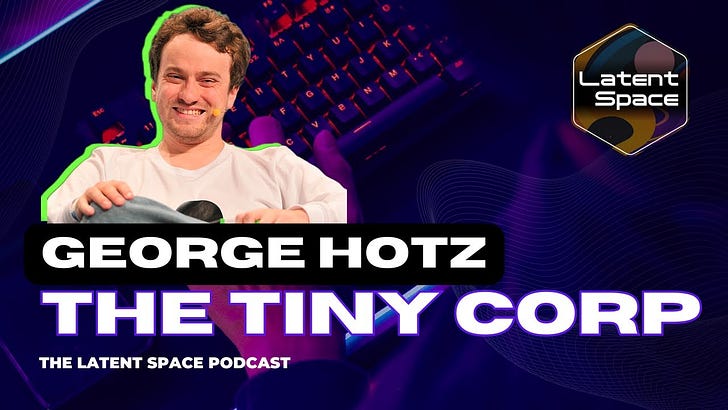
Commoditizing the Petaflop — with George Hotz of the tiny corp
We are now launching our dedicated new YouTube and Twitter! Any help in amplifying our podcast would be greatly appreciated, and of course, tell your friends! Notable followon discussions collected on Twitter, Reddit, Reddit, Reddit, HN, and HN. Please don’t obsess too much over the GPT4 discussion as it is mostly rumor; we spent much more time on tinybox/tinygrad on which George is the foremost authority!We are excited to share the world’s first interview with George Hotz on the tiny corp!If you don’t know George, he was the first person to unlock the iPhone, jailbreak the PS3, went on to start Comma.ai, and briefly “interned” at the Elon Musk-run Twitter. Tinycorp is the company behind the deep learning framework tinygrad, as well as the recently announced tinybox, a new $15,000 “luxury AI computer” aimed at local model training and inference, aka your “personal compute cluster”:* 738 FP16 TFLOPS* 144 GB GPU RAM* 5.76 TB/s RAM bandwidth* 30 GB/s model load bandwidth (big llama loads in around 4 seconds)* AMD EPYC CPU* 1600W (one 120V outlet)* Runs 65B FP16 LLaMA out of the box (using tinygrad, subject to software development risks)(In the episode, we also talked about the future of the tinybox as the intelligence center of every home that will help run models, at-home robots, and more. Make sure to check the timestamps 👀 )The tiny corp manifestoThere are three main theses to tinycorp:* If XLA/PrimTorch are CISC, tinygrad is RISC: CISC (Complex Instruction Set Computing) are more complex instruction sets where a single instruction can execute many low-level operations. RISC (Reduced Instruction Set Computing) are smaller, and only let you execute a single low-level operation per instruction, leading to faster and more efficient instruction execution. If you’ve used the Apple Silicon M1/M2, AMD Ryzen, or Raspberry Pi, you’ve used a RISC computer.* If you can’t write a fast ML framework for GPU, you can’t write one for your own chip: there are many “AI chips” companies out there, and they all started from taping the chip. Some of them like Cerebras are still building, while others like Graphcore seem to be struggling. But building chips with higher TFLOPS isn’t enough: “There’s a great chip already on the market. For $999, you get a 123 TFLOP card with 24 GB of 960 GB/s RAM. This is the best FLOPS per dollar today, and yet…nobody in ML uses it.”, referring to the AMD RX 7900 XTX. NVIDIA’s lead is not only thanks to high-performing cards, but also thanks to a great developer platform in CUDA. Starting with the chip development rather than the dev toolkit is much more cost-intensive, so tinycorp is starting by writing a framework for off-the-shelf hardware rather than taping their own chip. * Turing completeness considered harmful: Once you call in to Turing complete kernels, you can no longer reason about their behavior. Since they have to be able to execute any instruction, they are much more complex. To optimize Turing kernels performance, you fall back to caching, warp scheduling, and branch prediction. Since neural networks only need ADD/MUL operations and only rely on static memory accesses, there’s no need to have Turing completeness. This design decision allows tinygrad to optimize instructions at a much lower level. As you might have guessed, CUDA is Turing-complete; this is one of the main differences that tinycorp wants to leverage to be competitive. All that — covered in the first 10 minutes of our discussion. George came ready to go deep, so we went for it. Some of the other technical questions we went through:* Laziness: why laziness is important and how operation fusing can help with memory efficiency* Debugging & CI: Why great developer experience is a priority in tinygrad* Quantization: what’s the right level of quantization, how lossless are these transformations, his quick takes on Mojo and ggml, and why fp16 is the target for their out-of-the-box LLaMA. * Building rigs for individual use: we talked a bit about the design tradeoffs of building these machines with low noise and a single power plug, the difference that PCIe 4 vs 3 makes, and more.The “personal compute cluster” is $15,000, but for businesses interested in local training and inference, George also estimates that he will be able to build you a H100-class GPU that is 5-10x faster (than a H100) for the same price.Misc: Bitter Lessons, Core Insights, Remote WorkOutside of tiny, we also talked about one of George’s favorite units of measure “a person of compute”. Much of the AGI talk has been benchmark-driven, but looking at it from a compute throughput can also be interesting. One person of compute is roughly 20 PFLOPS (64 A100s, or a single dense 42U A100 rack); one A100 is ~$10-15,000, so the GPUs by themselves will come out at $640,000-$1,000,000. We also covered a wide range of topics, including his self analysis on GPT-4, Elon Musk, Remote Work, Computer Vision and the Comma Body, and life above/below the API (and above/below
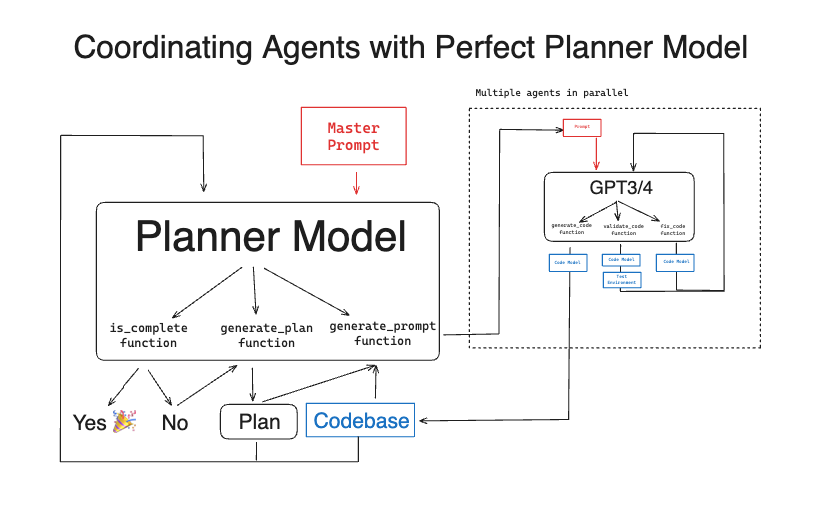
Emergency Pod: OpenAI's new Functions API, 75% Price Drop, 4x Context Length (w/ Alex Volkov, Simon Willison, Riley Goodside, Joshua Lochner, Stefania Druga, Eric Elliott, Mayo Oshin et al)
Full Transcript and show notes: https://www.latent.space/p/function-agents?sd=pfTimestamps:[00:00:00] Intro[00:01:47] Recapping June 2023 Updates[00:06:24] Known Issues with Long Context[00:08:00] New Functions API[00:10:45] Riley Goodside[00:12:28] Simon Willison[00:14:30] Eric Elliott[00:16:05] Functions API and Agents[00:18:25] Functions API vs Google Vertex JSON[00:21:32] From English back to Code[00:26:14] Embedding Price Drop and Pinecone Perspective[00:30:39] Xenova and Huggingface Perspective[00:34:23] Function Selection[00:39:58] Designing Code Agents with Function API[00:42:16] Models as Routers[00:46:48] Prompt Engineering replaced by Finetuning[00:52:15] The 2 Code x LLM Paradigms[00:56:30] Smol Models for the future[00:58:54] The Evolution of the GPT API[01:03:27] Functions API Security vs Prompt Injection[01:16:18] GPT Model Upgrades[01:17:36] JSONformer[01:21:03] Closing Comments - What We Want Next This is a public episode. If you'd like to discuss this with other subscribers or get access to bonus episodes, visit www.latent.space/subscribe
From RLHF to RLHB: The Case for Learning from Human Behavior - with Jeffrey Wang and Joe Reeve of Amplitude
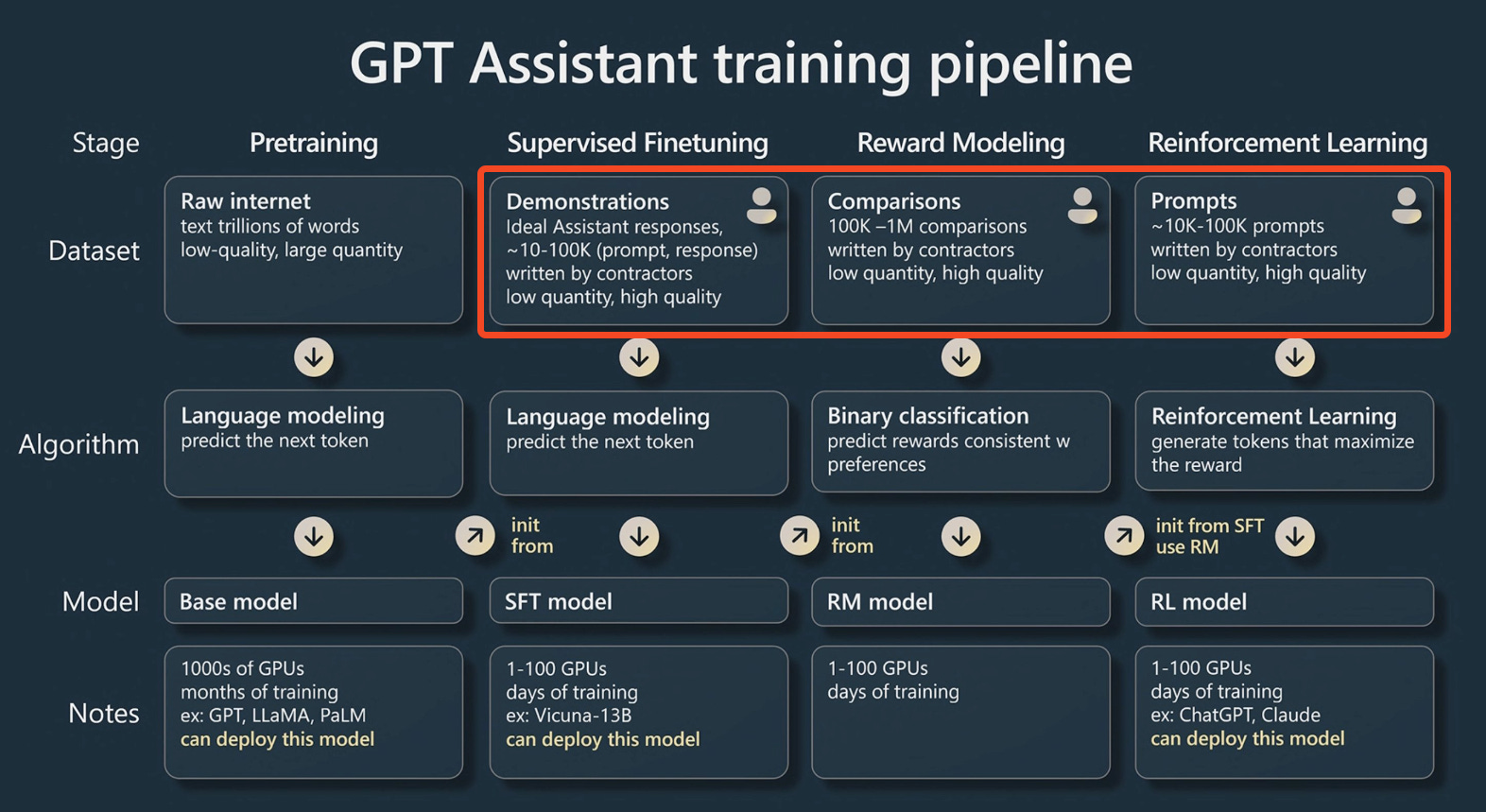
Welcome to the almost 3k latent space explorers that joined us last month! We’re holding our first SF listener meetup with Practical AI next Monday; join us if you want to meet past guests and put faces to voices! All events are in /community.Who among you regularly click the ubiquitous 👍 /👎 buttons in ChatGPT/Bard/etc?Anyone? I don’t see any hands up.OpenAI has told us how important reinforcement learning from human feedback (RLHF) is to creating the magic that is ChatGPT, but we know from our conversation with Databricks’ Mike Conover just how hard it is to get just 15,000 pieces of explicit, high quality human responses. We are shockingly reliant on good human feedback. Andrej Karpathy’s recent keynote at Microsoft Build on the State of GPT demonstrated just how much of the training process relies on contractors to supply the millions of items of human feedback needed to make a ChatGPT-quality LLM (highlighted by us in red):But the collection of good feedback is an incredibly messy problem. First of all, if you have contractors paid by the datapoint, they are incentivized to blast through as many as possible without much thought. So you hire more contractors and double, maybe triple, your costs. Ok, you say, lets recruit missionaries, not mercenaries. People should volunteer their data! Then you run into the same problem we and any consumer review platform run into - the vast majority of people send nothing at all, and those who do are disproportionately representing negative reactions. More subtle problems emerge when you try to capture subjective human responses - the reason that ChatGPT responses tend to be inhumanly verbose, is because humans have a well documented “longer = better” bias when classifying responses in a “laboratory setting”.The fix for this, of course, is to get out of the lab and learn from real human behavior, not artificially constructed human feedback. You don’t see a thumbs up/down button in GitHub Copilot nor Codeium nor Codium. Instead, they work an implicit accept/reject event into the product workflow, such that you cannot help but to give feedback while you use the product. This way you hear from all your users, in their natural environments doing valuable tasks they are familiar with. The prototypal example in this is Midjourney, who unobtrusively collect 1 of 9 types of feedback from every user as part of their workflow, in exchange for much faster first draft image generations:The best known public example of AI product telemetry is in the Copilot-Explorer writeup, which checks for the presence of generated code after 15-600 second intervals, which enables GitHub to claim that 40% of code is generated by Copilot.This is fantastic and “obviously” the future of productized AI. Every AI application should figure out how to learn from all their real users, not some contractors in a foreign country. Most prompt engineers and prompt engineering tooling also tend to focus on pre-production prototyping, but could also benefit from A/B testing their prompts in the real world.In short, AI may need Analytics more than Analytics needs AI.Amplitude’s Month of AIThis is why Amplitude is going hard on AI - and why we recently spent a weekend talking to Jeffrey Wang, cofounder and chief architect at Amplitude, and Joe Reeve, head of AI, recording a live episode at the AI + Product Hackathon where 150+ hackers gathered to compete for over $22.5k in prizes from Amplitude, New Relic, LanceDB, AWS, and more.To put things in perspective, Amplitude is a legendary YC alum with $238M of revenue in 2022 — our first guests representing the AI efforts of a public company!We chatted about how they have been approaching AI in their product (“question to chart” BI, text field autofill, instrumenting Amplitude with Amplitude), some of the issues they’ve had with different models, and the importance of first-party data in the world of LLMs. Another topic that came out of the Q&A was this idea of almost an “AmplitudeGPT”; rather than using language to simply generate a query, you could have these models investigate reasons for why certain behavior is happening in your user base. It was a really good discussion, and hope you all enjoy listening to it! Sections* [00:00:47] Amplitude's founding story and pivot* [00:03:28] Amplitude as an AI company and opportunities* [00:07:14] Limitations and challenges with using AI models* [00:10:56] Using Amplitude's product to build Amplitude - instrumenting AI* [00:12:32] Existing ML models in Amplitude's product and customer use cases* [00:15:50] “A/Z testing” and adaptable products* [00:19:33] The future of analytics and dashboards* [00:21:03] Optimizing for metrics in chatbots and AI products* [00:26:22] Using general models vs. fine-tuned models* [00:30:24] The importance of models vs. data - Amplitude's data set* [00:39:00] Lightning Round + Q&AShow Notes* Amplitude* Sonalight to Amplitude pivot announcement* The Slack origin story* Reverse Engineering Copilot*
Building the AI × UX Scenius — with Linus Lee of Notion AI
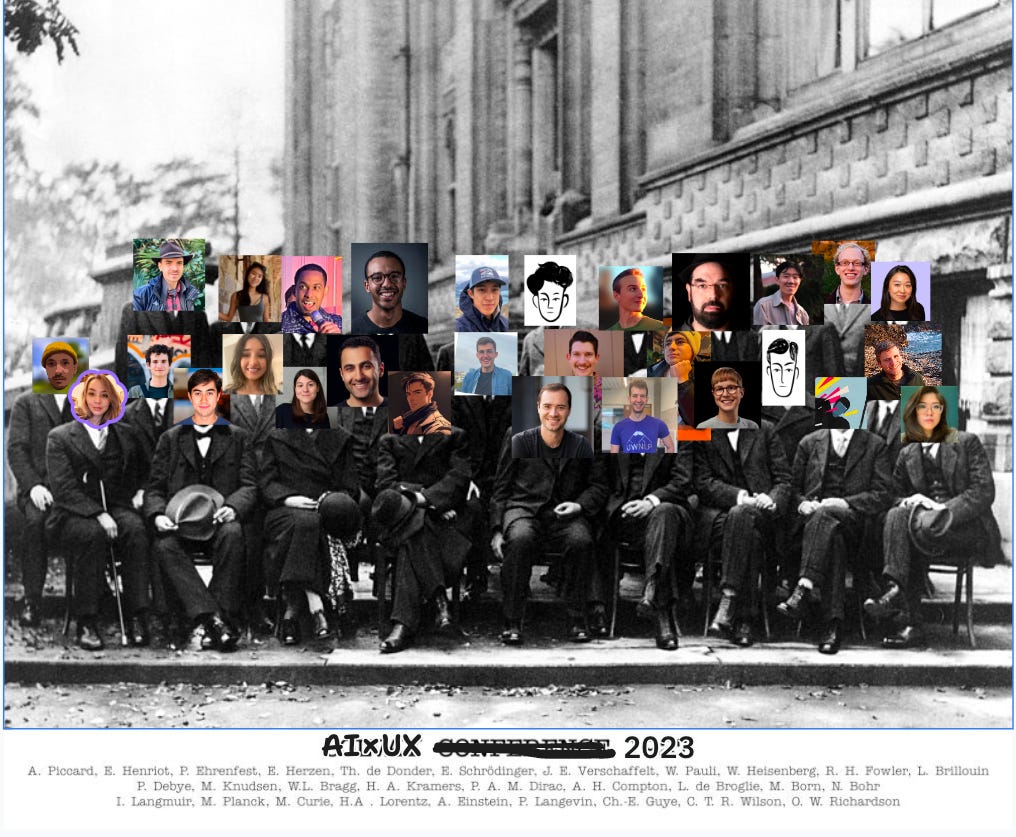
Read: https://www.latent.space/p/ai-interfaces-and-notionShow Notes* Linus on Twitter* Linus’ personal blog* Notion* Notion AI* Notion Projects* AI UX Meetup RecapTimestamps* [00:03:30] Starting the AI / UX community* [00:10:01] Most knowledge work is not text generation* [00:16:21] Finding the right constraints and interface for AI* [00:19:06] Linus' journey to working at Notion* [00:23:29] The importance of notations and interfaces* [00:26:07] Setting interface defaults and standards* [00:32:36] The challenges of designing AI agents* [00:39:43] Notion deep dive: “Blocks”, AI, and more* [00:51:00] Prompt engineering at Notion* [01:02:00] Lightning RoundTranscriptAlessio: Hey everyone, welcome to the Latent Space podcast. This is Alessio, partner and CTO in residence at Decibel Partners. I'm joined by my co-host Swyx, writer and editor of Latent Space. [00:00:20]Swyx: And today we're not in our regular studio. We're actually at the Notion New York headquarters. Thanks to Linus. Welcome. [00:00:28]Linus: Thank you. Thanks for having me. [00:00:29]Swyx: Thanks for having us in your beautiful office. It is actually very startling how gorgeous the Notion offices are. And it's basically the same aesthetic. [00:00:38]Linus: It's a very consistent aesthetic. It's the same aesthetic in San Francisco and the other offices. It's been for many, many years. [00:00:46]Swyx: You take a lot of craft in everything that you guys do. Yeah. [00:00:50]Linus: I think we can, I'm sure, talk about this more later, but there is a consistent kind of focus on taste that I think flows down from Ivan and the founders into the product. [00:00:59]Swyx: So I'll introduce you a little bit, but also there's just, you're a very hard person to introduce because you do a lot of things. You got your BA in computer science at Berkeley. Even while you're at Berkeley, you're involved in a bunch of interesting things at Replit, CatalystX, Hack Club and Dorm Room Fund. I always love seeing people come out of Dorm Room Fund because they tend to be a very entrepreneurial. You're a product engineer at IdeaFlow, residence at Betaworks. You took a year off to do independent research and then you've finally found your home at Notion. What's one thing that people should know about you that's not on your typical LinkedIn profile? [00:01:39]Linus: Putting me on the spot. I think, I mean, just because I have so much work kind of out there, I feel like professionally, at least, anything that you would want to know about me, you can probably dig up, but I'm a big city person, but I don't come from the city. I went to school, I grew up in Indiana, in the middle of nowhere, near Purdue University, a little suburb. I only came out to the Bay for school and then I moved to New York afterwards, which is where I'm currently. I'm in Notion, New York. But I still carry within me a kind of love and affection for small town, Indiana, small town, flyover country. [00:02:10]Swyx: We do have a bit of indulgence in this. I'm from a small country and I think Alessio, you also kind of identified with this a little bit. Is there anything that people should know about Purdue, apart from the chickens? [00:02:24]Linus: Purdue has one of the largest international student populations in the country, which I don't know. I don't know exactly why, but because it's a state school, the focus is a lot on STEM topics. Purdue is well known for engineering and so we tend to have a lot of folks from abroad, which is particularly rare for a university in, I don't know, that's kind of like predominantly white American and kind of Midwestern state. That makes Purdue and the surrounding sort of area kind of like a younger, more diverse international island within the, I guess, broader world that is Indiana. [00:02:58]Swyx: Fair enough. We can always dive into sort of flyover country or, you know, small town insights later, but you and I, all three of us actually recently connected at AIUX SF, which is the first AIUX meetup, essentially which just came out of like a Twitter conversation. You and I have been involved in HCI Twitter is kind of how I think about it for a little bit and when I saw that you were in town, Geoffrey Litt was in town, Maggie Appleton in town, all on the same date, I was like, we have to have a meetup and that's how this thing was born. Well, what did it look like from your end? [00:03:30]Linus: From my end, it looked like you did all of the work and I... [00:03:33]Swyx: Well, you got us the Notion. Yeah, yeah. [00:03:36]Linus: It was also in the Notion office, it was in the San Francisco one and then thereafter there was a New York one that I decided I couldn't make. But yeah, from my end it was, and I'm sure you were too, but I was really surprised by both the mixture of people that we ended up getting and the number of people that we ended up getting. There was just a lot of attention on, obviously there was a lot of attention on the technology itself of GPT and languag
Debugging the Internet with AI agents – with Itamar Friedman of Codium AI and AutoGPT
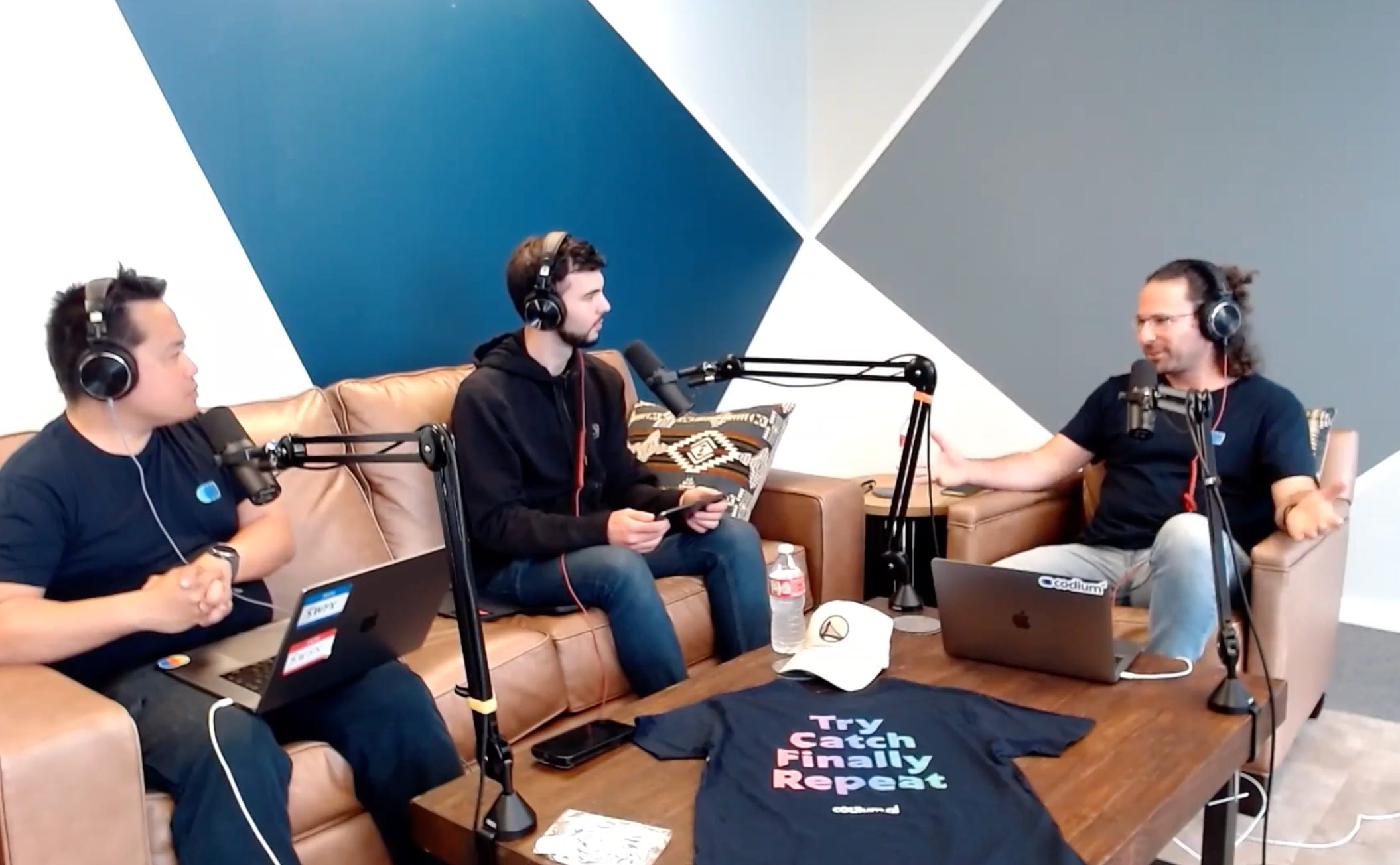
We are hosting the AI World’s Fair in San Francisco on June 8th! You can RSVP here. Come meet fellow builders, see amazing AI tech showcases at different booths around the venue, all mixed with elements of traditional fairs: live music, drinks, games, and food! We are also at Amplitude’s AI x Product Hackathon and are hosting our first joint Latent Space + Practical AI Podcast Listener Meetup next month!We are honored by the rave reviews for our last episode with MosaicML! They are also welcome on Apple Podcasts and Twitter/HN/LinkedIn/Mastodon etc!We recently spent a wonderful week with Itamar Friedman, visiting all the way from Tel Aviv in Israel: * We first recorded a podcast (releasing with this newsletter) covering Codium AI, the hot new VSCode/Jetbrains IDE extension focused on test generation for Python and JS/TS, with plans for a Code Integrity Agent. * Then we attended Agent Weekend, where the founders of multiple AI/agent projects got together with a presentation from Toran Bruce Richards on Auto-GPT’s roadmap and then from Itamar on Codium’s roadmap* Then some of us stayed to take part in the NextGen Hackathon and won first place with the new AI Maintainer project.So… that makes it really hard to recap everything for you. But we’ll try!Podcast: Codium: Code Integrity with Zero BugsWhen it launched in 2021, there was a lot of skepticism around Github Copilot. Fast forward to 2023, and 40% of all code is checked in unmodified from Copilot. Codium burst on the scene this year, emerging from stealth with an $11m seed, their own foundation model (TestGPT-1) and a vision to revolutionize coding by 2025.You might have heard of "DRY” programming (Don’t Repeat Yourself), which aims to replace repetition with abstraction. Itamar came on the pod to discuss their “extreme DRY” vision: if you already spent time writing a spec, why repeat yourself by writing the code for it? If the spec is thorough enough, automated agents could write the whole thing for you.Live Demo Video SectionThis is referenced in the podcast about 6 minutes in.Timestamps, show notes, and transcript are below the fold. We would really appreciate if you shared our pod with friends on Twitter, LinkedIn, Mastodon, Bluesky, or your social media poison of choice!Auto-GPT: A Roadmap To The Future of WorkMaking his first public appearance, Toran (perhaps better known as @SigGravitas on GitHub) presented at Agents Weekend:Lightly edited notes for those who want a summary of the talk:* What is AutoGPT?AutoGPT is an Al agent that utilizes a Large Language Model to drive its actions and decisions. It can be best described as a user sitting at a computer, planning and interacting with the system based on its goals. Unlike traditional LLM applications, AutoGPT does not require repeated prompting by a human. Instead, it generates its own 'thoughts', criticizes its own strategy and decides what next actions to take.* AutoGPT was released on GitHub in March 2023, and went viral on April 1 with a video showing automatic code generation. 2 months later it has 132k+ stars, is the 29th highest ranked open-source project of all-time, a thriving community of 37.5k+ Discord members, 1M+ downloads.* What’s next for AutoGPT? The initial release required users to know how to build and run a codebase. They recently announced plans for a web/desktop UI and mobile app to enable nontechnical/everyday users to use AutoGPT. They are also working on an extensible plugin ecosystem called the Abilities Hub also targeted at nontechnical users.* Improving Efficacy. AutoGPT has many well documented cases where it trips up. Getting stuck in loops, using instead of actual content incommands, and making obvious mistakes like execute_code("writea cookbook"'. The plan is a new design called Challenge Driven Development - Challenges are goal-orientated tasks or problems thatAuto-GPT has difficulty solving or has not yet been able to accomplish. These may include improving specific functionalities, enhancing the model's understanding of specific domains, or even developing new features that the current version of Auto-GPT lacks. (AI Maintainer was born out of one such challenge). Itamar compared this with Software 1.0 (Test Driven Development), and Software 2.0 (Dataset Driven Development).* Self-Improvement. Auto-GPT will analyze its own codebase and contribute to its own improvement. AI Safety (aka not-kill-everyone-ists) people like Connor Leahy might freak out at this, but for what it’s worth we were pleasantly surprised to learn that Itamar and many other folks on the Auto-GPT team are equally concerned and mindful about x-risk as well.The overwhelming theme of Auto-GPT’s roadmap was accessibility - making AI Agents usable by all instead of the few.Podcast Timestamps* [00:00:00] Introductions* [00:01:30] Itamar’s background and previous startups* [00:03:30] Vision for Codium AI: reaching “zero bugs”* [00:06:00] Demo of Codium AI and how it works* [00:15:30] Building on VS Code
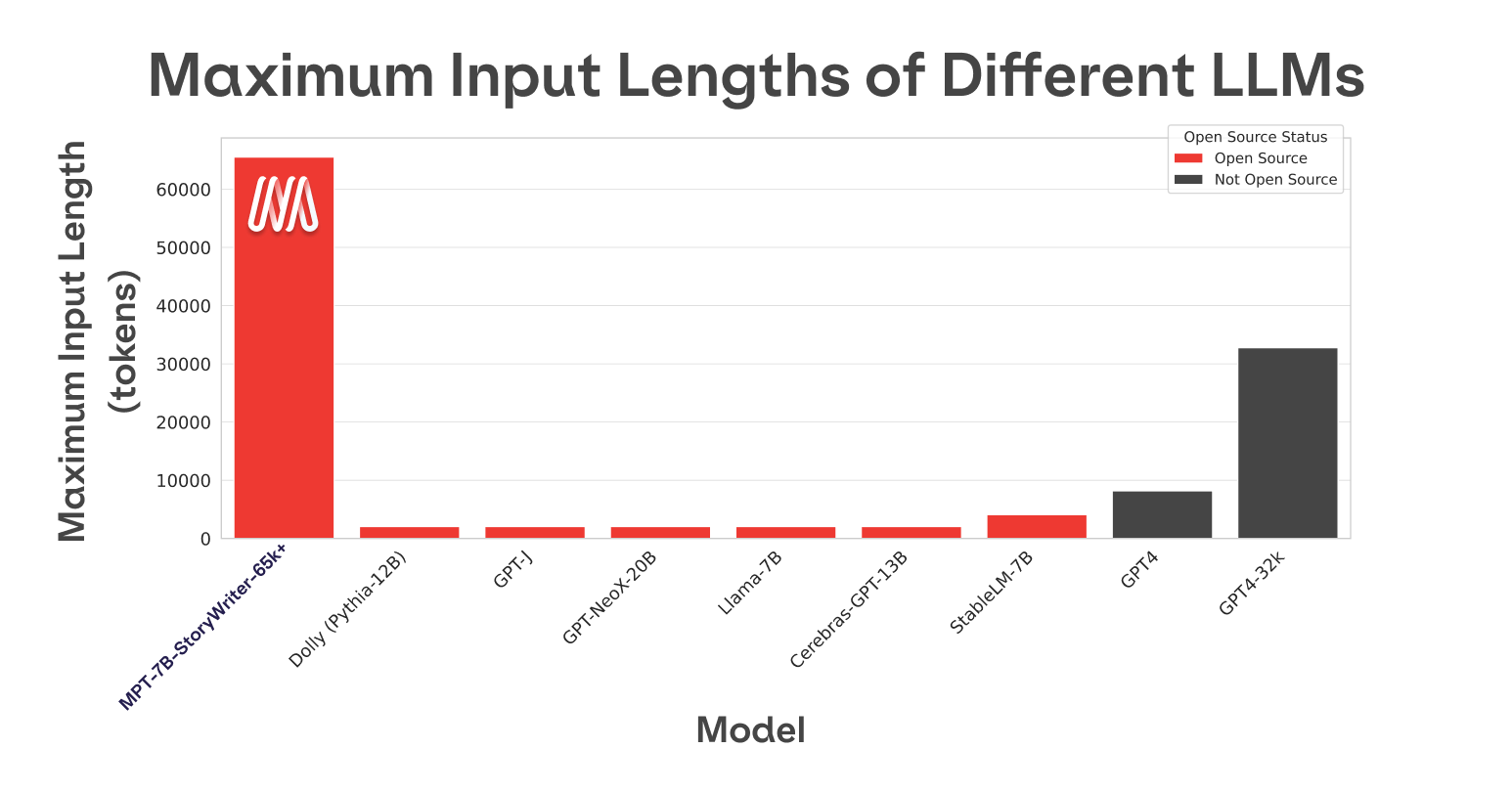
MPT-7B and The Beginning of Context=Infinity — with Jonathan Frankle and Abhinav Venigalla of MosaicML
We are excited to be the first podcast in the world to release an in-depth interview on the new SOTA in commercially licensed open source models - MosiacML MPT-7B!The Latent Space crew will be at the NYC Lux AI Summit next week, and have two meetups in June. As usual, all events are on the Community page! We are also inviting beta testers for the upcoming AI for Engineers course. See you soon!One of GPT3’s biggest limitations is context length - you can only send it up to 4000 tokens (3k words, 6 pages) before it throws a hard error, requiring you to bring in LangChain and other retrieval techniques to process long documents and prompts. But MosaicML recently open sourced MPT-7B, the newest addition to their Foundation Series, with context length going up to 84,000 tokens (63k words, 126 pages):This transformer model, trained from scratch on 1 trillion tokens of text and code (compared to 300B for Pythia and OpenLLaMA, and 800B for StableLM), matches the quality of LLaMA-7B. It was trained on the MosaicML platform in 9.5 days on 440 GPUs with no human intervention, costing approximately $200,000. Unlike many open models, MPT-7B is licensed for commercial use and it’s optimized for fast training and inference through FlashAttention and FasterTransformer.They also released 3 finetuned models starting from the base MPT-7B: * MPT-7B-Instruct: finetuned on dolly_hhrlhf, a dataset built on top of dolly-5k (see our Dolly episode for more details). * MPT-7B-Chat: finetuned on the ShareGPT-Vicuna, HC3, Alpaca, Helpful and Harmless, and Evol-Instruct datasets.* MPT-7B-StoryWriter-65k+: it was finetuned with a context length of 65k tokens on a filtered fiction subset of the books3 dataset. While 65k is the advertised size, the team has gotten up to 84k tokens in response when running on a single node A100-80GB GPUs. ALiBi is the dark magic that makes this possible. Turns out The Great Gatsby is only about 68k tokens, so the team used the model to create new epilogues for it!On top of the model checkpoints, the team also open-sourced the entire codebase for pretraining, finetuning, and evaluating MPT via their new MosaicML LLM Foundry. The table we showed above was created using LLM Foundry in-context-learning eval framework itself!In this episode, we chatted with the leads of MPT-7B at Mosaic: Jonathan Frankle, Chief Scientist, and Abhinav Venigalla, Research Scientist who spearheaded the MPT-7B training run. We talked about some of the innovations they’ve brought into the training process to remove the need for 2am on-call PagerDutys, why the LLM dataset mix is such an important yet dark art, and why some of the traditional multiple-choice benchmarks might not be very helpful for the type of technology we are building.Show Notes* Introducing MPT-7B* Cerebras* Lottery Ticket Hypothesis* Hazy Research* ALiBi* Flash Attention* FasterTransformer* List of naughty words for C4 https://twitter.com/code_star/status/1661386844250963972* What is Sparsity?* Hungry Hungry Hippos* BF16 FPp.s. yes, MPT-7B really is codenamed LLongboi!Timestamps* Introductions [00:00:00]* Intro to Mosaic [00:03:20]* Training and Creating the Models [00:05:45]* Data Choices and the Importance of Repetition [00:08:45]* The Central Question: What Mix of Data Sets Should You Use? [00:10:00]* Evaluation Challenges of LLMs [0:13:00]* Flash Attention [00:16:00]* Fine-tuning for Creativity [00:19:50]* Open Source Licenses and Ethical Considerations [00:23:00]* Training Stability Enhancement [00:25:15]* Data Readiness & Training Preparation [00:30:00]* Dynamic Real-time Model Evaluation [00:34:00]* Open Science for Affordable AI Research [00:36:00]* The Open Approach [00:40:15]* The Future of Mosaic [00:44:11]* Speed and Efficiency [00:48:01]* Trends and Transformers [00:54:00]* Lightning Round and Closing [1:00:55]TranscriptAlessio: [00:00:00] Hey everyone. Welcome to the Latent Space podcast. This is Alessio partner and CTO-in-Residence at Decibel Partners. I'm joined by my co-host, Swyx, writer and editor of Latent Space.Swyx: Hey, and today we have Jonathan and Abhi from Mosaic ML. Welcome to our studio.Jonathan: Guys thank you so much for having us. Thanks so much.Swyx: How's it feel?Jonathan: Honestly, I've been doing a lot of podcasts during the pandemic, and it has not been the same.Swyx: No, not the same actually. So you have on your bio that you're primarily based in Boston,Jonathan: New York. New York, yeah. My Twitter bio was a probability distribution over locations.Swyx: Exactly, exactly. So I DMd you because I was obviously very interested in MPT-7B and DMd you, I was like, for the 0.2% of the time that you're in San Francisco, can you come please come to a podcast studio and you're like, I'm there next week.Jonathan: Yeah, it worked out perfectly. Swyx: We're really lucky to have you, I'll read off a few intros that people should know about you and then you can fill in the blanks.So Jonathan, you did your BS and MS at Princeton in programmin
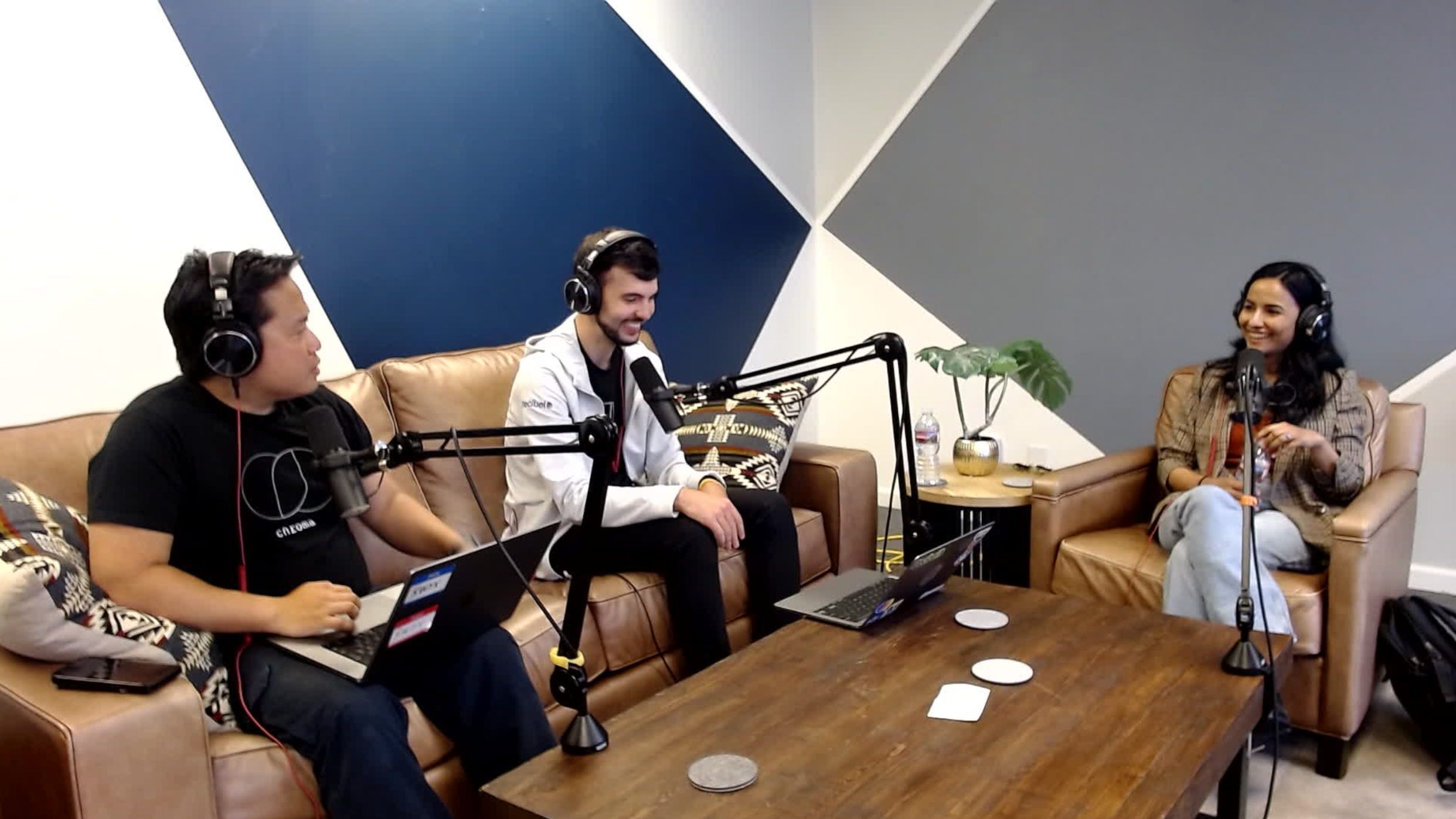
Guaranteed quality and structure in LLM outputs - with Shreya Rajpal of Guardrails AI
Tomorrow, 5/16, we’re hosting Latent Space Liftoff Day in San Francisco. We have some amazing demos from founders at 5:30pm, and we’ll have an open co-working starting at 2pm. Spaces are limited, so please RSVP here!One of the biggest criticisms of large language models is their inability to tightly follow requirements without extensive prompt engineering. You might have seen examples of ChatGPT playing a game of chess and making many invalid moves, or adding new pieces to the board. Guardrails AI aims to solve these issues by adding a formalized structure around inference calls, which validates both the structure and quality of the output. In this episode, Shreya Rajpal, creator of Guardrails AI, walks us through the inspiration behind the project, why it’s so important for models’ outputs to be predictable, and why she went with an XML-like syntax. Guardrails TLDRGuardrails AI rules are created as RAILs, which have three main “atomic objects”:* Output: what should the output look like?* Prompt: template for requests that can be interpolated* Script: custom rules for validation and correctionEach RAIL can then be used as a “guard” when calling an LLM. You can think of a guard as a wrapper for the API call. Before returning the output, it will validate it, and if it doesn’t pass it will ask the model again. Here’s an example of a bad SQL query being returned, and what the ReAsk query looks like: Each RAIL is also model-agnostic. This allows for output consistency across different models, even if they have slight differences in how they are prompted. Guardrails can easily be used with LangChain and other tools to structure your outputs!Show Notes* Guardrails AI* Text2SQL* Use Guardrails and GPT to play valid chess* Shreya’s AI Tinkerers demo* Hazy Research Lab* AutoPR* Ian Goodfellow* GANs (Generative Adversarial Networks)Timestamps* [00:00:00] Shreya's Intro* [00:02:30] What's Guardrails AI?* [00:05:50] Why XML instead of YAML or JSON?* [00:10:00] SQL as a validation language?* [00:14:00] RAIL composability and package manager?* [00:16:00] Using Guardrails for agents* [00:23:50] Guardrails "contracts" and guarantees* [00:31:30] SLAs for LLMs* [00:40:00] How to prioritize as a solo founder in open source* [00:43:00] Guardrails open source community involvement* [00:46:00] Working with Ian Goodfellow* [00:50:00] Research coming out of Stanford* [00:52:00] Lightning RoundTranscriptAlessio: [00:00:00] Hey everyone. Welcome to the Latent Space Podcast. This is Alessio partner and CTO-in-Residence at Decibel Partners. I'm joined by my cohost Swyx, writer and editor of Latent Space.Swyx: And today we have Shreya Rajpal in the studio. Welcome Shreya.Shreya: Hi. Hi. Excited to be here.Swyx: Excited to have you too.This has been a long time coming, you and I have chatted a little bit and excited to learn more about guardrails. We do a little intro for you and then we have you fill in the blanks. So you, you got your bachelor's at IIT Delhi minor in computer science with focus on AI, which is super relevant now. I bet you didn't think about that in undergrad.Shreya: Yeah, I think it's, it's interesting because like, I started working in AI back in 2014 and back then I was like, oh, it's, it's here. This is like almost changing the world already. So it feels like that that like took nine years, that meme of like, almost like almost arriving the thing.So yeah, I, it's felt this way where [00:01:00] it's almost shared. It's almost changed the world for as long as I've been working in it.Swyx: Yeah. That's awesome. Maybe we can explore your, like the origins of your interests, because then you went on to U I U C to do your master's also in ai. And then it looks like you went to drive.ai to work on Perception and then to Apple S P G as, as the cool kids call it special projects group working with Ian Goodfellow.Yeah, that's right. And then you were at pretty base up until recently? Actually, I don't know if you've quit yet. I have, yeah. Okay, good, good, good. You haven't updated e LinkedIn, but we're getting the by breaking news that you're working on guardrails full-time. Yeah, well that's the professional history.We can double back to fill in the blanks on anything. But what's a personal side? You know, what's not on your LinkedIn that people should know about you?Shreya: I think the most obvious thing, this is like, this is still professional, but the most obvious thing that isn't on my LinkedIn yet is, is Guardrails.So, yeah. Like you mentioned, I haven't updated my LinkedIn yet, but I quit some time ago and I've been devoting like all of my energy. Yeah. Full-time working on Guardrails and growing the open source package and building out exciting features, et cetera. So that's probably the thing that's missing the most.I think another. More personal skill, which I [00:02:00] think I'm like kind of okay for an amateur and that isn't on my LinkedIn is, is pottery. So I really enjoy pottery and yeah, don't know how to
The AI Founder Gene: Being Early, Building Fast, and Believing in Greatness — with Sharif Shameem of Lexica
Thanks to the over 42,000 latent space explorers who checked out our Replit episode! We are hosting/attending a couple more events in SF and NYC this month. See you if in town!Lexica.art was introduced to the world 24 hours after the release of Stable Diffusion as a search engine for prompts, gaining instant product-market fit as a world discovering generative AI also found they needed to learn prompting by example.Lexica is now 8 months old, serving 5B image searches/day, and just shipped V3 of Lexica Aperture, their own text-to-image model! Sharif Shameem breaks his podcast hiatus with us for an exclusive interview covering his journey building everything with AI!The conversation is nominally about Sharif’s journey through his three startups VectorDash, Debuild, and now Lexica, but really a deeper introspection into what it takes to be a top founder in the fastest moving tech startup scene (possibly ever) of AI. We hope you enjoy this conversation as much as we did!Full transcript is below the fold. We would really appreciate if you shared our pod with friends on Twitter, LinkedIn, Mastodon, Bluesky, or your social media poison of choice!Timestamps* [00:00] Introducing Sharif* [02:00] VectorDash* [05:00] The GPT3 Moment and Building Debuild* [09:00] Stable Diffusion and Lexica* [11:00] Lexica’s Launch & How it Works* [15:00] Being Chronically Early* [16:00] From Search to Custom Models* [17:00] AI Grant Learnings* [19:30] The Text to Image Illuminati?* [20:30] How to Learn to Train Models* [24:00] The future of Agents and Human Intervention* [29:30] GPT4 and Multimodality* [33:30] Sharif’s Startup Manual* [38:30] Lexica Aperture V1/2/3* [40:00] Request for AI Startup - LLM Tools* [41:00] Sequencing your Genome* [42:00] Believe in Doing Great Things* [44:30] Lightning RoundShow Notes* Sharif’s website, Twitter, LinkedIn* VectorDash (5x cheaper than AWS)* Debuild Insider, Fast company, MIT review, tweet, tweet* Lexica* Introducing Lexica* Lexica Stats* Aug: “God mode” search* Sep: Lexica API * Sept: Search engine with CLIP * Sept: Reverse image search* Nov: teasing Aperture* Dec: Aperture v1* Dec - Aperture v2* Jan 2023 - Outpainting* Apr 2023 - Aperture v3* Same.energy* AI Grant* Sharif on Agents: prescient Airpods tweet, Reflection* MiniGPT4 - Sharif on Multimodality* Sharif Startup Manual* Sharif Future* 23andMe Genome Sequencing Tool: Promethease* Lightning Round* Fave AI Product: Cursor.so. Swyx ChatGPT Menubar App.* Acceleration: Multimodality of GPT4. Animated Drawings* Request for Startup: Tools for LLMs, Brex for GPT Agents* Message: Build Weird Ideas!TranscriptAlessio: Hey everyone, welcome to the Latent Space podcast. This is Alessio, partner and CTO on Residence at Decibel Partners. I'm joined by my co-host Wix, writer and editor of Latent Space. And today we have Sharish Amin. Welcome to the studio. Sharif: Awesome. Thanks for the invite.Swyx: Really glad to have you. [00:00] Introducing SharifSwyx: You've been a dream guest, actually, since we started drafting guest lists for this pod. So glad we could finally make this happen. So what I like to do is usually introduce people, offer their LinkedIn, and then prompt you for what's not on your LinkedIn. And to get a little bit of the person behind the awesome projects. So you graduated University of Maryland in CS. Sharif: So I actually didn't graduate, but I did study. Swyx: You did not graduate. You dropped out. Sharif: I did drop out. Swyx: What was the decision behind dropping out? Sharif: So first of all, I wasn't doing too well in any of my classes. I was working on a side project that took up most of my time. Then I spoke to this guy who ended up being one of our investors. And he was like, actually, I ended up dropping out. I did YC. And my company didn't end up working out. And I returned to school and graduated along with my friends. I was like, oh, it's actually a reversible decision. And that was like that. And then I read this book called The Case Against Education by Brian Kaplan. So those two things kind of sealed the deal for me on dropping out. Swyx: Are you still on hiatus? Could you still theoretically go back? Sharif: Theoretically, probably. Yeah. Still on indefinite leave. Swyx: Then you did some work at Mitra? Sharif: Mitra, yeah. So they're lesser known. So they're technically like an FFRDC, a federally funded research and development center. So they're kind of like a large government contractor, but nonprofit. Yeah, I did some computer vision work there as well. [02:00] VectorDashSwyx: But it seems like you always have an independent founder bone in you. Because then you started working on VectorDash, which is distributed GPUs. Sharif: Yes. Yeah. So VectorDash was a really fun project that we ended up working on for a while. So while I was at Mitra, I had a friend who was mining Ethereum. This was, I think, 2016 or 2017. Oh my God. Yeah. And he was mining on his NVIDIA 1080Ti, making around like five or six dollars a day.
No Moat: Closed AI gets its Open Source wakeup call — ft. Simon Willison
It’s now almost 6 months since Google declared Code Red, and the results — Jeff Dean’s recap of 2022 achievements and a mass exodus of the top research talent that contributed to it in January, Bard’s rushed launch in Feb, a slick video showing Google Workspace AI features and confusing doubly linked blogposts about PaLM API in March, and merging Google Brain and DeepMind in April — have not been inspiring. Google’s internal panic is in full display now with the surfacing of a well written memo, written by software engineer Luke Sernau written in early April, revealing internal distress not seen since Steve Yegge’s infamous Google Platforms Rant. Similar to 2011, the company’s response to an external challenge has been to mobilize the entire company to go all-in on a (from the outside) vague vision.Google’s misfortunes are well understood by now, but the last paragraph of the memo: “We have no moat, and neither does OpenAI”, was a banger of a mic drop.Combine this with news this morning that OpenAI lost $540m last year and will need as much as $100b more funding (after the complex $10b Microsoft deal in Jan), and the memo’s assertion that both Google and OpenAI have “no moat” against the mighty open source horde have gained some credibility in the past 24 hours.Many are criticising this memo privately:* A CEO commented to me yesterday that Luke Sernau does not seem to work in AI related parts of Google and “software engineers don’t understand moats”. * Emad Mostaque, himself a perma-champion of open source and open models, has repeatedly stated that “Closed models will always outperform open models” because closed models can just wrap open ones.* Emad has also commented on the moats he does see: “Unique usage data, Unique content, Unique talent, Unique product, Unique business model”, most of which Google does have, and OpenAI less so (though it is winning on the talent front)* Sam Altman famously said that “very few to no one is Silicon Valley has a moat - not even Facebook” (implying that moats don’t actually matter, and you should spend your time thinking about more important things)* It is not actually clear what race the memo thinks Google and OpenAI are in vs Open Source. Neither are particularly concerned about running models locally on phones, and they are perfectly happy to let “a crazy European alpha male” run the last mile for them while they build actually monetizable cloud infrastructure.However moats are of intense interest by everybody keen on productized AI, cropping up in every Harvey, Jasper, and general AI startup vs incumbent debate. It is also interesting to take the memo at face value and discuss the searing hot pace of AI progress in open source. We hosted this discussion yesterday with Simon Willison, who apart from being an incredible communicator also wrote a great recap of the No Moat memo. 2,800 have now tuned in on Twitter Spaces, but we have taken the audio and cleaned it up here. Enjoy!Timestamps* [00:00:00] Introducing the Google Memo* [00:02:48] Open Source > Closed?* [00:05:51] Running Models On Device* [00:07:52] LoRA part 1* [00:08:42] On Moats - Size, Data* [00:11:34] Open Source Models are Comparable on Data* [00:13:04] Stackable LoRA* [00:19:44] The Need for Special Purpose Optimized Models* [00:21:12] Modular - Mojo from Chris Lattner* [00:23:33] The Promise of Language Supersets* [00:28:44] Google AI Strategy* [00:29:58] Zuck Releasing LLaMA* [00:30:42] Google Origin Confirmed* [00:30:57] Google's existential threat* [00:32:24] Non-Fiction AI Safety ("y-risk")* [00:35:17] Prompt Injection* [00:36:00] Google vs OpenAI* [00:41:04] Personal plugs: Simon and TravisTranscripts[00:00:00] Introducing the Google Memo[00:00:00] Simon Willison: So, yeah, this is a document, which Kate, which I first saw at three o'clock this morning, I think. It claims to be leaked from Google. There's good reasons to believe it is leaked from Google, and to be honest, if it's not, it doesn't actually matter because the quality of the analysis, I think stands alone.[00:00:15] If this was just a document by some anonymous person, I'd still think it was interesting and worth discussing. And the title of the document is We Have No Moat and neither does Open ai. And the argument it makes is that while Google and OpenAI have been competing on training bigger and bigger language models, the open source community is already starting to outrun them, given only a couple of months of really like really, really serious activity.[00:00:41] You know, Facebook lama was the thing that really kicked us off. There were open source language models like Bloom before that some G P T J, and they weren't very impressive. Like nobody was really thinking that they were. Chat. G P T equivalent Facebook Lama came out in March, I think March 15th. And was the first one that really sort of showed signs of being as capable maybe as chat G P T.[00:01:04] My, I don't, I think all of these models, they've been, the analysis
Training a SOTA Code LLM in 1 week and Quantifying the Vibes — with Reza Shabani of Replit
Latent Space is popping off! Welcome to the over 8500 latent space explorers who have joined us. Join us this month at various events in SF and NYC, or start your own!This post spent 22 hours at the top of Hacker News.As announced during their Developer Day celebrating their $100m fundraise following their Google partnership, Replit is now open sourcing its own state of the art code LLM: replit-code-v1-3b (model card, HF Space), which beats OpenAI’s Codex model on the industry standard HumanEval benchmark when finetuned on Replit data (despite being 77% smaller) and more importantly passes AmjadEval (we’ll explain!)We got an exclusive interview with Reza Shabani, Replit’s Head of AI, to tell the story of Replit’s journey into building a data platform, building GhostWriter, and now training their own LLM, for 22 million developers!8 minutes of this discussion go into a live demo discussing generated code samples - which is always awkward on audio. So we’ve again gone multimodal and put up a screen recording here where you can follow along on the code samples!Recorded in-person at the beautiful StudioPod studios in San Francisco.Full transcript is below the fold. We would really appreciate if you shared our pod with friends on Twitter, LinkedIn, Mastodon, Bluesky, or your social media poison of choice!Timestamps* [00:00:21] Introducing Reza* [00:01:49] Quantitative Finance and Data Engineering* [00:11:23] From Data to AI at Replit* [00:17:26] Replit GhostWriter* [00:20:31] Benchmarking Code LLMs* [00:23:06] AmjadEval live demo* [00:31:21] Aligning Models on Vibes* [00:33:04] Beyond Chat & Code Completion* [00:35:50] Ghostwriter Autonomous Agent* [00:38:47] Releasing Replit-code-v1-3b* [00:43:38] The YOLO training run* [00:49:49] Scaling Laws: from Kaplan to Chinchilla to LLaMA* [00:52:43] MosaicML* [00:55:36] Replit's Plans for the Future (and Hiring!)* [00:59:05] Lightning RoundShow Notes* Reza Shabani on Twitter and LinkedIn* also Michele Catasta and Madhav Singhal* Michele Catasta’s thread on the release of replit-code-v1-3b* Intro to Replit Ghostwriter* Replit Ghostwriter Chat and Building Ghostwriter Chat* Reza on how to train your own LLMs (their top blog of all time)* Our Benchmarks 101 episode where we discussed HumanEval* AmjadEval live demo* Nat.dev* MosaicML CEO Naveen Rao on Replit’s LLM* MosaicML Composer + FSDP code* Replit’s AI team is hiring in North America timezone - Fullstack engineer, Applied AI/ML, and other roles!Transcript[00:00:00] Alessio Fanelli: Hey everyone. Welcome to the Latent Space podcast. This is Alessio, partner and CTO in residence at Decibel Partners. I'm joined by my co-host, swyx, writer and editor of Latent Space.[00:00:21] Introducing Reza[00:00:21] swyx: Hey and today we have Reza Shabani, Head of AI at Replit. Welcome to the studio. Thank you. Thank you for having me. So we try to introduce people's bios so you don't have to repeat yourself, but then also get a personal side of you.[00:00:34] You got your PhD in econ from Berkeley, and then you were a startup founder for a bit, and, and then you went into systematic equity trading at BlackRock in Wellington. And then something happened and you were now head of AI at Relet. What should people know about you that might not be apparent on LinkedIn?[00:00:50] One thing[00:00:51] Reza Shabani: that comes up pretty often is whether I know how to code. Yeah, you'd be shocked. A lot of people are kind of like, do you know how to code? When I was talking to Amjad about this role, I'd originally talked to him, I think about a product role and, and didn't get it. Then he was like, well, I know you've done a bunch of data and analytics stuff.[00:01:07] We need someone to work on that. And I was like, sure, I'll, I'll do it. And he was like, okay, but you might have to know how to code. And I was like, yeah, yeah, I, I know how to code. So I think that just kind of surprises people coming from like Ancon background. Yeah. Of people are always kind of like, wait, even when people join Relet, they're like, wait, does this guy actually know how to code?[00:01:28] Is he actually technical? Yeah.[00:01:30] swyx: You did a bunch of number crunching at top financial companies and it still wasn't[00:01:34] Reza Shabani: obvious. Yeah. Yeah. I mean, I, I think someone like in a software engineering background, cuz you think of finance and you think of like calling people to get the deal done and that type of thing.[00:01:43] No, it's, it's not that as, as you know, it's very very quantitative. Especially what I did in, in finance, very quantitative.[00:01:49] Quantitative Finance and Data Engineering[00:01:49] swyx: Yeah, so we can cover a little bit of that and then go into the rapid journey. So as, as you, as you know, I was also a quantitative trader on the sell side and the buy side. And yeah, I actually learned Python there.[00:02:01] I learned my, I wrote my own data pipelines there before airflow was a thing, and it was just me wri
Mapping the future of *truly* Open Models and Training Dolly for $30 — with Mike Conover of Databricks
The race is on for the first fully GPT3/4-equivalent, truly open source Foundation Model! LLaMA’s release proved that a great model could be released and run on consumer-grade hardware (see llama.cpp), but its research license prohibits businesses from running it and all it’s variants (Alpaca, Vicuna, Koala, etc) for their own use at work. So there is great interest and desire for *truly* open source LLMs that are feasible for commercial use (with far better customization, finetuning, and privacy than the closed source LLM APIs).The previous leading contenders were Eleuther’s GPT-J and Neo on the small end (FLAN-T5 (137B), PaLM (540B), and BigScience’s BLOOM (176B) on the high end. But Databricks is to my knowledge the first to release not just a cleanly licensed, high quality LLM that can run on affordable devices, but also a simple Databricks notebook that can be customized to be finetuned for your data/desired style - for $30 in 30 minutes on one machine!Mike Conover tells the story of how a small team of Applied AI engineers got convinced Ali Ghodsi and 5,000 of their coworkers to join in the adventure of building the first open source, instruction-following LLM, fine-tuned on a human-generated instruction dataset licensed for research and commercial use. He also indulges our questions on other recent open source LLM projects, CerebasGPT and RedPajama, though we recorded this a week before Stability’s StableLM release. Stick around to the end for some easter eggs featuring AI Drake!Recorded in-person at the beautiful StudioPod studios in San Francisco.Full transcript is below the fold.Show Notes* Mike Conover LinkedIn and Twitter* Dolly 1.0* Dolly 2.0* CICERO and Diplomacy* Dolly and Deepspeed* LLMops: * https://nat.dev/* PromptLayer* HumanLoop* Spreadsheets??* Quadratic* Alessio’s Email GPT Drafter* Open Models* Open Assistant* Cerebras GPT* RedPajama* Reflexion, Recursive Criticism and Improvement* Lightning Round* AI Product: Google Maps* AI People: EleutherAI, Huggingface’s Stas Bekman* AI Prediction: Open LLaMA reproduction, AI Twins of People (AI Drake), Valuing Perplexity * Request for Startups: LLMOps/Benchmarks, Trail MappingTimestamps* [00:00:21] Introducing Mike Conover* [00:03:10] Dolly 1.0* [00:04:18] Making Dolly* [00:06:12] Dolly 2.0* [00:09:28] Gamifying Instruction Tuning* [00:11:36] Summarization - Thumbnails for Language* [00:15:11] CICERO and Geopolitical AI Agents* [00:17:09] Datasets vs Intentional Design* [00:21:44] Biological Basis of AI* [00:23:27] Training Your Own LLMs* [00:28:21] You May Not Need a Large Model* [00:29:59] Good LLM Use cases* [00:31:33] Dolly Cost $30 on Databricks* [00:36:06] Databricks Open Source* [00:37:31] LLMOps and Prompt Tooling* [00:42:26] "I'm a Sheets Maxi"* [00:44:19] AI and Workplace Productivity* [00:47:02] OpenAssistant* [00:47:41] CerebrasGPT* [00:51:35] RedPajama* [00:54:07] Why Dolly > OpenAI GPT* [00:56:19] Open Source Licensing for AI Models* [00:57:09] Why Open Source Models?* [00:58:05] Moving Models* [01:00:34] Learning in a Simulation* [01:01:28] Why Model Reflexion and Self Criticism Works* [01:03:51] Lightning RoundTranscripts[00:00:00] Hey everyone. Welcome to the Latent Space Podcast. This is Alessio Partner and CT and Residence and Decibel Partners. I'm Joan Bama, cohost swyx Brighter and Editor of Space. Welcome, Mike.[00:00:21] Introducing Mike Conover[00:00:21] Hey, pleasure to be here. Yeah, so[00:00:23] we tend to try to introduce you so that you don't have to introduce yourself. Yep.[00:00:27] But then we also ask you to fill in the blanks. So you are currently a, uh, staff software engineer at Databricks. Uh, but you got your PhD at Indiana on the University of Bloomington in Complex Systems analysis where you did some, uh, analysis of clusters on, on Twitter, which I found pretty interesting.[00:00:43] Yeah. Uh, I highly recommend people checking that out if you're interested in getting information from indirect sources or I, I don't know how you describe it. Yes. Yeah. And then you went to LinkedIn working on. Homepage News, relevance, and then SkipFlag, which is a smart enterprise knowledge graph, which was then acquired, uh, by Workday, where you became director of machine learning engineering and now your Databricks.[00:01:06] So that's the quick bio and we can kind of go over Yeah. Step by step. But, uh, what's not on your LinkedIn that people[00:01:12] should know about you? So, because I worked at LinkedIn, that's actually how new hires introduce themselves at LinkedIn is this question. So I, okay. I have a pat answer to it. Uhhuh. Um, I love getting off trail in the backcountry.[00:01:25] Okay. And I, you know, I think that the sort of like radical responsibility associated to that is clarifies the mind. And I think that the, the things that I really like about machine learning engineering and sort of the topology of high-dimensional spaces kind of manifest when you think about a topographic mat as a contour plot.[0

AI-powered Search for the Enterprise — with Deedy Das of Glean
The most recent YCombinator W23 batch graduated 59 companies building with Generative AI for everything from sales, support, engineering, data, and more:Many of these B2B startups will be seeking to establish an AI foothold in the enterprise. As they look to recent success, they will find Glean, started in 2019 by a group of ex-Googlers to finally solve AI-enabled enterprise search. In 2022 Sequoia led their Series C at a $1b valuation and Glean have just refreshed their website touting new logos across Databricks, Canva, Confluent, Duolingo, Samsara, and more in the Fortune 50 and announcing Enterprise-ready AI features including AI answers, Expert detection, and In-context recommendations.We talked to Deedy Das, Founding Engineer at Glean and a former Tech Lead on Google Search, on why he thinks many of these startups are solutions looking for problems, and how Glean’s holistic approach to enterprise probllem solving has brought so much success. Deedy is also just a fascinating commentator on AI current events, being both extremely qualified and great at distilling insights, so we also went over his many viral tweets diving into Google’s competitive threats, AI Startup investing, and his exposure of Indian University Exam Fraud!Show Notes* Deedy on LinkedIn and Twitter and Personal Site* Glean* Glean and Google Moma* Golinks.io* Deedy on Google vs ChatGPT* Deedy on Google Ad Revenue* Deedy on How much does it cost to train a state-of-the-art foundational LLM?* Deedy on Google LaMDA cost* Deedy’s Indian Exam Fraud Story* Lightning Round* Favorite Products: (covered in segment)* Favorite AI People: AI Pub* Predictions: Models will get faster for the same quality* Request for Products: Hybrid Email Autoresponder* Parting Takeaway: Read the research!Timestamps* [00:00:21] Introducing Deedy* [00:02:27] Introducing Glean* [00:05:41] From Syntactic to Semantic Search* [00:09:39] Why Employee Portals* [00:12:01] The Requirements of Good Enterprise Search* [00:15:26] Glean Chat?* [00:15:53] Google vs ChatGPT* [00:19:47] Search Issues: Freshness* [00:20:49] Search Issues: Ad Revenue* [00:23:17] Search Issues: Latency* [00:24:42] Search Issues: Accuracy* [00:26:24] Search Issues: Tool Use* [00:28:52] Other AI Search takes: Perplexity and Neeva* [00:30:05] Why Document QA will Struggle* [00:33:18] Investing in AI Startups* [00:35:21] Actually Interesting Ideas in AI* [00:38:13] Harry Potter IRL* [00:39:23] AI Infra Cost Math* [00:43:04] Open Source LLMs* [00:46:45] Other Modalities* [00:48:09] Exam Fraud and Generated Text Detection* [00:58:01] Lightning RoundTranscript[00:00:00] Hey everyone. Welcome to the Latent Space Podcast. This is Alessio, partner and CTO and residence at Decibel Partners. I'm joined by my, cohost swyx, writer and editor of[00:00:19] Latent Space. Yeah. Awesome.[00:00:21] Introducing Deedy[00:00:21] And today we have a special guest. It's Deedy Das from Glean. Uh, do you go by Deedy or Debarghya? I go by Deedy. Okay.[00:00:30] Uh, it's, it's a little bit easier for the rest of us to, uh, to, to spell out. And so what we typically do is I'll introduce you based on your LinkedIn profile, and then you can fill in what's not on your LinkedIn. So, uh, you graduated your bachelor's and masters in CS from Cornell. Then you worked at Facebook and then Google on search, specifically search, uh, and also leading a sports team focusing on cricket.[00:00:50] That's something that we, we can dive into. Um, and then you moved over to Glean, which is now a search unicorn in building intelligent search for the workplace. What's not on your LinkedIn that people should know about you? Firstly,[00:01:01] guys, it's a pleasure. Pleasure to be here. Thank you so much for having me.[00:01:04] What's not on my LinkedIn is probably everything that's non-professional. I think the biggest ones are I'm a huge movie buff and I love reading, so I think I get through, usually I like to get through 10 books ish a year, but I hate people who count books, so I should say the number. And increasingly, I don't like reading non-fiction books.[00:01:26] I actually do prefer reading fiction books purely for pleasure and entertainment. I think that's the biggest omission from my LinkedIn.[00:01:34] What, what's, what's something that, uh, caught your eye for fiction stuff that you would recommend people?[00:01:38] Oh, I recently, we started reading the Three Body Problem and I finished it and it's a three part series.[00:01:45] And, uh, well, my controversial take is I did not really enjoy the second part, and so I just stopped. But the first book was phenomenal. Great concept. I didn't know you could write alien fiction with physics so Well, and Chinese literature in particular has a very different cadence to it than Western literature.[00:02:03] It's very less about the, um, let's describe people and what they're all about and their likes and dislikes. And it's like, here's a person, he's a professor of physics. That's all you ne
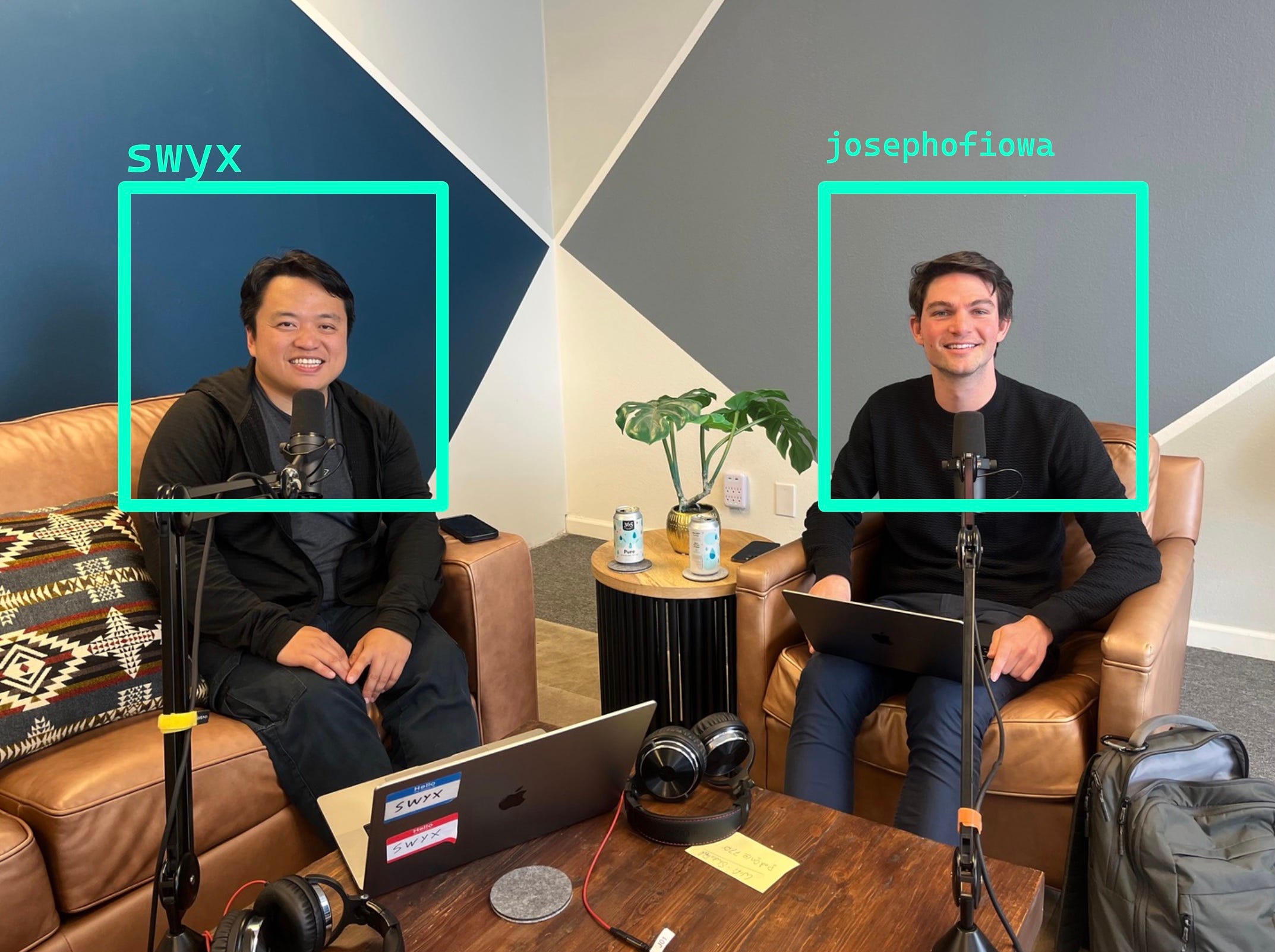
Segment Anything Model and the Hard Problems of Computer Vision — with Joseph Nelson of Roboflow
2023 is the year of Multimodal AI, and Latent Space is going multimodal too! * This podcast comes with a video demo at the 1hr mark and it’s a good excuse to launch our YouTube - please subscribe! * We are also holding two events in San Francisco — the first AI | UX meetup next week (already full; we’ll send a recap here on the newsletter) and Latent Space Liftoff Day on May 4th (signup here; but get in touch if you have a high profile launch you’d like to make). * We also joined the Chroma/OpenAI ChatGPT Plugins Hackathon last week where we won the Turing and Replit awards and met some of you in person!This post featured on Hacker News.Out of the five senses of the human body, I’d put sight at the very top. But weirdly when it comes to AI, Computer Vision has felt left out of the recent wave compared to image generation, text reasoning, and even audio transcription. We got our first taste of it with the OCR capabilities demo in the GPT-4 Developer Livestream, but to date GPT-4’s vision capability has not yet been released. Meta AI leapfrogged OpenAI and everyone else by fully open sourcing their Segment Anything Model (SAM) last week, complete with paper, model, weights, data (6x more images and 400x more masks than OpenImages), and a very slick demo website. This is a marked change to their previous LLaMA release, which was not commercially licensed. The response has been ecstatic:SAM was the talk of the town at the ChatGPT Plugins Hackathon and I was fortunate enough to book Joseph Nelson who was frantically integrating SAM into Roboflow this past weekend. As a passionate instructor, hacker, and founder, Joseph is possibly the single best person in the world to bring the rest of us up to speed on the state of Computer Vision and the implications of SAM. I was already a fan of him from his previous pod with (hopefully future guest) Beyang Liu of Sourcegraph, so this served as a personal catchup as well. Enjoy! and let us know what other news/models/guests you’d like to have us discuss! - swyxRecorded in-person at the beautiful StudioPod studios in San Francisco.Full transcript is below the fold.Show Notes* Joseph’s links: Twitter, Linkedin, Personal* Sourcegraph Podcast and Game Theory Story* Represently* Roboflow at Pioneer and YCombinator* Udacity Self Driving Car dataset story* Computer Vision Annotation Formats* SAM recap - top things to know for those living in a cave* https://segment-anything.com/* https://segment-anything.com/demo* https://arxiv.org/pdf/2304.02643.pdf * https://ai.facebook.com/blog/segment-anything-foundation-model-image-segmentation/* https://blog.roboflow.com/segment-anything-breakdown/* https://ai.facebook.com/datasets/segment-anything/* Ask Roboflow https://ask.roboflow.ai/* GPT-4 Multimodal https://blog.roboflow.com/gpt-4-impact-speculation/Cut for time:* WSJ mention* Des Moines Register story* All In Pod: timestamped mention* In Forbes: underrepresented investors in Series A* Roboflow greatest hits* https://blog.roboflow.com/mountain-dew-contest-computer-vision/* https://blog.roboflow.com/self-driving-car-dataset-missing-pedestrians/* https://blog.roboflow.com/nerualhash-collision/ and Apple CSAM issue * https://www.rf100.org/Timestamps* [00:00:19] Introducing Joseph* [00:02:28] Why Iowa* [00:05:52] Origin of Roboflow* [00:16:12] Why Computer Vision* [00:17:50] Computer Vision Use Cases* [00:26:15] The Economics of Annotation/Segmentation* [00:32:17] Computer Vision Annotation Formats* [00:36:41] Intro to Computer Vision & Segmentation* [00:39:08] YOLO* [00:44:44] World Knowledge of Foundation Models* [00:46:21] Segment Anything Model* [00:51:29] SAM: Zero Shot Transfer* [00:51:53] SAM: Promptability* [00:53:24] SAM: Model Assisted Labeling* [00:56:03] SAM doesn't have labels* [00:59:23] Labeling on the Browser* [01:00:28] Roboflow + SAM Video Demo * [01:07:27] Future Predictions* [01:08:04] GPT4 Multimodality* [01:09:27] Remaining Hard Problems* [01:13:57] Ask Roboflow (2019)* [01:15:26] How to keep up in AITranscripts[00:00:00] Hello everyone. It is me swyx and I'm here with Joseph Nelson. Hey, welcome to the studio. It's nice. Thanks so much having me. We, uh, have a professional setup in here.[00:00:19] Introducing Joseph[00:00:19] Joseph, you and I have known each other online for a little bit. I first heard about you on the Source Graph podcast with bian and I highly, highly recommend that there's a really good game theory story that is the best YC application story I've ever heard and I won't tease further cuz they should go listen to that.[00:00:36] What do you think? It's a good story. It's a good story. It's a good story. So you got your Bachelor of Economics from George Washington, by the way. Fun fact. I'm also an econ major as well. You are very politically active, I guess you, you did a lot of, um, interning in political offices and you were responding to, um, the, the, the sheer amount of load that the Congress people have in terms of the, the support.[00:01:00

AI Fundamentals: Benchmarks 101
We’re trying a new format, inspired by Acquired.fm! No guests, no news, just highly prepared, in-depth conversation on one topic that will level up your understanding. We aren’t experts, we are learning in public. Please let us know what we got wrong and what you think of this new format!When you ask someone to break down the basic ingredients of a Large Language Model, you’ll often hear a few things: You need lots of data. You need lots of compute. You need models with billions of parameters. Trust the Bitter Lesson, more more more, scale is all you need. Right?Nobody ever mentions the subtle influence of great benchmarking.LLM Benchmarks mark our progress in building artificial intelligences, progressing from * knowing what words go with others (1985 WordNet)* recognizing names and entities (2004 Enron Emails) * and image of numbers, letters, and clothes (1998-2017 MNIST)* language translation (2002 BLEU → 2020 XTREME)* more and more images (2009 ImageNet, CIFAR)* reasoning in sentences (2016 LAMBADA) and paragraphs (2019 AI2RC, DROP)* stringing together whole sentences (2018 GLUE and SuperGLUE)* question answering (2019 CoQA)* having common sense (2018 Swag and HellaSwag, 2019 WinoGrande)* knowledge of all human tasks and professional exams (2021 MMLU)* knowing everything (2022 BIG-Bench)People who make benchmarks are the unsung heroes of LLM research, because they dream up ever harder tests that last ever shorter periods of time.In our first AI Fundamentals episode, we take a trek through history to try to explain what we have learned about LLM Benchmarking, and what issues we have discovered with them. There are way, way too many links and references to include in this email. You can follow along the work we did for our show prep in this podcast’s accompanying repo, with all papers and selected tests pulled out.Enjoy and please let us know what other fundamentals topics you’d like us to cover!Timestamps* [00:00:21] Benchmarking Questions* [00:03:08] Why AI Benchmarks matter* [00:06:02] Introducing Benchmark Metrics* [00:08:14] Benchmarking Methodology* [00:09:45] 1985-1989: WordNet and Entailment* [00:12:44] 1998-2004 Enron Emails and MNIST* [00:14:35] 2009-14: ImageNet, CIFAR and the AlexNet Moment for Deep Learning* [00:17:42] 2018-19: GLUE and SuperGLUE - Single Sentence, Similarity and Paraphrase, Inference* [00:23:21] 2018-19: Swag and HellaSwag - Common Sense Inference* [00:26:07] Aside: How to Design Benchmarks* [00:26:51] 2021: MMLU - Human level Professional Knowledge* [00:29:39] 2021: HumanEval - Code Generation* [00:31:51] 2020: XTREME - Multilingual Benchmarks* [00:35:14] 2022: BIG-Bench - The Biggest of the Benches* [00:37:40] EDIT: Why BIG-Bench is missing from GPT4 Results* [00:38:25] Issue: GPT4 vs the mystery of the AMC10/12* [00:40:28] Issue: Data Contamination* [00:42:13] Other Issues: Benchmark Data Quality and the Iris data set* [00:45:44] Tradeoffs of Latency, Inference Cost, Throughput* [00:49:45] ConclusionTranscript[00:00:00] Hey everyone. Welcome to the Latent Space Podcast. This is Alessio, partner and CTO and residence at Decibel Partners, and I'm joined by my co-host, swyx writer and editor of Latent Space.[00:00:21] Benchmarking Questions[00:00:21] Up until today, we never verified that we're actually humans to you guys. So we'd have one good thing to do today would be run ourselves through some AI benchmarks and see if we are humans.[00:00:31] Indeed. So, since I got you here, Sean, I'll start with one of the classic benchmark questions, which is what movie does this emoji describe? The emoji set is little Kid Bluefish yellow, bluefish orange Puffer fish. One movie does that. I think if you added an octopus, it would be slightly easier. But I prepped this question so I know it's finding Nemo.[00:00:57] You are so far a human. Second one of these emoji questions instead, depicts a superhero man, a superwoman, three little kids, one of them, which is a toddler. So you got this one too? Yeah. It's one of my favorite movies ever. It's the Incredibles. Uh, second one was kind of a letdown, but the first is a.[00:01:17] Awesome. Okay, I'm gonna ramp it up a little bit. So let's ask something that involves a little bit of world knowledge. So when you drop a ball from rest, it accelerates downward at 9.8 meters per second if you throw it downward instead, assuming no air resistance, so you're throwing it down instead of dropping it, it's acceleration immediately after leaving your hand is a 9.8 meters per second.[00:01:38] B, more than 9.8 meters per second. C less than 9.8 meters per second. D cannot say unless the speed of the throw is. I would say B, you know, I started as a physics major and then I changed, but I think I, I got enough from my first year. That is B Yeah. Even proven that you're human cuz you got it wrong.[00:01:56] Whereas the AI got it right is 9.8 meters per second. The gravitational constant, uh, because you are no longer accelerating after you leave the ha
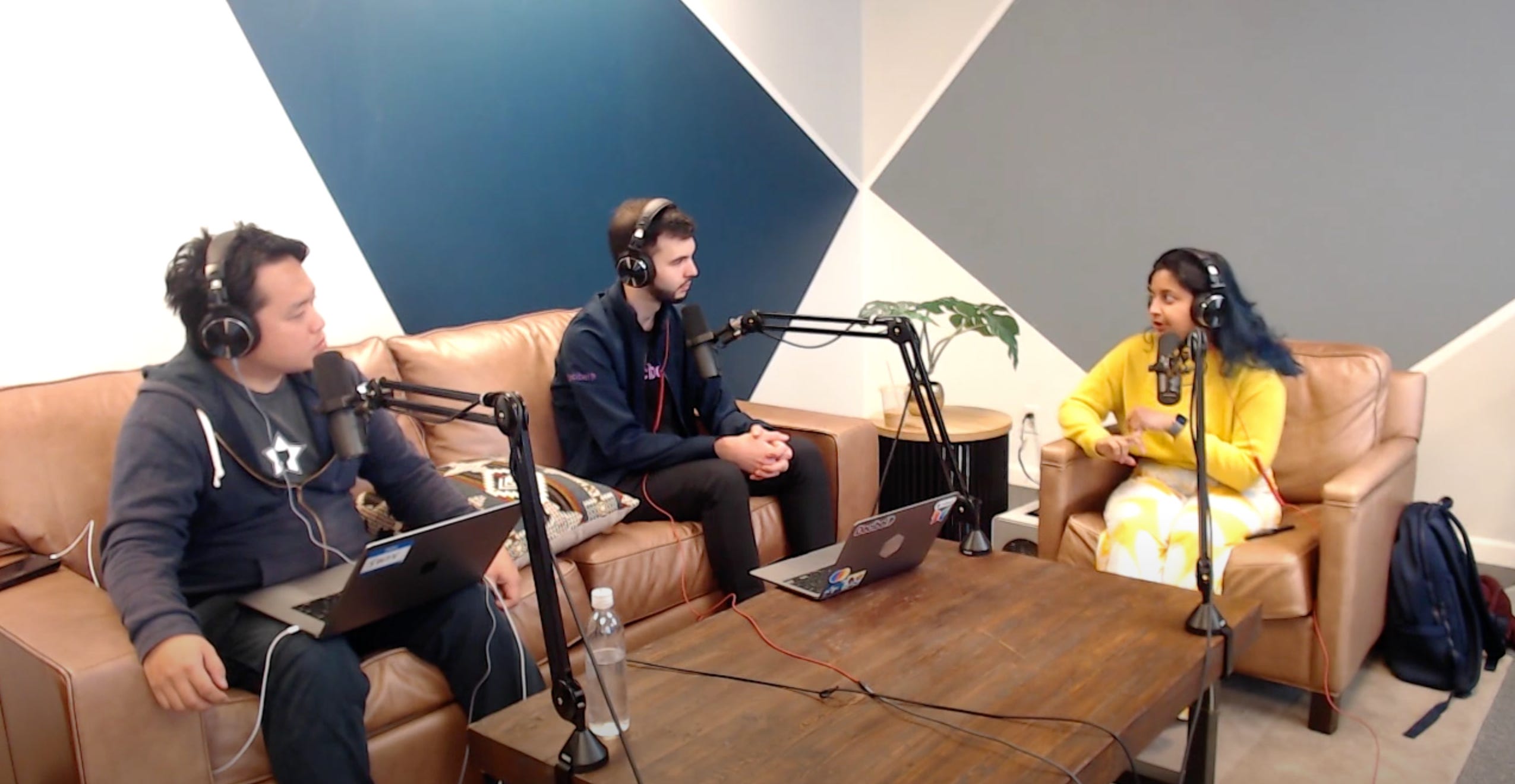
Grounded Research: From Google Brain to MLOps to LLMOps — with Shreya Shankar of UC Berkeley
We are excited to feature our first academic on the pod! I first came across Shreya when her tweetstorm of MLOps principles went viral:Shreya’s holistic approach to production grade machine learning has taken her from Stanford to Facebook and Google Brain, being the first ML Engineer at Viaduct, and now a PhD in Databases (trust us, its relevant) at UC Berkeley with the new EPIC Data Lab. If you know Berkeley’s history in turning cutting edge research into gamechanging startups, you should be as excited as we are!Recorded in-person at the beautiful StudioPod studios in San Francisco.Full transcript is below the fold.Edit from the future: Shreya obliged us with another round of LLMOps hot takes after the pod!Other Links* Shreya’s About: https://www.shreya-shankar.com/about/* Berkeley Sky Computing Lab - Utility Computing for the Cloud* Berkeley Epic Data Lab - low-code and no-code interfaces for data work, powered by next-generation predictive programming techniques* Shreya’s ML Principles * Grounded Theory* Lightning Round:* Favorite AI Product: Stability Dreamstudio* 1 Year Prediction: Data management platforms* Request for startup: Design system generator* Takeaway: It’s not a fad!Timestamps* [00:00:27] Introducing Shreya (poorly)* [00:03:38] The 3 V's of ML development* [00:05:45] Bridging Development and Production* [00:08:40] Preventing Data Leakage* [00:10:31] Berkeley's Unique Research Lab Culture* [00:11:53] From Static to Dynamically Updated Data* [00:12:55] Models as views on Data* [00:15:03] Principle: Version everything you do* [00:16:30] Principle: Always validate your data* [00:18:33] Heuristics for Model Architecture Selection* [00:20:36] The LLMOps Stack* [00:22:50] Shadow Models* [00:23:53] Keeping Up With Research* [00:26:10] Grounded Theory Research* [00:27:59] Google Brain vs Academia* [00:31:41] Advice for New Grads* [00:32:59] Helping Minorities in CS* [00:35:06] Lightning RoundTranscript[00:00:00] Hey everyone. Welcome to the Latent Space podcast. This is Alessio partner and CTM residence at Decibel Partners. I'm joined by my co-host, swyx writer and editor of Latent Space. Yeah,[00:00:21] it's awesome to have another awesome guest Shankar. Welcome .[00:00:25] Thanks for having me. I'm super excited.[00:00:27] Introducing Shreya (poorly)[00:00:27] So I'll intro your formal background and then you can fill in the blanks.[00:00:31] You are a bsms and then PhD at, in, in Computer Science at Stanford. So[00:00:36] I'm, I'm a PhD at Berkeley. Ah, Berkeley. I'm sorry. Oops. . No, it's okay. Everything's the bay shouldn't say that. Everybody, somebody is gonna get mad, but . Lived here for eight years now. So[00:00:50] and then intern at, Google Machine learning learning engineer at Viaduct, an OEM manufacturer, uh, or via OEM analytics platform.[00:00:59] Yes. And now you're an e I R entrepreneur in residence at Amplify.[00:01:02] I think that's on hold a little bit as I'm doing my PhD. It's a very unofficial title, but it sounds fancy on paper when you say[00:01:09] it out loud. Yeah, it is fancy. Well, so that is what people see on your LinkedIn. What's, what should, what should people know about you that's not on your LinkedIn?[00:01:16] Yeah, I don't think I updated my LinkedIn since I started the PhD, so, I'm doing my PhD in databases. It is not AI machine learning, but I work on data management for building AI and ML powered software. I guess like all of my personal interests, I'm super into going for walks, hiking, love, trying coffee in the Bay area.[00:01:42] I recently, I've been getting into cooking a lot. Mm-hmm. , so what kind of cooking? Ooh. I feel like I really like pastas. But that's because I love carbs. So , I don't know if it's the pasta as much as it's the carb. Do you ever cook for[00:01:56] like large[00:01:57] dinners? Large groups? Yeah. We just hosted about like 25 people a couple weeks ago, and I was super ambitious.[00:02:04] I was like, I'm gonna cook for everyone, like a full dinner. But then kids were coming. and I was like, I know they're not gonna eat tofu. The other thing with hosting in the Bay Area is there's gonna be someone vegan. There's gonna be someone gluten-free. Mm-hmm. . There's gonna be someone who's keto. Yeah.[00:02:20] Good luck, .[00:02:21] Oh, you forgot the seeds. That's the sea disrespects.[00:02:25] I know. . So I was like, oh my God, I don't know how I'm gonna do this. Yeah. The dessert too. I was like, I don't know how I'm gonna make everything like a vegan, keto nut free dessert, just water. It was a fun challenge. We ordered pizza for the children and a lot of people ate the pizza.[00:02:43] So I think , that's what happens when you try to cook, cook for everyone.[00:02:48] Yeah. The reason I dug a bit on the cooking is I always find like if you do cook for large groups, it's a little bit like of an ops situation. Yeah. Like a lot of engineering. A lot of like trying to figure out like what you need to deliver and then like what the
Emergency Pod: ChatGPT's App Store Moment (w/ OpenAI's Logan Kilpatrick, LindyAI's Florent Crivello and Nader Dabit)
This blogpost has been updated since original release to add more links and references.The ChatGPT Plugins announcement today could be viewed as the launch of ChatGPT’s “App Store”, a moment as significant as when Apple opened its App Store for the iPhone in 2008 or when Facebook let developers loose on its Open Graph in 2010. With a dozen lines of simple JSON and a mostly-english prompt to help ChatGPT understand what the plugin does, developers will be able to add extensions to ChatGPT to get information and trigger actions in the real world. OpenAI itself launched with some killer first party plugins for: * Browsing the web, * writing AND executing Python code (in an effortlessly multimodal way), * retrieving embedded documents from external datastores,* as well as 11 launch partner plugins from Expedia to Milo to Zapier.My recap thread was well received:But the thing that broke my brain was that ChatGPT’s Python Interpreter plugin can run nontrivial code - users can upload video files and ask ChatGPT to edit it, meaning it now has gone beyond mere chat to offer a substantial compute platform with storage, memory and file upload/download. I immediately started my first AI Twitter Space to process this historical moment with Alessio and friends of the pod live. OpenAI’s Logan (see Episode 1 from *last month*…) suggested that you might be able to link ChatGPT up with Zapier triggers to do arbitrary tasks! and then Flo Crivello, who just launched his AI Assistant startup Lindy, joined us to discuss the builder perspective.Tune in on this EMERGENCY EPISODE of Latent Space to hear developers ask and debate all the issues spilling out from the ChatGPT Plugins launch - and let us know in the comments if you want more/have further questions!SPECIAL NOTE: I was caught up in the hype and was far more negative on Replit than I initially intended as I tried to figure out this new ChatGPT programming paradigm. I regret this. Replit is extremely innovative and well positioned to help you develop and host ChatGPT plugins, and of course Amjad is already on top of it:Mea culpa.Timestamps* [00:00:38] First Reactions to ChatGPT Plugins* [00:07:53] Q&A: Keeping up with AI* [00:10:39] Q&A: ChatGPT Intepreter changes Programming* [00:12:27] Q&A: ChatGPT for Education* [00:15:21] Q&A: GPT4 Sketch to Website Demo* [00:16:32] Q&A: AI Competition and Human Jobs* [00:18:44] ChatGPT Plugins as App Store* [00:34:40] Google vs ChatGPT* [00:36:04] Nader Dabit on Selling His GPT App* [00:43:16] Q&A: ChatGPT Waitlist and Voice* [00:45:26] LangChain with Human in the Loop* [00:46:58] Google vs Microsoft vs Apple* [00:51:43] ChatGPT Plugin Ideas* [00:53:49] Not an app store?* [00:55:24] LangChain and the Future of AI* [01:00:48] Q&A: ChatGPT Bots and Cronjobs* [01:04:43] Logan Joins Us!* [01:07:14] Q&A: Plugins Rollout* [01:08:26] Q&A: Plugins Discovery* [01:10:00] Q&A: OpenAI vs BingChat* [01:11:03] Q&A: App Store Monetization* [01:14:45] Q&A: ChatGPT Plugins API* [01:17:17] Q&A: Python Interpreter* [01:19:58] The History of App Stores and Marketplaces* [01:22:40] LindyAI's Flo Crivello Joins Us* [01:29:42] AI Safety* [01:31:07] Multimodal GPT4* [01:32:10] Designing AI-safe APIs* [01:34:39] Flo's Closing CommentsTranscript[00:00:00] Hello and welcome to the Latent Space Emergency episode. This is our first ever where chatty PT just dropped a plugin ecosystem today, or at least they demoed their plugins. It's still on the wait list, but it is the app store moment for ai. And we did an emergency two hour space with Logan from OpenAI and Flo Coveo from Lin AI and a bunch of our friends.[00:00:28] And if you ever wanted to listen to what it's like to hear developers process in real time when a new launch happens, this is it. Enjoy,[00:00:38] First Reactions to ChatGPT Plugins[00:00:38] I assume everyone has read the blog post. For me the, the big s**t was do you see Greg Brockman's tweet about FFMPEG? I did not. I should check it out. It is amazing. Okay, so. So ChatGPT can generate Python code. We knew this, this is not new, and they can now run the code that it generates.[00:00:58] This is not new. I mean this is like, this is good. It's not like surprising. It's, it's fine. It can run FFMPEG code. You can upload a file, ask it to edit the video file, and it can process the video file and then it can give you the link to download the video file. So it's a general purpose compute platform.[00:01:22] Wow. Did they show how to do this? Agents? I just, I just, I just pinned it. I just, it did I, did I turn into this space? I dunno how to use it. Yeah, it's, it's showing up there. Okay. It can run like is. Is, is, is my And by, by the way hi to people. I, I don't know how to run spaces. I, I not something I normally do.[00:01:42] But You wanna say something? Please request. But yeah, reactions have a look at this video because it run, it generates and runs video editing code. You can upload any arbitrary file. It seems to have good enough compu
From Astrophysics to AI: Building the future AI Data Stack — with Sarah Nagy of Seek.ai
If Text is the Universal Interface, then Text to SQL is perhaps the killer B2B business usecase for Generative AI. You may have seen incredible demos from Perplexity AI, OSS Insights, and CensusGPT where the barrier of learning SQL and schemas goes away and you can intuitively converse with your data in natural language.But in the multi-billion dollar data engineering industry, Seek.ai has emerged as the forerunner in building a conversational engine and knowledge base that truly democratizes data insights. We’re proud to present our first remote interview with Sarah Nagy to learn how AI can help you “seek what matters”!Timestamps* 00:00: Intro to Sarah* 03:40: Seek.ai origin* 05:45: Data driven vs Data backfit* 09:15: How Enterprises adopt AI* 12:55: Patents and IP Law* 14:05: The Semantic Layer* 16:35: Interfaces - Dashboards vs Chat?* 21:05: LLM performance and selection* 26:05: LLMOps and LangChain* 30:55: Lightning roundShow notes* Sarah Nagy Linkedin* Seek.ai* Sarah on the dbt podcastLightning Rounds* Favorite AI Product: Stable Diffusion* Favorite AI Community: Eleuther* One year prediction: Things will move fast!* Request for Startup: Scheduling/Emails (shoutout Ipso.ai from our hackathon!)* Takeaway: Automate everything! This is a public episode. If you'd like to discuss this with other subscribers or get access to bonus episodes, visit www.latent.space/subscribe
97% Cheaper, Faster, Better, Correct AI — with Varun Mohan of Codeium
OpenAI just rollicked the AI world yet again yesterday — while releasing the long awaited ChatGPT API, they also priced it at $2 per million tokens generated, which is 90% cheaper than the text-davinci-003 pricing of the “GPT3.5” family. Their blogpost on how they did it is vague: Through a series of system-wide optimizations, we’ve achieved 90% cost reduction for ChatGPT since December; we’re now passing through those savings to API users.We were fortunate enough to record Episode 2 of our podcast with someone who routinely creates 90%+ improvements for their customers, and in fact have started productizing their own infra skills with Codeium, the rapidly growing free-forever Copilot alternative (see What Building “Copilot for X” Really Takes). Varun Mohan is CEO of Exafunction/Codeium, and he indulged us in diving deep into AI infrastructure, compute-optimal training vs inference tradeoffs, and why he loves suffering.Recorded in-person at the beautiful StudioPod studios in San Francisco.Full transcript is below the fold. Timestamps* 00:00: Intro to Varun and Exafunction* 03:06: GPU Efficiency, Model Flop Utilization, Dynamic Multiplexing* 05:30: Should companies own their ML infrastructure?* 07:00: The two kinds of LLM Applications* 08:30: Codeium* 14:50: “Our growth is 4-5% day over day”* 16:30: Latency, Quality, and Correctability* 20:30: Acceleration mode vs Exploration mode* 22:00: Copilot for X - Harvey AI’s deal with Allen & Overy* 25:00: Scaling Laws (Chinchilla)* 28:45: “The compute-optimal model might not be easy to serve”* 30:00: Smaller models* 32:30: Deepmind Retro can retrieve external infromation* 34:30: Implications for embedding databases* 37:10: LLMOps - Eval, Data Cleaning* 39:45: Testing/User feedback* 41:00: “Users Is All You Need”* 42:45: General Intelligence + Domain Specific Dataset* 43:15: The God Nvidia computer* 46:00: Lightning roundShow notes* Varun Mohan Linkedin* Exafunction* Blogpost: Are GPUs Worth it for ML* Codeium* Copilot statistics* Eleuther’s The Pile and The Stack* What Building “Copilot for X” Really Takes* Copilot for X* Harvey, Copilot for Law - deal with Allen & Overy* Scaling Laws* Training Compute-Optimal Large Language Models - arXiv (Chinchilla paper)* chinchilla's wild implications (LessWrong)* UL2 20B: An Open Source Unified Language Learner (20B)* Paper - Deepmind Retro* “Does it make your beer taste better”* HumanEval benchmark/dataset* Reverse Engineering Copilot internals* Quora Poe* Prasanna Sankar notes on FLOPs and Bandwidth* NVIDIA H100 specs - 3TB/s GPU memory, 900GB/s NVLink Interconnect* Optimizer state is 14x size of model - 175B params => 2.5TB to store state → needs at least 30 H100 machines with 80GB each* Connor Leahy on The Gradient PodcastLightning Rounds* Favorite AI Product: Midjourney* Favorite AI Community: Eleuther and GPT-J* One year prediction: Better models, more creative usecases* Request for Startup: Superathlete Fitness Assistant* Takeaway: Continue to tinker!Transcript[00:00:00] Alessio Fanelli: Hey everyone. Welcome to the Latent Space podcast. This is Alessio, partner and CTO in residence at Decibel Partners. I'm joined by my cohost, swyx, writer, editor of L Space Diaries.[00:00:20] swyx: Hey, and today we have Varun Mohan from Codeium / Exafunction on. I should introduce you a little bit because I like to get the LinkedIn background out of the way.[00:00:30] So you did CS at MIT and then you spent a few years at Nuro where you were ultimately tech lead manager for autonomy. And that's an interesting dive. Self-driving cars in AI and then you went straight into Exafunction with a few of your coworkers and that's where I met some of them and started knowing about Exafunction.[00:00:51] And then from out of nowhere you cloned GitHub Copilot. That's a lot of progress in a very short amount of time. So anyway, welcome .[00:00:59] Varun Mohan: That's high praise.[00:01:00] swyx: What's one thing about you that doesn't appear on LinkedIn that is a big part of what people should know?[00:01:05] Varun Mohan: I actually really like endurance sports actually.[00:01:09] Like I, I've done multiple triathlons. I've actually biked from San Francisco to LA. I like things that are like suffering. I like to suffer while I, while I do sports. Yeah.[00:01:19] swyx: Do you think a lot about like code and tech while you're doing those endurance sports or are you just,[00:01:24] Varun Mohan: your mind is just focused?[00:01:26] I think it's maybe a little bit of both. One of the nice things about, I guess, endurance athletics, It's one of the few things you can do where you're not thinking about, you can't really think about much beyond suffering. Like you're climbing up a hill on a bike and you see like, uh, you see how many more feet you need to climb, and at that point you're just struggling.[00:01:45] That's your only job. Mm-hmm. . Yeah. The only thing you can think of is, uh, pedaling one more pedal. So it's actually like a nice, a nice way
ChatGPT, GPT4 hype, and Building LLM-native products — with Logan Kilpatrick of OpenAI
We’re so glad to launch our first podcast episode with Logan Kilpatrick! This also happens to be his first public interview since joining OpenAI as their first Developer Advocate. Thanks Logan!Recorded in-person at the beautiful StudioPod studios in San Francisco. Full transcript is below the fold.Timestamps* 00:29: Logan’s path to OpenAI* 07:06: On ChatGPT and GPT3 API* 16:16: On Prompt Engineering* 20:30: Usecases and LLM-Native Products* 25:38: Risks and benefits of building on OpenAI* 35:22: OpenAI Codex* 42:40: Apple's Neural Engine* 44:21: Lightning RoundShow notes* Sam Altman’s interview with Connie Loizos* OpenAI Cookbook* OpenAI’s new Embedding Model* Cohere on Word and Sentence Embeddings* (referenced) What is AGI-hard?Lightning Rounds* Favorite AI Product: https://www.synthesia.io/* Favorite AI Community: MLOps * One year prediction: Personalized AI, https://civitai.com/* Takeaway: AI Revolution is here!Transcript[00:00:00] Alessio Fanelli: Hey everyone. Welcome to the Latent Space podcast. This is Alessio, partner and CTO in residence at Decibel Partners. I'm joined by my cohost, swyx writer editor of L Space Diaries. Hey.[00:00:20] swyx: Hey . Our guest today is Logan Kilpatrick. What I'm gonna try to do is I'm gonna try to introduce you based on what people know about you, and then you can fill in the blanks.[00:00:28] Introducing Logan[00:00:28] swyx: So you are the first. Developer advocate at OpenAI, which is a humongous achievement. Congrats. You're also the lead developer community advocate of the Julia language. I'm interested in a little bit of that and apparently as I've did a bit of research on you, you got into Julia through NASA where you interned and worked on stuff that's gonna land on the moon apparently.[00:00:50] And you are also working on computer vision at Apple. And had to sit at path, the eye as you fell down the machine learning rabbit hole. What should people know about you that's kind of not on your LinkedIn that like sort of ties together your interest[00:01:02] Logan Kilpatrick: in story? It's a good question. I think so one of the things that is on my LinkedIn that wasn't mentioned that's super near and dear to my heart and what I spend a lot of time in sort of wraps a lot of my open source machine learning developer advocacy experience together is supporting NumFOCUS.[00:01:17] And NumFOCUS is the nonprofit that helps enable a bunch of the open source scientific projects like Julia, Jupyter, Pandas, NumPy, all of those open source projects are. Facilitated legal and fiscally through NumFOCUS. So it's a very critical, important part of the ecosystem and something that I, I spend a bunch of my now more limited free time helping support.[00:01:37] So yeah, something that's, It's on my LinkedIn, but it's, it's something that's important to me. Well,[00:01:42] swyx: it's not as well known of a name, so maybe people kind of skip over it cuz they were like, I don't know what[00:01:45] Logan Kilpatrick: to do with this. Yeah. It's super interesting to see that too. Just one point of context for that is we tried at one point to get a Wikipedia page for non focus and it's, it's providing, again, the infrastructure for, it's like a hundred plus open source scientific projects and they're like, it's not notable enough.[00:01:59] I'm like, well, you know, there's something like 30 plus million developers around the world who use all these open source tools. It's like the foundation. All open source like science that happens. Every breakthrough in science is they discovered the black hole, the first picture of the black hole, all that stuff using numb focus tools, the Mars Rovers, NumFOCUS tools, and it's interesting to see like the disconnect between the nonprofit that supports those projects and the actual success of the projects themselves.[00:02:26] swyx: Well, we'll, we'll get a bunch of people focused on NumFOCUS and we'll get it on Wikipedia. That that is our goal. . That is the goal. , that is our shot. Is this something that you do often, which is you? You seem to always do a lot of community stuff. When you get into something, you're also, I don't know where this, where you find time for this.[00:02:42] You're also a conference chair for DjangoCon, which was last year as well. Do you fall down the rabbit hole of a language and then you look for community opportunities? Is that how you get into.[00:02:51] Logan Kilpatrick: Yeah, so the context for Django stuff was I'd actually been teaching and still am through Harvard's division of continuing education as a teaching fellow for a Django class, and had spent like two and a half years actually teaching students every semester, had a program in Django and realized that like it was kind of the one ecosystem or technical tool that I was using regularly that I wasn't actually contributing to that community.[00:03:13] So, I think sometime in 2021 like applied to be on the board of directors of the Django Events Foundation, nort