Is finetuning GPT4o worth it? — with Alistair Pullen, Cosine (Genie)
Latent Space: The AI Engineer Podcast
Audio is streamed directly from the publisher (api.substack.com) as published in their RSS feed. Play Podcasts does not host this file. Rights-holders can request removal through the copyright & takedown page.
Show Notes
Betteridge's law says no: with seemingly infinite flavors of RAG, and >2million token context + prompt caching from Anthropic/Deepmind/Deepseek, it's reasonable to believe that "in context learning is all you need".
But then there’s Cosine Genie, the first to make a huge bet using OpenAI’s new GPT4o fine-tuning for code at the largest scale it has ever been used externally; resulting in what is now the #1 coding agent in the world according to SWE-Bench Full, Lite, and Verified:
SWE-Bench has been the most successful agent benchmark of the year, receiving honors at ICLR (our interview here) and recently being verified by OpenAI. Cognition (Devin) was valued at $2b after reaching 14% on it. So it is very, very big news when a new agent appears to beat all other solutions, by a lot:
While this number is self reported, it seems to be corroborated by OpenAI, who also award it clear highest marks on SWE-Bench verified:
The secret is GPT-4o finetuning on billions of tokens of synthetic data.
* Finetuning: As OpenAI says:
Genie is powered by a fine-tuned GPT-4o model trained on examples of real software engineers at work, enabling the model to learn to respond in a specific way. The model was also trained to be able to output in specific formats, such as patches that could be committed easily to codebases.
Due to the scale of Cosine’s finetuning, OpenAI worked closely with them to figure out the size of the LoRA:
“They have to decide how big your LoRA adapter is going to be… because if you had a really sparse, large adapter, you’re not going to get any signal in that at all. So they have to dynamically size these things.”
* Synthetic data: we need to finetune on the process of making code work instead of only training on working code.
“…we synthetically generated runtime errors. Where we would intentionally mess with the AST to make stuff not work, or index out of bounds, or refer to a variable that doesn't exist, or errors that the foundational models just make sometimes that you can't really avoid, you can't expect it to be perfect.”
Genie also has a 4 stage workflow with the standard LLM OS tooling stack that lets it solve problems iteratively:
Full Video Pod
like and subscribe etc!
Show Notes
* Alistair Pullen - Twitter, Linkedin
* Cosine Genie launch, technical report
* Cursor episode and Aman + SWEBench at ICLR episode
Timestamps
* [00:00:00] Suno Intro
* [00:05:01] Alistair and Cosine intro
* [00:16:34] GPT4o finetuning
* [00:20:18] Genie Data Mix
* [00:23:09] Customizing for Customers
* [00:25:37] Genie Workflow
* [00:27:41] Code Retrieval
* [00:35:20] Planning
* [00:42:29] Language Mix
* [00:43:46] Running Code
* [00:46:19] Finetuning with OpenAI
* [00:49:32] Synthetic Code Data
* [00:51:54] SynData in Llama 3
* [00:52:33] SWE-Bench Submission Process
* [00:58:20] Future Plans
* [00:59:36] Ecosystem Trends
* [01:00:55] Founder Lessons
* [01:01:58] CTA: Hiring & Customers
Descript Transcript
[00:01:52] AI Charlie: Welcome back. This is Charlie, your AI cohost. As AI engineers, we have a special focus on coding agents, fine tuning, and synthetic data. And this week, it all comes together with the launch of Cosign's Genie, which reached 50 percent on SWE Bench Lite, 30 percent on the full SWE Bench, and 44 percent on OpenAI's new SWE Bench Verified.
[00:02:17] All state of the art results by the widest ever margin recorded compared to former leaders Amazon Q and US Autocode Rover. And Factory Code Droid. As a reminder, Cognition Devon went viral with a 14 percent score just five months ago. Cosign did this by working closely with OpenAI to fine tune GPT 4. 0, now generally available to you and me, on billions of tokens of code, much of which was synthetically generated.
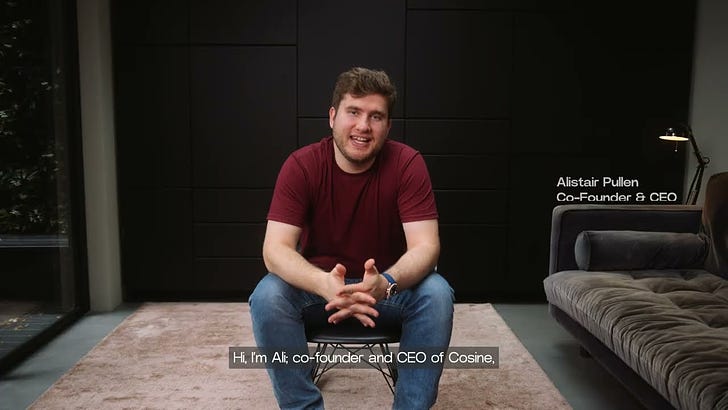
[00:02:47] Alistair Pullen: Hi, I'm Ali. Co founder and CEO of Cosign, a human reasoning lab. And I'd like to show you Genie, our state of the art, fully autonomous software engineering colleague. Genie has the highest score on SWBench in the world. And the way we achieved this was by taking a completely different approach. We believe that if you want a model to behave like a software engineer, it has to be shown how a human software engineer works.
[00:03:15] We've designed new techniques to derive human reasoning from real examples of software engineers doing their jobs. Our data represents perfect information lineage, incremental knowledge discovery, and step by step decision making. Representing everything a human engineer does logically. By actually training Genie on this unique dataset, rather than simply prompting base models, which is what everyone else is doing, we've seen that we're no longer simply generating random code until some works.
[00:03:46] It's tackling problems like
[00:03:48] AI Charlie: a human. Alistair Pullen is CEO and co founder of Kozen, and we managed to snag him on a brief trip stateside for a special conversation on building the world's current number one coding agent. Watch out and take care.
[00:04:07] Alessio: Hey everyone, welcome to the Latent Space Podcast. This is Alessio, partner and CTO of Resonance at Decibel Partners, and I'm joined by my co host Swyx, founder of Small. ai.
[00:04:16] swyx: Hey, and today we're back in the studio. In person, after about three to four months in visa jail and travels and all other fun stuff that we talked about in the previous episode.
[00:04:27] But today we have a special guest, Ali Pullen from Cosign. Welcome. Hi, thanks for having me. We're very lucky to have you because you're on a two day trip to San Francisco. Yeah, I wouldn't recommend it. I would not
[00:04:38] Alistair Pullen: recommend it. Don't fly from London to San Francisco for two days.
[00:04:40] swyx: And you launched Genie on a plane.
[00:04:42] On plain Wi Fi, um, claiming state of the art in SuiteBench, which we're all going to talk about. I'm excited to dive into your whole journey, because it has been a journey. I've been lucky to be a small angel in part of that journey. And it's exciting to see that you're launching to such acclaim and, you know, such results.
[00:05:01] Alistair and Cosine intro
[00:05:01] swyx: Um, so I'll go over your brief background, and then you can sort of fill in the blanks on what else people should know about you. You did your bachelor's in computer science at Exeter.
[00:05:10] Speaker 6: Yep.
[00:05:10] swyx: And then you worked at a startup that got acquired into GoPuff and round about 2022, you started working on a stealth startup that became a YC startup.
[00:05:19] What's that? Yeah. So
[00:05:21] Alistair Pullen: basically when I left university, I, I met my now co founder, Sam. At the time we were both mobile devs. He was an Android developer. iOS developer. And whilst at university, we built this sort of small consultancy, sort of, we'd um, be approached to build projects for people and we would just take them up and start with, they were student projects.
[00:05:41] They weren't, they weren't anything crazy or anything big. We started with those and over time we started doing larger and larger projects, more interesting things. And then actually, when we left university, we just kept doing that. We didn't really get jobs, traditional jobs. It was also like in the middle of COVID, middle of lockdown.
[00:05:57] So we were like, this is a pretty good gig. We'll just keep like writing code in our bedrooms. And yeah, that's it. We did that for a while. And then a friend of ours that we went to Exeter with started a YC startup during COVID. And it was one of these fast grocery delivery companies. At the time I was living in the deepest, darkest countryside in England, where fast grocery companies are still not a thing.
[00:06:20] So he, he sort of pitched me this idea and was like, listen, like I need an iOS dev, do you fancy coming along? And I thought, absolutely. It was a chance to get out of my parents house, chance to move to London, you know, do interesting things. And at the time, truthfully, I had no idea what YC was. I had no idea.
[00:06:34] I wasn't in the startup space. I knew I liked coding and building apps and stuff, but I'd never, never really done anything in that area. So I said, yes, absolutely. I moved to London just sort of as COVID was ending and yeah, worked at what was fancy for about a year and a half. Then we brought Sam along as well.
[00:06:52] So we, Sam and I, were the two engineers at Fancy for basically its entire life, and we built literally everything. So like the, the front, the client mobile apps, the, the backends, the internal like stock management system, the driver routing, algorithms, all those things. Literally like everything. It was my first.
[00:07:12] You know, both of us were super inexperienced. We didn't have, like, proper engineering experience. There were definitely decisions we'd do differently now. We'd definitely buy a lot of stuff off the shelf, stuff like that. But it was the initial dip of the toe into, like, the world of startups, and we were both, like, hooked immediately.
[00:07:26] We were like, this is so cool. This sounds so much better than all our friends who were, like, consultants and doing, like, normal jobs, right? We did that, and it ran its course, and after, I want to say, 18 months or so, GoPuff came and acquired us. And there was obviously a transitionary period, an integration period, like with all acquisitions, and we did that, and as soon as we'd vested what we wanted to vest, and as soon as we thought, okay, this chapter is sort of done, uh, in about 2022, We left and we knew that we wanted to go alone and try something like we'd had this taste.
[00:07:54] Now we knew we'd seen how a like a YC startup was managed like up close and we knew that we wanted to do something similar ourselves. We had no idea what it was at the time. We just knew we wanted to do something. So we, we tried a small, um, some small projects in various different areas, but then GPT 3.
[00:08:12] He'd seen it on Reddit and I'm his source of all knowledge. Yeah, Sam loves Reddit. I'd actually heard of GPT 2. And obviously had like loosely followed what OpenAI had done with, what was the game they trained a model to play? Dota. Was it Dota? Yeah. So I'd followed that and, I knew loosely what GPT 2 was, I knew what BERT was, so I was like, Okay, this GPT 3 thing sounds interesting.
[00:08:35] And he just mentioned it to me on a walk. And I then went home and, like, googled GPT was the playground. And the model was DaVinci 2 at the time. And it was just the old school playground, completions, nothing crazy, no chat, no nothing. I miss completions though. Yeah. Oh, completion. Honestly, I had this conversation in open hours office yesterday.
[00:08:54] I was like, I just went. I know. But yeah, so we, we, um, I started playing around with the, the playground and the first thing I ever wrote into it was like, hello world, and it gave me some sort of like, fairly generic response back. I was like, okay, that looks pretty cool. The next thing was. I looked through the docs, um, also they had a lot of example prompts because I had no idea.
[00:09:14] I didn't know if the, if you could put anything in, I didn't know if you had to structure in a certain way or whatever, and I, and I saw that it could start writing like tables and JSON and stuff like that. So I was like, okay, can you write me something in JSON? And it did. And I was like, Oh, wow, this is, this is pretty cool.
[00:09:28] Um, can it, can it just write arbitrary JSON for me? And, um, immediately as soon as I realized that my mind was racing and I like got Sam in and we just started messing around in the playground, like fairly innocently to start with. And then, of course, both being mobile devs and also seeing, at that point, we learned about what the Codex model was.
[00:09:48] It was like, this thing's trained to write code, sounds awesome. And Copilot was start, I think, I can't actually remember if Copilot had come out yet, it might have done. It's round about the same time as Codex. Round about the same time, yeah. And we were like, okay, as mobile devs, let's see what we can do.
[00:10:02] So the initial thing was like, okay, let's see if we can get this AI to build us a mobile app from scratch. We eventually built the world's most flimsy system, which was back in the day with like 4, 000 token context windows, like chaining prompts, trying to keep as much context from one to the other, all these different things, where basically, Essentially, you'd put an app idea in a box, and then we'd do, like, very high level stuff, figuring out what the stack should be, figuring out what the frontend should be written in, backend should be written in, all these different things, and then we'd go through, like, for each thing, more and more levels of detail, until the point that you're You actually got Codex to write the code for each thing.
[00:10:41] And we didn't do any templating or anything. We were like, no, we're going to write all the code from scratch every time, which is basically why it barely worked. But there were like occasions where you could put in something and it would build something that did actually run. The backend would run, the database would work.
[00:10:54] And we were like, Oh my God, this is insane. This is so cool. And that's what we showed to our co founder Yang. I met my co founder Yang through, through fancy because his wife was their first employee. And, um, we showed him and he was like, You've discovered fire. What is this? This is insane. He has a lot more startup experience.
[00:11:12] Historically, he's had a few exits in the past and has been through all different industries. He's like our dad. He's a bit older. He hates me saying that. He's your COO now? He's our COO. Yeah. And, uh, we showed him and he was like, this is absolutely amazing. Let's just do something. Cause he, he, at the time, um, was just about to have a child, so he didn't have anything going on either.
[00:11:29] So we, we applied to YC, got an interview. The interview was. As most YC interviews are short, curt, and pretty brutal. They told us they hated the idea. They didn't think it would work. And that's when we started brainstorming. It was almost like the interview was like an office hours kind of thing. And we were like, okay, given what you know about the space now and how to build things with these LLMs, like what can you bring out of what you've learned in building that thing into Something that might be a bit more useful to people on the daily, and also YC obviously likes B2B startups a little bit more, at least at the time they did, back then.
[00:12:01] So we were like, okay, maybe we could build something that helps you with existing codebases, like can sort of automate development stuff with existing codebases, not knowing at all what that would look like, or how you would build it, or any of these things. And They were like, yeah, that sounds interesting.
[00:12:15] You should probably go ahead and do that. You're in, you've got two weeks to build us an MVP. And we were like, okay, okay. We did our best. The MVP was absolutely horrendous. It was a CLI tool. It sucked. And, um, at the time we were like, we, we don't even know. How to build what we want to build. And we didn't really know what we wanted to build, to be honest.
[00:12:33] Like, we knew we wanted to try to help automate dev work, but back then we just didn't know enough about how LLM apps were built, the intricacies and all those things. And also, like, the LLMs themselves, like 4, 000 tokens, you're not going very far, they're extremely expensive. So we ended up building a, uh, a code based retrieval tool, originally.
[00:12:51] Our thought process originally was, we want to build something that can do our jobs for us. That is like the gold star, we know that. We've seen like there are glimpses of it happening with our initial demo that we did. But we don't see the path of how to do that at the moment. Like the tech just wasn't there.
[00:13:05] So we were like, well, there are going to be some things that you need to build this when the tech does catch up. So retrieval being one of the most important things, like the model is going to have to build like pull code out of a code base somehow. So we were like, well, let's just build the tooling around it.
[00:13:17] And eventually when the tech comes, then we'll be able to just like plug it into our, our tooling and then it should work basically. And to be fair, that's basically what we've done. And that's basically what's happened, which is very fortunate. But in the meantime, whilst we were waiting for everything to sort of become available, we built this code base retrieval tool.
[00:13:34] That was the first thing we ever launched when we were in YC like that, and it didn't work. It was really frustrating for us because it was just me and Sam like working like all hours trying to get this thing to work. It was quite a big task in of itself, trying to get like a good semantic search engine working that could run locally on your machine.
[00:13:51] We were trying to avoid sending code to the cloud as much as possible. And then for very large codebases, you're like, you know, millions of lines of code. You're trying to do some sort of like local HNSW thing that runs inside your VS Code instance that like eats all your RAM as you've seen in the past.
[00:14:05] All those different things. Yep. Yeah.
[00:14:07] swyx: My first call with
[00:14:07] Alistair Pullen: you, I had trouble. You were like, yeah, it sucks, man. I know, I know. I know it sucks. I'm sorry. I'm sorry. But building all that stuff was essentially the first six to eight months of what at the time was built. Which, by the way, build it. Build it. Yeah, it was a terrible, terrible name.
[00:14:25] It was the worst,
[00:14:27] swyx: like, part of trying to think about whether I would invest is whether or not people could pronounce it.
[00:14:32] Alistair Pullen: No, when we, so when we went on our first ever YC, like, retreat, No one got the name right. They were like, build, build, well, um, and then we actually changed the names, cosign, like, although some people would spell it as in like, as if you're cosigning for an apartment or something like that's like, can't win.
[00:14:49] Yeah. That was what built was back then. But the ambition, and I did a talk on this back in the end of 2022, the ambition to like build something that essentially automated our jobs was still very much like core to what we were doing. But for a very long time, it was just never apparent to us. Like. How would you go about doing these things?
[00:15:06] Even when, like, you had 3. suddenly felt huge, because you've gone from 4 to 16, but even then 16k is like, a lot of Python files are longer than 16k. So you can't, you know, before you even start doing a completion, even then we were like, eh, Yeah, it looks like we're still waiting. And then, like, towards the end of last year, you then start, you see 32k.
[00:15:28] 32k was really smart. It was really expensive, but also, like, you could fit a decent amount of stuff in it. 32k felt enormous. And then, finally, 128k came along, and we were like, right, this is, like, this is what we can actually deal with. Because, fundamentally, to build a product like this, you need to get as much information in front of the model as possible, and make sure that everything it ever writes in output can be read.
[00:15:49] traced back to something in the context window, so it's not hallucinating it. As soon as that model existed, I was like, okay, I know that this is now going to be feasible in some way. We'd done early sort of dev work on Genie using 3. 5 16k. And that was a very, very like crude way of proving that this loop that we were after and the way we were generating the data actually had signal and worked and could do something.
[00:16:16] But the model itself was not useful because you couldn't ever fit enough information into it for it to be able to do the task competently and also the base intelligence of the model. I mean, 3. 5, anyone who's used 3. 5 knows the base intelligence of the model is. is lacking, especially when you're asking it to like do software engineering, this is quite quite involved.
[00:16:34] GPT4o finetuning
[00:16:34] Alistair Pullen: So, we saw the 128k context model and um, at that point we'd been in touch with OpenAI about our ambitions and like how we wanted to build it. We essentially are, I just took a punt, I was like, I'm just going to ask to see, can we like train this thing? Because at the time Fortobo had just come out and back then there was still a decent amount of lag time between like OpenAI releasing a model and then allowing you to fine tune it in some way.
[00:16:59] They've gotten much better about that recently, like 4. 0 fine tuning came out either, I think, a day, 4. 0 mini fine tuning came out like a day after the model did. And I know that's something they're definitely like, optimising for super heavily inside, which is great to see.
[00:17:11] swyx: Which is a little bit, you know, for a year or so, YC companies had like a direct Slack channel to open AI.
[00:17:17] We still do. Yeah. Yeah. So, it's a little bit of a diminishing of the YC advantage there. Yeah. If they're releasing this fine tuning
[00:17:23] Alistair Pullen: ability like a day after. Yeah, no, no, absolutely. But like. You can't build a startup otherwise. The advantage is obviously nice and it makes you feel fuzzy inside. But like, at the end of the day, it's not that that's going to make you win.
[00:17:34] But yeah, no, so like we'd spoken to Shamul there, Devrel guy, I'm sure you know him. I think he's head of solutions or something. In their applied team, yeah, we'd been talking to him from the very beginning when we got into YC, and he's been absolutely fantastic throughout. I basically had pitched him this idea back when we were doing it on 3.
[00:17:53] 5, 16k, and I was like, this is my, this is my crazy thesis. I want to see if this can work. And as soon as like that 128k model came out, I started like laying the groundwork. I was like, I know this definitely isn't possible because he released it like yesterday, but know that I want it. And in the interim, like, GPT 4, like, 8K fine tuning came out.
[00:18:11] We tried that, it's obviously even fewer tokens, but the intelligence helped. And I was like, if we can marry the intelligence and the context window length, then we're going to have something special. And eventually, we were able to get on the Experimental Access Program, and we got access to 4Turbo fine tuning.
[00:18:25] As soon as we did that, because in the entire run up to that we built the data pipeline, we already had all that set up, so we were like, right, we have the data, now we have the model, let's put it through and iterate, essentially, and that's, that's where, like, Genie as we know it today, really was born. I won't pretend like the first version of Gene that we trained was good.
[00:18:45] It was a disaster. That's where you realize all the implicit biases in your data set. And you realize that, oh, actually this decision you made that was fairly arbitrary was the wrong one. You have to do it a different way. Other subtle things like, you know, how you write Git diffs in using LLMs and how you can best optimize that to make sure they actually apply and work and loads of different little edge cases.
[00:19:03] But as soon as we had access to the underlying tool, we were like, we can actually do this. And I was I breathed a sigh of relief because I didn't know it was like, it wasn't a done deal, but I knew that we could build something useful. I mean, I knew that we could build something that would be measurably good on whatever eval at the time that you wanted to use.
[00:19:23] Like at the time, back then, we weren't actually that familiar with Swift. But once Devin came out and they announced the SBBench core, I like, that's when my life took a turn. Challenge accepted. Yeah, challenge accepted. And that's where like, yes, that's where my friendships have gone. My sleep has gone. My weight.
[00:19:40] Everything got into SweeBench and yeah, we, we, it was actually a very useful tool in building GeniX beforehand. It was like, yes, vibe check this thing and see if it's useful. And then all of a sudden you have a, an actual measure to, to see like, couldn't it do software engineering? Not, not the best measure, obviously, but like it's a, it's the best that we've got now.
[00:19:57] We, we just iterated and built and eventually we got it to the point where it is now. And a little bit beyond since we actually Like, we actually got that score a couple of weeks ago, and yeah, it's been a hell of a journey from the beginning all the way now. That was a very rambling answer to your question about how we got here, but that's essentially the potted answer of how we got here.
[00:20:16] Got the full
[00:20:16] swyx: origin story
[00:20:17] Alessio: out. Yeah, no, totally.
[00:20:18] Genie Data Mix
[00:20:18] Alessio: You mentioned bias in the data and some of these things. In your announcement video, you called Genie the worst verse AI software engineering colleague. And you kind of highlighted how the data needed to train it needs to show how a human engineer works. I think maybe you're contrasting that to just putting code in it.
[00:20:37] There's kind of like a lot more than code that goes into software engineering. How do you think about the data mixture, you know, and like, uh, there's this kind of known truth that code makes models better when you put in the pre training data, but since we put so much in the pre training data, what else do you add when you turn to Genium?
[00:20:54] Alistair Pullen: Yeah, I think, well, I think that sort of boils down fundamentally to the difference between a model writing code and a model doing software engineering, because the software engineering sort of discipline goes wider, because if you look at something like a PR, that is obviously a Artifact of some thought and some work that has happened and has eventually been squashed into, you know, some diffs, right?
[00:21:17] What the, very crudely, what the pre trained models are reading is they're reading those final diffs and they're emulating that and they're being able to output it, right? But of course, it's a super lossy thing, a PR. You have no idea why or how, for the most part, unless there are some comments, which, you know, anyone who's worked in a company realizes PR reviews can be a bit dodgy at times, but you see that you lose so much information at the end, and that's perfectly fine, because PRs aren't designed to be something that perfectly preserves everything that happened, but What we realized was if you want something that's a software engineer, and very crudely, we started with like something that can do PRs for you, essentially, you need to be able to figure out why those things happened.
[00:21:58] Otherwise, you're just going to rely, you essentially just have a code writing model, you have something that's good at human eval, but But, but not very good at Sweet Eng. Essentially that realization was, was part of the, the kernel of the idea of of, of the approach that we took to design the agent. That, that is genie the way that we decided we want to try to extract what happened in the past, like as forensically as possible, has been and is currently like one of the, the main things that we focus all our time on, because doing that as getting as much signal out as possible, doing that as well as possible is the biggest.
[00:22:31] thing that we've seen that determines how well we do on that benchmark at the end of the day. Once you've sorted things out, like output structure, how to get it consistently writing diffs and all the stuff that is sort of ancillary to the model actually figuring out how to solve a problem, the core bit of solving the problem is how did the human solve this problem and how can we best come up with how the human solved these problems.
[00:22:54] So all the effort went in on that. And the mix that we ended up with was, as you've probably seen in the technical report and so on, all of those different languages and different combinations of different task types, all of that has run through that pipeline, and we've extracted all that information out.
[00:23:09] Customizing for Customers
[00:23:09] Alessio: How does that differ when you work with customers that have private workflows? Like, do you think, is there usually a big delta between what you get in open source and maybe public data versus like Yeah,
[00:23:19] Alistair Pullen: yeah, yeah. When you scrape enough of it, most of open source is updating readmes and docs. It's hilarious, like we had to filter out so much of that stuff because when we first did the 16k model, like the amount of readme updating that went in, we did like no data cleaning, no real, like, we just sort of threw it in and saw what happened.
[00:23:38] And it was just like, It was really good at updating readme, it was really good at writing some comments, really good at, um, complaining in Git reviews, in PR reviews, rather, and it would, again, like, we didn't clean the data, so you'd, like, give it some feedback, and it would just, like, reply, and, like, it would just be quite insubordinate when it was getting back to you, like, no, I don't think you're right, and it would just sort of argue with you, so The process of doing all that was super interesting because we realized from the beginning, okay, there's a huge amount of work that needs to go into like cleaning this, getting it aligned with what we want the model to do to be able to get the model to be useful in some way.
[00:24:12] Alessio: I'm curious, like, how do you think about the customer willingness? To share all of this historical data, I've done a lot of developer tools investing in my career and getting access to the code base is always one of the hard things. Are people getting more cautious about sharing this information? In the past, it was maybe like, you know, you're using static analysis tool, like whatever else you need to plug into the code base, fine.
[00:24:35] Now you're building. A model based on it, like, uh, what's the discussion going into these companies? Are most people comfortable with, like, letting you see how to work and sharing everything?
[00:24:44] Alistair Pullen: It depends on the sector, mostly. We've actually seen, I'd say, people becoming more amenable to the idea over time, actually, rather than more skeptical, because I think they can see the, the upside.
[00:24:55] If this thing could be, Does what they say it does, it's going to be more help to us than it is a risk to our infosec. Um, and of course, like, companies building in this space, we're all going to end up, you know, complying with the same rules, and there are going to be new rules that come out to make sure that we're looking at your code, that everything is safe, and so on.
[00:25:12] So from what we've seen so far, we've spoken to some very large companies that you've definitely heard of and all of them obviously have stipulations and many of them want it to be sandbox to start with and all the like very obvious things that I, you know, I would say as well, but they're all super keen to have a go and see because like, despite all those things, if we can genuinely Make them go faster, allow them to build more in a given time period and stuff.
[00:25:35] It's super worth it to them.
[00:25:37] Genie Workflow
[00:25:37] swyx: Okay, I'm going to dive in a little bit on the process that you have created. You showed the demo on your video, and by the time that we release this, you should be taking people off the waitlist and launching people so people can see this themselves. There's four main Parts of the workflow, which is finding files, planning action, writing code and running tests.
[00:25:58] And controversially, you have set yourself apart from the Devins of the world by saying that things like having access to a browser is not that important for you. Is that an accurate reading of
[00:26:09] Alistair Pullen: what you wrote? I don't remember saying that, but At least with what we've seen, the browser is helpful, but it's not as helpful as, like, ragging the correct files, if that makes sense.
[00:26:20] Like, it is still helpful, but obviously there are more fundamental things you have to get right before you get to, like, Oh yeah, you can read some docs, or you can read a stack overflow article, and stuff like that.
[00:26:30] swyx: Yeah, the phrase I was indexing on was, The other software tools are wrappers around foundational models with a few additional tools, such as a web browser or code interpreter.
[00:26:38] Alistair Pullen: Oh, I see. No, I mean, no, I'm, I'm not, I'm not, I'm not deri, I'm deriding the, the, the approach that, not the, not the tools. Yeah, exactly. So like, I would
[00:26:44] swyx: say in my standard model of what a code agent should look like, uh, Devon has been very influential, obviously. Yeah. Yeah. Because you could just add the docs of something.
[00:26:54] Mm-Hmm. . And like, you know, now I have, now when I'm installing a new library, I can just add docs. Yeah, yeah. Cursor also does this. Right. And then obviously having a code interpreter does help. I guess you have that in the form
[00:27:03] Alistair Pullen: of running tests. I mean, uh, the Genie has both of those tools available to it as well.
[00:27:08] So, yeah, yeah, yeah. So, we have a tool where you can, like, put in URLs and it will just read the URLs. And you can also use this Perplexities API under the hood as well to be able to actually ask questions if it wants to. Okay. So, no, we use both of those tools as well. Like, those tools are Super important and super key.
[00:27:24] I think obviously the most important tools to these agents are like being able to retrieve code from a code base, being able to read Stack Overflow articles and what have you and just be able to essentially be able to Google like we do is definitely super useful.
[00:27:38] swyx: Yeah, I thought maybe we could just kind of dive into each of those actions.
[00:27:41] Code Retrieval
[00:27:41] swyx: Code retrieval, one of the core indexer that Yes. You've worked on, uh, even as, as built, what makes it hard, what approach you thought would work, didn't work,
[00:27:52] Alistair Pullen: anything like that. It's funny, I had a similar conversation to this when I was chatting to the guys from OpenAI yesterday. The thing is that searching for code, specifically semantically, at least to start with, I mean like keyword search and stuff like that is a, is a solved problem.
[00:28:06] It's been around for ages, but at least being able to, the phrase we always used back in the day was searching for what code does rather than what code is. Like searching for functionality is really hard. Really hard. The way that we approached that problem was that obviously like a very basic and easy approach is right.
[00:28:26] Let's just embed the code base. We'll chunk it up in some arbitrary way, maybe using an AST, maybe using number of lines, maybe using whatever, like some overlapping, just chunk it up and embed it. And once you've done that, I will write a query saying, like, find me some authentication code or something, embed it, and then do the cosine similarity and get the top of K, right?
[00:28:43] That doesn't work. And I wish it did work, don't get me wrong. It doesn't work well at all, because fundamentally, if you think about, like, semantically, how code looks is very different to how English looks, and there's, like, not a huge amount of signal that's carried between the two. So what we ended up, the first approach we took, and that kind of did well enough for a long time, was Okay, let's train a model to be able to take in English code queries and then produce a hypothetical code snippet that might look like the answer, embed that, and then do the code similarity.
[00:29:18] And that process, although very simple, gets you so much more performance out of the retrieval accuracy. And that was kind of like the start of our of our engine, as we called it, which is essentially like the aggregation of all these different heuristics, like semantic, keyword, LSP, and so on. And then we essentially had like a model that would, given an input, choose which ones it thought were most appropriate, given the type of requests you had.
[00:29:45] So the whole code search thing was a really hard problem. And actually what we ended up doing with Genie is we, um, let The model through self play figure out how to retrieve code. So actually we don't use our engine for Genie. So instead of like a request coming in and then like say GPT 4 with some JSON output being like, Well, I think here we should use a keyword with these inputs and then we should use semantic.
[00:30:09] And then we should like pick these results. It's actually like, A question comes in and Genie has self played in its training data to be able to be like, okay, this is how I'm going to approach finding this information. Much more akin to how a developer would do it. Because if I was like, Shawn, go into this new code base you've never seen before.
[00:30:26] And find me the code that does this. You're gonna probably, you might do some keywords, you're gonna look over the file system, you're gonna try to figure out from the directories and the file names where it might be, you're gonna like jump in one, and then once you're in there, you're probably gonna be doing the, you know, go to definition stuff to like jump from file to file and try to use the graph to like get closer and closer.
[00:30:46] And that is exactly what Genie does. Starts on the file system, looks at the file system, picks some candidate files, is this what I'm looking for, yes or no, and If there's something that's interesting, like an import or something, it can, it can command click on that thing, go to definition, go to references, and so on.
[00:31:00] And it can traverse the codebase that way.
[00:31:02] swyx: Are you using the VS Code, uh, LSP, or? No,
[00:31:05] Alistair Pullen: that's not, we're not like, we're not doing this in VS Code, we're just using the language servers running. But, we really wanted to try to mimic the way we do it as best as possible. And we did that during the self play process when we were generating the dataset, so.
[00:31:18] Although we did all that work originally, and although, like, Genie still has access to these tools, so it can do keyword searches, and it can do, you know, basic semantic searches, and it can use the graph, it uses them through this process and figures out, okay, I've learned from data how to find stuff in codebases, and I think in our technical report, I can't remember the exact number, but I think it was around 65 or 66 percent retrieval accuracy overall, Measured on, we know what lines we need for these tasks to find, for the task to actually be able to be completed, And we found about 66 percent of all those lines, which is one of the biggest areas of free performance that we can get a hold of, because When we were building Genie, truthfully, like, a lot more focus went on assuming you found the right information, you've been able to reproduce the issue, assuming that's true, how do you then go about solving it?
[00:32:08] And the bulk of the work we did was on the solving. But when you go higher up the funnel, obviously, like, the funnel looks like, have you found everything you need for the task? Are you able to reproduce the problem that's seen in the issue? Are you then able to solve it? And the funnel gets narrower as you go down.
[00:32:22] And at the top of the funnel, of course, is rank. So I'm actually quite happy with that score. I think it's still pretty impressive considering the size of some of the codebases we're doing, we're using for this. But as soon as that, if that number becomes 80, think how many more tasks we get right. That's one of the key areas we're going to focus on when we continue working on Genie.
[00:32:37] It'd be interesting to break out a benchmark just for that.
[00:32:41] swyx: Yeah, I mean, it's super easy. Because I don't know what state of the art is.
[00:32:43] Alistair Pullen: Yeah, I mean, like, for a, um, it's super easy because, like, for a given PR, you know what lines were edited. Oh, okay. Yeah, you know what lines were
[00:32:50] swyx: you can
[00:32:51] Alistair Pullen: source it from Cbench, actually.
[00:32:52] Yeah, you can do it, you can do it super easily. And that's how we got that figure out at the other end. Um, for us being able to see it against, um, our historic models were super useful. So we could see if we were, you know, actually helping ourselves or not. And initially, one of the biggest performance gains that we saw when we were work, when we did work on the RAG a bit was giving it the ability to use the LSP to like go to definition and really try to get it to emulate how we do that, because I'm sure when you go into an editor with that, where like the LSP is not working or whatever, you suddenly feel really like disarmed and naked.
[00:33:20] You're like, Oh my god, I didn't realize how much I actually used this to get about rather than just find stuff. So we really tried to get it to do that and that gave us a big jump in performance. So we went from like 54 percent up to like the 60s, but just by adding, focusing on that.
[00:33:34] swyx: One weird trick. Yes.
[00:33:37] I'll briefly comment here. So this is the standard approach I would say most, uh, code tooling startups are pursuing. The one company that's not doing this is magic. dev. So would you do things differently if you have a 10 million
[00:33:51] Alistair Pullen: token context window? If I had a 10 million context window and hundreds of millions of dollars, I wouldn't have gone and built, uh, it's an LTM, it's not a transformer, right, that they're using, right?
[00:34:03] If I'm not mistaken, I believe it's not a transformer. Yeah, Eric's going to come on at some point. Listen, they obviously know a lot more about their product than I do. I don't know a great deal about how magic works. I don't think he knows anything yet. I'm not going to speculate. Would I do it the same way as them?
[00:34:17] I like the way we've done it because fundamentally like we focus on the Active software engineering and what that looks like and showing models how to do that. Fundamentally, the underlying model that we use is kind of null to us, like, so long as it's the best one, I don't mind. And the context windows, we've already seen, like, you can get transformers to have, like, million, one and a half million token context windows.
[00:34:43] And that works perfectly well, so like, as soon as you can fine tune Gemini 1. 5, then you best be sure that Genie will run on Gemini 1. 5, and like, we'll probably get very good performance out of that. I like our approach because we can be super agile and be like, Oh, well, Anthropic have just released whatever, uh, you know, and it might have half a million tokens and it might be really smart.
[00:35:01] And I can just immediately take my JSONL file and just dump it in there and suddenly Genie works on there and it can do all the new things. Does
[00:35:07] swyx: Anthropic have the same fine tuning support as OpenAI? I
[00:35:11] Alistair Pullen: actually haven't heard any, anyone do it because they're working on it. They are partner, they're partnered with AWS and it's gonna be in Bedrock.
[00:35:16] Okay. As far as, as far as I know, I think I'm, I think, I think that's true. Um, cool. Yeah.
[00:35:20] Planning
[00:35:20] swyx: We have to keep moving on to, uh, the other segments. Sure. Uh, planning the second piece of your four step grand master plan, that is the frontier right now. You know, a lot of people are talking about strawberry Q Star, whatever that is.
[00:35:32] Monte Carlo Tree Search. Is current state of the art planning good enough? What prompts have worked? I don't even know what questions to ask. Like, what is the state of planning?
[00:35:41] Alistair Pullen: I think it's fairly obvious that with the foundational models, like, you can ask them to think by step by step and ask them to plan and stuff, but that isn't enough, because if you look at how those models score on these benchmarks, then they're not even close to state of the art.
[00:35:52] Which ones are
[00:35:52] swyx: you referencing? Benchmarks? So, like,
[00:35:53] Alistair Pullen: just, uh, like, SweetBench and so on, right? And, like, even the things that get really good scores on human evalor agents as well, because they have these loops, right? Yeah. Obviously these things can reason, quote unquote, but the reasoning is the model, like, it's constrained by the model as intelligence, I'd say, very crudely.
[00:36:10] And what we essentially wanted to do was we still thought that, obviously, reasoning is super important, we need it to get the performance we have. But we wanted the reasoning to emulate how we think about problems when we're solving them as opposed to how a model thinks about a problem when we're solving it.
[00:36:23] And that was, that's obviously part of, like, the derivation pipeline that we have when we, when we, when we Design our data, but the reasoning that the models do right now, and who knows what Q star, whatever ends up being called looks like, but certainly what I'm excited on a small tangent to that, like, what I'm really excited about is when models like that come out, obviously, the signal in my data, when I regenerate, it goes up.
[00:36:44] And then I can then train that model. It's already better at reasoning with it. improved reasoning data and just like I can keep bootstrappi