
KZYX News
1,162 episodes — Page 16 of 24

Ep 413There's no train in that coffin
June 3, 2022 — Senator Mike McGuire may have taken his victory lap a little too soon at a town hall about the Great Redwood Trail on Wednesday night. “Tonight we are able to announce — and this is late breaking,” he declared; “We have finally put a nail in the coffin of Big Coal. We have beat back Big Coal and the toxic coal train.” The nail may be in the coffin, but there’s no train in it yet. McGuire was exulting about what he thought was the extinguished threat of an anonymous coal interest, registered in Wyoming, that was planning to buy the railroad from Willits to Eureka and use it to ship coal to Asia out of the Humboldt Bay. That would put an end to years of effort to turn the railroad into a recreational trail all the way from one Bay Area to the next, from Marin, through the Eel River canyon to Eureka. Sections of the trail have already been built in some communities alongside the tracks. But McGuire and trail advocates were looking forward to railbanking, or filling up the tracks with dirt and gravel, so the trail could be on top of the ready-made line. In order to do that, the federal Surface Board of Transportation would have to declare the tracks abandoned, and grant McGuire and his allies permission to railbank. Anyone who wanted to prevent that from happening was supposed to file their intent to buy the tracks with the Surface Transportation Board by May 31. But the next day, possibly while McGuire was thanking supporters for beating back Big Coal, the North Coast Railroad Company announced its intention to buy the entire 176 miles of track from Willits to Eureka, including appurtenant branch lines. Congressman Jared Huffman issued a statement Thursday, saying “their late application should disqualify them for further consideration. If not, the coalition of community opposition and their lack of transparency certainly will.” The only name associated with the Wyoming-based LLC is Robert A. Wimbish, the attorney, who apologized for his tardiness by explaining that it was “due to unforeseen vacation travel delays.” At a hearing last month, Huffman asked the Surface Board of Transportation Chair, Martin Oberman, where he stood on demanding transparency. “Would the Board require that entity to engage with the community and the public in an open and transparent way,” he began; “in other words, if they’re secretive about who they are, about where their funding comes from, is that a factor that you would consider?” Oberman replied, “that’s not a factor that’s come before us. But I generally believe in full disclosure, and when we get those kinds of applications, we have the ability to insist on a more fulsome application of the facts, which would include revealing the basic financial structure of the entity and so forth. So the general answer to your question is yes, but it’s very much case-specific.” But North Coast Railroad isn’t the only company trying to buy part of the track. McGuire is also worried about another application, by Mendocino Railway, the parent company to the Skunk Train. Mendocino Railway wants to take over 13 miles of track from mile marker 139.5 to 152.5, from Willits to just past Highway 162, in order to ship gravel from Outlet Creek to Willits or Fort Bragg. However, there is a tunnel on that stretch of the track that long been out of operation due to a landslide. “So right now, if there was a rail company operating on this line, they couldn’t even get to the coast because of this massive landslide that’s blocking the track,” McGuire said. He added that he does “have some concerns with this application…number one, it’s going to create a huge hole right in the heart of the Great Redwood Trail.” In addition, he estimated that, while the cost of railbanking could be $12,000 to $15,000 a mile, repairing the damaged track and the tunnel would cost tens of millions of dollars. Oberman told Huffman the Surface Board of Transportation doesn’t concern itself too much with financial details. “You know, we generally are mandated by statute to make it easy for rail lines to come into existence,” he said. “That’s one of our jobs. “There’s a spectrum on how much we look at financial viability. Generally speaking, we take the view that the market will determine whether a rail line is viable.” Two other train-track oriented interests filed their intent to buy sections of the track, as well. The Timber Heritage Association, a non-profit organization dedicated to preserving the timber history of Humboldt County, wants to buy 18.5 miles from Eureka to Samoa, to offer excursion rides on restored timber crew cars. Pete Johnston, the Association’s president, assured the Surface Board of Transportation that “Designation of this portion of the right of way is not in conflict with the larger Great Redwood Trail Agency’s trail mission;” and he is willing to negotiate with the Agency “on any dual access or potential conflicts emerging to preserve corridor usage for both parties.”...
Ep 412Public Health stretched thin
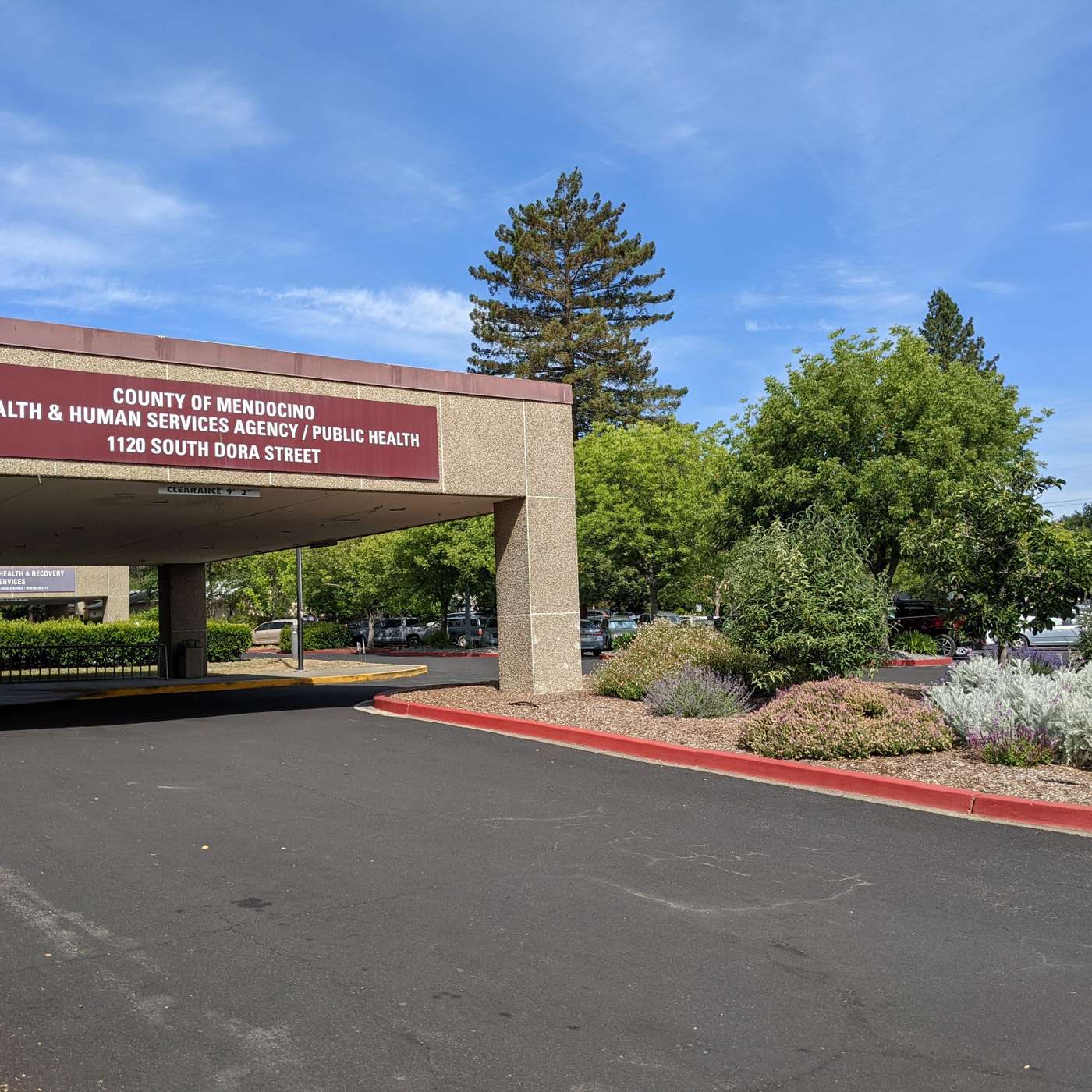
June 2, 2022 — With a state budget surplus of $97 billion, a coalition of state public health departments and community advocates is weighing in on how to invest a promised $300 million to rebuild the state’s public health infrastructure, especially the workforce. The PublicHERO initiative spells out how much money the coalition wants to be allocated to which priorities in training, recruiting, and retaining people for specialized positions. In addition to organizational backing, the proposal has support from the Governor and Senator Richard Pan, who is also a pediatrician. The gaps in Mendocino County’s public health department are not entirely unique. Between the Great Resignation, burnout, an aging workforce, and decades-long disinvestment, public health departments across the state fared badly during the pandemic, according to Dr. Karen Relucio, the Public Health Officer for Napa County. “Sixty-two senior local public health officials in California cities and counties have left their positions since the start of the pandemic,” she said at a press conference for the PublicHERO initiative. “That includes 21 health officers, 20 agency directors, and 21 local health department directors.” Competition with the private sector is stiff. The last two nurses who quit Mendocino County’s public health department left because they could get 50% more money elsewhere. Mendocino County Public Health Director Anne Molgaard says in addition to a shortage of nurses, there are other significant gaps in the local department. “We also don’t have a Director of Nursing right now,” she said; “who would supervise those LVNs and all of the different nursing programs that we have. And we are also going to start advertising shortly for a new position called Director of Health Education. What we realized is that so much of our public health work is around communications and education. As the science changes, we need to figure out how to explain the science to non-scientists.” The DIrector of Nursing position remains vacant, despite regular advertising. Kim Saruwatari, the president of the County Health Executives Association of California (CHEAC) and the Public Health Director for Riverside County, says the height of a pandemic is the wrong time to recruit and train a workforce. “During covid, we had to double our workforce,” she said. “We went to almost 1400 employees in a matter of weeks…so there was less stringent hiring requirements, evaluation of skills, and then, once we were able to identify people and bring them onboard, we had to do extensive training…so really, the net effect of this is that we had a workforce that was not ready and trained as the public expects and deserves. We also lost time in the response because we had to divert resources to doing this training. So some of our response activities suffered as well.” The local public health department has eight nurses, and is looking to hire six to twelve more. Molgaard said with inflation, a lot of the state money might go toward salary increases, which could be key to retaining employees. Public health is stretched thin, with Public Health Officer Dr. Andy Coren doing a lot of educational work, which takes time away from delving into epidemiological data and other “things that he, as a medical professional, is specialized at,” Molgaard noted. A Director of Nursing would oversee maternal, child, and adolescent health, the WIC and home visiting programs. “So right now, we’re just doing those as we can,” Molgaard said. “But they deserve more leadership. And they deserve more focused leadership.” Directors of public health labs are among the specialized positions the PublicHERO initiative would like to see funded. But Mendocino County has not had a lab for about a decade. Molgaard acknowledged that it would be easier to send specimens across town than all the way to the lab in Solano, “but would we be able to attract the people needed in order to properly staff a lab?” she asked. “Doubtful.” She estimated that she only has to send an employee to Solano about once a month. When it comes to the biggest concern for the department, outside of being understaffed, “The pandemic is still our number one issue,” Molgaard said. “And no, monkeypox is not our number two issue. Probably venereal disease is our number two issue. I hate to say it. But it’s not pretty in Mendocino County right now.” The final numbers from the state budget should be available this month. “If they’re together in Sacramento, early June,” Molgaard predicted. “If not, it can spill into late June or July. But I’d love to report back then.”

Ep 411Inland water budgeting for water right, study to raise dam
June 1, 2022 — As another dry summer heats up, the Board of Supervisors is considering asking voters to approve a sales tax for local fire districts and county-wide water projects. The tax for Measure B is due to decrease this year, and the Board hopes voters will agree to replace that reduction with the new tax, which is expected to generate about $7 million per year. At a meeting in mid-May, firefighters and Russian River water users expressed their support for the tax, though details about how to allocate the funds and the exact size of the need were not part of the initial discussion. The Inland Water and Power Commission is eyeing some of the potential money as it works to take over water rights associated with the Potter Valley Project. The rights are currently held by PG&E, the project’s owner. Commission Chair Janet Pauli is preparing for an expensive and convoluted process The Federal Energy Regulatory Commission (FERC) has directed PG&E to begin the license surrender process. “That is going to be lengthy,” Pauli predicted. “We don’t know exactly how it’s going to unfold. We do know there are certain sections of that process that are going to require a lot of our participation, so that we can have a voice in what is going to occur with this project. That is going to require some funding.” Pauli added that there has not been consideration of a CDFW-funded study that examined several possible ways to continue diverting water without the current infrastructure. “If the diversion structure comes out, if that’s the final disposition of the license surrender, then we have a very, very, very serious problem,” she said, citing the conclusion that, without water from the diversion, Lake Mendocino would not fill in eight out of ten years. The Commission was part of a consortium that tried to take over the license for the Potter Valley Project, though it fell far short of its funding goals. In addition, it was supposed to form a regional entity that would manage the project, a task that is also imperative for acquiring the water rights. The water rights coalition, Pauli said, “would ultimately own and manage and fund the diversion. That entity needs to be formed so that they can negotiate with PG&E regarding acquiring the actual physical infrastructure and securing the water right for the diversion, as well.” The long-term license for the hydropower project has expired, and PG&E is operating it on an annual license. “Now that PG&E is required to surrender the license, the project will no longer produce power,” Pauli reasoned. “Our job is to protect the diversion, to assure that that water can continue to be diverted into the Russian.” Another long-time goal, a feasibility study for raising Coyote Valley Dam, just got a step closer to the fundraising stage. A press release from Congressman Jared Huffman’s office declared that expediting the study is one of his priorities as the Water Resources and Development Act winds its way towards completion. The Act was approved by the House Committee on Transportation and Infrastructure last month. The Inland Water and Power Commission is the non-federal local sponsor for funding that study, so “When the federal budget allows funding, we need to match it,” Pauli said. “Those costs combined will be about $3 million, over about a three-year period,” starting sometime in 2023. The IWPC is budgeting for its half of that cost, which would be $1.5 million. But without Eel River water, Lake Mendocino would rarely fill to its current capacity in a rainy year, let alone a millennial drought. Last month, PG&E asked federal regulators to expedite permission to slash the diversion of Eel River water from Lake Pillsbury into the East Branch of the Russian River, which flows into Lake Mendocino, from 75 cubic feet per second to five. The request is being vigorously contested by the Potter Valley Irrigation District and Sonoma County Water Agency. “The idea of people who benefit from this water supply helping to fund what's needed to get us that water supply is critically important,” Pauli declared. She expects that it will cost between $1.6 and $1.8 million a year, over the next five or six years, to secure the water supply through the diversion and raise Coyote Valley dam. “That’s what our budget outline is showing right now,” she concluded. The Board of Supervisors plans to review an initial draft of the proposed tax ordinance at its meeting next Wednesday, on June 8th.

Ep 410Requested variance would result in drastic curtailments
May 31, 2022 — Russian River water users are preparing for another dry year, with water rights curtailments for those who depend on Lake Mendocino, and the possibility of just a trickle coming out of Lake Pillsbury. PG&E, which still owns and operates the Potter Valley Project under an annual license, has asked the Federal Energy Regulatory Commission (FERC) to give it permission to release five cubic feet of water per second from Lake Pillsbury into the East Branch of the Russian River, which flows into Lake Mendocino. This is a variance from the 75 cubic feet per second that’s otherwise required for this time of year. Elizabeth Salomone, the General Manager of the Russian River Flood Control and Water Conservation Improvement District, says that although last year’s variance was the same, water managers were expecting five times as much this year. That was based on the storage levels in Lake Pillsbury, which filled during winter storms, and the terms of the license. “In other words, the request for five cfs is a significant change from the current license,” she asserted; “and I believe there will be questions. What is the justification for that great change, from the expected 25, based on conditions, and what they’ve asked for. The five.” Last year, PG&E aimed to have 12,000 acre feet in Lake Pillsbury by the end of the water year in the fall. This year, after consulting with the Round Valley Indian Tribes and state and federal regulators, PG&E wants to make sure it maintains at least 30,000 acre feet in the reservoir. That’s to create cold water pools below Scott Dam, for the benefit of endangered salmonids. Alicia Hamann, the Executive Director of Friends of the Eel River, says it’s time to face the facts of water scarcity. “I think that makes it eight of the last ten years that they’ve required a variance to operate the project,” she said; “and it’s just really telling that the status quo is not sustainable… It’s not sustainable for the interests in the Eel River, nor for water users in the Russian River. And I think seeking a new future for the (Potter Valley) Project and for the Pillsbury Basin is just in the interests of everyone.” In a letter to FERC, PG&E wrote that if it has to continue releasing 75 cubic feet per second, Lake Pillsbury will be drawn down so low that its banks could be destabilized, which could affect the safety of Scott Dam. Janet Pauli, of the Potter Valley Irrigation District, expects the District to continue getting its 50 cubic feet per second on demand; “but the minimum instream flow going to five without a buffer is a dramatic decrease...If we start the year off as as a dry year, that would give us a 25 cubic feet per second buffer, and then what we believe is they should watch the lake level carefully. If it gets to a point where it drops too precipitously, they could incrementally reduce the diversion rates through the Project.” The irrigation district also submitted a letter to FERC, complaining that PG&E had not consulted with a full range of stakeholders before requesting the variance. Last year, FERC required PG&E to consult with a drought working group to have the same variance approved. In its proposal to FERC, PG&E wrote that it does plan to reconvene the drought working group, but if the full group is unable to agree on flow adjustments, the determination will be settled on by the Round Valley Indian Tribes, the California Department of Fish and Wildlife, and the National Marine Fisheries Service. The letter also says that according to the contract with the Potter Valley Irrigation District, PG&E has the discretion to limit deliveries. The district differs on that interpretation, writing that it’s still entitled to 50 cubic feet per second, but that it’s been requesting less water to conserve the infrastructure at Lake Pillsbury. And the district declares that the new minimum storage target of 30,000 acre feet “is not supported by any definitive studies or modeling of prior year conditions and is clearly outside of the existing license requirements.” Salomone says the variance would have a significant impact on water users further downriver, too. “That 25 cfs that was expected would satiate some of the demand for the appropriative rights along the Upper Russian River,” she explained. “The Flood Control District has one of those appropriative rights. But so do many others, including urban water suppliers and agriculture. At five cfs, preliminary analysis is that the State Water Board would need to curtail all post-1914 water rights. The water rights system is based on priority dates, so the older your water right, the higher priority. It will cause curtailments to go back as far as 1914, and possibly earlier.” Salomone does expect some minor differences between this year and last. “This year it does protect an amount for human health and safety for all urban water users and domestic diversions,” she said. “And there is a small amoun
Ep 409Full-length interview with Sheriff candidate Trent James
May 27, 2022 — Sheriff Matt Kendall is facing a last-minute challenger in the coming election. Trent James is a former Mendocino County deputy and Willits police sergeant whose YouTube channel “Confessions of an Ex-Cop” focuses on claims of corruption and malfeasance in local law enforcement agencies. He was sworn in as a write-in candidate one day before the filing deadline, on Monday May 23rd.

Ep 408Sheriff faces challenger
May 27, 2022 — Sheriff Matt Kendall is facing a last-minute challenger in the coming election. Trent James is a former Mendocino County deputy and Willits police sergeant whose YouTube channel “Confessions of an Ex-Cop” focuses on claims of corruption and malfeasance in local law enforcement agencies. He was sworn in as a write-in candidate one day before the filing deadline, on Monday May 23rd.

Ep 407Rights to cold water a hot topic
May 25, 2022 — The struggle over the water of the Eel River continues. With PG&E operating the Potter Valley Project on an annual license, environmental groups like Friends of the Eel River are claiming violations of the Endangered Species Act, and asking regulators to reconsider authorizing the annual license. Meanwhile, Russian River water users, whose attempt to take over the hydropower license was stymied by a lack of funds, are now strategizing how to acquire the water rights held by PG&E. “Our job is to protect the diversion, to assure that that water can continue to be diverted into the Russian,” said Janet Pauli, of the Potter Valley Irrigation District and the Inland Water and Power Commission. She added that “The original water rights for the diversion list, as beneficial uses, production of power and irrigation…it’s a matter, though, of acquiring that water right, and making sure that we have control of the diversion itself.” Alicia Hamann, the Executive Director of Friends of the Eel River, spoke a few feet off the tarmac of the Ukiah airport Friday morning, after taking reporters on an EcoFlight in a six-seater Cessna over the wilderness surrounding the Eel. She says Scott Dam, which impounds Lake Pillsbury eleven miles from the diversion, is thwarting the life history of a unique species. “There are rainbow trout that are trapped up behind Scott Dam in the hundreds of miles of excellent cold-water habitat that exists up there in the Mendocino National Forest,” she asserted. “Those rainbow trout are really, really similar to steelhead. And what genetic researchers have found is that those trout have the alleles, the genetic coding, that would allow them to, one, become anadromous again, so to become steelhead, and two, to adapt the life history that is summer-run steelhead. So, to put it really simply, there are trout up behind Scott Dam that, if given the opportunity to reach the ocean again, their progeny could become summer steelhead.” There’s a theory that the history of the summer steelhead is closely tied to a special feature of the Eel. Hamann said that a lot of the trout with the summer steelhead alleles can be found just behind a formation called Bloody Rock. “The theory is that back before Scott Dam was in place, when summer steelhead were able to make it up to that portion of the watershed, because they had a head start on their winter counterparts, they would already be in the upper parts of the headwaters when the rains come and when the flows are really high. So they were able to pass this barrier and jump the ten or fifteen feet or so to get up beyond Bloody Rock. But then when their winter-run counterparts got there, the flows were higher and they weren’t able to make it past that barrier. That’s the theory behind why we see the summer-run steelhead genetics in the trout just behind Bloody Rock.” There may not be a lot of water coming through the diversion this year, though no one knows for sure what the future holds for Scott Dam. To prevent Lake Pillsbury from getting too low, PG&E has asked regulators to grant it a variance to release a minimum instream flow of five cubic feet per second, or cfs, into the East Branch of the Russian River, which flows directly into Lake Mendocino. That’s the same as it was last year, but less than the 25 that some water sellers were expecting this year. The Potter Valley Irrigation District is entitled by contract to up to fifty cfs. Right now, 75 is coming through the powerhouse, which is currently not capable of generating electricity, and Potter Valley is using 19. Pauli said PG&E has requested variances since about 2015, to protect the infrastructure at Lake Pillsbury, which filled this year after heavy winter storms. “They did not convene the drought working group like they have in the past, which is basically all of the stakeholders who are involved in this process,” she said. “They went ahead and filed a variance after consultation with the National Marine Fisheries Service, the Round Valley Tribes, and the California Department of Fish and Wildlife, and suggested to FERC (the Federal Energy Regulatory Commission) that what they wanted to do was to reduce the flows at all of these points in the project from normal…and then they would watch Lake Pillsbury and see how it looked in terms of whether or not it was getting low too quickly.” There’s not much chance of snowmelt making its way into any body of water, natural or engineered. Last month, snowpack across the state was at 38% of its average for this time of year. On Friday morning, just northeast of Lake Mendocino, only a few of the highest peaks still bore a smattering of snow. The Eel is a complicated river, flowing through rugged wilderness bearing few signs of human habitation. And it may have a special advantage, when it comes to climate change. Hamann says the cold water, which makes it ideal habitat for salmon, isn’t entirely reliant on snowpack. One of the cre

Ep 406County Museum has community support
May 23, 2022 — Well over 120 people, representing political, business, and arts and history interests, turned out for a behind-the-scenes tour at the Mendocino County Museum on Friday night. There was even an impromptu concert, featuring flute, kazoo, harmonica and guitar by musicians Malakai Schindel and Kyle Madrigal. The event doubled as a mixer for the Willits Chamber of Commerce, and did triple duty as a show of support for the museum, which is in danger of losing its funding amidst budget woes. The county just hired a new curator three weeks ago, a few months after Karen Mattson’s promotion to museum Administrator. Lindsay Dick, who has a masters degree in Museum Studies and came to Mendocino from Oregon for the curator position, doesn’t even have a badge with her name on it yet. “It’s a lot of detail work,” she said. “It does sound like anybody could be it, but you have to be specialized. You have to know how to take the pests and how to help mitigate them, and keep them at bay…you’ve got to have the skills to do that.” Deb Fader Samson is the Director of the Cultural Services Agency, which includes the museum and the libraries. She believes she has reason to believe that closing the museum won’t save any money. County estimates for museum operations are half a million dollars a year, with $20,000 of revenue. But, “during one of the times when the museum wasn’t being staffed at its fullest, we wound up having a roof leak and a lot of the textiles got ruined,” she said. “It cost over $370,000 to make the repair, and then do all of the mold remediation…If you shutter the place, and nobody’s here to watch that, that could happen again.” Fader Samson added that she does not believe the museum saved any money by being closed during the pandemic, because staff was redirected to other work. Volunteer Brent Walker was stationed in between a display of fancy hats from an early 20th century Ukiah milliners’ shop and the wreck of Judi Bari’s bombed car. He’s one of the people working on getting the Friends of the Museum group underway again. “Covid kind of slowed us down a bit,” he acknowledged. “But we’re now at the point where we’re ready to branch out and get out in the community, and we’re looking to hear from people who are interested in being involved.” The backgrounds of the volunteers are as varied as the collections themselves. Volunteer Scott Ferleman knows all about the history of McNamee’s General Store, which was the center of commerce in Fishrock for well over seventy years. He’s proud to be known as the “Tool Guy” around the museum, due to his own work history. His first job was disassembling a merry-go-round, which led to building roller coasters and other equipment for amusement parks. As soon as he retired, he said, “The first thing I did was come down here to the museum and say, I’d like to spend more time in here and volunteer.” Willits Mayor Saprina Rodriguez said the Willits City Council is planning to take up a resolution at its meeting this Wednesday, asking the Board of Supervisors not to close the museum. “The fact that they would even consider cutting this at all is disturbing,” she said. “And then without having done a proper analysis of what the savings would be to the county.” Rodriguez says she’s been receiving torrents of messages from worried constituents. “Knowing that Visit Mendocino is going to receive more money in Transient Occupancy Tax than had originally been budgeted,” she said, “there might be some hope that they would put some money forth to save the museum.” Lisa Kvasnicka, president of the Willits Chamber of Commerce, says the museum has the support of the business community, too. “Tourism is huge,” she said. With covid, “We’ve been without a lot of the commerce from tourism…a lot of doors have been closed, a lot of businesses have been lost. But people are out and about, and they want to see what’s out there. This museum gets a lot of tourists.” With events right across the street at Recreation Grove, Kvasnicka added, “I think it’s a win-win for the city. And I think we have support. I think it was shown tonight, by the numbers.” It’s unclear how much peril the museum is actually in. Supervisor John Haschak has come out as a strong supporter of keeping it open, and Supervisor Dan Gjerde said he thought it would be “a bit radical” to shut it down. An unknown amount of cannabis tax may appear in the county’s coffers on May 31st. Schindel and Madrigal made their thoughts clear, as Schindel set aside his flute for a few moment to urge the Board of Supervisors to “keep this vital piece of our heritage alive!” The budget hearings, which are open to the public, are on June 7th and 8th.

Ep 405"Covid is not over"
May 20, 2022 — The pandemic is not over, with small outbreaks, high transmissibility, and new, highly contagious variants. But with treatments available and hospitals not seeming to be at risk of getting overwhelmed, new health orders are not likely to appear on the horizon soon. Public Health Officer Dr. Andrew Coren shared his recommendations earlier this afternoon, which included universal indoor masking and staying up to date on vaccines and boosters. High-risk individuals who test positive, he said, should immediately request treatments from their providers, because treatments need to be administered within five days of the onset of symptoms to be effective. The county is currently in the orange zone, for substantial transmission, but is rapidly tipping into the red zone, for high transmission. Coren tried to convey the nuances of a pandemic that is dragging into its third year, saying, “Orders is not where we’d like to go…but a lot of things have changed since we had all those orders,” one being that the community has learned to protect itself. “What I heard this morning is that many people think covid is over,” he said. “We need to emphasize to people that covid is not over…we’re rising in numbers. We haven’t yet seen the mortality numbers, but they may come.” As the pandemic continues, so, too, does the likelihood of more variants. “None of us are interested in imposing orders when people know what to do,” he concluded. Test-to-treat sites, where people can receive treatment as soon as they test positive, are starting to be available in the county. The OptumServe sites are supposed to offer test-to- treat services, dispensing a prescription for treatment to qualified patients after a telemed call with a provider. That option at the testing site on the fairground in Ukiah is subject to nursing availability, which Coren said, “OptumServe is working on correcting.” He added that the clinics are applying for waivers from the state to offer test-to-treat services. Redwood Coast Medical Services, the clinic in Gualala, has already received its waiver to offer treatment immediately after testing. Coren said there are currently five outbreaks, each involving fewer than five people, including one at the county-run animal shelter in Ukiah. Nursing homes, two homeless shelters, and a charter school are included among the outbreak sites. The commonplace use of at-home rapid tests has contributed to the difficulty of tracking the numbers of infections that do not result in hospitalization or death. But wastewater testing can give a rough idea of how widespread the virus is in a community. Wastewater surveillance is not yet taking place in Mendocino County, but Coren said the county is working with the state Public Health Department to get some grants to cover the cost of the apparatus and the analysis of the samples. There is no timeline for when or if that would be available. The school year is wrapping up, and policies at schools are up to the individual districts. Coren said the schools are strongly recommending masks, and most of them are using modified quarantine, where the infected person quarantines at home, but those who have been exposed can continue to participate in in-person activities. School superintendents or principals can impose stricter quarantine measures, but Coren noted that, “The education that the children miss and the social interaction that they miss is very significant, and we’re really encouraging keeping people in school and doing these in-school quarantines.” The next covid briefing from Public Health will be June 17.
Ep 404Broadband coming to Mendocino County
May 20, 2022 — Mendocino County is set to receive $57 million for last-mile broadband internet infrastructure. With the passage of Senate Bill 156 last year, which provides more than six billion dollars for broadband in the State of California, the county is considering 27 projects in unserved communities, where it must spend the money before January 1, 2027. The plan is for the county-led last mile projects to be taking place as the State installs middle mile infrastructure along the state highways that criss-cross the county. Supervisor Ted Williams said the two sets of projects are funded slightly differently, with the county not receiving the actual money to fund its portion of the work. “That $57 million won’t come in the form of a check to the county,” he said. “The model has us steering these funds to be used in the way we think best serves our county. All five of us (county supervisors) should be thinking about how to accomplish the goal of ubiquitous broadband.” He said a previous effort to map projects to serve the unserved showed approximately $550 million worth of projects, “so on one hand, $57 million is historic…it’s also 10% of what we were originally looking at.” He hopes that, with lots of cheap fiber available, small internet service providers will step in to offer service to people in outlying areas. Jeff Tyrell, the Administrator of the Broadband Alliance of Mendocino County, provided more detail, cautioning that $57 million doesn’t go as far as it used to. The cost of the 27 last-mile projects came out to $69 million. But Tyrell said that estimate did not exclude the middle mile projects, which will be paid for by the state. “So I’m confident that under those cost structures, if they're accurate, the real total of those 27 projects would come in line with the $57 million,” he said, but added that the cost of fiber has risen by 15% in the last year, and labor costs may have doubled. Carrie Shattuck, a frequent critic of the Board, wondered if the new service would overlap with areas that are already served by the incumbents, like AT&T and Comcast. The Board hopes that the cheaply available, government-owned fiber soon to be installed along the state highways will encourage competition, resulting in lower prices for consumers. Shattuck pointed out that $57 million for 27 projects comes out to just a little over $2 million for each project. “I'm sure it’s going to cost far more than that, just in the Covelo area alone,” she said, not to mention environmental studies and permits and the possibility of hiring outside consultants. “In the long run, is that even going to come close to the amount of money that’s needed to get this to these areas?” she asked. Williams agreed that the money is unlikely to fulfill every need, but said the alternative is sending the one-time money back to the state. As to cost overruns, Shattuck wondered if the county would be required to fulfill contracts if the money runs out in the middle of a project. Williams does not believe those overruns will impact the county. The planned trenching to install fiber along Highway 162 leading to Covelo is part of the state middle mile project, not the last mile work that the county is responsible for organizing. Supervisor John Haschak told Shattuck that “If the middle mile is all covered by the state, in theory, that means that we will complete those routes that were on state highways. We just need to decide what the final mile is with the $57 million.” Tyrell said the environmental studies would not eat into the $57 million award, explaining that “The Local Agency Technical Assistance grants, which provide the environmental studies, is supplemental to the federal funding account of California Advanced Services Fund. So you don’t have to do the environmental studies or the feasibility studies out of the last mile dollars. The $57 million remains intact. And all of it is grant funded. None of what I spoke about today comes out of county dollars, except for the staff time of existing employees.” Projects could start as early as July of this year.

Ep 403Supervisors consider proposing a tax to fund water and fire
May 19, 2022 — The Board of Supervisors considered proposing a sales tax to fund firefighting efforts and water projects this week. The Board cannot impose a tax, but it can draft an ordinance and put it before the voters on a ballot. In this case, the tax initiative would appear on the November ballot, which could also feature a quarter-cent tax initiative to fund the libraries. Measure B, the tax to fund mental healthcare facilities, is due to decrease from a half cent to an eighth of a cent this year. The Supervisors hope to make up the difference with the new tax, which Interim CEO Darcie Antle calculated would bring in about $7 million a year. “The Measure B tax that currently comes in on an average has been around $9 million a year,” she said. “If you start with the $9 million, the three-eighths is $7 million.” Supervisor Dan Gjerde told his colleagues he is not the voter who needs to be persuaded, but he’s also not convinced the Board can sell it to a two-thirds majority of the electorate. “The voters are not going to rubber-stamp a tax that this Board of Supervisors puts on the ballot,” he cautioned. “I think we should approach this with some humility.” He reminded the Board of the referendum effort to collect signatures demanding that a new cannabis ordinance, Chapter 22.18, be rescinded. “It was likely to succeed at overturning that ordinance,” he recalled. The demand to rescind never made it to the ballot. Instead, the Supervisors, who had voted 4-1 with Supervisor John Haschak dissenting to pass the new ordinance, agreed to rescind it without a campaign fight. “I don’t think we have the credibility to go to the voters and say, of all the ways that you can spend your tax dollars, this is the way,” Gjerde continued. He said he thinks there are good arguments to be made for funding water and fire services, but that he believes successful tax initiatives come from the electorate, like the volunteer library supporters, who are busy gathering signatures at all the usual venues. “I think they’re the ones who are showing the way to do it,” he opined. “It’s not by rounding up three or five votes on the Board of Supervisors, because that is a path to nowhere.” Ron Edwards, a cannabis advocate who keeps a close eye on the Board, suggested an argument. “Is this enough money?” he asked. “It seems like the need might be much greater…if you guys could dig into it deeply to find out exactly what the need would be, I think that would be a better sell for the public.” Supervisor Glenn McGourty thought the tax could have a lasting impact, just as the future of one legacy project is at its most uncertain. “What we’re really going to need is to have the ability to study and be at the table, particularly with the Potter Valley Project,” he said. “What I’m hoping that we do is chart a path forward for the next hundred years. Because we’ve been living on about a hundred years of legacy decision-making in Mendocino County on water. And our time has literally run out. For instance, we’ve had all this wonderful free abandoned water from the Potter Valley Project, which has helped us fill Lake Mendocino and provided very inexpensive water for water users from here clear down to Marin.” One voter was in full support of the proposal. John Reardon, who sits on the boards of the Russian River Flood Control and Water Conservation Improvement District, as well as the Inland Mendocino County Water and Power Commission, told the board he supports using some of the tax revenue to sustain water supply reliability. “Inland Water and Power is in the middle of a battle to try and secure water through the Potter Valley Project,” he noted. Emily Tecchio spoke in support of the proposal, on behalf of the Mendocino County Fire Safe Council. “Something we have noted, as an organization, is that water for fire suppression is a huge need, and something that is pretty difficult to fund through other various mechanisms,” she told the Board. “So we hope that is considered as well.” Volunteer firefighters were on hand to make a case for their allocation, if the voters approve the tax. Dave Latoof is Chief of the Mendocino Volunteer Fire Department and current president of the Mendocino County Fire Chiefs’ Association. “They know I’m here,” he announced. He expects that most of the voters in his fire district, which straddles the Fourth and Fifth supervisorial districts on the coast, would support a tax that helps fund firefighters. “Please consider a generous amount to fire services,” he urged the Board. “Fire is very popular right now in this county. I think you can ride on that popularity, along with the water…you can’t fight fire without water, but all the water in the world won’t do any good without firefighters.” Gjerde cautioned that there are voters who will oppose the initiative, saying, “I probably have voted against a few taxes, but probably pretty rarely…when it takes a two-thirds, the person who votes no has twice the vo...
Ep 402All before lunch: PG&E, cannabis, pandemic, museum
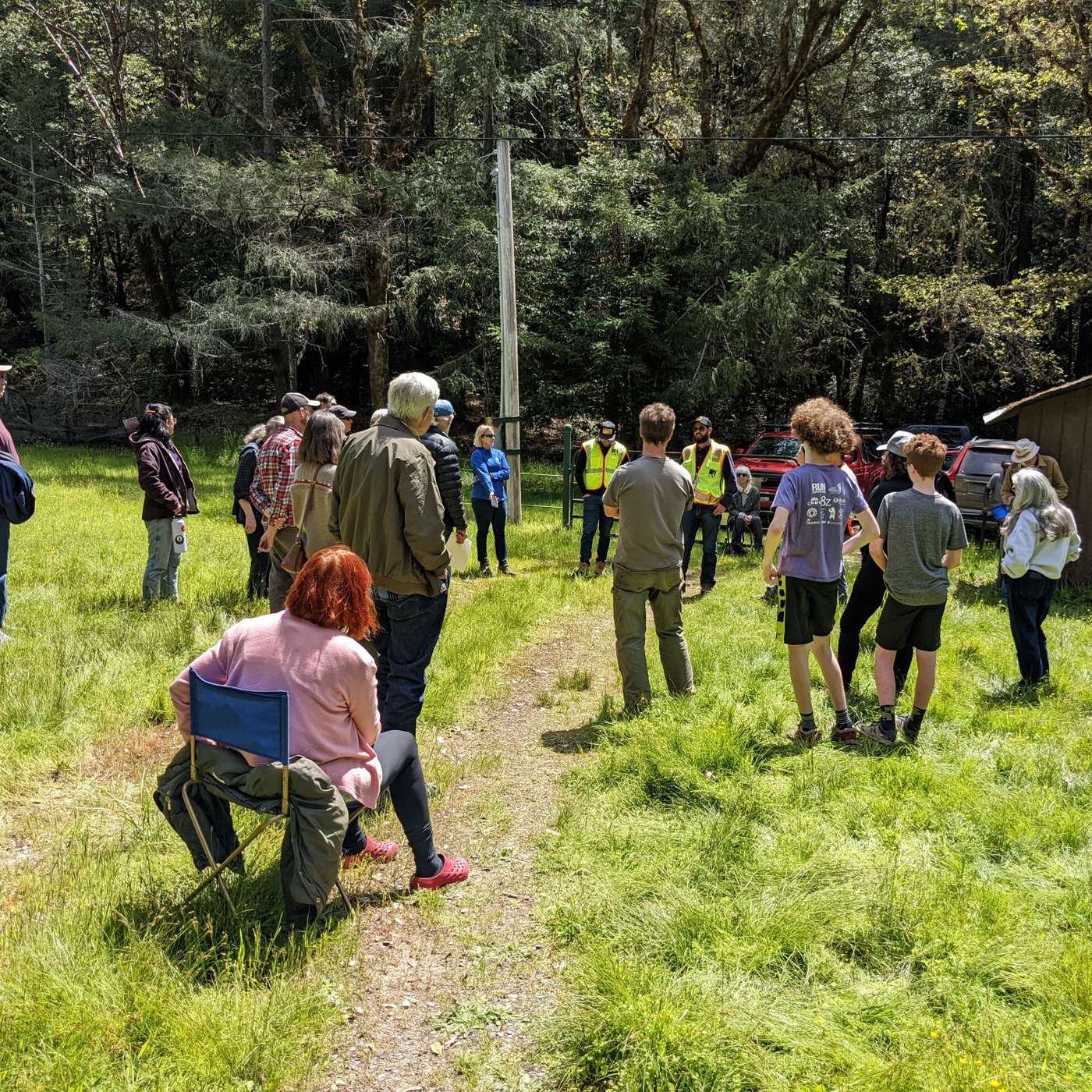
May 18, 2022 — The Board of Supervisors heard yesterday morning from museum supporters, frustrated cannabis growers, the public health officer, and supporters of a letter asking that PG&E halt its enhanced vegetation management program until it provides more information. Public Health Officer Dr. Andy Coren called during public comment to warn that the pandemic is not over. Case rates have tripled, and the newest variants are highly contagious. Coren advised masking indoors and maintaining social distance. Dusty Whitney of Willits, who donated his collection of historical items to the county museum, and Troy James, of Roots of Motive Power, urged the Board not to close the museum during upcoming budget hearings. James said access to the museum’s library is essential to maintaining the historic train cars and other equipment at Roots of Motive Power, saying, “I just don’t think the savings are worth the loss of the value of history.” The Board agreed unanimously to send a letter to Governor Gavin Newsom and the Office of Energy Infrastructure Safety, complaining about a lack of clarity regarding PG&E’s enhanced vegetation management program, including how it is regulated, what landowners’ rights are, how effective it is in reducing wildfires, and what its scientific basis is. In the interests of disclosure, I spoke in support of the letter, as did Walter Smith of Willits, who has established an email clearinghouse of information about PG&E’s practice of clearing trees from around power lines. He related some of his experience, convincing crews not to remove trees from his property. “If you thought a tree shouldn’t be removed, you had to state that you didn’t want it removed,” he said. “PG&E called back and said you had to be a team player, and feel for your neighbors. As though all the people that they killed, they’ve been feeling good about neighborhoods.” The Board agreed to modify the letter with some additional items from Supervisor John Haschak requesting that PG&E work with the Fire Safe Council and other local agencies on healthy forests, to present plans for watershed mitigation and erosion control, plus support for burying the lines. “What we’re seeing is clear cuts near streams, waterways, everything like that, and no plan for how to mitigate that,” he said. The Board also approved an amended item about routine vegetation management in Faulkner Park, incorporating an email from PG&E government liaison Alison Talbot, assuring Supervisor Ted Williams that no redwoods will be removed from the park. Previously, the Board approved the item with a PG&E document that said two large redwoods would be subject to felling or topping. And two company representatives offered conflicting statements, with one saying no redwoods would be removed and another saying that only small redwoods would be removed. The amended notice of tree work notes that the two large redwoods will be subject to limbing only. Though the consent calendar is supposed to consist of non-controversial items, it took two hours to get through it yesterday, largely because it contained the cannabis department report. The June 30 deadline to apply for state annual licenses is fast approaching, and growers are worried that those who are still caught up in the bureaucratic tangle will not get the local authorization they need to satisfy state requirements. Cannabis Department head Kristin Nevedal attempted to provide some reassurance, saying that, “The State is working closely with the cannabis department here in Mendocino. And we will be providing them a list of the outcome of the reviews of all the applicants in the portal. They’ll use that list of those who have completed their applications through the portal as local authorization. In the meantime, those who are eligible for renewal are having their renewals processed by the (State) Department of Cannabis Control. And the fact that they are in the corrections portal does not impede their ability to renew their provisional license.” Nevedal said her department is behind schedule in completing review of the applications, but that she anticipates finishing them by the first week of June. She reported that her department is checking to see if people applying to renew their permits have paid their taxes. Haschak questioned her about concerns raised by the Mendocino Cannabis Alliance in a recent letter, asking if she thinks all the people whose applications are in the portal, or under a review process, will be eligible to have their licenses renewed by the state. Nevedal said the state’s renewal process is automatic. “We were told clearly in a State call that there has been no hangups of provisional license renewals due to portal status,” she emphasized. Williams lost patience. “I don’t think this process is working,” he announced. “This is a consent item (with) extensive public comment. The Board can’t take action. It looks like the committee that’s working on this, aski

Ep 401Candidates for County Superintendent of Schools face off at the Grange
May 17, 2022 — The candidates for County Superintendent of schools, incumbent Michelle Hutchins and challenger Nicole Glentzer, presented their positions at a forum at the Little Lake Grange in Willits on Sunday afternoon. Both candidates are former school superintendents, and each brings a wealth of endorsements to the race. Hutchins counts state leaders, two county supervisors, retired sheriff Tom Allman and the Mendocino College president among her supporters. Glentzer has the backing of the school labor unions, including the employees of the Mendocino County Office of Education, four school superintendents, and two other county supervisors. In her opening statement, Hutchins spoke about building a new system at MCOE, saying, “Before my first term, the Office passed state money directly to districts, instead of providing the services prescribed by the California Department of Education. This resulted in outdated resources and low student achievement. I changed that. I created a new management team and built the capacity to serve all twelve districts and twelve charter schools effectively and efficiently.” Glentzer said if elected, she would foster more local collaboration. “I would be much more targeted in reaching out to our district leaders and to our charter school leaders,” she said, recalling that when she first became the superintendent of the Potter Valley School District, she was introduced to key people and assigned a mentor. “They provided so much support. And that’s an area I would like to change,” she declared. Hutchins identified stagnant educational scores as her most pressing concern, and spoke about how she is addressing the problem. She said that currently, if one sub-population of students falls behind, the state provides the County Office of Education what is called differentiated assistance, an approach she regards as reactive, rather than proactive. “That needs to switch to a more preventative approach,” she said; “where we’re not waiting for students to fail, and instead guiding districts with an improvement mindset from the beginning.” She said all 58 county superintendents of schools have asked the State Legislature to change the way differentiated assistance is funded. “And that successfully made it into the May revise,” she concluded. Glentzer doesn’t believe any of the issues can be addressed without adequate staff. “So we need to work on recruitment,” she emphasized. “We need to work on the mental health of the people who are currently in our school districts. And we need to give them the support that they require…I’ve kind of defined the last several years of my career in supporting the adults in our educational system.” She added that schools provide students with things they don’t all get at home, asserting that, “One of the strongest indicators of student achievement is the family. Do they come from money? Do they speak English? Do they have a house? Those are not things that schools can control, though. But that has the biggest influence on student achievement. So that means that the role of the school is to be the great equalizer for students, to focus on equity.” She said Fort Bragg and Ukiah school districts provide students with “really cool tools…so that the cool things that wealthy kids get, poor kids get, too.” When the candidates were asked if they had supported students returning to school in 2020-2021, Hutchins provided historical context for her advocacy. She reminded the public that MCOE had crafted a “road to reopening” workbook, that laid out how the schools should return to in-person learning. Then, the day before Ukiah Unified, the largest school district in the county, was scheduled to reopen, the Governor retroactively placed the county in the purple tier, which shut down all reopening plans. “We called the Governor, and we made a big stink,” she said. “So much so that it was recorded on EdSource, and you can see the interview…so it made state-level news. Unfortunately, the Governor held firm, and would not allow those school districts to open, despite the noise we made.” Glentzer highlighted her work on implementing safety measures, including vaccine clinics. “I was definitely part of pushing hard to get students back into school,” she said. “We had work with our unions to do, and we had work with our parents and students to do. It was super challenging.” She said that, as a bilingual Spanish speaker, she helped families register for vaccinations, to bring staff and students back safely. “It was very apparent that through remote learning, students were really suffering,” she said. “And we needed to do everything we could to get them back into school.”
Ep 400Third District Supervisor candidates differ on the issues
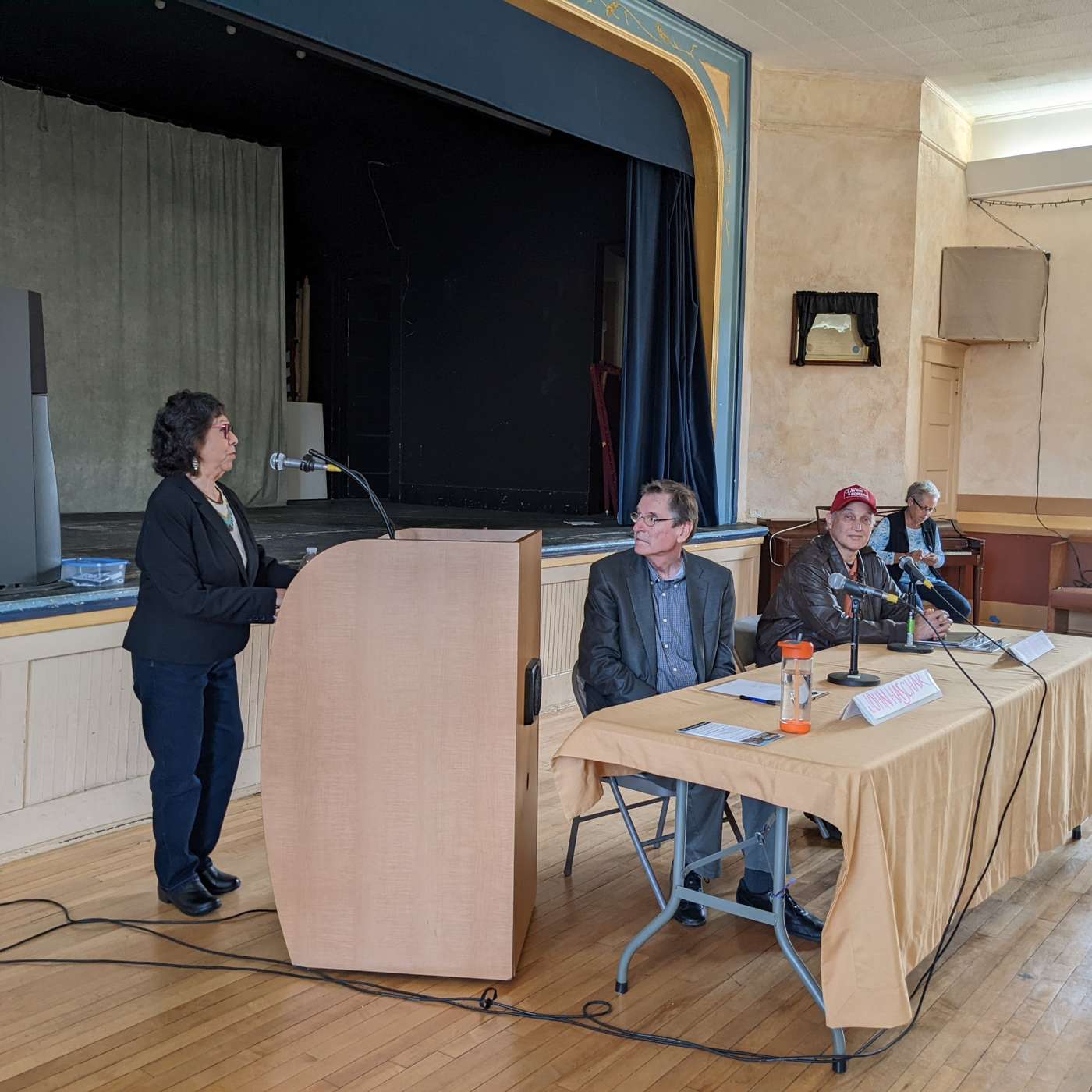
May 16, 2022 — The candidates for Third District Supervisor and County Superintendent of Schools took questions at the Little Lake Grange in Willits yesterday. Incumbent Third District Supervisor John Haschak and challenger Clay Romero differed on most issues, though each expressed support for the local cannabis industry, and they agreed that they would prefer to keep the county museum in Willits open. Haschak has the endorsements of the Mendocino Cannabis Alliance and the Covelo Cannabis Advocacy Group. In his opening remarks, Romero spoke about being “very critical of government mandated lockdowns.” His website declares that masks have “very limited effectiveness,” and goes on to provide a popular piece of medical misinformation that wearing a mask for more than an hour will lead to other diseases. Romero emphasizes the importance of promoting business and easing regulatory burdens, and highlights his commitment to public safety by writing that, as a property owner along the Firco road, he worked with CalFire on an emergency access route that would allow firefighters access to Brooktrails during an emergency. The first question on voters’ minds at the grange yesterday was about how candidates plan to prepare for a long-lasting drought. Romero offered two points, saying that, “A significant amount of the water that’s available is out at Lake Pillsbury. I would be in favor of raising Scott Dam to see if we could capture more of that water...but we do need to be prepared with what we have…I know that the rains will come again.” Haschak does not expect wet conditions to return, due to climate change. He also spoke about funding for water projects, in the context of his work on the drought task force with Supervisor Glenn McGourty, including an ongoing project to draft a policy about extracting water from one location and trucking it to another. He said the county has received $23.3 million in state grants for various projects, but that, outside the Ukiah groundwater basin, “we haven’t had the knowledge of what we have in our aquifers and the quality of that water. So we really need to work on getting grants to get that kind of knowledge…especially in Covelo, Laytonville, Willits,” he reported. The candidates have decidedly different views on climate change, with Romero expressing reluctance to allocate county money to counter or prepare for it. “I think it’s probably ill-conceived,” he said. “I think it’s a mistake to be addressing something like this and identifying money to be spent on something that ultimately would lead to no fruition at all…because when you’re talking about the globe, what about the incredible environmental damage that’s going on in China? They don’t seem to be even remotely concerned with what we’re calling climate change.” Haschak is a believer in climate change, saying that, “If we don’t do anything, we are all going to perish from it.” He said he was proud of the Board of Supervisors’ unanimous decision to allot $2 million to carbon reduction initiatives like solar panels. He added that he serves on the Mendocino Council of Governments (MCOG), which is working on installing more electric car chargers, and that he and Supervisor Dan Gjerde are working with Sonoma Clean Power to get customer rebates for energy efficient appliances. Some questions went unanswered by either candidate, with Haschak taking up his allotted time to explain the complexities of an issue and Romero providing answers that were lean on detail. One question, about whether or not the candidates would enforce state laws, even if they disagreed with them, referred directly to frustration over pandemic restrictions and their as-yet unquantified fallout. Haschak said that, “Certainly, if a law is passed, we have to abide by it because it’s a state law. But the process is, we try to amend it, make it so it serves our needs way beforehand.” As an example, he added that the state budget has just come out, “and there were some things, such as the elimination of the cannabis cultivation tax, which the County of Mendocino had promoted and lobbied for.” Romero provided a counterpoint, assuring the public that, if elected, “I would really much rather be representing and looking out for the interests of the people I represent, over some meddlesome state agency. I’m here to represent you. And I’m certainly not going to be put upon by any agency, whether it’s state or federal. Now, I may not have a choice in the matter. Maybe they’ve got something over my head, as surely as a rock hitting me in the head. But ultimately, when it comes right down to it, I’m still a citizen of this county, of this state, of the United States. And I will pen a letter that will be in the best interest of the people, that they are not put upon by a law that I find harmful or detrimental to you.”
Ep 399JDSF trees cleared from power lines sold to PG&E
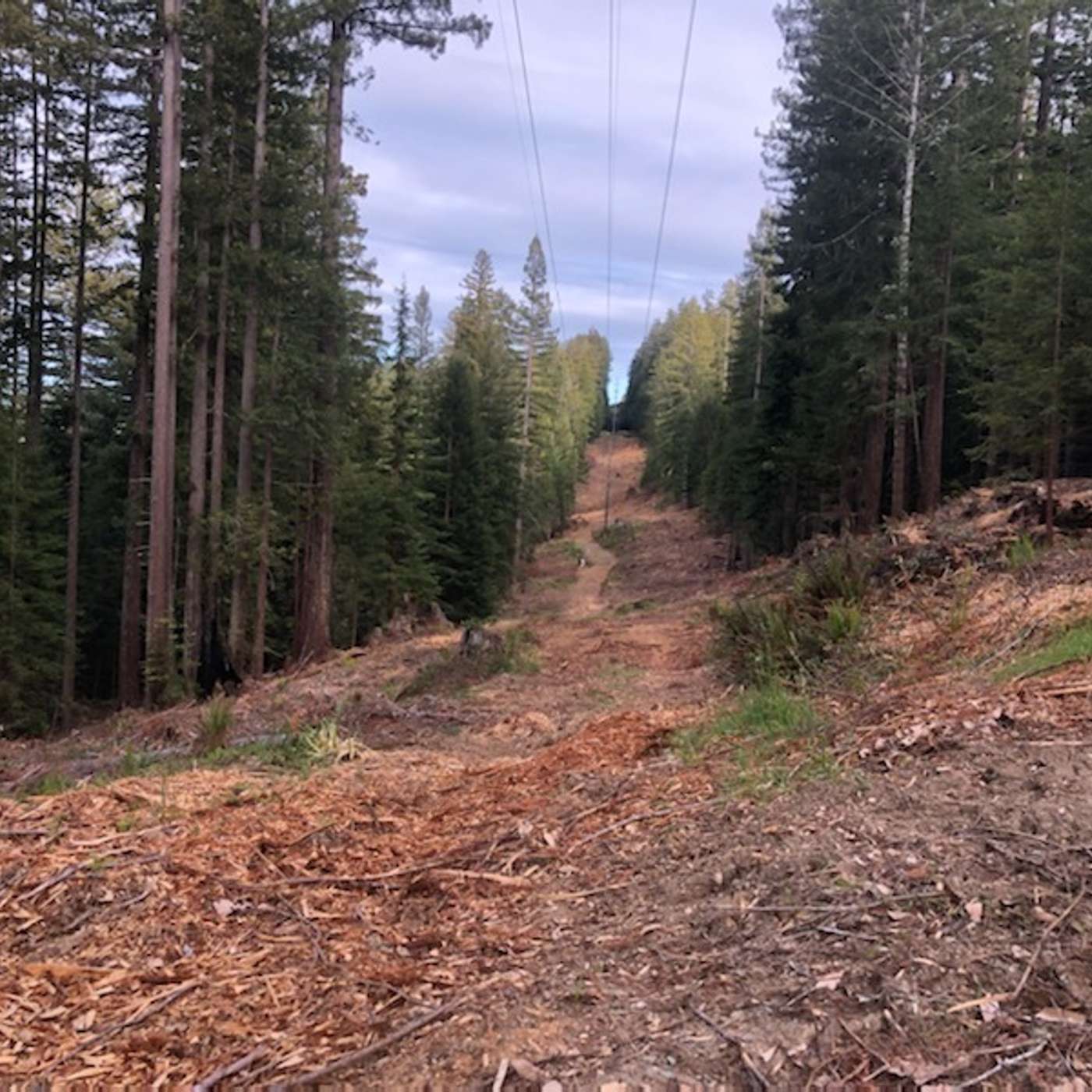
May 13, 2022 — PG&E has been removing trees and other vegetation from around its transmission line that runs alongside Highway 20 between Willits and Fort Bragg, including 115 acres of land belonging to the Jackson Demonstration State Forest, which is managed by CalFire. The work began last summer, and is about halfway done. CalFire sold a little over a million board feet of merchantable redwood and mixed conifer logs to PG&E, which then sold the logs to Mendocino and Humboldt Redwood Company, in a contract that was approved by the California Public Utilities Commission. Walter Smith is a landowner in Willits who has objected vigorously to PG&E’s plans to cut down trees on his property. “I think it’s a double standard,” he said, of the fact that PG&E does not buy most of the trees that it removes from most landowner’s private property. “On the other hand, would it create more of an incentive to cut more trees if landowners were being paid for them?” Deanna Contreras, with PG&E, said the utility is paying a stumpage fee to JDSF, which the company does occasionally when removing trees from large parcels of public lands where it is possible to harvest the trees in a way that is acceptable to sawmills. She said “CalFire, as the owner of the property, submitted a public utility right-of-way exemption to support PG&E’s work.” CalFire is the agency that approves exemptions and is responsible for implementing the Forest Practice Act, which regulates timber operations. Kevin Conway, the manager of CalFire’s demonstration state forest program, agrees with PG&E that clearing the lines is not a timber operation. “Instead of a timber harvesting plan, we used a public utility right-of-way exemption, which is an exemption in the Forest Practice Rules that recognizes that there are certain areas of the forest where the primary purpose is not the growing of forest for various benefits, but is for another use,” he said, “In this case it is for the safety of the transmission lines that are going across the forest. Some of the differences that we have within that, from our primary timber harvesting plan, is that we are only removing trees that are identified as danger trees, so those that have the potential to strike the lines. We also have worked into our contract additional fuel reduction for PG&E to perform that is outside of their corridor right-of-way. Many people that have been driving along Highway 20 have probably seen that the fuel reduction stretches into the adjacent forest, and that was very important for CalFire to make sure that we’re not only protecting that narrow PG&E right of way, but that we’re extending that protection a little bit wider to help us from having any fires that start in there extend out into the forest.” John Andersen, the Director of Forest Policy for Mendocino and Humboldt Redwood Company, said his firm was the successful bidder on the JDSF logs felled by PG&E last year. About 600,000 board feet have been delivered so far. He is expecting another 800,000 board feet by the time the work is done this year. Some of the wood is going to the mill in Ukiah, which can take a log up to 28 inches in diameter. Larger logs are destined for the mill in Scotia, in Humboldt County. Conway says the lumber sale makes sense for JDSF. “By structuring it as a timber sale,” he said, “normally when PG&E removes the trees, they fall the trees for the benefit to the lines, but as the landowner, the State of California, CalFire and JDSF, owns the logs still. So it would be our responsibility to remove those and merchandise them and retain any value associated with them. By packaging this up as a larger project that goes across the lines from JDSF, we were able to have PG&E actually assume responsibility for merchandising those logs that were being removed for the safety and reliability of their transmission lines, and return some of that value to Jackson. We expect this to generate about $140,000 in revenue to CalFire, and that is in addition to the benefit being provided by the fuel reduction work being done by PG&E, both within their corridor and within that expanded area that we’ve asked them to do…it’s a relatively small scale by JDSF standards, a little over a million board feet of timber that’s being removed, about half of that being redwood, and the other half being Douglas fir, Grand fir, hemlock, some of the other miscellaneous conifers.” Contreras said the stumpage fee arrangements are very rare, though some landowners with large parcels and trees that can be sold to sawmills could request a similar arrangement. She wrote that “Any funds PG&E receives from the sawmills in exchange for the wood will be used to partially offset PG&E’s Stumpage Fee payments and PG&E’s costs of performing the vegetation management work there, which will far exceed any payment PG&E receives for the wood it delivers to the sawmills.” Smith remains skeptical. He

Ep 398Water, cannabis, sub-station at Redwood Valley MAC meeting
May 12, 2022 — The Redwood Valley Municipal Advisory Council held a hybrid meeting last night on zoom and at the grange. The council agreed to form a committee that would educate community members about local water issues, and advocate for Redwood Valley’s interests as water resources dwindle. The council decided to recommend that a cannabis grow not be allowed to increase its area of operations, due in part to a lack of information about where it would get its water. Lieutenant Jason Caudillo from the Sheriff’s Department warned of a possible increase in criminal activity as the Redwood Trail progresses. Caudillo also said the future of the sheriff’s sub-station at the Measure B-funded training center in the former Jehovah’s Witness church on East Road appears to be uncertain, as the cost of repairing extensive water damage to an outbuilding mounts. Asked when the sheriff’s sub-station would open, Caudillo said damage caused by a broken pipe would cost hundreds of thousands of dollars to repair, so “I do not have an answer for you.” The Sheriff’s Department paid one-third of the $389,000 purchase price of the property in 2019. Too much water is rare in Redwood Valley, where ag water has been shut off, and the community only has rights to surplus water from the much-reduced Lake Mendocino. The water district has rationed water use to 55 gallons per person per day. Council member Adam Gaska talked about why he’s joining the committee on water issues, in a town that overlooks the lake. “Redwood Valley has zero right to that water,” he emphasized. “Twenty years ago, when Russian River really started signing up people for contracts, I remember Danny Thomas had written up this missive that had said, whisky’s for drinking, water’s for fighting. And I think I was like twenty at the time, and I’m like, it’s gonna get serious.” Supervisor Glenn McGourty filled the council in about how much water is coming through the controversial Potter Valley Project, which is limping along with a missing transformer that curtails the amount of water that comes into the Russian River from the Eel through a diversion tunnel in Potter Valley. “You will see Lake Mendocino come up a little bit, primarily because of the water that’s coming through the Potter Valley Project, even at the low rate that it’s flowing in at the moment, it’s still coming in, and will continue through most of the summer, but at a reduced rate,” he said. “Normally, we’d expect about fifteen to sixteen thousand acre feet to come through, and it’ll be more like four to seven thousand.” The Municipal Advisory councils, or MACs, were formed in unincorporated parts of the county so that community members could have a venue to form cohesive approaches to planning concerns. They generally have the ear of their county supervisor, and they receive alerts about certain kinds of permits, so they can make comments to various governing bodies. They are not legislative bodies, themselves. Gaska thinks the MAC is the best local venue to educate community members about a variety of complex issues, including water policy. “Our business is communication. It is people having a voice,” he said. “RVMAC, we can’t promise you anything. But we allow you the space and the time to be heard. Which is important, because then we also decide who else needs to hear that. Is it Glenn? Does Glenn need to hear that? Does Jason Caudillo from the sheriff need to hear that? And they’re here. That’s what our board does.” Water played a significant role in the council’s lack of enthusiasm for a request from a cannabis permit holder to double the grow size to 10,000 square feet of outdoor cannabis. A map showing 14 hoop houses led to confusion about whether the request was to change the whole grow site to outdoor or grow some outdoors and some in the hoop houses. Council members Chris Boyd and Marybeth Kelly had additional reasons for opposing the permit’s approval. “All of a sudden, we'll see huge increases in water trucks going up the road,” Boyd said. “And with all of these problems we’re having with water, we don’t need to add noise pollution and diesel pollution to the picture. So I’m not for this.” “Not to mention the state of the roads,” Kelly added. “Road E is one of the worst.” McGourty reported some of the things that the Board of Supervisors is considering as the county works on an ordinance to regulate water hauling. He favors requiring permits and business licenses for wells that are the source of water for water trucks, and giving Code Enforcement the responsibility of checking water truckers’ documents. But, he pointed out, many people with some illegal cannabis also need water for legitimate domestic uses. “So how do you separate that out?” he asked. “Do you say no to health and public safety because they have a cannabis grow? So those are some of the things we have to work through.” Council member Sattie Clark said she believes that regulating water use, through poli...

Ep 397Coast businesses adapting to drought
Local innkeeper Ken Taylor works to reduce his reliance on groundwater with the help of Localizing California Waters, a non-profit. He also advocates with other local businesses and residents to develop individual property level solutions that will help with the ongoing drought and create a healthier environment going forward.

Ep 396Candidates present their positions
May 10, 2022 — Incumbent Ted Williams and challenger John Redding are vying for the Fifth District Supervisor’s seat in next month’s election. They presented their positions at a League of Women voters event last week, fielding questions about healthcare, fire preparation, drought, and economic development. A major issue on the coast is the uncertain future of the Mendocino Coast Healthcare District, and whether or not to dissolve it. Redding, who is Treasurer of the district board, fears that the county, which is struggling to balance its budget and has failed to collect millions of dollars in cannabis tax revenue, could take charge of healthcare on the coast. At stake is what he believes is local control over the decision to bring the existing hospital into compliance with seismic codes, build a new hospital, or rely on clinics. “What I’m not in favor of is dissolving the Healthcare District,” he said. “That would mean the Local Agency Formation Commission (LAFCo) would, without a vote of the people, dissolve the Healthcare District, and the successor agent would be the county. And they would seize our money, our taxes, our land, and there would be no representatives anywhere close to the coast to provide governance,” Williams countered that local control involves a lot of dysfunction on the district board, and doubled Redding’s estimate of $50 million to build a new hospital. “I tune in to those meetings,” he said. “I see a lot of bickering. I don’t see much progress. There's complaints going to the Grand Jury and FPPC (Fair Political Practices Commission) and questions about was an attorney hired…and I think it’s casting a shadow over the real discussion that needs to happen. A new hospital could cost $100 million, plus. Might only generate $2 million revenue… It’s really a challenge for the segment of our population that can’t afford to go to Ukiah or Santa Rosa for regular healthcare.” When it comes to abortion rights, Williams is a staunch supporter, saying restrictions on abortion limit a woman’s right to participate in society. Redding said that, while he is pro-life, he does support the right to choose. He said that when the Healthcare District board was presented with a proposal to allow the clinic to perform chemical abortions, he voted in favor of it. “I would not in any way limit a woman’s access to abortion, and I think I’ve proven that with my vote,” he said. Fire and drought are region wide issues that are top of mind as summer approaches. Though he is dubious about relying on the state, Redding thinks huge wildfires are largely the state’s responsibility. He cited the state’s years’-long policy of preventing wildfires by clearing and logging, saying, “This is really a state problem that affects us…we really need to put pressure on the State of California to follow through on its commitments.” Williams, a volunteer firefighter, invoked historical factors as well. But he also advocates a local response, saying, “”It’s our problem, because we live here, and fire may be in our backyard.” He highlighted defensible space and chipper programs, adding, “There are also opportunities to coordinate the funds that are available to get local workforce out, putting people to work, who desperately need work.” Both candidates support the idea of water storage, which is emphasized in the governor’s drought strategy. But while Williams touted the county’s success at winning a $5 million state grant to build water storage in the town of Mendocino, Redding tied storage into his emphasis, which is encouraging private economic development. “To rely on government grants makes me uncomfortable,” he said, recalling a former boss who told him, “hope is not a business plan. And when you’re hoping that you’re going to get a grant from the State of California or the federal government, that’s not a business plan.” Redding suggested hiring an economic development coordinator and supports funding West Business Development Center, which the Board of Supervisors agreed to continue doing last week. Williams agreed that economic development is a glaring need, but opined that, “the county’s role in that needs to be to provide infrastructure where businesses want to exist, where people want to live.” He added that he is reluctant to shift financial resources away from core services like road maintenance, public safety and social services, “all of the services that the most vulnerable people rely on, and the services that would attract businesses to our area.” The candidates differed on the nature of the board’s relationship with the sheriff’s office, with Redding associating Williams, and an attempt at a system-wide audit of the sheriff’s department, with efforts to defund the police. Sheriff Matt Kendall has since endorsed Williams. KZYX will have more election coverage this month. This Thursday, May 12, from 3-4 pm, we’ll hear from Assessor/Clerk/Recorder Katrina Barolomie and Pat Dunbar, from the ...
Ep 395Faulkner Park cutting paused
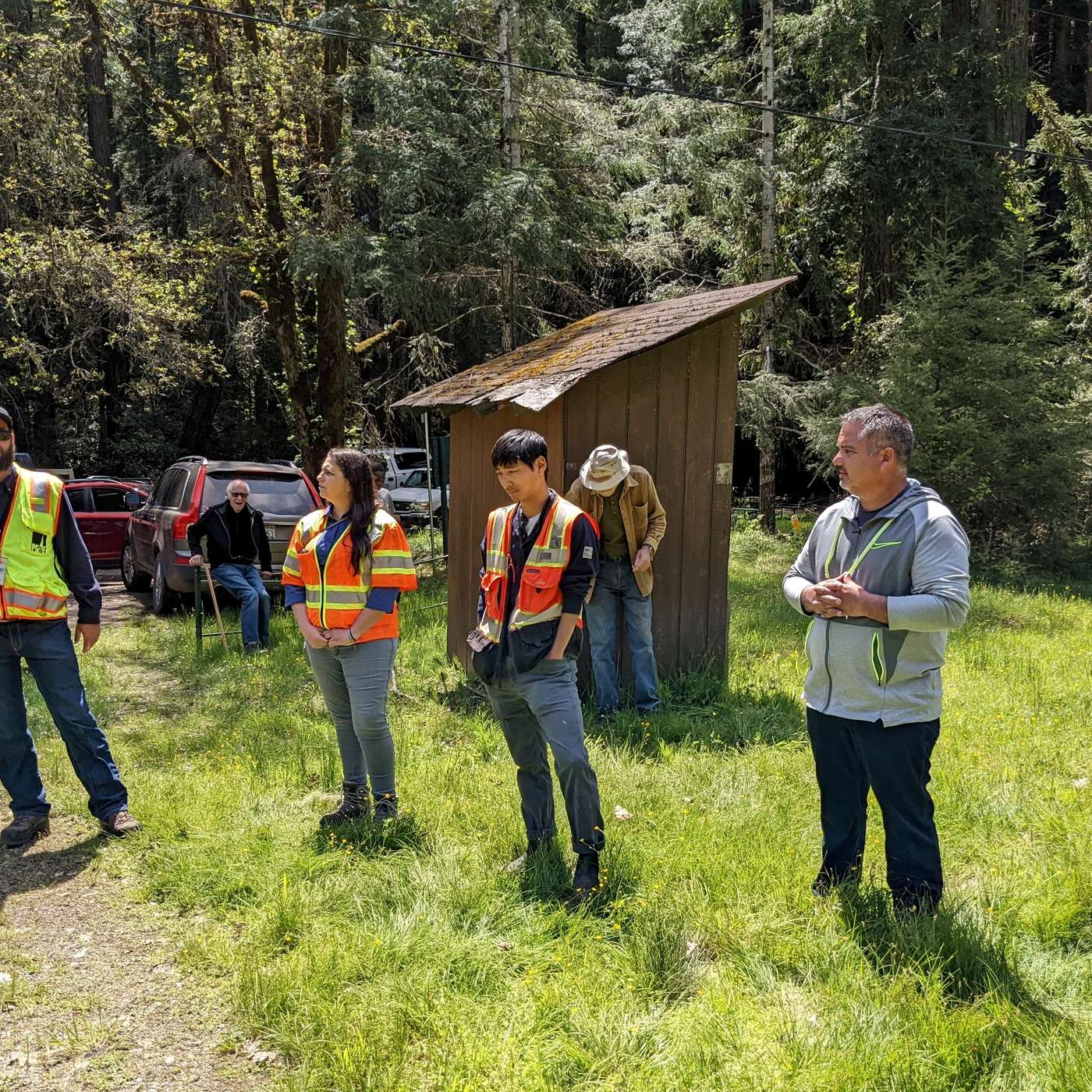
May 9, 2022 — The Faulkner Park crisis has subsided for the time being, in the wake of a community meeting and a consent calendar vote at last week’s Board of Supervisors meeting. About a dozen members of a group called Friends of Faulkner Park gathered on a sunny Friday morning to hear from high-level PG&E representatives about company plans to remove dozens of large redwood trees that are near the power lines running along Mountain View Road just outside of Boonville. Faulkner is a much-loved county park, and the Friends, county workers, and Fifth District Supervisor Ted Williams had already succeeded in extracting an agreement from PG&E to hold off on tree removal and look into what it would take to bury the quarter mile of power line. A government liaison also provided assurances that she would maintain communication about the company’s vegetation management plans. The original slew of yellow X’s indicating which trees were slated for removal were part of the company’s enhanced vegetation management program, which involves aggressively clearing the lines. PG&E North Coast Regional Vice President Ron Richardson told the group that their advocacy had paid off, saying, “We’ve paused on the removal of these trees…part of that is a thank you to you. Because when you guys seen the X’s, it got our attention, we got out here, we looked at it, we brought leaders out here to look at it, and that’s what drove us to say, hey, we need more data points.” Richardson also said that Faulkner Park is not at the top of the list for areas in this region that are risky enough to underground power lines right away. Currently, Middletown in Lake County and Wallace Creek in Sonoma County are first up for burying lines. He estimated that the cost of undergrounding the quarter mile of line that runs through a section of the thirty-acre park would cost $750,000 to a million dollars. The county plans to repave the road in the next few years, which he said was valuable information, indicating that the underground option is not completely beyond consideration. Richardson said the company does have plans to harden the lines with Enhanced Power Safety Settings, a sensitive circuit breaker that lowers the arc if the lines are damaged, which is supposed to reduce the risk of fire from sparks. That program is scheduled to start this summer. PG&E also plans to start using a new risk-assessment tool to determine whether contractors will take a tree down or trim it. The tool, which is still in development, is supposed to take into account the species of the tree, the angle of its lean if it is not standing up straight, and whether it is stressed or dying. But the assessment seems to be based only on characteristics of individual trees. It is unlikely to take into account the role each tree plays in its environment, or how its removal would affect the other trees around it, possibly making those trees more vulnerable to falling down or even creating conditions that could make fires worse. The length of the pause and what would precipitate ending it were also not clearly laid out. The new tool is expected to start being used in about a month. Community members were skeptical about the efficacy of the new tool, laughing heartily when Williams asked if they could wait for the next iteration in the event that the new one doesn’t work. Anderson Valley Fire Chief Andres Avila wrote an analysis of fire behavior in Faulkner Park, explaining why he believes the trees should stay standing. But he also implored PG&E to consider additional values when making its decision, like its importance to kids in the community, its history, and its unique environmental qualities. He spoke about how Faulkner Park, which is mostly cool and heavily shaded by large redwood trees, is at low risk from active fire behavior caused by an incipient fire, the kind that would start inside the park from a power line. He argued that removing the trees would allow new, smaller, oily brush to flourish and present more of a fire hazard than the large trees. “It’s much easier for a line strike to come down and take off into those and then ladder fuels going into the bigger fuels,” he said. While acknowledging that no solution is 100% guaranteed to offer perfect safety, he stated, “I disagree with tree removal here.” PG&E pledged not to remove redwood trees from Faulkner Park, but clarified that contractors will continue to perform routine vegetation management, which could involve removing smaller trees. On Tuesday, the Board of Supervisors approved a notice of tree work to trim 16 trees of various species and inspect three others to determine if they are to be topped or felled. Two of those trees are doug firs under two feet diameter at breast height, and one is a large redwood.

Ep 394Supervisors consider cuts
May 5, 2022 — During a third-quarter budget workshop this week, the Board of Supervisors hashed out where to make cuts in a county budget with significant projected shortfalls and very little information about the cannabis department. While county staff estimates that $6.8 million in cannabis tax revenue has been uncollected, the cannabis department was one of three that has not yet turned in its projections. Another installment of cannabis taxes is due at the end of May. The combined health plan deficit for this year and last year is $6.2 million. The Executive Office presented an operational budget that would have been balanced if not for that deficit, and asked supervisors to decide where to make adjustments. Interim CEO Darcie Antle summarized the basic cuts she was seeking. “We’re looking for $3.3 million,” she said. “And if you close the museum, that reduces it, and then if you don’t fund the parks at $1.6 (million), that would reduce the $3.3 (million) even further. So at that point, you’re down to needing an additional $2 million, and so then we sort through these other items as you would like.” The museum, which costs over half a million dollars a year to run and brings in $20,000, appears to have been spared. Even if it were closed, preserving artifacts and maintaining the building would continue to incur costs. Supervisor Dan Gjerde offered some suggestions for adding more money to the museum’s coffers, like tapping those who have donated artifacts for monetary donations, or offering the option of contributing to an endowment. He noted that he found it “a bit radical” to cut the museum, but that, “I think we do need to have, as a full Board, a better understanding of what the long-term strategy is for the museum.” Supervisors also considered cutting parks, which would entail laying off staff. Supervisor Maureen Mulheren laid out the quandary regarding the parks, saying, “It’s my understanding, from having served on the ad hoc and then bringing that item back twice to this Board, that there were no parks that we wanted to close. So if we don’t find a way to fund them, they have to be closed. We can’t have it both ways.” General Services Agency Director Janelle Rau said her department is asking for $4.8 million for parks over the next three years, based on a needs assessment of the parks and what it would take to restore them to a safe condition. She said the county’s more than sixty parks have been fiscally neglected since the 1980’s. Bower Park in Gualala is currently closed due to a number of hazard trees. Supervisors discussed other funding mechanisms, like special districts and assessing which parks could bring in revenue by offering concessions. But parks are unlikely to generate revenue for the county. Half a dozen departments are projected to come in more than $100,000 over their net county cost assignments, with the sheriff in the lead at $1.4 million. Antle told the board that the county reserve, which includes designated funds, comes out to $20 million. She added that an ideal reserve would be three months’ worth of county expenditures, which would be $48 million. The one-time American Rescue Plan Act, or ARPA funds, are likely to be used for a variety of purposes, from parks to funding the sheriff’s hiring bonuses and backfilling the District Attorney’s budget. Deputy CEO Sarah Pierce told the board about plans for the $16.8 million award, which was intended to alleviate the long-term impacts of the pandemic for hard-hit communities. The county has already obligated $4.8 million, leaving about $12 million. “Of that $12 million, ten can be used on county core services, and then the remaining can be used on staffing to pre-covid levels, and parks is an eligible expense,” she said. Mulheren asked her colleagues if they would consider setting aside some of the ARPA money for grants to community organizations, and Gjerde said he would only support that if it were divided among the five supervisorial districts. Supervisor John Haschak suggested using some for community health workers, but the board did not give direction on either suggestion. Antle told Haschak that the only other possible source of revenue is the cannabis tax, some of which is not yet due. “At this point, we have met with all the departments, per your request on the 19th,” she said. “And the departments that I mentioned, which is a couple of handfuls, were able to come back with some money. At this time, there are no areas that we are aware of that could be reduced. The only other is if the cannabis revenue does come in,” by May 31st. Supervisor Ted Williams summarized his view of a few budget scenarios, saying that, after cutting $1.5 million from parks, the county would need to cut $2 million from its budget if it does use ARPA funds, and $7 million if it does not. And he said it’s time to stop relying on cannabis tax. “This strikes me as a structural deficit,” he said. “I don’t see this as a one-time....

Ep 393Measure B-funded facilities open
May 4, 2022 — Two Measure B-funded facilities opened last week. The Regional Behavioral Health Training Center on East Road in Redwood Valley opened on Tuesday, after being remodeled. Some pieces of equipment, like a media cabinet for hybrid meetings, a virtual reality training program, and gun lockers, are expected to arrive soon. The Critical Residential Treatment Center on Orchard Street in Ukiah is now fully licensed and opened last Monday, serving three clients. The facility has eight beds that will be available for 30 to 90 days by adults who are in a mental health crisis but have not received a 5150, the designation that would lead to an involuntary 72-hour hold. Sarah Livingston, the crisis program director for Redwood Community Services, which is operating the CRT, said the facility fits smoothly with respite care. She said the facility will include peer support, case managers and rehab specialists, many of whom come from the RCS Madrone House, which is a respite center. “A respite house is set up to be immediate respite for someone who is just on the other side of a 5150,” she explained. “And so that’s been used for immediate stabilization, ideally for up to seven days. The CRT is where we take it one step significantly further. That 30, 60, 90-day model where we’re doing significant psycho education and other programming and allowing people to really get back on their feet as they stabilize.” Livingston said clients will be encouraged to take part in daily life outside the facility. “I think there’s this misunderstanding by quite a bit of the community, where they thought it was a locked facility,” she noted. “It is not a locked facility. Ultimately we want people to choose to be there, and they do have 24/7 support.” Livingston added that there will also be therapists available, though not always on site. “We can get folks into a pretty quick psychiatric appointment,” she added. She expects the facility to be fully staffed in another thirty days. “And I am certain we will fill those eight beds very, very quickly,” she predicted. Once it is fully staffed, RCS plans to contract with Lake County to offer a bed to one of its crisis patients. The CRT was designed and built by architecture firm Nacht and Lewis for $2.6 million, a combination of Measure B funds and a $500,000 grant from the California Health Facilities Financing Authority. The training center in Redwood Valley, formerly the location of the Jehovah’s Witness Church, was the first facility purchased with Measure B funds. The purchase price was $389,000, a third of which was covered by the sheriff’s office. A small building and a garage have been dedicated as a sheriff’s substation. Sheriff Matt Kendall said he is waiting for the floor and drywall to be repaired after water damage caused by a broken pipe. But when he is able to use the building, he’d like to use it as a terminal for a dual response team with a deputy and a mental health specialist. Dr. Jenine Miller, head of the county’s Behavioral Health Department, was on hand for the ribbon-cutting and a tour. She expects that the new training center will allow county departments to send more staff to more trainings nearby, rather than sending a limited number of people to be trained outside the county. As far as how sustainable the center will be, Miller said, “this really is the first year to look at how does the facility sustain itself, how much are we getting from the trainings versus how much are the costs to maintain the facility.” She plans to work with the General Services Department to present a plan to the Board of Supervisors, detailing the ultimate yearly costs of all the county’s Measure B-funded facilities, including the CRT and the Psychiatric Health Facility, which the Board decided to build at 131 Whitmore Lane in Ukiah. Retired Sheriff Tom Allman, an original Measure B Committee member who remains the sheriff’s representative on the committee, said he hopes a $100,000 piece of virtual reality training equipment, paid for by the state, will be available by the end of June. He is looking forward to using the venue for trainings that he hopes will raise the standard of local law enforcement officers. The Measure B sales tax will drop from a half-cent to an eighth-cent next year. “That money can be used for training and improved mental health services,” Allman said. “But there will still be costs to the departments.” One of the three-day trainings cost $12,000, but Allman said, “We want to spend that money. So we can have the best-trained first responders out on the street.”

Ep 392Latino groups want equitable distribution of one-time funds
May 3, 2022 — The Board of Supervisors is holding a budget workshop today in preparation for budget hearings on June 7th and 8th. At the hearings, community organizations will have an opportunity to make a case for why they should receive a portion of a $16.8 million award from the federal American Rescue Plan Act (ARPA), intended to alleviate the long-term impacts of the pandemic. Though the United States Treasury Department urged local governments that received the funds to engage the public in deciding how to allocate them, public outreach has been minimal so far. And although the deadline for allocating the money is a year and a half away, organizations providing direct services to those who’ve been hardest hit may have only a few leftovers after the budget hearings, according to Interim CEO Darcie Antle, who spoke to KZYX on April 27. “Currently, we’re under the Board’s direction to look internally first,” she said. “And then when the Board considers the 22-23 budget, if there’s funds available and left over, depending on how they want to spend this ARPA money, there could be opportunities. And I know obviously one of their priorities is public safety, which includes fire.” Close to five million dollars of the award has already been obligated, some of it to the Community Foundation and North Coast Opportunities, which used it to provide food and childcare during the pandemic.* A little over $60,000 went to upgrade the audio and telecom systems in the Board of Supervisors chambers to allow for more accessible hybrid meetings. But another $266,000 was spent on remodeling the chambers, plus $40,000 for an automatic door system,and $35,000 is slated for the purchase of seven metal detectors. Eduardo Garcia is the senior policy manager at the San Francisco-based Latino Community Foundation, a statewide organization that advocates for the civic and economic power of Latinos, many of whom continue to be disproportionately affected by the fallout of the pandemic. The Foundation awarded $1.4 million to smaller Latino organizations around the state advocating for transparency and a public process for the equitable distribution of the one-time funds. Garcia says Mendocino County is not alone. “A lot of these decision makers are using these funds in very questionable ways,” he said. “One troubling trend that we’ve observed across the state is that city and county leaders are spending these dollars, these flexible, unique dollars designed to help California speed up its health and economic recovery, they’re spending this money on police. Which is very concerning, because we know that what our communities need is access to resources to help overcome the hardship that has been the last couple of years.” Antle said with inflation and the loss of cannabis tax revenue, the county budget is lean. “We’re currently trying to work with all of our departments to see how we can keep them full,” she said. “Full meaning fully funded for the coming year, without having to take cuts in certain areas. And it is likely that the Board will have to make some difficult decisions.” Garcia wants the public to participate in those decisions, including organizations like UVA, Vecinos en Acción, an inland Mendocino County Latino advocacy group which is the recipient of one of the Foundation’s grants. “This is not a simple civic engagement process,” he acknowledged. “And so Vecinos en Accion and non-profit organizations can work with city and county leaders to design a process in which they can collect community input. Obviously providing translation across outreach strategies is critical to reach the hardest to reach communities. There could even be workshops. We have partners in Calexico that helped design community workshops to engage members of the community about ARPA budgeting. So there are a myriad of different outreach strategies that city and county leaders can employ to collect community input. But these processes have to be designed with trusted community members.” Juan Orozco, co-chair of UVA and a Ukiah City Councilman, says UVA is poised to do just that. “We look into health equity, and what is it that the community needs, and we do surveys, and then provide the information to people,” he said. Garcia has seen organizations advocate successfully. “There are city and county leaders in certain parts of the state that have adopted, or that are trying to create more transparent processes,” he said. “And some of that has been the result of community organizing led by Latino non-profit organizations. For example, in Merced, in the city council, an organization called 99 Roots successfully advocated for a one million dollar youth jobs program, designed to essentially invest in the workforce development of young people. Knowing that Latino workers during the pandemic were overrepresented in industries that were considered essential; that maybe weren’t paying the very best wages; that were putting workers in very vulne...

Ep 391Budget crunch still speculative
May 2, 2022 — The Board of Supervisors will hold a budget workshop on May 3 to prepare for next month’s third quarter budget hearings. Inflation is up, but revenue seems to be available — if there were enough staff to collect it. Supervisor Ted Williams gave a preview of tomorrow’s meeting. “We’ve been meeting with each department, and looking at if they have any outside contracts that they can cut, kind of nickels and dimes,” he said. “Frankly, I don’t think we’re finding a lot. A lot of those departments already came in with lean budgets. There may be some services that we can halt, but not without a real impact on the services provided to the public.” Patrick Hickey, the field representative for Local SEIU 1021, which represents most of the county government’s unionized workers, suspects the situation is not quite so dire, and cautions that more information is needed before making big financial decisions. “What their information showed is that the majority of their revenue streams, property taxes, sales taxes, transient occupancy taxes (ToT), are increasing,” he said. “They're projecting that the cannabis tax may drop significantly. So that’s certainly a concern. But they don’t have a handle on it, as far as we can tell, on the numbers and on the data. They still haven’t released their audit from last year, which normally for counties comes out in the fall. So we really need to have a look at that before we start setting our budget for next year.” Hickey especially wants more detailed information about the reserve funds, which he believes are robust. The county is in negotiations with all its bargaining units, which always advocate for filling vacant positions with qualified people, and paying them a competitive salary to keep them on the job. Hickey listed a few of the departments he thinks could generate revenue if they were fully staffed. “Environmental health specialists are a fundraiser for the county, basically,” he said. “Positions in the treasury or tax collector and auditor-controller’s office that make sure that we’re collecting all the funds that are due to the county. A number of those department heads have said they’re not able to necessarily do an effective job at tracking down all the taxes that are due because they don’t have the staff to carry out those assignments.” Union president Julie Beardsley added that some other key positions are funded mostly by state and federal money. “In behavioral health, there are clinical positions that don't offer a competitive salary, so it’s really really difficult to hire people,” she argued. “In public health, nurses, social services, social workers.” “I’m actually with the union on this,” Williams said. “I think if we do any hiring, first it should be in the areas that are revenue generating. If there’s money that we’re not collecting, maybe that staff will be more than paid for by the revenue that they’re able to collect.” But he said there is a bit of a general fund match for the state-funded positions. “Some of the non-general fund departments still have a hit on the general fund,” he said. “It may not be much, but when you have zero dollars to work with, if we’re paying ten or twenty percent of that overhead, we just don’t have it.” He added that the lack of competitive wages results in the county not having “a pool of applicants showing up, eager to take on those jobs. If we were to pay more, that would be out of the county general fund.” And Williams said that if the county raised the wages for an analyst in a mostly state-funded department, it would have to raise the wages for other workers with the same designation in departments that are funded solely by the general fund. At the Board of Supervisors’ meeting on April 19, the board agreed to make paying cannabis taxes a requirement for renewing permits, and to consider lowering the minimum tax rate. Interim treasurer tax collector Julie Forrester said delinquent cannabis taxes hadn’t been pursued, and made some suggestions for how to go about doing that. Williams said the tax collector is elected, and the Board of Supervisors does not direct her how to run her department. “My personal view is, we need to have a process that doesn’t have finger-pointing,” he opined. “It needs to be collaborative.” The county doesn’t have exact numbers on how many properties are not on the tax rolls, “but we know some are. We know some that are charged vacant land rates, versus the tax on a three-bedroom house built in the last decade.” The protocol for updating the tax rolls has not yet been established. And Williams is leery of taking action that could cost people their homes if their living situation involves a zoning violation. “And we’re broke,” he said. “We have less revenue that’s projected for the coming year than we had last year.” Hickey remains skeptical of the sense of emergency that often characterizes budget discussions. “So much of these projections that the county’s talking abo...
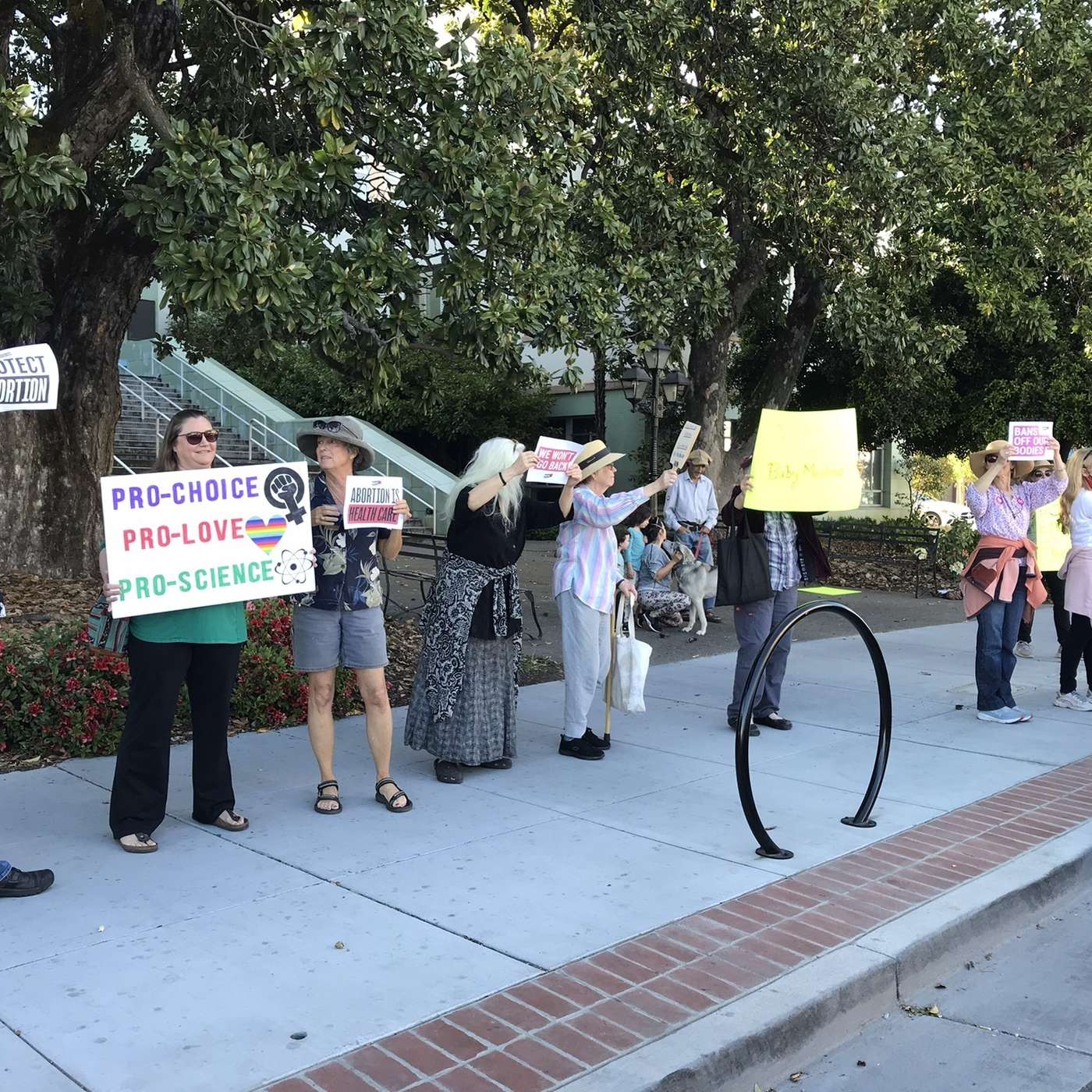
Ep 390Mendocino Locals Gather to Support Roe Vs. Wade
Since the appointment of anti-abortion Justice Amy Coney Barrett secured a conservative super-majority on the US Supreme Court in October 2020, women’s rights advocates have warned that Roe V Wade, the 1972 court decision that affirmed the right to abortion, was in danger of being overturned. On Monday, the online newspaper Politico dot Com published a leaked draft decision in a case currently before the Supreme Court challenging Mississippi’s ban on abortion after 15 weeks, known as Dobbs v. Jackson Women’s Health Organization. The 98 page draft was written by conservative Justice Samuel Alito, and completely rolls back Roe vs Wade, and another important case that protects the right to abortion, paving the way for abortion bans across the country and potentially a federal ban on abortion if conservative legislators gain a majority in Congress in future elections.
Ep 389Youth succeed in getting whippets banned
April 28, 2022 – The Youth Leadership Coalition, a teen program of Redwood Community Services’ Arbor Center, successfully lobbied Ukiah’s City Council to pass an ordinance banning the commercial sale of nitrous oxide canisters, known as whippets, within the city limits. Whippets, which have become a popular party drug among young people, deprive the brain of oxygen and can cause strokes, leading to death or lifelong disability. The nonbiodegradable canisters are also an environmental nuisance. The ordinance went into effect in March, and prohibits Ukiah city businesses operating under a tobacco retailer’s license, from selling the drug. The Youth Leadership Coalition is now staged to assess the success of the mandate and plans to address the Mendocino County Board of Supervisors in an effort to bring the ordinance to a county level.

Ep 388Vying for the ARPA funds
April 27, 2022 — In August of last year, Mendocino County received about eight and a half million dollars from the American Rescue Plan Act, which the President signed into law to help local governments recover from the economic toll of the pandemic. The county will receive the other half of its s$16.8 million award this summer. The funding can be used to cover a broad array of costs, from paying essential workers to providing government services to investing in infrastructure. The guidelines urge local governments “to engage their constituents and communities in developing plans to use these payments,” much as the PG&E settlement funds were distributed last year. But thus far, the public has not had the opportunity to contribute to the decision-making process about how to allocate the ARPA funds. $4.8 million has already been allocated for infrastructure, public health and direct assistance. During the fiscal review last week, the Board of Supervisors heard suggestions to use the remaining funds to provide county services and hire new staff to pre-covid levels. But Juan Orozco, a Ukiah city councilman and co-chair of UVA, Vecinos en Accion, an advocacy group for the Latino community, thinks the money should be used for much more basic needs. “With not having a job, with not having income, you lose housing,” he pointed out. “If you’re renting, of course, and even if you’re buying a home and you don't have any income, how are you going to pay your mortgage? People don’t even have food.” Sarah Marshall, the UVA coordinator, agrees. There’s some organizational heft behind this position. “The ARPA funds are supposed to go to support communities that have been most impacted by covid,” she declared. “So UVA hasn’t received any ARPA funds yet, but we did just receive funding from the Latino Community Foundation that is meant to be spent to advocate for the transparent distribution of ARPA funds in our community.” Marshall added that more than 100 grassroots organizations applied for the grant, which is called the Latino Power Fund, and 35 were selected, with awards totaling $1.4 million, all working towards trying to secure a fair share of the ARPA funds. UVA Program Coordinator Maria Avalos explained what UVA plans to do with its portion, which is about $50,000. “We hope to hire someone to become an advocate,” she said, “that will be looking into where ARPA funds in the county are going to, and making sure that it is being equally dispersed and going toward the Latino community and Spanish-speaking communities.” Julie Beardsley is President of Local SEIU 1021, which represents most of the county government’s unionized employees. She’s open to broader uses for the ARPA money, but she wants transparency, too. “I know that there’s been some talk about using the $16.8 million to backfill the deficit,” she said. “It can be invested in things like improved water systems and sewage, broadband infrastructure. It can include assistance to small businesses and households in hard-hit industries to help with economic recovery. So I’d like to see some community input on what happens with these funds, rather than having the county say, we have a deficit so we have to backfill.” The ARPA award is just shy of the $18 million the county budgets for one month. Supervisor Ted Williams, who has spent the last few weeks in budget meetings with county department heads, says the money is vital to the county’s core mission. “I think a lot of the ARPA funds will be used to balance the budget, to make ends meet,” he said. “The alternative is we could give that money to community groups that probably have really great projects, or we could allow potholes to develop…we could stop road maintenance altogether. The ARPA funds, whether you’re looking at the $10 million or the full $16 million, if that's not used to plug the financial situation at the county, the cuts and services would be severe. I wish we could treat the ARPA funds like we did the PG&E funds, but I don’t think that’s what the public wants, when we look at the services that would be lost.” One local organization that’s still providing pandemic-related economic relief is North Coast Opportunities, which got $1.7 million in ARPA funds to offer direct services like keeping all eight of its Head Start child care centers open during the shutdowns. It also rallied volunteers to deliver food boxes to people in quarantine and work at vaccination clinics. Molly Rosenthal, the NCO Communications Director, says part of the money is now being used to restart an essential service that’s lost a lot of providers in the last two years. “Our rural communities childcare program supported providers who have closed and are working toward reopening and connecting working families with affordable childcare,” she said, which is “particularly important as things open up and parents head back to work…those families do need access to affordable childcare.” The economic fallout from the pan...

Ep 387ARPA funds: Public health, Latino advocates and county budget vying for award
The American Rescue Plan Act was signed into law last year, awarding federal money to local governments to help alleviate the long-term economic and public health effects of the pandemic. The US Department of the Treasury urged an open community process for the distribution of the funds, but Mendocino County plans to use the money to balance the budget. In a special public affairs show, we heard from Laura Diamondstone, a retired epidemiologist and public health advocate; UVA Vecinos en Accion, an advocacy group for the Latino and Spanish-speaking communities in inland Mendocino county; and Interim CEO Darcie Antle, about potential uses for the money and what some of it has already been used for. Photo credit: Wikimedia Commons

Ep 386Board says paying taxes is a requirement for permit renewal
April 26, 2022 — The Board of Supervisors voted last week to require payment of cannabis taxes to renew permits, and asked the Executive Office to come back at a future meeting with more numbers about what it would mean to lower the tax rate. In 2016, Mendocino County voters passed Measure AI, an ordinance stating that growers are liable for a 2.5% tax on their gross receipts, which amounts to a yearly minimum of $1200-$5000, depending on the size of the grow. With the price plummeting, the cannabis business sector across the state has been clamoring for tax relief. Supervisor Ted Williams argued for a reduction, saying, “It almost doesn’t matter if theoretically, the arithmetic of however many cultivators we have times about $5,000, what that would generate for us, if we put them out of business.” County staff estimates that currently, $6.8 million in cannabis tax revenue has been uncollected, but between calendars not aligning, a software system that requires an expensive update, and a few missing pieces in the procedure for collecting, hard numbers are hard to come by. Supervisor John Haschak summarized the knowledge gaps, telling his colleagues that, “I’m just trying to figure out the implications to our budget if we do this. We have so many unknowns that it’s really hard to say what’s going to happen with it. And then if we require tax compliance, at this point, we don’t know how many people we would make pay who aren't paying right now.” Williams asked Acting Treasurer-Tax Collector Julie Forrester how many people in the cannabis program are currently delinquent on paying their taxes. She told him that for the calendar year 2021, there are 551 cultivation permits that are unrecorded, 97 flat tax payments that were unrecorded, and eight dispensaries — or about half of the permit holders. Forrester said operators will have another tax bill at the end of May, in what’s called a true-up, “Which amounts to a little over $3 million. In my understanding, historically we’ve collected about half of that true-up. We have that, and then…we have about $185,000 in the flat tax that’s unpaid.” Forrester added that “there hasn’t been any further delinquent collections of defaulted cannabis taxes to date. There’s been so many changes to the program. There’s been no actual pursuit so far of the defaulted.” Forrester told the board that collecting the cannabis tax would not be easy, cheap, or fast. With an audit, she said, her department could estimate which taxes were due, record a lien, and implement collections processes. She added that she would need to know if a lowered tax would be categorized as a reduction or a credit against the taxes due, because that would affect the kind of update she would need to request for the property tax software system. “And I would expect that to be quite a complicated program and with a hefty cost, and not a quick turnaround,” she cautioned. But idiosyncratic software is not the only obstacle. Forrester requested more board direction for her department, which she calls the TTC. She said she had requested clarification on the ordinance, particularly what it means that the TTC is allowed to increase the tax; what it means for the TTC to assess penalties and interest; and if it can also waive them. County Counsel Christian Curtis explained that since the cannabis tax was a voters initiative, the board can tinker with it to a degree. “As long as you’re keeping the same basic structure, you’re allowed to go lower,” he said. “You can’t go above the maximum that the voters approved, and then if you change the tax structure so you’re no longer going on gross receipts, you know, excise per pound, but if you’re going lower, you’re fine,” he assured the supervisors. Monique Ramirez, of Covelo, thinks it’s time for the voters to revisit the tax. “I just think it makes sense to base it on what you’ve actually sold, and that’s the percentage that you pay,” she said. “Just to give you a glimpse of what it’s like for me, as a specialty cottage operator, I have only sold six pounds of flower in the market so far, from my 2021 harvest. I am living off my savings. Thank God we have chickens.” Michael Katz, the Executive Director of the Mendocino Cannabis Alliance, supports a reduction before agreeing that paying taxes should be a condition of permit renewal. When Williams asked him if MCA supports requiring tax compliance; “in other words, in order to get your permit renewed, you have to pay your taxes;” Katz replied, “I think MCA would support this reduction for 2021 through 2023, and with that reduction, I think we would be willing to discuss that…we should be talking about how to keep people in this program, and not fine them out of it or structurally policy them out of it or overlay them out of it. Let more people in.”
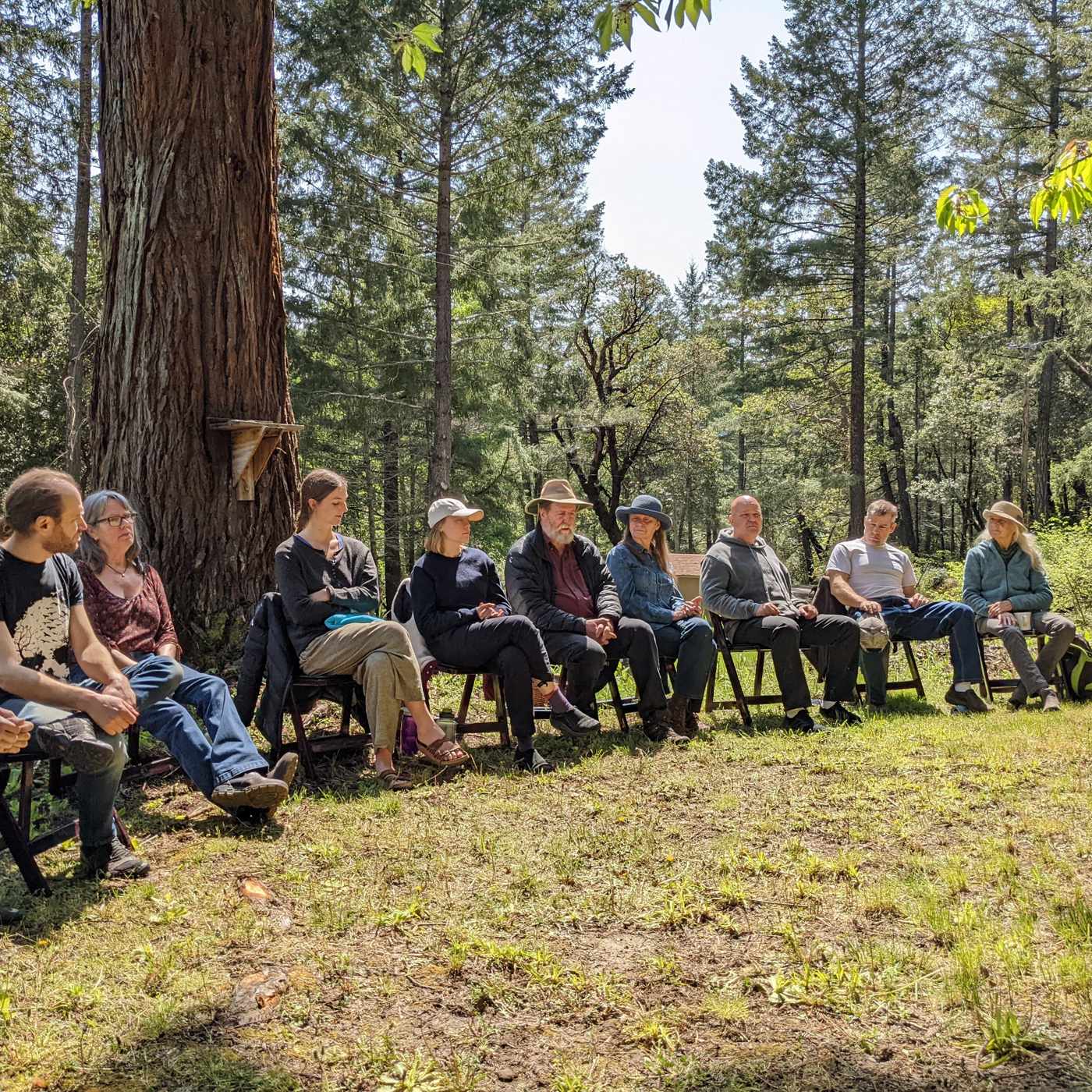
Ep 385PG&E gets annual license; conservationists work on fuel breaks
April 25, 2022 — PG&E is now operating the Potter Valley Project under an annual license, after a mystery applicant was turned down cold. And forest health enthusiasts gathered at a Buddhist monastery in Leggett over the weekend to strategize how to build fire resilience using grant funding and local labor. On Thursday, the Federal Energy Regulatory Commission granted PG&E a license to operate the project until next April, writing that the Federal Power Act does require the Commission to issue an annual license to the current licensee, “under the terms and conditions of the prior license until a new license is issued, or the project is otherwise disposed of…” The brief notice concluded that “PG&E is authorized to continue operation of the Potter Valley Project, until such time as the Commission orders disposition of the project.” On Friday, the Commission informed Antonio Manfredini, who had applied for the license on behalf of a business called PVP 77, that it was rejecting his application because it was late; he had not done any of the initial consultations or studies that were required; and the “application patently fails to conform to the requirements of the Commission’s regulations.” The applicant has 30 days to request a rehearing. UPDATE: Manfredini filed an appeal on Monday morning, arguing that “The License Application submitted continues the process initiated by PG&E (P-77-285) on 4/62017 and continues the process initiated by The NOI Parties (P-77-298) on 6/28/2019.” The appeal refers to PG&E and the NOI parties as “Proxy.” A coalition that included The Mendocino County Inland Water and Power Commission, Sonoma County Water Agency, California Trout, and the County of Humboldt, notified FERC in June of 2018 that it was calling itself the Notice of Intent (NOI) Party, and that it intended to file for the license to the Potter Valley Project. Environmental groups are expecting a further order from FERC to surrender and decommission the project, though very little information is available about what that means exactly or how long it will take. Clifford Paulin, who is legal counsel for the Potter Valley Irrigation District, was not surprised that FERC granted PG&E the annual license. For him, the remaining uncertainty lies in the big-picture conditions of the drought, as well as details about the pikeminnow reduction program and how additional conditions to the license, if any, will be implemented. Paulin said that, while the irrigation district’s contract with PG&E entitles it to 50 cubic feet per second, the district’s directors acceded to PG&E’s request to stay on a demand-based system, only asking for the amount the district can sell to its customers. This is calculated in part to protect the infrastructure at Lake Pillsbury and Scott Dam in Lake County. It also means that the only additional water going into the Russian River and Lake Mendocino from the Eel River will be the minimum instream flows required by the National Marine Fisheries Service to protect salmonids in the Russian River. Paulin thinks the wild card application may have been part of what caused the delay in FERC’s announcement about the annual license, but said he didn’t “see Manfredini being much of a factor’ otherwise. Curtis Knight, the Executive Director of the environmental organization California Trout, described the granting of the annual license as “a big step,” which “everyone knew was coming…the only weird note was Manfredini.” CalTrout is one of the parties that was working with Russian River water users to apply for the license, but was unable to raise enough money to pay for the studies. Now it’s signed on to a notice to sue PG&E under the Endangered Species Act, claiming that the fish ladder at Cape Horn Dam causes unauthorized take. Still, Knight expects that the Manfredini “distraction won’t amount to much;” and is looking forward to a timeline for the surrender of the project. He hasn’t given up on working with Russian River water users, but said “It may have to get a little messy first,” before FERC defines the process of decommissioning the project. In the north county, two environmental organizations gathered at the Rangjung Yeshe Gomde Tibetan Buddhist Monastery in Leggett to brainstorm plans to resist the ravages of climate change and further the vitality of the Eel River through forest management. The Northern Mendocino Ecosystem Recovery Alliance has joined with the Eel River Recovery Project to push for a major shift in preparing for fire and bringing it back to the landscape. Eli Rider, of the Leggett Valley Volunteer Fire Department, and Will Emerson, of the Bell Springs Fire Department in Laytonville, are inspired by a $4.9 million grant from CalFire to carve a fuel break into Bureau of Land Management (BLM) lands in the Red Mountain wilderness, off of Bell Springs road. The grant is being administered by the Mendocino County Resource Conservation District. In additi

Ep 384Fiscal review provides details on revenue decrease
April 21, 2022 — The Board of Supervisors went over budget priorities in a preliminary fiscal review this week, where they learned details about the projected deficit and discussed belt-tightening measures. Interim CEO Darcie Antle summarized the most significant projected shortfalls, saying non-departmental revenue had had to be cut three percent, or $4.3 million, to meet the revenue projections for 2022-23. The health plan deficit is $5.7 million, not including the $2.5 million that have been incurred but not reported. “And as you know, there has been a decrease in cannabis tax revenue,” Antle remarked. The county got a significant cushion last year from ARPA, the American Rescue Plan Act, a nearly $17 million grant intended to aid those most hard-hit by the pandemic. Instead, the board agreed last year to consider using ten million dollars of the grant to provide county core services and infrastructure, with $1.7 million of it to hire new staff, in the hopes of increasing staff to pre-covid levels. Almost one and a half million has already been allocated to vaguely defined support for public health covid response, and another $1.1 million to address negative economic impacts. The fiscal team suggested using further ARPA funds to alleviate the health plan deficit. Supervisor John Haschak expressed some misgivings, saying, “The original intent of the ARPA money was to have real community input into the process. And it doesn’t sit well with me that we haven’t done any community outreach with the ARPA funds and how they're going to be spent. Obviously we’re in a time when we need to fix our budget. But I think we should have been doing community outreach and seeing how the community wanted to use this. Because it was meant for covid relief.” Deputy CEO Tim Hallman painted an overall picture that was not encouraging. Actual year-over-year revenues are down, he said. “From last year to this year, just in the budgeting alone, we’re looking at a $1.4 million decrease, which does not include cost of living increases… So even though our costs have gone up, our revenues have gone down,” he concluded. And Deputy CEO Cherie Johnson spoke about the projected $5.7 million deficit in the health plan. “We are researching plan changes and potential increases to premiums,” she told the board. The projected $5.7 shortfall is based on end-of-year claims that will be coming in, and it does include last year’s $1.1 million deficit. Hallman elaborated on the projected shortfall in cannabis tax. “It is showing close to a $4.5 million dollar decrease over what was collected in the 20-21 fiscal year,” he reported. “This of course is going to have a huge impact to the net county cost and its allocations.” Michael Katz, the Executive Director of the Mendocino Cannabis Alliance, took the opportunity to highlight the contributions of the cannabis industry to the local economy. “I’m drawn to the information provided in the budget document that shows that in fact the cannabis tax for the year 2020-21 wound up coming in at about $6.4 million, which is about $800,000 more than was previously projected,” he said. “It just goes to show that if you look at the trajectory of the consistent increase in cannabis tax revenue up until this point, that despite the challenges that we’ve had, our community continues to contribute more and more to this county, in the tiniest footprint imaginable, only 290 acres of licensed cannabis cultivation. And so when you’re talking about the budget and how can we identify items that are revenue generating, it’s pretty clear that doing everything in our power to save the existing licensed operators in the cannabis program…is the best immediate chance that this county has to maintain the revenues that it has come to expect from this community.” Patrick Hickey spoke on behalf of SEIU 1021, which represents most of the unionized county workers, to request a big-picture view of the budget. “From the presentation, we can’t determine if we have a structural deficit, or are just experiencing a routine shortfall,” he declared. “There is no mention of the county’s general fund reserve. The reserve is specifically for these sorts of situations. How much is currently in the general fund reserve? These funds are supposed to smooth out the dips and bumps along the way. The ARPA monies are not the only funds the county can access. The Board has identified a number of promising sources of ongoing revenue for beefing up property tax and TOT (transient occupancy tax) enforcement. The county has a number of unfilled positions that are revenue generators. Filling these should be a top priority. We need to remember that a large part of the county’s budget is not covered by the general fund, but comes from other sources.” Antle provided more detail on the county’s reserve funds, informing the public that the general fund reserve is at $12 million, while monthly expenses are $18 million. “And then the overall reserve i...

Ep 383Supervisors hear update on JDSF scientific review
April 20, 2022 — Attendance was low at the first hybrid in-person zoom Board of Supervisors meeting in two years yesterday. After public comment, which ranged from unresolved issues in the cannabis department to dissatisfaction with the covid response, the Board received an update from state officials on the scientific review of Jackson Demonstration State Forest, which the Board requested last year. At the close of the presentation, the board voted unanimously to request representation on the Jackson Advisory Group, or JAG, though it hasn’t been determined if that means an appointed representative or a supervisorial liaison. The JAG advises CalFire and the Board of Forestry on the management of JDSF. Last month, two new members joined the group. Reno Franklin is the chairman of the Kashia Band of Pomo Indians in Sonoma County, and has served on the National Indian Health Board and is a member of the Advisory Council on Historic Preservation. Joanna Nelson, the director of science and conservation for the Save the Redwoods League, joined the JAG with the intent of advising “on the development of improved, science-based restoration management practices,” according to an announcement by the conservation group. There was no written material accompanying the presentation by Deputy Director of California Natural Resources Jessica Morse and Demonstration Forest Manager Kevin Conway, of CalFire. Morse spoke about who will be involved in the scientific review. Dr. Elizabeth Forsberg, who is a PhD scientist with the Nature Conservancy, was appointed to the Board of Forestry in September. She will be running the management sub-committee of the Board of Forestry. “As to this board’s request specifically around reviewing the science, the forest and wildfire resilience task force at the state has a science advisory panel made up by PhD forest scientists from the UC’s and other institutions, and we’ve asked them to do a scientific review of the Jackson,” Morse said. “That study is underway right now, and they’ll be reporting back to us in the coming months.” Marie Jones, a member of the Mendocino County Climate Action Advisory Committee and a county planning commissioner, wanted more detail. “I would love to actually see what the proposal is for the scientific study of JDSF,” she said. “It sounds a little haphazard, and like the advisory group will actually be doing some of the work. Is it possible to provide us with an outline of the proposed study so that we can look at it and be sure that our issues will actually be looked at?” Morse reminded supervisors that the board of forestry voted last year to review the JDSF management plan with an eye toward tribal co-management. But David Martinez, a longtime activist with Winnemem Wintu heritage, said he hasn’t seen evidence of it yet. “I’ve been out into the forest many times, especially in the Caspar 500 and Soda Gulch,” he said. “What I see is the road building and the destruction of sacred sites, cultural properties, and I see the proposed destruction of cultural gathering zones. And it’s all been approved and okayed. It is not okay to destroy the historical properties of the Pomo people. And the Yuki peoples. Everything in their management plan says they can do these things because it is necessary for forest product production. This has to change,” he insisted. That might be possible, with a different funding stream. Morse said this year there is a $10 million budget for the demonstration forests, “so that there’s not any pressure to be able to harvest trees. We’ve asked for additional funding in this year’s current budget before the legislature so that these demonstration forests can just have a steady income, so that their costs are covered and that they can be these world-class forests that we need them to be.” She added that, “There are some studies happening on carbon sequestration and climate resilience that these new investments are going to be focused on.” Conway said Calfire plans to use some of the money for a fuels reduction project on road 408-409 near the Caspar scales; improve trail signage; and conduct fire resiliency work, like completing a long-planned fuel break along Three Chop Ridge, and re-introducing prescribed fire to the forest. “We’re also going to be engaging with some scientists to try to answer some of the questions that the community has about our forest management and climate change,” he said. He also reported on CalFire’s efforts to engage the community, including the activists who have brought the logging to a standstill. “We have not entered into any timber sales in 2022, in order to give us an opportunity to give a public tour of the sales prior to going out,” he said. “We have also been slowing down our submittal of new plans…we had three members of your climate action advisory committee come out and look at the forest. We’ve done five community tours.” But Jones remained dubious about what she called the mission of...

Ep 382Groups sue PG&E as Potter Valley Project license expires
April 19, 2022 — The license for the Potter Valley Project expired on Thursday, April 14. By Friday, a coalition of environmentalists and fishermen had filed a 60-day notice of intent to sue PG&E, the project owner, under the Endangered Species Act. The main complaint is that the fish passage facility at Cape Horn Dam in Potter Valley causes unauthorized harm to endangered fish, by preventing their passage when the facility is clogged, or making them vulnerable to predators as they try to climb the ladder. The Federal Energy Regulatory Commission, which has authority over the project because its stated purpose is generating hydropower, has not yet declared if it will order PG&E to surrender and decommission the project, or if it will allow the utility to continue operating it on a year-to-year basis, as the company has said it plans to do while it recoups the cost of an expensive piece of replacement equipment. Redgie Collins, the Legal and Policy Director for CalTrout, one of the groups intending to sue PG&E, says that, with the expiration of the license, “PG&E no longer has take coverage for listed species, meaning that they can no longer harm, harass, directly kill or injure salmon (or) steelhead at their project site. The current fish passage operation is functionally broken and leads to take. It’s time for PG&E to realize that this project does in fact take fish.” Last month, the National Marine Fisheries Service (NMFS) wrote a letter to FERC, saying that the Project is causing take of fish on the endangered species list, in a manner not anticipated in that agency’s 2002 biological opinion. The biological opinion allowed the project to operate if it met certain conditions. Collins added that, “Along with the license, NMFS’ biological protections also expire with that license, meaning that PG&E is now vulnerable to litigation we are bringing.” PG&E said in a statement that, “The potential claims described in the notice are without merit. PG&E is strongly committed to environmental responsibility, and we are operating the Potter Valley Project in full compliance with the National Marine Fisheries Services’ (NMFS) Biological Opinion (BiOp) and its incidental take statement, which is incorporated into the Potter Valley license. Upon expiration of a license, the Federal Power Act requires FERC to issue an annual license, which renews automatically, with the same terms and conditions for the project, until it’s relicensed, transferred or decommissioned. That means PG&E will continue to own and operate the Potter Valley Project safely under the existing license conditions until the project is transferred or FERC issues a final license surrender and decommissioning order.” The project is currently unable to produce power because of a damaged transformer, which could take two years to rebuild. Alicia Hamann, the Executive Director of Friends of the Eel River, which has been at the forefront of the fight to remove the dams, describes the Eel as “a river of opportunity,” with 280 miles of habitat for genetically diverse fish that haven’t made it to the ocean since 1922, when Scott Dam was built. She’s not entirely opposed to a continued diversion of water from the Eel into the Russian River. “The genetics for summer steelhead live on in rainbow trout that are trapped behind Scott Dam,” she said. “This means that there’s potential for the offspring of those trout to essentially become summer steelhead once again, if they could just reach the ocean…there’s still an opportunity for an ecologically appropriate diversion. By that, I mean one that operates without a dam and runs during the wet season, when the Eel has water supplies to spare. At this point, it’s up to Russian River water users to decide how much they want to continue the diversion, and to come together to fund and implement a plan.” That might be easier said than done. On the day the license expired, Janet Pauli, of the Potter Valley Irrigation District, reported on the results of early surveys to the Inland Water and Power Commission. The IWPC had hired a consultant who polled Russian River water users. “It ended up being a polling base of about 23,000 people,” Paulie said. “I think they did nearly 400 polls of individuals. “The goal was to see if people had an understanding of their water supply, where it comes from, potential vulnerability with regard to the Potter Valley Project, how they felt water supply was being managed, or if they even knew. At the end of that poll, it was determined that to get a two-thirds vote for a parcel tax would be tough. Might not be successful. And would not, in all likelihood, generate the kind of funding that we believe we’re going to need moving forward in this next phase of the project license.” It’s impossible to be unaware of water conditions in the Eel River basin, according to Adam Canter, the Director of Natural Resources for the Wiyot Tribe at the Table Mountain Bluff Rese

Ep 381Measure V to play role in logging lawsuit
April 18, 2022 — Three environmental organizations are suing CalFire over the approval of a timber harvest plan by Mendocino Redwood Company which they say violates Measure V; would degrade the watershed of Russell Brook, which is a tributary of Big River; and would damage spotted owl habitat. The Center for Biological Diversity, the Environmental Protection and Information Center, or EPIC, and the Coast Action Group, filed in the Mendocino County Superior Court earlier this month, asking a judge to set aside the approval of the plan. It’s the first legal challenge invoking Measure V, the 2016 citizens’ initiative which declared that intentionally leaving dead standing trees is a public nuisance. Mendocino Redwood Company, which uses the herbicide Imazapyr in a practice called hack and squirt, or frilling, to kill tanoaks, maintains that the practice is a legal agricultural method under the Right to Farm Act and other local codes. Tom Wheeler, the executive director of EPIC, wants Measure V enforced. “I’ve been disappointed that Mendocino County has not, on their own initiative, gone and tried to enforce Measure V,” he said. “Because I believe the large industrial timber companies have used their legal muscle to bully the county into not taking legal action against them. And so I hope we can add some legal clarity about how Measure V is applied, and that through our lawsuit we can give the county greater confidence in their ability to litigate this.” In the summer of 2019, Xavier Becerra, who was the State Attorney General at the time, declined Mendocino County’s request for an opinion on the legality of Measure V, due to an unspecified conflict of interest. CalFire also uses hack and squirt in study areas within the Jackson Demonstration State Forest. Wheeler elaborated on the role of Measure V in the lawsuit over the harvest plan, which covers 993 acres. “So we are not enforcing Measure V, because we cannot, per the terms of Measure V. The county is responsible for enforcing the nuisance measure there,” he specified. “But we are saying that CalFire, in approving a timber harvest plan that includes hack and squirt, that that is a violation of the Forest Practice Rules.” But Justin Augustine, an attorney with the Center for Biological Diversity, said the lawsuit is about more than a citizens’ initiative that’s never been enforced. “Separate from the Measure V issue, we are also pointing out in our complaint and in this litigation overall that this hack and squirt and killing of tanoaks, it’s not just a Measure V problem. It’s an ecosystem problem, because these tanoaks are a major aspect of the integrity of our redwood forests.” While tanoaks are thought to compete with trees that produce high-value lumber, Augustine argues that they also produce up to 200 pounds of acorns a year, which is a vital food source for wildlife. Regarding the Russell Brook lawsuit, a CalFire spokesperson said in an email that, “CAL FIRE cannot comment on a project that is currently under litigation. The Timber Harvesting Plan was reviewed by an interdisciplinary team pursuant to the Forest Practice Act and Rules, was found to be in conformance with those rules and was determined to have mitigation measures in the plan to ensure there would not be any significant impacts to the environment.” Measure V was championed by Ted Williams, before he became the fifth district supervisor, while he was chief of the Albion Little River volunteer fire department. It was opposed by Jim Little, the Laytonville fire chief, Bruce Strickler, a retired CalFire Deputy Chief, and Marc Jameson, the retired deputy chief and demonstration forest manager. Mendocino Redwood Company claimed that there have been instances where firefighters successfully controlled fires in areas where tanoaks had been treated with herbicide, including the 2008 Mendocino Lightning Complex fires. But Augustine doesn’t think the current THP includes enough protection for large old trees that were spared from an earlier plan in 2004. “They’re projecting this idea that, don’t worry, we’ll protect these trees, but they have not disclosed what in fact they are going to do with each individual large old tree. For example, they state in their timber harvest plan, which was approved, that their biologists will determine which ones stay and which ones will go, and to us, that’s really the fox guarding the henhouse,” he said. “And not what CEQA, the California Environmental Quality Act, is all about.” Wheeler added that the results of surveys for botanical species and northern spotted owls were not made public before the plan was approved. “The public has been denied that opportunity to understand what is at stake,” he complained. Both organizations have challenged timber harvest plans in the past. “We’ve won some and we’ve lost some,” said Augustine, of the track record for the Center for Biological Diversity. “And hopefully, this one will add to the win bag.”

Ep 380Mendocino flies Ukrainian flags
April 15, 2022 — Around late March as I drove into Mendocino Village, I saw a new sight: two of the biggest flags in rich brilliant color, dancing in the strong wind. Flags in the town of Mendocino are normal for the music festival, art events, to direct to one of the many weddings that the rustic and charming backdrop of Mendocino plays host to. This pair struck an immediate chord with this journalist, however, when I realized the significance of their colors: one yellow, one blue, side by side. As I kept driving, I saw several more. Today there are literally dozens of pairs all around town. You really cannot miss them if you drive or walk around the town of Mendocino. I have been curious about their sudden appearance and apparent ability to multiply. So I talked with the person behind the idea for the flags around town, local resident David Gross. We met at the Rotary Park in Mendocino, on the corner of Main and Lansing Streets on a sunny early morning with birds chirping in the background and the air warming us as we sat at a comfortable well worn picnic table.

Ep 379Crab fishery shut down as whales recover
April 14, 2022 — The California Deptartment of Fish and Wildlife has announced that the commercial Dungeness crab fishery in the entire state of California will close two months early, at least until mid-November, due to five humpback whale entanglements in crab gear along various parts of the coast. The commercial fishery from the Sonoma-Mendocino line to Mexico closed last Friday, and the rest of the commercial fishery, from there to Oregon, will close next Wednesday. The CDFW is also asking recreational crab fishermen to remove their traps from the water as soon as possible, but no later than April 24th. Recreational fishermen will still be allowed to use hoop nets and snares. Ryan Bartling is a senior environmental scientist with the CDFW marine region. With five entanglements in about a month and a half, “We are in uncharted territory,” he conceded. Three of the whales were confirmed to have been entangled in California commercial Dungeness crab gear, while the other two were not identifiable, but “the gear is consistent with what could be California commercial Dungeness crab gear,” he said. Anna Neumann is the harbormaster at Noyo Harbor in Fort Bragg. She paid for her masters degree in fishery policy partly by fishing for Dungeness crab. Changes in naturally occurring domoic acid, which doesn’t harm shellfish but is toxic to humans, have shortened many but not all of the crab seasons since 2015. And whale entanglements do appear to be increasing. “There are several theories out there as to why that is,” she reflected. One is that increased reporting means, “We simply have more eyes on the water. We’re looking now, whereas perhaps before we haven’t looked in past years. Or, with a recovering humpback population, “More whales are coming into the gear. Or it could really just be that we’re fishing more heavily, and the entanglements are just a direct increase of the overlap between the whales and the later season periods that are starting to happen as domoic acid is pushing seasons later and then the closures are kind of truncating the season into this very small period of time.” Bartling says new types of gear are being developed to reduce the risk of entanglements, like weak-link technology, that would cause lines to break if whales encounter them. There is also a kind of “ropeless gear,” which does have ropes and buoys. But the gear would be stowed on the ocean floor inside the traps, to be released according to a timer or remote control. Neumann says the biggest problem with ropeless gear is that fishermen rely on surface buoys, which are attached to the traps on the ocean floor with long lines, to let them know where other crews’ traps are. That’s important information, because if crews drop their equipment on a set of gear that’s already set, the two sets of gear could get entangled with each other, causing the loss of expensive assets, litter in the ocean, and traps that continue “ghost fishing.” “Even just tending your gear,” Bartling says, “or day tending, where they go out and set the pots and pull them in before they leave the fishing grounds…would probably help minimize the risk as well.” Neumann added that, “There are other ideas that have been floated through” a Dungeness crab working group that includes crab fishermen and CDFW scientists. Some are as simple as changing the color of the lines, since whales are colorblind to certain colors, and can’t see the blue or pink line used by crab fishermen. In the meantime, Dungeness crab fishing will not start up again until mid-November or early December. Neumann said fishermen based in Noyo Harbor will be doing “a little bit of everything,” depending on what kind of permits they have. She expects some will fish for salmon in California, Oregon, and Washington, bottom fish, go after open-access rockfish, or open-access lingcod and blackcod. “So they’ll all pivot into their respective fisheries,” she predicted. “And it’s really important to realize that the top two fisheries in California are Dungeness crab and market squid,” which isin Southern California, so, “They can’t pivot into the other top California fishery,” she concluded. Meanwhile, conditions for whales are looking up. “Their populations are recovering,” Bartling said. “There’s good foraging opportunity for them right now. There’s a lot of data around anchovies and sardines. The NOAA flight indicated there were some humpbacks foraging for krill at the shelf break. So: good news for whales. I would expect to see more whales beginning to arrive over the next few weeks.”

Ep 378Voters to receive ballots in early May
April 13, 2022 — Ballots for the primary election will be mailed out to voters at the end of this month, and sample ballots are now available at the Mendocino County elections page. The election will be especially lively in the fifth district, where Supervisor Ted Williams is facing challenger John Redding, and a bond measure for the Anderson Valley School District will be decided. Third District Supervisor John Haschak has an opponent in Clay Romero, and Michelle Hutchins, the current Superintendent of Schools, is squaring off against Nicole Glentzer. But many incumbents are facing no opposition, including Sheriff Matt Kendall, District Attorney David Eyster, Assessor-Clerk-Recorder Katrina Bartolomie, and four superior court judges, Ann Moorman, Keith Faulder, Victoria Shanahan, and Cindee Mayfield, all guaranteed six-year terms. Chamise Cubbison is running unopposed for the newly created office of Auditor-controller/Treasurer-tax collector. At a League of Women voters Q&A last night, Bartolomie said that voters can cast ballots at polling places, where they can also sign up for same-day registration, and they can also drop their ballots in drop boxes outside the county building at 501 Low Gap Road in Ukiah, or at the civic center buildings in Ukiah, Willits, Fort Bragg, and Point Arena. There is also a dropbox at the county fairgrounds in Boonville, which is available during office hours. The only ballot measure is Measure M, a proposed $13 million obligation bond for the Anderson Valley School District. The interest cost on the bond is expected to be $9 million. Louise Simson, the Anderson Valley Superintendent, told attendees that the measure requires 55% of the vote to pass. The tax would be $60 per $100,000 of assessed property value. Simson said she has raw sewage coming up onto the playground, leaking roofs, and classrooms with no running water for children to wash their hands. There is still $7 million available from a previous bond called Measure A, but it won’t be available until 2039. Measure M would be a 30-year obligation, but Simson expects that construction could get started fairly quickly. “With the interest rate environment changing, it would probably be a two-series bond,” she said, with the first series most likely coming available in the first year, and significant construction within three years. Property values in Anderson Valley are low, she noted, because of low turnover, but gentrification could add to the taxable property values. Simson is also tapping other sources of state and federal funding, including $40,000 in hardship money for gym heaters. She said she is also eligible for $600,000 for other projects, and she got some covid money to replace air conditioners at the high school. She’ll be offering tours of the campuses in May. Bartolomie laid out the rules for electioneering, observing, and exit polls on the actual day of the election, should people choose to show up at a physical location. Observers can watch the proceedings and ask questions of Bartolomie and the inspectors or judges, but not other poll workers. “They have to sign in, they have a little badge they have to wear, and then they have to sign out when they’re done,” she said. Electioneering, which includes wearing buttons or items of clothing urging voters to make up their minds one way or the other, is forbidden within 100 feet of a polling place. “Up in Willits Community Center, we had someone park a campaign van across the street,” she recalled. “So we had to get out and we had to measure, and they had to move it up the street a little bit. As long as it’s not within 100 feet, they’re okay.” Exit polls after the ballot has been cast are allowed, and voters can always decline to participate. “They just can’t talk to them inside the polling place, asking them how they’re going to vote, or what they’re going to vote for. But that can happen outside,” she specified. “Sometimes the media will come, and they’ll say you know, you voted, do you mind sharing your voting experience…You don’t have to answer, you can say, I’d rather not participate, and you can go on about your business.”
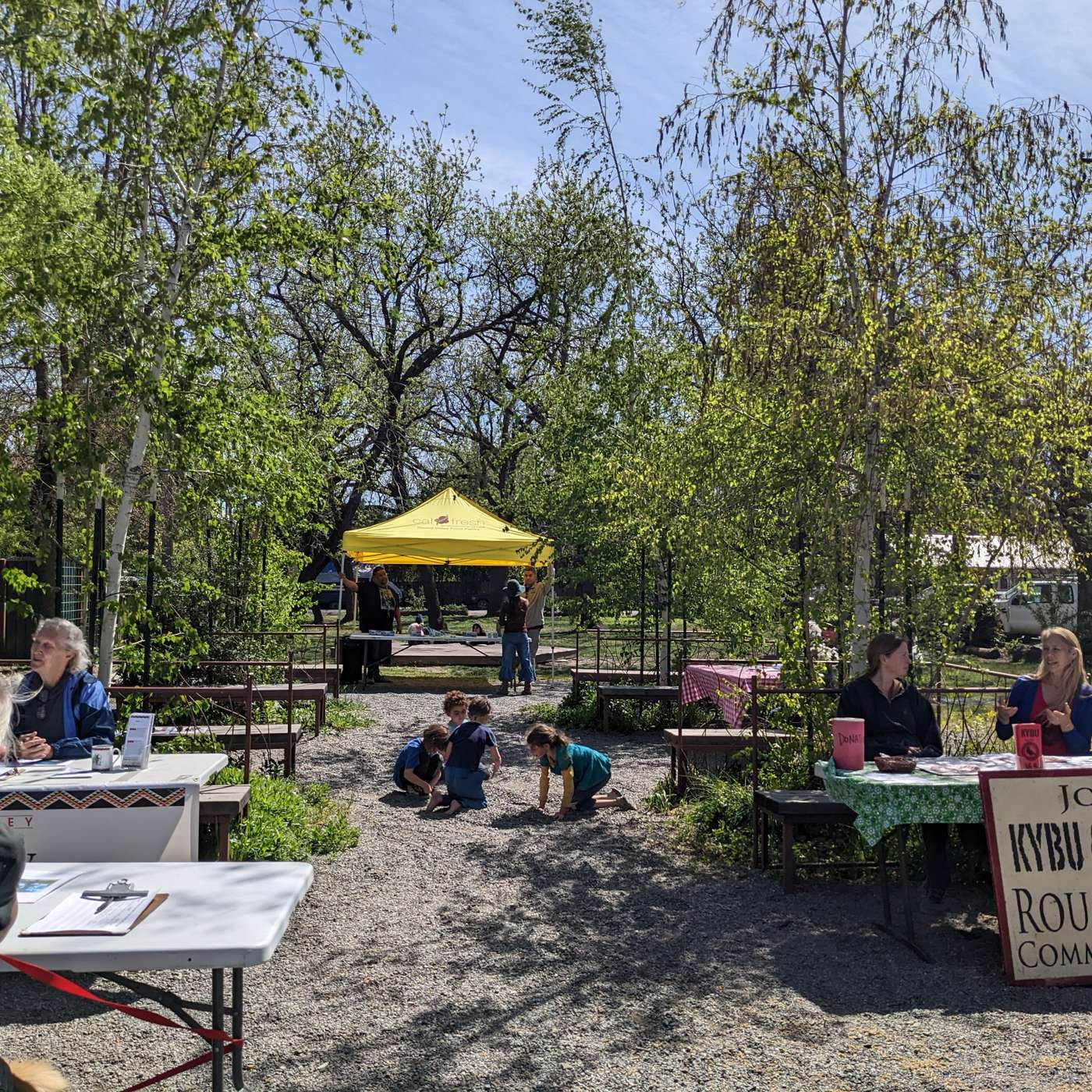
Ep 377Covelo Volunteer Fair seeks helpers for in-person events and services
April 12, 2022 — With pandemic restrictions lifting and spring in the air, people are gathering again, planning events both recreational and civic-minded. In Covelo on Saturday, volunteers set up tables in the park outside the library to attract more helpers to their various causes and to drum up enthusiasm for upcoming events like the Big Time and the Blackberry Festival, both of which have been on hiatus for two years. One organization that’s been more active during the pandemic is the food pantry, a program of the Round Valley Indian Health Center. Joel Merrifield, Sr, who is also a tribal councilman, was on the lookout for volunteers to help prepare and distribute the food, and even deliver it to people living off-grid, way out of town. Merrifield estimated that before the pandemic, the food pantry served about 100 families a month, but that in the last two or three years, the number has risen to about 150. “Some people feel like they’re taking away from somebody, but we help break the stigma,” he said. The food pantry moved to the Round Valley Indian Tribe’s Health and Safety complex at 76300 Grange Street in downtown Covelo about 15 months ago. Another organization with a big presence in town is Friends of the Library, represented Saturday by librarian Pat Sobrero. The Friends provide funding for materials and programs, and serve as an umbrella for the Blackberry Festival and local radio station KYBU. “They also own this whole property where the Farmers Market holds their market every Friday afternoon,” she said. “So they do a lot of things for the community.” She added that, “The Friends are largely a fundraising operation that hasn’t done any fundraising for the last two years. So pretty soon, they’ll be starting their fundraising opportunities, and we’re looking for volunteers to help with that.” Charles Sargenti, the presiding officer of the Municipal Advisory Council, was trying to rustle up some interest in local politics. “Our primary function is to advise our supervisor, John Haschak, on issues affecting the valley,” he said; “but we like to do more than that. We like to be a place where residents can come together and talk about issues that are bothering them and brainstorm and try to come up with things to do about them.” The big knotty issue the council is thinking about right now is a water system for the unincorporated town of Covelo, which has sewer service but not water. Without a water system, it’s hard for businesses to rebuild after the fires, because there are no hydrants, no sprinklers, and not enough pressure to make the infrastructure effective if it were available. “So that’s something that I’m really excited about,” Sargenti concluded. The next meeting, at 6 pm on May 4, will be a hybrid in-person zoom affair. Sargenti thinks the pandemic-induced reliance on zoom has had the benefit of allowing people, including representatives of far-away agencies, to attend meetings in a location that has always been remote. But other volunteer-seekers were focused on bringing people together in person for a beloved summer festival behind the flour mill, which has been quiet for the last two years. Marylou Milek was manning a booth for the Round Valley Blackberry Festival, which will be celebrating its 39th year on August 20-21. “We skipped two years, but we counted one of them, because we had a virtual Blackberry Festival on our local radio station, KYBU,” she recalled. Lew Chichester, a de facto representative of most of the above-mentioned organizations, stepped into the local KYBU radio station to share a plug for another much-anticipated in-person event. The local Big Time, organized by Round Valley High School students, is also back after two years of loneliness and covid. Chichester listed the stick games, Native dancers, inspirational and comedic speakers, booths, and food that will be at the high school campus on Friday, April 15, from 9:00 am to 1:00 pm. It is worth the drive, he assured an out-of-towner, adding that, “It’s inspirational, it’s wonderful, it gives me, every once a while, the realization that this is actually a really exciting and cool place to live.”

Ep 376Library services comprehensive
April 11, 2022 – Libraries are often thought of as places to check out books or engage in a quiet read. However, Mendocino County Libraries provide more than just what can be found on their shelves. Each branch offers well beyond what could be considered traditional library services. Zip Books, WiFi hotspots, 3D printers and California State Park Passes are offered through the library and available to all Mendocino County library patrons.

Ep 375Leggett Park serves historical crises
April 8, 2022 — As drought parches the land and fire season approaches, community groups are trying to figure out how to get more water to quench more fire. In the absence of small natural oases that used to be plentiful, that often means building huge expensive tanks, like the one envisioned by a coalition in the north county. The Leggett Fire Water Project is an effort to build a large steel tank at Tan Oak Park, just off of Highway 101 between Leggett and Laytonville. Jessica Roemer is the Executive Director of Tan Oak Park, which is owned by a non-profit called Families and Friends United by AIDS. The organization bought the park as AIDS was raging around the world. Now, as another pandemic recedes, Roemer is thinking about how the park can be put to service in another pressing crisis.

Ep 374Supervisors approve conditions for pre-trial release pilot program
April 7, 2022 — The Board of Supervisors took on criminal justice, trash, and housing at this week’s meeting, though a hearing to consider a permit to convert a Willits-area motel to apartments was postponed until May third. The board approved a pre-trial pilot program to monitor people who have been booked into jail, can’t afford bail, and are likely to show up to their next court date if they are released from jail. The monitoring would include a range of measures like cell phone reminders about court dates to in-person visits by a probation officer, ankle monitors, and drug testing, so that people who have not yet been tried could stay out of jail. The probation department would receive the one-time state funds of about $406,000 to hire more personnel and buy more equipment, like ankle monitors and computers. The Board already approved three more full time employees for the probation department, and if those hires succeed, the county would have to rely partly on the general fund to pay for their ongoing employment. Mendocino County does not currently have a pre-trial monitoring program, which means that often people who have been arrested wait for their court dates in jail. But last year, the Supreme Court of California decided that the state’s bail system was unconstitutional, because bail is set according to a county schedule according to the crime, rather than the defendant’s record or ability to pay. In 2017, Kenneth Humphrey was arrested in San Francisco for robbing an elderly man of a $5 bottle of cologne. He couldn’t pay his bail, so he spent a year in jail waiting for his court date. A public defender and a civil rights group appealed his case, and now courts are supposed to consider several factors when calculating a defendant’s bail. One is public safety, and another is the arrestee’s ability to pay. Chief Probation Officer Izen Locatelli told the board that the county has had a couple of short-lived pre-trial programs. The most recent, which ended in 2015, included assessments but no monitoring. “Since that time, there’s been no pre-trial release program operating in Mendocino County,” he reported. “And we’re one of about six or seven counties that have no type of operating pre-trial program.” Present release options include field citations, where the person cited is not actually taken to jail but is expected to appear. Arrestees can also be released from jail if they promise to appear. Most commonly, people post bail. They can also be set free on their own recognizance at an arraignment. “You’re not monitored, you’re not supervised, you’re out on your own recognizance, and you’re supposed to follow the terms set by the court as you go through the proceedings,” he elaborated. Locatelli can’t say for sure how many people would participate in the program, though he estimated it could be 40-60. And he told Supervisor Glenn McGourty the current criteria for assessing defendants is ambiguous. “The candidate that you’re looking for is somebody with a minimal prior history of criminal conduct, but they’ve committed a felony,” he said. “The court essentially brings the person before them at arraignment and tries to make decisions on whether they should be released or not. Those decisions are made on the fly, a gut instinctual feeling. There’s no assessment that they’re looking at. They don’t have any criminality studies except for what the DA has at that time. So this assessment, which is on a validated assessment tool, would give the court a better understanding if they should be released or not on pre-trial. You know, $20,000 bail might be impossible for someone to afford, if they don’t have a job. So you want somebody who’s going to be released from custody, they’re essentially being taken care of by the county, there’s less liability, they’re back in the community potentially going back to work and contributing while they go through the court process. But you also don’t want to release them with no supervision, monitoring expectation, terms. That also doesn’t warrant public safety.” The board approved a memorandum of understanding with the courts to implement the program through June of 2024, and authorized the probation department to receive the funds from the state. Interim CEO Darcie Antle said the executive office is starting to prepare the budget this week, and will present details at a supervisors’ workshop on April 19. On May 3, the board will hold a hearing regarding an appeal of a minor use permit to convert the former White Deer Lodge motel into 21 units of affordable housing. The property, just south of Willits at the top of the grade, is owned by the Church of the Golden Rule. Julia Krog of Planning and Building signed an initial study last month, declaring the department’s intention to prepare a negative declaration for the project. But Joe Cooper of Redwood Valley appealed the categorical CEQA exemption, arguing that there is no proof of adequate water supply, the pr...
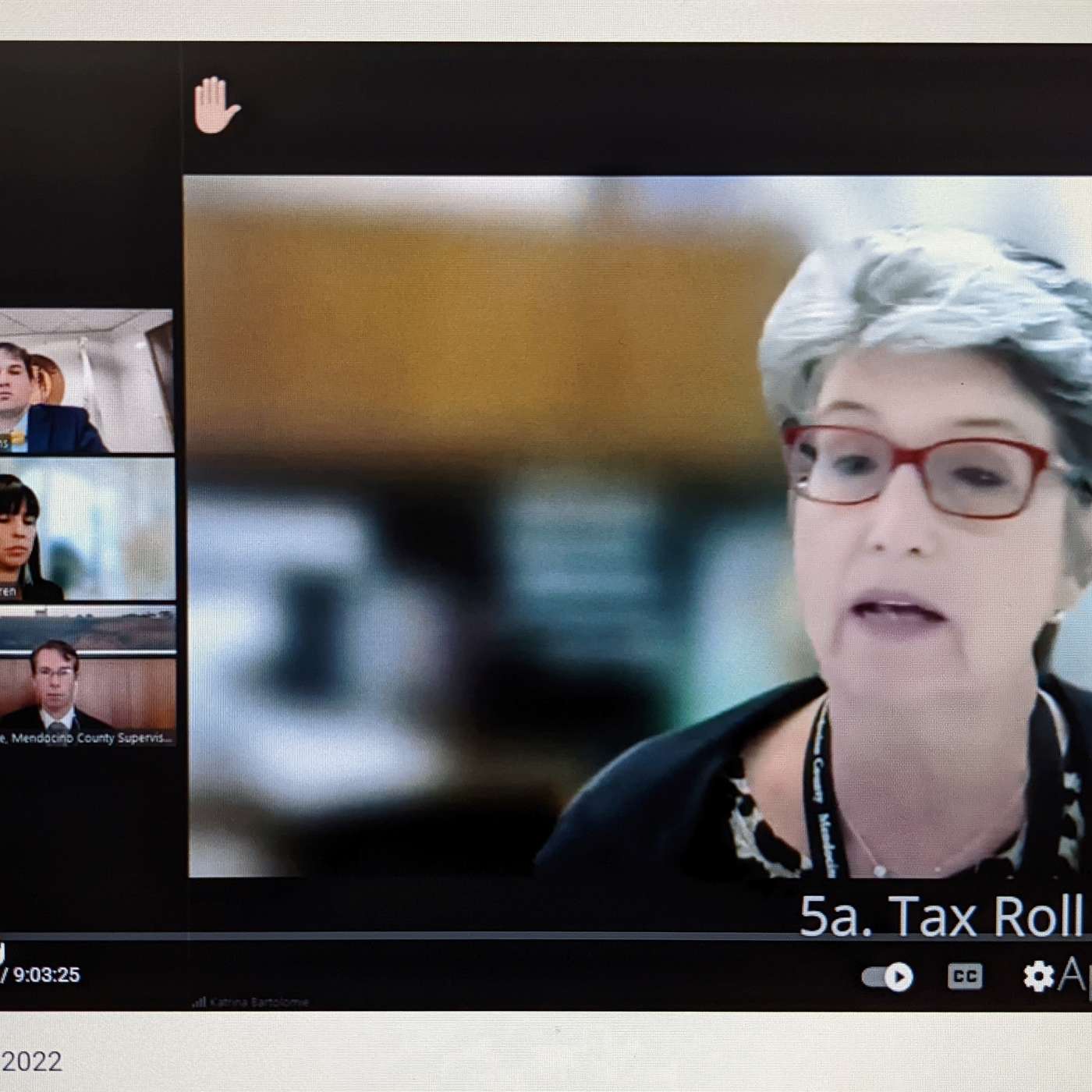
Ep 373Board takes up taxes, deputies, and menthol cigarettes
April 6, 2022 — As the county faces the possibility of a multi-million dollar shortfall, the Board of Supervisors gave the go-ahead to the assessor’s office to devise a program to assess taxes — but not penalties, on unpermitted structures that are not currently on the tax rolls. The Board also approved a program to grant hiring bonuses up to $20,000 for the sheriff’s department. Supervisors agreed to amend the local tobacco retail ordinance to expand the prohibition on flavored tobacco products to include menthol cigarettes. And residents on three miles each of Spy Rock and Bell Springs Road can expect chip seal over the next five years, rather than dust-off. Supervisor Ted Williams, who sponsored the item about updating the tax rolls, invited Redhawk Pallesen to share his research into properties that have been assessed far below value and which he believes are shortchanging the county’s coffers. Pallesen said he had used publicly available data to calculate that approximately 3,000 homes in the county are unpermitted. “Using current tax rates, this means that there’s about fifteen million dollars annually in lost revenue for the county,” he reported. Palleson said the census, which requires a physical address, only counted two of the approximately thirty homes on his road. He then expanded the search to about a mile and a half of his property, which he reported resulted in 47 unpermitted residences, 39 of which included unpermitted cannabis operations. He did not include other improvements that would have enhanced the assessed value of the property. Assessor/clerk/recorder Katrina Bartolomie told the board that her office does not share its findings with Planning and Building, and that adding structures to the tax rolls would not trigger code enforcement action due to a lack of permits. She also stated that her office would only use a satellite system if it was impossible to gain information about the property any other way. Ron Edwards was skeptical. “I really need to call foul on this one,” he said, pointing out the lack of any attachments to the presentation that would have provided some detail in writing to the public. “This really should be an education program,” he went on, adding that many people don’t realize that their ability to finance their property is dependent on the structures being legal. “You know, you are opening this up, with the cannabis program, to see what the unintended consequences are when you go down this road. And it’s just going to be horrendous.” The board agreed to ask Bartolomie and the Executive Office to come up with a plan to assess the properties and collect taxes on them, but, as Bartolomie noted, “We can’t move forward on this at all until we have staffing.” Bartolomie has had one applicant for the position of assessor’s aide, and is trying to bring up her clerical staff, as well. The sheriff’s office is also attempting to solve its staffing shortage. Pending a formal meet and confer with the county’s labor negotiator, the board agreed to allow Sheriff Matt Kendall to offer a $7,000 signing bonus to recruits who paid their own way through the police academy, and a $20,000 bonus to full-fledged law enforcement professionals coming into the department from another agency. Kendall told the board that he recently lost a deputy who left the department for higher pay elsewhere. He told Supervisor Dan Gjerde that an initial meeting with law enforcement groups indicated that the view of his proposal was favorable. “If we approve this, is this going to create morale problems?” Gjerde asked, wondering if long-time deputies would resent newcomers for getting a bonus while they get nothing extra. Kendall told him that his undersheriff had met with the Deputy Sheriffs Association and the Law Enforcement Managers Association and was told that “they were not upset about it, because it would help them get their days off.” If the proposal meets the approval of the labor negotiator, Kendall will try to attract more deputies and report back to the board in a year. Sheriff’s deputies will be authorized to enforce the amended tobacco retail ordinance, which is cracking down on flavored tobacco, including menthol cigarettes. The tobacco prevention program of Public Health is also working with the cities to ban flavored cigarettes, citing studies that prove flavors increase addiction among young people. Supervisor Maureen Mulheren supported the amendment, but said she thought it didn’t go quite far enough to solve the problem. “We are not focusing enough on the reasons why people choose to smoke in the first place,” she said, raising the issue of people using substances to alleviate depression, anxiety, and other mental health problems. She also pointed out that it’s possible to order tobacco products online, and that neighboring counties do not ban menthol. “WIthout a united front, people can simply go to another location to purchase products,” she said. But, in view...
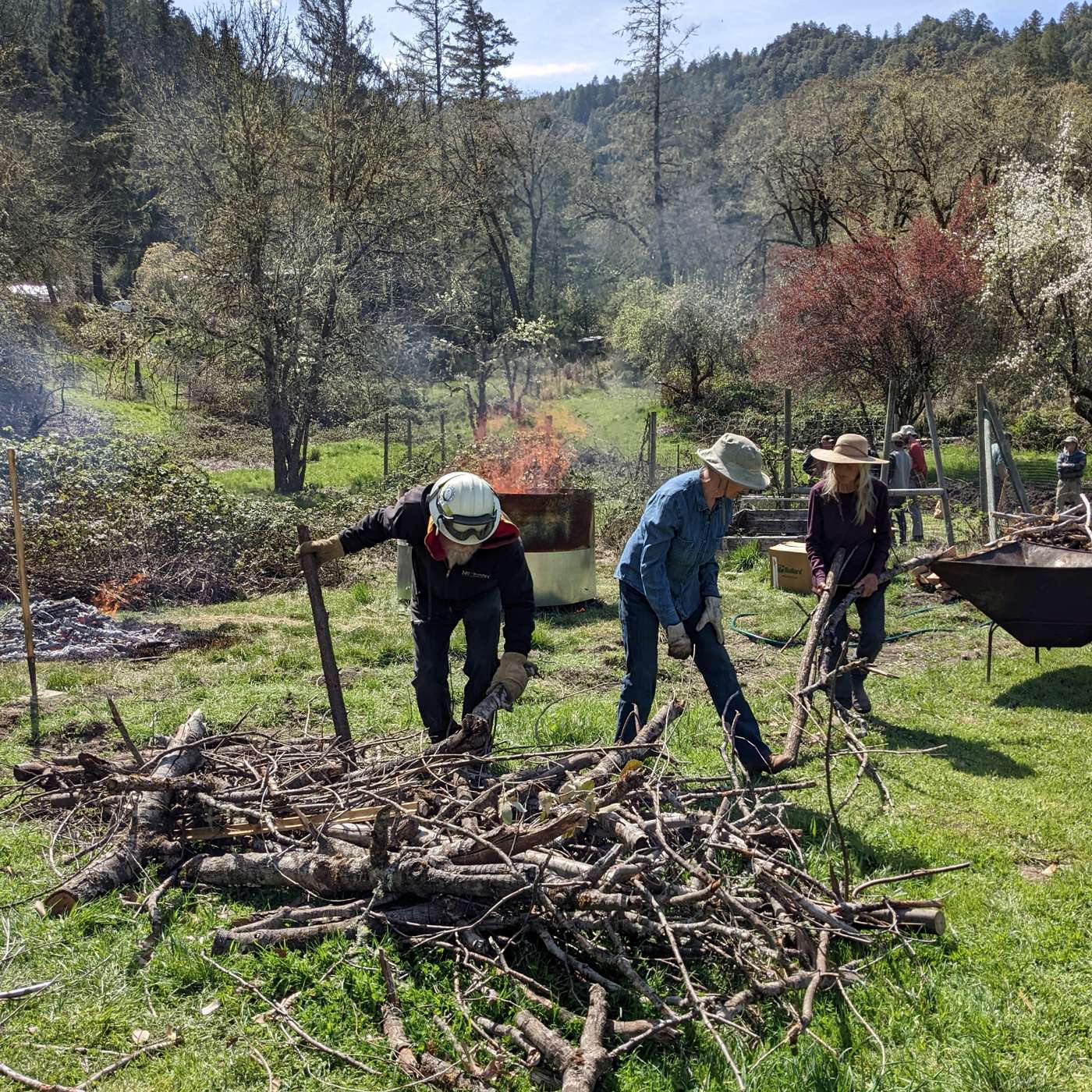
Ep 372New alliance of firefighters, environmentalists, plans to restore forest health
April 5, 2022 — A new alliance of environmentalists, fire departments, and landowners in northern Mendocino county is seeking to make forest resilience a priority for changes in the climate, economy, and social structure. About fifty people showed up at the kickoff event for the Northern Mendocino Ecosystem Recovery Alliance at Tan Oak Park in Leggett on Sunday. Kerry Reynolds is the Organizational Development Director for the Trees Foundation, which is the fiscal sponsor of the new Alliance. She notes that a lot more state money has recently become available to forest health projects, now that heavily populated areas are suffering the impacts of wildfires.“The funding is available,” she noted. “Finally. Even the Bay Area was having that total smoke-out and red skies, so there’s no place in California that’s not impacted by wildfires, obviously.” Will Emerson is the chief of the Bell Springs Fire Department and chairman of the board of the new Alliance. Prescribed fire will be a big part of the strategy to prevent raging infernos. Emerson says he hopes restoring the health of the forest will also provide paid work for his volunteers. “Firefighters are realizing that every time they put out a fire, they’re creating a debt,” he explained; “that really, the land needs to burn at some point, but you don’t want it burning in August when it’s a hundred degrees and the wind’s blowing. So, better to burn in the winter. All these forests are adapted to fire, if we let them. And all the suppression that’s happened in the last hundred years has just meant that there’s this huge buildup of fuel, and we’re paying the price now…we formed this organization around the three local volunteer departments of Piercy, Leggett and Bell Springs. Fire departments, especially volunteer fire departments, are great community organizations. It’s like our community is centered around them.” During the morning session, Emerson told the group that he can “hear the air hissing out of the bubble” that has sustained the economy of the Emerald Triangle. “People are going to have to find other work besides growing,” he acknowledged. “And it’s probably going to mean more work and less money. But it’s good work. There’s these mutual problems of an overgrown forest, climate change, and a weakened economy. So let’s combine them, and get people working in the forest, making it healthier.” Michael Furniss, of Cal Poly Humboldt, agrees. “We’ve been talking about the need for fuel treatments for decades, but there’s never been any money for it,” he began. “A little bit here and there, but nothing that scales with the problem. And now, after these big fires and really terrible fire seasons the last few years, and cities burning up and the Bay Area getting smoked out, the money is now flowing, big time. So it’s a new day. It’s a time when there’s going to be a whole industry here of building fire resistance and resilience in these forested communities.” As a soil scientist, Furniss does advocate low-level broadcast burns to reduce the excessive buildup of fine fuels, but he encourages less burning and more sequestration to improve the health of the soil and, ultimately, the forest. “Any kind of logging, especially the thinning that everybody wants to see now, and these fire resilience treatments, you generate a lot of slash, a lot of excess wood,” he observed; “and what are you going to do with it? In terms of climate, we want to limit the amount of greenhouse gasses that go into the atmosphere. It’s really important, even though these are not from fossil fuels, they’re carbon dioxide, there’s some methane, there’s black carbon, which is really bad for atmospheric heating, so to the extent to which we can sequester that carbon, in biochar or in chips that we just spread around the forest floor…and that’s not what we typically do. We pile it up and burn it. And it just goes away. Look, the pile’s gone! But it’s not gone. It’s in our atmosphere now, and we’ve recognized that to be a big problem for humanity; for the whole globe, really, and everything that lives here.” He acknowledged that, while careful seasonal burning is useful for keeping down excessive buildup of fine fuels, it is possible to overdo it and decrease forest productivity. “But the main problem with that is if you keep doing it,” he cautioned. “And if we do it just in small areas, in these shaded fuel breaks, it’s probably worthwhile. But if you continue to clean off the forest floor with this duff and fine woody material you get a longtime decrease in soil productivity…The key thing, though, for these little creatures that run the world, is to leave some large wood in place. And those are biological oases.” Fire suppression will still be part of the equation, though. Emerson said his department just got a grant from the Mendocino County Firesafe Council to buy three 2,500 gallon water tanks, which he plans to install at strategic points along Bell Springs Road. And Je...
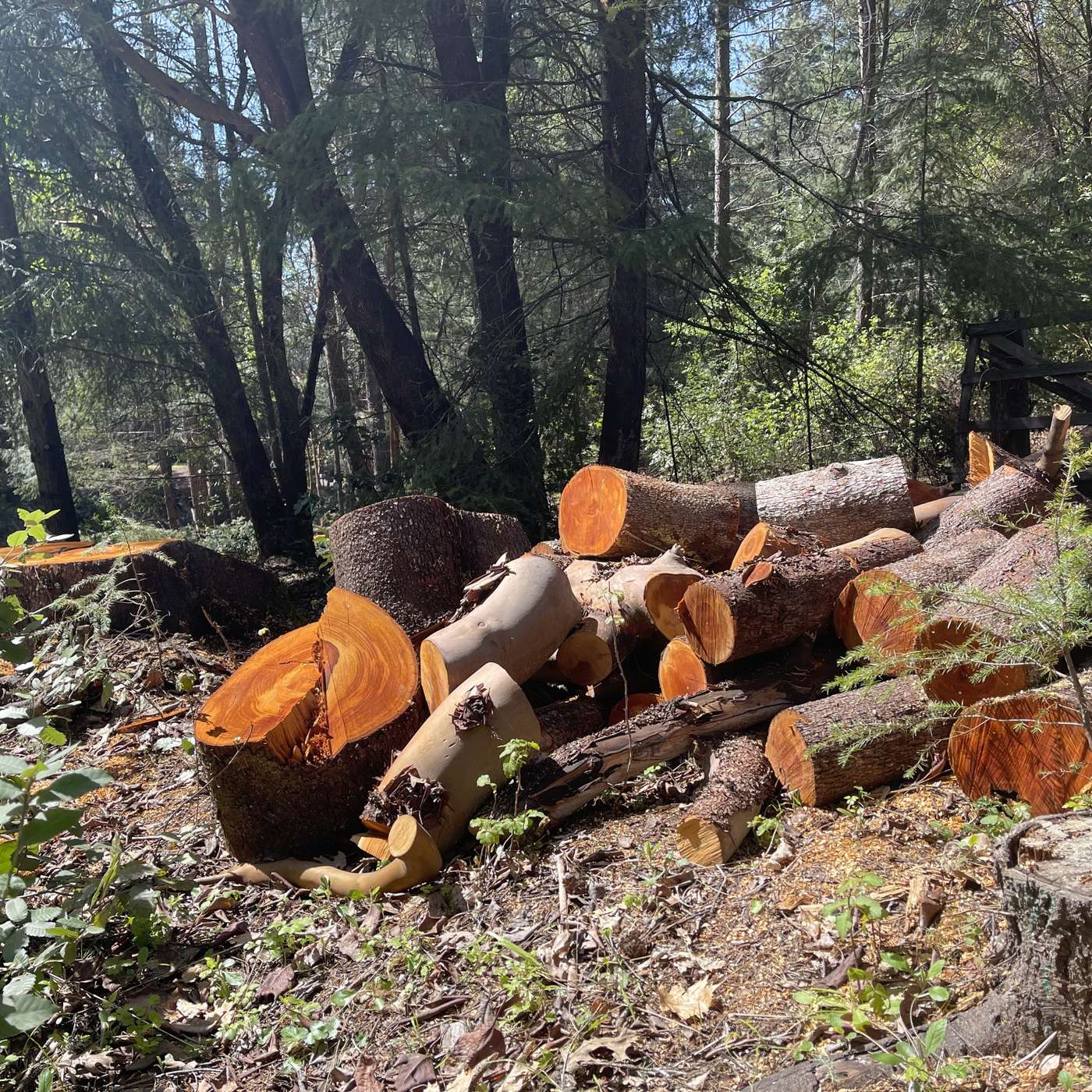
Ep 371Trees coming down in Willits
April 4, 2022 — As PG&E’s tree-cutting crews move into more neighborhoods, some property owners are slowly starting to think in terms of an organized response. But the enhanced vegetation management program, with its multitude of contractors and the lack of education or publicly available documents, is bewildering to most landowners. Lauren Robertson is a resident of Pine Mountain in Willits. She described the approach she’s seen in her neighborhood. “PG&E has been masterful at dealing with people individually,” she opined; “doing favors for some property owners. And as soon as they do a favor for a property owner, that property owner is suddenly not mad anymore. And that’s a little disturbing.” Robertson is scrupulous about hardening her property for fire safety. “We could bury our houses also, and that would prevent fires from burning our houses down,” she reasoned. “But we’ve hardened our houses. And I think that’s what PG&E is not doing. They’re not hardening their lines. Or hardening their infrastructure by cutting down trees.” A recent report by acting State Auditor Michael Tilden blasted the privately owned utilities and the agencies that are supposed to regulate them. Tilden wrote that the Energy Safety Office, which is part of the California Natural Resources Agency, approved PG&E’s 2021 safety plan, in spite of its own review, which “found that the utility failed to demonstrate that it was properly prioritizing other mitigation activities, particularly power line replacement and system hardening efforts,” like insulating bare cable in high-risk areas. Tilden added that, “The CPUC does not consistently audit all areas in the utilities’ service territories, it did not audit several areas that include high fire-threat areas, and it does not use its authority to penalize utilities when its audits uncover violations.” “There’s no authority that can tell them what to do. They can just do whatever they want,” according to Walter Smith, a former logger who turned his attention to international deforestation prevention efforts in the 1990’s. “We all know that corporate power is a problem. And now it’s right in our face.” Smith was also instrumental in starting the Mendocino County Climate Advisory Committee in 2019. For the past month, he’s been spending three or four hours a day researching the public resource code, making phone calls, and sharing his findings with an email list that includes dozens of environmentalists and political representatives in Mendocino and Humboldt counties. So far, he’s succeeded in keeping crews out of an old-growth grove that’s especially important in a millennial drought. “This whole hill was left as old growth,” he said on a recent afternoon, as he led a reporter into the deep, cool shade of the grove. “Because underneath, at the bottom of this hill, is an underground river, which we get our water from, and all these houses get their water off of that same one. The old-timers knew to protect the water, you gotta keep shade on it, and you gotta keep the old-growth trees on it.” Smith is especially perturbed by the damage that was done to an old madrone, when crews felled a tree from his neighbor’s property into the grove, tearing limbs from the old struggling hardwood and leaving debris from the felled firs all over the forest floor. “This tree, in terms of this neighborhood, is a heritage tree,” Walter related. He said neighborhood kids used to sit high in its branches and feel like they were “at the top of the world,” or swing out over the underground river on a rope swing. “So this old tree meant something, other than just being an old tree in the forest,” he concluded. “It was a home base, if you will, for children on this hill.” Marie Jones is the chair of the Mendocino County Climate Advisory Committee, which recently drafted a letter imploring the Board of Supervisors to petition the Governor and the Office of Energy and Infrastructure Safety to call a halt to the program long enough to get some answers, “on a range of issues,” she began. “So one is, what are landowners’ rights regarding tree removal? A lot of people don’t realize, but landowners can actually say, no you can’t remove these trees from my property. And also, if PG&E’s tree removal results in significant devaluation of your property, you can actually require PG&E to pay for that devaluation. We’re also very concerned about whether or not there really is a scientific basis for tree removal. I think it’s an easy fix for PG&E because it’s relatively inexpensive compared to upgrading their systems. But in the long term, it’s also very ineffective, because it does increase the fire risk, rather than reducing it.” The organized response is slow-moving and small-scale. But Randy MacDonald of Pine Mountain is holding out until he gets the documents and contracts and signatures he expects from any serious, legitimate project. “They have not been able to provide that,” he reported. “Now
Ep 370New mental health facility planned
March 31, 2022 — Ukiah was rocked by two murders in six days, less than a half a mile apart. Both victims and both suspects were mentally ill, homeless, or both. Now Redwood Quality Management Company, which oversees the county’s mental healthcare contracts, is planning a 16-bed Medi-Cal certified mental health rehabilitation center for the acutely mentally ill, a block from the critical residential treatment facility, which is fully built but not yet serving clients. Camille Schraeder, the Chief Programs Officer for RQMC, thinks the Medi-Cal funded center, which she hopes to open in late 2024, will free up more money that the county can use for other mental healthcare services. That’s because the county uses state realignment funds as a 40% match for Medi-Cal payments. So if patients are sent to facilities that are not Medi-Cal certified, the county has to pay the whole cost with realignment money. Schraeder reasons that if patients go to a facility that is Medi-Cal certified, the county will save 60% of its realignment allocation. She’s applied for a state grant she hopes will cover some of the construction costs. She says she’s building from scratch for a few reasons. “An MHRC (mental health rehabilitation center) is a 16-bed residential treatment facility that has intensive nursing and psychiatry. That’s what it has,” she explained. “We wanted it to be co-located with the medication, psychiatry, and therapy outpatient clinic as well as intensive substance abuse. So first and foremost, we need to have it do both. The clinic, and the MHRC. Secondly, we didn’t want to do what has previously been highly criticized in our community, which is to put something that is that intensive, with 16 mentally ill clients, on State Street.” In the meantime, the county psychiatric health facility, the critical residential treatment center, the rehabilitation center, and the new jail for mentally ill inmates are all in some stage of preparation, though none is available yet. They are all in Ukiah, which is in Supervisor Maureen Mulheren’s district. She listed four teams of outreach workers striving to engage mentally ill homeless people. She also pointed to the county’s success in getting people off the streets and into assisted living in Live Oak apartments, the former Best Western hotel, where residents receive a wide variety of social services. But she described an impasse. In spite of what she described as the county and its partners doing “an incredible job” of providing services to people who are ready, she said, “We have people on the streets that are not ready to accept services. And one of the biggest challenges is of course the laws in California. It’s not illegal to be homeless. It’s certainly not illegal to have mental health issues. But there’s not an opportunity then to get people into the services that might help them get out of their situation and off of the streets.” Schraeder thinks the proposed rehabilitation center could be part of the solution —though housing and staff are key components that will have to come together, too. She foresees referrals from the critical residential treatment facility, where people would stay for short-term crises. But she believes some others may be candidates for a temporary conservatorship — or court-ordered treatment, if Newsom’s proposal for CARE courts meets with the approval of the Legislature. “They really need longer term treatment to address their mental health disorder or their intensive substance abuse disorder,” she began, describing what she sees as potential clients for the rehabilitation center. “At that point, they would ask for a temporary conservatorship…once they were conserved, the public guardian would consider placing them at Anchor Health Rehab Center,” where residents would receive intensive case management, psychiatry, and board and care supervision. “Engagement is the piece,” she declared. Referring to the stabbing in the parking lot near the county’s Social Services building and Wells Fargo bank in Ukiah, she said, “Clearly everybody must have been trying to engage, must have been trying to get (the suspect) into care, and in America, you have free will.” If the Governor’s CARE courts proposal becomes law, local courts will be able to compel people who are severely mentally ill into treatment plans. It builds on Newsom’s $12 billion housing investments, but oversight, court costs, and other elements will need new state funding. The laist reported that the ACLU has raised concerns about the possibility of civil rights violations if people are forced into treatment. Mulheren has some local historical context. “I was just a child when the facility in Talmage was closed,” she recalled, referencing the Mendocino State Asylum for the Insane, now the City of Ten Thousand Buddhas. “I hear a lot of people talking about this pendulum that has swung, especially in the state of California, where we were housing vulnerable individuals, we w...
Ep 369A special easement for the Queen of the Beats
March 30, 2022 — ruth weiss, Queen of the Beats, always had a special connection to the majestic trees on her property at the end of the Albion ridge. Before her death, she crafted a conservation easement with the Mendocino Land Trust to protect those trees in perpetuity. We’ll hear from ruth weiss herself, reciting some of the poetry she composed in the company of her beloved trees, and Amy Wolitzer of the Mendocino Land Trust, describing the property, the trees, and the specifics of the easement.

Ep 368Ukiah Police Chief looking forward after settlement
March 29, 2022 — On April first of last year, four Ukiah police officers beat a naked, mentally ill man on South State Street, inflicting 54 punches, four knee strikes, and a kick to the head. Officers emptied an entire can of pepper spray in Gerardo Magdaleno’s face and deployed their tasers four times. The incident was captured on multiple bystander videos. It was also recorded by a body camera worn by one officer and a dash camera in another officer’s car. Those videos were released in December. Earlier this month, the city announced that an independent investigation had “concluded that there is no sustained finding that Ukiah PD actions violated the Department’s use of force policy.” Now the case has been settled for $ 211,000 plus attorneys’ fees of approximately $92,500, according to Magdaleno’s attorney, Izaak Schwaiger. The case is now dismissed, and Schwaiger added that “The City has not indicated it will change any of its practices or policies.” But new Police Chief Noble Waidelich says there have already been changes to the department’s ability to respond to mental health crises, and he’s planning further trainings to better prepare officers for encounters with mentally ill people. The city and county share a mobile crisis team that currently has two crisis workers and is available seven days a week. As of mid-February, the team had responded to fourteen calls within city limits. An internationally recognized criminologist specializing in autism in the criminal justice system is offering a seminar for first responders next month. That’s through the Redwood Coast Regional Center, best known locally for providing services to families and schools for children on the autism spectrum. But in the days after the beating, the police department lost credibility with some members of the community. Justin Wyatt, the chief at the time, posted a brief Facebook video and did not grant interviews about the matter. A police department press release characterized the taser deployments and multiple bursts of pepper spray as “hands-off measures,” stating that they were ineffective and that “The Officers then attempted to gain compliance by delivering numerous distraction strikes to the suspect’s head.” One man who marched in support of Magdaleno and against police violence last year expressed his disgust. “That was pretty offensive,” he said. “You could look at it and understand exactly what they’re doing…it sounds like something made up to justify police looking for an excuse to punch the man in the face. Waidelich is not at liberty to discuss the investigation into the Magdaleno case, but he insists his department is looking ahead. In an interview last week, he called for a culture shift and talked about what he’s doing to get there. “I think this comes back to the crux of where we need to go as law enforcement as a whole,” he reflected; “which is treating people like human beings, treating them like people. Back to the Magdaleno matter, just taking time. Since that incident, we’ve partnered with mobile crisis, so now we have the ability to have mobile crisis workers respond. We’re also working with the county to set up a program called Heads Up. Basically, what the plan there would be is as our officers become better prepared to identify people in mental crisis or even chronic homelessnes, we’re going to have a referral program that we can refer that person to the county and allow the experts, the people who have the better training to determine what service provider could best go out and engage that person.” As far as the concept of a public safety oversight committee, Waidelich declared that, “That doesn’t necessarily scare me. I would say, well, let’s review models for small agencies and how those work. Along the lines of our equity and diversity committee, if we can demonstrate to those people the work that we’re doing and the value in it, that only goes to my aid, in terms of credibility in the community.” Waidelich said he’s working on gathering letters from community groups and the city manager to implement a training called Active Bystandership for Law Enforcement, or ABLE, which is designed to teach officers to intervene when they see a peer or even a superior engaged in misconduct. He’s also introduced a voluntary special considerations form, which therapists or loved ones can submit to the department on behalf of someone with a behavioral health diagnosis. He hopes this will give officers a heads up when they are dispatched to a situation involving a mental health crisis. “They could outline the person’s information and then whatever things we should be concerned about, whether that’s wandering or maybe hostility towards law enforcement, and then we’re goin to retain these and track those with the address of the person. So if we went to 123 Main Street and John Doe was there, it would trigger in dispatch an alert to this form and potentially give the officer a little bit more information...

Ep 367County cross-examines contractor in search of key documents
March 28, 2022 — The Board of Supervisors and County Counsel cross-examined two principals of a former mental healthcare contractor last week in hopes of learning how to lay hands on documents the county needs to satisfy a state audit. The county is obliged to provide specialty mental healthcare to Medi-Cal patients, which it does using state realignment money as a 40% match for federal Medi-Cal funds that are distributed by the state. Last year, the county received about $9.5 million in realignment money, approximately three million of which was used for conservatorships. It’s possible the state could withhold realignment money if the county can’t produce records to show that mental healthcare rendered almost ten years ago was billable according to state specifications, which could deprive the county of some of the match it needs to get Medi-Cal money. But the records were shredded two years ago, and the deadline to file legal action against the contractor is fast approaching. Last week’s cross-examination was conducted under a legislative subpoena, which compelled testimony about who else might have copies of those records, including subcontractors and the county itself. From 2013-2016, a contractor called Ortner Management Group provided oversight of contracts for mental healthcare for the county’s adult Medi-Cal patients. The mental health director at the time, Tom Pinizzotto, had previously been a member of Ortner. Pinizzotto’s connection to the group led to a 2014 Grand Jury report into the appearance of a conflict of interest, but stopped short at asserting that he had actually used insider information for his own benefit. Ortner and Pinizzotto both stepped down from working with the county in 2016. Ortner Management Group, or OMG, has since dissolved. However, at last week’s hearing, former CEO Tom Ortner and former CFO Melissa Lance, who used the name Melissa Callicott during the group’s years with the county, were represented by the same attorney, Dominic Signorotti of Walnut Creek. Ortner and Lance testified that records were kept in Quickbooks and on computers they no longer have, then printed out and shredded. Contracts with providers, according to Ortner, were documented on paper and kept in three-ring binders, which he shared with the county. Ortner had a suggestion for County Counsel Christian Curtis when asked where he would look if he were to attempt to reconstruct the general ledger, or the master accounting documents. “If I were to do something like that, I’d ask the county for their information,” he said. Former CFO Lance testified about how the company kept track of other aspects of the business during the three years it worked with the county, saying she recalled preparing cost reports for subcontractors but not for OMG itself. Asked if anyone at OMG prepared financial records for the purposes of Medi-Cal compliance, she said “No,” and added that OMG also did not have a contractor who performed that work. “We were provided Gary Ernst from the county to assist with the preparation of the cost reports,” she testified. After the testimony, Curtis told kzyx that Medi-Cal requires that records be maintained for ten years after the audit is completed. Since the state has not yet commenced its 2013 audit of the county’s mental healthcare billing, the clock hasn’t even started. There is a point of debate if Ortner was obliged to maintain records after the company dissolved. Curtis did advise the board that the period of time within which the county can take legal action against the company expires in June, but it’s unclear exactly what the legal remedy would be. It’s also unclear exactly what consequences the county would face if it fails to provide the documents, in terms of financial losses or its ability to provide mental healthcare using state and federal money. Supervisor Dan Gjerde, who was the only supervisor on the board at the time Ortner was hired, questioned Lance about her testimony regarding the company’s lack of expertise in billing for Medi-Cal. He said that the main reason the county hired Ortner to provide contract oversight was that in previous years, the state had found millions of dollars in audit exceptions due to improper documentation. “So I was really surprised to hear earlier in your testimony that you as the Chief Financial Officer of the company did not have expertise in Medi-Cal billing but were relying on one or two county employees,” he said. “Were there other people working for Ortner that were in fact guaranteeing that the billing provided to the state was not going to be subject to a negative audit exception?” Signorotti interjected to say that the question was argumentative and that it misstated Lance’s testimony. “What I understood is that I was to report all of the billing to the county fiscal clerks,” Lance clarified. “And I did that in the format that they requested, accurate and complete, and then they took that information and they bille...

Ep 366Native American environmental group works to steward forest lands
The Intertribal Sinkyone Wilderness Council is an association of ten Native American Tribes from Northern California that aims to reclaim, steward, and restore ancestral lands and waters in northern California. Founded by Mendocino and Lake County tribes in 1986, the Council is the first-ever intertribal land protection organization.

Ep 365Coast Hospital President gives update
Judy Leach, President of the Adventist Health Hospital in Fort Bragg, explains ongoing improvements to the patient record system and why it matters; discusses staffing concerns and the impact the pandemic has had on the transition from a public to private hospital.

Ep 364Full interview with Judy Leach, Coast Hospital President
Judy Leach, President of the Adventist Health Hospital in Fort Bragg, explains ongoing improvements to the patient record system and why it matters; discusses staffing concerns and the impact the pandemic has had on the transition from a public to private hospital. Additional subjects in the full-length interview include insurance access for the coastal area, and entry level job openings as well as Judy’s thoughts on Sherwood Oaks, Fort Bragg's only nursing home.