
KZYX News
1,162 episodes — Page 15 of 24
Ep 463Financial crisis: "We just don't know how bad it is."
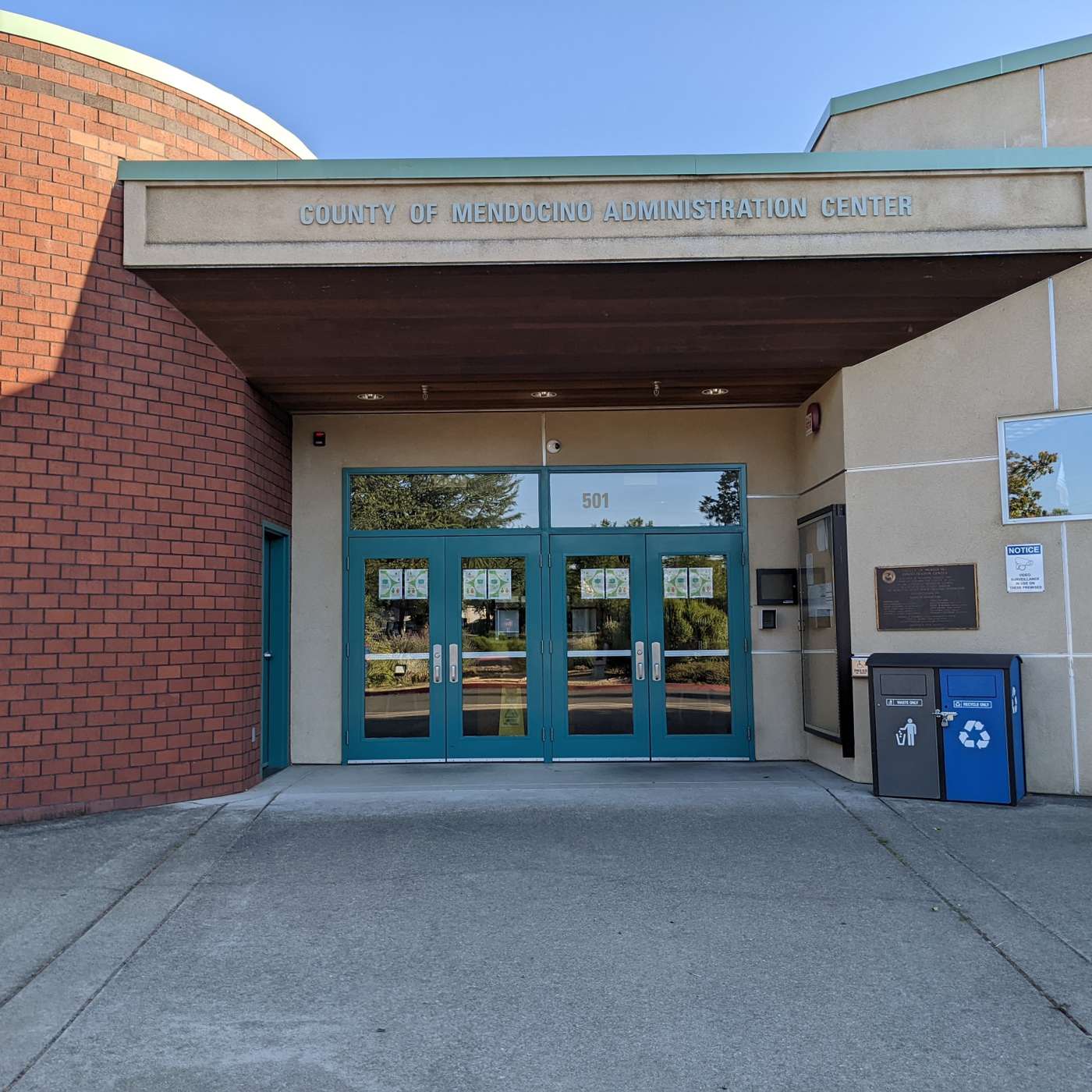
August 3, 2022 — A Board of Supervisors discussion about cost overruns for the new jail construction project veered into a cry for help from the state, as county leadership admitted that it does not have a clear idea what its financial situation is. “I would like to ask my colleagues for support on direction to the CEO’s office to reach out to the state controller’s office to help us get our books in order,” Supervisor Ted Williams announced, about a half hour into the meeting. A few minutes after hearing that state review of construction documents is causing months-long delays and that cost estimates for the new jail are now $7-8 million over budget, Williams told his colleagues how frustrated he is by the lack of financial information, even after a budgeting process that started months ago. “I’m three and half years into a term,” he said. “I worry, I'm coming up on the point where I can no longer use the excuse, I’m new here. And yet in the three and a half years, I haven’t been able to get a credible financial report. I understand we have three different sets of books. They all differ. Why?” CEO Darcie Antle corroborated the main point. “I would agree with you. I’m not quite sure,” she acknowledged. “I think a lot of the reason we have asked for a pause in the labor negotiations is that we don’t know. We don’t have a clear vision on what the books are, and where the finances are. And those discussions need to continue with the new auditor-controller.” It doesn’t seem like anyone has a clear idea, and that’s a problem for rank and file workers and the public as well as the leadership. SEIU Local 1021, the union that represents the bulk of the county’s employees, filed a complaint with the Public Employees Relations Board last month, detailing the information they’ve requested as they negotiate their contract. The union wants a 5% Cost of Living Adjustment, which Field Representative Patrick Hickey estimates would cost the county $3.2 million. The county released some information to the public a few days after the union filed its complaint, but Hickey said that he, too, is frustrated by missing details. He’s still looking for specific information about differential pay and temporary and part-time workers that will help the union understand the impact their proposals will have on the county’s budget. “That’s something we submitted all the way back in November,” he said last week. “So we’ve been trying to keep track as the county has parsed out little bits of information to us as the negotiations have progressed.” Though it seems no one has the information anyone wants about the budget, the county has had an unprecedented amount of money to work with in the past year and a half. Local agencies are still receiving their allotments from the county’s $22 million settlement from PG&E. And the county was awarded almost $17 million from the American Rescue Plan Act, or ARPA. Maria Avalos of UVA, a Latino advocacy group, requested more details about how those funds will be spent, and how the decisions will be made. She noted that over $4 million of the ARPA funds has been allocated for core county services and infrastructure. “So I’m just wondering, where is the breakdown of where that money will go?” she asked during public comment. “Will it be able to be found by the public? And how is the local government making the decision to use the funds? And will there be public input?” Williams counts himself among those agitating for financial transparency. But he told his colleagues yesterday that he doesn’t think anyone is able to provide detailed financial information about the county. “We do have an outside audit that happens,” he said. “When was the last time this board, you and I sitting on this board, voted to direct the auditor to incorporate the outside audit recommendations? I don’t think I’ve done it yet. I don’t know if past boards have done it. But it means we’re paying for an outside audit, we’re getting advice about changes we need to make to meet accounting principles. And then we’re ignoring the advice. So how much accumulated error is there, and over how many years is it? Ten years, is it thirty years? Is that why we have different sets of books, with different numbers? Because we never incorporate the outside audit findings? I think we have a financial crisis here, and we just don’t know how bad it is.” Supervisor John Haschak pointed to a recent shakeup in the county’s main financial offices. But Williams thinks the problem goes back much further than the decision to consolidate the offices of auditor-controller and treasurer-tax collector. “It’s just really ironic that this board voted to consolidate the two positions when those people in those positions said don’t do it, and that consolidation would not help, and now we’re in the position where we’re asking the state to step in to help out this position that in part we created as a board,” Haschak said. “So I want ...

Ep 462More edits for cannabis equity grant program manual
August 2, 2022 — In the wake of a Mendocino County Grand Jury report that found layers of delay in distributing a grant, a policy manual has been updated, an affidavit is being drafted, and legal review will start up again next week. In 2020, the County received $2.2 million from the state, to administer individual grants to applicants who are eligible to run a cannabis business in the unincorporated areas of Mendocino County; and who can demonstrate that they have been harmed by the war on drugs. But most of that money is held up in legal review. Out of 52 applications, five grants have been awarded. The other 47 approved grant applications are waiting for County Counsel to determine that they won’t run afoul of the state’s policy about misuse of funds. The Local Equity Entrepreneur Program, or LEEP, is supposed to allocate direct assistance awards to individuals, which puts the county in the position of vouching for the recipients. If the county were to award a grant that doesn’t meet the state’s strict requirements, the county would have to collect the misused funds as it would any other debt, possibly becoming ineligible to receive further grants. But if the money is not awarded by the end of August, the state could take it back. Michael Katz, the Executive Director of the Mendocino Cannabis Alliance, an industry advocacy group, noted that the Grand Jury report aligns closely with complaints and policy proposals that the MCA has been making for a while. The report’s first finding is that “There was no process developed for the distribution of grant funds to individuals prior to applications being received. This has resulted in extended delays at every step from eligibility to application to communication to contract negotiation,” which prevents the timely distribution of funds. “The results of that, unfortunately, have been that some operators have been in this application process since February of last year, counting on these funds to help them move forward in this incredibly challenging business at this incredibly challenging time,” Katz said last week. Kristin Nevedal, the Mendocino County Cannabis Program Manager, uses similar language for what she’s faced in her role. Asked about the same finding at July’s LEEP meeting, she said, “I think that’s absolutely correct. I think the program has been incredibly challenged by changes and lack of leadership, frankly, in the cannabis program as a whole.” Shortly after the county received the first round of funding in February 2021, Megan Dukett, the cannabis program manager at the time, left her position. The county had hired a company called Elevate Impact to administer the grant for no more than 10% of the award, but Nevedal said, “It is completely unfair to expect a contract administrator to develop a program for any local jurisdiction solely on their own.” Nevedal said she learned about the program’s complexities at the end of 2021, when she had one part time helper and had been on the job herself for just a little over a year. “So I had no clue how underdeveloped the program was until we started getting into the review of applications and then how we would essentially issue checks,” she acknowledged. “Most local jurisdictions do not include capital improvements in what’s allowed as far as expenses that can be paid for using direct grant funds. And I think from the county’s perspective, you don’t know what you don’t know. So I don’t believe the county really knew ahead of time the complex nature of the applications we’d be receiving to have the foresight to understand that we also needed planner time to also conduct these reviews.” The Grand Jury also found that “the county did not ask the state for requirements on record keeping until May 2022,” and that this should have been done much earlier in the process. That finding dovetails with the fear of misusing the funds, which Katz thinks has led to unnecessary restrictions. “There are still barriers that are being put in place on certain requests by the department that are not demanded by the state. So for example, there are many folks who are working to create solar usage opportunities on their cultivation sites in various ways. And solar is something that’s desirable, obviously. We’re trying to phase out generators. We’re trying to phase out fossil fuel use…but the cannabis department has been objecting to specific types of solar, being concerned with how much power the solar would provide, and really just putting what seem like unnecessary restrictions that are not demanded by the state on the uses that would benefit the operator. So if they actually revised the manual to allow anything that is not explicitly disallowed, there wouldn’t be the need to dig into every item and go back and forth on the minutiae that we’ve seen happening for applicants.” On Friday, the cannabis program issued V5, the latest edition of the Local Equity Program Manual. In an ema...

Ep 461Coast Healthcare District Board discusses website and minutes
August 1, 2022 — At last week’s meeting of the Mendocino Coast Healthcare District Board, directors discussed a new website, last year’s minutes, and a letter concerning the possibility of Adventist hospitals no longer taking Anthem insurance. With a packed agenda, one member of the public expressed her gratitude for the board’s attentive demeanor. “A few of us have actually placed bets on whether Mr. Redding would be playing his guitar while he thought he was on mute again,” said Jenny Shattuck. “Because we found this, and his actions just beyond disturbing, that the board was literally discussing the future of our ambulance, and the future of our healthcare.” Objections to directors’ conduct was not limited to members of the public. This became clear with Directors John Redding and Sara Spring expressed differing points of view about who was responsible for preparing last year’s minutes, which appeared on the new website without full board approval. “Director Spring’s position is that she was unwilling or unable to do the minutes,” Redding stated; “and furthermore that she did want anyone else to do the minutes; that any such attempt was illegitimate.” As Spring attempted to interrupt, Redding added, “Those minutes are eighteen months old. I’m not finished!” he exclaimed, as Spring shouted, “John, I will say to you again: I never got the zooms. You had them. I did not. I’m not gonna let you sit here and say I didn’t do something I could not do.” Chair Jessica Grinberg shed some light on the migration of the website, and how the minutes ended up there without board approval. “The minutes isn’t the point,” she objected, breaking into her colleagues’ discussion. “The point is the migration of the website, of what was in the past to the current, and during the migration, items were added that hadn’t been brought towards the board yet, or voted on, and the integrity of our new migration put the cart before the horse because items were submitted to the public, not noted as draft, not vetted through us, but was posted…but I’m just acknowledging that our migration had some missteps.” The old website redirected users just as they were looking for the agenda and the link to the meeting. Some reported difficulties, some said it was easy to find, and one member of the public requested that the entire board resign over a special meeting that may or not have been noticed properly. The root of the confusion was not immediately known, but Grinberg said “It may be a payment issue. I recall, we’re due to pay that domain.” The board decided to pull the minutes from the website, which led to community input about the parliamentary procedure. When Malcolm MacDonald inquired after the board’s policy on taking public comment about the minutes, Grinberg told him the board does not. “Wow,” MacDonald replied. “Just wow.” One member of the public suggested creating a dedicated zoom link for board meetings at the new website. “I go crazy, looking for zoom links,” she explained. Redding inquired after the speaker’s name, and she said, “Hello. Chess on Tuesday. Name: Chess. Last name: on Tuesday.” “Chess. As in the game, chess?” Redding inquired, whereupon Chess on Tuesday obliged him by spelling it out. After an hour and a half, the board wrapped up the discussion about the website and the minutes. WIthout further ado, they moved on to the topic of a letter, drafted by Redding, about the negotiations between Adventist and Anthem. Judy Leach, the president of Adventist Health Mendocino Coast, gave a few hints about the negotiations. “We are not choosing to terminate,” she said. “It’s just the contract that has now come up for renewal needs further conversations. It is one negotiation. There are different rates that are happening, actually, even per market. So that’s why we are discussing rates with them. I don’t have details about what that looks like, but I will tell you it is one negotiation that’s going on. There are different rates in different areas.” The letter under discussion laid out the financial hardship that would ensue if the hospital stops accepting insurance from Anthem. The final sentence stated that if the negotiations are not successful, “the Board of Directors would like to immediately begin talks with Anthem for the purpose of creating a one-year exception for our remote community, recognizing that our circumstances differ significantly from other hospitals and clinics in the Adventist Health Network.” This passage in particular drew the ire of Jade Tippett, a member of the public. “The tone of this letter is wrong,” he began. “I agree with the chair that it is appropriate for the board to write a letter supporting Adventist in the negotiation. But I’ve done negotiations, a lot of them. And if a subset of the organization that I was representing came in looking for a side deal, it would totally undercut the negotiation that I was doing. And that’s what this letter is doing. It’s asking for a s...

Ep 460Regulatory agency approves reduced flows through Potter Valley Project
July 29, 2022 — This week, the Federal Energy Regulatory Commission (FERC) issued two decisions that water interests in the Eel and Russian River watersheds have been waiting on for months. On Wednesday, the Commission approved a drastic reduction in the flow of water through the Potter Valley hydropower project into the East Branch of the Russian River. The Potter Valley Irrigation District will continue to receive 50 cfs on demand, but the flow of 75 cfs into the East Branch has been reduced to 5 cfs. The variance is effective immediately, and the change started to go into effect by 2:00 on Thursday afternoon. (An earlier version of this story stated incorrectly that only 5 cfs will come out of Lake Pillsbury. The water that comes out of Lake Pillsbury flows to both the Irrigation District and the East Branch of the Russian River.) PG&E still owns the project, though it recently submitted a 30-month schedule for decommissioning, which FERC approved. PG&E argued that it needed to reduce the flow in order to preserve the infrastructure at Lake Pillsbury, as well as cold water pools at the bottom of the reservoir for fish habitat. The National Marine Fisheries Service (NMFS), declared that if the water levels in the lake went down below 30,000 acre feet, the water would get too hot for juvenile salmonids. Though there is no fish ladder at Scott Dam, which impounds Lake Pillsbury, there is a needle valve at the bottom of the dam. The valve releases water into the 12-mile section of the Eel River between Lake Pillsbury and the van Arsdale Reservoir, near the diversion tunnel that directs the water into the Russian River. Charlie Schneider is the coordinator with the Salmon and Steelhead Coalition, a partnership among Trout Unlimited, California Trout, and the Nature Conservancy. He said early models indicated that, in order to preserve the cold water pools, the variance should have been implemented by July 15. “We’re glad the variance was finally approved, but I think we need to better understand and look at those models to really see what’s going to happen later this summer,” he said; “to see if it is in fact too late.” He added that conservationists are interested in preserving the 30,000 acre-feet of storage in Lake Pillsbury because in “big, deep reservoirs, the water stratifies, and the water in bottom part of the dam is cooler than the water at the top…the more water you’re able to retain in there, the more cold water there is in the bottom of the lake. And that’s the water that gets released from the low-level outlet. So it’s really about preserving water temperature in that 12-mile reach between Scott and Cape Horn dams, making sure that water’s a cool enough temperature to be habitable for salmonids.” Elizabeth Salomone, General Manager of the Mendocino County Russian River Flood Control and Water Conservation Improvement District, expects drastic changes for human water users on the other side of the diversion tunnel. “It’s unusual for curtailments to cut into what we call the pre-1914 grouping,” she noted. “We do expect the curtailments to cut back into that pre-1914 category. But we won’t know for sure until the State Water Board issues their findings and curtailment notices.” Salomone expects the state will allow Upper Russian River water users enough water to meet human health and safety needs, which is 55 gallons per person per day. Some urban water suppliers have other sources, including groundwater or recycled water. And some farmers as well as urban centers have contracts to divert stored water from Lake Mendocino. “So not everyone will go completely without water,” she concluded. The Commission also delivered an ambiguous opinion refuting the claims of environmental groups that the Commission has the authority to amend the Potter Valley Project’s new annual license to include more protection measures for wildlife. The license for the Project expired on April 14. Within days, a group of conservationists and fishermen filed a 60-day notice of intent to sue PG&E under the Endangered Species Act. At the time, Redgie Collins, the Legal and Policy Director for California Trout, one of the coalition threatening the lawsuit, said that with the expiration of the license, PG&E “can no longer harm, harass, directly kill or injure salmon or steelhead at their project site.” The group wanted a new round of improved mitigation measures, arguing that the Commission had discretion over whether or not it granted the annual license. The Commission rejected that argument, saying that it was required to issue an annual license after the old one expired. And, while it also denied the coalition’s call for an Endangered Species Act consultation, it did consult with NMFS to require PG&E to monitor water in parts of the Eel River and Lake Pillsbury. The utility must pay for two state programs to monitor salmon on the mainstem and middle fork of the Eel River for a period of time. It’s a...
Ep 459Dr. Drew Colfax: Mendocino Coronavirus Update
July 27, 2022--Dr. Drew Colfax gives an update on the local coronavirus numbers, and how the BA4 variant surge is affecting Mendocino County.
Ep 458Union files complaint; questions about satellite funding at BoS meeting
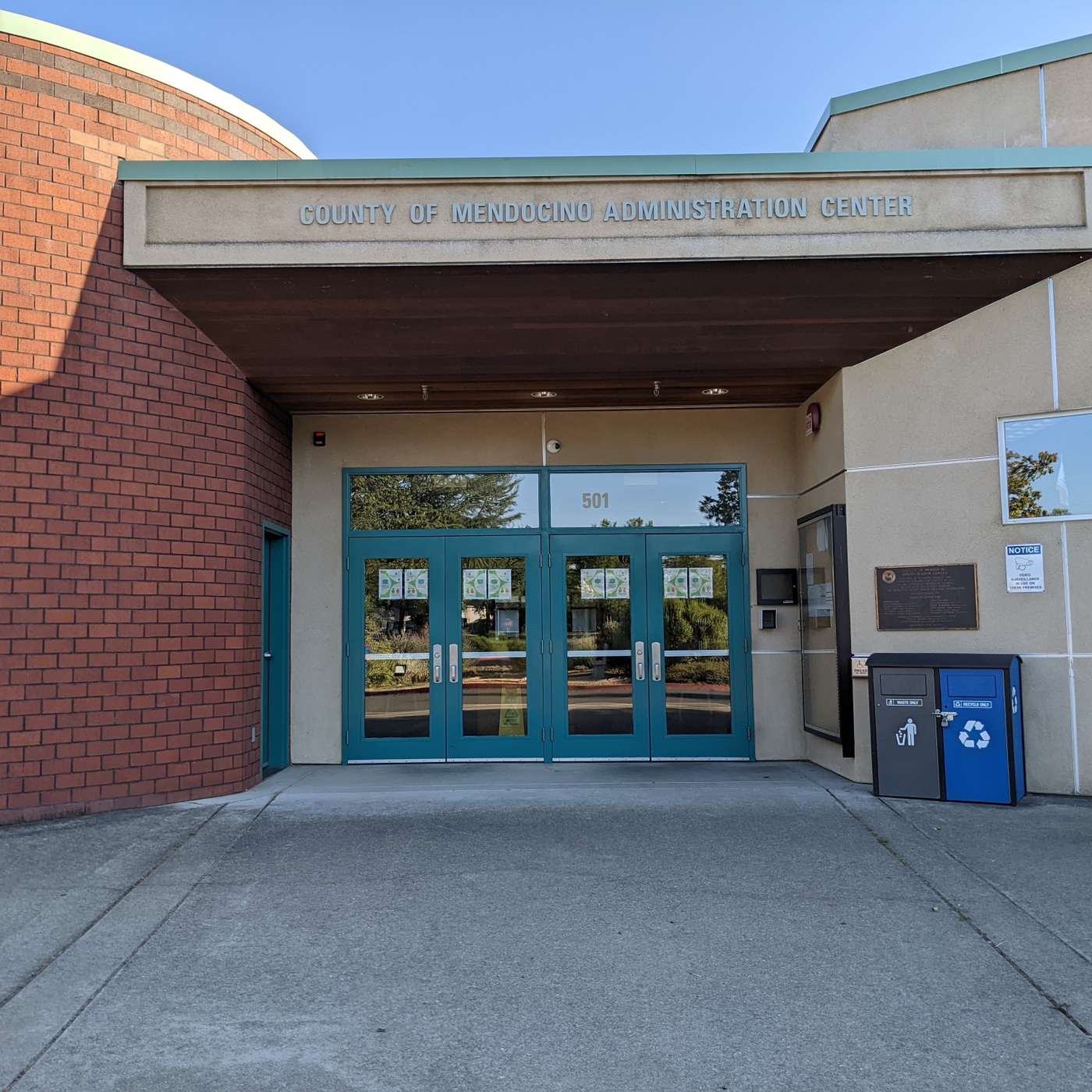
July 28, 2022 — At a brief Board of Supervisors meeting on Tuesday, the Board heard about Measure B, cannabis, covid, and labor. Public Health Officer Dr. Andy Coren called in to warn about new variants. He is strongly recommending that people wear masks indoors and gather outdoors. Since May, the county has recorded eight deaths from covid, six of them in the greater Ukiah area. The descedents ranged in age from 67-91, and most had comorbidities. And negotiations between the county and the union representing most of its workers are not going amicably. SEIU Local 1021 filed an unfair labor practice charge with the state Public Employment Relations Board, claiming that the county has refused to give union negotiators all the information they need to participate in bargaining sessions. Union representative Patrick Hickey called into the Board meeting on Tuesday to say that he thinks the county does have the money to give members a cost of living allowance, or COLA. “We’ve been waiting since November for a variety of information requests,” he said. “And the county continues to drag its heels, has failed to present the information that we’ve needed to analyze the budget…we did finally get a dribble of information from the county last week in our negotiations. They provided a small portion of the information requested regarding the more than 402 unfilled vacant positions in the county…based on the limited amount of information provided, it’s clear that there is certainly funding available to provide county employees with a reasonable COLA to address the current high level of inflation. Based on the current budget, a lot more attention is being paid to taking care of the buildings, rather than taking care of the employees. Some of those projects are not imminent or urgent, and certainly can be postponed and that money can be rededicated to COLAs…there’s a sizable amount of money set aside to buy new vehicles. The County has a large number of vehicles that are not even used on a regular basis, that are just sitting in parking lots, getting old.” The union told the employee relations board that “the County should be ordered to provide complete and accurate responses to the Union’s outstanding requests for information; ” and asked it to “order all other remedies it deems just and proper.” The union frequently contends that low pay leads to understaffing, a theme that emerged in many of the Grand Jury reports, which started to come out last week. Michael Katz, the Executive Director of the Mendocino Cannabis Alliance, drew the board’s attention to the Grand Jury report on the cannabis equity grant program, which is supposed to provide grants to people who have been harmed by the war on drugs. The report detailed communications failures, and noted that as of May, the county’s Cannabis Department had ten vacant positions and only twelve employees. Katz said the report bolstered many points the board has heard before. “I’m not sure you had a chance to review it. It came in yesterday,” he began. “If you had, you might see that some of the findings and some of the recommendations align with what MCA and stakeholders from the community have been saying for quite some time. One of the first findings indicates that there was no process developed for the distribution of grant funds to individuals prior to applications being received. What that indicates is a project management issue, I believe, that speaks to the need for additional support of the cannabis department by the CEO’s office to ensure that as projects are set up, they align with all of the requirements of the county infrastructure and that we are not waiting for the last minute to identify potential roadblocks in getting out these much-needed funds. That goes on, additionally, to finding #2, that the County did not ask county did not ask the State for requirements on record-keeping until May of 2022, and apparently only did so to establish the County’s risk of having to repay funds if they were not spent for approved purposes.” The county received $2.2 million for the equity program, and close to $10.5 million for a local jurisdiction assistance grant program to help growers comply with environmental regulations and cover the cost of various fees. Supervisor John Haschak pulled an item from the Board’s consent calendar approving a year-long agreement with a company called Planet Labs to provide satellite imaging services, starting July 27, for a little over $350,000. “This is the Local Jurisdiction Assistance Grant money,” he said; “and the concern expressed was that this only be used for helping out with getting people to their annual licenses, which is the intent of the Local Jurisdiction Assistance Grant.” The Mendocino Cannabis Alliance sent a memo to the Board, sounding the alarm over the satellites’ potential use for enforcement purposes, which it contends are ineligible uses for the grant money. Katz called out what he sees as a ...
Ep 457Ukiah Players Theater raises its curtains again after pandemic closures
Neil Simon’s Tony-winning romantic comedy Barefoot in the Park is currently being performed at the Ukiah Players Theater until the 31st of the month. The play, originally written to take place in the 60s, in fact, takes place in 1982 in the Ukiah players theater’s rendition. The change is an ode to the 40th anniversary of the theater, says director Eric Ward. With 80s-inspired costumes, soundtrack, and set props, the play follows a young newlywed lesbian couple who have just moved to New York City in a teeny apartment on the top floor. Corie, played by Grey Wolfe-Smith, is an interior designer whose colorful personality is expressed with a rainbow wardrobe. Her wife Paula, played by Amanda Baguley, is beginning her law career and is the opposite of Corie, Paula is always anxious, concerned, and just trying to get some sleep. From the director’s notes on the couple’s dynamic: “opposites attract, but what makes someone easy to love, can also make them very hard to live with.”

Ep 456Fort Bragg swears in new police chief, hires Interim City Manager
July 26, 2022 — The Fort Bragg City Council swore in a new chief of police and hired another retired public employee as an interim city manager Monday night. Last month, the council bid farewell to Interim Police Chief John Naulty and Interim City Manager David Spaur, who were both serving for a limited time due to their retirements from public service. Last night, Neil Cervenka, formerly of Turlock, took his oath of office as the new chief. Cervenka thanked family and friends and pledged his loyalty to his new community, saying, “I commit to concern for this community and all the issues that affect it. I commit to compassion for all segments of this community regardless of status. And I commit to courage, to do the right thing, no matter if it’s difficult.” In another key position, Peggy Ducey can put in 960 hours a year as Interim City Manager, in keeping with the rules of the California Public Employees Retirement System (CalPERS). She will receive no benefits or any other form of compensation outside of an hourly rate of $76.30, starting July 26. And the council adopted a resolution to declare a Stage 1 water alert, asking for a citywide water conservation goal of 5% to 10% and prohibiting wasteful water use. Water customers are only supposed to irrigate on Tuesdays, Thursdays, and Saturdays before 9am and after 6pm, and restaurants will only serve water upon request. Operations Manager John Smith told the council that water in the Noyo River, one of the city’s three water sources, is diminishing. “The Noyo River is currently at 6 cubic feet per second,” he told the council on Monday. “It was 6.75 when I wrote this, which is still 4.3 million gallons a day, which sounds like a lot, but it’s dropping about 1.5 cubic feet per week.” Smith added that the city’s small desalination plant is ready to go as a last resort, and promised to keep working on the city goal of storing 60 million gallons, an estimated four months’ supply. And officials are preparing for the next election, just a month after publishing results from the last election. City Clerk June Lemos told the council that the deadline to return nomination papers to run for Fort Bragg City Council has been extended to August 17, because Vice-Mayor Jessica Morsell-Haye is not seeking re-election. Council member Lindy Peters’ papers have been certified, and he is qualified to be on the November ballot. The Council heard a number of reports, among them a draft of a feasibility study to diversify the local economy by developing the former Georgia Pacific Mill site. As its tourism-based economy crashed during COVID, the city received $137,000 in CARES Act money from the U.S. Economic Development Agency, plus a $10,000 California Sea Grant for the Blue Economy Symposium to develop new ideas to create sustainable jobs and industries. However, as Morsell-Haye pointed out, the former Georgia-Pacific mill site is not public property. “This study was initiated at a time when we were in negotiations for that property,” she said. “We’re talking about uses on property that we do not control.” Last year, Mendocino Railway, or the Skunk Train, won an eminent domain case against Georgia Pacific and purchased 272 acres of the mill site property according to the terms of a stipulation for $1,230,000. Though the Skunk Train does not engage in interstate commerce, its lawyers claim that its status as a railroad means that it is subject to federal jurisdiction, which exempts it from local and state permitting regulations. In 2019, the company declared that it would not be seeking permits from the city of Fort Bragg to do work on the property, but that it was happy to make a donation to the city equal to the cost of a building permit. The City sued the Skunk, asking a local judge to declare that the railway is not a public utility, and to command it to comply with all city ordinances. The First District Court of Appeals briefly placed a stay on the case after Mendocino County Superior Court Judge Clay Brennan declined to throw it out, but the stay was dissolved after about five weeks. The City and the Skunk are scheduled to be back in court for a case management conference in September. On Monday night, Chris Hart, of Mendocino Railway, called in to the City Council meeting to complain that his company made only a brief appearance in a document concerning land it owns. “I do feel that Mendocino Railway’s perspective could have been more incorporated,” he said. “It is concerning that even though we are a local company that owns much of the land and is trying to invest millions, we’re not considered a stakeholder or an asset. Instead we’re shown as an obstacle. The study states that we interfered with the City’s verbal agreement with GP when we used eminent domain in the summer of 2021. It makes no mention of the City’s interference five months earlier.” Last year, the City Council wrote a letter to the U.S. Department of Transportation, urging ...
Ep 455Noticias en Español del lunes 5 de julio
La organisación UVA, Ukiah Vecinos en Acción está preparando un podcast en español para informar a la comunidad latina de la región.
Ep 454UVA's new Spanish language podcast.
UVA, Ukiah Vecinos en Acción is working on the production of Spanish language podcast to cover news and information for the local Latino community.

Ep 453Newscast July 22, 2022
More than 30% of the jobs in Mendocino County’s Child Welfare Services remain vacant. To ameliorate this deficiency, community based organizations like SPACE, 4H, and our schools now serve as vital, local, family resource hubs that offer services aimed to improve the health of our County’s kids and their families.

Ep 452La graduación de Ukiah High 2022 celebra a los graduades por su resistencia

Ep 451Ukiah High graduation of 2022 celebrates grads for their endurance
Ep 450Afro-Latin band, La Misa Negra, performs in Ukiah for their 3rd summer concert event
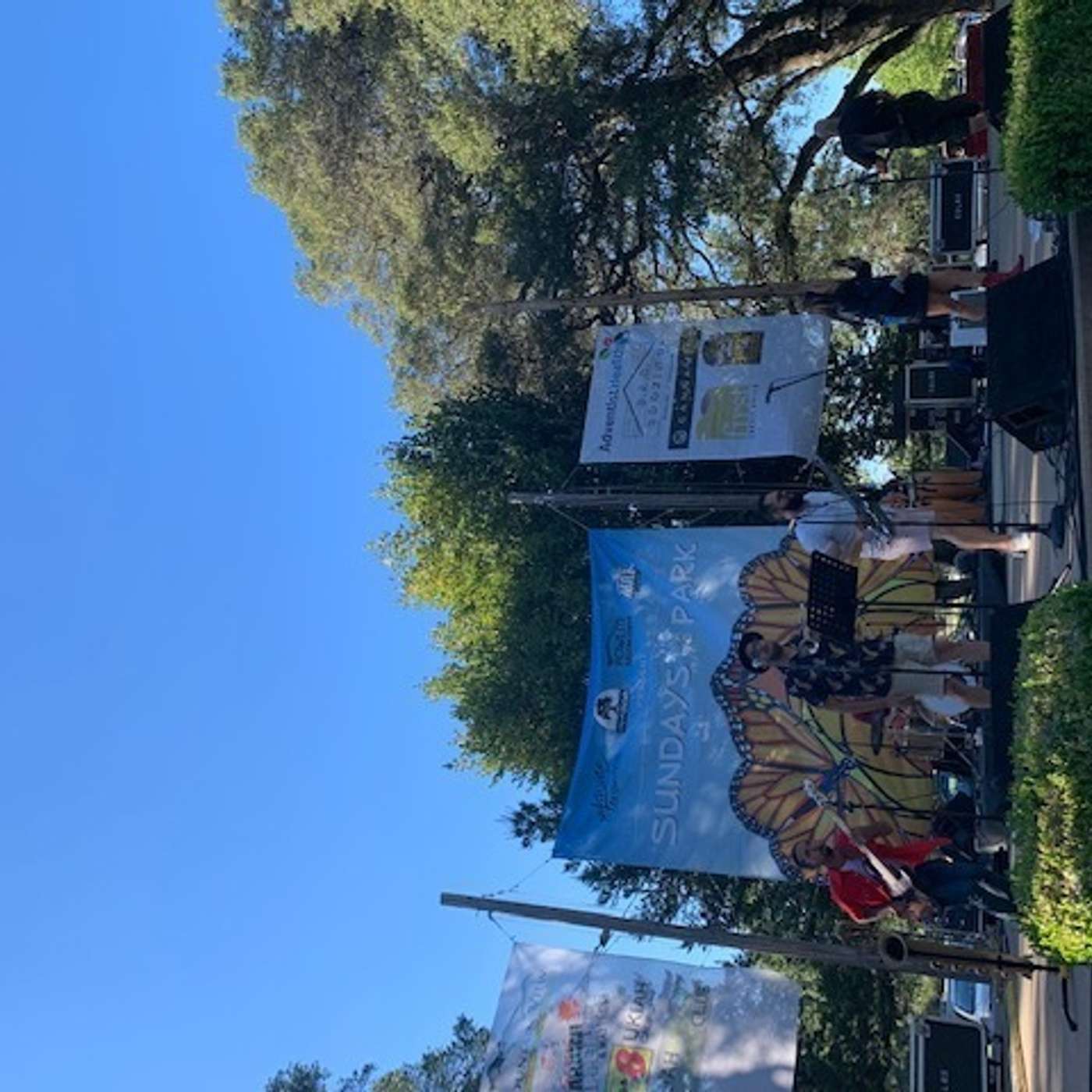
Born out of Oakland, the Afro-Latin band “La Misa Negra” performed at the third concert of the Sundays in the Park summer concert series in Ukiah. The seven member band put on a upbeat show, playing fusions of cumbia and salsa. Nacidio desde Oakland, la band afro-latina “La Misa Negra” presentaron en el tercero concierto del serie Domingoes en el Parque en ukiah. La banda de siete musicos pusieron un espectaculo animado, jugando fusiones de cumbia y salsa. Marco Polo Santiago, guitarist, composer, and accordion player, founded the band in 2011. KZYX sat with the band before the presentation. Translations will follow. Marco Polo Santiago, guitarrista, compositor y jugador de acordeón, fundó la banda en 2011. KZYX sentó con la banda antes del presentacion. La traducción seguirá. Que es tu nombre y que tocas? Me llamo Lydia Rodriguez y toco baritono saxofon. La banda nacio de Oakland, tu eres de la area? Soy de Stockton pero ahora vivo en San Jose. Actualment soy nueva a la banda, ayer era mi primer concierto. Me invitaron ser parte de la banda, pienso que me adoptaron. Por cuanto tiempo has jugado musica? Empeze cuando tenia 9 años con el flauta, hice todas mis programes de musicas y cambie at saxofón a los 13 años. Como te encontraste en este género? Es lo que creci escuchando. Mis padres son de Zacatecas, Mexico. Ellos y mi hermana emigraron aquí. Es lo que siempre he sabido, es en mi sangre…esta banda también hace sonidos de rock y roll, y punk, un género que me metí por mi cuenta. Es una mezcla de todo que me encanta. Puedo sacudirme el pelo y toca musica latina, es chido! In the car the band was telling me you performed yesterday? Where? A festival in grass valley. Are you spending the summer doing shows? We just have a few shows this summer, because of the pandemic our return to the scene has been slow. Where do you draw inspiration from when songwriting? I have the inspiration already because I have listened to music all my life so I can think about what styles to draw from. I have my own style of composing music derived from listening to not just cumbia, but cuban music, latin jazz, mambo, rock, metal, hip hop, rap, and funk. It guides me when writing melodies and wind instrument parts. Its principle for our sound – our music revolves around the wind instruments, saxophone, trumpets, all that. And so, I write music because I’m educated on those varying genres. What has been your favorite song to write for the band? Pistola, a salsa song we have on our recent album. What is next for the band? I’m writing the next album right now. I have several songs done, they are missing lyrics, but in a few months, we’ll be putting new songs out. La Misa Negra was a fresh sound for Ukiah, concert goers were hesitant at first but soon enough the stage front was filled with dancers, many following the steps of the musicians moving on stage. La Misa Negra era un sonido fresco para Ukiah, la gente primero estaban vacilantes, pero pronto el frente del escenario estaba lleno de bailadores, muchos siguiendo los pasos de los musicos bailando. For the KZYX News, I’m Ayled Zazueta. For all our local stories, with photos and more, visit KZYX.org. You can also subscribe to the KZYX news podcast wherever you get your podcasts.

Ep 449Hospital and insurer in negotiations that could leave public employees paying out of network costs
July 20, 2022 — A recent announcement by Adventist Health about its negotiations with Anthem Blue Cross, the county’s main insurance provider, has caused widespread panic. The contract between Anthem and Adventist, a faith-based nonprofit hospital system that manages all three of the county’s hospitals, was originally due to expire on July 18, but has been extended to August first. Adventist posted FAQs on its website this week, directing patients to call the number on their insurance card for answers to most questions. But patients are advised that if they are in the hospital after midnight on August first, Anthem could choose to transfer them to another hospital. Some patients may be able to continue receiving care for some time as a “continuity of care service.” In a letter to patients last month, Adventist claimed that Anthem has enjoyed record profits for the past two years, but continues to pay Adventist “substantially less than other hospital systems. Anthem is one of our lowest-paying health plans, and we can’t continue to provide quality care for patients at such significantly reduced rates.” Adventist offered to be interviewed on this subject, but we declined because President Judson Howe refuses to speak to us about the faith-based hospital’s policies on abortion, which remains legal in the state of California. Recent studies show that much of the high cost of doing medicine in the state of California is due to a lack of competition, both in healthcare and insurance markets. According to a study by the California Healthcare Foundation, titled, “Markets or Monopolies,” “the preponderance of evidence suggests that hospital consolidation leads to higher prices… Furthermore, workers bear the burden of these increased premiums as employers depress wages to pay more for health insurance coverage.” The MediCare Payment Advisory Commission told Congress in 2018 that “hospitals with large market shares have the leverage to negotiate relatively high prices from commercial insurers.” This affects small local governments offering employer insurance, as well as private citizens who pay for their own coverage. The county’s health plan is currently close to $5 million in the hole, with the county paying about 81% of the cost of skyrocketing claims, according to a presentation by Deputy CEO Cherie Johnson during last month’s budget hearings. “So we would really need to change our whole plan,” she told the Board of Supervisors. “We need to be looking at the deductibles, the co-insurances…Fully insured is where we’re looking at, so we know, with a fully insured plan, what your payments are every single month. Right now, we don’t know. We project what we believe our monthlies will be, but it’s unpredictable. We could get a $60,000 claim week, and then the next week, we could get $116,000.” Julie Beardsley, President of SEIU Local 1021, which represents most county workers, said it’s time to cut loose. The union is in a battle with the county, which is offering a 0% cost of living allowance. “The county has been stalling about looking into new plans,” she said at a union rally during the budget hearings. “Obviously Adventist has kind of monopoly here in the county and they can charge whatever they want, but we need to look at other plans.” Adventist told its patients that in the last five years, it’s given away more than $276 million in charity to those in need. We have not had the opportunity to review detailed financial information for Adventist Health. But according to a report by Stat, a healthcare-focused news website produced by Boston Globe Media, nonprofit hospitals in the U.S. received an estimated $25 billion in tax exemptions in 2015. Its authors, Ge Bai and David A. Hyman, write that “many nonprofit hospitals do not provide enough charity care to justify their exemptions…More than one-third of nonprofit hospitals (36%) provided less than $1 of charity care for every $100 in total expenses.” Nonprofit hospitals are exempt from federal, state, and local property taxes, and donations to them are tax-deductible. Ge and Hyman argue that, “If nonprofit hospitals are unwilling to provide sufficient charity care to justify the amount of their current tax exemption, there is no reason we should deprive local communities of the property tax revenues that allow them to fund local schools, parks, and other public services.” Assembly member JimWood’s office responded to our inquiries with a statement reading in part that the Assembly member understands that, “In this case, Adventist is the one initiating the action to renegotiate, requesting higher reimbursements in a number of areas…On the other hand, Anthem is seeking an agreement that would not reflect significant cost increases to the employers, employees or others with Anthem coverage. It’s important to note that the entities being affected, such as the school districts, city of Ukiah and (the) county, are self-insured and, as suc...

Ep 448KZYX Newscast for 7-15-22: The Coastal Commission Meets in Fort Bragg
July 15, 2022--Victor Palomino, Sarah Reith and Alicia Bales of the KZYX Local News Team attend the California Coastal Commission Meeting in Fort Bragg and file this special report.

Ep 447Noticias KZYX Lunes 7. 18
Los servicios de autoayuda de la corte vulven en persona después de un tiempo ofreciendo servicios remotos debido a la pandemia. Los servicios en persona son para las personas que no tienen un abogado y necesitan navegar y entender los procesos de la corte. La Comisión Costera de California realizó una visita de 3 días a Fort Bragg como parte de sus viajes mensuales para aprender en persona sobre los problemas que afectan la costa de California.Los comisionados son designados por el gobernador del estado y sirven por un período de 4 años con la misión de proteger los recursos marinos y costeros y garantizar su futuro.La visita incluyó reuniones oficiales y encuentros sociales donde los comisionados tuvieron la oportunidad de escuchar al público, organizaciones sin fines de lucro, empresas y funcionarios.Las noticias de KZYX hablo con la comisionada Linda Escalante sobre la visita.
Ep 446Court self help services back in person
Self Help Center of Mendocino offers legal information for people without a lawyer and now they are back offering services in person.
Ep 445Board talks drought funding, gives the nod to water pumping law
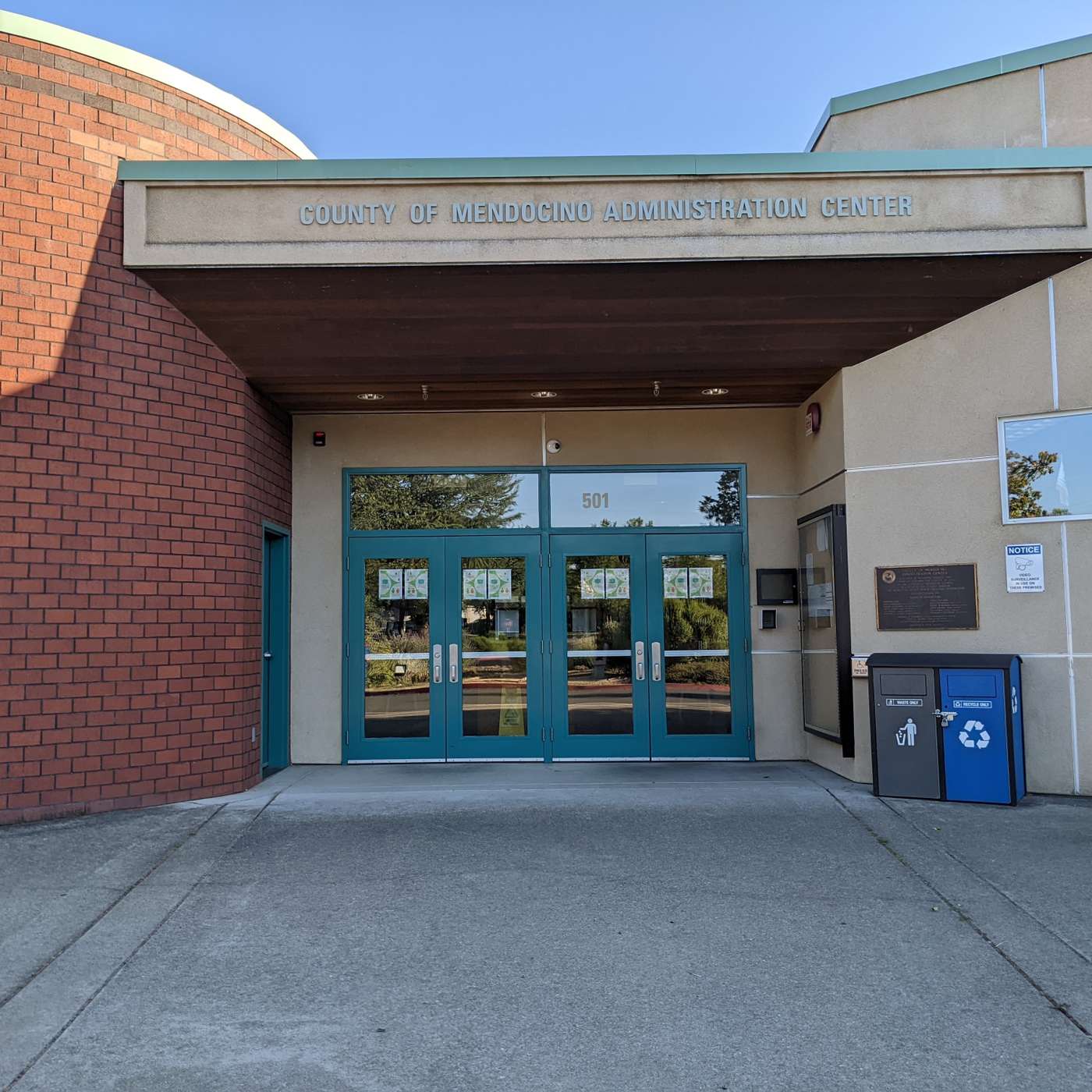
July 15, 2022 — The Board of Supervisors took up fire and water this week, with discussions about funding water projects, a water extraction ordinance, and a ballot initiative for a quarter-cent sales tax for fire departments. The original tax proposal included money for county water projects, but the Board abandoned that portion of the plan after Supervisor Dan Gjerde launched a campaign against it, arguing that it was an attempt by inland water interests to win a subsidy for agricultural water. Gjerde and Supervisor Maureen Mulheren formed an ad hoc committee to research other avenues to fund county water projects. They turned in separate memos that arrived at different conclusions. The Board has already allocated $250,000 from the PG&E settlement fund for a water agency, though there’s been no decision yet on how to spend it, or what the agency would look like. Gjerde told the rest of the Board he had identified more money from the PG&E fund that could be used for water projects. He included an email from Deputy CEO Sara Pierce explaining that she had erroneously stated that $960,000 was available from the fund for grant matching. In fact, the remaining PG&E funds come out to a little over $1.2 million. Gjerde also expressed optimism that the state, with its $100 billion surplus, will come through with water funding. In her memo, Mulheren wrote that last year, the Department of Water Resources only funded a small portion of the county’s water needs. Many state-funded projects, she noted, require a county match. She doesn’t think the county has the money to leverage grants, and provided a partial list of budgetary deficits, writing, “we are upside down in our health plan, have received only ¼ of the projected cannabis taxes and have an obligation to create a new wing of our county jail, all in excess of $10 million above our abilities.” Mulheren serves on multiple bodies that deal with water policy in the Russian River watershed. When Supervisor Ted Williams tapped her and Supervisor Glenn McGourty to serve on a drought ad hoc committee, Gjerde complained, saying, “It’s curious that we would choose to have an ad hoc where both supervisors are in one of the three, so to speak, watersheds, and one of the two is not facing short-term drought issues. And I can’t help but wonder if it’s because I’ve been outspoken about the fact that some of the Russian River water districts are undercharging for their water, but they’re still looking to the county for assistance, and I’m wondering if that’s the motive for keeping either Supervisor Haschak or myself off the drought ad hoc.” Mulheren shot back, saying, “Supervisor Gjerde, your assumptions about my interests in water are incorrect. I am deeply interested in making our community have sustainable resources. If it’s going to make you drop the subject, I will yield the seat. Happily. Because the assumptions and the allegations that you are putting out in public are very upsetting to me…I would like to remove myself from the drought ad hoc.” McGourty objected, saying that neither he nor Mulheren would show favoritism to their watershed. “I think my actions last year proved pretty well that your district benefited handsomely from the efforts of the ad hoc,” he noted. “When you look at where the water went that was hauled, it turns out that two-thirds of the water was delivered into the fourth district, and one third went into the fifth.” Supervisor John Haschak agreed that more than one watershed should be represented on a body working on how to approach the drought, and Mulheren insisted on yielding her seat. The committee is now back to its original membership of Haschak and McGourty. Under a new Senate Bill, 552, which was signed into law last year, local governments will be required to have a standing drought task force, with demonstrable plans to address water shortages. Haschak introduced another ordinance that he believes will help the county comply with SB 552, to regulate the sale of water from private wells. A group of volunteers from around the county worked with the drought ad hoc to draft the proposed ordinance, drawing heavily on laws already in place in other areas, including the coastal zone. Sherrie Ebyam, of Willits, summarized some key points of the proposal, which hinges on the county hiring a hydrologist to make sure that production wells don’t draw down neighboring wells or the surrounding aquifer more than 10%; and to keep track of data submitted by applicants and gathered from meters. “This ordinance proposes regulating water extraction from groundwater wells from which the water is being sold and from which the water is being transported and used off the property,” she declared. “I’d like to make it clear that this ordinance is for extracting water in order to sell it, and not for general commercial purposes…its intent is to make sure use of our groundwater is sustainable, and to have mechanisms in place to ad...
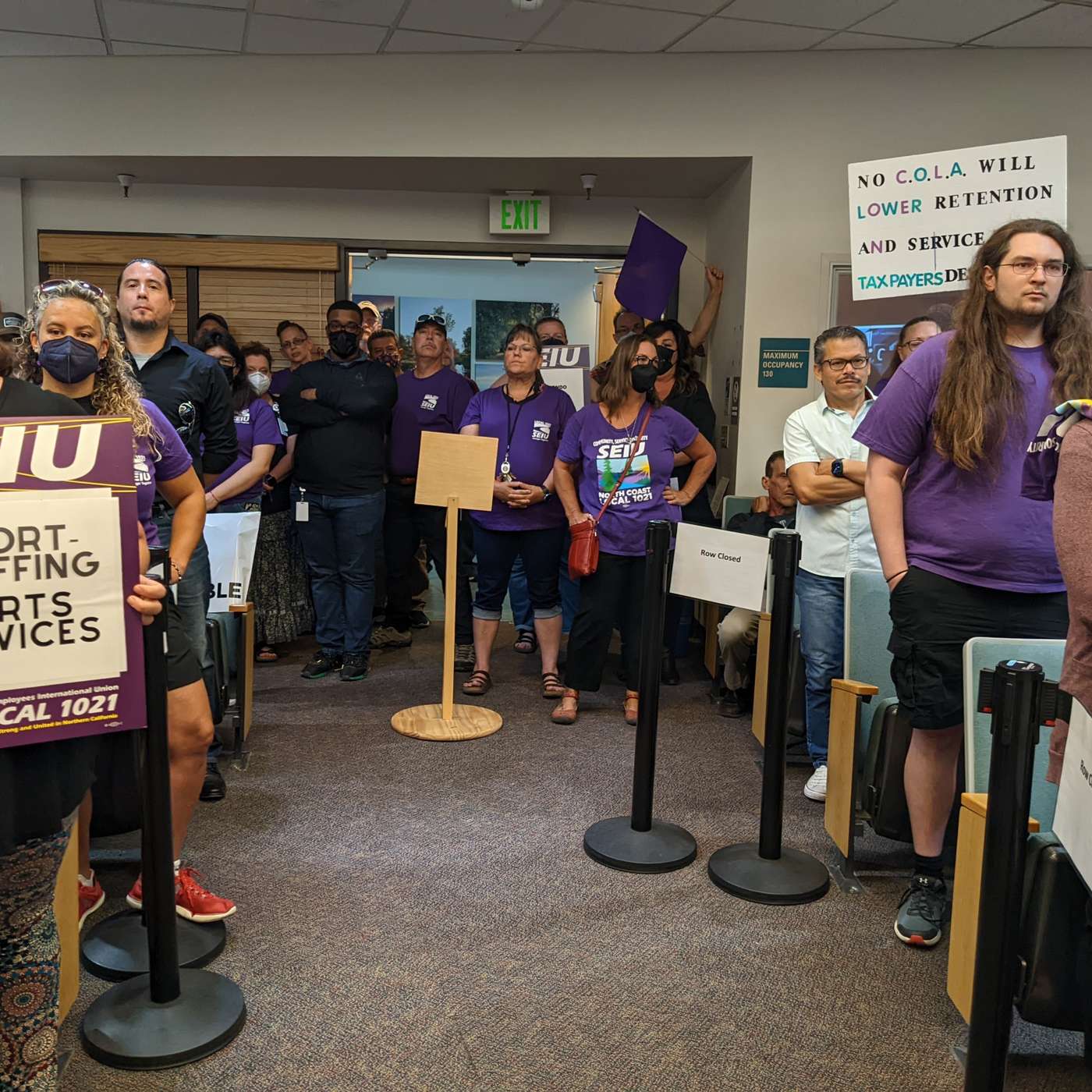
Ep 444County workers demand COLA; Board contemplates living wage law
July 14, 2022 — The Board of Supervisors’ chambers filled to overflowing at Tuesday’s meeting, with county union workers demanding better pay and an end to staffing shortages as inflation climbs. Regional union reps weighed in, too, saying they were dismayed at the county’s offer of a 0% cost of living allowance. Workers had filed out, chanting, “we’ll be back,” by the time supervisors decided to have a study session on what it would take to craft a living wage ordinance. The first speaker of the day was Vince Hawkins, a health inspector who spoke about how many of his colleagues have been lured elsewhere by better pay. Purple-clad workers rose silently from seats marked “Unavailable” and raised their signs as he spoke. “On any given day, I could be the only health inspector to respond to complaints or inspections for food facilities or recreational water facilities or well and small water systems, body art facilities, things like that,” he said; when “those three empty seats should be filled with my co-workers to go out and do the job with me. It’s no fun having to go out and do it by yourself.” Speakers were mostly from the social work and public health sectors, like Heidi Corrado, the county’s public health emergency preparedness coordinator. “One way that many counties and municipalities have been showing appreciation for their employees is through the American Rescue Plan Act,” she noted. “In fact, this was one of the listed purposes of ARPA. Now, Mendocino County has received ARPA funds, but so far, the administration has said nothing and made no proposals, while staff watch other public employees in neighboring counties be acknowledged for their service…these employees come to work even when they themselves were evacuated and living in a shelter; worked at home when they were sick with covid; went to work knowing that they could be called out to respond to a home where everyone in that house was sick. It’s true that you cannot buy that kind of work ethic. It’s true. You cannot buy that kind of loyalty. But it should be rewarded.” The room erupted in a solid fifteen seconds of cheers and applause when she finished her remarks. The county is negotiating with employee units again today. Asked if county workers are moving towards a strike, SEIU Local 1021 Field Representative Patrick Hickey said in a text that “if the County doesn’t move, we’ll be discussing all of our options at our next General Membership meetings on Wednesday, July 20.” Later in the morning, Supervisor Ted Williams sought support from the board for a living wage ordinance to help low wage workers earn sufficient pay. “You know, frankly, I just feel embarrassed,” he said as he introduced the item. “It makes me feel like we’re the Wal-Mart of employers.” Supervisor Dan Gjerde said the county pays 70 cents in benefits for every dollar in wages for most of its employees, which means that the county pays $34 an hour for a worker earning $20 an hour. “Some of the better private-sector employers are paying about 30 cents in benefits for every dollar in salary, so that turns into $26 at $20 an hour pay,” he said; “so it’s much easier for those contractors (that are hired by the county), to bring their employees in at $20 an hour starting pay than it is for the county.” Supervisor John Haschak pointed out the irony of asking county staff in departments that typically represent the county in negotiations with employees, to also work on a living wage ordinance. “In this time of real budget crisis and very difficult times even providing anyone with a COLA when the cost of living is going up at 7 or 8%, then I don’t want to see staff time diverted from trying to figure out that problem at this point,” he said. Martin Bennett, a professor emeritus at Santa Rosa Junior College, co-founder of North Bay Jobs with Justice, and a staff member of a North Bay union, called in to say that Sonoma county and three of its cities have adopted living wage ordinances. “Living wage ordinances have proven to be good public policy,” he declared, saying that UC Berkeley Labor Center and others have proven that they reduce turnover and absenteeism, and increase retention and the quality of services. “Living wage ordinances also ensure that taxpayers do not subsidize employers that pay less than a livable wage, forcing workers to access public programs,” such as MediCare and food stamps. He offered his help and that of staff at the Labor Council, to provide information about their experience crafting the living wage ordinance in Sonoma County, as well as contact information for advocates and staff all over the state, in other counties that have enacted living wage laws. Gjerde asked about what he called the roll-up effect, when low-wage workers get a raise and their managers demand the same percentage raise to maintain the gap between them, which he worries could result in a torrent of increased pay for employees at the management level. But Bennett said...

Ep 443PG&E submits plan for timeline to decommission Potter Valley Project; responds to letter on wildlife protections
July 13, 2022 — There have been two developments in the ongoing saga of the Potter Valley hydropower project this week. The 20-year license has expired, but PG&E still owns and operates the project on an annual license. On Monday, PG&E submitted a rough schedule to surrender that license to the Federal Energy Regulatory Commission (FERC). In a separate filing, PG&E argued that it should be allowed to continue operating the project under the biological protections that were attached to the license when it was issued in 2002. The 100-year-old project consists of two dams and two reservoirs that impound water on the Eel River; and a diversion tunnel that sends Eel River water into the East Fork of the Russian River, eventually making up the majority of Lake Mendocino. At its height, the project was capable of generating 9.4 megawatts of power, but it’s not currently producing power due to a broken transformer. The project provides water that’s key to agriculture in the Russian River and has long been a hot-button issue for environmental organizations that argue it harms endangered fish in the Eel. On Monday, PG&E submitted a four-page proposal for a two-and-a-half-year timeline to surrender the license and decommission the project. The bulk of that time will be devoted to interacting with agencies and stakeholders as PG&E drafts more detailed documents. Environmentalists are pushing for a speedy removal of both dams. But PG&E spokeswoman Deanna Contreras said in an email, “We expect it will take many years following PG&E’s submittal to FERC for a Decommissioning Order to be issued.” She added that PG&E still plans to replace the broken transformer, expecting it to amortize over a period of five years. Replacing the part could take up to two years. Water-using stakeholders include the Potter Valley Irrigation District, which has contractual rights to some of the water; and the City of Ukiah, which has pre-1914 rights to water further down the East Fork, before it flows into Lake Mendocino. The Sonoma County Water Agency claims the bulk of the water in the lake. The Russian River Flood Control and Water Conservation Improvement District also has water rights to the lake, and sells wholesale water in Mendocino County. All these interests are currently in suspense about whether or not PG&E will be allowed to drastically reduce the water flowing through the diversion tunnel. PG&E has stated that one of its reasons for asking FERC to allow it to cut down on the flows is to preserve a cold-water pool for young salmonids in the Eel River. But it’s not just environmental advocacy organizations that are concerned about the project’s impact on wildlife and the environment. Back in 2002, the National Marine Fisheries Service, or NMFS, wrote a Biological Opinion, laying out the measures that PG&E needed to take in order to comply with the Endangered Species Act. That opinion was incorporated into the license that was issued at that time, and which expired three months ago. In March of this year, NMFS wrote a letter to FERC, saying that the project was causing take, or killing and harming fish that are listed under the Endangered Species Act, “in a manner not anticipated in the Opinion and from activities not described in the Opinion.” The letter goes on to say that the fish passage facility at Cape Horn Dam has not undergone the proper consultations regarding endangered species, and that none of the operations at the facility are covered in the 20-year-old opinion. NMFS wants to re-open consultations about the license in order to update and strengthen the environmental protection measures. This means that the license for the project would be undergoing amendments at the same time that it is being surrendered. Within a few weeks of the NMFS letter, environmental advocates filed a notice of intent to sue PG&E under the Endangered Species Act, citing among other things that the fishway at Cape Horn Dam made the fish easy prey for river otters. In a 16-page letter to FERC, PG&E wrote that NMFS doesn’t have evidence to back up its claims. PG&E also protested that NMFS failed to mention “any of the voluminous monitoring record covered by over 20 years of monitoring Project operations.” Redgie Collins is the legal and policy director for California Trout, one of the organizations arguing that PG&E is in violation of the Endangered Species Act. He believes the biological opinion expired along with the license, and that it needs to be updated. CalTrout is threatening litigation as part of a pressure campaign to speed up dam removal and install other structures that will enable a winter diversion from the Eel to the Russian. “We have plenty of information that shows that these 100-year-old plus Eel River dams kill fish,” he declared. “And becasue they kill fish, and because we believe that the Biological Opinion has ended, that PG&E is required to either re-consult, or

Ep 442Ukiah Police facing another accusation of beating an unarmed man
July 12, 2022 — The Ukiah Police Department is going to federal court again, with officers accused of brutalizing another unarmed man. The latest allegation involves a beating that took place at a private residence just a few days before officers beat Gerardo Magdaleno, a naked, mentally ill man in a South Ukiah parking lot. The City settled that case for $211,000, plus attorneys’ fees of approximately $92,500, according to Izaak Schwaiger, Magdaleno’s attorney. The Valdes complaint, filed in the Northern California US District Court two months ago, claims that on March 28 of last year, Officer Eric Rodello held Arturo Valdes while Sergeant Ronald Donahue punched him in the face, causing multiple injuries that continue to interfere with his ability to breathe through his nose. Rodello and Donohue were not among the four officers caught on camera beating Magdaleno. According to the Ukiah Police email directory, there are currently 28 members of the Ukiah Police force (counting two community services officers and a property officer, but not counting the dispatch and records manager and the dispatch supervisor.) Two officers and a sergeant are listed in the Valdes complaint. Three officers, a lieutenant, and former Chief Justin Wyatt were named in the Magdaleno beating. (Wyatt was not present at the beating, but was faulted for lack of leadership and training.) Former Chief Noble Waidelich is being investigated for an allegation of assault and is facing a domestic violence trial. Former Sergeant Kevin Murray, who recently pled no contest to felony intimidation and misdemeanor false imprisonment, is facing criminal sentencing in August and a civil complaint by former UPD Officer Isabel Siderakis. In all, ten members of the Ukiah Police force have been implicated in violence in the past year and a half. The fourteen-count complaint also lists Valdes’ wife Elizabeth and the couple’s two small children as plaintiffs, saying Rodello and Donahue and a third officer, Daniel Parker, handcuffed Elizabeth Valdes and placed her in the back of a police car with the windows rolled up. According to the complaint, officers told her she would lose custody of her children if she declined to provide them with information about a ‘fender bender’ that took place earlier that day in the parking lot of the Ross department store. Richard Middlebrook, a Bakersfield attorney who is representing the Valdes family, says there was no injury or property damage in the minor collision, and that Valdes gave the other party his driver's license and insurance information. According to Middlebrook, the other person refused to return the license, and Valdes went home. Police officers retrieved the license from the other person, and came to the Valdes residence a little after 7 pm. In Middlebrook’s account, the officers asked Arturo Valdes if he had been involved in a hit and run, which Valdes denied. “There was no hit and run, because in order to have a hit and run, you have to have damage which you refuse to take responsibility for or leave information about,” Middlebrook argued. He said the officers told Valdes that they could smell alcohol, and that Valdes was on probation for a prior DUI. The complaint states that at the time of the arrest, Valdes was no longer on probation. Middlebrook said officers told him he was required to take a breath test, and Valdes did not argue. But now, Arturo Valdes is being prosecuted by the Mendocino County District Attorney’s office for driving under the influence, child endangerment, and resisting arrest. Middlebrook says it’s impossible to prove whether or not Valdes was under the influence at the time of the collision (when police believe the children were in the car), because officers met him at his home some time afterwards. And he’s skeptical about claims that Valdes was resisting arrest, because he says his client wasn’t being arrested when the beating took place. “They said, ‘you’re not under arrest,’ multiple times,” Middlebrook reported. “And then said, you’re not entitled to speak to a lawyer, since you’re not under arrest. That is a flagrant lie, and a misstatement of almost every bit of case law ever, involving the right to speak to an attorney.” Describing the video (which we have not viewed), Middlebrook said Donahue began to walk to the front door of the residence, while Arturo Valdes walked toward the garage. He said then, the officers grabbed Valdes by the arms. “When the officer comes up and grabs him from behind, my client turns around and pulls his arm away and says, ‘What are you doing? Am I under arrest? Am I being detained?’ He said, ‘You’re being detained.’ And he said, ‘Why am I being detained?’ And they grab him, throw him face-first into his own car, then throw him to the ground, hold him down, and beat him.” Middlebrook says the officers falsified the arrest report, which is easily proven by the fact that their statements are contradicted by Ring cameras at th...
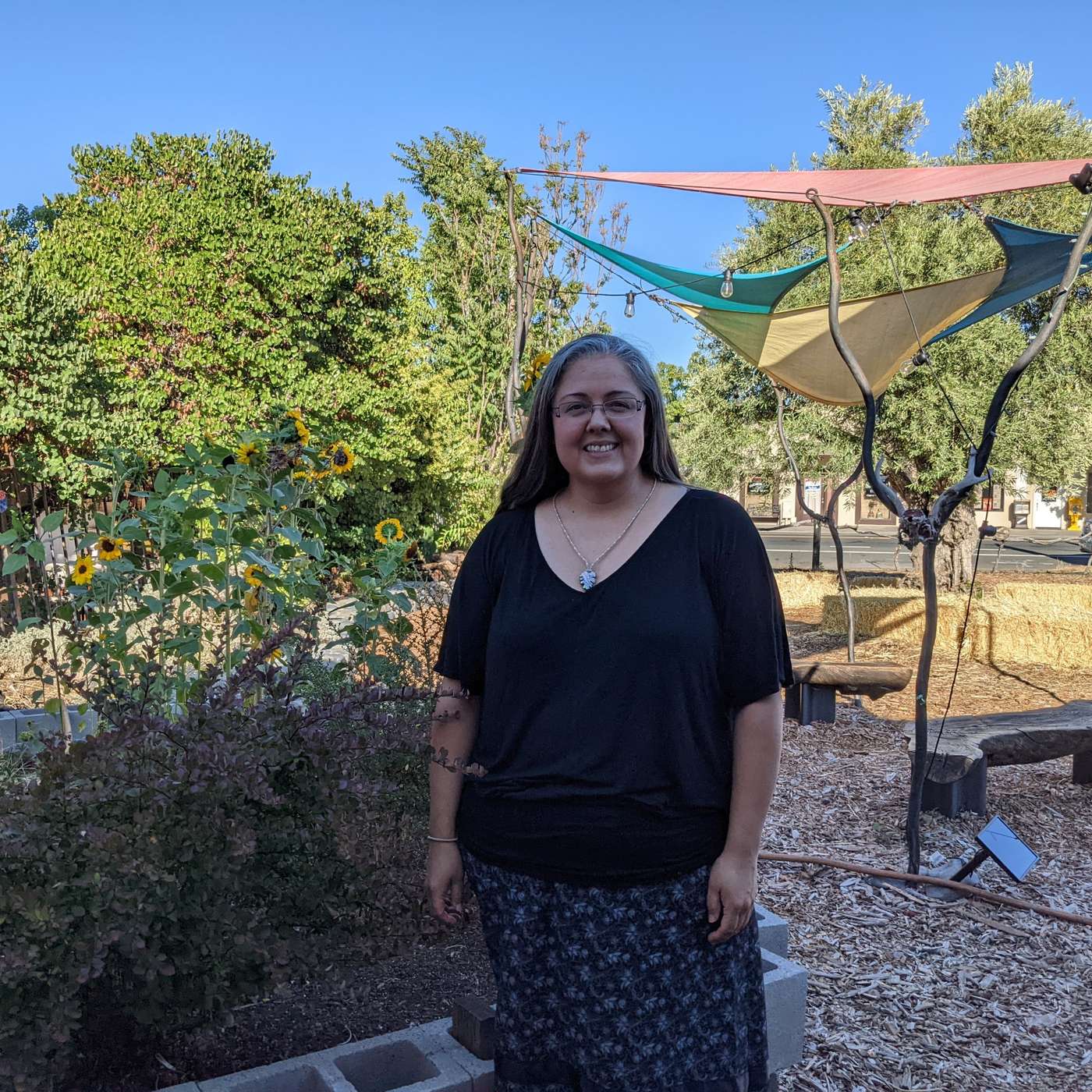
Ep 441Lake County's first Indigenous-curated, all-Indigenous art show opens in Middletown
July 11, 2022 — The Middletown Art Center in Lake County was packed on Saturday night. Visitors from several counties were there to look at work by 31 Native American artists, including traditional baskets, digital art and paintings, woodcut prints, bobbleheads, and a short film about the historical context of Jules Tavernier’s paintings. “Tonight, we are at the opening of Earth, Sky, and Everything in Between, which is actually the first time that a Native American has curated art by Native Americans. Ever,” said curator Corine Pearce, just as visitors began to arrive. She’s from the Little River Band of Pomo Indians in Redwood Valley, but she also claims ancestry from people indigenous to Lake County. Pearce said the show is a culmination of a year-long project that involved teaching basket-making to Native and non-Native people as a way to build cultural bridges. She emphasized the variety of styles and approaches on display. “While we were setting this up, the owner of the gallery, Lisa Kaplan, said she’d never had as many mediums in at one time. So we have acrylic on canvas, we have three-dimensional baskets of lots of kinds, including electrical cable…if you are alive, and you are Indigenous, no matter what art you’re making, it is contemporary art.” That includes commemorating recent achievements and memorializing ongoing tragedy. In one small room, there are a pair of mannequins in a mix of modern and traditional regalia, and a haunting empty skirt covered with red handprints. One piece celebrates a young woman’s recent graduation, while the other is a reminder of how many Indigenous women are missing and murdered. According to statistics that are part of the installation, Indian women are murdered at a rate of ten times the national average, though only 2% of the known number are included in the Department of Justice database. The mannequins, notes Pearce, “are a cool thing.” A young woman from the Pinola family of Kashia graduated from school this year. “The school she goes to allows them to wear a traditional outfit to one graduation, and then a contemporary cap and gown. And she broke the mold. She made a little feather topknot. And the white beads that go down (across the forehead), that’s a Pomo thing, representing wealth. So she brought both of them. Also, where that room is, there’s a display for the Missing Murdered Indigenous Women that has statistics. Because that sad statistic is part of our culture.” Many of the artists are displaying their work for the first time, from twelve-year-old Sarah Franklin, who made a small red basket, to 75-year-old Wanda Quitiquit, who created a special technique for burning designs onto gourds. But some of the artwork has been on tour. The video about Jules Tavernier’s paintings of the Elem people, which includes local experts discussing the mercury mining that began at that time, was recently at the De Young Museum in San Francisco. “It was actually at the Met first, and then it came to the De Young,” Pearce said. “When it came to the De Young Museum, they incorporated more representations of living artists. I happened to be one of those artists. So they had my baskets, they had baskets of Susan Billy, they had baskets of Clint McKay, and they had tule dolls made by Meyo Marruffo. That exhibit just ended, and they sent the stuff back to me, and then I brought that stuff here to exhibit here for a little while, and then it’s going to go to the Grace Hudson Museum (in Ukiah). So we have some really ‘fine art’ art here.” Wanda Quitiquit, who is Eastern Pomo from Robinson Rancheria, debuted her work at the Middletown Art Center, wearing a multi-strand shell necklace made by her late sister. She took a seat on a hay bale next to a garden full of basket-weaving plants to talk about her artistic approach. She is partly inspired by her own tradition, and partly by Indigenous Peruvian artists who carve elaborate designs onto tiny gourds. “What I like to do is I make big, large gourd bowls,” she said. “I have to draw the design first, and then I wood-burn the design in. And then I use dye for color. I only do Pomo basketry designs, old designs…But they all come out different on the gourd. It just depends on the gourd, and my feeling. I think the most important thing is that these designs that I use are gifts to us Pomos who use them in our artwork. I just stick with Pomo basket designs, because I’m a Pomo. It’s done by a Pomo, and it’s Pomo art.” Jacob Meders, who is Mechoopda Maidu, takes a different historical approach. In addition to making sculpture and woodcut prints, he is an associate professor of an interdisciplinary art and performance program at Arizona State University. He’s also the founder of a printmaking company called War Bird Press. His woodcut, “Divided Lines,” is a mixture of Socratic line theory, illustrations from accounts of first contact between Indigenous and European people, and pop-culture satirical riffs. One design features a f...
Ep 440Friday Newscast July 1, 2022
HEP program graduation and Watch Ready App

Ep 439Centro Latino West opens Spanish language business program
West Center has a new Spanish language program. Fundando mis sueños is a training program that if completed in conjunction with other eligibility requirements will allow the business owner grant funds.

Ep 438Former Ukiah police sergeant pleads no contest to one felony, one misdemeanor
July 8, 2022 — Kevin Murray, the former Ukiah police sergeant facing seven felonies and one misdemeanor, pled no contest to one felony and one misdemeanor at a pretrial conference late Thursday afternoon. He has not been sentenced, but he is facing anywhere between what the judge hinted would be the likely outcome of two years felony probation or the possibility of three or four years in jail. The date for his jury trial, originally set for July 18, has been vacated. Presiding Judge Ann Moorman took the bench in Courtroom H, where Judge Carly Dolan usually presides, and ordered Murray to report to a probation officer within three days. Murray has served a total of 60 days in custody, and Moorman told the court she was “not inclined to add custodial time,” indicating that she prefers the option of supervised probation. Murray was originally charged with committing five felonies on November 25, 2020, but pled no contest to one that did not appear in the original charging documents: that of willfully engaging in intimidation to dissuade a female victim of a crime from reporting the crime. The victim in this case is a woman identified only as “S.Y.” MendoFever previously reported that the City of Ukiah settled with S.Y. for $250,000, and quoted then-Chief Noble Waidelich as saying that the settlement “admits no liability for the City or its employees.” Waidelich himself is being investigated by the Sonoma County Sheriff’s Office on separate assault charges. Murray also pled no contest Thursday to a misdemeanor charge for false imprisonment of a woman identified only as Jane Doe, sometime between June 1 and July 31 of 2014. He was originally charged with a forcible rape alleged to have taken place on June 1 of that year. The original five felonies of November 25 were one charge of sexual battery, and two charges each of first-degree burglary and burglary with others present. He also faced a felony charge of forced oral copulation, alleged to have occurred on April 10 of 2014. His original misdemeanor charge was possession of a controlled substance. Because the sex crimes were dismissed, Murray will not have to register as a sex offender. However, his status as a felon would mean that he would have a strike against him, which would have sentencing repercussions if he were to be charged with any future felonies. It also means he will never be allowed to own a firearm, ammunition, or a variety of other weapons for the rest of his life. Murray had previous difficulties with this requirement early last year, when he was ordered to surrender his firearms and only gave up four handguns and a rifle with a scope. At that time, he was facing an allegation of committing a sexual assault while armed with an assault weapon. A month after he submitted paperwork to the court saying he had surrendered all of his weapons, investigators discovered that he had hidden an assault rifle at his father-in-law’s house in Lake County. This led to Mendocino County District Attorney David Eyster requesting that Murray’s bail for charges of rape and forcible oral copulation be recalled and increased from $200,000 to $500,000. Though Murray was fired by the Ukiah Police Department in late January of last year, his relationship with the the city and the police department is not over yet. Former UPD officer Isabel Siderakis is suing Murray, the city, and the police department in civil court on four counts of sexual harassment and hostile work environment, discrimination, retaliation, and failure to prevent discrimination, harassment, and retaliation. Siderakis now works for the Mendocino County Sheriff’s Office and was present in court all afternoon during the pretrial conference. It is unclear at this time what bearing Murray’s status as a felon will have on the upcoming civil case Siderakis is bringing against him. Murray brought considerable legal firepower to the criminal matter leading to Thursday’s plea arrangement. Court documents indicate that he is represented by five attorneys, led by Stephen Gallenson, who sat beside him in court on Thursday. The prosecutor is Deputy Mendocino County District Attorney Heidi Larson. Murray is scheduled to be sentenced on August 24. Pandemic news mixed, with new contagious variants and free And now we’ll turn to pandemic news, which is a little mixed. The new variants are highly contagious but not as virulent as some of earlier strains. However, Public Health Officer Dr. Andy Coren said studies are showing that the risk of long term damage to the brain and nervous system are more serious than scientists previously understood. Within the last ten days, hospitalizations fluctuated between three and seven. Earlier this week, Coren said that even with FDA approval, the uptake in vaccines for 5-11 year olds is “very slow.” Children under five are being vaccinated at the clinics, and the county doesn’t have data on how many of the youngest children in the communi...

Ep 437Hopland to have a new grocery store
July 7, 2022 — After seven years of standing vacant, the Hopland Superette is under new ownership, set to reopen as Geiger's Hopland Market, possibly as early as Labor Day. Ken Molinaro, a Sonoma County developer who purchased Geiger's Market in Laytonville three years ago, says he expects the Hopland store to have a full-time staff of about ten people serving local grocery shoppers as well as tourists slowing down along the highway, which passes right through town. “This was a perfect opportunity for us, being right on 101, just like our other market is,” said Molinaro. In Laytonville, he added, “we really serve two masters. We serve the local market…but more and more, the tourist market is getting to be our other master. And it’ll be the same here in Hopland. We’re really opening it to serve the needs of the local community, but there’s 14,000 cars a day go by here, and whole bunches of them, especially this time of year, are tourists.” At about three o’clock on Wednesday afternoon, traffic was steady, and so was business at two of the medium-to-high-end restaurants within sight of the store. Now that the hotel is here, “I would guess that as time goes by, Hopland will become bigger and continue to be more popular,” Molinaro predicted. The brown-papered windows are plastered with a “Coming Soon” sign and flyers advising people on how to apply for a job at the future Geiger's Hopland Market or take a survey on what they’d like it to carry.The store is about 6,500 square feet, approximately 6,000 of it what Molinaro calls sale space. “If I had to compare this market to a local market in the area, I would say we’re going to be obviously a very small, like Big John’s in Healdsburg, Oliver’s, those kinds of markets,” Molinro anticipated. He said most or all of the produce will be organic, which was one of the things that showed up on the survey. “We got about 250 responses,” he reported; “which I thought was incredible…the responses were all very specific: can we get fresh fish, we really want organic produce, can we get Annie’s macaroni and cheese…it really gave us a great idea of what this community is looking for, because it’s far different from the community in Laytonville.” Wholesalers in the Bay Area, he noted, often won’t travel to the north county, especially with rising fuel prices . But he expects to be able to get commodities like fresh fish at the Hopland store, and plans to ferry specialty items back and forth between the two markets. He is also planning to have a few tables where people can wait for a to-go order or eat something from the deli. Standing in front of a 12-foot-long cold case, he outlined his plans for what he expects will be the business’ centerpiece. “The highlight of the store is this deli,” he declared, describing a full range of salads and hand-made sandwiches with organic produce, meat sliced to order, and fresh bread. “High quality stuff, but not at San Francisco prices,” he promised. “Reasonable prices for what reasonable means today, which is way different than what it used to mean,” he acknowledged with a laugh. He’s not planning to just quietly open the doors one day and wait for people to notice the store is in business. After the soft opening, he concluded, “we’ll definitely be having a soiree.”

Ep 436State cultivation tax repealed, county election results in
July 6, 2022 — As the cannabis market plummets, the state lifted its cultivation tax of $161 per pound of product, effective as of July first. Cannabis advocates say that’s an important step, but far from being enough to make the market sustainable. And with Mendocino County’s final election results in, the assessor-clerk-recorder’s office is already looking forward to November’s general election. Lauren Schmitt, of our sister station KMUD, interviewed Ross Gordon, policy director of the Humboldt County Growers Alliance and policy chair of Origins Council, an organization that partners with six regional cannabis trade associations in northern California, including Mendocino, advocating for changes to state cannabis policy. He says cannabis is still heavily overtaxed. “Proposition 64 established a pretty onerous state tax framework,” he opined; “which included a tax on cultivation, which was most recently $161 a pound for every pound of cannabis sold off of a farm; and also established a 15% excise tax levied at the retail level on the consumer.” In Humboldt County, Measure S, a voter initiative, allows permitted farms to be taxed at $1-$3 a square foot, regardless of how much cannabis is sold. Gordon said earlier this year, advocates campaigned to lower the Measure S taxes, “given just the general unsustainability of the tax rate, but also…the complete collapse in wholesale prices in cannabis, particularly for small farmers, going from maybe $1000 a pound to $300 a pound on average, created a situation where these taxes, which were always really onerous, have really become absolutely unsustainable.” In 2016, Mendocino County voters passed Measure AI, which imposed a cannabis business tax of 2.5% on gross receipts per fiscal year, with minimum rates of $1,250 for 2,500 square feet, up to $5,000 for grow sites greater than 5,000 square feet. An advisory measure directed that those taxes go towards enforcement, mental health, county roads, and increased fire and emergency services. During budget hearings, the Board of Supervisors directed the auditor-controller/treasurer-tax controller to track where that tax revenue is going. Gordon said that, although the state cultivation tax no longer exists, there is a nuance for growers who sent their product off to a distributor before July first. If a farmer has transferred cannabis to a distributor, but the product has not received its final testing, the distributor is required to return the tax to the cultivator and document the transaction. If it can’t be returned to the cultivator, then it can be given to the state. Gordon added that, short of overturning Prop 64, which he says would cost “tens of millions of dollars,” there are still some focus points that are essential if small farmers are going to hang on. “There’s many. There’s probably a hundred,” he said; but the two main ones are direct to consumer sales, and the normalization of cannabis as agriculture. The Origins Council is working to introduce AB 2691, legislation that would allow farmers to directly sell their product to consumers at a certain number of events per year. “If we don’t have more direct access to the consumer,” said Gordon, “I think we’re going to continue not being in a very good place, as an industry and a community.” As for normalization, “the cultivation tax, I think, is one great example of how we have policies that apply to cannabis agriculture that are not applied to other forms of agriculture.” Election results In county news, final election results are in, with 42.3% of the county’s electorate participating. Incumbent Mendocino County Superintendent of Schools Michelle Hutchins lost narrowly to challenger Nicole Glentzer, who pulled ahead with 55.4% of the vote. The other incumbents remained seated, including Fifth District Supervisor Ted Williams, who defeated challenger John Redding with 82.52% of the vote, and Third District Supervisor John Haschak, who defeated challenger Clay Romero with 71.72% of the vote. Sheriff Matt Kendall, who faced a last-minute write-in challenger in YouTube gadfly Trent James, remains in office with 85.52% of the vote. The $13 million Anderson Valley School District bond, Measure M, also easily passed, with 71.36%. Assessor Clerk-Recorder Katrina Bartolomie told Lauren Schmitt she’s expecting lots of taxes and initiatives on the November general election ballot, but there might not be that many candidates to choose from. Bartolomie herself was among the unchallenged candidates for offices ranging from superior court judge and District Attorney, to auditor-controller/treasurer-tax collector. “We are also having a hard time getting candidates for our special districts,” she said. “If anybody’s interested in running for local office, that’s the place to start. And that’s coming up in November. All the community service, all the fire, all the water, all the special districts, like the Sanitation District over here, the Russian ...
Ep 435Ukiah Reproductive Rights Protest
A reproductive rights protest took place in front of the Ukiah courthouse on July 1st, 2022. A group of 150 residents gathered with signs and rallied in solidarity with states who have had the Roe v. Wade supreme court decision overturned.
Ep 434Ukiah's Medium Gallery celebrates one-year anniversary
July 4, 2022 — The last year has not been kind to the arts, with classes just starting up in person again, patrons hesitant to attend performances and events at galleries, and not a lot of discretionary income available to most people. But on July 2, 2021, Medium Gallery in Ukiah’s Pear Tree shopping center opened its doors to the public — and left them open so fresh air could circulate among the masked attendees. KZYX spoke with co-founder Chris Pugh a few hours before the opening of the first show last year, which was called Prologue. He recalled that he and co-founder Lillian Rubie were both stuck at home during the pandemic, “and we both just had a conversation one day abouthow this is the time to do something, because eventually the world would come out of the pandemic, and we wanted to be ready for that.” The pandemic isn’t over yet, but eight juried shows and a year later, Medium has sold $17,000 worth of art, all of it going to the more than 250 artists who have displayed their work there. The current show, ENcounter Culture, features a graffitied couch, work by established local artists like Spencer Brewer and Jean Avery North, and a collection of street-sign installations by the enigmatic graffiti artist known as the Velvet Bandit. Last Friday afternoon, Pugh talked about how he, Rubie, and fellow co-founder Meredith Hudson have kept the gallery open for its first year. It’s not a mystery. “We do our best to keep our expenses low, and we volunteer as much time as we have. A lot of evenings and weekends, putting in a lot of sweat equity.” Hudson, who worked on laying down the floor when the gallery moved in, knows a lot about sweat equity, though she said, “It might be better put as soft-tissue equity at this point. My knees are still recovering. But I definitely was not the only person who put in the floor. We all worked together to rip out old carpet tiles, and really transform the space from the previous state that it was in, which was an old Radio Shack. It was pretty musty…some very generous friends came in and also donated their knees to the project.” Rubie said she knew from the beginning, when people had a hard time leaving the gallery, that “we were on to something…people enjoyed being here, people enjoyed creating here. And then seeing people make their first sale has been really momentous. And people purchase their first piece of art. Invest in an artist for the first time. That has been for all of us really the most touching part of this whole experience.” Hudson said the practical matter of selling the art is a major focus, though the gallery doesn’t take a commission or charge entry fees. Over the last year, artists have sold their work at prices ranging from ten to $1,500. “A good quarter of those were children, youth under eighteen,” she said. “A lot of the artists who bring their art to us are people who have never shown in a gallery before, people who haven’t had the opportunity to submit work to a show that didn’t have an entry fee, that didn’t take a commission, that made selling their artwork unsustainable. They’ve instead reached out to sell their work through Etsy, or other non-local sources. And I think that this has provided a way for artists to sell their work locally.” Rubie recalled a successful moment for one contributor to the most recent show, where all the artists were kids. “There was a really spectacular piece in the show by an eleven-year-old,” she recalled. “And it was for sale for 25 dollars. But on our opening night, there was a gentleman who was here, who was really moved by the piece. He couldn’t believe that an eleven-year-old created it on the one hand, and he also couldn’t believe that they had marked it at 25 dollars. And when he came to the front desk and wanted to purchase it, he said, I want to buy this piece, but I don’t want to pay 25 dollars, I want to pay 100 dollars. I want her to know that it’s worth that. And that was just really amazing.” That show was memorable for Pugh, as well. He recalled that during the show, the gallery set out a table where visitors could make art. Two men came by and drew for about an hour, then showed Pugh what they had made, which was an elaborate drawing of a lion. But, “they didn’t speak English, and I didn’t speak Spanish, so we couldn’t really talk about their piece,” Pugh said. “Then one of them pulled out their phone, and we had a conversation through a translation app about the drawing that they had made, and they were asking questions about the gallery. They wanted to know if it was a school, or some kind of project…so I explained to them that it was a show that was a kids’ show, but we’re open to everybody…it was great to have people come in and just make art. That’s a thing that we do here. Pretty much every show, we have a place where people can make art, as well as experience art.” Medium Gallery is in the Pear Tree shopping center in Ukiah, next door to Rod’s Shoes. It is open Friday 12-...

Ep 433Fort Bragg passes budget, says goodbye to Police Chief & City Manager
July 1, 2022 — Fort Bragg bid farewell to Police Chief John Naulty and Interim City Manager David Spaur this week. At Monday’s City Council meeting, the Council also passed the 22/23 budget, with the assurance that it can be amended as labor negotiations proceed. The city labor union, SEIU Local 1021, is advocating for a 5% COLA, or cost of living increase, but the city has budgeted 3%. Union leaders also argued that the compensation and comparison study was not realistic, as Fort Bragg was compared to Lakeport, where the cost of living is much lower. Naulty and Spaur came out of retirement to serve as heads of the police force and the city. As public servants, they receive CalPers benefits, which would be reduced if they worked more than 960 hours after retirement. But while the city is facing what could be a lengthy recruitment for a new city manager, a new police chief is expected to start work later this month, on July 25. According to a city press release, Neil Cervenka is a veteran of the Air Force and the Turlock Police Department. He also serves as Treasurer on the Executive Board of Directors for the California Peace Officers Association. Cervenka’s salary and benefits will be $110k a year. Council members credited Naulty with improving the culture at the police department and highlighted the grim day when he traded gunfire with the man who killed Sheriff’s Deputy Ricki Del Fiorentino in 2014. Naulty said he expects the new chief to improve the department further, by focusing on training and technology. “It’s just going to flourish even more,” he promised. “We’re fortunate in Mendocino County to be fully staffed, one of the few departments. I mean, some don’t even have a chief anymore, and some people barely have enough officers to cover all the shifts, but we’re one of the fortunate few. It’s thanks to you guys for listening to me, and the investments that you’ve placed into these people, so you guys deserve a lot of credit.” The new fiscal year starts July 1, and the council approved a $38.1 million budget. That’s a $740k decrease from last year, mostly because of upgrades to the wastewater treatment facility and the water meter replacement project. However, the budget for salaries and wages increased by $744k to include packages for high-paying positions like police chief and city manager, as well as two social services workers and an engineering technician. Public Works consumes about 12% of the budget, coming in third after General Government at 19% and police, at 35%. Assistant Director of Finance Isaac Whippy told the council the city has a surplus of $175k, with a projected $3.4 million general fund balance for the upcoming fiscal year. But he warned that a widely predicted recession could knock out the city’s strong ToT (transient occupancy tax, or bed tax paid to lodging establishments) and sales tax revenue. “We could see a decline in our tax revenue, particularly our sales tax revenue, by 10-15%,” he predicted. “And similarly for ToT taxes. So if a recession were to happen in 23/24, we would see a decline in fund balance by $510k, and then in 24/25 there would be a slow recovery from that recession.” The approved budget includes the 3% COLA increase for most city workers, but Assistant City Manager Sarah McCormick’s salary is going up by about $5k. Outgoing Interim City Manager David Spaur summarized the budget implication. “The proposed change in this item, 5G, authorizes an annual salary for the position of Assistant City Manager up to the amount of $120,972.80,” he said. “There will be some salary savings from not having a City Manager for a period of time, as this week will be my last week.” John Ford, of Humboldt County, had accepted the city manager position, but asked to be released from his contract earlier this month, citing family reasons. In a brief interview, Council Member Lindy Peters explained that Spaur had served Fort Bragg at $76 an hour for the 960 hours allowed by CalPers. Peters said now the city is facing a choice. The city can look for another manager through a recruiting agency, which could leave the Council trying to hire someone right after the election, when there might be brand-new Council members. He said the city could also mount its own recruitment efforts, or work its connections through the League of California Cities to try and find another retired city manager who could give Fort Bragg another 960 hours. Meanwhile, city workers lined up during public comment to petition for a higher COLA. Merle Larsen said his reduced earnings as inflation climbs would have an impact on the city’s finances as a whole. “What you’re doing, is everywhere that I shop downtown, they're not gonna get the money,” he vowed. “You're not penalizing me. I’m gonna go online. I’m gonna go over the hill. I’m going wherever it’s cheaper to buy something. So you know what that means here? Less tax dollars. Less for you, when you make that decision.” Vice Mayor Jessica M...
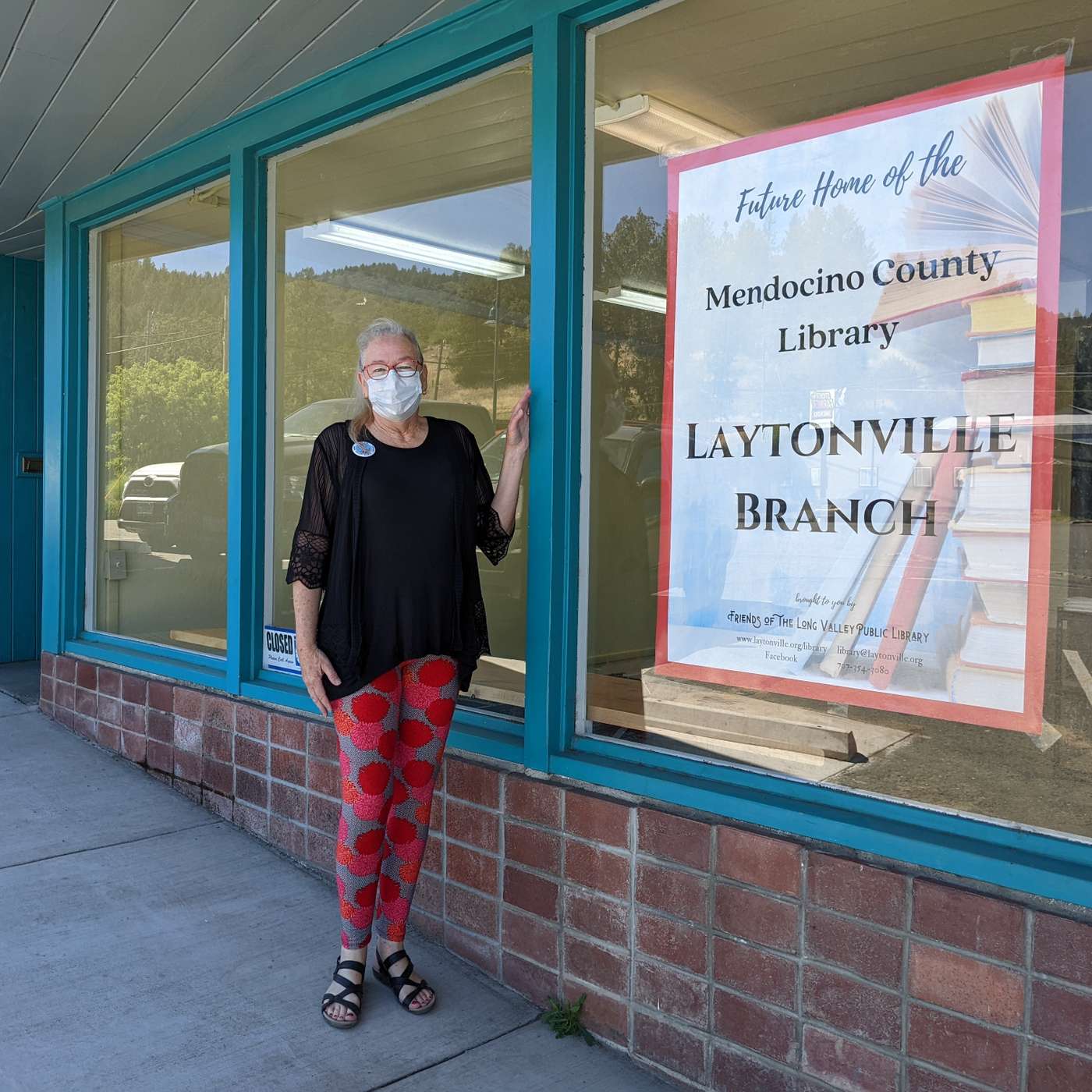
Ep 432Long Valley Library getting closer to opening
June 30, 2022 — After seven years of fundraising and scouting for a location, the Friends of the Long Valley Public Library are close to opening a branch of the county library in downtown Laytonville. The Friends have raised about $40,000 since 2015, and just last week, the library got the green light for a USDA Rural Development Grant of $64,200 as a 75% match to buy furniture, books, and other materials for opening day. Shawn Haven, one of the core members of the Friends group, met KZYX on Wednesday morning at the future location of the new branch, in the Foster’s shopping center just off of Highway 101. “We got started in 2015,” she recalled. “John Pinches offered us the old Bookmobile, and we went from there.” The county has an established Bookmobile program, which brings books to Laytonville every other Tuesday. “That Bookmobile that they gave us was not fit for county employee habitation, so we sold that and used the money, moving toward this project,” she said. “Of course, paying rent on this space through covid was a little pricey, but we’re getting there. A little more to go, and we’ll be ready.” Deborah Fader Samson, the Library and Museum Director, said in an email that she is planning for a New Year’s Grand Opening. Haven is pleased with the central location, which is within sight of the elementary and middle schools. It’s a block or so from the high school and the Book Room, a bookstore at the site of the old high school that serves as an ongoing fundraiser for the library. The walls at the Book Room are lined with school lockers, murals by a visiting Mayan scholar, a piano that’s out of tune, and donated bookshelves stuffed with volumes. There is also a seed library, which will remain even after the public library opens. The Book Rom has taken on a life of its own over the years. “We started with a big pile of boxes of books right there,” Haven recalled. Originally, the local school superintendent gave the Friends permission to use the old school site as storage for their books between sales. “And we thought, well, this is such a mess, we can’t function in here,” she said. “So we put up some shelves. And then we thought, well, we can put up some more shelves. And then we said, well, can we open it? Why schlepp all these books? We’re all old ladies, right? So she said, sure, go ahead. We just kept expanding our space, expanding our hours, so there you have it.” The Book Room has become more than a bookstore raising money for the library. It’s a hub of community activity, with a large central room where groups gather to play bridge, spin, have healthy snacks, or curl up with one of the approximately 3,500 books that continue to pour in. Volumes are currently organized by subject and age range, with one shelf dedicated to books about insects for young people, another featuring biographies, and one section devoted entirely to books by lawyers. “We have a little bit of everything,” Haven observed. “Or, as they say, something to offend everyone. The true job of a library.” Haven promised the Book Room won’t be phased out by the library. “The library here, to start off, will be open three days a week,” she said. “Probably Wednesday, Thursday, and Saturday. And then the Book Room is open Monday, Tuesday, and Friday. So there will be full literary and seed library coverage every day except Sunday…so we’ve got your back.” The library site has had multiple incarnations: it’s been a restaurant, a beauty parlor, and, most recently, a tattoo shop. It’s about 1000 square feet and has the capacity for around a thousand books, plus computers, magazines, and newspapers. And there’s a variety of artwork, starting with a hand-carved chinquapin counter carved by local woodworker Robin Thompson along the expansive, north-facing windows, “for laptop work and staring out the window,” Haven noted. There will be two public computer stations, with free broadband provided by a California State Library grant with speeds up to 1 Gbps, “so it’s fast and reliable, unless someone cuts a cable, of course.” The Friends of the Library also have a 4x6 mural of local nature scenes that artist Danza Davis painted with kids at Juvenile Hall, as part of a Get Art in the Schools Program grant through the Arts Council. That piece will be one of the first things patrons see when they walk into the library. But another work of art, in the future break room, is being diligently covered over with a meticulous decoupage of printed material. “This post, it had pinups on it,” Haven said, gesturing at a column still featuring a few remnants of vintage girly pictures, leftover from the tattoo shop. “It’s really sad to cover them up,” she said. “But the method is starch with a little varathane over it, so if anyone ever wants to restore it, they can. I hate to destroy someone else’s art.” The Friends found the site about three years ago, but the learning curve was steep, especially during covid. “When we started this, we didn’t ...

Ep 431Mendocino water systems must comply with state regs
June 28, 2022 — About a hundred property owners in the town of Mendocino have received a letter from the State Water Board’s Division of Drinking Water, asking them to complete a questionnaire to determine whether or not they are operating a public water system. It’s the first step in regulating businesses that may be serving water to the public without the inspections and treatments and permits required by law to prevent water-borne diseases. And it may be the first step in a state-regulated “regional solution” that includes the Town of Mendocino consolidating with other water users, though who would consolidate with whom and where the water would come from are questions that haven’t been answered yet. It’s also not entirely clear why the state and the county have not synchronized efforts to find out what kinds of businesses should have been identified as public water systems when they were first setting up shop. Zachary Rounds is the Mendocino District Engineer for the State Water Resources Control Board Division of Drinking Water, overseeing public water systems in Mendocino, Lake and Napa Counties. It doesn’t take much to meet the definition of a public water system. “A public water system, at its most basic, is an entity that serves potable water for domestic use, and that serves at least 25 people, 60 days a year…I say if you have a restaurant that’s open one day a week, all year round, you actually are not a public water system, but if it’s two days a week, that would be 104 days with 25 people, that would make you a public water system,” he explained. “You could also be a public water system if you have 15 service connections with year-round residents.” At Monday’s meeting of the Mendocino City Community Services District board, Rounds told directors what it will take to permit each system. “The water system needs to demonstrate that they have adequate technical, managerial and financial capacity to operate as a public water system…different tests on the water to ensure that it’s free from various forms of contamination, adequate source and storage capacity; that they’re essentially financially stable enough to operate a public water system without eventually falling into ruin; that they have adequate managerial control over the water system; that they are actually the ones that control the water right there…we typically work with the water system to ensure a complete permit package,” he said. “After we’ve received the complete permit package, we’ll usually do a final review, perform an inspection of the water system, make final determinations, and, if they meet the criteria, issue a permit.” The letter says that the water board will not initiate enforcement actions against systems that are working to come into compliance. Donna Feiner of Feiner Fixings, a plumber and water operator who manages 27 water systems on the coast, was also at the meeting. She took a question about the rough costs of running a water system, though there are a lot of variables, and no two are exactly the same. “So once a month you have to check for bacteria in the water,” she said. “It’s coliform and e. Coli. And quarterly you have to check the well for bacteria and e. Coli. I usually find that the paperwork takes about five, six hundred dollars to do, because it’s a lot. And then it’s usually a visit once a week to check the system, and then it’s sampling once a month, and then once a year for nitrate. So, figuring two hundred dollars a month to cover that. Those are just rough numbers. And then whatever it needs to bring them into compliance.” And “bad bacties,” or high bacteria levels, are not always hypothetical, as Feiner recalled in one system she managed. The tank didn’t have a good cover, so birds would sit on top of it and foul the water. “They had to fix the tank so that didn't happen anymore, and then put in a chlorination system to keep the water safe,” she concluded. Feiner’s own business expenses are rising too, with the cost of chlorine doubling and the price of caustic soda much higher than they were before the pandemic. And a lab on the coast has closed, which means she has to be precise about timing the delivery of water samples to a lab in Ukiah. Rounds said the state sees advantages to working with larger water entities, though he suggested that local organizations are welcome to propose solutions that might not include each and every business going through the permitting process. Director Howard Hauck asked if the state would be willing to pay for a larger community water system. Rounds replied that, “We are interested in water systems consolidating with each other,” because the state finds that working with a few larger water systems is more resilient and more efficient than working with lots of small ones. “Most of the consolidations that I’ve witnessed have been small systems connecting to a much larger water system,” he noted. However, he added that the division of financial assist...
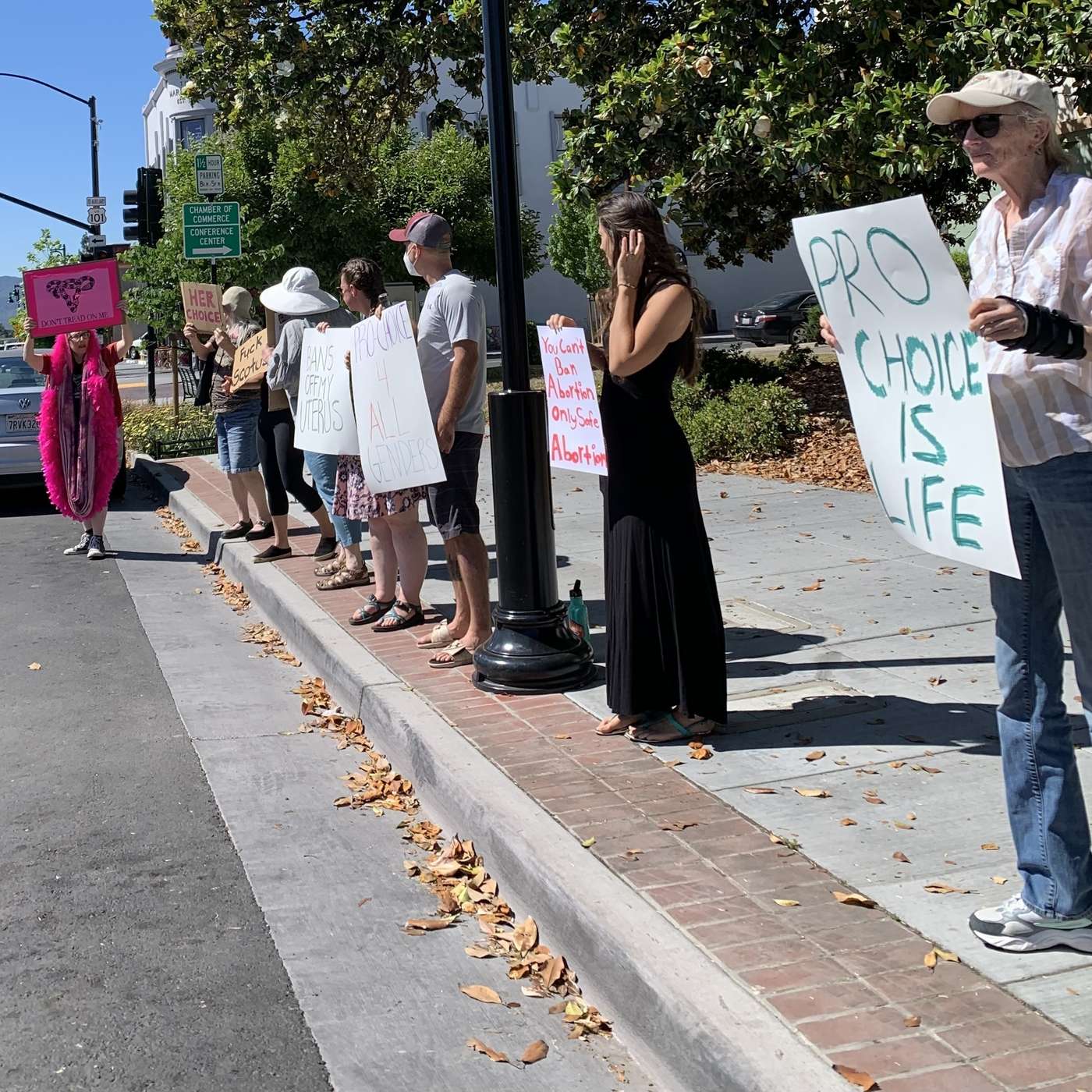
Ep 430Reproductive Rights Protest in Ukiah
Ukiah residents went to the streets to protest the SCOTUS overturn of Roe vs Wade
Ep 429Final budget remarks, Board approves fees for public records act requests
June 23, 2022 — The Board of Supervisors approved the final $355.8 million budget on Tuesday, though some key information is still unavailable. Supervisor John Haschak took up the union’s question before the final approval, when he said, “So, we’re passing the budget without really knowing what those numbers are, about how many are funded but not filled.” The county appears to be budgeting for 400 unfilled positions. According to SEIU Field Representative Patrick Hickey, 172 of those would be paid for by the general fund. He said 92 of them have been vacant for over a year and a half, and 231 are paid for by state and federal funds. He urged the board to freeze some of the general fund positions, which he calculated would free up millions of dollars, and work vigorously to fill the state and federally funded positions, asserting that “Failure to fill these positions has deprived Mendocino County of vital services that seriously impact our residents. It has also kept tens of millions of state and federal dollars from flowing into our community. This is free money. Let’s pay market rate wages to attract the talent we need to serve our community.” The board agreed to direct staff to bring back an agenda item offering increased, market rate wages for state-funded positions. Supervisor Ted Williams also echoed a frequent union refrain, when he specified, “By market rate, we mean enough that people can apply, find housing in our community, et cetera. We don’t want vacant positions that are state-funded. One thing about the budget became clear, after Maria Avalos, of UVA, an inland-based Latino advocacy group, asked for more community involvement in the county’s decision-making process of awarding the $16.8 million in American Rescue Plan Act funds, which were distributed to help with covid recovery. “I would also suggest that in the future, when community organizations are invited to ask, that the Board of Supervisors would look at our population and see that Latinos make up 25.8% of our population, and that the Spanish-speaking community and Latinos are invited and have a seat at the table as well,” she said during public comment. “I would also ask for transparency on whether the Board of Supervisors has engaged with the public before these funds have been allocated, which was advised.” Supervisors briefly considered bringing the item back, to consider awarding some of the funds to community organizations.But after being told that requests for internal county government uses for the funds were greater than the availability, Supervisors Ted WIlliams and Glenn McGourty decided not to revisit their decision to use it for county services. “I think it would be disingenuous to invite community groups to present, if we know we don’t have any funds to award,” Williams said. McGourty added that “I would concur. If there’s no money, why have people apply for something that doesn’t exist?” The county may use some of the covid money to bolster the new consolidated office of treasurer tax collector and auditor controller. Chamise Cubbison was the only candidate on the ballot and county counsel is preparing an ordinance to appoint her to the new position without paying her both salaries. Former treasurer tax collector Shari Schapmire quit after the board voted 4-1, with Supervisor John Haschak dissenting, to combine the offices. Second in command Julie Forrester’s last day is tomorrow. And the outside audit is six months later than usual. Cubbison provided a list of reasons for the tardiness, from staffing shortages to covid to a significant increase in work generated by the receipt of federal funds. The fiscal team with the county executive office prepared the budget this year without the auditor-controller’s report . Interim CEO Darcie Antle told the board it was because her office did not receive the report until two months after the budgeting process had already started. In an item only related tangentially to the budget, the board voted unanimously to approve an ordinance establishing fees for public records act requests. The fees range from simple duplication costs to $150 an hour for an attorney’s time to sort out disclosable information from material that is exempt from disclosure. If the amount is expected to be more than $50, the person making the request will get an estimate and be asked to pay a $50 deposit. If the deposit runs out before the request is fulfilled, the requester will be asked for another installment. The fees are weighted, which means they are not designed for full cost recovery. County Counsel Christian Curtis estimated that the county receives 4.7 document requests per day, and that fulfilling them takes 20-30% of his attorneys’ time. “We’ve also been seeing an uptick in increasingly complex requests,” he reported, including from companies doing market research. One request stands out for him in particular, where he was included in correspondence with an attorney who made a req...

Ep 428Board drops water portion of contentious water and fire tax
June 22, 2022 — The Board of Supervisors took a drastic change of course on a proposed water and fire tax at a meeting that erupted once in the morning and then dragged on until after 6:30 pm. The proposal at the beginning of the day was for a three-eighths of a cent sales tax, with 40% going to fund water resiliency projects and 60% going to fund fire services. The tax was projected to generate $7 million a year. Supervisor Maureen Mulheren met with the fire districts board and further honed the fire portion, so that 40% of the projected $4.2 million a year for fire services would be distributed equally among the districts. The remainder would be allocated among them using a formula modeled after the state’s distribution of funds generated by Prop 172. Her formula for allocating the water portion of the tax is now moot, since supervisors discarded the plan to include water projects. Supervisor Dan Gjerde vigorously opposed the water tax, calling it “‘ridiculous and offensive.” During the discussion to approve the county budget, which appeared on the consent calendar, he objected to how the Inland Water and Power Commission was using the money it receives from the county. The county is one of five dues-paying public entities that are members of the Commission, which exists in part to protect the Potter Valley diversion. Gjerde spoke about the records from the Commission meetings, which reflected polling and research expenses, “testing public support for a parcel tax to finance what Inland Water’s minutes, throughout 2021 and 2022 have repeatedly called the PVP, or Potter Valley Project ballot measure,” he reported. He added that the cost of polling services to a firm called Godbe Research was estimated at between $28,000-$31,000, depending on how long the survey took. A scope of work describing a two-phased approach lays out the cost of feasibility studies, strategy, and education and outreach by two additional political strategy firms associated with the Godbe Research Team, TBWBH and NBS. The total costs for Phase I were estimated at $76,450, with a Phase II fee of $45,000, plus three informational mailings priced at $43,491, and optional digital services at $10,000. “So my question is, what is the total amount that Inland Water has paid, or will pay?” to the three firms, Gjerde asked. “These are our tax dollars, so we deserve to know.” County Counsel Christian Curtis said he always advises caution when it comes to political activity on the part of publicly funded bodies. “There is a prohibition, not just on county funds, but on any public funds, for any sort of campaign purposes,” he said. “I don’t know that that prohibits any sort of polling, where what you are essentially doing is research to determine in advance whether or not the public entity should even invest the resources to go ahead and prepare an ordinance and submit it to the voters. This is an area I generally advise caution…there is an exception to the rule regarding campaign activity that allows a public agency to put out purely informational items that do not advocate for or against on a matter that may be submitted to the voters.” Supervisor Glenn McGourty said legal fees make up the bulk of the Commission’s expenses. “If you look at what IWPC is spending their money on, it’s mostly legal assistance from Scott Schapiro, who is our legal counsel, trying to negotiate the purchase of the Potter Valley Project from PG&E,” he said. Gjerde insisted that the Potter Valley Irrigation District and the Russian River Flood Control and Water Conservation Improvement District, which are also members of the Commission, have a valuable commodity for sale. “Those two entities by themselves could produce well over a million dollars a year,” he said. “Problem solved. A million dollars a year. Just those two boards. Take action. Nobody’s stopping them. But instead, nope. They want to ask everybody in Mendocino County to bail them out, because they don’t want their own customers to pay the going rate.” McGourty said a regional entity of Russian River water users is beginning to coalesce around some fundamental principles. “Primarily, the use of the money is to negotiate the water right transfer from PG&E to the community of the Upper Russian River watershed between Potter Valley to Healdsburg,” he said. “That’s really what this is about. Eventually, the agriculture people will pay a reasonable amount of money for water. It won’t be cheap, as you imply now, but it’s going to take some time to get that together…it costs to be there. It costs like a million dollars to participate in the discussions, in legal fees. And it’s extremely important.” Paul Moreno, a spokesman for PG&E, wrote in an email on Tuesday afternoon that “PG&E is not in negotiations about water rights associated with (the) Potter Valley Project and has not been approached about any such negotiations.” The Ukiah Daily Journal and the Mendocino County Observer have come out agai.
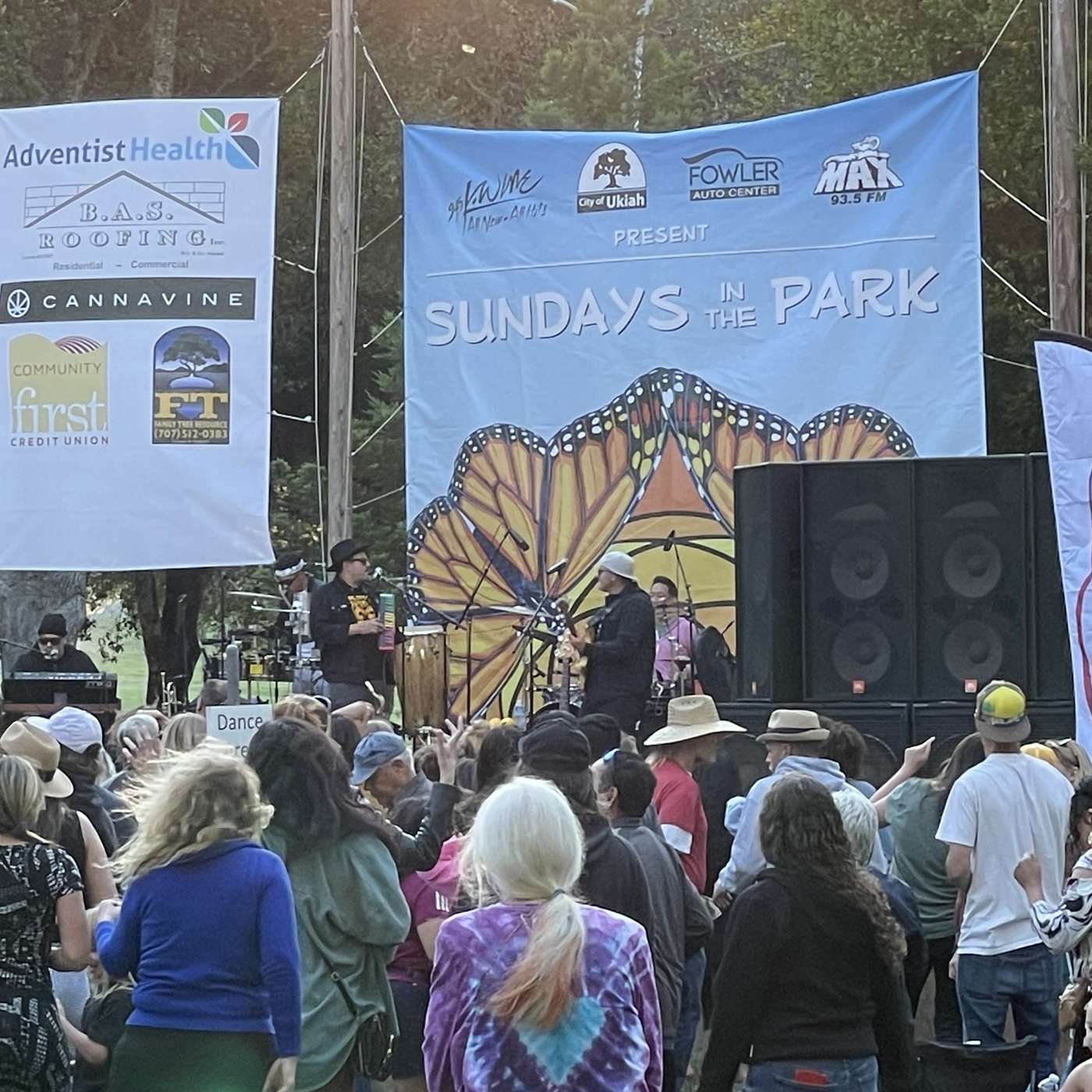
Ep 427Ozomatli returns to Sundays in the Park for the 30th anniversary series.
June 21, 2022--

Ep 426Urchin predators converge on Mendocino beach
June 20, 2022 — The first annual urchinfest took place this weekend, with opportunities to learn about urchins and their environment, and to eat them raw on the beach at Van Damme State Park in Little River. A woman named Juanita described the flavor as “someone sweet and buttery. It just slides down really easily. Maybe it’s a softer texture than raw fish, but I love it.” She had just sampled some of the red urchin uni harvested by Greg Fonts, a freediver and spear fisherman who was wearing a shirt that said “Meateater” as he cracked into the spiny creatures. About 120 people showed up on Saturday morning to watch the demonstration, hear about the urchin, and have a chance at a taste. Not that there’s much to eat out of the spiny purple shell. A mysterious illness has killed off most of the sunflower sea stars, which were the urchins’ main predator. The purple urchin have overpopulated and devoured the kelp, and now they hang out in a dormant malnourished state. Unlike the red urchin, the purple urchin have no marketable value. Joshua Russo is president of the Watermen’s Alliance, a recreational divers association that’s part of an effort to remove the urchins from some small areas. The idea is to create a few refugia for kelp so it can re-seed itself if ocean conditions start to balance out again. In 2019, the recreational limit for purple urchin was doubled from the previous year’s limit, to forty gallons per diver in Mendocino, Sonoma, and Humboldt counties. And in Caspar Cove, there is no recreational limit and divers are allowed to crush the urchins in the water. “What we’re doing is under a scientific collection permit,” Russo explained. “Part of the project is to see if divers will voluntarily report their activity. Reef Check (a non-profit that trains citizen scientists to collect data on California’s kelp forest ecosystems) has a website set up where divers can report their activity. It basically asks how many you think you culled in a dive, how many people were with you, how many dives you made, were you scuba or free-diving…it’s not a legal requirement, but we are hoping that everyone will report, because if people are doing it and not reporting, the department (California Department of Fish and Wildlife) will let the regulation expire. Part of the program is to see if people will voluntarily provide that information so we can use it to prove that what we’re doing is effective and it doesn’t harm anything.” The purple urchin has another missing predator, in addition to the sunflower sea star. The otter was hunted out of the area by fur trappers in the 19th century. Russo says there are several shortcomings to any plan to reintroduce the otter to clear out the purple urchin. “The problem with that is these urchin are void of much material, so even if they were full, there’s a study that shows that otters are taught what to eat by their parents. So if you brought an otter up here that was not shown how to eat urchin, it wouldn’t even see them as a food source. So you would have to bring the right otters up here, and very quickly, they would open up a few urchin and learn there was nothing in them, so very quickly, they would move right over to anything else. Abalone, crab, anything they could get their hands on.” Warm ocean conditions from 2014-2019 didn’t help the kelp at all. In the past couple of years, the ocean has been cooling off a little, and the kelp is showing some signs of recovery, but Tristin McHugh, the kelp project director with the Nature Conservancy, says it’s still historically low. There is some money available for studies like the one Russo is involved in. Starting in 2020, Reef Check received a half-million dollar grant from the Ocean Protection Council to work with the Department of Fish and Wildlife and a variety of non-profits and commercial fishermen to figure out how to reduce urchin to what McHugh calls, “this magical threshold value that would potentially facilitate kelp growth.” That is about two urchin of any species per square meter. The challenge, McHugh says, “is trying to understand what to do when red urchin are also grazers, but also have commercial uses, as opposed to the purple urchin at this point.” Commercial divers are effective at culling urchin, but unlikely to do so without grants or other economic incentives. “What other tools for restoration can we test on top of that?” McHugh asked. “So one thing we are starting here in 2022 is evaluating urchin traps at Noyo Harbor, with hand harvesting of urchin, and we’re also looking at Albion, with Moss Landing Marine Labs, looking at out-planting kelp in addition to hand harvest.” There was a promising sighting of a sunflower sea star in Mendocino last year, but for now, the known remnant populations of the once-mighty predator are in British Columbia and Alaska. “Typically, sunflower stars are pretty amazing predators,” McHugh said. “We know that they eat young purple urchin, or sometimes...

Ep 425Ukiah police chief fired
June 17, 2022 — Noble Waidelich has been fired from his position as Ukiah Police Chief, effective Friday. He was placed on paid administrative leave Tuesday, after city management learned that he was the subject of a criminal investigation into an allegation of an assault on a woman. The Sonoma County Sheriff’s Office is investigating the charge. The press release from Friday afternoon quotes City Manager Sage Sangiacomo saying that “Waidelich was also in violation of police department policy separate and apart from the accusation and ongoing investigation of criminal conduct. He was placed on administrative leave within hours of learning of this incident. His weapons, vehicle, and badge were taken away at that time. Within three days, he has been notified of his termination from City employment.” Deputy City Manager Shannon Riley said the city was not able to answer questions about how much Waidelich was paid while on leave, or if he received a severance package. City staff would not discuss any details of the termination. The timeline has been swift. On Monday afternoon, Sheriff Matt Kendall notified the Sonoma County Sheriff’s office of the matter, and asked them to take on the investigation. Juan Valencia, of the Sonoma County Sheriff’s Office, said the results would be turned over to the Mendocino County District Attorney’s office for review. Valencia said investigators interviewed Waidelich, but he was not taken into custody. Sonoma County declined to release the crime report and any related information, citing a continuing investigation. Waidelich is also facing a jury trial in a civil charge of domestic violence. Back in 2016, Waidelich’s ex-girlfriend Amanda Carley, who was an adult probation officer with the county at the time, was summoned to an interview with a sheriff’s investigator concerning a report her teenaged daughter had made to her school counselor about Waidelich abusing her mother. Amanda Carley hedged during that interview, then came back a few months later, told the investigator she had not been truthful, and said that Waidelich had been abusing her. Eyster placed her on the Brady list, a roster of dishonest cops whose testimony is useless in the prosecution of criminal suspects. Longtime reporter and former DA spokesman Mike Geniella characterized Eyster’s decision to place Carley on the list as ‘draconian.’ He thinks Eyster should recuse himself, and hopes someone else will get to the bottom of the most recent charge. The original 15-count complaint that Amanda Carley filed five years ago is against Waidelich, the county, and the probation department. Her attorney, Richard Freeman, spoke with kzyx on Friday afternoon, saying his client intends to pursue both parts of the case, against Waidelich and the county. Waidelich is being sued personally in this matter. But there’s more history to violence within the Ukiah Police Department than the one case with Amanda Carley. In recent months, the city has paid out more than a million and a half dollars to settle with three different people claiming to have been assaulted by members of the Ukiah police force. Forrmer Officer Kevin Murray, who is facing trial next month, was accused of sexually assaulting an unnamed woman, whose settlement came out to a quarter of a million dollars. Christopher Rasku, a disabled veteran, settled for a little over a million for a 2018 assault in which he says Murray broke into his home, beat him, and falsified the report about it. Gerardo Magdaleno and his attorney received $300,000 for a sustained beating that Magdaleno received in a parking lot on the south end of town at the hands of four police officers. Waidelich spoke with kzyx in March, after that settlement, saying the idea of a police oversight body “doesn’t necessarily scare me…because, along the lines of our equity and diversity committee, if we can demonstrate to those people the work that we’re doing and the value in it, that only goes to my aid in terms of credibility in the community.” “This is the man who’s going to straighten things out at the Ukiah Police Department,” Geniella said. “And here we are.”
Ep 424KZYX News Director Victor Palomino promises bilingual news
June 17, 2022 – Victor Palomino joins the KZYX News team as its first fully bilingual News Director. He will collaborate with Program Director Alicia Bales and news anchor Sarah Reith to develop a daily news program in English and Spanish. The goal of the bilingual news program is to serve listeners with continued news reporting on issues relevant to our rural community, and to expand news coverage to engage Mendocino County’s growing Spanish-speaking and immigrant communities.

Ep 423Ukiah enters water sharing agreement, passes climate emergency resolution
June 16, 2022 — The Ukiah City Council took two actions in response to drought and climate change at its Wednesday night meeting, when they unanimously approved a climate emergency resolution and agreed to participate in a voluntary water sharing agreement with other water users on the Russian River. The city has a sturdy groundwater basin and holds durable senior pre-1914 water rights to flows in the East Branch of the river, which is also the destination for water that’s diverted through the Potter Valley hydropower project. The voluntary program affects water users in the upper Russian north of the Dry Creek confluence. The agreement was written by Phil Williams, Ukiah’s special water counsel, and was approved by the State Water Board on June 7. The program is intended to provide water users with a framework within which senior rights holders can reduce their water use by a certain percentage so that junior rights holders are not left high and dry. Participants, who have until June 20 to sign up, will commit to reducing their surface water diversions using a monthly average based on their water use during the years 2017-2019. They’ll continue to keep track of how much water they use, and agree not to challenge one another’s water rights. The maximum water use reduction for pre-1914 water rights holders like the City of Ukiah will be 20%. The program will end when the Deputy Director of the Division of Water Rights determines that there has been enough rain to alleviate water supply shortage; when the drought emergency proclamation is withdrawn; or if the program starts having an adverse effect on non-participants’ water availability. Sean White, the city’s director of water and sewer, told the City Council that the current legal structure for water rights makes it hard to distribute the diminishing resource in a way that benefits the community at large. He said the water-sharing agreement was ironed out after last year’s bruising negotiations with the state over the program to haul water from Ukiah to Fort Bragg. “Under the current water rights system, the way it works is juniors in a really dire situation like last year essentially get nothing, and if you’re senior enough, you can get everything…I don’t think myself or Phil have any real opposition to existing California water rights, there are a lot of things that are based on that, and this doesn’t undo any of that. What's In front of you, this creates an alternative path. If you don’t want to go down that road, and you want to just do something that is voluntary, that you feel is more equitable, then really, by being equitable, it’s kind of better for your overall community, than having people who have nothing and people who have nothing, then that is sort of the overall premise of the agreement that’s in front of you.” The program depends on how much water makes it into the East Branch of the Russian River, through natural means or by way of the diversion from the Potter Valley Project, which is owned by PG&E. PG&E has asked the Federal Energy Regulatory Commission to approve a variance, a request to reduce the amount of water coming out of Lake Pillsbury to five cubic feet per second. Water managers were expecting five times that much, plus a five cfs buffer. Williams said he expects a decision from the Commission in a few weeks, and that approval of the variance request would probably put a hold on the agreement. “If PG&E is only hitting a 5 cfs release, this program likely will not become viable, meaning it won’t become operative until September one,” the start of the next water year, he said. “If there’s more water than that, this program will become operative and viable before then. But what happens in this program is we essentially create a separate block of water. Participating water right holders would agree to not divert a certain amount of water, thereby keeping that water in the stream that would be available to other participants further downstream…we won’t be inundated with requests for this water because it’s more passive than that. We would be creating a block of water, along with other participants, that makes that water available.” The program is a little like an insurance pool, in that it only works if enough healthy people, or, in this case, senior water rights holders, sign up for it. White said that’s why he thought it was important for the city to sign on. “There’s a certain level of critical mass that needs to happen for this program to be viable,” he explained. “One of those is people signing up, in particular senior right holders, because they are the people who will have a resource that can be reallocated to juniors. So if only juniors sign up, then it really won’t work. So I think that’s one of the reasons that it’s important that the City agrees to participate. But there also does need to be enough resources to share, period. If the year goes as it was intended, I think it will be great for this year. The...

Ep 422Ukiah police chief being investigated for assault claim unrelated to Carley suits
June 15, 2022 — Ukiah Police Chief Noble Waidelich is on paid administrative leave, pending the results of a criminal investigation into an alleged assault on a woman. Waidelich is facing a jury trial in September over accusations of domestic violence and financial abuse by his ex-girlfriend, Amanda Carley. Carley’s adult daughter Madisyn is also suing Waidelich for damages over what she says is harm she suffered by witnessing her mother’s abuse when she was a teenager. The Carleys are not involved in the most recent allegation, which is being investigated by the Sonoma County Sheriff’s Office. Both of the Carleys’ suits are civil matters, which means they are not being prosecuted by the District Attorney. Sheriff Matt Kendall said he received a call Monday afternoon regarding a report of an assault on a woman by Noble Waidelich. Kendall called the reporting party, who gave him enough information to make him believe that her claim needed to be investigated. The alleged assault was not in his jurisdiction, so he called the Sonoma County Sheriff’s Office, which took over. He added that outside agencies are often called in to avoid the appearance of impropriety. Kendall said he would have been notified immediately if Waidelich had been taken to the county jail. Sergeant Juan Valencia, of the Sonoma County Sheriff’s Office, confirmed that Kendall asked his department to take on the investigation, and that Waidelich spoke with investigators, but was not taken into custody. In a statement, he wrote that “Upon completion of the investigation, the case will be submitted to the Mendocino County District Attorney's Office for review.” District Attorney David Eyster did not return a call requesting comment on the case. The City of Ukiah issued a brief press release a little before 11:00 on Tuesday night, saying that Waidelich had been placed on administrative leave as of June 14, pending the ongoing criminal investigation; that no further information may be disclosed by the City at this time; and that the City is working to provide continuity of services. But the Police Department is now without a chief. Ukiah Mayor Jim Brown said that typically, the next in command at the police department would take over as acting chief. City Manager Sage Sangiacomo confirmed that Crook, who is not in the office this week, has been appointed acting chief of the Ukiah Police Department. It’s not clear which of the lieutenants is in charge while he is gone, but Brown said the department is “not left to run amok,” and that he “feels confident the police department will run as efficiently as it ever has.” Waidelich’s attorney, James King, did not return a request for comment, but Richard Freeman, who is representing Amanda and Madisyn Carley, agreed to a brief interview. He confirmed that the latest allegation does not involve either of the Carleys’ cases. “Those incidents took place a number of years ago, so there is nothing about the current investigation that relates to them,” he said. Amanda Carley’s case, which she filed in 2017, is against Noble Waidelich, the County of Mendocino, the probation department, where she worked as a probation officer, and her boss at the time, Albert Ganter. Madisyn Carley filed her case in December of last year, against Waidelich alone. Freeman said the question of whether the cases will be combined is “in a state of flux,” and that the question of whether or not Amanda Carley’s case will proceed to its trial date of September 26 “remains to be seen.” While Amanda Carley’s case has been winding its way through the system for years, “Madisyn Carley’s case, which does not involve the county, is in its very early stages.” As for the current allegation, he said that “ultimately, the court may need to make a determination as to whether any of it or parts of it would be admissible as relevant and material to the allegations of Amanda Carley, which date back several years…without the specifics, it is very hard to predict how that would be resolved.” Noting that the latest investigation is still considered an allegation, Freeman concluded that Waidelich “has an opportunity, as anybody suspected of criminal wrongdoing does, an opportunity to understand those charges, and to defend himself.” In March, the City of Ukiah reached a settlement for over $300,000 including attorneys’ fees with Gerardo Magdaleno, a naked, mentally ill man who was beaten by police on April first of last year. And last month, the city paid a quarter of a million dollars to a woman who accused former officer Kevin Murray of sexual assault. The City also paid over a million dollars to settle with a man who claimed Murray beat him in 2018.

Ep 421Waste hauler asks household recyclers to consider worker safety
June 15, 2022 — With the passage of SB 1383, Californians will be required to reduce organic waste in the landfill by 75% in the next three years. In a few weeks, a new large-scale compost facility will be available to most of Mendocino County, and buy-back recycling will re-open in Fort Bragg and Ukiah. Most of the county’s non-recyclable, non- compostable trash goes to a landfill in Fairfield. The county and cities have composting contracts with Cold Creek Compost in Potter Valley, which is permitted to process 50,000 tons of material a year. On July 1, C&S Waste Solutions will take over the solid waste contract for Fort Bragg and Franchise Area 2, from Waste Management. C&S partner Bruce McCracken sketched out the area where residents can expect to see new containers, and new trucks, making the rounds. “Franchise Area 2 is kind of split in two, an inland portion and a coastal portion,” he explained. “The coastal portion being everything slightly north of Fort Bragg, and then south down to the Navarro river, so down towards Albion, et cetera. The inland portion is the Ukiah Valley: Redwood Valley, Potter Valley, Hopland. So basically the entire Ukiah Valley…I would like to add, though, on the trucks: one thing that the residential customers will see is that we run split-body trucks. So we co-collect. We collect garbage and recycling at the same time. And I know when people first see it, we’re going to get a bunch of phone calls saying, you’re mixing everything! But we’re not. There actually is a wall in between, in the body of the vehicle. It’s one less trip on the streets, so it helps the roads. It makes us more efficient…it makes no sense for us to mix the material, because it costs us money to go to the landfill.” In 2019, the company won a $3 million grant from the state to build a compost facility at the Ukiah transfer station. Like Cold Creek, it’s permitted to process 50,000 tons a year, though it’s currently able to process half that. The transfer station has been composting yard waste, but the new covered facility will take organic waste like food scraps, as well. And, after suspending buy-back recycling in 2019, C&S is promising to open beverage container recycling centers in Ukiah and Fort Bragg. McCracken estimates that in about three months, customers will be able to get their California Redemption Value refunds on bottles and cans. SB 1383 puts the burden of enforcement and education on the contractor, but McCracken says the hammer will come down incrementally. “If we note that there’s prohibited material in the blue can or the green can, we will tag it. Our customer service staff will call the customer. We will send out literature explaining that this is what really goes into the blue or green can. A second time, you’ll get a small fee, which in most cases we will waive. It’s more of a wake-up, to say, hey. We can’t accept this material in these carts. The third time, it’s a little more serious, where there will be a charge levied against you for contamination, and if it continues, we have the ability to take the cart away. But we don’t want to do that. I understand that everybody wants to recycle everything. But it’s just not doable.” That’s apparent at the old Alex Thomas pear shed in Ukiah, now transformed to a sorting facility where seventeen workers separate trash from recyclables. Plastic bags and plastic wrappers, says McCracken, are the enemy. “We don’t want bags in the recycling, because that’s where we find needles, too,” he said, over the roar of the machinery. “Needles are the biggest threat on the line.” There are other hazards, too. In the quiet section of the MRF, or Materials Recovery Facility, there is a huge pile of crushed glass. McCracken’s not worried about glass. “Another thing that’s really bad in the blue can are batteries,” he said. “Because it starts fires in MRF’s, and it starts fires in garbage trucks.” He added that batteries need to be taken to Mendo Recycle during hazardous household waste events, or to the facility in Ukiah, which has limited hours of operation. “The amount of fires across the county in garbage trucks and at MRF’s is escalating at an alarming rate, and it’s batteries,” he warned. On the tipping floor, where workers extract sheets of plastic film from the recyclables, there are room-sized bales of material that are headed for the landfill. Clothes, pillows, foam mattresses and small appliances have all been pulled from the recycling stream. Some items, like hoses, call for extraordinary measures. “These are known as tanglers in the business, because they tangle up in the machinery,” he said, tugging on a length of hose strapped into one of the landfill bales. “So we literally, at the end of the shift, have to send people up there in harnesses, with knives, to cut it out of the machinery. It’s a hard job as it is, and that’s why people doing their part on the front end makes the job a lot easier.” Once the material makes its way ...
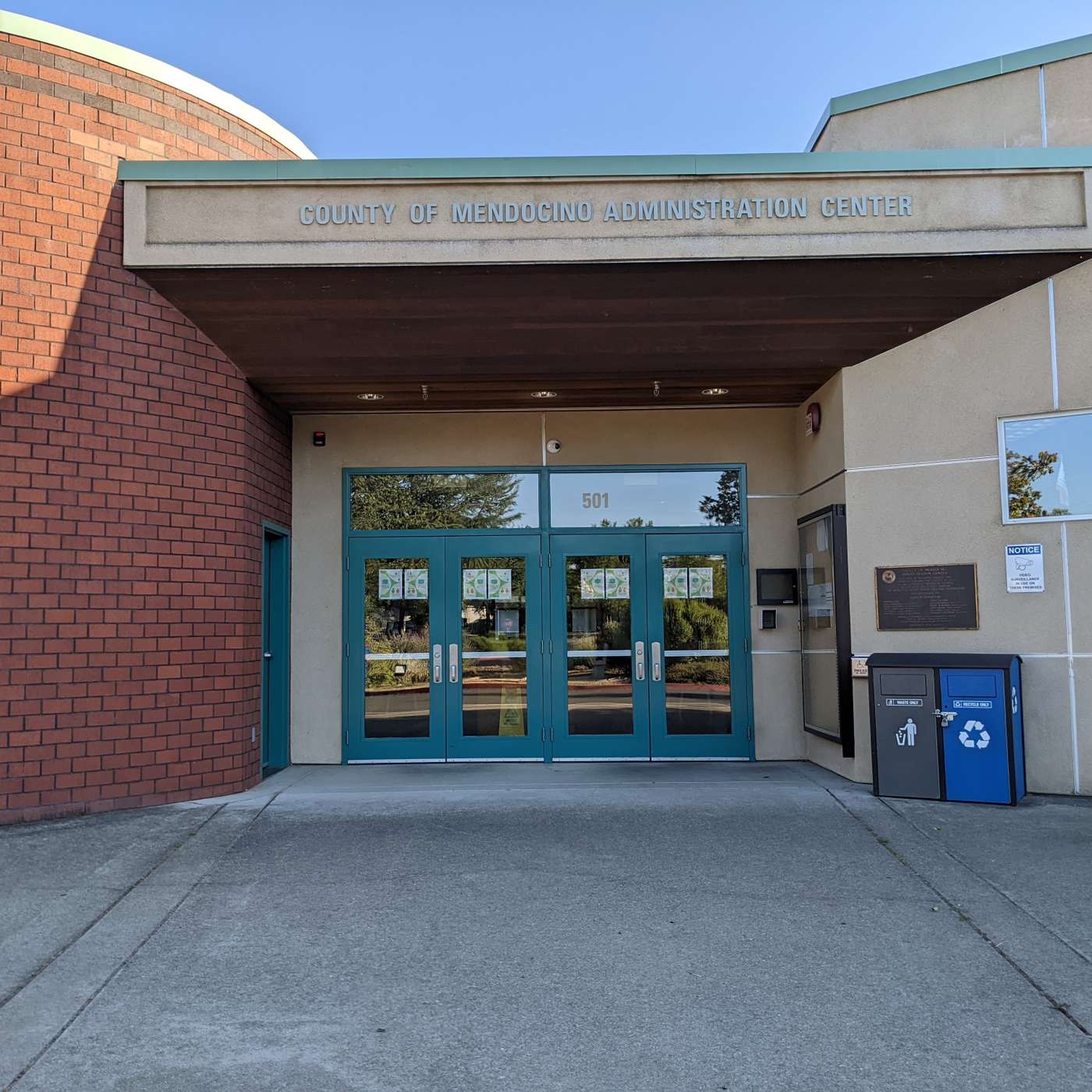
Ep 420Board closes budget hearings
June 14, 2022 — The Board of Supervisors has closed its budget hearings and will formally ratify the final county budget on June 21. The total county budget is over $355.8 million, with an operating budget of over $29.6 million per month, according to documents attached to the June 7 agenda. Talk of closing the county museum was notably absent from the list of recommendations. Several organizations asked the board to consider funding them from the American Rescue Plan Act (ARPA), including Meghan Barber-Allende, the Executive Director of the Community Foundation, who asked for $300,000 for hunger relief and another $200,000 for non-profits that were unable to hold fundraisers during covid. “We can make a difference, and we can feed our communities, especially those that are extremely vulnerable,” she told the Board. “I think it’s just very, very hard to think about how families and individuals and seniors are going to survive this, if we don’t figure out how to provide some support.” Supervisor Ted Williams asked acting deputy CEO Sarah Pierce if it would be possible to fulfill the request. “As we go through these presentations, what would the funding source be?” he asked. “What is the pot of money we have to divide up? Because I can already tell you, I support all of these projects. How do we pay for it?” Pierce told him county staff was keeping track of requests for ARPA funding, but that they were following earlier Board direction to use the funds for county core services first. The health plan deficit, even with an infusion of $4.6 million from the ARPA funds, is projected to be over $3 million by the end of the calendar year. And cannabis tax projections are $1.5 million, down from $6.1 million last year. Supervisor Ted Williams was chagrined. “I see that we had $6.8 million that we didn’t collect on cannabis,” he noted. “We’re not going to collect that, aren’t we?” Interim CEO Darcie Antle confirmed his assessment that, “that’s just written off for this year.” Still, some petitioners were given some hope. Stephanie Garrabrant-Sierra, Mendocino County Resource Conservation District’s new Executive Director, told the Board that, as a special district, her agency is “a government partner,” which is working to alleviate climate change. With the rising costs of gas and steel, she requested double the $45,000 the RCD typically receives. The Board directed her to Department of Transportation Director Howard Dashiell, to see if it’s possible to provide more funding for the district under his allocation. Projected secure property tax for the next fiscal year is up to $41.8 million from $36.8 in May of this year, and projections for the transient occupancy tax are up to $8 million from $6.2 million actuals in May. Patrick Hickey, the field representative for SEIU Local 1021, insists that the budget is not as dire as presented. The county is currently in negotiations with all its labor unions. “Sales taxes are projected to be up by $700,000, transient occupancy taxes are projected to be up by $2 million, property taxes are projected to be up by $2 million as well,” he recited. “This doesn’t sound like a county in trouble to me. But how well has the county done at projecting its revenues? Actually, they’ve underestimated Budget Unit 1000 every year.” This unit is for non-departmental revenue, derived primarily from property tax, sales tax, and ToT, or transient occupancy tax, also known as bed tax. The funds are usually used to make up the difference in expenditures and revenues by county departments that operate at a loss. Hickey went on to say that the county had underestimated Budget Unit 1000 by nearly $8 million in FY 2018/2019, $1.3 million in FY 2019/2020, and $9.4 million in FY 2020/2021. “I think you can see the pattern here,” he concluded. “The county is in the habit of overestimating expenses and underestimating revenues.” Antle provided some more information about the revenue projection, saying, “In the past, the revenue projection has come from the auditor-controller's office, and as you know, we had a change in that position this year. Those numbers weren’t provided to us by the auditor-controller, so the fiscal team made the projection for this coming year of 2022/2023.” She added that the team had eventually received the report from the auditor-controller, but not until May 20, which wasn’t timely enough for them to use it when the budget process started at the beginning of March. She told the Board that the only difference between revenue projections by the fiscal team and the auditor-controller is that “ours is $700,000 higher.” Hickey also suggested that the county stop budgeting for the nearly 400 positions that it can’t fill, which he believes would free up money to pay more to existing staff. The Board agreed to a discussion with department heads to find out if they are still actively recruiting for positions that are funded, but which have been vacant for years. The Board als...
Ep 419Amanda Carley to get a jury trial
June 13, 2022 — Five years after filing a lawsuit against Mendocino County and her ex-boyfriend, Amanda Carley will have a chance to make her case in court. Carley is suing the county, the probation department, her boss at the time, and Noble Waidelich, who is now the chief of the Ukiah Police Department. At a hearing on Friday morning, Mendocino County Superior Court Judge Jeanine Nadel granted Carley’s request for a jury trial, scheduled to begin on September 26 of this year. The fifteen-count complaint, filed in April 2017, accuses Waidelich of physical and emotional abuse and breach of oral contract, for failing to adhere to agreements to pay Carley her share of an investment in a home they bought together. Her complaints against the county and probation department stem from what she alleges was a conspiracy of mistreatment after she made contradictory reports of abuse by Waidelich. Waidelich was a member of the Ukiah Police Department and Carley was an adult probation officer. Defendant Albert Ganter was the head of the department in 2015, when Carley’s daughter Madisyn told a school counselor that her mother was being abused. The counselor, who was required to report the statement to the authorities, did so, which led to Andrew Porter of the Mendocino County Sheriff’s Office interviewing Carley in April of 2015. Porter was was dubious at her denials of abuse. “I explained to Amanda that I believed she was minimizing incidents and involvement and I told her I understand her concerns,” he wrote. He added that “Amanda appeared deceptive and caught off guard by several of my questions and she countered with what sounded like a rehearsed statement about not being abused or being held against her will.” Porter wrote that prior to his interview with Carley, the Ukiah Police Department hired independent investigator Bill Cogbill to investigate Waidelich, but nothing came of it because Carley denied that she was being abused. Porter’s final entries about his contacts with Carley state that he spoke with her again in July of 2015. “I told Amanda I did not believe she was honest with me when I previously interviewed her,” he reported. “Amanda agreed with me that she was not.” He concluded by describing photographs that Carley sent him of injuries she said Waidelich inflicted on her. But by then, District Attorney David Eyster had returned the investigation to the sheriff’s office for lack of credible evidence. Eyster did not prosecute Waidelich. Michelle Roberts, the director of the Fort Bragg office of Project Sanctuary, a non-profit organization that advocates for, counsels, and houses families who are seeking to escape domestic violence, told KZYX last year, in an interview about a separate suit against Waidelich by Amanda Carley’s daughter Madisyn, that it’s typical for people experiencing domestic violence to deny it. “People often don’t understand that there’s many reasons people stay in abusive relationships, or that it takes them a long time to get out,” she said. Carley believes she was unfairly punished for behaving as a typical victim of domestic violence. In 2016, Eyster placed her on the “Brady list,” a database of law enforcement officers who are known to be dishonest. This effectively disqualifies officers from testifying in court, because they are not considered reliable. Eyster believed that the contradictory statements in Porter’s report made Carley vulnerable to a subpoena if she testified in prosecutions. Carley claimed that Eyster and the probation department conspired to place her on the list, investigate and demote her, and deprive her of her weapon, in order to silence her. The 2017 complaint alleges that, following her placement on the “Brady list,” she was subject to a hostile work environment in the probation department, including sexual harassment and constant humiliation. She contends the deprivation of her service weapon rendered her unable to fulfill her Constitutional duties in a manner that ensured her own safety and that of others. She claims that the county, the department, and her boss at the time, Albert Ganter, authorized conditions that were discriminatory and designed to punish her for reporting the crime of domestic violence of her. Eyster was included in the original complaint, but the court found that he was protected by the anti-SLAPP statute. This is a free speech law in California that protects people from being personally sued for four categories of speech about activities “in connection with a public issue,” including written and oral statements connected with lawful, official proceedings. Eyster was removed from the list of defendants four years ago. The case wound its way through the court for years. In 2020, it traveled from judicial review to an “active shelf” to the basement of the courthouse in Ukiah. On Friday morning, Judge Nadel faced lawyers for the plaintiff, the county, and Waidelich, and demanded to know why no one had done any work on t...

Ep 418Water, fire and libraries to ask for sales tax in November
June 10, 2022 — By 7:00 on Wednesday night, the Board of Supervisors had agreed 4-1 to put a tax on the November ballot to fund county-wide fire and water needs. The amount of the tax has not been decided yet, but the split will be 60% for fire and 40% for water. However, it would be a general tax, which typically goes straight into the general fund for no specified purpose and only requires a simple majority to pass. A special tax requires a two-thirds majority. County Counsel Christian Curtis gave the board some structural advice, saying that he could set up a general tax with an advisory body to give the board recommendations as to the best ways to use the funds. “I can’t guarantee the use of funds in any particular manner, or it will become a special tax,” he cautioned. The advisory body the board discussed came out to eight representatives of diverse interests, including one tribal representative. There are ten tribal nations in Mendocino County. The tax is likely to be one of two that come before the voters in November. The Citizens’ Committee for the Library Initiative has been campaigning since January to put a quarter-cent sales tax on the ballot, in part to pay for capital improvements like roof repairs. They wrote in a letter to the Board that they have already gathered over 4,000 signatures. Supervisor Dan Gjerde read from a five-point memo he started circulating over the weekend, arguing against the water and fire tax. “Voters in every corner of Mendocino County will question why they are being asked to pay a water sales tax, when the water sales tax is originating from, and is the brainchild of, water interests in one corner of the county who pay virtually nothing for their water,” he declared. “Today we have a united Board of Supervisors that politically and financially supports the efforts of the Potter Valley Irrigation District, the Inland Water and Power Commission, and others who are attempting to retain reasonable water diversion rights from the Eel River to Potter Valley and to Lake Mendocino. But this support has limits. A debate at this time over an imperfect and unwelcome sales tax will trigger devastating political division within Mendocino County…and a Board-sponsored sales tax will lose at the ballot. Question: after the inevitable loss at the ballot, will state and federal funders want to give state and federal grants to support any Eel River diversion or related projects? I’m doubtful.” He threatened to campaign against it if it was three-eighths of a cent, but left himself room to support it if it was a quarter cent and its advocates were “open and transparent.” He was dismayed that elected representatives in cities, where the majority of the tax will be collected, had not been consulted. Janet Pauli, of the Potter Valley Irrigation District and chair of the Inland Water and Power Commission, argued in favor of the tax. She said the IWPC is now facing the decommissioning of the Potter Valley Project, and an opportunity for a long-awaited feasibility study of raising Coyote Valley Dam. She assured the board that the interests she represents are not asking the county to pay for their water. “We are now bound by two federal processes that are out of our control, but to which we must react and be engaged, or we will not have a voice in directing the future of our water supply reliability in the Russian River basin in Mendocino County,” she told the Board. “I’m here to speak to these two critically important and urgent funding needs. We have a budget for our funding needs for IWPC. I can’t address other drought-related water supply funding requirements in the county, or fire and emergency services funding needs. But it seems clear to me that between the droughts and fires we have recently experienced, we should be prioritizing fire and water funding needs… A request for funding by IWPC is not a forever tax. It is bridge funding to help us get the information we need to form a regional entity that will be able to self-fund a sustained revenue stream based on monetization of the water supply from the Potter Valley Project, used by the people who directly benefit from the water.” But some speakers were skeptical about the level of planning that had gone into the measure on the part of the board. Michelle Bisson Savoy, president of the Friends of the Ukiah Valley Library, said the library has done a needs analysis, which she implied was missing from the newest tax proposal. “We got together quite an army of volunteers and went out and got a lot of petitions,” she said. “And what we heard, over and over again, is that as long as it doesn't raise the taxes, people will be okay with it…you don’t have your ducks all in a row here yet, as to what you’re going to do with the water and fire money.” Some supporters of the water and fire tax argued that those needs are existential, while libraries are not. Detractors pointed out that a sales tax is regressive and hits poor peopl...
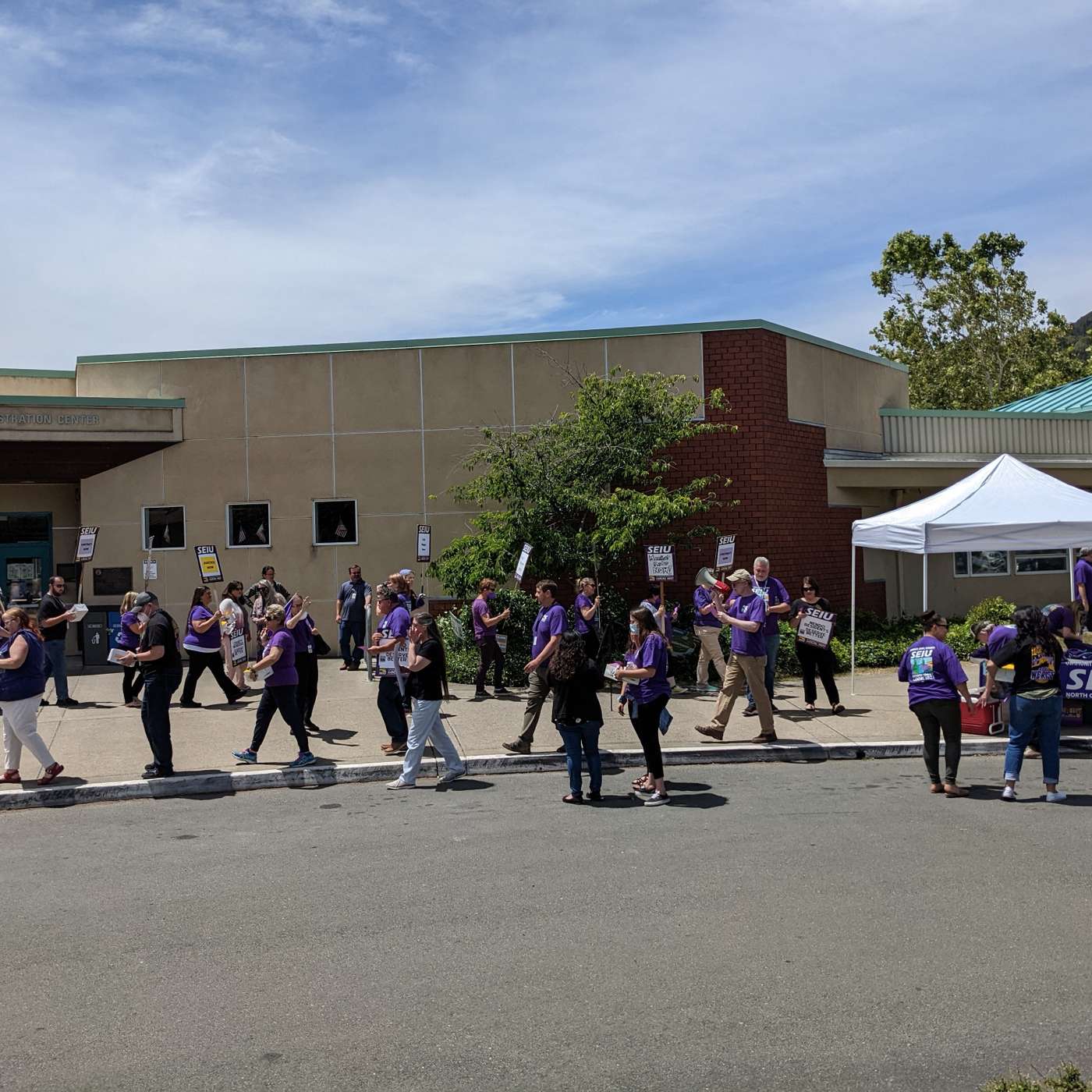
Ep 417"The county hasn't done their homework:" union not buying poverty claims
June 9, 2022 — Union members rallied outside the Board of Supervisors chambers during the second day of budget hearings Wednesday. The county is in negotiations with all its bargaining units, and the largest, SEIU Local 1021, says that on Monday, the county offered them a zero percent cost of living allowance increase, or COLA. Negotiator Jackie Otis, a social worker in adult and aging services, let supporters know that they were up against a bad precedent, when county workers took a 12% pay cut in 2010. “Everybody needs to be willing to fight,” she told the crowd of fifty or sixty purple-shirted members. “The problem is, the county knows from our actions before that we laid down and let that 12% salary reduction happen. They want to increase our premiums on our already overpriced and in-the-hole health insurance, ridiculous health insurance that we have. We’ve got to stop this.” One of the budget holes is a multi-million dollar deficit in the health plan, which union president Julie Beardsley says is the result of what she calls a bad management decision five years ago. “I don’t know if people remember, but in 2017 and 2018, the county gave all the employees a holiday on paying their healthcare costs, and the county decided it would be a good idea if they took a holiday, too,” she recalled. “So consequently, we’re in this hole. I don’t think our employees should be penalized for mistakes that have been made in the past. And the county has been stalling on looking into new plans. Obviously, Adventist has kind of a monopoly here in the county, and they can charge whatever they want, but we need to look at new plans.” Lief Farr, in county information services, is part of the SEIU bargaining team. He also cited historical decisions, among a number of other concerns. “The county hasn’t done their homework,” he said. “They haven’t put out the necessary budget reports. And so when they express this concern that we’re not taking what they say seriously, that they have no money, we’re saying, well, this is not a transparent process…for instance, how much money have you made on the teeter plan this year? That’s not listed anywhere. You say you need money to put into retirement, but years ago, you took out a bond measure, which is the worst way to make money on retirement, and you’ve been paying that off at a great amount of money that could have been going into the retirement fund. How close are you to paying that off? Have you paid it off? None of these questions are being answered. Until they can show us the transparency and all these different aspects of their funding stream, it’s really hard to understand or believe that they’re broke.” At Tuesday’s meeting, half a dozen management positions were reallocated for significantly more money, which Beardsley said was irregular and unfair. “There were some complaints about raises being put in the consent calendar instead of the normal channels,” she noted. “When you have your employees who are doing two or three jobs, and then you have these upper-level managers who are getting raises, that just doesn’t seem fair to me…the fact that we’ve had two and a half years of this covid pandemic, when it caused so much hardship for the staff to come in and work long hours in the DOC, to manage this pandemic, and to not acknowledge that, it’s just not right.” Buffy Wright-Bourassa, a program administrator in behavioral health and recovery services, is another negotiator who says she’s not getting a lot of answers. “We actually haven’t gotten those numbers,” she said, of the half-dozen consent calendar raises. “We are asking for them, and looking for transparency from the county to supply us with all of the information that we need to make a decision together.” She’s also negotiating for a more advantageous rate for bilingual workers, who do a lot of translating. “What I’m noticing is that we have a bilingual rate pay that’s really not fair to the people who have to show up and do the translating,” she said. “They’re translating all over the county for us, and we really either need a specialized position in the county for a bilinguist to translate our websites and all of our forms and make sure everything’s going out that’s translated in at least Spanish. Our population of Mendocino County is at least 26% Latino, Hispanic, Mexican. So it makes sense to me.” Farr maintains that, claims of budget crisis notwithstanding, the county can afford to make a better offer. “I think they’re being conservative,” he allowed; “but to say they have no money, I think, is disingenuous. They haven’t even produced the budget reports that they’re required to, so they’re working in the dark, as far as I can tell. All of their revenue sources, ToT bed tax, sales tax, property tax, are trending upwards…They put a lot of things into this category they call one-time money. So if you’re, say, a department, and you have a salary savings, or you bring in more revenue than anticipated, that extra go...

Ep 416Preliminary results on election day show a few surprises
June 8, 2022 — The last voter of the night cast her ballot with ten seconds to spare. She was heavily pregnant with a baby on her hip and a firm grasp on another child’s hand as they approached the dropbox in the parking lot outside the county administrative building. She spent the journey back to the car explaining the fundamentals of democracy. Preliminary voting results, with no precincts reporting yet, showed no surprises at the state level. The incumbents were defeating their challengers handily. Locally, incumbent Supervisors John Haschak and Ted Williams each have a comfortable lead. Williams is ahead of challenger John Redding with over 85% of 759 votes counted in the fifth district. In the third,Haschak is leading challenger Clay Romero with 77% of 692 votes so far. But incumbent County Superintendent of Schools Michelle Hutchins is in a tight race with challenger Nicole Glentzer, behind by almost four percentage points. That’s a difference of 130 votes just a few minutes after 8:00 last night. Measure M, the proposed bond in the Anderson Valley School District, is winning with almost 65% of the 116 votes counted so far. And Trent James, the write-in candidate for sheriff’s office, broke the 5% threshold predicted by some election watchers, with 5.16%, or 138 votes, to incumbent Matt Kendall’s 2,536 votes. Assessor clerk recorder Katrina Bartolomie took a few minutes to talk about the first report of the evening, in the lull before the first precincts brought in their ballots. She expects to have updated numbers in a week and a half to two weeks, “hopefully by the end of June,” she predicted. The county has thirty days to certify the election. There was the usual election-day confusion about ballots that had been lost, forgotten, or never made it to the intended recipient, “so we were able to help them with that, and direct them to the right place,” Bartolomie reported. “We had an active day today, but it wasn’t too busy.” A few minutes after eight, one voter, who arrived too late to turn in his ballot, “kind of cussed out” an election worker, but, “Everyone else seemed happy,” Bartolomie said. She had not received any calls from people who were confused about the write-in candidate. “I think that the people that wanted to write in the write-in candidate have been doing so,” she observed. There is no voter ID law in California, and Mendocino is an all mail-in county, with physical polling places available for voters who want to cast a provisional ballot or need to register the same day. Voters who want a provisional ballot verify their identity by answering questions. The county uses Hart voting machines, and Bartolomie said that, while her office gets questions from the public, there is very little of the hostility that has been directed at elections officials in many parts of the US. “I think that’s one thing we can chalk up to living in a small rural county,” she concluded.

Ep 415Board funds water agency
June 7, 2022 — In the first round of budget hearings on Tuesday morning, the Board of Supervisors agreed to use $250,000 from the PG&E settlement money for a water agency, though the structure and duties of the agency have yet to be defined. And the board asked staff to revise plans for enhanced code enforcement, even as code enforcement manager John Birx reported that in the last year, his staff has more than doubled the number of cases closed, with compliance. The board set aside $500,000 last year for enhanced code enforcement, but that money has not been used yet. And there is more money to combat illegal weed. Sheriff Matt Kendall has $600,000 from the state for overtime and per diem costs for large-scale busts. He said he’s expecting a busy summer, and he’s willing to share those funds with code enforcement. But the county is facing a number of shortfalls, with over a million dollars a month in healthcare claims. Cannabis taxes are down by about five million dollars and FEMA has not yet committed to about $8 million of expenses the county fiscal team hoped would be eligible for federal assistance. But county worker Jenna Bunker cried foul over a hefty wage increase for half a dozen management positions, even as other workers have been offered a zero percent wage increase. “I think if you can afford to raise pay for these positions, anywhere from eight to fourteen percent, you can afford to give the rest of us a reasonable cost of living adjustment increase,” she declared. And concerns about overwhelming the healthcare system are back. Public Health Officer Dr. Andy Coren provided a quick covid update, saying that case rates are up 500% and hospitalizations have increased by 300%. “We know that these are underestimates now because of the use of over-the-counter home tests that are not reported,” he stated, adding that there are currently three outbreaks, which has placed the county in the CDC’s highest transmission risk level. Many other counties are experiencing the same wave, with Alameda County re-instituting its universal indoor mask mandate. “So I and others in our public health team are watching this very carefully,” Coren said. “As much as we do not like this, we must consider mandating universal indoor masks for our county to preserve hospital care.” One of the items on Wednesday’ agenda was a proposal to put a water and fire tax on the November ballot. Early projections are that the tax would generate $7 million a year. But the Citizens’ Committee for the Library Initiative, which has been gathering signatures for a quarter-cent tax to fund the libraries, has come out against it, calling it a competing tax. And Supervisor Dan Gjerde sent a five-point memo to his colleagues, arguing against it. Supervisor John Haschak agreed in a brief interview that it’s the wrong moment for the tax, though, as a member of the drought task force, he does support funding a water agency. Gjerde said he had already found a way to free up $250,000-$300,000. “We have an ordinance, that this board can amend, that says the county will provide a fifty cent match for every dollar collected by the Business Improvement District, the tourism commission of the county,” he said. “At this point, I no longer support that match to apply to the business improvement fees collected within the cities. If we were to amend the ordinance to make that match for revenues collected by lodging operators in the unincorporated part of the county, we would free up over $300,000 of the county general fund. And since they've told us that their plan is to increase the advertising budget by 92% this year, this is the perfect year to not provide that city match. They would still have an increase in their marketing budget, just not a 92% increase. Meanwhile, we could spend that $300,000 on other essential county services.” But ideas about a county-wide water agency have not been quite as refined. Gjerde suggested a committee approach, with members from around the county allocating funds to various communities for their specific needs. Supervisor Glenn McGrouty suggested re-hiring Josh Metz, whom he said had been crucial in bringing water money into the county. He also thought someone at the UC Davis extension office might be a good fit to head up an agency. Supervisor Ted Williams characterized the situation. “I think we have a water crisis,” he acknowledged. “I mean, we have a climate change crisis, we have a staffing shortage crisis, a living wage crisis, housing crisis. This county is all about crisis. So if it were just one or two, I would be all over supporting this. My worry is, we go down this path of spending $350,000, and we've created some bureaucracy that doesn’t generate a drop of water. And I wonder if it would be more effective for the water districts to work with outside consultants…because if you put us in the middle of that, the accounting and the office space and the staffing, everything that goes into public ...
Ep 414Palliative Care celebrates new location
June 7, 2022 — The Madrone Care Network celebrated its move from a cramped little shop behind an audio store to a 1700 square foot office building on Monday. The network started offering palliative care to patients in Mendocino County just a few months before the start of the pandemic. Physician’s assistant and founder Lynn Meadows, who was a well known longtime midwife in the community, said now, at 71, she has “evolved along this pathway of life,” to the transition for people in their last few years. She was inspired by Mother Teresa’s work in Calcutta, and considered going to India herself, but realized “through studying her, I became aware that there are people right here in Ukiah who need love.” She started a palliative care center at Adventist Health Ukiah Valley before starting the community-based version, “because the need is so great.” Palliative care is similar to hospice care, but it differs in a few key ways. Patients in a MediCare hospice have to follow a strict protocol, like agreeing not to call 911 or pursue more curative care, like chemotherapy. Palliative care patients are often receiving treatments, and are not required to have a diagnosis of a six-month life expectancy. “Some of our patients have been with us for years,” Meadows concluded. Medical director Dr. Ron Sand described services that range from spiritual care and basic food needs to bureaucratic wrangling. Patients receive nursing, social work, optional care from a non-denominational chaplain, and the services of a community health worker. This person offers transportation, technology for patients so they have appointments with remote providers, and food boxes. Many of the patients are with MediCal through Partnership Healthcare, which offers an insurance benefit for palliative care. Blue Shield also offers a benefit, though MediCare does not yet pay for palliative care. Sand said Madrone Care is currently serving about 80 patients in Mendocino and, more recently, Lake Counties, but “In our estimation there are many more who are unserved.” With the pandemic, nurses and physician’s assistants offer treatment either in person or virtually, through telehealth or zoom. Physicians assistant Emily Frey stepped away from the ribbon-cutting festivities to describe some of her work. “We focus on symptom management for improved quality of life, so that’s a very focused approach,” she said. “We also concentrate a lot on advanced healthcare planning, which is kind of a euphemism for figuring out your wishes with regards to resuscitation, CPR, and just goals of care, so what are the goals that that person might have, and helping them figure that out.” Frey added that a lot of the patients are marginally housed, with “a huge amount of psychosocial needs.” The work, she said, “can be really emotionally challenging, but also really rewarding.” Four of the qualifying diagnoses are people with end-stage liver disease, end-stage heart disease, end-stage respiratory disease, and stage three or four cancers. A new diagnosis is end-stage neurological disease, like advanced ALS or multiple sclerosis. “It’s people who have very challenging health conditions that they’re probably not going to get better from,” said clinical manager and RN Elise Gootherts. “And we really want to help them have a better quality of life.”