
KZYX News
1,162 episodes — Page 19 of 24
Ep 263Ukiah Launches Ambitious Public Arts Project
by Stacey Sheldon October 14, 2021--The City of Ukiah’s Community Service Department recently launched its 50 in 5 Arts Campaign. This ambitious project aims to install 50 pieces of public art throughout Ukiah in the next 5 years. The intent of the 50 in 5 campaign is to showcase Ukiah's creativity and culture through public art that reflects the unique wisdom, intellect, history and imagination of Ukiah’s people. The project is the brainchild of Neil Davis, Ukiah’s Director of Community Services. He reached out to Alyssum Wier, Executive Director of the Arts Council of Mendocino County, for support. Together they crafted a vision and purpose for the project. Together they garnered grant money, created applications for artist proposals, and navigated through permitting and insurance bureaucracy to get projects underway and installed. In Alex Thomas Plaza, Elizabeth Raybee’s Receptacle Mosaics uplevel the trash and recycle containers with colorful designs that celebrate Mendocino’s landscape and inform on disaster preparedness. The Pop Up Gallery under the Alex Thomas Pavillon is also a 50 and 5 installation. Local artist Annie Rugyt Bernard collaborated with Davis on the outdoor gallery. Bernard created the current exhibit of 5 mixed media pieces exploring themes of isolation and grief induced by the Pandemic. One piece, made with paint, pencil and fluorescent colors, is an illustration of a web of wires wrapped around each other like Celtic knots. In stark contrast to the whimsical nature of the Sound Garden is the Missing and Murdered Indigenous Women Mural on the Arbor Building housing Redwood Services. Visiting artist Shane Grammer and the Hope Through Art Foundation recently guided local youth through the painting process of this powerful mural. With bold, blood red handprints in the background, and a larger than life portrait of Khadijah Britton in the foreground, the mural honors Britton who has been missing since 2018. This mural calls for greater awareness and justice for the Missing and Murdered Indigenous Women’s movement, and is part of a larger series of murals planned by the Ukiah Valley Youth Leadership Coalition. In addition to these completed and installed projects, several other works of 50 and 5 are in progress: Lauren Sinnott is finishing up a masterpiece mural on Church street that presents a chronological history of Mendocino county, and Tim Poma, Lonnie Lopez, and Nathan Valensky will create a mural at Ukiah’s Skate Park.
Ep 262Neighbors rally to protect Faulkner Park
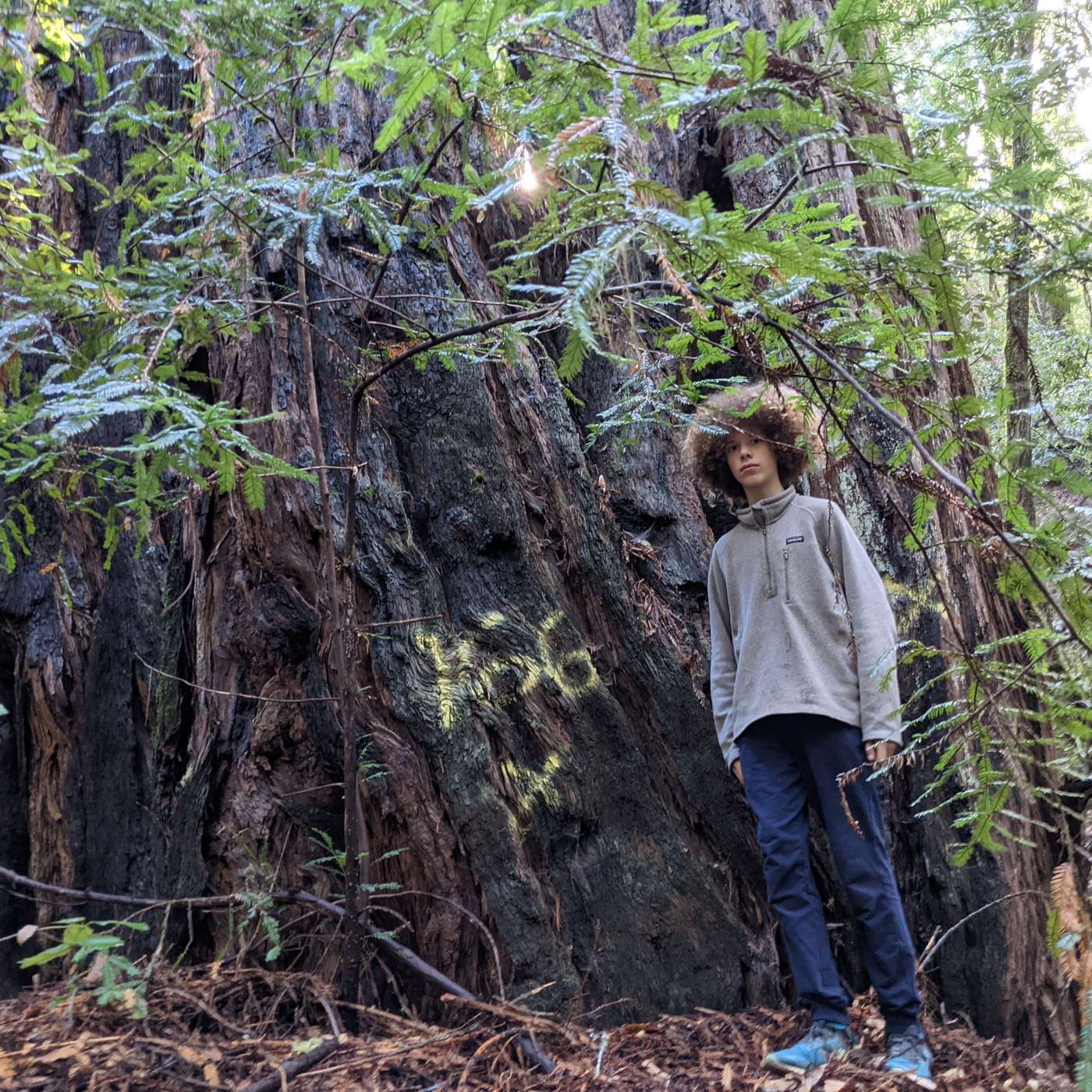
October 26, 2021 — Faulkner Park is a little-known gem of Mendocino County, known for wild azaleas and a history of providing refreshment to bears. The forty-acre park, formerly known as Bear Wallow, is just a few miles up Mountain View Road outside Boonville. Now, neighbors are rallying to protect dozens of its giant redwoods from a PG&E plan to remove them, citing the safety of its infrastructure. Steve Wood has owned property adjacent to the park for 45 years and has always walked his dogs there. Last week, he led an impromptu tour along the Azalea Trail and pointed out some of the trees that were marked for removal. Pausing beside a pair of huge, fire-scarred redwoods that had grown together, he estimated the larger at about six feet in diameter. “It’s marked with a number and an X, which indicates they’re planning to cut it,” he noted. “As far as we know.” This pair of ancient conjoined twins is about 250 feet away from the power lines. Nine-year-old Laila loves the azaleas, and noted that Faulkner park celebrated its 91st birthday this month. She noted that the azaleas depend on the redwood canopy, and added, “I am here today because the redwoods should not be cut down.” She said she has been enjoying the park for about six years. About twenty neighbors, including five kids and a few dogs, gathered in the park on a drizzly morning to talk about how to protect it, from contacting state representatives to taking direct action. That’s what thirteen-year-old Zane Colfax says he’s prepared to do. “I don’t want to see these trees cut, especially when PG&E has other options,” he said. Mike Mannix, whose family has owned land nearby since the 1930’s, thinks it would be easier on the company’s bottom line to leave the park alone. “It’s a square forty acres,” he specified. “So we’re only talking about a quarter of a mile of road. It wasn’t that long ago that the fiber optic cable went from inland Mendocino County all the way out to the coast from here. I mean, we’re talking a chunk of change to take trees out, compared to how much it costs to underground a quarter of a mile of county road.” Asked if he has PG&E at his home or business, he said, “No, I don’t do business with PG&E. I find them unreliable and overpriced.” PG&E has received authorization to pass along much of the cost of its wildfire mitigation efforts, including vegetation management, to its ratepayers, plus 15-20%, depending on which account it lands in. Resident Donna Pierson Pugh thinks this may have something to do with the company’s approach. “I do think that perhaps they’re making a choice in doing the clear cutting and limbing, which is perhaps more attractive to them because of the ability or the option they have of passing that on to consumers, as opposed to burying of lines or putting the insulated lines in instead of the current lines,” she noted. A few days after the meeting in the park, Supervisor Ted Williams spoke about a meeting between county staff and company representatives, to ask PG&E to hold off on cutting until after some discussion with county government. “It looked like about 91 trees marked,” he reported. “These are good-sized trees. It would have a significant impact on the park, which is owned by the people, and I think PG&E can find another way to mitigate the fire risk without cutting hundreds of feet in either direction.” He is confident that “we’re going to be able to find a compromise.” He supports undergrounding the lines, but added, “The county likely doesn’t have the authority to force PG&E to underground, and I know they will cite significant expense. That said, in this case, we’re only talking about a fifth of a mile and I think they can find a workable solution that doesn’t involve taking out a redwood forest.” He said he thinks the role of the supervisors is to “steer the discussion,” but that “likely, we will need to involve our state reps.” Asked if he supports direct action like tree sitting and blockading the roads, he said, “I hope it doesn’t come to that...I hope we can have a rational discussion, sitting down to discuss options. Ultimately, it may come to that, and I support the people taking a stand. These are their trees. This is their park.” For David Severin, the potential crisis of the park is an opportunity for the neighbors to get together to do something about climate change and the future. He walked through the park before the community meeting, and said he saw a lot of work that he could do himself to “dress up the park and make it a lot friendlier,” like sprucing up plaques and walkways. “I have twelve grandchildren,” he added, “and I feel a really strong obligation toward those grandchildren and to the future that I’m handing off to them. And this park is important for that. For them.”
Ep 261Redistricting advisory commission seeks public comment
October 25, 2021 — Now that the census is over, a citizens’ commission is working with county staff to advise the Board of Supervisors on redistricting, or plans to readjust the boundaries of the county’s five districts. The fifth district will remain geographically complex, including the south coast, Mendocino and Albion, and points inland. But the fourth district has lost population, while the third is too big, so some adjustments will have to be made. The difference between the biggest and smallest districts can’t be more than ten percent. But in a geographically large county with a small population, it’s all about fine-tuning. The commission has added more meetings, one at 6:15 pm on Wednesday October 27th and another on November 3rd. The commission is also giving a presentation to the Board of Supervisors today (October 26th) at 1:30 pm, where commissioners hope to rustle up a little more public comment. The county must submit its final map to the state by December 15th, or the state could have a judge decide the boundaries. The deadline for the advisory commission to receive maps from the public is October 29th. The board will identify its preferred map on November 9th. You can submit your public comment by emailing [email protected]. You can watch the meeting on the county youtube channel.
Ep 260Hopkins burn scar vulnerable, big changes coming up for Juvenile Hall
October 21, 2021 — The burn scar from the Hopkins fire could cause a lot of environmental damage if it’s not mitigated before a serious storm, though straw wattles are scheduled to be installed along the waterway today and tomorrow. And the county’s juvenile hall is preparing to house serious youth offenders who have previously been incarcerated at state facilities.
Ep 259U.S. Forest Service plans salvage logging research in Mendocino National Forest
For Mendocino County Public Broadcasting, this is the KZYX News for Friday, Oct. 22. I’m Sonia Waraich.Fire and forest ecologists virtually all agree that prescribed and cultural fires will be an important tool to stop catastrophic wildfires from ripping through the state’s forests. But what should we do about forestland that’s already been burned by a fire? The U.S. Forest Service’s answer in the Mendocino National Forest is salvage logging. That’s a somewhat controversial practice when they cut down and remove dead trees to keep the amount of flammable material in the forest to a minimum.Cynthia Snyder is an insect specialist and one of the people on a field trip through the parts of the forest where the August Complex Fire hit last year. She’s hacked off a piece of bark from one of the burnt trees nearby and shows us the insect boring holes and frass, or little wood scraps, they leave behind.Those bugs are damaging the wood of those trees and making it harder for the Forest Service to find loggers to do the work. But research is showing salvage logging may not always be the best tool to use in every situation.So the Forest Service is building on that research. Hydrologist Hilda Kwan describes the research project and the agency’s prescription: salvage logging some, all or none of the dead trees in a specified plot.Silviculturist Radek Glebocki explains why this site specifically was chosen.That was U.S. Forest Service silviculturist Radek Glebocki, hydrologist Hilda Kwan and entomologist Cynthia Synder on a tour of the parts of the Mendocino National Forest that were burned by the August complex fire last year.For the KZYX News, I’m Sonia Waraich, a Report For America corps member. For all our local coverage, with photos and more, visit KZYX.org. You can also subscribe to the KZYX News podcast, wherever you get your podcasts.
Ep 258"We're at the beginning of the end of Prohibition"
October 20, 2021 — With the repeal of the latest cannabis ordinance and deadlines looming, legacy growers are facing more uncertainty than ever. Growers have until the end of the month to submit their applications — again — through an online portal, and the end of the year to get licenses from the state. The moratorium on Phase III growers under the original cannabis ordinance, which has been reinstated, expires in March. And growers have been shelling out tens of thousands of dollars on environmental consultants and engineers to satisfy the state’s requirements, especially from Fish and Wildlife. “It’s been a horrendous experience,” said Clifford Morford, a legacy grower who co-founded Heartrock Mountain Farm in Potter Valley with his son Daniel. They have been on the road to compliance for four years. Daniel is the optimistic one, though he compares the current historical moment to watching the Ranch Fire creep across the ridgelines to the edges of his farm, where fought it off with the help of friends and family. “I feel like something’s coming that’s going to change the face of the cannabis industry in California,” he reflected. He used another analogy to describe what he thinks the moment calls for: “It’s the fourth quarter,” he said. “And we’ve gotta throw a Hail Mary, gotta send one deep, score a touchdown, do a two-point conversion, and then maybe do a side kick and a fumble recovery and a field goal.” “I have less hope than Daniel does,” his father admitted. “He says we’re gonna make it, and we might. I’m gonna do everything I can to make it happen. But I have a feeling that one day we’re gonna wake up, and oh, it’s over. And they won’t care, the powers that be. It’ll be easier to administer their program with five big farms in Salinas and a dozen down in Santa Barbara, and they’ll grow all the weed we need, and everybody will be happy, except those that want the experience of smoking our weed.” The Morfords spent $12,000 to engineer two stream crossings in pursuit of a lake and streambed alteration permit (LSA) from Fish and Wildlife. That’s not quite half of what the LSA has cost them so far, since it includes work on a pond and some planning and replanning of culverts. Daniel says they’re still sitting on some product from last year, but not as much as some of their friends. They don’t even know what the price will be this year. As Daniel got up to let the dogs out, Cliff made a key distinction. “It’s easy to move it,” he noted. “It’s harder to get paid for it.” Michael Katz is the Executive Director of the Mendocino Cannabis Alliance. He hears a lot of stories like the Morfords’, and his optimism, too, is tempered with uncertainty. But he’s hanging a lot of hope on news from county Cannabis Program Manager Kristin Nevedal about a checklist that serves as the site-specific environmental review that growers need to get their state licenses. Previously, he reported, it seemed like 90% of the growers trying to get through the system using the checklist, called Appendix G, would not make it. That does not seem to be the case anymore, “and so while we don’t know exactly what that means,” he acknowledged, “we are still hopeful.” Appendix G might not work for everyone who is trying to get legal under a county ordinance that does not have a discretionary permit process, which the state requires. There is also some confusion as to whether the deadline to submit applications is October 30th, or if applicants whose documents have not been reviewed by that date will be left out in the cold. The online portal hasn’t entirely eliminated the application headache. Katz reported that, “dozens and dozens of folks who are trying to go along with what’s being requested are finding that things are changing, things that are seemingly not related to certain requests are being asked for, and so this confusion has led to people having to re-submit their submissions, multiple times.” Nevedal was not available for an interview. She is working on a grant application for the county to receive $18 million from the state to get the local cannabis program in shape. Katz thinks this money signals a good faith effort on the part of the state to help legacy growers in jurisdictions that are having a hard time reconciling their ordinances with Prop 64 and other state rules. Finally, Katz’ optimism, too, is tinged with an awareness of historical irony. “Capitalism is not really designed to support small businesses,” he observed. “People are definitely viewing this time period as another extinction event among the community of small operators, who started the movement to create cannabis availability to everybody. Without the small farmers in California, there wouldn’t be a legal cannabis market rolling across the world right now.” And small cannabis farmers will go to extraordinary lengths to keep doing the thing they love. Daniel Morford, who writes poetry and jokes and attends seminars on the consciousness of pla...
Ep 257Don’t call them private security: privately owned companies hired as “safety managers,” “safety contractors,” and “Safety Specialists”
October 19, 2021 — As the difference between safety and security in the Jackson Demonstration State Forest is parsed with utmost refinement, one thing remains clear: the logging sites are dangerous. Two activists have complained of significant threats, one of them caught on video. EPIC, the Environmental Protection and Information Center, has sent a letter to Wade Crowfoot, the California Secretary of Natural Resources, asking him to restore peace. And, although Cal Fire’s chief legal counsel Bruce Crane wrote on July 2nd that “The current JDSF closure order prohibits any private security, armed or unarmed, from entering JDSF,” two unarmed private security firms have been present in two sites. One was hired by a private company, while the other was paid upwards of $110,000 by Cal Fire for just over a month’s work. Cal Fire, the Department of Forestry and Fire Prevention, manages JDSF, where protests against logging have been vigorous. Mendocino Forest Products, the sister company to Mendocino Redwood Company, purchased the contract to log Soda Gulch. They hired Two Brothers Logging to fall trees and Lear Asset Management for safety. In a press release, Mendocino Redwood Company described the contractors as “licensed and bonded Safety Specialists…(who) are simply filming and alerting trespassers to the active operations.” Lear is a private security company best known for armed raids on trespass grows. John Andersen, the public policy director for MRC, confirmed that the company had hired Lear as a safety contractor, but said Trouette and his staff are not carrying weapons on JDSF. Kevin Conway, the Cal Fire forest manager in JDSF, said safety managers are permitted on logging sites, but did not lay out the parameters of their duties, other than to specify that they must be unarmed. The presence of the safety manager, or the Safety Specialist, did not rule out the possibility of a non-accidental death, according to one unidentified logger in Soda Gulch on October 5th. Michael Hunter, the Chairman of the Coyote Valley Band of Pomo Indians, described the encounter to KZYX and shared the video of the incident. Hunter said that as he stood near the loggers, “I recorded everything. I said hey. Please don’t kill me by accident today. And the old man says, oh, it won’t be by accident. I got that on recording, too, and I said, well, don’t kill by purpose either, please, ‘cause I don’t feel like dying today.” Last week, Matt Simmons, a lawyer with EPIC, wrote in his letter to Secretary Crowfoot that on the same day, U’i Wesley, an activist and Native Hawaiian singer and dancer, had a separate encounter. She was parked by a logging gate when two masked men pulled up in a large black truck with no license plates. “They didn’t say who they were, they didn’t say we’re with the police, or we’re with Cal Fire. They just came up to her and said, you need to leave. And when she said that she wouldn’t, they responded by reaching into their pocket and throwing bullet casings at her face and saying, you know, it’s dangerous in here. And I think any reasonable person would feel that that was a death threat.” Reflecting on the fact that both recipients of the threats were people of color, Simmons said, “The really sad truth is that Mendocino, just like all of America, has been a place of violence against people of color for a really long time. And Jackson itself is Northern Pomo and Coast Yuki territory. And there’s a reason it’s not anymore, right? It’s because of violent acquisition by white settlers. And in some ways, it feels like we’re just sort of seeing a continuation of that.” In a video he posted on Facebook, Hunter had a long verbal encounter with a man later identified as Paul Trouette, the head of Lear Asset Management. Simmons was skeptical about what he called a loophole allowing Trouette, a professional private security provider, to operate as a safety manager or Safety Specialist, in an area where private security is not allowed. “Now what it looks like is that MRC has hired Trouette and are calling him a safety manager in order to have a loophole in the rules that require them not to hire private security. I did a little bit of googling on Paul Trouette, and I don’t think he’s the guy you hire to be a safety manager.” Recently obtained documents show that Cal Fire itself hired a private security firm called Armorous to provide unarmed guards and a patrol car around the clock at the Caspar logging site from June 8th through July 5th. Payments for two guards overnight and three during the day came out to almost $111,000. Conway said that their presence did not violate the agency’s chief legal counsel’s opinion that “CAL FIRE cannot cede control of activities on JDSF, for law enforcement and security purposes, to any person or entity at any time as JDSF is required...to always be under the direction and control of CAL FIRE personnel.” Conway pointed out that this statement was ...
Ep 256Potter Valley Project relicensing effort facing costly hurdles
October 18, 2021 — Efforts to take over the license for the Potter Valley Project have had some significant setbacks lately. One is an expensive equipment failure that could take up to a year and a half to repair. The other is that the Two Basin Partnership, a coalition of entities seeking to take over the license from PG&E, has not been able to secure the funding it needs for studies that are necessary for a final license application. The Partnership asked the Federal Energy Regulatory Commission (FERC) for some extra time to come up with the money, but FERC refused. Now the Partnership is worried that the Commission could ask PG&E to surrender the project. Meanwhile, with the license set to expire in mid-April, the Friends of the Eel River, who have long called for the removal of Scott Dam and eventually full decommission, think that their objective might be nearer than they expected. For Alicia Hamann, the Executive Director of Friends of the Eel River, the failure was a stroke of good luck. “Even with all the in-depth work we’ve done (on Scott Dam) looking at seismic stability and landslides and potential failure of the needle valve and problems with the foundation and all kinds of problems, the failure of the transformer bank is something we never considered,” she reflected. “So this just kind of goes to show that there are a great number of ways that this project is really aging, and really unreliable.” But Janet Pauli, of the Potter Valley Irrigation District and the Inland Water and Power Commission, which is part of the Two Basin Partnership, says that if PG&E surrenders the project without an heir, nobody knows what will happen next. Much of the uncertainty could be resolved with studies that would answer questions about what it would take to operate the project. But the source of the money to pay for those studies is uncertain, too. The Partnership had hoped PG&E would foot the bill, which the company did not do. And state and federal funds haven’t materialized, either. The Partnership’s current plan includes removal of Scott Dam and modifications to Cape Horn Dam, a plan that requires extensive examination. Pauli says it would take $12-15 million to complete all the studies that the Partnership has submitted to FERC in order to answer questions about water rights, the impacts of the sediment that would be released from Lake Pillsbury, the impact that removing the dam and lake infrastructure would have on Lake County, and what future diversions would look like. Initial due diligence on all those studies, she said, would take about a million and a half dollars. Now there’s another expense: the five to ten million dollars PG&E estimates it will cost to repair or replace the transformer bank at the powerhouse. Hamann expects that if PG&E gets stuck with that bill, the company could gte authorization from the California Public Utilities Commission to pass it along to ratepayers, plus ten percent. Right now, the project is diverting about ten cubic feet of water per second, a drastic reduction due to the drought. Pauli explained that greater water generation depends on the project’s ability to produce power. That has significant implications for Lake Mendocino. Under the current license, and with the ability to produce power, diversion through the Potter Valley Project could exceed 250 cubic feet per second (cfs). But “if they can’t produce power, they physically cannot put that volume of water through the powerhouse,” Pauli said. In the wintertime, minimum flows through the East Branch of the Russian River, plus contract flows for the Potter Valley Irrigation District add up to 45 cfs, “And that’s a far cry from the 270 or so cfs that they normally would be able to divert,” Paui noted. “That means the amount of water going into Lake Mendocino would only be the 45 cfs plus whatever other natural flow there would be from Cold Creek drainage in Potter Valley.” Hamann thinks the partners have had enough time . She wants them to withdraw their notice of intent to apply for the license, and let the dam removal begin. “What we would hope to see in a license surrender process is surrender, decommissioning, and then dam removal,” she said. She thinks “options for an ecologically appropriate continued diversion” are still possible, but “it just means the folks down in the Russian River who benefit from that water are going to have to pay up for some new infrastructure to be built.”
Ep 255Desalination plant arrives in Fort Bragg, state passes prescribed burn legislation
For Mendocino County Public Broadcasting, this is the KZYX News for Friday, Oct. 15. I’m Sonia Waraich. It’s a Wednesday afternoon in late September and technicians from San Diego are installing a desalination unit at the Fort Bragg water plant. Heath Daniels works for the city and will be responsible for operating the desalination system when the Noyo River’s water becomes too salty. The river water can become salty during king tides, which happen when the moon’s gravitational pull causes water levels to rise several inches. That’s been an issue because the river hasn’t provided enough fresh water to dilute the saltwater that gets into it during those events, which prevented the city from being able to pump water from the river. For the moment, the rain’s eliminated the need for the city to use the desalination system.Daniels says the desalination system is standing ready for when the streamflow in the Noyo does get too low again. City Manager Tabatha Miller told the Fort Bragg City Council on Tuesday that they did end up using it recently for a few days.The rain and the arrival of the desalination system have left the city in a secure enough position to downgrade its drought emergency from a Stage 4 water crisis to a Stage 2 water alert. Miller says the drought isn’t over yet, but people in the city don’t have to conserve as much as they were during the summertime.There’s no need to get water trucked in from Ukiah anymore either. The city put a stop to that last week.On top of all of that, the National Oceanic and Atmospheric Administration is predicting Mendocino County has a pretty good chance of getting its usual amount of rainfall through the rest of the year.The impacts of the drought might be less severe for the moment, but catastrophic wildfires are still raging across the state. Scientists say the solution is to fight fire with fire and now the state agrees. Last week, Gov. Gavin Newsom signed into law the last of three bills that are going to make it easier to conduct a prescribed burn on private land. Lenya Quinn Davidson is with the UC Cooperative Extension and an authority on prescribed fires.Experts recognize we need more of these fires on the landscape in California, so the state decided to make it easier for tribes and private landowners to conduct burns without having to worry about paying the firefighting costs if the fire got out of control. Twenty million dollars was also set aside in the state wildfire budget for a prescribed fire claims fund.Quinn-Davidson says the fact that you couldn’t get insurance made it really difficult to do a prescribed burn even with increased investment from the state. But she says the benefits of conducting prescribed fires can’t be overstated. A prescribed fire project in Sequoia National Park was able to change the behavior of the wildfire there and protect the General Sherman Tree, which is the largest tree on Earth.For KZYX News, I’m Sonia Waraich, a Report For America corps member. For all our local coverage, with photos and more, visit KZYX.org. You can also subscribe to the KZYX News podcast, wherever you get your podcasts.
Ep 254"Is anything ever really saved?"
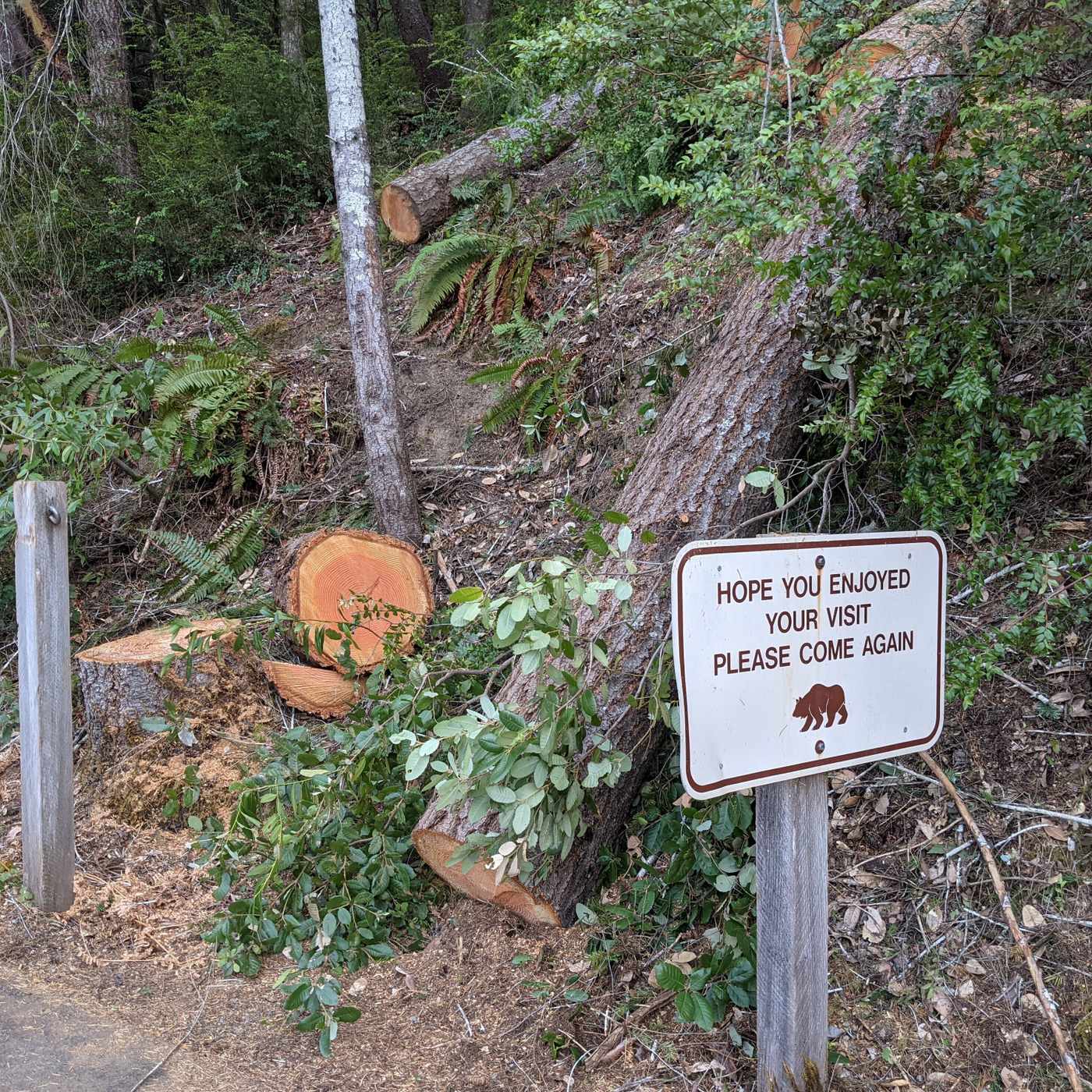
October 13, 2021 — PG&E crews have moved decisively into the Humboldt Redwoods State Park. On Friday afternoon, chainsaws roared along Mattole Road, as forest defenders prepared a tree sit to protect old growth habitat trees. “These are our last big Douglas fir trees on the coast of Northern California,” said Gabrielle, a landowner who lives near the park and has worked in conservation for years. “Some of these have been saved, which raises the question: is anything ever really saved?” One of the activists, who goes by the name Farmer, outlined the situation. “Because so much environmental destruction is happening right now, we have to do a kind of triage,” he explained. “People sit in trees, people blockade roads with their bodies, people build structures to ascend in the middle of the road and they can’t be taken down easily. People do all kinds of stuff to stop logging out here...we’re almost always prepared to do it.” Forest defenders also monitor logging plans, but, he added, “In this case, in the PG&E situation, there are no plans to look at. There’s no reports to read. You can’t look at maps that tell you where the trees are going to be cut down. So it’s all completely opaque and all we know is what we see on the trees. All we know is the mark. And the mark, as you know, is unreliable.” One of the marked trees is a huge charismatic Douglas fir called Dotty, because of the spray painted dots on its trunk. Dotty towers over a grove of smaller trees, all of them also marked. Gabrielle described the tree and its surroundings. “It’s incredibly large, especially in comparison to what we have left,” she said. “In our watershed, which adjoins at the top of this hill in the Mattole watershed, we have about eight percent of our original forest left, probably less, so every tree like that is really significant and important.” She paused as a tree hit the ground, just out of sight down the hill. “As you can hear, it’s really large trees that they’re falling,” she remarked. “And it’s really sad because they’re storing incredible amounts of carbon and it’s counterproductive to be removing them at this time...where is the protection, and where are the people who are getting paid to protect them, and why is there no environmental impact report?” She added that the tree removal in the park “is already on land that people worked hard to save and did a lot of fundraising for, and contributions came from all over the country, all over the world, and people believe that this area was saved, and fragmenting it and destroying the canopy connectivity is really not okay.” Mander is one of the tree sitters prepared to take up residence in a tree that’s already a home to many. Their first night in the tree, they spotted voles and flying squirrels, important food sources for iconic birds of prey that also nest in the forest. Old growth trees that appear to be damaged have been marked for removal, but Mander pointed out that what look like flaws are ideal nesting sites for wildlife. “From where I am, I can see very complex crowns, old broken tops, really key habitat features,” they noted. “There’s a lot of moss and lichen, some are starting to accumulate canopy soil...in other areas of the state, they’re undergrounding a lot of the power lines, and I think it would be absolutely reasonable to ask them to do that, in protected old growth groves, in a state park.” So far, the tree sit has not been revealed to crews on the ground, but, Mander added, “That is what I and others are prepared to do, if they go after those trees.”
Ep 253"It's really expensive. And it doesn't work."
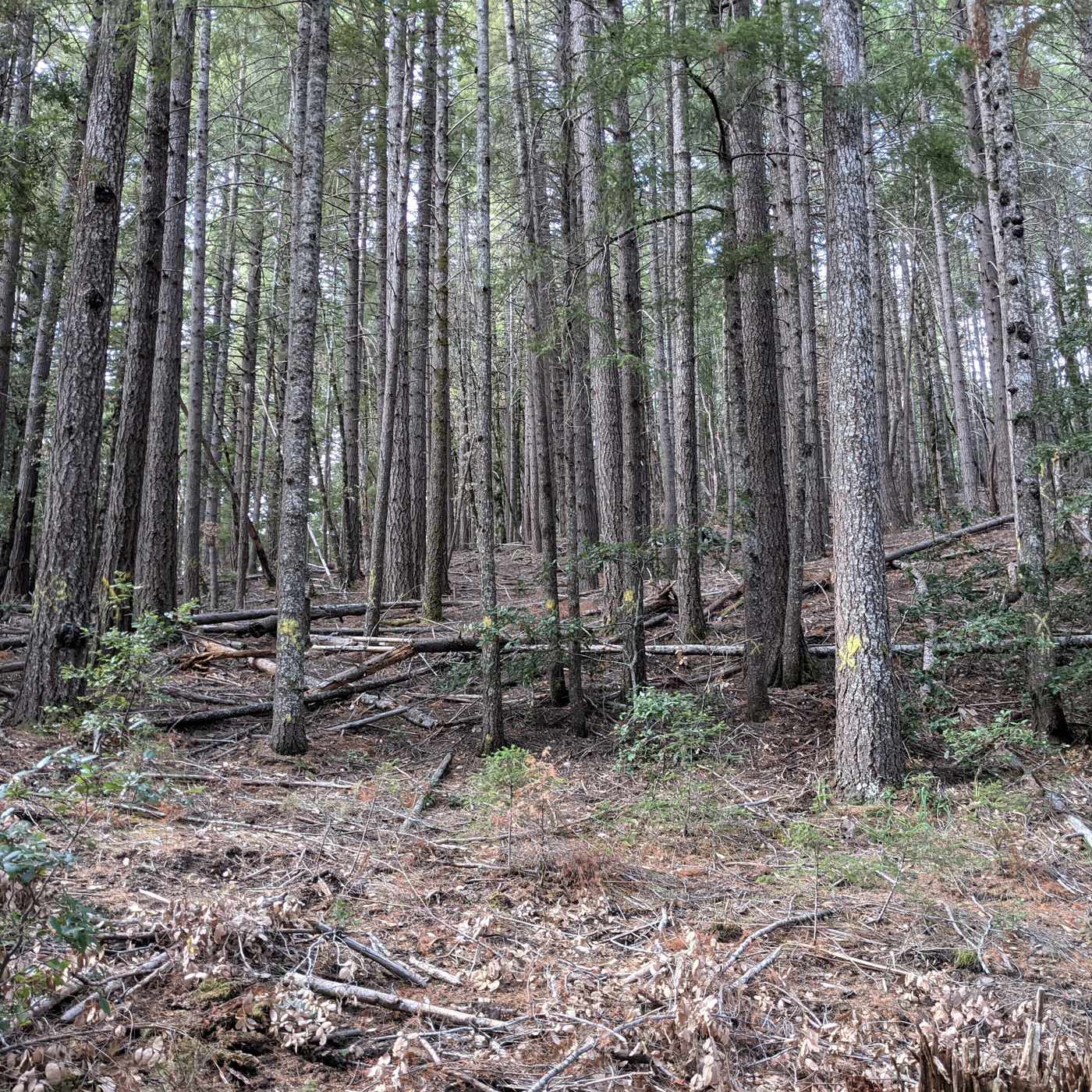
October 12, 2021 — By now, everyone in the region has noticed clear-cuts around PG&E wires, from Deerwood to Hopland to Humboldt and Sonoma Counties. PG&E’s ill-maintained equipment causes fires that kill people and animals, and burn down towns and rapidly dwindling habitat. In response, the utility is removing the vegetation that could catch fire if it comes in contact with the lines. The Sierra Club’s Wildfire Mitigation Task Force wrote a cost benefit analysis of how effective — and cost effective — the program is. Here’s the short version: “It’s really expensive. And it doesn’t work,” according to Nancy Macy, the task force chair. “How can it work? You can’t cut down every tree that may or may not, sometime in the future, have a problem.” The research team analyzed documents from PG&E and other utilities in California, and found that PG&E’s bare copper wires meet vegetation with disastrous results almost twice as often as other utilities. But in addition to undergrounding lines, the other companies are replacing bare copper distribution wires with triple insulated steel core cables and installing computerized circuit breakers for protection from broken wires. Southern California Edison has estimated that steel-core triple insulation for its lines costs $428k per mile. PG&E estimated that its enhanced vegetation management program of clear-cutting under the lines would cost $405k per mile. But by the end of August 2020, the program costs came out to $416 million. That’s almost half a million dollars per mile for a program that doesn’t even address the main causes of wildfire. The analysis “shows a meager 5% reduction in projected ignitions by PG&E unders its vegetation focused plan. Worth noting, PG&E will be spending over $4 billion in the period between 2020 and 2022, for vegetation management alone.” “I don’t think we were really surprised,” Macy reflected. “It came out that if you add up the costs of enhanced vegetation management, which is around $2 billion a year, it costs a whole lot more to cut down the trees and pay the contractors and deal with the slash and all of that, than it does to rebuild the infrastructure. PG&E has already paid two and half times as much as it paid in 2020, when it far exceeded its budget. “So we do not know (how much it will cost),” Macy concluded. “And that’s the scary thing.”

Ep 252Redwood Valley Grangers honor the past, look to the future
October 11, 2021 — Four years after the Redwood Complex fire displaced much of the community, and two years into the pandemic, the Redwood Valley Grange is still serving as a hub for people to come together over books, food, herbal tea, and art by people they know. We’ll hear from grange members about how the grange served the community in the aftermath of the fire, and what’s next.
Ep 251Logging in JDSF is unsafe. Who's making it that way?
October 8, 2021 — The debate about who is responsible for dangerous conditions in the Jackson Demonstration State Forest has heated up. Protestors insist that the logging is contributing to climate change while Cal Fire, which manages the forest, claims that protestors are endangering themselves and tree fallers by forcing loggers to stop working in the middle of a precarious task. Another concern that has been raised this week is the presence of a man who looks very much like Paul Trouette of Lear Asset Management in Soda Gulch on Monday. Mr. Trouette did not respond to an email from kzyx yesterday, asking him if he was providing private security on the site. In a long video that was live streamed on Facebook by Michael Hunter, the tribal chair of the Coyote Valley Band of Pomo Indians, the man identified himself only as a “safety officer.” Lear is a private security contractor best known in Mendocino county for armed raids on illegal trespass cannabis grows in timberland. But private security, armed or unarmed, is not allowed in the state forest, according to Cal Fire chief legal counsel Bruce Crane. In a July 2 letter to Myles Anderson of Anderson Logging, Crane said “CAL FIRE will not allow private security, armed or unarmed, “protecting” Anderson Logging operations on the Caspar 500 THP,” or timber harvest plan. The Caspar 500 is a separate plan from the Soda Gulch area, which is not being logged by Anderson Logging. In an email yesterday, Anderson stated that his company is not affiliated with Soda Gulch and has no other contracts for logging on JDSF. He also said Anderson Logging has no contracts with Trouette or Lear Asset Management. But he has expressed an interest in hiring someone to provide security. On July 6, he wrote in a letter to Ronald Aruejo, the District Manager at the Department of Industrial Relations in the division of Occupational Safety and Health, that he was willing to hire a private security firm if Cal Fire could not or would not secure the Caspar 500 against protestors. He was responding to a Cal OSHA complaint that his employees “were falling trees towards other employees and other people in the woods...causing an unsafe work environment.” He argued that “When people approached the area in which we were working we stopped therefore we did not create an unsafe condition.” Kzyx program director Alicia Bales was in the forest on June 15 and recorded a variety of responses on the part of the loggers. She described one group of loggers who stopped what they were doing when activists approached. Moments later, she could be heard saying, “We are right here,” as chainsaw blared and trees cracked. Kevin Conway, the Cal Fire forest manager for JDSF, confirmed that Anderson Logging is not currently doing any work in the state forest. He said that Mendocino Forest Products has purchased the contract to log Soda Gulch, but he did not know which logging contractor that company was employing. Mendocino Forest Products is the sawmill for Mendocino Redwood Company, which owns 350 square miles of timberlands in Mendocino and Sonoma counties. An email to John Andersen, MRC’s director of forest policy, about who was logging Soda Gulch, and if the company had hired Trouette, elicited an automatic reply saying he would be out of the office until Monday. Conway confirmed that CalFire’s stance “across the landscape” is that the agency does not want private security on JDSF. But he said CalFire does allow contract purchasers to hire safety observers, whose job is to document possibly unsafe conditions on behalf of the contractor. There are no specific parameters for the safety observer’s duties, but Conway did confirm that they are not supposed to be armed. The man interacting with Hunter in the Facebook video was also filming with a cell phone, but was not visibly armed. When Conway was asked about images of trees that are still standing and have had deep wedges cut into them, he suggested that protestors behave less recklessly and added that he was “disappointed that loggers have to walk away before finishing tree-felling operations.” He did not know who was providing safety observer services in Soda Gulch. The man who was counter-filming Hunter was not wearing any safety gear. Tom Wheeler, the director of EPIC, the Environmental Protection Information Center, says it’s important for protesters to document what they see in the forest. He classifies environmentalists like the Mendocino Trail Stewards, who create highly produced YouTube videos in the state forest, as citizen journalists, documenting hazards that it’s in the public interest to know about. “They’re going into the forest and they’re showing that Cal Fire is not cleaning up the slash after logging,” he said. “They’re leaving large slash piles which can serve as jackpots of fuel in the event of a forest fire, and really cause high-severity fire behavior if the fire were to hit them. The Mendocino Trail Stewards are showi...
Ep 250Supervisors discuss $20 million in cannabis grants
October 7, 2021 — The Board of Supervisors discussed applications for over $20 million in state-funded cannabis grants this week. The $2.2 million dollar equity grant was awarded to the county last year by the Governor’s Office of Business and Economic Development. The much larger Local Jurisdiction Assistance Grant Program was approved as part of this year’s state budget as a way to help local governments move cannabis businesses into the regulated market. Mendocino County was one of seventeen cities and counties eligible to apply for a certain amount, in this case just a little over $18 million. But applicants to the smaller equity grant are frantic at the possibility that they won’t get their awards before the deadline in February. If the county doesn’t allocate the funds by then, the money will have to go back to the state. Equity grant applicants must be able to demonstrate moderate income, which is just under $68k for a household of two, and that they suffered specific harms from the drug war. About fifty people have applied for awards, which cap out at $50k. Twenty three of about fifty applicants have been approved so far. Supervisor Glenn McGourty asked cannabis program manager Kristen Nevedal if she was still suggesting that recipients get all the money up front, before the proposed projects are completed. Nevedal said yes, because a lot of the proposed projects couldn’t be completed before the clock runs out on the grant. “Those are really generous terms,” McGourty noted. “I’ve never seen grants like that before in my life.” Supervisors pondered eliminating the income threshold for the equity grant, or prioritizing various criteria. Though Nevedal said applicants typically use tax returns to prove their income, Supervisor Ted Williams said he wanted to make sure the awards were not going to anyone who had failed to file taxes. Nursery owner Ron Edwards took issue with bringing taxes into the discussion, and he and Williams had an exchange during public comment. “That’s absolutely possible,” he said, when Williams asked him what it means when someone grows 10,000 square feet of cannabis and reports zero income. “You could get bad clones from someone and you don’t pass the certificate of analysis,” Edwards offered as an example. “Remember, cannabis is reviewed more than any other product that goes to market, so there are a lot more ways for this product to fail.” Communications on the part of the county as well as the grower community could use some improvement, he allowed, but “we are here addressing the equity grant issue, and I think that’s what the focus should be.” The board agreed unanimously to prioritize applicants who are up to date on their taxes, with preference given to those who have already applied. The county itself has until November 15 to apply for the $18 million grant to get its provisional permit holders over the line to their annual state licenses. Williams had a couple of gripes, and suggested that the county send a letter to the state, saying the state system doesn’t work for the county. “It’s like the state sent us a puzzle, and it’s missing half the pieces,” he analogized. “I know it’s an eighteenth century approach, but maybe we should pass a resolution, send it back to the state, and just be open about it. We tried. This program doesn’t work for our county. What do you want us to do?” He also doesn’t think the money will go very far, with short-staffed county departments, the high cost of living, and expensive contractors, “if we could find one who would take this project. And you’ve got to wonder about anybody who thinks this is a good assignment. Eighteen million sounds like a lot. It’s not enough to get the job done...these are Band-aids.” But Michael Katz, the director of the Mendocino Cannabis Alliance, sees the grant as a sign that the state is taking the plight of small growers seriously. “I would say this is a significant Band-aid,” he opined. “It’s more like triage...so the state is not throwing their hands up. They’re continuing to move this conversation forward and that’s what we need to do for this substantial component of this community. We don’t get to throw our hands up and walk away.”
Ep 249Ukiah High Offers Pomo Language and Cultures Course
October 6, 2021--Mendocino County’s Ukiah Unified School District is proud to offer, for the first time ever, a Northern Pomo Language and Cultures class at Ukiah High School. Buffie Schmidt, of the Sherwood Valley Rancheria, serves as instructor to the 40 students she teaches. Both the school district and Schmidt hope this groundbreaking course will revitalize Pomo languages and traditions, and help reconnect native students to a legacy from which they have been disconnected for centuries.
Ep 248Tribal Chair threatened in JDSF
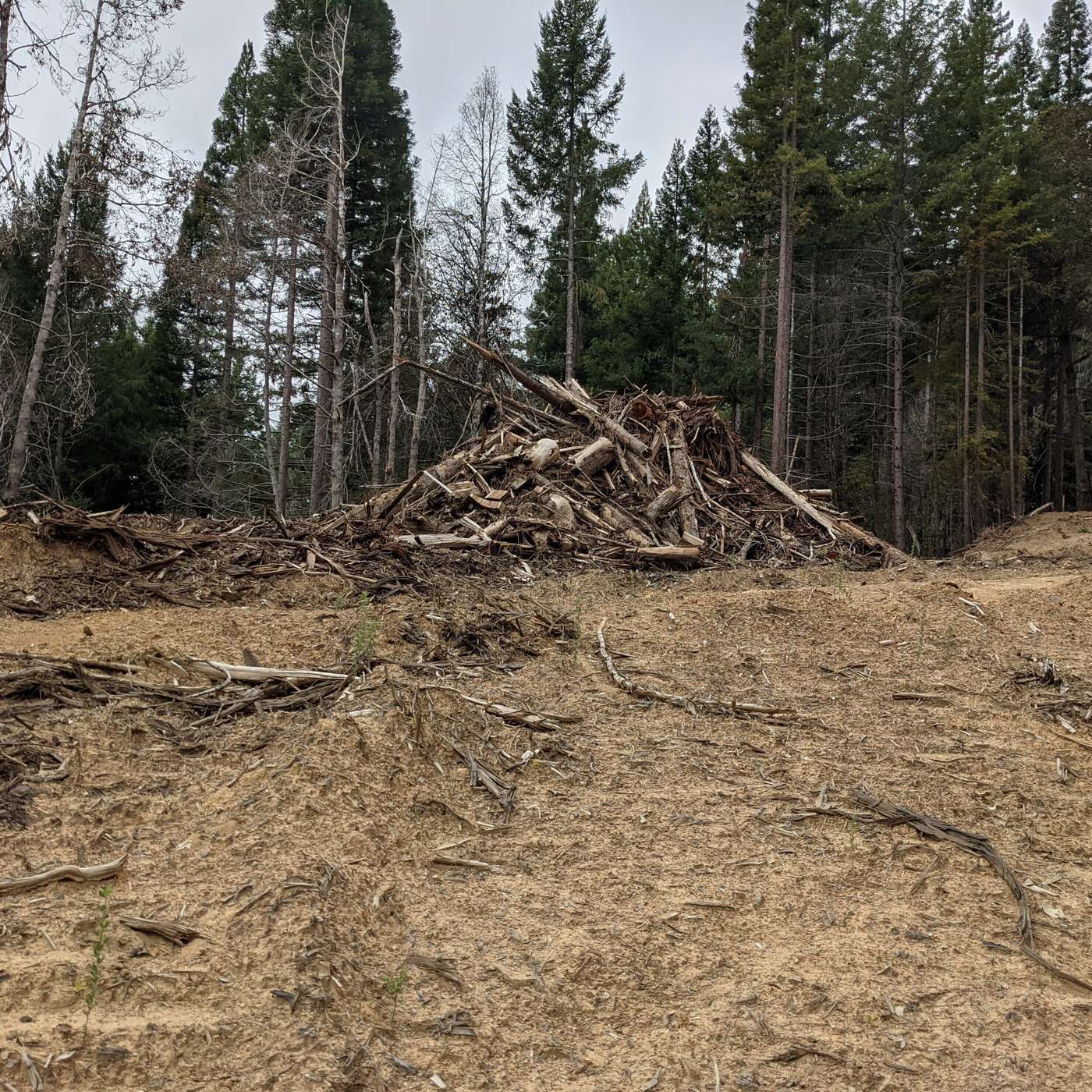
October 5, 2021 — Protesters in the Jackson Demonstration State Forest (JDSF), which is managed by CalFire, are facing increased hostility as the end of logging season approaches. Threats of legal action and at least one instance of what sounds very much like a casual death threat have emerged in the past few days. And a fight about activists’ First Amendment rights to document political activity is already underway. Michael Hunter is the chairman of the Coyote Valley Band of Pomo Indians, one of several entities calling for a moratorium on logging in the state forest. On Monday morning, he was in Soda Gulch with about ten other activists, filming an interaction with loggers and another man, also filming, who identified himself as a safety officer. Hunter described the exchange a few hours later on a phone call from the forest. “They started up the chainsaws,” he recalled, “revved them up, revved them up. A couple hours later, they came back to the same spot, and we were still here, waiting. And they walked down there and did the same thing, again, acted like they were going to cut those redwoods, and I said, hey, ah, please don’t kill me by accident today. And the old man says, oh, it won’t be by accident.” Hunter shared the video with kzyx shortly after our interview. The logger’s response is off-mic, but clearly audible. “What these folks are doing when they go out into the forest is very brave,” says Tom Wheeler, the Executive Director of EPIC, the Environmental Protection Information Center, “because they are going out peacefully, they are asking the loggers to stop and they are being met with hostility and threats.” In addition to threats from loggers, Wheeler says protesters are facing CalFire’s mis-use of the law to quash their First Amendment rights. Last week, he sent a stern letter to CalFire Director Thomas Porter, detailing some examples. That was in response to a letter from Jackson State Forest program manager Kevin Conway, to the president of the Mendocino Trail Stewards, a group that uses social media to drum up support for anti-logging activities. In his letter, Conway told the Mendocino Trail Stewards president, Chad Swimmer, that he had been conducting activities in the state forest that require a special use permit. Swimmer has made several short YouTube videos about the beauty of the state forest and why he believes the trees should remain standing. They feature sweeping views of the forest, an action sequence with a couple of guys on mountain bikes and their dogs speeding along a trail, and a cellist playing a tune called “Requiem for a Fallen Tree,” while seated on a redwood stump the size of a small raised stage. Most of them appear to have been filmed with a drone. This, according to Conway’s letter, is an “unauthorized special use, (which) is a violation of State law and continuing to do so will result in criminal and civil action by the Department.” Wheeler argues that the permit requirement for filming is unconstitutional. “The pretext of a need for a special permit to stop their recording is obnoxious to the First Amendment,” he stated. “This is something that is just weaponizing these permits to silence critics of the Jackson. And so that is a clear violation of the First Amendment. The First Amendment does allow for something called time, place and manner restrictions. What you can’t do, though, is you can’t use these time, place, and manner restrictions as a way to covertly regulate the content of speech. ” Conway claims the protests can be hazardous, and that a contractor was injured last week after protesters came into the area that was being logged. But Hunter says the area is dangerous because loggers are cutting deeply into trees and letting them stand for an unknown length of time before felling them completely. In a video he live streamed on Facebook yesterday, he filmed his efforts to get the safety officer to inspect a tree that had a deep wedge cut in it. “So it puts us at risk as we’re out here,” he explained. “And then they can turn around and say that we’re trying to prevent them from fixing that. They’re trying to play that game...the wedge was here before we got here. I wonder how long it’s been there.” Wheeler identifies filming in the forest as journalism, a category of speech that enjoys extra protection. “Journalism is obviously changing,” he noted. “Local print media has significantly declined in the last two decades. And in its place we have citizen journalists that are starting to record and to document government abuses...and this is an important form of journalism...it is perfectly within their right to document abuses by the government.” A few minutes after he was informed that his death in the forest would not be accidental, Hunter learned that he was unauthorized to document in the area. In the video he sent kzyx yesterday, the safety officer who is filming Hunter as he films him can be heard saying, “You are in an unauthorized ...
Ep 247Construction cost increases hit new jail project
October 4, 2021 — Projected construction costs for a new jail building have gone up more than 14% in the last three years, an unprecedented increase driven by steel tariffs, supply chain delays and shortages of skilled labor. In spite of several efforts to reduce costs, the architect on the project told the Board of Supervisors last week that there is a budget shortfall of $3.6 million. In 2017, the county received $25 million from the state to build a new jail designed to meet the mental health needs of inmates. Originally, the county planned to contribute a little over a million dollars, but that amount climbed to about $2.8 million as delays piled up and costs increased. The project is currently expected to cost $31.1 million. Deputy CEO Steve Dunnicliff reported that disasters ranging from global to bureaucratic are playing out in the construction project that’s still about a year from breaking ground, “starting with rebuilding thousands of houses lost to wildfires, then tariffs on construction material and supply chain impacts due to the ongoing global pandemic,” he noted. “Additionally, the state’s project approval was extended due to a change in their process.” Eric Fadness, an architect with Nacht and Lewis, which is designing the jail, said the 14.5% increase in projected construction costs since June of 2019 is based on the California Construction Cost increase, which historically has increased each year at an average of 3.5% “So an increase of 14.5% “is unprecedented,” he concluded. “It’s sort of significant of the time we’re in.” Soft costs, like fees, testing, and equipment, have increased from $5.8 million in June of 2019 to about $6.4 million. Supervisor Ted Williams implied that he expects costs to keep rising. “Would you be as surprised as I would be if we could pull it off for thirty-one?” he asked Fadness, who concurred that, “I guess I would be at this point.” He recommended that the board set aside $4 million to meet cost increases that could keep accumulating in the future. CEO Carmel Angelo pointed out that the county could tap the reserve account, “and certainly any fund balance that we may have would be applicable, as well...I do not think that there is any additional grant money...my guess is that this would be all county money,” she reported. Supervisor Dan Gjerde noted that lumber costs have fluctuated, and wondered if that might indicate that overall construction costs could go down in the next year. He didn’t seem to find the shortfall insurmountable, noting that in previous years the county has had significant close-out surplus funds. “I don’t know if that’s going to be the case this year,” he acknowledged, “with the budget being closed out last year, but if that’s the case, maybe another million dollars here, another two million there, and next thing you know, you have four million dollars.” The current timeline for the project is to award a construction contract by August of next year, followed by a notice to proceed by the end of September. Fadness said he expects construction to be finished by spring of 2024 and for inmates to move in by early summer. Williams made a motion to accept the presentation, adding that “inherently in that is to ask staff to find four million dollars from somewhere.” In another unanimous vote, the board approved a request by Dr. Jenine Miller, the head of behavioral health, to use $240 thousand dollars per year for the next four years from the Measure B fund for a crisis respite center in Fort Bragg. Miller said the facility would likely be on the campus of the coast hospital and have four to six beds, managed by Redwood Community Services. The proposal received support from the Fort Bragg City Council, the chief of police, and the Measure B committee, which passed the request along to the board. Miller also reported that construction on the crisis residential treatment center in Ukiah is expected to be complete by November. She added that a feasibility study on whether a psychiatric health facility should be located at a county-owned building on Whitmore Lane in Ukiah or be built from scratch should come before the board in January.
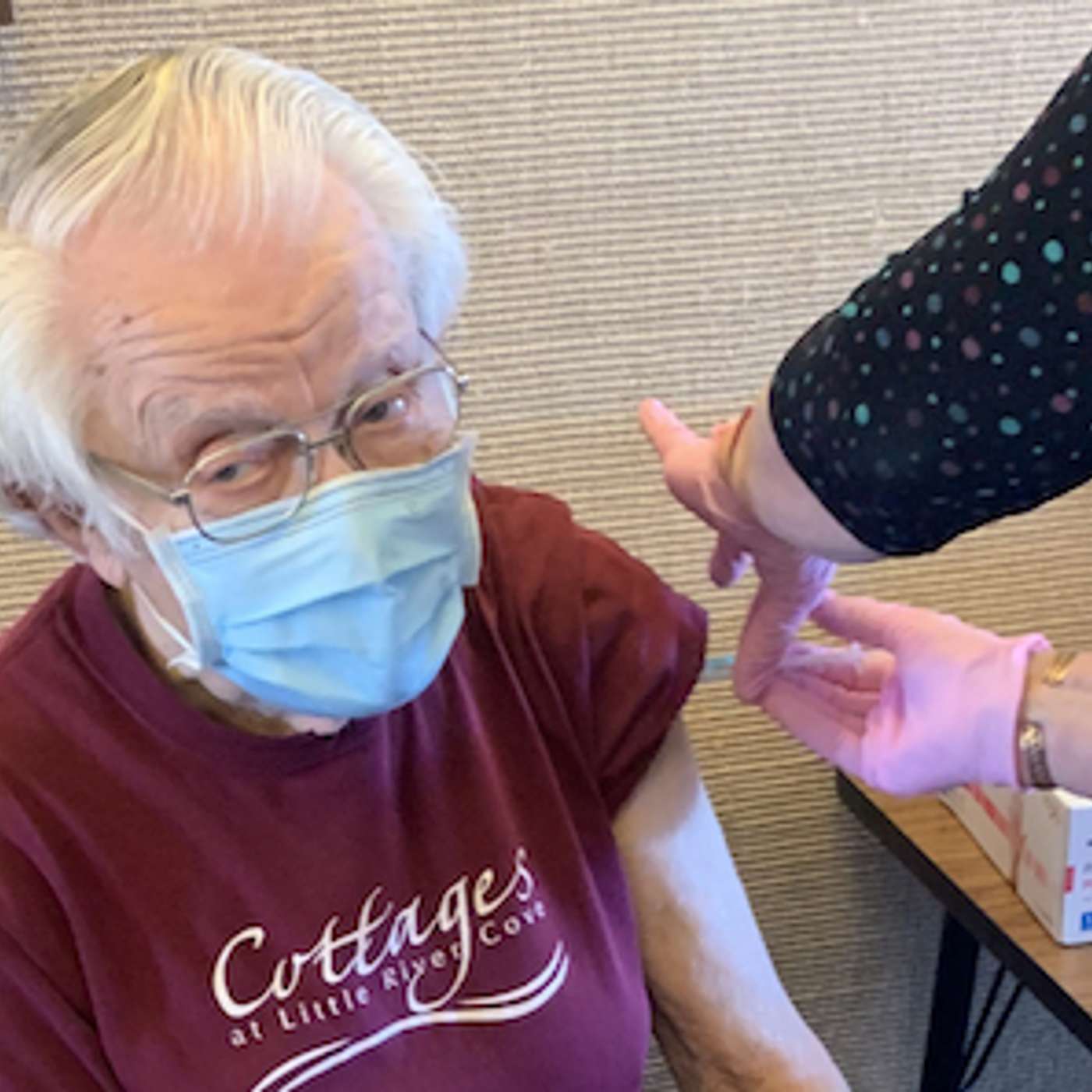
Ep 246Third shots begin on the coast
Mendocino County Public Health Officer Andy Coren, Lucresha Renteria of the Mendocino Coast Clinic in Fort Bragg, and an immunocompromised patient talk about the third Pfizer shot, now available on the coast for qualifying patients.
Ep 245State awards $1.5 million for cannabis enforcement
September 30, 2021 — Mendocino County will receive $600,000 from the state for cannabis enforcement, possibly as soon as next month. Senator Mike McGuire announced the allocation of $1.5 million of general fund monies at a press conference yesterday with sheriffs from around the north coast and Third District Supervisor John Haschak. Humboldt County will also get $600,000 for its enforcement efforts, and Trinity County will get $300,000. The money is earmarked for enforcement operations at grow sites that are diverting water illegally, harming the environment and sensitive species, and involve organized crime. McGuire emphasized that the money is not to be used for raids on small farmers working towards getting legal. “At no time will legacy farmers and small family farmers who are currently working through the permitting process, or those who are already permitted, be the focus of this campaign,” he said. “No way, no how.” McGuire said part of the purpose of the new campaign is to help prop up the legal market, which, as Supervisor John Haschak remarked, is out-competed by the illegal market. “Many cannabis growers are on the path to getting county and state permits for cultivation,” he noted. “Yet when these illegal grows are not following any rules, they aren’t paying the taxes and fees, and cutting corners at every step, the illegal market has the advantage.” All three sheriffs talked about the increase in violent crime, human trafficking, and the environmental degradation associated with illegal grows. Sheriff Matt Kendall, who approached McGuire about six weeks ago to ask for state assistance on enforcement, estimated about eight to ten thousand illegal grows in Mendocino County — and the sole priority behind them. “We’ve got some folks who showed up with a two year plan to make as much money as they possibly could, and that plan did not include did not include taking care of the environment, taking care of the folks around them, that plan did not include looking out for sensitive species,” he informed his listeners. Humboldt County Sheriff Billy Honsal spoke about the organized crime that’s moved into all three counties. “They’re playing the numbers,” he said. “When you look at how many search warrants we do every year, it’s in the hundreds. And so when there’s thousands and thousands of illegal grows, organized crime, they’ll take advantage of it...organized crime has moved in all over. Once it was trespass grows, now they’re buying up private land, all over the county...we’ve had unprecedented homicides, as well as gun violence, throughout the county...we were hoping legalization would push some of these people out, and it has not.” The money cannot be used to hire more sheriff’s personnel at the local level, but it can be used for overtime and per diem costs as the three sheriff’s departments assist each other on enforcement operations. And Kendall expects a lot more help from the Department of Cannabis Control and the California Department of Fish and Wildlife. McGuire pledged that this collaboration, and this funding, “is just the start.” Kendall added in an interview after the press conference that he also expects assistance from CDFW scientists. These specialists are qualified to document the details of environmental degradation at illegal grow sites so the District Attorney can prosecute the damage as a crime. Kendall described the new campaign as still in the planning and handshaking phase, but he expects to be able to call on state law enforcement agencies and his neighboring sheriff’s departments soon. He hopes to knock out the large illegal grows in two years.
Ep 244Child hospitalized with COVID-19 "raises the specter of a pediatric pandemic"
September 29, 2021 — Public Health Officer Dr. Andy Coren gave a sobering covid update to the Board of Supervisors yesterday. In the last two weeks, there have been eight covid deaths at two nursing homes, and the first child with the illness has been admitted to the hospital, leading to perhaps the most chilling possibility since late 2019. Though vaccines for children are just around the corner, Coren reported that the first pediatric hospital case “Raises the spectre of a pediatric pandemic.” A state-mandated vaccine requirement with some significant loopholes goes into effect for all healthcare workers tomorrow, though it was too late for the eight vulnerable people who perished at the two nursing homes, each with low vaccination rates. The staff who tested positive were predominantly unvaccinated, Coren reported. “So while the surge in Northern California is affecting predominantly unvaccinated ten to one, it is also having fatal consequences on those who are vaccinated and vulnerable who are in contact with the unvaccinated caregivers,” he added. The mandate for healthcare workers to be fully vaccinated by September 30 was issued by the California Department of Public Health on August fifth. Employees may decline the vaccine due to religious beliefs or for qualifying medical reasons. Other staff in health care facilities are also required to be fully vaccinated by tomorrow. As family members are no doubt planning funerals for vulnerable relatives who died after being exposed to those exercising their right to refuse the vaccine, one member of the public called in to inform the board that they and Dr. Coren will be held accountable for tyrannical policies that amount to human rights violations. Like many who oppose the use of public health restrictions to stop the spread of disease, she relied on language borrowed from civil rights struggles, referring to the order for bars and restaurants to place signs about their vaccine policies as segregation. But Coren has been tentative about issuing vaccine mandates, declining to speculate on whether or not policy solutions could stop the surge. Coren identified Redwood Cove in Ukiah and Sherwood Oaks in Fort Bragg as skilled nursing facilities that are currently experiencing outbreaks. Gabriel Barraza, the administrator for Redwood Cove, said that Currently, one resident of 41 at the facility is isolated after testing positive for covid 19, and that nearly 80 percent of their healthcare workers are fully or partially vaccinated. Dr. John Cottle of Sherwood Oaks sentout a message last week saying that 15 residents with covid-19 were in isolation, but with an 88% acceptance rate for the vaccine, only four of the 15 had symptoms that were significant but not severe. Cottle did not respond to an email requesting more detail on Tuesday. Coren offered one piece of information that was somewhat reassuring: though there have been a total of 28 covid explosures at Mendocino County schools, there have been no outbreaks at schools so far.
Ep 243PG&E clear cuts to have devastating economic impact
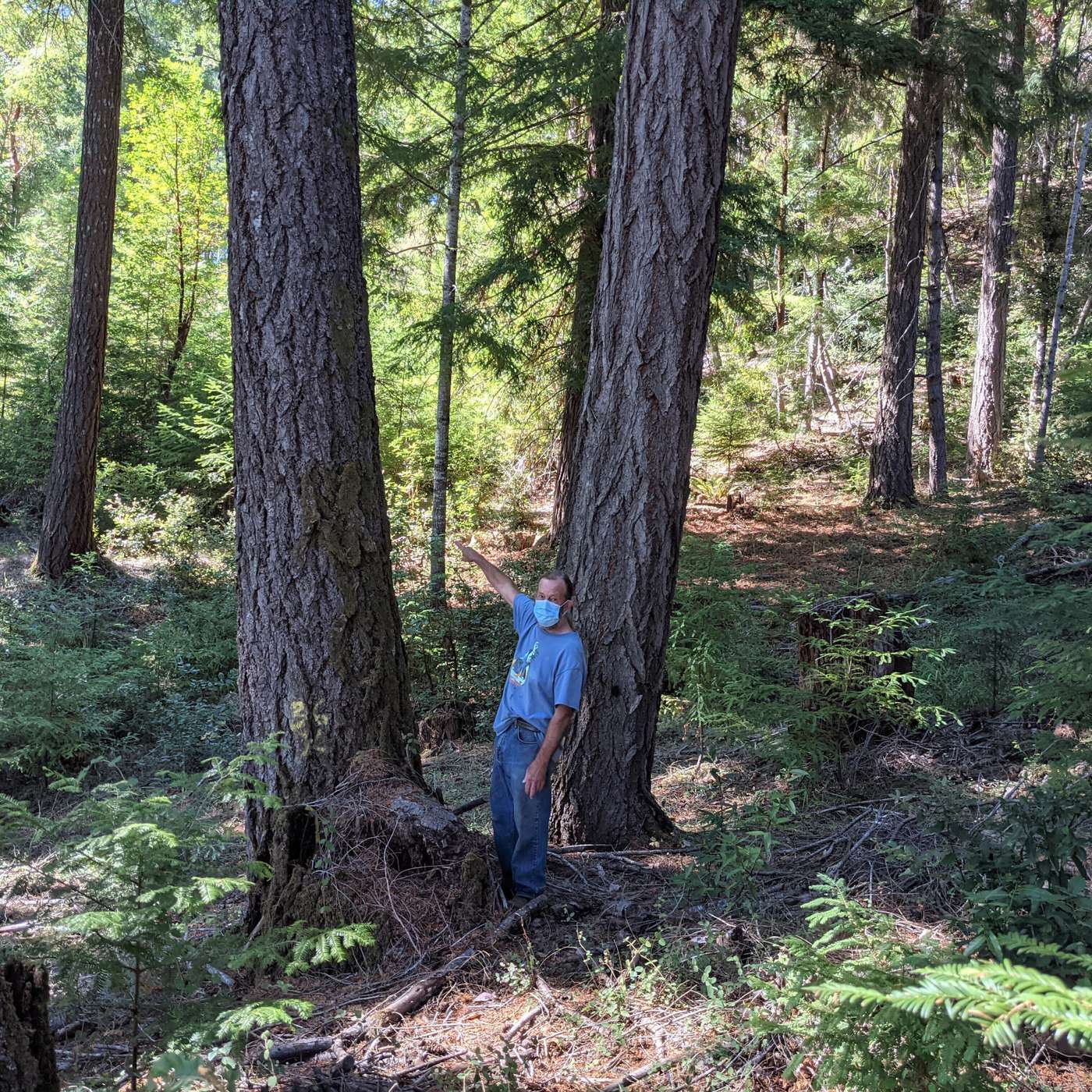
September 28th — PG&E’s plans to clear cut around power lines on private property are not limited to Mendocino County. This weekend, KZYX paid a visit to Harry Vaughn, a small landowner in Southern Humboldt, just outside Miranda, where crews have been marking trees for removal. Vaughn depends on the income he makes from farming mushrooms in the woods and from small-scale logging, “which is one reason I don’t really want the contractors to come in and destroy the value of my forest, where they would cut thousands of dollars of timber, and just leave it on the ground to rot,” he explained. Vaughn manages his 240 acres of mixed canopy for fire, sudden oak death, and sustainable logging according to a non-industrial timber harvest plan. He also farms more than twenty varieties of mushrooms in frames made from tanoak saplings in a patch of scrupulously maintained dappled shade between a fuel break and a dirt road. He was careful to acknowledge that we were on Wailaki land before we made our way over to a mushroom that looked like a small turtle balanced on a log. It was a bellflower, or winter variety, shiitake. He calculated that he can make upwards of sixteen dollars a pound for mushrooms at market. “I can grow mushrooms and grow trees and harvest trees to provide income for me and jobs for my neighbors,” the local loggers he hires to work on the property. He also uses a local mill to process the wood into lumber. Across the dirt road from the mushroom farm is a patch that’s been judiciously opened up to allow for different kinds of forest foods. But it’s still not nearly as opened up as the PG&E clear cuts in Mendocino County. “Once you remove the shade from the shaded fuel break, you end up with a brush field that’s more prone to fire, which is basically what PG&E is proposing to do, is create huge brush fields,” said Vaughn, who is a member of the local fire safe council and the prescribed burn association. Pausing at the sunny patch where trees had been thinned, he pointed out the native food-bearing species that thrive in that set of conditions: low-growing blackberries, black raspberries, huckleberries, and acorn-bearing oaks. “It’s making more food for me and more food for the animals,” he observed. In order to maintain it all, “I don’t want to open it up too much, because then the invasive species will come in and the fire danger really goes up.” PG&E’s enhanced vegetation management program received approval from the California Public Utilities Commission in 2018. The stated purpose of the work is to reduce fires, but there was no environmental review, and there’s been no agency oversight. Ag ponds and watersheds downhill of the clear cuts are in danger of getting clogged with sediment when the rain starts, and the four to six inches of chips left in pastures could have an economic impact on ranchers. But for Vaughn, the clear cuts would have a direct and devastating impact on his bottom line. Using the rough estimate of five hundred dollars for a thousand board feet for Douglas fir, he figured that he and his neighbor the logger could each make about two hundred fifty dollars from one high-value fir. One particular tree was marked with an inscrutable set of numbers and different-colored dots, plus a yellow X that seemed to indicate it had been selected for removal. It’s one of seven hundred trees PG&E contractors have marked on Vaughn’s property. He hasn’t worked up the exact loss plus damages he would incur if the company removed all the trees it deemed a danger to its infrastructure, but his estimate of the loss along one power line would be between sixty and eighty thousand dollars. “Seven hundred trees is a lot of trees to lose,” he reflected. As a professional woodsman, he doesn’t have a high opinion of how the company’s contractors work in the forest. “The contractors that refused to identify themselves told me the yellow X’s mean they’re going to cut that tree,” he said. “And then they said that the spots were just a trim, but I’ve noticed in some reports that you showed that spots mean trim it to the stump. Trim it to the ground, so nobody quite knows what their marks mean. And they haven’t explained that.” A few paces up the road, Vaughn pointed out where he had found several unattended PG&E contractor trucks in a turnout, one of them idling in dry grass. “So they actually posed a threat to us during fire season,” he reported. It’s not the only way the contractors have already endangered community members. Vaughn says they have come to his door during the pandemic without masks. “And I asked if they had been vaccinated, and they got in my face, and said it was none of my business,” he recounted. “The guy that got in my face actually had a Texas license plate, so he had a, maybe I’m biased, a Texas attitude.” Regional differences aside, Vaughn wondered why contractors are traveling such great distances to perform the work, and speculated that they are incurring massive
Ep 242KZYX permit for Ukiah studio approved
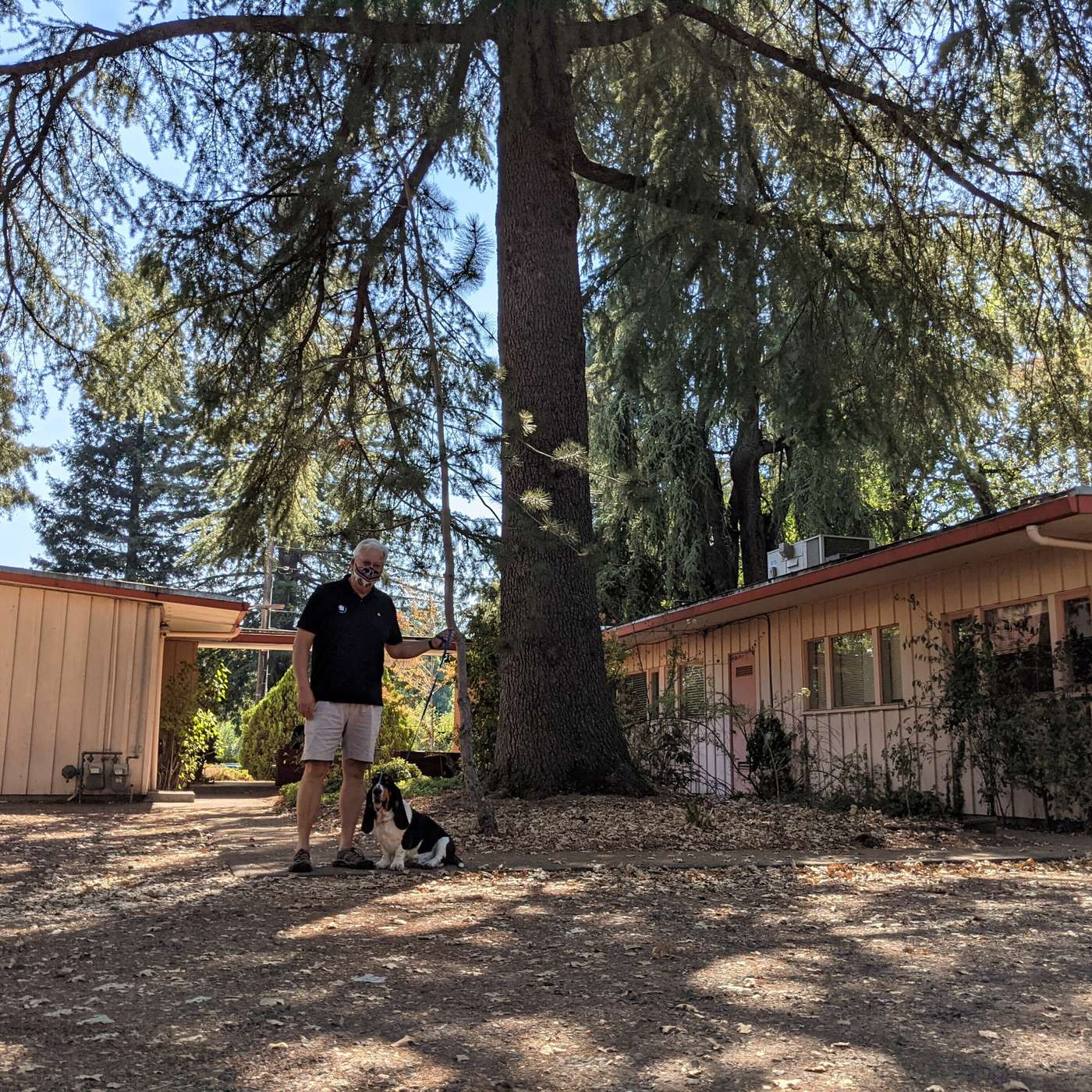
September 27, 2021 — KZYX took a significant step forward in the quest to bring its main studio to Ukiah last week. The station now has a permit to install a tower at 390 West Clay Street, formerly the site of acupuncturist Grace Liu’s clinic. KZYX will maintain a satellite studio in Anderson Valley, but the current signal is threatened by the growth of trees between Philo and the transmitter on Cold Spring Mountain. Having a main base in the county seat has also been a dream for years. Craig Schlatter, the city’s zoning administrator and director of community development, approved the permit at a hearing on Thursday morning and spoke with KZYX later in the afternoon. “From a planning perspective, it’s a pretty strong project,” he said. “It really made a difference because the applicant had done so much on their own to work with the neighbors, and that’s a key component to any successful project.” Schlatter added that the application was accompanied by three letters of support, from the sheriff, Cal Fire, and the Ukiah Valley Fire Authority. One neighbor had an aesthetic concern about the tower, and asked that it be situated a little further back from the street and tucked behind some tasteful vegetation, which the applicant agreed to do. KZYX board president Tom Dow has spearheaded efforts to secure the building and the permits, including knocking on doors and talking to people to find out how to get off to a good start with the neighbors. On Friday afternoon, he granted the first interview from the new station — and a tour. Dow reported that one of the key elements of establishing a studio in Ukiah was getting the use permit to install a 90-foot tower to serve as a studio transmitter link. KZYX has a satellite dish that receives national programming, but the tower is necessary to transmit local programming from the studio. KZYX has been in negotiations with Grace Liu’s sons, who inherited the property after her death, and Dow expects bank transactions to be completed by the end of the week. He believes it will take several months to complete the planning and designing phase, which includes updating the electrical wiring, remodeling a bathroom to meet ADA requirements, and replacing the worn-out carpet. “Then we’ll have to order equipment, which will take some time to get,” he said. “Everybody knows these days supply chains are difficult...the goal will be that we’d start some work on this before the end of the year, and that we would be doing inside construction...through the first half of next year.” On that timeline, the station would be ready to operate by mid-summer of 2022. In the meantime, the interview continued with a portable field recorder, starting in a big empty room with a wall of windows and a view of City Hall. Airplane noise was audible overhead, so soundproofing will be part of the upgrade. “This will be a good room for something,” Dow concluded. “It is accessible from the front, so it will be easy for the public to come in.” The main building is basically that large room and a foyer, leading into a long skinny hallway with studio-sized rooms on either side, plus a bathroom and a kitchenette. There is also a covered courtyard with two picnic benches and a much smaller building that will probably serve as office space for operations, management, and administrative staff. “It’s a solid building and a good location on a nice property,” Dow reflected. “But we are going to have to do some upgrades to make it suitable for a broadcast studio.” Listeners will be hearing more details in the near future about the capital campaign, plans for improvements, and progress on the projects involved. As for Dow, he listed a few reasons he’s willing to take it on. “The more secure and reliable our signal is, the better, so that we’re there when we’re most needed, in terms of emergency or road closures, or nowadays, covid updates.”

Ep 241Judi Bari exhibit opens at the Mendocino County Museum in Willits
More than 31 years after Earth First! activist Judi Bari was car-bombed in Oakland, an exhibit opens in the Willits museum, featuring the bombed car, artifacts of the time, and first-hand accounts and music in seven public presentations.
Ep 240Clear-cut at research center: "We're running out of good choices to make"
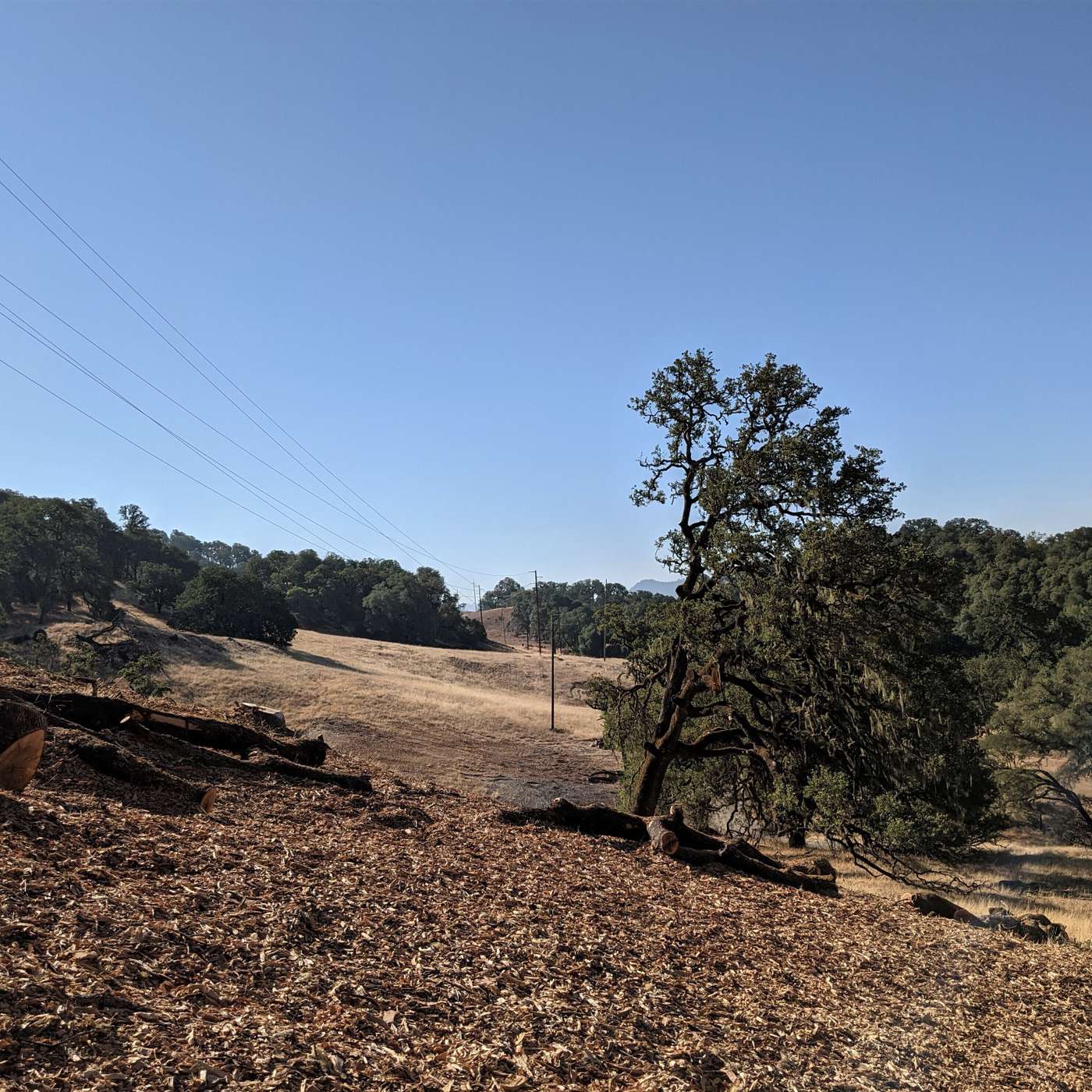
September 21, 2021 — PG&E’s failure to maintain its equipment and the vegetation around its infrastructure has led to massive conflagrations in the past few years. Now the company is trying to clear fire hazards around its lines in high fire risk areas. But are they going too far? And is the enhanced vegetation management program even effective? The program is exempt from environmental review and forest practices rules, so those answers won’t be available for some time. In June, company contractors cleared about 100 acres at the Hopland Research and Extension Center, which has been the site of ag and forestry research since 1951. I took a tour of the western boundary of the property with director John Bailey earlier this month. There are two sets of power lines, about thirty or forty feet apart, and he estimated that the overall cleared area on either side of those lines was about 150 feet wide. There are some ongoing projects at the property that involve studying the movements of deer and coyotes, Bailey is anticipating some impacts. “But it’s going to be a while,” he predicted. “It wasn’t like taking out any of the deer themselves, or radio collars or anything like that, but with a big wide-open highway through oak woodland, you’re going to see some changes in how the wildlife behave on the property.” PG&E crews also left six to eight inches of wood chips in pastureland along the lines. That’s not a problem for HREC, with its vast acreage and small flock, but Bailey said that the amount of bare ground overlain with wood chips would “definitely pose a problem if you were a smaller scale owner who was really economically dependent on that pasture productivity.” Erosion is also a top concern for him. There are ag ponds below the cleared area, which he expects will catch the inevitable sediment from some of the scars. “If the ponds weren’t there, then it would flow straight on into the river,” he concluded. A few days after my visit with Bailey, I hiked around a hilltop about a tenth of an acre at the same site with Michael Jones, the University of California cooperative extension forestry advisor for Mendocino, Lake and Sonoma counties. We independently counted stumps on that one hilltop and each of us came up with 39 trees that were entirely cut down, including three trees that had had 90% of their branches removed. Four or five were pretty unhealthy, and there were a couple of big ones that were close to the lines and looked like they could have fallen on them. Jones said the oak woodlands in the area were already in trouble, with no young trees coming up to replace the mature blue oak. He described the change in the landscape as conversion from an oak savannah to rangeland. “If we know anything about clear cut and conversion,” he began, “if you don’t do follow-up vegetation management, then you get extensive fine fuels buildup, and the grasses and the shrubs come in aggressively, and the invasives come in really well, and you could have some other ecological impacts outside of the loss of the forest canopy structure.” Bailey added that “often invasive species are the first ones to colonize after a disturbance.” He listed barbed goatgrass, star thistle, and medusa head as potential or already-existing problem weeds. “There’s great potential in some of these areas that they disturbed that we’ll just end up with strips of goat grass, because that’ll be the first thing to come back in.” As for Jones, he’s not squeamish about vegetation management or thinning the forest. “I’m very much open to this idea of reducing fuels and fire risk, but what PG&E is doing is conversion. It’s really clear-cut and conversion along these right of ways that create really significant ecological impacts on the continuity of forest structure. These are like little clear-cut strips that hit right through habitat.” Even shaded fuel breaks, which he describes as “really powerful in helping us do fire suppression and defensible space management...still leave a portion of the canopy there. These are basically denuded of all their vegetation right now. It’s pretty aggressive, and frankly, it’s not sustainable,” ecologically or economically. Bailey said that over the course of about three weeks, he spent between 12 and 15 hours negotiating with a foreman of the vegetation management crew. He was able to convince him to trim some trees rather than take them out entirely, and he prevented the removal of some young trees that were part of a research project. But the public resource code is on PG&E’s side, and he was in a bind that a lot of landowners and property managers find themselves in. “I don’t want to be the place where catastrophic fires start, and it turns out that we pushed back too hard against PG&E, and they didn’t do what they said they should have done. So it’s this tricky balance of protecting your ecological values on your individual site, but also being aware of the larger societal value of having our...

Ep 239Troy Springer pens Utopian/Dystopian novel
A former resident of Little River, Troy Springer is a yoga teacher and healer, currently living in Ontario, Canada. She's just published her first novel and is starting a sequel.
Ep 238USFS temporarily halts prescribed burns
For Mendocino County Public Broadcasting, this is the KZYX News for Monday, Sept. 20. I’m Sonia Waraich.Prescribed burns aren’t happening on Forest Service land right now and it’s unclear when that’s going to change, but it needs to be sooner rather than later according to the people who study the intersection of forests and fires.Last month, the chief of the U.S. Forest Service sent a letter to forest managers saying prescribed burns are effectively banned on Forest Service land because firefighting resources across the country are too strained. Prescribed burns will only be considered for approval if the regional forester and chief’s office sign off on it. And that’s only if the region is at a preparedness level of 2 or less. An organization called the National Multi-Agency Coordination Group assigns those preparedness levels to regions and the country as a whole based on factors like the number of large fires happening at that moment and the availability of firefighting resources. Right now, the country and northern California are at a 5, on a scale of 1 to 5, 5 being the highest. Firefighting resources are basically at capacity.But that decision didn’t go over too well with fire and forest scientists. Forty of them signed a letter asking Chief Randy Moore to bring decision-making on prescribed burns back to the forest and district levels. They say that makes more sense since conditions in some regions are ideal for prescribed burns right now and the window of time available for setting those fires is small. Moore has yet to respond to that letter.“Just because prescribed fires aren’t actively happening doesn’t mean that the Forest Service employees are not trying to get that on the landscape.”Angela Chongpinitchai is Mendocino National Forest’s forest fires planner and fuels specialist and she may be difficult to hear at times because she was calling in from the front lines of the Dixie Fire. She says she can’t address the letter or speak for the chief, but says neither she nor the agency are strangers to the benefits of prescribed fires.“It increases resiliency to pathogens and pests, it increases biodiversity of both plants and wildlife, it creates more desirable wildlife habitat in those mosaic patches and it maximizes carbon sequestration in the trees.”Chongpinitchai says prescribed burns are still a priority for the Forest Service and it hasn’t stopped working toward expanding the use of prescribed fires on its land.Last year Gov. Newsom and the Forest Service entered into the Agreement for Shared Stewardship of California’s Forest and Rangelands. Even though it’s not binding, the Forest Service and state agree to reducing wildfire risk on 500,000 acres of land each per year. Some of that risk reduction includes ramping up prescribed burns.“Prescribed fire is something that’s great and it’s something that we try to promote. It’s much more challenging than I think folks understand. Even firefighters may not understand how hard it is to get a prescribed burn planned and implemented.”The Mendocino National Forest has been working on getting prescribed fires started on 650,000 acres of the forest since August 2019. Right now the forestwide prescribed fire project is going through the environmental assessment process. The project will also need clearance from agencies like the California Air Resources Board and State Water Resources Control Board. “This project specifically for the Mendocino is going to allow us more flexibility to have more windows of opportunity to get more prescribed fire acres accomplished each year. It doesn’t mean we haven’t been doing it, it’s just not at the level and scale that needs to be done to treat the acres of forest out west.”Even after the assessments and the clearances, Chongpinitchai says prescribed burns can only happen within small windows of time, which is what the fire and forest scientists wrote in their letter. That window isn’t open yet for the Mendocino National Forest. Chongpinitchai says they need to wait for fuel moisture to increase, for winds to die down and possibly for the temperature to decrease, too. The variability of the landscape also has to be factored in since the two recent fires that swept through Mendocino National Forest altered the forest ecosystems.“So with this project, we will have different goals depending on where we’re implementing it in the forest. So it could be something like cleaning up the fuels that are left from these catastrophic wildfires or it could be going in for the first time and introducing fire to a green area that has not had fire, but needs fire.”In the meantime, the Forest Service has been implementing other fuels reduction projects that will complement the prescribed burns.“It’s situationally dependent. Some areas will benefit from something like mastication or any other removal of fuel buildup and other places, you’re using prescribed fire hand-in-hand with those types of fuels treatments.”For the KZYX News, I’m So
Ep 237Mendocino National Forest reopens to the public
For Mendocino County Public Broadcasting, this is the KZYX News for Friday, Sept. 17. I’m Sonia Waraich.Mendocino National Forest is open to the public again after a historic closure.The U.S. Forest Service ended the regional closure order at 13 of the 18 national forests in California at midnight Thursday. It reopened the parks a couple days early because of improving weather and fire conditions, at least in some parts of the state. This was the second time in the Forest Service’s 116-year history that it closed public access to all its trails and campgrounds in California. The first time was on Sept. 9 of last year when the sky turned orange because of all the wildfires blazing across the state.“Enacting a statewide forest closure order is not the decision that we at the Forest Service wanted to make. We went through options A through Y and when options A through Y weren’t working, we had to go to Option Zed, which in this case was enacting a forest closure order.”Samantha Reho is a spokesperson with the Forest Service’s Pacific Southwest region, which includes California, Hawaii and Pacific Islands associated with the U.S.“By enacting this closure order, it essentially gave our personnel and resources the time and space to be able to focus specifically on fire since this is a priority event time, as well as to make sure that we’re keeping those in our communities and our people safe.”Access to visitors was initially closed late last month to reduce the likelihood of human-caused fires on National Forest land during a period of high fire risk and limited firefighting resources. “The numbers change routinely, but it’s upwards of 70 to 80% of all fire starts are caused by human and human error.”More than half of all wildfires happening in the U.S. right now are happening in California already. And even though the Forest Service doesn’t track search-and-rescue operations at the moment, a report from the Pew Charitable Trust done last year found an increasing number of visitors to National Forest lands has driven up search-and-rescue calls.“So in a hypothetical situation if we had a hiker who was injured and needs to be medevaced, because of how strained resources are, we would have to take a helicopter or another vehicle and pull it away from a fire to be able to help that hiker and that’s not a risk we wanted to take.”The Pacific Southwest’s regional forester, Jennifer Eberlien, made the decisions to close and reopen the forests and Reho says that neither decision was made lightly.“This decision was made by the regional forester here in California, this was her decision, in consultation with the forest supervisors at each of the 18 national forests, as well as other partners that we have including the Pacific Crest Trail Association.”There were three main factors that went into the decision to lift the regional closure order. First, the fire risk is lessening in the rest of the country so more firefighting resources are expected to become available for California. Secondly, a regional closure order makes less sense because weather conditions across the state become more variable going into the fall, so the agency is planning on tailoring closures and other restrictions to local conditions. Lastly, visits to the forests decline significantly after Labor Day, reducing the risk of human-caused fires.Most of the forests that remain closed are in Southern California. “Four of those forests, specifically in Southern California -- the Angeles, San Bernardino, Cleveland and Los Padres -- those will go under a slight extension through next Wednesday, Sept. 22 and the Eldorado National Forest is still under closure order due to the Caldor Fire and that goes through Sept. 30.”Even in the forests that are open to the public now, fire restrictions are still in place. Forest supervisors can still limit the use of open flames like campfires, charcoal and propane gas. For visitors to Mendocino National Forest, that means campfires, camp stoves and other sources of open flames are prohibited through Oct. 31. You can’t smoke outside during that time either; smoking will only be allowed inside an enclosed vehicle or building.Individuals who violate the open flame restriction can be fined up to $5,000 and groups can be fined up to $10,000. There’s also the potential for up to 6 months of imprisonment, as well as the possibility of both fines and imprisonment.Even though Mendocino National Forest has reopened to the public, it’s important to keep in mind that trails and campgrounds that were closed as a result of the August Complex fires will remain closed until further notice.While the national forests were closed, Reho pointed out many of California’s state and national parks remained open during the Labor Day holiday. California State Parks and the National Parks Service manage those lands and have different priorities than the Forest Service.“The U.S. Forest Service is administered under the U.S. Department of Agriculture w
Ep 236Back to In-Person School at UUSD
By Stacey Sheldon September 15, 2021--After a nineteen month closure due to the covid pandemic, school is back in session for Mendocino County's Ukiah Unified School District. Earlier this month, UUSD reopened its 16 schools throughout the Ukiah area to serve their population of approximately 6,000 K-12 students. The return to in person learning provides yet the latest challenge for students and teachers as they navigate their way out of isolation, distance and screen reliance to return to classrooms peopled with classmates, teachers, and the need to follow the social norms of an academic setting.
Ep 235Two-Basin Partnership asks for more time to plan takeover of Potter Valley Project
September 16, 2021 — The coalition of entities that wants to take over the license for the Potter Valley Project is asking the Federal Energy Regulatory Commission to give it until May of next year to refine its plans. The project consists of Scott Dam and Lake Pillsbury in Lake County and Cape Horn Dam and van Arsdale Reservoir in Potter Valley. That’s where a diversion sends water from the Eel River into the Russian River and Lake Mendocino. The project is owned by PG&E, which decided not to renew its license in January of 2019. That led the Mendocino County Inland Water and Power Commission, itself a multi-jurisdictional entity, to team up with the Sonoma County Water Agency, Round Valley Indian Tribes, and environmental advocacy group California Trout to form the two-basin partnership to take over the project. The expectation has been that Scott Dam will be removed and Lake Pillsbury drained, but that the diversion would continue, in an effort to find a compromise between providing water to fish and the people who have grown to rely on the diversion. Redgie Collins is the legal and policy director for CalTrout. He spoke on behalf of his organization a few days ago.
Ep 234Referendum effort succeeds
September 15, 2021 — The People’s Referendum to repeal the new cannabis ordinance, Chapter 22.18, has been victorious.The Board of Supervisors voted unanimously yesterday to repeal the ordinance, rather than place the decision on the ballot for a special election, which was the other option. Supervisor Mo Mulheren spoke up first during a straw poll before the vote. “I was an active community member during Measure A,” she recalled of her time as a Ukiah City Council member in 2016 when Measure AF, the Mendocino Heritage Act, a fiercely fought citizens initiative that was widely opposed due to perceptions that it would allow for increased cultivation. “Watching this cannabis referendum on both sides behave in a way that’s detrimental to our community, I have no desire to place this item on the ballot,” she told her colleagues. Ron Edwards is a local nursery owner who has been involved in the ordinance process since the beginning. He stopped just short of saying I told you so. “I and other members of the community have pleaded with you, have brought you information, time and time again, around cannabis, and it seemed to just be rejected...I don’t know how to participate better. I don’t know how you were thinking. I don’t think the citizens know your train of thought...it was quite clear where the public was going with this referendum vote. Yet you steadily went forward with where you wanted to go. And I am just confused.” County Counsel Christian Curtis reported that case law is scarce and ambiguous, but the board is prohibited from crafting another ordinance that has the same essential feature as the one that’s now off the table. Kate Marienchild, who spearheaded the successful referendum effort along with Ellen Drell, said her legal counsel advised her that the board can bring back any item that was in 22.18 that was not specifically a target of the referendum. Proponents supported several environmentally conscious elements of the new ordinance. Marienchild suggested that this clears the way to including some of those elements in amendments to Chapter 10a17, the old ordinance, without running afoul of the law. “So you don’t have to worry about a lawsuit being brought by proponents of the People’s Referendum,” she told the board, if they kept restrictions on trucking water and laying down road base for hoop houses. She also said the group also recognizes “the urgent need of phase I growers to complete the county permitting and state licensing processes. And we are open to the introduction of discretionary land use elements into Chapter 10a17. We have no desire to delay the implementation of those elements for the permitting of phase I growers, and we join the Mendocino Cannabis Alliance in calling for them,” whether the board decides to amend the old ordinance or craft a new one altogether. Michael Katz, the executive director of the Mendocino Cannabis Alliance, submitted a detailed memo suggesting a variety of options if the board decided to repeal the new ordinance. One was to amend 10a17 to add a discretionary permitting process. He also asked that, if the board did decide to put the item on the ballot, they remove the provisions that would allow up to 10% of qualifying parcels zoned for ag and rangeland to be used for cultivation; not to open up rangeland for new cultivation; and to eliminate any expansion beyond what was allowed by 10a17. That maxes out at about a quarter of an acre, which supporters of the new ordinance argued is not enough for a financially viable business. The board was confident that the environmental safeguards built into 22.18 would satisfy concerns about detrimental effects on wildlife, watersheds, and sensitive habitat. But they adopted the ordinance before a state requirement for environmental review kicked in, which was a sticking point for those who opposed it. Now if they write a whole new ordinance, they will be legally required to conduct a review. Supervisor Glenn McGourty asked how much the board could work with 10a17, which Curtis described as “a difficult ordinance,” due to the ministerial permits and the mitigated negative declaration, which isn’t exactly the same as an environmental impact review. Curtis described the complicated structure of 10a17, which “managed to accomplish what it did with a mitigated negative declaration really does sort of tie the board’s hands in terms of the scope of any changes that you might be able to make, but also tied the board’s hand in terms of what was initially able to be authorized because the only things that were authorized had to be below a threshold of significance in terms of any environmental impacts.” Though a lack of meaningful enforcement and the proliferation of illegal grows in the last five years were driving factors in the success of the signature-gathering campaign, Supervisor Ted Williams claimed that, without tax revenue from legal growers, enforcement of illegal activities would be difficult to fund....
Ep 233Cal Fire Unit Chief George Gonzalez at the Hopkins Fire Burn Zone
September 14, 2021--CalFire Mendocino Unit Chief George Gonzales took KZYX's Alicia Bales on a tour of the 257 acres of the Hopkins Fire burn zone. The toll of this fire is evident as soon as you cross the Moore Street Bridge over the Russian River to Eastside Calpella Road, where half a dozen houses were lost right along the river. From Eastside Calpella Road, they took Marina Drive up to Rubicon Court, Black Oak Drive, and Lake Ridge Road, and down to the Pomo Recreation Area where the fire burned right up to the water’s edge of Lake Mendocino. Just around the time this story aired, the Mendocino County Sheriff’s Office announced they had arrested a 20-year old man for arson who they suspect started the Hopkins Fire intentionally.
Ep 232Covelo residents call for cannabis enforcement
September 14, 2021 — The Board of Supervisors is set to discuss the referendum to repeal the new cannabis ordinance today. Petitioners gathered a qualifying number of signatures, which means the board can either repeal the ordinance themselves, or submit the decision to the voters for a special election. Growers who struggled to get licensed under the previous ordinance (Chapter 10a17 of the county code) have submitted several rounds of paperwork. In some cases, they’ve paid tens of thousands of dollars to bring their properties into compliance with evolving regulations. Now they’re being told that the old county ordinance provides no hope of legalization under state law. Advocates fear that, without the new ordinance, which aligns with state requirements, the local legal cannabis industry will collapse. But the promise of legalization, set in motion five years ago by 10a17, hasn’t materialized for non-growers either. What has proliferated are acres of plastic hoop houses, imported soil, water trucks, and violent crime. The failure to curtail flagrantly illegal activity has led to widespread skepticism about the county’s ability to enforce any ordinance. I drove out to Covelo a few days ago. While I was driving around slowly looking for the addresses of people I was supposed to meet, I saw so many large grows I literally lost count. And I learned in a hurry to stick to my side of the narrow, winding roads. Even on Sunday, the wide heavy water trucks are underway. One man I spoke with said that sometimes, he’ll look out the door of his home by the river and calculate how much water is going by. By the time I arrived, around 9:30 in the morning, he said he had already seen ten trucks hauling 2,000 gallons of water each, and another ten trucks hauling 4,000 gallons each. “So there’s 60,000 a day, right there,” he concluded. I told him what I had seen as I drove through town, and he said, “out here it’s even worse. The abuses are even worse, because you can’t see it. It’s all in the hills, and it’s hidden.” Wells are going dry all over the valley. Robbie Wyre, a member of the Round Valley County Water District, reported that the well for the trailer park in town has been dry since last Tuesday. He estimates between 100 and 200 people depend on water from that well. Update: On Tuesday afternoon (September 14), a representative of Housing and Community Development said an inspection on September 9 showed no violations and that the well was functioning. KZYX reached one of the owners listed by the county. He expressed surprise that he was still on the title. KZYX was unable to reach the other party, and the phone number listed on the website for the mobile home park was out of order. Here is the full statement from HCD: “HCD received an anonymous complaint and inspected the mobilehome park on September 9, 2021. The water well had water and was functioning on that date – no violations were found and the complaint has been closed. HCD has not received any other complaints as of today, September 13. HCD’s priority is to protect the health and safety of mobilehome park residents – if another complaint is received we will perform additional inspections.” One woman in town noticed that her artesian well is beginning to sputter, “and I’ve never had a problem with water,” she said. “Without water, there’s no life. Nobody can live here without water.” Most of the people I spoke with wanted to remain anonymous, and some were even afraid their voices would be recognized. “It’s pretty intense out here now,” said the man who counted water trucks. “It’s scary, because there’s so much money behind this, and there’s so much at stake. It’s a bad situation, and it’s getting worse every day. Every year.” Another woman, who’s been running cattle in the valley for years, said she was looking for stray cows one day when a man “came racing out on a four-wheeler with this gun...and we just very friendly-like asked if he had seen some cows, and he was like, oh, yeah, yeah...but there’s nobody out there. I don’t know why he’s running around with this gun with a huge magazine in it, very obviously illegal.” The county has started staffing up for a multi-department enforcement effort involving aerial surveillance and property liens. But that’s expected to take years to roll out. I asked the rancher if she had a firm opinion about either one of the ordinances. “Everything has to be enforced,”she said emphatically. “And if it is not enforced, it doesn’t matter. In fact, people around here are just used to the fact that nothing will be enforced. For hundreds of years, that’s been the attraction of Covelo. You know, it’s lawless.” Like badly regulated industries everywhere, environmental degradation and labor law violations abound. The river runs through the property of the man who watches a steady stream of water trucks heading into the hills. He reported that he cleans up everything from toilet paper...
Ep 231UUSD to trade school property with local developer, Coren discusses recent deaths from covid
September 10, 2021 — Public Health reported three more deaths from covid-19 this week, all of them under fifty, all of them unvaccinated. The youngest was a 36-year-old woman from Ukiah. A 43-year-old Covelo man and a 47-year-old man from Ukiah also succumbed. And the county reported 77 new cases yesterday. Program director Alicia Bales spoke with Public Health Officer Dr. Andy Coren Thursday afternoon, when there was only one available ICU bed in the entire county. By Friday afternoon’s briefing, there were three available beds. Core reported that hospital staff are exhausted, and help from the state is “tapped out.” Coren also spoke about an order he had been contemplating to require proof of vaccination for indoor dining establishments, an idea that did not receive a warm reception from the local business community. He is now considering a recommendation that restaurants and bars require verification of vaccination from employees and screen the vaccination status of patrons before they come inside. He will also require that establishments post signs about their vaccination policies. The county fair is proceeding, with vaccination clinics outside the gates. The vaccines are still highly effective. “The threat that I don’t think is recognized by the people who are not getting vaccinated is that they are the field that this virus is growing and multiplying and mutating on,” Coren reflected. School is back to in-person learning, and the Ukiah Unified School District Board of Trustees met in person at their office in Ukiah last night, though the public was not in attendance. One item that has been in the works since well before the pandemic is an effort to offload surplus properties that used to be schools. Two decommissioned schools in Hopland and Redwood Valley were declared surplus in 2018. Last night, the board voted unanimously to begin the process to exchange the Redwood Valley property with GMB Realty, run by Gary Breen of Hopland winery Campovida and Emerald Sun, a multi-use cannabis facility on the south end of Ukiah. Steve Barekman, the school district’s chief business officer, explained that “It’s really hard for school districts to sell property. The state doesn’t really like us doing that...what’s going to happen is, we find a buyer who wants our property, we’re going to find a property we want, they’re going to acquire that property, then we’re going to do an exchange, a trade. Thus the term exchange agreement.” The building acquired by the school district could be used for a variety of purposes. It could be a future school site, a warehouse or a revenue-generating property. Two Redwood Valley residents called in to object, including Estelle Clifton, who said the site, at 700 School Way, is prime real estate. “It’s really a large chunk of land in an ideal location,” she said, adding that the site was donated years ago for the community’s benefit, “but there’s no recouping that kind of a loss. Barekman said the costs of rehabilitating the property would be prohibitive, describing them as “astronomical.” The ADA requirements on a steeply sloped section of the property he added, would be “insane.” He told the board that the estimated cost of rehabilitating the decommissioned campus in Hopland, which is much smaller, was well over three million dollars, and that he suspected that the cost of recommissioning the much larger and topographically more complicated Redwood Valley site would be many times as much. Trustee Bea Arkin said the board has explored other options, to no avail. “It’s not okay to keep the building there just because it’s a wonderful memory,” she said. Trustees hope that the property will be used for housing, and Chair Megan van Sant sought to assure the public that the buyer had agreed not to use the property for cannabis-related purposes. The school district now has an exclusive agreement with GMB realty, which has a 270 day window to perform its due diligence on the property.
Ep 230Redwood Valley residents "very disappointed" in PG&E allocation
September 9, 2021 — The PG&E settlement funds from the fires that devastated Redwood and Potter Valleys have been allocated, and some in Redwood Valley are disappointed at the amount that went back into the community that was most affected. At last night’s Redwood Valley Municipal Advisory Council meeting, Deputy CEO Darcie Antle explained that some of the items requested by the community can be funded by another source. And a plan to use another portion of the money to haul water from Ukiah to Fort Bragg is not as solid as it sounds. Nevertheless, Antle tried to reassure community members that if any of the settlement money is used for that plan, the intent is to restore it, using tax dollars generated by coastal businesses. But MAC member Sattie Clark emphasized a belief shared by many in the community. “We consider a lot of the allocations to be inappropriate,” she said. “Because we were not incorporated...you got all of that money. And it was to repair Redwood Valley and mitigate the damages caused by the wildfire, in our opinion. And so I want to make it clear that a lot of us don’t have a problem with the four hundred some thousand dollars for Building and Planning. We have a problem with pretty much the whole thing.” Community services like the water and fire departments did get some money, but Clark said Redwood Valley only got 16% of the allocation from the settlement funds. “It’s as if nobody at the county, the CEO, county counsel, nobody read our letter,” she concluded. “I have to say, we’re very disappointed.” Three million dollars of the $22 million settlement fund was set aside to be used for immediate disaster spending. On August 24, the Board of Supervisors authorized half of that money for the water hauling program, which would benefit businesses that are literally drying up as wells fail. Chair Dolly Riley expressed her thoughts. “A better expenditure would have been to look at the agricultural water for Redwood Valley, which has totally ceased,” she opined. “People’s vineyards are dying, and the fact that people on Redwood Valley municipal water only get 55 gallons (per person, per day). We get a couple flushes and a shower and some cooking, and that’s it. And here we have people on the coast who are coming as tourists, and they can just go through the water.” Antle tried to provide some reassurance, saying that the plan is for the settlement funds to be paid back with transient occupancy tax, or bed tax, from businesses on the coast. “Because 74% of those funds come from the coast,” she said. “So right now, in order to enter into contracts and move things forward, the only cash we had was in the PG&E” settlement fund. Elizabeth Salomone, the General Manager of the Russian River Flood Control and Water Conservation District, is a little skeptical about the plan to haul water from Ukiah to the coast. “The chances of this being pulled off are not great,” she said. Justine Frederickson, of the Ukiah Daily Journal, reported that the water hauling program began Wednesday. Antle said Wednesday night that the county had only found one hauler. On Thursday, the county sent out a request for three more water haulers to participate in the program. Antle also went through the funds that are being used specifically for Redwood Valley. She said that the Board of Supervisors has approved requests to use money from the American Rescue Plan Act, also called the covid-19 stimulus package, for fire hydrants and cleaning up Mariposa Park. Mendocino County was allotted close to $17 million from that fund, and half of it was awarded early last month, according to the August 17 CEO report. But Antle reported that immediate funding from the PG&E settlement in Redwood Valley is going toward fire, water, and improvements at the grange, including over $200,000 for the Redwood Valley Water District and $250,000 for HVAC systems, ADA accessibility, and flooring at the grange. Supervisors also approved $150,000 for locks on fire hydrants. The county Planning and Building Services Department will receive about $413,000 to upgrade its services, though permit fees during the rebuild after the fire were only deferred, not waived. Antle defended that decision, saying county staff spent a lot time mitigating subsequent disasters, especially the over-excavation by Army Corps subcontractors.
Ep 229Deputies scuffle with red-bearded burglar
September 8, 2021 — Sheriff’s deputies had a second close encounter early Monday morning with the red bearded burglar who is suspected of breaking into a string of remote cabins on the coast. The encounter was so close, according to Sheriff Matt Kendall, that a K9 handler had his hands on the suspect before he escaped again. Kendall said deputies cornered the suspect, believed to be forty-year-old William Evers, in a cabin on Navarro Ridge early on September sixth. At about 4:30 in the morning, Kendall reported, Evers “came squirting out the door,” and the deputy grabbed him. A scuffle between the two men and the dog ensued, and the dog accidentally bit its handler, whereupon Evers escaped. He was last seen running toward the Salmon Creek drainage. Kendall added that a SWAT team member who was also injured during the attempted capture put some ice on his knee and both deputies are back at work. Evers is wanted for burglaries, but also for shooting at a deputy on the night of May 12, when a patrol deputy interrupted him burglarizing a residence in Elk. Evers ran, the deputy chased him, and Evers fired on him with a handgun. The deputy fired back, but no one was injured. Evers is also suspected of stealing a rifle in February. Evers is considered armed and dangerous. An injured deputy right now would be a serious blow to the sheriff’s office, which is down to 23 patrol deputies. That’s significantly less than the 40 working patrol deputies the department would have at full staffing, and doesn’t count the sergeants and lieutenants. The sheriff’s office has 96 employees, including bailiffs, part time workers, and jail personnel. Late last month, Captain Gregory van Patten wrote a letter to the board saying that, due to the staffing shortage and the pandemic, the sheriff’s office is “going to be forced to reduce some services to ensure that we have the ability to provide public safety...the Sheriff’s Office will not be responding to Mental Health related calls for service unless there is an immediate life-threatening situation to the public.” The sheriff’s office will only respond to non-threatening mental health situations if it is a dual response, which includes a deputy and a mental health professional. At last week’s Board of Supervisors meeting, Dr. Jenine Miller, who heads up the county’s Behavioral Health department, asked the board for a million dollars for more mental health crisis responders. She said her department needs to purchase caged vehicles and phones with signal boosters and bluetooth for staff in remote locations. She plans to contract the work with Redwood Community Services. Her office has also applied for a variety of grants for mobile crisis response. “We’ll also be looking at additional funding sources that may or may not crop up,” she assured the board; “but at this time, this is not something within Behavioral Health’s budget.” Supervisor John Haschak asked Miller how she plans to fill the positions, pointing out that the board has already approved three positions for a MOPS (mobile outreach and prevention) program. “How can we staff these new positions if we can’t staff the ones we’ve already said we wanted to staff?” Miller told him she was stepping up recruitment efforts and opening up the job to another classification. Supervisor Ted Williams asked Kendall what he thought about a suggestion for swelling the ranks of local law enforcement. “If this is an innovative approach of using a different tool, then I’m in favor of it,” he said; “but if this is because we don’t have adequate staffing and we can’t find people to hire, it strikes me that we should ask the state for mutual aid.” Kendall said there’s no funding for mutual aid this year and that all available mutual aid is being sent to fires across the state. And many counties are in the same position as Mendocino: “Most police agencies have a large vacancy rate right now,” he said. “Huge vacancy rate. Some of them are running into the mid fifty percentages.” He attributed this to the fact that the police academy should have graduated two classes since the onset of covid, but, because the academy has been closed, retiring cops aren’t being replaced with new graduates. In another sign of how larger events hit close to home, two bailiffs and a dispatcher are in Plumas County, offering mutual aid to the fire response there. The board approved Dr. Miller’s request for a million dollars for more crisis workers, and added a direction to staff to work with the sheriff’s office to request mutual aid “in regard to the low staffing level during a declared emergency.”
Ep 228Legal filings in fight between Sheriff and County proliferate
September 6, 2021 — The promised battle between the sheriff and the Board of Supervisors has entered the phase of inconclusive meetings and lengthy court filings. In July, Sheriff Matt Kendall asked the board to authorize $50,000 to hire local attorney Duncan James so he could fight a policy that would make department heads responsible for exceeding their budgets. He’s also stated that the county is trying to take over his IT department, which he believes is an infringement on his rights and duties as sheriff. Kendall and County Counsel Christian Curtis agreed that it would be a conflict of interest for Curtis to represent Kendall, since Kendall is disputing the county, which Curtis represents. But the question of the exact nature of the conflict remains. Kendall argues that his department, which regularly exceeds its budget, is structurally underfunded, particularly when it comes to overtime. He stated in a court filing at the end of July that his office is underfunded this year in excess of $2 million, and that he’s worried his ability to solve crimes is hindered by “the county threatening to sue me personally to recover any budget overage.” (Earlier in the filing, he stated that the CEO’s budget recommendation to the Board of Supervisors included a reduction of approximately $1.5 million dollars.) In a court filing last week, Curtis reported that at the close of budget hearings in June, the board adopted a budget that “gave the sheriff everything he had asked for other than $1,275,500 for vehicles and equipment and the $255,000 for salary and benefits.” On August 3, the board funded the request for vehicles and equipment with money from the PG&E settlement, leaving only a quarter million dollar shortage in salary and benefits, not an excess of two million dollars. Kendall was hostile to a recent proposal for an independent financial audit of his office, leading Supervisor Ted Williams to point out that the board has not seen data to back up his claims of underfunding. Kendall told the board he wants Duncan James to represent him because of his lifelong friendship with James and his family as well as the experience of James and his associates in government litigation. James served as District Attorney for ten years, and told the board that the county counsel’s office was created upon his request. Doug Losak, an associate at his firm, served as County Counsel for twelve years. Curtis argued against the appointment of Duncan James, citing a protracted, expensive battle between the City of Ukiah and the Sanitation District when James represented the District. Curtis also advised against hiring James because James is currently representing Harinder Grewal, the former county Ag Commissioner, in Grewal’s suit against the county. Grewal, who was the third Ag Commissioner to be installed in the first few months of 2018, filed suit against the county in January of last year, claiming wrongful termination, hostile work environment, and violations of labor code and due process. A summary judgement in that matter is scheduled for September 17. The date for a jury trial has been set for February of next year. Curtis told the board in July that he would “generally recommend against using a firm that is actively suing us.” Curtis also characterized the amount of money that was spent in the fight between the City and the District as along the lines of “what you might expect to see...with multinational corporations fighting each other over some pretty important issues, where they’re almost engaged in a sort of economic warfare.” In a 52-page filing with the court at the end of July, James fired back, saying Curtis’ estimate of the attorney fees was “grossly inaccurate and demonstrates the County Counsel’s biased approach and his total lack of knowledge about the case.” James wrote that six law firms including his own were involved in the fight between the City and the District, and that the total amount paid out to all of them was a little over five and a half million dollars. At last week’s Board of Supervisors meeting, Curtis sought to minimize the possibility of department heads’ being held personally liable for budget overages. He said the original discussion at budget hearings in June lacked context. Also, the problem doesn’t appear to require a solution, since there are already legal provisions in contract law and agency law for addressing unauthorized spending by department heads. In his filing last week, Curtis clarified the board’s position on the conflict of interest between the board and the sheriff. He said the board agreed to provide outside legal counsel on the issue of the sheriff seeking independent IT and email service. However, Curtis wrote, “The Board does not concur the County Counsel is ethically prohibited for (sic) advising the sheriff on which expenditures require board authorization.” He wrote that “the Sheriff appears to be upset about the process used to arrive at that budg...
Ep 227County supervisors approve water-hauling subsidies for businesses, residents
From Mendocino County Public Broadcasting, this is the KZYX News for Friday, Sept. 3. I’m Sonia Waraich.Eric Hillesland and his wife Elaine own two inns in the town of Mendocino – the Raku House Inn and Alegria Oceanfront Inn and Cottages. They’re across the street from each other and have an amazing view of the ocean.In the two decades that they’ve owned the place, Hillesland said they’ve usually had to buy water for the inn, but it’s never been at the magnitude it is right now.Hillesland has had to pay more to haul that water, too. He was paying $300 per truckload at the start of the year when water was available from Fort Bragg and was paying $600 per truckload last month when it was coming from Irish Beach.Demand has been high. Summer is Mendocino’s busy season and people have been flocking to the coast more this year than in years past. Hillesland and other coastal business owners say they’re not worried. They feel confident that the local government is going to handle the situation. Especially since Tuesday when the county supervisors unanimously decided to cover most of the cost of long-hauling the water to the coast for businesses. So far that’s only for the first four or five weeks of countys new water hauling program.Josh Metz has been hired by the county to coordinate its drought response. He describes the program.Earlier this summer, the City of Ukiah agreed to send some of its water supply to the coast, but how to deliver the water in an efficient and cost-effective is still a question. The county was initially considering using the Skunk Train to get the water to Fort Bragg, but that plan fell apart. For the past few weeks, the county has set its sights on trucking the water to the coast, but it’s still searching for a way to pay for it.Despite that,at the virtual meeting on Tuesday, the Board of Supervisors said it would subsidize 100% of the long-hauling cost for residents and 80% of the cost for businesses. Residents and businesses would still have to pay the water and local delivery costs.Last month, the supervisors decided to start the program with just under $1 million from the county’s $22 million PG&E disaster settlement fund. Supervisors expressed the desire to replenish the PG&E funds quickly through other funding sources like tax revenue generated by tourists or state grant money. That’s because the settlement money has become a bit of a sore spot.The board almost approved a list of projects to fund with the PG&E money last month until it got negative feedback about how it was planning on using the money.The county already submitted a couple of grant applications to the state to cover the cost of the program. The county’s drought coordinator Josh Metz says that none of the funding is guaranteed and it’s not certain whether the state would cover the entire cost of the subsidy. Depending on how things go with the grant process, the state may pick up either a percentage or all of the tab.The county’s deputy CEO Janelle Rausays finding an affordable water hauler in the area has also been an issue. So far only one qualified business has expressed interest and it’s from out of the area. That means the company’s drivers would likely need a per diem. Rausays it’s also unclear how many gallons per day the company would be able to transport. The county needs to transport about 75,000 gallons per day at 27 cents per gallon.Back in Mendocino, Hillesland says he has enough water for the time being and he can find ways to navigate around the drought, like cutting back on reservations or passing on higher water costs to customers. Residents can’t do that.For the KZYX News. I’m Sonia Waraich, a Report For America corps member. For all our local stories, with photos and more, visit KZYX.org. You can also subscribe to the KZYX News podcast where you get your podcasts.
Ep 226Pro-ordinance group urges voters to reject qualifying referendum
September 2, 2021 — The referendum to repeal the newly enacted cannabis ordinance, Chapter 22.18, has collected enough signatures to either be repealed by the Board of Supervisors, or placed on a ballot for voters to decide if it should be repealed or not. Assessor Clerk Recorder Katrina Bartolomie reported to the board this week that she had verified 4,198 of the 6,239 signatures that were turned in. A total of 3,397 signatures were required for the referendum to move forward. The referendum was opposed by a pro-ordinance group called Citizens for Sustainable Agriculture, which sought to counter points made by people gathering signatures for the referendum. According to campaign documents, the pro-ordinance group received a total of $24,500 in May and June, plus $5,716 in non-monetary contributions. Heritage Holding of California, which does business locally under the name Henry’s Original, contributed a subscription to SquareSpace for a website worth $216 and made a monetary contribution of $5,000. The Cannabis Business Association of Mendocino County contributed $5,500 worth of staff time for a policy consultant, according to Joshua Keats. Keats is a co-founder of Henry’s Original. He and Henry’s CEO Jamie Warm are two of the five members of the Cannabis Business Association’s Board of Directors. Keats also served as the CSA campaign treasurer. In an interview from the road, Keats said, “It’s no secret that cannabis is the backbone of Mendocino County’s economy,” and that Prop 64 is forcing a reorganization of how cannabis businesses operate in California. He suggested that anti-capitalist, anti-cannabis elements are taking out their aggression against Prop 64 on the local ordinance. He said the referendum won’t do anything to change the national or international cannabis markets, and referred to the collapsing local market, with growers still trying to sell last year’s product at two or three hundred dollars a pound. “You can’t do that on the backside of Spyrock, importing soil,” he pointed out, saying that 22.18 is supposed to bring cultivation and the jobs provided by an industry that’s not highly mechanized, onto appropriate agricultural zones. He said he plans to continue promoting Mendocino County cannabis, and that he’s hoping for a policy that allows local farmers to succeed. The largest single donor to the CItizens for Sustainable Agriculture was Syracuse Coyote Goldenghost, of Maverick Farm Solutions in Willits, who contributed $10,000. Goldenghost is being investigated for large illegal grows in Covelo and Willits that were subject to enforcement actions by multiple local, state and federal agencies this summer. On August 9, agents from local law enforcement and US Border Protection served a search warrant on a property at the 500 block of Cropley Lane. They interviewed non-English-speaking Hmong workers, confiscated over $200,000, and destroyed over 9,000 pounds of cannabis. Sheriff Matt Kendall provided kzyx with the parcel number, and the county assessor’s office confirmed that it is owned by a company called Fiore della Vita. Goldenghost is listed as one of the officers of that company, according to Open Corporates.com and Bizapedia. Kendall confirmed that the Hmong workers told an interpreter that they were not on the site against their will. He said they were living in tents and that his office is in touch with CalOSHA about non-standard labor conditions. Goldenghost is also the owner of two properties on Biggar Lane in Covelo, where Kendall reported that agents served warrants and discovered more than a hundred unpermitted hoop houses on July 29. “We located almost four tons of processed marijuana and eradicated from that site, 14,495 cultivated marijuana plants, and then we seized 7,590 pounds of processed marijuana bud,” Kendall told kzyx, a few days after the action. Goldenghost is not a suspect in a trespass grow on neighboring tribal property. He did respond courteously to an email sent earlier this week, requesting comment, but said he is very busy and often does not have cell phone or internet service. Kendall said the investigation is nowhere near ready for the District Attorney’s office, and it is not known at this point who was in charge of the grows, or if the properties were being leased to another party. Suspects are innocent until proven guilty. Keith Shuster of Healing Herb Farms in Willits contributed $5,000 to the CItizens for Sustainable Agriculture. Healing Herb Farms is a member of the Cannabis Business Association of Mendocino County, as is a company called OutCo, which has a local cultivation and nursery site with a license under the name East Hill Wellness, according to OutCo CEO Lincoln Fish, who contributed $2,500. OutCo also has a couple of dispensaries in San Diego and a multi-use facility in El Cajon. Fish wrote in a brief email exchange that he was expecting to close on a deal for OutCo to be acquired by Canadian company Nutritional Hi...
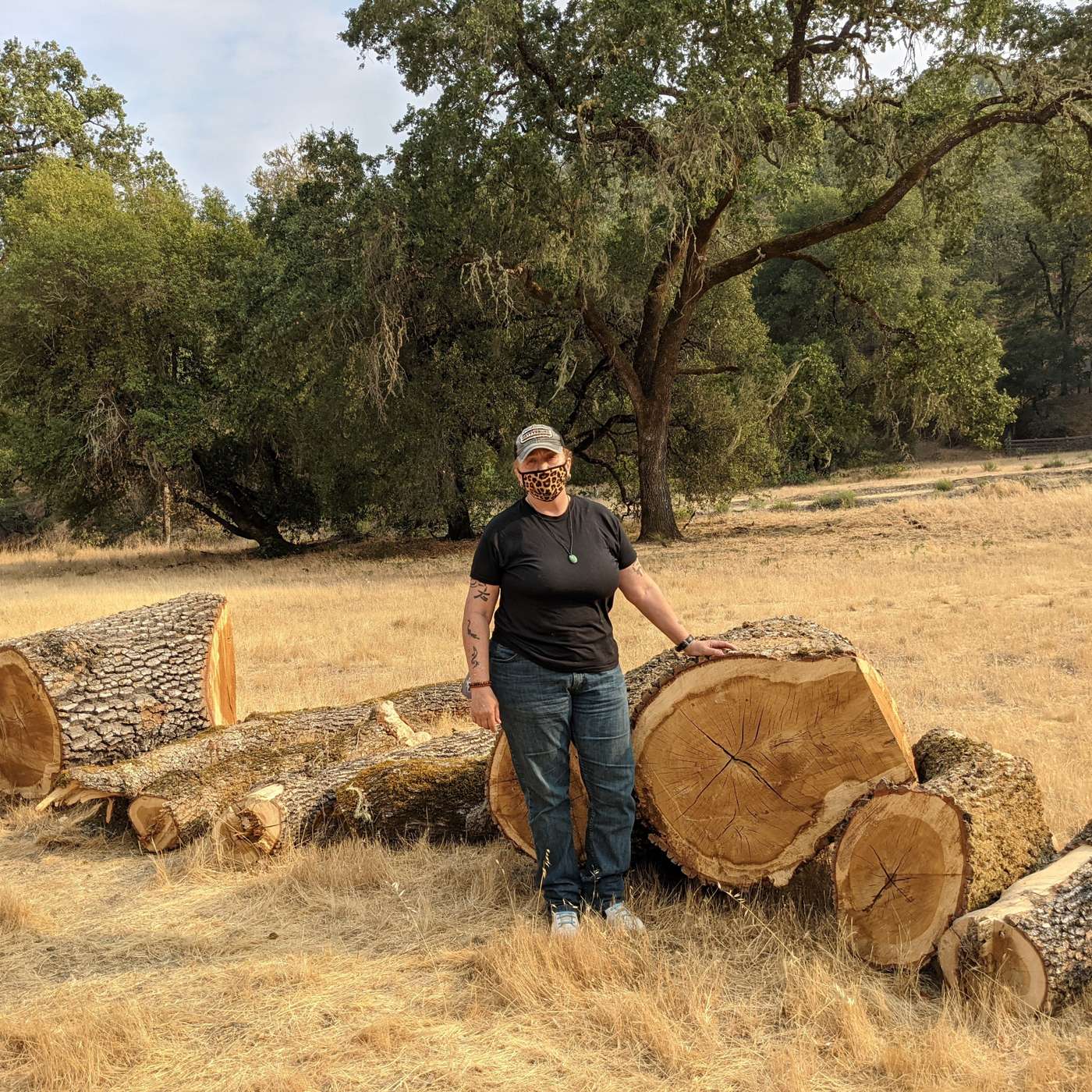
Ep 225Landowners frustrated by lack of control over tree removal
September 1, 2021 — In mid-August, Katharine Cole drove out to her pasture in Hopland through a thick haze from the Dixie Fire. Earlier this summer, she lost 20-25 trees to PG&E’s vegetation management program, which the California Public Utilities Commission approved as a strategy to prevent catastrophic wildfire. “Basically, I’m looking at a war zone here,” she said, pulling over to survey the felled trees; “that was beautiful oak and madrone and manzanita.” Cole was especially mourning the loss of an ancient blue oak, marked with blue dots and lying on the ground in sections a few feet from its stump. She says about a year and a half ago, she did get notice that crews would come out to some work, but that she never received a contract or any detailed information about the extent of the work that was to be done. Crews marked some trees and said they would remove dead brush and debris left over from the River Fire, which scorched part of the property in 2017. “But we were not notified that they were going to take down this oak without some kind of consideration,” she added. Limbs and sections of the tree were left in the pasture, leaving her to wonder how she will mow. She doesn’t have the equipment she would need to buck up the large-diameter rounds for firewood, or the wherewithal to hire someone who does. In addition, crews scattered wood chips around the site, which damages its viability as pasture. “I re-seed in here,” she said, scuffing a toe in the inches-deep carpet of wood chips. “I don’t know if I can rake in here, or what.” PG&E spokeswoman Deanna Contreras said in an email, “Unless it’s a transmission line that runs through their property...PG&E contractors should’ve communicated with them clearly about the work, what to do with the chips, and what was going to be removed and when. We understand that chips spread out hinders the reseeding for livestock process.” Contreras offered to send a supervisor out to the property, but between stress about covid and wells running dry, Cole demurred. Also, she added, “it’s not like I trust them to come down here and clean all this out.” And PG&E does have an easement along the transmission line. Cole is especially frustrated, in light of the fact that in July, PG&E announced plans to launch a multi-year effort to underground about 10,000 miles of power lines in districts at high risk of fire. “If they put underground lines and they come down here after they’ve cut all these trees,” she said, laughing in disbelief. “Well, thanks! And now just dig it out.” Cole shares an easement along the transmission lines with her neighbor Kellen Kaiser, whose cattle run on both properties. Kaiser is doing her best to keep the company off her land. The company, she says, has been absent most of her life, but early last year, crews started doing “significant amounts of work on the property, and treating it very disrespectfully, leaving gates open that let my cows out, leaving gates closed between pastures that my cows were supposed to have access to, leaving messes in terms of cutting wood and not cleaning up that wood. So me and my mother started resisting their presence on the property.” Resistance is difficult for both women, who have jobs off the ranch and are not always home to monitor goings-on at the property. “I’m a sex educator,” Kaiser says, “and so I teach about consent all the time. And it seems to me that the concept of consent is lost upon these people. Even though I have explained repeatedly that we are a group of women who would love to know the random strange men that are wandering around the property. That concept, even, is lost upon them.” The transmission lines run along Parsons Creek, which, in the middle of August, still had a pool of cool water shaded by a tree with a blue dot on it. Most of the trees on Kaiser’s property by the creek are marked with one blue dot, which Contreras said means they’ve been selected for trimming. The blue oak on Cole’s pasture had two blue dots, which sometimes indicates that it’s been selected for removal, and another tree still standing along the creek had three blue dots. Kzyx sent a picture of that tree to Contreras, asking what the markings meant, but did not receive an answer. Kaiser reported that she ran into a crew on her property one morning while she was doing chores. She had expected them three hours earlier, but joined them for a tour of their plans. “And as we went along, they were just going to cut down so many trees that are a part of this riparian corridor that exists on this protected creek,” she recalled. “And over the years, I have had so many people tell me what I can and cannot do with that creek as a property owner...but if I have to treat the creek with that much respect, which I think is the right thing to do, why doesn’t PG&E have the responsibility to treat the creek with the same amount of caution?” She says she was assured that environmental reviews were conducted, but
Ep 224Live Performance Returns to Mendocino College
August 31, 2021-- Good news! The performing arts are back. Over the weekend. Mendocino college students, alumni and guest artists returned to the outdoor stage at the Ukiah campus to showcase dance, drama and music before a live audience. The celebratory performance, called “Live in the Oaks,” was inspired and produced by Mendocino college dance director, Eryn Schon-Brunner. “It's been quiet, or “dark,” at the college for the last 18 months,” she said. “We haven't done any live performances. And while we won't be inside the big theater, we decided that it was okay to bring people outdoors and celebrate the work that artists do, and let people know that we're still doing it. We're still working. Dancers are still dancing. Theater majors are still coming out and performing and acting. Singers are still singing. And that we can share it safely, from a distance, in person.”Reid Edelman, professor and drama director at the college, remembers back to march of 2020, when COVID hit our community. “Everything just stopped dead in its tracks. So as you know, we were four days away from opening Midsummer Night's Dream the day of our tech rehearsal where we pulled the plug on that realized it wasn't going to happen.” All college drama, dance and music performances were canceled. And faculty and students had to pivot to online instruction. “All of us in all that not just theater and arts but all of the faculty in high school and elementary school and college faculty, we all had to pivot with no notice or no preparation. I didn't even know what zoom was when this happened. I mean people that go you can teach on zoom and I was like, well, what's zoom?”The Performing Arts faculty not only adapted to provide continued online education, but also created new opportunities for students to hone various artistic skills. Stephen Decker, technical director at the college, developed a one year career in technical theater program, which trained students to work behind the scenes on stagecraft, sound, and lighting. Edelman created an online Repertory Company for artists. “In the fall of 2020, we started what we called the Online Repertory Theater, and those are still up on the website,” Edelman explained. “So we created performance pieces that were on video, and then we've shared them on the website. So we did keep doing work through the shutdown. And the Online Repertory Theater went on for two semesters, 2020 and 2021. Now we're back at the college with in person classes but still the majority of the classes are online.”Mendocino College performing arts students also showed resilience during COVID. Two recent graduates, Rickie Emilie Farah and Schuyler Marcier continued with their online education during the lockdown. Both graduated with associate degrees in performing arts and went on to UC programs. Rickie earned her BA from UC San Diego and is excited to be back on stage: “This is my first in person show after a year and a half I want to say. And well, I just graduated from UC San Diego this summer. And I transferred there in the fall of 2019. But then, I've done the last year and a half online doing this in productions.”Schuyler, who will soon finish his acting program at UC Santa Barbara, feels COVID’s impact on his art: “It's a huge impact. I guess I can't really tell yet and performance-wise what it's done. But I do feel like I need to start from scratch. I feel like I need to take a beginning acting class and get back into it. I did a few things over zoom, but it wasn't the same. It's just yeah, it's like you take a year and a half off anything and it really is gonna set you back.”Rickie noticed too, that zoom affected her acting. “I just kind of don't know what to do with my hands. Because, you know, in front of the computer, it's your face that people are seeing. And, you know, even when I was working with Reid last week on my monologues, I wasn't really moving, and I was just kind of staying still. And it's nice because I feel like before it was harder for me to stay grounded and you know, you just kind of like lean on one leg, but it's so it's nice but then to have achieved that grounded state. But then I also now want to go back and play with movement.” Art mirrors life, and these humble confessions from young talented artists remind us that we are all, actors and audience alike, a little rusty and unpracticed right now. “Live in the Oaks” was the first step in slowly, safely finding our way back to being together. Set under a grove of oaks with the music teacher Janice Tim ready at the piano, and a masked, socially distanced audience filled with friends and family, the performers of Live in the Oaks took to the stage for over an hour, delighting with dance, drama and song and transporting everyone out of plague and pestilence to a place of collective joy. Eryn Schon-Brunner reminds us why live performance matters: “We are people who connect with each other and live performance gives connection,” she says. “It allows f
Ep 223Mendocino supervisors OK using PG&E funds to truck water to the coast
From Mendocino County Public Broadcasting, this is the KZYX News for Friday, Aug. 27. I’m Sonia Waraich.The drought situation on the coast is getting worse. Elk, Irish Beach, Mendocino Unified School District and Westport said they will no longer sell water to haulers supplying homes and businesses in Mendocino, which rely on that water. On Tuesday, the Mendocino County Board of Supervisors held a special meeting to talk about how to get water flowing from inland to the coast as soon as possible. The supervisors ended up voting to fund a water hauling program with just under $1 million of the PG&E disaster settlement funds. That program will cover the cost of hauling water from Ukiah to the coast and it’s estimated to only cost residents 3 cents per gallon for the water and 24 cents per gallon for local hauling. In total, the program is expected to cost $3.84 million for four months.County staff is seeking grant funding and other assistance from the state, which is expected to cover the cost of hauling the water long distance from Ukiah to the coast.But that program only applies to water being bought for home use. So far, it seems like businesses are out of luck. They’d have to pay almost $1,000 more per truckload to cover the cost to haul the water from Ukiah.1st District Supervisor Glenn McGourty abstained from the vote and said he didn’t feel comfortable using the PG&E money to fund the program. “I’m very supportive of helping everybody on the coast. I just kind of feel like we could do this with a little bit more time. Maybe we don’t have a little bit more time, but that’s what my reluctance is. It just feels like we’re moving awful quick and unless everybody signs their agreement for PG&E money in blood, we want to make damn sure it gets paid back.”At a meeting earlier this month, the supervisors held off on approving a list of projects to be funded by the disaster settlement. That’s because Potter and Redwood valley residents were upset that not enough money was going toward their community, which experienced the fire that led to the settlement funds.At the start of the meeting, 5th District Supervisor Ted Williams suggested using the county’s transient occupancy tax revenue to jump start the program. The transient occupancy tax, also called the TOT, is collected anytime visitors stay overnight at hotels and other lodging in the county. The TOT is expected to bring in over $5 million this year, and 75% of that is generated on the coast. And the coast is suffering the worst consequences of the drought right now. Ryan Rhoades, superintendent of Mendocino’s water district, said 25 wells went dry in the district last month, the highest number on record for any given month. And that’s out of 420 wells total.“As you all know it’s a dire situation, but we’re teetering on catastrophic. Right now there is virtually no bulk water for sale on the coast. Residents and businesses are scared.”County CEO Carmel Angelo said using the PG&E funds would be more expedient than using the TOT funds. “Since 2017, I can tell you, that we diverted many, many resources, county resources, from other areas so that we could support Redwood Valley, Potter Valley and the fire region. And we would do that again and again and again, and most likely we will. This is a time when the town of Mendocino is in such a crisis – and the whole coast – and we do know that 75% of TOT comes from the coast. And so I respectfully request that this board really look at the item at hand in front of you. And I know you don’t want to use PG&E but the quickest way to get water to the town of Mendocino is with the item in front of you. That we would use PG&E money and that we would absolutely replace it – whether it’s grant dollars or TOT dollars.”That seemed to convince most of the supervisors to change their positions. Supervisor Williams said the board needed to do whatever it could to get water to the coast right away.“I mean seriously water needs to be flowing tomorrow or the next day, not a month out. We’re in bad shape today, but if you look at where the drought will be a month from now, we’re going to be in dire straits.” But he said he was still concerned about how businesses would fare with no access to any kind of assistance from the government.“It’s my understanding that we’re going to address the life safety, residential water concern and pass along the actual cost for commercial users. And it sounds like the actual cost may be $945 per truckload, which business has told us likely will not work. They will likely close their doors. Does the board see the need to have any sort of follow up or next steps on that item, how to save our local economy from what this sticker price will cost, or are we done?”Supervisor McGourty suggested businesses take a look at some market-based solutions, like adding a water surcharge to their customers’ bills. 2nd District Supervisor Maureen Mulheren said businesses were coming out of a pa
Ep 222Local Doctors Sound the Alarm on Covid
August 27, 2021 By Alicia Bales Today, as the surge in Covid 19 infections has filled our hospitals to capacity, and reports of deaths from the virus are becoming a daily occurrence, dozens of local doctors and medical providers have signed a letter addressed to the community of Mendocino County asking for help. The letter describes the dire conditions healthcare providers are seeing at work every day: emergency departments overflowing, full ICUs, and a surge of sick young patients with covid-19. The doctors are urging Mendocino County residents to stem the tide of new infections by getting vaccinated. Dr. Erica Valdovinos and Dr. Drew Colfax are two of the doctors who signed on to the letter. Here is the Text of the Letter: Dear Mendocino County Community, We are a group of doctors and medical providers living and working in Mendocino County. We need your help. Like all of you, we are heartbroken at the number of lives and livelihoods the COVID-19 pandemic has taken. COVID-19 has proven difficult to control, and this pandemic feels unrelenting to all of us, as healthcare providers and as members of the community. We work in the emergency departments at Ukiah Valley, Howard Memorial and Mendocino Coast Hospitals, in the inpatient units, the intensive care units, and the clinics in the community. Every day, we take care of more and more patients who are sick with COVID-19. The great majority of hospitalized patients are unvaccinated. Our emergency departments are overflowing. Our hospitals are full. Our ICUs are full. We struggle to find hospital beds even for the patients who are coming to the emergency department with strokes, heart attacks, or appendicitis. When patients need services that our hospitals cannot provide, we struggle to transfer them, and have become used to hearing the phrase “there are no hospital beds in all of Northern California.” We repeat this sentence to our patients, to their worried family members. Never before have we seen such a surge of sick, young patients with COVID-19, and never before has our medical system faced such a challenge. We can all do our part in this dire situation by getting vaccinated. We will keep coming to work every day and taking care of everyone who walks through our doors -- taking care of those in need is what we do and we can’t imagine working anywhere else. But we need your help to prevent hospitalizations and deaths. Rumors and misinformation are circulating about the vaccine. Please talk with us, or your primary care provider, about the COVID-19 vaccine. The data and the science are clear: the vaccine is safe and highly effective in preventing severe COVID-19 illness and COVID-related deaths. We are vaccinated. Getting vaccinated will not only protect you, but will also keep your loved ones and your community safe and out of the hospital. If you would like to get vaccinated for FREE, please visit: https://www.mendocinocounty.org/community/novel-coronavirus/covid-19-vaccinations/vaccination-clinics Erica Valdovinos, MD Georgina Calderon, MD MPH J. Drew Colfax, MD JD Mike Hausberger, DO Martha Montgomery, MD MS Gigi Lee, MD Carolyn Boley, NP Debbie Marks, MD Gary Fausone, MD Jennifer Zernec, DO Katie Hatch, MD Jorge A Allende, MD Lisa Gamble, PA-C Mark Luoto, MD Duncan Johnston, MD Tod Imperato, FNP Jodi Parungao, MD Brian Gould, DO Hayley Rousek, MD Charles Baugh, MD Gerry V. Lazzareschi, MD Angela Mapanao, DO Gretchen Duran, PA Noah Chutz, PA-C Marvin Trotter, MD Mary Newkirk, MD Sara Martin, MD Brandon Begley, DO Cindy Novella, FNP Barry Sheppard, MD James Dolan, MD Chloe Nicolaisen, MD John Rochat MD Meghan McCurry, DO Elaine Yang, MD Timothy Burger, MD Andrea McCullough MD E. Xavier Ortiz, MD Michael Mian, MD Cameron MacInnis, MD Cara Eberhardt, MD Mark Apfel, MD Casey Johnston, MD David Streeter, MD Robin Serrahn, MD Kirsten Q. Juliet, MD Anne Martin-Ko, MD Ilan Kolkowitz, MD Paul Hupp, PA-C Linda K James, MD Sharon Paltin, MD Snehal Raisoni, MD Hengbing Wang, MD Lawrence Goldyn, MD Elizabeth Whipkey-Olson, DO Angus Matheson, MD D. Mills Matheson, MD Ziad Hanna, DO Zoe Berna, MD

Ep 221Grain Project promotes crop diversity as key to food security
August 26, 2021 — With climate change, the current drought conditions could be here to stay. That means the ability to experiment with unfamiliar crops could be key for local farmers. Rachel Britten is the owner of the Mendocino Grain Project, which provides a variety of services to small grain farmers in the northern California region. They’ll harvest crops, clean them, and distribute them, so each farmer doesn’t have to invest in machines for something they may only want to plant every few years on a couple of acres. We’ll hear from Britten and John LaBoyteaux, a grain farmer who grows varieties both ancient and modern to contribute to the diversity that’s essential to food security.
Ep 220Ranchers adapting to drought conditions
August 25, 2021 — The drought, following covid, market forces, and wildfire, is just one of many challenges facing local farmers. We’ll hear from two members of multi-generational families raising cattle and hay in Potter Valley about the choices they’re making and the future they face.
Ep 219New buoy at Caspar Cove fills crucial data gap
From Mendocino County Public Broadcasting, this is the KZYX News for Tuesday, Aug. 24. I’m Sonia Waraich.Caspar Cove is a beach just south of Fort Bragg. Early Sunday morning, about a dozen people were kayaking, hanging out with their families, playing fetch with their dogs and doing everything else you can imagine people doing at the beach on a weekend. Nobody seemed to be paying any attention to the new fixtures at the center of the cove. A couple hundred yards off shore, you can spot what looks like an orange balloon and a yellow-and-black object, about the size of a basketball, floating in the middle of the cove.That object is a solar-powered buoy known as the Spotter and it’s connected to a floating balloon and smart mooring system that can collect data on ocean temperature, wind speeds and more. There are about 50 other buoys just like it floating off the coast of places as close as Washington and as far as Fiji.This nonprofit called Aqualink has been donating the buoys to conservation groups around the world. The nonprofit is building a network of buoys that are monitoring and collecting data in sensitive environments like coral reefs, kelp forests, eel grass beds and local estuaries. That has implications that are both large and small. Researchers can use the data for studies on, for example, sensitive species. Beachgoers can also use the data to get a better idea of what local ocean conditions will be like. Data that relies on regional monitors is often unreliable.Aqualink still has about a hundred more buoys that are supposed to go out. It bought the buoys from a company called Sofar Ocean Technology.Zack Johnson works there.Johnson says it’s not clear yet what kind of research the buoys can help support, but the data can come in handy for a wide variety of uses.Caspar Cove is an important part of the network Aqualink is building because it’s an important site for kelp. Kelp do a lot. They’re powerhouses for storing carbon, they provide habitat for other species and they serve a lot of economic functions, too.But a few years ago, kelp forests like the ones on the North Coast were decimated. So was a lot of other marine life. For kelp, the trouble started in 2013. First, a virus wiped out the sunflower star, a sea star that preys on purple sea urchin. Purple sea urchin eat kelp.Then a marine heatwave that started in 2014 made the ocean so hot and inhospitable that kelp weren’t able to survive. That heatwave ended in 2019.With no kelp in sight, the purple sea urchin transformed into grazers and moved into shallower waters, grazing on all the kelp they found there.Tristin McHugh has been working on kelp restoration since moving to the area in 2018. In January McHugh started working on kelp restoration with The Nature Conservancy, which received the donated buoy and put it out in Caspar Cove last month.Beyond research and conservation, McHugh says the buoy has other benefits.Johnson, the engineer at Sofar Ocean, encourages people to check out that data and put it to good use by going to aqualink.org.The data’s also on display in the Noyo Center for Marine Science at 338 N Main St. in Fort Bragg.For the KZYX News. I’m Sonia Waraich, a Report for America corps member. For all our local stories, with photos and more, visit KZYX.org. You can also subscribe to the KZYX News podcast where you get your podcasts.
Ep 218County ends contract with Wildlife Services
August 23, 2021 -- Jon Spitz, member of the Mendocino Non-Lethal Wildlife Management Alliance talks about their recent victory in convincing the County to end their contract with the USDA Wildlife Services. He discusses the history of their grass roots fight and explains how exclusion wild life management techniques work. Currently Mendocino County does not have an exclusion contractor. In the interim, Spitz recommends calling the Sonoma County Exclusion Program Hotline for advice in dealing with animals on your property. The number is 707 992 0276 and their web site is awces.com.
Ep 217Fire Safe Council hardening homes
August 20, 2021 — Hundreds of thousands of acres are on fire in the state of California. There’s been one or more fires every day in Mendocino County this week, and the Cache Fire has destroyed dozens of homes in Lake County. The topic of how to make a home resistant to fire, or hardening it, is timely. On Wednesday morning, Scott Cratty stood in a light rain of ash from the Dixie or the Monument or maybe the Caldor fire, overlooking what’s left of Lake Mendocino. Cratty is the Executive Director of the Mendocino County Fire Safe Council, and he was there, at a private home with a film crew and fire experts and a representative from Assemblyman Jim Wood’s office, to showcase a home hardening project. The Fire Safe Council is working with a crew from the Hopland Band of Pomo Indians and grant funding to clean up roofs and vegetation around the homes of people who are low income and senior citizens or disabled. Cratty estimates there are about 2,500 such homes in the wildland urban interface in Mendocino County. Cratty stepped behind a brand new trailer to talk about what else is new with the Fire Safe Council as Yana Valochovic, a foremost authority on fire behavior, led a pair of CalFire inspectors around the home to explain how resistant it was.
Ep 216Cities enter into mutual aid agreements to address water shortages
From Mendocino County Public Broadcasting, this is the KZYX News for Monday, Aug. 16. I’m Sonia Waraich.Last month was the hottest July ever recorded on Earth and in Mendocino County, according to NOAA, the National Oceanic and Atmospheric Administration,. The federal agency is also predicting there’s going to be lower than average rainfall in Mendocino for at least the next six months so the drought’s not going anywhere.One of the groups working on addressing the drought locally is the Mendocino Countywide Drought Task Force. The task force is made up of Supervisor John Haschek, Supervisor Glenn McGourty and Josh Metz, who was contracted by the county to coordinate the drought response. They met on Thursday by Zoom and gave updates on how the drought is being felt and addressed around the county.Josh Metz started with some good news – the county is making progress in addressing one of the major issues its facing because of the drought, how to move water from one part of the county to another.Ukiah and Fort Bragg started the push for a regional approach to the drought through mutual aid agreements. Those agreements are expected to make it easier for cities to share water by without facing regulatory hurdles.Metz said the initial goal will be to transport ten 6,000-gallon truck loads of water from Ukiah to Fort Bragg for a total of 60 to 70,000 gallons per day.There’s also been talk of using the Skunk Train to transport water from inland to the coast. The idea hit some roadblocks around cost, but it looks like funding has become available for the project through the state’s Department of Water Resources.Not everyone in attendance was happy with that idea. During public comments, one resident of the Willits Valley called in and told the task force to lobby elected officials to implement solutions that won’t tax people living inland.Supervisor Glenn McGourty didn’t foresee the depletion of groundwater being a problem in the immediate future since that water supply is monitored by the Ukiah Valley Basin Sustainable Groundwater Management Agency.Move water around the county in an efficient and cost-effective way has been central to the drought response. That’s because even though the entire county is facing an extreme drought, not every part of the county is experiencing the drought the same way. Ukiah is faring pretty well through the drought because of early investments the city made in building up its water resources. The city has reduced how much water it pulls from the Russian River by 75 to 80% and still has water available to spare to help other areas around the county.But cities like Fort Bragg are concerned. The city still has a steady supply of water but last Monday the Fort Bragg City Council kicked up its water emergency to Stage 3, calling for water users in the city to conserve 10% more than they had been since mid-July.City officials are worried about the lack of rainfall predicted in the region in the coming months because of how it will impact the Noyo River. Fort Bragg relies on the Noyo River as one of three main water sources. The Noyo usually experiences its lowest streamflow at this part of the year and doesn’t get replenished until there’s significant rainfall. In the meantime, high tides can cause the water in the Noyo to become too brackish to be pumped for drinking water by the city. Fort Bragg Public Works director John Smith said the city’s is expecting its desalination system to arrive next month. That will allow the city to make the brackish water drinkable after high tide events.For the KZYX News. I’m Sonia Waraich, a report for America corps member. For all our local stories, with photos and more, visit KZYX.org. You can also subscribe to the KZYX News podcast where you get your podcasts.
Ep 215Redwood Valley Grange gets $250k in settlement funds
August 19, 2021 — The consent calendar and CEO report from this week’s Board of Supervisors meeting were full of big news. Earlier this month, the Board drew up an allocation plan on how to spend the one-time $22 million PG&E settlement fund for the 2017 wildfires, which started in Potter Valley and devastated neighboring Redwood Valley. Much of the money went to items the supervisors thought would ease the burden of the next disaster, but many Redwood Valley community members felt that they had been overlooked. After an outcry, the Board agreed to allocate a quarter million dollars from the fund to the grange in Redwood Valley. They also resolved to ask the FIre District Association for advice on how best to spend another one million dollars from the same fund, leaving about $2.7 million for the next emergency. Supervisor Glenn McGourty pulled the PG&E allocation item from the consent calendar to make an eleventh hour pitch for funding the grange, whose members have long yearned for a commercial kitchen and major repairs. About two dozen letters pleaded for consideration, reminding the board that the grange became a focal point of the community during the fires. A member of the Municipal Advisory Council called in to say that just over 16% of the money had been doled out to Redwood Valley, and to ask that the board redo the entire process. McGourty demurred on the general, but acquiesced in the particular. The board agreed unanimously with his suggestion to fund the grange but not revisit the allocation process, and also agreed to allocate half a million dollars to solarizing the libraries, rather than providing them with generators as was originally requested, so they could serve as gathering places during evacuations or power outages. They also provided $1.5 million to carbon reduction plans, with a view toward using funds from ARPA, or the American Relief Plan Act, to fund other requests on the list of priorities for the PG&E money. The Redwood Valley Calpella Fire District did receive funding for two vehicles, but the water district did not receive the money it requested for fire hydrants. County analysts told the board that that project could be paid for by ARPA, which, according to the CEO report, became law on March 11. The money can be used by local governments to shore up the economic and public health impacts of the pandemic. Mendocino County has been approved for close to $17 million of that money, half of which was awarded earlier this month. $4.6 million of that is eligible for water and infrastructure projects. Another consent calendar item about land use and building code authority drew angry letters from neighbors of the Ukiah Gun Club, in the eastern hills. These included a letter and a call from a legal firm, which are often steps toward establishing standing for a lawsuit. The Gun Club is on city-owned property in the unincorporated part of the county, which places it in a confusing jurisdictional situation. While a shooting range is an allowable use on rangeland, neighbors believe the gun club poses fire and other environmental risks. The board agreed to enter a joint powers agreement with the city to share land use authority over the property, which the Gun Club is leasing until the end of 2044. County Counsel Christian Curtis attempted to shed some light on the circumstance, saying that “when the city owns property in the county’s jurisdiction, the city is immune from the land use and the building laws on that property, so the county is unable to apply its laws to that location.” With conflicting opinions from the Attorney General on the topic, Curtis concluded, “that’s left a significant amount of confusion for some time as to exactly what laws the county can apply to the Gun Club while it’s operating on the city property.” The Board voted to enter a Joint Powers Agreement with the city of Ukiah to share land use authority over the property, which the Gun Club is leasing until the end of 2044. And the drought task force is churning through the bureaucracy that will be required to carry out the plan to truck water from Ukiah to the coast. McGourty told Supervisor Ted Williams that he thinks 65,000 gallons a day could be forthcoming. The board also appointed five of the six applicants to the redistricting committee to follow up on the census by redrawing the borders of the supervisorial districts, if warranted by changes in population. Initial numbers indicate that the county population has grown by about 4,000, with slight increases in Ukiah, Willits, and Point Arena.
Ep 214Delta surge: numbers six times higher than just one month ago
August 18, 2021 — Mendocino county is experiencing a fourth surge of covid cases, with a peak over the weekend and a record 95 cases on Thursday. County Public Health reported the death of a 49-year-old man in Ukiah yesterday afternoon, bringing the death toll to 56. Five of those deaths have been reported this month. Deputy Public Health Officer Dr. Noemi Doohan said that full genome testing is not widely available, but she’s confident it’s the delta variant that’s sweeping through the county.