
KZYX News
1,162 episodes — Page 20 of 24
Ep 213Landowner "in shock" by extent of tree removal
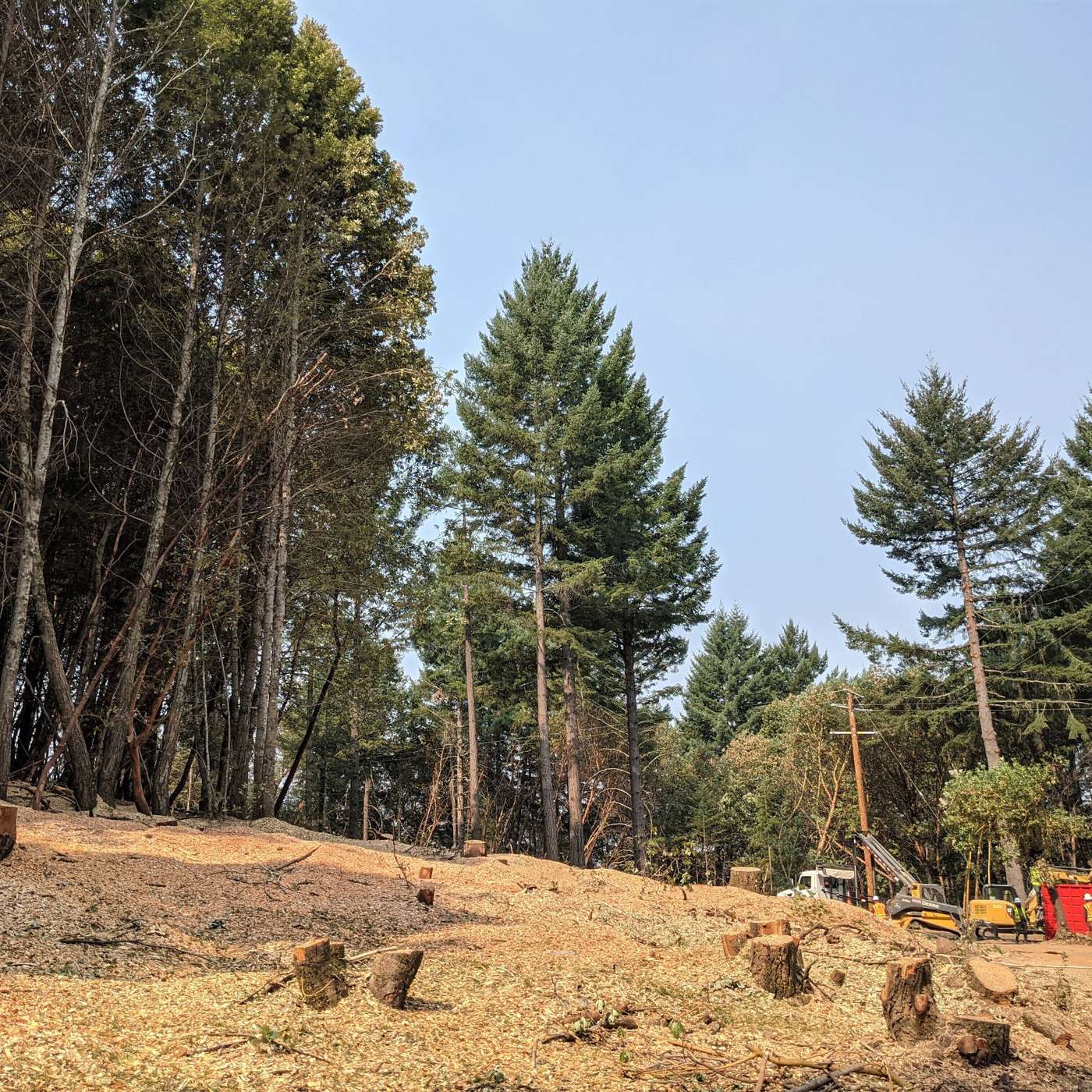
August 17, 2021 — Paul Putter’s homestead used to be nestled in a grove of hardwoods and conifers. It was shady and cool, and he used to jog on a trail beneath the canopy. But now, with PG&E’s enhanced vegetation management program, crews of contractors are taking down any tree the company thinks could fall on a power line and start another massive fire. On August 7, kzyx was on site to see crews feeding dozens of smaller trees into a chipper and pouring large ones into a big red dumpster. “Maybe a hundred trees,” Putter estimated. “All along their power line, but some of them quite far away from their power line, maybe a hundred feet...I’m in kind of shock here. The extent of what they have cut on my property alone is really quite incredible. ” Putter signed a contract on June 24th, though landowners all over the county have told kzyx they’ve had trees felled by PG&E crews with no contract. Putter’s document is basically a checklist, with the number 32 written by hand on a line following the typewritten words:” Tree Quantity.” PG&E spokeswoman Deanna Contreras apologized for not being able to reach someone at the company who could explain the contract in time for this story. “I think I might have signed something without really understanding what the full implication of it was,” Putter noted. “It just didn’t register, what was going to happen.” There’s no independent third-party environmental review for this work, and landowners complain about a lack of precise information about what it will entail. It is legal. PG&E submitted its vegetation management plan to the California Public Utilities Commission late in 2018, and it’s now a part of the Public Resource Code. The utility is required to give notice to landowners and provide damages if it removes a valuable tree, but the process is not defined in the code. In April of this year, the CPUC placed the company into an enhanced oversight and enforcement process, because its wildfire safety division found that last year, PG&E failed to clear the most dangerous vegetation from the highest risk lines, focusing instead on lower-risk lines. If the company can prove that it’s prioritizing high-risk lines for its stepped-up vegetation program in 2021, it has a chance of being removed from the enhanced oversight process, which is a condition of its plan for exiting bankruptcy. Nancy Macy of Santa Cruz is the chair of the Sierra Club wildfire mitigation task force and one of the co-authors of a white paper on the harmful effects of PG&E’s tree removal practices. The paper says outside professionals may be reluctant to pronounce a tree healthy once it’s been marked for removal by PG&E, out of fear of liability if the tree does fall. Still, there have been pockets of resistance. “They hit a big wall in Santa Cruz,” Macy recalled. “We insisted on public meetings, we insisted on people having the right to say no, that they could take the responsibility for the trees being there.” But the battles can take years. And laying the groundwork was a meticulous process, too. “We’ve done a lot of work to do research and provide the background information so that the supervisors could be educated as to what the problems are,” Macy said. “And so all the supervisors respond to that.” Today on the consent calendar for their regular meeting, the Mendocino County Board of Supervisors accepted informational reports on two emergency coastal development permits to remove a total of 182 trees along PG&E power lines between Fort Bragg and Gualala. Meanwhile, Putter’s property, his neighbor’s land, and the steep slopes along Orr Springs Road where the power lines march across the ridgetops are steadily being cleared. “This area has too many trees, there’s no question about it,” Putter reflected, over the sounds of heavy equipment. “But that’s not what PG&E is doing here. They’re not thinning trees. That’s just not what’s going on.”
Ep 212Protective vegetation unprotected
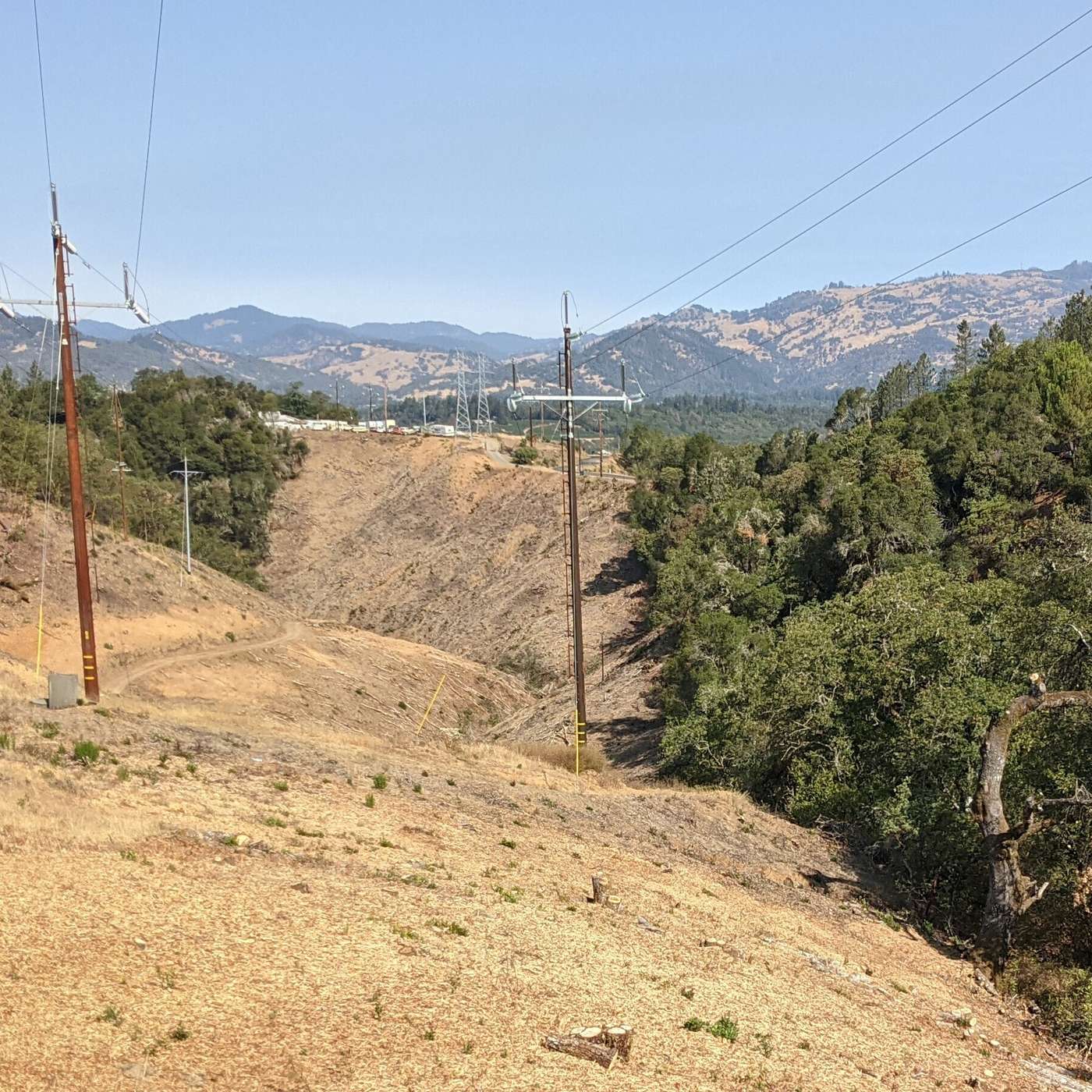
August 13, 2021 — With fire season and drought well underway, PG&E is hard at work on the 1800 miles of enhanced vegetation management it plans to finish by the end of the year. The company is responding to wildfire threat by limbing and cutting down trees and any other vegetation its arborists deem present a possible danger to its infrastructure. Cathy Monroe of Redwood Valley is a long-time member of the California Native Plant Society and an original member of the Mendocino County Climate Action Advisory Committee. She’s also a fire survivor who understands the need to take preventive measures. Electricity, she acknowledges, is key to getting away from fossil fuels. This week, Monroe and Eileen Mitro, a fellow member of the CNPS and co-founder of Climate Action Mendocino, looked out over an area near the intersection of Road A and Highway 20 in Redwood Valley, which was cleared in May. Some willow remained along a small seasonal tributary to the Russian River, but now, with the heat and the drought and the absence of shade, that willow is dying. With it, protection from sediment and the force of heavy rain also disappears. In June, PG&E spokeswoman Deanna Contreras said that “A substantial amount of vegetation was left near the waterways to help protect water resources in the area,” and that “the protection measures we applied precluded the need for a water quality permit.” Mitro and Monroe worry about erosion damage from upcoming winter floods and the loss of the carbon-sequestering blue oaks that once provided habitat and held the slopes together.
Ep 211A few more truckloads of water for town of Mendocino
Aug 12, 2021 — The plight of the town of Mendocino has captured national attention. Wells are going dry just as the local tourist trade i s struggling to emerge from the pandemic. Fort Bragg can no longer sell water to other towns. A plan that called for the skunk train to bring water to the coast from Willits fell through. Now it looks like the most feasible option is for truckers to bring water over the hill from Ukiah, which Supervisor Glenn McGourty, who is on the drought ad hoc committee, hopes will happen sometime this month. We’ll hear from Ryan Rhoades, the Superintendent of the Mendocino City Community Services District, about a few local connections that are coming through, including two school district sources. And water operator Donna Feiner will share some details about what it takes for small water systems to share water with one another.
Ep 210Studies in JDSF include dead standing trees, Imazapyr
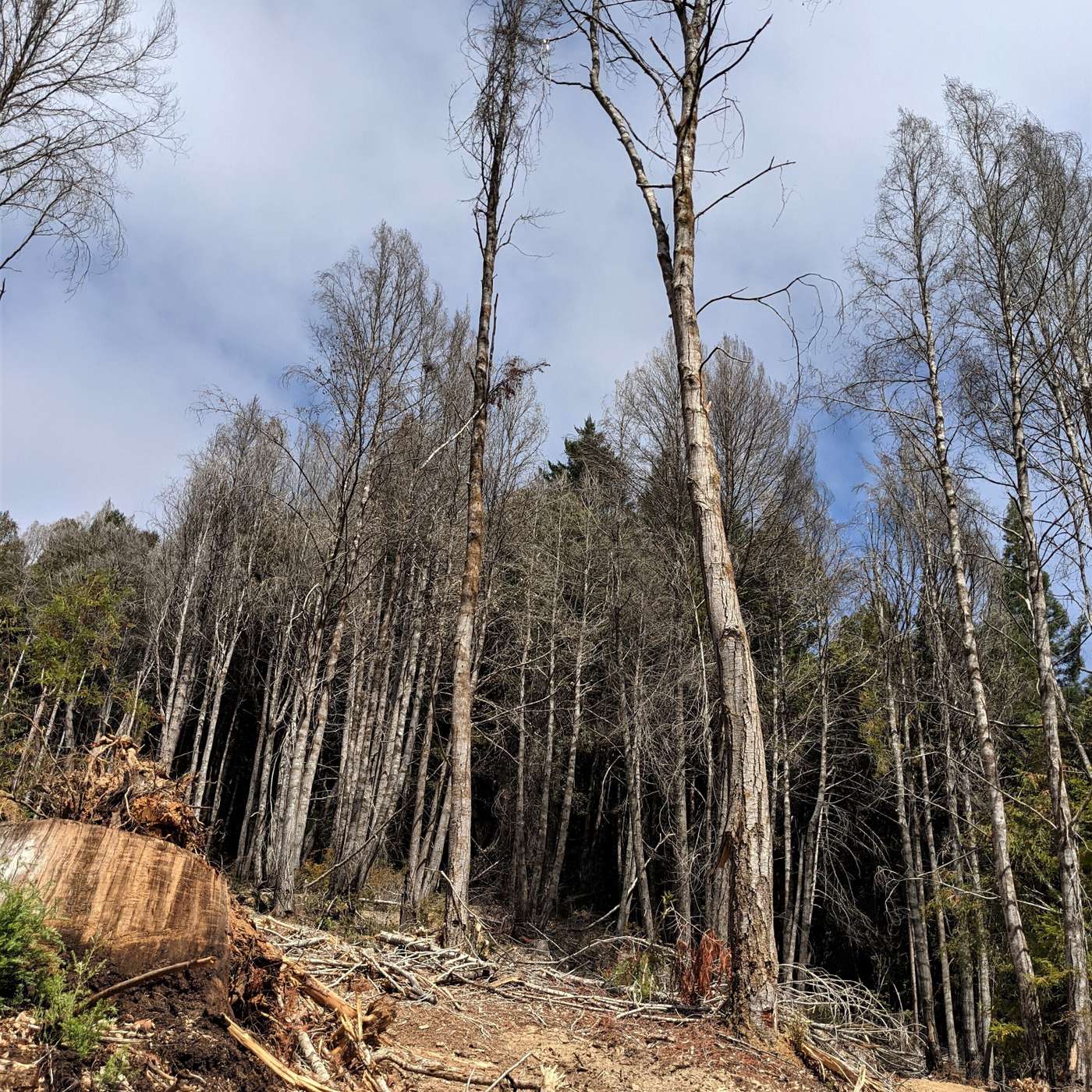
August 11, 2021 — The Jackson Demonstration State Forest is the largest of eight so-called working forests managed by CalFire for a number of purposes, including timber production. This involves experiments to figure out how to replace hardwoods with conifers, especially the high-value redwoods that were logged so extensively for much of the 19th and 20th centuries. But the current Timber Harvest Plans in the state forest are hotly contested by a coalition of tribal groups and environmental activists. Alder, a member of the Mama Tree Network, was sitting in the now-iconic Mama Tree when logging started in the Caspar 500 on June 10th. Last week, he invited kzyx to take a tour of another site near Chamberlain Creek, where large numbers of trees had been treated with Imazapyr and left standing. Alder said he first noticed the trees about a month ago, and that he thinks they had been dead longer than the 90 days allowed by Measure V. Measure V is a voter-approved initiative that has been on the books since 2016. It doesn’t prohibit the use of herbicides, but it does ban the practice of leaving dead standing trees for more than 90 days. Mendocino Redwood Company and CalFire say the law does not apply to them, and the State Attorney General declined to issue an opinion, citing a conflict of interest. It’s never been enforced. CalFire confirmed that Chamberlain Creek is part of an experiment designed by Dr. Pascal Berrill of the University of Maine, formerly Humboldt State University. Berrill says the technique, called frilling, or hack and squirt, is one of several methods he’s using to determine the best way to restore forest resiliency and productivity, perhaps even reducing the risk of wildfire. But John O’Brien, a climate scientist and postdoctoral research fellow at the National Center for Atmospheric Research in Boulder, Colorado, thinks the research is more economic than ecological. He argues that the hardwoods are an integral part of the forest, supporting the vital mycorrhizal network that shuttles water and nutrients among tree roots. He adds that creating a monoculture of redwood trees would result in a less resilient forest. An item about Measure V is scheduled to come before the Board of Supervisors on August 17. Supervisor Ted Williams, who spearheaded the successful Measure V campaign before he ran for office, hopes to discuss the possibility of getting trusted independent third-party approval of management plans. Currently, those plans are approved by the state and written by CalFire, which he worries is creating public distrust.
Ep 209Activists shut down Jackson Advisory Group meeting
From Mendocino county Public Broadcasting this the KZYX News for Monday, Aug. 9. I’m Sonia Waraich, a Report for America corps member.The Jackson Advisory Group meeting last Tuesday started like just about any other local government meeting.That’s George Hollister. He’s a small forest land owner and chair of the group known as the JAG. The advisory group was formed just over a decade ago in 2008 to offer recommendations to CAL FIRE and the Board of Forestry about how best to manage Jackson Demonstration State Forest in the public interest.The advisory group can be composed of up to 14 members with applicable knowledge, ranging from registered professional foresters and land owners to biologists and conservationists. It currently includes industrial forestland managers and recreation advocates.Those are activists who ended up shutting down the meeting.After leading a march to the Fort Bragg Town Hall, they were initially quiet, allowing a couple staffers like Jason Serna, the timber sale program manager at Jackson State, to get through their presentations.But it wasn’t long before Chair Hollister lost control of the meeting.While logging has been a contentious issue in the county for decades, interest in preventing commercial logging in Jackson State has grown over the past year, triggered by a timber harvest plan in the forest called the Caspar 500, which is close to residential communities and a popular recreation destination.Activists have been engaging in direct action to stop the logging and in June it worked. Cal fire temporarily paused logging in the area to gather local input through a series of town halls.The meeting Tuesday was the culmination of those meetings and the community came with its concerns.The meeting was intended for Cal fire and Jackson State staff to address those concerns, but that’s not how things ended up playing out.During one portion of the meeting, a handful of protesters began chanting. As a result, CAL FIRE staff weren’t able to get through their presentations.The JAG members decided to continue discussion on the agenda items to their meeting in the field at Jackson State at the end of this month.That’s John Anderson, a member of the advisory group and head of the Mendocino Redwood Company.As a member of the JAG, Anderson said he didn’t find the tactics used by the protesters to be very productive.For the KZYX News, I’m Sonia Waraich. For all our local stories, with photos and more, visit KZYX.org. You can also subscribe to the kzyx news podcast wherever you get your podcasts.
Ep 208Memories of key budget meeting differ
August 6, 2021 — The Board of Supervisors agreed to hire outside counsel for Sheriff Matt Kendall, though who exactly will advocate for the sheriff has yet to be decided. And the sheriff and the CEO’s office had two distinctly different memories of a key meeting about the sheriff’s budget.
Ep 207PG&E settlement funds close to being finalized
August 5, 2021 — The Board of Supervisors allocated PG&E settlement funds this week, agreeing to fund the fire safe council for five years, widen East Side Potter Valley Road, and set aside three million for drought relief or other emergency needs. And the water shortage is growing ever more dire for the town of Mendocino, with no state or federal help in sight. With no water forthcoming from the City of Fort Bragg, or from the Willits aquifer by way of the skunk train, the town is looking at buying water trucked in from Ukiah.
Ep 206Ukiah mayor encourages Latino leadership
August 4, 2021 — With the Latino population in Mendocino County growing, local Latino leaders are strategizing how to bring business owners in to fund scholarships and initiatives. And with the delta variant surging, Ukiah mayor Juan Orozco says he thinks he’s cracked the code when it comes to the best way to get public health messages out to the Spanish-speaking community: short, informative videos on social media. Orozco is a member of UVA, Ukiah Vecinos en Accion, a local group that’s been working for ways to advance the interests of the Latino community. The group is now setting its sights on getting business owners to step into playing a social role beyond offering employment. For the younger generations coming up, he envisions leaders in government, healthcare, education, and business. “You know, I haven’t met a Latino CEO in our county yet,” he reflected. “And we really need to start figuring out how to get that going.”
Ep 205Mandates coming soon
August 3, 2021 — Indoor masking and limited testing and vaccination mandates are headed for Mendocino County. Public Health Officer Dr. Andy Coren asked the Board of Supervisors for their support as he prepares a health order mandating universal indoor masking in public places, both for vaccinated and unvaccinated people. Coren said the order will come out this week, and go into effect on August tenth. And he’s extending the state public health order mandating vaccinations or frequent testing for firefighters and EMS and law enforcement personnel. Coren is also offering guidance, which is less stringent than an order, advising employers to implement a vaccination or testing policy for their employees. Covid-19 cases have been surging, with the delta variant now firmly ensconced in the county. Public health reported the deaths of two elderly men in Willits last month, bringing the local death toll up to 52. Fourteen people are in the hospital with covid, including six in the ICU. One fully vaccinated local person has passed away from the virus during the course of the pandemic. The upcoming orders received wholehearted support in written and oral public comments, including one representative of some of the county’s top business concerns. Julia Kendrick Conway introduced herself as a founding member of the Mendocino County Wedding and Events Task Group, then said the economy “needs a mask mandate now,” to avoid another shutdown. Conway also read a letter from the Mendocino County Lodging Association, expressing similar sentiments. The Chambers of Commerce around the county have masks and hand sanitizer available for businesses. Coren reported that the supply of all three vaccines is plentiful. Supervisors directed the county government’s Human Resources department to devise a policy requiring proof of vaccination or regular testing, in what they hope will be an example to other employers.
Ep 204Fish need water
August 3, 2021 — California salmon fisheries are in trouble across the state’s watersheds, as panelists testified last week at a hearing moderated by Senator Mike McGuire. Chuck Bonham, the head of the California Dept of Fish and Wildlife, testified that his agency had trucked 17 million fish from the Central Valley into the Bay Area, and 3500 to the Russian River watershed, a measure that will be difficult to sustain for a number of years. Joe Scriven is a fisheries biologist with the Mendocino County Resource Conservation District, which is working with the county’s drought task force. He works in the upper Russian River watershed, which officially starts in Alexander Valley and works its way back to Orr Creek, Ackerman, Forsythe, the west fork and Potter Valley in the east branch. The fish may have had a couple of life cycles to rebound from the drought of 2014-2015, but they didn’t get off to a great start this year.
Ep 203Board to consider measures to bring down county's carbon footprint
August 2, 2021 — From Mendocino County Public Broadcasting, this is the kzyx news for Monday, August second. I’m Sarah Reith. Tomorrow, the Board of Supervisors is considering a proposal to invest at least two million dollars of American Rescue Act funds to bringing down the county’s carbon footprint. Supervisor Dan Gjerde and Geof Syphers, the CEO of Sonoma Clean Power, joined two members of the Grass Roots Institute, a local environmental advocacy group, to discuss the objectives of the resolution on a public affairs show with Alicia Bales this morning.
Ep 202Multi-agency enforcement in Covelo
August 2, 2021 — Last week, multiple law enforcement agencies came together for two operations against large illegal cannabis grows in Covelo. Sheriff Matt Kendall shared some details on Friday afternoon.
Ep 201Water mismanagement imperils fish
July 30, 2021 — Drought, climate change, and mismanagement are a recipe for extinction, according to panelists at a recent hearing on the crisis of the state’s salmon fisheries, moderated by Senator Mike McGuire. The Healdsburg Democrat chairs a Committee on Fisheries and Aquaculture, which heard testimony from agency heads, tribal chairs, and environmental groups from across the state this week. Panelists testified about how environmental factors and management decisions that over-allocate water delivery to agricultural interests, have led to a severe decline in native salmonids that grows grimmer every year.
Ep 200Dr. Drew Colfax on the Delta Variant and the rise in local Covid cases
July 29, 2021--As Mendocino County Public Health announces another local death from coronavirus, Dr. Drew Colfax gives an update about working in the ER during the most recent surge.

Ep 199Ocean a dangerous neighborhood without kelp
July 28, 2021 — We’ve learned that the kelp forests off the north coast are in trouble; that they’re being devoured by purple urchin, who in turn are not being devoured by anything. Both main urchin predators, the pynopodia sea star and the otter, are missing from the food chain. The sea stars are succumbing to a wasting disease, but why not just bring back a sea otter? Sarah Grimes, the stranding coordinator at the Noyo Center for Marine Science in Fort Bragg, explains this and much more about the animals that rely on kelp for habitat.

Ep 198Noyo Center for Marine Science welcomes Kelp Act
July 28, 2021 — The collapse of the kelp forest off the north coast is part of a long-running sequence of destabilizing disasters. The kelp is being devoured by purple urchin, a native species whose predators have disappeared from the food chain. The otters, which ate the larger urchin, were hunted to near regional extinction for their fur, and the pycnopodia sunflower sea star, which formerly feasted on smaller urchin, have withered away from a wasting disease. Now the urchin, unchecked, have eaten themselves into overpopulation and near starvation, a condition they can survive in for years. The result is expanses of urchin barrens, with nothing but purple urchin where entire underwater ecosystems once thrived in kelp forests. Earlier this month, Congressman Jared Huffman introduced the Kelp Act, which would provide millions of dollars in grants to fund conservation, restoration, and management projects to restore kelp. Sheila Semans, Executive Director of the Noyo Center for Marine Science in Fort Bragg, has a list of priorities for how to put some of that money to use, from figuring out how to remove more urchin from the water and turn it into a sustainable commodity, to restoring the sea star — and learning more about the dynamic between the urchin and kelp. There are some glimmers of hope, with a few beds of kelp hanging in there even during the worst years of the urchin barrens.
Ep 197Sheriff preparing for legal fight with Supervisors
July 27, 2021 — The sheriff is preparing for a fight with the Board of Supervisors over what he terms overreach and extortion, while board members want more data to support his contentions. Last week, Sheriff Matt Kendall asked the supervisors to hire Duncan James to represent his office as independent counsel on two points. Kendall and County Counsel Christian Curtis both believe there’s a conflict of interest, with Curtis representing positions the sheriff finds objectionable. One is that Kendall says that there are laws giving him exclusive authority over his IT department, and he believes the board has overreached its authority in that regard. A Grand Jury report released this month stated that Information Services is not one of the typical responsibilities of the sheriff-coroner’s office, and that Mendocino County could benefit from a consolidated IT model that requires background investigations into staff supporting the sheriff’s IT. But the main point of contention is the budget, and accountability. The county has a policy that department heads will be personally responsible for coming in over budget, which the sheriff’s office regularly does. Kendall believes the department is structurally underfunded, which puts him in a position where he has to weigh public safety against his own financial well being. “I am not goin to make decisions about how to serve the public based on financial things that could be done to me,” he said. As one example of structural underfunding, Kendal mentioned overtime, which often comes out to $1.4-$1.8 million, and for which he said he receives “a heck of a lot less.” Supervisor Ted Williams brought up Kendall’s recent opposition to an independent financial audit that he thinks would have provided more solid data to support the sheriff’s position. “Where is the data that shows that we’re falling short, and in what areas are we falling short?” he asked. “And what is the proposal so that you’re not structurally underfunded? We haven’t seen it.” By statute, the board has to approve the contract with the firm that will oppose it. Kendall was staunch in his selection of Duncan James’ firm, which charges between $300 and $425 an hour, depending on which associate is doing the work. Curtis found other firms that charge much less, and which he thinks have relevant experience. If the two parties can’t agree on a lawyer, a judge will decide. Curtis advised the board against hiring James for two reasons. One is that James’ firm is actively suing the county in another case, which Curtis said could be disadvantageous to the county. “I generally would recommend against using a firm that is actively suing us,” he remarked. Another issue that Curtis said sent up red flags for him is that, according to a 2019 Grand Jury report, the Sanitation District paid three times as much as much as the City of Ukiah in litigation that was steered by Duncan James, the District’s counsel. “The amount was well in excess of what I would expect to be spending, frankly, for even some pretty complex litigation,” Curtis told the board. “It’s more in the lines of what you might expect to see in a bill with sort of multi-national corporations fighting each other over some pretty important issues where they’re almost engaged in a sort of economic warfare.” Curtis estimates that litigation between the board and the sheriff could take two years and cost a quarter of a million dollars. Supervisor Dan Gjerde suggested putting the contentious policies on hold while waiting for an opinion from the State Attorney General, which Curtis thought would take about a year and come at no additional cost. Kendall demurred, saying he was not sure he should answer the question without an attorney. Curtis will provide the board with the names of two law firms he thinks are suitable to represent the sheriff on or before the next meeting on August third. None of the supervisors was prepared to hire Duncan James.
Ep 196Down to one referendum; income threshold raised for cannabis equity program
July 26, 2021 — Last week saw significant developments in local cannabis policy. The Board of Supervisors raised the income threshold for the cannabis equity program, which has not attracted as many applicants as originally expected. And the challenge to the new cannabis cultivation ordinance, Chapter 22.18, has narrowed to one referendum. Assessor Clerk Recorder Katrina Bartolomie confirmed Friday that proponents of the Small is Beautiful campaign, which sought to repeal the 10% expansion provision, had not turned in their petitions by the deadline, which was 5pm Thursday. Volunteer signature gatherers for The People’s Referendum to Save our Water, Wildlife and Way of Life, which seeks to repeal the entire ordinance, reported that they had collected more than 6,000 signatures, which they turned over to Bartolomie’s office on Wednesday. Bartolomie has thirty days to confirm that 3,397 of those signatures are valid, after which the Board of Supervisors will have to either repeal the ordinance or place the referendum on the ballot for a special election. The Board agreed Tuesday, with Supervisor Ted Williams dissenting, to three changes to the cannabis equity grant program: to raise the qualifying income threshold for applicants from low to moderate levels, to simplify the application process, and to increase the amount of funding to $50,000 for the direct grant program. Cannabis program manager Kristin Nevedal explained that the low income threshold requirement had been one of the biggest hurdles for applicants.
Ep 195Delta Variant Drives Coronavirus Surge in Mendocino County
Click here to watch the full briefing: https://www.youtube.com/watch?v=NFK7gQI-6f0Spanish version here: https://www.youtube.com/watch?v=ZUm5EvU1RIM

Ep 194Flynn Creek Circus Comes to Ukiah
By Stacey Sheldon July 23, 2021--Flynn Creek Circus is a rural circus based in Mendocino County founded by Blaze Birge and David Jones. Bringing world renowned circus performers from all over the globe, they pitch their big top tent in parks and fields around the western US. This week, Flynn Creek Circus performs their newest show in Ukiah, Fairytale: a multi-media high energy piece featuring music, stunning acrobatics, clowning, and a very confused unicorn. The cast of Fairytale are some of the most skilled performers in circus arts, who have studied in circus schools in Canada and Europe, and Humboldt County’s renowned Del Arte Academy. These artists have performed on a variety of stages, from opera houses to refugee camps, thrilling audiences with traditional circus acts like trapeze and mime, to the sideshow acts like sword swallowing, hoops, and magic. Even though the circus performs outside, the company is going to great lengths to make sure its performers and audiences are Covid-safe. People are seated in bubbles, socially distanced, and tickets are sold per group. Drew explains: Flynn Creek Circus performs Fairytale live in Ukiah tonight at 7pm, Saturday for all ages at 1 and 5pm with an Adults only Show at 8 for ages 21 and up, and Sunday afternoon at 1. After that their tour takes them north to Arcata. Tickets are available at the door, or at their website: www.flynncreekcircus.org

Ep 193Skunk Train: from logging and tourism to drought relief
July 22, 2021 — The Skunk Train has been a fixture of Mendocino County since the late 1890’s, when it was built to service the logging industry. Over the decades, it transitioned to a transportation and tourist attraction. In 2013 a major cave-in of the tunnel shut down the transportation service and the system focused on delivering adventures to tourists and families. Today the system is exploring a more utilitarian service to the local community: drought relief. “Chief Skunk” Robert Pinoli talks about how the train can help the coast during this unprecedented drought, and provide an update on transportation services between Willits and Fort Bragg.
Ep 192Hoop houses and water mentioned in cannabis discussions
July 21, 2021 — The two cannabis cultivation ordinances came into conflict at this week’s Board of Supervisors meeting, with the result that permits for 214 hoop houses on 36 sites are now under review. And the board received a report from scientists at the Berkeley Cannabis Research Center, asserting that cannabis requires about as much water as vegetable crops, far less than almonds or wine.
Ep 191Redwood Valley facing aftermath of Broiler fire
July 20. 2021 — Redwood Valley is still sorting through the aftermath of the Broiler fire, from the lack of notifications to the power and water it took to fight the fire to rethinking fuel management strategies. Flow Cannabis Company president Jerom Fawson issued a statement saying the July 7 fire quote “originated on our property, after the blades of a mower, operated by our employee, struck rock, causing a spark.” The company has not responded to requests for further comment. The lack of notifications during the incident was a serious problem. Chris Boyd, who chaired last week’s meeting of the Redwood Valley Municipal Advisory Council, reported that even though she’s signed up with multiple alert systems, she didn’t hear from any of them about the fire that burned more than 80 acres and destroyed three homes. Redwood Valley was hit hard this month. Tom Schoenemann, a board member at the Redwood Valley County Water District, reported that the district lost a lot of water on July 7, one unknown quantity to fighting the fire and another to a line that was damaged during work on the infrastructure project. He’s expecting quite a power bill for pumping water from the lake back into the storage facility, too. Schoenemann doesn’t know yet how much water and power were used during the fire, or if the water district will seek compensation from Flow Cannabis Company. But Adam Gaska, a volunteer firefighter with the Redwood Valley Calpella Fire Department, was outspoken in his call for another swift response. In a letter sent to the Mendocino County Fire Safe Council, the Board of Supervisors, and posted on social media, he called for Amanda Reiman, the company’s Vice President of Community Development, to step down from her seat on the Fire safe Council board. He wrote that “After the incident a few days ago, it is obvious that the purpose and mission of the Fire Safe Council isn't carried through into the culture of the company she works for;" and that FlowKana "seemingly didn't have an employee fire safety plan or training...I can't wrap my head around how they could have been directed to be mowing during the conditions present." In a brief interview, Joe Zicherman, the President of the Fire Safe Council Board, described Reiman as a solid contributor to the organization and said the board had no interest in having her relinquish her position. Ruthie King is a contract grazer who put her sheep to work on 46 acres of Flow Cannabis Company land in 2019. She liked what she heard about the company’s commitment to regenerative agriculture, and expanded her flock, expecting the sheep to keep nibbling away at the years’ worth of accumulated fuels. But early last year, she learned that the company planned to use mechanical means instead. She knows what she wants from her former client and other landowners in the neighborhood. “If they’re going to continue being in this community and continue being landowners, I want to see a renewed commitment, like they originally had, to really support, in a deep, real way, this community...big takeaway that I have is that I’m hoping that other landowners who have fuels on their land...are thinking now about their responsibility to manage that.”
Ep 190WEC bringing lawsuit over amended cannabis facilities ordinance
July 19, 2021 — The cannabis cultivation ordinance has been at the center of controversy since the Board of Supervisors passed it less than a month ago. But the cannabis facilities ordinance was amended in May, with little fanfare. There were just a few objections, some from small growers requesting more consideration for microbusinesses, and others from neighbors, most notably a church in Hopland, protesting the removal of the requirement for a 600 foot setback between cannabis facilities and churches. Tomorrow in closed session, the Board of Supervisors is scheduled to discuss a lawsuit over the matter. The lawsuit says that the county cited a common sense exemption from CEQA when the original facilities ordinance took effect late in 2017. It argues that the common sense exemption does not apply to the amended ordinance, because the changes will foreseeably draw more visitors and workers into undeveloped parts of the county, which would result in more infrastructure and more development. David Drell, of the Willits Environmental Center, which filed the lawsuit on July 2, says the organization is resorting to litigation because the changes to the ordinance are too drastic to get by without proper environmental review and mitigations.
Ep 189Referendum forum explores views on new cultivation ordinance
July 16, 2021 — The deadline to file petitions for the referenda opposing Chapter 22.18, the county’s new cannabis cultivation ordinance, is fast approaching. Employees of a pro-ordinance group shadow signature gatherers and counter their arguments as they urge voters to sign, to get the item on the ballot, to repeal the ordinance in part or in full. Documents showing financial support for the pro-ordinance group are still not available, but the steering committee includes Joshua Keats, of Henry’s Original, Amanda Reiman, of Flowkana, vineyard owner Heath Dolan, John Schaeffer, formerly of Real Goods, and Willits schoolteacher Shawna Jeavons. Passions are running high on all sides, with some volunteer signature gatherers for the referendum claiming that the paid workers of the pro-ordinance group are resorting to intimidation. Leo Buc, the pro-ordinance campaign advisor, said field staff have come in for screaming and harassment, too. In an attempt to sort out who’s doing what, the Redwood Valley Municipal Advisory Council held a forum on the referenda and the ordinance on Wednesday night, with First District Supervisor Glenn McGourty arguing on the county’s behalf. McGourty lit up a discussion among policy watchers on Monday, when he wrote a letter saying he is 100% committed to a lengthy list of amendments and actions, including a full programmatic environmental impact review on all cannabis cultivation in the county. The board passed the ordinance at the end of last month, barely making a state deadline to get it on the books before a requirement for an EIR kicked in. He insists that the new ordinance will include rigorous environmental protections. But Ellen Drell, speaking on behalf of the People’s Referendum to Save our Water, Wildlife, and Way of Life, which seeks to repeal Chapter 22.18 in its entirety, says the new ordinance is all about expansion, especially into the county’s treasured rangeland zones. Charles Sargenti, representing Small is Beautiful (the referendum seeking to repeal the provision that allows for 10% of qualifying parcels to be used for cannabis cultivation), thinks the new ordinance is mostly sound. He thinks one acre for cultivation is sufficient, and that 22.18 offers plenty of protection for rangeland. Under the new ordinance, only rangeland that has previously been converted to agricultural purposes can be used for growing cannabis. Michael Katz, the Executive Director of the Mendocino Cannabis Alliance, weighed in against both referenda. Chapter 10a17, the cannabis cultivation ordinance that preceded 22.18, relies on a ministerial permitting process that doesn’t cut it with the state. It’s the discretionary permitting process, which involves the Planning Commission and notice to neighbors, that’s key to bringing the county’s ordinance into alignment with state law. Katz worries that if the referenda make it onto the ballot and one of them passes muster with voters, growers who are partway to a state license could be stranded in a legal limbo. MCA supports 22.18, but also calls for an environmental impact review. The future is as uncertain as it always is, but amendments and an EIR could be in the future for 22.18, even if it survives the referenda. Compromise, according to McGourty, is always possible.
Ep 188Fort Bragg Residents Weigh In on Possible Name Change
July 15, 2021--Reporter Frank Hartzell talks with Fort Bragg residents about the possibility that their city's name would be changed, and the ongoing survey by the Fort Bragg City Council to gather input.
Ep 187Masks still controversial; water running out on the coast
July 14, 2021 — The Delta variant has arrived in the county, as evidenced by full genome tests from late April. A letter-writing campaign based on shoddy science is seeking to spread misinformation about the efficacy of masks and social distancing in spreading covid-19, ahead of students returning to in-person classes. And the water supply for coastal residents is dwindling, with scanty water available to Fort Bragg from the Noyo River, one of the city’s three surface water sources. That has serious ramifications for coastal communities that purchases trucked-in water from Fort Bragg.
Ep 186Summer steelhead, forest health, and climate change
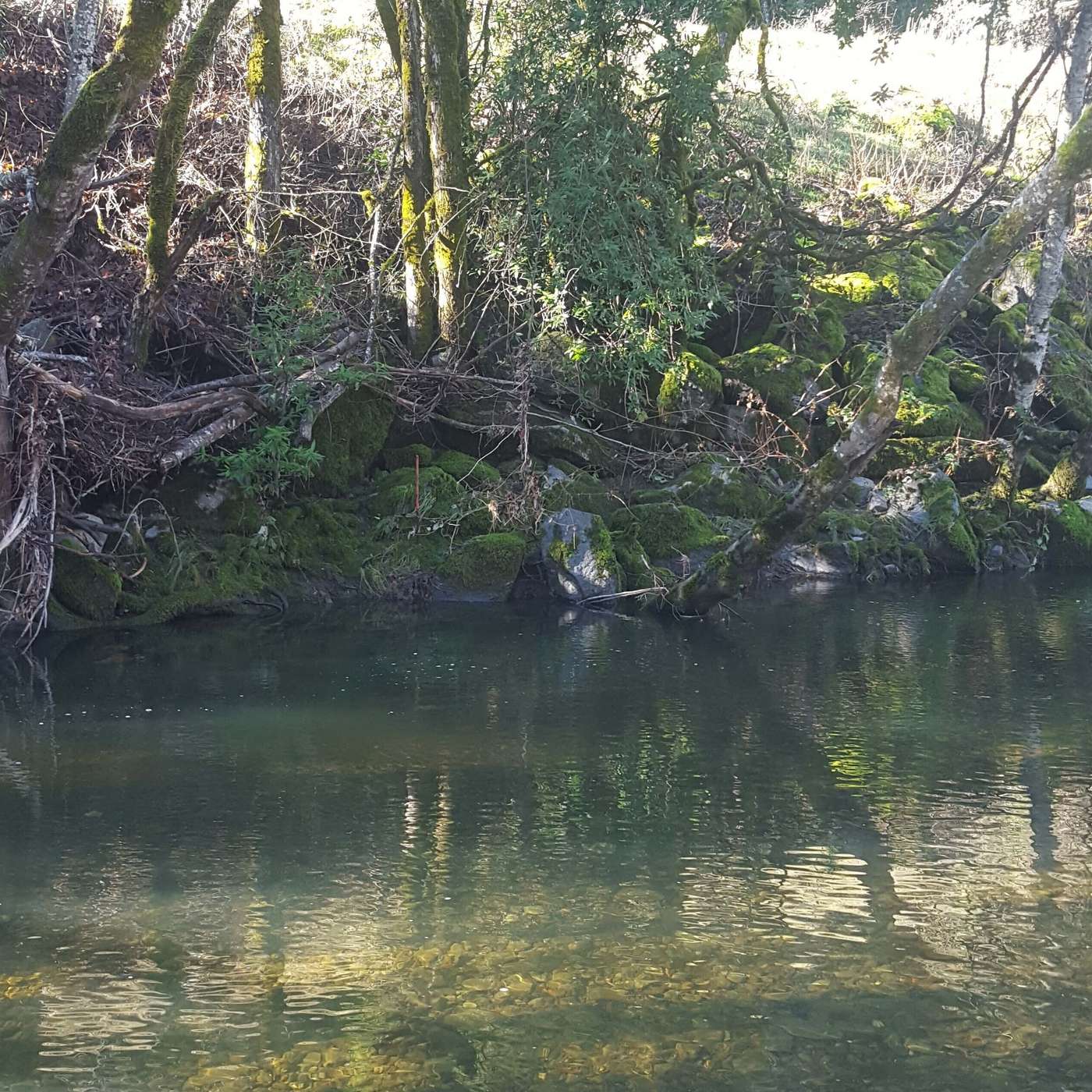
July 13, 2021 — Last month, summer steelhead were listed as endangered under the state Endangered Species Act, which highlighted some of the differences between the summer and winter stocks. Pat Higgins, a fish biologist and managing director of the Eel River Recovery Project, traces the life story of summer steelhead, from the run of the river to the health of the forest and finally, to its place in the pattern of worldwide climate change.
Ep 185Barge water is out, stored water is in
July 12, 2021 — Barge water is out, and water storage is in. With shortages rapidly approaching a critical point in most parts of the county, water storage ideas are getting a lot of traction. At one point, bringing water into Noyo Harbor on a barge was an idea that had some currency. But at Thursday night’s virtual drought task force meeting, Alex Huang, of the State Water Resources Control Board, explained that this idea would not be feasible. Josh Metz, the program manager for the Mendocino County Water Agency, sketched out a plan to bring water from Willits to Fort Bragg on the train, though it’s not clear at this point if the water or the infrastructure is available. Water trucks have not gotten much love during the crafting of the cannabis cultivation ordinance. But water trucks hauling potable water are tightly regulated by the state. There are five licensed potable water haulers in the county. Supervisor John Haschak said the Board of Supervisors and County Counsel are working on ways to control water trucks locally. But for the moment, storing the increasingly scarce resource is top of mind. Tomorrow the board will consider an urgency ordinance that would allow people across the county to install temporary water storage tanks on their parcels without discretionary or environmental review as long as the county is in a declared local emergency. On the South Coast, Randy Burke, the Director of works at the Sea Ranch Water Company, said he’s working with the State Division of Drinking Water and Department of Water Resources to get a grant for a project he hopes will eventually make it possible to store 220,000 gallons, and thus “take the pressure off the north Gualala watershed,” as he reported to the task force. At a recent meeting in Anderson Valley, several attendees brought up the possibility of a moratorium on vineyards. McGourty, who grows wine grapes, said they bring in tax revenue: for every ton of chardonnay, he offered by way of example, growers get about $1200, which he said generates almost $900 of taxes. Meanwhile, in the Russian River watershed, Janet Pauli continues to advocate for enough local funding to raise Coyote Valley Dam and keep more water closer to home. The lake is managed by the Sonoma County Water Agency, because Sonoma County put in a great deal more money at the dam’s inception than Mendocino County did. “Locally, we have to take this responsibility or our water responsibility on ourselves,” she said. “And we probably need to do it while the drought is still fresh in everybody’s mind, because...if we have another three or four really wet years, everyone will forget.”
Ep 184New law would transfer state property to tribes
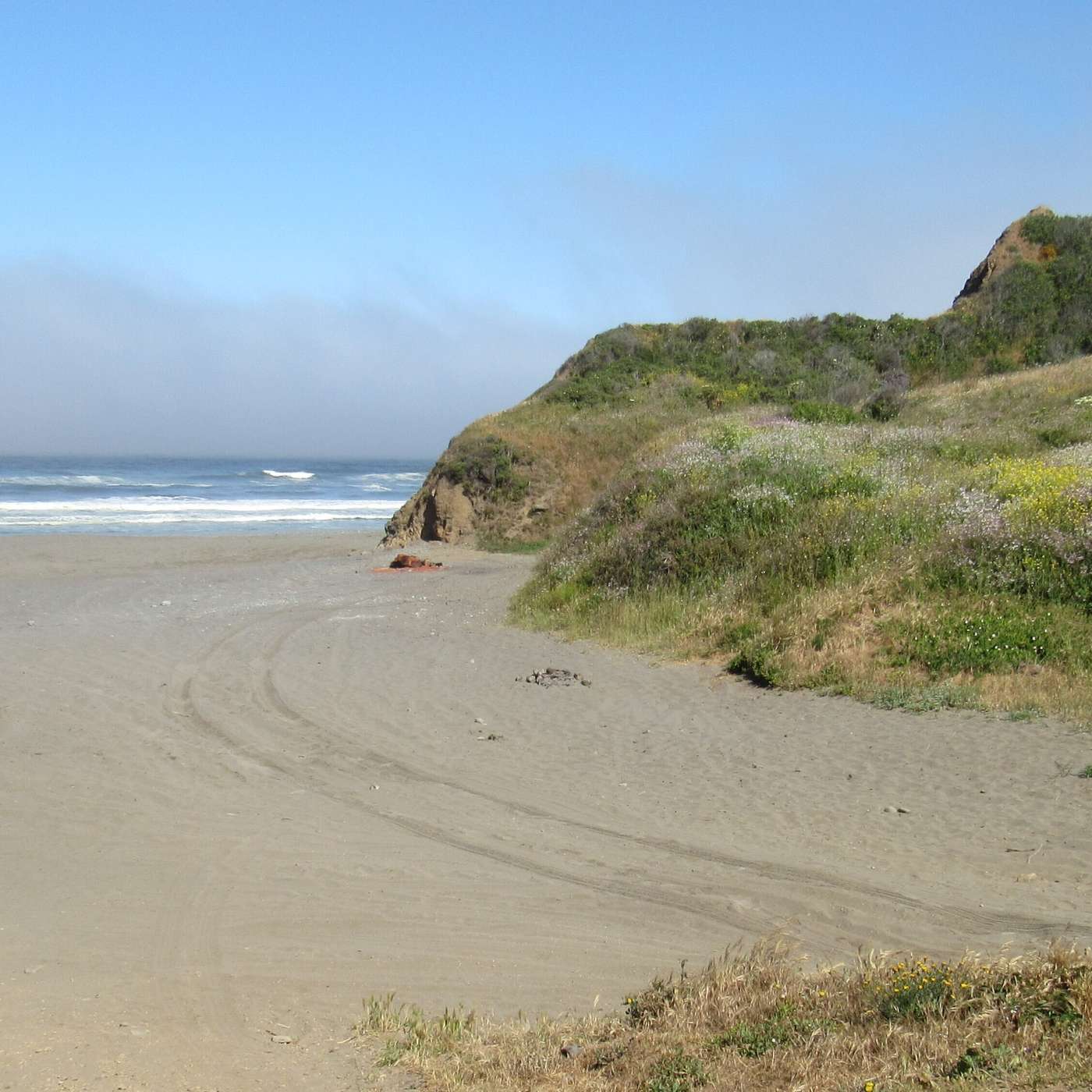
July 8, 2021 — A new law that transfers coastal property from the State of California to Native Americans will be a historic first. Mendocino tribes could take possession within a year, creating an 172 acre natural preserve south of Westport. An interview with Melanie Rafanan, the Chair of the Sherwood Valley Band of Pomo Indians explains the process, obstacles and traditional uses of the land.
Ep 183Tribal Chair ponders resource responsibility
July 7, 2021 — The current governor declared the latest California drought from the cracked, dry basin of Lake Mendocino, which is generally believed to provide some portion of water to 600,000 people from Coyote Valley Dam to Marin County. As per the original arrangement, Mendocino County is entitled to 11.3% of the water. The dam was dedicated on June 6, 1959. The ceremony included a beauty contest, speeches, and a strawberry festival, according to a history written by local scholar Victoria Patterson (nee Kaplan).. If the man-made body of water were a human, it would be barely old enough to collect social security. Before building the dam, the Army Corps of Engineers bought a piece of property near the East Fork of the Russian River. That’s where seven Shodokai Pomo families had settled when they returned to the valley after their families had been forcibly removed in the mid-19th century. Among them was Priscilla Hunter, former Chair of the Coyote Valley Band of Pomo Indians and mother of Michael Hunter, the tribe’s current Chairman. “When we say ancestors, people think hundreds of years ago,” Hunter noted. “I think about that often when I’m out there.” He thinks the people who were displaced by the dam should have first dibs on the water. Like everyone else, they’re now dependent on it. Hunter has sixty households under his purview, as well as a casino and gas station that do a brisk business. A hundred-room hotel and recycled water project are under construction. Water is tight in Redwood Valley, with each person only receiving 55 gallons per day for all domestic water services. This does not include the 200 or so agricultural connections in the valley that were shut off in mid-April. “And yet you see vineyards keep expanding,” Hunter observed. “It seems to be that this county put vineyards before they put Native Americans...we should have first rights to that water, which we don’t.” Hunter says his fellow elected representatives at the county level haven’t invited him to take part in decisions about water and land use. Partly he stays away because he doesn’t agree with a vision that includes continuing to deplete environmental resources. And he doesn’t want his presence to provide a diversity endorsement to decisions he doesn’t agree with. If the tribes are involved in deliberations, but in such small numbers that their votes can’t possibly affect the outcome, he doesn’t really see the point. “It’s hard to sit at tables where people look similar to me, even though I’ve never met them before, and I have to assume that if it wasn’t you, it was your father or your mother who participated in removing my people,” he explained. That’s not to say that he doesn’t have an opinion. “It’s a lot of irony for me, a lot of mixed emotion, where Coyote Valley stands right now. I personally would like to see a cap, a moratorium if you will, on acres of vineyards. It’s hard to ask a resident to cut back and limit your showers, or put a bucket under your shower while the water gets warm, to water your plants, when they keep expanding agriculture, whether it be vineyards or marijuana.” Hunter says the tribe’s sense of responsibility has led it to decide to build a recycled water system for the 100-room hotel that he expects to open sometime next year. He plans to connect the homes and most of the tribe’s businesses to it, as well. “It didn’t feel right doing the hotel without doing that purple piping (recycled water),” he said. “We started this process about three years ago before the drought was here, just because we’ve been here. We live here. It’s nothing new. The drought’s not new. It’s just getting worse. So we feel as if we’re having some responsibility amongst our reservation...we feel like a sovereign nation. We feel isolated. In good ways and bad ways.” In the end, he feels like his tribe paid a high price for a bum deal. “You made my people leave for 11 percent?” he exclaimed. “What?”
Ep 182Counter-referendum effort underway
July 5, 2021 — The latest entry in the political canvassing effort around the recently enacted cannabis cultivation ordinance is Citizens for Sustainable Agriculture. That’s a pro-ordinance organization that’s hired a strategist and canvassers to persuade voters not to sign either of the referendum petitions currently in circulation. The People’s Referendum to Save our Water, Wildlife, and Way of Life, seeks to repeal the entire ordinance, while the Small is Beautiful effort proposes to strike footnote six, which allows for 10% of a parcel over ten acres to be used for cannabis cultivation. The pro-ordinance canvassers offer counter-claims to those being made by referendum signature gatherers, as well as a template letter for people who have already signed a petition, regret doing so, and want the registrar of voters to remove their names from petitions that land in her office. This is legal according to the Statewide Initiative Guide, as long as the request for removal is filed prior to the date the petition is filed. Leo Buc is a local political strategist who is working to defeat the referendums against the ordinance...
Ep 181Drought ad hoc considers approaches
July 5, 2021 — Possible responses to the drought range from relaxing permitting standards for water storage to calling on the National Guard or the state Office of Emergency Services. Josh Metz, the program manager for the newly revitalized county water agency, accompanied the drought ad hoc committee on a tour of drought-stricken communities last week, and discussed various approaches.
Ep 180Medium: new gallery opening in Ukiah
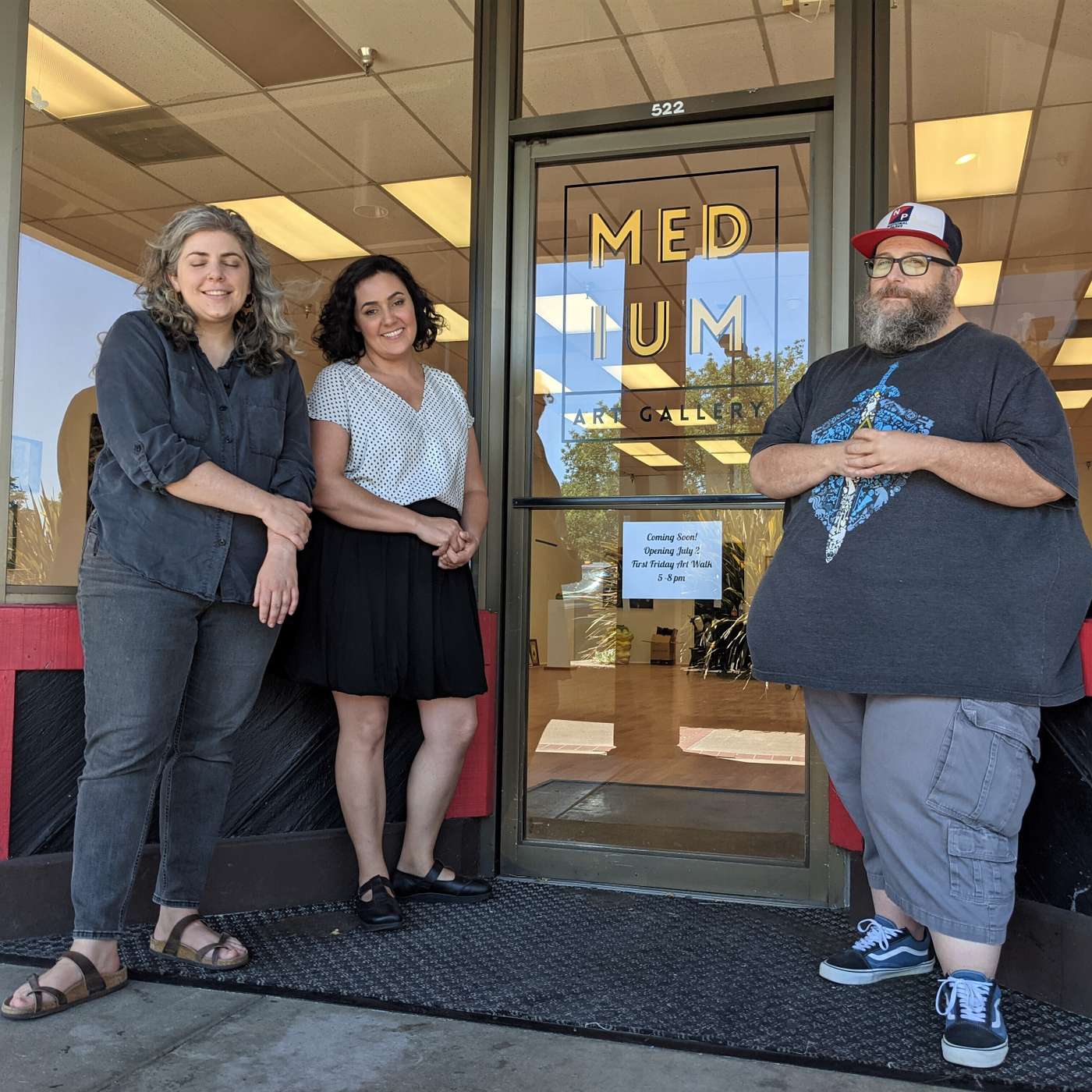
July 2, 2021 — There’s a new addition to the art scene in Ukiah. The Deep Valley Arts Collective, which held online shows during the lockdown, is opening a gallery called Medium for the First Friday art walk today. The introductory show, in the freshened up former Radio Shack in the Pear Tree shopping center, is called Prologue, in anticipation of much to come. For Chris Pugh, one of the three founding members, it’s been a long-time dream that crystallized during the isolation and unemployment of the pandemic. The work upholds the promise of multiple mediums, starting with a paper doll sculpture that looks fully prepared to start doing somersaults. There’s an electrically powered kinetic piece designed by a retired engineer, and a large painting of a woman in a tight dress, reclining behind some foliage that looks a little dangerous....
Ep 179Redistricting is coming up soon
July 1, 2021 — The 2020 census has come to a close, and now it’s time to think about redistricting. The final census numbers will probably be available by the end of September, and the county has until December 15th to readjust the borders of the supervisorial districts to reflect population changes. Each district is supposed to have roughly the same number of people, to ensure equal representation. The Board of Supervisors will decide later this month which method to use for the redistricting effort, but it’s likely to be a mixture of experienced county staff and members of the public. Paula Cohen is a member of the League of Women Voters, which is working to make sure the required public meetings are actually accessible to people with varying work schedules and linguistic backgrounds. She acknowledges that everything is pretty undecided right now, since the census numbers aren’t in yet, the board has not yet acted, and there is still some caution about having in-person meetings. The League of Women Voters’ position on redistricting includes protection from diluting the voting strength of a racial or linguistic minority and not allowing the goal of protecting incumbents or preferential treatment of one political party. You can find out more at their website, www.lwvmendo.org. The organization is focusing on redistricting at the local and national levels, and is open to everyone.
Ep 178State now lists summer steelhead in the Eel River as endangered
June 30, 2021 — Summer steelhead have been listed as endangered under the state endangered species act, which some conservationists believe will ease the way to seeking protections for them. Summer steelhead have a different life cycle from their winter-run cousins, and a differentiating genetic marker on one chromosome. Samantha Kannry is a fisheries ecologist who has been studying them in the van Duzen, a major tributary of the Eel River, since 2010. She recently published her masters thesis, “On the Ecology and Distribution of Steelhead in the Eel River,” in the Journal of Heredity, with the Oxford University Press. She knows the nuances of fish populations, but she’s also moved by the joy of swimming with both varieties of steelhead.

Ep 177"The Viewing Room:" live theater about life after death
June 29, 2021 — Live in-person theater was one of many enjoyments that was impossible during the pandemic. Local venues did what they could with virtual fare, but this Friday night, the Willits Community Theatre is reopening its physical, non-virtual doors to an in-the-flesh audience who will file in and take their seats as the lights go down. “The Viewing Room” is a comedy that involves a dysfunctional family, a funeral, and improbable second chances. Mathew Caine directed the play, which was written by Mark Smith and has played elsewhere in California, as well as Australia. We’ll hear from Caine and Jeff Shipp, who plays the angst-ridden son of a patriarch who rises from the dead to make amends with his family.
Ep 176Someone is allegedly a "typical white man"
June 25, 2021 — This week, the Board of Supervisors discussed how to include members of the public in an upcoming effort to redraw the district boundaries after receiving data from the 2020 census. The Board also heard an appeal from an applicant who claimed to be “astounded and appalled” by an allegedly racist comment delivered during a meeting of the Archaeological Commission.
Ep 175Supervisors amend new ordinance
June 24, 2021 — The Board of Supervisors discussed cannabis and water at this week’s meeting.
Ep 174Loggers Become Protestors in Jackson State Forest
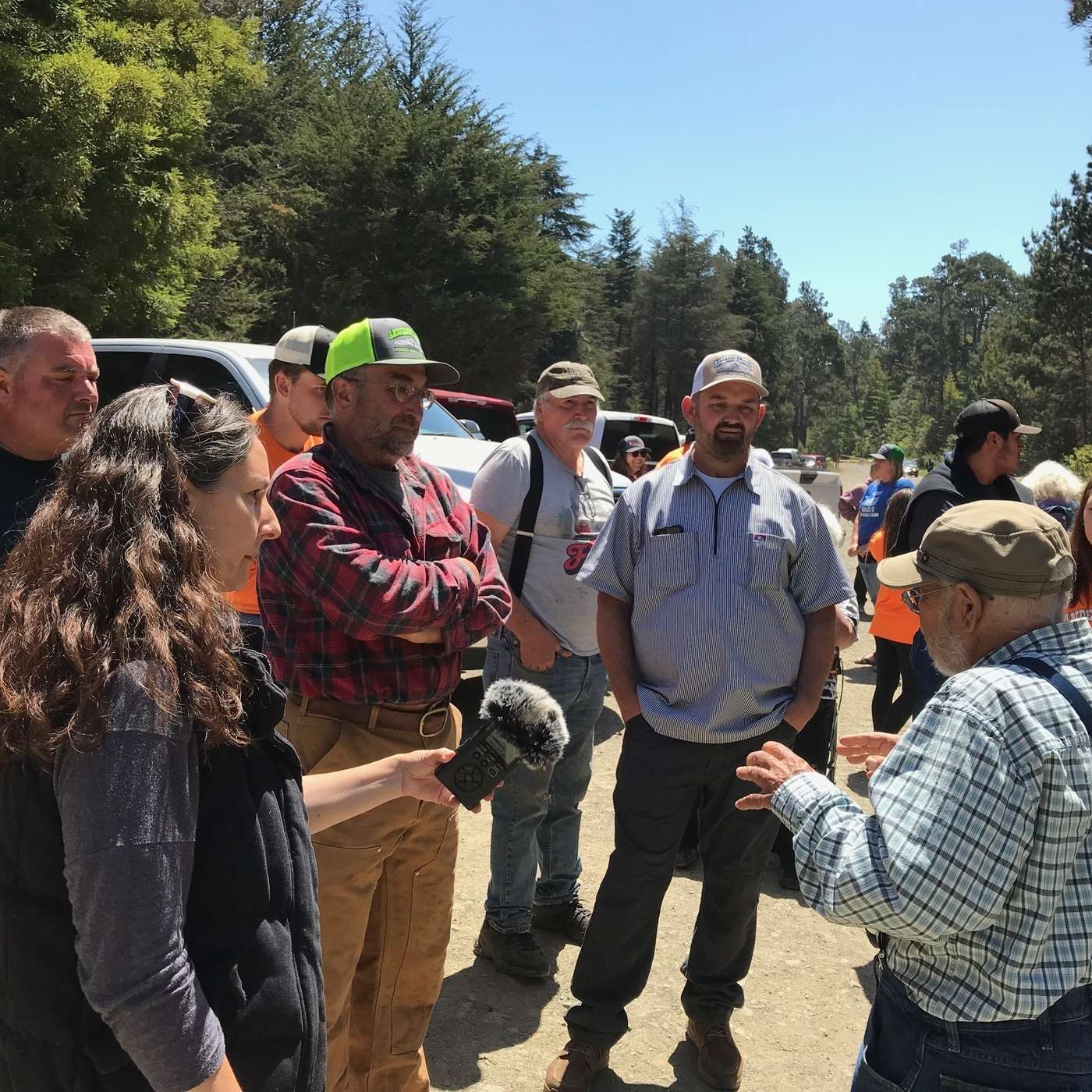
June 23, 2021--Myles Anderson is the owner of Anderson Logging, the logging company working on the controversial Timber Harvest Plan in Jackson State Forest known as Caspar 500. Anderson’s crews began cutting in the area on June 10, but they have been slowed or stopped every day by protestors. On Saturday, June 19, the logging company owner decided to take a page from the forest activists, calling for his own protest in Jackson State Forest. He and several dozen of his employees and supporters gathered at the entrance to Jackson State in Caspar, California, and held their own blockade.
Ep 173Reduced flows to hit ag hard
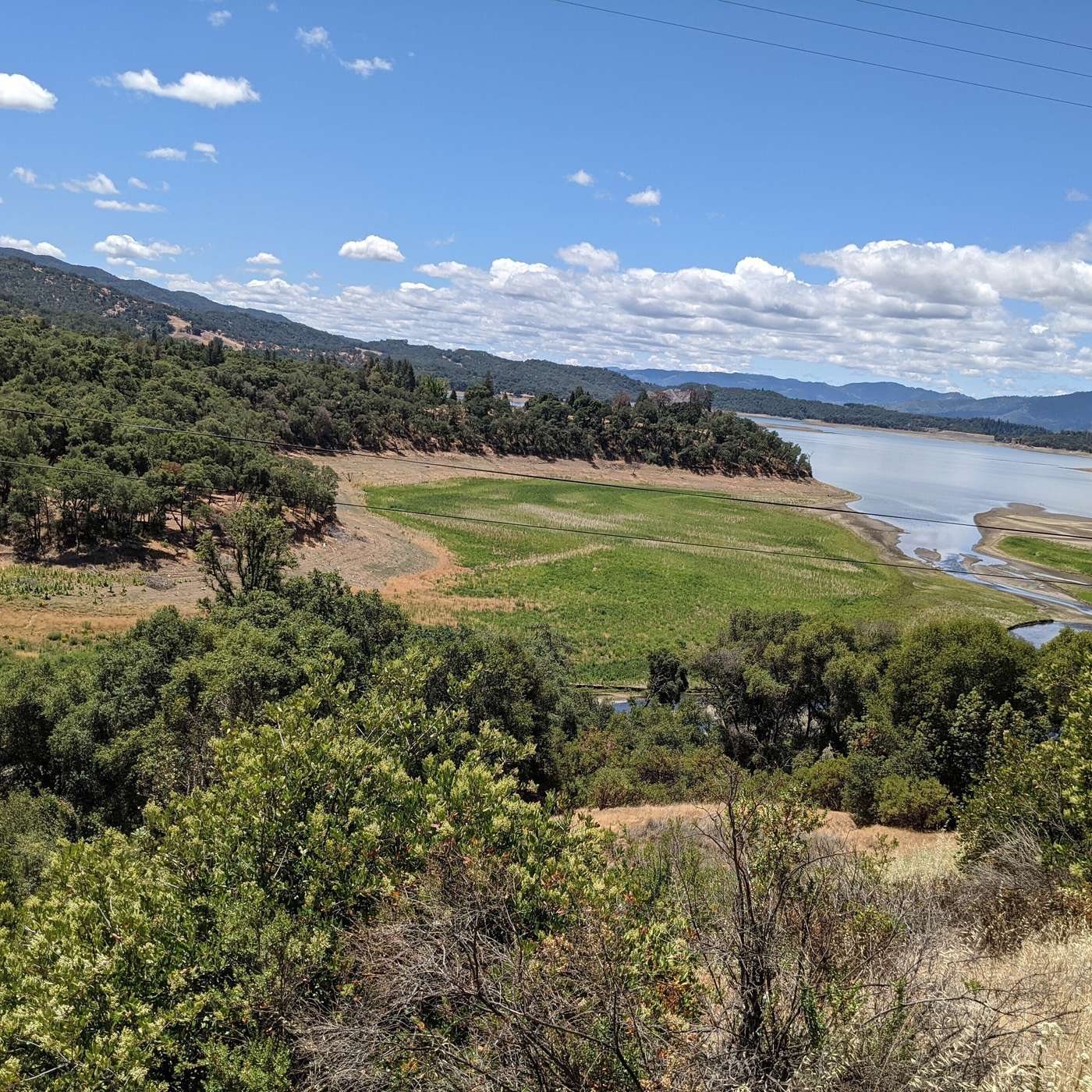
June 21, 2021 — As the region heads into a dry spell expected to rival the drought of 1977, the Federal Energy Regulatory Commission has approved a much-reduced flow of water to Lake Mendocino and Potter Valley. The lake and the Potter Valley Irrigation District have relied heavily on water from the East Branch of the Russian River from the Eel River via the Potter Valley Water Project, which includes Scott Dam and Lake Pillsbury behind it. The project is still owned and operated by PG&E, which recently requested authorization to reduce the flows to the East Branch from 25 cubic feet per second to five. The company has asked for the variance to end with Lake Pillsbury’s storage exceeds 36,000 acre-feet in October or is superseded by another variance. Last week, Lake Pillsbury was at just a little over 42% of target storage for this time of year , according to Sonoma Water. Janet Pauli, of the Potter Valley Irrigation District, says this has hit the small agricultural community hard. She spoke with kzyx on Friday afternoon, as temperatures climbed to 108 degrees.
Ep 172Fuel break denudes slopes
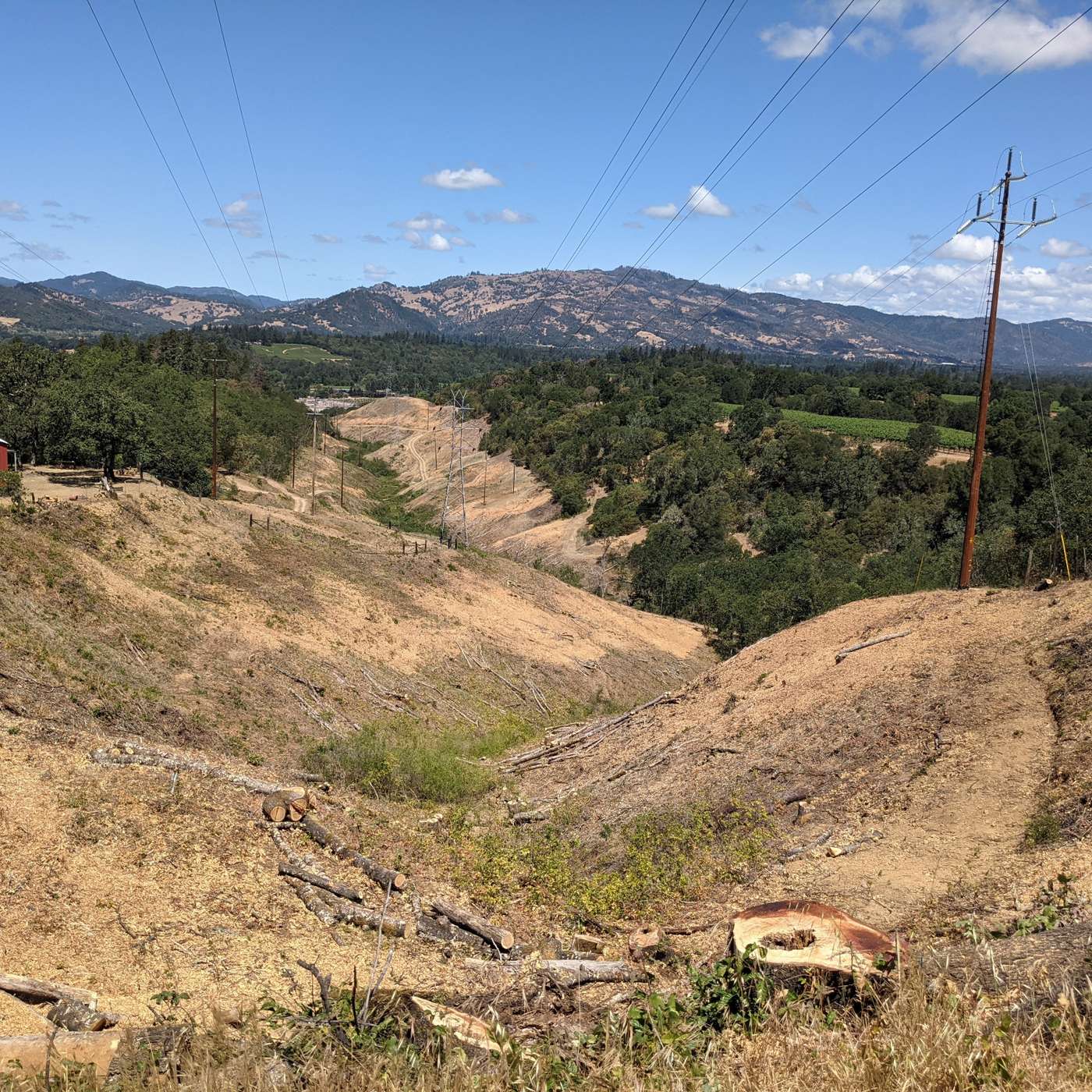
June 18, 2021 — Last month, PG&E cleared the vegetation on either side of its transmission lines for about two miles along Road A in Redwood Valley, from its substation to Highway 20. The clear cut area is up to 80 feet wide in some places, and traverses steep slopes and narrow canyons. The work is in a public utility easement outside the coastal zone, and is exempt from county review, according to Planning and Building Services. PG&E spokeswoman Deanna Contreras said in an email that certified arborists communicated with every landowner along the line about the work, which she said did not affect old erosion caused by concentrated water from driveways and ditches. She did not respond to a question about how that assessment was made. Also, arborists are not trained to the level of registered professional foresters. The company plans to mitigate the erosion with straw, waddles, and water bars. Most of the property owners did not agree to the use of herbicides, so the remaining stumps are expected to stabilize the soil. Contreras added that, “Fuel breaks created along transmission lines before and during active wildfires have been instrumental in preventing the advancement of wildfires throughout the state.” But Nancy Macy and Jeanne Wetzel Chinn disagree. They’re members of the Sierra Club’s utility wildfire prevention task force and two of the authors of a white paper on the harmful effects of PG&E’s tree removal practices. They say there are readily available technological fixes that would keep the trees in the ground, sequestering carbon and providing habitat for wildlife.
Ep 171Reduced flows to benefit wild fish
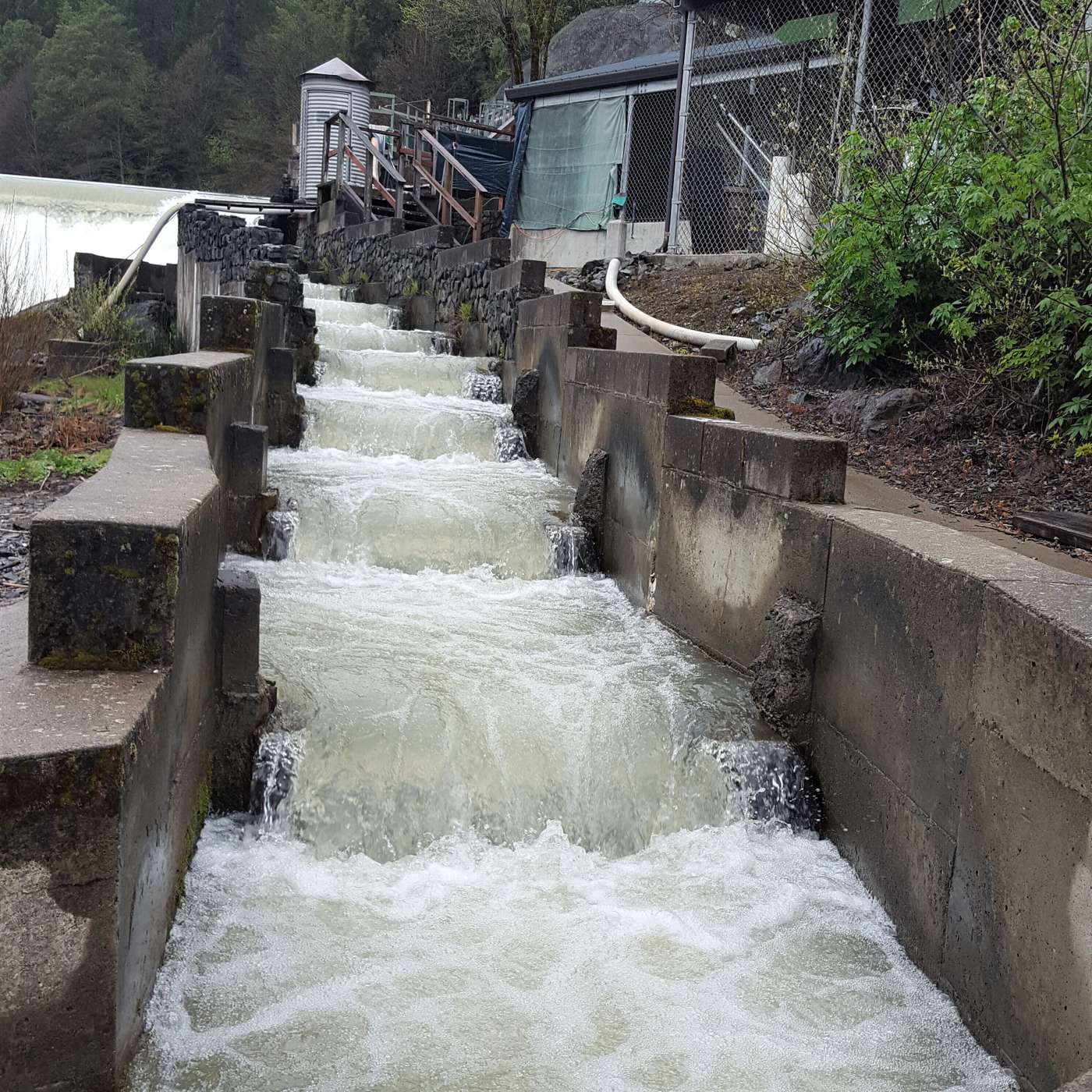
June 17, 2021 — Lake Mendocino’s supply of water from the Eel River is likely to dry up sometime this summer, due to flows being reduced to a fifth of what they were when conditions were dry rather than critical. The lake receives regular infusions of water from the east branch of the Russian River through the Eel River via the Potter Valley Project. The Project is still owned and operated by PG&E, though a regional consortium is working to take it over when the license expires next year. The two-basin solution, a post-PG&E proposal brokered by Congressman Jared Huffman, includes the removal of Scott Dam. In April, PG&E requested a flow variance from the Federal Energy Regulatory Commission, to preserve storage capacity in Lake Pillsbury, the reservoir behind Scott Dam. According to FERC documents, the company proposed “to reduce minimum flow releases to the East Branch Russian River from...25 cubic feet per second to...five.” The company also asked the Commission to cut its release to the Potter Valley Irrigation District in half, from fifty cubic feet per second to 25. The temporary variance request has been approved, until June 21, though it could be extended to become an actual variance. The deadline for public comment has passed. Alicia Hamann is the executive director of Friends of the Eel River, which has long advocated for the removal of the entire Potter Valley Project. Although the current variance request hinges on Lake Pillsbury and the construction of Scott Dam, events may have been set in motion back in March, when the Friends challenged conditions at Cape Horn Dam.
Ep 170Logging continues, in spite of people in the forest
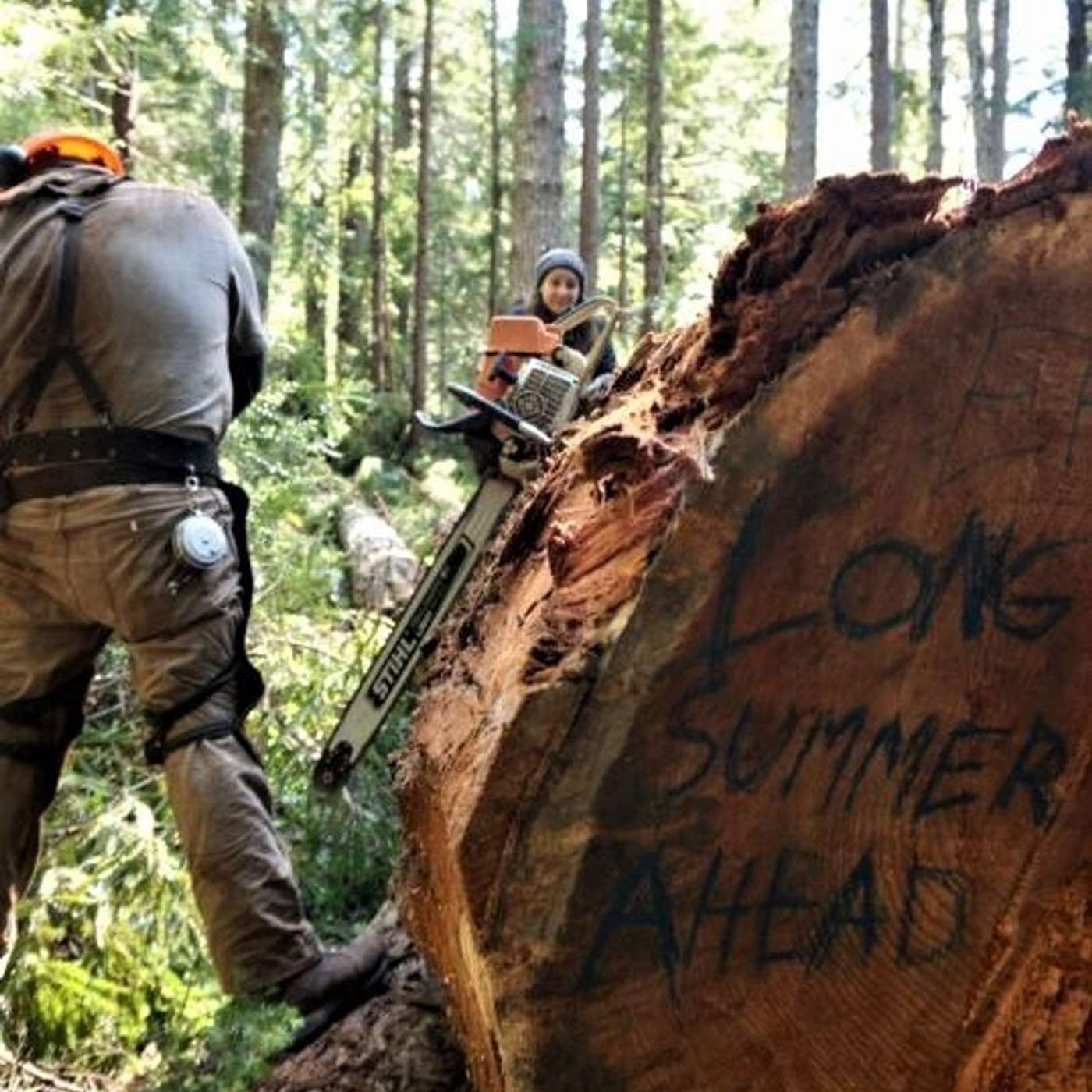
June 16, 2021 — Logging continues in the Jackson Demonstration State Forest, in close proximity to activists trying to prevent it. The site, Capar 500 is one of six timber harvest plans being carried out by CalFire. Reached by phone yesterday, Kevin Conway, Cal Fire State Forests Program Director, said he couldn’t comment. Tree sitters with the Mama Tree network took up residence in two old-growth redwoods, dubbed the Mama and Papa trees, in April. Since logging began last Thursday, there have also been protests in the forest. Wagner insists that activists are not trespassing, since the forest is public. And she thinks the management plan is highly flawed. Wagner has been conducting non-violent trainings for protestors, who have been gathering at the kiosk every morning, starting at 4am.
Ep 169Supervisors start to flesh out cannabis enforcement plan
June 15, 2021 — The Board of Supervisors agreed to move ahead with a multi-department plan to enforce cannabis codes, involving aerial surveillance and more staff. The plan is based on the Humboldt County model, which relies heavily on satellite imagery and fines and liens to achieve compliance. Another big change is that enforcement will be proactive as well as complaint based. The estimate for the program’s cost for this fiscal year is a little over one and a half million dollars. Code enforcement supervisor John Burkes estimates that the program will take three to five years to implement. The start date is uncertain, since many of the positions called for in the plan do not yet exist on the county’s registers. That means that negotiations with labor unions still have to take place, so the suggested salaries are rough estimates at this point. But supervisors agreed to start by hiring two low-level code enforcement officers, and take steps to request assistance from the state.
Ep 168Drought drop-by event encourages conservation
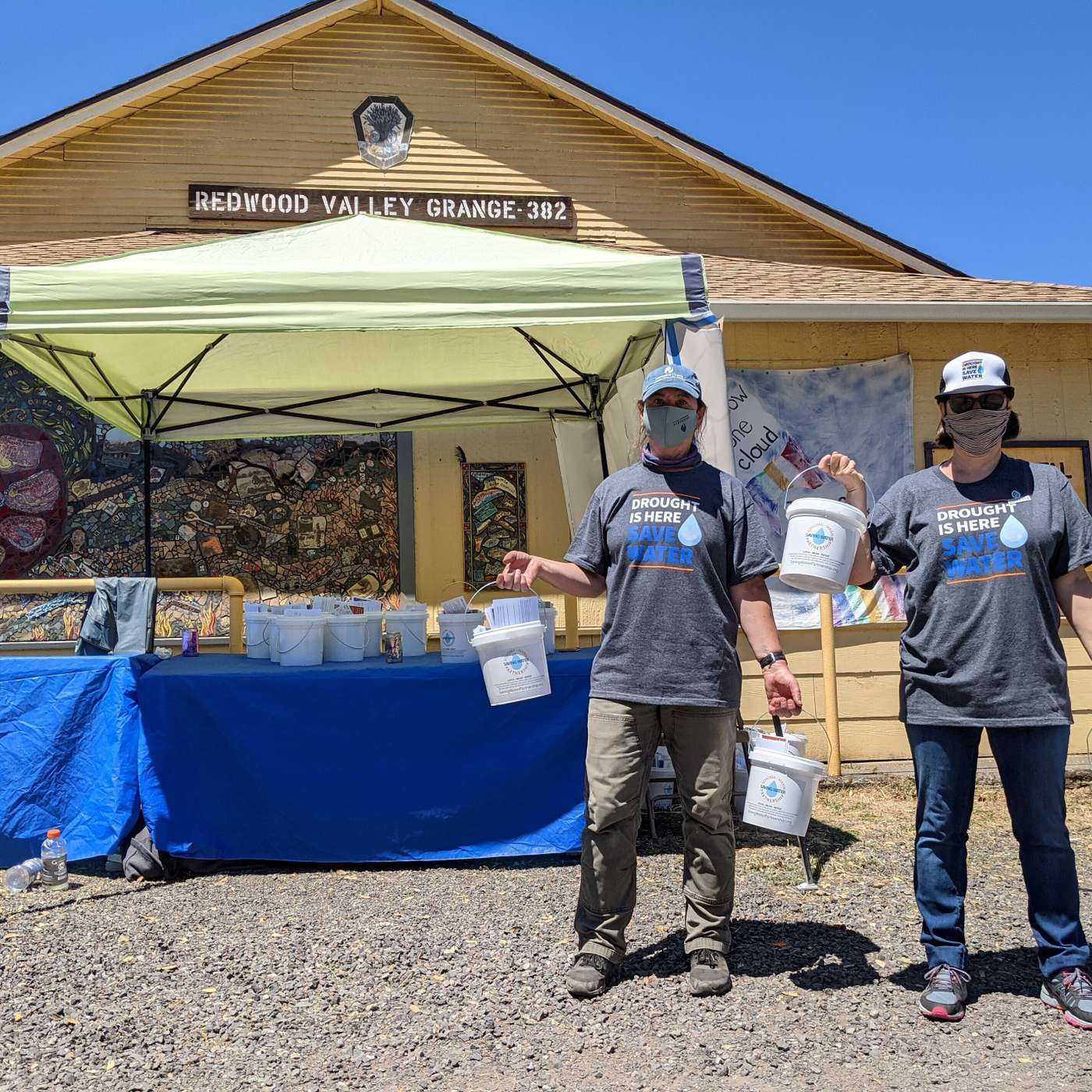
June 14, 2021 — With a looming drought and the high likelihood of emergency curtailment regulations on the Russian River, local agencies are encouraging water conservation. On Saturday, anyone pulling up to the stop signs at the Redwood Valley Grange or Club Calpella could expect to receive a bucket full of drought swag. We’ll hear about the dire situation for the fisheries, how the Calpella Water District is preparing for the drought, and go through the swag for water-saving tips.
Ep 167Water agency revived
June 11, 2021 — With the drought declaration that started in the dry bed of Lake Mendocino, the county has revived its water agency with $50,000 and the hope of further grant funding to come up with water security plans and ways to pay for them. The agency is headed up by Josh Metz, a senior advisor with a firm called Regional Government Services. Helistmmmed the main areas for the agency, starting with identifying the gravest needs, assessing the economic and health impacts of the drought, and working closely with the Resource Conservation District and local government to identify key projects. The State Water Resources Control Board is meeting Tuesday to consider proposed emergency regulations. If adopted, these would establish when to curtail diversions from the Russian River, according to a system of water availability and water rights. Phil WIlliams, a water attorney who works with the City of Ukiah, says the city has pre and post 1914 water rights. The emergency regulations have not yet been approved, but they are causing a level of controversy that is entirely expected.
Ep 166Logging begins in Jackson State Forest
June 10, 2021 — Logging started early this morning in the Jackson Demonstration State Forest, in spite of the efforts of local tribal and environmental groups that believe the trees are more valuable standing. But CalFire is moving ahead with its timber harvest plan in Caspar 500, one of six plans the agency intends to move forward with. Tree sitter Alder was high up in the now-iconic Mama Tree when logging trucks arrived.
Ep 165Referendum effort to repeal 10% underway
June 10, 2021 — As the Board of Supervisors prepares to adopt an unpopular cannabis cultivation ordinance, two separate groups are planning referenda to repeal or amend the final product. One group is gathering signatures to repeal the whole thing. Another group wants to strike the ten percent provision, and follow up with negotiations for further amendments, or, failing that, a citizens’ initiative. The current version of the ordinance that will come back before the board by the end of the month would allow cultivation on ten percent of ag and rangeland parcels over ten acres. Initially, Charles Sargenti of Covelo was planning to stay out of it. But then he said it was causing distress at a meeting of the Round Valley Municipal Advisory Council, where he serves as secretary. He teamed up with Jim Shields of Laytonville, editor of The Observer and a longtime supes watcher, to launch a referendum effort.
Ep 164Neighbors leery of proposed development in Ukiah's western hills
June 9, 2021 — A proposed development in the Western Hills of Ukiah has neighbors fuming as the city takes steps to acquire and annex about 700 acres off of Redwood Avenue, in the headwaters of Doolan Creek. The property currently belongs to David Hull, who gave the city 188 acres adjacent to the proposed project parcels late last year. The city wants to break 54 acres into seven lots for single family residential parcels, where owners would be allowed to build one main house and one additional dwelling unit each. According to city documents, no purchasers have been identified and the timing of the sale and development of the properties is unknown. The remaining 640 acres would be rezoned public facilities, which is the same designation used for city parks. The property is still on county land, and the project would need to go through Ukiah’s planning commission and City Council before the city could even start the annexation process, which could take a year. But last month, when the item was scheduled to come before the planning commission, thirty-eight letters came in, only three of them supporting the project. A few others, from agency representatives, offered analyses of what would be needed to carry out the proposal, but most expressed opposition on the grounds of increased traffic, fire risk, and impacts to wildlife. Ted Aff is a retired Oakland firefighter who remembers fighting the Oakland Hills firestorm of 1991, before wind-driven blazes that jumped over freeways had become a way of life in California. Aff and other members of the Firesafe Council are worried because the homes would be on the wrong side of a firebreak meant to protect the city from fires coming in from the west. But Maya Simerson, a project administrator in the city manager’s office, says that’s been vetted with CalFire, the Ukiah Valley Fire Authority, and the city fire marshall. She also said that homeowners would have to maintain the properties according to fire code and the rules of a homeowners association. Retired CalFire battalion chief Michael Maynard, who was responsible for local fuel reduction efforts in the last ten years, wrote a letter saying he thinks acquiring the Hull Properties would reduce the risk of catastrophic fire in the Ukiah Valley. Aff said he and the retired chief have “a different assessment” of the situation, adding that he does “not underestimate the lethality of fire.” Another supportive letter was from a real estate agent who reminded the commission that the hospital is always trying to recruit doctors who go to “other areas with a larger inventory of homes.” An opposing letter writer declared that single-family homes are “so last century.” And Aff thinks a lot of work is going into building a few homes for rich people. “The views are spectacular,” he said. “Oddly enough, they characterize these properties as moderate income properties. So either their scale of what moderate income is, is far different than mine, or they're downplaying the value in order to fit in with the city’s general plan, which requires a certain number of moderate income houses.” Simerson says she thinks the developer would build on the land even if it stayed in the county, and the city didn’t get involved; and that the city is the best agency to take the lead in the project.