
FasCat Cycling Training Tips Podcast
370 episodes — Page 5 of 8

Part 2: How to Prepare Mentally and Physically for Stage Racing
Welcome to Part 2 of our three-part series on stage racing! This mini-series is brought to you by coach Isaiah from the Tuscon Bicycle Classic Stage Race where Coach Ricky and Coach Zach were both racing for Project Echelon. The Tuscon Bicycle Classic is a large stage race and has always been a big staple for pro riders as an early-season race. Coach Isaiah interviews the two on their mental and physical preparation – giving you an inside look into how pro bike racers prepare for each stage in a stage race. They also chat through what the next stage is and what some of their race tactics are, how the previous stage went in general, and what goes on behind the scenes at a pro stage race. Stay tuned for Part 3!

Part 1: How to Prepare Mentally and Physically for Stage Racing
Welcome to Part 1 of our three-part series on stage racing! This mini-series is brought to you by coach Isaiah from the Tuscon Bicycle Classic Stage Race where Coach Ricky and Coach Zach were both racing for Project Echelon. The Tuscon Bicycle Classic is a large stage race and has always been a big staple for pro riders as an early-season race. Coach Isaiah interviews the two on their mental and physical preparation – giving you an inside look into how pro bike racers prepare for each stage in a stage race. They also chat through what the next stage is and what some of their race tactics are, how the previous stage went in general, and what goes on behind the scenes at a pro stage race. Stay tuned for Part 2 and Part 3!

Using Data Science with the Professional Human Powered Health Team
Did you know we are data scientists for the Human Powered Health Professional Women's Team? We analyze the entire women's team's power, heart rate, sleep, and HRV data, literally everything in their training and racing. We're able to then use their data to help their team perform at their best. Coach Isaiah and I have been working for the Women's World Tour Team Human-Powered Health since the beginning of the year as their data scientists. In this episode, that's what we're going to talk about – our work with the women's team. We not only discuss the data we analyze, we also dive into the surveys we have the riders fill out in order to put their data into context, the reports we provide to the team, and then how the team uses those reports for improving their training and performance. Riding bikes fast isn't just about FtFP, it's also about analyzing all data possible to come up with the best plan possible. Check the team out https://humanpoweredhealth.com/ and you may use 25podcast to receive 25% off your first FasCat Training Plan that uses the same smarts, science and methodology as the pro's.

Coach Christian: Comparing Arguments on Polarized vs. Pyramidal Training for Optimal Results
Should you be doing pyramidal training only, pyramidal training only, or a mix of both? Which format is most effective? This is a controversial topic and one we're going to dive deep into today in this episode of the FasCat Coaching podcast. More specifically, there have been a few recent studies released, as well as debates happening, within the scientific community that we will dissect, followed by Coach Christian and myself sharing our thoughts and experience on the subject. What we discuss: - A recent study was done on the "Effects of 16 weeks of pyramidal and polarized training intensity distributions in well-trained endurance runners". The study compares 4 different groups: 16 weeks of polarized, 16 weeks of pyramidal, 8 weeks of polarized then 8 weeks of pyramidal, and 8 weeks of pyramidal then 8 weeks of polarized. - Sports Science journal series of debate articles titled "Polarized Training is Not Optimal for Endurance Athletes" and "Polarized Training is Optimal for Endurance Athletes." The author and columnist for Outside Magazine, Alex Hutchinson, wrote an excellent summation (and to an extent, take-down) of these arguments in his column Sweat Science. - Olympic Speedskater Nils van der Poel's 60 page PDF directing his training plan for the Olympics. Van der Poel is a speedskater from Sweden who recently won Olympic gold in the 5,000 and 10,000 meters, setting world records in the process. You can check out his pdf here: e11bfe_b783631375f543248e271f440bcd45c5.pdf (howtoskate.se) Sources: 1. Polarized Training is Not Optimal for Endurance Athletes Burnley, Mark; Bearden, Shawn; Jones, Andrew Medicine & Science in Sports & Exercise AN: 00005768-900000000-95869 February 2022 2. Polarized Training is Optimal for Endurance Athletes Foster, Carl; Casado, Arturo; Esteve-Lanao, Jonathan; Haugen, Thomas; Seiler, Stephen Medicine & Science in Sports & Exercise AN: 00005768-900000000-95872 February 2022 Get started with FasCat: www.fascatcoaching.com

How to Perform VO2 Max Intervals Properly with a Power Meter
Want to increase your power output? VO2 max intervals are the answer. Although, the issue is that many riders are new to power meters or don't know how to use them correctly in order to perform their VO2 max intervals for maximum returns. That's why in this episode of the FasCat podcast, Coach Frank gives us a step-by-step guide on how to perform these intervals with a power meter correctly. He also outlines the most common mistakes riders make and how you can avoid them. Plus, Coach Frank dives into how to do the power analysis post-ride so you learn what watts you should target for your next vo2 max interval workout. (This is the best way to evaluate your 'technique' tp see maximum gains!) Important notes: - In this podcast we are covering zone 5 only. - You will also need to know your power base zones for this episode. If you don't know you what it is, check out this article: HOW TO PERFORM VO2 MAX INTERVALS WITH YOUR POWERMETER https://fascatcoaching.com/blogs/training-tips/vo2-max-intervals?_pos=5&_sid=c99cea4ac&_ss=r Ready to take your riding to the next level? Check out our training plans here: https://fascatcoaching.com/collections/training-plans Ben's Celebration of Life: Ben Brown's Celebration of Life is Sunday, March 13, 2022 11:00am - 1:00pm The Venue at Wilmington Brewing Company 800 S. Kerr Ave, Wilmington, NC 28403. Please come and join us for an informal gathering of friends and family to celebrate the incredible life of Ben. https://www.fightforben.com/blog/celebration-of-life

Dr. Lauren Costantini, PHD: How to Balance Racing Bikes with a Successful Career
Guess what? We have another new coach on the FasCat team and we couldn't be more excited! Dr. Lauren Costantini, PHD has a holistic approach to training where she focuses on fitness, nutrition and sleep altogther, as the three work synergystically. And in this episode of the FasCat podcast, we dive into her background on these three things. Plus, we also chat about her time as a professor at Harvard, her switch to the BioTech world and the products she developed, plus how she managed her time while being a CEO and racing bikes! For a quick look into Lauren, she has a PhD in Neuroscience and was on faculty at Harvard Medical School before moving cross-country to enter the biotech world of Silicon Valley. She then became the CEO of a medical device wearables company. Though a dancer from the ages of 3 to 18 years old, Lauren entered the cycling world in her late 20s and soon became a nationally ranked professional bike racer (including a bronze medal at Mountain Bike Masters Worlds and Gravel Worlds, and multiple Cyclocross National podiums). After facing back fusion surgery in 2019, she spent months researching scientific peer-reviewed studies to identify the best foods, strength training, and sleep science to enhance her recovery. This led not only to a remarkable recovery from surgery, but also elevated her athletic performance and vitality when she was back on the bike. Her story is beyond interesting, so tune into the full episode to hear more! What we discuss: 5:00 - An intro to our newest FasCat coach 13:00 - How Lauren got stated with riding 18:00 - How to race and work a full time job 21:00 - Working in the biotech world 33:00 - Why Lauren became a coach 40:00 - How much should you sleep at night? 50:00 - Rapid fire questions Check out Lauren's superfood recipe: https://www.instagram.com/p/CaFhvSmudQ6/ Want a nutrition plan from Coach Lauren? Click here to learn more: https://fascatcoaching.com/collections/coaches/products/dr-lauren-costantini-phd

Ricky Arnopol: Long Training Rides, The Best Way to Progress, and Rapid Fire Questions
In this episode of the FasCat Coaching Podcast, I'm joined by one of our newest coaches, Ricky Arnopol. We have some good cyclist to cyclists training talk, chatting about everything from Ricky's favorite ways to train himself and his riders, what's contributed most to his riding progress, his riding nutrition, and a bunch of fun rapid fire questions. After getting a late start to racing, Ricky Arnopol has been slowly chipping away at competing at the highest level races in the United States as well as racing internationally. While continuing to race for Project Echelon, Ricky has put his experience and knowledge towards working with athletes of all disciplines and abilities. His number one goal is to guide everyone he works with towards achieving their goals. 5:00 - Background on coach's Ricky's riding 10:00 - What has contributed the most to his progress 20:00 - Ricky's goals for 2022 28:00 - Ricky's riding nutrition 32:00 - Dream spot to ride his bike 34:00 - His personal go-to workout/ride 36:00 - The workout he has all his rider do that they hate 40:00 - Fun rapid fire questions Get coached by Ricky here: https://fascatcoaching.com/collections/coaches/products/ricky-arnopol

Zack Gregg: Riding Advice from U.S. Time Trial Champion
We are excited to have our newest coach to the FasCat team onto the podcast to get a deep dive into his training, preferences, thoughts, and everything in between. Coach Frank has a list of 20 questions he asks every coach and Zach gives us some killer answers! Zach has been a cycling coach since 2018. His educational background includes a Masters in Exercise Physiology from Midwestern State University, pre-med from Colorado Mesa University. Zach most recently worked as the assistant Cycling Coach for Lees McRae College and continues to volunteer time to Project Echelon's veteran and adaptive athletes. His cycling career was positively impacted by his time at Midwestern State where he raced on the road and track, winning the 2019 Collegiate Individual Time Trial and several podiums on the track. He continues to race on the road with Project Echelon and is the 2021 Elite Time Trial champion, a title he will defend in 2022 while racing at the highest level domestically and racing internationally. Zach has experience working with athletes of all ability levels and is eager to share his knowledge of the sport. Get coached by Zack: https://fascatcoaching.com/products/coach-zach-gregg?_pos=1&_sid=fd1113b6f&_ss=r

6 Physiological Benefits of Sweet Spot Training
Sweet spot vs. zone 2 seems to be the big debate between rides. In our opinion at FasCat, the adaptations we've seen with sweet spot compared to zone 2 are undeniably larger. Therefore, athletes accomplish more with one hour of sweet spot training than they do with one hour of zone 2 training. In this episode of FasCat, we're going to cover the 6 most prominent physiological adaptations gained through sweet spot training as opposed to lower intensity aerobic training. These adaptations include: Increased Plasma Volume Increased Mitochondrial Enzymes Increased Lactate Threshold Increased muscle glycogen stores Increased Stroke Volume Increased VO2 Max The proportion of sweet spot training to stimulate those 6 physiological benefits above to the rest of your training hours is described in a "How Much Sweet Spot Should Your Do" training tip and podcast. Ready to start sweet spot training? Sign up here: https://fascatcoaching.com/collections/sweet-spot
Jake Rytlewski on All Things Zwift: Group Rides, Drafting, and Using it for Training
The BigCat checks in with Coach Jake about his new MeetUp and talks all things Zwift. We give you a step-by-step guide on how to join our Zwift meet-up rides, how to draft during group rides (I personally think it's extremely difficult to do!), how we both use Zwift as a training tool for our athletes when coaching, and how to navigate the more technical side of Zwift. What we discuss: 2:00 - Directions on how to join Jake for meet-up rides on the Zwift companion app 5:30 - Calculating wattage for the Zwift group ride 10:00 - How to draft on Zwift 17:15 - How Jake uses Zwift for coaching 30:00 - Understanding how to navigate Zwift Want help getting started with your training and follow one of our plan on Zwift ? Head over to www.fascatcoaching.com/collections/training-plans
Off Season Training: Building a Big Base with Sweet Spot
The new year is upon us and thoughts are quickly shifting towards the race season. What are you doing to ensure an improvement over last year? What kind of training are you doing? Are you just winging it? There's a certain combo of art and science to the base building phase of a training calendar, and in Coach Frank's extensive experience of coaching cyclists he's come up with a healthy dose of each to help you go faster. What's the key component? Sweet spot training. 32655The one and only "Six Weeks to the Sweet Spot Training Plan" We've talked about sweet spot a lot on the show and it's weaved into almost everything FasCat does, but this week on the last episode of the year, Coach Frank breaks down how and why you should be incorporating sweet spot training into your plan to build a bigger and better base for 2022. He'll cover: What is Base Training? Why Sweet Spot is Better than Zone 2 for Base Training Power Based Sweet Spot Metrics – Quantitate the SIZE of your base How many weeks to Sweet Spot? What training plans to do to get your Sweet Spot on What Sweet Spot base Building looks like day-to-day in a training plan And plenty more. Also, for even more sweet spot nerdiness check out our youTube channel and video training tip on Why Sweet Spot training is better than Zone 2. You may also find the Fatigue Dependent Training Plan Design tip a helpful read. As always, thanks to everyone for subscribing and leaving a review on Apple Podcasts, your support this year has been incredible! We're extremely grateful, and excited about what's to come in 2021. Now go ride your bike and begin sweet spot training! Copyright © 2022 FasCat Coaching – all rights reserved.
8 Training Habits for Going Big in 2022
This podcast is for all the athletes who are making new year's resolutions for their 2022 training and goals. Just because it's a new calendar year, doesn't mean you will automatically reach your goals. In order to do so, you need to develop new habits. What habits do we recommend you adopt in order to set yourself up for success in 2022? I share 8 training habits you can easily adopt for achieving big results in 2022! What I discuss in this episode… 9:00 - Habit 1: Consistency 11:00 - Habit 2: Indoor training 17:00 - Habit 3: Group Rides 21:00 - Habit 4: Pay attention to your training load 24:00 - Habit 5: Winning in the kitchen 30:00 - Habit 6: Practicing yoga 33:00 - Habit 7: Lift Weights 35:00 - Habit 8: Sleep Take advantage of our killer coaching deal ending January 6, 2022! Get $500 off 8 months of coaching now by clicking here: https://fascatcoaching.com/products/season-long-coaching-deal
Erin Huck: Navigating Pregnancy Without Skipping a Beat on the Bike
In this episode of the FasCat Coaching podcast, we are joined by U.S. Cross country mountain bike 2020 Olympian, Erin Huck. Coach Allie takes over as host because guess what? Allie and Erin are both badasses on the bike and are also both pregnant. What Allie and Erin discuss: - Managing pregnancy as an athlete - The similarities and differences of their pregnancies - Expectations vs. their realities while pregnant - How they are handling riding/working out (It's different for them both!) - How their handling the pregnancy mentally and physically - Adapting to the changes in their bodies - Erin's big racing plans in 2022 Find more from Erin: @eehuck Check out our training plans: www.fascatcoaching.com

A Simple Guide to Understanding and Utilizing Training Zones (+ Sample Workouts!)
The best tool you can utilize for optimizing your performance are your training zones. Why? Because training zones bring professional level sport science to your handlebar in a simple, easy to understand and follow training method. Even if you are new to training, you can use zone-based training and literally train the same way Tour de France Pros. In this episode of FasCat Coaching, I give you a step-by-step guide on not only understanding what the seven different training zones are, but how to actually utilize them in your training. I break down each zone individually and explain how to set them, what they accomplish, and how you can use them in your training. Plus, I give you a sample workout for each training zone. Ready to start using training zones? Get your Zone Training plans now here. Related Links: YouTube: Why Sweet Spot Training is Better Than Zone 2 for Cycling Performance Blog: How Much Sweet Spot Training Should You Do? Blog: Training Zones for Cyclists Chart: The Physiological Benefits of Sweet Spot
3 Wintertime Training Habits to Stay On Top of Your Game (+ Bonus Tip at the End!)
Just because it's winter, doesn't mean you should stop training. No one wants to show up in the spring on their first group ride and get dropped, right? Training through the winter isn't as difficult as you think, and in this episode of FasCat Cycling Training Tips, I share 3 habits to adopt if you want to stay on top of your game. Implementing these three habits will no doubt have a dramatic effect on your riding next Spring and they are include: consistency, nutrition, and strength and mobility. Plus, I include a bonus tip at the end, which in my opinion is the best/most important of them all. For each habit, I give you a deep dive into how you can easily implement them into your routine. If you're ready to dive into your off season training, this episode is for you! Links mentioned: Get your off season training plan here: https://fascatcoaching.com/collections/off-season Get your nutrition plan here: https://fascatcoaching.com/collections/meal-plans Checko out our "Winning in the Kitchen" blog post here: https://fascatcoaching.com/blogs/training-tips/winning-in-the-kitchen Don't forget… For a limited time, FasCat podcast listeners can get a free Hammerhead Heart Rate Monitor for with the purchase of a Karoo 2. Visit hammerhead.io right now and use promo code FASCAT at checkout to get yours today.
FasCat's Thanksgiving Gratitude Podcast
In this week's podcast, the FasCat team continues with our annual Thanksgiving tradition of sharing short messages of gratitude to our loyal podcast listeners and athletes! We hope you all enjoy the episode and we wish you all a wonderful holiday season!
Timing is Everything: Part 2
In this podcast, Coach Frank reintroduces the topic of timing as it relates to the 3 main phases of a cyclists' annual training plan including lifting weights, building base, and high-intensity interval training. He explains in detail the ways athletes can line up these phases depending on what their race calendar looks like for the upcoming season. He also answers the question that athletes frequently ask at this time of the year, which is whether they should lift weights or start building up their base.
Alex Dowsett on his Hour Record Attempt
On today's podcast Coach Frank speaks with Alex Dowsett, a Pro World Tour Rider who is attempting to break the Track World Hour Record on November 3rd. Alex is no stranger to what it takes to achieve this feat, as he set the same world record in 2015! In the episode, they chat about Alex's training, his special equipment, nutrition, DadWatts, as well as the foundation Little Bleeders that he started to raise awareness of hemophilia and to encourage young hemophiliacs to engage in sports.
Dr. Louis Passfield
In this episode, the Big Cat talks to Dr. Louis Passfield, a Sports Scientist from the UK. Dr. Passfield is a leader in the scientific community, especially in the realm of quantifying training load from power data to optimize performance. He also has a 25-year track record of work in cycling and has worked as a lead sports scientist with the highly successful British Cycling team preparing for many important events including the Barcelona, Atlanta, Beijing, and Tokyo Olympic Games. Check out his array of scientific publications here: here:https://www.researchgate.net/profile/Louis-Passfield
Ask a FasCat #20
Welcome to the 20th edition of our "Ask a FasCat" podcast series, where we gather athletes' questions from our forum, email, and social media to help you ride faster! In this round, Frank and Lacey dive into topics ranging from the signs of overtraining, HR drift, the most useful whoop metrics, how weight loss can enhance or harm your performance, end of season CTL, and lots more. Big thanks to everyone for submitting your thought-provoking questions, we couldn't do these episodes without you!
Balancing Training and Life Stress
In this week's podcast, the Big Cat dives into a discussion about stress including training stress, life stress, when it is good, when it isn't good and how/if you can manage both together. He also touches on how HRV is a good stress metric and what kind of lifestyle habits you can adopt to minimize your stress.
Stages Cycling's Olympic & Masters Nationals Ben Sharp and Pat Warner: Part 2
BigCat speaks with Pat Warner and Ben Sharp, the dynamic Coach-Athlete duo from Stages Cycling. Ben is an Olympic Gold Medalist Coach who also happens to coach Pat Warner. Pat is the head honcho at Stages Cycling who recently won the Masters National 50+ Road Race and Time Trial. In part 2 of the episode, they discuss Ben's work with Asthon Lambie, Stages strain gage technology, Sweet Spot training, Pat's mindset around training, the value of a strong coach-athlete relationship and much more!
Stages Cycling's Olympic & Masters Nationals Ben Sharp and Pat Warner: Part 1
BigCat speaks with Pat Warner and Ben Sharp, the dynamic Coach-Athlete duo from Stages Cycling. Ben is an Olympic Gold Medalist Coach who also happens to coach Pat Warner. Pat is the head honcho at Stages Cycling who recently won the Masters National 50+ Road Race and Time Trial. In part 1 of the episode they discuss topics including their background in cycling, what their coach-athlete relationship is like and how Pat's training differs from Olympic athletes such as Jennifer Valente (won gold in Tokyo). They also talk in-depth about Master's training. Stay tuned for Part 2 which will be released next week!
New 30 Week Off Season Training Plan for Cyclists
In this podcast, Coach Frank discusses FasCat's 4 new off season training plans for the 2021-2022 season! Specifically, he breaks down the 30 week off season plan, explaining the phases of the plan, how the workouts, sets, reps, and mesocycles progress, as well as the rationale for the plan and which type of athlete each level is designed for!
Is Pyramidal Sweet Spot Training Better than Polarized?
In this episode, Coach Frank Overton and Coach Christian Parrett discuss what pyramidal training is, research studies from world tour athletes that support its use, real-world examples of how pyramidal training differs from polarized training, and why the 'Polarized versus Sweet Spot Training' is a false debate.
FasCat's Training Tips for August
In this episode, the Big Cat talks about 4 training tips for the month of august including fueling for long events, SBT race strategies, gear and tire choice, 4 cyclocross skills you should be working on, and how to taper properly. He also announces a few changes to our tried n' true off season plan and our 18 weeks of sweet spot training plan that you don't want to miss!
Ask a FasCat #19 Bonus Episode
We received a record number of user submitted questions for the 19th edition of our "Ask a FasCat" podcast! In fact, it was so many that we couldn't answer in one go. So in this episode, we bring in Coaches Allie, Jake, Lacey, and Christian to help answer 30 more questions! Topics covered include stage race nutrition, optimal cadence, mid-season setbacks, mental strategies for pushing through intervals, how to improve your XC race starts, and much more!
Ask a Fascat #19
Welcome to the 19th edition of our "Ask a FasCat" podcast series, where we gather questions from our forum, website, and social media to help you ride faster! This go-round we are giving the athlete with the most thoughtful question a pair of Normatec Pulse, 2.0 compression boots that we've talked about in several of our podcasts including the holiday gift guide, recovery for cycling, and the masters recovery episodes. We received a record number of questions for this Q&A episode, which we are thrilled about! However, it meant that we were not able to answer them all in one go... so be on the lookout for a bonus episode to come out soon!
Riding Faster After 50
We've podcasted on the topic of master's training three times before including on Masters CTL, Master's Recovery, and the Seven Habits of Successful Masters Cyclists. In this episode, Coach Frank touches on those again, but dives down even deeper and discusses 3 actionable adjustments you can make to your training as a 50+ athlete. This podcast commemorates the Big Cat's 50th birthday! To celebrate, you can use the coupon code 50podcast to get 50% off any training plan! Offer expires July 15th.

How to Ride Faster
Are you a new cyclist or a season veteran looking for ways to start riding faster? Well here is your how to guide! In this episode Coach Frank goes over his top 8 Riding Faster Fundamentals that will help you to improve your cycling. While some of you may already know about these, it is always helpful to be reminded and to learn about ways to put them into practice. Visit fascatcoaching.com to learn more about getting faster on the bike, and don't forget to subscribe to the show!
The Art of Warming Up
Coach Frank and the FasCat Coaches drops some wisdom on how to nail your warmup for different kinds of bike racing. It doesn't have to be complicated to be effective, so tune in to get ready for your summer race season. Keep up with all things Fascat over at fascatcoaching.com.
Ask a FasCat #18
Frank is joined by Coach Jake in Boulder to answer listener-submitted questions! They cover Q's such as training on really hot days, training for Leadville at sea level, finding the joy in suffering, and more! Visit fascatcoaching.com to learn more about getting faster on the bike, and don't forget to subscribe to the show.
Ian Boswell — 2021 Unbound Gravel Champion
Coach Frank catches up with the former WorldTour rider and recent champion of the Unbound Gravel 200 to hear about his win, his preparation for the race, nutrition strategy, shift from the road to gravel, spirit animals, and what's next for the Boz.
How Frank Invented Sweet Spot Training
In this episode, we repost one of our original podcast episodes to celebrate our (almost) 3 year anniversary of the FasCat Podcast. Learn how Frank "invented" and popularized the concept of sweet spot training to improve cycling performance. For more training tips, visit fascatcoaching.com.

Training Load for Masters Cyclists
There seems to be a lot of discussion about CTL, TSS, FTP, etc. as it relates to elite or world-class level cyclists, but what does this all mean for masters cyclists? Today on the podcast, we discuss masters CTL and the fundamentals of using CTL to quantify your training load as a masters cyclist and some key tips and advice from the Big Cat on this topic. Lots of good info here! For more info on the subject, subscribe to the podcast on all your favorite platforms and check out our training tips on the website: https://fascat.wpengine.com/tips/seven-habits-of-highly-successful-masters-cyclists/ 12393If you're listening and reading this tip, check out Sweet Spot #2 — follow the plan, you will go faster. Facebook: https://www.facebook.com/fascatcoaching/ Instagram: @fascatfh Twitter: @FasCat , @FasCatCoaching and YouTube: https://www.youtube.com/c/FasCatCoaching Remember to use code 25podcast at checkout to save 25% off your next plan…and don't procrastinate! Intro music: David Cutter Music // https://davidcuttermusic.com/ The post Chronic Training Load (CTL) for Masters Cyclists appeared first on FasCat.

Ask a FasCat #17
Welcome back to another installment of our Q&A series, Ask a FasCat! Here we take listener questions from our audience and do our best to answer them. In this round, we tackle a variety of questions including first gravel race tips, nutrition for stage races, and plenty more! Thanks to everyone who submitted questions, and we hope this is helpful in your pursuit of getting faster on the bike! 62802 Gravel Training Plan Work Hard, Ride Fast, don't forget to Switch from Base to Race, Have FUN and as ALWAYS FtFP Use 25podcast for 25% off training plans Copyright © 2021 FasCat Coaching – all rights reserved. Join our *FREE* Athlete Forum to nerd out with FasCat coaches and athletes about your FTP, race data, power based training, or anything related to going fast on the bike! To talk with a FasCat Coach that exudes these qualities, please fill out a New Athlete Questionnaire to set up a complimentary coaching consultation. The post Ask a FasCat #17 appeared first on FasCat.

Beginner's Guide to Start Training with Power
Are you new to riding and training with a powermeter? Here is your beginner's guide to start training with power. In this episode, Coach Frank outlines 5 steps to begin training with power and using your data in TrainingPeaks. 62544Power-Based Intervals for Road Racing Training Plan Step 1: Upload your Data to TrainingPeaks Step 2: Look at your Power Graph Step 3 is to set your power at threshold and begin personalizing your data to you! Step 4: Train Using your Power-Based Zones Step 5: Set up your charts in your dashboard A power meter is a fantastic training tool that can take your training and racing to the next level. Listen to our beginner's guide to start training with power and learn how to use it and TrainingPeaks! Also: next week is our Ask a FasCat episode #17 : your training questions and our answers. Submit your questions by next Wednesday in our forum or email us at [email protected] or on the grams @fascatcoaching The Performance Manager Chart Master's CTL Podcast Work Hard, Ride Fast, don't forget to Switch from Base to Race, Have FUN and as ALWAYS FtFP Copyright © 2021 FasCat Coaching – all rights reserved. Join our *FREE* Athlete Forum to nerd out with FasCat coaches and athletes about your FTP, race data, power based training, or anything related to going fast on the bike! To talk with a FasCat Coach that exudes these qualities, please fill out a New Athlete Questionnaire to set up a complimentary coaching consultation. The post Beginner's Guide to Start Training with Power appeared first on FasCat.

What Makes a Good Coach
What makes a good Coach? Coaches come in all different sizes and shapes but what are the core values that makes a great one? 61959Designed by Good Coaches to help YOU Ride Faster In this podcast, Coach Frank describes the inspiration behind the podcast (we're hiring) and what he considers the qualities of a great coach starting with these four core qualities: Results Knowledge Education and Experience Thanks to everyone for tuning in, subscribing and reviewing on Apple Podcasts, and for engaging in our forum! Save 25% on your next training plan with code 25podcast SHOW NOTES: Cycling Coach Job Fatigue Dependent Training Plan Design The 4 core are just the outer layer and I think there are many many layers and combinations of qualities underneath those 4 core. When you consider there are many types of coaches from World Tour Coaches at one end of the spectrum all the way to junior an high school NICA coaches at the other. National Team Coaches and Collegiate Coaches but for the purposes of this podcast we'll be talking about the kind of one on one cycling coach you'd hire – where they work for you. As opposed to a Football coach who's job is for the TEAM to produce results. Sure they need to motivate the athletes too but at the end of the day THEY are the boss whereas in a For Hire Coach-Athlete relationship I consider the athlete to be the boss. Back to the many layers under the four core: results, knowledge, experience and education, I think its important that a Coaches have the ability to Make the Coaching fun – create an Enjoyment of the Process Ability to have/achieve positive Coach-Athlete Relationships Ability to Earn Athlete's Trust Salesmanship – to sell ideas and hard work Ability to help athlete as an athlete and as a person and know when helping the person is more important than the athlete Ability to help athlete be their best in sport and life – that life balance we keep mentioning To be a good motivator Are they a good person that genuinely cares about the welfare of the athlete 3 of my favorite coaches I've studied and learned from are : Jim Valvano Nick Saban Mike Krzyzewski All three have great books where they lay out their coaching philosophy and describe their trials and tribulations in their coaching career. Definitely worth a read if you have the time. They all speak to those 8 qualities above. These are all collegiate coaches, coincidence? Not surprising given I coached the CU Buffs for 2 years. Nine Qualities of a Good Coach 1. Enrichment – WHEN YOU ENRICH THE LIVES OF OTHERS YOU ENRICH YOUR OWN This quote is the words we live by. Coaching is in our DNA because all the FasCat Coaches have an innate altruistic personality and ample personal experience training, racing and riding recreationally. Our goal is to use that experience, along with scientifically proven strategies to help you improve your cycling. We'll tap into our enthusiasm for the sport to coach you better by leading the way (core value #7), keeping you motivated and having fun. 2. GOLDEN RULE OF COACHING "Do unto our athletes as we would want to be coached". The FasCat Coaches have all had coaches at one point in their cycling careers (many of them coached by FasCat Founder Frank Overton) and know what it is like to be coached. We've all had moments where we've needed some extra attention, motivation or an objective opinion. Unfortunately too, we know what it's like to receive bad advice and coaching. Thus, we place a high value on treating each and every athlete we coach with the highest degree of importance. 3. Qualifications – Experience – Innovation – Communication – Technology – Creative Solutions 4. POWER-BASED TRAINING & SPORT SCIENCE Exchanging power data enhances the coach athlete relationship and maximizes what we can do for you because power data is the ultimate form of communication. Power based training has been around for 20 years by now and if you are using a powermeter the coach you hire should be well versed in the art and the science of power based coaching. 5. BUILD OPEN & HONEST COACH-ATHLETE RELATIONSHIPS When you hire a good Coach, you don't just get a custom training plan, you get a relationship with a coach that has similar interests to you and that is responsible for your goals. Your goals are your coaches j.o.B. A good coach will listen to your feedback and learn from your data to figure out what makes you tick. Your coach will understand your life outside of cycling and the balance you need to maintain in order to continue to enjoy your cycling. That life balance again. The net results are trust & faith which is essential to coaching & being coached. A good coach will build this kind of relationship with athletes because together they can accomplish more than they could otherwise. 6. LIFELONG LEARNERS No one knows it all and if they give off the vibe they do, watch out. I am constantly learning news things about the athletes I've coached for years. The best way to do that is to ask them what's
Switching from Base to Race Part 2
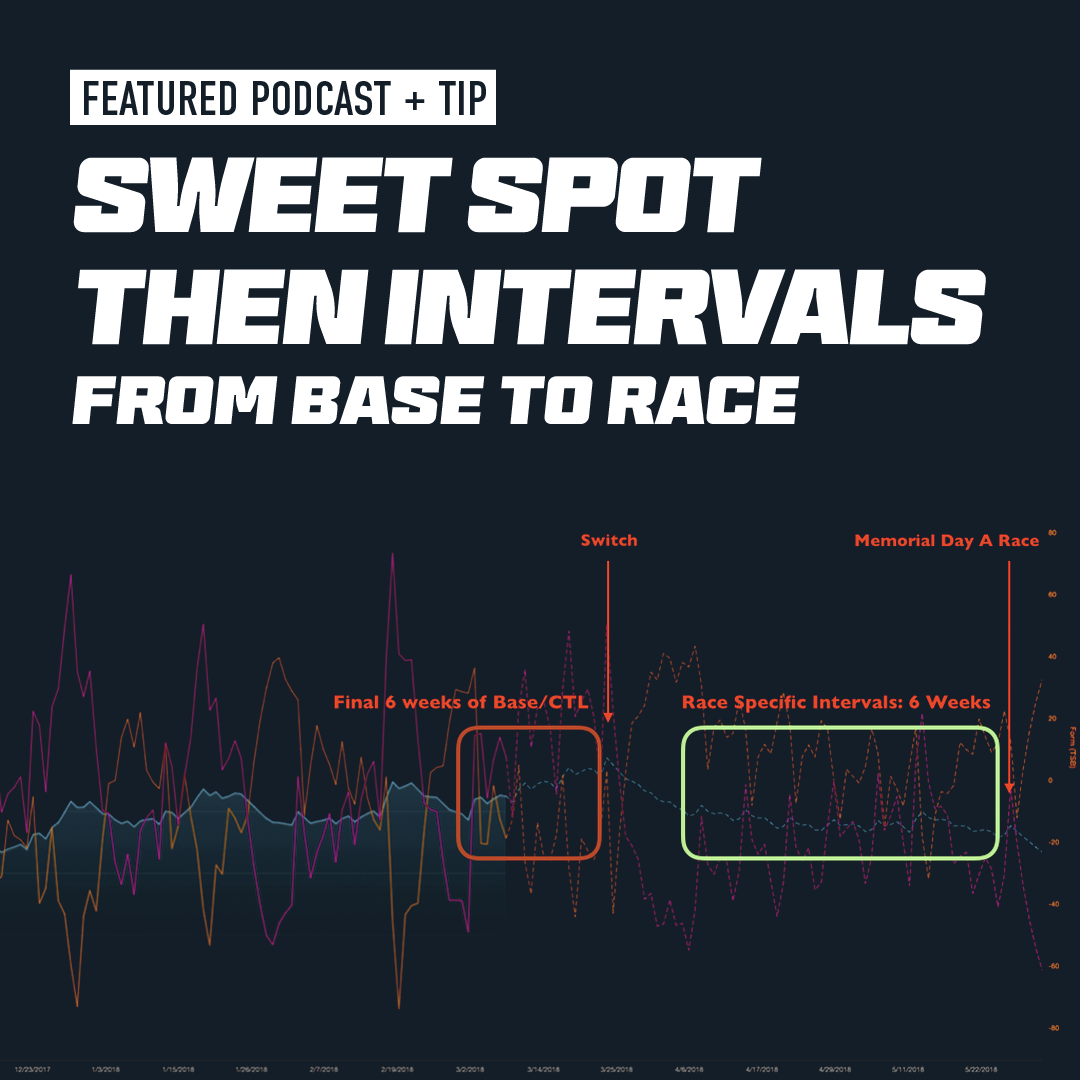
Switching from Base to Race Part 2: a continuation from our 2019 podcast on moving onto an interval phase of training after building a sweet spot base 61785Gravel Training Plan to help you practice what's described in this podcast! In this podcast, Coach Frank goes thru 10 instances Dave Letterman style of when you should switch from aerobic endurance training to high intensity interval training. This is the sweet spot and polarized methodologies referenced in last week's podcast! Thanks to everyone for tuning in, subscribing and reviewing on Apple Podcasts, and for engaging in our forum! Save 25% on your next training plan with code 25podcast SHOW NOTES: 2019 Switch from Base to Race Podcast Timing is Everything Let's talk about the criteria for knowing when to stop doing aerobic endurance work and start doing high intensity interval training because as we've podcasted before timing is everything. How to Know when to Switch from Base to Race – gonna do my best Dave Letterman top 10 list impression: 10. When you are racing* in 3-6 weeks or less 9. When your base is 'good' and the returns from doing interval training going forward are going to net greater power increase than if you kept trudging along with base 8. When you've been doing base for more than 18 weeks 7. When your Coach tells you to (this would be for the one on one coached athletes) 6. When you've been doing some base but want to raise your power even more 5. When you want to do some harder training 4.When your CTL is higher than ever before or within 10-20% of 3.When you can't ride any more – as in you've maxed out 12 hours of riding per week (cant do 13) 2. When you are dog tired from all the sweet spot training and your legs are begging for a break 1. And the #1 reason to switch from base to race is because you are going to be racing soon! Switch to "Race" Alright – let's unpack each one of those. I don't have any reasons not to switch to intervals unless your base is under developed. Ie. you have NOT been doing any sweet spot base and aren't racing soon or if you are those are B races. In this case, doing a 6 or 12 week block of sweet spot training before you switch to interval training. Build the aerobic foundation of the pyramid an stack the intervals on top of afterwards. You may hear some old skool racers talk about racing into shape – but they are building base during the week. And per our long ride podcast last week – if you've been racing on Zwift or similar riding hard – that is not base and now that the weather is improving for outside rides you will benefit from back up and doing a block of sweet spot base training. Resist the temptation to keep riding hard outside – this is the group ride hero we talk about and also a one way ticket to Burn Out Ville. You don't want to go there when the world is going to come back to life once everyone gets vaccinated and racing + group rides return. But I digress….. Back to unpacking the Dave LetterMan top ten list to switch from base to race: 10. When you are racing* in 3-6 weeks or less If you've done some base say a 6 – 12 week block but your CTL isn't quite where you want it to be because of life's limitations, still switch from base to race. Remember races are generally one from your peak power output – not the size of your CTL. I feel like that line could be in the Movie SpaceBalls – anyone remember the light saber spoof scene? Its better to work on your power output 3-6 weeks out than your base. That's the coaching advice – that's what I was talking about last week when the coaches are ahead of the science. Experience! AI generated workouts are going to miss that. 9. When your base is 'good' and the returns from doing interval training going forward are going to net greater power increase than if you kept trudging along with base This goes along with #10 I just mentioned – you'll increase your FTP more than from trying to keep building your base. Watts win races not CTL. 8. When you've been doing base for more than 18 weeks 18 weeks is the point of diminishing returns – you need/want to move on from here to keep progress – your training and progress will plateau out should you keep sweet spot base build. See we advocate both! 7. When your Coach tells you to (this would be for the one on one coached athletes) For coaches athletes, this is the value of having a coach – an expert with the experience to know when to switch – using the 3 criteria above but also the nuances of your training. This is someone who's got your back and has the experience to give you this advice. Again AI ain't gonna do that for you. 6. When you've been doing some base but want to raise your power even more Naturally what's better than one thing to help you ride faster? Two! In last week's podcast we articulated tht we advocate both sweet spot training combine with polarized training – I prefer to call it race specific interval training. And future pod on intervals I'll described the FasCat Way. We've touched on it b

Long Rides, Coaches v Scientists, Sweet Spot AND Polarized
Coach Frank goes on a 14 minute rant about 'internet scientists' and the whole sweet spot versus polarized debate. He espouses how the coaches are ahead on the scientists and bring it all back to the podcast topic: the long ride. Frank describes his three long rides and how you can progress thru each. 61558Gravel Training Plan to help you practice what's described in this podcast! In this podcast, Coach Frank covers the benefits of a long ride and goes on a rant about 'internet scientists'. Thanks to everyone for tuning in, subscribing and reviewing on Apple Podcasts, and for engaging in our forum! Save 25% on your next training plan with code 25podcast Show Notes: How I invented Sweet Spot Training Peter Stetina Podcast I am a man of science with a masters degree in physiology and US Patent # 7202067 from my molecular biology biotech days. I've spent days, nights in the Bowman Gray medical school library going thru thick 10 pound, 500 page medical journals trying to figure out how to get nerves to grow back on Astrocytes to help spinal cord injury patients. I even presented that work at the annual Neuroscience meetings in La Jolla and have to say – sometimes science doesn't have all the answers. It's your experience in the field from trying failure, doing and succeed. Here's the story and what I mean: I spent 6 months in a medical school laboratory with an NIH grant trying to figure out how to get spinal cord rat astrocytes to grow in petri dish to study nerve regeneration with an in vitro spinal cord injury model. Say that tongue twister with me again. 6 months culturing hundreds of thousands of astrocytes (cells that make up your spinal cord) day after day. And they weren't growing. And my boss started to get pissed and I was going to the medical school library every night to find that one nugget of information to figure out how to get these astrocytes to grow in the petri dish. I Experimented with everything the scientific journals listed in their 'methods and materials' section of the publication – the growth media, the way we harvested the cells, you name it. Finally one day I reached out to a researcher in the field who'd published a paper on astrocytes from the University of Alabama Birmingham's medical school of all places. The next day I cold called him and he picked up! Lo and behold he answered on the 2nd ring and we talked for 20 minutes and a week later I flew down to his lab to work with him and his lab tech to see if we could figure out a way to get the spinal cord injury model to work. Within the first hour of our collaboration the lab tech told me to coat the petri dishes with L-Lysine to give the Astrocytes something to bind too because they didn't like plastic. And whammo – that was the golden nugget of information. That was the information that wasn't in the hundreds of scientific publications I had found on pub med and spent hours making copies of in the medical school library. I asked the lab tech how she figured it out and she just shrugged her shoulders and said another researcher suggested it to her. Aha – insider information….. Long story short, cells grews, motor neurons were studied, papers were published and more NIH grants were received. I went on to graduate school and got distracted by mountain bike racing… but I digress. The point I'd like to make is that sometimes the science, the scientists haven't found what they are looking for. And someone with 20 years of experience has, like the coaches. Everyone on the internet is quick to point to the science this researcher has published in order to argue their point or to sound smart. And while I read the same studies, there are paper I wish have been published looking at what I've noticed in the field from athlete performance and power data. Sometimes the coaches are ahead of the scientists because they have the ability to perform experiments and gather the power data and see the results from the athletes they coach. Coaches have n = 1000 to the lab studies that had n = 12. And the longer they coach and the more experience they glean, the better able they are to figure out what works and what does not. By now I have close to 20 years of coaching experience and analyzing the power data of athletes and taking their data set from the whole season and seasons to measure their performance. Good coaches will micro experiment with their athletes: Did they rider faster , win x y z race, FTP improve, endurance stretched. What worked, what did not. Perform develop, grow , achieve. Many of you have heard my December 2018 podcast "How I Invented Sweet Spot" If not go back and give it a listen, I'll put it in the show notes too. In there I recant my experience training with the polarized method and then the extraordinary improvement I made when I discovered and developed sweet spot training. I went from P ½ field pack fill to winning P1/2 races. XC MTB races, Time trials and crits all of things which is opposite but I always had a good anaer

Gravel Skills and Tips
Spring is around the corner and that means dried-out roads, sunshine, and GRAVEL. While gravel riding and racing is super hot right now in the cycling world, there are still a lot of cyclists who are intimidated or unfamiliar with how it all works. So, in this episode, Coach Frank breaks the gravel skills down and offers some of his tried and true tips for gravel riding and racing as a veteran of the gravel scene (he's been doing it since before it was "cool"). 61385Gravel Training Plan to help you practice what's described in this podcast! In this podcast, Coach Frank covers: pack riding skills maintaining a line of sight body position and english on the bike braking cornering descending roots and mud Thanks to everyone for tuning in, subscribing and reviewing on Apple Podcasts, and for engaging in our forum! Save 25% on your next training plan with code 25podcast Let me start with the 3 different types of gravel courses that different kinds of gravel skills apply to: the Boulder Gucci gravel What I jest about here is that the dirt roads around Boulder, CO are practically paved because out West Boulder County grades the dirt with giant tractors and treats the dirt by spraying the road with magnesium chloride (I think) to help bind the dirt and when the conditions are right – its smooth and hard pack just like a rough paved rough. Incidentally for those of you who live or have ridden in Costa Rica, you know many of the roads are dirt and they are treated with molasses to bind the dirt and keep the dust low. So riding in Costa Rica smells like pancakes. But I digress…. In either place not many gravel skills are necessary and I know that because I've ridden a road bike on these roads just as I would ride a road bike. In fact Boulder has historically held a road race called the Boulder-Roubaix on the Boulder gucci gravel and we all used our road bikes with maybe 25mm slick road tires. And nobody got hurt. The skills required are the same skills you need for road racing: To be able to ride in a pack, group, peloton Draft wheels Conserve energy from drafting and maneuvering in the pack to travel faster with less energy expenditure When I say draft I am speaking about the fact that aerodynamic drag is 30% less riding directly behind a rider in front of you than it is riding with no rider in front of you aka breaking the wind. Over 3-4-5-6 hours + that 30% adds up alot and you can travel farther and faster by riding in a group. Having a good group to ride with during a gravel race is kinda the holy grail to your performance especially in the final quarter of the race when you are really tired. You'll go faster and be more motivated than being stuck out there by yourself in no man's land questioning your life's decisions. How do you work on your pack riding gravel skills: why by George practice by riding in groups. This where a lot of roadies excel and why you see a lot of them coming over to gravel. That and they are aerobic endurance monsters. So to practice you need to seek out opportunities to work on you drafting and your pack riding skills. This is why we are such fans of the weekend group rides and the weeknight crits and group rides. I said crit – yes – crit racers are some of the best drafters in the sport of cycling (trackies too) but a good crit racer can draft like nobodies business and out sprint , out kick you on the last lap. Want to improve your pack riding, drafting gravel skills – do a crit. Or a road race – that counts too. In fact, the first 30-60 minutes of a gravel race is just like a fast paced road race. Therefore seek out road races to work on your gravel skills. Of course you can do gravel races to work on your gravel skills because by doing you are practicing. And with more practice you'll improve and become more comfortable riding at speed in close proximity to other riders. All the while it is dusty and bumpy. Familiarity plays a big factor. So practice practice practice. I'll give you an aside about pack riding skills to put it in perspective for gravel racing. When I worked for USA Cycling and Directed the US National Women's Team at all the world cups like Flanders, Drenthe Plouay, etc… pack riding skills was many time the rider's biggest challenge. The US National Team would take the best riders in the US used to slower speeds, bigger roads and a not as tight of a pack and put them on narrow unfamiliar roads, higher speeds , closer quarters and that was their biggest challenge. That's also why racing in Europe is important for athlete development – its a skill that comes from doing. There's no practice or drill or workout that is a substitute for riding in the European peloton. The point I want to make is to practice by doing when it comes to your gravel skills. The more gravel races you do the better you'll become at them, including our gravel pack riding skills. Okay – that covers the chaotic first 30 minutes of a gravel race but what about after that? After that you will be lucky

The Relationship Podcast
"Happy spouse, happy house" is an important mantra to keep in mind as a cyclist. Training and racing can be a selfish endeavor, and it's often easy to get sucked into the tunnel vision of goals and TSS and forget about the home life. Coach Frank shares some Valentine's Day wisdom for finding and keeping balance in the household while still hitting your cycling goals! 59525Sweet Spot part 3 top off your base!" We are having a 30% off Valentine's Day sale! Use the coupon code FAST30 for 30% any training plan on FasCatCoaching.com. Note: if you've already used your limit 1 25podcast coupon this is your 2nd chance to save again. Thanks to everyone for tuning in, subscribing and reviewing on Apple Podcasts, and for engaging in our forum! Save 25% on your next training plan with code 25podcast The post The Relationship Podcast appeared first on FasCat.

Ask a FasCat #16
Welcome to the 16th edition of our "Ask a FasCat" podcast series, where we gather questions from our forum, website, and social media to help you ride faster! This round Frank and Lacey dive into questions ranging from course pre-riding, long term development in cycling philosophy, starting training again after a crash, and tons more. Thanks to everyone for the thought provoking questions! 58364Sweet Spot part 3 – as mentioned in the podcast!" The FasCat community now has access to discounts on Stages products, learn more by clicking on the Stages logo in our latest power based training tip "Top 10 Reasons to Ask Santa for a PowerMeter" Show Notes: Leaving post-activity comments: https://fascat.wpengine.com/tips/how-to-leave-post-activity-comments-for-your-coach-and-be-coachable/ Secret Training: To Race or Not To Race: https://fascat.wpengine.com/tips/secrettraining-to-race-or-not-to-race/ How to use the VIPR tube: https://fascat.wpengine.com/tips/how-to-use-a-vipr/ Use 25podcast to receive 25% off your first training plan! Join our *FREE* Athlete Forum to nerd out with FasCat coaches and athletes about your FTP, race data, power based training, or anything related to going fast on the bike! Copyright © 2021 FasCat Coaching – all rights reserved. The post Ask a FasCat #16 appeared first on FasCat.

Motivational Tips and Tricks
Show Notes: This week on the podcast we are talking about ways to help you stay motivated! That's right motivational tips and tricks to beat the mid-winter blues and follow your plan. Coach Frank with sound bites from Coaches Isaiah & Jake expand on using these 18 examples to stay motivated in order to achieve your goals: 57324Sweet Spot Part 3 with Over Unders and Criss Cross Intervals Remember your Goals Set a Daily Goal to FtFP (General McRaven's Make your Bed EveryDay) Make it Turn Green – same as above, daily goal Indoor Training – lower the barrier to completion If you have a 3 hour ride on your plan ride 1.5 hours one way so that you have to ride 1.5 hours to make it back home! Ride a different bike than the day before Ride in a new place or new route Set an FTP – plan a 20 min field test and or a Strava PR into your plan Travel to somewhere warm and sunny Ask yourself what would Alaphilippe Do (WWAD)? Coach Jake :: Zwift Meetups / Group Rides Coach Jake :: get to Daylight Savings Coach Isaiah : focus on progression goals Coach Isaiah :: focus on feeling faster / improvement sensations Sweet Spot TSS rides when there are no group rides Watch a Pro Race – like the World CX Champs in Ostend this past weekend Buy a Training Plan Hire a Coach Watch the podcast here: Listen on Spotify: Phil's Everesting Video with Coach Frank Dr. Michale Roshon's VeloNews about early season racing Previous Podcast Episode on Motivation Indoor Workout Motivation Don't forget Ask a FasCat # 16 is coming up and the deadline to submit your training and racing questions is 5pm mst February 4th. Thanks to everyone for tuning in, subscribing and reviewing on Apple Podcasts, and for engaging in our forum! Save 25% on your next training plan with code 25podcast The post Motivational Tips and Tricks appeared first on FasCat.

Winning in the Kitchen Recipe Variations
The recipes in our Winning in the Kitchen Meal Plans are designed to be template guides for meals and have nearly endless variations to fit your preferences and tastes. In this episode, Frank and Jackson discuss how to adapt a few of the recipes to change them up and how to approach incorporating the 5 key food groups for meal planning. Listen in to hear how to keep the kitchen exciting if you've been feeling uninspired with your meals! 56075Winning in the Kitchen Meal Plan! Show Notes: Meal Prep Guide: https://fascat.wpengine.com/tips/meal-prep-guide/ Eggs and Kale recipe: https://fascat.wpengine.com/tips/what-to-eat-for-breakfast/ Chipotle Rice Bowl: https://fascat.wpengine.com/tips/chipotle-burrito-bowl/ Salmon Watts: https://fascat.wpengine.com/tips/salmon-watts/ OG Winning in the Kitchen Podcast: https://fascat.wpengine.com/tips/winning-in-the-kitchen/ Thanks to everyone for tuning in, subscribing and reviewing on Apple Podcasts, and for engaging in our forum! For more things cycling training, visit http://fascat.wpengine.com. Save 25% on your next training plan with code 25podcast The post Winning in the Kitchen Recipe Variations appeared first on FasCat.

Wintertime Intensity
How about a little anaerobic work to go with your sweet spot base training? At FasCat in the wintertime we like to caress and nurture our athlete's anaerobic system. One training myth we'd like to dispel is to only do base training for 2-3 months. Why not do both simultaneously, in the right amounts. We've long been fans of fast fun wintertime group rides for the short 10 – 20 second forays above threshold we see in athlete's power data. While not a ton of time is spent above threshold there is value and benefit to including anaerobic work to your base training. After all, isn't this how the sport of cyclocross was invented? 54547Wintertime Intensity Training Plan. 1 hour workouts Zwift Compatible. This year a number of athletes are missing group rides not only for the social aspect but also for the training. And not only the base miles training and TSS but the anaerobic component that makes these group rides so beneficial. Doing a group ride on Zwift (not a race) over variable terrain with mixed high and low power output is OK but not quite the same as these 5 workouts we are presenting below. First, what is 'Wintertime Intensity'? Wintertime Intensity is 2 – 4 cumulative minutes of zone 6 work per hour. Two to four minutes is not a lot considering a one hour criterium or cyclocross race has more than half or 30 minutes spent in one's zone 6. Wintertime Intensity as you would guess is prescribed in the second half to final third of one's aerobic endurance phase or CTL build. As in our sweet spot part 3 plan or our new wintertime intensity plan. These variable power wintertime intervals mimic the power demands* of road, mountain bike, gravel, fondo, cyclocross and even punchy time trials. In this training tip, we'll describe the how, what, where, and why of wintertime intervals and give you five progressive workout examples plus a link to our WinterTime Intensity Training Plan that includes these 5 workouts** in an easy to follow, simple and affordable training solution. *surges in the peloton, steep pitches up climbs, switchbacks, and technical singletrack, cyclocross accelerations ** compatible with Zwift and others 3rd party riding app. The Wintertime Intervals are what we call variable power workouts and they have 5 main benefits: Specificity of real world conditions Help the time pass quicker during indoor training sessions! Concise short high quality 1 hour workouts (designed for indoors and ERG mode) but just as easily performed outside with longer zone 2 warm up and cool downs. Nurtures your Anaerobic System Provides an introductory amount of intensity to one's base training before the high intensity interval training phase Wintertime intervals are structured over under or criss cross style workouts with short 10 – 20 second efforts at the beginning and/or the end of the interval. For example 10 seconds @ 150% on FTP followed by 2 minutes and 40 seconds at Sweet Spot wattages and/or heart rates followed by 10 more seconds @ 150-200% of one's FTP before a 1:1 work to rest ratio 3 minute recovery. Then repeat. That's a 3 minute variable power sweet spot effort with 20 seconds total (10 second before and 10 second afters on zone 6 work of zone 6 work. One can do 6 of these in a one hour workout for 18 minutes of 'wintertime intensity' split 88 % sweet spot and 12 % anaerobic zone 6. Or 16 minutes of sweet spot work and 2 minutes of anaerobic work. That's a perfect ratio for your wintertime base training Dec-Jan-Feb. Now the progression lies in spending more time in sweet spot and more time in zone 6 in the context of a one hour workout. To get started with your wintertime intensity interval training we have the FasCat #1 Sweet Spot Cheetah Pounce" 4 x 6 minutes. We like to have a little fun with sports psychology and animal imagery in these workouts. And of course we are talking about the world's fastest land mammal, the cheetah. Carefully sweet spot stalk your prey (your prey being your training goals) at sweet spot wattages and/or heart rates for 5 minutes and 40 seconds and the "pounce!" on them for the final 20 seconds at a 115 – 150% FTP Zone 6+ effort. Pounce out of the saddle as if you were going for the win and and uphill sprint. Really give'er here because you have a 3 minute recovery interval after. Take a 2:1 work to rest ratio 2 minutes recovery and repeat 3 more times. If all goes well and you FtFP your power and heart rate data will look like this: note the 'extra credit' watts for the last Pounce – we encourage this! In total this will be 24 minutes of WTI with 94% or 22.66 minutes being Sweet Spot and 6 % and 1.34 minutes being Zone 6 Anaerobic. ERG mode is fantastic for these variable power workouts but toggle if OFF to be able to get 'EXTRA CREDIT" with more watts for the Pounce Pro Tip: Shift Down 3-4 seconds ahead of the pounce to be able to respond to to load the FasCat #2 Sweet Spot "Cheetah Pounce: is 6 x 4 minutes broken up into 2 sets Its a progression from the Cheetah Pounce #

What's Ahead on the Podcast in 2021 + FTP Testing
Happy 2021! Coach Frank is back in action to talk about what's coming down the pipeline for podcasts over the next few months of the new year. Winter training, nutrition challenge, and more! Frank also revisits an episode he recorded earlier in 2020 discussing the importance of measuring and tracking your FTP (functional threshold power) with a 20 minute field test, an essential metric to focus on in the beginning of a new year. 53820Six Weeks till the Sweet Spot Part 1 Base Training Plan Reference: A 20 minute Power-Based Field Test As always, thanks to everyone for tuning in, subscribing and reviewing on Apple Podcasts, and for engaging in our forum! For more things cycling training, visit http://fascat.wpengine.com. Save 25% on your next training plan with code 25podcast Copyright © 2021 FasCat Coaching – all rights reserved. Join our *FREE* Athlete Forum to nerd out with FasCat coaches and athletes about your FTP test, power data, power based training, or anything related to going faster on the bike! The post What's Ahead on the Podcast in 2021 + FTP Testing appeared first on FasCat.

Transform your Cycling with a Next Level Approach
I wrote this five years ago in 2016 and have been living it since – cycling is a lifestyle and in this training tip I'll share that lifestyle with you – Frank Overton Jan 9, 2020 Five year's ago my new year's resolution was to double down and make 2016 my year to have a great cycling season. You know, 'get serious'. The motivation came from two cyclocross seasons of getting my ass kicked. That was not fun at all. Like cross the finish line, go back to your car, get in and drive away. So I woke up on New Year's Day 2016 and went for a ride. Then the next day I went for another ride and the next day and so forth. Training consistently was my first goal and I knocked that out in January – I got back to being a cyclist, just like you. As I look back on 2016 and the 4 years since then, I more than accomplished my goal to have a 'great season' and as a coach I want to tell you how I transformed my cycling so you will know how coaching can help you for 2020 and beyond! Here are 8 next level approaches to your training and two things I learned about myself that I'll share with you: #1 Consistency: I made getting on my bike a daily priority, whereas before I let work, kids and weather be an excuse. 1 hour a day Tues/Wed/Thurs, indoors or out. We've since adopted the phrase "FtFP" which is like Velomanti's Rule #5, HTFU. Here FtFP means Follow the F&*#'ing Plan. 100% of our athletes report back that having a plan to follow helps them get on the bike and accomplish their workout each day. Having a coach to hold you accountable to that plan and consequently those goals is also next level. 3864Start Sweet Spotting your way to your best cycling season ever. #2 Zwift: speaking of indoors, I hadn't trained indoors in years. Maybe it was that 4 hour roller session I did as a youngster that scarred me? Enter Zwift. Try it, its fun and you'll no longer use weather and daylight as an excuse. Zwift enables you to #FtFP. Last winter was the first winter in a long time where if it was sloppy cold outside or I couldn't ride till after dark due to work, that I would move onto plan B and get on the KICKR and Zwift. Fun and productive, 1 hour: one and 'dun' where I whole heartedly went for KOMs, rode hard and made a lot of sweat, aka TSS. Exporting your workout from TrainingPeaks to Zwift is incredibly easy and straightforward, we've documented it over in our athlete support forum. In January I established consistency and in February Zwift enhanced that consistency. By March, I stepped it up group rides. And you know what, this is where my training an goals became F-U-N. #3 Group Rides: by March I had 2 previous months of fitness to propel me on the group rides. I also had the cyclocross season in my back pocket where the fitness carries over. This gave me the ability to not just hang on, but to take pulls and ride harder without having to worry about getting dropped. You know what's not fun? Hanging on for dear life on a group ride. You know what's 'funner'? Going faster. Improving is fun. During these group rides, I was able to generate more TSS, raise my CTL higher and higher all the while having F-U-N. Hard as heck, shattered afterwards but Fun with a capital F. I kept going and the training snowballed from consistency, Zwift and the group rides. #4 CTL: Speaking of CTL , I took mine from 22 on 1/1/16 to 113 on 6/23/16 (2 weeks prior to my first A race). This was all made possible from 1, 2, & 3 and of course sweet spot training. We've since podcasted on using the performance manager chart to build a big aerobic engine as well as manage your training load – TSTWKT is truly a next level approach to your training. #5 Winning in the Grocery Store/ Kitchen: I've always eaten well but I knew eating better was key to my performance and the lofty goals I had set. Better nutrition was going to help me lose weight, fuel my workouts and help me recover better. Back in my younger days I used to race at 148 – 154 lbs but over the 10 yrs since my 'retirement' the weight had crept up. So I resolved to eat better on January 1st, 2016. I ate more veggies and started cooking more. I also cut sugar completely out of my diet and cut back on beer. The sugar was easy; the beer was tough. But there's 3-500 empty calories in every beer and going down to a few a week instead of 1-2 every night made a weight loss relatively easy. Oh and I started planning out my meals and cooking more, thus paving the way for what would be a major theme within our coaching philosophy: which was a relief. Athletes – I encourage every one of you to get more in tune with your nutrition by going to the grocery store yourself and cooking your own meals. It will be such a phenomenal shift in the way you eat, that you can't help but get faster. All these dietary changes took me from 168 to 158 lbs by Memorial Weekend and I felt great, setting Strava PR's because my power to weight ratio was way up. Overall, I lost a little less than 2 lbs per month for 5 months. Not dieting per

Ask a FasCat #15
Welcome to another Q&A session of the FasCat Podcast, where we gather questions from our forum, website, and social media to help you ride faster! This round Frank and Lacey dive into questions ranging from tips for young cyclists, heart rate behavior during workouts, tapering, frequency of field testing, data fields to display, long term race goals, Haute Route nutrition, and so much more! Thanks to everyone who contributed questions, and congrats to the lucky winner of the Stages Dash head unit! 52180The one and only "Six Weeks to the Sweet Spot Training Plan" The FasCat community now has access to discounts on Stages products, learn more by clicking on the Stages logo in our latest power based training tip "Top 10 Reasons to Ask Santa for a PowerMeter" Show Notes: Scientific Basis for Pre Competition Tapering Strategies, Mujika & Padilla, Med. Sci. Sports Exerc. 35:1182-1187, 2003 Tapering Using Zwift to FtFP Strava-Vals The Performance Manager Chart Podcast Join our *FREE* Athlete Forum to nerd out with FasCat coaches and athletes about your FTP, race data, power based training, or anything related to going fast on the bike! Comments The post Ask a FasCat #15 appeared first on FasCat.

The Performance Manager Chart
The Performance Manager Chart in TrainingPeaks and WKO is one of THE best tools athletes can use for their training and performance. Coach Frank busts out the pocket protector to explain and describe this impulse-response performance model. Athletes and coaches may use the model to plan training and therefore predict performance! One can literally design more watts into their annual training by using the PMC Chart. It also a dashboard to monitor training stress, training load, acute training stress and the almighty: form – the balance between your training load and short term daily side effects from training. Frank covers everything you need to know about the PMC: what it is, why you should care about it, and most importantly, how you can use it to take your training and performance to the next level! For the scientific literature reference please see read visit the story behind the development of the PMC Chart here. As always, thanks to everyone for tuning in, subscribing and reviewing on Apple Podcasts, and for engaging in our forum! For more things cycling training, visit http://fascat.wpengine.com. Save 25% on your next training plan with code 25podcast Copyright © 2021 FasCat Coaching – all rights reserved. Join our *FREE* Athlete Forum to nerd out with FasCat coaches and athletes about your PMC Chart, FTP, race data, power based training, or anything related to going faster on the bike! The post The Performance Manager Chart appeared first on FasCat.