Empowered Relationship Podcast: Your Relationship Resource And Guide
544 episodes — Page 9 of 11
ERP 143: How To Increase Relationship Satisfaction with Mindfulness - Part Two
If you missed part one, you can check it out here ERP 142, where I give you explanations and examples of mindfulness and how you may already be practicing mindfulness in your life. With a better understanding of mindfulness in general, let's talk about how mindfulness benefits our relationship. (Please listen to the podcast episode or read the transcript to hear explanations, stories and examples.) HOW MINDFULNESS BENEFITS RELATIONSHIPS. Research is beginning to show us that higher levels of mindfulness contribute to happier, more satisfying relationships. Generally, mindfulness helps us: Keeps Things Fresh: You are less likely to take each other for granted or be caught up in your stories and expectations. You are more likely to recognize the growth and newness in your partner. You are more likely to appreciate and value your partner because you are more in the moment and paying quality attention to them. Soothes Fears and Anxieties: While being in relationship provides love and connection, it can also stimulate anxieties and insecurities. Fears of being hurt will make us more reactive and protective. Unfortunately, these reactive and protective strategies push our partner away, and lead to more pain, conflict, and disconnect. Mindfulness is a valuable tool for dealing with our fears and reactions. Learning to deal with our insecurities is probably one of the most important skills in keeping a relationship healthy and happy. 7 WAYS MINDFULNESS BENEFITS YOU AND YOUR RELATIONSHIP. 1. More Attentive With mindfulness practice, we strengthen the area in our brains associated with attention and focus. When practicing mindfulness, we can recognize when we have spaced out, started thinking about something else and come back to our partner. For partner's whose primary love language is "quality time," attention and focus are the ultimate ways of feeling loved and cared about. When a partner is distracted and preoccupied, they may feel as though "You don't really care. You don't really love me." Regardless of your partner's primary love language, being present and engaged helps create a safe space for your partner to share and express more fully, which it turn cultivates a deeper sense of understanding, intimacy, and connection. 2. Able to respond Rather Than React. When practicing mindfulness, we develop our capacity for increased emotional regulation. In previous podcast episodes, I have talked about how easily our "fight, flight, or freeze" mode can get activated when we feel threatened. When we are in a triggered place, it is very difficult if not impossible to respond in a level and skillful way. Research shows that with mindfulness, we are able to decrease the volume of the amygdala. The switch to our "flight, flight or freeze" response is not as easily flipped. The amygdala has less power to hijack us. Being able to respond rather than react helps partners slow down, take pause and assess the situation before jumping to conclusions. Once we have calmed down, we can communicate more clearly and from the heart, rather than reacting and getting into negative cycles or destructive behavior. 3. More Emotionally Regulated Mindfulness strengthens the prefrontal cortex and improves the connectivity between the prefrontal cortex and the amygdala. The prefrontal cortex is the part of the brain that is responsible for higher level thinking, perceiving other's emotions, decision-making, moderating our behavior and regulating our own emotional expression. These are all critical brain functions to being able to relate to someone else effectively. One of the primary goals of keeping yourself regulated (calm and collected) is to stay in the prefrontal cortex. As soon as your amygdala is firing away, you are in protection mode. How Mindfulness Can Save Your Relationship By Lisa Firestone "A typical conversation between a couple may involve one partner remarking, "You used to be up for anything. You were so lively when we met." This may spark a defensive response in the other partner: "What? You're saying I'm not spontaneous anymore? You think I'm boring? What about you? You never get off the couch!" This type of angry and accusatory response tends to have a snowball effect. "I never said you were boring, and now you're calling me lazy? I work day and night to make you happy. You're so ungrateful." By Lisa Firestone Without mindfulness, one is likely to have a short fuse and respond in defended demeanor (i.e. "What is wrong with you?"). With mindfulness, one is likely to recognize something is going on and be more sensitive. (i.e. "Honey, I see you. Do you want to talk about it?") Imagine a scenario where your partner has done or said something that you find alarming or challenging. You feel triggered. You feel your emotions rising to the surface. You are at a choice point. You can react or take a few moments to notice your thoughts and emotions. As you stay present to noticing your experience (without getting caught up in your
ERP 142: How To Increase Relationship Satisfaction with Mindfulness
The demands of modern life keep us busy and pulled in many directions. It is easy to get swept away with schedules and tasks. We hope to be more productive and accomplish more. However, we sometimes expect too much of ourselves and our relationships. To make matters worse, we often fall into the trap of thinking our relationships are self-sustaining. We believe that a good relationship just works and is easy. However, like with most things, relationships do not grow and flourish with little care and attention. Additionally, when we are presented with a difficultly or challenge, we often try to avoid the pain. Yet, there can be tremendous value in learning to turn towards the pain and be with it. (Please listen to the podcast episode or read the transcript to hear explanations, stories and examples.) In this episode, I am going to give you a little more description of mindfulness. Description of mindfulness: "Mindfulness is a mental state, which is achieved by focusing one's awareness on the present moment, while very calmly acknowledging and accepting one's feelings, thoughts, and bodily sensations." by Lode Dewulf Without focus, we are prone to going into autopilot, negative habitual thinking, distraction, and preoccupation. Mindfulness involves redirecting your focus and attention over and over again. At first, it will feel impossible. Jon Kabat Zinn calls it the monkey mind (see below). The goal with mindfulness is to train your mind. Jon Kabat-Zinn says mindfulness is about paying attention to the present moment on purpose and without judgment. Mindfulness helps you experience your life more fully as it is happening, in each moment. You become more present, engaged and connected to what is happening. Mindfulness is a skill we can acquire. Mindfulness is always available Mindfulness is a way to calm ourselves down when distressed. Mindfulness increases our awareness of what we are experiencing and the space to decide how we want to act in any given situation. In the next episode, I will share How To Increase Relationship Satisfaction with Mindfulness. Stay tuned MENTIONED: ERP 140: How Pain and Suffering Increase & What to Do about It (podcast) ERP 141: How To Decrease Relationship Pain and Suffering (podcast) The Value in Pain and the Pain in Value, by Lode Dewulf (TED Talk) Mindfulness with Jon Kabat-Zinn (video) Meditation Is Not What You Think: Mindfulness and Why It Is So Important (book)
ERP 141: How To Decrease Relationship Pain and Suffering
"THE VALUE IN PAIN AND THE PAIN IN VALUE" In last weeks episode, I talked about Lode Dewulf's Ted Talk The Value in Pain and the Pain in Value, and how this relates to relationship pain. I highly recommend watching the video. He does a great job of describing how we compound the amount of pain we experience, by adding more layers of pain. (Please listen to the podcast episode or read the transcript to hear explanations, stories and examples.) In life, we area all faced with pain. Most of us work really hard at avoiding the pain. Yet, when we do not meet the pain directly, we create more suffering for ourselves. Avoiding, resisting and fighting all create additional pain and suffering. Mindfulness helps regulate the nervous system, so that we can get calm and clear headed. "Mindfulness is a mental state, which is achieved by focusing one's awareness on the present moment, while very calmly acknowledging and accepting one's feelings, thoughts, and bodily sensations." by Lode Dewulf THE LEARNING PROCESS The learning process involves four stages. To go to the next stage will involve a little bit of pain. 1. Unaware & Incompetent Insight 2. Aware & Incompetent Training 3. Aware & Competent Practice 4. Unaware & Competent ACCESS YOUR FREE RELATIONSHIP MAP. "Let us stop this obsession to avoid pain. And let us stop the illusion that life, learning, and happiness can ever be without pain. Because that awareness is the first step towards healing out of pain. " By Lode Dewulf MENTIONED: Relationship Map (1 page graphic opt-in) ERP 140: How Pain and Suffering Increase & What to Do about It (podcast) The Value in Pain and the Pain in Value, by Lode Dewulf (TED Talk) What Does The Development Of Intimacy Look Like In Relationship? (article)
ERP 140: How Pain And Suffering Increase & What to Do About It
"THE VALUE IN PAIN AND THE PAIN IN VALUE" Last year, I can across this Ted Talk, The Value in Pain and the Pain in Value, by Lode Dewulf I highly recommend watching the video. He does a great job of describing how we compound the amount of pain we experience, by adding more layers of pain. Lode's teaching apply to all types of pain, physical, mental, emotional, etc. Today, I we're going to focus on relationship pain. Why is it…"Our best way and often only way of dealing with pain seems to be avoidance. Pain is that big elephant that lives in most rooms of our life and that we prefer to ignore or suppress. No wonder then that the business of pain suppression is big business. In 2015 alone, over 300 million prescriptions for painkillers were written in the world for a total cost of 24 billion US dollars. Making painkillers the second most prescribed class of medicines after anticancer drugs. Strikingly, 95% of that consumption is in the United States and Europe with US taking the vast majority." by Lode Dewulf (Please listen to the podcast episode or read the transcript to hear explanations, stories and examples.) RELATIONSHIP PAIN When it comes to relationship pain, we often get confused. On one hand, we fantasize about the idyllic beginnings of relationship comparing the current experience to the "way things used to be." When we enter into the power struggle stage, we often are disillusioned by the relationship challenges. Thinking, "I didn't sign up for this." On the other hand, we know relationships take a level of investment and attention. We understand that keeping a relationship healthy requires effort. Sometimes the effort will require us to heal and grow, which can feel painful. How much pain is too much? For me the question is more about how are we dealing with our pain? Are we directly meeting our pain or are we denying, deflecting, avoiding, projecting suppressing in ineffective, dysfunctional, and harmful ways? Access your free Relationship Map. Client example: (please listen to the episode for full description) Like – Past/Loss: He might say, "I miss the days where she adored me and was loving toward me." She might say. "I miss feeling him with me and our connection." Like – Future/Desire: He might say, "I wish she would treat me with more consideration and respect." She might say, "I wish he would engage with me and let me in." Dislike – Past/Anger: Blame: He might say, "She is such a villian. I can't believe I put up with this!" She might say, "He is so passive. How are we to have a relationship, if he doesn't show up!" Guilt: He might say, "I don't know how to give her what she wants. Maybe I am not good enough." She might say, "Why did I choose a guy like this? Why didn't I see the signs?" Dislike – Future/Fear: He might say, "Is this how it is going to be. I don't know how to live with someone who is constantly berating or belittling me. I may never be truly happy." She might say, "I have tried everything to get him to engage. Maybe he doesn't really care about me and will leave me. I may never have real love." TURNING TOWARDS PAIN If you have listened to my previous podcasts, I talk about turning towards your pain, so that you can see what is going on. Once you have more clarity, then you can share with your partner more vulnerability. When your partner can see you and your hurt, they are likely to soften. This begins to create safety, allowing more openness and connection. Conversely, when we don't turn towards our pain. We will consciously or often unconsciously, work really hard to protect ourselves. We all have really good strategies to shut down, ignore, divert, protest, go intellectual, criticize, and blame…all of which are ways to attempt avoiding the pain. However, what ends up happening is we complicate the dynamic and create more pain and suffering. If you blame and attack your partner, they are likely to get defensive. If you shut down, your partner is likely going to want to seek you out. In next weeks episode, I'll share more about how my clients experienced a dramatic transformation in their connection. I will also be referencing another teaching tool from Lode Dewulf's TED Talk, so that you have a better understanding of how to deal with pain in a more constructive manner. MENTIONED: Relationship Map(1 page graphic opt-in) The Value in Pain and the Pain in Value, by Lode Dewulf (TED Talk) What Does The Development Of Intimacy Look Like In Relationship?(article) What Sleeping With Married Men Taught Me About Infidelity, By Karin Jones(article) Photo by Josh Nuttall on Unsplash Photo by Lauren Kayon Unsplash TRANSCRIPT: Click on this link to access the transcript for this episode: If you have a topic you would like me to discuss, please contact me by clicking on the "Ask Dr. Jessica Higgins" button here. Also, I would so appreciate your honest rating and review. Please leave a review by clicking here. Thank you! If you are interested in developing new skills to overcome relati
ERP 139: How Hiding And Withholding Can Damage Your Relationship
LISTENER'S QUESTION "I love your podcast! Thank you so much for all your advice. I have been dating a guy ten years my age for just over a year. The first 5 months of our relationship I was emotionally cheating with my ex. When it became open I cut off communication and worked very hard to gain back trust. It's been eight months on a rollercoaster of emotions trying to earn back trust. I did everything I thought to do to fix my mistakes and it seemed futile. It came to the point where I told myself I was "done" if he aggressively accused me and belittled me one more time. It happened of course and that was a turning point for me. I have lost interest in trying. Now my boyfriend decided he doesn't want to lose me and wants to work on things and even offered to pay for counselling… but I can't get my ex (whom I cheated on with) out of my head. I haven't contacted him since I don't want things to be messier than they are but I don't know what to do. Is my obsession with my ex is real or fake. Should I stay and fix this since my boyfriend wants to work on things or should I move on or contact my ex?" (Please listen to the podcast episode or read the transcript to hear explanations, stories and examples.) POINTS DISCUSSED It is nearly impossible to create a thriving, intimate, safe, conscious connection, when there is a lot of withholding. "Withdrawal and projection are the natural outcomes of withholding. When you withhold, you keep inside yourself things that should be expressed. The very act of hiding these things takes you one step back from the relationship. A result of this withdrawal is that you will begin to project. In other words, you begin to attribute to other people things that are actually issues of your own. Withdrawal follows withholding so swiftly that often we do not notice the sense of distance at first." By Gay Hendricks & Kathlyn Hendricks (Conscious Loving, page 48) It is difficult to assess the quality of the connection (because you haven't been fully present). You can only speculate what things would be like if you were really "in" the relationship. Withholding leads to perceiving things inaccurately because we are not actually connecting with the other person, we are making up a story about it true for them and this leads to gross misunderstandings and disconnect. More importantly, it does not give room for the other person to really see you, meet you, and be with you AND this is what creates intimacy and connection. This is a vicious cycle. The more you withhold, the more your partner senses something is off. Your partner has a choice in how he deals with the threatening feelings. Unfortunately, many people do not feel safe or have the skill to say "I am scared you are not really in this with me." Instead, people will react out of fear and disconnect. This is where destructive behaviors happen. This is where the downward spiral ensues. Both partners turn away from each other, losing trust in one another and the relationship. RECOMMENDATIONS: Set limits about what type of behavior you are willing to engage with. If he starts belittling you, then I would remove yourself from the situation. It will be important to discuss this ahead of time. Let him know you care about his experience. If he has concern, issue, or feelings about something, you are available to listen and be with him. But you are not willing to be the target. Talking about it ahead of time will help him understand that you are not rejecting him in the moment, rather you are trying to create safety by removing yourself from a negative interaction. Turn inward to reflect on some of your deeper motivations. What does your ex represent for you? What associations do you have with him? What are you missing in your current relationship? Want are you longing for? What does fantasizing about your ex do for you? Is it a form of escape? For example, you are not wanting to face the pain and difficulty within your relationship. What stops you from being completely honest and transparent? Are you afraid of his reaction? Are you afraid of hurting him? Do you feel scared of conflict? Do you not feel safe? Do you not want to lose your partner? Many times people get preoccupied with questions like "Is this the right person for me? Is this the right relationship? Should I stay or should I go?" These are very difficult questions to answer. Instead, I would like to encourage questions like "How can we invest in a positive, constructive dynamic together? How can we build a safe connection? How can we build trust?" You already know the dynamic isn't working. Focus on repairing the interactions and this will give you a better opportunity of saving your relationship. I would highly recommend getting support to work through the areas that have been keeping you stuck, as well as to build a constructive path forward. At the very least, you will learn a lot about yourself. MENTIONED: Nine Destructive Behaviors to Avoid During Relationship Conflict(artic
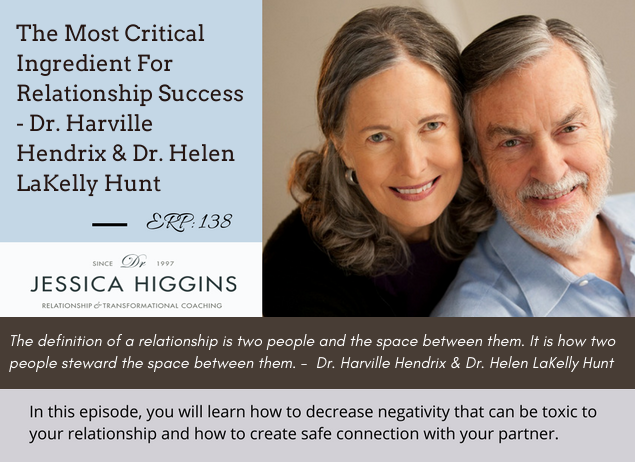
ERP 138: The Most Critical Ingredient for Relationship Success with Dr. Harville Hendrix & Dr. Helen LaKelly Hunt
Dr. Hendrix is a couple's therapist with over 40 years experience as an educator, clinical trainer and lecturer whose work has been on Oprah 18 times. In addition to Dr. Hunt's partnership with her husband in the co-creation of Imago, she is sole author of Faith and Feminism. She was installed in the Women's Hall of Fame for her leadership in the global women's movement. Helen and Harville have been married for over 30 years, have six children, and reside in Dallas, Texas. LISTEN TO THE EPISODE TO LEARN ABOUT: Why we fall in love and what happens in the partnering process. What drives us and compels us towards particular people. What is going on in the brain when we partner in a love relationship. How childhood experiences impact our relational needs. "Your unconscious mind is experiencing and connecting with a person in adulthood who is similar to the caretakers you had in childhood, and that activates the hope and possibility that you will get those needs met." • How couples can shift their relationship dynamics. • When there is conflict how to understand what unconscious patterns might be involved, and a valuable tool to help identify and assist in shifting these unconscious patterns."The formula embedded in your frustration with your partner is a wish in disguise, in that it is an unexpressed desire." • How to engage in a dialogue process with your partner to increase understanding, empathy, and connection. • What the term Zero Negativity means. • Why negativity is one of the worst things you can do in relationship."The primary commitment is to reconnect as quickly as possible so our brains don't become habituated to a disconnected state." • Important advice about what is most important to making relationships successful. MENTIONED: • The Space Between: The Point of Connection (book) • Getting the Love You Want: A Guide for Couples, 20th Anniversary Edition (book) • Making Marriage Simple: Ten Relationship-Saving Truths (book) • Harville & Helen (website) • Relationships First (website) • The Gottman Institute (website) • Dr. Sue Johnson (website) • Dr. Dan Siegel (website) • Dr. Stephen Porges (website) TRANSCRIPT:Click on this link to access the transcript for this episode: ERP 138: The Most Critical Ingredient For Relationship Success, With Harville Hendrix and Helen Hunt [TRANSCRIPT] If you have a topic you would like me to discuss, please contact me by clicking on the "Ask Dr. Jessica Higgins" button here. Thank you so much for your interest in improving your relationship. Also, I would so appreciate your honest rating and review. Please leave a review by clicking here. Thank you! If you are interested in developing new skills to overcome relationship challenges, please consider taking the Connected Couple Program or doing relationship coaching work with me.
ERP 137: How To Make Space For Sex In Your Relationship With Kate Moyle
GUEST: KATE MOYLE Kate Moyle is an Accredited Psychosexual & Relationship Therapist and In House Expert and Partner at Pillow App for Couples. Pillow helps busy couples to fit intimacy into their lives in a convenient and connecting way, by providing audio-guided intimacy episodes that focus on sensual touch, communication, eye-contact and other basic forms of intimacy.. Kate is passionate about having open, honest and realistic conversations about sex, relationships and intimacy in order to help those she works with and the thousands that have downloaded Pillow get closer to achieving the relationships that they want. (Please listen to the podcast episode or read the transcript to hear explanations, stories and examples.) LISTEN TO THE EPISODE TO LEARN ABOUT: What a psychosexual therapist is and what they do. How to define or redefine sex and intimacy. How we typically measure the health of our sex lives. Learn how to communicate about sex with your partner when you have different needs or desires. How to deal with your expectations and assumptions about sex. What to do when you feel pressure to perform. How to gain confidence and be comfortable with the role of sex in our lives. How to build intimacy and connection in relationship. MENTIONED: Pillow (website) Kate Moyle (website) Mating in Captivity: Unlocking Erotic Intelligence (Amazon link) Photo by Toa Heftiba on Unsplash TRANSCRIPT: Click on this link to access the transcript for this episode: ERP 137: How To Make Space For Sex In Your Relationship [TRANSCRIPT] If you have a topic you would like me to discuss, please contact me by clicking on the "Ask Dr. Jessica Higgins" button here. Thank you so much for your interest in improving your relationship. Also, I would so appreciate your honest rating and review. Please leave a review by clicking here. Thank you! If you are interested in developing new skills to overcome relationship challenges, please consider taking the Empowered Relationship Course or doing relationship coaching work with me.
ERP 136: How To Handle Grief & Loss In Relationship -Part Two
If you missed part one, please check out ERP 135, where I give you a greater understanding of what is happening during the grieving process. I talk about what to look out for if you are experiencing loss in your life, as well as what you might expect with the stages of grief. In this episode, I give you 6 tips on how to cope and heal when dealing with loss in your life and relationship. (Please listen to the podcast episode or read the transcript to hear explanations, stories and examples.) 6 TIPS ON HOW TO COPE WITH GRIEF & LOSS These tips can be used and combined in various ways. They not intended to be used in any particular order. T.R.I.B.E.S. T. Take Action. Somatic psychology research helps us understand the importance of using our bodies to shift the emotional charge and intensity of a loss. R. Ritual. Homemade rituals can be powerful ways to bring our healing and intentions into focus. I. Impeccable self-care. As mentioned in ERP 135, when grieving, our whole system (physically, emotionally, psychologically) is trying to cope with the loss. Giving yourself the extra support and care will help you recover more efficiently and effectively. B. Be Present With Love. At some point, we have to choose, whether or not we are going to deny it, fight it, or attempt to control it, or are we going to accept the loss. Accepting often feels like a sense of surrender. When we are present and open, we are more available to the presence of love all around us. "Sometimes it feels as though we are broken open to find that we are whole." E. Express Yourself. You have to "Feel it to heal it." When we attend to our emotional process, we have a greater opportunity to heal and grow. You have to "Name it to tame it." S. Seek Support. While being around friends and family may be difficult, meaningful connection can offer feelings of connection, warmth, and positivity. As a reminder grief looks different for each person, be gentle with yourself and do your best to work with your healing process. If you need extra support, consider reaching out to a therapist or coach. MENTIONED: ERP 135: How to handle Grief and loss in relationship – Part One (podcast) ERP 036: How To Offer The Gift Of Listening (podcast) ERP 112: What Makes Being Vulnerable So Hard? (podcast) Santa Barbara Bucket Brigade 2018 (Volunteer page) Waking the Tiger: Healing Trauma (book) Ram Dass: Fierce Grace (dvd) Coping With Grief & Loss, by HelpGuide.org (article) Empowered Relationship FB Page TRANSCRIPT: Click on this link to access the transcript for this episode: If you have a topic you would like me to discuss, please reach out to me. Here is my contact information. I would really appreciate your honest rating and review. Please leave a review by clicking here. Thank you! If you are interested in developing new skills to overcome relationship challenges, please consider taking the Empowered Relationship Course or doing relationship coaching work with me.
ERP 135: How To Handle Grief & Loss In Relationship
Grief is a universal emotion, and loss is an experience we can all relate to…whether we have been faced with a tragedy beyond our control, like a natural disaster, or whether we are contemplating a relationship separation or divorce. Even the act of addressing long-standing issues in relationship, can bring up feelings of anticipatory grief. This is especially true when confronting significant issues or issues that haven't been dealt with for a long while. Once we are questioning the relationship, we are contemplating the possible loss. Grief is a natural response to loss and can evoke intense emotional pain. (Please listen to the podcast episode or read the transcript to hear explanations, stories and examples.) EMOTIONAL LITERACY & GRIEF Processing grief is a difficult task in and of itself and is made even more difficult when we have little experience paying attention to our emotional world. When we are not accustomed to meeting our feelings, we do not have emotional literacy. Emotional literacy refers to the ability to understand, express, and manage our feelings. In Dr. Jennifer Ballarini's post, "The Police Officer's Paradox," she quotes Lt. Al Benner with the San Francisco Police. "To function effectively in our job, you must annihilate, smother, and suppress normal emotions like fear, anger, revulsion, and even compassion. To do so otherwise is to invite overwhelming doubt or hesitancy when decisive action is required. The penalty for your achieved competence is a mindset that might as well be a foreign language to your social contemporaries. We are…victims of our own success. When these same normal and appropriate emotions…surface in personal relationships, we automatically shut down and wonder why, over time, that the people we care about the most complain that we are aloof, cold, and uncommunicative." — Lt. Al Benner, San Francisco Police People in other professions like surgeons, doctors, nurses, first responders, firefighters, etc. are also required to set aside their emotions, so that they can focus on their job to protect, save, and heal. Our upbringings can also influence our emotional literacy. If we grew up in an environment that did not welcome, allow, or value emotions, then we are likely to have negative beliefs about emotions. For example, emotions are: irrational purposeless valueless not to be trusted dangerous unsafe unknown mysterious. When we do not have experience giving our emotions value, we tend to feel overwhelmed when confronted with intense emotional pain. We have a hard time being with present with our feelings. We don't know what to do. WHAT GRIEF FEELS LIKE: Grief will look different for each person. There is no right way to grieve and there is no exact time frame for the process. The feelings of grief often come in waves. You may feel fine one moment and then the next moment, you may feel unbearable pain. Your body is working overtime to recover and heal. You will likely undergo an emotional, physical, psychological response to the loss. You may experience a range of feelings: Shock Numbness Sadness Guilt Anger Fear Irritability You may experience physical symptoms such as: No appetite or nausea Sleep disturbances Difficulty thinking or making decisions Fatigue Anxiety Stressed Mental focus and memory difficulties. You may be struggling with questions like: Who am I now? What is really important now? You may feel a sense of shattering of your: Identity Goals Dreams Desires Expectations. WHAT TO BE AWARE OF WITH GRIEF: Grief will trigger feelings of previous loss grief and loss. Pay special attention to when you are activated (or triggered) and what feelings are coming up for you, especially if you have experienced trauma in the past. I highly encourage seeking additional support in this event. Grief is different than depression. If you notice that you are having negative thoughts or negative behaviors towards yourself, please consider getting support and guidance to handle your loss. A depressive state can greatly complicate the grieving and healing process. FIVE STAGES OF GRIEF 1. Shock or Denial. "This can't be happening. I don't know how to process this. This is too much to deal with. I can't do this right now." 2. Anger. "This is messed up. I am so mad at you. Why did you do this to me? You ruined my life. I wasted so much time with you." 3. Bargaining. "What if we tried this or tried that? What if I was different in this way? What if I did this for you?" 4. Acceptance. "She is leaving me. I don't want to be in relationship anymore. I am sad, but it is what it is." 5. Moving on. "I am going to focus on improving myself. I am going to make a list of all the things I want to do. I want to meet new people." Be patient with your grieving process. Stay tuned for part two for tips in how to deal and cope with grief and loss. To take your relationship development to the next level, check out the Connected Couple program. MENTIONED: ERP 112: What Makes Being Vulnerable So H
Ep 134ERP 134: Sensitivity and Intimacy with Candy Crawford
GUEST: CANDY CRAWFORD Candy Crawford, MSW, LCSW, is a therapist, educator, and advocate for highly sensitive people. She maintains a private practice in the Chicago area, where she specializes in working with the highly sensitive and facilitates workshops and retreats in collaboration with Elaine Aron, research psychologist and pioneer in the study of this trait. (Please listen to the podcast episode or read the transcript to hear explanations, stories and examples.) HIGHLY SENSITIVE PERSON FACTS: Highly Sensitive Person is a layman's term. The scientific name is Sensory Processing Sensitivity. It is innate and occurs in 20% of the population. Therefore, 1 in 5 people have this trait. It is not a disorder or developmental issue. It occurs equally in men and women. 70% are introverted. 30% are extroverted. The tendency is found in the immune system, as well as the central nervous system. It is found in over 100 animal species. FOUR PILLARS OF HSP: D.O.E.S. D: Depth of processing. O: Over arousal or overwhelm. E: Emotional intensity. S: Sensory sensitivity. "Our brain is processing information in a more concentrated form." By Candy Crawford HOW DO I KNOW IF I AM HIGHLY SENSITIVE? If you think you might be a Highly Sensitive Person, you may want to take a self assessment test to get an indication (by Elaine Aron). Here are a couple of examples from Elaine Aron's HSP Self-test: "I am easily overwhelmed by strong sensory input." "I seem to be aware of subtleties in my environment." "I have a rich, complex inner life." "I notice and enjoy delicate or fine scents, tastes, sounds, works of art." If you are a parent and want to determine if your child is a HSP, then you can take this self-test to identify if your child has the trait. BENEFITS AND CHALLENGES TO BEING A HSP People who are highly sensitive offer great gifts to the world. They typically offer unusual depth and complexity, tenderness, and conscientiousness. They tend to be great listeners, leaders, and loyal companions. They are often creative and compassionate. One of the main drawbacks of having this trait is 80% of the population doesn't understand the experience of a highly sensitive person. Therefore, a highly sensitive person often feels misunderstood. Another consideration is that the demands of our modern, busy, chaotic world can feel overwhelming. "We exhibit such a full range of humanity." by Candy Crawford Important notes: Self-care is a critical key to thriving as a highly sensitive person. HSP's need daily down time. The goal is to strive for an Optimal Level of Arousal, which is where the nervous system is moderately alert and aroused, in that too much or too little stress can be problematic. "It requires a certain level of courage and a sense of self to live in alignment with your trait." by Candy Crawford SENSITIVITY AND INTIMACY: HSP's tend to get very bored in relationship. They don't enjoy small talk and prefer deeper conversations. They enjoy discussing existential topics. They love to process about their relationships. They bring a level of intensity. They can become overwhelmed quickly when in conflict. They look for meaning and significance in relationship. Understanding and gaining education about the needs of the highly sensitive person can be helpful in enabling the couple to work together in collaboration rather than resorting to blame, comparisons, and criticism. Helpful ways to interact with a HSP: Take an interest in your partner. Be curious. What has moved you? What was something you wondered about today? Tips for a HSP: Know your limits. Remove yourself when you get overwhelmed. Take care of yourself. Communicate your needs. To learn an important suggestion in how to develop a stronger sense of self, please listen to the interview with Candy Crawford. "In relationship, you want two fully functioning independent people showing up." by Candy Crawford MENTIONED: The Highly Sensitive Person, Elaine Aron (website) HSP Self-Test (self-test) Candy Crawford LCSW (website) The Highly Sensitive Person (book) Sensitive (documentary) Sensitive and In Love (documentary HSP and Horses (event) HSP Gatherings (event) Is Your Child Highly Sensitive? (self-test) TRANSCRIPT: Click on this link to access the transcript for this episode: If you have a topic you would like me to discuss, please contact me by clicking on the "Ask Dr. Jessica Higgins" button here. Thank you so much for your interest in improving your relationship. Also, I would so appreciate your honest rating and review. Please leave a review by clicking here. Thank you! ❤ If you are interested in developing new skills to overcome relationship challenges, please consider taking the Empowered Relationship Course or doing relationship coaching work with me.
Ep 133ERP 133: How To Confront The Commitment Conversation When You Are Afraid Of Rejection
LASER COACHING SESSION In this episode, I offer feedback to a listener who wants to deepen the level of commitment in his relationship, but is worried about coming on too strong and scaring her off. He is also afraid of getting rejected. (Please listen to the podcast episode or read the transcript to hear the conversation and examples to describe these points.) TIPS TO CONSIDER: State your desire as openly and honestly as possible. Practice safe vulnerability. Take care of yourself. Look for an opportunity for mutual engagement. Give space for your partner's authentic experience. Honor your values and relationship goals. Excerpt from The Gottman Institute: "If you suffer a physical injury, would you wait weeks or even years before seeing a doctor? Probably not, because you know that a doctor can assess what's wrong and treat it before things gets worse. Unfortunately, most couples don't think of emotional injuries in the same way. The average couple waits six years before seeking help, and by that point it can too late. The good news is that, according to the research, prevention is 3x more effective than intervention." To get support and invest in the strength and health of your relationship, check out the Connected Couple program. MENTIONED: The Gottman Institute (website) Photo by Gerome Viavant on Unsplash TRANSCRIPT: Click on this link to access the transcript for this episode: ERP 133: How to confront the commitment conversation when you are afraid of rejection [Transcript] If you have a topic you would like me to discuss, please reach out to me. Here is my contact information. I would really appreciate your honest rating and review. Please leave a review by clicking here. Thank you! If you are interested in developing new skills to overcome relationship challenges, please consider taking the Empowered Relationship Course or doing relationship coaching work with me.
Ep 132ERP 132: How To Work With Your Soul's Agenda With Ani Anderson & Brian Trzaskos
GUEST: ANI ANDERSON AND BRIAN TRZASKOS Ani Anderson and Brian Trzaskos are a dynamic husband and wife team who help compassionate entrepreneurs create the financial freedom they really want without compromising their integrity. As sought after rehabilitation and energy medicine professionals for over two decades, they have helped thousands of people achieve their desires through employing natural law and sensation-based mindset practices. Together they have created multiple businesses, a teaching institute, blended a family, and love sharing with other couples the secret to their success. (Please listen to the podcast episode or read the transcript to hear explanations, stories and examples.) NOTES FROM ANI ANDERSON AND BRIAN TRZASKOS: Brian & Ani share their story and how they came into relationship with a deep desire for a more expanded experience in life. They talked about the transformational process of being honest, authentic, and clear about their path to move forward together. "Storms happen in people's life. Things just come out of nowhere and are completely unexpected, but when we meet them with complete honesty and integrity than everyone through the process has an opportunity to shift and change and come to a higher level of being within themselves also." – Brian Trzaskos Memory recapitulation process: 3 favorite memories from childhood. 3 favorite personal memories as an adult. 3 favorite professional memories as an adult. Through the sensation-based mindset work, you can identify the top felt quality and sensation from these memories. To discover more about the sensation-based word you identified, you can look up the definition, synonyms and antonyms of the top sensation. The opposite of the felt sensation will be a key part of your experience. Then, you will come up with a statement for the sensation-based word, which then becomes your compass for making decisions. This sentence structure becomes your Soul's Agenda Statement. In relationship, your partner can support your soul's agenda, and you can support their soul's agenda as well. When you know what your partner's core purpose is, then you can ask very powerful, compassionate reminder questions. For example: What do you need to express? Where are you trapped right now? "Knowing your soul's agenda and both sides of the coin really allows people to remain conscious and open even in the difficult times, so they can see opportunities and get to the next level." Ani Anderson MENTIONED: Ani Anderson & Brian Trzaskos' website Practical Alchemist (website). Free gift: https://www.practicalalchemist.com/empoweredrelationships/ TRANSCRIPT: Click on this link to access the transcript for this episode: ERP 132: How To Work With Your Soul's Agenda With Ani Anderson and Brian Trzaskos [Transcript] If you have a topic you would like me to discuss, please contact me by clicking on the "Ask Dr. Jessica Higgins" button here. Thank you so much for your interest in improving your relationship. Also, I would so appreciate your honest rating and review. Please leave a review by clicking here. Thank you! If you are interested in developing new skills to overcome relationship challenges, please consider taking the Empowered Relationship Course or doing relationship coaching work with me.

Ep 131ERP 131: How Kindness Can Strengthen Your Love – Part Five
In ERP 125: How Kindness Can Strengthen Your Love – Part One, I talked about the article, titled "Masters Of Love," by Emily Esfahani Smith The article discussed the key to lasting relationships comes down to kindness and generosity. Based on the research of Gottman and others, "kindness (along with emotional stability) is the most important predictor of satisfaction and stability in a marriage." (Please listen to the podcast episode or read the transcript to hear explanations, stories and examples.) If you are interested in practicing more kindness in your relationship to strengthen your love, download this free pdf. The goal is to choose one kindness action or gesture a day for 25 days. 25 TIPS FOR BUILDING KINDNESS (16-20) 21. BE INCLUSIVE. In relationship, we can drift into being a little more self-focused. Over time the relationship can become one-sided, in that one partner dominants the decision making. How do you and your partner make decisions? Do you make unilateral decisions or do you solicit your partner's input and feedback? If you are the more assertive one in the relationship, perhaps take a little more time to include your partner in the decision making process. Consider their needs, values, and preferences AND take time to understand the importance of what those things mean to them. Most likely their interest have a particular significance to them, and when we don't take time to learn more we could be missing a great opportunity. Ask their opinion. What do you think? Let them know you value their perspective and thoughts. Include them in conversation and activities. 22. HAVE YOUR PARTNER'S BACK. How can you work together as a stronger team? This takes time, practice, and trust to develop. We all have our unique strengths and weaknesses. Maybe together, you and your partner can look at your collective efforts and how you can compliment each other and have each others' back. We all go through phases and seasons, maybe it be worth considering how to help more, if your partner is struggling. Is there a way you can offer to make your partner's life easier and take something off their plate? Another way of having your partner's back is to take your partner's side when they're upset about something outside the relationship. This means being supportive even if you think they're being unreasonable. 23. PUT YOUR PARTNER FIRST. Putting your partner first may be harder for people who have children and/or busy careers. However, many times I have seen clients feel hurt or insecure with how their partner does not prioritize their needs and preferences. This is especially true for the natural giver and pleaser in the relationship. From time to time, prioritize your partner's needs first. Help your partner feel important and cared about. Instead of putting work or the children first, put their needs first. Help them feel special. When you walk in the door, hug them first. Make their favorite dinner. Do something they want to do. Share in an activity they enjoy. 24. PRACTICE ACCEPTANCE INSTEAD OF CONTROL. Respect your partner's choices and preferences. Give space for your partner to be who they are. To alleviate anxiety, stress, and fear, it is common to want to control your partner as a source of relief. Offering acceptance to your partner helps create a feeling of unconditional regard, where your partner can let their guard down and feel okay to just be. 25. APPRECIATION & GRATITUDE In the article "Masters Of Love," by Emily Esfahani Smith quotes John Gottman "There's a habit of mind that the masters have, which is this: they are scanning social environment for things they can appreciate and say thank you for. They are building this culture of respect and appreciation very purposefully. Disasters are scanning the social environment for partners' mistakes." Look for the good. Focus on your partner's positive attributes. Intentionally appreciate your relationship and your partner. Your mindset and focus will greatly influence how you treat your partner. By choosing to attend to the positive aspects of your relationship, by recalling good memories, or your partner's strengths, you will add positive energy into your dynamic. When negativity arises, notice what is going on for you. You may be irritable for other reasons (i.e. long day, giving too much to other, needing a little self-care), or you have a concern with something within your relationship, or it might be a habit to scan for the negative. In all situations, it will be helpful to counterbalance the negativity by consciously choosing to acknowledge goodness in your partner. The next level is to express your appreciation and gratitude through the form of compliments, appreciations, and acknowledgements. "You look great." "I see how hard you are working and it means a lot to me." "Thank you for making me laugh." Cultivating positive interactions, big and small, helps you strengthen your relationship. Appreciations. "I appreciate…" Thank your partner. Writ

Ep 130ERP 130: How Kindness Can Strengthen Your Love – Part Four
In ERP 125: How Kindness Can Strengthen Your Love – Part One, I talked about the article, titled "Masters Of Love," by Emily Esfahani Smith The article discussed the key to lasting relationships comes down to kindness and generosity. Based on the research of Gottman and others, "kindness (along with emotional stability) is the most important predictor of satisfaction and stability in a marriage." (Please listen to the podcast episode or read the transcript to hear explanations, stories and examples.) If you are interested in practicing more kindness in your relationship to strengthen your love, download this free pdf. The goal is to choose one kindness action or gesture a day for 25 days. 25 TIPS FOR BUILDING KINDNESS (16-20) 16. ACCEPT YOUR PARTNER'S PERSPECTIVE. In relationship, people want to feel heard, understood, respected, and validated. This is especially true during conflict or a difference of opinion. Often partners will go around and around explaining themselves over and over in an attempt to feel understood. When they don't feel heard and understood, voices raise, conflict escalates and disconnect increases. Amazing shifts occur when partners can take the time to not only hear their partner's words, but truly listen… not only comprehend their partner's issue, but to understand it deeply. You do not have to agree with your partner to understand and entertain their perspective. A big key in being able to put yourself in your partner's shoes is to slow down. So often, we feel a sense of urgency and we want to rush through the conflict as quickly as possible. However, this generally causes more problems. When partners can see the validity in each other's experience, they begin to work together and their conflictual dynamic dramatically improves. Letting your partner know that you get why they feel the way they do or how their perspective makes sense (even if you don't agree) helps them feel seen, heard, acknowledged and respected. When both partners feel understood, acknowledged, and respected, they can collaborate more easily to work towards creative solutions. If you need more practice with this, consider checking out this article or some of my podcasts about conflict. 17. EMPATHIZE AND APOLOGIZE. Offer sincere empathy when you take your partner's perspective. When you imagine what it is like for them as they describe their experience, attune to their emotional world. Try to understand what they have been feeling or better yet imagine what you would feel if you were in the same scenario, exactly as they described it. Brené Brown has done so much to teach us about the power of empathy and human connection. I still recommend her TED Talks and RSA animated shorts (see below for links). Empathy can be conveyed in a few simple words or even through your nonverbal expressions and gestures (i.e. body posture and facial expressions). The goal is to be present with your partner's pain and not turn away. Be willing to "feel with" your partner. Empathy helps people feel accepted and connected, rather than feeling shame and alone. A little bit of empathy can go a long way in building an emotional bond and sense of togetherness. Apologies are where we acknowledge how our ways have impacted our partner and maybe even admit fault. Yet, many people have a hard time getting to this place because they feel defensive and protective. Apologies are easier when we drop the ball. We know we messed up and we can easily apologize. An apology is much harder when you had no intention to hurt your partner. Even harder still is apologizing when you feel that your actions were justified. In this case, it may be an apology for a specific part of the interaction. "I am sorry I reacted." "I am sorry I got defensive." "I am sorry I hurt your feelings." 18. ACKNOWLEDGE PLACES YOU AND YOUR PARTNER AGREE. As I mentioned before, negative emotions carry a lot of weight. Hence, this is why John Gottman recommends the 5 to 1 ratio of positive to negative interactions, as it takes 5 positives to counteract the 1 negative interaction. In the business sector, it is common for customer service representatives to get more negative feedback than positive. Generally, people will complain about a concern, but they will not comment about their positive experiences. This is also true in relationship. We vocalize our complaints and issues, but we don't always express our positive feedback. During conflictual times, it is easy to lose sight of the positives. We forget our partner loves us. We overlook all the ways they give and care for us. We ignore their good intentions and positive efforts to help. We forget they are in pain too. One way to acknowledge the areas that are working well in your relationship is to look at the places you agree and are on the same page. Finding opportunities for agreement can build a sense of alliance and help shift the direction of the conversation. Any form of agreement can build some quality of togetherness. Some co

Ep 129ERP 129: How Kindness Can Strengthen Your Love – Part Three
In ERP 125: How Kindness Can Strengthen Your Love – Part One, I talked about the article, titled "Masters Of Love," by Emily Esfahani Smith The article discussed the key to lasting relationships comes down to kindness and generosity. Based on the research of Gottman and others, "kindness (along with emotional stability) is the most important predictor of satisfaction and stability in a marriage." (Please listen to the podcast episode or read the transcript to hear explanations, stories and examples.) If you are interested in practicing more kindness in your relationship to strengthen your love, download this free pdf. The goal is to choose one kindness action or gesture a day for 25 days. 25 Tips for Building Kindness (11-15) 11. Learn how to address issues. Most of us do not feel uncomfortable with conflict or addressing a conflictual topic with our loved one. Often, we have experienced pain, difficulty, and upset during conflict in the past. The take away message has been "I don't want to do that again." Unconsciously, we make a decision to avoid sensitive topics. There is a balance to be struck when addressing a conflict. A) You will not want to invest the time and energy with just anyone. You will reserve this process for people who you are very close with, intend to have a lasting relationship with, and would like to deepen the intimacy with. B) You will want to get in touch with what is true, but you will also want to practice tact and consideration when expressing yourself. C) You will want to develop skill in addressing an issue. Like anything, there is a learning curve towards developing any level of skill. Acquired skill does not come without learning and practice. Conflict in relationship is a tricky area to develop skill in because it requires us to tolerate some pretty uncomfortable emotions, particularly, how to deal with fear and anger. Often, we don't have a safe practice ground. When you were learning to drive, did your parent take you to the country or an abandoned parking lot to practice? The idea here is to have a safe place to get acquainted with all the mechanics and practice without hurting anyone or anything. We do not have this practice ground in relationship. It is real-time. Live and often feels like do or die. Your partner's skill level matters greatly in the equation as well. Whether or not they can manage their emotional reactivity and insecurities. Do they take things personally? Do the assume the worst? Do they get protective, defensive, or blaming? Avoiding doesn't work either. "Kindness doesn't mean that we don't express our anger, but the kindness informs how we choose to express the anger. You can throw spears at your partner. Or you can explain why you're hurt and angry, and that's the kinder path." by Julie Gottman 12. Practice respect during conflict. When push comes to shove, do you step up or do you step away? In my younger years, I had to work towards calming down my reactions and tempering my impulses. To think before I speak and not lash out. To try to be more objective and considerate in my languaging. To not to be so defensive when I feel attacked. Whereas, other people have to work towards coming to the table, when their impulse is to step away. Maybe their pattern is to distance themselves or get passive aggressive. Or maybe they ignore, reject, or cut people off. Stepping up and stepping away can both be done in disrespectful ways. Knowing your tendency is helpful when trying to understand your patterns in conflict. Do you know where you go when are not at your best in conflict? One shift that helped me be more respectful during conflict was to have the goal of practicing respect as a form of integrity, in that treating someone with dignity and civility is a way that I can feel good about myself and my character. If character and integrity become the goal or measure, then what helps accomplish that goal? Taking care of yourself. Calming down. Removing yourself from the dynamic. Setting a boundary. Here are a couple of examples of how to practice respect during a conflict: Be objective and fair in recounting of the story. Stick to the facts. Have tact. "Tact is telling the truth kindly, considerate of how your words affect others' feelings. Think before you speak, knowing what is better left unsaid. When you are tactful, others find it easier to hear what you have to say. Tact builds bridges." By The Virtues Project Be considerate. Your partner has a perspective and a position as well. Can you make room for their experience? Start a difficult conversation gently instead of waiting for things to reach a boiling point. "The hardest time to practice kindness is, of course, during a fight—but this is also the most important time to be kind. Letting contempt and aggression spiral out of control during a conflict can inflict irrevocable damage on a relationship." By Emily Esfahani Smith, The Atlantic 13. Strive for the 5 to 1 ratio. If you are familiar with John Got

Ep 128ERP 128: How Kindness Can Strengthen Your Love – Part Two
In ERP 125: How Kindness Can Strengthen Your Love – Part One, I talked about the article, titled "Masters Of Love," by Emily Esfahani Smith The article talked about the key to lasting relationships comes down to kindness and generosity. Based on the research of Gottman and others, "kindness (along with emotional stability) is the most important predictor of satisfaction and stability in a marriage." (Please listen to the podcast episode or read the transcript to hear explanations, stories and examples.) If you are interested in practicing more kindness in your relationship to strengthen your love, download this free pdf. The goal is to choose one kindness action or gesture a day for 25 days. 25 TIPS FOR BUILDING KINDNESS (6-10) 6. CELEBRATE WINS. When you experience success, an accomplishment or something good, who do you share it with? Are you and your partner able to celebrate the joy and excitement of good news together? There is something called the "winner's effect." When we experience a win of some sort, we get a release of dopamine and testosterone. Dopamine is one of the feel good neurochemicals. The beginning stages of love, romance, and desire are fueled by dopamine along with other neurochemicals like oxytocin. When we experience a win, positive changes are happening within our chemical makeup and brain structure. We will typically feel more confident, quick witted, and more courageous. Cognitive neuroscientist Ian Robertson explains "Winning increases the dopamine receptors in the brain, which makes you smarter and more bold." Sharing these pivotal moments are critical for relationship quality and connection and can be very damaging when they are not shared and celebrated together. In a psychological study, Will You Be There For Me When Things Go Right, by Shelly Gable and her colleagues, couples were asked to discuss recent positive events from their lives. The purpose of the study was to observe how partners would respond to each other's good news. They found that, in general, couples responded to each other's good news in four different ways: passive destructive, active destructive, passive constructive, and active constructive. The most common response is a passive constructive one, like "That's nice," or "Congratulations." Sometimes couples will receive passive destructive responses such as a flat response or being ignored when sharing good news. On rare occasions, a critical, or active destructive response is given. In the article, Why You and Your Partner Need to Celebrate Each Other by Linda and Charlie Bloom, they write "What truly enlivens a relationship, though, is an active constructive response, when the person who hears about our success is sincerely happy for us. An active constructive response shows generosity of spirit and eagerness to hear more about the good news. Celebrating triumphs in life, from small, seemingly trivial ones to those that are more significant, strengthens the bond between two people. Being genuinely enthusiastic in responding to a partner's good fortune can have a positive impact on them." "The genuineness and frequency of active positive responses are essential to the development of healthy relationships….When we celebrate each other's accomplishments, we thrive. We are more likely to be securely bonded to each other, satisfied with our relationship, and enjoy greater love and happiness" by Linda and Charlie Bloom. 7. EXPRESS AFFECTION. A few days ago, I was meeting with a couple I have been working with for a couple of months. Unfortunately, they are working through some pretty big disconnect. One of the areas where they have experienced a divide is in the way they express and receive love. Stylistically, she is more reflective and introspective, and he is more active and energetic. She was describing a longing to feel his embodied touch and presence. He had no idea what she was talking about. When you touch your partner, are you present to the moment? Are you focused on the shared connection or are you touching your partner out of habit and routine? Do you initiate physical contact with your significant other at all? Do you hug, hold hands, kiss? The other day, my husband wasn't feeling well. Often times, my first attempt to connect with him is verbal. When he doesn't engage, I will slow down and try to feel with him. In a more embodied way, I gentle rubbed his lower back, and he opened up to me about where he felt pain and discomfort. Kind touch reduces stress and tension, and it conversely facilitates more connection and warmth. We are rarely encouraged to give affection and kind touch. It can be easy to forget. Gently touch your partner to let them know you care. High five to celebrate a win. Embrace after a long day. Give a hand or foot massage. Look at your partner with kind eyes. Smile at them. For some people, being touched with kindness gives them the experience of feeling loved. What ways can you use touch to convey your care and affection to yo

ERP 127 : What To Do When You Feel Insecure In Relationship – Part Two
Be sure to check out the previous episode, ERP 126: What To Do When You Feel Insecure In Relationship if you missed it. WHAT WILL WORK WHEN ADDRESSING INSECURITY IN RELATIONSHIP (Please listen to the podcast episode or read the transcript to hear explanations, stories and examples.) 1. EXPLORE YOUR BELIEFS, FEARS, AND WORRIES. Understand your attachment style. Secure attachment style leads to feelings of trust, confidence, and belief in relationship. Whereas, insecure attachment style leads to feelings of distrust, lack of confidence, and belief. Knowing our attachment style can be really helpful in understanding your experience in relationship (in that it may have roots in the past). Sometimes we will recreate a dynamic from our past. If we can be more aware of our attachment needs, then we can enter into healthier relationship dynamics. Over time, we can actually develop a secure attachment style. Identify your operating beliefs. About relationship? About men? "Men are pigs. Cheaters. At some point, he will lose interested in me." About women? "She is prettier than me. She has a better body. She is not to be trusted." Are your beliefs unsupportive, limiting, and/or negative? Identify them. Explore them. Get support. Examine your fears. It can be a good practice to get your thoughts down on paper, so that you can look at your process more objectively. You will also be able to look at your fears more closely. You may be able to distinguish more easily what is real and where you might be filling in the blanks. Get to know your inner voice. How you talk to yourself? Does your inner critic run the show? Can you invite other voices to the party? 2. CREATE A SAFE SPACE. One of the things that complicates matters is… we fight with ourselves. We will pretend like we are fine, good and have no issue, when in fact we are uncomfortable, scared, and threatened. Take care of yourself Remove yourself from the situation (i.e. like being hit by waves, barely keeping your head above water, but staying in the ocean). Create your own environment. Get into your space. What would you enjoy? Stretch, music, candle, bath. In 4 Ways to Stop Feeling Insecure in Your Relationships, by Jennice Vilhauer Ph.D., she writes "Feeling secure in a relationship depends on trusting the other person but, more importantly, on learning to trust yourself. Trust yourself to know that no matter what the other person does, you will take care of you. Trust yourself to know that you won't ignore your inner voice when it tells you that something isn't right. Trust yourself not to hide your feelings, trust yourself to make sure your needs are met, and trust yourself that you won't lose your sense of self-identity. Trust yourself to know that if the relationship isn't working, you will be able to leave and still be a wholly functioning individual. When you trust yourself, feeling secure is almost a guarantee." Be vulnerable. Acknowledge your fear and threatening feelings. Biggest change for me. Instead of trying to control my circumstances. Turning inward, acknowledging my fear. Sharing and if your partner is interested in helping, offer a way to help. Trust will develop when you reveal yourself and your partner shows up. 3. LEARN TO TOLERATE THE UNCERTAINTY. Huge risk to love. There are no guarantees. Our confidence builds when we believe we will be able to handle what life will bring us. Grieving small deaths many times in the relationship. Not the way, I wanted or imagined. 4. GET SOME DISTANCE AND PERSPECTIVE. Nature. Friends. Music. In 4 Ways to Stop Feeling Insecure in Your Relationships, by Jennice Vilhauer Ph.D., she writes "Maintaining your sense of self-identity and taking care of your needs for personal well-being are the keys to keeping a healthy balance in a relationship. When you aren't dependent on your relationship to fill all of your needs, you feel more secure about your life. Being an independent person who has things going on outside of the relationship also makes you a more interesting and attractive partner. Ways to maintain your independence include: Making time for your own friends, interests, and hobbies, maintaining financial independence, and having self-improvement goals that are separate from your relationship goals. In essence: Don't forget to do you." 5. PRACTICE SELF-VALIDATION. What do you appreciate about yourself? Qualities, traits, efforts, and intentions (i.e. Kind, loving, thoughtful, affectionate, honest, trustworthy, smart, etc.). How do you add value and contribution to your relationship or your partner's life? Instead of focusing on what you don't like or didn't do well, focus on what you do like or did do well. No one is you. You have value to offer. "Feeling good about who you are is a win-win for the relationship. You get to enjoy the sense of well-being that comes with genuinely liking yourself, and self-confidence is an attractive quality that makes your partner want to be closer to you." by Jennice Vilhaue

ERP 126: What To Do When You Feel Insecure In Relationship
LISTENER'S QUESTION "I have been listening to your podcasts and i find them very helpful for me to understanding how to communicate and work through some of my thoughts and needs in my relationship. I have been having an internal struggle with myself in my relationship that i was wondering if you might be able to help me work through and understand. I think this might have to deal somewhat with self love and self esteem but i am not sure how to get better with these subjects. I have this amazing boyfriend who knows I have insecurity issues and is really understanding and I believe I can trust him but I am having a struggle with modern normalities. There are 2 things that are similar but slightly different that I just can't feel comfortable with. My boyfriend is a TV person and he likes to get into all sorts of shows ranging from standard TV to HBO and Cinemax type shows. He has told me that he doesn't watch them for the sex scenes and nudity and i believe him but because he is a man i can't think that he doesn't enjoy them. This thought of that and how much there is in these shows makes me uncomfortable. I don't want to make him not watch the shows because it's not his fault they put those scenes in these shows but I don't know how to frame my mind to accept it. I also get uncomfortable about going anywhere where women will be barely wearing clothes like the beach, wondering if he might be enjoying what he sees, even though i know it's natural to be attracted to other people it still makes me uncomfortable. I have talked to him about it and he has told me he is not a visual person and he doesn't care about anyone else but i still understand that he is man. I want to be able to do these things with him because they are part of modern day life but i am having a hard time. If you could offer suggestions that would be so very helpful to me. I also would like to thank you so much for putting together these podcasts for people like me. They help me grow as a person and become a better partner." DR. JESSICA HIGGINS' RESPONSE Thank you for reaching out. I acknowledge your experience, the discomfort and struggle around these issues. I know it can be extremely painful. Also, I love that you are looking for ways to shift your experience and improve that way you deal with some of these insecurities. Today, I am going to offer you some tips to address your questions. I will also be offering general suggestions and recommendations for how to deal with insecurity in relationship. (Please listen to the podcast episode or read the transcript to hear explanations, stories and examples.) INSECURITY IN RELATIONSHIP When we are feeling insecure, we are typically feeling as though we are not good enough and/or we are feeling some type of threat. While most of us will have feelings of insecurity at some point or another, it is important to pay attention to when we notice a repetitive pattern of insecurity. Especially because insecurities can push people away and be a self-fulfilling prophecy. Feelings of insecurity usually involve: Inadequacy Anxiety Criticism Comparison Inadequacy When we question our value and self-worth, we tend to put a lot of emphasize on other people's perceptions of us. We will look for outside validation, affirmation and reassurance to feel good about ourselves. The trouble with this approach is: We never feel solid and secure in our goodness and worth. We typically feel disempowered, lacking and inadequate. Getting validation and reassurance rarely leads to satiation and lasting change. At it's best, it provides a temporary fix. When we do not believe we are good enough, it is very difficult to believe someone else's high opinion of us or to receive someone's compliment. We never feel trusting, relaxed and at peace with ourselves and our relationship. Anxiety Relationship will evoke our fears, wounds, and insecurities. When we love deeply, we are confronted with our attachment insecurities, essentially our trust, confidence, and belief that our partner will be there for us. If you have experienced any disappointment, loss, pain, rejection, abandonment, trauma, or neglect in your early years in how your caregiver/s provided for you, it is likely that you may have some level of attachment insecurity. Criticism How do you talk to yourself? What is your internal dialogue? Are you kind when you look in the mirror or do you criticize parts of your body? When you get dressed in the morning, what do you believe about your presentation (i.e. "Ugh, I hate my outfit." "I need to lose weight.")? When you make a mistake, what do you say to yourself? Sometimes, many times, we are our worst and harshest critics. There is nothing wrong with striving for greatness, but are we using pain, punishment, and shame as forms of motivation? Comparison In the The Comparison Trap, By Rebecca Webber, she writes "Social comparison theory was first put forth in 1954 by psychologist Leon Festinger, who hypothesized that we make compar

ERP 125: How Kindness Can Strengthen Your Love
A long while back I remember this article from The Atlantic circulating on social media, titled "Masters of Love," by Emily Esfahani Smith. One of the main points of the article is the key to lasting relationships is kindness and generosity. Based on the research of Gottman and others, "kindness (along with emotional stability) is the most important predictor of satisfaction and stability in a marriage." When kindness is expressed in relationship, couples feel more care, consideration, love, and understanding. Kindness contributes to an overall feeling of goodwill and positivity. Partners are inspired and motivated to continue the pattern, which results in a positive cycle of love and generosity. "There are two ways to think about kindness. You can think about it as a fixed trait: either you have it or you don't. Or you could think of kindness as a muscle. In some people, that muscle is naturally stronger than in others, but it can grow stronger in everyone with exercise. Masters tend to think about kindness as a muscle. They know that they have to exercise it to keep it in shape. They know, in other words, that a good relationship requires sustained hard work" by Emily EsfahaniI Smith. As positive emotions increase, so does the relationship satisfaction and fulfillment. This episode will give you some ideas on how to cultivate more kindness and generosity in your relationship. (Please listen to the podcast episode or read the transcript to hear explanations, stories and examples.) 5 TIPS FOR BUILDING KINDNESS 1. DO A LOVING KINDNESS MEDITATION. As I talked about last week, if we can set a positive tone, it can dramatically affect our interactions in a beneficial way. By doing a short loving-kindness meditation, it can generate boundless feelings of warmth and tenderness. Excerpt from the Metta Meditation by Metta Institute "To practice loving-kindness meditation, sit in a comfortable and relaxed manner. Take two or three deep breaths with slow, long and complete exhalations. Let go of any concerns or preoccupations. For a few minutes, feel or imagine the breath moving through the center of your chest – in the area of your heart. Metta is first practiced toward oneself, since we often have difficulty loving others without first loving ourselves. Sitting quietly, mentally repeat, slowly and steadily, the following or similar phrases: May I be happy. May I be well. May I be safe. May I be peaceful and at ease. After a period of directing loving-kindness toward yourself, bring to mind a friend or someone in your life who has deeply cared for you. Then slowly repeat phrases of loving-kindness toward them: May you be happy. May you be well. May you be safe. May you be peaceful and at ease. As you say these phrases, again sink into their intention or heartfelt meaning. And, if any feelings of loving-kindness arise, connect the feelings with the phrases so that the feelings may become stronger as you repeat the words." Here are a few additional resources: A Meditation on Lovingkindness by Jack Kornfield (article) Guided Meditation – "Loving Kindness" by Tara Brach (audio) Loving Kindness Meditation, by Great Good In Action (article & audio) 2. BE A PERSON OF INCREASE. Being a person of increase is adding good in some way to the interaction or situation. The idea here is to add positivity and generate a sense of good will. Consider how you and your partner's life can be improved. Offer affirmation and encouragement. Send a thoughtful or supportive text. "You are doing great. Keep up the great work. I am so proud of the work you are doing." Let your partner know you are thinking about them (leave them a voice mail, send them an email or a text). Look for a way to help. Contribute in some way. Be of service. Do something nice out of the ordinary. Ask them how how their learning is going. Watch a game of theirs. Ask them to share/show their latest progress. 3. GIVE UNSOLICITED ATTENTION & INTEREST. People feel important when they have your attention and focus. We are all so busy, and most us feel as though time is extremely valuable. When someone feels they are the priority, it can help them feel significant, important, and like they matter. Do you show your partner non-verbally that you are listening, interested, and curious? Open posture, giving good eye contact, and nodding are all signs that show you are deeply listening. Do you get curious about their life and what they experienced during the day? Do you take the time to think about it and deeply listen? Do you give them the space to talk about what they want? Showing that you are available and present without an agenda. When your partner has a complaint, do you take the time to listen? Do ask them to share more, so that you can understand them more fully? Do you spend time with them? To just be? Keep them company with a chore. Go for an errand with them. Simply sit next to them. Do you express interest in something that is important to them? Like a project, hobb

ERP 124: How To Improve The Climate Of Your Relationship
WHAT IS YOUR CURRENT RELATIONSHIP CLIMATE? In the lastest episodes, I interviewed two experts in the field of relationship. Arielle Ford talked with us about How To Turn Your Mate Into Your Soulmate. One of the questions, I asked her was how to use the law of attraction in your relationship. In her response, she focused more on how to attract a partner. I truly believe that when one partner raises their vibration it attracts a completely different interaction. What does raising the vibration mean? In law of attraction terms, it is essentially what you focus your attention on, you attract. If you focus on the experience love, you will attract more love. If you focus on the experience of happiness, you will attract more joy. If you focus on gratitude, you will attract more abundance. (Please listen to the podcast episode or read the transcript to hear explanations, stories and examples.) In relationship, where do you pay the majority of your attention? What are your habitual thought patterns about your partner or your relationship? RELATIONSHIP WEATHER IS DIFFERENT THAN RELATIONSHIP CLIMATE Raising your vibration does not mean you bypass or avoid your concerns. It is important to take clear and conscientious notes of things you feel challenged with or troubled by. Then, you can address the issues with your partner in a constructive way. This gives your partner an opportunity to understand how you feel AND it gives them a chance to help you get your needs met. If you do not address your issues, it is likely that resentment will build and it will affect the way you experience your partner and your relationship. Issues begin to cloud the overall weather of your relationship, and over time this can drastically affect the climate of your relationship. What if you were to see your concerns as issues that you and your partner are in process of resolving and still working on getting to creative solutions? With this framework, there are some key assumptions happening. There is a positive solution. You and your partner care about each other. While it is challenging at times, you want to work together. You and your partner are doing the best that you can. You both have assets to bring to the relationship. While you have differences, it is not about who is right. It is about how to you learn from each other and work together to get your needs met, in a way that feels good for both of you. When we get triggered, we tend to perceive things from a protective stance. We are trying to mitigate any chances of injury. Our attempts, while understandable, are often protective strategies to feel safe. These strategies put our partner in the position of being the adversary. WHEN RELATIONSHIP WEATHER BECOMES THE RELATIONSHIP CLIMATE If we see our partner as an adversary for any length of time, it can be very difficult to contextualize feelings of protection, control, and fear to just the issue at hand. With frequency and intensity, the adversary tone starts to globalize to the overall quality of the relationship. In general, we start to see our partner in a negative light. We focus on their negative attributes. We doubt and question their ability to meet our needs, and we wonder if and how the relationship will work. In the field of psychology, there is a tremendous amount of research that explores how our thinking and beliefs impacts our experience. Example: Husband makes a lot of effort to give to and please his wife. However, he is very quiet about it. Often, she doesn't know how he is contributing to their life together. His fear is that he is not seen, appreciated, valued, and loved. He hopes that she will recognize his efforts and appreciate him. Yet, she, without knowing what he is doing, misses the opportunities. This hurts and validates his fear that she doesn't really care or value him. He distances and pulls away and she has an even harder time understanding him and acknowledging him. This can be a tragic and vicious cycle. WHAT IF WE PRIORITIZED THE RELATIONSHIP CLIMATE? In last week's episode, I interviewed Dr. Fred Luskin on the topic of Forgive for Love. He emphasized that we often protest against others and life, when we do not get what we want. While this initial reaction is natural and understandable, we often get trapped in this state. We tend to resist the honest, emotional work, which is to acknowledge life and love are risky and we are truly vulnerable. The real work is in facing these realities with gentleness, compassion, acceptance, and preemptive forgiveness. Instead we fight with each other, protesting and engaging in all sorts of strategies to attempt to get what we want. In 2004, during my deep, personal dive of exploring relationship dynamics. I was reading many different books. I cannot remember which one sparked this awareness. But I remember thinking, "Oh, wow. How different it would be if in relationship, we saw each other as kin on this path of life. What if we acknowledged that we are all working

ERP 123: Forgive For Love With Dr. Fred Luskin
GUEST: DR. FRED LUSKIN Dr. Luskin founded and currently serves as Director of the Stanford University Forgiveness Projects. He is also Senior Consultant in Health Promotion/Wellness at the Stanford University Health Center and Department Chair in Clinical Psychology at Sofia University. At Stanford, Dr. Luskin teaches classes on Positive Psychology, The Art and Science of Meditation, Forgiveness, Wellness, Flourishing and The Psychology of Storytelling to undergraduate and graduate students. To many different organizations all over, Dr. Luskin conducts numerous workshops and trainings in relationship enhancement, stress management, emotional intelligence and positive psychology. Dr. Luskin is the author of the best-selling books "Forgive for Good: A Proven Prescription for Health and Happiness" and "Forgive for Love: The Missing Ingredient for a Healthy and Happy Relationship." (Please listen to the podcast episode or read the transcript to hear explanations, stories and examples.) EXCERPTS FROM DR. FRED LUSKIN WHAT IS FORGIVENESS? "Forgiveness is making peace with the word no." Dr. Fred Luskin Forgiveness is the antidote to a hissy fit, when a desire is thwarted. Forgiveness is the process of resolving the upset and being back at peace. Forgiveness is an internal cognitive, affective, storytelling process. WHAT ABOUT UNFORGIVABLE ACTS? The number of ways that people are horrific to each other is pretty much endless. When it comes to one person's experience, nobody wants anyone in their life harmed. It is unimaginably painful to sit in a group of people who have had family members killed. It is almost shocking to recognize how much this happens in this world. There is a level of compassion and understanding as an overlay. When you look at one person's experience, whether it is someone cut me off in traffic or someone murdered my child, it is still the same basic problem that I couldn't get what I wanted. This issue haunts human beings all the time. The question is not "Is that good or pleasant?" It was awful. The question is "How long does it take for our brain and soul to recover?" "If that is too big for you, which it might be, forgive everything else." Don't use that as an excuse not to forgive anything. Instead, say "this mountain is too big for me to climb, but I will climb another mountain." Even though the thing that happened is mind boggling horrific, the truth is there are many, many people who have actually had that direct experience and moving ahead with successful lives. And there are people who have had worse experiences happen to them in other parts of the world. And we can't allow all of these atrocities to form a foundation of "We are never going to get over this." If we were too say, "Yes, this is too bad to let go of." There would be no room left. We would simply weave a web of endless pain and hatred, which is not sustainable for a world. "Without forgiveness there is no future." Desmond Tutu Without forgiving, we don't have the same amount of future. We are still living in the past. FORGIVENESS IN RELATIONSHIP Imagine two people romantically interested in each other and they both have 12 pieces of luggage with them.They are both looking out behind their luggage. Between them and the 24 pieces of luggage they can barely see each other. That is the damage. If you hide behind your wounds. People can't see you and you can't see them. Not forgiving leads to bitterness. As an example, when working with someone who has experienced divorce, been left or cheated on, he will ask some questions of personal responsibility: What were you doing with that person? What were the signs that you ignored? How did you think even the simplest thing… if 50% of relationships end in divorce…and you live in a culture that doesn't do relationship well, so how can you be that shocked when it happens to you? WHEN SOMEONE STUCK? In the case of modest, normal trauma, if someone is still very, angry 6 months after the experience happens that it a bad prognosticator. Anger is meant to be a short-term defense against both seeing your complicity or starting to work on your own reactivity. Proximity to the experience matters: If after 6 month, and someone is still angry, it is not very adaptive. If someone is angry 3 months after the incident, I tend to not challenge because that is normal grief. If someone is angry 18 months later, I tend to challenge that a lot. VULNERABILITY The whole issue of forgiveness is about vulnerability. We are all so frightened to admit how frighten we are. There is a deep vulnerability that we are all struggling to cope with. We are all vulnerable to so many things and we want to keep that awareness from our consciousness. One of the ways we keep that awareness from our consciousness is we ignore it. Secondly, we have all these cognitive distortions. Like inventing rules for other people or fantasies about how life is suppose to be because we do not want to face our lack of control and influen
ERP 122: How to Turn Your Mate Into Your Soulmate with Arielle Ford
GUEST ARIELLE FORD: Arielle Ford is a love and relationship expert and a leading personality in the personal growth and contemporary spirituality movement. For the past 25 years she has been living, teaching, and promoting consciousness through all forms of media. She is a speaker and the producer and host of Evolving Wisdom's Art of Love series. Arielle is a gifted writer and the author of 11 books, including Turn Your Mate Into Your Soulmate devoted to exploring a simple, fun and effective way to attain groundbreaking shifts in perception so that you can embrace and find the beauty and perfection in yourself and your mate. She calls this "going from annoyed to enjoyed!" She has been called "The Cupid of Consciousness" and "The Fairy Godmother of Love." She lives in La Jolla, CA with her husband/soulmate, Brian Hilliard and their feline friends. (Please listen to the podcast episode or read the transcript to hear explanations, stories and examples.) ARIELLE FORD DEFINES A SOULMATE AS: Someone you can be completely be yourself with. Someone you share unconditional love with. When you look into your partner's eyes, you have the experience of being home. IMPORTANT POINTS FROM ARIELLE FORD: WHAT IS LOVE AND THE PURPOSE OF A MARRIAGE? The fastest and best way to get a soulmate is to put your attention everyday on gratitude for all the love you already have in your life. Then, your heart become magnetic to romantic love. At least 90% of people are already with their soulmate. What you need to do is clear out all the gunk, the frustration, and all the disappointment, so that you can feel the love again. Most people don't really know what love is because we think love is a feeling. "The really important thing about love is that it is a behavior. It is a practice. It is a decision. It is a choice." Arielle Ford The purpose of marriage is to heal all of our childhood wounds. Arielle quotes Harville Hendrix in saying, "Our brain has an unconscious partner picker." We pick somebody that comes with the playbook, with the owner's manual on how to push all of our buttons, so that we can be healed. "The true path of the soulmate marriage is the deepest, most amazing, spiritual work to heal ourselves and each other. And it is not always fun." Arielle Ford DEALING WITH CHALLENGES The bad news is 50% of first marriages, 64% of second marriages, and 73% of third marriages end in divorce. The only thing that is consistent in all three marriages is you. While it looks like the problem is over there, chances are that is not true. Arielle quotes John Gottman in saying, "Every couple has a minimum of 9 irreconcilable differences." It is our job in the relationship to find creative solutions to deal with our differences. She shared a personal story about her relationship with her husband and how she negotiated a challenge with him. She said, "Nothing effectively changed until I was willing to get honest and vulnerable with him." One key she talked about in addressing a sensitive topic is understanding that "this is your best friend, your partner, your biggest cheerleader, your lover for life, your safe place to land, and approach these conversations from a place of love, kindness, and respect." If you are really angry, that is not the time to have a conversation. Go get yourself to neutral first. Learn how to have constructive conversations and listen effectively (see below for resources). "The hardest part of life isn't life, it is the other human beings in life." Arielle Ford We all want to be loved and accepted for exactly who we are. Science is now showing that for every minute you have an angry judgmental thought you suppress your immune system for up to 8 hours. "The number one way to guarantee a long, happy life is to have a happy marriage." Arielle Ford ARIELLE FORD SHARED TWO TIPS: 1. Awareness: Stop when you recognize a negative thought. Think to yourself, "Cancel. Cancel." Replace the negative thought with a better thought. 2. Create a new connection: Get yourself to neutral. With pen and paper, write down some memories about your partner and your relationship. What was it like when you first met? How did you feel when you met your partner? What are some of the best experiences you have had together? What have you most admired and respected about your partner? What are the happiest memories you shared together as a couple? Read the list and then write your partner the most beautiful love letter. Then, put it in an "I love you just because card" and put it in a place where they will find it when you are not around. DOUBTING THE RELATIONSHIP? If you are having serious doubts about your relationship, take 6 months to try new ways of relating before leaving your partner. Take baby steps. Read and learn relationship skills (see below), and see if you can reignite your love and connection. There is a 90% chance that you are with your soulmate and they still can be, but there are weeks, months or years of gunk in the way. You d

ERP 121: How To Get An Unsupportive Parent Onboard
LISTENER'S QUESTION "I've been listening to your podcasts and they've been really helpful thank you! I am thinking of approaching my partner about your program in the near future because I think we would benefit from it greatly. Moving forward, I have a question for your podcast. For a bit of context, because I was working and undertaking law school at the same time I didn't really date and have never had a boyfriend until recently. My mother is the biggest influence on my life and before I moved in with my now boyfriend of almost 3 yrs, I was living with her. I met him on Tinder and hid the fact that I was seeing someone and I didn't introduce him to her until we decided we were official. She was hurt that I didn't tell her about him earlier and the first thing she said to me when she met him was that while he was nice, I should see other people. I respectfully told her that we were already committed and that I didn't want to see other people. I believe that no one will ever be 'good enough' in my mother's eyes and since then, while she is polite and even charming in person – she has continued to give me grief about choosing my boyfriend and choosing to stay with him. Most of our arguments revolve around him in some way because she never fails to bring him up and make him 'an issue' for even something as petty as my boyfriend not driving a flashy new car. My question to you is, I probably haven't been authentic or completely honest in my relationship because I haven't told my boyfriend that my mother doesn't completely approve of him so… should I tell him? Or at least share with him the burden of this knowledge because by protecting him from it, I've been hurt and I've lied. I don't want him to dislike my mother because I love and respect her at the end of the day but I'm tired of pretending we just 'had another argument' and that I'm ok because I'm not. It's also a very lonely experience. I have close friends who support me and know about the situation but my boyfriend is not aware of this. I look forward to any advice you can provide." Please listen to the podcast episode or read the transcript to hear stories, explanations, and examples. Check out the Connected Couple program to develop happy, lasting love: For a limited time only, you can use this coupon code for a 20% discount: fall2017 DR. JESSICA HIGGINS' RESPONSE: Thank you for submitting your question. I imagine this has been an extremely difficult circumstance, and I am hopeful that you can improve the dynamic greatly. A few questions to start with: How come you did not want to tell your mother about your relationship to begin with? Were there patterns in your relationship with her that you are already uncomfortable with before you started dating your boyfriend? It is possible that on some level you were anticipating the dynamic to be challenging? Understanding your reasons for not telling her initially could be revealing and helpful in getting clear on what your needs and boundaries are with you mother. Gaining insight to this will also help in communicating your needs and boundaries with her, as you will have a more solid ground to stand on. Some possible reasons could be: Needing to find your own way. Feel your own identity. Make your own decisions without being so heavily influenced. Or simply wanting more space. Not being so connected to her along the way. Not having her be so involved. Or maybe she has had a history of displaying negativity for your individual pursuits. For example, does she get anxious and worried, and not trust you to make decisions for yourself because she wants to protect you. Or maybe she feels a little threatened that she will lose you. Or possibly she wants the best for you, but sometimes puts her judgment and opinions on you. It is interesting that you waited 3 years to share your relationship with your mother. You waited until it was serious enough (moving in together) to tell her. It almost seems as though you didn't want her input until the relationship was already established. From the sounds of it, it doesn't sound like your mom gave him much of a chance. If she had gotten to know him and then was expressing some objection, then maybe I would suggest giving her an opportunity to express her perceptions and judgments. However, this is not the case. She didn't give him a chance. Taking in feedback from family and friends can be a double-edged sword. On one hand, it is great to get perspectives from people you know and trust. On the other hand, they are definitely biased and not a neutral party. Therefore, they may not see things as clearly as you would like and their opinions are often clouded by their own agenda. In regards to her statement about "seeing other people," do you know what this was about for her? For example: Is it her stuff (see above examples)? Is she thinking you should get more dating experience? Is this her first impression, and she wants more for you in that she thinks you can do better? 1. AD

ERP 120: How To Build Trust With Your Partner – Part Three
Trust is essential to the success of a happy, loving, lasting relationship. Yet, many of us are confused about how to develop trust in a relationship. In episode 118, I offered you 2 of the 5 tips in how to build trust with your partner. I encourage you to check it out if you missed it. In episode 119, I discussed Brené Brown's talk on The Anatomy of Trust, where she offers important components of trust, which is based on her research and findings. Brené Brown gives us an acronym to work with: B.R.A.V.I.N.G. To recap, B is for boundaries, R is for reliability, A is for accountability. V is for the vault. I is for integrity. N is for non-judgment. G is for generosity. Please listen to the podcast episode or read the transcript to hear stories, explanations, and examples. TIPS TO DEVELOPING TRUST IN RELATIONSHIP Let's continue to use the Trust Fall exercise as an analogy as we look at how to develop a solid foundation for trust in relationship. 3. Letting go. The act of falling back requires taking a risk and being vulnerable. This is especially true when we do not know someone that well or do not have previous trusting experience to rely on. Before letting go, it is important to have invested in step one, "clarifying agreements," and step two, "creating safety." These steps focus on communication, how to work together, and how to set-up the interaction well. It doesn't provide a guarantee, but it can eliminate a lot confusion and misunderstandings. Letting go involves giving up the attempts to control (i.e. not trying to catch yourself). What comes up for you when you have a choice to "fall back"? Do you notice any level of fear and anxiety? This is normal, and what do you do with the fear and anxiety in relationship? Do you: Occupy the space through talking, entertaining, and telling stories and not giving people a chance to respond or be there for you. Try to hide or conceal your authentic feelings by pretending everything is great and wonderful all the time. Distract by bringing attention to others through questions, criticism, or attacks. Denying any of your needs, wants, or desires, by being extra self-reliant and self-sufficient. "I don't need anyone." "It's okay. I am okay." With previous trauma or old pain, it can be very difficult to let go. "You don't have to rely on unreliable people anymore." (story) A trust fall does not work if someone doesn't want to fall or tries to control the process. They don't get to experience and the benefit of being caught. "You caught me." There is a certain intimacy and closeness that comes from being caught by someone as well as catching someone who is relying on you. If we never let go, we never allow someone to catch-us. Letting go requires a willingness to be vulnerable. If you missed the series about vulnerability. You can check out the first episode here. 4. Allowing for Time & Practice. Work out the kinks in your interactions. Take the time to evaluate what is working well and what is not well. Work towards learning and understanding each other better (i.e. intentions, values, meanings, and approaches). Accept what your partner shares with you about their experience and reality. This is very challenging when we think we know what is going on. When one partner gets to their vulnerable truth, it can be hard for their partner to believe them and let down their guard. This is most difficult after long periods of cyclical arguments…almost as if they have been adversaries on this issue for so long they don't know how to calibrate the shift. Offer forgiveness, if you can. Try to acknowledge how they were doing the best they could even if it was not what you wanted. Prioritize the value of trust. Some people worry that they are being too picky, controlling or uptight. As Brené Brown talked about in her The Anatomy of Trust talk, there are important qualities to the health and trust in relationships. It can be crazy making to question whether or not you have trust issues or if your partner is not trustworthy. To evaluate the level of trust within you and your partner's interactions, consider taking an honest look at step one and step two in episode 118, as well as the components of trust in episode 119. If you and your partner's interactions are trusting and trustworthy, then consider looking at your ability to be vulnerable and what is making that difficult for you. 5. Believing in your worthiness: Staying in a relationship with someone who is untrustworthy and is not willing to engage in a constructive process together can lead to a toxic dynamic. This can be especially problematic when one doubts their lovability and if they will ever find someone else. "One of the biggest casualties with heartbreak and disappointment and failure and our struggle is not just a loss of trust with other people but the loss of self trust. When something hard happens in our lives the first thing we say is I will not trust myself. I was so stupid. I was so naive." by Brené Brown You can

ERP 119: How To Build Trust With Your Partner – Part Two
Over the last several months, I have been getting questions from listeners around the issue of trust and how to build trust in a relationship. While trust is fundamental to the success of happy, lasting love, many of us are at a loss of how to develop it. In last weeks episode, I offered you 2 of the 5 tips in how to build trust with your partner. I encourage you to check it out if you missed it. Please listen to the podcast episode or read the transcript to hear stories, explanations, and examples. Trust can feel like such a big, diffuse topic and it can be difficult to pinpoint "what is trust." To help with this, I discuss Brené Brown's talk on The Anatomy of Trust, where she offers important components of trust, which is based on her research and findings. To explain what trust is, Brené Brown gives us an acronym to work with: B.R.A.V.I.N.G. THE ANATOMY OF TRUST, BY BRENÉ BROWN B – Boundaries To know what works for you and what does not work for you, and the ability to set limits with people. We are clear about the other person's boundaries and we respect them. R – Reliability We do what we say we're going to do, and we can reply on each other…over and over again. It also means being aware of our limitations and not committing to more than we can handle. A – Accountability We take responsibility for our part. When we make a mistake, we are willing to own it, apologize for it, and make amends. When the other person makes a mistake, we allow them to own it, apologize for it, and make amends. V – Vault We have discernment of what we share with others. We hold each other confidence. In our relationship, we both show that we acknowledge confidentiality by also not sharing secrets third parties have shared with us. I – Integrity We behave in ways that are consistent with our values and priorities, even if it is uncomfortable, inconvenient, and/or difficult. We choose what is right over what is easy and fun. Integrity is "practicing your values, not just professing them" by Brené Brown. N – Non-Judgement When I am vulnerable, I can turn to you. I know you will be there for me when I am struggling or hurting. I know I will be there for you when you are down, in pain, or having a difficult time. We foster a safe space by withholding judgment and offering care. G – Generosity We have each other's best interest in mind. We believe in each other and we give each other the benefit of the doubt. In moments, where we have wonder and question about something, we make a generous assumption or at least suspend judgment. Check out Brené Brown's talk on The Anatomy of Trust to hear her stories and description as she breaks down the components of trust. Next week, I will offer you 3 of the 5 tips in HOW to build trust with your partner. MENTIONED: ERP 118: How to build trust with your partner (podcast) Brené Brown's The Anatomy of Trust (video of her talk) Photo by Dane Deaner on Unsplash TRANSCRIPT: Click on this link to access the transcript for this episode: ERP 119: How To Build Trust With Your Partner Part Two [Transcript] If you have a topic you would like me to discuss, please reach out to me. Here is my contact information. I would really appreciate your honest rating and review. Please leave a review by clicking here. Thank you! If you are interested in developing new skills to overcome relationship challenges, please consider taking the Empowered Relationship Course or doing relationship coaching work with me.

ERP 118: How to build trust with your partner
Trust is what helps couples feel safe together, safe to be vulnerable, and safe to deepen in their intimacy. Yet, trust takes time and skill to build. Many of us get tripped up along the way. Trust is "a firm belief in the reliability, truth, ability, or strength of someone or something." Google LISTENER'S QUESTION: "After listening to your podcasts I've realized I don't completely trust my wife's decisions anymore. That's something I never consciously was aware of before, but realize it's been hidden and I've felt it, but didn't understand it. How do I manage that?" In the next two episodes, I am going to offer 5 tips in how to build trust with your partner. (Please listen to the podcast episode or read the transcript to hear explanations, stories and examples.) Let's use the Trust Fall exercise as an analogy as we look at how to develop a solid foundation for trust in relationship. TIPS TO DEVELOPING TRUST IN RELATIONSHIP 1. Clarifying Your Agreements: Are you in? Who is doing what? How are we are going to work together? Look at your expectations. Expectations play a big role in how we evaluate trust, satisfaction, and happiness in relationship. Be honest about what you can do and what you cannot do. LISTENER'S QUESTION: "I absolutely love your pod and look forward to your posts. I have one big relationship issue at the moment. The issue started when my boyfriend and I decided to live together in the near future and have been discussing finances. His father manages all of his financial decisions and my boyfriend wants his father to manage my finances. We've discussed my concerns of his father's potential bias toward him, his son, which turns into a discussion about "trust" i.e. "do you not trust me to have our best interest in mind?" I trust him or myself to arrange our finances, but I don't want to answer to his father about any and all financial decisions. Thank you for sharing your guidance through your pods. Regards," DR. JESSICA HIGGINS' RESPONSE: Your not wanting your boyfriend's father to manage your finances doesn't have to be a trust issue. It can be about what you each want and don't want. You may still be negotiating your agreements. If I understand your question correctly, you may want: Clean and clear boundaries. His father is not a neutral party. Therapists, lawyers, and doctors typically do not work with family members because they are too involved and not able to be as objective. Relationships are complicated enough as it is.You may not want to add another layer of complexity, so that you can focus on making decisions with your boyfriend and doing what is best for your relationship. You may want to have some level of privacy. You may not want your boyfriend's father to be privy to your personal financial information. Similarly, if your boyfriend's father was the best gynecologist in town, you still may not want to get an exam with him. What are your boyfriend's needs? It might be good to explore these questions Is there a reason why his father manages his finances now? Is his father incredibly savvy and skilled with finances? Could he learn from his father? Can he develop some skills in this area? Could it be possible to utilize his father's knowledge, experience, and wisdom in another way? Is there a reason why he does not make his own financial decisions? Could another person do the job as well as his father? TIPS TO DEVELOPING TRUST IN RELATIONSHIP CONT. 2. Create Safety: Agreements create the foundation for safety. Build reliability. Is your partner going to be there for you? Are you going to be there for your partner? People typically have good intentions. Know your limitations. Be aware of your strength and abilities. Get support and reinforcement, if you need it. Give feedback about what would help you show-up more fully. Stay tuned for the next episode to get 3 more tips in how to build trust with your partner. MENTIONED: Making And Keeping Agreements To Strengthen Your Relationship (podcast) Expectations In Relationship (5 Considerations You Want To Be Aware Of) (podcast) Expectations In Relationship (5 Considerations Your Want To Be Aware Of) Part 2 (podcast) TRANSCRIPT: Click on this link to access the transcript for this episode: ERP 118: How To Build Trust With Your Partner [Transcript] If you have a topic you would like me to discuss, please reach out to me. Here is my contact information. I would really appreciate your honest rating and review. Please leave a review by clicking here. Thank you! If you are interested in developing new skills to overcome relationship challenges, please consider taking the Empowered Relationship Course or doing relationship coaching work with me.
EPR 117: How To Work Together As A Team In Relationship -With Dr. Peter Pearson
GUEST DR. PETER PEARSON In preparing for this interview, Dr. Peter Pearson and I had conversation to discuss the topic for today's show. We also talked about some of his accomplishment, so that I could introduce him to you today. He gave me his top five professional achievements: Having worked with couples, an average of 25 hours a week for over 30 years. Writing books with his wife, Ellyn Bader, one book is for therapists called In Quest of the Mythical Mate, which describes the developmental approach to working with couples. Being on The Today Show, Good Morning America, CBS Morning Show and being written about in The New York Times, Redbook, and 50 other major news media. Training therapists around the world in their developmental model. "I'm proud most of the fact that Ellyn and I have lived together and worked together building The Couples Institute. Individually, both endeavors are challenging. Being married and working together combining them, means you got to practice what you preach and that's not easy or simple." (Please listen to the podcast episode or read the transcript to hear explanations, stories and examples.) 3 STRATEGIES TO CREATING A STRONG MARRIAGE BY DR. PETER PEARSON: 1. Vision: What kind of marriage do you want to be in? What kind of marriage do you want to create? The kind of marriage that makes you glad to see each other at the end of the day. 2. Skills: Marriage requires a higher level of skill to communicate, to negotiate, to connect emotionally, especially to be curious under pressure. 3. Commitment: Commitment requires will. What is your level of commitment to apply what you learn? Instead of just making a commitment to stay together, what would it be like to make a commitment is to grow together? IMPORTANT POINTS FROM DR. PETER PEARSON: In the early stages of relationship, couples have conversations about the things they want to do, places they want to go, and who they aspire to be. Partners love learning about each other. But, over time, that vision begins to fade into the routine and demands of everyday life. "Be curious instead of furious." How you handle yourself under stress that is what determines the strength and future of your marriage. AND you can increase your ability to react under pressure and think clearly under pressure if you do it as a team. A couple working as a team is "two highly interdependent individuals, who have mutually identified, and agreed upon goals and they hold themselves individually accountable to reach those goals." T.E.A.M. Together. Each. Accomplishes. More. Elite teams have a vision bigger then themselves. They have a shared vision and a common purpose for bringing it about. A marriage is the only interdependent relationship that is non-hierarchical. It is the most interdependent relationship we will ever be in. We all have to learn to be in a non-hierarchical relationship. Every goal that really stretches us into new territory will trigger a different part of us that will feel anxious, nervous, unprepared, unskilled, etc. What is required is faith and courage. Courage is the common denominator of all growth. "Courage is not the absence of fear, but rather the assessment that something else is more important than fear. – Franklin D. Roosevelt" DR. PETER PEARSON SHARES TWO EXERCISES: Crafting your vision for your future (download "The Adam & Eve Guide" below). Top Ten (download "The Adam & Eve Guide" below). MENTIONED: Return To Eden: The Adam & Eve Guide to Improving Your Relationship(study guide opt-in) Couples Institute (website) Couples Institute Training (website) The First Love Story: Adam, Eve, and Us (Amazon link) TRANSCRIPT: Click on this link to access the transcript for this episode: ERP 117: How To Work Together As A Team In Relationship, With Dr. Peter Pearson [Transcript] If you have a topic you would like me to discuss, please contact me by clicking on the "Ask Dr. Jessica Higgins" button here. Thank you so much for your interest in improving your relationship. Also, I would so appreciate your honest rating and review. Please leave a review by clicking here. Thank you! If you are interested in developing new skills to overcome relationship challenges, please consider taking the Empowered Relationship Course or doing relationship coaching work with me.

ERP 116: How To Regain Trust and Self-confidence When You've Lost It
LISTENER'S QUESTION: "I am from Germany and i have listened to many of your podcasts, it really helped me to understand things better. My boyfriend and me we are 5 years together, he is from a different country (Denmark) and we speak English together in our relationship although we live in my home country. I think this makes it sometimes difficult for us to express in a nice and kind or maybe playful manner. This just gives me the idea that a show about international couples could be great. But I think our real problem is that he is 10 years older than me and he has been before me in a 12 year relationship (with 2 kids, but it was a really unhappy relationship and she cheated on him) and before that in a 4 year relationship (his first teen love, she died in an accident when she was 18). His parents never split up and he is a very helpful person, always looking for the needs of others. I am just the opposite. My parents divorced when I was 12 years old. I had a relationship of 1 year when I was 16 and then I met some guys before him but it never got serious. I had basically have had no experience in living with a man before I met him. We really love each other and we had many great experiences in these 5 years, but we also argued nearly every week. Most times, I have something in my mind and want to do it without thinking about him, because I am used to getting what I want, because I was for a long time alone. But he gets disappointed every time, because he thinks I should look more on what he wants and needs. And further we always try to find a solution and most times it is like i have to change. But I'm like feeling so unequal to him by that, because he always knows better. I also have the feeling That he doesn't trust me anymore that i can do and finish something. I have changed because I don't want to do something wrong and I ask him always how I should do things because in the end he knows better. This is really tough for me because I don't feel like the freedom anymore which I had when I lived alone. But we still love each other and i never want to loose him. We also want to get kids together and we want to get married. I just lost some confidence and self trust over the years. Thank you!" Please listen to the podcast episode or read the transcript to hear stories, explanations, and examples. DR. JESSICA HIGGINS' RESPONSE: In the future, I would love to create an episode on bicultural relationships. One quick thought about communicating…try slowing things down. This may allow space to explain the nuances and background meanings to help one another understand the intended use of the words. First of all, I want to acknowledge how much you love your boyfriend and how much you really want to develop a healthy relationship with him. I want to applaud your effort to invest in the quality of your relationship. 1. VALUE WHAT YOU BRING. Even if he "knows better," it is not about who is right. It is about being in relationship. He feel in love with you. If you do not have as much experience, than that is part of what is true for you. Love you and what you bring. This is one of the best ways to feel positive, self-worth. You can't be something that you are not. Trying to be further along or different than you are only causes suffering, pain, and insecurity. 2. FIND YOUR TRUTH. Yes, you are open to learning how to live with someone and share your life with someone. AND I wouldn't want you to feel responsible for knowledge and experience that you did not get. You gaining the experience and wisdom is going to look different than someone else gaining the experience and wisdom. It will look different on you. You have a unique expression. I wouldn't want you to give that up. Don't lose yourself. Stay connected to yourself. I want to encourage you to learn for yourself. Have a critical mind. Yes, take in his feedback. His input is important, but can you also gather more information (from friends, people in your life that live together well, books, etc.), so that you can explore what feels right to you. How do I live with someone well? Gaining your own insight will help you feel more confident and secure in yourself. Consider checking out these episodes: ERP 045: How To Gain Self-Confidence In Your Relationship ERP 046: How To Be More Assertive In Relationship ERP 021: How To Feel More Confident In Relationship ERP 022: How To Feel More Confident In Relationship – Part 2 3. DEVELOP A SYSTEM OF HOW YOU WANT TO MAKE DECISIONS TOGETHER. Develop or adopt a decision making process that works for you both. Establish agreements that will work for you both. How do we develop a way of relating where we can both win? ERP 006: Making And Keeping Agreements To Strengthen Your Relationship 4. LEARN HOW TO DEAL WITH DIFFERENCES EFFECTIVELY. Differences often feel like conflict. Many people do not have a good way of dealing with conflict and seemly opposing opinions and desires. Learn how to handle conflict well. Check out the series o

ERP 115: How to develop the strength of vulnerability – Part Two
This is part two of "How To Develop The Strength Of Vulnerability." If you missed part one, you can check it out here. As a quick recap, in part one, I talked about how many of us have a negative association with vulnerability. We may even label vulnerability as bad and weak. Whereas, Brené Brown, through her research and teaching, helps us redefine vulnerability as "uncertainty, risk, and emotional exposure." When it comes to relationship, paradoxically vulnerability is a huge strength. In ERP 114, I also offered 4 tips in How To Develop The Strength To Be Vulnerable: Redefine vulnerability Learn to accept some level of discomfort and uncertainty. Get connected with what is true for you. Set yourself up for success Please listen to the podcast episode or read the transcript to hear stories, explanations, and examples. In working with a client, who is developing more strength in being vulnerable, he speculated that we have two choices: To shut down. To be open. To help structure our conversation, I created this visual on vulnerability. This visual helps organize the different components of what is involved in being vulnerable with yourself and with others. What does vulnerability look like? see https://drjessicahiggins.com VULNERABILITY IN ACTION. Open/self: Having faith, even at the risk of looking like a fool. Investing in something that is meaningful to you, even if it means you might get disappointed. Putting your phone away. People have a tendency to use smartphones as a defense and protection tool. Taking a risk. In the article The Power Of Vulnerability: 5 Ways To Come Alive To Your Authentic Self, by Amber Rae, "Act with no guarantees. Ideas are safe. The idea of true love, the vision of a better world, the image of your perfect lifestyle. We can sit safely in our imaginations all day or we can fully commit to taking action, embracing the notion that we might fail or get hurt." How do people see you and feel you? Open/others: Bringing up an issue. Expressing a need or desire. Sharing an opinion (in which you don't know how well it will be received). Standing up for yourself (say "ouch"). Setting a boundary. Sharing your feelings. Sharing what is really true for you. In the article The Power Of Vulnerability: 5 Ways To Come Alive To Your Authentic Self, by Amber Rae, "Be real. If you're scared, say you're scared. If you don't know, say you don't know. If you made a mistake, say you made a mistake. If you feel hurt, say you're hurt. If you're in love, say you're in love." Sharing what you are afraid of. Sharing a fear or a shameful experience. (story) Apologizing (offering a sincere "I am sorry."). Asking for help. Giving a genuine compliment (so often we avoid doing this because we are afraid of being awkward). Receiving a compliment. As Brené Brown explains, vulnerability is about: "vacillating between I am here and I love you, and I'm going to reveal my innermost to you, and I am scared to death that you'll reject me." WHAT VULNERABILITY OFFERS: Feeling more connection with self. Feeling more connection with others. The opportunity to build more trust. The chance to get our needs meet. In the article Why Being Vulnerable Is The Key To Intimacy by Emma Seppälä, she quotes Brené Brown "Show me a man who can listen to a woman and not try to fix her problem but rather just listen to her and be there for her, show me a woman who can sit with a man who shares this vulnerability and still love him the way he is, and I'll show you a man and woman who are courageous and have done their work," says Brown. "It's about intention – 'Can this be the safest place that we have: with each other, you can be afraid with me and I can be afraid with you.'" HOW TO DEVELOP THE STRENGTH OF VULNERABILITY: 1. FIND A STARTING POINT. Developing the ability to be vulnerable takes time, practice, and courage. Identify a few ways that you can practice being more open, honest, and vulnerable (see above for some suggestions). What makes you uncomfortable? What stops you from being vulnerable and intimate with your partner? Look for good models or examples. Try it out for yourself. Start small. Small steps lead to big changes. Take your time. Be gentle with yourself. 2. LEARN TO LEAN IN. Focus on the value of being vulnerable. Engage. Turn towards instead of away. Be willing to be open. Muster the courage. Name it. See it. Acknowledge it. Share it. Be seen. Be available for connection. Take care of your heart. 3. BELIEVE IN YOUR WORTHINESS AND THE PROCESS. Your strength will build. You are worthy. You are lovable. Build trust in yourself and others. People want to help. Give them a chance. Connection is possible. As discussed in previous episodes, your feeling of safety, previous experiences, and your beliefs all impact your capacity to be vulnerable. Get support, if it would be helpful. In the article, Vulnerability the Key to Close Relationships, by Karen Young, she writes "When we shut down our vulnerability, we shut down the po

ERP 114: How To Develop The Strength Of Vulnerability
In episode ERP 112: What Makes Being Vulnerable So Hard?, I discussed why vulnerability is a difficult skill to develop. I talked about how vulnerability is a deceptively powerful ingredient within an intimate connection. I described some of the ways we get stuck and fight against being vulnerable. If you missed it, you can check it out here. HOW ARE YOU WITH BEING VULNERABILITY? Do you let your partner in? Do you let them see your inner world…your weaknesses, your insecurities, your dreams, your longing? Do you let them feel you…feel your emotion? Or do you hold it all together? Do you keep walls up? Do you avoid the opportunity for connection because you are afraid to reveal too much? Do you set aside your hurt, so that it cannot be seen? Do you hide your innermost thoughts, feelings, and wishes in fear that they might be rejected? DEFINING VULNERABILITY Most of us have been bombarded with messages about being independent, capable, and strong. We expect to be able to solve all of our own problems and be self-sufficient. And asking for help and support can often bring up deep feelings of shame because we believe we should be able to handle everything. Take a moment, when you think of being "vulnerable," what comes up for you? What is the first thing you think of? Being "weak." "helpless." "open." "unprotected." When it comes to relationship, paradoxically vulnerability is a huge strength. In Vulnerability the Key to Close Relationships, by Karen Young, she writes "Without vulnerability, relationships struggle. Vulnerability is, 'Here I am – my frayed edges, my secrets, my fears, my affection. Be careful – they're precious.' In return, it invites, 'Oh, I see you there. It's okay, you're safe. And here – here's me.' It builds trust, closeness and a sense of belonging. Relationships won't thrive without it. Vulnerability is openness to experiences, people and uncertainty. It's terrifying at times, and brave always." Please listen to the podcast episode or read the transcript to hear stories, explanations, and examples. HOW TO DEVELOP THE STRENGTH TO BE VULNERABLE 1. REDEFINE VULNERABILITY. Brené Brown, a professor and vulnerability researcher at the University of Houston has done a lot to bring the importance of vulnerability to mainstream awareness. If you haven't seen her TED talks, I encourage you to check them out: The Power Of Vulnerability (TED Talk) Listening To Shame (TED Talk) In Brené Brown's best selling book "Daring Greatly," she defines vulnerability "as uncertainty, risk, and emotional exposure." Vulnerability is like the feeling we get when we take a risk, step out of our comfort zone, and the outcome is uncertain (story). Brené Brown teaches us that while doing something new may feel uncomfortable, it also opens us up to new opportunities. Conversely, turning away from the discomfort and challenge, can perpetuate feelings of loneliness, disconnection, and dissatisfaction. 2. LEARN TO ACCEPT SOME LEVEL OF DISCOMFORT AND UNCERTAINTY. Discomfort is natural and is a part of the process. It is okay to be nervous. It is okay to feel scared. Nothing is wrong. "Vulnerability is the core, the heart, the center of meaningful human experiences," Brené Brown When we do not accept our discomfort, we are likely to feel some level of shame or self-rejection. 3. GET CONNECTED WITH WHAT IS TRUE FOR YOU. Check-in with yourself. Drop into a deeper place of feeling. Connect with what is real. Be honest. Be willing to feel. Ask yourself: What am I feeling? Ask yourself: What do I need and what do I want? (story) Feel your heart. Love your vulnerability and authenticity. Have your own back. Ignoring or sweeping emotions under the rug doesn't make the vulnerability go away. Vulnerability allows you to authentically express and it allows you to open your heart. Plus, the more you can connect with what is real for you, the easier it will be to share with someone else. 4. SET YOURSELF UP FOR SUCCESS. Choose: An appropriate time and place: share with someone when they have the time and space to give you their attention and focus (not when they are running late and rushing out of the door). With whom to share: share with someone in your trusted inner circle. An Intimate partner. Best friend. Close family member (as you build strength, you may be able to be more transparent with people in general). To what level your want to share: practice revealing at different levels (you may want to share everything with your partner and just the abbreviated version with a family member). To be intentional about your sharing. Make space for heartfelt connection. Treat your vulnerability as a special gift. "What makes you vulnerable makes you beautiful." – Brené Brown MENTIONED: ERP 110: How To Manage Two Majorly Conflicting Needs In Relationship (podcast) ERP 111: Is it okay to want validation from My partner? (podcast) ERP 112: What Makes Being Vulnerable So Hard? (podcast) Daring Greatly: How the Courage to Be Vulnerable Transforms

ERP 113: How to Identify Manipulative & Emotionally Abusive Relationships with Paul Colaianni
GUEST PAUL COLAIANNI: Paul Colaianni is host of The Overwhelmed Brain podcast and author of the book: The Overwhelmed Brain: Personal Growth for Critical Thinkers. He helps people all over the world become empowered so that they can make decisions that are right for them. He currently lives in Atlanta, Georgia. In this episode, Paul talks with us about the damage of manipulation and emotionally abusive relationships. He offers signs and symptoms to help identify a toxic relationship. He also gives us two important keys in helping transform emotional abusive relationships. (Please listen to the podcast episode or read the transcript to hear more explanations, stories and examples.) IMPORTANT POINTS FROM PAUL COLAIANNI: Toxic relationship are when you feel bad more often than not. "One of the main functions of an emotional manipulator is to get what they want, the way they want it by controlling people in the environment." Paul Colaianni Components of Emotionally Abuse Relationship: Your partner is in control. You often feel like you are tagging along. Your partner makes you feel bad about yourself, and you mistrust yourself. You believe your partner is the only person that you can trust. You believe your partner is the only person that will show you love, and there is no one else that will love you. Manipulators usually have a really old fear that is driving their manipulative behavior. SIGNS AND SYMPTOMS OF MANIPULATION AND EMOTIONAL ABUSIVE IN RELATIONSHIPS, BY PAUL COLAIANNI: Each item alone does not indicate a toxic or abusive relationship. Emotional abuse tends to happen over a period of time. To get a more comprehensive assessment, check out the MEAN worksheet by Paul Colaianni. Here are a just few items that Paul shared with us: "During and after a conversation with your partner, you can often feel (embarrassed, ashamed, guilty, anxious, angry, uneasy, and especially feeling like you are blamed or responsible for what is wrong in the relationship). Before you met your partner, you felt pretty good about yourself. Everything in the relationship seems so complex. You allow your boundaries or your values to be violated. You feel bad honoring your boundaries. You are always trying to find ways to make your partner happy, even at the cost of your own happiness. You apologize a lot. Your partner talks and talks and talks and talks. You don't know where your passion for life is. You dread losing the relationship, even though you are mostly unhappy. You feel like you are going crazy. You feel guilty almost all the time. You believe you are not worthy or lovable." TWO KEYS TO CREATE CHANGE: If you are the victim: Start trusting yourself and make a decision about what you are going to do about your situation. Trust your decision. If you are the manipulator: Put your focus on yourself. Take absolute accountability for your experience. MENTIONED: The Overwhelmed Brain (Paul Colaianni's website) Manipulation and Emotional Abuse Worksheet (link to Paul Colaianni's MEAN Worksheet) Are You With a Manipulative Person? – Indecision and Regret (The Overwhelmed Brain Podcast Episode) Are You Being Manipulated? (The Overwhelmed Brain Podcast Episode) Identifying Your Sense of Self – Overcoming the Guilt of Leaving the Emotional Abuser – Diminishing Emotional Triggers (The Overwhelmed Brain Podcast Episode) Transforming the Emotionally Abusive Relationship (The Overwhelmed Brain Podcast Episode) The Meaning of Communication – Guilt by Manipulation – Obsessing Over the Ex (The Overwhelmed Brain Podcast Episode) The Manipulative Man: Identify His Behavior, Counter the Abuse, Regain Control, by Dorothy McCoy (book) The Verbally Abusive Relationship, Expanded Third Edition: How to recognize it and how to respond, by Patricia Evans (book) TRANSCRIPT: Click on this link to access the transcript for this episode: ERP 113: How To Identify Manipulative & Emotionally Abusive Relationships with Paul Colaianni [Transcript] If you have a topic you would like me to discuss, please contact me by clicking on the "Ask Dr. Jessica Higgins" button here. Thank you so much for your interest in improving your relationship. Also, I would so appreciate your honest rating and review. Please leave a review by clicking here. Thank you! If you are interested in developing new skills to overcome relationship challenges, please consider taking the Empowered Relationship Course or doing relationship coaching work with me.

ERP 112: What Makes Being Vulnerable So Hard?
Over the last couple of weeks, I have been discussing the challenge of maintaining closeness and intimacy with your partner, as well as maintaining your sense of self in a long-term commitment, love relationship. In last week's episode, I talked about how to seek validation and intimacy within your relationship. I offered 4 keys to doing this successfully: safety, ownership, vulnerability, and transparency. RELATIONSHIP SECURITY AND INDIVIDUAL AUTHENTICITY WORKING TOGETHER Within an intimate relationship, we often feel the constant tension between upholding the harmony and security of the bond as well as staying honest and real about our individual desires and preferences. Both relationship security and individual authenticity are important. While they feel conflicting, they actually work together supporting the development of both. Having a more secure base, provides a safer foundation to launch from (explore and take risks). Opening up more and revealing what is true and real with a loved one (within a safe container), creates intimacy, connection, and safety. Please check out episode ERP 110 and ERP 111 out to learn more. In an article titled, Courage in Relationships: Conquering Vulnerability and Fear, Leon F Seltzer Ph.D. writes "Unfortunately, in many instances we simply can't feel secure enough with our partner to approach anything we sense could endanger this bond. And so our "security" (such as it is) is really shallow and tenuous; untested. We're just not willing—courageously—to risk feeling refused or rejected in the effort to move toward a more genuinely secure relationship:" VULNERABILITY – "A DIAMOND IN THE ROUGH" Why is vulnerability so hard? We want to feel strong. We want to be loved and accepted. We want to feel competent and able. We want to feel empowered and that we can overcome obstacles. We value achievement, perseverance, and resiliency. We say things like "Don't wallow." "Don't be a victim." "Don't let your circumstances define you." Given the appropriate context, I agree with the sentiments of these statements. But have we gone too far? Do we attempt to bypass pain to exercise strength and resilience? Of course, we would all probably prefer to not feel pain. However, have we truncated or cut off the process entirely? Sure, we do not want to get stuck in a deep hole or downward spiral for months and months. But when do we get the chance to feel? Feel what is real? In Vulnerability the Key to Close Relationships, Karen Young writes"Somewhere along the way, the need to protect ourselves from being vulnerable has trumped the need to connect. I understand that. Few things hurt as deeply and completely as the heartache that comes from relationships. But heartache and uncertainty is part of being human and it's avoidance is getting in our way. In response to this, we've stopped allowing ourselves to be vulnerable. We've toughened up. We've turned vulnerability into a weakness and guardedness into a strength" VULNERABILITY CREATES AN OPENING. Dr. Brené Brown, a renowned expert on vulnerability, has been doing a lot to help us redefine vulnerability. Through her research, she has found the value of vulnerability. In Vulnerability the Key to Close Relationships, Karen Young, writes "Vulnerability is the driving force of connection. It's brave. It's tender. It's impossible to connect without it. But we've turned it into a weakness. We've made ourselves 'strong'. We've toughened up, hardened up and protected ourselves from being hurt. We've protected ourselves from vulnerability and disallowed the surrender. Here's the problem. When we close down our vulnerability we are shielded from hurt, but we are also shielded from love, intimacy and connection. They come to us through the same door. When we close it to one, we close it to all." Please listen to the podcast episode or read the transcript to hear my story, explanations, and examples. WHAT MAKES BEING VULNERABILITY SO HARD?: Pain is too much: Overwhelming. Annihilating. Can't deal. Isn't within our awareness. What we say, feel, believe about ourselves: Shame: "I failed." Insecure: "Nobody really cares about me." Unworthy: "I don't feel good enough." "If I was smarter, more success, more attractive, than I would be worthy." Unloveable: "I am toxic. I am deficient." Inadequate: "I am not good at relationship" We fear our partner's response: Rejection: "You don't know what you are talking about." "I don't feel the same way about you." Criticism: "You are too needy." "That is ridiculous. You are just being selfish." Abandonment: "I don't care how you feel or what you think." "Your partner shakes their head and turns away from you." Attacked: "Stop being childish." "In response, to your sharing a sexual desire, that's perverted" Betrayal: "I don't need you." "I don't want you anymore." (uncared for, dismissed, or even humiliated) Previous hurt, pain, and/or trauma (old feelings) WHAT MAKES BEING VULNERABLE EVEN HARDER? Our attempts to protect: A

ERP 111: Is it okay to want validation from My partner?
In the Empowered Relationship Podcast episode 110: How To Manage Two Majorly Conflicting Needs In Relationship, I talked about we often get caught in the belief that being in relationship requires us to give over of ourselves in an attempt to seek relationship harmony. Yet, when we do this, we can lose touch with ourselves, our passion, and our desires. David Schnarch in Passionate Marriage talks about "Emotionally fused couples." He explains that they "are controlled by their connection. They have lost their ability to direct themselves and so get swept up in how people around them are feeling. There's room for only one opinion, one position, differentiation is the ability to stay in connection without being consumed by the other person. Our urge for togetherness and our capacity to care always drive us to seek connection, but true interdependence requires emotionally distinct people." In episode 110, I talked about the importance of holding priority for both needs…autonomy and intimacy in relationship. Yet, we typically do not have a model of how to grow ourselves (autonomy) while growing in relationship (intimacy). Intellectually, we may understand that both needs are important…the need for autonomy and the need for intimacy. But in practice, we struggle balancing these two seemly conflictual needs. Though, the struggle is part of our development. The process of growing, maturing, and evolving us. In episode 110, I also talked about two different approaches in the field of couples work. One is to help the individual become more differentiated. "Differentiation is the process by which we become more uniquely ourselves by maintaining ourselves in relationship with those we love." By David Schnarch in Passionate Marriage. Through the process of self validation "that's when you don't expect your partner to validate or accept what you disclose. You validate yourself as you show your partner who you really are." By David Schnarch in Passionate Marriage The other is to help couples create a more secure emotional connection, so that they can feel more trust, care, and safety within their partnership. This safety allows for more vulnerability and authentic sharing, which in turn creates more connection. The main difference between these approaches is the need for safety in the relationship dynamic. One approach focuses on self-soothing and self-validating, so that a partner can express himself/herself more authentically and vulnerability. This in turn cultivates more passion and connection. While the other approach focuses on creating safety between partners to allow for more vulnerable sharing, which in turn creates more intimacy and connection. Through my dissertation research, I speculated that it may be important to first create a solid, safe foundation in relationship to then take more risks of self-expression and self-validating. While these two approaches are different in their focus, they have several similar aspects. Let's address the desire to feel seen, understood and validated. We all want to feel accepted, loved, and valued for who we truly are. Yet, the path of seeking validation can be fraught with great difficulty. "We're driven by something that makes us look like we crave intimacy, but in fact we're after something else: we want someone else to make us feel acceptable and worthwhile….Once we realize that intimacy is not always soothing and often makes us feel insecure, it is clear why we back way from it." By David Schnarch in Passionate Marriage It may be important to note there is a subtle difference between the intention to seek intimacy verses to seek validation. Seeking validation is more about approval and okayness. (Please listen to the podcast episode or read the transcript to hear more explanations, stories and examples.) IS IT OKAY TO WANT VALIDATION FROM YOUR PARTNER? If you do not know you are worthy and acceptable, it may be incredibly healing to have your partner remind you of your goodness. AND are you continuously relying on your partner's validation to source your self-esteem? Or are you doing your inner work to grow yourself? To answer the question "Is it okay to want validation from your partner?," it may be important to look at a few aspects within yourself first. These questions address HOW you are going about seeking validation and seeking intimacy: Are you wanting your partner to be responsible for your experience? ("You didn't agree with me. I feel small and inadequate. It is your fault that I feel insecure. Can you see how you made me feel low?") Or are you clear that you are seeking validation? ("I am feeling a lot of self-doubt. Can you help me? Would you be willing to point out some strengths that I might be overlooking about myself or the situation? (ownership) Are you willing to look at your discomfort and pain to have greater understanding of what your issue is about? Asking yourself what gets brought up in you in this situation, may help you see with is going on a

ERP 110: How To Manage Two Majorly Conflicting Needs In Relationship
Do you aim to please your partner or do you aim to express yourself authentically? Do you give your partner what he/she wants immediately or do you advocate for your desires? With a sensitive topic, do you avoid stating what is real for you because you fear upsetting your partner? These questions address the continual challenge of negotiating our need for individuality (personal needs, desires, dreams) and our need for closeness in relationship (connection and intimacy). TWO CONFLICTING NEEDS: In relationship, we often feel as though we only two options; 1) go along with your partner's preferences 2) exert your preferences. (Please listen to the podcast episode or read the transcript to hear more explanations, stories and examples.) AIMING TO PLEASE: When the priority is all about accommodating our partner, we can lose connection with ourselves. We may lose integrity with what is real individually. We may not express our authentic needs, desires, and preferences because we are afraid of: being rejected (being seen as "too much," "inappropriate," or "not okay.") looking silly or being embarrassed. conflict (i.e our partner not wanting what we want or not liking what we shared). upsetting our partner. feeling alone. feeling disconnected. feeling abandoned. With pleasing and prioritizing our partner, we can run into these challenges as well: When our partner is not happy with our attempts to please, we can feel hurt, misunderstood, and/or not good enough. Our partner can begin to expect us to give over freely and easily, and/or we can feel pressured too put our partner first (or that putting their needs first is "the right thing to do"). Our partner's happiness becomes a measure of our performance – or how well we are doing as a partner. This begins to feel like "If my partner is upset, I am not okay." or "If my partner is happy, we are good." FUSION FANTASY: Excerpt from Passionate Marriage, by David Schnarch, about the concept of "fusion fantasy" (from page 56), which is "the fantasy of two (or more) bodies appearing to be controlled by a single mind – as of we've given up our separate identities and become part of a larger oneness." "Fusion fantasy" reminds me of the phenomenon "Groupthink." Google's definition of groupthink is: the practice of thinking or making decisions as a group in a way that discourages creativity or individual responsibility. "Groupthink is a psychological phenomenon that occurs within a group of people in which the desire for harmony or conformity in the group results in an irrational or dysfunctional decision-making outcome. Group members try to minimize conflict and reach a consensus decision without critical evaluation of alternative viewpoints by actively suppressing dissenting viewpoints, and by isolating themselves from outside influences." Wikipedia Partners who have been caught in the pattern of suppressing their individual or creative selves in relationship to avoid conflict will typically get to a point where they feel stuck, frustrated, and dissatisfied. Their relationship does not represent them and does not feel like what they expected or planned for. Culturally, we often get the message that if we find "the one" things will flow and be easy, as if this route of self-sacrifice leads to relationship bliss. However, this is not the case. In fact, continual self-sacrifice in relationship leads to many issues. "Fusion Fantasy" leads to: protecting the status quo, which gives the illusion of safety. staying in the comfort zone and being afraid to take risks. hiding and not sharing, revealing, and being vulnerable. loosing touch with self, and what is meaningful and important. a loss of excitement, passion, and intimacy within the relationship. stagnation and lack of growth and development personally and relationally. TAKING CARE OF THE RELATIONSHIP Attachment theory in adult romantic relationships helps us understand how important it is for partners to feel safe in their emotional connection. Partners need to feel that they can rely on, trust, and turn to each other for care. Partners need to know that their parents will have their back and be there for them. Couples need to feel that their emotional bond is secure and stable. In helping couples create more safety in their emotional connection, the process is not about getting the couple to have the same experience or getting them to be in unison. It is about creating a space space of each individual to reveal their deep, authentic experience more vulnerably to their partner. When this type of sharing occurs and our partner will more likely hear our experience without feeling blamed, shamed or responsible (as you are showing them what is going on for you rather than making it their fault or problem). In turn, our partner's genuine response will usually be empathic and an expression of desire to help (because they care and can see your pain). SAFETY & GROWTH In my dissertation, couples talked about the importance of commitmen

ERP 109: How Being Gentle With Your Partner Can Make A Big Difference
In last week's podcast episode, titled "What Most Couples Do That Creates Problems," I talked about how couples tend to try and resolve their concerns through their partner. In a short video by Dr. John Gottman (renowned relationship expert and researcher), he talks about this dynamic. In Gottman's language, he separates couples from his research into two major groups: the "masters" and the "disasters." Masters are the couples that are still happily together after six years. Disasters are the couples that are unhappy and/or are not together anymore. When addressing an issue, masters are gentle in their approach with one another. Whereas, disasters tend to have the attitude of "diagnosing their partner's personality defects." Frequently, I talk about the importance of approaching a difficult conversation from a calm and caring place, in that it sets the conversation up for better communication. Couples will be more apt to listen and hear each other, and hence be a little more able to work towards a resolution together. (Please listen to the podcast episode or read the transcript to hear more explanations, stories and examples.) WHAT IS GENTLENESS? Google's definition of gentleness: "the quality of being kind, tender, or mild-mannered." "softness of action or effect; lightness." WHY DO WE STRUGGLE WITH BEING GENTLE? We think being gentle is a gift or is for the benefit of our partner. We get angry and think our partner doesn't deserve our kindness. Sometimes, we may even want to punish our partner a little bit. We are not gentle because we are protesting something our partner is doing, in hopes they will hear our plea and come to the rescue. We feel offended, slighted as if our partner doesn't care and/or has hurt us purposely, We think our partner will not hear the severity of our concern if we are too gentle in our approach. When in fact, the opposite is true. When we come on strong, our partner is often too busy managing their stress levels of feeling attacked. This is largely an automatic and biological function. If your partner is feeling worried, scared, insecure, and overwhelmed, chances are they will be more focused on trying to protect themselves rather than listening to what you have to say. This prevents communication because partners are not feeling safe, secure, and at ease. WE REACT TO EACH OTHER'S NONVERBAL COMMUNICATION Couples can react to each other within a nanosecond. It doesn't take much…an eye roll…head nod…a sigh. The majority of communication is nonverbal. Here is an excerpt from this article How Does Nonverbal Communication Affect Relationships?: "Most of us remember cringing as children when our mothers gave us that look — the look that meant we were in deep trouble. She didn't have to say a word. And even if she did say a word — even if it was kind — you could probably still tell you were in trouble because the brain processes both verbal and nonverbal communication at the same time and notices when someone's words don't match their body language. A wealth of emotions can be conveyed with a look, a sigh, a smile or a tilt of the head. Nonverbal communication is not just something we do to show how we are feeling, but we also depend on our interpretations of it when we interact with each other. Indication of trouble or upset in the relationship. Nonverbal communication includes body language, tone of voice and facial expressions, all of which can be misinterpreted. When nonverbal cues are misinterpreted, it can create conflict in a relationship." WHEN BOTHERED BY YOUR PARTNER, ARE YOU GENTLE IN YOUR APPROACH? When are you not gentle with your partner? What hinders your ability to be gentle? "When I feel stressed (pressed for time, tired, hungry or overwhelmed)." "When I think my partner knows better, and they do not care." "When I feel scared or threatened." When are you able to be gentle? What helps? "When I feel good and strong." "When I feel in connected with my partner." "When I trust my partner cares, but just does not know what is going on for me." HOW TO CREATE MORE GENTLENESS: 1. One of the best ways to set your communication up for success is to start off soft with your approach. This comes from being in a calm state and caring about having a positive outcome. 2. Prioritize gentleness throughout the conversation. This requires you to manage your stress level. From Nonverbal Communication: "Stress compromises your ability to communicate. When you're stressed out, you're more likely to misread other people, send confusing or off-putting nonverbal signals, and lapse into unhealthy knee-jerk patterns of behavior. And remember: emotions are contagious. You being upset is very likely to make others upset, thus making a bad situation worse. If you're feeling overwhelmed by stress, it's best to take a time out. Take a moment to calm down before you jump back into the conversation. Once you've regained your emotional equilibrium, you'll be better equipped to deal with the situation i
ERP 108: What Most Couples Do That Creates Problems
We look to solve our concerns through our partner. We spend our time trying to get our partner to see what THEY are doing wrong and get them to see our perspective. We think, "If I can just point it out to them in a way they can hear it…" "Or if I can give them a good enough example and illustrate my point, they will understand." We think if they understand, they will see the error of their ways and they will change their behavior. Attempts at this strategy usually never work. When we tell our partner what they are doing wrong, most often they will get defensive. They will feel hurt, attacked, or blamed. Many times couples go into therapy expecting or hoping that the therapist will help change their partner. One partner or both partners want the therapist to be a judge deeming a particular behavior as unacceptable and convince the offending partner to change. To hear how to shift out of this dynamic, please listen to the podcast episode or read the transcript. You will hear explanations, stories and examples as well. Here are 4 steps to shift out of this challenging dynamic: 1. RECOGNIZE THE CUE (I.E. COMPLAINT OR ISSUE). 2. AS SOON AS YOU ARE ABLE, INQUIRE INTO WHAT IS GOING ON FOR YOU. "Hmm." "What is going on in me?" "What is wanting to be expressed?" 3. STAY WITH IT. Stay interested and curious in what is going on for you. 4. ALLOW NEW INSIGHT AND AWARENESS TO EMERGE (MAY HAPPEN IMMEDIATELY OR IT MAY HAPPEN OVER A FEW HOURS OR DAYS). MENTIONED: Conscious Loving: The Journey to Co-Commitment (Gay & Katie's book) The Hendricks Institute (Gay & Katie's website) ERP 066: How to move out of criticism into love & appreciation With Kathlyn Hendricks (podcast episode) TRANSCRIPT: Click on this link to access the transcript for this episode: ERP 108: What Most Couples Do That Creates Problems [Transcript] If you have a topic you would like me to discuss, please contact me by clicking on the "Ask Dr. Jessica Higgins" button here. Thank you so much for your interest in improving your relationship. Also, I would so appreciate your honest rating and review. Please leave a review by clicking here. Thank you! If you are interested in developing new skills to overcome relationship challenges, please consider taking the Empowered Relationship Course or doing relationship coaching work with me.
ERP 107: How To Prioritize Relationship With Stan Tatkin
GUEST STAN TATKIN: Dr. Stan Tatkin, PsyD, MFT, is a couple therapist known for his pioneering work in helping partners form happy, secure, and long-lasting relationships. His method—called PACT (Psychobiological Approach to Couple Therapy®)—draws on principles of neuroscience and teaches partners to become what he terms "secure-functioning." Together with his wife, Tracey Boldemann-Tatkin, PhD, Dr. Tatkin founded the PACT Institute to train psychotherapists and other professionals how to incorporate his method into their practices with couples. Therapists from all over the world are being trained in this breakthrough approach. Dr. Tatkin has a private practice in Calabasas, CA, and is an assistant professor at the UCLA David Geffen School of Medicine, Department of Family Medicine. He is the author of several books, including the bestselling WIRED FOR LOVE and WIRED FOR DATING published by New Harbinger. (Please listen to the podcast episode or read the transcript to hear more explanations, stories and examples.) STAN TATKIN TALKED ABOUT: "Secure Functioning" is being in a relationship that is fully collaborative, fully mutual, and based on justice, fairness, and sensitivity. How a couple protects each other and how they handle stress together. Environmental threats may bring stress to the individuals and the couple, and helping couples regulate the stress through connection and relationship. Family culture – is relationship a priority? If relationship is not important and prioritized, than children often develop some level of insecure attachment. Cultural messages can be misleading and confusing (i.e. "Love yourself before you can love another.") Couples often lack purpose in their union…why they are together? What is their partnership all about? What are their shared values, agreements, and principles that keep them committed? People with insecure attachment styles tend to behave in ways that are good for the self, but are not good for the relationship. How our neurobiology impacts our perception and memory, which in turn impacts the way we perceive and experience our partners in relationship. Naturally, we tend to have a negativity bias. Prioritizing emotional attunement in relationship. The importance of having loyalty to the couple system that provides a foundation of security, safety, and sustenance for the couple to thrive. ***UPCOMING PODCAST TOPICS*** I would love your input! Please let me know what topics interest you the most by filling out this very easy survey. Also, feel free to include other topics that you would like to hear episodes on. Thank you!!!!! I appreciate you!!!!! MENTIONED: Stan Tatkin (website) PACT Institute (website) Wired for Love: How Understanding Your Partner's Brain and Attachment Style Can Help You Defuse Conflict and Build a Secure Relationship Wired for Dating: How Understanding Neurobiology and Attachment Style Can Help You Find Your Ideal Mate Relationships Are Hard, But Why? Stan Tatkin (Ted Talk) TRANSCRIPT: Click on this link to access the transcript for this episode: ERP 107: How To Prioritize Relationship With Stan Tatkin [Transcript] If you have a topic you would like me to discuss, please contact me by clicking on the "Ask Dr. Jessica Higgins" button here. Thank you so much for your interest in improving your relationship. Also, I would so appreciate your honest rating and review. Please leave a review by clicking here. Thank you! If you are interested in developing new skills to overcome relationship challenges, please consider taking the Empowered Relationship Course or doing relationship coaching work with me.

ERP 106: What To Do When You Are Attracted To Someone Else
Recently, a listener posed a question about how to handle attractions towards people outside their relationship. It is normal and healthy to be attracted to people, even to people outside your marriage or long-term relationship. It is what you do with the feelings of attraction that determines if the attraction is going to become constructive or destructive. When we try to hide, conceal, and deny feelings of attraction, we get ourselves into trouble. (Please listen to the podcast episode or read the transcript to hear more explanations, stories and examples.) 1. GIVE SPACE AND ACCEPTANCE FOR YOUR FEELINGS AND ATTRACTION. "Everything begins with a choice to face something or to avoid facing it. Facing is the choice that saves the most lives. Failure to face something is the choice that destroys the most lives. If you are not happy and creative, look first at what you are not facing in your life. When our lives are not working, there is always at least one thing we are not facing." Gay Hendricks in Conscious Living 2. ATTRACTION IS MORE ABOUT YOU THAN IT IS ABOUT ANYONE ELSE. 3. BRING AUTHENTICITY, WHAT IS ALIVE AND FRESH BACK TO THE RELATIONSHIP. 4. TALK ABOUT YOUR EXPERIENCE WITH YOUR PARTNER. Excerpt from Conscious Living a story about how Gay dealt with sexual attraction towards another woman. From page 90 in Conscious Living. ***UPCOMING PODCAST TOPICS*** I would love your input! Please let me know what topics interest you the most by filling out this very easy survey. Also, feel free to include other topics that you would like to hear episodes on. Thank you!!!!! I appreciate you!!!!! MENTIONED: ERP 104: How Can Infidelity Make Your Relationship Stronger? (podcast episode) ERP 105: How To Deal With Limerence In Relationship ERP 071: How To Use Sexual Energy To Improve Your Health & Relationship – With Sarina Stone (podcast episode) ERP 043: How To Transform Jealousy into Passion and Excitement (podcast episode) Conscious Living: Finding Joy in the Real World By Gay Hendricks (book) The Hendricks Institute (Gay's website) ERP 066: How to move out of criticism into love & appreciation With Kathlyn Hendricks (podcast episode) Intimacy & Desire By David Schnarch (book) TRANSCRIPT: Click on this link to access the transcript for this episode: ERP 106: What To Do When You Are Attracted To Someone Else [Transcript] If you have a topic you would like me to discuss, please contact me by clicking on the "Ask Dr. Jessica Higgins" button here. Thank you so much for your interest in improving your relationship. Also, I would so appreciate your honest rating and review. Please leave a review by clicking here. Thank you! If you are interested in developing new skills to overcome relationship challenges, please consider taking the Empowered Relationship Course or doing relationship coaching work with me.

ERP 105: How To Deal With Limerence In Relationship
What is limerence? Most people see limerence as infatuation, lovesickness or romantic love, while others think of it more as a love obsession or addiction. Limerence is the "I need you, want you, can't live without you" feeling. Limerence ...

ERP 104: How Can Infidelity Make Your Relationship Stronger?
LISTENER'S QUESTION: "If you heard the story of my 18 year relationship, even you might be surprised Over the last couple of years we really tested the boundaries of us being together Now we are better , stronger , more intimate and communicative than ever before We both proclaim most every day how happy we are that we each stood for the relationship when the other faltered The harshest part we went through was my pulling away , near infidelity emotionally which caused me to questioned "us" and although that was short-lived , I did pull away for a couple of years emotionally and physically About the time I was coming back to wanting to repair he started talking to someone at work who pursued him He said he knew it the beginning she was nothing he wanted, but he was drawn in because she gave him what I was not ; attention. They had been talking a month already when I found out Once I found out he almost immediately tried to break it off with the other person but she kept drawing him back and for several months he felt like he was in a vortex of emotions I stood for us this time I listened to you and other podcasts and after a few months he made a clean break and we moved forward After 17 years together and me saying no to getting married , we got married He said it's what he wanted all these years So I would love to hear a podcast on infidelity, limerence and that it can be overcome Your relationship can be stronger and it can even be a wake up call It was a blessing in disguise for us I love your shows so much I feel like you are right here talking to me I listen to the ones that don't seem like they apply as I now know relationships are like a living entity and always changing I want to forever stay on top of my game I share the cliff notes with my hubby and they open up great conversations Thank you for this gift Love and light" (Please listen to the podcast episode or read the transcript to hear more explanations, stories and examples.) HOW TO SURVIVE INFIDELITY: Infidelity undoubtedly puts a lot of strain on a relationship, but in some cases an affair can make your relationship stronger. Experiencing a crisis period is normal: Feeling turmoil, rage, and great despair. Reeling with confusion and betrayal. Feels like an assault to the bond. Feels shattering to dreams, goals, and connection. Previous trauma and other issues can make the dynamics more complicated. Previous affairs. Past traumas. Sexual addiction. Low self-worth and self-esteem. Dealing with hard truths about self and relationship is necessary to move forward in a productive manner. Affairs are often an alert that something isn't being dealt with within the relationship. Loss of attention to sexual connection and love life (i.e. "loss of "erotic tension"). Couple has been in autopilot. Unspoken needs (sexual and emotional). Too much control and constriction (too many rules – can't do this, can't do that). Dissatisfaction. Hiding from each other. Acknowledging choice points and decisions made will be important to confront, as the dishonesty and deception can be more disturbing than the actual sexual affair. Lies and deception. Denial, justification and rationalizations. Avoidance, fear and insecurities. Discontent, disconnect and pain. Unilateral decision making. In order to make room for a stronger connection, partners need to be ready to be accountable and take ownership. Seek awareness, insight, and understanding about self and partner. Be really honest about your experience. Even if the meaning of the affair is fuzzy, try to be in the place of exploration. Being really honest and present creates an opening for connection. Breakdown for a break through. Prioritize the goal of seeking to understanding. Create a space for an honest and safe dialogue. Regardless of your choice of how to move forward, you will get a lot more out of this approach then trying to attack or punish out of hurt and pain. Openness to asking and answering tough questions with truth. Clear the dishonesty. Perception checking (not feeling crazy or going off into fear based fantasies). Gain clarity. Having compassion and empathy for one another. Deep healing for pain and transgressions that occurred (i.e. "Sorry I ignored you." "Sorry I went else where."). Start to rebuild trust. Being willing to tolerate uncertainty. Avoid premature decision-making. Have patience for the process. Resist the urge to take short cuts. Look at what is real and true. It can be incredibly revealing. Develop shared meaning about the affair. What is true (i.e. about self and relationship)? What is the learning? What is the growth? Is there a new foundation to stand on? TRANSCRIPT: Click on this link to access the transcript for this episode: ERP 104: How Can Infidelity Make Your Relationship Stronger? [Transcript] If you have a topic you would like me to discuss, please contact me by clicking on the "Ask Dr. Jessica Higgins" button here. Thank you so much for your interest in improving your rel
ERP 103: How Love Can Transform Us In Relationship
LISTENER'S COMMENT: "I've been listening to your podcasts for the past few weeks and I'd like to say thank you for the insight and information. Unfortunately it's too late to help in my current marriage, but it is very insightful. Coming from a family with parents that didn't show love to one another I never learned how to express it in a productive way. My wife recently filed for divorce and it has placed me in a state of shock. I've been reflecting on our relationship, going to therapy and attending AA to help through this rough time and realize how broken I am … Nevertheless I am hopeful that I can become a better person in the long run and express myself fully with all those I encounter and your words and guests keep me going. Your podcasts have taught me new skills and opened my eyes to the reality of how to build a strong productive relationship and they also help me get through the rough days. I hope that others will hear you before it's too late and work on developing themselves. God bless you and once again, thank you from the bottom of my heart." (PLEASE LISTEN TO THE PODCAST EPISODE OR READ THE TRANSCRIPT TO HEAR MORE EXPLANATIONS, STORIES AND EXAMPLES.) In this podcast episode, I share quotes and excerpts from Intimate Relationship as a Spiritual Crucible, by John Welwood. I also discuss client stories that exemplify these concepts. Here are a few from the show: "While most people would like to have healthy, satisfying relationships in their lives, the truth is that everyone has a hard time with intimate partnerships." by John Welwood "For one person to love another, this is the most difficult of all our tasks." by Rilke "After numerous hardships and failures, many people have given up on intimate relationship, regarding the relational terrain as so fraught with romantic illusion and emotional hazards that it is no longer worth the energy." by John Welwood "Although modern relationships are particularly challenging, their very difficulty presents a special arena for personal and spiritual growth." by John Welwood "Yet opening to another also flushes to the surface all kinds of conditioned patterns and obstacles that tend to shut this connection down: our deepest wounds, our grasping and desperation, our worst fears, our mistrust, our rawest emotional trigger points." by John Welwood "Many of us have a cartoon-like notion of relational bliss: that it should provide a steady state of security or solace that will save us from having to face the gritty, painful, difficult areas of life. We imagine that finding or marrying the right person will spare us from having to deal with such things as loneliness, disappointment, despair, terror, or disintegration. Yet anyone who has been married for a long time probably has some knowledge of the charnel ground quality of relationship" by John Welwood "The problem with running away when a relationship becomes difficult is that we are also turning away from ourselves and our potential breakthroughs. Fleeing the raw, wounded places in ourselves because we don't think we can handle them is a form of self-rejection and self-abandonment that turns our feeling body into an abandoned, haunted house. The more we flee our shadowy places, the more they fester in the dark and the more haunted this house becomes. And the more haunted it becomes, the more it terrifies us. This is a vicious circle that keeps us cut off from and afraid of ourselves." "One of the scariest places we encounter in relationship is a deep inner sense of unlove, where we don't know that we're truly lovable just for being who we are, where we feel deficient and don't know our value. This is the raw wound of the heart, where we're disconnected from our true nature, our inner perfection. Naturally we want to do everything we can to avoid this place, fix it, or neutralize it, so we'll never have to experience such pain again." by John Welwood "In relationship, it is two partners' greater beings, gradually freeing themselves from the prison of conditioned patterns, that bring about this decisive defeat. And as this starts reverberating through their relationship, old expectations finally give way, old movies stop running, and a much larger acceptance than they believed possible can start opening up between them. As they become willing to face and embrace whatever stands between them—old relational wounds from the past, personal pathologies, difficulties hearing and understanding each other, different values and sensitivities—all in the name of loving and letting be, they are invited to "enter into reality." Then it becomes possible to start encountering each other nakedly, in the open field of nowness, fresh and unfabricated, the field of love forever vibrating with unimagined possibilities." by John Welwood MENTIONED: Build Happy, Love Presentation (webinar replay link – expires 4/17/17) Relationship Map (opt-in download – you will want this for the webinar) Connected Couple Information page (only acce

ERP 102: What Do You Do When NOTHING Is Working Out?
In this episode, you will hear me share a personal story of dealing with continual roadblocks. I also offer 4 tips on how to deal with the experience of things not working out as planned. (Please listen to the podcast episode or read the transcript to hear more explanations, stories and examples.) HOW TO DEAL WITH THINGS NOT WORKING OUT 1. Understand that experiencing hardship is a normal part of living. There is nothing wrong with you. 2. Surrender the need to control the process. Accept the reality of what you are going through. The more we resist pain the more suffering we experience. Sometimes we need a breakdown to have a breakthrough. 3. Be present with what you are feeling. This is so hard when things are not going well. You may need time to reflect and connect with what you are feeling. You may need a good cry or an empathic ear from a trusted person. Take time to feel what is real. 4. Listen and be receptive. You may get a new insight or new perspective that feels like an opening to something new. Be open to your intuition, inner wisdom and guidance. "The turning point at the crest is when you reach the most materialistic, extroverted view of life, when materialization is complete and we feel 'high' and successful. In physics terms, the wave has become a particle. The most challenging time may be when the wave turns at the trough – when you're bored, feel things fading, need space, and must release meaning and what's outmoded in order to return to Being. In studying physics, this is where the particle becomes the wave. Moving from the trough to crest seems like the fun part because it involves enthusiasm, motivation, and achieving goals. But releasing old forms, relaxing, dreaming of multiple imaginary realities, and rejuvenating ourselves are every bit as pleasurable. Chronic resistance to the turning points of wave can cause exaggerated dramatic shifts, such as crises and traumas." By Penney Peirce MENTIONED: How To Build A Happy, Lasting Love – Webinar (webinar link) What To Do When Nothing Is Working Out By Ruth Lera (article) Frequency: The Power of Personal Vibration By Penney Peirce (book) Agape (website) Mary Morrissey (website) Glenwood Hot Springs (website) TRANSCRIPT: Click on this link to access the transcript for this episode: ERP 102: What Do You Do When NOTHING Is Working Out? [Transcript] If you have a topic you would like me to discuss, please contact me by clicking on the "Ask Dr. Jessica Higgins" button here. Thank you so much for your interest in improving your relationship. Also, I would so appreciate your honest rating and review. Please leave a review by clicking here. Thank you! If you are interested in developing new skills to overcome relationship challenges, please consider taking the Empowered Relationship Course or doing relationship coaching work with me.

ERP 101: How To Move Into Wholeness With Jeff Howard
Jeff is a Reichian/Somatic Psychotherapist in Boulder, Colorado who works with men, women, couples, Men's groups, and members of the LGBTQ community in an emotion-focused, body-centered way. His work centers on relationship—both with self and other—and the ways that unacknowledged trauma can inform how we are in relationship. He also works in the realms of soul & shadow, while using awareness practices as a means to clarify our unique purpose in life. In this episode, Jeff Howard talks with us about conventional views on relationship and intimacy can hinder and harm us. He helps give us some tools on how to gain more authenticity and wholeness within our intimate partnerships. (Please listen to the podcast episode or read the transcript to gain access to the full conversation, points, and examples.) JEFF HOWARD TALKED ABOUT: Breaking down the belief that romantic relationship is the only source for intimacy and connection, as it is too much pressure for our partners to fulfill our every need. "My okayness doesn't rely on my partner's approval." Healthy differentiation is about not over relying on other people for our wellness. Focusing on process over product. Letting go of the need to be perfect. "Showing up a little messy." Looking at how we take these personally. Shifting into being curious. "Slow down and take a breath to consider another option." The importance of proactively becoming aware of your wounds and tender spots as well as your partner's wounds and tender spots. Being in the practice of checking in with your partner and being in communication on a regular basis. Having a safe space to process can be really helpful (especially with really tricky topics). How most of us do not have good models or examples of how to deal conflict well. Helping men (and women) acknowledge their many different parts (especially the parts that we want to deny or consider shameful). How we often do not tell the whole truth. How to deal with anger more effectively. How to look at our triggers and patterns with more awareness. MENTIONED: Jeff Howard – Three Leaves Counseling (website) How To Build A Happy, Lasting Love – Webinar (webinar link) ERP 083: How Vibrant Community Helps Support Healthy Relationship With Christiane Pelmas (podcast episode) Bill Plotkin (website- about) TRANSCRIPT: Click on this link to access the transcript for this episode: ERP 101: How To Move Into Wholeness With Jeff Howard [Transcript] If you have a topic you would like me to discuss, please contact me by clicking on the "Ask Dr. Jessica Higgins" button here. Thank you so much for your interest in improving your relationship. Also, I would so appreciate your honest rating and review. Please leave a review by clicking here. Thank you! If you are interested in developing new skills to overcome relationship challenges, please consider taking the Empowered Relationship Course or doing relationship coaching work with me.
ERP 100: 3 Building Blocks For A Conscious Intimate Relationship
WHAT DOES A SUCCESSFUL, THRIVING, PASSIONATE RELATIONSHIP LOOK LIKE? In this episode, I share with you a little about my personal story and what led me to studying this topic. I also share with you three of the nine themes that came out of my dissertation research. (Please listen to the podcast episode or read the transcript to hear more explanations, stories and examples.) 3 BUILDING BLOCKS FOR A CONSCIOUS INTIMATE RELATIONSHIP Here are three themes from my dissertation research: 1. ESTABLISHING A RELATIONSHIP IN UNKNOWN TERRITORY Little Support: Old paradigms didn't work. Little guidance (i.e."no one ever shows them how to create it") Little modeling. One participant commented on having difficulty recalling any successful relationship that he admired at all. Creating a Conscious Intimate Relationship: Many partners had done a level of personal growth before entering into relationship. They had very clear, defined desires of what they wanted in a partner and the type of relationship. They were not willing to settle for "another ill-conceived relationship" Developed Relationship Model: Most partners experienced unresolved conflict and/or disillusionment with other approaches towards relationship. One participant reflected that before he gained more self-knowledge, awareness, and development, he was primarily focused on protecting himself in relationship. Many participants seem to agree that the notion of an easy, romantic relationship was largely an illusion, and that love and relationship require choice and conscious effort to cultivate and maintain. All of the participants experienced doubts, fears, or hardships within their relationships and concluded that facing these challenges brought them to deeper levels of love and intimacy. Change in Relationship: While many couples entered into relationship with an existing personal commitment to growth and spirituality, other couples developed a growth orientation during the course of their relationship. Many couples reported that engaging in therapy, meditation, workshops, and readings had a significant effect on their relationship and assisted in the formation of a more growth oriented model of relationship. One couple spoke about attending a lecture where they felt a deep connection had been made, and that they now of this as a turning point in their relationship. For couples who developed a growth orientation within their relationship, this change was sequential in that one partner changed, and then in turn the other partner began to change their perspective over time Regardless of when partners developed a growth orientation, the process is very similar. Many couples shifted their perspective into a growth perspective by dealing with either personal or relationship difficulties or disillusionment with other models. 2. RELATIONSHIP AS A JOURNEY PARADIGM Growth Orientation: Partners recognized their relationship as a vehicle for both individual and relationship growth and discovery. "Our relationship is a process through which we grow and expand. At our better moments, we use whatever comes forward in our marriage as an opportunity to expand our sense of who we are and deepen our capacity to forgive and love." A growth-oriented relationship was often associated with a sense of richness and aliveness because life events and difficulties were defined as opportunities for learning and transformation. Couples viewed their relationship as a laboratory for growth and support "We will use our experiences for us instead of against us. Our goal is to use everything for our advancement, upliftment, and growth." Through relationship, couples had the opportunity to meet the challenges "with skillful softening and slowing down and opening it up and being a little more loving and thoughtful about how it gets navigated". Through staying together and facing challenges, couples reported being better people. Couples also spoke about the process of growth, which helped them expand and open up to a greater capacity of joy, love, and happiness. "intimate interactions, such as love, connection, passion, and any other desired relational experience is a self created choice that may take various degrees of arduousness to maintain, such as challenging and restructuring aspects of one's belief system. This differs from a more conventional notion that intimacy, which often is viewed as a passive, uncontrollable, instantaneous romantic emotional exchange or feeling that happens to one's self, such as those indicated by the common clichés "love at first sight" or "swept off one's feet." (p. 103) " The majority of participants acknowledged that in the process of their relationship, their unconscious patterns, shadow material, wounding, and deeper conditioning came up. Partners reported experiencing challenges, difficulties, and struggles along their journey, but the "friction" always led to growth. To realize one's true self, one had to work with one's unconscious material, "where all of o

ERP 099: How To Work The Masculine And Feminine Polarity with Michaela Boehm
GUEST MICHAELA BOEHM Michaela Boehm teaches and counsels internationally as an expert in intimacy and sexuality. She combines her background in psychology and extensive clinical experience with her in-depth training in the yogic arts as a classical Kashmiri Tantric lineage holder into a unique offering of experiential learning. She is passionate about teaching skills that enhance deep intimacy, lasting attraction and give each participant the tools for full embodiment and capacity. Michaela also co-taught with David Deida for 13 years. Michaela teaches workshops & intimacy intensives for men and women as well as offers mentorships and relationship counseling. In this episode, Michaela Boehm brings a wealth of knowledge and experience, as she talks with us about the importance of working with our inner masculine and feminine energies, so that we can increase our capacity for intimacy, sexual and erotic play and love. (Please listen to the podcast episode or read the transcript to gain access to the full conversation, points, and examples.) IMPORTANT POINTS FROM MICHAELA BOEHM: The importance of engaging with yourself, having intimacy with yourself, and having intimacy with another person, as well as engaging in sensual, erotic, ecstatic play. Each human being has two aspects or two principles present. One is the "go" or the "doing" principle (masculine). The other is the "flow" or "being" principle (feminine). Both aspects exist in each person in equal amount because "go without flow" is disastrous and "flow with go" is pretty disastrous too. People usually have a preference for where they like to reside most either in the masculine ("the go") or feminine ("the flow") principle. Many misunderstandings happen when people mix women with feminine and men with masculine. The polarity between the masculine and feminine aspects spark sexual tension and attraction. The person with whom you have the most sexual attraction to is the person with whom is most different from you. The more different somebody is from you, the stronger the spark of attraction will be. The more similar you are with somebody the better your relationship will be. If you have a strong attraction in your relationship, but you are in conflict with each other, you want to work on relationship skills. If you have a strong relationship, but the sexual attraction is not as strong, then you want to use the principles of erotic friction to create the spark. Whatever you do the most creates the strongest bodily pattern. If you spend 20 years on the go, you are not going to simply soften into a surrendered blob of pleasure. Your body is not conditioned for that. However, this is not the same as not having it. You have it. You have the capacity for both the masculine and the feminine principles within you. You were born with it. It is your birthright. You can develop the principle that you have not been in the habit of using as much. It is also important to destress before practicing some of these protocols. MENTIONED: Michaela Boehm (website) Michaela Boehm's workshops (workshop webpage) Michael Boehm's Sound Cloud (free resources) How To Build A Happy, Lasting Love – Webinar (webinar link) TRANSCRIPT: Click on this link to access the transcript for this episode: ERP 099: How To Work With The Masculine And Feminine Polarity with Michaela Boehm [Transcript] If you have a topic you would like me to discuss, please contact me by clicking on the "Ask Dr. Jessica Higgins" button here. Thank you so much for your interest in improving your relationship. Also, I would so appreciate your honest rating and review. Please leave a review by clicking here. Thank you! If you are interested in developing new skills to overcome relationship challenges, please consider taking the Empowered Relationship Course or doing relationship coaching work with me.

ERP 098: How are your Marriage Vows helping you?
THE CHALLENGE WITH WEDDING VOWS: Wedding vows are beautiful expressions of love. When we go to a wedding, we want to hear about the couple's love for one another. We are moved by the deeply sentimental proclamations. We are inspired by the power of love, demonstrated through a reading, scripture, poem, original vows or some combination. However, vows are often aspirational and very hard to follow. (Please listen to the podcast episode or read the transcript to hear more explanations, stories and examples.) Last fall, my husband and I went to a friend's wedding. They got married on a yacht and had a small ceremony. The groom is someone who I used to take volleyball lessons from and is an amazing teacher and coach. Coach John Wooden has had a huge influence on his teachings, so it was fitting that he incorporated a quote from Wooden: "Promise to be too large for worry, too noble for anger, too strong for fear, and too happy to permit trouble to press on you. – John Wooden" Truthfully, I love these expressions probably more than most people. And I work with couples all the time and see how they do not have practical direction with their commitments. Their vows do not support their practice of loving each other in the every day moments of life. Not only do vows tend to be more aspirational rather than practical, they tend to be very general and vast. Most people who have explored how to set and accomplish goals have come across S.M.A.R.T. goals…which stand for Specific. Measurable. Actionable. Realistic. Time-Bound. Now, I am not suggesting that couples turn their vows into goals. However, I do think it can be extremely helpful for couples to have working agreements and operational commitments. COMMITMENTS TO GUIDE US: Back in 2006, Reid, my now husband and boyfriend at the time, were taking a short road trip. We were in the car and I remember him asking me what I thought about commitments. I told him that I thought commitments are most powerful and work best when they are seen as self-commitments and guiding principles. Commitments that I hold myself to and work towards. It is my integrity and desire that give me the motivation, rather than the obligation we often think about when we imagine a commitment to someone else. EMPIRICALLY SUPPORTIVE MARRIAGE VOWS – AN EXAMPLE A couple of years ago, I came across this article "How To Craft An Empirically Supported Marriage, by Melanie Tannenbaum" I saved the article because I loved the example of how practical and scientifically proven ways of loving could be woven into marriage vows. Granted both partners are psychologists, and they understand "that one of the most challenging tasks in a person's life is successfully navigating romantic relationships." They wanted to be mindful and intentional about their commitments and not leave the success of their marriage up to chance. Here are some of their vows: "On a daily basis, think about what your spouse does that you value, and verbally express your gratitude. No one is perfect, and focusing on your partner's shortcomings while overlooking their desirable qualities doesn't enhance anyone's enjoyment of the relationship –- not your partner's, and not your own. So Melanie, when Justin is ready to go to bed a solid three hours before you, let him know that you appreciate how conscientious he's being. And Justin, when Melanie frenetically dances around the house to Tropi-Pop tunes at 11 PM on a Tuesday, let her know you appreciate her spirit and vim. However, everyone fights occasionally, and what determines whether couples stay together isn't whether they fight, but how they fight. When disagreements arise, listen to your partner, acknowledge the role you had in the conflict, focus on specific behaviors rather than criticizing your partner's personality, and share concerns in a polite, empathetic manner. Respect each other in good times and bad. It's also important to create shared positive experiences. Hobbies are a great way to do this, and some are better than others for promoting good relationships. Activities that let you face challenges together as a team are an ideal way to build a stronger bond. As a bonus, exciting activities that increase your heart rate will let you benefit from misattribution of arousal. So, for the sake of your relationship, continue traveling, exploring, mud-running, moving cross-country, and taking risks — as a team. Although it's good to do things together, it's also important to support each other's personal freedom and autonomy. People enter into relationships because they admire the other individual. Help your partner continue to be that individual by respecting their personal goals and interests. Sometimes that's as simple as asking questions to show your support. So don't worry, Justin, there's no need to sign up for Zumba yourself — but do continue to ask Melanie how it went whenever she comes home from teaching a class." If you want to read the article and see their references, you c

ERP 097: How to rewrite your relationship story
WHAT IS THE STORY YOU TELL YOURSELF? The story you tell yourself is so important, and most likely you are reinforcing the story over and over again. It is said that 90% of our thoughts are repetitive and 70% of these thoughts are negative. What does that mean for your story? Our story shapes our identity, who we are and what we experience. If you listened to last week's podcast episode, we looked at how our beliefs can have a dramatic affect on our experience. Also, I gave you several examples of things couples typically say. People commonly have a story with some version of: If my partner would only… Maybe something is wrong with me… Maybe we are not right for each other… None of these beliefs or stories are particularly helpful. In last week's episode, we also contrasted a negative belief and how this plays out with a more neutral belief and what this looks like in action. What a huge difference! Check it out if you missed it. (Please listen to the podcast episode or read the transcript to hear more explanations, stories and examples.) In the article Rewrite Your Life, authors and psychologists talked about the importance of looking at and reframing the stories we hold. They described the powerful impact of creating a different narrative and how this can ultimately change who we are and what we experience. "One experiment involved students who had shared a group narrative identity along the lines of, "We're too different from these rich kids—we'll never catch up, and we're probably not smart enough anyway." Researchers showed them seemingly professionally produced videos citing evidence that many kids enter school believing they don't belong or aren't smart enough to handle the work—but that after a few months the majority adjust socially, get help from faculty, work diligently, and go on to succeed. Students who watched the videos experienced marked improvements in grades, graduation rates, and self-confidence. There is nothing magical about the approach, Wilson says."The idea is to change kids' idea that intelligence is this fixed thing we have," he says, and instead help them realize that "achievement is about seeking the right help and overcoming obstacles." By Susan Gregory Thomas The same is true for relationship health and functioning. It is not a fixed thing. We can improve our interactions and gain more closeness, happiness, and satisfaction… "with the right help and overcoming obstacles." Couples together create a relationship story, which in turn creates their "relationship identity." How they perceive and experience their relationship. How they deem it…as good, bad, healthy, unhealthy, happy, unhappy, etc. One of my biggest goals is to help you see relationship challenges as part of the process of developing and see that there are lessons and opportunities available. What would happen if you were to take your energy and put it towards creating a different result, rather going into old story? Continuing to hold stories like "He will never change. She will never be any different. We will always have these issues. Nothing will improve." will likely result in little improvement or change. "If our stories tell us we are resilient, we will be. If they tell us we're not up to the fight, we likely won't be." By Susan Gregory Thomas Reminds me of the famous Henry Ford quote "Whether you think you can, or you think you can't–you're right." IT IS INCREDIBLY HARD TO CHANGE OUR BELIEFS AND STORY WITHOUT SOME CONSCIOUS EFFORT. Even with support and guidance, couples will tend to resort to their default mode, especially within the early phases of learning. This is largely because we are wired up to protect ourselves. We do not want to get hurt, and our protective mechanisms kick in, as talked about in ERP 095. This becomes particularly complicated when there has been trauma in the past. When trauma plays a role, stories tend to be ingrained and complex. Thus, it can be very hard to counteract. Narrative therapy is a common approach to helping people address difficulties in their life, especially with children. For example, if a child has symptoms of anxiety. Narrative therapy might help the child give anxiety a name, description, and story. This helps the child disidentify from the symptoms of anxiety, and pain. They begin to see "You are more than your pain. You are bigger than your pain. This is happening to you. This is not you." They may begin to feel their power and choice. They may begin to set limits and boundaries with anxiety, as well as build new skills and strategies to overcome the anxious feelings. This technique can be useful in couples work. Dr. Susan Johnson does this when she encourages couples to recognize when they are in a disconnect pattern or a "demon dialogue" as she would call it. It is essentially helping the couple recognize the painful dynamic is not their relationship. It is not who they are; it is something they have experienced, AND it does not have to be their story moving forw

ERP 096: How Your Beliefs Can Destroy Your Relationship – Part Two
Make sure you check out Part One ERP 095: How Your Beliefs Can Destroy Your Relationship, if you missed it. In this episode, you will learn why we can go from anticipating the best about our partners and relationship to anticipating the worst (as a form of protection). When we are triggered, we are more likely to react and jump to conclusions. Therefore, it is important to slow down. so that we can calm our nervous system and enable our higher level thinking. In turn, this will help us engage in a more progressive and productive process. (Please listen to the podcast episode or read the transcript to hear more explanations, stories and examples.) HOW OUR BELIEFS AFFECT US The field of psychology teaches us that our thoughts, feelings, and physiology are all connected and interrelated. The beliefs we hold affect our thinking, feeling, body, as well as the way we behave and relate. Here is an example: Belief: "I am ugly" Thought: "No one will ever be interested in me." Emotion: Feeling sad, alone, and depressed. Body: Bad posture, turned away, looking down. Action: Will not take care of appearance and will not actively engage with others. Result: Little positive social feedback, as people will not have much a chance to relate. POINTS OF CHANGE It is easier to change our thinking and physiology than it is to change our emotions. Deepen our breath to calm our nervous system or change our body posture to increase confidence. Reframe our thinking to get to a more balanced thought. OUR NEGATIVE VIEWS When we go through a difficult time, it is natural to try to make sense of the situation. However, if we let our fear, reactivity, and protection mechanisms run the show, then we are at great risk of pathologizing our partners, ourselves, or our relationships. Here are things we typically say: "If he would only communicate with me, we wouldn't have any problems. He has issues." "If she would just control her anger, we would be fine. She is the problem." "Maybe I am not relationship material." "Maybe I am not meant to be with anyone." "Maybe we were never meant to be." "Who were we kidding? We are such a joke." A NEGATIVE BELIEF IN ACTION VS A BALANCED BELIEF IN ACTION Let's look at one possibility of how a negative beliefs can impact our thinking, feeling, and behaving: Belief: "He can't communicate. If he would only communicate with me, we wouldn't have any problems." Thinking: "He can't give me what I need. He has issues. He doesn't really want to be close. I should have picked someone different." Emotion: Feel hurt. Feel wronged. Feel unhappy. Feel scared. Feel sad and upset. Feel angry. Feel hopeless. Body: Either slumped posture and looking down. Or arms crossed, hand on the hip, and piercing eyes. Actions: Ask questions with a negative tone of voice. Ask questions expecting there to be no quality reply. Ask leading questions or close-ended questions. Ask questions at inopportune times. Result: Further disconnect. Disagreements. Misunderstandings. Upset. Conflict. Negative patterns ensues. Let's take the same concern and look at another possibility of what a more balanced belief might look like in action: Belief: "Communicating verbally isn't as easy or natural for him." Thinking: "I wonder what ways he likes to share his experience. When does he open more to me?" Emotion: Feeling curious. Feeling interested. Feeling hopeful. Feeling patient and trusting. Body: Alert. Leaning towards. Good eye contact. Open posture. Actions: Seeking to understand. Trying to help. Treading carefully. Genuinely curious and accepting Result: Better communication. More goodwill. Willing to work together. Feeling more connected. Understanding each other more. ANOTHER EXAMPLE OF A NEGATIVE BELIEF IN ACTION VS A BALANCED BELIEF IN ACTION Let's look at a Listener's question: What if my partner isn't interested in or doesn't have faith in the process? An example of a negative belief playing out: Belief: "This is stupid." (working on the relationship…talking, therapy, or coaching) Thinking: "I am not going to get anything out of this. This will never work." Emotion: Annoyed. Angry. Frustrated. Resentful. Body: Arms folded. Muscles tight. Defensive posture. Closed off. Shut down. Constricted breathing. Action: Ready to leave. Looking for an opportunity to get out of the conversation and disengage. Avoid. Blame. Not really listening, and not trying to understand. Result: No positive result. No progress. Separation. Divorce. An example of a balanced belief playing out: Belief: "I am not sure if this will work, but I am willing to try." Thinking: "This is uncomfortable. I am not sure what I am suppose to do." Emotion: Uncomfortable. Anxious. Excited. Hopeful. Scared. Vulnerable. Body: A little on edge. Working on trying to stay calm. Trying to take a few deep breaths. Posture alert and upright. Action: Keeping an open mind. Willing to try. Result: Likely, with some good guidance, they will begin to build safety and make progress together. HOW
ERP 095: How Your Beliefs Can Destroy Your Relationship
In podcast episode 94, "4 Reasons Why Creating Lasting Love Is So Difficult" I offered four reasons why partners will give-up on or break-up a relationship. Today, we are exploring the mechanisms behind our belief systems in relationship. This will be a two-part series. (Please listen to the podcast episode or read the transcript to hear more explanations, stories and examples.) HOW COME MY PARTNER SEEMS SO DIFFERENT FROM WHEN WE FIRST STARTED DATING? A challenge we are faced with along the path of developing long-term intimacy is learning how to deal with our protective mechanisms. This is an unexpected challenge, as we do not anticipate needing to protect ourselves against our significant other. During the initial stages of love, we emphasize all the positive qualities of the relationship and connection. In some ways, we imagine how great we are for one another (since we don't really know). When the romance settles a bit, we may enter into a deeper level of commitment, and we begin to see our differences emerge. Seeing these differences might be surprising (different from what we imagined) and challenging….especially when we do not know how to deal with conflict well. This dynamic gets even more confusing and complicated because we have essentially moved from a position of hope and optimism to one of caution and protection. WHY DO I FEEL SO PROTECTIVE WITH MY PARTNER? If you have listened to my podcast before, you may have heard me talk about the fact that evolutionarily, we are wired up to protect ourselves and to survive. The very primal part of our brain…namely the amygdala let's us know when there is a threat. This part of the brain has been storing and cataloging all the painful experiences up to date, so that it can be prepared and ready to protect and take care in the event a similar situation should occur again. This protective systems main goal is to keep you safe. It is quick to respond and does not decipher, discern, or differentiate well. When a threat is detected, our fight, flight, or freeze response kicks into gear. Our brain does not take the time to distinguish between "a bear is chasing us" and "our partner is slighting us." All threats feel similar within our nervous system, whether it is a physical or an emotional threat. When we feel threaten in relationship, our early experiences with connection are getting brought up to the surface. OUR CONNECTION IMPRINT When we enter into a deeper level of commitment through marriage or life partnership, the romantic bond activates a deep part of our being called the attachment system. This attachment system is more or less an early imprint of connection. This imprint of connection reflects how we were cared for or not cared for by our parents/caregivers, as well as how we learned to respond through our thinking, feeling, and physiology. In a secure connection, we learned to believe that our needs would be met and that the world is a safe place. We felt loved and felt confident about our ability to receive comfort and affection. Our body and nervous system was relaxed, calm, and functioning well. As babies, we needed our parents/primary caretakers to survive. While we do not need our partners for survival the emotional bond activates the very same system. Our romantic connections hold the same level of intensity, stakes, and vulnerability. If you are interested in learn more about what insecure attachment looks like, check out this episode or this research paper (wrote many years ago). PROTECTIVE TRIPWIRE With any level of insecurity, pain, hurt, or injury in the past, your brain has kept very good track of this experience, so that it can protect you in the future. Yet, this protective mechanism works too well in many cases, as the system responds to any PERCEIVED threat…anything that looks, smells, tastes, sounds, and feels similar to the previous painful experience. Often, this happens so quickly we aren't even aware of it until we are already in the flight, flight, or freeze mode. The benefit of this protective system is that it works hard to keep you safe, and it does a good job. With any sign of threat, you will be on guard. The draw back is there may be many opportunities for false alarms. In relationship, our interactions are happening so quickly, and we rarely take the time to flush everything out. Deciphering interactions and perceived threats are especially confusing, when we have don't trust and are cautious with our partner. HIGHER SKILLS ARE NOT ACCESSIBLE When we feel protective, defensive, and threatened, the more evolved parts of our brain are off-line. All of our energy and resources are going towards getting ready to fight or flee. Therefore, we do not have access to our higher levels of thinking and processing, like regulating emotions, perceiving emotions in others, executive thinking, and decision-making. EXCERPT FROM "WIRED FOR LOVE" BY STAN TATKIN, PSYD: (Please listen to the podcast episode or read the transcript for the ex

ERP 094: 4 Reasons Why Creating Lasting Love Is So Difficult
LISTENER'S QUESTION: A while back, I received a question from a listener who was going through an extremely painful time with his wife. One of his greatest pains was she was pulling away, just as he was starting to learn how to be a better partner. He described trying to encourage her to belief in them and believe in their marriage. Yet the harder he tried, the further she would distance from him. "Having listened to your podcast constantly and really trying to practice what I am learning in therapy I have, in some ways consciously and with effort and in some ways seemingly unconsciously, been changing my behavior/the way I talk, listen, and respond. The problem is that it seems as though I am the only one doing any work/making any effort. My wife will be the first to admit that she avoids confrontation at all costs. Is there something I or our therapist can say/do to help my wife realize that she is going to have to do some things that make her uncomfortable/things she doesn't necessarily want to do because they are good for the healing of the marriage?" WE CAN'T CONTROL OUR PARTNER. As much as we would like to at times, we can't choose how our partner will think, feel, and behave. Trying to fight with them or trying to convince them will probably only make things worse…like getting into the distancer-pursuer dynamic. THE BEAUTY & THE RISK The beautiful and yet risky reality is we co-create relationship together in relationship. Both people participate in this process. If one person isn't willing or isn't interested, then it is almost impossible to move forward in a life-giving and sustainable way. WILL THEY COME AROUND? Maybe. In my dissertation research, I found that sometimes when one partner started to grow and develop a growth orientation towards relationship, the other would later follow. However, this is not a guarantee. As we all know, the divorce statistics are still very high…50% of marriages end in divorce, and the divorce rate is even higher for second marriages. Ellyn Bader and Peter Pearson have a developmental model of couplehood and they talk about 4 reasons why people get stuck in the process. Partners typically get stuck in the second stage, as they stagnate, break-up, or seek help. (Please listen to the podcast episode or read the transcript to hear my stories and examples to describe these points.) 4 REASONS WHY PARTNERS GET STUCK IN RELATIONSHIP: 1. We do not have the emotional strength. We don't have the capacity (tolerance to deal with emotional upset). We label negative emotions as bad. We don't know how to be with our pain or be with the pain of our partner. It feels too hard and we want to quit. Substance issues. Physical or mental health illness. Resiliency research. "Ready For Anything" By Steven M. Southwick and Dennis S. Charney: Fast Facts: Armed against adversity: Ability to modulate and constructively harness the stress response – a capacity essential to both physical and mental health. Success can hinge on resilience. Setbacks are part of any endeavor, and those who react to them productively will make the most progress. A personal can boost his or her resilience. Strategies include reinterpreting negative events, enhancing positive emotions, becoming physically fit, accepting challenges, maintaining a close social network and imitating resilient role models. 2. We do not have the awareness and understanding of what is required to develop further. We don't know the skills we need to develop inside ourselves and within the relationship. We don't see our patterns, triggers, and growth work. Check out ERP 093: How The "Shadow" Influences Our Growth In Life And In Relationship With Dr. Keith Witt. We don't know what to expect. Check out ERP 058: Beyond the Wedding. What is Marriage Really Like? 3. We have ineffective ways of dealing with conflict. We are scared of conflict. Fear of being blamed or shamed. Fear of feeling not good enough or not okay. Fear of being rejected or abandoned. Fear of feeling unsafe (i.e. emotional attacks). 4. We don't have a model or path of successful relationship. Without a model, it is easy to worry, doubt, and want to quit. Good feelings = good relationship We don't have a growth mindset. We don't see what is possible WHAT YOU CAN DO DIFFERENTLY: Build emotional strength and resilience. Build awareness of what is required of you to develop further. Gain effective ways of dealing with conflict. Develop a successful relationship model. Stay tuned…I have been hard at work creating a really great program to give you the support, structure, and guidance to do exactly this! In the meantime, check out this free ebook "7 Ways Relationships Fail (And what you can do to save yours)" MENTIONED: Survey – Empowered Relationship Feedback (survey link) "Ready For Anything" By Steven M. Southwick and Dennis S. Charney: (article) ERP 093: How The "Shadow" Influences Our Growth In Life And In Relationship With Dr. Keith Witt (podcast episode) ERP 058: Beyond the