Empowered Relationship Podcast: Your Relationship Resource And Guide
544 episodes — Page 6 of 11

ERP 293: How To Succeed In Different Relationship Stages - An Interview With Alicia & Erwan Davon
The overarching reason couples seek help in relationships is to rejuvenate their connection and learn the skills to ensure the spark doesn't go out in the long term. Alicia and Erwan join me today to share their road map to creating and sustaining a thriving relationship life. They share the three key relationship stages and dive into why couples in long-term relationships should understand the benefits of maintaining early-stage skills, such as flirting, in the later stages of a committed relationship so it can thrive. Erwan and Alicia Davon have 25+ years of experience teaching singles and couples how to have exceptional romantic relationships while growing personally and spiritually. Their unique approach to relationship coaching combines their educational backgrounds in psychology with aspects of Zen Buddhism, providing a holistic method, improving connections with the self and others. They help singles have passionate and successful intimate relationships and guide couples to take their relationships to new heights of passion and intimacy. Check out the transcript to this episode in Dr. Jessica Higgin's website. In this episode: 09:21 Alicia and Erwan discuss how they developed their relationship stages and how they identified and grew through them in their relationship 14:30 How to get back the juicy passionate chemistry of earlier relationship stages and why micro gestures are gold 16:06 What a relationship blueprint is, why it is carried throughout life, and how you can discover what your blueprint is 20:43 Relationships don't happen to us, rather they happen through us — why being intentional about how we design our relationship allows us to show up and be committed to our relationship 21:35 Alicia and Erwan's names for the stages in a long term relationship and how to make progress through those natural stages mindful 30:20 The skills that we need to acquire before moving to the next relationship stage, and Erwan's tips for managing the challenges of each stage 36:00 Four practices that Alicia and Erwan recommend people do every day, including spiritual and sensual practice Mentioned Schedule your free love life consultation with Alicia here The Relationship Map To Happy, Lasting Love Connect with Alicia & Erwan Davon Website: erwandavon.com Facebook: facebook.com/erwandavonteachings Instagram: instagram.com/erwandavonteachings/ Youtube: youtube.com/user/ErwanDavonTeachings Connect with Dr. Jessica Higgins Facebook: facebook.com/EmpoweredRelationship Instagram: instagram.com/drjessicahiggins Podcast: drjessicahiggins.com/podcasts/ Pinterest: pinterest.com/EmpowerRelation LinkedIn: linkedin.com/in/drjessicahiggins Twitter: @DrJessHiggins Website: drjessicahiggins.com Email: [email protected] If you have a topic you would like me to discuss, please contact me by clicking on the "Ask Dr. Jessica Higgins" button here. Thank you so much for your interest in improving your relationship. Also, I would so appreciate your honest rating and review. Please leave a review by clicking here. Thank you! *With Amazon Affiliate Links, I may earn a few cents from Amazon, if you purchase the book from this link.

ERP 292: How Gender Construction Impacts Authenticity And Relationship - An Interview With Joseph Winn
ECultural patriarchy and heteronormativity often negatively impact sexual and relational development — but they can be difficult to recognize and challenge. On this episode of the Empowered Relationship podcast, we're talking about gender and its construction as we examine our society's cultural backdrop of hetero-normativity. Joe Winn joins me today to explore the principles to consider as we question ideas, notions, and messages that we receive around gender. Joe Winn is a licensed clinical social worker, AASECT Certified Sex Therapist, and supervisor of Sex Therapy whose practice is outside of the Boston and Cambridge area. Joe has also lectured nationally and internationally on consensual non-monogamy, BDSM & kink, gender, and relationships. Joe is also a faculty member of The South Shore Sexual Health Center, an AASECT-approved training program for clinicians working towards certification in sex therapy. Check out the transcript to this episode in Dr. Jessica Higgin's website. In this episode: 05:01 Why gender is such a problematic construct in our culture 07:45 Gender as viewed from a heteronormative perspective, and why people often perceive an LGBTQ+ alternative as an attack on their beliefs. 11:43 Joe's thoughts on whether patriarchy is at the foundation of the gender construct and the ways the discomfort and fear feed into homophobia 19:55 Why we need to allow ourselves to step into the transformative process of understanding our needs to better develop authentic relationships 23:50 How to start engaging with people interested in alternative concepts of sex and gender and seek out meaningful dialogue. 31:05 The importance of self-care, tuning into ourselves and putting ourselves at the center of our experience so that we can also support our partner 35:26 How to recognize moments of discomfort around gender and why we should turn towards them 40:00 Strategies we can use to learn and reset if we have been indoctrinated by society with rigid beliefs Mentioned South Shore Sexual Health Center website Connect with Dr. Joseph Winn Website: josephwinnlicsw.net LinkedIn: linkedin.com/in/joewinnlicsw Connect with Dr. Jessica Higgins Facebook: facebook.com/EmpoweredRelationship Instagram: instagram.com/drjessicahiggins Podcast: drjessicahiggins.com/podcasts/ Pinterest: pinterest.com/EmpowerRelation LinkedIn: linkedin.com/in/drjessicahiggins Twitter: @DrJessHiggins Website: drjessicahiggins.com Email: [email protected] If you have a topic you would like me to discuss, please contact me by clicking on the "Ask Dr. Jessica Higgins" button here. Thank you so much for your interest in improving your relationship. Also, I would so appreciate your honest rating and review. Please leave a review by clicking here. Thank you! *With Amazon Affiliate Links, I may earn a few cents from Amazon, if you purchase the book from this link.
ERP 291: How "Love Is Not Enough" - An Interview With Dr. Stan Tatkin
Understanding why love is not enough in an empowered relationship can be a challenge. So in this episode, Dr. Stan Tatkin helps us recognize some of the most common biological and human factors that take us off track when creating intentionality in a relationship. Having a scientific framework that allows us to understand why we need more than love helps us create a shared vision for our relationships. By unpacking common causes of relationship challenges, we can learn how to commit fully to a loving partnership and ensure it remains a beautiful and fulfilling experience. Stan Tatkin, PsyD, MFT, is a clinician, author, researcher, PACT developer, and co-founder of the PACT Institute. Dr. Tatkin is an assistant clinical professor at UCLA, David Geffen School of Medicine. He maintains a private practice in Southern California and leads PACT programs in the US and internationally. He is the author of We Do, Wired for Love, Your Brain on Love, Relationship RX, Wired for Dating, and co-author of Love and War in Intimate Relationships. Check out the transcript to this episode in Dr. Jessica Higgin's website. In this episode: 09:35 Why the basic human being is not built for long term relationships 12:25 Going passively into a relationship assuming that love is the key to success is not the best approach to take 14:05 The inner development that we have to commit to can sometimes be challenging 19:03 Stan shares his practical tips on how to create a shared purpose and vision as a couple 33:29 The importance of being cognizant of that we continue to evolve as individuals while developing our purpose, vision, governance, and ethics as a couple 33:48 Why we should intentionally create form-fitting principles to ground our relationship 40:32 How PACT can help couples improve their relationships Mentioned We Do: Saying Yes to a Relationship of Depth, True Connection, and Enduring Love, by Stan Tatkin (*Amazon Link) Wired for Love: How Understanding Your Partner's Brain and Attachment Style Can Help You Defuse Conflict and Build a Secure Relationship, by Stan Tatkin (*Amazon Link) Your Brain on Love: The Neurobiology of Healthy Relationships, by Stan Tatkin (*Amazon Link) Relationship Rx, by Stan Tatkin (*Amazon Link) Wired for Dating: How Understanding Neurobiology and Attachment Style Can Help You Find Your Ideal Mate, by Stan Tatkin (*Amazon Link) Love and War in Intimate Relationships: Connection, Disconnection, and Mutual Regulation in Couple Therapy, by Stan Tatkin (*Amazon Link) Relationship Road Map Connect with Dr. Stan Tatkin Website: thepactinstitute.com Facebook: facebook.com/drstantatkin Instagram: instagram.com/drstantatkin/ Twitter: @DrStanTatkin Connect with Dr. Jessica Higgins Facebook: facebook.com/EmpoweredRelationship Instagram: instagram.com/drjessicahiggins Podcast: drjessicahiggins.com/podcasts/ Pinterest: pinterest.com/EmpowerRelation LinkedIn: linkedin.com/in/drjessicahiggins Twitter: @DrJessHiggins Website: drjessicahiggins.com Email: [email protected] If you have a topic you would like me to discuss, please contact me by clicking on the "Ask Dr. Jessica Higgins" button here. Thank you so much for your interest in improving your relationship. Also, I would so appreciate your honest rating and review. Please leave a review by clicking here. Thank you! *With Amazon Affiliate Links, I may earn a few cents from Amazon, if you purchase the book from this link.

ERP 290: How To Improve Your Communication Tactics In A Powerful Way With "Talk Shifts" - An Interview With Krister Ungerbock
Leveraging higher-level communication skills rooted in emotional intelligence helps drive connection, growth, and performance in professional and personal relationships alike. In this episode, leadership language expert Krister Ungerbock describes his TalkSHIFT™ System and explores how it elevates communication, morale, performance, and growth. Krister shares how you can hone your emotional intelligence to boost personal relationships and business growth. Learning how to communicate more effectively allows us to become better family members, spouses, and friends. When you pay closer attention to your words as well as your actions, you can avoid a communication crisis that could damage your relationships with others. Check out the transcript to this episode in Dr. Jessica Higgin's website. In this episode: 5:24 We recognize how many of the principles of leadership communication also apply to partnerships and romantic relationships 14:40 How Krister found transformation personally and professionally and how his experience helps others in their relationships 20:08 A deeper understanding of the whole person increases the level of communication and gives insight into discovering where we are in our lives and what matters to us 25:28 Krister's most effective tools for improving communication in our relationships 31:56 The importance of asking direct questions about what someone needs from you at that moment and how that can help shift perspective in a conversation 38:28 The difference between being seen and unseen, and the challenge of seeing someone for who they are rather than who they were Mentioned TalkSHIFT Website Connect with Krister Ungerbock Website: krister.com Facebook: facebook.com/meetkrister Instagram: instagram.com/iamkrister/ Youtube: youtube.com/c/kristeru LinkedIn: linkedin.com/in/kristeru/ Twitter: @meetkrister Connect with Dr. Jessica Higgins Facebook: facebook.com/EmpoweredRelationship Instagram: instagram.com/drjessicahiggins Podcast: drjessicahiggins.com/podcasts/ Pinterest: pinterest.com/EmpowerRelation LinkedIn: linkedin.com/in/drjessicahiggins Twitter: @DrJessHiggins Website: drjessicahiggins.com Email: [email protected] If you have a topic you would like me to discuss, please contact me by clicking on the "Ask Dr. Jessica Higgins" button here. Thank you so much for your interest in improving your relationship. Also, I would so appreciate your honest rating and review. Please leave a review by clicking here. Thank you! *With Amazon Affiliate Links, I may earn a few cents from Amazon, if you purchase the book from this link.

ERP 289: How To Get Out Of A Holding Pattern In Relationship
On today's episode of The Empowered Relationship Podcast, we are going through a laser coaching session. I speak to Vanessa and support her to refocus regarding her connection with her partner. One of the things that she is challenged with is getting stuck in the logical, analytical space where she weighs the pros and the cons in examining her relationship. Although this can be helpful occasionally, it can also get us in a holding pattern, where we go back and forth and don't get clear on the right path to take. In this laser coaching session with Vanessa, I help her access her emotions and recognize the parts of her relationship where she feels discontent and pain. When we have a void in our lives it can lead to a holding pattern in a relationship, but equally when we overanalyze our feeling it often keeps us from really being vulnerable and accessing the emotional deeper longing and discontent. One of the aspects that I'm intentionally trying to focus on in my coaching capacity is to help people access parts in themselves that they often don't slow down enough to connect with. We want to find the space to access the parts of ourselves that we might deny, repress or ignore so that we can explore them. Check out the transcript to this episode in Dr. Jessica Higgin's website. In this episode: 04:50 How we can work together with our partner to resolve the differences in the relationship 07:07 Vanessa describes why she feels she and her boyfriend are in a holding pattern 08:53 We discuss Vanessa's internal list of pros and cons of her relationship and she shares the big-ticket items that she has discontent around 12:25 Lack of a depth of connection where Vanessa and her partner feel together, and why she feels like she can't currently lean on him 16:03 Why keeping busy masks issues and can prevent us from discussing significant issues in our relationships 18:44 The problem of feeling lonely in your relationship and Vanessa's reflections on how to resolve the issue 22:43 We discuss why planning for the future is a problem in Vanessa's relationship and why she is stuck in the analytic phase 26:05 I connect with the pain that Vanessa is feeling that is prompting her to question her relationship 27:00 Why it can be so hard to get clear when we're trying to figure our relationship out from an intellectual place 29:53 We don't get enough support or emphasis around how much this means to us on a nervous system level on a human survival level, to feel that responsiveness from our partner, to feel that engagement, to feel their availability 32:56 Finding someone who aligns with the things that are important to her is what Vanessa values in a relationship 42:58 Why I would strongly encourage working with the principles around Emotionally Focused Therapy (EFT) when you are feeling at a standstill in a relationship 50:39 The importance of getting outside our heads when evaluating our relationships Mentioned ERP 273: How To Handle The Concern Of Vulnerability Not Working In Relationship ERP 262: How Do I Know When My Relationship Has Reached An End ERP 112: What Makes Being Vulnerable So Hard? ERP 114: How To Develop The Strength Of Vulnerability ERP 115: How To Develop The Strength Of Vulnerability – Part Two ICEEFT Find A Therapist Connect with Dr. Jessica Higgins Facebook: facebook.com/EmpoweredRelationship Instagram: instagram.com/drjessicahiggins Podcast: drjessicahiggins.com/podcasts/ Pinterest: pinterest.com/EmpowerRelation LinkedIn: linkedin.com/in/drjessicahiggins Twitter: @DrJessHiggins Website: drjessicahiggins.com Email: [email protected] If you have a topic you would like me to discuss, please contact me by clicking on the "Ask Dr. Jessica Higgins" button here. Thank you so much for your interest in improving your relationship. Also, I would so appreciate your honest rating and review. Please leave a review by clicking here. Thank you! *With Amazon Affiliate Links, I may earn a few cents from Amazon, if you purchase the book from this link.

ERP 288: How to Support Psychological-Sexual Arousal In Relationship - An Interview With Dr. Ian Kerner
On today's episode of The Empowered Relationship Podcast, Dr. Ian Kerner and I discuss what a 'sex script' is and why it can help couples achieve intimacy by rewriting our sex script. He shares his insights into why these sex scripts are not only based on physical behaviors and describes how he helps couples understand that psychological arousal begins with our minds. We dive into the details of why Dr. Kerner has been a longtime advocate for a new paradigm of sexual pleasure for heterosexual couples, focused around clitoral stimulation rather than the previous procreative model of sex. Dr. Kerner explores why the core of the orgasm gap between men and women is down to the differences in how men and women experience the plateau phase in the process of sexual response. We also discuss how getting into a state of 'neutral entrainment,' when you're relaxed and in the moment and feeling the erotic heat being generated, helps foster a sensual connection. Ian Kerner, Ph.D., LMFT, is the co-leader of the sex therapy program at the Institute for Contemporary Psychotherapy and contributes regularly on the topic of sex for CNN. He is the New York Times best-selling author of She Comes First (Harper Collins), which has been translated into more than a dozen languages, and he maintains a private practice in NYC dedicated to honoring the centrality of sexuality in his patients' lives. Check out the transcript to this episode in Dr. Jessica Higgin's website. In this episode: 07:32 How psychological arousal relates to sexual intimacy 08:28 Why couples in long term relationships often develop a 'sex script' over time 12:51 Recognition that psychological arousal is a key component of sexual satisfaction 14:06 Why anticipation is an integral part of psychological excitement and how tapping into our erotic imaginations and fantasies helps get us going 18:42 Reciprocity is elemental for our sense of bonding, particularly when we're talking about intimacy and the vulnerability around reaching that authentic sexual place 26:06 The element of play and being able to express sexual fantasy in recreating your sexual script 32:37 How to move from the shallow end in these conversations about sexual fantasy and drift further in so that we don't get fearful and anxious about the process of connecting sexually 35:57 Dr. Kerner's tips to help someone safely explore to open up more capacity and let go of their sexual rigidity 37:44 Introducing the idea of sexual exploration without pressure 41:50 Shifting from intercourse to outercourse and creating a sex script that adds and rearranges the right elements for us as a couple 43:15 How to find out more about Dr. Ian Kerner and get ahold of his latest book So Tell Me About the Last Time You Had Sex: Laying Bare and Learning to Repair Our Love Lives Mentioned So Tell Me About the Last Time You Had Sex: Laying Bare and Learning to Repair Our Love Lives (*Amazon Link) She Comes First: The Thinking Man's Guide to Pleasuring a Woman (*Amazon Link) Connect with Dr. Ian Kerner Website: iankerner.com Connect with Dr. Jessica Higgins Facebook: facebook.com/EmpoweredRelationship Instagram: instagram.com/drjessicahiggins Podcast: drjessicahiggins.com/podcasts/ Pinterest: pinterest.com/EmpowerRelation LinkedIn: linkedin.com/in/drjessicahiggins Twitter: @DrJessHiggins Website: drjessicahiggins.com Email: [email protected] If you have a topic you would like me to discuss, please contact me by clicking on the "Ask Dr. Jessica Higgins" button here. Thank you so much for your interest in improving your relationship. Also, I would so appreciate your honest rating and review. Please leave a review by clicking here. Thank you! *With Amazon Affiliate Links, I may earn a few cents from Amazon, if you purchase the book from this link.
ERP 287: How To Engage In The Art Of Giving And Receiving: Using The Wheel Of Consent - An Interview With Dr. Betty Martin
On today's episode of The Empowered Relationship Podcast, you'll hear Dr. Betty Martin really inviting the practice of slowing down and exploring not only our partner's needs, but equally as importantly, our own needs. We discuss how her work as a sex educator and her exploration of somatic-based therapy inspired her to create her Wheel of Consent framework, which illustrates that when we're sexual, we move between four different zones. Dr. Betty will step us through the four zones of the wheel and gives examples to illustrate the practice of taking turns giving and receiving pleasure. She shares her insights into negotiating boundaries and sets the stage for having a productive conversation about your needs with your partner. Dr. Betty also explores why we start your experience outside the bedroom fully clothed rather than with genital touch and describes where to find additional resources that will help us open the gateway to emotional and spiritual fluency. Dr. Betty Martin has been working with people professionally for over 40 years. She was a Chiropractor for 30 years and upon retiring from that practice, became a certified Surrogate Partner, Sacred Intimate, and Somatic Sex Educator. Her explorations in somatic-based therapy and practices informed her creation of the framework, The Wheel of Consent®. Check out the transcript to this episode in Dr. Jessica Higgin's website. In this episode: 08:16 The framework of the Wheel of Consent and what got Dr. Betty interested in creating it 13:45 The practice of taking turns and respecting boundaries and how that helps you understand your own physical needs 16:22 Why it's so uncommon for couples to be connected into different roles and often forget to be explicit about wanting to make love 18:00 Tips on using the Wheel of Consent and laying the groundwork for giving your partner the gift of touch with a full heart 20:58 Unlike your regular sexual play, you should take time to negotiate what you need and incorporate pauses to ensure everyone is comfortable 22:16 This is a practice that you keep coming back to it over and over, but you start on the couch and don't include genital touch until you played it 20 or 30 times, or you'll get right back into the same habits that produced the same results before 24:06 Why saying no allows you to say yes 33:41 Dr. Betty explains things that see people typically work through that gives them some insight into current challenges 37:25 The model allows people to come in contact with their guilt and fear of rejection — Dr. Betty describes what she recommends for people as they confront their somatic pain 39:29 What you expect as an outcome of fully engaging with the Wheel of Consent process Mentioned Dr. Betty Martin Website Dr. Betty Martin Instagram The Wheel of Consent Instagram Body Electric School The 3-Minute Game by Harry Faddis The Art of Receiving and Giving: The Wheel of Consent by Dr. Betty Martin, with Robyn Dalzen * Amazon Link Connect with Dr. Jessica Higgins Facebook: facebook.com/EmpoweredRelationship Instagram: instagram.com/drjessicahiggins Podcast: drjessicahiggins.com/podcasts/ Pinterest: pinterest.com/EmpowerRelation LinkedIn: linkedin.com/in/drjessicahiggins Twitter: @DrJessHiggins Website: drjessicahiggins.com Email: [email protected] If you have a topic you would like me to discuss, please contact me by clicking on the "Ask Dr. Jessica Higgins" button here. Thank you so much for your interest in improving your relationship. Also, I would so appreciate your honest rating and review. Please leave a review by clicking here. Thank you! *With Amazon Affiliate Links, I may earn a few cents from Amazon, if you purchase the book from this link.

ERP 286: How To Know If You Experience Limerence & What To Do About It - An Interview With Dr. L
On today's episode of The Empowered Relationship Podcast, my guest, a neuroscientist known only as Dr. L, joins the show to support us in understanding limerence, what it is and how to negotiate the experience. He describes how his motivation for starting his blog and online community was rooted in his own unexpected experience of limerence after a long period of contented life as a husband. Dr. L shares his fascination with the underlying neuroscience behind limerence and his hopes that he can support other people to make sense of their experience of limerence from that perspective. Dr. L gives us his one-sentence working definition of what exactly limerence is and how it differs from a crush. Limerence is linked with big swings in mood, where an individual moves rapidly between a sense of euphoria and deep lows, depending on how they currently perceive their relationship with the other person. We also dive into what type of person may be more prone to unrequited love and the three elements that have to be present to go from being attracted to another person to being limerent for them. This week's guest expert, Dr. L, blogs on his site Living with Limerence under a pseudonym so he can be fearlessly frank. In his everyday life, Dr. L is a neuroscientist passionate about helping people understand what's going on in their traitor brains and reprogram themselves into leading more purposeful lives. He wants to explain what limerence is, how it affects us psychologically and emotionally, and how to devise practical ways to master it and integrate it into life in a healthier way. Check out the transcript to this episode in Dr. Jessica Higgin's website. In this episode: 05:16 Dr. L's personal experience of limerance and why he was inspired to start his blog 08:04 A working definition of limerance 14:40 The difference between a crush or the beginning of a romantic relationship and limerence 17:44 Why a distinguishing factor of limerance is the ability to function, socialize, or really engage in all the activities of a thriving life 19:29 The three elements that must be present to go from being attracted to another person to being limerent for them 23:31 The glimmer and hope, and then the uncertainty — and why that intermittent reinforcement makes you feel as if you're addicted to someone 28:32 The characteristics of people who are a little bit more susceptible to limerance and the extra insight provided by the Myers Briggs type indicator 35:17 Why the relationship between limerence and attachment is so complex 42:53 The benign neglect that often happens in a marriage and why limerence can be the result of an unconscious feeling that something is missing in your marriage or partnership 45:58 Dr. L's recommendations for people in limerence and how you can give yourself the empowerment of converting your rich inner world to something healthy and beneficial Mentioned Love and Limerence: The Experience Of Being In Love book by Dorothy Tennov *Amazon Link Living with Limerence: A Guide for the Smitten book by Dr L *Amazon Link NeuroSparkle blog Connect with Dr. Jessica Higgins Facebook: facebook.com/EmpoweredRelationship Instagram: instagram.com/drjessicahiggins Podcast: drjessicahiggins.com/podcasts/ Pinterest: pinterest.com/EmpowerRelation LinkedIn: linkedin.com/in/drjessicahiggins Twitter: @DrJessHiggins Website: drjessicahiggins.com Email: [email protected] If you have a topic you would like me to discuss, please contact me by clicking on the "Ask Dr. Jessica Higgins" button here. Thank you so much for your interest in improving your relationship. Also, I would so appreciate your honest rating and review. Please leave a review by clicking here. Thank you! *With Amazon Affiliate Links, I may earn a few cents from Amazon, if you purchase the book from this link.

ERP 285: How To Mend A Relationship After An Affair - An Interview With Dr Jeanne Michele
On today's episode of The Empowered Relationship Podcast, I welcome Dr. Jeanne Michele, who gives her valuable insights into strengthening a relationship after an affair. We discuss the landscape of long-term intimacy, why the challenges we face can help us discover opportunities for personal and relational growth, and how we engage and co-create with our significant other in that relationship growth. Dr. Jeanne shares her experience of where disconnect can occur in relationships when we withhold our feelings and how we can avoid getting to that stage with our partner. We dive into what kind of changes people can make in their relationships to rebuild trust after infidelity and how to initiate courageous conversations to create positive impact. Opening ourselves up emotionally can make us feel vulnerable, but it is vital to move past hurt and pain into a connected future. Dr. Jeanne Michele designs and delivers personalized programs to men, women, and couples to help them create lives, relationships, and business partnerships that thrive. She is passionate about helping people create extraordinary relationships and lives. Her work immediately addresses crises, such as infidelity, grief, and lack of life direction, as well as the day-to-day challenges faced by couples and individuals seeking love, recovering from heartache, and those seeking greater clarity in their home and business lives. Individuals and couples experiencing a love or identity crisis find that working with Dr. Jeanne provides immediate relief and gives them the tools to create lasting change. Check out the transcript to this episode in Dr. Jessica Higgin's website. In this episode: 06:52 What made Dr. Jeanne turn towards the issue and challenge of infidelity in relationships 09:52 What rebuilding trust and forging new connections can look like after infidelity — and how having those courageous conversations can be challenging after deal-breaker situations 12:11 Shining a light on a deficiency or discontent in a relationship can expose issues that need to be addressed and explored. 14:45 The three fundamental needs that should be fulfilled in a relationship 18:03 Why it's helpful to highlight the masculine dynamic and historical development when discussing the underlying causes of emotional connections or affairs outside the primary bond 31:07 Understanding the feminine need to be seen and to be validated and the inner conflict that comes when boundaries are crossed 34:39 Dr. Jeannie gives her tips on specific language to use when starting a courageous conversation about potential infidelity with a partner and why having those conversations can have a long term beneficial impact 37:46 Why baring yourself honestly and authentically helps you to connect with your spouse 41:15 Why courageous conversations and even relational-emotional hygiene help build trust in a relationship 44:43 How Dr. Jeanne supports couples to do the repair work and navigate the journey of recovering from an injury like infidelity 48:45 How to connect with Dr. Jeanne Michele and download her free ebook Mentioned Helping Couples Heal Website Helping Couples Heal Podcast Living & Loving Courageously Website Dr Dan Siegel's Website Connect with Dr. Jessica Higgins Facebook: facebook.com/EmpoweredRelationship Instagram: instagram.com/drjessicahiggins Podcast: drjessicahiggins.com/podcasts/ Pinterest: pinterest.com/EmpowerRelation LinkedIn: linkedin.com/in/drjessicahiggins Twitter: @DrJessHiggins Website: drjessicahiggins.com Email: [email protected] If you have a topic you would like me to discuss, please contact me by clicking on the "Ask Dr. Jessica Higgins" button here. Thank you so much for your interest in improving your relationship. Also, I would so appreciate your honest rating and review. Please leave a review by clicking here. Thank you! *With Amazon Affiliate Links, I may earn a few cents from Amazon, if you purchase the book from this link.

ERP 284: How Our Relational Attachment System Is Experienced In The Body - An Interview With Varvara Erochina
As a practitioner, Varvara originally trained in psychotherapy and spiritual development. Because of her personal journey, she later found out that our fear of relating doesn't necessarily come from our brain, but from our body and the lack of safety we experienced as an infant. This is where her passion for somatic teaching comes from. Varvara joins us in today's episode to explain how developmental trauma can limit intimacy and connection in adult partnership, how our implicit memories can create conflict in our relationships, and how healing can help us take responsibility for our experience and reach out to our partner for support. Varvara Erochina is a somatic teacher and coach dedicated to personal and collective healing. She offers a multi-disciplinary approach to healing, informed by trauma resolution, Gestalt psychotherapy, spirituality, and life coaching. Her popular course 'How to Feel' offers practical education and embodied practice for feeling your feelings. She is the creator of Cards for Self-Care and offers 1-1 and group coaching, workshops, retreats, classes, and more. Check out the transcript to this episode in Dr. Jessica Higgin's website. In this episode: 04:35 The lived experience of each individual comes from the very first relationships we form with ourselves and our caregivers when we were born. It also goes back to how that relationship is built upon memories that form in the body as we grow. 13:51 Talking about trauma can scare and put so many of us into defense. However, it's essential to recognize trauma as a chronic experience of not having our needs met as an infant. 15:44 The habits of blaming our partners or shutting ourselves off emotionally are the wise survival mechanisms we unconsciously developed as infants. Reclaiming those habits as such will help us move into greater self-connectedness. 21:03 Implicit memories, which is a formal term for feeling memories, are the thought patterns developed in response to a feeling we couldn't process as an infant. 23:18 Corrective experience happens when a new neural pathway gets created. This neural pathway gets deepened when we're being honest about how we feel, and when we experience appropriate co-regulation and safe attachment. 27:02 Corrective experience is also one of the best ways to experience a newfound safety, freedom, and possibility in our relationships. In order to access this, we must start by acknowledging our feeling of shame, understanding why it has developed in our younger years, and naming its impact by knowing whether it works in our relational life. 33:20 Whether or not our partner is ready to work with the process, we should always start with ourselves; then we go on and take that as far as we want in our relationship. 37:26 Babies experience chronic stress responses when parents appear frightened or frightening to them. If we have this kind of parenting, our infant implicit memory gets activated when we experience ourselves or our partners being frightened or frightening. Therefore, it's incredibly important to use our sensation and non-verbal clues at that moment to notice and differentiate between our adult selves and that very young response. 42:31 How to get in touch with Varvara Mentioned Be With website Varvara Erochina Instagram Connect with Dr. Jessica Higgins Facebook: facebook.com/EmpoweredRelationship Instagram: instagram.com/drjessicahiggins Podcast: drjessicahiggins.com/podcasts/ Pinterest: pinterest.com/EmpowerRelation LinkedIn: linkedin.com/in/drjessicahiggins Twitter: @DrJessHiggins Website: drjessicahiggins.com Email: [email protected] If you have a topic you would like me to discuss, please contact me by clicking on the "Ask Dr. Jessica Higgins" button here. Thank you so much for your interest in improving your relationship. Also, I would so appreciate your honest rating and review. Please leave a review by clicking here. Thank you! *With Amazon Affiliate Links, I may earn a few cents from Amazon, if you purchase the book from this link.
ERP 283: How To Heal From An Abusive Relationship - An Interview With Triptta Butkovich
A narcissistic personality operates in a way that drains its partner's emotional, mental, or financial health. During the course of this toxic and abusive relationship, the victim would voluntarily give up their sense of self and boundaries. They would've even gone into the state of cognitive dissonance by not actively recognizing their own values in the hopes of pleasing somebody else. After 16 years of living as a victim of narcissistic abuse, Triptta realized only she could change her situation. She went on doing recovery work to regain that sense of self and rediscover her personal boundaries. Although it's difficult to go through the healing process, she believes that doing so opens opportunities for a better, healthier partnership and parenthood. Triptta Neb Butkovich is the founder of DesignYou, a company that helps you discover how to take back your power and learn to love yourself again. Her mission is to provide a safe and open environment for victims of narcissistic and emotional abuse, to help them learn to value themselves and begin to enjoy healthy relationships again. Check out the transcript to this episode in Dr. Jessica Higgin's website. In this episode: 08:32 Unlike those with narcissistic personality disorder, people with narcissistic tendencies can connect with others emotionally. 11:56 A narcissist's survival lies in their way of being. They use their relationships as "supplies" to feel better about themselves. 16:49 Narcissists typically don't change. While it's possible to empathize and sympathize with them, the partner should look into building their own sense of self and setting boundaries in their relationship. 21:14 How Triptta goes about building her sense of self after being abused for so long 24:59 The need to dissolve the relationship depends on whether or not someone has the disorder. Although this doesn't apply to those with narcissistic tendencies, their partner has yet to do some inner processing by reflecting on the following questions: Who am I today? What are my values today? What are the boundaries that I've given up for myself? 29:54 The healing journey using a multi-layered, three-pronged approach on the body, mind, and soul 33:33 How practicing your personal boundaries and decision making aligns with your values and legacy statement 36:24 How to get in touch with Triptta 39:15 Self-healing or doing the recovery work gives an ability to co-create healing with a partner and creates a ripple effect by being an inspiration to children or the community Mentioned DesignYou website ERP 226: How To Understand and Deal With a Narcissist – An Interview With Wendy Behary ERP 180: What If I Think My Partner Has a Personality Disorder? An Interview With Gabrielle Usatynski ERP 162: How To Know If You Are With a Narcissist and What To Do About It – Dr. Lisa Firestone Connect with Dr. Jessica Higgins Facebook: facebook.com/EmpoweredRelationship Instagram: instagram.com/drjessicahiggins Podcast: drjessicahiggins.com/podcasts/ Pinterest: pinterest.com/EmpowerRelation LinkedIn: linkedin.com/in/drjessicahiggins Twitter: @DrJessHiggins Website: drjessicahiggins.com Email: [email protected] If you have a topic you would like me to discuss, please contact me by clicking on the "Ask Dr. Jessica Higgins" button here. Thank you so much for your interest in improving your relationship. Also, I would so appreciate your honest rating and review. Please leave a review by clicking here. Thank you! *With Amazon Affiliate Links, I may earn a few cents from Amazon, if you purchase the book from this link.

ERP 282: How To Use The 6th Love Language In Your Relationship - Part 2
Contrary to the other five, the love language of personal space isn't expressed in an active manner, but rather it's being intentional, supportive, and respectful with one another. It gives someone permission to spend time reflecting, contemplating, and doing other inner processes. While it's romantic to have connection and engagement in a relationship, it's also true that couples who are deeply committed in their relationship need space and time apart. However, putting this idea into practice brings up fear and insecurity sometimes. Today's episode is the continuation of How to Use the 6th Love Language in Your Relationship, discussing what hinders a couple's ability to give and/or receive space and solitude, what expectations to consider in order to devise a compromise acceptable to both sides, how to assess our need for space, and finally, how to practice the 6th love language in your relationship in conscious and proactive ways. Check out the transcript to this episode in Dr. Jessica Higgin's website. In this episode: 07:40 The gift of personal space and solitude is presumed by many as the 6th love language. This act of love and care is particularly helpful to introverts, highly-sensitive, and artistic people. 09:48 Practicing this love language helps empaths achieve clarity on things they've been contemplating about. This is supported by a research study on liminal space where some of the best inventions, equations, and ideas are said to be coming from. 13:55 Modern living as well as changes in our relationship norms and stereotypical roles make it difficult for us to get a true sense of space. This could especially be true for people who are living in close quarters, people sheltered in place during the time of the pandemic, and individuals who can hardly differentiate time for self-care, romance, work, and domestic responsibility. 18:26 Inquiring about your partner's expectations is a helpful starting place to begin the conversation. From here, you can start to work together to achieve a win-win solution. One method is to take into account our family background, what we're used to, and how our sense of culture was negotiating time and space. 20:06 Reflecting on the following areas can also help inform your expectations in partnership: Do you depend on your partner to fulfill many of your needs? How are you with self-care? Are you honest about your needs? Do you take comfort in being alone? 24:22 When inquiring about your partner's expectations, you may also want to consider the levels of attention, engagement, and communication that each of you is willing to give and/or receive. 28:28 A guide to knowing our need for space 32:10 The gift of space and distance are shown in various forms, for example: being supportive of your partner's endeavor, allowing your partner to enjoy their moments with friends, encouraging them to pursue their commitments, and being respectful with their hobbies 38:20 How to honor the 6th love language in your relationship Mentioned Life on Purpose: How Living for What Matters Most Changes Everything by Victor J Strecher (*Amazon Link) A Guide to Speaking the 6th Love Language article by Pedram Shojai ERP 281: How To Use The 6th Love Language In Your Relationship – Part 1 ERP 110: How To Manage Two Majorly Conflicting Needs In Relationship ERP 238: How To Find Your Emotional Balance In Relationship Connect with Dr. Jessica Higgins Facebook: facebook.com/EmpoweredRelationship Instagram: instagram.com/drjessicahiggins Podcast: drjessicahiggins.com/podcasts/ Pinterest: pinterest.com/EmpowerRelation LinkedIn: linkedin.com/in/drjessicahiggins Twitter: @DrJessHiggins Website: drjessicahiggins.com Email: [email protected] If you have a topic you would like me to discuss, please contact me by clicking on the "Ask Dr. Jessica Higgins" button here. Thank you so much for your interest in improving your relationship. Also, I would so appreciate your honest rating and review. Please leave a review by clicking here. Thank you! *With Amazon Affiliate Links, I may earn a few cents from Amazon, if you purchase the book from this link.

ERP 281: How To Use The 6th Love Language In Your Relationship
Knowing your partner's love language can offer positive outcomes in your relationship. The five love languages describe the different ways that romantic partners express and experience love. Oftentimes, the act of love that we're willing to give is connected with our dominant language. Although it's strenuous to match your partner's especially in the early stages of your relationship, it can be achieved with practice and commitment to the process. The practice of the 6th love language in your relationship is also pivotal to you and your partner's optimal living and real functioning. Taking time for one's self or self-care should not be viewed as a partial or total absence of engagement in the relationship. Here's why. Today's episode discusses how you can apply and cultivate the benefits of the 6th love language in your relationship to be more present, more available, and have more opportunities to engage in an authentic relationship with your partner. Check out the transcript to this episode in Dr. Jessica Higgin's website. In this episode: 04:19 Gary Chapman's five love languages — words of affirmation, quality time, physical touch, acts of service, gifts — neatly package an individual's preferred care style. Everyone has a primary love language that's related to what they hope to receive from their partner. 11:03 The 6th love language — space — is an act of deep love and care where you give/ask your partner for space. This sense of space or solitude may come in the forms of physical or relational distance where a person takes time to contemplate, process, and feel one's own truth. 12:47 Introverts and highly sensitive people value this love language more than others due to their absorbing nature. This allows them time to reflect, process, and be comfortable in their own company. 18:18 Emotional disconnect in relationships occurs when someone has mistakenly picked up on their partner's non-verbal cues. To counteract this, revealing conversations that aim to articulate or educate both sides' wants are necessary. 23:41 In times of conflict, men may benefit more from the 6th love language as they need a moment to breathe and process things before actively engaging with their partner. However, the difference in gender lies in the ability to name and articulate the concern. 28:53 On Jessica's personal relationship: How the practice of revealing conversations and the 6th love language have sustained their healthy marriage Mentioned The Five Love Languages by Gary Chapman (*Amazon Link) The "Are You A Highly Sensitive Person" Test by Elaine Aron 17 Traits of Highly Sensitivity People Article ERP 134: Sensitivity and Intimacy with Candy Crawford ERP 273: How to Handle the Concern of Vulnerability Not Working in Relationship Grief Refuge app Connect with Dr. Jessica Higgins Facebook: facebook.com/EmpoweredRelationship Instagram: instagram.com/drjessicahiggins Podcast: drjessicahiggins.com/podcasts/ Pinterest: pinterest.com/EmpowerRelation LinkedIn: linkedin.com/in/drjessicahiggins Twitter: @DrJessHiggins Website: drjessicahiggins.com Email: [email protected] If you have a topic you would like me to discuss, please contact me by clicking on the "Ask Dr. Jessica Higgins" button here. Thank you so much for your interest in improving your relationship. Also, I would so appreciate your honest rating and review. Please leave a review by clicking here. Thank you! *With Amazon Affiliate Links, I may earn a few cents from Amazon, if you purchase the book from this link.

ERP 280: What We Expect Around Vulnerability In Relationship & Why It Matters - An Interview with Mitchell Smolkin
The natural fear we feel when showing vulnerability is tied to our survival instinct. However, this fear can affect intimacy in our relationships. Working through the specific moments in our past which triggered this fear is a painful but rewarding process, and can allow us to grow and foster more intimate relationships. The causes of our fears account for many factors including cultural and intergenerational trauma. Therefore, the most important elements to foster healing are open communication and creating a safe space to be vulnerable. Mitchell Smolkin is a certified emotionally-focused couples therapist (EFT), Jungian psychoanalyst, published author, experienced public speaker, and the host of "The Dignity of Suffering Podcast." He explains what we should expect around vulnerability in relationships & why it matters. Check out the transcript to this episode in Dr. Jessica Higgin's website. In this episode: 03:56 Introduction to Mitchell and EFT 07:24 Vulnerability in relationship is a particular skill that is practiced over a lifetime. 11:11 Cultural and intergenerational history are important contexts in the process of healing. 18:42 Vulnerability as a relational phenomena. Notice your first reactions to disconnection, name them, to track where the upset originates. 25:28 Hiding what you are feeling can't overwrite the nervous system. We have mirror neurons that actually anticipate partner's responses. 29:07 Just allowing another person can establish safety. However, being anti-social is tied to survival but this is terrible for intimacy. 35:26 How to discern between vulnerability and being afraid. Just talking about it with a professional creates the safety to get out of your cycles of fear. 44:01 Meaningful conversations need to happen in the right environments, as well as the right frames of mind. Partners are continuously learning how to make each other safe. 48:12 Connect with Mitchell Mentioned Mitchell Smolkin Website Mitchell Smolkin Instagram The Dignity of Suffering Podcast Connect with Dr. Jessica Higgins Facebook: facebook.com/EmpoweredRelationship Instagram: instagram.com/drjessicahiggins Podcast: drjessicahiggins.com/podcasts/ Pinterest: pinterest.com/EmpowerRelation LinkedIn: linkedin.com/in/drjessicahiggins Twitter: @DrJessHiggins Website: drjessicahiggins.com Email: [email protected] If you have a topic you would like me to discuss, please contact me by clicking on the "Ask Dr. Jessica Higgins" button here. Thank you so much for your interest in improving your relationship. Also, I would so appreciate your honest rating and review. Please leave a review by clicking here. Thank you! *With Amazon Affiliate Links, I may earn a few cents from Amazon, if you purchase the book from this link.

ERP 279: How Extended Family's Support Can Impact the Health of a Couple - An Interview with Tracy McMillan
Every single person needs secure relationships. While this is true for everyone, finding it is not always the simplest process—and here is where extended family comes in. Tracy McMillan, a television writer, relationship expert, and author joins the show to discuss how relationship problems almost always have roots in the family. Tracy's own show called "Family or Fiance" fosters the healing of relationships by addressing generational trauma. She finds that partners in relationship come out of the show feeling liberated when they experience breakthroughs with their families. Tracy is an accomplished author whose works include Mad Men, Good Girls Revolt, Marvel's Runaways, and United States of Tara. She has written three books including a relationship book called Why You're Not Married… Yet and a memoir called I Love You and I'm Leaving You Anyway. Check out the transcript to this episode in Dr. Jessica Higgin's website. In this episode: 03:47 Introduction to Tracy and her unique voice as a relationship expert 12:33 Spirituality helps create secure attachment. This is a human need regardless of sex or gender. 14:07 Relationships as needs: Now less about survival and more about self-actualization. 19:25 Healing a relationship is healing generational trauma. Breakthroughs can happen in an instant and all it takes is honesty to oneself. 25:15 Creating visibility and normalizing therapy is the main goal of Family or Fiance. It helps change the narrative in communities that do not believe in therapy. 29:10 Families find unity and common ground with their experience on Family or Fiance. 32:49 How to connect with Tracy Mentioned I Love You and I'm Leaving You Anyway: A Memoir Why You're Not Married . . . Yet: The Straight Talk You Need to Get the Relationship You Deserve Tracy McMillan Facebook Tracy McMillan Twitter Tracy McMillan Instagram Connect with Dr. Jessica Higgins Facebook: facebook.com/EmpoweredRelationship Instagram: instagram.com/drjessicahiggins Podcast: drjessicahiggins.com/podcasts/ Pinterest: pinterest.com/EmpowerRelation LinkedIn: linkedin.com/in/drjessicahiggins Twitter: @DrJessHiggins Website: drjessicahiggins.com Email: [email protected] If you have a topic you would like me to discuss, please contact me by clicking on the "Ask Dr. Jessica Higgins" button here. Thank you so much for your interest in improving your relationship. Also, I would so appreciate your honest rating and review. Please leave a review by clicking here. Thank you! *With Amazon Affiliate Links, I may earn a few cents from Amazon, if you purchase the book from this link.
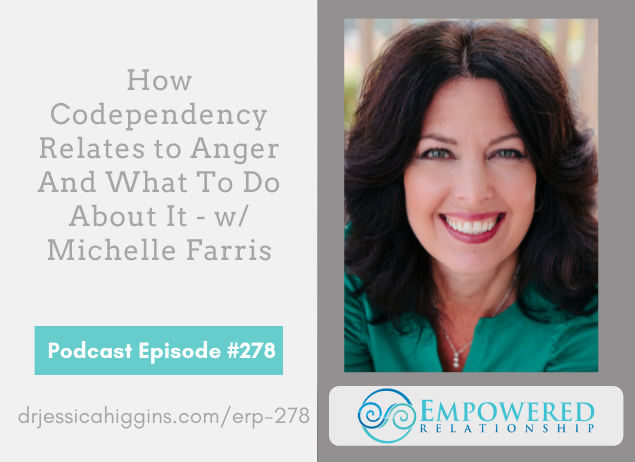
ERP 278: How Codependency Relates to Anger and What to Do About It - An Interview with Michelle Farris
It is common for codependent people to be people pleasers. While this strategy is effective at avoiding conflict, it also builds up anger and resentment that your partner may not even know about. Michelle Farris is a licensed psychotherapist, anger management specialist, and course creator. She discusses how letting go of codependence is not an easy task as the anger that so often accompanies codependence feels too familiar. Toxic codependence does not have to be a permanent reality. Michelle explains that therapy provides a safe space to work out the root cause of your pain and allows you to go through the complex process of recovery. Michelle's work helps codependent people trust themselves and create mutually satisfying relationships. She has been featured on Psych Central, Bustle, Your Tango, The Good Men Project, and The Daily Positive to name a few. Check out the transcript to this episode in Dr. Jessica Higgin's website. In this episode: 07:18 Codependency is a relationship pattern that focuses on others at the expense of yourself. It relies on external validation. Recovery helps people discover their personal identities. 08:58 Identifying the traits of codependence that are hurting you is the first step of recovery. It may take years to become ready to let go as there is a painful withdrawal process that must be undertaken. 15:50 Saying no takes practice. Start with the safest people who are okay with you saying no and start with the "baby nos." 18:26 Codependent people may not relate with the word anger, as it may be too scary, but can typically relate with resentment. 21:14 Voicing what hurt you is a liberating experience. It has the potential of changing the dynamics of your relationship because it creates awareness of what you're feeling, something which may not have been apparent before. 24:49 Codependents don't go to anger immediately. It is, in many ways, a secondary emotion that comes after hurt. But festering anger and feelings of being a victim begin with hurt not being handled in the first place. 29:04 When anger leads to rage it is critical to be mindful. It is probably not the best time to talk and you may need to take some time off and walk away before returning. 32:10 Anger at oneself is tricky territory. It's important to have a safe community, perhaps in therapy, where you are validated that you did the best you can given your circumstances and you can make a different choice when you are ready. 34:15 Recovery involves fixing your relationship with yourself, improving your relationship skills, and doing the childhood work. This is not linear and the issues with each aspect happen at the same time, making recovery a complex endeavor. 37:03 An addiction to relationship is additionally complex as having it is a biological necessity. However, what therapy does is lessen the dependence on other people. 42:17 Receiving a favor is a practice that not only helps you take care of yourself but also allows others to be present in your life. 44:46 How to get in touch with Michelle and learn more about Counseling Recovery Mentioned Counseling Recovery Website Counseling Recovery Checklist ERP 260: How to Break Free from Codependency in a Relationship – an Interview with Sherry Gaba Connect with Dr. Jessica Higgins Facebook: facebook.com/EmpoweredRelationship Instagram: instagram.com/drjessicahiggins Podcast: drjessicahiggins.com/podcasts/ Pinterest: pinterest.com/EmpowerRelation LinkedIn: linkedin.com/in/drjessicahiggins Twitter: @DrJessHiggins Website: drjessicahiggins.com Email: [email protected] If you have a topic you would like me to discuss, please contact me by clicking on the "Ask Dr. Jessica Higgins" button here. Thank you so much for your interest in improving your relationship. Also, I would so appreciate your honest rating and review. Please leave a review by clicking here. Thank you! *With Amazon Affiliate Links, I may earn a few cents from Amazon, if you purchase the book from this link.

ERP 277: How To Cultivate More 'Authentic Relating' In Relationship - An Interview with Sara Ness
Authentic relating refers to how you express your own authentic self, the way you seek the same from your partner, and the dynamic created in between. Sara Ness, an internationally acclaimed facilitator, teacher, and community-builder popularized the field of Authentic Relating through the use of authentic relating games. The values of authentic relating include awareness, empathy, honesty, and the importance of creating space. Not only does this help romantic relationships blossom into their most authentic forms, but it also helps multinational organizations like Google, Mindvalley, and Burning Man grow in authentic leadership and communication. Sara Ness wrote the source text for Authentic Relating and has worked with tens of thousands of students in more than 100 communities on every continent except Antarctica. Check out the transcript to this episode in Dr. Jessica Higgin's website. In this episode: 04:12 Authentic relating involves 3 perspectives: ourselves (authenticity), the other person and how we relate, and the space in between. There is a constant feeling out of how much of our authentic truth we bring and seek, and the synergy between. 08:39 Authentic relating games like Withholds and Appreciations allow you to look at your relationship instead of simply being in it. These exercises reveal, through honest communication, relationship patterns that may act as barriers in relationship. 13:11 The Noticing game puts to words the feelings, sensations, and lines of thoughts you have with your partner. It reveals the idea of presence in connection with someone else. 18:04 Authenticity has layers and is congruent to the values we are committed to. Your values will dictate the level and kind of authenticity you respond from. 22:00 Authentic relating exercises are also effective within multinational companies like Google, as well as the addiction recovery space and diversity discussions. 25:08 It is even possible to use authentic relating games to actually meet your romantic partner because it teaches how to set boundaries, make requests, and discover your values within a relationship. 30:54 Knowing what helps you recover from a trigger before it even happens is one of the most powerful things you can do in relationship. 33:36 Making a request is about changing behavior. This must be navigated caringly as different people and social cultures may have different ways of communication. Space must be created for these behaviors to change. 39:40 The act of making request is complex and involves vulnerability. Sometimes there is a need to go through conflict to figure out what your request truly is. 43:37 How to get in touch with Sara and learn more about Authentic Relating Mentioned ERP 215: How to Deal with Being "Alone Together" ERP 216: What to Know about Loneliness and Relationship ERP 273: How to Handle The Concern Of Vulnerability Not Working In Relationship The Authentic Revolution website The Authentic Revolution Instagram page Connect with Dr. Jessica Higgins Facebook: facebook.com/EmpoweredRelationship Instagram: instagram.com/drjessicahiggins Podcast: drjessicahiggins.com/podcasts/ Pinterest: pinterest.com/EmpowerRelation LinkedIn: linkedin.com/in/drjessicahiggins Twitter: @DrJessHiggins Website: drjessicahiggins.com Email: [email protected] If you have a topic you would like me to discuss, please contact me by clicking on the "Ask Dr. Jessica Higgins" button here. Thank you so much for your interest in improving your relationship. Also, I would so appreciate your honest rating and review. Please leave a review by clicking here. Thank you! *With Amazon Affiliate Links, I may earn a few cents from Amazon, if you purchase the book from this link.

ERP 276: Understanding The Need For Both Self-Regulation And Co-Regulation In Relationship - An interview With Deb Dana
Self and co-regulation is an essential human need that couples need to understand to know that their relationship is somewhere they can feel safe and come home to. Deb Dana, LCSW, clinician and consultant specializing in Polyvagal theory, joins the podcast to discuss what regulation is, its role in the nervous system, and how couples can apply it to their relationships. Deb trains therapists worldwide on the Polyvagal approach. She is co-founder of The Polyvagal Institute and author of The Polyvagal Theory in Therapy: Engaging the Rhythm of Regulation and Polyvagal Exercises for Safety and Connection: 50 Client-Centered Practices. Deb is also the co-editor with Stephen Porges of Clinical Application of the Polyvagal Theory: The Emergence of Polyvagal Informed Therapies and developer of the Rythm of Regulation clinical training series among many other pioneering works into this space. Check out the transcript to this episode in Dr. Jessica Higgin's website. In this episode: 06:21 Co-regulation is the first organizing principle of polyvagal theory. It is a biological need to survive and to experience well-being. For people living with trauma, this did not happen in a safe environment and led to self-regulation instead. 08:40 Neuroception is the second organizing principle. It refers to the nervous system's way of getting information. The nervous system is constantly listening to three pathways: inside the body, the environment, and other nervous systems. 09:57 Hierarchy is the third organizing principle. There are three states that we visit all the time: ventral (safety and connection), sympathetic (fight and flight), and dorsal (disconnect and shutdown). 13:25 Co-dysregulation in relationship is common and when this happens the prefrontal cortex doesn't work the way it should. For couple therapy to be effective, one system must be anchored in ventral. 17:52 Protective strategies keep partners sympathetically charged. Since biology keeps nervous systems in this state, timing is important so that connection happens. Reaching by one partner while the other is in this state will result in pushback. 27:28 Tips for couples in dysregulated phases and using language other nervous systems can understand. 35:01 Asking who, what, where, when is an exercise to anchor to ventral and feel safe. 43:07 Contact Deb and learn more about the Polyvagal approach. Mentioned The Polyvagal Institute Website Rhythm of Regulation Website The Polyvagal Theory in Therapy: Engaging the Rhythm of Regulation (*Amazon book link) Polyvagal Exercises for Safety and Connection: 50 Client-Centered Practices (*Amazon book link) Polyvagal Flip Chart: Understanding the Science of Safety (*Amazon book link) Clinical Application of the Polyvagal Theory: The Emergence of Polyvagal Informed Therapies (*Amazon book link) Befriending Your Nervous System: Looking Through the Lens of Polyvagal Theory (*Amazon audiobook link) Anchored: How to Befriend Your Nervous System Using Polyvagal Theory (*Amazon book link) Connect with Dr. Jessica Higgins Facebook: facebook.com/EmpoweredRelationship Instagram: instagram.com/drjessicahiggins Podcast: drjessicahiggins.com/podcasts/ Pinterest: pinterest.com/EmpowerRelation LinkedIn: linkedin.com/in/drjessicahiggins Twitter: @DrJessHiggins Website: drjessicahiggins.com Email: [email protected] If you have a topic you would like me to discuss, please contact me by clicking on the "Ask Dr. Jessica Higgins" button here. Thank you so much for your interest in improving your relationship. Also, I would so appreciate your honest rating and review. Please leave a review by clicking here. Thank you! *With Amazon Affiliate Links, I may earn a few cents from Amazon, if you purchase the book from this link.

ERP 275: How To Build A Healthy Relationship When In Recovery - An interview With Chantal Jauvin
Substance abuse disorder wreaks havoc on a relationship with trust being one of the first to erode. Chantal Jauvin, an attorney and book author, joins the podcast to talk on the ASCENT approach which couples in recovery can practice to make their recovery journey successful and reignite the love that may have been lost due to addiction. Chantal, for all her expertise which made her General Counsel of a Fortune 500 company, did not know how to save her husband from the grips of addiction or building a relationship while in recovery. It took years of soul work and interactions with other couples to produce her second book, Love Without Martinis, to share the lessons she learned along the way. Check out the transcript to this episode in Dr. Jessica Higgin's website. In this episode: 03:59 Chantal learns about substance use disorder and collects couples' stories to share to others as a learning tool. 06:12 Recovery covers three aspects: The one suffering, the one who loves them, and the relationship itself. 13:50 Couples can recover successfully from substance abuse with the ASCENT approach. 18:09 A: Assess readiness to change. Shift focus from what cannot be done to what can be done. The Stoplight Method makes it smoother to move areas that are red to yellow and eventually green. 28:07 S: Structure your time. This creates accountability, a key aspect in building trust, and conveys what matters to you and what you truly value. 31:33 C: Create your community. Addiction creates trauma and emotional baggage, so meeting new people, it provides a fresh start without the guilt associated with past behaviors. It also teaches you on how to set healthy boundaries. 34:43 E: Engage in your life. To feel the joy of living, to get fired up, you need to assume responsibility for your own life. Engaging in what makes you happy helps your own individual growth, as well as the growth of the couple itself. 38:47 N: Nurture your spirituality. This allows each partner to pause and become self-aware to break the chain reaction of action and reaction which is so prevalent in substance abuse disorder. 41:24 T: Treasure your partnership. A touch, smile, or compliment says, "I see you" and creates meaning. Mentioned Chantal's website Chantal's Facebook Chantal's Instagram Chantal's LinkedIn Love Without Martinis Amazon page (*Amazon Link) Connect with Dr. Jessica Higgins Facebook: facebook.com/EmpoweredRelationship Instagram: instagram.com/drjessicahiggins Podcast: drjessicahiggins.com/podcasts/ Pinterest: pinterest.com/EmpowerRelation LinkedIn: linkedin.com/in/drjessicahiggins Twitter: @DrJessHiggins Website: drjessicahiggins.com Email: [email protected] If you have a topic you would like me to discuss, please contact me by clicking on the "Ask Dr. Jessica Higgins" button here. Thank you so much for your interest in improving your relationship. Also, I would so appreciate your honest rating and review. Please leave a review by clicking here. Thank you! *With Amazon Affiliate Links, I may earn a few cents from Amazon, if you purchase the book from this link.

ERP 274: How Increasing Relationship Love & Health Can Impact Borderline Personality Disorder – An Interview With Gabrielle Usatynski
Borderline personality disorders make things appear as black and white with no integration between the two. It manifests as rejecting the love and support from a partner, the very thing that a person with this disorder actually needs in the first place. Gabrielle Usatynski, a licensed professional counselor and relationship expert, explains that borderline personality disorders cause radical misperceptions which cause confusion in relationship. Displaying compassion plays a central role in healing the very source of the trauma to result in more loving and fulfilling relationships. Gabrielle is the host of the new TV show "Iconic Couples of History" and the Founder of the Power Couples Institute. She has been featured in Cosmopolitan, Counseling Today, and Women's Health. She has an upcoming book entitled "The Power Couple Formula" due for release later this year. Check out the transcript to this episode in Dr. Jessica Higgin's website. In this episode: 06:51 Personality disorders impair the way we look at our identity and the identity of others. This has a significant impact on displays of empathy and intimacy in relationship. 13:15 "Splitting" in personality disorders means a person cannot integrate opposing thoughts and only sees things as one or another. There is a lack of integration between the two, something which normally develops very early in life. 18:57 There is a nurture aspect to borderline personality disorders which is attributed to trauma, abuse, and/or neglect. Any sabotage to a growing person's self-activation will manifest in relationships well into adulthood. 26:46 Borderline personality disorder affects the socio-emotional capacity to separate raw emotions and physiological experiences. It is a lack of neural integration that results in poor reality testing. 35:08 Clinicians can easily misdiagnose borderline personality disorders. There is a need for partners to display love and compassion to address the root trauma that is causing so much disconnect in relationship. 41:01 Borderline personalities sabotage the very thing they need the most, which is the love and security they receive from their partners. 44:53 How to care for a partner with borderline personality disorder. 51:34 Having a third party observe the dynamics of a relationship and attempt to fix the system can create profound changes in the individuals. 53:42 Couples with a shared mission, an organized principle between them, give a reason to hold in the relationship through the good and bad times. 56:35 Get in touch with Gabrielle. Mentioned Power Couples Education website The Power Couple Formula book website Power Couples Counseling Power Couples Education YouTube Channel ERP: 180: What If I Think My Partner Has a Personality Disorder? An Interview with Gabrielle Usatynski Connect with Dr. Jessica Higgins Facebook: facebook.com/EmpoweredRelationship Instagram: instagram.com/drjessicahiggins Podcast: drjessicahiggins.com/podcasts/ Pinterest: pinterest.com/EmpowerRelation LinkedIn: linkedin.com/in/drjessicahiggins Twitter: @DrJessHiggins Website: drjessicahiggins.com Email: [email protected] If you have a topic you would like me to discuss, please contact me by clicking on the "Ask Dr. Jessica Higgins" button here. Thank you so much for your interest in improving your relationship. Also, I would so appreciate your honest rating and review. Please leave a review by clicking here. Thank you!

ERP 273: How To Handle The Concern Of Vulnerability Not Working In Relationship
Vulnerability is a key aspect in connecting with your partner. It makes you feel seen and provides a sense of belonging. However, the longing to feel known and the fear of letting down our guard are two competing human needs that must be understood with compassion. In many cases, our own protective strategies helped us survive trauma and pain in the past. However, many years later, these same strategies prevent us from becoming seen, validated, and known. Today's episode discusses some of the most common protective strategies and what you can do to turn it around and increase intimacy in relationship. Check out the transcript to this episode in Dr. Jessica Higgin's website. In this episode: 05:25 Vulnerability cultivates connection. Disconnect happens when there is a block between the call of one partner and the response of the other. 10:02 Being vulnerable is difficult. The desire for intimacy is there but an inner conflict based on fear holds us back from allowing ourselves to be vulnerable. 14:42 Having a safe container for vulnerability is paramount. This is rooted in biology via the polyvagal system which requires us to have reciprocal and safe interactions with our closest connections. 18:42 The most successful couples respond to each other's "bids" or calls and responses. This allows couples to feel validated and seen. 22:14 Unsuccessful attempts at vulnerability are caused by "blocks" or personal protective strategies. It has been proven that humans choose safety and familiarity over intimacy and vulnerability during critical moments. 29:15 The desire to be known and to protect against hurt are two competing human needs. Being in a threatened state makes it impossible to access vulnerability and have constructive conversations. 31:13 Examples of protective tendencies that get in the way vulnerability include people-pleasing, intellectualizing/explaining/defending, numbing out, getting angry/reacting, hiding, being resistant, denial, being stressed/tired, and independent stance. 38:02 Tips to cultivate vulnerability and increase intimacy in your relationship. Mentioned ERP 233: How to Deal with Fears of Intimacy – Part One ERP 234: How to Deal with Fears of Intimacy – Part Two ERP 247: How to Turn Towards Your Partner to Strengthen Your Love ERP 261: How to Strengthen Your Relationship from a Polyvagal Perspective – an Interview with Dr. Stephen Porges ERP 220: How to Reconnect Emotionally with your Significant Other Connect with Dr. Jessica Higgins Facebook: facebook.com/EmpoweredRelationship Instagram: instagram.com/drjessicahiggins Podcast: drjessicahiggins.com/podcasts/ Pinterest: pinterest.com/EmpowerRelation LinkedIn: linkedin.com/in/drjessicahiggins Twitter: @DrJessHiggins Website: drjessicahiggins.com Email: [email protected] If you have a topic you would like me to discuss, please contact me by clicking on the "Ask Dr. Jessica Higgins" button here. Thank you so much for your interest in improving your relationship. Also, I would so appreciate your honest rating and review. Please leave a review by clicking here. Thank you!

ERP 272: How to Keep Your Relationship Healthy During a High Demand Time (like having a newborn baby) - An Interview with Catherine O'Brien
New parents cannot truly prepare for the profound changes a baby brings. Catherine O'Brien, Licensed Marriage, Family Therapist, and founder of HappyWithBaby.com shares tips to keep your relationship strong despite the very real challenges of raising kids. One of the most common changes new parents experience is the disconnect that brews between them due to the demands of the baby. The secret to overcoming this and even strengthening your relationship is by honestly communicating what your needs are and validating each other when parenting is done right. Check out the transcript to this episode in Dr. Jessica Higgin's website. In this episode: 05:31 Introduction to Catherine O'Brien 06:25 Prenatal classes to prepare for your first child are important but having a baby brings unforeseen consequences, such as creating a disconnect with your partner. 11:18 Each parent feels like they are doing all the work. Postpartum communication is critical to share the load and make sure you and your partner know what tasks need to be done and by whom. 14:29 Communication also strengthens your connection with your partner. This connection can fade given the enormous number of tasks needed to raise a child. 19:00 Take stock of your own needs first then see how you can be there for your partner next. This way, you can both bond with your baby in a meaningful way. 22:49 It's normal to not enjoy every moment of being a parent. Acknowledging and validating each other is important to keep your love alive and foster positive growth as parents. 25:14 Having a united front and handling unwanted parenting advice. 31:47 Catherine's baby-friendly tips for self-care and reigniting your relationship. 39:46 How to get in touch with Catherine and her Facebook group. Mentioned Catherine's website Happy with Baby Community Facebook Group Happy with Baby Facebook Page Happy with Baby Instagram Page Happy with Baby Twitter Page Connect with Dr. Jessica Higgins Facebook: facebook.com/EmpoweredRelationship Instagram: instagram.com/drjessicahiggins Podcast: drjessicahiggins.com/podcasts/ Pinterest: pinterest.com/EmpowerRelation LinkedIn: linkedin.com/in/drjessicahiggins Twitter: @DrJessHiggins Website: drjessicahiggins.com Email: [email protected] If you have a topic you would like me to discuss, please contact me by clicking on the "Ask Dr. Jessica Higgins" button here. Thank you so much for your interest in improving your relationship. Also, I would so appreciate your honest rating and review. Please leave a review by clicking here. Thank you!
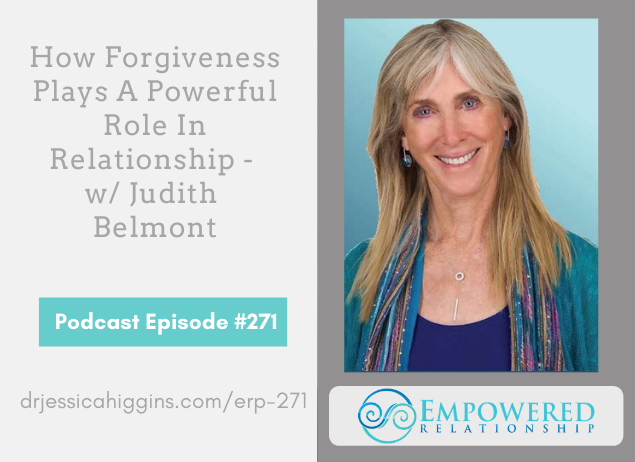
ERP 271: How Forgiveness Plays A Powerful Role In Relationship - An Interview With Judith Belmont
Holding on to the past may seem like gaining power over things that cannot be changed, but the opposite is true. Judith Belmont, motivational speaker, author, and psychotherapist for 40 years, advises that forgiving makes you and your relationship happier and more loving. Forgiveness is essential to become free of the pains of the past. The hurt may never leave, but it can be managed positively so that you no longer have to bring it into your relationship and instead focus on the here and now. Judith is the author of 9 mental health and wellness books and therapeutic card decks, including Embrace Your Greatness and The Anxiety and Stress Solution Deck. Her books cover self-help, personal development, and tips and tools for therapists working with clients. Check out the transcript to this episode in Dr. Jessica Higgin's website. In this episode: 04:17 Introduction to Judith Belmont 06:43 Forgiving does not condone an action that was taken. What it does is allow you to move on from your past and prevent another person from gaining power over you. 10:28 Reliving the hurt of the past means that you will never be free of it. This is the opposite of mindfulness which is defined as non-judgmental awareness. 15:41 People don't want to be wronged. Forgiveness may seem counterproductive to this sense of righteousness, but it allows you to overcome a former way of thinking that is no longer relevant to you and your life today. 17:02 In relationship, living your partner's narrative of you makes you at the mercy of someone else and distorts your self-esteem. 20:07 The hardest thing for most people is forgiving themselves as people are notoriously less forgiving of themselves than others. 23:31 Forgiveness is a gift you give to yourself. Forgiveness is giving up your righteousness that you were wronged or you wronged yourself, accepting what happened and growing from it. 28:58 Reclaim your power over your feelings. It is YOU who allowed yourself to feel something with someone else's actions. Be a victor instead of being a victim. 33:15 Feeling hurt is necessary to let you know that something wrong happened. In fact, some situations will deepen you because of the hurt. You can manage hurt instead of carrying it. 37:29 Judith's tips and strategies for forgiving others and yourself 40:11 Information on Judith's books, therapeutic cards, and website Mentioned Judith's website What is Your Forgiveness IQ? by Judith Belmont Judith's Amazon author page ERP 026: How to Repair & Resolve Hurt in Relationship ERP 123: Forgive For Love with Dr. Fred Luskin ERP 153: How to Repair a Breach of Trust in Relationship ERP 158: How to Resolve Resentment in Your Relationship Shifting Criticism for Connected Communication by Dr. Jessica Higgins Connect with Dr. Jessica Higgins Facebook: facebook.com/EmpoweredRelationship Instagram: instagram.com/drjessicahiggins Podcast: drjessicahiggins.com/podcasts/ Pinterest: pinterest.com/EmpowerRelation LinkedIn: linkedin.com/in/drjessicahiggins Twitter: @DrJessHiggins Website: drjessicahiggins.com Email: [email protected] If you have a topic you would like me to discuss, please contact me by clicking on the "Ask Dr. Jessica Higgins" button here. Thank you so much for your interest in improving your relationship. Also, I would so appreciate your honest rating and review. Please leave a review by clicking here. Thank you!

ERP 270: How To Resolve Relational Trauma in The Body Through Dance & Movement - An Interview with Orit Krug
People who live with relational trauma develop hypersensitive nervous systems as a survival instinct. Orit Krug, an award-winning Board-Certified Dance and Movement Therapist, explains that this results in a disconnect between what the mind wants and the body feels, hindering us from experiencing true intimacy in loving relationships. Certain movements represent certain behaviors and desired ones can be triggered through dance and movement. As trauma is also expressed in physical posturing and habits, dance therapy can rewire new patterns of behavior through body movement and desire for a healthy and loving space. Orit has over a decade of experience helping women heal from past trauma and enjoy healthy lifelong relationships with their partners. Orit founded the "Mind Your Body" podcast and has been featured in Elephant Journal, ThriveGlobal, Authority Magazine, as well as quoted in SELF & INSIDER. Check out the transcript to this episode in Dr. Jessica Higgin's website. In this episode: 01:52 Relationships are mirrors that reveal wounded aspects of ourselves. Addressing these ignored areas allows us to become better equipped in navigating long-term relational intimacy. 04:10 Introduction to Orit Krug: Her history of trauma and expertise in dance and movement therapy. 09:13 Trauma gets trapped in the nervous system and causes us to become hyper vigilant. Survival responses are designed to keep us safe and cannot be changed by simply adopting mindsets. 13:40 People living with trauma attract negative relationships that sabotage intimacy and pleasure because of its familiarity. 16:32 Recognize avoidant and numbing behavior patterns in intimate relationships that cause disconnects between mind and body. Getting triggered by these automatic reactions clouds our access to our higher brains and prevents sexual intimacy. 21:39 As memories of trauma are stored in our bodies as different sensations, dance and movement therapy provide a safe space to tune in again. This therapy also helps expand our window of tolerance for being vulnerable in a relationship. 29:44 Different movements represent different behaviors. How we hold our body is a habitual and physiological manifestation that prevents us from becoming the best versions of ourselves. 35:36 How dance therapy works: Revealing behavioral patterns in your relationship and feeling a space between your instinctive reactions and actual responses to heal from years of trauma 46:06 Information on Orit's free programs and Facebook group Mentioned The Wired for Love Website The Lasting Love Movement Group Orit Krug's Let Love In Program Connect with Dr. Jessica Higgins Facebook: facebook.com/EmpoweredRelationship Instagram: instagram.com/drjessicahiggins Podcast: drjessicahiggins.com/podcasts/ Pinterest: pinterest.com/EmpowerRelation LinkedIn: linkedin.com/in/drjessicahiggins Twitter: @DrJessHiggins Website: drjessicahiggins.com Email: [email protected] If you have a topic you would like me to discuss, please contact me by clicking on the "Ask Dr. Jessica Higgins" button here. Thank you so much for your interest in improving your relationship. Also, I would so appreciate your honest rating and review. Please leave a review by clicking here. Thank you!

ERP 269: How To Break Free From The Nice Guy Syndrome That Is Holding You Back - An Interview With Dr. Robert Glover
The Nice Guy Syndrome has become the norm for so many men. Dr. Robert Glover, author of the book "No More Mr. Nice Guy," comes on today's show to tell us how to unlearn this passive-aggressive persona, overcome sexual shame, and enjoy healthier relationships. Dr. Robert Glover shares his own history of living as a Nice Guy and the breaking points that told him enough is enough. He has spent over 30 years helping men and women get the love, sex, and life they want. His groundbreaking books, classes, podcasts, and seminars have helped form the foundation for a growing world-wide men's movement. Check out the transcript to this episode in Dr. Jessica Higgin's website. In this episode: 02:42 Dr. Jessica Higgins revisits the Empowered Relationship Podcast intention to achieve long-lasting intimacy. 07:00 Introduction to Dr. Robert Glover and the "Nice Guy Syndrome." 10:20 Unpacking "Covert Contracts" and the paradigm of the Nice Guy 14:49 The Nice Guy Syndrome: Anxiety, shame, passive-aggressive behavior. Dr. Glover explains that this begins as an infant's precognitive response to pain that gets carried into adulthood. 23:23 No More Mr. Nice Guy teaches that there is a better alternative to the "default" roadmap of Nice Guys: Fear of confrontation, agreeing too much, and the inability to take a clear stand. 32:15 Nice Guys mindsets on expectations and attraction, including passive-aggressive behavior, are fundamentally flawed. 37:09 Pushing down wants and needs leads to problems with intimacy, living fantasy worlds, and porn. Too often, Nice Guys assume that they have to conceal their interest in a girl due to their sexual shame. 43:17 Tips and strategies: Dr. Glover gives practical advice so Nice Guys can take control and be honest with themselves. 52:41 How to contact Dr. Robert Glover Mentioned [email protected] Dr. Robert Glover's Website No More Mr Nice Guy Homepage Dating Essentials For Men Get your own copy of at No More Mr. Nice Guy at Amazon Connect with Dr. Jessica Higgins Facebook: facebook.com/EmpoweredRelationship Instagram: instagram.com/drjessicahiggins Podcast: drjessicahiggins.com/podcasts/ Pinterest: pinterest.com/EmpowerRelation LinkedIn: linkedin.com/in/drjessicahiggins Twitter: @DrJessHiggins Website: drjessicahiggins.com Email: [email protected] If you have a topic you would like me to discuss, please contact me by clicking on the "Ask Dr. Jessica Higgins" button here. Thank you so much for your interest in improving your relationship. Also, I would so appreciate your honest rating and review. Please leave a review by clicking here. Thank you!
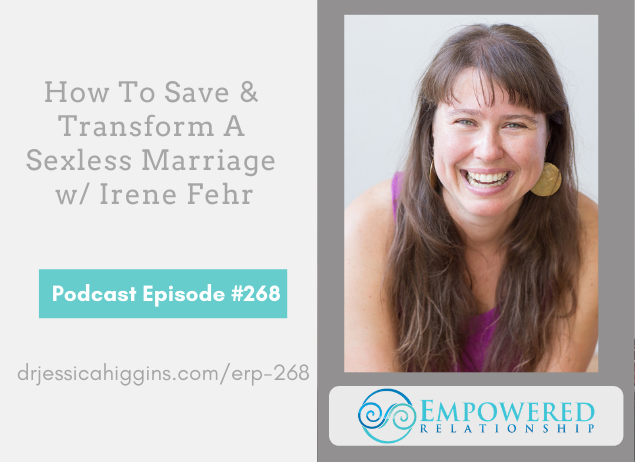
Ep 267ERP 268: How To Save & Transform A Sexless Marriage - An Interview With Irene Fehr
In today's episode, I talk with Irene Fehr. We discuss how to be better prepared to navigate long-lasting intimacy and deal with the extensive range of emotions that come with long-term relationships. We also talk about what emotions may be activated and how we can learn new perspectives on our relationship by becoming more curious and explorative. Ending up in a sexless marriage when she lost her libido, Irene felt shame around not sexually wanting her partner. She shut down and withdrew from life because she thought there was something wrong with her as a woman. From this point, Irene wanted to help other couples rediscover the magic of sex in all different stages to have a fulfilled intimate sexual experience, no matter how long a couple is together. Listen in to learn why looking outside of your relationship to fix a sexless marriage won't work, how couples can create connection sex, and how Irene helps couples navigate and access needs and sexual desires. (Please listen to the podcast episode or read the transcript to hear explanations, stories, and examples.) Bio As a Sex and Intimacy Coach, Irene Fehr, MA, CPCC, has helped hundreds of committed couples to add sex and passion into sexless relationships and fall in love with each other again. She is no stranger to her clients' complaints, having recovered from the all-too-common story of "happy marriage turned sexless" when she lost her libido. You can read Irene's perspectives on sex, sexual desire in a long-term relationship, and women's libido in HuffPost, Cosmopolitan, Refinery29, and ScaryMommy. In this episode, Irene Fehr & Dr. Jessica Higgins discuss: Why friction sex has a shelf life and limits The three types of sex during stages of relationships How sex can get repetitive for couples Why women can lose their libido How stress can reduce your sex hormones Why friction sex is fueled by drugs and alcohol Where attachment is a factor in sex and relationships How sex can turn into a battleground for validation The three sex myths people fall into How couples can allow for quality time together and more touch The importance of making enough quality time together Messaging around the arousal journey Why you need to create space around your body as a woman Mentioned Visit Irene Fehr on the web Free 3-video training "How to Want Sex Again" Three types of sex as background Connect with Dr. Jessica Higgins Facebook: facebook.com/EmpoweredRelationship Instagram: instagram.com/drjessicahiggins Podcast: drjessicahiggins.com/podcasts/ Pinterest: pinterest.com/EmpowerRelation LinkedIn: linkedin.com/in/drjessicahiggins Twitter: @DrJessHiggins Website: drjessicahiggins.com Email: [email protected] If you have a topic you would like me to discuss, please contact me by clicking on the "Ask Dr. Jessica Higgins" button here. Thank you so much for your interest in improving your relationship. Also, I would so appreciate your honest rating and review. Please leave a review by clicking here. Thank you!
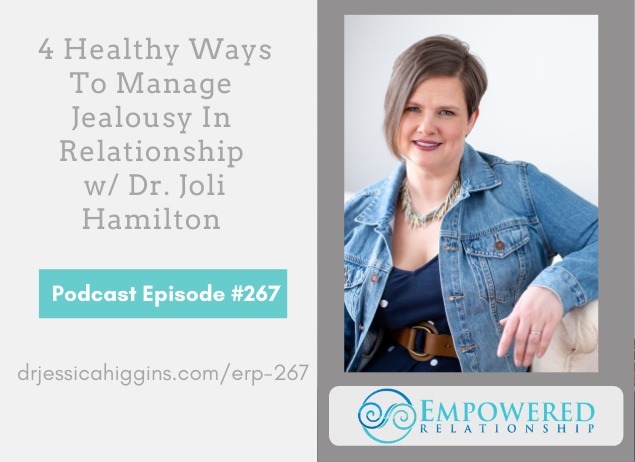
Ep 267ERP 267: 4 Healthy Ways To Manage Jealousy In Relationship - An interview With Dr. Joli Hamilton
In today's episode, Dr. Joli Hamilton speaks about jealousy, defining what jealousy is and approaching jealousy in a relationship. Jealousy isn't a simple emotion and is made in tangled layers of gross emotions we don't like to feel, such as sadness, anger, grief, arousal, and fear. Jealousy reminds us that we love, lust, and desire someone that has this strange tone. Envy plays along with jealousy as we are wishing we had something someone else has. Insecurity plays a role as it's a root cause of intense jealousy and reduces our resilience in relationships. Listen in to learn how to separate the feelings of insecurity from jealousy, what can be perceived as a threat in a relationship, and why we wish we could be protected from jealousy. (Please listen to the podcast episode or read the transcript to hear explanations, stories, and examples.) Bio Dr. Joli Hamilton is a research psychologist, best-selling author, TEDx speaker, and AASECT certified sex educator. She has spent the past two decades balancing a wild entrepreneurial spirit with a deep desire to have a secure, passionate partnership along with raising 7 kids along the way! Joli is committed to helping women create sustainable, soul-nourishing relationships without sacrificing their career dreams. In this episode, Dr. Hamilton & Dr. Jessica Higgins discuss: The definition of jealousy as it applies to relationships Why imagining our relationship being interrupted by another can provoke jealousy How insecurity plays into jealousy in a relationship Why envy results from insecurity Work we can do to improve our own self-esteem Types of threats people can perceive with jealousy The importance of why we need to feel like we have something to give in a relationship Variables that can affect jealousy in a relationship Why having mutual understanding is so important How childhood trauma affects jealousy Techniques for managing jealousy Why monogamy doesn't protect you from feelings of jealousy Grief plays a significant role in jealousy Four ways to deal with jealousy Mentioned Dr. Joli Hamilton on the web Polysecure the book Connect with Dr. Jessica Higgins Facebook: facebook.com/EmpoweredRelationship Instagram: instagram.com/drjessicahiggins Podcast:https://www.marisatcohen.com/book.html Pinterest: pinterest.com/EmpowerRelation LinkedIn: linkedin.com/in/drjessicahiggins Twitter: @DrJessHiggins Website: drjessicahiggins.com Email: [email protected] If you have a topic you would like me to discuss, please contact me by clicking on the "Ask Dr. Jessica Higgins" button here. Thank you so much for your interest in improving your relationship. Also, I would so appreciate your honest rating and review. Please leave a review by clicking here. Thank you!

Ep 266ERP 266: How To Access More Vulnerability & Curiosity During Difficult Conversations - An Interview With Shana James
In today's episode, Shana James and I talk about being more vulnerable and showing more transparency about our experience, intentions, and hopes and how this can help promote more intimacy in relationships. When relating to others, on one end of the spectrum we can be people-pleasing and shame collapsing. On the opposite side, we can be controlling and dominant. Neither option leads to a fulfilling relationship. Whereas in the middle, we have a sense of assertiveness, strength, and having an open heart with transparency and vulnerability. Having a healthy balance and a dynamic exchange between two people centered around support is the most advantageous for building relationships. Having a conversation based on "compassionate curiosity" without jumping to assumptions or conclusions can lead to great learning and understanding. The more you take leadership in the conversation, the more you can be available to feel your partner's fears. Listen in to learn how to create a safe space for both partners, how to turn your emotional walls into doorways for conversation, and how to collaborate together for heightened sex and intimacy. (Please listen to the podcast episode or read the transcript to hear explanations, stories, and examples.) Bio For 15 years Shana James coached more than a thousand leaders, CEOs, authors and people with big visions to find love, step into more powerful leadership, start and grow businesses, create a legacy, and become more personally inspired and fulfilled. Shana cuts through distraction and provides direct access to confidence, power and clarity. She is also a translator between women and men, providing effective tools to transform conversations and dynamics that have gone awry into connection. In this episode, Shana & Dr. Jessica Higgins discuss: Humanity, trust and feeling safe inside relationships and at work How to show up for yourself in your relationship Why you don't need to flip to the complete opposite side of an archetype Getting into a locked dynamic when one person in a partnership isn't being vulnerable What challenging each other through love can look like How to motivate or encourage people who are afraid to be vulnerable Why practicing conversation with someone is important The importance of feeling seen and heard for females in a relationship Mentioned Shana James Coaching on the web What 1000's Men's Tears Reveal Ted Talk by Shana James Connect with Dr. Jessica Higgins Facebook: facebook.com/EmpoweredRelationship Instagram: instagram.com/drjessicahiggins Podcast:https://www.marisatcohen.com/book.html Pinterest: pinterest.com/EmpowerRelation LinkedIn: linkedin.com/in/drjessicahiggins Twitter: @DrJessHiggins Website: drjessicahiggins.com Email: [email protected] If you have a topic you would like me to discuss, please contact me by clicking on the "Ask Dr. Jessica Higgins" button here. Thank you so much for your interest in improving your relationship. Also, I would so appreciate your honest rating and review. Please leave a review by clicking here. Thank you!

Ep 265ERP 265: How to Break Through Relationship Fears with Your SO - an Interview with Georgia Morley and Silver Storic
In today's episode, Georgia, Silver, and I chat about how to take a different perspective with your partner, how to know each other more deeply and have the ability to cultivate intimacy in relationship. Prior to meeting, Georgia hadn't thrived in relationships and Silver had essentially written them off completely. When Silver and Georgia entered into relationship, they decided to start to open up to each other as never before. They recorded every conversation and used their talking points to create their first book together. We often aren't taught intimacy in our life. It can be helpful to reflect on which patterns are healthy and which are not. Then, you can practice shifting out of the unhealthy patterns, so that you can give yourself room to grow in relationship. Listen in to learn how to hold space for each other in a relationship; self-development works as it applies to building your relationship with others and peering into a new relationship or aspect of your life. (Please listen to the podcast episode or read the transcript to hear explanations, stories, and examples.) Bio Georgia Morley is an Emotional Resilience Coach,CBT, relationship mentor with over 10 years experience working with women around addiction, physical and emotional body health, developmental trauma and sexual reclamation after abuse. Silver Storic is an Author and Mentor boldly showing up as a Global Connection Ambassador, leading workshops and keynotes on Radical Truth and recovery from codependency. Silver co-authored the Amazon bestseller Better Business, Better Life, Better World - The Movement. Together, Georgia & Silver share their life's work of freedom from codependent themes and painful relationship patterns that oppress relationships and keep couples from experiencing true intimacy in partnership. In this episode, Georgia, Silver, & Dr. Jessica Higgins discuss: How to live a life of fulfillment and love The types of confines we put on our relationships How Georgia and Silver co-created their ideal relationship together The three elements of relationship Why wounds and trauma show up in our adult relationship Changing the somatic and cognitive experiences of your life Losing perspective of yourself and your relationship Acknowledging toxic aspects and relationships as unhealthy patterns How to have love leadership in your relationship Creating healthy practices for yourself and your relationship Living inside the feeling of discomfort Mentioned Love, Life and Legacy Follow on Instagram Check out their Facebook Group Connect with Dr. Jessica Higgins Facebook: facebook.com/EmpoweredRelationship Instagram: instagram.com/drjessicahiggins Podcast:https://www.marisatcohen.com/book.html Pinterest: pinterest.com/EmpowerRelation LinkedIn: linkedin.com/in/drjessicahiggins Twitter: @DrJessHiggins Website: drjessicahiggins.com Email: [email protected] If you have a topic you would like me to discuss, please contact me by clicking on the "Ask Dr. Jessica Higgins" button here. Thank you so much for your interest in improving your relationship. Also, I would so appreciate your honest rating and review. Please leave a review by clicking here. Thank you!

Ep 264ERP 264: How To Increase Your Emotional Intelligence In Relationship - An Interview with Robin Hills
In today's episode, Robin Hills and I chat about emotional intelligence and how your EI can improve your relationship. Robin talks about his life-long journey in developing EI skills for himself and what emotional intelligence looks like in action. As emotional beings, we can't manage our "emotional platter" all the time. There are times when we aren't feeling well, and we won't be at our EI best. In addition, we can find times to give others space when they need an emotional break. Self-awareness plays a significant role in emotional intelligence. Those with high self-awareness tend to be the people with good EI, and those with low self-awareness tend to have low EI. Working on self-awareness is a skill that can be used to reflect on how your preferences and behaviors are manifesting themselves. Listen in to learn why empathy is a significant part of acquiring EI, why it's OK for men to express emotions, and how EI starts when you are a baby. (Please listen to the podcast episode or read the transcript to hear explanations, stories, and examples.) Bio Robin is the director of Ei4Change, a company specialized in emotional intelligence, positive psychology and neuroscience. He has taught more than 100,000 students how to build resilience, increased self-awareness and understanding of others. His programs are today used in educational establishments in South Africa and India. He is the author of two books and has developed the experiential coaching methodology: Images of Resilience, and sits on the North West Committee of the Association of Business Psychology. In this episode, Robin Hill & Dr. Jessica Higgins discuss: Variables that can affect your emotional intelligence How emotional intelligence is managing your emotions and understanding others emotions through understanding and empathy Why reflecting on self-awareness is a key element in moving toward EI balance The role empathy plays in emotional intelligence and relationships The importance of recognizing when others have a lower EI Toxic relationships and how that plays in emotional intelligence How Myers-Briggs and other tools can give you valuable personality information The way we process information is a big part of understanding how to communicate with another Tips for building emotional intelligence Mentioned Visit Robin on the web Episode 199 How to Use Your Emotional Intelligence for Connection Part I Episode 200 How to Use Your Emotional Intelligence for Connection Part II Connect with Dr. Jessica Higgins Facebook: facebook.com/EmpoweredRelationship Instagram: instagram.com/drjessicahiggins Podcast:https://www.marisatcohen.com/book.html Pinterest: pinterest.com/EmpowerRelation LinkedIn: linkedin.com/in/drjessicahiggins Twitter: @DrJessHiggins Website: drjessicahiggins.com Email: [email protected] If you have a topic you would like me to discuss, please contact me by clicking on the "Ask Dr. Jessica Higgins" button here. Thank you so much for your interest in improving your relationship. Also, I would so appreciate your honest rating and review. Please leave a review by clicking here. Thank you!

Ep 263ERP 263: How To Develop 3 Key Qualities Of Positive Masculine Leadership - An Interview GS Youngblood
In today's episode, I'm chatting with GS Youngblood, a coach focusing on masculine energy. The values of clarity and leadership are what he uses as a basis for his model on masculine leadership. We talk about the masculine energy in relationship to the feminine energy and how each energy holds its own space in each relationship. GS's practice focuses on what men can do to get over their "nice guy" energy in trying to appease everyone. His blueprints show men how to respond from their masculine core without feeling like they have to control everything around them. Today, men are stuck in between taking control and pleasing their partner. GS's three-part blueprint shows men how to be grounded, create safety, choose to respond (rather than react) and to provide structure and clarity, which in turn greatly affects their relationship. Listen in to learn how men can be more embodied, how the elements of his blueprint provide structure, and how to create safety in relationship. (Please listen to the podcast episode or read the transcript to hear explanations, stories, and examples.) Bio GS Youngblood coaches men in relationships on how to live, love, and lead from their Masculine core. He specializes in "nice guys" who are with strong women. His teachings combine deep embodiment work with the framework of the Masculine blueprint from his book "The Masculine in Relationship". In his past life, GS was a high-tech executive in Sales and Marketing for 16 years, including founding and selling a company. The leadership practices of Silicon Valley, based on clarity and inspiration rather than control, are a major influence on the model of Masculine leadership he shares with his clients. In this episode, Dr. Jessica Higgins discuss: How to bring masculine energy out into the world and your relationship Details of each element of GS's blueprint Examples of how masculine energy works in a relationship The "nice guy" dynamic in a relationship How emotional pain takes a role in a relationship Where men are getting stuck in their masculinity How anxiety plays a role in stopping men from stepping into their masculine role Example verbiage to use when creating clarity in asking for what you want Why name calling your partner "crazy" is a bad choice for your relationship How to connect to your heart and your sense of embodiment Mentioned Visit GS on the web Connect with GS on Facebook Follow GS on Instagram The Masculine in Relationship: A Blueprint for Inspiring the Trust, Lust, and Devotion of a Strong Woman by GS Youngblood (book)* Connect with Dr. Jessica Higgins Facebook: facebook.com/EmpoweredRelationship Instagram: instagram.com/drjessicahiggins Podcast:https://www.marisatcohen.com/book.html Pinterest: pinterest.com/EmpowerRelation LinkedIn: linkedin.com/in/drjessicahiggins Twitter: @DrJessHiggins Website: drjessicahiggins.com Email: [email protected] If you have a topic you would like me to discuss, please contact me by clicking on the "Ask Dr. Jessica Higgins" button here. Thank you so much for your interest in improving your relationship. Also, I would so appreciate your honest rating and review. Please leave a review by clicking here. Thank you!

Ep 262ERP 262: How Do I Know When My Relationship Has Reached An End
In today's episode, I will offer some input on what you want to be considering if you are doubting or questioning your relationship. Evaluating the choice to stay or go will matter depending on your commitment level, if you are dating or if you are in a long-term committed relationship or marriage. Overall, it is tough to give a prescriptive answer that will fit everyone. Some standard deal-breakers make being in a relationship impossible or too harmful and painful such as abuse, addiction, or affairs. Other times, we may experience nuances that make it difficult to be clear about "should I stay or should I go." It is confusing when we get into trying to compare other people's experiences to our own. One situation may mean two completely different things in different relationships. The majority of the time, when I am helping couples work with their pain, conflict, upset, discord, I see how they are both playing into the problematic dynamic. The dynamic of the relationship is usually the source of disconnect between a couple. Listen in to learn how to improve your current relationship, dating traps you can fall into, and how to figure out what is a real dealbreaker for you with your boundaries and values. (Please listen to the podcast episode or read the transcript to hear explanations, stories, and examples.) In this episode, Dr. Jessica Higgins discuss: Common deal breakers in relationships Commitment level in relationship makes a difference when evaluating the relationship How to get clear about what you are experiencing in relationship When personal protection and defenses gets in the way of connecting in a relationship Limits and boundaries during dating Dating traps to avoid when seeking a healthy relationship How fantasy bonds can cloud decision making Learning about your boundaries and sense of value How to get clear on what you want in a relationship Warning signs for your relationship, which can be wake-up calls if you do the work Mentioned How to Break Free from CoDependency Episode 260 How to Strengthen your Relationship from a Polyvagal Perspective - an Interview with Dr. Stephen Porges Episode 261 Connect with Dr. Jessica Higgins Facebook: facebook.com/EmpoweredRelationship Instagram: instagram.com/drjessicahiggins Podcast:https://www.marisatcohen.com/book.html Pinterest: pinterest.com/EmpowerRelation LinkedIn: linkedin.com/in/drjessicahiggins Twitter: @DrJessHiggins Website: drjessicahiggins.com Email: [email protected] If you have a topic you would like me to discuss, please contact me by clicking on the "Ask Dr. Jessica Higgins" button here. Thank you so much for your interest in improving your relationship. Also, I would so appreciate your honest rating and review. Please leave a review by clicking here. Thank you!

Ep 261ERP 261: How To Strengthen Your Relationship From A Polyvagal Perspective - An Interview with Dr. Stephen Porges
In today's episode, I'm joined by Stephen Porges, and we'll be talking about how to create safety with reciprocal cues within a relationship from a polyvagal perspective. Polyvagal theory helps us understand how our nervous systems operate and how we can support our ability to be more present and open with another. Stephen encourages us to consider how we typically view various aspects of relationship: the ways we experience attraction and bonding and our sense of love and long-term relationship. Through these understandings, we can improve our relationship by developing more connection, security and safety within our bonds. Listen in to learn how our mammalian vagal pathway is linked to our facial expressions, how past trauma can affect your physical state from a polyvagal perspective, and why we need to respect and honor our feelings and bodies. (Please listen to the podcast episode or read the transcript to hear explanations, stories, and examples.) Bio: Stephen W. Porges, Ph.D. is Distinguished University Scientist at Indiana University where he is the founding director of the Traumatic Stress Research Consortium in the Kinsey Institute. He is the originator of the Polyvagal Theory, that emphasizes the importance of physiological state in the expression of behavioral, mental, and health problems related to traumatic experiences. He is the creator of a music-based intervention, the Safe and Sound Protocol™ , currently used by more than 1500 therapists to improve spontaneous social engagement, to reduce hearing sensitivities, and to improve language processing. In this episode, Dr. Stephen Porges and Dr. Jessica Higgins discuss: How the polyvagal theory relates to the couple experience How our physiological state impacts our relationships with other people What coregulation is and how it influences our interactions Why the physiological state we are in can bias our decision-making The important difference between being welcomed versus experiencing a reaction from another What is happening for people when they shut down and disassociate How gut problems can occur when our nervous system is shut down or in the dorsal response Why trauma-based behavior often results in a state of becoming disembodied The importance of social systems and how they may or may not support our nervous system and functioning The initial stages of romance from a polyvagal perspective The relationship between vulnerability and sitting still with people who have experienced trauma How we can misunderstand the physiological state of someone's facial expression and voice How our interactions and relationships affect our health Two major components of creating a stable, healthy relationship Mentioned The Polyvagal Institute (website) Stephen Porges (website) Pick up Stephen's Book Integrated Listening Connect with Dr. Jessica Higgins Facebook: facebook.com/EmpoweredRelationship Instagram: instagram.com/drjessicahiggins Podcast:https://www.marisatcohen.com/book.html Pinterest: pinterest.com/EmpowerRelation LinkedIn: linkedin.com/in/drjessicahiggins Twitter: @DrJessHiggins Website: drjessicahiggins.com Email: [email protected] If you have a topic you would like me to discuss, please contact me by clicking on the "Ask Dr. Jessica Higgins" button here. Thank you so much for your interest in improving your relationship. Also, I would so appreciate your honest rating and review. Please leave a review by clicking here. Thank you!

Ep 260ERP 260: How To Break Free from Codependency in a Relationship - An Interview With Sherry Gaba
In today's episode, I'm joined by Sherry Gaba, who has a clinical background with addiction and codependency, and we discuss where people get stuck with codependency. We talk about how problematic codependency can be and the loss of self that accompanies an unequal relationship. She talks about codependency often involves an inability to control or abstain from compulsive behavior, why codependency affects females and males equally, and how the combination of narcissists and a codependent person can be particularly problematic. Listen in to learn how trauma plays a role in codependency, why the healing starts with awareness, and how one can start connecting with themself. (Please listen to the podcast episode or read the transcript to hear explanations, stories, and examples.) Bio: Sherry Gaba, LCSW, is a licensed psychotherapist and life coach who helps people cope with codependency, addictions, trauma, and mental health issues. As a leading expert on addiction and recovery, Sherry's TV appearances include: Vh1's Celebrity Rehab, CNN, Inside Edition, the Robert Irvine Show, among others. Sherry is the author of the Amazon best seller Love Smacked: How to Stop the Cycle of Relationship Addiction and Codependency to Find Everlasting Love and Infinite Recovery which addresses addiction and alcoholism thru the lens of the law of attraction. In this episode, Sherry Gaba and Dr. Jessica Higgins discuss: What codependency is and what it looks like The addiction aspect of codependency inside relationships The obsessive and compulsive tendencies with codependency How being a people pleaser can lead to codependency A lack of boundaries and saying yes to every request is a sign of codependency How repetition compulsion plays into codependency The dynamic between narcissism and codependency Types of history that can feed into codependency The role shame has to play in relationships Importance of asking yourself 'who am I?' How resentment shows up in codependency Why you should say no and understand your personal and physical boundaries Mentioned Visit Sherry Gaba on the web Wake Up Recovery Codependency Quiz Become a Member of Wake Up Recovery Sherry Gaba, LCSW and Author of Love Smacked: How to Stop the Cycle of Relationship Addiction and Codependency to find Everlasting Love * and Wake Up Recovery for Codependents Connect with Dr. Jessica Higgins Facebook: facebook.com/EmpoweredRelationship Instagram: instagram.com/drjessicahiggins Podcast:https://www.marisatcohen.com/book.html Pinterest: pinterest.com/EmpowerRelation LinkedIn: linkedin.com/in/drjessicahiggins Twitter: @DrJessHiggins Website: drjessicahiggins.com Email: [email protected] If you have a topic you would like me to discuss, please contact me by clicking on the "Ask Dr. Jessica Higgins" button here. Thank you so much for your interest in improving your relationship. Also, I would so appreciate your honest rating and review. Please leave a review by clicking here. Thank you!

Ep 259ERP 259: How To Improve Problematic Relationship Dynamics When ADHD Symptoms Exist - An Interview with Melissa Orlov
In today's episode, I'm joined by Melissa Orlov, one of the foremost authorities on how ADHD impacts adult relationships. She gives insight on what problematic dynamics to look for in your relationship when one partner is affected by ADHD, how ADHD affects household responsibilities and the relationship connection. She talks about why the non-ADHD partner takes on more responsibilities in a relationship, how the non-ADHD partner ends up assuming a parenting role in an adult relationship, and her structure for helping people manage their ADHD symptoms. Listen in to learn how to create a more supportive environment for both partners, the importance of accepting and working with ADHD symptoms, and approaching a conversation without anger and blame. (Please listen to the podcast episode or read the transcript to hear explanations, stories, and examples.) Bio: Melissa Orlov is the founder of ADHDmarriage.com, and author of two award-winning books on the impact of ADHD in relationships - The ADHD Effect on Marriage (2010) and The Couple's Guide to Thriving with ADHD (2014). She is considered one of the foremost authorities on the topic of how ADHD impacts adult relationships. A marriage consultant, Melissa helps ADHD-affected couples from around the world re-balance their relationships and learn to thrive through her seminars, consulting and books. She also teaches marriage counselors and other professionals about effective marriage therapy for couples impacted by ADHD. In this episode, Melissa Orlov and Dr. Jessica Higgins discuss: The different relationships dynamics that couples experience when one partner has ADHD How ADHD symptoms can easily be misinterpreted Chronic resentment be fallout with the non-ADHD partner when dynamics are strained Why ADHD symptomatic behaviors get in the way of being an adult partner The grief, hurt, and anger that results from broken promises of ADHD partner Suggestions on how to manage adult ADHD Why both partners need to participate in managing ADHD How shame can be translated into anger for the ADHD adult Examples of actions both partners can do to co-regulate their relationship Mentioned Visit Melissa Orlov on the web Join Melissa's Couples Seminar Listen in to Episode 51: How to Thrive with ADHD in Your Relationship The ADHD Effect on Marriage: Understand and Rebuild Your Relationship in Six Steps* (book) by Melissa Orlov The Couple's Guide to Thriving with ADHD* (book) by Melissa Orlov Connect with Dr. Jessica Higgins Facebook: facebook.com/EmpoweredRelationship Instagram: instagram.com/drjessicahiggins Podcast:https://www.marisatcohen.com/book.html Pinterest: pinterest.com/EmpowerRelation LinkedIn: linkedin.com/in/drjessicahiggins Twitter: @DrJessHiggins Website: drjessicahiggins.com Email: [email protected] If you have a topic you would like me to discuss, please contact me by clicking on the "Ask Dr. Jessica Higgins" button here. Thank you so much for your interest in improving your relationship. Also, I would so appreciate your honest rating and review. Please leave a review by clicking here. Thank you!

Ep 258ERP 258: How To Create Powerfully Positive Connections - An Interview with Dan Solin
In today's episode, I'm joined by Dan Solin who helps us understand our conversations and interactions with others, as well as how to cultivate more happiness and positivity in our relationships. He talks about gaining awareness around what can get activated during a discussion or activity within a relationship, growing your capacity for love, happiness, and fulfillment, and how to encourage your partner to move towards you and to become responsive. Listen in to learn how to take advantage of shifting attack and criticism to more connections and why the more you empower the other person to talk about themselves, the healthier your relationship will be. (Please listen to the podcast episode or read the transcript to hear explanations, stories, and examples.) Bio: Dan Solin is the author of the new book, Ask: How to Relate to Anyone. He is a New York Times bestselling author of the Smartest series of investing books and The Smartest Sales Book You'll Ever Read. Dan's books have been widely praised by The New York Times, The Wall Street Journal, The Library Journal, Vanguard co-founder John Bogle and many financial columnists, authors and others. In this episode, Dan Solin and Dr. Jessica Higgins discuss: Research-based principles for navigating relationships How our partners understand and translate our words in their mind with their filter How we can reverse-engineer positive relationships Why we need a basic understanding of neuropsychology and science The significance of empowering people to talk about themselves How reverse-engineering a relationship affect hormones in the body Improving poor communication in relationships Why you shouldn't engage in negative behaviors when fighting The importance of sacrificing the spotlight to develop a relationship How to comment and pivot to enhance conversation in your relationship Why switching from telling to asking questions in a conversation is incredibly powerful in a conversation Mentioned Visit Dan Solin on the web Ask: How To Relate To Anyone by Dan Solin* Connect with Dr. Jessica Higgins Facebook: facebook.com/EmpoweredRelationship Instagram: instagram.com/drjessicahiggins Podcast:https://www.marisatcohen.com/book.html Pinterest: pinterest.com/EmpowerRelation LinkedIn: linkedin.com/in/drjessicahiggins Twitter: @DrJessHiggins Website: drjessicahiggins.com Email: [email protected] If you have a topic you would like me to discuss, please contact me by clicking on the "Ask Dr. Jessica Higgins" button here. Thank you so much for your interest in improving your relationship. Also, I would so appreciate your honest rating and review. Please leave a review by clicking here. Thank you!

S1 Ep 257ERP 257: A New Paradigm For Understanding True Sexual Connection And Intimacy - An Interview With Diana Richardson
EIn today's episode, I'm joined by Diana Richardson, who talks about the practice of conscience lovemaking. She speaks from the perspective of a heterosexual connection and notes that couples of any gender orientation can adapt these same practices and principles in their love life. She talks about why you shouldn't focus solely on the peak moments while lovemaking, the psychological and physical tension while having sex, and performance pressure. Rather, Diana explains the concept of feeling your body from the inside and connecting with your significant other with attention to the awareness of the subtleties. Listen in to learn how Diana teaches couples to anchor themselves inside their own bodies, why we have lost the capacity to sense our bodies, and why the details of our feelings get lost in the search for bigger, more intense physical and emotional feelings. (Please listen to the podcast episode or read the transcript to hear explanations, stories, and examples.) Bio: Diana Richardson, born in South Africa, is one of today's leading authorities on human sexuality. Author of 8 books, including best selling "Tantric Sex for Men", "The Heart of Tantric Sex" and "Tantric Orgasm for Women". Her interest in the body prompted a personal exploration into the union of sex and meditation - the essence of Tantra. Since 1993, she and her partner host weeklong retreats for couples in tantric lovemaking in Europe. In this episode, Diana Richardson and Dr. Jessica Higgins discuss: Why conscience lovemaking supports all couples who make love Differences between conventional lovemaking and conscious lovemaking How to be more present during lovemaking rather than being overly caught up in mental activity, especially about reaching a goal or certain perfomance How using intensity to build up the energy can actually compress sexual intimacy Why women need more warming up before sex The process of anchoring inside your own body Why it's important to re-evaluate and connect with your body How you can extend your love bond for days by not peaking during sex How to have more incredible experiences when you are connected with yourself and your significant other Mentioned Living Love Inner Traditions Love for Couples Tantric Love (book) by Diana Richardson Slow Sex (book) by Diana Richardson Cool Sex: An Essential Young Adult Guide to Loving, Mindful Sex (book) by Diana Richardson Connect with Dr. Jessica Higgins Facebook: facebook.com/EmpoweredRelationship Instagram: instagram.com/drjessicahiggins Podcast:https://www.marisatcohen.com/book.html Pinterest: pinterest.com/EmpowerRelation LinkedIn: linkedin.com/in/drjessicahiggins Twitter: @DrJessHiggins Website: drjessicahiggins.com Email: [email protected] If you have a topic you would like me to discuss, please contact me by clicking on the "Ask Dr. Jessica Higgins" button here. Thank you so much for your interest in improving your relationship. Also, I would so appreciate your honest rating and review. Please leave a review by clicking here. Thank you!

S1 Ep 256ERP 256: The Mistakes People Make When Blending Families And What To Do Instead - An Interview With Tracy Poizner
In today's episode, I'm joined by Tracy Poizner, who talks about the different dynamics between a traditional family and a blended family. Many parents who are divorced and remarried have an expectation that the blended family will work seamlessly. She talks about the common difficulties that couples experience when blending families and becoming a stepparent. She mentioned that when the parent and stepparent have a new child that it can feel like a betrayal. Most times, kids don't have enough security in their relationship with their stepparent that they are OK with a new child coming into the mix. Listen in to learn why the parent and child relationship has to come before the marriage in a blended family, why you need to make different choices for a blended family, and why you need to consider previous household boundaries when creating rules for the new blended family. (Please listen to the podcast episode or read the transcript to hear explanations, stories, and examples.) Bio: Tracy Poizner is a parenting coach and the host of the Essential Stepmom Podcast. She is a biological mom and a stepmom and has been through it all, from long-distance parenting to parental alienation, legal difficulties, mental health issues, loss of contact and full-time custody. Tracy has a special perspective on emotional healing and how to meet our personal needs as stepmoms in the everyday chaos of this challenging lifestyle. In this episode, Tracy Poizner and Dr. Jessica Higgins discuss: The biggest mistake of expecting a blended family to function like a traditional family Why it takes up to seven years for blended families to feel really at home together How dads often misunderstand their spouses role and how they are going to help parent How guilt of divorce can affect how you parent your children Parenting authentically and effectively in spite of your feelings Why children in a blended family can destroy a second marriage The challenges of making different choices in blended families Simple gestures blended families can make to create better bonding between the new family members The importance of respecting previous boundaries in the former household Why kids needs are first in line before spousal need with biological children How stepmoms can feel in competition with the kids for attention Mentioned Essentials Stepmom Join Essential Stepmoms on Facebook Follow Essential Stepmoms on Instagram Tweet with Essential Stepmoms on Twitter Connect with Dr. Jessica Higgins Facebook: facebook.com/EmpoweredRelationship Instagram: instagram.com/drjessicahiggins Podcast:https://www.marisatcohen.com/book.html Pinterest: pinterest.com/EmpowerRelation LinkedIn: linkedin.com/in/drjessicahiggins Twitter: @DrJessHiggins Website: drjessicahiggins.com Email: [email protected] If you have a topic you would like me to discuss, please contact me by clicking on the "Ask Dr. Jessica Higgins" button here. Thank you so much for your interest in improving your relationship. Also, I would so appreciate your honest rating and review. Please leave a review by clicking here. Thank you!

S1 Ep 255ERP 255: How To Deal With Problems Related To Social Media In Relationship - An Interview with Dr. Marisa T. Cohen
In today's episode, I'm joined by Dr. Marisa T. Cohen, relationship coach, and researcher. We talk about how the influence of social media on couples can be damaging to their relationship. Marisa points out how different aspects of using social media can make couples feel disengaged with each other. She talks about how social media usage can increase jealousy in relationships and how individuals turn toward social media to create fulfillment where they feel an emotional void. Marisa talks about the social comparisons that affect relationships and the "unreality" of social media feeds. Listen in to learn why understanding what you value in a relationship is essential to invest in what's most meaningful in life and how you can start a conversation about social media with your partner. (Please listen to the podcast episode or read the transcript to hear explanations, stories, and examples.) Bio: Dr. Marisa T. Cohen is a relationship coach, relationship researcher, and teaches college-level psychology courses. She is the author of From First Kiss to Forever: A Scientific Approach to Love, a book that relates relationship science research to everyday experiences and real relationship issues confronted by couples. She is also the author of Finding Love: The Scientific Take, a Psychology Today blog and Love Lessons, a Long Island Weekly newspaper column. In this episode, Dr. Marisa T. Cohen and Dr. Jessica Higgins discuss: How comparison to other couples on the internet can lead toward shame or inadequacy The influence of social media on couple satisfaction When social media becomes a pain point in a relationship Higher levels of Facebook use are associated with negative relationship outcomes Why you shouldn't apply your reality to a social media feed reality Understanding what you value in your relationship is important for relationship success Why working through arguments and disagreements helps build new understandings and can lead to a stronger relationship and more intimacy Recommendations on how you can have a conversation about social media with your partner Conversation pointers to use when having a constructive conversation Non-verbal communication mismatches that can lead to relationship conflict Why you need to take your ex-partner off your social media feed Mentioned Finding Love: The Scientific Take Love Lessons, a Long Island Weekly Newspaper Column Visit Dr. Cohen on the web Dr. Marisa T. Cohen books: From First Kiss to Forever: A Scientific Approach to Love, a book that relates relationship science research to everyday experiences and real relationship issues confronted by couples Connect with Dr. Jessica Higgins Facebook: facebook.com/EmpoweredRelationship Instagram: instagram.com/drjessicahiggins Podcast:https://www.marisatcohen.com/book.html Pinterest: pinterest.com/EmpowerRelation LinkedIn: linkedin.com/in/drjessicahiggins Twitter: @DrJessHiggins Website: drjessicahiggins.com Email: [email protected] If you have a topic you would like me to discuss, please contact me by clicking on the "Ask Dr. Jessica Higgins" button here. Thank you so much for your interest in improving your relationship. Also, I would so appreciate your honest rating and review. Please leave a review by clicking here. Thank you!

S1 Ep 254ERP 254: How To Understand Co-Regulation And The Importance Of Safety In Relationship
In today's episode, I discuss the importance of prioritizing safety in relationship. If we do not feel safe, we will have a very difficult time being open and available for connection and intimacy. Dr. Stephen Porges, pioneering researcher and developer of Polyvagal Theory, reminds us that passion without safety leads to conflict and sometime violence, and it is very difficult to sustain long-lasting intimacy if you do not with safe with your significant other. Our nervous systems are always evaluating for danger and threats. If we are mobilizing (trying to deal with a threat) through fight or flight, we are not available for intimacy and closeness. Or if we are immobilized (shut down) to a threat, we will not be receptive or have the capacity for bonding and connection. Therefore, we need to feel safe in relationship, so that our nervous systems can function in the social engagement system, which allows us to be responsive to intimacy and connection. Physiologically, we are always co-regulating with the people around us...picking up on cues of safety and/or threats. In relationship, we have the opportunity to reciprocally engage with one another to help regulate, balance and comfort one another. In relationship, it is common to get off track, but it is essential to know how to get back on track. Listen to the episode to learn more. (Please listen to the podcast episode or read the transcript to hear explanations, stories, and examples.) In this episode, Dr. Jessica Higgins discusses: How romance and long-lasting intimacy require safety. Passion without safety often results in conflict and sometimes violence. The importance of safety can be confusing when we have known trauma, chaos, loss and pain within relationship and/or early childhood experiences. More effort and time will not resolve problematic dynamics. We need to create safety first, so that our nervous systems can be available for connection and closeness. The three neural circuits in our nervous system. What co-regulation is and how we benefit from it. Ideally, we want to have reciprocal, safe, engaged interactions with the people closest to us. In relationship, we have the opportunity to help regulate and balance each other, which leads to more stability overall. Recognizing the cues we send and receive in relationship that signal safety, connection. Through our vocal prosody, facial expressions (eyes, forehead, mouth), breathing and touch, we can convey affection, comfort, reassurance and safety. When planning a date, it can be helpful to incorporate restorative activities that help provide more safety, which in turn supports the nervous system to enter into the social engagement system, so that we can be more open and available for connection and intimacy. Mentioned Dr, Stephen Porges (website) The Pocket Guide to the Polyvagal Theory: The Transformative Power of Feeling Safe (book)* Restorative Practices of Wellbeing: A Compendium of Restorative Practices (book)* Shifting Criticism into Connected Communication – Free Guide ERP 036: HOW TO OFFER THE GIFT OF LISTENING (podcast) Connect with Dr. Jessica Higgins Facebook: facebook.com/EmpoweredRelationship Instagram: instagram.com/drjessicahiggins Podcast: drjessicahiggins.com/podcasts Pinterest: pinterest.com/EmpowerRelation LinkedIn: linkedin.com/in/drjessicahiggins Twitter: @DrJessHiggins Website: drjessicahiggins.com Email: [email protected] If you have a topic you would like me to discuss, please contact me by clicking on the "Ask Dr. Jessica Higgins" button here. Thank you so much for your interest in improving your relationship. Also, I would so appreciate your honest rating and review. Please leave a review by clicking here. Thank you!

S1 Ep 253ERP 253: How to Deal with Primal Abandonment and Shame - an Interview with Susan Anderson
In today's episode, I'm joined by Susan Anderson as we discuss primal abandonment and what brought Susan to this topic. Learn why abandonment is a cumulative wound that can be triggered well into adulthood. She talks about the process of shattering and why this is a primal fear that lurks in our minds, and why it's normal to have abandonment fear from the time of birth. We start with this conditioning at birth with primal abandonment, the universal feeling of disconnect or not being worthy of connection. Susan talks about the different types of abandonment and which life events can trigger or cause the feeling of primal abandonment within ourselves. She also speaks about how abandonment patterns can show up in choosing a partner who is emotionally and physically unavailable in adulthood. Listen in to learn why people are motivated to feel connected, the spectrum of abandonment, and why people who experience childhood abandonment will experience a more challenging time when a relationship dissolves. (Please listen to the podcast episode or read the transcript to hear explanations, stories, and examples.) Bio: Susan Anderson has devoted more than 30 years of clinical experience and groundbreaking research in working with victims of abandonment trauma. Founder of the Abandonment Recovery movement, she is the author of four books including Journey from Abandonment to Healing, Taming Your Outer Child, Black Swan: Twelve Lessons of Abandonment Recovery and The Abandonment Recovery Workbook. In this episode, Susan Anderson and Dr. Jessica Higgins discuss: How her husband leaving after an 18-year relationship brought her to specialize in abandonment issues Why abandonment is the primal issue that we share as humans Separation anxiety as a normalized emotional feeling The positive side effects of abandonment The human spectrum of emotional abandonment Coping with childhood abandonment as an adult How abandonment triggers accumulate as a larger emotional wound The unconscious feeling of primal shame that comes with abandonment What the process of abandonment recovery looks like How you get to become the parent you never had growing up Mentioned Abandonment Outer Child Susan Anderso's books: The Abandonment Recovery Workbook* Journey from Abandonment to Healing* Taming Your Outer Child: Overcoming Self-Sabotage and Healing from Abandonment* Black Swan: The Twelve Lessons of Abandonment Recovery* Connect with Dr. Jessica Higgins Facebook: facebook.com/EmpoweredRelationship Instagram: instagram.com/drjessicahiggins Podcast: drjessicahiggins.com/podcasts Pinterest: pinterest.com/EmpowerRelation LinkedIn: linkedin.com/in/drjessicahiggins Twitter: @DrJessHiggins Website: drjessicahiggins.com Email: [email protected] If you have a topic you would like me to discuss, please contact me by clicking on the "Ask Dr. Jessica Higgins" button here. Thank you so much for your interest in improving your relationship. Also, I would so appreciate your honest rating and review. Please leave a review by clicking here. Thank you!

S1 Ep 252ERP 252: How to Deal with Sexual Performance Anxieties - an Interview with Dr. Ian Kerner
In today's episode, I'm joined by Ian Kerner. We discuss the effects of pornography on sexual health, why Ian became depressed about his personal sexuality, and how his sexual anxieties impacted his early relationships. He talks about his own battles with erectile unpredictability, how he grew up in a sex-invasive environment, and why he suffered from chronic early ejaculation as a young man. Ian talks about the importance of working with a sex therapist when a couple is challenged with sexual concerns. It can be extremely helpful in understanding sexual research and science to offer validation and direction. Listen in to learn how critical it is to have a safe space to explore vulnerable emotions and all that is involved within our experience sexually (i.e. physically, emotionally, culturally, socially, mentally, etc). (Please listen to the podcast episode or read the transcript to hear explanations, stories, and examples.) Bio: Ian Kerner is a nationally-recognized sex therapist and New York Times bestselling author of numerous books, including, She Comes First, which has been translated into more than a dozen languages. Ian is regularly quoted as an expert in various media, with recent features in The Atlantic, the Economist and NPR amongst others and he contributes regularly on the topic of sex for CNN. He teaches and supervises at the Institute for Contemporary Psychotherapy in NYC. His new book will be published by Grand Central Publishing later this year. In this episode, Ian Kerner and Dr. Jessica Higgins discuss: How anxiety can greatly influence our experience around sex Where couples commonly have issues around sex The psychological component of erectile unpredictability Differences in sexual issues based on gender Why women experience an orgasm gap The shame associated with the topic of sex Negative effects of an idiosyncratic masturbatory style How people can exile their sexuality in a relationship Why the essence of sex is also about being turned off as well as turned on Mentioned Ian Kerner (website) She Comes First (book) Connect with Ian Kerner Join Ian Kerner on the web Pick up a copy of She Comes First Connect with Dr. Jessica Higgins Facebook: facebook.com/EmpoweredRelationship Instagram: instagram.com/drjessicahiggins Podcast: drjessicahiggins.com/podcasts Pinterest: pinterest.com/EmpowerRelation LinkedIn: linkedin.com/in/drjessicahiggins Twitter: @DrJessHiggins Website: drjessicahiggins.com Email: [email protected] If you have a topic you would like me to discuss, please contact me by clicking on the "Ask Dr. Jessica Higgins" button here. Thank you so much for your interest in improving your relationship. Also, I would so appreciate your honest rating and review. Please leave a review by clicking here. Thank you!

S1 Ep 251ERP 251: How to Deal with Love Addiction an interview with Helen Mia Harris
In today's episode, I'm joined by Helen Mia Harris, and we discuss the love addiction phenomenon. This complex and pervasive problem can lead to an overwhelming love withdrawal experience, lovesickness, depression, and anxiety. She talks about her experience with love addiction, why love addiction is based on personal trauma, and why she has dedicated her life to helping others who experience this phenomenon. Helen explains that the person who has the anxious attachment issue often has a propensity towards love addiction. She also talks about the difference between the need for love for a love addict in a relationship and the desire for infatuation. Listen in to learn why people use an external source to validate themselves as individuals, how a love addict finds a need to survive within the relationship, and the signs of love addiction. (Please listen to the podcast episode or read the transcript to hear explanations, stories, and examples.) Bio: Helen Mia Harris is the creator of the Love Addiction, Codependency, and Heartbreak Recovery Programme. Several years ago, Helen experienced first-hand this affliction of the heart, when we love too much and experienced the grief-like symptoms of unrequited love, loss, and emotional trauma which inspired her to create the programme. Love addiction is a phenomenon that is recognised as a pervasive and complex problem. This can lead to an overwhelming experience of love withdrawal, lovesickness, depression, and anxiety. In this episode, Helen Mia Harris and Dr. Jessica Higgins discuss: How love and drugs are a panacea against emptiness The link between emotional trauma and love addiction The effects of filling a void in your life with a relationship How emotional attachment bonds work when relationship equilibrium is unbalanced Why intermittent attention reinforcement is stronger than other types of reinforcement Crushes or infatuation do not equate to love addiction The signs of love addiction When the pain of the love addict gets activated Limerence as a feature of love addiction Mentioned Loving Too Much (website) Love and Addiction by Stanton Peele Hold Me Tight Workshop (online program) Wuthering Heights a novel by Emily Brontë Connect with Helen Mia Harris Loving Too Much [email protected] Helen Mia Harris Connect with Dr. Jessica Higgins Facebook: facebook.com/EmpoweredRelationship Instagram: instagram.com/drjessicahiggins Podcast: drjessicahiggins.com/podcasts Pinterest: pinterest.com/EmpowerRelation LinkedIn: linkedin.com/in/drjessicahiggins Twitter: @DrJessHiggins Website: drjessicahiggins.com Email: [email protected] If you have a topic you would like me to discuss, please contact me by clicking on the "Ask Dr. Jessica Higgins" button here. Thank you so much for your interest in improving your relationship. Also, I would so appreciate your honest rating and review. Please leave a review by clicking here. Thank you!

S1 Ep 250ERP 250: How to Use the Blueprint of Pain for Healing and Growth with Lindsey Ellison
In today's episode, I'm joined by Lindsey Ellison, and we discuss the ways we cope with trauma and pain. We all have pain points, and it is important to understand the origins of our pain points and why we are addicted to the pain itself. She talks about her personal battle with alcoholism, why she had a breakdown, and how she decided to take the next treatment step. Lindsey speaks about her journey with deep trauma work, her experience with relationship death, and how she previously diminished her pain. Trauma+fear+wounds=addiction is the formula that we are often working with. Lindsey helps us understand how this process plays out in our lives. Our fear and trauma fuel our addictions without even being aware of their presence. Listen in to learn about why it is critical to look closely and deeply at our pain and what it is teaching us about our underlying needs, our inner-child work, and our unresolved trauma. (Please listen to the podcast episode or read the transcript to hear explanations, stories, and examples.) Bio: Lindsey Ellison is a relationship coach and founder of Start Over Coaching, Inc., a coaching practice dedicated to helping people navigate their divorce or break up. Lindsey also specializes in helping people break free from narcissistic abuse, and is the author of the best selling book, MAGIC Words: How to Get What You Want from a Narcissist. You can find Lindsey on her popular podcast, Unbreakable You: Breakup Without Being Broken. In this episode, Lindsey and Dr. Jessica Higgins discuss: Why we are addicted to the pain in our relationship How we form habits to deal with the source of our pain The factors of co-dependency and how this affects who you are How Lindsey created her blueprint of pain The role of defense mechanisms in adulthood How our trauma feeds into the fear cycle The adult child and how we use habits to maintain our fear and trauma What Lindsey learned around her deeper need for trauma and fear How to manage the pain of your inner child daily Triggers and why we need to avoid them Why we need to give attention to, not judge, our wounds How the little "t's" affect your emotional health over time The process of finding out the "I am nots" and how to overcome these false beliefs and triggers Mentioned: Hold Me Tight the book Hold Me Tight Workshop Connect with Lindsey Ellisen Magic Words: How to Get What You Want from a Narcissist Lindsey Ellisen on the web Magic Words workbook Connect with Dr. Jessica Higgins: Facebook: facebook.com/EmpoweredRelationship Instagram: instagram.com/drjessicahiggins Podcast: drjessicahiggins.com/podcasts Pinterest: pinterest.com/EmpowerRelation LinkedIn: linkedin.com/in/drjessicahiggins Twitter: @DrJessHiggins Website: drjessicahiggins.com Email: [email protected] Get access to my new group coaching starting in January. Sign up today! If you have a topic you would like me to discuss, please contact me by clicking on the "Ask Dr. Jessica Higgins" button here. Thank you so much for your interest in improving your relationship. Also, I would so appreciate your honest rating and review. Please leave a review by clicking here. Thank you! If you are interested in developing new skills to overcome relationship challenges, please consider taking the Connected Couple Program or engaging in relationship coaching work with me.

S1 Ep 249ERP 249: How to Develop Beyond Distorted and Collapsed Ways of Being in your Sexual Energy An Interview with Michael McPherson
EIn today's episode, I'm joined by Michael McPherson as we chat about how to develop sexual energy and sexual intimacy beyond the typical immature and limited notions we live within. Michael talked about how common it is for people to grow up in environments where sex and conversations about sex are taboo. He addressed how much shame people typically feel around sex and their sexual energy, as well as how misinformed people are based on the distorted images they get from various forms of media. Michael's mission is to help people expand their understanding about sexual energy and sexual intimacy as well as increasing their comfortability in talking about their sexuality. Michael talked about his healing journey with the use of plant medicine, Ayahuasca ceremony, and the love and connection with his beloved. He shares some of his practices and principles with us that have contributed to his integration and transformation. Listen in to find out how sexual energy can be used for activities other than sex, why our sexuality is mixed in with all our life experiences, how men can hide behind their sexuality, and how he took responsibility for his past actions and somatically healed. (Please listen to the podcast episode or read the transcript to hear explanations, stories, and examples.) Bio: Michael McPherson is the author of Everything You Never Learned About Sex: Take Back Your Masculine Power & Use Your Sex Energy For Good, co-founder of KAKAO Ceremonial Drinking Chocolate, a non-profit devoted to saving native stains of cacao and making ceremonial-grade cacao available to the Western world, and co-founder of KAPU, a community app for light workers to share their heart-centered gifts, services, and wisdom in a safe and sacred space. In this episode, Michael and Dr. Jessica Higgins discuss: How pornography impacts our ideas about sex and can warp our perspective on sexual intimacy Why men can get away with hiding behind their sexuality in society How males cover their emotional wounds and hurt with sex Infatuation and the thrill of the chase is a large percent of our relational experience How plant medicine and ceremonies can support healing from emotional turmoil and pain The difference between sex energy and sexuality How sexual energy is amplified in couplehood and how to work with intention setting together How to use sexual energy to open your heart The process by which we can start to identify sexual energy in our body How to deepen your own intimacy with your beloved through your individual practice Mentioned: Everything You Never Learned About Sex: Take Back Your Masculine Power & Use Your Sex Energy For Good (book) By Michael McPherson KAKAO Ceremonial Drinking Chocolate (website) ERP 071: How To Use Sexual Energy To Improve Your Health & Relationship - With Sarina Stone - Jessica Higgins ERP 246: How to Deepen Your Connection Through the Power of Ritual - An Interview with William Ayot Connect with Michael McPherson https://www.michaelmcpherson.co/ Connect with Dr. Jessica Higgins: Facebook: facebook.com/EmpoweredRelationship Instagram: instagram.com/drjessicahiggins Podcast: drjessicahiggins.com/podcasts Pinterest: pinterest.com/EmpowerRelation LinkedIn: linkedin.com/in/drjessicahiggins Twitter: @DrJessHiggins Website: drjessicahiggins.com Email: [email protected] Get access to my new group coaching starting in January. Sign up today! If you have a topic you would like me to discuss, please contact me by clicking on the "Ask Dr. Jessica Higgins" button here. Thank you so much for your interest in improving your relationship. Also, I would so appreciate your honest rating and review. Please leave a review by clicking here. Thank you! If you are interested in developing new skills to overcome relationship challenges, please consider taking the Connected Couple Program or engaging in relationship coaching work with me.

S1 Ep 248ERP 248: How To Negotiate Skillfully To Reach A Win-Win In Relationship - an Interview with Juliet Grayson
In today's episode, we will take a look at negotiating with your significant other when you have a conflict. My interview with Juliet Grayson will delve into how she works with couples to navigate intimacy and find a win-win relationship. She started her journey as a young child in therapy with the UK NLP Therapy Association Chair. Juliet was intrigued by the association and decided to sign up for a course. She decided to take the entire course six times to embody thinking, which changed her perspective and life. Having experienced couples therapy with her husband, she decided to venture into the couples therapy treatment realm. Now trained as a couples therapist, she had her first couples client and quickly realized that this vertical wasn't the same as individual therapy. At this point, she decided to take on a two-year training divided into a year training on sex and the other year on relationships. Juliet currently works primarily with couples who are experiencing sexual problems. Juliet and I talk about the importance of taking a break in a conversation when one partner is triggered and why having the ability to step away from an argument that is getting heated is a positive action to take to move your relationship forward. Listen in to find out why every communication is a negotiation, what couples need to do to have the ability to negotiate, the distinction between first and second position with NLP, and the most useful model for couples to move through negotiation. (Please listen to the podcast episode or read the transcript to hear explanations, stories, and examples.) Bio: Juliet Grayson is a UKCP Reg psychosexual therapist working in the UK. She & her team run a six modular course, now online, on "How to Work With Couples for Therapists Who Usually Work One to One". She also runs online personal development groups using the Pesso Boyden System of Psychotherapy. Her book, "Landscapes of the Heart: The working world of a sex and relationship therapist" gives a 'fly on the wall' perspective on couples therapy. In this episode, Juliett and Dr. Jessica Higgins discuss: How couples are not good negotiators Prerequisites to starting the negotiating process in a couples relationship The importance of knowing what you want for yourself Why it's important for a couple to brainstorm to solve a problem How to separate the problem from the people The types of concessions a partner can offer inside a relationship How second position is different from first position Why it's important to understand the other's motivation for their actions Elements necessary to have the ability to speak from each position in negotiation. The importance of negotiating with generosity and positivity towards your partner How a partner can get "unstuck" in winning at the expense of the relationship Mentioned: Landscapes of the Heart: The working world of a sex and relationship therapist (book) Landscape of the Heart (website) Couples Therapy and Counseling (website) Interview with William Ayot, Deepening Your Connection Through the Power of Ritual (podcast) Connect with Juliet Grayson To join her emailing list https://therapyandcounselling.co.uk/sign-up-for-info/ Facebook https://www.facebook.com/Juliett.grayson.9/ www.sexuallyinappropriatebehaviour.org Connect with Dr. Jessica Higgins: Facebook: facebook.com/EmpoweredRelationship Instagram: instagram.com/drjessicahiggins Podcast: drjessicahiggins.com/podcasts Pinterest: pinterest.com/EmpowerRelation LinkedIn: linkedin.com/in/drjessicahiggins Twitter: @DrJessHiggins Website: drjessicahiggins.com Email: [email protected] Get access to my new group coaching starting in January. Sign up today! If you have a topic you would like me to discuss, please contact me by clicking on the "Ask Dr. Jessica Higgins" button here. Thank you so much for your interest in improving your relationship. Also, I would so appreciate your honest rating and review. Please leave a review by clicking here. Thank you! If you are interested in developing new skills to overcome relationship challenges, please consider taking the Connected Couple Program or engaging in relationship coaching work with me.

S1 Ep 247ERP 247: How To Turn Towards Your Partner To Strengthen Your Love
With modern day life, it is easy to get wrapped up in outside distractions and at times even turn towards these distractions as a way to avoid discomfort and pain. However, in the process of turning towards outside distractions (i.e. news, entertainment, phones, social media, etc), we are turning AWAY from our partner. Research helps us understand that how responsive partners are to each other is one of the biggest predictors of lasting relationship. Couples who turn towards each other have increased levels of trust, relationship satisfaction, passion and lovemaking. During this holiday season, and on the tail end of such a stressful year of 2020, what if you put your efforts into one of the most potent and powerful ways of creating connection by increasing the amount of times you turn towards your partner? (Please listen to the podcast episode or read the transcript to hear explanations, stories, and examples.) In this episode, Dr. Jessica Higgins discusses: What does "turning towards" your partner mean? How small interactions between partners often leads to the overall sentiment of the relationship (either positive or negative). The responsiveness rate of happy couples versus responsiveness rate of unhappy couples. The difference between simple "bids" and complex "bids." How "turning away" creates disconnect and disengagement and how "turning against" creates conflict, as well as possibility for engagement and repair. The damage of dismissing bids and the negative outcomes on relationship. How to increase the rate of responsiveness with our significant other Examples of specific ways of responding to our partner's bids and turning towards them. Check out this free guide to get 25 examples of turning towards your partner: 25 Days to Strengthening Your Love Through Kindness Check out this article to see Dr. John Gottman's list of minor bids for emotional connection (scroll to see the blue graphic). Mentioned: FREE guide: 25 Days to Strengthening Your Love Through Kindness ERP 125: How Kindness Can Strengthen Your Love (podcast) ERP 128: How Kindness Can Strengthen Your Love - Part Two (podcast) ERP 129: How Kindness Can Strengthen Your Love - Part Three (podcast) ERP 130: How Kindness Can Strengthen Your Love - Part Four (podcast) ERP 131: How Kindness Can Strengthen Your Love - Part Five (podcast) The Gottman Institute (website) Dr. Susan Johnson (website) Turn Towards Instead Of Away, By Zach Brittle LMHC (article) Connect with Dr. Jessica Higgins: Facebook: facebook.com/EmpoweredRelationship Instagram: instagram.com/drjessicahiggins Podcast: drjessicahiggins.com/podcasts Pinterest: pinterest.com/EmpowerRelation LinkedIn: linkedin.com/in/drjessicahiggins Twitter: @DrJessHiggins Website: drjessicahiggins.com Email: [email protected] Get access to my new group coaching starting in January. Sign up today! If you have a topic you would like me to discuss, please contact me by clicking on the "Ask Dr. Jessica Higgins" button here. Thank you so much for your interest in improving your relationship. Also, I would so appreciate your honest rating and review. Please leave a review by clicking here. Thank you! If you are interested in developing new skills to overcome relationship challenges, please consider taking the Connected Couple Program or engaging in relationship coaching work with me.

S1 Ep 246ERP 246: How to Deepen Your Connection Through the Power of Ritual - An Interview with William Ayot
William Ayot has worked in personal development and organizational settings, using poetry and the arts to teach worldwide. He speaks about his emotional state at the age of 30, being clinically depressed, not finding any joy in relationships, and he then "fell into a hole." William was able to climb out of his hole by doing ritual work and discovering the world of personal development. Working with groups of Shamans who used rituals in a very particular way. "I was fascinated, and this began to help me in my personal process." After completing a ritual for the atonement of the feminine, William met a woman whom he fell in love with and is still in a relationship with to this day, over two decades later. He then realized that ritual work was also applicable to people in relationships. From here, he found himself working for individuals and groups, teaching them the process and value of ritual. When working with couples, William will design and create a ritual for the couple to practice. This helps to know people's spirituality, what they need when interfacing with each other, and the sacred world. He strives to meet people where they are most present and connected in their lives and the world. At this point, he creates rituals that initiate change. Listen in to find out why rituals are a way of creating an image to send a message to the soul, how rituals are a critical part of our intention-setting and co-creating and why rituals can tie up loose ends with our sense of lack in the current environment. (Please listen to the podcast episode or read the transcript to hear explanations, stories, and examples.) Bio: William Ayot is an award-winning poet, author, teacher and ritualist. Over three decades, he has worked in personal development and organizational settings, using poetry and the arts to teach around the world. William creates rituals for individuals and groups in his purpose-built ritual garden in Monmouthshire, Wales. He has published four collections of poetry, a prose book on ritual, and is currently writing a book for and about men in a time of epochal change. In this episode, William and Dr. Jessica Higgins discuss: How to co-create rewarding, lasting relationships How rituals can be transformative for both individuals and couples Knowing a person's spirituality before creating or prescribing a ritual for them is important How rituals are a way of creating an image to send a message to the soul "The soul doesn't deal in data or numbers. It deals in pictures and images." William Ayot Why we are cutting off from a deep and profound part of ourselves by disregarding ritual in our life Why we are giving our partner a gift when we use ritual in our lives What William encourages us to do to feel more connected in the world How to conduct rituals safely with the intended best effect The five basic stages of a ritual and the importance of closing the ritual down before leaving Why ritual is as important for men as it is for women "Rituals are a unique way for a human being to give a message to their psyche or their soul." William Ayot Poem, by William Ayot It Turns and Softly Speaks Night after night the empty road, the home-light diminishing then vanishing as you travel out into the world again, hungry for a love that you can never allow. If only you could pause for a moment, look down at your feet and not at the horizon, you might spot the small grey pebble of love lying discarded where you flung it as a child. What was the hurt that made you a loner? How did the wondrous gift become a wound? You're alone. You're still giving but you're giving from an exhausted place. Listen to the call of love: admit, accept, receive. © William Ayot Mentioned: Shifting Criticism into Connected Communication – Free Guide Re Enchanting the Forest: Meaningful Ritual in a Secular World Connect with William Ayot Visit William on the web Connect with Dr. Jessica Higgins: Facebook: facebook.com/EmpoweredRelationship Instagram: instagram.com/drjessicahiggins Podcast: drjessicahiggins.com/podcasts Pinterest: pinterest.com/EmpowerRelation LinkedIn: linkedin.com/in/drjessicahiggins Twitter: @DrJessHiggins Website: drjessicahiggins.com Email: [email protected] Get access to my new group coaching starting in January. Sign up today! If you have a topic you would like me to discuss, please contact me by clicking on the "Ask Dr. Jessica Higgins" button here. Thank you so much for your interest in improving your relationship. Also, I would so appreciate your honest rating and review. Please leave a review by clicking here. Thank you! If you are interested in developing new skills to overcome relationship challenges, please consider taking the Connected Couple Program or engaging in relationship coaching work with me.

S1 Ep 245ERP 245: How To Build More Rapport in Your Relationship with Richard Bolstad
Richard Bolstad has devoted his time to running workshops with his wife Julia and has authored many books on coaching and cooperative relationships. In this episode, we talk about how he became interested in couples therapy, Neuro-Linguistic Programming, and how this type of process can become a "User's Manual for the brain." We not only discuss NLP in detail but give vital examples of the elements of NLP. He speaks about connection cues and why these are more important than conflict cues, and how connection cues turn into bids for a partner's attention. Partners who pick up on this bid for attention connect and build rapport within the relationship. Breathing, body positions, and brain waves start to synchronize between the couple. When one partner ignores the other partner's bid for attention, the relationship can start to break. Couples aren't willing to do the work until they feel like they are heard and seen. This process builds goodwill and reinforces their bond. Unless these components are part of a relationship, it's hard to find a significant bond between two people. Listen in to our conversation about the Japanese cultural art of Aikido is used as a metaphor for building relationships and aligning with someone else, the importance of self-soothing, and how partners can have negative responses toward each other during a conversation. (Please listen to the podcast episode or read the transcript to hear explanations, stories, and examples.) Bio: A member of the New Zealand Association of Psychotherapists, Richard runs training world-wide, both singly and with his wife, Julia Kurusheva. He is the author of many books on NLP, coaching, and cooperative relationships, published in 10 languages, including Transforming Communication and The Rapport Based Family. Instructors teach his "Transforming Communication" cooperative relationships course in more than 14 languages. Richard also runs training on conflict resolution in war zones and after major disaster events. In this episode, Richard and Dr. Jessica Higgins discuss: How NLP can be used to guide couples relationships Examples of NLP framework in action Why cues and bids for attention are important inside a relationship How to people can build rapport amongst each other The physical effects building rapport causes inside a relationship Engines that drive the verbal and nonverbal responses towards a partner "What people usually call thinking is made up of the things they picture visually inside their head, what they say to themselves and listen to, and what they pay attention to." By Richard Bolstad How to enrich your couples experience by paying attention to your inputs The ability and exercise of how to create an emotional anchor for yourself Differences in sensory systems between two people How to reinforce the bond between you and your partner "Instead of manipulating or doing things to influence someone else, find elements that will co-create a relationship." By Richard Bolstad Mentioned: Shifting Criticism into Connected Communication – Free Guide Find a mediator online Dr. Susan Johnson The Gottman Institute Virginia Satir Pick up Richard's The Rapport Based Family ERP 217: How to Deal with Stonewalling in Your Relationship Connect with Richard Bolstad Visit Richard on the web Find out more about Neurolinguistic Programming Richard Bolstad on Linkedin Connect with Dr. Jessica Higgins: Facebook: facebook.com/EmpoweredRelationship Instagram: instagram.com/drjessicahiggins Podcast: drjessicahiggins.com/podcasts Pinterest: pinterest.com/EmpowerRelation LinkedIn: linkedin.com/in/drjessicahiggins Twitter: @DrJessHiggins Website: drjessicahiggins.com Email: [email protected] If you have a topic you would like me to discuss, please contact me by clicking on the "Ask Dr. Jessica Higgins" button here. Thank you so much for your interest in improving your relationship. Also, I would so appreciate your honest rating and review. Please leave a review by clicking here. Thank you! If you are interested in developing new skills to overcome relationship challenges, please consider taking the Connected Couple Program or engaging in relationship coaching work with me.

S1 Ep 244ERP 244: How Being a Child of Divorced Parents Impacts Relationship Health in Adulthood - An Interview With Dr. Angela Cusimano
Angela shares her stance on what divorce does to a child's development, as well as looking at how a divorce is handled before, during and after can determine how much it impacts a child down the road. She discusses the indicators that childhood divorce has affected someone and how it can manifest. Angela also talks about ways to identify if divorce may be affecting your relationships in adulthood. Listen, as Angela describes what is a "healthy" relationship and how to determine what is real and what isn't when it comes to happiness in your relationships. Angela believes you can break free of past unhappy relationships and move forward with clarity to find what you are looking for. How you see yourself isn't always how others see you, so Angela shares some tips to help you bridge the gap. (Please listen to the podcast episode or read the transcript to hear explanations, stories, and examples.) Bio: Angela Cusimano is a psychologist and personal coach with decades of experience working with kids, families, and trauma survivors. As a way to connect with more people outside of the therapy room, she has started a coaching program for childhood divorce survivors who struggle with self-love, self-sabotage, and difficulties in their partnerships. She has published two books: one for families going through the divorce process and a book for parents who want to safely raise their teens in the digital age. In this episode, Dr. Angela Cusimano and Dr. Jessica Higgins discuss: Angela's stance on what divorce does to children's development. Some indicators that childhood divorce has affected a person, like self-sabotage and relationship sabotage. Learning how to identify that divorce may have affected intimacy and relationships in adulthood. How divorce is handled can influence how much children are impacted down the road. What a "healthy" relationship can look like. Happiness in relationships: what is real and what isn't. Breaking free of a past of unhappy relationships and moving forward with possibility. Tweetables "We all grow up with this idea of normal." Angela Cusimano PhD "The first step is making the connection between the present and the past." Angela Cusimano PhD "The conflict between parents is more psychologically damaging than the divorce itself." Angela Cusimano PhD "Happy couples do fight." Angela Cusimano PhD "There are two sides to your story." Angela Cusimano PhD Mentioned: Crash Course for Divorce: How to Make a Difficult Road Easier to Navigate by Angela Cusimano PhD Raising Teens in the Digital Age: How to Connect, Understand, and Keep Them Safe, by Angela Cusimano PhD Shifting Criticism Into Connected Communication - a free gift for listeners. Connect with Angela Cusimano Visit Angela on the web Facebook: facebook.com/changethetidecoaching Instagram: instagram.com/changethetidecoaching Pinterest: pinterest.com/changethetidecoaching Email Angela Angela's upcoming programs For a free childhood divorce survivor journal Connect with Dr. Jessica Higgins: Facebook: facebook.com/EmpoweredRelationship Instagram: instagram.com/drjessicahiggins Podcast: drjessicahiggins.com/podcasts Pinterest: pinterest.com/EmpowerRelation LinkedIn: linkedin.com/in/drjessicahiggins Twitter: @DrJessHiggins Website: drjessicahiggins.com Email: [email protected] If you have a topic, you would like me to discuss, please contact me by clicking on the "Ask Dr. Jessica Higgins" button here. Thank you so much for your interest in improving your relationship. Also, I would so appreciate your honest rating and review. Please leave a review by clicking here. Thank you! If you are interested in developing new skills to overcome relationship challenges, please consider taking the Connected Couple Program or engaging in relationship coaching work with me.