
Cold War Conversations Podcast
479 episodes — Page 5 of 10

S16 Ep 279A Cold War escape from Czechoslovakia (279)
We return to Dirk’s story from episode 278 with a move to East Berlin following his mother’s divorce from his father. Dirk finds school life more relaxed where pupils are allowed to wear Western clothing and to speak more openly, even questioning their teachers about the existence of the Berlin Wall. After leaving school, Dirk starts work in a factory from which he can see into West Berlin and he longs for a life away from the restrictions of East Germany. His mother’s new partner is a conscripted border guard who advises him not to attempt an escape over the Wall. However, as East Germany starts to implode in November 1989 Dirks sees a chance to escape… We also hear of his and his family’s life in the new Germany where at school reunions the children of Stasi families reveal their secrets and his mother sees the contents of her Stasi file. 0:00 Introduction and Dirk's life in East Berlin 7:24 Dirk's career and encounters with international leaders 15:33 Dirk's changing perspectives on East Germany and life near the Berlin Wall 20:06 The risks of escaping East Germany and Dirk's involvement in 1989 demonstrations 24:18 Dirk's escape to West Germany 30:32 Arrival in West Germany and the reunion with his mother 36:43 The adjustment to the reunification of Germany 39:59 Post-reunification life and Dirk's connections with school friends 42:17 Discoveries from Stasi files and the impact on Dirk's family 44:53 Closing remarks and promotion of episode extras Table of contents powered by PodcastAI✨ Dirk's previous episode https://coldwarconversations.com/episode278/ Cold War history is disappearing; however, a simple monthly donation will keep this podcast on the air. You’ll become part of our community and get a sought after CWC coaster as a thank you and you’ll bask in the warm glow of knowing you are helping to preserve Cold War history. Just go to https://coldwarconversations.com/donate/ If a monthly contribution is not your cup of tea, We also welcome one-off donations via the same link. Episode notes here https://coldwarconversations.com/episode279 Support the project! https://coldwarconversations.com/donate/ Follow us on Twitter https://twitter.com/ColdWarPod Facebook https://www.facebook.com/groups/coldwarpod/ Instagram https://www.instagram.com/coldwarconversations/ Youtube https://youtube.com/@ColdWarConversations Learn more about your ad choices. Visit podcastchoices.com/adchoices

S16 Ep 278Growing up in the Stasi town (278)
Dirk lived in the town of Bernau about 15 miles from East Berlin. Just outside Bernau was Wandlitz the residential estate of the East German leadership. As a result, Bernau had one of the highest densities of Stasi facilities in East Germany. Dirk shares details of his childhood growing up in a Plattenbau block of flats where his school friends were children of NVA officers, Stasi officers, and Soviet Army officers. He shares some fascinating details of school life and visits the homes of his school friends in Bernau. However, his parents clashed with his school teachers as they bullied Dirk for wearing western clothing. We also hear how his parent's anti-soviet view originated with his grandparents fleeing the World War 2 Soviet invasion of East Prussia and an Uncle who was arrested and disappeared in Berlin in 1945. 0:00 Introduction and Dirk's early life in East Germany 8:45 Impact of the Berlin Wall on Dirk's family and visits from West German relatives 16:22 Confrontations with teachers over Western influences and passive resistance to East German authorities 22:36 Discretion about Western influences and maintaining friendships with children of East German and Soviet army officers 27:38 Visiting the homes of Russian friends and experiences with Russian conscripts 35:21 Treatment of Soviet conscripts as observed by British troops and daily life amidst the Soviet and East German armies 41:09 Hidden bunkers, bases in East Germany, and Stasi surveillance of Dirk's family 45:01 Discussion about escaping East Germany and family visits to West Germany 47:06 Preview of Dirk's story in the next episode and acknowledgments Table of contents powered by PodcastAI✨ Cold War history is disappearing; however, a simple monthly donation will keep this podcast on the air. You’ll become part of our community and get a sought after CWC coaster as a thank you and you’ll bask in the warm glow of knowing you are helping to preserve Cold War history. Just go to https://coldwarconversations.com/donate/ If a monthly contribution is not your cup of tea, We also welcome one-off donations via the same link. Videos and extra episode info here https://coldwarconversations.com/episode278 Support the project! https://coldwarconversations.com/donate/ Follow us on Twitter https://twitter.com/ColdWarPod Facebook https://www.facebook.com/groups/coldwarpod/ Instagram https://www.instagram.com/coldwarconversations/ Youtube https://youtube.com/@ColdWarConversations Learn more about your ad choices. Visit podcastchoices.com/adchoices

S16 Ep 277The most damaging female spy in US history (277)
Ana Montes was the most damaging female spy in US history. For nearly 17 years, Montes was one of the government's top Cuba experts, with easy access to classified documents. By night, she was working for Fidel Castro's Cuba, listening to coded messages over shortwave radio, passing US secrets to handlers in local restaurants, and slipping into Havana wearing a wig. Her only sister, Lucy, worked for the FBI helping the FBI flush Cuban spies out of the United States. Little did Lucy or her family know that the greatest Cuban spy of all was sitting right next to them at Thanksgivings, baptisms, and weddings. I speak with investigative journalist Jim Popkin whose book Code Name Blue Wren, weaves the tale of two sisters who chose two very different paths and reveals the making of a traitor- a woman labelled "one of the most damaging spies in U.S. history" by America's top counter-intelligence official. After more than two decades in federal prison, Montes was freed in January 2023. 0:00 Introduction to Anna Montes and her spying activities 10:15 Anna Montes' radicalization and move to Washington 18:10 Anna's trip to Cuba and her spy training 26:12 Anna's entry into the DIA and her unique method of passing information 33:14 Anna's communication methods with Cuba and her siblings joining the FBI 42:01 Colleagues' perception of Anna and her personality changes 49:37 The FBI's success in Cuban counterintelligence operations and suspicions about Anna 54:42 Agent S's identity and the investigation into Agent S 1:02:19 Building the case against Ana Montes and the evidence found 1:07:20 Ana Montes' promotion, arrest, and prosecution 1:15:22 Anna Montes' unapologetic stance and her sentence 1:18:08 Jim's book: Code Name Blue Ren 1:19:07 Cold War Conversations Facebook Group and store promotions Table of contents powered by PodcastAI✨ Buy the book here https://amzn.to/3l9s47k Episodes mentioned Number stations https://coldwarconversations.com/episode239/ Photos and videos relating to this episode https://coldwarconversations.com/episode277/ The battle to preserve Cold War history is ongoing and your support can provide me with the ammunition to continue to keep this podcast on the air. Via a simple monthly donation, you’ll become part of our community and get a sought-after CWC coaster as a thank you and you’ll bask in the warm glow of knowing you are helping to preserve Cold War history. Just go to https://coldwarconversations.com/donate/ If a monthly contribution is not your cup of tea, We also welcome one-off donations via the same link. Support the project! https://coldwarconversations.com/donate/ Follow us on Twitter https://twitter.com/ColdWarPod Facebook https://www.facebook.com/groups/coldwarpod/ Instagram https://www.instagram.com/coldwarconversations/ Youtube https://youtube.com/@ColdWarConversations Learn more about your ad choices. Visit podcastchoices.com/adchoices
S16 Ep 276The 1989 US Invasion of Panama & the 1989 Tiananmen Square massacre (276)
bonusEvery weekday on the History Daily podcast, Lindsay Graham takes you back in time to explore a momentous moment that happened ‘on this day’ in history. 1989 was a pivotal year for the Cold War. The fall of the Berlin Wall, free elections in Poland, and the almost bloodless revolutions in the other Warsaw Pact countries apart from Romania. However, two other important events occurred in 1989 and this bonus episode will cover those events. So here is the 1989 US Invasion of Panama and the 1989 Tiananmen Square massacre courtesy of our friends at History Daily. Just search History Daily in your podcast app for further episodes. https://www.historydaily.com/ We have two full episodes for you. 1989 US Invasion of Panama December 20, 1989. President George H.W. Bush launches a US invasion of Panama to depose the country's dictator, and former CIA informant, Manuel Noriega. The Tiananmen Square Massacre June 3, 1989. In a bloody government crackdown on dissent, Chinese troops storm Beijing's Tiananmen Square and open fire on a pro-democracy demonstration, killing hundreds of unarmed civilians. Related videos here https://coldwarconversations.com/episode276/ Support the project! https://coldwarconversations.com/donate/ Follow us on Twitter https://twitter.com/ColdWarPod Facebook https://www.facebook.com/groups/coldwarpod/ Instagram https://www.instagram.com/coldwarconversations/ Youtube https://youtube.com/@ColdWarConversations Learn more about your ad choices. Visit podcastchoices.com/adchoices

S16 Ep 275Missile away, missile away! - A Cold War US Peacekeeper nuclear missile launch officer (275)
Tim Lyon was an officer assigned to the 400th Strategic Missile Squadron located in Cheyenne Wyoming. The Squadron was maintained 50 Peacekeeper ICBM missiles based in underground silos in farmers’ fields in remote areas of Wyoming. Tim was one of two launch officers who were responsible for 10 of these missiles. He and his colleague would descend forty to sixty feet below ground to a concrete capsule that housed the Launch Control Centre. There he would spend 24-hour alerts ready to launch 100 nuclear warheads — each with twenty times the explosive force of the Hiroshima bomb at speeds of 15,000 mph. We hear in detail about his training, the testing procedures, security, and how he handled such a huge responsibility. Tim also describes launching one of these missiles from a test site in the US. Episodes mentioned: Commanding a Royal Navy Polaris Nuclear Missile Submarine https://coldwarconversations.com/episode168/ Cold War history is disappearing; however, a simple monthly donation will keep this podcast on the air. You’ll become part of our community and get a sought after CWC coaster as a thank you and you’ll bask in the warm glow of knowing you are helping to preserve Cold War history. Just go to https://coldwarconversations.com/donate/ If a monthly contribution is not your cup of tea, We also welcome one-off donations via the same link. Episode notes here https://coldwarconversations.com/episode275/ Support the project! https://coldwarconversations.com/donate/ Follow us on Twitter https://twitter.com/ColdWarPod Facebook https://www.facebook.com/groups/coldwarpod/ Instagram https://www.instagram.com/coldwarconversations/ Youtube https://youtube.com/@ColdWarConversations Learn more about your ad choices. Visit podcastchoices.com/adchoices
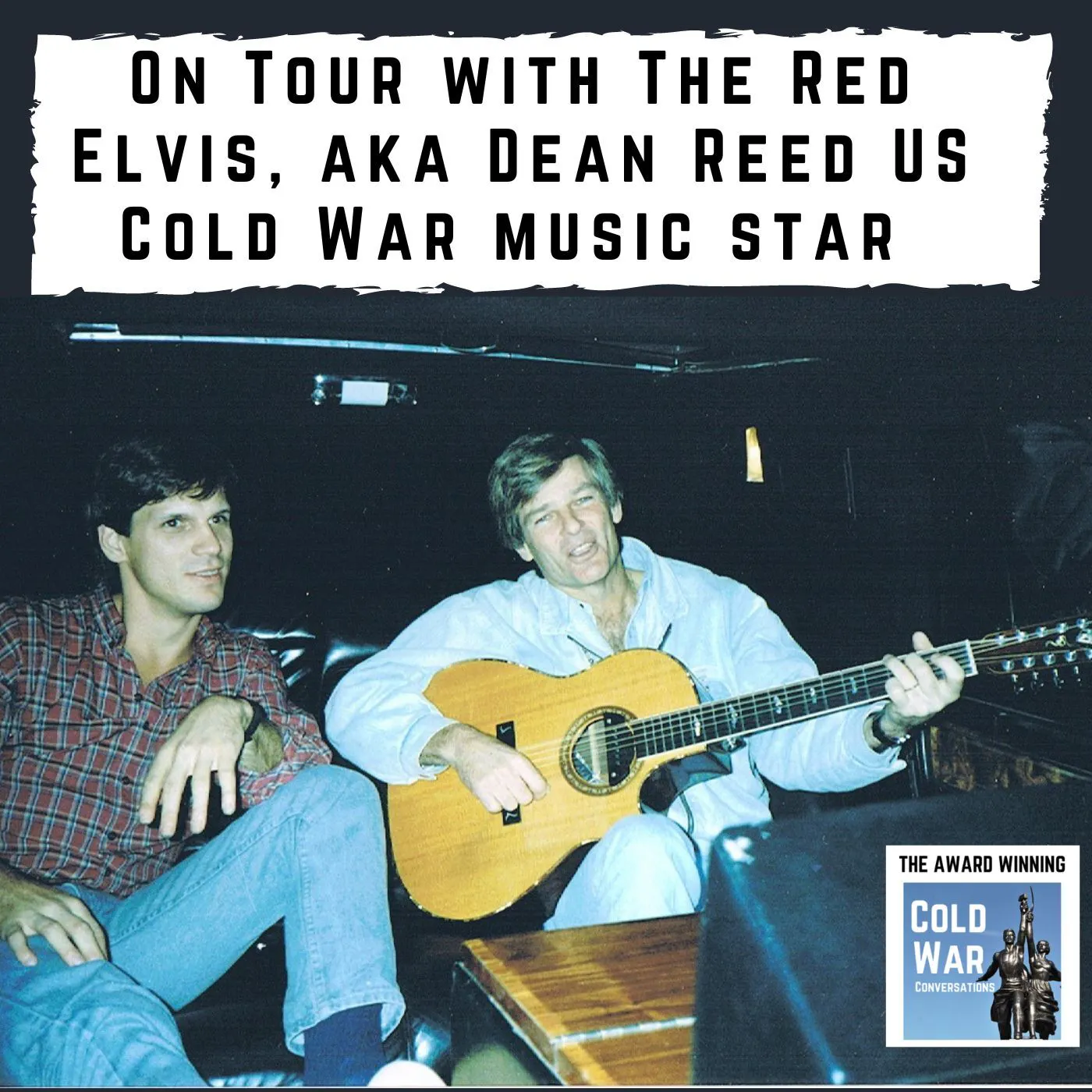
S16 Ep 274Red Elvis on tour, aka Dean Reed the US Cold War music star (274)
Warning: This episode does cover the subject of suicide. If you need help please use these links: UK https://www.samaritans.org/how-we-can-help/contact-samaritan/ Rest of the World https://findahelpline.com/i/iasp Dean Reed was an American actor, singer and songwriter, director, and Socialist who became a huge star in Latin America and the Eastern Bloc. Neil Jacobs is a guitarist who first met Dean Reed briefly while renting accommodation from Will Roberts, who directed the documentary of Dean Reed called “American Rebel”. Neil served on the US Cultural Delegation to the Moscow World Youth Festival in 1985 and unlike most of the participants, he was assigned by the Soviets. I did not go through any of the screening processes that the American Delegation had undergone, and therefore has a unique perspective on the event. It was at this event he began his friendship with Dean Reed. Additionally, he traveled with Dean Reed extensively both in the US and in the Eastern Bloc from 1985 -1986 and was one of the last people to see him before his death. 0:00 Introduction and Content Warning 4:46 Neil's first meeting with Dean Reed and their friendship 7:03 Filming and Screening of "American Rebel" 11:26 Dean Reed's Mentoring and Support for Neil 15:00 Dean Reed's experiences at the World Youth Festival 20:18 Dean Reed's Relationship with Host, Ian Sanders 24:44 Dean Reed's Struggle to Reestablish a Career in the US 28:19 Dean Reed's Controversial Stance on the Berlin Wall 32:46 Discussion on German Fascination with American Western Cowboy Culture 41:21 Dean Reed's Unexpected Death and Speculations 46:19 Mysterious Deaths of Celebrities in East Germany 51:54 Fears and Speculations about Dean Reed's Death 54:14 Impact of the Chernobyl Incident on Dean Reed's State of Mind 55:06 Closing Remarks and Acknowledgments to Supporters Table of contents powered by PodcastAI✨ Listen to our other Dean Reed episodes here https://coldwarconversations.com/episode97/ https://coldwarconversations.com/episode98/ The battle to preserve Cold War history is ongoing and your support can provide me with the ammunition to continue to keep this podcast on the air. Via a simple monthly donation, you’ll become part of our community and get a sought-after CWC coaster as a thank you and you’ll bask in the warm glow of knowing you are helping to preserve Cold War history. Just go to https://coldwarconversations.com/donate/ If a monthly contribution is not your cup of tea, We also welcome one-off donations via the same link. Photos and videos relating to this episode https://coldwarconversations.com/episode274/ Neil Jacobs web site https://www.neiljacobs.com/ Support the project! https://coldwarconversations.com/donate/ Follow us on Twitter https://twitter.com/ColdWarPod Facebook https://www.facebook.com/groups/coldwarpod/ Instagram https://www.instagram.com/coldwarconversations/ Youtube https://youtube.com/@ColdWarConversations Learn more about your ad choices. Visit podcastchoices.com/adchoices

S16 Ep 273The Bridge of Spies spy (273)
On 10 February 1962, Gary Powers, the American pilot whose U2 spy plane was shot down in Soviet airspace, was released on “The Bridge in Spies” in Berlin by his captors in exchange for one Colonel Rudolf Abel, aka Vilyam Fisher - one of the most extraordinary characters in the history of the Cold War. Born plain William Fisher in Newcastle upon Tyne, in the UK this British grammar schoolboy was the child of revolutionary parents who had fled tsarist oppression in Russia. Their son returned to his spiritual homeland, the newly formed Soviet Union, and became a spy, embarking on a mission to New York, where he ran the network that stole America's atomic secrets. In 1957, Willie's luck ran out and he was arrested and sentenced to thirty years in prison. Five years later, the USSR's regard for his talents was proven when they insisted on swapping him for Gary Powers. I speak with Vin Arthey, the author of “Abel. The true story of the spy they traded for Gary Powers” Vin Arthey has traced Willie's tale from the most unlikely of beginnings in Newcastle, to Moscow, the streets of New York, and back again, a story of Cold War espionage to rival anything in fiction. 0:00 Introduction and discussion about Willie Fisher's spy work 10:26 Willie Fisher's upbringing and education in England 18:49 Fisher's move to Russia and his early years in Soviet society 25:33 Fisher's entry and rise in the intelligence services 38:41 Fisher's significant operations during the Great Patriotic War 42:52 Fisher's training and espionage work in the US 57:42 Fisher's capture, trial, and the role of his defense lawyer, Jim Donovan 1:08:26 The spy exchange, Fisher's imprisonment, and contact with his family 1:14:23 Fisher's life post-exchange in the Soviet Union and his role in the KGB 1:19:15 Fisher's final moments and the KGB's surveillance of him Table of contents powered by PodcastAI✨ Buy the book here https://amzn.to/3D9di6B Episodes mentioned The Rosenberg’s https://coldwarconversations.com/episode184/ Portland Spy Ring https://coldwarconversations.com/episode138/ https://coldwarconversations.com/episode139/ The battle to preserve Cold War history is ongoing and your support can provide me with the ammunition to continue to keep this podcast on the air. Via a simple monthly donation, you’ll become part of our community and get a sought-after CWC coaster as a thank you and you’ll bask in the warm glow of knowing you are helping to preserve Cold War history. Just go to https://coldwarconversations.com/donate/ If a monthly contribution is not your cup of tea, We also welcome one-off donations via the same link. Videos and further infor here https://coldwarconversations.com/episode273/ Support the project! https://coldwarconversations.com/donate/ Follow us on Twitter https://twitter.com/ColdWarPod Facebook https://www.facebook.com/groups/coldwarpod/ Instagram https://www.instagram.com/coldwarconversations/ Youtube https://youtube.com/@ColdWarConversations Learn more about your ad choices. Visit podcastchoices.com/adchoices
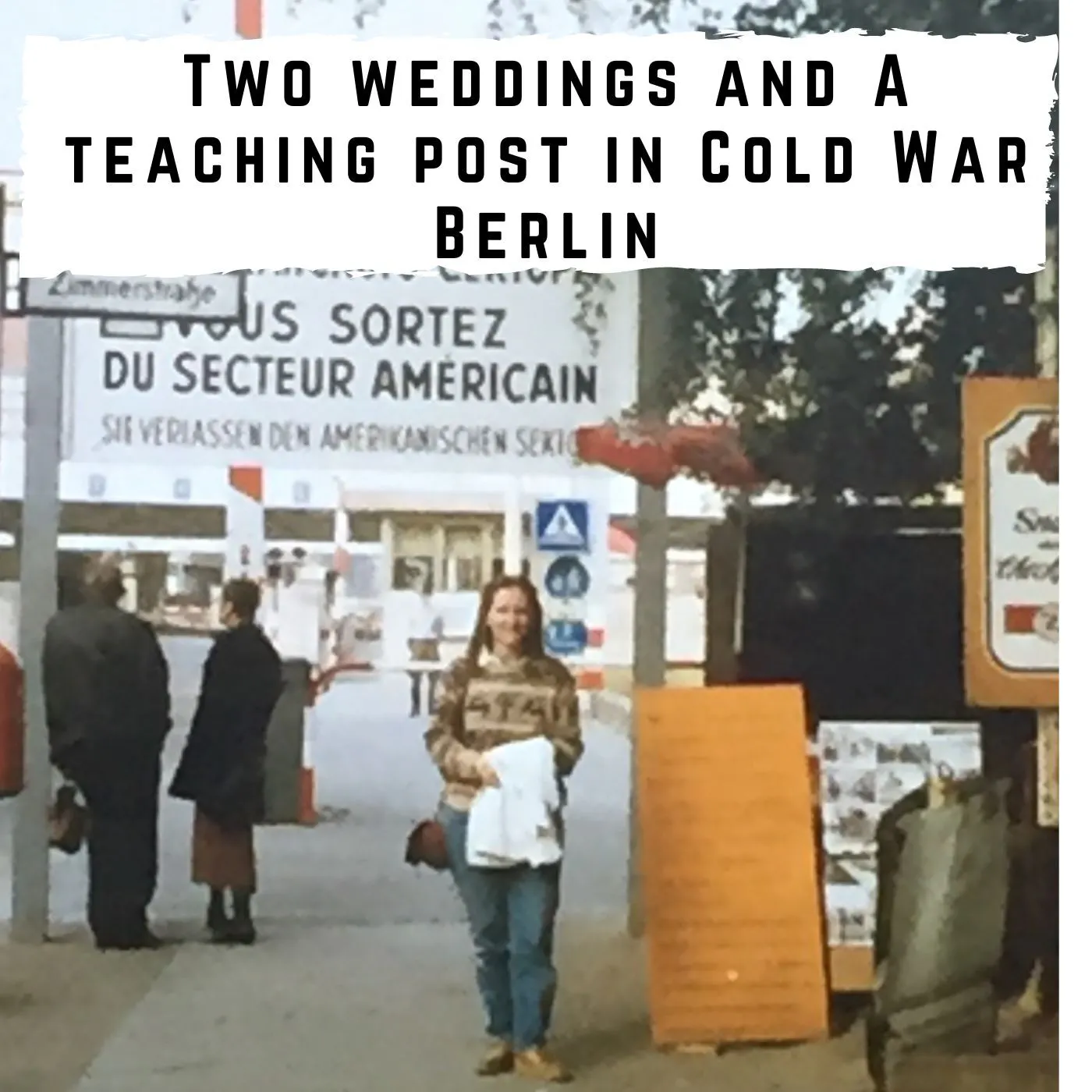
S16 Ep 272Two weddings and a teaching post in Cold War Berlin (272)
Marie-Claude Hawkes continues her story with her return to Berlin in 1985 as a French teaching assistant at the Havel School RAF Gatow, teaching French and taking part in school activities in West and East Berlin. Between September 86 and August 87 Marie-Claude was employed as a cartoonist for the Berlin Bulletin, the weekly magazine for the British Forces in Berlin. Marie Claude describes her experiences as a French citizen working for the British Army as well as the challenges of being a French civilian in Berlin marrying a British citizen. In February 1988 Marie-Claude started work as the Director of Extra-Mural Studies at 46 AEC (Army Education Corps), Smuts Barracks in Spandau. While organising various classes for service men/women and their ‘dependents’, she also provided interpreting and trips to East Berlin for various purposes, one illegal… It’s a fascinating view of Cold War Berlin from a perspective not heard before. 7:14 Marie-Claude Hawkes' experiences in Berlin and role at the Harvard School 14:39 Marie-Claude Hawkes' post-marriage life and career in the Army Education Corps 17:28 Life in Berlin, cultural barriers, and infamous locations 20:49 Marie-Claude Hawkes' role in the Education Center and adventures in East Berlin 30:06 Unique rules and regulations of living in Berlin: 'Berlinology' 33:37 Discussions on Berlin defense and encounters with Soviet officers 38:53 Marie-Claude Hawkes' wedding and experience on the French military train 46:26 Inquiry about Stasi files and reflections on being a part of history 48:16 Sponsor: Episode extras and gratitude to financial supporters 48:50 Closing remarks and preview of next episode Table of contents powered by PodcastAI✨ Episodes mentioned: The Defence of RAF Gatow https://coldwarconversations.com/episode257/ Cold War history is disappearing; however, a simple monthly donation will keep this podcast on the air. You’ll become part of our community and get a sought after CWC coaster as a thank you and you’ll bask in the warm glow of knowing you are helping to preserve Cold War history. Just go to https://coldwarconversations.com/donate/ If a monthly contribution is not your cup of tea, We also welcome one-off donations via the same link. Extra info including photos, and videos here https://coldwarconversations.com/episode272/ Support the project! https://coldwarconversations.com/donate/ Follow us on Twitter https://twitter.com/ColdWarPod Facebook https://www.facebook.com/groups/coldwarpod/ Instagram https://www.instagram.com/coldwarconversations/ Youtube https://youtube.com/@ColdWarConversations Learn more about your ad choices. Visit podcastchoices.com/adchoices
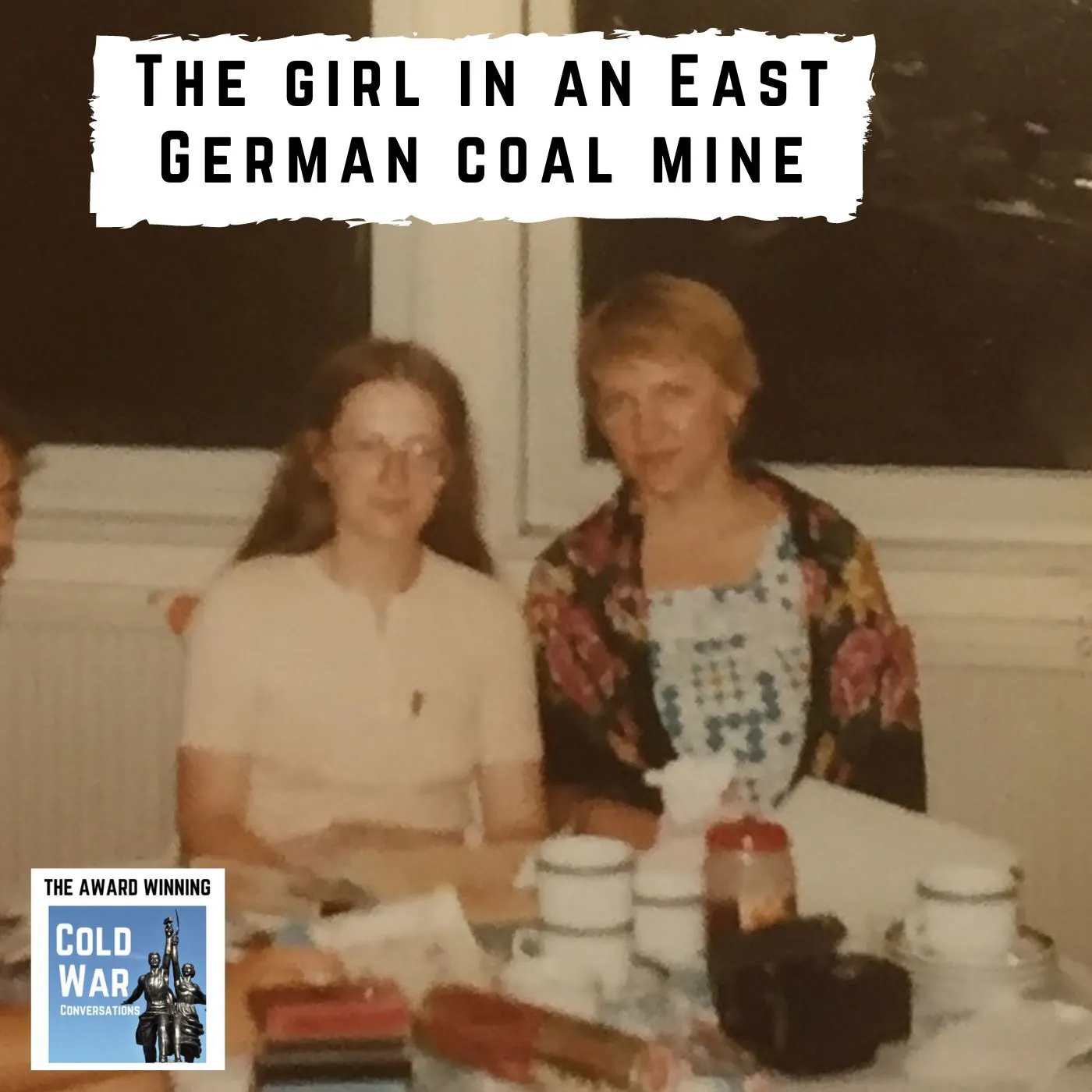
S16 Ep 271The girl in a Cold War East German coal mine (271)
In 1981 Marie-Claude Hawkes was an 18-year-old living in Amiens, France when she embarked on a trip to East Germany looking for adventure… Among her experiences was working in a lignite coal mine. Lignite is considered the lowest rank of coal and the most harmful coal to human health but was a major fuel source for East German power stations. Marie-Claude travelled from Paris to Leipzig on an overnight train, staying at the International Youth Camp in Borna. From there she travelled every day to work in the open lignite mine at Espenhain, about 16 miles from Leipzig. She describes working at the mine, weekends off, visits to Leipzig, Magdeburg, Weimar, and a potato peeling factory...! It’s a fascinating view of East Germany away from the capital Berlin. 0:00 Introduction and Mary Claude Hawkes' initial experiences in East Germany 2:06 Sponsor: Promotion of Cold War Conversations and listener's testimonial 4:51 Mary Claude Hawkes' journey to East Germany and arrival at the International Youth Camp 13:43 Work and life in the International Youth Camp 22:37 Leisure time: visits to Leipzig and after-work activities 25:51 Travel experiences and evening entertainment in East Germany 29:01 Political experiences and visits to various factories 33:11 Working conditions and run-in with authorities 40:01 Impressions of Magdeburg and East Berlin 44:13 Return to Paris and plans for future visits to Berlin 45:23 Sponsor: Thanks to financial supporters and invitation to join the Facebook Discussion Group 46:19 Closing remarks and mention of the Cold War Conversations store Table of contents powered by PodcastAI✨ Cold War history is disappearing; however, a simple monthly donation will keep this podcast on the air. You’ll become part of our community and get a sought after CWC coaster as a thank you and you’ll bask in the warm glow of knowing you are helping to preserve Cold War history. Just go to https://coldwarconversations.com/donate/ If a monthly contribution is not your cup of tea, We also welcome one-off donations via the same link. Check out the episode related photos and videos here https://coldwarconversations.com/episode271/ Radio GDR If you are interested in East Germany we can highly recommend our friends over at Radio GDR. Support the project! https://coldwarconversations.com/donate/ Follow us on Twitter https://twitter.com/ColdWarPod Facebook https://www.facebook.com/groups/coldwarpod/ Instagram https://www.instagram.com/coldwarconversations/ Youtube https://youtube.com/@ColdWarConversations Learn more about your ad choices. Visit podcastchoices.com/adchoices

S15 Ep 270In conversation with 7 BRIXMIS veterans - Part 2 (270)
bonusPart 2, of a two part recording. Part 1 is here https://coldwarconversations.com/episode268 In October of 2022, I was asked by the West Pennines Military Vehicle Trust to moderate a Q&A session with a number of BRIXMIS veterans. Attending were Drivers Neil Walton, Pete Curran, Dave Collins and Kev Smith, plus Sandy Saxton-Warne (Joint operations & weapons) , Mike Hill (Tour officer), Mike Corcoran (Weapons), and Dave Butler (Senior Non Commissioned Officer, Tourer). It was an amazing afternoon of reminiscing about their experiences and viewing the amazing collections they had from that time. My good friend Colin Dyter was a massive help with the recording, but a quick note that the audio is not up to the usual quality of Cold War Conversations, due to background noise, but I think the events and activities described definitely make it worth listening to. 0:00 Introduction and background on the episode's guests 2:15 BRIXMIS veterans and their stories 6:44 Importance of safeguarding sensitive equipment and intelligence gathering 14:52 Identifying and tracking Soviet equipment 24:06 Scavenging procedures and notable discoveries 30:22 Operation Tomahawk and the risks of tour driving 39:35 Confrontations with Russians and successful escapes 46:17 Use of maps and marking points of interest in the Cold War 58:10 Collecting memorabilia and living conditions in the DDR 1:02:14 Closing remarks and episode extras Table of contents powered by PodcastAI✨ Cold War history is disappearing; however, a simple monthly donation will keep this podcast on the air. You’ll become part of our community and get a sought-after CWC coaster as a thank you and you’ll bask in the warm glow of knowing you are helping to preserve Cold War history. Just go to https://coldwarconversations.com/donate/ If a monthly contribution is not your cup of tea, We also welcome one-off donations via the same link. Episode notes here https://coldwarconversations.com/episode270 Support the show Support the project! https://coldwarconversations.com/donate/ Follow us on Twitter https://twitter.com/ColdWarPod Facebook https://www.facebook.com/groups/coldwarpod/ Instagram https://www.instagram.com/coldwarconversations/ Youtube https://youtube.com/@ColdWarConversations Learn more about your ad choices. Visit podcastchoices.com/adchoices

S15 Ep 269Able Archer - The military exercise that almost started World War 3 - a look in the archives (269)
In 1986 Soviet Leader Mikhail Gorbachev said “Never perhaps, in the post-war decades has the situation in the world been explosive and hence more difficult and unfavourable as in the first half of the 1980s. “ He was referring to a period of immense tension between the Soviet Union and NATO when in 1983 a NATO exercise called Able Archer was believed to have almost accidentally started World War 3. We delve into the Able Archer archives to talk about the most recent documents with Francesca Akhtar, a researcher whose main research interests are US Cold War foreign policy, intelligence history and defence. Francesca has written a dissertation entitled “The most dangerous Soviet-American confrontation since the Cuban Missile Crisis?” An analysis of the origins, nature, and impact of the Able Archer 83 incident. 0:00 Introduction and context about Able Archer 1:07 Overview of Able Archer and its potential to start World War 3 2:15 Sponsor message and call for donations 3:19 The changes in Able Archer in 1983 and misconceptions 6:51 Context of shooting down of Korean airliner in 1983 and comparison with the Cuba missile crisis 10:31 Status of UK archives on Able Archer and challenges in obtaining information 14:11 Discussion on the cancellation of Able Archer in 1990 and continuation despite potential misunderstandings 21:11 Introduction to the revealing documents in the February state department release and discussion on Perroots' letter 32:11 The letter that sparked an investigation and possible preemptive strike 35:03 Post-exercise NSA message, Soviet readiness, and criticism of US intelligence 41:17 Soviet side and access to information and concluding remarks on the Cold War scare 47:16 Acknowledgement of the episode extras and appreciation of financial supporters 48:30 Closing remarks and promotion of the Cold War Conversations store Table of contents powered by PodcastAI✨ Regular listeners will remember that Francesca talked about Able Archer 83 previously in Episode 19. The battle to preserve Cold War history is ongoing and your support can provide me with the ammunition to continue to keep this podcast on the air. Via a simple monthly donation, you’ll become part of our community and get a sought-after CWC coaster as a thank you and you’ll bask in the warm glow of knowing you are helping to preserve Cold War history. Just go to https://coldwarconversations.com/donate/ If a monthly contribution is not your cup of tea, We also welcome one-off donations via the same link. View the actual Able Archer intelligence briefing documents here as well as videos, and extra information https://coldwarconversations.com/episode269/ Support the project! https://coldwarconversations.com/donate/ Follow us on Twitter https://twitter.com/ColdWarPod Facebook https://www.facebook.com/groups/coldwarpod/ Instagram https://www.instagram.com/coldwarconversations/ Youtube https://youtube.com/@ColdWarConversations Learn more about your ad choices. Visit podcastchoices.com/adchoices
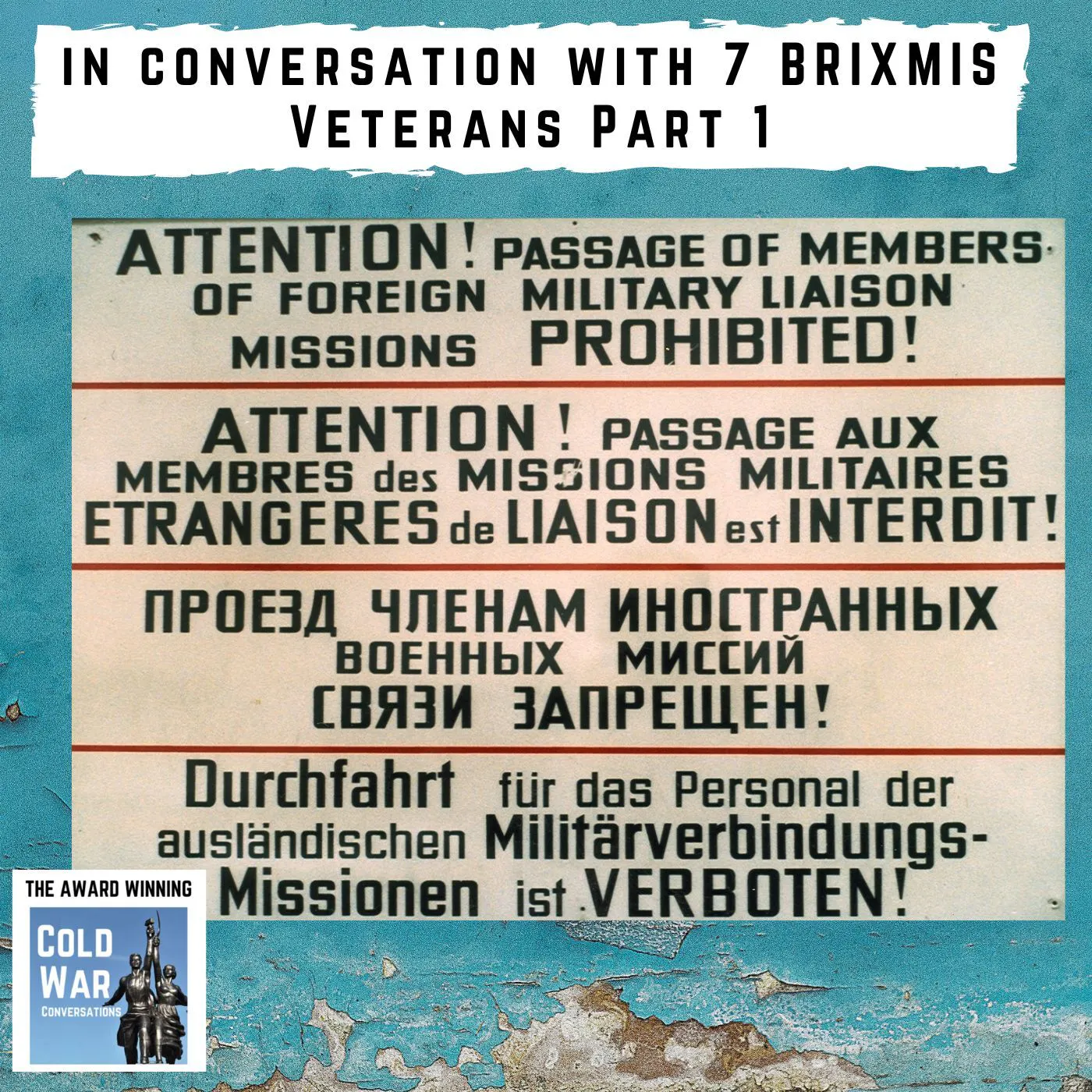
S15 Ep 268In conversation with 7 BRIXMIS veterans - Part 1 (268)
bonusIn October of 2022, I was asked by the West Pennines Military Vehicle Trust to moderate a Q&A session with a number of BRIXMIS veterans. Part 2 is here https://coldwarconversations.com/episode270 Attending were Drivers Neil Walton, Pete Curran, Dave Collins and Kev Smith, plus Sandy Saxton-Warne (Joint operations & weapons) , Mike Hill (Tour officer), Mike Corcoran (Weapons), and Dave Butler (Senior Non Commissioned Officer, Tourer). It was an amazing afternoon of reminiscing about their experiences and viewing the amazing collections they had from that time. Don’t miss part 2 which follows next week. My good friend Colin Dyter was a massive help with the recording, but a quick note that the audio is not up to the usual quality of Cold War Conversations, due to background noise, but I think the events and activities described definitely make it worth listening to. 0:00 Introduction and story from Dave Collins 5:25 Dave Collins recounts the night the wall came down 8:47 Neil Walton talks about their communication system and shares stories of challenging situations 15:41 Monitoring equipment and weapon remnants in East Germany 21:21 An encounter with the MFS during a tour 28:20 Discussion about different units and experiences in the army 39:04 Understanding 'tarpology' and recognizing Soviet equipment 44:35 Special permits and fast driving experiences 54:04 Using thermal imaging in the Cold War 1:01:14 Cliffhanger - The discovery about the missile 1:01:42 Acknowledgement of financial supporters and call for donations Table of contents powered by PodcastAI✨ Cold War history is disappearing; however, a simple monthly donation will keep this podcast on the air. You’ll become part of our community and get a sought-after CWC coaster as a thank you and you’ll bask in the warm glow of knowing you are helping to preserve Cold War history. Just go to https://coldwarconversations.com/donate/ If a monthly contribution is not your cup of tea, We also welcome one-off donations via the same link. Episode notes herehttps://coldwarconversations.com/episode268 Support the project! https://coldwarconversations.com/donate/ Follow us on Twitter https://twitter.com/ColdWarPod Facebook https://www.facebook.com/groups/coldwarpod/ Instagram https://www.instagram.com/coldwarconversations/ Youtube https://youtube.com/@ColdWarConversations Learn more about your ad choices. Visit podcastchoices.com/adchoices

S15 Ep 267Home Bases: Memories & Stories of US Military Bases in the UK (267)
Sean Kelly is the author of Home Bases: Memories & Stories of US Military Bases Around London which for the first time, puts the spotlight on the history of many of the US Military’s lesser-known command and support bases that were located either in or close to London. The bases (often known as ‘Little Americas’) are furthermore brought to life in a series of ‘snapshot’ memories. We hear about the heroism of US personnel who were awarded the George Medal for bravery in rescuing people caught in the great floods of 1953 as well as including actor Larry Hagman who played JR Ewing in the TV series Dallas. We talk about the memories of bases further afield such as Upper Heyford, Greenham Common, Sculthorpe, and Burtonwood. 0:00 Introduction and background of Sean Kelly 1:59 Sponsor: Call for donations 2:23 Guest Introduction: Sean Kelly 7:38 Sean Kelly's book "Home Bases" and the history of US military bases in London 15:20 Personal stories from US military bases 28:31 Transformation and current state of Greenham Common 34:11 Personal anecdotes from those who served on the bases 48:54 The peak of the Cold War in the UK and discussion about the Burtonwood base 58:24 The special relationship between the UK and the US and the importance of personal stories in understanding history 1:02:30 Where to Find Sean Kelly's Book and Contact Information 1:06:22 Podcast Extras and Support Information Table of contents powered by PodcastAI✨ Buy the book here https://amzn.to/3V8959o The battle to preserve Cold War history is ongoing and your support can provide me with the ammunition to continue to keep this podcast on the air. Via a simple monthly donation, you’ll become part of our community and get a sought-after CWC coaster as a thank you and you’ll bask in the warm glow of knowing you are helping to preserve Cold War history. Just go to https://coldwarconversations.com/donate/ If a monthly contribution is not your cup of tea, We also welcome one-off donations via the same link. I am delighted to welcome Sean Kelly to our Cold War conversation… Sean's websites Home Bases https://www.facebook.com/ushomebases 7 North Audley https://www.facebook.com/7NorthAudley Episodes referred to: Greenham Common https://coldwarconversations.com/episode18/ Burtonwood https://coldwarconversations.com/episode74/ Upper Heyford https://coldwarconversations.com/episode65/ Further episode notes here https://coldwarconversations.com/episode267/ Support the project! https://coldwarconversations.com/donate/ Follow us on Twitter https://twitter.com/ColdWarPod Facebook https://www.facebook.com/groups/coldwarpod/ Instagram https://www.instagram.com/coldwarconversations/ Youtube https://youtube.com/@ColdWarConversations Learn more about your ad choices. Visit podcastchoices.com/adchoices

S15 Ep 266Cold War Chieftain tank deployment at the East German Border (266)
We’re back with Alan Hodges, a Royal Tank Regiment Chieftain tank commander, and Mick Hadfield who was his 17-year-old gunner. In this episode we talk in detail about their deployment within a kilometer of the East German border and their tasks should H Hour have come as well as emergency deployment from barracks. There is no affection for their main training area at Soltau described as “the moon with a few trees and also in less polite terms. However, these training periods are made better by the regular appearance of Wolfgang, a German entrepreneur and British Army legend who was uncannily able to place his snack vans whenever the British Army deployed. We also hear how the crew was also trained on how to evacuate the tank if it was hit as well as how to evade capture and resist interrogation. It’s anecdotes galore again including a visit from a Swedish Major who unwisely was given the chance to drive Chieftain. There’s also sadness as we remember those that never came back from exercises due to accidents. It’s the continuing story of the close bond that soldiers forge that still lasts to this day. 0:00 Introduction 2:37 Discussion of training procedures and deployment strategies 6:20 Recollection of training exercises and potential war scenarios 12:39 Experiences and preparations for potential emergency situations 19:17 Experiences with escape and evasion exercises 23:50 Reflections on Exercise Lionheart and Soltau training area 29:51 Discussion of casualties of Cold War training exercises 34:48 Reflections on the seriousness of training and camaraderie developed during service 44:47 Maintaining focus and motivation during training and visits to both sides of Berlin 49:17 Discussion about Cold War literature and potential film creation 51:14 Reality of military life and benefits of being stationed in Germany 54:02 Social activities in Germany and episode wrap-up Table of contents powered by PodcastAI✨ Cold War history is disappearing; however, a simple monthly donation will keep this podcast on the air. You’ll become part of our community and get a sought after CWC coaster as a thank you and you’ll bask in the warm glow of knowing you are helping to preserve Cold War history. Just go to https://coldwarconversations.com/donate/ If a monthly contribution is not your cup of tea, We also welcome one-off donations via the same link. Extra videos and photos here https://coldwarconversations.com/episode266/ Support the project! https://coldwarconversations.com/donate/ Follow us on Twitter https://twitter.com/ColdWarPod Facebook https://www.facebook.com/groups/coldwarpod/ Instagram https://www.instagram.com/coldwarconversations/ Youtube https://youtube.com/@ColdWarConversations Learn more about your ad choices. Visit podcastchoices.com/adchoices
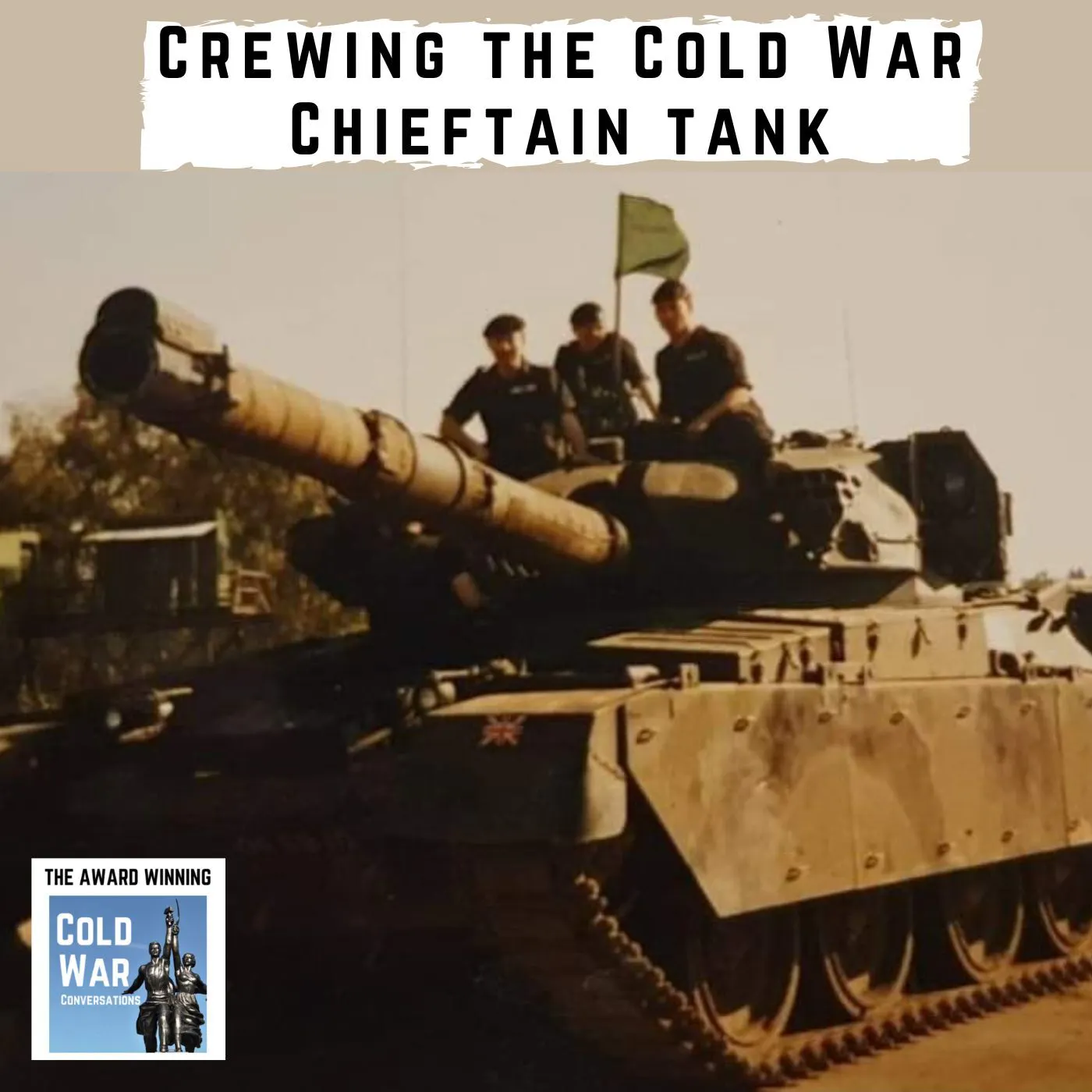
S15 Ep 265Crewing the Cold War Chieftain tank (265)
Alan Hodges was a Royal Tank Regiment Chieftain tank commander and troop SGT in West Germany. Mick Hadfield was his 17-year-old gunner. The affection between the two is still apparent even today and Mick still calls Al his army Dad. Mick met Al in 1987 straight out of his armoured corp gunnery training at Catterick. They served for 3 years together in 1st Royal Tank Regiment in Hildesheim from August 87 to December 90. They share detailed insights into the operations of the Chieftain, the training, the camaraderie of a crew as well as important details like how you go the loo in a tank.. As part of 1st Royal Tank Regiment they were at the time (the most forward-facing Tank unit in BAOR and given a 2-hour life expectancy. They were told that if the Soviet 3rd Shock army crossed the border, each Chieftain would have to knock out a minimum of 10 Soviet tanks before they got overrun. 0:00 Introduction 4:07 Mick's journey into the army and Al's family military background 10:04 Experiences with the Chieftain Mark 2 tank and its components 16:40 Structure of the tank regiment and regional recruitment 23:59 Training process for the Chieftain crew and simulation experiences 34:06 Cold War threat discussion and ammunition types 42:49 Physical experience of being in a tank and recalling incidents 47:25 Reality of fighting in AFVs and potential for motion sickness in a tank 57:04 Relationship between a crew and their tank, tuning for performance 1:02:40 Knowledge of the battleground and teaser for the next episode 1:03:30 Closing remarks and invitation to the Facebook discussion group Table of contents powered by PodcastAI✨ Cold War history is disappearing; however, a simple monthly donation will keep this podcast on the air. You’ll become part of our community and get a sought-after CWC coaster as a thank you and you’ll bask in the warm glow of knowing you are helping to preserve Cold War history. Just go to https://coldwarconversations.com/donate/ If a monthly contribution is not your cup of tea, We also welcome one-off donations via the same link. Extra videos and photos here https://coldwarconversations.com/episode265/ Support the project! https://coldwarconversations.com/donate/ Follow us on Twitter https://twitter.com/ColdWarPod Facebook https://www.facebook.com/groups/coldwarpod/ Instagram https://www.instagram.com/coldwarconversations/ Youtube https://youtube.com/@ColdWarConversations Learn more about your ad choices. Visit podcastchoices.com/adchoices

S15 Ep 264How East Germany doped its athletes (264)
In the early 1970s, the athletes of East Germany started to achieve incredible sports results, winning medals and setting new world records with astonishing frequency. For many years, their sporting supremacy was hailed as a triumph of the socialist government's commitment to scientific research and innovative training methods. However, after the Cold War ended, the Stasi archives revealed a sinister secret behind the successes: a perverse doping system imposed by the government itself. Drugs were administered to young athletes, often without their consent, and the price their bodies are now paying is very high, both physically and mentally. I talk with Joseph Tudor, whose new book Synthetic Medals reveals the events that led to the discovery of the state-doping system and the subsequent trial. It also explores the state's motives for this crime against its own people. 0:00 Introduction and Joseph Tudor's perspective on East German doping 2:04 Sponsor: Call to support the Cold War Conversations podcast 4:12 East Germany's adoption of artificial methods to enhance athletes' performance 10:43 Unveiling the East German 'athlete machine' 17:47 The International Olympic Committee's suspicions about East Germany's success 21:44 Prevalence and detection of doping in East German sports 26:05 Resistance and consequences against Stasi's involvement in sports 31:49 Discovery of State Plan 14.25, East Germany's state doping program 34:03 Legal challenges surrounding East Germany's doping program 38:39 The devastating side effects of doping drugs on athletes 45:30 Legacy of East German athletic success and the role of doping 52:37 Athletes returning their medals due to guilt of doping 56:13 Sponsor: Promotion of the book 'Synthetic Medals: East German Athlete's Journey to Hell' 57:05 Closing remarks and promotion of the Cold War Conversations store Table of contents powered by PodcastAI✨ Extra episode info here https://coldwarconversations.com/episode264/ Buy the book here https://amzn.to/3gVZbtI and support the podcast. ========================================================== Cold War history is disappearing; however, a simple monthly donation will keep this podcast on the air. You’ll become part of our community and get a sought after CWC coaster as a thank you and you’ll bask in the warm glow of knowing you are helping to preserve Cold War history. Just go to https://coldwarconversations.com/donate/ If a monthly contribution is not your cup of tea, We also welcome one-off donations via the same link. ========================================================== Support the project! https://coldwarconversations.com/donate/ Follow us on Twitter https://twitter.com/ColdWarPod Facebook https://www.facebook.com/groups/coldwarpod/ Instagram https://www.instagram.com/coldwarconversations/ Youtube https://youtube.com/@ColdWarConversations Learn more about your ad choices. Visit podcastchoices.com/adchoices

S15 Ep 263The building of the Berlin Wall (263)
From the moment East Germany was formed in 1949, many of its citizens chose to leave to start a new life in the West. By the mid-1950s, the trickle had turned into a flood as large numbers rejected Walter Ulbricht’s Communist paradise. His ‘Workers’ & Peasants’ State’ could not afford to lose the skills and productivity of these key workers, so he proposed a radical solution - to physically fence in the whole population. I speak with Andrew Long, the author of a series of books about Cold War Berlin as we explore the background and build-up to the building of the Berlin Wall, from the closing of the Inner German border to the momentous events of August 1961. We examine in detail how Operation Rose, the operation to close the border between East and West Berlin, was planned and executed and look at how the West reacted. 0:00 Introduction 1:04 Formation and Exodus of East Germany 7:51 Dissent and Exodus in East Germany 15:39 The Unique Situation in Berlin and the Establishment of Air Corridors 18:11 Khrushchev's Ultimatum and the Role of Nuclear Deterrence 24:16 Arrival of JFK and the Renewed Ultimatum 33:27 Operation Rose and the Planning for the Berlin Wall 47:08 Situation at Checkpoint Charlie and Allies' Response 56:43 Propaganda and Defection Post-Border Closure 1:07:30 Rules of Engagement and Fortification of the Berlin Wall 1:11:23 Acknowledgement of Financial Supporters and Donation Call to Action Table of contents powered by PodcastAI✨ Extra episode info here https://coldwarconversations.com/episode263/ Buy Andrew's books here https://amzn.to/3hI6N2Y and support the podcast. Cold War history is disappearing; however, a simple monthly donation will keep this podcast on the air. You’ll become part of our community and get a sought-after CWC coaster as a thank you and you’ll bask in the warm glow of knowing you are helping to preserve Cold War history. Just go to https://coldwarconversations.com/donate/ If a monthly contribution is not your cup of tea, We also welcome one-off donations via the same link. Photos and video extra here https://coldwarconversations.com/episode263/ Support the project! https://coldwarconversations.com/donate/ Follow us on Twitter https://twitter.com/ColdWarPod Facebook https://www.facebook.com/groups/coldwarpod/ Instagram https://www.instagram.com/coldwarconversations/ Youtube https://youtube.com/@ColdWarConversations Learn more about your ad choices. Visit podcastchoices.com/adchoices
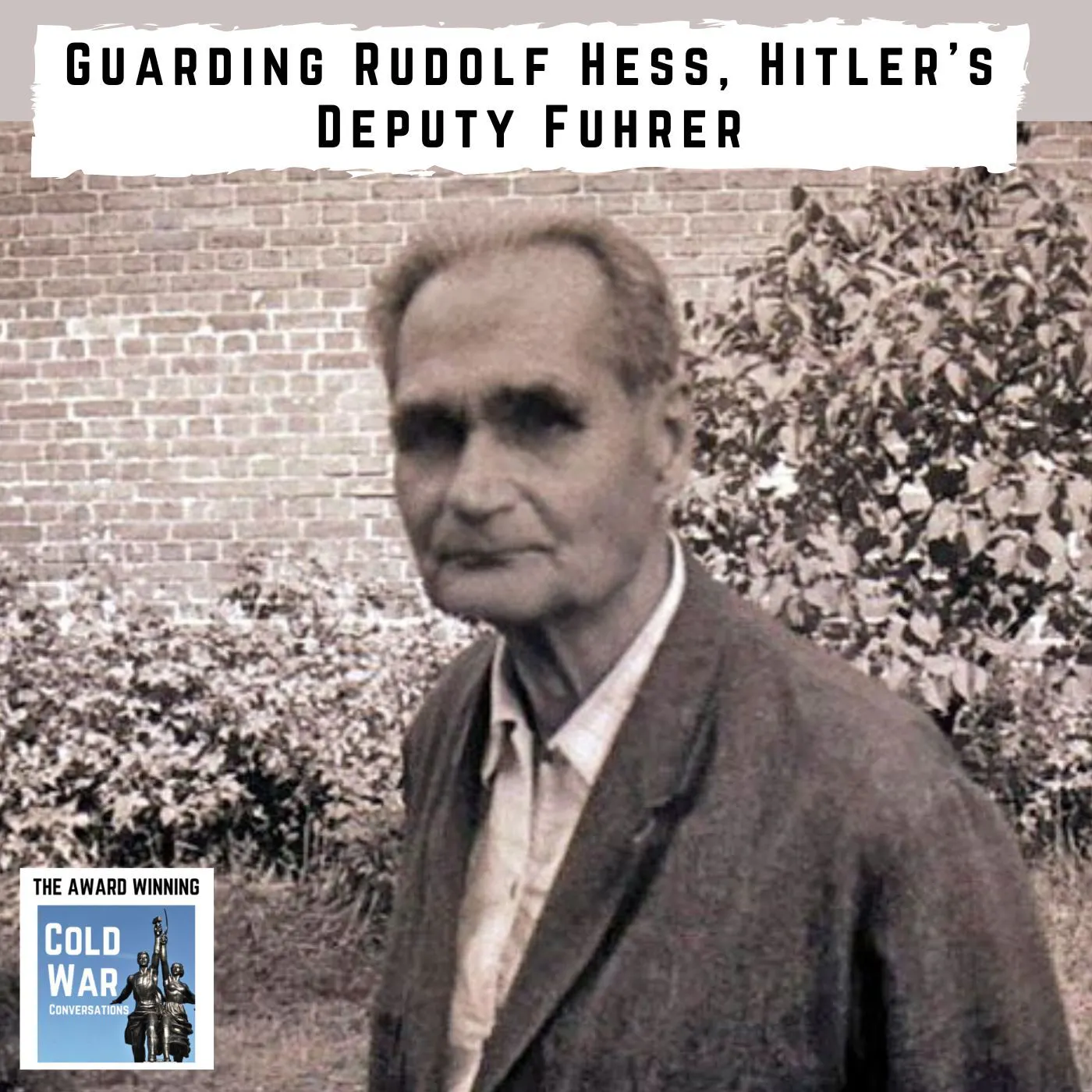
S15 Ep 262Guarding Rudolf Hess, Hitler's Deputy Führer (262)
Dave Phillips is a Yeoman Warder at the Tower of London. The Yeoman Warders have been guarding the Tower since Tudor times. Dave joined the British Army aged 16 into the Royal Irish Rangers. We hear of his early years in the Army in Northern Ireland and his posting to West Berlin. In West Berlin Dave is part of the force that guarded Rudolf Hess, a leading member of the Nazi Party in Nazi Germany and appointed Deputy Führer to Adolf Hitler in 1933. On 10 May 1941, Hess made a solo flight to Scotland, where he hoped to arrange peace talks with the British. He was arrested and stood trial at the 1946 Nuremberg trials of major war criminals. The court convicted him of crimes against peace and of conspiracy with other German leaders to commit crimes and was given a life sentence in Berlin’s Spandau Prison. Dave describes interactions with Hess, as well as the guard duties and operation of the prison. 0:00 Introduction and Dave Phillips' early experiences in Berlin 1:04 The story of Rudolph Hess and his arrest 6:16 Dave's experiences in Berlin and Spandau Prison 15:38 A typical day for Hess in Spandau Prison and guarding duties 24:56 Hess's time at the Tower of London and conversations with him 28:59 Military training in Berlin and preparations for a potential invasion 36:00 Interaction with other occupying forces and West Berlin locals 39:44 Dave's return to Berlin years later and reminiscing about the fall of the Berlin Wall 45:16 Career progression, service in Northern Ireland and UN Peacekeeping 49:22 Dave's current role as a Yeoman Warder at the Tower of London 52:54 Financial support and donations Table of contents powered by PodcastAI✨ Cold War history is disappearing; however, a simple monthly donation will keep this podcast on the air. You’ll become part of our community and get a sought-after CWC coaster as a thank you and bask in the warm glow of knowing you are helping preserve Cold War history. Just go to https://coldwarconversations.com/donate/ If a monthly contribution is not your cup of tea, We also welcome one-off donations via the same link. Episode videos and photos here https://coldwarconversations.com/episode262/ Support the project! https://coldwarconversations.com/donate/ Follow us on Twitter https://twitter.com/ColdWarPod Facebook https://www.facebook.com/groups/coldwarpod/ Instagram https://www.instagram.com/coldwarconversations/ Youtube https://youtube.com/@ColdWarConversations Learn more about your ad choices. Visit podcastchoices.com/adchoices

S15 Ep 261From Cold War military drone development, to the deployment and command of the nuclear armed Ground Launched Cruise Missiles (GLCM) in Europe (261)
We continue the story of Richard Stachurski from the previous episode. Part 1 is here https://coldwarconversations.com/episode260 In 1971 Richard left NASA and was assigned to the Drone/Remotely Piloted Vehicle Systems Program Office at Wright-Patterson Air Force Base in Ohio. From 1975-1978 Richard did a tour of duty with the Air Staff at the Pentagon in Washington D.C. and between 1978-1981: he was Deputy Program Manager, Ground Launched Cruise Missile Program (GLCM) System Program Office-engaged in the adaptation of the Navy’s SLCM for use by the Air Force. In 1981 he was assigned to the staff at USAFE Headquarters (Ramstein Air Force Base, Germany) responsible for the deployment of the GLCM to five European countries (England, Germany, Netherlands, Belgium, and Italy). Richard was then promoted in 1984 to Vice Commander, Commander, 487th Tactical Missile Wing, Comiso Air Station, Sicily where he was responsible for the missile wing's operational readiness, and his troops' welfare. 0:00 Introduction and background of Richard Stachurski 4:18 Rationale behind developing drone programs 13:12 Design and manufacture of the missile launcher and control center 17:34 Richard Stachurski's agreement to go to the Royal College of Defense Studies in London 34:45 Initial impressions of Comiso Air Base and roles at the base 41:10 Encounter with Russian special forces 45:30 Dealing with peace protesters and security protocol 46:49 The short-lived cruise missile program 51:59 The significance of the Apollo 11 mission 53:20 Cold War Conversations Store Promotion Table of contents powered by PodcastAI✨ Cold War history is disappearing; however, a simple monthly donation will keep this podcast on the air. You’ll become part of our community and get a sought-after CWC coaster as a thank you and bask in the warm glow of knowing you are helping preserve Cold War history. Just go to https://coldwarconversations.com/donate/ If a monthly contribution is not your cup of tea, We also welcome one-off donations via the same link. Episode notes and videos here https://coldwarconversations.com/episode261 Support the project! https://coldwarconversations.com/donate/ Follow us on Twitter https://twitter.com/ColdWarPod Facebook https://www.facebook.com/groups/coldwarpod/ Instagram https://www.instagram.com/coldwarconversations/ Youtube https://youtube.com/@ColdWarConversations Learn more about your ad choices. Visit podcastchoices.com/adchoices
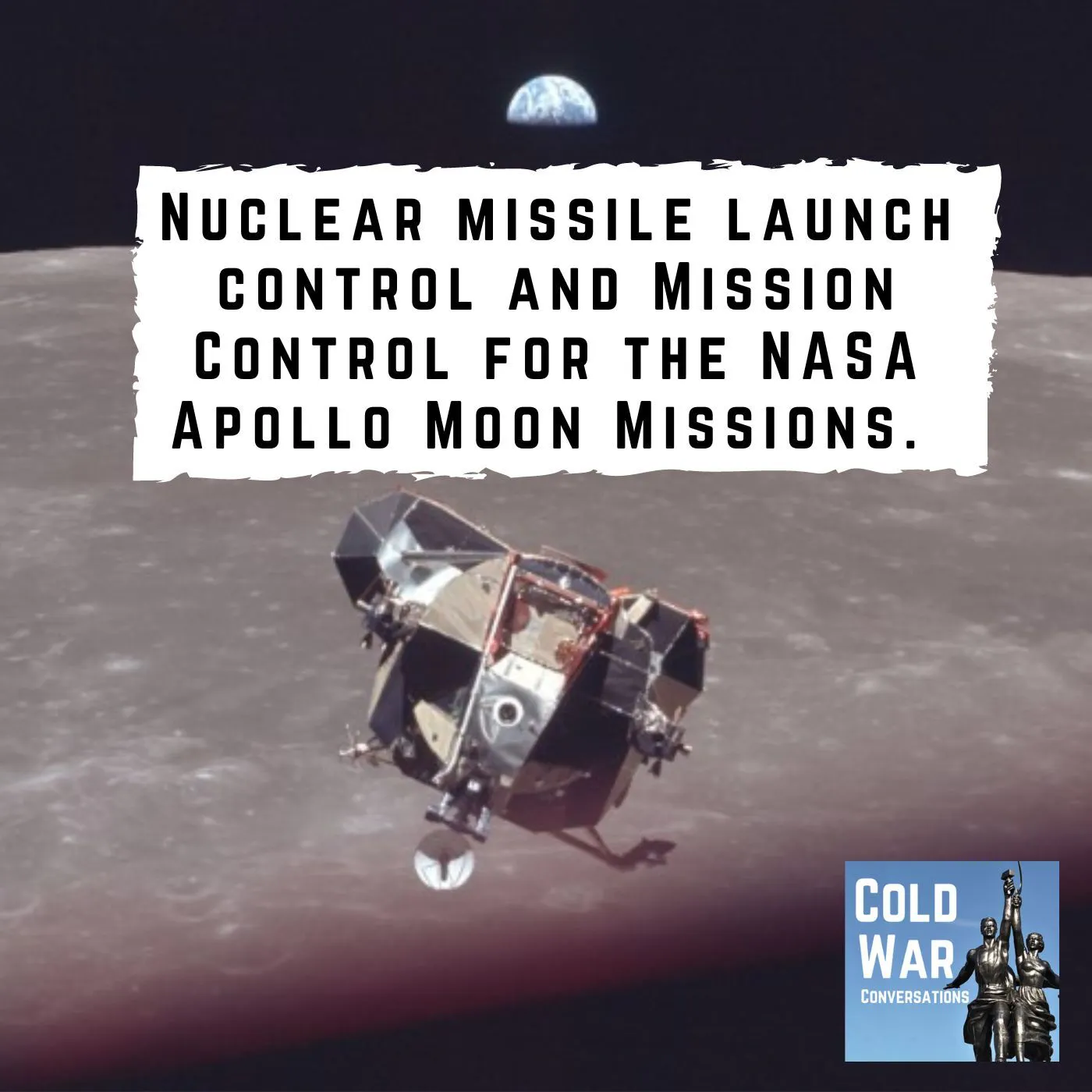
S14 Ep 260Nuclear missile launch control and Mission Control for the NASA Apollo Moon Missions (260)
Richard Stachurski joined the US Air Force in 1962, on the cusp of the Cuban Missile Crisis as a security police officer guarding nuclear-armed B-58 Hustler bombers. Within two years he volunteered for the Minuteman nuclear missile program where he served as a Deputy Missile Combat Crew Commander with the 68th Strategic Missile Squadron at Ellsworth AFB, South Dakota. Richard was the junior officer on a two-man crew in a launch control capsule buried beneath the South Dakota prairie who was charged with monitoring the status and launching if necessary ten Minuteman ICBMs. In 1965 he was selected as one of 128 Air Force officers to be loaned to NASA to support the activation and operation of the Manned Spacecraft Center in Houston, Texas. He worked his way up to being a Network Controller, who sat two consoles to the right of the Flight Director in the Mission Operations Control Room. He was responsible for all the ground systems that supported an Apollo mission and was selected as the lead Network Controller on Apollo 11 working on both the launch from Earth and the first-ever launch from the lunar surface. 0:00 Introduction and Career Overview of Richard Stachurski 2:33 Richard's Journey in the US Air Force and the Cuban Missile Crisis 9:25 The Minuteman System and Life in the Bunker 20:14 Launch Protocols and the Dynamics of Working as a Missileer 27:03 Richard's Transition to NASA and his Role in Apollo 11 34:29 Apollo 11 Launch Day, Landing, and Return to Earth 44:43 Richard's Experiences during Apollo 13 and Subsequent Missions 48:10 The Camaraderie and Humour in High-Stress Situations 50:00 Acknowledgements and Promotion of the Cold War Conversations Online Store Table of contents powered by PodcastAI✨ Cold War history is disappearing; however, a simple monthly donation will keep this podcast on the air. You’ll become part of our community and get a sought after CWC coaster as a thank you and you’ll bask in the warm glow of knowing you are helping to preserve Cold War history. One-off donations are also welcome. Just go to https://coldwarconversations.com/donate/ Episode notes , inc photos and video here https://coldwarconversations.com/episode260/ Support the project! https://coldwarconversations.com/donate/ Follow us on Twitter https://twitter.com/ColdWarPod Facebook https://www.facebook.com/groups/coldwarpod/ Instagram https://www.instagram.com/coldwarconversations/ Youtube https://youtube.com/@ColdWarConversations Learn more about your ad choices. Visit podcastchoices.com/adchoices
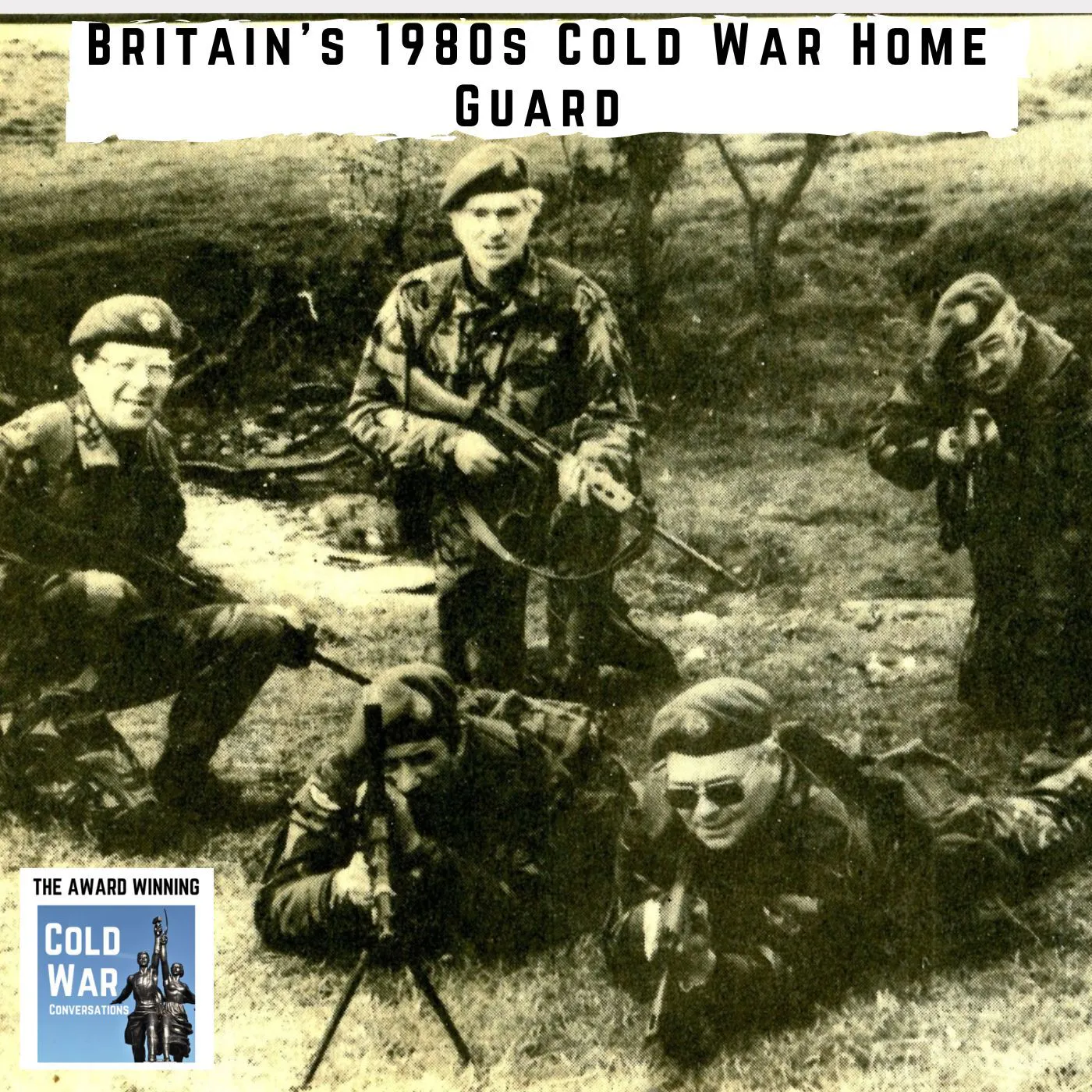
S14 Ep 259Britain's 1980s Cold War Dads Army/Home Guard - The Home Service Force
The Home Service Force or HSF was UK Prime Minister Margaret Thatcher's Cold War version of the World War 2 Home Guard. An almost forgotten unit, the HSF was established in 1982 and recruited from ex-regular Army, ex-territorial and ex-uniformed service personnel aged up to 60 years old. Its mission was to guard key points in the UK as the perceived threat from Warsaw Pact special forces increased towards the end of the Cold War. I speak with Richard Coles, who served as an officer in the HSF Company of The Honourable Artillery Company (HAC). He tells of the setup of the unit, the incredible characters he served with and details some of the exercises that he participated in. 0:00 Introduction and overview of the Home Service Force 2:38 Richard Cole's background and establishment of the Home Service Force 6:34 Recruitment and training process for the Home Service Force 13:51 Role and perceived threats of the Home Service Force 21:45 Diversity and roles within the Home Service Force members 29:12 Memorable characters and experiences within the Home Service Force 34:31 Career paths and attitudes towards promotion within the Home Service Force 38:35 Various training exercises and anecdotes from the Home Service Force 47:28 Disbandment of the Home Service Force and its irony 51:44 Richard Cole's service in 2 HAC companies and reflections on the bond between old soldiers 53:18 Sponsor: Episode extras, acknowledgements, and invitation to Facebook discussion group Table of contents powered by PodcastAI✨ The Cold War Conversation continues in our Facebook discussion group and on Twitter https://twitter.com/ColdWarPod Cold War history is disappearing; however, a simple monthly donation will keep this podcast on the air. You’ll become part of our community and get a sought-after CWC coaster as a thank you and bask in the warm glow of knowing you are helping preserve Cold War history. Just go to https://coldwarconversations.com/donate/ If a monthly contribution is not your cup of tea, We also welcome one-off donations via the same link. I am delighted to welcome Richard Coles to our Cold War conversation… Episode notes here https://coldwarconversations.com/episode259 Support the project! https://coldwarconversations.com/donate/ Follow us on Twitter https://twitter.com/ColdWarPod Facebook https://www.facebook.com/groups/coldwarpod/ Instagram https://www.instagram.com/coldwarconversations/ Youtube https://youtube.com/@ColdWarConversations Learn more about your ad choices. Visit podcastchoices.com/adchoices

S14 Ep 258An aircraft hijack to escape from the Soviet Union (258)
Back in the 1970s, migrating from the Soviet Union was an unattainable dream for many, particularly Jews wanting to leave for Israel. To leave the Soviet Union for another country, it was necessary to obtain exit visas. In practice, many people found them impossible to get. On the morning of June 15, 1970, 16 Soviet Jews who had been refused exit visas appeared at Smolny Airport near Leningrad to hijack a plane. They posed as a group going to a wedding — hence the name of the operation. The plan devised a year before the attempted hijacking, was quite straightforward. The hijackers would target a small aeroplane and book all the seats on it. They would commandeer the aircraft and leave the pilots unharmed on the landing strip, while one of the conspirators would take control of the aeroplane and fly it to Sweden. I speak with filmmaker Anat Zalmanson-Kuznetsov whose film “Operation Wedding” reveals the compelling story of her parents, the leaders of the group. 0:00 Introduction and background on Soviet Union migration 7:22 The Struggle of Soviet Jews' Emigration 11:16 The Origin and Execution of Operation Wedding 17:03 The Arrests and Aftermath of Operation Wedding 24:36 Prison Conditions and International Reaction 30:17 Influences and Interventions: Golda Meir and Franco 33:03 Soviet Restrictions on Emigration and Its Impact 35:22 Release and Life Post-Prison for Anat's Parents 40:52 The Making of the Film "Operation Wedding" 42:49 Acknowledgement of Supporters and Closing Remarks Table of contents powered by PodcastAI✨ Cold War history is disappearing; however, a simple monthly donation will keep this podcast on the air. You’ll become part of our community and get a sought after CWC coaster as a thank you and you’ll bask in the warm glow of knowing you are helping to preserve Cold War history. One-off donations are also welcome. Just go to https://coldwarconversations.com/donate/ If a monthly contribution is not your cup of tea, We also welcome one-off donations via the same link. I am delighted to welcome Anat Zalmanson-Kuznetsov to our Cold War conversation… Episode notes and full film here https://coldwarconversations.com/episode258/ Support the project! https://coldwarconversations.com/donate/ Follow us on Twitter https://twitter.com/ColdWarPod Facebook https://www.facebook.com/groups/coldwarpod/ Instagram https://www.instagram.com/coldwarconversations/ Youtube https://youtube.com/@ColdWarConversations Learn more about your ad choices. Visit podcastchoices.com/adchoices

S14 Ep 257Defending RAF Gatow - Britain's airbase in Cold War Berlin (257)
Trevor Howie’s role at RAF Gatow was advising the Station Commander on Station defence during times of war, tension or terrorist threat as well as the defence of 26 Signals Unit at the Teufelsberg listening post. RAF Gatow’s western side was located right against the Berlin Wall which was clearly visible from the control tower. Beyond the Wall was the Döberitz training area for the Soviet and East German Army. Soviet jets regularly overflew West Berlin emitting sonic booms to underline the immediate threat from their forces. To gain intelligence about the opposition Trevor used the resident De Havilland Chipmunk aircraft to see across the Wall and observe the neighbouring Soviet and East German forces. He describes the defence plans and exercises such as Exercise Grizzly Bear where every member of the air station would have played a part in its defence. Trevor vividly describes how he heard that the Wall had opened on 9th November 1989. It’s a fascinating view of British forces in Berlin and their plans should the Cold War have turned hot. 0:00 Introduction and Trevor Howie's role at RAF Gatow 3:53 The role and responsibilities of a station regiment officer 8:21 The vulnerability of the base and the plan in case of an attack 13:37 Life in Berlin during the Cold War 19:50 Discovery of a Stasi spy on the base and introduction to British Services Security Organization 23:50 Preparations for Exercise Grizzly Bear and the realization of the fall of the Berlin Wall 31:24 Enhanced security measures post-fall of the wall 37:27 Impact of the fall of the wall on Berliners and the beginning of the exit of Soviet forces 43:10 Discovery of World War 2 ammunition and relics in the base 46:10 Podcast extras, appreciation of financial supporters Table of contents powered by PodcastAI✨ Cold War history is disappearing; however, a simple monthly donation will keep this podcast on the air. You’ll become part of our community and get a sought after CWC coaster as a thank you and you’ll bask in the warm glow of knowing you are helping to preserve Cold War history. Just go to https://coldwarconversations.com/donate/ If a monthly contribution is not your cup of tea, We also welcome one-off donations via the same link. Episode notes here https://coldwarconversations.com/episode257/ Please leave a review. If you enjoy the podcast, please leave a written review. Support the project! https://coldwarconversations.com/donate/ Follow us on Twitter https://twitter.com/ColdWarPod Facebook https://www.facebook.com/groups/coldwarpod/ Instagram https://www.instagram.com/coldwarconversations/ Youtube https://youtube.com/@ColdWarConversations Learn more about your ad choices. Visit podcastchoices.com/adchoices

S14 Ep 256Guarding Britain's nuclear weapons and RAF Akrotiri during the Cold War (256)
Following his RAF Regiment officer training Trevor Howie was posted to 34 Sqn at Raf Akrotiri in Cyprus, commanding C Flight. The RAF regiment was effectively the Royal Air Force’s infantry, providing ground defence for air operations. 34 Sqn had a dual role of providing defence at Akrotiri and in the event of war at RAF Wildenrath in Germany. Trevor vividly describes his time at Akrotiri, including terrorist threats and realistic anti-riot training exercises the enthusiasm of the Argyle and Sutherland Highlanders required a hospital ward to be kept available for casualties. In 1986 Trevor became involved in Nuclear Weapon Security training, where the training techniques he introduced were the subject of complaints. His service also includes stints at RAF Greenham Common where he describes providing support to the US nuclear-armed cruise missile deployment there. Don’t miss next week’s episode where Trevor is posted to RAF Gatow in West Berlin as the Station Regiment Officer, responsible for advising the Station Commander on how to defend the Station during times of war, tension or terrorist threat. 0:00 Introduction and brief about Trevor Howie's role during the Cold War 2:31 Trevor Howie's training and role in Cyprus 14:17 Description of weaponry and tactics used during the Cold War 22:30 Potential terrorist incident and precautions taken 30:04 Security and transportation of Britain's nuclear weapons 35:43 Evolution of military readiness and training for competence 42:15 Use and criticism of physical punishment in military training 46:08 Transforming challenges into rewarding experiences during training 48:03 Role in protecting cruise missiles at Greenham Common 54:24 Conclusion: Episode extras and thanking financial supporters Table of contents powered by PodcastAI✨ Support the project! https://coldwarconversations.com/donate/ Follow us on Twitter https://twitter.com/ColdWarPod Facebook https://www.facebook.com/groups/coldwarpod/ Instagram https://www.instagram.com/coldwarconversations/ Youtube https://youtube.com/@ColdWarConversations Learn more about your ad choices. Visit podcastchoices.com/adchoices

S14 Ep 255The 1962 Cuban Missile Crisis with Sir Max Hastings (255)
The 1962 Cuban Missile Crisis is reckoned to be one of the most perilous events in history, when the World faced a looming nuclear collision between the United States and Soviet Union. During those weeks, the world gazed into the abyss of potential annihilation. I speak with Sir Max Hastings whose new history Abyss: The Cuban Missile Crisis 1962 tells the story from the viewpoints of national leaders, Russian officers, Cuban peasants, American pilots and British disarmers. The period is brought to life with eye-witness interviews, archive documents and diaries, White House tape recordings, and top-down analysis. More than purely a focus on the 13 days of the crisis, the book provides context through the Cold War experiences of Fidel Castro’s Cuba, Nikita Khrushchev’s Russia, and Kennedy’s America. Among the areas we discuss are how Cuba became a crisis, the failure of intelligence on both sides, and those nail-biting Thirteen Days in which Armageddon beckoned. Buy the book and support the podcast https://amzn.to/3rlPLsM 0:00 Introduction and discussion on the Cuban missile crisis 7:35 Examination of the decision-making approaches during the Cuban Missile Crisis 15:07 Analysis of Jack Kennedy's political considerations and the missile gap myth 25:58 Comparison of Nikita Khrushchev's wisdom and Putin's actions in Ukraine 33:30 Analysis of fear's role in decision-making during the Cuban missile crisis 40:29 Discussion on the portrayal of military leaders in the Cold War 43:05 Exploration of communication failures and the impact of technology during crises 48:08 Cultural context and perspectives of the missile crisis era 52:10 Personal memories and humor in the face of the missile crisis 57:05 Conclusion and details about Max Hastings' book, "Abyss" Table of contents powered by PodcastAI✨ Episode notes here https://coldwarconversations.com/episode255/ Please leave a review. If you enjoy the podcast, please leave a written review. Support the project! https://coldwarconversations.com/donate/ Follow us on Twitter https://twitter.com/ColdWarPod Facebook https://www.facebook.com/groups/coldwarpod/ Instagram https://www.instagram.com/coldwarconversations/ Youtube https://youtube.com/@ColdWarConversations Learn more about your ad choices. Visit podcastchoices.com/adchoices
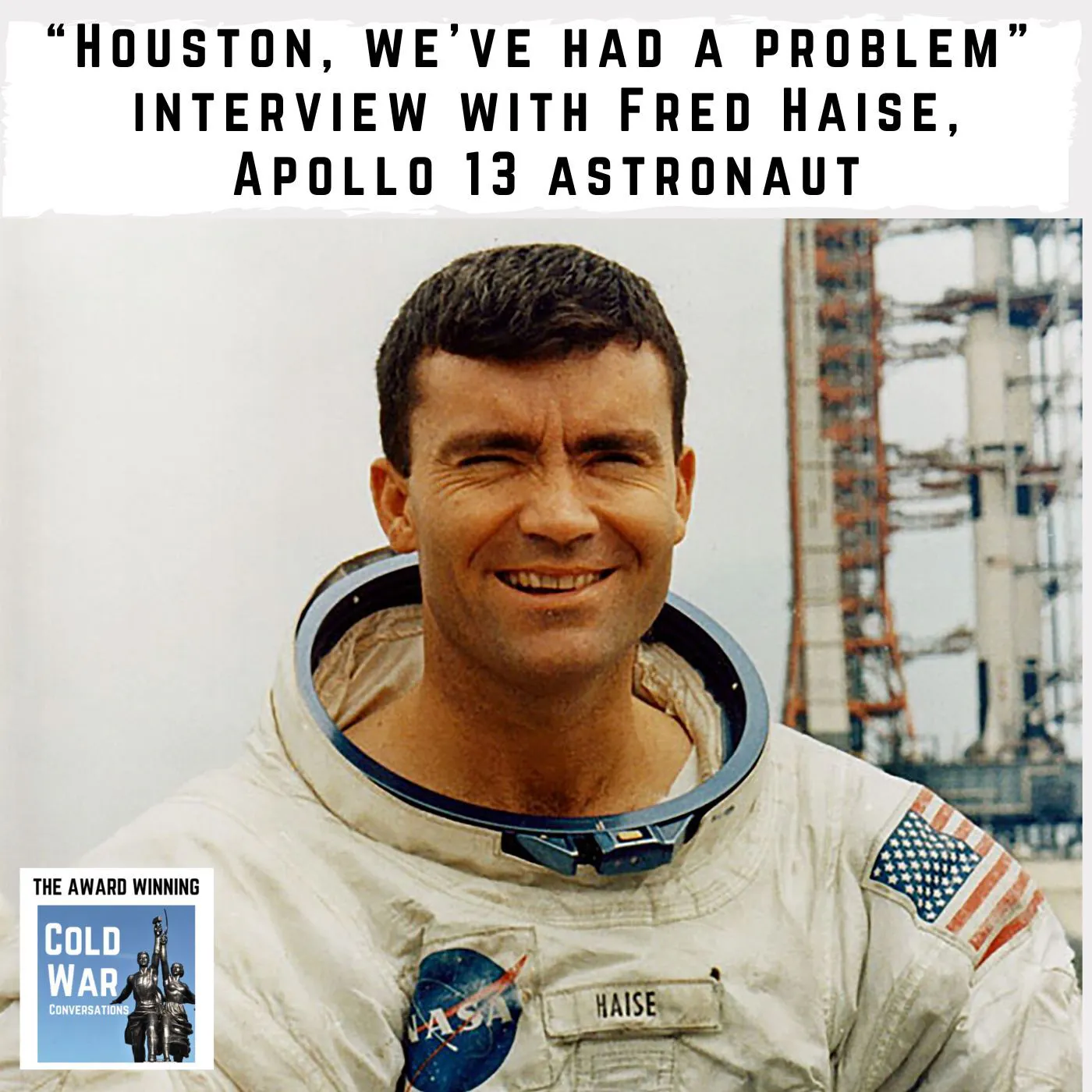
S14 Ep 254“Houston, we’ve had a problem” interview with Fred Haise, Apollo 13 astronaut (254)
Fred Haise was one of the three astronauts on the ill-fated Moon mission when a design fault caused an oxygen tank to explode mid-mission putting the Apollo 13 crew in mortal danger on April 13th, 1970. This was the seventh crewed mission in the Apollo space program and the third meant to land on the Moon. Now as you can imagine I’m genuinely excited to be speaking with one of the Apollo astronauts. Fred and I talk about his life and his almost accidental entry into flying. We cover his admission into the astronaut programme, the family impact, and as you can imagine go into some detail about his experiences on the Apollo 13 mission. Many of you will know of this mission via the Film “Apollo 13” starring Tom Hanks, and Fred shares his views on the film and corrects some of the inaccuracies. Buy Fred's new book Never Panic Early: An Apollo 13 Astronaut's Journey and support the podcast here https://amzn.to/3DvCRzN 0:00 Introduction 6:14 Fred Haise's journey to becoming an astronaut and role in Apollo 11 16:39 Selection and preparation for Apollo 13 mission 32:41 The Apollo 13 crisis: the explosion, aftermath, and survival 51:21 Critical maneuvers to correct trajectory back to Earth 1:03:42 Activation of the command module and return journey 1:11:12 Splashdown and immediate aftermath 1:18:48 Analysis of Apollo 13 film and Fred Haise's book 'Never Panic Early' 1:25:17 Episode extras, acknowledgment of financial supporters, and closing remarks Table of contents powered by PodcastAI✨ Cold War history is disappearing; however, a simple monthly donation will keep this podcast on the air. You’ll become part of our community and get a sought-after CWC coaster as a thank you and you’ll bask in the warm glow of knowing you are helping to preserve Cold War history. Just go to https://coldwarconversations.com/donate/ If a monthly contribution is not your cup of tea, We also welcome one-off donations via the same link. I am delighted to welcome Fred Haise to our Cold War conversation… Episode notes here https://coldwarconversations.com/episode254 Follow us on Twitter here https://twitter.com/ColdWarPod Facebook here https://www.facebook.com/groups/coldwarpod/ Instagram here https://www.instagram.com/coldwarconversations/ All audio/video/photos courtesy of NASA. Support the project! https://coldwarconversations.com/donate/ Follow us on Twitter https://twitter.com/ColdWarPod Facebook https://www.facebook.com/groups/coldwarpod/ Instagram https://www.instagram.com/coldwarconversations/ Youtube https://youtube.com/@ColdWarConversations Learn more about your ad choices. Visit podcastchoices.com/adchoices

S14 Ep 253An 18 year old US Military Policeman in Cold War West Berlin (253)
Richard Blevins enlisted aged 18 in the US Army in March of 1987. He completed Basic Training & Military Police School training in July of 1987 and was posted to West Berlin as a United States Military Policeman. He describes his selection for Berlin duty while at Rhine-Main AFB in Frankfurt and his first journey across East Germany on the US Duty train to West Berlin. Richard’s first year consisted of patrol duties and combat training as well as serving at Checkpoints Bravo and Charlie as the assistant to the Non-commissioned Officer in Charge. He also got selected as a traffic accident investigator in 1988 where he would patrol with the West Berlin Police and respond to all car accidents involving US military, dependents, and civilian workers as well as West German nationals. Richard also describes how he heard the news on November 8th, 1989, that Erich Honecker had lifted all travel restrictions on East Germans starting at midnight. He is a close friend of Michael Rafferty who appeared in episode 13 with his account of the last days of Checkpoint Charlie. Don’t miss Michael’s video of 1980s Berlin in the episode notes. 0:00 Introduction with Richard Blevins 5:00 Richard's journey to Berlin and first encounter with Soviet troops 15:00 Contrasting West and East Berlin and living conditions 25:00 Richard's assignment to 3rd platoon: Patrol duties, training, and interactions with Royal Military Police 35:00 Liaising with Soviets and training with British units 45:00 Duties at checkpoints Bravo and Charlie 55:00 Living near the Berlin Wall and its transformation post-fall 1:05:00 Friendship with Michael Rafferty and plans to revisit Berlin 1:10:00 Security measures for soldiers and interactions with locals Table of contents powered by PodcastAI✨ Cold War history is disappearing; however, a simple monthly donation will keep this podcast on the air. You’ll become part of our community and get a sought-after CWC coaster as a thank you and you’ll bask in the warm glow of knowing you are helping to preserve Cold War history. Just go to https://coldwarconversations.com/donate/ If a financial contribution is not your cup of tea, then you can still help us by leaving written reviews wherever you listen to us as well as sharing us on social media. It really helps us get new guests on the show. I am delighted to welcome Richard Blevins to our Cold War conversation… Episode notes here https://coldwarconversations.com/episode253 Follow us on Twitter here https://twitter.com/ColdWarPod Facebook here https://www.facebook.com/groups/coldwarpod/ Instagram here https://www.instagram.com/coldwarconversations/ Support the project! https://coldwarconversations.com/donate/ Follow us on Twitter https://twitter.com/ColdWarPod Facebook https://www.facebook.com/groups/coldwarpod/ Instagram https://www.instagram.com/coldwarconversations/ Youtube https://youtube.com/@ColdWarConversations Learn more about your ad choices. Visit podcastchoices.com/adchoices

S14 Ep 252A trip across Central Europe on a East German MZ motorbike (252)
MZ was an East German motorcycle manufacturer located in Zschopau, Saxony. The acronym MZ stands for Motorenwerke Zschopau GmbH (German for Zschopau engine factory). In the 1980s MZ was regarded by the British motorcycle press as producing ugly and old-fashioned (if worthy) motorcycles however, there was a hard-core set of UK fans who loved this relatively, cheap and easy-to-repair bike. Julian Howe was a big fan of the MZ bike. He tells of a bizarre honeymoon of fellow MZ club members which involved MZ bike fans from across the UK touring Western Europe and the Warsaw Pact Countries. From sharing drinks with border guards to being on the receiving end of CS gas in Krakow it’s a tour through late 1980s Europe on the back of a two-stroke MZ motorbike. 0:00 Introduction and background on MZ motorcycles 1:21 Call for donations and testimonial from a supporter 5:28 The journey begins - crossing the border into East Germany 11:26 Interaction with an East German border guard and reflections on environment 15:20 Entering Poland and experiences with locals 22:19 Crossing through Czechoslovakia into Hungary and visit to a private museum 26:12 Visit to Prague and interactions with locals 29:37 Return journey through East Germany and humorous encounter at the border 33:47 Julian's most memorable experience from his trip and favorite media recommendations 38:29 Closing remarks and appreciation for financial supporters 39:02 Encouragement to join the Facebook group and continue the conversation Table of contents powered by PodcastAI✨ Cold War history is disappearing; however, a simple monthly donation will keep this podcast on the air. You’ll become part of our community and get a sought-after CWC coaster as a thank you and you’ll bask in the warm glow of knowing you are helping to preserve Cold War history. Just go to https://coldwarconversations.com/donate/ If a financial contribution is not your cup of tea, then you can still help us by leaving written reviews wherever you listen to us as well as sharing us on social media. It really helps us get new guests on the show. I am delighted to welcome Julian Howe to our Cold War conversation… Episode notes here https://coldwarconversations.com/episode252 Follow us on Twitter here https://twitter.com/ColdWarPod Facebook here https://www.facebook.com/groups/coldwarpod/ Instagram here https://www.instagram.com/coldwarconversations/ Support the project! https://coldwarconversations.com/donate/ Follow us on Twitter https://twitter.com/ColdWarPod Facebook https://www.facebook.com/groups/coldwarpod/ Instagram https://www.instagram.com/coldwarconversations/ Youtube https://youtube.com/@ColdWarConversations Learn more about your ad choices. Visit podcastchoices.com/adchoices

S13 Ep 251Imprisoned in a Soviet Military gaol - a BRIXMIS officer's diary Pt 2 (251)
This is the 2nd part of my interview with Lt Col. Stephen Harrison, MBE who served for two years as a full-time Touring Officer with BRIXMIS. The tours were hazardous three-man, vehicle-borne patrols collecting intelligence on the Warsaw Pact forces in East Germany for up to five days and nights over a series of four-month patrolling periods. In this episode, we hear of Stephen’s imprisonment in a Soviet Army gaol, following detention in a Soviet Army garrison town as well as East German and Soviet Army press coverage about his activities. Stephen’s speciality was using his language skills to engage and befriend opposition troops and thereby gaining valuable intelligence. He used to go into bars frequented by Soviet officers and recalls one particular drunken night in Potsdam.. We also hear about his visit to the infamous World War 2 prison camp of Colditz castle where he befriends the staff enabling other BRIXMIS tours to visit regularly. Stephen also shares details of the top-secret Operation Tomahawk, a particularly unpleasant mission which may not be for those of a sensitive disposition. In later years Stephen obtained his Stasi file which reveals that the surveillance on him was far closer than he’d ever believed. 0:00 Introduction and Stephen Harrison's role in BRIXMIS 10:21 Stephen's arrest and time in a Soviet military cell 15:48 Stephen's role as interpreter and socializing with Soviet officers 22:53 Stephen's experiences during town and cultural tours 27:38 Stephen's Stasi files and the accuracy of their reports 33:25 Stephen's work and dealing with detentions 38:49 Operation Tomahawk: Exploiting Soviet military rubbish tips 47:57 Reflecting on the human side of intelligence gathering 49:45 Podcast end notes, acknowledgments and donation information 50:15 Invitation to join the Cold War Conversations Facebook group Table of contents powered by PodcastAI✨ Cold War history is disappearing; however, a simple monthly donation will keep this podcast on the air. You’ll become part of our community and get a sought after CWC coaster as a thank you and you’ll bask in the warm glow of knowing you are helping to preserve Cold War history. Just go to https://coldwarconversations.com/donate/ If a financial contribution is not your cup of tea, then you can still help us by leaving written reviews wherever you listen to us as well as sharing us on social media. It really helps us get new guests on the show. I am delighted to welcome Stephen to our Cold War conversation… Episode notes here https://coldwarconversations.com/episode251/ Follow us on Twitter here https://twitter.com/ColdWarPod Facebook here https://www.facebook.com/groups/coldwarpod/ Instagram here https://www.instagram.com/coldwarconversations/ There is nothing like hearing history from those that were there... Support the project! https://coldwarconversations.com/donate/ Follow us on Twitter https://twitter.com/ColdWarPod Facebook https://www.facebook.com/groups/coldwarpod/ Instagram https://www.instagram.com/coldwarconversations/ Youtube https://youtube.com/@ColdWarConversations Learn more about your ad choices. Visit podcastchoices.com/adchoices

S13 Ep 250Arrested 11 times, plus 3 shooting incidents - a BRIXMIS officer's diary Pt 1 (250)
Lt Col. Stephen Harrison, MBE served for two years as a full-time Touring Officer with BRIXMIS. These Tours were hazardous three man, vehicle-borne patrols collecting intelligence on the Warsaw Pact forces in East Germany for up to five days and nights over a series of four-month patrolling periods. They lived in the field and did not carry weapons while Soviet and East German troops were nearly always armed, and their ever-present sentries carried live ammunition. The Tours operated in the closest proximity to these hostile and aggressive Warsaw Pact troops whose orders permitted them to use whatever force necessary, including opening fire, to protect the property they are guarding. We hear in detail about Stephen’s experiences in these demanding and frequently dangerous situations, as well as how he used his language skills to engage and befriend opposition troops gaining valuable intelligence which made him a particular threat to the Soviets. Don’t miss part 2 here https://coldwarconversations.com/episode251/ 0:00 Introduction and Background of Lieutenant Colonel Stephen Harrison 2:19 How to Donate to Cold War Conversations 5:27 Stephen's Experiences and Roles During the Cold War 15:05 Techniques and Strategies Used on Tours 23:14 Emergency Situations and Adaptations During Tours 30:10 Interactions with East German Population and Soviet Troops 41:13 Encounter with Soviet Air Defense System and Other Incidents 47:39 Reflections on Risk-Taking during Operations 47:58 Closing Remarks and Acknowledgements of Financial Supporters Table of contents powered by PodcastAI✨ Cold War history is disappearing; however, a simple monthly donation will keep this podcast on the air. You’ll become part of our community and get a sought-after CWC coaster as a thank you and you’ll bask in the warm glow of knowing you are helping to preserve Cold War history. Just go to https://coldwarconversations.com/donate/ If a financial contribution is not your cup of tea, then you can still help us by leaving written reviews wherever you listen to us as well as sharing us on social media. It really helps us get new guests on the show. I am delighted to welcome Stephen to our Cold War conversation… Episode notes here https://coldwarconversations.com/episode250/ Follow us on Twitter here https://twitter.com/ColdWarPod Facebook here https://www.facebook.com/groups/coldwarpod/ Instagram here https://www.instagram.com/coldwarconversations/ Support the project! https://coldwarconversations.com/donate/ Follow us on Twitter https://twitter.com/ColdWarPod Facebook https://www.facebook.com/groups/coldwarpod/ Instagram https://www.instagram.com/coldwarconversations/ Youtube https://youtube.com/@ColdWarConversations Learn more about your ad choices. Visit podcastchoices.com/adchoices

S13 Ep 249Life in the forbidden zone at the East/West German border (249)
A young Claudia Bierschenk lived at the edge of a world called the GDR, in a village surrounded by hills, valleys and thick forests. Her great uncle lives in the Forbidden Zone, the area where the East German border is a few metres away from West Germany. This is where the villages are like ghosts towns and inhabitants need special permits to enter. Claudia provides a vivid and unique description of entering the Forbidden Zone for the first time after being granted special permits to visit her Great Uncle on his 80th birthday. His house is the last house before the final border fences and Claudia describes up close to the fences, while her grandfather tells her about “rabbit discos”… We also hear more of her life in this isolated area, including strange sports activities and Claudia’s experience of being trained as a 12-year-old Para medic. We end the episode talking about how she and her family experienced the momentous events of 1989 when the border opens, and East Germans are free to cross into West Germany. Claudia has distilled these stories into a book, Never Mind, Comrade, published by Tangerine Press Don’t miss our previous episode with Claudia here https://pod.fo/e/137f1e 0:00 Introduction 1:00 Life and experiences in East Germany featuring Claudia Biashek 10:07 Claudia's family history during World War 2 17:10 Claudia's journey to the restricted zone and first sight of the Berlin Wall 25:35 Claudia's family decision to emigrate and the fears associated 34:35 Claudia's experience during the opening of the borders and crossing into the West 44:27 Adaptation to life in the West 46:00 Introduction to Claudia's book, "Nevermind Comrade" 46:24 Acknowledging financial supporters of the podcast Table of contents powered by PodcastAI✨ Cold War history is disappearing; however, a simple monthly donation will keep this podcast on the air. You’ll become part of our community and get a sought after CWC coaster as a thank you and you’ll bask in the warm glow of knowing you are helping to preserve Cold War history. Just go to https://coldwarconversations.com/donate/ If a financial contribution is not your cup of tea, then you can still help us by leaving written reviews wherever you listen to us as well as sharing us on social media. It really helps us get new guests on the show. I am delighted to welcome Claudia to our Cold War conversation… Enter the draw to win a copy of the book here https://coldwarconversations.com/episode249/ Follow us on Twitter here https://twitter.com/ColdWarPod Facebook here https://www.facebook.com/groups/coldwarpod/ Instagram here https://www.instagram.com/coldwarconversations/ Radio GDR If you are interested in East Germany we can highly recommend our friends over at Radio GDR. Support the project! https://coldwarconversations.com/donate/ Follow us on Twitter https://twitter.com/ColdWarPod Facebook https://www.facebook.com/groups/coldwarpod/ Instagram https://www.instagram.com/coldwarconversations/ Youtube https://youtube.com/@ColdWarConversations Learn more about your ad choices. Visit podcastchoices.com/adchoices

S13 Ep 248The girl at the edge of the World - an East German childhood at the West German Border (248)
A young Claudia Bierschenk lived in a village surrounded by hills, valleys and thick forests at the edge of a world called the GDR. It could be beautiful, but the Iron Curtain runs through it, like a tectonic plate separating East and West and Claudia from her West German relatives. She tells of her life in this isolated area, of village life, far away from the socialist showpiece of East Berlin, where there are only two types of yoghurt in the village store. In a series of snapshots, we re-live her childhood of secretly watching West German TV, learning “Marxism-Leninism for kids” at school, and the rare joy of a phone call from the West. We also hear of her parents’ challenges. For her father, it’s his home village, but he is criticised for his liberal views and for wearing Western braces to school. Locals see her mother as an outsider, and she yearns for a life in the West with her sister in West Berlin. Claudia has distilled these stories into a book, Never Mind, Comrade, published by Tangerine Press. Buy the book here https://uk.bookshop.org/a/1549/9781910691700 0:00 Introduction and Claudia Bierschenk's early life in the GDR 6:50 Claudia's family occupations and life in a small town 14:08 Education and the system of punishment and reward in East German schools 24:06 Viewing Western television and maintaining contact with relatives in West Germany 33:07 Claudia's family experiences with the Berlin Wall and escape attempts 38:42 School experiences and navigating discussions in East Germany 44:13 Tightening of border controls and holidays in Hungary 49:56 After school activities and sports under the ideology ofEast Germany 51:30 "Nevermind Comrade" book by Claudia Bierschenk 52:00 Acknowledgement of financial supporters and call to action Table of contents powered by PodcastAI✨ Cold War history is disappearing; however, a simple monthly donation will keep this podcast on the air. You’ll get a sought-after CWC coaster as a thank you and bask in the warm glow of knowing you are helping preserve Cold War history. Just go to https://coldwarconversations.com/donate/ If a financial contribution is not your cup of tea, then you can still help us by leaving written reviews wherever you listen to us and sharing them on social media. It really helps us get new guests on the show. I am delighted to welcome Claudia Bierschenk to our Cold War conversation… Listen to the 2nd part of this interview here. https://pod.fo/e/1395f8 Extra episode info here. https://coldwarconversations.com/episode248 All photos are © Claudia Bierschenk. Follow us on Twitter here https://twitter.com/ColdWarPod Facebook here https://www.facebook.com/groups/coldwarpod/ Instagram here https://www.instagram.com/coldwarconversations/ Radio GDR If you are interested in East Germany we can highly recommend our friends over at Radio GDR. Support the project! https://coldwarconversations.com/donate/ Follow us on Twitter https://twitter.com/ColdWarPod Facebook https://www.facebook.com/groups/coldwarpod/ Instagram https://www.instagram.com/coldwarconversations/ Youtube https://youtube.com/@ColdWarConversations Learn more about your ad choices. Visit podcastchoices.com/adchoices
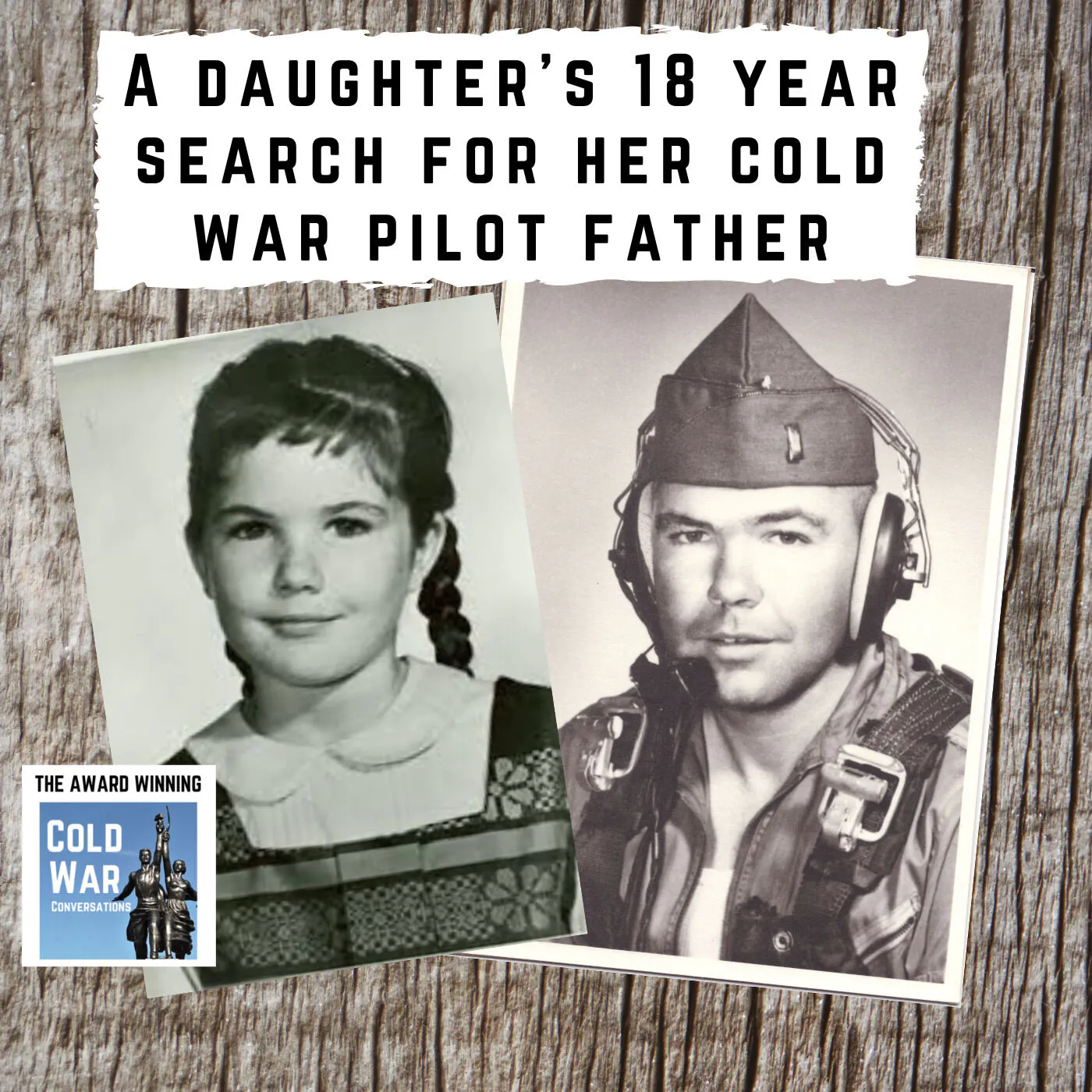
S13 Ep 247A daughter's 18 year search for her Cold War CIA pilot father at the Bay of Pigs invasion in Cuba (247)
In 1961, members of the Alabama Air National Guard secretly took part in the failed invasion of Cuba by U.S.-backed Cuban exiles known as the Bay of Pigs. This was a covert attempt by the United States to overthrow the Soviet-allied Cuban government of Fidel Castro. Pete Ray was one of eight Alabama guardsmen who flew combat missions on April 19th 1961, which resulted in the deaths of Pete and three members of the Alabama unit. U.S. President John F. Kennedy later acknowledged America's involvement but denied that American military personnel had entered Cuban territory. It was not until 1987 did the U.S. revealed that eight ANG members had indeed flown into Cuban airspace. We hear from Pete Ray’s daughter Janet, who tirelessly worked to find out the truth of what happened that day despite the best efforts of the CIA, the Cubans, and the US government to obstruct her investigations. Cold War history is disappearing; however, a simple monthly donation will keep this podcast on the air. You’ll get a sought-after CWC coaster as a thank you and bask in the warm glow of knowing you are helping preserve Cold War history. Just go to https://coldwarconversations.com/donate/ If a financial contribution is not your cup of tea, then you can still help us by leaving written reviews wherever you listen to us as well as sharing us on social media. It really helps us get new guests on the show. I am delighted to welcome Janet Ray to our Cold War conversation… Photos and videos here https://coldwarconversations.com/episode247/ 0:00 Introduction to the podcast and the story of the Bay of Pigs invasion 2:32 Guest Introduction: Janet Ray, daughter of Pete Ray 4:22 Pete Ray's involvement in the Bay of Pigs invasion 9:34 Aftermath of the Bay of Pigs invasion and the government's cover-up 15:03 Impact of the mercenaries' deaths on their families 18:52 The fear and paranoia in the families following the Bay of Pigs invasion 22:55 Janet's investigation into her father's death and resistance from the CIA 31:58 Janet's interactions with the Bay of Pigs pilots and Fidel Castro 47:15 The truth about Pete Ray's death and the return of his body 55:58 Wrap up and closing comments by Ian Sanders Table of contents powered by PodcastAI✨ Follow us on Twitter here https://twitter.com/ColdWarPod Facebook here https://www.facebook.com/groups/coldwarpod/ Instagram here https://www.instagram.com/coldwarconversations/ Support the project! https://coldwarconversations.com/donate/ Follow us on Twitter https://twitter.com/ColdWarPod Facebook https://www.facebook.com/groups/coldwarpod/ Instagram https://www.instagram.com/coldwarconversations/ Youtube https://youtube.com/@ColdWarConversations Learn more about your ad choices. Visit podcastchoices.com/adchoices
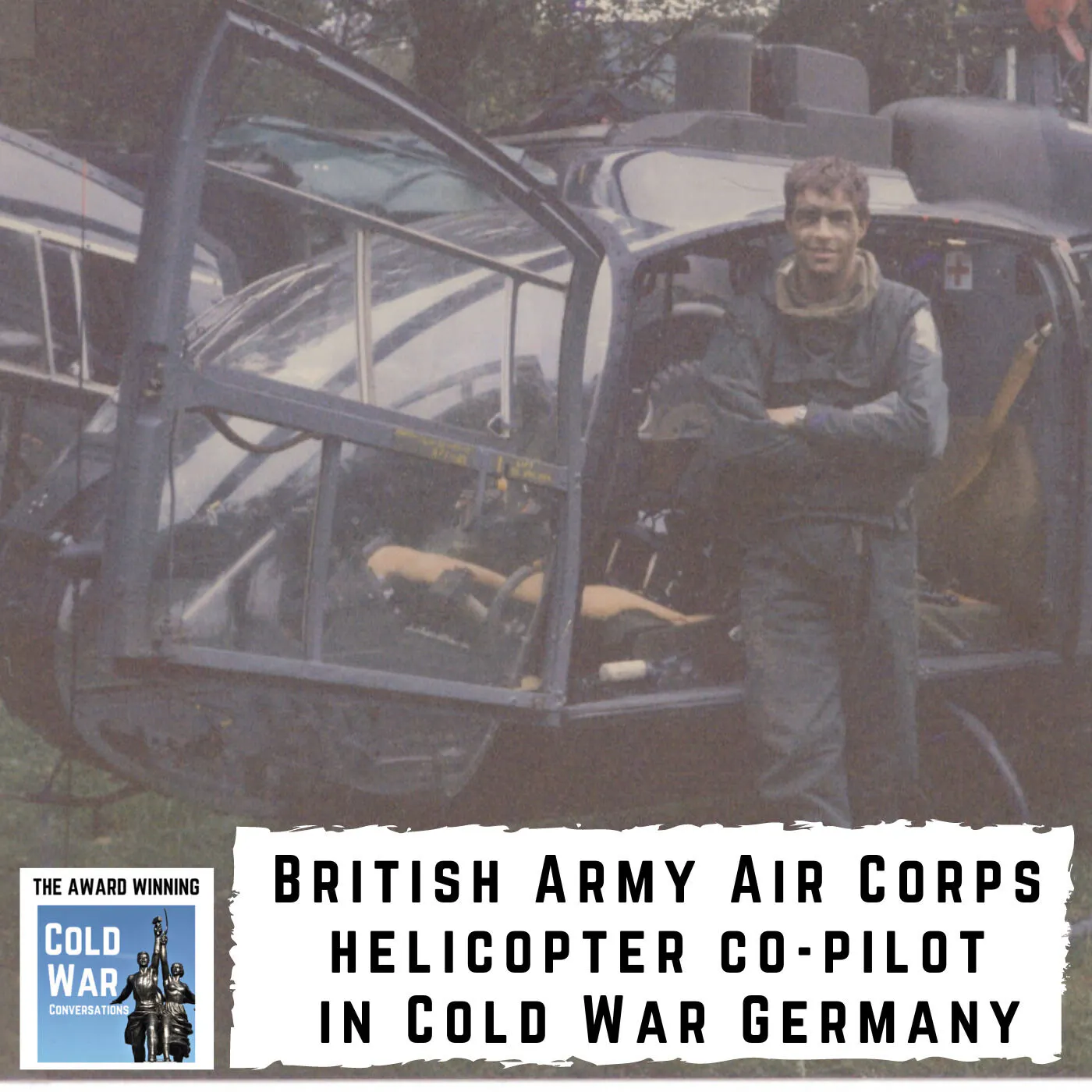
S13 Ep 246British Army Air Corps helicopter co-pilot in Cold War Germany (246)
Paul continues his story with his recruitment into the Army Air Corps. It’s initially delayed with a tour providing airfield repair in West Germany and then the Falklands, but finally, he’s at training at Middle Wallop, the home of the Army Air Corps. He describes the training including underwater escapes, flying and navigation. As a Gazelle crewman, his role was navigator, observer and co-pilot. We hear of exercises including the lesser-known Railex/Probex, a US, French and British exercise to re-open a land corridor to West Berlin should the links be closed by Warsaw Pact forces and the British Frontier Service. Paul’s story is again full of great anecdotes and the dangerous reality of flying low-level missions in a single-engine aircraft including a forced landing with a General on board. 0:00 Introduction and Paul's recruitment into the army air corps 1:30 Sponsor: Call for donations and listener testimonial 8:08 Discussion on practice drills and Paul's deployment to the Falklands 20:02 Surviving training and posting back to Germany 24:17 Transition to a new hangar and memorable encounter with Apache helicopters 28:34 Flying the inner German border and interception of unauthorized flights 33:42 Exercise Railex Probex: A combined US, French, and British exercise 44:08 Winning the Rolls Royce Trophy and personal experiences in the army air corps 54:24 Reflecting on the dangers of the job and the forgotten casualties of the Cold War 58:33 Importance of timing for the general's travels and emergency landing due to engine failure 1:13:59 Return to the Corps of Royal Engineers and posting back to Germany 1:21:16 Paul's sunshine tour in Gibraltar and final tours 1:21:48 Closing remarks and appreciation for patrons Table of contents powered by PodcastAI✨ Cold War history is disappearing; however, a simple monthly donation will keep this podcast on the air. You’ll get a sought-after CWC coaster as a thank you and bask in the warm glow of knowing you are helping preserve Cold War history. Just go to https://coldwarconversations.com/donate/ If a financial contribution is not your cup of tea, then you can still help us by leaving written reviews wherever you listen to us as well as sharing us on social media. It really helps us get new guests on the show. I am delighted to welcome Paul to our Cold War conversation… Photos and videos here https://coldwarconversations.com/episode246/ Don’t miss our previous episode where Paul joins the Army as a boy soldier in the Royal Engineers here https://coldwarconversations.com/episode245/ Follow us on Twitter here https://twitter.com/ColdWarPod Facebook here https://www.facebook.com/groups/coldwarpod/ Instagram here https://www.instagram.com/coldwarconversations/ Support the project! https://coldwarconversations.com/donate/ Follow us on Twitter https://twitter.com/ColdWarPod Facebook https://www.facebook.com/groups/coldwarpod/ Instagram https://www.instagram.com/coldwarconversations/ Youtube https://youtube.com/@ColdWarConversations Learn more about your ad choices. Visit podcastchoices.com/adchoices
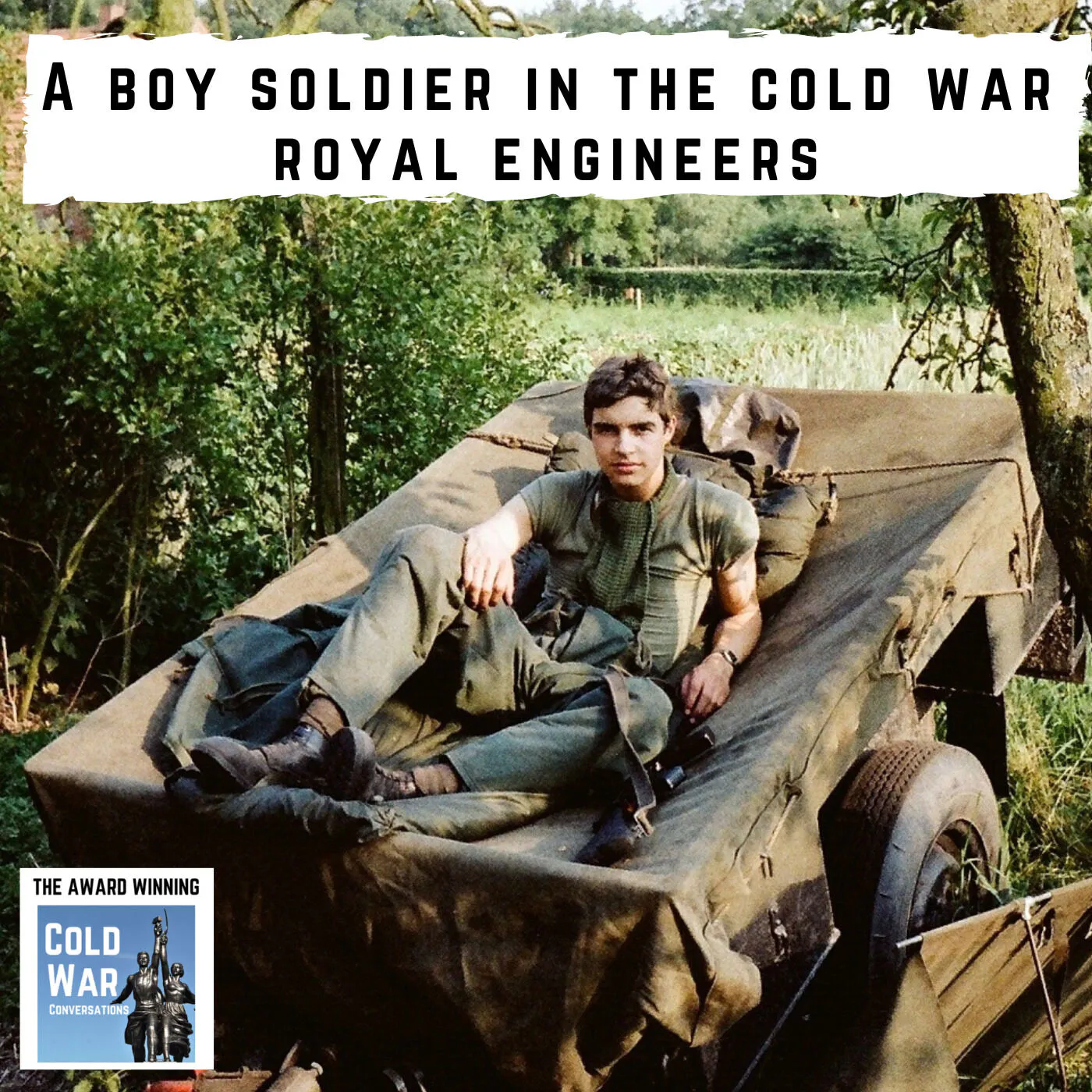
S13 Ep 245A boy soldier in the Cold War Royal Engineers (245)
Paul joined the Royal Engineers in 1977, aged 16 as an apprentice. We hear of his experience of joining the army at such a young age and being away from home for the first time. After initial training his first posting was to Osnabruck in 1979. Shortly after his arrival Paul is appointed to the challenging role of driver to the Squadron Sergeant Major With participation in exercises such as Crusader 80 and Active Edge Paul describes in detail the role of Royal Engineers in Cold War Germany, including mine laying, bridge demolition and fixed defence construction. Paul’s story is full of great anecdotes and tales of the reality of life in the British Army of the Rhine. Don’t miss our next episode where Paul joins the Army Air Corps and becomes an Aircrewman Observer on Gazelle helicopters along the Inner German Border. 0:00 Introduction to Paul's journey in the Royal Engineers 1:30 Request for support to keep the podcast running 2:31 Paul's early life and decision to join the army 9:14 Paul's arrival in Osnabruck and his role as a Land Rover driver 29:00 Paul's experiences in Germany and developing an affinity for the country 38:20 Preparation and expectations for exercise Crusader 80 47:00 Cooperation with German farmers during the exercises 59:00 The humanity of the Sergeant Major and the challenges of dispatch riders 35:33 Transition to engineering tasks during the Crusader 80 exercise 42:20 Paul's transition to support troop and working with REME workshop 51:01 Paul's career move and application for the Army Air Corps 52:56 Ian Sanders: Closing thoughts and reminders Table of contents powered by PodcastAI✨ Cold War history is disappearing; however, a simple monthly donation will keep this podcast on the air. You’ll get a sought after CWC coaster as a thank you and you’ll bask in the warm glow of knowing you are helping to preserve Cold War history. Just go to https://coldwarconversations.com/donate/ If a financial contribution is not your cup of tea, then you can still help us by leaving written reviews wherever you listen to us as well as sharing us on social media. It really helps us get new guests on the show. I am delighted to welcome Paul to our Cold War conversation… Episode notes here https://coldwarconversations.com/episode245/ Follow us on Twitter here https://twitter.com/ColdWarPod Facebook here https://www.facebook.com/groups/coldwarpod/ Instagram here https://www.instagram.com/coldwarconversations/ Support the project! https://coldwarconversations.com/donate/ Follow us on Twitter https://twitter.com/ColdWarPod Facebook https://www.facebook.com/groups/coldwarpod/ Instagram https://www.instagram.com/coldwarconversations/ Youtube https://youtube.com/@ColdWarConversations Learn more about your ad choices. Visit podcastchoices.com/adchoices

S13 Ep 244A Mormon missionary in Cold War East Germany (244)
In the early 1980s East Germany had just 5000 members of the Church of Latter-day Saints, many of which had been members since before World War 2. In 1982 East German leader Erich Honecker historically allowed the church to build a temple in Freiberg and in 1988 Mormon missionaries were allowed into East Germany. Ken Brady describes his experiences as a Mormon missionary in East Germany as the country gradually disappeared and was absorbed into West Germany. Ken also gives us a valuable view of life away from Berlin in cities such as Cottbus, Gorlitz, Schwerin, Frankfurt an der Oder and Eisenhüttenstadt. It’s a fascinating story told with humour and candour as Ken grapples with local dialects, the local food and tricks with East German currency. 0:00 Introduction and Ken Brady's early interest in East Germany 7:16 The Church's operations in East Germany before the fall of the Berlin Wall 12:24 First impressions of East Germany 21:17 Fear of the Stasi after the fall of the Berlin Wall 28:18 Encounters with locals suspecting them to be CIA agents 34:19 Sightseeing and exploring local culture on days off 42:19 Guidance on political party selection and introduction of West German products 46:17 Teaching religion to those with no prior experience 56:22 Currency Unification and its impact on East Germany 1:09:00 Ken Brady's service in West Berlin 1:18:18 The stark contrast of Soviet architecture 1:21:00 Thanking the Patrons and final remarks Table of contents powered by PodcastAI✨ Cold War history is disappearing; however, a simple monthly donation will keep this podcast on the air. You’ll get a sought after CWC coaster as a thank you and you’ll bask in the warm glow of knowing you are helping to preserve Cold War history. Just go to https://coldwarconversations.com/donate/ If a financial contribution is not your cup of tea, then you can still help us by leaving written reviews wherever you listen to us as well as sharing us on social media. It really helps us get new guests on the show. I am delighted to welcome Ken to our Cold War conversation… Episode notes here https://coldwarconversations.com/episode244/ Follow us on Twitter here https://twitter.com/ColdWarPod Facebook here https://www.facebook.com/groups/coldwarpod/ Instagram here https://www.instagram.com/coldwarconversations/ Radio GDR If you are interested in East Germany we can highly recommend our friends over at Radio GDR. Support the project! https://coldwarconversations.com/donate/ Follow us on Twitter https://twitter.com/ColdWarPod Facebook https://www.facebook.com/groups/coldwarpod/ Instagram https://www.instagram.com/coldwarconversations/ Youtube https://youtube.com/@ColdWarConversations Learn more about your ad choices. Visit podcastchoices.com/adchoices
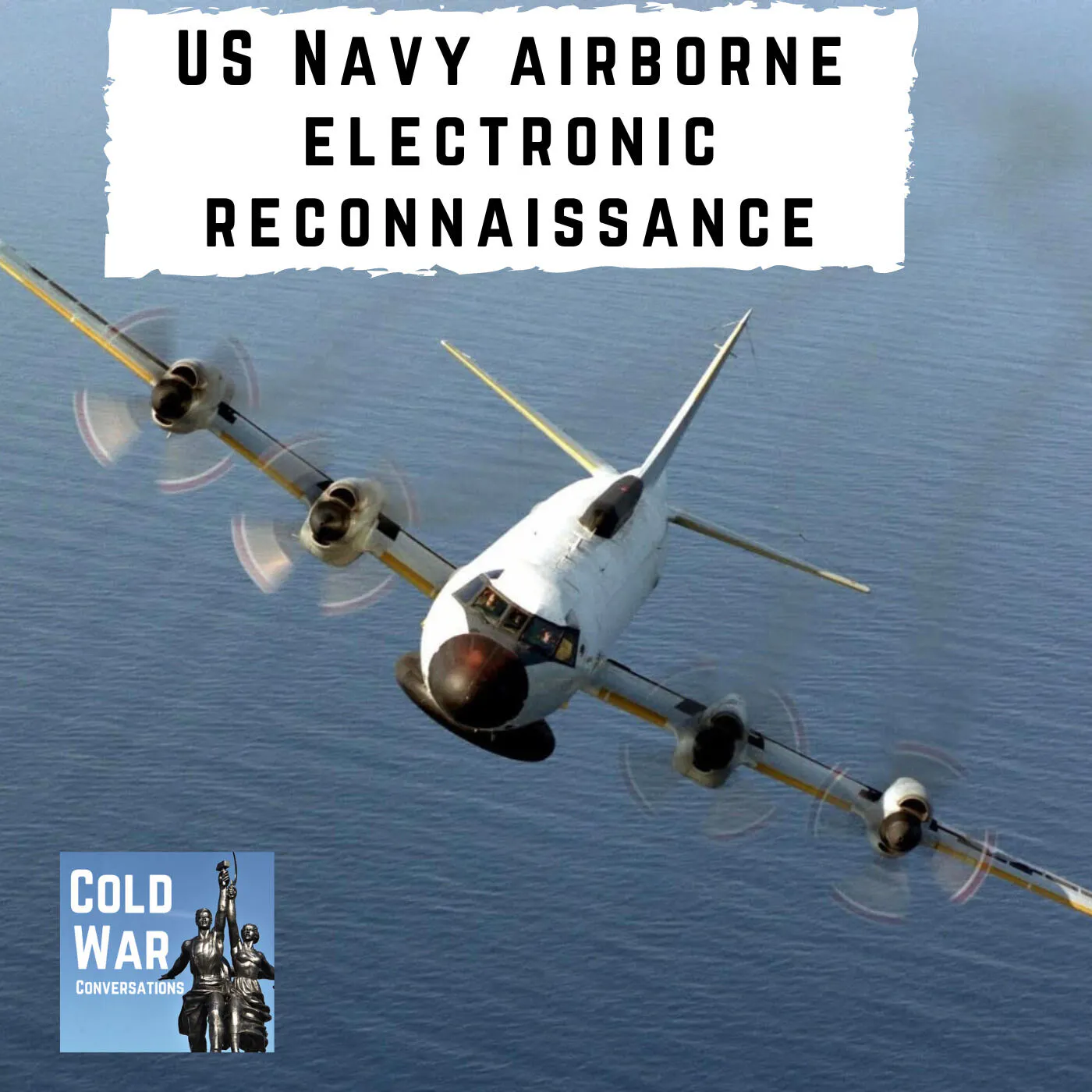
S13 Ep 243US Navy Cold War airborne electronic reconnaissance (243)
KC flew the US Navy’s airborne Electronic Reconnaissance during the 1980s in the Lockheed EP-3 which is an electronic signals reconnaissance version of the P-3 Orion. He flew as a Navigator, Senior Electronic Warfare Evaluator and Mission Commander. We hear about several missions he was involved in including his first detachment to Athens the then main USN operating base for missions in the Mediterranean and the Adriatic. We also hear about flying in the Baltic from bases in the UK (Mildenhall/Wyton) or FRG (Schleswig-Jagel). Flying from Keflavik in Iceland KC monitored a huge Soviet Navy exercise in the Norwegian Sea involving the Kiev, Kirov, and numerous cruisers, destroyers, and frigates. In the 1980s Libya was claiming the Gulf of Sidra as its territorial waters and KC flew in support of “freedom of navigation” operations involving USN ships. It’s a great insight into a relatively unknown part of Cold War air operations. 0:00 Introduction and KC's experience on the EP3 9:21 Focus on the Adriatic and Yugoslavia and Albania 15:24 The aftermath of the La Belle disco bomb attack and increased security measures 26:10 Busy month flying from Athens 32:27 Continuation of Cold War era aircraft in service today 36:15 The Achilles Lauro cruise ship hijacking, October 1985 54:25 Iowa class battleships and their role in the Cold War 1:02:12 KC's last flight in the Baltic 1:06:15 Instructions for landing in enemy territory 1:13:33 Cold War conversations on Facebook Table of contents powered by PodcastAI✨ Cold War history is disappearing; however, a simple monthly donation will keep this podcast on the air. You’ll get a sought-after CWC coaster as a thank you and you’ll bask in the warm glow of knowing you are helping to preserve Cold War history. Just go to https://coldwarconversations.com/donate/ If a financial contribution is not your cup of tea, then you can still help us by leaving written reviews wherever you listen to us as well as sharing us on social media. It really helps us get new guests on the show. I am delighted to welcome KC to our Cold War conversation… Episode notes here https://coldwarconversations.com/episode243/ Follow us on Twitter here https://twitter.com/ColdWarPod Facebook here https://www.facebook.com/groups/coldwarpod/ Instagram here https://www.instagram.com/coldwarconversations/ If you can’t wait for next week’s episode do visit our Facebook discussion group where guests and listeners continue the Cold War Conversation. Just search Cold War Conversations in Facebook. Support the project! https://coldwarconversations.com/donate/ Follow us on Twitter https://twitter.com/ColdWarPod Facebook https://www.facebook.com/groups/coldwarpod/ Instagram https://www.instagram.com/coldwarconversations/ Youtube https://youtube.com/@ColdWarConversations Learn more about your ad choices. Visit podcastchoices.com/adchoices
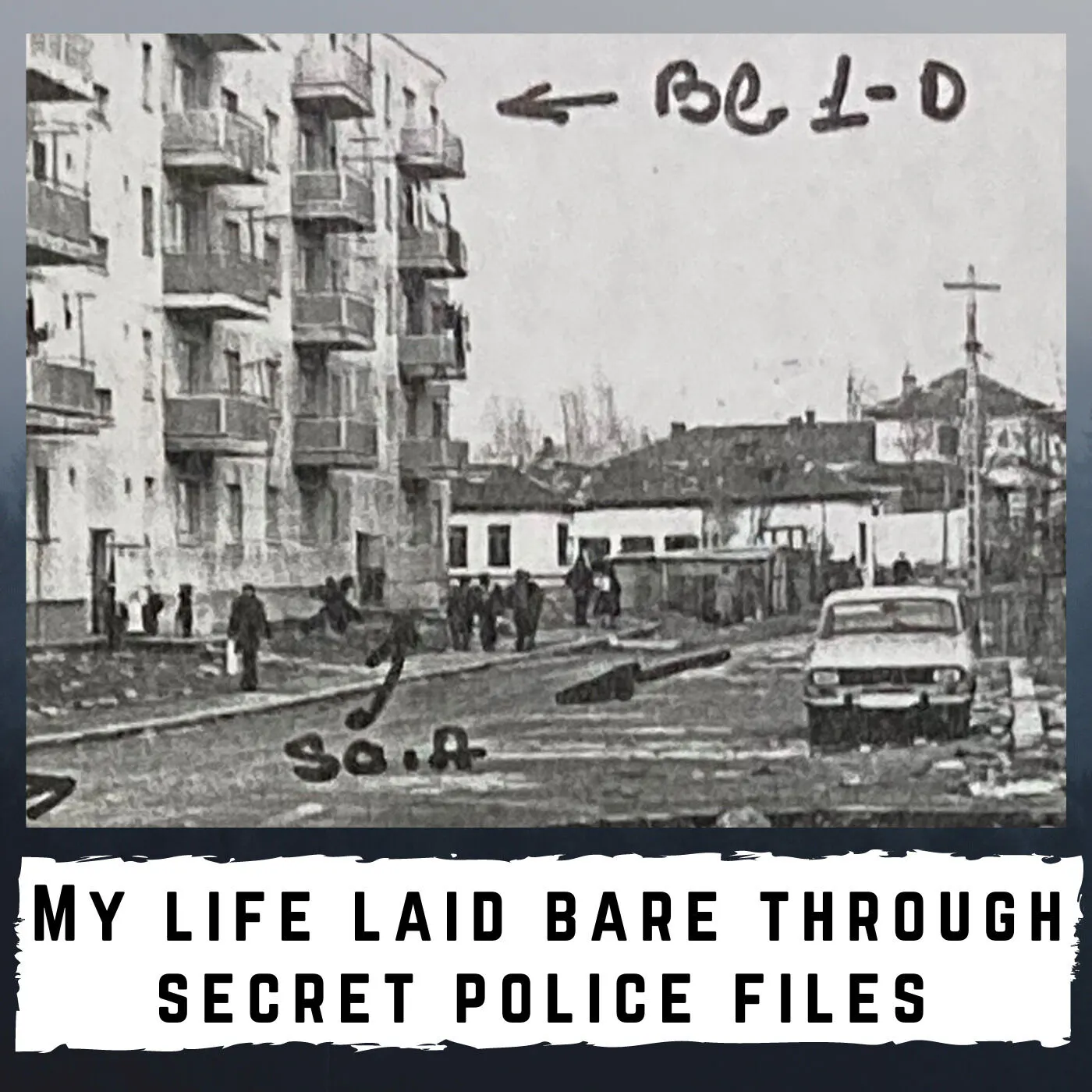
S13 Ep 242My life laid bare through secret police files (242)
What is it like to be under secret police surveillance? On 10 March 1983, 12-year-old Carmen Bugan returned from school to find Romanian secret police in her living room. Her father’s protest against the regime had changed her life forever. In recent years Carmen gained access to the files of the Romanian secret police. She herself is surprised by the intimacy of the surveillance. Forgotten conversations, love letters, and arguments are all laid bare via the detailed notes taken by the Securitate. We hear the sadness of discovering friends and family members were involved in informing on them too. Carmen and I discuss the “language of oppression”, the subtle and not-so-subtle methods used to try and ensure a compliant population but still thwarted by humanity even in the darkest recesses of the Romanian prison system. It’s a warning from history and the meaning of freedom in current times. 0:00 Introduction of guest Carmen Bugan and her experience with the Romanian secret police 4:08 Carmen's first experience with the secret police at the age of twelve 10:55 Initial reactions to reading the secret police files and seeing recorded intimate details 18:28 Carmen's discovery of surveillance files and their impact 24:12 Carmen reads out a transcript from the files 33:57 Carmen on the conflicts stirred by the files 41:17 Carmen elaborates on why the secret police needed justifications for arrests 49:21 Carmen discusses how family members justified their involvement with the secret police 1:02:28 Carmen talks about the power of language to harm and inspire 1:13:33 Ian Sanders introduces Carmen Bugan's book and previous episode Table of contents powered by PodcastAI✨ Buy the book here Carmen Bugan Books UK Listeners Carmen Bugan books US listeners Cold War history is disappearing; however, a simple monthly donation me will keep this project going and allow me to continue preserving these incredible stories. You’ll join our community, get a sought-after CWC drinks coaster as a thank you, and you’ll bask in the warm glow of knowing you are helping to preserve Cold War history. Just go to https://coldwarconversations.com/donate/ If a financial contribution is not your cup of tea, then you can still help us by leaving written reviews wherever you listen to us as well as sharing us on social media. It really helps us get new guests on the show. I am delighted to welcome back Carmen Bugan to our Cold War conversation… Episode notes here https://coldwarconversations.com/episode242/ Follow us on Twitter here https://twitter.com/ColdWarPod Facebook here https://www.facebook.com/groups/coldwarpod/ Instagram here https://www.instagram.com/coldwarconversations/ Don't miss Carmen's previous episode " A Childhood under the eye of the Secret Police" here https://coldwarconversations.com/episode147/ Support the project! https://coldwarconversations.com/donate/ Follow us on Twitter https://twitter.com/ColdWarPod Facebook https://www.facebook.com/groups/coldwarpod/ Instagram https://www.instagram.com/coldwarconversations/ Youtube https://youtube.com/@ColdWarConversations Learn more about your ad choices. Visit podcastchoices.com/adchoices

S13 Ep 241Royal Military Police versus the Soviets (SOXMIS) in Cold War West Germany (241)
Keith Bailey Joined British Army at 16 in 1973. He was recruited into the Blues and Royals, (Household Cavalry) and served in West Germany as a gunner in Chieftain tanks. However, he was keen to serve in the Royal Military Police and particularly 19 (Support) Platoon known as "The White Mice". Their role was to track the SOXMIS (Soviet Military Mission) in West Germany. SOXMIS operated under a 1946 agreement where the Soviets, British, US and French agreed to exchange mission groups to patrol the opposing side’s then zones of occupation. The agreement continued to 1990 and needless to say both sides bent the rules somewhat… 0:00 Introduction 2:35 Keith Bailey's Military Career and Transition to the Royal Military Police 16:39 The Role of the RMP during the Cold War and Bailey's Experience 19:11 Joining the 19 Support Platoon and Training 23:29 The Presence of Soviet Troops in West Germany and Interactions 38:07 Soviet Intelligence Gathering and Anecdotes 43:28 Discussion about Soviet Precautions and Protocol for Crossing Sectors 51:35 Keith's Collection of Cold War Photos and Discussion on Detaining SOXMIS Vehicles 1:07:03 Reaction to the Fall of the Berlin Wall and Post-Cold War Interactions 1:18:15 Invitation to Facebook Discussion Group and Closing Remarks Table of contents powered by PodcastAI✨ Cold War history is disappearing; however, a simple monthly donation will keep this podcast on the air. You’ll get a sought-after CWC coaster as a thank you and you’ll bask in the warm glow of knowing you are helping to preserve Cold War history. Just go to https://coldwarconversations.com/donate/ If a financial contribution is not your cup of tea, then you can still help us by leaving written reviews wherever you listen to us as well as sharing us on social media. It really helps us get new guests on the show. I am delighted to welcome Keith Bailey to our Cold War conversation… Episode notes & photos here https://coldwarconversations.com/episode241/ Follow us on Twitter here https://twitter.com/ColdWarPod Facebook here https://www.facebook.com/groups/coldwarpod/ Instagram here https://www.instagram.com/coldwarconversations/ Support the project! https://coldwarconversations.com/donate/ Follow us on Twitter https://twitter.com/ColdWarPod Facebook https://www.facebook.com/groups/coldwarpod/ Instagram https://www.instagram.com/coldwarconversations/ Youtube https://youtube.com/@ColdWarConversations Learn more about your ad choices. Visit podcastchoices.com/adchoices
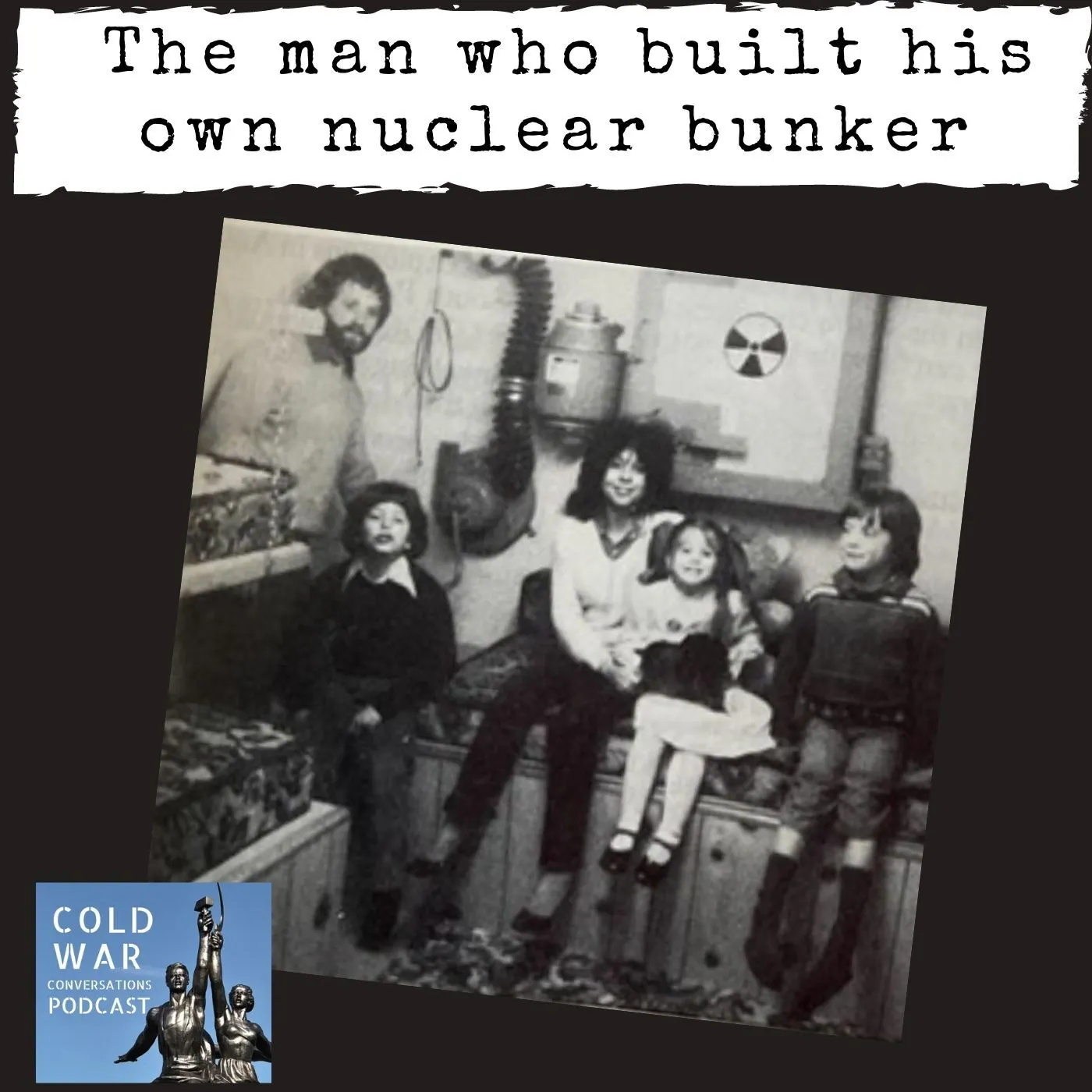
S12 Ep 240The man who built his own nuclear bunker (240)
Graham Bate was 30-year-old Civil Servant when he built his own nuclear bunker in the garden of his rural home 20 miles outside Hull in the UK. It was here that the Bate family expected to survive for at least 3 weeks after a nuclear attack. We speak with Graham Bate and his son Conrad who was 5 years old when the bunker was built and has vivid memories of the period. 0:00 Introduction and background 0:53 Guest Introduction: Graham Bate and his nuclear bunker 2:26 The inception and design of Graham's bunker 7:04 Family's experience and trial run in the bunker 13:27 Reflections on the bunker project 20:10 The family's nuclear emergency plan 29:11 Security measures and local perspectives on the bunker 32:37 Living conditions in the bunker 37:03 Graham's fame and bunker building business 43:39 Impact of the Cold War on the bunker business 46:03 Learning curve and survival in a post-apocalyptic scenario Table of contents powered by PodcastAI✨ Cold War history is disappearing; however, a simple monthly donation will help preserve these accounts and keep this podcast on the air. You’ll get a sought after CWC coaster as a thank you and you’ll bask in the warm glow of knowing you are helping to preserve Cold War history. Just go to https://coldwarconversations.com/donate/ If a financial contribution is not your cup of tea, then you can still help us by leaving written reviews wherever you listen to us as well as sharing us on social media. It really helps us get new guests on the show. I am delighted to welcome Graham and Conrad Bate to our Cold War conversation… There’s further information on this episode here. https://coldwarconversations.com/episode240/ Special thanks to Al McCann who helped facilitate this episode. Please visit his website Northern Ireland's Secret Bunker. A Cold War 'Living' Museum situated in County Armagh https://www.facebook.com/nibunker/ If you can’t wait for next week’s episode do visit our Facebook discussion group where guests and listeners continue the Cold War Conversation. Thank you very much for listening. It is really appreciated. Support the project! https://coldwarconversations.com/donate/ Follow us on Twitter https://twitter.com/ColdWarPod Facebook https://www.facebook.com/groups/coldwarpod/ Instagram https://www.instagram.com/coldwarconversations/ Youtube https://youtube.com/@ColdWarConversations Learn more about your ad choices. Visit podcastchoices.com/adchoices
S12 Ep 239Cold War number stations (239)
You might remember listening to short wave radio during the Cold War and coming across weird transmissions of metallic voices reciting random groups of numbers through the ether. These are number stations, shortwave radio stations characterised by broadcasts of formatted numbers, which were being sent to spies operating in foreign countries. Number stations were used widely during the Cold War and we speak with Jo Reggelt. Jo has been working with Simon Mason who was a founding member of ENIGMA, launched in the 80s after identifying several of these stations. We discuss in detail the operations behind the transmissions and the stations themselves. You will hear some sample transmissions which Jo has kindly allowed us to use, including one with drunken Stasi officers serenading their agents after the opening of the Berlin Wall. We also detail a UK spy case that centred on capturing an agent red-handed listening to a numbers station. There’s further information including links here. https://coldwarconversations.com/episode239/ 0:00 Introduction 5:06 Overview of Number Stations 20:37 Role of Agents and Attempts to Jam Number Stations 29:51 Identification and grouping of number stations 35:20 Notable Number Stations: Lincolnshire Poacher and CIA, BND Stations 43:15 The Story of Czech Spy: Erwin Van Harlem 54:41 Number Stations in Non-Aligned and NATO Nations 1:02:26 History of South Tyrol and its Role in the Cold War 1:07:27 Impact of the End of the Cold War on Number Stations 1:12:25 Influence of Number Stations on Pop Culture Table of contents powered by PodcastAI✨ Now if you think there is a vast army of research assistants, audio engineers and producers putting together this podcast you’d be wrong. This podcast relies on your support to enable me to continue to capture these incredible stories and make them available to everyone for free. If you’d like to help to preserve Cold War history and enable me to continue to produce this podcast you can via one-off or monthly donations. Just go to https://coldwarconversations.com/donate/ for more details. Do join our Facebook discussion group where the cold war conversation continues between episodes. Just search Cold War Conversations in Facebook. Follow us on Twitter here https://twitter.com/ColdWarPod Facebook https://www.facebook.com/groups/coldwarpod/ Instagram https://www.instagram.com/coldwarconversations/ Support the project! https://coldwarconversations.com/donate/ Follow us on Twitter https://twitter.com/ColdWarPod Facebook https://www.facebook.com/groups/coldwarpod/ Instagram https://www.instagram.com/coldwarconversations/ Youtube https://youtube.com/@ColdWarConversations Learn more about your ad choices. Visit podcastchoices.com/adchoices
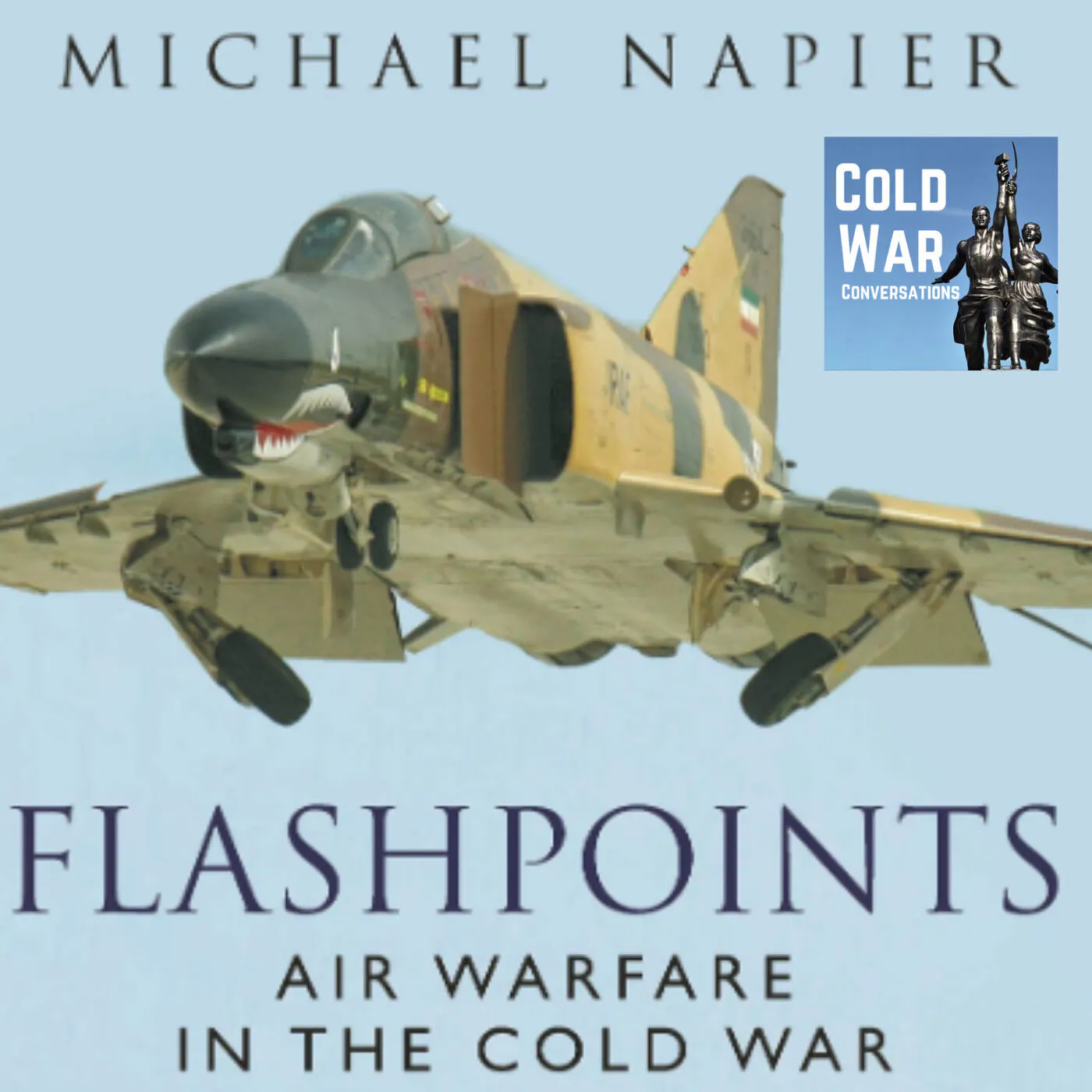
S12 Ep 238Air warfare in the Cold War (238)
The Cold War years were a period of unprecedented peace in Europe, yet they also saw a number of localised but nonetheless very intense wars throughout the wider world in which air power played a vital role. I speak with former Cold War Tornado pilot and acclaimed aviation historian Michael Napier who has written Flashpoints: Air Warfare in the Cold War published by Osprey which describes eight of these Cold War conflicts. We discuss the wide range of aircraft types used and the development of tactics over a period of revolution in aviation technology and design which saw some of the most modern technology that the NATO and Warsaw Pact forces deployed. UK listeners buy the book here US listeners buy the book here 0:00 Introduction 2:08 Introduction of guest Michael Napier and discussion on the importance of personalizing conflicts 7:18 Deep dive into the Suez and Congo conflicts 14:54 Role of the UN's air force in conflicts and the impact of combat aircraft 24:08 Introduction to the Indo-Pakistan wars and the Arab-Israeli wars 34:22 The toll of war on pilots and the international nature of conflicts 35:59 Overview of the Iran-Iraq War 40:53 The Falklands War: Initial reactions, strategies, and impact 50:34 Closing remarks, acknowledgments, and store promotion Table of contents powered by PodcastAI✨ Cold War history is disappearing; however, a simple monthly donation will keep this podcast on the air. You’ll get a sought after CWC coaster as a thank you and you’ll bask in the warm glow of knowing you are helping to preserve Cold War history. Just go to https://coldwarconversations.com/donate/ If a financial contribution is not your cup of tea, then you can still help us by leaving written reviews wherever you listen to us as well as sharing us on social media. It really helps us get new guests on the show. Episode notes here https://coldwarconversations.com/episode236/ Follow us on Twitter here https://twitter.com/ColdWarPod Facebook here https://www.facebook.com/groups/coldwarpod/ Instagram here https://www.instagram.com/coldwarconversations/ Thank you very much for listening. It is really appreciated. Support the project! https://coldwarconversations.com/donate/ Follow us on Twitter https://twitter.com/ColdWarPod Facebook https://www.facebook.com/groups/coldwarpod/ Instagram https://www.instagram.com/coldwarconversations/ Youtube https://youtube.com/@ColdWarConversations Learn more about your ad choices. Visit podcastchoices.com/adchoices
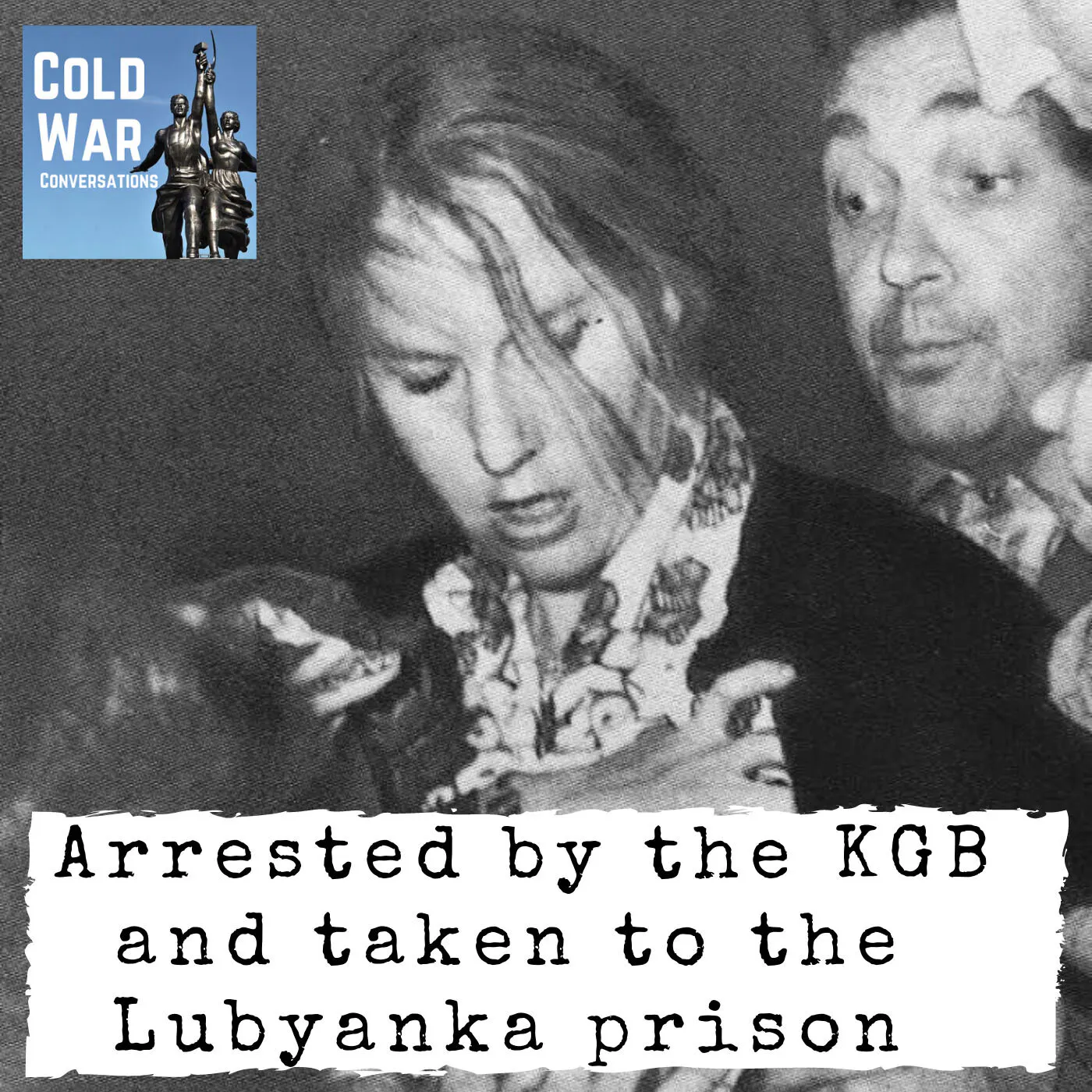
S12 Ep 237Arrested by the KGB and taken to the Lubyanka prison (237)
Marti Peterson was the first female CIA operative to be assigned to Moscow, probably the most challenging posting during the Cold War. Don't miss the previous episode here https://coldwarconversations.com/episode236/ This second episode turns to TRIGON, the code name for Alexandr Ogorodnik. He was an official in the Soviet Embassy in Bogota, Columbia recruited by the CIA in 1973. Marti and TRIGON never met in person, but they shared information through dead drops and intelligence. We hear about the tradecraft involved. Marti is arrested by KGB agents and taken to Moscow's Lubyanka Prison for questioning and talks in detail about that experience. UK listeners buy Marti's the book here and support the podcast US listeners buy Marti's the book here and support the podcast 0:00 Introduction and Marti Peterson's role in the Cold War 2:33 Recruitment of Trigon by the CIA 10:06 Marti's first dead drop for Trigon and surveillance evasion techniques 18:24 Marti Peterson's account of her adrenaline-filled Cold War operations 24:12 The value and dissemination of Trigon's intelligence 29:55 Growing concerns about Trigon's safety and attempts to communicate 33:11 The dead drop and Marti's unexpected encounter 37:12 Marti Peterson's arrest, interrogation, and release 49:59 Marti Peterson's return to the US and the discovery of Trigon's fate 57:38 The aftermath: Trigon's unknown daughter in Bogota and his real identity 1:00:21 Marti's meeting with President Jimmy Carter 1:02:34 Episode notes, acknowledgement of financial supporters and call for donations 1:03:25 The Cold War Conversations online store Table of contents powered by PodcastAI✨ Cold War history is disappearing; however, a simple monthly donation will keep this podcast on the air. You’ll get a sought after CWC coaster as a thank you and you’ll bask in the warm glow of knowing you are helping to preserve Cold War history. Just go to https://coldwarconversations.com/donate/ If a financial contribution is not your cup of tea, then you can still help us by leaving written reviews wherever you listen to us as well as sharing us on social media. It really helps us get new guests on the show. I am delighted to welcome Marti Peterson to our Cold War conversation… Episode notes here https://coldwarconversations.com/episode237/ Episode one is here https://coldwarconversations.com/episode236/ Follow us on Twitter here https://twitter.com/ColdWarPod Facebook here https://www.facebook.com/groups/coldwarpod/ Instagram here https://www.instagram.com/coldwarconversations/ Thank you very much for listening. It is really appreciated – goodbye. Support the project! https://coldwarconversations.com/donate/ Follow us on Twitter https://twitter.com/ColdWarPod Facebook https://www.facebook.com/groups/coldwarpod/ Instagram https://www.instagram.com/coldwarconversations/ Youtube https://youtube.com/@ColdWarConversations Learn more about your ad choices. Visit podcastchoices.com/adchoices
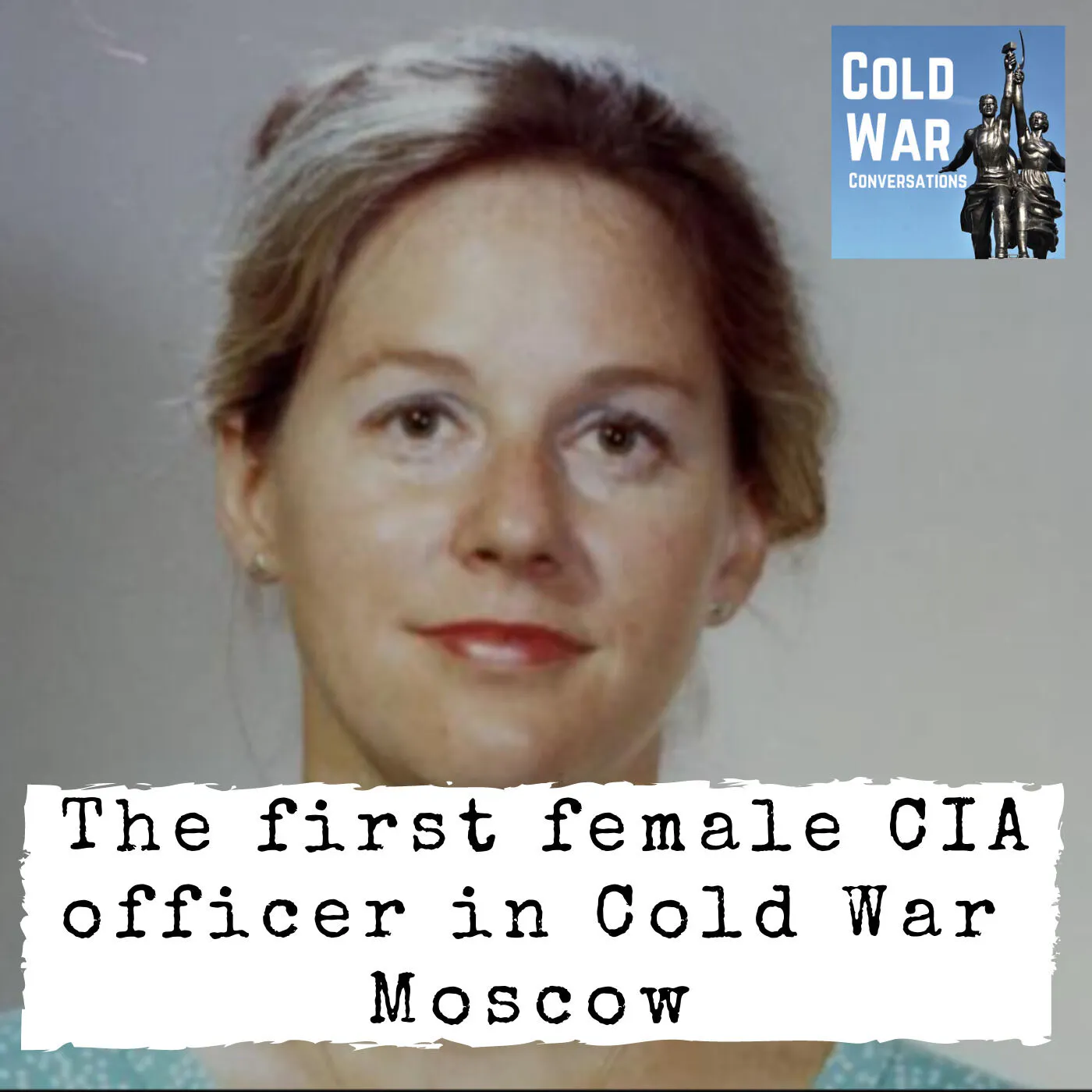
S12 Ep 236The first female CIA officer in Cold War Moscow (236)
Marti Peterson was the first female CIA operative to be assigned to Moscow, probably the most challenging posting during the Cold War. Her story begins in Laos during the Vietnam War where she accompanied her husband John, a CIA officer. She describes their life in a small city in Laos, and the devastating news she received on October 19, 1972. Marti returned to the United States and one night at dinner a good friend suggested she look into working for the CIA. After making it clear to CIA recruiters that she didn’t want to be a secretary or an admin assistant they trained her to become an operative, effectively a spy. When Marti was posted to Moscow during the day, she worked as a diplomat at the U.S. Embassy. At night, on weekends and during her lunch breaks, she would report to the CIA station in the same building to do her work as an operative. UK listeners buy Marti's the book here and support the podcast US listeners buy Marti's the book here and support the podcast 0:00 Introduction and Marti Peterson's background 1:14 Marti Peterson's life in Moscow as a CIA operative 2:50 Marti's early life and college years 6:20 Marti's experience as a CIA wife and life in Laos 14:22 The path to becoming a CIA operative 36:50 Training and preparation for Moscow 40:10 Arrival and adaptation to life in Moscow 49:54 Social life and intelligence work in Moscow 53:31 Teaser for the next episode about Trigon 54:52 Store promotion and closing remarks Table of contents powered by PodcastAI✨ Cold War history is disappearing; however, a simple monthly donation will keep this podcast on the air. You’ll get a sought after CWC coaster as a thank you and you’ll bask in the warm glow of knowing you are helping to preserve Cold War history. Just go to https://coldwarconversations.com/donate/ If a financial contribution is not your cup of tea, then you can still help us by leaving written reviews wherever you listen to us as well as sharing us on social media. It really helps us get new guests on the show. I am delighted to welcome Marti Peterson to our Cold War conversation… Episode notes here https://coldwarconversations.com/episode236/ Listen to episode 2 here https://coldwarconversations.com/episode237/ Follow us on Twitter here https://twitter.com/ColdWarPod Facebook here https://www.facebook.com/groups/coldwarpod/ Instagram here https://www.instagram.com/coldwarconversations/ Thank you very much for listening. It is really appreciated – goodbye. The Cold War Conversations Bookshop Help us to continue recording the stories of the Cold War by using our bookshop. Please leave a review. If you enjoy the podcast, please leave a written review. Support the project! https://coldwarconversations.com/donate/ Follow us on Twitter https://twitter.com/ColdWarPod Facebook https://www.facebook.com/groups/coldwarpod/ Instagram https://www.instagram.com/coldwarconversations/ Youtube https://youtube.com/@ColdWarConversations Learn more about your ad choices. Visit podcastchoices.com/adchoices

S12 Ep 235The 1989 World Festival of Youth and Students in Pyongyang, North Korea (235)
The 13th World Festival of Youth and Students was held from 1–8 July 1989 in Pyongyang, the capital of North Korea. It was the largest international event staged in North Korea up until then. The event took four years of preparation by the North Korean government, which effectively spent a quarter of the country's yearly budget (US$4.5 billion) on it. Ultimately declared as the largest ever World Festival of Youth and Student with about 22,000 people from 177 countries attending. This event was the last festival held during the Cold War era as waves of unrest began to occur throughout Central and Eastern Europe later on in the year. Greg Elmer has directed the film “The Canadian Delegation” which features long time activist Chris Frazer who was handed the task of assembling a Canadian delegation to North Korea. The film follows Frazer and a number of other delegates as they recount their participation in the Festival as world events continued to unfold around them. Cold War history is disappearing; however, a simple monthly donation will keep this podcast on the air. You’ll get a sought after CWC coaster as a thank you and you’ll bask in the warm glow of knowing you are helping to preserve Cold War history. Just go to https://coldwarconversations.com/donate/ If a financial contribution is not your cup of tea, then you can still help us by leaving written reviews wherever you listen to us as well as sharing us on social media. It really helps us get new guests on the show. Today’s episode is hosted by co-host Peter Ryan. I am delighted to welcome Greg Elmer to our Cold War conversation… 0:00 Introduction and background of the 13th World Festival of Youth and Students 2:21 Interview with Greg Elma: The History and Politics of the Youth Festivals 9:15 Economic implications of North Korea's festival expenditures 12:06 The Canadian Delegation: Composition and Journey to Pyongyang 21:19 Festival Atmosphere and Experiences in North Korea 27:18 Delegates' Realizations and Long-Term Impact of the Festival 36:44 The Canadian Delegation's Response to Tiananmen Square 45:20 Reaction to the Film "The Canadian Delegation" 53:19 How to Access the Film on Vimeo and Future Plans 54:07 Ian Sanders' Closing Remarks and Cold War Conversations' Call to Action Table of contents powered by PodcastAI✨ Watch the film here There’s further information and videos here. https://coldwarconversations.com/episode235/ If you can’t wait for next week’s episode do visit our Facebook discussion group where guests and listeners continue the Cold War Conversation. Just search Cold War Conversations in Facebook. Thank you very much for listening. It is really appreciated. The Cold War Conversations Bookshop Help us to continue recording the stories of the Cold War by using our bookshop. Support the project! https://coldwarconversations.com/donate/ Follow us on Twitter https://twitter.com/ColdWarPod Facebook https://www.facebook.com/groups/coldwarpod/ Instagram https://www.instagram.com/coldwarconversations/ Youtube https://youtube.com/@ColdWarConversations Learn more about your ad choices. Visit podcastchoices.com/adchoices
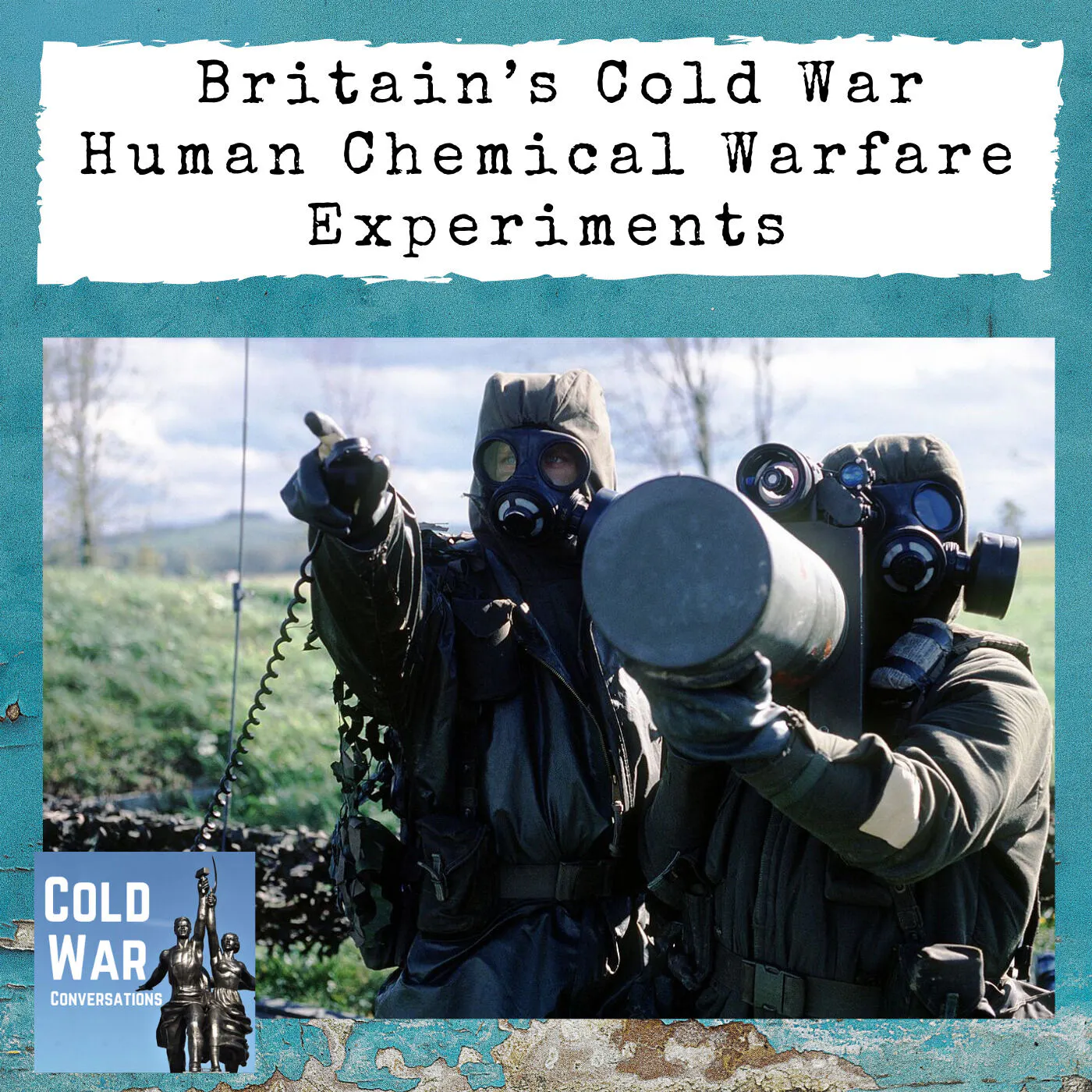
S12 Ep 234Britain’s Cold War Human Chemical Warfare Experiments (234)
Ian Foulkes was exposed to the deadly nerve agent Sarin in 1983 at the Porton Down Chemical & Biological Defence Establishment., one of the UK's most secretive and controversial military research facilities. Ian describes in detail the process and the ill effects this caused him and shares details of a little-known fatality where 20-year-old Ronald Maddison died 45 minutes after what scientists thought was 200mg of liquid Sarin dripped onto his arm. We also talk about the development of chemical weapons during the Cold War and the history of the Porton Down Chemical & Biological Defence Establishment. Up to 20,000 people took part in various trials at Porton Down from 1949 up to 1989. In 2004 Maddison’s death was ruled to have been Corporate Manslaughter. The MoD withdrew a challenge to this ruling minutes before the hearing. In 2008 the MoD paid 600 veterans of the tests £8k each without admitting liability. Now if you think there is a vast army of research assistants, audio engineers and producers putting together this podcast you’d be wrong. This podcast relies on your support to enable me to continue to capture these incredible stories and make them available to everyone for free. If you’d like to help to preserve Cold War history and enable me to continue to produce this podcast you can via one-off or monthly donations. Just go to https://coldwarconversations.com/donate/ for more details. 0:00 Introduction and background of the 13th World Festival of Youth and Students 2:21 Interview with Greg Elma: The History and Politics of the Youth Festivals 9:15 Economic implications of North Korea's festival expenditures 12:06 The Canadian Delegation: Composition and Journey to Pyongyang 21:19 Festival Atmosphere and Experiences in North Korea 27:18 Delegates' Realizations and Long-Term Impact of the Festival 36:44 The Canadian Delegation's Response to Tiananmen Square 45:20 Reaction to the Film "The Canadian Delegation" 53:19 How to Access the Film on Vimeo and Future Plans 54:07 Ian Sanders' Closing Remarks and Cold War Conversations' Call to Action Table of contents powered by PodcastAI✨ Do join our Facebook discussion group where the cold war conversation continues between episodes. Just search Cold War Conversations in Facebook. Support the project! https://coldwarconversations.com/donate/ Follow us on Twitter https://twitter.com/ColdWarPod Facebook https://www.facebook.com/groups/coldwarpod/ Instagram https://www.instagram.com/coldwarconversations/ Youtube https://youtube.com/@ColdWarConversations Learn more about your ad choices. Visit podcastchoices.com/adchoices

S12 Ep 233Flying for the CIA's Air America in South East Asia (233)
In 1964, pilot Captain Hansen found himself unemployed. He began to send out feelers to several companies including one that had placed an ad in the Washington Post called Air America. When he was called in for an interview which primarily consisted of two questions - can you fly good and do you drink a lot. Air America was the airline owned by the CIA. Its operations were unknown. Its schedules were irregular. Its pilots were shadow people. Its world was the world of spooks, covert air ops, adventure, and danger. Hansen would be flying in Vietnam, Cambodia, Laos and other locations in Southeast Asia. It could not have been a better fit for Hansen, an addicted adrenaline junkie. He would end up staying in Asia for over a decade and was fortunate enough to live to tell us about it in his book “Flight” Buy Neil's book here Cold War history is disappearing; however a simple monthly donation will help preserve it and keep this podcast on the air. You’ll get a sought after CWC coaster as a thank you and you’ll bask in the warm glow of knowing you are helping to preserve Cold War history. Just go to https://coldwarconversations.com/donate/ If a financial contribution is not your cup of tea, then you can still help us by leaving written reviews wherever you listen to us as well as sharing us on social media. It really helps us get new guests on the show. I am delighted to welcome Neil Hansen to our Cold War conversation… Further information is here. https://coldwarconversations.com/episode233/ 0:00 Introduction of guest, Neil Hansen, and his journey with Air America 2:02 Call for financial support for the Cold War Conversations podcast 3:35 Hansen's recruitment and early experiences with Air America 13:31 Hansen's black flight missions and promotion within Air America 20:13 Hansen's unique flight training methods and handling emergencies 26:12 Planning missions and gathering intelligence in Vietnam and Laos 30:53 Hansen's first-hand account of the Tet Offensive 41:21 Navigating the dangers and challenges in Laos during the Cold War 1:00:01 Hansen's harrowing experience of being shot down and bailing out 1:04:07 The last flight out of Cambodia: Neil Hansen's escape and reflection 1:20:26 Neil Hansen's fight for recognition, his book, and concluding remarks Table of contents powered by PodcastAI✨ If you can’t wait for next week’s episode do visit our Facebook discussion group where guests and listeners continue the Cold War Conversation. Just search Cold War Conversations in Facebook. Support the project! https://coldwarconversations.com/donate/ Follow us on Twitter https://twitter.com/ColdWarPod Facebook https://www.facebook.com/groups/coldwarpod/ Instagram https://www.instagram.com/coldwarconversations/ Youtube https://youtube.com/@ColdWarConversations Learn more about your ad choices. Visit podcastchoices.com/adchoices

S12 Ep 232A photojournalist in Cold War Eastern Europe (232)
During the 1970s and 1980s, Arthur Grace travelled extensively behind the Iron Curtain, working primarily for news magazines. One of only a small corps of Western photographers with ongoing access, he was able to delve into the most ordinary corners of people's daily lives, while also covering significant events. His remarkable book Communism(s) A Cold War Album is effectively psychological portraits that leave the viewer with a sense of the gamut of emotions in that era. Illustrated with over 120 black-and-white images-nearly all previously unpublished- Communism(s) gives an unprecedented glimpse behind the veil of a not-so-distant time filled with harsh realities unseen by nearly all but those that lived through it. Shot in the USSR, Poland, Romania, Yugoslavia and the German Democratic Republic, here are portraits of factory workers, farmers, churchgoers, holidaymakers and loitering teens juxtaposed with Social Realist-designed apartment blocks, annual May Day Parades, Poland's Solidarity movement (and the subsequent imposition of martial law) and the vastness of Moscow's Red Square. Buy the book here https://uk.bookshop.org/a/1549/9788862087674 Cold War history is disappearing; however, a simple monthly donation will keep this podcast on the air. You’ll get a sought after CWC coaster as a thank you and you’ll bask in the warm glow of knowing you are helping to preserve Cold War history. Just go to https://coldwarconversations.com/donate/ If a financial contribution is not your cup of tea, then you can still help us by leaving written reviews here. It really helps us get new guests on the show. 0:00 Introduction to Cold War Conversations and Arthur Grace 2:37 Sponsor: Cold War Conversations merchandise and donations 5:31 Arthur Grace's experiences in Romania 15:45 Encounters and photo opportunities in East Germany 21:23 Anti-government memorials and Solidarity movement in Poland 33:39 The art and challenges of photojournalism during the Cold War 40:42 Transition and transformation in Poland between 1982 and 1989 46:16 Reflections on Cold War assignments and favorite photographs 48:45 Anecdotes from Moscow, Warsaw and the Gobi Desert 58:11 Arthur's book Table of contents powered by PodcastAI✨ If you can’t wait for next week’s episode do visit our Facebook discussion group where guests and listeners continue the Cold War Conversation. Just search Cold War Conversations in Facebook. More episode info here https://coldwarconversations.com/episode232/ Thank you very much for listening. It is really appreciated. Support the project! https://coldwarconversations.com/donate/ Follow us on Twitter https://twitter.com/ColdWarPod Facebook https://www.facebook.com/groups/coldwarpod/ Instagram https://www.instagram.com/coldwarconversations/ Youtube https://youtube.com/@ColdWarConversations Learn more about your ad choices. Visit podcastchoices.com/adchoices
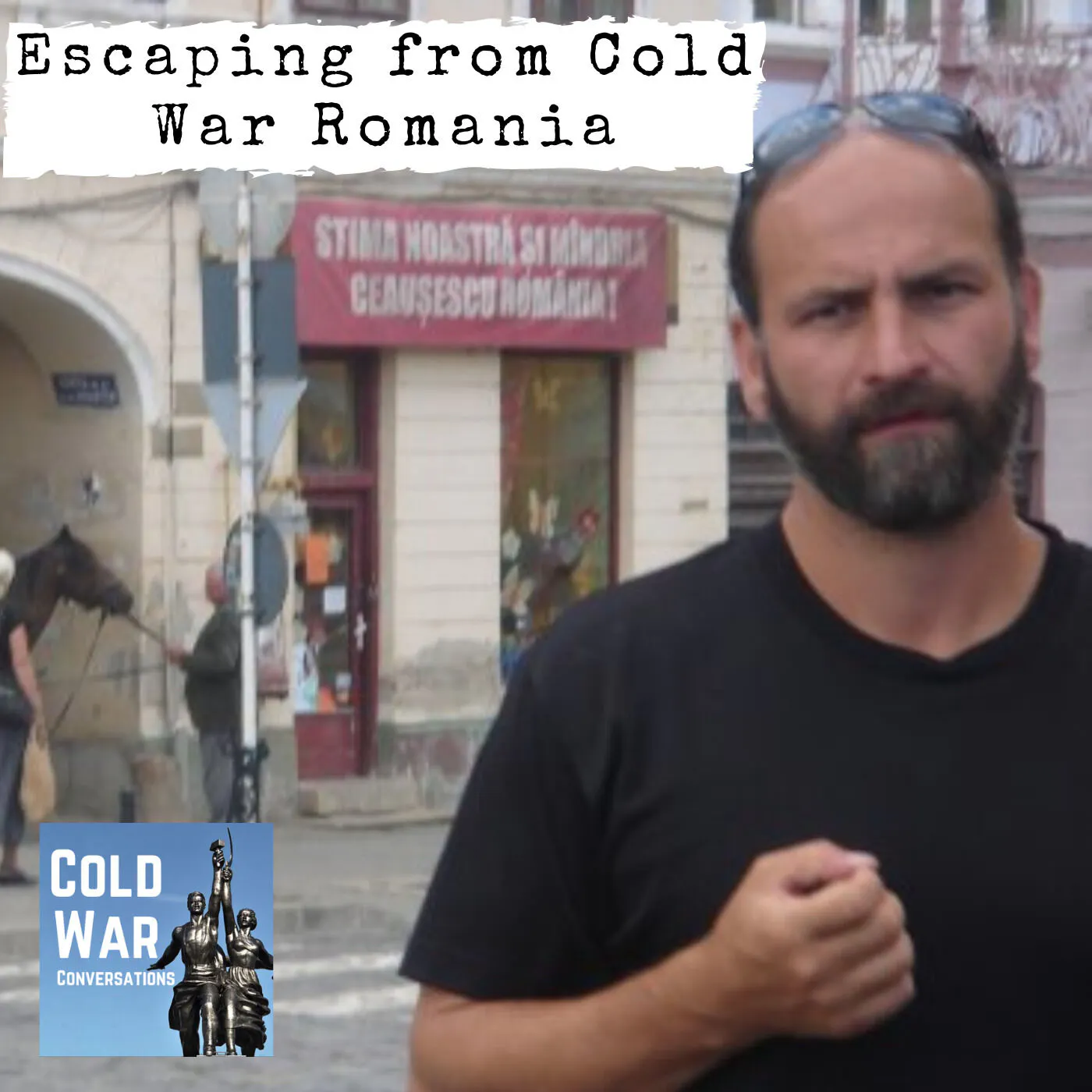
S12 Ep 231Escaping from Cold War Romania (231)
Zsolt Akos Pall was 17 when he decided to flee Cold War Romania for a better life in the West. It’s a heart-warming story of the generosity of strangers. Young Zsolt finds compassionate border guards, gets lost in Vienna and has incredible luck wherever he turns as he negotiates the iron curtain as well as many other international borders to reach his brother in Sweden However, his escape is bittersweet as we hear of his emotional farewell to his parents, not knowing if he’d ever see them again. Cold War history is disappearing; however a simple monthly donation will keep this podcast on the air. You’ll get a sought after CWC coaster as a thank you and you’ll bask in the warm glow of knowing you are helping to preserve Cold War history. Just go to https://coldwarconversations.com/donate/ If a financial contribution is not your cup of tea, then you can still help us by leaving written reviews wherever you listen to us as well as sharing us on social media. It really helps us get new guests on the show. There’s further information here. https://coldwarconversations.com/episode231/ If you can’t wait for next week’s episode do visit our Facebook discussion group where guests and listeners continue the Cold War Conversation. Just search Cold War Conversations in Facebook. 0:00 Introduction and Zolt Acos Powell's decision to flee Cold War Romania 7:52 Zolt's parents' reaction and his journey to the Hungarian border 16:00 Zolt's escape and experiences at the Hungarian border station 24:01 Zolt's journey to Vienna and his first day there 36:10 Zolt's journey from Vienna to Germany and his encounters along the way 48:06 Zolt's attempt to cross the border, arrival in Germany and journey to Stuttgart 53:02 Zolt's first impression of Hamburg 1:04:01 Zolt's arrival in Sweden and reuniting with his brother 1:07:38 The repercussions faced by Zolt's parents and their arrival in Sweden 1:10:44 Conclusion, mention of financial supporters and the Cold War Conversations store Table of contents powered by PodcastAI✨ Support the project! https://coldwarconversations.com/donate/ Follow us on Twitter https://twitter.com/ColdWarPod Facebook https://www.facebook.com/groups/coldwarpod/ Instagram https://www.instagram.com/coldwarconversations/ Youtube https://youtube.com/@ColdWarConversations Learn more about your ad choices. Visit podcastchoices.com/adchoices

S11 Ep 230A Hungarian childhood in Cold War Romania (230)
Zsolt Akos Pall was born in a small town in the Hungarian speaking part of Romania. For ordinary people, life in Romania in the 1980s was very hard and it could be even worse if you were a part of the Hungarian Szekler minority since the Communist government persecuted the Hungarian minority. They even made them change their Hungarian names into Romanian. Zsolt's brother was renamed Istvan to Stefan. However, Zsolt was baptised Zsolt, since there was no Romanian equivalent to it. Zsolt describes the shortages, his schooling and many other stories of life in Romania during this period. We end the episode with Zsolt’s plans to escape to Sweden. Don’t miss Part 2! Cold War history is disappearing; however, a simple monthly donation will keep this podcast on the air. You’ll get a sought after CWC coaster as a thank you and you’ll bask in the warm glow of knowing you are helping to preserve Cold War history. Just go to https://coldwarconversations.com/donate/ If a financial contribution is not your cup of tea, then you can still help us by leaving written reviews wherever you listen to us as well as sharing us on social media. It really helps us get new guests on the show. I am delighted to welcome Zsolt Akos Pall to our Cold War conversation… There’s further information here. https://coldwarconversations.com/episode230/ If you can’t wait for next week’s episode do visit our Facebook discussion group where guests and listeners continue the Cold War Conversation. Just search Cold War Conversations on Facebook. 0:00 Introduction and early life in Romania 2:36 Life under communism and experience of the Hungarian minority in Romania 15:56 Impact of shortages on daily life and industry 18:47 School life, propaganda, and societal structure under the regime 27:02 Cold War hobbies: Young pioneer experience and photography 32:59 Brother's journey out of Romania and Western influences 38:35 Zsolt's escape attempt and first love 41:12 Life goals in Hungary, brother's journey to Sweden, and pivotal decision 44:27 Closing remarks, acknowledgments, and sponsor mentions Table of contents powered by PodcastAI✨ Support the project! https://coldwarconversations.com/donate/ Follow us on Twitter https://twitter.com/ColdWarPod Facebook https://www.facebook.com/groups/coldwarpod/ Instagram https://www.instagram.com/coldwarconversations/ Youtube https://youtube.com/@ColdWarConversations Learn more about your ad choices. Visit podcastchoices.com/adchoices