
Boxcars711 Old Time Radio
2,207 episodes — Page 18 of 45
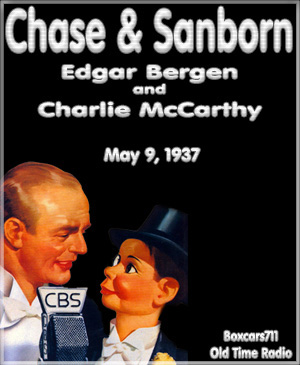
The Chase & Sanborn Hour - Edgar Bergen and Charlie McCarthy (05-09-37
The Chase and Sanborn Hour was the umbrella title for a series of US comedy and variety shows, sponsored by Standard Brands' Chase and Sanborn Coffee, usually airing Sundays on NBC from 8pm to 9pm during the years 1929 to 1948. The series began in 1929 as The Chase and Sanborn Choral Orchestra, a half-hour musical variety show heard Sundays at 8:30pm on NBC. When Maurice Chevalier became the show's star, he received a record-breaking salary of $5000 a week. Violinist David Rubinoff (September 13, 1897 – October 06, 1986), became a regular in January 1931, introduced as "Rubinoff and His Violin." Chase and Sanborn found a gold mine with a wooden dummy when Edgar Bergen and Charlie McCarthy began an 11-year run, starting May 9, 1937. The 1945 summer replacement series, with Spike Jones and Frances Langford as co-hosts, was titled The Chase and Sanborn Program. Although the series ended December 26, 1948, it was followed by a compilation show on NBC, The Chase and Sanborn 100th Anniversary Show (November 15, 1964), assembled by writer Carroll Carroll and narrated by Bergen. This became an annual event with The Chase and Sanborn 101st Anniversary Show (November 14, 1965), a Fred Allen tribute, followed by The Chase and Sanborn 102nd Anniversary Show (November 13, 1966), which turned out to be the last of the series.
The New Adventures Of Michael Shayne - The Man Who Lived Forever (05-07-49)
The New Adventures Of Michael Shayne was a fictional private detective character created by writer Brett Halliday during the late 1930's. Shayne debuted in the novel Dividend on Death first published in 1939, written by David Dresser, a pseudonym of Halliday. Dresser wrote fifty Shayne novels, with the help of Ryerson Johnson. Twenty seven more were written by Robert Terrall for a total of seventy seven; three hundred short stories, a dozen films, radio and television shows, and a few comic book appearances have resulted from the character. The books were typically very well plotted, with Shayne always gathering the suspects at the end and explaining the crime and naming the murderer. Shayne was initially married in the novels, his wife being Phyllis Shayne, who was a somewhat limited character, and was often out of town. Dresser "killed her off" when he sold the movie rights to the series. In the book, Blood on the Black Market, comedy disappears, and Shayne is forced to deal with his wife's death. Halliday later created "Michael Shayne Mystery Magazine", first introduced in 1956 by Renown Publications. The magazine continued for over three decades, always having at least one Michael Shayne short story included in each edition. Halliday stopped writing the Michael Shayne novels after Murder and the Wanton Bride in 1958. Shayne novels continued, however, written by Ryserson Johnson, Robert Terrell, and David Lynds. In 1960, the Michael Shayne television series began, with actor Richard Denning playing the lead role. Dell Comics soon picked up the character for a comic book series. Michael Shayne Mysteries, and a film series starring Lloyd Nolan, is available on DVD.THIS EPISODE:1949. Program #1. Broadcaster's Guild syndication. "The Man Who Lived Forever". Commercials added locally. The man's name was Anthony Correll and he is supposed to never die. What does the coiled snake on his forehead mean? A Peter Lorre clone shoots Michael Shayne! The program closing has been deleted. The date is approximate. Jeff Chandler, William P. Rousseau (host, director), John Duffy (composer, performer), Brett Halliday (creator), Don W. Sharp (producer). 26:50.
The Shadow - Message From The Hills (07-31-38)
The Shadow - One of the most popular radio shows in history debuted in August 1930 when "The Shadow" went on the air. "Who knows what evil lurks in the hearts of men? The Shadow knows!" The opening lines of the "Detective Story" program captivated listeners and are instantly recognizable even today. Originally the narrator of the series of macabre tales, the eerie voice known as The Shadow became so popular to listeners that "Detective Story" was soon renamed "The Shadow," and the narrator became the star of the old-time mystery radio series, which ran until 1954. A figure never seen, only heard, the Shadow was an invincible crime fighter. He possessed many gifts which enabled him to overcome any enemy. Besides his tremendous strength, he could defy gravity, speak any language, unravel any code, and become invisible with his famous ability to "cloud men's minds."THIS EPISODE:1938. Syndicated. "The Message From The Hill". Sponsored by: B. F. Goodrich Tires. The Shadow foils a plot to rob a diamond mine. Orson Welles, Margot Stevenson, Ken Roberts (announcer). 1/2 hour.

Mr. & Mrs. North - Milkmans Ring (07-15-47)
Mr. and Mrs. North are fictional American amateur detectives. Created by Frances and Richard Lockridge, the couple were featured in a series of twenty-six Mr. and Mrs. North novels, a Broadway play, a motion picture, and several different radio and television series. Mr. and Mrs. North was a radio mystery series that aired on CBS from 1942 to 1954. Alice Frost and Joseph Curtin had the title roles when the series began in 1942. Publisher Jerry North and his wife Pam lived in Greenwich Village at 24 St. Anne's Flat. They were not professional detectives but simply an ordinary couple who stumbled across a murder or two every week for 12 years. The radio program eventually reached nearly 20 million listeners. The characters originated in 1930s vignettes written by Richard Lockridge for the New York Sun, and he brought them back for short stories in The New Yorker.THIS EPISODE:July 15, 1947. CBS network. Sponsored by: Halo Shampoo, Cashmere Bouquet, Colgate Toothpowder. Murder, mayhem, and a missing diamond ring, all aboard a milk wagon in the early morning. Alice Frost, Joseph Curtin, Charles Stark (announcer), Frances Lockridge (creator), Richard Lockridge (creator). 24:49.

The Jack Benny Program - Little Red Riding Hood (12-19-37)
The Jell-O Program Starring Jack Benny - Jack Benny was remarkable in many ways, but in none more than this: he built a character of every sour ingredient in life, but somehow his real personality trickled through and made it wonderful. Would a real miser act that way before 30 million people each week? The Benny of the air was a fraud, a myth, a creation. It should have surprised no one to learn — after years of toupee jokes that played so well into the vanity theme — that Benny never wore one. He overtipped in restaurants, gave away his time in countless benefit performances, and was lavish in his praise of almost everyone else. The Jack Benny Program is a classic comedy that is truly one of the best-loved programs from the Golden Age of Radio. It started life as The Canada Dry Program in 1932 on the Blue Network and finished off as The Lucky Strike Program on CBS in 1955. In between, it kept the audience in stitches and established Benny as one of America's all-time great comedians.THIS EPISODE:December 19, 1937. Red net. Sponsored by: Jell-O. Kenny sings, "Once In A While." The cast does its version of, "Little Red Riding Hood," with Andy Devine as Grandma! Jack Benny, Don Wilson, Phil Harris and His Orchestra, Mary Livingstone, Kenny Baker, Andy Devine, Harry Baldwin, Ed Beloin (writer, performer), Blanche Stewart, Bill Morrow (writer). 29:32.
Crime & Peter Chambers - Donald Sloane Embezzler (07-20-54)
Crime & Peter Chambers - This program was born from a detective book series and inspired by author Henry Kane who became the director and producer for the radio show. The series only ran five months, 30 minutes each episode, from April 6, 1954 to September 7, 1954. Peter Chambers was played by Dane Clark who also appeared on the Suspense radio shows. Chambers acted the role of a playboy detective with an eye for solving crime and a taste for the women. Bill Zuckert, who went on to guest star in many 1970s shows including The Mary Tyler Moore Show and the Partridge Family, plays Lt. Parker.

The New Adventures Of Sherlock Holmes - Uneasy Easy Chair (05-13-46)
Sherlock Holmes is a fictional detective of the late 19th and early 20th centuries, who first appeared in publication in 1887. He is the creation of Scottish born author and physician Sir Arthur Conan Doyle. A brilliant London-based detective, Holmes is famous for his intellectual prowess, and is renowned for his skillful use of deductive reasoning (somewhat mistakenly - see inductive reasoning) and astute observation to solve difficult cases. He is arguably the most famous fictional detective ever created, and is one of the best known and most universally recognisable literary characters in any genre. Conan Doyle wrote four novels and fifty-six short stories that featured Holmes. All but four stories were narrated by Holmes' friend and biographer, Dr. John H. Watson, two having been narrated by Holmes himself, and two others written in the third person. The first two stories, short novels, appeared in Beeton's Christmas Annual for 1887 and Lippincott's Monthly Magazine in 1890. The character grew tremendously in popularity with the beginning of the first series of short stories in The Strand Magazine in 1891; further series of short stories and two serialized novels appeared almost right up to Conan Doyle's death in 1930. The stories cover a period from around 1878 up to 1903, with a final case in 1914.THIS EPISODE:May 13, 1946. Mutual network. "The Uneasy Easy Chair". Sponsored by: Petri Wines. Holmes works on a murder in which the murder weapon is a diabolical chair. Inspector Lestrade has the last laugh! The story is based on, "The Musgrove Ritual." Basil Rathbone, Nigel Bruce, Harry Bartell (announcer), Denis Green (writer), Anthony Boucher (writer), Arthur Conan Doyle (author), Dean Fosler (music), Edna Best (producer). 29:27.
The Chase - The Hold-Up (1953)
The Chase is an exciting Old Time Radio series in which every episode contains, well, a chase. Tales, highly melodramatic and often improbable, of people on the run. The concept of "hunter and hunted" was built into the signatures. with the lone bugle of a fox hunt, the braying of dogs, the sounds of a man running, a gunshot, and the slowing footsteps and eventual fall of the victim. It may be an adventure story, a crime story, or even science fiction, but there will always be a suspense filled chase.THIS EPISODE:1953. The Hold-Up - NBC network. Sustaining. An employee of a contracting company blackmails his boss to secure a higher paying position in the accounting department. Doris Smith, Fred Collins (announcer), Fred Weihe (director, transcriber), Ivor Francis, John Stanley, Cathleen Cordell, Lawrence Klee (creator, writer), Leona Powers, Ted Osborne, William Podmore. 29:52.

Let George Do It - No Way Out (10-01-51)
Let George Do It was a radio drama series produced by Owen and Pauline Vinson from 1946 to 1954. It starred Bob Bailey as detective-for-hire George Valentine (with Olan Soule stepping into the role in 1954). Clients came to Valentine's office after reading a newspaper carrying his classified ad: "Personal notice: Danger's my stock in trade. If the job's too tough for you to handle, you've got a job for me. George Valentine." Valentine's secretary was Claire Brooks, aka Brooksie (Frances Robinson, Virginia Gregg, Lillian Buyeff). As Valentine made his rounds in search of the bad guys, he usually encounted Brooksie's kid brother, Sonny (Eddie Firestone), Lieutenant Riley (Wally Maher) and elevator man Caleb (Joseph Kearns). Sponsored by Standard Oil, the program was broadcast on the West Coast Mutual Broadcasting System from October 18, 1946 to September 27, 1954, first on Friday evenings and then on Mondays. In its last season, transcriptions were aired in New York, Wednesdays at 9:30pm, from January 20, 1954 to January 12, 1955. John Hiestand was the program's announcer. Don Clark directed the scripts by David Victor and Jackson Gillis. The background music was supplied by Eddie Dunstedter on the organ.THIS EPISODE:October 1, 1951. Mutual-Don Lee network. "No Way Out". Sponsored by: Standard Oil. A frightened young man is mixed up in a racket and a shooting. He then is arrested and jailed. Let George do it! Bob Bailey, Virginia Gregg, Jonathan Hole, Ted de Corsia, Kenneth Webb (director), Ken Christy, Don Clark (writer), Louise Arthur, Bud Hiestand (anouncer), Eddie Dunstedter (composer, conductor). 29:42.
The Amazing Mr. Malone - Early To Bed Early To Rise (06-15-51)
The Amazing Mr. Malone radio series aired 1947-1951 based on the John Malone series of mystery novels by Craig Rice, the author of fourteen novels, countless short stories, and a number of true crime pieces. She once rivaled Agatha Christie in sales,and was on the cover of Time Magazine in 1946. John J. Malone, socialite and ladies man, is a brilliant criminal lawyer taking up a new case in every episode. Using his finely-honed deductive and persuasive skills, he never gives up until justice is done.THIS EPISODE:June 15, 1951. NBC network. "Early To Bed and Early To Rise". Sustaining. Jeff Lewis, the famous bandleader, has been murdered. Suspicion falls on his insanely jealous wife. George Petrie, Larry Haines, Fred Collins (announcer), Craig Rice (creator), Bernard L. Schubert (producer), Richard Lewis (director), Eugene Wang (writer). 29:37.

Pat Novak For Hire - Sam Tolliver (04-09-49)
Pat Novak, played by Jack Webb, was a private detective working out of Pier 19, a waterfront office in San Francisco. The stories were always very similar: Someone would hire him, (if not a beautiful woman, the job would lead to a beautiful woman) someone would get murdered, he would investigate the case, get beaten up by the thugs, and then the case would be solved and end with glorious violence. The closing was always the same; the listener would be told who had done what, to whom and why they had done it.THIS EPISODE:Sam Tolliver -April 9, 1949. Program #4. ABC network origination, AFRS rebroadcast. Going on an errand for a friend, Pat gets a beating, a package, and a corpse or two, or three. Jack Webb. 30:22.

The Adventures Of Sam Spade - Sam And Psyche (08-02-46)
The Adventures of Sam Spade was a radio series based loosely on the private detective character Sam Spade, created by writer Dashiell Hammett for The Maltese Falcon. The show ran for 13 episodes on ABC in 1946, for 157 episodes on CBS in 1946-1949, and finally for 51 episodes on NBC in 1949-1951. The series starred Howard Duff (and later, Steve Dunne) as Sam Spade and Lurene Tuttle as his secretary Effie, and took a considerably more tongue-in-cheek approach to the character than the novel or movie. In 1947, scriptwriters Jason James and Bob Tallman received an Edgar Award for Best Radio Drama from the Mystery Writers of America. Before the series, Sam Spade had been played in radio adaptations of The Maltese Falcon by both Edward G. Robinson (in a 1943 Lux Radio Theater production) and by Bogart himself (in a 1946 Academy Award Theater production), both on CBS.THIS EPISODE:August 2, 1946. ABC network. "Sam and Psyche". Sponsored by: Wildroot Cream Oil. The fourth show of the series. The story title above is probably correct, although it's announced indirectly. The program has also been referred to as "The Death Of Dr. Denoff." A psychiatrist being blackmailed is killed by doing "a Brody" from his apartment window. His blackmailer is later found strangled! Howard Duff, Lurene Tuttle, Dick Joy (announcer), Dashiell Hammett (creator), William Spier (producer, director), Fred Esler. 29:30.

The CBS Radio Workshop - The Ex-Urbanites (3-30-56)
The CBS Radio Workshop - Broadcast from 1936 through to 1947 with just an occasional break. Revived again from January 1956 to September 1957 as CBS Radio Workshop with pretty much the same format. Broadcast from 1936 through to 1947 with just an occasional break. Revived again from January 1956 to September 1957 as CBS Radio Workshop with pretty much the same format. This was drama with a difference. Columbia Workshop was not everybody's cup of tea and in terms of audience popularity it was always noted that it was never a strong contender for the title "Radios Top Rated Drama Series" and yet it was always considered to be the drama program that led the way in radio standards. Columbia was the first to mexperiment with what radio drama was all about, introducing new techniques never before used in over the airwaves drama and because it received little encouragement from established writers, actors, etc., it was only by breaking new ground with new ideas and new techniques from writers who were not versed in the old ways that it was going to survive. THIS EPISODE:March 30, 1956. CBS network. "The Exurbanites". Sustaining. A chilling (but true) horror story about the problems of living in the suburbs. Eric Sevareid (narrator). 1/2 hour.

Inspector Thorne - The Golden Girl Murder Case (08-03-51)
Inspector Thorne - Another radio detective from the pen of Frank and Ann Hummert was Inspector Thorne. The series was short-lived and also had two stars portraying the lead. The first was Karl Weber and the second was Staats Cotsworth. By the 1940's, Frank and Ann Hummert controlled four and a half hours of national weekday broadcast schedules. Their features reportedly spawned more that 5 million pieces of correspondence annually from steadfast fans. Simultaneously they brought in more than half of the national radio chain's advertising revenues generated during the daylight hours. The couple broadcast 18 quarter-hour serials five times weekly, a total of 90 original episodes for 52 weeks per year, with none of those ever repeated. Some shows were "Amanda of Honeymoon Hill", "Backstage Wife","Chaplin Jim USA", "David Harum", "Easy Aces", "Front Page Farrell", "John's Other Wife", "Just Plain Bill", "The Life of Mary Sothern","Lora Lawton", "Lorenzo Jones", "Ma Perkins", "Mrs Wiggs of the Cabbage Patch", "Our Gal Sunday", "The Romance of Helen Trent" and "Young Widder Brown".

Dangerous Assignment - Missing Japanese Weapons (02-06-50)
Dangerous Assignment - This thirty-minute international spy adventure featured Steve Mitchell (Brian Donlevy), and investigator of crimes in exotic locations. 60 episodes. Herb Butterfield played the Commissioner and Betty Moran was the Commissioner's secretary. Other cast members were GeGe Pearson, Ken Peters, Betty Lou Gerson, Dan O'Herlihy. The director was Bill Cairn and the writer for the series was Robert Ryf. The opening was the same every week "Yeah, danger is my assignment. I get sent to a lot of places I can't even pronounce. They all spell the same thing though, trouble." He would be summoned to his boss's office where he would be given his assignment; he would then fly halfway across the globe to save the day!THIS EPISODE:February 6, 1950. NBC network. Sustaining. The first show of the season. Missing Japanese Weapons . Steve Mitchell flies to Panama to recover missing Japanese weapons and solve the murder of his friend, Bill Thorne. Brian Donlevy, Robert Ryf (writer), Bill Cairn (director), Bruce Ashley (music). 29:40.
Murder By Experts - The Creeper (07-18-49)
Murder By Experts - 1949-51, Mutual. 130 30-minute episodes. Created by David Kogan. Writers: David Kogan. Directors/Producers: David Kogan And Robert A. Arthur. Hosts: John Dickson Carr (June 13, 1949-March 13, 1950) and Brett Halliday (March 20, 1950-December 17, 1951) Sound Effects: Mario Siletti. Guest experts: Alfred Hitchcock, Craig Rice. Guest stars: Ann Shepard, Larry Haines, Carl Eastman, Ann Sheperd, Bill Zuckert, Ralph Camargo, Burt Cullen, Lawson Zerbe, Marilyn Erskin.THIS EPISODE:July 23, 1949. Mutual network, WOR, New York aicheck. "The Creeper". Sponsored by: Sustaining, Bulova Watch (local). A suspense story about a mad killer who strangles his red-headed victims. The program moved to Sundays at 10:00 P. M., being replaced in this time slot by, "The Damon Runyon Theatre." John Dickson Carr (host, narrator), Joseph Ruscoll (writer), Marilyn Erskine. 29:17.
Escape -Wild Oranges (12-17-47)
Escape was radio's leading anthology series of high adventure, airing on CBS from July 7, 1947 to September 25, 1954. Since the program did not have a regular sponsor like Suspense, it was subjected to frequent schedule shifts and lower production budgets, although Richfield Oil signed on as a sponsor for five months in 1950. Despite these problems, Escape enthralled many listeners during its seven-year run. The series' well-remembered opening combined Mussorgsky's Night on Bald Mountain with the introduction, intoned by Paul Frees and William Conrad: "Tired of the everyday routine? Ever dream of a life of romantic adventure? Want to get away from it all? We offer you... Escape!" Of the more than 230 Escape episodes, most have survived in good condition. Many story premises, both originals and adaptations, involved a protagonist in dire life-or-death straits, and the series featured more science fiction and supernatural tales than Suspense. Some of the memorable adaptations include Algernon Blackwood's "Confession", Ray Bradbury's oft-reprinted "Mars Is Heaven," George R. Stewart's Earth Abides, Richard Connell's "The Most Dangerous Game," F. Scott Fitzgerald's "The Diamond as Big as the Ritz," John Collier's "Evening Primrose", later adapted to TV as a Stephen Sondheim musical starring Anthony Perkins. Vincent Price and Harry Bartell were heard in the chilling "Three Skeleton Key," the tale of three men trapped in an isolated lighthouse by thousands of rats. The half-hour was adapted from an Esquire short story by the French writer George Toudouze. THIS EPISODE:Escape. December 17, 1947. CBS network. "Wild Oranges". Sustaining. A good story about a beautiful girl and her father, trapped on an island by a homicidal maniac. The script was previously used on "The Orson Welles Theatre" on November 3, 1941 and subsequently used on the program on September 28,l 1949 and on "Romance" on July 25, 1950 . Cy Feuer (music conceiver, conductor), William N. Robson (producer), Richard Sanville (director), Joseph Hergeshimer (author), William Conrad, Jack Kruschen, John Dunkel (adaptor), Paul Frees, Jeanette Nolan, Sherry Hall. 29:43.
Author's Playhouse - Reunion (05-14-45)
Author's Playhouse - Famous stories by celebrated authors: among them, Elementals (Stephen Vincent Benet), The Piano (William Saroyan), and The Snow Goose (Paul Gallico).March 5, 1941 till June 4, 1945, NBC; Blue Network until mid-October 1941, then the Red Network. Many briefly held 30m timeslots, including Sundays at 11:30, 1941-42; Wednesdays at 11:30, 1942-44; Mondays at 11:30, 1944-45. Sponsor was Philip Morris, 1942-43. Cast: John Hodiak, Fern Persons, Arthur Kohl, Laurette Fillbrandt, Kathryn Card, Bob Jellison, Nelson Olmsted, Marvin Miller, Olan Soule, Les Tremayne, Clarence Hartzell, Curley Bradley, etc. Orchestra: Rex Maupin, Roy Shield, J6seph Gallicchio. Creator: Wynn Wright. Directors: Norman Felton, Fred Weihe, Homer Heck, etc.THIS EPISODE:May 14, 1945. NBC network, Chicago origination. "Reunion". Sustaining. Henry Sinkin is a quiet accountant who inherits $500 and decides to make a big impression at his college reunion. Arthur Hern, Art Van Harvey, Charles Egleston, Elwyn Owen (organist), Inez Arsher (adaptor), Kay Miller, Kay Miller, Michael Romano, Nick Reikert, Norman Felton (producer), Phillips H. Lord, Stanley Gordon, Thomas Post, Vincent Sheean (author), William Fein. 29:28.

The Green Hornet - Justice Wears A Blindfold (03-05-36)
The Green Hornet - On January 31, 1936, the Green Hornet radio program aired on WXYZ in Detroit, Michigan. Al Hodge played the part of the Green Hornet from 1936 through January of 1943. The program was created by George W. Trendle, the same man associated with the creation of the Lone Ranger radio show. The premise of the Green Hornet was that of a modern day Lone Ranger. The main character was Britt Reid, a newspaper publisher of the Daily Sentinel by day and the Green Hornet by night. Britt Reid was the great-nephew of the Lone Ranger. Britt Reid's war against crime was an extension of his family history. The Green Hornet fought crime with his high-powered car, the Black Beauty. THIS EPISODE:June 15, 1939. Mutual network originaion, Michelson syndication, WJBK, Detroit aircheck. "Justice Wears A Blindfold". Sponsored by: Archway Cookies. The date is approximate. Al Hodge, Fran Striker (writer), George W. Trendle (creator). 1/2 hour.
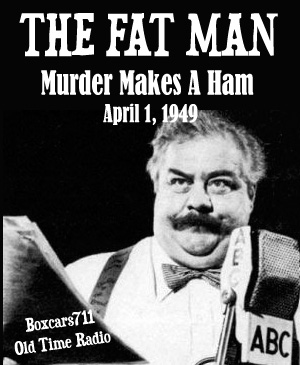
The Fat Man - Murder Makes A Ham (04-01-49)
The Fat Man - "There he goes across the street into the drugstore, steps on the scale, height: 6 feet, weight: 290 pounds, fortune: Danger. Who isit? The Fat Man." Brad Runyon was the Fat Man, played by Jack Scott Smart. The series was created by Dashall Hammott and was first heard on the ABC network Jan. 21, 1946. J. Scott Smart fit the part of the Fat Man perfectly, weighing in at 270 pounds himself. When he spoke, there was no doubt that this was the voice of a big guy. Smart gave a witty, tongue-in-cheek performance and helped make THE FAT MAN one of the most popular detective programs on the air. Smart also appeared in The March Of Time (early 1930s), the Theater Guild On The Air, Blondie, The Fred Allen Show, and The Jack Benny Program. There was also an version made in Australia, syndicated on the Artansa lable, about 1954. There are at least 36 shows available from vendors. The Australian Fat Man was played possibly by Lloyd Berrell. Although not featuring J. Scott Smart, who really fit the part, the series is quite good.THIS EPISODE:April 1, 1949. ABC network. "Murder Makes A Ham". Sponsored by: Pepto Bismol, Unguentine. An actress hires Runyon to find a photograph. J. Scott Smart, Dick Beals (commercial spokesman), Clark Andrews (director), Bernard Green (conductor), Bryna Raeburn, Charles Irving (announcer), Lawrence Klee (writer), Jean Ellen. 29:30.
Mr. Keen Tracer Of Lost Persons - 2 Episodes (11-16-44) (05-23-46)
Mr. Keen, Tracer of Lost Persons was one of network radio's longest running detectives, although listening to it now would hardly explain why. This kind, elderly, boring sleuth, in company with his bumbling assistant, Mike Clancy, was on the airwaves from 1937 to 1955, logging nearly 20 years of fighting crime. The series came out of the soap opera fiction factory of Frank and Anne Hummert and encompassed most of the trite dialogue and snail plotting of daytime serials.TODAY'S DOUBLE FEATURE:November 16, 1944. CBS network. "The Case Of The Frightened Child". Sponsored by: Anacin, Kolynos Toothpaste, Hill's Cold Tablets, Aerowax. A five year old boy has been left to die in a dark, abandoned warehouse. Bennett Kilpack, Larry Elliott (announcer), Frank Hummert, Anne Hummert. 29:40.May 23, 1946. CBS network. "The Case Of The Glamorous Widow". Sponsored by: Anacin, Kolynos Toothpaste, Old English Wax. Which one of her four boyfriends did her in? Bennett Kilpack, Frank Hummert (originator, producer), Anne Hummert (originator, producer), Larry Elliott (announcer). 29:34.

Rocky Fortune - Hauling Nitro (01-26-54)
"Rocky Fortune" about a wanderer that took odd jobs to support himself and never stayed in one place too long. He almost always seemed to meet beautiful women along with trouble. Sinatra was good and was proving to Hollywood that he could do serious work. When casting began for the movie "From Here To Eternity", Frank campaigned tirelessly for a part and because of that and a good word put in for him by Gardner, who he was now separated from, he won a part that would mark his return to Hollywood. Sadly for us, it also meant he didn't have time to do radio and "Rocky Fortune" was rather short lived, although it was popular. It only ran from 1953 - 1954, but" It was a very good year".THIS EPISODE:January 26, 1954. NBC network origination, AFRTS rebroadcast. "Hauling Nitro". Rocky's explosive job (in more ways than one!) is driving a truckload of nitroglycerine. Frank Sinatra, Frank Gerstle, George Lefferts (writer), Lynn Allen, Bill Justine, Howard Culver, Jack Carroll, Maurice Hart, Andrew C. Love (director). 25 minutes.
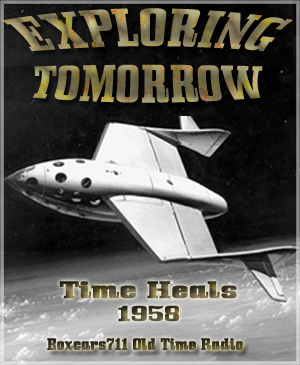
Exploring Tomorrow - Time Heals (1958)
Exploring Tomorrow - Starting as a replacement show for Gangbusters and Counterspy, the series premiered December 11, 1957 and it ran until June 13, 1958. Quoting from Astounding Magazine, "Exploring Tomorrow is the first science fiction radio show of science-fictioneers, by science- fictioneers, and for science-fictioneers" The shows were narrated by the editor of Astounding Magazine, John W. Campbell, Jr., with scripts written by Gordon Dickson, Robert Silverberg and many other notable science fiction writers. THIS EPISODE:1958. Mutual network. "Time Heals". Sponsored by: L & M, Kraft foods, Cape Coral. A man with an incurable disease is sent into the future, where the problem has surely been solved. The date is approximate. Sam Grane (?), Sanford Marshall (director and producer), Lawson Zerbe, Bill Mahr (announcer), Poul Anderson (writer), John Campbell Jr. (host), Connie Lembcke. 24:59.

The Mysterious Traveler - Death Is My Caller (10-21-47)
The Mysterious Traveler - Written and directed by Robert A. Arthur and David Kogan, the series began on the Mutual Broadcasting System, December 5, 1943, continuing in many different timeslots until September 16, 1952. Unlike many other shows of the era, The Mysterious Traveler was without a sponsor for its entire run. The lonely sound of a distant locomotive heralded the arrival of the malevolent narrator, portrayed by Maurice Tarplin, who introduced himself each week in the following manner. This is the Mysterious Traveler, inviting you to join me on another journey into the strange and terrifying. I hope you will enjoy the trip, that it will thrill you a little and chill you a little. So settle back, get a good grip on your nerves and be comfortable -- if you can! Cast members included Jackson Beck, Lon Clark, Roger DeKoven, Elspeth Eric, Wendell Holmes, Bill Johnstone, Joseph Julian, Jan Miner, Santos Ortega, Bryna Raeburn, Frank Readick, Ann Shepherd, Lawson Zerbe and Bill Zuckert. Sound effects were by Jack Amrhein, Jim Goode, Ron Harper, Walt McDonough and Al Schaffer.THIS EPISODE:October 21, 1947. Mutual network. "Death Is My Caller". Sustaining. A wealthy stockbroker named Henry Norton is visted by his old partner, Charles Blair. Blair is just out of jail after seven years...and is seeking revenge. Robert A. Arthur (writer, producer, director), David Kogan (writer, producer, director), Maurice Tarplin, Santos Ortega, Neal O'Malley, Paul Taubman (music), Carl Caruso (announcer), Agnes Young, Ted Jewett. 29:36.

Cloak & Dagger - Delay On Route (10-06-50)
Cloak and Dagger - "Are you willing to undertake a dangerous mission for the United States, knowing in advance you may never return alive?" Cloak and Dagger first aired over the NBC network on May 7, 1950. It had a short run through the Summer on Sundays, changing to Fridays after its Summer run. The last show aired Oct. 22, 1950. This is the story of the WWII special governmental agency, the OSS, or Office of Strategic Services. Its mission was to develop and maintain spy networks throughout Europe and into Asia, while giving aid to underground partisan groups and developing espionage activities for Allied forces overseas.The show is based on the book of the same name by Lt. Col. Corey Ford and Major Alastair MacBain (who were associated with the OSS from its early days.) The dramas are not Hollywood-style, in that they sometimes end with plans foiled or leading characters dead.THIS EPISODE:October 6, 1950. NBC network. "Delay En Route". Sustaining. 8:00 P. M. An O. S. S. agent is sent to Italy to help the Partisans wipe out the remaining Fascists. The agent is forced to help a Fascist scientist escape from the country with plans for a new submarine, and an aerial torpedo. The final promotional announcement and system cue have been deleted. Max Russell (sound effects), Sherman Marks (director, supervisor), Arnold Moss, Ken Field (writer), Jon Gart (music director), Al Fanelli (sound effets), Don Abbott (engineer), Corey Ford (creator), Alistair MacBain (creator), Louis G. Cowan (producer), Alfred Hollander (producer), Grant Richards, Luis Van Rooten. 29:18.

CBS Radio Mystery Theater - Circle Of Evil (08-21-75)
CBS Radio Mystery Theater - As you walk through the creaking door you enter into another world, the world of imagination. This world is inside you, a part of you, and you take this journey alone. Each person hears and then sees with his or her mind's eye the events portrayed within these dramas. All of us interprets what they hear differently. The images we see is unique to ourselves. A voice becomes a person, living, breathing they come alive. They take on a physical form and characteristics that we assign to them. The wonders of your own mind are boundless. Scary thoughts? Perhaps, but what powers they bring us! To exercise one's imagination is to exercise one's soul. These dramas provide us with an escape from reality. To adventures beyond our own lives. Enjoy them. And pleasant dreams!THIS EPISODE:Circle Of Evil August 21, 1975 - A woman is hired to care for two very child-like adults who have been secluded from society. While there, she is contacted by a ghost that wants her to avenge the murder of his wife.Marian Seldes, Kristoffer Tabori, Mary Jane Higby, Ian Martin, Rosemary Rice.

The Adventures Of Frank Race - The Fat Mans Loot (08-21-49)
The Adventures of Frank Race was a 1949-50 radio adventure serial syndicated by Bruce Ellis Productions. The 30-minute program was first broadcast in some markets beginning May 1, 1949. An attorney who turned international adventurer after WWII, Frank Race (Tom Collins, Paul Dubov) mainly investigated insurance scams. After the first 22 shows, Dubov took over the title role. Tony Barnett portrayed Mark Donovan. The series was written and directed by Joel Murcott and Buckley Angel. The announcer was Art Gilmore, and Ivan Ditmars provided the background organ music.THIS EPISODE:August 21, 1949. Program #17. Broadcasters Program Syndicate syndication. "The Adventure Of The Fat Man's Loot". Commercials added locally. Race is off to Berlin and Monte Carlo in search of missing diamonds, stolen by the Nazis. Tom Collins, Buckley Angel (writer, director), Joel Murcott (writer, director), Art Gilmore (announcer), Bruce Eells (producer, Ivan Ditmar (organ), Tony Barrett, Lillian Buyeff, Jack Kruschen, Wilms Herbert, Michael Ann Barrett, Harry Lang. 26:47.
The Creaking Door - I See Ghosts (1950)
The Creaking Door was an old-time radio series of horror and suspense shows originating in South Africa. There are at present anywhere from 34-37 extant episodes in MP3 circulation, yet no currently available program logs for the series indicate the year of the series' broadcast (though it was likely sometime in the 1950s, given the generally high audio quality of the available shows), or the total number of episodes, and only a handful of them are known by their broadcast order. The stories are thrillers in the Inner Sanctum vein, and generally thought of favorably by most fans of OTR.

The Adventures Of Ozzie & Harriet - David Sells Ozzie's Suit (8-26-45)
The Adventures of Ozzie and Harriet launched on CBS October 8, 1944, making a mid-season switch to NBC in 1949. The final years of the radio series were on ABC (the former NBC Blue Network) from October 14, 1949, to June 18, 1954.The Adventures of Ozzie and Harriet, an American radio and television series, was once the longest-running, live-action situation comedy on American television, having aired on ABC from 1952 to 1966 after a ten-year run on radio. Starring Ozzie Nelson and his wife, singer Harriet Hilliard (she dropped her maiden name after the couple ended their music career), the show's sober, gentle humor captured a large, sustaining audience, although it never rated in the top ten programs, and later critics tended to dismiss it as fostering a slightly unrealistic picture of post-World War II American family life. When Skelton was drafted, Ozzie Nelson was prompted to create his own family situation comedy. The Adventures of Ozzie and Harriet launched on CBS October 8, 1944, making a mid-season switch to NBC in 1949. The final years of the radio series were on ABC (the former NBC Blue Network) from October 14, 1949, to June 18, 1954. In an arrangement that amplified the growing pains of American broadcasting, as radio "grew up" into television (as George Burns once phrased it), the Nelsons' deal with ABC gave the network itself the right to move the show to television whenever it wanted to do it---they wanted, according to the Museum of Broadcast Communications, to have talent in the bullpen and ready to pitch, so to say, on their own network, rather than risk it defecting to CBS (where the Nelsons began) or NBC. Their sons, David and Ricky, did not join the cast until five years after the radio series began. The two boys felt frustrated at hearing themselves played by actors and continually requested they be allowed to portray themselves. Prior to April 1949, the role of David was played by Joel Davis (1944-45) and Tommy Bernard, and Henry Blair appeared as Ricky. Since Ricky was only nine years old when he began on the show, his enthusiasm outstripped his ability at script reading, and at least once he jumped a cue, prompting Harriet to say, "Not now, Ricky." Other cast members included John Brown as Syd "Thorny" Thornberry, Lurene Tuttle as Harriet's mother, Bea Benaderet as Gloria, Janet Waldo as Emmy Lou, and Dick Trout as Roger. Vocalists included Harriet Nelson, the King Sisters, and Ozzie Nelson. The announcers were Jack Bailey and Verne Smith. The music was by Billy May and Ozzie Nelson. The producers were Dave Elton and Ozzie Nelson.

The Ford Theater - Its A Gift (03-21-48)
The FORD THEATER, sponsored by the Ford Motor Company, presented hour long dramas first on NBC for one only season. The series moved to CBS for its second and last season. There were 39 NBC and 39 CBS hour- long shows (not verified). The show initially received an unfavorable review from the New York Times for poor script adaptation but was still highly rated for the actors' performance and overall production. The show was supposed to feature only original scripts but had to forgo that plan due to lack of quality material. The first season on NBC used radio actors under the direction of George Zachary. Martin Gabel announced the first show but was soon replaced by Kenneth Banghart. The second season, on CBS, used Hollywood screen actors in the lead roles, supported by radio actors. Fletcher Markle, who previously produced CBS's STUDIO ONE series, was the producer for the second season. Although a short series, it still has some of radio's best dramas. THIS EPISODE: March 21, 1948. CBS network. "It's A Gift". Sponsored by: Ford. A comedy about a wounded war vet who gets dizzy and has to "concentrate." When he "concentrates," he can make people do whatever he wants them to do. A new industry is born! Howard Lindsay (host), Kenneth Banghart (commercial spokesman), Lee Bloomgarten (author), Cliff Carpenter, Carl Eastman, William Zuckert, George Faulkner (continuity), Helen Lewis, James Van Dyke, Elspeth Eric, Howard Teichman (editor), Lyn Murray (composer, conductor), Frank Dane, Ivor Francis, George Zacherle (director), Rod Hendrickson. 59:28.

The Secrets Of Scotland Yard - Just A Matchstick And A Duster (1945)
The Secrets of Scotland Yard was a successful crime drama series, initially airing internationally between 1949 and 1951. Selected episodes finally came to a US radio network for a brief run much later in 1957 over the Mutual Broadcasting System. The series boasted well over 100 episodes, one of which, "The Bone From A Voice Box", apparently served as the prototype for another well remembered Towers Of London dramatic series, The Black Museum. In both series, well known actors were employed as host / narrator, Orson Welles in The Black Museum and Clive Brook here. In fact, the shows were so similar that some of the same actual Scotland Yard cases were dramatized for both series (with totally different scripts, and casts). The Secrets of Scotland Yard was an independent production of the Towers of London syndicate in England for world wide distribution. Each week, an audience of anxious radio-listeners tuned in to hear these true crime stories of the London Metropolitan Police unfold, as the detectives at the Yard investigated some of England's most famous criminals. Their trials have become legendary. Stories presented in the series include the theft of the British crown jewels by Colonel Thomas Blood; the story of a man who finds an armless and legless body wrapped in ribbons and lace; or the strange story of two close brothers who love one another enough to contemplate the murder of a brother's affluent, yet unsightly and ignorant, wife.
Perry Mason - Case Of The Baited Hook (12-21-57)
Perry Mason is the longest running lawyer show in American television history. Its original run lasted nine years and its success in both syndication and made-for-television movies confirm its impressive stamina. Mason's fans include lawyers and judges who were influenced by this series to enter their profession. The Mason character was created by mystery writer Erle Stanley Gardner and delivered his first brief in the novel The Case of the Velvet Claws (1933). From 1934 to 1937 Warners produced six films featuring Mason. A radio series also based on Mason ran every weekday afternoon on CBS radio from 1944 to 1955 as a detective/soap opera. When the CBS television series was developed as an evening drama, the radio series was changed from Perry Mason to The Edge of Night and the cast renamed so as not to compete against the television series. This Episode: Case of the Baited Hook from Perry Mason adapted for radio aired December 21, 1957. Robert Dawson confronts Albert Tydings, his partner, about $80K missing from Carol Stanley's trust account. Albert Tydings admits he embezzled the money and blackmails Robert Dawson to keep quiet or he will reveal some scandalous facts about Carol. Later, Carol calls and makes an appointment to meet Albert Tydings at his office to discuss the trust account. She arrives to find Albert Tydings dead.
Cavalcade Of America - Kansas Marshall (03-31-47)
Cavalcade of America is an anthology drama series that was sponsored by the DuPont Company. It was initially broadcast on radio from 1935 to 1953, and later on television from 1952 to 1957. Originally on CBS the series pioneered the use of anthology drama for company audio advertising. Cavalcade of America documented historical events using stories of individual courage, initiative and achievement, often with feel-good dramatizations of the human spirit's triumph against all odds. This was consistent with DuPont's overall conservative philosophy and legacy as an American company dating back to 1802. The company's motto, "Maker of better things for better living through chemistry," was read at the beginning of each program, and the dramas emphasized humanitarian progress, particularly improvements in the lives of women, often through technological innovation.The show started as part of a successful campaign to reinvigorate DuPont. In the early 1930s, the Nye Committee investigations concluded that DuPont had made a fortune profiteering in World War I. The company stood accused of encouraging an arms race between WWI enemies, after being heavily subsidized by the Allies to increase black powder production. The negative effects of the investigation left the company demoralized, directionless and with a tarnished corporate image in the middle of the Great Depression. DuPont's products were primarily not for public consumption, so there was no purpose in promoting them through advertising. As a solution to DuPont's troubles, Roy Durstine, then creative director of Batten, Barton, Durstine & Osborn, proposed the creation of Cavalcade of America using the company motto. This was to be an important element in the successful re-branding of DuPont as an American legacy engaged in making products for the well-being of Americans and humanity in general. THIS EPISODE: "Kansas Marshall" from Cavalcade Of America aired March 31, 1947 starring Henry Fonda. The story of Wyatt Earp, Marshall of Wichita Kansas, a town that needed cleaning up. The script was based on the 1939 film, Frontier Marshal, and remade by John Ford as "My Darling Clementine" in 1946. This radio version is one you will definitely enjoy!

Air Adventures Of Jimmy Allen - Episode 20 and Episode 21
The Air Adventures Of Jimmy Allen - This series included the boy wonder and pilot, Jimmie Allen, his best teenage buddy, Speed Robertson, and mechanic Flash Lewis. As a team they would solve crimes often at the hands of their enemies the corrupt Black Pete and the dishonorable Digger Dawson. Young listeners could join the very popular Jimmie Allen Flying club, complete with a "personal letter" from the boy wonder himself. Jimmie Allen was so popular a character that Paramount shot the feature film The Sky Parade. Cast: Jimmie Allen, Robert Fiske.

Nick Carter Master Detective - Murder By Magic (04-08-44)
Nick Carter Master Detective - Nick Carter is the name of a popular fictional detective who first appeared in in a dime novel entitled "The Old Detective's Pupil" on September 18, 1886. In 1915, Nick Carter Weekly became Street & Smith's Detective Story Magazine. Novels featuring Carter continued to appear through the 1950s, by which time there was also a popular radio show, Nick Carter, Master Detective, which aired on Mutual from 1943 to 1955. Nick Carter first came to radio as The Return of Nick Carter. Then Nick Carter, Master Detective, with Lon Clark in the title role, began April 11, 1943, on Mutual, continuing in many different timeslots for well over a decade. Jock MacGregor was the producer-director of scripts by Alfred Bester, Milton J. Kramer, David Kogan and others. Background music was supplied by organists Hank Sylvern, Lew White and George Wright. Patsy Bowen, Nick's assistant, was portrayed by Helen Choate until mid-1946 and then Charlotte Manson stepped into the role. Nick and Patsy's friend was reporter Scubby Wilson (John Kane). Nick's contact at the police department was Sgt. Mathison (Ed Latimer). The supporting cast included Raymond Edward Johnson, Bill Johnstone and Bryna Raeburn. Michael Fitzmaurice was the program's announcer. THIS EPISODE: April 8, 1944. Mutual network. "Murder By Magic". Sustaining. "Nick Carter and The Mystery Of The Missing Identity." Lon Clark, Helen Choate, John Kane, Humphrey Davis, Jock MacGregor (producer, director, occasional writer), Lew White (musician). 1/2 hour.
John Steele Adventurer - Cargo Unknown (07-12-49)
John Steele Adventurer - This drama thriller series was heard over the Mutual radio network from 04/26/49 to 07/16/56 and starred Don Douglas in the title role. John Steele treks sweaty-browed through jungles and deserts, fighting lions and saving women. Thrilling indeed. Also heard throughout the program were John Larkin, Jack Edwards, and Bryna Raeburn. THIS EPISODE: July 12, 1949. Mutual network. "Cargo Unknown". Sustaining. Not auditioned. Two men are in an open boat, with a beautiful woman. Elliott Drake (writer, director), Ross Martin, Connie Lembcke, Earl George, Sylvan Levin (conductor), Walt Shaver (sound effects), Ted Mallie (announcer), Don Douglas, Robert Monroe (producer). 29:36.

The Adventures Of Nero Wolf - Case Of The Final Page (03-23-51)
The Adventures of Nero Wolf came to radio in the spring of 1943 in a short-lived series starring J. B. Williams over a New England network. The series moved onto ABC with Santos Ortega starring in a summer series (July 5, 1943-September 27, 1943) with John Gibson as Archie Goodwin. Luis Van Rooten moved into the title role when the series was revived the following year (January 21, 1944-July 14, 1944). Francis X. Bushman starred as The Amazing Nero Wolfe in a 1945-46 Mutual series, with Elliott Lewis as Archie. NBC's The New Adventures of Nero Wolfe aired from October 20, 1950 through April 27, 1951 and starred Sydney Greenstreet. The actor had made his film debut at age 61 in Dashiell Hammett's The Maltese Falcon, receiving a Best Supporting Actor Oscar nomination for his performance as Casper Gutman (a.k.a. "The Fat Man"). Though the series ran only six months, five different veteran radio detective stars were heard as Archie Goodwin: Gerald Mohr (radio's Philip Marlowe and The Lone Wolf), Wally Maher (Michael Shayne), Harry Bartell (announcer of Sherlock Holmes), Herb Ellis (Dragnet's Frank Smith) and Lawrence Dobkin (Ellery Queen). THIS EPISODE: March 23, 1951. NBC network. "The Case Of The Final Page". Sustaining. Nero Wolfe and Archie attend a dinner at the home of Arthur Merle, only to find him knifed in the back. Sydney Greenstreet, Don Arthur (writer), Rex Stout (creator), William Johnstone, Don Stanley (announcer), Edwin Fadiman (producer), J. Donald Wilson (director), Harry Bartell, Evelyn Eaton, Lucille Alex, Peter Leeds, Monica Nealy, Herb Butterfield. 29:27.

The Bob Hope Show - Guest - Basil Rathbone (1-28-41)
The Bob Hope Show - From the age of twelve, Bob Hope worked at a wide variety of odd jobs at a local board walk. When not doing this he would busk, doing dance and comedy patter to make extra money. He entered many dancing and amateur talent contests, and won prizes for his impersonation of Charlie Chaplin. He also boxed briefly and unsuccessfully under the name Packy East, making it once as far as the semi-finals of the Ohio novice championship. Fallen silent film comedian Fatty Arbuckle saw one of his performances and in 1925 got him steady work with Hurley's Jolly Follies. A year later Hope had formed an act called the Dancemedians with George Burns (who would also live to see his own 100th birthday) and the Hilton Sisters, conjoined twins who had a tap dancing routine. Hope and his partner George Byrne had an act as a pair of Siamese twins as well, and both danced and sang while wearing blackface before friends advised Hope that he was funnier as himself.. After five years on the Vaudeville circuit, by his own account Hope was surprised and humbled when he and his partner Grace Louise Troxell failed a 1930 screen test for Pathé at Culver City, California. (Hope had been on the screen in small parts, 1927's The Sidewalks of New York and 1928's Smiles. Hope returned to New York City and subsequently appeared in several Broadway musicals including Roberta, Say When, the 1936 Ziegfeld Follies, and Red, Hot and Blue with Ethel Merman. His performances were generally well-received and critics noted his keen sense of comedic timing. He changed his name from "Leslie" to "Bob", reportedly because people in the US were calling him "Hopelessly", although in the 1920s he sometimes used the name "Lester Hope".
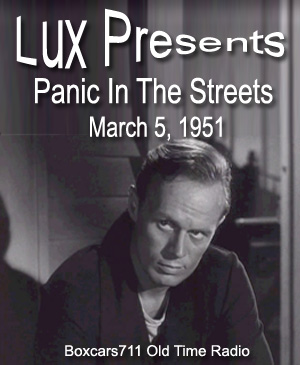
Lux Radio Theater - Panic In The Streets (03-05-51)
Panic in the Streets from Lux Radio Theater aired March 5, 1951. After brawling over a card game in the wharf area of New Orleans, a man named Kochak, suffering visibly from a flu-like illness, is killed by gangster Blackie and his two flunkies, Kochak's cousin Poldi and a man named Fitch. They leave the body on the docks, and later when the dead man, who carries no identification, is brought to the morgue, the coroner grows suspicious about the bacteria present in his blood and calls his superior, Dr. Clinton Reed, (played by Richard Widmark) a uniformed doctor working for the U.S. Public Health Service. Dr. Reed and a police captain (Paul Douglas) have only a day or two in which to prevent an epidemic. Can a doctor turn detective?

The Adventures Of Ellery Queen - The Singing Rat (1-07-43)
The Adventures Of Ellery Queen - Tuska cited Ellery Queen, Master Detective (1940) and Ellery Queen's Penthouse Mystery (1941) as the best of the Bellamy-Lindsay pairings. "The influence of The Thin Man series was apparent in reverse", Tuska noted about Ellery Queen's Penthouse Mystery. "Ellery and Nikki are unmarried but obviously in love with each other. Probably the biggest mystery... is how Ellery ever gets a book written. Not only is Nikki attractive and perfectly willing to show off her figure", Tuska wrote, "but she also likes to write her own stories on Queen's time, and gets carried away doing her own investigations." In Ellery Queen, Master Detective, "the amorous relationship between Ellery and Nikki Porter was given a dignity, and therefore integrity", Tuska wrote, "that was lacking in the two previous entries in the series", made at Republic Pictures before Bellamy and Lindsay were signed by Columbia. THIS EPISODE: January 7, 1943. NBC network. "The Adventure Of The Singing Rat". Sponsored by: Bromo Seltzer. Racketeer Musso has been set up by a stool pigeon. A hollow cigarette holds the secret of murder. This is the West Coast broadcast, the East cast broadcast took place on January 9, 1943. The system cue has been deleted. Carleton Young, Marian Shockley, Santos Ortega, Ted de Corsia, Ann Corio (guest armchair detective), Alfred McKelvey ("a prominent Eastern manufacturer" second guest armchair detective), Ernest Chappell (announcer), Frederic Dannay (writer), Manfred B. Lee (writer), Bruce Kamman (producer, director), Charles Paul (organ). 29:30.
Diary Of Fate - Janice Bennett (6-22-48)
Diary of Fate is a mystery and horror program where "Fate" narrates and always wins by the end of the story. These are great suspense filled stories about average people who are subject to the mysteries of their 'Fate'. THIS EPISODE: June 22, 1948. Program #28. Finley syndication. "Janice Bennet". Commercials added locally. Book 701, page 327. Not auditioned. A woman always takes the easy way out. The date is subject to correction. Herb Lytton, Ginny Johnson, Gloria Gordon, Doug Young, James Murphy, Ray Ehrlenborn, Hal Sawyer, Larry Finley (producer). 26:21.

Duffy's Tavern - Poker Game (11-02-43)
Duffy's Tavern, an American radio situation comedy (CBS, 1941-1942; NBC-Blue Network, 1942-1944; NBC, 1944-1952), often featured top-name stage and film guest stars but always hooked those around the misadventures, get-rich-quick-scheming, and romantic missteps of the title establishment's malaprop-prone, metaphor-mixing manager, Archie, played by the writer/actor who co-created the show, Ed Gardner. In the show's familiar opening, "When Irish Eyes Are Smiling," either solo on an old-sounding piano or by a larger orchestra, was interrupted by the ring of a telephone and Gardner's New Yorkese accent as he answered, "Duffy's Tavern, where the elite meet to eat. Archie the manager speakin'. Duffy ain't here — oh, hello, Duffy." Duffy, the owner, was never heard (or seen, when a film based on the show was made in 1945 or when a bid to bring the show to television was tried in 1954). But Archie always was — bantering with Duffy's man-crazy daughter, Miss Duffy (played by several actresses, beginning with Gardner's real-life first wife, Shirley Booth); with Eddie, the waiter/janitor (Eddie Green); and, especially, with Clifton Finnegan (Charlie Cantor), a likeable soul with several screws loose and a knack for falling for every other salesman's scam. THIS EPISODE: November 2, 1943. Program #25. Blue network origination, AFRS rebroadcast. Guest Charles Coburn is enticed into a poker game down at the tavern. Charles Coburn, Ed Gardner, Florence Halop, Peter Van Steeden and His Orchestra. 1/2 hour.
CBS Radio Mystery Theater - Absolute Zero (10-28-76)
The CBS Radio Mystery Theater (or CBSRMT) was an ambitious and sustained attempt to revive the great drama of old-time radio in the 1970s. Created by Himan Brown (who had by then become a radio legend due to his work on Inner Sanctum Mysteries and other shows dating back to the 1930s), and aired on affiliate stations across the CBS Radio network, the series began its long run on January 6, 1974. The final episode ran on December 31, 1982. The show was broadcast nightly and ran for one hour, including commercials. Typically, a week consisted of three to four new episodes, with the remainder of the week filled out with reruns. There were a total of 1399 original episodes broadcast. The total number of broadcasts, including reruns, was 2969. The late E.G. Marshall hosted the program every year but the final one, when actress Tammy Grimes took over. Each episode began with the ominous sound of a creaking door, slowly opening to invite listeners in for the evening's adventure. At the end of each show, the door would swing shut, with Marshall signing off, "Until next time, pleasant...dreams?"

Dark Fantasy - Double Feature (11-14-41) and (01-30-42)
Dark Fantasy was an series dedicated to dealings with the unknown. Originating from radio station WKY, Oklahoma City, it was written by Scott Bishop (of Mysterious Traveler and The Sealed Book fame) and was heard Fridays over stations. Keith Paynton served as announcer. The shows covered horror, science fiction and murder mysteries. Although a short series, the shows are excellent with some stories way ahead of their time. TODAY'S SHOW: "The Man Who Came Back" (11-14-41) and "Death Is A Savage Diety" (01-30-42) November 14, 1941. NBC network, WKY, Oklahoma City origination. "The Man Who Came Back". Sustaining. A killing after an argument about a man's wife leads to a promise to return from the grave for vengeance. Scott Bishop (writer), Muir Height, Eugene Frances, Ben Morris, Eleanor Naylor Corin (?), Fred Wayne, Murillo Scofield (?). 24:41 January 30, 1942. Program #11. NBC network"Death Is A Savage Diety". Sustaining. A tale of witchcraft and black magic, based on the novel by Scott Bishop. The system cue has been deleted. Scott Bishop (writer), Tom Paxton (announcer). 24:25.
Abbott & Costello Show - Spanish Acting School (05-03-45)
The Abbott and Costello Show mixed comedy with musical interludes (usually, by singers such as Connie Haines, Marilyn Maxwell, the Delta Rhythm Boys, Skinnay Ennis, and the Les Baxter Singers). Regulars and semi-regulars on the show included Artie Auerbrook, Elvia Allman, Iris Adrian, Mel Blanc, Wally Brown, Sharon Douglas, Verna Felton, Sidney Fields, Frank Nelson, Martha Wentworth, and Benay Venuta. Ken Niles was the show's longtime announcer, doubling as an exasperated foil to Abbott & Costello's mishaps (and often fuming in character as Costello insulted his on-air wife routinely); he was succeeded by Michael Roy, with annoncing chores also handled over the years by Frank Bingman and Jim Doyle. THIS EPISODE: May 3, 1945. NBC network. Sponsored by: Camels, Prince Albert. Costello wants to become a dramatic actor from Brazil...another Carmen Veranda! Bob Matthews (an ex-aerial gunner) sings for the first time on the show (and sounds like an off-key Mel Torme). Bud Abbott, Lou Costello, Will Osborne and His Orchestra, Bob Matthews, Connie Haines, Ken Niles (announcer), Mel Blanc. 29:28.
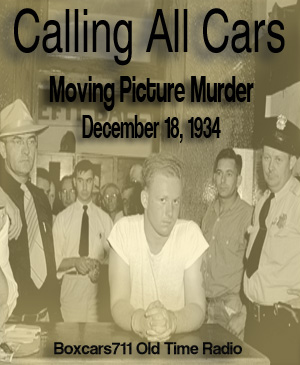
Calling All Cars - Moving Picture Murder (12-18-34)
Calling All Cars was one of radio's earliest cop shows, dramatizing true crime stories and introduced by officers from the Los Angeles and other police departments. The narrator of the program was speech professor Charles Frederick Lindsley, and the only other regular voice heard on the program week after week belonged to that of Sergeant Jesse Rosenquist of the L.A.P.D., whose name and voice were so unusually distinctive that he was retained for the show's entire run. None of the actors on the show ever received on-air credit, but among the talent OTR fans can hear the likes of Elvia Allman, Jackson Beck, Charles Bickford, John Gibson, Richard LeGrand and Hanley Stafford, just to name a few. THIS EPISODE: December 18, 1934. Program #56. CBS Pacific network (Don Lee network). "The Moving Picture Murder". Sponsored by: Rio Grande Oil. A hold-up and murder has taken place in San Diego. The system cue has been deleted. Not auditioned. William N. Robson (writer, producer), Charles Frederick Lindsley (narrator). 30:35.

Jeff Regan Investigator - Two Episodes (08-14-48) (11-09-49)
Jeff Regan, Investigator was one of the three detective shows Jack Webb did before Dragnet (see also Pat Novak For Hire and Johnny Modero: Pier 23). It debuted on CBS in July 1948. Webb played JEFF REGAN, a tough private eye working in a Los Angeles investigation firm run by Anthony J. Lyon. Regan introduced himself on each show "I get ten a day and expenses...they call me the Lyon's Eye." The show was fairly well-plotted, Webb's voice was great, and the supporting cast were skillful. Regan handled rough assignments from Lion, with whom he was not always on good terms. He was tough, tenacious, and had a dry sense of humor. The voice of his boss, Anthony Lion, was Wilms Herbert. The show ended in December 1948 but was resurrected in October 1949 with a new cast; Frank Graham played Regan (later Paul Dubrov was the lead) and Frank Nelson portrayed Lion. This version ran on CBS, sometimes as a West Coast regional, until August 1950. Both versions were 30 minutes, but the day and time slot changed several times. A total of 29 episodes from this series are in trading currency. DOUBLE FEATURE: The Diamond Quartet (8-14-48) Little Man's Lament (11-09-49)
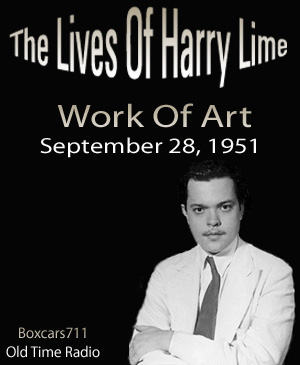
The Lives Of Harry Lime - Work Of Art (09-28-51)
The Third Man (The Lives of Harry Lime) was a old-time radio adventure series that ran in 1951 and 1952. It was based on the 1949 film of the same name. Orson Welles stars as Harry Lime, a perpetually broke confidence man, smuggler, and general scoundrel. He will participate in virtually any criminal activity to make a fast buck, but uses his wits rather than a gun. He draws the line short of murder, blackmail, or drugs. Even so, Harry is an endearing character and listeners love to hear of his one-step-ahead-of-the-law misadventures as he hops around the globe looking for his next pigeon. The zither music of Anton Karas adds a wonderful Viennese ambience to each episode and really makes this show special. THIS EPISODE: September 28, 1951. Program #9. Lang-Worth syndication. "Work Of Art". Commercials added locally. In Buenos Aires in July, 1944, Harry is hired to swindle an original Rubens from its beautiful owner. Orson Welles, Anton Karas (zither), Harry Alan Towers (producer), Tig Roe (director). 27:13.

Command Performance - Host Betty Grable (05-07-42)
Command Performance was one of the few radio shows that were sent overseas to boost the morale of US Troops during World War 2. In March 1942 it became a weekly show featuring famous people such as Bob Hope, Fred Allen, Dinah Shore, Frank Sinatra and more. Each show consisted of several stars who get together and perform comedy routine. All talent for this program was donated, and valued at $75,000 a week. There were more than 400 shows. Announcers : Paul Douglas, Ken Carpenter . Creator : Lous G. Cowan . Producers : Vick Knight, Maury Holland, Cal Kuhl . Director : Glenn Wheaton . Writers : Melvin Frank, Norman Panama

CBS Radio Mystery Theater - Death Is Blue (03-31-77).mp3
The CBS Radio Mystery Theater (or CBSRMT) was an ambitious and sustained attempt to revive the great drama of old-time radio in the 1970s. Created by Himan Brown (who had by then become a radio legend due to his work on Inner Sanctum Mysteries and other shows dating back to the 1930s), and aired on affiliate stations across the CBS Radio network, the series began its long run on January 6, 1974. The final episode ran on December 31, 1982. The show was broadcast nightly and ran for one hour, including commercials. Typically, a week consisted of three to four new episodes, with the remainder of the week filled out with reruns. There were a total of 1399 original episodes broadcast. The total number of broadcasts, including reruns, was 2969. The late E.G. Marshall hosted the program every year but the final one, when actress Tammy Grimes took over. Each episode began with the ominous sound of a creaking door, slowly opening to invite listeners in for the evening's adventure. At the end of each show, the door would swing shut, with Marshall signing off, "Until next time, pleasant...dreams?" THIS EPISODE: March 31, 1977. Program #625. CBS network. "Death Is Blue". Sponsored by: True Value Hardware, Buick, True Temper Tools, Mogen David Wines. Allied Van Lines. E. G. Marshall (host), Sam Dann (writer), Frances Sternhagen, Marian Seldes, Bryna Raeburn, Ralph Bell, Ian Martin. 52 minutes.