
Boxcars711 Old Time Radio
2,207 episodes — Page 21 of 45

The Burns & Allen Show - George Sells Chicken Farm (03-14-46)
Burns and Allen are one of the most beloved couple in old time radio. They got started, like many of the greats of old time radio, in vaudeville, which is really just the touring popular entertainment in America prior to movies. Gracie was the sparkplug of the act, always the center of attention. George played the foil, the guy vainly trying to make sense of the ditzy world of Gracie. By the early 30s, Gracie was probably the best known woman on radio. Gracie often sang in a voice that showed she was also an excellent comedienne songstress. The shows had names after the sponsors, such as Maxwell House Coffee Time, or The Ammident Show - it was the Burns and Allen show to the public. Other fine radio actors were a part of the fun. Mel Blanc did the happy postman, and was also famous for his zany characters on The Jack Benny Show, and his own Mel Blanc Show. Elliott Lewis, a veteran of many radio dramas, played many of the bit parts on the Burns and Allen shows of the 40s. Burns & Allen were touring England in 1929 when they made their first radio appearance on the BBC. Gracie Allen died on August 27, 1964. George Burns died on March 9, 1996. First Broadcast date february 15th 1932. Last Broadcast date may 17th 1950.
Academy Award Theater - Guest In The House (09-25-46)
Academy Award Theater - Stars and movies with Oscars were the idea - in most cases, the movie stars recreated their academy award roles for the show, or in other cases, fine actors played the parts and gave it a different character. Both ways make for great radio drama and first class Hollywood motion picture star entertainment. The Lux Radio Theater had been doing this kind of radio show in the grandest manner for many years, but sponsor Squibb had the hubris and deep pockets to take on the competition by doing Academy Award Theater right after the Second World War. The year 1946 was pre-television, and so movies were still the major American visual art form, with radio the other popular network entertainment. In this final pre-TV time, Academy Award Theater was thought of as a premier radio production, a wow show, much like CinemaScope was to be in the 1950's when Hollywood felt the box office blow of early TV. THIS EPISODE: September 25, 1946. CBS network. "Guest In The House". Sponsored by: Squibb Drugs. A neurotic disrupts the happy home life of her doctor's family. Joan Lorring, Anita Louise, Kirk Douglas. 1/2 hour.

Calling All Cars - San Quentin Prison Break (01-16-35)
Calling All Cars was one of radio's earliest cop shows, dramatizing true crime stories and introduced by officers from the Los Angeles and other police departments. The narrator of the program was speech professor Charles Frederick Lindsley, and the only other regular voice heard on the program week after week belonged to that of Sergeant Jesse Rosenquist of the L.A.P.D., whose name and voice were so unusually distinctive that he was retained for the show's entire run. None of the actors on the show ever received on-air credit, but among the talent OTR fans can hear the likes of Elvia Allman, Jackson Beck, Charles Bickford, John Gibson, Richard LeGrand and Hanley Stafford, just to name a few. THIS EPISODE: January 22, 1935. Program #61. CBS Pacific network (Don Lee network). "The San Quentin Prison Break". Sponsored by: Rio Grande Oil. Four convicts have just escaped from San Quentin prison, they are reported heading north with four members of the prison board as hostages. The actual prison break happened just "last Wednesday." The program has also been dated January 16, 1935. The initial dramatization of the event (also on the Don Lee net, which was used as the CBS Pacific net) took place just a half hour after the capture of the escaped convicts. William N. Robson dramatized how this story was produced on "The Columbia Workshop" on September 5, 1936. The system cue has been deleted. Not auditioned. District Attorney Albert Bagshaw speaks from KFRC, San Francisco. William N. Robson (writer, producer), Charles Frederick Lindsley (narrator), Albert Bagshaw (may be impersonated). 29:05.

Broadway Is My Beat - The Morrie Brandeis Case (11-26-49)
Broadway Is My Beat, a radio crime drama, ran on CBS from February 27, 1949 to August 1, 1954. With music by Robert Stringer, the show originated from New York during its first three months on the air, with Anthony Ross portraying Times Square Detective Danny Clover. John Dietz directed for producer Lester Gottlieb. Beginning with the July 7, 1949 episode, the series was broadcast from Hollywood with producer Elliott Lewis directing a new cast in scripts by Morton Fine and David Friedkin. The opening theme of "I'll Take Manhattan" introduced Detective Danny Clover (now played by Larry Thor), a hardened New York City cop who worked homicide "from Times Square to Columbus Circle -- the gaudiest, the most violent, the lonesomest mile in the world."

2000 Plus - Alone (11-12-50)
2000 AD (2000 Plus) is known as the first of the network science fiction shows, although it ran on Mutual just a month prior to the introduction of the landmark series, Dimension X. It was a half hour of science fiction wonder in an exciting package. The stories have a charm that is always present in science fiction of the future that is written in the past. "When The Worlds Met" takes place "at the giant space port in Washington, temporary capitol of the federated world government as in April 21, 2000 Plus 20 (2020) crowds throng as audio and televox networks cover a space ship carrying in its space hold the first load of uranium taken from the pits of Luna, satellite of Earth.
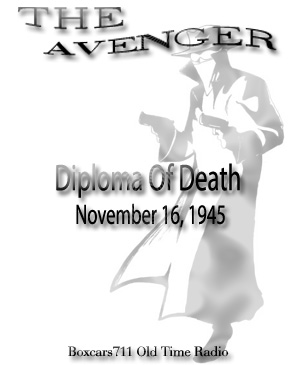
The Avenger - Diploma Of Death (11-16-45)
The Avenger is an Old Time Radio show aired by the South African Broadcasting System in the 1940s. It featured a biochemist crime-fighter by the name of Jim Brandon. Mr. Brandon had two inventions which assisted him in the fight against crime. Mr. Brandon was able to pick up telpathic thought flashes and had a diffusion capsule which allowed him to become invisible. SYNDICATED by:Charles Michelson WRITTER: Walter Gibson STARS: James Monks, Dick Janiver as the invisible Jim Brandon WITH: James LaCurto. THIS EPISODE: The Avenger. November 16, 1945. Program #24. Michelson syndication. "The Diploma Of Death". Commercials added locally. Charles Michelson (producer), Walter Gibson (writer), Ruth Braun (writer), Gilbert Braun (writer). 1/2 hour.
Box 13 - Damsel In Distress (11-14-48)
Box 13The premise of the program was that Dan Holiday was an author who wrote mystery novels. To get ideas for his novels he placed an advertisement in a newspaper saying "Adventure wanted, will go anywhere, do anything, Box 13." The ads always brought fun adventures of all kinds: from racketeer's victim to psychotic killer looking for fun. Most of the episodes were based on Dan Holiday replying to a letter he received at Box 13. He would generally solve a mystery in the process, and return to his office in time to enjoy a hearty laugh at the expense of Suzy, his amusingly stupid secretary. He would certainly not meet the strictest requirements for private eyes (not licensed, collected no fees from clients), but the definition should stretch to sneak him in under the rope. It was heard over the Mutual Broadcasting System as well as being syndicated. The series was produced by Mayfair Productions. Box 13, starring Alan Ladd as Dan Holiday. Sylvia Picker played Suzy, Dan Holiday's secretary and Edmond MacDonald as Lt. Kling. Other stars in the series were Betty Lou Gerson, Lurene Tuttle, Alan Reed, Luis Van Rooten, John Beal and Frank Lovejoy. Music was by Rudy Schrager and the writer was Russell Hughes. Announcer/Director was Vern Carstensen. The series was produced by Richard Sanville with Alan Ladd as co-producer. THIS EPISODE: November 14, 1948. Program #13. Mayfair syndication. "Damsel In Distress". Commercials added locally. Constance McLain, a wealthy girl at a private school, asks Dan to protect her from a blackmailer. She then disappears! A loud crash is heard in the studio during the program, which is ignored by the cast. Alan Ladd, Edmond MacDonald, Richard Sanville (director), Rudy Schrager (composer, conductor), Russell Hughes (writer), Sylvia Picker, Vern Carstensen (production supervisor). 27:28.
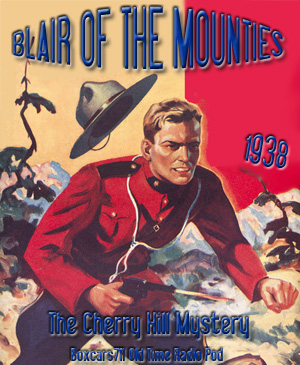
Blair Of The Mounties - Cherry Hill Mystery (2 Ep.-Complete) 1938
Blair of the Mounties is the story of the Royal Northwest Mounted Police -- a fictional series based on the work of the Northwest Mounted Police before the World War I. It was a fifteen minute weekly serial heard every Monday for 36 weeks beginning January 31st, 1938 and running through the 3rd of October of 1938. It may have been on the air as early as 1935, although there's no actual proof of this. Little is known of the series other than it followed the exploits of Sgt. Blair of the Northwest Mounted Police. and probably was the inspiration for Trendell, Campbell and Muir's Challenge of the Yukon. The series was written by Colonel Rhys Davies, who also played the Colonel Blair in the series. Jack Abbot played the Constable. Jack French, one of OTR's best researchers says this about the series: "Blair is not restricted to Canada, as other Mounties, as we find him, in a few cases, in Great Britain, solving cases. Overall the series is amateurishly written, with the actor playing Blair coming accros as a bit stuffy." THIS EPISODE: April 4, 1938. Program #10. Walter Biddick syndication. "The Cherry Hill Mystery" Part one. An innocent man will be hanged unless Blair can find out how two men were shot...without a gun! . 12 1/4 minutes. April 11, 1938. Program #11. Walter Biddick syndication. "The Cherry Hill Mystery" Part two. With clever deduction, Blair discovers the killer and the murder weapon. . 13 1/4 minutes.
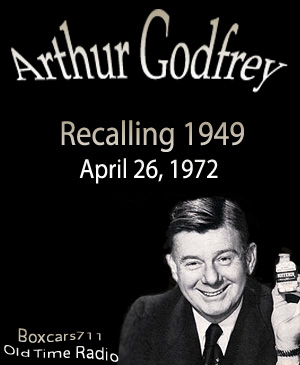
The Arthur Godfrey Show - Recalling 1949 (04-26-72)
The Arthur Godfrey Show - Godfrey was born in New York City. While his family was originally well off, his mother was unsuccessful as a performer with aspirations to fame and stardom that never materialized, and his father was a failed sportswriter who left the family. With the family in sudden poverty, Godfrey tried to help them survive by going on the road accepting odd jobs, and hoboing. He served in the United States Navy from 1920 to 1924 as a radio operator on naval destroyers. Additional training in radio came during Godfrey's service in the Coast Guard from 1927 to 1930. It was during a Coast Guard stint in Baltimore that he appeared on a local talent show and became popular enough to land his own brief weekly program.
The Clock - Gus Fowler (07-21-47)
The Clock, Imported from Austrailia, was a dramatic thirty-minute suspense and mystery series. It was written by Lawrence Klee and was first broadcast in November 1946. The story always began the same; "Sunrise and sunset, promise and fulfilment, birth and death … the whole drama of life is written in the sands of time". This is a great series where the main theme seems to be Retribution. Stories as told by Father Time. THIS EPISODE: July 21, 1947. Syndicated, WRVR-FM, New York aircheck. "Gus Fowler". Participating sponsors. A man with a month to live and a strange bargain. WRVR rebroadcast date: August 31, 1973. The date above is the date of the first broadcast on ABC. . 1/2 hour.
The Air Adventures Of Jimmy Allen - Episodes 458 and 459 (1936)
The Air Adventures Of Jimmy Allen This series included the boy wonder and pilot, Jimmie Allen, his best teenage buddy, Speed Robertson, and mechanic Flash Lewis. As a team they would solve crimes often at the hands of their enemies the corrupt Black Pete and the dishonorable Digger Dawson. Young listeners could join the very popular Jimmie Allen Flying club, complete with a "personal letter" from the boy wonder himself. Jimmie Allen was so popular a character that Paramount shot the feature film The Sky Parade.

Big Town - I Remember Murder (11-30-48)
Big Town is a radio show that aired from 1937 to 1952. Edward G. Robinson had the lead role of Steve Wilson from 1937 to 1942. Claire Trevor was Wilson's society editor sidekick Lorelei Kilbourne, with Ona Munson taking over that role in 1940. Edward J. Pawley portrayed Wilson from 1942 until 1952 when Walter Greaza was heard as Wilson in the final episodes in the radio series. When Big Town moved to television, the program was telecast live, but in 1952 the production switched to film after the move from New York City to Hollywood. The television series ran on CBS from 1950 through 1954, continuing on NBC from 1955 through 1956. Repeat episodes aired on the DuMont Network (under the title City Assignment) while Big Town was still showing first-run episodes on CBS. Reruns were also shown under the titles Heart of the City, Headline and Byline Steve Wilson. THIS EPISODE: November 30, 1948. NBC network. "I Remember Murder". Sponsored by: Lifebuoy, Rinso. A band-leader steals $50,000 from The High Hatters Club and leaves town in a hurry. After he's "taken for a ride," the girl singer who was with him developes amnesia. "Harry The Hack" finds her...and the murder victim too. Edward Pawley, Fran Carlon, Mason Adams, Jerry McGill (writer, director). 29:55.
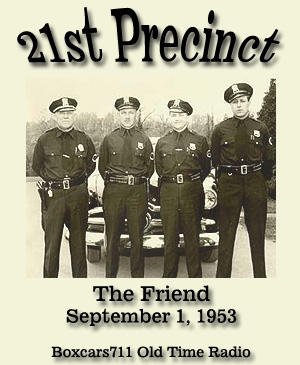
21st Precinct - The Friend (09-01-53)
21ST PRECINCT was one of the realistic police drama series of the early- to mid-1950's that were aired in the wake of DRAGNET. In 1953 CBS decided to use New York City as the backdrop for their own half-hour police series and focus on the day-to-day operation of a single police precinct. Actual cases were used as the basis for stories. The Precinct Captain acted as the narrator for the series.The official title of the series according to the series scripts and the CBS series promotional materials was 21ST PRECINCT and not TWENTY-FIRST PRECINCT or TWENTY FIRST PRECINCT which appears in many Old-Time Radio books. In 1953 CBS decided to use New York City as the backdrop for their own half-hour police series and focus on the day-to-day operations of a single police precinct. Actual cases would be used as the basis for stories. It was mentioned in each episode's closing by the announcer that, "Twenty-firstPrecinct is presented with the official cooperation of the Patrolmen's Benevolent Association an organization of more than 20,000 members of the Police Department, City of New York."
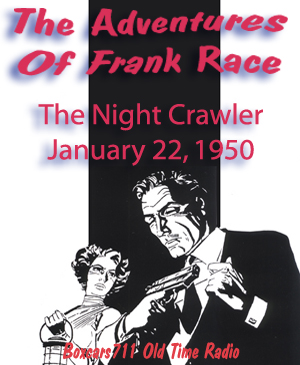
The Adventures Of Frank Race - The Night Crawler (01-22-50)
The Adventures of Frank Race, by Bruce Ells Productions, was first heard in May of 1949. The main character, Frank Race, was an attorney before World War II. As a result of his activities in the war, when it was over, he traded his law books for a career with the OSS. There, "Adventure" became his business. Tom Collins played the role of Frank Race initially, immediately following his stint as Chandu, The Magician. The lead role was taken over later by Paul Dubof. THIS EPISODE: January 22, 1950. Program #39. Broadcasters Program Syndicate syndication. "The Adventure Of The Night Crawler". Commercials added locally. Treachery in the live bait business. Race sees that the worm turns! Paul Dubov, Tony Barrett, Buckley Angel (writer, director), Joel Murcott (writer, director), Bruce Eells (producer), Ivan Ditmars (organist), Art Gilmore (announcer), Michael Ann Barrett, Dick Ryan, Hal March, Gunnar Peterson, Wilms Herbert, Bill Crawford. 26:48.

Author's Playhouse - Southern Exporsure (9-15-44)
Author's Playhouse - Famous stories by celebrated authors: among them, Elementals (Stephen Vincent Benet), The Piano (William Saroyan), and The Snow Goose (Paul Gallico).March 5, 1941 till June 4, 1945, NBC; Blue Network until mid-October 1941, then the Red Network. Many briefly held 30m timeslots, including Sundays at 11:30, 1941-42; Wednesdays at 11:30, 1942-44; Mondays at 11:30, 1944-45. Sponsor was Philip Morris, 1942-43. Cast: John Hodiak, Fern Persons, Arthur Kohl, Laurette Fillbrandt, Kathryn Card, Bob Jellison, Nelson Olmsted, Marvin Miller, Olan Soule, Les Tremayne, Clarence Hartzell, Curley Bradley, etc. Orchestra: Rex Maupin, Roy Shield, J6seph Gallicchio. Creator: Wynn Wright. Directors: Norman Felton, Fred Weihe, Homer Heck, etc. THIS EPISODE: September 15, 1944. NBC network. "Southern Exposure". Sustaining. A writer and photographer gang up on a government official in Old Mexico. Robert Parsons (author). 1/2 hour.

ABC Mystery Time - Success Story (1957)
ABC Mystery Time was hosted by Don Dowd and starred Sir Laurence Olivier. Great special effects will grab your attention, accented by creepy organ rips. Stories are offered such as death gathered round a card table at a local chapter of The Suicide Club, or a man who desperately tries to hire a 24 hour bodyguard all the while trying to make himself the victim of a murder, and other baffling peculiar tales of yore. Also known as Mystery Time and Mystery Time Classics, this one is sure to excite and mystify. THIS EPISODE: ABC network. "Success Story". Not auditioned. The program is also known as, "Masters Of Mystery." "The story of a man who believes in making plans for his future. Plans that include even murder!" Don Dowd (host), Robert Foster (writer), Clark Andrews (producer). 24:00.

The Black Museum - Glass Shards (1952)
The Black Museum - Opening in 1875, the Crime Museum at Scotland Yard is the oldest museum in the world purely for recording crime. The name Black Museum was coined in 1877 by a reporter from The Observer, a London newspaper, although the museum is still referred to as the Crime Museum. The idea of a crime museum was conceived by Inspector Neame who had already collected together a number of items, with the intention of giving police officers practical instruction on how to detect and prevent burglary. It is this museum that inspired the Black Musuem radio series. The museum is not open to members of the public but is now used as a lecture theatre for the curator to lecture police and like bodies in subjects such as Forensic Science, Pathology, Law and Investigative Techniques. A number of famous people have visited the musuem including Sir Arthur Conan Doyle, Harry Houdini, Stan Laurel and Oliver Hardy. Orsen Welles hosted and narrated the shows. Following the opening, Mr. Welles would introduce the museum's item of evidence that was central to the case, leading into the dramatization. He also provided narration during the show and ended each show with his characteristic closing from the days of his Mercury Theater on the Air, 'remaining obediently yours'. THIS EPISODE: Harry Alan Towers syndication. "Glass Shards". Sponsored by: Commercials added localy. A man and his son find an intruder in their apartment. The older man is shot by a small man. Orson Welles, Ira Marion (writer), Sidney Torch (composer, conductor), Harry Alan Towers (producer). 29:46.
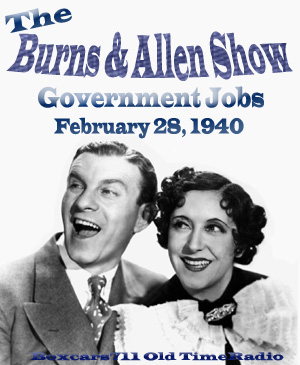
The Burns & Allen Show - Government Jobs (2-28-40)
Burns and Allen were an American comedy duo consisting of George Burns and his wife, Gracie Allen.Burns wrote most of the material, and played the straight man. Allen played a silly, addleheaded woman. Both attributed their success to the other, to the ends of their lives. Early on, the team had played the opposite roles until they noticed that the audience was laughing at Gracie's straight lines, so they made the change. Burns and Allen developed their popular routine over more than three decades of stage, radio, film, and television. Historians of popular culture have often stated that Allen was a brilliant comedian, whose entire career consisted of engaging in dialogues of "illogical logic" that left her verbal opponents dazed and confused, and her audiences in stitches. During a typical 23-minute episode of the Burns and Allen show, the vast majority of the dialogue and speaking parts were written for Allen, who was credited with having the genius to deliver her lengthy diatribes in a fashion that made it look as though she was making her arguments up on the spot. (One running gag on the TV show was the existence of a closet full of hats belonging to various visitors to the Burns household, where the guests would slip out the door unnoticed, leaving their hats behind, rather than face another round with Gracie.) A continuing joke on the show was that George would say, "Say good night, Gracie," and Gracie would say, "Good night Gracie!" Ralph Pape used the catchphrase for the title of his play, Say Goodnight, Gracie, produced by Steppenwolf in 1983, and the phrase lives on as a title of other books and stage productions.

The Adventures Of Leonidas Witherall - Resort (09-07-43)
Adventures of Leonidas Witherall was a radio mystery series broadcast on Mutual in the mid-1940s. Based on the novels of Phoebe Atwood Taylor (writing as Alice Tilton), the 30-minute dramas were produced by Roger Bower and starred Walter Hampden as Leonidas Witherall, a New England boys' school instructor in Dalton, Massachusetts, a fictional Boston suburb. Witherall, who resembled William Shakespeare, is an amateur detective and the accomplished author of the "popular Lieutenant Hazeltine stories." His housekeeper Mrs. Mollett was played by Ethel Remey (1895-1979) and Jack MacBryde appeared as Police Sgt. McCloud. The announcer was Carl Caruso. Milton Kane supplied the music. The series began June 4, 1944 and continued until May 6, 1945. THIS EPISODE: September 7, 1943. CBS network. Sustaining. This series deals with a college professor who looks like Shakespeare and is very good at solving murders. This story takes place at a mountain resort where a murder has been committed by someone very adept at throwing knives. Walter Hampden, Agnes Moorehead. 1/2 hour
Barry Craig Confidential Investigator - Cupie Doll (2-13-52)
Barry Craig, Confidential Investigator (AKA Barry Crane" and then "Barrie Craig) is one of the few detective radio series that had separate versions of it broadcast from both coasts. Even the spelling changed over the years. It was first "Barry Crane" and then "Barrie Craig". NBC produced it in New York from 1951 to 1954 and then moved it to Hollywood where it aired from 1954 to 1955. It attracted only occasional sponsors so it was usually a sustainer. William Gargan, who also played the better known television (and radio) detective Martin Kane, was the voice of New York eye BARRY CRAIG while Ralph Bell portrayed his associate, Lt. Travis Rogers. Craig's office was on Madison Avenue and his adventures were fairly standard PI fare. He worked alone, solved cases efficiently, and feared no man. As the promos went, he was "your man when you can't go to the cops. Confidentiality a speciality." Like Sam Spade, Craig narrated his stories, in addition to being the leading character in this 30 minute show.
The Mysterious Traveler - The Accusing Corpse (04-16-44)
The Mysterious Traveler Written and directed by Robert A. Arthur and David Kogan, the series began on the Mutual Broadcasting System, December 5, 1943, continuing in many different timeslots until September 16, 1952. Unlike many other shows of the era, The Mysterious Traveler was without a sponsor for its entire run. The lonely sound of a distant locomotive heralded the arrival of the malevolent narrator, portrayed by Maurice Tarplin, who introduced himself each week in the following manner. This is the Mysterious Traveler, inviting you to join me on another journey into the strange and terrifying. I hope you will enjoy the trip, that it will thrill you a little and chill you a little. So settle back, get a good grip on your nerves and be comfortable -- if you can! THIS EPISODE: April 16, 1944. Mutual network. "The Accusing Corpse". Sustaining. A journey to the grave to learn the secrets of the dead. An old scam leads to an accusation by a dead body. The show will switch to Sunday at 3:30 P. M. (EST) next week. The script was also used on "The Sealed Book" on April 29, 1945. Don Randolph, Phillip Clark, Maurice Tarplin, Doc Whipple (music), Jock MacGregor (director), Robert A. Arthur (writer), David Kogan (writer). 29:45.

Casey Crime Photographer - The Box Of Death (04-17-47)
The adventures of Casey Crime Photographer for The Morning Express, were told in this series, which moved to television after a highly successful run on radio in the 1940's. Casey hung out at the Blue Note Café, where the music was provided by the Tony Mottola Trio, and was friendly with Ethelbert, the bartender, to whom he recounted his various exploits. Richard Carlyle and John Gibson portrayed the roles when the series premiered in April, 1951, but by June they were replaced by Darren McGavin and Cliff Hall. Ann Williams, a reporter on The Morning Express, was Casey's girlfriend. During the summer of 1951 he acquired a partner in cub reporter Jack Lipman, who wrote copy to go with Casey's pictures. This live series was set in and broadcast from, New York City. THIS EPISODE: April 17, 1947. CBS network. "Box Of Death". Sponsored by: Anchor Hocking Glass. A crook with a lucky penny delivers a woman's husband to her, dead in a box. Staats Cotsworth, John Gibson, Tony Marvin (announcer), Archie Bleyer (music), George Harmon Coxe (creator), Alonzo Deen Cole (writer). 1/2 hour.

Arch Obolers Plays - Night (06-07-45)
Arch Oboler's Plays was a radio drama series written, produced and directed by Arch Oboler. Minus a sponsor, it ran for one year, airing Saturday evenings on NBC from March 25, 1939 to March 23, 1940 and revived five years later on Mutual for a sustaining summer run from April 5, 1945 to October 11, 1945. Leading film actors were heard on this series, including Gloria Blondell, Eddie Cantor, James Cagney, Ronald Colman, Joan Crawford, Greer Garson, Edmund Gwenn, Van Heflin, Katharine Hepburn, Elsa Lanchester, Peter Lorre, Frank Lovejoy, Raymond Massey, Burgess Meredith, Paul Muni, Alla Nazimova, Edmond O'Brien, Geraldine Page, Gale Sondergaard, Franchot Tone and George Zucco. THIS EPISODE: June 7, 1945. Mutual network. "Night". Sustaining. An excellent, beautiful radio montage in the central theme of "night." Arch Oboler, Barney James, Bruce Elliott (narrator), David Raxon and His Orchestra, Dorothy Scott, Edmond MacDonald, Everett Allen, Frank Martin (announcer), Gloria Blondell, Griff Barnett (Swan Soap commercial), Joseph Granby, Roseanne Murray, Theodore Von Eltz, Therese Lyon. 1/2 hour.
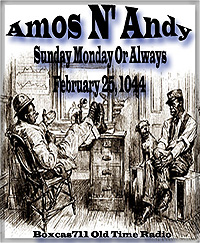
Amos & Andy - Sunday Monday Or Always (02-25-44)
Amos 'n' Andy was a situation comedy popular in the United States from the 1920s through the 1950s. The show began as one of the first radio comedy serials, written and voiced by Freeman Gosden and Charles Correll and originating from station WMAQ in Chicago, Illinois. After the series was first broadcast in 1928, it grew in popularity and became a huge influence on the radio serials that followed. Amos 'n' Andy creators Gosden and Correll were white actors familiar with minstrel traditions. They met in Durham, North Carolina in 1920, and by the fall of 1925, they were performing nightly song-and-patter routines on the Chicago Tribune's station WGN. Since the Tribune syndicated Sidney Smith's popular comic strip The Gumps, which had successfully introduced the concept of daily continuity, WGN executive Ben McCanna thought the notion of a serialized drama could also work on radio. He suggested to Gosden and Correll that they adapt The Gumps to radio. They instead proposed a series about "a couple of colored characters" and borrowed certain elements of The Gumps. THIS EPISODE: February 25, 1944. NBC network origination, AFRS rebroadcast. Replacing "The Great Gildersleeve." Andy is convinced that he's written the hit tune, "Sunday, Monday, Or Always." He and The Kingfish go into the song writing business! Guests are Kay Kyser, Harry Babbitt. Also Johnny Burke and Jimmy Van Heusen (the real composers of the tune). Freeman Gosden, Charles Correll, Harlow Wilcox (announcer), Kay Kyser, Harry Babbitt, Johnny Burke, Jimmy Van Heusen, Kay Kyser and His Orchestra (music fill), Georgia Carroll (vocal). 29:42.
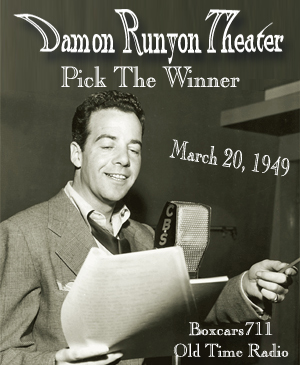
Damon Runyon Theater - Pick The Winner (03-20-49)
The Damon Runyon Theater was a 52 show series that was syndicated across the USA beginning in early 1949. Damon Runyon was a gifted sports writer in New York City as well as being a great journalist and great short story writer. His stories were humorous ones, written in the "dem" and "dose" vernacular of the city's loveable and not so loveable characters of Broadway, the prize ring and the underworld. His most famous collection of short stories, Guys and Dolls, was on Broadway and later made into a movie. Many of his stories were filmed including Sorrowful Jones, A Pocketful of Miracles, Lady for a Day, Blue Plate Special, The Lemon Drop Kid (twice) and Little Miss Marker (four times). In addition to this The Damon Runyon Theater was syndicated for television in the mid 1950s. THIS EPISODE: 1948. Program #12. Mayfair syndication. "Pick The Winner". Commercials added locally. Hot Horse Herbie, Cutie Andrews and Broadway travel to Florida to play the horses. They run into "The Professor," which is a horse of another color! Damon Runyon (author), John Brown, Richard Sanville (director), Russell Hughes (writer), Vern Carstensen (production supervisor). 27:05.

Academy Award Theater - Blood On The Sun (10-16-46)
Academy Award Theater Stars and movies with Oscars were the idea - in most cases, the movie stars recreated their academy award roles for the show, or in other cases, fine actors played the parts and gave it a different character. Both ways make for great radio drama and first class Hollywood motion picture star entertainment. The Lux Radio Theater had been doing this kind of radio show in the grandest manner for many years, but sponsor Squibb had the hubris and deep pockets to take on the competition by doing Academy Award Theater right after the Second World War. The year 1946 was pre-television, and so movies were still the major American visual art form, with radio the other popular network entertainment. In this final pre-TV time, Academy Award Theater was thought of as a premier radio production, a wow show, much like CinemaScope was to be in the 1950's when Hollywood felt the box office blow of early TV. THIS EPISODE: October 16, 1946. CBS network. "Blood On The Sun". Sponsored by: Squibb. A crusading newspaper editor in pre-war Japan uncovers the "Tanaka Plan" of world conquest. John Garfield, Jeff Chandler. 1/2 hour.

Broadway My Beat - Harry Carson Case (03-07-53)
Broadway Is My Beat A radio crime drama, ran on CBS from February 27, 1949 to August 1, 1954. With music by Robert Stringer, the show originated from New York during its first three months on the air, with Anthony Ross portraying Times Square Detective Danny Clover. John Dietz directed for producer Lester Gottlieb. Beginning with the July 7, 1949 episode, the series was broadcast from Hollywood with producer Elliott Lewis directing a new cast in scripts by Morton Fine and David Friedkin. The opening theme of "I'll Take Manhattan" introduced Detective Danny Clover (now played by Larry Thor), a hardened New York City cop who worked homicide "from Times Square to Columbus Circle -- the gaudiest, the most violent, the lonesomest mile in the world." THIS EPISODE: March 7, 1953. CBS network origination, AFRTS rebroadcast. Harry Carson is an old man who won't talk, and a dead body who can't! See cat. #52621 for a network version of this broadcast. Elliott Lewis (producer, director), Alexander Courage (composer, conductor), Larry Thor, Charles Calvert, Jack Kruschen, Morton Fine (writer), David Friedkin (writer), Herb Butterfield, Whitfield Connor, Jerry Hausner, James McCallion, Lurene Tuttle, Eddie Fields, Bill Anders (announcer). 28:30.

Your's Truly Johnny Dollar - Murder Aint Minor (08-07-49)
Your's Truly Johnny Dollar - For over twelve years, from 1949 through 1962 (including a one year hiatus in 1954-1955), this series recounted the cases "the man with the action-packed expense account, America's fabulous freelance insurance investigator, Johnny Dollar". Johnny was an accomplished 'padder' of his expense account. The name of the show derives from the fact that he closed each show by totaling his expense account, and signing it "End of report... Yours Truly, Johnny Dollar". Terry Salomonson in his authoritative "A Radio Broadcast Log of the Drama Program Yours Truly, Johnny Dollar", notes that the original working title was "Yours Truly, Lloyd London". Salomonson writes "Lloyd London was scratched out of the body of (the Dick Powell) audition script and Johnny Dollar was written in. Thus the show was re-titled on this script and the main character was renamed. Why this was done was unclear – possibly to prevent a legal run-in with Lloyd's of London Insurance Company." Although based in Hartford, Connecticut, the insurance capital of the world, freelancer Johnny Dollar managed to get around quite a bit – his adventures taking him all over the world. There were some unusual devices used in the show that help set it apart from other shows. There was no partner, assistant, or secretary for Johnny. The character closest to a continuing role was that of Pat McCracken of the Universal Adjustment Bureau, who assigned Johnny many of his cases. Another atypical aspect gave the show additional credibility – frequently, characters on the show would mention that they had heard about Johnny's cases on the radio. Johnny often used his time when filling out his expense accounts to give the audience background information or to express his thoughts about the current case. THIS EPISODE: August 7, 1949. CBS network. "The Investigation Of Bonnie Goodwin," or "Murder Ain't Minor". Sustaining. Johnny takes a case on behalf of "King Hart," (not an insurance company!) to try to find his missing girl. Paul Dubov, Martha Wentworth, Lou Krugman, Charles Russell, Georgia Ellis, Jeanne Bates, Lawrence Dobkin, Roy Rowan (announcer), Leith Stevens (composer, conductor), Gordon T. Hughes (director), Paul Dudley (writer), Gil Doud (witer). 29:36.

The Adventures Of Sam Spade - The Missing Newshawk Caper (7-18-48)
The Adventures of Sam Spade was a radio series based loosely on the private detective character Sam Spade, created by writer Dashiell Hammett for The Maltese Falcon. The show ran for 13 episodes on ABC in 1946, for 157 episodes on CBS in 1946-1949, and finally for 51 episodes on NBC in 1949-1951. The series starred Howard Duff (and later, Steve Dunne) as Sam Spade and Lurene Tuttle as his secretary Effie, and took a considerably more tongue-in-cheek approach to the character than the novel or movie. In 1947, scriptwriters Jason James and Bob Tallman received an Edgar Award for Best Radio Drama from the Mystery Writers of America. Before the series, Sam Spade had been played in radio adaptations of The Maltese Falcon by both Edward G. Robinson (in a 1943 Lux Radio Theater production) and by Bogart himself (in a 1946 Academy Award Theater production), both on CBS. THIS EPISODE: July 18, 1948. CBS network. "The Missing Newshawk Caper". Sponsored by: Wildroot Cream Oil. Spade is hired to find a reporter named Ray McCully. Spade finds him all right, stabbed to death! Howard Duff, Lurene Tuttle, Dashiell Hammett (creator), William Conrad, Sara Berner, Bea Benaderet (possibly), Alan Reed, Gil Doud (writer, director), Robert Tallman (writer), Lud Gluskin (music), Dick Joy (announcer). 29:40.

The Abbott & Costello Show - Christmas Program (12-24-47)
The Abbott and Costello Show- William (Bud) Abbott and Lou Costello (born Louis Francis Cristillo) were an American comedy duo whose work in radio, film and television made them one of the most popular teams in the history of comedy. Thanks to the endurance of their most popular and influential routine, "Who's on First?"---whose rapid-fire word play and comprehension confusion set the preponderant framework for most of their best-known routines---the team are also the only comedians known to have been inducted into the Baseball Hall of Fame. The Abbott and Costello Show mixed comedy with musical interludes (usually, by singers such as Connie Haines, Marilyn Maxwell, the Delta Rhythm Boys, Skinnay Ennis, and the Les Baxter Singers). Regulars and semi-regulars on the show included Artie Auerbrook, Elvia Allman, Iris Adrian, Mel Blanc, Wally Brown, Sharon Douglas, Verna Felton, Sidney Fields, Frank Nelson, Martha Wentworth, and Benay Venuta. Ken Niles was the show's longtime announcer, doubling as an exasperated foil to Abbott & Costello's mishaps (and often fuming in character as Costello insulted his on-air wife routinely); he was succeeded by Michael Roy, with annoncing chores also handled over the years by Frank Bingman and Jim Doyle. THIS EPISODE: December 25, 1943. Red network, KFI, Los Angeles aircheck. Sponsored by: Camels. Abbott and Costello plan to kill Ingrid, Costello's pet turkey, for Thanksgiving. Guest Jane Wyman joins in a routine, "What is the wind?" Connie Haines sings, "Shoo, Shoo Baby." Mel Blanc appears as Bugs Bunny. Bud Abbott, Lou Costello, Freddie Rich and His Orchestra, Ken Niles (announcer), Jane Wyman, Connie Haines, Mel Blanc (triples), Don Prindle (writer), Leo Solomon (writer), Alan Woods (writer), Martin Gosch (director), Billy Gray, Elvia Allman, John Brown. 29:45.

CBS Radio Mystery Theater - Speak Of The Devil (01-25-74)
The CBS Radio Mystery Theater (or CBSRMT) was an ambitious and sustained attempt to revive the great drama of old-time radio in the 1970s. Created by Himan Brown (who had by then become a radio legend due to his work on Inner Sanctum Mysteries and other shows dating back to the 1930s), and aired on affiliate stations across the CBS Radio network, the series began its long run on January 6, 1974. The final episode ran on December 31, 1982. The show was broadcast nightly and ran for one hour, including commercials. Typically, a week consisted of three to four new episodes, with the remainder of the week filled out with reruns. There were a total of 1399 original episodes broadcast. The total number of broadcasts, including reruns, was 2969. The late E.G. Marshall hosted the program every year but the final one, when actress Tammy Grimes took over. Each episode began with the ominous sound of a creaking door, slowly opening to invite listeners in for the evening's adventure. At the end of each show, the door would swing shut, with Marshall signing off, "Until next time, pleasant...dreams?" THIS EPISODE: January 25, 1974. Program #20. CBS net. "Speak Of The Devil". Sponsored by: Kellogg's, Budweiser. E. G. Marshall (host), Ian Martin (writer, performer), Jada Rowland, Bryna Raeburn, Nick Pryor. 52 minutes.
The CBS Radio Mystery Theater - Familiar Ghost (12-18-78)
Familiar Ghost (Aired December 18, 1978) The CBS Radio Mystery Theater (or CBSRMT) was an ambitious and sustained attempt to revive the great drama of old-time radio in the 1970s. Created by Himan Brown (who had by then become a radio legend due to his work on Inner Sanctum Mysteries and other shows dating back to the 1930s), and aired on affiliate stations across the CBS Radio network, the series began its long run on January 6, 1974. The final episode ran on December 31, 1982.The show was broadcast nightly and ran for one hour, including commercials. Typically, a week consisted of three to four new episodes, with the remainder of the week filled out with reruns. There were a total of 1399 original episodes broadcast. The total number of broadcasts, including reruns, was 2969. The late E.G. Marshall hosted the program every year but the final one, when actress Tammy Grimes took over. Each episode began with the ominous sound of a creaking door, slowly opening to invite listeners in for the evening's adventure. At the end of each show, the door would swing shut, with Marshall signing off, "Until next time, pleasant...dreams?"

The Abbott & Costello Show - Lou Joins The Circus (05-09-44)
Abbott and Costello William (Bud) Abbott and Lou Costello (born Louis Francis Cristillo) were an American comedy duo whose work in radio, film and television made them one of the most popular teams in the history of comedy. Thanks to the endurance of their most popular and influential routine, "Who's on First?"---whose rapid-fire word play and comprehension confusion set the preponderant framework for most of their best-known routines---the team are also the only comedians known to have been inducted into the Baseball Hall of Fame. Bud Abbott was born in Asbury Park, NJ, October 2, 1897 and died April 24, 1974 in Woodland Hills, California. Lou Costello was born in Paterson, NJ, March 6, 1906 and died March 3, 1959 in East Los Angeles, California. After working as Allen's summer replacement, Abbott and Costello joined Edgar Bergen and Charlie McCarthy on The Chase and Sanborn Hour in 1941, while two of their films (Buck Privates and Hold That Ghost) were adapted for Lux Radio Theater. They launched their own weekly show October 8, 1942, sponsored by Camel cigarettes. THIS EPISODE: May 9, 1944. NBC network. Sponsored by: Camels, Prince Albert Pipe Tobacco. Costello wants to join the circus. Abbott loses his place in the script. Bud Abbott, Lou Costello, Carl Hoff and His Orchestra, Amy Arnell (vocal), Bert Cordon (sound effects), John Pawlek (engineer), Ken Niles (announcer), Elvia Allman, Sharon Douglas (doubles), Mel Blanc (quadruples), Sidney Fields, Don Prindle (writer), Ed Forman (writer), Don Bernard (producer, director), Andrew Potter (producer, director). 29:46.
The Screen Director's Plyhouse - Crisscross (10-10-49)
The Screen Director's Playhouse - From 01/09/49 to 09/28/51 this series was greatly enjoyed by the radio listening audience. It opened as NBC Theater and was also known as The Screen Director's Guild and The Screen Director's Assignment. But most people remember it simply as Screen Director's Playhouse. Many of the Hollywood elite were heard recreating their screen roles over the radio. John Wayne in his rare radio appearances, Cary Grant, Edward G. Robinson, Lucille Ball, Claire Trevor, Tallulah Bankhead and many others were on the air week after week during these broadcasts. Many of Hollywood's directors were also heard in the recreation of their movies. The President of the Screen Director's Guild appeared on 02/13/49, and Violinist Isaac Stern supplied the music for the 04/19/51 broadcast. THIS EPISODE: October 10, 1949. NBC network. "Criss Cross". Sustaining. A good gangster story about a planned armored car holdup and a double-double cross. Screen director Robert Siodmak appears by transcription. Burt Lancaster, Betty Lou Gerson, Jeff Corey, Betty Morgan, Jimmy Wallington (announcer), Robert Siodmak. 1/2 hour.
The Whistler - The Alibi (10-25-42)
The Whistler was one of radio's most popular mystery dramas, with a 13-year run from May 16, 1942 until September 22, 1955. If it now seems to have been influenced explicitly by The Shadow, The Whistler was no less popular or credible with its listeners, the writing was first class for its genre, and it added a slightly macabre element of humor that sometimes went missing in The Shadow's longer-lived crime stories. Writer-producer J. Donald Wilson established the tone of the show during its first two years, and he was followed in 1944 by producer-director George Allen. Other directors included Sterling Tracy and Sherman Marks with final scripts by Joel Malone and Harold Swanton. A total of 692 episodes were produced, yet despite the series' fame, over 200 episodes are lost today. In 1946, a local Chicago version of The Whistler with local actors aired Sundays on WBBM, sponsored by Meister Brau beer. THIS EPISODE: October 25, 1942. CBS network. "The Alibi". Sustaining. A domineering old lady controls all those around her...several of whom have a good reason for doing her in. J. Donald Wilson (writer, director), Wilbur Hatch (composer, conductor), Herbert Connor (writer). 29:31
Our Miss Brooks - Conklin Loses His Hearing (01-01-56)
Our Miss Brooks, an American situation comedy, began as a radio hit in 1948 and migrated to television in 1952, becoming one of the earlier hits of the so-called Golden Age of Television, and making a star out of Eve Arden (1908-1990) as comely, wisecracking, but humane high school English teacher Connie Brooks. The show hooked around Connie's daily relationships with Madison High School students, colleagues, and pompous principal Osgood Conklin (Gale Gordon), not to mention favourite student Walter Denton (future television and Rambo co-star Richard Crenna, who fashioned a higher-pitched voice to play the role) and biology teacher Philip Boynton ( Jeff Chandler), the latter Connie's all-but-unrequited love interest, who saw science everywhere and little else anywhere. THIS EPISODE: January 1, 1956. CBS network. Sponsored by: Colgate Toothpaste, Lustre Creme Shampoo, Palmolive Soap. "What The Board Of Education Means To Me." Walter's essay and Mr. Conklin's deafness. A funny show! The program may be dated January 4, 1956. Al Lewis (director, writer), Eve Arden, Jane Morgan, Richard Crenna, Leonard Smith, Verne Smith (announcer), Jeff Chandler, Gloria McMillan, Larry Berns (producer), Wilbur Hatch (music), Bob Lemond (announcer), Gale Gordon. 29:50.
Night Beat - The Night Is A Weapon (02-13-50)
Broadcast on NBC, Nightbeat ran from 1949 to 1952 and starred Frank Lovejoy as Randy Stone, a tough and streetwise reporter who worked the nightbeat for the Chicago Star looking for human interest stories. He met an assortment of people, most of them with a problem, many of them scared, and sometimes he was able to help them, sometimes he wasn't. It is generally regarded as a 'quality' show and it stands up extremely well. Frank Lovejoy (1914-1962) isn't remembered today, but he was a powerful and believable actor with a strong delivery, and his portrayal of Randy Stone as tough guy with humanity was perfect. The scripts were excellent, given that they had to pack in a lot in a short time, and there was a good supporting cast, orchestra, and sound effects. 'The Slasher', broadcast on 10 November 1950, the last show of season one, has a very loosely Ripper-derived plot in which Stone searches for an artist. Supporting actors included Parley Baer, William Conrad, Jeff Corey, Lawrence Dobkin, Paul Frees, Jack Kruschen, Peter Leeds, Howard McNear, Lurene Tuttle and Martha Wentworth. THIS EPISODE: April 9, 1950. NBC netWORK. Sustaining. Tom Morrison is a man with "noctophobia," a fear of darkness. He is being driven to commit murder by George Brewster. Nightbeat was being heard more than once a week at this time. Brian Donlevy appears on the show to promote his "Dangerous Assignment" series. Frank Lovejoy, Brian Donlevy, Jane Morgan, Larry Marcus (writer), Frank Worth (music), Warren Lewis (director), Ruth Perrott, David Ellis, Lurene Tuttle, Charles Seel, Margaret Brayton. 29:24.
Perry Mason - Case Of The Nervous Accomplice (10-05-57)
Perry Mason is the longest running lawyer show in American television history. Its original run lasted nine years and its success in both syndication and made-for-television movies confirm its impressive stamina. Mason's fans include lawyers and judges who were influenced by this series to enter their profession. The Mason character was created by mystery writer Erle Stanley Gardner and delivered his first brief in the novel The Case of the Velvet Claws (1933). From 1934 to 1937 Warners produced six films featuring Mason. A radio series also based on Mason ran every weekday afternoon on CBS radio from 1944 to 1955 as a detective/soap opera. When the CBS television series was developed as an evening drama, the radio series was changed from Perry Mason to The Edge of Night and the cast renamed so as not to compete against the television series. This Episode: The Case of the Nervous Accomplice from Perry Mason aired October 5, 1957. Sybil Granger hires Perry to help her buy stock in her estranged husband's oil company on the sly. By this, Sybil hopes to force her husband's latest girlfriend, Roxy Howard, out of the company and his life altogether. Things get complicated when George Lutz enters the picture.
Let George Do It - Once A Crook (09-22-52)
Let George Do It was a radio drama series produced by Owen and Pauline Vinson from 1946 to 1954. It starred Bob Bailey as detective-for-hire George Valentine (with Olan Soule stepping into the role in 1954). Clients came to Valentine's office after reading a newspaper carrying his classified ad: "Personal notice: Danger's my stock in trade. If the job's too tough for you to handle, you've got a job for me. George Valentine." Valentine's secretary was Claire Brooks, aka Brooksie (Frances Robinson, Virginia Gregg, Lillian Buyeff). As Valentine made his rounds in search of the bad guys, he usually encounted Brooksie's kid brother, Sonny (Eddie Firestone), Lieutenant Riley (Wally Maher) and elevator man Caleb (Joseph Kearns). Sponsored by Standard Oil, the program was broadcast on the West Coast Mutual Broadcasting System from October 18, 1946 to September 27, 1954, first on Friday evenings and then on Mondays. In its last season, transcriptions were aired in New York, Wednesdays at 9:30pm, from January 20, 1954 to January 12, 1955. John Hiestand was the program's announcer. Don Clark directed the scripts by David Victor and Jackson Gillis. The background music was supplied by Eddie Dunstedter on the organ.
Rocky Jordan - The Two O'Clock Man (03-06-49)
ROCKY JORDAN was the title character of one of the better and more exotic radio detective series. In fact, it's one of the best detective series I have ever heard. The series had two separate incarnations. The first, A Man Named Jordan, started as a daily 15 minute show and after about six months changed to a weekly 30 minute show. It took place in Istanbul and the Cafe was described as "a small restaurant in a narrow street off Istanbul's Grand Bazaar, permeated with by the smoke of Oriental tobacco, alive with the babble of many tongues, and packed with intrigue." The second incarnation, Rocky Jordan, was a weekly 30 minute series took place in Cairo - "the gateway to the ancient East where adventure and intrigue unfold against the backdrop of antiquity." Jordan was a hard-boiled owner of the Cafe Tambourine who spent most of his time solving mysteries that he usually became involved in by accident. During the Cairo-based run, he often encountered Captain Sam Sabaaya of the Cairo police. John Dunning in his "On The Air: The Encyclopedia of Old Time Radio" describes Jordan as "a rugged hero who each week was confronted by a crime, a mystery, a beautiful woman or a combination of the three. It was a detective show with a difference: the Oriental background was played to the hilt, giving it a sound like no other." THIS EPSIODE: March 6, 1949. CBS Pacific network. "The Two O'Clock Man". Sustaining. A young boy breaks into the Cafe Tamboruine, and is later shot and killed. Rocky is held responsible! Jack Moyles, Larry Thor (announcer), Richard Aurandt (composer, conductor), Cliff Howell (producer, director), Larry Roman (editor), Gomer Cool (editor), William Froug (writer). 29:37.
The Mysterious Traveler - Strange New World (02-21-53)
The Mysterious Traveler - Written and directed by Robert A. Arthur and David Kogan, the series began on the Mutual Broadcasting System, December 5, 1943, continuing in many different timeslots until September 16, 1952. Unlike many other shows of the era, The Mysterious Traveler was without a sponsor for its entire run. The lonely sound of a distant locomotive heralded the arrival of the malevolent narrator, portrayed by Maurice Tarplin, who introduced himself each week in the following manner. This is the Mysterious Traveler, inviting you to join me on another journey into the strange and terrifying. I hope you will enjoy the trip, that it will thrill you a little and chill you a little. So settle back, get a good grip on your nerves and be comfortable -- if you can! THIS EPISODE: February 19, 1952. Mutual network. "Strange New World". Sustaining. A shipwreck survivor on a British sub tells the story of being stranded on a desert island, being made to fight a war against giant crabs. David Kogan (writer, producer, director), Maurice Tarplin, Robert A. Arthur (writer). 1/2 hour.
Academy Award Theater - Brief Encounter (11-20-46)
Academy Award Theater - The list of films and actors on Academy Award Theater is very impressive. Bette Davis begins the series in Jezebel, with Ginger Rogers following in Kitty Foyle, and then Paul Muni in The Life of Louis Pasteur. The Informer had to have Victor Mclaglen, and the Maltese Falcon, Humphrey Bogart, Sidney Greenstreet (this movie was his first major motion picutre role) plus Mary Astor for the hat trick. Suspicion starred Cary Grant with Ann Todd doing the Joan Fontaine role, Ronald Coleman in Lost Horizon, and Joan Fontaine and John Lund were in Portrait of Jenny. How Snow White and the Seven Dwarfs and Pinocchio were done is something to hear! THIS EPISODE: Brief Encounter (1946) is director David Lean's brilliantly-crafted, classic British masterpiece. It is one of the greatest romantic tearjerkers/weepers of all time, with a very downbeat ending. Lean's film is a simple but realistically-honest, unsentimental, self-told social melodrama of the quiet desperation involved in an illicit, extra-marital love affair between two married, middle-class individuals over seven weekly meetings, mostly against the backdrop of a railway station. The romantic couple includes a wife/mother looking for escape from her humdrum life and sterile marriage, and a dashing doctor. tale of The screenplay was adapted and based on playwright Noel Coward's 1935 short one-act (half-hour) stage play Still Life. It was expanded from five short scenes in a train station (the refreshment tea room of Milford Junction Station) to include action in other settings (the married woman's house, the apartment of the married man's friend, restaurants, parks, train compartments, shops, a car, a boating lake and at the cinema), although the film still maintains chaste minimalism.
The Untouchables - The Troubleshooter Eliot Ness (10-12-61)
The Untouchables is the name of a television series that ran from 1959 to 1963 on the American Broadcasting Company. Based on the memoir of the same name by Eliot Ness and Oscar Fraley, it fictionalized the experiences of Eliot Ness, a real-life Prohibition Agent, as he fought crime in Chicago in the 1930s with the help of a special team of agents handpicked for their courage & incorruptibility, nicknamed the Untouchables. It was remade into a 1987 film by Brian De Palma also called The Untouchables, with a script by David Mamet. The stories often revolved around Ness' enmity with the criminal empire of Chicago mob boss Al Capone, and many focused on crimes related to Prohibition. The show starred Robert Stack as Eliot Ness and Neville Brand as Al Capone, and was narrated by Walter Winchell. The show drew harsh criticism from some Italian-Americans including Frank Sinatra[1], who felt it promoted negative stereotypes of them as mobsters and gangsters. The Capone family sued the show for $1,000,000 for its unauthorized use of Al Capone's likeness for profit. This Episode: The Troubleshooter adapted for radio aired originally October 12, 1961 starring Robert Stack as Eliot Ness with guest star Peter Falk, who went on to do Columbo. In the summer of 1934, a new gambling device was sweeping the nation: the punchboards. Even though they were nickel-and-dime games, it added up, they made more money than the numbers racket. After Ness and his men smash some of the punchboard manufacturing sites, the 5 members running the punchboards hold a meet at a building by the freight yards.
The Ford Theater - A Farewell To Arms (06-24-49)
The FORD THEATER, sponsored by the Ford Motor Company, presented hour long dramas first on NBC for one only season. The series moved to CBS for its second and last season. There were 39 NBC and 39 CBS hour- long shows (not verified). The show initially received an unfavorable review from the New York Times for poor script adaptation but was still highly rated for the actors' performance and overall production. The show was supposed to feature only original scripts but had to forgo that plan due to lack of quality material. The first season on NBC used radio actors under the direction of George Zachary. Martin Gabel announced the first show but was soon replaced by Kenneth Banghart. The second season, on CBS, used Hollywood screen actors in the lead roles, supported by radio actors. Fletcher Markle, who previously produced CBS's STUDIO ONE series, was the producer for the second season. Although a short series, it still has some of radio's best dramas. THIS EPISODE: A Farewell To Arms - Lieutenant Frederic Henry is a young American ambulance driver serving in the Italian army during World War I. At the beginning of the novel, the war is winding down with the onset of winter, and Henry arranges to tour Italy. The following spring, upon his return to the front, Henry meets Catherine Barkley, an English nurse's aide at the nearby British hospital and the love interest of his friend Rinaldi. Rinaldi, however, quickly fades from the picture as Catherine and Henry become involved in an elaborate game of seduction. Grieving the recent death of her fiancé, Catherine longs for love so deeply that she will settle for the illusion of it. Her passion, even though pretended, wakens a desire for emotional interaction in Henry, whom the war has left coolly detached and numb. When Henry is wounded on the battlefield, he is brought to a hospital in Milan to recover. Several doctors recommend that he stay in bed for six months and then undergo a necessary operation on his knee. Unable to accept such a long period of recovery, Henry finds a bold, garrulous surgeon named Dr. Valentini who agrees to operate immediately. Henry learns happily that Catherine has been transferred to Milan and begins his recuperation under her care.
Barry Craig Confidential Investigator - Death Of A Private Eye (1-02-52)
Barry Craig, Confidential Investigator is one of the few detective radio series that had separate versions of it broadcast from both coasts. Even the spelling changed over the years. It was first "Barry Crane" and then "Barrie Craig". NBC produced it in New York from 1951 to 1954 and then moved it to Hollywood where it aired from 1954 to 1955. It attracted only occasional sponsors so it was usually a sustainer.William Gargan, who also played the better known television (and radio) detective Martin Kane, was the voice of New York eye BARRY CRAIG while Ralph Bell portrayed his associate, Lt. Travis Rogers. Craig's office was on Madison Avenue and his adventures were fairly standard PI fare. He worked alone, solved cases efficiently, and feared no man. As the promos went, he was "your man when you can't go to the cops. Confidentiality a speciality."Like Sam Spade, Craig narrated his stories, in addition to being the leading character in this 30 minute show. Nearly sixty episodes are in trading circulation today. THIS EPISODE: January 2, 1952. NBC network. "Death Of A Private Eye". Sustaining. Not auditioned. "(Barry) is hired to help a man pay a visit, but discovers instead that (the) visitor has a visitor first, death!" William Gargan, Himan Brown (director), Don Pardo (announcer), Louis Vittes (writer), Fran Carlon. 28:27
Amos & Andy - Kingfish's Tourist Service (11-22-53) - Boxcars711 Old Time Radio Pod
Amos 'n' Andy was a situation comedy popular in the United States from the 1920s through the 1950s. The show began as one of the first radio comedy serials, written and voiced by Freeman Gosden and Charles Correll and originating from station WMAQ in Chicago, Illinois. After the series was first broadcast in 1928, it grew in popularity and became a huge influence on the radio serials that followed.Amos 'n' Andy creators Gosden and Correll were white actors familiar with minstrel traditions. They met in Durham, North Carolina in 1920, and by the fall of 1925, they were performing nightly song-and-patter routines on the Chicago Tribune's station WGN. Since the Tribune syndicated Sidney Smith's popular comic strip The Gumps, which had successfully introduced the concept of daily continuity, WGN executive Ben McCanna thought the notion of a serialized drama could also work on radio.
Barry Craig Confidential Investigator "Cupie Doll" (2-13-52) - Boxcars711 Old Time Radio Pod
Barry Craig, Confidential Investigator is one of the few detective radio series that had separate versions of it broadcast from both coasts. Even the spelling changed over the years. It was first "Barry Crane" and then "Barrie Craig". NBC produced it in New York from 1951 to 1954 and then moved it to Hollywood where it aired from 1954 to 1955. It attracted only occasional sponsors so it was usually a sustainer.William Gargan, who also played the better known television (and radio) detective Martin Kane, was the voice of New York eye BARRY CRAIG while Ralph Bell portrayed his associate, Lt. Travis Rogers. Craig's office was on Madison Avenue and his adventures were fairly standard PI fare. He worked alone, solved cases efficiently, and feared no man. As the promos went, he was "your man when you can't go to the cops. Confidentiality a speciality."Like Sam Spade, Craig narrated his stories, in addition to being the leading character in this 30 minute show. Nearly sixty episodes are in trading circulation today.
The NBC University Theater "The Light That Failed" (2-12-50) - Boxcars711 Old Time Radio Pod
The NBC University Theater - dramatic anthology Offered novels, with programs for college credit. Broadcast History : July 30th, 1948 - February 14th, 1951 NBC. Mostly 60 minutes. Mostly aired on Sundays, with occasional weeknight airings. Announcer : Don Stanley Music : Albert Harris, Henry Russell Director : Andrew C. Love Writers : Claris A. Ross, Ernest Kinoy, George Lefferts, Jack C. Wilson Sound Effects : Bob Holmes, Rod Sutton.THIS EPISODE:February 12, 1950. NBC network. "The Light That Failed". Sustaining. A painter, interested only in money, loses his sight after his masterpiece has been defaced. The closing credits have been deleted. Alec Harford, Crauford Kent, Dan O'Herlihy, Earl Keen, Eileen Erskine, Eric Snowden, George Lefferts (writer), Henry Outland (Outland?--intermission commentator), John Ramsay Hill, Marlene Ames, Queenie Leonard, Rudyard Kipling (author), Tom Dylan, Tudor Owen. 56:28.
Ford Theater "Of Human Bondage" (10-29-48) - Boxcars711 Old Time Radio Pod
The FORD THEATER, sponsored by the Ford Motor Company, presented hour long dramas first on NBC for one only season. The series moved to CBS for its second and last season. There were 39 NBC and 39 CBS hour- long shows (not verified). The show initially received an unfavorable review from the New York Times for poor script adaptation but was still highly rated for the actors' performance and overall production. The show was supposed to feature only original scripts but had to forgo that plan due to lack of quality material. The first season on NBC used radio actors under the direction of George Zachary. Martin Gabel announced the first show but was soon replaced by Kenneth Banghart. The second season, on CBS, used Hollywood screen actors in the lead roles, supported by radio actors. Fletcher Markle, who previously produced CBS's STUDIO ONE series, was the producer for the second season. Although a short series, it still has some of radio's best dramas. THIS EPISODE:October 29, 1948. CBS network, KNX, Los Angeles aircheck. "Of Human Bondage". Sponsored by: Ford, Bulova Watch (local). Not auditioned. Ray Milland, Joan Lorring, Somerset Maugham (author), Fletcher Markle (host, director), Hedley Rennie, Susan Douglas, Jack Manning, Elwood Hoffman (adaptor), Cy Feuer (conductor), Rita Vale, Robert Dryden, Miriam Wolfe, Neal Fitzgerald, Gregory Morton. 57:19.
Father Knows Best "A Spooky Cemetary" (10-26-50) - Boxcars711 Old Time Radio Pod
Father Knows Best, a family comedy of the 1950s, is perhaps more important for what it has come to represent than for what it actually was. In essence, the series was one of a slew of middle-class family sitcoms in which moms were moms, kids were kids, and fathers knew best. Today, many critics view it, at best, as high camp fun, and, at worst, as part of what critic David Marc once labeled the "Aryan melodramas" of the 1950s and 1960s.