
Boxcars711 Old Time Radio
2,173 episodes — Page 20 of 44

Candid Microphone Double Feature 1947
Candid Microphone is a 1940s radio show which soon became the long-running TV series "Candid Camera". The show involved scenarios in which unwitting members of the public would be placed in a situation where unusual things began happening (caused by actors hired by the producers as well as various props). The victim of the prank's reactions would be recorded and at some stage the joke is finally revealed to them. Introduced by Allen Funt, this is a rare bit of broadcasting history, perfect for radio buffs and Candid Camera fans who wish to revisit the program's roots. Candid Microphone was first heard on Saturday, June 28, 1947, at 7:30pm on ABC radio. Funt's concept came to television on August 10, 1948.

Boston Blackie - Coverup For Mary (05-09-45)
The Boston Blackie radio series, also starring Morris, began June 23, 1944, on NBC as a summer replacement for The Amos 'n' Andy Show. Sponsored by Rinso, the series continued until September 15 of that year. Unlike the concurrent films, Blackie had a steady romantic interest in the radio show: Lesley Woods appeared as Blackie's girlfriend Mary Wesley. Harlow Wilcox was the show's announcer. On April 11, 1945, Richard Kollmar took over the title role in a radio series syndicated by Frederic W. Ziv to Mutual and other network outlets. Over 200 episodes of this series were produced between 1944 and October 25, 1950. Other sponsors included Lifebuoy Soap, Champagne Velvet beer, and R&H beer. While investigating mysteries, Blackie invaribly encountered harebrained Police Inspector Farraday (Maurice Tarplin) and always solved the mystery to Farraday's amazement. Initially, friction surfaced in the relationship between Blackie and Farraday, but as the series continued, Farraday recognized Blackie's talents and requested assistance. Blackie dated Mary Wesley (Jan Miner), and for the first half of the series, his best pal Shorty was always on hand. The humorless Farraday was on the receiving end of Blackie's bad puns and word play. Kent Taylor starred in the half-hour TV series, The Adventures of Boston Blackie. Syndicated in 1951, it ran for 58 episodes, continuing in repeats over the following decade.
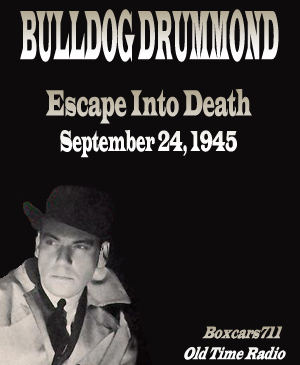
Bulldog Drummond - Escape Into Death (09-24-45)
Bulldog Drummond has come to wreak havoc on unsuspecting killers, counterfeiters, and underworld characters. The opening of the show starts with a the sounds of footsteps, foghorn, then two shots ring out, followed by three blows of a police officer's whistle. Bulldog, who's really name is Hugh (played by George Coulouris), was a methodical crime-solving sleuth who let nothing get in his way of his goal, which was to put a stop to crime! Bulldog believed in uncomplicated and decisive means of getting his way with the lords of the underworld. This usually led to their swift capture, and the easing of the city's burden brought about by these ruthless thugs. THIS EPISODE: September 24, 1945. Mutual network, WCPO, Cincinnati aircheck. "Escape Into Death". Sustaining. A chemical engineer for an explosives company is stopped by a false road barricade and killed by a thrown knife through his neck...or was he? Capt. Drummond and Denny discover a Japanese plot. . 29:17.
The Ford Theater - The Aeventures Of A Bad Boy (1-04-48)
The FORD THEATER, sponsored by the Ford Motor Company, presented hour long dramas first on NBC for one only season. The series moved to CBS for its second and last season. There were 39 NBC and 39 CBS hour- long shows (not verified). The show initially received an unfavorable review from the New York Times for poor script adaptation but was still highly rated for the actors' performance and overall production. The show was supposed to feature only original scripts but had to forgo that plan due to lack of quality material. The first season on NBC used radio actors under the direction of George Zachary. Martin Gabel announced the first show but was soon replaced by Kenneth Banghart. The second season, on CBS, used Hollywood screen actors in the lead roles, supported by radio actors. Fletcher Markle, who previously produced CBS's STUDIO ONE series, was the producer for the second season. Although a short series, it still has some of radio's best dramas. THIS EPISODE: January 4, 1948. NBC network. "The Adventures Of A Bad Boy". Sponsored by: Ford. A fine murder mystery, deduced and solved by Ellery Queen. A good radio production; Ellery picks the killer like a rabbit out of a magician's hat...almost literally! Guy Wallace, Kenneth Banghart (announcer), Charlotte Keane, Brad Barker, Jane Houston, Walter Vaughn, Harold Dryanforth, Avril Harris, Frederic Dannay (writer, as "Ellery Queen"), Manfred B. Lee (writer, as "Ellery Queen"), Santos Ortega, Ted de Corsia, Sarah Fussell, Hugh Marlowe, Anne Seymour, John Gibson. 1 hour.
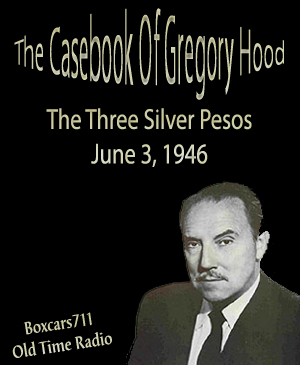
The Casebook Of Gregory Hood - The Case Of The Three Silver Pesos (06-03-46)
The Casebook of Gregory Hood,/B>, starring Gale Gordon in the title role, took over where Sherlock Holmes had left off. Sponsored by Petri wine, it used the same "weekly visit" format and the same team of Anthony Boucher and Dennis Green that had written The New Adventured of Sherlock Holmes. Gregory Hood was modelled after true-life San Francisco importer Richard Gump, and many of the stories revolve around a mystery surrounding some particular imported treasure. Hood's sidekick Sanderson "Sandy" Taylor was played by Bill Johnstone. The show aired from June, 1946 through August, 1950. There were an additional couple of shows aired in October 1951. Hood and Sanderson were played in later episodes by Elliott Lewis and Howard McNear, respectively.

Bold Venture - Six Crates Of Apples (1951)
Bold Venture - The Hollywood husband and wife team of Humphrey Bogart and Lauren Bacall set sail for adventure in the Bold Venture radio series in early 1951. There were well over 400 stations that aired the program. Since thiswas syndicated * the starting date varied from station to station but Mar 26, 1951 was the official date of the first show. Humphrey Bogart portrayed Slate Shannon, owner of a rundown Havana hotel, Shannon's Place. The action took place on land as well aboard Slate's boat, The Bold Venture, thus the title of the series. Lauren Bacall was his ward Sailor Duval, a stubborn and flirtatious young woman whose late father had willed her to Slate for her protection. Together the duo found adventure, intrigue, mystery and romance in the sultry settings of tropical Havana and the mysterious islands of the Caribbean.

The Amazing Mr Malone - The Lucky Stiff (1947)
The Amazing Mr. Malone radio series aired 1947-1951 based on the John Malone series of mystery novels by Craig Rice, the author of fourteen novels, countless short stories, and a number of true crime pieces. She once rivaled Agatha Christie in sales,and was on the cover of Time Magazine in 1946. John J. Malone, socialite and ladies man, is a brilliant criminal lawyer taking up a new case in every episode. Using his finely-honed deductive and persuasive skills, he never gives up until justice is done. THIS EPISODE: 1947. NBC network. "The Lucky Stiff". Sustaining. Lucky at everything, or is he. George Petrie, Larry Haines, Craig Rice (creator), Eugene Wang (writer), Bernard L. Schubert (producer), Richard Lewis (director), Fred Collins (announcer). 29:38.
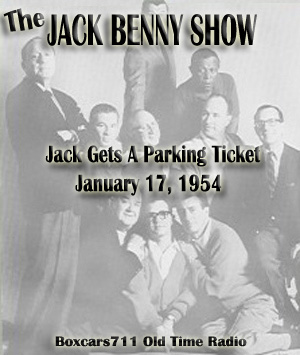
The Jack Benny Show - Jack Gets A Parking Ticket (01-17-54)
The Jack Benny Show Benny had been only a minor vaudeville performer, but he became a national figure with The Jack Benny Program, a weekly radio show which ran from 1932 to 1948 on NBC and from 1949 to 1955 on CBS, and was consistently among the most highly rated programs during most of that run. With Canada Dry Ginger Ale as a sponsor, Benny came to radio on The Canada Dry Program, beginning May 2, 1932, on the NBC Blue Network and continuing there for six months until October 26, moving the show to CBS on October 30. With Ted Weems leading the band, Benny stayed on CBS until January 26, 1933. Arriving at NBC on March 17, Benny did The Chevrolet Program until April 1, 1934. He continued with sponsors General Tires, Jell-O and Grape Nuts. Lucky Strike was the radio sponsor from 1944 to the mid-1950s. The show returned to CBS on January 2, 1949, as part of CBS president William S. Paley's notorious "raid" of NBC talent in 1948-49. There it stayed for the remainder of its radio run, which ended on May 22, 1955. CBS aired reruns of old radio episodes from 1956 to 1958 as The Best of Benny. THIS EPISODE: January 17, 1954. Program #364. CBS network origination, AFRS rebroadcast. After lunch with the gang, Jack gets a Beverly Hills parking ticket. AFRS program name: "The Jack Benny Program." The program was recorded January 13, 1954. Dennis Day, Don Wilson, Sara Berner, Eddie Anderson, Frank Nelson, Mel Blanc, Milt Josefsberg (writer), Al Gordon (writer), Hal Goldman (writer), Hilliard Marks (producer, transcriber), John Tackaberry (writer), Jack Benny, Bob Crosby. 25 minutes.

Crime Classics - Twenty Three Knives Against Caesar (2-10-54)
Crime Classics was a U. S. radio docudrama which aired over CBS from June 15, 1953 to June 30, 1954. Created, produced, and directed by radio actor/director Elliott Lewis, the program was basically a historical true crime series, examining crimes, and especially murders, from the past. It grew out of Lewis's personal interest in famous murder cases, and took a documentary-like approach to the subject, carefully recreating the facts, personages, and feel of the time period. Comparatively little dramatic license was taken with the facts and events, but the tragedy was leavened with humor, expressed largely through the narration. THIS EPISODE: February 10, 1954. CBS network. "Twenty Three Knives Against Caesar". Sustaining. Hail Caesar...from a "Crime Classics" point of view. Lou Merrill (host), Morton Fine (writer), David Friedkin (writer), Edgar Barrier, Hy Averback, Marvin Miller, Harry Bartell, Bob Lemond (announcer), Bernard Herrmann (composer, conductor), Elliott Lewis (producer, director), Lou Krugman, Irene Tedrow, Betty Harford. 30:12.

Cloak & Dagger - Operation Sellout (09-22-50)
Cloak and Dagger - "Are you willing to undertake a dangerous mission for the United States, knowing in advance you may never return alive?" Cloak and Dagger first aired over the NBC network on May 7, 1950. It had a short run through the Summer on Sundays, changing to Fridays after its Summer run. The last show aired Oct. 22, 1950. This is the story of the WWII special governmental agency, the OSS, or Office of Strategic Services. Its mission was to develop and maintain spy networks throughout Europe and into Asia, while giving aid to underground partisan groups and developing espionage activities for Allied forces overseas.The show is based on the book of the same name by Lt. Col. Corey Ford and Major Alastair MacBain (who were associated with the OSS from its early days.) The dramas are not Hollywood-style, in that they sometimes end with plans foiled or leading characters dead. THIS EPISODE: September 22, 1950. NBC network. "Operation Sell-Out". Sustaining. 8:00 P. M. A two-man mission into occupied France to locate a German submarine base is turned into a three-man mission. The final promotional announcement and system cue have been deleted. Karl Weber, Ken Field (writer), Carl Eastman, Louise Erickson, Ian Martin, Luis Van Rooten, Arnold Moss, Jon Gart (music director), Alistair MacBain (creator), Raymond Edward Johnson, Manny Segal (sound effects), John Powers (sound effects), Don Abbott (engineer), Louis G. Cowan (producer), Alfred Hollander (producer), Sherman Marks (director, supervisor), Corey Ford (creator). 29:12.

The Adventures Of Frank Merriwell - The Ransomed Football (10-02-48)
The Adventures of Frank Merriwell first ran on NBC radio from March 26 to June 22, 1934 as a 15-minute serial airing three times a week at 5:30pm. Sponsored by Dr. West's Toothpaste, this program starred Donald Briggs in the title role. Harlow Wilcox was the announcer. After a 12-year gap, the series returned October 5, 1946 as a 30-minute NBC Saturday morning show, continuing until June 4, 1949. Lawson Zerbe starred as Merriwell, Jean Gillespie and Elaine Rostas as Inza Burrage, Harold Studer as Bart Hodge and Patricia Hosley as Elsie Belwood. The announcer was Harlow Wilcox, and the Paul Taubman Orchestra supplied the background music. There are at least three generations of Merriwells: Frank, his half-brother Dick, and Frank's son, Frank Jr. There is a marked difference between Frank and Dick. Frank usually handled challenges on his own. Dick has mysterious friends and skills that help him, especially an old Indian friend without whom the stories would not have been quite as interesting. THIS EPISODE: October 2, 1948. NBC network. "The Ransomed Football". Sustaining. After a hard-fought football game against Rutgers, the victory football disappears. Frank vows to return the ball before returning to Yale. The University Of Denver "Youth Month" scholarship premium is a four-year full tuition scholarship. Mr. Atwater Kent has donated an additional $500 for expenses while the winner attends college. The program closing has been partially deleted. Elaine Rost, Paul Taubman (composer, conductor), Ruth Braun (writer), Gilbert Braun (writer), William Welch (writer), Edward King (director), William Griffis, David Alexander, Ed Latimer, Lawson Zerbe, Hal Studer, Burt L. Standish (creator). 28:48.
David Harding Counterspy - Stolen Car Racket (07-28-46)
Counterspy was an espionage drama radio series that aired on ABC and Mutual from May 18, 1942 to November 29, 1957. David Harding (Don MacLaughlin) was the chief of the United States Counterspies, a unit engaged during World War II in counterespionage against Japan's Black Dragon and Germany's Gestapo. With spies still lurking in the post-war years, the adventures continued apace well after World War II ended. THIS EPISODE: July 28, 1946. ABC network. Sponsored by: Old Nick Candy, Bit O' Honey Candy. Not auditioned. A rehearsal recording about a stolen car racket. The cast cracks up at the end. The announcer's last words are, "32:45" (presumably the running time of the recording). Phillips H. Lord (producer). 32:46.
Hollywood Radio Theater - I Confess (09-21-53)
Hollywood Radio Theater (Lux Radio Theater) strove to feature as many of the original stars of the original stage and film productions as possible, usually paying them $5,000 an appearance to do the show. It was when sponsor Lever Brothers (who made Lux soap and detergent) moved the show from New York to Hollywood in 1936 that it eased back from adapting stage shows and toward adaptations of films. The first Lux film adaptation was The Legionnaire and the Lady, with Marlene Dietrich and Clark Gable, based on the film Morocco. That was followed by a Lux adaptation of The Thin Man, featuring the movie's stars, Myrna Loy and William Powell. THIS EPISODE: September 21, 1953. Program #92. CBS network origination, AFRS rebroadcast. "I Confess". A priest hears the confession of a murderer. Because he cannot reveal the killer's identity, the priest finds himself accused of the crime. AFRS program name: "Hollywood Radio Theatre." Cary Grant, Phyllis Thaxter, Irving Cummings (host), Ken Carpenter (announcer), Rudy Schrager (music director), Jack Kruschen, Leonard Penn, Edgar Barrier, Shepard Menken, George Baxter, Anne Morrison, Charlie Lung, Jill Oppenheim, William Johnstone, Herb Butterfield, Tony Michaels, Edward Marr, George Tabori (screenwriter), William Archibald (screenwriter), Paul Anthelme (author), Earl Ebi (director), Sanford Barnett (adaptor), Charlie Forsyth (sound effects). 55 minutes.

The Falcon - The Case Of The Raw Deal (12-10-50)
The FalconThis hard boiled spy drama began as an RKO Radio Pictures theatrical serial in the 1940s, went on radio in 1945, and then came to TV ten years later in this Syndicated series produced for distribution by NBC Films; Charles McGraw had been in many motion pictures before and after including "The Killers", "Spartacus" and "Cimarron"; in this series he played the title role of a man whose real name was supposedly Mike Waring, an American agent whose code name was "Falcon"; Later Charles McGraw starred in a short lived TV version of "Casablanca" (1955 - 1956) in the character of Rick; He also had a role on the detective drama "Staccato" (1959) Actor McGraw (whose birth name was Charles Butters) met an unfortunate death in real life when he fell through a shower glass door in 1980 at his home in Studio City, CA. THIS EPISODE: December 10, 1950. NBC network. "The Case Of The Raw Deal". Sponsored by: Kraft. A gunman robs a hotel room poker game of $65,000. The victims hire "The Falcon" to find the gunman, but Mike Waring suspects that one of the card players was in on the deal. Les Damon, Ed Herlihy (announcer), Drexel Drake (creator). 29:34.
Duffy's Tavern - No More IOU's (04-13-49)
Duffy's Tavern, an American radio situation comedy (CBS, 1941-1942; NBC-Blue Network, 1942-1944; NBC, 1944-1952), often featured top-name stage and film guest stars but always hooked those around the misadventures, get-rich-quick-scheming, and romantic missteps of the title establishment's malaprop-prone, metaphor-mixing manager, Archie, played by the writer/actor who created the show, Ed Gardner. THIS EPISODE: April 13, 1949. NBC network origination, Nostalgia Broadcasting Corporation syndication. Commercials added locally. Suspecting that one of his non-paying customers is really a millionaire, Archie holds an open house at Duffy's. Duffy himself enters his tavern, but is not heard. Ed Gardner, Eddie Green, Charlie Cantor, Alan Reed, Ken Christy. 26:02.

Diary Of Fate - Double Feature (5-25-48) (06-29-48)
Diary of Fate is a mystery and horror program where "Fate" narrates and always wins by the end of the story. These are great suspense filled stories about average people who are subject to the mysteries of their 'Fate'. TODAY'S SHOW: May 25, 1948. Program #24. Finley syndication. "The Entry Of Walter Vincent". Commercials added locally. Book 97, page 854. A chemist realizes he never should have become a scientist. His wife has bigger plans, Walter has to make a choice. The date is subject to correction. Larry Finley (producer), Herb Lytton, Tom Brown, Peter Leeds, John Arthur Gillespie, Gloria Blondell, Ray Ehrlenborn (probable sound effects), Ivan Ditmars (organ), Ivan Ditmars, Hal Sawyer. 27:45. June 29, 1948. Program #29. Finley syndication. "Victor Wakeman". Commercials added locally. Book 54, page 806. Not auditioned. An American citizen works in Berlin for U. S. government intelligence. The date is subject to correction. Herb Lytton, Mary Lansing, Barney Phillips, Walter Craig, Ray Ehrlenborn, Hal Sawyer, Gene Twombley, Larry Finley (producer). 26:07.

The Burns & Allen Show - George Sells Chicken Farm (03-14-46)
Burns and Allen are one of the most beloved couple in old time radio. They got started, like many of the greats of old time radio, in vaudeville, which is really just the touring popular entertainment in America prior to movies. Gracie was the sparkplug of the act, always the center of attention. George played the foil, the guy vainly trying to make sense of the ditzy world of Gracie. By the early 30s, Gracie was probably the best known woman on radio. Gracie often sang in a voice that showed she was also an excellent comedienne songstress. The shows had names after the sponsors, such as Maxwell House Coffee Time, or The Ammident Show - it was the Burns and Allen show to the public. Other fine radio actors were a part of the fun. Mel Blanc did the happy postman, and was also famous for his zany characters on The Jack Benny Show, and his own Mel Blanc Show. Elliott Lewis, a veteran of many radio dramas, played many of the bit parts on the Burns and Allen shows of the 40s. Burns & Allen were touring England in 1929 when they made their first radio appearance on the BBC. Gracie Allen died on August 27, 1964. George Burns died on March 9, 1996. First Broadcast date february 15th 1932. Last Broadcast date may 17th 1950.
Academy Award Theater - Guest In The House (09-25-46)
Academy Award Theater - Stars and movies with Oscars were the idea - in most cases, the movie stars recreated their academy award roles for the show, or in other cases, fine actors played the parts and gave it a different character. Both ways make for great radio drama and first class Hollywood motion picture star entertainment. The Lux Radio Theater had been doing this kind of radio show in the grandest manner for many years, but sponsor Squibb had the hubris and deep pockets to take on the competition by doing Academy Award Theater right after the Second World War. The year 1946 was pre-television, and so movies were still the major American visual art form, with radio the other popular network entertainment. In this final pre-TV time, Academy Award Theater was thought of as a premier radio production, a wow show, much like CinemaScope was to be in the 1950's when Hollywood felt the box office blow of early TV. THIS EPISODE: September 25, 1946. CBS network. "Guest In The House". Sponsored by: Squibb Drugs. A neurotic disrupts the happy home life of her doctor's family. Joan Lorring, Anita Louise, Kirk Douglas. 1/2 hour.

Calling All Cars - San Quentin Prison Break (01-16-35)
Calling All Cars was one of radio's earliest cop shows, dramatizing true crime stories and introduced by officers from the Los Angeles and other police departments. The narrator of the program was speech professor Charles Frederick Lindsley, and the only other regular voice heard on the program week after week belonged to that of Sergeant Jesse Rosenquist of the L.A.P.D., whose name and voice were so unusually distinctive that he was retained for the show's entire run. None of the actors on the show ever received on-air credit, but among the talent OTR fans can hear the likes of Elvia Allman, Jackson Beck, Charles Bickford, John Gibson, Richard LeGrand and Hanley Stafford, just to name a few. THIS EPISODE: January 22, 1935. Program #61. CBS Pacific network (Don Lee network). "The San Quentin Prison Break". Sponsored by: Rio Grande Oil. Four convicts have just escaped from San Quentin prison, they are reported heading north with four members of the prison board as hostages. The actual prison break happened just "last Wednesday." The program has also been dated January 16, 1935. The initial dramatization of the event (also on the Don Lee net, which was used as the CBS Pacific net) took place just a half hour after the capture of the escaped convicts. William N. Robson dramatized how this story was produced on "The Columbia Workshop" on September 5, 1936. The system cue has been deleted. Not auditioned. District Attorney Albert Bagshaw speaks from KFRC, San Francisco. William N. Robson (writer, producer), Charles Frederick Lindsley (narrator), Albert Bagshaw (may be impersonated). 29:05.

Broadway Is My Beat - The Morrie Brandeis Case (11-26-49)
Broadway Is My Beat, a radio crime drama, ran on CBS from February 27, 1949 to August 1, 1954. With music by Robert Stringer, the show originated from New York during its first three months on the air, with Anthony Ross portraying Times Square Detective Danny Clover. John Dietz directed for producer Lester Gottlieb. Beginning with the July 7, 1949 episode, the series was broadcast from Hollywood with producer Elliott Lewis directing a new cast in scripts by Morton Fine and David Friedkin. The opening theme of "I'll Take Manhattan" introduced Detective Danny Clover (now played by Larry Thor), a hardened New York City cop who worked homicide "from Times Square to Columbus Circle -- the gaudiest, the most violent, the lonesomest mile in the world."

2000 Plus - Alone (11-12-50)
2000 AD (2000 Plus) is known as the first of the network science fiction shows, although it ran on Mutual just a month prior to the introduction of the landmark series, Dimension X. It was a half hour of science fiction wonder in an exciting package. The stories have a charm that is always present in science fiction of the future that is written in the past. "When The Worlds Met" takes place "at the giant space port in Washington, temporary capitol of the federated world government as in April 21, 2000 Plus 20 (2020) crowds throng as audio and televox networks cover a space ship carrying in its space hold the first load of uranium taken from the pits of Luna, satellite of Earth.
The Avenger - Diploma Of Death (11-16-45)
The Avenger is an Old Time Radio show aired by the South African Broadcasting System in the 1940s. It featured a biochemist crime-fighter by the name of Jim Brandon. Mr. Brandon had two inventions which assisted him in the fight against crime. Mr. Brandon was able to pick up telpathic thought flashes and had a diffusion capsule which allowed him to become invisible. SYNDICATED by:Charles Michelson WRITTER: Walter Gibson STARS: James Monks, Dick Janiver as the invisible Jim Brandon WITH: James LaCurto. THIS EPISODE: The Avenger. November 16, 1945. Program #24. Michelson syndication. "The Diploma Of Death". Commercials added locally. Charles Michelson (producer), Walter Gibson (writer), Ruth Braun (writer), Gilbert Braun (writer). 1/2 hour.
Box 13 - Damsel In Distress (11-14-48)
Box 13The premise of the program was that Dan Holiday was an author who wrote mystery novels. To get ideas for his novels he placed an advertisement in a newspaper saying "Adventure wanted, will go anywhere, do anything, Box 13." The ads always brought fun adventures of all kinds: from racketeer's victim to psychotic killer looking for fun. Most of the episodes were based on Dan Holiday replying to a letter he received at Box 13. He would generally solve a mystery in the process, and return to his office in time to enjoy a hearty laugh at the expense of Suzy, his amusingly stupid secretary. He would certainly not meet the strictest requirements for private eyes (not licensed, collected no fees from clients), but the definition should stretch to sneak him in under the rope. It was heard over the Mutual Broadcasting System as well as being syndicated. The series was produced by Mayfair Productions. Box 13, starring Alan Ladd as Dan Holiday. Sylvia Picker played Suzy, Dan Holiday's secretary and Edmond MacDonald as Lt. Kling. Other stars in the series were Betty Lou Gerson, Lurene Tuttle, Alan Reed, Luis Van Rooten, John Beal and Frank Lovejoy. Music was by Rudy Schrager and the writer was Russell Hughes. Announcer/Director was Vern Carstensen. The series was produced by Richard Sanville with Alan Ladd as co-producer. THIS EPISODE: November 14, 1948. Program #13. Mayfair syndication. "Damsel In Distress". Commercials added locally. Constance McLain, a wealthy girl at a private school, asks Dan to protect her from a blackmailer. She then disappears! A loud crash is heard in the studio during the program, which is ignored by the cast. Alan Ladd, Edmond MacDonald, Richard Sanville (director), Rudy Schrager (composer, conductor), Russell Hughes (writer), Sylvia Picker, Vern Carstensen (production supervisor). 27:28.
Blair Of The Mounties - Cherry Hill Mystery (2 Ep.-Complete) 1938
Blair of the Mounties is the story of the Royal Northwest Mounted Police -- a fictional series based on the work of the Northwest Mounted Police before the World War I. It was a fifteen minute weekly serial heard every Monday for 36 weeks beginning January 31st, 1938 and running through the 3rd of October of 1938. It may have been on the air as early as 1935, although there's no actual proof of this. Little is known of the series other than it followed the exploits of Sgt. Blair of the Northwest Mounted Police. and probably was the inspiration for Trendell, Campbell and Muir's Challenge of the Yukon. The series was written by Colonel Rhys Davies, who also played the Colonel Blair in the series. Jack Abbot played the Constable. Jack French, one of OTR's best researchers says this about the series: "Blair is not restricted to Canada, as other Mounties, as we find him, in a few cases, in Great Britain, solving cases. Overall the series is amateurishly written, with the actor playing Blair coming accros as a bit stuffy." THIS EPISODE: April 4, 1938. Program #10. Walter Biddick syndication. "The Cherry Hill Mystery" Part one. An innocent man will be hanged unless Blair can find out how two men were shot...without a gun! . 12 1/4 minutes. April 11, 1938. Program #11. Walter Biddick syndication. "The Cherry Hill Mystery" Part two. With clever deduction, Blair discovers the killer and the murder weapon. . 13 1/4 minutes.
The Arthur Godfrey Show - Recalling 1949 (04-26-72)
The Arthur Godfrey Show - Godfrey was born in New York City. While his family was originally well off, his mother was unsuccessful as a performer with aspirations to fame and stardom that never materialized, and his father was a failed sportswriter who left the family. With the family in sudden poverty, Godfrey tried to help them survive by going on the road accepting odd jobs, and hoboing. He served in the United States Navy from 1920 to 1924 as a radio operator on naval destroyers. Additional training in radio came during Godfrey's service in the Coast Guard from 1927 to 1930. It was during a Coast Guard stint in Baltimore that he appeared on a local talent show and became popular enough to land his own brief weekly program.
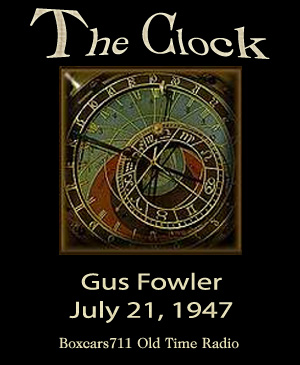
The Clock - Gus Fowler (07-21-47)
The Clock, Imported from Austrailia, was a dramatic thirty-minute suspense and mystery series. It was written by Lawrence Klee and was first broadcast in November 1946. The story always began the same; "Sunrise and sunset, promise and fulfilment, birth and death … the whole drama of life is written in the sands of time". This is a great series where the main theme seems to be Retribution. Stories as told by Father Time. THIS EPISODE: July 21, 1947. Syndicated, WRVR-FM, New York aircheck. "Gus Fowler". Participating sponsors. A man with a month to live and a strange bargain. WRVR rebroadcast date: August 31, 1973. The date above is the date of the first broadcast on ABC. . 1/2 hour.
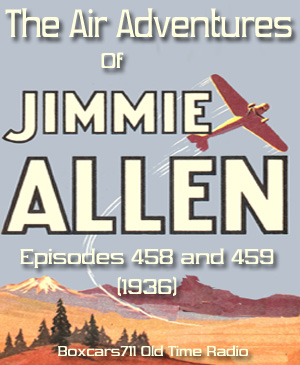
The Air Adventures Of Jimmy Allen - Episodes 458 and 459 (1936)
The Air Adventures Of Jimmy Allen This series included the boy wonder and pilot, Jimmie Allen, his best teenage buddy, Speed Robertson, and mechanic Flash Lewis. As a team they would solve crimes often at the hands of their enemies the corrupt Black Pete and the dishonorable Digger Dawson. Young listeners could join the very popular Jimmie Allen Flying club, complete with a "personal letter" from the boy wonder himself. Jimmie Allen was so popular a character that Paramount shot the feature film The Sky Parade.

Big Town - I Remember Murder (11-30-48)
Big Town is a radio show that aired from 1937 to 1952. Edward G. Robinson had the lead role of Steve Wilson from 1937 to 1942. Claire Trevor was Wilson's society editor sidekick Lorelei Kilbourne, with Ona Munson taking over that role in 1940. Edward J. Pawley portrayed Wilson from 1942 until 1952 when Walter Greaza was heard as Wilson in the final episodes in the radio series. When Big Town moved to television, the program was telecast live, but in 1952 the production switched to film after the move from New York City to Hollywood. The television series ran on CBS from 1950 through 1954, continuing on NBC from 1955 through 1956. Repeat episodes aired on the DuMont Network (under the title City Assignment) while Big Town was still showing first-run episodes on CBS. Reruns were also shown under the titles Heart of the City, Headline and Byline Steve Wilson. THIS EPISODE: November 30, 1948. NBC network. "I Remember Murder". Sponsored by: Lifebuoy, Rinso. A band-leader steals $50,000 from The High Hatters Club and leaves town in a hurry. After he's "taken for a ride," the girl singer who was with him developes amnesia. "Harry The Hack" finds her...and the murder victim too. Edward Pawley, Fran Carlon, Mason Adams, Jerry McGill (writer, director). 29:55.
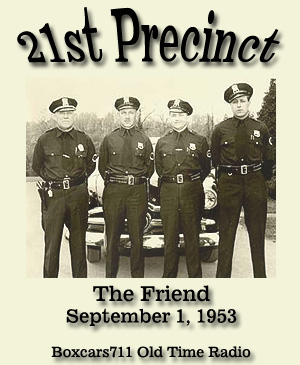
21st Precinct - The Friend (09-01-53)
21ST PRECINCT was one of the realistic police drama series of the early- to mid-1950's that were aired in the wake of DRAGNET. In 1953 CBS decided to use New York City as the backdrop for their own half-hour police series and focus on the day-to-day operation of a single police precinct. Actual cases were used as the basis for stories. The Precinct Captain acted as the narrator for the series.The official title of the series according to the series scripts and the CBS series promotional materials was 21ST PRECINCT and not TWENTY-FIRST PRECINCT or TWENTY FIRST PRECINCT which appears in many Old-Time Radio books. In 1953 CBS decided to use New York City as the backdrop for their own half-hour police series and focus on the day-to-day operations of a single police precinct. Actual cases would be used as the basis for stories. It was mentioned in each episode's closing by the announcer that, "Twenty-firstPrecinct is presented with the official cooperation of the Patrolmen's Benevolent Association an organization of more than 20,000 members of the Police Department, City of New York."
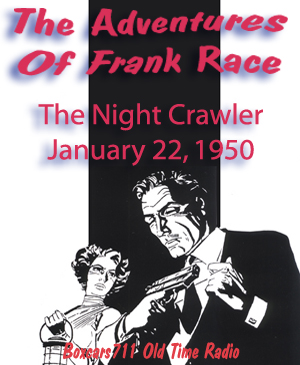
The Adventures Of Frank Race - The Night Crawler (01-22-50)
The Adventures of Frank Race, by Bruce Ells Productions, was first heard in May of 1949. The main character, Frank Race, was an attorney before World War II. As a result of his activities in the war, when it was over, he traded his law books for a career with the OSS. There, "Adventure" became his business. Tom Collins played the role of Frank Race initially, immediately following his stint as Chandu, The Magician. The lead role was taken over later by Paul Dubof. THIS EPISODE: January 22, 1950. Program #39. Broadcasters Program Syndicate syndication. "The Adventure Of The Night Crawler". Commercials added locally. Treachery in the live bait business. Race sees that the worm turns! Paul Dubov, Tony Barrett, Buckley Angel (writer, director), Joel Murcott (writer, director), Bruce Eells (producer), Ivan Ditmars (organist), Art Gilmore (announcer), Michael Ann Barrett, Dick Ryan, Hal March, Gunnar Peterson, Wilms Herbert, Bill Crawford. 26:48.

Author's Playhouse - Southern Exporsure (9-15-44)
Author's Playhouse - Famous stories by celebrated authors: among them, Elementals (Stephen Vincent Benet), The Piano (William Saroyan), and The Snow Goose (Paul Gallico).March 5, 1941 till June 4, 1945, NBC; Blue Network until mid-October 1941, then the Red Network. Many briefly held 30m timeslots, including Sundays at 11:30, 1941-42; Wednesdays at 11:30, 1942-44; Mondays at 11:30, 1944-45. Sponsor was Philip Morris, 1942-43. Cast: John Hodiak, Fern Persons, Arthur Kohl, Laurette Fillbrandt, Kathryn Card, Bob Jellison, Nelson Olmsted, Marvin Miller, Olan Soule, Les Tremayne, Clarence Hartzell, Curley Bradley, etc. Orchestra: Rex Maupin, Roy Shield, J6seph Gallicchio. Creator: Wynn Wright. Directors: Norman Felton, Fred Weihe, Homer Heck, etc. THIS EPISODE: September 15, 1944. NBC network. "Southern Exposure". Sustaining. A writer and photographer gang up on a government official in Old Mexico. Robert Parsons (author). 1/2 hour.

ABC Mystery Time - Success Story (1957)
ABC Mystery Time was hosted by Don Dowd and starred Sir Laurence Olivier. Great special effects will grab your attention, accented by creepy organ rips. Stories are offered such as death gathered round a card table at a local chapter of The Suicide Club, or a man who desperately tries to hire a 24 hour bodyguard all the while trying to make himself the victim of a murder, and other baffling peculiar tales of yore. Also known as Mystery Time and Mystery Time Classics, this one is sure to excite and mystify. THIS EPISODE: ABC network. "Success Story". Not auditioned. The program is also known as, "Masters Of Mystery." "The story of a man who believes in making plans for his future. Plans that include even murder!" Don Dowd (host), Robert Foster (writer), Clark Andrews (producer). 24:00.

The Black Museum - Glass Shards (1952)
The Black Museum - Opening in 1875, the Crime Museum at Scotland Yard is the oldest museum in the world purely for recording crime. The name Black Museum was coined in 1877 by a reporter from The Observer, a London newspaper, although the museum is still referred to as the Crime Museum. The idea of a crime museum was conceived by Inspector Neame who had already collected together a number of items, with the intention of giving police officers practical instruction on how to detect and prevent burglary. It is this museum that inspired the Black Musuem radio series. The museum is not open to members of the public but is now used as a lecture theatre for the curator to lecture police and like bodies in subjects such as Forensic Science, Pathology, Law and Investigative Techniques. A number of famous people have visited the musuem including Sir Arthur Conan Doyle, Harry Houdini, Stan Laurel and Oliver Hardy. Orsen Welles hosted and narrated the shows. Following the opening, Mr. Welles would introduce the museum's item of evidence that was central to the case, leading into the dramatization. He also provided narration during the show and ended each show with his characteristic closing from the days of his Mercury Theater on the Air, 'remaining obediently yours'. THIS EPISODE: Harry Alan Towers syndication. "Glass Shards". Sponsored by: Commercials added localy. A man and his son find an intruder in their apartment. The older man is shot by a small man. Orson Welles, Ira Marion (writer), Sidney Torch (composer, conductor), Harry Alan Towers (producer). 29:46.
The Burns & Allen Show - Government Jobs (2-28-40)
Burns and Allen were an American comedy duo consisting of George Burns and his wife, Gracie Allen.Burns wrote most of the material, and played the straight man. Allen played a silly, addleheaded woman. Both attributed their success to the other, to the ends of their lives. Early on, the team had played the opposite roles until they noticed that the audience was laughing at Gracie's straight lines, so they made the change. Burns and Allen developed their popular routine over more than three decades of stage, radio, film, and television. Historians of popular culture have often stated that Allen was a brilliant comedian, whose entire career consisted of engaging in dialogues of "illogical logic" that left her verbal opponents dazed and confused, and her audiences in stitches. During a typical 23-minute episode of the Burns and Allen show, the vast majority of the dialogue and speaking parts were written for Allen, who was credited with having the genius to deliver her lengthy diatribes in a fashion that made it look as though she was making her arguments up on the spot. (One running gag on the TV show was the existence of a closet full of hats belonging to various visitors to the Burns household, where the guests would slip out the door unnoticed, leaving their hats behind, rather than face another round with Gracie.) A continuing joke on the show was that George would say, "Say good night, Gracie," and Gracie would say, "Good night Gracie!" Ralph Pape used the catchphrase for the title of his play, Say Goodnight, Gracie, produced by Steppenwolf in 1983, and the phrase lives on as a title of other books and stage productions.

The Adventures Of Leonidas Witherall - Resort (09-07-43)
Adventures of Leonidas Witherall was a radio mystery series broadcast on Mutual in the mid-1940s. Based on the novels of Phoebe Atwood Taylor (writing as Alice Tilton), the 30-minute dramas were produced by Roger Bower and starred Walter Hampden as Leonidas Witherall, a New England boys' school instructor in Dalton, Massachusetts, a fictional Boston suburb. Witherall, who resembled William Shakespeare, is an amateur detective and the accomplished author of the "popular Lieutenant Hazeltine stories." His housekeeper Mrs. Mollett was played by Ethel Remey (1895-1979) and Jack MacBryde appeared as Police Sgt. McCloud. The announcer was Carl Caruso. Milton Kane supplied the music. The series began June 4, 1944 and continued until May 6, 1945. THIS EPISODE: September 7, 1943. CBS network. Sustaining. This series deals with a college professor who looks like Shakespeare and is very good at solving murders. This story takes place at a mountain resort where a murder has been committed by someone very adept at throwing knives. Walter Hampden, Agnes Moorehead. 1/2 hour
Barry Craig Confidential Investigator - Cupie Doll (2-13-52)
Barry Craig, Confidential Investigator (AKA Barry Crane" and then "Barrie Craig) is one of the few detective radio series that had separate versions of it broadcast from both coasts. Even the spelling changed over the years. It was first "Barry Crane" and then "Barrie Craig". NBC produced it in New York from 1951 to 1954 and then moved it to Hollywood where it aired from 1954 to 1955. It attracted only occasional sponsors so it was usually a sustainer. William Gargan, who also played the better known television (and radio) detective Martin Kane, was the voice of New York eye BARRY CRAIG while Ralph Bell portrayed his associate, Lt. Travis Rogers. Craig's office was on Madison Avenue and his adventures were fairly standard PI fare. He worked alone, solved cases efficiently, and feared no man. As the promos went, he was "your man when you can't go to the cops. Confidentiality a speciality." Like Sam Spade, Craig narrated his stories, in addition to being the leading character in this 30 minute show.
The Mysterious Traveler - The Accusing Corpse (04-16-44)
The Mysterious Traveler Written and directed by Robert A. Arthur and David Kogan, the series began on the Mutual Broadcasting System, December 5, 1943, continuing in many different timeslots until September 16, 1952. Unlike many other shows of the era, The Mysterious Traveler was without a sponsor for its entire run. The lonely sound of a distant locomotive heralded the arrival of the malevolent narrator, portrayed by Maurice Tarplin, who introduced himself each week in the following manner. This is the Mysterious Traveler, inviting you to join me on another journey into the strange and terrifying. I hope you will enjoy the trip, that it will thrill you a little and chill you a little. So settle back, get a good grip on your nerves and be comfortable -- if you can! THIS EPISODE: April 16, 1944. Mutual network. "The Accusing Corpse". Sustaining. A journey to the grave to learn the secrets of the dead. An old scam leads to an accusation by a dead body. The show will switch to Sunday at 3:30 P. M. (EST) next week. The script was also used on "The Sealed Book" on April 29, 1945. Don Randolph, Phillip Clark, Maurice Tarplin, Doc Whipple (music), Jock MacGregor (director), Robert A. Arthur (writer), David Kogan (writer). 29:45.

Casey Crime Photographer - The Box Of Death (04-17-47)
The adventures of Casey Crime Photographer for The Morning Express, were told in this series, which moved to television after a highly successful run on radio in the 1940's. Casey hung out at the Blue Note Café, where the music was provided by the Tony Mottola Trio, and was friendly with Ethelbert, the bartender, to whom he recounted his various exploits. Richard Carlyle and John Gibson portrayed the roles when the series premiered in April, 1951, but by June they were replaced by Darren McGavin and Cliff Hall. Ann Williams, a reporter on The Morning Express, was Casey's girlfriend. During the summer of 1951 he acquired a partner in cub reporter Jack Lipman, who wrote copy to go with Casey's pictures. This live series was set in and broadcast from, New York City. THIS EPISODE: April 17, 1947. CBS network. "Box Of Death". Sponsored by: Anchor Hocking Glass. A crook with a lucky penny delivers a woman's husband to her, dead in a box. Staats Cotsworth, John Gibson, Tony Marvin (announcer), Archie Bleyer (music), George Harmon Coxe (creator), Alonzo Deen Cole (writer). 1/2 hour.

Arch Obolers Plays - Night (06-07-45)
Arch Oboler's Plays was a radio drama series written, produced and directed by Arch Oboler. Minus a sponsor, it ran for one year, airing Saturday evenings on NBC from March 25, 1939 to March 23, 1940 and revived five years later on Mutual for a sustaining summer run from April 5, 1945 to October 11, 1945. Leading film actors were heard on this series, including Gloria Blondell, Eddie Cantor, James Cagney, Ronald Colman, Joan Crawford, Greer Garson, Edmund Gwenn, Van Heflin, Katharine Hepburn, Elsa Lanchester, Peter Lorre, Frank Lovejoy, Raymond Massey, Burgess Meredith, Paul Muni, Alla Nazimova, Edmond O'Brien, Geraldine Page, Gale Sondergaard, Franchot Tone and George Zucco. THIS EPISODE: June 7, 1945. Mutual network. "Night". Sustaining. An excellent, beautiful radio montage in the central theme of "night." Arch Oboler, Barney James, Bruce Elliott (narrator), David Raxon and His Orchestra, Dorothy Scott, Edmond MacDonald, Everett Allen, Frank Martin (announcer), Gloria Blondell, Griff Barnett (Swan Soap commercial), Joseph Granby, Roseanne Murray, Theodore Von Eltz, Therese Lyon. 1/2 hour.
Amos & Andy - Sunday Monday Or Always (02-25-44)
Amos 'n' Andy was a situation comedy popular in the United States from the 1920s through the 1950s. The show began as one of the first radio comedy serials, written and voiced by Freeman Gosden and Charles Correll and originating from station WMAQ in Chicago, Illinois. After the series was first broadcast in 1928, it grew in popularity and became a huge influence on the radio serials that followed. Amos 'n' Andy creators Gosden and Correll were white actors familiar with minstrel traditions. They met in Durham, North Carolina in 1920, and by the fall of 1925, they were performing nightly song-and-patter routines on the Chicago Tribune's station WGN. Since the Tribune syndicated Sidney Smith's popular comic strip The Gumps, which had successfully introduced the concept of daily continuity, WGN executive Ben McCanna thought the notion of a serialized drama could also work on radio. He suggested to Gosden and Correll that they adapt The Gumps to radio. They instead proposed a series about "a couple of colored characters" and borrowed certain elements of The Gumps. THIS EPISODE: February 25, 1944. NBC network origination, AFRS rebroadcast. Replacing "The Great Gildersleeve." Andy is convinced that he's written the hit tune, "Sunday, Monday, Or Always." He and The Kingfish go into the song writing business! Guests are Kay Kyser, Harry Babbitt. Also Johnny Burke and Jimmy Van Heusen (the real composers of the tune). Freeman Gosden, Charles Correll, Harlow Wilcox (announcer), Kay Kyser, Harry Babbitt, Johnny Burke, Jimmy Van Heusen, Kay Kyser and His Orchestra (music fill), Georgia Carroll (vocal). 29:42.
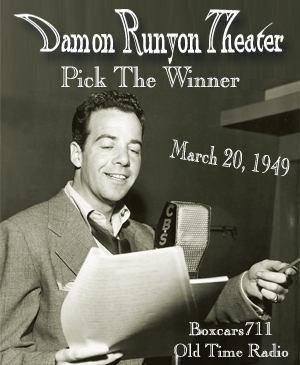
Damon Runyon Theater - Pick The Winner (03-20-49)
The Damon Runyon Theater was a 52 show series that was syndicated across the USA beginning in early 1949. Damon Runyon was a gifted sports writer in New York City as well as being a great journalist and great short story writer. His stories were humorous ones, written in the "dem" and "dose" vernacular of the city's loveable and not so loveable characters of Broadway, the prize ring and the underworld. His most famous collection of short stories, Guys and Dolls, was on Broadway and later made into a movie. Many of his stories were filmed including Sorrowful Jones, A Pocketful of Miracles, Lady for a Day, Blue Plate Special, The Lemon Drop Kid (twice) and Little Miss Marker (four times). In addition to this The Damon Runyon Theater was syndicated for television in the mid 1950s. THIS EPISODE: 1948. Program #12. Mayfair syndication. "Pick The Winner". Commercials added locally. Hot Horse Herbie, Cutie Andrews and Broadway travel to Florida to play the horses. They run into "The Professor," which is a horse of another color! Damon Runyon (author), John Brown, Richard Sanville (director), Russell Hughes (writer), Vern Carstensen (production supervisor). 27:05.

Academy Award Theater - Blood On The Sun (10-16-46)
Academy Award Theater Stars and movies with Oscars were the idea - in most cases, the movie stars recreated their academy award roles for the show, or in other cases, fine actors played the parts and gave it a different character. Both ways make for great radio drama and first class Hollywood motion picture star entertainment. The Lux Radio Theater had been doing this kind of radio show in the grandest manner for many years, but sponsor Squibb had the hubris and deep pockets to take on the competition by doing Academy Award Theater right after the Second World War. The year 1946 was pre-television, and so movies were still the major American visual art form, with radio the other popular network entertainment. In this final pre-TV time, Academy Award Theater was thought of as a premier radio production, a wow show, much like CinemaScope was to be in the 1950's when Hollywood felt the box office blow of early TV. THIS EPISODE: October 16, 1946. CBS network. "Blood On The Sun". Sponsored by: Squibb. A crusading newspaper editor in pre-war Japan uncovers the "Tanaka Plan" of world conquest. John Garfield, Jeff Chandler. 1/2 hour.

Broadway My Beat - Harry Carson Case (03-07-53)
Broadway Is My Beat A radio crime drama, ran on CBS from February 27, 1949 to August 1, 1954. With music by Robert Stringer, the show originated from New York during its first three months on the air, with Anthony Ross portraying Times Square Detective Danny Clover. John Dietz directed for producer Lester Gottlieb. Beginning with the July 7, 1949 episode, the series was broadcast from Hollywood with producer Elliott Lewis directing a new cast in scripts by Morton Fine and David Friedkin. The opening theme of "I'll Take Manhattan" introduced Detective Danny Clover (now played by Larry Thor), a hardened New York City cop who worked homicide "from Times Square to Columbus Circle -- the gaudiest, the most violent, the lonesomest mile in the world." THIS EPISODE: March 7, 1953. CBS network origination, AFRTS rebroadcast. Harry Carson is an old man who won't talk, and a dead body who can't! See cat. #52621 for a network version of this broadcast. Elliott Lewis (producer, director), Alexander Courage (composer, conductor), Larry Thor, Charles Calvert, Jack Kruschen, Morton Fine (writer), David Friedkin (writer), Herb Butterfield, Whitfield Connor, Jerry Hausner, James McCallion, Lurene Tuttle, Eddie Fields, Bill Anders (announcer). 28:30.

Your's Truly Johnny Dollar - Murder Aint Minor (08-07-49)
Your's Truly Johnny Dollar - For over twelve years, from 1949 through 1962 (including a one year hiatus in 1954-1955), this series recounted the cases "the man with the action-packed expense account, America's fabulous freelance insurance investigator, Johnny Dollar". Johnny was an accomplished 'padder' of his expense account. The name of the show derives from the fact that he closed each show by totaling his expense account, and signing it "End of report... Yours Truly, Johnny Dollar". Terry Salomonson in his authoritative "A Radio Broadcast Log of the Drama Program Yours Truly, Johnny Dollar", notes that the original working title was "Yours Truly, Lloyd London". Salomonson writes "Lloyd London was scratched out of the body of (the Dick Powell) audition script and Johnny Dollar was written in. Thus the show was re-titled on this script and the main character was renamed. Why this was done was unclear – possibly to prevent a legal run-in with Lloyd's of London Insurance Company." Although based in Hartford, Connecticut, the insurance capital of the world, freelancer Johnny Dollar managed to get around quite a bit – his adventures taking him all over the world. There were some unusual devices used in the show that help set it apart from other shows. There was no partner, assistant, or secretary for Johnny. The character closest to a continuing role was that of Pat McCracken of the Universal Adjustment Bureau, who assigned Johnny many of his cases. Another atypical aspect gave the show additional credibility – frequently, characters on the show would mention that they had heard about Johnny's cases on the radio. Johnny often used his time when filling out his expense accounts to give the audience background information or to express his thoughts about the current case. THIS EPISODE: August 7, 1949. CBS network. "The Investigation Of Bonnie Goodwin," or "Murder Ain't Minor". Sustaining. Johnny takes a case on behalf of "King Hart," (not an insurance company!) to try to find his missing girl. Paul Dubov, Martha Wentworth, Lou Krugman, Charles Russell, Georgia Ellis, Jeanne Bates, Lawrence Dobkin, Roy Rowan (announcer), Leith Stevens (composer, conductor), Gordon T. Hughes (director), Paul Dudley (writer), Gil Doud (witer). 29:36.

The Adventures Of Sam Spade - The Missing Newshawk Caper (7-18-48)
The Adventures of Sam Spade was a radio series based loosely on the private detective character Sam Spade, created by writer Dashiell Hammett for The Maltese Falcon. The show ran for 13 episodes on ABC in 1946, for 157 episodes on CBS in 1946-1949, and finally for 51 episodes on NBC in 1949-1951. The series starred Howard Duff (and later, Steve Dunne) as Sam Spade and Lurene Tuttle as his secretary Effie, and took a considerably more tongue-in-cheek approach to the character than the novel or movie. In 1947, scriptwriters Jason James and Bob Tallman received an Edgar Award for Best Radio Drama from the Mystery Writers of America. Before the series, Sam Spade had been played in radio adaptations of The Maltese Falcon by both Edward G. Robinson (in a 1943 Lux Radio Theater production) and by Bogart himself (in a 1946 Academy Award Theater production), both on CBS. THIS EPISODE: July 18, 1948. CBS network. "The Missing Newshawk Caper". Sponsored by: Wildroot Cream Oil. Spade is hired to find a reporter named Ray McCully. Spade finds him all right, stabbed to death! Howard Duff, Lurene Tuttle, Dashiell Hammett (creator), William Conrad, Sara Berner, Bea Benaderet (possibly), Alan Reed, Gil Doud (writer, director), Robert Tallman (writer), Lud Gluskin (music), Dick Joy (announcer). 29:40.

The Abbott & Costello Show - Christmas Program (12-24-47)
The Abbott and Costello Show- William (Bud) Abbott and Lou Costello (born Louis Francis Cristillo) were an American comedy duo whose work in radio, film and television made them one of the most popular teams in the history of comedy. Thanks to the endurance of their most popular and influential routine, "Who's on First?"---whose rapid-fire word play and comprehension confusion set the preponderant framework for most of their best-known routines---the team are also the only comedians known to have been inducted into the Baseball Hall of Fame. The Abbott and Costello Show mixed comedy with musical interludes (usually, by singers such as Connie Haines, Marilyn Maxwell, the Delta Rhythm Boys, Skinnay Ennis, and the Les Baxter Singers). Regulars and semi-regulars on the show included Artie Auerbrook, Elvia Allman, Iris Adrian, Mel Blanc, Wally Brown, Sharon Douglas, Verna Felton, Sidney Fields, Frank Nelson, Martha Wentworth, and Benay Venuta. Ken Niles was the show's longtime announcer, doubling as an exasperated foil to Abbott & Costello's mishaps (and often fuming in character as Costello insulted his on-air wife routinely); he was succeeded by Michael Roy, with annoncing chores also handled over the years by Frank Bingman and Jim Doyle. THIS EPISODE: December 25, 1943. Red network, KFI, Los Angeles aircheck. Sponsored by: Camels. Abbott and Costello plan to kill Ingrid, Costello's pet turkey, for Thanksgiving. Guest Jane Wyman joins in a routine, "What is the wind?" Connie Haines sings, "Shoo, Shoo Baby." Mel Blanc appears as Bugs Bunny. Bud Abbott, Lou Costello, Freddie Rich and His Orchestra, Ken Niles (announcer), Jane Wyman, Connie Haines, Mel Blanc (triples), Don Prindle (writer), Leo Solomon (writer), Alan Woods (writer), Martin Gosch (director), Billy Gray, Elvia Allman, John Brown. 29:45.

CBS Radio Mystery Theater - Speak Of The Devil (01-25-74)
The CBS Radio Mystery Theater (or CBSRMT) was an ambitious and sustained attempt to revive the great drama of old-time radio in the 1970s. Created by Himan Brown (who had by then become a radio legend due to his work on Inner Sanctum Mysteries and other shows dating back to the 1930s), and aired on affiliate stations across the CBS Radio network, the series began its long run on January 6, 1974. The final episode ran on December 31, 1982. The show was broadcast nightly and ran for one hour, including commercials. Typically, a week consisted of three to four new episodes, with the remainder of the week filled out with reruns. There were a total of 1399 original episodes broadcast. The total number of broadcasts, including reruns, was 2969. The late E.G. Marshall hosted the program every year but the final one, when actress Tammy Grimes took over. Each episode began with the ominous sound of a creaking door, slowly opening to invite listeners in for the evening's adventure. At the end of each show, the door would swing shut, with Marshall signing off, "Until next time, pleasant...dreams?" THIS EPISODE: January 25, 1974. Program #20. CBS net. "Speak Of The Devil". Sponsored by: Kellogg's, Budweiser. E. G. Marshall (host), Ian Martin (writer, performer), Jada Rowland, Bryna Raeburn, Nick Pryor. 52 minutes.
The CBS Radio Mystery Theater - Familiar Ghost (12-18-78)
Familiar Ghost (Aired December 18, 1978) The CBS Radio Mystery Theater (or CBSRMT) was an ambitious and sustained attempt to revive the great drama of old-time radio in the 1970s. Created by Himan Brown (who had by then become a radio legend due to his work on Inner Sanctum Mysteries and other shows dating back to the 1930s), and aired on affiliate stations across the CBS Radio network, the series began its long run on January 6, 1974. The final episode ran on December 31, 1982.The show was broadcast nightly and ran for one hour, including commercials. Typically, a week consisted of three to four new episodes, with the remainder of the week filled out with reruns. There were a total of 1399 original episodes broadcast. The total number of broadcasts, including reruns, was 2969. The late E.G. Marshall hosted the program every year but the final one, when actress Tammy Grimes took over. Each episode began with the ominous sound of a creaking door, slowly opening to invite listeners in for the evening's adventure. At the end of each show, the door would swing shut, with Marshall signing off, "Until next time, pleasant...dreams?"

The Abbott & Costello Show - Lou Joins The Circus (05-09-44)
Abbott and Costello William (Bud) Abbott and Lou Costello (born Louis Francis Cristillo) were an American comedy duo whose work in radio, film and television made them one of the most popular teams in the history of comedy. Thanks to the endurance of their most popular and influential routine, "Who's on First?"---whose rapid-fire word play and comprehension confusion set the preponderant framework for most of their best-known routines---the team are also the only comedians known to have been inducted into the Baseball Hall of Fame. Bud Abbott was born in Asbury Park, NJ, October 2, 1897 and died April 24, 1974 in Woodland Hills, California. Lou Costello was born in Paterson, NJ, March 6, 1906 and died March 3, 1959 in East Los Angeles, California. After working as Allen's summer replacement, Abbott and Costello joined Edgar Bergen and Charlie McCarthy on The Chase and Sanborn Hour in 1941, while two of their films (Buck Privates and Hold That Ghost) were adapted for Lux Radio Theater. They launched their own weekly show October 8, 1942, sponsored by Camel cigarettes. THIS EPISODE: May 9, 1944. NBC network. Sponsored by: Camels, Prince Albert Pipe Tobacco. Costello wants to join the circus. Abbott loses his place in the script. Bud Abbott, Lou Costello, Carl Hoff and His Orchestra, Amy Arnell (vocal), Bert Cordon (sound effects), John Pawlek (engineer), Ken Niles (announcer), Elvia Allman, Sharon Douglas (doubles), Mel Blanc (quadruples), Sidney Fields, Don Prindle (writer), Ed Forman (writer), Don Bernard (producer, director), Andrew Potter (producer, director). 29:46.
The Screen Director's Plyhouse - Crisscross (10-10-49)
The Screen Director's Playhouse - From 01/09/49 to 09/28/51 this series was greatly enjoyed by the radio listening audience. It opened as NBC Theater and was also known as The Screen Director's Guild and The Screen Director's Assignment. But most people remember it simply as Screen Director's Playhouse. Many of the Hollywood elite were heard recreating their screen roles over the radio. John Wayne in his rare radio appearances, Cary Grant, Edward G. Robinson, Lucille Ball, Claire Trevor, Tallulah Bankhead and many others were on the air week after week during these broadcasts. Many of Hollywood's directors were also heard in the recreation of their movies. The President of the Screen Director's Guild appeared on 02/13/49, and Violinist Isaac Stern supplied the music for the 04/19/51 broadcast. THIS EPISODE: October 10, 1949. NBC network. "Criss Cross". Sustaining. A good gangster story about a planned armored car holdup and a double-double cross. Screen director Robert Siodmak appears by transcription. Burt Lancaster, Betty Lou Gerson, Jeff Corey, Betty Morgan, Jimmy Wallington (announcer), Robert Siodmak. 1/2 hour.