
Boxcars711 Old Time Radio
2,173 episodes — Page 17 of 44
Blair Of The Mounties - Kittilake Lagoon (2 Ep. Complete)
Blair of the Mounties is the story of the Royal Northwest Mounted Police -- a fictional series based on the work of the Northwest Mounted Police before the World War I. It was a fifteen minute weekly serial heard every Monday for 36 weeks beginning January 31st, 1938 and running through the 3rd of October of 1938. It may have been on the air as early as 1935, although there's no actual proof of this. Little is known of the series other than it followed the exploits of Sgt. Blair of the Northwest Mounted Police. and probably was the inspiration for Trendell, Campbell and Muir's Challenge of the Yukon. The series was written by Colonel Rhys Davies, who also played the Colonel Blair in the series. Jack Abbot played the Constable. Jack French, one of OTR's best researchers says this about the series: "Blair is not restricted to Canada, as other Mounties, as we find him, in a few cases, in Great Britain, solving cases. Overall the series is amateurishly written, with the actor playing Blair coming accros as a bit stuffy."TODAY'S SHOW: (2 Episodes that aired May 23, 1938 and May 30, 1938)Walter Biddick syndication. "Kittilake Lagoon". "A Story Of Dope Smuggling In British Columbia". A plainclothes job for Blair and Sgt. Marshall, breaking up a narcotics ring.
The Zero Hour - Bye Bye Narco (MelTorme) 04-29-74
The Zero Hour, a.k.a. the Hollywood Radio Theater The series was syndicated by Mutual and the programs were allowed to be aired when convenient. Therefore, broadcast dates vary around the country. Broadcast dates start on the premier date and continue until completion without break. Host was Rod Serling. The Cast included Edgar Bergen, Richard Crenna, Howard Duff, John Dehner, Lurene Tuttle, George Maharis, Susan Oliver, Joseph Campanella, John Astin, Patty Duke. The Music Theme played by Ferreane and Teicher. The Producer was J.M. Kholos and the Director was Elliott Lewis. Broadcast history was September 10th - December 7th, 1973 and April 29th - July 26th 1974.
Meet Miss. Sherlock - The Case Of The Deadman's Chest (7-07-46)
Meet Miss. Sherlock - During World War II no more women sleuths arrived on the scene but 1946 was a banner year when three new ones debuted on network radio. One was as much comedienne as crime solver, Meet Miss Sherlock. This was a CBS summer sustainer that recounted the adventures of Jane Sherlock, a scatterbrained amateur detective, and her boyfriend, Peter Blossom, a civil attorney who occasionally fainted. There were two separate versions of this show; the first ran from July 3, 1946 to September 26, 1946 while the second one ran from Sept 28, 1947 to Oct 26, 1947. Both series were produced and directed by David Vaile, with scripts by E. Jack Neuman and Don Thompson. The announcer was Murray Wagner and the live orchestra was headed by Milton Charles. Sondra Gair had the title lead in the 1946 version, Captain Dingle of the NYPD was a youthful Bill Conrad and Joe Petruzzi played Peter Blossom. When the series resumed in the fall of 1947, Betty Moran did the first epiosde but her voice was not "dithery" enough so Monty Margetts was brought in and she played the lead until it went off the air two months later. Barney Phillips was the voice of Captain Dingle. This series was more comedy than adventure, although crimes were eventually solved. Only two episodes have survived; both feature Gair in the 1946 version.

Your's Truly Johnny Dollar - The Baltimore Matter (01-02-53)
Your's Truly Johnny Dollar - For over twelve years, from 1949 through 1962 (including a one year hiatus in 1954-1955), this series recounted the cases "the man with the action-packed expense account, America's fabulous freelance insurance investigator, Johnny Dollar". Johnny was an accomplished 'padder' of his expense account. The name of the show derives from the fact that he closed each show by totaling his expense account, and signing it "End of report... Yours Truly, Johnny Dollar". Terry Salomonson in his authoritative "A Radio Broadcast Log of the Drama Program Yours Truly, Johnny Dollar", notes that the original working title was "Yours Truly, Lloyd London". Salomonson writes "Lloyd London was scratched out of the body of (the Dick Powell) audition script and Johnny Dollar was written in. Thus the show was re-titled on this script and the main character was renamed. Why this was done was unclear – possibly to prevent a legal run-in with Lloyd's of London Insurance Company." Although based in Hartford, Connecticut, the insurance capital of the world, freelancer Johnny Dollar managed to get around quite a bit – his adventures taking him all over the world.THIS EPISODE:January 2, 1953. CBS network. "The Baltimore Matter". Sustaining. An ex-con offers Johnny a deal on the recovery of big money from a bank job...which gets Johnny two bullets and a hospital bed. John Lund, Dan Cubberly (announcer), Jaime del Valle (transcriber), E. Jack Neuman (writer), Eddie Dunstedter (organ), Tony Barrett, Joseph Du Val, Clayton Post, John McIntire, Jeanette Nolan. 30:25.
The Man Called X - A Man A Girl A Plot (05-25-51)
The Man Called X - Sponsored by Frigidaire and later General Motors, this spy series starred Herbert Marshall as Ken Thurston, Intelligence Agent. Marshall, British by birth, starred in films with many of the greatest, especially Detreich in Blonde Venus, Bette Davis in The Virgin Queen, Vincent Price in The Fly, and a great cast in The Razor's Edge, where he portrayed W. Somerset Maugham.THIS EPIOSDE:May 25, 1951. Syndicated. Commercials deleted. An associate of Ken Thurston's is in Hong Kong, trying to stop a scheme to smuggle pharmaceuticals into Red China. Van Heflin substitutes for Herbert Marshall. Van Heflin, Leon Belasco. 25:28.
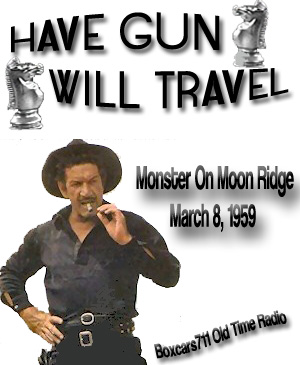
Have Gun Will Travel - Monster On Moon Ridge (03-08-59)
Have Gun Will Travel was a popular American Western television series that aired on CBS from 1957 through 1963. It was the #4 show in the Nielsen ratings in its first year, and #3 for the next three years.[citation needed] It was one of the few television shows to spawn a successful radio version. The radio series debuted on November 23, 1958. The show followed the adventures of Paladin, a gentleman-turned-gunfighter played by John Dehner on radio, who preferred to settle problems without violence, yet, when forced to fight, excelled. Paladin lived in the Carlton Hotel in San Francisco, where he dressed in semi-formal wear, ate gourmet food, and attended opera. In fact, many who initially met him mistook him for a dandy from the East. When working, he dressed in black, used calling cards and wore a holster which carried characteristic chess knight emblems, and carried a derringer under his belt. The knight symbol is of course in reference to his name — possibly a nickname or working name — and his occupation as a champion-for-hire. The theme song of the series refers to him as "a knight without armor." In addition, Paladin drew a parallel between his methods and the chess piece's movement: "It's a chess piece, the most versatile on the board. It can move in eight different directions, over obstacles, and it's always unexpected." Paladin was a former Army officer and a graduate of West Point. He was a polyglot, capable of speaking any foreign tongue required by the plot. He also had a thorough knowledge of ancient history and classical literature, and he exhibited a strong passion for legal principles and the rule of law.THIS EPISODE:March 8, 1959. CBS network origination, AFRTS rebroadcast. "The Monster Of Moon Ridge". Paladin discovers the secret of the half-man, half-bear spotted on Moon Ridge. See cat. #62802 for a network, sponsored version of this program. The script was used on the "Have Gun, Will Travel" television show on February 28, 1959. John Dehner, Herb Meadow (creator), Sam Rolfe (creator), Norman Macdonnell (producer, director), Ben Wright, Gene Roddenberry (writer), John Dawson (adaptor), Lawrence Dobkin, Virginia Christine, Jess Kirkpatrick, Jeanne Bates (doubles), Hugh Douglas (announcer), Bill James (sound effects), Tom Hanley (sound effects). 25 minutes.
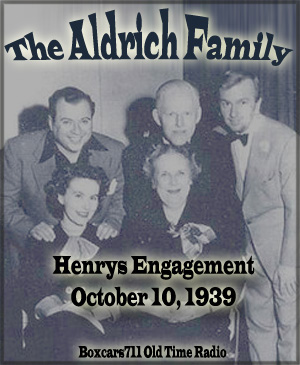
The Aldrich Family - Henry's Engagement (10-10-39)
The Aldrich Family, a popular radio teenage situation comedy (1939-1953), is remembered first and foremost for its unforgettable introduction: awkward teen Henry's mother calling, "Hen-reeeeeeeeeeeee! Hen-ree Al-drich!" A top-ten ratings hit within two years of its birth (in 1941, the showm carried a 33.4 Crossley rating, landing it solidly alongside Jack Benny and Bob Hope), the show is considered a prototype for teen-oriented situation comedies to follow on radio and television and is a favourite if dated find for old-time radio collectors today. The Aldrich Family as a separate radio show was born as a summer replacement for Jack Benny in NBC's Sunday night lineup, July 2, 1939, and it stayed there until October 1, 1939, when it moved to Tuesday nights at 8 p.m., sponsored by General Foods's popular gelatin dessert Jell-O---which also sponsored Jack Benny at the time. The Aldriches ran in that slot from October 10, 1939 until May 28, 1940, moving to Thursdays, from July 4, 1940 until July 20, 1944. After a brief hiatus, the show moved to CBS, running on Fridays from September 1, 1944 until August 30, 1946 with sponsors Grape Nuts and Jell-O,.before moving back to NBC from September 05, 1946 to June 28, 1951 on Thursdays and, then, its final run of September 21, 1952 to April 19, 1953 on Sundays.THIS EPISODE:October 10, 1939 - Henry's Engagement - NBC network. Sponsored by: Postum. Trying to get Doris Townsend jealous, Henry's parents naturally conclude that Henry's engaged. The date is approximate. The system cue has been deleted. Ezra Stone, Clifford Goldsmith (writer), Harry Von Zell (announcer), Jack Miller (composer, conductor). 29:21.

Inner Sanctum Mysteries - The Skull That Walked (1946)
Inner Sanctum Mysteries was a popular old-time radio program that aired from January 7, 1941 to October 5, 1952. Created by Himan Brown, the anthology series featured stories of mystery, terror and suspense. The tongue-in-cheek introductions were in sharp contrast to shows like Suspense and The Whistler. A total of 526 episodes are known to have been produced. The early 1940s programs opened with Raymond Edward Johnson introducing himself as, "Your host, Raymond," in a mocking sardonic voice. A spooky melodramatic organ score punctuated Raymond's many morbid jokes and playful puns. Raymond's closing was an elongated "Pleasant dreaaaaammmmssss!" His tongue-in-cheek style and ghoulish relish of his own tales became the standard for many such horror narrators to follow, from fellow radio hosts like Ernest Chappell (on Cooper's later series, Quiet, Please) and Maurice Tarplin (on The Mysterious Traveler) to EC Comics' Crypt-Keeper in various incarnations of Tales from the Crypt. In interviews, EC publisher Bill Gaines stated that he based EC's three horror hosts not on Raymond but on Old Nancy, host of radio's earlier The Witch's Tale (1931-38). When Johnson left the series in 1945, he was replaced by Paul McGrath, who did not keep the "Raymond" name and was known only as "your host" or "Mr. Host." Beginning in 1945, Lipton Tea sponsored the series, pairing first Raymond and then McGrath with its cheery commercial spokeswoman, Mary Bennett, whose pitches for Lipton contrasted sharply with the subject matter of the stories, and who would primly chide the host for his dark humor and creepy manner.THIS EPISODE:April 15, 1944. CBS network origination, AFRS rebroadcast. "The Walking Skull". A skull is dug up from an old Indian burial ground. It then finds its way into the house. Even after it's reburied, it comes back! This skull also bites! The drama lasts less than twenty minutes, the fill recording is a crime drama, called, "Death In The Doghouse." Willard Dexter is killed in a crowded bar. The story is also known as, "The Skull That Walked." Raymond Edward Johnson (host), Howard Duff (AFRS announcer), Jackson Beck (in the fill drama), Berry Kroeger, Lesley Woods, Alan Devitt. 29:50.
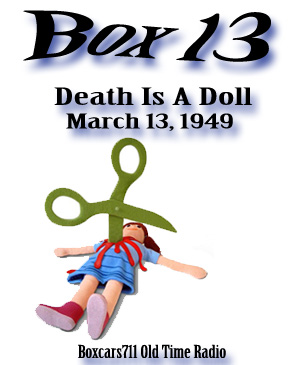
Box 13 - Death Is A Doll (03-13-49)
Box 13 - The premise of the program was that Dan Holiday was an author who wrote mystery novels. To get ideas for his novels he placed an advertisement in a newspaper saying "Adventure wanted, will go anywhere, do anything, Box 13." The ads always brought fun adventures of all kinds: from racketeer's victim to psychotic killer looking for fun. Most of the episodes were based on Dan Holiday replying to a letter he received at Box 13. He would generally solve a mystery in the process, and return to his office in time to enjoy a hearty laugh at the expense of Suzy, his amusingly stupid secretary. He would certainly not meet the strictest requirements for private eyes (not licensed, collected no fees from clients), but the definition should stretch to sneak him in under the rope. It was heard over the Mutual Broadcasting System as well as being syndicated. The series was produced by Mayfair Productions. Box 13, starring Alan Ladd as Dan Holiday. Sylvia Picker played Suzy, Dan Holiday's secretary and Edmond MacDonald as Lt. Kling. Other stars in the series were Betty Lou Gerson, Lurene Tuttle, Alan Reed, Luis Van Rooten, John Beal and Frank Lovejoy. Music was by Rudy Schrager and the writer was Russell Hughes. Announcer/Director was Vern Carstensen. The series was produced by Richard Sanville with Alan Ladd as co-producer. THIS EPISODE:March 13, 1949. Program #30. Mayfair syndication. "Death Is A Doll". Commercials added locally. A man is slowly dying of what appears to be witchcraft. The date is approximate. Alan Ladd, Sylvia Picker. 25 minutes.
Manhattan Playhouse - The Perfect Secretary (06-24-49)
Manhattan Playhouse - The show lasted for four episodes and was broadcast on the Mutual Network on Saturdays at 3:00 p.m. in the New York City area. Two episodes of the show were also syndicated to the Los Angeles market in January 1949. The dates of the original broadcasts were 48/12/04, 48/12/11, 48/12/18, and 49/01/08. A television anthology series under the same name would later air from April to November 1951 on the NYC television station WABD (DuMont Television Network). In addition, another television series with the same name aired two episodes in September and October 1953 on the same station.THIS EPISODE:January 8, 1949. Mutual network. "The Perfect Secretary". Sustaining. A comedy about a young executive who always falls in love with his secretary. Paul Ford, Leonard T. Holton (writer), Peggy French, John Harvey, Wynn Wright (director), Jerry Hausner, Robert Monroe (composer), Sylvan Levin (conductor), Jack O'Reily (announcer). 29:30.

The Adventures Of Superman - Hans Holbins Doll Factory(1940)
The Adventures Of Superman - This juvenile adventure series was first broadcast on Mutual in 1940 with Clayton (Bud) Collyer starring as Superman/Clark Kent. It first began as a fifteen-minute show but later, in 1949, it moved to ABC as a thirty-minute Saturday show with Michael Fitzmaurice as Superman. At the end of its thirteen-year run it had totalled over 1600 episodes. The opening for the show was one of radio's best, setting the stage for those flights into fantasy with a cascade of voices, narration and sound effects. "Faster than a speeding bullet! More powerful than a locomotive! Able to leap tall buildings at a single bound!" "Look! Up in the sky!" "It's a bird!" "It's a plane!" "It's Superman!TODAY'S SHOW: Hans Holbin's Doll Factory (3 Episodes-Complete)
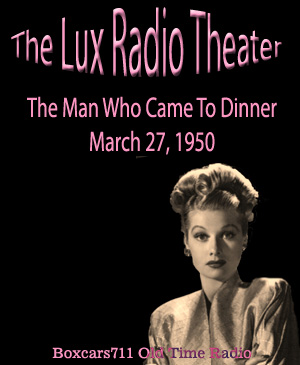
The Lux Radio Theater - The Man Who Came To Dinner (03-27-50)
The Lux Radio Theater strove to feature as many of the original stars of the original stage and film productions as possible, usually paying them $5,000 an appearance to do the show. It was when sponsor Lever Brothers (who made Lux soap and detergent) moved the show from New York to Hollywood in 1936 that it eased back from adapting stage shows and toward adaptations of films. The first Lux film adaptation was The Legionnaire and the Lady, with Marlene Dietrich and Clark Gable, based on the film Morocco. That was followed by a Lux adaptation of The Thin Man, featuring the movie's stars, Myrna Loy and William Powell.THIS EPISODE:March 27, 1950. CBS network. "The Man Who Came To Dinner". Sponsored by: Lux. Not auditioned. Clifton Webb, Lucille Ball, Betty Lou Gerson, Steve Dunne, William Johnstone, Nelson Welch, Jay Novello, Eleanor Audley, Arthur Q. Bryan, Margaret Brayton, Lois Corbett, Ruth Perrott, Walter Craig, Rhoda Williams, George Neise, Herb Butterfield, Edward Marr, Julius Epstein (screenwriter), Philip Epstein (screenwriter), George Kaufman (playwright), Moss Hart (playwright), William Keighley (host), John Milton Kennedy (announcer), Dorothy Lovett (commercial spokesman, as "Libby"), Earl Ebi (director), Charlie Forsyth (sound effects), Rudy Schrager (music director), Sanford Barnett (adaptor), Joan Miller (intermission guest). 59:51.
The Sealed Book - Murderer Unknown (08-19-45)
The Sealed Book starred Philip Clarke as the keeper of the book, a croaking, cackling hermit, with knowledge of the black arts, who in each show unlocked the great padlock that kept the sealed book safe from prying eyes. There was a spook story each week with tales of secrets and mysteries of mankind through the ages. This MUTUAL network entry in the horror and mystery genre was far from the best remembered, such as Suspense, Quiet Please, and Inner Sanctum. The Sealed Book begins with a classic intro, in which when gonged, we are escorted by the tuxedoed announcer with unseen organist as the keeper of the book opens the ponderous, albeit squeaky door "to the secret vault wherein is kept the great sealed book, in which is recorded all the secrets and mysteries of mankind through the ages, Here are tales of every kind, tales of murder, of madness, of dark deeds strange and terrible beyond all belief." First broadcast date march 18th 1945. Last broadcast date september 9th 1945. Narrated by Philip Clarke and written by Bob Arthur and David Kogan, this mystery anthology was aired over the MUTUAL network Sunday nights at 10:30 p.m.THIS EPISODE:August 19, 1945. Program #23. Mutual network origination, syndicated. "Murderer Unknown". Commercials added locally. A successful businessman gets black-bordered letters that threaten his life. Robert A. Arthur (writer), David Kogan (writer), Phillip Clark (host). 1/2 hour.

The Molle Mystery Theater - Radio Patrol (11-29-46)
The Molle Mystery Theater - Although Molle Mystery Theatre was initially sponsored by Molle Shaving Cream, other sponsors (such as Bayer Aspirin, Ironized Yeast, Phillips Milk of Magnesia) also sponsored the program. Sometimes, when it was not sponsored by Molle, the program was called "Mystery Theater". The show was first heard on NBC, on 9/7/43. Time slot was originally Sunday nights at 9:00 PM, but was later moved to Tuesday at 9:00 PM, and Friday at 10:00 PM. In 1948, the show moved to CBS (Tues, 8:00 PM), and in 1951, it moved to ABC, where it was called "Mark Sabre", and heard on Wednesdays at either 8:00 PM or 9:30 PM. The shows were tight and tension filled, with a fine orchestra score and solid production values. Classic tales from well-known authors, as well as modern unknowns were presented, and the endings were often twists or shockers.THIS EPISODE:November 29, 1946. NBC network. "Radio Patrol". Sponsored by: Molle, Double Dandereen. A man found dying on the docks confesses to a radio patrolman that he killed a man at the order of Councilman Carmichael. The cop is not going to let an innocent man hang, even though his career will be ruined if it helps the con on death row who was convicted of the crime. Dan Seymour (announcer), Leslie T. White (writer), Richard Coogan, Leon Meadow (adaptor), Jack Miller (music), Bernard Lenrow (host, as "Geoffrey Barnes"). 29:31.
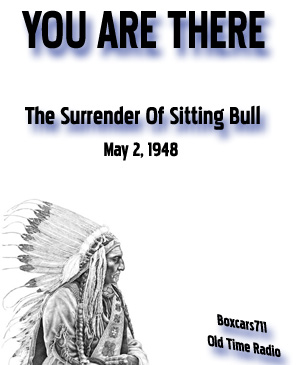
You Are There - The Surrender Of Sitting Bull 05-02-48)
You Are There - Imagine if CBS radio news existed when the Bastille was stormed in 1789, or if radio reporters were stationed in Ford Theater as Lincoln was assassinated, or again at the Battle of Gettysburg? Indeed, such was the premise behind the CBS series, You Are There. Audiences witnessed history through the present-tense accounts of newsmen allegedly witnessing historical events transpiring before their eyes. Don Hollenbeck and John Daley (known for his TV game show panelist appearances) played the lead anchors, while real-life newsman provided the remote commentaries as the dramas unfolded. As show opened, an anchor would describe the present situation with "As it stands now…" and segue into commentaries, live remote feeds or analysis as the story unfurled.The show was well received, but perhaps was doomed to eventual failure in part due John Daly's emoting. Bernard DeVoto in Harper Magazine lamented: "We have heard his (Daly) voice vibrate with the real emotion, and our memory of the real simply turns the imagined to ham."THIS EPISODE:January 2, 1949. CBS network. "The Surrender Of Sitting Bull". Sustaining. The events of July 21, 1881. The last great chief of the Sioux Nation decides to parlay with the white man. A day for which Americans should be ashamed. Karl Swenson, John Daly, Robert Lewis Shayon (writer, producer, director), Ken Roberts, Don Hollenbeck, Mikedja Wren (writer), Peter Hobbs, Julian Noa, Crazy Bull (billed as "Chief Crazy Bull, grandson of Sitting Bull" did the war chant and was a consultant for the broadcast), Canada Lee, Raymond Edward Johnson. 29:26.
Theater Five - Dream Of Death (08-25-64)
Normal 0 false false false EN-US X-NONE X-NONE MicrosoftInternetExplorer4 /* Style Definitions */ table.MsoNormalTable {mso-style-name:"Table Normal"; mso-tstyle-rowband-size:0; mso-tstyle-colband-size:0; mso-style-noshow:yes; mso-style-priority:99; mso-style-qformat:yes; mso-style-parent:""; mso-padding-alt:0in 5.4pt 0in 5.4pt; mso-para-margin-top:0in; mso-para-margin-right:0in; mso-para-margin-bottom:10.0pt; mso-para-margin-left:0in; line-height:115%; mso-pagination:widow-orphan; font-size:11.0pt; font-family:"Calibri","sans-serif"; mso-ascii-font-family:Calibri; mso-ascii-theme-font:minor-latin; mso-hansi-font-family:Calibri; mso-hansi-theme-font:minor-latin;} Theater Five was ABC's attempt to revive radio drama during the early 1960s. The series name was derived from its time slot, 5:00 PM. Running Monday through Friday, it was an anthology of short stories, each about 20 minutes long. News programs and commercials filled out the full 30 minutes. There was a good bit of science fiction and some of the plots seem to have been taken from the daily newspaper. Fred Foy, of The Lone Ranger fame, was an ABC staff announcer in the early 60s, who, among other duties, did Theater Five. THIS EPISODE: August 25, 1964. Program #20. ABC network origination, AFRTS rebroadcast. "Dream Of Death". A suspense filled episode observing the reactions of a volunteer experimenting with hallucinogenic drugs. William N. Robson (writer), Ralph Camargo, Fred Foy (announcer), Ted Bell (director), George Petrie, Joan Shea, Cliff Carpenter, Richard Hurd, Jack Manning, Bill Sandreuter (audio engineer), Ed Blainey (sound technician), Jack C. Wilson (script editor), Alexander Vlas Datsenko (composer), Glenn Osser (conductor), Edward A. Byron (execuitve producer). 26:34.
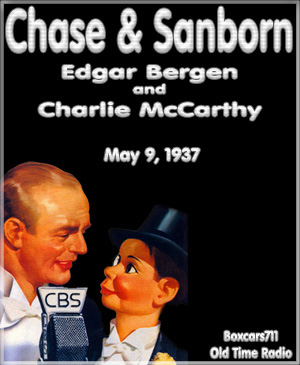
The Chase & Sanborn Hour - Edgar Bergen and Charlie McCarthy (05-09-37
The Chase and Sanborn Hour was the umbrella title for a series of US comedy and variety shows, sponsored by Standard Brands' Chase and Sanborn Coffee, usually airing Sundays on NBC from 8pm to 9pm during the years 1929 to 1948. The series began in 1929 as The Chase and Sanborn Choral Orchestra, a half-hour musical variety show heard Sundays at 8:30pm on NBC. When Maurice Chevalier became the show's star, he received a record-breaking salary of $5000 a week. Violinist David Rubinoff (September 13, 1897 – October 06, 1986), became a regular in January 1931, introduced as "Rubinoff and His Violin." Chase and Sanborn found a gold mine with a wooden dummy when Edgar Bergen and Charlie McCarthy began an 11-year run, starting May 9, 1937. The 1945 summer replacement series, with Spike Jones and Frances Langford as co-hosts, was titled The Chase and Sanborn Program. Although the series ended December 26, 1948, it was followed by a compilation show on NBC, The Chase and Sanborn 100th Anniversary Show (November 15, 1964), assembled by writer Carroll Carroll and narrated by Bergen. This became an annual event with The Chase and Sanborn 101st Anniversary Show (November 14, 1965), a Fred Allen tribute, followed by The Chase and Sanborn 102nd Anniversary Show (November 13, 1966), which turned out to be the last of the series.
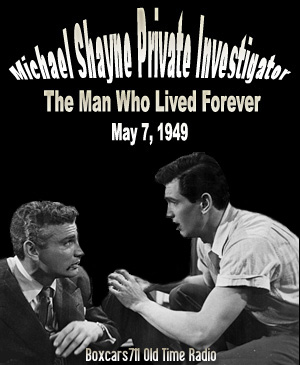
The New Adventures Of Michael Shayne - The Man Who Lived Forever (05-07-49)
The New Adventures Of Michael Shayne was a fictional private detective character created by writer Brett Halliday during the late 1930's. Shayne debuted in the novel Dividend on Death first published in 1939, written by David Dresser, a pseudonym of Halliday. Dresser wrote fifty Shayne novels, with the help of Ryerson Johnson. Twenty seven more were written by Robert Terrall for a total of seventy seven; three hundred short stories, a dozen films, radio and television shows, and a few comic book appearances have resulted from the character. The books were typically very well plotted, with Shayne always gathering the suspects at the end and explaining the crime and naming the murderer. Shayne was initially married in the novels, his wife being Phyllis Shayne, who was a somewhat limited character, and was often out of town. Dresser "killed her off" when he sold the movie rights to the series. In the book, Blood on the Black Market, comedy disappears, and Shayne is forced to deal with his wife's death. Halliday later created "Michael Shayne Mystery Magazine", first introduced in 1956 by Renown Publications. The magazine continued for over three decades, always having at least one Michael Shayne short story included in each edition. Halliday stopped writing the Michael Shayne novels after Murder and the Wanton Bride in 1958. Shayne novels continued, however, written by Ryserson Johnson, Robert Terrell, and David Lynds. In 1960, the Michael Shayne television series began, with actor Richard Denning playing the lead role. Dell Comics soon picked up the character for a comic book series. Michael Shayne Mysteries, and a film series starring Lloyd Nolan, is available on DVD.THIS EPISODE:1949. Program #1. Broadcaster's Guild syndication. "The Man Who Lived Forever". Commercials added locally. The man's name was Anthony Correll and he is supposed to never die. What does the coiled snake on his forehead mean? A Peter Lorre clone shoots Michael Shayne! The program closing has been deleted. The date is approximate. Jeff Chandler, William P. Rousseau (host, director), John Duffy (composer, performer), Brett Halliday (creator), Don W. Sharp (producer). 26:50.
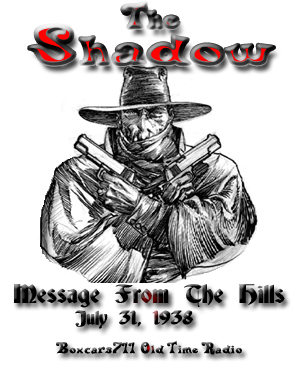
The Shadow - Message From The Hills (07-31-38)
The Shadow - One of the most popular radio shows in history debuted in August 1930 when "The Shadow" went on the air. "Who knows what evil lurks in the hearts of men? The Shadow knows!" The opening lines of the "Detective Story" program captivated listeners and are instantly recognizable even today. Originally the narrator of the series of macabre tales, the eerie voice known as The Shadow became so popular to listeners that "Detective Story" was soon renamed "The Shadow," and the narrator became the star of the old-time mystery radio series, which ran until 1954. A figure never seen, only heard, the Shadow was an invincible crime fighter. He possessed many gifts which enabled him to overcome any enemy. Besides his tremendous strength, he could defy gravity, speak any language, unravel any code, and become invisible with his famous ability to "cloud men's minds."THIS EPISODE:1938. Syndicated. "The Message From The Hill". Sponsored by: B. F. Goodrich Tires. The Shadow foils a plot to rob a diamond mine. Orson Welles, Margot Stevenson, Ken Roberts (announcer). 1/2 hour.

Mr. & Mrs. North - Milkmans Ring (07-15-47)
Mr. and Mrs. North are fictional American amateur detectives. Created by Frances and Richard Lockridge, the couple were featured in a series of twenty-six Mr. and Mrs. North novels, a Broadway play, a motion picture, and several different radio and television series. Mr. and Mrs. North was a radio mystery series that aired on CBS from 1942 to 1954. Alice Frost and Joseph Curtin had the title roles when the series began in 1942. Publisher Jerry North and his wife Pam lived in Greenwich Village at 24 St. Anne's Flat. They were not professional detectives but simply an ordinary couple who stumbled across a murder or two every week for 12 years. The radio program eventually reached nearly 20 million listeners. The characters originated in 1930s vignettes written by Richard Lockridge for the New York Sun, and he brought them back for short stories in The New Yorker.THIS EPISODE:July 15, 1947. CBS network. Sponsored by: Halo Shampoo, Cashmere Bouquet, Colgate Toothpowder. Murder, mayhem, and a missing diamond ring, all aboard a milk wagon in the early morning. Alice Frost, Joseph Curtin, Charles Stark (announcer), Frances Lockridge (creator), Richard Lockridge (creator). 24:49.

The Jack Benny Program - Little Red Riding Hood (12-19-37)
The Jell-O Program Starring Jack Benny - Jack Benny was remarkable in many ways, but in none more than this: he built a character of every sour ingredient in life, but somehow his real personality trickled through and made it wonderful. Would a real miser act that way before 30 million people each week? The Benny of the air was a fraud, a myth, a creation. It should have surprised no one to learn — after years of toupee jokes that played so well into the vanity theme — that Benny never wore one. He overtipped in restaurants, gave away his time in countless benefit performances, and was lavish in his praise of almost everyone else. The Jack Benny Program is a classic comedy that is truly one of the best-loved programs from the Golden Age of Radio. It started life as The Canada Dry Program in 1932 on the Blue Network and finished off as The Lucky Strike Program on CBS in 1955. In between, it kept the audience in stitches and established Benny as one of America's all-time great comedians.THIS EPISODE:December 19, 1937. Red net. Sponsored by: Jell-O. Kenny sings, "Once In A While." The cast does its version of, "Little Red Riding Hood," with Andy Devine as Grandma! Jack Benny, Don Wilson, Phil Harris and His Orchestra, Mary Livingstone, Kenny Baker, Andy Devine, Harry Baldwin, Ed Beloin (writer, performer), Blanche Stewart, Bill Morrow (writer). 29:32.
Crime & Peter Chambers - Donald Sloane Embezzler (07-20-54)
Crime & Peter Chambers - This program was born from a detective book series and inspired by author Henry Kane who became the director and producer for the radio show. The series only ran five months, 30 minutes each episode, from April 6, 1954 to September 7, 1954. Peter Chambers was played by Dane Clark who also appeared on the Suspense radio shows. Chambers acted the role of a playboy detective with an eye for solving crime and a taste for the women. Bill Zuckert, who went on to guest star in many 1970s shows including The Mary Tyler Moore Show and the Partridge Family, plays Lt. Parker.

The New Adventures Of Sherlock Holmes - Uneasy Easy Chair (05-13-46)
Sherlock Holmes is a fictional detective of the late 19th and early 20th centuries, who first appeared in publication in 1887. He is the creation of Scottish born author and physician Sir Arthur Conan Doyle. A brilliant London-based detective, Holmes is famous for his intellectual prowess, and is renowned for his skillful use of deductive reasoning (somewhat mistakenly - see inductive reasoning) and astute observation to solve difficult cases. He is arguably the most famous fictional detective ever created, and is one of the best known and most universally recognisable literary characters in any genre. Conan Doyle wrote four novels and fifty-six short stories that featured Holmes. All but four stories were narrated by Holmes' friend and biographer, Dr. John H. Watson, two having been narrated by Holmes himself, and two others written in the third person. The first two stories, short novels, appeared in Beeton's Christmas Annual for 1887 and Lippincott's Monthly Magazine in 1890. The character grew tremendously in popularity with the beginning of the first series of short stories in The Strand Magazine in 1891; further series of short stories and two serialized novels appeared almost right up to Conan Doyle's death in 1930. The stories cover a period from around 1878 up to 1903, with a final case in 1914.THIS EPISODE:May 13, 1946. Mutual network. "The Uneasy Easy Chair". Sponsored by: Petri Wines. Holmes works on a murder in which the murder weapon is a diabolical chair. Inspector Lestrade has the last laugh! The story is based on, "The Musgrove Ritual." Basil Rathbone, Nigel Bruce, Harry Bartell (announcer), Denis Green (writer), Anthony Boucher (writer), Arthur Conan Doyle (author), Dean Fosler (music), Edna Best (producer). 29:27.
The Chase - The Hold-Up (1953)
The Chase is an exciting Old Time Radio series in which every episode contains, well, a chase. Tales, highly melodramatic and often improbable, of people on the run. The concept of "hunter and hunted" was built into the signatures. with the lone bugle of a fox hunt, the braying of dogs, the sounds of a man running, a gunshot, and the slowing footsteps and eventual fall of the victim. It may be an adventure story, a crime story, or even science fiction, but there will always be a suspense filled chase.THIS EPISODE:1953. The Hold-Up - NBC network. Sustaining. An employee of a contracting company blackmails his boss to secure a higher paying position in the accounting department. Doris Smith, Fred Collins (announcer), Fred Weihe (director, transcriber), Ivor Francis, John Stanley, Cathleen Cordell, Lawrence Klee (creator, writer), Leona Powers, Ted Osborne, William Podmore. 29:52.

Let George Do It - No Way Out (10-01-51)
Let George Do It was a radio drama series produced by Owen and Pauline Vinson from 1946 to 1954. It starred Bob Bailey as detective-for-hire George Valentine (with Olan Soule stepping into the role in 1954). Clients came to Valentine's office after reading a newspaper carrying his classified ad: "Personal notice: Danger's my stock in trade. If the job's too tough for you to handle, you've got a job for me. George Valentine." Valentine's secretary was Claire Brooks, aka Brooksie (Frances Robinson, Virginia Gregg, Lillian Buyeff). As Valentine made his rounds in search of the bad guys, he usually encounted Brooksie's kid brother, Sonny (Eddie Firestone), Lieutenant Riley (Wally Maher) and elevator man Caleb (Joseph Kearns). Sponsored by Standard Oil, the program was broadcast on the West Coast Mutual Broadcasting System from October 18, 1946 to September 27, 1954, first on Friday evenings and then on Mondays. In its last season, transcriptions were aired in New York, Wednesdays at 9:30pm, from January 20, 1954 to January 12, 1955. John Hiestand was the program's announcer. Don Clark directed the scripts by David Victor and Jackson Gillis. The background music was supplied by Eddie Dunstedter on the organ.THIS EPISODE:October 1, 1951. Mutual-Don Lee network. "No Way Out". Sponsored by: Standard Oil. A frightened young man is mixed up in a racket and a shooting. He then is arrested and jailed. Let George do it! Bob Bailey, Virginia Gregg, Jonathan Hole, Ted de Corsia, Kenneth Webb (director), Ken Christy, Don Clark (writer), Louise Arthur, Bud Hiestand (anouncer), Eddie Dunstedter (composer, conductor). 29:42.
The Amazing Mr. Malone - Early To Bed Early To Rise (06-15-51)
The Amazing Mr. Malone radio series aired 1947-1951 based on the John Malone series of mystery novels by Craig Rice, the author of fourteen novels, countless short stories, and a number of true crime pieces. She once rivaled Agatha Christie in sales,and was on the cover of Time Magazine in 1946. John J. Malone, socialite and ladies man, is a brilliant criminal lawyer taking up a new case in every episode. Using his finely-honed deductive and persuasive skills, he never gives up until justice is done.THIS EPISODE:June 15, 1951. NBC network. "Early To Bed and Early To Rise". Sustaining. Jeff Lewis, the famous bandleader, has been murdered. Suspicion falls on his insanely jealous wife. George Petrie, Larry Haines, Fred Collins (announcer), Craig Rice (creator), Bernard L. Schubert (producer), Richard Lewis (director), Eugene Wang (writer). 29:37.

Pat Novak For Hire - Sam Tolliver (04-09-49)
Pat Novak, played by Jack Webb, was a private detective working out of Pier 19, a waterfront office in San Francisco. The stories were always very similar: Someone would hire him, (if not a beautiful woman, the job would lead to a beautiful woman) someone would get murdered, he would investigate the case, get beaten up by the thugs, and then the case would be solved and end with glorious violence. The closing was always the same; the listener would be told who had done what, to whom and why they had done it.THIS EPISODE:Sam Tolliver -April 9, 1949. Program #4. ABC network origination, AFRS rebroadcast. Going on an errand for a friend, Pat gets a beating, a package, and a corpse or two, or three. Jack Webb. 30:22.

The Adventures Of Sam Spade - Sam And Psyche (08-02-46)
The Adventures of Sam Spade was a radio series based loosely on the private detective character Sam Spade, created by writer Dashiell Hammett for The Maltese Falcon. The show ran for 13 episodes on ABC in 1946, for 157 episodes on CBS in 1946-1949, and finally for 51 episodes on NBC in 1949-1951. The series starred Howard Duff (and later, Steve Dunne) as Sam Spade and Lurene Tuttle as his secretary Effie, and took a considerably more tongue-in-cheek approach to the character than the novel or movie. In 1947, scriptwriters Jason James and Bob Tallman received an Edgar Award for Best Radio Drama from the Mystery Writers of America. Before the series, Sam Spade had been played in radio adaptations of The Maltese Falcon by both Edward G. Robinson (in a 1943 Lux Radio Theater production) and by Bogart himself (in a 1946 Academy Award Theater production), both on CBS.THIS EPISODE:August 2, 1946. ABC network. "Sam and Psyche". Sponsored by: Wildroot Cream Oil. The fourth show of the series. The story title above is probably correct, although it's announced indirectly. The program has also been referred to as "The Death Of Dr. Denoff." A psychiatrist being blackmailed is killed by doing "a Brody" from his apartment window. His blackmailer is later found strangled! Howard Duff, Lurene Tuttle, Dick Joy (announcer), Dashiell Hammett (creator), William Spier (producer, director), Fred Esler. 29:30.

The CBS Radio Workshop - The Ex-Urbanites (3-30-56)
The CBS Radio Workshop - Broadcast from 1936 through to 1947 with just an occasional break. Revived again from January 1956 to September 1957 as CBS Radio Workshop with pretty much the same format. Broadcast from 1936 through to 1947 with just an occasional break. Revived again from January 1956 to September 1957 as CBS Radio Workshop with pretty much the same format. This was drama with a difference. Columbia Workshop was not everybody's cup of tea and in terms of audience popularity it was always noted that it was never a strong contender for the title "Radios Top Rated Drama Series" and yet it was always considered to be the drama program that led the way in radio standards. Columbia was the first to mexperiment with what radio drama was all about, introducing new techniques never before used in over the airwaves drama and because it received little encouragement from established writers, actors, etc., it was only by breaking new ground with new ideas and new techniques from writers who were not versed in the old ways that it was going to survive. THIS EPISODE:March 30, 1956. CBS network. "The Exurbanites". Sustaining. A chilling (but true) horror story about the problems of living in the suburbs. Eric Sevareid (narrator). 1/2 hour.

Inspector Thorne - The Golden Girl Murder Case (08-03-51)
Inspector Thorne - Another radio detective from the pen of Frank and Ann Hummert was Inspector Thorne. The series was short-lived and also had two stars portraying the lead. The first was Karl Weber and the second was Staats Cotsworth. By the 1940's, Frank and Ann Hummert controlled four and a half hours of national weekday broadcast schedules. Their features reportedly spawned more that 5 million pieces of correspondence annually from steadfast fans. Simultaneously they brought in more than half of the national radio chain's advertising revenues generated during the daylight hours. The couple broadcast 18 quarter-hour serials five times weekly, a total of 90 original episodes for 52 weeks per year, with none of those ever repeated. Some shows were "Amanda of Honeymoon Hill", "Backstage Wife","Chaplin Jim USA", "David Harum", "Easy Aces", "Front Page Farrell", "John's Other Wife", "Just Plain Bill", "The Life of Mary Sothern","Lora Lawton", "Lorenzo Jones", "Ma Perkins", "Mrs Wiggs of the Cabbage Patch", "Our Gal Sunday", "The Romance of Helen Trent" and "Young Widder Brown".

Dangerous Assignment - Missing Japanese Weapons (02-06-50)
Dangerous Assignment - This thirty-minute international spy adventure featured Steve Mitchell (Brian Donlevy), and investigator of crimes in exotic locations. 60 episodes. Herb Butterfield played the Commissioner and Betty Moran was the Commissioner's secretary. Other cast members were GeGe Pearson, Ken Peters, Betty Lou Gerson, Dan O'Herlihy. The director was Bill Cairn and the writer for the series was Robert Ryf. The opening was the same every week "Yeah, danger is my assignment. I get sent to a lot of places I can't even pronounce. They all spell the same thing though, trouble." He would be summoned to his boss's office where he would be given his assignment; he would then fly halfway across the globe to save the day!THIS EPISODE:February 6, 1950. NBC network. Sustaining. The first show of the season. Missing Japanese Weapons . Steve Mitchell flies to Panama to recover missing Japanese weapons and solve the murder of his friend, Bill Thorne. Brian Donlevy, Robert Ryf (writer), Bill Cairn (director), Bruce Ashley (music). 29:40.
Murder By Experts - The Creeper (07-18-49)
Murder By Experts - 1949-51, Mutual. 130 30-minute episodes. Created by David Kogan. Writers: David Kogan. Directors/Producers: David Kogan And Robert A. Arthur. Hosts: John Dickson Carr (June 13, 1949-March 13, 1950) and Brett Halliday (March 20, 1950-December 17, 1951) Sound Effects: Mario Siletti. Guest experts: Alfred Hitchcock, Craig Rice. Guest stars: Ann Shepard, Larry Haines, Carl Eastman, Ann Sheperd, Bill Zuckert, Ralph Camargo, Burt Cullen, Lawson Zerbe, Marilyn Erskin.THIS EPISODE:July 23, 1949. Mutual network, WOR, New York aicheck. "The Creeper". Sponsored by: Sustaining, Bulova Watch (local). A suspense story about a mad killer who strangles his red-headed victims. The program moved to Sundays at 10:00 P. M., being replaced in this time slot by, "The Damon Runyon Theatre." John Dickson Carr (host, narrator), Joseph Ruscoll (writer), Marilyn Erskine. 29:17.
Escape -Wild Oranges (12-17-47)
Escape was radio's leading anthology series of high adventure, airing on CBS from July 7, 1947 to September 25, 1954. Since the program did not have a regular sponsor like Suspense, it was subjected to frequent schedule shifts and lower production budgets, although Richfield Oil signed on as a sponsor for five months in 1950. Despite these problems, Escape enthralled many listeners during its seven-year run. The series' well-remembered opening combined Mussorgsky's Night on Bald Mountain with the introduction, intoned by Paul Frees and William Conrad: "Tired of the everyday routine? Ever dream of a life of romantic adventure? Want to get away from it all? We offer you... Escape!" Of the more than 230 Escape episodes, most have survived in good condition. Many story premises, both originals and adaptations, involved a protagonist in dire life-or-death straits, and the series featured more science fiction and supernatural tales than Suspense. Some of the memorable adaptations include Algernon Blackwood's "Confession", Ray Bradbury's oft-reprinted "Mars Is Heaven," George R. Stewart's Earth Abides, Richard Connell's "The Most Dangerous Game," F. Scott Fitzgerald's "The Diamond as Big as the Ritz," John Collier's "Evening Primrose", later adapted to TV as a Stephen Sondheim musical starring Anthony Perkins. Vincent Price and Harry Bartell were heard in the chilling "Three Skeleton Key," the tale of three men trapped in an isolated lighthouse by thousands of rats. The half-hour was adapted from an Esquire short story by the French writer George Toudouze. THIS EPISODE:Escape. December 17, 1947. CBS network. "Wild Oranges". Sustaining. A good story about a beautiful girl and her father, trapped on an island by a homicidal maniac. The script was previously used on "The Orson Welles Theatre" on November 3, 1941 and subsequently used on the program on September 28,l 1949 and on "Romance" on July 25, 1950 . Cy Feuer (music conceiver, conductor), William N. Robson (producer), Richard Sanville (director), Joseph Hergeshimer (author), William Conrad, Jack Kruschen, John Dunkel (adaptor), Paul Frees, Jeanette Nolan, Sherry Hall. 29:43.
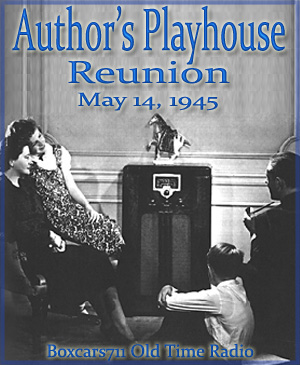
Author's Playhouse - Reunion (05-14-45)
Author's Playhouse - Famous stories by celebrated authors: among them, Elementals (Stephen Vincent Benet), The Piano (William Saroyan), and The Snow Goose (Paul Gallico).March 5, 1941 till June 4, 1945, NBC; Blue Network until mid-October 1941, then the Red Network. Many briefly held 30m timeslots, including Sundays at 11:30, 1941-42; Wednesdays at 11:30, 1942-44; Mondays at 11:30, 1944-45. Sponsor was Philip Morris, 1942-43. Cast: John Hodiak, Fern Persons, Arthur Kohl, Laurette Fillbrandt, Kathryn Card, Bob Jellison, Nelson Olmsted, Marvin Miller, Olan Soule, Les Tremayne, Clarence Hartzell, Curley Bradley, etc. Orchestra: Rex Maupin, Roy Shield, J6seph Gallicchio. Creator: Wynn Wright. Directors: Norman Felton, Fred Weihe, Homer Heck, etc.THIS EPISODE:May 14, 1945. NBC network, Chicago origination. "Reunion". Sustaining. Henry Sinkin is a quiet accountant who inherits $500 and decides to make a big impression at his college reunion. Arthur Hern, Art Van Harvey, Charles Egleston, Elwyn Owen (organist), Inez Arsher (adaptor), Kay Miller, Kay Miller, Michael Romano, Nick Reikert, Norman Felton (producer), Phillips H. Lord, Stanley Gordon, Thomas Post, Vincent Sheean (author), William Fein. 29:28.

The Green Hornet - Justice Wears A Blindfold (03-05-36)
The Green Hornet - On January 31, 1936, the Green Hornet radio program aired on WXYZ in Detroit, Michigan. Al Hodge played the part of the Green Hornet from 1936 through January of 1943. The program was created by George W. Trendle, the same man associated with the creation of the Lone Ranger radio show. The premise of the Green Hornet was that of a modern day Lone Ranger. The main character was Britt Reid, a newspaper publisher of the Daily Sentinel by day and the Green Hornet by night. Britt Reid was the great-nephew of the Lone Ranger. Britt Reid's war against crime was an extension of his family history. The Green Hornet fought crime with his high-powered car, the Black Beauty. THIS EPISODE:June 15, 1939. Mutual network originaion, Michelson syndication, WJBK, Detroit aircheck. "Justice Wears A Blindfold". Sponsored by: Archway Cookies. The date is approximate. Al Hodge, Fran Striker (writer), George W. Trendle (creator). 1/2 hour.
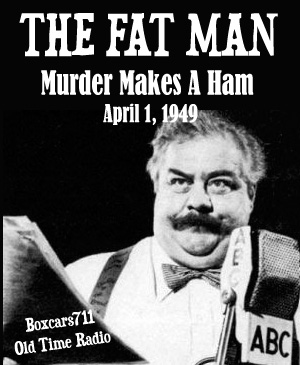
The Fat Man - Murder Makes A Ham (04-01-49)
The Fat Man - "There he goes across the street into the drugstore, steps on the scale, height: 6 feet, weight: 290 pounds, fortune: Danger. Who isit? The Fat Man." Brad Runyon was the Fat Man, played by Jack Scott Smart. The series was created by Dashall Hammott and was first heard on the ABC network Jan. 21, 1946. J. Scott Smart fit the part of the Fat Man perfectly, weighing in at 270 pounds himself. When he spoke, there was no doubt that this was the voice of a big guy. Smart gave a witty, tongue-in-cheek performance and helped make THE FAT MAN one of the most popular detective programs on the air. Smart also appeared in The March Of Time (early 1930s), the Theater Guild On The Air, Blondie, The Fred Allen Show, and The Jack Benny Program. There was also an version made in Australia, syndicated on the Artansa lable, about 1954. There are at least 36 shows available from vendors. The Australian Fat Man was played possibly by Lloyd Berrell. Although not featuring J. Scott Smart, who really fit the part, the series is quite good.THIS EPISODE:April 1, 1949. ABC network. "Murder Makes A Ham". Sponsored by: Pepto Bismol, Unguentine. An actress hires Runyon to find a photograph. J. Scott Smart, Dick Beals (commercial spokesman), Clark Andrews (director), Bernard Green (conductor), Bryna Raeburn, Charles Irving (announcer), Lawrence Klee (writer), Jean Ellen. 29:30.
Mr. Keen Tracer Of Lost Persons - 2 Episodes (11-16-44) (05-23-46)
Mr. Keen, Tracer of Lost Persons was one of network radio's longest running detectives, although listening to it now would hardly explain why. This kind, elderly, boring sleuth, in company with his bumbling assistant, Mike Clancy, was on the airwaves from 1937 to 1955, logging nearly 20 years of fighting crime. The series came out of the soap opera fiction factory of Frank and Anne Hummert and encompassed most of the trite dialogue and snail plotting of daytime serials.TODAY'S DOUBLE FEATURE:November 16, 1944. CBS network. "The Case Of The Frightened Child". Sponsored by: Anacin, Kolynos Toothpaste, Hill's Cold Tablets, Aerowax. A five year old boy has been left to die in a dark, abandoned warehouse. Bennett Kilpack, Larry Elliott (announcer), Frank Hummert, Anne Hummert. 29:40.May 23, 1946. CBS network. "The Case Of The Glamorous Widow". Sponsored by: Anacin, Kolynos Toothpaste, Old English Wax. Which one of her four boyfriends did her in? Bennett Kilpack, Frank Hummert (originator, producer), Anne Hummert (originator, producer), Larry Elliott (announcer). 29:34.

Rocky Fortune - Hauling Nitro (01-26-54)
"Rocky Fortune" about a wanderer that took odd jobs to support himself and never stayed in one place too long. He almost always seemed to meet beautiful women along with trouble. Sinatra was good and was proving to Hollywood that he could do serious work. When casting began for the movie "From Here To Eternity", Frank campaigned tirelessly for a part and because of that and a good word put in for him by Gardner, who he was now separated from, he won a part that would mark his return to Hollywood. Sadly for us, it also meant he didn't have time to do radio and "Rocky Fortune" was rather short lived, although it was popular. It only ran from 1953 - 1954, but" It was a very good year".THIS EPISODE:January 26, 1954. NBC network origination, AFRTS rebroadcast. "Hauling Nitro". Rocky's explosive job (in more ways than one!) is driving a truckload of nitroglycerine. Frank Sinatra, Frank Gerstle, George Lefferts (writer), Lynn Allen, Bill Justine, Howard Culver, Jack Carroll, Maurice Hart, Andrew C. Love (director). 25 minutes.
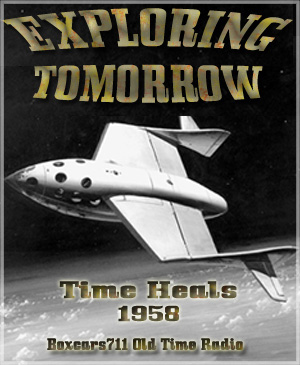
Exploring Tomorrow - Time Heals (1958)
Exploring Tomorrow - Starting as a replacement show for Gangbusters and Counterspy, the series premiered December 11, 1957 and it ran until June 13, 1958. Quoting from Astounding Magazine, "Exploring Tomorrow is the first science fiction radio show of science-fictioneers, by science- fictioneers, and for science-fictioneers" The shows were narrated by the editor of Astounding Magazine, John W. Campbell, Jr., with scripts written by Gordon Dickson, Robert Silverberg and many other notable science fiction writers. THIS EPISODE:1958. Mutual network. "Time Heals". Sponsored by: L & M, Kraft foods, Cape Coral. A man with an incurable disease is sent into the future, where the problem has surely been solved. The date is approximate. Sam Grane (?), Sanford Marshall (director and producer), Lawson Zerbe, Bill Mahr (announcer), Poul Anderson (writer), John Campbell Jr. (host), Connie Lembcke. 24:59.

The Mysterious Traveler - Death Is My Caller (10-21-47)
The Mysterious Traveler - Written and directed by Robert A. Arthur and David Kogan, the series began on the Mutual Broadcasting System, December 5, 1943, continuing in many different timeslots until September 16, 1952. Unlike many other shows of the era, The Mysterious Traveler was without a sponsor for its entire run. The lonely sound of a distant locomotive heralded the arrival of the malevolent narrator, portrayed by Maurice Tarplin, who introduced himself each week in the following manner. This is the Mysterious Traveler, inviting you to join me on another journey into the strange and terrifying. I hope you will enjoy the trip, that it will thrill you a little and chill you a little. So settle back, get a good grip on your nerves and be comfortable -- if you can! Cast members included Jackson Beck, Lon Clark, Roger DeKoven, Elspeth Eric, Wendell Holmes, Bill Johnstone, Joseph Julian, Jan Miner, Santos Ortega, Bryna Raeburn, Frank Readick, Ann Shepherd, Lawson Zerbe and Bill Zuckert. Sound effects were by Jack Amrhein, Jim Goode, Ron Harper, Walt McDonough and Al Schaffer.THIS EPISODE:October 21, 1947. Mutual network. "Death Is My Caller". Sustaining. A wealthy stockbroker named Henry Norton is visted by his old partner, Charles Blair. Blair is just out of jail after seven years...and is seeking revenge. Robert A. Arthur (writer, producer, director), David Kogan (writer, producer, director), Maurice Tarplin, Santos Ortega, Neal O'Malley, Paul Taubman (music), Carl Caruso (announcer), Agnes Young, Ted Jewett. 29:36.

Cloak & Dagger - Delay On Route (10-06-50)
Cloak and Dagger - "Are you willing to undertake a dangerous mission for the United States, knowing in advance you may never return alive?" Cloak and Dagger first aired over the NBC network on May 7, 1950. It had a short run through the Summer on Sundays, changing to Fridays after its Summer run. The last show aired Oct. 22, 1950. This is the story of the WWII special governmental agency, the OSS, or Office of Strategic Services. Its mission was to develop and maintain spy networks throughout Europe and into Asia, while giving aid to underground partisan groups and developing espionage activities for Allied forces overseas.The show is based on the book of the same name by Lt. Col. Corey Ford and Major Alastair MacBain (who were associated with the OSS from its early days.) The dramas are not Hollywood-style, in that they sometimes end with plans foiled or leading characters dead.THIS EPISODE:October 6, 1950. NBC network. "Delay En Route". Sustaining. 8:00 P. M. An O. S. S. agent is sent to Italy to help the Partisans wipe out the remaining Fascists. The agent is forced to help a Fascist scientist escape from the country with plans for a new submarine, and an aerial torpedo. The final promotional announcement and system cue have been deleted. Max Russell (sound effects), Sherman Marks (director, supervisor), Arnold Moss, Ken Field (writer), Jon Gart (music director), Al Fanelli (sound effets), Don Abbott (engineer), Corey Ford (creator), Alistair MacBain (creator), Louis G. Cowan (producer), Alfred Hollander (producer), Grant Richards, Luis Van Rooten. 29:18.

CBS Radio Mystery Theater - Circle Of Evil (08-21-75)
CBS Radio Mystery Theater - As you walk through the creaking door you enter into another world, the world of imagination. This world is inside you, a part of you, and you take this journey alone. Each person hears and then sees with his or her mind's eye the events portrayed within these dramas. All of us interprets what they hear differently. The images we see is unique to ourselves. A voice becomes a person, living, breathing they come alive. They take on a physical form and characteristics that we assign to them. The wonders of your own mind are boundless. Scary thoughts? Perhaps, but what powers they bring us! To exercise one's imagination is to exercise one's soul. These dramas provide us with an escape from reality. To adventures beyond our own lives. Enjoy them. And pleasant dreams!THIS EPISODE:Circle Of Evil August 21, 1975 - A woman is hired to care for two very child-like adults who have been secluded from society. While there, she is contacted by a ghost that wants her to avenge the murder of his wife.Marian Seldes, Kristoffer Tabori, Mary Jane Higby, Ian Martin, Rosemary Rice.

The Adventures Of Frank Race - The Fat Mans Loot (08-21-49)
The Adventures of Frank Race was a 1949-50 radio adventure serial syndicated by Bruce Ellis Productions. The 30-minute program was first broadcast in some markets beginning May 1, 1949. An attorney who turned international adventurer after WWII, Frank Race (Tom Collins, Paul Dubov) mainly investigated insurance scams. After the first 22 shows, Dubov took over the title role. Tony Barnett portrayed Mark Donovan. The series was written and directed by Joel Murcott and Buckley Angel. The announcer was Art Gilmore, and Ivan Ditmars provided the background organ music.THIS EPISODE:August 21, 1949. Program #17. Broadcasters Program Syndicate syndication. "The Adventure Of The Fat Man's Loot". Commercials added locally. Race is off to Berlin and Monte Carlo in search of missing diamonds, stolen by the Nazis. Tom Collins, Buckley Angel (writer, director), Joel Murcott (writer, director), Art Gilmore (announcer), Bruce Eells (producer, Ivan Ditmar (organ), Tony Barrett, Lillian Buyeff, Jack Kruschen, Wilms Herbert, Michael Ann Barrett, Harry Lang. 26:47.
The Creaking Door - I See Ghosts (1950)
The Creaking Door was an old-time radio series of horror and suspense shows originating in South Africa. There are at present anywhere from 34-37 extant episodes in MP3 circulation, yet no currently available program logs for the series indicate the year of the series' broadcast (though it was likely sometime in the 1950s, given the generally high audio quality of the available shows), or the total number of episodes, and only a handful of them are known by their broadcast order. The stories are thrillers in the Inner Sanctum vein, and generally thought of favorably by most fans of OTR.

The Adventures Of Ozzie & Harriet - David Sells Ozzie's Suit (8-26-45)
The Adventures of Ozzie and Harriet launched on CBS October 8, 1944, making a mid-season switch to NBC in 1949. The final years of the radio series were on ABC (the former NBC Blue Network) from October 14, 1949, to June 18, 1954.The Adventures of Ozzie and Harriet, an American radio and television series, was once the longest-running, live-action situation comedy on American television, having aired on ABC from 1952 to 1966 after a ten-year run on radio. Starring Ozzie Nelson and his wife, singer Harriet Hilliard (she dropped her maiden name after the couple ended their music career), the show's sober, gentle humor captured a large, sustaining audience, although it never rated in the top ten programs, and later critics tended to dismiss it as fostering a slightly unrealistic picture of post-World War II American family life. When Skelton was drafted, Ozzie Nelson was prompted to create his own family situation comedy. The Adventures of Ozzie and Harriet launched on CBS October 8, 1944, making a mid-season switch to NBC in 1949. The final years of the radio series were on ABC (the former NBC Blue Network) from October 14, 1949, to June 18, 1954. In an arrangement that amplified the growing pains of American broadcasting, as radio "grew up" into television (as George Burns once phrased it), the Nelsons' deal with ABC gave the network itself the right to move the show to television whenever it wanted to do it---they wanted, according to the Museum of Broadcast Communications, to have talent in the bullpen and ready to pitch, so to say, on their own network, rather than risk it defecting to CBS (where the Nelsons began) or NBC. Their sons, David and Ricky, did not join the cast until five years after the radio series began. The two boys felt frustrated at hearing themselves played by actors and continually requested they be allowed to portray themselves. Prior to April 1949, the role of David was played by Joel Davis (1944-45) and Tommy Bernard, and Henry Blair appeared as Ricky. Since Ricky was only nine years old when he began on the show, his enthusiasm outstripped his ability at script reading, and at least once he jumped a cue, prompting Harriet to say, "Not now, Ricky." Other cast members included John Brown as Syd "Thorny" Thornberry, Lurene Tuttle as Harriet's mother, Bea Benaderet as Gloria, Janet Waldo as Emmy Lou, and Dick Trout as Roger. Vocalists included Harriet Nelson, the King Sisters, and Ozzie Nelson. The announcers were Jack Bailey and Verne Smith. The music was by Billy May and Ozzie Nelson. The producers were Dave Elton and Ozzie Nelson.

The Ford Theater - Its A Gift (03-21-48)
The FORD THEATER, sponsored by the Ford Motor Company, presented hour long dramas first on NBC for one only season. The series moved to CBS for its second and last season. There were 39 NBC and 39 CBS hour- long shows (not verified). The show initially received an unfavorable review from the New York Times for poor script adaptation but was still highly rated for the actors' performance and overall production. The show was supposed to feature only original scripts but had to forgo that plan due to lack of quality material. The first season on NBC used radio actors under the direction of George Zachary. Martin Gabel announced the first show but was soon replaced by Kenneth Banghart. The second season, on CBS, used Hollywood screen actors in the lead roles, supported by radio actors. Fletcher Markle, who previously produced CBS's STUDIO ONE series, was the producer for the second season. Although a short series, it still has some of radio's best dramas. THIS EPISODE: March 21, 1948. CBS network. "It's A Gift". Sponsored by: Ford. A comedy about a wounded war vet who gets dizzy and has to "concentrate." When he "concentrates," he can make people do whatever he wants them to do. A new industry is born! Howard Lindsay (host), Kenneth Banghart (commercial spokesman), Lee Bloomgarten (author), Cliff Carpenter, Carl Eastman, William Zuckert, George Faulkner (continuity), Helen Lewis, James Van Dyke, Elspeth Eric, Howard Teichman (editor), Lyn Murray (composer, conductor), Frank Dane, Ivor Francis, George Zacherle (director), Rod Hendrickson. 59:28.

The Secrets Of Scotland Yard - Just A Matchstick And A Duster (1945)
The Secrets of Scotland Yard was a successful crime drama series, initially airing internationally between 1949 and 1951. Selected episodes finally came to a US radio network for a brief run much later in 1957 over the Mutual Broadcasting System. The series boasted well over 100 episodes, one of which, "The Bone From A Voice Box", apparently served as the prototype for another well remembered Towers Of London dramatic series, The Black Museum. In both series, well known actors were employed as host / narrator, Orson Welles in The Black Museum and Clive Brook here. In fact, the shows were so similar that some of the same actual Scotland Yard cases were dramatized for both series (with totally different scripts, and casts). The Secrets of Scotland Yard was an independent production of the Towers of London syndicate in England for world wide distribution. Each week, an audience of anxious radio-listeners tuned in to hear these true crime stories of the London Metropolitan Police unfold, as the detectives at the Yard investigated some of England's most famous criminals. Their trials have become legendary. Stories presented in the series include the theft of the British crown jewels by Colonel Thomas Blood; the story of a man who finds an armless and legless body wrapped in ribbons and lace; or the strange story of two close brothers who love one another enough to contemplate the murder of a brother's affluent, yet unsightly and ignorant, wife.
Perry Mason - Case Of The Baited Hook (12-21-57)
Perry Mason is the longest running lawyer show in American television history. Its original run lasted nine years and its success in both syndication and made-for-television movies confirm its impressive stamina. Mason's fans include lawyers and judges who were influenced by this series to enter their profession. The Mason character was created by mystery writer Erle Stanley Gardner and delivered his first brief in the novel The Case of the Velvet Claws (1933). From 1934 to 1937 Warners produced six films featuring Mason. A radio series also based on Mason ran every weekday afternoon on CBS radio from 1944 to 1955 as a detective/soap opera. When the CBS television series was developed as an evening drama, the radio series was changed from Perry Mason to The Edge of Night and the cast renamed so as not to compete against the television series. This Episode: Case of the Baited Hook from Perry Mason adapted for radio aired December 21, 1957. Robert Dawson confronts Albert Tydings, his partner, about $80K missing from Carol Stanley's trust account. Albert Tydings admits he embezzled the money and blackmails Robert Dawson to keep quiet or he will reveal some scandalous facts about Carol. Later, Carol calls and makes an appointment to meet Albert Tydings at his office to discuss the trust account. She arrives to find Albert Tydings dead.
Cavalcade Of America - Kansas Marshall (03-31-47)
Cavalcade of America is an anthology drama series that was sponsored by the DuPont Company. It was initially broadcast on radio from 1935 to 1953, and later on television from 1952 to 1957. Originally on CBS the series pioneered the use of anthology drama for company audio advertising. Cavalcade of America documented historical events using stories of individual courage, initiative and achievement, often with feel-good dramatizations of the human spirit's triumph against all odds. This was consistent with DuPont's overall conservative philosophy and legacy as an American company dating back to 1802. The company's motto, "Maker of better things for better living through chemistry," was read at the beginning of each program, and the dramas emphasized humanitarian progress, particularly improvements in the lives of women, often through technological innovation.The show started as part of a successful campaign to reinvigorate DuPont. In the early 1930s, the Nye Committee investigations concluded that DuPont had made a fortune profiteering in World War I. The company stood accused of encouraging an arms race between WWI enemies, after being heavily subsidized by the Allies to increase black powder production. The negative effects of the investigation left the company demoralized, directionless and with a tarnished corporate image in the middle of the Great Depression. DuPont's products were primarily not for public consumption, so there was no purpose in promoting them through advertising. As a solution to DuPont's troubles, Roy Durstine, then creative director of Batten, Barton, Durstine & Osborn, proposed the creation of Cavalcade of America using the company motto. This was to be an important element in the successful re-branding of DuPont as an American legacy engaged in making products for the well-being of Americans and humanity in general. THIS EPISODE: "Kansas Marshall" from Cavalcade Of America aired March 31, 1947 starring Henry Fonda. The story of Wyatt Earp, Marshall of Wichita Kansas, a town that needed cleaning up. The script was based on the 1939 film, Frontier Marshal, and remade by John Ford as "My Darling Clementine" in 1946. This radio version is one you will definitely enjoy!

Air Adventures Of Jimmy Allen - Episode 20 and Episode 21
The Air Adventures Of Jimmy Allen - This series included the boy wonder and pilot, Jimmie Allen, his best teenage buddy, Speed Robertson, and mechanic Flash Lewis. As a team they would solve crimes often at the hands of their enemies the corrupt Black Pete and the dishonorable Digger Dawson. Young listeners could join the very popular Jimmie Allen Flying club, complete with a "personal letter" from the boy wonder himself. Jimmie Allen was so popular a character that Paramount shot the feature film The Sky Parade. Cast: Jimmie Allen, Robert Fiske.