
Boxcars711 Old Time Radio
2,173 episodes — Page 16 of 44

The Ford Theater - The Late Christopher Bean (06-20-48)
The FORD THEATER, sponsored by the Ford Motor Company, presented hour long dramas first on NBC for one only season. The series moved to CBS for its second and last season. There were 39 NBC and 39 CBS hour- long shows (not verified). The show initially received an unfavorable review from the New York Times for poor script adaptation but was still highly rated for the actors' performance and overall production. The show was supposed to feature only original scripts but had to forgo that plan due to lack of quality material. The first season on NBC used radio actors under the direction of George Zachary. Martin Gabel announced the first show but was soon replaced by Kenneth Banghart. The second season, on CBS, used Hollywood screen actors in the lead roles, supported by radio actors. Fletcher Markle, who previously produced CBS's STUDIO ONE series, was the producer for the second season. Although a short series, it still has some of radio's best dramas. THIS EPISODE:June 20, 1948. NBC network. "The Late Christopher Bean". Sponsored by: Ford. A good story about a rural housekeeper whose one great love was a long-dead artist, whose paintings have suddenly become VERY popular. Alice Goodkin, Beatrice Pons, Warren Brian, Louis Calhern (substitute host), Kenneth Banghart (announcer), Richard Gordon, Jane Houston, Jo Ann McCoy, James Van Dyke, Harry Worth, Barbara Weeks, Cameron Prud'Homme, Sidney Howard (author), Sylvia Berger (adaptor), Howard Teichman (editor), Amadeo Di Filipi (composer), Howard Barlow (conductor), George Zacher (director). 1 hour.
It's A Crime Mr. Collins - Pink Elephant (1956)
It's A Crime Mr. Collins. 1956. Mutual net origination, syndicated. "The Case Of The Pink Elephant". Commercials added locally. A racketeer just out of jail threatens the crusading newspaperman who "sent him up the river." But then, the racketeer is shot in, "The Pink Elephant" (that must have hurt). The date is approximate. Mandel Kramer, Gail Collins, Richard Denning. 25:32.

Lineup - Eddie Gaynor Framed For Murder (07-20-50)
The Lineup is a realistic police drama that gives radio audiences a look behind the scenes at police headquarters. Bill Johnstone plays Lt. Ben Guthrie, a quiet, calm-as-a-cupcake cucumber. Joseph Kearns (and from 1951 to 1953, Matt Maher) plays Sgt. Matt Grebb, a hot-tempered hot plate who is easily bored. The director and script writer often rode with police on the job and sat in on the police lineups to get ideas for The Lineup. They also read dozens of newspapers daily and intermeshed real stories with those that they used in the show. With Dragnet a smash hit, realism in police dramas was popular at the time this show aired. Don't be caught without this radio show in your collection!THIS EPISODE:July 20, 1950. CBS network. Sustaining. Eddie Gaynor has been framed for the murder of Johnny Taranto, and Eddie's no choir boy either! After Eddie is sprung on a writ, his body is found the next morning. Elliott Lewis (producer, director), Morton Fine (writer), David Friedkin (writer), William Johnstone, Wally Maher, Eddie Dunstedter (composer, conductor), Virginia Gregg, Howard McNear, Junius Matthews, Edgar Barrier, Tony Barrett, Paul Frees, Clayton Post. 29:39.
Dangerous Assignment - Little White Pill (05-31-50)
Dangerous Assignment – 1950-1954 -This thirty-minute international spy adventure featured Steve Mitchell (Brian Donlevy), and investigator of crimes in exotic locations. 60 episodes. Herb Butterfield played the Commissioner and Betty Moran was the Commissioner's secretary. Other cast members were GeGe Pearson, Ken Peters, Betty Lou Gerson, Dan O'Herlihy. The director was Bill Cairn and the writer for the series was Robert Ryf. The opening was the same every week "Yeah, danger is my assignment. I get sent to a lot of places I can't even pronounce. They all spell the same thing though, trouble." He would be summoned to his boss's office where he would be given his assignment; he would then fly halfway across the globe to save the day! The worldwide locations are dealt up with a feeling of local, and the characters that inhabit these far-away places with strange sounding names are solid and capably acted by veterans. Music is an almost harsh orchestra. Donlevy carries the plots with a world-weary and wary tone that makes sense, based on his occupation.
Let George Do It - Murder For Two (03-19-51)
Let George Do It - Bob Bailey played George Valentine as a detective handy man, who got his jobs from responses to a newspaper ad. Part-time detective and writer Dan Holiday in Box 13 also used the premise. It pays to advertise! The shows follow the usual formats of crime caper shows, with toughs, mysterious rendezvous and people who aren't who they say they are.THIS EPISODE:March 19, 1951. Mutual-Don Lee network. "Murder For two". Sustaining. Mrs. Ruth Jennings has been murdered. Lou Jennings is suspected of the killing...and he doesn't seem to be very upset by the suspicions. Bob Bailey, Bud Hiestand (announcer), Eddie Dunstedter (composer, conductor), Don Clark (director, writer), Howard McNear, Ken Christy, Virginia Gregg, Michael Ann Barrett, Jack Kruschen, Tony Barrett. 29:52.
The Falcon - Case Of The Practical Joker (02-25-51)
The Falcon - This hard boiled spy drama began as an RKO Radio Pictures theatrical serial in the 1940s, went on radio in 1945, and then came to TV ten years later in this Syndicated series produced for distribution by NBC Films; Charles McGraw had been in many motion pictures before and after including "The Killers", "Spartacus" and "Cimarron"; in this series he played the title role of a man whose real name was supposedly Mike Waring, an American agent whose code name was "Falcon"; Later Charles McGraw starred in a short lived TV version of "Casablanca" (1955 - 1956) in the character of Rick; He also had a role on the detective drama "Staccato" (1959) Actor McGraw (whose birth name was Charles Butters) met an unfortunate death in real life when he fell through a shower glass door in 1980 at his home in Studio City, CA.]THIS EPISODE:February 25, 1951. NBC network. "The Case Of The Practical Choker". Sponsored by: Kraft Cheese Spreads. Red Davis has been murdered. Chuck Morgan had been bragging that he's going to kill Morgan. Mrs. Davis remarries only twelve hours after Red's deat! This is a case for Mike Waring...The Falcon! Les Damon, Ed Herlihy (announcer), Eugene Wang (writer), Ann Williams (a drama student at Sarah Lawrence College), Drexel Drake (creator), Arlo (music), Bernard L. Schubert (producer), Richard Lewis (director), Ken Lynch. 29:30.

The Falcon - Case Of The Practical Joker (02-25-51)
The Falcon - This hard boiled spy drama began as an RKO Radio Pictures theatrical serial in the 1940s, went on radio in 1945, and then came to TV ten years later in this Syndicated series produced for distribution by NBC Films; Charles McGraw had been in many motion pictures before and after including "The Killers", "Spartacus" and "Cimarron"; in this series he played the title role of a man whose real name was supposedly Mike Waring, an American agent whose code name was "Falcon"; Later Charles McGraw starred in a short lived TV version of "Casablanca" (1955 - 1956) in the character of Rick; He also had a role on the detective drama "Staccato" (1959) Actor McGraw (whose birth name was Charles Butters) met an unfortunate death in real life when he fell through a shower glass door in 1980 at his home in Studio City, CA.]THIS EPISODE:February 25, 1951. NBC network. "The Case Of The Practical Choker". Sponsored by: Kraft Cheese Spreads. Red Davis has been murdered. Chuck Morgan had been bragging that he's going to kill Morgan. Mrs. Davis remarries only twelve hours after Red's deat! This is a case for Mike Waring...The Falcon! Les Damon, Ed Herlihy (announcer), Eugene Wang (writer), Ann Williams (a drama student at Sarah Lawrence College), Drexel Drake (creator), Arlo (music), Bernard L. Schubert (producer), Richard Lewis (director), Ken Lynch. 29:30.

Big Town - Death At The Wheel (2-08-49)
Big Town is a radio show that aired from 1937 to 1952. Edward G. Robinson had the lead role of Steve Wilson from 1937 to 1942. Claire Trevor was Wilson's society editor sidekick Lorelei Kilbourne, with Ona Munson taking over that role in 1940. Edward J. Pawley portrayed Wilson from 1942 until 1952 when Walter Greaza was heard as Wilson in the final episodes in the radio series. When Big Town moved to television, the program was telecast live, but in 1952 the production switched to film after the move from New York City to Hollywood. The television series ran on CBS from 1950 through 1954, continuing on NBC from 1955 through 1956. Repeat episodes aired on the DuMont Network (under the title City Assignment) while Big Town was still showing first-run episodes on CBS. Reruns were also shown under the titles Heart of the City, Headline and Byline Steve Wilson.
Escape - The Most Dangerous Game (10-01-47)
Escape was radio's leading anthology series of high adventure, airing on CBS from July 7, 1947 to September 25, 1954. Since the program did not have a regular sponsor like Suspense, it was subjected to frequent schedule shifts and lower production budgets, although Richfield Oil signed on as a sponsor for five months in 1950. Despite these problems, Escape enthralled many listeners during its seven-year run. The series' well-remembered opening combined Mussorgsky's Night on Bald Mountain with the introduction, intoned by Paul Frees and William Conrad: "Tired of the everyday routine? Ever dream of a life of romantic adventure? Want to get away from it all? We offer you... Escape!" Of the more than 230 Escape episodes, most have survived in good condition. Many story premises, both originals and adaptations, involved a protagonist in dire life-or-death straits, and the series featured more science fiction and supernatural tales than Suspense. Some of the memorable adaptations include Algernon Blackwood's "Confession", Ray Bradbury's oft-reprinted "Mars Is Heaven," George R. Stewart's Earth Abides, Richard Connell's "The Most Dangerous Game," F. Scott Fitzgerald's "The Diamond as Big as the Ritz," John Collier's "Evening Primrose", later adapted to TV as a Stephen Sondheim musical starring Anthony Perkins. Vincent Price and Harry Bartell were heard in the chilling "Three Skeleton Key," the tale of three men trapped in an isolated lighthouse by thousands of rats. The half-hour was adapted from an Esquire short story by the French writer George Toudouze. THIS EPISODE:October 1, 1947. CBS network. "The Most Dangerous Game". Sustaining. A big game hunt for the biggest game of all...man! Hans Conried, Irving Ravetch (adaptor), Paul Frees, Richard Connell (writer), William N. Robson (producer), Richard Sanville (director), Cy Feuer (music conceiver, conductor). 1/2 hour.
The Adventures Of Sam Spade - The Fairly-Bright Caper (10-31-48)
The Adventures of Sam Spade was a radio series based loosely on the private detective character Sam Spade, created by writer Dashiell Hammett for The Maltese Falcon. The show ran for 13 episodes on ABC in 1946, for 157 episodes on CBS in 1946-1949, and finally for 51 episodes on NBC in 1949-1951. The series starred Howard Duff (and later, Steve Dunne) as Sam Spade and Lurene Tuttle as his secretary Effie, and took a considerably more tongue-in-cheek approach to the character than the novel or movie. In 1947, scriptwriters Jason James and Bob Tallman received an Edgar Award for Best Radio Drama from the Mystery Writers of America. Before the series, Sam Spade had been played in radio adaptations of The Maltese Falcon by both Edward G. Robinson (in a 1943 Lux Radio Theater production) and by Bogart himself (in a 1946 Academy Award Theater production), both on CBS.THIS EPISODE:October 31, 1948. CBS network. "The Fairly Bright Caper". Sponsored by: Wildroot Cream Oil. Spade is hired to protect a Halloween party, which is only slightly complicated by a witch and a murder! Howard Duff, Lurene Tuttle, Dick Joy (announcer), Dashiell Hammett (creator). 29:28.

Dragnet - The Big Pair (09-21-50)
Dragnet was a long-running radio and television police procedural drama about the cases of a dedicated Los Angeles police detective, Sergeant Joe Friday, and his partners. The show takes its name from an actual police term, a "dragnet", meaning a system of coordinated measures for apprehending criminals or suspects. Dragnet debuted inauspiciously. The first several months were bumpy, as Webb and company worked out the program's format and eventually became comfortable with their characters (Friday was originally portrayed as more brash and forceful than his later usually relaxed demeanor). Gradually, Friday's deadpan, fast-talking persona emerged, described by John Dunning as "a cop's cop, tough but not hard, conservative but caring." (Dunning, 210) Friday's first partner was Sgt. Ben Romero, portrayed by Barton Yarborough, a longtime radio actor. When Dragnet hit its stride, it became one of radio's top-rated shows. While most radio shows used one or two sound effects experts, Dragnet needed five; a script clocking in at just under 30 minutes could require up to 300 separate effects. Accuracy was underlined: The exact number of footsteps from one room to another at Los Angeles police headquarters were imitated, and when a telephone rang at Friday's desk, the listener heard the same ring as the telephones in Los Angeles police headquarters. A single minute of "A Gun For Christmas" is a representative example of the evocative sound effects featured on "Dragnet". While Friday and others investigate bloodstains in a suburban backyard, the listener hears a series of overlapping effects: a squeaking gate hinge, footsteps, a technician scraping blood into a paper envelope, the glassy chime of chemical vials, bird calls and a dog barking in the distance. Scripts tackled a number of topics, ranging from the thrilling (murders, missing persons and armed robbery) to the mundane (check fraud and shoplifting), yet "Dragnet" made them all interesting due to fast-moving plots and behind-the-scenes realism. In "The Garbage Chute" (15 December 1949), they even had a locked room mystery. THIS EPISODE:September 21, 1950. Program #67. NBC network. "The Big Pair". Sponsored by: Fatima Cigarettes. A couple run a racket of selling all the furniture in the houses of families out of town, starting with a little girl and her grandfather. Jack Webb, Barton Yarborough. 29:31.
CBS Radio Mystery Theater - The Oblong Box (01-08-75)
The CBS Radio Mystery Theater - As you walk through the creaking door you enter into another world, the world of imagination. This world is inside you, a part of you, and you take this journey alone. Each person hears and then sees with his or her mind's eye the events portrayed within these dramas. All of us interprets what they hear differently. The images we see is unique to ourselves. A voice becomes a person, living, breathing they come alive. They take on a physical form and characteristics that we assign to them. The wonders of your own mind are boundless. Scary thoughts? Perhaps, but what powers they bring us! To exercise one's imagination is to exercise one's soul. These dramas provide us with an escape from reality. To adventures beyond our own lives. Enjoy them. And pleasant dreams!THIS EPISODE:January 8, 1975. Program #199. CBS network. "The Oblong Box". Sponsored by: Buick, Sine-Off. E. G. Marshall (host), Edgar Allan Poe (author), George Lowther (adaptor), Richard Mulligan, Grace Matthews, Bryna Raeburn, Court Benson. 52 minutes.
Confession - Leo J Fowler Case (08-30-53)
Confession - NBC 30 minutes Sunday at 9:30PM.Cast Paul Frees, James Edwards, Jester Hairston, Jay Loughlin, Jonathan Hole, Mady Norman, Don Brinkley (writer), Michael Samoge (? music), Warren Lewis (script supervisor), Homer Canfield (director), John Wald (announcer). Had a texture and sound not unlike Dragnet, indeed the influence was realized throughout the show. These were true stories of Crime and Punishment, the obvious difference that Dragnet began with the crime while Confession unfolded in reverse order, from the end. Confession was less noisy, it's theme was played on a single piano, but there was still the deadpan dialogue, the thief or killer giving his confession with an air of resignation and defeat. The criminal thus became a stream-of-consciousness narrator, with the action frequently cutting away into drama. "Names were changed to protect the legal rights of the subject".

The Amos & Andy Show - Raiding The Piggy Bank (09-09-47)
The Amos 'n' Andy Show - Amos 'n' Andy was a situation comedy popular in the United States from the 1920s through the 1950s. The show began as one of the first radio comedy serials, written and voiced by Freeman Gosden and Charles Correll and originating from station WMAQ in Chicago, Illinois. After the series was first broadcast in 1928, it grew in popularity and became a huge influence on the radio serials that followed. Amos 'n' Andy creators Gosden and Correll were white actors familiar with minstrel traditions. They met in Durham, North Carolina in 1920, and by the fall of 1925, they were performing nightly song-and-patter routines on the Chicago Tribune's station WGN. Since the Tribune syndicated Sidney Smith's popular comic strip The Gumps, which had successfully introduced the concept of daily continuity, WGN executive Ben McCanna thought the notion of a serialized drama could also work on radio. He suggested to Gosden and Correll that they adapt The Gumps to radio. They instead proposed a series about "a couple of colored characters" and borrowed certain elements of The Gumps. Their new series, Sam 'n' Henry, began January 12, 1926, fascinating radio listeners throughout the Midwest. That series became popular enough that in late 1927 Gosden and Correll requested that it be distributed to other stations on phonograph records in a "chainless chain" concept that would have been the first use of radio syndication as we know it today. When WGN rejected the idea, Gosden and Correll quit the show and the station that December. Contractually, their characters belonged to WGN, so when Gosden and Correll left WGN, they performed in personal appearances but could not use the character names from the radio show.THIS EPISODE:September 30, 1947. Program #72. NBC network origination, AFRS rebroadcast. "Piggy Bank Show". The Stevens' twenty fifth anniversary piggy bank is empty and must be refilled...quickly! Freeman Gosden, Charles Correll, Jeff Alexander and His Orchestra, The Jubalaires, James Basquette, Eddie Green, Ernestine Wade, Art Gilmore (nouncer). 30:09.

Cloak & Dagger - Behind The Lines (05-07-50)
Cloak & Dagger - "Are you willing to undertake a dangerous mission for the United States, knowing in advance you may never return alive?" Cloak and Dagger first aired over the NBC network on May 7, 1950. It had a short run through the Summer on Sundays, changing to Fridays after its Summer run. The last show aired Oct. 22, 1950. This is the story of the WWII special governmental agency, the OSS, or Office of Strategic Services. Its mission was to develop and maintain spy networks throughout Europe and into Asia, while giving aid to underground partisan groups and developing espionage activities for Allied forces overseas.The show is based on the book of the same name by Lt. Col. Corey Ford and Major Alastair MacBain (who were associated with the OSS from its early days.) The dramas are not Hollywood-style, in that they sometimes end with plans foiled or leading characters dead. THIS EPISODE:May 7, 1950 "Behind The Lines" - NBC network. Sustaining. 4:00 P. M. Colonel Corey Ford introduces the series before the story. An announcement is made that this is the first show of the series, but in an ambigiuous way. The stories are based on a book by Corey Ford and Alistair McBain. An American O. S. S. member parachutes into occupied Austria on a spying mission, but makes a serious mistake. Keep your eye on the button! The story is untitled in NBC records. The program of May 14, 1950 was pre-empted for a speech by President Truman. Joseph Julian, Berry Kroeger, Raymond Edward Johnson, Karl Weber (announcer), Winifred Wolfe (writer), Louis G. Cowan (producer), Ross Martin, Bernard Philips (?), Dolly Haas, Sherman Marks (director, supervisor), Jon Gart (music director), Corey Ford (host, author), Alistair MacBain (author). 29:50.

Academy Award Theater - Pride Of The Marines (06-15-46)
Academy Award Theater - Stars and movies with Oscars were the idea - in most cases, the movie stars recreated their academy award roles for the show, or in other cases, fine actors played the parts and gave it a different character. Both ways make for great radio drama and first class Hollywood motion picture star entertainment. The Lux Radio Theater had been doing this kind of radio show in the grandest manner for many years, but sponsor Squibb had the hubris and deep pockets to take on the competition by doing Academy Award Theater right after the Second World War. The year 1946 was pre-television, and so movies were still the major American visual art form, with radio the other popular network entertainment. In this final pre-TV time, Academy Award Theater was thought of as a premier radio production, a wow show, much like CinemaScope was to be in the 1950's when Hollywood felt the box office blow of early TV.All text on OTRCAT.com are ©2006 OTRCAT INC - All Rights Reserved. Reproduction is prohibited.THIS EPISODE:June 15, 1946. CBS netword. "Pride Of The Marines". Sponsored by: Squibb. A marine blinded in the war finally returns to the girl he left behind. John Garfield, Rosemary De Camp, Frank Wilson (adaptor), Leith Stevens (composer, conductor), Dee Englebach (producer, director), Hugh Brundage (announcer). 29:43.
The General Mills Radio Adventure Theater - A Different Ghost Story (04-30-77
The General Mills Radio Adventure Theater - The series had it origins in the meeting of two minds: the ad agency for General Mills at the time, Dancer-Fitzgerald-Sample was looking for a different means to reach a child audience besides television, which was decreasing commercial minutes and increasing costs; and Himan Brown, producer-director of the CBS Radio Mystery Theater, who wanted to introduce new audiences to the dramatic form on radio. Tom Bosley was chosen as the host because of his television recognition from a kid's oriented series, Happy Days. CBS chose to produce 52 original broadcasts followed by 52 repeat broadcasts. I believe they had hoped to maintain General Mills sponsorship during the complete 104 episodes, but General Mills dropped their sponsorship after the original broadcasts. The series continued for the next 52 repeats as the CBS Radio Adventure Theater.THIS EPISODE:April 30, 1977. Program #25. CBS network. "A Different Ghost Story". Sponsored by: General Mills. The program was repeated on October 30, 1977 as, "The CBS Radio Adventure Theater." Tom Bosley (host), Elizabeth Pennell (writer), Corinne Orr, Skip Hinnant, Himan Brown (producer, director).
Radio City Playhouse - Deception (11-20-49)
The Radio City Playhouse - A Half-hour drama, sometimes comedy, often very exciting and suspenseful. The cast were made up of New York veterans of radio and stage, including Jan Minor and John Larkin as featured performers. The director, Harry W. Junkin, also served as the show's host and narrator. Each week the show introduced a new story, often written by well-known writers of fantasy and suspense such as Ray Bradbury, Cornell Woolrich, Agatha Christie and Paul Gallico. They were dramatized with a full orchestral soundtrack and excellent sound effects. THIS EPISODE:November 20, 1949. Program #62. NBC network, WIS, Columbia, South Carolina origination. "Deception". Sustaining. Not auditioned. The first network origination from WIS. The program is announced as, "Attraction #61). With the exception of Jan Miner, all the cast is from South Carolina. Harry W. Junkin (writer, director, host), Jan Miner, Roy Shield (composer, conductor from New York City), Mackie Quave (?), Josephine Brown, Tom Lentin, Roy Lind, Sam Zurich, Phil Lagraska (? announcer). 29:37.

The Adventures Of Maisie - Barber Shop Horse (3-09-50)
Maisie, the first in 1939, was from the book "Dark Dame" by the writer Wilson Collison,who did decades of scripting for the silver screen along with Broadway plays and magazine fiction. From the first, MGM wanted Ann Sothern to play Maisie. She began in Hollywood as an extra in 1927. "Maisie and I were just together - I just understood her," Sothern, born Harriette Arlene Lake, said after several of the films made her a star. Throughout the 1930s and '40s, Ann Sothern and Lucille Ball, like many performers in Hollywood, had not one but two careers - one in motion pictures and one on radio. MGM Studios had created the series of ten motion pictures based on a brash blonde with a heart "of spun gold." Maisie, the first in 1939, was from the book "Dark Dame" by the writer Wilson Collison, who did decades of scripting for the silver screen along with Broadway plays and magazine fiction.

I Was A Communist For The FBI - The Dangerous Dollars (07-09-52)
I Was a Communist for the FBI was an American espionage thriller radio series with 78 episodes syndicated by Ziv to more than 600 stations in 1952-54. Made without FBI cooperation, the series was adapted from the book by undercover agent Matt Cvetic, who was portrayed by Dana Andrews.The series was crafted to warn people about the threat of Communist subversion of American society. The tone of the show is very jingoistic and ultra-patriotic. Communists are evil incarnate and the FBI can do no wrong. As a relic of the Joe McCarthy era, this show is a time capsule of American society during the Second Red Scare.THIS EPISODE:I Was A Communist For The FBI. Program #12. ZIV Syndication. "The Dangerous Dollars". Commercials added locally. Cvetic visits the Skyline Rancho, a resort run by the Communists. He finds a mysterious airplane ready to leave the country with money owned by The Party. Dana Andrews, Truman Bradley (announcer). 27:32.
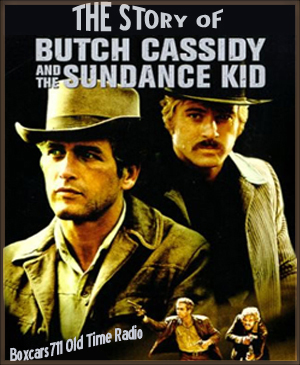
The Story Of Butch Cassidy & Sundance Kid (1979)
Story Of Butch Cassidy & Sundance Kid (1979) - Parker's first brush with the law was a petty affair. Around 1880, he made a long journey to a clothier's shop in another town only to find the shop closed. He entered the shop and removed a pair of jeans, leaving an IOU that he would pay for it upon his next visit. However, the clothier took down the details which Parker had included in the IOU and reported him. After a stubborn resistance to the resultant charges in court, he was acquitted. He continued to do ranch work until 1884 when he briefly moved to Telluride, Colorado, ostensibly to find work but possibly to deliver stolen horses to buyers there. He then returned to ranch work, in Wyoming and in Montana, before returning again to Telluride in 1887, where he then met Matthew Warner, the owner of a race horse. Together the two raced the horse at various events, dividing the profits between them. Through this line of enterprise he soon met, again in Telluride, William and Thomas McCarty, who may have been instrumental in introducing Parker to the ideas and strategies of train and bank robbery. Parker, Warner and Thomas McCarty may have been responsible for the robbery, on November 3, 1887, of a train near Grand Junction, Colorado, where the train's safe-master had assured them that nobody aboard had the safe's combination, and so, gathering together what other spoils they could, they had made off with a modest $150. Western historian Charles Kelly closed the chapter "Is Butch Cassidy Dead?" in his 1938 book, Outlaw Trail, by observing that if Parker "is still alive, as these rumors claim, it seems exceedingly strange that he has not returned to Circleville, Utah, to visit his old father, Maximillian Parker, who died on July 28, 1938, at the age of 94 years". Kelly is thought to have interviewed Parker's father, but no known transcript of such an interview exists.
The Beulah Show - The Building Permit (03-23-53) and Cutting Onions (10-09-53)
The Beulah Show is an American situation-comedy series that ran in radio on CBS from 1945 to 1954, and in television on ABC from 1950 to 1953. It is notable for being the first sitcom to star an African American. Originally portrayed by Caucasian actor Marlin Hurt, Beulah Brown first appeared in 1939 when Hurt introduced and played the character on the Hometown Incorporated radio series and in 1940 on NBC radio's Show Boat series. In 1943, Beulah moved over to That's Life and then became a supporting character on the popular Fibber McGee and Molly radio series in late 1944. In 1945, Beulah was spun off into her own radio show, The Marlin Hurt and Beulah Show, with Hurt still in the role. Beulah was employed as a housekeeper and cook for the Henderson family: father Harry, mother Alice and son Donnie. After Hurt died of a heart attack in 1946, he was replaced by another white actor, Bob Corley, and the series was retitled The Beulah Show. When black actress Hattie McDaniel took over the role on November 24, 1947, she earned $1000 a week for the first season, doubled the ratings of the original series and pleased the NAACP which was elated to see a historic first: a black woman as the star of a network radio program. McDaniel continued in the role until she became ill in 1952 and was replaced by Lillian Randolph, who was in turn replaced for the 1953-54 radio season by her sister, Amanda Randolph.TODAY'S SHOW: "The Building Permit" (03-23-53) and "Cutting Onions" (10-09-53)

Jeff Regan Investigator - The Man n The Door (08-28-48)
Jeff Regan, Investigator was one of the three detective shows Jack Webb did before Dragnet (see also Pat Novak For Hire and Johnny Modero: Pier 23). It debuted on CBS in July 1948. Webb played JEFF REGAN, a tough private eye working in a Los Angeles investigation firm run by Anthony J. Lyon. Regan introduced himself on each show "I get ten a day and expenses...they call me the Lyon's Eye." The show was fairly well-plotted, Webb's voice was great, and the supporting cast were skillful. Regan handled rough assignments from Lion, with whom he was not always on good terms. He was tough, tenacious, and had a dry sense of humor. The voice of his boss, Anthony Lion, was Wilms Herbert. The show ended in December 1948 but was resurrected in October 1949 with a new cast; Frank Graham played Regan (later Paul Dubrov was the lead) and Frank Nelson portrayed Lion. This version ran on CBS, sometimes as a West Coast regional, until August 1950. Both versions were 30 minutes, but the day and time slot changed several times. A total of 29 episodes from this series are in trading currency.THIS EPISODE:August 28, 1948. CBS network. "The Man In The Door". Sustaining. A murdered architect is seen alive and well! Jeff looks into a complicated story of murder and embezzlement. Jack Webb, Wilms Herbert, Lou Krugman, Lurene Tuttle, Betty Lou Gerson, Dave Henderson, William Conrad, E. Jack Neuman (writer), Sterling Tracy (producer), Bob Stevenson (announcer), Richard Aurandt (music). 29:36.
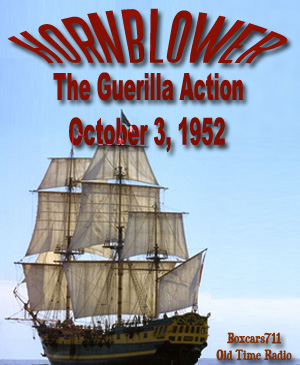
The Adventures Of Horatio Hornblower - The Guerilla Action (10-03-52)
The Adventures Of Horatio Hornblower - Broadcast 1952; Transcribed in England for the BBC; aired in U.S. on CBS, then again on ABC in 1954 and Mutual in 1957. Starring Michael Redgrave as Horatio Hornblower. a captain in the British Royal Navy during the Napoleonic era. The radio series was based on twelve Horatio Hornblower novels written by C.S. Forester. These novels were, and still are, well liked due to their realistic tone and historical accuracy in telling the tales of Naval life in the late 1700s through the mid 1800s. C.S. Forester was well known for his novels about military and naval life, including such fine titles as The African Queen, The Gun, The Barbary Pirates, and The General.

Crime Classics - The Torment Of Henrietta Robinson (09-07-53)
Crime Classics was a U. S. radio docudrama which aired over CBS from June 15, 1953 to June 30, 1954. Created, produced, and directed by radio actor/director Elliott Lewis, the program was basically a historical true crime series, examining crimes, and especially murders, from the past. It grew out of Lewis's personal interest in famous murder cases, and took a documentary-like approach to the subject, carefully recreating the facts, personages, and feel of the time period. Comparatively little dramatic license was taken with the facts and events, but the tragedy was leavened with humor, expressed largely through the narration.THIS EPISODE:September 7, 1953. CBS network. "The Torment Of Henrietta Robinson and Why She Killed". Sustaining. A lady of Troy New York in 1845, and her doll Cecily. Very insane and very homicidal. The last show of "the summer series." Ben Wright, Bernard Herrmann (composer, conductor), Betty Harford, Bob Lemond (announcer), David Friedkin (writer), Elliott Lewis (producer, director), Joseph Kearns, Lamont Johnson, Lou Merrill (host), Morton Fine (writer), Paula Winslowe, Sam Edwards, Sammie Hill. 29:54.

Case Dismissed - Installment Buying (02-27-54)
Case Dismissed - Thus with the pounding of the gavel, the fate of men and women have been decided by the judge. This is the story of our legal rights, the battle to preserve and protect them, and how easily they can be lost. The program shows us just how fragile liberty and justice can be. These stories of everyday events are still interesting, even after 50 years. Stories of criminal liability, legal wills, buying on installment, and leasing an apartment. Each story is well written, and the acting, though dated and a bit hokey by today's standards, still manages to achieve the desired effect. Not much information is available for this series, it was apparently broadcast on a limited basis, and originated on WMAQ Chicago, an NBC station. It was comprised of thirteen episodes, twelve of which are currently available, and was heard from January 30, 1954 through April 24, 1954. THIS EPISODE:February 27, 1954. NBC network, WMAQ, Chicago origination. Sustaining. Not auditioned. The program is produced in co-operation with the Chicago Bar Association. The legal problems of installment buying. Herbert Littow (director), John C. Fitzgerald (host, Dean of the Law School, Loyola University), Betty Ross (producer), Tom Evans (sound), Harold Witteberry (engineer), Robert Carmen (writer), Lee Bennett (announcer), Sondra Gair, Jack Bivens, Harry Elders, Stanley Gordon, Arthur Peterson, Charles Flynn. 28:31.
Father Knows Best - Superstitous Folk (05-25-50)
Father Knows Best, a family comedy of the 1950s, is perhaps more important for what it has come to represent than for what it actually was. In essence, the series was one of a slew of middle-class family sitcoms in which moms were moms, kids were kids, and fathers knew best. Today, many critics view it, at best, as high camp fun, and, at worst, as part of what critic David Marc once labeled the "Aryan melodramas" of the 1950s and 1960s. The brainchild of series star Robert Young, who played insurance salesman Jim Anderson, and producer Eugene B. Rodney, Father Knows Best first debuted as a radio sitcom in 1949. In the audio version the title of the show ended with a question mark, suggesting that father's role as family leader and arbiter was dubious. The partner's production company, Rodney-Young Enterprises, transplanted the series to television in 1954--without the questioning marker--where it ran until 1963, appearing at various times on each of the three networks. Young and Rodney, friends since 1935, based the series on experiences each had with wives and children; thus, to them, the show represented "reality." Indeed, careful viewing of each of the series' 203 episodes reveals that the title was actually more figurative than literal. Despite the lack of an actual question mark, father didn't always know best. Jim Anderson could not only lose his temper, but occasionally be wrong. Although wife Margaret Anderson, played by Jane Wyatt, was stuck in the drudgery of domestic servitude, she was nobody's fool, often besting her husband and son, Bud (played by Billy Gray). Daughter Betty Anderson (Elinor Donahue)--known affectionately to her father as Princess--could also take the male Andersons to task, as could the precocious Kathy (Lauren Chapin), the baby of the family.

Damon Runyon Theater - Princess O'Hara (02-20-49)
Damon Runyon Theater - Broadcast from January to December 1949, "The Damon Runyon Theatre" dramatized 52 of Runyon's short stories for radio. Damon Runyon (October 4, 1884 – December 10, 1946) was a newspaperman and writer. He was best known for his short stories celebrating the world of Broadway in New York City that grew out of the Prohibition era. He spun tales of gamblers, petty thieves, actors and gangsters; few of whom go by "square" names, preferring instead to be known as "Nathan Detroit", "Big Jule", "Harry the Horse", "Good Time Charlie", "Dave the Dude", and so on. These stories were written in a very distinctive vernacular style: a mixture of formal speech and colorful slang, almost always in present tense, and always devoid of contractions.THIS EPISODE:1948. Program #8. Mayfair syndication. "Princess O'Hara". Commercials added locally. Broadway and his pals "borrow" a champion race horse to pull a hansom cab in order to help a doll in distress. The story was previously used in an audition recording. Damon Runyon (author), John Brown, Richard Sanville (director), Russell Hughes (adaptor), Vern Carstensen (production supervisor). 26:35.
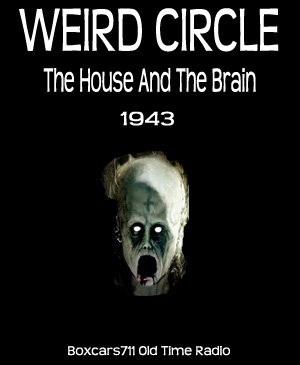
The Weird Circle - The House And The Brain (1943)
THE WEIRD CIRCLE was a syndicated series that was heard on Mutual stations November, 1943 through October, 1947 and very briefly in September/October of 1947 on ABC. The show presented 30 minute tales of horror, frequently inspired by classic horror or ghost stories, frequently done by French authors. It opened with the sound of the surf and the chant-like opening, "In this cave by the restless sea, we are met to call from out of past, stories strange and weird. Bell keeper, toll the bell, so that all may know that we are gathered again in the Weird Circle".THIS EPISODE:Program #2. NBC syndication. "The House and The Brain". Commercials added locally. An evil spirit kept alive 400 years haunts a house and murders the old woman living there. Edward Bulwer-Lytton (author). 25 minutes.

Campbell Playhouse - Counsellor At Law (01-06-39)
The Campbell Playhouse was a sponsored continuation of the Mercury Theater on the Air, a direct result of the instant publicity from the War of the Worlds panic. The switch occurred on December 9, 1938. In spite of using the same creative staff, the show had a different flavor under sponsorship, partially attributed to a guest star policy in place, which relegated the rest of the Mercury Players to supporting cast for Orson Welles and the Hollywood guest of the week. There was a growing schism between Welles, still reaping the rewards of his Halloween night notoriety, and his collaborator John Houseman, still in the producer's chair but feeling more like an employee than a partner. The writer, as during the unsponsored run, was Howard Koch.THIS EPISODE:January 6, 1939. CBS network. "Counselor At Law". Sponsored by: Campbell's Soup. A good story about a powerful attorney with a secret past. Announced as the first radio performance by Gertrude Berg in a program other than, "The Goldbergs." Attorney Sam Liebowitz also appears. Orson Welles, Gertrude Berg, Aline MacMahon, Elmer Rice (author), Sam Liebowitz, Joseph Cotten. 58:26.
In The Name Of The Law - Nothing Ever Happens In Chinatown (07-26-36)
In the Name of the Law was a True Crime radio show from 1936. It says "In the name of the law, we bring you another of the thrilling stories in this exciting series, taken from actual police case files. "In the name of the Law, we bring you another of the thrilling stories in this exciting series, taken from actual police case files."Mrs Mary James found dead in her pool 8-05-35. Her husband Bob is suspected. He had been married several times before and a previous wife was also found dead under suspicious circumstances. Police investigation led to the Killer's arrest. Was it Bob James? THIS EPISODE:Nothing Ever Happens in Chinatown (7-26-36) - Syndicated. Commercials added locally. In Chicago's Chinatown, merchant Wong Fu has been shot to death. A detective, who speaks Chinese, sees that truth and justice will triumph. . 25:12.
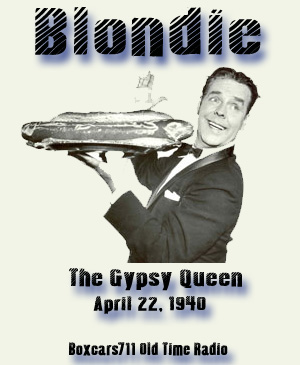
Blondie - The Gypsy Queen (04-22-40)
Blondie was a radio situation comedy adapted from the long-run Blondie comic strip by Chic Young. The radio program had a long run on several networks from 1939 to 1950. After Penny Singleton was cast in the title role of the feature film Blondie (1938), co-starring with Arthur Lake as Dagwood, she and Lake repeated their roles December 20, 1938, on The Bob Hope Show. The appearance with Hope led to their own show, beginning July 3, 1939, on CBS as a summer replacement for The Eddie Cantor Show. However, Cantor did not return in the fall, so the sponsor, Camel Cigarettes chose to keep Blondie on the air Mondays at 7:30pm. Camel remained the sponsor through the early WWII years until June 26, 1944. In 1944, Blondie was on the Blue Network, sponsored by Super Suds, airing Fridays at 7pm from July 21 to September 1. The final three weeks of that run overlapped with Blondie's return to CBS on Sundays at 8pm from August 13, 1944, to September 26, 1948, still sponsored by Super Suds. Beginning in mid-1945, the 30-minute program was heard Mondays at 7:30pm. Super Suds continued as the sponsor when the show moved to NBC on Wednesdays at 8pm from October 6, 1948, to June 29, 1949. Ann Rutherford took over the radio role of Blondie in 1949, and at times, Patricia Van Cleve and Alice White were also heard as Blondie. In its final season, the series was on ABC from October 6, 1949, to July 6, 1950, first airing Thursdays at 8pm and then (from May) 8:30pm. The radio show ended the same year as the Blondie film series (1938-50)THIS EPISODE:April 22, 1940. CBS network. Sponsored by: Camels. Not auditioned. Dagwood has bought a trailer and names it, "The Gypsy Queen." Arthur Lake, Penny Singleton, Bill Goodwin (announcer), Leone LeDoux, Hanley Stafford, Ashmead Scott (writer, director), Billy Artz (conductor). 29:32.

Gangbusters - The Case Of The Golf Course Murder (08-07-48)
Gangbusters was an American dramatic radio program heralded as "the only national program that brings you authentic police case histories." It premiered as G-Men, sponsored by Chevrolet, on July 20, 1935. After the title was changed to Gang Busters January 15, 1936, the show had a 21-year run through November 20, 1957. Beginning with a barrage of loud sound effects — guns firing and tires squealing — this intrusive introduction led to the popular catch phrase "came on like Gang Busters."The series dramatized FBI cases, which producer-director Phillips H. Lord arranged in close association with Bureau director J. Edgar Hoover. Hoover insisted that only closed cases would be used. The initial series was on NBC Radio from July 20 - October 12, 1935. It then aired on CBS from January 15, 1936 to June 15, 1940, sponsored by Colgate-Palmolive and Cue magazine. From October 11, 1940 to December 25, 1948, it was heard on the Blue Network, with various sponsors that included Sloan's Liniment, Waterman pens and Tide. Returning to CBS on January 8, 1949, it ran until June 25, 1955, sponsored by Grape-Nuts and Wrigley's chewing gum. The final series was on the Mutual Broadcasting System from October 5, 1955 to November 27, 1957. It was once narrated by Norman Schwarzkopf, Sr., former head of the New Jersey State Police. The radio series was adapted for DC Comics, Big Little Books and a 1942 movie serial. The 1952 Gang Busters TV series was reedited into two feature films, Gang Busters (1954) and Guns Don't Argue (1957).THIS EPISODE:August 7, 1948. Program #541. ABC network origination, syndicated, WRVR-FM, New York rebroadcast. "The Case Of The Golf Course Murder". Sponsored by: Arrow Audio. The head of a car-theft ring branches out into murder. WRVR rebroadcast date: April 11, 1974. Anne Burr, Frank Readick. 1/2 hour.

The Blue Beetle - Sabotage Incorporated (Parts 1 and 2) 07-24-40
The Blue Beetle - The standard opening for all episodes is: (three whistles) "The Blue Beetle! (organ music up) Leaping down upon the underworld to smash gangland, comes the friend of the unfortunate, enemy of criminals, a mysterious all-powerful character. A problem to the police, but a crusader for law; in reality Dan Garrett, a rookie patrolman. Loved by everyone, but suspected by none of being "The Blue Beetle." As "The Blue Beetle," he hides behind a strange mask and a suit of impenetrable blue chain armor, flexible as silk but stronger than steel!" Giving The Green Hornet a run for his money, Dan Garrett's father was killed by "a gangster's bullet." Dr. Franz, an apothecary on a side street, is the only one who knows the secret identity of "The Blue Beetle." Syndicated in 1938, "The Blue Beetle" also appeared in "Mystery Men" and "Blue Beetle" magazines. The show aired twice a week. Frank Lovejoy played the lead for the first ten episodes, the Police Commissioner sounds like Paul Ford. To make the picture complete, "The Beetle" also uses a magic ray and leaves little blue beetles behind! There is some confusion about the dates for this series. The program was heard twice a week (Wednesday and Friday according to one source). The dates may be recording session dates from the discs, or they may be the dates of first broadcast on a network or station. In fact, the dates may be incorrect and the series was originally heard in 1938.

The Diary Of Fate - John Haynes (07-13-48)
Diary of Fate is a mystery and horror program where "Fate" narrates and always wins by the end of the story. These are great suspense filled stories about average people who are subject to the mysteries of their 'Fate'. In This episode, July 13, 1948. Program #31. Finley syndication. "John Haines". Commercials added locally. Book 82, page 509. Not auditioned. A man shoots his brother-in-law to get $50,000. Beware the stray cat. The date is subject to correction. Herb Lytton, Lurene Tuttle, Benny Rubin, Tyler McVey, Michael Stewart, Lou Lane, Ray Ehrlenborn, Hal Sawyer, Larry Finley (producer). 26:20.

Academy Award Theater - A Star Is Born (06-29-46)
Academy Award Theater - Stars and movies with Oscars were the idea - in most cases, the movie stars recreated their academy award roles for the show, or in other cases, fine actors played the parts and gave it a different character. Both ways make for great radio drama and first class Hollywood motion picture star entertainment. The Lux Radio Theater had been doing this kind of radio show in the grandest manner for many years, but sponsor Squibb had the hubris and deep pockets to take on the competition by doing Academy Award Theater right after the Second World War. The year 1946 was pre-television, and so movies were still the major American visual art form, with radio the other popular network entertainment. In this final pre-TV time, Academy Award Theater was thought of as a premier radio production, a wow show, much like CinemaScope was to be in the 1950's when Hollywood felt the box office blow of early TV.All text on OTRCAT.com are ©2006 OTRCAT INC - All Rights Reserved. Reproduction is prohibited.THIS EPISODE:June 29, 1946. CBS network. "A Star Is Born". Sponsored by: Squibb Drugs. A Star Is Born (1937) is a romantic drama film produced by David O. Selznick and directed by William A. Wellman, with a script by Wellman, Robert Carson, Dorothy Parker and Alan Campbell. It stars Janet Gaynor as an aspiring actress who travels to Hollywood to become a movie star. Other members of the cast include Fredric March, Adolphe Menjou, May Robson, Andy Devine and Lionel Stander. Vicki Lester, played by Janet Gaynor, meets actor Norman Maine (Fredric March) and they marry but soon after his career develops difficulties while hers flourishes.

Abbott & Costello - Cattle Ranch Sketch (4-25-46)
Abbott and Costello - William (Bud) Abbott and Lou Costello (born Louis Francis Cristillo) were an American comedy duo whose work in radio, film and television made them one of the most popular teams in the history of comedy. Thanks to the endurance of their most popular and influential routine, "Who's on First?"---whose rapid-fire word play and comprehension confusion set the preponderant framework for most of their best-known routines---the team are also the only comedians known to have been inducted into the Baseball Hall of Fame. Bud Abbott was born in Asbury Park, NJ, October 2, 1897 and died April 24, 1974 in Woodland Hills, California. Lou Costello was born in Paterson, NJ, March 6, 1906 and died March 3, 1959 in East Los Angeles, California. After working as Allen's summer replacement, Abbott and Costello joined Edgar Bergen and Charlie McCarthy on The Chase and Sanborn Hour in 1941, while two of their films (Buck Privates and Hold That Ghost) were adapted for Lux Radio Theater. They launched their own weekly show October 8, 1942, sponsored by Camel cigarettes. The Abbott and Costello Show mixed comedy with musical interludes (usually, by singers such as Connie Haines, Marilyn Maxwell, the Delta Rhythm Boys, Skinnay Ennis, and the Les Baxter Singers). Regulars and semi-regulars on the show included Artie Auerbrook, Elvia Allman, Iris Adrian, Mel Blanc, Wally Brown, Sharon Douglas, Verna Felton, Sidney Fields, Frank Nelson, Martha Wentworth, and Benay Venuta. Ken Niles was the show's longtime announcer, doubling as an exasperated foil to Abbott & Costello's mishaps (and often fuming in character as Costello insulted his on-air wife routinely); he was succeeded by Michael Roy, with annoncing chores also handled over the years by Frank Bingman and Jim Doyle. The show went through several orchestras during its radio life, including those of Ennis, Charles Hoff, Matty Matlock, Jack Meaking, Will Osborne, Freddie Rich, Leith Stevens, and Peter van Steeden. The show's writers included Howard Harris, Hal Fimberg, Parke Levy, Don Prindle, Ed Cherokee, Len Stern, Martin Ragaway, Paul Conlan, and Ed Forman, as well as producer Martin Gosch. Sound effects were handled mostly by Floyd Caton. Abbott and Costello moved the show to ABC (the former NBC Blue Network) five years after they premiered on NBC. During their ABC period they also hosted a 30-minute children's radio program(The Abbott and Costello Children's Show), which aired Saturday mornings with vocalist Anna Mae Slaughter and announcer Johnny McGovern.

Broadway Is My Beat - Sherman Gates Case (12-03-49)
Broadway Is My Beat, a radio crime drama, ran on CBS from February 27, 1949 to August 1, 1954. With music by Robert Stringer, the show originated from New York during its first three months on the air, with Anthony Ross portraying Times Square Detective Danny Clover. John Dietz directed for producer Lester Gottlieb. Beginning with the July 7, 1949 episode, the series was broadcast from Hollywood with producer Elliott Lewis directing a new cast in scripts by Morton Fine and David Friedkin. The opening theme of "I'll Take Manhattan" introduced Detective Danny Clover (now played by Larry Thor), a hardened New York City cop who worked homicide "from Times Square to Columbus Circle -- the gaudiest, the most violent, the lonesomest mile in the world."THIS EPISODE:Sherman Gates Case - December 3, 1949. CBS network origination, AFRTS rebroadcast. Sherman Gates is found poisoned in the loge of a movie theater, which leads to a murdered photographer. A network recording of this broadcast Elliott Lewis (producer, director), Alexander Courage (composer), Larry Thor, Charles Calvert, Paul Dubov, Junius Matthews, Mary Jane Croft, Elliott Lewis (producer, director), Morton Fine (writer), David Friedkin (writer), Alexander Courage (composer), Wilbur Hatch (conductor), Herbert Rawlinson, Joyce McCluskey, Joe Forte. 30:27.
The Challenge Of The Yukon - 2-Episodes (1943) (1944)
Challenge of the Yukon was a long-running radio series that began on Detroit's station WXYZ (as had The Lone Ranger and The Green Hornet). The series was first heard on February 3, 1938. Under the title Sergeant Preston of the Yukon, it later transferred to television. The program was an adventure series about Sergeant William Preston of the Northwest Mounted Police and his lead sled dog, Yukon King, as they fought evildoers in the Northern wilderness during the Gold Rush of the 1890s. Preston, according to radio historian Jim Harmon, first joined the Mounties to capture his father's killer, and when he was successful he was promoted to Sergeant. Preston worked under the command of Inspector Conrad, and in the early years was often assisted by a French-Canadian guide named Pierre. Preston's staunchest ally, who was arguably the true star of the show and indeed often did more work than he did, was the brave Alaskan husky, Yukon King. Typical plots involved the pair helping injured trappers, tracking down smugglers, or saving cabin dwellers from wolverines. Sgt. Preston's faithful steed was Rex, used primarily in the summer months, but generally Yukon King and his dog team were the key mode of transportation (as signalled by Preston's cry of "On, King! On, you huskies!."TODAY'S SHOW: "Return To Crime" (11-20-43) AND "Revenge In The Yukon" (01-06-44)November 18, 1943. Program #303. WXYZ, Detroit origination, The Michigan Radio Network. "Return To The Crime". Sustaining. Will Conover is shot for his gold dust by Cass Fenton. King's nose smells out the killer. Possible recording date: October 1, 1943. Not auditioned. Jay Michael, Bill Morgan (announcer), Betty Joyce (writer), Fran Striker (writer). 14:11.January 6, 1944. Program #310. WXYZ, Detroit origination, The Michigan Radio Network. "Revenge In The Yukon". Sustaining. At the Black Crow Cafe, Les Peterson meets Lucky Wally. The Doc would like to meet him too...to kill him! Possible recording date: December 28, 1943. Not auditioned. Jay Michael, Bob Hite (announcer), Betty Joyce (writer), Fran Striker (writer). 14:30.

You Bet Your Life - Secret Word Tree (05-24-50)
You Bet Your Life - Groucho Marx matches wits with the American public in four episodes of this classic game show. Starting on the radio in 1947, You Bet Your Life made its television debut in 1950 and aired for 11 years with Groucho as host and emcee. Sponsored rather conspicuously by the Dodge DeSoto car manufacturers, the show featured two contestants working as a team to answer questions for cash prizes. Another mainstay of these question and answer segments was the paper mache duck that would descend from the ceiling with one hundred dollars in tow whenever a player uttered the "secret word." The quiz show aspect of "You Bet Your Life" was always secondary, to the clever back-and-forth between host and contestant, which found Groucho at his funniest. It's in these interview segments that "You Bet Your Life" truly makes its mark as one of early television's greatest programs. Directed by: Robert Dwan.TODAY'S SHOW - Secret Word Today Is "TREE"

The Great Gildersleeve - College Chum Visits (05-17-42)
The Great Gildersleeve - (1941-1957) was the arguable founding father of the spin-off program, as well as one of the first true situation comedies (as opposed to sketch programs) in broadcast history. Hooked around a character who had been a staple on the classic radio hit Fibber McGee and Molly, The Great Gildersleeve enjoyed its greatest period in the 1940s, when Harold Peary graduated the character from the earlier show into the sitcom and in a quartet of likeable feature films at the height of the show's popularity.THIS EPISIODE:May 17, 1942. NBC network. Sponsored by: Kraft Foods. Gildersleeve's old college chum comes to visit and starts selling shares in a magnesium mine! Harold Peary, Lurene Tuttle, Lillian Randolph, Walter Tetley, William Randolph (composer, conductor), Jim Bannon, Leonard L. Levinson (writer). 29:28.
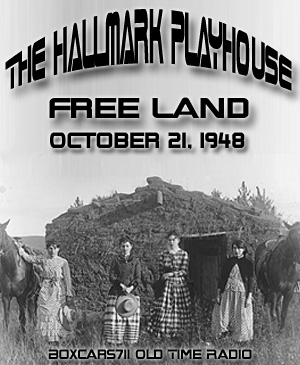
Hallmark Playhouse - Free Land (11-25-48)
THE HALLMARK PLAYHOUSE was heard over CBS stations Thursday evenings. This drama anthology of 30-minute shows was sponsored by, of course, Hallmark Greeting Cards. It was preceded by the RADIO READER'S DIGEST, which ran from September 13, 1942 thorugh June 3, 1948. Hallmark sponsored the RADIO READER'S DIGEST from January 13, 1946 to it's end. On Feb. 8, 1953, the series name and format was changed. It was now called THE HALLMARK HALL OF FAME and presented biographal sketches of famous persons, past and present. The new format was used until the end of the 1955 season. The exception to the new format was the broadcast each Christmas season of "A Christmas Carol". Like other dramatic series of this time, this one made use of major screen actors in the productions. James Hilton, author of "Random Harvest", "Lost Horizon" and "Goodbye, Mr. Chips" plus others, served as host and Narrator. Dee Engelbach produced and directed the shows. Jean Holloway was the writer. Sound Effects were by Harry Essman and Gene Twombly. Musical conductor was Lyn Murray. The show's theme was "Dream of Olwne" by Charles Williams.THIS EPISODE:November 25, 1948. CBS network. "Free Land". Sponsored by: Hallmark Cards. A good story about the tribulations of a pioneering couple in the Dakota Territory. Martha Scott, Jack Kirkwood. 1/2 hour.
CBS Radio Mystery Theater - Witches Almanac (05-26-75)
CBS Radio Mystery Theater - As you walk through the creaking door you enter into another world, the world of imagination. This world is inside you, a part of you, and you take this journey alone. Each person hears and then sees with his or her mind's eye the events portrayed within these dramas. All of us interprets what they hear differently. The images we see is unique to ourselves. A voice becomes a person, living, breathing they come alive. They take on a physical form and characteristics that we assign to them. The wonders of your own mind are boundless. Scary thoughts? Perhaps, but what powers they bring us! To exercise one's imagination is to exercise one's soul. These dramas provide us with an escape from reality. To adventures beyond our own lives. Enjoy them. And pleasant dreams!THIS EPISODE:May 26, 1975. Program #280. CBS net. "The Witch's Almanac". Sponsored by: Buick. E. G. Marshall (host), Ian Martin (writer), Virginia Payne, Robert Dryden, Jada Rowland, Marshall Borden, Dan Ocko. 52 minutes.

The Milton Berle Show - Salute To Gambling (02-03-48)
The Milton Berle Show - In 1934-36, Berle was heard regularly on The Rudy Vallee Hour, and he got much publicity as a regular on The Gillette Original Community Sing, a Sunday night comedy-variety program broadcast on CBS from September 6, 1936 to August 29, 1937. In 1939, he was the host of Stop Me If You've Heard This One with panelists spontaneously finishing jokes sent in by listeners. Three Ring Time, a comedy-variety show sponsored by Ballantine Ale was followed by a 1943 program sponsored by Campbell's Soups. The audience participation show Let Yourself Go (1944-45) could best be described as slapstick radio with studio audience members acting out long suppressed urges (often directed at host Berle). Kiss and Make Up, on CBS in 1946, featured the problems of contestants decided by a jury from the studio audience with Berle as the Judge. He also made guest appearances on many comedy-variety radio programs during the 1930s and 1940s. Scripted by Hal Block and Martin Ragaway, The Milton Berle Show brought Berle together with Arnold Stang, later a familiar face as Berle's TV sidekick. Others in the cast were Pert Kelton, Mary Schipp, Jack Albertson, Arthur Q. Bryan, Ed Begley, vocalist Dick Forney and announcer Frank Gallop.THIS EPISODE:February 3, 1948. NBC network. Sponsored by: Philip Morris. A salute to gambling. Miltie has a friendly poker game with the boys. Frank Gallop (announcer), Milton Berle, Ray Bloch and His Orchestra. 1/2 hour.

Amos & Andy - Kingfish Thinks Sapphire Wants To Kill Him (05-11-45)
Amos 'n' Andy was a situation comedy popular in the United States from the 1920s through the 1950s. The show began as one of the first radio comedy serials, written and voiced by Freeman Gosden and Charles Correll and originating from station WMAQ in Chicago, Illinois. After the series was first broadcast in 1928, it grew in popularity and became a huge influence on the radio serials that followed. Amos 'n' Andy creators Gosden and Correll were white actors familiar with minstrel traditions. They met in Durham, North Carolina in 1920, and by the fall of 1925, they were performing nightly song-and-patter routines on the Chicago Tribune's station WGN. Since the Tribune syndicated Sidney Smith's popular comic strip The Gumps, which had successfully introduced the concept of daily continuity, WGN executive Ben McCanna thought the notion of a serialized drama could also work on radio. He suggested to Gosden and Correll that they adapt The Gumps to radio. They instead proposed a series about "a couple of colored characters" and borrowed certain elements of The Gumps. Their new series, Sam 'n' Henry, began January 12, 1926, fascinating radio listeners throughout the Midwest. That series became popular enough that in late 1927 Gosden and Correll requested that it be distributed to other stations on phonograph records in a "chainless chain" concept that would have been the first use of radio syndication as we know it today. When WGN rejected the idea, Gosden and Correll quit the show and the station that December. Contractually, their characters belonged to WGN, so when Gosden and Correll left WGN, they performed in personal appearances but could not use the character names from the radio show.THIS EPISODE:May 11, 1945. NBC network. Commercials deleted. The Kingfish is convinced that Sapphire plans to kill him for the insurance money. Freeman Gosden, Charles Correll, Ernestine Wade, Lou Lubin, Harlow Wilcox (announcer). 23:05.
Arch Oboler's Plays - The Ivory Tower (7-08-39)
Arch Oboler's Plays was a radio drama series written, produced and directed by Arch Oboler. Minus a sponsor, it ran for one year, airing Saturday evenings on NBC from March 25, 1939 to March 23, 1940 and revived five years later on Mutual for a sustaining summer run from April 5, 1945 to October 11, 1945. Leading film actors were heard on this series, including Gloria Blondell, Eddie Cantor, James Cagney, Ronald Colman, Joan Crawford, Greer Garson, Edmund Gwenn, Van Heflin, Katharine Hepburn, Elsa Lanchester, Peter Lorre, Frank Lovejoy, Raymond Massey, Burgess Meredith, Paul Muni, Alla Nazimova, Edmond O'Brien, Geraldine Page, Gale Sondergaard, Franchot Tone and George Zucco.
Strike It Rich - August 21, 1951
Strike It Rich - The show made it's debut on CBS radio in 1947. Strike it rich was on CBS's primetime schedule July 4, 1951 through January 12, 1955. There were two attempts to revive the show, with Bert Parks as host in 1973 and Tom Kelly as host in 1978. Neither revival was successful. A syndicated game show of the same name with host Joe Garagiola was aired 1986-1987, but it had a different format. Known as "The quiz show with a heart" and the contestants who appeared on the show were people in need of money or down on their luck. A player was given $30 and bet part of his or her bank on the ability to answer four general knowledge questions. If unable to answer the questions correctly, the contestant could turn to the "heart line" where viewers would call in and donate money or merchandise. When needy families desparate to become contestants began arriving in New York on one-way tickets, the city's Welfare Department labeled the game show "a national disgrace."
Richard Diamond Private Detective - Red Rose (03-02-51)
Richard Diamond, Private Detective was a radio show starring Dick Powell which aired from 1949 to 1953, first on NBC, then ABC and finally on CBS. The title character was a rather light-hearted detective who often ended the episodes singing to his girlfriend, Helen. The television series was produced by Powell's company, Four Star Television, and that series ran for 3 years from 1957 to 1960. On TV, David Janssen played the hard boiled private eye and his secretary renamed "Sam", was only ever shown on camera from the waist down, most assurardidly to display her beautiful legs. It was later leared that the legs belonged to Mary Tyler Moore. Original music by Frank DeVol and pete rugolo and later by richard shores. Good scripts, a solid cast and Powell's exceptional talent made a good time 30 minute program that was quite popular during that Golden Age of Radio. So Let's sit back now, relax and enjoy this truly otr radio classic.,…, Dick powell as Richard Diamond.., Private Detective.THIS EPISODE:March 2, 1951. ABC network. Sponsored by: Camels, Prince Albert tobacco. Diamond is hired by a man who has hired a killer to murder him, then changes his mind. He hires Diamond to protect him from the assassin, who wears a red rose. Listen for Diamond interviewing a dance instructor named, "Belle de Canto!" Arthur Q. Bryan, Dick Powell, Frank Worth (music), Helen Mack (director), Blake Edwards (writer), Virginia Gregg, Wilms Herbert. 29:43.
Life With Luigi - Luigi Needs A Driver's License (02-27-49)
Life with Luigi was a radio comedy-drama series which began September 21, 1948 on CBS. The story concerned Italian immigrant Luigi Basco, and his experiences as an immigrant in Chicago. Many of the shows take place at the US citizenship classes that Luigi attends with other immigrants from different countries, as well as trying to fend off the repeated advances of the morbidly-obese daughter of his landlord/sponsor. Luigi was played by J. Carrol Naish, an Irish-American. Naish continued in the role on the short-lived television version in 1952, and was later replaced by Vito Scotti. With a working title of The Little Immigrant, Life with Luigi was created by Cy Howard, who earlier had created the hit radio comedy, My Friend Irma. The show was often seen as the Italian counterpart to the radio show The Goldbergs, which chronicled the experience of Jewish immigrants in New York.THIS EPISODE:CBS network. Sustaining. Not auditioned. Luigi wants a driver's license. J. Carrol Naish, Alan Reed, Cy Howard (creator, producer), Mac Benoff (writer, director), Lou Derman (writer), Hans Conried, Mary Shipp, Joe Forte, Ken Peters, Jody Gilbert, Lyn Murray (music director). 29:14.

Barry Craig Confidential Investigator - The Moving Target (2-16-55)
Barry Craig, Confidential Investigator is one of the few detective radio series that had separate versions of it broadcast from both coasts. Even the spelling changed over the years. It was first "Barry Crane" and then "Barrie Craig". NBC produced it in New York from 1951 to 1954 and then moved it to Hollywood where it aired from 1954 to 1955. It attracted only occasional sponsors so it was usually a sustainer.William Gargan, who also played the better known television (and radio) detective Martin Kane, was the voice of New York eye BARRY CRAIG while Ralph Bell portrayed his associate, Lt. Travis Rogers. Craig's office was on Madison Avenue and his adventures were fairly standard PI fare. He worked alone, solved cases efficiently, and feared no man. As the promos went, he was "your man when you can't go to the cops. Confidentiality a speciality."Like Sam Spade, Craig narrated his stories, in addition to being the leading character in this 30 minute show. Nearly sixty episodes are in trading circulation today.THIS EPISODE:February 16, 1955. NBC network. "The Moving Target". Sustaining. Not auditioned. A high-flying globe trotter finds that sheer elbow room is no insurance for survival when a felonious blonde makes a passionate effort to bring him down to earth...realy deep down, that is." William Gargan, John Roeburt (writer), Howard McNear, Andrew C. Love (director), Lynn Allen, Jerry Hausner. 24:55.