
Boxcars711 Old Time Radio
2,173 episodes — Page 14 of 44
The Lord Of The Witchdoctors
Suspense. October 27, 1942. "The Lord Of The Witchdoctors". English diplomats outwit the Germans in the eyes of the dumb Caliph of Zanzibar. Nicholas Joy, Joseph Kearns (performer, announcer), John Dickson Carr (writer), William Spier (producer), John Dietz (director), Berry Kroeger (announcer), Bernard Herrmann (composer, conductor).oldtimeradiodvd,com

One Hundred In The Dark
One Hundred In the Dark, 9/30/40 Suspense is one of the classics of old time radio. Some fans have special favorites in the thriller/chiller/macabre genre, but all will agree that Suspense did it best. The guiding light of this show was William Spier, who developed the formula into a human drama that attracted the finest of Hollywood's elite as well as the cream of radio's great actors. oldtimeradiodvd.com
The Devil in the Summer House,
The Devil in the Summer House, 11/3/43 Suspense is one of the classics of old time radio. Some fans have special favorites in the thriller/chiller/macabre genre, but all will agree that Suspense did it best. The guiding light of this show was William Spier, who developed the formula into a human drama that attracted the finest of Hollywood's elite as well as the cream of radio's great actors. oldtimeradiodvd.com
The Kettler Method
Suspense. September 16, 1942. "The Kettler Method". A chilling, exciting story about inmates taking over an asylum for the insane and "operating" on a visitor to cure her headache. Roger De Koven, John Gibson, Martha Falkner, Guy Repp, Gloria Stuart, Peter Barry (writer), Berry Kroeger (announcer), Bernard Herrmann (composer, conductor), William Spier (producer), John Dietz (director), Winfield Honie, Ralph Smiley. oldtimeradiodvd.com

I Walk Alone
I Was A Communist For The FBI. March 30, 1952. "I Walk Alone". The Party tries to trap Cvetic through his mother. Dana Andrews, Truman Bradley (announcer), Henry Hayward (director), David Rose (music). oldtimeradiodvd.com
Stoney Carter
Crime and Peter Chambers. June 15, 1954. Jack March is suspected of the murder of the Contessa La Fresso. She's been knifed to death. Keep your nose on those flowers! John Daly introduces President Eisenhower during a public service announcement for aid to Korea. Dane Clark, Henry Kane (creator, writer), Fred Collins (announcer), Fred Weihe (director), William Zuckert, Ralph Bell, Anita Anton, Donald Buka, John Daly, Dwight Eisenhower. oldtimeradiodvd.com

The Glass Coffin
Nick Carter. September 27, 1943. . "The Glass Coffin," or "The Mystery Of The Voodoo Curse". . Murder and mayhem in an old movie studio...a "reel" mystery! Humphrey Davis appears out of character after the story to appeal for the purchase of war bonds during the Third War Loan. Lon Clark, Helen Choate, Jock MacGregor (director), Lew White (composer, conductor), Humphrey Davis, Nancy Webb (writer), Gene Webb (writer) oldtimeradiodvd.com
Timber
The Man Called X. November 16, 1947. A large quantity of a rare drug named "streptomycin" has disappeared en route to Greece. The trail leads to the Greek island of Xenophon. Herbert Marshall, Leon Belasco, Cathy Lewis, Alan Reed, Jack Johnstone (director), Sidney Marshall (writer), Wendell Niles (announcer), Johnny Green (composer), Al Sendry (conductor). oldtimeradiodvd.com

Aunt Lilly Needs A Date
A Date With Judy. August 11, 1942. . Aunt Lily is coming for a visit, so Judy tries to get a date for her. The program ends with a dramatized plea to buy war bonds. Aleen Leslie (creator, writer), Debbie Ellis, Stanley Farrar, Bea Benaderet. oldtimeradiodvd.com

21st Precinct The Cure 2-24-45
21st Precinct The Cure 2-24-45 oldtimeradiodvd.com Final Sale after Dec 31,2012 no longer available
Master 10 DVD Collection of Old Time Radio
Master 10 DVD Collection of Old Time Radio available at oldtimeradiodvd.com $46.49 Unbelievable pricing and collection.

Amos Andy - Income Tax Problems 3-02-45
Amos Andy - Income Tax Problems 3-02-45 oldtimeradiodvd.com Final Sale after Dec 31,2012 no longer available

Adventures By Maisie - Clothes Make The Woman
Adventures By Maisie - Clothes Make The Woman oldtimeradiodvd.com Final Sale after Dec 31,2012 no longer available

Master 10 DVD Collection of Old Time Radio
Master 10 DVD Collection of Old Time Radio available at oldtimeradiodvd.com $46.49 Unbelievable pricing and collection.

Master 10 DVD Collection of Old Time Radio
Master 10 DVD Collection of Old Time Radio available at oldtimeradiodvd.com $46.49 Unbelievable pricing and collection.

Yours Truly Johnny Dollar - Grave Diggers Spade 2-17-50
Yours Truly Johnny Dollar - Grave Diggers Spade 2-17-50 oldtimeradiodvd.com Final Sale after Dec 31,2012 no longer available

Abbott Costello - Cattle Ranch Sketch 4-25-46
Abbott Costello - Cattle Ranch Sketch 4-25-46 oldtimeradiodvd.com Final Sale after Dec 31,2012 no longer available
Zero Hour - Desperate Witness 12-14-73 5 of 5
Zero Hour - Desperate Witness 12-14-73 5 of 5 oldtimeradiodvd.com Final Sale after Dec 31,2012 no longer available

The Fat Man
The Fat Man character was Brad Runyan, played by Jack Scott Smart who gave an excellent lighthearted performance. The series made good use of author Dashiel Hammett's name,although the author had little to do with the radio series. The name The Fat Man was the title of a chapter in the book A Maltese Falcon.oldtimeradiodvd.com

Zero Hour - Desperate Witness 12-13-73 4 of 5
Zero Hour - Desperate Witness 12-13-73 4 of 5 oldtimeradiodvd.com Final Sale after Dec 31,2012 no longer available

Zero Hour - Desperate Witness 12-12-73 3 of 5
Zero Hour - Desperate Witness 12-12-73 3 of 5 oldtimeradiodvd.com Final Sale after Dec 31,2012 no longer available

Zero Hour - Desperate Witness 12-11-73 2 of 5
Zero Hour - Desperate Witness 12-11-73 2 of 5 oldtimeradiodvd.com Final Sale after Dec 31,2012 no longer available
Zero Hour - Desperate Witness 12-10-73 1 of 5
Zero Hour - Desperate Witness 12-10-73 1 of 5 oldtimeradiodvd.com Final Sale after Dec 31,2012 no longer available

Amos and Andy 1-21-47
Amos and Andy 1-21-47 oldtimeradiodvd.com Final Sale after Dec 31,2012 no longer available

21st Precinct - The_Bartender 7-21-53
21st Precinct - The_Bartender 7-21-53 oldtimeradiodvd.com Final Sale after Dec 31,2012 no longer available
Oldtimeradiodvd.com Final 10 DVD Master Collection Sale
Oldtimeradiodvd.com Final 10 DVD Master Collection Sale Professionally Packaged,Hugh Collection of Shows from 10 Genera, at the lowest pricing on the Internet. Go To oldtimeradiodvd.com for details.
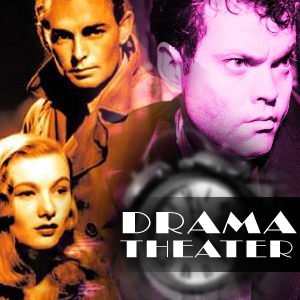
Damon Runyon Theater-Princess OHara
Damon Runyon Theater-Princess OHara oldtimeradiodvd.com

The Adventures of Frank Merriwell - The Front Page Story (11-13-48)
The Adventures of Frank Merriwell first ran on NBC radio from March 26 to June 22, 1934 as a 15-minute serial airing three times a week at 5:30pm. Sponsored by Dr. West's Toothpaste, this program starred Donald Briggs in the title role. Harlow Wilcox was the announcer. After a 12-year gap, the series returned October 5, 1946 as a 30-minute NBC Saturday morning show, continuing until June 4, 1949. Lawson Zerbe starred as Merriwell, Jean Gillespie and Elaine Rostas as Inza Burrage, Harold Studer as Bart Hodge and Patricia Hosley as Elsie Belwood. The announcer was Harlow Wilcox, and the Paul Taubman Orchestra supplied the background music. There are at least three generations of Merriwells: Frank, his half-brother Dick, and Frank's son, Frank Jr. There is a marked difference between Frank and Dick. Frank usually handled challenges on his own. Dick has mysterious friends and skills that help him, especially an old Indian friend without whom the stories would not have been quite as interesting.THIS EPISODE:November 13, 1948. NBC network. "The Front Page Story". Sustaining. An enterprising reporter digs up a scandal about one of the star players on the Yale football squad. Charles Webster, Elaine Rost, Hal Studer, James McCallion, Kermit Murdock, Lawson Zerbe, Paul Taubman (music), Richard Keith, Tex Antoine, William Griffis, Burt L. Standish (creator). 1/2 hour.
The Amos 'n' Andy Show - Radio And TV Delivery Job (04-04-54)
Amos 'n' Andy was a situation comedy popular in the United States from the 1920s through the 1950s. The show began as one of the first radio comedy serials, written and voiced by Freeman Gosden and Charles Correll and originating from station WMAQ in Chicago, Illinois. After the series was first broadcast in 1928, it grew in popularity and became a huge influence on the radio serials that followed. Amos 'n' Andy creators Gosden and Correll were white actors familiar with minstrel traditions. They met in Durham, North Carolina in 1920, and by the fall of 1925, they were performing nightly song-and-patter routines on the Chicago Tribune's station WGN. Since the Tribune syndicated Sidney Smith's popular comic strip The Gumps, which had successfully introduced the concept of daily continuity, WGN executive Ben McCanna thought the notion of a serialized drama could also work on radio. He suggested to Gosden and Correll that they adapt The Gumps to radio. They instead proposed a series about "a couple of colored characters" and borrowed certain elements of The Gumps. Their new series, Sam 'n' Henry, began January 12, 1926, fascinating radio listeners throughout the Midwest. That series became popular enough that in late 1927 Gosden and Correll requested that it be distributed to other stations on phonograph records in a "chainless chain" concept that would have been the first use of radio syndication as we know it today. When WGN rejected the idea, Gosden and Correll quit the show and the station that December. Contractually, their characters belonged to WGN, so when Gosden and Correll left WGN, they performed in personal appearances but could not use the character names from the radio show.THIS EPISODE:April 4, 1954. CBS network origination, AFRS rebroadcast. "Radio And TV Delivery Job". The Kingfish gets Andy into the TV repair business. After disaster strikes, Andy tells it to the judge whose nickname is, "Twenty-Year Johnson." Freeman Gosden, Charles Correll, Jeff Alexander (music), Harlow Wilcox (announcer), Joe Connelly (writer), Bob Mosher (writer), Ernestine Wade, Johnny Lee, Amanda Randolph, Cliff Howell (director), Tommy Moore, Jean Vander Pyl, Will Wright, Ken Christy. 25 minutes.
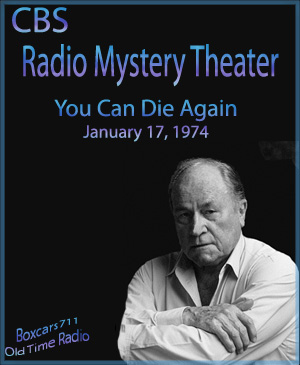
CBS Radio Mystery Theater - You Can Die Again (01-17-74)
The CBS Radio Mystery Theater - As you walk through the creaking door you enter into another world, the world of imagination. This world is inside you, a part of you, and you take this journey alone. Each person hears and then sees with his or her mind's eye the events portrayed within these dramas. All of us interprets what they hear differently. The images we see is unique to ourselves. A voice becomes a person, living, breathing they come alive. They take on a physical form and characteristics that we assign to them. The wonders of your own mind are boundless. Scary thoughts? Perhaps, but what powers they bring us! To exercise one's imagination is to exercise one's soul. These dramas provide us with an escape from reality. To adventures beyond our own lives. Enjoy them. And pleasant dreams!THIS EPISODE:January 17, 1974. Program #12. CBS network. "You Can Die Again". Sponsored by: Budweiser, Kellogg's. E. G. Marshall (host), Sam Dann (writer), Richard Mulligan, Mandel Kramer, Marian Seldes, Bryna Raeburn, Gilbert Mack, Himan Brown. 52 minutes.
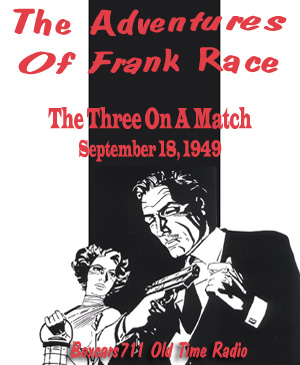
The Adventures Of Frank Race - The Three On A Match (09-18-49)
The Adventures of Frank Race, by Bruce Ells Productions, was first heard in May of 1949. The main character, Frank Race, was an attorney before World War II. As a result of his activities in the war, when it was over, he traded his law books for a career with the OSS. There, "Adventure" became his business. Tom Collins played the role of Frank Race initially, immediately following his stint as Chandu, The Magician. The lead role was taken over later by Paul Dubof.THIS EPISODE:September 18, 1949. Program #21. Broadcasters Program Syndicate syndication. "The Adventure Of Three On A Match". Commercials added locally. In Bordeaux, the European Children's Fund has been cheated out of its relief funds. The beautiful Marie Vartell holds the clue to the missing $2 million dollars. Tom Collins, Tony Barrett, Buckley Angel (writer, director), Joel Murcott (writer, director), Bruce Eells (producer), Ivan Ditmars (organist), Art Gilmore (announcer), Gerald Mohr, Jeanne Bates, Paul Dubov, Michael Ann Barrett. 26:53.
Box 13 - The Haunted Artist (12-12-48)
Box 13 was a syndicated radio series about the escapades of mystery novelist Dan Holiday (Alan Ladd), a former newsman. Created by Mayfair Productions, the series premiered August 22, 1948, on New York's WOR and aired in syndication on the East Coast from August 22, 1948, to August 14. 1949. On the West Coast, Box 13 was heard from March 15, 1948 to March 7, 1949. To seek out new ideas for his fiction, Holiday ran a classified ad in the Star-Times newspaper. "Adventure wanted, will go anywhere, do anything -- Box 13." The stories followed Holiday's adventures when he responded to the letters sent to him by such people as a psycho killer and various victims.THIS EPISODE:December 12, 1948. Program #17. Mayfair syndication. "The Haunted Artist". Commercials added locally. An artist's latest canvas seems to be haunted. A stone quarry keeps appearing on one side of the canvas. The date is approximate. Alan Ladd, Edmond MacDonald, Richard Sanville (director), Rudy Schrager (composer, conductor), Russell Hughes (writer), Sylvia Picker, Vern Carstensen (production supervisor). 26:56.
The FBI In Peace & War Dumb Luck (1944)
The FBI in Peace and War was a radio crime drama inspired by Frederick Lewis Collins' book, The FBI in Peace and War. The idea for the show came from Louis Pelletier who wrote many of the scripts. Among the show's other writers were Jack Finke, Ed Adamson and Collins. Airing on CBS from November 25, 1944 to September 28, 1958, it had a variety of sponsors (including Lava Soap, Wildroot Cream Oil, Lucky Strike, Nescafe and Wrigley's) over the years. Martin Blaine and Donald Briggs headed the cast. THIS EPISODE:September 22, 1957 CBS network. "Dumb Luck". Commercials deleted. A dumb blonde tries to pull an inheritance swindle and winds up marrying the insurance man she's trying to gyp! Jackson Beck (narrator), Charita Bauer, Arthur Winters, Louis Pelletier (writer), Betty Mandeville (producer, director), Warren Sweeney (announcer), Frederick L. Collins (creator). 20:04.

CBS Radio Mystery Theater - A Message From Space (02-28-78)
CBS Radio Mystery Theater - As you walk through the creaking door you enter into another world, the world of imagination. This world is inside you, a part of you, and you take this journey alone. Each person hears and then sees with his or her mind's eye the events portrayed within these dramas. All of us interprets what they hear differently. The images we see is unique to ourselves. A voice becomes a person, living, breathing they come alive. They take on a physical form and characteristics that we assign to them. The wonders of your own mind are boundless. Scary thoughts? Perhaps, but what powers they bring us! To exercise one's imagination is to exercise one's soul. These dramas provide us with an escape from reality. To adventures beyond our own lives. Enjoy them. And pleasant dreams!

Fibber McGee & Molly - Installing A Wall Safe (2-03-53)
Fibber McGee and Molly premiered in 1935. The program struggled in the ratings until 1940, when it became a national sensation. Within three years, it was the top-rated program in America. Few radio shows were more beloved than Fibber McGee and Molly. The program's lovable characters included Mayor LaTrivia, Doc Gamble, Mrs. Uppington, Wallace Wimple, Alice Darling, Gildersleeve, Beulah, Myrt, and the Old Timer. 79 Wistful Vista was one of America's most famous addresses and Molly's warning to Fibber not to open the hall closet door (and his subsequent decision to do it) created one of radio's best remembered running gags that audiences expected each week. Jim Jordan (Fibber) was born on a farm on November 16, 1896, near Peoria, Illinois. Marian Driscoll (Molly), a coal miner's daughter, was born in Peoria on November 15, 1898. After years of hardship and touring in obscurity on the small-time show biz circuit, they arrived in Chicago in 1924, where they eventually performed on thousands of shows and developed 145 different voices and characters. Broadcast to the nation from WMAQ/Chicago, the show entertained America until March 1956, and continued on NBC's Monitor until 1959. Jim Jordan died on April 1, 1988. Marian Jordan died on April 7, 1961. Fibber McGee and Molly was inducted into the Radio Hall of Fame in 1989. First Broadcast date April 16, 1935. Last Broadcast date September 6, 1959.THIS EPISODE:February 3, 1953. NBC network. Sponsored by: Reynolds Aluminum. The program originates from the N. R. E. C. A. Convention, The Civic auditorium in San Francisco. Fibber is chopping a hole in the wall. He's planning to install a wall safe! Not auditioned. Jim Jordan, Marian Jordan, Harlow Wilcox, Billy Mills and His Orchestra, The King's Men, Phil Leslie (writer), Keith Fowler (writer), Max Hutto (director), Bill Thompson, Gale Gordon, Arthur Q. Bryan, Richard LeGrand. 27:40.
The Adventures Of Philip Marlowe - The Hard Way Out (11-28-48)
The Adventures Of Philip Marlowe - The first portrayal of Phillip Marlowe on the radio was by Dick Powell, when he played Raymond Chandler's detective on the Lux Radio Theater on June 11, 1945. This was a radio adaptation of the 1944 movie, from RKO, in which Mr. Powell played the lead. Two years later, Van Heflin starred as Marlowe in a summer replacement series for the Bob Hope Show on NBC. This series ran for 13 shows. On September 26, 1948, Gerald Mohr became the third radio Marlowe, this time on CBS. It remained a CBS show through its last show in 1951.THIS EPISODE:November 28, 1948. CBS network. "The Hard Way Out". Sustaining. Murder at the Quigg and Slater Construction Company, and a surprising amount of luxury on $175 a week! Barbara Fuller, William Lally, Edgar Barrier, Gene Levitt (writer), Gerald Mohr, Jeff Corey, Luis Van Rooten, Mel Dinelli (writer), Norman Macdonnell (producer, director), Raymond Chandler (creator), Richard Aurandt (music), Robert Mitchell (writer). 29:39.

Ellery Queen Master Detective - Vanishing Magician (11-06-43)
Ellery Queen Master Detective - On radio, The Adventures of Ellery Queen was heard on all three networks from 1939 to 1948. During the 1970s, syndicated radio fillers, Ellery Queen's Minute Mysteries, began with an announcer saying, "This is Ellery Queen..." and contained a short one-minute case. The radio station encouraged callers to solve the mystery and win a sponsor's prize. Once a winner was found, the solution was broadcast as confirmation. A complete episode guide and history of this radio program can be found in the book "The Sound of Detection: Ellery Queen's Adventures in Radio" from OTR Publishing, 2002.THIS EPISODE:November 6, 1943. NBC network. "The Adventure Of The Vanishing Magician". Sponsored by: Bromo Seltzer. A has-been vaudevillian promises to disappear from a house to win a $25,000 bet. A good wartime mystery! This is the East Coast broadcast. The West Coast broadcast took place on November 4, 1943. The script was previously used on "Ellery Queen" on September 15, 1940. Sydney Smith, Helen Lewis, Santos Ortega, Ted de Corsia, Charles Paul (organ), Edward Pawley ("Guest Armchair Detective," star of "Big Town"), S. Bigman ("Guest Armchair Detective," editor of "Time" magazine), Ernest Chappell (announcer), Frederic Dannay (writer), Manfred B. Lee (writer), Bruce Kamman (producer, director). 29:04.

The Hollywood Radio Theater - The Awful Truth (01-18-55)
The Hollywood Radio Theater (Lux Radio Theater) strove to feature as many of the original stars of the original stage and film productions as possible, usually paying them $5,000 an appearance to do the show. It was when sponsor Lever Brothers (who made Lux soap and detergent) moved the show from New York to Hollywood in 1936 that it eased back from adapting stage shows and toward adaptations of films. The first Lux film adaptation was The Legionnaire and the Lady, with Marlene Dietrich and Clark Gable, based on the film Morocco. That was followed by a Lux adaptation of The Thin Man, featuring the movie's stars, Myrna Loy and William Powell.THIS EPISODE:The Awful Truth from Hollywood Radio Theater aired January 18, 1955 starring Irene Dunne and Cary Grant. This is the radio version taken from the classic 1937 romantic comedy film. The plot concerns the machinations of a soon-to-be-divorced couple, played by Dunne and Grant, who go to great lengths to try to ruin each other's romantic escapades. The bright, zesty, and carefree film was nominated for six Academy Awards.

Bold Venture - Tappard Of Pizzaro (1951)
Bold Venture - The Hollywood husband and wife team of Humphrey Bogart and Lauren Bacall set sail for adventure in the Bold Venture radio series in early 1951. There were well over 400 stations that aired the program. Since thiswas syndicated * the starting date varied from station to station but Mar 26, 1951 was the official date of the first show. Humphrey Bogart portrayed Slate Shannon, owner of a rundown Havana hotel, Shannon's Place. The action took place on land as well aboard Slate's boat, The Bold Venture, thus the title of the series. Lauren Bacall was his ward Sailor Duval, a stubborn and flirtatious young woman whose late father had willed her to Slate for her protection. Together the duo found adventure, intrigue, mystery and romance in the sultry settings of tropical Havana and the mysterious islands of the Caribbean.THIS EPISODE:Program #39. ZIV Syndication. "Tabbard Of Pizarro". Commercials added locally. Shannon and Sailor become involved with "The Tabbard Of Pizarro." David Rose (composer, conductor), Jester Hairston, Humphrey Bogart, Lauren Bacall. 27:25.
Casey Crime Photographer - Acquitted (7-03-47)
The Adventures Of Casey, Crime Photographer for The Morning Express, were told in this series, which moved to television after a highly successful run on radio in the 1940's. Casey hung out at the Blue Note Café, where the music was provided by the Tony Mottola Trio, and was friendly with Ethelbert, the bartender, to whom he recounted his various exploits. Richard Carlyle and John Gibson portrayed the roles when the series premiered in April, 1951, but by June they were replaced by Darren McGavin and Cliff Hall. Ann Williams, a reporter on The Morning Express, was Casey's girlfriend. During the summer of 1951 he acquired a partner in cub reporter Jack Lipman, who wrote copy to go with Casey's pictures. This live series was set in and broadcast from, New York City.THIS EPISODE:July 3, 1947. CBS network. "Acquitted". Sponsored by: Anchor Hocking Glass. Big Mike Ryan, a swell cop, is suspended for arresting and then beating up Lenny Waldo. When Lenny and his cohort are found shot to death, Big Mike is of course the prime suspect. Alonzo Deen Cole (writer), Archie Bleyer (music), Herman Chittison (piano), Jan Miner, John Dietz (director), John Gibson, Staats Cotsworth, Tony Marvin (announcer), George Harmon Coxe (creator). 29:34.

A Date With Judy - Aunt Lilly Needs A Date (08-11-42)
A Date with Judy was a comedy radio series aimed at a teenage audience which had a long run from 1941 to 1950. The show began as a summer replacement for Bob Hope's show, sponsored by Pepsodent and airing on NBC from June 24 to September 16, 1941, with 14-year-old Ann Gillis in the title role. Dellie Ellis portrayed Judy when the series returned the next summer (June 23d to September 15, 1942). Louise Erickson took over the role the following summer (June 30th to September 22, 1943) when the series, with Bristol Myers as its new sponsor, replaced The Eddie Cantor Show for the summer. Louise Erickson continued in the role of Judy over the next seven years as the series, sponsored by Tums, aired from January 18, 1944 to January 4, 1949. Ford Motors and Revere Cameras were the sponsors for the final season of the radio series on ABC from October 13, 1949 to May 25, 1950. Teenagers could relate to Judy and her problems with school, boyfriends and parental rules and adults enjoyed remembering their youth as seen through the eyes of a typical teenager. A delighful comedy that ended in 1950, A Date with Judy remains a favorite even today as we realize that teenagers will always face the same problems growing up as Judy and her friends did.A Date with Judy remains a favorite even today as we realize that teenagers will always face the same problems growing up as Judy and her friends did.
The Damon Runyon Theater - Leopard's Spots (05-01-49)
Damon Runyon Theater - Broadcast from January to December 1949, "The Damon Runyon Theatre" dramatized 52 of Runyon's short stories for radio. Damon Runyon (October 4, 1884 – December 10, 1946) was a newspaperman and writer. He was best known for his short stories celebrating the world of Broadway in New York City that grew out of the Prohibition era. He spun tales of gamblers, petty thieves, actors and gangsters; few of whom go by "square" names, preferring instead to be known as "Nathan Detroit", "Big Jule", "Harry the Horse", "Good Time Charlie", "Dave the Dude", and so on. These stories were written in a very distinctive vernacular style: a mixture of formal speech and colorful slang, almost always in present tense, and always devoid of contractions.THIS EPISODE:1948. Program #18. Mayfair syndication. "Leopard's Spots". Commercials added locally. Spider McCoy invites Broadway to travel to Philadelphia where Pigsfoot Grudy is going to fight Chester Nubs. Along comes a bad appendix and Caswell Fish, also known as "The Leopard Kid." Damon Runyon (author), Jeff Chandler, John Brown, Richard Sanville (director), Russell Hughes (adaptor), Vern Carstensen (production supervisor). 27:58.
The Couple Next Door - 2 Episodes From 1958
The Couple Next Door was a Peg Lynch series which began in 1953-57 on Chicago's WGN, moving to the Mutual Broadcasting System in the summer of 1957. The married couple was played by Olan Soule and Elinor Harriot. It was revived on CBS Radio (December 30, 1957-November 25, 1960) with Peg Lynch and Alan Bunce as the unnamed married couple---essentially, it reprised Ethel and Albert but the new name was necessitated because Lynch had long since lost the rights to the original title. That still wasn't the end of the show---Lynch and Bunce brought the show to NBC's legendary weekend programming block Monitor in 1963, performing three- to four-minute vignettes not unlike the original fifteen-minute shows. Their presence continued a kind-of Monitor tradition of offering new material from classic radio favourites (including James and Marian Jordan of Fibber McGee and Molly fame, until Marian Jordan's death). Even more, it returned yet again in the 1970s, as a syndicated radio feature known as The Little Things in Life. TODAYS SHOW: The Painter Quits (11-17-58) and Painting Party (11-18-58)CBS network. Sponsored by: Glamorene, Beechnut Baby Foods.The system cue is added live. Peg Lynch (writer, performer, commercial spokesman), Alan Bunce (performer, commercial spokesman), Walter Hart (producer), Ted Pearson (announcer), Francie Meyers, Dawsa Duckworth.
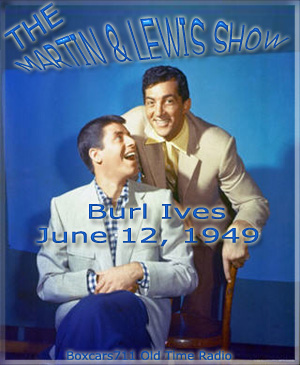
Martin & Lewis Show - Guest Burl Ives (06-12-49)
The Martin & Lewis Show - On July 25, 1946, Jerry began a show business partnership with Dean Martin, an association that would soon skyrocket both to fame. It started when Jerry was performing at the 500 Club in Atlantic City and one of the other entertainers quit suddenly. Lewis, who had worked with Martin at the Glass Hat in New York City, suggested Dean as a replacement. At first they worked separately, but then ad-libbed together, improvising insults and jokes, squirting seltzer water, hurling bunches of celery and exuding general zaniness. In less than eighteen weeks their salaries soared from $250.00 a week to $5,000.00. For ten years Martin and Lewis sandwiched sixteen money making films between nightclub engagements, personal appearances, recording sessions, radio shows, and television bookings. Their last film together was "Hollywood or Bust" (1956). On July 25th of that year the two made their last nightclub appearance together at the Copacabana, exactly ten years to the day since they became a team.

Arch Oboler's Plays - Mr. Ten Percent (5-17-45)
Arch Oboler's Plays was a radio drama series written, produced and directed by Arch Oboler. Minus a sponsor, it ran for one year, airing Saturday evenings on NBC from March 25, 1939 to March 23, 1940 and revived five years later on Mutual for a sustaining summer run from April 5, 1945 to October 11, 1945. Leading film actors were heard on this series, including Gloria Blondell, Eddie Cantor, James Cagney, Ronald Colman, Joan Crawford, Greer Garson, Edmund Gwenn, Van Heflin, Katharine Hepburn, Elsa Lanchester, Peter Lorre, Frank Lovejoy, Raymond Massey, Burgess Meredith, Paul Muni, Alla Nazimova, Edmond O'Brien, Geraldine Page, Gale Sondergaard, Franchot Tone and George Zucco.THIS EPISODE:May 17, 1945. Mutual network. "Mr. Ten-Percent". Sustaining. A good story about a Hollywood agent who finally finds a movie star to manage...and how he contributed $1 million dollars to the war effort! Mary Jane Croft, Bob Bailey, Earle Ross, Harry Lang, Everett Allen, Arch Oboler (writer), Bruce Elliott, Roseanne Murray, Evelyn Scott. 1/2 hour.

Big Town - The Mask Of Evil (01-04-49)
Big Town is a radio show that aired from 1937 to 1952. Edward G. Robinson had the lead role of Steve Wilson from 1937 to 1942. Claire Trevor was Wilson's society editor sidekick Lorelei Kilbourne, with Ona Munson taking over that role in 1940. Edward J. Pawley portrayed Wilson from 1942 until 1952 when Walter Greaza was heard as Wilson in the final episodes in the radio series. When Big Town moved to television, the program was telecast live, but in 1952 the production switched to film after the move from New York City to Hollywood. The television series ran on CBS from 1950 through 1954, continuing on NBC from 1955 through 1956. Repeat episodes aired on the DuMont Network (under the title City Assignment) while Big Town was still showing first-run episodes on CBS. Reruns were also shown under the titles Heart of the City, Headline and Byline Steve Wilson.THIS EPISODE:Big Town. January 4, 1949. NBC network. "The Mask Of Evil". Sponsored by: Lifebuoy Soap, Rinso. Mystery writer Hannah Harper, and her nervous companion, summon Steve Wilson and Lorelei to the lighthouse in which they're living. They are hearing noises and explosions. Listen for a monosyllabic moron, a 7 foot rabbit, a Chinese dentist named Dr. Fu, and a real red herring! Edward Pawley, Fran Carlon, Jerry McGill (writer, producer), Hugh James (announcer). 29:35.
Escape - Ancient Sorceries (02-15-48)
Escape was radio's leading anthology series of high adventure, airing on CBS from July 7, 1947 to September 25, 1954. Since the program did not have a regular sponsor like Suspense, it was subjected to frequent schedule shifts and lower production budgets, although Richfield Oil signed on as a sponsor for five months in 1950. Despite these problems, Escape enthralled many listeners during its seven-year run. The series' well-remembered opening combined Mussorgsky's Night on Bald Mountain with the introduction, intoned by Paul Frees and William Conrad: "Tired of the everyday routine? Ever dream of a life of romantic adventure? Want to get away from it all? We offer you... Escape!"THIS EPISODE:February 15, 1948. CBS network. "Ancient Sorceries". Sustaining. East coast version, the program was also broadcast on the West coast on February 21, 1948. A tale of the supernatural and witchcraft in a small Welsh town. Algernon Blackwood (author), Anne Morrison, Cy Feuer (composer, conductor), Kaye Brinker, Les Crutchfield (adaptor), Paul Frees, William Conrad, William N. Robson (director). 29:43.
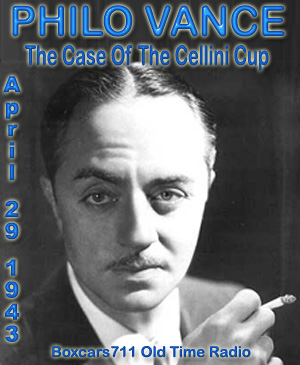
Philo Vance - The Case Of The Cellini Cup (04-29-43)
Philo Vance was the detective creation of S. S. Van Dine first published in the mid 1920s. Vance, in the original books, is an intellectual so highly refined he seems he might be ghostwritten by P. G. Wodehouse. Take this quote from The Benson Murder Case, 1924, as Vance pontificates in his inimitable way: "That's your fundamental error, don't y' know. Every crime is witnessed by outsiders, just as is every work of art. The fact that no one sees the criminal, or the artist, actu'lly at work, is wholly incons'quential." Thankfully, the radio series uses only the name, and makes Philo a pretty normal, though very intelligent and extremely courteous gumshoe. Jose Ferrer played him in 1945. From 1948-1950, the fine radio actor Jackson Beck makes Vance as good as he gets. George Petrie plays Vance's constantly impressed public servant, District Attorney Markham. Joan Alexander is Ellen Deering, Vance's secretary and right-hand woman. The organist for the show is really working those ivories, and fans of old time radio organ will especially enjoy this series. Perhaps one reason the organist "pulls out all the stops" is because there seems to be little, if any, sound effects on the show. Philo Vance, the radio series, does pay homage to the original books in that both were, even in their own time, a bit out of date and stilted. (OTRR)THIS EPISODE:April 29, 1943 - ZIV Syndication. "The Case of The Cellini Cup". Commercials added locally. Jackson Beck. 28:10.
Crime Classics - Old Sixtoes (03-17-54)
Crime Classics was a U. S. radio docudrama which aired over CBS from June 15, 1953 to June 30, 1954. Created, produced, and directed by radio actor/director Elliott Lewis, the program was basically a historical true crime series, examining crimes, and especially murders, from the past. It grew out of Lewis's personal interest in famous murder cases, and took a documentary-like approach to the subject, carefully recreating the facts, personages, and feel of the time period. Comparatively little dramatic license was taken with the facts and events, but the tragedy was leavened with humor, expressed largely through the narration.THIS EPISODE:March 17, 1954. CBS network. "Old Sixtoes: How He Stopped Construction On The B. B. C. and I". Sustaining. An old man and a young wife is old India. A recipe for murder most foul. Lou Merrill (host), Morton Fine (writer), David Friedkin (writer), Bernard Herrmann (composer, conductor), Elliott Lewis (producer, director), Ben Wright, Bob Lemond (announcer), Herb Butterfield, Jack Edwards, Jack Kruschen, Jane Webb. 30:21.
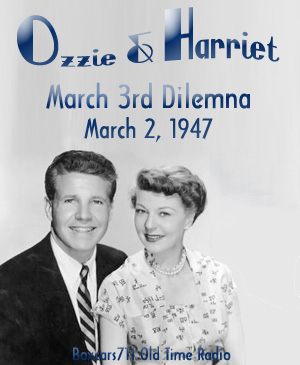
Ozzie & Harriet - March 3rd Dilemna (03-02-47)
The Adventures of Ozzie and Harriet launched on CBS October 8, 1944, making a mid-season switch to NBC in 1949. The final years of the radio series were on ABC (the former NBC Blue Network) from October 14, 1949, to June 18, 1954. In an arrangement that amplified the growing pains of American broadcasting, as radio "grew up" into television (as George Burns once phrased it), the Nelsons' deal with ABC gave the network itself the right to move the show to television whenever it wanted to do it---they wanted, according to the Museum of Broadcast Communications, to have talent in the bullpen and ready to pitch, so to say, on their own network, rather than risk it defecting to CBS (where the Nelsons began) or NBC. Their sons, David and Ricky, did not join the cast until five years after the radio series began. The two boys felt frustrated at hearing themselves played by actors and continually requested they be allowed to portray themselves.THIS EPISODE:March 3rd Dilemna - March 2, 1947. ABC network origination, AFRS rebroadcast. Not auditioned. School report card day. Some good, some not so good. Ozzie Nelson, Harriet Hilliard, David Nelson, Ricky Nelson, Verne Smith (announcer), John Brown. 25:31.