
Boxcars711 Old Time Radio
2,173 episodes — Page 15 of 44
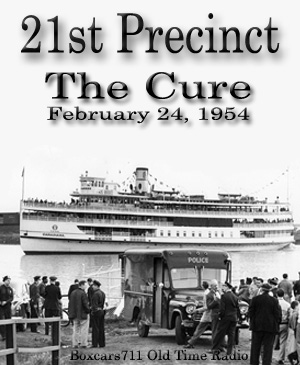
21st Precinct - The Cure (02-24-54)
21ST PRECINCT was one of the realistic police drama series of the early- to mid-1950's that were aired in the wake of DRAGNET. In 1953 CBS decided to use New York City as the backdrop for their own half-hour police series and focus on the day-to-day operation of a single police precinct. Actual cases were used as the basis for stories. The Precinct Captain acted as the narrator for the series.The official title of the series according to the series scripts and the CBS series promotional materials was 21ST PRECINCT and not TWENTY-FIRST PRECINCT or TWENTY FIRST PRECINCT which appears in many Old-Time Radio books. In 1953 CBS decided to use New York City as the backdrop for their own half-hour police series and focus on the day-to-day operations of a single police precinct. Actual cases would be used as the basis for stories. It was mentioned in each episode's closing by the announcer that, "Twenty-firstPrecinct is presented with the official cooperation of the Patrolmen's Benevolent Association an organization of more than 20,000 members of the Police Department, City of New York."THIS EPISODE:February 24, 1954. CBS network origination, AFRTS rebroadcast. "Pop" is caught sleeping in a hallway, but he refuses to reveal his name! He's really John W. Lofield, seventy-eight years old, and he doesnt want to return home! Everett Sloane, John Ives (producer), Stanley Niss (writer, director). 30:29.

Dragnet - Benny Trounsel (8-04-49)
Dragnet was a long-running radio and television police procedural drama about the cases of a dedicated Los Angeles police detective, Sergeant Joe Friday, and his partners. The show takes its name from an actual police term, a "dragnet", meaning a system of coordinated measures for apprehending criminals or suspects. Dragnet debuted inauspiciously. The first several months were bumpy, as Webb and company worked out the program's format and eventually became comfortable with their characters (Friday was originally portrayed as more brash and forceful than his later usually relaxed demeanor). Gradually, Friday's deadpan, fast-talking persona emerged, described by John Dunning as "a cop's cop, tough but not hard, conservative but caring." (Dunning, 210) Friday's first partner was Sgt. Ben Romero, portrayed by Barton Yarborough, a longtime radio actor. When Dragnet hit its stride, it became one of radio's top-rated shows.THIS EPISODE:August 4, 1949. Program #9. NBC network. Sustaining. A small-time narcotics user named Benny Trounsel has been beaten to death shortly after tipping the cops to a new narcotics ring in town. Jack Webb, Barton Yarborough, Raymond Burr. 29:18.

The Halls Of Ivy - Knockwurst Society (03-31-50)
The Halls of Ivy was an NBC radio sitcom that ran from 1950-1952. It was created by Fibber McGee & Molly co-creator/writer Don Quinn before being adapted into a CBS television comedy (1954-55) produced by ITC Entertainment and Television Programs of America. Quinn developed the show after he had decided to leave Fibber McGee & Molly. The audition program featured radio veteran Gale Gordon (then co-starring in Our Miss Brooks) and Edna Best in the roles that ultimately went to British husband-and-wife actors Ronald Colman and Benita Hume. The Colmans had shown a flair for radio comedy in recurring roles on The Jack Benny Program in the late 1940s, and they landed the title roles in the new show. The Halls of Ivy featured Colman as William Todhunter Hall, the president of small, Midwestern Ivy College, and his wife, Victoria, a former British musical comedy star who sometimes felt the tug of her former profession, and followed their interactions with students, friends and college trustees. Others in the cast included Herbert Butterfield as testy Clarence Wellman, Willard Waterman (then starring as Harold Peary's successor as The Great Gildersleeve) as John Merriweather, and Elizabeth Patterson and Gloria Gordon as the Halls' maid.THIS EPISODE:March 31, 1950. NBC netqoek. Sponsored by: Schlitz Beer. Will Dr. Hall be invited to join the "Ivy Chamber Music and Knockwurst Society" to play the Piffleflute? The program may be dated April 7, 1950. Alan Reed, Benita Hume, Cliff Arquette, Don Quinn (creator, writer), Frank Martin (announcer), Gloria Gordon, Henry Russell (composer, conductor), Ken Carpenter (announcer), Nat Wolff (director), Ronald Colman, Walter Newman (writer). 29:31.
The Adventures Of Frank Race - The Fourth Round Knockout (09-11-49)
The Adventures Of Frank Race, by Bruce Ells Productions, was first heard in May of 1949. The main character, Frank Race, was an attorney before World War II. As a result of his activities in the war, when it was over, he traded his law books for a career with the OSS. There, "Adventure" became his business. Tom Collins played the role of Frank Race initially, immediately following his stint as Chandu, The Magician. The lead role was taken over later by Paul Dubof.THIS EPISODE:September 11, 1949. Program #20. Broadcasters Program Syndicate syndication. "The Adventure Of The Fourth Round Knockout". Commercials added locally. A prize-fighter dies during a fight...from poison! A big-time gambler, who only bets on a sure thing, is found dead too! Tom Collins, Tony Barrett, Buckley Angel (writer, director), Joel Murcott (writer, director), Bruce Eells (producer), Ivan Ditmars (organist), Art Gilmore (announcer), Frank Lovejoy, Florence Halop, Jack Kruschen, Theodore Von Eltz, Tom Holland, Michael Ann Barrett. 26:25.

CBS Radio Mystery Theater - The Island On Silvertree Lake (10-19-77)
The CBS Radio Mystery Theater (or CBSRMT) was an ambitious and sustained attempt to revive the great drama of old-time radio in the 1970s. Created by Himan Brown (who had by then become a radio legend due to his work on Inner Sanctum Mysteries and other shows dating back to the 1930s), and aired on affiliate stations across the CBS Radio network, the series began its long run on January 6, 1974. The final episode ran on December 31, 1982. The show was broadcast nightly and ran for one hour, including commercials. Typically, a week consisted of three to four new episodes, with the remainder of the week filled out with reruns. There were a total of 1399 original episodes broadcast. The total number of broadcasts, including reruns, was 2969. The late E.G. Marshall hosted the program every year but the final one, when actress Tammy Grimes took over. Each episode began with the ominous sound of a creaking door, slowly opening to invite listeners in for the evening's adventure. At the end of each show, the door would swing shut, with Marshall signing off, "Until next time, pleasant...dreams?"THIS EPISODE:October 19, 1977. Program #725. CBS network. "The Island On Silver Tree Lake". Commercials deleted. E. G. Marshall (host), Victoria Dann (writer), Patricia Elliot, Lloyd Batista, Teri Keane, Earl Hammond. 46 minutes.

Nightfall - The Stone Ship (10-03-80)
Nightfall is the title of a radio drama series produced and aired by CBC Radio ( Canadian Broadcasting Corporation ) from July 1980 to June 1983. While primarily a supernatural/horror series, Nightfall featured some episodes in other genres, such as science fiction, mystery, fantasy, and human drama. One episode was even adapted from a folk song by Stan Rogers. Some of Nightfall's episodes were so terrifying that the CBC registered numerous complaints and some affiliate stations dropped it. Despite this, the series went on to become one of the most popular shows in CBC Radio history, running 100 episodes that featured a mix of original tales and adaptations of both classic and obscure short stories. THIS EPISODE:October 3, 1980. Program #14. CBC, Toronto. "The Stone Ship". Not auditioned. A chilling horror story. Henry Ramer (host), William Hope Hodgson (writer), Len Peterson (adaptor), Chris Wiggins, Arch McDonnell, Graham Haley, Eric House, John Jessop (recording engineer), Bill Robinson (sound effects), Nina Callaghan (production assistant), John Douglas (script editor), Earle Toppings (script editor), Bill Howell (producer, director). 28:00.
The Amos & Andy Show - Andy The Sailor (05-25-45)
Amos 'n' Andy was officially transferred by NBC from the Blue Network to the Red Network in 1935, although the vast majority of stations carrying the show remained the same. Several months later, Gosden and Correll moved production of the show from NBC's Merchandise Mart studios in Chicago to Hollywood. After a long and successful run with Pepsodent, the program changed sponsors in 1938 to Campbell's Soup; because of Campbell's closer relationship with CBS, the series switched to that network on April 3, 1939.In 1943, after 4,091 episodes, the radio program went from a 15-minute CBS weekday dramatic serial to an NBC half-hour weekly comedy. While the five-a-week show often had a quiet, easygoing feeling, the new version was a full-fledged sitcom in the Hollywood sense, with a regular studio audience (for the first time in the show's history) and an orchestra. More outside actors, including many African American comedy professionals, were brought in to fill out the cast. Many of the half-hour programs were written by Joe Connelly and Bob Mosher, later the writing team behind Leave It To Beaver and The Munsters. In the new version, Amos became a peripheral character to the more dominant Andy and Kingfish duo, although Amos was still featured in the traditional Christmas show where he explains the Lord's Prayer to his daughter.THIS EPISODE:May 25, 1945. NBC network. Commercials deleted. Andy impersonates a sailor and is lucky enough to be the millionth visitor to the "Harlem Canteen." Harlow Wilcox (announcer), Freeman Gosden, Charles Correll. 27 minutes.
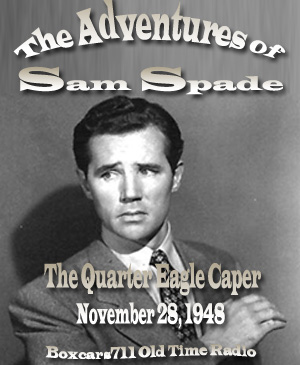
The Adventures Of Sam Spade - The Quarter Eagle Caper (11-28-48)
The Adventures of Sam Spade was a radio series based loosely on the private detective character Sam Spade, created by writer Dashiell Hammett for The Maltese Falcon. The show ran for 13 episodes on ABC in 1946, for 157 episodes on CBS in 1946-1949, and finally for 51 episodes on NBC in 1949-1951. The series starred Howard Duff (and later, Steve Dunne) as Sam Spade and Lurene Tuttle as his secretary Effie, and took a considerably more tongue-in-cheek approach to the character than the novel or movie. In 1947, scriptwriters Jason James and Bob Tallman received an Edgar Award for Best Radio Drama from the Mystery Writers of America. Before the series, Sam Spade had been played in radio adaptations of The Maltese Falcon by both Edward G. Robinson (in a 1943 Lux Radio Theater production) and by Bogart himself (in a 1946 Academy Award Theater production), both on CBS.THIS EPISODE:November 28, 1948. CBS network origination, AFRS rebroadcast. "The Quarter Eagle Caper". The owner of a gum-machine company is murdered, giving Sam plenty to chew on! Howard Duff, Lurene Tuttle, Dashiell Hammett (creator). 24:44.
Suspense - Hands Of Dr. Ottermole (12-02-48)
Suspense was one of the premier programs of the Golden Age of Radio (aka old-time radio), and advertised itself as "radio's outstanding theater of thrills." It was heard in one form or another from 1942 through 1962. There were approximately 945 episodes broadcast during its long run, over 900 of which are extant in mostly high-quality recordings. Suspense went through several major phases, characterized by different hosts, sponsors and director/producers. There were a few rules which were followed for all but a handful of episodes: Protagonists were usually a normal person suddenly dropped into a threatening or bizarre situation. Evildoers must be punished in the end. The program made only occasional forays into science fiction and fantasy. Among its science fiction entries were "The Man who Went Back to Save Lincoln" (a time travel fantasy), and an adaptation of "Donovan's Brain".THIS EPISODE:December 2, 1948. CBS network. "The Hands Of Mr. Ottermole". Sponsored by: Auto-Lite. A "strangler" is prowling the streets of London, killing at will. A police sergeant is suspicious of "Mr. Newspaperman," who always seems to be nearby when the "strangler" strikes. Claude Rains, Thomas Burke (author), Ken Crossen (adaptor), Vincent Price, Verna Felton, Raymond Lawrence, Paul Frees (announcer), Harlow Wilcox (commercial spokesman), William Johnstone (commercial spokesman), Lucien Moraweck (composer), Lud Gluskin (conductor). 29:45.

the Story Of Dr. Kildare - Glaucoma (06-15-50)
The Story Of Doctor Kildare - In the summer of 1949, MGM reunited Lew Ayres and Lionel Barrymore to record the radio series, The Story of Dr. Kildare, scripted by Les Crutchfield, Jean Holloway and others. After broadcasts on WMGM New York from February 1, 1950 to August 3, 1951, the series was syndicated to other stations during the 1950s. The supporting cast included Ted Osborne as hospital administrator Dr. Carough, Jane Webb as nurse Mary Lamont and Virginia Gregg as Nurse Parker, labeled "Nosy Parker" by Gillespie, with appearances by William Conrad, Stacy Harris, Jay Novello, Isabel Jewell and Jack Webb.THIS EPISODE:June 15, 1950. Program #21. WMGM, New York-Mutual net origination, MGM syndication. Commercials added locally. A newly blinded man loses his will to live. Dr. Kildare tries to help. Lew Ayres, Lionel Barrymore, Isabel Jewell, William Johnstone, Peggy Webber, Dick Joy (announcer), Gene Holloway (writer), Walter Schumann (composer, conductor), William P. Rousseau (director). 28:11.

Murder At Midnight - The Black Swan (08-18-47)
The Murder at Midnight series was a thirty-minute broadcast featuring tales of the supernatural. The actors included Mercedes McCambridge and Lawson Zerbe and the show was narrated using the spooky, creepy voice of Raymond Morgan and always opened using the same gripping signature; "the witching hour, when night is darkest, our fears are the strongest, our strength at its lowest ebb… Midnight! … when graves gape open and death strikes!"THIS EPISODE:August 18, 1947. Syndicated. "The Black Swan". Commercials added locally. A ship is "launched in blood" and continues to kill. Lawson Zerbe, Leon Meadow (writer), Charles Paul (music), Anton M. Leader (director), Louis G. Cowan (producer). 27:12.

Night Beat - Harlan Matthews Stamp Dealer (05-29-50)
Nightbeat - Broadcast on NBC, Nightbeat ran from 1949 to 1952 and starred Frank Lovejoy as Randy Stone, a tough and streetwise reporter who worked the nightbeat for the Chicago Star looking for human interest stories. He met an assortment of people, most of them with a problem, many of them scared, and sometimes he was able to help them, sometimes he wasn't. It is generally regarded as a 'quality' show and it stands up extremely well. Frank Lovejoy (1914-1962) isn't remembered today, but he was a powerful and believable actor with a strong delivery, and his portrayal of Randy Stone as tough guy with humanity was perfect. The scripts were excellent, given that they had to pack in a lot in a short time, and there was a good supporting cast, orchestra, and sound effects. 'The Slasher', broadcast on 10 November 1950, the last show of season one, has a very loosely Ripper-derived plot in which Stone searches for an artist. Supporting actors included Parley Baer, William Conrad, Jeff Corey, Lawrence Dobkin, Paul Frees, Jack Kruschen, Peter Leeds, Howard McNear, Lurene Tuttle and Martha Wentworth.THIS EPISODE:May 29, 1950. NBC netWORK. Sponsored by: Wheaties, Crust-Quik. Harlan Matthews, a Stamp Dealer with memories of a murder he committed long ago, attempts murder, suicide and more! An "alienist" and Randy Stone try to help. The system cue has been deleted. Frank Worth (music), Ben Wright, Junius Matthews, Warren Lewis (producer, director), Larry Marcus (editor), Irwin Ashkenazie (writer), Jeanette Nolan, Frank Lovejoy, Frank Martin (commercial spokesman), Jeff Corey. 29:23.
Command Performance - Christmas Special (12-24-45)
Command Performance was one of the few radio shows that were sent overseas to boost the morale of US Troops during World War 2. In March 1942 it became a weekly show featuring famous people such as Bob Hope, Fred Allen, Dinah Shore, Frank Sinatra and more. Each show consisted of several stars who get together and perform comedy routine. All talent for this program was donated, and valued at $75,000 a week. There were more than 400 shows. Announcers : Paul Douglas, Ken Carpenter . Creator : Lous G. Cowan . Producers : Vick Knight, Maury Holland, Cal Kuhl . Director : Glenn Wheaton . Writers : Melvin Frank, Norman Panama.
Macabre - Final Resting Place (11-13-61)
Macabre made the scene in November 13th 1961 and ran until January 8th 1962. Spooky and supernatural theme, Macabre was a Tokyo Studios, Far East Network of the Armed Forces Radio Service production. Creators of the series were William Verdier, who also starred in the series, and John F. Buey Jr., a program director with FEN Tokyo. All 8 episodes are currently in circulation.
The Mysterious Traveler - New Year's Nightmare (01-05-47)
The Mysterious Traveler - Written and directed by Robert A. Arthur and David Kogan, the series began on the Mutual Broadcasting System, December 5, 1943, continuing in many different timeslots until September 16, 1952. Unlike many other shows of the era, The Mysterious Traveler was without a sponsor for its entire run. The lonely sound of a distant locomotive heralded the arrival of the malevolent narrator, portrayed by Maurice Tarplin, who introduced himself each week in the following manner. This is the Mysterious Traveler, inviting you to join me on another journey into the strange and terrifying. I hope you will enjoy the trip, that it will thrill you a little and chill you a little. So settle back, get a good grip on your nerves and be comfortable -- if you can! THIS EPISODE:January 5, 1947. Mutual network. "New Year's Nightmare". Sustaining. A man goes on a year-end bender and wakes up a year later married to a strange woman. David Kogan (writer, producer, director), Maurice Tarplin, Robert A. Arthur (writer). 1/2 hour.
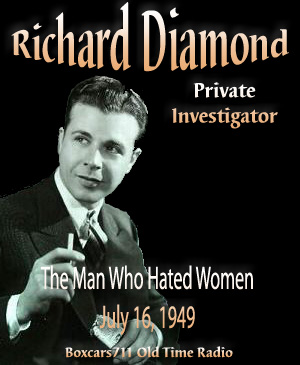
Richard Diamond Private Detective - The Man Who Hated Women (7-16-49)
Richard Diamond, Private Detective was a radio show starring Dick Powell which aired from 1949 to 1953, first on NBC, then ABC and finally on CBS. The title character was a rather light-hearted detective who often ended the episodes singing to his girlfriend, Helen. The television series was produced by Powell's company, Four Star Television, and that series ran for 3 years from 1957 to 1960. On TV, David Janssen played the hard boiled private eye and his secretary renamed "Sam", was only ever shown on camera from the waist down, most assurardidly to display her beautiful legs. It was later leared that the legs belonged to Mary Tyler Moore. Original music by Frank DeVol and pete rugolo and later by richard shores. Good scripts, a solid cast and Powell's exceptional talent made a good time 30 minute program that was quite popular during that Golden Age of Radio. So Let's sit back now, relax and enjoy this truly otr radio classic.,…, Dick powell as Richard Diamond.., Private Detective.THIS EPISODE:July 16, 1949. "The Man Who Hated Women" NBC net. Sustaining. A serial killer is on the loose, slashing women and threatening Lt. Levinson's job! A good, serious cops and robbers story. Dick Powell sings, "Cruising Down The River" after the story. Dick Powell, Edward King (announcer), William P. Rousseau (director), Frank Worth (music director), Blake Edwards (writer), Wilms Herbert, Sidney Miller, William Conrad, Virginia Gregg, Ed Begley, Lurene Tuttle, Jack Kruschen. 29:19.
Secrets Of Scotland Yard - Murderer Without Motive (1946)
The Secrets of Scotland Yard was initially hosted by Clive Brook, probably for the first year or so. To add to the air of authenticity, Brook sometimes discusses matters with Percy Hoskins, a 1950s crime expert and reporter for the London Daily Express. Hoskins knew every nook and cranny in London's seedier districts and personally reported on many of the major crimes of the day. A student of crime, Hoskins was also one of the founders of the Saints and Sinners Club of London, an educational organization dedicated to true crime investigation methods and results. Brook had his own Scotland Yard experience previously when he played retired naval commander Stevenson in the 1936 film, "Scotland Yard Commands". American audiences will however probably more familiar with Brooks' portrayal of Sir Arthur Conan Doyle's Sherlock Holmes in the 1932 film of the same name. Brook was eventually replaced by an actor portraying the character Superintendent X of Scotland Yard.
Voyage Of The Scarlet Queen - Tattooed Beaver & Baby Food (10-09-47)
The Voyage Of The Scarlet Queen - First heard on Mutual featuring Elliott Lewis, who as Leonard Maltin writes in "The Great American Broadcast, "…wore every hat imaginable-actor, producer, and director-also penned a good number of scripts for series he supervised, including Suspense." And Maltin says of this show, "On the terrific late-1940's high-adventure series The Voyage of the Scarlet Queen he held down both jobs simultaneously as director and star." As Maltin continues, "Lewis had the ability to make you believe whatever he said. Cast as the skipper on the high-adventure series The Voyage of the Scarlet Queen, he was completely convincing as seagoing ship's master Philip Carney-never corny or overblown." So let a master captain of drama chart a course to exotic ports of call and thrilling adventures. All you have to do is step aboard The Scarlet Queen.THIS EPISODE:October 9, 1947. Mutual network origination, AFRTS rebroadcast. "Tatooed Beaver and Baby Food For Pare Pare". A strange group of passengers for the Celebes, things aren't what they seem! Elliott Lewis, Edwin Max, Gil Doud (writer), Robert Tallman (writer), James Burton (producer), Richard Aurandt (music), Ben Wright, John Dehner, Frank Gerstle. 29:44.

A Man Called X - Timber (10-16-47)
A Man Called X - Sponsored by Frigidaire and later General Motors, this spy series starred Herbert Marshall as Ken Thurston, Intelligence Agent. Marshall, British by birth, starred in films with many of the greatest, especially Detreich in Blonde Venus, Bette Davis in The Virgin Queen, Vincent Price in The Fly, and a great cast in The Razor's Edge, where he portrayed W. Somerset Maugham.

The Jello Program With Jack Benny - Christmas Shopping (12-11-38)
Jack Benny - Benny was remarkable in many ways, but in none more than this: he built a character of every sour ingredient in life, but somehow his real personality trickled through and made it wonderful. Would a real miser act that way before 30 million people each week? The Benny of the air was a fraud, a myth, a creation. It should have surprised no one to learn — after years of toupee jokes that played so well into the vanity theme — that Benny never wore one. He overtipped in restaurants, gave away his time in countless benefit performances, and was lavish in his praise of almost everyone else.THIS EPISODE:December 12, 1937. Red network. Sponsored by: Jell-O. Mary reads a letter from Mama. Kenny sings, "Am I In Love?" Rochester appears as an elevator operator. Shlepperman as a singing Santa Claus, is joined in song by the rest of the cast. Jack and Mary go Christmas Shopping in a department store (the start of a December tradition). Andy Devine, Don Wilson, Jack Benny, Kenny Baker, Mary Livingstone, Phil Harris and His Orchestra, Eddie Anderson, Sam Hearn, Elvia Allman (quadruples), Harry Baldwin (doubles), Ed Beloin (writer, performer), Bea Benaderet, Frank Nelson (as two different floorwalkers), Blanche Stewart (triples), Bill Morrow (writer), Sidney Miller. 29:46.
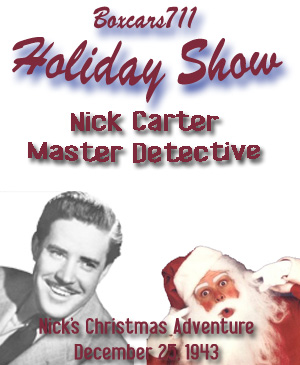
Nick Carter - Nick Carter's Christmas Adventure (12-25-43)
Nick Carter, Master Detective - Nick Carter is the name of a popular fictional detective who first appeared in in a dime novel entitled "The Old Detective's Pupil" on September 18, 1886. In 1915, Nick Carter Weekly became Street & Smith's Detective Story Magazine. Novels featuring Carter continued to appear through the 1950s, by which time there was also a popular radio show, Nick Carter, Master Detective, which aired on Mutual from 1943 to 1955. Nick Carter first came to radio as The Return of Nick Carter. Then Nick Carter, Master Detective, with Lon Clark in the title role, began April 11, 1943, on Mutual, continuing in many different timeslots for well over a decade. Jock MacGregor was the producer-director of scripts by Alfred Bester, Milton J. Kramer, David Kogan and others. Background music was supplied by organists Hank Sylvern, Lew White and George Wright. Patsy Bowen, Nick's assistant, was portrayed by Helen Choate until mid-1946 and then Charlotte Manson stepped into the role. Nick and Patsy's friend was reporter Scubby Wilson (John Kane). Nick's contact at the police department was Sgt. Mathison (Ed Latimer). The supporting cast included Raymond Edward Johnson, Bill Johnstone and Bryna Raeburn. Michael Fitzmaurice was the program's announcer. The series ended on September 25, 1955. Chick Carter, Boy Detective was a serial adventure that aired weekday afternoons on Mutual. Chick Carter, the adopted son of Nick Carter, was played by Bill Lipton (1943-44) and Leon Janney (1944-45). The series aired from July 5, 1943 to July 6, 1945.
The Hallmark Playhouse - The Old Nest (08-12-48)
The Hallmark Playhouse - was heard over CBS stations Thursday evenings. This drama anthology of 30-minute shows was sponsored by, of course, Hallmark Greeting Cards. It was preceded by the RADIO READER'S DIGEST, which ran from September 13, 1942 thorugh June 3, 1948. Hallmark sponsored the RADIO READER'S DIGEST from January 13, 1946 to it's end. On Feb. 8, 1953, the series name and format was changed. It was now called THE HALLMARK HALL OF FAME and presented biographal sketches of famous persons, past and present. The new format was used until the end of the 1955 season. The exception to the new format was the broadcast each Christmas season of "A Christmas Carol". Like other dramatic series of this time, this one made use of major screen actors in the productions. James Hilton, author of "Random Harvest", "Lost Horizon" and "Goodbye, Mr. Chips" plus others, served as host and Narrator. Dee Engelbach produced and directed the shows. Jean Holloway was the writer. Sound Effects were by Harry Essman and Gene Twombly. Musical conductor was Lyn Murray. The show's theme was "Dream of Olwne" by Charles Williams.THIS EPISODE:August 12, 1948. CBS network, KMBC, Kansas City aircheck. "The Old Nest". Sponsored by: Hallmark Cards. Not auditioned. A sentimental story about the relationship between parents and children. Jane Morgan, Earle Ross, William Johnstone, Gloria Blondell, Sharon Douglas, Tony Barrett, Rupert Hughes (author), James Hilton (host), Frank Goss (announcer), Lyn Murray (composer, conductor), Milton Geiger (adaptor). 29:20.
Weird Circle - Strange Judgement Ep.30 1947
The Weird Circle - Presented 30 minute tales of horror, frequently inspired by classic horror or ghost stories, frequently done by French authors. It opened with the sound of the surf and the chant-like opening, "In this cave by the restless sea, we are met to call from out of past, stories strange and weird. Bell keeper, toll the bell, so that all may know that we are gathered again in the Weird Circle". The show was heard on Mutual stations November, 1943 through October, 1947 and very briefly in September/October of 1947 on ABC.THIS EPISODE:Program #30. NBC syndication. "The Strange Judgment". Commercials added locally. An honest fisherman and his good wife have an evil son, not worthy of his parents. A judgment must be made! . 25:05.

The Burns & Allen Show - Gracie Hires Harpo Marx As Reporter (05-09-46)
Burns and Allen were an American comedy duo consisting of George Burns and his wife, Gracie Allen.Burns wrote most of the material, and played the straight man. Allen played a silly, addleheaded woman. Both attributed their success to the other, to the ends of their lives. Early on, the team had played the opposite roles until they noticed that the audience was laughing at Gracie's straight lines, so they made the change. Burns and Allen developed their popular routine over more than three decades of stage, radio, film, and television. Historians of popular culture have often stated that Allen was a brilliant comedian, whose entire career consisted of engaging in dialogues of "illogical logic" that left her verbal opponents dazed and confused, and her audiences in stitches. During a typical 23-minute episode of the Burns and Allen show, the vast majority of the dialogue and speaking parts were written for Allen, who was credited with having the genius to deliver her lengthy diatribes in a fashion that made it look as though she was making her arguments up on the spot. (One running gag on the TV show was the existence of a closet full of hats belonging to various visitors to the Burns household, where the guests would slip out the door unnoticed, leaving their hats behind, rather than face another round with Gracie.) A continuing joke on the show was that George would say, "Say good night, Gracie," and Gracie would say, "Good night Gracie!" Ralph Pape used the catchphrase for the title of his play, Say Goodnight, Gracie, produced by Steppenwolf in 1983, and the phrase lives on as a title of other books and stage productions.THIS EPISODE:Maxwell House Coffee Time. May 9, 1946. NBC network. Sponsored by: Maxwell House Coffee, Jell-O Pudding. Gracie's planning to write a newspaper column about national affairs. Guest Harpo Marx is going to be her assistant (he's heard whistling and honking, not talking of course). Harp also plays, "Stardust." Not auditioned. George Burns, Gracie Allen, Bill Goodwin, Meredith Willson and His Orchestra, Mel Blanc, Harpo Marx. 29:56.
The Creaking Door - Inn Spectre (1953)
The Creaking Door was an old-time radio series of horror and suspense shows originating in South Africa. There are at present anywhere from 34-37 extant episodes in MP3 circulation, yet no currently available program logs for the series indicate the year of the series' broadcast (though it was likely sometime in the 1950s, given the generally high audio quality of the available shows), or the total number of episodes, and only a handful of them are known by their broadcast order. The stories are thrillers in the Inner Sanctum vein, and generally thought of favorably by most fans of OTR.
The Family Doctor - 2 Episodes From 1932
The Family Doctor was a story about Dr. Grant Adams, a small town doctor who doubled as the community's moral rectifier. He was more than just respected, he was loved by all. Each week he confronted issues from robbery to suicide, and always with common sense and gentle moral judgment. Though his old-fashioned remedies for sicknesses are outdated compared to modern medical practicing, The Family Doctor's attitude towards life's daily issues transcend time. Of the 39 intended episodes, only 12 were aired.Boxcars711 supports the efforts of the Old Time Radio Researchers Group (OTRR) whose goals include restoring, preserving and sharing the classic shows from what is commonly known as the "Golden Age of Radio" (1930-1960). Please visit and support this great organization at : http://www.otrr.org/TODAY'S SHOW - Episodes7 (Glass Houses) and Episode8 (Race With The Stork) 1932
Boston Blackie - Oscar Wolfe Case (06-11-45)
The Boston Blackie radio series, also starring Morris, began June 23, 1944, on NBC as a summer replacement for The Amos 'n' Andy Show. Sponsored by Rinso, the series continued until September 15 of that year. Unlike the concurrent films, Blackie had a steady romantic interest in the radio show: Lesley Woods appeared as Blackie's girlfriend Mary Wesley. Harlow Wilcox was the show's announcer. On April 11, 1945, Richard Kollmar took over the title role in a radio series syndicated by Frederic W. Ziv to Mutual and other network outlets. Over 200 episodes of this series were produced between 1944 and October 25, 1950. Other sponsors included Lifebuoy Soap, Champagne Velvet beer, and R&H beer. While investigating mysteries, Blackie invaribly encountered harebrained Police Inspector Farraday (Maurice Tarplin) and always solved the mystery to Farraday's amazement. Initially, friction surfaced in the relationship between Blackie and Farraday, but as the series continued, Farraday recognized Blackie's talents and requested assistance. Blackie dated Mary Wesley (Jan Miner), and for the first half of the series, his best pal Shorty was always on hand. The humorless Farraday was on the receiving end of Blackie's bad puns and word play. Kent Taylor starred in the half-hour TV series, The Adventures of Boston Blackie. Syndicated in 1951, it ran for 58 episodes, continuing in repeats over the following decade.THIS EPISODE:June 13, 1945. Program #10. Mutual network origination, Ziv syndication. Commercials added locally. After Janice Larson almost kills herself, Blackie threatens Oscar Wolfe. His threat is recorded on a dictating machine. When Wolfe is killed the next day, Blackie becomes a fugitive wanted for murder! Richard Kollmar, Frank Lovejoy, John Gibson (?). 26:18.

The Chase - Blackout (11-23-52)
The Chase is an exciting Old Time Radio series in which every episode contains, well, a chase. Tales, highly melodramatic and often improbable, of people on the run. The concept of "hunter and hunted" was built into the signatures. with the lone bugle of a fox hunt, the braying of dogs, the sounds of a man running, a gunshot, and the slowing footsteps and eventual fall of the victim. It may be an adventure story, a crime story, or even science fiction, but there will always be a suspense filled chase.THIS EPISODE:November 23, 1952. NBC network. "Blackout". Sustaining. The title may be incorrect. Am amnesiac trying to discover his past life finds out he was some louse. Don MacLaughlin, Fred Collins (announcer), Fred Weihe (director, transcriber), Joan Tompkins, Lawrence Klee (creator, writer), Linda Watkins, Ned Wever, William Keene. 29:27.
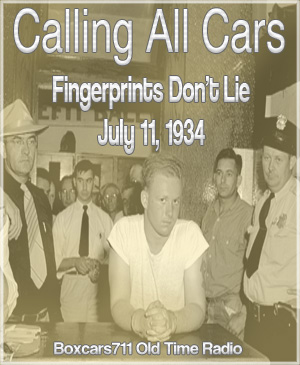
Calling All Cars - Fingerprints Don't Lie (07-11-34)
Calling All Cars was one of radio's earliest cop shows, dramatizing true crime stories and introduced by officers from the Los Angeles and other police departments. The narrator of the program was speech professor Charles Frederick Lindsley, and the only other regular voice heard on the program week after week belonged to that of Sergeant Jesse Rosenquist of the L.A.P.D., whose name and voice were so unusually distinctive that he was retained for the show's entire run. None of the actors on the show ever received on-air credit, but among the talent OTR fans can hear the likes of Elvia Allman, Jackson Beck, Charles Bickford, John Gibson, Richard LeGrand and Hanley Stafford, just to name a few.THIS EPISODE:July 11, 1934. Program #33. CBS Pacific network (Don Lee net). "Fingerprints Don't Lie". Sponsored by: Rio Grande Oil. Officer #734 has been held up, shot and robbed by two men who escaped in a Hudson. The Department of Records and Identification uses fingerprints to apprehend the criminals. The system cue has been deleted. Not auditioned. William N. Robson (writer, producer), Charles Frederick Lindsley (narrator). 29:28.
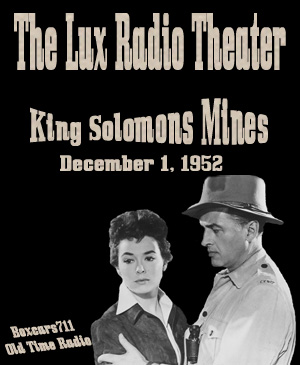
Lux Radio Theater - King Solomon's Mines (12-01-52)
Lux Radio Theater - In October of 1934, "Lux Radio Theater" debuted in New York on NBC's Blue radio network. Presenting audio versions of popular Broadway plays, the show failed to garner an audience and soon ran out of material. After switching networks to CBS and moving to Hollywood, Lux found its true market. The show began featuring adaptations of popular films, performed by as many of the original stars as possible. With an endless supply of hit films scripts and an audience of more than 40 million, Lux enjoyed a prosperous run until the curtain fell in 1956.THIS EPISODE:King Solomon's Mines aired December 01, 1952 starring Deborah Kerr and Stewart Granger in their original roles from the1950 film. Adventure stories don't come more ripping than King Solomon's Mines, the classic Great White Hunter tale. Novelist H. Rider Haggard's hero, Allan Quatermain (Stewart Granger), reluctantly agrees to lead an Englishwoman (Deborah Kerr) and her brother deep into uncharted territory in Africa, in search of the lady's lost husband. Stewart Granger plays Allan Quatermain, the intrepid hero of a whole series of adventure novels by Haggard over a period of almost thirty years. Quartermain is a big-game hunter and guide, brave, resourceful, wise, weary, cynical, and very, very British. Granger is perfect for the role; he sounds, and acts like the Quatermain of the novels. It's a spectacular adventure story with romance, while they fight with wild animals and cannibals.

Inspector Thorne - The Nickles And Dimes Murder Case (09-06-51)
Inspector Thorne - By the 1940's, Frank and Ann Hummert controlled four and a half hours of national weekday broadcast schedules. Their features reportedly spawned more that 5 million pieces of correspondence annually from steadfast fans. Simultaneously they brought in more than half of the national radio chain's advertising revenues generated during the daylight hours. The couple broadcast 18 quarter-hour serials five times weekly, a total of 90 original episodes for 52 weeks per year, with none of those ever repeated. Some shows were "Amanda of Honeymoon Hill", "Backstage Wife","Chaplin Jim USA", "David Harum", "Easy Aces", "Front Page Farrell", "John's Other Wife", "Just Plain Bill", "The Life of Mary Sothern","Lora Lawton", "Lorenzo Jones", "Ma Perkins", "Mrs Wiggs of the Cabbage Patch", "Our Gal Sunday", "The Romance of Helen Trent" and "Young Widder Brown".

The Whistler - Lie Or Consequences (12-25-44)
The Whistler was one of radio's most popular mystery dramas, with a 13-year run from May 16, 1942 until September 22, 1955. If it now seems to have been influenced explicitly by The Shadow, The Whistler was no less popular or credible with its listeners, the writing was first class for its genre, and it added a slightly macabre element of humor that sometimes went missing in The Shadow's longer-lived crime stories. Writer-producer J. Donald Wilson established the tone of the show during its first two years, and he was followed in 1944 by producer-director George Allen. Other directors included Sterling Tracy and Sherman Marks with final scripts by Joel Malone and Harold Swanton. A total of 692 episodes were produced, yet despite the series' fame, over 200 episodes are lost today. In 1946, a local Chicago version of The Whistler with local actors aired Sundays on WBBM, sponsored by Meister Brau beer.THIS EPISODE:December 25, 1944. CBS Pacific network. "Lie Or Consequences" ("Christmas Bonus). Sponsored by: Signal Oil. An ex-convict is fired from his job in a department store after $10,000 is stolen. As long as he's considered guilty, he might as well steal some more, but he is saved by a music box! Ken Christy, George W. Allen (producer), Bob Anderson (announcer), Wilbur Hatch (music). 29:47.

Challenge Of The Yukon - Thanksgiving In The Wilderness (11-28-46)
Challenge of the Yukon was a long-running radio series that began on Detroit's station WXYZ (as had The Lone Ranger and The Green Hornet). The series was first heard on February 3, 1938. Under the title Sergeant Preston of the Yukon, it later transferred to television. The program was an adventure series about Sergeant William Preston of the Northwest Mounted Police and his lead sled dog, Yukon King, as they fought evildoers in the Northern wilderness during the Gold Rush of the 1890s. Preston, according to radio historian Jim Harmon, first joined the Mounties to capture his father's killer, and when he was successful he was promoted to Sergeant. Preston worked under the command of Inspector Conrad, and in the early years was often assisted by a French-Canadian guide named Pierre.THIS EPISODE:November 28, 1946. WXYZ, Detroit origination, The Michigan Radio Network. "Thanksgiving In The Wilderness". Sustaining. A flashback story: Father Haley has been kidnapped, along with the church funds. The townspeople suspect that the new priest may have stolen the money. Father Haley's dog Shep helps Sergeant Preston solve the mystery. The system cue has been deleted. Jay Michael, Mildred Merrill (writer), Larry McCann (announcer). 14:20.

The Great Gildersleeve - Thanksgiving (11-22-42)
The Great Gildersleeve (1941-1957), initially written by Leonard Lewis Levinson, [1] was one of broadcast history's earliest spin-off programs. Built around a character who had been a staple on the classic radio situation comedy Fibber McGee and Molly, The Great Gildersleeve enjoyed its greatest success in the 1940s. Actor Harold Peary played the character during its transition from the parent show into the spin-off and later in a quartet of feature films released at the height of the show's popularity. On Fibber McGee and Molly, Peary's Gildersleeve was a pompous windbag who became a consistent McGee nemesis. "You're a haa-aa-aa-aard man, McGee!" became a Gildersleeve catch phrase. The character was given several conflicting first names on Fibber McGee and Molly, and on one episode his middle name was revealed as Philharmonic. Gildy admits as much at the end of "Gildersleeve's Diary" on the Fibber McGee and Molly series (10/22/40). He soon became so popular that Kraft Foods — looking primarily to promote its Parkay margarine spread — sponsored a new series with Peary's Throckmorton P. Gildersleeve as the central, slightly softened, and slightly befuddled focus of a lively new family.THIS EPISIODE:November 22, 1942. NBC network. Sponsored by: Kraft Parkay, Kraft Dinner. Thanksgiving Program. Gildersleeve tries to get a "B" ration book. Billy Mills (composer, conductor), Earle Ross, Harold Peary, John Whedon (writer), Ken Carpenter (announcer), Lillian Randolph, Lurene Tuttle, Richard LeGrand, Shirley Mitchell (?), Verna Felton, Walter Tetley. 29:27.
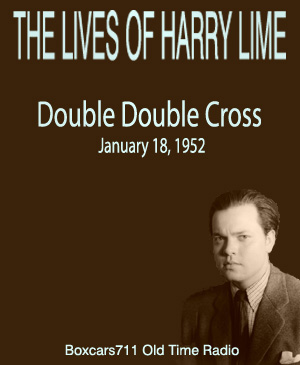
The Lives Of Harry Lime - Double Double Cross (01-18-52)
The Third Man (The Lives of Harry Lime) was a old-time radio adventure series that ran in 1951 and 1952. It was based on the 1949 film of the same name. Orson Welles stars as Harry Lime, a perpetually broke confidence man, smuggler, and general scoundrel. He will participate in virtually any criminal activity to make a fast buck, but uses his wits rather than a gun. He draws the line short of murder, blackmail, or drugs. Even so, Harry is an endearing character and listeners love to hear of his one-step-ahead-of-the-law misadventures as he hops around the globe looking for his next pigeon. The zither music of Anton Karas adds a wonderful Viennese ambience to each episode and really makes this show special.THIS EPISODE:January 18, 1952 - The Double Double Cross - Lang-Worth syndication. A Love Affair. Commercials added locally. In a remote Saudi Arabian town, Harry finds a murder and a double-cross in oil. Harry has the oil concession rights and two foreign agents set to buy. Orson Welles, Anton Karas (zither), Harry Alan Towers (producer), Tig Roe (director). 27:00.

Hear It Now - Episode 02 (12-22-50)
Hear It Now, an American radio program on CBS, began in 1950 and was hosted by Edward R. Murrow and produced by Fred Friendly. It ran for one hour on Fridays at 9 p.m. One of the most popular and best selling records of 1948 was I Can Hear It Now 1933-1945. The record was a collaboration between Edward R. Murrow and Fred W. Friendly. The record interwove historical events with speeches and Murrow's narration and marked the beginning of one of the most famous pairings in journalism history. The huge success of the record prompted the pair to parlay it into a weekly radio show for CBS. That show was Hear It Now. The show had a "magazine format." It drove to include a variety of sounds from current events such as an atom smasher at work or artillery fire from Korea. It was the artillery fire that produced one of the show's more poignant moments as it backdropped the words of American soldiers fighting the Korean War. The entire premise of the show was to include the "actual sound of history in the making," according to Murrow. Some of the show's audio was what Time Magazine called "fairly routine" in 1950. Such audio soundbites as Communist China's General Wu and Russia's Vishinsky along with the U.S. Delegate Warren Austin were included among the routine group of audio use. Television, by 1955, usurped radio in terms of audience share and a reluctant Murrow, in 1951, set about doing a TV version of the radio show called See It Now. With the inception of the television version of the show in 1951 Hear It Now ended its on air run.THIS EPISODE:December 22, 1950. Program #2. CBS network. Sustaining. Abe Burrows reviews Santa Claus, Peoria, Illnois and mobilization: how a small town is affected by the Korean war. The final 29:32 of the program only. Edward R. Murrow (narrator, editor, producer), Abe Burrows, Fred Friendly (editor, producer), Joseph Wershba ("active assistant"), Brooks Watson (Peoria), David Diamond (composer), Warren Sweeney (announcer). 29:22.

Candy Matson - 26NC9-8012 (01-02-50)
CANDY MATSON was the private eye star of Candy Matson, YUkon 2-8208, an NBC West Coast show which first aired in March 1949 and was created by Monty Masters. He cast his wife, Natalie Parks, in the title role of this sassy, sexy PI. Her understated love interest, Lt. Ray Mallard, was played by Henry Leff while her assistant and best pal, aptly named Rembrandt Watson, was the voice of Jack Thomas. Every show opened with a ringing telephone and our lady PI answering it with "Candy Matson, YU 2-8209" and then the organ swung into the theme song, "Candy". Each job took Candy from her apartment on Telegraph Hill into some actual location in San Francisco. The writers, overseen by Monty, worked plenty of real Bay Area locations into every plot.THIS EPISODE:January 2, 1950. NBC net, San Francisco origination. Sustaining. Candy investigates a plane crash and is asked to certify the safety of an airport. Bill Brownell (sounworkd effects), Dudley Manlove (announcer), Eloise Rowan (organist), Harry Bechtel, Henry Leff, Jack Cahill, Jay Rendon (sound effects), Lou Tobin, Monte Masters (writer, producer), Natalie Masters. 29:38.
Author's Playhouse - The Kracken (07-08-44)
Author's Playhouse - Famous stories by celebrated authors: among them, Elementals (Stephen Vincent Benet), The Piano (William Saroyan), and The Snow Goose (Paul Gallico).March 5, 1941 till June 4, 1945, NBC; Blue Network until mid-October 1941, then the Red Network. Many briefly held 30m timeslots, including Sundays at 11:30, 1941-42; Wednesdays at 11:30, 1942-44; Mondays at 11:30, 1944-45. Sponsor was Philip Morris, 1942-43. Cast: John Hodiak, Fern Persons, Arthur Kohl, Laurette Fillbrandt, Kathryn Card, Bob Jellison, Nelson Olmsted, Marvin Miller, Olan Soule, Les Tremayne, Clarence Hartzell, Curley Bradley, etc. Orchestra: Rex Maupin, Roy Shield, J6seph Gallicchio. Creator: Wynn Wright. Directors: Norman Felton, Fred Weihe, Homer Heck, etc.THIS EPISODE:July 8, 1944. NBC network. "The Kraken". Sustaining. A science fiction tale about a British submarine captured by a huge sea monster. Frederick Englehart (author). 1/2 hour.

Barry Craig Confidential Investigator - The Deadly Fight (01-23-52)
Normal 0 false false false EN-US X-NONE X-NONE MicrosoftInternetExplorer4 /* Style Definitions */ table.MsoNormalTable {mso-style-name:"Table Normal"; mso-tstyle-rowband-size:0; mso-tstyle-colband-size:0; mso-style-noshow:yes; mso-style-priority:99; mso-style-qformat:yes; mso-style-parent:""; mso-padding-alt:0in 5.4pt 0in 5.4pt; mso-para-margin-top:0in; mso-para-margin-right:0in; mso-para-margin-bottom:10.0pt; mso-para-margin-left:0in; line-height:115%; mso-pagination:widow-orphan; font-size:11.0pt; font-family:"Calibri","sans-serif"; mso-ascii-font-family:Calibri; mso-ascii-theme-font:minor-latin; mso-hansi-font-family:Calibri; mso-hansi-theme-font:minor-latin;} Barry Craig, Confidential Investigator Normal 0 false false false EN-US X-NONE X-NONE MicrosoftInternetExplorer4 /* Style Definitions */ table.MsoNormalTable {mso-style-name:"Table Normal"; mso-tstyle-rowband-size:0; mso-tstyle-colband-size:0; mso-style-noshow:yes; mso-style-priority:99; mso-style-qformat:yes; mso-style-parent:""; mso-padding-alt:0in 5.4pt 0in 5.4pt; mso-para-margin-top:0in; mso-para-margin-right:0in; mso-para-margin-bottom:10.0pt; mso-para-margin-left:0in; line-height:115%; mso-pagination:widow-orphan; font-size:11.0pt; font-family:"Calibri","sans-serif"; mso-ascii-font-family:Calibri; mso-ascii-theme-font:minor-latin; mso-hansi-font-family:Calibri; mso-hansi-theme-font:minor-latin;} (AKA Barry Crane" and then "Barrie Craig) is one of the few detective radio series that had separate versions of it broadcast from both coasts. Even the spelling changed over the years. It was first "Barry Crane" and then "Barrie Craig". NBC produced it in New York from 1951 to 1954 and then moved it to Hollywood where it aired from 1954 to 1955. It attracted only occasional sponsors so it was usually a sustainer.William Gargan, who also played the better known television (and radio) detective Martin Kane, was the voice of New York eye BARRY CRAIG while Ralph Bell portrayed his associate, Lt. Travis Rogers. Craig's office was on Madison Avenue and his adventures were fairly standard PI fare. He worked alone, solved cases efficiently, and feared no man. As the promos went, he was "your man when you can't go to the cops. Confidentiality a speciality."Like Sam Spade, Craig narrated his stories, in addition to being the leading character in this 30 minute show. Nearly sixty episodes are in trading circulation today. THIS EPISODE: Barrie Craig, Confidential Investigator. January 23, 1952. NBC network. "The Deadly Fight". Sustaining. Not auditioned. "A widow who can't find tears, an obituary notice in search of a cough and a boxing champ whose biggest win is a fight, strictly off the record." Fran Carlon, Himan Brown (director), William Gargan, John Roeburt (writer), Don Pardo (announcer). 29:44.

The Life Of Riley - Uncle Baxter Moves In (01-31-48)
The Life of Riley, with William Bendix in the title role, was a popular radio situation comedy series of the 1940s that was adapted into a 1949 feature film and continued as a long-running television series during the 1950s. The show began as a proposed Groucho Marx radio series, The Flotsam Family, but the sponsor balked at what would have been essentially a straight head-of-household role for the comedian. Then producer Irving Brecher saw Bendix as taxicab company owner Tim McGuerin in the movie The McGuerins from Brooklyn (1942). The Flotsam Family was reworked with Bendix cast as blundering Chester A. Riley, riveter at a California aircraft plant, and his frequent exclamation of indignation---"What a revoltin' development this is!"---became one of the most famous catch phrases of the 1940s. The radio series also benefited from the immense popularity of a supporting character, Digby "Digger" O'Dell (John Brown), "the friendly undertaker."Beginning October 4, 1949, the show was adapted for television for the DuMont Television Network, but Bendix's film contracts prevented him from appearing in the role. Instead, Jackie Gleason starred along with Rosemary DeCamp as wife Peg, Gloria Winters as daughter Barbara (Babs), Lanny Rees as son Chester Jr. (Junior), and Sid Tomack as Gillis, Riley's manipulative best buddy and next-door neighbor. John Brown returned as the morbid counseling undertaker Digby (Digger) O'Dell ("Well, I guess I'll be... shoveling off"; "Business is a little dead tonight"). Television's first Life of Riley won television's first Emmy (for "Best Film Made For and Shown on Television"). However, it came to an end on March 28, 1950 because of low ratings and because Gleason left the show, thinking he could find a better showcase for his unique abilities. Groucho Marx received a credit for "story."THIS EPISODE:January 31, 1948. NBC network. Sponsored by: Prell Shampoo, Ivory Snow. Not auditioned. The return of Uncle Baxter, once again. Will Babs get a schaolarship when the college Dean comes to visit? William Bendix, Irving Brecher (producer, director), Hans Conried, Paula Winslowe, Alan Lipscott (writer), Reuben Ship (writer), Lou Coslowe (music), John Brown, Tommy Cook, Barbara Eiler, Regina Wallace, Ken Niles (announcer). 29:02.

General Mills Radio Adventure Theater - Journey To The Center Of The Earth
General Mills Radio Adventure Theater - The series had it origins in the meeting of two minds: the ad agency for General Mills at the time, Dancer-Fitzgerald-Sample was looking for a different means to reach a child audience besides television, which was decreasing commercial minutes and increasing costs; and Himan Brown, producer-director of the CBS Radio Mystery Theater, who wanted to introduce new audiences to the dramatic form on radio. Tom Bosley was chosen as the host because of his television recognition from a kid's oriented series, Happy Days. CBS chose to produce 52 original broadcasts followed by 52 repeat broadcasts. I believe they had hoped to maintain General Mills sponsorship during the complete 104 episodes, but General Mills dropped their sponsorship after the original broadcasts. The series continued for the next 52 repeats as the CBS Radio Adventure Theater.THIS EPISODE:A Journey to the Centre of the Earth (French: Voyage au centre de la Terre), also translated as A Journey to the Interior of the Earth, is a classic 1864 science fiction novel by Jules Verne. The story involves a professor who leads his nephew and hired guide down a volcano in Iceland to the "centre of the Earth". They encounter many adventures, including prehistoric animals and natural hazards, eventually coming to the surface again in southern Italy. The living organisms they meet reflects the geological time; just as the rock layers become older and older the deeper one gets, the animals get more and more ancient the closer the characters come to the center. From a scientific point of view, this story has not aged quite as well as other Verne stories, since most of his ideas about what the interior of the Earth contains have since been proven wrong. However, a redeeming point to the story is Verne's own belief, told within the novel from the viewpoint of a character, that the inside of the Earth does indeed differ from that which the characters encounter. A Journey to the Centre of the Earth (French: Voyage au centre de la Terre), also translated as A Journey to the Interior of the Earth, is a classic 1864 science fiction novel by Jules Verne. The story involves a professor who leads his nephew and hired guide down a volcano in Iceland to the "centre of the Earth". They encounter many adventures, including prehistoric animals and natural hazards, eventually coming to the surface again in southern Italy. The living organisms they meet reflects the geological time; just as the rock layers become older and older the deeper one gets, the animals get more and more ancient the closer the characters come to the center. From a scientific point of view, this story has not aged quite as well as other Verne stories, since most of his ideas about what the interior of the Earth contains have since been proven wrong. However, a redeeming point to the story is Verne's own belief, told within the novel from the viewpoint of a character, that the inside of the Earth does indeed differ from that which the characters encounter.

Your's Truly Johnny Dollar - Expiring Nickels & Egyptian Jacket (09-04-49)
Yours Truly, Johnny Dollar - For over twelve years, from 1949 through 1962 (including a one year hiatus in 1954-1955), this series recounted the cases "the man with the action-packed expense account, America's fabulous freelance insurance investigator, Johnny Dollar". Johnny was an accomplished 'padder' of his expense account. The name of the show derives from the fact that he closed each show by totaling his expense account, and signing it "End of report... Yours Truly, Johnny Dollar". Terry Salomonson in his authoritative "A Radio Broadcast Log of the Drama Program Yours Truly, Johnny Dollar", notes that the original working title was "Yours Truly, Lloyd London". Salomonson writes "Lloyd London was scratched out of the body of (the Dick Powell) audition script and Johnny Dollar was written in. Thus the show was re-titled on this script and the main character was renamed. Why this was done was unclear – possibly to prevent a legal run-in with Lloyd's of London Insurance Company." Although based in Hartford, Connecticut, the insurance capital of the world, freelancer Johnny Dollar managed to get around quite a bit – his adventures taking him all over the world. There were some unusual devices used in the show that help set it apart from other shows. There was no partner, assistant, or secretary for Johnny. The character closest to a continuing role was that of Pat McCracken of the Universal Adjustment Bureau, who assigned Johnny many of his cases. Another atypical aspect gave the show additional credibility – frequently, characters on the show would mention that they had heard about Johnny's cases on the radio. Johnny often used his time when filling out his expense accounts to give the audience background information or to express his thoughts about the current case.No fewer than eight actors played Johnny Dollar. Dick Powell, of Rogue's Gallery fame, cut the original audition tape, but chose to do Richard Diamond, Private Detective instead. Gerald Mohr, of The Adventures of Philip Marlowe fame, auditioned in 1955, prior to Bob Bailey getting the title role. Through the first three actors to play Johnny Dollar (Charles Russell, Edmond O'Brien, and John Lund), there was little to distinguish the series from many other radio detective series. Dollar was just another hard-boiled detective in a medium that was overloaded with the stereotype. Charles Russell, the first to play the role, would throw silver dollars to bellboys and waiters. Luckily, this trite gimmick did not survive long.THIS EPISODE:September 4, 1949. CBS network. "The Expiring Nickle and The Egyptian Jackpot". Sustaining. A leper in India and a lady stowaway on an airplane add up to adventure in the Middle East. The announcer states that this is the last Johnny Dollar show until October 1, 1949, which wasn't true. Charles Russell, Georgia Ellis, Gil Doud (writer), Gordon T. Hughes (director), Jack Edwards, Leith Stevens (composer, conductor), Parley Baer, Paul Dubov, Paul Dudley (writer), Roy Rowan (announcer). 30:17.

CBS Radio Mystery Theater - The Hands Of Mrs Mallory (08-19-74)
The CBS Radio Mystery Theater (or CBSRMT) was an ambitious and sustained attempt to revive the great drama of old-time radio in the 1970s. Created by Himan Brown (who had by then become a radio legend due to his work on Inner Sanctum Mysteries and other shows dating back to the 1930s), and aired on affiliate stations across the CBS Radio network, the series began its long run on January 6, 1974. The final episode ran on December 31, 1982. The show was broadcast nightly and ran for one hour, including commercials. Typically, a week consisted of three to four new episodes, with the remainder of the week filled out with reruns. There were a total of 1399 original episodes broadcast. The total number of broadcasts, including reruns, was 2969. The late E.G. Marshall hosted the program every year but the final one, when actress Tammy Grimes took over. Each episode began with the ominous sound of a creaking door, slowly opening to invite listeners in for the evening's adventure. At the end of each show, the door would swing shut, with Marshall signing off, "Until next time, pleasant...dreams?"THIS EPISODE:August 19, 1974. Program #135. CBS network. "The Hands Of Mrs. Mallory". Sponsored by: Budweiser, Buick. There is a brief loss of audio during two public service announcements. E. G. Marshall (host), Henry Slesar (writer), Celeste Holm, Patricia Elliot, Evie Juster, Arnold Moss, Leon Janney. 52 minutes.
CBS Radio Workshop - Grief Drives A Black Sedan (09-01-57)
CBS Radio Workshop - Broadcast from 1936 through to 1947 with just an occasional break. Revived again from January 1956 to September 1957 as CBS Radio Workshop with pretty much the same format. Broadcast from 1936 through to 1947 with just an occasional break. Revived again from January 1956 to September 1957 as CBS Radio Workshop with pretty much the same format. This was drama with a difference. Columbia Workshop was not everybody's cup of tea and in terms of audience popularity it was always noted that it was never a strong contender for the title "Radios Top Rated Drama Series" and yet it was always considered to be the drama program that led the way in radio standards. Columbia was the first to mexperiment with what radio drama was all about, introducing new techniques never before used in over the airwaves drama and because it received little encouragement from established writers, actors, etc., it was only by breaking new ground with new ideas and new techniques from writers who were not versed in the old ways that it was going to survive. THIS EPISODE:September 1, 1957. CBS network origination, AFRTS rebroadcast. "Grief Drives A Black Sedan". A motorist has hit someone on a dark road, and has kept on driving. AFRTS rebroadcast name: "Mystery Theatre." Alice Frost, Jay Johnson, Larry Haines, Lee Vines, Ralph Bell, Bill Mason. 25 minutes.
Casebook Of Gregory Hood - The Delphene Bloggs Case (10-30-46)
The Casebook of Gregory Hood, starring Gale Gordon in the title role, took over where Sherlock Holmes had left off. Sponsored by Petri wine, it used the same "weekly visit" format and the same team of Anthony Boucher and Dennis Green that had written The New Adventured of Sherlock Holmes. Gregory Hood was modelled after true-life San Francisco importer Richard Gump, and many of the stories revolve around a mystery surrounding some particular imported treasure. Hood's sidekick Sanderson "Sandy" Taylor was played by Bill Johnstone. The show aired from June, 1946 through August, 1950. There were an additional couple of shows aired in October 1951. Hood and Sanderson were played in later episodes by Elliott Lewis and Howard McNear, respectively.
The Crime Club - Death At 7-10 (07-03-47)
Crime Club was a Mutual Network murder and mystery series, a product of the Doubleday Crime Book Club imprints found weekly in bookstores everywhere. The telephone rings"Hello, I hope I haven't kept you waiting. Yes, this is the Crime Club. I'm the Librarian. Murder Rents A Room? Yes, we have that Crime Club story for you.Come right over. (The organist in the shadowed corner of the Crime Club library shivers the ivories) The doorbell tones sullenly"And you are here. Good. Take the easy chair by the window. Comfortable? The book is on this shelf." (The organist hits the scary chord) "Let's look at it under the reading lamp." The Librarian, played by Raymond E. Johnson, begins reading the tale. Veteran Willis Cooper (Lights Out, Quiet Please) did some of the scripts from the Crime Club books.THIS EPISODE:July 3, 1947. Mutual network. "Death At 7:10". Sustaining. Susan Ward Steel, a woman everybody hated is dies of atropine poisoning in the compartment of a mystery writer on a train. Her story is told through flashbacks. H. F. S. Moore (author), Stedman Coles (adaptor), Roger Bower (producer, director), Raymond Edward Johnson, Helen Shields, Cameron Prud'Homme, Ted Osborne, Eleanor Phelps, Pierce Carlton, Reese Taylor. 29:40.
The Black Museum - Claw Hammer (1952)
The Black Museum - Opening in 1875, the Crime Museum at Scotland Yard is the oldest museum in the world purely for recording crime. The name Black Museum was coined in 1877 by a reporter from The Observer, a London newspaper, although the museum is still referred to as the Crime Museum. The idea of a crime museum was conceived by Inspector Neame who had already collected together a number of items, with the intention of giving police officers practical instruction on how to detect and prevent burglary. It is this museum that inspired the Black Musuem radio series. The museum is not open to members of the public but is now used as a lecture theatre for the curator to lecture police and like bodies in subjects such as Forensic Science, Pathology, Law and Investigative Techniques. A number of famous people have visited the musuem including Sir Arthur Conan Doyle, Harry Houdini, Stan Laurel and Oliver Hardy. Orsen Welles hosted and narrated the shows. Following the opening, Mr. Welles would introduce the museum's item of evidence that was central to the case, leading into the dramatization. He also provided narration during the show and ended each show with his characteristic closing from the days of his Mercury Theater on the Air, 'remaining obediently yours'.THIS EPISODE:1952. Syndicated, WRVR-FM, New York aircheck. "The Claw Hammer". Sustaining. An old lady's handyman demands fifty pounds and kills her when he doesn't get it. The date is approximate. Syndicated rebroadcast date: January 8, 1975. Harry Alan Towers (producer), Orson Welles (narrator), Ira Marion (writer), Sidney Torch (composer, conductor). 32:34.
Gunsmoke - Double Feature (01-30-54) (04-26-59)
Gunsmoke - The radio show first aired on April 26, 1952 and ran until June 18, 1961 on the CBS radio network. The series starred William Conrad as Marshal Matt Dillon, Howard McNear as Doc Charles Adams, Georgia Ellis as Kitty Russell, and Parley Baer as Deputy Chester Proudfoot. Doc's first name and Chester's last name were changed for the television program. Gunsmoke was notable for its critically acclaimed cast and writing, and is commonly regarded as one of the finest old time radio shows. Some listeners (such as old time radio expert John Dunning) have argued that the radio version of Gunsmoke was far more realistic than the television program. Episodes were aimed at adults, and featured some of the most explicit content of the day.TODAY'S SHOW: Double Feature - "Gun Smuggler" (01-30-54) and "The Badge" (04-26-59)January 30, 1954. CBS network. "Gun Smuggler". Sustaining. The Pawnees have killed a family of homesteaders using guns smuggled to them by a white man. Marshal Dillon, Chester and an Indian scout track the Indians, hoping to find the white gun smuggler. The script was used on the Gunsmoke television series on September 27, 1958. William Conrad, Georgia Ellis, John Dehner, Lawrence Dobkin, Harry Bartell, Barney Phillips, Jack Edwards, Norman Macdonnell (director), Rex Koury (composer, conductor), Howard McNear, George Walsh (announcer), John Meston (writer). 24:43.April 26, 1959. CBS network. "The Badge". Commercials deleted. A not-too-bright bank robber named Augie shoots Marshal Dillon just because he wants his badge! His pal Rack does his thinking for him, and plans to keep Dillon alive for his own reasons! The program closing has been deleted after the cast credits. The script was used on the Gunsmoke television series on November 12, 1960. William Conrad, Parley Baer, Howard McNear, Georgia Ellis, Norman Macdonnell (producer, director), Marian Clark (writer), John Meston (editorial supervisor), Harry Bartell, Vic Perrin. 24:22.

Duffy's Tavern - Archie Wants To Patent Electricity (02-23-49)
Duffy's Tavern, an American radio situation comedy (CBS, 1941-1942; NBC-Blue Network, 1942-1944; NBC, 1944-1952), often featured top-name stage and film guest stars but always hooked those around the misadventures, get-rich-quick-scheming, and romantic missteps of the title establishment's malaprop-prone, metaphor-mixing manager, Archie, played by the writer/actor who created the show, Ed Gardner.THIS EPISODE:February 23, 1949. NBC network origination, Nostalgia Broadcasting Corporation syndication. Commercials added locally. Slippery McGuire sells Archie a patent on electricity! Alan Reed appears as "Slippery McGuire." Ed Gardner, Eddie Green, Charlie Cantor, Alan Reed, Gloria Erlanger. 24:20.
Adventures Of Frank Merriwell - Sold At Auction 7-24-48)
Frank Merriwell, the much-loved fictional hero of Street and Smith's Tip Top Weekly, was first introduced to readers on April 18, 1896. Merriwell was the creation of writer Burt L. Standish (real name: Gilbert Patten), and embodied a new type of dime novel hero, one who relied as much upon mental as physical prowess. The Yale-educated Merriwell possessed "a body like Tarzan's and a head like Einstein's," wrote one admiring writer, and thus represented "the perfect union of brain and brawn." The show First ran on NBC radio from March 26 to June 22, 1934 as a 15-minute serial airing three times a week at 5:30pm. Sponsored by Dr. West's Toothpaste, this program starred Donald Briggs in the title role. Harlow Wilcox was the announcer. After a 12-year gap, the series returned October 5, 1946 as a 30-minute NBC Saturday morning show, continuing until June 4, 1949. Lawson Zerbe starred as Merriwell, Jean Gillespie and Elaine Rostas as Inza Burrage, Harold Studer as Bart Hodge and Patricia Hosley as Elsie Belwood. The announcer was Harlow Wilcox, and the Paul Taubman Orchestra supplied the background music. There are at least three generations of Merriwells: Frank, his half-brother Dick, and Frank's son, Frank Jr. There is a marked difference between Frank and Dick. Frank usually handled challenges on his own. Dick has mysterious friends and skills that help him, especially an old Indian friend without whom the stories would not have been quite as interesting.