Behavioral Grooves Podcast
529 episodes — Page 8 of 11

Ep 225Behind NOISE and Beyond The Book: Linnea Gandhi Shares her New Course on Noise
Linnea Gandhi is one of our favorite people to talk with and we had the pleasure of welcoming Linnea back to Behavioral Grooves recently. We last spoke to her in 2018 when she confessed to having a crush on statistics (a crush she clearly still harbors!) Since that time though, she has made a significant contribution to the infamous new book Noise: A Flaw in Human Judgment by Daniel Kahneman, Olivier Sibony and Cass Sunstein (https://amzn.to/3heyr5r). Linnea served as the chief of staff; project managing, researching and editing the groundbreaking work on the book. When we interviewed Olivier Sibony about Linnea’s contribution, he was glowing with compliments about her: “it took someone as miraculously organized, helpful and smart, always positive and in a consistently cheerful, good mood. And I can't imagine anyone else on the planet who could have pulled this off, but Linnea did. So she's amazing.” Linnea is a researcher, teacher, and practitioner of behavioral science in business settings. And she’s obsessed with error. Studying it, fixing it, and even embracing it – to enable better decisions by individuals and organizations. Linnea is passionate about bridging the gap between behavioral science in academia and its application in the real world. She teaches decision science at the University of Chicago Booth School of Business, studies it as part of her PhD at the Wharton School of Business, and consults on it through her company, BehavioralSight (https://behavioralsight.teachable.com/). This foothold in both worlds, has given Linnea the expertise for her current project which sees her teaching the topic of noise in an “edu-tainment” online video course. The tremendous new course (we got a sneak peak...it’s fantastic) is called Beyond Bias: How Noise May Be Drowning Out Your Decision Making Accuracy which is due to be published in June 2021. The course is purposefully designed for busy professionals who want to understand noise and how to mitigate it in organizations. Linnea and her team have meticulously planned the course videos so that they are short yet informative and entertaining. She is well aware that they are competing with Netflix for people’s attention! Our conversation weaves in some endearing anecdotes about her personal experience of working with Kahneman, Sunstein and Sibony on the book. As well as some of the hurdles of working (and recording) from home that many of us can identify with from the last year. But Linnea’s passion for her work on noise and her enthusiasm for statistics is contagious. So much so that it has almost convinced Kurt to start reading about statistics in his spare time (almost!) We hope you enjoy listening to Linnea’s work in behavioral science. At Behavioral Grooves, we are passionate about bringing you cutting edge interviews with the world’s best behavioral science practitioners, researchers and authors. If you would like to help support our work, please consider becoming a Behavioral Grooves Patreon at https://www.patreon.com/behavioralgrooves, we really appreciate the support. © 2021 Behavioral Grooves Topics We Discuss With Linnea (3:07) Speed Round (6:39) About Linnea’s new course on NOISE (16:45) Why humans don’t see easily see randomness (19:58) Working behind the scenes on NOISE (22:48) How did the authors first collaborate on NOISE (26:53) What finally convinced Linnea to get a PhD (36:12) Decision Hygiene and Linnea’s favorite technique (41:20) Music (43:20) Grooving Session Links “Noise: A Flaw in Human Judgment” by Kahneman, Sibony and Sunstein, 2021 https://amzn.to/3heyr5r Statistics As Principled Argument https://amzn.to/3uhRU8c Linnea’s Video Course on Noise (coming in June 2021) “Beyond Bias: How Noise May Be Drowning Out Your Decision Making Accuracy” https://www.behavioralsight.com/online-learning Episode 224: Why Is Noise Worse Than Bias? Olivier Sibony Explains https://behavioralgrooves.com/episode/noise-with-olivier-sibony/ Episode 38: Linnea Gandhi: Crushing On Statistics https://behavioralgrooves.com/episode/linnea-gandhi-crushing-on-statistics/ Daniel Kahneman https://amzn.to/2QQksId Cass Sunstein https://amzn.to/3uj61Kp Olivier Sibony https://amzn.to/3u8LBnp Noise: How to Overcome the High, Hidden Cost of Inconsistent Decision Making https://hbr.org/2016/10/noise Episode 176: Annie Duke on How to Decide https://behavioralgrooves.com/episode/annie-duke-on-how-to-decide/ Tania Lombrozo (Explanations) https://psych.princeton.edu/person/tania-lombrozo Mona Lisa https://en.wikipedia.org/wiki/Mona_Lisa A Structured Approach to Strategic Decisions https://sloanreview.mit.edu/article/a-structured-approach-to-strategic-decisions/ Duncan Watts https://en.wikipedia.org/wiki/Duncan_J._Watts Angela Duckworth https://en.wikipedia.org/wiki/Angela_Duckworth Episode 99: Katy Milkman: Behavior Change for Good https://behavioralgrooves.com/episode/behavior-change-for-good/ Barbara Mellers https://en.wikipedia.org/wiki/Barbara_Mellers Maurice Schweitzer http

Ep 224Why Is Noise Worse Than Bias? Olivier Sibony Explains
NOISE is set to be the next behavioral science bestseller. Daniel Kahneman, Cass Sunstein and Olivier Sibony describe noise as the unwanted variabilities in our judgments. In our exclusive interview with co-author Olivier Sibony (https://oliviersibony.com/about/) we delve into the fundamentals of noise. What different types of noise are there? Where do we find noise? Why does bias get more attention than noise? And finally, Olivier’s favorite topic; how we can mitigate noise by using decision hygiene and actively open minded thinking. Olivier Sibony is a professor, writer and advisor specializing in the quality of strategic thinking and the design of decision processes. Olivier teaches Strategy, Decision Making and Problem Solving at HEC Paris. He is also an Associate Fellow of Saïd Business School in Oxford University. Olivier’s research centers on improving the quality of decision making by reducing the impact of behavioral biases. He is the author of numerous articles in academic and popular publications, including Before You Make That Big Decision, co-authored with Nobel Prize winner Daniel Kahneman. Our interview with Olivier is, as I’m sure you will agree. absolutely mesmerizing. Learning about the extent of noise in our lives from Olivier and from the new book, is truly enlightening. As their cleverly crafted catchphrase says "wherever there is judgment, there is noise, and more of it than you think." Thankfully, the brilliant team of authors have included lots of ways to combat the noise around us. And we know that our discussion with Olivier is just the first of many that we will have around this groundbreaking topic. Behavioral Grooves strives to bring you insight and research from world-leading experts in behavioral science, like Olivier. And we do this without the use of paid advertising. If you would like to support our continued ad-free work, please consider becoming a Behavioral Grooves patreon by visiting https://www.patreon.com/behavioralgrooves thank you. © 2021 Behavioral Grooves Topics We Discuss (4:38) Welcome to Olivier Sibony and speed round questions (7:51) The difference between bias and noise (11:32) Why has bias received more attention than noise? (14:15) Where noise can be found? (22:32) What is Decision Hygiene? (26:35) How to implement mitigation techniques against noise? (29:32) Actively Open Minded Thinking and what it means for leadership and education (38:45) What are the different types of noise? (44:18) The role of moral philosophical foundations and noise (49:28) Music (54:06) Grooving Session and Bonus Track Olivier Sibony’s Books Noise: A Flaw in Human Judgment by Kahneman, Sibony and Sunstein, 2021 https://amzn.to/3heyr5r You're About to Make a Terrible Mistake: How Biases Distort Decision-Making and What You Can Do to Fight Them https://amzn.to/3u8LBnp Links Olivier Sibony https://oliviersibony.com/about/ Languedoc wine https://en.wikipedia.org/wiki/Languedoc-Roussillon_wine Rhones Valley wine https://en.wikipedia.org/wiki/Rh%C3%B4ne_wine Dr Itiel Dror https://www.ucl.ac.uk/~ucjtidr/ Apgar Checklist https://www.acog.org/clinical/clinical-guidance/committee-opinion/articles/2015/10/the-apgar-score John Maynard Keynes https://en.wikipedia.org/wiki/John_Maynard_Keynes Max Bazerman “Better, Not Perfect: A Realist's Guide to Maximum Sustainable Goodness” https://amzn.to/3f4vvqm Bentham's Utilitarianism https://en.wikipedia.org/wiki/Utilitarianism Kant's Deontological Approach https://plato.stanford.edu/entries/ethics-deontological/ Noise: How to Overcome the High, Hidden Cost of Inconsistent Decision Making https://hbr.org/2016/10/noise Behavioral Grooves Patreon https://www.patreon.com/behavioralgrooves Musical Links Yo-Yo Ma cellist “Bach Cello Suite No. 1 in G Major” https://www.youtube.com/watch?v=1prweT95Mo0 Billy Evans “My Foolish Heart” https://www.youtube.com/watch?v=a2LFVWBmoiw Keith Garrett “I Grew Up Today” https://www.youtube.com/watch?v=0PerFVC6KbU Oscar Peterson “C Jam Blues” https://www.youtube.com/watch?v=NTJhHn-TuDY More Great Episodes Of Behavioral Grooves Episode 220: How Do You Become Influential? Jon Levy Reveals His Surprising Secrets https://behavioralgrooves.com/episode/how-to-be-influential-jon-levy/ Episode 211: A Thousand Thanks: A Lifetime of Experiments and Gratitude with AJ Jacobs https://behavioralgrooves.com/episode/a-thousand-thanks-with-aj-jacobs/ Episode 204: How Shellye Archambeau Flies Like an Eagle https://behavioralgrooves.com/episode/shellye-archambeau-like-an-eagle/ Episode 176: Annie Duke on How to Decide https://behavioralgrooves.com/episode/annie-duke-on-how-to-decide/ Episode 147: Gary Latham, PhD: Goal Setting, Prompts, Priming, and Skepticism https://behavioralgrooves.com/episode/gary-latham-phd-goal-setting-prompts-priming-and-skepticism/ Episode 38: Linnea Gandhi: Crushing On Statistics https://behavioralgrooves.com/episode/linnea-gandhi-crushing-on-statistics/

Ep 223How Behavioral Science Can Impact Nonprofits: The Inspiring Story at Save The Children
Allison Zelkowitz seized the opportunity to use behavioral science at Save The Children to make a big impact on global projects. By building a world-first “nudge unit” within the organization, her story is an inspiring example of how application of behavioral science principles can make a real difference in the world. Allison Zelkowitz is the Founder and Director of the Center for Utilizing Behavioral Insights for Children (CUBIC) https://www.savethechildren.net/cubic, part of the international nonprofit organization Save the Children. CUBIC is the first behavioural insights initiative or "nudge unit" in the world to focus on the most marginalised children’s rights and welfare. At CUBIC, they focus on nudging the behaviours and actions of decision-makers, educators, families and communities, so more children get the best possible start in life. Ultimately, Allison is well aware that changing behavior isn’t about telling people what to do, it’s about facilitating ways for them to change: understanding the barriers and effectively removing them. The projects of CUBIC are not just inspiring, they are also life-saving. Projects such as Nudging children in Thailand to wear bicycle helmets, Encouraging breastfeeding in Laos, and Increasing playful teaching methods to enhance children’s learning in Bangladesh. In our chat with Allison, she reveals the vast personal dedication that it took to enable CUBIC to be formed. We love that Allison first carved her interest in behavioral science by listening to podcasts in her spare time (Allison has since become a Behavioral Grooves Patreon https://www.patreon.com/behavioralgrooves - thank you for your support!) But within the space of 14 months, her idea had grown into an international collaboration with other leading behavioral scientists, a huge fundraising effort, and eventually to the global launch of CUBIC in April 2020. In this episode you will learn: (11:05) What inspired Allison to start CUBIC at Save The Children International. (15:03) Why just giving people good information doesn't change their behavior. (19:45) An overview of setting up a Nudge unit. (23:55) The steps Allison took to build CUBIC in 14 months. (30:18) About the current project in the Philippines texting parents to encourage them to positively engage with their children. (41:54) Upcoming project on increasing vaccination uptake in the global south. (43:59) Music Allison enjoys. (48:58) Grooving Session and Bonus Track. © 2021 Behavioral Grooves Links CUBIC - Save The Children International: https://www.savethechildren.net/cubic Save The Children: https://www.savethechildren.org/?cid=Referral::POPUPwww.savethechildren.net::123199&utm_source=sciweb&utm_medium=web&utm_campaign=member_popup CUBIC: Save The Children initiative: https://www.youtube.com/watch?v=BCy9B-k2044 Eliud Kipchoge: https://en.wikipedia.org/wiki/Eliud_Kipchoge United States Parachute Association: https://uspa.org/ Allison's Blog on Skydiving with Behavioral Science: https://www.patreon.com/posts/behavioral-in-32008134 Behavioral Grooves Patreon: https://www.patreon.com/behavioralgrooves Fadi Makki, Founder of Nudge Lebannon: https://nudgelebanon.org/our_team/fadi/ The Busara Center for Behavioral Economics: https://www.busaracenter.org/ Faisal Naru, OECD: https://www.oecd.org/gov/behavioural-insights.htm Josh Martin, Ideas 42: https://www.ideas42.org/blog/incorporating-behavioral-science-cash-transfer-programs-changing-lives/ The Behavioral Insights Team: https://www.bi.team/ Dr Susanna Loeb, The Annenberg Institute, Brown University: https://annenberg.brown.edu/publications/one-step-time-effects-early-literacy-text-messaging-program-parents-preschoolers The Lantern Group: https://lanterngroup.com/ Behavioral Alchemy: https://www.behavioralchemy.com/ Musical Links Hamilton Soundtrack: https://www.youtube.com/playlist?list=PLV78EPlNCZ5B1vHkRicCAdpbDqZ1DpLgM Journey “Don’t Stop Believing”: https://www.youtube.com/watch?v=1k8craCGpgs Video for Allison’s wedding: https://www.youtube.com/watch?v=DD38az2cUsg Other Episodes You Will Enjoy Episode 202: How Chaning Jang Works Around Not Being WEIRD https://behavioralgrooves.com/episode/how-chaning-jang-works-around-not-being-weird/ Episode 209: GAABS and Improving the Future for Every Applied Behavioral Scientist https://behavioralgrooves.com/episode/improving-the-future-for-every-applied-behavioral-scientist/ Episode 190: Cornelia Walther on POZE: Pause, Observe, Zoom in, and Experience https://behavioralgrooves.com/episode/cornelia-walther-on-poze-pause-observe-zoom-in-and-experience/ Episode 168: The Stages of Grief, Pandemics and the Psychology of Protests with Nicole Fisher https://behavioralgrooves.com/episode/the-stages-of-grief-pandemics-and-the-psychology-of-protests-with-nicole-fisher/ Episode 165: Shlomi Ron: Visual Storying Telling In a Time of Crisis https://behavioralgrooves.com/episode/shlomi-ron-visual-storying-telling-in-a-time-of-crisis/ Episode 146: Covid-19 Crisis: Mar

Ep 222How Delusions Can Actually Be Useful: Shankar Vedantam Reveals How
In this episode, we are delighted to welcome Shankar Vedantam, host of the wildly popular podcast, Hidden Brain and esteemed author of the new book Useful Delusions (https://amzn.to/2PUkzlv). Before reading Shankar’s book and interviewing him for this podcast we were, as Shankar describes himself, card-carrying rationalists. We were firmly in the camp of believing rational, scientific findings and believing that lies and deception are harmful to ourselves and to our communities. However, Shankar walks us through a compelling argument, that paradoxically, self-deception actually plays a pivotal role in our happiness and well-being. In our discussion with Shankar we cover: (6:38) Speed round questions. (11:04) The difference between self delusions being useful and being harmful. (16:23) How nations are a delusional construct. (23:00) Awareness of self-delusions and how daily gratitudes can shift our perspective of the world. (25:56) Shankar’s personal story of delusional thinking. (29:58) The role emotions play in our mood and delusions. (35:23) How avoidance of delusional thinking is a sign of privilege. (37:30) Why our perceptions play an important role in understanding delusions. (44:36) Shankar’s unique approach to conspiracy theories. (52:28) What music Shankar has been listening to during COVID. (52:15) Grooving Session and Bonus Track with Kurt and Tim. We really hope you find Shankar’s unique insight on how delusions are useful as compelling as we did. If you’re a regular Behavioral Grooves listener, please consider supporting us through Patreon (https://www.patreon.com/behavioralgrooves). Thank you! © 2021 Behavioral Grooves Books Useful Delusions: The Power and Paradox of the Self-Deceiving Brain https://amzn.to/2PUkzlv The Hidden Brain: How Our Unconscious Minds Elect Presidents, Control Markets, Wage Wars and Save Our Lives https://amzn.to/3e1qgWY Links Noise: A Flaw in Human Judgment by Kahneman, Sibony and Sunstein, 2021 https://amzn.to/3heyr5r Richard Dawkins https://richarddawkins.net/ Mahabharata https://en.wikipedia.org/wiki/Mahabharata Lake Wobegon Effect https://en.wikipedia.org/wiki/Lake_Wobegon Other Episodes We Talk About The Myth of the “Relationship Spark” with Logan Ury (featuring a guest appearance by Christina Gravert, PhD): https://behavioralgrooves.com/episode/the-myth-of-the-relationship-spark-with-logan-ury-featuring-a-guest-appearance-by-christina-gravert-phd/ Robert Cialdini, PhD: Littering, Egoism and Aretha Franklin: https://behavioralgrooves.com/episode/robert-cialdini-phd-littering-egoism-and-aretha-franklin/ Self Control, Belonging, and Why Your Most Dedicated Employees Are the Ones To Watch Out For with Roy Baumeister: https://behavioralgrooves.com/episode/self-control-belonging-and-why-your-most-dedicated-employees-are-the-ones-to-watch-out-for-with-roy-baumeister/ George Loewenstein: On a Functional Theory of Boredom: https://behavioralgrooves.com/episode/george-loewenstein-on-a-functional-theory-of-boredom/ Gary Latham, PhD: Goal Setting, Prompts, Priming, and Skepticism: https://behavioralgrooves.com/episode/gary-latham-phd-goal-setting-prompts-priming-and-skepticism/ John Bargh: Dante, Coffee and the Unconscious Mind: https://behavioralgrooves.com/episode/john-bargh-dante-coffee-and-the-unconscious-mind/ Linda Thunstrom: Are Thoughts and Prayers Empty Gestures to Suffering Disaster Victims? https://behavioralgrooves.com/episode/linda-thunstrom-are-thoughts-and-prayers-empty-gestures-to-suffering-disaster-victims/

Ep 221Donating Our Money Is Irrational, So Why Do We Do It? Tim Kachuriak Explains Our Motivations
Tim Kachuriak is the founder and Chief Innovation and Optimization Officer for NextAfter (https://www.nextafter.com/), a fundraising research lab and consulting firm that works with businesses, nonprofits, and NGOs to help them grow their resource capacity. By his own admission, Tim is not a behavioral scientist, but what we love about Tim’s work is that he is using knowledge and research from the world of behavioral science and applying it to improve the efficiency of gift giving for nonprofit organizations. And not only does he use behavioral science techniques, he tests the theories in the nonprofit sector and generously publishes the findings on the NextAfter website (https://www.nextafter.com/research/). In our conversation with Tim, he underscores the need for thinking about value proposition, a term widely used in the digital marketing world, but rarely thought of in terms of nonprofit organizations. He argues that potential donors are constantly weighing up the perceived value vs. the perceived cost of donating their money. Tim also brings up the idea of reducing friction for donors: how can the giving experience be improved to make donating money a more seamless transaction. And we couldn’t help but see the parallels with the infamous new behavioral science book NOISE coming out later this month (Noise: A Flaw in Human Judgment (https://amzn.to/3heyr5r) by Kahneman, Sibony and Sunstein, 2021). There are many reasons why we donate to nonprofits; emotional reward, belonging, anger, guilt (or as Tim positively reframes it - gratitude!). Understanding these motivations is a huge part of Tim’s work and why, as behavioral scientists, we are fascinated to understand the research he has conducted around donations. Edit Hey groovers, just wanted to let you know that somehow, at 29:28 mins of the podcast we ended up cutting Tim’s response to the Susan G Komen question and can’t find it on the cutting room floor…sorry about that. What he answered was that it is important to look at the scale that these organizations work at and that sometimes spending 50% on marketing to raise a $100 million is more effective and can drive a larger change than only spending 10% on marketing, but only raising $10 million. We then went in and asked about how the pandemic has impacted giving.* We hope you enjoy our discussion with Tim Kachuriak and if you are a regular Behavioral Grooves listener, perhaps you feel motivated to donate to our work by becoming a Behavioral Grooves Patreon Member (https://www.patreon.com/behavioralgrooves). © 2021 Behavioral Grooves Topics (0:06) Introduction to our guest, Tim Kachuriak (3:50) Speed Round Questions (5:57) Why do People Give? (9:41) The Principle of Reciprocity (12:10) Effective Messaging and Value Proposition (22:25) Reducing Friction (34:48) Music (40:27) Grooving Session (58:44) Bonus Track Links NextAfter (https://www.nextafter.com/) NextAfter Research To Grow Generosity (https://www.nextafter.com/research/) Institute for Sustainable Philanthropy (https://www.philanthropy-institute.org.uk/) Roger Dooley: Friction and Engagement (https://behavioralgrooves.com/episode/roger-dooley-friction-and-engagement/) Susan G. Komen (https://www.komen.org/) Dan Pallotta, TED - The Way We Think About Charity Is Dead Wrong (https://www.ted.com/talks/dan_pallotta_the_way_we_think_about_charity_is_dead_wrong?language=en) John Hopkins University, Coronavirus Resource Centre (https://coronavirus.jhu.edu/) Rotary Club (https://www.rotary.org/) Salvation Army (https://www.salvationarmyusa.org/usn/) Noise: A Flaw in Human Judgment (https://amzn.to/3heyr5r) by Kahneman, Sibony and Sunstein, 2021 Phish, Boardwalk Hall, Atlantic City on 10.30.2010 (https://phish.net/setlists/phish-october-30-2010-boardwalk-hall-atlantic-city-nj-usa.html) Behavioral Grooves Patreon (https://www.patreon.com/behavioralgrooves) Musical Links Billy Joel “Scenes from An Italian Restaurant” (https://www.youtube.com/watch?v=Hxx8IWIvKg0) Phish “Whole lotta love” (https://www.youtube.com/watch?v=x6XcIOGWUhY) Other Episodes We Talk About Robert Cialdini, PhD: Littering, Egoism and Aretha Franklin (https://behavioralgrooves.com/episode/robert-cialdini-phd-littering-egoism-and-aretha-franklin/) Linda Thunstrom: Are Thoughts and Prayers Empty Gestures to Suffering Disaster Victims? (https://behavioralgrooves.com/episode/linda-thunstrom-are-thoughts-and-prayers-empty-gestures-to-suffering-disaster-victims/)

Ep 218How Do You Become Influential? Jon Levy Reveals His Surprising Secrets
Our guest, Jon Levy, is arguably one of the most influential behavioral scientists in the world. Over 10 years ago, Jon founded The Influencers Dinner, a secret dining experience for industry leaders ranging from Olympians, Nobel laureates, executives, to musicians. Over the course of the last decade, these dinners have developed into a wide community of influential people. Our opening speed round with Jon did not disappoint. We learn his unique perspective on which Star Trek Captains was the best, and the surprising answer to who his dream guest was at one of his dinners. In our discussion with Jon, he shares the secrets behind his influential approach: what motivated him to start this novel idea, how he developed it and the key steps behind the ongoing success of the community that he has curated. Jon’s second book, “You’re Invited: The Art and Science of Cultivating Influence” https://amzn.to/2RmlUlA is released on May 11, 2021. Which follows his hugely successful first book: “The 2 AM Principle: Discover the Science of Adventure” https://amzn.to/3eS3p0m. We had the privilege of previewing his latest book for this interview and we were blown away by Jon’s unique approach to cultivating human connections through trust and community. Of course, we discuss what music Jon has been listening to at home and we are surprised to learn what has recently sparked his musical interest. Jon has found that through his Influence Dinners, he has hosted a lot of his childhood pop idols, which he still enjoys listening to. Thanks for listening and thank you for taking a minute to join the others who have already left us a review. © 2021 Behavioral Grooves Jon Levy's Books You're Invited: The Art and Science of Cultivating Influence https://amzn.to/2RmlUlA The 2 AM Principle: Discover the Science of Adventure https://amzn.to/3eS3p0m Links Jon Levy https://www.jonlevytlb.com/ Peter Cullen (voice of Optimus Prime) https://en.wikipedia.org/wiki/Peter_Cullen James T. Kirk https://en.wikipedia.org/wiki/James_T._Kirk Jean-Luc Picard https://en.wikipedia.org/wiki/Jean-Luc_Picard Neil deGrasse Tyson https://en.wikipedia.org/wiki/Neil_deGrasse_Tyson Oprah https://en.wikipedia.org/wiki/Oprah_Winfrey Beyonce https://en.wikipedia.org/wiki/Beyonc%C3%A9 Sir Richard Branson https://en.wikipedia.org/wiki/Richard_Branson Stephen Hawking https://en.wikipedia.org/wiki/Stephen_Hawking Disney https://www.disney.com/ Mark Zuckerberg https://en.wikipedia.org/wiki/Mark_Zuckerberg Nicholas Christakis https://en.wikipedia.org/wiki/Nicholas_Christakis James H. Fowler https://en.wikipedia.org/wiki/James_H._Fowler The Spread of Obesity in a Large Social Network over 32 Years Christakis and Fowler (2007) https://www.nejm.org/doi/full/10.1056/nejmsa066082 Nike Run Club https://www.nike.com/gb/nrc-app Bill Nye the Science Guy https://billnye.com/ Parkour https://en.wikipedia.org/wiki/Parkour The Daily Show https://en.wikipedia.org/wiki/The_Daily_Show The New York Times: Want to Meet Influential New Yorkers? Invite Them to Dinner https://www.nytimes.com/2013/10/10/fashion/want-to-meet-influential-new-yorkers-invite-them-to-dinner.html SNVTA - Ventral tegmental area of the brain https://en.wikipedia.org/wiki/Ventral_tegmental_area Davos https://en.wikipedia.org/wiki/Davos Bill Gates https://en.wikipedia.org/wiki/Bill_Gates Angela Merkel https://en.wikipedia.org/wiki/Angela_Merkel TED https://www.ted.com/ My Octopus Teacher https://en.wikipedia.org/wiki/My_Octopus_Teacher United States Navy SEAL selection and training https://en.wikipedia.org/wiki/United_States_Navy_SEAL_selection_and_training The IKEA Effect https://en.wikipedia.org/wiki/IKEA_effect#:~:text=The%20IKEA%20effect%20is%20a,of%20furniture%20that%20require%20assembly Common Biases & Heuristics https://docs.google.com/document/d/1XHpBr0VFcaT8wIUpr-9zMIb79dFMgOVFRxIZRybiftI/edit?usp=sharing Brené Brown https://brenebrown.com/about/ Adam Grant https://www.adamgrant.net/ Behavioral Grooves Patreon https://www.patreon.com/behavioralgrooves Musical Links Bridgerton Soundtrack https://www.youtube.com/watch?v=rowHZd7-F1U&ab_channel=LoopedSongs Vitamin String Quartet “Thank u, next” (Ariana Grande) https://www.youtube.com/watch?v=tmljfYBkGVg John Williams “The Imperial March from The Empire Strikes Back” https://www.youtube.com/watch?v=u7HF4JG1pOg&list=PL2yW2adfehiV0-wSa784KIT1ZJ5_YEVjd&index=2&ab_channel=JohnWilliamsVEVO Tribe Called Quest “Electric Relaxation“ https://www.youtube.com/watch?v=WHRnvjCkTsw&ab_channel=TribeCalledQuestVEVO Biggie Smalls (The Notorious B.I.G.) “Big Poppa” https://www.youtube.com/watch?v=phaJXp_zMYM Maroon Five “Sugar” https://www.youtube.com/watch?v=09R8_2nJtjg&ab_channel=Maroon5VEVO 98 Degrees “I Do (Cherish You)” https://www.youtube.com/watch?v=09R8_2nJtjg&ab_channel=Maroon5VEVO Cowboy Junkies “Sweet Jane” https://www.youtube.com/watch?v=Fa9nN3G2CSg&t=173s The Tragically Hip “Ahead by a Century” https://www.youtube.com/watch?v=QE2joQsWXJg Topics (4:46) Speed Round Question

Ep 219Why Music Makes You Feel Better with Pablo Ripollés and Ernest Mas Herrero
In this episode we are thrilled to be discussing our two favorite topics: human behavior and music. We learn that music, more than any other activity, can help lift our mood, during COVID. Our guests Pablo Ripollés PhD and Ernest Mas Herrero have spent years studying how the brain responds to rewards, learning and memory. Early in the pandemic, they decided to conduct research on a long list of activities that people were doing at home to manage their stress and increase the pleasure in their lives. While a number of the activities were found to help with mental health, the research overwhelmingly showed that engaging with music was the best way to lift your mood. We have a really engaging conversation with Pablo and Ernest about their research findings on wellbeing and music. They believe that because listening to music is a passive activity and is so accessible, or “fun and free” as they call it, everyone can experience pleasure from it. And it’s not just listening to music; dancing, singing or playing music are all beneficial. We also learn that the best type of music to engage with is whatever music you really enjoy: “It will be beneficial as long as it is pleasurable.” The questionnaire Pablo and Ernest discuss in the podcast is the Barcelona Music Reward Questionnaire http://brainvitge.org/z_oldsite/bmrq.php. It will take you only a few minutes to find out about your individual sensitivity to musical reward. And you can also read Pablo and Ernest’s full research article: “Rock ’n’ Roll but not Sex or Drugs: Music is negatively correlated to depressive symptoms during the COVID-19 pandemic via reward-related mechanisms” https://psyarxiv.com/x5upn/. Listen in to find out more from Pablo and Ernest about how music can benefit your mental wellbeing. And If you’d like to support the work we do at Behavioral Grooves bringing you interesting research insights, please consider becoming a Patreon member at https://www.patreon.com/behavioralgrooves. © 2021 Behavioral Grooves Topics (0:06) Introduction (5:20) Speed Round Questions (8:44) Research Insights with Pablo and Ernest (36:50) Grooving Session (50:26) Bonus Track Musical Links Dropkick Murphys https://www.youtube.com/channel/UCcIRZxNH7xcEt1fu4pfqFRg Rumba https://www.youtube.com/watch?v=XrsK48Bp6T8 Catalan music https://www.youtube.com/watch?v=kjJnF95TWN8 Zoo https://www.youtube.com/channel/UCBh82sG2OKv1J6Ij43mdFiw Depeche Mode https://www.youtube.com/channel/UCM-CWGUijAC-8idv6k6Fygw Aretha Franklin “Think” https://www.youtube.com/watch?v=HqYnevHibaI Links “Rock ’n’ Roll but not Sex or Drugs: Music is negatively correlated to depressive symptoms during the COVID-19 pandemic via reward-related mechanisms” Herrero et al (2020): https://psyarxiv.com/x5upn/ “Neural correlates of specific musical anhedonia” Martínez-Molina et al (2016): https://www.pnas.org/content/113/46/E7337 Pablo Ripollés: https://as.nyu.edu/faculty/pablo-ripolles.html Ernest Mas Herrero: https://orcid.org/0000-0002-3607-8489 Jamón ibérico https://en.wikipedia.org/wiki/Jam%C3%B3n_ib%C3%A9rico Lionel Messi https://en.wikipedia.org/wiki/Lionel_Messi Michael Jordan https://en.wikipedia.org/wiki/Michael_Jordan Roger Federer https://en.wikipedia.org/wiki/Roger_Federer “Goal Gradient Theory” Kivetz et al (2006): https://home.uchicago.edu/ourminsky/Goal-Gradient_Illusionary_Goal_Progress.pdf Robert Zatorre, PhD https://www.mcgill.ca/neuro/robert-zatorre-phd Neomi Singer, PhD https://neuroscience-innovation.org/music-to-my-brain-neomi-singer Laura Ferreri, University of Lyon https://emc.univ-lyon2.fr/laura-ferreri-785895.kjsp Michael McPhee, NYU https://steinhardt.nyu.edu/people/michael-mcphee Hedonia and anhedonia https://en.wikipedia.org/wiki/Anhedonia Barcelona Music Reward Questionnaire http://brainvitge.org/z_oldsite/bmrq.php Spotify https://www.spotify.com/us/ The Ikea Effect https://en.wikipedia.org/wiki/IKEA_effect#:~:text=The%20IKEA%20effect%20is%20a,of%20furniture%20that%20require%20assembly The Singing Revolution https://en.wikipedia.org/wiki/Singing_Revolution Music of the Civil Rights Movement https://en.wikipedia.org/wiki/Freedom_songs Baroque Music https://www.youtube.com/watch?v=ApSoNBu2wt8 Agatha Christie https://en.wikipedia.org/wiki/Agatha_Christie Other Podcast Episodes Dessa: The Attention Shepherd on the Curious Act of Being Deeply Human” https://behavioralgrooves.com/episode/dessa-being-deeply-human/ The Counterintuitive Persuasion of The Catalyst with Jonah Berger https://behavioralgrooves.com/episode/the-catalyst-with-jonah-berger/ Chris Matyszczyk: Listening to Music While You Work https://behavioralgrooves.com/episode/chris-matyszczyk-listening-to-music-while-you-work/ Covid-19 Crisis: Emotional Impact of WFH with Liz Fosslien https://behavioralgrooves.com/episode/c-19-crisis-emotional-impact-of-wfh-with-liz-fosslien/ Jonah Berger episode: “The Counterintuitive Persuasion of The Catalyst with Jonah Berger” https://behavioralgrooves.com/episode/the-catalyst-with-jonah-be

Ep 218Share, Like, Comment: Sandra Matz PhD Exposes The Truth Behind your Digital Footprint
Our guest this week, Sandra Matz PhD exposes the truth behind our online presence. In our conversation, Sandra reveals that with simple analytics, the digital footprints we leave behind online (our Facebook Likes, our credit card transactions, our Google Map searches) add up to paint a very revealing picture of our personality and state of mind. Sandra Matz PhD is an associate professor at Columbia Business School. She takes a Big Data approach to studying human behaviour. Her methodologies use psychology, computer science and data collection to explore the relationships between people’s psychological characteristics and their digital footprints. Sandra’s work has been published in top-tier journals such as Psychological Science and the American Psychologist, and has attracted worldwide media attention from outlets like the Independent, the BBC, CNBC, the Washington Post, the Chicago Tribune, and the World Economic Forum. Our discussion delves into Sandra’s experience around social media profiles, digital ethics, data privacy and our understanding of informed consent. As always we find out about our guest’s musical taste but this week we even find out what our musical preferences can reveal about our personality and social identities. We hope you enjoy our discussion with Sandra Matz PhD, and if you do, please leave us a quick review or join our Patreon team at https://www.patreon.com/behavioralgrooves. Topics 3:04 Welcome to Sandra Matz PhD and speed round questions 4:52 Discussion about Sandra Matz’s Research 52:32 Grooving Session 1:10:37 Bonus Track with Kurt Links Sandra Matz https://www8.gsb.columbia.edu/cbs-directory/detail/sm4409 Cambridge Analytica https://en.wikipedia.org/wiki/Cambridge_Analytica Cass Sunstein https://en.wikipedia.org/wiki/Cass_Sunstein GDPR https://en.wikipedia.org/wiki/General_Data_Protection_Regulation Kate Crawford, NYU https://ainowinstitute.org/about.html Helen Nissenbaum, Cornell https://nissenbaum.tech.cornell.edu/ Tory Higgins, Shared Reality: What Makes Us Strong and Tears Us Apart https://amzn.to/3aywWdW SoundCloud https://soundcloud.com/ Brene Brown https://brenebrown.com/ Steve Bannon https://en.wikipedia.org/wiki/Steve_Bannon Patreon https://www.patreon.com/behavioralgrooves Behavioral Grooves @behavioralgroov https://twitter.com/behavioralgroov Kurt @motivationguru https://twitter.com/motivationguru Tim @THoulihan https://twitter.com/THoulihan Mary @BeSciMary https://twitter.com/BeSciMary Musical Links Taylor Swift https://www.youtube.com/user/taylorswift Justin Bieber https://www.youtube.com/channel/UCIwFjwMjI0y7PDBVEO9-bkQ Bob Dylan https://www.youtube.com/channel/UCnRI0ay61tY-fKYzzB3fCnw Britney Spears https://www.youtube.com/watch?v=C-u5WLJ9Yk4 Coldplay https://www.youtube.com/channel/UCDPM_n1atn2ijUwHd0NNRQw ACDC https://www.youtube.com/channel/UCB0JSO6d5ysH2Mmqz5I9rIw Lady Gaga https://www.youtube.com/channel/UCNL1ZadSjHpjm4q9j2sVtOA

Ep 2173 Ways to have a Positive Chat About Vaccine Hesitancy with Friends and Family
bonusResearch is showing that there are four broad groups of people who are the most vaccine hesitant: African Americans Latinos Women between the ages of 20 and 36 Rural Americans and Republicans Many of us have a family or friend who feels hesitant about the vaccination. In this episode, Kurt and Tim address how you can have a positive conversation with them, using proven behavioral science techniques. Compassionate curiosity Listen with compassion Understanding motivations Be genuine with curiosity Leverage the right messenger Framing what you’re going to share Think about their perspective Find an authority figure who they respect Trumpcine The Message Change the social norm Being able to take our masks off “Take a shot, take off your mask” Personalise the message Links Morgan Freeman https://en.wikipedia.org/wiki/Morgan_Freeman Kwame Christian https://behavioralgrooves.com/episode/kwame-christian-on-compassionate-curiosity-social-justice-conversations-and-cinnamon-toast-crunch/ Steve Martin & Joe Marks: BG episode https://behavioralgrooves.com/episode/steve-martin-and-joe-marks-the-messenger-is-the-message/ Robb Willer, Stanford University https://en.wikipedia.org/wiki/Robb_Willer Donald Trump https://en.wikipedia.org/wiki/Donald_Trump Ivanka Trump https://en.wikipedia.org/wiki/Ivanka_Trump Ted Cruz https://en.wikipedia.org/wiki/Ted_Cruz Trumpcine https://www.forbes.com/sites/brucelee/2021/04/12/trump-calls-covid-19-vaccine-trumpcine-mocks-fauci-again/ Frank Luntz https://en.wikipedia.org/wiki/Frank_Luntz Robert Cialdini https://behavioralgrooves.com/episode/robert-cialdini-phd-littering-egoism-and-aretha-franklin/ The Petrified Forrest https://www.psychologytoday.com/gb/blog/the-shaping-us/201909/the-petrified-wood-principle Katy Milkman https://behavioralgrooves.com/episode/katy-milkman-phd-using-behavior-change-for-good/ Surfacing norms to increase vaccine acceptance https://psyarxiv.com/srv6t/ Patreon https://www.patreon.com/behavioralgrooves © 2021 Behavioral Grooves

Ep 216How a Compelling Story Packs a Persuasive Punch with Melanie Green
Dr. Melanie Green is a professor at the University of Buffalo. She joined us on the podcast to explain how the power of a compelling narrative, including the effects of fictional stories, can be used to change beliefs and attitudes. Her theory of "transportation into a narrative world" focuses on how immersive storytelling is a mechanism of narrative influence. It was an in-depth conversation that explored concepts around how stories move us, the power of narrative to affect both cognitive and emotional feelings, and how restorative narratives can be used to help heal communities after disasters. We touch on the psychological response of reactance, the appeal of conspiracy theory stories and the elements needed to create a compelling story. We also introduce - in a slightly more proper fashion - our production and research assistant, Mary Kaliff. We are excited to introduce Mary to our listeners and hope you will welcome her with a happy greeting on social media! Finally, no episode of Behavioral Grooves would be complete without understanding our guest’s musical tastes. Melanie’s upbringing in Gainesville, Florida influenced her lifelong love of music, in particular the hometown hero, Tom Petty. She’s also a fan of James Taylor, which delighted Tim. More recently, Melanie’s house is often filled with the sound of the Hamilton soundtrack, thanks to her children’s love of the musical, which delighted Kurt. So, it was wins all around. We hope you enjoy our conversation with Melanie and if you like it, please jump down to the bottom of your listening app and share a quick rating or a short review with us. It goes a long way in helping others decide if they should listen to Behavioral Grooves. Topics 0:07 Introduction 1:00 Hello from Mary Kaliff 3:46 Welcome and Speed Round with Melanie Green 7:44 Reactance and empathy 16:25 What makes a good story? 22:26 Storytelling in different mediums 27:12 Parasocial Interaction 33:10 Storytelling for social good 38:50 Conspiracy Theories 43:07 Melanie’s music and playlist 47:30 Grooving Session Quotes (14:13) If you do have a story that's not representative, the danger of it kind of having an undue influence on people's thinking and decision making is, I think, a real one, especially with something consequential, like these medical decisions. (18:21) the way that stories can inform us and change our minds, is through this process of being immersed in them. (31:17) And so a story can be a really nice kind of way of summarizing and illustrating the guiding principles maybe that people want the organization to follow (33:37) restorative narratives tell those stories, you know, how people move from something bad to kind of come back to a better place. Social Media Tim @THoulihan Kurt @motivationguru Mary @BeSciMary Other Content To listen to more podcasts about narratives and messages why not delve into these episodes: https://behavioralgrooves.com/episode/steve-martin-and-joe-marks-the-messenger-is-the-message/ https://behavioralgrooves.com/episode/john-sweeney-everything-is-a-story/ © 2021 Behavioral Grooves Links Melanie Green: https://www.buffalo.edu/cas/communication/faculty/green.html The Game of Thrones: https://en.wikipedia.org/wiki/Game_of_Thrones Story telling Mirrors in the Brain: https://www.michaelharvey.org/new-blog/2019/12/29/storytelling-mirrors-in-the-brain Victoria Shaffer, PhD: https://psychology.missouri.edu/people/shaffer The Bible: https://en.wikipedia.org/wiki/Bible The Koran: https://en.wikipedia.org/wiki/Quran The Bhagavad Ghita: https://en.wikipedia.org/wiki/Bhagavad_Gita Pamela Rutledge: https://www.pamelarutledge.com/ Guy Schoenecker: https://minnesota.cbslocal.com/2016/12/07/life-story-guy-schoenecker/ BI WORLDWIDE: https://www.biworldwide.com/careers/ Common Biases & Heuristics: https://docs.google.com/document/d/1XHpBr0VFcaT8wIUpr-9zMIb79dFMgOVFRxIZRybiftI/edit?usp=sharing Jon Levy: https://www.jonlevytlb.com/ Mirror Neurons: Why good stories provoke empathy and connection (Kyle Pearce) https://www.diygenius.com/mirror-neurons/ Musical Links Bruce Springsteen “Fire”: https://www.youtube.com/watch?v=d5PoIrcyd34 “Hamilton” soundtrack: https://www.youtube.com/watch?v=aPSWZUExZ8M James Taylor “Never Die Young”: https://www.youtube.com/watch?v=FbGrD4hxoBI Traveling Wilburys “End of the Line”: https://www.youtube.com/watch?v=UMVjToYOjbM Tom Petty “Don’t Fade on Me”: https://www.youtube.com/watch?v=KKUBlwVgVYc

Ep 215Secrets of Subtraction: Donut Holes, Lego and Bruce Springsteen with Leidy Klotz
Leidy Klotz is the Copenhaver Associate Professor of Architecture, Civil and Environmental Engineering at the University of Virginia. His research fills in underexplored overlaps between engineering and behavioral science, in pursuit of more sustainable environmental systems. He has published over 70 peer-reviewed articles in venues that include top academic journals in built environment engineering, engineering education, and design, as well as imprints of both Science and Nature. We explored the rarity of subtraction from our lives and the fact that we tend to add things much more than we remove things. Granted, we’ve been builders of things since the dawn of civilization, but when is enough, enough? Leidy suggested we begin any initiative by subtracting before we start adding. We traced the concept from Lao Tzu through DaVinci through Kurt Lewin and right up into today’s literature with Marie Kondo and Tim Ferriss. But Leidy’s thoughts are truly fresh because he is adding to this historical narrative with scientific data. He offered us fresh ways to think about this uphill battle with our natural desires. We also discussed Leidy’s view of the Planetary Tipping Point: where our very fixed-resource planet gets maxed out by humans with an unlimited desire for more. And we were pleased to talk about Kurt Lewin and his force-field analysis and, as you might expect, we enthusiastically discussed Bruce Springsteen as a prolific and gifted writer. We hope you enjoy our discussion with Leidy Klotz, and if you do, please leave us a quick review or join our Patreon team at https://www.patreon.com/behavioralgrooves. Links Leidy Klotz, PhD: https://engineering.virginia.edu/faculty/leidy-klotz Lego https://www.lego.com/en-us Harry Potter Lego Set - Hogwarts https://www.lego.com/en-us/search?q=harry%20potter%20hogwarts Wildlife Bingo https://www.nature-watch.com/wildlife-bingo-game-p-176.html Michael Jordan https://en.wikipedia.org/wiki/Michael_Jordan Bruce Springsteen https://brucespringsteen.net/ Mayan City of Coba https://en.wikipedia.org/wiki/Coba Marie Kondo https://konmari.com/ Tim Ferris https://tim.blog/ Da Vinci https://en.wikipedia.org/wiki/Leonardo_da_Vinci Lao Tzu https://en.wikipedia.org/wiki/Laozi Bowerbird https://en.wikipedia.org/wiki/Bowerbird Allison Zelkowitz https://www.linkedin.com/in/allison-zelkowitz-197431a/?originalSubdomain=lb Chaning Jang https://www.busaracenter.org/staff-bios/chaning-8f39x Kurt Lewin https://en.wikipedia.org/wiki/Kurt_Lewin Kate Orff, Lexington Waterway Project https://www.scapestudio.com/people/kate-orff/ Dan Ariely “Predictably Irrational” https://danariely.com/books/predictably-irrational/ Roger Dooley “Friction” https://www.rogerdooley.com/books/friction/ Musical Links Bruce Springsteen “Darkness On The Edge Of Town” https://www.youtube.com/watch?v=kg0ekQBmzKs Bruce Springsteen “Born In The USA” https://www.youtube.com/watch?v=EPhWR4d3FJQ Bruce Springsteen “Western Stars” https://www.youtube.com/watch?v=_IXzAAKrsFE Bruce Springsteen “Letter to You” https://www.youtube.com/watch?v=AQyLEz0qy-g Topics 3:20 Leidy’s 6-year-old son answers a speed round question 4:34 Speed round with Leidy 7:14 Leidy’s book - Subtraction 13:00 “More-ality” 24:00 Planetary tipping points 26:15 Kurt Lewin force field theory 29:28 Kate Orff Lexington Waterways Project 33:40 Subtraction checklist 37:57 Springsteen 45:24 Grooving Interview Quotes (8:10) we're doing these mental searches for solutions, and our mind goes to additive solutions before it goes to subtractive ones. (12:01) as people are trying to change things from how they are to how they want them to be, we systematically think of adding first and then, only subsequently or with effort or with reminders, think of subtraction (35:15) so often we kind of come to a problem and don't actually spend time defining what the what the problem is, right (9:51) My favorite is Lao Tzu, even farther back talking about, to gain wisdom, you have to subtract something every day.

Ep 214Observing the Non-Obvious: How to Spot Trends Around You with Rohit Bhargava
Rohit Bhargava is on a mission to help everyone in the world become a non-obvious thinker. In this episode, he talks with us about how intentionality is the key to seeing the non-obvious and how he uses The Haystack Method to gather insights from the world. He also shared how he has become a speed-understander and the benefits that go with it. In 2011, Rohit embarked on the annual task of documenting the digital trends of the year, which after a decade, culminated in his book on megatrends in 2021 #1 Wall Street Journal bestselling author of seven books including “Non-Obvious Megatrends: How to See What Others Miss and Predict the Future” https://amzn.to/3mpkJgn. Rohit discusses with us how he analyses trends, not just on the superficial level, but digging deeper into the “why” question. Our conversation with Rohit is full of compelling insights about the human condition, unique analysis of the world around us, and actionable tips on how to train yourself to observe with intention. You’ll also get a quick education in contemporary Latin music and some head-scratching about why He-Man ever became a superhero in the first place. Two of Rohit’s books are currently being republished into new editions; The Non-Obvious Guide to Virtual Meetings and Remote Work (Non-Obvious Guides) https://amzn.to/2OoxdbB The Non-Obvious Guide to Marketing & Branding (Without a Big Budget) (Non-Obvious Guides) https://amzn.to/3moIllg If you’re a regular Behavioral Grooves listener, please consider supporting us through Patreon. Thank you! https://www.patreon.com/behavioralgrooves © 2021 Behavioral Grooves Links Rohit Bhargava: https://www.rohitbhargava.com/ Isaac Asimov: https://en.wikipedia.org/wiki/Isaac_Asimov Ali Pittampalli “Persuadable”: https://www.alpitt.com/ Henry Coutinho-Mason “The Future Normal”: https://henrycoutinho-mason.com/ Maysoon Zayid: https://maysoon.com/ Telemundo: https://en.wikipedia.org/wiki/Telemundo Dan Simons Invisible Gorilla video: https://www.youtube.com/watch?v=IGQmdoK_ZfY Tom Cruise “Cocktail”: https://www.youtube.com/watch?v=5YbjzztYbUo He-Man: https://en.wikipedia.org/wiki/He-Man Telemachus: https://en.wikipedia.org/wiki/Telemachus Meave Leakey: https://en.wikipedia.org/wiki/Meave_Leakey Dan Hill - Episode 151: https://behavioralgrooves.com/episode/dan-hill-phd-on-the-facial-coding-of-trump-hendrix-prince-gretzky-and-the-beatles/ Hedgefox: https://www.russellsage.org/sites/default/files/Vohs_intro_0.pdf Books The Non-Obvious Guide to Virtual Meetings and Remote Work (Non-Obvious Guides): https://amzn.to/2OoxdbB The Non-Obvious Guide to Marketing & Branding (Without a Big Budget) (Non-Obvious Guides): https://amzn.to/3moIllg Non Obvious Megatrends: How to See What Others Miss and Predict the Future (Non-Obvious Trends Series): https://amzn.to/3mpkJgn Musical Links Neil Peart (Rush): https://en.wikipedia.org/wiki/Neil_Peart Fanny Lu: https://en.wikipedia.org/wiki/L%C3%A1grimas_C%C3%A1lidas Maná “Rayando del Sol”: https://www.youtube.com/watch?v=tY3O_Fbfjjs Carlos Vives “Cumbiana”: https://www.youtube.com/watch?v=baUk9YcCxBQ Carlos Vives & Shakira “”La Bibcicleta”: https://www.youtube.com/watch?v=-UV0QGLmYys Juaness “Es Por Ti | One World: Together” At Home: https://www.youtube.com/watch?v=-pgvjxtHBOg Coffitivity: https://soundcloud.com/coffitivity Topics 6:37 Trends vs Fads 11:10 Haystack Method 13:18 Trends 19:15 Brave Enough to Change Your Mind 28:00 Non Obvious Brand 30:28 Spare Time 35:30 Rohit’s Inspiration 40:45 The Yellow Balloon Light Bulb 45:04 Naming 47:14 He-Man Quotes (6:37) ...trend is something that implicates behavior, which is very topical for us. And whereas a fad is just usually a thing or a platform, but doesn't always correlate to behavior. (7:55) ...a speed understander is someone who thinks about what to pay attention to as an end is intentional about what they choose not to pay attention to. (10:55) ...if you spend enough time gathering interesting, fascinating stories, instead of obsessing about why they're interesting or fascinating in the moment, then later on, you can start to spot the patterns that you would never have otherwise seen. (16:37) ...being observant is not a skill you're born with, or not born with. Being observant is a choice. (19:45)...being persuadable requires You to rethink those things, those assumptions, those points of view that you have. And I think the only way that anyone can do that is by not letting themselves be defined by the stands that they have taken. Because the more you see a stand that you've taken, or a belief or something that you've put out in the world as core to your identity, the less likely you are to change. (20:07) ...the more you see a stand that you've taken, or a belief or something that you've put out in the world as core to your identity, the less likely you are to change

Ep 213Why It's Astoundingly Easy, But Not Better, to Be Tribal with Tim Ash
Tim Ash is a very interesting guy. He is both an authority on evolutionary psychology and digital marketing, which puts him in pretty rarified air. He is the bestselling author of Unleash Your Primal Brain and Landing Page Optimization (with over 50,000 copies sold worldwide and translated into six languages). He has been identified by Forbes as a Top-10 Online Marketing Expert, and by Entrepreneur Magazine as an Online Marketing Influencer To Watch. Our conversation with Tim focused on his most recent book, Unleash Your Primal Brain, and addressed a question very central to behavioral science today: What is rational? This led to addressing how biases and heuristics are grounded in important evolutionary foundations. Tim likens the way we talk about biases today as glitches in the matrix when we should be acknowledging them for what they are: important evolutionary tools to help us survive our environments and thrive in our tribes. We also discussed the importance of culture and its central focus on the way humans learn to be human. A paradox we discussed is that culture is dependent on tribe members passing down the cultural (social) norms to the next generation without interruption, and yet cross-tribal collaboration is what has given us an evolutionary edge. Tim notes, that what we need to do today is to “stretch beyond our current tribes needs to go and make the effort to contact other people that are very different from us.” And the consequences of not doing that, according to Tim, “ …are going to be the ones that are going to bring down the larger society.” Fascinating stuff. We hope you’ll find this conversation with this insightful researcher and speaker as exciting as we did. And if you do like it, please give us a quick 5-star rating or a two-sentence review. And thank you for listening to Behavioral Grooves. © 2021 Behavioral Grooves Links Tim Ash: https://timash.com/ “Primal Brain”: https://timash.com/books-and-media-mentions/ Latin: https://en.wikipedia.org/wiki/Latin Robert Sapolsky: https://en.wikipedia.org/wiki/Robert_Sapolsky Aristotle: https://en.wikipedia.org/wiki/Aristotle Hopper: https://en.wikipedia.org/wiki/Hopper_(particulate_collection_container) Carl Sagan: https://en.wikipedia.org/wiki/Carl_Sagan Neil deGrasse Tyson: https://en.wikipedia.org/wiki/Neil_deGrasse_Tyson Robert Cialdini: https://www.influenceatwork.com/ Robert Heinlein: https://en.wikipedia.org/wiki/Robert_A._Heinlein Antonio Damasio: https://en.wikipedia.org/wiki/Antonio_Damasio Carlos Castaneda “Journey to Ixtlan”: https://en.wikipedia.org/wiki/Journey_to_Ixtlan “Zen and the Art of Motorcycle Maintenance”: https://en.wikipedia.org/wiki/Zen_and_the_Art_of_Motorcycle_Maintenance Sabre fencing: https://en.wikipedia.org/wiki/Sabre_(fencing) Tai Chi: https://en.wikipedia.org/wiki/Tai_chi Kung Fu: https://en.wikipedia.org/wiki/Chinese_martial_arts Don Miguel Ruiz “The Four Agreements”: https://en.wikipedia.org/wiki/The_Four_Agreements Bhagavad Gita: https://en.wikipedia.org/wiki/Bhagavad_Gita Coleman’s Boat: https://www.youtube.com/watch?v=dGaz0xKG060 Musical Links Pat Metheny Group “Last Train Home”: https://www.youtube.com/watch?v=goXJTv_U-PM Chet Baker “Almost Blue”: https://www.youtube.com/watch?v=E4IridL_2XU Elvis Costello “Almost Blue”: https://www.youtube.com/watch?v=Qt8f1Sda8_4 Miles Davis “So What”: https://www.youtube.com/watch?v=zqNTltOGh5c Salsa “Al Monte”: https://www.youtube.com/watch?v=T2JnyCuAQMg
Ep 212Scrutinizing Hype: Powerful lessons from The Hype Handbook with Michael F. Schein
Michael F. Schein is a hype specialist and the author of The Hype Handbook: 12 Indispensable Secrets from the World’s Greatest Propagandists, Self-Promoters, Cult Leaders, Mischief Makers, and Boundary Breakers. He is also the founder and president of MicroFame Media, a marketing agency that specializes in making idea-based companies famous in their industries. We caught up with Michael recently to talk about his book about how hype can be a very good thing. In and of itself, hype can be a powerful tool of promotion and its bad reputation may be well deserved, but it’s not carved in stone. Hype has a place in a world abundant with choice and Michael has some ideas on how to use hype to cut through a crowded field. Michael offers some tips on how to manage your way – ethically – through the world of hype to help you and your ideas breakthrough. We also talked about Tim Ferriss’s claim on the world kickboxing championship, and we discussed which world would be a better world to live in: a world that was imagined in George Orwell’s Nineteen Eighty-Four, or Aldous Huxley’s A Brave New World. Buckle up, Buttercups! © 2021 Behavioral Grooves Links Michael Schein: https://michaelfschein.com/ You can download Michael’s recommendations on hype ideas at www.hypereads.com/list Access to Anyone podcast: https://www.accesstoanyonepodcast.com/ George Orwell’s Nineteen Eighty-Four: https://en.wikipedia.org/wiki/Nineteen_Eighty-Four Aldous Huxley’s A Brave New World: https://en.wikipedia.org/wiki/Brave_New_World Tim Ferriss: https://en.wikipedia.org/wiki/Tim_Ferriss Anarchist Cookbook: https://en.wikipedia.org/wiki/The_Anarchist_Cookbook Shep Gordon: https://en.wikipedia.org/wiki/Shep_Gordon “Wall Street” movie: https://en.wikipedia.org/wiki/Wall_Street_(1987_film) Wembley Stadium: https://en.wikipedia.org/wiki/Wembley_Stadium Frans de Waal Capuchin Monkey Experiments: https://www.youtube.com/watch?v=meiU6TxysCg Behavioral Grooves Patreon: https://www.patreon.com/behavioralgrooves Musical Links Black Flag “Nervous Breakdown”: https://www.youtube.com/watch?v=302oEzSPCqE Violent Femmes “Blister in the Sun”: https://www.youtube.com/watch?v=JE-dqW4uBEE David Bowie “Modern Love”: https://www.youtube.com/watch?v=jLMUZahN7NU Alice Kooper “No More Mister Nice Guy”: https://www.youtube.com/watch?v=KN6ngThqMEs Ministry “Jesus Built My Hotrod”: https://www.youtube.com/watch?v=IpPOX6-sP7g Dead Milkmen “Punk Rock Girl”: https://www.youtube.com/watch?v=yF7fgEMrk0k Sonic Youth “Superstar”: https://www.youtube.com/watch?v=Y21VecIIdBI California Raisins “Heard it Through the Grapevine”: https://www.youtube.com/watch?v=UShiwymsX0w WWF “Land of A Thousand Dances”: https://www.youtube.com/watch?v=oHZCcu9ltcs Whitney Houston “I Will Always Love You”: https://www.youtube.com/watch?v=mK4hweZRU0k Boomtown Rats “I Don’t Like Mondays”: https://www.youtube.com/watch?v=FcZW0GFLSdw The Specials “Monkey Man”: https://www.youtube.com/watch?v=49FbSq_JNeQ Sex Pistols “God Save The Queen”: https://www.youtube.com/watch?v=02D2T3wGCYg The Clash “Rock the Casbah”: https://www.youtube.com/watch?v=bJ9r8LMU9bQ Husker Du “Camden Palace”: https://www.youtube.com/watch?v=gsGw8DyWkik The Replacements “I Will Dare”: https://www.youtube.com/watch?v=o4ynSTN8bkc Depeche Mode “Personal Jesus”: https://www.youtube.com/watch?v=u1xrNaTO1bI The Dead Kennedy’s “In God We Trust”: https://www.youtube.com/watch?v=_bqIS0n64Ig Joy Division “She’s Lost Control”: https://www.youtube.com/watch?v=FD2SfQJOK08

Ep 211A Thousand Thanks: A Lifetime of Experiments and Gratitude with AJ Jacobs
AJ Jacobs is an author, journalist, lecturer, and human guinea pig. He has written four New York Times bestsellers, including The Year of Living Biblically, that combine memoir, science, and humor with a dash of self-help. AJ has said that he sees his life as a series of experiments in which he immerses himself in a project or lifestyle, for better or worse, then writes about what he learned. His most recent book, Thanks A Thousand: A Gratitude Journey, starts with wanting to thank the people who brought him his cup of coffee. It starts with the barista and ends up in South America on a mountainside coffee plantation. The book is based on some simple ideas that gratitude can be the catalyst for a journey around the world, and how experimentation keeps our brains flexible in ways that enhance our lives. We loved our conversation with AJ because he made a passionate case for learning to pay more attention to things. To immerse ourselves in the moment where we can appreciate that moment for what it is. He encourages us to see the details, and in those details, to see the connections. He challenges us to be grateful for the life we are given. If we can slow down, savor these moments for what they are, we can curate a better life for ourselves. You’ll find lots about AJ that is fun and informative – but above it all, you’ll find him inspiring. If AJ can do these things on such a grand scale, we ought to be able to experiment with our lives – even if it is just not making your bed in the morning. © 2021 Behavioral Grooves Links AJ Jacobs: https://ajjacobs.com/ “Thanks A Thousand”: https://thanksathousandbook.com/ AJ’s TED Talk: https://www.ted.com/talks/a_j_jacobs_my_journey_to_thank_all_the_people_responsible_for_my_morning_coffee George Clooney: https://en.wikipedia.org/wiki/George_Clooney The Encyclopedia Britannica: https://www.britannica.com/ Windshield Wiper: https://en.wikipedia.org/wiki/Windscreen_wiper The New York Times Crossword Puzzle: https://en.wikipedia.org/wiki/The_New_York_Times_crossword_puzzle Alex Trebek: https://en.wikipedia.org/wiki/Alex_Trebek George Loewenstein: https://www.cmu.edu/dietrich/sds/people/faculty/george-loewenstein.html Ambient Noise: https://en.wikipedia.org/wiki/Background_noise Coffitivity (ambient noise generator): https://coffitivity.com/ Melanie Brucks: https://www8.gsb.columbia.edu/cbs-directory/detail/mb4598 Michael Phelps: https://en.wikipedia.org/wiki/Michael_Phelps French Horn: https://en.wikipedia.org/wiki/French_horn Electronic Dance Music: https://en.wikipedia.org/wiki/Electronic_dance_music MDMA: https://en.wikipedia.org/wiki/MDMA Jonathan Mann, Episode 207: https://behavioralgrooves.com/episode/jonathan-mann-is-it-possible-to-design-an-experience/ Mark Landau: https://www.mindful.org/how-mindfulness-shifts-our-perception-of-time/ Neil Gaiman: https://en.wikipedia.org/wiki/Neil_Gaiman Masterclass: https://www.masterclass.com/ Gratitude / Gratia / Grace: https://www.merriam-webster.com/dictionary/gratitude Robert Emmons: https://www.health.harvard.edu/mind-and-mood/in-praise-of-gratitude Francesca Gino, Episode 60: https://behavioralgrooves.com/episode/francesca-gino-curiosity-and-rebellion-makes-your-career/ Tony Robbins: https://en.wikipedia.org/wiki/Tony_Robbins Behavioral Grooves Patreon: https://www.patreon.com/behavioralgrooves Musical Links ZZ Top “La Grange”: https://www.youtube.com/watch?v=Vppbdf-qtGU Lil’ Wayne “2 Diamonds”: https://www.youtube.com/watch?v=wrLSro5XNzY Sex Pistols “God Save the Queen”: https://www.youtube.com/watch?v=02D2T3wGCYg

Ep 210Linda Thunstrom: Are Thoughts and Prayers Empty Gestures to Suffering Disaster Victims?
Linda Thunstrom, PhD is a Swedish economist working as an assistant professor of economics at the University of Wyoming. (That’s in Laramie, Wyoming, not Wyoming, Sweden.) Her research interests include behavioral, experimental, public, and health economics. Her interests merged after Hurricane Florence when she became curious about the effect that offering thoughts and prayers might have on potential donors to natural disasters. She set up a study to see if potential donors might feel like they don’t need to make a monetary donation to the victims if they’ve already offered up some thoughts and prayers. Her results may surprise you. And she didn’t stop there. She also looked at this question from the recipient’s end. As an economist, she framed the study in monetary terms and wondered if disaster victims might take less money in a donation if they knew someone was praying for them – especially if it were a Christian stranger or a priest. Again: fascinating results! We also talked about willful ignorance and the role it plays in our decision-making. Willful ignorance involves neglecting information about how your actions will affect others or yourself. It’s different from and less harmful than outright self-deception. Self-deception is commonly associated with lying to make yourself feel better. The big worry with self-deception is that you start believing your own lies. Willful ignorance is like heading into the basement to get a Coke Zero and noticing a box of Oreo cookies and deciding that now is probably a pretty good time to have one, or two, of those chocolate calorie bombs. We are neglecting the facts that we already know about Oreo cookies: they’re not really good for. But we nab a couple anyway. We’d like to thank you to Andrea Mannberg, a guest from Episode 199, for introducing us to Linda. Both of these economists are applying their training to fantastically interesting topics and we’re grateful for both of their work. © 2021 Behavioral Grooves Links Linda Thunstrom: https://lindathunstrom.com/ Linda Thunstrom, PhD: https://www.uwyo.edu/economics/faculty-staff/linda-thunstrom/ Shiri Noy, PhD: https://denison.edu/people/shiri-noy “Exploiting moral wiggle room: experiments demonstrating an illusory preference for fairness” Dana, et. all (2007): https://link.springer.com/article/10.1007/s00199-006-0153-z George Loewenstein, PhD: https://www.cmu.edu/dietrich/sds/people/faculty/george-loewenstein.html Todd Cherry, PhD: http://www.uwyo.edu/economics/faculty-staff/todd-cherry/index.html George Loewenstein, PhD: https://www.cmu.edu/dietrich/sds/people/faculty/george-loewenstein.html Dan Gilbert, PhD: https://en.wikipedia.org/wiki/Daniel_Gilbert_(psychologist) Contemporary Folk Music: https://en.wikipedia.org/wiki/Contemporary_folk_music Americana Music: https://en.wikipedia.org/wiki/Americana_(music) Hurricane Florence: https://en.wikipedia.org/wiki/Hurricane_Florence “Temporal View of the Costs and Benefits of Self-Deception” Gino, Norton, Ariely: https://www.hbs.edu/faculty/Pages/item.aspx?num=39857 Eric Oliver, Episode 172: https://behavioralgrooves.com/episode/how-to-talk-to-your-friends-about-their-conspiracy-theories-with-eric-oliver/ Andrea Mannberg, Episode 199: https://behavioralgrooves.com/episode/how-decision-making-is-critical-for-back-country-skiers-and-sex/ Behavioral Grooves Patreon Site: https://www.patreon.com/behavioralgrooves Musical Links Jay Shogren “Let’s Fall Behind”: http://www.jshogren.com/https/jshogrenshanghaidbandcampcom/track/lets-fall-behind David Bowie “Under Pressure” with Annie Lennox and Queen: https://www.youtube.com/watch?v=fCP2-Bfhy04

Ep 209GAABS and Improving the Future for Every Applied Behavioral Scientist
GAABS is an organization that was recently founded to act as an accrediting body for applied behavioral scientists. GAABS is The Global Association of Applied Behavioral Scientists and is open for membership for those who demonstrate their ability to ethically apply behavioral science to their work. In this episode, we spoke with co-founding members Nuala Walsh and Steve Martin. Nuala is a contributor to Harvard Business Review and is the founder of MindEquity – a behavioral science consultancy based in Dublin. And Steve Martin is the co-author, with Robert Cialdini and Noah Goldstein, of Yes! 50 secrets from the Science of Persuasion, which has sold more than a million copies and been translated into 27 languages. Nuala is a repeat guest that was featured in episode 203 about whistleblowers and fake memories, and Steve was featured in episode 110 with his co-author, Joe Marks. Together, they wrote “Messengers: Who We Listen To, Who We Don’t, and Why.” In our conversation, we discussed what GAABS is and what they’re hoping to do to help both practitioners of behavioral science as well as the professionals and institutions that hire those services. On a more philosophical note, we steered into what is lacking in applied behavioral science these days and agreed that there are many fields that could benefit from a behavioral science lens. And across the board, we agreed that education for all parties is critical for the field to be successful. On an educational note, Steve wryly noted that students could use more psychology and less geography in the classroom, and teed up the novel concept of prac-ademics. And, later, Nuala introduced the idea of leveraging trends, like big data, and noted, “if we marry behavioral science with data science, we actually have an in.” We hope you enjoy our conversation with Nuala and Steve and that you’ll check out the Behavioral Grooves Patreon site at www.patreon.com/behavioralgrooves. Now go out this week and find YOUR groove. © 2021 Behavioral Grooves Links Nuala Walsh: https://www.linkedin.com/in/nualagwalsh/?originalSubdomain=uk Steve Martin: https://www.linkedin.com/in/steve-martin-13832b5/ GAABS: https://gaabs.org/ Oxbow Lake: https://www.nationalgeographic.org/encyclopedia/oxbow-lake/ Annie Duke Alliance for Decision Education: https://alliancefordecisioneducation.org/learn/about-the-alliance/team/board/annie-duke Mya Shankar: https://en.wikipedia.org/wiki/Maya_Shankar Robert Cialdini: https://www.influenceatwork.com/robert-cialdini-phd/biography/ Jennifer Lerner: https://www.hks.harvard.edu/faculty/jennifer-lerner Nuala Walsh – Episode 203: https://behavioralgrooves.com/episode/on-fake-memories-and-whistleblowers-with-nuala-walsh/ Steve Martin – Episode 110: https://behavioralgrooves.com/episode/steve-martin-and-joe-marks-the-messenger-is-the-message/ Steve Martin and Joe Marks “Messengers: Who We Listen To, Who We Don’t, and Why”: https://www.goodreads.com/en/book/show/43522604-messengers Harlow Gale, PhD: https://www.researchgate.net/publication/203619125_Harlow_Gale_and_the_Origins_of_the_Psychology_of_Advertising Musical Links Sinead O’Connor “Nothing Compares 2 U” https://www.youtube.com/watch?v=0-EF60neguk : Electric Light Orchestra “Don’t Bring Me Down”: https://www.youtube.com/watch?v=ATuX7V4XOlk The Cranberries “Linger”: https://www.youtube.com/watch?v=H_5B14-VytM Van Morrison “Into the Mystic”: https://www.youtube.com/watch?v=m0gvodQgu-Y Fleetwood Mac “The Chain”: https://www.youtube.com/watch?v=kBYHwH1Vb-c Rod Stewart “Maggie May”: https://www.youtube.com/watch?v=m2CQ0FvAZuw Carly Simon “Nobody Does it Better”: https://www.youtube.com/watch?v=SaV-6qerkqI Joan Baez “Diamonds & Rust”: https://www.youtube.com/watch?v=GGMHSbcd_qI Mike + The Mechanics “The Living Years”: https://www.youtube.com/watch?v=5hr64MxYpgk The Who “Eminence Front”: https://www.youtube.com/watch?v=rx6Zgz0TZuA

Ep 210Dessa: The Attention Shepherd on the Curious Act of Being Deeply Human
Dessa is a singer, rapper, writer, speaker, science and philosophy connoisseur, podcast host, and ice cream flavor inventor. (Her flavor is Dessa’s Existential Crunch which consists of crème fraîche, brown sugar ice cream, Jameson Irish Whiskey, Disaronno Amaretto Liqueur, and a cashew and praline pecan brittle crunch). Dessa has made a career of bucking genres and defying expectations — her résumé as a musician includes being part of the Doomtree collective, a solo artist with performances at Lollapalooza and Glastonbury, co-composer of pieces for 100-voice choir, performances with the Minnesota Orchestra, and top-200 entries on the Billboard charts. She also contributed to the #1 album The Hamilton Mixtape. As a writer, she published a memoir-in-essays called My Own Devices which was released in 2018 in addition to two literary collections along with many articles in journals such as The New York Times and National Geographic Traveler. And now she is the host of a new podcast that explores “why we do the things we do” called Deeply Human. The podcast is a fun exploration of a number of topics and brings in experts to help explain why we behave the way we do. We wanted to talk to Dessa before we knew about her podcast. Here is part of the e-mail that we sent to her publicist to ask for an interview: “While it may seem a bit off-brand for us to ask for an interview with Dessa, we think that it would be fascinating, and we’d love to talk to her about the intersection of music and emotion. While we typically interview behavioral science researchers and practitioners, we often interview what we call “accidental behavioral scientists.” These are people who are applying the aspects of behavioral science to their work without really knowing that they are doing it. Dessa captures a lot of our human experience in her lyrics and discussing that would be a wonderful way of exploring this concept. We would also love to talk to her about her experience with the scientific fMRI research that she talks about in her essay, “Call of your ghost.” Our conversation with Dessa examined a wide range of topics – moving from her podcast, to music’s ability to create synchronicity between people, to how we can’t compare subjective experiences, to how emotional connection comes from dropping veils and getting out of our “practiced mirror face.” This is an episode that you definitely don’t want to miss. © 2021 Behavioral Grooves Links Dessa: www.dessawander.com or www.doomtree.com Deeply Human: wherever you get your podcasts from Lute: https://en.wikipedia.org/wiki/Lute The Diary of Ann Frank: https://en.wikipedia.org/wiki/The_Diary_of_a_Young_Girl Alan Alda: https://en.wikipedia.org/wiki/Alan_Alda Helen Fisher: https://en.wikipedia.org/wiki/Helen_Fisher_(anthropologist) Barry Schwartz: https://en.wikipedia.org/wiki/Barry_Schwartz_(psychologist) Oxytocin: https://en.wikipedia.org/wiki/Oxytocin_receptor EEG: https://en.wikipedia.org/wiki/Electroencephalography QEEG: https://en.wikipedia.org/wiki/Quantitative_electroencephalography Autism: https://en.wikipedia.org/wiki/Autism Epilepsy: https://en.wikipedia.org/wiki/Epilepsy Penijean Gracefire: https://penijean.com/home Cheryl Olman: http://www.neuroscience.umn.edu/people/cheryl-olman-phd fMRI: https://en.wikipedia.org/wiki/Functional_magnetic_resonance_imaging Neurofeedback: https://en.wikipedia.org/wiki/Neurofeedback Harry Haslow – Wire Monkey experiments: https://en.wikipedia.org/wiki/Harry_Harlow Research on Emotion and Narrative - https://www.researchgate.net/publication/325962169_Emotion_and_Narrative_Perspectives_in_Autobiographical_Storytelling Drummer Boy (Military): https://en.wikipedia.org/wiki/Drummer_(military) “Rock ’n’ Roll but not Sex or Drugs: Music is negatively correlated to depressive symptoms during the COVID-19 pandemic via reward-related mechanisms”: https://tinyurl.com/yw4v5avs Pew Research (2016) The Joy and Urgency of Learning: https://www.pewresearch.org/internet/2016/03/22/the-joy-and-urgency-of-learning/ Common Biases and Heuristics: https://docs.google.com/document/d/1XHpBr0VFcaT8wIUpr-9zMIb79dFMgOVFRxIZRybiftI/edit?usp=sharing Musical Links Dessa “Fighting Fish”: https://www.youtube.com/watch?v=I9bwKI-fb7k Dessa “The Chaconne” (Kurt’s favorite version of the song with Aby Wolf and Jeremy Messersmith): https://www.youtube.com/watch?v=F8dt8mY2WiQ London Bulgarian Choir: https://www.youtube.com/watch?v=2GEDbKe038o Lady Midnight “Bloodsong”: https://www.youtube.com/watch?v=oRb6Uqsvq5w Chopin’s Mazurkas: https://www.youtube.com/watch?v=H5D46aHhRDM Erik Satie “Gymnopédie No. 1”: https://www.youtube.com/watch?v=TL0xzp4zzBE “Hamilton” soundtrack: https://www.youtube.com/watch?v=aPSWZUExZ8M “Hamilton Mix Tape”: https://www.amazon.com/Hamilton-Mixtape-Explicit-Various-artists/dp/B01M3XVPL4 Dessa Live - https://www.youtube.com/watch?v=Q5n1lsfZI3A Mayada “Haydn Sonata in D”: https://www.youtube.com/watch?v=NpTfxMmBsLY Chopin “Mazurka Op. 68 n. 2”: https://www.youtube

Ep 207Jonathan Mann: Is it Possible to Design an Experience?
Can you design an experience for someone else? Jonathan Mann, the Vice President of User Experience at Renaissance Learning says, “Umm, not really.” Prior to joining Renaissance, Jonathan led user experience teams at Target Corporation and PayPal. And as a practitioner, he’s always valued good research to help him, and his teams, deliver better work. Our discussion centered around the question, “is it possible to design an experience?” Jonathan’s research discovered that “an experience” is more than just what we think of as the element that happens in the moment we consider it an experience. Jonathan reminded us that the totality of “an experience” combines three key elements: the anticipation of the experience, the experience itself, and the memory of the experience. A vacation is a great example of this: we plan and anticipate lots of experiences before we arrive at our destination. Then we are flooded with experiences in the moment, and afterward, we have photos to remind us and memories to interpret our experience after the fact. We know that the remembered self is one of the most important reasons we do anything: how we’ll remember it. So why shouldn’t we consider it identifying the experience in its broadest sense? We talked about Jonathan’s meeting with Bob Cialdini and how Jonathan’s work with Bob’s crew brought incredible results to the initiatives they were working on at PayPal. We are always happy to see how nicely behavioral science and business results dovetail. And maybe most importantly, this episode features a live fingerstyle guitar micro-concert by Jonathan. We asked him about playing and he instantly turned around, grabbed his guitar, and started playing for us. His fingerstyle abilities are very fine, and that part of the recording was nothing short of delightful – in every aspect of the word. Enjoy it! We hope you enjoy our episode with Jonathan Mann and discover new ways that you can integrate his clever thinking on designing an experience into your own work. © 2021 Behavioral Grooves Links Jonathan Mann LinkedIn: https://www.linkedin.com/in/jdmann/ Jonathan Mann Album: http://jonathanmanndesign.com/music (with links to Spotify, Pandora, iTunes, etc) Jonathan Mann YouTube: https://www.youtube.com/channel/UCVtiHkr4xdBzVZ6Oc3ybsUw Jonathan Mann Woodworking: https://www.behance.net/fynedesign Dan Gilbert, “Stumbling on Happiness”: https://www.goodreads.com/book/show/56627.Stumbling_on_Happiness Robert Cialdini - Towel study: https://www.psychologicalscience.org/observer/dont-throw-in-the-towel-use-social-influence-research Common Biases and Heuristics: https://docs.google.com/document/d/1XHpBr0VFcaT8wIUpr-9zMIb79dFMgOVFRxIZRybiftI/edit?usp=sharing The Dakota: https://www.dakotacooks.com/ Fingerstyle Guitar: https://en.wikipedia.org/wiki/Fingerstyle_guitar Musical Links Green Day “Boulevard of Broken Dreams”: https://www.youtube.com/watch?v=Soa3gO7tL-c Stone Temple Pilots “Interstate Love Song”: https://www.youtube.com/watch?v=10MQY33cYCg Leo Kottke “Last Steam Train”: https://www.youtube.com/watch?v=-E_s4vQJx-k Tommy Emmanuel “Classical Gas”: https://www.youtube.com/watch?v=S33tWZqXhnk The Jimi Hendrix Experience “Voodoo Child”: https://www.youtube.com/watch?v=qFfnlYbFEiE

Ep 208Why We Need Robots with Kind Faces with Bertram Malle
Bertram Malle, PhD teaches social cognitive science and social psychology at Brown University, he’s the author of dozens of articles and has focused his recent work on how humans feel about robots, and researches how the etiquette and facial abilities of robots impact how we perceive them. His research indicates that the more human-looking a robot is – especially in its “face” – the more humans are likely to attribute emotions or moral codes to them. Bertram’s work reminds us that the context we experience robots in influences the relationships we build. Maybe more importantly, Bertram reminded us that robots must be designed to exist in very specific contexts. The appearance and communication abilities of a robot that checks us into a doctor’s office needs to be very different from the robots we use to assist us with making an airline reservation. While that may be intuitive on one level, it highlights the remarkable complexity required in the design and manufacturing of these robots. Each one needs to be built for a specific purpose – there is no one-size-fits-all with robots. Bertram reminded us that it’s difficult to imagine that robots will ever reach the complexity and flexibility of their human counterparts. We also parsed out the differences between hope and optimism. This topic was particularly important to because we’re too often conflating the two. Hope, Bertram explained, is something we have when we lack confidence or influence in the outcome. And optimism exists where we might have some degree of influence over the outcome. We hope you enjoy our conversation with Bertram Malle. © 2021 Behavioral Grooves Links Bertram Malle, PhD email: [email protected] Social Cognitive Science Research Lab (Brown University): http://research.clps.brown.edu/SocCogSci/index.html Bertram Malle, “Theory of Mind”: https://nobaproject.com/modules/theory-of-mind Bertram Malle & Patty Bruininks “Distinguishing Hope from Optimism and Related Affective States”: https://www.researchgate.net/publication/226421327_Distinguishing_Hope_from_Optimism_and_Related_Affective_States Bertram Malle Selected Publications: http://research.clps.brown.edu/SocCogSci/Publications/publications.html ABOT: http://www.abotdatabase.info/ MIT Lab on Automated Vehicles: https://www.media.mit.edu/research/?filter=everything&tag=autonomous-vehicles “Her” film: https://en.wikipedia.org/wiki/Her_(film) “Ex Machina” film: https://en.wikipedia.org/wiki/Ex_Machina_(film) TAY: https://en.wikipedia.org/wiki/Tay_(bot) Isaac Asimov: https://en.wikipedia.org/wiki/Isaac_Asimov Jóhann Jóhannsson: https://en.wikipedia.org/wiki/J%C3%B3hann_J%C3%B3hannsson Hildur Guðnadóttir: https://en.wikipedia.org/wiki/Hildur_Gu%C3%B0nad%C3%B3ttir Fritz Heider, PhD & Marianne Simmel, PhD, “An experimental study of apparent behavior”: https://psycnet.apa.org/record/1945-01435-001 Common Biases and Heuristics: https://docs.google.com/document/d/1XHpBr0VFcaT8wIUpr-9zMIb79dFMgOVFRxIZRybiftI/edit?usp=sharing Minnesota Timberwolves: https://en.wikipedia.org/wiki/Minnesota_Timberwolves Musical Links Radiohead “Hail to the Thief”: https://www.youtube.com/watch?v=8MdwaUtW_D4 Esbjörn Svensson Trio “Seven Days of Falling”: https://www.youtube.com/watch?v=D7KXq6RJ0PA Bill Dixon “Motorcycle ‘66”: https://youtu.be/ZcO8zfp-FLg Tyshawn Sorey “Unfiltered”: https://tyshawn-sorey.bandcamp.com/album/unfiltered Sigur Ros “Brennisteinn”: https://www.youtube.com/watch?v=Oc6zXSdYXm8 Hildur Gu∂nadottir “Unveiled”: https://www.youtube.com/watch?v=zzaxVFc9oIs Anders Hillborg “Violin Concerto No. 1”: https://www.youtube.com/watch?v=jrJ7rhQDjsE Daniel Lanois with the Venetian Snares: https://www.youtube.com/watch?v=q9u93SDxNsk Daniel Lanois with Parachute Club: https://www.discogs.com/The-Parachute-Club-Rise-Up/release/1209691 The Bad Plus “Never Stop II”: https://thebadplus.bandcamp.com/album/never-stop-ii Iceland Symphony Orchestra, “Recurrence”: https://nationalsawdust.org/thelog/2017/02/16/playlist-9/ David Chesky, “Jazz in the new harmonic”: https://chesky.com/products/jazz-in-the-new-harmonic-david-chesky-download Kings of Leon, “Sex on Fire”: https://www.youtube.com/watch?v=RF0HhrwIwp0 “Annihilation” soundtrack: https://www.youtube.com/watch?v=M9eidResq9g “Tenet” soundtrack: https://www.youtube.com/watch?v=aVMkvCTT_yg

Ep 206The Myth of the "Relationship Spark" with Logan Ury (featuring a guest appearance by Christina Gravert, PhD)
Logan Ury studied psychology at Harvard, was a TED Fellow, then became a behavioral scientist at Google, where she ran Google’s behavioral science team – which we now know as The Irrational Lab. She became a dating coach and is currently the Director of Relationship Science at the dating app Hinge, where she leads a research team dedicated to helping people find love. Her work has appeared in The New York Times and The Atlantic, among a variety of media outlets, including HBO and the BBC. And you should note that she’s a featured speaker at SXSW 2021. Aside from those cool things, we wanted to talk to her because she is the author of How To Not Die Alone. In our conversation with Logan, we talked about the challenges people face in getting prepared for dating, making the most of their dating experiences, and maintaining great relationships once they’ve landed in one. She shared her insights into how to overcome some of the common hurdles and to make the most out of each phase of the dating life. We had an interesting discussion about why moving from ‘romanticizer’ or ‘maximizer’ to ‘satisficer’ can make a big difference in your relationships (and in life). We talked about the Monet Effect and how we need to work hard to overcome some of our biggest biases – like the fundamental attribution error and negativity bias. She was also kind enough to share a little bit about her communal living conditions and her recommendation that we all need more significant others – OSO’s – in these turbulent times. NOTE #1: The “F” word features prominently in our conversation since it’s in the title of one of her book’s chapters. NOTE #2: Christina Gravert joined for our Grooving Session as our first-ever Grooving Partner, and you’ll hear her in the introduction, as well. We’re pleased that our good friend was named by Forbes magazine as one of the top behavioral scientists you ought to know. Christina teaches Economics at the University of Copenhagen, is a co-founder of Impactually, a behavioral consultancy, she has been a guest on Behavioral Grooves (episode 16 on creating a Nudge-A-Thon), and was a speaker at Nudge.It North 2021. © 2021 Behavioral Grooves Links Logan Ury: https://www.loganury.com/ “How to Not Die Alone”: https://www.loganury.com/book Ira Glass: https://en.wikipedia.org/wiki/Ira_Glass Dan Ariely: https://danariely.com/ Esther Perel: https://www.estherperel.com/ John Gottman, The Gottman Institute: https://www.gottman.com/ Eli Finkel: https://elifinkel.com/ Daniel Gilbert: https://en.wikipedia.org/wiki/Daniel_Gilbert_(psychologist) Jane Ebert: https://www.brandeis.edu/facultyguide/person.html?emplid=0fd6834b65b0eddec69f2ab77539fd341d63b270 Alain De Botton “School of Life”: https://www.theschooloflife.com/about-us/faculty/alain-de-botton/ Reiki: https://en.wikipedia.org/wiki/Reiki “Algorithms to Live By”: https://algorithmstoliveby.com/ John Nash “A Beautiful Mind”: https://en.wikipedia.org/wiki/John_Forbes_Nash_Jr. Nicole Prause: https://en.wikipedia.org/wiki/Nicole_Prause 36 Questions That Lead to Love: https://www.nytimes.com/2015/01/09/style/no-37-big-wedding-or-small.html The School of Life books: https://www.theschooloflife.com/shop/us/books/ Shelley Archambeau – Episode 204: https://behavioralgrooves.com/episode/how-shelley-archambeau-flies-like-an-eagle/ Christina Gravert – Episode 16: https://behavioralgrooves.com/episode/nudge-a-thon-with-dr-christina-gravert/ Christina Gravert, “Online Dating Like a Game Theorist”: https://behavioralscientist.org/online-dating-like-a-game-theorist/ Christina Gravert – Impactually: https://impactually.se/ “10 Behavioral Scientists You Should Know”: https://www.forbes.com/sites/alineholzwarth/2020/10/29/10-behavioral-scientists-you-should-know/?sh=36ad80b442e0 Musical Links “Hamilton” soundtrack: https://www.youtube.com/watch?v=aPSWZUExZ8M Chance the Rapper “Coloring Book”: https://www.youtube.com/watch?v=BeChAs-bI3A Bush “Glycerine”: https://www.youtube.com/watch?v=bvXbHN5Gijw

Ep 205How Shelley Archambeau Flies Like an Eagle
Shellye Archambeau is the author of “Unapologetically Ambitious: Take Risks, Break Barriers, and Create Success on Your Own Terms.” It’s part memoir, part inspiration, and career guidebook. While Shellye argues it’s for everyone, we reckon it’s really best suited for the most ambitious among us. In the book, Shellye shares how she went from being the only black girl in her high school to being the CEO of a Silicon Valley tech firm, MetricStream. And it’s an amazing tale of an amazing woman. In our conversation with Shellye, she talked with us about the challenges she faced growing up. But what was more interesting to us was talking with her about the way she makes decisions. She has this ability to see how things fit – or don’t fit – into her personal and business goals. And then she acts on them with amazing conviction. She is one remarkable person. We talked about how she has a strong inclination to set lofty goals – that we call BHAGS (big, hairy, audacious goals) – that never changes over the course of her career. These BHAGS gave her a North Star to navigate by. But the BRICKS (the steppingstones to needed to achieve long-term goals) she used along her journey were flexible and changed as her situation changed. This flexibility is something we wanted to call out, because it wasn’t just being flexible that got her where she is today. Her incredible ability to create plans and execute those plans is what really set her apart from her peers. And we can imagine that all of her peers at IBM were talented, skilled, smart, and driven. Just not as much as Shellye. INTERESTED IN BEING A PART-TIME INTERN FOR BEHAVIORAL GROOVES? If you’d like to pursue being a part-time intern with Behavioral Grooves, please contact Kurt or Tim directly. Kurt Nelson, PhD: [email protected] Tim Houlihan: [email protected] “Transfiguration” by Jonathan Benson is used for the interstitial music in this episode. © 2021 Behavioral Grooves Links Shellye Archambeau on Twitter: @ShelArchambeau Shellye’s web site: https://shellyearchambeau.com/ “Unapologetically Ambitious”: https://shellyearchambeau.com/books Carol Dweck – Growth Mindset: https://www.mindsetworks.com/science/ George Bernard Shaw: https://en.wikipedia.org/wiki/George_Bernard_Shaw Stephen Curtis, Episode # 148: https://behavioralgrooves.com/episode/covid-19-crisis-stephen-curtis-on-neuroplasticity-and-creating-the-ideal/ Locke & Latham on Goals: https://en.wikipedia.org/wiki/Goal_setting Nicholas Christakis and James Fowler, “The Spread of Obesity in a Large Social Network over 32 Years”: https://www.nejm.org/doi/full/10.1056/nejmsa066082 Musical Links Steve Miller “Fly Like an Eagle”: https://www.youtube.com/watch?v=6a6lAwbE1J4 Spinners “I’ll Be Around”: https://www.youtube.com/watch?v=hq5VXTO3HDI Marvin Gaye “What’s Going On”: https://www.youtube.com/watch?v=fPkM8F0sjSw The O’ Jays, “Love Train”: https://www.youtube.com/watch?v=ECZr3-a_rDA Teddy Pendergrass, “Turn Off the Lights”: https://www.youtube.com/watch?v=PK4wofMj5-k Alfie Pollitt, "Say It (Over and Over)": https://www.youtube.com/watch?v=vTaDr1lq8mY Earl Klugh, “This Time”: https://www.youtube.com/watch?v=n7fF_eRYM5k Dave Koz, “You Make Me Smile”: https://www.youtube.com/watch?v=3cshiIac91U Brian Culbertson, “Colors of Love”: https://www.youtube.com/watch?v=_MM5hSddIcg Praful, “Don't Fight with Life/Om Namah Shivaya”: https://www.youtube.com/watch?v=8D51CbCMY10 George Benson, “On Broadway”: https://www.youtube.com/watch?v=3ef0kThw5VY Elton John, “Don’t Let The Sun Go Down On Me”: https://www.youtube.com/watch?v=ncuiQAfPhTg Audrey Hepburn, “Moon River”: https://www.youtube.com/watch?v=uirBWk-qd9A

Ep 204On Fake Memories and Whistleblowers with Nuala Walsh
Nuala Walsh is a strategic adviser with MindEquity, working with organizations to create reputation, commercial and cultural change. She is a global leader, an award-winning marketeer, and a behavioral scientist. Nuala has nearly 3 decades of strategic, commercial, and governance experience in asset management, investment banking, and consulting. All her strategic solutions are informed by decision science & behavioral frameworks. Nuala is also the Non-Executive Director of GAABS, the Vice-Chair of UN Women, and she has been the Chief Marketing Officer, Standard Life Aberdeen. In short, she’s a remarkable person whose insights are worth paying attention to as both a practitioner and a researcher. We spoke with Nuala recently about some investigations she completed on two topics. The first was to understand the impact that fake news has on our ‘remembering’ self. What she discovered is that our memories don’t discriminate between true or false information – we tend to remember it all roughly the same way, when we believe it at the start. The second area we discussed was about whistleblowers in modern corporations. Without the proper environment, whistleblowers don’t act or can be maltreated within an organization when they do raise their hands. Nuala’s got some ideas on how to change that. Here’s her list of tips for improving your corporate culture to support whistleblowers: Reframe. The word whistleblowing is a negative word, so reframing it as “speaking up” could be more positive. There's a shift in how companies can rewrite how they message to employees. Economic. Scandalized companies earn 4% less than firms that have not experienced major scandals. So by definition, a company could earn 4% more if it’s clean and could impact employees' wages should they go to another firm. Rewards. Rewarding employees with relevant incentives and she is quick to recommend against financial, such as appropriately recognizing people, sharing salient stories of courage, talking about people in the company, people outside the company as role models…all of these can contribute positively to better company culture. By taking bad behavior out of the shadows or removing the Social Norming effect of removing it from secrecy is a powerful tool. But you can't just point to somebody internally to highlight their courage, leaders need to appropriately highlight teams that have called out errors that prevented disasters. It’s best to not pinpoint an individual because of personal risk and a lot of potential threats. Make it Normal. Employees won’t speak up in a dangerous work environment. The more you make the environment open and communal and part of the cultural norm, the less fear that is induced on people and the greater likelihood they’ll point out bad behavior when it happens. We hope you enjoy our conversation with Nuala as much as we did. If you like it, please don’t hesitate to give Behavioral Grooves a quick rating on your listening app. Links Nuala Walsh: https://www.linkedin.com/in/nualagwalsh/ Anthony Hopkins: https://en.wikipedia.org/wiki/Anthony_Hopkins Robert De Niro: https://en.wikipedia.org/wiki/Robert_De_Niro Dan Gilbert: https://psychology.fas.harvard.edu/people/daniel-gilbert Daniel Kahneman: https://en.wikipedia.org/wiki/Daniel_Kahneman Elizabeth Loftus: https://en.wikipedia.org/wiki/Elizabeth_Loftus Common Biases and Heuristics: https://docs.google.com/document/d/1XHpBr0VFcaT8wIUpr-9zMIb79dFMgOVFRxIZRybiftI/edit?usp=sharing Merle van den Akker: https://www.moneyonthemind.org/about The Innocence Project: https://innocenceproject.org/ Josef Mengele: https://en.wikipedia.org/wiki/Josef_Mengele Ted Bundy: https://en.wikipedia.org/wiki/Ted_Bundy Ann Rule: https://en.wikipedia.org/wiki/Ann_Rule OJ Simpson: https://en.wikipedia.org/wiki/O._J._Simpson Bibb Latané: https://en.wikipedia.org/wiki/Bibb_Latan%C3%A9 John Darley: https://en.wikipedia.org/wiki/John_M._Darley Kitty Genovese and The Bystander Effect: https://en.wikipedia.org/wiki/Murder_of_Kitty_Genovese Robert Cialdini: https://www.influenceatwork.com/ Cass Sunstein: https://hls.harvard.edu/faculty/directory/10871/Sunstein GAABS: https://gaabs.org/ Bloomberg: https://www.bloomberg.com/ Nudge: https://en.wikipedia.org/wiki/Nudge_(book) Predictably Irrational: https://en.wikipedia.org/wiki/Predictably_Irrational On False Creating False Memories: https://www.ncbi.nlm.nih.gov/pmc/articles/PMC5407674/#:~:text=The%20Deese%2C%20Roediger%20and%20McDermott,recall%20or%20recognize%20these%20words. “On the prediction of occurrence of particular verbal intrusions in immediate recall” https://pubmed.ncbi.nlm.nih.gov/13664879/ Musical Links Tim Houlihan “Another Orion”: https://timhoulihan.bandcamp.com/track/another-orion Eurythmics “Here Comes the Rain Again”: https://www.youtube.com/watch?v=ko8Ec7ojahU Tina Turner “Proud Mary”: https://www.youtube.com/watch?v=EqIpkMDRjYw Queen: https://www.youtube.com/watch?v=tAZOFABpmIs Michael Jackson “Billy Jean”: https://www.youtube.c

Ep 203How Chaning Jang Works Around Not Being WEIRD
Chaning Jang is the CSO of the Busara Center for Behavioral Economics and has helped lead the organization since 2013. He is responsible for strategy, and a portfolio of projects, primarily focused on research. Prior to joining Busara, Chaning worked as an English teacher in the Czech Republic and an equities trader in Los Angeles. Chaning completed a Postdoc at Princeton University in Psychology and Public Affairs, holds a PhD in Economics from the University of Hawai'i with specialization in Behavioral Economics and Development, and a bachelor's in Managerial Economics from the University of California, Davis. He is also a CFA level II holder. We spoke to Chaning one night (for him) from his office in Nairobi, Kenya and we focused our discussion on context and how so much of psychological research has been focused in WEIRD countries (Western, Educated, Industrialized, Rich, and Democratic). Because of this focus and how behavior can be linked to cultural and social norms, countries that are not WEIRD are often unable to successfully apply the research that was executed in WEIRD cultures. Chaning is trying to change that. The work that the Busara Center is doing is important on many levels, the most significant is trying to eliminate poverty at the heart of where it is the worst on earth: Africa. Chaning’s work is fascinating, his ideas sparkle with intensity, and his comments are inspiring. We hope you enjoy our conversation with Chaning Jang. We are grateful to Allison Zelkowitz from Save the Children for connecting us. Links Chaning Jang, PhD: https://www.busaracenter.org/staff-bios?tag=Chaning%20Jang Busara Center for Behavioral Economics: https://www.busaracenter.org/ Dan Ariely, PhD: https://danariely.com/ WEIRD: https://www2.psych.ubc.ca/~henrich/pdfs/WeirdPeople.pdf Johannes Haushofer, PhD: https://www.tedmed.com/speakers/show?id=621210 Kahneman & Tversky: https://en.wikipedia.org/wiki/Daniel_Kahneman The Linda Problem (Conjunction Fallacy): https://en.wikipedia.org/wiki/Conjunction_fallacy Jeremy Shapiro, PhD: https://www.poverty-action.org/people/jeremy-shapiro Economic and psychological effects of health insurance and cash transfers: Evidence from a randomized experiment in Kenya: https://www.sciencedirect.com/science/article/abs/pii/S0304387818310289 Trier Social Stress Test: https://en.wikipedia.org/wiki/Trier_social_stress_test Cold Pressor Test: https://en.wikipedia.org/wiki/Cold_pressor_test Kevin Parker: https://en.wikipedia.org/wiki/Kevin_Parker_(musician) Poverty Decreases IQ: https://scholar.harvard.edu/files/sendhil/files/976.full_.pdf Musical Links Tame Impala (Australian psych-rock): https://www.youtube.com/watch?v=C24hUt18RWY John Lennon “Instant Karma”: https://www.youtube.com/watch?v=bfBPbFEel5k Daft Punk with Pharrell Williams “Get Lucky”: https://www.youtube.com/watch?v=XkeIwhKIi84 Fleetwood Mac “The Chain”: https://www.youtube.com/watch?v=O6P2_i0Y6ms Joji “Your Man”: https://www.youtube.com/watch?v=RrtkU7i0qD8 Fleet Foxes “Can I Believe You”: https://www.youtube.com/watch?v=L2E2DpWO3-Y Freddie Mercury “I’m The Great Pretender”: https://www.youtube.com/watch?v=mLRjFWDGs1g © 2021 Behavioral Grooves
Ep 202The Counterintuitive Persuasion of The Catalyst with Jonah Berger
Jonah Berger is a marketing professor in the Wharton School at the University of Pennsylvania and the internationally best-selling author Contagious and Invisible Influence. He consults with some of the largest corporations in the world and derives great insights from his interactions with business leaders wrestling with strategic issues. In this episode, we caught up with Jonah to discuss his most recent book called The Catalyst. His book takes a counter-intuitive view on persuasion by focusing on reducing barriers to change rather than learning just the right lines, information, or coercive measures to use. Jonah advocates for first understanding why people are doing what they’re doing before we try to get them to do something else. He shared his REDUCE model with us - Reactance, Endowment, Distance, Uncertainty, and Corroborating Evidence – and we dove into Reactance as a major component of how we resist change. The harder you push on someone to change, the more likely they are to push back. It’s natural for us to push back and to illustrate, just try this little experiment with someone in your household (another adult). Ask your adult counterpart to hold up their hand at shoulder level and have your palms meet. Tell them you’re going to push on their hand, then do it with some force. Do they push back to slow the advance of your hand or do they just go limp and let you push their hand as far as you can? It’s likely that they’ll push back. The same is true of any behavior change. And that’s okay. Our natural tendencies serve us well in many situations, but not all. Jonah’s perspective on how catalysts change behavior will open your mind to new ideas. We hope you enjoy it and, this week, find your groove. © 2021 Behavioral Grooves Links Jonah Berger, PhD: https://jonahberger.com/author-bio/ Jonah Berger Additional Resources: https://jonahberger.com/resources/ Lee Ross, PhD: https://profiles.stanford.edu/lee-ross Mark Lepper, PhD: https://psychology.stanford.edu/people/mark-lepper Kurt Lewin, PhD “Force Field Analysis”: https://en.wikipedia.org/wiki/Kurt_Lewin Musical Links Whitney Houston “I Will Always Love You”: https://www.youtube.com/watch?v=ardglr9MVVQ Queen “We Will Rock You”: https://www.youtube.com/watch?v=XvKkIttJLcc Tim Houlihan “Thinking About You”: https://www.youtube.com/watch?v=xS-PsjRktUk Dolly Parton “I Will Always Love You”: https://www.youtube.com/watch?v=x0bEZH6ZqG4

Ep 195Time is Money – How Do You Value It?
Recently, NPR’s Planet Money penned an article about how much our time is worth based on some research that was sponsored by the rideshare company Lyft. According to the article, Lyft economists tried to determine how much people were willing to pay to save some time. After crunching data from nine different cities, Lyft estimated the average value of time is $19.00 per hour. In this episode, Kurt and Tim discussed Ashley Whillan’s new book, “Time Smart: How to Reclaim Your Time and Live a Happier Life,” some of the fundamental errors humans experience with time such as temporal discounting, loads of stats you’ll probably never need. We discover that better time management leads to greater happiness and combining habits and mindset is critical to wellbeing. By the way, the US Department of Transportation’s official value of people’s time is $14.00 per hour. Go figure. © 2020 Behavioral Grooves Links Planet Money (NPR): What Is Your Time Worth?: https://www.npr.org/sections/money/2020/12/08/943812834/what-is-your-time-worth Big Think – Life in Numbers: https://bigthink.com/paul-ratner/how-many-days-of-your-life-do-you-have-sex-your-lifetime-by-the-numbers Ashley Whillans, “Time Smart: How to Reclaim Your Time and Live a Happier Life”: https://www.amazon.com/Time-Smart-Reclaim-Your-Happier-ebook/dp/B0842X6L2C

Ep 201How Decision Making is Critical for Back Country Skiers and Sex
Have you ever been caught in an avalanche or spoken to someone who survived? In this episode, you’ll hear what living through an avalanche is really like. Audun Hetland (a psychologist) and Andrea Mannberg (an economist) are researchers at the White Heat Project in Tromsø, Norway. The project is a collaboration between The Arctic University of Norway, Montana State University, and Umeå University, in Sweden. Their international team also includes researchers in geography, snow science, and political science. They are focused on the effects of positional preferences and bounded rationality on risk-taking behavior, and more specifically, skiing in avalanche terrain. As project leader, Andrea spoke about how this interdisciplinary team is helping backcountry skiers do a better job of managing their risk in avalanche terrain. To do so, they are studying decision-making under uncertainty and the curious way cold and hot states affect our choices. Their work has clear implications for corporate leaders who make decisions about budgets and human resources, and in many situations, the consequences can be quite high. In case you’re not familiar with Tromsø, Norway, it is a 2-hour flight north of the Arctic Circle. © 2020 Behavioral Grooves Links Andrea Mannberg, PhD and Audun Hetland, PhD: https://uit.no/research/care White Heat Project: https://whiteheatproject.com/ Bridger Bowl: https://bridgerbowl.com/ George Loewenstein & Dan Ariely’s paper on hot states vs. cold states: https://onlinelibrary.wiley.com/doi/abs/10.1002/bdm.501 Seinfeld Morning Guy vs. Night Guy: https://www.youtube.com/watch?v=UEe2pN8oksc Max Bazerman “Better, Not Perfect” Episode 196: https://behavioralgrooves.com/episode/living-happier-by-making-the-world-better-with-max-bazerman/ Common Biases & Heuristics: https://docs.google.com/document/d/1XHpBr0VFcaT8wIUpr-9zMIb79dFMgOVFRxIZRybiftI/edit?usp=sharing Musical Links John Coltrane “Green Dolphin Street”: https://www.youtube.com/watch?v=ePScRElDHOY Tom Waits “Tom Traubert’s Blues”: https://www.youtube.com/watch?v=hvFyt2kmrZk White Stripes “Seven Nation Army”: https://www.youtube.com/watch?v=DKdmdCtPtnQ Monster: https://en.wikipedia.org/wiki/Monster_(band) Monster: https://open.spotify.com/artist/0c9qOU7URKA43mMlgJApmV?si=we-OrwjYS4GVksnTwNOt4g The Clash “London Calling”: https://www.youtube.com/watch?v=BlLbrID7oDg Folk og Røvere: https://open.spotify.com/artist/5jVLZ3NoJJ5kRcSnYOgSHO Philter: http://open.spotify.com/album/1sbcw2kjPf5ZcLU5n7oGSt Andrea’s “dance song”: https://www.youtube.com/watch?v=C9GqMuW9_Z8 Isolation Years (A band from Andrea’s home town): https://open.spotify.com/album/4nNOnikF2OVzBF9BqNxkHb?si=7Tkv4JujTPy99WytOG1H8A The Knife: https://open.spotify.com/album/7lbXNgtug37CDpS7N7NkrL?si=AAwopJtDRQKpUe-EOJAYCw First Aid Kit: https://open.spotify.com/artist/21egYD1eInY6bGFcniCRT1?si=ASWNJUigSPKAjgUkG66DcQ

Ep 200The Role of the Unconscious in Everyday Behaviors with Joel Weinberger
Joel Weinberger is a Professor of Psychology at the Derner Institute at Adelphi University with Postdoctoral training in motivation at Harvard University. He is a Fellow of the Association for Psychological Science and of the American Psychological Association. His research has focused on unconscious processes and worked closely during his post-doc with motivation guru David McClelland. Joel is the founder of the consulting firm Implicit Strategies, where he helps political campaigns, non-profits, and businesses discover what consumers unconsciously think and feel about their candidate, product, or brand. In addition to roughly 100 peer-reviewed articles, his political and business commentaries have appeared in various outlets, including The Huffington Post, Anderson Cooper, and Good Morning America. In addition to writing, teaching, and consulting, Joel is a practicing clinical psychologist. We are here to talk with him about his seminal book, The Unconscious, that we came to because of a generous recommendation from Yale scholar, John Bargh, PhD. We spoke with Joel in late June 2020 and, regrettably, we failed to publish our conversation earlier. So, you’ll hear some references to the 2020 campaign that are asynchronous to where we are today; that said, Joel successfully predicted the outcome of the US Presidential election back in June! Predictions aside, Joel’s encyclopedic knowledge of research on the unconscious is - dare I say - thrilling. We discussed Joel’s admiration for the work of Sigmund Freud, his collaborations with David McClelland, the interplay between the conscious and the unconscious, and research he’s done with his long-time partner, Drew Westen. We covered political campaigns, deniers of the unconscious, and the liberating voice of Sam Cooke. We hope you enjoy our conversation with Joel and happy new year! (And good riddance to 2020!) © 2020 Behavioral Grooves Links Joel Weinberger, PhD: https://www.adelphi.edu/faculty/profiles/profile.php?PID=0275 “Unconscious: Theory, Research and Clinical Implications”: https://www.goodreads.com/book/show/44658840-the-unconscious?from_search=true&from_srp=true&qid=kvDgbgcuys&rank=1 Mickey Mantle: https://en.wikipedia.org/wiki/Mickey_Mantle David McClelland, PhD: https://en.wikipedia.org/wiki/David_McClelland David McClelland and Joel Weinberger on Implicit vs. Self Attributed: https://psycnet.apa.org/record/1990-03570-001 Sigmund Freud “The Interpretation of Dreams”: https://en.wikipedia.org/wiki/The_Interpretation_of_Dreams Sigmund Freud “The Unconscious”: https://www.sas.upenn.edu/~cavitch/pdf-library/Freud_Unconscious.pdf Drew Westen, “The Political Brain”: https://www.goodreads.com/book/show/853648.The_Political_Brain Weinberger & Westen “RATS, We Should Have Used Clinton: Subliminal Priming in Political Campaigns”: https://onlinelibrary.wiley.com/doi/full/10.1111/j.1467-9221.2008.00658.x Heddy Lamarr: https://en.wikipedia.org/wiki/Hedy_Lamarr Blues music: https://en.wikipedia.org/wiki/Blues AJ Jacobs “The Year of Living Biblically”: https://ajjacobs.com/books/the-year-of-living-biblically/ Kwame Christian on Compassionate Curiosity – Episode 178: https://behavioralgrooves.com/episode/kwame-christian-on-compassionate-curiosity-social-justice-conversations-and-cinnamon-toast-crunch/ Musical Links “Yesterday” by the Beatles: https://www.youtube.com/watch?v=4YWyFIzSeXI Sam Cooke “Bring it on Home to Me” (Harlem Version): https://www.youtube.com/watch?v=CYdX4_9VbBA Tedeschi Trucks Band - "Bring It On Home To Me": https://www.youtube.com/watch?v=JwuhY8mbu2s Leadbelly “Goodnight, Irene”: https://www.youtube.com/watch?v=xn50JSI0W-E BB King “The Thrill is Gone”: https://www.youtube.com/watch?v=LWLAAzOBoBI

Ep 199Successful New Year’s Resolutions in 4 Quick Tips
If you’re like the rest of us, your new year’s resolutions don’t last beyond St. Valentine’s Day. That’s okay – it’s normal. The trouble is it’s not what you want. If you WANT success with your resolutions – to accomplish your goals – then listen to this podcast. We’ve broken down the best behavioral science advice into 4 easy-to-follow tips that will help you achieve what it is you’re passionately committed to at the start of the year. We’ve incorporated research from some of the best work in the field is combined with the real-life experiences of our hosts, Kurt Nelson, PhD, and Tim Houlihan. Enjoy and please join us in saying “So long!” to 2020 with our last episode of the year. If you like our work, please give us a super quick rating or take a luxurious minute while you’re waiting for the oven to heat up for your holiday bake and give us a short review. Thank you and we look forward to a better year ahead. © 2020 Behavioral Grooves
Ep 197Living Happier By Making the World Better with Max Bazerman
Max Bazerman is the Jesse Isidor Strauss Professor of Business Administration at Harvard Business School and is the author of “Better, Not Perfect.” It is the latest in a string of 21 books Max has authored and stands on the platform of hundreds of peer-reviewed papers on decision-making, negotiations, and ethics. Max began by discussing the Myth of the Fixed Pie problem, which is quite common in negotiations. The Myth of the Fixed Pie indicates that we tend to rely on the way a problem is initially framed rather than thinking beyond it. We also talked about the importance of using our time wisely by being conscious of the things and experiences we focus on. Max’s worldview seems to be stitched together with the thread of human kindness. We found him, and our conversation with him, to be incredibly inspiring. Even though we caught up with Max early in the Fall, we felt so much joy and optimism in our conversation, that we decided to conclude 2020 with Max’s take on how much better humanity – not just everyone, but you and I individually, too – can be, if we just pay attention to our decisions We hope you enjoy our conversation with Max and if you liked it, please give us a quick rating or a review. Thanks for a good year, Groovers, and now on to 2021 © 2020 Behavioral Grooves Links Max Bazerman: https://www.hbs.edu/faculty/Pages/profile.aspx?facId=6420 Bazerman “Better, Not Perfect”: https://www.harpercollins.com/products/better-not-perfect-max-h-bazerman?variant=32129879736354 Bazerman “The Power of Noticing”: https://www.simonandschuster.com/books/The-Power-of-Noticing/Max-Bazerman/9781476700304 Silver Oak Cabernet – Alexander Valley: https://silveroak.com/shop/category/wine/alexander-valley/ Sam Smith chocolate stout: https://www.samuelsmithsbrewery.co.uk/shop/bottles/stout-bottles/organic-chocolate-stout/ David Messick: https://www.kellogg.northwestern.edu/faculty/directory/messick_david_m.aspx Ann Tenbrunsel: https://mendoza.nd.edu/mendoza-directory/profile/?slug=ann-tenbrunsel Mazarin Bhanaji: https://psychology.fas.harvard.edu/people/mahzarin-r-banaji Dolly Chugh: https://www.stern.nyu.edu/faculty/bio/dolly-chugh Chugh “The Person You Want to Be”: http://www.dollychugh.com/book Jeremy Bentham: https://plato.stanford.edu/entries/bentham/ John Stuart Mill: https://plato.stanford.edu/entries/mill/ Peter Singer: https://petersinger.info/ Josh Greene: https://psychology.fas.harvard.edu/people/joshua-d-greene Greene “Moral Tribes”: https://www.joshua-greene.net/moral-tribes Utilitarianism: https://plato.stanford.edu/entries/utilitarianism-history/ Mort Seligman Learned Helplessness Lab: https://en.wikipedia.org/wiki/Learned_helplessness Robert McCollum, Department of Justice: https://casetext.com/case/mccollum-v-secy-of-health-human-servs-1 Matt Meyers: https://docs.house.gov/meetings/GO/GO05/20190725/109846/HHRG-116-GO05-Wstate-MyersM-20190725.pdf Kahneman & Tversky: https://www.sjsu.edu/faculty/watkins/prospect.htm Thaler & Sunstein: https://en.wikipedia.org/wiki/Nudge_(book) Effective Altruism: https://www.effectivealtruism.org/ Givewell.org: https://www.givewell.org/ David Ricardo – Comparative Advantage: https://en.wikipedia.org/wiki/Comparative_advantage Musical Links Aoife O'Donovan“Oh, Mama”: https://www.youtube.com/watch?v=gSmZCCtyq3Q Tracy Grammar “If I Needed You”: https://www.youtube.com/watch?v=iOXSc0N1AH4 Simon & Garfunkel “Sound of Silence”: https://www.youtube.com/watch?v=nwP3vPQi0nI Simon & Garfunkel with Andy Williams “Scarborough Fair”: https://www.youtube.com/watch?v=c_T7HgZKZjo Scarborough Fair / Canticle - Jadyn Rylee, Sina and Charlotte Zone: https://www.youtube.com/watch?v=FAlys2LOX5Q Joan Baez “Blowin in the Wind”: https://www.youtube.com/watch?v=cBP59jSU4Ag Tom Rush “No Regrets”: https://www.youtube.com/watch?v=9pxEKfEBOWM Carole King “You Make Me Feel Like A Natural Woman”: https://www.youtube.com/watch?v=MOyvYnkdEcc Crooked Still “Little Sadie”: https://www.youtube.com/watch?v=9uRAHnRoWts

Ep 198Reflecting on the Best Podcast Insights from 2020
This is THE episode to listen to if you have missed the last 90 episodes. We can all agree that 2020 has been one hell of a year. Many people have been severely impacted by the pandemic, by financial uncertainty, with civil unrest, and the general malaise that the year seemed to have. Many are excited to say, “Good riddance!” The same goes for us, but Kurt and Tim have also used 2020 to surpass several milestones that we’d like to share with you. #1 Best Behavioral Science Podcast as voted by listeners of Habit Weekly (which was very, very cool – thank you to everyone who voted for us – we are humbled!) Global Top 20 Behavioral Science Podcast by Chartable 90 episodes this year (started with Rory at 107, will end with New Year’s Resolutions at 197) 72 unique guests 120 countries download Behavioral Grooves 3rd year in a row of fantastic growth (110% growth this year over last year) 30 episodes dedicated to putting a behavioral science lens on the coronavirus pandemic This episode is a rear-view mirror glance at some of our favorite conversations from 2020. We’ve included great quotes from terrific guests – in their own voices – so you can get a quick feel for what Behavioral Grooves is all about. And we are pushing full steam ahead into 2021 with plans for more remarkable insights from amazing guests, more grooving sessions on topical issues from Kurt and Tim, and a couple of new series that will bring applied behavioral science to you in ways that will enrich your personal and professional life. © 2020 Behavioral Grooves Links Kurt Nelson, PhD: @motivationguru Tim Houlihan: @THoulihan Behavioral Grooves: https://behavioralgrooves.com/ Nudge.It North Conference: https://www.nudgeitnorth.com/ Habit Weekly: https://www.habitweekly.com/ Annie Duke – Episode 176: https://behavioralgrooves.com/episode/annie-duke-on-how-to-decide/ Max Bazerman – Episode not yet published: Gary Latham – Episode 147: https://behavioralgrooves.com/episode/gary-latham-phd-goal-setting-prompts-priming-and-skepticism/ Ryan McShane – Episode 191: https://behavioralgrooves.com/episode/evolving-hr-using-behavioral-science-with-ryan-mcshane/ Chiara Varazzani – Episode 118: https://behavioralgrooves.com/episode/chiara-varazzani-behavioral-science-needs-more-neuroscience/ Roy Baumeister – Episode 171: https://behavioralgrooves.com/episode/self-control-belonging-and-why-your-most-dedicated-employees-are-the-ones-to-watch-out-for-with-roy-baumeister/ Eric Oliver – Episode 172: https://behavioralgrooves.com/episode/how-to-talk-to-your-friends-about-their-conspiracy-theories-with-eric-oliver/ Bill von Hippel – Episode 187: https://behavioralgrooves.com/episode/bill-von-hippel-on-the-social-leap-context-and-max-weinberg/ Amy Bucher – Episode 192: https://behavioralgrooves.com/episode/amy-bucher-on-participatory-design-trust-and-engaging-your-audience/ Jessica Mayhew – Episode 179: https://behavioralgrooves.com/episode/play-reciprocity-and-context-the-keys-to-happy-communities-with-jessica-mayhew/ Eli Finkel – Episode 174: https://behavioralgrooves.com/episode/secrets-to-a-successful-marriage-with-eli-finkel/ Steve Martin & Joe Marks – Episode 110: https://behavioralgrooves.com/episode/steve-martin-and-joe-marks-the-messenger-is-the-message/ John Bargh – Episode 155: https://behavioralgrooves.com/episode/john-bargh-dante-coffee-and-the-unconscious-mind/ Kwame Christian – Episode 178: https://behavioralgrooves.com/episode/kwame-christian-on-compassionate-curiosity-social-justice-conversations-and-cinnamon-toast-crunch/ Rory Sutherland – Episode 107: https://behavioralgrooves.com/episode/rory-sutherland-the-opposite-of-a-good-idea-is-a-good-idea/ © 2020 Behavioral Grooves
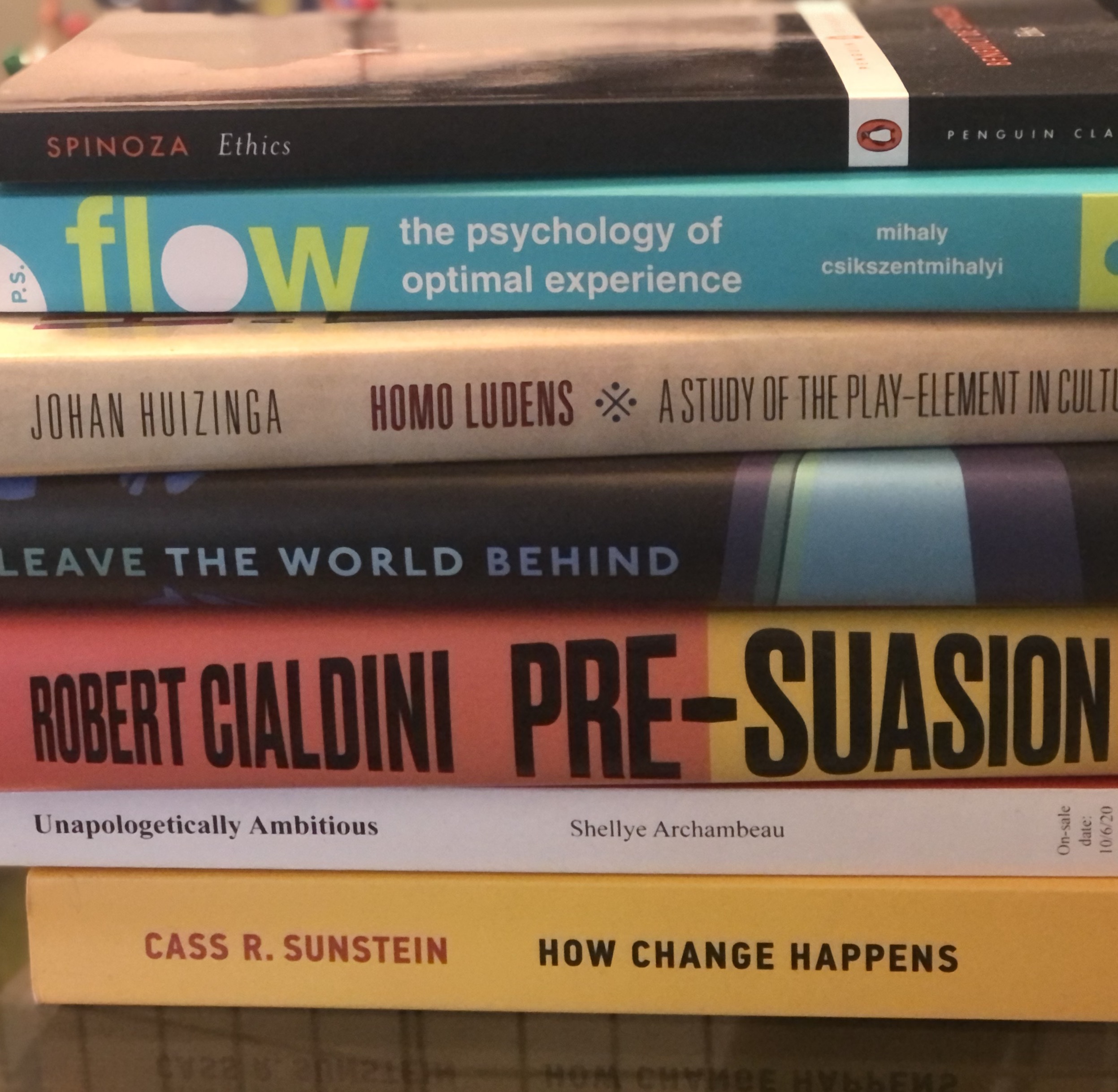
Ep 196The 10 Best Behavioral Science Books for 2020
Pretty much everyone around the world agrees that 2020 was a challenging year and we’re glad it’s all but over. However, 2020 was a year we upped the number of guests (to 90), upped our reading habits (20+ books for the show), and had more authors as guests than in any previous year. In short, Kurt and Tim read a lot of new books. And because we read bunches of them, we’re here to save you time by offering you our view of the top 10 books – 5 from Kurt and 5 from Tim – on behavioral science from 2020. We hope you enjoy them as much as we did – and as always, let us know what you think! For quick reference, here’s our list with links for your enjoyment. And here’s to happy reading in 2021! Top Book List from Kurt “Behave,” by Robert Sapolsky: https://amzn.to/3p5MJWF “Good Habits, Bad Habits,” by Wendy Wood: https://amzn.to/3p6v1lK “Scarcity,” by Eldar Shafir and Sendhil Mullainathan: https://amzn.to/3nsMS62 “Think Like a Rocket Scientist,” Ozan Varol: https://amzn.to/34n8OI7 “Before You Know It,” by John Bargh: https://amzn.to/3r7SbtT Top Book List from Tim “How to Decide,” by Annie Duke: https://amzn.to/38nHsmK “Behavioral Insights,” by Michael Hallsworth and Elspeth Kirkman: https://amzn.to/2WsJ1Kr “Alchemy,” by Rory Sutherland: https://amzn.to/2LEwRfd “Messengers: Who We Listen To, Who We Don’t, and Why,” by Steve Martin & Joe Marks: https://amzn.to/38gRHsH “Unleash Your Primal Brain,” by Tim Ash: https://amzn.to/3gYM1rr Honorable Mentions “Elevate,” by Robert Glazer “Designing for Behavior Change,” by Steve Wendel “Invisible Influences,” by Jonah Berger “White Fragility,” Robin DeAngelo “The All-Or-Nothing Marriage: How the Best Marriages Work,” by Eli Finkel “The Power of Bad,” by Roy Baumeister and John Tierney “Better, Not Perfect,” by Max Bazerman “Time Smart,” by Ashley Whillans “Blindsight: the mostly hidden ways marketing shapes our brains,” by Prince Ghuman and Matt Johnson Thanks for listening and we hope you find your groove with these books! © 2020 Behavioral Grooves
Ep 194How to Deal With Anxiety Over COVID Vaccines
Are the new COVID-19 vaccines are safe? It will probably take time to know for sure; however, this week Kurt and Tim discuss the behavioral aspects of the transition. Kurt was engaged by an article in Bloomberg called “Vaccines May Have Social Side Effects,” by Tyler Cowen, a professor of economics at George Mason University. Professor Cowen raised the idea that the mere presence of vaccines may give people an unwarranted boost in confidence and lead to less mask-wearing and social distancing. In this 8-and-a-half-minute grooving session, we discuss some of the behavioral aspects of the transition. © 2020 Behavioral Grooves Links “Vaccines May Have social Side Effects”: https://www.startribune.com/vaccines-may-have-social-side-effects/573096121/?refresh=true How a Covid-19 Vaccine Could End Up Helping the Virus Spread: https://www.bloomberg.com/news/articles/2020-11-11/if-we-re-not-careful-a-vaccine-might-help-covid-19-spread

Ep 193Amy Bucher on Participatory Design, Trust and Engaging Your Audience
Amy Bucher, PhD is the Vice President of Behavior Change Design at Mad*Pow and the author of “Engaged” a new book on how to apply behavioral science to the design and development of products. At Mad*Pow, she designs motivating interventions to help people live healthier and happier lives and, in her spare time, knocks 150 books off her reading list every year. (OMG!) Amy was recently recognized as one of 10 behavioral scientists you should know in Forbes magazine. While we did spend a bit of time on the article and her work at Mad*Pow, most of our conversation focused on the book. We talked about motivation and the incredible power that idiosyncratic messaging can have on customers when used properly by marketing and sales. We also discussed participatory design, trust, and how important it is for product developers and marketers to demonstrate trust. She also offered her thoughts on how designers need to do a better job of integrating behavioral science into their products. Some are doing it, but there are lots of opportunities for improvement Amy offered some ideas on this. Lastly, we want to note that Amy wrote that one of the most important reminders for the corporate world: Almost everything a designer makes has behavior change built into it. The smart designers will be thinking about that as they design their products (or enhancements). We hope you enjoy this conversation with Amy as much as we did and hope that this week, you find your groove. © 2020 Behavioral Grooves Links Amy Bucher, PhD: https://www.linkedin.com/in/amybucher/ “Engaged”: https://amzn.to/3BkG1mb “Super Better” by Jane McGonigal: https://amzn.to/2YwILOY “Atomic Habits” by James Clear: https://amzn.to/3ad9Nxn Forbes Article: “Top Behavioral Scientists You Should Know”: https://www.forbes.com/sites/alineholzwarth/2020/10/29/10-behavioral-scientists-you-should-know/?sh=72ddbe3c42e0 Pattern Health: https://pattern.health/ Ran Kivetz, PhD “Idiosyncratic Fit”: https://www.gsb.stanford.edu/faculty-research/publications/idiosyncratic-fit-heuristic-effort-advantage-determinant-consumer Peppers & Rogers 1:1 Marketing: https://hbr.org/1999/01/is-your-company-ready-for-one-to-one-marketing McDonald’s milkshake innovation: https://www.youtube.com/watch?v=Stc0beAxavY Adam Hansen: https://www.linkedin.com/in/adhansen/ Bent Handle Snow Shovel: https://www.acehardware.com/departments/lawn-and-garden/snow-removal-and-equipment/snow-shovels-and-pushers/7200439 Musical Links R.E.M. “Losing My Religion”: https://www.youtube.com/watch?v=xwtdhWltSIg Michael Stipe: https://en.wikipedia.org/wiki/Michael_Stipe Britney Spears: https://www.youtube.com/watch?v=C-u5WLJ9Yk4 Robyn: https://www.youtube.com/watch?v=CcNo07Xp8aQ The Doves “There Goes The Fear”: https://www.youtube.com/watch?v=SneuvKIkM3A Pulp: https://www.youtube.com/watch?v=yuTMWgOduFM Manchester Orchestra: https://www.youtube.com/watch?v=8ui9umU0C2g Depeche Mode “Personal Jesus”: https://www.youtube.com/watch?v=u1xrNaTO1bI

Ep 192Evolving HR Using Behavioral Science with Ryan McShane
Ryan McShane is the President and CEO of HR Evolution, a consultancy that designs systems that support employee alignment to organizational purpose through HR best practices, organizational development initiatives, and professional development solutions. We discussed a variety of HR related topics including psychological safety, emotional intelligence, and what can be done when it comes to improving the mindset of leaders. Ryan stressed that WIIFM (what’s in it for me) is central to the impetus to change at all levels of the organization. Plus, he offered a particularly cool insight: Change comes about when the pain of staying the same is higher than doing something different. We also discussed how the social contract between the employer and the employee has changed dramatically. And we got to hear Ryan’s rationale for being so optimistic about a future where employers need to put forth extra effort to attract and retain the best and brightest workers. It got us thinking: could the growing gig economy actually offer more value to the employees than the employers? Lastly, we appreciated Ryan’s approach to working through the pandemic and the reminder that intimidation and scare tactics have no place in today’s workplace. Frederick Taylor’s vision of work should be a thing of the past. Period. We hope you enjoy our conversation with this very bright behavioral science practitioner, and as always, let us know what you think! © 2020 Behavioral Grooves Links Ryan McShane: https://www.linkedin.com/in/ryan-mcshane-743382a/ Ryan’s email: [email protected] HR Evolution: https://hrevolutionllc.com/ Zappos: https://www.zappos.com/ US Census Bureau Pulse Surveys: https://www.census.gov/programs-surveys/household-pulse-survey/data.html Schumann Resonance: https://en.wikipedia.org/wiki/Schumann_resonances#:~:text=The%20Schumann%20resonances%20(SR)%20are,Earth's%20surface%20and%20the%20ionosphere. Fredrick Taylor: https://en.wikipedia.org/wiki/Frederick_Winslow_Taylor Muir Woods: https://www.nps.gov/muwo/index.htm Musical Links Jimi Hendrix at Woodstock: https://www.youtube.com/watch?v=0xTHMDrRUKo Grateful Dead “Ripple”: https://www.youtube.com/watch?v=5yJmBC7cMTM Nirvana “About a Girl”: https://www.youtube.com/watch?v=_24pJQUj7zg Radio Head “Hail to the Thief”: https://www.youtube.com/watch?v=8MdwaUtW_D4 Smashing Pumpkins: https://en.wikipedia.org/wiki/The_Smashing_Pumpkins 432 Hertz Music (Musik): https://www.youtube.com/watch?v=dg1_DXazvKI JS Bach “Brandenburg Concerto No. 3”: https://www.youtube.com/watch?v=pdsyNwUoON0 Linda Diaz “Green Tea Ice Cream”: https://www.youtube.com/watch?v=Ursri8GmlW4 “Sunny Side of the Street”: https://www.youtube.com/watch?v=Nn3soYbSpS4 Fabiano de Nascimento: https://www.npr.org/2020/07/02/885766987/fabiano-do-nascimento-tiny-desk-home-concert Depeche Mode: http://www.depechemode.com/ Nine Inch Nails: https://en.wikipedia.org/wiki/Nine_Inch_Nails Trent Reznor: https://en.wikipedia.org/wiki/Trent_Reznor

Ep 191Cornelia Walther on POZE: Pause, Observe, Zoom in, and Experience
Cornelia Walther has spent most of her professional career with the United Nations Children's Fund (UNICEF) and the World Food Program (WFP). She was the head of communications in large-scale emergencies in Africa, Asia, the Middle East, and the Caribbean. She earned her PhD in Law and is a certified yoga instructor and her current work is a remarkable amalgam of her studies and her life’s journey. In recent years, she developed POZE as a way of exploring the world to help uncover deeper levels of happiness. (POZE is an opening spiral that can stand for, among a few things, to Pause for a moment, Observe what’s going on around you, Zoom in on yourself, and Experience what is going on in the world.) These are wise and weighty thoughts and we thoroughly enjoyed our conversation with her. We also discussed how we are all interconnected – that your world and my world may be very different, yet we share connections if we only give ourselves the chance to experience them. The hope is that we recognize this connectedness – both at a personal level and at a larger global level – and bring greater meaning and happiness to our lives through this connectedness. One of our favorite lines from our discussion with Cornelia was this: “So driven was I by the craving for some thing or another, that I omitted to savor the beauty of now.” We all need to take a moment, pause, and savor the beauty of now. © 2020 Behavioral Grooves Links Cornelia Walther: https://www.linkedin.com/in/corneliawalther/?originalSubdomain=ht POZE: https://www.springernature.com/gp/researchers/the-source/blog/blogposts-communicating-research/sdg-interview-cornelia-walther-sustainability-holistic-perspect/17463138 Gary Latham, PhD, Episode 147: https://behavioralgrooves.com/episode/gary-latham-phd-goal-setting-prompts-priming-and-skepticism/ Creole Language: https://en.wikipedia.org/wiki/Creole_language Brad Shuck, PhD, Episode 91: https://behavioralgrooves.com/episode/brad-shuck-being-ignored-is-worse-than-having-a-stapler-thrown-at-you/ Development, Humanitarian Aid and Social Welfare. Social Change from the Inside Out (May 2020): https://www.palgrave.com/us/book/9783030426095#aboutBook Humanitarian Work, Social Change, and Human behavior. Compassion for Change (June 2020):https://www.palgrave.com/us/book/9783030458775 Development and Connection in times of Covid. Corona’s Call for Conscious Choices (October 2020): https://link.springer.com/book/10.1007/978-3-030-53641-1 Social Change from the Inside Out. From Fixation to Foundation. From Competition to Change: https://rdcu.be/b9GrF From Individual wellbeing to collective welfare: https://rb.gy/xsuauh Musical Links Pink “So What”: https://www.youtube.com/watch?v=FJfFZqTlWrQ Verdi, “Aida”: https://www.youtube.com/watch?v=l3w4I-KElxQ Dvorak, “Symphony of the New World”: https://www.youtube.com/watch?v=P_1N6_O254g Beatles, “Don’t Let Me Down”: https://www.youtube.com/watch?v=NCtzkaL2t_Y&list=PLf9cCqxaRfcMcL5yU9UZDdNJwkDNbh3ce Depeche Mode, “People Are People”: https://www.youtube.com/watch?v=r1FVmBHbPNg Mariza, “Quem Me Dera”: https://www.youtube.com/watch?v=-sze5rpbklM Ayub Ogada, “Kothbiro”: https://www.youtube.com/watch?v=L48PCisRZ7s Giberto Gil: https://www.youtube.com/watch?v=ECtYYiHbIcQ Fabiano do Nascimento, “Nana”: https://www.youtube.com/watch?v=M4iukkBmDGg Tim Sparks, “Klezmer Medley”: https://www.youtube.com/watch?v=DkiCFzWTYRg

Ep 190Kevin Vallier: What to Do About Polarization
Kevin Vallier, PhD is an Associate Professor of Philosophy at Bowling Green State University, where he directs their Philosophy, Politics, Economics, and Law programs. Kevin’s interests span a wide spectrum including political philosophy, ethics, philosophy of religion, politics, and economics. He is the author of peer-reviewed book chapters and journal articles, and his recent books include Must Politics Be War? Restoring Our Trust in the Open Society (Oxford UP 2019) and, his newest book, Trust in a Polarized Age (Oxford UP 2020). We focused our discussion on Kevin’s philosophical viewpoint of political issues, traversing the axes of polarization and trust. We spent some time discussing how focusing on progress and process might be good short-term balms for our broken nation. We also asked him about potential solutions to our current situation in the United States and his answers might surprise you. Kevin offered approaches that only a political philosopher might have, and we enjoyed his unique perspective. His best tip for healing our nation’s divides (in the short term) might be as simple as joining a church or non-political non-profit organization to help your community. We hope you enjoy our conversation with Kevin Vallier. © 2020 Behavioral Grooves Links Kevin Vallier, PhD: [email protected] Revolving Door: https://en.wikipedia.org/wiki/Revolving_door_(politics) Ranked Choice Voting: https://en.wikipedia.org/wiki/Ranked_voting Trump/Obama Valedictorian Speech: https://time.com/5302250/obama-quote-graduation-speech/ Robert Cialdini, PhD: https://www.influenceatwork.com/robert-cialdini-phd/biography/ Ideas42: https://www.ideas42.org/ Coleman’s Boat: https://www.youtube.com/watch?v=dGaz0xKG060 Robber’s Cave Experiment: https://www.simplypsychology.org/robbers-cave.html Nudge.It North: https://www.nudgeitnorth.com/ Musical Links Dolly Parton: https://www.youtube.com/watch?v=K2RBS_U0GoQ Chet Atkins: https://www.youtube.com/watch?v=a6cXqM21KbE Alison Kraus: https://www.youtube.com/watch?v=To1_nOjlLBQ Maynard Ferguson: https://www.youtube.com/watch?v=hNbsnBZOwqE Sufjan Stevens: https://www.youtube.com/watch?v=eOvSy3yepd8 Gregorian chant: https://www.youtube.com/watch?v=WuK59jQ5bwU Valaam chant: https://www.youtube.com/watch?v=qMtyTXDc9Fw Byzantine notation: https://en.wikipedia.org/wiki/Byzantine_music Organum: https://www.youtube.com/watch?v=vGZJ8XQJcmk “Be Thou My Vision”: https://www.youtube.com/watch?v=7OUqRUAbl4w

Ep 189IMPROVE PRODUCTIVITY BY MAKING YOUR WORKFORCE PSYCHOLOGICALLY SAFE
[NOTE: This episode was originally published as a Weekly Grooves podcast. We wanted to share it with our Behavioral Grooves listeners and we hope you enjoy it.] We were inspired by a recent article on CNBC’s website by Cory Steig, called “ ’Psychological safety’ at work improves productivity–here are 4 ways to get it, according to a Harvard expert.” The piece reviews some research on psychology safety that Kurt and I have been focused on for years. Psychological safety is a concept that was identified by Harvard Professor Amy Edmondson from work in the 1990’s. Professor Edmondson defines psychological safety as “a workplace where one feels that one’s voice is welcome with bad news, questions, concerns, half-baked ideas and even mistakes.” One way we experience this is when we feel that the team has my back through both good and bad. Kurt and Tim believe that psychological safety is both undervalued and under-implemented in companies today and we hope listeners can apply some of the key points in this brief discussion to their workplace. ©2020 Weekly Grooves / ©2020 Behavioral Grooves Links Kurt Nelson, PhD: [email protected] Tim Houlihan: [email protected] Psychological Safety at work improves productivity: https://www.cnbc.com/2020/10/05/why-psychological-safety-is-important-at-work-and-how-to-create-it.html How Making a Mistake in the Interview Could Land You the Job: https://www.vault.com/blogs/interviewing/how-making-a-mistake-in-the-interview-could-land-you-the-job Re:Work – Google shares much of the insights that they learned from Project Aristotle and how to implement those ideals: https://rework.withgoogle.com/print/guides/5721312655835136/ Forbes article by Shane Snow that overviews Psychological Safety and describes what it is and is not – nice summary that helps clarify key aspects of this concept: https://www.forbes.com/sites/shanesnow/2020/05/04/how-psychological-safety-actually-works/#51e147dbf864 How to foster psychological safety in virtual meetings: https://hbr.org/2020/08/how-to-foster-psychological-safety-in-virtual-meetings Elliot Aronson, PhD Coffee Study: https://en.wikipedia.org/wiki/Pratfall_effect

Ep 188Bill von Hippel on The Social Leap, Context, and Max Weinberg
Bill von Hippel, PhD is an evolutionary psychologist from Alaska who has lived in Australia for more than 20 years. Bill teaches at the University of Queensland and his body of research is so wide we struggled to focus our conversation. We spoke with him about his research into the ways in which our species’ behaviors have evolved over millions of years into the behaviors we see in our present-day lives. His insights are clever, thoughtful, and thought-provoking. We talked about reciprocity, collectivism, and most importantly, how being cooperative and social propelled our species forward well beyond anything else in the animal kingdom. We discussed Bill’s latest book, “The Social Leap.” It’s a groundbreaking thesis that applies evolutionary science to help us understand how major challenges from our past have shaped some of the most fundamental aspects of our being. One of the book’s key lessons is for us to remember that it is our collaboration, our collective abilities as a species, that sets us apart from the rest of the animal kingdom. This unique capability for humans to cooperate is an important reminder these days and Bill articulated the evolution of collaboration and competition in memorable terms. We talked about the futility of not trusting your friends and the likely risk of getting lots of false positives from motivated thinking. And we discussed how social context matters when it comes to happiness. Bill explained how we choose our contexts wisely, and we do so to compare ourselves favorably to those around us. In this way, we tend to avoid comparisons with those we wouldn’t compare well to. Lastly, Bill shared an evolutionary perspective that really struck us. He noted that, as we age, we are likely to increase our reliance on stereotypes and that can lead to prejudice. As Bill suggested, to stop ourselves from this unnecessary psychological deterioration, we should slow down our judgments and ask if we’re feeling this way because of that person’s group membership or gender or whatever. Stop, pause, and give it some consideration. Bill was recommended to us by Roy Baumeister and we’re grateful for the introduction as well as Bill’s generous conversation. We hope you enjoy our conversation with Bill and that you go out and find your groove this week. © 2020 Behavioral Grooves Links Bill Von Hippel, PhD: https://psychology.uq.edu.au/profile/3034/bill-von-hippel University of Queensland: https://www.uq.edu.au/ “The Social Leap”: https://www.harpercollins.com/products/the-social-leap-william-von-hippel?variant=32207123873826 Peter Singer, PhD: https://en.wikipedia.org/wiki/Peter_Singer Homo Erectus: https://en.wikipedia.org/wiki/Homo_erectus Michael Tomasello, PhD: https://psychandneuro.duke.edu/people/michael-tomasello Seth Stephens-Davidowitz “Everybody Lies”: http://sethsd.com/everybodylies Dan Ariely on comparison: https://theconversation.com/the-decoy-effect-how-you-are-influenced-to-choose-without-really-knowing-it-111259 Ed Diener on “Wealth and happiness across the world”: https://pubmed.ncbi.nlm.nih.gov/20565185/ Embouchure: https://en.wikipedia.org/wiki/Embouchure#:~:text=Embouchure%20(English%3A%20%2F%CB%88%C9%92,mouthpiece%20of%20a%20brass%20instrument. Musical Links Lynyrd Skynyrd: https://www.youtube.com/watch?v=QxIWDmmqZzY Boston: https://www.youtube.com/watch?v=Uc78RnDRQ_4 Israel Kaʻanoʻi Kamakawiwoʻole “Somewhere Over the Rainbow”: https://www.youtube.com/watch?v=w_DKWlrA24k Mozart: Sonata in C, K. 545, Allegro: https://www.youtube.com/watch?v=4xeAsc6m35w Keith Moon: https://www.youtube.com/watch?v=O5Up-qHTJdY Rush “Tom Sawyer”: https://www.youtube.com/watch?v=wrhnhXHVSQg Neal Peart: https://www.youtube.com/watch?v=LWRMOJQDiLU Max Weinberg: https://www.youtube.com/watch?v=zylXeuWPk9o Led Zeppelin “Stairway to Heaven”: https://www.youtube.com/watch?v=xbhCPt6PZIU Bob Dylan “Like a Rolling Stone”: https://www.youtube.com/watch?v=3Xz7WfVYxok Al Kooper: https://www.youtube.com/watch?v=FZGN7T70rgY Max Weinberg Experience: https://www.chicagotribune.com/entertainment/music/ct-ott-max-weinberg-springsteen-0413-story.html
Ep 187World Kindness Day Through a Behavioral Lens
World Kindness Day is November 13th and has been celebrated in many countries around the world since 1998. World Kindness Day was developed to promote good deeds in communities and focus on how kindness binds us together. Around the world are efforts to encourage “random acts of kindness” for others and acting in a more kind way. We decided to look at kindness in general through a behavioral science lens. Webster’s definition of “kind” is “of a sympathetic or helpful nature; being gentle.” In other words, kindness is basically doing something nice for someone. A Mother Jones article about World Kindness day, by Daniel King, states, “Don’t worry, kindness is not niceness,” so we looked at how the University of Santa Clara differentiates between KIND and NICE. They used an example of how holding the door for others can be described as either “nice” or “kind.” If the underlying motivation is to create a favorable impression for the purpose of asking for a favor later, then the action can be considered NICE due to its pleasing effect. On the other hand, if the motivation is to spare the other person from extra effort or inconvenience, then the action can be considered KIND (as well as nice) if it pleases the other person. We encourage each and every one of you around the world today to show some act of kindness to a loved one, friend or stranger. And we hope you enjoy this episode. © 2020 Behavioral Grooves Links Science Made Fun: Celebrating World Kindness Day: https://sciencemadefun.net/blog/world-kindness-day/ World Kindness Day: https://worldkindness.org/be-involved/ Mother Jones: Kindness Day is Actually a Day: https://www.motherjones.com/recharge/2020/10/world-kindness-day/ World Kindness Day in Wikipedia: https://en.wikipedia.org/wiki/World_Kindness_Day Psychology Today: The Importance of Kindness: https://www.psychologytoday.com/us/blog/pieces-mind/201712/the-importance-kindness Time: Random Acts of Kindness make Marriage Better: https://time.com/4674982/kindness-compassion-marriage/ Rewards of Kindness Hui, B. P. H., Ng, J. C. K., Berzaghi, E., Cunningham-Amos, L. A., & Kogan, A. (2020). Rewards of kindness? A meta-analysis of the link between prosociality and well-being. Psychological Bulletin.: https://doi.apa.org/doiLanding?doi=10.1037%2Fbul0000298 Psychology Today: Random Acts of Kindness Matter to Your Well Being: https://www.psychologytoday.com/us/blog/emotional-nourishment/201711/why-random-acts-kindness-matter-your-well-being Being Kind, Not Nice: https://www.scu.edu/the-big-q/being-nice-vs-being-kind/#:~:text=%E2%80%9CNice%E2%80%9D%20is%20defined%20as%20%E2%80%9C,way%20they%20treat%20each%20other.
Ep 185How Do We Deal with Disinformation?
[NOTE: This episode was originally published under our sister-podcast, Weekly Grooves. We are republishing it here to share relevant behavioral science information. We hope you enjoy it.] We saw an article in The Atlantic that caught our attention because of its hook into behavioral science: our willingness to believe disinformation. In this week’s episode, we talk about the underlying behavioral science into why we humans are so susceptible to information that is not accurate. What can we do? We can use the OODA loop to interrupt our too-quick decision to simply accept suspicious content: Observe – Orient – Decide – Act. The OODA loop, in a very simplistic manner uses these four elements in this way: to take in and observe the context in which you’re seeing this information; orient yourself with the source in a critical way; make a decision by asking, “if this is from someone I might not trust, would I still believe it?”; and take action by deleting content created to DIS-inform you. And since our podcast is relatively new, we are very interested in knowing how you think we’re doing. Please leave us a review or drop us a line. @THoulihan or @WhatMotivates Disinformation: “False information, which is intended to mislead, especially propaganda issued by a government organization to a rival power or the media.” Misinformation: “False or inaccurate information, especially that which is deliberately intended to deceive.” Conspiracy Theory: “A belief that some covert but influential organization is responsible for a circumstance or event.” © 2020 Weekly Grooves / © 2020 Behavioral Grooves Links “The Billion Dollar Disinformation Campaign to Reelect the President,” by McKay Coppins in The Atlantic: https://www.theatlantic.com/magazine/archive/2020/03/the-2020-disinformation-war/605530/ The Donation of Constantine: https://en.wikipedia.org/wiki/Donation_of_Constantine The National Enquirer: https://en.wikipedia.org/wiki/National_Enquirer The Daily Mail: https://en.wikipedia.org/wiki/Daily_Mail The Messenger Effect: https://www.nber.org/papers/w25632.pdf OODA Loop: https://en.wikipedia.org/wiki/OODA_loop Leveraging the OODA Loop with Digital Analytics to Counter Disinformation, by Jami Carroll (2019): https://search.proquest.com/openview/0a78c42e27ef89dab1bd4969bd6d0974/1?pq-origsite=gscholar&cbl=396497 Viktor Frankl: https://en.wikipedia.org/wiki/Viktor_Frankl FactCheck.org: https://www.factcheck.org/ Snopes: https://www.snopes.com/about-snopes/ Gallup Polls Believing in the Media: https://news.gallup.com/poll/267047/americans-trust-mass-media-edges-down.aspx

Ep 186Elspeth Kirkman and Michael Hallsworth on Designing Behavioral Interventions
CORRECTION: In this episode, we incorrectly state that Michael Hallsworth started the BIT North American team. In fact, the BIT North America team was founded in 2015 by Elspeth Kirkman. Under Elspeth’s leadership, the team delivered over 100 trials to cities across the US before she returned to the UK in 2018, which was when Michael Hallsworth came to Brooklyn to manage the group. We regret the error and thank Elizabeth Linos, PhD for calling attention to it. In their book, “Behavioral Insights,” Michael Hallsworth and Elspeth Kirkman took time to think through the critical steps in the design and execution of a behavioral intervention. It’s a framework that could be applied to any significant behavior change you might consider and it comes from a book that Kurt and Tim consider among the best of 2020. Michael Hallsworth is the Managing Director of the North American Behavioral Insights Team and has helped develop frameworks such as MINDSPACE and EAST. He is a thoughtful researcher with outstanding work to his credit; at the same time, he’s quick to point out when his research ideas don’t play out as he expected them to. Elspeth Kirkman helped open the North American BIT unit but is now back in London, where she is responsible for BIT’s work on health, education, and local government. We first featured Elspeth for her work on frameworks and models in Episode 166 and we're so happy to see that she and Michael co-authored what we consider one of the best behavioral science books of 2020. Their book, “Behavioral Insights,” was commissioned and published by MIT Press for their Essential Knowledge Series. The book very explicitly outlines HOW to design and implement a behavior change initiative. Their 10-step model carefully lays out this process and we were extremely happy to see that the first 7 steps are all about design. We discussed ethics and transparency in the way interventions are implemented. These considerations are central to much of the work that they do, especially when it comes to the development of governmental policies. We also discussed rationality and who gets to decide what is rational and what isn’t. This was a particularly powerful concept since we know that humans do a great job defending their actions. To what degree is it rational or rationalizing? Regrettably, due to time constraints, we were not able to chat about music. We’ll save it for next time. Right now, we hope you enjoy our conversation with Elspeth and Michael. © 2020 Behavioral Grooves Links Michael Hallsworth: @mhallsworth Elspeth Kirkman: @karminker “Behavioral Insights”: https://mitpress.mit.edu/books/behavioral-insights Menorca Island: https://en.wikipedia.org/wiki/Menorca Gerd Gigerenzer: https://www.mpib-berlin.mpg.de/staff/gerd-gigerenzer Dan Ariely, “Predictably Irrational”: https://en.wikipedia.org/wiki/Predictably_Irrational Common Biases and Heuristics: https://docs.google.com/document/d/1XHpBr0VFcaT8wIUpr-9zMIb79dFMgOVFRxIZRybiftI/edit?usp=sharing Eugen Dimant, Episode 169: https://behavioralgrooves.com/episode/eugen-dimant-phd-what-to-do-about-bad-apples/ NYC Cab Driver Study (Loewenstein, Thaler, Babcock and Camerer): https://www.cmu.edu/dietrich/sds/docs/loewenstein/NYCCabdrivers.pdf Behavioral Grooves Episode 41 on Hallsworth: https://behavioralgrooves.com/episode/michael-hallsworth-from-mindspace-to-east/ Behavioral Grooves 100th Episode: https://behavioralgrooves.com/episode/the-100th-episode-celebration-in-philadelphia/ Behavioral Grooves Episode 166 on Kirkman: https://behavioralgrooves.com/episode/elspeth-kirkman-best-models-for-identifying-a-problem/ Nudge.It North: https://www.nudgeitnorth.com/learn Kurt Nelson, PhD: @whatmotivates Tim Houlihan: @THoulihan
Ep 184Iowa Caucus Conspiracy Theories – How to Inoculate Yourself
[NOTE: This episode was originally published under our sister-podcast, Weekly Grooves. In our effort to share relevant behavioral science information, we are republishing it here. We hope you enjoy it.] Listeners, especially in the United States, are already aware of the debacle from the Iowa Caucuses and how the Iowa Democratic party used a new app to help streamline the caucus results. You’re probably also aware that the processes and technologies failed, and results were not available for days afterwards. The delay has caused a plethora of online conspiracy theories and that’s our topic for this week. In the absence of good data, we make it up. Some of the richest conspiracy theories Kurt and Tim found include: 1.) The Democratic party didn’t like the results that they were seeing, so they were changing them. 2.) The Russians or the Chinese had hacked the app and were messing with us. 3.) The Republicans had hacked the app and were trying to rig the election. 4.) Hillary Clinton had helped build the app and was using it to get back at Sanders. And our all-time favorite conspiracy theory (5.) involves the Illuminati and how they were controlling the outcome. With all this swirling around, Kurt and Tim discuss why it’s humans to engage in conspiracy theories and some of their psychological underpinnings, the personality types that are most prone to believing a conspiracy theory, and what we can do to inoculate ourselves from this sort of thinking. We are reason-seeking machines and are more likely to ask “why” before we fully understand “what” happened. Join us for a quick review of why we experience conspiracy theories in the first place and what we can do about them. © 2020 Weekly Grooves / © 2020 Behavioral Grooves Kurt Nelson, PhD: @WhatMotivates Tim Houlihan: @THoulihan Links Online conspiracy theories flourish after Iowa caucus fiasco: https://apnews.com/8ae0e5172130f81265172fbd3e65094a The Psychology of Conspiracy Theories, 2017, Douglas, Sutton and Cichocka: https://journals.sagepub.com/doi/pdf/10.1177/0963721417718261 The psychology of conspiracy theories: Why do people believe them, John Grohol PsyD: https://psychcentral.com/blog/the-psychology-of-conspiracy-theories-why-do-people-believe-them/ Closed Belief System: https://issuepedia.org/Closed_belief_system Conspiracy theories: the science behind belief in secret plots, The Guardian, https://www.theguardian.com/science/brain-flapping/2013/sep/05/conspiracy-theories-science-belief-secret-plots Fundamental Attribution Error: https://en.wikipedia.org/wiki/Fundamental_attribution_error Hanlon’s Razor: https://en.wikipedia.org/wiki/Hanlon%27s_razor Illuminati: https://www.bbc.com/future/article/20170809-the-accidental-invention-of-the-illuminati-conspiracy Lantian, A., Muller, D., Nurra, C., Douglas, K. (2017). “‘I know things they don’t know!’: The role of need for uniqueness in belief in conspiracy theories,” Social Psychology, 48, 160-173 Mercier, H. & Sperber, D., “Why do humans reason? Arguments for an argumentative theory” BEHAVIORAL AND BRAIN SCIENCES (2011) 34, 57–111 doi:10.1017/S0140525X10000968 Motivated Reasoning: https://en.wikipedia.org/wiki/Motivated_reasoning Oliver, Eric on “Big Brains” Episode 25: https://news.uchicago.edu/podcasts/big-brains/science-conspiracy-theories-and-political-polarization-eric-oliver Pareidolia: https://en.wikipedia.org/wiki/Pareidolia Pattern Recognition: https://en.wikipedia.org/wiki/Pattern_recognition_(psychology) Pattern Recognition: The Science Behind Conspiracy Theories, Steven Novella: https://www.thegreatcoursesdaily.com/why-do-we-give-into-conspiracy-thinking/ Project Mogul: https://en.wikipedia.org/wiki/Project_Mogul Resulting (Annie Duke): https://www.annieduke.com/how-to-make-the-right-decisions-even-when-you-dont-have-all-the-facts/

Ep 182Rippling with Jez Groom and April Vellacott
Jez Groom and April Vellacott, our guests in this episode, are co-authors of “Ripple - The Big Effects of Small Behavior Changes in Business.” It’s a practical, application-focused romp that uses a behavioral science lens to solve all sorts of real-world problems. Jez Groom is the founder of Cowry Consulting and has established himself as one of the world's leading practitioners in the field. Jez has played instrumental roles in projects like Babies in the Borough – which we featured in Episode 167 – that used murals of babies faces to fight crime, to changing handwashing behavior in a slaughterhouse in Santiago, to using bright pink walls to reduce unsafe behavior on a high-rise construction site in London. He is also an Honorary Research Fellow at the Department of Psychology at City University, London. April Vellacott is the Behavioral Consulting Lead at Cowry. Aside from being a dedicated and experienced practitioner, she holds degrees in Psychology and Behavior Change. Owning the heavy lifting for the book, April stole the show with some of the best lines (see “you can’t make a bucket without bucketloads of money”). We urge you to check out their book as it’s more than just informative, it’s also a pleasure to read. In our conversation with Jez and April, we discussed the salient points from the book, the case study format they used, the very international feel from those case studies, and some of the techniques they’ve used to get business professionals to adopt behavioral science. We also covered a key pillar of their personal and professional missions: to demystify and democratize behavioral science. It’s a terrific conversation and we hope you’ll enjoy it as much as we did. © 2020 Behavioral Grooves Links Jez Groom: https://www.linkedin.com/in/jezgroom/ April Vellacott: https://www.linkedin.com/in/april-vellacott-68b08257/ Cowry Consulting: https://www.cowryconsulting.com/ “Ripple”: https://www.goodreads.com/book/show/49190518-ripple Rory Sutherland: https://www.linkedin.com/in/rorysutherland/ Daniel Levitin “This is Your Brain on Music”: https://en.wikipedia.org/wiki/Daniel_Levitin Adam Hansen: https://www.linkedin.com/in/adhansen/ Diversifi: https://www.diversifiglobal.com/ Episode 167 – Babies in the Borough: https://behavioralgrooves.com/episode/how-babies-faces-on-shop-doors-can-reduce-crime-with-tara-austin/ Musical Links John Legend “Wild”: https://www.youtube.com/watch?v=279RNoP5UyU House Music: https://www.youtube.com/watch?v=hBJk0Tq3JDU Stormzy: https://www.youtube.com/watch?v=q-EW4-B11hw Drill: https://en.wikipedia.org/wiki/Drill_music Flava Flav: https://en.wikipedia.org/wiki/Flavor_Flav Public Enemy: https://en.wikipedia.org/wiki/Public_Enemy Sade: https://www.youtube.com/watch?v=kcPc18SG6uA
Ep 183Grooving: The Single Largest Driver of Misinformation
[NOTE: This episode was originally published under our sister-podcast, Weekly Grooves. In our effort to share relevant behavioral science information, we are republishing it here. We hope you enjoy it.] Sheryl Gay Stolberg and Noah Weiland of The New York Times wrote an article titled, “Study Finds ‘Single Largest Driver’ of Coronavirus Misinformation: Trump.” The article is based on research from the Cornell Alliance for Science that analyzed over 38 million articles around the world on the pandemic. They found that “Mentions of Trump made up nearly 38% of the overall “misinformation conversation,” making the president the largest driver of the “infodemic.” Of the 38 million articles on the pandemic, 1.1 million of them “disseminated, amplified or reported on misinformation related to the pandemic.” The study found 11 topics of misinformation that were prevalent in these articles – ranging from the pandemic being a hoax facilitated by the Democrats to the virus being a deep state or bioweapon of China to the most common one – miracle cures. Kurt and Tim decided to break down the discussion into three parts: 1.) The psychology of misinformation. 2.) The messenger effect and 3.) The psychology behind why Donald Trump might be doing this. © 2020 Weekly Grooves / © 2020 Behavioral Grooves Links “Study Finds 'Single Largest Driver' of Coronavirus Misinformation: Trump”: https://news.yahoo.com/study-finds-single-largest-driver-120309389.html CORONAVIRUS MISINFORMATION: Quantifying sources and themes in the COVID-19 ‘infodemic’: https://allianceforscience.cornell.edu/wp-content/uploads/2020/09/Evanega-et-al-Coronavirus-misinformationFINAL.pdf What drove the COVID misinformation ‘infodemic’: https://allianceforscience.cornell.edu/blog/2020/10/what-drove-the-covid-misinformation-infodemic/ “Messengers: Who We Listen To, Who We Don’t, and Why”: https://www.goodreads.com/en/book/show/43522604

Ep 181Vote Now (for Behavioral Grooves)
The presidential election is going full tilt in the United States and we want to emphasize the importance of acting on your constitutional rights if you are eligible to vote here. However, Kurt and Tim’s Behavioral Grooves is in the running for Best Podcast and Best YouTube on Samuel Salzer’s Habit Weekly Annual Awards. We’d love it if you’d take this opportunity to cast a vote in our direction. Thank you! Voting for Habit Weekly: https://samuelsalzer1.typeform.com/to/vDs1cWlD Voting in US Presidential Election: https://www.usa.gov/election

Ep 180Play, Reciprocity and Context: The Keys to Happy Communities with Jessica Mayhew
Jessica Mayhew, PhD teaches Biological Anthropology as well as Primate Culture & Cognition at Central Washington University in Ellensburg, Washington. She got our attention when her comments about how primates play together are related to the way humans play. Not that that in and of itself is a big surprise, but the way we play and the context we play in are – of course – highly influential in how we play. She reminded us about the important role reciprocity has in the animal kingdom, just as it does among humans. She talked about context and environment and she gave us a couple of key examples. She noted how primate communities that value cooperation with their juveniles end up with adults that cooperate. And the opposite is true as well. Highly competitive groups foster more competitive behaviors in their juveniles. Kinda gets you thinking about human communities, right? Jessica inspires us with her interdisciplinary focus and the way she’s always looking for ways to cross into new fields. That’s why we call her a hedgefox: she’s super deep into primatology, but she also likes to dabble in anthropology and other disciplines as well. And, in a related note, she reminded us that none of us are disconnected from the whole – we are all a part of the same ecosystem, and we can take a lesson from that. © 2020 Behavioral Grooves Links Jessica Mayhew, PhD: https://www.cwu.edu/anthropology/jessica-mayhew Mia Hamm: https://en.wikipedia.org/wiki/Mia_Hamm Scottie Pippen: https://en.wikipedia.org/wiki/Scottie_Pippen Jane Goodall: https://en.wikipedia.org/wiki/Jane_Goodall Dian Fossey: https://en.wikipedia.org/wiki/Dian_Fossey Birutė Galdikas: https://en.wikipedia.org/wiki/Birut%C4%97_Galdikas “Clue” Movie on Monkey’s Brains: https://getyarn.io/yarn-clip/dff98e0a-f5c1-42f9-9124-478c1e070e37 “Where the Wild Things Play,” by Erik Vance in The New York Times: https://www.nytimes.com/2020/07/21/parenting/animal-behavior-play-games.html Frans de Waal “Mama’s Last Hug”: https://www.goodreads.com/book/show/45894068-mama-s-last-hug “Homo Ludens”: https://en.wikipedia.org/wiki/Homo_Ludens Michael Boden, Episode 136: https://behavioralgrooves.com/episode/covid-19-crisis-michael-boden-on-how-field-sales-reps-are-adapting-to-the-crisis/ Diversifi: https://www.diversifiglobal.com/ Jez Groom/Cowry Consulting: https://www.cowryconsulting.com/ Minneapolis Uses Opera to Reduce Crime: https://www.mprnews.org/story/2006/04/06/opera-fights-crime-on-block-e Todd Fonseca, Episode 8: https://behavioralgrooves.com/episode/the-value-of-understanding-microexpressions-for-leaders/ Musical Links Yo-Yo Ma: https://www.youtube.com/watch?v=3uiUHvET_jg Pablo Casals: https://www.youtube.com/watch?v=VhcjeZ3o5us Kendrick Lamar: https://www.youtube.com/watch?v=tvTRZJ-4EyI Planet Earth II Soundtrack: https://www.youtube.com/watch?v=qpgvmHBpatA

Ep 179Kwame Christian: On Compassionate Curiosity, Social Justice Conversations, and Cinnamon Toast Crunch
Kwame Christian, Esq. is the author of “Nobody Will Play With Me: How to Use Compassionate Curiosity to Find Confidence in Conflict.” He is the host of two podcasts, “Negotiate Anything” and “Ask With Confidence.” He is a professor at The Ohio State University Law School and is the director of the American Negotiation Institute. Kwame’s educational background combines an undergraduate degree in psychology, a masters in public policy, and a juris doctor. Yup – a classic underachiever. (NOT) Kurt and Tim got to talk to Kwame about the behavioral science hidden in his practical techniques. For instance, we discussed how to be more effective in negotiations by managing our emotions and how to reframe our negotiations as opportunities. He went on to say that negotiations are really “the art of discovery.” We also discussed the decades-old myth of the win-win negotiation – you guessed right: it’s a myth! Kwame also dropped more sound-bite bombs in our conversation than any other guest. There are tons and tons of takeaways from this conversation that you can put to use in your work or home life right away. And if that’s not enough, he’s got the most eclectic musical tastes of any guest on Behavioral Grooves so far. Check it out. We are grateful to our friend Brian Ahearn who introduced us to Kwame in May 2020. © 2020 Behavioral Grooves Links Kwame Christian on LinkedIn: https://www.linkedin.com/in/kwamechristian/ Kwame on Twitter: @KwameNegotiates Kwame on Negotiations: https://americannegotiationinstitute.com/ Kwame (and Kai) on Instagram: KwameNegotates Finding Confidence in Conflict: How to Negotiate Anything and Live Your Best Life: https://www.goodreads.com/book/show/54736049-finding-confidence-in-conflict Kwame’s Podcast Negotiate Anything: https://podcasts.apple.com/us/podcast/negotiate-anything/id1101679010 Kwame’s TED talk: https://www.youtube.com/watch?v=F6Zg65eK9XU Kwame as Ohio State Law Professor: https://moritzlaw.osu.edu/faculty/kwame-christian/ Cognitive Behavioral Therapy: https://www.mayoclinic.org/tests-procedures/cognitive-behavioral-therapy/about/pac-20384610 Matthew Walker, “Why We Sleep”: https://www.goodreads.com/book/show/34466963-why-we-sleep Them-Us-Fit-Action: https://blog.cmbinfo.com/crc-2018-how-to-engage-todays-corporate-research-buyer Musical Links Bob Marley “Wait in Vain”: https://www.youtube.com/watch?v=gtgP0EQmWVk Calypso: https://www.youtube.com/watch?v=JpUh5wUBkbM Soca (Soul Calypso): https://medium.com/@jada.steuart/soca-then-and-now-d5674e9f2b0c Reggae: https://www.youtube.com/watch?v=NyscBx0UWkY Dub Step: https://www.youtube.com/watch?v=JQ1txLdu6qg Hip-hop: https://www.youtube.com/watch?v=4t-BLUi3eAI Rap: https://www.youtube.com/watch?v=iGj3nv36M1o Ska: https://www.youtube.com/watch?v=1Weu3b8Nd40 Smooth Jazz: https://www.youtube.com/watch?v=--cmYzvVASc AC/DC: https://en.wikipedia.org/wiki/AC/DC “Under the Graveyard” by Ozzie Osbourne: https://www.youtube.com/watch?v=iuzyA5gDa4E Major Lazer: https://www.youtube.com/watch?v=YqeW9_5kURI The Clash “Should I Stay or Should I Go”: https://www.youtube.com/watch?v=oGIFublvDes The Police: https://www.youtube.com/watch?v=F4VjsqR5Vbc George Benson “Breezin”: https://www.youtube.com/watch?v=kVc5rCl0BIs Grover Washington “Just the Two of Us”: https://www.youtube.com/watch?v=IqX7WX6jFdw David Benoit “Lucy and Linus”: https://www.youtube.com/watch?v=NOg17QnLGVs Earl Klugh & Bob James: https://www.youtube.com/watch?v=YTOZxnBEPJA Lee Ritenour: https://www.youtube.com/watch?v=oMXCSiufPYA The Rippingtons: https://www.rippingtons.com/

Ep 178Matt Johnson & Prince Ghuman on Mid-Liminal Marketing and the Ethics of Applied Neuroscience
Matt Johnson, PhD and Prince Ghuman are the authors of “Blindsight: the mostly hidden ways marketing shapes our brains.” We caught up with them to discuss the book, basketball, ethics, and old school hip hop. Matt is a professor at Hult International Business School and he likes to explore the intersections of neuroscience, psychology, and consumerism in his graduate and undergraduate classes. Prince is also at Hult International Business School where he teaches marketing. He is also the founder of PopNeuro, a firm that helps companies to ethically apply neuroscience to their marketing strategies. In our conversation, Matt and Prince introduced us to a new term in neuromarketing they call mid liminal. Not subliminal, but mid liminal. We also talked about the natural partnership between neuroscience and marketing and we covered one of our favorite linguistic games – the Kiki and Bouba studies. Most importantly, we discussed their views on the ethical application of neuromarketing. We also want to note that Prince and Matt are hosting the World’s First Neuromarketing Certification Bootcamp. It will be held live on December 4th through the 6th of 2020. They will be condensing years of neuroscience and marketing insights into a three-day Bootcamp with the intent of outfitting professionals with the latest tools in neuromarketing. Best yet for those looking to build credibility at work: successfully completing the Bootcamp earns you a certification. They also shared a link to the Bootcamp along with a special code (GROOVES) to save $500 off of the registration fee. Use the link in the notes below and type in GROOVES to receive your discount. Of course, this fantastic discount code is ONLY available to listeners of Behavioral Grooves. We encourage you to check it out as we think these guys have a lot to share. Thanks for listening and we hope you go out and find your groove this week. © 2020 Behavioral Grooves Links Matt Johnson: https://www.linkedin.com/in/mattjohnsonisme/ Prince Ghuman: https://www.linkedin.com/in/princeghuman/ “Blindsight”: getbook.at/blindsight Neuromarketing Certification Course: https://www.popneuro.com/neuromarketing-bootcamp Special Discount Code: GROOVES Master Classes: https://www.popneuro.com Nick Van Exel: https://en.wikipedia.org/wiki/Nick_Van_Exel Steph Curry: https://en.wikipedia.org/wiki/Stephen_Curry Klay Thompson: https://en.wikipedia.org/wiki/Klay_Thompson Wine Shop Study: https://www.researchgate.net/publication/232593421_The_Influence_of_In-Store_Music_on_Wine_Selections Kiki and Bouba Effect: https://en.wikipedia.org/wiki/Bouba/kiki_effect Phillip Kotler: https://en.wikipedia.org/wiki/Philip_Kotler OCEAN/BIG 5: https://en.wikipedia.org/wiki/Big_Five_personality_traits Cass Sunstein on Ethics: http://www.law.harvard.edu/programs/olin_center/papers/pdf/Sunstein_809.pdf Charlotte Blank on Don’t Be Creepy episode 9: https://behavioralgrooves.com/episode/dont-be-creepy-data-transparency-with-charlotte-blank/ Porsche: https://www.porsche.com/usa/ Breitling: https://www.breitling.com/us-en/ Purple: https://purple.com/ Serta: https://www.serta.com/ IKEA: https://www.ikea.com/us/en/ Sleep Number Bed: https://www.sleepnumber.com/ Onomatopoeia: https://www.youtube.com/watch?v=FBQCgjo1QTU Kurt Nelson, PhD: [email protected] Tim Houlihan: [email protected] Musical Links “Old Town Road” remix: https://www.youtube.com/watch?v=7ysFgElQtjI Grandmaster Flash: https://www.youtube.com/watch?v=PobrSpMwKk4 Busy Bee Starski: https://en.wikipedia.org/wiki/Busy_Bee_Starski Tribe Called Quest: https://en.wikipedia.org/wiki/A_Tribe_Called_Quest Van Morrison: https://en.wikipedia.org/wiki/Van_Morrison The Beatles: https://www.youtube.com/watch?v=yYvkICbTZIQ Al Green “Let’s Stay Together”: https://www.youtube.com/watch?v=uSu6tcbMOu0 Beatnick Music: https://en.wikipedia.org/wiki/Beatnik Flora Cash: https://www.floracash.com/ Sea Wolf: https://www.youtube.com/watch?v=EF3sOmW6jCA Iron & Wine: http://ironandwine.com/ Angus & Julia Stone: https://www.youtube.com/watch?v=SY7MqreuccI Ministry: https://www.youtube.com/watch?v=0Fx_IkuTRp0 Debussy: https://www.youtube.com/watch?v=-ip64cG7gK4 Hank Williams: https://www.youtube.com/watch?v=-yCQraOX4Bw The Romantics “What I Like About You”: https://www.youtube.com/watch?v=Rqnw5IfbZOU

Ep 177Annie Duke on How to Decide
Annie Duke first guested on Behavioral Grooves on Episode 31, which was released on September 30, 2018. For some reason, the three of us hit it off and we’ve had the pleasure of each other’s company for several more episodes (more than any other guest). She even asked Kurt and Tim to provide some feedback on an early draft of her latest book. With that background, Kurt and Tim sat down with Annie to talk about the new book (hitting the store shelves on October 13, 2020), the key themes in it, and the decision tools a reader can put to use in their own life. We love it and we hope you get a copy of “How To Decide: Simple Tools for Making Better Choices.” “How To Decide” is really the first of its kind as a book that offers decision tools that the reader can try out through Annie’s guided narrative and exercises. Better decision making can lead to all sorts of improvements in your life, including more happiness, and our guest is all about people living happier lives. As much as we love books describing the neuroscience behind decision making and the behavioral consequences of the biases and heuristics that impact our decisions, we find “How To Decide” to be a fantastic journey into the practical world of the tools to help you make better decisions. To emphasize these principles, Annie talked about the Archer’s Mindset, Free Rolls, and how negative thinking can be a boon to your goal setting and goal achievement. Of course, there’s a mention of Jack White, her musical hero, and lots of pop references from the mind of a certifiable news junkie (at least these days). We hope you enjoy our conversation with Annie, and we ask that you take a moment to subscribe to our Patreon page. For the price of one coffee per month, you can advance our mission to bring insights from thought leaders, researchers and practitioners to those who are curious about behavioral science. We hope you go out and find your groove this week with the help of Annie’s decision-making tools. [Photo of Annie by Jessica Evelynka] © 2020 Behavioral Grooves Links Annie Duke: https://www.annieduke.com/ “How to Decide: Simple Tools for Making Better Choices”: https://amzn.to/3FraukT Alliance for Decision Making: https://www.alliancefordecisioneducation.org/ False Dichotomy: https://en.wikipedia.org/wiki/False_dilemma Robert Cialdini, PhD: https://www.robertcialdinibf.com/ Michael Phelps on the Worst Case Scenario: https://www.inc.com/wanda-thibodeaux/michael-phelps-uses-this-mental-trick-to-prepare-for-any-difficult-situation.html Cass Sunstein & Annie Duke on Free Rolling: https://papers.ssrn.com/sol3/papers.cfm?abstract_id=3658663 Common Biases & Heuristics: https://docs.google.com/document/d/1XHpBr0VFcaT8wIUpr-9zMIb79dFMgOVFRxIZRybiftI/edit Perry Mason (2020 TV series): https://www.hbo.com/perry-mason Elizabeth Schoenfelt, PhD study: http://www.wku.edu/Dept/Support/AcadAffairs/Spring03/Game.pdf Lantern Group: www.lanterngroup.com BehaviorAlchemy: www.behavioralchemy.com Patreon Site: www.patreon.com/behavioralgrooves Musical Links Drake: https://en.wikipedia.org/wiki/Drake_(musician) Jack White: https://www.today.com/popculture/saturday-night-live-jack-white-honor-eddie-van-halen-snl-t193951 The Beatles: https://www.thebeatles.com/