Behavioral Grooves Podcast
538 episodes — Page 7 of 11

Ep 284Mindset Matters Most: Top Tips from The Sales Evangelist, Donald C. Kelly
Creating a motivating mindset is the most important component of any sales role. In fact, it’s a critical component of everything we do, but Donald C. Kelly enthusiastically reminds us in this episode that it’s a vital step in the sales process. Adopting a sales mindset can elevate you from a good sales person to a great sales person. Learn from Donald about how to get into the zone of a sales mindset. Donald has an extremely passionate, dedicated, and infectious personality. As producer and host of the extremely popular podcast, The Sales Evangelist, Donald lives, eats and breathes sales. He believes that anyone can become a sales person if they believe in themselves. Something that he started to discover for himself at the age of 7, when he started to sell mangoes in his hometown in Jamaica in order to help get him the cool Ninja bike that he wanted so badly. We dedicate part of our interview with Donald to discuss the blend of behavioral science in sales. If you’re interested in finding out even more about how behavioral science can be used in your workplace, the team at Behavioral Grooves have designed a new handbook on leadership called Leading Human. It is cater-made for leaders in sales or any management role to help explore the human challenges and overcome the stresses of working in a hyper-dynamic world. The handbook walks you through exercises that you can do with your team - to make sure that you are being the most effective manager possible. In this ever changing world, having a deep understanding of how to apply behavioral science insights to better lead your team is vitally important. Topics (3:04) Welcome and speed round questions. (8:40) Are people born with a natural sales ability? (13:30) Why does our impression of sales come from car salesmen? (18:12) Donald’s sales journey started by selling mangoes. (22:38) How important is your mindset in sales? (24:37) How your environment activates your reticular activating system. (36:03) Why is behavioral science not integrated more in sales? (41:10) How Donald uses music to get in the zone. (45:27) Grooving Session with Kurt and Tim sharing what we learnt from Donald. © 2022 Behavioral Grooves Links Kurt and Tim on The Sales Evangelist Podcast, “Why Your Brain Lies To You: Cash Is NOT The Best Motivator”: https://podcasts.apple.com/us/podcast/tim-houlihan-and-kurt-nelson-phd-why-your-brain-lies/id788738885?i=1000473224218 “Sell It Like a Mango: A New Seller's Guide to Closing More Deals” by Donald C. Kelly: https://amzn.to/36cH8Kt “The Sales Evangelist Sales Planner” by Donald C. Kelly: https://amzn.to/3ipIdAW Michael Jordan: https://en.wikipedia.org/wiki/Michael_Jordan Seth Godin: https://seths.blog/ Leading Human Handbook designed for leaders: https://www.behavioralgrooves-store.com/products/copy-of-the-leading-human-playbook-workbook-package Musical Links Chronixx “Here Comes Trouble”: https://www.youtube.com/watch?v=LfeIfiiBTfY Koffee “Lockdown”: https://www.youtube.com/watch?v=oSzv3K3Keyg Drake “Money In The Grave”: https://www.youtube.com/watch?v=b3lH6CULHD0 Damian Marley “Living It Up”: https://www.youtube.com/watch?v=8XN8h3JHmHw

Ep 283Is The A-nus Really The Key To All Intelligent Life? | Henry Gee
EPaleontologist Henry Gee humorously explains to us why the anus was the key to large animals evolving, how the large size of our “dangly bits” is unique to our species, and what exactly has been the significance to humans about bipedalism. Our colorful discussion with Henry hilariously highlights many of the mysteries surrounding our life on earth. "The anus was the key to all intelligent life, which is why one tends to have one's best ideas while sitting on the loo." ~ Henry Gee Henry describes himself as a “recovering paleontologist”, but he is also an author, and a musician. His day job is the senior editor of the scientific journal Nature. Having written numerous books, including The Accidental Species, The Science of Middle-Earth, Jacob's Ladder and In Search of Deep Time, Henry protested to his publisher that he wouldn’t write another [expletive] book. But Henry wrote another [expletive] book and we’re so glad he did! A (Very) Short History of Life On Earth is a fun and informative review of the delicate balance that has allowed life to survive and flourish on the planet. Topics (5:49) Welcome and speed round questions. (10:21) Why was the development of the anus the key to all intelligent life? (13:01) Why are there no dinosaur sized animals anymore? (18:32) The story of why Henry wrote A (Very) Short History of Life on Earth. (23:55) Why bipedalism is such a mystery and a marvel. (31:57) Humans are uniquely good at endurance running. (35:07) Why do men have large penises and women have large breasts? (39:10) The musical significance of cave painting locations. (42:03) Bach was a rule breaker! (47:05) What work and music Henry is working on next. (51:24) Grooving session with Kurt and Tim reviewing what we learnt from Henry. © 2022 Behavioral Grooves Links Henry’s book, “A (Very) Short History of Life on Earth: 4.6 Billion Years in 12 Pithy Chapters”: https://amzn.to/3I8HH4W Henry Gee on Twitter: @EndOfThePier Neil Gaiman: https://www.neilgaiman.com/ Dan Lieberman: https://scholar.harvard.edu/dlieberman/home Musical Links Beethoven's Pastoral Symphony: https://www.youtube.com/watch?v=fRg0K5rgXog&ab_channel=CollinsClassics Juilliard String Quartet performs Bach, Art of Fugue: https://www.youtube.com/watch?v=8ILd81jY1v4 BB King “Beautician Blues”: https://www.youtube.com/watch?v=UFA4UHl4upE Robert Johnson “Crossroads”: https://www.youtube.com/watch?v=Yd60nI4sa9A G & T “Ice and a Slice”: https://open.spotify.com/album/5o4CQ6SJJ2hnGFvoCSMrsm
Ep 282Why Applying Behavioral Science to Public Policy Delivers Better Policy | David Yokum PhD
Connecting evidence-based behavioral science with public policy has been shown to deliver more effective government policies that strengthen communities. And there’s no-one better to explain this rigorous process than David Yokum PhD, who cut his teeth in behavioral science in the first White House Social & Behavioral Science team. David then went on to work as the Director of The Lab @ DC where he applied behavioral science to city issues. He now works as the Director and founder of The Policy Lab at Brown University, as well as hosting his own podcast, 30,000 Leagues. We were lucky enough to talk to David about the changing role of behavioral science inside government, some of the experiments that he has run, and how working proactively in gaining agreement upfront on an experiment's design with the community and policy makers can help cross political divides and actually change mindsets. The mission of The Policy Lab at Brown University where David now works is “to work in concert with government leaders and experts to develop evidence-based policy programs that improve lives and strengthen communities”, which, I think you’ll agree is one of the coolest missions anywhere. Topics (2:31) Welcome and speed round questions. (4:18) The benefits of disconnecting from screens for a short time. (12:16) How applying behavioral science to public policy delivers better policy. (15:07) How has behavioral science application in public policy changed? (19:27) Behavioral science experiments can be run on hot button issues, like police body cams. (26:51) The political advantages of using randomized control trials. (31:39) Will experiment results be accepted across the political divide? (38:18) The barriers faced when turning experiment results into policy change. (42:56) Examples of successful partnerships between the civil service and the research communities. (49:14) About David’s podcast; 30,000 Leagues. (51:58) How David’s playlists are curated. (56:32) Grooving Session with Tim and Kurt discussing what we’ve learnt from David. © 2022 Behavioral Grooves Links David Yokum on Twitter: @david_yokum 30,000 Leagues Podcast: https://thirtythousandleagues.com/ Office of Evaluation Sciences: https://oes.gsa.gov/ Randomized Control Trial of the Metropolitan Police Department Body-Worn Camera Program: https://bwc.thelab.dc.gov/#approach/2 North Carolina Office of Strategic Partnerships: https://www.osbm.nc.gov/operational-excellence/nc-office-strategic-partnerships R&D League - City of San Antonio: https://www.sanantonio.gov/Innovation/R-D-League Southwest Research Institute: https://www.swri.org/ Jules Verne: https://en.wikipedia.org/wiki/Jules_Verne Musical Links Hank Williams “You Win Again”: https://www.youtube.com/watch?v=bvYDQBIokz0

Ep 281Why Leaders Need To Care For People, Not Manage Them | Sesil Pir
Control is the opposite of caring. And a caring mindset is one of the most important things a leader can possess. In a caring workplace, workers experience lower absenteeism, less burnout and more productive teamwork. “When we carry a mindset of control, we tend to shrink in our capacity, because we are likely to disconnect from our emotions, so we avoid what's happening with us and what may be happening with other people. There's really not a lot of room for us to express something beyond the cognitive.” ~ Sesil Pir. Sesil Pir may not be a household name, we are delighted to bring you our rich conversation with her, which is sprinkled with gems from her 20+ years of championing humanity in the workplace. More recently, Sesil has authored the book “Human-Centered Leadership: Awakening The Choice Within” after years of longitudinal research with Stanford University to pull the data, analyze it, and package it so nicely for us to read. “You can manage a task, you can divide it into pieces, you can time control yourself, or resource control yourself, but you cannot manage a human being…what we can do is lead one another.” ~ Sesil Pir Not only is Sesil’s book packed full of incredible leadership insights, 100% of the profits from the book are going to non-profit organizations to benefit the education of young girls in emerging markets. So, we strongly encourage you to buy the book, read it, and share her work with others you know. © 2022 Behavioral Grooves Topics (5:46) Being successful vs being kind. (8:41) We always have a choice in how we show up. (12:57) The importance of going back to our purpose and being authentic. (16:13) Control is the opposite of caring. Why a caring mindset is important. (22:26) Leaders who are pessimistic about a caring mindset. (26:59) The difference between sympathy, empathy and compassion. (29:59) Why adaptability and resilience are vital in organizations. (36:46) What part do self esteem and trust play in leadership? (40:30) How to choose junior leaders in an organization? (48:35) Grooving session with Kurt and Tim discussing the human part of leadership. Links “Human-Centered Leadership” by Sesil Pir: https://amzn.to/3CzwB6f Kwame Christina, Episode 178: On Compassionate Curiosity, Social Justice Conversations, and Cinnamon Toast Crunch: https://behavioralgrooves.com/episode/kwame-christian-on-compassionate-curiosity-social-justice-conversations-and-cinnamon-toast-crunch/ Behavioral Grooves Patreon page: https://www.patreon.com/behavioralgrooves Musical Links Eminem “Without Me”: https://www.youtube.com/watch?v=YVkUvmDQ3HY Diana Krall “Just The Way You Are”: https://www.youtube.com/watch?v=d8RYUZT57XA Bebe “Siempre Me Quedara”: https://www.youtube.com/watch?v=z-HKvYDTpoc&ab_channel=AirinR Mercan Dede “Alef”: https://www.youtube.com/watch?v=AhmX8D9UQBw&ab_channel=netdm%C3%BCzik

Ep 280Do We Judge Others By The Way They Speak? | Katherine Kinzler PhD
We gravitate to people who are like us; our “tribe”. One factor that we use to assume that others are like us, is by the way they talk. Not just the words they speak, but the accent that they use to communicate. And yes, we all have an accent! Since the way we speak is central to our identity, do we have control over it by altering our accent or by learning a new language? And what implications does our hidden linguistic bias have in the workplace and for discrimination laws? Pioneering psychologist Katherine Kinzler PhD has spent years researching the way we talk and listen to voices. Katherine is a Professor of Psychology at the University of Chicago and author of the recent book “How You Say It: Why You Talk the Way You Do―And What It Says About You”. We talk with her about linguistic prejudices, and how she advocates for bilingualism, multilingual education and linguistic diversity. If you enjoy this episode, please leave us a quick review on your podcast platform. It really helps other listeners to find our content. You can also help fund our work by contributing to Behavioral Grooves through Patreon. Thank you! Topics (4:16) Welcome to Katherine and speed round questions. (6:00) Can language be both fixed and malleable at the same time? (10:57) Why Katherine wrote a book about linguistic prejudice and valuing bilingualism. (13:40) How do you define good communication? (17:52) The implications of speech discrimination in the work place. (20:40) Do we gravitate to people who share a similar linguistic pattern to ours? (24:26) The value of multilingual education. (26:11) How young children learn about language having social relevance. (34:26) Our society teaches us to embed our kids with social norms. (39:03) How music from different cultures influences young children. (42:43) Grooving Session - linguistic prejudices and how we can overcome them. © 2022 Behavioral Grooves Links Dr. Katherine Kinzler PhD: https://psychology.uchicago.edu/directory/katherine-d-kinzler “How You Say It: Why You Talk the Way You Do―And What It Says About You” by Katherine Kinzler: https://amzn.to/3BNn6BE Episode 274, Paul Bloom: Why Finding Pleasure in Life is a Painful Journey: https://behavioralgrooves.com/episode/pleasure-is-a-painful-journey/ Spelke ES, Kinzler KD. “Core knowledge” Developmental Science. 2007 Jan;10(1):89-96: https://pubmed.ncbi.nlm.nih.gov/17181705/ Episode 102: Cristina Bicchieri: Social Norms are Bundles of Expectations https://behavioralgrooves.com/episode/cristina-bicchieri-social-norms-are-bundles-of-expectations/ Samuel A. Mehr, Lee Ann Song, Elizabeth S. Spelke, “For 5-Month-Old Infants, Melodies Are Social”: https://journals.sagepub.com/doi/abs/10.1177/0956797615626691 Behavioral Grooves Patreon page: https://www.patreon.com/behavioralgrooves Musical Links Music with Mr. Dave: https://www.youtube.com/watch?v=Vl1PsQ3ngWo&ab_channel=MrDaveMusic

Ep 279We Are Greater Together; The Power Of Belonging | Dominic Packer PhD
We all have an inherent need to belong. And the groups we feel part of actually shape our behavior, more than we realize. They influence how we navigate the world and the way we relate to each other. In an increasingly polarized landscape, our social identities are often collapsed into a single dimension; Republican or Democrat, Brexit Leaver or Brexit Remainer. But our identities are multifaceted. And if we unpeel the complex layers of our identities, we reveal more commonalities than differences. Exposing that can be a powerful and unifying force. The Power of Us is an incredible new book, showcasing the potential we have when we harness our shared identities. In this episode, Dominic Packer, who co-authored the book alongside fellow researcher Jay Van Bavel, gives us a glimpse into their revolutionary new understanding of identity, and how our groups have a powerful influence on our feelings, beliefs, and behaviors. We also learn how these shared identities can inspire personal change and social movements. “Our social identities end up shaping a lot of how we navigate the world, a lot of our feelings about the world and how we relate to each other.” ~ Dominic Packer If you enjoy Behavioral Grooves podcast, please leave us a quick review on your podcast platform. It really helps other listeners to find our content. You can also become a mega-fan by contributing to Behavioral Grooves through Patreon. Thank you! Topics (3:28) Welcome and speed round questions. (9:16) How polarization is collapsing our identities into a single dimension. (11:36) How priming a particular part of your identity can change how you think. (14:59) Does the 24 hour news cycle constantly remind us of our political identity? (17:26) Who is The Power Of Us written for? (18:55) Why were the Minimal Group Studies so important to understanding group identities? (24:59) Who is most likely to dissent from a group? (28:22) In-group love is not inherently the same as out-group hate. (31:39) What factors lead to out-group hate? (33:41) What steps can create more cohesion between groups? (36:07) Why did the COVID-19 pandemic cause division and not unity? (44:55) How music can make you feel part of a group and reinforce your identity. (54:54) Grooving Session discussing what we have learnt about our own social identities. Links “The Power of Us: Harnessing Our Shared Identities to Improve Performance, Increase Cooperation, and Promote Social Harmony” by Jay J. Van Bavel PhD, Dominic J. Packer PhD: https://amzn.to/3BsmzF6 Henri Tajfel: https://en.wikipedia.org/wiki/Henri_Tajfel Oprah Winfrey “Discrimination Exercise” show: https://www.youtube.com/watch?v=IJ1PGDEKaqs Jane Elliott: https://en.wikipedia.org/wiki/Jane_Elliott Musical Links Treble Charger “American Psycho”: https://www.youtube.com/watch?v=JZqCwEgOv1k Green Day “Time of Your Life”: https://www.youtube.com/watch?v=CnQ8N1KacJc Nirvana "Smells Like Teen Spirit": https://www.youtube.com/watch?v=hTWKbfoikeg Dave Grohl, drumming solo: https://www.youtube.com/watch?v=utYq-AIJSbg&ab_channel=painmanist

Ep 278How Can Smart, Kind People Harness Their Influence? | Zoe Chance
Influential is probably not a word you use to describe yourself if you are the quiet/smart/kind type of person. Furthermore, you probably have misconceptions about what it even means to have influence. Zoe Chance believes intelligent and caring people are precisely those who should learn how to harness their influence and then use it for bigger, more socially important issues. And she practices what she preaches! Zoe is donating half of the profits from her new book to fight the climate crisis. “Influence Is Your Superpower: The Science of Winning Hearts, Sparking Change, and Making Good Things Happen” is the fantastic new book that Zoe has written. On this episode of Behavioral Grooves, we delve into Zoe’s clever way of framing system 1 and system 2 thinking, how being influential isn’t as hard as it appears, and about what she likes to call The Magic Question! As a professor at the Yale School of Management, Zoe studies and teaches influence, focusing on research-based strategies to create positive impact in people’s lives. She teaches the most popular course at the Business School, called “Mastering Influence and Persuasion” which is affectionately known on campus as the "Doing Uncomfortable Things That Make You a Better Person” course! Topics (3:04) Welcome and speed round. (7:20) The Gator Brain vs The Judge Brain. (13:10) Charisma isn’t something you are, it’s something you do. (17:57) When are people open to being influenced by us? (21:00) What is The Magic Question? (26:04) How Zoe is using her influence. (28:57) How does Zoe teach her students about their influence? (36:04) How global warming got reframed into the climate crisis. (40:05) Reframing the replication crisis. (44:07) How Zoe uses music to create an inclusive, influential atmosphere. (49:37) Grooving session recapping how we can use Zoe’s insights to wield our superpower of influence! Do you know you have the power to influence other podcast listeners! If you enjoy Behavioral Grooves podcast, please leave us a quick review on your podcast platform. It really helps other listeners to find our content. You can also become a mega-fan by contributing to Behavioral Grooves through Patreon. Thanks! © 2022 Behavioral Grooves Links “Influence Is Your Superpower: The Science of Winning Hearts, Sparking Change, and Making Good Things Happen” by Zoe Chance: https://amzn.to/3EYKXOz Zoe Chance: zoechance.com Kopi Luwak coffee: https://en.wikipedia.org/wiki/Kopi_luwak Black Ivory coffee: https://en.wikipedia.org/wiki/Black_Ivory_Coffee Brit Marling (The OA): https://en.wikipedia.org/wiki/Brit_Marling Eldar Shafir: https://psych.princeton.edu/person/eldar-shafir “The Charisma Myth: How Anyone Can Master the Art and Science of Personal Magnetism” by Olivia Fox Chance: https://amzn.to/3HE93jp Paisley Park: https://www.paisleypark.com/ 350.org: https://350.org/ Jia Jong 100 Days of Rejection Challenge: https://www.rejectiontherapy.com/100-days-of-rejection-therapy Frank Luntz: https://en.wikipedia.org/wiki/Frank_Luntz Brazilian billionaire Chiquinho Scarpa burying his Bentley: https://www.youtube.com/watch?v=R8GvaEPyX9Y&ab_channel=LeoBurnettTailorMadeBrazil Musical Links Prince “I Wanna Be Your Lover”: https://www.youtube.com/watch?v=Rp8WL621uGM Rasputin by Boney M: https://www.youtube.com/watch?v=16y1AkoZkmQ&ab_channel=BoneyMVEVO Bella Ciao from Money Heist: https://www.youtube.com/watch?v=46cXFUzR9XM&ab_channel=NetflixIndia

Ep 277No Regrets? Really? Why Regrets Actually Bring Us Hope | Daniel H. Pink
ENo regrets is a phrase thrown around like a badge of honor. Tattoos, songs and marketing taglines all boast this notion of curating a liberated life that you wouldn’t alter, change or modify in any way. But are we missing something? Best-selling author, Daniel H. Pink has done extensive research for his new book, The Power of Regret: How Looking Backward Moves Us Forward, and believes that the feeling of regret isn't just something that makes us human, it actually gives us hope. Daniel Pink is the author of seven books, including the New York Times bestsellers When and A Whole New Mind — as well as the #1 New York Times bestsellers Drive and To Sell is Human. Dan’s books have won multiple awards, have been translated into 42 languages, and have sold millions of copies around the world. Dan was also the host and co-executive producer of “Crowd Control,” a television series about human behavior on the National Geographic Channel that aired in more than 100 countries. Before venturing out on his own 20 years ago, Dan worked in politics and in government, including serving as chief speechwriter to Vice President Al Gore. Topics (3:56) Speed round questions (7:48) How Dan started to lean into his own regrets. (10:49) The complex emotion of regret. (12:16) Will we regret switching our answers on a test? (16:33) How Dan has compiled data on regret. (18:55) How our regrets change as we age. (22:11) Can we anticipate our regrets? (26:29) How our unique moral code affects our regrets. (29:40) The Four Core Regrets. (33:47) What didn’t go in Dan's book. (39:45) The power of self compassion. (41:35) Why regret gives us hope. (46:40) What music would Dan never regret listening to? (50:40) Grooving Session with Kurt and Tim recapping the Four Core Regrets and what we can learn from them. Please don’t regret supporting your favorite podcast this year! You can become a regular donator to Behavioral Grooves through Patreon, https://www.patreon.com/behavioralgrooves. And you can leave us a review of the podcast wherever you listen to the show. Thanks! © 2022 Behavioral Grooves Daniel H. Pink Books The Power Of Regret: How Looking Backward Moves Us Forward: https://amzn.to/3gpU1C9 Drive: The Surprising Truth About What Motivates Us: https://amzn.to/3gpUcgN To Sell is Human: The Surprising Truth About Moving Others: https://amzn.to/3Laj0aU When: The Scientific Secrets of Perfect Timing: https://amzn.to/3rtspCM Links Episode 171: Self Control, Belonging, and Why Your Most Dedicated Employees Are the Ones To Watch Out For with Roy Baumeister: https://behavioralgrooves.com/episode/self-control-belonging-and-why-your-most-dedicated-employees-are-the-ones-to-watch-out-for-with-roy-baumeister/ “Commission, Omission, and Dissonance Reduction: Coping with Regret in the "Monty Hall" Problem”: shorturl.at/wEU58 Jonathan Haidt, “The Righteous Mind: Why Good People Are Divided by Politics and Religion: https://amzn.to/3Glfdnq Musical Links Simon & Garfunkel “The Sound of Silence”: https://www.youtube.com/watch?v=NAEppFUWLfc&ab_channel=SimonGarfunkelVEVO Ella Fitzgerald Live in Berlin “Mack The Knife”: https://www.youtube.com/watch?v=qVxtdQgLjuQ J.S. Bach “Adagio”: https://www.youtube.com/watch?v=-ywL_zokELE Three Dog Night “Mama Told Me Not To Come”: https://www.youtube.com/watch?v=DTCyjYjsVc8&ab_channel=Moondoggy Men Without Hats “Pop Goes The Word”: https://www.youtube.com/watch?v=3zUUtf7gOe8&ab_channel=MenWithoutHatsVEVO Bob Seger “Turn The Page”: https://www.youtube.com/watch?v=3khH9ih2XJg&ab_channel=jimmej955

Ep 276How To Stay Motivated So You Exceed Your Goals | Ayelet Fishbach PhD
When we set goals, we’re excited, engaged and motivated to complete them. But after a while, the momentum can slow, we lose enthusiasm and we start cutting corners. The “middle problem” is something we can all relate to. And it's one of the topics we discuss on this episode with Dr Ayelet Fisbach PhD. Ayelet teaches us about staying motivated, without cutting corners. How our identity, flexibility and patience actually affect our goals. And perhaps, most importantly, why we should set ourselves uncomfortable goals and learn from our failures. Talking with Ayelet on Behavioral Grooves was a true privilege for us. She is one of the few researchers on the planet who blend motivation and goal setting into their work, and her groundbreaking research has won her a bunch of international awards. She is the Jeffrey Breckenridge Keller Professor of Behavioral Science and Marketing at the University of Chicago Booth School of Business, and also the recent author of Get it Done: Surprising Lessons from the Science of Motivation (https://amzn.to/3f3ooh4). Can we motivate some of our regular listeners to support our podcast via Patreon https://www.patreon.com/behavioralgrooves? Or perhaps your 2022 goal is to tell your favorite podcasters how much you love their show?! We’d love to help you achieve that goal; just click here if you’re an Apple podcast listener: https://podcasts.apple.com/us/podcast/behavioral-grooves-podcast/id1303870112 or write a review on your favorite podcast player. Topics (6:18) Welcome and speed round. (9:19) What tools do we have to motivate ourselves? (10:18) Why flexible goals are vital. (14:11) Exceeding your own expectations is when you feel good about your goals. (16:45) The problem with the middle. (18:47) We can all get tripped up by the planning fallacy. (21:28) Set goals, not means (goals aren’t chores). (24:57) How does our identity affect our goals? (28:29) The different ways patience plays a part in goals. (30:59) Why identifying temptations can help you avoid them. (34:04) How food labels could improve our eating habits. (38:28) Setting an uncomfortable goal can actually be rewarding. (44:12) Learning from failure. (49:35) How Ayelet engages with music. (52:05) Grooving Session discussing Ayelet’s research. © 2021 Behavioral Grooves Links Write a review for Behavioral Grooves podcast: https://podcasts.apple.com/us/podcast/behavioral-grooves-podcast/id1303870112 Ayelet Fishbach, “Get It Done: Surprising Lessons from the Science of Motivation”: https://amzn.to/3f3ooh4 Ayelet Fishbach: https://www.ayeletfishbach.com/ The Marshmallow Test: Why Self-Control Is the Engine of Success: https://amzn.to/34de2sS Abigail Sussman: https://www.chicagobooth.edu/faculty/directory/s/abigail-sussman Second city: https://www.secondcity.com/ Episode 228. Kelly Leonard, Getting to Yes, And…Behavioral Grooves: Two Podcasts in One: https://behavioralgrooves.com/episode/getting-to-yes-and/ Paul Bloom, “The Sweet Spot: Suffering, Pleasure and the Key to a Good Life”: https://amzn.to/32QfmBS Episode 274, Paul Bloom: Why Finding Pleasure in Life is a Painful Journey: https://behavioralgrooves.com/episode/pleasure-is-a-painful-journey/ Ethan Kross, “Chatter: The Voice in Our Head, Why It Matters, and How to Harness It”: https://amzn.to/32Vj0Ks Carol Dweck, “Mindset: Changing The Way You think To Fulfill Your Potential”: https://amzn.to/3GjBvGp

Ep 275A Long, Happy Life? The Impacts of Increasing Our Longevity | Bradley Schurman
Societies around the world are getting older; a combination of people living longer and having fewer children. The 85+ population is now the fastest growing demographic on the planet. The causes and, more importantly the impacts of living longer are significant, both for society and as individuals. This is what we discuss in this episode with Bradley Shurman, a demographic futurist, who has authored the recently published book The Super Age: Decoding our Demographic Destiny (https://amzn.to/3tYus39). Bradley shines a light on the crucial topic of ageing. He reveals the shocking truth about the impact of wealth on our longevity. And he shares his two surprising tips on how to live a long and meaningful life. As always, we round up our episode with our Grooving Session where Kurt and Tim dwell on some of the take-aways from the conversation with Bradley. If you are a regular listener to Behavioral Grooves, please consider donating to our work through Patreon https://www.patreon.com/behavioralgrooves. We also love reading your reviews on the podcast. We recently had a listener write a simple “Thank you for this podcast” in the review section, and believe us when we say that just that one small sentence made our day! Topics (2:56) Welcome and speed round questions. (7:14) What is a Super Age society? (11:29) How improving infant mortality rates has flipped the world’s demographics around. (14:39) What are the impacts on society of fixing youth mortality? (22:37) How Bradley was influenced by his grandparents' experience of aging. (24:54) The shocking correlation between wealth and longevity. (30:43) The universal trend of people wanting to die at home. (34:06) If you’re not learning, you’re not earning. (37:47) What is on Bradley’s playlist? (39:47) Grooving Session discussing what we learned from Bradley. © 2021 Behavioral Grooves Links Groovy Snacks Newsletter: www.behavioralgrooves.com The Super Age: Decoding our Demographic Destiny: https://amzn.to/3tYus39 Dolly Chugh, Episode 230, How Good People Fight Bias: https://behavioralgrooves.com/episode/how-good-people-fight-bias/ Musical Links Tony Bennett and Lady Gaga “I’ve Got You Under My Skin”: https://www.youtube.com/watch?v=xyTa_gJkYwI Ella Fitzgerald, live in Berlin: https://www.youtube.com/watch?v=o5WQfkRZKFc

Ep 274Why Finding Pleasure in Life is a Painful Journey | Paul Bloom
Why do people train for a marathon? Listen to sad music? Eat really spicy food? All of these activities induce a painful response, yet they also bring us pleasure. We often set ourselves up for negative experiences because it primes us for positive ones further down the line. There is a balance, a sweet spot if you will, between the amount of pleasure we experience and the suffering that it takes to get us there. World-renowned psychologist and author Paul Bloom, joins us on this episode to discuss his most recent book The Sweet Spot: The Pleasures of Suffering and the Search for Meaning (https://amzn.to/3Kmpweh). He challenges our definition of a fulfilling life, and why we actually NEED suffering to be part of it. We are so conditioned in our culture to only seek out pleasure that even the notion of reading about suffering was not particularly appealing to us, well to Tim - it turns out Kurt might be somewhat of a benign masochist! But from the get-go, Paul’s compelling narrative convinced us that suffering can be motivating. Listen in and tell us if you think there is a sweet spot, and then reach out to us on email ([email protected]), on Twitter (@behavioralgroov) or write us a quick review about the show (https://podcasts.apple.com/us/podcast/behavioral-grooves-podcast/id1303870112). Thanks! Topics (4:40) Welcome and speed round questions. (7:24) Why do we choose suffering? (11:24) Do we really only seek pleasure? (13:40) We often have mistaken ideas about what we want. (16:16) Looking beyond happiness; what we actually pursue for a meaningful life. (22:24) How can suffering help pleasure? (24:59) How being in a state of flow explains the sweet spot. (28:27) Why are people driven to climb Everest? (32:32) What are the unpleasant sensations that people do not pursue? (34:37) Pain then pleasure or pleasure then pain? (36:13) The effect of the peak-end rule. (38:40) Why do we want to listen to sad music? (45:11) Grooving Session discussing how Paul’s work can improve our lives. © 2022 Behavioral Grooves Links “The Sweet Spot: The Pleasures of Suffering and the Search for Meaning” by Paul Bloom: https://amzn.to/3Kmpweh Shaquille O’Neal: https://en.wikipedia.org/wiki/Shaquille_O%27Neal “Just think: The challenges of the disengaged mind” by Wilson et al (2014): https://www.science.org/doi/10.1126/science.1250830?url_ver=Z39.88-2003&rfr_id=ori:rid:crossref.org&rfr_dat=cr_pub%3dpubmed Paul Rozin: https://web.sas.upenn.edu/rozin/ “Flow: The Psychology of Optimal Experience” by Mihaly Csikszentmihalyi: https://amzn.to/3qyLRgB “A psychologically rich life: Beyond happiness and meaning” by Oishi and Westage (2021): https://psycnet.apa.org/record/2021-74886-001 “Anticipation and the valuation of delayed consumption.” by George Loewenstein (1987): https://www.jstor.org/stable/2232929 Episode 67, George Loewenstein: On a Functional Theory of Boredom: https://behavioralgrooves.com/episode/george-loewenstein-on-a-functional-theory-of-boredom/ “When More Pain Is Preferred to Less: Adding a Better End” by Kahneman et al (1993): https://journals.sagepub.com/doi/abs/10.1111/j.1467-9280.1993.tb00589.x Jeremy Bentham: https://en.wikipedia.org/wiki/Jeremy_Bentham Richard Tedeschi, The Science of Post-Traumatic Growth: https://scottbarrykaufman.com/podcast/richard-tedeschi-the-science-of-post-traumatic-growth/ The Prophet by Khalil Gibran: https://amzn.to/329fN9O Episode 207, Jonathan Mann: Is it Possible to Design an Experience? https://behavioralgrooves.com/episode/jonathan-mann-is-it-possible-to-design-an-experience/ Musical Links Adele “Someone Like You”: https://www.youtube.com/watch?v=hLQl3WQQoQ0 Alice Cooper “Poison”: https://www.youtube.com/watch?v=Qq4j1LtCdww Pink Floyd “On The Turning Away”: https://www.youtube.com/watch?v=ojf18wT_Xtk Eminem “Lose Yourself”: https://www.youtube.com/watch?v=_Yhyp-_hX2s The Proclaimers “I’m Gonna Be (500 Miles)”: https://www.youtube.com/watch?v=tbNlMtqrYS0 Joan Armatrading “Consequences”: https://www.youtube.com/watch?v=Otq9VBa6a0s David Bowie & Nine Inch Nails “Hurt”: https://www.youtube.com/watch?v=fhhEHuChFck&ab_channel=redsails2008 Billy Joel “Piano Man”: https://www.youtube.com/watch?v=gxEPV4kolz0 Violent String Quartet “Bad Guy”: https://www.youtube.com/watch?v=PWUbCwmBmgE
Ep 273How Collaboration is Growing Behavioral Science: Learnings from BX Arabia
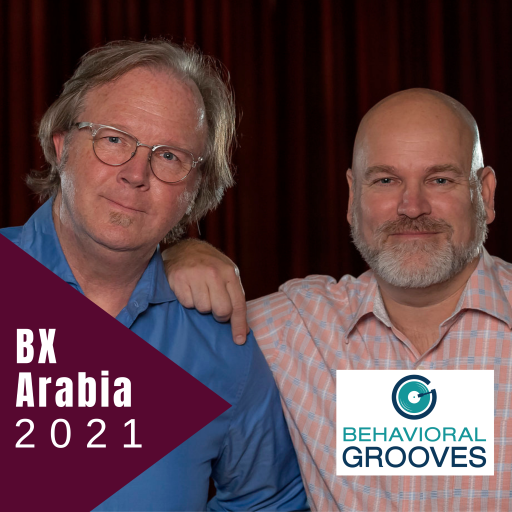
BX Arabia is a regional behavioral insights conference that started in 2018 to emphasize the application of behavioral science in the Global South. Kurt and Tim were fortunate to be invited to moderate at the latest event, affording them the opportunity to have conversations with some of the region's most amazing BeSci thinkers. This episode highlights some of the unique insights from these conversations, with input from the following experts: Faisal Naru: Executive Director of the Policy Innovation Unit in the Nigerian Economic Summit Group and part of Rockefeller Philanthropy Advisors. Dr. Ahmed Al Zahrani: Minister Deputy and Chair of G20 as well as the Executive Director of the Riyadh Behavioral Insight Center in the Ministry of Human Resource and Social Development in Saudi Arabia. Saud Al Rakhayes: Founder and Senior Behavioral Strategist at The Behavior Change. Aditya Jagati: Leader of the Busara Center’s offices in India. Wiam Hasanain: Behavioral scientist and social impact advisor based in Jetta, Saudi Arabia. Nabil Saleh: Vice President Strategy at Nudge Lebanon. Ivo Vlaev: Professor of Behavioral Science at Warwick Business School, UK. Many of the examples of behavioral science discussed highlight that the Global South has some unique needs in the field. However, an overarching theme is that context matters! The root of successful behavioral science ideas come from encompassing the surrounding culture and environment. BX Arabia was founded by Fadi Makki, who is also the leader of B4 Development in Doha, Qatar. He left us with these inspirational words: “Unlearn all the old habits that are anchored in intuition, and then embrace, evidence-based policies and tools such as experimentation.” Topics (2:14) What makes BX Arabia unique? (5:58) The growth of behavioral science agencies around the world. (8:13) How behavioral science is being integrated into public policy globally. (11:46) Why good intentions aren’t enough to deal with wicked problems. (23:36) The need for more behavioral scientists in the Global South. (26:25) How behavioral science improved traffic flow in Beruit. (31:15) The success of weight loss programs using behavioral insights. (36:50) The large-scale nudges that are being studied at the FIFA World Cup in 2022. Links BX Arabia: https://nudgelebanon.org/bx-arabia/ Diversifi: https://www.diversifiglobal.com/ Behavioral Change For Good Initiative: https://bcfg.wharton.upenn.edu/ Episode 272, Jeff Madoff: How To Turn Your Creative Dreams Into Reality: https://behavioralgrooves.com/episode/creativity-jeff-madoff/ John Bargh, Episode 248: Do We Control Situations or Do Situations Control Us? https://behavioralgrooves.com/episode/control-situations-with-john-bargh/ © 2022 Behavioral Grooves

Ep 272How To Turn Your Creative Dreams Into Reality | Jeff Madoff
EIf you have a creative vision, how do you focus your skills on making it happen? Can you turn your dream into a career? How can we encourage more creative entrepreneurs? And can we incorporate more creativity into an analytical job? Jeff Madoff is an American director, producer, photographer, writer and professor living in New York City. He is the founder and CEO of Madoff Productions, winning awards for his commercials and videos AND he is a die hard music loving fan. In his upcoming production of The Lloyd Price Musical, Jeff learnt a valuable lesson of asking himself the question “is it essential?” Even work that is funny and engaging, may not be an essential part of the bigger story. “Is it essential?” is a challenging question for all of us but can be incredibly useful at keeping us focused on reaching our goals. In our discussion with Jeff, he dispels the myth that you are either creative or analytical. And he brings home to us the importance of listening. Listening not just to form an appropriate response, but listening in order to fully understand the other person. Fans of Behavioral Grooves, please consider leaving us a review on your podcast player. If you listen on Apple, here is the podcast review page for Behavioral Grooves to get you started: https://podcasts.apple.com/us/podcast/behavioral-grooves-podcast/id1303870112 © 2022 Behavioral Grooves Topics (3:31) Welcome and speed round questions. (10:11) How to encourage creative careers. (16:58) Turning your passion into a career. (22:36) How to weave creativity into any job. (25:43) When the creative world and the business world meet. (29:41) Learning to ask “Is it essential?” (42:25) What is on Jeff’s playlist? (46:53) How entrepreneurs can be creative. (53:48) The story behind The Lloyd Price Musical. (1:04:06) Grooving Session discussing Jeff’s interview. Links Creative Careers: Making a Living with Your Ideas by Jeff Madoff: https://amzn.to/3pXmogM Gregory Peck: https://en.wikipedia.org/wiki/Gregory_Peck Orbiting the Giant Hairball: A Corporate Fool's Guide to Surviving with Grace by Gordon MacKenzie: https://amzn.to/3eYxbRE The Lloyd Price Musical: https://www.peopleslight.org/whats-on/20212022-season/personality-the-lloyd-price-musical/ Musical Links Frank Zappa “Montana”: https://www.youtube.com/watch?v=DmcYTShN4Fk Buddy Guy “Stay Around A Little Longer”: https://www.youtube.com/watch?v=emyt-agLE_s Slim Harpo “I’m a King Bee”: https://www.youtube.com/watch?v=XWLvm11MAaM Lightnin’ Hopkins “Woke Up This Morning”: https://www.youtube.com/watch?v=BATlJwKB8ts Muddy Waters “Mannish Boy”: https://www.youtube.com/watch?v=bSfqNEvykv0 Chuck Berry “Sweet Little Sixteen”: https://www.youtube.com/watch?v=ZLV4NGpoy_E Jimi Hendrix “Foxey Lady”: https://www.youtube.com/watch?v=_PVjcIO4MT4 Link Ray “Rawhide”: https://www.youtube.com/watch?v=Fn5hl2IA7_s Howlin Wolf “How Many More Years”: https://www.youtube.com/watch?v=OpKB6OZ_B4c Stevie Ray Vaughan “Texas Flood”: https://www.youtube.com/watch?v=KC5H9P4F5Uk

Ep 271How To Create New Goals That Will Really Motivate You in 2022
It’s the time of year for setting New Year’s resolutions. But how can you set goals that you will actually achieve? Will you look back at the end of 2022 and feel a sense of accomplishment? The first step to reaching your goals is actually knowing how to set yourself up to succeed. In this fun Grooving Session with Kurt and Tim, they break down the steps needed to create motivating goals in 2022. Using insights from past guests, plus their own expertise in behavioral science, Kurt and Tim break down the skills behind successful goal setting. In addition, they dispel some ill-advised myths. Think willpower is enough to help you lose weight? Sorry, but creating healthy habits takes more than just good intentions. If you want to better your health, your relationships or your organization in 2022, listening to this fun and informative episode will start you off on the path to success. Links Gary Latham PhD, Episode 147: Goal Setting, Prompts, Priming, and Skepticism: https://behavioralgrooves.com/episode/gary-latham-goal-setting-prompts/ Katy Milkman PhD, Episode 232: How to Make Healthy Habits that Actually Last: https://behavioralgrooves.com/episode/katy-milkman-habits-that-last/ Roy Baumeister PhD, Episode 171: Self Control, Belonging, and Why Your Most Dedicated Employees Are the Ones To Watch Out For: https://behavioralgrooves.com/episode/self-control-belonging-and-why-your-most-dedicated-employees-are-the-ones-to-watch-out-for-with-roy-baumeister/ Leave a review for Behavioral Grooves Podcast: https://podcasts.apple.com/us/podcast/behavioral-grooves-podcast/id1303870112 © 2021 Behavioral Grooves

Ep 270The Behavioral Science Books We Just Couldn’t Put Down in 2021 With Louise Ward
What a year for books 2021 has been! It seems like authors, editors and publishers have all been working overtime this year to bring us some incredible new content. Books that have challenged our beliefs, calmed our anxieties and transformed our habits. To help us with the mammoth job of summarizing the best behavioral science books from 2021, we are joined by the incredible Louise Ward, who has read over 100 books this year! Louise is the co-host of the Behavioural Science Club, a LinkedIn group established in June 2020 now with over 5,000 members. If you haven’t yet joined the club, you definitely should. Today. Alongside co-host Prakash Sharma, the Behavioural Science Club interviews top authors each week about fascinating new insights in human behavior. In our discussion with Louise, we noticed some trends among our favorite books. One is that we are moving past the presumption that humans are flawed and irrational. Books such as Useful Delusions and Nudge focus instead on the evolutionary usefulness of our biases and heuristics. In addition, we loved that after reading books on heavy topics such as suffering (The Sweet Spot), racial inequalities (The Person You Mean to Be) or conspiracy theories (How to Talk to a Science Denier), we were still left with a feeling of hope and optimism. And if you’re new to behavioral science and wondering how to get started or underestimating the impact you can make as an individual, there was an empowering theme to this year’s books too. Dive into You Have More Influence Than You Think to recognize how you can make an impact on people, You’re Invited to reflect on the connections you make in your life or Non Obvious Megatrends to start noticing more of the world around you. We would LOVE to hear your favorite books of 2021. Did your favorites overlap with ours? Please send us an email at [email protected], or connect with us on social media with your top reads of the year. Twitter: @behavioralgroov LinkedIn: Behavioral Grooves Instagram: @behavioralgrooves Facebook: Behavioral Grooves Behavioural Science Club Links Join over 5000 members in the LinkedIn Group: https://www.linkedin.com/groups/13871707/ More group info: https://lnkd.in/grjWMrQ Twitter: @BehSciClub Our Favorite Books of 2021 Louise Think Again: The Power of Knowing What You Don't Know, by Adam Grant: https://amzn.to/3pNXdvE Brandsplaining: Why Marketing is (Still) Sexist and How to Fix It, by Jane Cunningham and Philippa Roberts: https://amzn.to/33Fltsu Think Big: Take Small Steps and Build the Future You Want, by Grace Lordan: https://amzn.to/3mo3JZ6 What We Owe Each Other: A New Social Contract for a Better Society, by Minouche Shafik: https://amzn.to/3eiJOXj Subtract: The Untapped Science of Less, by Leidy Klotz: https://amzn.to/3JaOqwY The Sleeping Beauties: And Other Stories of Mystery Illness, Suzanne O’Sullivan: https://amzn.to/3IHnuV5 Noise: A Flaw In Human Judgement, by Daniel Kahneman, Olivier Sibony and Cass Sunstein: https://amzn.to/3eiHgZf This is Your Mind On Plants, by Michael Pollan: https://amzn.to/3Ekqd3p Nudge: The Final Edition, by Richard Thaler and Cass Sunstein: https://amzn.to/3edkHFe Four Thousand Weeks: Time Management for Mortals, by Oliver Burkeman: https://amzn.to/3qiyFv9 Tim The Person You Mean to Be: How Good People Fight Bias, by Dolly Chugh: https://amzn.to/3rSsEHQ Anxiety at Work: 8 Strategies to Help Teams Build Resilience, Handle Uncertainty, and Get Stuff Done, by Chester Elton And Adrian Gostick: https://amzn.to/3EMgofA Useful Delusions: The Power and Paradox of the Self-Deceiving Brain, by Shankar Vedantam and Bill Mesler: https://amzn.to/3rVh8Ma The Unconscious: Theory, Research, and Clinical Implications, by Joel Weinberger: https://amzn.to/3H5P5xA How to Not Die Alone: The Surprising Science That Will Help You Find Love, by Logan Ury: https://amzn.to/3GC8VR3 Non Obvious Megatrends: How to See What Others Miss and Predict the Future, by Rohit Bhargava: https://amzn.to/3phL4jv Kurt You Have More Influence Than You Think: How We Underestimate Our Power of Persuasion, and Why It Matters, by Vanessa Bohns: https://amzn.to/3dCEKgb You're Invited: The Art and Science of Cultivating Influence, by Jon Levy: https://amzn.to/3ydBtgF How To Talk To a Science Denier, by Lee McIntyre: https://amzn.to/3lVT4Vk Subtract: The Untapped Science of Less, by Leidy Klotz: https://amzn.to/3JaOqwY The Sweet Spot: The Pleasures of Suffering and the Search for Meaning, by Paul Bloom: https://amzn.to/3piFKwr A couple of non-2021 favorites: Why Zebras Don’t Get Ulcers, by Robert Sapolsky: https://amzn.to/3H5ALp6 (Kurt) The Hype Machine: How Social Media Disrupts Our Elections, Our Economy, and Our Health--and How We Must Adapt, by Sinan Aral: https://amzn.to/3EgsSLv (Louise) © 2021 Behavioral Grooves

Ep 269More Than Just A Checklist: How to Effectively Apply Behavioral Science | Torben Emmerling
Applying Behavioral Science insights at work takes more than just another checklist or document, it’s about creating an environment that enables people to make good decisions. Torben Emmerling specializes in innovative, evidence-based strategies for behavior change. We discuss with him the nuances that differentiate applied behavioral science from academic behavioral science. As a consultant for both private and public organizations, Torben doesn’t focus on a specific industry. Instead, he's a human behavior expert. What motivates people and what prompts individuals to change their behavior can be applied in any industry. For example, the same contextual factors that make us forget to buy milk on the way home from work, can be applicable in organizational decisions and performance. We hope you enjoy our conversation with Torben and if you do, please leave a short review of our podcast. Reading your comments, never fails to put a smile on our faces! Topics (4:44) Welcome to Torben Emmerling and speed round. (8:59) How behavioral science can be used to help people save energy. (14:34) Why applied behavioral science can be very different than academic behavioral science. (16:42) How Torben’s work uses applied behavioral science. (18:33) Behavioral science tools aren’t industry specific. (21:53) Why behavioral science needs to be more than just checklists and documents. (27:16) What the airline industry can teach us about reflecting on errors. (29:45) The importance of creating psychological safety at work. (31:48) How organizations have used behavioral science to manage remote working during COVID-19. (36:34) What is on Torben’s playlist? (39:07) Grooving Session with Kurt and Tim discussing how to apply Torben’s insights. © 2021 Behavioral Grooves Links Opinion Science Podcast: http://opinionsciencepodcast.com/ Winter Camp 2022: https://fb.me/e/217RQdNQh Torben Emmerling: https://www.linkedin.com/in/torben-emmerling/ Daniel Kahneman: https://en.wikipedia.org/wiki/Daniel_Kahneman “5 Behavioral Biases That Trip Up Remote Managers”: https://hbr.org/2021/06/5-behavioral-biases-that-trip-up-remote-managers Episode 170, “Seven Questions to Assess the Psychological Safety of Your Teams with Susan Hunt Stevens”: https://behavioralgrooves.com/episode/seven-questions-to-assess-the-psychological-safety-of-your-teams-with-susan-hunt-stevens/ Peak-end rule: https://en.wikipedia.org/wiki/Peak%E2%80%93end_rule Rory Sutherland, “Transport for Humans”: https://amzn.to/3swG5xN Episode 107, Rory Sutherland “The Opposite of a Good Idea is a Good Idea”: https://behavioralgrooves.com/episode/rory-sutherland-the-opposite-of-a-good-idea-is-a-good-idea/ Musical Links Nas, “Nas is Like”: https://www.youtube.com/watch?v=VC4ORS5n9Hg&ab_channel=NasVEVO The Black Keys, “Howlin' For You”: https://www.youtube.com/watch?v=TLSpj7q6_mM&ab_channel=TheBlackKeys

Ep 268Our Love Of Music And The Influence Of The Pandemic With Mark Thorley
Where and how we listened to music shifted during the pandemic. But the music industry itself had to quickly adapt in 2020 to how music was recorded and produced. Our very musical conversation with guest Mark Thorley delves into the changes that COVID brought to remote working and how people’s relationships with music have changed in recent months. There is no greater joy for Tim than discussing music with our guests, and you can see from the musical links on this episode, that our conversation with Mark covers a multitude of musical genres! Our relaxed discussion with Mark swings off into many musical tangents and Mark even manages to turn his own speed round question back on Tim and Kurt. Listen in to find out which musical star they both would choose to have dinner with! Mark has coined the phrase “remotivity” to embody the concept of working on music, whether it be recording or producing, in a remote setting. But this goes further than just having a working WiFi connection or a Zoom meeting set up. There are four key skills needed to work remotely in music; innovation, technical expertise, a fan base, and a unique selling point. We explore each of these four elements in detail with Mark. Topics Welcome and speed round. Hearing the same music at different stages can alter our listening experience. How has the pandemic shifted how music is recorded and consumed? Working from home has come full circle. The mental health toll of working from home. The 4 skills needed for working remotely in music. Links Wally Heider: https://en.wikipedia.org/wiki/Wally_Heider Rupert Neve: https://en.wikipedia.org/wiki/Rupert_Neve Rudy Van Gelder: https://en.wikipedia.org/wiki/Rudy_Van_Gelder Les Paul: https://en.wikipedia.org/wiki/Les_Paul Joe Meek: https://en.wikipedia.org/wiki/Joe_Meek Episode 219: Why Music Makes You Feel Better with Pablo Ripollés and Ernest Mas Herrero: https://behavioralgrooves.com/episode/why-music-makes-you-feel-better/ Episode 82, Chris Matyszczyk: Listening to Music While You Work: https://behavioralgrooves.com/episode/chris-matyszczyk-listening-to-music-while-you-work/ Musical Links Kylie Minogue “I Should Be So Lucky”: https://www.youtube.com/watch?v=3_TvpBwSZDM Hot Chocolate “You Sexy Thing”: https://www.youtube.com/watch?v=E3fX2_bxEkg Madonna “Material Girl”: https://www.youtube.com/watch?v=6p-lDYPR2P8 Quincy Jones “Summer in the City 1973”: https://www.youtube.com/watch?v=6xN3KOY2kbg Chicane “Hello, Goodbye”: https://www.youtube.com/watch?v=1iTHBBv0n5c James Brown “Get On Up”: https://www.youtube.com/watch?v=BCCkb6k_aow Chuck Berry “Johnny B Goode”: https://www.youtube.com/watch?v=T38v3-SSGcM Nina Simone “Feeling Good”: https://www.youtube.com/watch?v=oHRNrgDIJfo U2 “I Will Follow”: https://www.youtube.com/watch?v=DSJYerDbdjc Ministry “Search and Destroy”: https://www.youtube.com/watch?v=psHDeiXRVwQ Charlie Mingus “Moanin’”: https://www.youtube.com/watch?v=__OSyznVDOY” Echo and The BunnyMen “The Killing Men”: https://www.youtube.com/watch?v=LWz0JC7afNQ Steely Dan “More Than Just a Band”: https://www.youtube.com/watch?v=SjXB894CZnM UB40 “Red. Red Wine”: https://www.youtube.com/watch?v=zXt56MB-3vc “The 1919 Influenza Blues”: https://www.youtube.com/watch?v=6Y_7B1cCvjk
Ep 267Please Help Us by Voting for Behavioral Grooves - it takes 10 seconds
Habit Weekly, a wonderful organization founded by Samuel Salzer, is asking people to weigh in on their favorite podcast by casting a vote at https://www.habitweekly.com/awards. Kurt and Tim are asking for your vote since you (and lots of other people) voted for Behavioral Grooves in 2021 making it the Number One Behavioral Science Podcast in 2021. We’d like to maintain that spot in the upcoming year and all we need is your vote. It takes less than 10 seconds. With more than 260 episodes under our belt and listeners in more than 120 countries, we hope you find some things about Behavioral Grooves to be worth voting for. Please cast your vote for your favorite podcast at: https://www.habitweekly.com/awards

Ep 266Trust: The Four Key Steps to Genuinely Build It | Sandra Sucher
In 2021, people started to trust business organizations more than governments, NGOs or the media, according to global research by the Edelman Trust Baraometer. The Covid pandemic has seen people around the globe question their trust in all forms of leadership. What impact does this have on business leaders? Can organizations rebuild trust? What are the building blocks of trust? Sandra Sucher, co-author of “The Power of Trust: How Companies Build It, Lose It, Regain It” (https://amzn.to/3pny7Uu) draws back the layers of what trust actually is, how to build it, how to maintain it through adversity, and most importantly, how to rebuild it when it’s been shattered. Along with her co-author, Shalene Gupta, Sandra has devised the four key foundations of trust; competence, motives, means and impact. We ask Sandra about the significance of these steps, how they can be harnessed, as well as the impact on trust that Covid has had, specifically how vaccine mandates have affected it. Throughout our conversation and her book, Sandra illustrates her insights with a plethora of rich business examples. If you are a regular listener to Behavioral Grooves, you can become a special Behavioral Grooves Patreon member by donating to our work: https://www.patreon.com/behavioralgrooves. And a particular thanks to some of our listeners who have recently left us glowing podcast reviews, we really appreciate them. We'd love it if more our listeners could take 2 minutes to write a short review of Behavioral Grooves. Thanks! Topics (3:03) Welcome and speed round question. (5:00) Trust is limited. (7:38) The 4 key elements of trust. (13:09) Does forgiveness play a part in regaining trust? (14:54) How trust can be preserved by an organization, even while laying people off - the Nokia example. (25:30) How has the landscape of trust changed and what effect has the pandemic had on trust? (30:27) The link between lack of trust in government and vaccine hesitancy. (33:49) The trust implications of asking employees to get vaccinated. (36:26) People actually trust a negative outcome, if they feel the process was fair. (39:37) What makes a business a good place to be from? (45:39) Grooving Session discussing what we’ve learnt from Sandra. © 2021 Behavioral Grooves Links Sandra Sucher, “The Power of Trust: How Companies Build It, Lose It, Regain It”: https://amzn.to/3pny7Uu Esko Aho, Nokia: https://en.wikipedia.org/wiki/Esko_Aho Amy Edmondson, Psychological Safety: https://www.hbs.edu/faculty/Pages/profile.aspx?facId=6451 Edelman Trust Barometer: https://www.edelman.com/trust/2021-trust-barometer Shalene Gupta: https://shalenegupta.com/ “Worried About the Great Resignation? Be a Good Company to Come From” by Sandra J. Sucher and Shalene Gupta: ttps://hbswk.hbs.edu/item/worried-about-the-great-resignation-be-a-good-company-to-come-from Recruit Holdings in Japan: https://recruit-holdings.com/ Episode 102, Cristina Bicchieri: Social Norms are Bundles of Expectations: https://behavioralgrooves.com/episode/cristina-bicchieri-social-norms-are-bundles-of-expectations/ Musical Links Aretha Franklin “R.E.S.P.E.C.T.”: https://www.youtube.com/watch?v=6FOUqQt3Kg0&ab_channel=TatanBrown

Ep 265Focus More on HOW to Think, and Less on WHAT to Think | Dr. Howard Rankin PhD
If we are open minded, we challenge our beliefs and accept that our thinking can, at times, be misguided. After all, our thoughts are merely a function of our personal habits, experiences and internal communication. Dr Howard Rankin PhD encourages us to recognize the value of critical thinking, and become more aware of our own consciousness. To conclude our November series on Conspiracy Theories, our guest on this episode, Dr. Howard Rankin PhD, talks about how our consciousness has been conditioned. By understanding how the thinking process works and being aware of our own consciousness, we gain more perspective on our beliefs. So we should focus more on HOW to think, and less on WHAT to think. Howard is an inspirational educator on the subjects of mind-body medicine, spirituality, neuropsychology and cognitive function, personal change and transformation. Frequently appearing on radio, TV and podcasts, Howard is also an author. His latest book, "I Think Therefore I Am Wrong: A Guide to Bias, Political Correctness, Fake News and the Future of Mankind" (https://amzn.to/3DXNTLM) shines light on the human thought process and how it can often be seriously flawed. If you are a regular listener to Behavioral Grooves, please consider donating to our work through the Behavioral Grooves Patreon page: https://www.patreon.com/behavioralgrooves. Also leaving a short review on our podcast really helps others to find our content, thanks. Topics (3:52) Welcome and speed round questions. (10:50) Is there a difference between OUR reality and THE reality? (17:34) Why do we underestimate critical thinking? (25:19) Can social norms influence what we consider to be true? (27:37) How do we reconcile our need for certainty? (28:27) How do we challenge our own beliefs? (35:58) Challenging ourselves on not WHAT to think but HOW to think. (37:37) How we can focus education on how to think, not what to think. (43:30) What music makes Howard think? (49:08) How you can learn more about Howard’s work. (49:58) Grooving Session with Kurt and Tim discussing how they are wrong! © 2021 Behavioral Grooves Links Leading Human™ Workbook and Playbook: https://www.behavioralgrooves-store.com/products/copy-of-the-leading-human-playbook-workbook-package Leading Human™, Free Whitepaper Download: https://www.behavioralgrooves-store.com/collections/leading-human/products/human-centered-workplace-checklist Promo Code: GROOVERS to receive $20 off (limited time offer for listeners). Dr. Howard Rankin PhD, "I Think Therefore I Am Wrong: A Guide to Bias, Political Correctness, Fake News and the Future of Mankind": https://amzn.to/3DXNTLM Dr. Howard Rankin PhD: https://www.drhowardjrankin.com/ I Think Therefore I Am Wrong Website: www.ithinkthereforeiamwrong.com How Not to Think Podcast: https://podcasts.apple.com/us/podcast/how-not-to-think/id1488982079 YouTube channel – Howard Rankin: https://www.youtube.com/c/howardrankin Clayton Kershaw: https://en.wikipedia.org/wiki/Clayton_Kershaw Joe Montana: https://en.wikipedia.org/wiki/Joe_Montana Episode 176, Annie Duke on How to Decide: https://behavioralgrooves.com/episode/annie-duke-on-how-to-decide/ George Box: https://en.wikipedia.org/wiki/George_E._P._Box Bayesian Theory: https://en.wikipedia.org/wiki/Bayesian_probability Musical Links Mozart “Requiem”: https://www.youtube.com/watch?v=Zi8vJ_lMxQI The Beatles “Help”: https://www.youtube.com/watch?v=2Q_ZzBGPdqE Jimi Hendrix “Purple Haze”: https://www.youtube.com/watch?v=WGoDaYjdfSg

Ep 264Need a Laugh to Get Through Your Workday? Dan Hill
ENeed some respite from the work day grind? Join the fun on this episode for a light-hearted take on workplace humor. Dan Hill delivers a real tongue-in-cheek take on the corporate lingo and jargon that infiltrates our workplaces. But with every joke he makes, there is a pang of truth: “emojis; the feelings you would be having at work if they were allowed.” Dan’s new book; “Blah, Blah, Blah: A Snarky Guide to Office Lingo” (https://amzn.to/3nB3hYB) is written in collaboration with over 50 contributors from across the world (including our one and only Tim Houlihan!) who have collectively provided almost 600 definitions of how the workplace really operates. Our conversation with Dan is not just hilariously funny, he also cracks open the truth on workplace humor being an effective way of tackling serious goals. With this "snarky" book Dan wants to bring the issues of bullying and inequality in the workplace to the forefront of peoples minds. So why use humor to address such momentous issues? In Dan's own words, humor can open your eyes: “A good cartoon, a good joke, I think really captures the essence of a situation, and it does open you up, it's got that aha, twist and turn to a phrase a concept. When we're surprised our eyes go wider, our mouth drops open and means we shut up and we notice the world around us. So I am trying for that element of surprise.” Welcoming Dan back to Behavioral Grooves in this episode was simply a barrel of laughs for us. But please note, that our discussion contains some language you might not want your kids to hear. We really do have a lot of fun creating the Behavioral Grooves Podcast, but like Dan said “having fun IS hard work!”. If you’d like to chip in with our work, please consider becoming a monthly contributor at our Patreon site: https://www.patreon.com/behavioralgrooves. Becoming a special Behavioral Grooves Patreon will open up some exclusive show content just for you! Topics (4:32) Welcome and speed round questions. (11:20) Addressing the fact that 20-25% of managers are bullies. (14:43) Dan reads entries from his snarky book! (15:47) What is the devil’s dictionary? (17:59) Using humor to open people's eyes. (21:30) How Dan is tackling inequality in the workplace with humor. (29:11) Grooving with Tim and Kurt on what funny things we learnt from Dan’s interview. © 2021 Behavioral Grooves Links “Blah, Blah, Blah: A Snarky Guide to Office Lingo” by Dan Hill, Howard Moskowitz, James Monroe: https://amzn.to/3nB3hYB “Emotionomics: Leveraging Emotions for Business Success” by Dan Hill: https://amzn.to/3FONtbb “Famous Faces Decoded: A Guidebook for Reading Others” by Dan Hill: https://amzn.to/3nL5eli Dan Hill, Episode 151: On the Facial Coding of Trump, Hendrix, Prince, Gretzky and the Beatles: https://behavioralgrooves.com/episode/facial-coding-of-trump/ Dan Hill's EQ Spotlight Podcast: https://podcasts.apple.com/us/podcast/dan-hills-eq-spotlight/id1519669707 John McEnroe: https://en.wikipedia.org/wiki/John_McEnroe The Devil's Dictionary : https://en.wikipedia.org/wiki/The_Devil%27s_Dictionary Vanessa Bohns, Episode 253. Why You Don‘t Need to be Powerful to be Influential: https://behavioralgrooves.com/episode/influence-vanessa-bohns/ Patreon Site for Behavioral Grooves: https://www.patreon.com/behavioralgrooves Musical Links Bob Dylan “The Times are A-Changin’”: https://www.youtube.com/watch?v=90WD_ats6eE The Beatles “Hard Days Night”: https://www.youtube.com/watch?v=Yjyj8qnqkYI

Ep 263Feeling Fearful: Why People Seek Out Conspiracy Theories | Eric Oliver
What makes us more likely to believe in conspiracy theories? Can our religious beliefs or political affiliations determine whether we're less likely to believe in scientific facts? Why are health conspiracy theories some of the most widely believed notions? We revisit a conversation with Eric Oliver who talks us through the factors that drive people towards conspiracy theories. Eric Oliver, PhD is a Professor of Political Science at the University of Chicago. Although the majority of his work is squarely in the realm of how we view our political systems and make political decisions, some of his work echoes moral psychology and sociology, and we find it fascinating. And, frankly, some of it is just downright fun to talk about. Eric’s observations come from more than 20 years of research, dozens of peer-reviewed papers, and he is the author of 5 books on political science. We specifically talked about how liberals and conservatives name their children, the rise of intuitionism, having dinner with a sports star rather than a rock star, and of course, he spoke in-depth about conspiracy theories. Most importantly, he walked us through some key aspects of how to have a conversation with someone who is on the opposite side of the conspiracy-theory belief system and, interestingly enough, it begins with empathy. Listen to the entire episode to hear all his insights and research anecdotes. They’ll put a smile on your face as well as fresh ideas into your brain! We have been fans of his work for some time and are grateful that Eric shared his insights with us. We think you’ll become a fan, too, if you’re not already one. [NOTE: This episode is republished from our interview with Eric in episode #172 from Sept 2020.] © 2021 Behavioral Grooves Topics (3:17) Welcome and speed round. (10:17) What characteristics predict whether you will believe in conspiracy theories? (19:24) People rely on heuristics in times of uncertainty. (24:48) Have conspiracy theories increased since Covid? (27:03) What factors make us more likely to believe conspiracy theories? (32:36) Do religious people tend to believe more in conspiracy theories? (38:47) Why Donald Trump appeals to conspiracy theorists. (42:50) How to talk to your relatives about their conspiracy theories? (45:33) What music does Eric listen to? (53:19) Grooving session with Tim and Kurt discussing Eric's work. Links Eric Oliver, PhD: https://political-science.uchicago.edu/directory/eric-oliver Jonathan Haidt, PhD: https://en.wikipedia.org/wiki/Jonathan_Haidt James Frazer, “The Golden Bough”: https://en.wikipedia.org/wiki/The_Golden_Bough Katherine Surma on Credulity: https://www.jericoliver.com/uploads/1/1/8/9/118973414/surmaoliver3.5.18-final.pdf Laurie Santos, PhD: The Joe Effect: https://www.youtube.com/watch?v=GimHHAID_P0 Steve Kerr: https://en.wikipedia.org/wiki/Steve_Kerr Colin Kaepernick: https://en.wikipedia.org/wiki/Colin_Kaepernick Charles Manson: https://en.wikipedia.org/wiki/Charles_Manson Andy Luttrell, Episode 175: Pro’s and Con’s of Persuasion When Issues are Moralized: https://behavioralgrooves.com/episode/andy-luttrell-pros-and-cons-of-persuasion-when-issues-are-moralized/ Kwame Christian, Episode 178: On Compassionate Curiosity, Social Justice Conversations, and Cinnamon Toast Crunch: https://behavioralgrooves.com/episode/kwame-christian-on-compassionate-curiosity-social-justice-conversations-and-cinnamon-toast-crunch/ Musical Links LCD Sound System: https://www.youtube.com/watch?v=lqq3BtGrpU8 Kurt Weil: https://en.wikipedia.org/wiki/Kurt_Weill Phillip Glass: https://www.youtube.com/watch?v=M73x3O7dhmg Keith Richards and Chuck Berry: https://www.youtube.com/watch?v=ERVLy-ltjHs

Ep 262Why We Are More Vulnerable To Harmful Conspiracy Theories Than We Think | Andy Norman
Misinformation is like a virus, spreading quickly and propagating in a way that doesn’t benefit its host. Andy Noman describes harmful ideas as acting like “mind parasites” that deploy clever tactics to infect our thinking by circumventing our mental immune systems. And we’re even more susceptible to bad ideas than we realize. So how do we immunize ourselves against mind parasites? Can we reach herd immunity? Can we critically think our way out of this epidemic of unreason? After 30 years of research on this topic, Andy has concluded that the traditional models of critical thinking are not up to the task in our hyper-connected world. We need a more comprehensive framework for inoculating our minds against viral nonsense. Andy Norman is an award-winning author who teaches philosophy at Pittsburgh’s Carnegie Mellon University. He has recently published his new book, “Mental Immunity: Infectious Ideas, Mind-Parasites, and the Search for a Better Way to Think”: https://amzn.to/3o6OjbU. We are thrilled to welcome Andy as part of our series on understanding more about Conspiracy Theories. Our conversation with Andy reveals details of his framework for strengthening our own mental immunity. We hope you enjoy listening! Subscribe to Behavioral Grooves on your podcast player so you are notified about our new episodes. Next week we will be hearing from Prof. Eric Oliver about how to talk to our friends and family about conspiracy theories. If you are a regular listener to Behavioral Grooves, please consider donating to our work through our Behavioral Grooves Patreon page: https://www.patreon.com/behavioralgrooves. We also love reading your reviews on the podcast, which help others find our content. Topics (3:37) Welcome and speed round questions. (6:20) We are experiencing an epidemic of unreason. (8:17) How can we immunize ourselves against disinformation? (14:10) How our identity can affect our mental immunity. (17:54) A framework for mental immunity. (21:11) Thinking in probabilities instead of in black & white. (26:08) Why acknowledging other people's truths can have a surprising effect. (29:38) The objective difference between a good idea and a bad idea. (32:25) Arguing with someone who only cares about themselves. (38:54) Is there a chance we will reach mental herd immunity? (44:13) What music is on Andy’s playlist? (47:11) Grooving Session with Kurt and Tim talking about how to apply Andy’s work. © 2021 Behavioral Grooves Links “Mental Immunity: Infectious Ideas, Mind-Parasites, and the Search for a Better Way to Think” by Andy Norman: https://amzn.to/3o6OjbU Ludwig Wittgenstein: https://en.wikipedia.org/wiki/Ludwig_Wittgenstein Socrates: https://en.wikipedia.org/wiki/Socrates Dan Kahan, “Identity Protective Cognition”: https://bit.ly/2YxM3Sk Episode 176: Annie Duke on How to Decide: https://behavioralgrooves.com/episode/annie-duke-on-how-to-decide/ Musical Links Mark Knopfler “Piper to the End”: https://www.youtube.com/watch?v=XsrKWwx3x7o

Ep 261Conspiracy Theories: How To Talk to A Science Denier | Lee McIntyre
How do you respond to someone who says “the earth is flat” or “Covid is a hoax”? Before we can try and reason with conspiracy theorists, we must first understand the reason they have ventured down that path. Lee McIntyre has spent years researching science deniers and has found a common set of traits in their behavior. He also argues that we shouldn’t sit back and assume conspiracy theories are harmless. Find out more from Lee in this episode about how to talk with science deniers and how even to change their minds about the facts. Our Conspiracy Theories Series continues this month with Lee McIntyre, author of the new book “How to Talk to a Science Denier: Conversations with Flat Earthers, Climate Deniers, and Others Who Defy Reason”: https://amzn.to/3qaV134. To gather research for the book, Lee attended a flat earth convention to understand more about the followers who believe in the flat earth conspiracy. His findings are enlightening. Lee is a Research Fellow at the Center for Philosophy and History of Science at Boston University and an Instructor in Ethics at Harvard Extension School. He’s had a distinguished career in teaching and researching issues that we found fascinating. Next week we continue our Conspiracy Theories Series with Andy Norman, author of the enthralling new book, “Mental Immunity: Infectious Ideas, Mind-Parasites, and the Search for a Better Way to Think”: https://amzn.to/3o6OjbU. We learn about how bad ideas can infect our minds and how we can boost our own mental immunity. Subscribe to Behavioral Grooves on your podcast player so you’re the first to be notified when we publish a new episode. Topics (9:33) Speed Round (11:36) Lee’s experience attending a Flat Earth Convention. (14:56) How people become convinced by conspiracy theories. (17:09) The value of having face to face conversations. (22:10) How to have those difficult conversations with your family and friends. (26:08) The 5 common traits of science deniers. (31:31) Is the educational system really teaching us about how science works? (36:23) Why should we take science deniers seriously? (38:53) Why is science denial growing? (43:27) Political identity and science denial. (58:14) The music that got Lee through Covid (1:06:14) Grooving Session with Tim and Kurt discussing what they talked about with Lee. © 2021 Behavioral Grooves Links “How to Talk to a Science Denier: Conversations with Flat Earthers, Climate Deniers, and Others Who Defy Reason” by Lee McIntyre: https://amzn.to/3qaV134 McIntyre, L. “Calling all Physicists” American Journal of Physics 87, 694 (2019); https://doi.org/10.1119/1.5117828 Beyond the Curve documentary: https://www.netflix.com/title/81015076 “Merchants of Doubt: How a Handful of Scientists Obscured the Truth on Issues from Tobacco Smoke to Climate Change” by Naomi Oreskes and Erik M. Conway: https://amzn.to/3q39Y7m Cranky Uncle: https://crankyuncle.com/ You’re Not So Smart Podcast: https://youarenotsosmart.com/podcast/ Behavioral Grooves Patreon page: https://www.patreon.com/behavioralgrooves Musical Links The Beatles “Here Comes the Sun”: https://www.youtube.com/watch?v=KQetemT1sWc The Beatles “While My Guitar Gently Weeps”: https://www.youtube.com/watch?v=VJDJs9dumZI The Beatles “Something”: https://www.youtube.com/watch?v=UelDrZ1aFeY The Beatles “Blackbird”: https://www.youtube.com/watch?v=Man4Xw8Xypo The Beatles “Hide your Love Away”: https://www.youtube.com/watch?v=V8nLraecPRY The Beatles, The Medley on the Flipside of Abbey Road: https://www.youtube.com/watch?v=pAIUxGn9lCI The Beatles “Because”: https://www.youtube.com/watch?v=hL0tnrl2L_U The Beatles “Strawberry Fields Forever”: https://www.youtube.com/watch?v=HtUH9z_Oey8

Ep 260Conspiracy Theories: Hidden Brain‘s Shankar Vedantam | The Delusion of Nations
Host of Hidden Brain podcast, Shankar Vedantam talks with us about the powers: both useful and harmful, of our delusional thinking. Nations are an example of useful delusions; they are an entirely human-made construct, yet they can present us with a unifying, shared identity. There is a tipping point, however, at which our beliefs can become harmful to someone else. Shankar defines conspiracy theories as a particular type of self deception which can easily escalate into harmful behavior. Our conversation with Shankar touches on the Capitol Riots in Washington DC on January 6th 2021, and how conspiracy theories influenced the behavior of the rioters. “Conspiracy theories, I think are a sort of special case of self deception, which...can easily take over into things that are deeply harmful.” The challenge most of us face though, is how to talk to our friends and family who believe in conspiracy theories. And on that point, Shankar explains the Illusion Of Explanatory Depth and how conversations with our loved ones need to start with an air of empathy and compassion. You can listen to our full interview with Shankar Vedantam in Episode 222: How Delusions Can Actually Be Useful: Shankar Vedantam Reveals How: https://behavioralgrooves.com/episode/shankar-vedantam-useful-delusions/. This bitesize episode is the introduction to our Conspiracy Theories Series, which will run through the month of November 2021. Over the next few weeks, you will hear from some of the brightest minds in the field of conspiracy theories and science denial. Here is our line up for the month: Nov 7th, 2021: Lee McIntyre discussing his new book, “How To Talk to A Science Denier.” Nov 14th, 2021: Andy Norman talking about his new book “Mental Immunity”. Nov 21st, 2021: Eric Oliver, a political science professor at the University of Chicago who has studied conspiracy theorists for over 20 years. Nov 28th, 2021: Howard Rankin, describing his new book “I Think Therefore I Am Wrong.” Subscribe or follow Behavioral Grooves on your podcast player so you don’t miss out on this fascinating series about conspiracy theories. © 2021 Behavioral Grooves Links Subscribe to the Behavioral Grooves Newsletter: https://behavioralgrooves.com/ Write a review of Behavioral Grooves podcast: https://podcasts.apple.com/gb/podcast/behavioral-grooves-podcast/id1303870112 Behavioral Grooves Patreon page: https://www.patreon.com/behavioralgrooves Shankar Vedantam, Episode 222. How Delusions Can Actually Be Useful: Shankar Vedantam Reveals How: https://behavioralgrooves.com/episode/shankar-vedantam-useful-delusions/ Shankar Vedantam of Hidden Brain: https://hiddenbrain.org/ Shankar Vedantam, “Useful Delusions: The Power and Paradox of the Self-Deceiving Brain”: https://amzn.to/2PUkzlv

Ep 259Halloween Special: Grooving on Scary Biases
Listen to Kurt and Tim’s spooky Halloween Special about some common biases that can seem a bit scary. But don’t fear, the scariest thing about this episode is actually Kurt and Tim’s jokes! Find out why some biases are a bit spooky, what makes us susceptible to them, and most importantly how we can overcome them. Thanks for taking the time to learn a bit about how to overcome the biases you may find impacting your life. If you’d like to support our work further, please consider donating a treat (no tricks please!) on our Patreon page: https://www.patreon.com/behavioralgrooves. Your financial support helps with all our production costs. Links Behavioral Grooves Twitter: @behavioralgroov Kurt Nelson Twitter: @motivationguru Tim Houlihan Twitter: @thoulihan Common Biases and Heuristics: https://docs.google.com/document/d/1XHpBr0VFcaT8wIUpr-9zMIb79dFMgOVFRxIZRybiftI/edit Scary Biases: https://blog.lanterngroup.com/scary-biases Behavioral Grooves Patreon page: https://www.patreon.com/behavioralgrooves

Ep 258Why Does Rude Behavior Really Bother Us So Much? | Trevor Foulk PhD
Rudeness is contagious, in a similar way to a virus. When experiencing a rude encounter, our brain perceives it like a threat. And once we’ve tuned in to this low-level threat, we’re more likely to notice it around us, and therefore more likely to display rude behavior ourselves. Our guest on this episode is Dr Trevor Foulk PhD, Assistant Professor of Management & Organization at the University of Maryland. His well published research on deviant workplace behaviors and workplace power dynamics, has been featured in Time magazine, Harvard Business Review, and the Wall Street Journal. Trevor walks us through what rude behavior actually is, what our evolutionary response to it is and how we can take steps to mitigate the effects of it. We are also delighted to talk about Trevor’s research around the way power changes our behavior, and what impact a feeling of paranoia can add to the dynamics. And to Tim’s delight, Trevor also boosts our understanding of how music affects work performance. Truth be told, our conversation with Trevor has opened our eyes into how rude behavior really impacts people. And in our Grooving Session, at the end of the episode, Kurt and Tim recap the ways Trevor’s research can improve our lives. If you enjoy listening to our podcast, you can become an exclusive Behavioral Grooves Patreon member at https://www.patreon.com/behavioralgrooves. Topics (3:28) Welcome and speed round (8:38) How rudeness is contagious. (11:45) Why do we view rudeness as threatening? (13:10) The solutions to rudeness. (15:36) How our response to rudeness differs from holding a grudge. (17:52) Are certain personality types more susceptible to rudeness? (19:15) What effect does rudeness have on medical professionals? (22:59) Can gratitude have the opposite effect to rudeness? (24:27) How the Anchoring Effect is affected by rudeness. (28:43) How does a feeling of power change our behavior? (35:40) Paranoia and power. (39:51) How does music influence performance? (47:35) Grooving Session with Kurt and Tim discussing what we’ve learnt from Trevor’s interview. © 2021 Behavioral Grooves Links Dr Trevor Foulk PhD: https://www.rhsmith.umd.edu/directory/trevor-foulk Foulk, T.A., Woolum, A., & Erez, A. (2016). Catching rudeness is like catching a cold: The contagion effects of low-intensity negative behaviors. Journal of Applied Psychology: https://www.courts.state.co.us/userfiles/file/Administration/Probation/ResearchInBriefs/RIB_Rudeness_Apr16(1).pdf Riskin, A. Erez, A., Foulk, T.A., Kugelman, A., Gover, A., Shoris, I, Riskin, K., & Bamberger, P.A. (2015). The impact of rudeness on medical team performance: A randomized trial. Pediatrics: https://pubmed.ncbi.nlm.nih.gov/26260718/ Foulk, T.A., Lanaj, K., Tu, M., Erez, A., & Archambeau, L. (2018) Heavy is the head that wears the crown: An ator-centric approach to psychological power, abusive behavior, and perceived incivility. Academy of Management Journal: https://journals.aom.org/doi/10.5465/amj.2015.1061 John Bargh: Episode 155. Dante, Coffee and the Unconscious Mind: https://behavioralgrooves.com/episode/john-bargh-dante-coffee-and-the-unconscious-mind/ John Bargh, Episode 248. Do We Control Situations or Do Situations Control Us? https://behavioralgrooves.com/episode/control-situations-with-john-bargh/ Vanessa Bohns, Episode 253. Why You Don‘t Need to be Powerful to be Influential: https://behavioralgrooves.com/episode/influence-vanessa-bohns/ Musical Links Lyle Lovett and Robert Earl Keen “This Old Porch”: https://www.youtube.com/watch?v=H1xY2pu31h4 Jim Croce “Operator”: https://www.youtube.com/watch?v=rw01trwmul0 Rancid “Fall Back Down”: https://www.youtube.com/watch?v=CinJuVtdp3Y Jimmy Buffett “Margaritaville”: https://www.youtube.com/watch?v=z3HBcgxOWAQ

Ep 257Helping People To Assemble Better Decisions | Eric J. Johnson
How do we make decisions? What factors influence the final outcome? Do default settings change our preferences? Every decision we make; from choosing something on a menu to deciding whether to be an organ donor, is influenced by our environmental context and the default selections presented to us. Professor Eric J. Johnson has distilled the latest behavioral science research into his newest book, The Elements of Choice: Why the Way We Decide Matters, and we are thrilled to talk with him about it on this episode of Behavioral Grooves. Eric is Director of the Center for Decision Sciences at Columbia Business School at Columbia University. He examines the interaction between Behavioral Decision Research, Economics and consumer decision making. The implications of his research come together in real world applications such as public policy and marketing. Eric talks with us about how options are presented to decision-makers and how framing affects choices. Our decisions are “assembled”, as Eric likes to put it, in the moment and are not necessarily pre-determined by our preferences. Choice architects have very influential power over decision-makers but Eric highlights to us that we are all designers, and with that comes a moral responsibility. Topics (3:56) How Leading Human™ can help with returning to the office. (6:28) Welcome and speed round. (8:00) How interference affects our decision making. (10:32) The controversy of organ donation defaults. (16:32) We are all designers using the tools of choice architecture. (19:21) How sludge impacts our decision making. (22:42) How context influences defaults. (26:14) What factors moderate the impact of default settings? (29:01) Making choices in the real world vs. classic economic thinking. (32:18) The effects of asking people how long they will live vs. what year they expect to die. (35:04) Smart defaults: defaults set specifically for you. (38:02) What is Query Theory? (39:15) Choice architecture around vaccinations. (42:44) What area does Eric want to research in the future? (44:44) What music does Eric default to? (52:24) Grooving Session with Kurt and Tim on how to apply Eric’s research to our lives. © 2021 Behavioral Grooves Links Behavioral Grooves Patreon: www.patreon.com/behavioralgrooves Leading Human™ Workbook and Playbook: https://www.behavioralgrooves-store.com/products/copy-of-the-leading-human-playbook-workbook-package Leading Human™, Free Whitepaper Download: https://www.behavioralgrooves-store.com/collections/leading-human/products/human-centered-workplace-checklist Leading Human™ Workshop on Dec 14th, 2021 (more dates to be added soon): https://www.behavioralgrooves-store.com/collections/leading-human/products/leading-human-workshop Promo Code: GROOVERS to receive $20 off (limited time offer for listeners). “The Elements of Choice: Why the Way We Decide Matters” by Eric J. Johnson: https://amzn.to/39yXr20 "Do Defaults Save Lives?" by Johnson, Eric, and Daniel Goldstein. Science 302 (2003): https://www8.gsb.columbia.edu/researcharchive/articles/1275 “Sludge: What Stops Us from Getting Things Done and What to Do about It” by Cass Sunstein: https://amzn.to/3i1lLhD Tim Kachuriak, Episode 221: Donating Our Money Is Irrational, So Why Do We Do It? Tim Kachuriak Explains Our Motivations: https://behavioralgrooves.com/episode/why-we-donate-our-money/ “Time to Retire: Why Americans Claim Benefits Early and How to Encourage Them to Delay” In Behavioral Science and Policy (2015). Coauthor(s): Kirstin Appelt, Melissa Knoll, Eric Johnson, Jonathan Westfall: https://behavioralpolicy.org/articles/time-to-retire-why-americans-claim-benefits-early-how-to-encourage-delay/ Musical Links Eric Dolphy “Out to Lunch!”: https://www.youtube.com/watch?v=Ne6GCYO8pAc Django Reinhardt “Three-Fingered Lightning”: https://www.youtube.com/watch?v=PQhTpgicdx4 David Grisman Quartet “Dawg Funk”: https://www.youtube.com/watch?v=9P-FQ7xLiso Jerry Garcia “How Sweet It Is To Be Loved By You”: https://www.youtube.com/watch?v=1_NOFuEb-yo&ab_channel=JerryGarcia Beethoven: https://www.youtube.com/watch?v=W-fFHeTX70Q Caroline Shaw & Sō Percussion “Let The Soil Play a Simple Part”: https://www.youtube.com/watch?v=-cHc4n5mgNM&ab_channel=NonesuchRecords George E. Lewis “Mind In Flux” at the BBC Proms 2021: https://www.youtube.com/watch?v=CSvwisQ3la4 Bruce Springsteen “Tougher Than The Rest”: https://www.youtube.com/watch?v=_91hNV6vuBY

Ep 256Anxiety at Work: Why We Feel It and How To Manage It | Chester Elton
Anxiety in the workplace has always been present, even pre-pandemic but rates of anxiety, particularly among young employees, have worsened since 2020. So what obligation do organizations have to their employees' mental health? How can managers recognize the signs of anxiety, and how can we help our colleagues with those feelings? Following our incredibly popular first episode with Chester Elton in July 2021, on showing gratitude (episode 238), we are thrilled to be talking with him again about anxiety in the workplace. As a best-selling author, speaker and executive coach, Chester, and his co-author Adrian have shown over and over again, that the key to really successful companies is really successful relationships with employees. And because of the pandemic, we wanted to talk with Chester about their most recent book; Anxiety at Work: 8 Strategies to Help Teams Build Resilience, Handle Uncertainty, and Get Stuff Done: https://amzn.to/3dr7gBK. Thank you to all of you who have subscribed to our show, written a review or shared an episode with your friends. Please also consider donating a small amount each month to our work, through our Patreon site: https://www.patreon.com/behavioralgrooves. © 2021 Behavioral Grooves Topics (3:03) Speed round questions. (5:30) Is anxiety in the workplace increasing or decreasing? (10:11) How to manage with empathy, not just sympathy. (14:59) Unleashing employees' potential. (20:17) The number one cause of anxiety and how managers can recognize it. (23:34) Showing vulnerability as a manager. (29:12) Will people take advantage of mental health days off? (32:07) How to deal with your own perfectionism and anxiety. (36:57) The ways you can join Chester’s community. (40:22) Chester’s anti-anxiety playlist. (44:05) Chester’s kind promise to listeners. (45:00) Grooving Session discussing how to apply Chester’s insight to our lives. Books by Chester Elton and Adrian Gostick Anxiety at Work: 8 Strategies to Help Teams Build Resilience, Handle Uncertainty, and Get Stuff Done: https://amzn.to/3dr7gBK Leading with Gratitude: Eight Leadership Practices for Extraordinary Business Results: https://amzn.to/36Cy8uo All In: How the Best Managers Create a Culture of Belief and Drive Big Results: https://amzn.to/3AgtSyk The Best Team Wins: The New Science of High Performance: https://amzn.to/2USP4KN The Orange Revolution: How One Great Team Can Transform an Entire Organization: https://amzn.to/3ybULSb Links Behavioral Grooves Patreon: www.patreon.com/behavioralgrooves Chester Elton: www.chesterelton.com Chester Elton, Episode 238: Who Makes You Feel Grateful? Tell Them! https://behavioralgrooves.com/episode/gratitude-with-chester-elton/ We Thrive Together: www.wethrivetogether.global. A safe community to talk about anxiety and stress with over 500 members. Anxiety at Work with Adrian Gostick & Chester Elton: https://podcasts.apple.com/gb/podcast/anxiety-at-work-with-adrian-gostick-chester-elton/id1549312484 “The Boy, the Mole, the Fox and the Horse” by Charlie Mackesy: https://amzn.to/2YxRO2d Nicole Malachowski: https://bit.ly/3oCYTt5 HR Leaders Podcast with Chris Rainey: https://hrleaders.co/podcast Seth Stephens-Davidowitz, Episode 246: Are You More Honest with Google or Your Friends? https://behavioralgrooves.com/episode/are-you-more-honest-with-google/ “The Heart of Business: Leadership Principles for the Next Era of Capitalism” by Hubert Joly: https://amzn.to/2YmaMZt Garry Ridge at WD-40: https://wd40company.com/our-tribe/our-tribes-leaders/ Musical Links Pharrell Williams “Happy”: https://www.youtube.com/watch?v=ZbZSe6N_BXs Monty Python, Eric Idle “Always Look on the Bright Side of Life”: https://www.youtube.com/watch?v=SJUhlRoBL8M The Beatles “Good Day Sunshine”: https://www.youtube.com/watch?v=6e01nNA02vw The Beatles “Fixing A Hole”: https://www.youtube.com/watch?v=UPBd8eHQqIw

Ep 255The 5 Healthy Brain Habits Of A Neuroscientist | Dr Daniel Almeida
What life habits keep our brain healthy? How does our mind respond to trauma? And why does the way we talk about suicide and mental health make such a difference to those who are struggling? We discuss all these topics with neuroscience researcher Dr Daniel Almeida. To mark World Mental Health Day on Sunday, Oct 10, 2021, we decided to delve into the science behind mental health. And who better to help us with this topic than Daniel who has been named as one of Forbes 30 under 30 in science. His incredible work as a neuroscience researcher in the Douglas Research Centre at McGill University in Montreal, Canada, involves psychological autopsies to understand the molecular impacts of severe childhood abuse on the brains of individuals who died by suicide. As you can imagine, this episode is full of difficult yet important topics. But what struck us most about Daniel was how upbeat and positive he is about his work and the difference it’s making to people’s lives. Daniel kindly shares his top 5 healthy brain habits that we can all adopt to improve our mental wellbeing. If you, or someone you know needs help with their mental health, please use one of the resources in the links below. Mental Health Support Suicide Prevention Lifeline (US):https://suicidepreventionlifeline.org/ American Foundation for Suicide Prevention: https://afsp.org/suicide-prevention-resources Substance Abuse and Mental Health Services Administration: National Helpline (US): 1-800-662-HELP (4357). SAMHSA’s National Helpline is a free, confidential, 24/7, 365-day-a-year treatment referral and information service (in English and Spanish) for individuals and families facing mental and/or substance use disorders. https://www.samhsa.gov/find-help/national-helpline The Canada Suicide Prevention Service: https://www.crisisservicescanada.ca/en/ Samaritans (UK): https://www.samaritans.org/ United for Global Mental Health (List of support networks around the world): https://unitedgmh.org/mental-health-support For those looking for information on how to support others: National Institute of Mental Health: https://www.nimh.nih.gov/health/topics/suicide-prevention For the general public looking to be trained in mental health first aid and/or suicide prevention: Living Works (US): https://bit.ly/3oKgsaS Mental Health First Aid Canada: https://mhfa.ca/ Topics (6:29) Speed round. (10:14) Does talking about suicide help? (14:15) Why it’s very important to talk about “dying by suicide” instead of “committing suicide”. (16:17) About Daniel’s work as a neuroscientist. (17:47) What are the links between childhood trauma and suicide? (25:16) What age are children most sensitive to the effects of trauma? (31:19) How the type of trauma experienced by a child matters. (33:36) How resilience is more like a sword than a shield. (35:29) What are the 5 best brain health habits? (41:57) What is a brain bank and how are psychological autopsies used? (44:30) What music isn’t noise pollution for Daniel? (46:24) Music and the brain. (48:13) Grooving Session with Kurt and Tim; how to apply Daniel’s work to your life. © 2021 Behavioral Grooves Links World Mental Health Day: https://www.who.int/campaigns/world-mental-health-day Leading Human™ Workbook and Playbook: https://www.behavioralgrooves-store.com/products/copy-of-the-leading-human-playbook-workbook-package Leading Human™, Free Whitepaper Download: https://www.behavioralgrooves-store.com/collections/leading-human/products/human-centered-workplace-checklist Leading Human™ Workshop on Dec 14th, 2021 (more dates to be added soon): https://www.behavioralgrooves-store.com/collections/leading-human/products/leading-human-workshop Promo Code: GROOVERS to receive $20 off (limited time offer for listeners). Episode 220: How Do You Become Influential? Jon Levy Reveals His Surprising Secrets: https://behavioralgrooves.com/episode/how-to-be-influential-jon-levy/ Dr Brenda Mildner – Mother of Psychological worked on bilateral hypocantim removal: https://www.mcgill.ca/neuro/about/brenda-milner Donald Hebb: https://can-acn.org/donald-olding-hebb/#:~:text=Donald%20Hebb%20(1904%2D1985),which%20was%20published%20in%201949. “Molecular impacts of childhood abuse on the human brain” Ibrahim, P.; Almeida, D.; Nagy, C.; Turecki, G. (2021): https://www.sciencedirect.com/science/article/pii/S2352289521000515?via%3Dihub “A Slice of the Suicidal Brain: What Have Postmortem Molecular Studies Taught Us?” Almeida, D. and Turecki, G. (2016): https://pubmed.ncbi.nlm.nih.gov/27671915/ “What Happened to You?: Conversations on Trauma, Resilience, and Healing”, by Oprah Winfrey and Bruce Perry: https://amzn.to/3lF7EQ7 Brain structure of dancers and musicians https://www.falishakarpati.com/bio Support Behavioral Grooves by donating on Patreon: https://www.patreon.com/behavioralgrooves Musical Links Gladys Knight & The Pips “Midnight Train to Georgia”: https://www.youtube.com/watch?v=A0F9lh8TiSM&ab_channel=GladysKnightTPVEVO Whitney Houston “I Will Always

Ep 254Money Does Boost Happiness, But Not The Way We Think It Does | Daniel Crosby
The clearest indicators of our financial solvency are based on the behaviors we exhibit with our investments. Dr. Daniel Crosby PhD is a psychologist, behavioral finance expert, asset manager and bestselling author of four books including “The Behavioral Investor”: https://amzn.to/3Bl4s3t. We examine with him the question of whether financial success ultimately brings us happiness? Surprisingly it can, but not in the ways that we think it does. Having studied the growing list of 200 odd behavioral biases and heuristics, Daniel has whittled them down to what he describes as the four “Big Daddy” biases: ego, emotion, attention and conservatism. We learn about why these matter so much and interestingly what Coke Zero can teach us about our biases! Daniel touches on his other bestselling book “You’re Not That Great”: https://amzn.to/3ifiRFC which refreshingly embraces the fact that we are in fact all fairly average! That self esteem is built not by awarding prizes for participation, but by taking a risk, working hard and acknowledging that occasionally we will fall flat on our face along the way! In our Grooving Session with Kurt and Tim, following our interview with Daniel we talk about the ways that we can apply Daniel’s insights to improve our wellbeing and our relationships. [Tim quotes the infamous “Man in the Arena '' quote from Theodore Roosevelt but apologies, we incorrectly credited the quote to Eisenhower, not Roosevelt in the episode.] If you would like to invest in the work that Behavioral Grooves does to bring you interviews like Daniels every week, please support our Patreon page: https://www.patreon.com/behavioralgrooves thank you. Topics (3:09) Welcome and speed round. (5:51) Why understanding people is vital to understanding markets. (8:20) Daniel's journey into behavioral finance. (11:02) What behavioral finance can help with beyond your bank balance. (15:17) Can money really boost our happiness? (20:05) The benefits of embracing our mediocrity. (24:30) How stress impacts performance. (26:58) Meta-biases: ego, promotion, attention, conservatism. (31:09) What Coke Zero can teach us about conservatism bias. (36:51) Ethics and behavioral finance. (41:09) What music does Daniel invest in? (48:44) Grooving Session on how to apply Daniel’s work in our own lives. © 2021 Behavioral Grooves Books by Daniel Crosby The Laws of Wealth: Psychology and the secret to investing success: https://amzn.to/36NsbuJ The Behavioral Investor: https://amzn.to/3Bl4s3t You're Not That Great: https://amzn.to/3ifiRFC Personal Benchmark: Integrating Behavioral Finance and Investment Management https://amzn.to/3h5TjM1 Links Van Leeuwen Ice Cream Honeycomb: https://vanleeuwenicecream.com/ “Subjective Well-Being and Income: Is There Any Evidence Of Satiation?” Betsy Stevenson and Justin Wolfers (2013): https://www.brookings.edu/wp-content/uploads/2016/06/subjective-well-being-income.pdf “The Psychology of Money: Timeless lessons on wealth, greed, and happiness” by Morgan Housel: https://amzn.to/3onc5C2 Daniel Crosby TEDx: https://www.youtube.com/watch?v=dXUh3wNnFrw “Nudge: The Final Edition” by Richard Thaler and Cass Sunstein: https://amzn.to/2ZqQn5O Barry Ritholtz, Episode 47. How to Reduce Evolutionary Panic: https://behavioralgrooves.com/episode/barry-ritholtz-reducing-panic/ The Rocket City Trash Pandas: https://www.milb.com/rocket-city “Sludge: What Stops Us from Getting Things Done and What to Do about It” by Cass Sunstein: https://amzn.to/3CNQJ4X At Uber, a New C.E.O Shifts Gears, The New Yorker: https://www.newyorker.com/magazine/2018/04/09/at-uber-a-new-ceo-shifts-gears Trevor Foulk episode (publishing at the end of Oct 2021) Seth Stephens-Davidowitz, Episode 246. Are You More Honest with Google or Your Friends? https://behavioralgrooves.com/episode/are-you-more-honest-with-google/ Vanessa Bohns, Episode 253. Why You Don‘t Need to be Powerful to be Influential: https://behavioralgrooves.com/episode/influence-vanessa-bohns/ Ben Parr, Episode 237. Attention: How to Capture It and Keep It with Ben Parr: https://behavioralgrooves.com/episode/attention-with-ben-parr/ Musical Links Phoebe Bridgers “Kyoto”: https://www.youtube.com/watch?v=Tw0zYd0eIlk Elliot Smith “Angeles”: https://www.youtube.com/watch?v=FMSU4QDbdew&ab_channel=lucilwinchester Radiohead “Creep”: https://www.youtube.com/watch?v=XFkzRNyygfk&ab_channel=Radiohead Arcade Fire “The Suburbs”: https://www.youtube.com/watch?v=5Euj9f3gdyM&ab_channel=ArcadeFireVEVO Father John Misty “Real Love Baby”: https://www.youtube.com/watch?v=IOspC5B69L4&ab_channel=SubPop Vampire Weekend “This Life”: https://www.youtube.com/watch?v=FwkrrU2WYKg&ab_channel=VampireWeekendVEVO Run The Jewels “Legend Has It”: https://www.youtube.com/watch?v=vWaljXUiCaE&ab_channel=RunTheJewels

Ep 253Why You Don‘t Need to be Powerful to be Influential | Vanessa Bohns
To be influential you do not require power, but wielding your influence is powerful. Vanessa Bohns, social psychologist and professor of organizational behavior at Cornell University, joins us to discuss her enticing new book “You Have More Influence Than You Think”: https://amzn.to/39vCDIN. She draws from her research to illustrate why underestimating our influence can lead us to miss opportunities or worse yet, to misuse our power. Vanessa challenges us to examine our powers of persuasion and to recognize that we have more influence than we even realize. We learn exactly why it’s so hard for us to say no, even when we’re uncomfortable with saying yes. And why we should focus on communicating more with people face-to-face. As with all of our episodes, we leave you with a Grooving Session discussion focusing on how we can use Vanessa’s research to improve our lives, our relationships and our workplaces. Maybe this episode will influence you more than you realize? If it does, please support our ongoing work by contributing to our Patreon page at www.patreon.com/behavioralgrooves (just imagine, if we asked you in person, would you say yes?). Topics (3:19) Welcome to Vanessa Bohns. (5:46) How your enjoyment of chocolate is influenced by others. (8:15) The spotlight effect; is everyone really looking at me? (12:34) How can we influence people more than we think? (17:20) How Vanessa discovered people are likely to help, if you ask. (23:34) Why it’s so much harder to say no than we think. (26:50) How power amplifies your influence. (29:22) Why we need to recognize white privilege as a position of power. (32:47) Communication: why our choice of words matter. (34:13) Robert Cialdini’s Influence. (36:30) What are the most common misconceptions about influence? (41:07) What are the 2 biggest takeaways from the book? (43:52) How music has influenced Vanessa. (49:13) Grooving Session discussing how to apply Vanessa’s research. © 2021 Behavioral Grooves Links “You Have More Influence Than You Think: How We Underestimate Our Power of Persuasion, and Why It Matters” Book by Vanessa Bohns: https://amzn.to/39vCDIN John Bargh, Episode 248: Do We Control Situations or Do Situations Control Us? With John Bargh: https://behavioralgrooves.com/episode/control-situations-with-john-bargh/ Shankar Vedantam, Episode 222: How Delusions Can Actually Be Useful: Shankar Vedantam Reveals How: https://behavioralgrooves.com/episode/shankar-vedantam-useful-delusions/ Cristina Bicchieri, Episode 102: Social Norms are Bundles of Expectations: https://behavioralgrooves.com/episode/cristina-bicchieri-social-norms-are-bundles-of-expectations/ “Shared Experiences Are Amplified” Erica J. Boothby, Margaret S. Clark, John A. Bargh (2014): https://journals.sagepub.com/doi/abs/10.1177/0956797614551162 “Good Lamps Are the Best Police: Darkness Increases Dishonesty and Self-Interested Behavior” Chen-Bo Zhong, Vanessa K. Bohns, Francesca Gino (2010): https://journals.sagepub.com/doi/abs/10.1177/0956797609360754 Robert Frank on the Power of Peer Pressure in Fighting Climate Change: https://www.youtube.com/watch?v=VmOUNgXKd0c&ab_channel=Rare Robert Cialdini, Episode 226: The Power Of Unity: Robert Cialdini Expands His Best Selling Book Influence: https://behavioralgrooves.com/episode/cialdini-unity-in-influence/ How to Start a Movement | Dan Sivers: https://www.youtube.com/watch?v=V74AxCqOTvg Musical Links Bronksi Beats “Smalltown Boy”: https://www.youtube.com/watch?v=88sARuFu-tc Sleigh Bells “Locust Laced”: https://www.youtube.com/watch?v=wzLOcmRRUfg The National “Light Years”: https://www.youtube.com/watch?v=5FQtSn_vak0 Vampire Weekend “This Life”: https://www.youtube.com/watch?v=FwkrrU2WYKg David Bowie “Ashes to Ashes”: https://www.youtube.com/watch?v=HyMm4rJemtI Harry Styles “Watermelon Sugar”: https://www.youtube.com/watch?v=fKlD97TnYwM Billie Ellish “Everything I Wanted”: https://www.youtube.com/watch?v=EgBJmlPo8Xw Taylor Swift “Willow”: https://www.youtube.com/watch?v=RsEZmictANA Nirvana “Smells Like Teen Spirit”: https://www.youtube.com/watch?v=hTWKbfoikeg

Ep 252Leading Human™: How to Avoid Burnout and Create a Positive Organization
Employee burnout, The Great Resignation, Office Covid Regulations; these are all major concerns for leaders in the workplace right now. But how can managers successfully navigate these stresses, while still maintaining productivity among staff? At the start of the pandemic, Behavioral Grooves began a series of podcasts with researchers and practitioners to understand the organizational shifts we were seeing. Over the course of our interviews, we discovered big changes in the way business was being conducted and that managers, specifically, were really caught off guard. They didn’t have a coach or a guide to help them through all the changes. We decided to change that. And so, we created Leading Human™. In this Grooving Session with Kurt Nelson PhD and Tim Houlihan, they sit down to discuss the following topics about Leading Human™: What is Leading Human™? Who is Leading Human™ going to benefit? Why did the Behavioral Grooves team feel inspired to write Leading Human™? While Leading Human™ was initiated by the pandemic, it goes well beyond the current workplace dynamics and delves into the core of how work will happen in the future. Ultimately Leading Human™ focuses on four key areas: Creating Psychological Safety; Building a Team Charter; Implementing Human-Centered Routines; Charting a Clear Path Forward. Together, these can make a significant difference in employees' emotional connection to the company and successful re-entry to the workplace. Leading Human™ is full of practical tips and exercises to implement. Where to Get More Info on Leading Human™: Leading Human™ Workbook and Playbook: https://www.behavioralgrooves-store.com/products/copy-of-the-leading-human-playbook-workbook-package Leading Human™, Free Whitepaper Download: https://www.behavioralgrooves-store.com/collections/leading-human/products/human-centered-workplace-checklist Leading Human™ Workshop on Nov 2nd, 2021 (more dates to be added soon): https://www.behavioralgrooves-store.com/collections/leading-human/products/leading-human-workshop Promo Code: GROOVERS to receive $20 off (limited time offer for listeners).

Ep 251Kwame Christian: On Compassionate Curiosity, Social Justice Conversations, and Cinnamon Toast Crunch [Republish Episode 178]
[NOTE: This episode is republished from #178 in October 2020.] Kwame Christian, Esq. is the author of “Nobody Will Play With Me: How to Use Compassionate Curiosity to Find Confidence in Conflict.” He is the host of two podcasts, “Negotiate Anything” and “Ask With Confidence.” He is a professor at The Ohio State University Law School and is the director of the American Negotiation Institute. Kwame’s educational background combines an undergraduate degree in psychology, a masters in public policy, and a juris doctor. Yup – a classic underachiever. (NOT) Kurt and Tim got to talk to Kwame about the behavioral science hidden in his practical techniques. For instance, we discussed how to be more effective in negotiations by managing our emotions and how to reframe our negotiations as opportunities. He went on to say that negotiations are really “the art of discovery.” We also discussed the decades-old myth of the win-win negotiation – you guessed right: it’s a myth! Kwame also dropped more sound-bite bombs in our conversation than any other guest. There are tons and tons of takeaways from this conversation that you can put to use in your work or home life right away. And if that’s not enough, he’s got the most eclectic musical tastes of any guest on Behavioral Grooves so far. Check it out. We are grateful to our friend Brian Ahearn who introduced us to Kwame in May 2020. © 2021 Behavioral Grooves Links Kwame Christian on LinkedIn: https://www.linkedin.com/in/kwamechristian/ Kwame on Negotiations: https://americannegotiationinstitute.com/ Finding Confidence in Conflict: How to Negotiate Anything and Live Your Best Life: https://amzn.to/3E19685 Kwame’s Podcast Negotiate Anything: https://podcasts.apple.com/us/podcast/negotiate-anything/id1101679010 Kwame’s TED talk: https://www.youtube.com/watch?v=F6Zg65eK9XU Kwame as Ohio State Law Professor: https://moritzlaw.osu.edu/faculty/kwame-christian/ Cognitive Behavioral Therapy: https://www.mayoclinic.org/tests-procedures/cognitive-behavioral-therapy/about/pac-20384610 Matthew Walker, “Why We Sleep”: https://amzn.to/3tuMeZC Them-Us-Fit-Action: https://blog.cmbinfo.com/crc-2018-how-to-engage-todays-corporate-research-buyer Behavioral Grooves Patreon page: https://www.patreon.com/behavioralgrooves Musical Links Bob Marley “Wait in Vain”: https://www.youtube.com/watch?v=gtgP0EQmWVk Calypso: https://www.youtube.com/watch?v=JpUh5wUBkbM Soca (Soul Calypso): https://medium.com/@jada.steuart/soca-then-and-now-d5674e9f2b0c Reggae: https://www.youtube.com/watch?v=NyscBx0UWkY Dub Step: https://www.youtube.com/watch?v=JQ1txLdu6qg Hip-hop: https://www.youtube.com/watch?v=4t-BLUi3eAI Rap: https://www.youtube.com/watch?v=iGj3nv36M1o Ska: https://www.youtube.com/watch?v=1Weu3b8Nd40 Smooth Jazz: https://www.youtube.com/watch?v=--cmYzvVASc AC/DC: https://en.wikipedia.org/wiki/AC/DC “Under the Graveyard” by Ozzie Osbourne: https://www.youtube.com/watch?v=iuzyA5gDa4E Major Lazer: https://www.youtube.com/watch?v=YqeW9_5kURI The Clash “Should I Stay or Should I Go”: https://www.youtube.com/watch?v=oGIFublvDes The Police: https://www.youtube.com/watch?v=F4VjsqR5Vbc George Benson “Breezin”: https://www.youtube.com/watch?v=kVc5rCl0BIs Grover Washington “Just the Two of Us”: https://www.youtube.com/watch?v=IqX7WX6jFdw David Benoit “Lucy and Linus”: https://www.youtube.com/watch?v=NOg17QnLGVs Earl Klugh & Bob James: https://www.youtube.com/watch?v=YTOZxnBEPJA Lee Ritenour: https://www.youtube.com/watch?v=oMXCSiufPYA The Rippingtons: https://www.rippingtons.com/

Ep 250Vaccinating the World: How Behavioral Science Helps. With Michael Coleman
How can behavioral science aid the mammoth task of vaccination the world against Covid? What common barriers cause vaccine hesitancy in populations around the globe? And how can behavioral design overcome them? Born out of frustration, while trying to eliminate Polio from Pakistan, the global behavioral design agency Common Thread (www.gocommonthread.com) was born. They use findings from psychology, anthropology, economics and sociology, to identify and analyze behavioral insights. Bringing a people-centered approach to the world's toughest public health problems. We are delighted to be joined on this podcast episode with the co-founder, director and lead storyteller of Common Thread, Michael Coleman. He talks with us about his new publication, “The Little Jab Book: 18 Behavioral Science Strategies for Increasing Vaccination Uptake” (www.vax-up.org) and the global projects that he is currently collaborating on. Topics (6:24) Speed round questions. (8:55) Applying behavioral science to global health concerns. (9:47) How Common Thread was started and why it focuses on putting people at the center of public health problems. (11:30) The complexities Mike faced with the Polio Eradication Plan in Pakistan. (14:02) What is the mission of Common Thread? (15:52) What tools does Common Thread use to change behavior? (18:59) How can removing friction from decisions make a big difference in people’s responses? (23:00) About The Little Jab Book: 18 Behavioral Science Strategies for Increasing Vaccination Uptake. (25:33) Who The Little Jab Book is intended for? (27:01) What are the barriers to vaccinating the world against Covid? (31:50) How vaccine hesitant conversations can impact public health responses. (34:28) Work with UNICEF to create individual country responses to vaccination barriers. (39:16) What music would Mike take to a desert island? (41:43) How Common Thread uses music to foster an inclusive work culture. (43:35) Grooving Session with Kurt and Tim summarizing the application of Mike’s insights. Behavioral Grooves has a Patreon page to help fund our work, please consider donating a small amount to our podcast at www.patreon.com/behavioralgrooves. We also love reading your reviews, tweets and comments about the podcast; these help others find out about us too. But most of all, thanks for listening! © 2021 Behavioral Grooves Links Common Thread: www.gocommonthread.com/ Michael Coleman: www.gocommonthread.com/blog/person/michael-coleman/ Common Thread newsletter “The Stitch”: www.gocommonthread.com/the-stitch/ The Little Jab Book: 18 Behavioral Science Strategies for Increasing Vaccination Uptake: www.vax-up.org Behavioral Insights lab set up with Gavi for immunization oriented to the global south: “From Idea to Immunization”: www.gocommonthread.com/work/global-gavi-bi/ Barry’s tea: www.barrystea.ie/ Sherine Guirguis: www.gocommonthread.com/about/ Harvard School of Public Health: www.hsph.harvard.edu/social-and-behavioral-sciences/ UNICEF: www.unicef.org/ The Global Vaccine Allowance: www.gavi.org The Gates Foundation: www.gatesfoundation.org Vax-Up: www.vax-up.org PATH: www.path.org BUSARA: www.busaracenter.org/ The New York Times Global Vaccination Tracker: https://nyti.ms/2WNx1Xt Rob Burnet, Well Told Story: www.africa-asa.com/rob-burnet/ Episode 202: How Chaning Jang Works Around Not Being WEIRD: www.behavioralgrooves.com/episode/how-chaning-jang-works-around-not-being-weird/ Episode 223: How Behavioral Science Can Impact Nonprofits: The Inspiring Story at Save The Children: www.behavioralgrooves.com/episode/behavioral-science-and-nonprofits/ Musical Links Nina Simone “Stars” (Montreux Festival in 1976): https://bit.ly/38Dv7Lz Jeff Buckley “Grace”: https://bit.ly/3BG9OW4 Jeff Buckley (Live in Frankfurt, 1995): https://bit.ly/3h0XMi7 The Tragically Hip “Ahead By a Century”: https://bit.ly/38G2kGm Common Thread Spotify Playlist: https://spoti.fi/3yHvsYf Tsegue-Maryam Guebrou, a 93 year old Ethiopian jazz pianist: https://spoti.fi/3zPhlBG

Ep 249Can People Learn to be Better at Thinking? With Richard E. Nisbett
Few psychologists in the world have contributed more to scientific discovery than our guest Richard E. Nisbett. He joins us to discuss his latest book, the title of which embodies one of his favorite activities: Thinking: A Memoir. Thinking weaves Richard’s personal story through his research journey, painting a richer sense of the thought process behind his discoveries. Richard E. Nisbett is the Theodore M. Newcomb Distinguished Professor of Social Psychology at the University of Michigan. Many of his previous books have been co-authored with his collaborator and friend, the late Lee Ross. The two first met in graduate school when they studied under the ground-breaking researcher Stanley Schachter at Columbia University. Later in his career, alongside Tim Wilson, the two made the ground-breaking observation: they noted that we can only identify "what people think about how they think," but not "how they really think." Join our podcast conversation with Richard to explore how we can improve our thinking, reasoning and decision making. If you are a regular listener to Behavioral Grooves, please consider donating to our work through Patreon: https://www.patreon.com/behavioralgrooves. Topics we Discuss with Richard E. Nisbett (3:20) Welcome and speed round. (7:25) What motivated Richard to write his memoir? (12:12) Why do we so readily disregard base rates? (15:56) Why do we disconnect ourselves from the behavior in Stanley Milgram’s experiment? (17:21) Richard’s work on Attribution Theory. (20:25) How does our unconscious mind affect our behaviors and decision making? (23:27) Richard’s insight on why we rationalize our decision making. (27:13) Working in a vacuum in academia. (30:03) Interdisciplinary work at Michigan University. (32:23) Can we teach people to become better at reasoning? (39:15) The problems with replicating social psychology studies. (46:28) What is Richard thinking about these days? (51:32) What music would Richard take a desert island? (57:13) Grooving Session with Kurt and Tim discussing their interview with Richard. © 2021 Behavioral Grooves Books by Richard E. Nisbett Thinking: A Memoir: https://amzn.to/341F4A4 Intelligence and How to Get It: Why Schools and Cultures Count: https://amzn.to/3fALT0L The Geography of Thought: How Asians and Westerners Think Differently...and Why: https://amzn.to/3u728bj Culture Of Honor: The Psychology Of Violence In The South (New Directions in Social Psychology): https://amzn.to/3ub2FJu Thought and Feeling: Cognitive Alteration of Feeling States: https://amzn.to/2Rqgw1f Rules for Reasoning: https://amzn.to/3hDj6LJ The Person and the Situation: https://amzn.to/2S6tfGa Links from our Interview Lee Ross “The Person and the Situation: Perspectives of Social Psychology”: https://amzn.to/3iYN3q5 Stanley Schachter “The Psychology of Affiliation: Experimental Studies of the Sources of Gregariousness”: https://amzn.to/3sEQQw1 Malcom Gladwell “Outliers: The Story of Success”: https://amzn.to/3xWZdnw Michael Lewis Book about Dnaiel Kahneman and Amos Tversky, “The Undoing Project: A Friendship That Changed Our Minds”: https://amzn.to/3iYwIlg Richard Thaler “Nudge: The FInal Edition”: https://amzn.to/3srwyWs Stanley Milgram Experiment: https://en.wikipedia.org/wiki/Milgram_experiment Cary Grant: https://en.wikipedia.org/wiki/Cary_Grant Timothy Wilson: https://en.wikipedia.org/wiki/Timothy_Wilson Russell Sage Foundation: https://www.russellsage.org/ University of Michigan: https://umich.edu/ Jean Piaget: https://en.wikipedia.org/wiki/Jean_Piaget Episode 155: John Bargh: Dante, Coffee and the Unconscious Mind: https://behavioralgrooves.com/episode/john-bargh-dante-coffee-and-the-unconscious-mind/ Peggy Noonan, Wall Street Journal: https://www.wsj.com/news/author/peggy-noonan The Week: https://www.theweek.co.uk/ Episode 67: George Loewenstein: On a Functional Theory of Boredom: https://behavioralgrooves.com/episode/george-loewenstein-on-a-functional-theory-of-boredom/ Musical Links Beethoven “The Emperor Concerto”: https://www.youtube.com/watch?v=NPx7P6YvHYw Beethoven 7th symphony, 2nd Movement: https://www.youtube.com/watch?v=mgHxmAsINDk Schubert “Serenade”: https://www.youtube.com/watch?v=biUv4VLW0fc

Ep 248Do We Control Situations or Do Situations Control Us? With John Bargh
Can we control our unconscious behavior? How much does the situation we’re in control us? Can we prime people to behave a certain way? Is it even ethical to try? To what degree do cultural identity and stereotyping impact the automaticity of our actions? Following on from our discussion with Dr Philip Zimbardo PhD, in our last episode (#247) about the Stanford Prison Experiment, we reached out to our friend and previous guest (episode #155), Dr John Bargh PhD, social psychologist at Yale University. As the world’s leading expert on the unconscious mind, John gave us fresh insight on how our behavior is primed by factors such as our cultural identity and even by who we are thinking about. Interestingly our conversation shifted towards changing attitudes in society and in particular the inspiration stance that athletes such as Simone Biles and Naomi Osaka have taken recently to prioritize their mental health. John describes them as pioneers: “what pioneers and leaders do is they give an alternative example for the other people and say, “You know what, you don't have to do this, here's what I did.”” In our last interview with John, he left us with some parting wisdom; to hug our children more. We couldn’t resist asking him for some more wise words, so listen to the end to find out John’s advice to all of us. Word of mouth continues to be the best way for new listeners to find Behavioral Grooves. Please consider sharing your favorite episodes with your friends. And if you want to help more, your financial support goes a long way. You can donate via our Patreon page at https://www.patreon.com/behavioralgrooves. And thank you to all of our loyal listeners who already donate to our podcast. Topics we discuss with John Bargh (3:58) Welcome to John Bargh and speed round questions. (7:50) Nature vs nurture? (11:51) A summary of John’s research on automaticity and priming. (15:04) How you activate a different cultural identity. (19:42) How did the Stanford Prison Experiment impact social psychology research? (25:09) Do we control situations or do situations control us? (30:14) Can you prime someone to commit murder? (35:17) How Simone Biles is an example of changing attitudes in society. (37:14) Are employees starting to self-select which corporation they work for? (44:29) What direction is the research on priming and automaticity heading in the future? (47:33) What research is John engaged in right now? (50:08) How can we prevent ourselves from being influenced by our context? (52:46) John’s wise parting advice. (56:28) Grooving Session with Kurt and Tim discussing the interview. © 2021 Behavioral Grooves Links John Bargh book “Before You Know It: The Unconscious Reasons We Do What We Do”: https://amzn.to/3yUHka8 Episode 155: John Bargh: Dante, Coffee and the Unconscious Mind: https://behavioralgrooves.com/episode/john-bargh-dante-coffee-and-the-unconscious-mind/ William James: https://en.wikipedia.org/wiki/William_James Rozin, Paul. (1976): “The evolution of intelligence and access to the cognitive unconscious.” Progress in Psychobiology and Physiological Psychology: https://bit.ly/37JnBhI Cushman, Fiery (2019): “Rationalization is Rational”, Behavioral and Brain Sciences: https://bit.ly/2VRicTG Episode 229: From Holding the Mic to Theory of Mind: Rob Leonard’s Love of Language: https://behavioralgrooves.com/episode/rob-leonards-love-of-language/ Stanford Prison Experiment: https://behavioralgrooves.com/episode/stanford-prison-experiment/ Rosanna Summers: http://www.roseannasommers.com/ Vanessa Bohns: “You Have More Influence Than You Think: How We Underestimate Our Power of Persuasion, and Why It Matters”: https://amzn.to/3g5Omlg Lee Ross: https://en.wikipedia.org/wiki/Lee_Ross Kerri Strug: https://www.today.com/news/kerri-strug-shares-her-support-simone-biles-rest-usa-gymnasts-t226636 Simone Biles: https://www.simonebiles.com/ Naomi Osaka: https://www.naomiosaka.com/ Episode 147: Gary Latham, PhD: Goal Setting, Prompts, Priming, and Skepticism: https://behavioralgrooves.com/episode/gary-latham-goal-setting-prompts/ Support Behavioral Grooves Patreon: https://www.patreon.com/behavioralgrooves Musical Links Jimi Hendrix “Somewhere”: https://www.youtube.com/watch?v=G-THhwh5mNI Jimmy Page (Led Zepplin) “Stairway to Heaven”: https://www.youtube.com/watch?v=QkF3oxziUI4

Ep 247Stanford Prison Experiment, 50 Years On: What Have We Really Learnt? With Dr Philip Zimbardo
The Stanford Prison Experiment has been the topic of movies, newspaper articles, textbooks and TV shows. Extensively published controversy has surrounded the social psychology experiment ever since it was conducted in 1971. Now on the 50th Anniversary, we invite you to listen to a very unique interview with the man who orchestrated it all; Dr Philip Zimbardo PhD. Was the Stanford Prison Experiment designed to measure the corruption of power? Were participants influenced by the context of the experiment itself and pressured into performing a role? How exactly did the environment influence the behavior of the participants, including Dr Philip Zimbardo himself? As he quotes; “a bad barrel can take a good apple, and make it bad”. At Stanford University in 1971, influenced by the work of his friend Stanley Milgram, Philip Zimbardo assembled a mock prison in the basement of the university and used male student volunteers to become the guards and prisoners. What unfolded in the coming days surprised even Philip Zimbardo. What is less known about Philip Zimbardo is that he has since done extensive research on shyness, cult behavior, time perception, and more recently on heroism. According to him, we are all “heroes in waiting”, and he has founded the Heroic Imagination Project to help cultivate the heroes among us. Our discussion with Dr Z (as he asked us to call him!) weaves through an enlightening reflection on his upbringing, the influence of his family and peers, and his transition into academia. Kurt and Tim intercept the conversation throughout to provide explanation and insights. And we end with how Dr Z’s work can influence our behavior now. What can we really learn from the Stanford Prison Experiment? And how can we all become a hero in waiting? Topics (2:59) Introducing Dr. Philip Zimbardo. (4:30) Dr Z’s upbringing in the Bronx. (6:40) The significance of Dr Z’s classmates at James Monroe High School. (11:06) How racism influenced Dr Z’s application to Yale. (16:18) How Dr Z started the Stanford Prison Experiment. (19:05) What Dr Z was trying to understand from the experiment. (20:04) What went wrong. (21:59) How abusive guard David Eshelman explained his behavior. (23:10) Controversy around the experiment and why it ended early. (27:07) Chip Frederick’s abusive behavior at Abu Ghraib prison during the Iraqi War. (30:15) If you can cultivate evil behavior, can you also cultivate heroic behavior? (33:36) The 4 steps to becoming a "Hero in Training". (35:14) Dr Z’s offer to help with police brutality in the US. (37:04) Takeaways: how to be aware and intentional with our behavior. We look forward to welcoming you back next week for more about why context matters with esteemed Yale social psychologist, Dr John Bargh PhD. Please consider donating to our podcast work through Patreon (https://www.patreon.com/behavioralgrooves). We also love hearing from our listeners, please leave us a podcast review or reach out to us on Twitter: Kurt Nelson @motivationguru Tim Houlihan @THoulihan Mary Kaliff @BeSciMary © 2021 Behavioral Grooves Links Stanley Milgram: https://en.wikipedia.org/wiki/Stanley_Milgram Solomon Asch - Conformity Experiment: https://www.simplypsychology.org/asch-conformity.html Charlie Parker “All The Things You Are”: https://www.youtube.com/watch?v=UTORd2Y_X6U Episode 76: Nurit Nobel: De-Biasing the Recruiting Process: https://behavioralgrooves.com/episode/nurit-nobel-de-biasing-the-recruiting-process/ Chip Frederick: https://www.theguardian.com/world/2004/oct/22/usa.iraq Heroic Imagination Project: https://www.heroicimagination.org/

Ep 246[INTERVIEW] Are You More Honest with Google or Your Friends? With Seth Stephens-Davidowitz
The truth is we divulge more information to Google that we do to our friends, our family or even our doctors. Our social media persona can paint a very different picture to what we secretly search for on Google. So what do search trends in Google tell us about ourselves and our society? Does it matter that we are different on Google than in person? Author of bestseller Everybody Lies (https://amzn.to/32ULlgD), Seth Stephens-Davidowitz, tells us how data can unlock the keys to happier relationships and even how to better parent our children. Topics We Discuss with Seth: (3:15) Welcome and speed round questions. (12:53) Are people more honest with Google or with their friends? (16:01) The juxtaposition between our social media presence and our Google searches. (21:03) Does everybody really lie? (26:06) Why people lie about sex. (30:00) Why your children’s outcome is affected by your location. (36:37) Using more data and less intuition to make decisions. (44:28) The data to use and not to use for successful dating. (47:57) What age do we get hooked on music? (54:10) Do people lie about music? Join us for our follow-on discussion in Episode 245 where Kurt and Tim have a Grooving Session on what they have talked about with Seth: the effect of context with honesty, tips for successful dating and the influences surrounding our children. If you are a regular listener to Behavioral Grooves, please consider donating to our work through Patreon (https://www.patreon.com/behavioralgrooves). We also love reading your reviews on the podcast, which gives other listeners social proof that we’re worth listening to! © 2021 Behavioral Grooves Links Behavioral Grooves new website: www.behavioralgrooves.com Seth Stephens-Davidowitz: http://sethsd.com/ Seth Stephens-Davidowitz: “Everybody Lies: Big Data, New Data, and What the Internet Can Tell Us About Who We Really Are”: https://amzn.to/32ULlgD The Myth of the “Relationship Spark” with Logan Ury (featuring a guest appearance by Christina Gravert, PhD): https://behavioralgrooves.com/episode/relationship-spark-logan-ury/ Dan Ariely, “Let Me Come Right Out and Say It: You Cheat”: https://sloanreview.mit.edu/article/let-me-come-right-out-and-say-it-you-cheat/ Bernie Madoff: https://en.wikipedia.org/wiki/Bernie_Madoff Shankar Vedantam, “Useful Delusions: The Power and Paradox of the Self-Deceiving Brain”: https://amzn.to/2PUkzlv Raj Chetty: http://www.rajchetty.com/ Dan Levitin, “This Is Your Brain on Music: The Science of a Human Obsession”: https://amzn.to/3C45iSh Episode 171: Self Control, Belonging, and Why Your Most Dedicated Employees Are the Ones To Watch Out For with Roy Baumeister https://behavioralgrooves.com/episode/self-control-belonging-and-why-your-most-dedicated-employees-are-the-ones-to-watch-out-for-with-roy-baumeister/ Episode 220: How Do You Become Influential? Jon Levy Reveals His Surprising Secrets: https://behavioralgrooves.com/episode/how-to-be-influential-jon-levy/ Moneyball movie: https://en.wikipedia.org/wiki/Moneyball_(film) Seth Stephens-Davidowitz, “The Songs That Bind”: https://www.nytimes.com/2018/02/10/opinion/sunday/favorite-songs.html Episode 219: Why Music Makes You Feel Better with Pablo Ripollés and Ernest Mas Herrero: https://behavioralgrooves.com/episode/why-music-makes-you-feel-better/ Elizabeth Ki, Behavioral Scientist at Spotify: http://elizabethdkim.com/ Episode 218: Share, Like, Comment: Sandra Matz PhD Exposes The Truth Behind your Digital Footprint: https://behavioralgrooves.com/episode/your-digital-footprint/ Musical Links Leonard Cohen “Famous Blue Raincoat”: https://www.youtube.com/watch?v=ohk3DP5fMCg Leonard Cohen “Alexandra Leaving”: https://www.youtube.com/watch?v=ELGaHaZzwjU Leonard Cohen “Suzanne”: https://www.youtube.com/watch?v=svitEEpI07E Bruce Springsteen “Dancing in the Dark”: https://www.youtube.com/watch?v=129kuDCQtHs Bob Dylan “Too Late”: https://www.youtube.com/watch?v=RUT7N8RYgSI Paul Simon “Late in The Evening”: https://www.youtube.com/watch?v=_K5qIA1IVIA Crosby, Stills and Nash “Just a Song Before I Go”: https://www.youtube.com/watch?v=_UoneXjfBC0 Dave Matthews Band “Funny The Way it Is”: https://www.youtube.com/watch?v=FNiS9T-I2Eg&pp=sAQA Katy Perry “Smile”: https://www.youtube.com/watch?v=vZA5heWazIQ Duran Duran “Invisible”: https://www.youtube.com/watch?v=SMCd5zrsFpE Justin Bieber “Intentions”: https://www.youtube.com/watch?v=3AyMjyHu1bA The Beatles “Come Together”: https://www.youtube.com/watch?v=45cYwDMibGo
Ep 245[GROOVING SESSION] Are You More Honest with Google or Your Friends? With Seth Stephens-Davidowitz
This follow-up episode is a free-flowing Grooving Session where Tim and Kurt chat about their discussion with Seth Stephens-Davidowitz (Episode 246). You’re more than welcome to listen to this as a stand alone episode, but we recommend first tuning in to our interview with Seth, and then joining us here for some banter about Seth’s work. Questions we discuss: Are we more likely to be untruthful in certain contexts? Is lying a useful delusion? Can we ever justify lies? How do the connections we make with others affect our relationships and our children? Does where we are born really influence us the rest of our lives? What traits should we definitely look for when dating? How is our brain influenced by music? Tim and Kurt chat about these questions and more in this Grooving Session, which follows on from our interview episode with Seth Stephens-Davidowitz, author of bestselling book Everybody Lies (https://amzn.to/32ULlgD). If you are a regular listener to Behavioral Grooves, please consider donating to our work through Patreon (https://www.patreon.com/behavioralgrooves). We also love reading your reviews on the podcast, which gives other listeners social proof that we’re worth listening to! Grooving Session Links Seth Stephens-Davidowitz: http://sethsd.com/ Seth Stephens-Davidowitz “Everybody Lies: Big Data, New Data, and What the Internet Can Tell Us About Who We Really Are” https://amzn.to/32ULlgD Episode 222: How Delusions Can Actually Be Useful: Shankar Vedantam Reveals How https://behavioralgrooves.com/episode/shankar-vedantam-useful-delusions/ Episode 110: Steve Martin and Joe Marks: The Messenger is the Message: https://behavioralgrooves.com/episode/steve-martin-and-joe-marks-the-messenger-is-the-message/ Episode 240: Why Good, Honest Employees Really Do Steal With Kelly Paxton: https://behavioralgrooves.com/episode/pink-collar-crime-kelly-paxton/ Dr Melody S. Goodman, PhD “Zip code better predictor of health than genetic code”: https://www.hsph.harvard.edu/news/features/zip-code-better-predictor-of-health-than-genetic-code/ Episode 244: Does Money Really Make You Happy? The Research with Johannes Haushofer: https://behavioralgrooves.com/episode/does-money-make-you-happy/ Episode 230: How Good People Fight Bias with Dolly Chugh: https://behavioralgrooves.com/episode/how-good-people-fight-bias/ Episode 220: How Do You Become Influential? Jon Levy Reveals His Surprising Secrets: https://behavioralgrooves.com/episode/how-to-be-influential-jon-levy/ Behavioral Grooves musical links for all of our guests: https://behavioralgrooves.com/artists/

Ep 244[INTERVIEW] Does Money Really Make You Happy? The Research with Johannes Haushofer
What link is there between happiness and income? Does winning the lottery make you happier? What does the research say about poverty and our mental health? Our guest on this episode has researched the psychological effects money has on our wellbeing and on our society. Johannes Haushofer is the Assistant Professor of Economics at Stockholm University and has taught at Princeton University for the past six years. Johannes realized that not enough research on these topics has been conducted outside of the Western, educated, industrialized, rich and democratic countries (WEIRD countries). So he founded the Busara Center for Behavioral Economics in Nairobi, Kenya: https://busaracenter.org/. We talk with him about how he founded the center and what research he has been able to do there. A few years ago, in an effort to make a friend feel better Johannes published his ‘CV of Failures’ that detailed every degree program that had rejected him and all the research funding he didn’t get. It went viral as people lapped up the counterintuitive idea of celebrating failure. Despite having a well published list of failures, Johannes has a multitude of successes. One of which is that he is a serious vocalist with access to a deeper range in his lower voice known as the vocal fry register. We have a great discussion about the central role that music has played in his life. Topics We Discuss with Johannes (2:21) Welcome and speed round questions. (4:06) What is the relationship between income and happiness? (12:24) How spending changes when people are given one lump sum of money vs. monthly payments. (15:51) What research is there about Universal Basic Income? (17:43) What effect does winning the lottery have on us? (21:17) Why Johannes’ “CV of Failures” that went viral. (26:00) Johannes’ views on the replication crisis in psychology. (29:21) How Johannes founded the Busara Center for Behavioral Economics in Kenya. (33:20) The link between mental health and poverty. (35:07) How stress impacts choices. (36:16) Johannes’ experience of singing in Swedish Choirs. Listen next to our Grooving Session (episode #243) where Kurt and Tim discuss the insight from our interview with Johannes. If you are a regular listener to Behavioral Grooves, please consider donating to our work through Patreon https://www.patreon.com/behavioralgrooves. We also love reading your reviews on the podcast, which gives other listeners social proof that we’re worth listening to! © 2021 Behavioral Grooves Links Johannes Haushofer site: https://haushofer.ne.su.se/ Busara Center for Behavioral Economics: https://busaracenter.org/ TEDMED Talk: "Johannes Haushofer, The Psychological Consequences of Poverty" https://www.tedmed.com/talks/show?id=621424 Vocal Fry Register: https://en.wikipedia.org/wiki/Vocal_fry_register Johannes Haushofer, CV of Failures: https://www.uni-goettingen.de/de/document/download/bed2706fd34e29822004dbe29cd00bb5.pdf/Johannes_Haushofer_CV_of_Failures[1].pdf Episode 41: Michael Hallsworth: From MINDSPACE to EAST: https://behavioralgrooves.com/episode/michael-hallsworth-from-mindspace-to-east/ Melanie Stefan “Keeping a visible record of your rejected applications can help others to deal with setbacks”: https://www.nature.com/articles/nj7322-467a Betsey Stevenson and Justin Wolfers, “Subjective Well-Being and Income: Is There Any Evidence of Satiation?”: https://www.aeaweb.org/articles?id=10.1257/aer.103.3.598 Episode 176: Annie Duke on How to Decide: https://behavioralgrooves.com/episode/annie-duke-on-how-to-decide/ Episode 202: How Chaning Jang Works Around Not Being WEIRD: https://behavioralgrooves.com/episode/how-chaning-jang-works-around-not-being-weird/ Behavioral Grooves Patreon https://www.patreon.com/behavioralgrooves Musical Links Johannes singing a Sea Shanty: https://twitter.com/jhaushofer/status/1351267627461734402?s=20 Johannes singing on the streets of Stockholm: https://twitter.com/jhaushofer/status/851066608109924352?s=20 Johannes’ Playlist: https://open.spotify.com/playlist/16NMYSIfdiaz7K81AFGPtJ?si=gdqJ7xQSRQObxsJaN7r1Og Joan Baez “Diamonds and Rust”: https://www.youtube.com/watch?v=IrVD0bP_ybg St Olaf Choir, “Shenandoah”: https://www.youtube.com/watch?v=BBiP_kDI-Ak Alex Dmitrieff (Basso Profondo) - Alliluia - Russian Orthodox Male Choir of Australia: https://www.youtube.com/watch?v=Gv0nuACLqJE&ab_channel=TheOktavismChannel Simon & Garfunkel "The Boxer": https://www.youtube.com/watch?v=l3LFML_pxlY&ab_channel=SimonGarfunkelVEVO

Ep 243[GROOVING SESSION] Does Money Really Make You Happy? The Research with Johannes Haushofer
Kurt and Tim discuss the links between poverty and mental health, how higher income is linked to better well-being, and the idea of a Universal Basic Income. This is a free-flowing discussion delving into the insights from their most recent interview with Johannes Haushofer (episode #244), Assistant Professor of Economics at Stockholm University. While you are welcome to listen to this episode as a stand-alone, we recommend you download our interview with Johannes first before joining us here. Topics You Will Learn About: Higher income being related to better well-being. The effects of poverty on cognitive function, creativity, stress, health and long-term outcome decisions. Universal Basic Income; the behavior changes it could induce. The replication crisis of research studies in psychology. The value of Johannes studying poverty outside of WEIRD countries. “So there was a pretty strong relationship between income and happiness, both within and across countries. Rich people are happier than poor people within the same country. But also richer countries, on average, are happier than poor countries.” ~ Johannes Haushofer quote from Behavioral Grooves podcast interview. If you are a regular listener to Behavioral Grooves, please consider donating to our work through Patreon https://www.patreon.com/behavioralgrooves. We also love reading your reviews on the podcast, which gives other listeners social proof that we’re worth listening to! Links Betsey Stevenson and Justin Wolfers, “Subjective Well-Being and Income: Is There Any Evidence of Satiation?”: https://www.aeaweb.org/articles?id=10.1257/aer.103.3.598 Episode 155: John Bargh: Dante, Coffee and the Unconscious Mind: https://behavioralgrooves.com/episode/john-bargh-dante-coffee-and-the-unconscious-mind/ Busara Center for Behavioral Economics in Nairobi, Kenya: https://busaracenter.org Episode 202: How Chaning Jang Works Around Not Being WEIRD: https://behavioralgrooves.com/episode/how-chaning-jang-works-around-not-being-weird/ Honesty Tea: https://www.honesttea.com/our-story Seth Stephens-Davidowitz “Everybody Lies: Big Data, New Data, and What the Internet Can Tell Us About Who We Really Are”: https://amzn.to/32ULlgD Kurt and Tim mention our interview with Richard Nesbitt, which will be released on 8/29/21! Behavioral Grooves Patreon: https://www.patreon.com/behavioralgrooves © 2021 Behavioral Grooves

Ep 242[INTERVIEW] Smart Behavioral Economics Secrets Every Marketer Needs with Melina Palmer
What does your customer want but can’t tell you? What effective marketing techniques use behavioral economics? If only you had a way of understanding how your customer’s brain made decisions. Well our guest, Melina Palmer sits down to discuss exactly that. Melina Palmer is the founder of The Brainy Business, which provides behavioral economics consulting to businesses of all sizes from around the world. She also hosts a podcast, The Brainy Business, and has recently published her first book What Your Customer Wants and Can’t Tell You: Unlocking Consumer Decisions with the Science of Behavioral Economics: https://amzn.to/36Rm88I. What You Will Learn From Melina Palmer (6:23) Melina explains her book “What Your Customer Wants and Can’t Tell You” (13:30) Why should we care about dopamine? (16:26) The effectiveness of using a lottery draw (20:43) Why is priming so important in marketing? (27:41) How Melina helps you to apply her insight (30:59) What sparked Melina’s interest in Behavioral Economics? (32:24) What is the biggest secret that customers can’t tell you? (33:54) Is the marketing industry still sexist? (34:40) The music Melina would take to survive on a desert island If you are a regular listener to Behavioral Grooves, please consider donating to our work through Patreon https://www.patreon.com/behavioralgrooves. We also love reading your reviews on the podcast, which gives other listeners social proof that we’re worth listening to! © 2021 Behavioral Grooves Links Melina Palmer, What Your Customer Wants and Can’t Tell You: Unlocking Consumer Decisions with the Science of Behavioral Economics: https://amzn.to/36Rm88I Episode 109: Melina Palmer: Using Behavioral Economics to Help Businesses: https://behavioralgrooves.com/episode/melina-palmer-using-behavioral-economics-to-help-businesses/ The Brainy Business: https://thebrainybusiness.com/ The Brainy Business Podcast: https://thebrainybusiness.com/podcast/ Melina Palmer, INC: https://www.inc.com/author/melina-palmer Melina Facebook: https://www.facebook.com/thebrainybiz/ Melina Instagram: https://www.instagram.com/thebrainybiz/ Melina YouTube: https://www.youtube.com/c/thebrainybusiness Melina Twitter: https://twitter.com/thebrainybiz Melina LinkedIn: https://www.linkedin.com/in/melina-palmer-36ab8712/ The Brainy Buiness LinkedIn: https://www.linkedin.com/company/the-brainy-business/ BE Thoughtful Revolution: https://be-thoughtful-revolution.mn.co/share/Wwg4nTN8qVp21XB3?utm_source=manual Episode 232: Katy Milkman: How to Make Healthy Habits that Actually Last: https://behavioralgrooves.com/episode/katy-milkman-habits-that-last/ Episode 226: The Power Of Unity: Robert Cialdini Expands His Best Selling Book Influence: https://behavioralgrooves.com/episode/cialdini-unity-in-influence/ McDonald’s Monopoly: A Masterclass in Promotions: https://www.talon.one/blog/mcdonalds-monopoly-a-masterclass-in-promotions Human Behavior Lab, Certificate Program: https://hbl.tamu.edu/certificate-program/ Musical Links Paul McCartney “Find My Way”: https://www.youtube.com/watch?v=2oSmP3GtOBk Lady Gaga “Stupid Love”: https://www.youtube.com/watch?v=5L6xyaeiV58 John Mayer “Last Train Home”: https://www.youtube.com/watch?v=66Ne5dVDfLM Melina’s Pandora station: https://pandora.app.link/UrWQ28B6l3

Ep 241[GROOVING SESSION] Smart Behavioral Economics Secrets Every Marketer Needs with Melina Palmer
How can your organization improve its marketing messaging using proven behavioral science techniques? As part of our series on Marketing & Employee Engagement this month, we were joined by Melina Palmer on our latest interview episode (#242). Melina Palmer is the founder of The Brainy Business podcast and author of “What Your Customer Wants and Can’t Tell You: Unlocking Consumer Decisions with the Science of Behavioral Economics”: https://amzn.to/36Rm88I. She is an expert on both marketing and behavioral economics and blends techniques from both fields in her writing and podcast. This follow-up episode is a free-flowing Grooving Session where Tim and Kurt discuss the business applications of their discussion with Melina. This episode is best enjoyed after listening to our interview episode. What you will learn from this episode: The science behind dopamine release. How to use rewards (incentives or lotteries) effectively to motivate employees. Why priming is one of the most underutilized marketing tools. And one of our favorite topics; why context matters when communicating a message. If you are a regular listener to Behavioral Grooves, please consider donating to our work through Patreon https://www.patreon.com/behavioralgrooves. We also love reading your reviews on the podcast, which gives other listeners social proof that we’re worth listening to! © 2021 Behavioral Grooves Links Melina Palmer, What Your Customer Wants and Can’t Tell You: Unlocking Consumer Decisions with the Science of Behavioral Economics: https://amzn.to/36Rm88I Episode 147: Gary Latham, PhD: Goal Setting, Prompts, Priming, and Skepticism https://behavioralgrooves.com/episode/gary-latham-goal-setting-prompts/ Episode 235: Make Choice Rewarding: Behavioral Insights in Marketing with Matthew Willcox https://behavioralgrooves.com/episode/marketing-matthew-willcox/ The Willpower Instinct by Kelly McGonigal https://www.learningjourneys.net/post/the-willpower-instinct-by-kelly-mcgonigal

Ep 240[INTERVIEW] Why Good, Honest Employees Really Do Steal With Kelly Paxton
Do honest people steal? Our guest, Kelly Paxton investigates and researches low level crimes such as book-keeping fraud; also known as Pink Collar Crime. She discusses how a hostile work environment and the prospect of financial difficulties at home can lead “good” people to rationalize dishonest behavior. Kelly Paxton is a former federal agent who was used to dealing with “bad guys.” Once she started working embezzlement cases, she quickly realized that honest people steal. The term pink-collar crime describes embezzlement type crimes that are typically committed by females. Can a man be a pink collar criminal? The simple answer is yes. It's the position not the gender but in these "pink" positions there are just more women than men. Topics we Discuss With Kelly Paxton (4:25) Welcome and speed round questions. (6:39) Why you should be concerned if your bookkeeper never takes a vacation. (7:15) What is Pink Collar Crime? (10:20) How Kelly’s career and curiosity lead her into investigating Pink Collar Crime. (14:48) What is The Fraud Triangle? (19:14) Do women steal differently than men? (28:35) What are the common behaviors of people who embezzle? (31:17) Who benefits and who takes the blame for embezzlement? (37:53) Who should you trust? (42:39) How people rationalize their dishonesty. (45:49) What should companies do to prevent pink collar crime? (49:49) Kelly's favorite music and playlists. Join us on our follow-on discussion in Episode 239 where Kurt and Tim have a Grooving Session on what Kelly has brought up in her interview and how we can apply insight from her interview into our own businesses. © 2021 Behavioral Grooves Links Kelly Paxton: https://www.linkedin.com/in/kellypaxton/ Kelly Paxton, Embezzlement: How to Detect, Prevent, and Investigate Pink-Collar Crime: https://amzn.to/3i57hN1 Great Women in Fraud: https://greatwomeninfraud.com/ Great Women in Fraud Podcast: https://podcast.greatwomeninfraud.com/ Dan Ariely: https://danariely.com/ The Dishonesty Project: https://www.thedishonestyproject.com/film/ Pink Collar Crime: https://pinkcollarcrime.com/what-is-pink-collar-crime How to Have a Good Day: Harness the Power of Behavioral Science to Transform Your Working Life by Caroline Webb: https://amzn.to/3eAaNhJ Episode 33: Caroline Webb: Having a Good Day: https://behavioralgrooves.com/episode/caroline-webb-having-a-good-day/ Go Fraud Me: http://gofraudme.com/ Rita Crundwell: https://en.wikipedia.org/wiki/Rita_Crundwell Talking to Strangers: What We Should Know about the People We Don't Know by Malcolm Gladwell: https://amzn.to/3i1sKGw Duped: Truth-Default Theory and the Social Science of Lying and Deception by Timothy Levine: https://amzn.to/3ehpWUC Big Little Lies: https://en.wikipedia.org/wiki/Big_Little_Lies_(TV_series) Episode 86: Christian Hunt: Mitigating Human Risk and The Algorithmic Mind: https://behavioralgrooves.com/episode/christian-hunt-mitigating-human-risk-and-the-algorithmic-mind/ Behavioral Grooves Patreon: https://www.patreon.com/behavioralgrooves Musical Links Foo Fighters “The Pretender”: https://www.youtube.com/watch?v=SBjQ9tuuTJQ Harold Van Lennep “Liberation”: https://www.youtube.com/watch?v=EEzMeDybBG0 Micheal Kiwanuka “Cold Little Heart”: https://www.youtube.com/watch?v=nOubjLM9Cbc&ab_channel=MichaelKiwanukaVEVO

Ep 239[GROOVING SESSION] Why Good, Honest Employees Really Do Steal With Kelly Paxton
Continuing our series on Marketing and Employee Engagement this month, we were joined by Kelly Paxton on our latest interview episode: Why Good, Honest Employees Really Do Steal With Kelly Paxton (#240). Tim and Kurt discuss their fantastic conversation with Kelly who has authored Embezzlement: How to Detect, Prevent, and Investigate Pink-Collar Crime: https://amzn.to/3i57hN1 and is also the podcast host of Great Women in Fraud: https://podcast.greatwomeninfraud.com/. Kelly investigates and researches low-level crimes such as book-keeping fraud; also known as Pink Collar Crime. We were interested in her insight that a hostile work environment and financial difficulties at home can lead “good” people to rationalize dishonest behavior. We Discuss: Rationalizing dishonesty. Steps business leaders can take to avoid fraud. How to convince business leaders that they are vulnerable to embezzlement. Consider the environment you’re creating at work. It matters a great deal. Reviewing your own business habits. Links Kelly Paxton https://www.linkedin.com/in/kellypaxton/ Kelly Paxton, Embezzlement: How to Detect, Prevent, and Investigate Pink-Collar Crime https://amzn.to/3i57hN1 Great Women in Fraud https://greatwomeninfraud.com/ Great Women in Fraud Podcast https://podcast.greatwomeninfraud.com/ From Prison Cells to PhDs https://www.fromprisoncellstophd.org/ © 2021 Behavioral Grooves

Ep 238Who Makes You Feel Grateful? Tell Them! With Chester Elton
When did a colleague last thank you for your work? Managers generally underappreciate their employees, but more importantly, they tend to undervalue the benefits of expressing their gratitude. Best-selling author, speaker and executive coach, Chester Elton has a lighthearted discussion with us about the value of expressing gratitude. What makes gratitude different to recognition? And how do you create a grateful work environment? Chester, along with his co-author, Adrian Gostick, have sold millions of books on how to lead with gratitude. In our conversation with Chester, he tells us how there is disparity between how well managers believe they are expressing their gratitude and how employees feel they are valued. To create a work environment based on gratitude, your colleagues need to know their work is appreciated. Showing gratitude to employees is the easiest, fastest and most inexpensive way to boost performance. Topics (5:07) Welcome to Chester Elton and speed round questions (8:03) Why being grateful brings us joy (14:27) Be specific with praise (17:16) The benefits of random acts of kindness (22:33) What’s the difference between gratitude and recognition? (23:48) How to create a work environment filled with gratitude (31:36) Your inner voice and why it matters (35:08) Chester’s Covid playlist (43:16) Grooving Session discussing how to apply Chester’s insights: Gratitude at work Recognition that we’re on track Expressing gratitude is not always through words Psychological safety at work Links Chester Elton https://chesterelton.com/ Leading with Gratitude: Eight Leadership Practices for Extraordinary Business Results by Adrian Gostick & Chester Elton https://amzn.to/36Cy8uo Leading with Gratitude Podcast with Chester Elton https://podcasts.google.com/feed/aHR0cHM6Ly9mZWVkcy5idXp6c3Byb3V0LmNvbS8xMzI1MDUzLnJzcw?sa=X&ved=0CAMQ4aUDahcKEwjAoN-0keDxAhUAAAAAHQAAAAAQAg&hl=en Leading with Gratitude Live https://vimeo.com/search?q=Leading%20with%20Gratitude%20Chester%20Elton We Thrive Together https://www.wethrivetogether.global/ The Gratitude Journal – LinkedIn https://www.linkedin.com/newsletters/the-gratitude-journal-6665677019063345152/ Anxiety at Work with Adrian Gostick & Chester Elton https://podcasts.apple.com/gb/podcast/anxiety-at-work-with-adrian-gostick-chester-elton/id1549312484 Roger Federer https://www.rogerfederer.com/ Rod Laver https://en.wikipedia.org/wiki/Rod_Laver John McEnroe https://en.wikipedia.org/wiki/John_McEnroe Chris Hadfield https://en.wikipedia.org/wiki/Chris_Hadfield Bill Manning https://www.torontofc.ca/content/bill-manning Think Like a Monk: Train Your Mind for Peace and Purpose Every Day by Jay Shetty https://amzn.to/3h8mptC Calm app https://www.calm.com/ Dan Airely https://danariely.com/ IKEA Effect https://en.wikipedia.org/wiki/IKEA_effect Episode 170: Seven Questions to Assess the Psychological Safety of Your Teams with Susan Hunt Stevens https://behavioralgrooves.com/episode/seven-questions-to-assess-the-psychological-safety-of-your-teams-with-susan-hunt-stevens/ Episode 220: How Do You Become Influential? Jon Levy Reveals His Surprising Secrets https://behavioralgrooves.com/episode/how-to-be-influential-jon-levy/ Books by Chester Elton and Adrian Gostick Leading with Gratitude: Eight Leadership Practices for Extraordinary Business Results https://amzn.to/36Cy8uo Anxiety at Work: 8 Strategies to Help Teams Build Resilience, Handle Uncertainty, and Get Stuff Done https://amzn.to/3dr7gBK All In: How the Best Managers Create a Culture of Belief and Drive Big Results https://amzn.to/3AgtSyk The Best Team Wins: The New Science of High Performance https://amzn.to/2USP4KN The Orange Revolution: How One Great Team Can Transform an Entire Organization https://amzn.to/3ybULSb Musical Links Bonnie Raitt “Something to Talk About” https://youtu.be/mJ58TVYNFro Talking Heads “Psycho Killer” https://www.youtube.com/watch?v=O52jAYa4Pm8 Pharrell Williams “Happy” https://www.youtube.com/watch?v=ZbZSe6N_BXs Danny Boy https://www.youtube.com/watch?v=6ppdB6JX99Q

Ep 237[INTERVIEW] Attention: How to Capture It and Keep It with Ben Parr
What is the science behind capturing people’s attention? And what do you do after you have someone’s attention; what is your intention? Is our attention fleeting and fickle, like a goldfish? Or is it something that can be recaptured and rekindled easily? Our guest today, Ben Parr cleverly uses a great Bonfire Analogy to describe how we ignite, build and rekindle attention. Ben Parr is an award-winning entrepreneur, author, investor, and journalist. He is the author of the best-selling book Captivology: The Science of Capturing People’s Attention and the Co-founder of Octane AI, the marketing automation platform for Messenger and messaging apps. Ben has a unique journey as an entrepreneur. In studying the science of attention, Ben has become deeply appreciative of storytelling; how we can capture and keep someone’s attention through a narrative. But one of the tricks that we can learn from Ben is the art of how to curate a story. How we can be intentional with our presentations, our writing or even our conversations so our audience remain enthralled. In our discussion with Ben, we talk about the reason he decided to research and write a book on attention. In a world where it feels like everyone is trying to grab our attention, Ben talks about how attention is something you need to both earn and be intentional about. (23:43) “Attention is not something that you just get, it's something that you have to both earn, and that you have to be intentional about and the way you get attention. Because I can get attention by running down the street streaking, but I'm not going to get the kind of attention I want and not from the people I want. And this podcast would be done from a jail cell!” Ben loves to discover new music which opens up a great conversation about his playlist and even though he is a saxophonist, Ben never set his aspirations on emulating one of the great saxophonists like Kenny G. But instead, always strives to be the best possible version of himself. Next, you can listen to our follow-on episode (#236); our Grooving Session with Kurt and Tim where we discuss how to apply Ben’s insights to improve our lives, relationships and work environments. Behavioral Grooves strives to bring you insight and research from world-leading experts. And we do this without the use of paid advertising. If you would like to support our continued ad-free work, please consider becoming a Behavioral Grooves Patreon by visiting https://www.patreon.com/behavioralgrooves. Thank you! Topics (2:28) Welcome and Ben’s new suggestion for our speed round! (10:30) Why Ben wrote Captivology? (12:59) Goldfish vs. humans - who has a longer attention span? (15:47) Why capturing attention is like building a bonfire (18:43) How musicians Joshua Bell and Susan Geiser orchestrate your attention (22:15) Why David Copperfield is the master of keeping your attention (24:07) Curating the most important information (31:05) Techniques for curating information and how to tell a captivating story (35:40) Ben’s favorite trigger for capturing attention (39:26) How Ben discovers new music (41:34) Why Ben ultimately strives to just be a better version of himself © 2021 Behavioral Grooves Links Ben Parr “Captivology: The Science of Capturing People's Attention” https://amzn.to/3ejByXB Captivology http://captivology.com/ Octane AI https://www.octaneai.com/ Dessa: On Being Deeply Human https://behavioralgrooves.com/episode/dessa-being-deeply-human/ Inside the Backlash Against Facebook http://content.time.com/time/nation/article/0,8599,1532225,00.html Joshua Bell https://www.youtube.com/watch?v=BJhZ0J3bIYc David Copperfield https://en.wikipedia.org/wiki/David_Copperfield Episode 226: The Power Of Unity: Robert Cialdini Expands His Best Selling Book Influence https://behavioralgrooves.com/episode/cialdini-unity-in-influence/ Episode 155: John Bargh: Dante, Coffee and the Unconscious Mind https://behavioralgrooves.com/episode/john-bargh-dante-coffee-and-the-unconscious-mind/ Dr. Michael Posner https://ion.uoregon.edu/content/michael-posner Michael Gazzaley https://neuroscape.ucsf.edu/profile/adam-gazzaley/ Episode 220: How Do You Become Influential? Jon Levy Reveals His Surprising Secrets https://behavioralgrooves.com/episode/how-to-be-influential-jon-levy/ Episode 212: Scrutinizing Hype: Powerful lessons from The Hype Handbook with Michael F. Schein https://behavioralgrooves.com/episode/scrutinizing-hype-with-michael-f-schein/ Discover Weekly Spotify https://www.spotify.com/us/discoverweekly/ Musical Links John Legend “All Of Me” https://www.youtube.com/watch?v=450p7goxZqg OAR “Hey Girl” https://www.youtube.com/watch?v=fb17JzKSiVA Bube Fiasco “The Show Goes On” https://www.youtube.com/watch?v=Rmp6zIr5y4U Afro Jack DJ “Rock The House” https://www.youtube.com/watch?v=q6h0_9Zv7aM Imogen Heap “Hide and Seek” https://www.youtube.com/watch?v=UYIAfiVGluk Led Zeppelin “Stairway to Heaven” https://www.youtube.com/watch?v=QkF3oxziUI4 Queen “Bohemian Rhapsody” https://

Ep 236[GROOVING SESSION] Attention: How to Capture It and Keep It with Ben Parr
Continuing our series on Marketing and Employee Engagement this month, we were joined on our latest interview episode (#237) by Ben Parr, author of “Captivology: The Science of Capturing People's Attention” https://amzn.to/3ejByXB. His insights and research have valuable applications in marketing and entrepreneurship. We’re also doing things a little differently this month on Behavioral Grooves. Instead of discussing Ben Parr’s interview in our Grooving Session at the end of the episode, we’ve decided to make it a separate episode. We suggest you listen to Ben’s interview first (#237), and then join us on this episode where we discuss the practical applications of his fascinating work: How to gain and maintain attention. The importance of intentionality and context. Why synthesizing and curating is vital in maintaining attention. And, mostly importantly, how to be yourself. © 2021 Behavioral Grooves

Ep 235[INTERVIEW] Make Choice Rewarding: Behavioral Insights in Marketing with Matthew Willcox
Welcome to our series of episodes on Marketing and Employee Engagement. We'll be sharing insights into how to apply behavioral science in business. And we’ve started the series off with award-winning marketer, Matthew Willcox. He understands the fundamental importance of using behavioral insights to help organizations align with how people choose. He is one of the pioneers of applying behavioral science in marketing. In this episode, Tim and Kurt speak to Matthew about his book The Business of Choice – Marketing to Consumers Instincts (https://amzn.to/3qSYB0q). It was named the "Marketing Book Of The Year” and is the winner of the American Marketing Association’s prestigious Berry Book Prize. This book is full of practical tips for marketers. But what we truly love about Matthew’s work is that it lays out some fundamental insights into human behavior. Matthew is also the Behavioral Insights Lead at The Curious Company, which focuses on social impact and uses anthropology, behavioral economics and human centered design to make beneficial behaviors easy and natural. And over the years, Matthew has worked with Levi Strauss, Electronic Arts, Unilever, Nestlé, Shell and GlaxoSmithKline to help them craft their brand strategies. He has also acted as an expert on behavior change for the US Food and Drug Administration anti-smoking programs. “Make the behavior you need people to adopt an easy, natural and rewarding choice.” Our discussion with Matthew explores the idea of why marketing is more about choice, than consumption. Matthew describes the LENS model (Loss, Ease, Now, Social) that he uses as a framework to understand the behavior of choices. And a subject close to our heart; why context matters! And we learn more about Matthew through the list of music that he would take to a desert island. As we continue to adapt our podcast to our listeners' choices, we are publishing our interviews as a separate episode to our Grooving Session where we discuss how you can apply insights from our guest. Please tune in to the accompanying episode of Behavioral Grooves to listen to the practical applications of Matthew’s work. Topics we Discuss with Matthew Willcox (3:35) Welcome and speed round questions (9:05) When do we actually read product reviews; before or after a purchase? (11:19) Why marketing is about choice, not consumption (19:14) The LENS Model (28:52) Why context matters (33:30) What music would Matthew take to a desert island? © 2021 Behavioral Grooves Links The Business of Choice https://thebusinessofchoice.com/ The Business of Choice – Marketing to Consumers Instincts https://amzn.to/3qSYB0q José Mourinho https://en.wikipedia.org/wiki/Jos%C3%A9_Mourinho Sandpiper bird https://www.birds-of-north-america.net/sandpipers.html Availability Heuristic https://behavioralgrooves.com/behavioral-science-glossary-of-terms/ Dos Equis Mexican Beer https://dosequis.com/ Laphroaig https://www.laphroaig.com/en/ Vlad Griskevicius https://carlsonschool.umn.edu/faculty/vlad-griskevicius BBC Desert Island Discs - Daniel Kahneman https://www.bbc.co.uk/programmes/b0381l2v Musical Links Bach, Cantata 37 https://www.youtube.com/watch?v=im1ZVQdB-TY Neil Diamond “Sweet Caroline” https://www.youtube.com/watch?v=1vhFnTjia_I Carolan “Fanny Power” https://www.youtube.com/watch?v=ZRv3rLNP8pE Gary Moore “Parisienne Walkways” https://www.youtube.com/watch?v=vkUpfw4Hf3w Rita Ora “Anywhere” https://www.youtube.com/watch?v=ksdAs4LBRq8 Baby Rexha “I’m Going To Show You Crazy” https://www.youtube.com/watch?v=kEDZZin4_eM Bach “Goldberg Variations” https://www.youtube.com/watch?v=15ezpwCHtJs Bach “The Art of Fugue” https://www.youtube.com/watch?v=Y9OUfBDIGhw Beethoven “The Emperor Concerto” https://www.youtube.com/watch?v=hDXWK3W477w