
The Coffee Klatch with Robert Reich
470 episodes — Page 6 of 10
What can we learn from the devastation of Hurricane Ian?
Hello friends,Welcome back to my Saturday coffee klatch with my colleague Heather Lofthouse (Executive Director of Inequality Media Civic Action — and my former student), where we talk about the highs and lows of the week over morning coffee. Pull up a chair.Today we cover:— Hurricane Ian and Florida’s Governor Ron DeSantis’s demonizing of “socialism.”— The Republican Party’s traditional harangue about federal spending (except when their states are under water).— The “Disclose Act” — requiring the sources of big-money donors to be revealed — that was stopped in the Senate and received almost no media coverage.— Ginni Thomas’s upcoming testimony before the January 6 committee. — The importance of “down-ballot” voting.Our thanks to Sylvia Brestel and Michael Hoppe for their great theme songs. And our weekly poll: This is a public episode. If you'd like to discuss this with other subscribers or get access to bonus episodes, visit robertreich.substack.com/subscribe
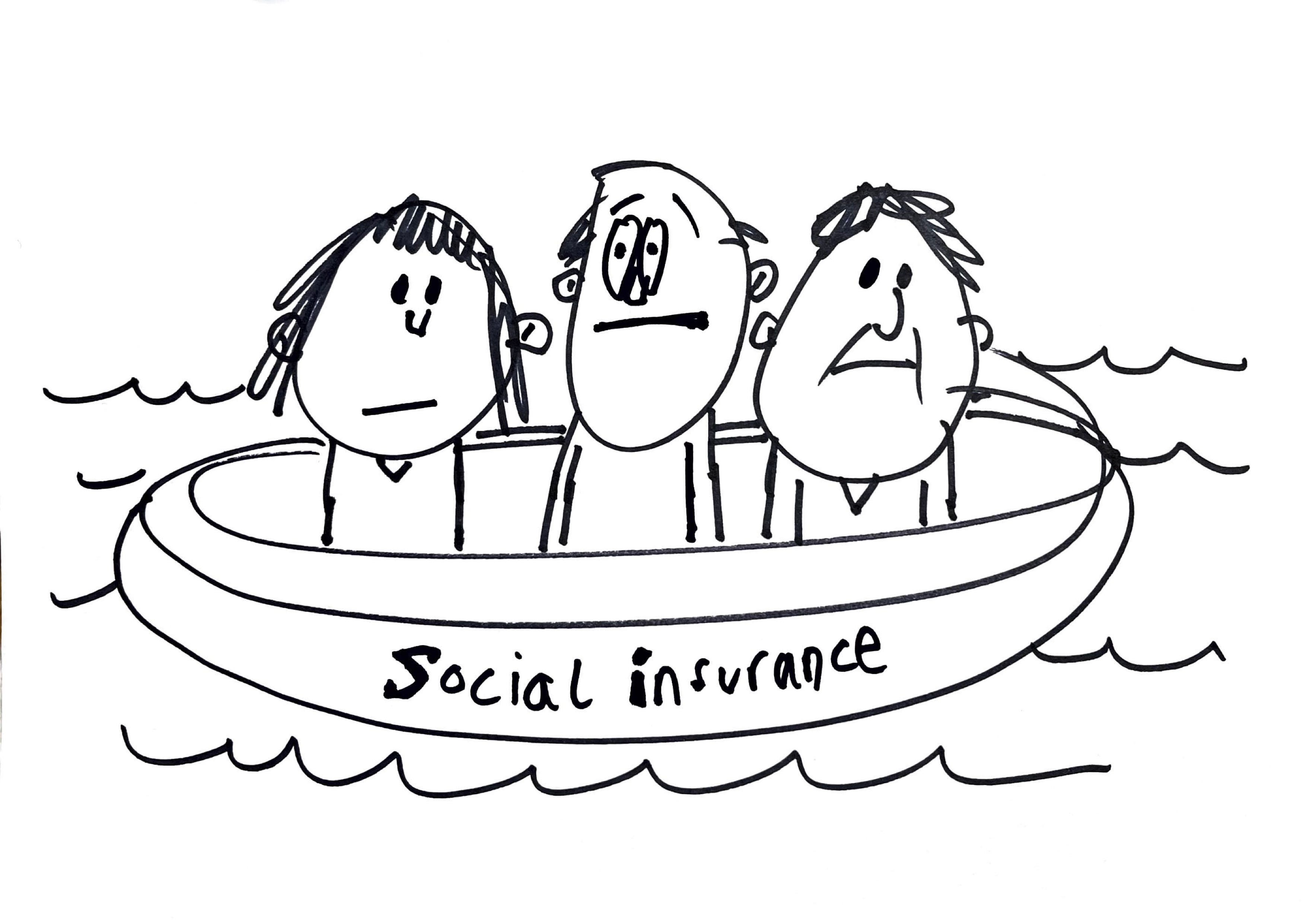
Hurricane Ian reminds us we're in this together
No Republican governor has been more vocal in his opposition to what he describes as “socialism” than Florida’s Governor Ron DeSantis. “I stand against socialism,” DeSantis thundered in Florida’s 2018 gubernatorial election. “Socialist policies have failed time and time again.”In June, DeSantis signed an education bill directing Florida’s Department of Education to develop a curriculum educating students on the evils of socialism (as well as communism).But how exactly does DeSantis define “socialism?”One hint came in 2013, when as a freshman congressman he claimed that a federal bailout for the New York region after Hurricane Sandy was an irresponsible boondoggle. “I sympathize with the victims,” he said. But his answer was no.The House overwhelmingly passed the bill nonetheless, providing $9.7 billion in flood insurance aid for Sandy’s victims. All 67 votes against the aid came from Republicans, including DeSantis. The Senate passed the bill too, although Florida Senator Marco Rubio also voted against the aid package.So, would DeSantis call any form of government assistance to those in need “socialism?”Apparently, DeSantis’s definition is more elastic than this. As his state confronts the devastation wrought by Hurricane Ian, the fiercely anti-socialist DeSantis is asking the Biden administration for the help Floridians need — asking, in effect, for a form of social insurance that the United States government automatically provides Americans when disaster strikes. The administration has already put 1,300 federal response workers on the ground. It has pre-staged 110,000 gallons of fuel and 18,000 pounds of propane, and has readied 3.7 million meals and 3.5 million liters of water. And it has moved in generators and has 300 ambulances in the state working alongside local officials. Yesterday morning, DeSantis and Biden discussed further steps, including the issuance of a major disaster declaration that will provide Floridians with federal aid to supplement state and local recovery efforts. Residents of nine counties will also be eligible for individual assistance.“We all need to work together, regardless of party lines,” DeSantis told Fox News’s Tucker Carlson, Wednesday night. “When people are fighting for their lives, when their whole livelihood is at stake, when they’ve lost everything — if you can’t put politics aside for that, then you’re just not going to be able to.”My point is not to accuse DeSantis of hypocrisy, but only to point out that a major disaster tends to focus the mind on why we need to “work together” rather than issue meaningless attacks on “socialism.”DeSantis’s stance against “socialism” has been the Republican Party’s harangue for a century.Long before Trump hijacked the GOP for his pathological narcissism, it stood for you’re-on-your-own social Darwinism — and steadfastly against all forms of social insurance, which it termed “socialism.”In the 1928 presidential election, Democratic candidate Al Smith, then governor of New York, put it this way:“The cry of socialism has been patented by the powerful interests that desire to put a damper on progressive legislation. Is that cry of socialism anything new? Not to a man of my experience. I have heard it raised by reactionary elements and the Republican party … for over a quarter century.”“Socialism” was the scare word used by the Liberty League in 1935 when Franklin D. Roosevelt proposed Social Security. In 1952, President Harry Truman noted that “‘Socialism’ is the epithet they have hurled at every advance the people have made in the last twenty years.”Socialism is what they called public power … Social Security … bank deposit insurance … free and independent labor organizations … anything that helps all the people. When the Republican candidate inscribes the slogan ‘down with socialism,’ what he really means is ‘down with progress.’As a practical matter, what is the alternative to social insurance against hardship? It’s a survival-of-the-fittest society in which only the richest and most powerful endure.Social insurance is what government is for -- pooling our resources for the common good. In contrast to the Republican’s your-on-your-own social Darwinism, the Democrat’s social insurance recognizes we’re in it together. We can debate whether some forms of social insurance reduce some peoples’ incentives to take reasonable precautions against potential hazards or cause some to become overly dependent on the government or undermine personal responsibility. But there is no debate that social insurance is critically important. We are in it together. Yet America spends very little on social insurance compared to other advanced nations. Almost 30 million Americans still lack health insurance. Nearly 51 million households cannot afford basic monthly expenses including housing, food, childcare, and transportation. We are the only industrialized nation without paid family leave. Many Floridians (and, as seems likely, residents of South Carolina
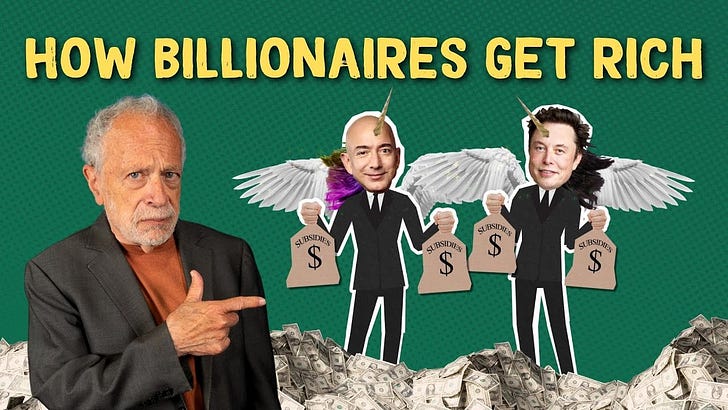
The three myths used by the ultra-wealthy to justify the ultra-wealthy
On Tuesday, the Congressional Budget Office released a study of trends in the distribution of family wealth between 1989 and 2019. Over those thirty years, the share of total national weaheld by families in the top 1% increased from 27 percent to 34 percent, while families in the bottom half of the economy now hold a mere 2 percent. Meanwhile, a record share of the nation’s wealth remains in the hands of the nation’s billionaires, who are also paying a lower tax rate than the average American. How do they justify their wealth and their low tax rates? By using three myths. All are utter rubbish. 1. The first is trickle-down economics. They (and their apologists) claim that their wealth trickles down to everyone else as they invest it and create jobs.Really? For over forty years, as wealth at the top has soared, almost nothing has trickled down. Adjusted for inflation, the median wage today is barely higher than it was four decades ago. Trump provided a giant tax cut to the wealthiest Americans, promising it would generate $4,000 increased income for everyone else. Did you receive it? In reality, the super-wealthy don’t create jobs or raise wages. Jobs are created when average working people earn enough money to buy all the goods and services they produce, forcing companies to hire more people and pay them higher wages. 2. The second myth is the “free market.” The ultra-rich claim they’re being rewarded by the impersonal market for creating and doing what people are willing to pay them for. The wages of other Americans have stagnated, they say, because most Americans are worth less in the market now that new technologies and globalization have made their jobs redundant.Baloney. Even if they’re being rewarded, there’s no reason why the “free market’ would reward vast multiples of what the rich were rewarded decades ago. The market can induce great feats of invention and entrepreneurialism with lures of hundreds of thousands or even millions of dollars — not billions. And as to the rest of us succumbing to labor-replacing globalization and labor-saving technologies, no other advanced nation has nearly the degree of inequality found in the United States, yet all these nations have been exposed to the same forces of globalization and technological change. In reality, the ultra-wealthy have rigged the so-called “free market” in America for their own benefit. Billionaires’ campaign contributions have soared from a relatively modest $31 million in the 2010 elections to $1.2 billion in the most recent presidential cycle — a nearly 40-fold increase. What have they got for their money? Tax cuts, freedom to bash unions and monopolize markets, and government bailouts. Their pockets have been further lined by privatization and deregulation.3. The third myth is that they’re superior human beings — rugged individuals who “did it on their own” and therefore deserve their billions. Bupkis. Six of the 10 wealthiest Americans alive today are heirs to fortunes passed on to them by wealthy ancestors. Others had the advantages that come with wealthy parents. Jeff Bezos’ garage-based start was funded by a quarter-million dollar investment from his parents. Bill Gates’s mother used her business connections to help land a software deal with IBM that made Microsoft.Elon Musk came from a family that reportedly owned shares of an emerald mine in Southern Africa. (By the way, when I mentioned this in a recent video, Elon went nuts — tweeting that “You [sic] both an idiot and a liar.” Hmmm. Did I touch a nerve, Elon?)Don’t fall for these three myths. Trickle-down economics is a cruel joke. The so-called “free market” has been distorted by huge campaign contributions from the ultra-rich. Don’t lionize the ultra-rich as superior “self-made” human beings who deserve their billions. They were lucky and had connections. In reality, there’s no justification for today’s extraordinary concentration of wealth at the very top. It’s distorting our politics, rigging our markets, and granting unprecedented power to a handful of people. The last time America faced anything comparable was at the start of the 20th century. In 1910, former President Theodore Roosevelt warned that “a small class of enormously wealthy and economically powerful men, whose chief object is to hold and increase their power” could destroy American democracy. Roosevelt’s answer was to tax wealth. The estate tax was enacted in 1916, and the capital gains tax in 1922. Since that time, both have eroded. As the rich have accumulated greater wealth, they have also amassed more political power — and have used that political power to reduce their taxes.Years later, Franklin D. Roosevelt saw the 1929 crash not only as a financial crisis but as an occasion to renegotiate the relationship between capitalism and democracy. Accepting renomination in 1936, he spoke of the need to redeem American democracy from the despotism of concentrated economic power. “Through new uses of corporations, ba
One billionaire backer of the insurrection answers me
In a post here on September 8, I asked the billionaires who are bankrolling candidates who have tried to overturn the results of the 2020 election how they rationalize spending their fortunes financing insurrection.I specifically included Peter Thiel, Stephen Schwarzman, Steve Wynn, Patrick Byrne, and Ken Griffin in my question.Ken Griffin, the multi-billion-dollar CEO of the hedge fund Citadel, is the only one to respond so far — yesterday, in a tart letter to the Guardian (where I had subsequently published my post). His arguments: (1) His campaign contributions are “principled” because he “proudly” spends his money to support politicians whose ideas “will secure a better future for America” – and he “encourages others to do the same,” and (2) the Democratic party has given generous support to Maga Republican candidates to defeat moderate Republican candidates, which is “hypocritical and cynical.”This is a bit like the captain of the Titanic criticizing the iceberg.Mr. Griffin, when you say your campaign contributions are “principled,” what principle are you referring to?You’ve poured millions into the campaigns of people who refused to certify the 2020 election -- including Florida Senator Rick Scott, and Reps. Mike Bost of Illinois, Nicole Malliotakis of New York, Devin Nunes and Darrell Issa from California and Stephanie Bice of Oklahoma.What makes you think these people will “secure a better future for America” when they wouldn’t certify an election, based on nothing other than their political party’s preference?You were the only donor to a $3.5 million group backing defeated Rep. Rodney Davis in his GOP primary. Davis refused to participate in the January 6 committee because House Speaker Nancy Pelosi had rejected two of his most extreme Republican colleagues.On what “principle” was Davis worth $3.5 million from you?Please don’t claim that “others can do the same” as you when it comes to flooding American politics with money.You’re worth $29.8 billion.You’re the single biggest spender in Republican politics. Last year, you pumped more than $28 million into the GOP, and you’re expected to multiply that number leading into November’s midterms.I don’t approve of the Democratic party giving financial support to extreme Maga Republican candidates, but that’s irrelevant to my point.I’m talking about billionaires like you, who continue to finance Trump’s insurrection.You’re part of this. You still haven’t justified why you’re spending your fortune this way. Please get back to me as soon as you can. This is a public episode. If you'd like to discuss this with other subscribers or get access to bonus episodes, visit robertreich.substack.com/subscribe
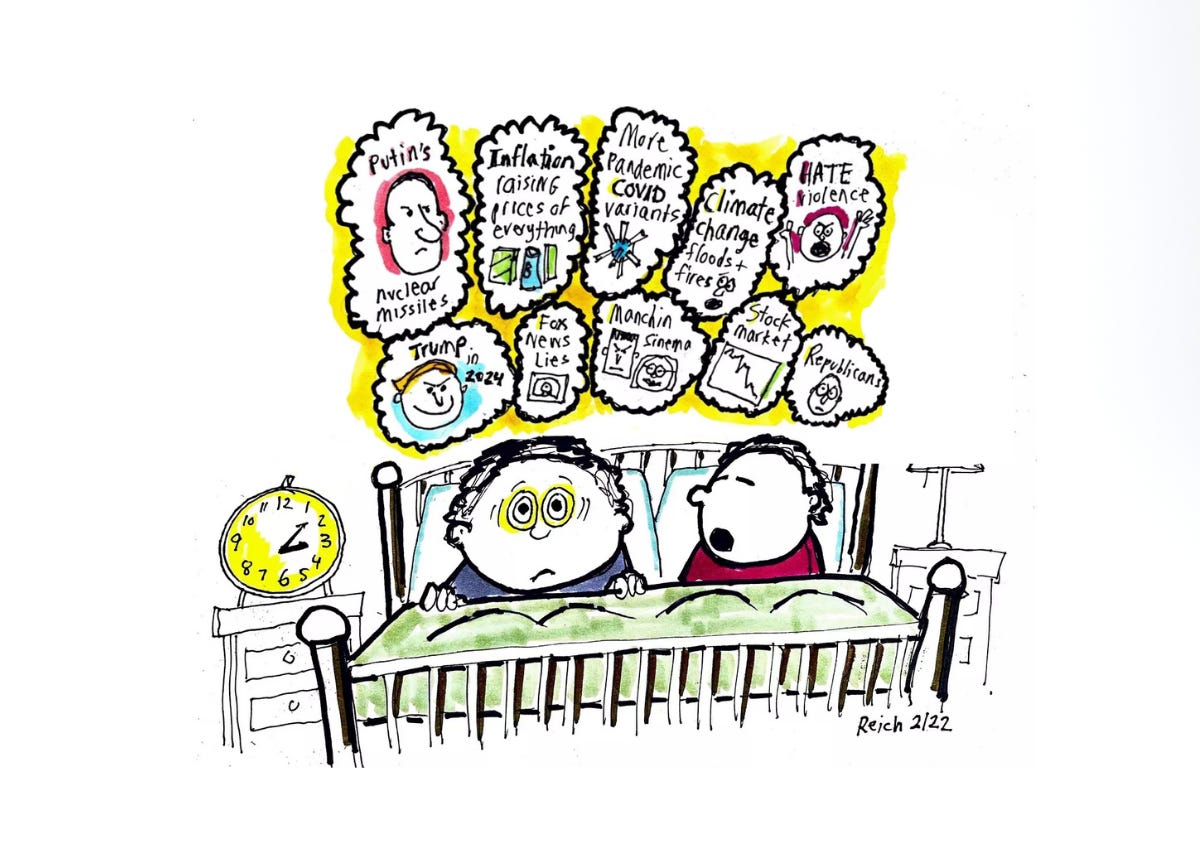
Are record levels of stress inside us — or outside us?
Last week, a panel of medical experts recommended for the first time that doctors screen all adult patients under 65 for anxiety disorders. The advisory group, called the U.S. Preventive Services Task Force, said the guidance was intended to help prevent mental health disorders from going undetected and untreated for years or even decades. It made a similar recommendation for children and teenagers earlier this year.Appointed by an arm of the federal Department of Health and Human Services, the panel has been preparing the guidance since before the pandemic. Its recommendation highlights the extraordinary stress levels that have plagued the United States in recent years. Lori Pbert, a clinical psychologist and professor at the University of Massachusetts Chan Medical School, who serves on the task force, calls mental health disorders “a crisis in this country.”What’s the answer to this extraordinary rise in stress, anxiety, and depression?Some say we need more psychiatrists, psychologists, and therapists. America is “short on mental health resources on all levels,” says Dr. Jeffrey Staab, a psychiatrist and chair of the department of psychiatry and psychology at Mayo Clinic in Rochester, Minnesota. But … wait. Maybe what people feel are valid descriptions of personal experience rather than symptoms of mental illness. Maybe we need to stop thinking about anxiety and depression as “disorders” and start regarding them as rational responses to a society that’s become ever more gruesomely disordered.Who has not feared illness and loss of loved ones from Covid-19? Who isn’t concerned by the soaring costs of living and the growing insecurity of jobs and incomes? Who isn’t terrified by Trump’s and his followers’ attacks on democracy? Who doesn’t worry about mass shootings at their children’s or grandchildren’s schools? Who isn’t affected by the climate crisis? Add in increasingly brutal racism; attacks on Asian-Americans, Hispanic-Americans, and Jews; mounting misogyny and anti-abortion laws; homophobia and transphobia; and the growing coarseness and ugliness of what we see and read in social media — and you’d be nuts if you weren’t stressed.Studies show that women have nearly double the risk of depression as men. Black people also have higher stress levels — from 2014 to 2019, the suicide rate among Black Americans increased by 30 percent. Are women and Black people suffering from a “disorder,” or are they responding to reality? Or both? White men without college degrees are particularly vulnerable to “deaths of despair” from suicide, overdoses, and alcoholic liver diseases, with contributions from the cardiovascular effects of rising obesity, according to the American Council on Science and Health. Are they suffering from a “disorder,” or are they responding to a fundamental change in American society? Or both?In their book, Deaths of Despair and the Future of Capitalism, economists Anne Case and Angus Deaton argue that “the deaths of despair among whites would not have happened, or would not have been so severe, without the destruction of the white working class….” Part of the problem, they say, is that the less educated are often underpaid and disrespected, “and may feel that the system is rigged against them.”Even if we had far more mental health professionals, what would they do against these formidable foes? Prescribe more pills? If anything, Americans are already overprescribed. I’m not arguing against better access to mental health care. In fact, quite the opposite. Increased staffing and improved access to care are very much needed. (Right now over 2,000 mental health therapists, psychologists, and social workers in California are entering their second month of an open-ended strike to make Kaiser Permanente, the nation’s largest nonprofit HMO, to improve access to care for its patients. The outcome will have nationwide ramifications for determining whether laws that guarantee parity for mental health care will, in practice, help patients access care that meet their needs.)But in addition to providing more and better access to mental health care, we must also try to make our society healthier… … So that the next pandemic doesn’t kill a larger percentage of Americans than in any other advanced nation.… So that Americans have more job security and stronger safety nets, rather than the least economic security of any advanced nation.… So income and wealth aren’t the most unequal of any other advanced nation.… So our democracy survives Trumpism and big money.… So guns and assault weapons are difficult to buy, rather than easier to get than in any other advanced nation.… So we take a leading role in ending the climate crisis.… And we do everything possible to overcome racism, homophobia, and misogyny. These goals are terribly difficult to achieve, of course. But without seeking to achieve them — without making their achievement central to what we must do as a people — no number of psychiatrists, psychologists, a

The draft
Last Wednesday, Vladimir Putin announced that Russian civilians would be drafted to bolster forces in his unpopular war in Ukraine. Almost immediately, the Kremlin faced widespread opposition, including demonstrations. On Friday, the Russian Ministry of Defense announced that “citizens with higher education” would be exempt from the draft, especially those in telecommunications, information technology, banking and “systematically important” media companies.When I heard this news I flashed back to 1968. Tens of thousands of us then graduating from college were subject to being drafted and very possibly going to Vietnam. College students were deferred but local draft boards decided whether to continue deferments for graduate school. Many of us were not only afraid of being killed, but also thought the war insane and unjust. We demonstrated against it. Some burnt our draft cards. We did not want to be complicit in the immoral war. But what to do? Draft resistance meant going to prison or to Canada. The handful of us who had been awarded Rhodes Scholarships for study at Oxford negotiated with our draft boards. Bill Clinton got his extended deferment by signing a letter of intent to join the Reserve Officers Training Corps after Oxford. On December 3 of our second year there — after Bill drew a sufficiently high draft-lottery number to ensure he wouldn’t be drafted — he wrote a letter to Colonel Eugene Holmes, the head of ROTC at the University of Arkansas, essentially withdrawing from the program. Because Bill’s decision and letter would become controversial twenty-three years later when he ran for President, I’m reproducing the relevant portion here. (I can’t help but wonder whether it expresses the sentiments of young Russians now facing Putin’s draft.)Dear Colonel Holmes, First, I want to thank you, not just for saving me from the draft, but for being so kind and decent to me …. For years I have worked to prepare myself for a political life characterized by both practical political ability and concern for rapid social progress. It is a life I still feel compelled to try to lead. I do not think our system of government is by definition corrupt, however dangerous and inadequate it has been in recent years (the society may be corrupt, but that is not the same thing, and if that is true we are all finished anyway).When the draft came, despite political convictions, I was having a hard time facing the prospect of fighting a war I had been fighting against, and that is why I contacted you. ROTC was the one way left in which I could possibly, but not positively, avoid both Vietnam and resistance. … After I signed the ROTC letter of intent I began to wonder whether the compromise I had made with myself was not more objectionable than the draft would have been, because I had no interest in the ROTC program in itself and all I seemed to have done was to protect myself from physical harm. Also, I began to think I had deceived you, not by lies - there were none - but by failing to tell you all the things I'm writing now. I doubt that I had the mental coherence to articulate them then. At that time, after we had made our agreement and you had sent my 1-D deferment to my draft board, the anguish and loss of self-regard and self-confidence really set in. I hardly slept for weeks and kept going by eating compulsively and reading until exhaustion brought sleep. Finally on September 12th, I stayed up all night writing a letter to the chairman of my draft board … stating that I couldn't do the ROTC after all and would he please draft me as soon as possible.I never mailed the letter, but I did carry it on me every day until I got on the plane to return to England. I didn't mail the letter because I didn't see, in the end, how my going in the Army and maybe going to Vietnam would achieve anything except a feeling that I had punished myself and gotten what I deserved. So I came back to England to try to make something of this second year of my Rhodes scholarship.And that is where I am now, writing to you because you have been good to me and have a right to know what I think and feel. I am writing too in the hope that my telling this one story will help you to understand more clearly how so many fine people have come to find themselves still loving their country but loathing the military, to which you and other good men have devoted years, lifetimes, of the best service you could give. To many of us, it is no longer clear what is service and what is disservice, or if it is clear, the conclusion is likely to be illegal. Forgive the length of this letter. There was much to say. There is still a lot to be said, but it can wait. Please say hello to Colonel Jones for me. Merry Christmas.Sincerely, Bill Clinton ***As for me, I had read the Selective Service’s physical requirements for being drafted, which clearly set the minimum height at five feet. So, at 4 foot 11 inches, I assumed I wouldn’t make the grade. Just before setting sail f
Does Trump want to be the next messiah?
Hello friends,Welcome back to my Saturday coffee klatch with my colleague Heather Lofthouse (Executive Director of Inequality Media Civic Action — and my former student), where we talk about the highs and lows of the week over morning coffee. Pull up a chair. Today we cover:— profit-price inflation rather than wage-price inflation— Tump rallies and his embrace of QAnon— Republican candidates who refuse to commit to be bound by election results— Nse Ufot and the power of hope through on-the-ground organizingPlus two theme songs! And, of course, our weekly poll: This is a public episode. If you'd like to discuss this with other subscribers or get access to bonus episodes, visit robertreich.substack.com/subscribe

Russia's and China's surveillance states, and America's surveillance capitalism
Friends,Today’s New York Times has a story about Russia’s powerful internet regulator, Roskmnadzor, whose collection of personal data about average Russians has, in the Times’s words, “catapulted Russia, along with authoritarian countries like China and Iran, to the forefront of nations that aggressively use technology as a tool of repression.”A few weeks ago, the Times ran a story about China’s collection of personal data on its citizens through phone-tracking devices, voice prints, one of the largest DNA databases in the world, facial recognition technology, and more than half of the world’s nearly one billion surveillance cameras.This is important and useful reporting. But pardon me if I ask an impertinent question: Why aren’t we hearing more about corporate surveillance of employees in the United States? Or about corporate surveillance of Americans in general? Or how this corporate surveillance is being used by the US and state governments? Even if Russia’s and China’s surveillance states are far more dangerously intrusive than America’s surveillance capitalism, shouldn’t we know more about how the same or very similar technologies are being utilized here? Since I was secretary of labor, I’ve seen American companies load up on monitoring software — to watch what workers are doing every minute of the day. Workers are now subject to trackers, scores, and continuous surveillance of their hands, eyes, faces, and bodies. And increasingly, they’re paid only for the minutes (or seconds) when the systems detect they’re actively working.Kroger cashiers, UPS drivers, and millions of others are monitored by the minute. Amazon measures seconds. J.P. Morgan — the largest bank in the United States — tracks how its workers spend time, from making phone calls to composing emails. At UnitedHealth Group, low keyboard activity can affect compensation and sap bonuses. In Amazon warehouses, some workers don’t get enough time to go to the bathrooms. ESW Capital, a Texas-based business software company, tracks workers in 10-minute intervals during which — at some moment that workers can’t anticipate — cameras take snapshots of their faces and screens. “Digital productivity monitoring” — isn’t that an innocent-sounding phrase? — is spreading even to white-collar jobs requiring graduate degrees. Radiologists get scoreboards showing “inactivity” time and comparing productivity to their colleagues’. Doctors and nurses describe increasing electronic surveillance over workdays. Even lawyers are being closely monitored.Firms selling all this monitoring technology gush with testimonials from supervisors describing newfound powers of “near X-ray vision” into what workers are doing other than working: watching porn, playing video games, using bots to mimic typing, two-timing. Dystopia now!Russia’s and China’s growing surveillance systems seem more dangerous and intrusive than America’s increasing surveillance of our workers because the information Russia and China collect can stifle dissent. But are the surveillance systems really that far apart? Big corporations that gather loads of data on exactly what their workers do all day (and sometimes into the night) — including in their purview the growing ranks of remote or gig workers — can stifle workers’ efforts to form labor unions or show any disgruntlement at all. Russia’s and China’s surveillance of their inhabitants and America’s surveillance of our workers are starting to overlap because the technologies are starting to overlap. A technology company in eastern China even designs “smart” cushions for office chairs that record when workers are absent from their desks. How long before we see smart cushions in American offices?And more and more, we’re being surveilled without knowing it. Delta Air Lines boasts that its Atlanta airport’s Terminal F is the “first biometric terminal” in the United States where passengers can use facial recognition technology “from curb to gate.” The Financial Times reports that a Microsoft facial recognition training database of 10 million images drawn from the internet without anyone’s knowledge is utilized by agencies that include the United States and Chinese military.A new joint report from the Associated Press and Electronic Frontier Foundation highlights a major surveillance tool, known as “Fog Reveal,” now being used by dozens of local law enforcement agencies across the United States to collect personal data without a warrant. The tool makes use of advertising data — including location, timestamp, and a unique advertising ID tied to individual devices — to construct a searchable database that enables law enforcement to either track an individual device or see which devices passed through a certain area. Where does this end? A few years back, Mark Zuckerberg predicted that “Facebook will know every book, film, and song you ever consumed, and its predictive models will tell you what bar to go to when you arrive at a strange city, where the bartender

The truth I'm telling Congress today about inflation
It makes my blood boil. Since March I’ve been screaming about the Fed’s total misreading of inflation — believing it’s being caused by workers getting wage hikes, when the real cause is powerful corporations raising prices higher than their costs. I’m not so grandiose as to think my screams would have any direct influence on the Fed. My hope was that my argument and data might be picked up by a few voices in the media, which would lead some Democrats in Congress to pick up on it, and that maybe they’d put some pressure on the Fed — such as asking Fed chief Jerome Powell to respond to those arguments when he next testifies. It’s not happened yet. Yesterday Powell and the Fed raised interest rates again — another three-quarters of a percent — bringing the official rate from near zero in March to over 3 percent now. Insane. Well, now I get a chance to tell Congress why this is insane. The House Oversight Committee’s subcommittee on economic and consumer policy holds a hearing this morning and has asked me to testify. (Thankfully, they’re allowing me to do it remotely from my home here in California, although the timing isn’t ideal — the hearing starts 9 am Eastern Time, which is 6 am here — and because I’m the lead-off witness they want me to check in remotely at 5:45 am. I’ll have to drink plenty of coffee.)When you testify before Congress, you get 5 minutes to summarize your views. You submit your detailed testimony, which is read by the committee’s staff, who then give members of Congress questions to ask you based on the submitted testimony (the Democratic staff’s questions are usually quite different from Republican staff’s). Those questions, hopefully, allow you to get into the details. My aim is to state as clearly as possible that the underlying problem is not wage-price inflation. It’s profit-price inflation. And the Fed’s continuing rate hikes will hurt average workers by slowing the economy — making it harder for workers to get wage increases and causing many to lose their jobs. I’m going to suggest that Congress consider ways to control inflation that limit corporate profits rather than jobs and wages — such as a windfall profits tax, tougher antitrust enforcement, and even temporary price controls. Will Congress do any of this? Here again, I’m not so full of myself as to think I can sway a single member of Congress, let alone Congress as a whole. But in my experience, policy ideas that are useful and timely often find their way into politics — eventually displacing old ones that are no longer useful and may be damaging. At least that’s my hope with “profit-price” inflation replacing the anachronistic “wage-price” inflation.I’m going to add my testimony to this post right after I testify this morning — and fill you in on what happened. ***The hearing was just adjourned. The good news is that the Democrats on the committee got it. They understood that big corporations raising their prices in excess of their costs — to score record profits — is a major reason for the inflation we’re now experiencing. And workers are paying for those record profits in two ways — real wage losses (wage gains have been more than offset by price increases, making most workers worse off) and by the higher prices themselves (the result of corporations increasing their profit margins). I was particularly impressed by the chairman of the subcommittee, Representative Raja Krishnamoorthi (from the 8th district of Illinois), who understood the issues and expressed them cogently, and by Cori Bush (from the 1st district of Missouri), who asked terrific questions. Katie Porter did a fabulous job breaking the issue down. There was less discussion of remedies than I’d hoped — only passing reference to tougher antitrust enforcement and no real discussion of a windfall profits tax — and no criticism of the Fed (other than in my remarks and testimony). Not surprisingly, the Republicans on the committee were obstreperous and wildly partisan. All they did was try to blame inflation on the American Rescue Plan, Biden, and the Democrats. They repeatedly quoted Larry Summers’s misleading claim that pandemic spending fueled inflation (even at one point asking me if I served with him in the Clinton administration, without giving me the chance to rebut him). They asked the Republican witness, Tyler Goodspeed (briefly chair of Trump’s Council of Economic Advisors), to confirm their rhetorical questions but didn’t ask me a thing. Like much of the rest of our governing processes, congressional hearings have degenerated into partisan posturing and name-calling. I experienced this starting in 1995 when Newt Gingrich became Speaker. For those of you who might be interested, here’s the testimony I submitted this morning:***Mr. Chairman and members of the Committee,My name is Robert Reich. I’m the Carmel P. Friesen Professor of Public Policy at the Goldman School of Public Policy, University of California, Berkeley.Last week’s consumer price index rep

What to do about candidates who won't commit to election results?
Friends,One of the most horrific legacies of Trump is the unwillingness of Republican candidates to commit to being bound by election results. Senate candidates who have refused to commit to accepting the results are Republicans Ted Budd in North Carolina, Blake Masters in Arizona, Kelly Tshibaka in Alaska, and J.D. Vance in Ohio, according to news reports. Two candidates for governor have also refused to be bound: Tudor Dixon, the Republican nominee for the governor of Michigan, and Geoff Diehl, the Republican nominee for governor of Massachusetts.It’s one thing to reserve the right to call for recounts if elections are close and irregularities are evident and to appeal the results through the courts. But that was not Trump’s circumstance in the 2020 presidential election. Recounts were taken but showed the same results; Trump’s appeals through the courts were rejected. And that’s not what these Republican candidates are asserting now, in Trump’s shameful wake. But tell me: If these Republican candidates are not bound by the election results, what are they bound to? These candidates are in effect issuing open invitations to their supporters to contest electoral losses in the streets.American democracy is based on our commitments to be bound by the outcomes of elections. These are commitments we make to democracy over any specific outcomes we may want. The peaceful transition of power depends on these commitments.Before Trump, these commitments were assumed. And at least since the Civil War they have been honored. When losing candidates congratulate winners and deliver gracious concession speeches, they demonstrate their commitment to democracy over the electoral victory they sought.And that demonstration is itself a means of reasserting and reestablishing civility. It sends an unambiguous message to all the candidate’s supporters that the process can be trusted.Think of Al Gore’s concession speech to George W. Bush in 2000, after five weeks of a bitterly contested election and just one day after the Supreme Court ruled 5-4 in favor of Bush: “I say to President-elect Bush that what remains of partisan rancor must now be put aside, and may God bless his stewardship of the country …. Neither he nor I anticipated this long and difficult road. Certainly neither of us wanted it to happen. Yet it came, and now it has ended resolved, through the honored institutions of our democracy. Now the Supreme Court has spoken. Let there be no doubt, while I strongly disagree with the court’s decision, I accept it. … And tonight, for the sake of our unity as a people and the strength of our democracy, I offer my concession.”Gore made the same moral choice made by his predecessors who lost elections, and for the same reason: The democratic process (even one that included the judgements of Supreme Court justices) was more important than winning a specific election. This all changed in September 2020 when Trump refused to commit to be bound to the results of the upcoming 2020 presidential election.“Well, we’re going to have to see what happens,” he said when asked whether he’d commit to a peaceful transition of power. “You know that I’ve been complaining very strongly about the ballots and the ballots are a disaster,” Trump added, presumably referring to mail-in ballots -- which he baselessly claimed would lead to voter fraud.This is when his poison began seeping directly into the bedrock of American democracy.That poison spread deeper and faster after he lost the election, when he refused to concede – claiming, again without any basis in fact, that it had been “stolen” from him.The poison came to the surface on January 6, 2021, when a group of his supporters – wielding weapons of war – invaded the U.S. Capitol and threatened the lives of members of Congress. Five people were killed. The same poison has now spread to senatorial and gubernatorial candidates who refuse to commit to November’s election results. The commitment to be bound by the results of an election is the most important commitment in a democracy. It is also the most important qualification for public office. It is the equivalent of an oath to uphold the Constitution.Candidates who refuse to commit to being bound by the results of elections should be presumed disqualified to hold public office. ***[Exactly one year ago today I began my daily communications with you. Thank you again for your support, your interest, and your thoughtful comments. The road ahead is filled with potholes, such as election deniers and candidates who won’t commit to being bound by election results. But if we make the journey toward a stronger democracy together, we have a better chance of achieving it.] This is a public episode. If you'd like to discuss this with other subscribers or get access to bonus episodes, visit robertreich.substack.com/subscribe

A conversation* with Governor DeSantis on his trafficking-immigrants-to-Martha's Vineyard strategy
I’m against trafficking of migrants. But luring unsuspecting people onto planes with lies about jobs, housing, and education awaiting them, and then depositing them onto an island off the coast of Massachusetts that’s totally unprepared to receive them, is a form of human trafficking.The people you’re talking about aren’t American citizens. They have no rights. Even if they’re not Americans, U.S. law prohibits kidnapping people and moving them across state lines.I didn’t kidnap them. They’re here illegally! You don’t know that. Under our laws, these people are entitled to a hearing on whether they’re here legally — just like all the Cuban asylum seekers who for years have arrived in South Florida fleeing communism. What I’m doing is appropriate and legal! I’m paying for part of it with funds from last year’s American Rescue Plan. That money was for the COVID-19 health crisis. It isn’t a slush fund for whatever political stunt you dream up.I’m also using every penny of the $12 million Florida budgeted to relocate migrants. I have a responsibility to the people of Florida to send migrants out of the state! If you’re responsible for Floridians, why are you picking up people in Texas and transporting them to Massachusetts?Many of the people who cross the southern border into Texas end up in Florida. But the law gives federal officials the responsibility for handling immigration, not you.You don’t know the Constitution. Article 10 gives powers not delegated to the federal government to the States.No Governor, you don’t know the Constitution. Article 1 gives Congress the power to regulate commerce among the states. Neither you nor the state of Florida has the authority to off-load people you don’t want onto other states. I’m not the only governor doing this! I know. On Thursday Texas Governor Greg Abbott sent two surprise buses of migrants to Washington, D.C., where they were dropped off near the residence of Vice President Harris carrying all they have in clear plastic trash bags.And we red-state governors are going to do a lot more! So Republican governors can’t be bothered with pesky things like laws or the Constitution?The U.S. immigration and asylum systems are totally broken! Then why don’t you support fixing them instead of using immigrants as political fodder? Ask Republicans in Congress to stop blocking federal legislation creating paths to citizenship for millions of undocumented immigrants and to expedite asylum seekers and other legal immigrants.You don’t understand politics. You have to play hardball. You don’t understand morality or decency. You’re treating immigrants as if they’re political pawns rather than people. They’re no less people than was your maternal great-great-grandfather Salvatore Storti, who immigrated to the United States from Italy in 1904, or your great-great-grandmother Luigia Colucci, who joined Salvatore in the United States in 1917.Keep them out of this. And you’re treating the citizens of blue states as political hostages rather than fellow Americans. But they are no less American than the millions of retirees from blue states who have migrated to Florida, and their children and grandchildren who still live in blue states. We’re all in this together. No we’re not. And you’re acting as if governing is a child’s game rather than a pursuit of the common good. But it’s not a game. Our common good has depended on the sacrifices of generations of American service men and women, first responders, teachers, social workers, and public leaders who dedicated their lives to this nation. I don’t have to listen to your speeches. Look, I get it: Coping with immigration is difficult. It requires hard thought and hard work. You betcha. But you’re giving it neither. Interview over!I’m told you have presidential ambitions, Governor. If so, you might start acting like a statesman rather than doing stunts that make you a cynical clown. This is a public episode. If you'd like to discuss this with other subscribers or get access to bonus episodes, visit robertreich.substack.com/subscribe

Are we ready to cancel the apocalypse?
Hello friends,Welcome back to my Saturday coffee klatch. Today I’m offline with family, so instead of our regular klatch, I’m bringing you a terrific conversation I just had with Nse Ufot, CEO of New Georgia Project (NGP). NGP is one of the most important grassroots voting-rights organizations — in one of the most important voting states. NGP is now registering over 600,000 young people and people of color to vote in all 159 of Georgia’s counties. Nse describes the organization as a “tech startup inside a civil rights and voting rights organization” to build the power of working people in Georgia. I’m so pleased to be able to share with you this inspiring discussion about the on-the-ground fight for democracy. We cover:* Who has power in our system — and the need to cultivate new voter power through grass-roots organizing. * How to train organizers — by teaching them how to listen (because potential voters “have twice as many ears as they do mouths.”)* How to motivate non-registered voters to step up — by asking people to discuss what they need.* How to keep people coming to the polls — even though those with power will continue to put up obstacles.* How to get people the information they need — in a voting system that’s barely changed in a century. * And what will happen in 2024 and beyond — and why Nse, as an optimist, is “ready to cancel the apocalypse.” (I agree!)My thanks to Nse and all of her colleagues and volunteers at the New Georgia Project. Thanks also to Kevin McCormick who composed the tune we use as today’s coffee klatch theme song.Heather Lofthouse and I will be back next week. This is a public episode. If you'd like to discuss this with other subscribers or get access to bonus episodes, visit robertreich.substack.com/subscribe

Trump's latest threat is a doozy
Yesterday, Donald Trump threatened that if he is indicted on a charge of mishandling classified documents after leaving the White House, there would be “problems in this country the likes of which perhaps we’ve never seen before,” adding “I don’t think the people of the United States would stand for it.”These words followed on last month’s threat by Senator Lindsey Graham that if Trump is prosecuted, there would be “riots in the street.” Trump appeared to endorse Graham’s threat, sharing a video link on his Truth Social platform.Trump’s latest threat requires four responses:1. Trump is daring the Justice Department to prosecute him, in effect asserting he is above the law. He is not above the law. The Justice Department is methodically and carefully sifting through evidence and presenting it to a grand jury. Neither the Department nor the grand jury should be intimidated by Trump’s latest threat.2. Trump’s rhetoric is dangerous. We have already seen the consequences of what happens when Trump invites a mob to the streets. Five people died on January 6, 2021. Many more – including members of Congress and the former Vice President – could have been killed on that day. Since the FBI search of Mar-a-Lago, Trump’s incendiary words have fueled death threats to numerous federal officials, judges, and lawmakers. All Americans should condemn Trump’s latest threat and incitement to violence. 3. We are dealing with a sociopathic narcissist who wants nothing more than to divide the nation over himself. This is not a matter of left versus right, liberal versus conservative, Democrat versus Republican. It is a question of the Constitution and the rule of law versus authoritarianism and tyranny. If Trump prevails — if he intimidates law-enforcement officials from doing their jobs over his attempted coup or his theft from the White House of secret documents — we lose our democracy. The media must stop covering this as if there are two sides to this story. There are not. 4. The time has come for Republican lawmakers, candidates, and rightwing media owners and personalities to show some backbone and vigorously repudiate Trump. Their failure to do so before now has created a monster that threatens to consume this country. It is up to them to tell their constituents, followers, readers and viewers that there is no place in America for Trump’s threats to law enforcement and his incitements to violence. Mitch McConnell, Kevin McCarthy, Lindsey Graham, Sean Hannity, Tucker Carlson, Rupert Murdoch, and others must say it loudly and clearly: We repudiate Trump and his threats. No person is above the law. This is a public episode. If you'd like to discuss this with other subscribers or get access to bonus episodes, visit robertreich.substack.com/subscribe
What Dr. Phil wants me to do
A few days ago, I received an email from an associate producer at the Dr. Phil Show. They recently came across my film “Inequality for All” and wanted to know “if I’d be interested in joining Dr. Phil as an expert guest for an upcoming episode.” Hey, why not? The Dr. Phil Show is the number 1 rated daytime TV talk show in America. It has over 2 million viewers. I have lots to say to those viewers about the perils of widening inequality. Then I read the rest of the email. “For this conversation we will be asking questions like do college admissions enroll minorities over prospective Caucasian students? Are Caucasian teachers and professors being laid off to ‘make up for past discriminations’ against minority educators, as seen in Minneapolis?” These were the only questions included in the email. In other words, it will be a show about favoritism to Black people over white people. What’s going on here? The Dr. Phil Show isn’t on Fox News. It’s carried by CBS. Phil McGraw himself isn’t a rabid right-winger. At least not that I know of. (He did appear on Fox News soon after the start of the pandemic to argue against temporarily closing down the economy — claiming that the likelihood of dying from COVID was no greater than likelihood of dying in a car accident or drowning in a swimming pool. By that time 3,000 people had died of the infection. Two years later, it had taken the lives of 1 million.)But the point I want to make isn’t solely about Dr. Phil. It’s about the people who produce popular TV talk shows. They decide two hugely important things: (1) the topics to be discussed, and (2) how those topics are framed.These two decisions determine what issues the the public focuses on (out of an almost infinite number bubbling up each day) and what’s debatable about them (out of an almost infinite number of possibilities). And these two determinations in turn fuel public emotions — ranging from anger, indignation, and outrage, to hope, pride, and confidence. They affect our daily conversations. They shape our politics. They divide or connect Americans. They help set the national agenda. Take the recent contract agreement between the Minneapolis teachers union and the Minneapolis school district — the issue Dr. Phil’s associate producer wants me to talk about. That contract says that if school budgets must be cut, white teachers will be laid off before those from “underrepresented” populations, regardless of seniority. If school budgets then expand, “underrepresented” teachers will be reinstated before white teachers, regardless of seniority.MAGA outlets, blogs, and social media sites have gone nuts over this. Racial preferences for Black people have become a hot-button issue, especially among struggling working-class whites. Viewed this way, this issue lends itself to the rightwing argument that “coastal elites” have rigged the economic game against white working people in favor of “less-deserving” people of color. Naturally, this infuriates a lot of working-class whites.Presumably, this is the debate Dr. Phil’s producer has in mind. But it’s the wrong issue and the wrong debate. Go a bit deeper and you’ll see why. The goal of the Minneapolis school board is to remedy continuing effects of past discrimination, by supporting “the recruitment and retention of teachers from underrepresented groups” [emphasis added]. This is a particularly important goal in Minnesota’s schools, where 5.6 percent of licensed teachers identify as a teacher of color or American Indian, compared to 30 percent of students.Research shows having teachers of color in the classroom has a positive impact on students — not just students of color but also on white students — including improved test scores and higher graduation rates.But in a last-in-first-out seniority system, teachers of color are more likely to be laid off when budgets are cut. That’s because they’ve entered the profession more recently, so have less seniority.In the Minneapolis public schools, fewer teachers of color are tenured than white teachers. State law requires that teachers be on probation until completing three consecutive years of work.So the new Minneapolis contract is serving a particularly important public purpose in a system where seniority and tenure would otherwise discriminate against people of color. The contract is leveling the playing field and helping insure that more teachers of color are in classrooms. But do you think for a moment that I’d be able to explain all this on the Dr. Phil Show? Not a chance. I’ve been doing television interviews for forty years. I’d be lucky if I got out two sentences before another guest, representing the “other side” of the issue, jumped down my throat, charging “racism!” So what are millions of daytime TV viewers likely to learn from this discussion about whether “Caucasian teachers” are “being laid off to ‘make up for past discriminations’ against minority educators, as seen in Minneapolis?” That government is favoring Bl
The absurdity of Judge Cannon's idea of "executive privilege"
Hello friends,Welcome back to my Saturday coffee klatch with my colleague Heather Lofthouse (Executive Director of Inequality Media Civic Action — and my former student), where we talk about the highs and lows of the week, over morning coffee. Today we discuss:— The death of the Queen, what she symbolized for Britain and America, and why King Charles III may be the last of the British royals.— Judge Eileen Cannon — the Trump appointee whose decision this week to appoint a “special master” to look over the top-secret documents Trump stole from the United States and review for executive privilege makes absolutely no logical sense. — The midterm elections coming closer, and why the Supreme Court’s decision overruling Roe v. Wade may be an even bigger motivator of voters than Trump Republicans’ attacks on democracy.— My pick for the season’s best TV series.— Why Californians have been willing to voluntarily reduce electricity consumption during this heat wave. And today’s poll: This is a public episode. If you'd like to discuss this with other subscribers or get access to bonus episodes, visit robertreich.substack.com/subscribe
The astounding reaction to Dobbs
In early August, the good people of Kansas voted against a ballot measure that would have stripped from their state constitution a woman’s right to choose — and they did it by a whopping 18-point margin. Since then, and largely in response to the Supreme Court’s Dobbs decision overturning Roe v. Wade, women have been registering to vote across the country in astounding numbers. Many appear to be supporting Democratic candidates even in states such as Kansas, where Democrats have almost become an endangered species. One hundred years ago this week, the writer and political philosopher Walter Lippmann published Public Opinion, his account of how democracy actually functions. Lippmann claimed that the public doesn’t form opinions rationally. Opinions emerge from particular events (say, a Supreme Court decision) that galvanize the public’s “irrational” sentiments. Lippmann didn’t trust those sentiments. He was concerned how easily they could be manipulated. “As a result of psychological research, coupled with the modern means of communication, the practice of democracy has turned a corner. A revolution is taking place, infinitely more significant than any shifting of economic power.” (He wrote these words years before the Nazi’s and Soviets chillingly and effectively used propaganda to distort public opinion.)To deal with this danger, Lippmann proposed the creation of a "specialized class" of professionals to collect and analyze data and then present their conclusions to society's decision makers. The decision makers would in turn use the "art of persuasion" to convince the public what was good for them. Not exactly a democratic vision. Lippmann’s proposal may have found its way into graduate schools of public policy, many founded in the late 1960s. They are worthy and important institutions. (I have taught at three outstanding ones — Harvard, Brandeis, and Berkeley.) Yet they do not as a rule emphasize democracy over analysis. Even today, some of my students regard public policy-making as a matter of finding the “right” answers to public problems and then doing end-runs around politics to implement them. I’ve done my best to disabuse them. Yet how can democracies avoid what Lippmann feared — the manipulation of public sentiment? Five years after Lippmann wrote Public Opinion, another political philosopher published a criticism of Lippmann’s ideas and offered a far more optimistic view of democracy. His name was John Dewey. His book was The Public and its Problems. Dewey centered his hopes for democracy on education. Public sentiments are not to be feared, he argued, if schools give people the skills they need to engage in discussion and deliberation — the ability to separate facts from opinions, to communicate effectively, and then come to their own judgments. The Dobbs decision was leaked May 2. It was formally released June 24. Since then, something dramatic has happened — even in the reddest of Republican states. It seems that people — especially those who bear children — have deliberated with one another and come to a judgment. We saw the outcome of that judgment in Kansas, in early August. We won’t know about any larger consequences for another two months. But John Dewey may have been right. This messy, unpredictable, passionate, and sometimes mean-spirited process called democracy could just be working. This is a public episode. If you'd like to discuss this with other subscribers or get access to bonus episodes, visit robertreich.substack.com/subscribe
A personal question to powerful people who continue to deny the results of the 2020 election
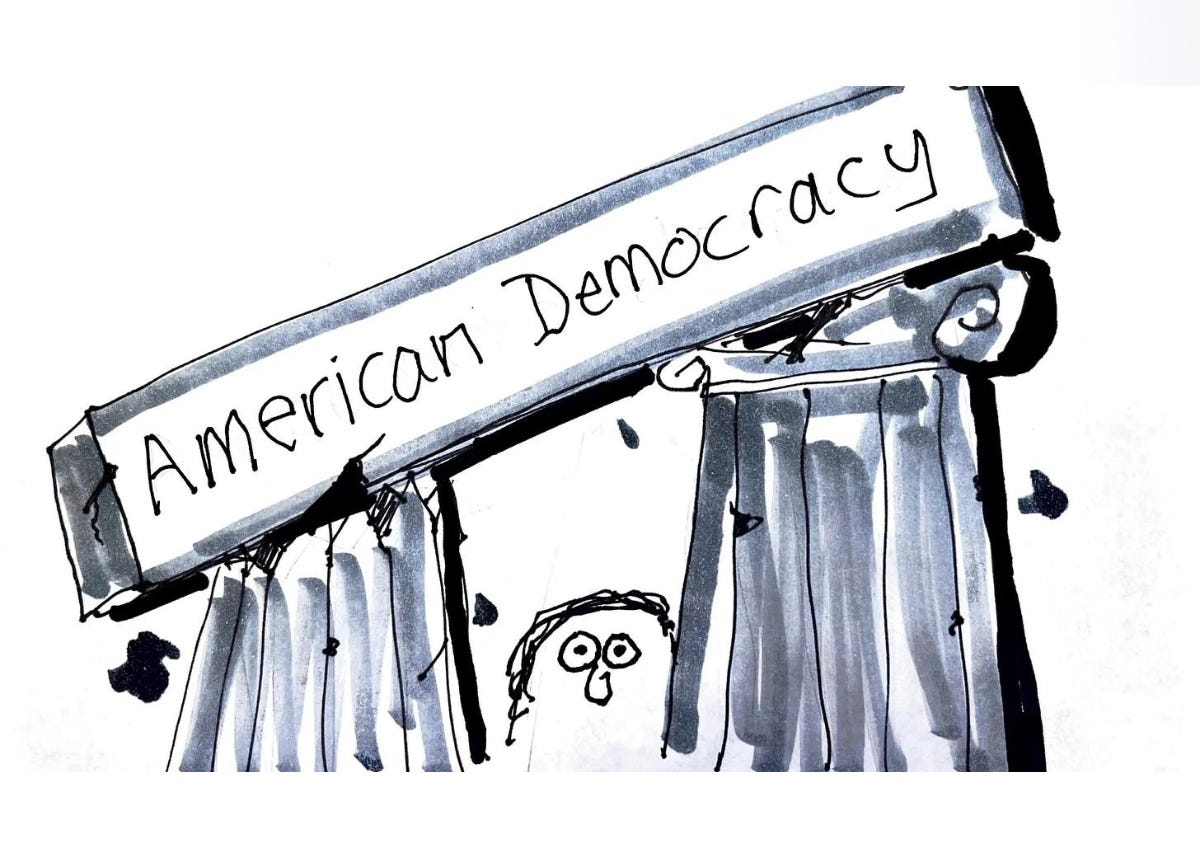
I have a serious question. It’s for people who have power in America and who continue to deny the outcome of the 2020 election and enable Trump’s Big Lie: What are you saying to yourself in private? How are you justifying yourself in your own mind?I don’t mean to be snide or snarky. I’m genuinely curious. I’m not interested in Trump’s answer to this question. He is too far gone — lost in the depths of his own pathological ego. I’m also not asking the millions of Trump followers, Fox News viewers, and rightwing social media fans who have been fed the Big Lie nonstop for almost two years. Two-thirds of registered Republicans now believe it. No, I am asking my question to people with power in our society — people who presumably know the truth. If you hold public office and still deny the outcome of the 2020 election, how are you explaining this to yourself? Are you telling yourself that despite the overwhelming evidence that Biden won and the lack of evidence of fraud, you still genuinely doubt the outcome? But you must know that sixty federal courts have found no basis in Trump’s claim, nor have any state so-called “audits,” and that even Trump’s own Attorney General found the claim baseless. Or are you telling yourself that it will soon be over — that Trump will fade, that the Big Lie will disappear, that your party and America will soon move on? But you must know you’re wrong. The Big Lie is growing. It has metastasized into a cancer that’s dividing the nation and devouring our democracy. Or are you telling yourself that you have no real choice but to support the lie if you want to keep or obtain political power? But is power so intoxicating to you — so important as an end in itself — that you’ll do anything for it? Where will you draw the line? If Trump is reelected and imposes martial law? If he or another Republican president forbids public criticism of his administration? If he calls for violence against those who oppose him?And what do you tell yourself about the measures your party is taking based on the Big Lie: suppression of votes, takeovers of election machinery, assertions that state legislatures can overturn voter preferences in the certification process, rejection of the January 6 committee’s findings?You have sworn an oath to uphold the Constitution. How do you defend yourself in your own mind? I’m asking you, Kevin McCarthy. And you, Lindsey Graham. And you, Marco Rubio, and Rick Scott and Josh Hawley and Ted Cruz and Ron Johnson. And others.And I’m asking those of you with significant power in the GOP who have remained silent in the face of all this – such as you, Mitch McConnell, and you, Mitt Romney: How do you justify your silence?And I ask those of you now running for office who are denying the 2020 election results and pushing other aspects of Republican authoritarianism – such as you, JD Vance, and Blake Masters, Mehmet Oz, Herschel Walker, Doug Mastriano, and Kari Lake: What are you telling yourself in private? How are you excusing yourself? Why are you even running? And I ask the billionaires and CEOs who are bankrolling these people: How do you rationalize spending millions, even tens of millions, helping them get or remain elected? I’m asking you, Peter Thiel, and you, Stephen Schwarzman, and Ken Griffin and Steve Wynn and Mike Lindell and Patrick Byrne and others: Is this really the way you want to spend your fortune? Is this your legacy to the nation?And I ask all the people making money off this rot – the TV hosts and producers and media moguls who are raking it in while poisoning the minds of America with bald face lies – what are you telling yourself in private? I’m asking you, Rupert Murdoch, and you, Tucker Carlson, and you, Sean Hannity, and you, Laura Ingraham: How are you defending yourself to yourself? I don’t expect any of you to answer me. This is a question for you to answer to yourself, alone and in private. But before you do, may I have a confidential word? Whether you’re a politician supporting the Big Lie, a billionaire backer of it, or a broadcaster who’s pushing it, it is not too late for you to get off the road you are on. Yet if you continue to promote or enable this lie, you are undermining our democracy and the norms of our society. The crisis you have helped create is worsening. You bear part of the responsibility for what comes next. Know this: When the history of this trying time is written, future generations of Americans will judge your actions and your silences harshly.They will recall your cowardice and your self-justifications. They will remember your lust for power and your moral blindness. They will recollect your unwitting ignorance or your witting failure to come to democracy’s defense in this perilous time. Generations to come will sit in judgment about what you have wrought. And if the democratic experiment called America continues to unravel because of what you did or failed to do, you will live in infamy. This is a public episode. If you'd li

The start of another school year: a tribute to our teachers
Today marks the start of the school year for many public schools. Which makes me think of Alice Camp. (I wrote about her some months ago. Many of you have asked me to repost what I wrote — and add a bit more about her and about our teachers. So here goes.)I arrived in Mrs. Camp’s third-grade classroom in Lewisboro Elementary School, in South Salem, New York, as an extremely short, shy, insecure 8-year-old who was often bullied and mocked on the bus and made to feel like a loser on the playground and had no particular interest in school.But she saw in me something I didn’t see. She fed me books, projects, ideas. She challenged me and praised me. She made me feel special. Her slightly whacky sense of humor connected with mine. Her curiosity fueled mine (she didn’t mind if I stayed in at recess and barraged her with questions). Her enjoyment of literature made it okay for me to love books.She made me understand that I wasn’t a freak, that I might even be talented, that the drawings and writings I did (up until then alone at my small desk in my bedroom) were okay — perhaps even good. And there was no reason for me to be so sad and ashamed, so fearful, so alone in the world.I think of Mrs. Camp when I see America’s teachers blamed these days for almost everything imaginable — yelled at by parents over masks, reprimanded by school boards about books they assign or let their students read, vilified by politicians for teaching about America’s history of racism, even told to arm themselves against the possibility that their classrooms will be invaded by murderous young men with semi-automatics.That’s wrong.Instead of berating our teachers, we should honor them. Instead of imposing ludicrous demands on them we should free them to teach and inspire. Instead of demeaning them we should express our gratitude to them — every day.And we should pay them twice as much as they’re now earning, or three times.Did you know that 94 percent of America’s teachers have had to dip into their own pockets to buy school supplies? This, at a time when the average Wall Street employee bonus for 2021 hit $257,500.Why in hell should investment bankers get paid fortunes for moving money from one set of pockets to another, when our teachers can barely afford to live on what they make? Bankers watch over our financial capital. Teachers watch over our human capital — and therefore our future.I don’t think there’s a “teacher shortage.” I think there’s a shortage of teaching jobs that treat educators with the dignity — and give them the pay — they deserve.I never saw Alice Camp again after third grade ended for me that June of 1954. I never had a chance to thank her (although I do remember sitting cross-legged on the floor at the end-of-year school assembly, quietly crying about leaving her and trying desperately not to show it).She passed away long ago.I had the great fortune to have other wonderful teachers over the rest of my years of public elementary and high school, and then in college and graduate school. I don’t recall thanking any of them, either. Most are gone by now. But I think of them often. And I am forever in their debt.I suppose one way I’ve managed to pay back a small portion of that debt is to teach — which I’ve done for most of the last forty years. I love teaching. I love my students. I can’t imagine a more rewarding or noble profession.When I expressed my appreciation of America’s teachers last June, and of Alice Camp in particular, I received lots of emails thanking me. Among them was a lovely letter from one of Mrs. Camp’s sons. He wrote:I want to thank you for your moving tribute to my mother, Alice Camp. It brought tears to my eyes because you so completely nailed who she was. She loved teaching. She spent endless hours at home after school working on projects and lesson plans and so on. To the point of exhaustion it seemed. For she did all the "single mom," work, too.She was deeply interested in her "kids" and not just the best and brightest such as you but equally the troubled, the disadvantaged, the ones who struggled. My mother was all about justice and fairness. … I could go on, but let me again on behalf of myself, my brother and sister (and my kids, because they all know the story, too) thank you for your loving words about Alice. She was my hero. This is a public episode. If you'd like to discuss this with other subscribers or get access to bonus episodes, visit robertreich.substack.com/subscribe
Why did the media ignore Biden's important speech?
Hello friends,Welcome back to my Saturday coffee klatch with my colleague Heather Lofthouse (Executive Director of Inequality Media Civic Action — and my former student). Today we discuss: * Biden’s speech to the nation — and why the media ignored it, or treated it as just another “political” event. * Ron DeSantis — and why he (and Mitch McConnell and much of the right-wing establishment) is just waiting for Trump to falter. * Merrick Garland — and why he’s reluctant to prosecute Trump, but why he must. * Friday’s jobs report — and why it left out the most important information about jobs, wages, and the economy. * Sarah Palin — and how she lost in Alaska. * And wishes for a happy Labor Day weekend — remembering what Labor Day represents, and what we celebrate. Thank you to to Bob Chartier and Dave Mancuso who composed (and sang) the latest tunes we use as today’s coffee klatch theme songs. Happy Labor Day weekend! This is a public episode. If you'd like to discuss this with other subscribers or get access to bonus episodes, visit robertreich.substack.com/subscribe
The most important battle of our lifetimes
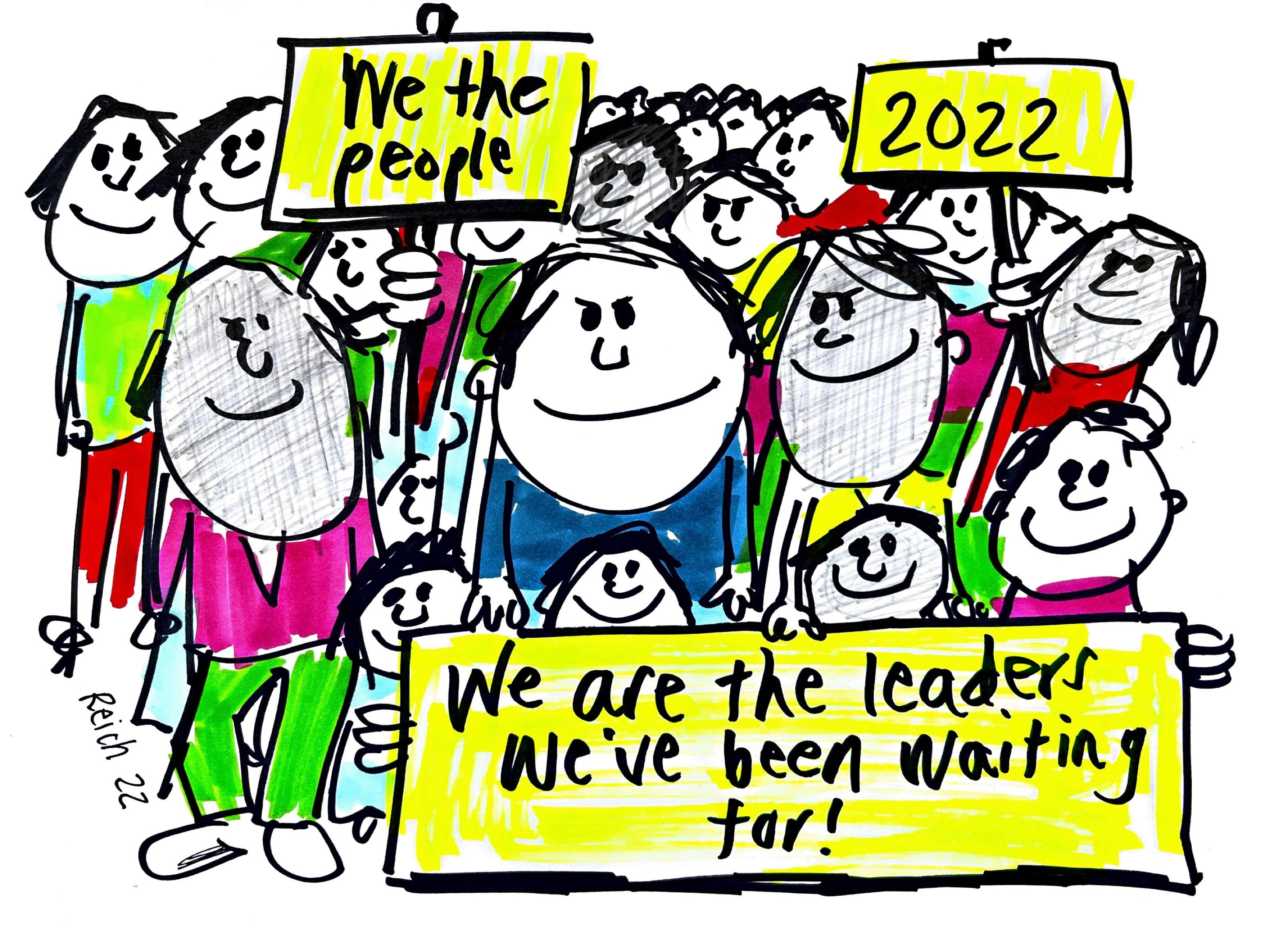
One week after a team of F.B.I. agents descended on his private club and residence in Florida, Trump warned that things could get out of hand if the Justice Department kept the heat on him. “People are so angry at what is taking place,” Trump told Fox News, predicting that if the “temperature” isn’t brought down, “terrible things are going to happen.”But Trump and his allies are doing all they can to increase the temperature. Last Sunday, one of Trump’s closest allies, Senator Lindsey Graham, warned of “riots in the streets” if Trump is prosecuted.On Tuesday, Trump spent much of the morning reposting messages from known purveyors of the QAnon conspiracy theory and from 4chan, an anonymous message platform where threats of violence often bloom. Some of Trump’s reposts were direct provocations, such as a photograph of President Biden, Vice President Kamala Harris and Speaker Nancy Pelosi with their faces obscured by the words, “Your enemy is not in Russia.”Online threats are escalating against public servants. Bruce E. Reinhart, the federal magistrate judge who approved the warrant to search Mar-a-Lago, has been targeted with messages threatening him and his family.How to respond to this lawlessness? With bold and unwavering law enforcement. If Trump has broken the law – by attempting a coup, by instigating an assault on the U.S. Capitol, by making off with troves of top-secret documents -- he must be prosecuted, and if found guilty he must be imprisoned. Yes, such prosecutions might increase tensions and divisions in the short term. They might provoke additional violence.But a failure to uphold the laws of the United States would be far more damaging in the longer term. It would undermine our system of government and the credibility of that system -- more directly and irreparably than Trump has done.Not holding a former president accountable for gross acts of criminality will invite ever more criminality from future presidents and lawmakers. It is also important for all those in public life who believe in democracy to call out what the Republican Party is doing and what it has become: not just its embrace of Trump’s Big Lie but its moves toward voter suppression, takeovers of the machinery of elections, ending of reproductive rights, book bans, restrictions on what can be taught in classrooms, racism, and assaults on LGBTQ people. Last week, Biden condemned “ultra-MAGA Republicans” for a philosophy he described as “semi-fascism.” Today he will deliver a rare prime-time speech outside the old Independence Hall where the Framers of the Constitution met 235 years ago to establish the basic rules of our democratic form of government. The speech is will focus on what the White House describes as the “battle for the soul of the nation” – the fight to protect that democracy.President Biden's earlier conciliatory tone and talk of uniting Americans and “healing” the nation from the ravages of Trump has obviously not worked on most of the Republican Party. With the notable and noble exceptions of Liz Cheney and a few other courageous Republicans — most of whom have been or are being purged from the GOP — the Republican Party is rapidly morphing into an anti-democracy movement. With each passing week, it becomes more rabid in its opposition to the rule of law. Republican lawmakers who took an oath of allegiance to the Constitution are repudiating it in word and deed. Republican candidates are lying about the 2020 election and whipping up our fellow countrymen into angry mobs. And as Republican lawmakers and candidates exchange their political integrity for power, Fox News and other rightwing outlets continue to exchange their journalistic integrity for money. The essential political choice in America, therefore, is no longer Republican or Democrat, right or left, conservative or liberal. It is democracy or authoritarian fascism. There can be no compromise between these two — no halfway point, no “moderate middle,” no “balance.” To come down squarely on the side of democracy is not to be “partisan.” It is to be patriotic.As Adam Wilkins suggested on this page yesterday, while today’s Republican party does not have its own paramilitary, such as the Nazi’s Brownshirts, the GOP is effectively outsourcing these activities to violent fringe groups such as the “Proud Boys," "Oathkeepers," and others who descended on the Capitol on January 6, 2021, and who continue to threaten violence.Yet Democrats cannot and must not take on this battle alone. They must seek common ground with Independents and whatever reasonable Republicans remain. As Eric T noted on this page, we must continue to appeal to truth, facts, logic, and common sense. We must be unwavering in our commitment to the Constitution and the rule of law. We must be clear and courageous in exposing the authoritarian fascist direction the Republican Party has now chosen, and the dangers this poses to America and the world. It is also important for Democrats to recognize -

The second-biggest Republican lie
Billionaire GOP mega-donor Steve Wynn has some free messaging advice for Republicans, which he proffered in a conference call last Wednesday with Republican National Committee Chair Ronna McDaniel and Newt Gingrich (the audio was obtained by Politico): He urged the GOP to run TV ads telling average working people that Democrats have funded the IRS to hammer them. Wynn even offered a script: “Tell them the IRS is ‘coming after you if you’re a waiter, if you’re a bartender, if you’re anybody with a cash business … they’re coming after you.’”Unfortunately for Wynn, the funding for the IRS in the Inflation Reduction Act targets the very wealthiest Americans — such as Steve Wynn — whose complicated businesses dealings and small armies of accountants and tax attorneys require lots of IRS resources if they’re to be audited.Over the past decade, Republican lawmakers cut the IRS budget by roughly 20 percent — with the result that just 2 percent of the richest Americans had their taxes audited in 2019, down from 16 percent in 2010. Not surprisingly, the richest 1 percent of Americans are estimated to be hiding more than 20 percent of their earnings from the IRS, accounting for more than a third of all unpaid federal taxes. The newly-added IRS funding is projected to raise some $100 billion in net tax revenue over the decade, mostly from the very rich.Wynn isn’t the first to dream up the bogus story about the IRS going after average working people. Senator Ted Cruz warns of a “shadow army of 87,000 IRS agents,” threatening Americans, and Kari Lake, the Republican candidate for Arizona governor, ties the increase in IRS agents to the FBI’s search of Trump’s Mar-a-Lago and concludes that, “Not a single one of us is safe.” Many other GOP candidates are telling the same lie. This lie isn’t even consistent with the older GOP lie that the rich pay most income taxes and almost half of Americans pay none (remember Mitt Romney’s 47 percent?), which isn’t true when you include Social Security taxes, state and local income taxes, sales taxes, and property taxes. But the billionaire class will do anything to avoid paying taxes. Why do you suppose Wynn and others like him bankroll Republicans in the first place? (Hint: Republicans cut their taxes.)During that same conference call last Wednesday, Wynn asked RNC chair Ronna McDaniel to recommend dark-money nonprofits to which he and other wealthy contributors can donate without their names being revealed. Some donors, Wynn said, “are self-conscious for reasons that are personal to them, business people and folks like that,” and would rather give to the GOP anonymously. (Wynn should know. His big campaign donations became embarrassingly toxic in 2018 after The Wall Street Journal detailed rape, assault, and harassment allegations against him.)Recall that the Supreme Court’s shameful 2010 Citizens United v. Federal Election Commission decision allows unlimited political spending by such nonprofits, to which billionaires like Wynn can secretly funnel unlimited donations. Meanwhile, The New York Times reported last week that electronics mogul Barre Seid gave 100 percent of the shares of his surge protector and data-center equipment manufacturer Tripp Lite to a dark-money nonprofit called the Marble Freedom Trust. The gift is worth a jaw-dropping $1.6 billion. The Marble Freedom Trust is controlled by Leonard Leo, a former chairman of the Federalist Society, known for his decades-long campaign to fill the federal courts with conservative judges and for his legal challenges to abortion rights, voting rights, and measures to ameliorate climate change. Seid’s $1.6 billion gift is the largest single donation ever made to a nonprofit political group. It would have been secret had an insider not tipped off the Times.Dark money nonprofits also enable super-wealthy political donors to avoid taxes. Had Seid sold his company outright, he would have had to pay about $400 million in capital gains taxes on the increased value of Tripp Lite’s shares. But because nonprofits like the Marble Freedom Trust are exempt from paying taxes, handing his shares over to the Trust enabled Seid to transfer the entire $1.6 billion to Leo — thereby having average taxpayers effectively subsidize Leo’s political influence-peddling to the tune of $400 million.What to do? At the very least, Congress should enact the Disclose Act, which would reveal to voters who’s trying to buy their votes. The Act has been blocked in Congress for more than a decade by Republican filibusters.Which brings me back to Steve Wynn’s advice to the Republican Party to tell working-class Americans that Democrats are unleashing the IRS on them.In truth, the Republican Party has been going all out to help its major backers avoid paying taxes. Those backers are among the wealthiest people in America — such as Steve Wynn — who have in recent years become far wealthier than ever before. Much of this is in secret. But as a result, most other Americans

Is Ron DeSantis a fascist?
I like to tweet. Not as much as I like to write here on Substack where I get to share my thoughts at some length. On Twitter it’s a different kind of conversation, and pace — like speed chess.Last Tuesday I tweeted: I was surprised at the outrage my little tweet provoked. The Washington Examiner, for example: Ultra left-wing elitist and former secretary of labor during the Clinton administration Robert Reich tweeted earlier this week, “Just wondering if ‘DeSantis’ is now officially a synonym for ‘fascist.’” This insulting slur has no basis, of course. This is just what left-wing ideologues do when they discuss Republican politicians who pose any threat to the existence of their political ideology. It's not grounded in any reality and is a sham. Yet, it never stops any of them from repeating the lie. Anyone the Democrats don’t like or disagree with is a fascist…. Any person using such hyperbolic, unhinged name-calling is not a serious person, and anything they say should not be deemed credible.Fox News’s digital outlet took umbrage as did many others, with rightwing rage at my tweet ricocheting through the echo-chambers of Republican social media.Don’t worry about me. After a half-century in and around politics, I’ve got a thick skin. But the size of the blowback on my little tweet makes me think I struck a nerve. DeSantis has become a favorite of the GOP’s Fox News-viewing base, and the most likely rival to Trump for the Republican nomination in 2024. The Harvard and Yale educated DeSantis (what do they teach at Harvard and Yale?) has been called “Trump with a brain.” Lately DeSantis has been campaigning on behalf of Republican election-deniers around the country, including gubernatorial candidate Doug Mastriano in Pennsylvania and US Senate candidate JD Vance in Ohio.DeSantis is the nation’s consummate culture warrior. Consider what he has wrought in Florida: * Discussions of sexual orientation and gender identity are now barred in Florida schools. * Math textbooks have been rejected for what Florida officials call “indoctrination.” * Abortions are banned in Florida after 15 weeks. (DeSantis recently suspended an elected prosecutor who said he would refuse to enforce the anti-abortion law.) * A new state office has been created to investigate “election crimes.” * Florida teachers are limited in what they can teach about racism and other tragic aspects of American history. DeSantis has got personally involved in local school board races, endorsed and campaigning for 30 board candidates who agree with him (so far, 20 have won outright, five are going to runoffs). * Claiming tenured professors in Florida’s public universities are “indoctrinating” students, DeSantis spearheaded a law requiring them to be reviewed every five years. * Florida’s Medicaid regulator is considering a rule to block state-subsidized health care from paying for treatments of transgender people. Florida’s medical board recently began the process of banning gender-affirming medical treatment for youths. * Disney (Florida’s largest employer) has been stripped of the ability to govern itself for the first time in more than half a century, in retaliation for the company’s opposition to the crackdown on L.G.B.T.Q. conversations with schoolchildren. * Florida’s congressional map has been redrawn to give Republicans an even bigger advantage.How much of a reactionary bully is DeSantis? Don't take my word for it. Here’s a smattering of some of his pearls of (dare I say, fascist) rhetoric: “We are not going to surrender to woke,” DeSantis said last Tuesday. “Florida is the state where woke goes to die.” He has described an America under assault by left-wing elites, who “want to delegitimize our founding institutions.” DeSantis envisions his job as governor as fighting critical race theory, “Faucian dystopia,” uncontrolled immigration, Big Tech, “left-wing oligarchs,” “Soros-funded prosecutors,” transgender athletes, and the “corporate media.” The state of Florida, DeSantis says, has become a “citadel of freedom.” He charges — using a standard racist dog whistle — that “We’re not letting Florida cities burn down … In Florida, you’re not going to get a slap on the wrist. You are getting the inside of a jail cell.” So, back to my tweet: Is it useful to characterize DeSantis’s combination of homophobia, transphobia, racism, and misogyny, along with his efforts to control the public schools and universities and to intimidate the private sector (e.g., Disney), as redolent of fascism? America’s mainstream media is by now comfortable talking and writing about “authoritarianism.” Maybe it should also begin using the term “fascism,” where appropriate. (Even Joe Biden, who has never been known as a rhetorical bomb-thrower, last Thursday accused the GOP of “semi-fascism.” A spokesperson for the Republican National Committee called Biden’s comment “despicable.”)Authoritarianism implies the absence of democracy, a dictatorship. Fascism (the word comes from the

My father and Senator Joe McCarthy
When Robert Draper of the New York Times recently asked Rose Sperry, a state committeewoman for Arizona’s G.O.P., to name the first Republican leader she ever admired, she immediately mentioned former Wisconsin senator Joe McCarthy. “I grew up during the time that Joe McCarthy was doing his talking,” Sperry said. “I was young, but I was listening. If he were here today, I would say, ‘Get him in there as president!’”I also grew up during the time Joe McCarthy was “doing his talking,” and I was young and listening, too. But I would not want Joe McCarthy to be president. Neither, let me add, did my father. Ed Reich called himself a liberal Republican, in the days when such creatures still existed. He voted for Thomas Dewey in 1948 (cancelling my mother’s vote for Harry Truman), and then for Dwight Eisenhower in 1952 and 1956 (cancelling my mother’s votes for Adlai Stevenson), and he thought highly of New York State’s Republican governor, Nelson Rockefeller, and its Republican senator, Jacob Javits — neither of whom would last a second in today’s G.O.P.But Ed Reich could not abide bullies and he detested Joe McCarthy. My father thought that anyone who had to bully someone else to feel good about himself was despicable. Bullying led to antisemitism and antisemitism had led to the holocaust. In 1947, Ed Reich moved us from Scranton to a little village in the country some sixty miles north of New York City, called South Salem, so as to be within equal driving distance of his two women’s clothing stores, in Norwalk, Connecticut, and Peekskill, New York. Soon after we arrived, a delegation of older men from the village came by to inform us that South Salem was a “Christian community” and we were not welcome there. That was the day my father decided we’d stay put in South Salem. “I’ll show those b******s,” he said. Senator Joseph McCarthy had a special place in Ed Reich’s pantheon of evil bullies. McCarthy didn’t just attack those he claimed were members of the Communist Party. He did it with malice. McCarthy’s crusade against “subversives” extended into the mainstream of America and American politics, as he ridiculed the “pitiful squealing” of “those egg-sucking phony liberals” who “would hold sacrosanct those Communists and queers.” Every time McCarthy’s image came across the six-inch screen on the Magnavox television in our living room, my father would shout “son of a B***H” so loudly it made me shudder. In Many are the Crimes: McCarthyism in America, historian Ellen Wolf Schrecker describes a movement that “punished thousands of law-abiding Americans and scared millions more into silence, destroying much of the left and seriously narrowing the political spectrum.” McCarthyism was the byproduct of the Republican Party’s postwar effort to eradicate the New Deal by linking it to communism. The G.O.P. portrayed the midterm election of 1946 as a “battle between Republicanism and communism.” The Republican National Committee chairman claimed that the federal bureaucracy was filled with “pink puppets.” According to John Nichols, in The Fight for the Soul of the Democratic Party, Southern segregationist Democrats joined the red-baiting rhetoric. Mississippi senator Theodore Bilbo, a Klansman who had filibustered to block anti-lynching legislation, described multiracial labor unions’ advocacy for civil rights as the work of “northern communists.” Representative John Elliott Rankin, a fiercely racist and antisemitic Mississippi Democrat who helped establish the House Un-American Activities Committee as a standing congressional committee, called the CIO’s Southern organizing campaign “a communist plot” and charged that it would lead to more Black voting rights. “We’re asleep at the switch,” he warned. “They’re taking over this country; we’ve got to stop them if we want this country.”The backlash was successful. In the 1946 midterms, Democrats lost control of both the Senate and the House. Wisconsin ended its era of progressive Republican La Follettes and sent Joe McCarthy to the Senate. California replaced New Dealer Jerry Voorhis with a young Republican lawyer who had already figured out how to use red-baiting as a political tool. His name was Richard Nixon. In December 1946, at the founding convention of the Progressive Citizens of America, FDR’s former vice president, Henry Wallace, saw the red scare for what it was — a tool of the most powerful economic forces in America. “We shall … repel all the attacks of the plutocrats and monopolists who will brand us as Reds,” he said. If it is traitorous to believe in peace — we are traitors. If it is communistic to believe in prosperity for all — we are communists. If it is unAmerican to believe in freedom from monopolistic dictation — we are unAmerican. We are more American than the neo-Fascists who attack us. The more we are attacked the more likely we are to succeed, provided we are ready and willing to counterattack.But there was no counterattack. The red scare continued to

The Trump Republican violence machine
Among the many ironies and hypocrisies leading up to the 2022 midterms, one deserving special mention is Trump’s and the GOP’s unremitting claim that America has become more violent and dangerous under Biden and the Democrats.“Our country is now a cesspool of crime,” Trump said in a recent speech to the America First Policy Institute. “We have blood, death, and suffering on a scale once unthinkable because of the Democrat Party’s effort to destroy and dismantle law enforcement all throughout America.”The truth is that although Americans experience far more gun violence than the inhabitants of other advanced nations, that’s largely because of widespread gun ownership — championed, encouraged, and defended by Republican lawmakers. As to recent violence, shootings are down 4 percent this year compared to the same time last year. In big cities, murders are down 3 percent. If the decrease in murders continues for the rest of 2022, it will be the first year since 2018 in which they fell in the U.S.The larger threat of violence is coming from Trump Republicans whose incendiary statements are fueling violence and threats of violence across America. In the year and a half since a pro-Trump mob stormed the U.S. Capitol, such threats and attacks have escalated.Yesterday, a federal jury found Barry Croft and Adam Fox guilty in a plot to kidnap Michigan governor Gretchen Whitmer at her summer home and to blow up a bridge that would stop rescuers from reaching her. They hoped to spark a second American Revolution. The Trump Republican violence machine is affecting — and sometimes intimidating — election workers, flight attendants, school board officials, librarians, members of the Biden administration, and members of Congress.In Houston, a former Marine stepped down as the grand marshal of a July 4 parade after a deluge of threats that focused on her support of transgender rights. A few weeks later, the gay mayor of an Oklahoma city quit his job after what he described as a series of “threats and attacks bordering on violence.” His tires were slashed, he was harassed by residents at a council meeting, and followed near his home. “I was afraid what would they do next if I don’t step down.”As I mentioned yesterday, Dr. Anthony Fauci and his family have received credible death threats and required a security detail. In December, authorities in Iowa arrested a California man with an assault rifle and ammunition, and a “hit list” that named Dr. Fauci and Joe Biden, among others. Congresswoman Liz Cheney has also received credible death threats, and also has a security detail. Threats have been issued against the federal judge who authorized the warrant to search for classified material at Mar-a-Lago, and against his family. (In that search, F.B.I. agents carted away boxes of highly sensitive documents.)During that search — from which F.B.I. agents carted away boxes of highly sensitive material — Trump described his home as “under siege.” In the wake of the search, Trump’s social media platform, Truth Social, erupted in calls for violence. Twitter saw a tenfold increase in posts mentioning “civil war” (according to Dataminr, a tool that analyzes Twitter data). There was also a spike in social media users calling for “violence toward law enforcement,” as Representatives Carolyn B. Maloney, chairwoman of the House Oversight Committee, and Stephen Lynch, chairman of its National Security Subcommittee, noted in a letter last week to eight social media companies.Republican lawmakers have fueled the fire. Representative Kevin McCarthy, the Republican leader, has accused the Justice Department of being “weaponized” against Trump. Senator Rick Scott, Republican of Florida, and Representative Lauren Boebert, Republican of Colorado, have drawn comparisons between the F.B.I. and the Nazi secret police. Joe Kent, a Trump-endorsed House candidate in Washington State, charged (on a podcast run by Stephen Bannon) that “we’re at war.” Kari Lake, the Republican nominee for governor of Arizona, declared: “These tyrants will stop at nothing to silence the patriots who are working hard to save America,” adding that, “if we accept it, America is dead.”The incendiary talk has led to violence. On August 11, a Trump supporter identified as Ricky W. Shiffer mounted an armed attack on an F.B.I. office in Ohio, and was killed. According to a subsequent review of his social media posts, Shiffer was incensed about the search at Mar-a-Lago and wanted revenge.Robert Pape, a professor at the University of Chicago who studies political violence, has conducted half a dozen nationwide polls since the Jan. 6 attack on the Capitol and repeatedly found that between 15 million and 20 million American adults believe that violence would be justified to return Trump to office.Trump’s claim that America has become more violent and dangerous over the last year and a half is true. But this is not because of Biden and the Democrats. It is largely because of Trump — and th

Why CNN cancelled Brian Stelter
For several years, Brian Stelter’s Sunday CNN show, “Reliable Sources,” has been a reliable source of intelligent criticism of Fox News, rightwing media in general, Trumpism, and the increasingly authoritarian lurch of the Republican Party.Last week, CNN abruptly canceled the show and effectively fired Stelter and his staff. Why? The show had good ratings and was commercially successful. (More people watched it than MSNBC.)The show was cancelled by Chris Licht, CNN’s new chairman and CEO, who has said he wants less criticism of Trump and the Republican right. Licht has told staff they should stop referring to Trump’s “Big Lie” because the phrase sounds like a Democratic Party talking point. Licht also wants more conservative guests.What’s motivating Licht? Follow the money. CNN’s new corporate overseer is Warner Bros. Discovery, Inc., which now owns what used to be Time Warner, including CNN. The CEO of Warner Bros. Discovery is David Zaslav. Zaslav has been prodding Licht to reposition CNN to have more “straight news reporting” and fewer “opinionated” views from hosts. Zaslav says he wants CNN to be for “everybody … Republicans, Democrats.”But CNN is never going to be a network preferred by Republicans. Fox News has that sewn up. As Republicans move further rightward into the netherworld of authoritarianism, there’s even less possibility that CNN’s news coverage will be able to satisfy them, nor should CNN even try. If we’ve learned anything from Trump and his lapdogs at Fox News, it’s that facts, data, and logic are no longer relevant to the Republican base.Even “straight news reporting” depends on what stories are featured, which facts are highlighted, and the context surrounding the news. How is it possible to report on Trump or Rudy Giuliani or any number of today’s Republican leaders and not speak of the Big Lie, or say they’ve broken norms if not laws?The anti-democracy movement in America (as elsewhere) is among the biggest issues confronting us today. Is reporting on it considered “straight news” or “opinion?” Wouldn’t failing to report on it in a way that sounded alarms be a gross dereliction of duty?So what’s motivating Zaslav? Keep following the money. The leading shareholder in Warner Bros. Discovery is John Malone, a multi-billionaire cable magnate. (Malone was a chief architect in the merger of Discovery and CNN.) Malone describes himself as a “libertarian” although he travels in rightwing Republican circles. In 2005, he held 32 percent of the shares of Rupert Murdoch’s News Corporation. He is on the board of directors of the Cato Institute. In 2017, he donated $250,000 to Trump’s inauguration.Malone has said he wants CNN to be more like Fox News because, in his view, Fox News has “actual journalism.” Malone also wants the ‘news’ portion of CNN to be “more centrist.” Early last spring, Brian Stelter wrote in his newsletter that Malone’s comments “stoked fears that Discovery might stifle CNN journalists and steer away from calling out indecency and injustice.” (A source told Deadline’s Dominic Patten and Ted Johnson that even if Malone didn’t order Stelter’s ouster, “it sure represents his thinking.”)When you follow the money behind deeply irresponsible decisions at the power centers of America today, the road often leads to rightwing billionaires. On Sunday, his last show, Stelter said:It’s not partisan to stand up for decency and democracy and dialogue. It’s not partisan to stand up to demagogues. It’s required. It’s patriotic. We must make sure we don’t give platforms to those who are lying to our faces.Precisely. Sadly, there are still many in America — and not just billionaires like Malone — who believe that holding Trump accountable for what he has done (and continues to do) to this country is a form of partisanship, and that such partisanship has no place in so-called “balanced journalism.” This view is itself dangerous. This is a public episode. If you'd like to discuss this with other subscribers or get access to bonus episodes, visit robertreich.substack.com/subscribe

The 6 secrets to becoming a fabulously rich con artist
As the saying goes, in America everyone is entitled to a second chance — especially con artists. Herewith the 6 rules for getting a second (or third or fourth) chance to sell a giant con:1. Market a mundane idea as “disruptive.” Adam Neumann, the founder of WeWork, hyped his office-sharing startup as the first “physical social network.” In reality it was nothing more than what you’d find in any coffee shop with customers at their laptops, but Neumann made it sound so revolutionary — “disruptive,” to use the high falutin con word — that JPMorgan, SoftBank, and other investors sank hundreds of millions into his company. At its height it was valued at some $47 billion.2. Pocket the money. Neumann used some of his investors’ money to buy buildings that he then leased back to WeWork. He also borrowed against his own stake in the company. And he was going to charge WeWork almost $6 million to use his trademark of the word “We” after the company rebranded itself the “We Company.” He lived like a mogul, with his own jet and penthouse apartments. WeWork never made a nickel of profit. The prospectus for its initial public offering was widely ridiculed as incoherent. After Neumann was forced to disclose his personal conflicts of interest, the IPO fell apart and the company’s estimated value plummeted from $47 billion to about $4 billion (after being rescued by SoftBank).3. Make sure your investors have their own investors, so they’ll want to salvage whatever they can and won’t sue you. Neumann wasn’t convicted of criminal fraud. His early investors didn’t want to sue him because they wanted to salvage whatever of their investment they could, and didn’t want to admit to their own investors that they’d been conned. In fact, they paid Neumann over $1 billion to exit the board and give up his voting rights. Neumann collected another $185 million in consulting fees from WeWork. Meanwhile, other WeWork employees were left holding near-worthless stock options and thousands were laid off.4. Do the same thing again. Neumann has just launched a new company called Flow, which he says will “transform” the residential rental real estate market with reliable services and “community” features (he used the term “community” a lot with WeWork, too). What about Neumann’s previous con? It’s been forgotten. “Flow” has already attracted $350 million of financing from the venture capital firm Andreesen Horowitz — the largest check it’s ever written in a round of funding a company. Andreesen values Flow at more than $1 billion before Neumann has even opened its doors. Last week, Marc Andreesen explained in a blog post on his firm’s website that the rental real estate market is “ripe for disruption,” especially now that so many people are working from home and “will experience much less, if any, of the in-office social bonding and friendships that local workers enjoy.” If this sounds a lot like the language Neumann employed to hype WeWork, that’s no accident. It worked once, so why not again? As Andreesen wrote, “we love seeing repeat-founders build on past successes by growing from lessons learned,” and that for Neumann “the successes and lessons are plenty.”5. Never admit fault or defeat. Adam Neumann’s con is small change compared to Donald Trump’s — who has also managed to fail upward but far more spectacularly. The master con artist has defrauded customers, renters, students, hoteliers, contractors, and, finally, American voters. He never admits defeat. Trump has leveraged every fraud into an even bigger fraud. As he infamously claimed, he could shoot someone in the center of Fifth Avenue and get away with it. Trump “disrupted” American democracy with his Big Lie and attempted coup. Now, it seems, he’s about to seek a second chance at the presidency.6. Don’t be poor or Black or brown. Not everyone in America gets a second chance. This is especially true of people who are poor or of color, particularly those convicted of crimes without jury trials through plea-bargains with prosecutors (who threaten worse penalties if they won’t plead guilty). An estimated 5.2 million Americans couldn’t vote in the last presidential election because of felony “convictions,” including one in every 13 Black adults, according to the Sentencing Project. Last Thursday, Florida Governor Ron DeSantis touted the arrests of 20 people on charges of “voter fraud,” who had voted in 2020 but had been convicted of crimes for which Florida made them ineligible to vote. (Many said they would not have voted had they known they were ineligible.)Many millions more can’t get jobs because employers don’t want to consider people who have broken the law. (Unlike Marc Andreesen, most employers don’t “love seeing people grow from lessons learned.”) Although some states and localities now prohibit employers and landlords from considering conviction or arrest records in their initial screening of applicants, it’s still the case that one big mistake on the part of someone who’s poor
Do people really understand the fight we're in?
Hello friends,On Saturdays I have a cup of coffee with my colleague Heather Lofthouse and we invite you to join us and chime in with comments. She asks questions that many of you also want to discuss. Heather is the Executive Director of Inequality Media Civic Action, and my former student. We cover both the highlights and lowlights, and aim to provide a larger context for the news. I’m somewhat on vacation this week but we did our best to record at a distance, cups of joe in hand. (Please forgive the sound quality.)In today’s coffee klatch we cover: * The Inflation Reduction Act victory lap. Will the wind at Biden and the Democrats’ back last? * The anti-democracy GOP. It’s no longer right versus left, it’s democracy versus authoritarianism. What’s the difference between authoritarianism and fascism? What’s the difference between a republic and a democracy? * Nearly half of teenagers say they use the internet “almost constantly.” How are young people consuming information, and what does it mean for our democracy?* How to remain upbeat. It can be easy to despair, but I find hope in the vibrant pro-democracy forces (many led by young people) that are gaining ground in this country.And more Coffee Klatch theme songs: Over 30 of you talented, generous Substack listeners have composed original tunes for us to play for these weekly recordings. What a treat, including during these trying times. Today we feature two more of the melodious results from this “contest.” Thank you, Dwight and Barry.Here is today’s theme song #1 by Dwight Stone:Here is today’s song #2 by Barry Hillman:And here’s an actual shot of us recording:Looking at the poll results this morning, I’m delighted how optimistic so many of you are about the fight we’re in — especially the midterms, some 90 days from now. I’m also feeling better about the possibility of Dems retaining control over the Senate (I’ve even let myself dream that Dems will have enough of a margin that they won’t have to be dependent on Manchin and Sinema.) But I don’t feel nearly as optimistic as most of you do about the House. Redistricting, retirements, voter suppression, and difficulties in getting out the vote (especially of young people) worry me. And then, of course, there are all the worries about state races, and the Trump Republican efforts to take over election machinery. But that’s for another day. Enjoy your Saturday! This is a public episode. If you'd like to discuss this with other subscribers or get access to bonus episodes, visit robertreich.substack.com/subscribe

The Beginning
I was born on June 24 in 1946 to Mildred Freshman Reich and Edwin Saul Reich at the Mercy Hospital in Scranton, Pennsylvania.That was ten days after Donald John Trump was born to Fred Trump and Mary Anne MacLeod Trump at the Jamaica hospital in the borough of Queens, New York.It was 12 days before George Walker Bush was born to Barbara Pierce Bush and George Herbert Walker Bush at Grace-New Haven Hospital in New Haven, Connecticut.And 56 days before William Jefferson Blythe III, whose name was changed to Bill Clinton, was born to Virginia Cassidy and William Jefferson Blythe, Jr., at the Julia Chester Hospital in Hope, Arkansas.I did not become President. But my grandmother, Minnie Reich — with whom I spent a great deal of time as an infant and toddler when Mildred was helping Ed at the store — told me repeatedly that I would be the first Jewish president. (In hindsight, I think she was seeking to reassure herself that despite my being a runt — a full head shorter than others my age — I would one day make her proud.) All of us — little Donald, George W., Billy, and I — were conceived in the weeks following America’s victory over Hitler’s Germany and Hirohito’s Japan, the previous September.Ed Reich had been a medic during the war. Fred Trump had built barracks for Navy personnel. George H.W. had been a Navy pilot. Bill Blythe had repaired ships and tanks. At the end of the war, Ed, Fred, George, and Bill returned to Mildred, Mary Anne, Barbara, and Virginia, respectively — to stoke what would be known as the post-war baby boom. (More babies were born in 1946 than ever before — 3.4 million of us little darlings, 20 percent more than the year before.)We were born into an America that felt proud of its war victories but was also exhausted by war. Surprising almost everyone, the nation emerged economically stronger than it had been before the war. During the war, almost everyone had been put to work and almost every factory run at full capacity — thus ending the Great Depression more effectively than any of the many programs FDR had tried. We were born to men and women whose futures were suddenly filled with more possibility than they had been for almost a decade and a half — for most of their young lives — but who were also shaken by the Depression and war, and by the brutality they had witnessed or heard about or would soon learn of. They had survived an economic cataclysm. They had fought fascism. They saw the results of genocide.Because of the challenges they had faced together, this generation of young Americans felt more connected to other Americans than any generation before them. Black Americans and women were still second-class citizens, to be sure. But the nation emerged from World War II far more certain of the virtues of American democracy and more confident about the American system than it would be seventy-six years hence, and more determined to overcome its faults. The two world wars and Depression decade between had also obliterated the entrenched fortunes of the Gilded Age — thereby leveling the playing field of the American economy and opening the way to the largest middle class the world had ever seen. When I was a toddler, Ed had saved just enough money to rent a store on Lakawanna Avenue in Scranton and buy the only things he had learned how to sell during a job before the war — women’s dresses and blouses. He called it the Beverly Shop, named after his sister. When Donald was a toddler, Fred was a real-estate developer in the Bronx who had acquired a mortgage-servicing company with access to the titles of many properties nearing foreclosure, which he bought cheaply and sold at a profit.When little George was a toddler, George H.W. was in the oil business in Texas. Bill’s father had been a traveling salesman who died in an automobile accident three months before Bill was born. Four years after Bill’s birth, Virginia married Roger Clinton, co-owner of an automobile dealership.So what did Donald, George, Bill, I, and millions of other boomers do for the next 76 years? Did we make America better, more inclusive, more tolerant? Did we strengthen American democracy? What’s the legacy we are leaving to future generations? As you might imagine, I have lots to say about this. More to come. This is a public episode. If you'd like to discuss this with other subscribers or get access to bonus episodes, visit robertreich.substack.com/subscribe
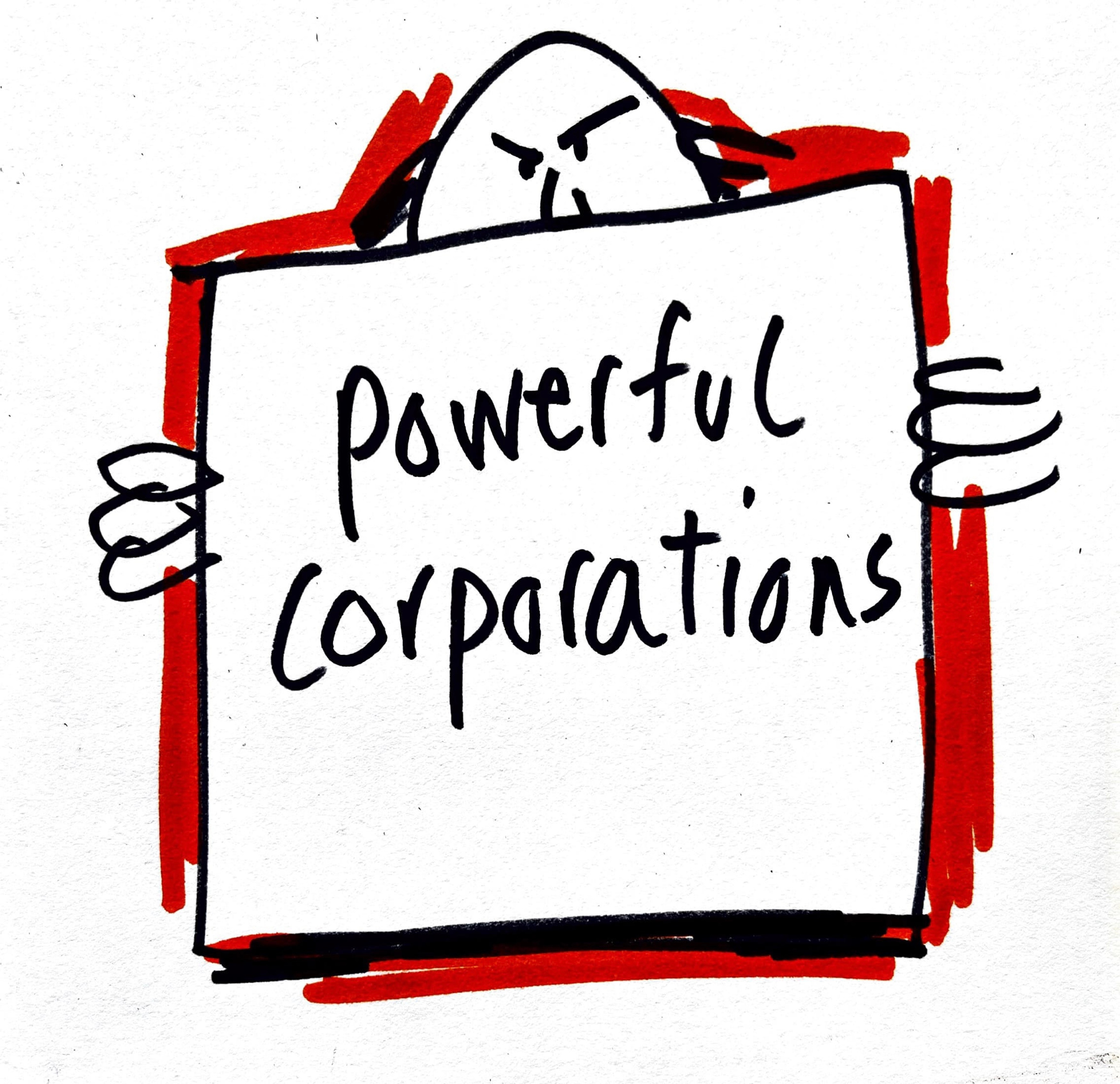
How Biden did it
The Clean Air Act of 1970 authorized the government to regulate air pollution. The Inflation Reduction Act, which Joe Biden just signed into law, allocates more than $300 billion to energy and climate reform, including $30 billion in subsidies for manufacturers of solar panels and components, wind turbines, inverters, and batteries for electric vehicles and the power grid. Notice the difference?The Inflation Reduction Act is a large and important step toward slowing or reversing climate change. It also illustrates the nation’s shift away from regulating businesses to subsidizing businesses. From 1932 through the late 1970s, the government mainly regulated businesses. This was the era of the alphabet soup of regulatory agencies begun under Franklin D. Roosevelt (the SEC, ICC, FCC, CAB, and so on), culminating in the EPA of 1970.The government still regulates businesses, of course, but the biggest thing the federal government now does with businesses is subsidize them. Consider Joe Biden’s biggest first-term accomplishments:— the CHIPS and Science Act (with $52 billion of subsidies to semiconductor firms, plus another $24 billion in manufacturing tax credits); — the Infrastructure Investment and Jobs Act ($550 billion of new spending on railroads, broadband, and the electric grid, among other things);— and now the Inflation Reduction Act (including, as I noted, $30 billion specifically for solar and wind manufacturers). This shift from regulation to subsidy isn’t just a central feature of the Biden administration. It has characterized every recent administration. Trump’s “Operation Warp Speed” delivered $10 billion of subsidies to Covid vaccine manufacturers. Obama’s Affordable Care Act subsidized the health care and pharmaceutical industries (indirectly, through massive subsidies to the purchasers of health care and pharmaceuticals). And Obama spent some $489 billion bailing out the financial industry (and, notably, never fully restored financial regulations that previous administrations had repealed), as well as GM and Chrysler. Before the 1980s, America would have done all this differently. Instead of subsidizing broadband, semiconductors, energy companies, vaccine manufacturers, health care and pharmaceutical businesses, and the financial sector, we would have regulated them. Corporations would have had to produce public goods (or avoid the public “bads” like, say, pollution or a financial meltdown) as conditions for staying in business. If this regulatory alternative seems far-fetched today, that’s because of how far we’ve come from the regulatory state of the 1930s to the 1970s, to the subsidy state beginning in the 1980s. Why this big shift? Because of the change in the balance of power between large corporations and government. Today it’s politically difficult, if not impossible, for government to demand that corporations (and their shareholders) bear the costs of public goods. For one thing, corporations now have more clout in Washington than any other political player. Spending by corporations on lobbying increased from $1.44 billion in 1999 to $3.77 billion in 2021 and is on track to exceed $4 billion this year, according to OpenSecrets.org, a nonprofit that tracks lobbying spending. Industries that have spent the most on lobbying and campaign contributions are those that have been engaged in the most dramatic shift from regulation to subsidy: the healthcare industry (which, between 1998 and June 2022 has spent $10.8 billion); finance ($10.2 billion); communications and electronics ($8.4 billion); and energy ($6.9 billion). I saw this first-hand. Bill Clinton’s healthcare plan was blocked by the pharmaceutical and health care industries, which would have had to sacrifice some profits. By contrast, Obama got the Affordable Care Act by paying off these industries — all but guaranteeing them larger profits from a massive inflow of newly subsidized customers. A second thing: This tidal wave of corporate money has occurred at the same time large American corporations have globalized, to the point where many are able to play off the United States against other nations — demanding government bribes in return for creating jobs and doing their cutting-edge research in America. The new CHIPS Act is a flagrant example of how powerful and highly-profitable semiconductor manufacturers, such as American-based Intel, can extract billions of dollars in a global shakedown for where they’ll make semiconductor chips.Many of the subsidies now being handed out to corporate America come in the form of tax credits. (Note that in economic terms, a dollar of tax credit is exactly the same as a dollar of government spending.) These credits — plus the rising political power of corporations and their ability to play off countries against each other — explain the dramatic decline in corporate income tax revenue as a share of GDP over the last thirty years. (Not even the 15 percent minimum corporate tax built into the Inflation
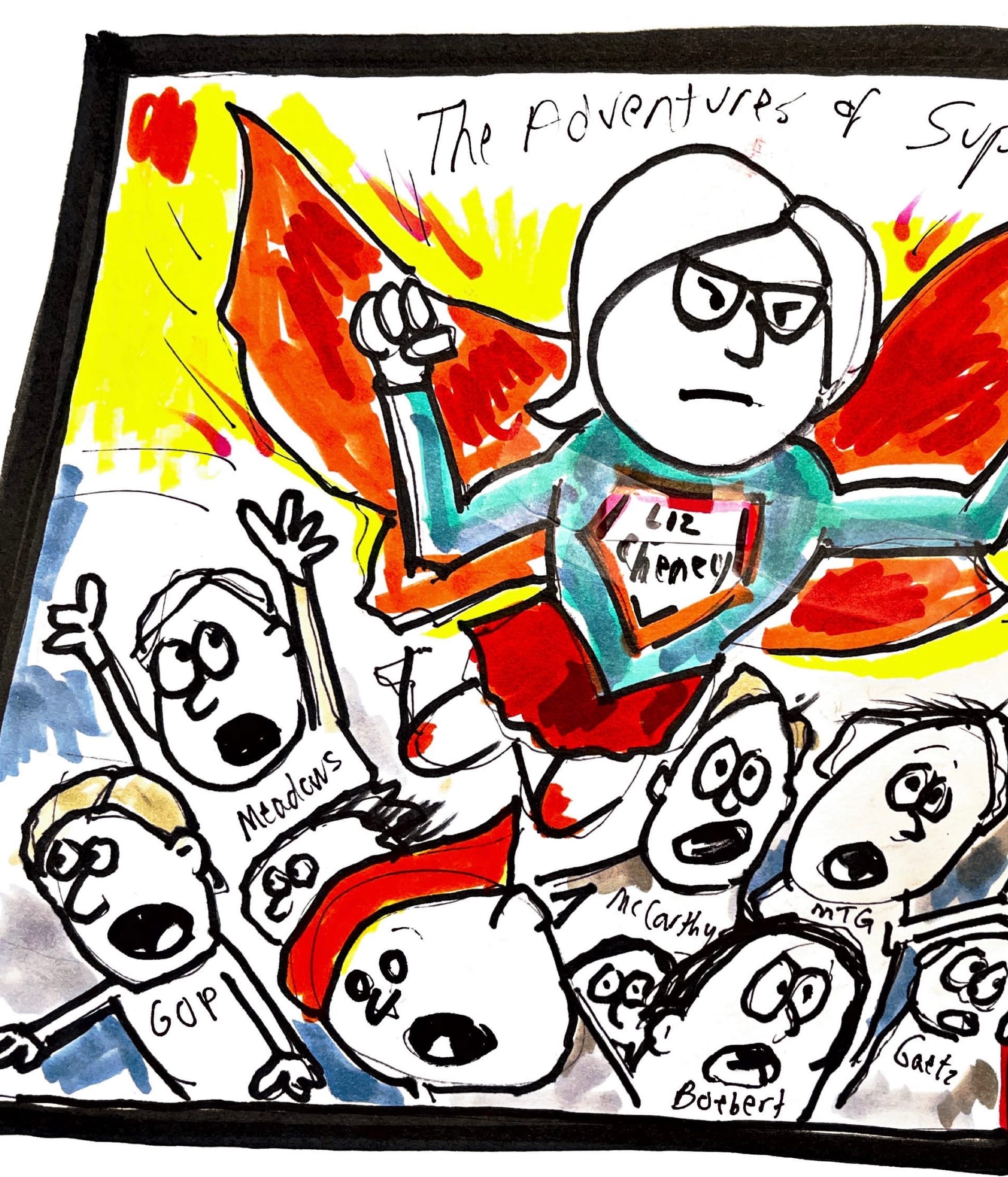
Liz Cheney and the Dick Morris paradox
Tomorrow, Wyoming Republicans will determine the fate of Representative Liz Cheney — whom Trump has targeted for revenge ever since she criticized him for inciting the January 6 attack on the Capitol. Six days after that attack — when no other Republican in the House or Senate was willing to rebuke Trump — she said on the House floor: “The President of the United States summoned this mob, assembled the mob, and lit the flame of this attack. Everything that followed was his doing. None of this would have happened without the President. The President could have immediately and forcefully intervened to stop the violence. He did not. There has never been a greater betrayal by a President of the United States of his office and his oath to the Constitution.”The very next day, on January 13, Cheney joined nine other House Republicans and 222 Democrats in voting to impeach Trump. So far, three of these ten principled Republican lawmakers have lost their primaries. Two have won them. The remaining four are retiring.As vice-chair of the House of Representatives’ January 6 committee investigating the causes of that attack, Cheney has ceaselessly and tirelessly helped lay out the case against Trump during eight public hearings held in June and July, with more to come. In response, Trump has done everything possible to end Cheney’s career. He made sure House Republicans revoked her status as the third-highest-ranking leader of the Republican caucus and that Wyoming Republicans censured her. Her life has been threatened and she has a security detail. But she has not wavered. Trump also selected Cheney’s opponent in the Republican primary, Harriet Hageman — who has rallied behind Trump and amplified his false claims that the 2020 election was stolen. Hageman has a commanding double-digit lead over Cheney. (According to some reports, Cheney has been reluctant even to venture into Wyoming to campaign, due to death threats.) If Liz Cheney loses her House seat, as seems likely, I hope she doesn’t disappear from public life. Although her views on countless substantive issues are the opposite of mine, I salute her. She has displayed more courage and integrity than almost any other member of her party — indeed, given the pressure she was under, perhaps more than any lawmaker now alive. The role Cheney has played raises larger issues about the meaning of representative democracy. Is it the responsibility of elected officials to represent the views of their constituents or their own principles? How far should they compromise their principles to get and retain power? These questions aren’t limited to Republicans. As the midterms draw closer, some Democratic operatives and pundits argue that Biden and the Democrats must move to the “center” in order to win. But where is the center? Halfway between democracy and fascism? Midpoint between social justice and oligarchy? And if Democrats have to go either of these places in order to win, what’s the point of winning? A personal note. In 2002, I ran for the Democratic nomination for governor of Massachusetts — the first time I’d run for elected office. (I don’t remember ever sleeping. I gained weight because I went to too many goddamn receptions and ate too many meatballs, pretzels, crackers and cheese. I talked so much I had to binge on throat lozenges. I smiled so much my cheeks ached. I got carsick from bouncing around Massachusetts in a cheap camper whose air conditioning continuously went out and whose springs were shot. I had to kiss the derrieres of too many rich liberals in order to finance the campaign.)During my campaign I was asked lots of questions. Should Cardinal Bernard Law resign over allegations that he allowed priests to molest children? I said yes. My campaign manager had a fit. “This is a Catholic state. You’re Jewish. You can’t just say that!” What would I do about Massachusetts’s yawning budget deficit? My answer: Raise capital gains taxes. My campaign manager was apoplectic. “People hate tax increases. The rich especially hate capital gains tax increases!” Did I support gay marriage? I said yes. My campaign manager went ballistic. “You might as well end the campaign right here. You’ve just lost!” On these and many other issues throughout the interminable nine months of that campaign, I gave my unfiltered views. As I repeatedly told my campaign manager, “If I don’t say what I believe, I won’t have any mandate from the public to act on those beliefs once I’m elected.” His retort: “You keep saying what you believe, you won’t get elected.”I was not elected. Five other candidates were seeking the nomination. I came in a respectable second. (This robbed me of the opportunity to take on the Republican nominee, Mitt Romney, who rocketed into the state with piles of money. Had I won the Democratic nomination, I would have whipped Romney’s assets.)So, was I wrong to stick to my principles? I call this the Dick Morris paradox. You’d be forgiven if you didn’t remember: In early
Will we get lost in the fog of Trump?
On Saturdays I have a cup of coffee with my colleague Heather Lofthouse, and we press record on my laptop so you can listen and chime in with any comments. Heather is the Executive Director of Inequality Media Civic Action, and my former student. She asks me about the economic and political happenings of the past week (this past one was a doozy). We cover both the highlights and lowlights, and aim to provide a larger context around what we’re all being presented with (or not) in the news. We often address our generational divide. And we always work to avoid being too cynical.In today’s coffee klatch we cover: * The FBI search of Mar-a-Lago.* Democrats’ successes. How much is a subsidy of business?* What does the GOP stand for other than Trump?* Back to school already? * And more Coffee Klatch theme songs: Over 30 of you talented, generous Substack listeners have sent us original tunes for us to play as an intro (and outro!) for these weekly recordings. What a treat, including during these trying times. Today we feature a few more of the results from this “contest.” Special thanks to Syliva B., Anahata I., Corey K. & Deirdre B., and Peter L. Grab a cup and pull up a chair. Thanks for listening. This is a public episode. If you'd like to discuss this with other subscribers or get access to bonus episodes, visit robertreich.substack.com/subscribe
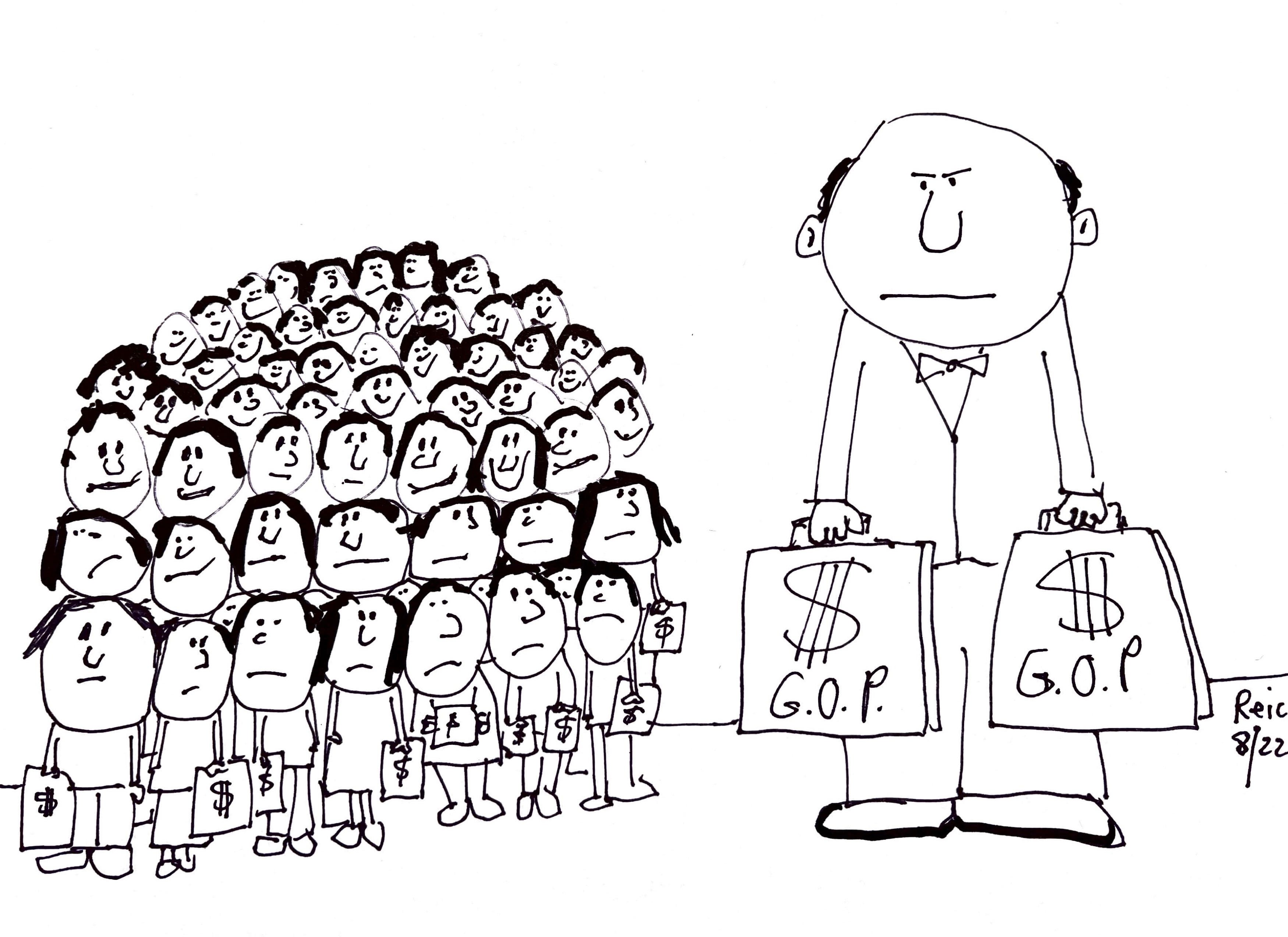
Follow the money! Small donors, big donors, and the midterms
Notably, the Inflation Reduction Act didn’t attract a single Republican vote in the Senate. (And at least one Democratic senator — Kyrsten Sinema — made sure its tax provisions wouldn’t raise tax rates on rich individuals.) Why? We talk a lot about money in politics, but there’s a huge and growing difference between the big money (campaign donations of $1 million or more), most of it pouring into Republican coffers and small money (individual donations of $200 or less), mainly pouring into the Democrats. (Corporations have been giving to both sides, in roughly equal measure.)The significance of this difference is growing. With the midterms elections looming, the gap between the two sources is larger than ever. Democrats are far outpacing Republicans in small-dollar donations. The most recent reports (through June 30) show, for example, that: — In Georgia, incumbent Senator Raphael Warnock has raised $14 million in small donations; Republican senate candidate Herschel Walker has raised only about $8 million in small donations. — In Florida, Val Demings, the Democratic challenger to Senator Marco Rubio, has raised more than $24 million in small donations; Rubio himself has reported $12.7 million in small donations. — In Arizona, Democratic Senator Mark Kelly's re-election campaign has raised nearly $23 million from small-dollar donors. His GOP challenger, Blake Masters, less than $2 million from small donors. But the GOP’s big money donors are making up the difference.— Billionaire Peter Thiel has so far poured over $25 million into the races of Blake Masters in Arizona and J.D. Vance in Ohio. — Kenneth C. Griffin, the CEO of giant hedge fund Citadel, is bankrolling Republican super PACs to the tune of nearly $50 million. — Stephen A. Schwarzman, chairman of giant hedge fund Blackstone, has so far contributed a combined $20 million to the main House and Senate Republican super PAC. — Banking heir Timothy Mellon (descendant of the robber baron Andrew Mellon) has so far contributed $10 million to the main House GOP super PAC.— Ditto billionaire Patrick R. Ryan. — Miriam Adelson (whose husband, Sheldon Adelson, was one of the GOP’s most generous contributors until his death last year) just made her first $5 million donation. The list goes on. — And, of course, Rupert Murdoch, Charles Koch, et al. Small donors are ramping up their giving to Democrats because they’re aware of how nuts the Republican Party has become on issues ranging from abortion to democracy. Trump has pulled into the GOP white supremacists, Christian nationalists, QAnon paranoids, xenophobic cultists, antisemites, misogynists, and rightwing militias. Plus a StarWars cantina of grifters, crackpots, and thugs who — as the January 6 attack showed — pose a clear and present danger to American democracy. Big donors are ramping up their giving to Republicans because they now have so much money that any Democratic-led tax increase on them (or Republican-led tax cut for them) will invariably have large financial consequences. The Inflation Reduction Act reveals just how much damage Democrats could do to the bottom lines of the rich.Many big donor billionaires (e.g., Peter Thiel) are trying to justify their donations as “libertarian,” but they know damn well the current Republican Party has nothing to do with personal freedom. It’s busy intruding on reproductive rights, pushing book bans in libraries and classrooms, barring young transgender people from playing on certain sports teams or using certain bathrooms, refusing to allow teachers to talk about aspects of American history they don’t want young people to know, and actively suppressing votes. Liberty my foot. No, the billionaires aren’t libertarian. They want only one thing: more tax cuts.The extraordinary growth of small donors to Democrats is all about justifiable fears of what Republicans will do with more power. The growth in big dollars to Republicans is all about greed. What do you think? This is a public episode. If you'd like to discuss this with other subscribers or get access to bonus episodes, visit robertreich.substack.com/subscribe

The worst memo in American history
Senator Joe Manchin has been Congress’s largest recipient of money from natural gas pipeline companies. He just reciprocated by gaining Senate support for the Mountain Valley pipeline in West Virginia and expedited approval for pipelines nationwide. Senator Krysten Sinema is among Congress’s largest recipients of money from the private-equity industry. She just reciprocated by preserving private-equity’s tax loophole in the Inflation Reduction Act. We almost take for granted big corporate money in American politics. But it started with the Powell memo. In 1971, the U.S. Chamber of Commerce asked Lewis Powell, then an attorney in Richmond, Virginia (and future Supreme Court justice) to report on the political activities of the Left. Richard Nixon was still president, but the Chamber (along with some prominent Republicans like Powell) worried about the Left’s effects on “free enterprise.” Powell’s memo — distributed widely to Chamber members — argued that the American economic system was “under broad attack” from consumer, labor, and environmental groups. In reality, these groups were doing nothing more than enforcing the implicit social contract that had emerged at the end of World War II — ensuring that corporations were responsive to all their stakeholders, not just their shareholders but also their workers, their consumers, and the environment on which everyone depends. But Powell and the Chamber saw it differently. Powell urged businesses to mobilize for political combat.Business must learn the lesson . . . that political power is necessary; that such power must be assiduously cultivated; and that when necessary, it must be used aggressively and with determination—without embarrassment and without the reluctance which has been so characteristic of American business.He stressed that the critical ingredients for success were organization and funding. Strength lies in … the scale of financing available only through joint effort, and in the political power available only through united action and national organizations.On August 23, 1971, the Chamber distributed Powell’s memo to leading CEOs, large businesses, and trade associations. It had exactly the impact the Chamber sought — galvanizing corporate American into action and releasing a tidal wave of corporate money into American politics. An entire corporate-political industry was born — including tens of thousands of corporate lobbyists, lawyers, political operatives, and public relations flaks. Within a few decades, big corporations would become the largest political force in Washington and most state capitals. Washington went from being a rather sleepy if not seedy town to the glittering center of corporate America — replete with elegant office buildings, fancy restaurants, pricy bistros, five-star hotels, conference centers, beautiful townhouses, and a booming real estate market that pushed Washington’s poor out to the margins of the district and made two of Washington’s surrounding counties among the wealthiest in the nation. I saw it and lived it. In 1976, I began working at the Federal Trade Commission. Jimmy Carter had appointed consumer advocates to some regulatory positions (several of them influenced by Ralph Nader). My boss at the FTC was Michael Pertschuk, an energetic and charismatic chairman. Joan Claybrook chaired the National Highway Traffic Safety Commission. Other Naderites were spread throughout the Carter administration. All were ready to battle big corporations that for years had been deluding or injuring consumers. Yet almost everything we initiated at the FTC, and just about everything undertaken by these activists elsewhere in the administration, was met by unexpectedly fierce political resistance from Congress. At one point, when the FTC began examining advertising directed at children, Congress stopped funding the FTC altogether, shutting it down for weeks. I was dumbfounded. What had happened? In two words, the Powell memo. The number of corporations with public affairs offices in Washington had ballooned from one hundred in 1968 to over five hundred by the time I joined the FTC in 1976. In 1971, only 175 firms had registered lobbyists in the nation’s capital. By 1982, nearly 2,500 had them. The number of corporate Political Action Committees mushroomed from under three hundred in 1976 to over 1,200 by 1980. Between 1974 and 1980, the Chamber of Commerce doubled its membership. (And remember, this was still thirty years before the Supreme Court’s infamous Citizen’s United decision.) It didn’t matter whether a Democrat or Republican occupied the White House. Even after George H.W. Bush became president, the corporate-political industry continued to balloon. By the 1990s, when I was secretary of labor, corporations employed some 61,000 people to lobby for them, including registered lobbyists and lawyers. That came to more than 100 lobbyists for each member of Congress. Corporate money also supported platoons of lawyers who represe
Why Republican candidates can't escape Trump
Republican candidates for Senate, House and governorships in the upcoming midterms have been filling the airwaves today with baseless assertions that the FBI search of Mar-a-lago shows the politicization of the Justice Department and undermines the rule of law. Republicans ranging from third-ranking House Republican Elise Stefanik to House Minority Leader Kevin McCarthy have issued statements brimming with outrage and accusation. Last night, the RNC sent out a fundraising text: “THIS IS NOT A DRILL: UNPRECEDENTED move Biden’s FBI RAIDS Pres. Trump’s home. Time to take back Congress.”Rubbish. There’s no evidence that the FBI search was motivated by anything other than concerns (and, under a court order, probable cause) that Trump made off with documents rightfully belonging to the United States. That’s a criminal offense. If anyone has been undermining the rule of law, it’s Trump. Recall that Trump himself appointed the current director of the FBI, Christopher Wray, after firing former director James Comey for investigating the ties of Trump’s 2016 campaign to Russia. But any allegation of Trump wrongdoing is automatically treated by the Trump Republican base as a loyalty test — triggering demands that Republican lawmakers and GOP hopefuls defend Trump and attack Democrats for going after him. This is putting Republican candidates in a terrible bind. As Biden and the Democrats take victory laps for legislation they’ve been passing – the CHIPs and Science Act, which President Biden today signed into law, and, very soon, the Inflation Reduction Act – the Republican Party wallows in Trumpist grievance and accusation. GOP candidates know that their best chance of prevailing in November with independent voters depends on distancing themselves from Trump and focusing on hot-button issues like inflation, crime, and immigration. But today’s reaction to the FBI’s Mar-a-Lago search shows how difficult that will be. September and October are likely to be all about Trump, and Republican candidates will have to go to the mat for him. Consider: The January 6 committee will resume its hearings in early September. Those hearings will almost certainly provide more evidence of Trump’s attempted coup of 2020. The Justice Department’s investigation into Trump’s role in pushing fake electors and in removing documents from the White House appears to be heating up. The D.C. Court of Appeals has just cleared the way for the House Ways and Means Committee to obtain Trump’s long-hidden tax returns.Prosecutors in Georgia continue their investigation into Trump’s demand that Georgia Secretary of State Brad Raffensperger "find" the votes Trump needed to win an election that three separate courts confirmed he lost. Rudy Giuliani has just been ordered to testify before the grand jury in that case. Trump himself will likely declare his candidacy for president in September or October. All of which means Republican candidates will be under increasing pressure from Trump’s base to defend Trump, to rage against his accusers, and to re-litigate the 2020 election – tasks that will be increasingly difficult as further evidence emerges of Trump’s criminality.Meanwhile, Democrats will be able to boast about what they’ve done for the American people — reduce drug prices, cut the costs of healthcare, clean the environment, maintain America’s competitive edge, and modernize the nation’s roads, bridges, and water and sewage systems. As Joe Biden put it today when he signed into law the CHIPs and Science Act, America has met the moment: “a moment when we bet on ourselves, believed in ourselves and recaptured the story, the spirit and the soul of this nation.”Which do you think will be the more attractive message to the independent voters who will largely determine the outcome of the midterms — defending Trump or “recapturing the can-do spirit” of America? This is a public episode. If you'd like to discuss this with other subscribers or get access to bonus episodes, visit robertreich.substack.com/subscribe
America's 30-year recession
The Labor Department reported Friday that U.S. employers added 528,000 jobs in July, more than twice the number analysts had expected. And the rate of unemployment dipped to just 3.5 percent. Undeniably good news.But this good news also means the Federal Reserve will almost certainly keep raising interest rates, believing the job market is now too “tight.” This is not good news.The Fed is wrong: The job market is not too tight. In fact, the share of Americans working or actively looking for work fell in July to its lowest level of the year — presumably because fewer people believe it worthwhile to work. This is because of (1) the rising costs (and hassles) of childcare and eldercare, and (2) the continuing drop in inflation-adjusted wages. Wages are rising at an annual rate of 5.2 percent but inflation is rising at over 9 percent. Which means that, in terms of real purchasing power, the pay of most workers continues to plummet.You’d think that the stall in the size of the workforce and the decline in inflation-adjusted wages might cause the Fed to hit the pause button on further interest-rate increases. But the Fed is still wedded to the anachronistic view that a “tight” jobs market is pushing prices upward. Rubbish. The real inflationary culprits are global supply constraints and big corporations with the power to raise prices. So beware. The Fed is likely to continue to raise interest rates when it meets in September. This means middle and lower-income Americans will be hit with two simultaneous shocks: not just shrinking paychecks they’re now enduring, but also a slowing economy in which they are the first to lose hours and jobs.Lower-income workers have little room reduce their spending because a large portion of their family budgets already goes to the necessities of food and housing — both of whose prices are soaring. Many are coping by taking on more credit card debt, which is also becoming more expensive as the Fed raises interest rates. So don’t be misled by the headlines. Yes, overall consumer spending is still going gangbusters. But most of it is coming from the upper middle class. The top 40 percent of the income distribution now accounts for around 60 percent of spending; the bottom 40 percent, about 22 percent. As the Fed slows the economy, the bottom 40 percent are getting squeezed even more. Yes, job growth is booming as well. But the sheer number of jobs is not a sufficient measure of the strength of the economy, especially when the real wages attached to so many of them are dropping. It is no great feat to create an abundance of low-wage jobs. The Fed is poised to make all this worse for lower-income Americans. Inequality in America is already horrific. Why worsen it? In the first three decades after World War II, America produced the largest middle class the world had ever seen. Most jobs continued to pay more and more. Almost all Americans were on an upward escalator. But for the last three decades, the middle class has been shrinking, and only the classes surrounding them have been growing — the “have-mores” and the “have-lesses.” The have-lesses — most of whom don’t have college degrees and are paid in hourly wages and — have been in a slow-motion recession. If they’re white and without college degrees, they’ve been losing ground fastest of all. Adjusted for inflation, their pay and benefits today are lower than they were in 1990. They also have less job security. In 2016, they formed the core of Trump’s base, and are still among his most ardent supporters. The biggest threat to our economy and society is no longer inflation or recession, per se. The biggest threat is a large and growing class of have-lesses — slammed by the double-whammy of a slowing economy and declining real wages. The Fed must not harm them further by taming inflation on their backs. Please consider a paid or gift subscription to help sustain this newsletter. This is a public episode. If you'd like to discuss this with other subscribers or get access to bonus episodes, visit robertreich.substack.com/subscribe

What the hell did they learn at Harvard and Yale?
The original justification for elite higher education in the United States was to train the future leaders of American democracy. As Charles W. Eliot, who became president of Harvard in 1869, noted, Harvard existed to inculcate the ideals of “service and stewardship.”Since then, Harvard has produced eight US presidents; Yale, five. (Stanford can boast Herbert Hoover, if it feels compelled to do so.)Elite universities have also produced a disproportionate number of senators and representatives from both parties. In fact, Republicans elected to the Senate over the last decade are more likely than their Democratic counterparts to have attended Harvard, Yale, Princeton, or Stanford.So how to explain Elise Stefanik, Harvard class of 2006, now the third-ranking House Republican, who recently called the January 6 hearings a “partisan witch hunt,” voted to invalidate the 2020 election, and has repeated Trump’s Big Lie of election fraud?Or Josh Hawley, Stanford class of 2002 and Yale Law class of 2006, now senator from Missouri, who in December 2020 became the first US senator to announce plans to object to the certification of Joe Biden’s victory, then led Senate efforts to overturn the Electoral College vote count, and fist-bumped the rioters on January 6?Or Ted Cruz, Princeton class of 1992 and Harvard Law class of 1995, now senator from Texas, who in late 2020 joined in John Eastman’s and Trump’s plot to object to the election results in six swing states and delay accepting the Electoral College results on January 6, potentially enabling Republican state legislatures to overturn them?And how to explain a new crop of Republican senate candidates?JD Vance, Yale Law class of 2013, now Republican candidate for the Senate from Ohio, has claimed that there “were certainly people voting illegally on a large-scale basis” in the 2020 election. When asked earlier this year if the 2020 election was “stolen,” he said, “Yeah, I do.”Blake Masters, Stanford class of 2008 and Stanford Law class of 2012, now the Republican candidate for the Senate from Arizona, has declared in campaign ads that “Trump won.” He promotes rightwing “replacement theory” – that Democrats favor illegal immigration “so that someday they can ‘amnesty’ these people and make them voters who they expect to vote Democrat.”These alumni of America’s finest institutions of higher education haven’t adhered to their alma maters’ ideals of service and stewardship of American democracy. In fact, they’re actively wrecking American democracy.Nor can these elite graduates claim they don’t know any better. Most third-graders can distinguish a lie from the truth.No, these scions of the most prestigious halls of American academe are knowingly and intentionally abetting the most dangerous attack on American democracy since the Civil War.Whatever did they learn from their rarified education? Obviously, zilch.The core of a good liberal arts education is ethics. The central question is the meaning of a good society. This has been the case since the eighteenth century, when most of America’s prestigious institutions of higher education were founded.Adam Smith, the progenitor of modern economics, didn’t call his field economics. He called it “moral philosophy,” and thought his book The Theory of Moral Sentiments more important than his The Wealth of Nations.Edmund Burke – Irish statesman and philosopher, and godfather of modern conservatism – didn’t advise that people in public life seek power above all else. He argued that they owe the public their “judgment and conscience.”There is no single answer to the meaning of a good society, of course. It is the pursuit of it that draws on one’s judgment and conscience. This is why higher education has advanced the role of reason in human affairs and stood for the Enlightenment values of democracy and the rule of law.But this new crop of Republican pretenders hasn’t learned anything of the kind. They are practitioners of a much earlier and more cynical set of ideas: that might makes right, that the purpose of human endeavor is to gain power, and that ambition and treachery trump (excuse the verb) all other values.I can’t help wondering: What do they see when they look into the mirror each morning? And what do they tell themselves after a day of deceit?Any of them who tries to justify the despicable means they are employing by telling themselves they can do more good by gaining or keeping power is under a dangerous illusion. As the great civil rights leader Bayard Rustin once said, “If we desire a society that is democratic, then democracy must become a means as well as an end.”These products of the best education America has to offer are betraying the core values of America.They deserve only shame. This is a public episode. If you'd like to discuss this with other subscribers or get access to bonus episodes, visit robertreich.substack.com/subscribe
Reasons to be less depressed?
Each Saturday I grab coffee with my colleague Heather Lofthouse, and we turn on my laptop mic so you can listen in and then provide your two cents in the comments. Heather is the Executive Director of Inequality Media Civic Action, and my former student. She asks me questions about the economic and political happenings of the past week. We cover both the highlights and lowlights, and aim to provide a larger context around what we’re all being presented with (or not!) in the news. She’s Gen X and I’m, um, older than that; we often address our generational divide. Sometimes we veer off into stories about family or what shows we’re watching, but we try to stay on task. And we always work to avoid being too cynical. Like you, I imagine, I find conversations with others — on the phone, in person, or even just online typing back and forth asynchronously — to be an important way of processing information, including during trying times. In today’s coffee klatch we cover: * Friday’s jobs report: The large number of jobs added is great, but what will the Fed do with this data?* Sinema’s last stand: Why exactly was she holding out on signing off on the Inflation Reduction Act?* The good people of Kansas: Kansans beat back abortion restrictions at the ballot box on Tuesday. What might this mean for democracy, and the midterms?* The awful Alex Jones: Holy karma, Batman. What will be made of his years of unintentionally shared text messages? And what is the role of defamation lawsuits in the (dis)information age?* A Coffee Klatch theme song: Last week we asked for anyone who might be interested and willing to send in a non-copyrighted tune for us to use as an intro for these weekly recordings. You lovely, talented listeners came through in spades! We’ve been overwhelmed with your outpouring of original songs and kind emails. Thank you to all of you who took the time to compose music for this community to hear. Today we feature some early results from this “contest.”Please pull up a chair. This is a public episode. If you'd like to discuss this with other subscribers or get access to bonus episodes, visit robertreich.substack.com/subscribe

Viktor Orban's eugenics and the GOP
Yesterday, Hungarian Prime Minister Viktor Orban addressed a crowd of thousands of American admirers in Dallas, Texas, at the Conservative Political Action Conference (CPAC). Orban described Hungary and America as “twin fronts” in a struggle against globalists, progressives, communists, and “fake news.”To fully comprehend Orban’s influence on the Trump Republican Party, you need to understand the Orban has stripped Hungary of its democratic institutions and demonized immigrants. But that’s not all. He has also embraced a form of eugenics, in which he claims that the future of the West is threatened by the “racial mixing” of white Christian Europeans with others. On July 23, Orban put it bluntly in a speech at the 31st Bálványos Summer Free University and Student Camp:The internationalist left employs a feint, an ideological ruse: the claim – their claim – that Europe by its very nature is populated by peoples of mixed race. … [We] do not want to become peoples of mixed-race. This is why we fought at Nándorfehérvár/Belgrade, this is why we stopped the Turks at Vienna, and – if I am not mistaken – this is why, in still older times – the French stopped the Arabs at Poitiers.Today the situation is that Islamic civilization, which is constantly moving towards Europe, has realized – precisely because of the traditions of Belgrade/Nándorfehérvár – that the route through Hungary is an unsuitable one along which to send its people up into Europe. This is why Poitiers has been replayed; now the incursion’s origins are not in the East, but in the South, from where they are occupying and flooding the West. Orban’s words and phrases were familiar to anyone who lived through the Nazi holocaust. After the speech, one of Orban’s closest advisers resigned, calling it “pure Nazi.” Prominent American Republicans have rushed to Orban’s defense. On Wednesday, when Orban stopped off at Trump’s (Saudi-sponsored) golf tournament on the way to the CPAC conference, Trump called him a “friend,” adding “few people know as much about what is going on in the world today.” That evening, Tucker Carlson smirked on his Fox television show, “So Viktor Orban is now a Nazi because he wants national borders?” (Last year, Carlson did a special broadcast from Budapest during which he praised Orban’s Hungary as a model for America.) And, of course, Orban gave yesterday’s keynote at CPAC. Eugenics was popular at the turn of the last century. Developed largely by Sir Francis Galton — supposedly as a method to improve the human race — it called for arranging reproduction within the human population to increase characteristics regarded as desirable and minimize the undesirable. After the adoption of eugenics by the Nazis to justify their treatment of Jews, disabled people, and other minority groups, eugenics was discredited as unscientific and racially motivated. But eugenics has been reborn under another guise — that of white Christian nationalism. It is now presented as the scourge of “racial mixing” between white Christians of European descent, and others. It is a small leap from the invasions of Europe by Turks and Arabs centuries ago to the present generation of immigrants swarming over borders and “invading” white Christian nations. In Republican primary races this year, few issues have come up more frequently in TV ads than immigration — all featuring the word “invasion.” It’s pure Orban. "We're gonna end this invasion," says Blake Masters, the Republican candidate for the Senate from Arizona, in one ad. “Invasion” is featured in ads for Gov. Brian Kemp in Georgia, Senator Rick Scott in Florida, and Kari Lake (now in a close race in the Republican primary for governor in Arizona). And, of course, for the past six years Trump has warned that America is being “invaded” by immigrants.The word “invasion” has a long history among white nationalists. It has been widely used by supporters of the "replacement theory" — the baseless conspiracy theory that Jews or elites are intentionally replacing white Americans with immigrants and people of color. Both Blake Masters and J.D. Vance, the Republican candidate for the Senate from Ohio (each the beneficiary of $15 million in campaign funding from far-right billionaire Peter Thiel and of a Trump endorsement) claim that Democrats are deliberately trying to “import” immigrants in an attempt to “replace Americans who were born here.”The racist tropes of “invasion” and “replacement” are intended to stoke fear and drive votes. They also fuel violence. Three years ago, a white gunman opened fire at a Walmart in El Paso, killing 23 people, most of them Latino. The suspect was motivated by what he called a "Hispanic invasion" of people coming to the U.S. illegally. The man suspected of killing 10 Black people earlier this year in Buffalo was also motivated by the replacement theory.The bogus science of eugenics, popular at the turn of the last century but since disgraced and forgotten, has now morphed into white Ch
Kansas on my mind
Today, I want to talk about Kansas. Not about its corn as high as an elephant’s eye, nor about Dorothy and Toto trying to find their way home, but about Kansas as the geographic and Republican center of America, Kansas as the vintage Norman Rockwell core of America, Kansas as what the Republican Party was before being hijacked by Newt Gingrich and then mugged by a New York real estate con artist. I’m moved to do so because on Tuesday the good people of Kansas voted against a ballot measure that would have stripped from their state constitution a woman’s right to choose, and they did it by a whopping 18-point margin.For decades, the Republican Party has exploited social fissures in America – from immigration to race – as its means of deflecting attention from the immutable fact that most Americans, especially those without college degrees and depending on an hourly wage, have been on a long downward escalator, and an ever-larger portion of the economic gains have been going to the top. Republicans have had no economic response to this except to promote the gonzo fiction that tax cuts for the rich somehow trickle down.For much of this time, Democrats have unwittingly aided this Republican strategy by eschewing the populist-progressive economic policies that attracted downwardly mobile voters in the 1930s and 1940s, and before that, in the 1880s and 1890s. Instead, modern Democrats have substituted a neoliberal stew of free trade, privatization, and deregulation (until big banks or corporations need to be bailed out). The stew has helped corporate Democrats to prosper but, as I’ve argued elsewhere, has left the working class in the dust.But something has now happened that few predicted. The Republicans’ culture war has come back to bite the Republicans in their incidentals. The GOP has ventured into territory that even Kansans apparently decided was a dangerous overreach. A woman’s right to choose tipped the scales but the scales were already tipping as the GOP began to encroach on many aspects of private life: contraception, same-sex marriage, transgender bathroom rights, books, and religion.Kansans, like most Americans, know the difference between what should be left to personal choice and what should be public. But in its ardor to fuel the culture war, the GOP forgot.In addition, prairie populism lies just under the surface of the Kansas topsoil, as it does in much of the Midwest. Over the last several decades the giant corporations that supply Kansans with seed and fertilizer, and that turn the livestock and crops Kansans produce into food products, have grown much larger and more powerful. They are now among America’s biggest monopolies, siphoning off money from farmers as well as from consumers. If there’s one thing Kansans dislike as much as government intruding on their freedom, it’s big predatory corporations intruding on their meager profit.Perhaps Kansas, as well as much of the rest of America, is ready for a dose of economic populism. If so, the Democrats’ pending “Inflation Reduction Act” – with its healthcare subsidies, declining pharmaceutical costs, and boosts for solar and wind power -- may prove more popular in the hinterlands than anyone expected. As William Allen White, the famed progressive editor of the Emporia (Kansas) Gazette in the first half of the twentieth century, once wrote: Democracy is an experiment, and the right of the majority to rule is no more inherent than the right of the minority to rule; and unless the majority represents sane, righteous, unselfish public sentiment, it has no inherent right. (White also wrote: “My advice to the women of America is to raise more hell and fewer dahlias.”) This is a public episode. If you'd like to discuss this with other subscribers or get access to bonus episodes, visit robertreich.substack.com/subscribe

How to stop rightwing media lies?
Defamation law may turn out to be America’s most important weapon against rightwing media lies.On Friday, Infowars star Alex Jones’ parent media company, Free Speech Systems, filed for bankruptcy in the midst of a defamation damages trial underway in Austin, Texas. Jones, you may recall, had portrayed the Sandy Hook school shooting massacre as a hoax involving actors, aimed at increasing gun control. Neil Heslin and Scarlett Lewis, whose 6-year-old son, Jesse Lewis, was among the 20 children and six educators killed, have sued Jones and his media company for $150 million. Courts in Texas and Connecticut have already found Jones liable for defamation.To win a defamation lawsuit, a plaintiff must show four things: the defendant made a false statement purporting to be fact; the statement was published or communicated; the defendant failed to exercise reasonable care or, worse, knew the statement was incorrect and hurtful but made it anyway; and the plaintiff suffered harm as a result.By these criteria, it’s no wonder Jones will soon be paying out a fortune in damages. Declaring bankruptcy won’t save him. Defamation litigation is slow and expensive and, like all litigation, it enriches lawyers. It can also be abused. Anyone remember what happened to Gawker after its tech blog published a post under the headline, “Peter Thiel is totally gay, people”? Billionaire Thiel quietly bankrolled Hulk Hogan, the professional wrestler, to sue Gawker for defaming Hogan in a totally unrelated story — and Hogan’s nine-figure defamation award bankrupted Gawker Media.But at a time when social media can’t be trusted to police itself against weaponized lies, and when much of the public doesn’t trust government to regulate social media, defamation lawsuits may be the best we can hope for.One America News (OAN), a right-wing media organization that pushed conspiracy theories about the election, is facing so many defamation lawsuits from those injured by the network’s lies that its future is now in doubt.Five years ago, Trump was ecstatic about OAN’s flattering coverage of him. By the summer of 2020 -- dissatisfied with what he considered insufficient gushing by Fox News – Trump was urging his followers to switch to OAN and Newsmax, calling them “much better” than Fox. He did the same after the election, when OAN’s journalists were more willing than many Fox correspondents to continue pushing Trump’s Big Lie. Last December, Ruby Freeman and Wandrea Moss, Georgia election workers, sued OAN hosts and guests, including Rudy Giuliani, for baselessly accusing them of committing election fraud and engaging in a criminal conspiracy. Freeman and Moss said OAN’s lies subjected them to an onslaught of harassment and racist threats, leading one of them to leave her home for months at the recommendation of the Federal Bureau of Investigation. OAN ultimately settled the case for an undisclosed sum. Apparently as part of the settlement agreement, OAN admitted on air that Freeman and Miss “did not engage in ballot fraud or criminal misconduct.”Meanwhile, Dominion Voting Systems, which provided voting machines to 28 states in the 2020 election, has accused OAN of defaming the company and its products by airing false reports that its machines switched votes from Donald Trump to President Biden, thereby hurting its business and putting its employees in danger. (One of those employees, Eric Coomer, received death threats after OAN named him in a report as an alleged collaborator of the far-left movement, antifa. Coomer is now suing OAN, too.) The litigation has not gone well for OAN. Judges have rejected its motions to dismiss the case. In one ruling, a judge concluded that OAN acted “maliciously and consciously” in perpetuating falsehoods about Dominion, and that its chief White House correspondent, Chanel Rion, failed to exercise even minimal journalistic standards.In April, OAN was dropped by AT&T’s DirecTV, which has about 15 million subscribers. Verizon just announced it would stop carrying OAN on its Fios television service. OAN will soon be available to no more than a few hundred thousand people.Dominion isn’t stopping with OAN. It’s seeking a total of $1.6 billion in damages extending to Newsmax as well as to Fox News and Fox News’s parent, the News Corp. And it’s seeking an additional $1.3 billion in damages from each of Trump’s most whacko conspirators — Sydney Powell, Rudy Giuliani and MyPillow CEO Mike Lindell.As to the News Corp, Dominion alleges that Rupert Murdoch and his son, Lachlan, acted with “actual malice” because they knew that the lie Fox News was touting was false.Defamation lawsuits aren’t sure things, and they pose potential threats to the free press. But if the press is alert to errors and corrects them quickly, defamation shouldn’t be a problem.Sarah Palin recently lost her defamation suit against The New York Times, in which she alleged that the Times defamed her when it erroneously linked her campaign rhetoric to a mass s

How to bask in the political limelight? Be Manchinema
TONIGHT I’m talking with Stephanie Ruhle, on MSNBC’s 11th Hour, about the biggest difference between Joe Manchin and Kyrsten Sinema — the so-called “carried interest loophole” that rewards big bucks to private equity managers. This week, the spotlight once again will be on Manchin and Sinema (dubbed “Manchinema” by the Washington press corps as the two blocked much of Biden’s agenda) because it’s the Democrats’ last chance for a large package — Manchin has agreed to $790 billion — on the climate and healthcare, financed by a tax increase on the rich and big corporations. But will Sinema go along?It has been said that the word “politics” is derived from the Latin “poli,” meaning “many,” and “tics,” small blood-sucking insects. I don’t hold such a cynical view. But I do know, from fifty year’s experience in and around Washington, that most of the people who serve in our nation’s capital have very, very large — shall we say? — ego’s. Yesterday, Manchin made the rounds of every Sunday talk show — doing what’s known as a “full Ginsburg” (named after William Ginsburg, the lawyer for Monica Lewinsky, who first appeared on all five Sunday morning talk shows on February 1, 1998). Record-keepers note that Manchin is only the 31st newsmaker to have accomplished this feat, but purists dispute his accomplishment because Manchin appeared remotely. Manchin treated it as a victory lap. He took credit for his newly-named “Inflation Reduction Act” (he refused to allow it to be named “Build Back Better” because he’s still smarting over what he viewed as the Biden administration’s criticism of him for blocking the original BBB). One interesting sidebar: When Manchin was asked by “Meet the Press” host Chuck Todd whether he wanted Democrats to keep control of the House and Senate after the midterms, Manchin declined to answer. (Does he want to hold out the possibility of becoming a Republican kingmaker if the Dems lose?) Tellingly, Manchin wouldn’t even use the pronoun “we” when talking about the Democrats. I’ve always made it a point to listen to the pronouns politicians use. The use of pronouns tells you a lot about where a politician’s loyalties lie. Manchin almost never uses “we” when he refers to Democrats. Sometimes, it’s “they.” When Trump was president, he used “we” to refer to the people who voted for him, and “they” for everyone else. Which brings me to Kristyn Sinema — who uses the pronoun “I” perhaps more frequently than any other contemporary politician. (“I’m always surprised when people say, ‘Oh, she’s an enigma,’” said Sinema in an interview with the Washington Post. “I’m, like, not at all, actually. I’m very straightforward about what I believe in and why I’m doing what I do.”)“What good would politics be,” Thomas Mann wrote in The Magic Mountain, “if it didn't give everyone the opportunity to make moral compromises?” Sinema seems to relish that opportunity. Although not up for reelection until 2024, she is one of the senate’s major recipients of Wall Street cash (the finance industry has donated $2.2 million to her since she took office in 2017). She has obliged by, among other things, refusing to close the so-called “carried interest” tax loophole that mostly benefits private-equity investors and hedge fund managers by treating their pay as capital gains (at a tax rate of 20 percent) rather than as ordinary income (36 percent) — even though their pay is ordinary income, since they risk none of their own capital. By contrast, Manchin wants to close the loophole — or nearly so. (Manchin’s bill would lengthen the amount of time private-equity and hedge-fund managers must hold their investments to qualify them for capital gains.) "The only thing I was adamant about was the carried interest," he told reporters last Thursday. Manchin’s aversion to the loophole isn’t new. Last year he joined two other Senate Democrats in sponsoring a bill to close it. Closing the carried-interest loophole is the only tax increase on rich individuals in Manchin’s compromise bill. The rest of the tax hikes are on corporations. The carried-interest loophole is a blatant giveaway to the super-rich. It has no redeeming social value. Even Trump promised to eliminate it. So did Barack Obama. So has Joe Biden. Yet it’s still there, in the tax code. Why? Because lobbyists for the private-equity and hedge fund industries care about little else, and pour lots of money into the campaigns of both Democratic and Republican members of Congress to maintain it. (Democratic House Ways and Means Committee Chair Richard Neal is a powerful supporter of the loophole. I don’t believe it a coincidence that the private equity industry is one of Neal’s biggest donors.)Sinema's office says she’s still reviewing Manchin’s bill. How long will Democrats have to wait until she breaks her silence on it? If there’s one thing Sinema loves more than Wall Street dollars, it’s national media attention. So it could be a while. Please consider a paid or gift subscription
Inflation: argggghhhhhhh!
My informal weekly coffee with Heather Lofthouse (Executive Director of Inequality Media Civic Action and my former student), discussing the past week: The Fed’s decision to raise interest rates yet again — wrong medicine? Recession — should we be worried? Joe Manchin’s change of heart — will it stick? Merrick Garland’s inevitable decision of whether to prosecute Trump — by when? Plus a special request from Heather — if you're willing to take a stab at composing a very short theme song for this klatch please send it to Heather and me at: [email protected] pull up a chair. This is a public episode. If you'd like to discuss this with other subscribers or get access to bonus episodes, visit robertreich.substack.com/subscribe

I've been jilted too many times by Manchin to fall for him again
Has Joe Manchin really, finally seen the light? Word is that President (sorry) Senator Manchin has agreed to roughly $433 billion in new spending, much of it focused on lowering energy costs, increasing clean energy production, and reducing carbon emissions.Part of the Manchin-approved deal would raise $739 billion in taxes over the next decade — including a new minimum tax on corporations and additional funding to help the Internal Revenue Service pursue tax cheats. 1. A few grounds for skepticismIf this deal happens, great. But by my count this is the third time Manchin has agreed to support something Democrats desperately want, only to reverse himself a bit later. There’s also the inconvenient reality of the ever-elusive, often bizarre Arizona Democrat Kyrsten Sinema, who has made opposition to tax increases on the wealthy one of the cornerstones of her short, regressive time in the Senate. (Remember, Dems need 50 votes.)Putting all the blame on Manchin and Sinema for stopping Dems from raising taxes on big corporations and the wealthy lets too many other Democratic lawmakers off the hook.Democratic senators and representatives from New York, New Jersey, and California have insisted that any tax bill must raise or eliminate the $10,000 cap on the state and local tax deduction, which has hit higher-income taxpayers in these states. (It was the only slightly progressive feature of the Trump tax cut, thrown in to penalize these anti-Trump jurisdictions.) Will they go along with the Manchin-supported tax increase? Many Democratic lawmakers cried foul recently when Democrats on the House Ways and Means Committee considered imposing Social Security payroll taxes on wages and self-employment earnings above $400,000, to help fortify Social Security. Will they go along with the Manchin tax increase? Meanwhile, Democrats such as Senator Jon Tester of Montana blocked Biden’s plan to tax unrealized capital gains at death, expressing concerns about what it would mean for family-owned farms and businesses. Translated: They’ve been bought by Big Ag. Will Big Ag go along with the Manchin tax increase? House Democrats shot down a plan to require banks to report annual account flows to the Internal Revenue Service, saying it was too intrusive. Why should Democrats object to giving the IRS the data it needs to collect taxes that are due? Will they go along with the Manchin tax increase, some of whose revenue will beef up IRS enforcement? The record isn’t encouraging. Democrats have so far failed to increase taxes on big corporations or the wealthy, even though a Democratic president now occupies the White House and Democrats control both houses of Congress. 2. The Manchin-approved tax is still small potatoesEven if the Manchin-approved $739 billion tax increase over ten years gets enacted, it would still be small potatoes considering that large corporations have been enjoying record profits (even with the current economic turmoil, they’re sufficiently flush to be buying back their own stock at near-record levels); that the ratio between the pay of CEOs in large corporations and the pay of average workers has never been as large as it is today; and that the richest Americans have by now accumulated the largest share of the nation’s wealth since the Gilded Age of the late nineteenth century. And it’s small potatoes considering that tax revenue collected from corporations is at a record low as a share of the economy, and that the super-rich are paying a lower effective tax rate than the average tax rate paid by workers in the bottom half of the income distribution.3. What’s behind the Democrat’s failure to raise taxes so far?Part of the Democrat’s problem is that the party has become such a big tent that it’s no longer a tent at all. It’s more like a leaky tarp — and what’s been leaking in is big money. As I’ve noted here, the Democratic base has steadily shifted to include more high-income suburban voters while drifting away from its working class roots. So when it comes to raising taxes on the rich, Democrats increasingly find themselves facing their own most active constituents. Another part of the Democrat’s dilemma is their dependence on big corporations and the wealthy to fund their political campaigns. Many big American corporations are equal-opportunity bribers whose executives and PACs give generously to both parties. Meanwhile, rich liberals who fund Democrats tend to be almost as unwilling to part with their money as the rich conservatives who fund Republicans. The result is a reluctance among legislators, Democrats almost as much as Republicans, to bite the hands that feed them. There is also the inconvenient fact that nearly half of retiring Democratic lawmakers are ending up as lobbyists for big corporations and the wealthy, as are Republican lawmakers. (It’s not that they’re greedier than former generations of retired lawmakers; it’s that lobbying has become far more lucrative.) And what do Washington lobbyists

What's the biggest Trump Oxymoron of all?
Today, Donald Trump returns to Washington — his first visit since leaving in disgrace after January 6 — to deliver the keynote address for the America First Policy Institute’s “America First Agenda Summit.”The purpose of this confab is to give Trump some policy creds as he prepares to announce a 2024 run for re-election. Brooke Rollins, one of the organizers of the Institute and the Summit (who was domestic policy adviser in Trump’s White House) says “having worked next to him for almost three years in the White House, a lot of people didn’t give him enough credit for his policy vision.”Sane people don’t give Trump credit for having a policy vision at all. In the annals of political oxymorons, a “Trump policy vision” must rank very high. To have a policy vision, it is first necessary to have some capacity for thinking about policy. Trump never did and never will. To think about policy is to contemplate something beyond oneself. Trump can only think about how something will reflect on his own reflection. The only policies he’s ever cared about are those that advance Trump.Policy entails a degree of deliberation, of assessment based on logic and fact. That’s not the Trump we’ve known, either. When president, Trump never read memos. He never looked at graphs or charts. He hated numbers. He is contemptuous of data, analysis, science, reality.To have a vision is to be forward-looking. But Trump always looks backwards – to vindicate himself, retaliate, take revenge, exact retribution, settle scores, counterattack, return fire.“It’s an opportunity for President Trump to come to Washington and give a visionary speech about why the future would be better with his leadership — and to the degree he focuses on that it could be a very important speech,” says Newt Gingrich, the former Republican House speaker who remains close to Trump, about tonight’s address. But Trump can’t get over the past. Especially now — after weeks of the Jan. 6 committee hearings exposing his conduct before and during the insurrection at the Capitol — does anyone seriously expect him to stay on message about the future?Maybe if they drug him and administer an electric shock every time he diverges from the teleprompter text his policy advisers have prepared for him, he may surprise. But the outtakes from the remarks he was supposed to give on January 7 suggest even this will pose a challenge.On the rare occasion Trump has offered a vision about the future, it’s been a weather prediction. Remember when he warned the public that Alabama was going to be hit by Hurricane Dorian — long after Dorian was already heading toward the Carolinas, leaving Alabama back in the sunshine? Rather than admit error, Trump had his White House policy staff release a 225-word statement defending his erroneous warning, and spent the next four days defending himself with a doctored and outdated hurricane map that looped in Alabama with a black marker, followed by assertions that his prediction was accurate at the time he issued the warning (it wasn’t), a week-old map that showed a low probability of tropical-storm winds in a small corner of Alabama, and incessant tweets culminating with “What I said was accurate! All Fake News in order to demean!” and “I accept the Fake News apologies!”It's been the same with all his bogus claims – starting with the crowd size at his inaugural, to voter fraud in 2016 and again in 2020, to “unknown Middle Easterners” streaming across the southern border in migrant caravans. He lies, then defends his lies with more lies, then rips into those who tell the truth. That’s always been his MO.The worst job I can imagine is to be a Trump policy adviser. It would be like running behind an elephant with a giant pooper-scooper.In addition to Rollins, the America First Policy Institute -- described gingerly as a “White House in waiting” -- is run by Larry Kudlow, Trump’s top economic adviser, and Robert O’Brien, Trump’s national security adviser. It has a staff of 150 and an operating budget of $25 million.I have no idea if they’re doing serious policy analysis. Trump’s former trade adviser Peter Navarro, appearing on Steve Bannon’s War Room podcast Friday, called the organization “a dumping ground and haven for a lot of the failed people from the first administration, the RINOs, and the disloyalists who let Trump down.”It’s the nicest compliment I’ve heard anyone give the Institute’s personnel, but I still doubt they’ll get Trump to be a policy visionary. This is a public episode. If you'd like to discuss this with other subscribers or get access to bonus episodes, visit robertreich.substack.com/subscribe
The most dangerous upcoming Supreme Court decision you never heard of
Friends,On June 30, the Supreme Court agreed to hear a case called Moore v. Harper. With all the controversial decisions handed down by the Court this term, its decision to take up this case slid under most radar detectors. But it could be the most dangerous case on the Court’s upcoming docket. You need to know about it. Here’s the background: Last February, the North Carolina Supreme Court blocked the state’s Republican controlled general assembly from instituting a newly drawn congressional district map, holding that the map violated the state constitutional ban on partisan gerrymandering. The Republican Speaker of the North Carolina House appealed the decision to the U.S. Supreme Court, advancing what’s called the “independent state legislature” theory. It’s a theory that’s been circulating for years in right-wing circles. It holds that the U.S. Constitution gives state legislatures alone the power to regulate federal elections in their states.We’ve already had a preview of what this theory could mean. It underpins a major legal strategy in Trump’s attempted coup: the argument that state legislatures can substitute their own judgment of who should be president in place of the person chosen by a majority of voters. This was the core of the so-called “Eastman memo” that Trump relied on (and continues to rely on) in seeking to decertify Biden’s election. The U.S. Constitution does grant state legislatures the authority to prescribe “the Times, Places and Manner of holding Elections.” But it does not give state legislatures total power over our democracy. In fact, for the last century, the Supreme Court has repeatedly rejected the independent state legislature theory.Yet if we know anything about the conservative majority now controlling the Supreme Court, it’s that they will rule on just about anything that suits the far-right’s agenda. Conservatives on the Court have already paved the way for this bonkers idea. Then-Chief Justice William Rehnquist was an early proponent. In his concurring opinion in Bush v. Gore, the 2000 case that halted the recount in Florida in the presidential election, Rehnquist (in an opinion joined by Justices Antonin Scalia and Clarence Thomas) asserted that because the state court’s recount conflicted with deadlines set by the state legislature for the election, the court’s recount could not stand. The issue returned to the Supreme Court in 2020, when the justices turned down a request by Pennsylvania Republicans to fast-track their challenge to a Pennsylvania Supreme Court ruling that required state election officials to count mail-in ballots received within three days of Election Day. In an opinion that accompanied the court’s order, Justice Alito (joined by Justices Clarence Thomas and Neil Gorsuch) suggested that the state supreme court’s decision to extend the deadline for counting ballots likely violated the U.S. Constitution because it intruded on the state legislature’s decision making. Make no mistake. The independent state legislature theory would make it easier for state legislatures to pull all sorts of additional election chicanery, without any oversight from state courts: ever more voter suppression laws, gerrymandered maps, and laws eliminating the power of election commissions and secretaries of state to protect elections. If the Supreme Court adopts the independent state legislature theory, it wouldn't just be throwing out a century of its own precedent. It would be rejecting the lessons that inspired the Framers to write the Constitution in the first place: that it’s dangerous to give state legislatures unchecked power, as they had under the Articles of Confederation.The Republican Party and the conservative majority on the Supreme Court call themselves “originalists” who find the meaning of the Constitution in the intent of the Farmers. But they really don’t give a damn what the Framers thought. They care only about imposing their own retrograde and anti-democracy ideology on the United States. But we can fight back. First, Congress must expand the Supreme Court to add balance to a branch of government that has been stolen by radicalized Republicans. This is not a far-fetched idea. The Constitution doesn’t specify how many justices there should be – and we’ve already changed the size of the Court seven times in American history.Second, Congress must impose term limits on Supreme Court justices, and have them rotate with judges on the U.S. courts of appeals. Third, Congress must restore federal voting rights protections and expand access to the ballot box. We need national minimum standards for voting in our democracy. Obviously, these reforms can happen only if Democrats retain control of the House in the midterm elections and add at least two more Democratic senators — willing to reform or abolish the filibuster.So your vote is critical, and not just in federal elections. Make sure you also vote for state legislators who understand what’s at stake to preserve o
Is Trump a monster or what?
My informal weekly coffee with Heather Lofthouse (Executive Director of Inequality Media Civic Action and my former student), discussing the past week: The just-finished series of January 6 hearings. Why more Republicans still want Trump to run in 2024 than Democrats want Biden to run in 2024. Why 195 House Republicans voted against a bill to protect contraception (and why every American male over the age of 40 now needs a vasectomy). Trump’s outtakes on January 7, 2021. The Hawley Trot. Please pull up a chair. This is a public episode. If you'd like to discuss this with other subscribers or get access to bonus episodes, visit robertreich.substack.com/subscribe

A word of appreciation
Friends, One final point about the Select Committee on January 6 as it concludes this series of hearings. Its members and staff deserve our heartfelt thanks for a job (although not over) extraordinarily well done.So much has gone so wrong with so many aspects of our government and other institutions we rely on that I think it’s important to recognize and salute this sort of excellence. And courage.Liz Cheney alone deserves a medal. Bennie Thompson handled the committee with grace and thoughtfulness. Adam Kinzinger did his job beautifully. Jamie Raskin was eloquent. Other members deserve kudos for their powerful presentations.The committee’s format has remained disciplined and consistent since the committee aired its first televised hearing last month. Each hearing has dispensed with the usual awful aspects of congressional hearings -- bloated running times, grandstanding, endless speeches, badgering, cheap shots – while creating a coherent narrative across separate sessions. The hearings have constituted the most compelling televised hearings in history, Watergate included.You’ll remember that Congressional Republicans initially stymied the formation of an independent commission to investigate January 6, then tried to appoint bad-faith wreckers to the House committee formed in lieu of the commission. House Speaker Nancy Pelosi blocked those appointments, which prompted Minority Leader Kevin McCarthy to declare that Republicans would boycott the panel altogether. Many pundits criticized Pelosi at the time, arguing that the committee’s work would be perceived as purely partisan and therefore lack credibility. (“Those hoping that the committee might help us understand what happened on January 6,” CNN’s Chris Cillizza wrote, “should give up on those hopes now.”) The fact that two Republican representatives, Cheney and Kinzinger, independently joined the committee, despite McCarthy’s wishes, apparently didn’t count as “bipartisanship” in the eyes of these critics. But Pelosi has been proven correct. America owes a deep debt of gratitude to the members of Congress and staff who have given us the most powerful and memorable depiction of the near-death of American democracy ever presented. Now it’s up to the rest of us – including Merrick Garland and the Justice Department – to display the same degree of excellence and courage, and ensure that American democracy endures. This is a public episode. If you'd like to discuss this with other subscribers or get access to bonus episodes, visit robertreich.substack.com/subscribe

AIPAC's horrendous role in this year's Democratic primaries
On Tuesday, in a House Democratic primary contest to represent a predominantly Black middle-class district north and east of Washington, DC., Glenn Ivey, a former state’s attorney for Prince George’s County, defeated Donna Edwards, the first Black woman elected to the House from Maryland. (Edwards left the seat to run unsuccessfully for the Senate in 2016 and had hoped to return.) Progressive groups backed Edwards, but television and radio were saturated with ads questioning her willingness to perform basic services for her constituents and to make the kinds of compromises necessary for legislative success. The argument was horse manure. Where did the money for those ads come from? The American-Israel Political Affairs Committee (AIPAC) and its new super PAC, the United Democracy Project (along with another group, the Democratic Majority for Israel). Together they spent almost $7 million to defeat Edwards. That’s a staggering sum for a single Democratic primary. What did Edwards do to deserve this degree of AIPAC enmity? Could it have been because she was an early supporter of a nuclear deal between Iran and five industrial countries, including the United States? Probably not, because that hardly distinguished her from most other Democrats. Besides, the Obama administration supported the deal. Was it because Edwards took a number of votes that expressed support for Palestinian rights and the resumption of a meaningful peace process? These were hardly outside of the mainstream.So what was it? Dig deeper. Remember, AIPAC never used to endorse candidates. Until this election cycle, it didn’t even have a super PAC. But it’s on the way to spending nearly $20 million in the 2022 Democratic primaries alone. That makes it the single most influential political group in Democratic electoral politics. And what’s the criterion for whom AIPAC supports in Democratic primaries? If AIPAC were simply aiming to promote Israel or deter antisemitism, presumably it would be as active in Republican primaries as it is in Democratic ones. But it has barely spent a dime in Republican primaries — not even against Republican candidates who have been widely criticized for antisemitic comments. And its United Democracy Project super-PAC hasn’t spent a penny. AIPAC hasn’t supported a Republican primary challenger to Marjorie Taylor Greene (who claimed that Jewish space lasers were behind California’s 2018 wildfires), for example. But AIPAC has endorsed Republican Scott Perry, who compared Democrats to Nazis.The real criterion for AIPAC’s support or enmity in Democratic primaries seems to have more to do with which candidate is friendlier toward America’s moneyed interests and the Republican agenda. When Edwards was last a member of Congress, she backed single-payer health care and was one of the early champions of sweeping campaign finance reforms. Both irked big money. In the pending race between Haley Stevens and Andy Levin in Michigan’s 11th Congressional District, AIPAC is supporting Stevens (who has a history of fighting worker protections) against Levin (who is a labor champion). AIPAC is on the way to becoming a Republican front group. Much of AIPAC’s trove is coming from Republican donors. In May, Republican billionaires Paul Singer and Bernie Marcus donated $1 million each to AIPAC’s super PAC. Marcus famously gave $7 million to President Trump’s campaign in 2016.So far in this election cycle, AIPAC has endorsed over 100 Republican candidates who refused to certify the 2020 election results.What to do about this?First, Democrats must stop allowing AIPAC to be a Democratic kingmaker. The Democratic leadership in Congress must openly criticize AIPAC’s role in Democratic primaries. Democratic candidates should cease taking money from AIPAC in primaries and condemn candidates who do.Second, all of us need to get behind campaign finance reforms that prevent big money from whatever source from corrupting our elections. Such reforms are possible notwithstanding the Supreme Court’s horrific Citizens United decision. The House has already passed legislation that would encourage small-dollar donations by matching them dollar-for-dollar with public financing. Like most other reforms, it’s been stalled in the Senate. We must elect Democrats to the Senate who will pass this. Finally, if you’re concerned about Israel’s future or about antisemitism in America, I’d recommend you not give another penny to AIPAC and urge others to cease funding AIPAC, too. Instead, consider supporting “J Street,” the pro-Israel nonprofit group that advocates diplomacy-based solutions and supports progressive candidates, or If Not Now.What do you think? This is a public episode. If you'd like to discuss this with other subscribers or get access to bonus episodes, visit robertreich.substack.com/subscribe

Why the January 6 hearings aren't just about January 6
Tonight is the eighth and last of the scheduled public hearings of the House Select Committee on the January 6 attack (the committee is still gathering evidence and may schedule additional hearings). So this is a good time to press the pause button and examine what the committee is accomplishing. The committee is clearly building a criminal case against Trump and his closest enablers of seditious conspiracy, a crime defined as “conspiring to overthrow, put down, or destroy by force the government of the United States or to oppose by force the authority thereof.” I expect the committee will make a criminal referral to the Justice Department, handing over all its evidence. Ideally, Trump, along with Giuliani, Powell, Stone, Flynn, Navarro, Bannon, Meadows, and other co-conspirators, will be convicted and end up in jail. But the Committee has a second purpose — one that has received too little attention: to stop Trump’s continuing attack on American democracy. Even as the committee reveals Trump’s attempted coup in the months leading up to and during the January 6 attack, the attempted coup continues. Trump hasn’t stopped giving speeches to stir up angry mobs with his Big Lie — he’ll be giving another tomorrow in Arizona. Trump hasn’t stopped pushing states to alter the outcomes of the 2020 election — last week he urged Wisconsin Assembly Speaker Robin Vos to support a resolution that would retract Wisconsin’s 10 electoral votes cast for Biden. Trump is actively backing candidates who propound the Lie. Several prominent Republican candidates for the Senate and for governor — such as JD Vance in Ohio, Blake Masters in Arizona, and Doug Mastriano in Pennsylvania — are running on it. Republican candidates across America are using increasingly violent language. Republicans lawmakers in several states are enacting legislation to take over election machinery and ignore the popular vote. Meanwhile, the lives of committee members and their families have been threatened. Witnesses are receiving gangster-style warnings not to cooperate. The committee’s message to all of America, including Republicans: Stop supporting this treachery. In other words, the committee’s work is not just backward-looking — revealing Trump’s attempted coup. It is also forward-looking, appealing to Americans to reject his continuing attempted coup. In order to accomplish this, the committee is doing six important things:First, it’s making crystal clear that the continuing attempted coup is based on a lie — which is why the committee has repeatedly shown Trump’s Attorney General William Barr, saying:I saw absolutely zero basis for the allegations [of voter fraud], but they were made in such a sensational way that they obviously were influencing a lot of people, members of the public, that there was this systemic corruption in the system and that their votes didn't count and that these machines controlled by somebody else were actually determining it, which was complete nonsense. And it was being laid out there, and I told them that it was — that it was crazy stuff and they were wasting their time on that. And it was doing a grave disservice to the country. Second, the committee is showing that the battle between democracy and authoritarian is non-partisan. Not only are the committee’s vice-chairman Liz Cheney and committee member Adam Kinzinger, Republican representatives, but most of the committee’s witnesses are Republicans who worked in the Trump White House or as Republican-elected state officials, or they staffed Republican legislators or served as judges appointed by Republican presidents. All appear before the committee as American citizens who are disgusted by and worried about Trump’s attempted coup. When Cheney displayed a message Trump tweeted after the assault on the Capitol began, in which he claimed Vice President Pence "didn't have the courage to do what should have been done," Cheney asked former Trump White House aide Cassidy Hutchinson for her reaction. Hutchinson responded:As a staffer that works to always represent the administration to the best of my ability, and to showcase the good things that he had done for the country, I remember feeling frustrated, disappointed, it felt personal, I was really sad. As an American, I was disgusted. It was unpatriotic, it was un-American. We were watching the Capitol building get defaced over a lie.Third, the committee is appealing to Republican lawmakers to stop supporting Trump’s continuing attempted coup. During the first televised hearing, Liz Cheney issued an explicit warning: We take our oath to defend the United States constitution. And that oath must mean something. Tonight. I say this to my Republican colleagues who are defending the indefensible. There will come a day when Donald Trump is gone, but your dishonor will remain. Fourth, the committee wants the public to see that average Americans have fallen for Trump’s treachery, with disastrous results. Witness Stephen Ayres, who d

How global corporations are using white Christian nationalism
Friends, Today I want to connect some dots. What do congressional Republicans, Joe Manchin, and Hungary’s Viktor Orban have in common? They all oppose the Biden administration’s proposed global minimum corporate tax — designed to stop corporations from playing one country against another in a worldwide race to the tax bottom. The reason for Manchin’s opposition? As he told a West Virginia radio host on Friday, other countries have yet to adopt the tax and he doesn’t want to put American companies at a competitive disadvantage.This, my friends, is utter baloney. More than 100 other countries have already agreed to the global minimum tax, including all European Union members except Hungary. It’s the United States that’s the laggard. The reason for Hungary’s opposition? As Hungary recently revealed, Republicans in Congress secretly asked Hungary to block it. (Each country in the European Union has veto power over the bloc’s tax agreements.) Top Republicans in the House Ways and Means Committee even sent a letter to the Hungarian ambassador to the U.S., thanking him for Hungary’s help.Think about it. One of America’s two political parties has been in cahoots with Europe’s most authoritarian government, to allow global corporations based in the United States to avoid paying ever more of what they owe the United States.It’s jaw-dropping. Republicans who march under the banner of nationalism — “American first,” “control our borders,” “Make America Great Again” — eagerly conspire with foreign governments to make America’s borders even more porous to global capital and deprive America of needed tax revenue. While they criticize supposed “global elites” that have “hollowed out” America’s heartland, they connive with global elites to make them even richer. Missouri Republican Senator Josh HawIey — who fist-bumped January 6 rioters at the Capitol — relishes attacking what he calls “the cosmopolitan economy” of global corporations that “move jobs and assets overseas to chase the cheapest wages and pay the lowest taxes.” Yet Hawley opposes the global minimum tax. “I don't know that it’ll really work,” he says, “so I'm skeptical about it.”We’re way beyond hypocrisy here. We’re in a realm of duplicity that should make even a Trump blush. Follow the money. Big corporations want to to shift ever more of their profits to low-tax nations. So they’re using a small portion of their humongous profits to bribe Republican lawmakers and a few Democrats like Manchin to vote against the global minimum. What’s Hungary’s interest? Start with the fact that Viktor Orban and his government don’t believe in democracy. They’re pushing white Christian nationalism instead. It’s the same culture war advanced by the likes of Trump, Tucker Carlson, Steve Bannon, Pennsylvania Republican gubernatorial candidate Doug Mastriano, Colorado Representative Lauren Boebert, and Georgia Representative Marjorie Taylor Greene, among others. White Christian nationalism is the perfect foil for the rising tide of global corporate predation. This way, sovereignty becomes a matter of race and ethnicity rather than economics. Focusing on immigrants “replacing” the white race diverts attention from how much tax revenue global corporations are forcing average people to replace. A similar coalition between global capitalists and nationalist cultural warriors in the 1920s set the stage for the horrors of the 1930s and the ravages of World War II. Beware. This is a public episode. If you'd like to discuss this with other subscribers or get access to bonus episodes, visit robertreich.substack.com/subscribe