
The Coffee Klatch with Robert Reich
470 episodes — Page 9 of 10

Eight Sobering Realities about Putin's Invasion
We must do what we can to contain Vladimir Putin’s aggression in Ukraine. But we also need to be clear-eyed about it, and face the costs. As I’ve said before, economics can’t be separated from politics, and neither can be separated from history. Here are eight sobering realities: 1. Will the economic sanctions now being put into effect stop Putin from seeking to take over all of Ukraine? No. They will complicate Russia’s global financial transactions but they will not cripple the Russian economy. After Russia annexed Ukraine’s Crimean Peninsula in 2014, the U.S. and its allies imposed economic sanctions which slowed the Russian economy temporarily, but Russia soon rebounded. Since then, Russia has taken steps to lessen its reliance on foreign debt and investment, which means that similar sanctions will have less effect. In addition, the rise of cryptocurrencies and other digital assets allow Russia to bypass bank transfers, which are the control points for sanctions. Bottom line: The sanctions already imposed or threatened could reduce Russia’s gross domestic product, but only by a few percentage points. 2. What sort of sanctions would seriously damage Russia? Sanctions on Russia’s enormous oil and gas exports could cause substantial harm. Russia produces 10 million barrels of oil a day, which is about 10 percent of global demand. It ranks third in world oil production (behind the United States and Saudi Arabia). It ranks second in natural gas (behind the United States), according to the U.S. Energy Information Administration. 3. Then why not impose sanctions on them? Because that would seriously harm consumers in Europe and the US — pushing up energy prices and worsening inflation (now running at 7.5 percent annually in the US, a 40-year high). Although the US imports very little Russian oil or natural gas, oil and natural gas markets are global — which means shortages that push up prices in one part of the world will have similar effects elsewhere. The price of oil in the US is already approaching $100 a barrel, up from about $65 a year ago. The price of gas at the pump is averaging $3.53 a gallon, according to AAA. For most Americans, that gas-pump price is the single most important indicator of inflation, not just because they fuel their cars with gas but because the cost is emblazoned in big numbers outside every gas station in America. (The biggest beneficiaries of these price increases, by the way: Energy companies like Halliburton, Occidental Petroleum and Schlumberger, which are now leading the S&P 500. Anyone in favor of putting a windfall profits tax on them?)4. Will stronger sanctions weaken Putin’s control over Russia? Possibly. But they could also have the opposite effect — enabling Putin to fuel Russia’s suspicions toward the West and stir up even more Russian nationalism. The harshest U.S. measures would cause the average Russian to pay higher prices for food and clothing or devalue pensions and savings accounts because of a crash in the ruble or Russian markets, but these might be seen as necessary sacrifices that rally Russians around Putin.5. Any other foreign policy consequences we should be watching? In a word: China. Russia’s concern about the West has already led to a rapprochement with China. A strong alliance between the two most powerful world autocracies could be worrisome.6. What about domestic politics here in the US? Foreign policy crises tend to drive domestic policy off the headlines, and weaken reform movements. Putin’s aggression in Ukraine has already quieted conversations in America about voting rights, filibuster reform, and Build Back Better — at least for now. Large-scale war, if it ever comes to that, deadens reform. World War I brought the progressive era to a halt. World War II ended FDR’s New Deal. The Vietnam War stopped Lyndon Johnson’s Great Society. Wars and the threat of wars also legitimate huge military expenditures and giant military bureaucracies. America is already spending $776 billion a year on the military, a sum greater than the next ten giant military powers (including Russia and China) together. Wars also create fat profits for big corporations in war industries.The possibility of war also distracts the public from failures of domestic politics, as the Spanish-American War did for President William McKinley and the wars in Afghanistan and Iraq did for George W. Bush. (Hopefully, Biden’s advisors aren’t thinking this way.)7. Could the sanctions lead to real war between Russia and the West? Unlikely. Americans don’t want Americans to die in order to protect Ukraine (most Americans don’t even know where Ukraine is, let alone our national interest in protecting it). And neither Russia nor the US wants to be annihilated in a nuclear holocaust. But international crises such as this one always run the risk of getting out of hand. Russia and the US have giant stockpiles of nuclear weapons. What if one is set off accidentally? More likely: What if Russia cyb

Putin's war, economic uncertainty, and socialism for the bankers
The stock market is gyrating wildly in light of Putin’s aggression in Ukraine, but Wall Street traders are doing just fine. Bad news is good news for traders who make money off volatility. After all, in the year of Delta and Omicron, climate chaos, Trump Republican attacks on democracy, bitter divisiveness, a calamitous exit from Afghanistan, and accelerating inflation, the Street’s biggest banks have reaped record profits. Bonuses are through the front Porsche. Hundreds of traders have racked up seven and eight-figure bonanzas. Morgan Stanley paid out $35 million to its CEO, James Gorman. Goldman Sachs, $35 million to David Solomon. Bank of America, $32 million to Brian Moynihan. Citigroup, $22.5 million to Jane Fraser. Not the least, JPMorgan, which paid out $34.5 million to Jamie Dimon — plus a retention bonus of $50 million. Dimon has become a spokesman for the Street and one of the most influential CEOs on Capitol Hill. His public statements are a barometer for what America’s financial oligarchs are thinking. They are not fretting about what the Fed’s incipient fight against inflation is likely to do to jobs and wages. They’re not worried about the shrinkage of America’s middle class or the precariousness of the working class and poor. They aren’t even particularly worried about Putin’s invasion of Ukraine. But they have been unsettled by what they consider to be creeping socialism. In an annual letter to JPMorgan shareholders, Dimon warned that socialism would be a “disaster for our country” because it produces “stagnation, corruption and often worse.” It should be remembered that Dimon was at the helm in 2008 when JPMorgan received a $25 billion socialist-like bailout after it and other Wall Street banks almost tanked because of their reckless loans. Instead of letting the market punish the banks (which is what capitalism is supposed to do), the Obama administration bailed them out and eventually levied paltry fines which the banks treated as the cost of doing business. According to the Justice Department, JPMorgan acknowledged it had regularly and knowingly sold mortgages that should have never been sold. (Presumably this is where the “stagnation, corruption and often worse” come in.) Millions of Americans lost their homes, savings, and jobs in the financial crisis. But neither Dimon nor any other top Wall Street executive was held accountable. If this isn’t socialism for rich bankers, what is it?America’s five largest banks, including Dimon’s JPMorgan, now control almost half of all deposits, up from 12 percent in the early 1990s. Because of their size, these banks are now considered “too big to fail.” This translates into a hidden subsidy of some $83 billion a year — the total estimated discount that creditors and depositors give banks whose solvency is effectively guaranteed by the government. More socialism for rich bankers.Dimon was instrumental in getting the big Trump tax cuts through Congress. They have saved JPMorgan and the other big banks over $50 billion so far. But Dimon and JPMorgan are doing their bit to make sure average Americans experience the full consequences of harsh capitalism. Although federal regulators waived overdraft fees for big banks when the economy took a dive in 2020, Dimon and JPMorgan refused to waive overdraft fees for borrowers struggling to make ends meet amid pandemic lockdowns. Dimon and JPMorgan reaped $1.46 billion in overdraft fees — the most of any big bank. Dimon is a registered Democrat and a major fundraiser for the Democratic Party. He warns that income inequality is dividing America, and laments that a “big chunk” of Americans have been left behind. Announcing a $350m program to train workers for the jobs of the future, he expressed concern that 40 percent of Americans made less than $15 an hour.If Dimon were serious about the problem of widening inequality, presumably he’d use his lobbying prowess to help raise the federal minimum wage and to make the refundable Child Tax Credit permanent. He’d also try to make it easier for workers to unionize, and to raise taxes on the super-wealthy like himself. Do not hold your breath. Dimon isn’t really concerned about widening inequality. He’s not really concerned about socialism, either. Nor about any of the other crises hitting America, which expose Americans to more economic uncertainty and insecurity than the citizens of any other advanced economy. His real worry is that one day America might end the type of socialism he and other denizens of Wall Street depend on – bailouts, regulatory loopholes, subsidies, and tax breaks. This is a public episode. If you'd like to discuss this with other subscribers or get access to bonus episodes, visit robertreich.substack.com/subscribe

Why Democrats will retain control of the House and Senate next year
Happy Presidents Day. It’s a good day to contemplate whether Joe Biden has a prayer of keeping a Democratic House and Senate next year. Call me a hopeless optimist, but I think he does. Yes, I know: Republicans are suppressing votes, Democrats are hopeless at messaging, Biden’s poll numbers are in the basement. But let me give you ten reasons why I think there’s a decent chance Democrats can maintain control of both the House and the Senate, and maybe even gain some seats. First: It’s likely that job growth between now and November will remain strong (if the Fed doesn’t ruin everything by raising interest rates too high, too soon). We’re still 3.5 million jobs short of where we were in February 2020 — giving the economy lots of room to grow. Biden and the Democrats can take credit for putting the economy back on track. Second: Inflation will begin edging downward, as supplies of goods increase and demand shifts back to services — removing the one big economic negative. If Omicron infections continue to drop, the decline in inflation could start as early as April.Third: When the pandemic seems to be over — and there’s a good chance it will feel over by the spring — the nation will breathe a huge collective sigh of relief, and Biden can take credit for getting shots into the arms of 80 percent of Americans.Fourth: If tensions continue or escalate with Russia over Ukraine – or, lord help us, Russia invades Ukraine – America will unite behind its Commander-in-Chief. Republicans and Democrats in Congress are already demonstrating a remarkable degree of unity over Russia. War is horrific, of course, but it tends to garner support for those in power (at least in its months). Fifth: Democrats will almost certainly pass Build Back Better in some form this spring. It won’t be nearly as ambitious as the original, but probably enough to generate some visible benefits for families. Republicans will, of course, oppose it, which means even more help for Democrats in November. To pay for Build Back Better, Democrats will increase taxes on corporations and the super-rich (even Joe Manchin is in favor of doing this). Republicans will surely fight these measures to protect rich corporations. Another big plus for Democrats.Sixth: The courts are pushing back against Republican gerrymandering, giving Democrats better opportunities to hold on to or gain seats. Seventh: In late spring, Republican appointees on the Supreme Court are likely to overturn Roe v. Wade. Evangelicals will be delighted, but most Americans will be horrified – adding to their motivation to back Democrats in November. Eighth: The findings of the January 6 Committee will be reported. It won’t be a pretty picture for Trump or the Republican Party. If Democrats are wise, they’ll let Republican Liz Cheney, vice-chair of the committee, lead the charge – presenting the findings and blasting traitorous Trump and seditionist Republicans on every TV network, radio outlet, and whistle-stop around the country. Reminded of the sedition, more voters will swing toward Democrats. Ninth: In light of this report – and desperate to keep the 2024 Republican nomination for himself – Trump will increase the volume and intensity of his wacko conspiracy theories and other lies. This will motivate even more Democrats as well as Independents and moderate Republicans to vote for Democrats in November. Tenth and finally: If they’re smart, Joe Biden and the Democrats will center their midterm campaign message on the vulnerability of average working Americans to big corporations and Wall Street, which continue to siphon off most economic gains while the typical American is barely holding on. Biden and other Democrats will show that the GOP remains the party of trickle-down economics, corporate welfare, and crony capitalism – a party that’s been blocking a slew of common-sense Democratic measures to help working Americans — which, they’ll argue, is why we need more Democrats in the House and Senate. Presto. A huge turnout in favor of Democrats this November, which results in Democrats retaining or even increasing their margins in the House and Senate. Is this really possible? Democrats have snatched defeat out of the jaws of victory too many times for me to feel confident. But the scenario I’ve sketched is far from being out of the question. What do you think? This is a public episode. If you'd like to discuss this with other subscribers or get access to bonus episodes, visit robertreich.substack.com/subscribe
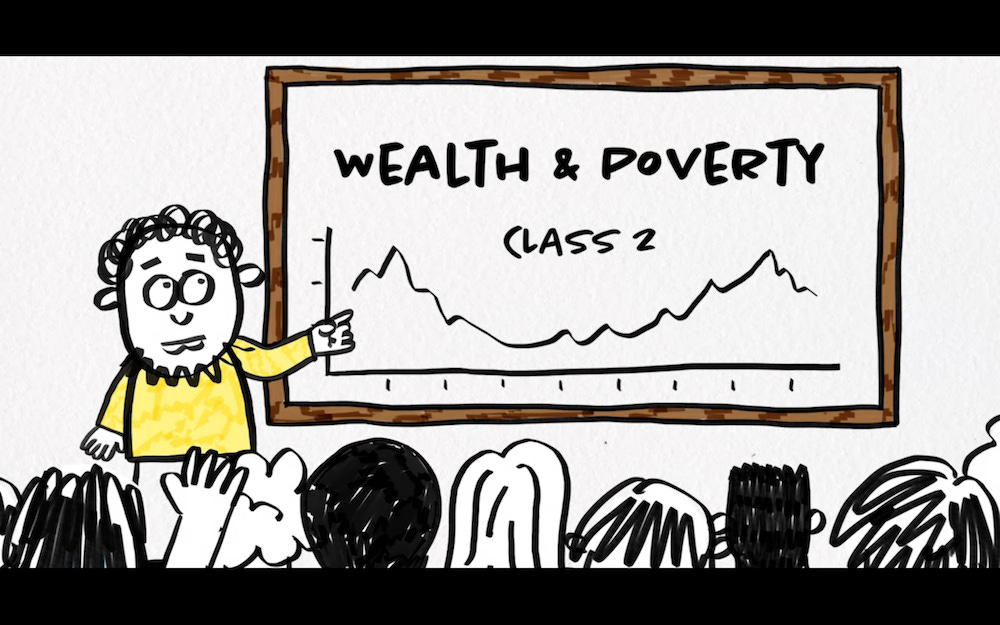
The Investor’s View - Wealth & Poverty Class 2
Hello again, friends. Thank you for joining me for the second week of my Wealth and Poverty class. In today’s class, we begin to explore why such inequalities have soared since the late 1970s and early 1980s. The questions we’ll focus on today are: How did the market for financial capital contribute to inequalities of income and wealth? Did the accepted purpose of the American corporation change over the last fifty years, and, if so, when and how? More generally, for whom should the corporation exist? Is there such a thing as “corporate social responsibility?” You’ll find recommended readings below the video. Just click on the links. Ready? Here we go. Please double-click the video box below. Thanks again for joining me! (And as always, let me know what you think in the comments below.) Click here for the Class 2 slides.Looking for another session? Click the link for: Class 1, Class 3, Class 4, Class 5, Class 6, Class 7, Class 8, Class 9, Class 10, Class 11, Class 12, Class 13, Class 14.P.S. If you’re enjoying this course and think your friends, family, colleagues, or social media networks would find it interesting and helpful as well, please share!Select Readings:* Bethany McLean, “Too Big to Fail, COVID-19 Edition: How Private Equity Is Winning the Coronavirus Crisis,” Vanity Fair, April 9, 2020* Andrew Winston, “Is the Business Roundtable Statement Just Empty Rhetoric?” Harvard Business Review, August 30, 2019* Neil Irwin, “To Understand Rising Inequality, Consider the Janitors at Two Top Companies, Then and Now,” The New York Times, Sept. 3, 2017If you’d like to help support our efforts, please consider a paid or gift subscription. This is a public episode. If you'd like to discuss this with other subscribers or get access to bonus episodes, visit robertreich.substack.com/subscribe
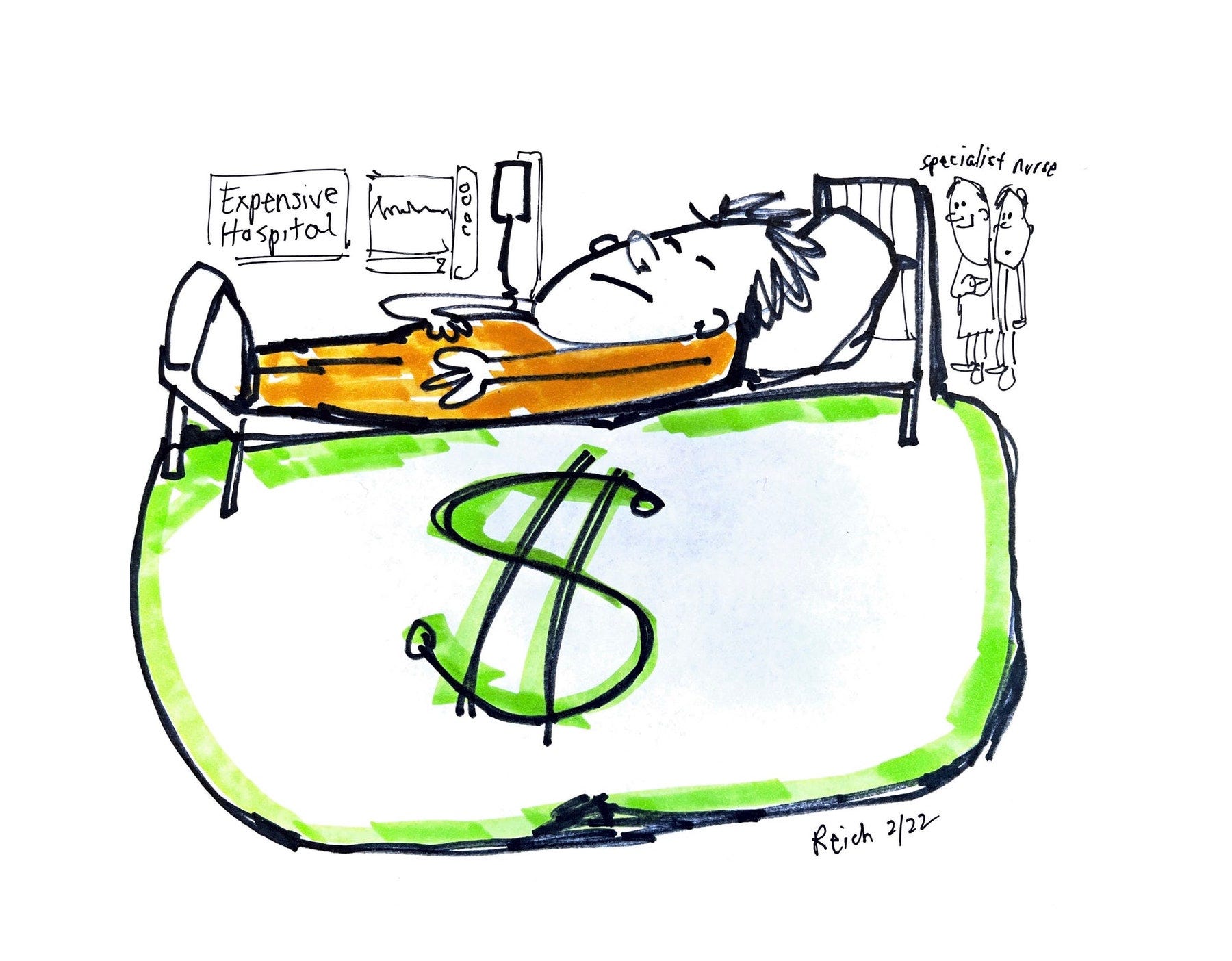
Could you possibly invent a more expensive and less effective healthcare system than what we have in the US?
For many years, my right ankle has been losing cartilage that keeps my ankle bones from scraping up against each other. The result: increasing inflammation and pain. An orthopedic surgeon suggested replacing the ankle with an artificial one, but the procedure is costly, takes months to heal, and requires lots of physical therapy. So I’ve taken a different route. I cut way back on sugar, began an exercise program aimed at strengthening the muscles around my ankle, and lost twenty pounds. Now, six months later, the ankle pain is almost gone. I share this with you because I’m testifying today before a House committee that’s considering the future of healthcare in America. The fact is, we have too many high-priced specialists who know how to do a few complicated and costly things such as replacing a bum ankle, and too few generalists who know enough about the whole body that they’re able to avoid the complicated and costly things. The big money is in the complicated things, so that’s where the talent goes and what hospitals aim for. And if you can pay for it, great. The complicated stuff is what America excels at. But we’re terrible at the uncomplicated things — not just my cutting back on sugar, exercising, and keeping the weight down, but making sure everyone gets regular checkups from general practitioners who are trained to prevent serious illnesses. The terrible tolls of diabetes, heart disease, and some cancers, for example, are preventable if caught in time. Even before the pandemic, the typical American family was spending more than $6,000 a year on health insurance premiums. Add in copayments and deductibles that doctors, hospitals, and drug companies also charge, and that sum rises to $6,400. Add in typical out-of-pocket expenses for pharmaceuticals, and it’s at least $6,800. That’s not all, because some of the taxes the typical family pays are for health insurance, too — for Medicare and Medicaid and the Affordable Care Act. Add them in, and the typical household pays $8,975 a year for health insurance. This number doesn’t include what typical workers’ employers spend on their health insurance – which might otherwise go to their wages. American spending on healthcare per person is more than twice the average in the world’s other thirty-five advanced nations. Yet the United States ranks near the bottom among advanced nations for life span and infant mortality. Americans are sicker, our lives are shorter, and we have more chronic illnesses. Canadians, for example, can expect to live on average almost four and a half years longer than Americans, even though health care spending per person is only about half as high as in the U.S.Healthcare is so expensive that many Americans put off seeing a doctor until their health has seriously deteriorated. Even with the Affordable Care Act, some 30 million Americans have no health insurance coverage at all. Not only do too many dollars go to super-specialists and too few to preventive generalists, but the administrative costs involved in private for-profit insurance are humongous. About a third of what the typical American pays for health insurance goes to the people who oversee billing and collections. And then of course there are marketing and advertising expenses, and the profits that go to shareholders or private-equity managers.Finally, if the pandemic taught us anything, it’s that we need to decouple health insurance from employment. Losing a job shouldn’t mean the loss of a family’s lifeline to healthcare. The Affordable Care Act was a good start at reform, but today I’m urging Congress*to replace private for-profit health insurance with Medicare for all. This would lead to far lower total costs — including premiums, co-payments, deductibles, and taxes — and it would cover all Americans. People could keep their same doctor or other health-care provider, and could buy private insurance to supplement it — just as some people now buy private insurance to supplement Medicare and Social Security. But as Medicare and Social Security have demonstrated, we shouldn’t need to pay private for-profit insurers boatloads of money to get the insurance we need.I have no illusions this will happen soon. But the road we’re now on is unsustainable — economically, politically, and socially. Eventually, we’re going to have some version of Medicare for All (and hats off to members of Congress who are leading the way, such as Representatives Pramila Jayapal, Debbie Dingel, and Ro Khanna). The question is how much unnecessary cost and hardship must we bear before we do?* The hearing was well-attended by members, and the conversation was thoughtful and intelligent. A few Republicans got into their age-old “socialism” rant, but I quietly pointed out that Social Security and Medicare — both hugely popular with the public — were also criticized by Republicans as being “socialist” when first proposed. ** I hope you’ll join me for tomorrow’s second class on Wealth and Poverty — right her
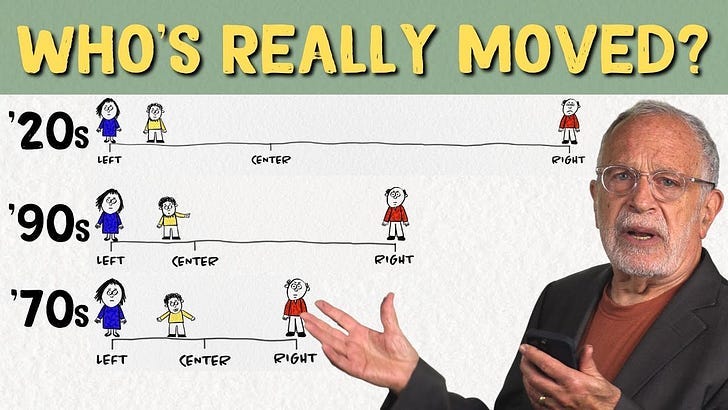
Office Hours: What does today's rightward extremism mean for the future of American politics?
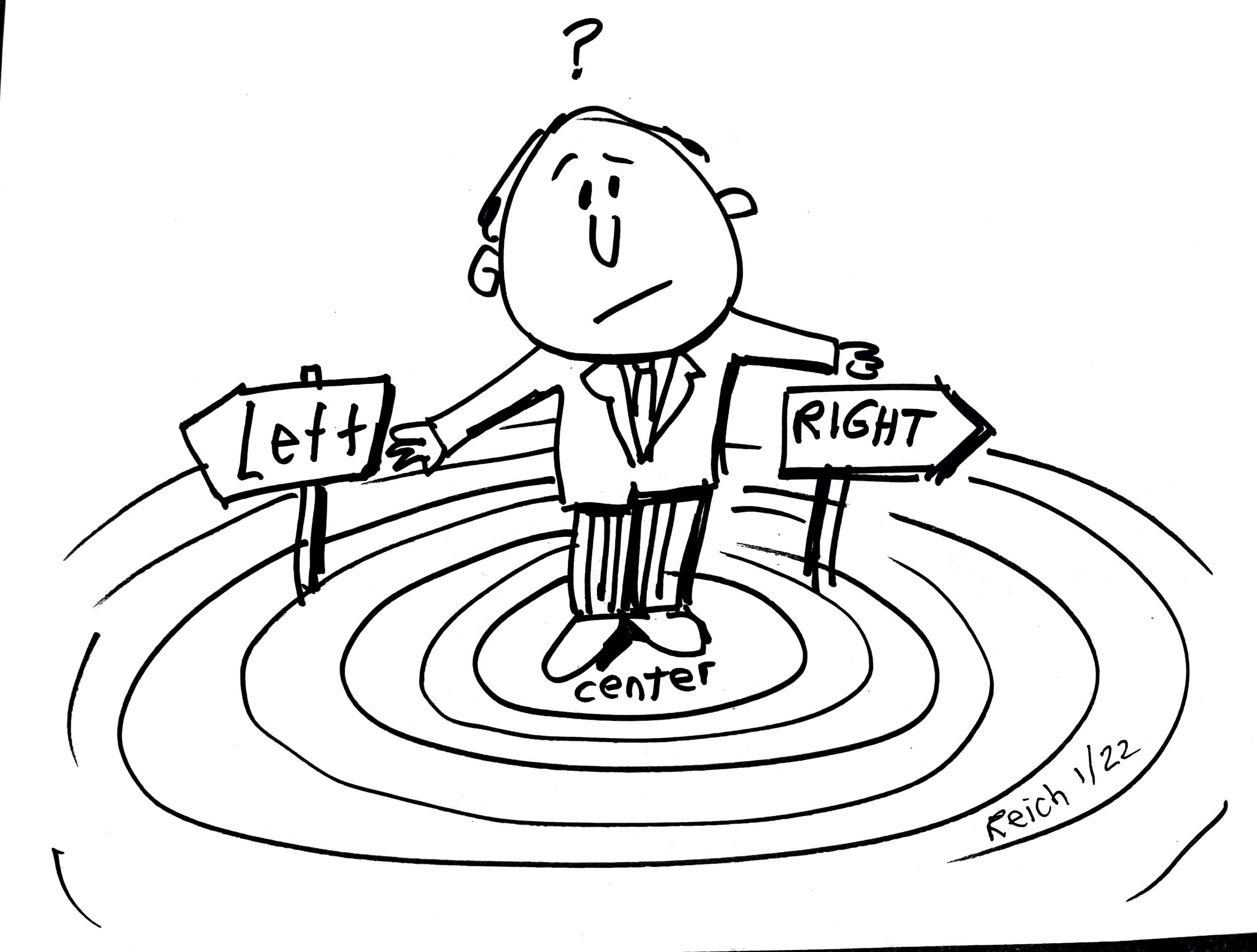
I got my start in American politics about 50 years ago. America was in many ways a different country then, but my political views weren’t all that different than they are now. I was against the Vietnam War and the military-industrial complex, pro civil and voting rights, and against the growing power of big corporations. That put me just left of the center. Today I’m much further left of center than I used to be — because the “center” has moved to the right and the right has become far far more extreme. So today’s Office Hours question: What does this trend mean for the future of American politics? What, if anything, can be done to reverse it? (I’ll chime in starting midday.)PS: Here’s a video I just did on this, with my talented colleagues at Inequality Media (special shoutout to Whittney Suggs for fabulous animation!). This is a public episode. If you'd like to discuss this with other subscribers or get access to bonus episodes, visit robertreich.substack.com/subscribe
Want to be inspired? Watch this
I mentioned yesterday that I’ve been inspired by the young Starbucks baristas who are leading the charge to unionize the company. The number of unionizing stores has risen to seventy-two since the fall. The weekly spate of new Starbucks election filings represents a breakthrough for labor.Starbucks executives are counterattacking. Last week, they fired seven Memphis baristas who had led the organizing in that city. I urge you to watch my interview with leaders of the Starbucks baristas (just double-click below).Starbucks baristas are part of a movement of food service workers across the nation. These workers have not only endured the pandemic (they’ve been deemed “essential” and suffered high rates of COVID) but also lousy pay and insecure work. A brief strike in Colorado last month by Kroger workers in Colorado revealed the scope of the problem. Kroger is the biggest supermarket chain in the United States and the fourth-largest employer in the Fortune 500. It owns more than 2,700 locations (its brands include Harris Teeter, Fred Meyer, Ralphs, Smith’s, Pick ’n Save and even Murray’s Cheese in New York City). Kroger’s business has boomed during the pandemic. Its stock has risen about 36 percent over the past year. Its CEO, Rodney McMullen, earned $22.4 million in 2020. But the median Kroger employee earned just $24,617 last year. That’s a CEO-to-worker ratio of 909 to 1 — one of the country’s starkest gaps between a CEO and typical employee. About 75 percent of Kroger employees report being food insecure, meaning they lack consistent access to enough food for a healthy life. About 14 percent report being homeless, now or within the last year. Over 62 percent say they do not earn enough money to pay basic monthly expenses. And their pay keeps dropping: Kroger’s top-paid grocery clerks today earn 22 percent less than they did in 1990 (adjusted for inflation). About two-thirds of all Kroger’s hourly employees work part-time, even though they want more hours. Yet more than half are given schedules that change at least every week, making it difficult for them to commit to another employer. As I noted last week, keeping workers part time is a strategy employers use to encourage turnover and reduce costs.Hopefully, the Starbucks’s baristas I interviewed — and others like them — will lead the way to better pay and working conditions for all food service workers, including Krogers. Food service workers and the giant corporations that employ them reveal the shambles of labor-management relations in America today, and the hypocrisy of so-called “corporate social responsibility.” This is a public episode. If you'd like to discuss this with other subscribers or get access to bonus episodes, visit robertreich.substack.com/subscribe

A valentine for you
When I began this newsletter almost five months ago I had no idea what I was doing. I still don’t. But your enthusiastic response, thoughtful comments, and helpful feedback have guided me — and continue to make it all worthwhile. It has been a journey into the unknown. We’re figuring it out together. A big thanks to you. I hope you’re finding my course on inequality (which began here last Friday, and will be continuing for the next 13 weeks) helpful. I hope you’re also finding useful (and sometimes entertaining) my short essays and drawings, as well as the videos I’m making with my talented colleagues at Inequality Media. A big thanks to them in addition for helping me bring this newsletter to you. I’m groping my way toward providing you with a larger context for what is happening in America and the world. Although faced with existential challenges of a deathly pandemic, climate change, widening inequality, systemic racism, and direct attacks on democracy, America is strangely immobilized. Why? Because for years most of the gains from our political-economic system have gone to the top. Almost everyone else is working harder, getting nowhere, and feeling less secure. This has generated widespread anger and cynicism — which has increased many peoples’ receptivity to conspiracy theories and demagogues. (A similar dynamic is playing out in much of the rest of the world.) In 2016, we elected a sociopath who spouted racist nationalism while giving the oligarchy whatever it wanted. Since then, the alliance of oligarchs and racist nationalists has continued. It appears to be growing. Oligarchic economics combined with racist nationalism is treacherous for democracy. Oligarchs support racist nationalism because it divides people and diverts attention from how much wealth and power the oligarchy is accumulating. Racist nationalists thrive on oligarchs who provide almost limitless funding.As early as 2012, more than 40 percent of all money spent in US federal elections came from the wealthiest of the wealthiest—not the top one percent or even the top tenth of the one percent, but from the top one percent of the one percent. Peter Thiel, a staunch Trump supporter whose net worth is estimated by Forbes to be $2.6 billion, has become one of the Republican’s Party’s largest donors. The oligarchs don’t just support Republicans, though. Last year, at least 13 billionaires who had previously donated to Trump lavished campaign donations on Democratic senators Joe Manchin and Kyrsten Sinema, according to an analysis of Federal Election Commission records. The alliance between oligarchic economics and racist nationalism marks the failure of progressive politics. When the people are no longer defended against the powerful, they look elsewhere. We must focus the national debate on this monumental and growing imbalance of power, and do whatever we can to rebalance it. I am hopeful we can. What gives me hope? The new activism among workers struggling to unionize, young progressives who are giving new energy and purpose to the Democratic Party, people of color who are leading the way to social justice, and the young people I meet almost every day — such as the young baristas who are organizing Starbucks — who are building new centers of economic power.Which brings me back to you. By becoming part of this community — subscribing to and sharing this newsletter and, offering your comments and feedback, and, if you can, supporting our work — you are part of this movement as well. Today seems like a good time to declare my appreciation for our partnership in this experiment. Thank you, and Happy Valentine’s Day This is a public episode. If you'd like to discuss this with other subscribers or get access to bonus episodes, visit robertreich.substack.com/subscribe
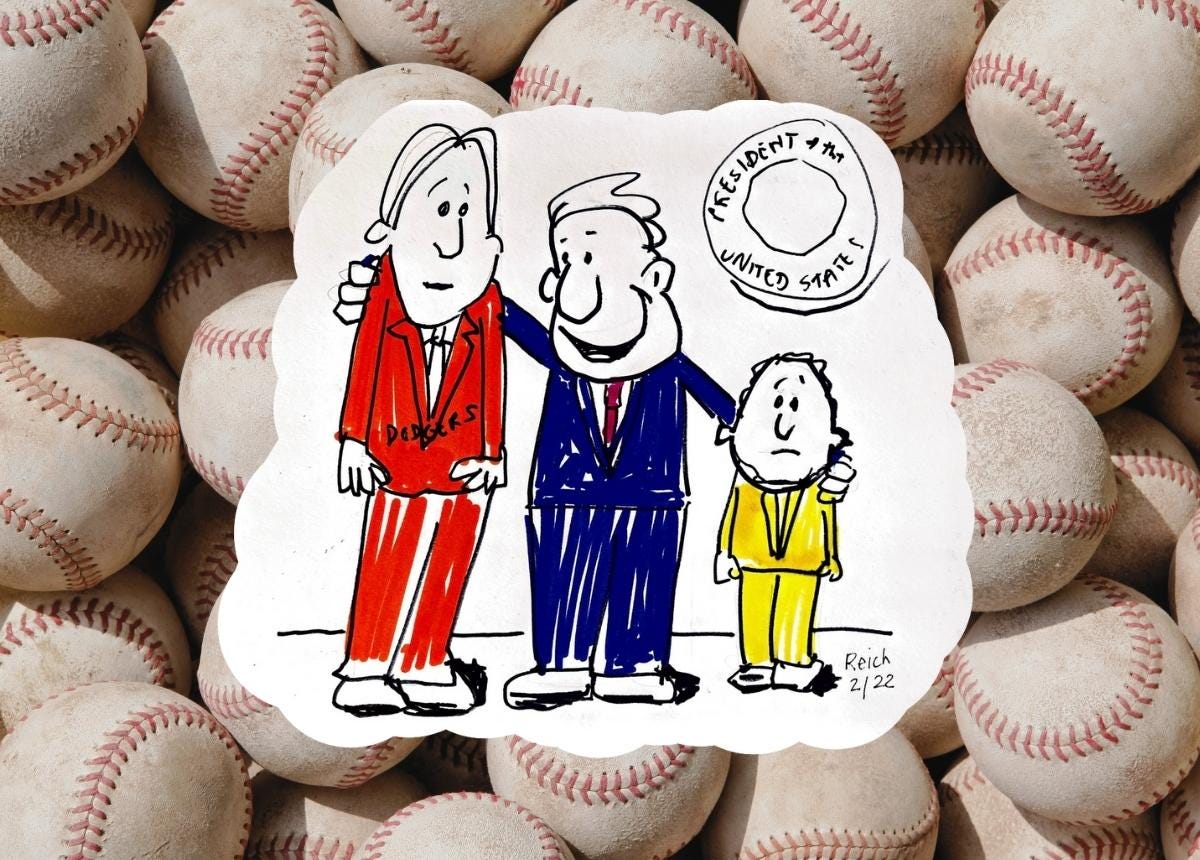
Personal History: Why Labor Secretary Marty Walsh should stay the hell away from baseball
Labor Secretary Marty Walsh says he’s ready to step up to the plate and help end Major League Baseball’s lockout. My advice to Marty, as former labor secretary to the current one: Stay away from baseball. I wouldn’t touch another baseball labor dispute if Babe Ruth asked me in person. In 1995, the owners and players were at loggerheads, too. I tried to mediate. Bill Clinton (on phone): “Bobby, this is Bill. How you doing on the strike?” Translated: What the hell’s going on? The World Series may be canceled for the first time in a century – and on my watch – unless you settle this thing soon.Me: “We’re doing a lot of talking. Players want free agency, owners want a salary cap. The only way to give players free agency and not have the stars all end up in the wealthiest clubs is for the big clubs to share some of their revenues with the smaller ones, maybe through a tax on team payrolls. Each side would have to give a bit. That’s what we’re working on now.” Translated: I’m getting nowhere.Bill was eager to get involved. He smelled a deal. He wanted to be savior of the national pastime. He had heard that the two sides were in Washington. “Why don’t we just call them over to the White House and see how far we can get?” he said. Hours later, Bill, Al Gore, and I were in the Roosevelt Room with Bud Selig, who represented the owners; Don Fehr, the players; and the other owners and players from the two bargaining committees. The owners were middle-aged, gray and corporate. The players were big, hulking young men who looked stiff and awkward in white shirts, ties, and jackets. All sat motionless around the giant mahogany table. Down the corridor and around the corner, the White House press room was crowded with reporters and cameras, anticipating a story about how the President settled the baseball strike.Al began ponderously. “As I understand it, the players don’t want their salaries to be capped, and the owners say a salary cap is the only way to keep the smaller teams competitive. Now, if the owners would agree to tax themselves so that the larger teams would subsidize the smaller teams, we’d be halfway home. And if the players would agree to some sort of ceiling on their individual contracts, that would get us the other half. S-o-o-o …” Gore seemed to be talking to five-year-olds. “The real question here is how far both sides are willing to come in order to strike a fair balance. Am I correct?”No answer. One of the young pitchers cleared his throat. “Mr. President, Mr. Vice President, I love baseball. We all love baseball. This isn’t really a dispute over money.” He looked intently around the table. “Hell, I’d be willing to play the game for $3 million a year if I get some respect.” I couldn’t repress a cough. After two hours, we were still nowhere. “Let’s take a break,” Bill said quietly. “Maybe if we just talk informally we can make some progress.”Bill was an eternal optimist, convinced that there was always a deal lying out there somewhere. It’s what made him a super-salesman: He was absolutely certain that every single person he met – Newt Gingrich, Yasir Arafat, whoever – wanted to find common ground. It was simply a matter of discovering where it was.If the owners would agree to binding arbitration, it would be over. But they wouldn’t budge. Bill and I went with Selig to another office. Bill sat down next to him on a couch, and commenced the move. Bill’s face was six inches away from Selig’s. Bill’s arm rested on the back of the couch behind Selig’s head so that his hand reached around to Selig’s other shoulder. It was full-intensity Bill Clinton. I was amazed Selig didn’t melt on the spot.“Look, Bud,” Bill purred in soft southern. “You guys can make millions. Millions. We’ll have a b-i-g sendoff for the season. I’ll help you. We’ll all help. I’ll get Dole to go to Kansas, Gingrich to Atlanta. I’ll have every major figure in America out there for the start. Can’t you just see it?” Bill sketched the vision in the air with his other hand. “This will be the biggest season opening ever in the history of the game. Now … all you need to do” – Bill’s voice became even softer, and he moved his face even closer to Selig’s –“is agree to have this thing arbitrated. It’s in your interest, Bud.” Bill paused and looked deeply into Selig’s eyes. “And it’s also in the interest of … America.”I thought I heard the National Anthem in the distance. The performance was spellbinding. Selig’s thin body seemed to be shaking. “Let … Let me just … just check with the other … other owners,” he said weakly. I helped him out of the couch. He could barely stand, poor man. He wandered out of the office, dazed.Bill shot me a grin. “I think we hit a homer.”The reporters down the hall were restive. I couldn’t help think there were more important things for the President and Vice President of the United States to be doing with their time than waiting for Bud Selig to return with his verdict. Surely something must be happening in China.But Bi
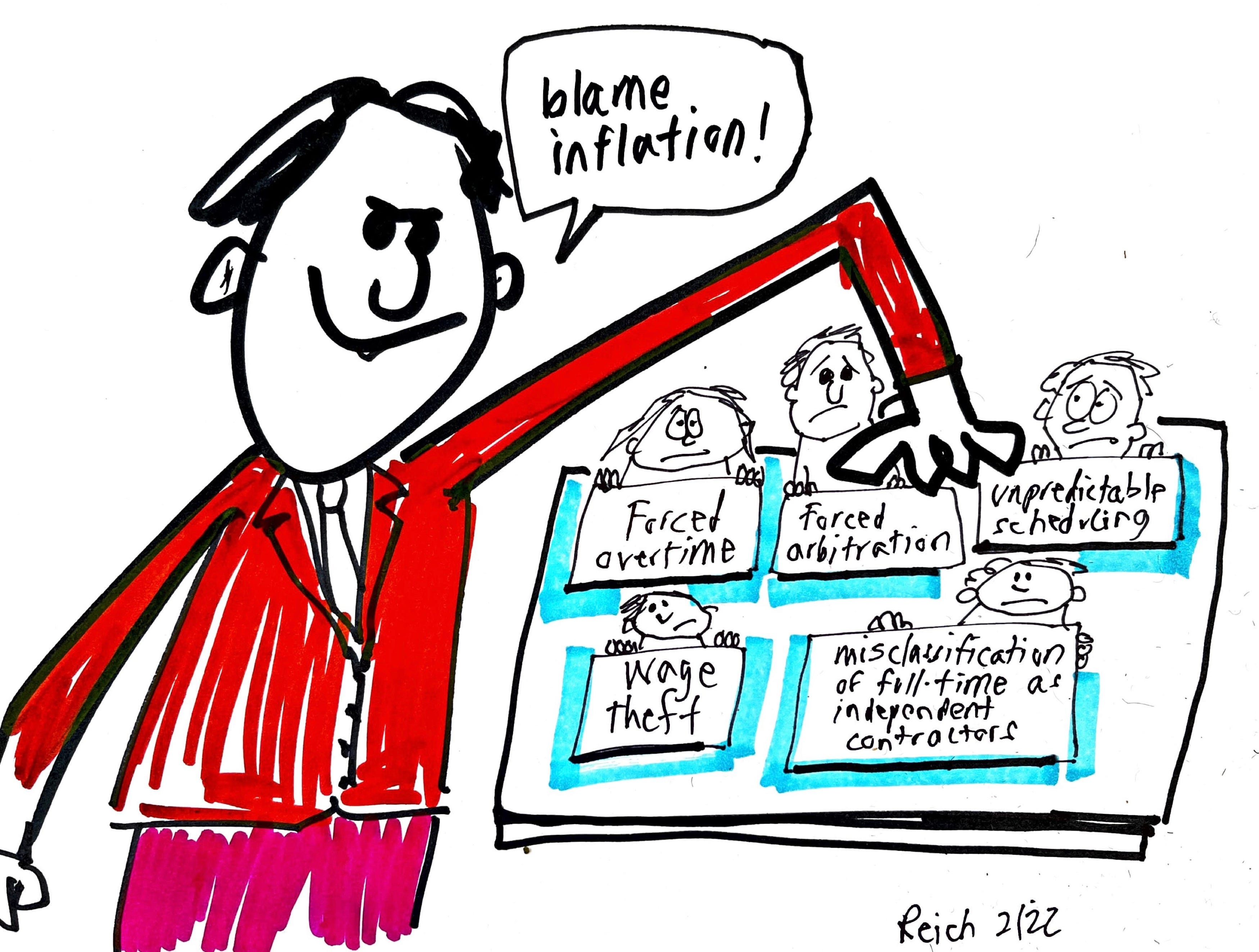
How do employers shaft workers? Let me count the ways.
More inflation buzz today. The U.S. consumer price index for January rose at an annual rate of 7.5 percent, the largest such increase since 1982.Yes, prices are increasing. But would you prefer a recession? As a practical matter, that’s the choice the Fed gives us. When the Fed puts on the brakes, it often pushes the economy into a ditch. (Anyone remember when Paul Volcker “broke the back of inflation” by putting the economy into a tailspin?) A recession will cause far more hardship for many more Americans than inflation is now causing. Want to control inflation? Don’t do it by drafting millions of workers into the inflation fight by slowing the economy — causing them to lose jobs and wages. Better to ride out the storm — prices will slow down as shortages are overcome (although don’t expect corporations to reverse their price hikes). Or there’s always stronger medicine — price controls, windfall profits taxes, and antitrust. Most importantly, focus on the real problems facing working Americans — the power imbalance that’s been keeping wages and working conditions down (adjusted for inflation) while pushing profits and stock prices up. Specifically, stop employers from using five tactics that are seriously harming working people. Three of them are legal but shouldn’t be. No other advanced nation allows its working people to be treated this way. 1. Forced overtime. Your employer can force you to work for more than 40 hours a week. If you refuse, you can be reprimanded, demoted, or even fired.Forced overtime is at the heart of the explosion of strikes in 2021. Workers at a Frito-Lay plant in Topeka, Kansas went on strike for nearly three weeks, demanding an end to 12-hour “suicide shifts,” forced 84-hour workweeks, and working conditions that have led to heart attacks, electrocution, and even death.How is this legal? Because federal overtime laws are wildly out of date. The Fair Labor Standards Act of 1938 established the 40-hour work week and that workers must be paid “time-and-a-half” for hours worked beyond 40 hours, but imposes no limit on the number of overtime hours -- unlike nearly every other industrialized nation.The term “forced overtime” should not exist. Congress must pass legislation that bars employers from forcing workers to work more than 40 hours a week.2. Forced arbitration. Under this often-hidden provision in employment contracts, you must waive your right to sue your employer or participate in a class action lawsuit against them. Employment disputes must be resolved by a private arbitrator — often chosen by the employer — rather than a judge or a jury in a court of law, and the outcome is not public. Forced arbitration means that workers cannot sue their employers for violating any of their labor rights, whether it be wage theft, discrimination, retaliation, or sexual harassment. You might not have any idea you’re agreeing to this because it’s buried in the fine print of your employment contract. Unsurprisingly, the practice overwhelmingly favors the employer. One study estimates that forced arbitration enabled employers to steal $12.6 billion from low-wage workers in 2019. As of 2019, forced arbitration affected 60 million workers. It’s particularly prevalent in low-wage jobs held by women and people of color.Congress must pass legislation banning forced arbitration in employment contracts.3. Unpredictable and unstable scheduling. Millions of American workers are subject to “just-in-time” scheduling, in which your employer changes your schedule with little or no advance notice. Over 40 percent of younger retail workers with hourly wages report receiving their schedules with one week or less notice.Unpredictable scheduling puts workers at the whim of their employer and prevents them from planning for childcare, attending school, or holding down a second job. It also causes high levels of stress. And it prevents millions of working families from gaining financial stability and building wealth.It’s time for Congress to enact a fair workweek law, requiring employers to send out schedules two weeks in advance or pay extra for last-minute changes.Add to these, two other tactics that are illegal but have become standard practice nonetheless. 4. Wage theft. Employers steal from you by working you off the clock, paying you below minimum wage, or not paying for overtime. A study of just three cities found that employers stole $3 billion in wages from low-wage workers in just a single year. On that basis, researchers estimate $50 billion is stolen from the country’s low-wage workforce every year. Many of them, as a result, have to rely on public assistance, meaning we all subsidize corporate theft.What can be done? Tougher labor laws, better enforcement, harsher penalties for employers, and stronger unions. The Protecting the Right to Organize Act (PRO Act), passed in the House in March 2021, contains all these. But like many important bills that have been passed during the last year in the House,
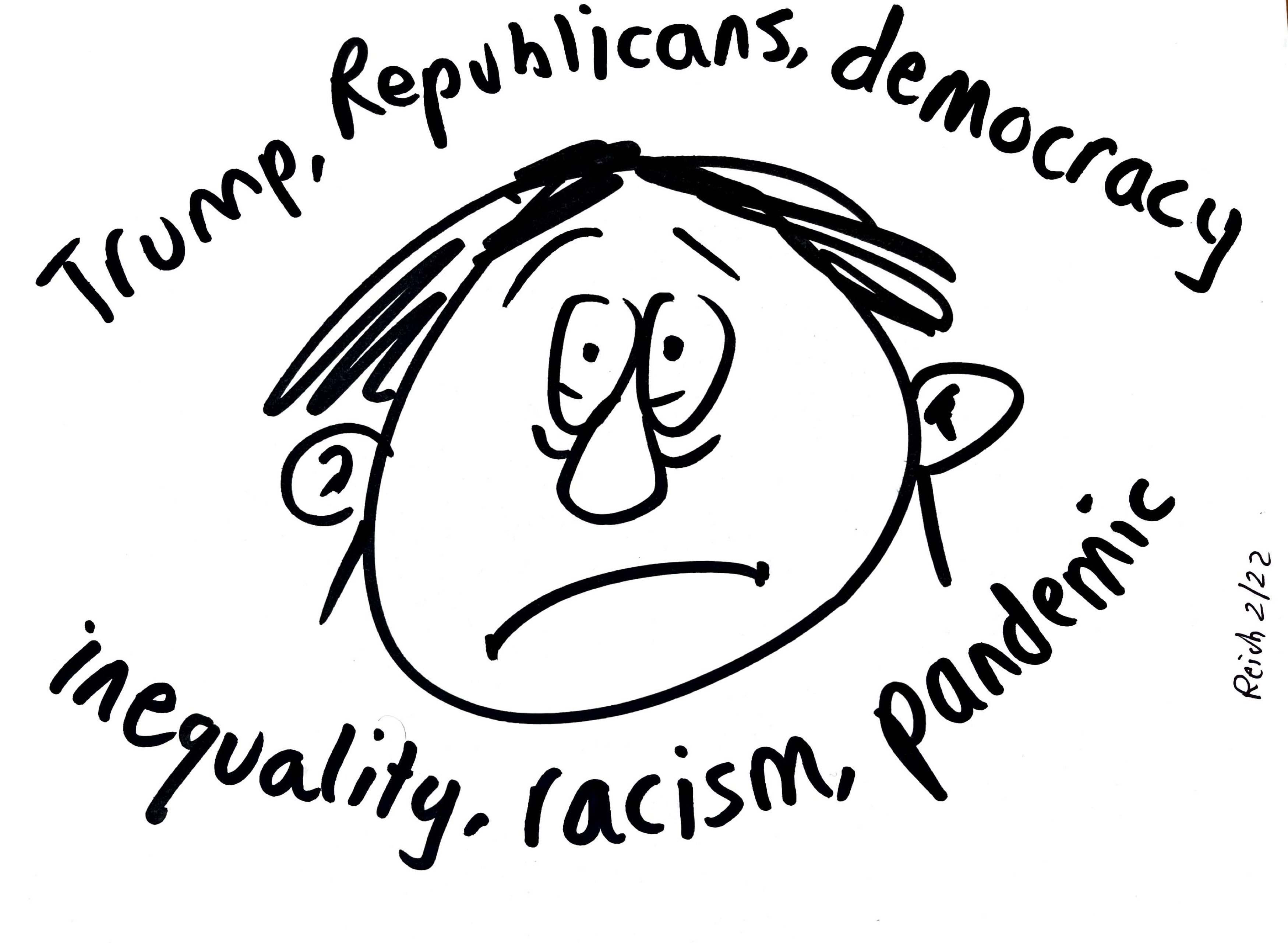
How can we be so publicly miserable and so privately happy?
Many people tell me America is going to hell. But when I ask them how their own lives are going, they say pretty well. This discrepancy between how people feel about America’s public life and their own private lives is wider today than it’s been since the late 1960s. Then, our public life was marked by assassinations, riots, an escalating war in Vietnam, and the deeply flawed Lyndon Johnson and Richard Nixon. But our private lives featured love-ins, Woodstock, and the Beatles. (I know; I was there.)The latest Gallup poll show that just 17 percent of Americans are satisfied with the way things are going in the country. That’s the lowest percent since Joe Biden became president – and it coincides with his lowest job approval rating, as well as a rock-bottom 18 percent congressional job approval, sagging economic confidence, and the expectation that inflation will rise in the coming months.But wait. At the same time we’re so down on America, our satisfaction with our own lives has ticked up to 85%. That’s just five points shy of the January 2020 record-high point. Take a look:Why such a huge gap between public and private now? It’s easy to understand why we’re so dissatisfied with the way things are going in America. The news from the mainstream media is unrelentingly bad — and those negatives are amplified by an angry, nasty (and often paranoid) social media. We’ve endured more than two years of a deathly pandemic, with all its accompanying confusions and fears. Inflation is high. Politics is meaner and more partisan. An astonishingly large portion of the country seems to have turned Trumpish. And last year’s high expectations for helpful measures from Biden and the Democrats have been dashed by Manchin, Sinema, and senate Republicans.But given this, how can we be so satisfied with the way things are going in our personal lives? Plenty of us remain hugely stressed – essential workers, parents of young kids who aren’t able to get childcare, poor people who can’t afford the rent, those of us who have gotten horribly sick or lost loved ones during the pandemic. Yet the pandemic has also allowed almost half of us to work from home, which has proven to be a huge boon -- giving us, on average, a full extra hour each day, far more flexibility in how we use our time, and escape the daily agonies of commuter traffic. While I’d rather teach in person, I far prefer to attend all tiresome meetings on Zoom rather than in bland conference rooms.We’re also spending less money on stuff, partly because we can’t afford it but also because we can’t get it Supply bottlenecks are forcing us to do without — and to simplify our lives as a result. My TV set is tiny by today’s standards, my car is a dozen years old, and my dryer doesn’t work half the time. But guess what? I can live without them. I’m exercising more, listening to more music, started to learn another language. We can’t socialize as much — but this has forced us to be choosier about whom to spend our time with, allowing us to deepen those relationships. My wife and I are doing more together, just the two of us. I’ve seen more of my close friends and less of people I merely feel obliged to see. We also worry less about clothing, haircuts, makeup, and other ways we present ourselves to the world — because we’re presenting less of ourselves and less often. Most days I look like a schlump. (To be honest, that’s always been the case.)We eat out less and eat in more, enabling some of us to discover the joys of home cooking – both eating and preparing. (I’d forgotten how delicious homemade chicken soup with fresh vegetables can be.) We’re spending less time visiting parents, children, and siblings who live far away, but we can keep up with them over Zoom (which in some ways has made life less complicated).This terrible period in public life, in other words, has also allowed more space for our personal lives. It’s enabled us to slow down, simplify, do without lots of stuff, deepen relationships, and create more room for ourselves. Which in turn has allowed many of us to ask ourselves — perhaps for the first time in many years, if ever — what we want from the rest of our lives, and maybe even decide to get off the track we’re on (just look at record quit rates).I’m aware that life is indubitably hard for many people. And I’m sick about what’s happening to America — about its widening inequalities, racism, and attacks on our democracy. I’m determined to keep fighting for social justice. But at the same time, I’m discovering an enjoyment in my own life that feels somehow deeper and more authentic than it’s ever been. I hope you are, too. This is a public episode. If you'd like to discuss this with other subscribers or get access to bonus episodes, visit robertreich.substack.com/subscribe
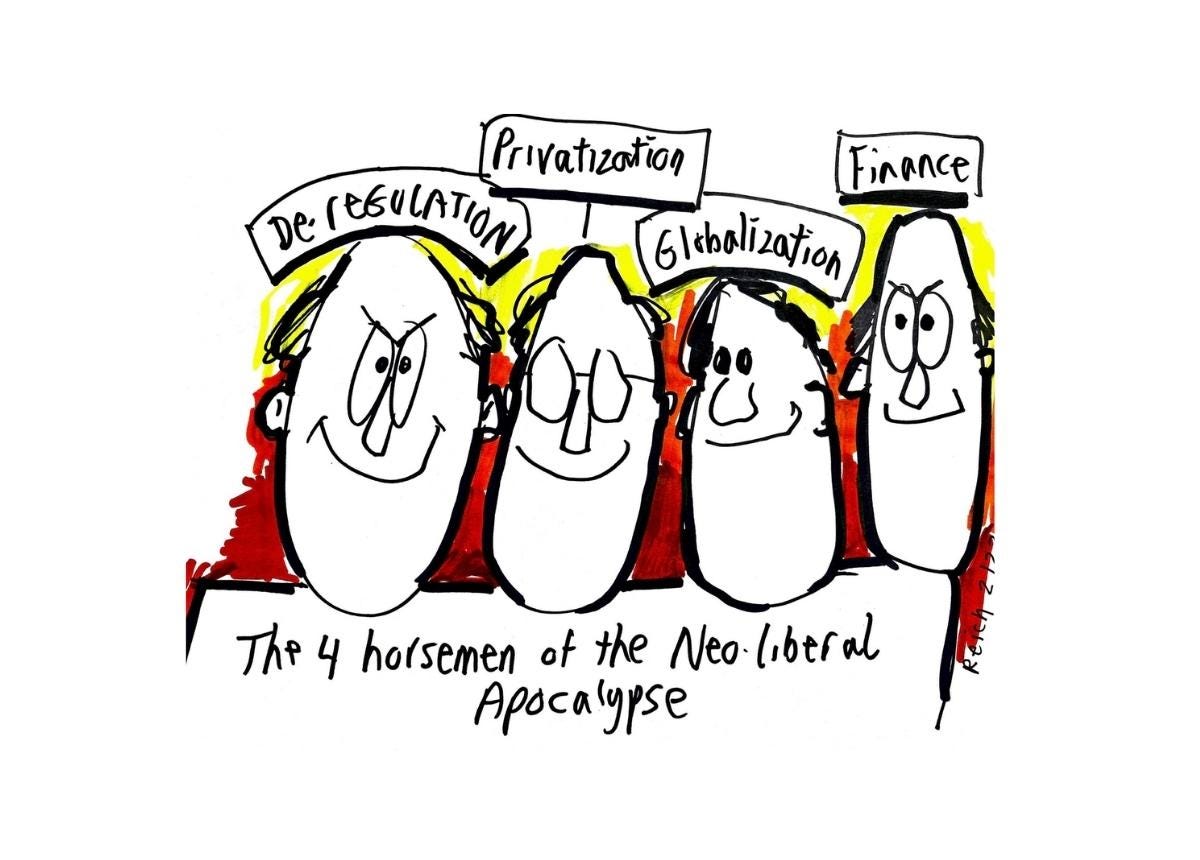
The Week Ahead: The Four Horsemen of the Neoliberal Apocalypse
The biggest stories this week are likely to be the continuing standoff between NATO (led by the United States) and Putin in the Ukraine, the new Russo-Chinese detente, and the Republican Party’s continuing drift toward Trumpism. One way of tying these together to reveal a larger pattern is to talk about the expanded Child Tax Credit. You heard me right. The fate of the expanded Child Tax Credit illustrates a basic problem that runs through all this. Let me explain. Even before the pandemic, more than one out of every six America children was impoverished, often without enough food or inadequate shelter. Meanwhile, the typical American family was living precariously from paycheck to paycheck. At the same time, a record high share of national wealth was already surging to the top.Starting last July, the nation did an experiment that might have limited these extremes. That’s when 36 million American families began receiving monthly payments of up to $3000 per child ($3,600 for each child under 6).Presto. Child poverty dropped by at least a third, and the typical family gained some breathing space. It’s rare for a government policy to work so unambiguously well, so quickly, on such a huge scale, and on so basic a problem.The experiment ended abruptly in December, notwithstanding. On Dec. 19, as you may recall, Senator Joe Manchin announced he would not vote for President Biden’s Build Back Better Act, which would have continued the monthly payments. He cited concerns over the ballooning federal budget, and offered to support a smaller version without the child subsidy. Not a single Republican senator would vote for it either, citing similar concerns. That, it seems, was the end. But obviously, the federal budget would not balloon if taxes were raised on the rich and on big corporations to pay for the child subsidy -- at a cost of an estimated $100 billion per year, or $1.6 trillion over ten years.That’s less than big corporations and the rich will have saved on taxes from the Trump Republican tax cut. Repeal it, and there’d be adequate money. It’s also less than the increase in the wealth of America’s 745 billionaires since the pandemic began. Why not a wealth tax?It’s also less than one-seventh of America’s bloated defense budget. Arguably, America would be stronger in future years if fewer American children are impoverished and the typical family more financially secure. The experiment died because, put simply, big corporations and the super-rich didn’t want to pay for it. Capitalism and democracy can co-exist as long as democracy is in the driver’s seat -- reducing the inequalities, insecurities, joblessness, and poverty that accompany unbridled profit-seeking.For the first three decades after World War II, democracy was in the driver’s seat. Both the US and war-ravaged Western Europe built the largest middle classes the world had ever seen, and the largest and most buoyant democracies. The arrangement was far from perfect, but with addition of civil rights and voting rights, subsidized health care (in the US, Medicare and Medicaid), and a huge expansion of public education, democracy was on the way to making capitalism work for the vast majority.Then came a giant U-turn, courtesy of Ronald Reagan in America and Margaret Thatcher in Europe. Deregulation, privatization, globalization, and the dominance of finance led to the Full Monty: abandoned factories and communities, stagnant wages, widening inequality, a shrinking middle class, political corruption, and threadbare social safety nets.The result? Widespread anger, frustration, and cynicism. Even before the pandemic, most people were working harder than ever but couldn’t get ahead, and their children’s prospects weren’t any better. The lion’s share of economic gains went to the top.As Americans went to the polls after eight years of President Obama, 75 percent said they were looking for a leader who would “take the country back from the rich and powerful.” Donald Trump campaigned as the voice of the working class but he delivered the country more fully into the hands of the rich and powerful by stoking racist nationalism. Racist nationalism marks the ultimate failure of progressive politics. When the people are no longer defended against the powerful, they look elsewhere. This was the direct legacy of forty years of deregulation, privatization, globalization, and the dominance of finance. It explains what happened in 2016 — and may happen again in the mid-term elections of 2022 and the presidential contest of 2024, unless Democrats and progressives overcome these regressive forces. As the United States seeks to confront China and Russia by presenting the choice as between democracy and autocracy, the rest of the world is skeptical. That’s because American democracy itself has succumbed to oligarchic money and racist-nationalist populism – a kinder and gentler form than China’s and Russia’s, to be sure, but differing only in degree.Trump openly envied Xi’s
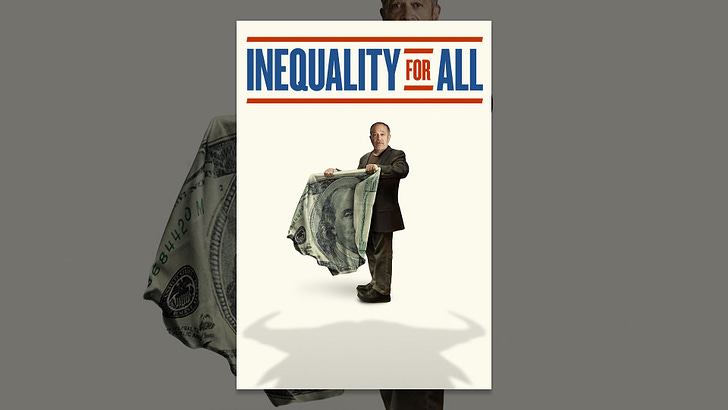
Caption contest resumes next Sunday. Today, background watching in preparation for "Wealth and Poverty" starting Friday
Thank you so much for joining me in this community. It’s an experiment in group learning and teaching about the American system — and it’s succeeding far beyond my expectations. Your interest and enthusiasm make it all worthwhile. Please let others know!In preparation for my course on Wealth and Poverty, which starts Friday on this page, you may find useful the documentary below. It’s called Inequality for All. I made it a few years ago with the talented director Jacob Kornbluth. It’s won many awards, and is used in college classrooms across America. As you’ll see, the doc begins and ends in an earlier version of the same course you’ll be taking starting Friday (although you’ll be taking it remotely). The doc runs 1 hour and 15 minutes. Think of it as pleasant homework. (Having trouble viewing the video on this page? Try clicking this direct link.) This is a public episode. If you'd like to discuss this with other subscribers or get access to bonus episodes, visit robertreich.substack.com/subscribe
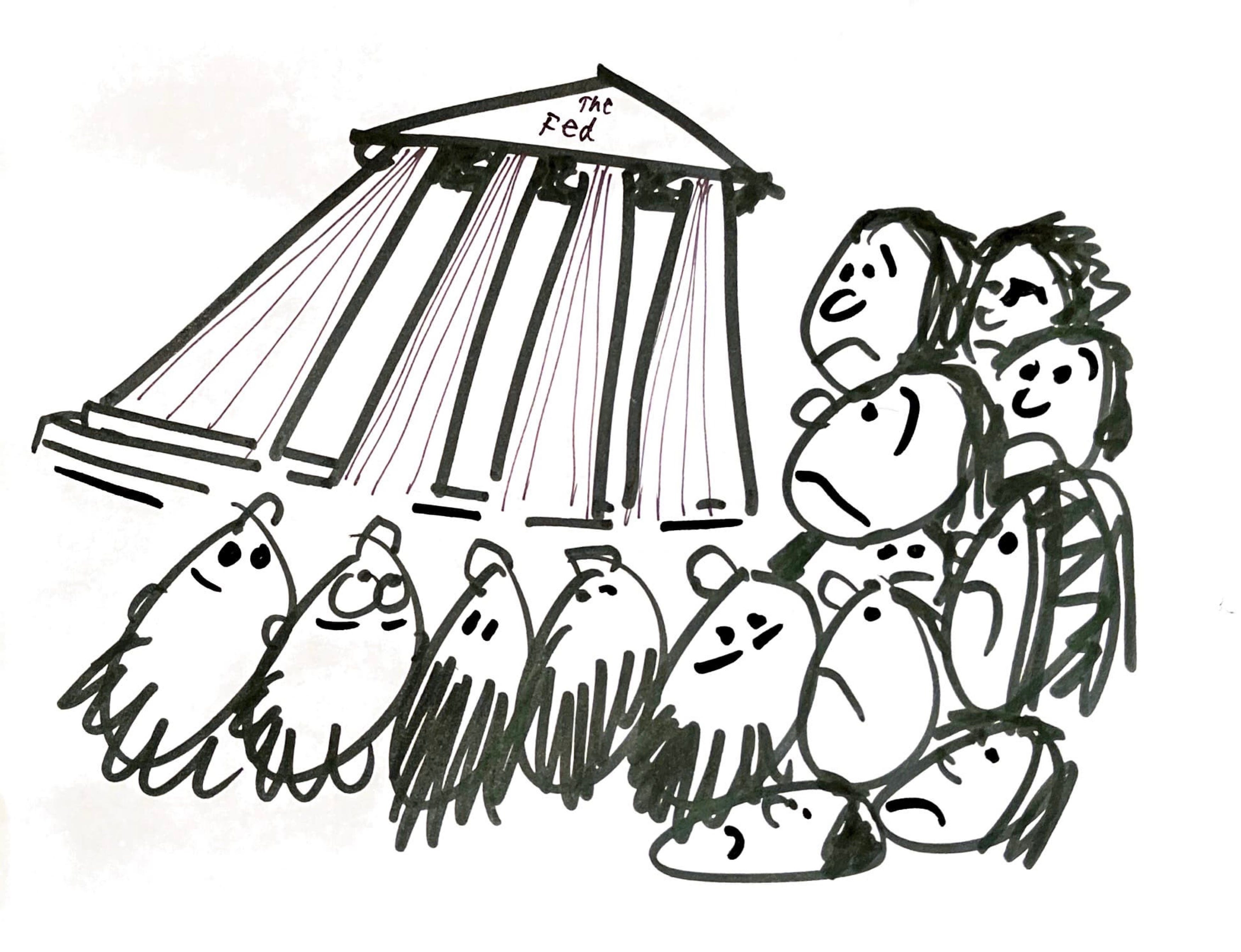
The Fed is about to shaft American workers
Today’s January jobs report is heightening fears that a so-called “tight” labor market is fueling inflation, and that therefore the Fed must put on the brakes by raising interest rates. This line of reasoning is totally wrong. Among the biggest job gains in January were workers who are normally temporary and paid low wages (eg, leisure and hospitality, retail, transport and warehousing). Employers cut fewer of these low-wage temp jobs than in most January’s because of rising customer demand combined with Omicron’s negative effect on worker availability. But due to the Bureau of Labor Statistics’s “seasonal adjustment,” cutting fewer workers than usual for this time of year appears as “adding lots of jobs.” Fed policymakers are set to raise interest rates at their March meeting and then continue raising them, in order to slow the economy. They fear that a labor shortage is pushing up wages, which in turn are pushing up prices — and that this wage-price spiral could get out of control. It’s a huge mistake. Higher interest rates will harm millions of workers who will be involuntarily drafted into the inflation fight by losing jobs or long-overdue pay raises. There’s no “labor shortage” pushing up wages. There’s a shortage of good jobs paying adequate wages to support working families. Raising interest rates will worsen this shortage. There’s no “wage-price spiral,” either (even though Fed chief Jerome Powell has expressed concern about wage hikes pushing up prices). To the contrary, workers’ real wages have dropped because of inflation. Even though overall wages have climbed, they’ve failed to keep up with price increases – making most workers worse off in terms of the purchasing power of their dollars.Wage-price spirals used to be a problem. Remember when John F. Kennedy “jawboned” steel executives and the United Steel Workers to keep a lid on wages and prices? But such spirals are no longer a problem. That’s because the typical worker today has little or no bargaining power. Only 6 percent of private-sector workers are now unionized. A half-century ago, more than a third were. Today, corporations can increase output by outsourcing just about anything anywhere because capital is global. A half-century ago, corporations needing more output had to bargain with their own workers to get it. These changes have shifted power from labor to capital — increasing the share of the economic pie going to profits and shrinking the share going to wages. This power shift ended wage-price spirals. Slowing the economy won’t remedy either of the two real causes of today’s inflation – continuing worldwide bottlenecks in the supply of goods, and the ease with which big corporations (with record profits) are passing these costs to customers in higher prices.Supply bottlenecks are all around us. (Just take a look at all the ships with billions of dollars of cargo idling outside the Ports of Los Angeles and Long Beach, through which 40 percent of all U.S. seaborne imports flow.) Big corporations have no incentive to absorb the rising costs of such supplies — even with profit margins at their highest level in 70 years. They have enough market power to pass these costs on to consumers, sometimes using inflation to justify even bigger price hikes. “A little bit of inflation is always good in our business,” the CEO of Kroger said last June. “What we are very good at is pricing,” the CEO of Colgate-Palmolive added in October.In fact, the Fed’s plan to slow the economy is the opposite of what’s needed now or in the foreseeable future. COVID is still with us. Even in its wake, we’ll be dealing with its damaging consequences for years — everything from long-term COVID, to school children months or years behind. Today’s jobs report shows that the U.S. economy is still 2.9 million jobs below what it had in February 2020. Given the growth of the US population, it’s 4.5 million short of what it would have by now had there been no pandemic. Consumers are almost tapped out. Not only are real (inflation-adjusted) incomes down, but pandemic assistance has ended. Extra jobless benefits are gone. Child tax credits have expired. Rent moratoriums are over. Small wonder consumer spending fell 0.6 percent in December, the first decrease since last February.Many people are understandably gloomy about the future. The University of Michigan consumer sentiment survey plummeted in January to its lowest level since late 2011, back when the economy was trying to recover from the global financial crisis. The Conference Board’s index of confidence also dropped in January.Given all this, the last thing average working people need is for the Fed to raise interest rates and slow the economy further. The problem most people face isn’t inflation. It’s a lack of good jobs. This is a public episode. If you'd like to discuss this with other subscribers or get access to bonus episodes, visit robertreich.substack.com/subscribe
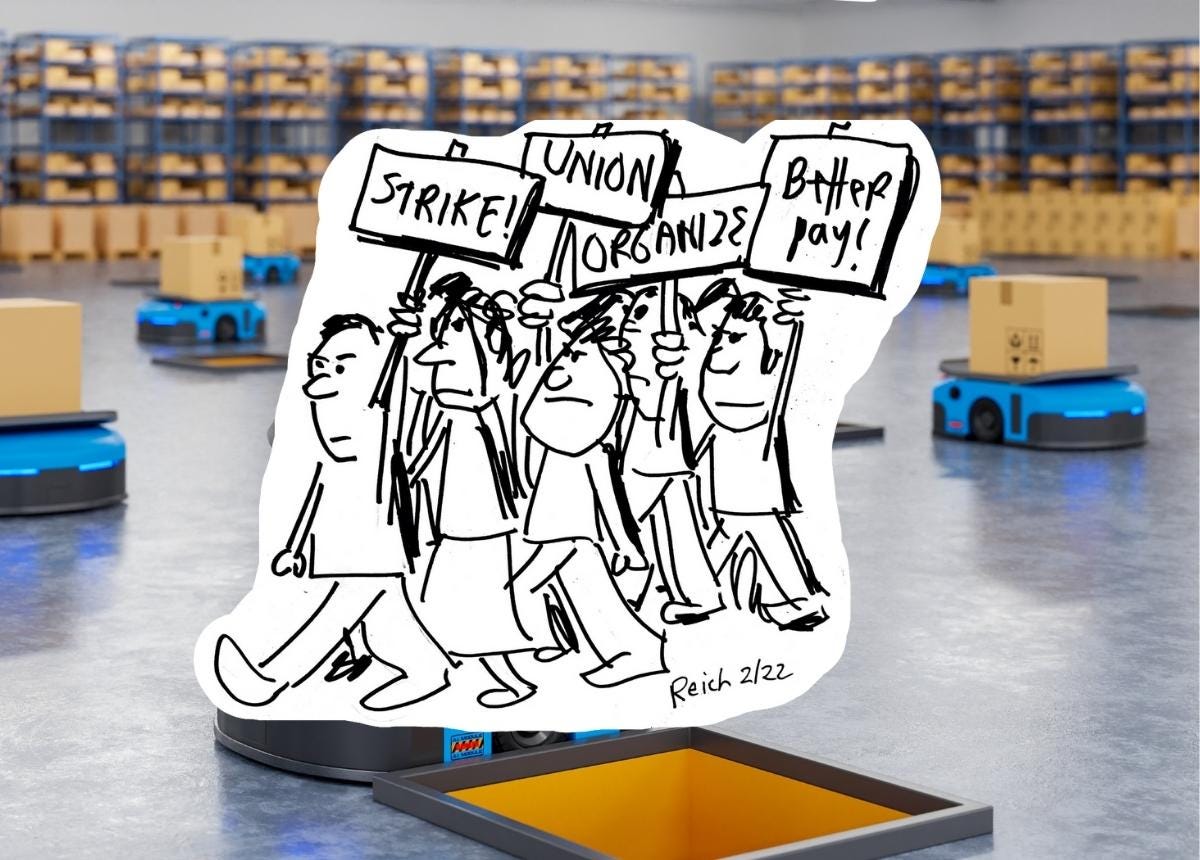
So you don't think labor unions have a future?
As former secretary of labor, I’m always interested in the annual count of unionized workers issued by the Bureau of Labor Statistics. This year’s count shows that the 70-year decline of unions continues. The share of unionized American workers dropped from 10.8 percent last year to 10.3 percent now. The rate among private-sector workers hit a new rock bottom of 6.1 percent — about one-seventh of its level in the middle of the 20th century.How to square this with the huge surge in labor activism that began last fall? From Alabama to the Midwest to California, workers have headed to the picket lines. 10,000 John Deere workers. Over 1,000 Alabama coal miners. New York City taxi drivers. Health care workers. Food production plant workers at multiple companies. Workers at media outlets, think tanks, museums, and universities. At worksites staffed predominantly by millennials and GenZ’s — among whom support for unions hovers near 80 percent — unionization is soaring (Starbucks baristas, graduate student workers, and so on).Oh, and public support for unions is at a 50-year high. The answer to this seeming paradox is found in the law. The 1935 National Labor Relations Act (NLRA) once ensured workers’ right to form unions and bargain collectively. But the Act has been steadily weakened by the 1947 Taft-Hartley Act, court decisions, Ronald Reagan’s repudiation of unions, and decades of inaction by Democratic politicians. Today, corporations typically intimidate and even fire workers seeking to unionize. These tactics are illegal under the NLRA, but companies don’t care because the penalties are small — at worst, rehiring and giving backpay to workers who have been fired, and allowing new elections. Many companies consider these little more than costs of doing business. (Consider last year’s failed organizing drive at Amazon’s Bessemer, Alabama warehouse, when the company intimidated its workers into rejecting the union.) Both Bill Clinton and Barack Obama promised they’d make it easier for workers to unionize by pushing legislation to increase penalties against employers who violate the Act and speed the process of forming unions. But neither followed through on those promises, even though both had Democratic congresses during their first two years in office. Why didn’t they follow through? I know because I spoke with each of them (and tried to get Clinton to support such legislation). They didn’t want to spend the political capital necessary to get the legislation through Congress. They also took union voters for granted. “Who else are they going to vote for?” I was told over and over again by political advisers to Clinton and Obama. This has proven to be a huge mistake. Unionized workers used to be the ground troops of the Democratic Party. And they made sure Democrats paid attention to the concerns of America’s working class — which is why we have a 40-hour workweek, unemployment insurance, a minimum wage, Medicare and Medicaid, and the Affordable Care Act. Now, much of the non-college working class votes Republican. These voters no longer believe Democratic politicians are on their side, and have succumbed to GOP-Fox News cultural and racial paranoia. At least Joe Biden made his promise to strengthen unions tangible by supporting the Protecting the Right to Organize Act (also known as the PRO Act). It passed in the House earlier this year. But — as with Build Back Bigger and voting rights — getting it through the Senate is impossible so long as the filibuster enables senate Republicans to block it (not surprisingly, all 50 Republicans oppose the PRO Act). In the meantime, I’m encouraged by recent actions of the National Labor Relations Board (which has the responsibility for enforcing the National Labor Relations Act). With its new Biden-appointed majority and its new Biden-appointed general counsel (Jennifer Abruzzo), the Board is flexing its muscles. Last week it accused Amazon of illegally surveilling and threatening workers who are trying to unionize a warehouse in Staten Island. (The Board has already ordered a new election at Amazon’s Bessemer warehouse.)The Board may require companies that violate workers’ rights during unionization campaigns to recognize those unions. It’s also considering whether companies that misclassify their workers as independent contractors violate the NLRA. (The number of misclassified workers who could unionize—potentially including the drivers at companies like Uber and Lyft—could be well into the millions.) Big corporations like Amazon and Starbucks will continue to do whatever possible to squelch worker power. And if any of these issues get to the Supreme Court you can expect its Republican majority to do the same. But America’s working people outnumber the billionaires and CEOs by a wide margin. If we stand in solidarity, it’s possible to reverse 40 years of stagnant wages, declining economic security, and widening inequality -- and build a more prosperous middle class where

How to get teenagers to read important books
When I was a young teenager near the middle of the last century, I asked the high school librarian if I could borrow J.D. Salinger’s The Catcher in the Rye. Why did I want to read it? she asked. I lied and told her my parents told me it was excellent literature.The real reason I wanted to read The Catcher in the Rye was it had been banned from the library. I knew the librarian kept one copy behind her desk, and I was determined to get it. She reluctantly handed it to me. I read it voraciously. There’s no better way to get a teenager to read a book than to ban it.Which is why it was so clever of the McMinn County, Tennessee, school board to vote to remove Maus from its eighth grade curriculum. Maus is a Pulitzer-winning graphic novel by Art Spiegelman that conveys the horrors of the Holocaust in cartoon form. The board cited “objectionable language” and nudity.Before the board made its decision, teenagers in McMinn County probably weren’t particularly eager to read about the Holocaust, even in the form of a graphic novel. But now that Maus has been banned for objectionable language and nudity, I bet they’re wildly trading whatever threadbare copies they can get their hands on. Since it was banned, half the teenagers in America seem to have bought Maus (or insisted their parents do). Two weeks ago, the book wasn’t even in the top 1,000 of Amazon’s bestseller list. Now it’s number 1.Way to go, McMinn County school board! Get teenagers all over America excited to read about the Holocaust!Even the McMinn County school board has been outdone by the Matanuska-Susitna school board in Palmer, Alaska, which clearly had a more serious problem on its hands than getting teenagers excited to read about the Holocaust. It couldn’t even get them to read the great novels of American literature. So the Matanuska-Susitna school board voted 5 to 2 to ban Invisible Man by Ralph Ellison, Catch-22 by Joseph Heller, The Things They Carried by Tim O’Brien, I Know Why the Caged Bird Sings by Maya Angelou, and The Great Gatsby by F. Scott Fitzgerald.Brilliant! I bet nearly every teenager in Palmer, Alaska is now deep into these books. They’re probably having intense discussions about them online late at night, away from their parents and other snooping adults. “Why do you think Ellison called himself ‘invisible?’” “How did Angelou come up with those amazing metaphors?” “Why did Daisy Buchanan reject Jay Gatsby?” “Wait! Shhh! Gotta go! My parents are right outside my room! Call back in 20 minutes!”The Great Gatsby was required reading when I went to high school. I admit I never read it. Had it been banned, I probably would have devoured it. Beginning last fall, at least 16 school districts in a half-dozen states have demanded school libraries ban Out of Darkness. It’s a young adult novel about a love affair between two teenagers, a Mexican American girl and Black boy, set against the backdrop of the 1937 natural gas explosion at a New London, Texas plant that claimed nearly 300 lives. The book received lots of favorable reviews and literary rewards, but only a handful of teenagers read before it was banned. Now, it’s hot.It’s the cleverest marketing strategy I’ve ever seen. Publishers must be clamoring to have school districts ban their books. (Why haven’t my books been banned, dammit?)An influential group called “No Left Turn” is partly responsible. Just take a look at their website of books “used to spread radical and racist ideologies to students.” You can bet teenagers across America are now lining up to read them. This is a public episode. If you'd like to discuss this with other subscribers or get access to bonus episodes, visit robertreich.substack.com/subscribe

Midterm Watch: Why Trump and Gingrich offer the best hope for Democrats
The midterm elections are just over nine months away. What will Democrats run on? What will Republicans run on? One hint came at a Houston-area Trump rally Saturday night. “If I run and if I win,” the former guy said, referring to 2024, “we will treat those people from January 6th fairly.” He then added, “and if it requires pardons, we will give them pardons, because they are being treated so unfairly.” Trump went on to demand "the biggest protest we have ever had" if federal prosecutors in Washington or in New York and Atlanta, where cases against him are moving forward, "do anything wrong or illegal." He then called the federal prosecutors “vicious, horrible people” who are “not after me, they're after you." Trump’s hint of pardons for those who attacked the Capitol could affect the criminal prosecution of hundreds now facing conspiracy, obstruction and assault charges, which carry sentences that could put them away for years. If they think Trump will pardon them, they might be less willing to negotiate with prosecutors and accept plea deals. His comments could also be interpreted as a call for violence if various legal cases against him lead to indictments.But if Trump keeps at it — and of course he will —he’ll help the Democrats in the upcoming midterm elections by reminding the public of the attempted coup he and his Republican co-conspirators tried to pull off between the 2020 election and January 6. That would make the midterm election less of a referendum on Biden than on the Republican Party. (Don’t get me wrong. I think Biden is doing a good job, given the hand he was dealt. But Republicans are doing an even better job battering him — as his sinking poll numbers show.)Last week, Newt Gingrich, who served as House Speaker from 1995 to 1999, suggested that members of the House select committee investigating the January 6, 2021 attack on the Capitol should face jail time if the GOP returns to power. "The wolves are gonna find out that they're now sheep, and they're the ones who—in fact, I think—face a real risk of jail for the kind of laws they're breaking," Gingrich said on Fox News. Gingrich’s remark prompted Representative Liz Cheney, Wyoming Republican and vice-chair of the select committee, to respond: "A former Speaker of the House is threatening jail time for members of Congress who are investigating the violent January 6 attack on our Capitol and our Constitution. This is what it looks like when the rule of law unravels."Trump and Gingrich are complicating the midterm elections prospects for all Republicans running or seeking reelection nine months from now. Many Republican leaders believe they don’t need to offer the public any agenda for the midterms because of widespread frustration with Biden and the Democrats. Senate Minority Leader Mitch McConnell, recently asked what the Republican party’s agenda would be if it recaptured Congress, quipped “I’ll let you know when we take it back.”But if Republicans fail to offer an agenda, the Republican party’s midterm message is even more likely to be defined by Trump and Trumpers like Gingrich: the big lie that the 2020 election was stolen along with promises to pardon the January 6 defendants, jail members of the select committee investigating the attack on the Capitol, and other bonkers claims and promises. This would spell trouble for the GOP because most Americans don’t believe the big lie and remain appalled by the attack on the Capitol.House minority leader Kevin McCarthy (who phoned Trump during the attack on the Capitol but refuses to cooperate with the House’s January 6 committee investigation) will have a major role in defining the Republican message for the midterms. And whom has McCarthy been consulting with? None other than Newt Gingrich. The two have been friends for years and McCarthy's current chief of staff in his leadership office, Dan Meyer, served in the same role for Gingrich when he was the speaker. McCarthy knows Gingrich is a master huckster. After all, in 1994 Gingrich delivered a House majority for the Republicans for the first time in 40 years by promising a “contract with America” that amounted to little more than trickle-down economics and state’s rights.But like most hucksters, Gingrich suffered a spectacular fall. In 1997 House members overwhelmingly voted to reprimand him for flouting federal tax laws and misleading congressional investigators about it — making him the first speaker panned for unethical behavior. The disgraced leader, who admitted to the ethical lapse as part of a deal to quash inquiries into other suspect activities, also had to pay a historic $300,000 penalty. Then, following a surprise loss of Republican House seats in the 1998 midterm election, Gingrich stepped down as speaker. He resigned from Congress in January 1999 and hasn't held elected office since. I’ve talked with Gingrich several times since then. I always come away with the impression of a military general in an age where bombast and ex
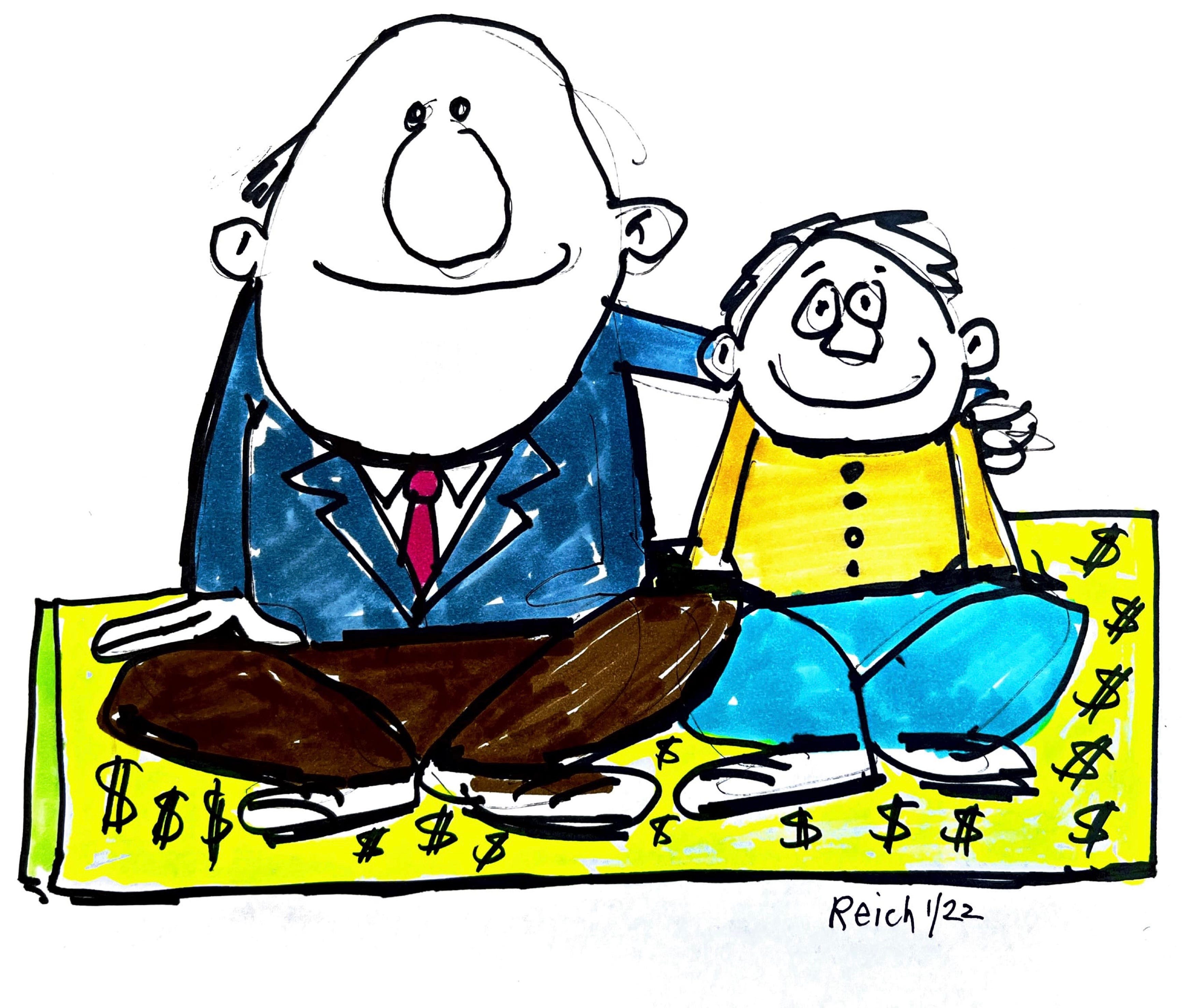
Share the profits!
In light of the news this week that the economy has been growing at a record rate (and corporate profits are also hitting record highs, the stock market notwithstanding), several of you have asked me specifically what can be done to spread the benefits of economic growth. I have a few ideas, which I’ll share with you in coming weeks. One idea is an old one that was tried with great success but is now all but forgotten. It’s called profit-sharing. It emerged from the tumultuous period when America shifted from farm to factory. In 1916, Sears, Roebuck and Co., then one of America’s largest corporations with over 30,000 employees, announced that it was embarking on a major experiment — profit-sharing. The firm gave workers shares of stock, making them part owners. Shortly thereafter, the Bureau of Labor Statistics issued a report on profit-sharing, suggesting it as a way to reduce the “frequent and often violent disputes” between employers and workers. Profit-sharing gave workers an incentive to be more productive since the success of the company meant higher profits would be shared. It also reduced the need for layoffs during recessions because payroll costs dropped as profits did. Profit-sharing proved a huge success. Other companies that joined the profit-sharing movement included Procter & Gamble, Pillsbury, Kodak, and U.S. Steel.By the 1950s, Sears workers had accumulated enough stock that they owned a quarter of the company. And by 1968, the typical Sears salesperson could retire with a nest egg worth well over $1 million (in today’s dollars). There was a downside. When profits went down, workers’ paychecks would shrink. And if a company went bankrupt, workers would lose all their investments in it. The best profit-sharing plans have been in the form of cash bonuses that employees can invest however they wish, on top of predictable wages. At Lincoln Electric, for instance, which has had profit-sharing since 1934, employees receive a profit-sharing cash bonus worth, on average, 40 percent of their annual base earnings.But profit-sharing with employees has all but disappeared in large corporations, which since the start of the 1980s — and the advent of corporate “raiders” (now private-equity managers) — have focused on maximizing shareholder returns. Sears phased out its profit-sharing plan in the 1970s (and filed for bankruptcy protection in 2018). Yet profit-sharing with top executives has soared — as big Wall Street banks, hedge funds, private-equity funds, and high-tech companies have doled out huge amounts of stock and stock options to their MVPs.The result? Share prices have gone into the stratosphere while wages have barely risen. Researchers have found that increases in share prices before the late 1980s could be accounted for by overall economic growth. Since then, a large portion of the dramatic increases in share prices have come out of what used to go into wages. Jeff Bezos, who now owns around 10 percent of Amazon’s shares of stock, is worth $210 billion overall. Other top Amazon executives hold hundreds of millions of dollars of Amazon shares. But most of Amazon’s employees, such as warehouse workers, haven’t shared in the bounty.Amazon used to give out stock to hundreds of thousands of its employees. But in 2018 it stopped doing so, and instead raised its minimum hourly wage to $15. The wage raise got headlines and was good PR, but Amazon’s decision to end stock awards was more significant. If Amazon’s 1.2 million employees together owned the same proportion of Amazon’s stock as Sears workers did in the 1950s — a quarter of the company — each Amazon employee would now own shares worth an average of over $350,000.America’s trend toward higher profits, higher share prices, mounting executive pay, but near stagnant wages is unsustainable, economically and politically. How to encourage profit sharing? Corporate taxes should be lower on corporations that share profits with all their workers, and higher on those that don't. Sharing profits with all workers is a logical and necessary step to making the system work for the many, not the few.What do you think? This is a public episode. If you'd like to discuss this with other subscribers or get access to bonus episodes, visit robertreich.substack.com/subscribe
Psst: Want to know why Americans are gloomy about the "best" economy since 1984?
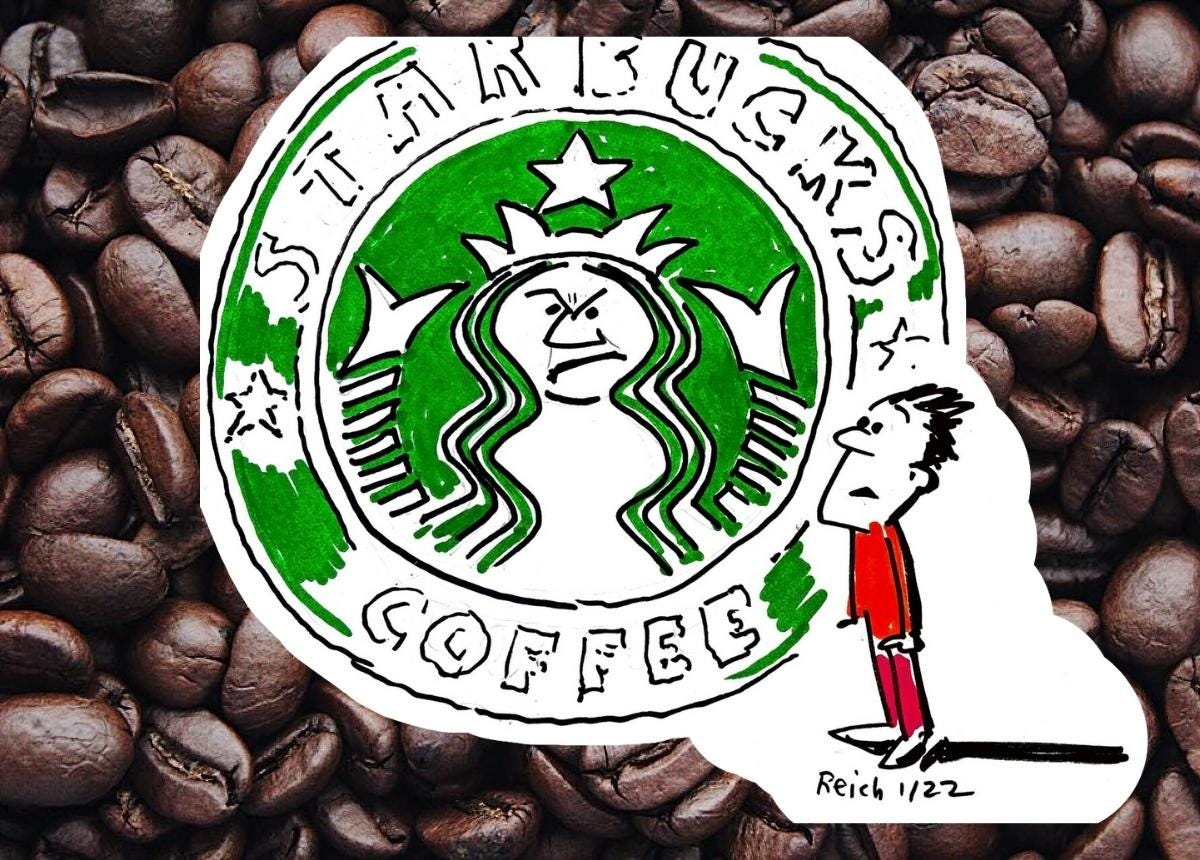
How can it be that the U.S. economy grew at its fastest pace since 1984 last year (according to yesterday’s report from the Commerce Department) but most Americans remain gloomy about the economy, and blame Biden and the Democrats? The New York Times declares that the cause of this paradox is inflation: “Biden is suffering in the polls as high inflation saps confidence in the economy, even as growth comes in strong.”Rubbish. Americans are gloomy about the economy despite its record growth because most Americans haven’t shared in that growth. If you really want to understand this, a good place to begin is with the corporation often considered the most socially responsible in the nation — Starbucks. (A Pew survey on where Americans would like to live included the following question: “Just for fun: Would you prefer to live in a place with more McDonald’s or more Starbucks?” Among self-described liberals, Starbucks carried the day, 46 percent to 33 percent. And while McDonald’s won among adults 65 and above, Starbucks had a 13-percentage-point edge among 18-to-29-year-olds.)But in fact, Starbucks isn’t socially responsible. Its brand is built on an edifice of faux social responsibility. Starbucks is the nation’s first major retailer to backtrack on vaccine-or-test plans for its workers, since the Supreme Court’s absurd January 13 ruling that struck down the Biden administration’s vaccine-or-test requirement. Starbucks is now telling its 200,000 U.S. employees they no longer have to be fully vaccinated or submit to weekly coronavirus testing. Starbucks calls its workers “partners” — but they’re not real partners. They don’t share in the profits. Between January and September of last year, Starbuck’s revenue soared to $20.9 billion (compared to $17.3 billion in the same period in 2020). Its president and chief executive officer, Kevin Johnson, raked in $14,665,575 in total compensation. But the current average hourly pay at Starbucks is $14 and hour, or $28,000 a year. And Starbucks wants to keep wages in the basement. For years it’s fought ferociously against employee efforts to unionize. Social responsibility my macchiato. Now zoom out to the economy as a whole. Could it be that Americans are gloomy despite the economy’s record growth because the super-rich are taking home an ever-larger share of those gains while most people are getting the crumbs? Is it possible they blame Biden and the Democrats for promising to change this but, after a good start, not delivering?Starbuck’s progressive branding has helped it sell lots of coffee. Yet Starbucks faces a growing dilemma — not unlike the dilemma facing Biden and the Democrats. Starbucks’s young, progressive baristas are no longer willing to tolerate Starbucks’s hypocrisy. Since two Starbucks stores voted to unionize in late August, workers in dozens of other Starbucks stores across the country have filed petitions for elections. Starbucks can’t have it both ways — promoting itself as the face of socially-responsible capitalism while treating its workers like s**t. Biden and the Democrats may be facing a similar paradox — promising a fundamental change in the power structure of America while allowing big corporations and the super-rich to continue enlarging their wealth and power. Biden and the Democrats can’t have it both ways, either. Perhaps it was too much to expect Biden and the Dems to alter a trend that’s been growing for four decades as large corporations have steadily gained bargaining power (a handful of big firms now dominate most industries), while hourly wage earners have steadily lost it (the share of private-sector workers in unions has plummeted from over 30 percent to 6.1 percent). This power shift is directly reflected in the increasing share of economic gains going to the top, and decreasing share to everyone else. But it’s important for Biden and the Democrats to avoid the trap of Starbucks-like hypocrisy. Biden and the Dems need to tell the truth about what’s happening: American workers are not losing ground due to inflation. They are losing ground because they continue to lose bargaining power. The economy grew mightily over the past year but the share going to most American workers continues to shrink. Starbucks’s workers have had enough corporate hypocrisy. They’re beginning to take power back by organizing at the grass roots. Will most Americans become so fed up with their declining share of the economy’s gains that they too decide to take power back? This is a public episode. If you'd like to discuss this with other subscribers or get access to bonus episodes, visit robertreich.substack.com/subscribe
The "political center" b******t
I just heard Joe Manchin say Biden should move to the “center.” Political consultant Mark Penn wrote in the New York Times that “Biden should follow the lead of Bill Clinton, and move to the center.” Duh. Who wants to be on the fringe? Political careers are imperiled by labels like “left-winger” (or “right-winger”). The public feels safer with a president who proclaims total commitment to the middle. FDR always sought to position himself as a centrist. So did Nixon (remember the “silent majority?”). Barry Goldwater’s “extremism in defense of liberty” helped cost him the White House. But this is just positioning. Visionary leaders of America have always understood that the “center” is a fictitious place lying somewhere south of thoughtless adherence to the status quo. Virtually any attempt to lead — to summon forth the energies and commitments of public — will not “centrist” be at the time. That’s the essence of leadership. Teddy Roosevelt didn’t discover the evils of industrial concentration at the political center. FDR didn’t knit a safety net for the poor and dispossessed, or take the nation into the Second World War, from the center. Kennedy and Johnson didn’t locate the cause of civil rights at the center. Nixon didn’t find support for recognizing China in the center. Nor even did Reagan find his mandate for a smaller government at the center. Leadership, by definition, does not cater to the center. If it did, there would be no need to lead. The nation is already there.A president will exert some influence on where the “center” is at any given time simply by virtue of the office and the pulpit that comes with it. If a president moves rightward in an attempt to be at the “center,” the center shifts even further to the right. When Bill Clinton succumbed to pressure from the right to seek a balanced budget, the debate over whether to balance the budget was silenced. The debate shifted to whether to balance it quickly or gradually. The new “center” moved to the right — seeking a reasonably quick balance. There’s much talk in Democratic circles these days about so-called “swing” voters in the upcoming midterms. Where is this elusive voter to be found? Where else? At the center. Not in the traditional “Democratic base,” which is assumed to be left of center, nor in the “Republican base,” to the right, but in between. And where does this “swing” voter presumably live? In the American suburbs, we’re told. Not the close-in suburbs of blue-collar, semi-detached aluminum sidings, nor the farther-out suburbs of manicured lawns and underground wires, but somewhere in between.The center? The base? The swing? The suburbs? Pollsters and political consultants like Mark Penn reap fortunes out of such amorphous b******t. The words substitute for thought. Tactics emerge from thin air. There’s a simpler way: Look at who’s losing ground in the economy. They’re the ones who are up for grabs. Lead them by giving them the means to do better — and a reason to vote for you. This is a public episode. If you'd like to discuss this with other subscribers or get access to bonus episodes, visit robertreich.substack.com/subscribe

The non-inflated truth about inflation
Inflation! It’s dominating all economic news. It’s the main reason the stock market is going nuts. It’s what Fed officials are discussing in today’s meeting (they’re expected to raise interest rates several times over the next twelve months). But in all of the inflated verbiage over inflation, there’s been little or no discussion about the role that large, hugely-profitable corporations are playing. Yet inflation is intimately connected to corporate power (as I discussed on this page last month).Today I turn to the evidence, and then to what I believe should be done about corporate power and inflation. First, to recap: While most of the price increases now affecting the US and global economy have been the result of global supply chain problems limiting the availability of parts needed to make consumer goods, this doesn’t explain why big and hugely- profitable corporations are passing these cost increases on to their customers in the form of higher prices. If corporations were competing vigorously against each other, they’d swallow these cost increases in order to keep their prices as low as possible — especially when they’re making huge profits. Yet corporations have been raising prices even as they rake in record profits. That’s because they face so little competition that they can easily coordinate price increases with the handful of other big companies in their industry. That way, all of them come out ahead — while consumers and workers lose. As to the evidence, it’s all around us: 1. EnergyOnly a few entities have access to the land and pipelines that control the oil and gas still powering most of the world. They took a hit during the pandemic as most people stayed home. But they are more than making up for it now, limiting supply and ratcheting up prices. As Chevron Corp.’s top executive Mike Wirth said in September, “we could afford to invest more” in production but “the equity market is not sending a signal that says they think we ought to be doing that.” Translated: Wall Street says the way to maximize profits is to limit supply and push up prices instead, and we do whatever the Street wants. 2. Consumer staplesLast April, Procter & Gamble raised prices on consumer staples like diapers and toilet paper, citing increased costs in raw materials and transportation. But P&G has been making huge profits. After some of its price increases went into effect, it reported an almost 25 percent profit margin. Looking to buy your diapers elsewhere? Well, good luck. The market is dominated by P&G and Kimberly-Clark, which—not coincidentally—raised its prices at the same time. Another example: Last spring, PepsiCo raised its prices, blaming higher costs for ingredients, freight, and labor. It then recorded $3 billion in operating profits through September. How did it get away with this without losing customers? Simple. Pepsi has only one major competitor, Coca Cola, which promptly raised its own prices. Coca-Cola recorded $10 billion in revenues in the third quarter of 2021, up 16 percent from the previous year.3. FoodFood prices are soaring. Half of those price increases are from meat. According to the latest data from the Bureau of Labor Statistics, meat prices were up 16 percent in November compared with the same month last year. Why? Because the four giant meat processing corporations that dominate the industry are raising their prices and enjoying fat profits. A recent report from the White House’s National Economic Council finds that the largest meat processing companies are “using their market power to extract bigger and bigger profit margins for themselves. Businesses that face meaningful competition can’t do that, because they would lose business to a competitor that did not hike its margins.”4. Fast food Fast food giants like McDonald’s and Chipotle — incessantly complaining about higher food and labor costs — have increased their prices to consumers to cover these added costs. But they’re so profitable they could easily have absorbed these cost increases. (Wall Street analysts expect McDonald’s revenues hit a five-year high in 2021 and Chipotle’s revenues increased by over a third from two years before.) So why are they passing the cost increases on to their consumers? Because they have so much market power. (A few months ago, Chipotle’s chief financial officer admitted “our ultimate goal … is to fully protect our margins.”)5. Large retailersA handful of giant corporations — Walmart, Amazon, Kroger, Costco, and Target —dominate retail sales in America. On a recent survey, over 60 percent of large retailers say inflation has given them the ability to raise prices beyond what’s required to offset higher costs.6. Corporate concentration overallSince the mid-1980s (when the US government all but abandoned antitrust enforcement) two thirds of all American industries have become more concentrated. This includes banks, broadband, pharmaceutical companies, airlines, meatpackers, big tech, and consumer staples.C
The Weeks Ahead: The future of voting rights and democracy
In light of last week’s devastating senate vote on voting rights, I keep hearing “voting rights are dead.” Wrong. If voting rights are dead, American democracy is dead. And if American democracy is dead, the entire project that began (imperfectly, to be sure) in 1776 and has been a beacon for the world, is dead. I will not accept that. Nor, I assume, will you. But what can and should be done now? I’ll get to that in a moment. First, though, it’s important to acknowledge that our two major parties are now irredeemably opposed on this core issue. Democrats are the party of democracy. Republicans — who should have been willing to at least engage in last week’s debate — are not, and should not be allowed to pretend otherwise.There are two glaring exceptions. Kyrsten Sinema is now the most prominent anti-democracy Democrat; Liz Cheney, the most prominent pro-democracy Republican. On Saturday, the Arizona Democratic Party executive committee appropriately censured Sinema for her vote last week in opposition to changing filibuster rules to pass voting rights bills. The censure has no practical effect but delivers a strong message of condemnation and reflects the will of the party's most active and loyal members. That same day, the Wyoming Republican State Central committee held a straw poll of party activists in which Harriet Hageman, the Trump-endorsed challenger to Liz Cheney, won by a substantial margin. (The secret ballot awarded Hageman 59 votes and Cheney six.) Here again, no practical effect but a strong message. The vote comes eight months before Wyoming’s GOP primary.The two positions — for and against democracy — are not morally equivalent, of course. Democracy is this nation’s core moral principle. Every American who cares about this core moral principle must recommit to the task of protecting it from the growing forces seeking to destroy it. This means fighting voter suppression and election subversion with whatever tools are at hand. How? 1. Keep pressure on the 50 Republicans and two Democrats who blocked Senate action. Sinema and Manchin should face pro-democracy primary challengers when both are up for reelection in 2024 (which means organizing should start soon). Every Republican senator should be held accountable as well. If you live in one of their states, make sure you attend town meetings to voice your outrage, and organize voters against their reelection. 2. The Justice Department should announce that it will use every tool in its legal arsenal – including the Civil Rights Act of 1964 and the Fourteenth Amendment to the Constitution -- to enforce equal voting rights. The Voting Rights Act is not the only weapon to protect the right to vote. Congress should increase funding for the Justice Department’s civil rights division and its related work in this. 3. Democrats in Congress must seek to pass whatever pieces of the Freedom to Vote and John Lewis Voting Rights Advancement Act they can. (Importantly, the Senate can avoid the filibuster through the use of the reconciliation process on any issue that touches on funding for easier voting access.)4. Reforming the 1887 Electoral Count Act is no substitute for voting rights, but it’s still necessary to block states from politicizing election boards and to strengthen federal penalties against intimidating voters and election officials.5. Biden should fully implement his March executive order calling on all agencies of the federal government to help citizens register and vote.6. By executive order, Biden should also make Election Day a federal holiday for government employees, and also encourage states to declare Election Day a holiday.7. If you live in a state with a Republican legislature, you need to do everything possible to block further voter suppression and subversion. Organize and mobilize others. Where applicable, use your state’s referendum process to undo some of the damage.8. Fighting voter suppression in this fall’s midterm election calls for a voting registration drive this coming summer analogous to the 1964 Freedom Summer in Mississippi (which I’ve recently written about). It should focus on Georgia, Florida, Arizona, Texas, Wisconsin, and North Carolina. All have important races coming up. Now as in 1964, young people could play a key role.9. We must keep the pressure on the Justice Department to indict Donald Trump and his co-conspirators for their roles in the January 6 attack on the Capitol and in attempting to sabotage the 2020 election. (This would include recent revelations about false slates of electors in seven swing states and an executive order prepared for Trump that would have directed the secretary of Defense to seize voting machines.)10. Finally, we should support the work of the House’s January 6 committee. Which brings me back to Liz Cheney. Her role as vice-chair of the House January 6 committee is critical to demonstrating the non-partisan legitimacy of that inquiry. I have never agreed with her policy choices on sp
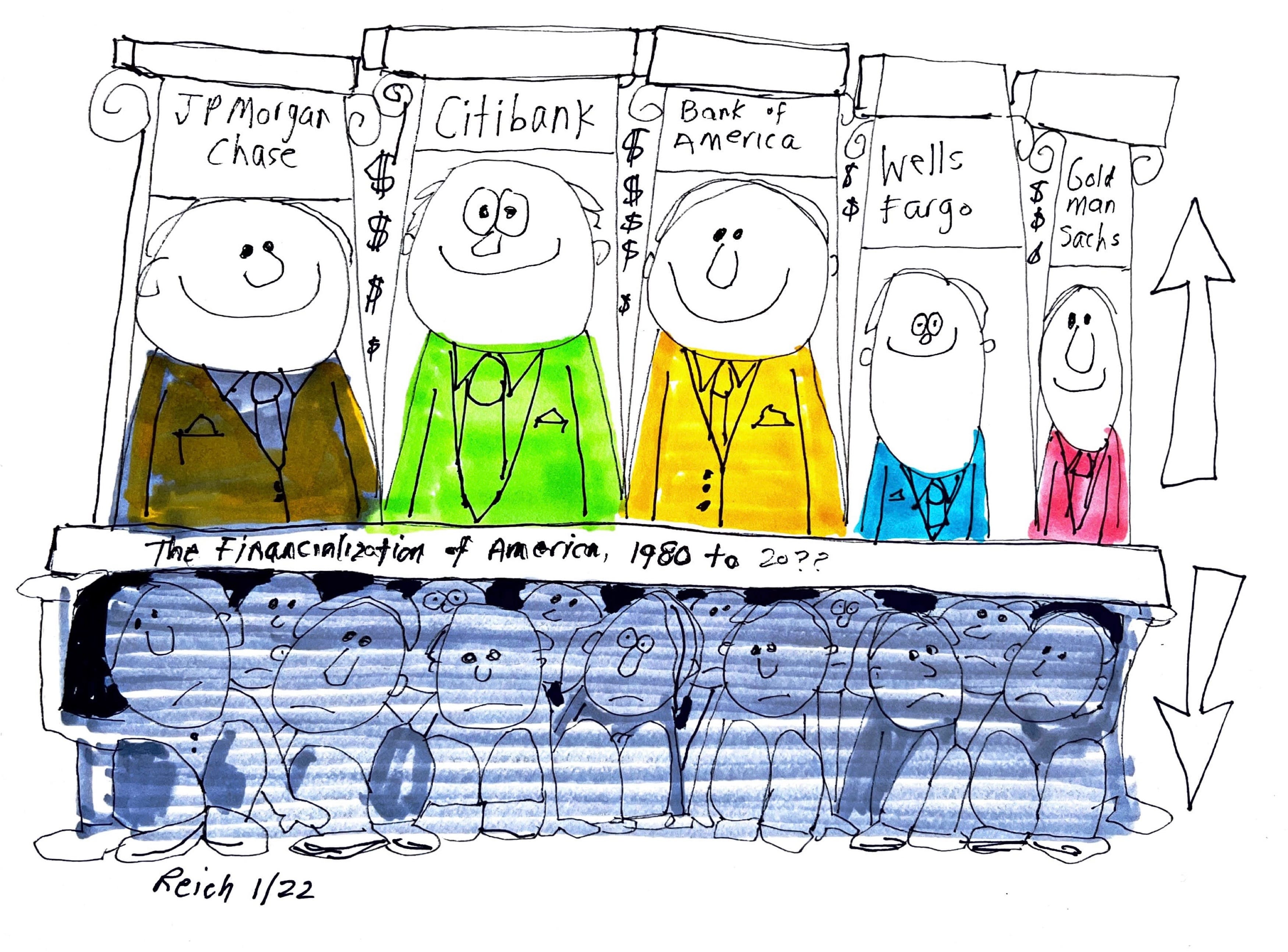
The curse of financial entrepreneurship
Wall Street may be having a bad week, but top bankers are doing wonderfully well. After a blockbuster year, the five biggest Wall Street banks just paid out $142 billion in bonuses and compensation for 2021. This was $18 billion more than in 2020. JPMorgan Chase reported record profits, and Citigroup’s annual profit more than doubled. Let me remind you (as if you need reminding) that 2020 and 2021 were not exactly blockbuster years for the rest of America. In the first three decades after World War II, American companies made money by making things, selling them at a profit, and investing the profits in additional productive capacity. This helped create the largest middle class the world had ever seen. In those years, the financial sector accounted for 15 percent of U.S. corporate profits.Then something happened. By the mid-1980s, the financial sector claimed 30 percent of corporate profits. By 2001, 40 percent — more than four times the profits made in all U.S. manufacturing. Why this dramatic change? Indulge me a moment as I quote from a New York Times op-ed I wrote more than forty years ago (May 23, 1980):The paper entrepreneurs are winning out over the product entrepreneurs.Paper entrepreneurs – trained in law, finance, accountancy – manipulate complex systems of rules and numbers. They innovate by using the systems in novel ways: establishing joint ventures, consortiums, holding companies, mutual funds; finding companies to acquire, “white knights” to be acquired by, commodity futures to invest in, tax shelters to hide in; engaging in proxy fights, tender offers, antitrust suits, stock splits, spinoffs, divestitures; buying and selling notes, bonds, convertible debentures, sinking-fund debentures; obtaining government subsidies, loan guarantees, tax breaks, contracts, licenses, quotas, price supports, bailouts; going private, going public, going bankrupt.Product entrepreneurs – engineers, inventors, production managers, marketers, owners of small businesses – produce goods and services people want. They innovate by creating better products at less cost.Our economic system needs both. Paper entrepreneurs ensure that capital is allocated efficiently among product entrepreneurs. But paper entrepreneurs do not directly enlarge the economic pie. They only arrange and divide the slices. They provide nothing of tangible use. For an economy to maintain its health, entrepreneurial rewards should flow primarily to product, not paper.Yet paper entrepreneurialism is on the rise. It dominates the leadership of our largest corporations. It guides government departments, legislatures, agencies, public utilities. It stimulates platoons of lawyers and financiers.It preoccupies some of our best minds, attracts some of our most talented graduates, embodies some of our most creative and original thinking, spurs some of our most energetic wheeling and dealing. Paper entrepreneurialism also promises the best financial rewards, the highest social status.The ratio of paper entrepreneurialism to product entrepreneurialism in our economy – measured by total earnings flowing to each, or by the amount of news in business journals and newspapers typically devoted to each – is about 2 to 1.Why? Our economic system has become so complex and interdependent that capital must be allocated according to symbols of productivity rather than according to productivity itself. These symbolic rules and numbers lend themselves to profitable manipulation far more readily than do the underlying processes of production.It takes time and effort to improve product quality, exploit manufacturing efficiencies, develop distribution and sales networks. But through strategic use of accounting conventions, tax rules, stock and commodity exchanges, exchange rates, government largesse, and litigation, enormous profits are possible with relatively little effort.When paper entrepreneurs look for solutions to America’s declining productivity and international competitiveness, they come up with paper remedies to stimulate large-scale capital investment: accelerated depreciation, tax credits, government subsidies, relaxation of antitrust laws. Product entrepreneurs focus on techniques for improving output: better quality controls, improved labor-management relations, more effective incentives for managers and employees, more aggressive marketing and sales.If we are to increase the economic pie, we will need to redress the balance of entrepreneurial effort. Which strategies will stimulate more paper, and which more product? I wish I had not been as prescient. Yet the dominance of finance over much of the American economy since 1980 didn’t happen by accident. It needed the help of politicians — including presidents (both Republican and Democrat) — who changed laws and regulations to encourage it. Ronald Reagan’s Securities and Exchange Commission allowed corporate raiders to use borrowed money to buy and dismantle American companies. The raiders (now more politely
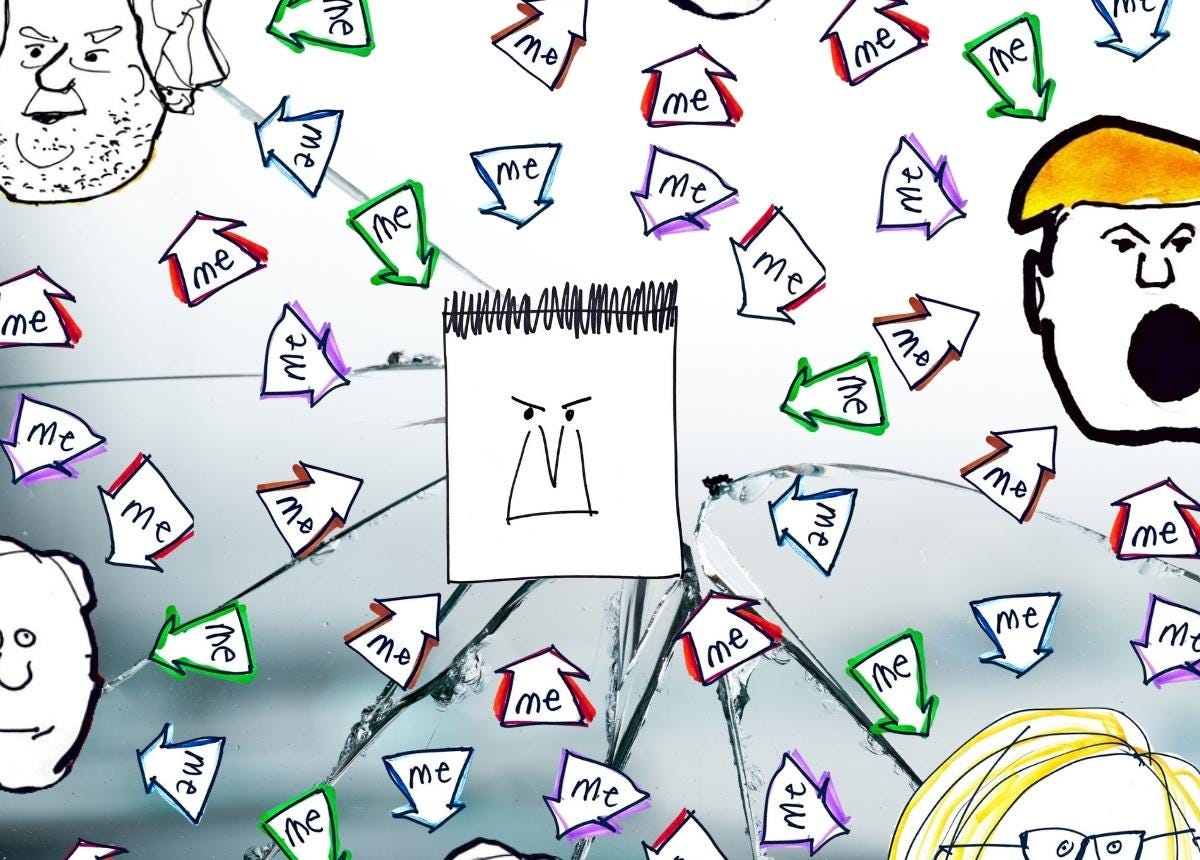
Psst: You really want to know why Manchin and Sinema came out against voting rights?
What can possibly explain Manchin’s and Sinema’s votes against voting rights this week? Why did they create a false narrative that the legislation had to be “bipartisan” when everyone -- themselves included -- knew bipartisanship was impossible? Why did they say they couldn’t support changing the filibuster rules when only last month they voted for an exception to the filibuster that allowed debt ceiling legislation to pass with only Democratic votes? Why did they co-sponsor voting rights legislation and then vote to kill the very same legislation? Why did Manchin vote for the “talking filibuster” in 2011 yet vote against it now?I’ve suggested that the answer to all these questions could be found in the giant wads of corporate cash flowing into their campaign coffers. But as I’ve watched the two senators closely and spoken about them with members of Congress as well as Hill staff, I’ve come to the conclusion this isn’t it – or at least not all of it.The corporate money explanation leaves out the single biggest factor affecting almost all national politicians I’ve dealt with: Big egos. Manchin’s and Sinema’s are now among the biggest. Before February of last year, almost no one outside West Virginia had ever heard of Joe Manchin, and almost no one outside of Arizona (and probably few within the state) had ever heard of Kyrsten Sinema. Now, they’re notorious. They’re Washington celebrities. Their photos grace every major news outlet in America.This sort of attention is addictive. Once it seeps into the bloodstream, it becomes an all-consuming force. I’ve known politicians who have become permanently and irrevocably intoxicated by it.I’m not talking simply about power, although that’s certainly part of it. I’m talking about narcissism – the primal force driving so much of modern America, but whose essence is concentrated in certain places such as Wall Street, Hollywood, and the United States Senate. Once addicted, the pathologically narcissistic politician can become petty in the extreme, taking every slight as a deep personal insult. I’m told that Manchin asked Biden’s staff not to blame him for the delay of “Build Back Better,” and was then infuriated when Biden suggested Manchin bore some of the responsibility. “You want to understand why Manchin stabbed Biden in the back on voting rights?” one House member told me this week. “It’s because he’s so pissed off at Ron Klain [Biden’s chief of staff].” I’m also told that if Biden wants to restart negotiations with Manchin on “Build Back Better,” he’s got to rename the package because Manchin is so angry he won’t vote for anything going by that name. Paradoxically, a large enough slight played out on the national stage can also enthrall a pathologically narcissistic politician. Several people on the Hill who have watched Sinema at close range since she became a senator tell me she relished all the negative attention she got when she gave her very theatrical thumbs down to increasing the minimum wage, and since then has thrilled at her burgeoning role as a spoiler. The Senate is not the world’s greatest deliberative body, but it is the world’s greatest stew of egos battling for attention. Every senator believes he or she has what it takes to be president. Most believe they’re far more competent than whoever occupies the Oval Office. Yet out of one hundred senators, only a handful are chosen for interviews on the Sunday talk shows, only one or two are lampooned on SNL, and very few get a realistic shot at the presidency. The result is intense competition for national attention. Again and again, I’ve watched worthy legislation sink because particular senators didn’t feel they were getting enough credit, or enough personal attention from a president, or insufficient press attention, or unwanted press attention, or that another senator (sometimes from the same party) was getting too much attention.Barack Obama didn’t enjoy glad-handing senators, even though he got to the presidency through that august body — which proved a huge handicap when it came to legislating. Bill Clinton would talk to senators (or, for that matter, to almost anyone else) all the time, but Clinton had too much confidence in his own charm to give individual senators the ego boosts they wanted — thereby rubbing the most narcissistic of them the wrong way (Nebraska senator Bob Kerrey voted against Clinton’s healthcare plan because he wanted more attention; New York senator Daniel Patrick Moynihan was lukewarm on it because he felt he wasn’t adequately consulted). Some senators get so whacky in the national limelight that they can’t function without it. Trump had that effect on Republicans. Before Trump, Lindsay Graham was almost a normal human being. Then Trump directed a huge amp of national attention Graham’s way — transmogrifying Graham into a bizarro creature who’d say anything Trump wanted in order to keep the attention coming.Not all senators are egomaniacs, of course. I had the good fortune
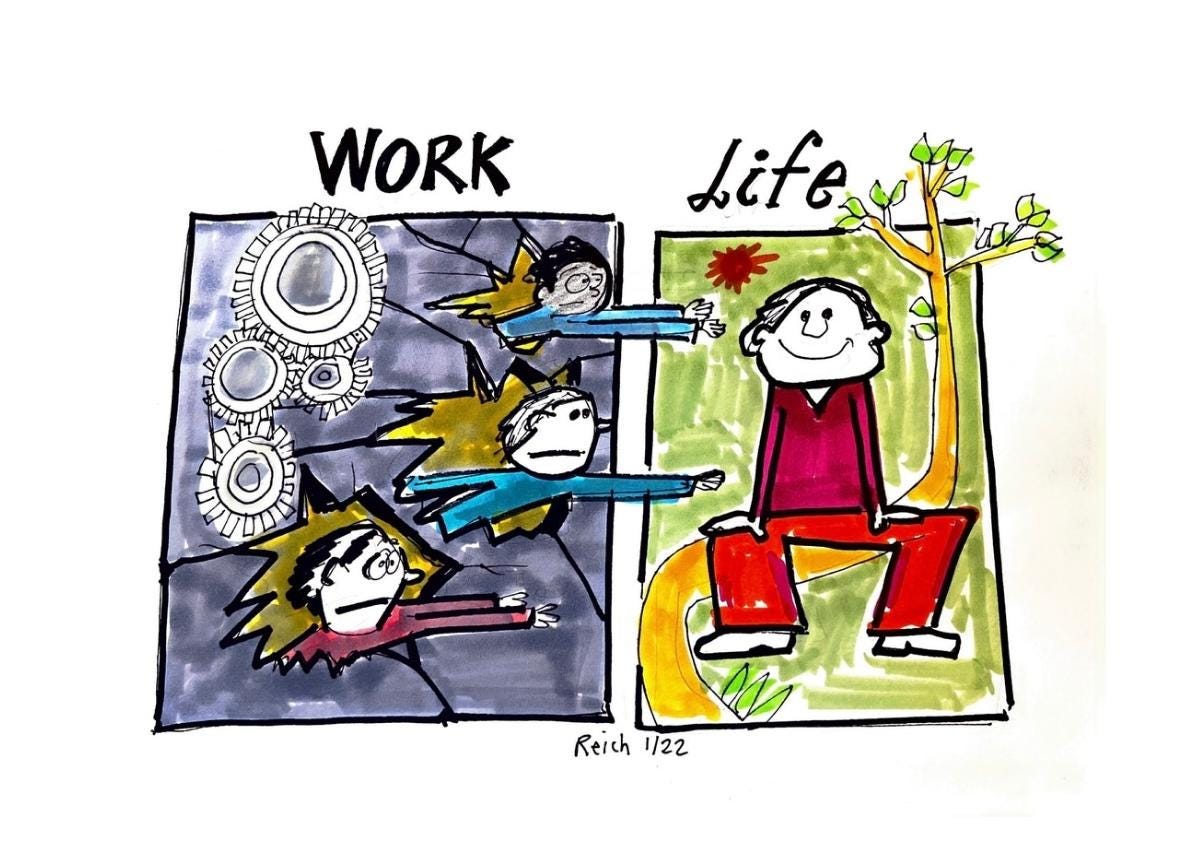
The End of Work
Across America, hospitals are pushed to the limit because so many health care workers have quit just as Omicron is surging. But hospitals aren’t alone, and Omicron isn’t the only culprit. We’re witnessing one of the most profound changes in the American labor force in a half century, at least since middle-class women entered paid work in large numbers during the 1970s. Only this time, women and men aren’t entering work. Many are leaving it (or at least, the way work has been organized). For decades, work has had a total grip on most people's lives because there have been so few alternatives to either working full time (often 50 or 60 hours a week, sometimes at two or more jobs), or not working at all and worrying about making ends meet. Instead of working to live, most of us have been living to work.Yet in recent months there’s been something of a sea change. The so-called “quit rate” of workers voluntarily leaving their jobs has reached record levels. The labor-force participation rate (the percent of people of working age who are in the workforce) is remarkably low for this point in a recovery. More workers are on strike than at any comparable period in the last thirty years.As secretary of labor, I used to hear people complain that they needed more work or better pay. Now, I’m hearing lots of people say “I don’t want to work this hard any more,” or “I’ll be damned if I’m going to spend the rest of my life in this rat race,” or “They can’t pay me enough to sacrifice my life like this,” or “I want to be in control of my life.”The GenZ’s I teach are even more adamant about not devoting their lives to work. “Life is too short” — they tell me.The pandemic has surfaced many issues that have been smoldering for years -- mandatory overtime, stagnant wages, dangerous working conditions, insecure employment, employment discrimination, and lack of paid sick leave or paid family leave. It has also forced -- or allowed -- many people to reconsider what they want from work and from their lives.Donald Sull, Charles Sull, and Ben Zweig recently conducted a massive study of workplace data for the MIT Sloan Management Review, including more than a million Glassdoor reviews. What are employees complaining about at companies losing the most workers in this tsunami of resignations? Interestingly, not mainly pay. Complaints about pay ranked 16th of the issues that predict quits. The biggest predictor is a toxic culture – workplaces that fail to promote diversity, equity, and inclusion; that don’t make workers feel respected and valued; and make them to feel insecure. No one likes to be underpaid. But it turns out people like disrespect and insecurity even less. When Australian researchers recently reviewed data on more than 1,000 workers, they discovered that working for a companies that “fail to reward or acknowledge their employees for hard work, impose unreasonable demands on workers, and do not give them autonomy” triples the odds that workers will suffer major depression. I’m no soothsayer, but as I look ahead I’m fairly certain we’re going to see companies and nonprofits moving toward more flexible work, autonomous work, and mandatory limits on work hours. They have no choice if they want to recruit and retain reliable employees. We’re also going to see far more self-employment, more people moving to locales around the country where housing is cheaper, and, in general, more of us seeking to simplify our lives.I also expect increasing demands for public policies that reduce the amount of time we have to spend working and give us more control of our own labor – such as a universal basic income, a ban on mandatory overtime, a shorter workweek, Medicare for all (de-coupling health insurance from work), paid sick leave and paid family leave, and more tax incentives for profit sharing and self-employment. We’re not facing the end of work, but we are facing the end of work as we know it. It’s about time.What do you think?PS: By the way, if you haven't had a chance to listen to my conversation with Michael Moore, we touched on what’s happening to work and a variety of other issues related to power and the economy. It was great to catch up (and Mike even promised to do a TikTok collaboration with me in 2022). Enjoy: This is a public episode. If you'd like to discuss this with other subscribers or get access to bonus episodes, visit robertreich.substack.com/subscribe
The Week Ahead: How Biden can get his mojo back
This week may be a nadir for the Biden administration. After Krysten Sinema’s very public refusal to budge on the filibuster, voting rights legislation is stuck. Senate Democrats plan to go through the motions (due to a parliamentary maneuver, it will be the first time the Senate will actually debate voting rights) but the effort is doomed as long as the filibuster remains. Similarly, after Joe Manchin’s refusal to agree to Biden’s “Build Back Better” package, Biden’s social and climate measure is also stalled (last Friday was the first time since July that millions of American families with children didn’t receive a monthly child benefit; further payments are stymied). Meanwhile, the Omicron variant continues to surge in most of the country, increasing public anxieties about the pandemic. Yet the Supreme Court rejected Biden’s vaccine-or-testing mandate for large employers. Inflation continues to accelerate due to supply bottlenecks — which are likely to worsen as China locks down to avoid Omicron — thereby eroding real (inflation-adjusted) wages. To put it bluntly, Biden is in deep trouble. So is America.How can Biden regain momentum? Here are ten steps he should take, starting this week:* Reach out to Murkowski, Collins, Romney, and any other possibly principled senate Republican, to gain support for any reasonable compromise on the filibuster (even a “talking filibuster” would be better than the current standoff).* Accompany this with a speech about how often the filibuster has been used to block popular legislation, especially over the last dozen years, why it’s fundamentally anti-democratic, and what it’s blocking now — voting rights and highly popular measures in “Build Back Better” (reducing prescription drug prices, universal pre-K, the addition of hearing and dental insurance to Medicare, subsidized childcare, the expanded child tax credit, paid leave, and measures to reduce climate change). * Urge Schumer to initiate separate votes on these popular measures. Let the public see how Republicans use the filibuster to stop them. * Urge Democrats to run next November against a Republican Party that refuses to get anything done for the working class. * Issue an executive order on drug pricing, such as requiring Medicare to obtain the lowest possible drug prices. * Issue an executive order to roll back Trump’s Medicaid work requirements and boost funding for groups helping people enroll in ACA plans.* Issue an executive order relieving former students of up to $10,000 of college loan debt owed the federal government. * As to Omicron, provide clear public health guidance around masking and testing. Explain when and where rapid tests and masks can be obtained free of charge. * Ask OSHA to immediately redraft its vaccine-or-testing mandate to focus on large employers with the highest incidence of COVID. * Meanwhile, remain upbeat but realistic. Remind the public of the economic successes so far — record job growth, new businesses forming at record rates, poverty below its pre-pandemic levels, the start of $1 trillion in infrastructure investments, the speed of your vaccination rollout, your stimulus package last spring that helped many who receive health insurance in individual marketplaces and offered enticements for states to expand Medicaid. Celebrate the recent victories of unionized workers and call for more and stronger unions. And reassure the public of your commitment to continue fighting for a democracy and an economy that works for everyone — against the resistance of the moneyed interests that have never done as well as they’re doing now.What else do you think Biden and his administration should do now? This is a public episode. If you'd like to discuss this with other subscribers or get access to bonus episodes, visit robertreich.substack.com/subscribe

Mickey
The convergence today of Martin Luther King Jr. Day and of the Senate’s unwillingness to protect voting rights causes me to remember my childhood friend and protector, whom I knew as Mickey.I was always very short for my age, which made me an easy target for bullies. To protect myself, I got into the habit of befriending older boys who’d watch my back. One summer when I was around 8 years old I found Mickey, a kind and gentle teenager with a ready smile who made sure I stayed safe.Years went by and I lost track of Mickey. It wasn’t until the fall of 1964, my freshman year in college, that I heard what had happened to him. Several months before, Mickey had gone to Mississippi to register Black voters during what was known as “Freedom Summer.” On August 4, Mickey – his full name was Michael Schwerner -- was found dead, along with two other civil rights workers, James Chaney and Andrew Goodman. The three had been brutally tortured and murdered. Eventually I learned what had happened. On June 21, the three were stopped near Philadelphia, Mississippi by Neshoba County Deputy Sheriff Cecil Ray Price, for allegedly speeding. That night, after they paid their speeding ticket and left the jail, Price followed them, stopped them again, ordered them into his car, and took them down a deserted road where he turned them over to a group of his fellow Ku Klux Klan members who beat and killed them, and buried their bodies in an earthen dam then under construction. The state of Mississippi refused to bring murder charges against any of them. Price and Neshoba County Sheriff Laurence Rainey, also a Klan member, along with 16 others, were arraigned for the federal crime of conspiracy to violate the civil rights of the murdered young men. An all-white jury convicted Price and sentenced him to six years in prison (he served four) and found Rainey not guilty.Freedom Summer had brought together college students from northern schools to work with Black people from Mississippi to educate and register Black voters. Although about 40 percent of Mississippi’s population was Black, most of them had been frozen out of the polls through poll taxes, subjective literacy tests, and violence. It had been that way since 1877. The system was enforced by white supremacists who could commit crimes with impunity because the entire region had become a one-party state. Mickey Schwerner, Chaney, Goodman, and other civil rights workers had sought to reestablish the principle of equality before the law. After their murders, Freedom Summer continued. Activists were emboldened rather than intimidated by the racial terror orchestrated by Mississippi officials. Almost 1,000 white volunteers bolstered the Student Non-violent Coordinating Committee’s efforts to organize Freedom Schools, literacy and civics classes, voter registration and integrated libraries.Then in 1965, with the intrepid leadership of Martin Luther King, Jr. and others in the civil rights movement, Congress passed the Voting Rights Act, protecting the right of Black people to vote. After that, the stranglehold of the white supremacists on the one-party South loosened.But the regressive forces of racism and violence did not disappear. On August 3, 1980, Ronald Reagan launched his presidential campaign with a rally at the Neshoba County Fair (only a few miles from Philadelphia, Mississippi), where he defended state’s rights and the unwinding of civil rights advances. On June 25, 2013, the Supreme Court, in the case of Shelby County v. Holder, gutted the Voting Rights Act by holding that its formula for deciding which jurisdictions had to get pre-clearance from the Justice Department before changing their voting laws was outdated. Now, in response to record voter turnout in the 2020 election, 19 states have passed over 30 new laws making it harder to vote. At the same time, Republican-dominated legislatures are gathering into their hands the power to negate popular votes. And the United States Senate, although nominally under Democratic control, is at this point unwilling to enact legislation to override these restrictions or restore the Voting Rights Act. We seem to be headed back to the society Michael Schwerner, James Cheney, and Andrew Goodman fought against with their lives. This is a public episode. If you'd like to discuss this with other subscribers or get access to bonus episodes, visit robertreich.substack.com/subscribe

Need a bit of a pick-me-up? Let me introduce you to two young people.
These are hard times to keep your spirits up. Thinking you might need a bit of a boost, I’d like to introduce you to two young people who give me hope about the future of American politics. The first is Chloe Maxmin. I met her a few years ago when, still in her early-twenties and an unapologetic progressive, she had been elected to the Maine House of Representatives. She was the first Democrat ever to represent her district — Maine’s Lincoln County, the state’s most rural. The county also among the poorest, where 1 in 5 children grow up in poverty. And it’s staunchly conservative, having voted Republican by an average of 16 percentage points in the preceding three elections.When I met her, Maxmin was preparing to run for the state Senate. Several old Maine pols (I lived in Maine back in the last century and know its politics quite well) told me she didn’t stand a chance. But in 2020 she won — and in the process, knocked off the state Senate’s Republican leader, the most powerful Republican politician in Maine.How did she pull off these upsets? I’ll get to that in a moment. Maxmin exudes optimism, energy, and tenacity. She is also very smart. She says she’d always imagined running when she was in her thirties. She thought she needed a couple of graduate degrees, a settled life, and maybe a family to welcome her home. But in 2018, as the climate crisis worsened, she realized there was no need and no time to wait.The second person I’d like to introduce you to managed both her campaigns. Canyon Woodward was brought up in a rural part of Southern Appalachia. Maxmin and Woodward met each other in college and decided that the only way to begin solving the climate crisis and the injustices it was spawning was to get involved in politics from the ground up. Both had watched for years as rural America was abandoned by Democrats. They decided to buck that tide.So, how did Maxmin and Woodward do it? They developed the most grass-roots of all grass-roots strategies. Maxmin herself knocked on tens of thousands of doors. She connected with persuadable Trump voters who had never before spoken with a Democratic candidate. But she didn’t just talk to them. She had conversations with them, then followed up with more conversation. Those conversations were about “kitchen-table” issues — problems that were on the voters’ minds, as well as their thoughts and values. As she describes it, during her campaign for the Maine House she walked down a dirt road leading to a nondescript trailer. After knocking on the door, it cracked open to reveal a man who was reluctant to hear from her. She introduced herself nonetheless and asked him about the issues he cared about most in the coming election. After they talked for a time, he told her: “You’re the first person to listen to me. Everyone judges what my house looks like. They don’t bother to knock. I’m grateful that you came. I’m going to vote for you.”When I asked about her approach to politics, Maxmin told me rural communities are moral communities that respond more to personal stories and values than to specific policies. Building trusting relationships is the key. This takes time and effort and demands humility and a willingness to learn. As Maxmin and Woodward explain in their book, Dirt Road Revival: How to Rebuild Rural Politics and Why Our Future Depends On It (to be published in March):“Things move at the speed of relationship in rural America. You don’t jump straight into business and take care of things as quickly as possible. An essential part of the culture of living and organizing in rural America is slowing down and building relationships. It is the touchstone on which our future—and all hope of transforming how we relate to politics and one another—depends. And a good relationship starts with a handshake. This small gesture is about establishing a modicum of trust and human connection. To show up, look someone in the eye, and shake their hand is to plant the seeds of possibility and connection. It’s also what is lacking in today’s politics. A voter told us one day, “I don’t identify with either party. I vote for the person. I vote for whoever has the firmest handshake.” Maxmin has already got a “green new deal” bill through the legislature. She’s well on her way to being one of the nation’s most effective state legislators on climate justice.What’s the larger political picture here? The Democratic Party’s abandonment of rural America has proved a strategic mistake. In 2016, Hillary Clinton won almost every urban center, but Trump swept the vast stretches of less populated country in between. Exit polling revealed that Trump won nearly two-thirds of the rural vote, while losing by a similar margin in cities and evenly splitting the suburban vote. When the American electoral system was created, over 95 percent of Americans lived in rural communities. Now, fewer than 20 percent do. But the nation’s electoral system remains locked in the founders’ two eighteenth century inven
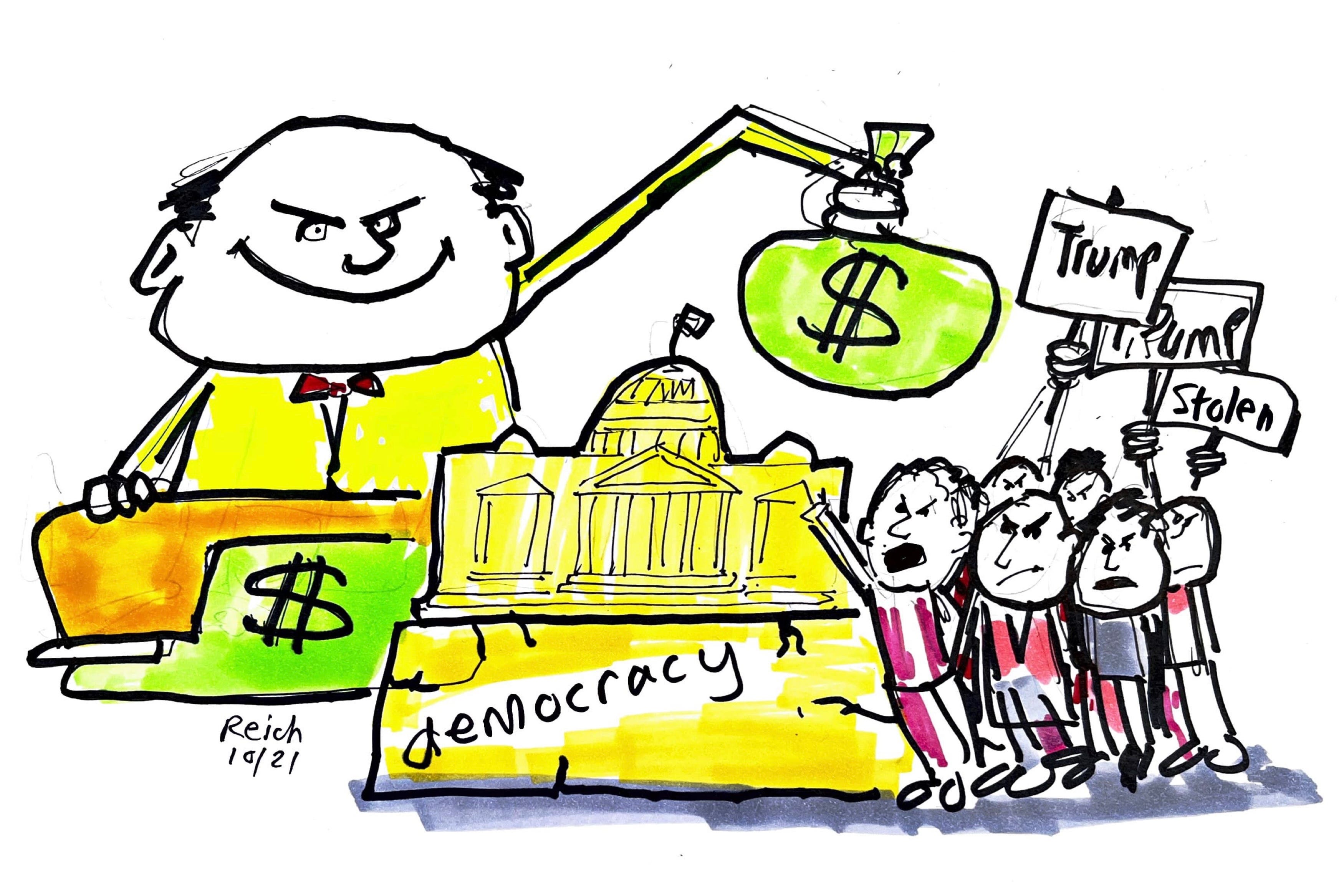
Why isn't corporate America behind the pro-democracy movement?
Capitalism and democracy are compatible only if democracy is in the driver’s seat.That’s why I took some comfort just after the attack on the Capitol when many big corporations solemnly pledged they’d no longer finance the campaigns of the 147 lawmakers who voted to overturn the election results.Well, those days are over. Turns out they were over the moment the public stopped paying attention.A report published last week by Citizens for Responsibility and Ethics in Washington shows that over the last year, 717 companies and industry groups have donated more than $18 million to 143 of those seditious lawmakers. Businesses that pledged to stop or pause their donations have given nearly $2.4 million directly to their campaigns or leadership political action committees.But there’s a deeper issue here. The whole question of whether corporations do or don’t bankroll the seditionist caucus is a distraction from a much larger problem.The tsunami of money now flowing from corporations into the swamp of American politics is larger than ever. And this money – bankrolling almost all politicians and financing attacks on their opponents – is undermining American democracy as much as did the 147 seditionist members of Congress. Maybe more.Democratic senator Kyrsten Sinema — whose vocal opposition to any change in the filibuster is on the verge of dooming voting rights — received almost $2 million in campaign donations in 2021 despite not being up for re-election until 2024. Most of it came from corporate donors outside Arizona, some of which have a history of donating largely to Republicans. Has the money influenced Sinema? You decide: Besides sandbagging voting rights, she voted down the $15 minimum wage increase, opposed tax increases on corporations and the wealthy, and stalled on drug price reform — policies supported by a majority of Democratic Senators as well as a majority of Arizonans. Over the last four decades, corporate PAC spending on congressional elections has more than quadrupled, even adjusting for inflation.Labor unions no longer provide a counterweight. Forty years ago, union PACs contributed about as much as corporate PACs. Now, corporations are outspending labor by more than three to one. According to a landmark study published in 2014 by Princeton professor Martin Gilens and Northwestern professor Benjamin Page, the preferences of the typical American have no influence at all on legislation emerging from Congress.Gilens and Page analyzed 1,799 policy issues in detail, determining the relative influence on them of economic elites, business groups, mass-based interest groups, and average citizens. Their conclusion: “The preferences of the average American appear to have only a miniscule, near-zero, statistically non-significant impact upon public policy.” Lawmakers mainly listen to the policy demands of big business and wealthy individuals – those with the most lobbying prowess and deepest pockets to bankroll campaigns and promote their views.It’s likely far worse now. Gilens and Page’s data came from the period 1981 to 2002 – before the Supreme Court opened the floodgates to big money in the Citizens United case, prior to SuperPACs, before “dark money,” and before the Wall Street bailout.The corporate return on this mountain of money has been significant. Over the last forty years, corporate tax rates have plunged. Regulatory protections for consumers, workers, and the environment have been defanged. Antitrust has become so ineffectual that many big corporations face little or no competition.Corporations have fought off safety nets and public investments that are common in other advanced nations (most recently, “Build Back Better”). They’ve attacked labor laws -- reducing the portion of private-sector workers belonging to a union from a third forty years ago, to just over 6 percent now. They’ve collected hundreds of billions in federal subsidies, bailouts, loan guarantees, and sole-source contracts. Corporate welfare for Big Pharma, Big Oil, Big Tech, Big Ag, the largest military contractors and biggest banks now dwarfs the amount of welfare for people.The profits of big corporations just reached a 70-year high, even during a pandemic. The ratio of CEO pay in large companies to average workers has ballooned from 20-to-1 in the 1960s, to 320-to-1 now.Meanwhile, most Americans are going nowhere. The typical worker’s wage is only a bit higher today than it was forty years ago, when adjusted for inflation.But the biggest casualty is the public’s trust in democracy.In 1964, just 29 percent of voters believed that government was “run by a few big interests looking out for themselves.” By 2013, 79 percent of Americans believed it.Corporate donations to seditious lawmakers are nothing compared to this forty-year record of corporate sedition.A large portion of the American public has become so frustrated and cynical about democracy they are willing to believe blatant lies of a self-described strongman, and will
Quiz: Why should members of Congress be able to make money on inside information?
It infuriates me when members of Congress — whether Republican or Democrat — squander the public’s trust. There’s so little of it left to squander. So when I find a conflict of interest by members of Congress for which there’s an easy remedy, I’m ready to shout it from the rooftops. And when I discover Congress won’t take action, I’m ready to scream. Today I want to talk about a very big conflict, with a very easy remedy. And I’d like your help getting the word out and putting pressure on Congress to adopt it. First, some background. Unless you have special insider information about what’s going to happen to the economy or to certain companies — information that very few other investors have — the buying and selling of individual shares of stock is a terrible investment strategy. This is why the vast majority of Americans who invest in the stock market invest in index funds that are tied to the performance of the stock market as a whole. So why do many members of Congress continue to invest in individual stocks? Could it possibly be that they learn useful things about what’s going to happen to the economy or individual companies before the rest of us do? It certainly seems so. In January 2020, a handful of senators — including Richard Burr, Dianne Feinstein, and Kelly Loeffler — made significant stock trades after receiving a classified briefing on COVID-19. This was January 2020, mind you — well before the public knew the full extent of the threat. Then in the early weeks of the pandemic, nearly 75 federal lawmakers bought stocks in COVID-19 vaccine makers Moderna, Johnson & Johnson, or Pfizer. I could give you a lot more examples, but you get the point. Even if these were innocent investments that weren’t based on inside knowledge, they certainly smell like insider trades. At the least, they create the appearance of self-dealing. They undermine public trust. A huge amount of information about the economy and individual companies courses through Congress every day. Much of it is not available to the public. Some of it indicates what’s likely to happen to a particular company’s share prices. There is no possible way to guard against the misuse of this information for personal profit. So why allow individual stock trades? There is simply no legitimate reason why members of Congress (or their families) should be trading individual shares of stock. (By the way, “Insider” has just published the most complete and detailed public accounting to date of the stock transactions of individual members of Congress — one for the Senate and one for the House. It’s eye-opening. But disclosure alone won’t solve the conflict-of-interest problem because it’s impossible to tell whether the transactions were based on inside information.)There’s an obvious solution: Bar members of Congress from trading individual stocks. The proposed Ban Conflicted Trading Act does just this. Lawmakers would have six months after being elected to sell their individual stock holdings, transfer them to a blind trust over which they have no control, or hold onto them until they leave office without trading them. (Senator Jon Ossoff of Georgia just introduced legislation that would also bar family members of our representatives and senators from trading stocks.)This is an easy and appropriate fix. It doesn’t penalize members of Congress or their families. They can still invest in index funds, like most other stock market investors. They just can’t trade individual stocks. But Congress has yet to hold a vote on this bill. Why?Last April, Ron Lieber of the New York Times asked newly elected members of Congress if they would pledge not to trade individual stocks while in office. Few were willing. Most didn’t even respond.It gets worse. Last month, House Speaker Nancy Pelosi rejected the idea of banning politicians and their families from trading stocks while in office. (She was asked about it by a reporter from “Insider,” which recently published an investigation about lawmakers’ trades.)I’m a big admirer of Nancy Pelosi. But, with due respect, she’s dead wrong on this one. With distrust in government near an all-time high, even the appearance of a conflict of interest hurts our democracy. Members of Congress are elected to represent the interests of the people, not the money in their brokerage accounts. Banning members of Congress from trading individual stocks should be a no-brainer. Congress should pass the Ban Conflicted Trading Act. Now. You might suggest this to your own members of Congress. What do you think? This is a public episode. If you'd like to discuss this with other subscribers or get access to bonus episodes, visit robertreich.substack.com/subscribe
What would the Supreme Court's "originalists" think of the filibuster?
Yesterday, a member of our group named Emmet Bondurant, a distinguished constitutional lawyer from Georgia, commented on this page about the filibuster: The biggest lie of all is the Senate’s claim that it “is the greatest deliberative body in the world.” The filibuster makes the Senate the least deliberative legislative and least democratic legislative body by allowing a minority of Senators to prevent the Senate from debating, much less voting on, any legislation that is opposed by the minority party.A decade ago, when Emmet and I served on the board of Common Cause, he brought a case before federal courts, arguing that the filibuster is unconstitutional. He didn’t get very far. (The Court of Appeals for the District of Columbia decided against Common Cause on dubious grounds, and the Supreme Court refused to hear the case.) But this was before the high court became crammed with so-called “originalists” who believe the Constitution should be interpreted to mean what the Framers thought when they drafted it. Originalism is an absurd position, of course. American society is so different today from what it was in the eighteenth century that any attempt to apply precepts from that time to this time is doomed to failure. But why not test the sincerity of the originalists sitting on today’s Supreme Court with an issue that the Framers would find a no-brainer? All evidence suggests they would agree with Emmet that the filibuster violates the Constitution. The Framers went to great lengths to ensure that a minority of senators could not thwart the wishes of the majority. After all, a major reason they convened the Constitutional Convention in 1787 was because the Articles of Confederation (the precursor to the Constitution) required a super-majority vote of nine of the thirteen states, making the government weak and ineffective. This led James Madison to argue against any super-majority requirement in the Constitution the Framers were then designing, writing that otherwise “the fundamental principle of free government would be reversed,“ and “It would be no longer the majority that would rule: the power would be transferred to the minority.” And it led Alexander Hamilton to note “how much good may be prevented, and how much ill may be produced” if a minority in either house of Congress had “the power of hindering the doing what may be necessary.”This is why the Framers required no more than a simple majority in both houses of Congress to pass legislation. They carved out only five specific exceptions requiring a super-majority vote only in rare, high-stakes decisions: (1) impeachments, (2) expulsion of members, (3) overriding a presidential veto, (4) ratification of treaties, and (5) amendments to the Constitution. By being explicit about these five exceptions to majority rule, the Framers underscored their commitment to majority rule for the normal business of the nation. They would have rejected the filibuster, through which a minority of senators continually obstructs the majority.So where did the filibuster come from? The Senate needed a mechanism to end debate on proposed laws and move to a vote. The Framers didn’t anticipate this problem. But in 1841, a small group of senators took advantage of this oversight to stage the first filibuster. They hoped to force their opponents to give in by prolonging debate and delaying a vote. This was what became known as the “talking filibuster” — as popularized in Frank Capra’s other great film, “Mr. Smith Goes to Washington” (a perfect compliment to his “It’s a Wonderful Life”). But contrary to the admirable character Jimmy Stewart plays in that film, the result was hardly admirable.After the Civil War, the filibuster was used by Southern politicians to defeat Reconstruction legislation, including bills to protect the voting rights of Black Americans. Finally, in 1917, as a result of pressure from President Woodrow Wilson and the public, the Senate adopted a procedure for limiting debate and ending filibusters with a two-thirds vote of the Senate (67 votes). In the 1970s, the Senate reduced the number of votes required to end debate down to 60, and no longer required constant talking to delay a vote. 41 votes would do it.Throughout much of the 20th century, filibusters remained rare. (Southern senators mainly used them to block anti-lynching, fair employment, voting rights, and other critical civil rights bills.) But that changed in 2007, after Democrats took over the Senate. Senate Republicans, now in the minority, used the 60-vote requirement with unprecedented frequency. After Barack Obama moved into the Oval Office in 2009, the Republican minority — led by Mitch McConnell — blocked virtually every significant piece of legislation. Nothing could move without 60 votes. A record 67 filibusters occurred during the first half of the 111th Congress — double the entire 20-year period between 1950 and 1969. By the time Congress adjourned in December 2010, the filibuster cou
The Week Ahead: Georgia on my mind
President Biden will go to Georgia tomorrow to give a speech on voting rights. It’s expected to be as hard-hitting as his speech last Thursday about Trump and the attack on the Capitol. Biden will push for reform of the senate filibuster to carve out voting rights from its 60-vote requirement, thereby opening the way for senate Democrats to enact the Freedom to Vote Act and the John Lewis Voting Rights Amendment Act. As you probably know, the Freedom to Vote Act would preempt state efforts to suppress votes and take over election machinery. The John Lewis Voting Rights Amendment Act would restore the “pre-clearance” requirement of the 1965 Voting Rights Act (before the Supreme Court gutted it in 2013) which forced states with a history of discrimination – including Georgia -- to get Justice Department approval before they changed their voting rules.But Biden will need more than a hard-hitting speech to reform the filibuster and open the door for these two critical pieces of legislation. And his most important audience isn’t in Georgia, which already has two Democratic senators who will support him. It’s in West Virginia, whose senior Democratic senator is signaling he will not. Georgia is, however, strategically important to voting rights in other ways. It has several major races this year, including Senator Raphael Warnock’s bid for reelection and Stacy Abrams’ campaign for governor against Republican incumbent Brian Kemp. (The only reason Democrats have a Senate majority right now is because they prevailed in both of Georgia’s runoff elections on January 5 of last year, electing Warnock and Senator Jon Ossoff.)Thanks for subscribing to my letter. If you’d like to support this effort (and be part of the conversation) please consider a paid or gift subscription. Georgia also typifies what’s happening in several other southern states, such as North Carolina, Texas, and Arizona. Atlanta is becoming a major global economic hub, inhabited by upwardly-mobile and well-educated professionals who tend to vote for Democrats. Rural Georgia is a challenged economic backwater inhabited by less-educated voters who have been on a downward slide for years, making them highly susceptible to Trumpian racism and xenophobia, and Fox News’s conspiracy theories. The shift toward cosmopolitan Atlanta hasn’t yet changed the composition of Georgia’s legislature, which is still dominated by Republicans. Shortly after Biden’s victory, it passed laws requiring additional ID for absentee voting, removing early voting sites, and allowing state takeovers of county elections. Georgia’s GOP lawmakers are now readying bills to nix voting touchscreen machines and expand probes into voter fraud, among other anti-democracy initiatives. Hence the importance of national voting rights legislation, and of the Democrats’ move to reform the filibuster. Senate Democrats have given up on “Build Back Better” for now and are pivoting to voting rights, and a filibuster carveout for voting rights. But Manchin, the Holdout-in-Chief, is standing in the way, just as he did on “Build Back Better.” He says the only way he’ll support a carveout from the filibuster for voting rights is if it’s “bipartisan.”This is a bizarre argument, for several reasons. First, there’s no precedent requiring that changes in the filibuster rule be bipartisan. In recent decades the rule has been changed several times -- most recently by McConnell and the Republicans, to confirm Supreme Court nominees with a bare majority – without bipartisan support.It’s also bizarre because of America’s history of racism, which has not been fought through bipartisanship. Representative Jim Clyburn from South Carolina, the third-ranking House Democrat, whose endorsement of Biden during the Democratic primaries put Biden over the top, put it bluntly:“I am, as you know, a Black person, descended of people who were given the vote by the 15th Amendment to the United States Constitution. The 15th amendment was not a bipartisan vote, it was a single party vote that gave Black people the right to vote. Manchin and others need to stop saying that because that gives me great pain for somebody to imply that the 15th Amendment of the United States Constitution is not legitimate because it did not have bipartisan buy-in.”Third, American democracy cannot be saved with “bipartisanship” when one party is out to destroy it. The filibuster is becoming less democratic by the day. As of now, just 41 Senate Republicans, representing only 21 percent of the country, are blocking laws supported by the vast majority.Manchin (and Kyrsten Sinema, who isn’t even trying to explain her position on the filibuster or much of anything else) -- now the darlings of Republican donors -- apparently have more allegiance to the filibuster than to democracy. (By contrast, Senator Angus King, the Maine Independent who caucuses with the Democrats and had earlier rejected calls to reform the filibuster, says he has “concluded that democr
Is there still a common good?
We’ve gone through the shameful first anniversary of the attack on the U.S. Capitol and of the refusal of 147 members of Congress (all Republicans) to certify all the electors from states that voted for Biden, on the basis of no evidence of fraud. So far, no political figure has been charged with any criminal wrongdoing. We’ve seen 34 voter-suppression bills enacted by 19 Republican state legislatures; at least 8 give state legislatures the power to disregard election outcomes. More than 400 additional voter suppression measures are now being prepared. And we are now witnessing a struggle in the Senate to reform the filibuster so that voting rights legislation can be enacted. All of which raises a basic question: Is there still a common good? I was at the impressionable age of fourteen when I heard John F. Kennedy urge us not to ask what America can do for us but what we can do for America. Seven years later I took a job as a summer intern in the Senate office of his brother, Robert F. Kennedy. It was not a glamorous job, to say the least. I felt lucky when I was asked to run his signature machine. But I told myself that in a very tiny way I was doing something for the good of the country.That was more than a half century ago. I wish I could say America is a better place now than it was then. Surely our lives are more convenient. Fifty years ago there were no cash machines or smart phones, and I wrote my first book on a typewriter. As individuals, we are as kind and generous as ever. We volunteer in our communities, donate, and help one another. We pitch in during natural disasters and emergencies. We come to the aid of individuals in need. We are a more inclusive society, in that Black people, LGBTQ people, and women have legal rights they didn’t have a half century ago. Yet our civic life—as citizens in our democracy, participants in our economy, managers or employees of companies, and members or leaders of organizations—seems to have sharply deteriorated. What we have lost is a sense of our connectedness to each other and to our ideals—the America that John F. Kennedy asked that we contribute to.Starting in the late 1970s, Americans began talking less about the common good and more about self-aggrandizement. The shift is the hallmark of modern America: From the “Greatest Generation” to the “Me Generation,” from “we’re all in it together” to “you’re on your own.” In 1977, motivational speaker Robert Ringer wrote a book that reached the top of The New York Times bestseller list entitled Looking Out for # 1. It extolled the virtues of selfishness to a wide and enthusiastic audience. The 1987 film Wall Street epitomized the new ethos in the character Gordon Gekko and his signature line, “Greed, for lack of a better word, is good.”The last five decades have also been marked by growing cynicism and distrust toward all of the basic institutions of American society. There is a wide and pervasive sense that the system as a whole is no longer working as it should. Racism, xenophobia, and religious intolerance are on the rise. A growing number of Americans feel neglected and powerless. Some are poor, or Black or Latino. Others are white and have been on a downward economic escalator for years. Some have been seduced by demagogues and conspiracy theorists. Thanks for subscribing to my letter. If you’d like to support this effort and be part of the conversation, please consider a paid or gift subscription. Is there a common good that still binds us together as Americans? Yes, and it’s not the whiteness of our skin, or our adherence to Christianity, or the fact that we were born in the United States. We’re bound together by the ideals and principles we share, and the mutual obligations those principles entail.After all, the U.S. Constitution was designed for “We the people” seeking to “promote the general welfare”—not for “me the selfish jerk seeking as much wealth and power as possible.” During the Great Depression of the 1930s and World War II, Americans faced common perils that required us to work together for the common good. That good was echoed in Franklin D. Roosevelt’s “Four Freedoms”—freedom of speech, of worship, from want, and from fear. The common good animated many of us – both white and Black Americans—to fight for civil rights and voting rights in the 1960s. It inspired America to create the largest and most comprehensive system of public education the world had ever seen. And it moved many of us to act against the injustice of the Vietnam War, and others of us to serve bravely in that besotted conflict.Americans sharply disagree about exactly what we want for America or for the world. But if we are to participate in the same society we must agree on how we deal with our disagreements, our obligations under the law, and our commitment to democracy. It’s our agreement to these principles that connects us, not agreement about where these principles lead. Some of us may want to prohibit abortions because w

The secret to tenacity
I sometimes hear from people who tell me they’ve been fighting for years for the common good — for social justice, for a stronger democracy, for a sustainable environment — but they can’t do it any longer. They’re burnt out. “I’m done,” one of my former students wrote me last week. She’s been in the trenches for more than three years at a nonprofit dedicated to environmental justice, putting in 10 to 12-hour days, often six and sometimes seven days a week. “Maybe I’ve made a small difference,” she writes, “but it’s not worth it. It’s taken a terrible a toll on me. I have to get a life.” I understand. Regressive forces are huge and powerful. The moneyed interests have almost unlimited resources. The rightwing anti-social media have seemingly unlimited reach. Racism, xenophobia and outright lies seem to be growing louder. In the short term — even over three or four years — positive social change can appear an impossible task. The road is very long, and it’s filled with potholes. But almost nothing worth doing can get done in the short term. Even under the most favorable circumstances, social change never occurs quickly.One of my dearest and oldest friends, Fred Wertheimer, has been fighting for voting rights and campaign finance reform for over forty years. When I spoke to him recently, he told me that he thought there was a good chance that senate Democrats would support the Freedom to Vote Act and the John Lewis Voting Rights Enhancement Act, and carve out a voting-rights exception to the filibuster. Thanks for subscribing to my letter on the system. If you’d like to support this effort (and join the conversation) please consider a paid or gift subscription. I hope Fred is right, but what astonishes me about Fred is his tenacity. He keeps fighting no matter what. If senate Democrats fail, Fred will just keep fighting. Almost thirty years ago, in the months before Bill Clinton moved into the White House, Fred asked me if Clinton was committed to reforming campaign-finance laws. I assured Fred he was, because Clinton told me so. Soon after the election, when I pressed the president-elect about it, he told me to check in with the then Democratic Speaker of the House, Tom Foley. Foley’s response? “It will never happen.”I expected Fred to be dismayed. To the contrary, he said “Well, we have more work to do.” Fred didn’t see it as a defeat. He saw it for what it was — a clear message that those who wanted campaign finance reform had more work to do before it could become a reality. The history of social reform — women’s suffrage, civil rights, labor rights, LBGTQ rights, and so on — confirms the central importance of tenacity.A few years ago I spoke with Stacey Abrams, who had just lost her bid to be Georgia’s governor to Republican Brian Kemp, then Georgia’s secretary of state. Like Fred, Abrams is one of the most tenacious people I’ve ever met. She served in the Georgia legislature for ten years. She saw voter suppression first-hand. When Kemp was Georgia’s secretary of state, he oversaw the purge of hundreds of thousands of voter registrations. Yet Abram’s defeat in that election didn’t seem to faze her. She promptly turned to organizing voters. “I’m optimistic,” she said. “We’re going to win.” (Her organizing paid off in Democrats’ big wins in Georgia in 2020. Abrams recently announced she’ll be running for governor in 2022.)How do reformers maintain their strength and commitment over so many years? Continuous activism is exhausting. Burnout is a constant hazard. What’s the secret to their tenacity? I can think of three:First, they pace themselves. They don’t put in ten-hour days, six or seven days a week, as did my former student. Most put in normal working days. They take weekends and holidays off. They understand they’re in a marathon which they can’t possibly win if they go all out, continuously. They’re patient with themselves. Second, they’re part of a team or group that helps one another. They trade off the hardest work among themselves so no single member of the group has to do it continuously. They buoy each other’s spirits. They share jokes and humorous anecdotes. They watch out for each other’s mental and physical health. Third, they find opportunities to celebrate victories, no matter how small. Big victories are rare, but small ones — getting a particular city to enact a progressive measure, convincing some holdouts to join the movement, getting a favorable news story — do occur. And when they do, those who are in it for the long haul celebrate them, boosting everyone’s morale and illustrating the possibilities for larger victories. Adam Hochschild’s brilliant and inspiring book, Bury the Chains relates the true story of twelve people (a printer, a lawyer, a clergyman, and nine others united by their hatred of slavery) who in early 1787 came together in a London printing shop and began a grass-roots movement to end the British slave trade. It seemed impossible at the time. The slave trade was hug
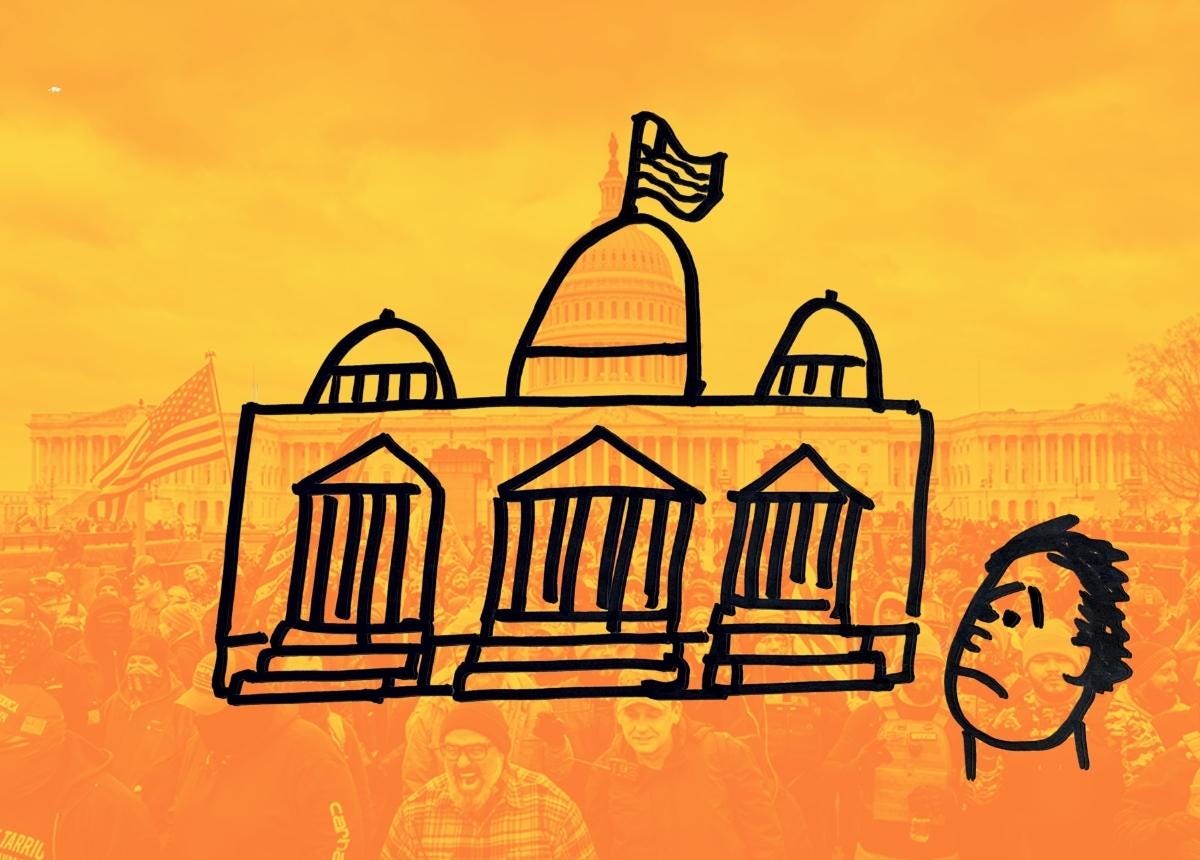
A year ago today
Friends,The words “anniversary” or “commemoration” do not appropriately characterize this day. What occurred a year ago is nothing to be memorialized, nothing to glorify. What happened on January 6, 2021 was frightening and shameful. That date shall live in infamy — like December 7, 1941 and 9/11. The difference is that on those days the United States was attacked by foreign powers, whereas on this date the United States was attacked by Americans — some waving American flags, most of them loyal to the man who had lost the presidential reelection the previous November 3 but who did not concede his loss and continues to argue the presidency was stolen from him.Besides paying our respects to the families of the five people who lost their lives in the attack on the Capitol, as well as to those who still bear its psychological scars — Capitol police officers, and members of congress who remain traumatized by what occurred — it is also important to acknowledge the trauma to our nation. The trauma continues to some extent in each of us today. The perpetrators must be held accountable. Trump must be held accountable. Members of congress who conspired with him must be held accountable. The only way we as a nation can process this trauma — gain some finality and closure on what occurred a year ago today — is to ensure that those who attacked the Capitol and those who instigated the attack bear full responsibility for their actions. And we must ensure that nothing like this ever occurs again. For those of you who may be interested, I held a live event this morning on social media (Facebook, Twitter, and Instagram — ironically, the same anti-social media on which the attack was planned and provoked) to make a few comments and answer your questions. The recording is below. This is a public episode. If you'd like to discuss this with other subscribers or get access to bonus episodes, visit robertreich.substack.com/subscribe
Today's Office Hours discussion: Will America have a second civil war?
Friends,With Trump’s Big Lie largely unchallenged by Republican lawmakers, the Republican Party has swung almost entirely into the Trump camp. Over 70 percent of registered Republicans believe Trump won the 2020 election. Trump has worked to purge from the state and national party anyone he considers insufficiently loyal to him. His closest supporters have become so extreme that they are openly supporting authoritarianism and talking of Democrats as “vermin.” Meanwhile, more than a third of Americans now say violent action against the government is sometimes justified — considerably more than in past polls dating back more than two decades. But a plurality of the people who feel this way are Republicans. Only 23 percent of Democrats think violence is sometimes justified, while 40 percent of Republicans say it is. Some fear a violent clash in the 2024 election if Trump runs and loses. Three former top generals recently warned in the Washington Post of their increasing concern about “the potential for lethal chaos inside our military, which would put all Americans at severe risk.” Thanks for subscribing to my letter on the system. If you’d like to support this effort (and be part of the discussion) please consider a paid or gift subscription. Talk of potential civil war can be dangerous and distracting. As Fintan O’Toole recently wrote in The Atlantic, in a critique of a new book “The Next Civil War” by the Canadian novelist and cultural critic Stephen Marche, such prophecies can be self-fulfilling and corrosive, making people more fearful of one another. They also distract attention from chronic but less spectacular problems the country faces. Even without a violent civil war, the chasm separating red and blue America has become so wide that the question arises: Can we continue to inhabit the same nation? **Let me thank all of you for your extremely thoughtful comments. I’ll offer a few thoughts of my own at this point, take your questions, and respond to your comments. First, I don’t think it will come to civil war. Our governing institutions are still strong. Most of our media is still responsible, in terms of reporting facts. Most of our political, nonprofit, and business leaders are doing their jobs as best they can. Even careless talk about civil war can be dangerous and destructive.But I do think we are in a civic crisis. Trump is the symptom. The underlying cause is that many Americans — mainly those without college degrees and living in the heartland — have been abandoned. The bottom 10 percent by income is still struggling but by-in-large are better off than they were 40 years ago. But the 40 percent just above them have been losing ground. That has made them susceptible to someone like Trump — claiming to be an anti-establishment “strongman” who can turn their despair and humiliation into hope and pride, even though he is pure bombast and narcissism. Why hasn’t the Democratic Party responded better to the needs of the working class? Even before it went on life support, “Build Back Better” had been whittled down to the point where it would do little or nothing for the bottom half. I’m old enough to remember when the Democratic Party attracted those with less education and the Republican Party attracted those with more. Today, people with less education vote for Republicans and those with more vote for Democrats. The Democratic Party has gone from being a worker party to a party of intellectual and professional elites. Since the Republican Party continues to cater to the needs and wants of business on economic policy, this has left millions of working people without any effective political voice. Hence, policies that would change the structure of power are opposed by the likes of Joe Manchin, the senior Democratic senator from West Virginia. We won’t have a civil war, but we are in imminent danger of losing our democracy to a dangerous alliance of big business oligarchs, on the one hand, and Trump-like populist-fascists on the other. To me, that’s the fight ahead of us — to foster a countervailing alliance of the poor, working class, and middle class that will make our democracy and economy work for them as well. This is a public episode. If you'd like to discuss this with other subscribers or get access to bonus episodes, visit robertreich.substack.com/subscribe
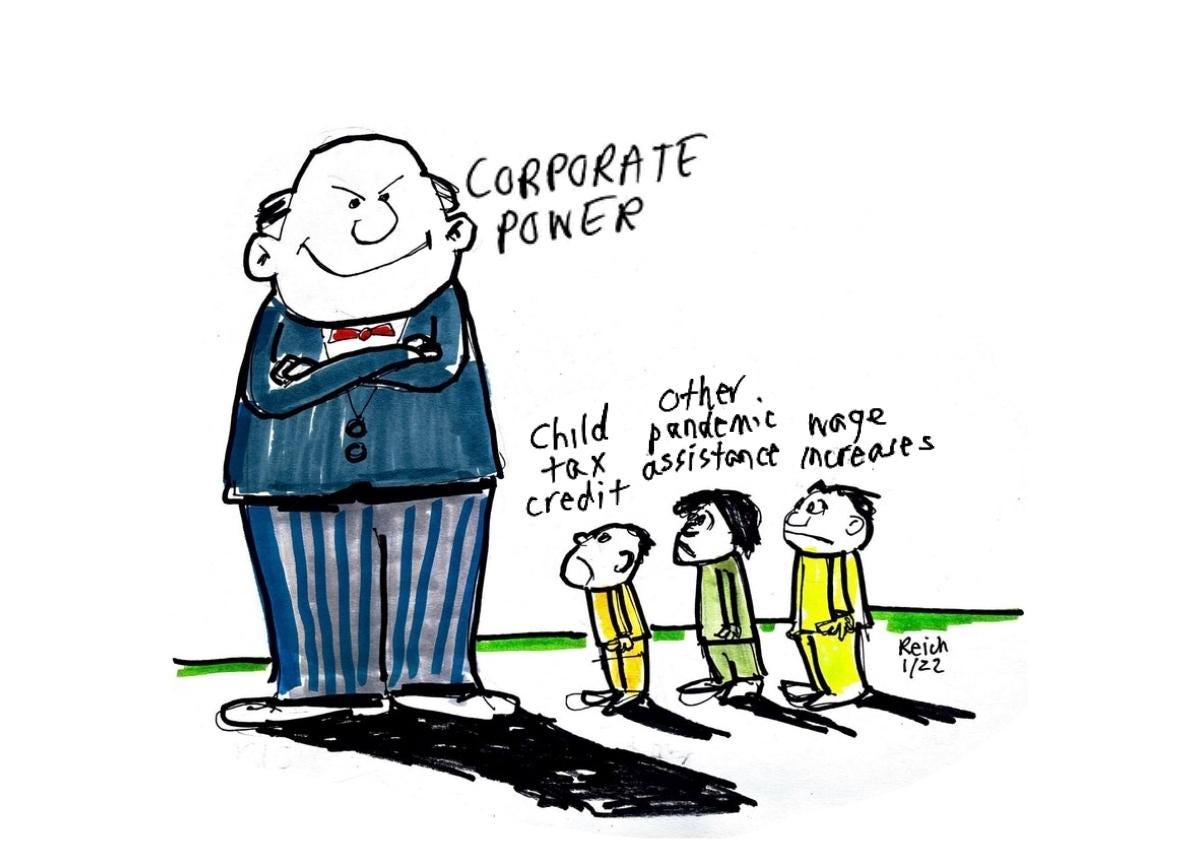
The Potterizing of America: As the child tax credit ends, big corporations (and their CEOs and investors) keep raking it in
Last week I suggested that Trump maintains a hold on a large fraction of America because he fills a void created by a system that has left them behind. I followed with the question raised by Frank Capra’s iconic film “It’s a Wonderful Life,” in which the greedy Mr. Potter tries to take over Bedford Falls: Do we join together or let the Potters of America own and run everything?We’re well on the way to the Potterizing of America. To take one example, the expanded child tax credit payments will end next week. (Biden’s original “Build Back Better” package had extended it, but the package is on life support in the Senate.) Republican critics, including Senator Roy Blunt of Missouri, claim that the child tax credit has contributed to inflation by giving people more money to spend when the supply chain is already strained. “Moderate” Democrats, like Joe Manchin, think it’s too expensive. Rubbish. The benefit is tiny compared with the economy. Yet its payments have reduced child poverty by nearly 30 percent and have helped the working class. They’ve reduced hunger and lowered financial stress, especially in rural states that received the most money per capita (such as Missouri and West Virginia). Families spent the money on essentials like groceries and stashed some away for emergency savings. Thanks for subscribing to my letter on the system. Please consider supporting this effort through a paid or gift subscription. Others (including a few prominent economists like Larry Summers) blame inflation on the government’s pandemic spending, overall. In yesterday’s New York Times, Neil Irwin wrote that because “the government tried overheating the economy” we now have “soaring prices and many goods in short supply. Inflation has reached its highest levels in four decades.”This misses the point. Expanded unemployment benefits ended in September (earlier in some states) and the last round of stimulus payments went out last spring. The spending was a great success story — keeping millions of Americans from falling into poverty. And it hasn’t been the major cause of inflation. Still others (CEOs and business groups) blame inflation on wage increases. This is pure rubbish. Price increases are now running at 6.8 percent annually but wages are growing only between 3-4 percent. So real wages (what those wages can actually purchase) are actually declining for most Americans. This is why programs like the child tax credit and other government assistance are so important. The biggest single reason prices are rising is the concentration of the American economy into the hands of a few corporate giants with the power to raise prices. To be sure, supply bottlenecks have raised the prices corporations pay for some raw materials and components. But here’s the most important thing: Instead of absorbing these costs, corporations are passing them on to customers in the form of higher prices. This is because most large corporations face little or no competition. If corporations in the same industry were competing vigorously against each other, they’d keep their prices as low as possible so as not to lose customers. They’d try to avoid passing increased costs to consumers in higher prices, for fear of losing customers to competitors that don’t raise prices. They’d absorb the costs, and their profits would fall. The opposite is occurring. Corporations are raising prices even as they rake in record profits. Profit margins at large corporations are now at a 70-year high. Take a look at the following chart (from Bloomberg):Big corporations face so little competition they can raise prices with impunity. They simply coordinate their prices increases with the handful of other big corporations in the same industry, who are happy to oblige. That way, all of them stay highly profitable. Wall Street knows exactly what’s going on. Big investors are pouring money into corporations with the power to raise prices. “What we really want to find are companies with pricing power,” Giorgio Caputo, senior portfolio manager at J O Hambro Capital Management told Bloomberg. “In an inflationary environment, that’s the gift that keeps on giving because companies can pass along their pricing on the way up, and don’t necessarily need to get it back on the way down” [emphasis added].The underlying problem isn’t inflation per se. It's lack of competition. Corporations are using the excuse of inflation to raise prices and make fatter profits. (Matt Stoller, who has an excellent Substack on monopolization, calculates that 60 percent of the increase in inflation is going to corporate profits.)Blaming the child tax credit or pandemic assistance or wage increases is a cruel ruse that disguises what’s really going on. This is what I mean when I say America has been Potterized: People at the top — top corporate executives and big investors — are doing better than ever. Everyone else is being squeezed. What should be done about all of this? For one thing, raise taxes on big corp
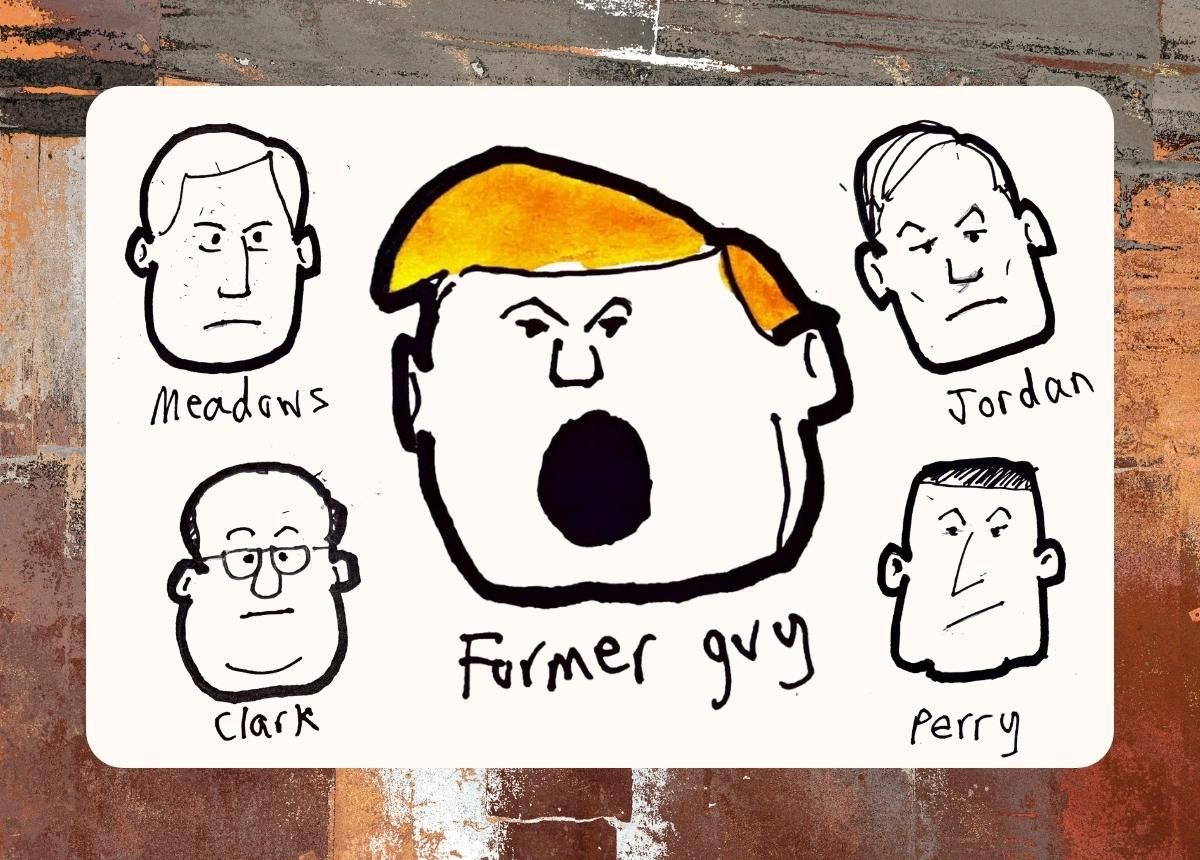
The Week Ahead: The start of accountability for Trump's attempted coup?
Before we turn to what I’m calling the "Potterizing” of America (the consolidation of wealth and power in the hands of a few at the very top), we need to deal with one of its shameful consequences that will be front and center this week: accountability for Trump’s ongoing attempted coup and the January 6 attack on the Capitol. Thursday marks the first anniversary of that attack. Last Wednesday I discussed four truths underlying the attack: (1) Trump incited it, (2) it culminated two months of his attempted coup, (3) his attempted coup continues to this day, and (4) he and his accomplices must be held accountable -- and we must also respond to the reasons why so many Americans continue to support him and his Big Lie.As Congress returns and the anniversary of the attack comes into view, the necessity of accountability presents itself in two forms. Democrats can and must act on both. The first is voting rights. The Senate reconvenes today. Voting rights is the most important issue before it, considering that Republican-dominated states have used Trump’s Big Lie to justify a raft of measures to restrict voting and give their legislatures greater control over the administration of elections. More such measures are on the way. The Freedom to Vote Act and the John Lewis Voting Rights Enhancement Act, both now before the Senate, are critical to protecting American democracy from these and other incursions. But because no senate Republican supports these bills, they can be passed only if senate Democrats change the filibuster rule. One way (which even Joe Manchin seems receptive to) would be to carve out an exception for voting rights bills so they can be enacted by a simple majority. Changing the filibuster is the first step to protecting voting rights and our democracy. Senate Democrats must take this step right away. Thanks for subscribing to my letter about the system. If you’d like to support this effort, please consider a paid or gift subscription. The other form of accountability is criminal responsibility for the attempted coup and the attack on the Capitol. The Justice Department has already charged more than 700 people with participating in the attack. Although no case has yet gone to trial, many of the defendants have pleaded guilty and received sentences from probation to 41 months in prison.Yet so far, the Department has charged no political figure, including Trump himself. To be sure, the Watergate scandal didn’t result in significant prosecutions and convictions for two years after the break-in. But if Republicans gain a majority in the House next November, you can bet they’ll close down the House’s January 6 committee now investigating the attack. The critical political actors at this point are:Republican congresswoman Liz Cheney, the committee’s vice chair. Cheney is focused squarely on Trump’s potential crimes. Yesterday she said of Trump: “Any man…who would provoke a violent assault on the Capitol to stop the counting of electoral votes, any man who would watch television as police officers were being beaten, as his supporters were invading the Capitol of the United States is clearly unfit for future office, clearly can never be anywhere near the Oval Office ever again.” She went on to warn her Republican colleagues that they “can either be loyal to Donald Trump or we can be loyal to the Constitution, but we cannot be both.”Mark Meadows, Trump’s last chief of staff. After he failed to appear before the committee, Congress voted to hold him in contempt and referred him to the Justice Department for prosecution. As of today, the grand jury impaneled by the Department has not indicted Meadows (note that his is the same crime for which Trump adviser Steve Bannon was indicted).Former assistant attorney general Jeffrey Clark. His testimony could also implicate Trump. Recall that when top Justice Department officials told Trump that no widespread fraud contributed to President Joe Biden’s win, Trump reportedly responded, “Just say that the election was corrupt and leave the rest to me” and his allies in Congress. Clark apparently took Trump up on his request, drafting a letter giving Georgia elections officials a road map to overturn the election’s results. When Clark appeared before the House committee about this, he refused to answer questions and has since missed several appearance dates (allegedly because of unspecified health issues).Republican congressman Scott Perry. He reportedly assisted Trump in trying to install Clark as attorney general. (Perry and Meadows seem to have communicated via encrypted apps, presumably to hide what they were talking about.) Perry has refused the committee’s request for documents and testimony concerning the run-up to the attack on the Capitol, asserting that the committee is an “illegitimate entity.” (Hello? Multiple trial and appellate courts have ruled that the committee is doing precisely what it is authorized to do.)Republican congressman Jim Jordan. When the Ja

The Road Ahead
Happy new year. I hope it’s a safe and healthy one for you and your family. Over the last few days I’ve shared with you some facts and thoughts about Trump’s continuing attempted coup. I’ve also suggested that an answer to it (and to Trumpism in general) can be found in Frank Capra’s 1946 iconic movie “It’s a Wonderful Life” and the central question it posed: Do we join together, or let the Mr. Potters of America own and run everything?Today, the first of 2022, struck me as an appropriate one to focus on how and why America came to be Potterized.It’s not possible to change the future without understanding the past. The American system isn’t just politics or “the market” as we now experience it. It’s an evolving set of laws, rules, and norms that reflect a shifting structure of power. If we want to alter the road we’re on (and we must), we need to see how we got on it. If we want to alter the current structure of power (and we must), we have to realize how it came to be. Thank you for subscribing to this letter about the system. If you’d like to support this work, please consider a paid or a gift subscription. Most importantly, we need to see why we made a giant U-turn from the road we were on during the first three decades after World War II — when America was on the way to building a robust democracy and the biggest middle class the world had ever seen, expanding civil rights and voting rights and creating a more inclusive society — to the road that led us to Trump. If we figure out how we got from “It’s a Wonderful Life” of 1946 to the Pottersvilles that so many Americans are inhabiting in 2022, we have a fighting chance of getting back on the right road. My personal journey — and the questions that have dogged me for years — parallels this larger one. I was born in 1946, the same year “It’s a Wonderful Life” was released. I grew up in the 1950s and 1960s during civil rights, voting rights, women’s rights, and a burgeoning if not wild-eyed youthful optimism about the future. I witnessed the U-turn. I saw the system change, but didn’t know why. In the 1970s, I represented the United States before the Supreme Court, and then I ran the policy team in the Federal Trade Commission. In the 1980s, I watched and chronicled what I saw happening under Reagan and Bush 1, and I taught brilliant students what I thought they needed to know about the system. In the 1990s, I advised Bill Clinton when he was a candidate for president, then headed his economic transition team and became his Secretary of Labor. Afterwards, I taught another group of terrific students. I advised Barack Obama. When Trump was elected, I became a staunch critic. Through it all, I kept asking myself: why is this happening? How did we get on the wrong road? What can be done? I have some preliminary answers that I’ll be sharing with you over the next weeks and months. For now, here’s a video that was my first attempt to answer these questions as simply as I could. Please have a look. I’m interested in your thoughts and comments. By the way, a number of you have asked for a still of “The Big Picture.” Here it is: This is a public episode. If you'd like to discuss this with other subscribers or get access to bonus episodes, visit robertreich.substack.com/subscribe

Want to know what to do about Trump? You might start with "It's a Wonderful Life"
My post yesterday on the real lesson of January 6 provoked a great discussion (many thanks to those of you who participated). It also prompted me to rewatch a movie that provides a hint of an answer — Frank Capra’s “It’s a Wonderful Life,” which was released 75 years ago this month. When I first saw the movie in the late 1960s, I thought it pure hokum. America was coming apart over Vietnam and the assassinations of Martin Luther King, Jr. and Robert F. Kennedy, and I remember thinking the movie could have been produced by some propaganda bureau of the government that had been told to create a white-washed (and white) version of the United States. But in more recent years I’ve come around. As America has moved closer to being an oligarchy — with staggering inequalities of income, wealth, and power not seen in over a century — and closer to Trumpian neofascism (the two moves are connected), “It’s a Wonderful Life” speaks to what’s gone wrong and what must be done to make it right. As you probably know (and if you don’t, this weekend would be a good time to watch it), the movie’s central conflict is between Mr. Potter (played by Lionel Barrymore) and George Bailey (Jimmy Stewart). Potter is a greedy and cruel banker. George is the generous and honorable head of Bedford Fall’s building-and-loan — the one entity standing in the way of Potter’s total domination of the town. When George accidentally loses some deposits that fall into the hands of Potter, Potter sees an opportunity to ruin George. This brings George to the bridge where he contemplates suicide, thinking his life has been worthless — before a guardian angel’s counsel turns him homeward.It’s two radically opposed versions of America. In Potter’s social-Darwinist view, people compete with one another for resources. Those who succeed deserve to win because they’ve outrun everyone else in that competitive race. After the death of George’s father, who founded the building-and-loan, Potter moves to dissolve it — claiming George’s father “was not a businessman. He was a man of high ideals, so-called, but ideals without common sense can ruin a town.” For Potter, common sense is not coddling the “discontented rabble.” In George’s view, Bedford Falls is a community whose members help each other. He tells Potter that the so-called “rabble … do most of the working and paying and living and dying in this community.” His father helped them build homes on credit so they could afford a decent life. “People were human beings to him,” George tells Potter, “but to you, they’re cattle.”When George contemplates ending it all, his guardian angel shows him how bleak Bedford Falls would be had George never lived — poor, fearful, and dependent on Potter. The movie ends when everyone George has helped (virtually the entire town) pitch in to bail out George and his building-and-loan. It’s a cartoon, of course — but a cartoon that’s fast becoming a reality in America. Do we join together or let the Potters of America own and run everything? Soon after “It’s a Wonderful Life” was released, the FBI considered it evidence of Communist Party infiltration of the film industry. The FBI’s Los Angeles field office — using a report by an ad-hoc group that included Fountainhead writer and future Trump pin-up girl Ayn Rand — warned that the movie represented “rather obvious attempts to discredit bankers by casting Lionel Barrymore as a ‘scrooge-type’ so that he would be the most hated man in the picture.” The movie “deliberately maligned the upper class, attempting to show the people who had money were mean and despicable characters. This … is a common trick used by Communists.” The FBI report compared “It’s a Wonderful Life” to a Soviet film, and alleged that Frank Capra was “associated with left-wing groups” and that screenwriters Frances Goodrich and Albert Hackett were “very close to known Communists.”This was all rubbish, of course — and a prelude to the Red Scare led by Republican Senator Joe McCarthy of Wisconsin, who launched a series of highly publicized probes into alleged Communist penetration of Hollywood, the State Department, and even the US Army. The movie was also prelude to modern Republican ideology. Since Ronald Reagan, Republicans have used Potter-like social Darwinism to justify everything tax cuts for the wealthy, union-busting, and cutbacks in social safety nets. Rand herself became a hero to many in the Trump administration. Above all, Reagan Republicans, CEOs, and Trumpers have used the strategy of “divide-and-conquer” to generate division among Americans (a kind of political social-Darwinism). That way, Americans stay angry and suspicious of one another, and don’t look upward to see where all the money and power have gone. And won’t join together to claim it back. What would Republicans say about “It’s a Wonderful Life” if it were released today? They’d probably call it socialist rather than communist, but it would make them squirm all the same — especially given
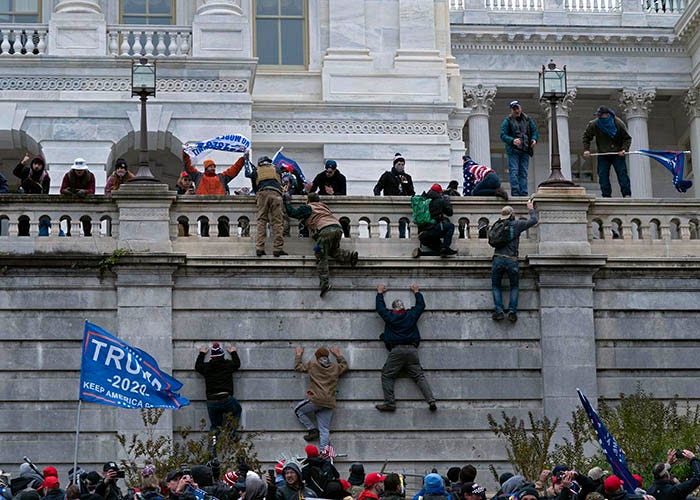
What is the real meaning of January 6?
I’m sorry to intrude on your holiday week with this, but I want you to be prepared for what’s to come next week. January 6 will be the first anniversary of one of the most shameful days in American history. On that date in 2021, the United States Capitol was attacked by thousands of armed loyalists to Donald Trump, some intent on killing members of Congress. Roughly 140 officers were injured in the attack. Five people died that day. But even now, almost a year later, Americans remain confused and divided about the significance of what occurred. Let me offer four basic truths:1. Trump incited the attack on the Capitol. For weeks before the attack, Trump had been urging his supporters to come to Washington for a “Save America March” on January 6, when Congress was to ceremonially count the electoral votes of Joe Biden’s win. Without any basis in fact or law (60 federal courts as well as the Departments of Justice and Homeland Security concluded that there was no evidence of substantial fraud), Trump repeatedly asserted he had won the 2020 election and Biden had lost it. “Big protest in D.C. on January 6th. Be there, will be wild!” Trump tweeted on December 19. Then on December 26: “See you in Washington, DC, on January 6th. Don’t miss it. Information to follow.” On December 30: “JANUARY SIXTH, SEE YOU IN DC!” On January 1: “The BIG Protest Rally in Washington, D.C. will take place at 11:00 A.M. on January 6th. Locational details to follow. StopTheSteal!”At a rally just before the violence, Trump repeated his falsehoods about how the election was stolen. “We will never give up,” he said. “We will never concede. It will never happen. You don’t concede when there’s theft involved. Our country has had enough. We will not take it anymore.” He told the crowd that Republicans are constantly fighting like a boxer with his hands tied behind his back, respectful of everyone — “including bad people.” But, he said, “we’re going to have to fight much harder…. We’re going to walk down to the Capitol, and we’re going to cheer on our brave senators and congressmen and women, and we’re probably not going to be cheering so much for some of them, because you’ll never take back our country with weakness. You have to show strength, and you have to be strong…. We fight like hell. And if you don't fight like hell, you're not going to have a country anymore." He then told the crowd that “different rules” applied to them. “When you catch somebody in a fraud, you are allowed to go by very different rules. So I hope Mike [Pence] has the courage to do what he has to do, and I hope he doesn’t listen to the RINOs [Republicans in Name Only] and the stupid people that he’s listening to.” Then he dispatched the crowd to the Capitol as the electoral count was about to start. The attack on the Capitol came immediately after. 2. The events of January 6 capped two months during which Trump sought to reverse the outcome of the election. Shortly after the election, Trump summoned to the White House Republican lawmakers from Pennsylvania and Michigan, to inquire about how they might alter the election results. He even called two local canvassing board officials in Wayne County, Michigan’s most populous county and one that overwhelmingly favored Biden.He phoned Georgia’s Republican secretary of state to “find 11,780 votes,” according to a recording of that conversation, adding “the people of Georgia are angry, the people of the country are angry. And there’s nothing wrong with saying that, you know, um, that you’ve recalculated.” He suggested that Georgia’s secretary of state would be criminally prosecuted if he did not do as Trump told him. “You know what they did and you’re not reporting it. You know, that’s a criminal — that’s a criminal offense. And you know, you can’t let that happen. That’s a big risk to you and to Ryan, your lawyer. That’s a big risk.”He pressed the acting US attorney general and deputy attorney general to declare the election fraudulent. When the deputy said the department had found no evidence of widespread fraud and warned that it had no power to change the outcome of the election, Trump replied “Just say that the election was corrupt + leave the rest to me” and to Trump’s congressional allies. Trump and his allies continued to harangue the attorney general and top Justice Department officials nearly every day until January 6. Trump plotted with an assistant attorney general to oust the acting attorney general and pressure lawmakers in Georgia to overturn the state’s election results. But Trump ultimately decided against it after top department leaders pledged to resign en masse.Presumably, more details of Trump’s attempted coup will emerge after the House Select Committee on January 6 gathers more evidence and deposes more witnesses. 3. Trump’s attempted coup continues to this day. Trump still refuses to concede the election and continues to assert it was stolen. He presides over a network of loyalists and allies who have
How I've shared the holidays with my family thousands of miles away
My father once said that at the 1939 World’s Fair he saw an exhibit about the future featuring “picture phones” that allowed people to talk and see each other. He predicted the gadgets would fail because users would find them awkward and unnerving.Well, that future is now — and it’s not awkward in the slightest. I just had FaceTime calls with my two sons and their families (including two wonderful daughters-in-law and a granddaughter) – one in New York, the other in Los Angeles. I can’t tell you how happy it made me to see and hear all of them. They looked relaxed. They’re enjoying the holidays. They’re safe and healthy.We’ve been exchanging text messages and regular phone calls during the holiday. But to see them — to watch and interact with them — is different. Not as good as being with them, of course, but the next best thing when family members live thousands of miles away and the pandemic makes travel difficult.Like my father, I’m a bit of a technophobe. I’m a late adapter of e-everything. When it comes to Apple, Google, Facebook, Amazon, or Microsoft, I harbor deep suspicions bordering on loathing. I hate the part of “connectivity” that threatens our autonomy and privacy and undermines our democracy.But I love the part that just moments ago allowed me to see their faces light up, watch them laugh and joke, and be there with them, even for a few minutes. My granddaughter is growing and changing so fast I almost can’t bear not being with her. And yet there she was on my phone, her eyes dancing directly into the eyes of her delighted grandfather!When my sons were her age and a bit younger, I went to Washington to join Bill Clinton’s cabinet. I missed the precious years when they were turning from youngsters to teenagers — separating from their parents and discovering their independent selves. Sure, I saw them on weekends and on holidays. But I was often preoccupied with the Nation’s Business. Had FaceTime existed then I doubt it would have made much difference. During the week I worked twelve-hour days. Over and over again I told myself the grandiose lie that the nation needed me. Yet deep down I knew they needed me more.I left the Clinton administration because the truth finally caught up with me. But by then we had only a few years left together before they went off into the world — first one, then the other. And now some two decades later they have their own families, their own responsibilities, their own lives. They live and work thousands of miles away. Even during this holiday week, their aging dad can’t be with them. A fierce pandemic continues to rip its way through the world. I sometimes wonder if I made the right decision years ago — spending those years in meetings, on the phone, traveling around the country, managing a vast bureaucracy, racing up and down Pennsylvania Avenue between the White House and Capitol Hill — instead of with them. I tell myself not to dwell on what can never be relived or retrieved, but the question lingers. All I know right now is that I miss them and my daughters-in-law and granddaughter terribly. I’m grateful to be able to share small slices of their lives, even on FaceTime. This is a public episode. If you'd like to discuss this with other subscribers or get access to bonus episodes, visit robertreich.substack.com/subscribe
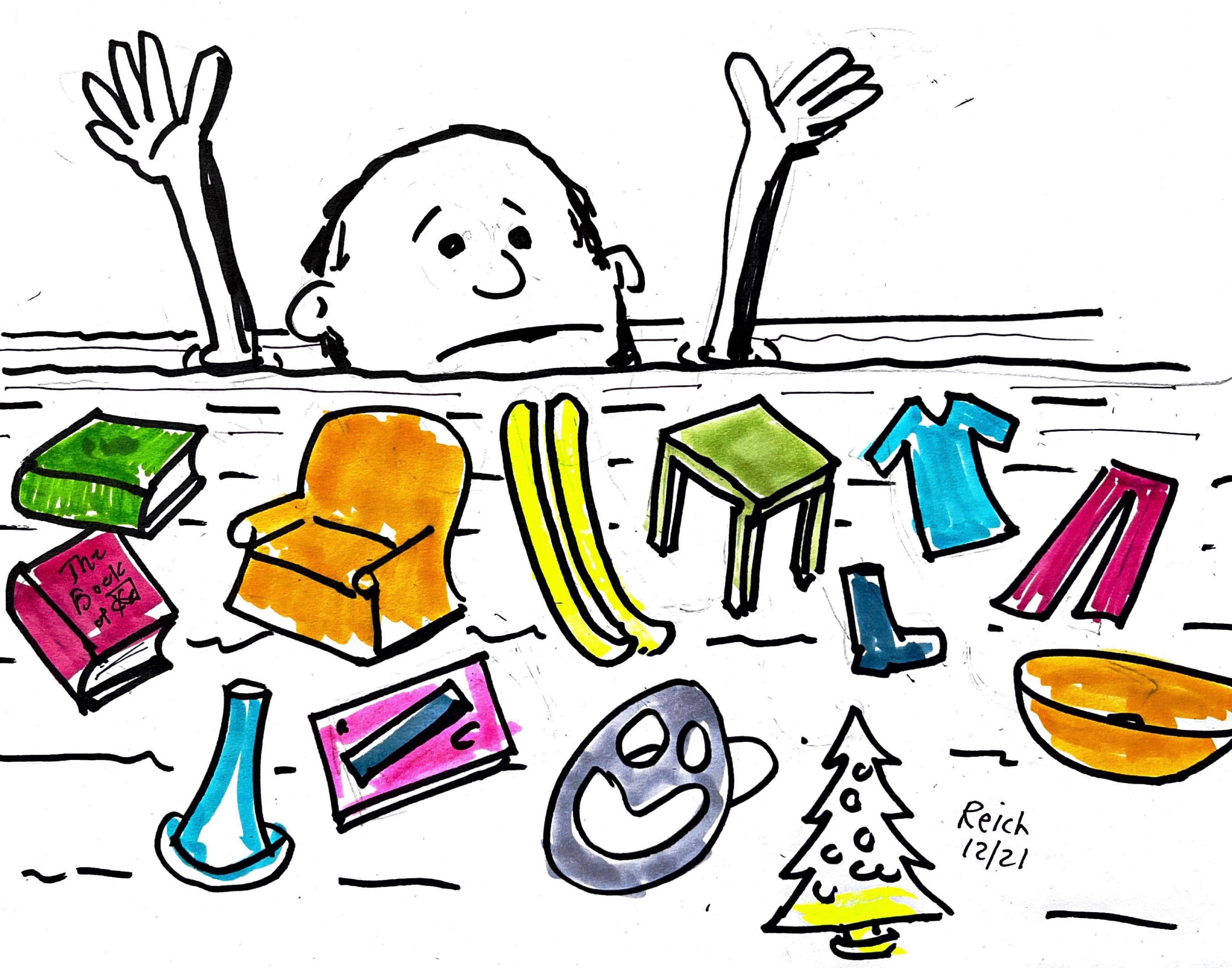
How to overcome the tyranny of stuff
‘Tis the time to cash in gift certificates, shop for post-Christmas bargains, and fill shelves and closets with more stuff. I for one don’t want anything more, thank you. My shelves are already overflowing with books. My attic is full of old chairs and tables, chafing dishes, pictures, games, children’s toys, ski equipment, stereos, a broken easel. My closet can’t fit any more clothes, most of which I haven’t worn in years. I’m drowning in stuff. Once a year (usually around the holidays), I drop off as much stuff as I can at Goodwill Industries or the Salvation Army. To be totally honest, I don’t just off-load stuff I no longer need. I also prowl around thrift stores on the off-chance I’ll find some quirky thing I’ve been looking for (or maybe a friend or relative would love to have) — say, a vinyl recording of Leonard Cohen from the late 1960s, a funny tie, memorabilia from one of FDR’s presidential campaigns. A few months ago my neighbors began putting stuff they no longer want on the sidewalk at the end of the street, hoping others will pick it up. I’ve started putting stuff there, too. I’ve even picked up a few things there, like some exercise weights I’d been looking for.In all these ways, I’ve become a small part of a recycled economy. Maybe you have, too. At different times of our life we want different things. When kids are small, they have certain needs; as they grow up, different needs and wants. When they leave home and we downsize, lots of stuff goes into the attic. Tastes change over the years, too. Technologies alter or advance. Besides all this are the gifts that don’t suit, the clothes that no longer fit, the purchases that are later regretted. All create a need for recycling. This got me wondering: What if we were all more intentional about recycling stuff? What if there were a systematic way of donating things we no longer need and of finding stuff we’d like to have? I’m talking about something far more radical than just recycling our garbage or waste. Imagine an entire system based on continuously recycling stuff — without any of it being bought or sold. Something like this already up and running in the form of “Buy Nothing” groups. Started in 2013 as a local network in Bainbridge Island, Washington, “Buy Nothing” groups now comprise 4.3 million members in 44 countries. Members can offer or request any item or service, as long as it’s legal. (Buying, selling and bartering are prohibited.) A Buy Nothing app, launched last month, has already been downloaded more than 125,000 times. If you’re curious, you might take a look here.Economic systems tend to be divided into “capitalist” and “socialist,” with gradations in between. Under capitalism (to drastically simplify) people buy stuff with the income they get from selling stuff. Under socialism, people share stuff. To state another way: Capitalism focuses on production and consumption. Socialism focuses on distribution. But what if there’s a third model — a recycling system in which all the stuff people no longer want is continuously recirculated to people who want it? This third model could be increasingly important as we face a worsening clash between infinite wants on a planet with finite resources. Imagine how much less waste there’d be if the stuff already out there were continuously recirculated. The United States now produces more plastic waste than any other country, according to the National Academy of Sciences. The average American generates about 287 pounds each year. And think of the greenhouse gas emissions we’d avoid in a recycled economy. A 2020 paper published in Nature attributes overconsumption and the relentless pursuit of economic growth to the explosive rise in greenhouse gas emissions now threatening our planet. But wait, you might say. Consumer spending is about 70 percent of gross domestic product. Our economy depends on consumption. Remember George W. Bush telling Americans that the most patriotic thing we could do after 9/11 was to buy? If consumer spending were substantially reduced because we recycled lots more stuff, the Gross Domestic Product would take a dive. Tens of thousands of retailers and wholesalers might close. Millions could lose their jobs and livelihoods. Hell, we just lived through a pandemic-induced recession that showed how bad things can get. But that’s not the inevitable tradeoff, for one simple reason: Life in a recycled economy would be a lot cheaper. We wouldn’t need to buy nearly as much. So we wouldn’t need to work and earn nearly as much. We’d stop measuring our wellbeing by the Gross Domestic Product or even by the unemployment rate, because part of our wellbeing would be outside the production-consumption system of capitalism. Nor would we be relying on generosity or social solidarity. Most of us already have too much stuff — or we have the wrong stuff for this particular time in our lives. We just need a better system for reallocating stuff already produced that’s not wanted or not being
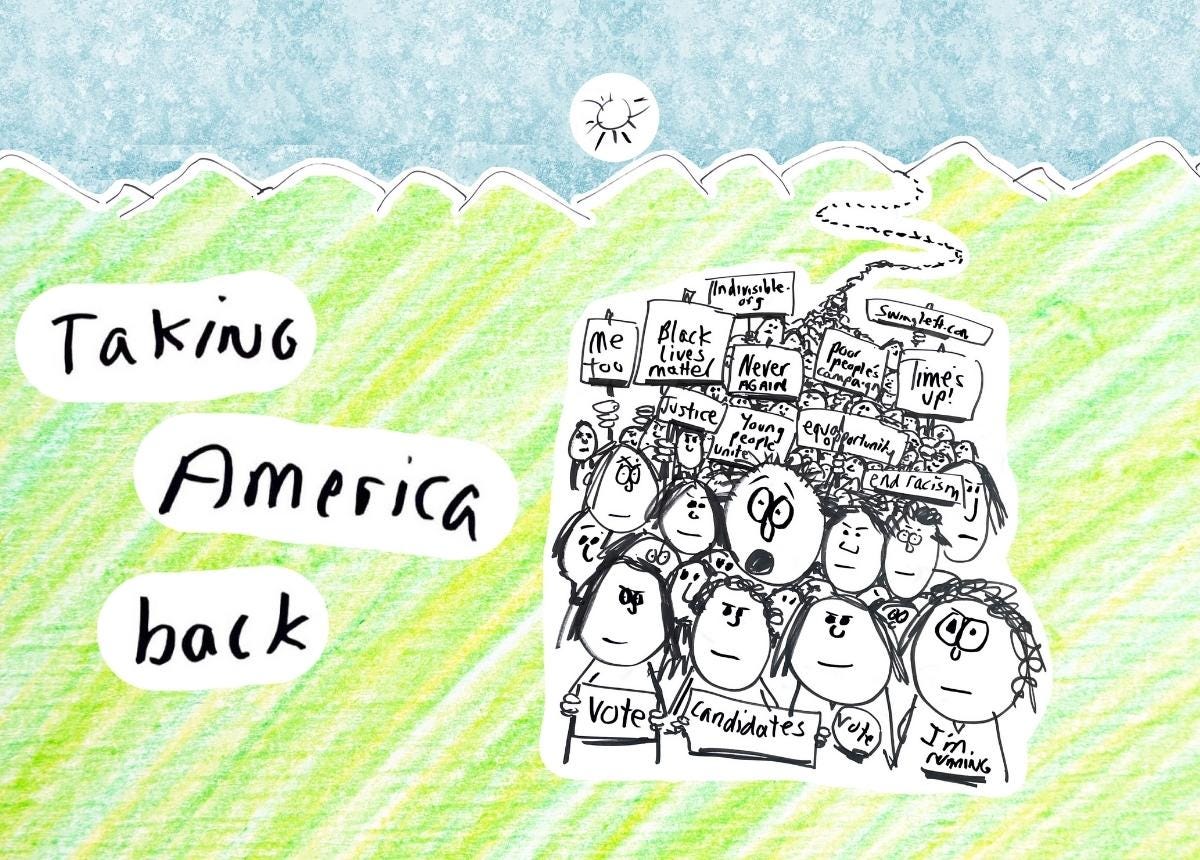
How to stay hopeful in a time of despair
Friends, The reason I write this newsletter is not just to inform (and occasionally amuse) you, but also to arm you with the truth so you can fight more effectively for the common good.The forces undermining our democracy, polluting our planet, and stoking hatred and inequality have many weapons at their disposal — lobbyists, media megaphones, and money to bribe lawmakers. But their most powerful weapon is cynicism. They’re betting that if they can get us to feel like we can’t make a difference, we will give up — and then they can declare total victory.Which is why we have to keep up the fight even when feeling deeply discouraged. I’m not going to pretend. There’s a lot to be discouraged about right now — from Manchin’s torpedoing of “Build Back Better” to the surging Omicron variant of COVID-19 and the politicization of public health, from the Republicans’ assault on voting rights to environmental disasters all over the world. My message to any of you who feel overwhelmed, disappointed, or ready to drop out: I get it. I’ve been in the trenches for five decades and sometimes I despair as well. Again and again over the years I’ve seen hard-fought dreams go up in smoke. Or been sidelined. Or ridiculed. Or I’ve watched them succumb to bribery and corruption. Two of the leaders I counted on most in my lifetime were assassinated. But notwithstanding all this, we are better today than we were fifty years ago, twenty years ago, even a year ago. I can point out so many examples in our own country, or all across the world, where movements that were once small and stacked against seemingly impossible odds, ended up winning and making America and our earth a better place to live. From Martin Luther King, Jr., to Mahatma Gandhi, to more recent examples like Stacey Abrams and Greta Thunberg, people have repeatedly changed the course of history by refusing to believe that they couldn’t make a difference. It’s not only the famous leaders who are agents of change. Movements are fueled by individuals giving their time, energy, and hope. Small actions and victories lead to bigger ones, and the improbable becomes possible.Nothing strikes fear in the hearts of those who want to prevent progress more than a resistance that is undeterred. This fight, this struggle, all these big problems, can be exhausting. No one can go all in, all the time. That’s why we need to build communities and movements for action, where people can give what effort they can, and can be buoyed in solidarity with others. That’s what we’re doing in a small way in this forum. Building community. Strengthening our resolve. Sharing information and analyses. Fortifying ourselves. Over the next few years the fight will become even more intense. We are even battling for the way we tell the story of America. There are those who want to go back to a simplistic and inaccurate narrative, where we were basically perfect from our founding, where we don’t need to tell the unpleasant truths about slavery, racism, sexism, homophobia, xenophobia, and all the other injustices. But there is another story of America, one of imperfection but progress. In this story, which is far more accurate, reformers have changed this nation many, many times for the better. We got labor rights, civil rights, women's rights, and LGBTQ rights. We got clean water laws and clean air laws, and health insurance for most Americans. We’ve torn down Confederate statues and expanded clean energy. We’ve got a new generation of young, progressive politicians determined to make the nation better. The list goes on and on. The outcome of the fight ahead will not be determined by force, fear, or violence. It will be decided on the basis of commitment, tenacity, and unvarnished truth.Here’s my deal. I’ll continue to give you the facts and arguments, even sprinkle in drawings and videos. I’ll do whatever I can to help strengthen your understanding and your resolve. Please use the facts, arguments, drawings and videos to continue the fight. To fight harder. To enlist others. If at any time you feel helpless or despairing, remember that the struggle is long, that progress is often hard to see in the short term, and that for every step forward regressive forces are determined to push us backwards. Also remind yourself that the fights for democracy, social justice, and a sustainable planet are necessary and noble, that the stakes could not be greater or more important, and that we will — we must — win. I wish you a restful, enjoyable, restorative Christmas holiday. PS: Here’s a video I just did with my wonderfully talented young colleagues at Inequality Media (who fuel my optimism every day). Feel free to share! This is a public episode. If you'd like to discuss this with other subscribers or get access to bonus episodes, visit robertreich.substack.com/subscribe
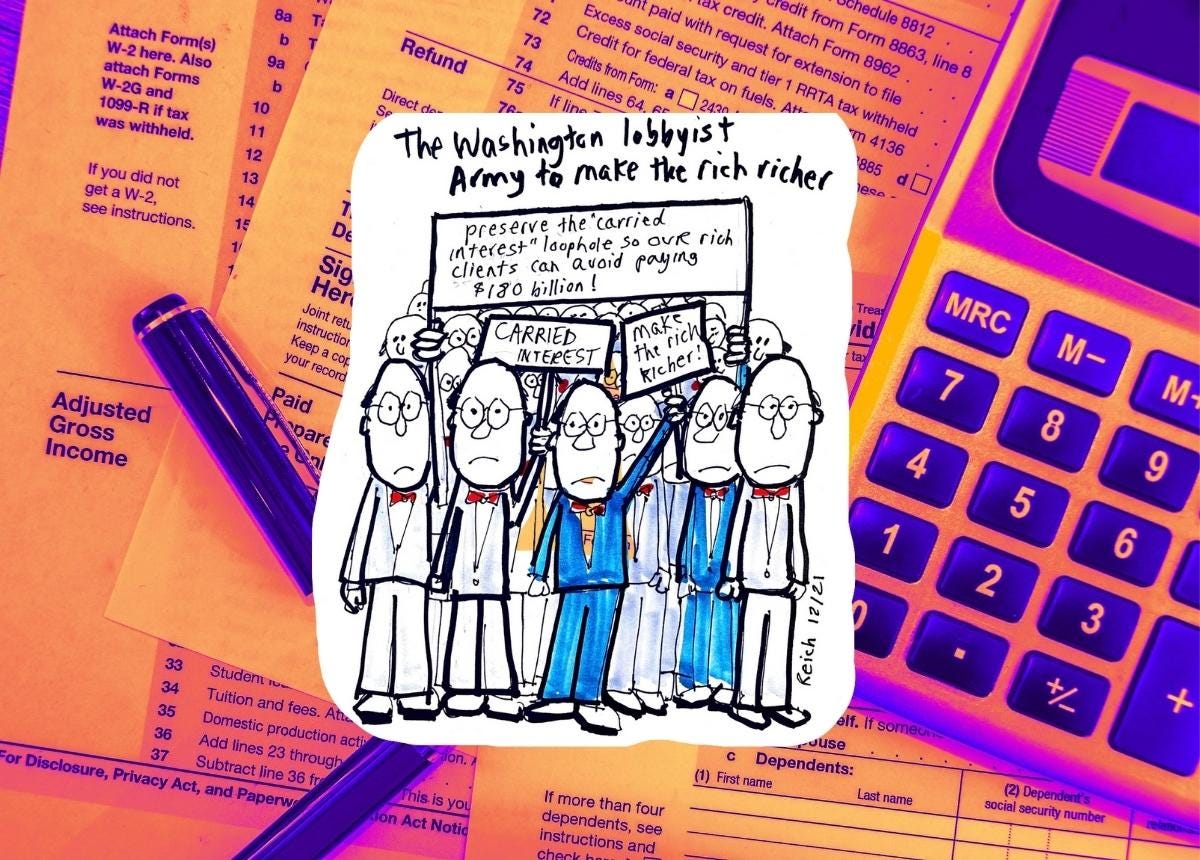
You want to know a really dirty secret? Here's why Democrats are protecting private equity's "carried interest" loophole
Democrats still hope they can salvage pieces of their ambitious tax agenda even after Sen. Joe Manchin blew up the legislation that included it. I’m sick of trying to fathom Manchin’s mind or motives but senate Democrats think he’s sincere about tax reform. In a Monday interview on a West Virginia radio station, Manchin pointedly said that ensuring people pay “their fair share” of taxes is the main reason he’s come this far in negotiations. “You have a chance to fix the tax code that makes it fair and equitable.” Well, if Democrats are willing to take another stab at tax reform, I’ve got just the candidate: Get rid of the “carried interest” loophole that lets private equity managers – among the wealthiest people in America – pay a tax rate lower than most Americans. The “carried interest” loophole is huge, and it’s a pure scam. Private equity managers get this tax break even though they invest other peoples’ money. They don’t risk a penny of their own. Bill Clinton, George W. Bush, and Barack Obama all promised to get rid of it. They didn’t. Hell, even Donald Trump promised to get rid of it. He didn’t, either. “I don’t know what happened,” said Larry Kudlow, the conservative economist who crafted Trump’s tax plan. “I don’t know how that thing survived,” he said, adding, “I’m sure the lobbying was intense.”You’d think that the carried interest loophole would be high on the Democrats’ list of revenue-raisers. After all, closing it could raise $180 billion over the next decade from among the richest Americans. That’s $180 billion that could go toward supporting vulnerable Americans and investing in America’s future.Think again. The loophole – which treats the earnings of private equity and hedge-fund managers as capital gains, taxed at a top rate of just 20 percent, instead of personal income, whose top tax rate is 37 percent – remains as big as ever. Bigger. Astonishingly, some influential Democrats, such as House Ways and Means Committee chair Richard Neal, defend the loophole. They say closing it would hobble the private equity industry, and, by extension, the US economy. This is pure rubbish. In fact, private equity firms generate huge social costs. They buy companies they see as ripe for “turnarounds” – a polite way of saying that once they buy these companies they’ll cut wages, outsource jobs, strip assets, and then resell what’s left, often laden with debt. Look no further than the strike by Alabama’s Warrior Met Coal mineworkers that’s been underway since April 1st. Warrior Met is owned by a group of private equity firms led by New York-based Apollo Global Management. Mineworkers gave up their pension plan, retiree health care and wages to make Warrior Met’s mines mines profitable, as Apollo and other private equity investors siphoned off hundreds of millions of dollars for themselves in special cash dividends.Since the pandemic began, private equity has been using the flood of cheap money to buy companies at a record pace, and then squeeze them (and their workers) dry. 2021 has been private equity’s biggest ever — reaching a record $1.1 trillion in deals.So why are Democrats subsidizing private equity’s predatory behavior with this tax loophole? How did the loophole survive the Clinton and Obama administrations when the Democrats controlled both houses of Congress? Why isn’t it even on the current list of tax reforms Democrats went to use to pay for the Build Back Better package, if they can resurrect it in January? What’s the dirty secret? Thanks for subscribing to my newsletter. If you’d like to help support it, please consider a paid subscription or a gift subscription. “This is a loophole that absolutely should be closed,” said Biden adviser Jared Bernstein. But “when you go up to Capitol Hill and you start negotiating on taxes, there are more lobbyists in this town on taxes than there are members of Congress.”Last year 4,108 individual lobbyists formally registered to lobby Congress and the executive branch on taxes. The private equity industry alone has contributed hundreds of millions of dollars to congressional campaigns – $600 million over the past decade, according to a New York Times analysis earlier this year. But here’s the thing. Most of these campaign contributions (bribes) have gone to Democrats. Nearly 60 percent of campaign donations from partners in the private equity industry during the 2020 election went to Democratic candidates for federal office. During the 2020 election, Biden’s presidential campaign received over $3 million from people working in private equity and related investment funds, according to the nonpartisan Center for Responsive Politics. Biden was the top recipient of campaign money from this industry.The dirty secret is Democrats have depended on campaign funding from private-equity partners — hugely wealthy people who are shafting workers across the land. Back in 2010, some courageous House Democrats squeaked through a tax plan that closed the loophole, but Demo

Help! What will Omicron do to my holiday plans?
When it comes to the surging Omicron variant of COVID, just about all I’m hearing is advice about holiday planning. Should one attend a holiday party? Travel? Meet friends at a restaurant?Much of the answer boils down to how to calculate one’s tolerance for risk when so little is known about Omicron except that it spreads easily. Experts are throwing around a lot of numbers. Columnists are sharing their own personal calculations. I understand. We’re all a bit spooked and don’t know exactly what to do. Calculations offer a degree of reassuring certitude. But why does America need to turn this latest COVID surge — as we do so much else — into a question of individual risk, personal calculation, and self-concerned choice? Personal responsibility is important, of course. But I worry that this hubbub over individual risk assessment is distracting us from what we need to do now as a society to be readier for Omicron than we were for Delta or for the first COVID surge.It also plays directly into the hands of anti-vaxxers who want to believe COVID is only about personal choice. On Friday's Fox Business, Florida Governor Ron DeSantis was asked if he was getting the booster. DeSantis smirked, shook his head no, and then went into a long harangue about why people should make vaccine decisions “for themselves.”This past weekend, at Turning Point USA, the MAGA college Republican spin-off (whose founder died from COVID-19 last summer), Sarah Palin said it would be “over my dead body” that she got vaccinated (no pun intended). And Tucker Carlson (perhaps the most harmful person in America these days) railed against those who are urging vaccination, saying they just want to “punish people.” Carlson then praised the “naturally immune” who “earned it.”It’s too easy for the rest of us to respond to this rubbish by telling ourselves that anti-vaxxers will pay the price because they’re putting themselves at much higher risk of being hospitalized and even dying. But this kind of thinking reflects the same dangerous fallacy — that each of us must make such life-or-death decisions for themselves. On Friday, Jeff Zients, the White House COVID coordinator, inadvertently promoted this fallacy by telling reporters that while the administration will work to minimize Omicron disruption for the vaccinated, the unvaccinated should expect “a winter of severe illness and death for yourselves, your families....”In reality, all of us are in this together. And so far, all of us together are failing. America's rate of deaths from COVID is the highest of all advanced nations. Fewer than 62 percent of us are fully vaccinated — the lowest of all advanced nations. Those who continue to refuse to get vaccinated are endangering the rest of us — and not just because they’re increasing the risk of a “breakthrough” infection in those of us who have been fully vaccinated. As Omicron surges, the unvaccinated are likely to overwhelm hospitals throughout the land, making it harder for our entire health system to respond to all health needs and emergencies.The unvaccinated are also incubators for the next variant.Anti-vaxxers aside, the emphasis on individual risk is allowing us to forget the social needs that became exposed when the pandemic first hit in early 2020 — most of which are still unmet. Thanks for subscribing to my newsletter. If you’d like to support this work, please consider a paid or gift subscription. We’re still doing almost no contact tracing compared to other advanced nations. Rapid COVID tests are still difficult to find, and too expensive. (The free tests that the Biden administration is touting won’t be available until next month.) N95 masks are still in short supply. There’s still little or no coordination among different levels of government. Biden’s order that large businesses require employees to be vaccinated remains stuck in the federal courts. Hospitals in many places still don’t have enough Intensive Care Units. We could once again face a shortage of ventilators.In addition, too many workplaces are still unsafe. They’re still not required to test employees and report all COVID infections. They still don’t have to provide personal protective equipment. Workers still can’t stay home for fear getting the Omicron variant at work because we still don’t have a national system of paid leave (thanks to Joe Manchin and senate Republicans). They can’t quit their jobs because extended unemployment insurance has run out. I’m unable to advise you about whether you should attend that holiday party or cancel your travel plans. But I can assure you that what we’re facing is not just a matter of personal choice or individual risk tolerance. We’re facing another test of America’s capacity to respond to a public-health crisis. And the safety of every one of us depends on the nation doing better this time than we did before. What do you think? This is a public episode. If you'd like to discuss this with other subscribers or get access to bonus epi

When Congress returns: Its first priority must be to save American democracy from the big lie, big anger, and big money (plus an end-note on Joe Manchin)
With the Senate now adjourned for the holidays and Joe Biden’s “Build Back Better” social and climate package stalled if not dead (Senator Joe Manchin went on Fox News yesterday to announce he won’t support it)*, Biden’s remaining agenda is now at the mercy of the 2022 midterm election year — a perilous time to get anything enacted. So what should be Biden’s and the Democrat’s first priority when the Senate returns in January? I’m sure Biden still wants his Build Back Better package passed. But it’s more important that the Senate now make voting rights its priority.Republican state legislatures will soon begin drawing partisan congressional maps that federal legislation could outlaw. Several states have already changed election laws in ways making it harder for people in minority communities to vote and giving Republican legislatures greater power over election outcomes.To be sure, any new national voting rights legislation depends on altering the senate filibuster so that the fifty Democratic senators (plus the Vice President) can pass it. (Senate Republicans have made it clear they won’t support any voting rights legislation.) Hence the necessity of senate Democrats agreeing to carve out voting rights from the filibuster (back to Manchin again). I want to emphasize the urgency of this. Since the 2020 election, the foundations of our democracy have been gravely weakened. Just last Saturday, three top retired generals warned of a potential civil war in 2024 unless action is taken soon. Saving American democracy requires stopping three powerful forces on the way to destroying it.The first is Trump’s big lie that the 2020 election was stolen from him. It’s now believed by some 60 percent of Republican voters. The lie conveniently fits with the Republican Party’s insight that demographic trends work against it unless it shrinks the electorate.The second is big anger spread by the media, especially Fox News and Facebook. It’s boosting their ratings and revenues by inciting divisiveness, racism, panic, and paranoia. As a result, it’s undermining the trust that democracy depends on. The third is big money from large corporations and wealthy individuals. It’s inundating political campaigns, supporting one-sided issue ads, and bribing lawmakers on both sides of the aisle to support measures that will further enrich corporations and the wealthy and block measures that will cost them.The big lie, big anger, and big money reinforce each other because they all depend on Americans believing that democracy is rigged against them. And, to a shameful extent, it is. Urgent steps must be taken to counter all three.The first step is to set national voting-rights standards in light of Trump’s Big Lie. Senate Democrats must enact the Freedom to Vote Act and the John Lewis Voting Rights Advancement Act as soon as possible in January, when they have a chance to prevent even more Republican state efforts to suppress votes and take over electoral machinery. If they fail to do this, they will be complicit with the Republican Party in using Trump’s big lie to shrink the electorate.Trump and his Republican co-conspirators must also be held accountable for their attempted coup in the months after the 2020 election, leading to the January 6 attack on the Capitol. Hopefully, the House committee now investigating it (with the crucial and courageous participation of Republican Representatives Liz Cheney and Adam Kinzinger) will report its findings early in the new year. Timing is essential. Republicans must not be allowed to delay the committee’s work. If they take control of the House next year they surely will shut the committee down. Armed with the committee’s findings, the Justice Department must take legal action against Trump and all lawmakers implicated in the attempted coup. Even before the committee reports, the Justice Department should impanel grand juries to weigh the evidence in its possession. The second step is to constrain big anger instigated by social media, Fox News, and other outlets. There are two ways to do this without undermining freedom of speech: Revoke Section 230 of the Communications Act, which now protects digital media providers from liability for the content posted by their users even if that content is harmful, hateful, or misleading. There is no continuing justification for this legal protection, particularly at a time when the largest of these providers have become vast monopolies. Create a new “fairness doctrine” requiring that all broadcasters, including cable, cover issues of public importance in ways that present opposing perspectives. This will be difficult to enforce, to be sure, but it would at least affirm the nation’s commitment to holding broadcasters to a higher standard than merely making money. The third step is to get big money out of politics. The current Supreme Court won’t reverse the Court’s shameful decision in Citizens United vs. FEC and related cases. A constitutional amendment allowi

Why I love teaching (but hate teaching remotely)
Rumor has it that I’ll be teaching remotely again this spring because of the Omicron variant. No official word from Berkeley yet, but the variant seems to be crashing through campuses all over the nation, even where almost everyone is vaccinated. Many universities are already closing classroom doors, as they did in March 2020. I’m glad universities are being careful. But I’ve got to tell you: I hate the idea of going back to teaching remotely. Teaching students through the lens of my laptop is like teaching a wall. The class I most enjoy teaching at Berkeley has over 800 undergraduates. I love being there in person — watching my students as I speak: their eyes, their faces, their body language; noting the moments when they sit up straighter in their chairs because they’re engaged and curious, witnessing times when their eyes light up because they’ve figured out something important. I don’t really lecture at them (although it’s described as a “lecture” in the course listings). I speak to them, and see and feel their reactions. A class this large takes on a life and personality of its own. The class as a whole gives me a huge amount of information about what they’re confused by, intrigued by, want more information about, or want more context for. Their unspoken reactions guide me — telling me what to say and do next. I’ve been teaching for forty years, so by now this iterative process is automatic, subconscious, immediate. My students don’t realize that minute-by-minute they’re telling me how and what to teach them. We’re in a tacit but dynamic dialogue — all 800 of them and me. Thanks for subscribing to my newsletter. If you’d like to support it, please consider a paid or gift subscription. I don’t teach from behind a lectern. I walk around a large stage, scanning their faces. Sometimes I’ll come down into the aisles and pose a question to them. A few brave souls will raise their hands, and we’ll spend a minute or two in a back-and-forth socratic-type discussion — the purpose of which isn’t to “catch” them but to demonstrate or reveal something to all the others in the lecture hall. After a few weeks, I might roam the aisles and call on students who haven’t raised their hands — a “cold call,” it’s termed. But by then everyone knows that my intent isn’t to embarrass or corner any particular student; it’s to engage everyone in a process of critical thinking.I make it a point not to give them my opinions or values. I want them to test their own opinions and values. I want them to reconsider, think more deeply, get provoked when facts and logic don’t confirm their points of view, be open to changing their opinions or values. I play “devil’s advocate,” taking the sides of arguments they least expect me to take. I tell them that the best way to learn is to talk with people who disagree with them. That way, they have to re-examine their assumptions, test them, defend them, or change them. I suggest they get onto the habit of doing this, in their dorms or over lunches and dinners.But when I’m teaching remotely — staring at the lens in the top of my laptop computer — none of this dynamic occurs. I assume they’re watching me on their own laptops, but I get no feedback from them because I can’t see their faces or read their body language. I can’t descend into the aisles and talk to them. There’s no tacit dialogue. I simply lecture. I do everything in my power to make the lecture interesting for them, challenging, sometimes humorous. I want to keep their attention. But I can’t help but worry about how much they’re actually learning. I shouldn’t complain. I have it easy. Remote teaching is far, far more difficult for high school teachers. I have no idea how an elementary school teacher manages. Children have a hard enough time focusing and maintaining attention in real classrooms. Besides, I tell myself: if the Omicron variant continues to spread, those of us who are getting up there in years probably shouldn’t take any unnecessary risks. Still, if I can’t get back into the classroom next semester, I’m going to sorely miss the presence of my wonderful, lively, joyful, brilliant students. This is a public episode. If you'd like to discuss this with other subscribers or get access to bonus episodes, visit robertreich.substack.com/subscribe

Office Hours: Who would you select as person of the year (other than Elon Musk)?
Time magazine has named Elon Musk as its 2021 “Person of the Year,” calling him “the man who aspires to save our planet and get us a new one to inhabit.” Oh, please. This is the man who downplayed the pandemic — predicting in March 2020 that there would be “probably close to zero new cases” in the United States by the end of April, and that “the coronavirus panic is dumb.” As infections surged, he called quarantine measures “fascist” and demanded that officials return people’s “freedom.” He then kept his Tesla plant open in defiance of public health orders, with the result that over a hundred Tesla workers contracted COVID. They said the company covered up the outbreak. Then he fired workers after telling them they could take unpaid time off if they didn’t feel safe coming to work. This is the man who, when the epidemic plunged millions of Americans into near poverty, railed against coronavirus relief packages — claiming government aid wasn’t “in the best interests of the people.” Yet he’s been benefiting from government aid for years. He got a cool $465 million low-interest loan from the Department of Energy in 2010 to help kickstart Tesla. His Nevada Gigafactory was launched with the promise of $1.3 billion in tax breaks over two decades. And so on. This is also the man who threatened to rescind his employees’ stock options if they unionized. He broke 11 other labor laws by harassing pro-union employees. A court ruled that Musk and other company executives illegally sabotaged employee efforts to form a union -- harassing workers, passing out union pamphlets in the parking lot, banning employees from wearing pro-union T-shirts and buttons, repeatedly interrogating union organizers and eventually firing one of them, and distributing anti-union messages in tweets from Musk himself. Since 2010, he’s had at least 43 workers’ rights violations filed against his company.Meanwhile, six women who worked for Musk’s Tesla are suing the carmaker for alleged sexual harassment and discrimination, adding to two similar suits filed in the past month. Meanwhile, Musk’s SpaceX employees are speaking out about what they describe as a culture of harassment at the rocket company.He’s the richest person in the world who argues billionaires shouldn’t pay more taxes. He admits to taking no salary or bonus (he lives off his shares of stock) so pays little or no income tax. When Democrats proposed a billionaire tax he warned Americans that “eventually they run out of other people’s money and then they come for you.” When Bernie Sanders said the extremely wealthy should pay their fair share, he responded “I keep forgetting that you’re still alive.” This is Time Magazine’s person of the year? Look, I get it. America worships great wealth. It loves entrepreneurs. It celebrates mavericks. It extols rule-breakers. It reveres people who don’t give a rat’s ass. And it lauds ego-manics who combine all these qualities (it has even elected one President). But was it really necessary for Time Magazine to honor one of them?So here’s this week’s question: If it were up to you, who would you select as person of the year? As usual, I’ll chime in around 10 am PT, 1 pm ET.***Chiming in now (and will as well in the comments): Time Magazine hasn’t always risen to a standard that most of us would consider “honorable” in naming their “Person of the Year,” considering that the magazine has in past years anointed Adolf Hitler and Donald Trump. As several of you point out, Time has never been interested in the definition of honor. It just wants to sell more copies and attract more eyeballs.But Time’s peculiar annual rite does at least give us an opportunity to examine the important difference between notoriety and honor by asking ourselves who really deserves to be honored in these trying times. Already today, many of you have offered some superb examples.Understandably, most of you want to honor politicians. I can tell you from personal experience that the world of politics is a hard one. The past year has been especially grueling. The honorable ones deserve our gratitude. I agree with Oscar that Liz Cheney deserves a nod (although her normal politics are to the right of Attila). With great courage and determination, she has shown her loyalty to the American system of government — in sharp contrast with most of her Republican colleagues in the House and Senate. (I’d add Adam Kinzinger here as well.) Joan and several others nominate Nancy Pelosi, who I think is hugely deserving. Pelosi is probably the most gifted politician of our era. She has navigated America’s perilous political currents with deftness and calm. Some of you have put forward Joe Biden, and I can understand why. He has demonstrated steadfastness and resilience during this Republican chaos — although in coming months I hope Biden will invest more of his time and energy in securing voting rights, and protecting American democracy (which means getting rid of the filibuster or at least carvi
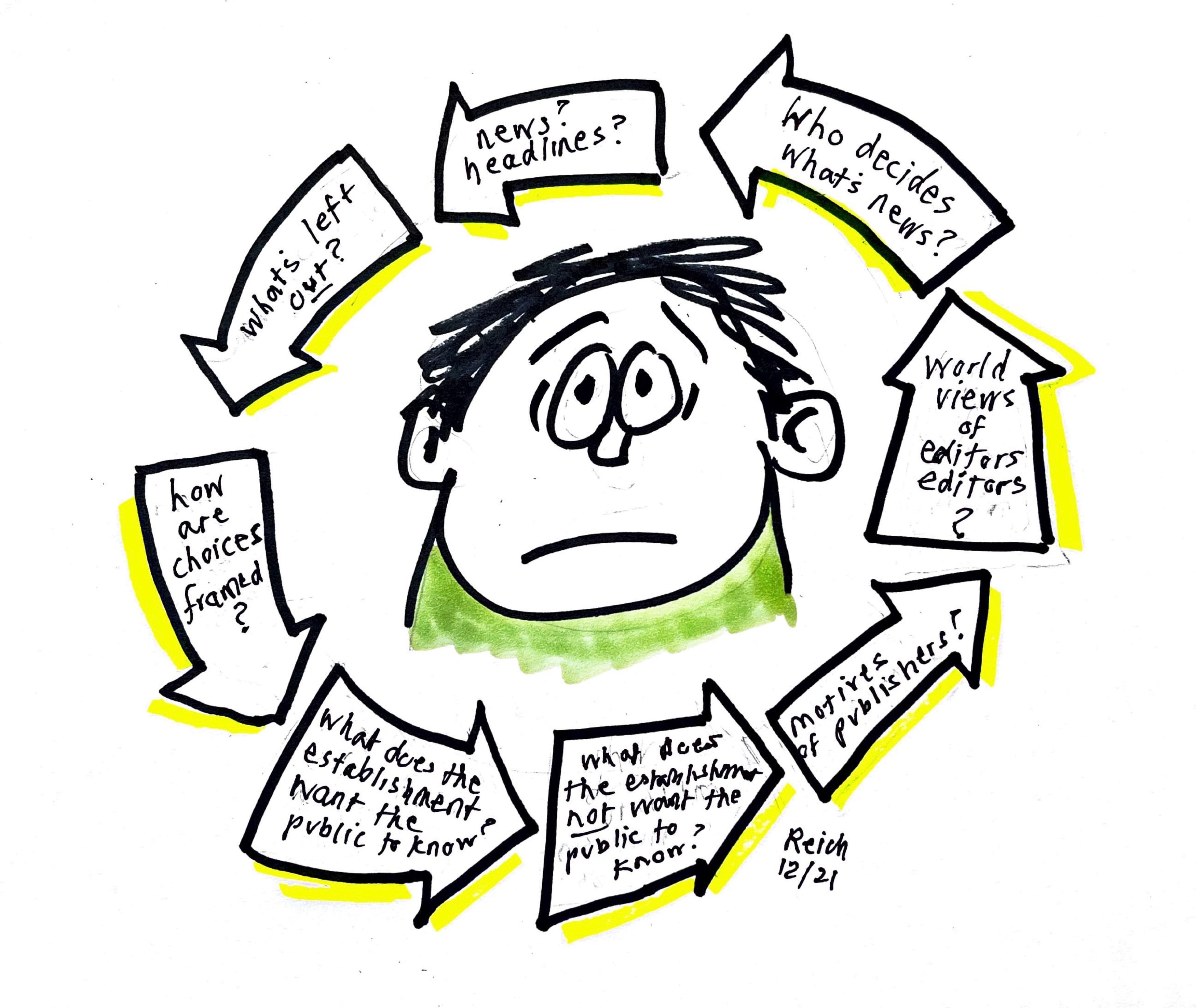
Why I don't trust the mainstream media
I’m often asked how I keep up with the news. Obviously, I avoid the unhinged rightwing outlets pushing misinformation, disinformation, and poisonous lies.But I’ve also grown a bit wary of the mainstream media –- the New York Times, Washington Post, CNN, and other dominant outlets — not because they peddle “fake news” (their reporting is usually first-rate) but because of three more subtle biases.First, they often favor the status quo. Mainstream journalists wanting to appear serious about public policy rip into progressives for the costs of their proposals, but never ask self-styled “moderates” how they plan to cope with the costs of doing nothing or doing too little about the same problems.A Green New Deal might be expensive but doing nothing about the climate crisis will almost certainly cost far more. Medicare for All will cost a lot, but the price of doing nothing about America’s cruel and dysfunctional healthcare system will soon be in the stratosphere.Second, the mainstream media often fail to report critical public choices. Any day now, the Senate will approve giving $768 billion to the military for this fiscal year. That’s billions more than the Pentagon sought. It’s about four times the size of Biden’s Build Back Better bill, which would come to around $175 billion a year. But where’s the reporting on the effects of this spending on the national debt, or on inflation, or whether it’s even necessary?Third, the mainstream media indulge in false equivalences — claiming that certain Republican and Democratic lawmakers are emerging as “troublemakers” within their parties or that extremists “on both sides” are “radicalizing each other”.These reports equate Republican lawmakers who are actively promoting Donald Trump’s big lie that the 2020 election was stolen with Democratic lawmakers who are fighting to protect voting rights. Well, I’m sorry. These are not equivalent. Trump’s big lie is a direct challenge to American democracy.In the looming fight over whether to preserve the Senate filibuster, the mainstream media gives equal weight to both sides’ claims that the other side’s position is radical. But ask yourself which is more radical – abolishing the filibuster to save American democracy or destroying American democracy to save the filibuster?You see, the old labels “left” versus “right” are fast becoming outdated. Today, it’s democracy versus oligarchy. Equating them is misleading and dangerous.Why doesn’t the mainstream media see this? Not just because of its dependence on corporate money. I think the source of the bias is more subtle.Top editors and reporters, usually based in New York and Washington, want to be accepted into the circles of the powerful – not only for sources of news but also because such acceptance is psychologically seductive. It confers a degree of success. But once accepted, they can’t help but begin to see the world through the eyes of the powerful.I follow the mainstream media, but I don’t limit myself to it. And I don’t rely on it to educate the public about bold, progressive ideas that would make America and the world fairer and stronger. I read the Guardian, the American Prospect (which, full disclosure, I helped found thirty years ago), Mother Jones, and The Atlantic. I follow several blogs (Daily Kos and Talking Points Memo, for example). I listen to the always thoughtful Democracy Now. And I subscribe to a few newsletters (I hope you like this one and spread word of it). But even with news sources I trust, I still ask myself: how are choices being framed? What’s being left out? What big underlying issues are being assumed away or obscured? When our democracy is under assault from so many directions, I think we need to educate and re-educate ourselves (and our children) about how to learn what’s really going on — how to absorb the news critically. Isn’t this a minimal responsibility of democratic citizenship?What do you think? This is a public episode. If you'd like to discuss this with other subscribers or get access to bonus episodes, visit robertreich.substack.com/subscribe