
The Biblio File hosted by Nigel Beale
598 episodes — Page 8 of 12

Maurice Podbrey on producing Waiting for the Barbarians
Waiting for the Barbarians is a novel written by the South African-born Nobel laureate J. M. Coetzee. Published in 1980 it won the James Tait Black Memorial and Geoffrey Faber Memorial Prizes for fiction. The book's title comes from a poem by Greek-Egyptian poet Constantine P. Cavafy. American composer Philip Glass wrote an opera based on the book which premiered in 2005. In August 2012, the Baxter Theatre in Cape Town presented Alexandre Marine's stage adaptation of the novel. The production ran in Montreal at the Segal Centre for Performing Arts early in 2013. I met with the play's Canadian-South African producer Maurice Podbrey at his home in Montreal to talk about the play, the novel, Coetzee, South Africa, Barbarians and the challenges of adapting books for the stage.

Michael Lista on Ethics and Honesty in Poetry Reviews
I met with Canadian poet/critic Michael Lista several months ago to discuss the state of poetry reviewing in Canada, the need for honesty in criticism, and his take on poet/philosopher Jan Zwicky's essay "The Ethics of the Negative Review," in which she defends her practice, while review editor in the 1990s of The Fiddlehead literary journal, of not publishing negative reviews. Buckle up and enjoy the ride.

Robert Fowler on al-Qaeda, Mali, Newtown and Terrorism
Robert Fowler has had a distinguished career as a Canadian diplomat and public servant. From 1989 - 1995 he was deputy minister of National Defence; from 1995 - 2000, Canada's ambassador to the United Nations, and, following that, ambassador to Italy from 2000-2006. Over the years he has served as foreign policy advisor to three Prime Ministers, and as Personal Representative for Africa. On Dec. 15, 2008, when he was in Niger as special envoy to the United Nations responsible for reconciling rebel and government forces, Fowler and his assistant Louis Guay, were kidnapped and held captive for 130 days by regional members of al-Qaeda. He tells the story of this ordeal in his book A Season in Hell. We talk about it and, among other things, Coleridge's 'Rime of the Ancient Mariner', sanity, religious fanaticism, mental illness, the Newtown massacre, and the clear and present threat posed to Mali, and Africa, by al-Qaeda.

Corey Redekop on his novel Husk, and zombies
Corey Redekop has been many things: "actor, waiter, disc jockey, cameraman, editor, lawyer (almost), and now the fabled trifecta of publicist/librarian/author. His debut novel, Shelf Monkey, is either a work of insane genius or an intolerable left-wing screed, depending on which review you read. Stunningly handsome, supremely talented, superbly gifted at hyperbole, Corey abides in Fredericton, New Brunswick." We climb up on the autopsy table to dissect his latest novel Husk (" The Sopranos of zombie novels"), and in so doing talk about Sheldon, a zombie with a brain, and what happens to him after he wakes up on - yes - an autopsy table, with his heart and guts spilling out all over the floor.

Laurie Lewis on Book Design at the University of Toronto Press
Laurie Lewis began her publishing career in New York City with Doubleday in the early 60s, acting as liaison between the book design and printing departments. In 1963 she moved to Toronto and joined the University of Toronto Press. When Allan Fleming came on board as Chief Designer in 1968 the new Design Unit was formed and Lewis became Fleming's assistant. The department produced many important books, winning numerous awards both nationally and internationally. For her outstanding service over they years to the design community, Lewis was made a Fellow of the Society of Graphic Designers of Canada in 1975, proposed by Allan Fleming and Leslie Smart. She was vice-president of the Ontario Chapter from 1975 to 1977 and continued to support and contribute to the organization for many subsequent years and encouraged graphic design internationally through workshops in publication design in the third world, particularly in South East Asia and in South America, through volunteer assignments with the Canadian International Development Agency Lewis introduced computers to the design office at University of Toronto in 1984, with the original Macintosh 512K. In 1991 she took early retirement in order to pursue interests in writing and small publishing. She is the founder and director of The Artful Codger Press, established to encourage the publication of memoirs and life writings. After retirement from her international volunteer work Laurie began what she calls "another life." She became editor of Vista, the publication of the Seniors Association in Kingston, and began a new career as a writer. In 2011, at the age of 80, her first memoir, Little Comrades, was published by Porcupine's Quill, and was selected by The Globe and Mail as one of the Top 100 Books of the Year 2011. As of this writing, her next book, Love, and all that jazz is scheduled for publication in 2013. I caught up with Laurie Lewis at her home in Kingston, Ontario where we talked about her impressive career, her colleagues, and some of the more collectible books that she has had a hand in designing. Please listen here.

Ross King on Leonardo and the Last Supper
According to his website, Ross King is "the bestselling author of six books on Italian, French and Canadian art and history. He has also published two historical novels, Domino (1995) and Ex-Libris (1998), and edited a collection of Leonardo da Vinci's fables, jokes and riddles. Translated into more than a dozen languages, his books have been nominated for a National Book Critics' Circle Award, the Charles Taylor Prize, and the National Award for Arts Writing. He has won both the Governor General's Award in Canada (for The Judgment of Paris) and the BookSense Non-Fiction Book of the Year in the United States (for Brunelleschi's Dome). His latest book, Leonardo and The Last Supper, has been described as 'gripping' (New York Times), 'fascinating' (Financial Times), 'engaging' (The Guardian), 'enthralling' (Daily Mail), 'absorbing' (Kirkus), 'engrossing' (Booklist), and 'extraordinary' (Irish Times)." It too won a Governor General's Award, this one in 2012. We met in Ottawa to talk about the book and the prize.

Poet Julie Bruck on Monkey Ranch
Julie Bruck is the author of three collections of poems from Brick Books, Monkey Ranch (2012) The End of Travel (1999), and The Woman Downstairs (1993). Her work has appeared in The New Yorker, Ms, Ploughshares, The Walrus, The Malahat Review, Valparaiso Poetry Review, Maisonneuve, Literary Mama, and elsewhere. Montreal-born and raised, Julie has taught at several colleges and universities in Canada, and has been a resident faculty member at The Frost Place in Franconia, New Hampshire. Since 2005, she has taught poetry workshops for The Writing Salon in San Francisco's Mission district, and tutored students at The University of San Francisco. Awards and fellowships include The A.M. Klein Award for Poetry, two Pushcart Prize nominations, two Gold Canadian National Magazine Awards and, for Monkey Ranch, Canada's 2012 Governor General's Literary Award for Poetry, which we talk about here.

Linda Spalding on her novel The Purchase
Born in Topeka, Kansas, Linda Spalding (née Dickinson) is a Canadian writer and editor who has, over the years, worked as a professor of English and writing at numerous universities. She currently lives in Toronto, is an editor with Brick magazine, and is married to novelist Michael Ondaatje. Spalding's novel The Purchase won the 2012 Governor-General's Literary Award for English Fiction. We met in Ottawa to talk about it.

Charlie Foran on Wingham, Ontario and Alice Munro
Well known Canadian author/biographer Charlie Foran, playing the Literary Tourist, travelled to Wingham, Ontario and environs to spend a little time in Alice Munro country. I talked to him recently about his experience. Photo credits: © James Lahey 2010

Stephanie Hlywak on Poetry magazine and the Poetry Foundation
I met with Stephanie Hlywak, Media Director at the Poetry Foundation, one hundred years after Poetry magazine was launched in Chicago to the month. We talk about the history, mandate, approach and architecture, not only of the magazine, but also of The Foundation and its impressive building, and, as if this weren't enough, the place and places of poetry itself in our world.

Crime Novelist Jason Webster on Valencia and Chief Inspector Max Camara
Jason Webster is an Anglo-American crime novelist, travel writer and critic. Born in California he now lives in Valencia, Spain. Webster was educated in England, Egypt and Italy. In 1993 he graduated from Oxford University (St John's College) with a degree in Arabic and Islamic History. His books all involve Spain, and include Duende: A journey in search of Flamenco (2003), which recounts his move here, and his quest to learn flamenco guitar, (it was long-listed for the Guardian First Book Award); Andalus: Unlocking the secrets of Moorish Spain (2004) and Sacred Sierra: A year on a Spanish mountain (2009) which describes a year that Webster and his Spanish wife spent living on their mountain farm in eastern Spain working on the land and planting trees with the help of a 12th century Moorish gardening manual. Or the Bull Kills You (2011) is a crime novel set in Valencia, and the world of bullfighting. It is the first in a series of detective stories featuring Chief Inspector Max Cámara of the Spanish National Police. It was long-listed for the Crime Writers' Association John Creasey (New Blood) Dagger. Death in Valencia (2012), is the second book in the series. I caught up with Jason recently in Valencia. We met at a sidewalk cafe in the Cabanyal - the neighbourhood in which his fictional action takes place - to talk about how those who read and love his novels can get more out of them by visiting this great, colourful Spanish city.

Eric Timmreck on the Shared Inquiry method of discussing great books
Shared Inquiry is a discussion method employed by the Great Books Foundation, which, according to its website provides " a teaching and learning environment, and a way for individuals to achieve a more thorough understanding of a text by discussing questions, responses, and insights with fellow readers. Shared Inquiry combines a sound theoretical base with proven strategies to engage all readers in higher-order thinking and collaborative problem solving. In Shared Inquiry, participants come together to help each other explore the meaning of a work of literature. Each participant brings a unique perspective that influences how he or she understands the work. Sharing their interpretations, participants gain new insights and deepen or even change their initial understanding." I caught up with Eric Timmreck, President of the Houston Great Books Council recently in Toronto at an annual event called Toronto Pursuits, to talk about his experience using the Shared Inquiry technique.
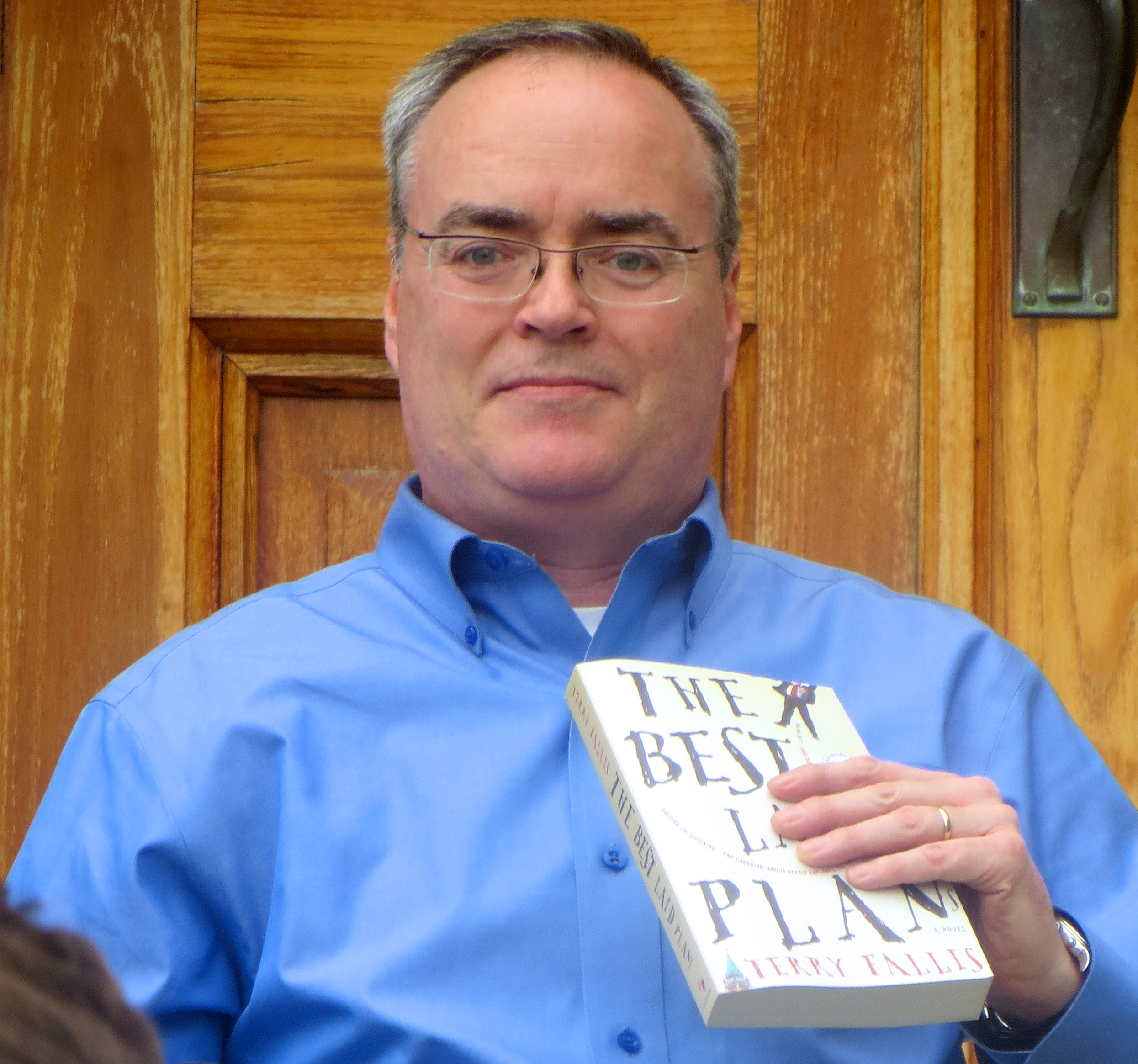
Terry Fallis meets The Literary Tourist on Parliament Hill
While researching an article on Literary Tourism for an upcoming issue of Ontario magazine, I got to meet and greet some stellar Canadian authors at sites across the province that feature, variously, in their works. Here, it's Terry Fallis, and his novel The Best Laid Plans. I got together with Terry on Parliament Hill, right next to the newly refurbished parliamentary library to talk about how its 'hallowed hallways' informed the writing of his book; about how readers might gain insight into its characters and plot by visiting the 'Hill', and how these buildings play an important role in Canadian political life, stabilizing democracy and inspiring hope for a better future.

Top 10 Literary things for you to do in Houston
Attention Literary Tourists! I met with Kristi Beer from Inprint Houston, a non-profit organization dedicated to inspiring readers and writers in Houston, Texas. Founded in 1983, Inprint fulfills its mission through the nationally renowned Margarett Root Brown Reading Series, the Cool Brains! Reading Series for Young People, literary and educational activities in the community that demonstrate the value and impact of creative writing, and support for the University of Houston Creative Writing Program. These programs and events play a vital role contributing to Houston's rich and diverse cultural life. Who better then to question about how the Literary Tourist might best spend his or her time in Houston. [Please note that this interview was conducted several years ago, so check the Inprint website for information on current and upcoming events etc.]

Randall Speller on Canadian Book Design and collecting
Randall Speller was for 29 years a librarian in the Art Gallery of Ontario in Toronto. Combining his career in art librarianship with an interest in Canadian literature and book collecting, he has done extensive research into the history of Canadian book illustration and design, especially in the years following World War II. Randall is a contributing editor to the DA: a Journal of the Printing Arts, where he has written several influential articles on book illustration and design. Randall is also an accomplished painter. His work focuses largely on Victoria County, part of his longstanding interest in representing an area of Ontario that his family has had connections to since the 1840s. As his website puts it: "Capturing the essential qualities of this landscape has engaged him for more than 30 years. His subjects are the constructed elements of landscape and buildings that are shaped by people, by weather, by light and by time." Please listen here as we engage in a conversation about the history of Canadian book design, and the importance of book collecting to Canadian, and indeed all cultures.

Curator Amanda Stevenson on Houston's Museum of Printing History
Houston's Museum of Printing History was founded in 1979 by Raoul Beasley, Vernon P. Hearn, Don Piercy, and J. V. Burnham, four printers with a passion for preserving their various printing-related collections and sharing them with the community. Chartered in 1981 the Museum had its official opening in 1982 with Dr. Hans Halaby, Director of the Gutenberg Museum in Mainz, Germany, cutting the ribbon. The mission of the Museum is to promote, preserve, and share the knowledge of printed communication and art as the greatest contributors to the development of the civilized world and the continuing advancement of freedom and literacy. It does this through an active, on-going exhibitions program, and a series of book arts workshops. I met with Museum Curator Amanda Stevenson this past summer to talk about the collection. During our conversation she delivers a very informative thumb-nail sketch of how relief and intaglio printing techniques work.

Owner Nancy Bass Wyden talks about the Strand Bookstore
In 1927, Ben Bass opened Strand Book Store on Fourth Avenue, home of New York's legendary Book Row. Named after the famous publishing street in London, the Strand was one of 48 bookstores on Book Row, which started in the 1890's and ran from Union Square to Astor Place. Today, the Strand is the sole survivor. ("Ben's son, Fred, was learning the family business by the age of 13. He too a lover of books quickly took to the book trade. After Fred completed a tour of duty in the Armed Forces, he came home to New York where he worked side-by-side with his father. By 1957, Fred moved the store just around the corner, to [its] current space at 12th Street and Broadway. Fred came to spend most of his time at the buying desk, cultivating relationships with regulars and scoping out the next great find…") I recently asked current owner, and Fred's daughter, Nancy Bass Wyden, about The Strand's longevity.

Founder Miranda Hill on Project Bookmark Canada
Project Bookmark Canada is a national charitable organization that marks places where real and imagined landscapes meet. It does this by installing poster sized ceramic plaques - called Bookmarks - in the exact physical locations where literary scenes are set. Its mission is to develope a network of hundreds of Bookmarks in cities, towns and other areas across the country, allowing Canadians and visitors the chance to read their way across Canada. Its mandate is to promote Canadian writers and writing, to invite readers to Canadian spaces and to encourage reading and literacy through a permanent, prominent exhibit of stories and poems set in Canada. I caught up with its founder Miranda Hill at what has developed into one the most exciting literary events in Canada: the Kingston Writers Festival.

Professor Adam Barrows on The Hogarth Press
Adam Barrows is a Professor in the English Department at Carleton University in Ottawa. The focus of his research for the last eight years has been the relationship between time, literary modernism, and imperialism. His background is in the history of science and his theoretical approach to literature is largely historical materialist, drawing heavily on the Western Marxist tradition, from the Frankfurt School to Raymond Williams and Henri Lefebvre. Growing out of his interest in twentieth-century British literature he led a seminar on the Hogarth Press, as he puts it "one of the most important venues for the production and dissemination of the experimental writings that would come to define the modernist literary canon. Their express purpose was to enable the publication of works that would otherwise never have found a home in the conventional publishing industry, including their own. In addition to publishing such central works of literary modernism as T.S. Eliot's Poems (1919) and The Waste Land (1923), Virginia Woolf's Jacob's Room (1922) and Katherine Mansfield's Prelude (1918), the Hogarth Press was also committed to the publication of radically dissident anti-imperialist works such as Leonard Woolf's own Imperialism and Civilization (1928), Lord Oliver's The Anatomy of African Misery (1928), Edward John Thompson's The Other Side of the Medal (1925) and C.L.R. James's The Case for West-Indian Self Government (1933)." We met at his Carleton University office to talk about Virginia and Leonard Woolf, and the history and output of the Hogarth Press.

Terry Cook on the Importance of History, and Library and Archives Canada
Terry Cook received a Ph.D. in Canadian History from Queen's University, 1977. From 1975 to 1998, he worked at the then Public, later National, Archives of Canada, leaving as the senior manager responsible for directing the appraisal and records disposition program for all media. In his long and distinguished career there, he was responsible for the development of policies and methodologies which dramatically altered the national archival system. In 1998, he founded Clio Consulting Inc., and since then has worked for national, municipal, and academic archives, as well as archival associations, around the world. He also took on the position of Associate Professor for the Archival Studies Program in the Department of History at the University of Manitoba. He has authored over 80 articles which have been published in Archivaria (two of his contributions being awarded the W. Kay Lamb Prize) and other leading archival journals. He is the author of The Archival Appraisal of Records Containing Personal Information: A RAMP Study With Guidelines (1991) and co-editor of Imagining Archives: Essays and Reflections by Hugh A. Taylor (2003). He has also contributed to the archival community greatly in his editing of scholarly journals and his participation in various professional associations. We met in Ottawa to discuss the cuts to, and neglect of, Library and Archives Canada. Among other things we talk about the challenges facing all libraries and archives, conflicting mandates, the differences between born and made digital material, the importance of source documents, and the current absence of any 'real' exhibition programming at LAC.

Brian Busby on Montreal Noir and its Pulp Fiction
As weird as it might seem today, people from New York used to come up to Montreal for a good time. Gambling houses, drugs, clubs, fast women... Montreal was one of the coolest places to be in post-war North America. Fun, racy, naughty...for a few fleeting years Montreal had a real Noir vibe. A handful of cheap, disposable novels captured this era in ways that more main stream novels never could. According to literary historian Brian Busby, their colour and detail provide an important historical record. These nine pulp fiction paperbacks documented the landscape and life of the period in an exciting, unusual way. They've since been largely ignored by historians and, in some cases, hidden by their authors. I met with Busby to talk about Sugarpuss on Dorchester Street, The Executioner and other such titles, and why this series of paperbacks is worthy of our attention.
David Theis on his book Literary Houston
While there is no 'great Houston Novel,' a lot of good stories have come out of the city, many of which are told in David Theis's Literary Houston, an anthology of writing on and about 'the Bayou city'. Stories, because Houston is a place where people come to DO things. 'To fly to the moon, create empires, build fortresses against cancer, and temples to surrealism' as Theis puts it. I met him recently at a cafe just off Houston's busy Westheimer street. Seems like everwhere we moved something or someone very noisy decided to followed us. Still, we had an interesting conversation. Hope you enjoy it.

Michele Rackham on Betty Sutherland and Canadian Book Design
Michele Rackham is a post doctoral fellow at Trent University. She is currently working on a digital catalogue raisonne of P.K. Irwin's (a.k.a P.K. Page) artwork that will accompany a print art book to be published by the Porcupine's Quill. Rackham recently completed a PhD at McGill University. The title of her thesis is "Between the Lines, Interartistic Modernism in Canada 1930-1960." We met at Carleton University to talk about 20th Canadian book design, and the important work that artist Betty Sutherland did for Contact Press designing book covers during the 1950s.

Peter Dorn on his Heinrich Heine Press
"Heinrich Heine's writings, poetry, and ideology delighted and enlightened me. He became a personal, meaningful experience, in the same way I feel, that private printing is a personal experience, printing meaningful things. These feelings make up the "idealistic" birth of the Heinrich Heine press" says Peter Dorn in Reader, Lover of Books, Lover of Heaven (North York Public Library, 1978. Designed by Glenn Goluska). Listen to my conversation with Peter about his Heinrich Heine Press, his immigration to Canada, his work at Eaton's department store, Canadian book design in the 1950s and 1960s, the influence of Carl Dair and Frank Newfeld, his move to Kingston and his work at Queen's University.

Brian Busby on Literary Montreal
I met recently with literary historian Brian Busby to talk about 'Literary Montreal', poet John Glassco, plaques and the Writers' Chapel of St James the Apostle Anglican Church.
William Toye on Canadian Book Design
What William Toye apparently wanted most in the world after graduating from the University of Toronto in 1948, was a job in Canadian book publishing. This, Robert Fulford tells us in a recent National Post profile, was an outlandish career move since Canadian publishing barely existed. We had few publishers and they produced few books. They did little more than import American and British books, selling Bibles, dictionaries and schoolbooks to keep themselves afloat. But Toye was insistent. Says Fulford: "When he applied for a job at the Canadian branch of Oxford University Press, he was told they had nothing for him but a place in the warehouse. He said that would be fine. Over the next six decades Canadian publishing steadily expanded and Toye found many ways to deploy the talents he developed. At age 84, still editing, he recently produced yet another in the long list of valuable books he's given us, The Concise Oxford Companion to Canadian Literature, Second Edition." Quite apart from the outstanding work he has produced as editor, the multi-talented Toye has also written and designed some beautiful, memorable books of his own, and it is these we met to talk about last month. Please listen here:

Ron Silliman on Experimental Language Poetry
This from the Poetry Foundation: "An influential figure in contemporary poetics, Ron Silliman became associated with the West Coast literary movement known as "Language poetry" in the 1960s and '70s. He edited In the American Tree (1986), which remains the primary Language poetry anthology, as well as penned one of the movement's defining critical texts, The New Sentence (1987). Silliman's prolific publishing career includes over thirty books of poetry, critical work, collaborations and anthologies. He has long championed experimental or "post-avant" poetics, most recently through Silliman's Blog, a weblog he started in 2002." I met with Ron at the Ottawa International Airport to talk about Language poetry. Among other things we discuss the 'Bardic I"; diagnosis of the self; examining viewpoint; the concept of clarity in writing; literary effects; passion through form; Raid 'killing bugs dead'; manipulation of the reader; the artificiality of literary devices and pre-set responses. Louis Zukofsky; received rather than earned wisdom. Shakespeare as a great font of creative invention. Bing Crosby as the Jimi Hendricks of the microphone. Steve Roggenback. The 'God help us' response. Unquestioned ideology. Ambiguity. Self check-out lanes. Common denominators. Helen Vendler's irrelevancy. Poets' dishonest criticism. And the importance of reading series. Photo credit: Jeff Hurwitz

Richard Stursberg on his book The Tower of Babble and the CBC
Unlike Britain, which opted to invest in public non-commercial broadcasting in the early '60s, Canada chose a hybrid model that freed the Canadian Broadcasting Corporation (CBC) to augment its Parliamentary appropriation with advertising revenues. Canada's 1968 Broadcast Act prescribed a broadcasting system controlled by Canadians that 'safeguards and strengthens our cultural, political, social and economic fabric, promotes unity and national identity, and provides challenging, entertaining, informative programming that caters to a wide range of audiences.' This conflicted mandate parked the CBC at a particularly congested intersection, one that today invites more collisions than ever before, what with the significant funding cuts just announced and profits from the Hockey Night in Canada franchise in jeopardy. In addition to the impossible task of simultaneously promoting a single, nebulous national identity and culture, and providing programming for a wide variety of tastes and audiences, the CBC is also under pressure to produce "popular" shows that Canadians will watch and advertisers will support. One solution is to abandon the old commercial hybrid model and fund the CBC not through Parliament, but directly from licence fees levied on consumers. This way the CBC could, similar to TVOntario, carve out a more distinctive, unique role for itself by eliminating advertising (and much of the glib, manipulative, audience-spinning crap one finds on commercial television) from most of its schedule, and delivering 'high' quality Canadian alternative programming without regard for 'lowest-common-denominator' audience share. Replacing a chubby old confused mongrel, with a lean, alert purebred puppy dog. Good idea. Perhaps that's why it stands little chance of seeing daylight. Anything that resembles a new tax, or loosens the leash that government holds on public broacasting is unlikely to fly in Harperland, or for that matter in any other party-that's-in-power land. The alternative, one which Richard Stursberg championed as Vice President of English language programming at the CBC (2004-2010), is to focus on audience. ' What use are 'good' television shows if nobody watches them? Stursberg asks in his book The Tower of Babble: Sins, Secrets and Successes Inside the CBC which documents his tenure with the public broadcaster. While 'Little Mosque on the Prairie' is no 'Mad Men', it is watched by lots of Canadians. And this is more than can be said of much CBC programming prior to Stursberg's arrival. By pushing one component of a decidedly messed-up mandate he created much controversy during his time at the CBC, and, eventually, got himself fired. One hopes that his book, and his bold efforts will, if nothing else, encourage debate, and ultimately produce from government a clearer mandate for this important, troubled institution. I met with Richard (not Peter) Stursberg in Ottawa to talk about his book.

Robert Fulford on Book Designer Allan Fleming
Allan Fleming was born in Toronto in 1929. At 16 he left studies at the Western Technical School to apprentice at various design firms in Toronto. He then went to England, where he soaked up lessons from some of the great British book designers. Back in Canada in 1957 he joined the typographic firm Cooper and Beatty Ltd., and was working there when the opportunity to redesign Canadian National's logo came up in 1959. In 1962 he became art director at Maclean's magazine. He was vice-president and director of creative services at MacLaren Advertising from 1963 to 1968, and chief designer at the University of Toronto Press until 1976, when he joined Burns and Cooper. Suave, handsome, well-read, eloquent and confident, Fleming epitomized 'cool.' His design work won many awards in Canada, the United States and around the world. Though best remembered as the creator of CN's corporate logo, Fleming was also a superb book designer, and this is what I talk about with Canadian literary journalist Robert Fulford who knew and was influenced by him. Books referenced include: Canada: A Year of the Land The National Film Board of Canada, Lorraine Monk, Bruce Hutchinson, Allan Fleming Published by Roger Duhamel Queen's Printer, Ottawa, 1967 Collected Works of Erasmus, University of Toronto Press

Prof. Brian Trehearne on Irving Layton
Brian Trehearne is a professor of English at McGill University. His teaching and research areas focus on Canadian literature to 1970, chiefly poetry. Awards and Fellowships include SSHRC Standard Research Grants, the Louis Dudek Award for Excellence in Teaching (three times) and the Arts Undergraduate Society Award for Excellence in Teaching. Publications include Canadian Poetry 1920 to 1960; Editor (2010); The Complete Poems of A.J.M. Smith, Editor, (2007); The Montreal Forties: Modernist Poetry in Transition (1999) and Aestheticism and the Canadian Modernists: Aspects of a Poetic Influence (1989). He is currently working on a critical edition of The Complete Poems of John Glassco. We met in Montreal to talk about the position of Irving Layton in the Canadian poetical canon, the influence of Montreal and parents on Layton's poetry and persona; about masculinity, the sun, freedom, attention-seeking, Nietzsche, the Apollonian and the Dionysian, misogyny, aging, the Holocaust, vulnerability, and the best dozen poems. Photo Credit: Irving Layton.ca

Tim Bowling on Book Collecting and In the Suicide's Library
Tim Bowling's collections of poetry include Fathom, The Book Collector, and The Memory Orchard. He has written three novels, including The Bone Sharps and The Paperboy's Winter. Twice shortlisted for the Governor General's Award for Poetry, Tim has won the Canadian Authors' Association Award for Poetry and two Alberta Book Awards. In 2008, he was awarded a Guggenheim Fellowship. He lives in Edmonton, Alberta. Tim was in Ottawa for Versefest. We met to talk about his book In the Suicide's Library, an entertaining, fast-paced meditation (yes, unusual) on modern life, the responsibilities of marriage and parenting, middle-age and books and book collecting. Topics covered include yes, book collecting, coincidence, suicide, the spirit, passion and harmony of books, the use of hands, the line between bibliophiles and maniacs, and the importance of physical books to the culture; we also cover writing about one's book collections; the sense of community among book collectors, the temptation of the material, possession, The Great Gatsby and green light, Las Vegas, the power of knowledge, the pros and cons of the Internet, Serendipity Books, 'shattering the groove,' mid-life, change, parenthood, and investing life with meaning.

Bruce Taylor on his No End in Strangeness New and Selected Poems
Bruce Taylor is a two-time winner of the A.M. Klein Award for Poetry. He has published four books of poetry: Getting On with the Era (1987), Cold Rubber Feet (1989), and Facts (1998). He has been a teacher, a puppeteer, and a freelance journalist. He lives in Wakefield, Quebec. We met recently to talk about his most recent collection No End in Strangeness: New and Selected Poems, (Cormorant Books, 2011) and sundry other topics relating to Canadian poets and poetry.

Peter Cocking on book design at Douglas & McIntyre
Peter Cocking is a Vancouver-based graphic designer and design teacher. His wide ranging portfolio includes annual reports, airline tickets, snack-food boxes, CD packages, corporate identity programs, newspapers, and magazines. Since 2002 his focus has been on book and typographic design as art director at Douglas & McIntyre Publishing. Peter is the recipient of more than 40 awards for his design work. Peter has lectured at the national conferences of the AIGA and the AAUP, and to the Type Directors Club in New York. In 2009 he became the first Canadian juror at the 'Best Books in the World' competition, held annually in Leipzig, Germany. We met recently at his offices in Vancouver to talk about D&M and some of the notable books that it has published, and that he has designed.

Robert R. Reid on his Career as Printer and Book Designer
Born in Alberta in 1927, Robert R. Reid moved to Vancouver with his family at an early age. During his second year at the University of British Columbia he spotted a beautiful rubricated book on display in the library which inspired him to make something similar. Two years later, in 1949, he issued his first limited edition, a reprint of Alfred Waddington's The Fraser Mines Vindicated. This book was well received, and encouraged him to set up his own commercial print shop in downtown Vancouver. Through the 1950s he designed and printed a lot of beautiful material, including the B.C. Library Quarterly magazine. During this time he also was typographic advisor to the editorial committee at the University of British Columbia. During the sixties he printed three limited editions - The Journal of Norman Lee (1959), Kuthan's Menagerie of Interesting Zoo Animals (1960), and poet John Newlove's first collection, Grave Sirs (1962) - before moving to Montreal for a job as director of production and design at McGill University Press. Here he published his magnum opus, The Lande Bibliography of Canadiana. It remains one of Canada's most beautifully crafted books. In the mid seventies Robert left for New York, where he spent the next 25 years packaging books for major publishers. He returned to Vancouver in 1998 where he continues to participate in the making of beautiful books with, among others, Heavenly Monkey Press, and the Alcuin Society. We met in Vancouver to talk about his impressive, life-long achievements. Photo: Robert Reid (Left) with friend and fellow book designer Tak Tanabe

Jan and Crispin Elsted on The Barbarian Press
Barbarian Press was established in 1977 in Kent, England where Jan and Crispin Elsted worked with Graham Williams at the Florin Press. With three flatbed hand presses and many cases of type, the couple returned home to Canada in 1978 to set up shop in Mission, British Columbia, about 50 miles east of Vancouver in the Fraser Valley. The press's publications range from new translations of poetry and prose, Victorian melodrama, and new poetry to bibliography, illustrated classics, typography, and books on wood engraving. This last has become a particular speciality since the publication in 1995 of Endgrain: Contemporary Wood Engraving in North America, which was greeted with considerable acclaim, and is now widely sought after.This has spawned an ongoing series of books called Endgrain Editions, each showing selected work of a single engraver, printed from the original blocks, with an introduction and a catalogue of major works. I met with the Elsteds to talked to them, in their home, about, among other things, their literary backgrounds; gifts, hands and the discovery of artisanal skills; aspirations and influences; the continuity of human experience; books and students and work experiences; doing all of this together; retirement at age 30; hand presses, hand-made paper and hand setting type, Canadians in England studying Americans; publishing the canon; wood engravings; favourite children; wine and typeface connoisseurship; books as unique performances, and the evils of the digital age.

Eric Swanick on Jim Rimmer, graphic designer, letterpress printer
"PRINTING, ILLUSTRATION, TYPE DESIGN, type-founding, type engraving, bookbinding, graphic design, stone cutting and digital type design are things that have occupied me for over seventy years, and do to this day. Excepting the bit of letter cutting in stone, these occupations have all put dinner on the table; but it has been my good fortune to have loved the work." This is how Jim Rimmer (1934-2010) starts off his Pie Tree Press, Memories from the Composing Room Floor (Gaspereau Press, 2008) Rimmer was a mainstay of the letterpress/private press community in Vancouver for much of the past 50 years. Trained as a commercial compositor in the 1950s, his aesthetic taste, artistic talent and mechanical know-how combined to produce a long, significant career as a graphic artist, printer, type designer and caster. Despite the many fonts he designed, engraved and cast, despite his beautiful linocuts, and despite the fact that in 2004 he completed the first engraving and casting of Carl Dair's Cartier face in metal, Jim is remembered most of all for love. The love of a business that he was passionate about; and the love that he instilled in so many, for books, the printed word, and the letterpress printing process. An archive of material from the last decade of Jim's work is held by the Special Collections Library at Simon Fraser University in Burnaby, B.C. I met there recently with Eric Swanick, Head of the Library, to talk about Jim Rimmer.

Leah Gordon on the Alcuin Society Book Design Awards
The Alcuin Society's Awards for Excellence in Book Design in Canada have been recognizing achievement since 1981. As Marlene Chan put it in the preface to the 2009 winners'catalogue, "The hallmark of the judging process in all of the Alcuin competitions is, and has always been, that each book is considered as a total entity. The discerning judges examine every aspect of each book, including the dust jacket, binding, endpapers, half-title page, copyright page, title page, page layout, typography, integration of illustrations, chapter openings, running heads, reproduction of illustrations, clarity of printing, choice of paper, footnotes and bibliographical references. The judges select books in eight categories to encourage the very best in Canadian design, only where they see exceptional merit." I met with Leah Gordon, Chair of the Book Design Committee, at her home in Vancouver to talk about the history and goals of the society – and, in particular, its Awards program; about some of the books the society has published over the years, and about how, in addition to the judging criteria cited above, appropriateness and usefulness also factor into the judges' decision making process.

Poet bill bissett in Conversation
Monsieur Wikipedia informs us that bill bissett was born in Halifax, Nova Scotia, attended Dalhousie University (1956) and the University of British Columbia (1963–1965), and dropped out of both because of a desire 'to live as a free agent, writer and painter unencumbered by any academic constraints.' He moved to Vancouver in 1958 and five years later set up blew ointment magazine. He later launched blewointment press, which has published volumes by Cathy Ford, Maxine Gadd, bpNichol, Ken West, Lionel Kearns and D. A. Levy, and many others. bissett is currently based in Vancouver and Toronto. Known for his 'unique orthography' , 4 incorporating visual elements into his printed poetry, and 4 performing "concrete sound" poetry using sound effects, chanting, and barefoot dancing, he is often associated with the Shamanistic in literature. He also paints, and produces audio recordings. His work 'often involves humour, a sense of wonder and sentimentality, and political commentary.' In 2006, Harbour Publishing put out radiant danse uv being, a tribute to bissett with contributions from more than 80 writers, including Margaret Atwood, Leonard Cohen, Patrick Lane, Steve McCaffery, and P. K. Page; and Carl Peters has just published a book called textual vishyuns: image and text in the work of bill bissett that analyses the poet's work. I met with bill in Ottawa to talk about all of the above, starting with the blurring of boundaries.

Will Rueter on his Aliquando Press
Will Rueter is a private printer, hand binder, instructor and printmaker living in Dundas, Ontario. He founded The Aliquando Press late in 1962. It has, to date, produced more than 100 books, and plenty of broadsides too. Rueter's work has been shown throughout North America and Japan and is held in public and private collections in North America and Europe. I met him recently at his home in Dundas to talk about, among other things, the origins of his Press, his love of printing, his Dutch printer ancestors, and his 30 years at the University of Toronto Press designing books. During the latter part of our conversation we talk about those volumes he is most proud of having produced, including Majesty, Order and Beauty an edition of the edited journals of renowned British bookbinder and private printer, Thomas James Cobden-Sanderson, a close friend of William Morris and a man who has had a profound impact on Rueter's life and work.

Charlotte Gray on Nellie McClung
According to her website, "Charlotte Gray is one of Canada's best-known writers, and author of eight acclaimed books of literary non-fiction. Born in Sheffield, England, and educated at Oxford University and the London School of Economics, she began her writing career in England as a magazine editor and newspaper columnist. After coming to Canada in 1979, she worked as a political commentator, book reviewer and magazine columnist before she turned to biography and popular history." In 2008, Charlotte published Nellie McClung, a short biography of Canada's leading women's rights activist in the Penguin Series, Extraordinary Canadians.

Steven Galbraith & Amelia Hugill Fontanel on the Cary Collection
The Cary Collection is one of America's premier libraries on graphic communication, its history and practices. Located in Rochester on the campus of the Rochester Institute of Technology, the original collection of 2,300 volumes was assembled by New York City businessman Melbert B. Cary, Jr. during the 1920s and 1930s. Cary was director of the Continental Type Founders Association (a type-importing agency), a former president of the American Institute of Graphic Arts (AIGA), and proprietor of the private Press of the Woolly Whale. His professional and personal interests in printing led him to collect printer's manuals and type specimens, as well as great books on the printer's art. In 1969 his collection, together with funds to support its use and growth, was presented to RIT. Today the library houses some 40,000 volumes and a growing number of manuscript and correspondence collections. While its original strengths continue to be an important focus, other aspects of graphic arts history have also been developed. For example, the Cary is committed to building comprehensive primary and secondary resources on the development of the alphabet and writing systems, early book formats and manuscripts, calligraphy, the development of typefaces and their manufacturing technologies, the history and practice of papermaking, typography and book design, printing and illustration processes, bookbinding, posters, and artists' books. Though many of the volumes in the library are rare, the Cary has maintained, from the beginning, a policy of liberal access for students , especially those enrolled in the RIT's College of Imaging Arts and Sciences, and interested literary tourists. The Cary Collection also manages some 36 Graphic Design archives documenting the work of important 20th-century Modernist graphic designers, and has been aggressively acquiring examples of avant-garde book typography. This great library is a must visit destination for all those who love books and the processes involved in making them.

Stan Bevington on the Coach House Press, Part ll
Last summer I met with Stan Bevington in Toronto to talk about the history of the Coach House Press and some of the more collectible books that it has published over the years. In this, Part ll of our conversation, we discuss, among many other things, the influence of the Stinehour Press; the adoption, adaptation, and in some cases invention of new printing; photographic and computer technologies, and the book designs of Glenn Goluska and Gordon Robertson.

David Gilmour on his novel The Perfect Order of Things
It didn't win any prizes; no awards; didn't make many, if any, long or short lists; but David Gilmour's The Perfect Order of Things is a great novel. The best I read last year. In fact, I think it's one of the best Canadian novels ever written. Deceptively easy to read, the book's 300-odd pages are not only crowded with elegantly crafted sentences, they collectively capture and convey levels of insight and depths of experience one typically finds only in great Russian novels. Perfect Order leaves you invigorated; filled with admiration for the life fully lived. It makes you want to get out there and show the world who's boss. David Gilmour was in Ottawa recently to attend the Ottawa International Writers Festival.
Serge Belet on 125 Kilos of Books at the Canadian Centre for Architecture #15
From March 23 to April 30, 2006 the Canadian Centre for Architecture hosted an exhibition entitled 125 Kilos of Books. I took in the show and interviewed Serge Belet, Head of Exhibitions at the CCA, about it. From the notes: "Celebrating the designation of Montreal as UNESCO World Book Capital City for 2005-2006, the exhibition presents a selection of printed architectural works dating from the 15th century to the present from the CCA's collection in order to provoke thought about what seems, at first sight, the most banal fact of any book: its size. A book's dimensions are only partly determined by the technology of its production or the physical comfort of its readers. Size is routinely used by authors and their publishers to indicate value, to justify price, and to control how and by whom their work is read – whether casually or ceremonially, individually or in groups, by the rich few or the many poor... Architecture in print has a long tradition of the big book. As in other disciplines such as human anatomy, this tradition developed because scale added clarity to the illustrations in a treatise, and kept better faith with the original drawings... By contrast, the builder's manual is traditionally small enough to fit the literal and metaphorical pocket of its intended audience... The books presented in the exhibition encompass an impressive range of scale and size, from the smallest, A brief discourse concerning the three chief principles of magnificent building: solidity, convenience, and ornament by Sir Balthazar Gerbier D'ouvilly (London, 1662), measuring 14.2 cm x 9.5 cm x 0.8 cm, to Sulpiz Boissere's Histoire et description de la cathdrale de Cologne (Stuttgart, 1823), a hefty tome more than a metre in height and weighing 21 kilos! All works have been selected from the CCA collection, which comprises nearly 200,000 volumes, by the exhibition's curator Gerald Beasley, Director of the Avery Architectural and Fine Arts Library, Columbia University, and until 2004, Associate Chief Curator and Head Librarian at the CCA.

Phil Hall on his award winning book of poetry Killdeer
I met with Phil Hall, whose latest collection of poems, Killdeer, has just won the Canadian Governor General's Literary Award for English Poetry. It's a sensitive, engaging, revealing work that incorporates narrative essay, life philosophy and literary criticism into its stanzas. In sharp contrast to the arrogant, impenetrable and solipsistic, Hall's poetry is humbly presented, accessible, beautiful, pastoral, reflective and at times profound. Listen here as we talk about brown speckled eggs and fiddle tunes, imbalance and literary prize juries, lying, distraction, pain, what's important, plus theatre and spectacle, truth and doubt.

Professor Jonathan Rose on J.M. Dent & Sons
Joseph Malaby Dent (30 August 1849 – 9 May 1926) was the British book publisher who gave the world the Everyman's Library series. After a short, unsuccessful career as an apprentice printer he took up bookbinding, and shortly thereafter founded J. M. Dent and Company, in 1888, publishing the works of Lamb, Goldsmith, Austen, Chaucer, and Tennyson among others. Printed in short runs on handmade paper, these books enjoyed some success, but it wasn't until the Temple Shakespeare series, launched in 1894, that Dent hit the big time. Ten years later he began planning what became known as the Everyman's Library, a canon of one thousand classics, attractively, but practically, produced pocket-sized books sold for a shilling each. To meet demand, Dent built the Temple Press. Publication of the series began in 1906; 152 titles were issued in the first year. They were hugely popular. 'Small, lame, tight-fisted, and apt to weep under pressure,' Dent's ungovernable passion was, says critic Hugh Kenner, for bringing books to the people. He remembered when he'd longed to buy books he couldn't afford. Yes, you could make the world better. He even thought cheap books might prevent wars." I met with renowned book historian Professor Johathan Rose to discuss J.M.Dent, and to find out why the Everyman's Library series was so successful.

Mark Kingwell on Glenn Gould
Glenn Gould was a world renowned classical pianist and an 'eccentric genius'— a 'solitary, headstrong, hypochondriac virtuoso.' Abandoning stage performances in 1964, he concentrated instead on mastering recordings, radio, television, and print. His sudden death at age fifty stunned the world, but his music and legacy continues. Philosopher/critic Mark Kingwell sees Gould as a philosopher of music whose contradictory, mischievous, and deliberately provocative ideas ruled his life. Instead of a single narrative in his Extraordinary Canadians biography of Gould, Kingwell adopts a 'kaleidoscopic' approach. It took Gould twenty-one "takes" to record the opening aria in the famed 1955 Goldberg Variations, Kingwell does the same with Gould's life. Each take offers a slightly different, sensitive interpretation of this complex man, each plays with the notes, harmonies and dissonances that characterized his time on earth. I met with Kingwell to talk about Gould, chutney, the problem of the biographical line, perfectionism, architectural beauty, tempo, pregnancy, absence becoming presence, recording and communications technology, and wonder.

Douglas Gibson on Stories, Storytelling and Storytellers
Douglas Gibson was, for more than 40 years, a noted Canadian editor and publisher whose skills both as writer and salesman put him at the pinnacle of his profession. Douglas Gibson Books, the first editorial imprint of its kind in Canada, has over the years published much of the best writing that has ever come out of this country. Stories About Storytellers is Gibson's memoir. In a series of short profiles, he tells us tales about some of the authors he has worked with during an illustrious career. He himself is an impressive story teller. The book takes us on a coast to coast tour, through the lives and writings of, among others, Jack Hodgins, Harold Horwood, Alice Munro, James Houston, Mavis Gallant, Alistair McLeod, Pierre Trudeau and Brian Mulroney. Gibson's journey through Canadian political and publishing history, eloquently documents the story of Canada. We met in Ottawa. Please listen as we talk, among other things, about his careers and roles as editor and publisher, about the best Canadian fiction, luck and a system that encourages Canadian writing, Olympic gold, the difficulty of literary prizes, subjective judgement, and the most important paragraph in Canadian writing.

Andrew Cohen on Lester B. Pearson
Lester "Mike" Pearson was an extraordinary politician. He was also an extraordinary athlete, diplomat, leader, teacher, writer and student. And yet, despite all of this, and, the fact that during his lifetime he was the world's best known Canadian, many are today unaware of the important role he played in creating modern Canada with its enviable social programs and economic safeguards. Andrew Cohen's biography of Pearson, part of Penguin's Extraordinary Canadians series, sets out to rectify this as it explores the various, successful lives this man led, and the contributions he made both to the building of Canada and world peace.

Dan Boice on the publisher Mitchell Kennerley
A complicated, fascinating, largely unknown man who did a great deal for American literary publishing, Mitchell Kennerley was born in 1878 in Burslem, England. He arrived in the United States in 1896 to help set up publisher John Lane's U.S. offices. After an unhappy parting, Kennerley set off to publish various small literary magazines, and in 1906 launched his own imprint under which he published literary criticism, modern drama, fiction, and poetry, including Modern Love, first book off the press. He produced elegant books in small print runs and launched the careers of many important young authors of poetry particularly. American Bookman said that his imprint was "in itself guarantee of a book's worth." Christopher Morley called Kennerley "unquestionably the first Modern publisher in this country." Kennerley's publishing career wound down during the First World War, and he subsequently took over operation of the Anderson Galleries where he orchestrated some of the 20th century's most amazing rare book auctions. The Huntington and Folger Libraries were largely built on these sales. He opened the Lexington Avenue Book Shop in 1940 and operated it until his suicide in 1950. Women, an inability to focus, a failure to pay his bills and desire for a lifestyle beyond his means, have all be pointed to as explanation for his sad ending. I met with Dan Boice, author of the 1996 bibliography of the Kennerley imprint, in Iowa to talk about Kennerley and the books he produced.