
Mom and Mind
487 episodes — Page 6 of 10
235: Centering the Mother and Healing with Internal Family Systems Psychotherapy with Rebecca Geshuri and Jessica Sorci
Today’s episode features a different take on perinatal mental health conditions. It’s a fresh and more expansive perspective on the things that take place in families during the perinatal process. This episode is loaded with helpful information, and I hope you’ll join us to learn more! Rebecca Geshuri and Jessica Sorci are Licensed Marriage and Family Therapists, Internal Family Systems (IFS) Therapists, and Perinatal Mental Health Certified. As co-founders of Family Tree Wellness in Silicon Valley, California, Rebecca and Jessica lead their one-of-a-kind IFS-informed group psychotherapy practice that provides counseling, education, and support for people who are in the family-building phase of life. They are wildly enthusiastic about creating trainings and supporting other therapists who want to deepen their knowledge and skill in using IFS and working in reproductive mental health. Most importantly, they are mothers on their own healing journeys who bring their own personal experiences with grief and growing, mixed with creative expression and spirituality to their work. Their goal is to heal the intergenerational burdens that are present in humanity. In this episode, Rebecca and Jessica share with us why perinatal mood and anxiety disorders need to be redefined, how IFS psychotherapy works in perinatal mental health, and why their practice offers training for therapists on the mother-centric approach to therapy. Show Highlights: How Rebecca and Jessica came into this work with motherhood and the perinatal population What the mother-centric therapy approach includes and why IFS therapy hits the major pain points for new mothers A basic overview of the Internal Family Systems (IFS) therapy model, which recognizes and approaches the different parts of a person in a non-judgmental, respectful, curious, and compassionate manner How someone becomes the “identified patient” is and why this person might need therapy Why the new mother should be viewed as more of a hero who is revered rather than merely a sick or broken patient to be diagnosed How perinatal mood and anxiety disorders (PMADs) should be redefined to acknowledge patriarchy and shame How IFS therapy and the mother-centric system focus on the shame and inner critic messages within a new mom to unburden her How Rebecca and Jessica look to address both the symptoms AND the shame A look at mother-centric therapy as a contrast to our baby-centric culture How Family Tree Wellness is offering training and resources for other therapists–along with an upcoming book! Resources: Connect with Rebecca and Jessica: Website, Facebook, and Instagram Visit www.postpartum.net for resources! Visit my website, www.wellmindperinatal.com, for more information, resources, and courses you can take today! Learn more about your ad choices. Visit podcastchoices.com/adchoices
234: Super Sad Unicorn: A Memoir of Mania with Jessica Ekhoff
We learn many things from the stories of others. In our quest to spread information, education, and compassion about the many topics we cover on Mom & Mind, it is just as important to hear the lesser-known stories of what people have experienced. Today’s guest shares her story of postpartum-onset bipolar disorder that resulted in postpartum psychosis. Unfortunately, this occurs in more mothers than we are led to believe, and we need more understanding about it. Join us now for a look at this often misunderstood condition. Jessica Ekhoff has written a memoir of her experience with postpartum-onset bipolar I disorder and psychosis. Super Sad Unicorn: A Memoir of Mania will be published in early 2023 by New Degree Press, and it’s available for preorder now. Jessica is a trademark advertising attorney who is a figure skating, board game, and fiction enthusiast. She is a peer facilitator for Postpartum Support International’s support group for pregnant and postpartum women with bipolar disorder. She lives in Chicago with her husband and their young son. Jessica shares her journey with mania and psychosis that began a few days after her son’s birth and landed her in a psychiatric ward. Show Highlights: How Jessica’s symptoms began after the birth of her son, Wells, in 2021, even though there is no history of bipolar disorder in herself or her family How Jessica entered a manic phase that escalated quickly when her son was 2-4 days old How Jessica’s husband knew she was acting very much out of character and urged her to call her parents to come help How she had delusions that her husband had called DCFS to come to take away her son What Jessica now notices in retrospect about her first four days postpartum How she prepared to enter an outpatient therapy program, but Jessica’s condition required hospitalization before the first appointment How she felt scattered, confused, and unstable mentally through days 4-10 postpartum until she went into the hospital Why Jessica was floored when the doctor revealed to her that SHE was the one who needed help How Jessica was convinced that the hospital ward was actually an escape room set up just for her, and later thought God had sent her on a mission there Why Jessica began referring to herself as the “super sad unicorn” during her six-day hospital stay How she improved with medication and was finally able to go home to start the intensive outpatient program, even though she was still experiencing mania How Jessica felt frustrated by many things at home and her husband’s reactions to her plans What things were like when Jessica returned to work and had to re-enter the intensive program How therapy and resources from Postpartum Support International were pivotal in Jessica’s healing and recovery Why Jessica decided to write her book, a memoir of her story that stemmed from her journaling practice Resources: Connect with Jessica: Instagram Pre-order Jessica’s book: https://www.jessica-ekhoff.presale.manuscripts.com/ Visit www.postpartum.net for resources! Visit my website, www.wellmindperinatal.com, for more information, resources, and courses you can take today! Learn more about your ad choices. Visit podcastchoices.com/adchoices
233: Healing from Birth Trauma and Postpartum Anxiety
I love hearing personal stories about someone’s experience, and I’m always honored to share those with you on this podcast. It is powerful to hear someone describe their struggles and journey to healing in their own words. Connecting through the story of a similar struggle can be extremely validating as it allows you to acknowledge what you have been through and find ways to cope. Join us now for Angela’s story of healing. Angela Martin is the mom of two boys, and her professional background is in the field of finance and accounting. She currently enjoys her part-time work in real estate, and she fills her free time with baking, hiking, and reading. She and her family live in a large college town in the Midwest. Having just completed her memoir titled Dirty Laundry, Angela is looking for an agent to help publish her book and put her healing message out to a wider audience. Show Highlights: How Angela realized in retrospect that she suffered from anxiety even before motherhood How the birth of her firstborn son didn’t go well, requiring a C-section, blood transfusions, and general anesthesia How the world seemed like an unsafe place after the loss of her infant nephew ten years ago Why Angela’s relationship with her sister became strained because her son lived and her sister’s did not How we find pieces of healing along the way on our journey, even years after the trauma Why we, as a society, don’t share, help, and advocate for each other as we should Why Angela didn’t seek therapy help for five years after the birth of her first son How EMDR (Eye Movement Desensitization and Reprocessing) helped Angela process her trauma and heal from it How Angela’s life was filled with worry and anxiety that depleted her quality of life–but she looked totally fine on the outside Why one of the most important messages for any woman with similar experiences is “You are not alone” Angela’s advice to others about advocating for themselves How journaling became an important healing activity for Angela Learn more about your ad choices. Visit podcastchoices.com/adchoices
232: Healing from Postpartum Depression through Songwriting and Therapy
Today’s show takes a look at postpartum depression through a firsthand account of the struggle to understand and heal. My guest is another example that finding just the right therapy makes all the difference because the same treatment modalities don’t work for everyone. Join us for Amanda’s inspiring story. Amanda Cunningham is a Pop/R&B singer-songwriter, wife, and mother of a 10-year-old daughter. Songwriting and singing provide her with an outlet to put her oversharing to good use, letting others know that it’s okay to poke fun at your imperfections and the trauma you’ve gone through and grown from. Amanda has struggled with mental health throughout her life, most recently having been diagnosed with Bipolar II, and she’s here to share her postpartum depression story and her journey to find healing. She shares helpful insights about her feelings of guilt and what it’s like to live in the “fog” of mental health issues. Amanda and I hope that her story can be an avenue of healing for others in similar situations. Show Highlights: An overview of Amanda’s chaotic life and mental health struggles when she got pregnant at age 19 How Amanda had virtually no help or support when her daughter was born How the first two years of motherhood were a blur of mental fog for Amanda that she didn’t realize until years later How Amanda’s Bipolar II diagnosis came in recent months, confirming what she suspected about her mental health issues Why it’s a massive flaw in our standard postpartum care for healthcare providers not to ask more about how a new mother is coping Why Amanda started therapy when her daughter was a few years old How Amanda found music as part of her healing and recovery Why it’s easier to look back with a new perspective when enough time has passed What Amanda has learned about her journey Amanda’s advice to others in similar situations Resources: Connect with Amanda and hear her music: Website, Instagram, and TikTok Visit my website, www.wellmindperinatal.com, for more information, resources, and courses you can take today! Learn more about your ad choices. Visit podcastchoices.com/adchoices
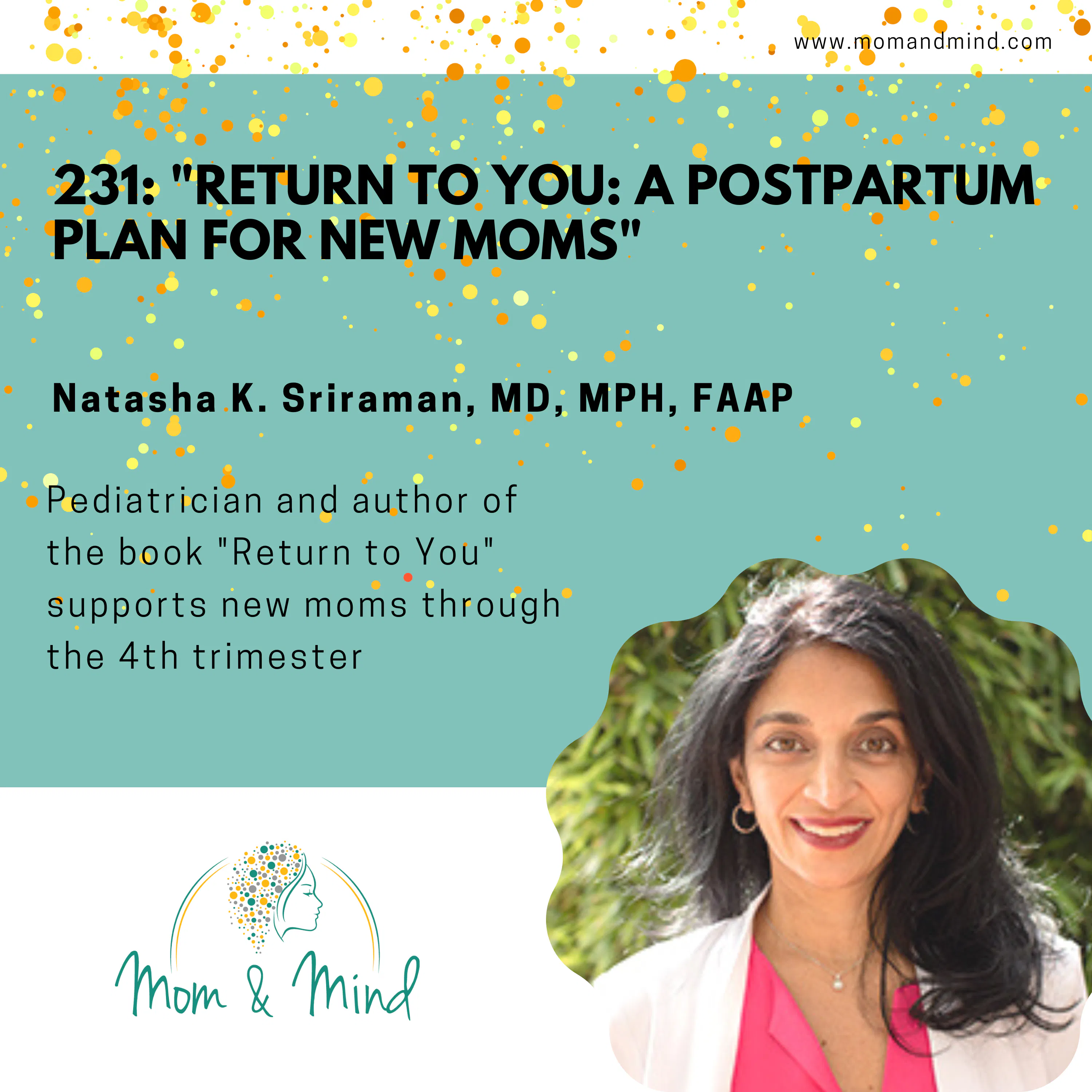
231: Return to You: A Postpartum Plan for New Moms with Natasha Sriraman, MD, MPH, FAAP
My guest today shares bits of her personal motherhood story, along with a glimpse at her new book for moms-to-be, new moms, and moms with other children. The book helps these moms make a plan for their postpartum time with evidence-based information, insights, and helpful advice from a physician-mom. Join us to learn more! Dr. Natasha Sriraman is a board-certified academic pediatrician and associate professor of pediatrics at Eastern Virginia Medical School/Children’s Hospital of the King’s Daughters. She is an internationally recognized expert on breastfeeding and postpartum depression. She works with the National AAP, is on the Virginia AAP Board, and is also the Honorary Chair of Postpartum Support Virginia. Dr. Sriraman lives with her husband and children in Virginia Beach, VA. Her first book, recently published, is Return to You: A Postpartum Plan for New Moms, published by the American Academy of Pediatrics. Her book offers insights as a friendly self-help guide to help new mothers prioritize themselves and make it through their “fourth trimester,” the three-month period following childbirth. Show Highlights: How Dr. Natasha’s book came to be, both from her own experiences and from her patients’ stories Why it is very important to be discerning about where your medical advice is coming from An explanation of the fourth trimester and its needs Dr. Natasha’s personal experience of being terrified of motherhood when she went home with her firstborn baby How postpartum support for new moms varies in different cultures Why Dr. Natasha’s book has a fill-in-the-blanks actual postpartum plan How setting expectations and making a plan for postpartum can decrease anxiety Highlights of some of the book chapters which cover social media, guilt, returning to work, childcare, breastfeeding, advocacy, setting boundaries, and more Why Dr. Natasha hopes her book will empower moms in taking care of their children How a pelvic floor therapist can be very helpful in the postpartum How physical and emotional pain are signs that something is wrong and needs to be addressed How Dr. Natasha’s book brings awareness and normalization to focusing on mental health as a priority How Dr. Natasha is working to decrease the stigma around moms asking for and receiving help when they need it Resources: Connect with Dr. Natasha: Instagram Return to You: A Postpartum Plan for New Moms **Dr. Natasha is offering a signed copy of her book to the first listener to comment on this episode on the Mom & Mind YouTube channel. Visit Mom & Mind - YouTube today! Visit my new website, www.wellmindperinatal.com, to get on the Interest List for the upcoming course. You’ll receive notifications when the course is live, and after you sign up, you’ll be able to watch or listen at your convenience. Learn more about your ad choices. Visit podcastchoices.com/adchoices
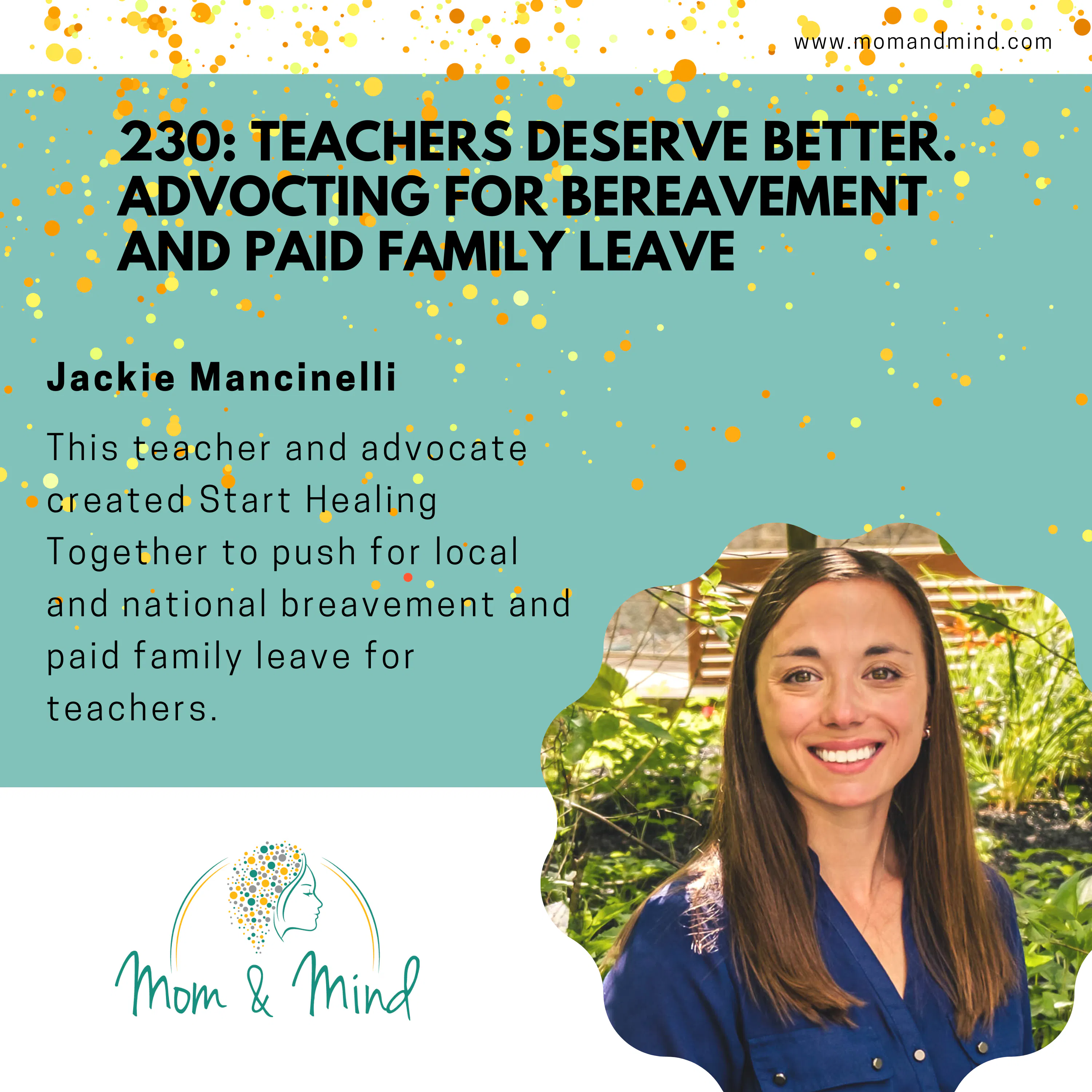
230: Teachers Deserve Better. Advocating for Bereavement and Paid Family Leave with Jackie Mancinelli
We all know that teachers are underpaid, but they are also undersupported emotionally in times of pregnancy loss and postpartum difficulties. The need is great for bereavement and paid family leave. Join us to learn more about how change can happen for educators in our country. Jackie Mancinelli is a high school English and ESL teacher in New Jersey. She is the mother of two girls, ages 2 and 4, and had a son who passed away in 2016. She is the founder of Start Healing Together, a support organization for educators experiencing pregnancy loss and infertility, as well as the New Jersey ambassador for Count the Kicks. Jackie shares her personal story and the need for bereavement leave for teachers, both in instances of pregnancy loss and failed fertility treatments. Show Highlights: An overview of Jackie’s story that began with her first pregnancy during her first year of teaching in 2014; it ended in a missed miscarriage when she was a few weeks along How her second pregnancy with her son went perfectly until about eight months along, when an emergency C-section sent her silent baby to the NICU–where he didn’t survive How Jackie found support within her immediate family and from her best friend What it was like for Jackie in the 2-3 months following the traumatic loss of her son–and how therapy helped her learn new things about herself What it was like for Jackie to go back to teaching after losing her son How Jackie was prompted to get into advocacy work to help other parents through Start Healing Together How Start Healing Together works with school districts to provide resources and support for educators and help in contract negotiations regarding pregnancy loss, bereavement leave, fertility treatment, and adoption Current initiatives being pursued by Start Healing Together How you can help the ongoing lobbying efforts Jackie’s advice to those experiencing a loss What Jackie learned through her pregnancy and loss experiences Resources: Connect with Jackie: Website, Instagram, and Facebook Visit my new website, www.wellmindperinatal.com, to get on the Interest List for the upcoming course. You’ll receive notifications when the course is live, and after you sign up, you’ll be able to watch or listen at your convenience. Learn more about your ad choices. Visit podcastchoices.com/adchoices
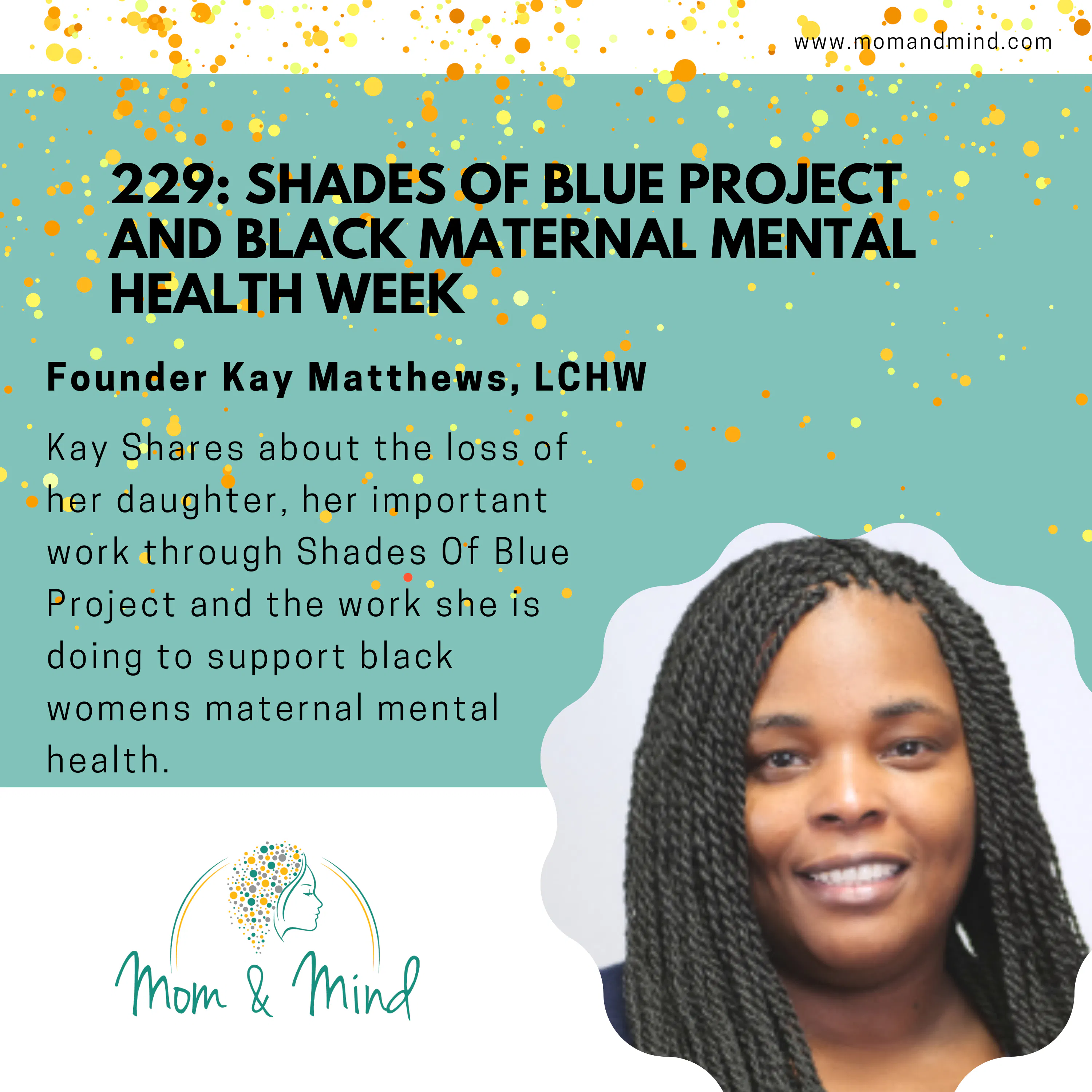
229: Shades of Blue Project and Black Maternal Mental Health Week
Today’s show is another story of a spectacular someone who turned their personal grief into a mission to help others. Our focus is on the disparity of medical treatment and care in the Black community regarding maternal mental health, infant loss, and more. Join us for this inspiring story from today’s guest! Kay Matthews is here to share her long-term work through the Shades of Blue Project. She and her team are on a mission to uplift all birthing individuals with the care, respect, and dignity they deserve—no matter their social status or birth outcome. Their focus is on the birthing experience, and they bridge gaps by acknowledging that everyone’s birth story matters. Through education, advocacy, and support, they are dedicated to helping birthing individuals of color whose lives are impacted by racial disparities that amplify their birthing struggles. It is from her personal experience of infant loss and postpartum depression that Kay recognized a critical diversity gap in mental health resources and emotional support for Black and minority birthing individuals. Kay has founded Black Maternal Mental Health Week, which in 2022 falls on July 18-25 with the theme “Collective Efforts for Greater Community Impact and Change.” You can learn more by visiting their Website, Facebook, Instagram, and Twitter. Show Highlights: How Kay came into the work she does today through a totally unexpected journey How Kay’s infant loss experience gave her a “big-picture view” How Kay’s infant loss and postpartum depression were dismissed by healthcare professionals Why Kay decided to “go it alone” to help herself and share helpful advice with others in similar situations How Kay used her journaling practice as a springboard to begin the Shades of Blue Project to help others How the Shades of Blue Project has taken steps to influence policy in Texas and open resource centers in 23 other states Why Kay’s journal became the INSPIRE journal, an acronym for Involve others, Nourishment/exercise, Spirituality/prayer, Patience, Identify and initiate change, Rest/relaxation, and Each day is a new day How Kay has seen growth in awareness and resources for people going through similar struggles with infant loss and maternal mental health Why Kay wanted to focus more on her experience rather than her outcome How mortality and morbidity rates in the Black community require that maternal health and mental health be acknowledged together Highlights of Black Maternal Mental Health Week activities How responsibility and accountability come into play in a collective effort to help others in the Shades of Blue Project How you can help Resources: You can connect with Kay and learn more about the Shades of Blue Project by visiting their Website, Facebook, Instagram, and Twitter. Learn more about your ad choices. Visit podcastchoices.com/adchoices
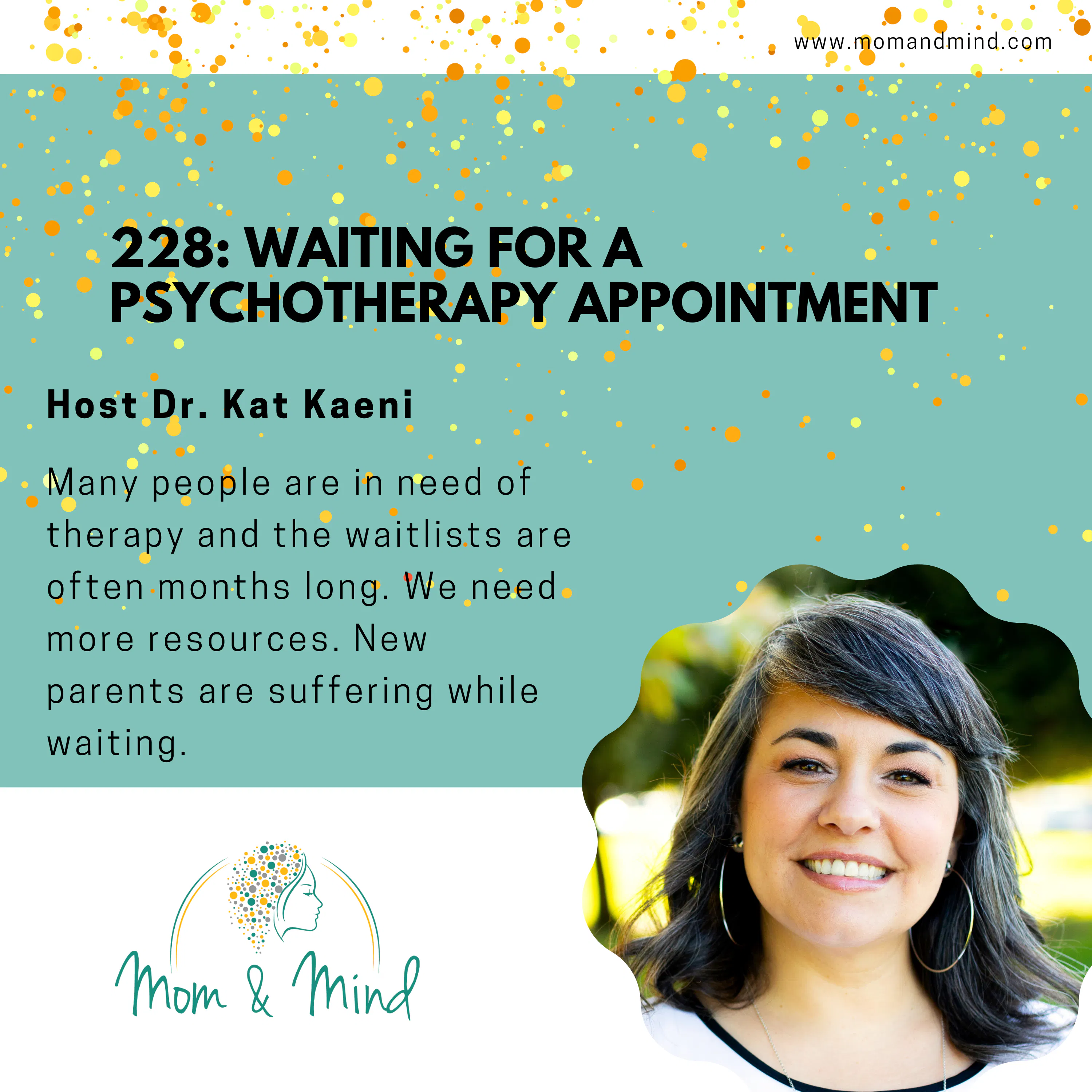
228: Waiting for a Psychotherapy Appointment
The podcast is six years old this month! With well over 220 episodes, I’m thrilled to know we are reaching so many people in the US and about 90 other countries in the world! What’s most important is that we are getting the message out about perinatal mental health and telling the important personal stories to raise awareness and provide resources for support and healing. I have to say a huge THANK YOU to every listener! With the COVID pandemic and the prevalence of telehealth, every therapist has had to shift in many ways. By the time people reach out for help, they need it right away, and it’s heartbreaking to make them wait. It’s great that more and more people have the opportunity to get the help that they need, but the increase in demand has strained resources and increased the wait times for appointments. Nothing feels more frightening and disheartening than being unable to get the help you need when you need it. We need to bridge the gap and do more–and I, for one, am up for the challenge! Join me to learn more in today’s episode! Show Highlights: Why we need more than online support groups when timing is crucial Why I decided to create an online course for those who are stressed out and overwhelmed in the postpartum period and waiting for a therapist How this course is built to be the bridge that you may need–to give you something to hold onto as a support Why new parents get lost when the expectation is to feel amazingly wonderful all the time Why I’m happy to offer this course as something to help people feel heard and understand in a path forward Details: The course is available in July with multiple modules in bite-size pieces through videos, audio, and accompanying downloadable worksheets. Check out our Resources section below for more information! Resources: Visit my new website, www.wellmindperinatal.com, to get on the Interest List for the upcoming course. You’ll receive notifications when the course is live, and after you sign up, you’ll be able to watch or listen at your convenience. Learn more about your ad choices. Visit podcastchoices.com/adchoices
227: Parenting Through Collective Trauma
It’s a good time to acknowledge the trauma that is raging around the world, which just adds to the stress from the challenges we have come through with the COVID pandemic. Here in the US, we are going through a time of multiple mass shootings, baby formula shortages, wars in other countries, political issues, and controversy about women’s bodies. There is lots of tense energy, worry, and confusion, along with the normal challenges of parenthood. For many parents, it has become very hard to process it all and keep living life. With so many people experiencing anxiety, depression, exhaustion, and burnout, navigating the journey is a difficult challenge. In today’s episode, I’m calling this trauma what it is and admitting that life can be so difficult at times. Join me for a closer look. Show Highlights: How these traumas bring emotional impacts on parents and kids Why it’s difficult to talk to our kids about the worry, anxiety, and trauma The importance of remaining present with our feelings over tragedies like school shootings How we have been collectively traumatized by many recent events Suggestions for coping by pulling back from social media and the news Why being fully present in your own life is a good option for dealing with stressful times My takeaways and advice: Limit your exposure to social media and news outlets. Find things and people to connect with that make you feel safe and secure. Engage in healthy and restorative activities. Realize that we all bear the mark of collective trauma. Know that you are not alone in the world and your feelings. Remember that things aren’t always going to stay this way. Learn more about your ad choices. Visit podcastchoices.com/adchoices
226: Healing Intergenerational Wounds While Navigating HG, Feeding Aversion, Postpartum Depression and Anxiety with Jocelyn Lam
During pregnancy and parenthood, we listen to SO many voices telling us what we should look like, feel like, and do. The stereotypes can be frustrating and demeaning to the point that we feel very unheard and unseen. Today’s conversation brings to the forefront the importance of finding self-worth and fulfillment in yourself and who you are, instead of what other people say. Join us to learn more! Jocelyn Lam is the mother of an energetic, kind, and silly toddler. Jocelyn is a second-generation immigrant who grew up in Calgary, Canada, and currently resides in the Bay Area of CA. She is a licensed marriage and family therapist who helps folks with intersecting identities break intergenerational trauma cycles, particularly in the areas of parenting, re-parenting, and body image. Jocelyn has training through Postpartum Support International and is working toward her certified eating disorder specialization. In today’s conversation, she shares her personal experience in parenting as a second-generation Chinese and Canadian immigrant, along with a diagnosis of hyperemesis gravidarum, which forced her to quit work during her pregnancy to focus on her health. Because of that diagnosis, she became extremely depressed during her pregnancy, which did not set her up for a good postpartum experience. Shortly after her daughter’s birth, her daughter was diagnosed with feeding aversion, which made breastfeeding very difficult and affected Jocelyn’s attachment to her baby. Even with all the resources and the best clinicians, she struggled and experienced intense postpartum depression and anxiety. Jocelyn shares a lot of insight into her story and why things were so difficult for her. Show Highlights: Highlights of Jocelyn’s background and story How her work has been informed by her family background and personal experiences How Jocelyn dealt with Asian stereotypes, racism, and microaggressions as she grew up in white, conservative Calgary How immigrant-related trauma impacted her value and self-worth as she was compared to others in every aspect of life How Jocelyn had to work to undo the mindset that a child’s worth is tied to what they produce and achieve How her daughter’s feeding problems as an infant seemed much like a trauma response How Jocelyn’s diagnosis of hyperemesis gravidarum during pregnancy had her questioning her worth as a mother and left her feeling invalidated How she had to learn that she deserves self-care How fries from In-N-Out Burger became part of her re-learning process How her hyperemesis gravidarum carried through her baby’s birth and postpartum period with constant comments from others about her baby’s size How Jocelyn’s entire world became about baby weight, calories, and comparing her baby to others What it meant to Jocelyn to learn to trust her own body and why she is teaching her daughter to trust her own body and empower herself Why we really need to unpack what society and our family have taught us about food How Jocelyn’s survival instincts came from her parents’ survival instincts until she learned to find space for herself Why Jocelyn had to overcome the hyper-independence in her background and find community and support Why Asian people typically reach out for mental health MUCH less often than the general population because they are taught to “Be strong and self-sufficient” Jocelyn’s key takeaways about our focus on body image, generational trauma, pregnancy, and postpartum, along with the importance of finding community Resources: Postpartum Support International Learn more about your ad choices. Visit podcastchoices.com/adchoices

225: "Unwell Women" with Elinor Cleghorn
We, as women, have absorbed much history into ourselves over time regarding our bodies and our health. We wonder why we feel unheard and dismissed, and the more we learn, the more enraged we should become about how modern western medicine has treated women with medical and mental health conditions. Join today’s conversation for deep insight and a message of hope. Dr. Elinor Cleghorn is a feminist cultural historian, and her critical writing has been published in several academic journals. After receiving her Ph.D. in 2012, she spent three years as a post-doctoral researcher at the Ruskin School, University of Oxford, where she worked on an interdisciplinary medical humanities project. She is the author of Unwell Women: Misdiagnosis and Myth in a Man-Made World, a book that I recommend highly to all our listeners. Show Highlights: What brought Elinor to write the book after a lupus diagnosis that followed a very complicated pregnancy with her son How Elinor began her research with urgency into her lupus diagnosis and the history of medicine, expanding into other commonly misdiagnosed diseases in women Why Elinor began at the beginning, learning about ancient Greece and the formation of medical practice How women’s bodies were viewed largely as reproductive vessels to produce and mother male heirs Why men in ancient patriarchal societies began to assert social control over women and their bodies How the western medical model has been affected by social thinking, myths, and fantasies about women’s roles How the word hysteria has been applied to a misunderstanding of women and was originally derived from a word for the uterus How medical leverage was used in horrible ways against black enslaved women in 19th century America, leading to gynecological violence and reproductive abuse Why Elinor wanted her book to expand to cover women’s experiences all over the world and not just be her personal story What Elinor has discovered about women’s mental health across history How dominant ideas have shaped societal views about the ideal motherhood and “how mothers SHOULD feel” Elinor’s hopes for readers of the book: “Remember that your body is your own, no matter how medical caregivers might make you feel.” Resources: Amazon: Unwell Women: Misdiagnosis and Myth in a Man-Made World by Elinor Cleghorn Connect with Elinor: Twitter and Instagram Learn more about your ad choices. Visit podcastchoices.com/adchoices
224: Maternal Mental Health Awareness Month with Katayune Kaeni, Psy.D., PMH-C
Welcome! Today’s show highlights some important upcoming dates in the world of perinatal mental health as we celebrate Maternal Mental Health Awareness Month in May. Stay tuned for the end as I have an exciting update to share with you. This podcast is very important to me. My purpose is to foster and provide space for people’s stories but to balance those experiences with a clinical perspective with proven experts in the field. As I say often, we need to raise awareness with information and education to reduce the stigma related to perinatal mental health conditions. Along with that awareness, I want to empower people further to seek help and support without shame or embarrassment. Thank you for coming along for the ride, and don’t forget to share the podcast and available resources with a friend or loved one who might benefit. I’m sharing a lot of helpful resources in this episode, so don’t miss out! Join me! Show Highlights: Important dates in May, Maternal Mental Health Awareness Month: Maternal Mental Health Awareness Week: May 2-6. How you can help spread the awareness: Share your story on social media and use the Postpartum Support International hashtag #maternalMHmatters. Like the PSI Facebook page and adopt the MMHday Twibbon on your Facebook or Twitter profile picture. Tell your story on our blog to help raise awareness of maternal mental health issues so that more women will get treatment and fewer will suffer. Come up with your own ideas to highlight that #maternalMHmatters in your area, and let others know by submitting your event details to us via email. Use our infographic to highlight that maternal mental health is a global issue. World Maternal Mental Health Awareness Day: May 4. There are worldwide efforts to raise awareness through social media, local events, and virtual events through PSI. Learn more at www.wmhday.postpartum.net. JOIN US to raise awareness around the globe: @postpartumhelp on Twitter and @postpartumsupportinternational on Facebook Perinatal Psychosis Awareness Day: May 6. PSI has a Postpartum Psychosis Task Force, which is led by individuals with lived experience and includes providers, researchers, advocates, and PSI staff/board members. The task force organizes around actions to improve public and provider awareness, increase and improve resources, reduce stigma, and provide legal and legislative advocacy. The goal of the task force is to develop resources and integrate knowledge and sensitivity about the experience of perinatal psychosis and the unique insights of survivor-advocates into all perinatal mental health advocacy, awareness, education, resources, and services. Other organizations joining PSI in leading the charge in these areas include Cherished Mom, Maternal Mental Health NOW, 2020 Mom, Maternal Mental Health Leadership Alliance (MMHLA), and more. My exciting update: I have been elected to be the next Board Chair of PSI, starting in July 2022. After volunteering with PSI for many years and serving in various capacities, I’m very proud and honored to take this post and follow in the footsteps of some amazing people who have gone before me! Resources: Postpartum Support International Postaprtum Find PSI on Twitter, Facebook, and Instagram. Cherished Mom Maternal Mental Health NOW 2020 Mom Maternal Mental Health Leadership Alliance (MMHLA) Learn more about your ad choices. Visit podcastchoices.com/adchoices

223: Perinatal Loss, Adoption, and Creating the Black Angel Mom Community
My guest today shares her personal story and clinical perspective of her complicated journey into motherhood. Her story includes the support of reproductive technologies, as well as the loss of her twin daughters and the adoption of her son. Join us to hear more. **Today’s episode covers sensitive topics of perinatal loss and pregnancy loss. Use your own judgment as to whether it’s right for you or not at this time. Jeanae Hopgood, LMFT, M.Ed, PMH-C, is an individual, couple/partner and family therapist, clinical sexologist, author, speaker, doctoral candidate, and occasional adjunct professor. Her Pennsylvania private practice centers people of marginalized identities (specifically Black and LGBTQ+). She helps them heal from family-of-origin challenges, relational difficulties, fertility and family creation processes, perinatal mental health, perinatal loss, healing and healthy sexuality, and realignment of the mind, body, and spirit. Jeanae is also the founder of the Black Angel Mom community, which includes a private Facebook community, a blog, guided journal, and conversation card deck. The card deck can be used by clinicians in therapeutic processing and discussions as a support system for their clients. Jeanae is the mother of twin daughters who have passed and one son earth-side. Show Highlights: How Jeanae had a lifelong dream to be a mom but knew assisted reproductive technologies would be her route How her next steps included multiple failed IUI cycles, fibroid-removal surgery, IVF, and a pregnancy with twin daughters How she experienced fluid loss, both light and heavy, that prefaced the traumatic loss of both girls How Jeanae made something beautiful out of a tragic situation in giving birth to her daughters at 16-17 weeks How Jeanae handled the tough parts of having her daughters photographed, dealing with the funeral home, and leaving them behind when she left the hospital How Jeanae felt anguish, despair, confusion, disconnection, and deep grief after the loss How Jeanae knew she needed help and searched for healing through grief counseling and journaling How Jeanae and her partner tried two more IVF cycles a few months later–with no success How even support groups didn’t feel inclusive of queer Black couples Why Jeanae created her blog to include others who didn’t see themselves in the support groups that were available to them How Jeanae and her partner were “kicked out” of their shared risk IVF program and were approached about the opportunity to adopt their son Why they chose adoption, knowing this would be the end of their fertility journey; because of the expense, they knew they couldn’t do both How the adoption brought conflicting emotions and feelings about becoming a mother in this unexpected way Why Jeanae created the Black Angel Mom community to be the support she needed A deeper look at where marginalization showed up in Jeanae’s journey to parenthood as a queer Black couple Resources: Connect with Jeanae: JHJ Therapy, Instagram, and Facebook Black Angel Mom, Instagram, and Facebook Learn more about your ad choices. Visit podcastchoices.com/adchoices

222: Postpartum Psychosis, Failed Healthcare, Trauma and Recovery
Today’s show looks at postpartum psychosis, a much-misunderstood condition, and diagnosis. Unfortunately, we usually hear about this condition after a tragedy has occurred, but that is not always the hallmark of postpartum psychosis. My guest shares her journey, including the missteps by the mental health clinicians and medical professionals who didn’t provide the help that she needed. Along with so many misconceptions about postpartum psychosis, the main problem is that people just are not educated about this topic. Join us to learn more. Jillian Parente is a licensed clinical social worker, adjunct professor, multi-trauma and postpartum psychosis survivor, yogi, and holistic wellness advocate. She is a champion of maternal mental health who specializes in trauma and focuses on women’s mental health. Most importantly, she is the mother of a smart and beautiful four-year-old girl. While maintaining her role as a mental health professional, Jillian continues the extensive process of recovery from her episode of late-onset postpartum psychosis, which occurred three years ago. As a result of that condition, she lost everything, and her entire life changed. Her story illustrates that “mental health does not discriminate.” Jillian believes that intensive healing is not an end goal but a journey. **Because of the nature of today’s topic, our discussion may be sensitive for some listeners. Use your judgment, and listen when you are ready. Show Highlights: Jillian’s story, which includes intrusive thoughts in the postpartum period, normal anxiety for a new mom, and increased problems when she and her husband returned to work How Jillian realized in hindsight that she had every risk factor for postpartum psychosis—but no medical professional ever addressed the risk Why Jillian felt like a failure in her attempt to breastfeed her daughter, partly because of a medication-induced milk shortage and a lack of support at her workplace How Jillian’s sense of emotional safety was shaken due to trauma in her marriage How paranoid delusions led Jillian to fear that her husband would harm her and her baby The chain of events that led to Jillian’s daughter being taken from her and her subsequent psychiatric hospitalization Why Jillian came to the point that she knew she needed professional help Why Jillian felt like an unsafe monster to her child even though she never felt like a harm to her The misconception about postpartum psychosis: that it only manifests itself in the mother harming her child and/or herself How Jillian transitioned to a different therapist and became involved in EMDR work Why Jillian is still battling for custody of her daughter What Jillian feels like are the big “misses” in her story where the system failed her and dismissed her How the support and love of a true friend empowered her and made all the difference for Jillian in helping her summon her strength and tenacity to help herself and move forward Resources: Contact Jillian: Jillian Parente Contact Post Partum for resources and support. Learn more about your ad choices. Visit podcastchoices.com/adchoices

221: "Happy with Baby...When Partners Become Parents""
As couples move into life with a new baby, many changes come with that new little arrival. Everyone has their expectations about what life will be like when the baby arrives, but how does the reality stack up? Life becomes a “new normal.” Whether expectations are realistic or not, adjusting to life with a new baby can be a time with many challenges, and communication with each other is vital. Join us to learn more! Catherine O’Brien is a licensed marriage and family therapist who lives and practices in Sacramento, California. She is the founder of Happy With Baby, which she created for new parents. She gives them the advice she wishes had been there for her as a new parent. Catherine’s new book, Happy With Baby, is a helpful resource for couples who are transitioning into parenthood. Show Highlights: What new parents are facing when a baby arrives, especially the strain on the relationship What surprises many new moms about how their partners adjust to parenthood How people can feel empowered and confident through the transition Why it is difficult for many new parents to ask for help–for various reasons How resentment in the relationship can build a wall over time if partnership and connection with each other aren’t prioritized How to notice the signs of resentment within yourself toward your partner How to start the conversations about connection with your partner and “check in” with each other Catherine’s tips for breaking down each partner’s basic needs to manage health, wellness, and connection How new moms can transition into a new space with their postpartum body and keep intimacy alive How to prioritize time for check-ins together by planning the time–and even a fun activity Resources: Connect with Catherine: Happy With baby, Instagram, and Facebook Happy With Baby by Catherine O’Brien Learn more about your ad choices. Visit podcastchoices.com/adchoices

220: Rage in Motherhood
Today we are digging into the topic of rage in motherhood, specifically, postpartum rage. We will discuss what it is, why it happens, what it feels like, and what you can do about it. Join us to learn more! Erica Djossa is a registered psychotherapist, sought-after maternal mental health specialist, and Happy As A Mother founder. She has been practicing for over ten years and is a regular media contributor. Erica helps women adjust and manage the load of motherhood with her popular Happy As A Mother podcast, Instagram platform, and online therapy services. She is passionate about supporting moms and helping them embrace their motherhood journey. She is a Toronto-based mother to three rambunctious boys, and she can often be found sharing insights through her Instagram stories. Show Highlights: How rage shows up in the context of motherhood How the “perfect mother” myths stifle a mom’s ability to express any anger Examples of what rage might feel like for a mom How we form our inward and outward boundaries for expressing anger based on the “rule book” in the way we were raised How “vulnerability factors” are underlying our anger expression How the narrative we tell ourselves around irritation and anger can either increase or decrease our stress levels Red flag indicators to look out for: intensity and frequency of the anger How to use the acronym NESTS: Nutrition, Exercise, Sleep, Time for self, and Support How continued rage after putting NESTS into place indicates the need to dig deeper Why anger is one of the most commonly overlooked symptoms of depression Erica’s personal experience as a mom of three young kids under three years of age How getting the appropriate help can change everything for a mom How mothers experience the depths of shame in feeling anger and rage Steps to take in finding help and support–and taking the first one is the most important! What to expect from Erica’s course of five modules How our stress hormones function in our bodies when we feel irritation, anger, and rage Why support, help, and therapy need to feel accessible to everyone Resources: Connect with Erica: www.happyasamother.co/rage (Many free resources are available!) Instagram and Facebook Erica is hiring remote perinatal therapists to join the Happy As A Mother team! Certified PMH-Cs from all Canadian provinces are welcome to apply! Click the link for details! Learn more about your ad choices. Visit podcastchoices.com/adchoices

219: Fertility and Perinatal Mental Health with Dr. Marissa Long, Psy.D, MAOB
Today’s show features a dear friend and colleague as we discuss the mental health impacts on fertility and perinatal mental health. The mental health side of these issues is often overlooked in the process of treatment, and many parents are suffering. Join us as we take a closer look! Dr. Marissa Long is a sought-after expert in the field of reproductive psychology. As the owner and clinical director of ARC Counseling & Wellness, a private practice in southern California, Texas, and Louisiana, Dr. Long is dedicated to helping individuals and couples who are going through fertility treatment. She also works with women with high risk pregnancies and pregnancy loss to relieve the emotional distress associated with these challenges. She recently launched PsychEd Book Club, an innovative book club facilitated by therapists to support mental health, self-help, and social connection through conversation and education. Dr. Long is a lifelong dancer who performed in the halftime show at Super Bowl XXXII and the Sydney Opera House a year later. Show Highlights: An overview of Dr. Long’s work as a health psychologist who connects physical issues and mental health Common issues and challenges that Dr. Long sees with her patients An explanation of reproductive endocrinology and REI terminology and their common treatments Impacts of the fertility process on people’s expectations of how they “thought” conception and pregnancy would happen Changes to the sexual relationship when fertility treatments are needed to conceive How people deal with feelings of shame, guilt, and body betrayal over fertility problems Why mental health challenges don’t end when a successful pregnancy occurs Stressors for patients on the medical side of treatments concerning medications, appointments, etc. How fertility treatment medications can impact a patient’s mental health and emotions Patient perspectives on what makes a good experience in fertility treatment The problem with patients not being referred for mental health treatment soon enough The great need for reproductive psychologists to work in conjunction with fertility clinics What clients need to hold onto during fertility struggles The need for support and connection for fertility patients–and where to find it Resources: Connect with Dr. Long: ARC Counseling & Wellness Instagram and Facebook For support during fertility issues: www.resolve.org and www.fertilityiq.com Learn more about your ad choices. Visit podcastchoices.com/adchoices

218: Collective Stress, Burnout, and Coping Through COVID Times
Today’s focus comes from what has been on my mind and what I hear from many people. Families are feeling the squeeze right now with collective stress, burnout, and trying to cope in the middle of these COVID times. What we are all dealing with and the length of time we have endured this stress so far has many people hitting a wall with their mental health. Join me for this discussion! Show Highlights: Why many of us feel jaded because of all that COVID has messed up for us How anxiety, hypervigilance, and the pressure of decision-making have added to the constant stress of managing everyday life for expectant moms and those with new babies How COVID decisions have brought conflict and confusion between families and friends because of varying perspectives Why we aren’t built to withstand this kind of collective stress and trauma for extended periods of time How our bandwidth for stress has decreased since there is no good place for our frustrated feelings to go–and each new wave brings more uncertainty The value we can find in validating our stress and calling it what it is instead of pretending that things are normal How do we cope when our normal self-care outlets don’t help us? Why we need to view self-care with a new perspective Suggestions for easy self-care practices: Consider unplugging from social media and news outlets at times. Step outside or open a window to breathe fresh air. Move your body or stretch as your body allows. Find ways to connect with people whom you trust. Listen to music or watch movies/TV shows that make you feel good. My advice: Ask yourself, “What is ONE thing I can do today that will help me just a little bit?” Learn more about your ad choices. Visit podcastchoices.com/adchoices

217: Managing a Physical Disability During Pregnancy and Postpartum
Today’s show gives us a unique perspective on pregnancy and the postpartum while managing a physical disability. Join us to hear our guest’s inspiring story. Rachel Brousseau is a Licensed Marriage and Family Therapist, Registered Drama Therapist, Drama Therapy Board Certified Trainer, and Perinatal Mental Health Certified Therapist. She has a private practice in Burbank, CA, where she specializes in helping highly sensitive mothers throughout their motherhood journey. She is the co-founder of the Creative Center for Motherhood, supporting moms through the use of group creative expression. Rachel has presented for Maternal Mental Health NOW, the North American Drama Therapy Association, USC School of Social Work, Cal State LA, and Heartbeat. She is also a Parent and Me class facilitator and teaches at the Drama Therapy Institute of Los Angeles. Through her personal experience, Rachel is driven to help mothers feel connected so that they never have to feel alone. Show Highlights: Rachel’s story of being diagnosed with a very rare autoimmune disease that affects her muscles at age five; as the progression happened, she had frequent falls and times when she couldn’t walk or navigate stairs How Rachel still played sports and performed in theater with adaptations Why Rachel struggled as an adult to get insurance, being forced to get creative with the medical system to get the services she needed How Rachel learned to advocate for herself and can now support and advocate for her clients How heavy steroids as a child led to eye problems like cataracts, glaucoma, and retinal detachment Why Rachel rejected the idea of parenthood because she overheard a doctor tell her parents that she would never have children How Rachel reconsidered pregnancy after her marriage, even though there was no research to go on for mothers with her condition When she became pregnant, things went well until her third trimester, when she began falling frequently After giving birth, she began having scary thoughts about falling and dropping the baby and her baby getting sick or inheriting her illness How she began attending a Mommy & Me yoga class about 2-3 months postpartum; there were a lot of stairs at the studio, and Rachel was told to “get in shape” when she inquired about an elevator How a similar experience at a second yoga studio left her feeling shut out, unwanted, and like she “couldn’t do motherhood well” How art therapy finally left her feeling acknowledged and made all the difference How Rachel handled going back to work with certain accommodations Why Rachel started researching perinatal mood and anxiety disorders, making sense of it all, and determining to help other moms Why Rachel stuck with strict criteria for her private practice office space to accommodate herself and her clients Rachel’s checklist to consider for disability and accessibility How support and telehealth help during the postpartum period Rachel’s advice for those with disabilities in dealing with “able-ist” attitudes, microaggressions, astonishment, and assumptions Why therapists and providers should take a support role and not an expert stance Resources: Connect with Rachel on her Website and Facebook. Learn more about your ad choices. Visit podcastchoices.com/adchoices
216: Understanding Attachment and Bonding with Bethany Warren, LCSW, PMH-C
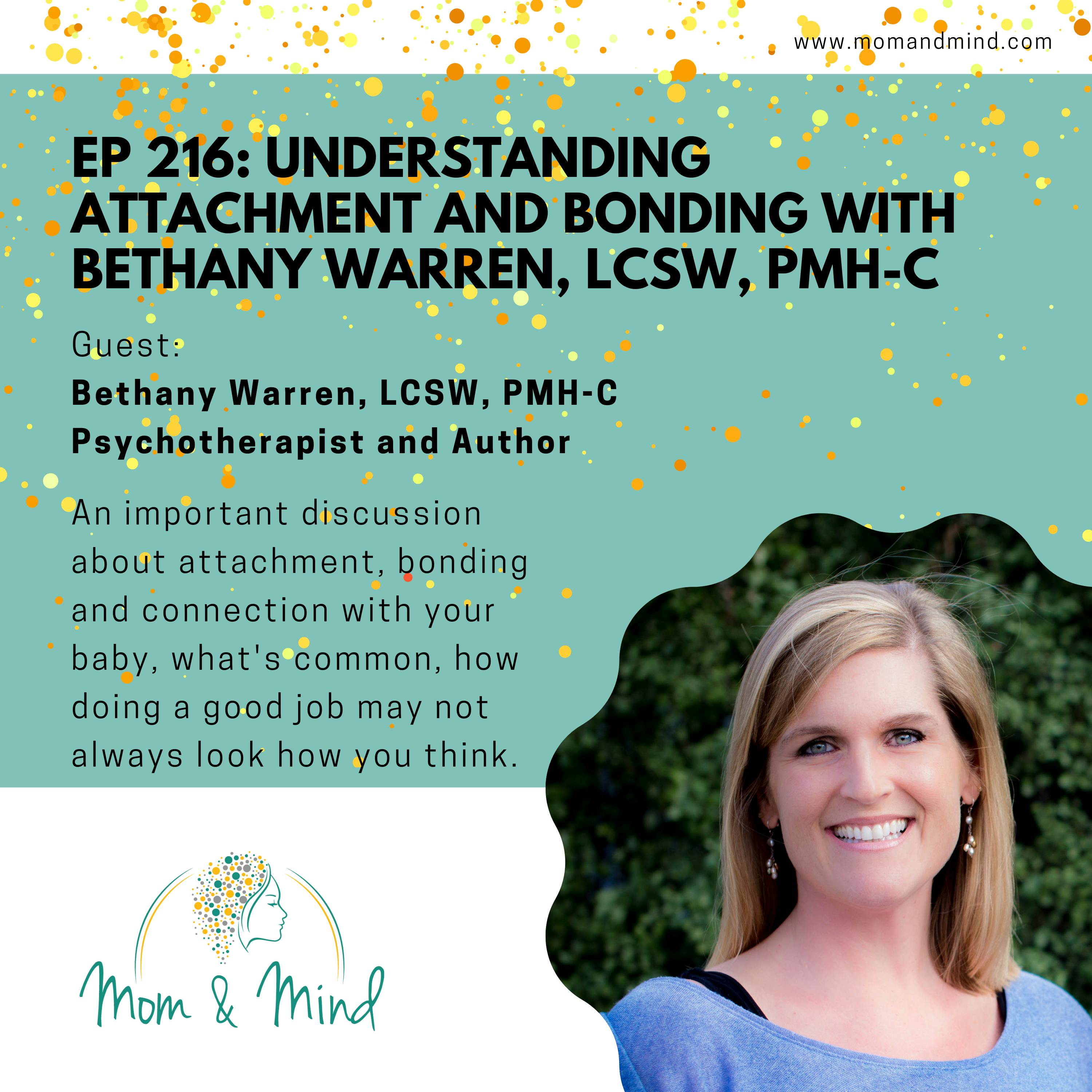
Today’s show focuses on attachment and bonding. Some parents feel immediate love and connection with their new baby, but for many, they struggle to achieve a “normal” bond. The good news is that there are specific steps parents can take to understand the basics of attachment and bonding. Join us to learn more! Beth Warren is a psychotherapist in private practice in San Diego, California. She has a passion for reproductive mental health and has worked in this field for over 20 years. Beth is certified in EMDR therapy and Perinatal Mental Health, specializing in perinatal mood and anxiety disorders, birth trauma, pregnancy loss, and infertility. She has worked in both hospital and outpatient psychiatric settings and has led postpartum support groups for new mothers. She is a current member and previously served as the President of the Board of the Postpartum Health Alliance, a nonprofit organization in San Diego dedicated to promoting awareness of Perinatal Mental Health. In addition to working as a therapist and EMDR consultant, she facilitates trainings and is a regular speaker, lecturer, podcast/radio guest. She has written a newly released book called The Pregnancy and Postpartum Mood Workbook, which helps new parents navigate their emotions and build skills towards mental wellness through their journey of parenthood. Show Highlights: The fundamental basics of bonding and attachment How bonding includes feelings of warmth, connection, protection, and responsibility that unfold over time How traumatic births can delay feelings of bonding and attachment How a disruption in attachment from your childhood can play out to delay bonding with your own child How an anxious parent can have an effect on how that child grows up and then parents their own child—and why they might want to parent differently How culture and community can play into parenting because of our experiences in life Why parents have to heal themselves in order to be good parents and break multi-generational patterns How perinatal mood and anxiety disorders can cause delayed bonding, but the good news is that parents can keep working on it How the feedback loop happens as a new baby grows and develops to interact with his parents Why mirror neurons are vitally important for babies to learn from their parents How therapy can help parents learn what they are doing well even when they don’t feel the bonding with their baby that they want How Beth works with parents to help them think about what their baby “would thank them for today” How words of affirmation and encouragement can make all the difference for an anxious mom Beth’s advice for parents to promote bonding and attachment: Talk to your baby during every chance for interaction. Add singing and other motions with eye contact to help them imitate you. “Wear” your baby in a sling to keep them close to you and practice skin-to-skin touch when possible. Why some parents have the distorted belief that their baby doesn’t like them or they are a bad parent when they don’t understand how bonding unfolds over time How positive quiet-time intervention can help the struggling parent How Beth’s new book, The Pregnancy and Postpartum Mood Workbook, has suggested bonding and attachment exercises Resources: Bethany Warren LCSW Find Beth on Instagram. The Pregnancy and Postpartum Mood Workbook: The Guide to Surviving Your Emotions When Having a Baby by Bethany Warren and Beth Creager Berger Learn more about your ad choices. Visit podcastchoices.com/adchoices

215: Postpartum Depression
There are many misconceptions about postpartum depression, what it is, and how it manifests itself. This episode will clear up some of the myths and bring clarity, hope, and awareness to this topic. Join us to learn more! Kristina Deligiannidis, MD, received her medical degree from and completed her psychiatry residency and chief residency in psychopharmacology research at the University of Massachusetts Medical School. After residency, she completed a visiting fellowship and further training in multimodal neuroimaging at the Massachusetts General Hospital/Martinos Center for Biomedical Imaging. Dr. Deligiannidis joined the faculty at Zucker Hillside Hospital, the Feinstein Institutes for Medical Research, and the Donald and Barbara Zucker School of Medicine at Hofstra/Northwell in September 2016. She is board certified by the American Board of Psychiatry and Neurology and currently serves as the director of women’s behavioral health at Zucker Hillside Hospital. As a reproductive psychiatrist, she has expertise in treating women with mood and anxiety disorders linked to the menstrual cycle, pregnancy, postpartum, and perimenopause. Show Highlights: How Dr. D came to this field that blends neuroscience, psychiatry, and women’s health Why her research into postpartum depression focuses on the female hormones before, during, and after pregnancy and childbirth Postpartum depression defined and explained: It is a mix of emotional, physical, and other symptoms that usually begin with sadness, loss of pleasure in activities, sleep difficulties, appetite disturbances, irritability, agitation, guilt, loss of worth, and more. How postpartum depression and “baby blues” differ in severity, onset, and duration How changes in the brain take place due to pregnancy hormones increasing and decreasing with the birth process Risk factors for perinatal depression include a personal history of depression, increased stressors, and minimal support How moms describe postpartum depression with feelings of isolation and a loss of self How many women suffer without getting the help and support they need and have long-term effects Why we need to do a better job in recognizing and treating postpartum depression for the sake of moms, babies, families, and society How the risks for depression in pregnancy and the postpartum can differ from each other D explains a recent study by Healthy Woman that shows the pressure women feel to “do it all” and like they are “bothering someone” if they ask for help How people can prepare for life with a new baby and prioritize their emotional health Why a higher percentage of Hispanic and black women report inadequate social support and poor access to their healthcare providers in the early postpartum period, as compared with white women How a new program, Check On Mom, helps with developing a maternal mental wellness plan Resources: My Check On Mom Connect with Kristina Learn more about your ad choices. Visit podcastchoices.com/adchoices

214: Parental Burnout with Shelley Kemmerer, PA-C
Parents have experienced burnout for generations, but it’s only recently that parent burnout has been recognized as something that needs support. Today’s guest is making a difference in this space, helping parents and families with overall mental and physical wellness. Join us to learn more! Shelley Kemmerer PA-C is the founder of Run Tell Mom, LLC. She is a licensed physician assistant who is certified in parental burnout prevention by The Training Institute for Parental Burnout, the world’s leading training institute on parental burnout. She helps parents and caregivers with live-in children navigate transitions throughout their parenting journey. Shelley provides personalized, customizable resources through one-on-one consultations, collaborative workshops, and master classes with a goal to optimize the parenting experience while filling the space beyond clinical care. Show Highlights: Shelley’s path to the work she does today to help parents How Shelley saw the need for parental burnout resources after the birth of her youngest child Shelley’s unique perspective as a PA and a mom who realized that families need extra support Why Shelley’s social media goals are to allow collaborative discussions with providers, parents, and support specialists--and to bring awareness to available resources How expectation vs. reality is a wide divide in parenthood Why parents need connection, support circles, and therapy; the problem is that they don’t know whether to ask a doula, midwife, pediatrician, or therapist What Shelley noticed from her perspective as a parent: Very brief visits to healthcare providers with not enough time to address all the important issues Difficulties in returning to work after a baby’s birth, especially for those in the healthcare field Contributing factors to parental burnout: perfectionism (competing with other parents to have everything “in order”), social media expectations, limited parental leave, and individualism How parents are balancing “stacked plates” of productivity goals at work, extracurricular activities for kids, keeping a clean home, self-care, and more! How COVID has brought an upheaval in many families and homes that is exhausting, even in dual-parent households, but even more so for single parents Tips for prevention of burnout: division of labor between parents, good sleep, exercise, healthy nutrition, awareness of signs of depression and anxiety, connecting with others, etc. How to support parents in getting good sleep--and why it’s vitally important for many reasons! Top resources for parents that Shelley recommends: Postpartum Support International, Call 2-1-1, social media support groups, and other local support groups Three defining hallmarks of parental burnout: overwhelming significant exhaustion related to the parental role, emotional distancing from one’s child or children, lack of joy or fulfilling pleasure in being a parent (this would be a distinct change in how you WERE as a parent to how you are today) Differences between depression/anxiety and burnout Why these discussions about burnout are difficult to have How to take things off your plate by “triaging” them into what’s urgent and not-so-urgent Parting words from Shelley: “You CAN feel better. There are small steps you can take to make gradual changes to improve what might have gone on for months or years. Have more self-compassion for yourself that you are doing what you can right now. It’s not a sign of weakness if you ask for help. Parents are beautiful, awesome people.” Resources: Email Shelley: [email protected] Check out her website: www.runtellmom.com Find Shelley on Instagram. Find support: Postpartum Learn more about your ad choices. Visit podcastchoices.com/adchoices
213: An Undiagnosed Postpartum Depression Turned Into A Therapist's Passion
Therapists are under unique pressure to “have it all together” when pregnancy and parenthood challenges come along. The truth is that no one is immune to these challenges, and therapists experience the same struggles as anyone else. Join us as today’s guest shares her experience in becoming a parent and adjusting to her role in motherhood. Veronica Eyo is a bilingual licensed clinical social worker. Her passion is to help all moms navigate the challenges of parenthood. She transitioned into her practice of working primarily with mothers after her first pregnancy, and her experiences led her to seek specialized training in working with moms of color. Supporting mamas through various walks of life is what grounds Veronica, and this passion influenced her dissertation as she researched student mothers’ success in institutions of higher learning. Show Highlights: Veronica’s experience with her first pregnancy and not holding space for herself as she was for her clients How her daughter’s birth became a whirlwind after a four-day labor and C-section that left Veronica feeling like a failure How her allergy to penicillin resulted in problems for her and her daughter The painful memories of the rocky four-day period in the hospital and not even remembering meeting her daughter for the first time How the breastfeeding difficulties compounded Veronica’s feelings of failure How Veronica learned to focus on “one next step” to keep going with the help of a therapist friend How motherhood became a struggle for Veronica because of the standards she set for herself Why no one around Veronica knew how much she struggled Why Veronica had a difficult time letting other people hold her baby How Veronica found support through Mommy and Me, even though there weren’t other moms there who shared her cultural heritage How Veronica felt about being a stay-at-home mom for a year and then going back to work How Veronica felt guilty and ashamed at first when she took time for herself How Veronica feels that she has changed so much as a mom over the last four years, stepping into her role as a mother as the result of deep work Why “one small thing” has become Veronica’s life motto Why Veronica didn’t stick to her Mexican cultural tradition of 40 days of rest after childbirth because she found it difficult to accept help; with her second and third children, she found it easier to let people help her The need to get correct messaging out there that it’s OK for mothers to take breaks, take time for themselves, and ask for help What Veronica wants other moms to know: “No one has it figured out--and that’s OK. There isn’t ONE right way to do things, so you can decide what works best for you and your family. Your community is important, whether it’s on social media, podcasts, or taking time for self-care. Just take one step at a time.” Resources: Dr. Veronica Find Veronica on Instagram. Learn more about your ad choices. Visit podcastchoices.com/adchoices
212: Pregnancy and Infant Loss
Today’s episode turns to pregnancy and infant loss as we acknowledge October as Pregnancy and Infant Loss Awareness Month. We want to spend time honoring all parents who have experienced this unique type of loss. Everyone who experiences a pregnancy or infant loss goes through the grief in their own way and at their own pace, and there are specific ways that we can offer support. Let’s dive into this difficult subject together. Show Highlights: Why you owe no one an explanation about how you feel, why you feel it, or how long you feel it. Why people very often don’t know what to say for a number of possible reasons Why some people may choose not to share openly about their loss Why shame, blame, and trauma accompany this kind of overwhelming loss How we can help erase the stigma, silence, and isolation that many people feel after a loss How it’s common to experience worry and anxiety in trying to become pregnant again after a loss How grief is not a linear process that begins and ends but affects multiple aspects of life How dates become significant in loss for many people, but others may feel awkward about remembering Why it’s OK to tell people to ask how you’re doing, check in on you, help remember the date, etc. Many great supports are available; check out our Resources section below! Resources: PSI Check out the therapist directory, free support groups, and more! Return to Zero: Hope Check out the many resources! Pregnancy After Loss Support Sisters in Loss on Instagram Dr. Jessica Zucker I Had a Miscarriage by Jessica Zucker Star Legacy Foundation Mom & Mind Loss-Related Episodes: 208, 206, 200, and 188--Visit Dr. Kaeni. Learn more about your ad choices. Visit podcastchoices.com/adchoices
211: Support for Men's Mental Health in Fatherhood
We are talking about how partners are affected and transformed in their journey into parenthood. Fathers need support and education just like mothers do. Join us to learn more! Scott Mair lives with his wife and seven sons in the UK. He’s here to share how he started supporting new fathers through their journey to new parenthood. Scott is on a mission to set up parental mental health support for parents and promote awareness of paternal mental health. He’s a member of the Paternal Mental Health Alliance, mental health campaigner, trained peer-to-peer leader, team member of the perinatal training CIC, and qualified Beyond Birth mental wellbeing practitioner. In today’s episode, you’ll hear key informative points from Scott about how we can support fathers in the transition to parenthood, as well as how our outdated views of fathers negatively impact men in their transition into fatherhood. Show Highlights: How Scott got started in the field of paternal mental health through the traumatic birth of his seventh son just over two years ago How anxiety began building during his wife’s pregnancy with the seventh son, after almost losing her and his son in the previous birth How Scott was getting his mental health wrong for years, culminating in the circumstances around the difficult two births How approached his local hospital about the need for education for dads about mental health and the realities of parenting How the UK is ahead of the US in its long-term plan for perinatal mental health How Scott offers support for fathers through charities supported by the NHS How mothers and fathers can need support differently, even with the same birth of the same baby How Scott convinces men of the need to talk about their mental health and parenting issues The myth of masculinity and why we need to work to create a world where men can freely show emotions and vulnerability The pressure on moms and dads in pregnancy and parenting How Scott learned to assist his wife and support her as a breastfeeding mom How to model compassion and authenticity in allowing children to feel emotions and express their feelings Scott’s best tips for new parents: Be the parent YOU want to be--not the one society tells you to be. Drown out the noise and opinions of others; try your hardest and find what works best for YOU. Find time for each other as a couple. Make time each day for a brief check-in with each other and enjoy the small moments together. Resources: Connect with Scott: Twitter: @scottmair9 Instagram: @pmh_support Learn more about your ad choices. Visit podcastchoices.com/adchoices

210: Baby Bomb: A Relationship Survival Guide for New Parents with Kara Hoppe, MFT
Today’s show focuses on your relationship during pregnancy and the postpartum period. My guest shares her experience through postpartum depression and anxiety and the effects on her marriage. We are covering what you need to know--but no one has told you--about the entry into parenthood. Join us! Kara Hoppe is a psychotherapist, teacher, feminist, and mother. She has spent more than a decade as an inclusive therapist working with individuals and couples toward healing and growing toward becoming grounded, integrated people with better access to their own instincts, wisdom, and creativity. Kara offers workshops for parents and expectant couples based on her book, Baby Bomb: A Relationship Survival Guide for New Parents. She lives with her husband and son in Pioneertown, CA, and sees clients in private practice via telehealth. In today’s conversation, Kara helps us understand how new parents can navigate the unexpected changes in their relationship, including how to communicate, how to maintain intimacy, and how to grow together as a new family. Show Highlights: Kara’s experience with postpartum depression and anxiety through the birth of her son and thought the disconnect was just “normal” How her husband noticed the shift in her and urged her to take time for herself How the relationship changes for Kara brought discomfort and “dizzying vulnerability” in needing her husband so much From her husband’s perspective, it felt good to be needed in a different way and be a necessary partner in parenting--but there were frustrations from his end Why the postpartum aspect is hard to understand when you’re in the middle of it and requires a “big picture” approach Why Kara decided to write a book to help other couples, and how she brought in Stan Tatkin to help How Kara and her husband got back to relationship intimacy on every level to strengthen their marriage How parenthood brings many opportunities for misattunement and hurt within a marriage How Kara teaches secure functioning from attachment theory, which is based on trust, safety, and security How the micro-moments of mistake can be repaired to return to intimate connection Why the couple relationship must come first when the baby arrives How the child gains security by seeing parents taking care of each other’s needs How Kara wants to empower couples to co-create the life they want as equal partners From Kara’s book: how her chapter on sexual intimacy covers navigating the conflict over “touching” How the non-primary parent can offer care without over-touching How to reframe your needs into words that communicate to your partner without blame or attack How Kara’s couples retreats teach skills for repairing your relationship and cultivating increased intimacy Hopeful messages from Kara: “Partners who get support in understanding themselves and what they do can take responsibility and make changes. Awareness is key, and we can teach that.” Resources: www.karahoppe.com Find Kara Hoppe on Instagram, Twitter, and Facebook. Baby Bomb: A Relationship Survival Guide for New Parents by Kara Hoppe and Dr. Stan Tatkin Find Dr. Stan Tatkin on Instagram and Facebook. Learn more about your ad choices. Visit podcastchoices.com/adchoices

209: Parental Mental Health - Factoring in Fathers with Jane Honikman
Today’s episode is an important one in the field of parental mental health. Unfortunately, fathers are often overlooked in many aspects of parenthood and family dynamics. To build strong families, we need to involve all parents in the path to parenthood and in providing family-supporting resources. Join us to learn more! Jane Honikman, M.S. co-founded Postpartum Education for Parents (PEP), co-founded the Postpartum Action Institute, and founded Postpartum Support International (PSI). Jane is the author of several parenting support books: Community Support for New Families; I’m Listening: A Guide to Supporting Postpartum Families; My Diary: A Postpartum Journey from Pain to Purpose; Postpartum Action Manual: How to Provide Comfort, Encouragement, and Guidance to New Families; and Parental Mental Health: Factoring in Fathers. She was born and raised in Palo Alto, California, and has lived in Santa Barbara since 1970. She and her husband have three adult married children, eight grandchildren, and a cat. Show Highlights: How Jane looked to her mother as a role model but didn’t follow conventional social rules as she became an adult How fantasies about life can set you up for failure and disaster Why Jane was involved in the movement to make mothers and fathers equal partners in parenthood in the 70s How family mental illness and her personal trauma pushed Jane into her work with parental mental health The flip in inequity with what we’ve done to men and their feelings What we should change regarding fathers How Jane partnered with Dan Singley to write Factoring in Fathers Why men today struggle to identify role models in manhood and parenthood How postpartum mental illness affects men in different forms than women How pediatricians can do more in parental mental health with the whole family Available resources for fathers How mental health clinicians can do better in their work with families Why the postpartum period never really comes to an end Resources: Instagram: (@parental_health) Twitter: Parental_Health Factoring In Fathers Jane’s books: Community Support for New Families I’m Listening: A Guide to Supporting Postpartum Families My Diary: A Postpartum Journey from Pain to Purpose Postpartum Action Manual: How to Provide Comfort, Encouragement, and Guidance to New Families Parental Mental Health: Factoring in Fathers by Jane Honikman and Daniel Singley Learn more about your ad choices. Visit podcastchoices.com/adchoices

208: Perinatal Loss, Black Women, Birthing and Protecting Wellness
Today’s guest shares her story of pregnancy losses and the resulting anxiety and depression that made the journey to parenthood very challenging. Join us to hear her inspiring story of healing and hope. Dorienna M. Alfred, Ph.D., PMH-C is a licensed psychologist and certified perinatal mental health professional. She is the owner of Works of Faith Wellness and Consultation, LLC, a private practice centered on perinatal mental health services in Columbus, Ohio. Through the practice, she provides individual therapy, workshops, and continuing education that promote health equity for those at the highest risk for complications during pregnancy and postpartum. Dr. Alfred is the author of the book, Pregnant with Promise: A Spiritual Journey of Pregnancy, Bed Rest, and Childbirth, which is a memoir of her journey with loss and pregnancy complications. She has been a guest blogger for Pregnancy After Loss Support and has been a guest on the Sisters in Loss Podcast. She is particularly interested in supporting parents with pregnancy complications and pregnancy loss, and is completing a certification to become a birth and bereavement doula. She has co-authored various publications and refereed workshops on topics related to women’s health, racial identity, social justice, and cultural competence. In her free time, she enjoys spending time with her husband and sons, reading novels, scrapbooking, and Zumba. Show Highlights: How Dorienna came into the field of perinatal mental health through two early pregnancy losses The devastating experience of having to deliver the second loss and the resulting anxiety and trauma How Dorianna’s successful pregnancy with her son was joyful but difficult with 14 weeks of bed rest Why Dorienna compiled her book from journal entries of her experiences How the landscape of mental health would change if there were more education and training for therapists in perinatal mental health How Dorienna, even as a psychologist, didn’t receive mental health support through her losses and while on bed rest The need to talk about and educate people about how pregnancy loss can impact future pregnancies and parenting How stress and trauma can result from perceived racism and lack of acknowledgement The importance of giving space to talk about pent-up emotions The benefits of having a doula--and even a postpartum doula for the 4th trimester and beyond The value of therapy in learning new coping skills and knowing you aren’t on your journey alone Final words from Dorienna: “Don’t be afraid to take the risk and find a therapist that works best for you and is a good fit. Therapy can be very beneficial to find the support system you need.” Resources: Works of Faith @doriennamalfred instagram Find Dorienna’s book on Amazon: Pregnant with Promise: A Spiritual Journey of Pregnancy, Bed Rest, and Childbirth Learn more about your ad choices. Visit podcastchoices.com/adchoices

207: Christine's Story Through Postpartum, Anxiety, Colic, Stress, and Healing Through it All
Today’s episode covers the personal story of a mother who has been through postpartum anxiety, severe colic, and complicated family transitions. Through her difficulties, she has thrown herself into learning about perinatal mental health challenges, supporting herself, and helping other families. Christine Carrig is the director of Carrig Montessori School in Brooklyn, NY. She holds a master’s degree in Early Childhood Education as well as a Montessori certification. Christine has trained as a postpartum doula through both DONA and Ayurvedic Mamas. Most recently, Christine founded The Family Flow, a community that offers online courses for parents of young children, with the aim of helping parents understand and support their children so they can guide them through the messy terrain of development. Christine lives in Queens with her husband and four young children. Show Highlights: In 2012, Christine’s first daughter was born after a wonderful pregnancy As a new business owner of a Montessori school, Christine pushed herself too hard as a new mom and was shocked at her hypervigilance and how it depleted her energy How Christine noticed that her daughter was extremely sensitive and easily overwhelmed by her emotions and frequently overstimulated; she also had sleep issues In 2015, her son was born after a more challenging pregnancy for Christine, and she felt like there was a cloud over her all the time How her daughter started showing harmful aggressive behavior toward the baby and Christine to the point she feared being alone with the two children How Christine felt inadequate to walk through this terrain of transition with her daughter to the point that she felt like a failure as a mother How Christine’s relationship with her own mother changed and left her feeling unsupported and isolated in an extended period of estrangement between them How her newborn son’s fussiness and vomiting escalated into full-blown colic, and Christine drew strength from her husband’s calm optimism How an interaction with her sister gave Christine a new perspective on her situation When her son’s colic settled down around nine months, she sought help from acupuncture, therapy, and learning more about her daughter’s unique needs When Christine became pregnant again, she feared a repeat of her postpartum experience, so she took maternal mental health training and listened to the Mom & Mind podcast, trying to make a different plan for herself and her older two children How Christine took physical and emotional space after the birth of her third child to authentically bounce back and learned to ask for help With her fourth baby, she hired a postpartum doula to help and learned how to ask friends and family for specific help How she made her basement her “recovery cave” and took some “sitting in” time, which left her recovered, steady, and calm as a new mother of four children How Christine helps other families through her Mindful Parenting program at her school and her online classes Resources: The Family Flow Learn more about your ad choices. Visit podcastchoices.com/adchoices

206: Healing After Miscarriage, Birth, and Postpartum Anxiety
Today’s show marks five years of this podcast. It’s been an unbelievable journey speaking to guests who share their stories and experiences so we can all work to raise the volume on these perinatal mental health conditions. Five years, 206 episodes---and we’re still going strong! Heidi McBain shares her story of birth trauma, miscarriage, and anxiety to shed light on the importance of talking about these experiences, allowing time to grieve for loss, and getting the help you need. Heidi has been married for almost 19 years and has two kids, ages 12 and 15. She's also a dog mom to a high-energy Labrador Retriever. Her family spent six years living in Lima, Peru, when their kids were young, and they have been in Flower Mound, Texas (outside of Dallas) for the last four years. After being a stay-at-home mom when her kids were little, Heidi now works full-time as a therapist. She is licensed in the state of Texas and sees moms during pregnancy, postpartum, and throughout motherhood. Show Highlights: Heidi’s story of her first pregnancy with her daughter and how it was normal until things went downhill and became terrifying and traumatizing How the birth of her son three years later brought the realization of what she had been through during her daughter’s labor and delivery How a 12-week miscarriage between her daughter and son left her feeling guilty, upset, and like she should have been referred to a therapist Why you must create space to grieve for a loss in order to move forward How Heidi’s therapist helped her realize she was experiencing anxiety as umbilical cord concerns cropped up with her pregnancy with her son How Heidi coped with anxiety by going to therapy, meditating, journaling, and spending time outdoors Why Heidi regrets not going back to therapy after her son’s birth How Heidi and her husband worked together as sleep-deprived partners to deal with their son’s reflux problems What Heidi wishes she had known sooner How Heidi’s experiences spurred her to work more in the field of perinatal mental health to help others Resources: Heidi Mcbain Facebook and Instagram: @mentalwellnessformoms Learn more about your ad choices. Visit podcastchoices.com/adchoices

205: Destigmatizing Intrusive Thoughts with Dr. Nichole Fairbrother
Anxiety and intrusive thoughts can be horrifying experiences for new parents. My guest is making significant contributions to the field of perinatal mood and anxiety disorders in the areas of research and education. Join us to learn more about her work. Today’s guest is Dr. Nichole Fairbrother, a registered psychologist and Clinical Associate Professor with the University of British Columbia's Department of Psychiatry in British Columbia, Canada. She is the head of the UBC Perinatal Anxiety Research Lab, and her research is in the area of perinatal mental health with a focus on anxiety disorders and epidemiology. Dr. Fairbrother directs multidisciplinary studies to assess the prevalence of anxiety disorders among pregnant and postpartum women. Much of her work is focused on understanding the relationship of mothers’ intrusive thoughts, OCD, and mothering behaviors, and she is actively involved to bring awareness, help, and education to women around the world. Show Highlights: Nichole’s research around anxiety and intrusive thoughts How her personal experience of unwanted intrusive thoughts at the birth of her first child prompted her research The first small study (only 100 women) showed what women reported about their dark feelings and intrusive thoughts How the study was later replicated with a larger group of 2000-3000 women to help with prenatal education One of Nichole’s current projects: an animated educational video about intrusive thoughts and harmful behaviors Why intrusive thoughts are scary and stigmatizing for most women The evolution of thoughts that lead to increased protectiveness as parents of newborns Why unwanted intrusive thoughts in the postpartum and usually accompanied by OCD behaviors Nichole explains the rates of perinatal OCD and the risk for new moms How we can help by providing prenatal education to help mothers recognize the intrusive thoughts How Nichole is working on developing a cognitive behavioral treatment program and is seeking funding to develop the first training module The ongoing study and how you can participate along with all major English-speaking countries in the world (they are looking for about 3000 women who are up to three months postpartum) Messages of healing from Nichole: “Recovery is absolutely within reach if you’re suffering from anxiety and intrusive thoughts. I see people’s faces change when they realize that they are not alone in this.” Resources: Website and social media links: Website Facebook Twitter Learn more about your ad choices. Visit podcastchoices.com/adchoices

204: Cultural Narratives in Motherhood, Immigration and Perinatal Mental Health
As we continue to celebrate Maternal Mental Health Awareness Month, we take a deep dive into the cultural factors that affect perinatal mental health. Today’s guest shares how she’s working to support black, indigenous, and people of color (BIPOC) through the perinatal mental health journey as they transition to parenthood. Divya Kumar is a South Asian-American psychotherapist with a public health background specializing in perinatal mental health, trauma, and anti-oppression work. Her work connects clinical services with public health by addressing unmet needs in direct perinatal mental healthcare and the structure and delivery of perinatal support services. She is one of the Co-Founders of the Perinatal Mental Health Alliance for People of Color, a program within Postpartum Support International, and a Commissioner on the Ellen Story Commission on Postpartum Depression in Massachusetts. She also writes about the intersections of race, trauma, and perinatal mental health. Divya joins us to discuss how culture and immigration impact perinatal mental health. Show Highlights: What Divya wants us to know about her work that helps parents and families in the BIPOC community The relief that comes when someone can relate to your cultural background without needing to hear all the details How our thoughts, beliefs, and ideas about our culture affect our narratives, even down to self-care and what we think about seeking support Why many cultures glorify struggle and suffering for mothers to the exclusion of needing self-care, support, and help of any kind How it brings tension to the family when a first-generation immigrant who becomes a mother chooses to go against cultural norms Why following the narrative for mothers to “just try harder” only creates more self-blame and guilt The pieces of loss that complicate the transition to motherhood when cultural assimilation means abandoning important cultural practices and traditions The sense of grief and loss that comes in deciding which cultural traditions to continue on with your own family How culture shows up in daily parenting, even in small details like teaching kids to manage feelings and emotions How cultural narratives interact with perinatal mental health in areas of gratitude and shame How to reduce shame and guilt by unpacking the story down to its roots Divya’s “BothBrownAnd” philosophy in feeling and validating emotions The myth of “Happy Mommy/Happy Baby”--and why it doesn’t work Why the idea of choosing how to mother can be extremely difficult and also transformative at the same time How to cultivate the voice of self-compassion in sustainable ways Why motherhood is a process and a journey that each person can create How Divya works with clients with gentle and compassionate curiosity Parting words from Divya: “Your parenthood story is still being written. We sometimes feel stuck between two places in the non-linear path that takes us through parenthood. You don’t have to have all the answers. Seeing someone with an empathic stance to how you were raised can make all the difference.” Resources: Connect with Divya Instagram: @bothbrownand_ Learn more about your ad choices. Visit podcastchoices.com/adchoices

203: When Pregnancy Isn't "Magical": Anxiety, Depression and Treatment with Actress Liz Masucci
We can all draw strength and community from the stories of others. Today’s guest uses her talents in acting, producing, and writing to inform and educate people about perinatal mood and anxiety disorders. Her overriding messages are that everyone deserves help and support so they don’t feel like she did, isolated and alone. Elizabeth Masucci is an actress, producer, and writer based in NYC. She started in theater and then began working in TV and film. Liz has starred on several TV shows such as Elementary, Royal Pains, and Public Morals, which was produced by Ed Burns and Steven Spielberg. She now mostly produces her own projects with a company she started with a friend. They have a few TV shows in development, one of which is a dark comedy about women struggling with perinatal mood and anxiety disorders at a maternal mental health center. Since Liz struggled with PMADs while she was pregnant with her daughter, she uses this creative outlet to share her story and spread support and information to others. She is also the mom of a little boy who was born last December. Show Highlights: How Liz experienced depression and anxiety in her first pregnancy in 2018 Because she had no information and no support, she felt confused, and her emotional swings and rage spiraled out of control How she saw a reproductive psychiatrist who prescribed medications, when Liz really wanted to explore further the why and what of her experience How she discovered the Motherhood Center in NYC through Postpartum Support International and signed up for the day program, which turned out to be a lifesaver How the varied aspects of support in the group therapy program helped Liz feel more stable and supported, along with Prozac How Liz transitioned later into her postpartum with the same support from the center What it was like in the beginning when realized that “something wasn’t right;” she felt tired, unmotivated, and totally overwhelmed with the normal tasks in preparing for a baby How Liz felt about telling others about her struggles How Liz immediately felt much better after giving birth The hesitancy and questions around taking medications during pregnancy How Liz felt during her second pregnancy, when she continued on medication; it was during the pandemic, but she had an easy postpartum period with no dark places Why Liz wanted to share her experience as an outlet for her and a way to help others Liz’s projects: a TV show about PMADs and group therapy, and a film about postpartum psychosis Why there is such stigma and misunderstanding around PMADs and postpartum psychosis What Liz wants others to know: “When you’re pregnant and in the postpartum, your body is going through a lot. Things will come up, so don’t ignore them. Don’t feel shame, but find the resources available to help you.” Resources: Liz Musucci @lizmasucci on Instagram and Twitter Learn more about your ad choices. Visit podcastchoices.com/adchoices
202: Coping with a Fetal Diagnosis and Supporting New Parents through Occupational Therapy
Whether you are a parent or hope to be a parent someday, we all have assumptions about what pregnancy should be like. What we can’t control is how it will go in reality and how we will feel during the process. Today’s show explores how the journey can be navigated when unexpected circumstances creep in and sabotage our well-crafted plans. Leora Rozin felt blindsided and lost when welcoming her first child in 2012. She wishes she had someone with her background as an occupational therapist to help her navigate pregnancy and postpartum. After having a second child in 2014, Leora was expecting another child in 2019 when a fetal diagnosis at the 21-week anatomy scan rocked her world. This experience ultimately became a source of motivation to become certified in Perinatal Mental Health. Today, Leora is passionate about helping moms when their pregnancy and postpartum journeys feel off course. She lives in New York with her family and is the proud mom of three busy kids. Since April is Occupational Therapy Month, I’m excited to share Leora’s life and work in today’s show. Show Highlights: Leora’s first pregnancy in 2011: a breech baby prompted an emergency C-section and a cascade of events that she wasn’t prepared for In the postpartum, Leora struggle with pain control, feeding the baby, and daily duties; she felt isolated and alone How Leora reached out to her pediatrician for support and got immediate help How Leora never realized the magnitude of stress, adjustment, physical recovery, and the total reorganization of her life Two years later, she had her second child, and she felt more successful and better prepared How the management of two kids, a household, and a job was challenging in unexpected ways How Leora shifted her work as an OT to focus on pregnancy and postpartum The link between postpartum issues and the lack of self-care Why we can’t ignore the “middle space” between function and dysfunction in the lives of new mothers Why Leora’s work focuses on proper support for at-risk mothers How to find an OT who can help you After a miscarriage, Leora was pregnant with her third child when the 21-week scan showed an omphalocele, a severe abdominal wall defect After further tests and an immediate amniocentesis, Leora was able to share her story and find an outpouring of support Why it became Leora’s mission to help every woman in pregnancy and postpartum never to feel alone Update: Leora’s daughter was born and had surgery just a few hours after birth; she spent only six days in the NICU and is now a happy, healthy one-year-old Leora’s words to parents: You are not alone. We each have a unique journey, so just know that you should seek support from friends and family and trained professionals. Resources: Connect with Leora: Motherhood OT instagram.com/motherhood_OT Check out this directory to find an OT who specializes in maternal health: Motherhood OT Learn more about your ad choices. Visit podcastchoices.com/adchoices

201: The Pregnancy Workbook with Dr. Katayune Kaeni, Psy.D., PMH-C
Are you ready for my big announcement? I wrote a book! I’m so excited to tell you all about it in today’s show. The Pregnancy Workbook: Manage Anxiety and Worry with CBT and Mindfulness Techniques is out on May 4, and it’s available for preorder now! The book is written in a relatable tone that will help you feel supported in your pregnancy journey. It’s full of usable tools to help deal with anxiety during pregnancy and over 60 skills that you can implement right away. Each chapter includes useful information, techniques, and coping strategies to ease anxiety during pregnancy and help you find peace and calm with proven therapeutic methods. The goal of the book is to help you feel guided and supported through pregnancy and the postpartum. Show Highlights: Why the writing process was a new and fascinating experience for me Why the book is dedicated to my daughter, the one who has taken me on the growth journey into motherhood Why it was a big challenge to decide what to include and what to leave out of the book as I honed in on the basics How writing made me look at therapy from a different perspective as I slowed down and thought deeply about my work with my clients How the book’s nine chapters cover topics like intrusive thoughts, anxiety, pregnancy loss, high sensitivity, and skills for relaxation, meditation, and mindfulness Why information for partners is included, along with help for the postpartum period Why the writing process was a challenge with my perfectionist tendencies and high sensitivity How I used therapy and a coach-mentor to help me process “the stuff” that came up during the writing process How the Pomodoro technique helped me chunk the work into small tasks to get things done How I pulled out my woo-woo techniques to help me be more mindful and calm How writing the next book will be easier because of what I’ve learned through this experience Why writing a book has taught me so many things about myself Resources: Wherever books are sold! The Pregnancy Workbook: Manage Anxiety and Worry with CBT and Mindfulness Techniques by Katayune Kaeni, Psy.D., PMH-C Learn more about your ad choices. Visit podcastchoices.com/adchoices

200: Multiple Pregnancy Losses - Impacts on Mental Health and Subsequent Pregnancies
Today’s guest shares her personal story of recurrent pregnancy loss, including early miscarriage and multiple ectopic pregnancies. She shares how her mental and emotional healing journey led to the writing of a book. Kim Hooper is the author of several novels; her latest is No Hiding in Boise, which comes out this June. She and her co-authors wrote All the Love: Healing Your Heart and Finding Meaning After Pregnancy Loss as a mix of personal stories plus information and awareness from the clinical side. The book covers topics like reconnecting with your partner after loss, considerations for LGBTQ couples, trying again after loss, coping and healing, and racial, cultural, and socioeconomic issues. I’m thankful for Kim’s willingness to share her story of multiple losses, healing, and what it was like to finally give birth to a healthy baby after her long journey. Show Highlights: Kim’s complicated journey to motherhood: 1st pregnancy in 2015 ended as an ectopic that required emergency surgery 2nd pregnancy was a missed miscarriage when the embryo stopped growing 3rd pregnancy was a miscarriage at 17 weeks when her son’s heart stopped beating 4th pregnancy was another ectopic, and the doctor said it was “just bad luck” 5th pregnancy was totally normal and resulted in the birth of her daughter in 2017 How Kim tried to figure things out and get answers in her desperation The mental and emotional roller coaster of recurrent losses and pregnancies How Kim experienced anxiety, anger, and denial How Kim found support in unexpected places How to reconnect with your partner in the aftermath of pregnancy loss Why most men and women don’t grieve in the same ways The statistics: couples who experience miscarriage are 22% more likely to break up than couples who haven’t had a miscarriage How Kim and her husband were able to talk about their grief and recover as a couple How Kim personally turned to therapy and journaling to help her with the trauma The roundabout healing journey through grief The intensely personal aspects of grief and healing What Kim has learned about dealing with grief Details about Kim’s book and who it’s written for Resources: Connect with Kim: Website Facebook Instagram Twitter Turner Publishing Co Authors: Dr. Huong Diep Meridith Resnik, LCSW Learn more about your ad choices. Visit podcastchoices.com/adchoices

199: Personal Experience with Postpartum Depression: Insights about Babies' Language Development
It’s always helpful to hear someone’s personal story because it will resonate with many more people than they might think. My guest today shares her experience with postpartum depression, which was made even more shocking because it occurred several months after the birth of her second child. Join us to hear Emily’s story. Emily Adler Mosqueda has become a fierce advocate for mothers since experiencing postpartum depression several months after her second daughter was born. It’s different with a second child because a mother receives much less support than with her firstborn. Emily talks about how she realized the signs of her postpartum depression, along with how her profession has been affected. She is a bilingual pediatric speech-language pathologist, Associate Clinical Professor, and Lead Clinical Supervisor at the Young Child Center with the Communication Disorders and Sciences program at the University of Oregon HEDCO Clinic. Emily is the mother of two young daughters who teaches graduate students about parental mental health factors as they relate to communication disorders. Show Highlights: Emily’s story of postpartum depression with the birth of her second daughter: Cruising along with confidence until eight months postpartum Depleted in every way and sleep deprived, Emily finally took a leave of absence from her job to address her postpartum depression and begin regular counseling, acupuncture, and writing How Emily learned to ask questions and research to find answers and educate herself How Emily’s husband, a Chinese medicine physician, was able to relate her symptoms to her pregnancy and postpartum Key contributing factors for Emily: The tendency toward depression that she kept secret Cumulative sleep deprivation Cultural influences about motherhood and perfectionism The pressure to “have it all together” with a second child--and not need help How Emily has learned to value her needs and feel free to express them How Emily felt that her care providers missed the signs and didn’t take the opportunities to ask about her wellbeing Why Emily worried about the language development of her second daughter and took steps to provide early intervention How Emily’s experience with postpartum depression has intersected with her career as a speech-language pathologist who is training grad students to be aware and intuitive A broad overview of language development in kids Tips for parents to support language development by interacting verbally, labeling items, talking about daily tasks and activities, reading books, and giving intention to being more talkative with your child How writing her memoir helped Emily heal Resources: Connect with Emily: Emily Adler Mosqueda Learn more about your ad choices. Visit podcastchoices.com/adchoices

198: Pressure of Perfectionism in Motherhood
Do you identify as a perfectionist? Do you feel like things need to be a certain way and if they aren't, you feel unsettled? How did that affect you when you were trying to conceive, during pregnancy, birthing or postpartum? This is one of those things that really impacts the early stages of motherhood and parenthood (and all stages really). In this episode, I talk about the dynamics that I see with the mamas that I help...and one that I struggled with in my postpartum...and still work on managing. I touch on how it even impacted the recording of this episode. Some of the things we address on this episode... *The struggle with feeling the need to be perfect *It seems that perfectionism often comes with a high sense of morality and conscientiousness - I believe that this makes intrusive thoughts even more unbearable. *Perfectionism often develops as a way to cope and manage life. But that way of coping goes head to head with the challenges of new parenthood. *The stress of perfectionism, can make getting help feel hard. Help can feel SLOW or inadequate. *Accepting that we can't be perfect is very hard, and it's part of the key to healing. If you identify with any of this, take a listen to the episode, give yourself a big hug and please know that this is not a judgment of you. Please know that you can find a new way to cope that is more forgiving to yourself. If you'd like, please check out the blog post on the Postpartum Support International Blog that I mentioned: Soul Level Crisis Please pass this episode along to any person who could benefit! If you haven't yet subscribed to the podcast head over to www.momandmind.com We welcome ratings, reviews, sharing the podcast and spreading the word about perinatal mental health! Lets crush this together! Learn more about your ad choices. Visit podcastchoices.com/adchoices

197: Burnout and Managing Overwhelm with Dr. Kat
How are you? Sometimes it’s hard to check in with ourselves in the busy-ness of daily life, especially in these pandemic days when our self-care options are limited. High stress, depression, and anxiety tend to feel like personal failure. In today’s show, I want to offer you perspective and encouragement. Show Highlights: How to interpret your feelings during moments of stress How to approach the new considerations brought on by the pandemic: masks, social distancing, virtual connections, etc. Why life is hard in many ways right now for most people Tips on how you can feel better: Remember that you are resilient Getting help is NOT failure Honor your exhaustion by taking a break and setting boundaries Check in with your sleep, eating/hydration, hormones, and stress Turn “What’s wrong with me?” into “What’s going on for me?” Take time to reflect and allow space just to BE Resources: Check out the Mom & Mind Online shop at Mom And Mind. Learn more about your ad choices. Visit podcastchoices.com/adchoices

196: Reproductive Psychiatry, Latinx Psychiatrist, Pandemic Pregnancy and More
Today’s episode is packed with helpful information about taking medication during pregnancy and the postpartum period. We’ll also take a closer look at COVID-related issues and the vaccine as they relate to perinatal mental health. Join us to learn more. Dr. Sarah Oreck is a Columbia University-trained psychiatrist who focuses on women’s mental wellness. In addition to her expertise in general and addiction psychiatry, Dr. Oreck is one of very few doctors with specialized training in reproductive psychiatry. She runs a private practice in which she combines the most up-to-date medical treatments with talk therapy, meditation, and a whole-body complementary approach. Dr. Oreck is passionate about teaching, and she regularly lectures at Cedars Sinai Hospital, UCLA, and The Providence Hospital System, in addition to her media work. She is actively involved in advocacy work and is a member of the Board of Directors of Maternal Mental Health Now. Show Highlights: An overview of the field of reproductive psychiatry--and how it helps people The “risk vs. risk” perspective regarding medication and perinatal mental health How Sarah talks to people about the risk of anxiety and depression Why mental health medications can be safer than untreated mental illness The dangers when physicians don’t keep up with new mental health research and literature How Sarah works to train and inform physicians about pregnancy and postpartum How Sarah’s individual clients benefit from her bilingual abilities due to her Colombian heritage The myths of motherhood in the Latin community that only magnify the need for a mental health focus Sarah’s observations about the impact of COVID on perinatal mood and anxiety disorders What it was like for Sarah to have her first baby during the COVID pandemic What we should know about the COVID vaccine regarding pregnancy and breastfeeding mothers How the stigmas around anxiety medication discourage people from taking medications that are necessary and life-saving What Sarah has seen in people getting the help, support, and connection that they need Resources: Sarah Oreck MD Instagram Facebook Learn more about your ad choices. Visit podcastchoices.com/adchoices

195: Paternal Postpartum Depression: David Levine
Today’s topic is important, but it is hugely stigmatized in our culture. You may not have even heard about paternal postpartum depression, but my guest today shares what he experienced with the births of his two children. Dr. David Levine is a pediatrician in New Jersey. He was blindsided by postpartum depression because, like most of us, he thought it only happens to women. He shares the struggle of having to talk to his wife about it and how he found help. Even more surprising is that he experienced postpartum while working as a pediatrician. He completed his undergraduate degree at Rutgers College Medical School at NYU and his residency in pediatrics at Yale. Dr. Levine is not on the board of Postpartum Support International (PSI), where he works in professional outreach as a staunch advocate for fathers’ mental health. He’s written a book about his experience, which will hopefully be published soon to get the message out to fathers that they are not alone. Show Highlights: Why so little is known about postpartum mental health, especially concerning fathers David’s experience when his first child was born seven years ago How David felt his aggravation and agitation increase as his infant son cried and could not be calmed How David looked for support groups and resources for dads--and couldn’t find anything How he kept getting worse and started envisioning committing violence against his child: “It was like watching a horror movie in my mind.” How David finally told his wife about his depression and intrusive thoughts How David tried medication briefly and then hit rock-bottom around week 7 of his son’s life How David began his long road to recovery with therapy, a baby nurse, and more sleep How he gained confidence as a father and began to bond with his son when he was 3-4 months old How David began working with PSI and then had his second child three years ago How his experiences were very similar, yet very different with his daughter Why David feels that the traditional traps of masculinity kept him from seeking help earlier How men experience anxiety and depression much differently than women do Why postpartum depression in dads might manifest with anger, withdrawal from the family, and even physical violence The pushback from people who don’t believe that postpartum depression exists for fathers Why there should be more research, understanding, and resources for all aspects of male mental health The hard statistics about male and female depression How we can catch paternal postpartum depression better by teaching pediatricians to screen mothers AND fathers, and teaching obstetricians to inform mothers to check on dads David’s manuscript for his book and his determination to get it published Hopeful messages from David: “Paternal postpartum depression is fixable. We can prevent some of this from happening. With that, we can improve the lives of children and their parents and make stronger families.” Learn more about your ad choices. Visit podcastchoices.com/adchoices

194: The Highly Sensitive Mother
We all know that the challenges of new motherhood can be many--and overwhelming. If you are an HSP (highly sensitive person), then those challenges may be magnified---and you probably aren’t focusing on any self-care. This topic resonates deeply with me and intrigues me in the way the trait interacts with motherhood and its challenges. Julie Bjelland is an LMFT, an HSP psychotherapist, and the author of Brain Training for the Highly Sensitive Person: Techniques to Reduce Anxiety and Overwhelming Emotions. Julie’s mission is to help sensitive people reduce the challenges and increase the positives.Through her website specializing in highly sensitive people (the trait also known as Sensory Processing Sensitivity), she offers many valuable resources for both HSP’s and parents of sensitive children. Julie has a mission to spread awareness and education about the trait of high sensitivity and believes the world needs the gifts of sensitive people. Show Highlights: High sensitivity is a trait and not a disorder--and it’s NOT the same as introversion (30% of HSP’s are extroverts and 20% are introverts) From Elaine Aron’s work on HSP’s: Depth of Processing, Overstimulation, Emotionally responsive, and Sensitivity to subtle stimuli (DOES) The judgment around being sensitive and its connection to weakness How scientific research shows real brain differences in HSP’s On the positive side, HSP’s are more empathetic, more aware, and more compassionate Common for the HSP mother is to put themselves at the bottom of the priority list and take care of others first Trained HSP vs. untrained HSP Self-care---a conscious action you take to lower your stress and bring you to a balanced state A key for HSP’s is getting enough sleep in order to understand and meet specific needs An HSP mom’s default setting is to be hard on themselves and focus on everyone else’s needs Certain parts of the brain in HSP moms will be overactive, like merging into everyone else’s moods and experiences Many people who seek treatment for anxiety will also have the HSP trait How HSP contributes to overall perinatal depression and anxiety, since everything changes in mind, body, and spirit Why HSP’s need creative ways to get two hours of alone time each day The tendency to measure everything in ourselves and others against the standard of perfection Self-talk, with low levels of self-compassion and criticism of themselves Common characteristics of HSP’s: perfectionism, sleep-deprived, overstimulated, and misunderstood Steps to help HSP’s: Develop self-compassion (Kristin Neff outlines 3 steps) Take breaks when needed Practice mindfulness 50% of clients in therapy are HSP’s Supporting moms and dads better in pregnancy and the postpartum period could impact parenting differently and offer more support Using the right tools for support in children can prevent many problems and help them gain confidence and have an easier time accepting who they are Resources: Brain Training for the Highly Sensitive Person: Techniques to Reduce Anxiety and Overwhelming Emotions.by Julie Bjelland The Highly Sensitive Child by Dr. Elaine Aron Self-Compassion by Kristin Neff www.juliebjelland.com Find Julie on Facebook: The Highly Sensitive Person Instagram: hsp psychotherapist Twitter: @juliebjelland LinkedIn: highly-sensitive-juliebjelland Learn more about your ad choices. Visit podcastchoices.com/adchoices

193: Postpartum Anxiety with Dr. Carly Snyder
Welcome to Mom and Mind, I’m your host, Dr. Kat. Anxiety is at an all time high with covid, political stress, social justice stress, holidays and collective stress. So we are re releasing this episode from 2 years ago, as it is one of the most commonly downloaded episodes. We are talking about Postpartum Anxiety today and more specifically, We touch on the ever present guilt and shame that runs its course through motherhood as well as some ways to cope and manage postpartum anxiety. About Carly Snyder, M.D. Dr. Carly Snyder is a Board Certified reproductive and perinatal psychiatrist with a unique approach that combines traditional psychiatry with integrative medicine-based treatments. Dr. Snyder received her medical degree from NYU School of Medicine and completed general psychiatry residency at Mount Sinai Beth Israel Medical Center with additional reproductive psychiatry elective training at the Payne Whitney Women’s Program at NY Presbyterian Weill Cornell Medical Center, where she remains voluntary faculty. She maintains a private practice on the Upper East Side in NYC, and is working virtually due to COVID19. Dr. Snyder was named a ‘2019, 2020 and 2021 New York Super Doctors Rising Star’ and is a frequent lecturer on the topic of women’s health and wellness. Her weekly radio and HuffPost parenting blog share the “MD for Moms” moniker. She also is a regular contributor to many popular websites and a member of the Women’s Mental Health Consortium and Robyn. Dr. Snyder served on the Board of Postpartum Support International (PSI) for multiple years and remains a member of the Advisory Council. Show Highlights: - What is "normal" anxiety in new motherhood - How can people know when it's becoming more difficult or a clinical issue? - What kinds of anxiety might a mother experience (types) - Examples of cases? - What is a side effect of the perinatal anxiety (guilt, shame, relationship problems, etc) - what can they do to heal/cope/manage? - Hopeful messages of repair/recovery? Great Info, right?! The more we can understand these things, the easier it will be for us to cope and heal. Carly's bio is here: https://www.carlysnydermd.com/about/credentials/ Social Media: Facebook - https://www.facebook.com/CarlySnyderMD Twitter - @CarlySnyderMD For this and all episodes of Mom and Mind, go to www.momandmind.com, join on on FB, twitter and IG as well as our FB group, Mom and Mind connection. Until next time! Learn more about your ad choices. Visit podcastchoices.com/adchoices
192: Colic, Postpartum Anxiety and Postpartum Depression
Today’s show covers a topic of great concern and high stress for many parents. Many of us don’t understand colic and how to soothe a colicky baby. Today’s guest shares how her experience raising her colicky newborn daughter affected her life and her mental health. Jacqueline DelVecchio is a licensed mental health counselor in Salem, MA. She works in a private practice setting and specializes in perinatal mental health, certified through Postpartum Support International. She’s a wife, mother of two, and doggy-mom to a chocolate lab. Show Highlights: In 2016, Jacqueline’s first child was born after a great pregnancy and birth experience; the all-day crying began immediately and lasted about seven months Even though her daughter was a good eater, with every bottle came the intense crying that lasted for hours The only soothing for her baby came from bouncing on a yoga ball, running the vacuum, and Justin Timberlake’s song, “Can’t Stop the Feeling” How Jacqueline’s daughter would cry for two hours after every feeding but would sleep through the night quite well Why Jacqueline felt helpless, isolated, and guilty Why Jacqueline decided to see a therapist How Jacqueline dealt with the frustration of a constantly crying baby The expectations for parenthood---and the grief that comes from realizing “this is not what I expected” The need for education, resources, and help for parents who are dealing with colic How other parents and even doctors don’t understand what dealing with a colicky baby is like How therapy helped Jacqueline normalize her experiences, thoughts, and feelings The biggest lesson learned for Jacqueline was that all moms are on the same level How Jacqueline was led to specialize in perinatal mental health What Jacqueline has learned about the effects of colic on parents Jacqueline’s tips for parents who are dealing with colic now: Prioritize self-care Ask and accept help from others Educate yourself and advocate for yourself The nervousness and anxiety that came with a second child, wondering if colic would be a problem again Hopeful messages from Jacqueline: “You’re doing a wonderful job even if your baby doesn’t stop crying. That’s not what determines your value as a parent. There is help and support if you’re dealing with colic.” Resources: Connect with Jacqueline: Jacqueline DelVecchio Instagram: @butletsberealistic Learn more about your ad choices. Visit podcastchoices.com/adchoices

Ep 191191: A Journey Through Preeclampsia, NICU, PPD, and Finding Hope
Even though there is much variation in the stories that women share here on the podcast, it’s amazing how many similarities they share. In today’s conversation, like so many others, we see a commonality in both the suffering, the isolation, and the path to healing. Leila Tualla is an author and poet. She journaled her bouts with pregnancy anxiety, postpartum depression, and preeclampsia in a memoir titled Storm of Hope: God, Preeclampsia, Depression and Me, as a way of healing. Leila is a mental health advocate and is part of 2020 Mom as a Mom Ambassador. She is currently volunteering as a peer support provider for organizations such as International Association of Premenstrual Disorders (IAPMD) and as a mentor for Postpartum Support International (PSI). She hopes that by sharing her maternal mental health and birth stories that moms know they are not alone in their postpartum and premenstrual dysphoric disorder journeys. Show Highlights: How Leila was diagnosed with preeclampsia during her first pregnancy in 2012--and she experienced anxiety over what to expect next How her daughter was born at 31 weeks and spent 46 days in the NICU Leila’s desperate fears during her pregnancy anxiety with her second pregnancy--and how the anxiety developed into postpartum depression later on As a counselor, Leila noticed the signs in herself but wondered why the postpartum pamphlets don’t tell the whole story How her son was born at 34 weeks and spent 11 days in the NICU How Leila’s boss spoke up and encouraged her to get help at six months postpartum How Leila found Postpartum Support International (PSI) and began writing to tell her story Why Leila wrote her book How her faith and writing helped her heal through anxiety, postpartum depression, and two NICU experiences How Leila’s experiences were isolating until she started speaking up How Asian cultural expectations didn’t help Leila and made her feel like she should pick herself up and move forward What it was like to start to talk about her experiences and share her story Why Leila is proud of where she’s been and where she is today What Leila’s healing process was like when she found support for premenstrual dysphoric disorder (PPMD) Resources: Website and Social Media links: Leila Tualla Facebook: LeilaTuallaM Twitter: Leila Tualla Instagram: An_Anxious_Believer Storm of Hope: God, Preeclampsia, Depression and Me by Leila Tualla Learn more about your ad choices. Visit podcastchoices.com/adchoices

Ep 190190: Postpartum Body Image, Disordered Eating, and Finding Freedom
Weight-loss struggles, eating disorders, endless dieting shame--we all know what it feels like to be stuck with these issues. None of these contribute to mental wellness, joy, and contentment. The problems are compounded for women during pregnancy and the postpartum period. If you’re stuck in the shame cycle about your body shape and dieting failures, join us for today’s show. Catie Lynch is a licensed clinical social worker specializing in eating disorders, body image, and the postpartum period. She has two daughters, a three-year-old and a ten-month-old. She has made it her mission to help women stop dieting and find food freedom for themselves and their children. Show Highlights: Catie’s personal story of her struggle with body image, dieting restrictions, and eating disorders How Catie coped after her wedding with weekly therapy, dietitian appointments, and group therapy Catie’s first pregnancy and the body changes that felt to her like two years of weight gain How Catie felt pressure in the postpartum period to “get my body back” while caring for a newborn How girls and young women are bombarded with ideals about what our bodies should look like What Catie sees in her practice regarding women and body image: Wanting to be “perfect” Obsessing about clean eating Struggling when they don’t “feel” themselves How women can be triggered by their doctors’ views about food How “health” is assessed with weight and BMI, which aren’t always the best indicators of health What your “set point” is, where your body wants to be, and how your body protects itself Why it’s so difficult for women to trust their bodies and feelings Catie’s message to pregnant women who are worried about weight and body image Why Catie wishes she had done things differently in her pregnancy and postpartum, like trusting herself more, talking to others about it less, and focusing on her own needs Top concerns that women share with Catie during the postpartum period Behavioral warning signs that help women know when they need to seek professional help in the postpartum How the health and wellness industry markets dieting today as “lifestyle changes” Catie’s “health at every size” approach, which focuses on intuitive eating Catie’s hopeful messages for women: “Women shouldn’t feel bad about wanting to lose weight. Talk to a coach or therapist who is trained in disordered eating in the postpartum. You know what your body wants, so don’t let your brain hijack your intuition. You’ll be a better person and a better parent for it.” Resources: Catie Lynch LCSW Find Catie on IG: catielynchlcsw Intuitive Eating by Evelyn Tribole and Elyse Resch Learn more about your ad choices. Visit podcastchoices.com/adchoices
Ep 189189: High-Risk Pregnancy Story and Support for Moms
October is Pregnancy and Infant Loss Awareness Month. Having a high-risk pregnancy and being put on bed rest brings many challenges to a woman already in a heightened emotional state. These emotions carry a lot of anxiety and worry about the health of the mother and the baby. Join us to hear Shenee’s personal story. Shenee Bend experienced a high-risk pregnancy that required her to be on hospital bed rest for a month. It was shortly after this time that she decided to focus her counseling work on pregnant and postpartum women. Shenee Bend is from California and now resides in Georgia with her husband and their two children. She is a licensed professional counselor who is trained in perinatal mental health. Shenee has an online practice serving pregnant and postpartum women in Georgia and Florida. Shenee will be sharing her bed rest pregnancy story along with coping skills to use if you are currently experiencing a high-risk pregnancy. Show Highlights: Shenee’s pregnancy story of her second pregnancy with her son, when things were going very smoothly . . . At 32 weeks, early morning bleeding caused some concern, so Shenee went to the hospital and prepared for a possible preterm delivery After a three-day stay, she was sent home with strict instructions With more bleeding in the next 24 hours, she returned to the hospital for what ended up being a month-long stay until her son was born Many emotions played into the acceptance of her fate and her anxiety about her son’s health and safety The difference between high-risk pregnancy(certain risk factors, like advanced age, multiples, and previous problems) and pregnancy complications(developing health issues, like high blood pressure, anemia, gestational diabetes, and mental health conditions) The link between mental health and pregnancy How Shenee was worried about her baby and sad for her body in the way it was experiencing pregnancy Shenee’s tips about coping skills: Feel all the feelings Forgive yourself Shift your perspective Keep a schedule Use positive affirmations Limit social media use Be selectively social with other people The danger in having negative thoughts How Shenee was induced at 37 weeks after a month in the hospital How to recognize the need for professional help in determining the difference between high-stress situations and clinical depression Hopeful messages from Shenee: “Remember that a bed rest situation is temporary, and you will get through it.” Resources: www.pregnancytherapist.com Check out Shenee’s three-part video series! @pregnancytherapist Learn more about your ad choices. Visit podcastchoices.com/adchoices

Ep 188188: Twin to Twin Transfusion Syndrome and Loss of a Twin
October is Pregnancy and Infant Loss Awareness month. Mom & Mind honors all of the loss families who are grieving the loss of a child. There is no timeline and no right way to grieve, so we hold your loss with tenderness and love. In this episode, Sarah Arcotta talks about the loss of one of her twins from Twin to Twin Transfusion Syndrome, a condition we haven’t yet covered on the show. Sarah shares the difficult grief from her experience and shares her healing and supportive message for other families. Sarah is an artist and educator who lives just north of Boston. You can find her exploring tide pools with her two young children or making art. She advocates for arts education while earning her Master’s degree in Leadership in Education. Sarah shares her story of loss, postpartum depression, and recovery to bring awareness to a serious condition affecting twin pregnancies. Show Highlights: How Sarah’s story begins 14 weeks into her second pregnancy, when she found out she was having identical twins At 16 weeks, she was diagnosed with twin-to-twin transfusion syndrome (TTTS), which occurs in 10% of twin pregnancies What is TTTS? It occurs when twins share the placenta but have separate amniotic sacs; one twin (recipient) receives too many nutrients due to the blood vessel formation, and the other (donor) doesn’t receive enough nutrients How Sarah lived with fear and anxiety in every single moment, having twice-weekly ultrasounds to check the babies because of the unpredictability of TTTS How Sarah was ill and uncomfortable during the pregnancy, having to have amniotic reduction, but the fluid came right back At 22 weeks, Sarah had laser ablation surgery to try to correct the blood vessel placement How the ultrasounds showed her recipient baby was receiving too much fluid, which put a strain on her heart After making it to 28 weeks, an emergency C-section brought her daughters; the donor baby lived only 45 minutes, and the recipient baby went straight to NICU How Sarah functioned in survival mode with a heightened sense of fear and anxiety every single minute 85 days later, her daughter was still in NICU, and her fear and anxiety remained When her daughter finally came home, a tsunami of emotions hit Sarah, including rage and depression How she felt out of control and tried to push down the rage; when she couldn’t, she turned to alcohol to try to deal with her emotions How Sarah lost her father unexpectedly just a few days after the loss of her daughter and she didn’t feel like herself for about a year How Sarah continues to integrate healing work into her family How Sarah tries to use her experience to enrich her life better How meditation, mindfulness, and creativity help Sarah to feel emotions and have compassion for herself Hopeful messages from Sarah: “This is a very difficult, heartbreaking, and stressful experience, but it’s also something that will enrich and grow your life. It will inform who you are and the kind of family you raise. You can create strength from this hard situation.” Learn more about your ad choices. Visit podcastchoices.com/adchoices

Ep 187187: Transition to Motherhood: Pregnancy, Birth, Postpartum and Lessons Learned
Hearing personal stories gives us a unique insight into the nuances of the journey into parenthood, which differ from one person to the next. Today’s guest details her experience in ambivalence about whether having kids would be part of her life story. She shares how her journey into parenthood has shaped and grown her into the person she is today. Dr. Elise Sanchez is a Licensed Clinical Psychologist, speaker, coach, and educator who lives in CA with her husband and toddler. She provides coaching, mentoring, and consultation regarding life transitions, education, sexuality, love, friendship, mental health, diversity, equity, and inclusion. Dr. Sanchez is the founder of Speak the Secret, an online platform created to provide community, connection, and collaboration with people who have a passion for growth and healing. As a new mom, Dr. Sanchez realized there was a long way to go in her healing journey. She created a group on Facebook, #MomLivesMatter, to provide resources, support, and community for moms. She aspires to help everyone she meets feel seen, heard, and understood,r empowering others to use their voice and share stories of strength, resilience, and hope is her mission. Show Highlights: Elise’s story of how she and her husband wavered back and forth about having kids and when to start trying The long process of Elise’s pregnancy, labor, and delivery How Elise learned to “lean into the pain” of giving birth How Elise tore and was stitched up in the traumatic aftermath of her daughter’s birth The difficulty of Elise’s postpartum care in the hospital The breastfeeding difficulty and pain that Elise mistakenly thought was “normal” until her daughter’s lip-tie and tongue-tie were discovered by a lactation consultant Why Elise regrets not listening to her intuition earlier Why the lack of sleep was the biggest postpartum hurdle at home for Elise The blessing of COVID-19 in giving Elise more quality time with her daughter The guilt and shame that Elise feels in expressing her dislike of many of the mothering responsibilities The struggle for Elise to find her new identity as a mom The need to talk about the darker and scarier side of becoming a mother, and why we need to normalize these feelings and prepare new moms for them What Elise wants others to know: “Therapy is valuable. Speak up, find support, and get help when you need it.” How it took about a year to recover and get back to “normal” The value in learning to be present in the moment as a new mom Hopeful messages from Elise: “Giving birth and becoming a mom humbled me and reminded me that I’m human. I have such appreciation for everyone who has kids because they do the impossible every single day. I have huge respect for them. We work like we don’t have kids, and we have kids like we don’t work. We are doing it all and ruling the world.” Resources: Instagram: Dr. Elise Sanchez Speak The Secret Facebook Groups: Mom Lives Matter Learn more about your ad choices. Visit podcastchoices.com/adchoices

Ep 186186: Impacts of a Rough Upbringing on Transition to Motherhood
The journey into motherhood can be filled with many challenges. The situation is worsened if one grew up with a difficult relationship with one or both parents. Such is the personal story you’ll hear in today’s show. Join us. Jaimi Martin came from a very difficult childhood with a mother who suffered from mental illness. Jaimi shares some of the dynamics that played out with her and her mother, carrying over to shape her own journey into motherhood. Jaimi discusses sensitive topics, like suicide, so use your discretion in listening. Since Jaimi is a therapist specializing in perinatal mental health, she is able to give insight into how her early experiences have impacted her. Jaimi now lives in San Diego with her husband and sensitive four-your-old son. After a career devoted to children and adults with emotional needs, Jaimi changed gears after the birth of her son, since she found herself without support or knowledge about what she was experiencing. Once she learned about postpartum depression and anxiety, she became an advocate for women and now serves as a volunteer for Postpartum Support International. Last year, she became perinatal mental health certified and now works with mothers, supporting their growth and discovery through her private practice, Womanhood Counseling. Show Highlights: The basics of Jaimi’s childhood story: Raised by a single mom who also had a difficult and detached relationship with her own mother Jaimi’s mom’s childhood was filled with physical, emotional, and substance abuse Jaimi’s mom had children early, and CPS visits and interventions were frequent Jaimi grew up with many suicide attempts by her mom and an alcoholic stepdad; she was trained to not talk about the family’s dysfunction When Jaimi moved out at 18, her mom followed her and promised many times that she would change, but she never followed through Jaimi’s mom blamed Jaimi for all her troubles A therapist urged Jaimi to move far away to escape her mom, so she went to San Francisco and pursued a career in social work The call that told Jaimi her mother had been successful in her final suicide attempt How Jaimi suffered through the grief of her mom’s suicide, thinking that it was a game and that she would surely “show up” one day The sense of “relief” that Jaimi felt because her mom was gone, which prompted much shame and secrecy about her feelings How Jaimi worked through the grief process with a therapist but knew she didn’t want to ever become a mother When she met and married her husband at age 39, the doctor said she would probably never get pregnant without intervention The relief that Jaimi felt about not having kids, but her husband was left grieving the loss of fatherhood Ironically, Jaimi became pregnant the next month and felt wholly betrayed by her body because it did what she didn’t want it to do The birth of Jaimi’s son, along with intense fear and anxiety that he would never attach to her The additional fears of karma “catching up to her” for what she had done to other families as a CPS worker Jaimi’s postpartum crisis, when she lost weight and “didn’t feel OK” Jaimi’s terrifying experience with a postpartum therapist How Jaimi found the Mom & Mind podcast and the pieces fell into place to make sense of her attachment issues How Jaimi found help in books, podcasts, and moms’ support groups How Jaimi learned to give her son what he needs as a sensitive child How Jaimi made the shift from CPS work to her private practice Jaimi’s hopeful messages: “If you’ve gone through the suicide of a loved one, you are not alone. There is a community out there that understands. There is no shame when someone you love dies by suicide. Own your feelings and hold space for them.” Resources: Womanhood Counseling Facebook: Womanhood Counseling Instagram: Womanhood Counseling Learn more about your ad choices. Visit podcastchoices.com/adchoices