
Mom and Mind
487 episodes — Page 3 of 10

385: Empowering Perinatal Care: Redefining Access to Therapy with Amy Lynn Green, LCSW, PMH-C, MH-E, ERYT, Mamaya Health
Today’s guest is pioneering sweeping innovations in access to maternal and perinatal mental health care, changing the face of care for many women and families. The truth is that too many people are falling through the cracks in our US healthcare system, especially in the perinatal period. Join us to learn what Mamaya Health is doing to help revamp the system! Amy Green is the founder and CEO of Mamaya Health and the Nashville Collaborative Counseling Center. Over the last ten years, Amy has served as a clinical social worker, adjunct professor, nonprofit founder, and entrepreneur. Through her experience with pregnancy loss and a deep passion for creating access to care, Amy founded the NCCC in 2019 to change the landscape of mental health care available to those navigating pregnancy, postpartum, infertility, and loss. Mamaya Health was founded in 2023 as a subsidiary of NCCC to support the next stage of scale and growth of maternal mental health care. Amy is proud to be part of the EY Winning Women of North America 2023 Cohort and a recipient of the Nashville Emerging Entrepreneurs of 2022 Award from the Nashville Business Journal. She received her MSW from the University of Buffalo with a concentration in trauma-informed care and human rights, a certification from the University of Massachusetts in Integrated Care Management, and a certification in maternal mental health from Postpartum Support International. Amy lives in Nashville, TN, with her partner, Isaac, and two daughters. Show Highlights: The current state of maternal mental health care and what the statistics show Amy’s frustration with the way mental health care is provided Getting a new model of integrative care where women need it An overview of Amy’s company, Mamaya Health, and the work they do to make care accessible Positioning treatment in the most affordable and accessible ways Flexibility and ease of care matters most to women and mothers Training other providers to show up for moms in supportive ways Warning signs that maternal mental health care and support are needed Handling holiday stress with check ins, better ways to deal with loss, and learning to ask for what we need How Mamaya Health is changing the game in maternal mental health The vision for Mamaya Health and what’s coming in the future Resources: Connect with Amy Green and Mamaya Health: Website, LinkedIn, and Facebook Call the National Maternal Mental Health Hotline at 1-833-TLC-MAMA or visit cdph.ca.gov Please find resources in English and Spanish at Postpartum Support International, or by phone/text at 1-800-944-4773. There are many free resources, like online support groups, peer mentors, a specialist provider directory, and perinatal mental health training for therapists, physicians, nurses, doulas, and anyone who wants to be more supportive in offering services. You can also follow PSI on social media: Instagram, Facebook, and most other platforms Visit www.postpartum.net/professionals/certificate-trainings/ for information on the grief course. Visit my website, www.wellmindperinatal.com, for more information, resources, and courses you can take today! If you are a California resident looking for a therapist in perinatal mental health, email me about openings for private pay clients! Learn more about your ad choices. Visit podcastchoices.com/adchoices
384: Anti-Oppressive Counseling in Infant and Perinatal Mental Health with Meyleen Velasquez, DSW, LICSW, RPT-S, PMH-C
This episode covers an important topic geared toward therapists, perinatal mental health providers, and play therapists who want to have cultural humility with an anti-oppressive stance. You’ll learn what this means and how this viewpoint benefits the families affected by our work. Join us! Meyleen Velasquez is an immigrant Latinx psychotherapist specializing in perinatal and infant mental health. She has a doctorate in social work and focused her research on anti-racist and anti-oppressive mental health services. Her practice supports birthing people and clinicians working from an anti-oppressive framework. Meyleen is a Brown woman living with vitiligo and is the author of What Therapists Need to Know About Perinatal and Early Relational Health: A Guide to Anti-Oppressive Counseling with Caregivers, Babies, and Young Children. Meyleen sits on the board of the Alliance for the Advancement of Infant Mental Health and has served as the Chair for the Florida Chapter of Postpartum Support International and as the past president of the FL Association for Play Therapy. She enjoys training, speaking, and writing, and believes that the more we can support each other, the better for our communities. Show Highlights: Understanding the field of infant mental health Spoiling your child vs. “toughening up” your child The challenge in having healthy relationships Anti-oppression and an Indigenous worldview of the past and present Self-awareness, reflective consultations, and how we sit with clients We need to break free of our system of being on autopilot through life. Bigger, stronger, wiser, and kinder—even to ourselves What Meyleen would love to see change in our culture of mental health care The “Hollywood” perception of therapy is inaccurate. Meyleen’s thoughts on who would benefit most from her book A description of an anti-oppressive practitioner The immense responsibility to do this work to help families Resources: Connect with Meyleen Velasquez: Website, YouTube, Instagram, and What Therapists Need to Know About Perinatal and Early Relational Health: A Guide to Anti-Oppressive Counseling with Caregivers, Babies, and Young Children Call the National Maternal Mental Health Hotline at 1-833-TLC-MAMA or visit cdph.ca.gov Please find resources in English and Spanish at Postpartum Support International, or by phone/text at 1-800-944-4773. There are many free resources, like online support groups, peer mentors, a specialist provider directory, and perinatal mental health training for therapists, physicians, nurses, doulas, and anyone who wants to be more supportive in offering services. You can also follow PSI on social media: Instagram, Facebook, and most other platforms Visit www.postpartum.net/professionals/certificate-trainings/ for information on the grief course. Visit my website, www.wellmindperinatal.com, for more information, resources, and courses you can take today! If you are a California resident looking for a therapist in perinatal mental health, email me about openings for private pay clients! Learn more about your ad choices. Visit podcastchoices.com/adchoices
383: Behind the Sessions: The Emotional Process of Considering Medication with Dr. Kat
A common issue that comes up frequently in therapy is taking medication during the perinatal period. There is much debate and many conflicting emotions about this decision of whether or not to take medication. It’s a personal choice that each person has to make, but we need to understand the emotional process around this decision. Join me for a closer look! Show Highlights: Medication should be viewed as another tool in the toolkit. Assessing symptoms that might indicate a need for medication The role of a therapist is to be an objective onlooker. The basic need to “get through” each day The severity of symptoms doesn’t always align with the capacity to function. Taking a sensible approach and a full-picture view Dr. Kat’s process in suggesting medication to a patient The wide range of responses to the suggestion of psychiatric medication: sadness, grief, disappointment, and defeat—-and SO much stigma! The initial benefit of medication is feeling a weight lift off your shoulders so you can use coping skills and experience relief. It’s okay to have medication questions, and other people’s opinions shouldn’t be the final say. Dr. Kat’s words of encouragement about making this difficult decision Resources: Call the National Maternal Mental Health Hotline at 1-833-TLC-MAMA or visit cdph.ca.gov Please find resources in English and Spanish at Postpartum Support International, or by phone/text at 1-800-944-4773. There are many free resources, like online support groups, peer mentors, a specialist provider directory, and perinatal mental health training for therapists, physicians, nurses, doulas, and anyone who wants to be more supportive in offering services. You can also follow PSI on social media: Instagram, Facebook, and most other platforms Visit www.postpartum.net/professionals/certificate-trainings/ for information on the grief course. Visit my website, www.wellmindperinatal.com, for more information, resources, and courses you can take today! If you are a California resident looking for a therapist in perinatal mental health, email me about openings for private pay clients! Learn more about your ad choices. Visit podcastchoices.com/adchoices

382: Reframing Motherhood through a Feminist Lens with Erin Spahr, LCPC, LCMHC, PMH-C
In today’s episode, we discuss feminism, motherhood, and how to understand modern feminism, which may differ from how we’ve interpreted it in the past. Looking through a feminist lens can be supportive of moms and their partners. Join us! My guest is Erin Spahr, a licensed therapist, mother, feminist, podcast host, and maternal mental health advocate based in Raleigh, NC. She uses a feminist lens in her work with mothers and strives to help them free themselves from oppressive societal expectations and find more confidence and self-compassion. She hosts The Feminist Mom Podcast, where she discusses the intersection of feminism and motherhood with inspiring guests. Erin created an inclusive provider directory that connects mothers, birthing individuals, and families in the US and Canada with perinatal providers who provide inclusivity and identity-affirming care. Show Highlights: Erin’s journey into her work with motherhood and feminism from a background in social justice and trauma work Erin’s heightened awareness of injustices toward mothers during her perinatal experience The truth vs. misconceptions about feminism A focus on the needs of mothers that are unique (from Dr. Andrea O’Reilly’s work with matricentric feminism) Arguments against feminism in today’s world Societal impacts on motherhood A two-day weekend is NOT working! Shortcomings in the ways we are treating moms The “fix”---through a feminist lens, looking at the individual, relationship, and collective levels An explanation of our patriarchal systems in American society What it means to be a cycle-breaker Resources: Call the National Maternal Mental Health Hotline at 1-833-TLC-MAMA or visit cdph.ca.gov Please find resources in English and Spanish at Postpartum Support International, or by phone/text at 1-800-944-4773. There are many free resources, like online support groups, peer mentors, a specialist provider directory, and perinatal mental health training for therapists, physicians, nurses, doulas, and anyone who wants to be more supportive in offering services. You can also follow PSI on social media: Instagram, Facebook, and most other platforms Visit www.postpartum.net/professionals/certificate-trainings/ for information on the grief course. Visit my website, www.wellmindperinatal.com, for more information, resources, and courses you can take today! If you are a California resident looking for a therapist in perinatal mental health, email me about openings for private pay clients! Connect with Erin Spahr Website, Instagram, and The Feminist Mom Podcast Learn more about your ad choices. Visit podcastchoices.com/adchoices

381: Understanding and Navigating Your Maternity Rights in the US with Daphne Delvaux
I’m excited to welcome Daphne Delvaux, “The Mama Attorney,” to the show for today’s episode. She’s an award-winning trial attorney and the founder of Delvaux Law, the nation’s first and only law firm devoted to women’s rights at work. She created The Mama Attorney, a platform on a mission to educate mothers on their rights at work and teach them to advocate for their needs so they can protect their pregnancies. She helps women get more time with their kids, get more benefits, and ask for accommodations without sacrificing their career goals. Being raised by a single mom in Belgium gave Daphne a desire to advocate for and support mothers. She has been recognized as a leader of the women’s rights movement by news outlets across the globe, including ABC News, Huffington Post, the NY Times, the Wall Street Journal, and more. She was awarded the Outstanding Trial Lawyer award for winning an equal pay trial, and she’s the mother of two boys. Her passion for women’s and mothers’ rights led her to champion women in a myriad of ways outside her law practice, and she is the founder of Chamber of Mothers, a collective movement to focus America’s priorities on mothers’ rights. Daphne also created a membership to her organization, The Liberated Mother Society, which helps moms understand and assert their rights in the workplace, including extended maternity leave benefits, more flexibility, more breaks, and protections. Her membership also includes attorney-drafted and trusted scripts to use in email communication with management and HR departments, and her book is set to come out in 2025. Show Highlights: Don’t assume that HR is there to help you! The complexities of maternity law from state to state The muddy waters of paid maternity leave in the US Advocacy, HR, and your rights Three rights during and after your pregnancy Understanding leave and accommodations What your employer is allowed to ask you—and not allowed to ask you Your rights in returning to work after maternity leave Daphne’s advice for small business owners who don’t have an HR department How Daphne is filling the gap and meeting the needs of women in the workplace Resources: Connect with Daphne Delvaux: The Mama Attorney website, Instagram, Facebook, and The Liberated Mother Society Call the National Maternal Mental Health Hotline at 1-833-TLC-MAMA or visit cdph.ca.gov Please find resources in English and Spanish at Postpartum Support International, or by phone/text at 1-800-944-4773. There are many free resources, like online support groups, peer mentors, a specialist provider directory, and perinatal mental health training for therapists, physicians, nurses, doulas, and anyone who wants to be more supportive in offering services. You can also follow PSI on social media: Instagram, Facebook, and most other platforms Visit www.postpartum.net/professionals/certificate-trainings/ for information on the grief course. Visit my website, www.wellmindperinatal.com, for more information, resources, and courses you can take today! If you are a California resident looking for a therapist in perinatal mental health, email me about openings for private pay clients! Learn more about your ad choices. Visit podcastchoices.com/adchoices
380: Behind the Sessions: Festive or Frantic? Coping Through the Holidays with Dr. Kat
There are seasonal themes that come up every year in therapy, and stress around the holidays is always a common issue. The joy of the season and family togetherness come with many challenges. Navigating the perinatal world adds complications to the mix of holiday stress, whether you’re pregnant, a new mom, or busy with older kids; there is a unique exhaustion to holiday parenting. Medical conditions, the pain of loss, and infertility struggles can compound holiday stress even further, and there can be immense pressure to put on a happy face and pretend that all is well. Let’s take a closer look in today’s episode! Show Highlights: Do what you need to do to care for yourself. Challenges with mental health, physical well-being, relationships, and finances Coping strategies; Start by setting limits and boundaries. You can say NO. It’s okay to simplify the holidays. Asking for help is NOT a cop-out. Let go of expectations of perfection. My advice: Step back, take inventory, consider your capacity, and adjust. Be flexible with yourself. Resources: Call the National Maternal Mental Health Hotline at 1-833-TLC-MAMA or visit cdph.ca.gov Please find resources in English and Spanish at Postpartum Support International, or by phone/text at 1-800-944-4773. There are many free resources, like online support groups, peer mentors, a specialist provider directory, and perinatal mental health training for therapists, physicians, nurses, doulas, and anyone who wants to be more supportive in offering services. You can also follow PSI on social media: Instagram, Facebook, and most other platforms Visit www.postpartum.net/professionals/certificate-trainings/ for information on the grief course. Visit my website, www.wellmindperinatal.com, for more information, resources, and courses you can take today! If you are a California resident looking for a therapist in perinatal mental health, email me about openings for private pay clients! Learn more about your ad choices. Visit podcastchoices.com/adchoices

379: Understanding Postpartum Depression with Dr. Ewurama Sackey and Dr. Rachel Dalthorp
This episode offers multiple perspectives from two expert guests on the subject of postpartum depression. You’ll learn how to recognize the early signs and symptoms, how to understand maternal mental health disparities, and how untreated postpartum depression can have long-term generational consequences. Join us! Dr. Rachel Dalthorp is a psychiatrist and the Executive Medical Director for LifeStance Health. Since 2014, she has focused on caring for women with hormone-related mood and anxiety disorders across the reproductive lifespan, with perinatal psychiatry comprising a large part of her work. In 2018, she worked with like-minded colleagues across the country to create a non-profit organization called ISRP to support advocacy, education, and collaboration in the field. She takes advantage of every opportunity to advocate for access to women-specific mental healthcare. Born and raised in Toronto, Dr. Ewurana Sackey attended the University of Pennsylvania. After teaching high school in New Orleans and St. Louis, she returned to the University of Pennsylvania for medical school and general adult psychiatry residency. She completed her child and adolescent fellowship program at UCLA. Her clinical interests include reproductive psychiatry, perinatal psychiatry, maternal-infant mental health, and child/adolescent psychiatry. She has received numerous prestigious awards and completed courses in psychotherapy, psychopharmacology, and perinatal loss with Postpartum Support International. Show Highlights: The paths into the specialty of perinatal and reproductive psychiatry for Dr. Sackey and Dr. Dalthorp The stigma women face—and how to decrease it with increased awareness Early signs of a perinatal mental health disorder Myths to dispel about postpartum depression Disparities among women of color with perinatal mental health issues (Medical racism is a real thing!) The importance of communities and safe spaces for moms Information, education, and PMAD screenings The basics of a treatment plan “Baby blues,” depression, or severe PPD—how do you know? A doctor’s perspective on prescribing medication for PPD Generational impacts on kids and families when moms are untreated for PPD Common comorbidities with PPD The good news about PPD today Key takeaways from Dr. Sackey and Dr. Dalthorp Resources: Connect with Dr. Rachel Dalthorp: Website and LinkedIn Connect with Dr. Ewurana Sackey: Website, Facebook, Instagram, and X Call the National Maternal Mental Health Hotline at 1-833-TLC-MAMA or visit cdph.ca.gov Please find resources in English and Spanish at Postpartum Support International, or by phone/text at 1-800-944-4773. There are many free resources, like online support groups, peer mentors, a specialist provider directory, and perinatal mental health training for therapists, physicians, nurses, doulas, and anyone who wants to be more supportive in offering services. You can also follow PSI on social media: Instagram, Facebook, and most other platforms Visit www.postpartum.net/professionals/certificate-trainings/ for information on the grief course. Visit my website, www.wellmindperinatal.com, for more information, resources, and courses you can take today! If you are a California resident looking for a therapist in perinatal mental health, email me about openings for private pay clients! Learn more about your ad choices. Visit podcastchoices.com/adchoices
378: Hormonal Shift Impacts on Women's Mental Health with Dr. Katrina Furey
I'm joined today by Dr. Katrina Furey, a board-certified adult psychiatrist in women’s mental health and reproductive psychiatry. We are diving into understanding how hormones impact mental health in the perinatal period and at other times in a woman’s life cycle. Join us to learn more! Dr. Furey is a clinical instructor at the Yale University School of Medicine Department of Psychiatry and has Sound Psychiatry, a private practice in Guilford, Connecticut. She is a consultant for Connecticut’s Access Mental Health for Moms Hotline, offering psychiatric expertise and consultation to medical providers treating women for mental health or substance abuse issues. She also co-hosts the Analyze Scripts podcast, which analyzes the depiction of mental health in fictional TV shows and films. Dr. Furey just launched Repro Psych Academy, a comprehensive series of online courses designed to empower all healthcare providers to feel more confident in diagnosing and managing women’s mental health conditions related to hormonal shifts from menses to menopause. Show Highlights: Dr. Furey’s perspective on women’s mental health and reproductive psychiatry Understanding the specialty of repro psych Hormones, depression, and anxiety How women are judged and dismissed for their “hormones” and what their bodies do PMS, PMDD, and PNMH Information about hormonal shift differences and birth control Determining if a medication is best for you, what to try, and when to switch Dr. Furey’s efforts to train more providers to help more women Resources: Connect with Dr. Katrina Furey: Sound Psychiatry, Analyze Scripts podcast, Repro Psych Academy, and Instagram Call the National Maternal Mental Health Hotline at 1-833-TLC-MAMA or visit cdph.ca.gov Please find resources in English and Spanish at Postpartum Support International, or by phone/text at 1-800-944-4773. There are many free resources, like online support groups, peer mentors, a specialist provider directory, and perinatal mental health training for therapists, physicians, nurses, doulas, and anyone who wants to be more supportive in offering services. You can also follow PSI on social media: Instagram, Facebook, and most other platforms Visit www.postpartum.net/professionals/certificate-trainings/ for information on the grief course. Visit my website, www.wellmindperinatal.com, for more information, resources, and courses you can take today! If you are a California resident looking for a therapist in perinatal mental health, email me about openings for private pay clients! Learn more about your ad choices. Visit podcastchoices.com/adchoices

377: Behind the Sessions: Anger and Emotional Pain in Marriage with Dr. Kat
We are exploring a topic that pops up frequently in therapy sessions. Relationship issues are often an underlying factor of other challenges that prompt women to seek therapy. They are looking for problem-solving solutions to help with the pain they are experiencing in their relationships. Let’s take a closer look in today’s episode. Show Highlights: Gaslighting–a form of psychological manipulation that can have devastating effects on a relationship Many clients desperately want their husbands/partners to seek therapy. One-sided efforts by one partner can only go so far toward healing the relationship. Movement forward in the relationship usually happens as a result of couples therapy. How our conditioning sets us up with the perfect formula for a tension-filled marriage Having kids changes EVERYTHING in a relationship! Feeling isolated and alienated makes every problem seem magnified. Healing CAN happen! Resources: Call the National Maternal Mental Health Hotline at 1-833-TLC-MAMA or visit cdph.ca.gov Please find resources in English and Spanish at Postpartum Support International, or by phone/text at 1-800-944-4773. There are many free resources, like online support groups, peer mentors, a specialist provider directory, and perinatal mental health training for therapists, physicians, nurses, doulas, and anyone who wants to be more supportive in offering services. You can also follow PSI on social media: Instagram, Facebook, and most other platforms Visit www.postpartum.net/professionals/certificate-trainings/ for information on the grief course. Visit my website, www.wellmindperinatal.com, for more information, resources, and courses you can take today! If you are a California resident looking for a therapist in perinatal mental health, email me about openings for private pay clients! Learn more about your ad choices. Visit podcastchoices.com/adchoices

376: Finding Sobriety and Helping Others After a Severe Postpartum Episode with Andrea Owen
Today’s guest shares her experiences through a difficult postpartum journey. Her story covers anxiety, psychosis, and alcohol dependence, but she turned things around to empower women and coach them to be their best selves. Join us for Andrea’s story. Andrea Owen is an author, global keynote speaker, and professionally certified life coach who helps high-achieving women maximize unshakeable confidence, master their mindset, and magnify their courage. She hosts the wildly popular podcast, Make Some Noise, and her books include How to Stop Feeling Like Shit, Make Some Noise, and 52 Ways to Live a Kickass Life. With multiple certifications, Andrea is a She Recovers coach and a Daring Way facilitator. Show Highlights: Andrea’s story: a first pregnancy of stress, anxiety, panic attacks, and postpartum psychosis A C-section, sleep issues, breastfeeding issues, and colic compounded the problems until Andrea finally began to feel better after a few months. A second pregnancy when her son was 15 months old, a doula, and a VBAC Alcohol dependence—how it affected Andrea For Andrea, the quantity of alcohol wasn’t as significant as the daily obsession with it. Sobriety transforms you into a different person. Andrea’s career as a writer, life coach, and podcaster An overview of Andrea’s podcast, Make Some Noise Andrea’s takeaway about shame resilience and self-compassion Resources: Call the National Maternal Mental Health Hotline at 1-833-TLC-MAMA or visit cdph.ca.gov Please find resources in English and Spanish at Postpartum Support International, or by phone/text at 1-800-944-4773. There are many free resources, like online support groups, peer mentors, a specialist provider directory, and perinatal mental health training for therapists, physicians, nurses, doulas, and anyone who wants to be more supportive in offering services. You can also follow PSI on social media: Instagram, Facebook, and most other platforms Visit www.postpartum.net/professionals/certificate-trainings/ for information on the grief course. Visit my website, www.wellmindperinatal.com, for more information, resources, and courses you can take today! If you are a California resident looking for a therapist in perinatal mental health, email me about openings for private pay clients! Connect with Andrea Owen: Website, Facebook, TikTok, Instagram, Make Some Noise podcast, and (books) How to Stop Feeling Like Shit, Make Some Noise, and 52 Ways to Live a Kickass Life. Learn more about your ad choices. Visit podcastchoices.com/adchoices
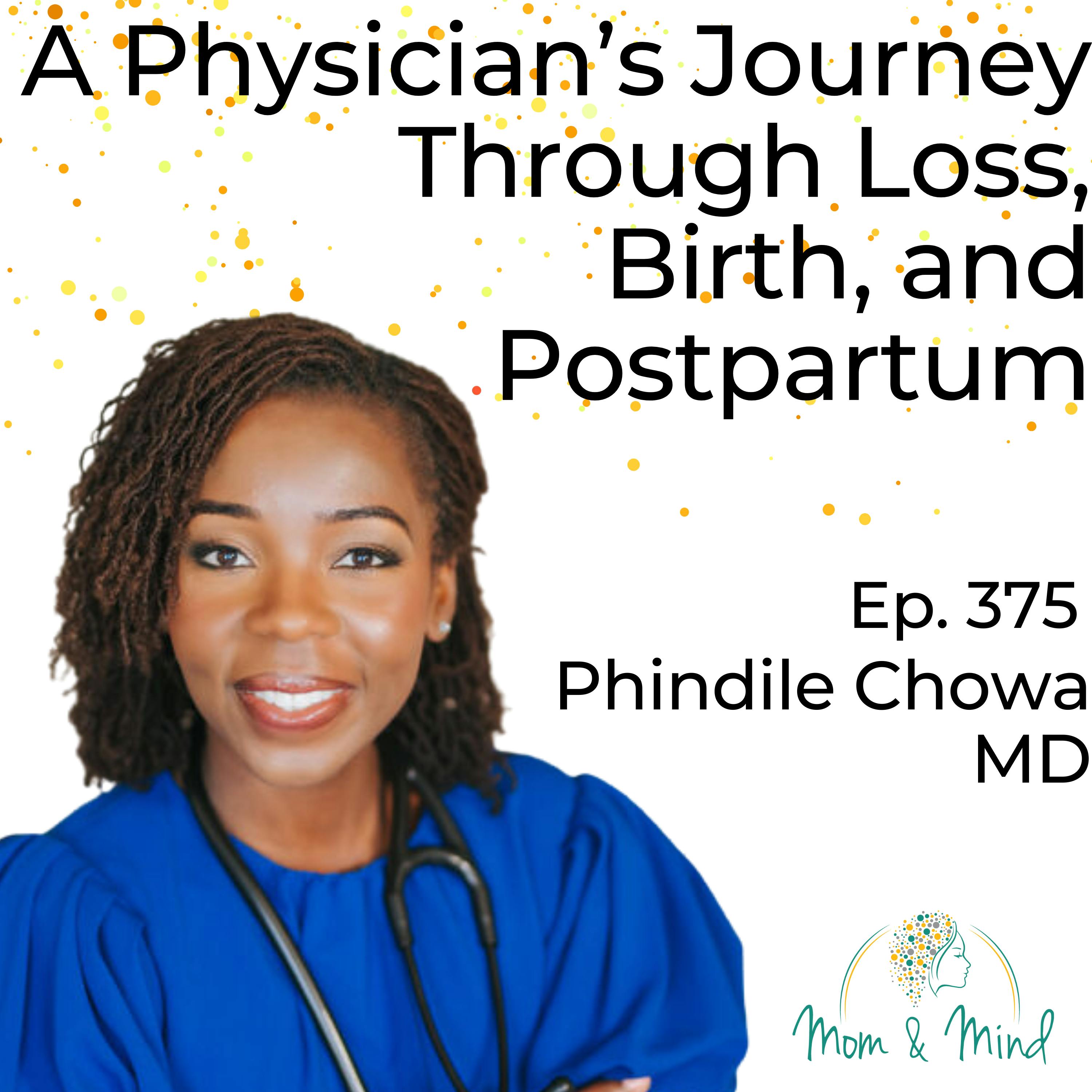
375: A Physician’s Journey Through Loss, Birth, and Postpartum with Dr. Phindile Chowa
We often mistakenly think physicians are immune to postpartum challenges, but nothing could be further from the truth. Today’s guest shares her story of pregnancy loss, traumatic birth, and intense postpartum difficulties. From feeling shamed and unsupported, therapy helped her find a place of forgiveness and a healthy mental space for herself. Join us to learn more! Dr. Phindile Chowa is an emergency-trained physician currently practicing in Georgia. She attended the University of Pittsburgh for her undergraduate studies and medical school, completing her residency at Harvard. With several years of experience in a large academic hospital, she swiftly ascended to an administrative role within the emergency department, focusing on enhancing the patient experience. During the COVID-19 pandemic, she witnessed transformative changes in healthcare delivery, motivating her to redefine her medical practice. Determined to restore dignity to patient care, she established the concierge medical practice, EMCare2U, where she provides personalized healthcare services to individuals and families. With a particular emphasis on postpartum care, she wrote the book What to Expect Next, a postpartum guide to assist mothers planning for a healthy postpartum journey. Dr. Chowa also hosts the podcast, Fourth Trimester Voices, where she creates a platform for meaningful conversations surrounding postpartum challenges, maternal health, and healthcare advocacy. The podcast amplifies the voices of mothers, healthcare professionals, and advocates to share their stories, insights, and support for navigating the postpartum experience. Show Highlights: Dr. Chowa’s path to emergency medicine that began in her childhood Her first pregnancy, miscarriage, and the accompanying trauma A second pregnancy full of fear and anxiety, which culminated in a traumatic birth and a NICU stay Breastfeeding and sleeping issues—and a very challenging first few weeks at home with a newborn The postpartum screening test with a low score and no resources to help her A difficult night that led to drastic action and an eye-opening conversation with her mother Finding therapy, getting help, and learning to take a “me-centered” approach Learning forgiveness and finding ways to get more sleep and break down intrusive thoughts Helping others with a new post-COVID perspective of medicine Transitioning to concierge medicine and personalized care Collaborative care and medical advocacy What’s normal and NOT normal in postpartum care Dr. Chowa’s podcast, Fourth Trimester Voices, to show moms that they are not alone The need to fine-tune postpartum care in a comprehensive and holistic way Resources: Connect with Dr. Phindile Chowa Website, Instagram, Facebook (Join the postpartum support group, Beyond the Fourth Trimester.), and Fourth Trimester Voices podcast Call the National Maternal Mental Health Hotline at 1-833-TLC-MAMA or visit cdph.ca.gov Please find resources in English and Spanish at Postpartum Support International, or by phone/text at 1-800-944-4773. There are many free resources, like online support groups, peer mentors, a specialist provider directory, and perinatal mental health training for therapists, physicians, nurses, doulas, and anyone who wants to be more supportive in offering services. You can also follow PSI on social media: Instagram, Facebook, and most other platforms Visit www.postpartum.net/professionals/certificate-trainings/ for information on the grief course. Visit my website, www.wellmindperinatal.com, for more information, resources, and courses you can take today! If you are a California resident looking for a therapist in perinatal mental health, email me about openings for private pay clients! Learn more about your ad choices. Visit podcastchoices.com/adchoices

374: ENCORE: Sleep Deprived Moms with Lauren DePaola, LCSW
SLEEP, SLEEP, SLEEP! We are talking about a very important topic…SLEEP! We’ve all heard that new moms and parents don’t sleep when they have a baby, but its actually a pretty huge deal. Lauren DePaola is going to give us the information we need to know about how it Impacts us and why we need to be taking a closer look on protecting our sleep as much as possible. We cover stages of sleep, how much sleep you really need and what kind, what can happen when you don't get enough sleep and why its so important!!!! Lauren DePaola, LCSW is a wife, mother of two boys and a Licensed Clinical Social Worker in Florida. She owns a private mental health practice with a focus on reproductive mental health: Postpartum Wellness & Family Counseling, located in Gainesville, FL. Lauren is the founder of the Alachua County Perinatal Mental Health Coalition, the President of the Florida Chapter of Postpartum Support International and Co-Chair of the newly formed Florida Maternal Mental Health Collaborative. Resources: Call the National Maternal Mental Health Hotline at 1-833-TLC-MAMA or visit cdph.ca.gov Please find resources in English and Spanish at Postpartum Support International, or by phone/text at 1-800-944-4773. There are many free resources, like online support groups, peer mentors, a specialist provider directory, and perinatal mental health training for therapists, physicians, nurses, doulas, and anyone who wants to be more supportive in offering services. You can also follow PSI on social media: Instagram, Facebook, and most other platforms Visit www.postpartum.net/professionals/certificate-trainings/ for information on the grief course. Visit my website, www.wellmindperinatal.com, for more information, resources, and courses you can take today! If you are a California resident looking for a therapist in perinatal mental health, email me about openings for private pay clients! Alachua County Perinatal Mental Health Coalition website: http://ppwandfc.wixsite.com/acpmhc Learn more about your ad choices. Visit podcastchoices.com/adchoices
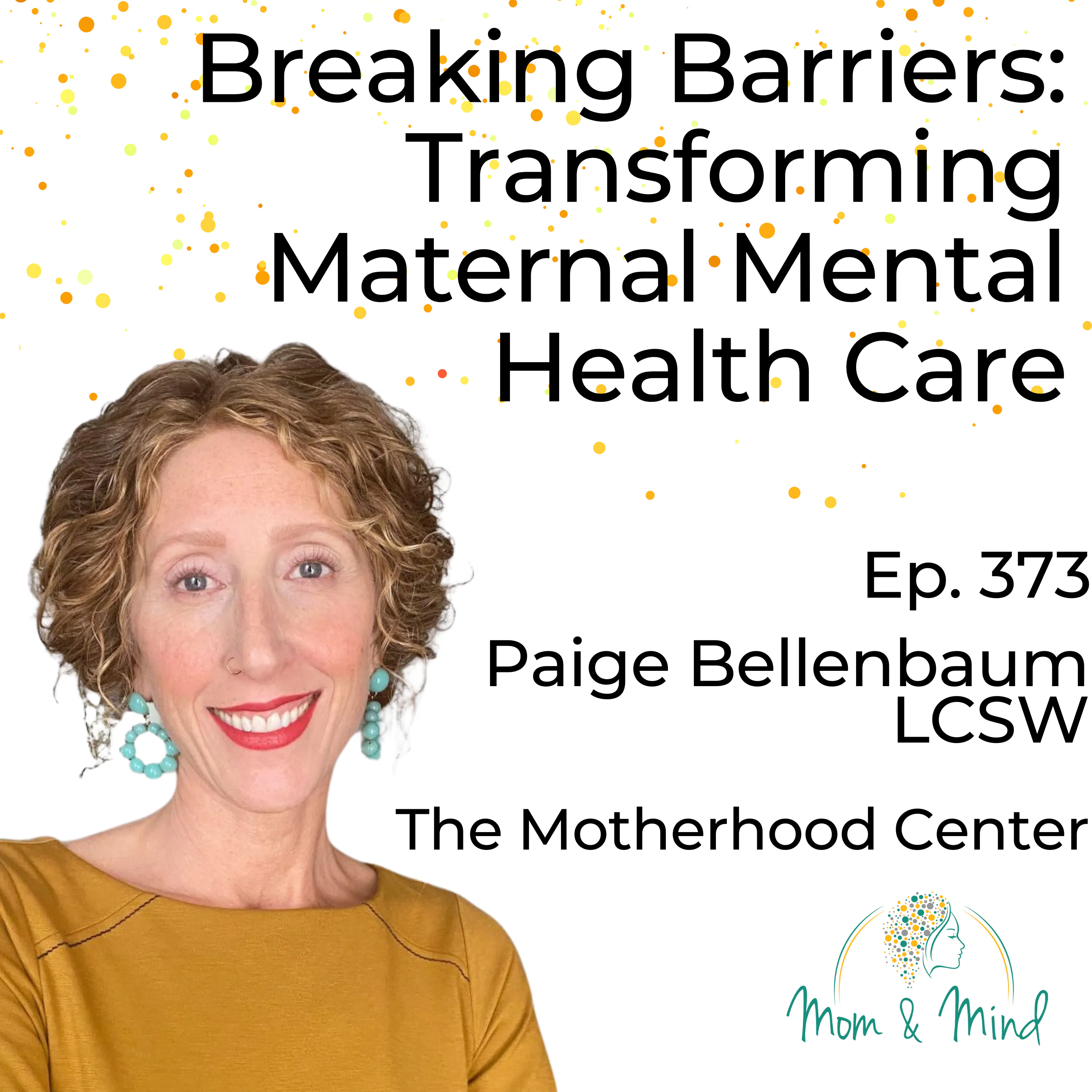
373: Breaking Barriers: Transforming Maternal Mental Health Care with Paige Bellenbaum, LCSW
You are in for a treat as we hear from someone who is fully committed to the advocacy and activism it takes to make a difference in the lives of new moms. She is relentless in her fight and the scope of her work is far-reaching. I’m excited to be joined by Paige Bellenbaum for today’s show. Paige Bellenbaum is a social worker, founding director, and Chief External Relations Officer at The Motherhood Center of New York. This place is doing phenomenal work in the field of perinatal mental health, helping push the dial forward on the kind of care that new moms who are suffering should be receiving. She’s been able to put forth legislation in NY to help mothers by mandating hospitals to provide education and encourage screening for all new and expectant mothers. Paige has worked in public policy, advocacy, community organizing, and in direct practice with disadvantaged communities. Paige shares her experience as a mom and how it brought her into this work. After Paige’s first child was born, the postpartum depression and anxiety she experienced nearly ended her life. When she began to heal, her relentless fight began for education, screening, and treatment so that no one has to suffer. She continues to work closely with multiple NYC agencies on maternal mental health best practices and policies, and she was a member of the NYC Maternal Mortality and Morbidity Review Committee as well as currently sitting on the NYS Maternal Mental Health Working Group. Paige has appeared on numerous TV news shows and major media platforms in an ongoing effort to get the word out about maternal mental health. She helps us understand the importance of education, treatment, and screening, and why higher levels of care are essential for those experiencing moderate to severe perinatal mood and anxiety disorders. Show Highlights: Paige’s journey into the work she does today, beginning 18 years ago with the birth of her son Paige’s anger that led to a new law in New York to require screening and education for new moms An overview of Paige’s bill and what it took to get it into law The changes in maternal mental health awareness over the past few years The suffering is REAL for many mothers. Validating women’s experiences and building a sense of community Education and screening are vital to help people recognize the signs and symptoms of perinatal mood and anxiety disorders. Details about The Motherhood Center in NYC and the scope of their work “This is just the beginning.” Paige’s message: “Lift your voice and tell your story. Your story is power–and it can move mountains.” Resources: Connect with Paige Bellenbaum and The Motherhood Center: Website and Instagram Call the National Maternal Mental Health Hotline at 1-833-TLC-MAMA or visit cdph.ca.gov Please find resources in English and Spanish at Postpartum Support International, or by phone/text at 1-800-944-4773. There are many free resources, like online support groups, peer mentors, a specialist provider directory, and perinatal mental health training for therapists, physicians, nurses, doulas, and anyone who wants to be more supportive in offering services. You can also follow PSI on social media: Instagram, Facebook, and most other platforms Visit www.postpartum.net/professionals/certificate-trainings/ for information on the grief course. Visit my website, www.wellmindperinatal.com, for more information, resources, and courses you can take today! If you are a California resident looking for a therapist in perinatal mental health, email me about openings for private pay clients! Learn more about your ad choices. Visit podcastchoices.com/adchoices
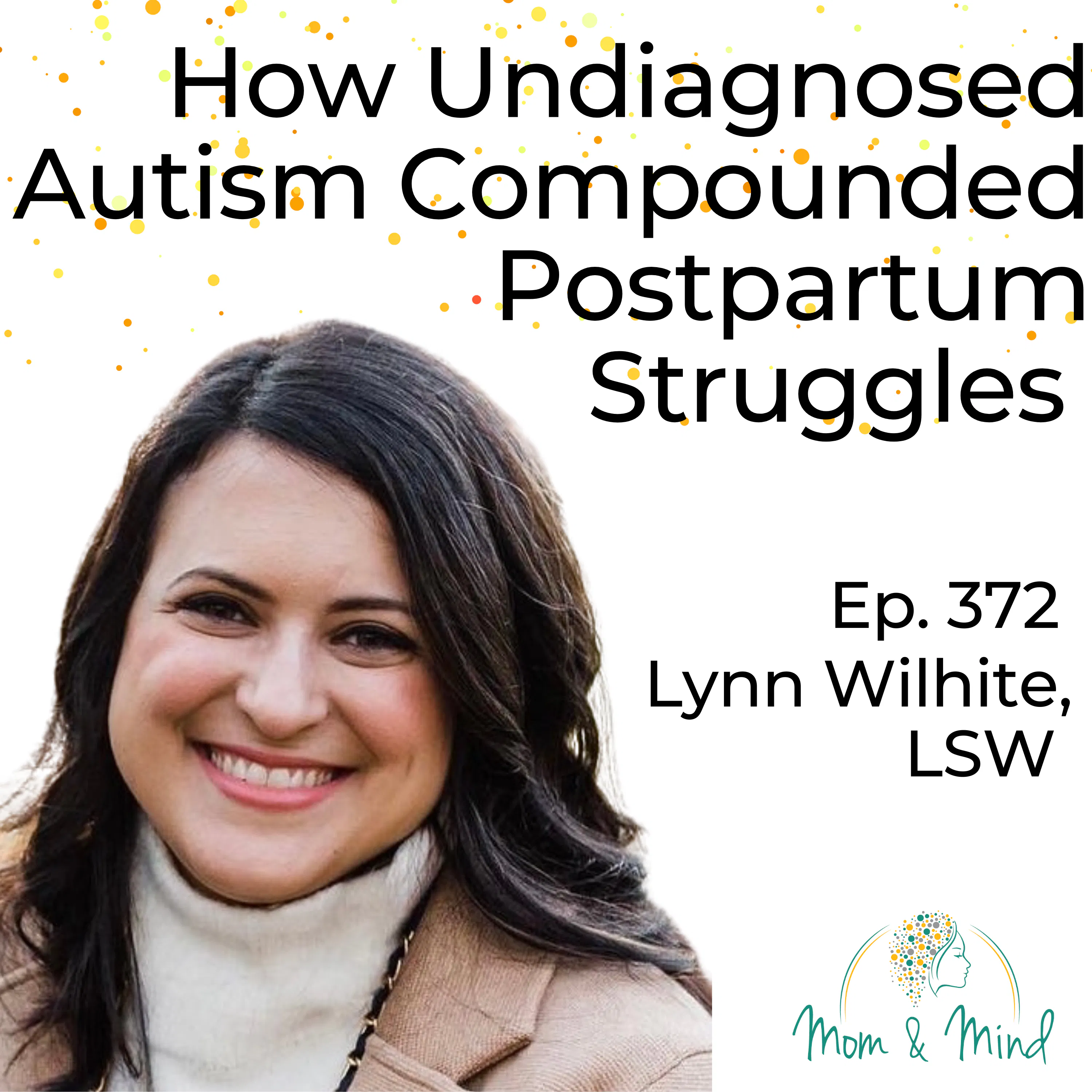
372: How Undiagnosed Autism Compounds Postpartum Struggles with Lynn Wilhite, LSW
I’m happy to welcome back a previous guest on the podcast. Lynn Wilhite is a licensed clinical social worker who joined me for Episode 263, Coping with Treatment-Resistant Depression. Things have changed for Lynn since she has recently been diagnosed with autism, ADHD, and PTSD. She shares the impact of her diagnoses and how she’s making connections about why things were so difficult for her in the past. Her insights help us understand how the many layers and factors of ADHD and autism have complicated her journey. Lynn has paused her work in therapy and social work to focus on her healing, understand her diagnoses, and learn more about her son’s autism diagnosis. She feels passionate about bringing neurodivergence into the postpartum conversation, along with normalizing and destigmatizing autism and other forms of neurodivergence for new moms. She is currently writing a book about her postpartum and parenthood journey. Join us to learn more from Lynn’s story! Show Highlights: Developments in Lynn’s life since her last visit to Mom & Mind The prevalence of parents being diagnosed with autism alongside their children Lynn’s diagnostic process—and how her struggles in life began to make sense Stereotypical autism vs. female autism A constant battle of “defending” a diagnosis Medical gaslighting that women have to endure for themselves and their children Autism’s part in the challenges of pregnancy and postpartum, even in the smallest details Autism’s effects in Lynn’s life “Should I have even had a child?” Depression and anxiety are highly comorbid with autism. Masking skills are at their finest in autistic adults. Lynn’s biggest lessons learned on her journey The value of support and community Resources: Connect with Lynn Wilhite: Instagram Lynn Wilhite’s other Mom & Mind episode: Episode 263 Call the National Maternal Mental Health Hotline at 1-833-TLC-MAMA or visit cdph.ca.gov Please find resources in English and Spanish at Postpartum Support International, or by phone/text at 1-800-944-4773. There are many free resources, like online support groups, peer mentors, a specialist provider directory, and perinatal mental health training for therapists, physicians, nurses, doulas, and anyone who wants to be more supportive in offering services. You can also follow PSI on social media: Instagram, Facebook, and most other platforms Visit www.postpartum.net/professionals/certificate-trainings/ for information on the grief course. Visit my website, www.wellmindperinatal.com, for more information, resources, and courses you can take today! If you are a California resident looking for a therapist in perinatal mental health, email me about openings for private pay clients! Learn more about your ad choices. Visit podcastchoices.com/adchoices
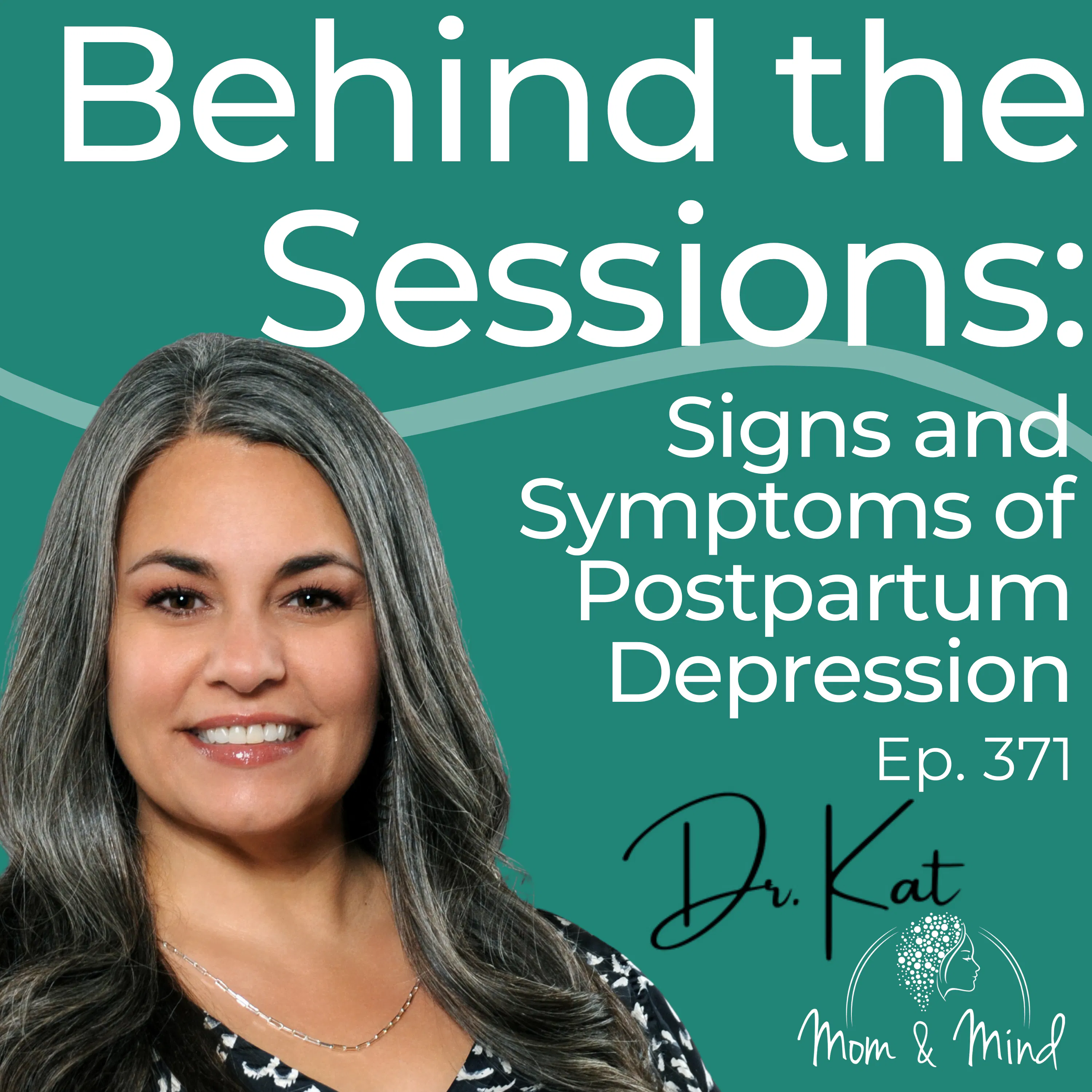
371: Behind the Sessions: Signs and Symptoms of Postpartum Depression with Dr. Kat
In my therapy practice, I meet with moms at all stages of their reproductive journeys. It is a consistent thing that perinatal mental health conditions sneak up on people. Many new moms don’t know when to be concerned and when to seek help for perinatal depression, which can happen at any point in the reproductive journey and worsen in the postpartum. It’s important to notice the signs and symptoms. Let’s take a closer look! Show Highlights: The “baby blues” vs. postpartum depression—”How do I tell the difference?” Symptoms that signify a deeper problem and possible postpartum depression Identifying issues with eating and sleeping patterns that could point to postpartum depression Postpartum depression differs in context from generalized depression. Feelings of failure, self-criticism, and isolation as a new mother “I FEEL bad because I AM bad.” Postpartum depression is relatively common (Around 20% of mothers will experience it.) Difficulty bonding with a new baby can indicate postpartum depression. Thoughts about the stigma of postpartum depression and the fear of judgment Good news! There is help and free support available. You CAN get better! Dr. Kat’s advice about what you can do RIGHT NOW Resources: Call the National Maternal Mental Health Hotline at 1-833-TLC-MAMA or visit cdph.ca.gov Please find resources in English and Spanish at Postpartum Support International, or by phone/text at 1-800-944-4773. There are many free resources, like online support groups, peer mentors, a specialist provider directory, and perinatal mental health training for therapists, physicians, nurses, doulas, and anyone who wants to be more supportive in offering services. You can also follow PSI on social media: Instagram, Facebook, and most other platforms Visit www.postpartum.net/professionals/certificate-trainings/ for information on the grief course. Visit my website, www.wellmindperinatal.com, for more information, resources, and courses you can take today! If you are a California resident looking for a therapist in perinatal mental health, email me about openings for private pay clients! Learn more about your ad choices. Visit podcastchoices.com/adchoices

370: Severe PPD, Anxiety Healing and Advocating for AAPI Moms
Join us for this episode with my guest, Dr. Jasmine. She is a mom of one, a clinical pharmacist, and she holds a perinatal mental health certification. As a survivor of severe postpartum depression, anxiety, and insomnia, she has also served as a peer mentor volunteer for Postpartum Support International (PSI). A fierce maternal mental health advocate and second-generation Taiwanese-American, Dr. Jasmine hosts a podcast called Healing the Tigress, which features conversations around Asian American Pacific Islanders’ (AAPI) maternal mental health. Her newsletter, blogs, and Instagram focus on motherhood, mental health destigmatization, and gentle parenting. Her writing has been featured in Mother.ly, Psyched Mommy, and she was interviewed last fall about her PPD story by Women’s Health. Show Highlights: Dr. Jasmine’s story of infertility, her pregnancy, and her daughter’s birth The super storm that drove Jasmine’s postpartum depression into a downward spiral Feelings of worthlessness, failure, and asking, “Why did we try so hard for this?” Addressing the problems with her Ob-gyn at her six-week checkup Facing the combination of insomnia, intense anxiety over feeding issues, and worry about bonding with her baby Jasmine’s experience with taking an antidepressant, opening up to her husband, and seeing a psychiatrist Seeing improvement in small steps with medications and therapy Finding joy again and feeling confident in motherhood Being on “the other side” of medications as a pharmacist Cultural factors that clouded Jasmine’s thinking and stigmatized medications and therapy Learning to function in a “mid-generation” of a very different culture Factors behind Jasmine’s decision not to have a second child An overview of Jasmine’s podcast, Healing the Tigress, to make space for AAPI moms Jasmine’s advice to other moms Resources: Connect with Dr. Jasmine: Blog Instagram Healing the Tigress podcast Connect with Dr. Kat: Please find resources in English and Spanish at Postpartum Support International, or by phone/text at 1-800-944-4773. There are many free resources, like online support groups, peer mentors, a specialist provider directory, and perinatal mental health training for therapists, physicians, nurses, doulas, and anyone who wants to be a better support in offering services. You can also follow PSI on social media: Instagram, Facebook, and most other platforms Visit www.postpartum.net/professionals/certificate-trainings/ for information on the grief course. Visit my website, www.wellmindperinatal.com, for more information, resources, and courses you can take today! If you are a California resident looking for a therapist in perinatal mental health, email me about openings for private pay clients! Learn more about your ad choices. Visit podcastchoices.com/adchoices
369: Understanding Hyperemesis Gravidarum: Causes and Impacts on Pregnancy and Beyond
Today, Dr. Kat hosts Dr. Marlena Fejzo, an expert on hyperemesis gravidarum (HG), a severe form of pregnancy sickness. Dr. Fejzo, affiliated with the University of Southern California and the HER Foundation, discusses HG's debilitating symptoms, its long-term health impacts, and the challenges within the healthcare system. She emphasizes the need for better awareness, research, and treatment protocols, including the importance of thiamine supplements and support groups. Dr. Fejzo also highlights her ongoing research on genetic factors and potential treatments, advocating for improved care and support for HG patients. Join us! Bio: Dr. Marlena Fejzo is a women’s health scientist and expert on severe pregnancy sickness. She is a researcher at the University of Southern California, Research Director of the HER Foundation, and Chief Scientific Officer of Harmonia Healthcare. Fejzo found the first genes for uterine fibroids and for nausea and vomiting during pregnancy. In March, Fejzo was honored as one of Time’s Women of the Year, in May she was named one of Time’s 100 Health Catalysts, and in July she was awarded the 2024 Victoria J. Mastrobuono Award in Women’s Health by the National Organization for Women. Show Highlights: Definition and severity of hyperemesis gravidarum (HG) Long-term health impacts on mothers and fetuses Advocacy and the importance of having support during medical appointments Current state of research and funding challenges for HG studies Prevalence and statistics related to HG Psychological effects, including potential PTSD in affected women Historical context and misunderstandings surrounding HG Future research directions, including genetic studies Clinical trials for new treatments and potential biomarkers Resources: Please find resources in English and Spanish at Postpartum Support International, or by phone/text at 1-800-944-4773. There are many free resources, like online support groups, peer mentors, a specialist provider directory, and perinatal mental health training for therapists, physicians, nurses, doulas, and anyone who wants to be a better support in offering services. You can also follow PSI on social media: Instagram, Facebook, and most other platforms Visit www.postpartum.net/professionals/certificate-trainings/ for information on the grief course. Visit my website, www.wellmindperinatal.com, for more information, resources, and courses you can take today! If you are a California resident looking for a therapist in perinatal mental health, email me about openings for private pay clients! Connect with Dr. Fejzo Twitter - @DrFejzo LinkedIn HER Foundation International HG Conference on November 6th and 7th, 2024 in Ventura, CA international colloquium Hyperemesis gravidarum https://www.hyperemesis.org/ichg2024/ To Donate to Dr. Fejzo’s research efforts: bit.ly/fejzo Learn more about your ad choices. Visit podcastchoices.com/adchoices

368: Behind the Sessions: Postponing Sleep: Time Alone or Anxiety?
Today’s episode covers a common problem I see with clients in therapy; it’s the issue of fighting sleep. People are exhausted, running on empty, and not getting the sleep they need. When the kids go to bed, there is an urge to stay awake and get things done or have alone time when your body is screaming for the sleep it needs. During the perinatal time, the loss of sleep is prevalent in many instances and impacts every area of life! Join me for more! Show Highlights: Time for relaxation, decompression, and autonomy shouldn’t take priority over sleep. Is there avoidance going on? Avoidance of sleep can be related to trauma or PTSD. A cycle of repeatedly pushing sleep back leaves you frayed, irritable, anxious, and depressed. No judgment from me, but a gentle urging to take an honest look at your sleep challenges Look to compromise by guarding the nights you stay up to have alone time, but prioritize your sleep on other nights. Tips for promoting good sleep Resources: Please find resources in English and Spanish at Postpartum Support International, or by phone/text at 1-800-944-4773. There are many free resources, like online support groups, peer mentors, a specialist provider directory, and perinatal mental health training for therapists, physicians, nurses, doulas, and anyone who wants to be a better support in offering services. You can also follow PSI on social media: Instagram, Facebook, and most other platforms Visit www.postpartum.net/professionals/certificate-trainings/ for information on the grief course. Visit my website, www.wellmindperinatal.com, for more information, resources, and courses you can take today! If you are a California resident looking for a therapist in perinatal mental health, email me about openings for private pay clients! Learn more about your ad choices. Visit podcastchoices.com/adchoices
367: Postpartum Depression, Anxiety, and Navigating Motherhood’s Unpredictable Path with Susanna Peace Lovell
When the uncertainty of motherhood is combined with caring for a special needs child, the demands can be overwhelming. Today’s guest shares what it’s like to mother a special needs child and fight through postpartum anxiety and depression to find healing. Join us! Susanna Peace Lovell received her B.A. from UC Berkeley. She is an author, speaker, disability rights advocate, and certified professional life coach dedicated to the health and wellness of families everywhere affected by a disability. Raising a teenage daughter with a myriad of disabilities and diagnoses, including ASD (autism spectrum disorder), ADHD, anxiety, and severe food allergies has been Susanna’s lived experience as a mother. She has overcome many ups and downs in her journey, including a debilitating episode with postpartum anxiety and depression. Through her journey of navigating the worry and heartbreak in raising a special needs child, Susanna found her true life calling to help other parents find more joy and passion in their lives. Show Highlights: The beginning of Susanna’s motherhood story Pregnancy was the first time Susanna felt that her life was out of control. Susanna’s life and work today as the mother of an 18-year-old with multiple diagnoses and neurodivergence Susanna’s experience with postpartum depression and anxiety—and how she knew it was happening Sleeplessness and compounding fears about sleeplessness that led to a zombie-like state The long process of learning to ask for help and finding what worked for her Cultural factors for Susanna as a Taiwanese American that led her to feel pressured to “do it all” Cultivating a toolbox of resources to help Susanna’s experience in dealing with “unexpected mourning and tiny flickers of joy” Leaning into self-care in proactive ways Finding support for herself and her daughter Learning to be kind to herself with a “this is FOR me” attitude Susanna’s hidden blessings of being able to show up for others Susanna’s book, Your True Self is Enough: why she wrote it and what she hopes to accomplish Resources: Connect with Susanna Peace Lovell: Website, Instagram, and Your True Self is Enough Please find resources in English and Spanish at Postpartum Support International, or by phone/text at 1-800-944-4773. There are many free resources, like online support groups, peer mentors, a specialist provider directory, and perinatal mental health training for therapists, physicians, nurses, doulas, and anyone who wants to be a better support in offering services. You can also follow PSI on social media: Instagram, Facebook, and most other platforms Visit www.postpartum.net/professionals/certificate-trainings/ for information on the grief course. Visit my website, www.wellmindperinatal.com, for more information, resources, and courses you can take today! If you are a California resident looking for a therapist in perinatal mental health, email me about openings for private pay clients! Learn more about your ad choices. Visit podcastchoices.com/adchoices

366: Respecting and Adapting Cultural Practices: Postpartum Confinement with Dr. Kristal Lau, MPH, MBBS, BMedSc (Hons), ELMO
It is an undeniable fact that our Western norms for prenatal and postnatal care of mothers are very different from other countries and cultures. Even the term “confinement” is not as familiar to most Americans as it is in other countries. Join us as we explore this topic further with today’s expert. Dr. Kristal Lau is a certified European Lifestyle Medicine (ELMO) Health and Fitness Advisor and a leading postpartum wellness consultant specializing in bridging cultural practices with modern postpartum care. She is an author, former physician, veteran’s spouse, and the mother of two. Her mission is to revolutionize postpartum wellness for mothers and their families through holistic postpartum wellness experiences that blend modern healthcare and science with personal lifestyles and cultural practices. Currently living in France, Dr. Lau is originally from Malaysia, where she grew up using the best of both worlds in Chinese medicine and allopathic medicine. She serves as a board member for the non-profit Military Birth Resource Network and Postpartum Coalition (MBRNPC) and continues to volunteer with the Army Community Services in USAG Wiesbaden as a military retiree’s spouse. Her book, Postpartum 30: Thirty Days To A Nurtured Fourth Trimester, was published in 2023. In this episode, Dr. Lau shares her experience in following the Chinese postpartum confinement practice after birthing her children, along with the collaboration work she’s doing on snoring and sleep apnea in pregnancy and the postpartum. She also discusses modern confinement practices and the rising interest in this form of postpartum care. Show Highlights: Confinement practices for postpartum rest are common in other parts of the world and rooted in Chinese medicine. Dr. Lau’s experience with postpartum depression even after following the structure of her confinement practice Largely unknown outcomes for migrant Asian women around the world who follow traditional confinement practices The boom of postnatal retreats in the US Dr. Lau explains traditional Chinese principles around proper nutrition and rest for the new mother. Dr. Lau’s journey to write her book, Postpartum 30 Variations in confinement days from culture to culture The partner’s important role as the main support person in a new mother’s confinement The need for modernization and adaptations in traditional confinement practices Dr. Lau’s advice for those seeking to use traditional Chinese herbs in postpartum care Dr. Lau’s experience with sleep issues, like snoring and daytime sleepiness–even though she doesn’t “fit the bill” for sleep apnea The anatomical changes during pregnancy that can lead to sleep apnea The need for more clinical data in the area of pregnancy, snoring, and sleep apnea (Sleep above everything!) Resources: Connect with Dr. Kristal Lau: Website, YouTube, TikTok, Instagram, LinkedIn, and Postpartum 30 book Please find resources in English and Spanish at Postpartum Support International, or by phone/text at 1-800-944-4773. There are many free resources, like online support groups, peer mentors, a specialist provider directory, and perinatal mental health training for therapists, physicians, nurses, doulas, and anyone who wants to be a better support in offering services. You can also follow PSI on social media: Instagram, Facebook, and most other platforms Visit www.postpartum.net/professionals/certificate-trainings/ for information on the grief course. Visit my website, www.wellmindperinatal.com, for more information, resources, and courses you can take today! If you are a California resident looking for a therapist in perinatal mental health, email me about openings for private pay clients! Learn more about your ad choices. Visit podcastchoices.com/adchoices

365: Behind The Sessions: To-Do Lists and Self-Criticism: You’ve Done More Than You Think
The idea of “not doing enough” comes up every week with moms in therapy who feel like they aren’t getting enough done on their to-do list, whether it’s an actual list or a mental list in their minds. Let’s explore this topic deeper. Show Highlights: The parenting to-do list increases exponentially as you become a new parent. We shouldn’t discount ALL the things new parents do on a daily basis. Pressure from within and without brings unrealistic expectations that a mom should do “all the things.” Irritability, agitation, frustration, and negative self-judgment lead to questions like, “What’s wrong with me?” Dealing with an overloaded and overwhelmed emotional state Compassionate reflection can be helpful in overcoming negative thought patterns. The importance of sleep (Sleep deprivation can get in the way of basic daily tasks.) Advice for anyone who is being hard on themselves Resources: Please find resources in English and Spanish at Postpartum Support International, or by phone/text at 1-800-944-4773. There are many free resources, like online support groups, peer mentors, a specialist provider directory, and perinatal mental health training for therapists, physicians, nurses, doulas, and anyone who wants to be a better support in offering services. You can also follow PSI on social media: Instagram, Facebook, and most other platforms Visit www.postpartum.net/professionals/certificate-trainings/ for information on the grief course. Visit my website, www.wellmindperinatal.com, for more information, resources, and courses you can take today! Learn more about your ad choices. Visit podcastchoices.com/adchoices

364: New Beginnings: Tackling the Struggles of Going Back to Work with Dr. Emily Guarnotta, Psy.D., PMH-C
The transition back to work as a new parent can be a difficult time to navigate, and many factors can have a significant impact on our lives and emotional well-being. Even though the transition can cause anxiety, depression, and heavy emotions, there are ways to prepare and protect your mental health for this transition. Join us for more in today’s episode. Dr. Emily Guarnotta is a licensed clinical psychologist and certified perinatal mental health provider specializing in maternal mental health. She is the owner of Phoenix Health, a therapy practice that supports those who are navigating the challenges of parenthood. Show Highlights: Considerations for returning to work after maternity leave Specific struggles that people might face when a mental health condition is present Dr. Emily’s helpful hints in preparing to return to work The value in proactive conversations and clear communication with your partner about the transition Always have a Plan B in mind! Immediate concerns in planning to return to work Supporting yourself in the first days back at work Dr. Emily’s observations about the impacts of not having the needed support during this time Dealing with hormonal changes and stress around big life changes How long does it take to adjust to being back at work as a new mom? What to know about your HR department policies, state laws, etc. Dr. Emily’s advice about being patient, giving yourself grace in the transition, and seeking out support if you’re struggling Resources: Please find resources in English and Spanish at Postpartum Support International, or by phone/text at 1-800-944-4773. There are many free resources, like online support groups, peer mentors, a specialist provider directory, and perinatal mental health training for therapists, physicians, nurses, doulas, and anyone who wants to be a better support in offering services. You can also follow PSI on social media: Instagram, Facebook, and most other platforms Visit www.postpartum.net/professionals/certificate-trainings/ for information on the grief course. Visit my website, www.wellmindperinatal.com, for more information, resources, and courses you can take today! Connect with Dr. Emily Guarnotta and Phoenix Health: Website Instagram Facebook LinkedIn Learn more about your ad choices. Visit podcastchoices.com/adchoices

363; Life-Threatening Amniotic Fluid Embolism: A Story of Birth Trauma, Survival, and Healing with Kayleigh Summers, LCSW, PMH-C
Today’s episode carries a sensitivity notice for anyone currently processing a birth trauma. Kayleigh Summers is a licensed therapist, writer, and content expert in perinatal trauma. Through sharing her lived experience as an amniotic fluid embolism survivor, Kayleigh supports families through perinatal trauma. She has created thriving support communities through Instagram and TikTok, and she uses her podcast, The Birth Trauma Mama, to provide connection, storytelling, and resources to support those experiencing birth and other types of trauma. Show Highlights: Kayleigh’s first pregnancy, which was typical until her routine appointment at 40 weeks and two days Kayleigh’s very long (three days!) induction process, which she doesn’t remember The reality of the feeling of impending doom–and how it differs from anxiety or a panic attack Her heart stoppage, CPR, and the birth of her son while she was technically “not alive” Kayleigh’s son, 10 lbs. 14 oz., had to be resuscitated at birth. Details about amniotic fluid embolism (AFE) and possible risk factors The profound hemorrhage that accompanies AFE (Kayleigh needed 143 units of blood products through her ordeal.) The seriousness of Kayleigh’s condition: another resuscitation, ECMO life support, an immediate hysterectomy, and an impeller (windmill-like device) to help her heart pump blood Trauma response, retrograde amnesia, and how our brains protect us The sad, beautiful account of Kayleigh’s first moments with her son (5 days after his birth) Additional abdominal surgeries, a long ICU stay, and finally home after 14 days The aftermath of Kayleigh’s experience: her emotional and physical pain, not being able to mother her son, and the grief of knowing she would not bear another child Therapy support, talking about feelings, and an ongoing healing journey Kayleigh’s decision to help other people through perinatal trauma Kayleigh’s message to birth trauma survivors Resources: Connect with Kayleigh Summers: Website, Instagram, and The Birth Trauma Mama podcast Please find resources in English and Spanish at Postpartum Support International, or by phone/text at 1-800-944-4773. There are many free resources, like online support groups, peer mentors, a specialist provider directory, and perinatal mental health training for therapists, physicians, nurses, doulas, and anyone who wants to be a better support in offering services. You can also follow PSI on social media: Instagram, Facebook, and most other platforms Visit www.postpartum.net/professionals/certificate-trainings/ for information on the grief course. Visit my website, www.wellmindperinatal.com, for more information, resources, and courses you can take today! Learn more about your ad choices. Visit podcastchoices.com/adchoices

362: Behind the Sessions: The Guilt of Wanting Alone Time as a Mom
There are many different reasons that bring people into therapy. I often find myself angered by how societal impacts and pressures continue to haunt new moms to the point of making them feel bad about themselves. They can feel stuck and wonder if their feelings are normal or okay. One of the top things that bothers me is when moms feel guilty for wanting time alone. Doesn’t everyone deserve time for themselves? Moms get pressured like no other parent/guardian about wanting to take time for themselves in a guilt-free way. Moms should be supported in getting a break when they need it! Join me for a closer look at this topic. Show Highlights: Sources of this specific kind of mom-guilt Myths around attachment parenting and other parenting styles Is complete selflessness always the best thing? The disservice we do to moms, kids, and partners when we expect a mom’s needs to be nonexistent The effects of this pressure and guilt on a mom’s mental health Wanting alone time does NOT mean you are selfish or that you don’t love your child. The kind of support and normalization moms need to be more present with their kids and have mental stability in a guilt-free life Ways moms judge themselves with internalized pressure, family pressure, and societal pressure The truth: Every mom should be supported in shame-free and guilt-free ways to confidently take the breaks they need. Resources: Please find resources in English and Spanish at Postpartum Support International, or by phone/text at 1-800-944-4773. There are many free resources, like online support groups, peer mentors, a specialist provider directory, and perinatal mental health training for therapists, physicians, nurses, doulas, and anyone who wants to be a better support in offering services. You can also follow PSI on social media: Instagram, Facebook, and most other platforms Visit www.postpartum.net/professionals/certificate-trainings/ for information on the grief course. Visit my website, www.wellmindperinatal.com, for more information, resources, and courses you can take today! Learn more about your ad choices. Visit podcastchoices.com/adchoices

361: Healing Birth Trauma Through Storytelling and Sharing the Narratives of Black Mothers
Today’s episode focuses on the narrative style of therapy, and it’s a topic that we haven’t covered on the podcast before. We always want to explore new therapeutic approaches and the various ways they can offer healing and support for more women. Everyone needs to know about the different therapies that are available to them. Join us to learn more! Dr. Lyneia Richardson is a mother, healer, and licensed psychologist, and she works as a maternal mental health advocate dedicated to revitalizing the spirit of all mamas. She received her BA in psychology from North Carolina A&T State University and a master’s in mental health counseling from Johns Hopkins University. After earning a Ph.D. in counseling psychology from Howard University, she focused her work on decolonizing therapy and education through a mothering praxis. She is currently a professor of counseling at McDaniel College and the proud owner of Melanated Women's Therapy LLC. Dr. Richardson recently published Mothering As A Work of Art, an anthology collection of personal narratives exploring the multiple dimensions of black mothering aimed at changing the narrative on mothering and what it means to mother in contemporary times. In today’s episode, she discusses these topics and the value of using narrative therapy as a pathway through healing birth trauma. Show Highlights: The narrative approach: to externalize and separate yourself from the problem (It’s the opposite of self-blaming and internalizing issues, challenges, and traumas.) Understanding the difference between storytelling and narrative The common experience for women of all races in not being listened to by their doctors and nurses Dr. Richardson’s personal birth story and her work with social justice and advocacy to amplify the voices of black mothers The challenge in advocacy work Broadening the network to have a bigger outreach to help moms Collective healing and community healing Empowerment through a support network Trying to normalize the struggle when social media makes everyone else’s life look perfect Mothering As A Work of Art: How the book came to be Being a creative mom The value of sharing stories as a form of healing and therapy Resources: Connect with Dr. Lyneia Richardson: Website, Melanated Women's Therapy LLC, Instagram, and Mothering As A Work of Art Please find resources in English and Spanish at Postpartum Support International, or by phone/text at 1-800-944-4773. There are many free resources, like online support groups, peer mentors, a specialist provider directory, and perinatal mental health training for therapists, physicians, nurses, doulas, and anyone who wants to be a better support in offering services. You can also follow PSI on social media: Instagram, Facebook, and most other platforms Visit www.postpartum.net/professionals/certificate-trainings/ for information on the grief course. Visit my website, www.wellmindperinatal.com, for more information, resources, and courses you can take today! Learn more about your ad choices. Visit podcastchoices.com/adchoices
360: Clinical Hypnosis and Strategic Psychotherapy for Perinatal Mental Health
Today’s episode is about the benefits of two lesser-known therapy modalities and how they can be used in perinatal mental health. Join us to learn more from our expert guest! Abigail Burd is a licensed clinical social worker, reproductive mental health specialist, trainer, therapist, supervisor, and consultant in the San Diego area. She is also the author of The Postpartum Depression Workbook. Abby is passionate about the perinatal stage and is humbled by the privilege of becoming a parent to two children. Her career as a mental health professional began in 1998, and she has specialized in perinatal mental health since 2013. She is an active member of the Postpartum Health Alliance and has served on their executive board. She is a mental health counselor and clinical supervisor at MiraCosta College. She joins us today to discuss some novel approaches to perinatal mental health, including clinical hypnosis and strategic psychotherapy. From her experience and insights, she shares how these modalities can be useful for perinatal trauma and reproductive mental health, along with an overview of the training she offers. Show Highlights: An explanation of clinical hypnosis: what it is and what it is not A common experience with clinical hypnosis is a state of deep relaxation that makes hard things seem “more palatable.” An explanation of strategic psychotherapy to address anxiety and trauma How clinical hypnotherapy and strategic psychotherapy are complementary modalities Abby’s ideas about how these modalities can be helpful to people with perinatal mental health difficulties Hypnosis is a form of dissociation, so therapists must tread carefully with those who have a history of PTSD. Abby’s routine in hypnotherapy with clients to create a safe place Abby’s training on novel approaches, differentiation, and utilization (Live via Zoom on 9/19 and 10/25 for therapists and psychotherapists, and CEUs are available!) Resources: Connect with Abby Burd: Website, Instagram, Facebook, and The Postpartum Depression Workbook Check out the following resources on upcoming training opportunities: –Blog Overview of the Trainings –Registration for 9/19/24 Training –Registration for 10/18/24 Training Please find resources in English and Spanish at Postpartum Support International, or by phone/text at 1-800-944-4773. There are many free resources, like online support groups, peer mentors, a specialist provider directory, and perinatal mental health training for therapists, physicians, nurses, doulas, and anyone who wants to be a better support in offering services. You can also follow PSI on social media: Instagram, Facebook, and most other platforms Visit www.postpartum.net/professionals/certificate-trainings/ for information on the grief course. Visit my website, www.wellmindperinatal.com, for more information, resources, and courses you can take today! Learn more about your ad choices. Visit podcastchoices.com/adchoices
359: Behind The Sessions: Signs and Symptoms of Postpartum Anxiety with Dr. Kat
Even though the experiences might be different, there are many similarities in postpartum struggles. It helps all of us to know that ALL of our experiences are real, and no one has it “all figured out.” Thinking that everyone else but you must have it all figured out creates a lot of anxiety in the already difficult transition to motherhood. Anxiety is completely normal in the new and demanding world of motherhood, but sometimes that anxiety escalates into something that greatly impacts our ability to function throughout the day, our sleep, and our care for our families. It is painful–physically, mentally, and emotionally–and it brings shame and self-judgment, which only compounds the problem. There is no timeline or race to “get it all together.” Everyone’s journey is different. Let’s take a closer look at postpartum anxiety. Show Highlights: Mental health conditions make us feel bad, even if we aren’t fully aware of what’s happening. Common signs and symptoms of anxiety: excessive worry, fear, overwhelm, restlessness, sleep difficulties, chest tightness, heart palpitations, shallow breathing, sweatiness, chills, tight muscles, and gastrointestinal issues Anxiety can be magnified by trauma. Symptoms of anxiety can make it difficult to pay attention and concentrate. Trying to control/manage things and overpreparing are signs of anxiety. The challenging aspect of anxiety for a therapist is to get people to believe that anxiety won’t last forever and that things CAN change. Slow steps are important in the process of change. Anxiety feels like failure–like you aren’t doing enough. Therapy is ALWAYS worth it! Resources: Please find resources in English and Spanish at Postpartum Support International, or by phone/text at 1-800-944-4773. There are many free resources, like online support groups, peer mentors, a specialist provider directory, and perinatal mental health training for therapists, physicians, nurses, doulas, and anyone who wants to be a better support in offering services. You can also follow PSI on social media: Instagram, Facebook, and most other platforms Visit www.postpartum.net/professionals/certificate-trainings/ for information on the grief course. Visit my website, www.wellmindperinatal.com, for more information, resources, and courses you can take today! Learn more about your ad choices. Visit podcastchoices.com/adchoices

358: Supportive Benefits of Journaling for Postpartum Mental Health with Allie Mirosevic
Many times, the path to healing isn’t one specific thing but a combination of things, and journaling is certainly one beneficial activity in all kinds of healing processes. Today’s episode will be helpful to you if you are facing challenges and need a healthy way to process thoughts and feelings. Learn more with us in this episode! Allie Mirosevic is a wife, a mom of two, and an entrepreneur who lives in Los Angeles. She founded Bliss'd, a self-care brand aimed at helping fellow moms live more joyful and fulfilling lives through the power of journaling. After discovering her love of journaling in 2019 following her first challenging postpartum experience, her passion became helping other moms experience the transformative benefits of journaling through her easy-to-use gratitude and connection journals. Along with simple journaling tips, Allie joins us to share her journey through postpartum depression and how she treated the issues and found healing. Show Highlights: Allie’s story: a native Chicagoan transplanted in LA, a BIG pivot in careers, the plunge into entrepreneurship, and a difficult postpartum experience that fully revealed her purpose and passion Allie’s postpartum challenges in 2019 with the birth of her son Finding support through medication, therapy, and journaling The big question when beginning to journal is, “What do I write?” Fact: The blissful newborn experience is NOT every mother’s reality. Allie’s experience as a new journaler: blank journal vs. guided journal? Navigating a journaling practice as a very busy mom (Start with 5 minutes to build new skills and habits.) Allie’s takeaway for listeners about the benefits of journaling Resources: Connect with Allie Mirosevic: Website and Instagram Please find resources in English and Spanish at Postpartum Support International, or by phone/text at 1-800-944-4773. There are many free resources, like online support groups, peer mentors, a specialist provider directory, and perinatal mental health training for therapists, physicians, nurses, doulas, and anyone who wants to be a better support in offering services. You can also follow PSI on social media: Instagram, Facebook, and most other platforms Visit www.postpartum.net/professionals/certificate-trainings/ for information on the grief course. Visit my website, www.wellmindperinatal.com, for more information, resources, and courses you can take today! Learn more about your ad choices. Visit podcastchoices.com/adchoices

357: Understanding the Complexity of Perinatal Loss and Grief with Nneka Symister, LCSW
Perinatal loss and grief are different from other types of grief. In this episode, we discuss how parents can care for themselves during the grief process and why people often don’t acknowledge this kind of grief. We, as a society, do not do a good job in supporting people through perinatal loss and grief. We can do better! My guest is Nneka Symister, a licensed clinical social worker with over two decades of experience in social services. She has dedicated the past decade to private practice, working with diverse populations in New York, and currently specializes in PMADs, infertility grief, and loss. Working with both individuals and couples, her methods draw from a range of modalities, including CBT, EMDR, interpersonal therapy, and mindfulness. Show Highlights: An explanation of perinatal grief Ways in which perinatal grief shows up as “invisible grief” The complexities around perinatal grief that make it difficult to offer the right support How we can “sit” with someone in their grief/loss without being dismissive of their pain In dealing with your grief, protect your space and form a protective circle The difference between grief and suffering The compulsion to find fault and blame ourselves The tendency to be a martyr and not ask for the help we need Flexibility is needed in grieving as your needs change (There is no “proper” way to grieve!) Assessing your basic needs during grief Nneka’s message: “If you are grieving, trust your feelings. Please reach out to a therapist who can sit with you and give you the language to navigate this space to ensure that your needs are met in the best possible way.” Resources: Connect with Nneka Symister: Website, Instagram, and LinkedIn Please find resources in English and Spanish at Postpartum Support International, or by phone/text at 1-800-944-4773. There are many free resources, like online support groups, peer mentors, a specialist provider directory, and perinatal mental health training for therapists, physicians, nurses, doulas, and anyone who wants to be a better support in offering services. You can also follow PSI on social media: Instagram, Facebook, and most other platforms Visit www.postpartum.net/professionals/certificate-trainings/ for information on the grief course. Visit my website, www.wellmindperinatal.com, for more information, resources, and courses you can take today! Learn more about your ad choices. Visit podcastchoices.com/adchoices
356: Behind The Sessions: Loneliness and Isolation
The transition to motherhood can bring feelings of loneliness as life forces a new schedule and new priorities. A new mom’s responsibilities are never-ending, along with the added stress of insufficient sleep and managing a new normal in the household. Our society is set up such that a mom is most often the default parent, and this can lead to a disconnect in the relationship. As we will discuss in this episode, loneliness is about much more than just being alone. Join me for more on this topic! Show Highlights: Moms can be surrounded by people and still feel alone because they aren’t connected, supported, and understood. Dealing with a limited bandwidth for conversation and connection to a partner The value of feeling connected to a like-minded community What loneliness looks and feels like Finding connection and understanding through therapy, support groups, and a supportive community A cultural system that isn’t set up to be supportive for new moms so they know what’s normal and what isn’t normal How we fail new moms by letting them float around until they “figure it out” Let me know how you’ve experienced loneliness, the impacts you’ve noticed, and your thoughts on how we can offer better support. Email me! Resources: Please find resources in English and Spanish at Postpartum Support International, or by phone/text at 1-800-944-4773. There are many free resources, like online support groups, peer mentors, a specialist provider directory, and perinatal mental health training for therapists, physicians, nurses, doulas, and anyone who wants to be a better support in offering services. You can also follow PSI on social media: Instagram, Facebook, and most other platforms Visit www.postpartum.net/professionals/certificate-trainings/ for information on the grief course. Visit my website, www.wellmindperinatal.com, for more information, resources, and courses you can take today! Learn more about your ad choices. Visit podcastchoices.com/adchoices
355: An OB’s Perinatal Mental Health Story and Helping other Physician Moms with Dr. La Toya Luces-Sampson
Obstetricians play an important role in perinatal mental health, and hearing their perspective is always informative. It makes my heart happy to learn that more and more OBs are getting trained in perinatal mental health so they can offer more help to their patients. My guest shares her story to help normalize the perinatal mental health issues that many women face. Join us! Dr. La Toya Luces-Sampson (Dr. Toya on social media) is a wife, mother, coach, and board-certified obstetrician and gynecologist. Her work is geared to physician moms who are postpartum and beyond to help them go from feeling anxiety and resentment to feeling confidence and joy. She does this through private coaching and as the host of the Stethoscopes and Strollers Podcast. Show Highlights: Dr. Toya’s story of her second pregnancy and delivery, dealing with unusual pain, complications, and family stress Marriage issues, couples therapy, and working through challenges on a trip to Mexico Dr. Toya’s pursuit of her perinatal mental health certification to help other physician moms How the system fails moms who need help Starting her podcast, Stethoscopes and Strollers to tell her story and help others What Dr. Toya wishes she had done differently Dr. Toya’s efforts to prioritize her wellness in pivotal life choices The need to temper our opinions on social media to respect others’ choices Dr. Toya’s perspective on the gaps in our healthcare system for perinatal mental health conditions An unsustainable healthcare system in which people (patients AND doctors) cannot thrive Dr. Toya’s message to moms: “Asking is your superpower. You deserve the care, rest, and support that you need, and it is setting you up for the rest of your motherhood journey.” Resources: Connect with Dr. Toya: Website, Instagram, YouTube, and Stethoscopes and Strollers Podcast Please find resources in English and Spanish at Postpartum Support International, or by phone/text at 1-800-944-4773. There are many free resources, like online support groups, peer mentors, a specialist provider directory, and perinatal mental health training for therapists, physicians, nurses, doulas, and anyone who wants to be a better support in offering services. You can also follow PSI on social media: Instagram, Facebook, and most other platforms Visit www.postpartum.net/professionals/certificate-trainings/ for information on the grief course. Visit my website, www.wellmindperinatal.com, for more information, resources, and courses you can take today! Learn more about your ad choices. Visit podcastchoices.com/adchoices
354: Cultural Crossroads: A Japanese Mother’s Journey through Birth, Postpartum PPD Stigma
My guest today shares the culture shock she felt as a Japanese woman giving birth in the US and experiencing the vastly different healthcare system. Being away from her family was challenging, but she also felt frustrated with postpartum care in the US as compared to Japan. She also shares about the deep stigma of postpartum depression among the Japanese people, how she handled that as a new mother with PPD difficulties, and how we can improve perinatal care in the US. Join us to hear Keiko’s story! Keiko Yoneyama-Sims is a Licensed Marriage and Family Therapist and Supervisor who lives in Denver, Colorado, with her husband, two teenage daughters, and a cat. Born and raised in Japan, she moved to the US for her college education. In her private practice, Keiko has worked with women experiencing PMADs for over ten years, along with facilitating workshops and networking events for local birthing professionals to encourage interdisciplinary collaboration. With a primary focus on perinatal mental health, Keiko is currently working toward a Ph.D. in social work at the University of Denver. She is the health and wellness director of the Colorado Chapter of the Association of Asian American Professionals and has presented at international conferences, facilitated workshops, written articles, and co-authored a book chapter on perinatal mental health. Her collaborations with clients, supervisees, and colleagues emphasize equality in relationships using a strength perspective. Show Highlights: Keiko’s path into the work she does today Keiko’s experience as a Japanese woman who came to college in the US The culture shock over the differences in healthcare in Japan and the US, including billing procedures, care practices, postpartum care, and nutrition The massive gaps in the US because postpartum care focuses solely on the baby–not the mother Messages about motherhood need to change at the societal level. The Japanese traditions of a 40-day resting period for new mothers, weekly midwife visits, etc. How things are changing in Japan around perinatal mental health Depression can have very real physical symptoms! Keiko’s perspective on how we can make changes and improve the perinatal mental health system in the US Keiko’s advice to Japanese-American moms Resources: Please find resources in English and Spanish at Postpartum Support International, or by phone/text at 1-800-944-4773. There are many free resources, like online support groups, peer mentors, a specialist provider directory, and perinatal mental health training for therapists, physicians, nurses, doulas, and anyone who wants to be a better support in offering services. You can also follow PSI on social media: Instagram, Facebook, and most other platforms Visit www.postpartum.net/professionals/certificate-trainings/ for information on the grief course. Visit my website, www.wellmindperinatal.com, for more information, resources, and courses you can take today! Learn more about your ad choices. Visit podcastchoices.com/adchoices

353: Behind The Sessions: Venting About How Moms Are Treated
We would all love to only associate positive things with pregnancy, birth, and postpartum, but that’s just not everyone’s experience. Unfortunately, many people have negative emotions, triggers, traumas, and heartbreak around these major life events. I get mad on behalf of parents, especially mothers, during the perinatal time because of the real injustices many parents face. So many of these could be prevented if people were trained properly with awareness and compassion. I’m doing a bit of polite yelling in today’s soapbox edition of the podcast. Join me! Show Highlights: Responses I’ve gotten on my Facebook page about how parents are treated and the pressures put on them Comments to an expectant mom about her pregnancy tend to run between two extremes The transition to motherhood is NOT the same for everyone! We should be more thoughtful. The ridiculous question immediately after a first child is born: “When are you going to have another one?” Unfeeling comments to a mother after a traumatic birth or pregnancy loss Insensitive and shaming comments about medications during pregnancy and while breastfeeding People, especially older mothers of a certain age, make disparaging comments about new mothers who use a birth doula. Women should NOT have to fight for the right to give birth exactly as they choose. (Medical providers do not have the right to force a procedure on someone else’s body.) A doula is an advocate who can speak for you and help you make an informed decision in a hectic delivery room. NO ONE has the right to tell you what you’re feeling is wrong or that you should change your opinion about your perinatal experience. Resources: Please find resources in English and Spanish at Postpartum Support International, or by phone/text at 1-800-944-4773. There are many free resources, like online support groups, peer mentors, a specialist provider directory, and perinatal mental health training for therapists, physicians, nurses, doulas, and anyone who wants to be a better support in offering services. You can also follow PSI on social media: Instagram, Facebook, and most other platforms Visit www.postpartum.net/professionals/certificate-trainings/ for information on the grief course. Visit my website, www.wellmindperinatal.com, for more information, resources, and courses you can take today! Learn more about your ad choices. Visit podcastchoices.com/adchoices

352: Treatment for Perinatal Mood Disorders: Psychiatric Medication
Today’s episode focuses on medications during pregnancy and postpartum. This topic raises many questions and opinions, and women need more information to understand the options they can discuss with their doctor. Join us to learn more from today’s expert guest! Dr. Priscilla Hidalgo, aka Dr. H, is a board-certified and fellowship-trained psychiatrist in private practice who serves patients in North Carolina and Florida. Her NC-based practice, Lux Psychiatry, focuses on helping busy and stressed people live happier lives with tailored treatment and direct care. Dr. H has a special interest in women’s mental health; she has been a guest speaker on multiple platforms, including podcasts and social media, where she has discussed women’s and perinatal mental health, work-related stress, and mindset. Show Highlights: Dr. H’s path to the specialty practice work she does today Common experiences of Dr. H’s patients “When should I see a psychiatrist?” Dealing with a patient’s anxiety about taking medications Giving people the information they need to feel empowered and have reduced anxiety Why so many patients feel unseen and unheard at their doctor’s office Common questions about medications related to perinatal depression and anxiety Dr. H’s methods of dealing with medical providers Working with patients on medication management, psychotherapy, self-compassion, anxiety, etc. Resources: Connect with Dr. Priscilla Hidalgo: Website, Facebook, and Instagram Please find resources in English and Spanish at Postpartum Support International, or by phone/text at 1-800-944-4773. There are many free resources, like online support groups, peer mentors, a specialist provider directory, and perinatal mental health training for therapists, physicians, nurses, doulas, and anyone who wants to be a better support in offering services. You can also follow PSI on social media: Instagram, Facebook, and most other platforms Visit www.postpartum.net/professionals/certificate-trainings/ for information on the grief course. Visit my website, www.wellmindperinatal.com, for more information, resources, and courses you can take today! Learn more about your ad choices. Visit podcastchoices.com/adchoices

351: Everything No One Tells You About Parenting a Disabled Child with Kelley Coleman
Parenting a child with disabilities brings a host of unexpected dynamics and challenges. No one knows the ins and outs of this journey better than a parent who has fought long and hard for her own children and used that knowledge to help others. Join us to hear more from Kelley! Kelley Coleman is a feature film development executive-turned-author and advocate who draws on over a decade of parenting and advocacy experience. With an unmistakable depth of passion for this work, Kelley shares her journey with a focus on what mental health can look like through the different stages of being a parent of a child with disabilities and how she’s working to empower and support other parents. One way she offers support is through her book, Everything No One Tells You About Parenting a Disabled Child: Your Guide to the Essential Systems, Services, and Supports. This book is a fantastic resource for parents to help navigate the systems to find the right support. Show Highlights: The facts about the number of children born with disabilities The shock most parents feel when their child is diagnosed with a disability Shocking statistics: 66% of dads and 94% of moms of kids with disabilities WILL experience depression and/or anxiety Dealing with weird reactions from others about your disabled child Support, at its most basic, comes down to asking, “What do you need?” Why Kelley refuses to apologize to others for who her disabled son is and how he behaves Grieving what you “thought” life would be like and acknowledging that life with a disabled child is hard Kelley’s book premise in a nutshell: “Caregiving is a job. There is paperwork, planning, and systems you have to figure out. Here’s the information you need.” Kelley’s goal to support and empower other caregivers The importance of connecting with other parents Resources: Connect with Kelley Coleman: Website, Instagram, and book (Everything No One Tells You About Parenting a Disabled Child: Your Guide to the Essential Systems, Services, and Supports) Please find resources in English and Spanish at Postpartum Support International, or by phone/text at 1-800-944-4773. There are many free resources, like online support groups, peer mentors, a specialist provider directory, and perinatal mental health training for therapists, physicians, nurses, doulas, and anyone who wants to be a better support in offering services. You can also follow PSI on social media: Instagram, Facebook, and most other platforms Visit www.postpartum.net/professionals/certificate-trainings/ for information on the grief course. Visit my website, www.wellmindperinatal.com, for more information, resources, and courses you can take today! Learn more about your ad choices. Visit podcastchoices.com/adchoices

350: Behind the Sessions: Ongoing Stress and Healing with Dr. Kat
Our session today focuses on an ongoing theme I see frequently with women in therapy. It’s centered on how many moms feel frustrated and blame themselves for not doing enough to feel better. There is so much to unpack around this topic. Let’s take a closer look! Show Highlights: We can’t “self-care” our way out of ongoing stress! Fact: Times of transition are inherently stressful. Scenarios in which stressors pile up and impact our mental health and well-being Understanding the impact of stressors with a conscious awareness Using context awareness to inventory your feelings Building self-awareness by using a checklist to inventory your basic life functions around sleep, eating, hydration, hormonal changes, etc. Identifying resources and your best sources of support Resources: Please find resources in English and Spanish at Postpartum Support International, or by phone/text at 1-800-944-4773. There are many free resources, like online support groups, peer mentors, a specialist provider directory, and perinatal mental health training for therapists, physicians, nurses, doulas, and anyone who wants to better support people for whom they provide services. You can also follow PSI on social media: Instagram, Facebook, and most other platforms Visit www.postpartum.net/professionals/certificate-trainings/ for information on the grief course. Visit my website, www.wellmindperinatal.com, for more information, resources, and courses you can take today! Learn more about your ad choices. Visit podcastchoices.com/adchoices
349: Healing from Perinatal OCD with Danielle Silverstein of Marriage and Martinis
OCD can be a debilitating condition. My guest today shares her personal experience, including how some medical care can actually contribute to a worsening of symptoms. Hers is an important story for us to hear because no matter how devastating a perinatal mental health condition is, the overriding message is that healing is always available. Join us to learn more! Danielle Silverstein knows the struggles of losing oneself amidst the busyness and chaos of life, but she is determined to keep finding, experiencing, and sharing fresh methods of self-discovery. She is committed to being outspoken when it comes to such important topics as maternal mental health, an experience that has become very personal for her. She has hosted the hit podcast, Marriage and Martinis, alongside her husband for the past five years. This endeavor has led to some of the most raw, open, and honest conversations that a “real” couple has ever shared in such a public way. Her wildly popular, record-breaking book and ebook, The Date Night Questions Experience, has helped partners worldwide connect in a refreshingly straightforward and uniquely impactful way. Show Highlights: Danielle’s story of her first pregnancy with her daughter, now 19: a lot of experiences that were scary and unknown for her and her husband Living with (and noticing the signs of) a family history of OCD and anxiety—but not talking about it AT ALL The debilitating effects of stopping OCD medication during her first pregnancy Danielle’s doctors, 20 years ago, had NO concept of perinatal OCD and anxiety; they had no idea what to do to help her Danielle’s pregnancy and first few months with her newborn daughter were moments of enjoyment overshadowed by anxiety Wishing just one person had said something different to her about staying on her OCD/anxiety medication during her pregnancy Danielle’s experience in reverting back to her childhood and moving back into her childhood bedroom during her pregnancy The importance of finding THE right doctor–whether it means walking out of a practice or not (Do your research!!) Important questions to ask your doctor about perinatal mental health Why it feels hard to reach out for help when you feel shamed, pushed aside, and discounted by healthcare professionals The trickiness of being in the creative space as a content creator because of judgy people and all kinds of voices coming at you Why Danielle is committed to being outspoken about perinatal mental health and being the voice of support for ALL women’s experiences Resources: Connect with Danielle Silverstein and Marriage and Martinis: Website, Instagram, Marriage and Martinis Podcast, and The Date Night Questions Experience book Please find resources in English and Spanish at Postpartum Support International, or by phone/text at 1-800-944-4773. There are many free resources, like online support groups, peer mentors, a specialist provider directory, and perinatal mental health training for therapists, physicians, nurses, doulas, and anyone who wants to better support people for whom they provide services. You can also follow PSI on social media: Instagram, Facebook, and most other platforms Visit www.postpartum.net/professionals/certificate-trainings/ for information on the grief course. Visit my website, www.wellmindperinatal.com, for more information, resources, and courses you can take today! Learn more about your ad choices. Visit podcastchoices.com/adchoices

348: Navigating Parental Leave and Being a Working Parent with Dr. Anne Welsh, Ph.D., PMH-C, RPLC, ACC
Parental leave is a confusing topic to most of us because there is no uniformity from state to state and company to company. Many parents are probably not getting all the benefits available to them in parental leave because it’s such a confusing system. Today’s guest works relentlessly to help people figure this out and make the most of parental leave benefits and balancing parenthood and a career. Join us to learn more! Dr. Anne Welsh is a clinical psychologist, executive coach, and consultant. She began her career at Harvard before opening her own practice with a focus on supporting working parents in growing their careers and families. As an expert on the transition from working person to working parent, Dr. Welsh has dedicated her life to unraveling the interplay between career aspirations, personal fulfillment, and women’s mental health throughout their lifespan. Being a mother of four allows her to draw from her own experience as a mother, her research career on the transition to motherhood, and over 15 years in practice to help parents feel less alone and more connected to themselves and their values, fully empowered to make their own choices. Show Highlights: Transitions: times of growth and struggle Shifting priorities and identities in the transition to parenthood Pressures and difficulties in being a working parent Discrimination in workplaces against women who become, or want to become, parents Dr. Anne’s work in supporting people to balance work and parenthood The importance of communication and self-care An uneven division of labor at home makes the transition back to work even harder! Understanding parental leave coaching and its benefits Navigating a return to work after experiencing a perinatal mental health disorder–and knowing how much to share with others Flexibility for working parents makes all the difference–but some companies are too rigid and unwilling to work with new parents. Dr. Anne’s Five Leadership Lessons of Parenting: people skills, processing skills, productivity, perspective-taking/planning skills, and playfulness Reframing the challenge as something positive and good that’s adding to our lives rather than detracting from our work Thinking of balance as an ongoing process rather than some kind of permanent “magical state” Resources: Connect with Dr. Anne Welsh: Website, Instagram, and LinkedIn Please find resources in English and Spanish at Postpartum Support International, or by phone/text at 1-800-944-4773. There are many free resources, like online support groups, peer mentors, a specialist provider directory, and perinatal mental health training for therapists, physicians, nurses, doulas, and anyone who wants to better support people for whom they provide services. You can also follow PSI on social media: Instagram, Facebook, and most other platforms Visit www.postpartum.net/professionals/certificate-trainings/ for information on the grief course. Visit my website, www.wellmindperinatal.com, for more information, resources, and courses you can take today! Learn more about your ad choices. Visit podcastchoices.com/adchoices

347: Spicy Soapbox Edition! Default Parent with Dr. Kat
There is so much more to the perinatal mental health story than just postpartum depression. I’m coming in hot today on my soapbox to speak on behalf of many very frustrated mothers. The problem is that they are the default parent, being 100%, or nearly 100% responsible for taking care of EVERYTHING. What makes me sick is the fact that we haven’t come far enough as a society to support new parents, new moms, and new default parents. Being the “cruise director” and the manager of everything for the family and household creates a tremendous amount of stress, depression, and anxiety. Let’s explore this topic in today’s episode! Show Highlights: Unless you are a single parent by choice, there is another parent who should be partnering with you. If your partner isn’t helping, who else can you depend on for help? Why I call “BS” on society’s attitude that tells moms to try harder and do better My anger and frustration on the behalf of those who are stuck and suffering My goal: to speak up for those who are not being seen and validated for their invisible labor There isn’t an easy solution, but we can start by being supportive and helping the default parent feel a little less alone and a little more seen. Resources: Please find resources in English and Spanish at Postpartum Support International, or by phone/text at 1-800-944-4773. There are many free resources, like online support groups, peer mentors, a specialist provider directory, and perinatal mental health training for therapists, physicians, nurses, doulas, and anyone who wants to better support people for whom they provide services. You can also follow PSI on social media: Instagram, Facebook, and most other platforms Visit www.postpartum.net/professionals/certificate-trainings/ for information on the grief course. Visit my website, www.wellmindperinatal.com, for more information, resources, and courses you can take today! Learn more about your ad choices. Visit podcastchoices.com/adchoices

346: Psychotherapy and Professional Training for Treating Infertility with Shatiera Amankrah, LCSW, LICSW, PMH-C
Infertility affects many people all around us, and discussions about this topic are not happening enough. Whether a long path or a short one, every infertility journey is different with a million factors at play. I’m grateful that my guest today is sharing her story! Shatiera Amankrah is a licensed therapist specializing in infertility counseling, and she is certified in perinatal mental health. She is sharing her infertility journey and what she and her husband have been through, along with how she’s helping other professionals learn more about supporting families affected by infertility. Her private practice, Seeds of Hope LLC, provides a range of services, such as individual therapy, surrogacy screenings, donor egg and sperm screenings/consultations, workshops/training for professionals, clinical supervision, and consultation. Shatiera is licensed to practice in VA, GA, and Washington, DC, and has upcoming training sessions, both in-person (in the DC area on July 28) and virtual (on August 9 and September 8). Find out more at Seeds of Hope. Show Highlights: Shatiera’s story: grad school, marriage, and no progress in trying to conceive Multiple unsuccessful IUIs, an issue with her husband, and decreasing sperm counts–all pointing toward IVF as the only option Ups and downs in the IVF process: two unsuccessful attempts and then—Shatiera’s first-ever pregnancy with her daughter, now 8 The dilemma Shateira and her husband faced with their one remaining embryo Another IVF transfer, and—their son, now 5, was the happy result The emotional side of infertility from Shatiera’s struggle to become a parent and her current work as an advocate for others Blaming yourself and listening to the “outside noise” just adds to the pain of infertility The stigma men feel about male factor infertility The importance of setting boundaries to guard against others’ advice and opinions Infertility—--silent suffering Shatiera’s experience of pregnancy and postpartum after infertility–and the anxiety and emotional pain that came Shatiera’s path to a career in perinatal mental health What training to pursue to become a perinatal therapist Shatiera’s advice to anyone on the infertility journey Resources: Connect with Shatiera Amankrah and Seeds of Hope LLC: Website, Instagram, and TikTok Please find resources in English and Spanish at Postpartum Support International, or by phone/text at 1-800-944-4773. There are many free resources, like online support groups, peer mentors, a specialist provider directory, and perinatal mental health training for therapists, physicians, nurses, doulas, and anyone who wants to better support people for whom they provide services. You can also follow PSI on social media: Instagram, Facebook, and most other platforms Visit www.postpartum.net/professionals/certificate-trainings/ for information on the grief course. Visit my website, www.wellmindperinatal.com, for more information, resources, and courses you can take today! Learn more about your ad choices. Visit podcastchoices.com/adchoices
345: A New Father’s Experience Through His Wife’s Postpartum Psychosis with Tony Pacitti
It is astounding to note that 1 in 10 dads will experience a perinatal mental health condition, and research shows that dads also face hormonal changes. This Monday, June 17, 2024, is International Father’s Mental Health Day, and we want to bring fathers’ mental health to the forefront in today’s episode. When a mom goes through a perinatal mental health disorder, her partner is 50% more likely to also struggle. This is an important topic to discuss regarding the entire family system. Especially on social media, dads’ experiences are pushed aside and discounted because they don’t physically go through pregnancy and birth as a mother does, but we want to shed light on and give a voice to dads and the important part they play in the entire perinatal process. I’m grateful that my guest is sharing his story of becoming a new father. Join us to hear Tony’s story! Tony Pacitti, a writer, navigated pandemic parenthood to welcome his twin sons in 2020. He shares how he coped with the initial shock of his wife’s postpartum psychosis and psychiatric care, the emotions he encountered, and the complexities of writing and talking about this topic from a father’s perspective. Tony writes regularly about this topic and has been featured on numerous podcasts to share his story and bring awareness to a father’s perspective of perinatal mental health conditions. You can find out more about Tony’s life and work at his website. Show Highlights: Highlights of Tony’s story: twins born in 2020 during the pandemic and his wife’s psychotic episodes that began a few days later with paranoia, confusion, and hallucinations The shock, heartbreak, and fright Tony felt at seeing his wife’s psychosis play out in the hospital The response and efforts of the medical staff to help his wife—even though no one ever used the term “postpartum psychosis” After his wife and sons were home, she showed signs of depression and confessed to being suicidal. The dual realities in what he and others were seeing and what his wife was seeing about the twins’ health and wellness The back-and-forth experience of day treatment, short-term hospitalizations, and continued symptoms until she went for a long-term stay of more than a month Tony’s support system of his parents, therapist, PSI, and friends who helped out with the twins’ care The treatment (ECT: electroconvulsive therapy) and medications that finally worked and allowed his wife to come home An update on Tony’s wife now: the healthy and improved version, “Sondra 3.0” The truth about perinatal mental health conditions: the entire family system is greatly affected Tony’s need to document their experience and acknowledge what they went through Resources: Connect with Tony Pacitti: Website Click here to find resources about International Father’s Mental Health Day. Please find resources in English and Spanish at Postpartum Support International, or by phone/text at 1-800-944-4773. There are many free resources, like online support groups, peer mentors, a specialist provider directory, and perinatal mental health training for therapists, physicians, nurses, doulas, and anyone who wants to better support people for whom they provide services. You can also follow PSI on social media: Instagram, Facebook, and most other platforms Visit www.postpartum.net/professionals/certificate-trainings/ for information on the grief course. Visit my website, www.wellmindperinatal.com, for more information, resources, and courses you can take today! Learn more about your ad choices. Visit podcastchoices.com/adchoices
344: Comparing Yourself to Others with Dr. Kat
I want to explore a topic that comes up a LOT in therapy sessions: comparing yourself to others. It’s a trap that many of us are caught in, especially when it comes to engaging in social media. In general, we seem to think that everyone else has their shit together except us. I won’t keep you in suspense, but I’ll tell you upfront that nobody has it together all the time. Why do we spend so much time and energy playing the comparison game? Let’s jump in. Show Highlights: Parents are particularly vulnerable to making comparisons to others. The top reasons that we compare ourselves to others: societal pressure, social media, curated imagery in TV/movies, and general insecurities The downward spiral of negative self-judgment is a long road toward anxiety, depression, etc. Dr. Kat’s advice: “When it comes to social media, take note of how it makes you feel.” Comparison is seeing a snapshot of someone else’s life and comparing our worst to what looks like their best. Comparison, perfectionism, and people-pleasing are all attempts to make ourselves “good enough” for other people. Dr. Kat’s tips to combat comparisons: Limit social media. Realize that comparing yourself to a sliver of someone else’s moment is not the full picture. Cut yourself some slack and live YOUR own life. Realize that you are human—and all humans make mistakes. Resources: Please find resources in English and Spanish at Postpartum Support International, or by phone/text at 1-800-944-4773. There are many free resources, like online support groups, peer mentors, a specialist provider directory, and perinatal mental health training for therapists, physicians, nurses, doulas, and anyone who wants to better support people for whom they provide services. You can also follow PSI on social media: Instagram, Facebook, and most other platforms Visit www.postpartum.net/professionals/certificate-trainings/ for information on the grief course. Visit my website, www.wellmindperinatal.com, for more information, resources, and courses you can take today! Learn more about your ad choices. Visit podcastchoices.com/adchoices

343: Innovative Trauma Informed Care for High-Risk Pregnancy with Parijat Deshpande
Hearing the words “high-risk pregnancy” strikes fear in the heart of every parent. Even though we may not understand all the ramifications of that designation, we know it means that an unpredictable journey is ahead. I’m excited to welcome back today’s guest and learn more about her work in the field of high-risk pregnancy. Join us! Parijat Deshpande is the founder and CEO of Ruvelle, the only trauma-informed wellness company specifically dedicated to improving high-risk pregnancy outcomes, reducing preterm births, and supporting parents on the entire high-risk pregnancy journey. Parijat is a high-risk pregnancy expert who has a storied history of phenomenal work in this often-overlooked space. Her specialization in this field combines the somatic, mental, and emotional elements of the high-risk pregnancy experience. On a mission to end the high-risk pregnancy crisis, Parijat has served and supported thousands of clients through her live events, one-on-one work, and her bestselling book, Pregnancy Brain: A Mind-Body Approach to Stress Management During a High-Risk Pregnancy. She has also written the Body Language Journal. Show Highlights: Understanding the “high-risk pregnancy” designation–and why it does NOT guarantee a horrible outcome! The need for more communication in the healthcare system about the likely reasons for a high-risk pregnancy designation, such as advanced age, recurrent pregnancy loss, asthma, depression, kidney disease, cardiovascular disease, pregnancy with multiples, etc. Empower yourself by asking the right questions! Highlights of Parijat’s work with clients who have lived through a bad pregnancy experience The truth: Stress physiology affects reproductive health. It’s important to return to baseline after experiencing chronic or traumatic stress. We can learn how to control what we CAN control. Parijat’s work with clients to empower them to be seen and heard, find balance, and re-create the narrative in subsequent pregnancies How Ruvelle supports people in their high-risk pregnancy journeys The impacts Parijat has seen in clients through improved health, newfound confidence, and lived experiences of empowerment Resources: Connect with Parijat Deshpande and Ruvelle: Website and Instagram Get Parijat’s books: Pregnancy Brain: A Mind-Body Approach to Stress Management During a High-Risk Pregnancy and the Body Language Journal Please find resources in English and Spanish at Postpartum Support International, or by phone/text at 1-800-944-4773. There are many free resources, like online support groups, peer mentors, a specialist provider directory, and perinatal mental health training for therapists, physicians, nurses, doulas, and anyone who wants to better support people for whom they provide services. You can also follow PSI on social media: Instagram, Facebook, and most other platforms Visit www.postpartum.net/professionals/certificate-trainings/ for information on the grief course. Visit my website, www.wellmindperinatal.com, for more information, resources, and courses you can take today! Learn more about your ad choices. Visit podcastchoices.com/adchoices

342: "Rattled" How to Calm New Mom Anxiety with Nicole Amoyal Pensak, Ph. D., PMH-C
So many changes happen in the transition to motherhood, and these shifts run the gamut from physical, mental, emotional, and social changes to even chemical changes in the brain. I’m joined today by the author of Rattled: How to Calm New Mom Anxiety with the Power of the Postpartum Brain. Join us for an informative discussion on this important topic. Dr. Nikki Pensak is a clinical psychologist specializing in perinatal mental health and providing evidence-based therapy to her patients. She also serves on the Expert Review Board for Parents Magazine, the Expert Board of Providers for Mother Untitled, and is a TEDx speaker. She shares with us her personal experience and what inspired her to write her book. Show Highlights: Dr. Nikki’s journey to perinatal mental health work through a focus on caregivers Dr. Nikki’s hindsight into mothers after her postpartum experience The mother: “The silent patient” Dr. Nikki’s book is based on the premise that motherhood, as we know it in the US, is NOT working. Three pillars in the transition to motherhood: postpartum treatment and mental health, matrescence, and the power of the maternal brain Postpartum treatment should focus on healthy ways to increase neuroplasticity in a productive way. Neuroplasticity in a new mother The prevalence of suffering in new mothers–and the time and understanding they need in this huge life transition A closer look at Dr. Nikki’s book, which addresses topics like mom shame, mom guilt, mom rage, relationship changes, bonding, back-to-work transitions, brain changes, and more The value of having a postpartum mental health action plan in place Dr. Nikki’s TEDx talk experience of speaking on “The Power of the Maternal Brain” The disparity in healthcare and research funding for men’s issues and women’s issues—we can do better! Resources: Connect with Dr. Nikki Pensak: Website, Instagram, YouTube, Rattled book Please find resources in English and Spanish at Postpartum Support International, or by phone/text at 1-800-944-4773. There are many free resources, like online support groups, peer mentors, a specialist provider directory, and perinatal mental health training for therapists, physicians, nurses, doulas, and anyone who wants to better support people for whom they provide services. You can also follow PSI on social media: Instagram, Facebook, and most other platforms Visit www.postpartum.net/professionals/certificate-trainings/ for information on the grief course. Visit my website, www.wellmindperinatal.com, for more information, resources, and courses you can take today! Learn more about your ad choices. Visit podcastchoices.com/adchoices

341: Behind the Sessions: Becoming a Parent When You Had Difficult Parents
Relationship challenges are at the top of the list of things that come up in therapy sessions. I’m not just referring to partner relationship difficulties, but even relationships with other family members. Becoming a parent brings up a lot of relationship dynamics about childhood, family, and our own parents, especially if there was family disruption, abuse, neglect, or emotional unavailability. To be fair, I’m not parent-shaming or blaming. Parents of a generation or two back might not have had great parenting skills because they didn’t get the parenting that they needed. Join me as we explore this concept in today’s Behind the Sessions episode. Show Highlights: As a psychologist, I can only diagnose and understand my clients—not all the other people in their lives. Our early experiences with our parents shape how we connect with people, how we bond and attach, and how we navigate relationships. The pressure on a new parent can be intense and lead to anxiety, depression, perfectionism, and OCD patterns. Healing our childhood trauma is a relatively new concept. Relationships with our parents can run the gamut from having no contact at all to having an incredibly intrusive parent. The generational healing journey begins with realizing that the way you were parented doesn’t have to be carried forward. You CAN break the cycle. Mistakes are part of life and learning. Seeing a therapist can help you NOT carry old traumas into the rest of your parenting journey. A deeper understanding of yourself and your healing can help you see your parents through a different lens. I look forward to expanding further on this topic in future episodes with several of my colleagues! Resources: Please find resources in English and Spanish at Postpartum Support International, or by phone/text at 1-800-944-4773. There are many free resources, like online support groups, peer mentors, a specialist provider directory, and perinatal mental health training for therapists, physicians, nurses, doulas, and anyone who wants to better support people for whom they provide services. You can also follow PSI on social media: Instagram, Facebook, and most other platforms Visit www.postpartum.net/professionals/certificate-trainings/ for information on the grief course. Visit my website, www.wellmindperinatal.com, for more information, resources, and courses you can take today! Learn more about your ad choices. Visit podcastchoices.com/adchoices

340: Perinatal Intensive Outpatient Program (IOP) with Roxanne Rosenberg, LCMHC, PMH-C
Join us for a deep dive into a perinatal IOP and what that involves. Today’s expert shares helpful information so we can understand the value of this higher level of perinatal support. Roxanne Rosenberg is the co-founder and clinical director of Anchor Perinatal Wellness, the Southeast’s only perinatal-specific intensive outpatient program (IOP). She is a member of the new federal Maternal Mental Health Task Force and has volunteered with Postpartum Support International at the local and national levels. She earned her bachelor’s degree in psychology with honors from Yale University and her master’s degree in psychology from Duke University. Roxanne has been supporting pregnant and postpartum people for over 15 years through individual psychotherapy, intensive outpatient programming, birth doula work, and advocacy. Her trainings in perinatal mental health and women’s trauma have been available across the country. She is a bilingual Latina mom of two and is a survivor of perinatal loss and trauma. Show Highlights: What is a perinatal IOP? Reasons why someone might need an IOP Understanding the history of IOPs in the US (first began in Rhode Island in 2000; even now, there are only 32 across the US) IOP resources are available both in-person and virtually. Typical perinatal symptoms that indicate the need for an IOP Barriers to IOP treatment, like insurance limitations (although most insurance will cover it!) Roxanne’s role as the facilitator of the support system Promising results in Roxanne’s IOP in the last two years Benefits of support in a group setting with a structured program Specific needs and concerns in the IOP environment How to find a perinatal IOP (and housing if you need to go to a different state for care) Anchor Perinatal Wellness supports and accommodates a parent with attachment to their baby by providing childcare. Perinatal IOPs are an underutilized resource because people are unaware of their existence! Roxanne’s vision to make these IOPs more available to everyone who needs them The process of starting a perinatal IOP Advice for therapists who want to send their patients for this level of perinatal care Resources: Connect with Roxanne and Anchor Perinatal Wellness: Website, Roxanne’s email, Anchor Perinatal’s email, Facebook, YouTube, and phone: 919-275-0806 Please find resources in English and Spanish at Postpartum Support International, or by phone/text at 1-800-944-4773. There are many free resources, like online support groups, peer mentors, a specialist provider directory, and perinatal mental health training for therapists, physicians, nurses, doulas, and anyone who wants to better support people for whom they provide services. You can also follow PSI on social media: Instagram, Facebook, and most other platforms Visit www.postpartum.net/professionals/certificate-trainings/ for information on the grief course. Visit my website, www.wellmindperinatal.com, for more information, resources, and courses you can take today! Learn more about your ad choices. Visit podcastchoices.com/adchoices
339: Perinatal Health Anxiety with Michelle Flynn, MA, MIACP
Health anxiety during pregnancy and the postpartum is a very real struggle for many people. My guest today joins us to share her experience and what she’s seeing from clients in her practice. You’ll learn how to notice perinatal health anxiety and what to do about it. Join us to learn more! Michelle Flynn is a fully accredited perinatal psychotherapist and certified infant massage instructor based in Dublin, Ireland. She specializes in supporting parents at all stages of their parenting journey from conception through birth and postpartum. She works with a national organization providing psychotherapy to survivors of childhood sexual abuse and also teaches in a master’s program. Following her experience of perinatal anxiety and her struggle to access appropriate mental health support, Michelle turned her focus to perinatal mental health and set up her private practice, An Croi Beag Psychotherapy (“Little Heart” in Irish). Through her private psychotherapy practice and her infant massage groups, Michelle hopes to further support parents in perinatal distress, raise awareness about perinatal mood and anxiety disorders, and improve access to mental health services for birthing people. Show Highlights: Michelle’s journey into perinatal mental health and her overwhelming anxiety during her difficult first pregnancy Michelle’s experience with healthcare providers who dismissed her concerns and made her feel invalidated and unsafe Even mental health professionals feel shame and stigma about asking for help! Subsequent pregnancies brought Michelle two more babies for “three under three,” but those were different from her first pregnancy. The conversations we need to have with young people about pregnancy, birth, and postpartum so we can normalize it and remove the shame and stigma Understanding the mental health system in Ireland—and how things are beginning to improve What Michelle sees in her patients and their experiences The challenges in treating health anxiety The narrative around motherhood—and why we don’t open up when things go wrong Michelle’s advice about identifying health anxiety for yourself, and what to do next Resources: Connect with Michelle Flynn: Website, Email, and Instagram Please find resources in English and Spanish at Postpartum Support International, or by phone/text at 1-800-944-4773. There are many free resources, like online support groups, peer mentors, a specialist provider directory, and perinatal mental health training for therapists, physicians, nurses, doulas, and anyone who wants to better support people for whom they provide services. You can also follow PSI on social media: Instagram, Facebook, and most other platforms Visit www.postpartum.net/professionals/certificate-trainings/ for information on the grief course. Visit my website, www.wellmindperinatal.com, for more information, resources, and courses you can take today! Learn more about your ad choices. Visit podcastchoices.com/adchoices

338: Behind The Sessions: Returning to Work After a Perinatal Mental Health Condition with Dr. Kat
Many factors influence the transition to parenthood, and most of those things are unexpected and unpredictable. No one “signs up for” a perinatal mental health condition, but it can seem to come out of nowhere and leave you blindsided–in addition to the normal adjustments that come with the addition of a new baby to the family. These PNMH conditions can impact every area of life significantly, including the return to work. Join me for a closer look at navigating this tricky transition. Show Highlights: New parents experience varied emotions about returning to work (“It’s okay to want to return to work, and it’s okay not to want to return to work!) The truth: If you return to work when you’re not mentally well, the added stress of work will not help you get better. Your healthcare provider can do assessments of your perinatal mental health symptoms–just ASK! Planning ahead for the return to work can help you navigate the transition. My best tips for returning to work: Try to navigate your return slowly, and don’t take on big, new projects right away. Pace yourself and give yourself space to figure out your changing needs. Understand that your priorities might have shifted by having a new baby. (Things might not feel “normal” for a while.) Be intentional and think about how you’ll balance work and home. Set boundaries and protect your energy. Prioritize your sleep! Resources: Please find resources in English and Spanish at Postpartum Support International, or by phone/text at 1-800-944-4773. There are many free resources, like online support groups, peer mentors, a specialist provider directory, and perinatal mental health training for therapists, physicians, nurses, doulas, and anyone who wants to better support people for whom they provide services. You can also follow PSI on social media: Instagram, Facebook, and most other platforms Visit www.postpartum.net/professionals/certificate-trainings/ for information on the grief course. Visit my website, www.wellmindperinatal.com, for more information, resources, and courses you can take today! Learn more about your ad choices. Visit podcastchoices.com/adchoices
337: Evidence Based Birth®️ with Dr. Rebecca Dekker
Having information and being empowered to make decisions are ways to protect mental health. Nothing is more disempowering than finding out later that you had choices of which you were unaware at the height of a mental health struggle. All of these concepts apply perfectly to birthing situations. One of the main reasons this podcast exists, along with the work of today’s guest is to spread information so that it’s accessible to EVERYONE. Join us to learn more! Dr. Rebecca Dekker, a nurse with her Ph.D., is the founder and CEO of Evidence Based Birth®️ and the author of Babies Are Not Pizzas: They're Born, Not Delivered. Previously, Dr. Dekker was an assistant professor of nursing at the University of Kentucky. In 2016, she shifted gears to focus full-time on the mission of Evidence Based Birth®️. She and Team EBB are committed to creating a world in which all families have access to safe, respectful, evidence-based, and empowering care during pregnancy, birth, and postpartum. EBB does this by boldly making the research evidence on childbirth freely and publicly accessible. Dr. Dekker is also the host of the Evidence Based Birth®️ Podcast, which has over 5.5 million downloads! Show Highlights: The beginnings of EBB in 2012 The shift for Rebecca from her first birth to her second—-a clear change from disempowerment to empowerment The evidence around preventable cesarean births, vaginal births, and the mother’s wishes Rebecca’s advice for those who want to advocate or feel empowered: Choose a provider and birth setting with a low cesarean rate. (Leapfrog is a recommended resource for information.) Consider hiring a doula for added support. Learn what the evidence shows about induction, Pitocin, and preparing your body with proper sleep, food, and hydration. Assessing your provider for “continuity of care” Fact: Switching providers can help prevent birth trauma! Approaching your labor/delivery experience with a spirit of collaboration and teamwork How PTSD can impact the decisions of healthcare workers Rebecca’s tips for empowering yourself in the labor/delivery process, using the acronym BRAND [Ask, what are the benefits, risks, alternatives, (what happens if I do) nothing, and discuss (with your partner).] Hot tip for laboring moms: Ask for time to pray (Rebecca explains why this gives you time and space.) Components of a calm birthing environment for an empowered laboring mother What Rebecca wants our listeners to know Resources: Connect with Dr. Rebecca Dekker and Evidence Based Birth®️: Website, Instagram, Facebook, Babies Are Not Pizzas: They're Born, Not Delivered, and the Evidence Based Birth®️ Podcast Please find resources in English and Spanish at Postpartum Support International, or by phone/text at 1-800-944-4773. There are many free resources, like online support groups, peer mentors, a specialist provider directory, and perinatal mental health training for therapists, physicians, nurses, doulas, and anyone who wants to better support people for whom they provide services. You can also follow PSI on social media: Instagram, Facebook, and most other platforms Visit www.postpartum.net/professionals/certificate-trainings/ for information on the grief course. Visit my website, www.wellmindperinatal.com, for more information, resources, and courses you can take today! Learn more about your ad choices. Visit podcastchoices.com/adchoices

336: In Conversation with Alanis Morissette and Postpartum Support International
We have a very special episode to share with you today. I’m deeply honored to host Grammy Award-winning singer-songwriter, thought leader, and wholeness advocate, Alanis Morissette! She is joined by the president and CEO of Postpartum Support International, Dr. Wendy Davis! Alanis found PSI as a resource when she was dealing with perinatal mental health challenges, and she has openly shared about the value of PSI resources while on tour. In addition to being a long-time, powerful presence in the music world, she has become an equally influential advocate for mental health. She has been vocal about experiencing postpartum depression, or “postpartum activity,” as she has referred to it. In our conversation, she shares like never before what her experience was like, how it impacted her life, and how she has found her way to healing. Being in the public eye as a well-known performer has brought a whole other level of pressure and scrutiny to Alanis’ life experiences under the bright–and sometimes stinging–light of celebrity. Dr. Wendy Davis began as a volunteer with PSI in 1997, became the executive director in 2009, and later became the president and CEO. She was drawn to this work after healing from postpartum depression and has become a passionate advocate and leader in the world of perinatal mental health. I’ve been privileged to see Wendy in action at PSI and work closely with her in my role as the Board Chair. Her heart-centered and help-centered approach to leadership has grown PSI into the leading perinatal mental health non-profit in the world today. Show Highlights: Alanis’ struggle to balance the people-pleasing life of a celebrity with “the dark swamp of depression” that nobody wanted to see or hear Being a high-achieving perfectionist who is self-reliant and autonomous puts a person at a greater risk for postpartum depression. Figuring out the archetype of “mom” is a lifelong journey. Motherhood brings profound vulnerability–and ALL the past traumas. Alanis’ perspective: What does a struggling mother need the most? To be nurtured Understanding how the 90s rock and roll scene was a strongly patriarchal environment that left Alanis feeling more isolated and less connected Alanis’ role today as the champion of a sisterhood that protects and micromanages on behalf of women The immense value of someone saying, “I see you.” Alanis’ experience with anger, rage, panic attacks, and a loss of identity Tenderness, love, and empowerment in motherhood The elements of support that were most helpful for Alanis: the appropriate medications, finding community, strong relationships, and finding a space of safety to be “broken” (What didn’t help was someone saying, “You’re not alone.”) What we all want: to make postpartum challenges more visible and to normalize the conversations around them “Wholeness over wellness” Alanis’ thoughts on the beauty and purity of being a mother to her children Our immense gratitude for Alanis’ impact as a fierce advocate and champion of PSI’s work and helpful resources Resources: Connect with Alanis Morissette: Find out more about Alanis’ music and events on her Website; follow Alanis on social media: Instagram, Facebook, and YouTube Please find resources in English and Spanish at Postpartum Support International, or by phone/text at 1-800-944-4773. There are many free resources, like online support groups, peer mentors, a specialist provider directory, and perinatal mental health training for therapists, physicians, nurses, doulas, and anyone who wants to better support people for whom they provide services. You can also follow PSI on social media: Instagram, Facebook, and most other platforms Visit www.postpartum.net/professionals/certificate-trainings/ for information on the grief course. Visit my website, www.wellmindperinatal.com, for more information, resources, and courses you can take today! Learn more about your ad choices. Visit podcastchoices.com/adchoices