
Mom and Mind
487 episodes — Page 4 of 10

335: Behind The Sessions: Communication Challenges After Baby Comes Home with Dr. Kat
It’s no secret that a new baby brings many nuances to a couple’s relationship and family life. The couple relationship dynamics shift and change as new responsibilities have to be prioritized. Planning ahead with open communication can make things easier in every way. Let’s take a closer look in today’s behind-the-sessions episode. Show Highlights: The first few weeks with a new baby: patterns, plans, and problems Sleep issues complicate everything! The communication challenges around different parenting styles, cultural differences, and incorrect assumptions Understanding how resentment builds and creates a rift in the relationship The value of setting aside time for regular daily or weekly check-ins to stay connected The importance of asking for help and giving each other space Planning ahead is the key! Resources: Visit www.postpartum.net for resources and support! Visit www.postpartum.net/professionals/certificate-trainings/ for information on the grief course. Visit my website, www.wellmindperinatal.com, for more information, resources, and courses you can take today! Learn more about your ad choices. Visit podcastchoices.com/adchoices
334: A Therapist’s Postpartum OCD and How Shame Prevents Seeking Help with Ellen Chance, Ph.D.
Through the sharing of our stories, we educate ourselves and others about perinatal mental health challenges, and we normalize the fact that we should not feel shame for needing professional help and support. For so many people, shame over what they are experiencing keeps them from admitting the truth of their struggles and reaching out for help and support. We want to change that scenario! Join us for a candid conversation with today’s guest. Dr. Ellen Chance is a counselor educator and the founder of Whole Counseling and Wellness, a mental health private practice based in Florida. Her practice specializes in women’s and maternal mental health and support through all stages of motherhood, from trying to conceive to beyond the empty nest. Dr. Chance has advanced training in perinatal mental health and is passionate about empowering women and mothers to prioritize their whole wellness, and she works from the belief that all individuals deserve to feel whole: complete, fulfilled, grounded, and connected. Her motivation to serve the perinatal population came from her lived experience with postpartum anxiety and OCD and the shame that kept her from getting the help she needed and deserved. Show Highlights: Shame drives and perpetuates the symptoms of anxiety and OCD. Ellen’s story of fear and worry dominating her emotions during pregnancy–and dealing with breastfeeding struggles with her newborn Ellen’s experience with concealing how she felt and where her thoughts were going OCD, for Ellen, manifested itself through excessive worry and prevention of every bad thing that could possibly happen to her child—and the shame she felt as a trained mental health professional who could not admit that she needed help Ellen’s fears of opening up, being judged for her compulsive behavior, and burdening someone else with her mental health struggle Is it still intrusive thoughts if they aren’t about harming myself or my baby? Steps that helped Ellen “clear the fog” and start to be herself again Being open, transparent, and vulnerable about postpartum OCD didn’t happen until Ellen volunteered with PSI and started leading support groups. Things that were helpful to Ellen on her healing journey Resources: Connect with Dr. Ellen Chance and Whole Counseling and Wellness: Website, Instagram (Ellen), Instagram (counseling practice), and Facebook Visit www.postpartum.net for resources and support! Visit www.postpartum.net/professionals/certificate-trainings/ for information on the grief course. Visit my website, www.wellmindperinatal.com, for more information, resources, and courses you can take today! Learn more about your ad choices. Visit podcastchoices.com/adchoices
333: Understanding Why You Feel Rage with Bianca Sprague
It is more common than you might think to experience both anger and rage in the transition to parenthood, and those emotions happen for a variety of reasons and are caused by a multitude of factors. In today’s episode, we are covering all aspects of rage: why it happens, how it happens, what contributes to it, and what to do about it. Join us to learn more! Bianca Sprague, founder of Bebo Mia, has been a dedicated educator, author, activist, and doula since 2007. Passionate about accessible prenatal and postnatal care for marginalized communities, she advocates for mental wellness in families, drawing from her struggle with postpartum depression and family-life experiences. Bianca champions reproductive health and justice, focusing on breaking barriers for female and queer entrepreneurs and restoring joy, equity, and safety in family care through her expertise and innovative approaches. In this episode, we discuss the complex emotions that arise during the transition to parenthood, particularly for those who are under-resourced or experience domestic violence. Bianca explains how societal expectations and gender roles can lead to suppressed anger and rage for many, along with the importance of expressing anger and rage in healthy and productive ways. Show Highlights: Bianca’s story of rage being the “fuel” for her work over the past 20 years Common issues in new parenthood are anger, frustration, and carrying a heavy emotional load. Bianca’s birth and doula work–and how she saw anger in other families The sources of much rage are a lack of equity at home and the lack of autonomy in the reproductive health journey. Societal pressures to only express “good” emotions Big expressions of anger come from a buildup of ignored emotions. Truth Telling is key! The unhealthy results of suppressing our intuition and emotions Unlearning societal conditioning and finding inner peace Ways to address anger and rage as a result of systemic oppression Using anger and rage to drive activism and create change The importance of acknowledging and processing anger in healthy ways Check out the special resource package available exclusively for Mom & Mind listeners in the Bebo Mia community! Resources: Connect with Bianca Sprague and Bebo Mia: Website, Exclusive resource link for M & M Listeners, Instagram, Facebook, Pinterest, and YouTube Visit www.postpartum.net for resources and support! Visit www.postpartum.net/professionals/certificate-trainings/ for information on the grief course. Visit my website, www.wellmindperinatal.com, for more information, resources, and courses you can take today! Learn more about your ad choices. Visit podcastchoices.com/adchoices
332: Behind The Sessions: Emotional Impacts of Infertility and Treatments
In today’s Behind the Sessions episode, we focus on the pain and grief that people experience in the infertility and loss journey while trying to become a parent or add another child to their family. While it’s impossible to cover every aspect of this topic in one episode, I want to take a closer look and assure anyone in this situation that they are not alone. Join me for more! Show Highlights: Grief can take many forms, including anger, resentment, and jealousy. The emotional toll (from hormones, the waiting process, etc.) of infertility treatments The layers of complications that come with various reproductive technologies Feeling “partner pressure” is a very real thing, even if it’s self-imposed. The importance of setting and keeping boundaries with other people The person struggling with infertility needs compassion, support, and a listening ear. A good therapist and support network can help! Resources: Visit www.postpartum.net for resources and support! Visit www.postpartum.net/professionals/certificate-trainings/ for information on the grief course. Visit my website, www.wellmindperinatal.com, for more information, resources, and courses you can take today! Learn more about your ad choices. Visit podcastchoices.com/adchoices
331: A Mom's Journey Through Neurodivergence and Perinatal Mental Health
Many people don’t realize that a neurodivergent diagnosis in childhood can be a risk factor for perinatal mental health issues later in life. Join us for today’s conversation with Tiffany! Tiffany Engen is a full-time mom of two young children, a survivor of multiple PMADs, a strong advocate for maternal mental health, a full-spectrum doula, a birth photographer, and a certified perinatal educator (PMH-C). Born and raised in California and currently residing in Arizona, Tiffany volunteers as a support coordinator and peer mentor with Postpartum Support International. She shares the difficulties around her childhood diagnosis, the incredibly negative impact of losing a parent during her first pregnancy, and her battle to overcome debilitating intrusive thoughts during her second pregnancy. Looking back on her journey, Tiffany recognizes how she was operating with insufficient support and community that could have made a difference for her. Show Highlights: Tiffany’s story of childhood neurodivergence, intense medications, and ensuing panic attacks Her struggle to get off medications during her pregnancy and postpartum without the proper tools and coping skills Freedom comes when you fully embrace who you are and acknowledge the differences. Tiffany’s son’s neurodivergence, the loss of her father, and the difficult relationship with her mother Adjusting to intense feelings—without medications to lean on Tiffany’s second pregnancy—and the light switch moment that brought the first intrusive thought Grasping at straws, seeing a shaman, trying to cope with OCD, and having only her brother and a best friend for support The difficulties because of insomnia and paranoia Finding normalization through the support of a Facebook friend Internal suffering while covering it up externally The dilemma in trying to find a doctor who would do more than simply prescribe medications Tiffany’s path to become the helper and support that she needed Resources: Connect with Tiffany Engen: Website and Instagram Visit www.postpartum.net for resources and support! Visit www.postpartum.net/professionals/certificate-trainings/ for information on the grief course. Visit my website, www.wellmindperinatal.com, for more information, resources, and courses you can take today! Learn more about your ad choices. Visit podcastchoices.com/adchoices

330: How a Mom Can Stop "Doing It All" with Dr. Whitney Casares, MD
“When moms take better care of themselves, they can take better care of others.” This is the message behind Modern Mommy Doc, the creation of Dr. Whitney Casares. She joins us to discuss her wide-ranging work to support new moms in the transition to parenthood and beyond. Join us to learn more! Dr. Whitney Casares is a private practice pediatrician, AAP spokesperson, Medical Review Board Advisor for Prevention Magazine, and the mother of two young girls in Portland, Oregon. She hosts The Modern Mommy Doc Podcast and is the author of several parenting books, including Doing It All: Stop Over-Functioning and Become the Mom and Person You're Meant To Be. Her mission is to help working moms break the cycle of burnout in parenting and shift the focus to their own health and well-being to create a sense of balance that fosters greater joy in every area of their lives. In this episode, Dr. Whitney helps us understand the concept of physical and mental clutter and how to find clarity in life’s priorities with “centered vision.” Show Highlights: Modern Mommy Doc: the heart of the platform and how it began Understanding how parent wellness and child wellness make a feedback loop A parent’s stress response and the onslaught of conflicting messages from society and social media An overview of Dr. Whitney’s book, Doing It All Dealing with physical AND mental clutter Breaking the cycle of mom guilt and the internalized pressure we put on ourselves The value of practicing “slowing down” techniques (because we are so bad at it!) Ways to bring awareness and gratefulness to each day Organize your life and focus your time and energy by creating a “centered vision” for your life. A closer look at what Modern Mommy Doc has to offer parents Dr. Whitney’s advice for parents: “In the end, the only thing–the only person–you have is you. I love that parents are invested in helping their kids be the best they can be, making their homes hospitable, and getting everything done, but there is a decision that comes very early in parenthood: Are you going to care more about other people than you’re going to care about yourself?” Resources: Connect with Modern Mommy Doc: Website, Instagram, Doing It All book, and LinkedIn Visit www.postpartum.net for resources and support! Visit www.postpartum.net/professionals/certificate-trainings/ for information on the grief course. Visit my website, www.wellmindperinatal.com, for more information, resources, and courses you can take today! Learn more about your ad choices. Visit podcastchoices.com/adchoices
329: Behind The Sessions: The Healing Journey: Understanding the Ups and Downs
Just as a broken bone or surgery takes time for the healing process, the recovery process in healing from a perinatal mental health condition takes time. The process isn’t linear at all but is filled with ups and downs, and it comes with short-term and long-term aspects of healing. Join me for a closer look in today’s episode. Show Highlights: Complicating factors that show up in the healing process have ramifications in life, relationships, and capacity to function. The healing journey does not come with a pre-set timeline. Even helpful medications take 4-6 weeks to reach their full efficacy. An increase in stress, a decrease in sleep, and other disruptions can bring back symptoms. Therapy requires a big-picture view to get through the very normal combination of good days and bad days. It’s okay to ask for help, even if you appear to be “recovered.” Support is key, whether it’s from a partner, family, friends, support group, etc. “Your healing process may mean you slow down and take breaks. Understand your capacity and give yourself grace and space.” Healing doesn’t come through ONE magic thing but is unique to each person and their needs. Resources: Visit www.postpartum.net for resources and support! Visit www.postpartum.net/professionals/certificate-trainings/ for information on the grief course. Visit my website, www.wellmindperinatal.com, for more information, resources, and courses you can take today! Learn more about your ad choices. Visit podcastchoices.com/adchoices
328: Autism and ADHD Diagnoses in Motherhood with Dr. Kiley Hanish, OTD, OTR/L, PMH-C
Today’s episode covers an important topic that needs to be addressed as it affects many moms and families. My guest shares her experience of being diagnosed with autism and ADHD later in life, after having her children. She shares how her diagnosis impacted her, what non-stereotypical autism looks like, why self-evaluation is beneficial, and why getting a diagnosis can be a privilege. We will also learn about the role of women’s hormones in autism and ADHD. Join us! Dr. Kiley Hanish is a neurodivergent occupational therapist specializing in mental health during the perinatal period, which includes pregnancy, postpartum, and perinatal loss. She is the founder of Return to Zero: HOPE, a nonprofit organization that provides inclusive and compassionate education and support for bereaved families after pregnancy and infant loss. In addition, they also provide training and support to health providers to foster more competence when working with these families. Because of her personal experience and diagnosis, Dr. Kiley mentors her occupational therapy research group in exploring the sensory experiences of autistic mothers in their everyday lives. Show Highlights: The beginning (2022), when Kiley’s son was diagnosed with ADHD and she began to realize the scope and meaning of her sensibilities A deep dive into autism in women, and how this research provided a new lens for Kiley to view her life Kiley’s experience with postpartum PTSD after a stillbirth, sensory overload, and chronic fatigue What the facts show: 80% of girls with autism are undiagnosed by age 18 (because of internal symptoms that don’t present themselves in stereotypical behaviors) Co-occurring conditions with neurodivergence that are often passed off as something else The impact of hormone fluctuations on autism and ADHD The need to educate yourself because of the existing gap in women’s healthcare Common challenges for mothers with autism: sleep difficulties, finding time alone to self-regulate, mood/anxiety disorders, and frequent feelings of overwhelm and overstimulation The results of RTZ: HOPE’s survey Resources: Connect with Dr. Kiley Hanish and Return to Zero: HOPE: Website (RTZ), Website (Dr. Kiley), Instagram Resources mentioned in this episode: Unmasking Autism by Devon Price, All Brains Belong, Neurodivergent Insights, Autism and Grief Podcast, Uniquely Human Podcast, and Two Sides of the Spectrum Podcast Visit www.postpartum.net for resources and support! Visit www.postpartum.net/professionals/certificate-trainings/ for information on the grief course. Visit my website, www.wellmindperinatal.com, for more information, resources, and courses you can take today! Learn more about your ad choices. Visit podcastchoices.com/adchoices

327: Mothering Without a Mother with Dr. Olivia Wedel, LPC, NCC, PMH-C
The grief process can be messy and unpredictable, and it can vary widely from person to person and through the different phases of life. Grief comes up in multiple, unexpected ways in the motherhood journey when you have already lost your mother. Join us to hear a personal story of motherhood and mother loss from today’s guest. Dr. Olivia Wedel is a licensed professional counselor in Texas. After almost 17 years working in the mental health field, Dr. Olivia started her private practice in the Dallas-Fort Worth metro area, and she enjoys working with students as a permanent adjunct faculty member in the Clinical Mental Health Counseling Program at TCU. In addition to postpartum and maternal mental health counseling, she offers non-clinical perinatal support services and postpartum planning for families, psychoeducation and support for parents with children ages 1-3, and community and provider education on perinatal mental health. She is a trained facilitator for the Circle of Security Parenting Intervention Program and is a certified provider for Mother Loss Grief Training. Show Highlights: Dr. Olivia’s personal experience of motherhood later in life after losing her mom while in her 20s Blindsided at her son’s birth by joy, love, and grief for the loss of her mother Feeling the paradox of motherhood joy and disorienting grief at the same time Common feelings that come up in mothering without a mother “Disenfranchised grief”--what it is and how it manifests itself Feelings that can lead to postpartum anxiety and depression Validating values through Acceptance and Commitment Therapy Managing the motherhood journey without a loving, supportive mother Dr. Olivia’s approach with clients whose mother is still alive–but there is not a healthy, supportive relationship The importance of education and supportive resources for parents The goal is to reduce the stigma and encourage parents and providers to reach out for support. Resources: Connect with Dr. Olivia Wedel: Website, Instagram, and LinkedIn Visit www.postpartum.net for resources and support! Visit www.postpartum.net/professionals/certificate-trainings/ for information on the grief course. Visit my website, www.wellmindperinatal.com, for more information, resources, and courses you can take today! Learn more about your ad choices. Visit podcastchoices.com/adchoices

326: Behind The Sessions: Why Are We So Hard On Ourselves?
There is more to the story than postpartum depression. There are many complexities to the ways we talk to ourselves. I see perinatal folks give in frequently to thoughts of self-judgment and even self-hatred, which is not at all a healthy scenario for the transition to parenthood. It’s a time when there are many new things to learn and adjustments to make as we become parents. In today’s session, we answer the important question: “Why are we so hard on ourselves?” Show Highlights: Thoughts of shame, guilt, and not being “good enough” Don’t we deserve the objectivity, compassion, and understanding that we would give to a friend? The answer is YES! Our internalized belief systems come from the pressures we experienced early in life in our families. Having a child to care for brings up a lot of feelings about the past and how we were cared for (or not cared for). Therapy support can help develop necessary coping strategies like self-compassion, softness, understanding, validation, and forgiveness. You CAN move forward without the pressure of perfection! Resources: Visit www.postpartum.net for resources and support! Visit www.postpartum.net/professionals/certificate-trainings/ for information on the grief course. Visit my website, www.wellmindperinatal.com, for more information, resources, and courses you can take today! Learn more about your ad choices. Visit podcastchoices.com/adchoices

325: A Free Birth After Birth Trauma with Alexa Ericson
Today’s episode is about a topic that may be unfamiliar to many. My guest shares her journey through her first pregnancy, birth, and postpartum, along with why she chose a very different scenario called free birth to welcome her second child into the world. Join us to learn more! Alexa Ericson shares why she chose a free birth for her second child, what that is, and how that choice worked out for her. She explains how she found comfort through writing and decided to put her experiences into a book–with the hopes of helping other women. Her book of poetry, Motherhood, Disenchanted, covers “adventures into the nitty-gritty, sleep-deprived, chaotic, and sometimes dark thoughts that come fluttering through the early years of mothering.” After back-to-back pregnancies and years of isolated mothering due to her location and lockdowns, she felt a major gap in the discussion around the raw and tough, intimate moments of motherhood. Alexa used her writing as a form of catharsis and a way to work through difficulties. In this conversation, she discusses her marriage, body changes, breastfeeding, anxiety, exhaustion, loss of self, and more. Alexa lives in Fort Collins, Colorado, with her farmer husband and two kids. Show Highlights: Alexa’s story: how she, as someone with doula training, made her birth plan for her first child (born in 2019) with midwives, a doula, and a home birth The reality of birth in the middle of a big storm, power outage, and a situation that felt out of control Alexa’s overall account of her midwife experience A downhill slide after her baby was born—and she was left with very few options and very little information Alexa’s very difficult intro to motherhood with anxiety and overwhelm Writing: the best lifeline for Alexa Motherhood messaging in our society and on social media–and why real-life experiences don’t usually measure up Alexa’s second pregnancy, when her first son was only 5 months old Free birth–a birth with no medical professionals present Alexa’s second birth story: a healing and peaceful experience with no rules, regulations, regimented prenatal care, or manipulation by medical providers Hear Alexa share two poems from her book! Alexa’s advice to other women: “If you aren’t feeling strong, try writing about it and get those thoughts out. It can help to put them on paper.” Resources: Connect with Alexa Ericson: Website, Instagram, and Motherhood, Disenchanted book Visit www.postpartum.net for resources and support! Visit www.postpartum.net/professionals/certificate-trainings/ for information on the grief course. Visit my website, www.wellmindperinatal.com, for more information, resources, and courses you can take today! Learn more about your ad choices. Visit podcastchoices.com/adchoices
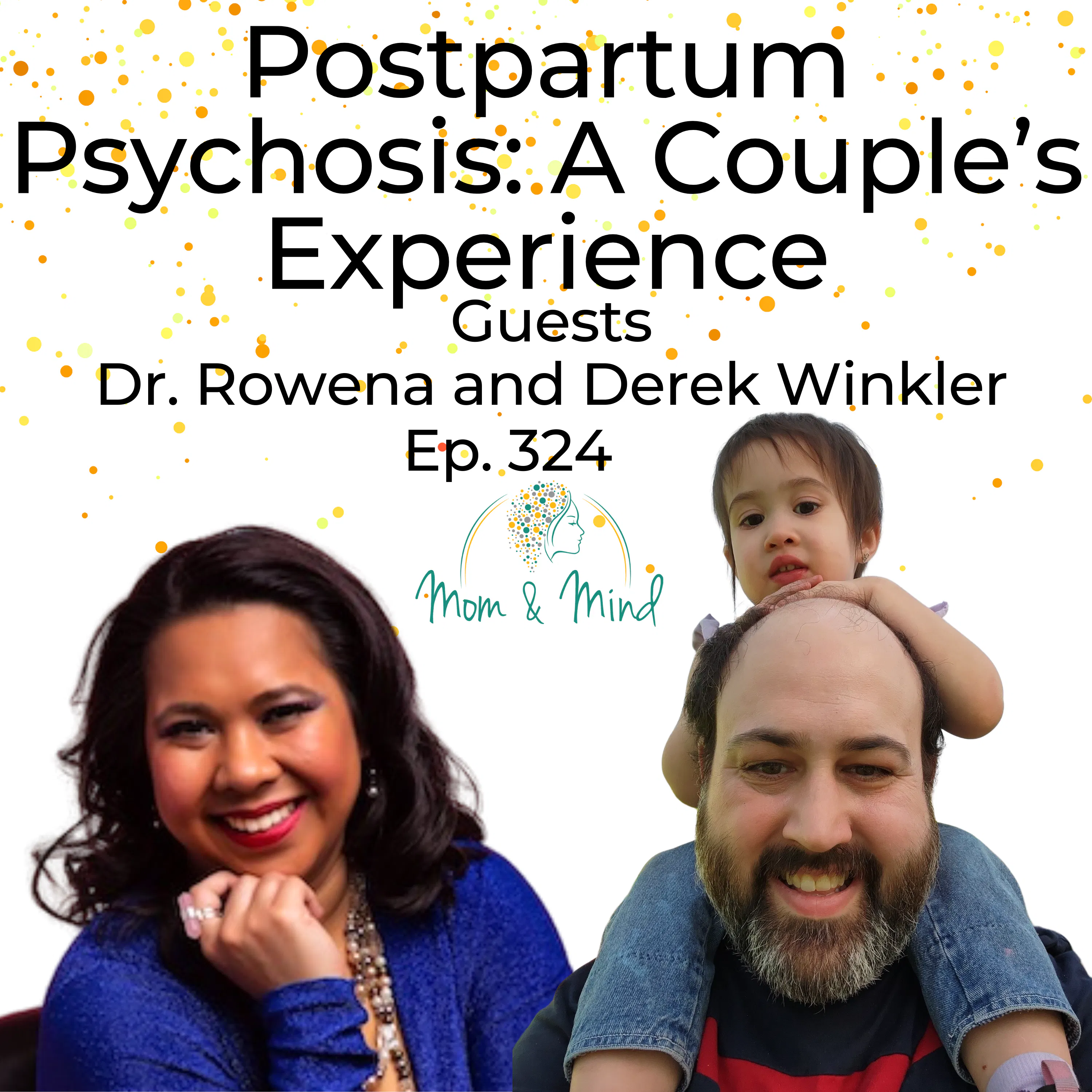
324: Postpartum Psychosis: A Couple’s Experience with Dr. Rowena and Derek Winkler
Postpartum psychosis is often misunderstood and mischaracterized. It is important to humanize this condition, remove the stigma around it, and let people know that treatment is available and healing is possible. In today’s show, we get a rare glimpse into the life of a family through the eyes of both a husband and wife about their journey through postpartum psychosis. Join us to learn more! Derek Winkler is a software engineering manager, father of two (Kerri-almost 4, and Robbie-6 months), and husband to Rowena. Derek shares his perspective of what he experienced as a husband and father and what kind of support he needed. Dr. Rowena Winkler is a career and empowerment coach who helps high achievers unlock their academic genius and gain clarity in their jobs, businesses, and lives through the power of communication. Using her Ph.D. in Communications, along with mystical modalities such as astrology, human design, and Tarot, Dr. Rowena’s coaching method enables clients to tap into self-love and bold confidence to get unstuck and make a change. Rowena shares what postpartum psychosis was like for her from the start, through her hospitalization, and integrating back home. Show Highlights: How postpartum psychosis occurred after Rowena’s second pregnancy with their son in 2023 after a completely normal postpartum experience in 2020 (when their daughter was born) How Derek noticed Rowena’s anxiety issues when their son was born, along with sleep deprivation and hypervigilance How Rowena’s condition escalated, Derek noticed several red flags that were concerning and called 911 when their son was 2-3 weeks old How Rowena felt herself slipping from reality–like she didn’t “have full ownership” of her body How things progressed until Derek contacted 911 through a text, police officers and a mental health professional (from Grassroots Crisis Intervention Center) arrived, and Rowena went to the ER What Rowena remembers about her paranoia in arriving and being admitted to the hospital (one day in the ER and 10 days in a psychiatric unit) Why she needed a second hospitalization after her initial discharge and return home How the healing process takes time after a severe mental health crisis How an outpatient hospital program helped Rowena learn helpful coping strategies Why our medical care system isn’t set up for sufficient family support after a psychiatric hospitalization How PSI, therapy, and medications helped Derek in his caregiving role in being a supportive and understanding partner How Rowena is coping today with new tools to use in starting a new job and being a wife and mother Rowena’s takeaways: “Those of us who have been through this and have made it to the other side are here to help, support, and share that you are not alone. You can get through this.” Derek’s takeaways: “It is the silver lining around a very dark cloud that we are able to share our story and help people learn about this condition. It is very difficult, but there is light at the end of the tunnel. Postpartum psychosis is very treatable. If you are going through this, please reach out for help.” Resources: Visit www.postpartum.net for resources and support! Visit www.postpartum.net/professionals/certificate-trainings/ for information on the grief course. Visit my website, www.wellmindperinatal.com, for more information, resources, and courses you can take today! Connect with Dr. Rowena Winkler: Website, Instagram, LinkedIn, Facebook, and YouTube Learn more about your ad choices. Visit podcastchoices.com/adchoices

323: Behind The Sessions: Feeling Loss in the Transition to Parenthood
We can all agree that the transition to parenthood is huge and multi-faceted. For many parents, that transition feels like not just a big change but a monumental loss. It’s a loss of what once was and the life you had grown accustomed to in your pre-baby world. There are a lot of changes around the freedom and flexibility you once enjoyed, and essentially every area of life is affected. Things are different in your world regarding your attention and energy, as well. Join me in today’s Behind the Sessions look at why this transition feels like a loss–and what you can do about it. Show Highlights: Why it is perfectly acceptable to experience a mixed bag of feelings about parenthood—and each of those feelings should be acknowledged and validated How acknowledging the huge changes within the context of life is an important step (Yes, things change, but exciting things are happening, also!) How to handle outside pressure and negative parenthood experiences from others Why people see a therapist for support and validation when they experience these kinds of identity shifts Dr. Kat’s takeaways: “Whatever mixture of feelings and experiences play into your transition into parenting, it’s okay. It might not always feel good, and it might be confusing, but it’s totally part of the process as you are shifting and changing. Life is changing, and it’s normal to have feelings about that.” Resources: Visit www.postpartum.net for resources and support! Visit www.postpartum.net/professionals/certificate-trainings/ for information on the grief course. Visit my website, www.wellmindperinatal.com, for more information, resources, and courses you can take today! Learn more about your ad choices. Visit podcastchoices.com/adchoices
322: From Business Owner to Survivor: Overcoming Postpartum Depression with Emma Hopkins
I’m joined today by Emma Hopkins, a mom and business owner in the UK. At age 39, Emma became a first-time mother and experienced postpartum depression to the point that her entire life, identity, and livelihood changed. She walks us through the tough decision to give up the business that was her heart and soul to prioritize her basic survival. She finally found healing, reconnected with herself, embraced her new role as a mother, and built a new business based on her experience and education. Today she coaches other women who feel a lost sense of identity by helping them rediscover themselves, and she works as a champion advocate with the Maternal Mental Health Alliance in the UK. Show Highlights: Emma’s story of business ownership in the health and wellness space in Spain and the UK until motherhood at age 39 changed everything Emma’s rude introduction to motherhood, which included severe sleeplessness, complete burnout, and full-blown postpartum depression How she was forced to sell her beloved business–and lose her sense of identity in the process What Emma wishes she had done differently How the UK’s “health visitors” system left Emma feeling judged, tested, and failing How Emma grieved for the person she was and the success and identity she lost How she finally realized and admitted that she had postpartum depression How the COVID-19 lockdown actually helped Emma connect and communicate with people again and gave her what she was missing How Emma’s supportive husband and her daily walks helped her immensely Why Emma began working with the Maternal Mental Health Alliance in the UK and has become a passionate champion to build awareness around maternal mental health Resources: Connect with Emma Hopkins: Website, LinkedIn, Instagram, and Maternal Mental Health Alliance (for UK listeners) Visit www.postpartum.net for resources and support! Visit www.postpartum.net/professionals/certificate-trainings/ for information on the grief course. Visit my website, www.wellmindperinatal.com, for more information, resources, and courses you can take today! Learn more about your ad choices. Visit podcastchoices.com/adchoices
321: Interpersonal Therapy for Perinatal Healing with Elyse Springer, MA-CLP,LMFT,PMH-C
Today’s conversation is about interpersonal therapy (IPT). You’ll learn what IPT is, how it differs from other therapies, and why it is a validated therapy that is well-suited for the perinatal population. Many more clinicians should seek training in this therapy modality which is full of useful tools and skills. Join us to learn more! Elyse Springer is a longtime colleague and friend with much knowledge about supporting people in their perinatal mental health. She is a current board member for Postpartum Support International’s California chapter and serves as the Policy and Advocacy Chair. She is an emeritus Governing Council member for Maternal Mental Health NOW; she served an eight-year term and continues to provide ongoing training for the organization. She served as a board member of the national maternal mental health policy and advocacy group 2020 Mom Project from 2014-2019, and subsequently sat on the organization’s clinical advisory panel through 2021. In addition, Elyse is a training faculty and emeritus board member for the national perinatal loss organization Return to Zero: HOPE and training faculty for the paternal perinatal non-profit Love, Dad. Elyse is certified in perinatal mental health, and she is an EMDRIA-approved therapist and consultant, certified in Interpersonal Therapy (IPT) by the IPT Institute, and an IPT supervisor-in-training. She lives and works in Los Angeles, California. Show Highlights: What is interpersonal therapy (IPT)? Why the goal of IPT is to ensure social support—and how this is accomplished How IPT can help with specific relationship needs in the perinatal period Three main areas of focus in IPT: grief/loss, role transition, and interpersonal disputes Examples of how Elyse might work with a couple around role transitions in the perinatal period What we should realize about decolonizing mental health and focusing on collaborative approaches of social support within a person’s culture How problem-solving and role-playing are done within the IPT model How IPT focuses on experiences, goals, and positive communication How IPT sessions are structured as a 12-session model with periodic check-ins to follow up Where to go for IPT training: IPT Institute Resources: Connect with Elyse Springer: Website and Instagram Visit www.postpartum.net for resources and support! Visit www.postpartum.net/professionals/certificate-trainings/ for information on the grief course. Visit my website, www.wellmindperinatal.com, for more information, resources, and courses you can take today! Learn more about your ad choices. Visit podcastchoices.com/adchoices
320: Behind The Sessions: Mental and Emotional Labor in Your Relationship
There are a lot of dynamics at play in becoming a parent, and that is an understatement, to say the least! Often overlooked are the needed conversations around new boundaries, tasks, and the “invisible labor” that a new baby brings. These discussions are vital in protecting the relationship between partners and making the postpartum period more enjoyable for both parents. Today’s episode focuses on the mental and emotional labor that a mom most often takes on in the partnership–and I’m referring primarily to heterosexual couples in this all-too-common scenario. Show Highlights: How resentment can start to build and negatively impact the couple’s relationship How a therapist will approach the issue with one individual–as opposed to couples’ therapy, which is ideal Different scenarios common in a partnership after a new baby arrives that lead to stress, depression, anxiety, loneliness, and more Why therapy for both partners can be extremely helpful, either individually or as a couple Why communication around boundaries, tasks, and “invisible labor” is important Why the divorce rate during the perinatal period is higher (67% of couples experience marital dissatisfaction during this time!) What you can do to be proactive and protect your relationship as you prepare for a new baby Resources: Visit www.postpartum.net for resources and support! Visit www.postpartum.net/professionals/certificate-trainings/ for information on the grief course. Visit my website, www.wellmindperinatal.com, for more information, resources, and courses you can take today! Learn more about your ad choices. Visit podcastchoices.com/adchoices
319: Trauma-Informed Approaches for Birth Workers and Birthing People
Today’s show brings back a guest from years ago, and I’m excited to reconnect with her and hear updates about her life and work. She’s a lovely human and a beautiful soul who is doing meaningful work that helps many people. Join us! Nkem Ndefo is the founder of Lumos Transforms and the creator of The Resilience Toolkit, a model that promotes embodied self-awareness and self-regulation in an ecologically sensitive framework and social justice context. Originally licensed as a nurse midwife, Nkem has extensive postgraduate training in complementary health modalities and emotional therapies. She has worked in a lot of settings from large-volume hospitals to mobile community clinics, and she brings years of expertise as a clinician, educator, researcher, and community strategist. She works in programs that address trauma inequity as she seeks to build resilience and shape liberatory change for individuals and organizations throughout the US and internationally. Her particular interest is in working alongside people most impacted by violence and marginalization, and she does important work in the birth community. We are discussing how systems are related to trauma and mental health, along with how systems impact birthing people and the healthcare providers in the birthing community. Show Highlights: An overview of Nkem’s broad scope of work around healing and liberation Why we need systems that facilitate healing on the individual AND community levels What it means to be trauma-informed in the realm of reproductive health and mental health Why our healthcare system MUST recognize the need for trauma-informed approaches for birth workers How we can change the systems with little steps—one at a time What Nkem sees as the leading factors in why people are resistant to change How tools and intention can grow our capacity to recognize overwhelm and activate boundaries around things that cause stress How many different kinds of traumas contribute to mental health diagnoses Why most of our trauma healing efforts in the current medical model fall short How inadequate parental leave within the current system kicks off a cascade of mental health effects Why doulas are NOT the solution or the fix to the broken system Why we need to be courageous with our hopes and dreams of changing the broken system An overview of Lumos Transforms and The Resilience Toolkit Resources: Connect with Nkem Ndefo and Lumos Transforms: Website, Instagram, X, and The Resilience Toolkit Visit www.postpartum.net for resources and support! Visit www.postpartum.net/professionals/certificate-trainings/ for information on the grief course. Visit my website, www.wellmindperinatal.com, for more information, resources, and courses you can take today! Learn more about your ad choices. Visit podcastchoices.com/adchoices

318: Healing Perinatal Trauma Through Psychodynamic and Somatic Therapy
My guest today is doing important work with perinatal mental health through psychodynamic and somatic therapy. There is a great need for this therapeutic modality to be available to people who need it and for more training to be accessible to care providers. Join us to learn more! Dr. Helena Vissing is a licensed psychologist certified in perinatal mental health as a Somatic Experiencing Practitioner. She is experienced as an adjunct faculty member and on the training committee of Maternal Mental Health NOW where she provides consultations and helps train providers. Helena has written a book on her biopsychosocial model for the treatment of trauma in the perinatal period published with Routledge and titled, Somatic Maternal Healing: Psychodynamic and Somatic Trauma Treatment for Perinatal Mental Health. Show Highlights: Why the perinatal period is a time of the clashing of biology and culture because of the vast changes to the body and nervous system How Dr. Helena’s integrative treatment model combines somatic approaches with psychoanalytic tools How Dr. Helena explains the basics of somatic therapy (aka somatic psychology or body psychotherapy) How Dr. Helena explains the basics of psychodynamic therapy How Dr. Helena’s book addresses trauma in the perinatal period with a broader concept beyond just PTSD How the perinatal period is an opportunity for a parent to rework their relationships, along with their role and identity Important principles around nervous system regulation in the perinatal period Why sensory awareness is the starting point—and only happens when a person slows down How Dr. Helena explains “maternal body fullness” How trauma healing occurs when the tendency is avoidance Dr. Helena’s message of hope: “It is possible to heal. Healing is not easy and may take a while, but it is possible.” Resources: Connect with Dr. Helena Vissing: Website, Book, and Instagram Visit www.postpartum.net for resources and support! Visit www.postpartum.net/professionals/certificate-trainings/ for information on the grief course. Visit my website, www.wellmindperinatal.com, for more information, resources, and courses you can take today! Learn more about your ad choices. Visit podcastchoices.com/adchoices
317: Behind The Sessions: Hyper-Independence Can Make You Anxious
Becoming a parent can bring intense anxiety and high levels of worry about doing the right thing for your child. Some people have feelings of failure in meeting some high level of expectation that they have of themselves. I always wonder in therapy what has contributed to a person’s suffering in this way, and, as a therapist, I want to dig deeper into why this style of hyper-independence and hyperfunctioning at all costs is activated when some people become parents. Let’s dig deeper in today’s Behind-the-Sessions episode. Show Highlights: How hyper-independence can show up because of childhood events in which someone experiences emotional neglect How being independent, not burdening anyone by asking for help, and relying only on oneself can be magnified in the postpartum Why the pressure to be perfect can lead to high anxiety and even depression in the presence of impossibly high standards Why asking for help and admitting that you aren’t perfect can alleviate the stress, overwhelm, and constant energy drain that a hyper-independent parent might feel How a perinatal mental health professional can help someone manage these dynamics Dr. Kat’s advice for hyperfunctioning parents: “Have compassionate support for yourself, try to be flexible in understanding that it’s okay to ask for help, and prioritize your sleep, rest, and self-care.” Resources: Visit www.postpartum.net for resources and support! Visit www.postpartum.net/professionals/certificate-trainings/ for information on the grief course. Visit my website, www.wellmindperinatal.com, for more information, resources, and courses you can take today! Learn more about your ad choices. Visit podcastchoices.com/adchoices

316: Overstimulation and Sensory Overload in Motherhood with Holly Peretz, OTR/L
We have all been in the place of overstimulation, even if we didn’t recognize what was happening at the time. The transition into parenthood is ripe with opportunities for overstimulation and sensory overload. Today’s episode helps us better understand how and why we are overstimulated, along with useful tips for managing overload and expert insight into how we can be more supportive of ourselves and others. Join us to learn more! Holly Peretz is a Pediatric Occupational Therapist with over 14 years of experience working with children and parents. Her role as a therapist and parent educator ranges from hospitals, preschools, hydrotherapy, and online as she supports toddler parents and clinicians in creating a childhood that “bakes in” the science of what makes toddlers thrive in this critical period of development. Holly also hosts the annual Toddler Play Conference and the Thriving in the First Year Summit. Show Highlights: How to understand what Holly does as a pediatric occupational therapist Why sensory overload is a real thing for parents The science behind what sensory processing is and how we experience sensory overload Why sensory processing issues are not limited to people with autism Why becoming a new parent is a prime time for sensory overload Tools for supporting a parent who is overstimulated and overloaded How Holly’s sensory profile quiz can help you understand sensory processing needs Resources: Visit www.postpartum.net for resources and support! Visit www.postpartum.net/professionals/certificate-trainings/ for information on the grief course. Visit my website, www.wellmindperinatal.com, for more information, resources, and courses you can take today! Connect with Holly Peretz Sensory Quiz Website Instagram YouTube Holly's Sensory Self-Care Learn more about your ad choices. Visit podcastchoices.com/adchoices
315: Premature Births, Trauma Healing, and “Cards for Hope” with Savannah Jane O’Malley
Hearing the stories of others helps us to know that we are not alone. So many families face premature births, NICU stays, and traumatic birth experiences. As always, our message is that there is support and hope. Join us for Savannah’s story. Savannah Jane O’Malley is a wife and working mother of three former preemies. She works full-time, pursues her artistic passions part-time, and she “moms” all the time. When her twin boys were born 3.5 months early, everything she thought her life was supposed to be was shattered. The one-pound warriors spent their first three months fighting for a chance at life despite many devastating diagnoses, countless ups and downs, and finally achieving incredible triumphs. Going through these experiences helped Savannah discover her true role as a mother, and it set her on a brand-new trajectory. Through social media, public speaking, writing, and painting, she is a voice of hope for families going through similar trials, and she is an advocate for those with disabilities, especially for those who have cerebral palsy, like her son. She is a cheerleader for families during their NICU experiences, a mental health advocate for mothers, and a self-proclaimed spreader of reckless hope. In this episode, Savannah shares her birth stories, what her post-NICU mental health was like, her son’s cerebral palsy diagnosis, and how her Cards of Hope campaign helps mothers after traumatic births. Show Highlights: How Savannah’s daughter’s birth at 36 weeks was much different than what she experienced when her twin sons were born two years later at 24 weeks How Savannah’s healing journey began when she started blogging during her 101-day NICU stint How her sons both suffered brain bleeds, major heart and brain surgeries, and a cerebral palsy diagnosis for Lachlan How the twins’ birth was traumatizing in many ways but especially because no one told her what was happening or what to expect What it was like to see her one-pound babies for the first time in the NICU–and feel herself physically and emotionally shut down How her recovery was complicated by bladder repair surgery and wearing a catheter for two weeks How she finally began to connect with her babies almost a week after their birth and understood their fight for life How Savannah and her husband navigated time in the NICU and time with their two-year-old daughter What it was like to go through the twins’ very serious diagnoses and surgeries How Savannah learned to hyperfunction when the twins came home until all the traumas came crashing down on her Why she is passionate about helping people understand birth trauma How therapy has helped Savannah begin to heal Why she began “Cards of Hope” to help mothers of birth trauma How she is healing while grieving the loss of what she thought her life would be Resources: Connect with Savannah and sign up for Cards of Hope: Website Visit www.postpartum.net for resources and support! Visit www.postpartum.net/professionals/certificate-trainings/ for information on the grief course. Visit my website, www.wellmindperinatal.com, for more information, resources, and courses you can take today! Learn more about your ad choices. Visit podcastchoices.com/adchoices
314: Behind The Sessions: It's Okay To Fall Apart
If no one has told you lately, it’s okay to fall apart. If you aren’t functioning at 100% and don’t feel like you can do what you are supposed to do today, it’s okay. We are human beings, not machines, and we aren’t meant to push through every single thing in life to produce and do and be and succeed and surpass. Life is not a competition, but a lot of people act like it is. We feel the pressure to keep going and pretend like we are okay to the point of pushing past the need for rest—and our mental health is slowly wearing away. Join me in today’s Behind-the-Sessions episode! Show Highlights: Why January can have you feeling depressed, anxious, and feeling like a failure Why it’s okay to stop pushing yourself to do more and be more How surrendering to your strong feelings is okay—and temporary How pushing ourselves ends up being counterproductive How we get depleted and need to reclaim the ability to slow down Why the drive to be a “self-care warrior” can deplete us Why you need to consider “stepping off the hamster wheel” and taking time to rest, recuperate, and reevaluate How to assess your needs and ask yourself what you need for each day Resources: Visit www.postpartum.net for resources and support! Visit www.postpartum.net/professionals/certificate-trainings/ for information on the grief course. Visit my website, www.wellmindperinatal.com, for more information, resources, and courses you can take today! Learn more about your ad choices. Visit podcastchoices.com/adchoices
313: Psychiatric Treatment of Maternal Mental Health Conditions with Dr, Liz Cox, MD
There are many questions and much misinformation about treatment options and medications for maternal mental health conditions (MMHCs). The key to having more awareness and understanding is to get correct information from qualified experts. Only when parents are educated and informed can they make the best decisions about their care! Today’s guest has valuable information to share to help us all become more knowledgeable. Join us to learn more! Dr. Liz Cox is a reproductive psychiatrist in private practice based in Raleigh, North Carolina. She has been in practice for over ten years, previously serving as the Medical Director for UNC Women’s Mood Disorders at Wake Med North in Raleigh and as Residency Education Director in Women’s Mood Disorders at UNC-Chapel Hill’s Department of Psychiatry, where she is currently an adjunct faculty member. Dr. Cox has authored numerous scholarly publications, including textbooks, about the treatment of MMHCs, and she is passionate about decreasing the stigma of MMHCs, increasing awareness, and advocating for appropriate treatments. Show Highlights: How Dr. Cox came into the specialty of reproductive psychiatry Why many medical students aren’t getting much training and exposure to the treatment of women’s mood disorders What Dr. Cox is seeing in her work and research regarding the prevalence of perinatal depression (50-70% of women are undiagnosed!) Why Dr. Cox is passionate about treating the full person and the whole family How a treatment plan should prioritize self-care, sleep, movement, good nutrition, therapy, and appropriate medications Why there is such misunderstanding about medications for MMHCs The risks of untreated symptoms for mothers and babies How medications can help alleviate anxiety, shame, and stigma Why a reproductive psychiatry specialist can be helpful Dr. Cox shares her personal birth experience and why she chose to ask for medication What to expect in a consultation with a reproductive psychiatrist What Dr. Cox wants listeners to know: “MMHCs are treatable conditions. No one should suffer needlessly or be shamed and stigmatized for asking for help.” Resources: Connect with Dr. Liz Cox: Website and Instagram Visit www.postpartum.net for resources and support! Visit www.postpartum.net/professionals/certificate-trainings/ for information on the grief course. Visit my website, www.wellmindperinatal.com, for more information, resources, and courses you can take today! Learn more about your ad choices. Visit podcastchoices.com/adchoices

312: Intrusive Thoughts and COVID with a Newborn with Jackie Werboff, LMHC, PMH-C
The height of the COVID pandemic caused so much fear and anxiety, all for good reason. The moms who gave birth and faced postpartum difficulties during this time were under immense pressure to try to keep themselves and their babies safe. For many, it ended up being the perfect storm that led to perinatal mental health crises. Join us to hear our guest’s story. Jackie Werboff is a licensed mental health therapist in private practice in Florida. When she became a mother in 2021, her specialization was in treating complex and developmental trauma. After her experience, she earned her certification in perinatal mental health and began working with mothers, birthing persons, and their families. In today’s episode, she shares the medical and emotional experience she had with COVID at just two weeks postpartum, which sparked undiagnosed depression, anxiety, and intrusive thoughts, along with much worry and fear. Jackie explains how she dealt with returning to work after maternity leave when some of her symptoms returned and what it was like to go into a second pregnancy after so many difficulties the first time. Show Highlights: How Jackie experienced her first child’s birth in 2021 in the middle of a COVID reemergence in Florida–and got COVID at two weeks postpartum How her breastfeeding was affected by her illness until her milk was gone How Jackie’s physical and mental health declined to a scary and dark place with intrusive thoughts, trouble breathing, and an emergency hospitalization How Jackie’s husband had to take short-term leave from work to care for their son, who also tested positive for COVID while Jackie was hospitalized How Jackie’s #1 motivation was to get better to go back home to her baby How things began to improve after a few weeks, with her baby feeling better, sleeping better, and the miraculous return of her milk How Jackie felt shame as a professional therapist with mental health symptoms and about her “inability to parent” How Jackie’s husband supported her and checked in with her frequently because she felt overwhelmed and emotionally fragile How therapy helped Jackie make the tough choice to shift out of treatment center work into private practice Why Jackie decided to become certified in perinatal mental health How Jackie is feeling more prepared now during her second pregnancy Resources: Visit www.postpartum.net for resources and support! Visit www.postpartum.net/professionals/certificate-trainings/ for information on the grief course. Visit my website, www.wellmindperinatal.com, for more information, resources, and courses you can take today! Connect with Jackie Werboff Wide Awake Counseling Website Learn more about your ad choices. Visit podcastchoices.com/adchoices
311: When Your Family Isn't Supportive with Dr. Kat
Is there anything more complex than family relationships? Our family members can run the gamut from the most loving and reassuring people in our lives to the absolute worst and most difficult people we encounter. One of the major reasons people seek out therapy is to deal with the huge amounts of stress that our family members bring to our lives. This can be especially true, and even magnified, in the transition to parenthood, a difficult pregnancy/postpartum, or a time of grief/loss associated with the parenthood journey. It’s these times when finding support is more crucial than ever, and it can be saddening, frustrating, angering, and very disappointing when the ones you love the most are not supportive and helpful. Join me for a closer look at this topic! Show Highlights: How the scenario of a non-supportive family member might play out as your expectations of support are not met How family members can be intrusive, judgmental, or even absent Why you might experience a disconnect with your parents and grandparents as you embark on your reproductive journey in very different ways than they did How, in therapy, we attempt to figure out, untangle, and understand the complex feelings about our families How therapy work explores how your feelings are impacting you and what can be shifted as we work toward specific goals My takeaway advice: “Start a practice of reflection and a habit of naming your feelings. Find a therapist who can help you process your feelings, and know that you are not alone.” Resources: Visit www.postpartum.net for resources and support! Visit www.postpartum.net/professionals/certificate-trainings/ for information on the grief course. Visit my website, www.wellmindperinatal.com, for more information, resources, and courses you can take today! Learn more about your ad choices. Visit podcastchoices.com/adchoices

310: A NICU Dr. Shares Her Own Experience with Preterm Babies, PTSD and Anxiety with Alison Hanson, PharmD, BCPPS
As we are moving along in 2024, I’m overwhelmed that we are approaching the 8th anniversary of this podcast! Hearing people’s empowering stories of many different types of experiences has put us on an amazing journey! Today’s story is from a NICU doctor who got a new perspective when both of her babies had to spend time in the NICU. Join us to hear Alison’s story! Alison Hanson is a pediatric clinical pharmacist, wife, and the mother of two children. She loved with a passion her work in the NICU which lasted almost seven years. She was blindsided by severe postpartum anxiety and PTSD after her daughter was born prematurely and spent three weeks in the NICU. After working through a lot of healing, she was again caught by surprise by her son’s traumatic birth which resulted in a four-week NICU stay and more postpartum anxiety and PTSD. Alison hopes that sharing her story will help others who work in healthcare and struggle to return to work after facing postpartum anxiety and/or PTSD. Show Highlights: Alison’s story of how she came to specialize in pediatrics and work in the NICU How her first pregnancy, in 2019, brought anxiety, sudden preeclampsia, and a premature daughter at 34 weeks How Alison recognized the signs of anxiety and PTSD when her daughter came home from the hospital after three weeks in the NICU—even though life seemed perfect in many ways How she became obsessive about not being separated from her baby during her maternity leave Why she talked to her Ob-gyn about her anxiety and started medications but couldn’t find time for therapy How Alison began having panic attacks back at work in the NICU and pushed herself harder and harder How Alison began therapy and was diagnosed with PTSD when her daughter was 9 months old–and her healing journey began How Alison’s second pregnancy resulted in another preeclampsia diagnosis at 28 weeks and a two-month hospitalization until her son was born at 37 weeks How other medical complications necessitated a four-week hospital stay for her son How the second NICU experience was much more manageable because of the support system Alison had put into place What Alison wants other people to know about PTSD Resources: Visit www.postpartum.net for resources and support! Visit www.postpartum.net/professionals/certificate-trainings/ for information on the grief course. Visit my website, www.wellmindperinatal.com, for more information, resources, and courses you can take today! Learn more about your ad choices. Visit podcastchoices.com/adchoices
309: The Good Enough Mother with Dr. Sophie Brock
Motherhood shouldn’t be filled with guilt and shame! Today’s episode focuses on the social constructs of motherhood and the myth of perfect motherhood. My guest gives a fresh perspective on how we can think differently about motherhood and create a world where mothers feel empowered, supported, and valued. Join us to learn more! Dr. Sophie Brock is a Motherhood Studies Sociologist and mother living in Sydney, Australia. Her work analyzes motherhood in our culture and explores the ways that the individual experiences of mothers are shaped by broader social constructs. Sophie provides self-study courses for mothers and mother-supporting practitioners, mentoring for mother-supporting professionals, The Motherhood Studies Practitioner Certification online training, and her podcast, The Good Enough Mother. Show Highlights: An overview of Sophie’s work How Sophie defines motherhood studies, motherhood, and mothering by using the analogy of the fish tank Thoughts on the “perfect mother” Why more privilege makes things easier on mothers and more bias means a more difficult time navigating systems How mothers can resist social constructs and reclaim their power How we are socialized into the “perfect mother myth” by our culture and our relationships Why patriarchal systems benefit from the perfect mother myth How mothers can be empowered to build a new ideal of motherhood by opening their awareness in a new way How Sophie works with mothers to help them Sophie’s key takeaway about the significance of motherhood and the fact that every mother should feel seen and valued Resources: Connect with Dr. Sophie Brock: Website, Instagram, Facebook, and The Good Enough Mother Podcast *Get Dr. Sophie’s The Fish Tank of Motherhood Model and Training. Visit www.postpartum.net for resources and support! Visit www.postpartum.net/professionals/certificate-trainings/ for information on the grief course. Visit my website, www.wellmindperinatal.com, for more information, resources, and courses you can take today! Learn more about your ad choices. Visit podcastchoices.com/adchoices

308: Behind the Sessions: Post-Holiday Blues with Dr. Kat
Welcome to our last episode of 2023 as we continue our Behind the Sessions series. These episodes are created to give you a glimpse behind the scenes of therapy sessions. Even in today’s world, there is so much stigma and so many misconceptions about what goes on in therapy sessions and when someone can benefit from therapy. You don’t have to “just be strong” and pull yourself through the hard things in life. Around the holidays, many people feel disconnected and isolated for various reasons, and it can be a devastating time for your mental health. Let’s talk about how to manage the post-holiday slump. Show Highlights: Why managing a pregnancy or life with a newborn/toddler around the holidays can be extra stressful Why moms usually feel pressure in greater ways to be the “default doer,” the manager of gatherings, and the coordinator of delicate family relationships How fears of sickness (COVID, flu, and RSV) can cause increased holiday pressure How to navigate family scenarios around setting boundaries, making others respect your boundaries, setting limits on your time, and putting exit strategies in place How to manage your emotional/mental load, your own internal process, and complex emotional relationships with family members Why grief is more pronounced and more difficult around the holidays How to “call out stuff” in managing your stress Tips for getting yourself back to baseline: Allow yourself time to recuperate. Ask yourself each day, “What do I need today?” Identify small, baby steps to reduce your load of stress. Treat yourself with compassion, love, and kindness. Resources: Visit www.postpartum.net for resources and support! Visit www.postpartum.net/professionals/certificate-trainings/ for information on the grief course. Visit my website, www.wellmindperinatal.com, for more information, resources, and courses you can take today! Learn more about your ad choices. Visit podcastchoices.com/adchoices

307: Golden Hour Birth Stories with Liz and Natalie
One of the main goals of this podcast is to empower and support people through sharing stories because we know that hearing the experiences of others can help us feel not so alone in our struggles. Today we meet two moms who host the Golden Hour Birth Podcast, where they “create community around storytelling.” Join us! Liz and Natalie describe their podcast as two average Midwest moms having conversations around birth stories. They laugh and cry with other moms while holding space and normalizing all the unknowns that cause people to pivot through the empowering journey of parenthood. In their podcast episodes, they emphasize the importance of sharing birth stories, hearing birth stories, and finding ways to heal. Show Highlights: Get to know Liz and Natalie! Why birth stories empower people and let them know they are not alone Why this is a time when many people find freedom in sharing their experiences and not staying quiet anymore Common themes that keep coming up in birth stories The importance of a mother’s intuition Highlights of Natalie’s birth stories Why it’s okay to be open in sharing about medications and therapy Highlights of Liz’s birth experiences Why many moms don’t realize they have birth trauma until they share their birth story How Liz and Natalie see community, connection, and support happening through their podcast Why they are starting an online course to help more people Resources: Connect with Liz and Natalie: Podcast, Instagram, and Facebook Visit www.postpartum.net for resources and support! Visit www.postpartum.net/professionals/certificate-trainings/ for information on the grief course. Visit my website, www.wellmindperinatal.com, for more information, resources, and courses you can take today! Learn more about your ad choices. Visit podcastchoices.com/adchoices

306: Perinatal, Racialized, and Muslim Mental Health with Hajara Kutty
As far as we have come in recent years in removing the shame and stigma of mental health care and educating the public about perinatal mood and anxiety disorders, we still have a long way to go. Today’s guest shares her experience and describes the scope of her work with underserved segments of the population. The fact is that every person deserves the same access to quality healthcare for their physical and mental well-being! Join us to learn more! I’m joined by Hajara Kutty, an educator and perinatal mental health advocate who has worked for nearly two decades to create awareness around perinatal mood and anxiety disorders and support those who experience these issues. She is on the Postpartum Support International Advisory Council, and her writing on mental health has appeared in various national media outlets. She discusses some of the issues she has identified that negatively impact racialized perinatal women and what she has seen in her role as a Muslim coordinator for PSI. Show Highlights: How Hajara became involved with postpartum mental health work through her experience of becoming a mom about 20 years ago Hajara’s perspective on how far we’ve come with perinatal mental health and how far we still need to go in helping women How Hajara has gotten involved through advocacy work, writing, helping to create programs, and raising awareness What it means to be “racialized”--and why racialized women are treated differently in many cases, not having access to quality care and resources Why Canada and other countries are doing a better job than the US in addressing the problem of accessible healthcare How socioeconomic status limits a person’s access to quality mental health resources The negative impacts for Muslim parents who experience perinatal mood and anxiety disorders The encouraging feedback Hajara receives from Muslim parents who are accessing PSI support Resources: Visit www.postpartum.net for resources and support! Visit www.postpartum.net/professionals/certificate-trainings/ for information on the grief course. Visit my website, www.wellmindperinatal.com, for more information, resources, and courses you can take today! Learn more about your ad choices. Visit podcastchoices.com/adchoices

305: Behind the Sessions: How to Manage Holiday Stress with Dr. Kat
Today’s topic is showing up in therapy sessions everywhere right now with the holidays and the end of the year. Many people have conflicted feelings about their relationships with their families and upcoming family events; while we feel the pressure to be happy, cheerful, and joyous, we need to realize that some people have much dread, stress, and pressure during this time. Some people are just not okay. Let’s talk about how to better manage whatever holiday stress you might be feeling. Show Highlights: How to have a realistic perspective around expectations, pressure, stressors, and the overall mental load of the holidays Why many people have strong feelings of sadness, loss, and grief around the holiday season How to take stock of the factors contributing to your stress Why holiday traditions usually change when a new baby comes along—and families are not always accommodating or understanding How to set boundaries (both physical AND emotional) and be intentional with self-care to manage the stressors and overwhelm of the holiday season Resources: Visit www.postpartum.net for resources and support! Visit www.postpartum.net/professionals/certificate-trainings/ for information on the grief course. Visit my website, www.wellmindperinatal.com, for more information, resources, and courses you can take today! Learn more about your ad choices. Visit podcastchoices.com/adchoices

304: Disordered Eating and Body Image in Pregnancy and Postpartum with Kathryn Gantt, MHS, LDN, RYT 200
Disordered eating, eating disorders, and body image issues are very common experiences for many women, yet they are overlooked by most medical providers during pregnancy and postpartum. Today’s guest is passionate about educating us about these topics and offering more understanding to struggling women. Join us to learn more! Kathryn Gantt is an eating disorder dietitian, certified yoga instructor, and mom of two who uses her experience to help people change their relationships with food and their bodies. She gives us an insightful look at the challenges obstetricians and care providers face without the education, experience, and certifications to deal with patients with eating disorders and body image issues. Our discussion also touches on the prevalence of weight bias in the medical field and how “diet culture” contributes to body image struggles during pregnancy and postpartum. Kathryn focuses her work on pregnancy and postpartum nutrition, mindful/intuitive eating, Health At Every Size (HAES), and non-diet approaches when counseling clients. She serves on the executive board of the WNC Chapter of the International Association of Eating Disorder Professionals and is passionate about helping people understand the societal pressures that impact our physical and mental health during pregnancy and postpartum. Show Highlights: How Kathryn came into her specialty of working with eating disorders How weight bias shows up in the medical field with very little understanding of eating disorders The difference between eating disorders and disordered eating—-and how body image issues fit into these categories Why all obstetricians work with people with eating disorders, whether they realize it or not How Kathryn works with Obs to do simple screenings for eating disorders, disordered eating, and body image issues How disordered eating and eating disorders relate to anxiety in pregnancy and postpartum How diet culture has shaped much of our thinking about pregnancy and women’s bodies Why the nutrition piece during pregnancy and postpartum doesn’t matter if we ignore mental health issues How to recognize signs of an eating issue—and what to do next Resources: Connect with Kathryn Gantt: Website (Learn more about the upcoming retreat on body positivity for women in Gatlinburg, TN, on January 19-21, 2024) and Instagram Visit www.postpartum.net for resources and support! You can now watch the Mom & Mind Podcast on YouTube! Check it out! Visit www.postpartum.net/professionals/certificate-trainings/ for information on the grief course. Visit my website, www.wellmindperinatal.com, for more information, resources, and courses you can take today! Learn more about your ad choices. Visit podcastchoices.com/adchoices

303: Perinatal Mental Health through In Utero Diagnosis with Kate Stacom, MSW, LICSW
Today’s guest shares the personal story of her unborn baby’s traumatic diagnosis in utero. She hopes her story assures others that they are not alone in facing this type of diagnosis, and she explains coping skills and how to remain hopeful through a bleak and terrifying time. Join us to learn more! Kate Stacom is a licensed clinical social worker and mother of two who has lived experience of perinatal trauma, depression, and anxiety. Her perinatal mental health journey began when her daughter, Clare, was diagnosed with a congenital diaphragmatic hernia (CDH) at 36 weeks gestation, leading to a traumatic birth and several chaotic weeks before and after delivery. Kate has become a passionate advocate for more mental health support and the role of intuition and spirituality for caregivers after hearing the news of in-utero diagnoses of congenital anomalies. Kate has a private practice where she utilizes her clinical skills coupled with her intuition to help others live meaningful, joy-filled lives where they feel most connected to their soul purpose. Show Highlights: Kate’s pregnancy story: gestational diabetes, a mother’s instinct that something wasn’t right, and an in-utero CDH diagnosis at 36 weeks How Kate felt the range of emotions from anxiety, fear, grief, anger, and guilt What it was like to get MRI scans on her unborn baby, be induced at 39 weeks, and go through a traumatic birth with massive medical interventions How Kate and her husband navigated a long NICU stay where they constantly worried that their daughter would not survive How Kate and her husband handled their daughter’s surgery as a newborn and the isolation they endured at the hospital How Kate went into survival mode during her daughter’s six-week NICU stay Why the anxiety didn’t stop when they brought Claire home A happy update of how Claire is thriving today as an energetic four-year-old Kate’s biggest takeaways about what helped her the most through her experience Kate’s advice to other parents in similar situations Resources: Connect with Kate Stacom: Website, Instagram, and Facebook Mentioned by Kate for more information about congenital diaphragmatic hernias and help for families: Tiny Hero Visit www.postpartum.net for resources and support! You can now watch the Mom & Mind Podcast on YouTube! Check it out! Visit www.postpartum.net/professionals/certificate-trainings/ for information on the grief course. Visit my website, www.wellmindperinatal.com, for more information, resources, and courses you can take today! Learn more about your ad choices. Visit podcastchoices.com/adchoices

302: Behind The Sessions: When You Don't Know How You Feel
Have you ever found yourself in situations where trying to figure out your emotions feels like trying to untangle a knot? Or perhaps you have experienced an overwhelming whirlwind of conflicting feelings, which happens often. Life is anything but linear. It is messy and full of ups and downs that challenge us emotionally. Over the last 70 years, there has been more emphasis on psychology, and we understand so much more about getting in touch with our feelings. But even so, some of us are still learning as we go. In today's Behind the Sessions episode, we look into what it is like not to know how you feel. Join us as we unravel the complexities of tuning into our feelings while navigating the emotional rollercoaster of life and the reproductive experience. Show Highlights: How disorientating the experience of pregnancy and parenthood can be How the pressure to appear fine can feel uncomfortable when we do not know what we are feeling Why we need to acknowledge and accept our feelings, even when they are uncomfortable or hard to confront What happens when we deny or avoid our feelings? Why being confused about your inner life, emotions, and mental health during the perinatal transition is normal The benefits of therapy for exploring and understanding feelings and becoming empowered to make positive changes in life The value of healing and growth through self-awareness How building a better relationship with ourselves benefits our overall well-being Why should we prioritize our mental health? Resources: Visit www.postpartum.net for resources and support! Visit www.postpartum.net/professionals/certificate-trainings/ for information on the grief course. Visit my website, www.wellmindperinatal.com, for more information, resources, and courses you can take today! Mom and Mind on Instagram and Facebook Learn more about your ad choices. Visit podcastchoices.com/adchoices

301: Dr. Berlin's Informed Pregnancy Project with Elliot Berlin, DC
We are delighted to have Dr. Elliot Berlin back on the podcast for the first time since he was with us last in 2018. He joins us today to share the latest from his Informed Pregnancy Plus world and discuss his incredible work in perinatal chiropractic care for pregnancy and labor. Our bodies go through so much to support pregnancy and make birth happen, and Dr. Berlin truly knows how to help! Dr. Berlin is passionate about helping people achieve optimal health- especially women navigating pregnancy and postpartum experiences. With his wealth of experience, he has dedicated his life to supporting new and expectant mothers in finding comfort and well-being during pregnancy and birth. He is committed to giving his patients top-quality care, using unique techniques and specialized equipment. Despite being based in Los Angeles, his platform, the Informed Pregnancy Project, reaches people everywhere. The Informed Pregnancy Project includes the well-loved Informed Pregnancy Podcast, the Informed Pregnancy Blog, and the recently added streaming service, Informed Pregnancy Plus. Dr. Berlin joins us today to offer valuable insights and highlight the importance of informed decision-making throughout the pregnancy and birth journey. So, let's dive in and meet Dr. Berlin! Show highlights: Dr. Berlin explains how the pandemic affected the birth world and shares his Covid-19 experience How chiropractors help to restore normal motion and function to the musculoskeletal system How Dr. Berlin combines chiropractic and massage to create a more functional system How pregnancy-related issues like headaches and jaw problems can be released through manual therapy How addressing musculoskeletal issues during pregnancy prevents discomfort and ensures a smooth delivery How chiropractic treatments help to position the baby and prepare women for breech births The benefits of chiropractic treatments for an optimally-functioning body during vaginal births The importance of chiropractic care for babies and children, especially for excessive crying and digestive issues Dr. Berlin explains how gently newborn infant chiropractic gets done How Dr. Berlin’s presence and skills as a doula help women feel more calm and relaxed during the birthing process How his platform empowers women and helps them make informed decisions for their pregnancy and birth experiences Resources: Visit the Informed Pregnancy Plus platform Find out what Dr. Berlin is doing on his website, Instagram, and Twitter Visit www.postpartum.net for resources and support! Visit www.postpartum.net/professionals/certificate-trainings/ for information on the grief course. Visit my website, www.wellmindperinatal.com, for more information, resources, and courses you can take today! Learn more about your ad choices. Visit podcastchoices.com/adchoices

300: ADHD and Perinatal Mental Health with Jacqueline V. Cohen, NCC, LPC, ADHD-CCSP, NBCCH-D
Welcome to a very special episode! It’s our 300th episode, which is mind-boggling to think about. Not only that, we also address ADHD in the perinatal period, a very important topic. We all can benefit from a deeper understanding of ADHD and how it impacts perinatal mental health. Join us to learn more! Jacqueline Cohen is a Licensed Professional Counselor, ADHD-Certified Clinical Specialist Provider, Certified Clinical Hypnotherapist, coach, consultant, writer, and speaker. She has been in private practice for over 15 years, specializing in perinatal mental health and adult ADHD. Her practice, Therapy Mama, is in Marietta, Georgia, although she is also licensed in Colorado and Florida. She experienced postpartum depression and anxiety after the birth of her son in 2001 and was diagnosed with ADHD ten years later as her son was also diagnosed. Along her journey of discovering how her brain works, she realized that her postpartum depression and anxiety were largely a result of living with undiagnosed ADHD. This experience was the impetus for her work in helping others in similar situations in the journey to parenthood. In this episode, we discuss what ADHD is, what it looks like, and how it might be experienced in the perinatal period. I’m excited to explore this topic with Jacqueline! Show Highlights: How Jacqueline became interested in how perinatal mental health and ADHD intersect How she discovered that her postpartum depression and anxiety were due to undiagnosed ADHD Why “being bored” can cause depression and anxiety in someone with ADHD–because of the way the brain works The basics of what ADHD is How ADHD impacts working memory, impulsivity, organization, time management, planning, and prioritizing Types and descriptions of ADHD variations How ADHD relates to being a highly sensitive person Why someone with ADHD is likely to procrastinate Why many people are diagnosed with ADHD later in life and don’t realize they have suffered How a new mom might realize she has undiagnosed ADHD What masking is, why lower estrogen levels exacerbate ADHD symptoms, and the connection to rejection sensitivity dysphoria Shortfalls in the ADHD assessment process Connect with Jacqueline Cohen Therapy Mama Website Instagram Facebook Resources: ADDA CHADD ADDitude Magazine Visit www.postpartum.net for resources and support! Visit www.postpartum.net/professionals/certificate-trainings/ for information on the grief course. Visit my website, www.wellmindperinatal.com, for more information, resources, and courses you can take today! Books mentioned in this episode: Journeys Through ADDulthood by Sari Solden Women with ADD by Sari Solden Gender Issues and AD/HD by P. Quinn and K. Nadeau ADHD 2.0 by John Ratey and Ed Hallowell A New Understanding of ADHD in Children and Adults by Tom Brown The Queen of Distraction by Terry Matlen The ADHD Effect on Marriage by Melissa Orlov The Couples' Guide to Thriving with ADHD by Melissa Orlov A Radical Guide for Women with ADHD Workbook by Sari Solden and Michelle Frank Understanding Girls with ADHD by K. Nadeau, E. Littman, and P. Quinn Learn more about your ad choices. Visit podcastchoices.com/adchoices
299: Behind the Sessions: “I’m a Failure” with Dr. Kat
The idea of feeling like a failure comes up often in therapy; I hear it multiple times each week. People who are struggling often feel like they are a failure, and this is heartbreaking to hear. Let’s go behind the scenes and talk about what’s happening underneath the feelings of failure. Show Highlights: Why being perfect and being a failure are NOT the only two options Failure and perfection—defined and explained Why failure and perfection cannot be the measure of parenting success Why a defense against shame is often underneath the unreasonable goal of perfection Examples of how perfectionism can show up in the parenting journey Examples of what could really be happening to cause you to yell at your child How to have a more compassionate view of your journey How to gain perspective on your negative self-judgmental thoughts Why we need to have more self-compassion—and model it for our kids Resources: Visit www.postpartum.net for resources and support! Visit www.postpartum.net/professionals/certificate-trainings/ for information on the grief course. Visit my website, www.wellmindperinatal.com, for more information, resources, and courses you can take today! Learn more about your ad choices. Visit podcastchoices.com/adchoices

298: A South Asian Mom's Mental Health Journey: Missed Diagnosis with Jigyna Patel
Today you’ll hear Jigyna Patel’s story. She and I met recently at the PSI Conference, and I knew her perspective as a South Asian mom of Indian heritage would be valuable for listeners to hear. She’s a Houston-area mother of three, and she is a passionate perinatal mental health advocate who loves her volunteer work with PSI. Join us to learn more! Show Highlights: Jigyna’s story of her first pregnancy, nine years ago, which involved PCOS, infertility, emergency C-section, and a traumatic birth How Jigyna felt depression and disinterest in her new baby after taking her baby home to much help from family members, but felt much stigma and shame to get out of her “funk” How her symptoms progressed to anxiety, panic attacks, severe sleep deprivation, hallucinations, delusions, intrusive thoughts, and suicidal thoughts How she started the journey with a therapist, but eventually had to move with her baby into her parents’ home for six weeks How medication, better sleep, journaling, and frequent walks helped Jigyna feel better and better over the next few months How Jigyna and her husband had conflicting opinions about having another baby How a second pregnancy (via another IUI) with twins (!) launched Jigyna into deep depression—until she decided to take charge and make a plan How the twins’ birth was an amazing delivery, via C-section, and led to Jigyna’s struggles with postpartum depression and anxiety–but none of the other symptoms from before Why Jigyna became active with PSI after researching and realizing that she had experienced postpartum psychosis with her first baby How Jigyna’s Indian culture impacted her journey with pressure and stigma How she learned the value of sleep and took steps to prioritize her sleep and self-care as a mom of three Why she felt guilty for not “wanting” her pregnancy with her twins at first–and how her group support has shown that this is a common feeling for moms of multiples How Jigyna handled bonding and connecting issues with her babies Highlights of her current work with PSI Resources: Connect with Jigyna: Email Visit www.postpartum.net for resources and support! Visit www.postpartum.net/professionals/certificate-trainings/ for information on the grief course. Visit my website, www.wellmindperinatal.com, for more information, resources, and courses you can take today! Learn more about your ad choices. Visit podcastchoices.com/adchoices

297: A Mom's Journey to Reconcile Faith and Mental Health Support with Dara DeMari
In far too many segments of our society, there is a stigma and terrible shame around perinatal mood and anxiety disorders. Even now, when there is a huge push to validate mental health support for those who need it, many women are suffering in silence. The Christian faith is one subset of society where postpartum support is truly lacking, and simply “praying more” or “reading more scripture” are not valid ways to treat mental illness. Because of her suffering on the motherhood journey, my guest is on a mission to help other Christian women have the confidence to find the help they need. Join us to hear Dara’s story. Dara DeMari is a born-again Christian, wife, and mother of four young children. All of her pregnancies culminated in premature births and NICU stays for her babies. Although she grew up in a church family, her postpartum struggles left her feeling incredibly isolated, alone and shamed. With a full spectrum of perinatal mood disorders ranging from anxiety, OCD, rage, and depression, it took Dara years to shed the stigma of shame and be ready to share her story. She has made it her personal mission to gather stories of other Christian women who suffered in silence and help them use their voices to encourage women in the church to speak up and speak out about postpartum mood disorders. The goal is to comfort and encourage new mothers to feel confident in asking and receiving the support and help they need. Dara is in the process of forming a nonprofit called Postpartum Faith to help educate people and give those of Christian faith the resources available to face postpartum mood disorders head-on and overcome them with confidence. Show Highlights: How Dara’s motherhood story began: a miscarriage and subsequent high-risk pregnancy with twins who were premature and required a three-week NICU stay after birth How further problems and another three-week hospital stay for her newborn son led to severe sleep deprivation for Dara How breathing issues for her son and feeding problems for both babies led to huge anxiety issues for Dara, including OCD, panic attacks, and intrusive thoughts How Dara reached out for help to her Ob-gyn but was turned away with no direction or resources offered beyond the advice to “find a therapist” How the Christian faith has a stigma associated with mental health and offered Dara no help How Dara progressed to feeling desperate for help and frozen in anxiety How relief finally came when she was directed to the postpartum stress center How Dara’s next pregnancy and birth happened just as COVID lockdowns occurred and resulted in premature birth, respiratory distress, and another NICU stay How Dara began to experience postpartum rage and reached out to her therapist How her next pregnancy also resulted in a premature birth and NICU stay, which set Dara on the road to postpartum depression How Dara realized what is lacking in the church as far as postpartum support for women–and what she wishes the church would do Why she is starting a nonprofit to help other women How Dara’s struggles and intense suffering have positioned her with a passionate purpose to help other Christian women Resources: Connect with Dara and Postpartum Faith: Website Visit www.postpartum.net for resources and support! Visit www.postpartum.net/professionals/certificate-trainings/ for information on the grief course. Visit my website, www.wellmindperinatal.com, for more information, resources, and courses you can take today! Learn more about your ad choices. Visit podcastchoices.com/adchoices
296: Behind The Sessions: When Your Family Doesn't Get It with Dr. Kat
Welcome to another episode in our bonus series, Behind the Sessions. A topic that comes up frequently with my clients is how they are impacted in therapy when their family doesn’t get it and does not understand what is happening for them. This disconnect can even go as far as families judging or blaming the person for what they are experiencing. It’s a difficult topic that can leave people feeling isolated and very much alone. While I am primarily addressing the emotional pain and struggle of moms in the perinatal and postpartum times, this message can apply to those in other phases of life, as well. There is no intention here for family-bashing, but the message is that we can all do better in supporting those who are facing real challenges, and it most often begins with a compassionate listening ear. Join me for this bonus episode. Show Highlights: How a suffering person faces blame from family members who can’t/won’t be supportive and ends up feeling alone, isolated, sad, and even gaslit Feelings can coexist: you can BOTH love your kid AND need a break What happens over time when someone isn’t supported and validated How family members respond by blaming, shaming, or going into “fix mode” Why a suffering person has to understand that asking for help and talking about their emotions is not “complaining” How healing begins when one can acknowledge and accept their experience without minimizing it Helpful tips on engaging in conversation with a family member to get the support you need Resources: Visit www.postpartum.net for resources and support! Visit www.postpartum.net/professionals/certificate-trainings/ for information on the grief course. Visit my website, www.wellmindperinatal.com, for more information, resources, and courses you can take today! Learn more about your ad choices. Visit podcastchoices.com/adchoices
295: Group Peer Support with Annette Cycon and Nelly Willis
There are not many group models that are supportive of a wide range of people concerning their languages, environments, and backgrounds. My two guests today have formed a powerful support system that needs to be replicated everywhere in the world. Join us to learn more! Annette Cycon has been a social worker for over 30 years, specializing in group work. With Liz Friedman, she co-founded the nonprofit MotherWoman in Massachusetts, and she went on to lead that organization for 15 years. Their mission was to increase awareness and access to mental health resources for perinatal women at risk for or experiencing perinatal emotional complications. This included designing and training peers and professionals in their unique trauma-informed support group model for moms. In 2017, they founded GPS Group Peer Support to broaden the scope of their work to include those struggling with addiction and recovery, newly-arrived refugees, first-generation college students, frontline workers suffering trauma as a result of the COVID-19 pandemic, and others, in addition to perinatal parents and caregivers. GPS is now being implemented in communities internationally and in seven languages. Nallely (Nelly) Willis, CLC, BBA, PMHC, has spent ten years providing nationwide peer support in English and Spanish to families experiencing perinatal mood and anxiety disorders. She is uniquely attuned to the challenges that expecting and new families face, and she supports them through lactation, childbirth, doula, and postpartum consultation, education, and support. Nallely ran a nonprofit organization, Heartsounds Inc., serving perinatal, low-income Latina, and BIPOC mothers across southern AZ. She has been with GPS Group Peer Support for six years, rising to the position of Program Director, as well as being a GPS Certified Coach, Support Group Facilitator, and Master Trainer in English and Spanish. Nallely has been a volunteer for nine years with the Arizona Chapter of Postpartum Support International in Outreach and Education and on the Bilingual Warmline. She is currently a counselor with the National Maternal Mental Health Hotline. Show Highlights: The background of GPS: How it began and what the program is all about The benefits of group peer support programs How GPS trains people to run peer support groups with a consistent structure and sequence based on learning how to listen Why a group program needs to have consistency and “sameness” How group programs invite people to say the hard things in a safe space How GPS is filling in the gaps with high-quality mental health care for communities of color Why the training for therapists through GPS is much-needed and unique Highlights of the 100% Spanish GPS program for the Latino population Highlights of the upcoming training, conferences, and website resources available through GPS Resources: Connect with Group Peer Support: Website and Facebook Visit www.postpartum.net for resources and support! Visit www.postpartum.net/professionals/certificate-trainings/ for information on the grief course. Visit my website, www.wellmindperinatal.com, for more information, resources, and courses you can take today! Learn more about your ad choices. Visit podcastchoices.com/adchoices
294: Matrescence and Child Development with Christine Carrig
Becoming a mother is an intricate dance of transition that impacts every part of a woman’s life down to her very identity. Matrescence is the name for this “motherhood development process,” and it’s not an easy journey for every woman to navigate. This process is every bit as vital to a healthy, thriving family as child development, but it’s often overlooked or pushed to the back burner. Join us as we dive into this topic in today’s episode! Christine Carrig is the founding director of Carrig Montessori School in Williamsburg, Brooklyn. She has been a Montessori teacher and administrator with a focus on early childhood education for nearly two decades. Since becoming a mother eleven years ago, Christine has brought the same level of passion and inquiry to maternal development as she has always had for childhood development. She is the writer in residence for Khora, the Maternal & Reproductive Psychology Lab at Teachers College, Columbia University, where she focuses her writing on the intersection between child development and maternal development in hopes of bringing a more holistic view to the parent-child dyad. She lives in Queens, NY, with her husband and their four children. Show Highlights: How Christine came into the work she does today How Christine defines and explains matrescence Why matrescence can be compared to adolescence in the scope and intensity of the changes Why we need to support and validate mothers and not try to “fix” them How Christine’s personal experiences with motherhood have aligned with what she has learned about matrescence How to understand the matrescence process through the story of “the six blind men and the elephant” How to keep a helpful perspective of the parent-child dyad How a lack of honoring matrescence shows up for parents in Christine’s work How mothers are negatively influenced by social media input on topics like gentle parenting Why we need to have balance in child development AND mother development instead of taking a largely child-centric approach Resources: Connect with Christine Carrig: Carrig Montessori School, The Family Flow, Instagram, and LinkedIn Click here to read Christine’s Insider article about gentle parenting mentioned in this episode. Visit www.postpartum.net for resources and support! Visit www.postpartum.net/professionals/certificate-trainings/ for information on the grief course. Visit my website, www.wellmindperinatal.com, for more information, resources, and courses you can take today! Learn more about your ad choices. Visit podcastchoices.com/adchoices

293: Behind The Sessions: Emotional Pain with Dr. Kat
Today’s topic is one that all of us have experienced, and many may be going through it right now. Why are we hesitant to talk openly about our emotional pain and suffering? Part of the problem is that society misconstrues the expression of pain or suffering as weakness, and we have the mistaken idea that strong, capable people do not show any weakness. Emotional pain and suffering are part of the human experience. It’s okay to seek help, talk about your feelings, and not suffer alone. Remember, you are not a burden and that healing is possible. Let’s take a closer look in today’s Behind the Sessions episode. We have a new episode every other Thursday to give additional insight into therapy and the perinatal mental health and reproductive health specialties. Our goal is to pull back the curtain so that asking for help and finding help can feel more accessible and possible. Join us! Show Highlights: Why the language we use is important in understanding our emotional experiences How therapy and emotional support give safe spaces to share and loosen emotions that we may have fears about expressing openly How to build tolerance for big emotions Examples of “containers” for emotions: acupuncture, yoga, spiritual practices, meditation, etc. Why others can’t always tell that you are suffering, leaving you feeling invalidated, diminished, and minimized How I witness the beautiful power of healing through therapy How to let people around you know that you need support Resources: Visit www.postpartum.net for resources and support! Visit www.postpartum.net/professionals/certificate-trainings/ for information on the grief course. Visit my website, www.wellmindperinatal.com, for more information, resources, and courses you can take today! Learn more about your ad choices. Visit podcastchoices.com/adchoices

292: Sports Psychology Strategies for Empowered Birth with Dr. Carla Meijen
Welcome back for another great episode! I’m joined by Dr. Carla Meijen to discuss her book, Empowered Birth: Lessons From Sport Psychology for Your Maternity Journey. Her book is a fascinating take on how pregnancy can be viewed as an endurance sport. Join us to learn more! Dr. Carla Meijen is an accredited sport psychologist and Associate Professor of applied sport psychology at St. Mary’s University in London. In her work, she focuses on the mental demands of endurance performance, stress, and emotions in sports, and how to turn pressure into a positive challenge. Dr. Meijen has published her research in academic journals and has provided expert analysis for publications including the New York Times, Runner’s World, The Sunday Times Magazine, Cycling Weekly, Women’s Health, and the BBC. Dr. Meijen explains how to approach birth as a positive challenge and how it can be linked to endurance sports. She also shares sport psychology strategies that can be adapted to the birth process and how decompression can help in the postpartum period. Show Highlights: How Dr. Carla’s work relates to pregnancy and the postpartum as a strength-based approach to the maternal journey Why people seek out a sport psychologist How a sport psychologist teaches people to manage pressure, expectations, and challenges How we learn to view our demands, stress, and resources in terms of perceived control How anxiety can have beneficial physiological responses A look at Dr. Carla’s book How we can think of goals as outcome-based or process-oriented Strategies that apply well to the pregnancy, birth, and postpartum processes: chunking goals, self-talk, imagery (visualization), and more Why tools should be customizable to each individual’s needs How to apply a six-step approach to making sense of emotions and feelings Why Dr. Carla includes in her book the importance of social support Resources: Connect with Dr. Carla Meijen: Website, Instagram, Twitter, and Empowered Birth book Mentioned in this episode: The Postnatal Depletion Cure by Dr. Oscare Serrallach Visit www.postpartum.net for resources and support! Visit www.postpartum.net/professionals/certificate-trainings/ for information on the grief course. Visit my website, www.wellmindperinatal.com, for more information, resources, and courses you can take today! Learn more about your ad choices. Visit podcastchoices.com/adchoices

291: Healing from PPD and PPA with Medication Support with Victoria Vaughan, DVM
We are tackling a hot topic that carries with it many misconceptions. Unlike with other medical conditions, there are fears around taking medications specifically for anxiety and depression. Our goal with today’s show is to help shed the stigma and misconceptions about medications in pregnancy and postpartum, letting women know that it’s okay to use medication support if that’s what you and your doctor decide. Join us to learn more! Victoria Vaughan is a military spouse and mom to a beautiful baby boy. She lives in Fayetteville, NC, and works as a small animal veterinarian. She struggled with postpartum anxiety and depression, and she wants to be an advocate for other women struggling in the postpartum who may be hesitant to consider antidepressant medications. Show Highlights: Victoria’s story: an easy pregnancy but a long and complicated labor and delivery that resulted in a three-day NICU stay for her son How Victoria felt overwhelmed when they took their newborn son home because they both cried all the time How her son had nursing difficulties and a tongue tie that needed to be repaired How she was desperate for answers, tried to find support, and knew that she wasn’t caring for herself properly Why she reached out to a postpartum therapist for her intense anxiety but wished the therapist had explored medication options with her How Victoria realized she had postnatal depletion but kept suffering and felt hopeless and helpless How Victoria’s mom recognized that she needed help and pushed her to find it How postpartum depression medication helped right away at about 3-4 months postpartum Why there is a huge stigma around postpartum depression/anxiety medications What Victoria wants others to know about PPD and PPA medication support Resources: Connect with Victoria Vaughan: Instagram Visit www.postpartum.net for resources and support! Visit www.postpartum.net/professionals/certificate-trainings/ for information on the grief course. Visit my website, www.wellmindperinatal.com, for more information, resources, and courses you can take today! Learn more about your ad choices. Visit podcastchoices.com/adchoices
290: Behind The Sessions: Starting Therapy
Welcome to a new series of the Mom & Mind podcast called Behind the Sessions. We will have a new episode every other Thursday to give additional insight into therapy and the perinatal mental health and reproductive health specialties. Our goal is to pull back the curtain on as much as possible so that asking for help and finding help can feel more accessible and possible. I’ll be diving into topics that come up in therapy sessions around emotional and relationship challenges, along with sharing things that bother me about societal pressure and many other things that impact the perinatal population. We will sprinkle in the occasional chat between me and another perinatal therapist to normalize the process of getting help and healing. In today’s episode, we will focus on what it’s like to start therapy for the very first time, which can entail a difficult thought process in taking those initial steps toward healing. Join us to learn more! Show Highlights: Why it’s harmful that society pressures us to “figure things out” on our own Common hesitations related to therapy and “opening up” around vulnerability, affordability, and the specifics of the therapy process Why we need to change the narrative around what it means to get mental health help How to find a therapist and ask the right questions What to expect in initial therapy visits Why additional support from family, friends, and therapy groups is helpful Resources: Visit www.postpartum.net for resources and support! Visit www.postpartum.net/professionals/certificate-trainings/ for information on the grief course. Visit my website, www.wellmindperinatal.com, for more information, resources, and courses you can take today! Learn more about your ad choices. Visit podcastchoices.com/adchoices

289: “To Carry Wonder” A Memoir and Guide with Emese Parker, RN, WHNP-BC, MPH, PMH-C
New insights and fresh perspectives on pregnancy and postpartum are always helpful! I’m intrigued and excited for today’s guest who discusses her new book, To Carry Wonder. This unique book is a beautiful weaving of her personal experience, clinical information, and perinatal mental health information and is much different from most “pregnancy books.” I know this conversation and Emese’s book will offer help and hope to many people. Join us to learn more! Emese Parker is a board-certified women’s nurse health practitioner (NP), perinatal mental health specialist, public health geek, and author of a fun, new pregnancy book called To Carry Wonder. After completing bachelor’s degrees in exercise science and nursing, Emese earned her master’s of science in nursing from Boston College and a master of public health degree from Johns Hopkins Bloomberg School of Public Health. She has over 20 years of experience in healthcare and loves partnering with women of all ages as they navigate their distinct journeys in life. Show Highlights: How Emese came into the field of women’s health and perinatal mental health The difference in pregnancy and postpartum care/support between an Ob-gyn and a nurse practitioner Why Emese’s book covers many more topics than the common pregnancy and postpartum topics Why Emese’s book can help women at all stages of life How the book helps with the way we question ourselves and feel shame around our mothering experience Why a portion of Emese’s book proceeds will help the International Justice Mission, an organization committed to combating slavery and violence around the world Resources: Connect with Emese and get your copy of her book! Website and Instagram Visit www.postpartum.net for resources and support! Visit www.postpartum.net/professionals/certificate-trainings/ for information on the grief course. Visit my website, www.wellmindperinatal.com, for more information, resources, and courses you can take today! Learn more about your ad choices. Visit podcastchoices.com/adchoices
288: Healing from Reproductive Trauma with Beth Warren, LCSW, PMH-C
My guest today helps us understand reproductive trauma, what it looks like, and how to recognize it. She explains the difference between trauma and PTSD, how these conditions can show up in the reproductive period, and how they can impact individuals, partnerships, and families. Most importantly, her message is one of hope because there are proven ways to heal from reproductive trauma, and that’s the overriding theme of today’s episode. Join us to learn more! Bethany Warren is a psychotherapist in private practice in San Diego who has worked in reproductive mental health for 25 years. She has authored The Pregnancy and Postpartum Mood Workbook and Healing from Reproductive Trauma. She is certified in EMDR therapy and perinatal mental health, specializing in perinatal mood and anxiety disorders, birth and reproductive trauma, pregnancy loss, and infertility. She’s also an EMDRIA-approved consultant and facilitates EMDR training. She is a current member and previously served as the President of the Board of the Postpartum Health Alliance. Beth joined us for three previous episodes: 15-Postpartum OCD, 107-EMDR for Perinatal Mental Health, and 216-Understanding Attachment and Bonding. Visit our podcast archives to find these episodes. Show Highlights: Understanding trauma vs. PTSD How psychological and trauma-related words are often overused and misused in pop culture What PTSD might look like How people can experience trauma in the perinatal journey Why we need to recognize and validate ALL reproductive trauma—not just birth trauma Thoughts on triggers—and why some people are triggered by the word “trigger” How to be mindful of social media posts and the tendency to dissociate How partners can also experience reproductive trauma and shouldn’t be overlooked How reproductive trauma impacts people through grief and loss How to begin the healing journey with treatment, therapy, new skills, and support groups Resources: Connect with Beth: Website and Instagram Visit our Mom & Mind podcast archives to find other episodes with Beth: 15-Postpartum OCD, 107-EMDR for Perinatal Mental Health, and 216-Understanding Attachment and Bonding. Visit www.postpartum.net for resources and support! Visit www.postpartum.net/professionals/certificate-trainings/ for information on the grief course. Visit my website, www.wellmindperinatal.com, for more information, resources, and courses you can take today! Learn more about your ad choices. Visit podcastchoices.com/adchoices

287: Postpartum Anxiety After Traumatic Birth with Savannah Burton, LPC-MHSP, S, PMH-C
Today’s personal story comes from Savannah Burton. She’s the mother of two and the owner and therapist at My Memphis Therapist Counseling and Consulting. She is a University of Memphis alumnus and a postpartum anxiety advocate and survivor after experiencing different challenges with the birth of her two children. With a passion for maternal mental health, Savannah feels fortunate to live out her dream of helping others as a therapist and entrepreneur. She explains what it feels like to not like being pregnant, to feel hesitant about motherhood, and to be fearful about the decision to have a second child. Show Highlights: The truth: nothing can adequately prepare you for what to expect after the birth of your first child How Savannah experienced a dramatic birth, unplanned C-section, breastfeeding struggles, maternity leave issues, shame, guilt, and anxiety How she struggled to have a functional life and felt guilty if she prioritized self-care How a new job and a more relaxed schedule helped her learn to preserve herself How Savannah has learned to structure her work and home life to be present with her kids AND take care of herself How she navigated a second baby, COVID, and opening a therapy practice that was limited to telehealth during the shutdown Why Savannah loves helping other moms who don’t feel “cut out” for motherhood What Savannah wants other moms to know about feelings of shame and finding support Resources: Connect with Savannah: Website and Instagram Visit www.postpartum.net for resources and support! Visit www.postpartum.net/professionals/certificate-trainings/ for information on the grief course. Visit my website, www.wellmindperinatal.com, for more information, resources, and courses you can take today! Learn more about your ad choices. Visit podcastchoices.com/adchoices

286: "Foundations in Paternal Perinatal Mental Health" with Dr. Daniel Singley
I’m excited to welcome back Dr. Daniel Singley back to the show. He joined me about seven years ago when we were a brand-new podcast, and he’s been busy doing meaningful work in the world around paternal mental health. Join us to learn more about why the mental health of fathers cannot be overlooked in perinatal care. Dr. Daniel Singley is a San Diego-based, board-certified psychologist and director of The Center for Men’s Excellence. His research and practice focus on men’s mental health with particular emphasis on reproductive psychology and the transition to fatherhood. He won the American Psychological Association’s 2017 Practitioner of the Year Award from the Division on Men and Masculinities. He is a past president of the APA’s Section on Positive Psychology and is the current president of the APA’s Society for the Psychological Study of Men and Masculinities and the President’s Advisory Council for Postpartum Support International. Dr. Singley conducts training and presentations around the country to assist individuals and organizations to enhance their level of father inclusiveness. He also founded the grant-funded Basic Training for New Dads, Inc. nonprofit and the Padre Cadre social networking application, Just for Dads, to give fathers the tools they need to be highly engaged with their infants and their partners. Show Highlights: How things have changed over the past seven years in paternal perinatal mental health–and why there is still much work to do Why it’s a systemic problem in our society that men can’t take time off when a new baby arrives How a dad’s mental health is affected in the reproductive period What the numbers show about the prevalence of perinatal mental health disorders in fathers How neurobiological shifts happen in fathers during pregnancy, birth, and postpartum How society’s message to fathers about being the emotional rock and provider for their family is a damaging one The impact on a new baby, kids, and the family system when a dad gets the mental health help he needs What perinatal mental health issues might look like in new dads An overview of Dr. Singley’s advanced PSI training, Foundations in Paternal Perinatal Mental Health (Find out more at www.postpartum.net.) Resources: Connect with Dr. Singley: Website, Facebook, Instagram, and Twitter Visit www.postpartum.net for resources and support! Visit www.postpartum.net/professionals/certificate-trainings/ for information on the grief course. Visit my website, www.wellmindperinatal.com, for more information, resources, and courses you can take today! Learn more about your ad choices. Visit podcastchoices.com/adchoices