
Impact Pricing
554 episodes — Page 9 of 12

Pricing Table Topics: 6 of Clubs – Have Value Conversation with All Potential Clients
This one is the 6 of Clubs from the Selling Value card deck. First, let's talk about an analytical journey. These are those people who, once they realize they have a problem that they might want to go solve, they spend a bunch of time doing their own research, probably on the internet, figuring out what are the different options, where they might buy it, what are the price points? These are the most price sensitive buyers we can deal with. And yet, if we get an opportunity to talk to them as a salesperson would talk to a potential client, we could be sitting there saying, Hey, here's why our product is better than our competitor's product. But my recommendation would be to make sure we have the value conversation about the inherent value of solving the problem. If we have that conversation, it may be that the buyer didn't realize that there were a lot of other opportunities or a lot of other places where there's value if they buy a product like this. The person might begin to trust the salesperson more and say, Hey, this person's really looking out for my best interest. The buyer is more likely to buy because we're showing them more and more value. So, for a lot of different reasons, it makes sense for us to make sure that we're going back to, let's call it "first principles". We're going back to help our buyers understand what's the value of solving the problem. And in the meantime, we also need to talk about how we are differentiated and possibly better than competitive alternatives. We hope you enjoyed this example of Pricing Table Topics. What you just heard was done without a script. If you want to get better at speaking about pricing and value, grab a deck of our cards, pick a card, read the saying, and then talk for one to two minutes about what that card says. You'll become a better speaker and expert. If you have any questions or feedback, please email me, [email protected]. Now, go make an impact. Connect with Mark Stiving: Email: [email protected] LinkedIn: https://www.linkedin.com/in/stiving/

Revolutionize Your Pricing Strategy with 8D Problem-Solving Technique with JD Dillon
JD Dillon is the Chief Marketing Officer, Communications Leader, and Pricing Professional at Tigo Energy. In this episode, JD shares his 8D problem-solving technique that helps create a solid pricing strategy in place. Why you have to check out today's podcast: Understand what the 8D technique of problem solving is and where you can specifically apply it to Learn how to figure things out and find solutions logically rather than emotionally Discover about the 'Five Why' in verifying the root causes of a problem "If you are in a situation where there's a price reduction, try to do two or three other things first." - JD Dillon Topics Covered: 01:15 - How JD's Pricing journey started 02:21 - Updates about T.J. Rodgers 03:23 - Overview of what the Eight-D problem-solving technique is all about 04:12 - How does a quality program relate to pricing? 05:32 - What goes on in D-Zero? 07:32 - Where do we ideally apply Eight-D to? [Showing a case study] 08:51 - D-One: What happens here? 10:24 - How do you go about D-Two? 12:36 - Action steps you need to do in D-Three 14:49 - Finding the root causes with D-Four and using the 'Five Why' technique 17:36 - How do you verify permanent corrective action in D-Five? 18:49 - Getting everything executed in D-Six 20:05 - Digging deeper into D-Five and [culture and internal processes] 20:58 - Preventing recurrence in D-Seven 22:48 - D-Eight: Congratulating the team 24:23 - How often do you perform the Eight-D process? 26:55 - JD's best pricing advice 28:25 - Connect with JD Key Takeaways: "Pricing is the quality metric for revenue." - JD Dillon "If you do it right [Eight-D process], it builds into the DNA of the company. And after a few years you've improved your DNA continuously and quite a bit." - JD Dillon "What I described is a thought process, that's all. You can do it in a meeting with people that know what they're doing. I can do it with somebody who's worked for me in the past and we can quickly go through the process in 10 minutes about one small little issue and then move on." - JD Dillon People/Resources Mentioned: Ted Levitt: https://en.wikipedia.org/wiki/Theodore_Levitt T.J. Rodgers: https://en.wikipedia.org/wiki/T._J._Rodgers Connect with JD Dillon: LinkedIn: https://www.linkedin.com/in/jd-dillon/ Connect with Mark Stiving: LinkedIn: https://www.linkedin.com/in/stiving/ Email: [email protected]

Blogcast: Discrimination or Segmentation
This is an Impact Pricing Blog published on March 23, 2023, turned into an audio podcast so you can listen on the go. Read Full Article Here: https://impactpricing.com/blog/discrimination-or-segmentation/ If you have any feedback, definitely send it. You can reach us at [email protected]. Now, go make an impact. Connect with Mark Stiving: Email: [email protected] LinkedIn: https://www.linkedin.com/in/stiving/
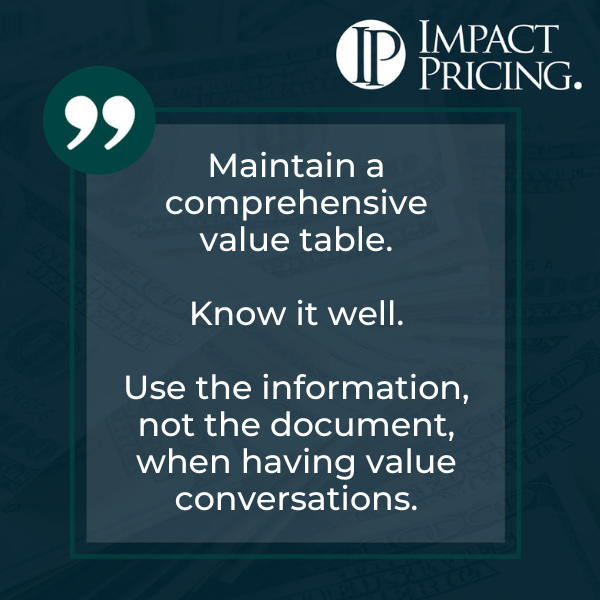
Pricing Table Topics: 6 of Hearts – Maintain a Comprehensive Value Table
This one is the 6 of Hearts from the Selling Value card deck. I work with clients frequently about creating these value tables. And what we essentially do is we identify, what are the best features in the product? What problem does that feature solve for the client? What's a quantifiable result that client may expect? And then, what's the amount of profit that client may be able to get when they achieve that result? In a way, you could think of this as an ROI calculator. But the problem is, you can't go in with an ROI calculator and tell a buyer, 'Hey, you're going to go make this much money if you buy my product.' They don't believe you. In fact, if you use the document and everything that we put on there, it's probably not accurate for every single customer. In fact, it's probably not accurate for any customer. So, our recommendation is always, when you've created the value table, think of it as a thought process, this is where the value could be. And now we go talk to a buyer. And we understand, do you have this problem? 'Oh, yeah.' What kind of result do you think you might expect? 'Oh, let's see if we can figure out the profit to your company if you achieve that result.' We use this as a map, as a document to help us understand where we're going, but we don't use the document to say these are the facts for any given client. So, we want to use the information, not the details of the document. We hope you enjoyed this example of Pricing Table Topics. What you just heard was done without a script. If you want to get better at speaking about pricing and value, grab a deck of our cards, pick a card, read the saying, then talk for one to two minutes about what that card says. You'll become a better speaker and expert. If you have any questions or feedback, please email me, [email protected]. Now, go make an impact. Connect with Mark Stiving: Email: [email protected] LinkedIn: https://www.linkedin.com/in/stiving/

How Subscription Business Model is Revolutionizing Pricing with Joe Woodard
As the founder and CEO, Joe Woodard empowers small business advisors to transform small businesses. He works toward this vision as the host of the annual Scaling New Heights conference, the host of Woodard Alliance, the head of Woodard Institute and various speaking and writing engagements he performs throughout the accounting and bookkeeping professions. In this episode, Joe discusses how to design a subscription pricing model that prioritizes building strong relationships with clients, empowering them, and generating a long-term impact on their businesses. This approach also helps increase the lifetime value of clients. Why you have to check out today's podcast: Get an in-depth discussion on pricing result versus pricing transaction Understand how charging relationships works in a subscription pricing model Uncover how to price human connections that go beyond financial reasons "Be bold with pricing. You are worth more than you think you are, and definitely more than your clients think you are." - Joe Woodard Topics Covered: 01:29 - Talks about getting differentiated from the rest with his degree in classical Greek 03:37 - How his career path ended in Pricing 04:25 - What is so significant about the subscription business model? 06:16 - How do you price a relationship? 10:08 - Going in-depth into pricing for a relationship 13:40 - Measuring the service-provider-client relationship 15:12 - Going beyond financial outcomes when measuring the economics of relationship 16:25 - Discussions around Mark's objections: 'I don't see how you price for it [relationship] 17:02 - Pricing human connection that transcends economics 20:57 - The danger about price segmentation in relation to pricing relationship 22:03 - Pricing segmentation's end-goal in a subscription model 23:38 - Healthy subscription versus toxic subscription 25:48 - Driving customer lifetime value plus creating experiences for engagement 27:43 - Joe's pricing advice 29:19 - Connect with Joe Key Takeaways: "We're intensely focused on the customer's outcome, and our outcomes become a means to that outcome. And therefore, we are pricing the relationship we have with the client because it's about the outcomes we're driving in that relationship." - Joe Woodard "I am delivering, within the context of a relationship, value. And part of that is, I'm giving you attention at the individual level. Not a newsletter, not cookie cutter answers. There's something where you're individually being touched." - Joe Woodard "Relationship economics is about the business outcomes or the business benefits that are gained by being in a relationship." - Joe Woodard "The intensity of the relationships increases based on the value that you've added in the amount of attention that you're able to give." - Joe Woodard People / Resources Mentioned: Ron Baker: https://impactpricing.com/podcast/ep44-ronald-j-baker-trash-the-timesheet-exploring-opportunities-in-subscription-businesses/ Connect with Joe Woodard: LinkedIn: https://www.linkedin.com/in/quickbooksadvisor/ Website: https://www.woodard.com/ Connect with Mark Stiving: LinkedIn: https://www.linkedin.com/in/stiving/ Email: mailto:[email protected]

Blogcast: Interesting Starlink Price Changes
This is an Impact Pricing Blog published on March 16, 2023, turned into an audio podcast so you can listen on the go. Read Full Article Here: https://impactpricing.com/blog/interesting-starlink-price-changes/ If you have any feedback, definitely send it. You can reach us at [email protected]. Now, go make an impact. Connect with Mark Stiving: Email: [email protected] LinkedIn: https://www.linkedin.com/in/stiving/

Pricing Table Topics: 6 of Spades – Make It Simple for Buyers to Decide
This one is the 6 of Spades from the Selling Value card deck. Make it simple for buyers to decide. One of my favorite sayings is, "A confused buyer won't buy." If you think about it, we're all afraid to make mistakes. We don't want to make mistakes. And the more difficult we make the decision, the more likely somebody thinks, a buyer thinks, they might make a mistake. We want to make the decision really simple, really clear, really obvious, so that our buyers don't think they're making a mistake. There are two techniques that are really common in simplifying this decision process. One is Good-Better-Best. If you have a complex price list, a complex set of options, buyers get confused. They really don't want to make that decision. They don't want to make a mistake. But if you can simplify the decision into a good-better-best offering, it's so much easier for buyers to make that decision, and they're so much more likely to make it. Another place we often see the simple decision for buyers is called The Decoy Effect. This is a psychological aspect in pricing. But a decoy effect is essentially good-better-best, but it's where you make the better price and the best price really, really close to each other. And so, buyers look at that and it's easy to make a decision between best and better because it's a slight, or maybe even no price increase, and they get a lot more. And so, yeah, I can choose best over better. And once they know they can make an easy decision, they feel like they're not going to make a mistake. So the rule here, make it simple for buyers to decide. We hope you enjoyed this example of Pricing Table Topics. What you just heard was done without a script. If you want to get better at speaking about pricing and value, grab a deck of our cards, pick a card, read the saying, and then talk for one to two minutes about what that card says. You'll become a better speaker and expert. If you have any questions or feedback, please email me, [email protected]. Now, go make an impact. Connect with Mark Stiving: Email: [email protected] LinkedIn: https://www.linkedin.com/in/stiving/

Hybrid Pricing and Pricing with AI with Steven Forth
Steven Forth is Ibbaka's Co-Founder, CEO, and Partner. Ibbaka is a strategic pricing advisory firm. He was CEO of LeveragePoint Innovations Inc., a SaaS business designed to help companies create and capture value. Steven is what I consider one of the great pricing thinkers in our industry. In this episode, Steven enlightens us about hybrid pricing models and explains why we should adopt it. He also shares why pricing people need to change the way they see AI along with the work they do in pricing. Why you have to check out today's podcast: Understand one of the unstated rules of pricing that talks about pricing power along with insights into future risk Find out how artificial intelligence (AI) can help address concerns regarding the connection between pricing and predictability, and why pricing people should change how they see AI in line with pricing Discover the reason on why most of us need to adopt hybrid pricing models and why the two pricing metrics in that should be independent of each other "Most of us need to adopt hybrid pricing models, and the two pricing metrics should be independent of each other. If the two pricing metrics track each other closely, why bother having a hybrid pricing model? You need two metrics that are relatively independent of each other, and that will give you the flexibility you need to respond in a difficult economic environment." – Steven Forth Topics Covered: 00:42 – Steven's insights on what a hybrid pricing model looks like 02:30 – Issues on pricing model that applies credits/tokens to usage 04:44 – Predictability; whoever has the best insight into future risk has the greatest pricing power 09:37 – Pricing people vs. the recent trend: AI and how it sets prices 12:02 – The Achilles heel of value-based pricing, and the hybrid pricing practice in companies 18:09 – What real value-based pricing is about 20:52 – An optimal pricing model if you want to combine two metrics 24:31 – Confused buyers don't buy and renew 27:18 – Three reasons why calculators don't expose their logic 28:42 – Steven's pricing advice 29:42 – Connect with Steven Key Takeaways: "If you have enough data, you can actually get pretty good at predicting future usage." – Steven Forth "One of the unstated rules of pricing is that whoever has the best insight into future risk has the greatest pricing power. The better we get at prediction, the more accurate we can get at pricing, and the question then becomes, who has the data to make those predictions? And I think in many cases, it's actually the vendor who has better access to data." – Steven Forth "This whole question of predictability and pricing is going to be a key question for pricing over the next three to five years, and the artificial intelligences are going to help us to answer that question much better than we've ever been able to answer it before." – Steven Forth "If you're optimizing value for the customer, you're optimizing the amount that they're willing to pay you, so if you just do it to optimize revenue, you'll end up shooting yourself in the foot because you'll trigger that negative feedback loop." – Steven Forth Connect with Steven Forth: Email: [email protected] LinkedIn: https://www.linkedin.com/in/stevenforth/ Connect with Mark Stiving: LinkedIn: https://www.linkedin.com/in/stiving/ Email: [email protected]

Blogcast: Pricing Professionals have "Trained Incapacity"
This is an Impact Pricing Blog published on March 8, 2023, turned into an audio podcast so you can listen on the go. Read Full Article Here: https://impactpricing.com/blog/pricing-professionals-have-trained-incapacity/ If you have any feedback, definitely send it. You can reach us at [email protected]. Now, go make an impact. Connect with Mark Stiving: Email: [email protected] LinkedIn: https://www.linkedin.com/in/stiving/

Pricing Table Topics: 7 of Diamonds – Mindset Shift from Expense to Investing
This one is the 7 of Diamonds from the Selling Value card deck. So, when you talk to your buyers about value, they do shift the way they think from spending on an expense toward investing. Because typically when you or anyone is shopping for something, we're thinking, how much do I have to pay and what are the features that I'm going to get? And we stop thinking about the value of what it is that we're buying. And if we have the opportunity to help our buyers understand, hey, when you go solve this problem, what's the value of solving that problem? So maybe, yeah, you're going to pay me a lot of money, but think about all the money you're going to make in additional profit because of the fact that you bought an implemented and used my product. And if we can get them focused on the value, they become a little bit less price sensitive and they trust us and like us even more. So, my recommendation is, talk about value way more than we talk about features and price. We hope you enjoyed this example of Pricing Table Topics. What you just heard was done without a script. If you want to get better at speaking about pricing and value, grab a deck of our cards, pick a card, read the saying, then talk for one to two minutes about what that card says. You'll become a better speaker and expert. If you have any questions or feedback, please email me, [email protected]. Now, go make an impact. Connect with Mark Stiving: Email: [email protected] LinkedIn: https://www.linkedin.com/in/stiving/

Why It's Worth Paying for Pricing Consultants with Dick Sobel
Dick Sobel was with Emerson for 21 years where he mostly worked on pricing roles. Currently, he is the managing director of PricePoint Partners, a company that helps clients achieve significant gains in price realization and profitability with salesforce implementation utilizing cloud-based Acuity Margin Management BI software. In this episode, Dick talks about the work they do at PricePoint Partners as he points out the importance of assessment and consulting in coming up with optimal solutions to clients' problems. He also touched on the topic of AI interference in the pricing world. Why you have to check out today's podcast: Learn the work that PricePoint Partners does, the range of clients they serve, and how they could help your company in pricing Find out why you can't rely on AI alone in doing prices and why AI can do better in B2C than in B2B Find out why today is the best time to raise your prices "Inflation's persistence is here to stay for a long time. And if you're not doing something right now, you are really missing out." – Dick Sobel Topics Covered: 01:49 – How Dick got into pricing 04:40 – How Emerson did pricing before, and how they moved to value pricing as time went by 06:50 – The work that PricePoint Partners does, and the range of clients that they support 08:21 – Is PricePoint Partners a software company, or a consulting company? 10:23 – What prompts companies to focus on pricing 13:19 – Does PricePoint Partners charge for assessment? 14:58 – Why assessment is an essential part in consulting, and why you should definitely pay for it 17:25 – Why you should be careful in using AI, and why pricing people and clients are still more comfortable 22:02 – Dick's pricing advice 23:32 – Connect with Dick Sobel Key Takeaways: "Somebody has to be in charge somewhere that can at least gather the crew together and make it [changes in pricing strategy] happen." – Dick Sobel "At least for the people that I deal with, I don't feel comfortable having or I don't think they're even comfortable in having black box artificial intelligent price recommendations where "Okay, here's the price you should charge for this product, for this SKU". And it's given to the salespeople arbitrarily. There's got to be this human interface still. And so, yeah, you can look at it, but be careful." – Dick Sobel "This idea of "Well, you know, we're just going to try to hold the line", you keep doing that, you won't have a business." – Dick Sobel People / Resources Mentioned: Emerson: https://www.emerson.com/en-us/global PricePoint Partners: https://pricepointpartners.com/ Resilience Capital: https://resiliencecapital.com/ Salesforce: https://www.salesforce.com/ap/ Vendavo: https://www.vendavo.com/ Connect with Dick Sobel: LinkedIn: https://www.linkedin.com/in/richardsobel/ Email: [email protected] Connect with Mark Stiving: LinkedIn: https://www.linkedin.com/in/stiving/ Email: [email protected]

Blogcast: Wow! A Price Decrease
This is an Impact Pricing Blog published on March 1, 2023, turned into an audio podcast so you can listen on the go. Read Full Article Here: https://impactpricing.com/blog/wow-a-price-decrease/ [powerpress] If you have any feedback, definitely send it. You can reach us at [email protected]. Now, go make an impact. Connect with Mark Stiving: Email: [email protected] LinkedIn: https://www.linkedin.com/in/stiving/

Pricing Table Topics: 7 of Clubs – Help the Buyer Understand the Value of Solving their Problem
This one is the 7 of Clubs from the Selling Value card deck. Anytime you're in a sales situation, we think to ourselves, Hey, we need to be selling against our competition. We need to point out why we're better than our competitors. Yeah, and maybe we do. I'm not going to say we don't need to do that. However, if we take the time to help the buyer understand, what's the underlying problem they're truly trying to solve? What's the value of solving that problem? And how it is that we help them solve that problem? It builds trust. They start to know that we understand their situation, we understand their problem. They believe that we'll be better at solving it simply because we've expressed the fact that we understood it. Oh, and when we help them build the business case, they are grateful because they need this information to help sell up inside their organization anyway. Because no one's going to buy something unless they know that it's going to help them make more money. And so, we need to help our buyers create that business case. So, it really is imperative that even if you know you're going to have competition, take the time to help your buyers understand the value of solving the problem. Not just focusing on why we're better. We hope you enjoyed this example of Pricing Table Topics. What you just heard was done without a script. If you want to get better at speaking about pricing and value, grab a deck of our cards, pick a card, read the saying, and then talk for one to two minutes about what that card says. You'll become a better speaker and expert. If you have any questions or feedback, please email me, [email protected]. Now, go make an impact. Connect with Mark Stiving: Email: [email protected] LinkedIn: https://www.linkedin.com/in/stiving/

How Machine Learning and AI Can Help You Make Efficient Pricing Decisions with Alex Galkin
Alex Galkin is the Co-Founder and CEO of Competera, a pricing optimization SaaS company converting technologies into ready-to-use products for enterprise retailers worldwide. Alex has been a mentor at his startups for several years, and he's a Ukrainian who left four days before the war started. In this episode, Alex helps us understand the pricing and ML work that they do at Competera as he talks about the three models they always put into use. Why you have to check out today's podcast: Understand why you should treat pricing as a process Find out how Competera helps their clients in making pricing decisions Discover three models that Competera puts into use as MLs look for reasonable factors to make a price adjustment "Pricing is a process, and you need to continuously improve as any other process in your organization." – Alex Galkin Topics Covered: 01:04 – How Alex got into pricing 03:07 – The work that Competera does in relation to pricing, and how they do it 08:28 – Using ML-driven price recommendations: Competera creating a 'gray box' 12:35 – Talking about the portfolio-wide pricing/portfolio optimization 14:12 – An ML example of the decoy effect 17:20 – Alex explains how their smart product segmentation works; a product bringing more people in the store 23:09 – Alex's pricing advice 23:49 – Connect with Alex Key Takeaways: "ML is not a human. He's not trying to play with the price; he's changing only if he sees the reasonable factor to make this price adjustment." – Alex Galkin People / Resources Mentioned: Competera: https://competera.net/ Connect with Alex Galkin: Email: [email protected] LinkedIn: https://www.linkedin.com/in/alexandrgalkin/ Connect with Mark Stiving: LinkedIn: https://www.linkedin.com/in/stiving/ Email: [email protected]

Pricing Table Topics: 7 of Hearts – Value Propositions Are General, Selling Value Is Specific
This one is the 7 of Hearts from the Selling Value card deck. It is true, value propositions really are awesome. Marketing teams, companies, sit around to try to figure out, what's the value proposition of this product? And it turns out that we can often come up with something that's pretty good, pretty general. It essentially is the solution to a problem that most people have, and we think of that as the value proposition. But the thing is, the value proposition isn't specific enough. Anytime you go to an individual customer, or an individual buyer, they've got different problems. Maybe our value proposition caught their attention, got them to come talk to us. But in the end, we need to understand, what are the specific problems that that buyer has? What's the result that that buyer's looking to achieve? And then help them figure out, what's the business case for that? How much value, or additional profit, will they make because they're solving those specific problems? So, I love value propositions. They're just not magic words that are enough to get people to buy. We hope you enjoyed this example of Pricing Table Topics. What you just heard was done without a script. If you want to get better at speaking about pricing and value, grab a deck of our cards, pick a card, read the saying, and then talk for one to two minutes about what that card says. You'll become a better speaker and expert. If you have any questions or feedback, please email me, [email protected]. Now, go make an impact. Connect with Mark Stiving: Email: [email protected] LinkedIn: https://www.linkedin.com/in/stiving/

Blogcast: Lessons from the Library
This is an Impact Pricing Blog published on February 22, 2023, turned into an audio podcast so you can listen on the go. Read Full Article Here: https://impactpricing.com/blog/lessons-from-the-library/ If you have any feedback, definitely send it. You can reach us at [email protected]. Now, go make an impact. Connect with Mark Stiving: Email: [email protected] LinkedIn: https://www.linkedin.com/in/stiving/

Value Bread Blues? How to Announce Price Increases with Casey Brown
Casey Brown is the President of Boost Pricing, and she has been since 2011. She started her career as a Chemical Engineer at GE, and she's been in pricing for almost 20 years now. Casey loves whitewater kayaking, and she's a big Buckeye fan. In this episode, Casey explains how important it is for sellers to connect with the emotional component of the buyer/s as she shares her knowledge on how to substantially increase your ability to earn higher prices. Why you have to check out today's podcast: Learn how crucial the seller's mindset and beliefs are to the business' profitability, especially as to whether they're operating from a place of confidence or fear Find out why you should not put the blame on cost increases when doing a price increase Understand the power of taking into consideration the emotional component, like selling value through the language, mind, and heart of your customer "I have yet to find, even in this current economic climate, a company that doesn't have some pricing opportunity, and I would just ask everyone to keep looking for it. It's there." – Casey Brown Topics Covered: 01:33 – How Casey got into pricing 04:54 – Mark to Casey: Why don't I know you? Why have I never seen you before? 07:00 – The biggest problem in sales being the lack of recognition that there's a problem 09:33 – Is Casey trying to compete with people who are doing sales training and education? Both yes and no 11:33 – An exchange of Mark's and Casey's magic formulas in communicating price increases 15:05 – More about blaming costs and cost-plus pricing 18:02 – Teaching salespeople how to properly sell value 20:40 – Convincing Mark that the emotional component is as important in B2B as it is in B2C 29:17 – Casey's pricing advice 30:08 – Connect with Casey Brown Key Takeaways: "Our entire profession – we are the best kept secret in business. And frankly, if more people understood how impactful pricing is to the profitability and how easy it is to pull that lever, there'd be a lot more of us." – Casey Brown "It does not occur to most people that the biggest opportunity to make a huge improvement in your pricing performance very quickly is not necessarily to fix your strategy, but instead to help the team understand the skill set and mindset gaps that your team has." – Casey Brown "Connecting with the emotional component of the buyer is not just a consumer phenomenon." – Casey Brown People / Resources Mentioned: Pricing with Confidence (Reed Holden's book): https://www.amazon.com/Pricing-Confidence-Leaving-Money-Table/dp/0470197579 Connect with Casey Brown: LinkedIn: https://www.linkedin.com/in/caseybrownboost/ Email: [email protected] Connect with Mark Stiving: LinkedIn: https://www.linkedin.com/in/stiving/ Email: mailto:[email protected]

Pricing Table Topics: 7 of Spades – The Biggest Opportunity to Influence a Sale
This one is the 7 of Spades from the Selling Value card deck. It is true that when a buyer's asking for help justifying a purchase, this is the ultimate opportunity to influence that sale. Let's take a step back for just a minute and think about what a customer is going through. And if you ever have the opportunity to help a buyer understand their underlying problems, what's the value of solving those problems, you've become a trusted advisor. You've become someone that this company, this person, looks to for real information so they can make smart decisions. Now, this is a very different decision process than, how is your product better than somebody else's product? Instead, they've brought you in to help create the business case. What a great position. And if we go to the table that I have in the Selling Value book, you'll find that this is the beginning of the trust or the relationship journey. Where they say to you, would you please help me answer, is this a good place for me to spend my money? Is this a good place for my budget? And if we can help them with that, not only have we helped them solve a problem they're trying to solve, but we've built that trust and credibility in their eyes that no competitor could ever catch up to. So absolutely, this is the biggest opportunity you have to influence that sale. We hope you enjoyed this example of Pricing Table Topics. What you just heard was done without a script. If you want to get better at speaking about pricing and value, grab a deck of our cards, pick a card, read the saying, and then talk for one to two minutes about what that card says. You'll become a better speaker and expert. If you have any questions or feedback, please email me, [email protected]. Now, go make an impact. Connect with Mark Stiving: Email: [email protected] LinkedIn: https://www.linkedin.com/in/stiving/

Blogcast: AMC Changes Pricing, FINALLY
This is an Impact Pricing Blog published on February 15, 2023, turned into an audio podcast so you can listen on the go. Read Full Article Here: https://impactpricing.com/blog/amc-changes-pricing-finally/ If you have any feedback, definitely send it. You can reach us at [email protected]. Now, go make an impact. Connect with Mark Stiving: Email: [email protected] LinkedIn: https://www.linkedin.com/in/stiving/

Agile Pricing: Why it Matters, Solving Usage-Based Pricing Challenges with Griff Parry
Griff Parry is the Founder and CEO of m3ter where he helps make it easy for SaaS companies to intelligently deploy and manage usage-based pricing. He's led AWS' go-to market strategy for games and gambling in EMEA, and his background includes entertainment at Sky TV and accounting at Ernst & Young. Griff was an extra in the movie "First Night" around 1993. In this episode, Griff shares the work that they do at m3ter in helping customers deploy and manage usage-based pricing. He also discusses common pricing challenges, especially on doing a price change, emphasizing the importance of agility and transformation. Why you have to checkout today's podcast: Understand the importance of having the agility to change pricing models quickly and in different situations, especially as to why pricing is not a one-and-done thing Discover how m3ter helps SaaS companies make it easy to deploy and manage usage-based pricing Find out in which circumstance usage-based pricing works best as you learn about different pricing philosophies "Particularly in these market conditions, I would suggest that you set yourself up so that you can customize pricing by customer, or do more of that. There is a lot of money you'll be leaving on the table if you have a one-size-fits-all pricing strategy." – Griff Parry Topics Covered: 01:49 – How Griff got into pricing 03:05 – What m3ter aims to solve in relation to usage-based pricing 05:06 – Delivering agility to the customers (why pricing is not a one-and-done thing) 08:57 – How m3ter helps customers find the right pricing model for the right situation 11:30 – Circumstances wherein you'd want to use usage-based pricing 14:45 – Pricing is an exchange of value between you and your customers 16:09 – Bill for overage over cap vs. renegotiate next year (tips on do's and don'ts) 20:02 – Platform versus solution pricing (pricing philosophy of AWS and m3ter) 30:59 – Griff's pricing advice 33:05 – Connect with Griff Key Takeaways: "Pricing is complicated; it involves lots of people. You need to bring them together so that they can plan and deploy those changes." – Griff Parry "Pricing is very definitely not one-and-done." – Griff Parry "To work out what you want to price, you have to look at what's going on at the moment. You have to have ready access to data about what people are consuming and how they respond to pricing changes." – Griff Parry "Pricing is an exchange of value between you and your customers. If they understand that they should pay more because they're using more or getting more value, that's fantastic; that's great for both parties." – Griff Parry People / Resources Mentioned: m3ter: https://www.m3ter.com Connect with Griff Parry: Email: [email protected] LinkedIn: https://www.linkedin.com/in/griffinparry/ Connect with Mark Stiving: LinkedIn: https://www.linkedin.com/in/stiving/ Email: mailto:[email protected]

Blogcast: A Price Signaling Example?
This is an Impact Pricing Blog published on February 8, 2023, turned into an audio podcast so you can listen on the go. Read Full Article Here: https://impactpricing.com/blog/a-price-signaling-example/ If you have any feedback, definitely send it. You can reach us at [email protected]. Now, go make an impact. Connect with Mark Stiving: Email: [email protected] LinkedIn: https://www.linkedin.com/in/stiving/

Pricing Table Topics: 8 of Diamonds – Some Buyers Only Consider One Alternative Even in Competitive Markets
This one is the 8 of Diamonds from the Selling Value card deck. Let's say that you are in a marketplace where people almost always decide between your product and competitor's products. Gee, could I think of some? How about an automobile, right? You happen to be the Audi dealer and somebody is, somebody just crashed their car and we think they're going to walk into our Audi dealership. In our mind we're thinking, Hey, they're not only looking at us, but they're also looking at BMW or Mercedes or Lexus or Porsche, right? There's lots of different places where they might be go looking at my competitive alternatives. And so as a salesperson, I might be thinking, Ohh, I've got to sell against all of these other problems, or all of these other competitive alternatives. On the other hand, it is very possible that somebody walks into our showroom and isn't going to consider a competitive alternative. They walk into our showroom because somebody told them that we are the best product, we're the best dealership, and they should go buy a product from us. And they're not even going to go look at somebody else. Or maybe they walked into our showroom because they've owned three Audis in the past. They're an Audi loyalist. And they're going to come in and buy another Audi from us because that's what they drive. That's who they identify as. There are lots of reasons why people might choose to just buy your product. What we want to do is think about, what are those different situations? What are those different mindsets where people might just be looking at our product and not a competitive alternative? And the reason this is so important is because when we can recognize those reasons, we don't have to give big discounts. People are going to buy from us because we solve their problem, not because we're cheaper than a competitor. We hope you enjoyed this example of Pricing Table Topics. What you just heard was done without a script. If you want to get better at speaking about pricing and value, grab a deck of our cards, pick a card, read the saying, then talk for one to two minutes about what that card says. You'll become a better speaker and expert. If you have any questions or feedback, please email me, [email protected]. Now, go make an impact. Connect with Mark Stiving: Email: [email protected] LinkedIn: https://www.linkedin.com/in/stiving/

Brand Value for Big Sales: Insights from Satish Dharmarajan
Satish Dharmarajan is the Director of Pricing and Business Intelligence at Orkin, He is an Advisory Board Member at the University of Tennessee at Chattanooga, and has held analytics roles at Home Depot, Walgreens, and Whirlpool. Satish also acts in short films. In this episode, Satish educates us on differentiating products/services from competitors of similar offerings as he stresses the importance of understanding the buyer's journey along with the core problem that they want to solve. Why you have to checkout today's podcast: Learn the importance of knowing what the buyer's journey is and what state they are in as they come in to buy a product Find out how brands differentiate themselves from competitors when they all offer the same products/services Understand how customer-perceived value helps brands sell well even with competitors "If you know your customer, you can price it right. If you know what they're looking for, you can have them pay what you want them to pay for your product or service." – Satish Dharmarajan Topics Covered: 01:50 – How Satish got into pricing 04:29 – Talking about getting to that 'big place' and the process that it involves in order to reach that 07:08 – The importance of knowing what the customer is specifically looking to solve 11:39 – Mark's pigeon problem 12:40 – How brands differentiate themselves from competitors when they all offer the same products/services 17:54 – How customers choose where to buy between brands, and how pricing and packaging people should respond 20:59 – Appliance pricing at Home Depot; how customers care about price changes 23:34 – Looking at and analyzing competition; the importance of customer-perceived value 26:26 – Satish's pricing advice 26:59 – Connect with Satish Key Takeaways: "That's basics of customer service, which is not too different if you were in the cellphone business, if you were in the internet business, or if you are doing anything else, selling anything else online. You would want to know what specifically that customer is looking to solve for." – Satish Dharmarajan "The way your products are arranged next to each other, could be used as a leverage for selling the same products at a different price point." – Satish Dharmarajan "As pricing professionals, you need to figure out what's the bare minimum, such that you can make sure that even the person who is coming in to replace a refrigerator is going to be willing to pay. But at the same time, it's not at a giveaway price where you're not making enough margins from the other consumers." – Satish Dharmarajan People / Resources Mentioned: Orkin: https://www.orkin.com/ Connect with Satish Dharmarajan: LinkedIn: https://www.linkedin.com/in/satishdrajan/ Email: [email protected] Connect with Mark Stiving: LinkedIn: https://www.linkedin.com/in/stiving/ Email: mailto:[email protected]
Blogcast: Evaluating a Pricing Strategy
This is an Impact Pricing Blog published on February 1, 2023, turned into an audio podcast so you can listen on the go. Read Full Article Here: https://impactpricing.com/blog/evaluating-a-pricing-strategy/ [powerpress] If you have any feedback, definitely send it. You can reach us at [email protected]. Now, go make an impact. Connect with Mark Stiving: Email: [email protected] LinkedIn: https://www.linkedin.com/in/stiving/

Pricing Table Topics: 8 of Clubs – Buyers Who Buy without Considering Competitive Alternatives
This one is the 8 of Clubs from the Selling Value card deck. Okay. You're wondering to yourself, do buyers ever not consider competitive alternatives? And the answer is, absolutely yes! Some easy consumer examples. When you buy popcorn at the movie theater, you couldn't buy popcorn anywhere else. Therefore, you didn't consider a competitive alternative. You just said, am I going to buy popcorn here or not? And that's why they get away with charging really high prices for popcorn. What about last gas for 75 miles, when you're in the middle of nowhere and you only have an eighth of a tank of gas left? Are you going to buy gas at that gas station that's four times the price? Heck, yes you are! And that's because they know you didn't consider a competitive alternative. There wasn't one to consider at the time. Our job as salespeople should be to try to find different customers and recognize whether they're going to be looking at, or talking to, competitive alternatives. For example, if someone was referred to you, they're probably not going to go talk to a competitive alternative. They might, but they might not. So let's treat them as though they won't. What if someone's buying an add-on to a current product they have that you've sold to them? They're probably only buying it from you. What if they're using your subscriptions and are they going to buy the upgraded package or are they even going to pay you this month for the subscription that they bought a few months ago? In each one of those decisions, they're just deciding, am I going to buy from you? But they're not saying, should I switch? Should I look at competitive alternatives? There are lots of situations, and product types, where buyers don't look at competitive alternatives. We should be focusing on finding those buyers and making sure we're not discounting, or if we have the opportunity, consider raising the price a little bit. I can almost guarantee you they won't make a different decision. We hope you enjoyed this example of Pricing Table Topics. What you just heard was done without a script. If you want to get better at speaking about pricing and value, grab a deck of our cards, pick a card, read the saying, then talk for one to two minutes about what that card says. You'll become a better speaker and expert. If you have any questions or feedback, please email me, [email protected]. Now, go make an impact. Connect with Mark Stiving: Email: [email protected] LinkedIn: https://www.linkedin.com/in/stiving/

The Secret to Selling Solutions, Not Just Product Features with Johnny Cheng
Johnny Cheng is the Senior Director of Pricing and Packaging at ClickUp. He was the Senior Director of Pricing and Packaging at Coupa Software, and has years of experience in Product Marketing through various companies. In this episode, Johnny shares his knowledge and experience on product marketing and product management as he educates us on the benefits of solution pricing, especially as to how a lens test helps on creating packages. Why you have to checkout today's podcast: Find out what crucial perspective companies miss when pricing sits in finance Learn about the benefits of having solution pricing, as well as to how you can sell value instead of features Discover a packaging system that incredibly works, both for the customers and the company "Go do the lens test. Even if your packaging is already set, I would go back and do that exercise. I feel like if you do it across different teams, you'll be very surprised at what you see." – Johnny Cheng Topics Covered: 01:05 – How Johnny got into pricing 01:50 – Comparing the role of product management with product marketing 05:46 – Does pricing ever exist without packaging or are the two just so tightly connected? 08:33 – Johnny as a strong believer of having solution pricing 12:18 – Johnny vs. Mark on good, better, best 15:16 – The system Johnny uses to decide which features goes in which package 20:58 – Tips and tools that can help you sell value instead of features 26:56 – Salespeople discounting too much because they don't sell the value of the product 28:47 – Johnny's pricing advice 30:05 – Connect with Johnny Key Takeaways: "I'm seeing more and more in product marketing just exactly to your point. It's more customer driven, it's more go-to market driven, it's more value driven. And so, if you sit in product management, every feature you release is the best feature ever, right? But product marketing really understands the value and how to apply to certain customers, what the use cases are, what the different profiles are and how you monetize that, and I feel like you kind of lose that lens sitting in the product management side." – Johnny Cheng "Once you have kind of that product marketing angle, that's where the magic happens, right? Because that feature could be worth $1 to this one segment and $10 to this other segment. You would never know unless you actually go find out what their pain points are, find out what their needs are." – Johnny Cheng People / Resources Mentioned: ClickUp: https://clickup.com/ Marketo: https://business.adobe.com/products/marketo/adobe-marketo.html Gainsight: https://www.gainsight.com/ Coupa: https://www.coupa.com/ Selling Value: https://selling-value.com/ Zoom: https://zoom.us/ Connect with Johnny Cheng: LinkedIn: https://www.linkedin.com/in/jdcheng/ Email: [email protected] Connect with Mark Stiving: LinkedIn: https://www.linkedin.com/in/stiving/ Email: mailto:[email protected]

Blogcast: Transitioning to Selling Subscriptions
This is an Impact Pricing Blog published on January 25, 2023, turned into an audio podcast so you can listen on the go. Read Full Article Here: https://impactpricing.com/blog/transitioning-to-selling-subscriptions/ [powerpress] If you have any feedback, definitely send it. You can reach us at [email protected]. Now, go make an impact. Connect with Mark Stiving: Email: [email protected] LinkedIn: https://www.linkedin.com/in/stiving/

Pricing Table Topics: 8 of Hearts – Buyer Wants Help with a Business Case
This one is the 8 of Hearts from the Selling Value card deck. Oh, my gosh! If a buyer ever asked me to help them with a business case, I'm inside quietly jumping up and down rejoicing because they're asking me to do what I would like to be doing with them anyway. So, instead of me walking them through and convincing them that this is an important thing that they really want to know the answer to, they asked me. Oh, my gosh! And so, if they've asked me for help with a business case, what they're really asking for is, how do I convince my executives that we should be spending money on this problem? Or a better way to say that is, how do I document the value of solving these problems? How much additional profit are we going to make because we spend money to solve these problems? That is such a phenomenal place to be because inherent value, the value of solving the problems, is the piece of the puzzle that we as salespeople so rarely spend a lot of time on, and yet we should. Because not only does it help our buyer when they're trying to sell it internally, it helps them when they're trying to justify the pricing or spending the money on solving this problem. But it also helps us build a relationship with our client because we're demonstrating to them, we understand their problems. So, absolutely, if someone asks us to help them with the business case, don't look at that as a chore. Look at that as a golden opportunity because they just asked us to do what we really should be doing with them anyway. We hope you enjoyed this example of Pricing Table Topics. What you just heard was done without a script. If you want to get better at speaking about pricing and value, grab a deck of our cards, pick a card, read the saying, then talk for one to two minutes about what that card says. You'll become a better speaker and expert. If you have any questions or feedback, please email me, [email protected]. Now, go make an impact. Connect with Mark Stiving: Email: [email protected] LinkedIn: https://www.linkedin.com/in/stiving/

Pricing to Scale: 4-Step Strategic Framework for Business Success with Ajit Ghuman
Ajit Ghuman is the Director of Product Management, Pricing, Packaging, and Customer Experience at Twilio. He is the author of the book Price to Scale. He's had Director of Product Marketing title at several companies, and he added pricing to his title in 2019. Ajit is fascinated by ancient mysteries. In this episode, Ajit educates us on pricing and packaging as he shares why he's passionate when it comes to changing the monetization stack, especially on companies being able to change pricing strategies a lot quicker than today. Why you have to checkout today's podcast: Learn how pricing can done through a four-step framework; Find out how to create a pricing system that can work well with all strategies; and Understand why it's an advantage to be able to change pricing strategies quickly "I think of pricing in a four-step framework. The four steps are packaging, pricing metric, tariff structure, and then price point." – Ajit Ghuman Topics Covered: 01:44 – How Ajit got into pricing 03:09 – Ajit talks about his book, Price to Scale, sharing the reason behind writing it and its key concept 04:40 – Backstory as to why Ajit wants to change the monetization stack 08:12 – Why the term quote to cash doesn't bother Mark vs. how Ajit sees it 11:01 – We need better systems to let the strategy come to life 13:16 – How to create a code to cash (pricing) system that can work well with all pricing strategies 16:33 – Do companies do this practice in pricing? 18:30 – Talking about companies not monitoring usage of their product 19:59 – How often should companies tweak their packaging? 23:08 – How Ajit and Mark decide what feature goes into what package 25:31 – Why Ajit is a bit averse to good, better, best 29:40 – Ajit's pricing advice 30:35 – Connect with Ajit Key Takeaways: "You have the best pricing strategy in the world, let's say you hire Mark Stiving to help you with your pricing, and you have the best thing on paper, but your systems don't let you operationalize it, so you're stuck in the water. That's what I'm saying. We need better systems to let the strategy come to life." – Ajit Ghuman "You're not going to have people write code all the time to do this. Otherwise, your main product will suffer. So just like you used to spend money on product analytics in the past or some other piece of core technology, I think there is a realization companies are having now, like somebody needs to build best practice products that do these things so that we can hook up into their APIs or their SDK and just do it." – Ajit Ghuman People / Resources Mentioned: Price to Scale: https://ajitghuman.com/pricing-book/ Code to Cash podcast: www.codeto.cash/author/ajitpal/ Dor Sasson: https://www.linkedin.com/in/datapm/ Connect with Ajit Ghuman: LinkedIn: https://www.linkedin.com/in/ajitpalghuman/ Email: [email protected] Connect with Mark Stiving: LinkedIn: https://www.linkedin.com/in/stiving/ Email: mailto:[email protected]

Blogcast: Another Ridiculous Fee
This is an Impact Pricing Blog published on January 18, 2023, turned into an audio podcast so you can listen on the go. Read Full Article Here: https://impactpricing.com/blog/another-ridiculous-fee/ [powerpress] If you have any feedback, definitely send it. You can reach us at [email protected]. Now, go make an impact. Connect with Mark Stiving: Email: [email protected] LinkedIn: https://www.linkedin.com/in/stiving/

Pricing Table Topics: 8 of Spades – Buyers on a Trust Journey are Not Price Sensitive
This one is the 8 of Spades from the Selling Value card deck. When buyers are making a 'will I' decision, they're trying to decide, should I spend money to go solve this problem or not? Oftentimes, when they're making a 'will I' decision, they've got some problem that has boiled up, that's become an important problem, and they say, "Hey, maybe I'm gonna go consider buying a replacement, a solution, something to solve this specific problem for me." If you are in B2B sales, what your job needs to be at this moment is, what is the basic problem your buyer is trying to solve? Once we understand that problem, we can help them figure out what's the value of solving that problem. What this really means is, can we do an ROI calculation? At least the R part of an ROI calculation. Can we help the buyer figure out how much more profit will they make because they buy our product? This is called inherent value. Inherent value is what's the value of solving the problem, and it has nothing to do with, what's the value of your product relative to your competitor's products. We want to be thinking and helping our buyers think, what's the value of solving the problem? As salespeople, we always want to be thinking, what's the decision a buyer is making right now? What's the information that buyer needs to help make that decision? And when they're making the 'will I' decision, what they're trying to decide is, is this problem worth me spending my money to go solve? That's why we help them with the inherent value. We hope you enjoyed this example of Pricing Table Topics. What you just heard was done without a script. If you wanna get better at speaking about pricing and value, grab a deck of our cards, pick a card, read the saying, then talk for one to two minutes about what that card says. You'll become a better speaker and expert. If you have any questions or feedback, please email me, [email protected]. Now, go make an impact. Connect with Mark Stiving: Email: [email protected] LinkedIn: https://www.linkedin.com/in/stiving/

Pricing and Packaging: The Ultimate Guide in Getting Your Price Right with Dan Balcauski
Dan Balcauski was a program leader for Northwestern University, where he also went to school seven years prior. He is the founder and Chief Pricing Officer of Product Tranquility, a company that helps high volume B2B SaaS CEOs define pricing and packaging for new and existing products. In this episode, Dan talks about pricing and packaging and how he applies its principles in helping B2B SaaS companies. Why you have to check out today's podcast: Learn about the similarities and differences of pricing model and pricing metrics Discover the fundamental principles of how to decide which features to put on which packages Understand why there is no such thing as absolute and optimal pricing "You don't really have a choice of whether you will have a pricing conversation with your customer. The only decision you get to make is when you're going to have that conversation. So I recommend having it as soon as possible." – Dan Balcauski Topics Covered: 01:13 – How Dan got the title "Chief Pricing Officer" 02:04 – The work that Product Tranquility does 02:16 – Dan's thoughts on packaging 04:31 – How Dan defines pricing metrics and pricing model 10:24 – How Dan decides which features go to which packages 16:50 – Dan's thoughts on good, better, best packaging 18:51 – How to decide if a specific feature shall go to good, better, or best packages 21:21 – How you should name your packages if you want to call them other than "good, better, and best" packages 23:24 – Dan's favorite thing to share people about pricing and packaging 26:08 – Do product managers use the word "value" the same way that pricing people do? 28:27 – Dan's pricing advice 29:58 – Connect with Dan Balcauski Key Takeaways: "When it comes to, especially SaaS pricing, most executives think that what you charge determines your success. In fact, who and how you charge determines your success. And the packaging is a huge element of how you charge. It really helps tell and align your value story so your sales and go-to market teams can really get your message across of the differentiated value that you bring." – Dan Balcauski "In general, the principle by which I look at this through, is that your bundles, offer configurations, and packages, in Mark's terms, should align to a particular customer segment." – Dan Balcauski "If we understand at a deep level what our customer segments need, what their constraints are, what they value, then we can make that decision much easier for them, which increases our sales velocity, reduces our customer acquisition costs, et cetera." – Dan Balcauski "If we don't understand the customer we're going after, the problems they have, the outcomes they want, the constraints that they face upfront, the rest of the conversation gets very muddled." – Dan Balcauski "There's the right price for the right moment in time for your stage of company, for the life cycle of your industry, for your competitive environment. But you're going to learn, you're going to get better." – Dan Balcauski Connect with Dan Balcauski: LinkedIn: https://www.linkedin.com/in/balcauski/ Website: https://www.producttranquility.com/ Connect with Mark Stiving: LinkedIn: https://www.linkedin.com/in/stiving/ Email: mailto:[email protected]

Blogcast: What "Pricing" Can Teach Sales
This is an Impact Pricing Blog published on January 11, 2023, turned into an audio podcast so you can listen on the go. Read Full Article Here: https://impactpricing.com/blog/what-pricing-can-teach-sales/ If you have any feedback, definitely send it. You can reach us at [email protected]. Now, go make an impact. Connect with Mark Stiving: Email: [email protected] LinkedIn: https://www.linkedin.com/in/stiving/

Pricing Table Topics: 9 of Diamonds – Buyers on a Trust Journey are Not Price Sensitive
This one is the 9 of Diamonds from the Selling Value card deck. Let's start with, what is a trust journey? A trust journey is when a buyer comes to you, you're the salesperson, a buyer comes to you and asks you for help figuring out what they need to buy, and they never go look at a competitive alternative. Your job, when they come talk to you, is to talk about, what's the value of solving the problem? What's the best solution to the problem? And importantly, you never ever mention a competitor. As far as your concerned competition doesn't even exist. When you can recognize that a buyer is going to buy from you without having looked at competitive alternatives, let me assure you, that buyer is not price sensitive. They're looking at, "Ooh, I've got to get this problem solved." They're not out spending their time trying to figure out, where do I get the best bang for the buck? That doesn't mean that we're going to gouge them, but it surely means that we don't have to give them deep discounts. How do you know if a buyer is on a trust journey or the relationship journey we talked about last week? The best question I've found to ask is, "If you don't buy this, what will you do?" We didn't imply there was competition. In fact, we implied there wasn't competition. And if they say, "Well, if I don't buy it, I'm going to go look at your competitor," then you know that competition is in the decision process. But if they say, "I don't know, or nothing," you know competition is not in the decision process. In which case they are not price sensitive. Don't give a big discount. We hope you enjoyed this example of Pricing Table Topics. What you just heard was done without a script. If you want to get better at speaking about pricing and value, grab a deck of our cards, pick a card, read the saying, then talk for one to two minutes about what that card says. You'll become a better speaker and expert. If you have any questions or feedback, please email me, [email protected]. Now, go make an impact. Connect with Mark Stiving: Email: [email protected] LinkedIn: https://www.linkedin.com/in/stiving/

Pricing Data Analytics: The Hows and Whys with Armin Kakas
Armin Kakas is an expert in analytics, having lots of education in statistics, machine learning and A.I. He has an MBA, and he was a former VP of analytics at American Tire Distributors. He is also the founder of Revology Analytics, a revenue growth analytics consulting company. In this episode, Armin talks about data analytics and its crucial role in pricing and in businesses as a whole. Why you have to check out today's podcast: Learn the importance of gathering and understanding data both in B2B and B2C setups Find out why pricing and price adjustments must be base on data and customer feedback and should never be done internally in a company Learn how to communicate and unite insights from both the points of view of business people and statistics people "There needs to be a much smarter, much surgical way to manage discounts and really reward those customers that have the highest lifetime value or highest volume versus other things." – Armin Kakas Topics Covered: 01:55 – How Armin got into pricing 03:35 – B2B vs B2C: Armin's experience in applying pricing data analytics, and which one he prefers 05:57 – Armin's insights on B2C based on data 06:46 – What is promotional effectiveness 07:34 – Products Armin used to promote on Black Fridays when he worked at BestBuy 09:09 – Why CPGs must have a strong understanding of the relationship between price and value 10:19 – Why companies should asses price and value based on customers' response and not internally 13:08 – How businesspeople and statistics people shall communicate their insights with each other 18:41 – The most common problems Armin find when solving data problems for companies 20:06 – Why companies should have an "algorithm" that tells them how much to buy when a manufacturer offers big discounts 23:18 – Armin's pricing advice 25:28 – Connect with Armin Kakas Key Takeaways: "One of the easiest, quickest insights you can get is by figuring out which are the lowest ROI promotions that are not delivering any value for you or your customers or any of your channel partners, cut them, and reinvest it elsewhere in other growth areas of the company." – Armin Kakas "I think that price-value curve tends to change, especially in CPG quite often. And so, doing that more often is really, really beneficial for companies. And doing it in the right way." – Armin Kakas "All this unproductive inventory gathering dust in warehouses, clearance price optimization is a huge opportunity. Just really creating some automation and some dynamic methods to clear out the product that is tying up your capital and is actually lowering your productivity as well as your operating profit." – Armin Kakas "When you ask the question, "What are some of the other areas that make a huge impact for companies?", it is really things related to customer analytics, and that has two sides; One is providing insights… and then, the other side is providing actionable insights to the customers themselves." – Armin Kakas People / Resources Mentioned: Win Keep Grow: How to Price and Package to Accelerate Your Subscription Business – https://www.amazon.com/Win-Keep-Grow-Accelerate-Subscription/dp/1631954784 Impact Pricing: Your Blueprint for Driving Profits – https://www.amazon.com/Impact-Pricing-Blueprint-Driving-Profits/dp/1599184311 Connect with Armin Kakas: LinkedIn: https://www.linkedin.com/in/arminkakas/ Email: [email protected] Website: https://www.revologyanalytics.com/ Connect with Mark Stiving: LinkedIn: https://www.linkedin.com/in/stiving/ Email: mailto:[email protected]

Blogcast: Pricing Trends in 2023
This is an Impact Pricing Blog published on January 4, 2023, turned into an audio podcast so you can listen on the go. Read Full Article Here: https://impactpricing.com/blog/pricing-trends-in-2023/ If you have any feedback, definitely send it. You can reach us at [email protected]. Now, go make an impact. Connect with Mark Stiving: Email: [email protected] LinkedIn: https://www.linkedin.com/in/stiving/

Pricing Table Topics: 9 of Clubs – Buyers on a Relationship Journey want to Learn from You
This one is the 9 of Clubs from the Selling Value card deck. Let's start with, what is a relationship journey? Buyers who are on a relationship value journey realize they have a problem and then they go straight to a salesperson to learn. They didn't spend a whole bunch of time on the internet researching options or alternatives. They're the type of people who would rather learn from someone else, who would rather get the feedback. Let's say your refrigerator just broke down, and your friend says to you, "Hey, you got to go talk to Bob at the appliance store, Bob will help you out." And you walk in and start to talk to Bob. Now, what is Bob's job? Bob should be focused on, how is buying a new refrigerator going to be better for your life? Which style of refrigerator is going to be better for your life? They're truly focusing on the problem that you have and what's the best solution to your problem. They're not focused on saying, here's why my store is better than someone else's store, they're just focused on your problem. If you're in B2B sales, when you find someone who has been recommended to you, your job isn't to sell your product relative to a competitor. It's to sell, here's why solving that problem is so valuable to you. Now, the relationship journey implies that they're going to go on and talk to some of your competitors. The key though is when you have the chance to build the relationship to help your buyer understand the ROI, you've got this strong advantage because (a) they like you, (b) your competitor is probably not helping them with the ROI analysis, and you've demonstrated that you truly understand your buyer's problems. So, absolutely, when someone gets recommended to you or someone comes to you and they're not looking at competitive alternatives, talk about the value of solving the problem. Don't talk about competition. We hope you enjoyed this example of Pricing Table Topics. What you just heard was done without a script. If you want to get better at speaking about pricing and value, grab a deck of our cards, pick a card, read the saying, then talk for one to two minutes about what that card says. You'll become a better speaker and expert. If you have any questions or feedback, please email me, [email protected]. Now, go make an impact. Connect with Mark Stiving: Email: [email protected] LinkedIn: https://www.linkedin.com/in/stiving/

Personalities in the Pricing Community (and how to interact with them) with Robert Ribciuc
For the last ten years, Robert Ribciuc has been working as the Managing Partner of EBITDA Catalyst, helping clients accelerate growth in key valuation metrics. He has a BA in Math and Economics from Harvard and an MBA from Chicago Booth School of Business. In this episode, Robert shares some of his insights on how to deal with different kinds of people in the industry, be it personal or online. Why you have to check out today's podcast: Get tips on how you could recover and avoid "falls" in your life Learn how to give feedback and criticisms in a nice, positive manner Discover some lesser-known tricks/hints about how the LinkedIn algorithm works "If enough people notice those behaviors in you, that are all about you – selfish, self-promoting, etc., most of the time, when a comment like that is posted, nobody replies or gives any acknowledgment to that kind of comment, and you can just hear in that wall of silence all the people who are mentally walking away from this person just like you described." – Robert Ribciuc Topics Covered: 01:37 – Pre-recording conversation about the pricing community and the different kind of people in the industry 07:10 – How to deal with people who self-aggrandize 11:46 – The recipe for avoiding the next "thud" in your life 17:06 – Why everyone avoids people who are negative, selfish, and self-promoting 20:42 – Why many people are reluctant to give feedback or criticism 23:24 – How to give feedback in a positive and helpful tone 24:31 – Some helpful LinkedIn tips/hints from Mark Stiving 29:04 – (When posting something) Add something positive to the conversation instead of demeaning the author 30:19 – Connect with Robert Ribciuc Key Takeaways: "Sometimes, pressure brings these behaviors that you and I may be chuckling at and promise ourselves we're not going to be like that." – Robert Ribciuc "If you remove this artificial constraint we placed on ourselves, like, 'I got to grow this fast' or 'I got to be on this trajectory' or 'I got to reach this amount of money' or whatever, and you just let that balancing act, and rest on what makes you feel most whole and contributing to the world, maybe that's a recipe for avoiding the next thud in your life." – Robert Ribciuc People / Resources Mentioned: Savvy Self-Promotion (HBR article): https://hbr.org/2021/05/savvy-self-promotion Unreasonable Hospitality: The remarkable Power of Giving People More Than They Expect: https://www.amazon.com/Unreasonable-Hospitality-Remarkable-Giving-People/dp/0593418573 Richard Bliss: https://www.linkedin.com/in/bliss Connect with Robert Ribciuc: LinkedIn: https://www.linkedin.com/in/ribciuc/ Email: [email protected] Connect with Mark Stiving: LinkedIn: https://www.linkedin.com/in/stiving/ Email: mailto:[email protected]

Blogcast: A Nespresso Price Increase
This is an Impact Pricing Blog published on December 21, 2022, turned into an audio podcast so you can listen on the go. Read Full Article Here: https://impactpricing.com/blog/a-nespresso-price-increase/ If you have any feedback, definitely send it. You can reach us at [email protected]. Now, go make an impact. Connect with Mark Stiving: Email: [email protected] LinkedIn: https://www.linkedin.com/in/stiving/

Pricing Table Topics: 9 of Hearts – The Most Common and Least Attractive Buyers
This one is the 9 of Hearts from the Selling Value card deck. It is true that buyers on an analytical journey are very price sensitive. Buyers on an analytical journey are probably the way you and I shop most of the time, and so it's the most common type of buyer's journey. These buyers are the ones who realize they have a problem, let's say, their refrigerator broke down. Then what do they do? They do a bunch of research to figure out what's the best refrigerator to replace the one that just broke. They know they need to go buy one, but they're on the internet looking at a whole bunch of different brands, maybe different technologies, styles, sizes, colors, and by the time they walk into a store, or two, or three, they've got a great feel and they're comparing, "Hey, how is this one better than that one?" These are really price sensitive buyers because they've identified what are all the different possibilities and they can trade off, "Oh, do I want water in the door, or ice in the door," and, "What's that extra cost going to be?" And, "Oh, this brand is so much better than that brand," and, "How much more am I willing to pay for it?" Price becomes a really big part of their purchase decision. Sadly, we have to deal with these, and we deal with these the way that they come and expect and ask questions, and we want to find an answer. But the real goal is to be able to identify the other types of buyer's journeys so that we have the ability to capture more revenue from them. We hope you enjoy this example of Pricing Table Topics. What you just heard was done without a script. If you want to get better at speaking and about pricing and value, grab a deck of our cards, pick a card, read the saying, and then talk for one to two minutes about what that card says. You'll become a better speaker and expert. If you have any questions or feedback, please email me, [email protected]. Now, go make an impact. Connect with Mark Stiving: Email: [email protected] LinkedIn: https://www.linkedin.com/in/stiving/

The Power of Data-driven Pricing Solutions for Your SaaS Business with Bryan Belanger
Bryan Belanger is the senior director of Technology Business Research. He's also the senior director at XaaS Pricing, a subsidiary of TBR that helps SaaS companies price on a data-driven approach. In this episode, Bryan talks about the work that XaaS Pricing does and who their target customers are. He also shares his insights on other business and pricing models and how you could choose which one works best for your business. Why you have to check out today's podcast: Find out who XaaS Pricing are and how they might be able to help with your business Learn how to create a simple yet effective business framework by talking to your customers Get insights on the current trends such as usage-based pricing and product-led growth "Create a simple framework that works for you. For me, it's probably talk to ten customers; and that, I think, can help you. I think the hardest part is often knowing where to start or what you're even trying to solve for is. So, find a framework that works for you, that focuses on talking to your customers and asking these questions, and let it snowball from there." – Bryan Belanger Topics Covered: 01:51 – How Bryan got into pricing 02:56 – How XaaS started 03:40 – What XaaS Pricing actually does, and who their target customers are 05:00 – Why you'd want XaaS Pricing's products if you're a medium-sized company 09:41 – XaaS Pricing's vision: Systematize the Van Westendorp model 13:46 – Why people in B2B and SaaS businesses are not focusing at their competitors' prices 15:41 – How XaaS deals with pricing for new customers vs pricing for existing customers 17:34 – Bryan's thoughts on usage-based pricing 19:38 – Usage-based pricing works for some companies, but not for everyone 21:54 – Bryan's thoughts on product-led growth 25:17 – Does XaaS Pricing use the product-led growth business model? 26:17 – Bryan's pricing advice 27:32 – Connect with Bryan Belanger Key Takeaways: "I think there's a lot of great tools that if you know what to input, you can build, manage, measure, communicate economic value. But I think the gap is in actually finding the parts of the formula to input into those tools." – Bryan Belanger "Just building that muscle of talking to customers and understanding them. That's how I learned, it's just doing hundreds and hundreds of interviews and surveys. And I think the same applies within companies." – Bryan Belanger "I think the instances of true usage-based pricing are still edge cases, and most are just thinking about usage as a way to fence in package offerings more so than they are actually pricing based on usage." – Bryan Belanger "It's [product-led growth] not going to work for everybody... If it doesn't work for your customers, it really comes down to who you're targeting, what they value, how you engage with them, all those things. And so, I think like anything else, take it for the secular trend it is. Watch it, understand, learn, but don't jump in and try and change everything just because it's what worked for the people that it worked for." – Bryan Belanger People / Resources Mentioned: XaaS Pricing: https://www.xaaspricing.com/ OpenView: https://openviewpartners.com/ Peer Signal: https://peersignal.org/ Snowflake: https://www.snowflake.com/en/ Win Keep Grow: How to Price and Package to Accelerate Your Subscription Business: https://www.amazon.com/Win-Keep-Grow-Accelerate-Subscription/dp/1631954784 Connect with Bryan Belanger: LinkedIn: https://www.linkedin.com/in/bryan-belanger/ Connect with Mark Stiving: LinkedIn: https://www.linkedin.com/in/stiving/ Email: mailto:[email protected]

Pricing Table Topics: 9 of Spades – Know What Information the Buyer Needs
This one is the 9 of Spades from the Selling Value card deck. Buyers need different information depending on where they are in their own buying process. There's a map in the Selling Value book that talks about these different waypoints, but let's simplify it for the sake of this table topics and say, look, there's really two key phases in a buyer's decision process. First, they make a 'will I' decision. Then they make a 'which one' decision. When they're making a 'will I' decision, they're trying to ask, am I going to buy something in this product category or not? What they're really saying is, is the value of solving the problem worth the resources it's going to cost me to go solve that problem? What we want to give them at this point in time is information that says, here's the value of solving the problem. Here's the inherent value of our solution. Once they go on to make a 'which one' decision, they're now asking, is your product the right decision relative to your competitive alternatives? And now what they're looking for is relative value information. What's the value of your product relative to your competitor's product? We need to recognize where our buyers are in their buying process, and then make sure that we're giving them the information that they need to get through that stage. We hope you enjoyed this example of Pricing Table Topics. What you just heard was done without a script. If you want to get better at speaking about pricing and value, grab a deck of our cards, pick a card, read the saying, then talk for one to two minutes about what that card says. You will become a better speaker and expert. If you have any questions or feedback, please email me, [email protected]. Now, go make an impact. Connect with Mark Stiving: Email: [email protected] LinkedIn: https://www.linkedin.com/in/stiving/
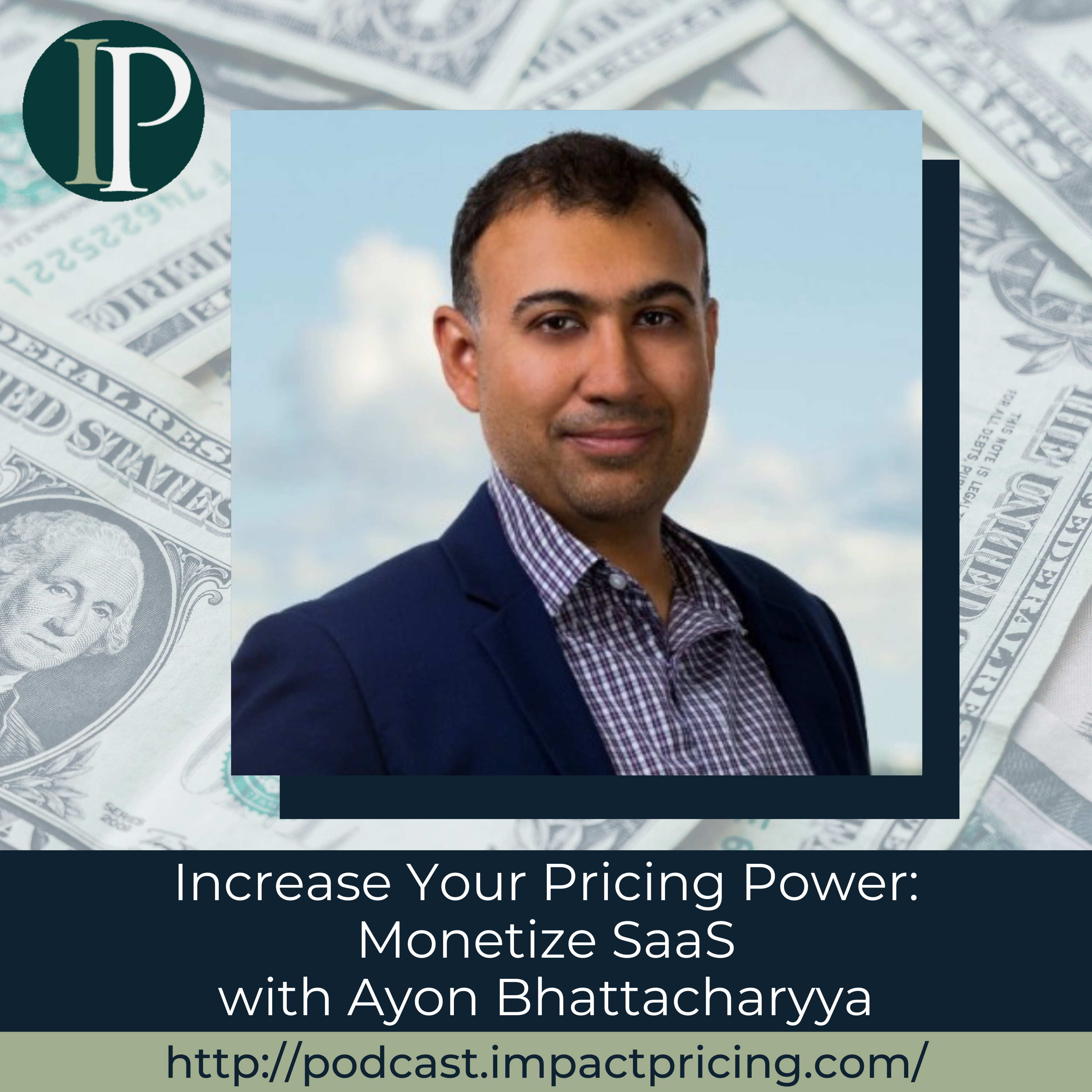
Increase Your Pricing Power: Monetize SaaS with Ayon Bhattacharyya
Ayon Bhattacharyya is the Founder of Biz Growth Spurt, a consulting firm based out of New Zealand. He has experienced pricing in half a dozen companies, and he's a passionate animal welfare advocate. In this episode, Ayon talks about the ins and outs of monetization. He also tells us a bit about his company, Biz Growth Spurt, and why you might be in need of their services. Why you have to check out today's podcast: Learn about the three pillars of monetization and why you can't only focus on one of them Know the difference between price metric and value metric and why it matters in getting more sales Understand why articulating value is essential in keeping and growing your customers "Understand your customers intimately and take the time to quantify your buyer personas so that you understand the use case of the value proposition, the willingness to pay the lifetime value, and the customer acquisition costs; so that you can better position and package to them and ultimately capture a fair portion of the value delivered to them." – Ayon Bhattacharyya Topics Covered: 01:33 – How Ayon got into pricing 03:15 – How Ayon defines "monetization" 04:24 – What packaging means to Ayon, in relation to monetization 05:26 – What Ayon means by "feature differentiation" 06:30 – Why Ayon hates freemium 08:04 – Free trials vs. Freemium: why it is important which of the two fits your business more 11:07 – How to decide which features go to which packages 14:02 – Price metric vs Value metric 19:59 – Why positioning is an essential part of monetization 23:22 – Ayon's key to monetization: the combination of packaging, pricing, and positioning 25:25 – Biz Growth Spurt: What they do and who their ideal customers are 28:50 – The meaning of "monetization" according to Ayon vs the meaning of "monetization" according to ProfitWell 31:54 – Ayon's pricing advice 32:49 – Connect with Ayon Bhattacharyya Key Takeaways: "Once you have a deep understanding of your buyer personas, how they value your product, how they use your product, how your proposition aligns with their growth journey, then you can actually start putting your features into bundles. But you want to do that based on the level of importance of those features." – Ayon Bhattacharyya "How you present the packages and the value messaging that you put on your website is so important. If they [the customers] understand that they're getting five times more value from the gold versus the silver, in their mind, it helps them to quantify that relative benefit of the upgrade and the potential ROI of an upgrade." – Ayon Bhattacharyya "If the perceived value isn't there, if you aren't communicating it, if you don't have a strong brand presence, if your solution is so complex that customers don't understand the value that they get from it, then you know, you've just wasted all of this money on product development and marketing. – Ayon Bhattacharyya "Ideally, you want the messaging that you have on your packages is around the problem that you're solving for the customer. That's the key. It's not about the features. Those are just more internal to you. And often the customers don't get them." – Ayon Bhattacharyya People / Resources Mentioned: Biz Growth Spurt: https://bizgrowthspurt.com/ Selling Value: How to Win More Deals at Higher Prices: https://www.amazon.com/Selling-Value-Deals-Higher-Prices/dp/1737655217 Connect with Ayon Bhattacharyya: LinkedIn: https://www.linkedin.com/in/valueconquer/ Email: [email protected] Connect with Mark Stiving: LinkedIn: https://www.linkedin.com/in/stiving/ Email: mailto:[email protected]

Blogcast: A Price Negotiation Example
This is an Impact Pricing Blog published on December 14, 2022, turned into an audio podcast so you can listen on the go. Read Full Article Here: https://impactpricing.com/blog/a-price-negotiation-example/ If you have any feedback, definitely send it. You can reach us at [email protected]. Now, go make an impact. Connect with Mark Stiving: Email: [email protected] LinkedIn: https://www.linkedin.com/in/stiving/

Pricing Table Topics: 10 of Diamonds – Reveal the Price Only After the Value Is Communicated
This is the 10 of Diamonds from the Selling Value card deck. You should reveal the price only after the value is communicated. What happens is, when our buyers hear the price, at that moment, they're making a decision. Is the price too high or too low? Is it worth it? What decision am I going to make? Am I going to spend more time with this? Now, what typically happens is, imagine you're going to buy a pair of Levi's at the retail store, and you walk into the store and you see the price is $60. Well, no one communicated the value to you, but you probably already had a pretty good feeling for what the value of Levi's really is to you. And so, you know if that price is high or low, and if it's worth it to you. But now, imagine you're a B2B salesperson and you walk in the door and you say, 'Our product is a hundred thousand dollars.' And the buyer instantly says, 'Don't have the budget. That's too expensive. Not going to buy it.' And they don't pay attention anymore. You are done working with that buyer. But if instead, we spent the time to say, 'What problems are you truly trying to solve? What's the value to the company if we can solve those problems?' And you find out that the value to the company is truly a million or 10 million dollars. Then when you say the number a hundred thousand, they say, 'Oh, that's probably worth it. Let's see if we can figure out how to do that.' It completely changes the perception in the buyer's mind. So, what we have to do is make sure our buyers have a good understanding of what the value of our solution truly is before we tell them the price. We hope you enjoy this example of Pricing Table Topics. What you just heard was done without a script. If you want to get better at speaking about pricing and value, grab a deck of our cards, pick a card, read the saying, then talk for one to two minutes about what the card says. You will become a better speaker and expert. If you have any questions or feedback, please email me, [email protected]. Now, go make an impact. Connect with Mark Stiving: Email: [email protected] LinkedIn: https://www.linkedin.com/in/stiving/
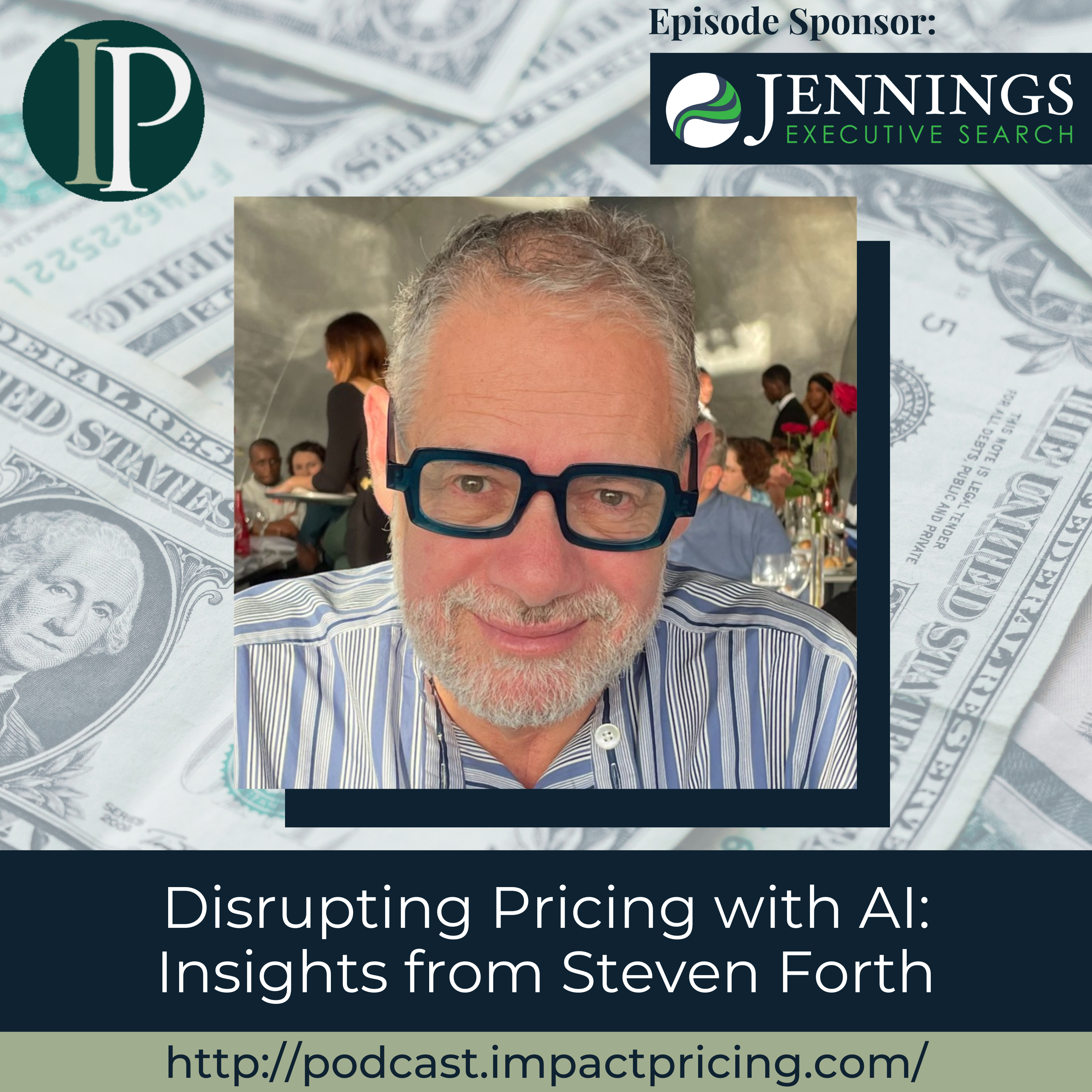
Disrupting Pricing with AI: Insights from Steven Forth
Steven Forth is a Partner in Ibbaka, a strategic pricing advisory firm. He was CEO of LeveragePoint Innovations Inc., a SaaS business designed to help companies create and capture value. Steven is what I consider one of the great pricing thinkers in our industry. In this episode, Steven talks about AI and how it is impacting the world of pricing. He also shares some of the improvements we could expect from AI infrastructures in the near future. Why you have to check out today's podcast: Find out how the emergence of AI improves and disrupts the pricing profession and the trade as a whole Learn how to extract the best and most comprehensive solutions from AI tools Get an idea on how the "big 3" of cloud services might price for their AI services in considering their current pricing models "Many billions of dollars being invested in AI last year, next year, this year. The overall investment is going to be probably in the neighborhood of $300 billion in 2023. So, if we were investing that much money, we better get some value back. And the companies investing that money need to be able to price that value they're creating." – Steven Forth Topics Covered: 02:10 – The questions that need to be answered about the impacts of AI in pricing 04:06 – Examples of existing value proposition that AI is improving 07:10 – Examples of existing value proposition that AI is disrupting 10:44 – Is the emergence of AI a challenge to the pricing profession? 12:08 – Can open AI soon generate value models that are better than experts create? 15:58 – Why and how large language models such as Chat GPT are taking over 18:06 – How to guide an AI in giving you comprehensive answers 19:34 – What the pricing of major AI infrastructures looks like 21:02 – How Amazon, Google and Microsoft would possibly price for AI considering their present pricing models 23:28 – Will there be different strengths in the AI of infrastructures Amazon, Google and Microsoft? 24:55 – Differences in AIs: Would different Ais give out different answers to the same questions? 26:19 – Could AI effectively learn pricing from human pricing experts? 28:02 – How Ais could start making outcome-based pricing more practical 32:03 – Connect with Steven Forth Key Takeaways: "People who are skilled in the art [of trade] understand how to come up with pricing for disruptive innovation." – Steven Forth "Understanding the limitations of these large language models, which GPT is an example of, is also important. And we can come to that. But let's not forget that the limitations today are not the limitations in six months." – Steven Forth "That, I think, is actually one of the emerging skills: To be able to structure a sequence of questions that will guide an AI in giving you meaningful answers." – Steven Forth People / Resources Mentioned: Ibbaka – https://www.ibbaka.com/ DALL·E 2 – https://openai.com/dall-e-2/ Chat GPT – https://openai.com/blog/chatgpt/ Amazon Web Services – https://aws.amazon.com/ Google Cloud Services – https://cloud.google.com/ Microsoft Azure – https://azure.microsoft.com/en-us NVIDIA – https://www.nvidia.com/en-us/deep-learning-ai/products/solutions/ Connect with Steven Forth: LinkedIn: https://www.linkedin.com/in/stevenforth/ Email: [email protected] Connect with Mark Stiving: LinkedIn: https://www.linkedin.com/in/stiving/ Email: mailto:[email protected]

Blogcast: Black Friday and Price Elasticity
This is an Impact Pricing Blog published on December 7, 2022, turned into an audio podcast so you can listen on the go. Read Full Article Here: https://impactpricing.com/blog/black-friday-and-price-elasticity/ If you have any feedback, definitely send it. You can reach us at [email protected]. Now, go make an impact. Connect with Mark Stiving: Email: [email protected] LinkedIn: https://www.linkedin.com/in/stiving/

Pricing Table Topics: 10 of Clubs – What Value Conversation Demonstrates
This one is the 10 of Clubs from the Selling Value card deck. Yes, a value conversation is a great way to build a relationship with your customers, with your buyers. Face it, your buyer probably hasn't put together a business case for what it is they're trying to buy. And yet, it makes a lot of sense for them to have one. It gives them more confidence, they're making the right decision. It gives them the ability to sell up in the organization in case they have to convince someone else to give them the resources. It provides the justification inside the company that they're doing a good thing for the company. And so, they really want to create a business case. But they probably haven't done it because they didn't think about it. They don't really know how. If you can help your buyer write that business case, and that's exactly what selling value means, then you are truly helping the buyer. You're adding a lot of value to that buyer's decision process, to their career, to their prestige inside the organization. Having a value conversation not only helps you understand how much value there is in that situation, but it helps you build the stronger relationship with your buyers. So, have value conversations. They truly demonstrate that you care about your buyer. We hope you enjoy this example of Pricing Table Topics. If you want to get better at speaking, especially about pricing and value, grab a deck of our cards. Pull a random card and read the saying. Then talk for one to two minutes about what that card says. If you have any questions or feedback, please email me, [email protected]. Now, go make an impact. Connect with Mark Stiving: Email: [email protected] LinkedIn: https://www.linkedin.com/in/stiving/

Pricing for Success: The Seven-Step Plan for Winning More Customers at Better Prices with Mark Peacock
Mark Peacock has been a pricing consultant since 2017. Currently, he is the managing director of Price Maker, a company that helps their businesses differentiate themselves from the competition by means of having a smarter pricing. He is also about to release his new book titled "Pricing for Success: The Seven-Step Plan for Winning More Customers at Better Prices" In this episode, Mark talks about what's written in his newest book, "Pricing for Success: The Seven-Step Plan for Winning More Customers at Better Prices". He shares the fundamental ideas behind the seven steps and gives insightful sample situations in which the seven steps can be applied. Why you have to check out today's podcast: Get a general idea of what's in Mark's new book, Pricing for Success: The Seven-Step Plan for Winning More Customers at Better Prices Learn why it's okay to have multiple pricing models on a single product Find out why it is the best time for you to raise your prices "Take the time to do your pricing strategy properly, and put your prices up because it is the most powerful lever you can use to increase profitable growth." – Mark Peacock Topics Covered: 01:27 – How Mark got into pricing 02:35 – The reason why Mark wrote his book, "Pricing for Success: The Seven-Step Plan for Winning More Customers at Better Prices" 03:42 – Step 1: Where do you want to go? 06:43 – Step 2: Know what your customers think about you 08:02 – Step 3: Being aware of your competition 11:02 – Step 4: Product 13:13 – Step 5: Pricing 15:45 – Mark Peacock's thoughts on having more than one pricing model for a product 17:17 – Step 6: Proposition 19:21 – Mark Peacock's favorite behavioral economics example 22:47 – Step 7: Profit 24:53 – How Mark would address the issue of credit grabbing among departments in cases of sales improvement 28:59 – Mark's pricing advice 30:09 – Connect with Mark Peacock Key Takeaways: "Pricing, ultimately, is always a subset of business strategy, of your company goals. So, you've got to be clear. You got to know where you want to get to. Otherwise, you'll end up floundering with your pricing." – Mark Peacock "Product and price are two sides of the same coin. When I buy products for a price, I want to know what I get as a customer and equally as a seller, you need to know everything that's included in your product offering." – Mark Peacock "Without changing the pricing, you can achieve an effective increase in prices of 4% by changing how you present the prices. And I think this whole question of how we present pricing is just as important as 'What's the number? What's the strategy?' Because it makes such a difference." – Mark Peacock "Having a clearly written pricing policy is such an important thing. And I literally say in my book, 'Write it down'. And it doesn't have to be long, it doesn't have to be complicated." – Mark Peacock People / Resources Mentioned: Pricing for Success: The Seven-Step Plan for Winning More Customers at Better Prices – https://www.barnesandnoble.com/w/pricing-for-success-mark-peacock/1142840523 Selling Value: How to Win More Deals at Higher Prices – https://www.amazon.com/Selling-Value-Deals-Higher-Prices/dp/1737655217 Connect with Mark Peacock: LinkedIn: https://www.linkedin.com/in/mark-peacock-the-pricing-coach/ Email: [email protected] Connect with Mark Stiving: LinkedIn: https://www.linkedin.com/in/stiving/ Email: mailto:[email protected]

Blogcast: Thoughts on Black Friday Pricing
This is an Impact Pricing Blog published on November 30, 2022, turned into an audio podcast so you can listen on the go. Read Full Article Here: https://impactpricing.com/blog/thoughts-on-black-friday-pricing/ If you have any feedback, definitely send it. You can reach us at [email protected]. Now, go make an impact. Connect with Mark Stiving: Email: [email protected] LinkedIn: https://www.linkedin.com/in/stiving/