
Impact Pricing
553 episodes — Page 6 of 12

Navigating Retail Pricing: Walmart's Pricing Strategy Explored with Rishi Bhatia
Rishi Bhatia is an experienced analytics consultant, data expert and market research professional with domain expertise in retail, technology, telecom, apparel, manufacturing, and insurance domain. In this episode, Rishi shares about Walmart's lower pricing strategy. He emphasizes the importance of prioritizing the customer when determining pricing strategies. He also highlights the significance of leveraging data and analytics to inform pricing decisions. And also the importance of adopting AI-driven models to streamline operations and remain competitive in the market. Why you have to check out today's podcast: Learn how Walmart maximizes profitability while maintaining its everyday low prices Discover how AI revolutionizes the retail industry by enabling retailers to make informed pricing decisions, rather than just providing pricing insights Explore the impact of retail pricing on customer loyalty and retention "Put your customer first. Rather than going for the traditional route, learn from the data as much as you can. And then, improve your models constantly based on how can you get the prices right." - Rishi Bhatia Topics Covered: 01:01 - How he found himself in pricing 02:46 - Why everyday low price policy for Walmart and how do they maximize revenue with this strategy 03:46 - Pricing and how it affects loyalty and retention 05:18 - What makes Walmart's margins high other than lower prices 06:48 - How AI in pricing optimization has evolved from basic insights generation to sophisticated model-driven recommendations 08:41 - Is AI a blackbox and how the process works in achieving pricing decision 11:31 - Walmart's primary focus regarding pricing decisions and how AI ensures timely transitions between product cycles and maintaining profitability 13:47 - How algorithms and recommendations ensures consistency and optimization across the retail chain 14:44 - Discussion around Wendy's dynamic pricing 19:49 - Rishi's response to Mark's advice for retailers and also talking about Walmart Plus 21:15 - Rishi's best pricing advice 23:12 - How do you measure value in retail products Key Takeaways: "Value pricing, what does your customer want, at what price your customer will be more loyal to you and what will they... because pricing is one component that everyone wants low price." - Rishi Bhatia "When you're putting the product, rather than going for the traditional route, learn from the data as much as you can and improve your models constantly based on that, how can you get the prices right." - Rishi Bhatia "If you're able to improve on that and the customer, your overall complaints are also going down. And that is one value you can measure from that perspective as well. It's not always in the monetary term, it's always on the customer satisfaction side as well." - Rishi Bhatia People/ Resources Mentioned: Walmart: https://www.walmart.com Uber: https://www.uber.com Connect with Rishi Bhatia: LinkedIn: https://www.linkedin.com/in/rishi-bhatia-5480577/ Connect with Mark Stiving: LinkedIn: https://www.linkedin.com/in/stiving/ Email: [email protected]

Blogcast: To Fee or Not To Fee? That is the Question
This is an Impact Pricing Blog published on March 7, 2024, turned into an audio podcast so you can listen on the go. Read Full Article Here: https://impactpricing.com/blog/to-fee-or-not-to-fee-that-is-the-question/ If you have any feedback, definitely send it. You can reach us at [email protected]. Now, go make an impact. Connect with Mark Stiving: Email: [email protected] LinkedIn: https://www.linkedin.com/in/stiving/
Segmentation Strategies Uncovered: Driving Revenue through Focus and Value with Stephan Liozu
Stephan Liozu has studied, researched, and practiced value-based pricing for over 15 years now. That includes training, speaking, consulting, managing pilot projects, and coaching large scale pricing transformations. In this episode, Stephan highlighted the utmost importance of understanding the value delivered to customers before setting prices, emphasizing a value-first approach to pricing strategies. Why you have to check out today's podcast: Learn the significance of focusing on a specific market segment to avoid distractions, streamline operations and increase chances of success Find out why you don't need to excessively customize your products Discover why prioritizing value over price can develop to more effective pricing strategies and maximize profitability "Do the value work first and then worry about pricing. So, value-based pricing is 90% value, 10% price. So, if you want to do that very well, value first, then price." - Stephan Liozu Topics Covered: 02:25 - How Stephan started in pricing 04:13 - Customer segmentation as it relates to value pricing 05:25 - Effective ways of maximizing segmentation 07:17 - Defining customer segmentation and how the SaaS scenario Mark described relate to that 10:16 - Integrating value pricing into customer segmentation 13:03 - What value means to the price buyer 14:11 - How is market segmentation different from customer segmentation? 16:52 - Discussing about product segmentation and taking software for an example 21:28 - The challenge of operationalizing customer segmentation 24:57 - Why focus on one market segment 26:41 - The need to not excessively customize your product 27:42 - Stephan's best pricing advice Key Takeaways: "Pick one market, focus on it, find your ICP, and then get a few logos; see what happens." - Stephan Liozu "Do the value work first and then worry about pricing." - Stephan Liozu "If you want to do that [value-based pricing] very well, value first, then price." - Stephan Liozu People/Resources Mentioned: Owens Corning: https://investor.owenscorning.com/ Thales: https://www.thalesgroup.com/en Connect with Stephan Liozu: LinkedIn: https://www.linkedin.com/in/stephanliozu/ Connect with Mark Stiving: LinkedIn: https://www.linkedin.com/in/stiving/ Email: [email protected]

Blogcast: Your Inward Focus Causes Horrible Decisions
This is an Impact Pricing Blog published on February 29, 2024, turned into an audio podcast so you can listen on the go. Read Full Article Here: https://impactpricing.com/blog/your-inward-focus-causes-horrible-decisions/ If you have any feedback, definitely send it. You can reach us at [email protected]. Now, go make an impact. Connect with Mark Stiving: Email: [email protected] LinkedIn: https://www.linkedin.com/in/stiving/

Price Justification Techniques: Building Confidence in Sales with Mike Bosworth
Mike Bosworth is a Co-Founder of WeConcile considered as the world's first Relationship Rescue and Restoration application. In this episode, Mike shares effective pricing strategies and sales techniques to hold prices. Why you have to check out today's podcast: Learn about the concept of "buying vision" and help your customers recognize the value of your product or service Learn how to stand firm against pricing pressure and maintain your desired price Discover how to effectively use "polite No's" to firmly establish pricing boundaries "Understand the value, i.e. how your buyer would use a particular piece of your product to solve their problem. And if you have that knowledge, it's really easy to defend the value of your price." - Mike Bosworth Topics Covered: 02:13 - Mike's pricing approach 03:16 - Understanding why salespeople are losing the conversation when it comes to price 06:40 - What is a 'buying vision' and how helpful it is for buyers 07:26 - The need for salespeople to know well their customer's business 10:20 - How 'premature elaboration' gets you at a disadvantage 13:58 - Explaining 'cost justify' and 'price justify' from the buyers point of view 20:49 - The importance of patience in negotiation and use of "polite No's" to stand your ground on pricing 24:36 - Book resource of major negotiation stories you can check out 25:42 - Mike's pricing advice Key Takeaways: "The only salespeople who can go out and negotiate their own prices are those ahead of quota." - Mike Bosworth "I say to the managers, if your salesperson is under quotas, you have to go out there and provide the backbone and coach the call ahead of time." - Mike Bosworth "We want to teach them how to survive that call, but on their own, they're not going to have the ability to do it." - Mike Bosworth People/Resources Mentioned: Xerox: https://www.xerox.com/en-us Sales Force: https://www.salesforce.com David Crabtree: https://www.barnesandnoble.com/w/hold-out-david-n-crabtree/1119321227 Connect with Mike Bosworth: Linkedin:https://www.linkedin.com/in/mikebosworth/ Connect with Mark Stiving: LinkedIn: https://www.linkedin.com/in/stiving/ Email: [email protected]

Blogcast: Fear Stymies Your Growth
This is an Impact Pricing Blog published on February 22, 2024, turned into an audio podcast so you can listen on the go. Read Full Article Here: https://impactpricing.com/blog/fear-stymies-your-growth/ If you have any feedback, definitely send it. You can reach us at [email protected]. Now, go make an impact. Connect with Mark Stiving: Email: [email protected] LinkedIn: https://www.linkedin.com/in/stiving/

Decoding the Emotion and Solution-Driven Sales Approach with Joe Woodard
Joe Woodard's vision is to "transform small businesses through small business advisors." And in the service of that vision he and his team educate, coach, provide resources and build communities for small business advisors, with the overarching goal of empowering them to play a powerful, high-impact advisory role with their clients. In this episode Joe shares strategies for Infusing feelings and solutions into your pricing models that drive people's buying decisions. Why you have to check out today's podcast: Find out effective strategies for your sales approach Discover effective hiring strategies to find the perfect team and talent that align with your needs Understand two foundational pillars of value to be effective in selling your product or service "Infuse everything we've talked about [sales approach] with feelings and solutions into something the client can consume, easily understand, comprehend, and buy easily." - Joe Woodard Topics Covered: 02:51 - From a Quickbooks advisor to hiring and teaching coaches how to coach businesses 05:40 - How this great quote from John Maxwell became a huge inspiration for his upcoming conference 07:28 - Understanding the two foundational pillars of value 09:31 - Methodologies used to maximize product's value proposition 12:06 - Gaining a competitive by catering to both emotional and solution-oriented needs 13:48 - Incorporating emotional intelligence into your sales approach 18:44 - How mimicking good behaviors is effective in selling 19:33 - Understanding the DISC method for hiring people 24:26 - Delegating outcomes, holding individuals accountable using methodologies like OKRs (Objectives and Key Results) 25:58 - Infusing pricing strategies with a combination of emotional resonance 28:47 - Interplay between emotions and problem-solving in both B2B and B2C contexts 30:06 - Joe's best pricing advice 31:51 - What this conference, 'Boldly Go!' is about Key Takeaways: "If you're waiting for all risk to go away, you're waiting for all fear to go away, you'll never act. And if you're waiting for perfection, you'll never act. So don't wait on those things. Enter the danger, proceed afraid, fail forward, and then read a lot. That's how I did it." - Joe Woodard "People will only exchange their hard earned dollars for one of two things, how you make me feel, or how you solve my problem." - Joe Woodard "It's not about price, it's about nature." - Joe Woodard People/Resources Mentioned: John Maxwell: https://www.maxwellleadership.com Michio Kaku: https://en.wikipedia.org/wiki/Michio_Kaku Neil deGrasse Tyson: https://neildegrassetyson.com Malcolm Gladwell: https://www.gladwellbooks.com/ Outliers: https://www.amazon.com/Outliers-Story-Success-Malcolm-Gladwell/dp/0316017930 Positive Intelligence: https://www.amazon.com/s?k=positive+intelligence&language Measure What Matters: How Google, Bono, and the Gates Foundation Rock the World with OKRs by John Doerr :https://www.amazon.com/Measure-What-Matters-Google-Foundation/dp/0525536221 Axe: https://www.axe.com/us/en/home.html Red Bull: https://www.redbull.com/ph-en/ Connect with Joe Woodard: Website: https://www.woodard.com/ LinkedIn: https://www.linkedin.com/in/quickbooksadvisor/ Connect with Mark Stiving: Email: [email protected] LinkedIn: https://www.linkedin.com/in/stiving/

Blogcast: Stopping One of Your Biggest Revenue Leaks: Discounts
This is an Impact Pricing Blog published on February 15, 2024, turned into an audio podcast so you can listen on the go. Read Full Article Here: https://impactpricing.com/blog/stopping-one-of-your-biggest-revenue-leaks-discounts/ If you have any feedback, definitely send it. You can reach us at [email protected]. Now, go make an impact. Connect with Mark Stiving: Email: [email protected] LinkedIn: https://www.linkedin.com/in/stiving/
The Collaborative Approach to Value Selling with Steve Laborda
Steve Laborda is a CEO of Valuebizbooster, Consultant, Coach, Author and Speaker. He is a practitioner in B2B sales and marketing, focusing on improving profitability, how to capture value, and developing the competencies of the commercial people through customer orientation and commercial excellence. In this episode, Steve delves into the intricate blend of art and science involved in the sales process. He emphasizes the importance of incorporating intangibles alongside hard facts, highlighting that both are essential for success and reaching a deal. Furthermore, he underscores the collaborative efforts of individuals within the company, working cohesively as a team to uphold a value-based approach throughout the entire sales process. Why you have to check out today's podcast: Find out the three essential components to value selling in which without each one no decision is reached Discover how value-based selling works in the whole sales process within the company Uncover the effective use of the ROI calculator as a value driver "Don't forget to work with sales when you do your pricing." - Steve Laborda Topics Covered: 01:00 - How he got into pricing 01:30 - The many roles he played 02:41 - Pointing out the 'art' in value, pricing, and selling 04:16 - The intangible benefit other than the emotional, and cognitive aspect of value selling 06:24 - How was his experience different from any other salesperson who's good at building relationships 9:47 - Examples illustrating the three components of the sales process of relationship building, the science part, and the intangibles 11:38 Defining cross-functional value selling 15:04 - Why companies often fail at value-based pricing 17:55 - Calling it a value calculator and not the ROI calculator 20:10 - Why a collaborative way of using the value calculator instead of leaving it to the customer alone 23:36 - Reasons customers likely buy from you 25:35 - Pricing a highly volatile product in the chemical industry 29:23 - Steve's best pricing advice Key Takeaways: "Yes, you need to do value quantifications, but you need to be able also to be emotional and to read body language and to read the skills that people have in front of you." - Steve Laborda "You need to have sales, marketing, pricing, the technical people, if it's a technical context, to have all those people together to develop that value-based approach so that everybody is behind it..." - Steve Laborda "The value calculator is there for me to give confidence to the salesperson about the price that you can defend to the customer." - Steve Laborda Connect with Steve Laborda: LinkedIn:https://www.linkedin.com/in/stevelaborda/ Connect with Mark Stiving: LinkedIn: https://www.linkedin.com/in/stiving/ Email: [email protected]

Blogcast: Proven Value
This is an Impact Pricing Blog published on February 8, 2024, turned into an audio podcast so you can listen on the go. Read Full Article Here: https://impactpricing.com/blog/proven-value-can-be-a-game-changer/ If you have any feedback, definitely send it. You can reach us at [email protected]. Now, go make an impact. Connect with Mark Stiving: Email: [email protected] LinkedIn: https://www.linkedin.com/in/stiving/

Pricing Table Topics: 8 of Clubs – Ban the Word 'Markup'
This one is the 8 of Clubs from the Impact Pricing card deck. Ban the word markup. First, can we all agree that cost-plus pricing is not optimal? We really want to do value-based pricing, charge what a customer is willing to pay. Got it, so we're all in agreement. Now, let's talk about the word markup. Markup is defined as, tell me what my costs are, how much do I need to mark that up in order to get the margins that I want? So a markup is by definition cost-plus. Well, it's cost-times, but it's cost-plus. So when we use the word markup, as a company, we're saying we use cost-plus pricing. Now, it is okay, let's say you're running a distribution organization. You're running a grocery store. You've got hundreds of thousands of products to price. You can't do specific value-based pricing on each one of those products. And so, you have to do something. But don't do just cost-plus. When you say we use a 50 point markup or a 20 point markup, we're implying that goes across the board. What we should be saying is, how much margin do we think we can get from this product category? Because margin starts at, what's the price? And then, how much did we have to pay to acquire the product that we sold? So margin is a great term to use when we're thinking about value-based pricing. Markup almost forces us to use cost-plus pricing. So my advice, stop using that word. Don't let anybody else use that word. Switch your mental thought process to margin, not markup. We hope you enjoyed this example of Pricing Table Topics. What you just heard was done without a script. If you have any questions or feedback, please email me, [email protected]. Now, go make an impact. Connect with Mark Stiving: Email: [email protected] LinkedIn: https://www.linkedin.com/in/stiving/

Strategic Pricing for Accountants to Earn More But Work Less with Geraldine Carter
Geraldine Carter helps single-owner CPAs go down to 40 hours without giving up revenue. In this episode, Geraldine reveals effective strategies for tailoring your accounting service business to suit your lifestyle, enabling you to increase revenue without feeling overwhelmed by excessive work. Why you have to check out today's podcast: Discover how accountants can increase their earnings while reducing their workload Learn to craft your message to highlight the value you offer, rather than focusing solely on the cost of your services Uncover the transformation within the services you offer "Your clients have an expectation to pay and if your prices are too low, they might not buy from you." - Geraldine Carter Topics Covered: 01:56 - Working less but earning more 03:41 - Flexibility, autonomy and working less hours 05:38 - Mindset shift to less hours work 08:48 - Pricing strategies so accountants work less and increase income 11:10 - How message is structured to a CPA's client in terms of raising his price 14:44 - The idea of selling services but delivering transformations 16:42 - Understanding the services accountants perform and how they earn recurring income 17:20 - What transformation does accountants deliver to companies 22:36 - The beauty of having people see the value in your own business Key Takeaways: "The revenue that you create in your business has nothing to do with the time that you put in. I mean, you have to grind out the beginning to get it all set up and going. But you can get to the place where you do not have to work 40 or 25 or 15 hours a week. You just have to stay at it until you figure out how to get your hours down." - Geraldine Carter "Thinking that revenue comes from work for clients is like thinking that time comes from your watch, it's not how that works." - Geraldine Carter "Your buyer decides what price they want to pay. So, we do tiered pricing, we offer it to the clients." - Geraldine Carter "Most accountants are selling services, but they're creating and delivering transformations." - Geraldine Carter "For business owners listening, do not underestimate the power of pricing wisely." - Geraldine Carter Connect with Geraldine Carter: Website: https://geraldinecarter.com/ LinkedIn: https://www.linkedin.com/in/geraldine-carter/ Connect with Mark Stiving: LinkedIn: https://www.linkedin.com/in/stiving/ Email: [email protected]

Blogcast: To Discount or Not to Discount
This is an Impact Pricing Blog published on February 1, 2024, turned into an audio podcast so you can listen on the go. Read Full Article Here: https://impactpricing.com/blog/to-discount-or-not-to-discount/ If you have any feedback, definitely send it. You can reach us at [email protected]. Now, go make an impact. Connect with Mark Stiving: Email: [email protected] LinkedIn: https://www.linkedin.com/in/stiving/
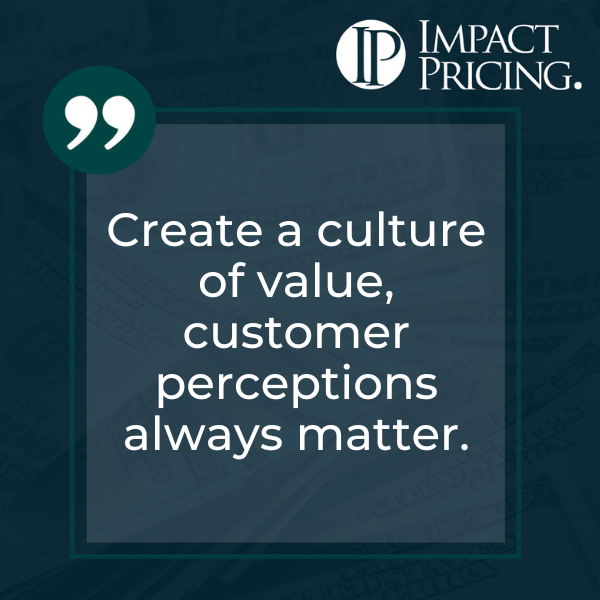
Pricing Table Topics: 8 of Diamonds – Customer Perceptions Always Matter
This one is the 8 of Diamonds from the Impact Pricing card deck. Customer perceptions always matter. And what's fascinating is every time we touch a customer, we touch a buyer, they form perceptions of our company. They could be positive perceptions. They could be negative perceptions. And when I say every time, it's not only salespeople making sales calls. It's when they read our marketing messages. It's when they receive our invoices. It's when they call our customer support or customer service line. Every single touch point we have with a customer either creates value in their mind, or it destroys value in their mind. The question becomes, which are we going to do? My recommendation is obviously to create more value with every customer touch point. But how do we do that? We do that by creating a culture of value Inside our company. A customer centric perspective that says, how is it that this decision, how is it that this action, impacts our customers? And can I do it in a way that impacts our customers in a more positive manner instead of just thinking about how do I get them off the phone? Or how do I take care of them quickly so that they go away and stop bothering me while I do my day job? So value, a culture of value, is all about doing what's best for our customers and making sure every customer touchpoint increases value, not decreases it. We hope you enjoyed this example of Pricing Table Topics. What you just heard was done without a script. If you have any questions or feedback, please email me, [email protected]. Now, go make an impact. Connect with Mark Stiving: Email: [email protected] LinkedIn: https://www.linkedin.com/in/stiving/

Balancing Curiosity, Specialization, and Success as a Pricing Professional with Robert Ribciuc
Robert Ribciuc is the Managing Partner at EBITDA Catalyst. He helped establish, grew, and managed a successful advisory/consulting firm focusing on pricing strategy and analytics, go-to-market optimization, and revenue management for middle-market corporate and private equity portfolio (PE) clients in diverse industry verticals. In this episode, Robert shares the key to succeeding as a pricing practitioner: nurturing curiosity. By continually seeking new experiences and knowledge, you'll not only advance in your current role but also pave the way for future promotions, ultimately leading to a successful career as a consultant. Why you have to check out today's podcast: Explore effective strategies for boosting personal and professional development as a pricing professional Discover the endless possibilities that come with nurturing your curiosity in the field of pricing Find out significant insights about specialization at the same time taking a broad approach in the pricing profession "Without curiosity, you wouldn't have tried and you wouldn't know how much room for improvement to have." - Robert Ribciuc Topics Covered: 01:51 - The breadth of the pricing field extending beyond one's job 03:57 - Specializing in a particular industry versus embracing a multifaceted approach to pricing 08:37 - The importance of constantly learning and adapting in pricing 12:02 - How pricing professionals can be better at what they do 14:40 - How curiosity gets your job done easily and gets you promoted 20:46 - The challenge of teaching for students in university versus teaching for companies 26:08 - Summarizing what the whole topic is about 28:18 - Robert's motivational message Key Takeaways: "Go read a book about a different industry, something that's not pricing. Also, get out of your chair and go walk to our product people, go walk to our marketing people and make some friends. Get them to tell you what their job is like and what they're thinking about." - Robert Ribciuc "Curiosity is kind of the opposite of, 'I can do it easy.'" - Robert Ribciuc "In many companies the curiosity gets subdued by, 'Oh, I find that if I just do this repeated cycle my boss is happy enough,' right? And that can be an illusion." - Robert Ribciuc People/ Resources Mentioned: Ronald Baker: https://impactpricing.com/podcast/497-classic-trash-the-timesheet-exploring-opportunities-in-subscription-businesses-with-ronald-j-baker/ Susan David: https://www.susandavid.com Vendavo: https://www.vendavo.com Pros: https://pros.com Zoom: https://zoom.us Honeywell: https://www.honeywell.com/us/en Connect with Robert Ribciuc: LinkedIn: https://www.linkedin.com/in/ribciuc/ Email: [email protected] Connect with Mark Stiving: LinkedIn: https://www.linkedin.com/in/stiving/ Email: [email protected]

Blogcast: Who Should Own Pricing?
This is an Impact Pricing Blog published on January 25, 2024, turned into an audio podcast so you can listen on the go. Read Full Article Here: https://impactpricing.com/blog/who-should-own-pricing/ If you have any feedback, definitely send it. You can reach us at [email protected]. Now, go make an impact. Connect with Mark Stiving: Email: [email protected] LinkedIn: https://www.linkedin.com/in/stiving/

Pricing Table Topics: 8 of Hearts – Business Acumen
This one is the 8 of Hearts from the Impact Pricing card deck. Business acumen is a skill that salespeople really need, and product people really should have, to say, "Why is it that a customer would want to buy our product?" In B2B, value is measured in incremental profit. Your customer isn't going to buy anything from you, assuming it's a business customer, unless you are making them more money. Here's the question, how are you making them more money? Somehow, when you can communicate that, when your sales team can communicate that, you have a much better chance at winning the business. And by the way, when you understand it, you have a much better chance at delivering great marketing messages, and building the right products. We really need the skill of business acumen so we can say what is the business of our customers and how is it that we make them more money, because that is where the value is. We hope you enjoyed this example of Pricing Table Topics. What you just heard was done without a script. If you have any questions or feedback, please email me, [email protected]. Now, go make an impact. Connect with Mark Stiving: Email: [email protected] LinkedIn: https://www.linkedin.com/in/stiving/

Navigating the Future of Pricing: Insights on AI and Value Dynamics with Steven Forth
Steven Forth is Ibbaka's Co-Founder, CEO, and Partner. Ibbaka is a strategic pricing advisory firm. He was CEO of LeveragePoint Innovations Inc., a SaaS business. In this episode Steven shares the shifting landscape for pricing professionals, emphasizing the rising importance of pricing strategists over analysts in leveraging AI for value-centric decision-making. Additionally, he highlights the possibilities beyond automation to include real-time recalibration of value models, enabling companies to better adapt to changing customer needs and market dynamics. Why you have to check out today's podcast: Discover the importance of custom packaging solutions designed to meet the unique needs of diverse users, adding significant value to their experience and allowing for optimized pricing strategies Find out how AI is impacting pricing strategies Understand the evolving role of pricing people: pricing analysts and pricing strategists "What pricing people should be doing today is learning how to have productive conversations with AI agents." - Steven Forth Topics Covered: 02:44 - Discussing about platform pricing and solution pricing in the context of AI 05:40 - The challenge that pricing platforms presents when it comes to quantifying value for all users 07:06 - Generative AI versus computational knowledge AI in the case of Wolfram Alpha 10:20 - Highlighting the value of packaging solutions tailored to specific needs which can be more valuable to users 12:06 - What goes in the pricing world with AI around 18:38 - Pricing strategists becoming increasingly important, need for better systems to facilitate meaningful conversations and decision-making 20:11 - Would it be possible for AI to make people inside the company understand what value is to customers 24:08 - Six types of value drivers according to Ed Arnold 27:03 - The challenge of building large amount of value models 30:20 - Steven's best advice to pricing people 31:12 - Building a value model through client interviews Key Takeaways: "Why don't people focus more on value? I think part of this is because many of us find it easier to look inside our own company than outside to our customers." - Steven Forth "In an uncertain world, having options and being able to generate options gives you a much more adaptive and resilient business." - Steven Forth "They [pricing people] need to be learning how to ask the AI questions. They need to be learning how to train the AI so that it can better answer those questions." - Steven Forth "They [pricing people] need to be understanding the strengths and weaknesses of the answers they're going to get. Because like it or not, you are going to be using an AI, you are using an AI, in your work today, even if you're not aware of it." - Steven Forth People/ Resources Mentioned: Wolfram Alpha: https://www.wolframalpha.com Stephen Wolfram: https://www.stephenwolfram.com Mathematica: https://www.wolfram.com/mathematica/ Pros: https://pros.com Zilliant: https://zilliant.com Ed Arnold: https://www.linkedin.com/pulse/how-quantify-value-service-ed-arnold/ McKinsey: https://www.mckinsey.com Microsoft Co-Pilot: https://copilot.microsoft.com Connect with Steven Forth: LinkedIn: https://www.linkedin.com/in/stevenforth/ Email: [email protected] Connect with Mark Stiving: LinkedIn: https://www.linkedin.com/in/stiving/ Email: [email protected]

Blogcast: Listen to Your Market, then Think
This is an Impact Pricing Blog published on January 18, 2024, turned into an audio podcast so you can listen on the go. Read Full Article Here: https://impactpricing.com/blog/listen-to-your-market-then-think/ If you have any feedback, definitely send it. You can reach us at [email protected]. Now, go make an impact. Connect with Mark Stiving: Email: [email protected] LinkedIn: https://www.linkedin.com/in/stiving/

Pricing Table Topics: 8 of Spades – Sell Like You Have No Competition
This one is the 8 of Spades from the Impact Pricing card deck. You've probably heard me use the words 'will I' and 'which one' in the past. 'Will I' are situations where our buyers are choosing to buy our product or not, but they're not choosing whether they buy our product or a competitor's product. When we can find ourselves in a 'will I' situation, we know that our customers are not price sensitive. So, the key here is to know the difference. Are they comparing us to competitors or not? My recommendation is assume they're not. Because if we assume they are, we start talking about who our competitors are and they say, "Oh, you have competitors, let me go look at them." Instead, we talk to them about the value of solving the problem and why our product is going to help them solve that problem and get a huge return. And we never even mentioned that a competitive alternative exists. When the customer says to us, "Oh, we're looking at X, Y, Z company." Then we know that we can shift to talking about how we're better than our competition. What are those features or capabilities that we do that our competition can't match? But up to that point, let's make the assumption there is no competition. In fact, my favorite way to find out the answer, is there competition, is to ask the following question, "If you don't buy this, what will you do?" Notice that that question implies there is no competition. It doesn't say that go look at the competition. So my recommendation, always assume there is no competition. Talk about the value of solving the problems, and then you can shift your sales technique after you realize competition is in the deal. We hope you enjoyed this example of Pricing Table Topics. What you just heard was done without a script. If you have any questions or feedback, please email me, [email protected]. Now, go make an impact. Connect with Mark Stiving: Email: [email protected] LinkedIn: https://www.linkedin.com/in/stiving/
Exploring Game-Changing Pricing Dynamics for Different Industries with Arnab Sinha
Arnab Sinha is a Managing Director and Senior Partner in the Philadelphia office of Boston Consulting Group (BCG) and the North American Lead for Pricing Topic, as well as Global Lead for Revenue Management. In this episode, Arnab shares what's behind writing the book 'Game Changer' and discusses how the pricing strategy frameworks discussed inside the book works for the different industries like software, consumer packaged goods, pharmaceuticals, among others. Why you have to check out today's podcast: Discover how to create value across diverse industries and implement innovative pricing strategies that can revolutionize your approach Uncover the innovative pricing strategies used by pharmaceutical companies to market their products Find out the crucial role of creating value to effect strategic pricing "Figure out how much value you want to share, and how you communicate that, because that's what drives long-term value creation." - Arnab Sinha Topics Covered: 01:14 - How he got into pricing and why he never regretted choosing it over mechanical engineering 03:48 - What's behind writing the book 'Game Changer' 06:21 - Pivotal role of value creation in pricing strategy as gleaned from the book 08:03 - How his pricing strategy framework be used in software companies 11:40 - Significance of understanding customer needs and tailoring offerings accordingly for both acquisition and retention, with competition in mind 14:25 - The strategic pricing approach for consumer packaged goods companies 17:34 - Understanding the 'uniform game' in the consumer packaged goods and how it is influenced by factors such as brand strength and price gap elasticity in relation to competitors 20:08 - From a static view of pricing strategy in the CPG towards a dynamic approach utilizing AI and machine learning to model the best pricing strategy 22:00 - Innovative pricing strategy in pharmaceuticals 26:42 - Pricing based on where value is created 29:22 - Arnab's best pricing advice 30:03 - Discussing on how much value should one keep Key Takeaways: "I think the competitor's price is a critical input. And this is where we weave it in through something like your brand strength and your brand equity." - Arnab Sinha "And this is where I think our belief is, it is not just about the one-time value of one transaction, but you need to think about the lifetime value of all of the consumers you will be serving." - Arnab Sinha "...at the intersection of the cost and competitive game, you need to understand if you are creating value and make a choice of how much value you want to share regardless of what game you're playing. Because in the absence of value creation, there is no transaction." - Arnab Sinha People/Resources Mentioned: Jean-Manuel Izaret: https://impactpricing.com/podcast/563-game-changing-pricing-strategies-for-long-term-success-with-jean-manuel-izaret/ Game Changer: How Strategic Pricing Shapes Businesses, Markets, and Society by Jean-Manuel Izaret and Arnab Sinha: https://www.amazon.com/Game-Changer-Strategic-Pricing-Business/dp/1394190581 SAP: https://www.sap.com Oracle: https://www.oracle.com/ph/ Quickbooks: https://quickbooks.intuit.com Microsoft: https://www.microsoft.com Coke: https://www.coca-cola.com/ph/en Pepsi: https://www.pepsi.com Walmart: https://www.walmart.com Kroger: https://www.kroger.com/ Publix: https://www.publix.com Target: https://www.target.com Pfizer: https://www.pfizer.com Connect with Arnab Sinha: LinkedIn: https://www.linkedin.com/in/arnab-sinha Connect with Mark Stiving: LinkedIn: https://www.linkedin.com/in/stiving/ Email: [email protected]

Game-Changing Pricing Strategies for Long-Term Success with Jean-Manuel Izaret
Jean-Manuel Izaret leads BCG's Marketing, Sales & Pricing practice globally. They partner with leading companies across industries to transform their commercial functions leveraging cutting edge digital and analytics capabilities to help them grow. In this episode, Jean-Manuel reveals the impact of your pricing models on maximizing your pricing strategy. Why you have to check out today's podcast: Explore the factors behind the fluctuating gasoline prices, where price rises easily when the market is up, and takes time lowering when the market is down Get an exclusive preview of the subjects discussed in the Game Changer book Discover what a 'choice game' is all about "Think about how to share the value with the market and with others, you'll bring long-term customers and loyalty, and you'll build a fantastic business for yourself." - Jean-Manuel Izaret Topics Covered: 01:36 - How he got into pricing 02:54 - Why gas price tends to go higher fast than it goes down 05:46 - Are gas price and other commodities coming back down 07:27 - What made him write the book and a sneak peak into the topics 12:29 - Important thoughts on value-based and cost pricing and identifying brands for illustration 20:29 - Relevance of elasticity in pricing 24:23 - His game of choice and why 26:45 - Industries that have huge advantage with value pricing 27:20 - Jean-Manuel's best pricing advice Key Takeaways: "It is helpful for anybody in any market to think about the value that they create for customers. And never thinking about it is usually a mistake." - Jean-Manuel Izaret "Everywhere you are, think about what people on the other side are doing, and is it relevant for you? How can you learn from that?" - Jean-Manuel Izaret "When people think about pricing, they tend to think about prices. They tend to think about the number. If you want to reframe the conversations about how you can gain more traction in the market, think about your pricing model." - Jean-Manuel Izaret People/Resources Mentioned: Game Changer: https://www.amazon.com/Game-Changer-Strategic-Pricing-Business/dp/1394190581 Shell: https://www.shell.comNetflix:https://www.netflix.com/ph-en/ Apple: https://www.apple.com Napster: https://www.napster.com/availability Sony: https://www.sony.com/en/ Connect with Jean-Manuel Izaret: LinkedIn: https://www.linkedin.com/in/izaret/ Email: [email protected] Connect with Mark Stiving: LinkedIn: https://www.linkedin.com/in/stiving/ Email: [email protected]

Pricing Table Topics: 9 of Clubs – Focus on Lifetime Value
This one is the 9 of Clubs from the Impact Pricing card deck. We often hear the word 'strategic' as in, "Hey, I'm making a decision today so that it grows my business someday in the future." Well, that's exactly what we want to do when we think about the lifetime value of a customer. I'm not so worried about, "Can I get the three year contract signed today?" Many companies do. But when you try to get the three year contract signed right away, you make it harder to win the customer. But what if you took a one year contract? Or what if you took a one month contract? Or even had a free trial period. And you let people get into your product, and you deliver so much value that they never leave. What we just did was get them into our ecosystem. And then over time we can get them to buy more from us, to stay with us. And that's because we know we're delivering a ton of value. This is what it means to focus on lifetime value. I'm okay taking a smaller number today because I know that over time this customer is going to grow with me and give me a whole lot more money that I'm trying to capture today. Whereas if we focus on the value of the three year contract, it's oftentimes hard to win that customer today. We hope you enjoyed this example of Pricing Table Topics. What you just heard was done without a script. If you have any questions or feedback, please email me, [email protected]. Now, go make an impact. Connect with Mark Stiving: Email: [email protected] LinkedIn: https://www.linkedin.com/in/stiving/

Pricing Table Topics: 9 of Diamonds – Subscription Is a Business Model
This one is the 9 of Diamonds from the Impact Pricing card deck. When we think about subscriptions, and I've talked to several companies who are trying to move from more of a transactional business to a subscription business, they think it's 'just pricing'. "Oh, we want to set our price this way." But it turns out it changes so much in your business, not just the way you set pricing. One of my favorite things about the subscription business model is that buyers pay us for a continuous stream of benefits, meaning we're delivering benefits month after month after month. The question in your business is, are you truly delivering benefits month after month after month? In which case, maybe you have a good business for starting a subscription business model. Then we want to think about, not only how are we delivering it, but then, how much value do they get each month? How do we start to capture that? And so, we can certainly price it, but we really need to structure our company around winning these customers. And then we have to figure out, how do we keep them? How do we minimize churn? And over time, we figure out how to grow these customers. How to get them to upgrade or buy more from us? So, subscription isn't as simple as, 'let's change the way we do pricing'. It really is an entire business model. We hope you enjoyed this example of Pricing Table Topics. What you just heard was done without a script. If you have any questions or feedback, please email me, [email protected]. Now, go make an impact. Connect with Mark Stiving: Email: [email protected] LinkedIn: https://www.linkedin.com/in/stiving/

Maximize Profitability and Value with these Revolutionary Pricing Models with Dan Zatta
Dan Zatta is a leading management advisor in topline growth. He specialized in profit improvement on the revenue side, with extensive experience in pricing. He is the author of the books 'The 10 Rules of Highly Effective Pricing' and 'The Pricing Model Revolution', translated into 10+ languages. In this episode, Dan shares how these pricing models he mentions in his book can greatly impact a company's growth and profitability when used in a comprehensive approach. Why you have to check out today's podcast: Explore the various pricing models that can significantly influence your bottom line Discover a pricing model that helps you identify an additional unique selling point, ultimately boosting profitability Learn why it's crucial to have a holistic perspective of the company's overall impact before embracing innovative revenue models "Make sure to be quick in increasing prices, ideally combine this with additional value to meet your profitability targets." - Dan Zatta Topics Covered: 01:13 - What finally got him into pricing after being a generalist 02:05 - A trick he does to gain sales peoples' support when increasing prices 02:32 - What inspired him to write his book 'The Pricing Model Revolution' 04:16 - Pricing as not an exact science 05:29 - An interesting fact about another reason for writing his book 'Revenue Management in Manufacturing' 07:34 - From an academic writing style to using language understood by non-pricing experts in writing his books 08:48 - What AI-based Pricing can do for your bottom line even when you are already an advanced organization 11:19 - Many more AI-based pricing opportunities available even with companies already using AI 12:34 - Explaining what Neuro Pricing is and the tool used for this 14:34 - Creating another source of competitive advantage in pricing with outcome-based pricing 17:18 - The need for comprehensive view into the company before adopting pricing models 19:31 - Defining Sympathetic Pricing 21:52 - Important thoughts on the idea of price fairness 25:21 - What is Psychological Pricing 27:28 - Dan's best pricing advice Key Takeaways: "Let's think about value also when we price and looking into outcomes could be one of those." - Dan Zatta "If you are not changing your processes the way you're approaching how salespeople are compensated, then you risk having an issue with the model that maybe is great, but it's not pushed internally. And the same can be the case with incentives for clients." - Dan Zatta "The impact of volatility of raw materials, there is still inflation in a number of countries. So rather than waiting, make sure that you're not losing time because the more time passes when costs are increasing, the more time you will need to recover profitability." - Dan Zatta People/Resources Mentioned: The Pricing Model Revolution by Danilo Zatta: https://www.amazon.de/dp/1119900573/ref=tsm_1_fb_lk Revenue Management in Manufacturing: State of the Art, Application and Profit Impact in the Process Industry by Danilo Zatta: https://www.amazon.com/Revenue-Management-Manufacturing-Application-Industry/dp/3319302396 Uber: https://www.uber.com Lyft: https://www.lyft.com Peter Drucker: https://en.wikipedia.org/wiki/Peter_Drucker Connect with Dan Zatta: LinkedIn: https://www.linkedin.com/in/danilo-zatta/ Connect with Mark Stiving: LinkedIn: https://www.linkedin.com/in/stiving/ Email: [email protected]

Blogcast: Brilliant Price Move by Amazon Prime
This is an Impact Pricing Blog published on January 11, 2024, turned into an audio podcast so you can listen on the go. Read Full Article Here: https://impactpricing.com/blog/brilliant-price-move-by-amazon-prime/ If you have any feedback, definitely send it. You can reach us at [email protected]. Now, go make an impact. Connect with Mark Stiving: Email: [email protected] LinkedIn: https://www.linkedin.com/in/stiving/

Pricing Table Topics: 9 of Hearts – Win, Keep, and Grow: Manage All Three
This one is the 9 of Hearts from the Impact Pricing card deck. I found it fascinating when I studied subscriptions coming from a more traditional or transactional type of business where people would buy something from you, and then you have to get them to buy again. In a subscription, people buy something from you and then they pay you month after month, or year after year. And in that business model, there are several things that are unique. But one of them is that you suddenly have to focus on how do we keep a customer? We always have to win customers, but how do we keep that customer? And we've heard the word churn, and we know the churn is bad, and companies focus on how do I minimize churn. And there's also a third revenue bucket and that's called grow. Once I have a customer who's paying me and getting value for my product, how do I get them to pay me more money next year than they paid me this year? And we can typically do that with things like raising prices, or getting them to upgrade, or using more of our product. There are several of these techniques. What's interesting though is that the tactics that we use inside our company to win customers is different than what we need to keep customers. And different again than what we need to grow customers. We suddenly have complicated our business model because we really and truly do need to manage all three of those revenue buckets separately. We hope you enjoyed this example of Pricing Table Topics. What you just heard was done without a script. If you have any questions or feedback, please email me, [email protected]. Now, go make an impact. Connect with Mark Stiving: Email: [email protected] LinkedIn: https://www.linkedin.com/in/stiving/

Building a High-Performing Pricing Team That Drives Growth with Jon Jennings
Jon Jennings is the founder and managing partner of Jennings Executive Search. Established in 2014. His vision was to shape a firm anchored in transparency and value creation. In this episode, Jon discusses the strategies for hiring pricing professionals and building a dedicated pricing team that significantly contributes to a company's strategic success. Why you have to check out today's podcast: Discover how to effectively structure your pricing team and determine the optimal number of pricing professionals to hire based on your company's size Explore crucial steps to assess pricing role offers, ensuring a thorough understanding and avoiding impulsive decisions Learn important factors to consider when hiring pricing professionals for high, mid, and entry-level pricing positions "Once you can build those relationships with sales and the customers and understand what really makes them tick, it's a lot easier to price to it, to add value." - Jon Jennings Topics Covered: 01:38 - How he paved a path into pricing 04:04 - What great impact a little tweak in pricing can do 05:12 - At what point are they able to start helping clients fix their pricing 06:18 - When do private equity firms decide to hire pricing consultants and pricing professionals 09:21 - Designing a pricing structure for a $50M manufacturing company 12:49 - How many pricing professionals you should hire given the size of your company 15:41 - Opportunities for pricing roles these days 17:39 - The best thing to do when looking for pricing jobs 19:06 - Insights on writing your resume and putting it on LinkedIn 21:23 - Vetting pricing jobs before jumping in 24:22 - A chance to talk and vet for a thousand individuals for pricing roles 25:14 - What does Jon look for when vetting people for pricing roles 27:54 - The need to think outside of the box when you're a pricing professional 28:40 - Jon's best pricing advice Key Takeaways: When looking for job opportunities: "Look through your network. Just like anything, take your time, take a breath, it's going to be alright." - Jon Jennings "You don't need to jump at the first thing; evaluate it based on the merit of the opportunity." - Jon Jennings When vetting a job offer or a candidate for a job: "When it feels like they're covering something up or not, just not telling me the whole truth, that's when I get a little nervous." - Jon Jennings "They understand things connect, so that skillset tend, if they have some business acumen and a little bit of personality to go with it, they translate well to pricing." - Jon Jennings "I want to find people that like to break the wheel or build it, that's our approach to the more mid level. And the lower level is people that are just high achievers and with a quantitative math brain." - Jon Jennings People/Resources Mentioned: Portco: https://www.portco.com GitHub: https://github.com Connect with Jon Jennings: Website: https://jenningsexec.com/pricing-strategy/ LinkedIn: https://www.linkedin.com/in/jonjennings/ Connect with Mark Stiving: LinkedIn: https://www.linkedin.com/in/stiving/ Email: [email protected]

Blogcast: Pricing Platforms and Solutions
This is an Impact Pricing Blog published on January 4, 2024, turned into an audio podcast so you can listen on the go. Read Full Article Here: https://impactpricing.com/blog/pricing-platforms-and-solutions/ If you have any feedback, definitely send it. You can reach us at [email protected]. Now, go make an impact. Connect with Mark Stiving: Email: [email protected] LinkedIn: https://www.linkedin.com/in/stiving/

Pricing Table Topics: 9 of Spades – There Is More Profit in Price Segmentation
This one is the 9 of Spades from the Impact Pricing card deck. There are two major rules in pricing that are hugely valuable to your organization. The first one is value-based pricing, which simply means charge what your customers are willing to pay. The second one is to adopt price segmentation. Think about this for just a second. No two buyers actually are willing to pay the same price. Which means every buyer has a different willingness to pay. If we really want to adopt value-based pricing, at its best, then what we're doing is trying to figure out, how do we get individual people to pay us what they're willing to pay? Of course, this is impossible to do perfectly, but it's not impossible to say, hey, this type of person, this type of customer, gets more value from our product. They're willing to pay more because they get more value. We see this all the time. For example, it could be that when we sell to Asia, they're more price sensitive so they end up with a better price. And when we sell in the US or Europe, we end up charging higher prices. This is price segmentation and that's where the value is. There are several ways to do price segmentation. Those include understanding the characteristics of your customer. What information can you collect at the time of the transaction? And then, are there behaviors or hurdles you could put in their way so that those who are price sensitive are willing to jump that hurdle in order to get a better price? So, my advice, think very hard about, how do you do price segmentation? How can you charge different customers different amounts based on their willingness to pay? We hope you enjoyed this example of Pricing Table Topics. What you just heard was done without a script. If you have any questions or feedback, please email me, [email protected]. Now, go make an impact. Connect with Mark Stiving: Email: [email protected] LinkedIn: https://www.linkedin.com/in/stiving/

Mastering the Essential Pricing Skills Beyond Hard Numbers with Alex Costa
Alex Costa is a Specialist in Strategic Pricing, statistical analysis, market intelligence, sales finance (P&L) statistical analysis, acting as a Sales Business Partner to guide the best pricing strategies, which increases revenues and margins (EBITDA). In this episode, Alex discusses the importance of both hard and soft skills in achieving success. He also highlights three of the eleven essential skills for pricing professionals and shares his insights on value-based pricing, emphasizing its comprehensive impact on the value process. Why you have to check out today's podcast: Find the optimal skills to prioritize as a pricing professional Discover effective techniques for engaging with salespeople in a manner that fosters collaboration instead of resistance Learn how to share information and knowledge within the company to foster a collaborative effort towards achieving shared objectives "Hard skills and soft skills play a huge impact for you to be effective in your career in pricing." - Alex Costa Topics Covered: 01:04 - How Alex pursued pricing 01:54 - Pricing is more than margin 02:47 - What he thinks is the best skill pricing professionals should have 04:16 - Why one has to think logically as a pricing professional 05:05 - Consultative versus reactive when engaging with sales 07:02 - How to invite collaboration rather than resistance from salespeople 08:55 - Discussing on the idea of sharing knowledge and information inside the organization 11:16 - Why emotional control matters 16:22 - What he thinks of value-based pricing 18:16 - Who should take the role of training sales teams for them to understand your product's value 19:26 - Looking at value not just of the product's attribute but the whole chain of it 21:53 - How you can get a hold of Alex's paper with this 11 skills 22:29 - Alex's best pricing advice Key Takeaways: "I think the most important thing to us as pricing professionals is to engage with sales objectives, to understand what the goals of sales teams are. But of course, align with the goals of the organization." - Alex Costa "If you don't control your emotions, your emotions will control your career and your project." - Alex Costa "When you look for the satisfaction from the customer, what their perspective of the value that they will take from your product or services, you can position your pricing better." - Alex Costa "Sometimes they think, value comes just from the aspects of the product, the attributes of the product. But for me, the value in the mind of the consumer and the customers comes from the entire chain of value of the company." - Alex Costa Connect with Alex Costa: LinkedIn: https://www.linkedin.com/in/alexandrecostaoliveira/ Connect with Mark Stiving: LinkedIn: https://www.linkedin.com/in/stiving/ Email: [email protected]

Blogcast: Three Types of B2B Value
This is an Impact Pricing Blog published on December 28, 2023, turned into an audio podcast so you can listen on the go. Read Full Article Here: https://impactpricing.com/blog/three-types-of-b2b-value/ If you have any feedback, definitely send it. You can reach us at [email protected]. Now, go make an impact. Connect with Mark Stiving: Email: [email protected] LinkedIn: https://www.linkedin.com/in/stiving/
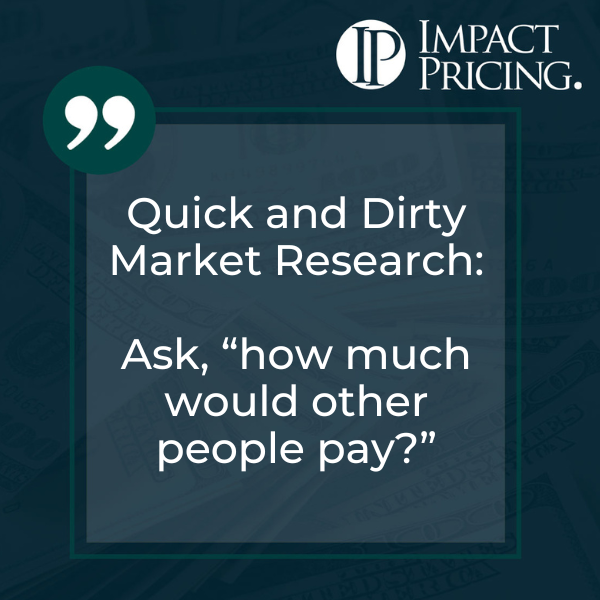
Pricing Table Topics: 10 of Clubs – How Much Would Other People Pay?
This one is the 10 of Clubs from the Impact Pricing card deck. Face it, when you talk to a customer, what you really want to ask them is, "how much would you pay for them?" The problem is they won't answer that question. First, they probably don't know the answer to that question. But more importantly, in the back of their mind, they're thinking, Hey, I can't tell them the truth because if I tell them it's really valuable to me, they'll end up charging me a higher price. So, I'm going to come up with a number much lower. I'm going to game the system, or play a negotiation game without them even knowing I'm playing. Of course, that hurts us because we're trying to gather real information, how much would they pay? One question I found that works relatively well, I wouldn't call it scientific, but it's a great way to get just a perception of people's pricing. And that is, "how much do you think other people like you would pay for this?" It takes enough indirection in the question that they tend not to think about gaming the system. And instead they think, "Oh, well, that person over there is probably like me, so therefore they would probably pay this much." When you ask that question, what the buyer's thinking in their mind is, how much would I really pay, and that's how much I think other people would really pay. We hope you enjoyed this example of Pricing Table Topics. What you just heard was done without a script. If you have any questions or feedback, please email me, [email protected]. Now, go make an impact. Connect with Mark Stiving: Email: [email protected] LinkedIn: https://www.linkedin.com/in/stiving/
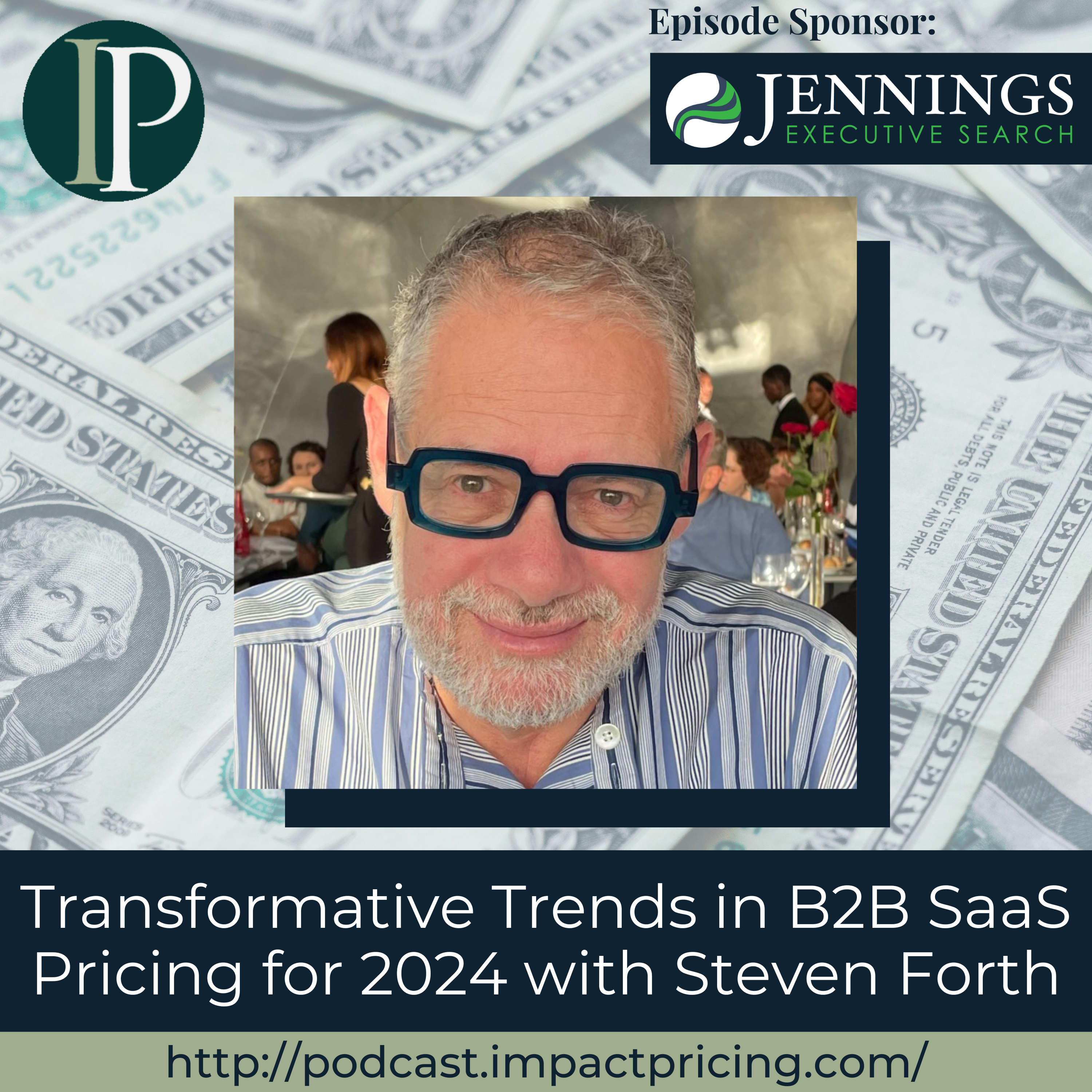
Transformative Trends in B2B SaaS Pricing for 2024 with Steven Forth
Steven Forth is Ibbaka's Co-Founder, CEO, and Partner. Ibbaka is a strategic pricing advisory firm. He was CEO of LeveragePoint Innovations Inc., a SaaS business designed to help companies create and capture value. In this episode, Steven discusses the growing significance of showcasing economic value to customers and the challenges that companies encounter in accomplishing this, particularly with regard to AI monetization. There is a strong emphasis on the necessity for better understanding and communication of the value delivered by SaaS products to enable more effective value-based SaaS pricing strategies. Why you have to check out today's podcast: Look into the latest AI monetization report for 2024 and gain insights into the strategies for monetizing AI Find out the key trends in SaaS pricing related to AI for the year 2024 Discover the compelling reasons why AI is truly revolutionary and why it's crucial to embrace this transformative technology "Don't panic and cut prices." - Steven Forth Topics Covered: 01:37 - How is AI going to significantly influence SaaS and pricing this 2024 03:38 - The impact AI is going to have on most businesses in the interface, functionality, and internal workflow levels 06:59 - What this AI monetization report is all about 09:46 - Looking on the value of the solution more than just the AI tool 11:05 - Why B2B SaaS companies are under increased pressure to justify their prices based on the value delivered to their customers 13:12 - Quantifying and truly delivering value to customers and product management's critical function in understanding value 16:05 - Significant insights on customer success department's role in value quantification 17:02 - Discussion about using SaaS versus obtaining perpetual license 22:38 - Summarizing the three major trends this 2024 24:47 - Expressing optimism that companies adopt better tool sets to assess, track, document, and communicate economic value 25:38 - Steven's impactful advice Key Takeaways: "Vast new areas of applications are going to be opened by AI and things that we couldn't do, or were too expensive to do in the past become easy to do and very affordable to do, already are today." - Steven Forth "If you can demonstrate value, then you have a lot of weapons that you can use against these [larger competitors]." - Steven Forth "AI is going to be moving rapidly towards monetization, which means it has to be able to demonstrate value." - Steven Forth "There's an overall pressure to better manage SaaS spending, which is going to lead to pressure on SaaS companies to be able to demonstrate that they are actually delivering value, not just happy users." - Steven Forth "Cutting prices is not going to solve your problem. That could just increase your churn. There's no guarantee that cutting your prices will reduce your churn." - Steven Forth "You can't compensate for a lack of value by lowering your price." - Steven Forth People/Resources Mentioned: Open View:https://openviewpartners.com/blog/tagged/research-and-analytics/ Amazon: https://www.amazon.com Google: https://www.google.com/ IBM: https://www.ibm.com/us-en Salesforce: https://www.salesforce.com/ap/?ir=1 Oracle: https://www.oracle.com/ph/ Connect with Steven Forth: LinkedIn: https://www.linkedin.com/in/stevenforth/ Email: [email protected] Connect with Mark Stiving: LinkedIn: https://www.linkedin.com/in/stiving/ Email: [email protected]

Blogcast: Why Your Salespeople Don't Sell Value
This is an Impact Pricing Blog published on December 21, 2023, turned into an audio podcast so you can listen on the go. Read Full Article Here: https://impactpricing.com/blog/why-your-salespeople-dont-sell-value/ If you have any feedback, definitely send it. You can reach us at [email protected]. Now, go make an impact. Connect with Mark Stiving: Email: [email protected] LinkedIn: https://www.linkedin.com/in/stiving/
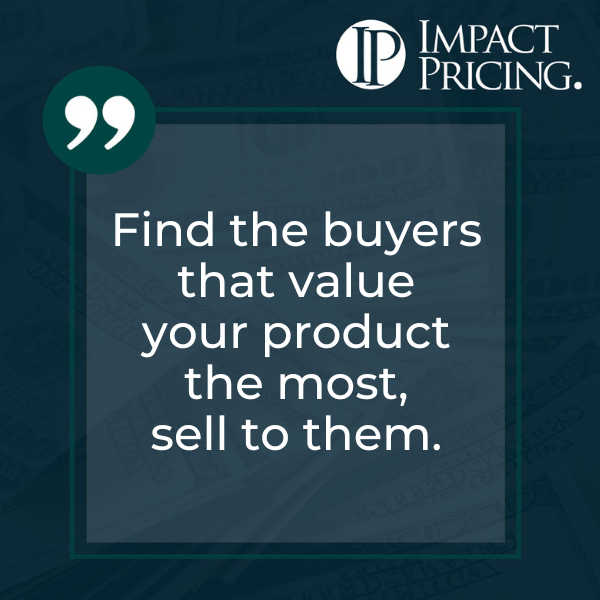
Pricing Table Topics: 10 of Diamonds – Sell to Buyers that Value Your Product the Most
This one is the 10 of Diamonds from the Impact Pricing card deck. Different buyers value our products differently, hence, what that should mean to us is we get to do price segmentation, we could be charging different prices. But from a sales perspective, once we've got a price set and we need to go out and do prospecting and find which customers we want to go sell to, guess which ones are the easiest ones to win? The ones where they perceive the most value from our product. If somebody is going to use our product and make a million dollars, they care a lot more than someone who's going to use our product and make $10. Can we articulate where's the value of our product, who's going to get the value, and then find those people who really get a ton of value and focus on them. That's where we should be doing our prospecting. That's where we should be doing our marketing. And if we have a list of prospects to go deal with, those are the ones we should be spending our sales effort and energy on. We hope you enjoyed this example of Pricing Table Topics. What you just heard was done without a script. If you have any questions or feedback, please email me, [email protected]. Now, go make an impact. Connect with Mark Stiving: Email: [email protected] LinkedIn: https://www.linkedin.com/in/stiving/

The Power of Quantifying Value in Pricing Strategies with Todd Snelgrove
Todd Snelgrove is the Senior Director; Value Advisory at SAP. He is a value advisor who helps companies get paid for the value they create. In this episode, Todd discusses the fundamental importance of value quantification in pricing and emphasizes the need for a structured process to carry it out effectively. Why you have to check out today's podcast: Discover the importance of prioritizing value over solely relying on the behavioral economics of pricing when it comes to pricing strategies Find out the effectiveness of quantifying value over simply offering discounts Learn about what constitutes a value conversation "Have a structured process to quantify customer value. It's not as hard as people think. Even if you're not perfect at it, it's better than nothing." - Todd Snelgrove Topics Covered: 01:05 - How Todd got into pricing 02:19 - Quantifying value in B2C 04:13 - The subconscious way of quantifying value 05:38 - Why behavioral economics matter less in B2B 08:05 - The decoy effect in pricing and how some tricks used in B2C doesn't work in B2B 12:16 - Evolving power dynamics in procurement and how salespeople should navigate dealings with procurement in different scenarios 17:31 - Performance guarantee over discount 20:26 - What transpires in a value conversation 22:20 - The telling versus the asking in a value conversation 25:20 - Tod's one piece of best pricing advice 26:18 - Why not many companies quantify value 27:08 - Todd's book: Value First Then Price 29:09 - Tying cost and benefits to a value conversation Key Takeaways: "When you talk about value, talk about real dollars. It's okay to list benefits and all these other things. But when you say value, show how that's going to be more profitable." - Todd Snelgrove "I spend a lot of my time getting procurement to realize that 10% value per year is better than a 10% price cut." - Todd Snelgrove "Price becomes an issue but only after you've discussed value." - Todd Snelgrove Resources/People Mentioned: Value First then Price by Todd Snelgrove: https://expertsinvalue.com/books AstraZeneca: https://www.astrazeneca.com/ Connect with Todd Snelgrove: LinkedIn: https://www.linkedin.com/in/toddsnelgrove/ Email: [email protected] Connect with Mark Stiving: LinkedIn: https://www.linkedin.com/in/stiving/ Email: [email protected]

Blogcast: Growth Comes from Value
This is an Impact Pricing Blog published on December 14, 2023, turned into an audio podcast so you can listen on the go. Read Full Article Here: https://impactpricing.com/blog/growth-comes-from-value/ If you have any feedback, definitely send it. You can reach us at [email protected]. Now, go make an impact. Connect with Mark Stiving: Email: [email protected] LinkedIn: https://www.linkedin.com/in/stiving/

Pricing Table Topics: 10 of Hearts – Invest More Time Managing Pricing and Value
This one is the 10 of Hearts from the Impact Pricing card deck. Besides the alliteration of that meme, the two concepts are crucial. Pricing is possibly the most powerful marketing mix variable you have access to. You must have seen the reports that say, hey, if you could increase price by 1%, that likely increases your profitability by 10% for most companies or an average company. Well, the only reason somebody is ever going to buy something from you is because they perceive that there's more value to them than it costs them in your price. And so, that means we need to be focused on what's the value to the customer. We need to know, how are they perceiving that value? What is the value that they're willing to exchange or they're thinking about as they exchange their hard earned money to buy your product? When we think about these two concepts, then pricing and value, they go really hand in hand, very closely related. I know many companies ignore pricing, that you set it and forget it, and they need to think about that more. But even more companies are clueless about value. How is it that your customers perceive value? You really should be spending more time, more energy, thinking about both of those concepts, pricing and value. And they go really, really well together. We hope you enjoyed this example of Pricing Table Topics. What you just heard was done without a script, obviously. If you have any questions or feedback, please email me, [email protected]. Now, go make an impact. Connect with Mark Stiving: Email: [email protected] LinkedIn: https://www.linkedin.com/in/stiving/

Confidently Increase Prices and Double Your Business with SaaS Pricing with Maciej Wilczynski
Maciej Wilczyński is a pricing expert and Partner at Valueships, a consultancy boutique specializing in software, cloud, subscription, and digital businesses. He is also a lecturer and faculty at the Wroclaw University of Economics, where he has finished his PhD title in strategic management, writing a thesis about software-as-a-service companies and their pricing capabilities. He gained consulting experience at McKinsey & Company, where he led the EMEA part of Agile Insights solutions focused on digital marketing and customer insights. In this episode, Maciej discusses the potential positive impact on your SaaS pricing when considering the removal of grandfathering for customers. Why you have to check out today's podcast: Discover significant insights to expanding your business and boosting your income with SaaS pricing strategies Understand the ins and outs of SaaS pricing and gain insights into how companies can effectively gauge the value of their offerings, empowering them to make confident decisions in pricing Unlock valuable insights about grandfathering customers and potentially double your income "Value-based pricing has an ability to at least double your current business." - Maciej Wilczynski Topics Covered: 01:33 - Just wasn't cut out for a metal band fame 02:22 - How he got into pricing 04:19 - What Valueships is all about 05:31 - B2B SaaS pricing and what makes it interesting 08:12 - Buying growth with pricing 10:31 - Four major reasons companies don't raise prices 14:20 - Important thoughts on companies grandfathering customers [effect on short-term and long-term] 19:18 - No such thing as lifetime pricing 22:29 - Why pricing is hard and where should you get the motivation to increase price 24:57 - What you should bear in mind when increasing prices: listen to the majority and not to the few complaining minority 29:03 - Connecting your price increase to a customer-centric narrative 30:51 - Maciej's best pricing advice Key Takeaways: "You should forget the word forever or lifetime in pricing." - Maciej Wilczyński "Where should companies look for the courage and energy to do it [pricing] is purely from value exercise." - Maciej Wilczyński "To really understand the value, run as many case studies as you can, quantified case studies, try calculating the ROI of your service initially internally as an exercise, as a workshop in exercise, and then move and try to do it with your customers to see the power of the product." - Maciej Wilczyński "Pricing starts from value, but if you're afraid of raising prices, simply look at your churn rates. If they're below four or 3%, you're good to go." - Maciej Wilczyński People/Resources Mentioned: Patrick Campbell: https://www.linkedin.com/in/patrickccampbell Zappos: https://www.zappos.com Stephan Liozu: https://impactpricing.com/podcast/classic-value-based-pricing-how-to-get-started-and-how-to-succeed-with-stephan-liozu/ Appsumo: https://appsumo.com Netflix: https://www.netflix.com/ph-en/ Utpal M. Dholakia: https://hbr.org/2021/06/if-youre-going-to-raise-prices-tell-customers-why Connect with Maciej Wilczyński: LinkedIn: https://www.linkedin.com/in/wilczynskim/ Connect with Mark Stiving: LinkedIn: https://www.linkedin.com/in/stiving/ Email: [email protected]

Blogcast: Don't Do What Sirius XM Did
This is an Impact Pricing Blog published on December 7, 2023, turned into an audio podcast so you can listen on the go. Read Full Article Here: https://impactpricing.com/blog/dont-do-what-sirius-xm-did/ If you have any feedback, definitely send it. You can reach us at [email protected]. Now, go make an impact. Connect with Mark Stiving: Email: [email protected] LinkedIn: https://www.linkedin.com/in/stiving/

Pricing Table Topics: 10 of Spades – Consider the Buyer's Decision Process
This one is the 10 of Spades from the Impact Pricing card deck. When we think about what a buyer's decision process is, think about the two decisions they have to make, 'will I' and 'which one'. And it's really important for us to understand which of those decisions were pricing for. The 'will I' decision simply asks, the buyers asking the question, should I buy something in this product category? That's a budgetary decision. They're really saying, is this problem valuable enough for me to spend money to go solve? When we're thinking about pricing and someone's only making that 'will I' decision, we need to be thinking about, what's the value of solving the problem? The other decision the buyer might be making is the 'which one' decision. 'Which one' is, okay, I've decided I want to solve this problem. Now, am I going to buy your product or a competitor's product? How am I going to go solve this problem? They're deciding which one. And here, the pricing decision you have to make is what's the price of your product relative to the price of the competitive products. Relative to the price of the alternatives. And of course you must take into account the value of your advantages compared to your competitors. So, as you're thinking about your pricing decisions, think really hard what's the decision our buyers are making. Are they deciding 'will I'? Will I buy something in this product category? Or are they deciding 'which one'? Which product will I buy? We hope you enjoyed this example of Pricing Table Topics. What you just heard was done without a script. If you have any questions or feedback, please email me, [email protected]. Now, go make an impact. Connect with Mark Stiving: Email: [email protected] LinkedIn: https://www.linkedin.com/in/stiving/

Pricing Power as the Key Driver in Strategic Business Success with Jeet Mukherjee
Jeet Mukherjee is the Chief Strategy Officer at Holden Advisors. He is responsible for designing and executing the strategic vision for the company. His role includes developing intellectual property, new product offerings, and key partnerships for scalable growth and innovation across the business. In this episode, Jeet delves into the nuanced strategies behind pricing power, featuring real-world examples, including iPhone and Intel's successful utilization of pricing power. Why you have to check out today's podcast: Discover the transformative power of value-based pricing gaining a profound understanding of its essence and significance Find out why many fail in selling from a value-based perspective and how you can break free from the conventional approaches that limit your pricing potential Uncover the nuances of driving pricing power, recognizing the pivotal role of context and the imperative need for precise segmentation "As pricers, we need to have more confidence in our calculation of differential value in what we do to come up with our prices. And we should not be afraid to test and experiment, and change, and see, and track the difference in volumes we get and make adjustments. It's okay." - Jeet Mukherjee Topics Covered: 01:33 - Blessed to have worked with two pricing gurus and all praises to Tom Nagle 02:36 - Defining value-based pricing 03:30 - Describing his journey into pricing and what made him love it 06:38 - Why most don't sell from a value-based perspective 08:48 - Pricing as a much bigger topic many struggle with 11:59 - Understanding pricing power 19:38 - What you can use to drive pricing power, having the right context to understand who's got proper pricing power, and the need for precise segmentation 23:20 - Intel doing a great job in a push-pull marketing and building more brand equity 26:16 - Zappos nailing it in customer service 27:47 - Discussing price sensitivity in relation to pricing power [iPhone versus Samsung] 30:13 - Jeet's best pricing advice Key Takeaways: "I think we're changing the aperture and we're going through this process of pricing power to define it and understand it, because we're looking at it from more of a continuum." - Jeet Mukherjee "Pricing has to be looked at as dynamic value drivers over time." - Jeet Mukherjee "...you have to have that context to understand better who's got the pricing power by being more precise on the segmentation, as well as being very precise on the region that you're going to have a little bit of an anomaly." - Jeet Mukherjee People/Resources Mentioned: Tom Nagle: https://www.linkedin.com/in/thomas-tom-nagle-2bb2288/ Reed Holden: https://www.linkedin.com/in/reed-holden-913ab69/ Ingram Micro: https://www.ingrammicro.com/ HP: https://www.hp.com/ph-en/home.html Dell: https://www.dell.com/en-us Microsoft: https://www.microsoft.com/ Intel: https://www.intel.com/content/www/us/en/homepage.html Zappos: https://www.zappos.com Amazon: https://www.amazon.com/ Connect with Jeet Mukherjee: LinkedIn: https://www.linkedin.com/in/jeet-mukherjee-58462a1/ Email: [email protected] Connect with Mark Stiving: LinkedIn: https://www.linkedin.com/in/stiving/ Email: [email protected]

Blogcast: The Art of Pricing
This is an Impact Pricing Blog published on November 30, 2023, turned into an audio podcast so you can listen on the go. Read Full Article Here: https://impactpricing.com/blog/classic-the-art-of-pricing/ If you have any feedback, definitely send it. You can reach us at [email protected]. Now, go make an impact. Connect with Mark Stiving: Email: [email protected] LinkedIn: https://www.linkedin.com/in/stiving/

Blogcast: Do You Need a New Pricing Metric?
This is an Impact Pricing Blog published on November 23, 2023, turned into an audio podcast so you can listen on the go. Read Full Article Here: https://impactpricing.com/blog/do-you-need-a-new-pricing-metric/ If you have any feedback, definitely send it. You can reach us at [email protected]. Now, go make an impact. Connect with Mark Stiving: Email: [email protected] LinkedIn: https://www.linkedin.com/in/stiving/

Harnessing the Power of Causality for Price Optimization with Gleb Romanyuk
Gleb Romanyuk is a Principal Economist at Wayfair. He leverages his Ph.D. in Economics and his extensive experience in the tech industry to develop cutting-edge solutions for competitive pricing and economic analysis. In this episode, Gleb emphasizes the underutilization of data by most companies. He recommends harnessing its power to gain insights into business performance and develop optimized pricing strategies. Why you have to check out today's podcast: Understand an economist's role in analyzing data and optimizing pricing Learn to note the distinction between forecasting and prediction versus the causal inference Test price elasticity with causality "I would encourage people to take advantage of their sales data when looking into setting prices. If you don't have it then start recording it." - Gleb Romanyuk Topics Covered: 01:56 - How he got introduced into pricing 03:46 - What is an economist's role in a company 06:04 - Distinguishing forecasting versus prediction 09:23 - Proving causality even with just observational data 15:06 - Case in point: does faster shipping improves revenue and profitability [how to go about the test and the variables used] 18:31 - What he thinks of the fact that most companies don't know how to use the data they gather 19:41 - Talking about more job opportunities for economists 20:49 - Highlighting a fascinating finding on using value pricing 23:16 - Sharing his insights on Mark's comment of not favoring taking into account price elasticity for pricing 24:46 - Gleb's impactful pricing advice Key Takeaways: "You can learn a lot about the performance of your business [by taking advantage of your sales data] and do better than just pricing by the market or pricing by the cost." - Gleb Romanyuk "Can we measure the long-term elasticity that takes into account the competitor's response? Usually we can't really get at it because it involves strategic interactions. I think what we do about it is we take market price into account. But also it's important to understand to which extent your products are differentiated from the competitors and how fierce the competition is." - Gleb Romanyuk People / Resources Mentioned: Wayfair: https://www.wayfair.com/ Amazon: https://www.amazon.com/ Connect with Gleb Romanyuk: LinkedIn: https://www.linkedin.com/in/glebromanyuk/ Email: [email protected] Connect with Mark Stiving: LinkedIn: https://www.linkedin.com/in/stiving/ Email: [email protected]

Blogcast: What Comes After Product-Market Fit
This is an Impact Pricing Blog published on November 16, 2023, turned into an audio podcast so you can listen on the go. Read Full Article Here: https://impactpricing.com/blog/what-comes-after-product-market-fit/ If you have any feedback, definitely send it. You can reach us at [email protected]. Now, go make an impact. Connect with Mark Stiving: Email: [email protected] LinkedIn: https://www.linkedin.com/in/stiving/

Pricing Table Topics: Jack of Clubs – Don't Lower Prices
This one is the Jack of Clubs from the Impact Pricing card deck. There's almost never a good reason to lower prices. We've seen that a 1% price increase can lead to a 10% improvement in profitability. Well, the opposite is true too. A 1% price decrease could lead to a 10% decrease in profitability. And that's painful. As a general rule, I would never ever lead a price decrease. I'm not lowering my prices. And the only thing that would ever prompt me to, is if my competitors lowered their price first and I had to keep up with them. I had to match whatever price decrease they put out because they were taking too much of my share. But even if my competitors lowered their price, I wouldn't do an across the board price decrease. Instead, I would look at where is it that my competitors are taking my business. And can I do a price decrease just on that piece of business? Let's start thinking about price segmentation and market segmentation, understanding where that competitor is powerful, is available, and only lower prices in those places where we have to in order to keep our market share. But a great rule is just never lower your prices, unless you have to. We hope you enjoyed this example of Pricing Table Topics. What you just heard was done without a script. If you want to get better at speaking about pricing and value, grab a deck of our playing cards, pick a card, read the saying, talk for one to two minutes about what that card says. You'll become a better speaker and expert. Oh, and you can play games with these cards. If you have any questions or feedback, please email me, [email protected]. Now, go make an impact. Connect with Mark Stiving: Email: [email protected] LinkedIn: https://www.linkedin.com/in/stiving/
A Christmas Pricing Story
There is something about pricing that really gets me excited. Maybe it was my humble beginnings. I'm sure I grew up with more than many people. But from my perspective, we didn't have enough. We needed to make every dollar go as far as it could. At Christmas time, I would get out the Sears catalog and quickly turn to the toy section. I studied every item, in the boy section of course. I would circle, and circle, and circle. I wanted so much. Christmas morning, Santa brought me a few of those toys. My parents made us three kids take turns. I hated having to wait for my brother and sister to take their turns. It was so fun ripping into a package, screaming with excitement. It was the kind of joy we rarely experience as adults. After we kids had opened the Santa packages, it was time for the adults and all of the other gifts. One by one, we would open gifts. It was slow, and tedious, and boring. This is where I got socks and underwear. Completely underappreciated at the time, but several times during this tradition, someone would get a nicer gift from Mom and Dad. Like a sweater, or a jacket. And inevitably, Mom would have a story, "Oh, I found that one at Macy's, and it was just like a more expensive one, but half the price." Or, "Oh, I saved 33% on that using green stamps." Or, "Oh, I shopped at four different stores and finally found a great deal on that one." My mom loved saving money, and she loved telling us about it even more. I didn't know it at the time, but I was learning how important price was to her. Of course, this wasn't just at Christmas. But around the tree on Christmas morning, she had an audience. She had pent up stories she couldn't share until the gift was opened. She was in her element. Maybe my love of pricing started because I wanted to understand my mom better. Who knows? But there are few things I like better than figuring out how people think about price. I am extremely grateful for what mom and dad did for us. They provided so many great memories. I loved Christmas as a child. I loved my mom who left us several years ago. And I still love pricing. This Christmas, I hope you find great deals on all of the gifts. And especially the memories that you give. Merry Christmas and Happy Holidays. Connect with Mark Stiving: Email: [email protected] LinkedIn: https://www.linkedin.com/in/stiving/

Blogcast: Software Shrinkflation
This is an Impact Pricing Blog published on November 9, 2023, turned into an audio podcast so you can listen on the go. Read Full Article Here: https://impactpricing.com/blog/software-shrinkflation/ If you have any feedback, definitely send it. You can reach us at [email protected]. Now, go make an impact. Connect with Mark Stiving: Email: [email protected] LinkedIn: https://www.linkedin.com/in/stiving/