
Impact Pricing
553 episodes — Page 8 of 12

Blogcast: It's Too Expensive!
This is an Impact Pricing Blog published on July 13, 2023, turned into an audio podcast so you can listen on the go. Read Full Article Here: https://impactpricing.com/blog/its-too-expensive/ If you have any feedback, definitely send it. You can reach us at [email protected]. Now, go make an impact. Connect with Mark Stiving: Email: [email protected] LinkedIn: https://www.linkedin.com/in/stiving/

Pricing Table Topics: 2 of Diamonds – Involve Finance with Monitoring the Value-based KPIs.
This one is the 2 of Diamonds from the Selling Value card deck. I'm often asked who should own pricing, and one of the departments that often comes up is finance. And of course, I'm not a huge fan of finance owning pricing. And the biggest reason is finance doesn't truly understand the value of our products. Usually that's going to be someone in product management, product marketing, or even sales, which I'm not a fan of them owning pricing either. However, finance so much wants to be involved with pricing. It's so crucial to their projections. It's so crucial to company growth, which they care a lot about. They really want to be involved with pricing, even though they don't understand value. So, how do we get them involved in pricing? That's pretty simple. Finance has a bunch of quant people. They have access to every piece of data inside the entire company, and they have the desire to make us or help us do better in our pricing. And so, let's figure out what are the KPIs, the key performance indicators, that we really want to track inside our company. And let's ask finance to help track those, keep us on track, make sure that we don't see any anomalies. We know what the trends are. Finance is a fantastic department to help us manage our KPIs. We hope you enjoyed this example of Pricing Table Topics. What you just heard was done without a script. If you want to get better at speaking about pricing and value, grab a deck of our cards, pick a card, read the saying, and then talk for one to two minutes about what that card says. You'll become a better speaker and expert. If you have any questions or feedback, please email me, [email protected]. Now, go make an impact. Connect with Mark Stiving: Email: [email protected] LinkedIn: https://www.linkedin.com/in/stiving/

Discover How to Know Your Value with Amy Riley
Amy L. Riley is an internationally renowned speaker, author and leadership development consultant. She's worked with organizations such as Deloitte, Cisco Systems and Aon Hewitt and has over 20 years of experience working with leaders at all levels. In this episode, Amy shares effective ways of identifying your strengths, finding solutions to people's problems, and quantifying the results of your solutions. By doing so, you can accurately assess your ability to bring about transformation for your clients and determine your true worth. What you will learn from this episode: Learn to know your strength and what value you bring so you know your worth Discover the benefits of receiving feedback to identify areas for improvement and areas to maintain to enhance your leadership skills Find out how to develop people skills so you become a more effective leader "Encourage leaders to get feedback all the time." - Amy Riley Topics Covered: 00:57 - What Amy is helping people with 02:09 - The value you bring--what's your worth? 04:22 - Best means to identify your strengths 06:49 - How does feedback benefit you as a leader and how to deal with self-delusion? 09:49 - Figure out your leadership legacy 10:52 - Fighting to be right versus fighting to be effective 11:49 - The thing with leaders admitting their mistakes 12:43 - What is a pivot and why pivot? 13:35 - The easy ways to find out where your strengths lie 14:50 - How to develop effective people skills 17:42 - Why the need to be open to feedback 20:00 - Amy sharing what her strengths and what problems she helps solve 24:22 -The potential outcome and its financial value that can be attained with Amy's expertise Key Takeaways: "The value that we bring is inherent in our strengths." - Amy Riley "When we're looking to that leadership legacy for guidance, then we act bigger and bolder than any of our normal human considerations that might hold us back." - Amy Riley "If you do find yourself in those moments where you're fighting to be right instead of fighting to be effective, do give yourself some compassion, because we're human beings, and that's a human tendency." - Amy Riley People/Resources Mentioned: The Courage of a Leader®: How to Inspire, Engage and Get Extraordinary Results by Amy Riley: https://courageofaleader.com/products/ Connect with Amy Riley: Website: https://courageofaleader.com/ LinkedIn: https://www.linkedin.com/in/amyshoopriley/ Connect with Mark Stiving: LinkedIn: https://www.linkedin.com/in/stiving/ Email: [email protected]

Pricing Table Topics: 2 of Clubs – Salespeople with Authority to Discount
This one is the 2 of Clubs from the Selling Value card deck. Salespeople are going to use every single tool they have available to them. Absolutely, they're going to use value selling if we've taught them how, and they understand, and they're doing a great job. But even if they're using value selling, it's very easy for them to offer discounts. And there's this attitude or belief that offering discounts helps close a deal faster. And maybe it does. Maybe when a customer or a buyer asks you for a discount, it takes longer to say no and explain why. And we could have just said yes and close the deal and we're done. Wouldn't that be great if it worked that way? But here's the key. Every dollar that we discount comes straight off of our profit. We still have to cover all of our costs, and so our margin just got shrunk by more than our revenue did on a percentage basis. So, if we want our salespeople to not rely on price, we have to make it painful for salespeople to offer discounts. How do you do that? Create a compensation plan that as they give bigger discounts, the percentage or the size of their deal goes down faster than the revenue goes down because salespeople are incentivized to close deals as fast as possible. And we want to make sure they're incentivized to close deals quickly at the highest possible price. We hope you enjoyed this example of Pricing Table Topics. What you just heard was done without a script. If you want to get better at speaking about pricing and value, grab a deck of our cards, pick a card, read the saying, and then talk for one to two minutes about what that card says. You'll become a better speaker and expert. If you have any questions or feedback, please email me, [email protected]. Now, go make an impact. Connect with Mark Stiving: Email: [email protected] LinkedIn: https://www.linkedin.com/in/stiving/

Pricing Table Topics: 2 of Hearts – The Best Response to an RFP Is Not to Bid
This one is the 2 of Hearts from the Selling Value card deck. When you get an RFP, you have to decide, are you going to bid or not. Believe it or not, that's actually a decision you get to make. You do not have to respond to every RFP that comes through. And my advice, if you are not involved in the creation of the RFP, or at the very least, if you cannot have conversations with the decision makers or executives of the group who created that RFP, you have a very low chance of winning. And so, the time and energy that you spend replying to the RFP makes you feel like you're doing work, but odds are really good you're not going to win that deal. There's somebody else that has already built a relationship with the client, understands exactly what the client wants, is able to create a response to that RFP that fits them almost perfectly. They've built the rapport so the client's going to give them the benefit of the doubt no matter what. If you're going in blind to an RFP, you're probably not going to win. Let's test that. From here on out, every time you respond to an RFP, just keep track. Did I help write this? Do I know the leaders? Do I get conversations with the executives? And if the answers are no, and you go ahead and bid, see how many of those you actually win. And I will bet you the percentage of those is so low you realize it just isn't worth your time to bid RFPs where you're not already involved. We hope you enjoyed this example of Pricing Table Topics. What you just heard was done without a script. If you want to get better at speaking about pricing and value, grab a deck of our cards, pick a card, read the saying, and then talk for one to two minutes about what that card says. You'll become a better speaker and expert. If you have any questions or feedback, please email me, [email protected]. Now, go make an impact. Connect with Mark Stiving: Email: [email protected] LinkedIn: https://www.linkedin.com/in/stiving/

Challenges of Pricing AI with Steven Forth
Steven Forth is Ibbaka's Co-Founder, CEO, and Partner. Ibbaka is a strategic pricing advisory firm. He was CEO of LeveragePoint Innovations Inc., a SaaS business designed to help companies create and capture value. In this episode, Steven discusses the challenges of pricing AI, primarily due to the limited availability of data. He emphasizes the importance of shortening the time required to build value models in order to easily establish pricing. What you will learn from this episode: Discover the complaints and challenges associated with pricing AI Enhance transparency in establishing the price point with creating value models Find out the most recent advancements in AI pricing concerning language models and software, which greatly enhance productivity "Once you have a good value model, coming up with pricing is maybe not trivial but it's certainly much easier." - Steven Forth Topics Covered: 01:15 - Discussing complaints about AI through the Value Models 07:57 - Steven's added thoughts to Mark's suggested solution to achieve pricing transparency [limitations in creating value models] 11:43 - The need for more trainings for language models used in pricing 14:25 - What is Copilot by Microsoft and what it is capable of doing that can help salespeople 17:04 - How is Copilot might disrupt the market especially Google Workspace user 17:50 - Survey of people's willingness to pay $30 a user for Copilot [and whose group is more willing to pay more] 22:20 - How were the users segmented, are they all Copilot users, and finding out people's reaction to AI 23:37 - The amazing capabilities of these two AIs 24:57 - What could happen if Mark Stiving will use AI to write his fourth book [The need for great prompt engineering] 28:12 - How are AIs going to be priced 29:59 - Microsoft Copilot as a 'Will I' question Key Takeaways: "If you can build a value model and validate a value model, then you can fairly easily, I believe, derive pricing from the value model." - Steven Forth "We should be able to customize a language model based on our training and integrate mathematical AI from a place such as Wolfram/Alpha to greatly scale up our ability to build value models so that we could legitimately do a thousand a year or so." - Steven Forth Resources/People Mentioned: Craig Zawada: https://impactpricing.com/podcast/ep95-defining-no-touch-and-self-serve-pricing-with-craig-zawada/ PROS: https://pros.com/ Vendavo: https://www.vendavo.com/ Zilliant: https://www.zilliant.com/ McKinsey: https://www.mckinsey.com/ Wolfram/Alpha: https://www.wolframalpha.com/ iGenius: https://www.igenius.ai/ Hugging Face: https://huggingface.co/ OpenAI: https://openai.com/ Figma: https://www.figma.com/ Notion: https://www.notion.so/product Connect with Steven Forth: Email: [email protected] LinkedIn: https://www.linkedin.com/in/stevenforth/ Connect with Mark Stiving: LinkedIn: https://www.linkedin.com/in/stiving/ Email: [email protected]

Blogcast: Next Book Title?
This is an Impact Pricing Blog published on July 6, 2023, turned into an audio podcast so you can listen on the go. Read Full Article Here: https://impactpricing.com/blog/next-book-title/ If you have any feedback, definitely send it. You can reach us at [email protected]. Now, go make an impact. Connect with Mark Stiving: Email: [email protected] LinkedIn: https://www.linkedin.com/in/stiving/

Pricing Table Topics: 2 of Spades – Relative Value Conversations
This one is the 2 of Spades from the Selling Value card deck. You've heard me talk about value conversations before, where value conversations are really the conversation we have with a customer or potential buyer, so they can determine how much additional profit they're going to make when they use your product. And that's awesome when they're only making a 'Will I' decision. Am I going to buy your product or not? Am I going to buy a product in your category or not? But what happens when they say, "Am I going to buy your product or somebody else's product?" Now what we want to do is understand our differentiation because value in that case comes from the price of our competitor's product plus the value of our differentiation. We need to determine the value of our differentiation. Or said better, we need our customers or buyers to determine the value of our differentiation. And that's what a relative value conversation is. We want to see what's our differentiation relative to our competitors, and then go through the exact same steps we would with a normal value conversation to help the buyer determine if you have this problem that this differentiator solves, what's the result you might expect? How much additional value do you think you would get? And now we're putting a dollar value on the differentiation. This is powerful when you're competing. We hope you enjoyed this example of Pricing Table Topics. What you just heard was done without a script. If you want to get better at speaking about pricing and value, grab a deck of our cards, pick a card, read the saying, and then talk for one to two minutes about what that card says. You'll become a better speaker and expert. If you have any questions or feedback, please email me, [email protected]. Now, go make an impact. Connect with Mark Stiving: Email: [email protected] LinkedIn: https://www.linkedin.com/in/stiving/

Brainstorming the 'Ultimate Pricing Book Title' with Sebastian Wrobel
Sebastian Wrobel is an energetic and passionate professional leader, helping companies achieve value and pricing excellence. Pushing digital transformation into lasting integration. Experienced in working closely with the C-suite and senior stakeholders to elaborate and drive major profit & growth optimisation plans. Building high performing teams by leveraging a collaborative and data driven leadership approach. In this episode, Sebastian provides valuable insights on how to create the perfect title for a pricing book. The goal of which is to capture the attention of individuals driving pricing within a company. What you will learn from this episode: Understand the discovery process of value generation to come up with best pricing strategies Gain a deep understanding about value and pricing as Mark and Sebastian carefully examine various book titles on the subject Understand the discovery process around value and pricing "Start your [pricing] journey wherever you are, and accelerate on your journey wherever you are. The investment is paying off, always." - Sebastian Wrobel Topics Covered: 01:17 - A quick fun story on how he got lost for two days in the mountains 01:55 - What got him into pricing? 03:02 - Valugram as a company -- what it does 07:30 - What most companies are missing out on in regard to value and pricing 08:04 - Understanding the 'discovery process' 11:06 - Thoughts on value and pricing as understood by experts in their own fields 13:31 - Gaining business confidence 15:59 - Challenging the idea behind this title for a book: The Secret to Skyrocketing Profit 18:45 - Feedback on this title - Leveraging Value: CEO's Blueprint for Driving Profits 22:40 - Will addressing CEOs in the book title encapsulates all other people who are driving pricing other than the CEOs? 24:53 - An analysis of the title - The Power of Value: The CEO's Secret Weapon to Driving Profits 30:57 - Sebastian's pricing advice 31:25 - How to connect with Sebastian Key Takeaways: "Value selling is not applicable to all products. Neither all client segments. Where it is applicable, you should do it properly." - Sebastian Wrobel "Gartner study shared that this is the critical aspect about winning deals, enabling buyers to make a decision in the right one." - Sebastian Wrobel "As pricing people, we tend to think in profits. But for me, leveraging value is more. Not only profit, but it's about driving revenue, top line growth, and also customer loyalty." - Sebastian Wrobel Connect with Sebastian Wrobel: LinkedIn: https://www.linkedin.com/in/sebastian-w/ Website: https://pricingworks.io/ Website: https://www.valugram.com/ Connect with Mark Stiving: LinkedIn: https://www.linkedin.com/in/stiving/ Email: [email protected]

Blogcast: Right or Effective?
This is an Impact Pricing Blog published on June 29, 2023, turned into an audio podcast so you can listen on the go. Read Full Article Here: https://impactpricing.com/blog/right-or-effective/ If you have any feedback, definitely send it. You can reach us at [email protected]. Now, go make an impact. Connect with Mark Stiving: Email: [email protected] LinkedIn: https://www.linkedin.com/in/stiving/

Pricing Table Topics: 3 of Diamonds – Prospect for Buyers Who Get More Value from Your Solution
This one is the 3 of Diamonds from the Selling Value card deck. The question now, as we're doing our prospecting, is to say which prospects will get the most value. We've talked in the last few weeks about finding prospects who realize they have a problem, finding prospects who we know have the problem, finding prospects who prioritize solving the problem. Now what we're saying is, let's find the prospects who get the most value out of solving that problem. When we think about it, if a customer gets a ton of value from solving the problem, they're much more likely to say yes and move forward than somebody who gets a small amount of value from solving the problem. So, one way to think about that, as a pricing expert, I'll give you a quick hint. I work with software companies, I work with hardware companies. And sure, I love working with all of them. And I could work with software companies because there's great flexibility in the way they create their products or stick features into product options, and I love that. But when you think about a hardware company, the margins for hardware companies are so small and they have real hard costs. So, if we could improve their pricing by just a little bit, the percent profitability goes up dramatically. And so I would say, from my perspective, helping hardware companies, they have higher value in solving a pricing problem than a software company does. How does it work in your business? Which of your customers get the most value out of solving the problem that you solve. We hope you enjoyed this example of Pricing Table Topics. What you just heard was done without a script. If you want to get better at speaking about pricing and value, grab a deck of our cards, pick a card, read the saying, and then talk for one to two minutes about what that card says. You'll become a better speaker and expert. If you have any questions or feedback, please email me, [email protected]. Now, go make an impact. Connect with Mark Stiving: Email: [email protected] LinkedIn: https://www.linkedin.com/in/stiving/

Maximizing Value in Retail Pricing with Kiran Gange
Kiran Gange founded RapidPricer and is currently working on automated pricing and promotions for retailers using image processing, spectral images, IOT data and artificial Intelligence. In this episode, Kiran shares a dynamic pricing strategy for retailers that increases profits while providing greater value to customers. What you will learn from this episode: Develop a dynamic pricing strategy that prioritizes maintaining long-term customer trust rather than solely focusing on profit Discover opportunities for retailers to implement dynamic pricing strategies Learn about a pricing strategy that reduces food wastage in the retail industry "Take a look at your data to understand how customers are reacting to price changes." - Kiran Gange Topics Covered: 01:16 - What inspired him to write the book 'The Expert Guide to Retail Pricing' 02:55 - The reason for suboptimal pricing in most retail companies he works with 06:13 - Pricing in B2B versus B2C as it relates to value associated with the product or service 07:51 - Explaining about the lagged reaction between the value and the price of the product 09:22 - Illustrating the work they do at RapidPricer when it comes to dynamic pricing 13:16 - What helps customers in their decision when choosing stores to buy from 15:05 - Frameworks used and discussed in Kiran's book 16:16 - Identifying products that are profit drivers or traffic drivers 17:45 - Determining individual product elasticity even without changing prices [plus a discussion on category and product elasticity] 20:30 - Seeing opportunities for retailers to do dynamic pricing [Costco having a brilliant customer level analysis] 22:30 - What is the 'minimum margin rule' 23:26 - How does pricing improve value 24:58 - Kiran's best pricing advice Key Takeaways: "There's so much more value to be achieved in actually selling the product at a lower price than to take this incremental profit and to lose the trust of the customer, which is much more important than your profit in the long run." - Kiran Gange "It was Jeff Bezos who once said that our elasticity numbers always show that people are inelastic, but that's not true in the long run. You don't want to take prices up and lose the customer's trust. You might as well use a system to build trust while reducing the wastage and increasing the customer satisfaction." - Kiran Gange "It's not about what the customer is going to see while he is already inside the store, but giving them a fair value where it matters." - Kiran Gange People/Resources Mentioned: The Expert Guide to Retail Pricing by Kiran Grange: https://www.linkedin.com/posts/kirangange_retailpricing-booklaunch Connect with Kiran Gange: Website: https://www.rapidpricer.com/ LinkedIn: https://www.linkedin.com/in/kirangange/ Connect with Mark Stiving: LinkedIn: https://www.linkedin.com/in/stiving/ Email: [email protected]

Blogcast: Help! What's Bigger than Pricing?
This is an Impact Pricing Blog published on June 22, 2023, turned into an audio podcast so you can listen on the go. Read Full Article Here: https://impactpricing.com/blog/help-whats-bigger-than-pricing/ If you have any feedback, definitely send it. You can reach us at [email protected]. Now, go make an impact. Connect with Mark Stiving: Email: [email protected] LinkedIn: https://www.linkedin.com/in/stiving/

Pricing Table Topics: 3 of Clubs – Sell to Someone Actively Trying to Solve a Problem
This one is the 3 of Clubs from the Selling Value card deck. It really is easier to sell to someone who's already trying to solve a problem or realizes they have a problem and wants to go solve it. As I've mentioned previously, as a pricing expert, I believe that almost every company can use my services. Almost every company will benefit dramatically. And yet for me to go knock on a door of a company and say, "Hey, I'm a pricing expert. Would you like some help with your pricing," probably isn't going to be that fruitful because not many companies say, "Hey, I've got a pricing problem." But as soon as someone says, "Hey, I have a pricing problem." Now, what do they do? They start to look for someone who could possibly solve that problem. Maybe they go to professional pricing society meetings. Maybe they do Google searches on how to find pricing experts. Maybe they look up content and see who the experts are that are writing about it. And then they reach out to me, or to one of my competitors. But the point is, when someone reaches out to me, they've already said to themselves, "Hey, I have a pricing problem. Maybe someone can help me fix it." So, what about your business? If you know you can solve someone's problem, but they don't either know they have the problem or maybe they just know they have it but they haven't prioritized it. It isn't a big enough deal for them to go say, "Hey, I'm going to go fix that problem now." It's probably better if we can find a way to find customers who've already prioritized solving your problem. We hope you enjoyed this example of Pricing Table Topics. What you just heard was done without a script. If you want to get better at speaking about pricing and value, grab a deck of our cards, pick a card, read the saying, and then talk for one to two minutes about what that card says. You'll become a better speaker and expert. If you have any questions or feedback, please email me, [email protected]. Now, go make an impact. Connect with Mark Stiving: Email: [email protected] LinkedIn: https://www.linkedin.com/in/stiving/

Create Value Through Pricing with Robert Edwards
Robert Edwards specializes in delivering consulting and training for company executives to understand how to optimally price their products and services, monetize their products, maximize value generation and extraction from their product portfolio, and develop their promotions and competitive strategy to increase profit. He holds a PhD in Pricing and Competitive Strategy. In this episode, Robert shares how to simplify your pricing and effectively communicate its benefits and what value it generates. What you will learn from this episode: Understand how to use price to generate value for your product or services Learn to use pricing to attract the customers you want Find out about the connection between behavioral economics and pricing "Creating value for your pricing could be an extra dimension to what we talk about regularly when we're thinking about designing our products and pricing those products." - Robert Edwards Topics Covered: 01:25 - How he found his route into pricing 03:15 - Discussing the idea about complicated and simple pricing 04:55 - How Ryanair creates a perception of simple pricing 05:55 - Why make your pricing simple 07:04 - Robert's important thoughts on creating value for your pricing 08:48 - How to add value through pricing 10:42 - LinkedIn as an example in the way of creating value and not just extracting value 14:34 - Thinking in terms of the buyer composition and not just the number of units bought 16:35 - Examples that uses price to attract the customers you want 19:50 - An example that uses pricing as an attention grabber to make all else reasonable 21:09 - A case of sellers focusing on different dimensions in attracting customers and not just pricing 22:57 - How pricing and behavioral economics tie into each other 25:36 - Considering behavioral economics at the beginning rather than at the end of the pricing process 26:18 - Understanding the pricing strategy around rebates 27:01 - Using value-based pricing and having the clarity of message why you're pricing in such a way Key Takeaways: "I would definitely recommend in a lot of cases simplifying your prices adds value to the products and service that you're offering because consumers have a really strong preference for this as well." - Robert Edwards "Behavioral economics is increasingly at the heart of real pricing strategies because you can design a pricing strategy with rational consumers in mind, and it completely does not work the way you intended because consumers have these biases and they're susceptible to framing effects." - Robert Edwards "A lot of the companies that I speak to, there's an opportunity to add value to their product by using a different pricing metric. And the only reason that pricing metric is really valuable is because of the behavioral biases of the consumers." - Robert Edwards People / Resources Mentioned: Ryanair: https://www.ryanair.com/gb/en LinkedIn: https://www.linkedin.com/ Subway:https://www.subway.com/en-us Connect with Robert Edwards: LinkedIn: https://www.linkedin.com/in/edwardsra/ Connect with Mark Stiving: Email: [email protected] LinkedIn: https://www.linkedin.com/in/stiving/

Blogcast: The IKEA Effect and Pricing
This is an Impact Pricing Blog published on June 15, 2023, turned into an audio podcast so you can listen on the go. Read Full Article Here: https://impactpricing.com/blog/the-ikea-effect-and-pricing/ If you have any feedback, definitely send it. You can reach us at [email protected]. Now, go make an impact. Connect with Mark Stiving: Email: [email protected] LinkedIn: https://www.linkedin.com/in/stiving/

Pricing Table Topics: 3 of Hearts – Prospect in a Pool of Buyers Who Have the Problem
This one is the 3 of Hearts from the Selling Value card deck. As you're doing your prospecting, you have to decide who you're going to reach out to for the prospecting. And since we know that buyers only buy products to solve problems that they have, what we should be thinking about is, well, where's the community or the marketplace of people that actually have this problem. So, if I were a moving company and I were trying to find companies that were trying to move, then there may be a way to say, "Hey, I want to go to commercial Realtors because I know commercial Realtors are aware of companies who are moving." And so now I can get commercial Realtors to give me potential names or customer possibilities and that's where I might go prospect. So, when you think about what your product is, you want to think about, where are the people who actually have the problem that I solve? As I mentioned last week, I'm lucky in that I think all companies have pricing problems. But notice I only talk to companies. I don't talk to consumers because consumers don't have pricing problems. Why would I ever prospect in a pool of consumers? So, prospect in that pool of buyers who you know have the problem that you can solve. We hope you enjoyed this example of Pricing Table Topics. What you just heard was done without a script. If you want to get better at speaking about pricing and value, grab a deck of our cards, pick a card, read the saying, and then talk for one to two minutes about what that card says. You'll become a better speaker and expert. If you have any questions or feedback, please email me, [email protected]. Now, go make an impact. Connect with Mark Stiving: Email: [email protected] LinkedIn: https://www.linkedin.com/in/stiving/

Minimize Churn and Boost Your Net Dollar Retention with Karen Chiang
Karen Chiang is a co-founder and managing partner of Ibbaka, a company that provides software and expertise to enable business growth by optimizing revenue performance through customer value management and talent optimization. In this episode, Karen discusses the importance of linking your pricing to value and creating pricing packages that accurately reflect the value provided to consumers. What you will learn from this episode: Understand the concept of net dollar retention in relation to your customer base and as a means of measuring your revenue from operations Learn how to effectively package your offers by linking value to pricing Explore these net dollar retention levers to better understand the value your customers are seeking "Getting to a value-based mindset is extremely important in order to improve your pricing power." - Karen Chiang Topics Covered: 01:19 - How she got her into pricing 02:33 - Defining 'net dollar retention' 04:48 - Pricing as it relates to net dollar retention 09:18 - Linking pricing to value [where churns are concerned] 11:25 - Strategy to keep half a customer rather than losing completely 13:56 - What you must think about in the design of your offer 15:03 - What is product packaging and how it differs from cross-sell or upsell 18:23 - Pricing models and various packaging designs 19:32 - What a cross-sell and upsell are in terms of using the good, better, best 25:12 - Karen's best pricing advice that can impact one's business 26:29 - Net Dollar Retention levers by level of importance 29:04 - Usage based pricing as part of net dollar retention levers Key Takeaways: "Pricing has to be linked to value. When you think about it, we want to come up with a pricing method or approach that really tracks the value that is being generated." - Karen Chiang "There always has to be an understanding of what you are negotiating. What will you give up in your package to make it more feasible for that discount? That's why it's actually a shrinkage in the package itself." - Karen Chiang "From the get-go and from the design, when we think about the design of our offers, we really have to be more cognizant of, what are the different components that go into that entire offer?" - Karen Chiang "A good, better, best strategy is one where you try to get people into a certain level, starting with good and you're trying to increase their growth and package by getting them to a better package then a best package." - Karen Chiang People / Resources Mentioned: Steven Forth: https://www.linkedin.com/in/stevenforth Connect with Karen Chiang: LinkedIn: https://www.linkedin.com/in/karen-chiang-2623241/ Email: [email protected] Connect with Mark Stiving: LinkedIn: https://www.linkedin.com/in/stiving/ Email: [email protected]
Blogcast: Value-Based Pricing is an Attitude
This is an Impact Pricing Blog published on June 8, 2023, turned into an audio podcast so you can listen on the go. Read Full Article Here: https://impactpricing.com/blog/value-based-pricing-is-an-attitude/ If you have any feedback, definitely send it. You can reach us at [email protected]. Now, go make an impact. Connect with Mark Stiving: Email: [email protected] LinkedIn: https://www.linkedin.com/in/stiving/
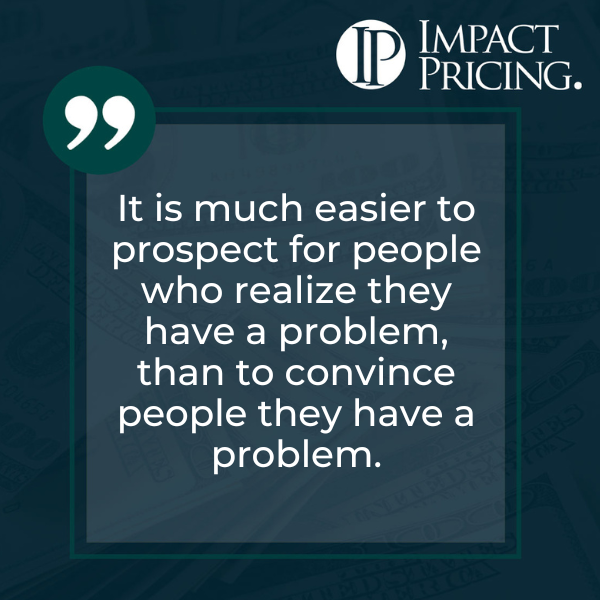
Pricing Table Topics: 3 of Spades – People Who Are Easier to Prospect
This one is the 3 of Spades from the Selling Value card deck. Of course, salespeople, marketing people, we have to do prospecting. The question becomes, who do we look for as prospects to move into our sales funnel? Well, now that we know that people really have to solve problems, that's the reason they buy our products. The question now is, do we think it's easier to sell to people who already know they have a problem, or to people that we have to convince they have a problem? You often see advertising like this where people will say, "Hey, come solve this problem." And now what's happening is people are self-selecting and, "Oh, yeah, I've got that problem," so they're trying to find those people. On the other hand, sometimes we have to convince somebody they have a problem. I find it interesting, I used to run a company a long, long time ago, and my cell phone number still is the phone number that I had when I had that company. And I'll get calls from moving companies that the opening line is, "Hey, I heard that Home Director is moving." Well, it turns out I don't run Home Director. Home Director doesn't exist anymore. Home Director's not moving. But that was a way for them to quickly prospect and find out, "Hey, do I have a company and is the company moving?" Because if the answer that's yes, I've got a problem. And if the answer that's no, then they don't have a problem. So they're trying to figure out relatively quickly, am I somebody that they might be able to sell to or not? So think about, when you're prospecting, are you prospecting to people who already know they have a problem? Or are you looking for people and then trying to convince them they have a problem? As a pricing person, I have to tell you, I think every single company has a problem. But it's insane for me to try to go to a company and convince them they have a problem. And it is so much easier for me to work with companies who come to me because they know they have a problem. We hope you enjoyed this example of Pricing Table Topics. What you just heard was done without a script. If you want to get better at speaking about pricing and value, grab a deck of our cards, pick a card, read the saying, and then talk for one to two minutes about what that card says. You'll become a better speaker and expert. If you have any questions or feedback, please email me, [email protected]. Now, go make an impact. Connect with Mark Stiving: Email: [email protected] LinkedIn: https://www.linkedin.com/in/stiving/

Embracing Outcome-Based Pricing and Ditching Hourly Billing with Jonathan Stark
Jonathan Stark is a former software developer who is on a mission to rid the world of hourly billing. He is the author of Hourly Billing Is Nuts, the host of Ditching Hourly, and writes a daily newsletter on pricing for independent professionals. In this episode, Jonathan highlights the drawbacks of billing hourly which can reduce your value to just a commodity. Instead, he suggests pricing your services based on the outcome you deliver, thereby providing maximum value to your clients. What you will learn from this episode: Discover the top reasons behind the shift away from hourly billing Find out the advantages of choosing outcome-based pricing over hourly billing Uncover why positioning your service effectively can have a significant impact on your pricing strategy "Positioning is critically important for any kind of upward lift on your fees." - Jonathan Stark Topics Covered: 01:04 - What got him into pricing 03:35 - The problem with having an hourly rate 06:11 - Pricing uncertainty in the case of a car diagnostic 08:45 - What makes it better charging fixed price upfront 10:33 - Why positioning your service is crucial in pricing 12:59 - What hourly rate appears to be on the label 16:15 - Touching on the 'Experience Economy' [pricing transformation] 19:06 - Formula for value or the maximum price 21:36 - The best reason to not use hourly prices 24:22 - Solving the scope problem with knowing the desired goal 29:21 - Jonathan's pricing advice 30:38 - How to connect with Jonathan Key Takeaways: "If you sell somebody an hour, you cannot make it more efficient. It takes an hour to deliver it. It artificially limits your income." - Jonathan Stark "The way I do it [on the scope problem], I don't scope first, I scope last." - Jonathan Stark People / Resources Mentioned: Alan Weiss: https://alanweiss.com/about-alan-weiss/ Joseph Pines: https://strategichorizons.com/pine-and-gilmore/joe-pine/ How to Measure Anything: Finding the Value of Intangibles in Business by Douglas Hubbard: https://www.amazon.com/How-Measure-Anything-Intangibles-Business/dp/1118539273 Connect with Jonathan Stark: Website: https://jonathanstark.com/ Connect with Mark Stiving: LinkedIn: https://www.linkedin.com/in/stiving/ Email: [email protected]

Blogcast: Commit to Expand
This is an Impact Pricing Blog published on June 1, 2023, turned into an audio podcast so you can listen on the go. Read Full Article Here: https://impactpricing.com/blog/commit-to-expand/ If you have any feedback, definitely send it. You can reach us at [email protected]. Now, go make an impact. Connect with Mark Stiving: Email: [email protected] LinkedIn: https://www.linkedin.com/in/stiving/

Pricing Table Topics: 4 of Diamonds – Walking Away from a Negotiation Takes Guts
This one is the 4 of Diamonds from the Selling Value card deck. Wow, walk away from a negotiation, ouch! We're essentially saying, "No, we're not going to negotiate anymore. Take the deal that we've given you or not. Totally up to you." And what happens when we do this? First off, we're at risk of losing the deal, and that's painful. Especially, if you're in sales and you're paid to get revenue. You've got to meet a quota, your commission comes from that. But it turns out, from a company perspective, oftentimes that's a really smart thing to do. First off, maybe it's the wrong customer for you. Maybe they need a deep, deep discount because they really don't get the value from your product that they should be getting. Or maybe that they're just negotiating and if you walk away, they come back and say, "Okay, we'll take it." And so, now you've made the sale. Or, what if you even lose the deal? But because you lost that deal, word gets out, especially to channel partners, other salespeople, we're not willing to accept a deal below this specific price. And now everybody's working harder to sell value and make sure that we get the prices that we actually deserve. This is hard. But if you end up losing deals because you walk away, my recommendation is track the profitability of the deals if you would've won them at this lower price and compare that to the profitability of the deals you win because you didn't lower the price. And even if you win more deals with lower prices, you probably make less margin and less profit. We hope you enjoyed this example of Pricing Table Topics. What you just heard was done without a script. If you want to get better at speaking about pricing and value, grab a deck of our cards, pick a card, read the saying, and then talk for one to two minutes about what that card says. You'll become a better speaker and expert. If you have any questions or feedback, please email me, [email protected]. Now, go make an impact. Connect with Mark Stiving: Email: [email protected] LinkedIn: https://www.linkedin.com/in/stiving/

Revolutionize Your Pricing Strategy: Unlock the Power of Collaborative Conversations with Carole Mahoney
Carole Mahoney is an author, speaker, coach, and trainer taking a cognitive approach to sales success. In this episode, Carole shares how salespeople should initiate a pricing conversation that should be 'Not Be About Me' and quantify the cost of not doing something. That way, buyers make a decision for fear of negative business impact. What you will learn from this episode: Discover a powerful pricing conversation technique that focuses on addressing potential objections and inspires people to take action by tapping into their fears of negative outcomes Find out how salespeople add value and uncover urgency for people to make a decision Understand why salespeople need to create a 'dirty laundry list' and include them in their conversation "The biggest piece of advice for finding value in a conversation and talking about pricing is to make it a collaborative conversation." - Carole Mahoney Topics Covered: 01:30 - How she found a career in pricing 02:20 - Salespeople find it uncomfortable talking about money and pricing matters 03:46 - Pricing conversation that's more about contrasting and quantifying the cost of doing nothing 06:36 - Not articulating enough the fear of loss 07:49 - Letting buyers articulate the real problem [and getting them to ask these important questions] 08:36 - The Seinfeld-comedy-series inspired technique of pricing conversation 10:16 - Adding value and uncovering urgency 11:30 - Creating a dirty laundry list 14:17 - What makes it advantageous for salespeople to share their laundry list amongst themselves 15:48 - Providing measurable business value while addressing potential negative outcomes 16:59 - Creating a constant reminder to salespeople with a t-shirt that reads: Not About Me 20:43 - Pricing advice that can have the biggest impact in one's business Key Takeaways: "If selling is an exchange of value, then the pricing conversation is the proof of value actually exists." - Carole Mahoney "Ask questions that address why they might say no, not why they might say yes, you need both. You need to be able to draw the contrast." - Carole Mahoney "It's not necessarily the salesperson's job to make it painful to the buyer. It's the salesperson's job to ask the questions to uncover if the pain to the buyer is great enough to take action, to make a decision and then to implement a solution." - Carole Mahoney People / Resources Mentioned: Buyer First: Grow Your Business with Collaborative Selling by Carole Mahoney: www.unboundgrowth.com/buyer-first-book Connect with Carole Mahoney: LinkedIn: https://www.unboundgrowth.com/ Website: https://www.unboundgrowth.com/ Connect with Mark Stiving: LinkedIn: https://www.linkedin.com/in/stiving/ Email: [email protected]

Blogcast: Quick and Dirty Pricing Research
This is an Impact Pricing Blog published on May 25, 2023, turned into an audio podcast so you can listen on the go. Read Full Article Here: https://impactpricing.com/blog/quick-and-dirty-pricing-research/ If you have any feedback, definitely send it. You can reach us at [email protected]. Now, go make an impact. Connect with Mark Stiving: Email: [email protected] LinkedIn: https://www.linkedin.com/in/stiving/

Pricing Table Topics: 4 of Clubs – Learn the Competitive Situation Before Negotiating
This one is the 4 of Clubs from the Selling Value card deck. It turns out that procurement people often lie to us. And it's their job, not necessarily to lie, but it's their job to get a better price. And what often happens is they'll say to you, "Hey, you're up against these other two or three competitors. In this situation, you have to lower your price if you expect to win this deal." And it turns out oftentimes that's not true. Oftentimes, you're not up against two or three different competitors. Back many, many years ago when I was in sales, I recall procurement people actually saying, "You're up against this other competitor." And it turns out the competitive product they were looking at wasn't even similar to the product that I was offering. And so, it was obvious to me that they were just lying. And in fact, I experienced this extremely clearly when I was on the buying situation. I was part of a committee and we'd chosen a software application that we wanted to purchase. And I was in the meeting when procurement said to the company that we were going to buy from, "You're up against these other two competitors, you better sharpen your pencil." And I knew for a fact that wasn't a true statement. So, please be careful and the way you know is, go back to the committee. Find out if the committee selected you or selected you as one of several different possible alternatives. We hope you enjoyed this example of Pricing Table Topics. What you just heard was done without a script. If you want to get better at speaking about pricing and value, grab a deck of our cards, pick a card, read the saying, and talk for one to two minutes about what that card says. You'll become a better speaker and expert. If you have any questions or feedback, please email me, [email protected]. Now, go make an impact. Connect with Mark Stiving: Email: [email protected] LinkedIn: https://www.linkedin.com/in/stiving/

Why You Need to Engage to Have Value Conversations with John Ray
John Ray is a Pricing and Business Development Coach for Professional Services Firms, and a Podcast Host and Producer. In this episode, John shares optimal strategies for positioning your value proposition to attract the best fit clients for your business. What you will learn from this episode: Discover how to craft a compelling value proposition by identifying the unique value that your clients perceive in your offerings Learn about the importance of continuing value conversation Overcome the fear of pricing the value you provide to your clients "Develop your options around that client and let them choose. And you'll find out your pricing suddenly improves." - John Ray Topics Covered: 01:15 - How he got himself into pricing 02:10 - Who is his ideal client? 03:59 - Insights on solopreneurs making their business work even if they don't necessarily plan on being a business owner 05:28 - The feeling of fear and inadequacy in pricing in a lot of solopreneurs 06:11 - It's not all about expertise but the value you deliver 08:13 - Suggested value proposition to this case: Roger [the client] loves the fact that I calm him down when he gets notice in the mail, I'm trying to win some new business 09:01 - The importance of continuing value conversation 11:10 - One way to lead a value conversation and for people to dig deep with you 11:47 - Optimal win rate or rejection rate and the significance of having a value conversation 15:25 - Benefits of accepting all clients when you're just starting out [and advantages of niching] 18:42 - Turning the intangible value you have into a tangible range of values for the client 20:47 - Price effectively or end up costing your business 24:10 - John's thoughts on this: If I'm bidding and there's no competition or there is competition 26:11 - John's pricing advice Key Takeaways: "By definition you'll be getting better clients by that measure [35% win rate]." - John Ray "The great thing about a value conversation, it's a net that allows the great clients in that fits you well, and keeps out the ones that are not great fits." - John Ray "You don't lean on what you think you're worth, you lean on what the value that you've been able to uncover in that conversation." - John Ray People / Resources Mentioned: Ron Baker: https://impactpricing.com/?s=Ron+BAker Allan Weiss: https://alanweiss.com/shop/books/hardcover/value-based-fees-3rd-edition/ Connect with John Ray: LinkedIn: https://www.linkedin.com/in/johnray1/ Connect with Mark Stiving: LinkedIn: https://www.linkedin.com/in/stiving/ Email: [email protected]

Blogcast: What if They Find Out?
This is an Impact Pricing Blog published on May 18, 2023, turned into an audio podcast so you can listen on the go. Read Full Article Here: https://impactpricing.com/blog/what-if-they-find-out/ If you have any feedback, definitely send it. You can reach us at [email protected]. Now, go make an impact. Connect with Mark Stiving: Email: [email protected] LinkedIn: https://www.linkedin.com/in/stiving/

Pricing Table Topics: 4 of Hearts – Gives and Gets
This one is the 4 of Hearts from the Selling Value card deck. This concept of asking for something anytime we're going to give a discount, we simply refer to it as gives and gets. We don't give anything without getting something. And so, what should we be getting when we're giving something? Well, surely we could get almost anything. What we really want to do is get the things that protect the profit of the company. And what are those things? If you think about all of the different items that you might be able to claw back from a customer. For example, it might be who pays for delivery. It might be how long the delivery takes. It might be when we schedule it. There's many, many different things we might be able to claw back. What we want to do is, think about how much does it cost us to deliver that thing to the customer so that if we claw it back, if we take that back from our customer, we're actually saving us costs on our side. Now, a couple quick thoughts. You know that, first off, I'm a pricing person, but in truth, we're thinking about how do we get the best margin for the company. And secondly, you've heard me say over and over again that costs don't matter to pricing, but costs do matter to profit. And if we're talking about a one-on-one situation and we have to give up some kind of discount, then let's try to get something in exchange that lowers our costs. We hope you enjoyed this example of Pricing Table Topics. What you just heard was done without a script. If you want to get better at speaking about pricing and value, grab a deck of our cards, pick a card, read the saying, then talk for one to two minutes about what that card says. You'll become a better speaker and expert. If you have any questions or feedback, please email me, [email protected]. Now, go make an impact. Connect with Mark Stiving: Email: [email protected] LinkedIn: https://www.linkedin.com/in/stiving/

Drop Pilot's Game-Changing Pricing Strategies with Michael Hammersley
Michael Hammersley co-founded and invented a payment system designed to locate the market price of any consumer good. He authored the utility patent that protects the invention. In this episode, Michael discusses the platform he co-founded, a dual-sided marketplace of buyers and sellers that helps businesses reach a pricing competitive advantage. Why you've got to check out this podcast: Discover what Drop Pilot platform is Find out how it can benefit both sellers and buyers in determining the best price possible Learn to figure out the best pricing your customers are willing to pay "Find out what your customer is willing to pay before you sell them the product." - Michael Hammersley Topics Covered: 01:34 - How he started his career in pricing 02:21 - What's so interesting about analyzing pricing potential as a distressed fund 02:55 - Getting to know what Drop Pilot is and what dual-sided marketplace mean 04:00 - Is Drop Pilot a marketplace or research area and what benefit does this platform have for the sellers? 05:26 - What kinds of businesses work with them and what it means to have multi-unit transactions? 06:18 - Buyer's benefit in using Drop Pilot and explaining the research aspect of the platform 08:34 - Proprietary payment system's role in the marketplace and where his coaching focuses on in regard to the platform 11:01 - How to get people to bid with B2B businesses 12:56 - What is a Drop Day? 18:17 - Is the platform representing the real market? 19:11 - How the whole idea about Drop Pilot started and dealing with scalping issues 20:36 - Michael's best pricing advice that impact's one's business Key Takeaways: "We have a lot of repeat droppers who each time they come up with a new product, they'll come back, release it with us, figure out how to price it, and then sell it on their own website." - Michael Hammersley "If you want to figure out customer willingness to pay for a pricing tool, you really have to generate those numbers on your own based on estimations." - Michael Hammersley "If you want to look at the pricing analytics and you want to find out what your customers are willing to pay, it actually makes more sense to operate in a pressurized environment because you get the highest and best price." - Michael Hammersley "What you would want to do is take a look at the analytics and find the clusters of where the most bids came in like what the most common bid was, and then use that as a reference point to set your retail price." - Michael Hammersley "One thing that our algorithm or our platform actually does is it completely prevents the use of scalping bots." - Michael Hammersley Connect with Michael Hammersley: LinkedIn: https://www.linkedin.com/in/michael-r-hammersley-77285225b/ Connect with Mark Stiving: Email: [email protected] LinkedIn: https://www.linkedin.com/in/stiving/

Blogcast: Price Segmentation in TIOLI Markets
This is an Impact Pricing Blog published on May 11, 2023, turned into an audio podcast so you can listen on the go. Read Full Article Here: https://impactpricing.com/blog/price-segmentation-in-tioli-markets/ If you have any feedback, definitely send it. You can reach us at [email protected]. Now, go make an impact. Connect with Mark Stiving: Email: [email protected] LinkedIn: https://www.linkedin.com/in/stiving/

Pricing Table Topics: 4 of Spades – Determine Purchasing Power Before Negotiating
This one is the 4 of Spades from the Selling Value card deck. Every time a salesperson gets in front of a procurement officer, a purchasing agent, however they're called, the purchasing agent will act price sensitive. Their job is to get a better price for their company. And so, they will always tell you that your price is too high, they need a discount. And you have to decide as a salesperson, do you want to give it to them? And here's the trick, does the purchasing agent actually have any power or authority to influence the decision process? If you're selling a commodity, and they could go to three, or four, or 10 different sources to get essentially the exact same thing, and those are all approved sources for the manufacturing capability, procurement has a lot of power. You need to do a great job at making sure procurement stays happy and figure out what it really takes to close that deal. On the other hand, if you're selling a piece of capital equipment and you've had a long sales cycle selling to a relatively large committee of people who've been debating, what's the best solution for us? And then they take that to procurement so the purchasing can go buy it. It turns out, procurement has almost no power. They'll pretend to have a lot of power, but they really don't. The decision was made by the committee. And so, we don't have to give big discounts to procurement in situations like that. Here's the problem, it takes guts. So, do you have the guts? We hope you enjoyed this example of Pricing Table Topics. What you just heard was done without a script. If you want to get better at speaking about pricing and value, grab a deck of our cards, pick a card, read the saying, and then talk for one to two minutes about what that card says. You'll become a better speaker and expert. If you have any questions or feedback, please email me, [email protected]. Now, go make an impact. Connect with Mark Stiving: Email: [email protected] LinkedIn: https://www.linkedin.com/in/stiving/

Procurement and Sales in Impact to Value Pricing with Jens Hentschel
Jens Hentschel's passion is B2B relationship management and is especially interested in the interaction between the two sides at the negotiation table: buyers and sellers, suppliers and customers, sales and procurement professionals. In this episode, Jens delves into the role of procurement in guiding the internal stakeholder's buying journey on the supply side, while the sales professional assists in facilitating a value-based negotiation. Why you have to check out today's podcast: Gain a comprehensive understanding of procurement's involvement in the sales process using the direct and indirect spend terminologies Recognize the significance of involving procurement at the outset of the negotiation process Learn how procurement and sales can create a mutually beneficial scenario in pricing value "When you get into that situation where you have been put on the spot in that negotiation, don't budge on price." - Jens Hentschel Topics Covered: 01:16 - How he got into pricing 03:04 - Jens important thoughts about Mark's bad impression of procurement 07:27 - A case where it's all about price [on the procurement side] and not a win-win situation 11:12 - Understanding procurement's role in the sales process using the direct and indirect spent terms 15:00 - Why the need to involve procurement early on in the sales process 17:57 - Identifying the right procurement person and establishing the initial conversation 20:49 - A procurement's participation in the customer's buying journey 22:22 - Discussing the concept of supplies vendors list 25:00 - The role that price play in making it to the vendor's list 27:12 - Jens impactful pricing advice Key Takeaways: "What we are trying to preach is, involve them [procurement] right away because 90% of what your customers spend is managed through a procurement process." - Jens Hentschel "Something that I can only recommend to anybody to do is, interact with them [procurement] early, provide them with value insights that they're not able to gather themselves. That's how you start building that relationship." - Jens Hentschel "My thinking is, the procurement professional is the enabler of the buying journey of the internal stakeholder. And they can do it best by having a salesperson on the supplies helping them to be that facilitator." - Jens Hentschel "Where really value is created is where the sales professional on the supply side and the procurement professional on the customer side really work hand in hand to promote a solution." - Jens Hentschel Resources/ People Mentioned: Procter and Gamble: https://en.wikipedia.org/wiki/Procter_%26_Gamble Connect with Jens Hentschel: LinkedIn: https://www.linkedin.com/in/jenshentschel Website: https://www.fivis.io/ Connect with Mark Stiving: LinkedIn: https://www.linkedin.com/in/stiving/ Email: [email protected]

Blogcast: Price Segmentation by Negotiating
This is an Impact Pricing Blog published on May 4, 2023, turned into an audio podcast so you can listen on the go. Read Full Article Here: https://impactpricing.com/blog/price-segmentation-by-negotiating/ If you have any feedback, definitely send it. You can reach us at [email protected]. Now, go make an impact. Connect with Mark Stiving: Email: [email protected] LinkedIn: https://www.linkedin.com/in/stiving/

Pricing Table Topics: 5 of Diamonds – Give Salespeople Discount Authority
This one is the 5 of Diamonds from the Selling Value card deck. We typically give our salespeople some level of discount authority. And the reason we do that is, let's say they walked in, and they asked the factory, or headquarters, 'Hey, could I have a 5% discount?' And we always say yes to that. Then all we've done is slowed down the sales process. Instead, we give them some level of discount authority. Knowing that, you know, if you come in for 5% or less, I'm going to give it to you anyway. So, you just have permission to go give 5% or less. The problem, of course, is that salespeople typically give the max that they're allowed to give. There's all these different levers that they could pull. They could sell value, and they can discount price. And discounting price is one of those levers that they're going to pull because it's easy. See how easy it is for me to discount the 5% and it doesn't hit my commission that much. So, it's okay for me to give that 5% discount. What we want to do as a company is sit back and say, what are the right levels of discount authority? What should I let my salesperson discount to? What should I let my sales managers discount to, my sales directors discount to? There are different levels, and we want them to be incented to discount as little as possible. We hope you enjoyed this example of Pricing Table Topics. What you just heard was done without a script. If you want to get better at speaking about pricing and value, grab a deck of our cards, pick a card, read the saying, then talk for one to two minutes about what that card says. You'll become a better speaker and expert. If you have any questions or feedback, please email me, [email protected]. Now, go make an impact. Connect with Mark Stiving: Email: [email protected] LinkedIn: https://www.linkedin.com/in/stiving/

Monetization-Driven Growth: What It Means and How It Works with Alessandro Monti
Alessandro Monti is a pricing enthusiast and expert on all topics related to monetization, conversion, upselling, digital pricing, price management, and business and pricing history. In this episode, Alessandro highlights the importance of adopting a monetization-led growth approach for your business and emphasizes the need to start implementing this strategy early on in your business. Why you have to check out today's podcast: Learn to redefine growth in the sense of making it profitable and sustainable Discover the importance of a monetization-driven growth strategy for the long-term success and sustainability of your business Find the ideal pricing metric for your business to attain optimal product-pricing-market fit and achieve success "Choosing the appropriate price metric seems to be probably one of these game-changing moments for your businesses." - Alessandro Monti Topics Covered: 01:32 - What brought him to pricing and what made him choose SKP 02:43 - Why he believes in supply and demand 06:01 - Delving into the concept of "growth at any cost" and shifting our focus away from it 08:31 - Defining digital industry and turning away from this 'growth at any cost' mentality 09:36 - Redefining growth 12:25 - Challenging the tools and techniques to get to this ultimate growth 14:49 - Deciding between freemium and free trial [and starting monetization-led growth early on in the business] 20:25 - Extracting value to monetize a product and what is true business success 23:03 - Alessandro's best pricing advice that impacts anyone's business 24:05 - Finding the best pricing metric to use Key Takeaways: "Let's redefine growth in the sense of let's make profitable business." - Alessandro Monti "We don't need the free, just for the sake of having free because there is value in having free users. But besides that, I think you need to seek the conversion and the monetization as early as possible." - Alessandro Monti "It's growth understood as profitability using all of our modern monetization techniques and there's room for alternative content." - Alessandro Monti People / Resources Mentioned: Taylor Swift: https://www.taylorswift.com/ Connect with Alessandro Monti: LinkedIn: https://www.linkedin.com/in/profmonti/ Connect with Mark Stiving: LinkedIn: https://www.linkedin.com/in/stiving/ Email: [email protected]

Blogcast: Simplify Your Pricing
This is an Impact Pricing Blog published on April 27, 2023, turned into an audio podcast so you can listen on the go. Read Full Article Here: https://impactpricing.com/blog/simplify-your-pricing/ If you have any feedback, definitely send it. You can reach us at [email protected]. Now, go make an impact. Connect with Mark Stiving: Email: [email protected] LinkedIn: https://www.linkedin.com/in/stiving/

Pricing Table Topics: 5 of Clubs – Gain Higher ASPs and Margins
This one is the 5 of Clubs from the Selling Value card deck. Most salespeople are paid on commission, and typically that commission is a percentage of the revenue. So, 2% of the revenue, 5% of the revenue, somewhere in that ballpark. The problem is, that incremental revenue, if I want to grow my revenue by 1%, the salesperson is only going to get 2%, or their commission rate, of the 1%. And it's a really, really tiny number. However, for the company, that 1% could be a really big number especially if your overall margins are relatively small, because that incremental 1% of revenue is a hundred percent profit. But we don't incentivize our salespeople to get that next 1% very much. Ideally, what we would do is, we would create a sales incentive structure so that covering costs, maybe they don't make anything, but anything from cost to list price, the amount of commission, the amount of incentive payment they get goes up for the higher the price they get. I, typically, like to have a target price. I also have a list price and a floor price. And I'll set three different commission rates. Anybody who can sell at list gets a really high commission rate. Anybody who sells at Target or above gets a mid-level commission rate. Anybody who sells above the floor and below the target, it's a really low commission rate. But the key is, we want to give our salespeople incentives to negotiate for that last 1%. We hope you enjoyed this example of Pricing Table Topics. What you just heard was done without a script. If you want to get better at speaking about pricing and value, grab a deck of our cards, pick a card, read the saying, and talk for one to two minutes about what that card says. You'll become a better speaker and expert. If you have any questions or feedback, please email me, [email protected]. Now, go make an impact. Connect with Mark Stiving: Email: [email protected] LinkedIn: https://www.linkedin.com/in/stiving/

Mastering the Art of Negotiation with Andrew Bailey
Andrew Bailey is a Value Pricing and Price Negotiation Specialist. He is the founder of Commercial Strategy 4. He helps you unleash your pricing power to sell more, more often, and at a higher price to achieve the profits you deserve. In this episode, Andrew shares his strategy for value-based pricing negotiations to help you achieve the highest possible pricing for your product or service. Why you have to check out today's podcast: Explore how you can present alternative options during negotiations by combining price and value selling strategies Discover one great technique for setting the stage and preparing the buyer's mindset for a pricing value conversation Uncover a more effective approach to pricing instead of simply relying on discounts "Improve your prices and just get really good at customer conversations." - Andrew Bailey Topics Covered: 01:14 - How he started in pricing 03:40 - Important consideration for negotiation 04:58 - Defining value for clients and questions to ask to understand the value you're delivering 09:21 - Dealing with procurement people versus the pricing committee as you go through value discovery process 12:32 - Key insights on opposing viewpoints between procurement and committee 14:28 - Practicing real-life price negotiations 16:36 - Pricing and value negotiation strategy that people rarely do but should be considered 24:08 - The biggest mistake in pricing negotiations and what should be done instead 27:53 - Andrew's best pricing advice to impact one's business Key Takeaways: "Ultimately, your ability to achieve the results that you want in pricing and negotiating is focused around your negotiating strength." - Andrew Bailey "What I talk to people about is understanding what's really important to customers, what matters to them." - Andrew Bailey "Don't try to make a whole long list of things that you can do for your clients and customers. It's probably two or three things that's really important to them. Just focus on that. That's a great place to get to." - Andrew Bailey "We can give some discount and then we agree to it without really thinking about, could we do this differently? Is there a better way, is there more value here than simply that price and that quantity?" - Andrew Bailey Connect with Andrew Bailey: LinkedIn: https://www.linkedin.com/in/pricingmentor/?originalSubdomain=uk Email: [email protected] Connect with Mark Stiving: Email: [email protected] LinkedIn: https://www.linkedin.com/in/stiving/

Blogcast: Nobody Cares About Your Product
This is an Impact Pricing Blog published on April 20, 2023, turned into an audio podcast so you can listen on the go. Read Full Article Here: https://impactpricing.com/blog/nobody-cares-about-your-product/ If you have any feedback, definitely send it. You can reach us at [email protected]. Now, go make an impact. Connect with Mark Stiving: Email: [email protected] LinkedIn: https://www.linkedin.com/in/stiving/

Pricing Table Topics: 5 of Hearts – Blame Costs When You Increase Prices
This one is the 5 of Hearts from the Selling Value card deck. It's true, customers hate price increases. Heck, I get an annual price increase from Intuit for my QuickBooks, and I hate it. But there's nothing I can do about it. I just have to sit around and stew about the fact that I really despise that Intuit raises my price every year. However, when we blame costs, then people hate us a little bit less. So, we know as pricing people, as salespeople, we know that our prices really have nothing to do with our costs. But our customers don't really know that, and our customers believe the cost drive pricing. So therefore, if we're going to raise prices, the only real reason customers accept is that our costs went up. Imagine if Intuit sent me that email every year, and instead of it said, 'Hey, we're raising your price by $8, $10,' whatever it happens to be. Instead they say, 'Hey, our costs have gone up this year. We need to pass that on. We're going to increase your price by $10.' sure, I still dislike it. But I dislike it a little less. It's like they have a reason other than, 'Hey, I want you to pay more so that I can make more money.' So, think about blaming costs when you increase prices. We hope you enjoyed this example of Pricing Table Topics. What you just heard was done without a script. If you want to get better at speaking about pricing and value, grab a deck of our cards, pick a card, read the saying, then talk for one to two minutes about what that card says. You'll become a better speaker and expert. If you have any questions or feedback, please email me, [email protected]. Now, go make an impact. Connect with Mark Stiving: Email: [email protected] LinkedIn: https://www.linkedin.com/in/stiving/

Interdepartmental Cooperation as Key to Developing an Unbeatable Pricing Strategy with Darlene Nordstrom
Darlene Nordstrom is an accomplished pricing professional with experience in developing and implementing worldwide software pricing and licensing strategies spanning traditional on premise, cloud and software as a service (SaaS) offerings. Broad financial knowledge including revenue recognition, standalone selling price, return on investment, profit and loss statements and various analyses such as profitability, variance, impact, market and competitive analyses. In this episode, Darlene highlights the crucial role of interdepartmental collaboration in developing a robust pricing strategy. Additionally, she stresses the importance of having a designated pricing specialist to oversee the entire process. Why you have to check out today's podcast: Find out why interdepartmental cooperation makes a successful pricing strategy What added value does a pricing person bring to the table with departmental integration notwithstanding Learn why you should be discerning when creating short-term and long-term pricing efforts "Cross-functional collaboration - to me that is key. What's been successful in my 15 plus years of doing pricing is having that cross-functional collaboration where everyone feels like they have a voice." - Darlene Nordstrom Topics Covered 01:30 - What prompted her to pursue a career in pricing? 02:15 - Pricing as a team effort and a collaborative endeavor 04:49 - How does a collaborative effort in pricing look like in IBM? 05:29 - Discussing the process in reaching a pricing decision 07:18 - Which pricing decisions need this complicated process of decision making? 08:52 - Why the need for a pricing person when there is already a collaboration with other departments? 11:50 - What added value does a pricing team bring to a corporation? 12:52 - Important considerations to think about in terms of creating short and long-term efforts in pricing 15:17 - Partnering with financial folks to do the analytical part of interpreting data and KPIs 17:14 - IBM as a premium price leader doing the competitor-based pricing 18:57 - Talking about the differential value in a competitor-based pricing 20:57 - How hard was it changing a pricing metric for a product and when do you consider changing it? 22:58 - Darlene's pricing advice that could impact one's business Key Takeaways: "You don't set your price once and done, you just keep reiterating it. And the pricing team is responsible for providing those meaningful insights." - Darlene Nordstrom "What you shouldn't do is make short-term decisions that will impact your long-term goals. Being short-sighted and reacting, you don't want to end up in a price war and react because a competitor did something." - Darlene Nordstrom "You always have to be thinking in terms of that end goal in mind and work backwards, and maybe there are some iterative steps that you could take to get to that end goal. I'd be careful about making some short-term decisions that impact your long-term goals." - Darlene Nordstrom People / Resources Mentioned: IBM: https://www.ibm.com/ Connect with Darlene Nordstrom: LinkedIn: https://www.linkedin.com/in/darlene-nordstrom-96ab4220/ Connect with Mark Stiving: LinkedIn: https://www.linkedin.com/in/stiving/ Email: [email protected]

Blogcast: Lessons from a Cute Story
This is an Impact Pricing Blog published on April 13, 2023, turned into an audio podcast so you can listen on the go. Read Full Article Here: https://impactpricing.com/blog/lessons-from-a-cute-story/ If you have any feedback, definitely send it. You can reach us at [email protected]. Now, go make an impact. Connect with Mark Stiving: Email: [email protected] LinkedIn: https://www.linkedin.com/in/stiving/
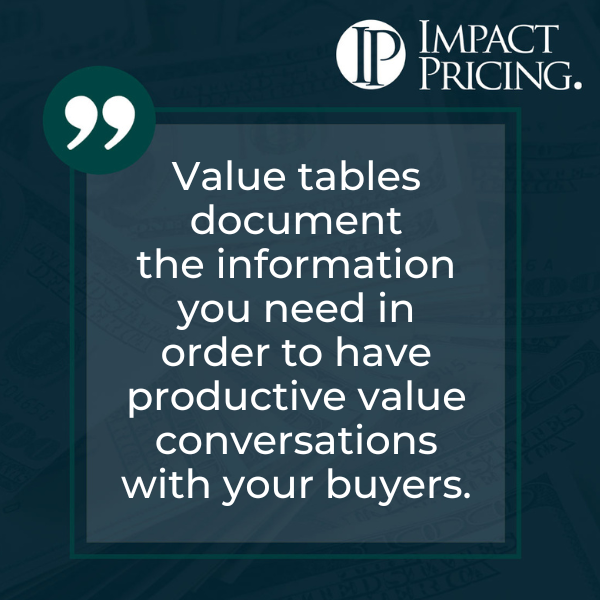
Pricing Table Topics: 5 of Spades – Value Tables
This one is the 5 of Spades from the Selling Value card deck. A value table consists of four columns: the solution, the problem, the result, and the value, typically in dollars. And when we do this, we think of creating the information, or the data in each cell for a typical customer. But we would never walk into a customer and say, 'You should expect to make a million dollars by buying this product.' Or we would never walk into a customer and say, 'We would expect you to have 3% more productivity if you buy our product.' Instead, when we think through all of the columns in a value table, and where additional profit comes from, and where additional productivity or reduced turnover, or whatever other effects we're going to have for our customers, then all we've done is say, 'This is a possible scenario.' But if we understand what those are, then when we go in and start having conversations with our buyers, and we say, 'What problems are you trying to solve?' Or, 'What results might you be looking for?' We already know how to take those problems, turn them into results. Those results turn them into profit dollars to the customer. So, I think of a value table more as a roadmap, as a conversation starter. As a way to say, 'Here's where I think the dialogue may be going.' But it certainly isn't the sales pitch we walk in with. We hope you enjoyed this example of Pricing Table Topics. What you just heard was done without a script. If you want to get better at speaking about pricing and value, grab a deck of our cards, pick a card, read the saying, then talk for one to two minutes about what that card says. You'll become a better speaker and expert. If you have any questions or feedback, please email me, [email protected]. Now, go make an impact. Connect with Mark Stiving: Email: [email protected] LinkedIn: https://www.linkedin.com/in/stiving/

Association Pricing: Leveraging Value as the Driving Force for Pricing Success with Michael Tatonetti
Michael Tatonetti is the Founder and CEO of Pricing for Associations. He is also a Pricing and Value Speaker and Consultant and a Certified Association Executive as well as a Certified Pricing Professional. In this episode, Michael discusses the importance of aligning pricing and value with the mission of associations and non-profit organizations. He emphasizes that value should be the central factor in creating a pricing strategy, as it resonates more with members and strengthens their connection to the organization. Why you have to check out today's podcast: Discover the three factors that distinguish associations from traditional subscriptions and find out their similarities in some aspects Find out how to price an association and why these two components of value and price tie in together to create the best pricing Learn how associations communicate better value in their pricing and the formula you can use to best convey your pricing "Focus on the value. Always put the value before the price." - Michael Tatonetti Topics Covered: 01:01 - How he started a career in Pricing 02:36 - What differentiates non-profit associations from subscription businesses? 03:59 - How does competition feels different in an association space? 05:37 - Looking at an associations membership bylaws, pricing objectives, their competitive positions in the space 07:16 - Three things that makes an association different from subscription business and what makes them the same with it 10:15 - What to consider when shifting from annual to monthly billing for associations and what he advocates as the biggest thing that differentiates association from subscription 12:32 - Pricing an association and when does he consider competitors when pricing? 15:08 - Questions to ask to come up with the best pricing 17:17 - Using Van Westendorp to help in data analysis for pricing [and the number of samples needed for this tool] 18:17 - Michael letting Mark share his own idea of the right number of responses needed for Van Westendorp data analysis 20:49 - Relying on value and not on cost when communicating pricing 24:38 - Michael's best pricing advice that could impact any business Key Takeaways: "Most subscriptions, not all, of course, run on like a monthly basis. Of course you can do annual, but most of them, you think in monthly terms where most associations are billing annually." - Michael Tatonetti "Most subscriptions for profit are able to just auto-bill where some associations, depending on state, cannot auto-bill, they can opt in, but for some they cannot." - Michael Tatonetti "Associations are typically divided into one of two categories, either organizational or individual. They're typically called trade or individual, trade is organization. Now, when you have an organization, then yes, typically they're not going to have it on renew." - Michael Tatonetti "I think of traditional subscriptions as an individual, I sign up and then I cancel when I want. Where with associations, there's typically more thought-power that goes into the decision to continue year over year." - Michael Tatonetti "I lean in on value a lot. I typically will not do work with an organization on just price. I typically require that we're doing value and price because most organizations don't change their value too often." - Michael Tatonetti People / Resources Mentioned: Robbie Kellman Baxter: https://impactpricing.com/podcast/ep94-powerful-pricing-insights-from-a-subscription-expert-with-robbie-kellman-baxter/ Van Westendorp: https://en.wikipedia.org/wiki/Van_Westendorp%27s_Price_Sensitivity_Meter Connect with Michael Tatonetti: LinkedIn: https://www.linkedin.com/in/drtatonetti/ Connect with Mark Stiving: LinkedIn: https://www.linkedin.com/in/stiving/ Email: mailto:[email protected]

Blogcast: You Have the Curse of Knowledge
This is an Impact Pricing Blog published on April 6, 2023, turned into an audio podcast so you can listen on the go. Read Full Article Here: https://impactpricing.com/blog/you-have-the-curse-of-knowledge/ [powerpress] If you have any feedback, definitely send it. You can reach us at [email protected]. Now, go make an impact. Connect with Mark Stiving: Email: [email protected] LinkedIn: https://www.linkedin.com/in/stiving/

Pricing Table Topics: 6 of Diamonds – Possess Acumen About Your Buyer's Business
This one is the 6 of Diamonds from the Selling Value card deck. If you are having value conversations, you're focusing on, what's the problem the client's trying to solve? What's the result they might expect to achieve? And if that result is quantifiable and we're selling to a company, then almost certainly you can turn that quantifiable results into incremental profit to that company. But in order to do that, we have to understand the business of our customers. I remember a long, long time ago when I was in sales, we were selling automatic test equipment and we had a device that was more accurate. But in order for the test equipment that was more accurate to have value to the client, we had to show, how does this more accurate tester generate more profit? Well, the answer was, in order for a semiconductor manufacturer to ensure that a part was of a specific speed, they had to take in the accuracy of the test equipment. And so, if a test equipment was less accurate, they would build a bigger guardrail. And if a test equipment was more accurate, they could have a smaller guardrail, which meant more parts would pass the test. And those more parts passing tests were sold at higher prices, meaning they made more profit. The point is, if we don't understand the business of our customers and we don't understand how they're going to make additional profit, then it's really hard for us to help our clients say, here's why this capability generates more profit for you. And when we're able to do that, then clients are much more likely and willing to buy from us. We hope you enjoyed this example of Pricing Table Topics. What you just heard was done without a script. If you want to get better at speaking about pricing and value, grab a deck of our cards, pick a card, and read the saying. Then, talk for one to two minutes about what that card says. You'll become a better speaker and expert. If you have any questions or feedback, please email me, [email protected]. Now, go make an impact. Connect with Mark Stiving: Email: [email protected] LinkedIn: https://www.linkedin.com/in/stiving/
Revolutionizing Your Price Segmentation Strategies in Subscription Pricing with Robbie Kellman Baxter
Robbie Kellman Baxter is an Advisor to the world's leading subscription-based companies, a Keynote Speaker and Author of The Membership Economy and The Forever Transaction. She is also the Host of Subscription Stories Podcast. In this episode, Robbie discusses the significance of upholding ethical standards when implementing a subscription business model, as it greatly affects the company's long-term viability. Why you have to check out today's podcast: Learn about the unethical practices in subscription pricing and their long-term implications for your business Find out effective price segmentation strategies that can be applied to your subscription-based business model Know why these companies are the best models when it comes to subscription pricing "Have a rationale for your pricing structure that you would be comfortable showing to a loved one who is a customer." - Robbie Kellman Baxter Topics Covered: 01:49 - What drove her entry into Pricing 04:28 - Why some companies make it hard for subscribers to cancel and what is it's negative implication in the long run 08:12 - Bad karma as a consequence of hiding a cancellation button 09:20 - Discussion around an advancing legislation on making it easier to cancel subscriptions anytime 11:11 - Understanding price segmentation in a subscription pricing 17:20 - How she negotiates when buying a car, for instance, knowing someone else paid a different price for that 19:20 - Price segmentation discussion around Everyday-Low Price[EDLP] versus High-low Price 21:09 - Discussing pricing segmentation used by Netflix and news organizations 23:25 - Another price segmentation point of discussion [based on where you live and how busy these areas are] 26:06 - Case in point at Macy's on price differential as the topic of discussion 27:51 - What makes her price sensitive even when she's non-price sensitive 29:20 - Robbie's best pricing advice Key Takeaways: "I tried to explain to them how [putting some friction into your cancellation process] in the short-term does work, in the long term, it kills your business. It kills your reputation, it ruins the trust." - Robbie Kellman Baxter "Whatever it took to get you in there, it should take you out. If you can sign up any day of the week, any time of day, you shouldn't be required to cancel Tuesdays between two and four." - Robbie Kellman Baxter "Where I come down on differentiated pricing or segmented pricing is if you can explain it to somebody. If your mother would be okay with being on the high end of that pricing and understanding why you're doing it, then I'm okay with it." - Robbie Kellman Baxter People / Resources Mentioned: SiriusXM: https://www.siriusxm.com/ Wells Fargo: https://www.wellsfargo.com/ Suzi Watford: https://www.linkedin.com/in/suzi-watford-18547817/ Dow Jones Wall Street Journal: https://en.wikipedia.org/wiki/Dow_Jones_%26_Company Booz Allen: https://www.boozallen.com/ Macy's:https://www.macys.com JCPenney: https://www.jcpenney.com/ Netflix: https://www.netflix.com/ Connect with Robbie Kellman Baxter: Website: https://robbiekellmanbaxter.com/ LinkedIn: https://www.linkedin.com/in/robbiekellmanbaxter/ Email: [email protected] Connect with Mark Stiving: LinkedIn: https://www.linkedin.com/in/stiving/ Email: [email protected]

Blogcast: Ford Patents Feature with Negative Value
This is an Impact Pricing Blog published on March 30, 2023, turned into an audio podcast so you can listen on the go. Read Full Article Here: https://impactpricing.com/blog/ford-patents-feature-with-negative-value/ [powerpress] If you have any feedback, definitely send it. You can reach us at [email protected]. Now, go make an impact. Connect with Mark Stiving: Email: [email protected] LinkedIn: https://www.linkedin.com/in/stiving/

Pricing Table Topics: 6 of Clubs – Have Value Conversation with All Potential Clients
This one is the 6 of Clubs from the Selling Value card deck. First, let's talk about an analytical journey. These are those people who, once they realize they have a problem that they might want to go solve, they spend a bunch of time doing their own research, probably on the internet, figuring out what are the different options, where they might buy it, what are the price points? These are the most price sensitive buyers we can deal with. And yet, if we get an opportunity to talk to them as a salesperson would talk to a potential client, we could be sitting there saying, Hey, here's why our product is better than our competitor's product. But my recommendation would be to make sure we have the value conversation about the inherent value of solving the problem. If we have that conversation, it may be that the buyer didn't realize that there were a lot of other opportunities or a lot of other places where there's value if they buy a product like this. The person might begin to trust the salesperson more and say, Hey, this person's really looking out for my best interest. The buyer is more likely to buy because we're showing them more and more value. So, for a lot of different reasons, it makes sense for us to make sure that we're going back to, let's call it "first principles". We're going back to help our buyers understand what's the value of solving the problem. And in the meantime, we also need to talk about how we are differentiated and possibly better than competitive alternatives. We hope you enjoyed this example of Pricing Table Topics. What you just heard was done without a script. If you want to get better at speaking about pricing and value, grab a deck of our cards, pick a card, read the saying, and then talk for one to two minutes about what that card says. You'll become a better speaker and expert. If you have any questions or feedback, please email me, [email protected]. Now, go make an impact. Connect with Mark Stiving: Email: [email protected] LinkedIn: https://www.linkedin.com/in/stiving/