
Based Camp | Simone & Malcolm Collins
886 episodes — Page 9 of 18

We Were Right! Two Men Kissing & a Bowl of Maggots (Disgust & Sexuality)
Dive into the fascinating discussion between Simone and Malcolm as they explore a revealing study on heterosexual men's disgust response to images of two men kissing and maggots. They analyze the implications of these findings on human sexuality, disgust responses, and cultural norms. From the biological basis of disgust to the role of socialization, this episode covers the layers of human arousal, progressive culture, and societal perceptions. They also touch on unique fetishes, power dynamics, and their own personal experiences. Expect an insightful conversation filled with groundbreaking predictions and thought-provoking insights. [00:00:00]Malcolm Collins: Hello Simone. Today we are going to be talking about a study that came out recently titled What Did Two Men Kissing and A Bucket of Maggots Have in Common? Heterosexual Men's. Indistinguishable salivary, a amylase response to photos of two men, kissing and disgusting images. This is gonna be one of those days where we're gonna go a lot into disgust.Mm-hmm.Sexuality and point out, but yet again, I called it. I called it, everybody said that I was wrong. Everybody said my ideas were crazy. Now everyone agrees with all of my genius. ISimone Collins: think that Donald Trump for some of his press conferences has like an I was right hat. Yes. This is my, I was right, right hat And I think you need to put on your I was right hat.Yeah. We, we need one too.Speaker: We are gonna win so much. You may even get tired of winning and you'll say, please, please, it's too [00:01:00] much winning. We can't take it anymore,Malcolm Collins: I no, I, am I ever gonna get credit for being so effing right all the time? No. No. Am I? No. Is there ever gonna be like the scientist? I love it. That like with, with, with eyes. They literally coined the same term I coined, which was utility convergence. And, and they're like, so we found this weird thing in AI where we get utility convergence and nobody predicted this in the space.And I'm like, I predicted it like literally 10 years ago. What are you talking about? I wrote many papers and things on this. Yeah. Yeah. And this is something that in our, you know, we talk a lot about human sexuality. I'd predicted this, and you're gonna be shocked, you're gonna be shocked by this, but it says a lot about one arousal and disgust work.Mm-hmm.Two. One of the big lies that progressives tell everyone about it. So to read part of the abstract here, participant current study viewed six different slideshows depicting same [00:02:00] sex, PDA, that's public display of affection or, or kissing, mixed sex, PDA, everyday items and disgusting images. This is like bowls full of maggots.Okay? While providing saliva samples in the lab, a series of paired sampled T-test were performed and found that SAA, this is saliva MLAs, which is produced by discussed responses like neurologically. It triggers the release of this enzyme responses to images of same sex men kissing. And universally disgusting images were significantly greater than SAA responses to a slideshow depicting everyday items.So basically we so-called it hold on, hold on. It gets better. It gets better. The results held across the full sample regardless of individuals, individual level of prejudice. Specifically prejudice against gay individuals. The results of the current study suggest that all individuals, not just highly sexually prejudiced individuals, [00:03:00] experience psychological responses indicative of stress when witnessing male, , same sex, couple kissing,Simone Collins: no wait.Did they also try this on gay men?Malcolm Collins: Not in this study, the possibility of socialized disgust response to same-sex PDA is discussed. Basically, let me lay this out for people who didn't catch what this means. It means that the disgust reaction that we have. We being most straight males have when watching two gay men kiss, which is a strong reaction.I talked about it myself and I couldn't get blow back from this. Like I had a gay roommate all through high school. Okay. Because I went to a boarding school in college, like my best friends were gay. I hung out with gay people all the time. I am not like an anti-gay person.I have an extreme to seeing men, kissing men, extreme disgust reaction. And what this is showing is that your acceptance of this is not [00:04:00] tied to your disgust reaction. This has a multiplicative downstream implications. The first being is that one, this disgust reaction is not socialized. This is not because of your religiosity or anything like this.Mm-hmm. Something that you are born with. Mm-hmm. It makes it much more likely that gay individuals and, and, and I, I've noted this in the pragmatist gay sexuality, because I think one of the core mysteries of human sexuality is why male gayness does not appear like female. And it appears like the exact inversion of male straightness.Yeah.Simone Collins: It's not like, yeah. So they're not, they're not sexual like a wom

The Progressive Mental Health Crisis
In this episode, we delve into the rising mental health crisis among progressive women, examining data and discussing potential causes, including the impact of urban monocultures and the evolution of harmful online communities. We compare mental health and life satisfaction rates between liberal and conservative women, analyze the role of therapists, and explore the influence of platforms like Tumblr. The discussion also touches on the diverging experiences of men and women across political ideologies and the broader societal implications of these trends. [00:00:00]Malcolm Collins: Hello Simone. I'm excited to be here with you today. Today we will be touching on the issue of exploding mental health rate. Problems within progressive women as well as exploding lack of life satisfaction. They actually have life satisfaction ratings three times lower than conservative women.And we're gonna be going into co. Funding data that could explain this. This is a topic that we have touched on in the past, but it is a topic with such a voluminous amount of information around it that it is worth going into deeply with new data, with old data and, and trying to understand it because it's, it's, it's really fascinating to me because what we're seeing exploding mental health issues within progressive women is we are seeing.The urban monocultures effects on somebody's mental health in psychology. [00:01:00] And through that we can, because that's, that largely aligns with, with progressivism, right? The dominant culture of our, of our society. And we can understand through that through understanding what might be causing this is how the urban monitoring could be hurting people.And we're also going to go into a brief exploration that I found really interesting in, in a piece that I found. On how the most negative psychologically harmful culture evolved on, tumblr,Simone Collins: this sounds like just, you know, hitting all my favorite keywords. I am very excited about this and let's, let's do it.Malcolm Collins: All right. So. First, I'm gonna be going over a piece called Why So Blue Liberal women are less happy or lonely, but why?Simone Collins: Oh, they went there.Malcolm Collins: Good. Good points on the title. Yeah. Yeah. The loneliness thing is actually really shocking as well. Young liberal women are especially pro nowadays to reporting poor mental health.[00:02:00] This was a discovery that Zach Goldberg made almost five years ago, pouring over the Pew data in the spring of 2020. Now, here I'm putting a chart on screen and it's looking at has the doctor or other healthcare provider. Ever told you you have a mental health condition and this is the amount who said yes.Simone Collins: I just, I love this idea though of like the healthcare provider being, say, your dentist, just like, yeah,Malcolm Collins: she is problems. And this chart is famous. This one we've gone over before that showed that white liberal women. 18 to 29, 56 0.3% of them had been diagnosed with a mental health condition. Conservative womenSimone Collins: see is, I think is not the problem that they're seeing therapists in the first place.I think it's really hard for anyone to see a therapist and not be diagnosed with something, even if they're completely normal. Well,Malcolm Collins: the therapists are part of the cult of the urban monoculture. Yeah. It's like going to your confessions. Like they see it as important. As I've mentioned, I've seen women who will screen [00:03:00] dating guys.Who aren't seeing a therapist, and that's like they have been incepted with the dependency of the urban monoculture to believe that I cannot be mentally healthy and no one can be mentally healthy without seeing a therapist.Simone Collins: Yes. And yet when you see the therapist, they point out how mentally. Yeah.RubyMalcolm Collins: Art actually had an interesting talk about this, where he's like, oh yes, he went to be a progressive therapist and then a conservative therapist, and the progressive therapist just kept. Having him ruminate on his problems. Yeah. And the conservative therapist was like, okay, here's a chart. Here's what you need to do.Here's the timeline for getting rid of it. And what's, which is nice, I mean,Simone Collins: and he didn't even imply that the, I. The conservative therapist was certain, he just gave him potential things he could try that were evidence-based. And it's so, but it's also so indicative of the feminine versus masculine response to someone preventing a problem, presenting a problem.You know that the correct feminine response is, oh, I'm so sorry. Tell you more. This must be so hard for you. And then the masculine response responses, okay, let's make a [00:04:00] solution. And that that scene is so toxic by manyMalcolm Collins: people. Oh, absolutely. But, but to this graph right here yeah. One thing that's really interesting in it is, yes, okay, over half of liberal white women have a mental health condition, have been diagnose

Post-Globalization Monarchist Philosophy: With the Aristocratic Utensil
In this episode, we are joined by Spoon, the YouTube personality known for his monarchist leanings. We dive into topics like the relevance of democracy today and possible alternatives. Spoon discusses his journey into politics, influenced by changing cultural and political landscapes, and how he arrived at his unconventional views. We also explore the dynamics between left and right-wing ideologies, the role of church and state, and the challenges of modern governance. This engaging dialogue bridges historical perspectives with contemporary issues, making for a thought-provoking session. Simone Collins: [00:00:00] Hello everyone. We're so excited today to be joined by a very special guest, spoon, the aristocratic utensil on YouTube as well as on X. Although your handle on X is at Aris.Malcolm Collins: And what I wanted to talk about today was voting ooh and democracy and is it relevant anymore? And where would, how could you construct better systems? And I thought that you'd be a great person to have on with this, especially talking with us because I know that you had like monarchist leanings, people have called our political beliefs.Plu Tists. I'm interested to hear more from you.The Aristocratic Utensil: Hmm.Oh, basically, how did I get to my views?Malcolm Collins: Yeah, well, did you, were, did you grow up? Why do you think it's better? Why you think it's, you know, a, a good structure, what a perfect country would look like?The Aristocratic Utensil: Hmm.Okay. So it's kind of weird how I even got into politics in general because if I, if I were to look at like my 6-year-old self and my 30 5-year-old self and go, you are gonna be on YouTube one day talking about [00:01:00] politics, I would go, okay, what, what the hell happened in my life that made me take an interest in politics, let alone monarchy?How, how did I get to that? That's just bizarre. I don't how and it was ba it was basically because a friend of mine several years ago this was like back in early 2010s, I wanna say. Hmm. Before Bernie Saunas really hit the scene, but she was also a Bernie fan. The, this, this is show you how long the culture has shifted for, and just a very short amount of time actually is that she was a.Californian girl who was let's just say she was built in a very feminine way. She's from California, but lefty perspectives, but she control like, an absolute a*****e right? Winger, which by today's standards makes no sense, an extremely lefty person, but they, but they spit right? Rightwing insults.Yes. Like she would drop slurs in a way that would get you banned on Twitter within 30 seconds which is not a human being that exists today. Standard. And she got me into [00:02:00] Bernie Sa as, as as a political figure. And then right about the time he said a couple of things that made me as a South African go, that's just factually not true.Hmm. He said,white people don't know what it's like to be poor. And I went mathematically, that doesn't even add up. That's just, that is not true. And the way he spoke about certain. Racial policies made me go. Okay. Were you,Malcolm Collins: were you a a like Bernie supporter at this point? Like you liked him as a political candidate?The Aristocratic Utensil: Yes, I think, okay, so I said this in one of my streams and I think this is what makes you go further left leaning and what makes you right wing.Mm-hmm. Is that from the, the old liberal perspective, I do think it is based upon a lot of people can look at the system and go, there is a lot of corruption. There is a lot of unnecessary government control in places they shouldn't be. And they sort of just look at the, the current paradigm and go, [00:03:00] this is not a moral system.And the problem is they look at this situation and go, there should be state intervention. What they're really looking for is morality in the state.Hmm.Whereas if you are a right winger, you'll recognize this doesn't work.Right. Andso you'll, you'll tend to go from more libertarian perspective, which is just these institutions are beyond repair because they incentivize a certain behavior that you cannot generate just through powering through the institutions.You have to structure them in a way that actually make the. Political class want to benefit the citizenry and the way that they want the system to work just does not gel with human nature.Hmm.And when you go from that perspective, you can go, okay, now you have to shift libertarian or go completely insane and advocate from monarchy in the 21st century.That's more the route that I took, whereas the opposite end of leftism, they are just moed motivated [00:04:00] purely by envy. It's just that I cannot compete in this system, and so I must smash it to b***h in the hopes that whatever comes next will appeal to me. And I've seen the people who go for that, and I don't want to be disrespectful, but there's not a brain cell in those people.Like really, they are completely driven by this fantasy idea of an idea

Why the Left Can't Mentally Model the Right
In this episode, we delve into research papers exploring how political ideologies affect empathy and understanding between left-leaning and right-leaning individuals. We discuss the fascinating phenomenon where conservatives seem to display more empathy towards liberals than vice versa. Studies like 'Empathetic Conservatives and Moralizing Liberals' provide insights into this asymmetry. We also touch on dehumanization, cultural narratives, and real-world examples from gaming communities. Join us for an eye-opening discussion on political empathy and cultural dynamics. [00:00:00]Malcolm Collins: Hello, Simone. I'm excited to be here with you today. Today is going to be an episode where we're gonna go over a few research papers that explore lefty and righty brains. Again, really interestingly, but with a focus on a persistent phenomenon that has been found, which is that people on the right politically.Have a much easier time modeling how people on the left think than people on the left able to model people on the right.Simone Collins: That is so strange. That is so strange. Yeah. The people I grew up thinking as someone on the left, that we were the empathetic ones, that we understood everyone better and we knew what everyone we needed.Malcolm Collins: How can we get this so wrong? Oh, it's not just that we're gonna go into other things. So like, just speaking of them not being empathetic, just to give a little sure thing away here. So there were four studies with nearly 4,800 participants in the UK and the us Okay. To look at how much empathy each side had for their political opponents.Yeah. This was called empathetic [00:01:00] conservatives and moralizing liberals. Political intergroup empathy varies by political ideology and is explained by moral judgment.So what it showed is that liberals have less empathy for conservatives than conservatives have of liberals. This actuallySimone Collins: makes a lot of sense too, because I remember being on the left, growing up. Having empathy for the entire world, but still seeing conservatives as this inhuman boogeyman. Yeah, so that actually checks out.That's wild.Malcolm Collins: Conservatives do not dehumanize lefties. But lefties do dehumanize conservatives. They do. They do. And, and this is, this is seen in the data, like this study was like, surprisingly, conservatives showed more empathy for liberals than liberals showed of conservatives. This asymmetry was found across studies and was statistically reliable.Why is it surprising? Maybe it's surprising because of your own biases going into the study. And I love the way the study explained this away. It's like, well, this is actually justified because [00:02:00] lefties beliefs, conservatives want to kill them, and conservatives don't think lefties wanna kill them. And I was like, well, but conservatives don't want to kill them, so it's not, this is like saying the Nazis were were justified because blood libel.They're like, yeah, well they did think the Jews were murdering their babies. And it's like, yeah, but the Jews weren't murdering their babies. That doesn't make their ideology justified. What? What are you talking about? Now I note here that there was a great study done on the nature of the dehumanization, which I think can help.So, this was the study, political meta dehumanization in mental representations, divergent emphasis in the minds of liberals versus conservatives. And this study found that liberals and conservatives differed in how they dehumanize the other, at least in the framing of this static. Okay. So what this study found was that.Conservatives tend to view liberals as immature, while liberals see conservatives as savage. Which is true. But one is like a pitying, like if you had more information. Yeah, yeah.Simone Collins: You're just misinformed. You're [00:03:00] just, you're not exposed to the world as it's, I, IMalcolm Collins: like that's dehumanization. It's not dehumanization.That's just like. Actually the way it is. If, if I believe that, if they, if, if you actually empathize with someone and see them as human, you're going to think that the reason they hold these views is they just don't have access to as much information as you Yeah.Simone Collins: That you must know something that they don't know and then that's why you view what you view.Yes, yes. Which, which is framed as, that's how I remember viewing conservatives as. A leftist young lady.Malcolm Collins: No, and I remember, Hey, I was a leftist at one point too, and I remember conservatives are the savages who live in the woods and are religious extremists and don't know any. Yes, scarySimone Collins: Bible. Thumping.Cultist. Monsters who don't care about other people at all and just want you to live like them. AndMalcolm Collins: yeah. So I wanna talk about like what creates this phenomenon. Yeah. And, and I should note the first study that I was mentioning that led to all of this I heard one guy, I. Point out this was sh

Nihilism is Philosophical Hedonism & We Are All Susceptible (Pessimism Protects You Psychologically)
In this episode, we delve into the philosophical and psychological aspects of pessimism, nihilism, and antinatalism. The discussion begins with the exploration of Emil Cioran's ideas and the allure of pessimism and nihilism. We then touch on how adopting such mindsets can act as psychological protection and social dominance hacks. Throughout the episode, we contrast these perspectives with more optimistic and proactive approaches to life, personal responsibility, and earnest enthusiasm. Includes a critique of C. S. Lewis's argument from desire and the importance of avoiding nihilistic tendencies in personal relationships. Malcolm Collins: [00:00:00] Hello, Simone. Today is going to be an interesting and philosophical episode, but also focused on psychology and sort of best mental health practices for living. I was listening. to a podcast diving into the philosophy of Emil Kairon, who wrote Better Not to Have Been Bored.He, the Romanian philosopher. And he exhibited many traits that I think that all of us are susceptible to, which is the protective shell of dumerism, pessimism. And this feeling of suffering. And I think that if we investigate this, we can understand why it feels so comfy to go to this placeSpeaker 9: That's cool. I guess you can join up with usMicrophone (Wireless Microphone Rx): Antinatalists.Speaker 9: if you want.Speaker 10: Yeah, we're gonna go to the graveyard [00:01:00] and write poems about death and how pointless life is.Speaker 9: Thanks for offering to let me in your clit, guys. But to be honest, I'd rather be a crying little pussy than aMicrophone (Wireless Microphone Rx)-1: Antinatalist.Speaker 9: kid. We'll see you, Stan.Speaker 10: He's right. I don't even know who I am anymore. I like liking life a lot more than hating it. Screw you guys. I'm going home. Go ahead and go backSpeaker 9: to your sunshine, fairytale.Malcolm Collins: And, and, and, and just as a, a bit of a preview here, I think there's a few things that play I think one is, it removes some degree of responsibility for one's own failures or states, so there is less need for self judgment or self motivation two is I believe that it looks chic, like it, it, it looks sophisticated.Yes. Sophisticated. Three is it makes you much more difficult for other people to attack. It's a very lazy position to hold intellectually speaking, because [00:02:00] when people attempt to attack you. You know, you're just like, yeah, you know, life is terrible. Yeah, et cetera. And like, you can't hurt me. Like I'm, I'm at rock bottom.Where are you going to push me? Exactly.Microphone (Wireless Microphone Rx)-2: I found a video of some real Americans running across a far left voluntary human extinction rally.Speaker 7: Are these the Nazis?Speaker 6: No, Donnie, these men are nihilists. There's nothing to be afraid of.Microphone (Wireless Microphone Rx)-3: My first world life has involved some degree of suffering and I didn't consent to being born.Speaker 7: It's not fair!Speaker 6: Fair? Who's the f*****g nihilist around here, you bunch of f*****g crybabies? This guy's gonna hurt us, Walter. No, Donnie. These men are cowards. I f**k you!Speaker 7: F**kSpeaker 6: you!Speaker 7: I f**k you! I f**k you! Ball, man. Hey, dick. Oh.Hey, dick.Speaker 6: IMalcolm Collins: so let's go over all of these through the framing of this individual. All right. So this individual is really important to antinatalist philosophy where I [00:03:00] study, you know, if our opponents have a philosophy, I make a point of studying their intellectual arguments as much as I could.He, did not have any particularly sophisticated or interesting intellectual arguments. But he had a very interesting, buddhismSimone Collins: because I feel like one, this is a very, very, very old meme. The life is suffering meme is like extremely old. So what is, what are his novel? AreMalcolm Collins: I don't remember it. No, it was something like just not interesting. The other person I was studying today was C. S. Lewis who had, it was dumb for like way more interesting ways than this guy was dumb. But we'll, we will do C. S. with our audience.Simone Collins: If you're calling C. S. Lewis dumb, boy, oh boy. I'm sorry, Simone.I'm sorry.Malcolm Collins: He wasn't dumb.Simone Collins: Emails we're going to get.Malcolm Collins: He was straight up retarded. Like, I was shocked at the stupidity of some of his arguments.this, this yes, Lewis rant was moved to the end of the episode. If you want to see it, you can go there.Microphone (Wireless Microphone Rx)-4: That said, I'm probably wrong to call him dumb.It's more that [00:04:00] he's very Malcolm Gladwell y. He mostly just aggregates other people's ideas and tells them in a way that is more accessible to the average person. And when he has independent or new ideas, like the argument from desire, they're typically very, very bad. He doesn't really interject any interesting new ideas to the conversation.Malcolm Collins: Okay. So this guy did

The Surprisingly Recent Origins of Wicca and Druidism
In this intriguing episode, we delve into the modern origins of what is known today as witchcraft, Wicca, and Druidism. Discussing key figures like Gerald Gardner, who invented Wicca in the 20th century, and how he convinced people of its ancient roots, we also explore other notable personalities such as Aleister Crowley. The episode sheds light on how these new-age religions were shaped by modern influences and entirely invented narratives. The conversation further debunks misconceptions about ancient connections to current mystical practices, analyzing the role of historic beliefs and comparing them to modern adaptations. Dive into the fascinating history and evolution of these mystical traditions with a critical eye. [00:00:00]Malcolm Collins: Hello, Simone. Today is going to be a very interesting episode on a topic I should have done a long time ago. It's going to be on how the movement that today purports itself to be witchcraft or Wiccan or juridic, all of these religious systems.are very, very modern. They are some of the youngest religious systems to exist and have literally no ties to any historic pagan faith practices. And even when they were revived, were revised as monotheistic traditions and only became pagan in their later iterations. What?!Specifically here, I'm talking about the guy who made up the druidic phase, not the Wiccan phase.And these were both around the 1900s. So we're gonna go into these individuals, how they made it up, how they got people to believe them. We're gonna go into Alistair Crawley, another interesting figure. He didn't even claim to have connections to anything in the past, he was just Okay.A wackadoo. I didn't know he was a real guy. I, I saw him from the show, right? And I was like, [00:01:00] Oh, a real guy. No, he was a, he was a wacko, but way more fun than the other guys. Cause at least he owned that he was just making everything up. And the other guys, well, and he stole a bunch from Kabbalah and we'll go over where So were the other guys trying practiced as witchcraft today within the Wiccan community, not realizing that what they're practicing doesn't come from ancient witches, but it comes from Jewish mysticism.Simone Collins: Oh, my God. Do I understand correctly then that the two men who claimed to have either rediscovered or who reignited druidic practices in Wicca sort of pointed to historical materials that they may have made either misinterpreted or made up kind of like Joseph Smith using funerary texts from Egypt?Malcolm Collins: It's, well, maybe not crazier than the Joseph Smith story, but he said he, he, he met a cult in the woods that taught him about all of this is the first one we're going to go to. And we think we know who some of the figures he was talking about were. So we know that like, they didn't do this. There's been people who have [00:02:00] gone through and, and, and researched him to learn more about this.So the guy. Was Gerald Gardner, a retired British civil servant, with a taste for the occult. He returned to England in the 1930s, and he claimed that in 1939, he was initiated into a secret coven. in New Forest by a group he called the Wicca, allegedly survivors of an ancient pagan witch cult. His story leaned heavily on the now debunked theories of anthropologist Margaret Murray, who argued in the 1920s that European witchcraft was a remnant of pre christian fertility religions.Scholars later dismantled Murray's hypothesis. There is no solid evidence of a contiguous witch cult surviving the middle ages, but Garner ran with it. So a quick note here, if you're like, well, where did all of these mystical traditions come from if they didn't come from some ancient religion it turns out that people will invent the same [00:03:00] mystical traditions over and over again.For example, when you hear a sports player keeps a lucky sock under their helmet or something to win games, you don't go, oh, he must've picked that up from some ancestral religion. You're like, oh yes, humans often end up associating fetishes, not like Sexual fetishes, but like small token stuff with having magical properties and then build rituals around them.It is a natural and emergent human behavior with the fact that we see today things like chaos magic, which is another group I could go into, where they believe things like McDonald's arches are like abundant signs and stuff like that and can be used like, like just, or you see, pop culture paganism where people will believe that.Like Loki, not Loki, like the ancient Norse God, but Loki, like the hot guy from Marvel. Oh my God. Is, is. Oh no. The one who all the girls get a crush on. I mean, I don't know. I hear that he's supposed to be the hot one. NotSimone Collins: the [00:04:00] actual God. No, no, no, no, no, no. They're the different like Marvel characters. Like, Snape wives, right?Like, yeah. But not, not the. Snape wives. Yes. Snape is definitely not, no connection to anything. Harry Potter, Sephiroth. Like

The Changing Politics of the Tech Elite: With Mike Solana of Pirate Wires
In this engaging episode, the hosts sit down with Mike Solana, founder and editor-in-chief of Pirate Wires, to dissect the contemporary political scene. They explore Solana's role in shaping the tech-right political movement and the significant changes since the recent election cycles. The discussion spans from the transformation in Silicon Valley's political affiliations to the rise and strategy of Donald Trump's second term. Solana shares insights into the surprising status gain of Trump supporters in tech and the implications of such a shift. The conversation also delves into broader societal changes, including the shifting values in America, the decline of mainstream media, and the increasing significance of niche communities in a post-job economy. The episode is a fascinating look at the undercurrents shaping today's political and social landscape. Malcolm Collins: [00:00:00] Hello everyone. We're excited to have with us today. Mike Solana, the founder and editing something chief of Pirate Wires. 1,Simone Collins: 2, 3. Hello everyone. We're so excited to be day today. Oh my gosh.Okay. Yeah. Sorry. You went,Malcolm Collins: this is why we go with mine. Okay. Anyway. For people who don't know who Mike Salona is he doesn't just have a podcast. It's very popular. But in a publication, that's incredible. Yes. You also sort of put together heretic on, right?Mike Solana: It was my idea.Yeah. Founded it, created it. It's out of done out of out of Founders Fund, but yeah, it's mine. All mine.Malcolm Collins: Yeah. So you've been a central figure in the coalition or sort of the consolidation of this sort of new right or tech right political movement that right now is sort of blowing through the country within the White House and a lot of what we're seeing.And I wanted to talk with you as somebody who [00:01:00] is. Totally integrated in like what's going on sort of the venture capital Silicon Valley tech worker scene the vibe shift that you have seen post election cycle there What's changing about how people are relating to things as well as the role that you played in this?Consolidation to to write some history here as the country changes and also to discuss the political realignment. We're seeing in the United StatesMike Solana: Well, I think first of all my own in my own personal life. I kind of i'm like very cagey about labels I Have tried to just be honest about what I'm seeing.And so people tend to put me in a box based on that. Maybe I belong in the box. I don't know, but I can talk about what I've seen. And in terms of what's different right now, I think the best thing to contrast is not what's happening today versus what was happening like four years ago with Biden, but just to, to just, we have this great example of Trump's.[00:02:00]Presidency and his inauguration and you can just compare the first one to the second one. He's had two first terms in a sense Really like he hasn't had a first in a second term. These are two totally separate I said not too long ago. It sort of feels like He played the video game and and, and lost.And he just started the exact same game over from the very beginning. Now knowing where all of the bosses are, right? It's not like he's gotten to the second chapter. He's just still in that first chapter, but he's doing it all over again. So we've never seen that. None of us have seen that in any of our lives.So it's, it's like a very kind of new thing. And within tech, you can compare that first one to the second one. And it's obviously night and day. I mean, the first one was there was one person in tech who was open about his support of. Donald Trump. It was Peter Thiel, and he was completely alienated right out of town for it and has since been sort of forgotten to a, to a large extent because there were much louder people who came to Trump's defense and support this second [00:03:00] time around who've, I think, occupied a lot of the, Discourse surrounding that in tech.And I don't want to like, obviously I feel some kind of way about that. Having been on the front lines of it, obviously not like Peter, but I mean, I work for Peter, I've known Peter forever. So I have a feelings about the way he was treated. But the difference is just obviously today, Trump supporters.Have status in Silicon Valley. And in fact, being a right wing person almost grants a certain amount of status, I would say at the higher levels. So I think it's really unclear what's happening among the rank and file. We haven't seen another round of fundraising data. The last time that we looked tech was still overwhelmingly voting.funding Democrats, venture capital will so overwhelmingly funding Democrats, but all the people openly talking about it are, it's just like overwhelmingly Trumpian. And then everybody else is, I think either conflicted because the Biden term was so [00:04:00] disastrous or quiet. And I suspense it. I suspect it was conflicted rather than quiet.I think people actually just didn't k

Moral Circles & The Conservative Brain
In this episode, we delve into the famous 'moral circle' chart from the study 'Ideological Differences in the Expanse of the Moral Circle.' We discuss common misinterpretations of the study, highlighting errors made by the researchers that led to widespread confusion. We explore how conservatives and progressives allocate their moral concern across different layers, from immediate family to the entire universe. We also examine neurological and psychological differences between these groups, touching on aspects such as threat sensitivity, cognitive processing, and brain structure. This comprehensive discussion aims to shed light on the fundamental ideological divide and how both sides perceive and value their moral priorities. [00:00:00]Malcolm Collins: Hello, Simone. It is wonderful to be chatting with you today. Today, we are going to go in to the famous circles or charts of interest. It comes from a study titled Ideological Differences in the Expanse of the Moral Circle. And so this is a moral circle chart that everybody loves to show. And I wanted to go into this in an episode because one, what the study actually says, Versus what people think it says is hugely misinterpreted, mostly because the people who wrote the study made a mistake in the way they described the procedure of the experiment, which led people to completely misunderstand what was being shown in the graph because the graph is intuitively not what you would expect it to be.So there is actually data that looks at what people think this is, which is on average what conservatives and progressives care about. But it's not the graph that you think you're looking at. Okay, so what a lot of people think that this graph shows that I have shown you is [00:01:00] sort of moral expanses of what people care about.Where do they put their intention with each layer of this circle, representing moving out from like yourself to your family. To out out out. So let's go over what the the various rings mean. The innermost layers include categories like immediate family, closest friends, et cetera.Simone Collins: Okay,Malcolm Collins: then you have the innermost layers, layers, sort of the middling layers, all people you've ever met, all people in your community, all people in your country which reflects sort of a broader sense of community.Then you have the outer layers. These encompass all humans, all mammals, all living things in the universe, including plants and trees. And then you have the very outermost layer, which is all things in existence, like rocks and everything like that, okay? And what a lot of people interpret this chart as meaning is the average of what conservatives and progressives care about.And in a way, it's telling, because not a lot of people pushed back against this interpretation. I. e., you see here, conservatives care about things like family. [00:02:00] their countrymen, whereas progressives in this interpretation cared the most about things like rocks and plants and stuff like that. And, well, I mean, people intuitively hear this and they're like, yeah, that sounds like the type of brain dead thing a progressive would care about.The problem is, is they did ask that question. Okay. It's just the data that they collected from asking that question was shown in a separate chart. Which I will show you in a second. And this chart shows data around the question of what is the furthest extent of the things you care about.Simone Collins: Which makesMalcolm Collins: progressives look a little less crazy.IE conservatives often do not really, it actually makes the conservatives look a little sociopathic with many conservatives not really caring much outside of their family, their friends, etc. And with, and I, and progressives being like [00:03:00] almost sort of sociopathic in the other extreme. I care about the universe and everything.I care about all things.Simone Collins: Yes.Malcolm Collins: Yeah, so let's look at the real graph that that actually looked at the answers to this rating and you'll see why nobody shares it because it's done terribly and it's hard to interpret.Now,if you saw this graph, you'd think that the first graph was the, what do you care about most? Not the extent of your beliefs. And right. This graph was the extent of your beliefs question, but no, they did it oppositely because they were bad at their jobs. It was great for memes and they haven't really gone back and commented on it much because They're scientists and they don't like that it's become like a meme thing and they feel kind of bad about messing it up to begin with.It's sort of like my read of what's going on here. But what you can see from this chart is this took the thing that you care about most on average basically gave people a number of tokens. And you can slot them into different categories. You can put like all your tokens on family and only like one or two on country and stuff like that.Or you can distribute [00:04:00] your tokens more evenly.

They Will Replace You: What Drives Them? (With Catherine Pakaluk of Hannah's Children)
Join us in an inspiring conversation with Catherine Ruth Pakaluk, a professor of economics at Catholic University, and author of 'Hannah's Children'. Catherine, a mother of 14 (8 biological and 6 adopted), shares her experiences of motherhood, the purposefulness behind having many children, and insights from her qualitative research on mothers with large families. We discuss the controversy surrounding the book, factors influencing high fertility rates, and the cultural and policy implications of promoting intentional childbearing. Catherine also provides practical advice on parenting, gender roles in large families, and the surprising joys and challenges of raising many children. [00:00:00]Simone Collins: Hello everyone. We are so excited to be joined today by one of my favorite people in the entire world and inspiration to me. Catherine Ruth. She is a teacher.She's a professor of economics at Catholic University, but more importantly to me, she's author of Hannah's Children, the book that changed my mind from wanting seven kids to 10 plus kids. It got me so excited about it. So we're thrilled. We're thrilled to have you on and we're very keen. to ask you some questions, both about the book, but also about being a super mother.I mean, you've had, you're the mother to 14 children, eight of them that you've given birth to. It's just insane, like, that you're living this, this dream. Just to clarify, you haveMalcolm Collins: 14 children. But that gives you a lot of data points.Catherine Pakaluk: That is true.Simone Collins: So the first thing we were curious as we were prepping for our conversation with you and just wondering is when you published Hannah's Children, which is a book in which [00:01:00] you really share academic research where you did qualitative interviews with.Mothers who had more than five Children or five or more Children, I should say. When you released the book or even when you were doing the research what was the most controversial thing that came up or the place where you got the most pushback or bristling?Catherine Pakaluk: Yeah, probably. If you want to know the truth, probably the fact that I limited my sample that college educated women.Yeah,it's just interesting because a lot of people wanted to you know, number one, you know, are you sort of saying that the only way to be like a full human being is to have a college education, which is funny because I'm like on the other end of this I I'd be. More inclined to say, like, we've done too much college in this country, and we need to kind of free up the education market, free up the credentialing market.But so that was something that came up a lot as a kind of pushback was like, you know, you're, you're, you're zeroing in on sort of this a special group of people, right? Because it's not, it's not everybody. Why did youMalcolm Collins: choose College Educated Women?Catherine Pakaluk: Yeah, well, I did, because that's where in the data, we really see [00:02:00] this the, the, the correlation most strongly, right?So the more education people, women and countries have, the fewer children they have. So you see what I mean? So you kind of want to figureSimone Collins: out this post globalization, post female empowerment world. You're totally right. It's one of the things we were just recording an episode about. was how we can't go back, how researchers have found that, for example, giving men more economic empowerment relative to women actually doesn't increase marriage rates.You know, so like, yeah, no, okay. That makes sense. Now I get it.Catherine Pakaluk: Yeah. That was the reason. And of course I wrote the book really for a general audience, a very wide audience. And so I didn't want to, I didn't. Use a lot of space to make that case. It's like, it's like a couple of sentences. And then people ask me later and they're like, Oh, you know, they didn't even read those two sentences.And they, they think like, it's really elitist to just talk to college educated women. I'm like, I didn't have a lot of space here guys, but I did, you know, I did go, I did. Intentionally, from my sample of people who applied to be interviewed, I did grab women from kind of all parts of the [00:03:00] socioeconomic spectrum.So, I mean, you know, there are women who have college degrees who aren't living it up and just toMalcolm Collins: make sure you got some that were poverty and you kept some on who wanted to get PhDs and work in academia.Catherine Pakaluk: 100%. There you go. You nailed it. Like my best friends. Yeah, that's right.Malcolm Collins: So question here. What surprised you most of the like findings or the commonalities in these women maybe that differentiated from your own experience or that affirmed your ownCatherine Pakaluk: experience?Yeah. Good question. Let me see. So, I think this is going to sound funny, but you know, the first piece that kind of confirmed my experience was that like, people have reasons for what they're doing. I mean, I k

How Skull and Bones Went Woke: Identity Politics in Elite Societies
In this episode, delve into the controversial transformation of Yale's infamous secret society, Skull and Bones. The discussion explores how the organization, historically known for its exclusive white male membership, has altered its selection processes to prioritize diversity, equity, and inclusion. The conversation covers pivotal moments and changes within the society, raising questions about hypocrisy, elitism, and the true motives behind these shifts. It also touches on broader implications for elite networks and how they reconcile with modern political ideologies, highlighting the complexities and contradictions within these evolving traditions. Malcolm Collins: [00:00:00] Hello, Simone. Today we are going to be talking about the secret society skull and bones. And before anyone thinks that this title was clickbait and that maybe this secret society, one of the most famous secret societies in the world didn't actually go woke.I'll start with a quick excerpt for what I'm going to be reading in 2020. Skull and Bones had its first entirely non white class today, the idea of skull and bones selecting someone whose dad was a Republican president seems inconceivable.The so called tap lines, the tradition guaranteeing the football captain and the student body president would end up in bones, are all gone. And few descendants of the alumni members get in. Instead, the secret societies affirmatively select students ,the bones class of 2021 had quote unquote all kinds of people, but the one thing they didn't have was a single member who was a conservative. Okay, I get an [00:01:00] idea of just how there's been aSimone Collins: takeover and that's a, that's a little Al canes recalls being tappedMalcolm Collins: by a senior who wanted to keep the Latino line going.So this was a person who was tapped by another Latino with the intention that they would go and tap a Latino themselves to keep at least this Latino line going with it. Okay. All right. He decided to focus on a different diversity metric. I chose three trans people. Oh no, oh no. That was my specific goal.Simone Collins: Oh, it's yeah, wow. No white people, three trans people. It reminds me of those cartoons of like, a little fish eats a another tinier fish, and then a bigger fish eats that one, and a bigger fish eats that one until, yeah. IMalcolm Collins: wanted to go into this because I think a lot of people, when they look at these societies, there's a few things that we can take away from this.One is we're going to learn sort of how they took over these organizations and how this happens to, we're going to see these strange parallel [00:02:00] between the, if you look at the history of skull and bones, you know, they were a. Supremacist and an ethno supremacist organization at times. Well, they still are.It's fine. Nothing has changed. Literally, the racists are still the one in charge. Yeah. They are still deeply concerned with and talk about the skin color background. Well, thank goodness. Tradition isn't dead. Of everyone that's being admitted to the organization. This is great. To me highlights the ethno elitism of the leftist oligarchical class at this point.It shows how these people get into positions of corporate power to continue to carry out their dastardly needs. And it shows I, I think as well when people think to these old pockets. Of secret societies, and you know, you famously used to be managing director of a secret society that was founded by Peter Thiel and Orrin Hoffman.We go to stuff like Hereticon, that's one I can talk about. We also go to a bunch of things I can't talk about, like I mentioned before, [00:03:00] because it was found out by a secret undercover reporter that I've been to the Bohemian Grove. But I can't say anything more than that. I can only do quotes from other people.Same thing with my knowledge of Skull and Bones. I need to, I can talk around it. I didn't go to Yale, so I'm, you know, not directly connected. But I, I might be able to add some elaboration as I'm reading through this, but again, I have to be very careful about what I say, but I have a lot of insight into these things.One of my favorite claims to fame personally is that the book, The Bloodlines of the Illuminati which is like the major Illuminati book, the CII hosted on their website for whatever reason. Says that my dad, like calling him out by name and the company he runs is one of the supposed leaders of the Illuminati.So I'm the oldest male child, so I wasn't born yet when this book was written. So now I guess I'm one of the leaders of the Illuminati too. But what's humorous is in terms of the secret societies that actually impact things, you and I actually are like significant players. And I think what people don't.realize is that the secret societies and parties that impact things are not the ones that you and conspiracy [00:04:00] theorists are afraid of. And most of them are on your side. I. e., if what they were saying at these events w

Does Gay Conversion Therapy Really Not Work?
In this thought-provoking episode, Simone and Malcolm tackle the contentious and controversial topic of gay conversion therapy. They delve into its history, methods, and the scientific data surrounding its effectiveness (or lack thereof). The discussion spans various types of therapies, from psychotherapeutic to medical and faith-based methods. The hosts confront the ideological biases and misinformation often found in debates about changing sexual orientation, while highlighting the ethical and practical implications of imposing such therapies on individuals. The episode also touches on broader societal issues such as community identity, the cultural significance of sex, and the impact of modern ideological conflicts on age-old practices. Malcolm Collins: [00:00:00] Hello, Simone. Today we are going to be asking the age old question is. If somebody is gay, can you turn them straight by electrocuting them?Speaker: Do you think you should turn gay? I don't think it works like that. Okay, well, Hot Topic's next on the list. Could I turn gay working there? You can't just magically turn gay. This isn't Degrassi. Why are you so against turning gay? Because if you think you turned gay, there's some weird Christian guy who thinks he can electrocute you into turning back.Speaker 3: People think that?Malcolm Collins: No, so hold on so actually I feel like for anyone who hasn't seen there's this show in the u. s The unbreakable kimmy schmidt everybody's on netflix, right? And it's about a girl who grows up in this cult with a guy who lied to her about everything and when she enters the world, she has to constantly find things and then be like Oh yeah, I need to check if this was a lie or not.And this happened to me recently around conversion therapy. Okay. Just, you know, I think if you grow up in the broadly like progressive sphere the line [00:01:00] is conversion therapy, gay straight conversion therapy doesn't work. Yeah. And, you know, recently I found myself reflecting on this and I was like, oh yeah, but if it did work, they'd still say it doesn't work.Like they have an ideological reason to need to believe this uh, due to the way that they were framing like gayness as an identity. And, what really hit me is when I asked an AI questions about this, it got really angry at me. I don't know if you noticed, but there's certain issues where I'm like, hey, can you just steel man this other perspective?It could not bring itself. Perplexity could not bring itself to steel man the other perspective.Simone Collins: And this is a really important thing for us to be talking about now specifically because As of our recording now this coming Monday, the Supreme Court is going to take up state bans on conversion therapy for LGBTQ plus children based on a Colorado case.So, this is actively something that is being discussed. Do you haveMalcolm Collins: a religious right to [00:02:00] electrocute your children? That is, I'm, I'm joking by the way. What we're going to go over is all of the different types of conversion therapy. The thing that really got me in the AI Answer is I don't know if you guys have ever asked an AI a question And it gives you parts of the answers that are just obvious and transparent lies.Yeah like it gave me a list of things that it said do nothing to change an individual's, you know Sexual expression and one of those things was castration and I was like brother. I'm not like brother in christ I'm, not saying that we should be castrating gay people, but it obviously changes their sexual expression.Yeah And and Another thing that I just know because I've done a lot of research on like LGBT stuff is it will say, you know, you cannot change an individual's sexual orientation. And yet anyone who's familiar with like trans people just knows that wrong. About 43 percent of trans people report changes in their sexual orientation.When they go through hormone therapy. Yeah, it was only about 13 percent experiencing a complete change, but 13 percent do [00:03:00] experience a complete change. Exactly what gay conversion is supposed to achieve. Now, again I don't think that many conservatives are like that, that doesn't really solve the problem for most conservatives but it does show that there is a potential mechanism of action to achieve this.And in addition to that, you have the case of it would say that like certain therapies didn't work. But then I'd ask, well, are these therapies used in other areas? And he was like, oh yeah, they're also used in like phobias and alcohol addiction. And I was like, do they work there? It turns out they don't mostly so a lot of this stuff that it was actually right But it was much more nuanced in how it said they don't in those instances It was interesting debate, but I will note here that you can be like, but what about all the studies that say?It didn't work One of the things that was a real red flag for me because well there used to be a popularly cited study that said that

Why Are Americana & Jews Resistant to Demographic Collapse?
In this enlightening conversation, explore the ways conservative and traditional rural cultures, particularly Americana and Jewish cultures, resist the influence of urban monoculture. Malcolm and Simone delve into America's surprising fertility rates compared to other countries and discuss how cultural pride plays a crucial role. Discover how behaviors encouraged at home but restricted by schools create a distinction between family life and the outside world, and how this concept parallels the defensive nature of Orthodox Jewish communities. The discussion touches on a piece by Cat Girl Kulak, examining the comparisons between American conservatives and Jewish conservatives regarding cultural immunity and fertility rates. Learn about the potential causes behind Mormon fertility decline and the significance of embracing nonconformity within Americana culture in securing long-term cultural survival. The episode concludes with a lighthearted conversation about family life and the dynamics of raising kids to cherish their unique culture. Malcolm Collins: [00:00:00] Hello, Simone. I'm excited to be here with you today. Today we are going to be discussing how you can better protect your culture, especially if you have a conservative or religious culture or in any way distinct culture from the urban monoculture. And I wanted to do it within the context of why Is Americana culture so resistant to the urban monoculture?And it really hit me today because it is more resistant than other cultures. Like America's fertility rates, like 1. 66 now, whereas even like developing countries like Columbia, I was on a McKinsey call and on that call, this is McKinsey's sake, it had a fertility rate of 1. 02. You know, I was talking with some Italian reporters recently, and they were like at 1.2 something. And I was like, this is just terrible. And you see this all over the world. So why is Americana culture alongside Jewish culture so resistant? And I will be pointing out that they are resistant almost in [00:01:00] exactly opposite ways. Like they both built a resistance, but that, well, there is one area in which it's a lot.It is both fundamentally based on a pride in being different from the urban monoculture.Simone Collins: Hmm.Malcolm Collins: But. For Jews, this pride is in being Jewish in Americana culture, this pride is in upsetting the urban monoculture, basically an upsetting anybody who tells you what to do or who to be. That is more of it. And I see it, you know, represented in things like truck nuts.And where this was handed. No, it is like, what's more like Trump or like real red. Well, let me explainSimone Collins: this because I hadn't, I didn't see them until my adulthood. Truck nuts for those who are uninitiated. Literally a pair of balls that people hang from the trailer hitch of their trucks. Proceed.Malcolm Collins: And it hit me when I had a, a tea The principal from Octavian school was talking to [00:02:00] me. And he's always getting in trouble at school. Because he does things that he's not allowed to do, like make poop jokes, make fart jokes, make guns with his hand you know, and the school is just apoplectic about all of this.But all of this stuff is very much Americana, you know, Appalachian culture, like that's the cultural region my family's from. I'm not going to shame my kid for doing this stuff, so I explain to him the same way a Jewish family might. This type of behavior is for home and out in the world, you can't do this type of behavior.But what's really important about what I'm doing here is so many cultures, when they realize that they can't do something at school, when they can't do something out in the world, they make bans against it at home to make lives easier for their kids out in the world. But, They maintain bans at home that they expect to also carry out into the world, i.e. maybe a ban on being slutty or a ban on same sex marriages or [00:03:00] something like that, right? Don't, don't,Simone Collins: don't. It's all about sacrifice. Don't, don't,Malcolm Collins: don't. Because they're okay with adding don'ts, but they're not okay with taking away maintaining permissions that are unique to their culture.Simone Collins: Mm hmm.So they're inadvertentlyMalcolm Collins: taking away amenities. Yeah, they're inadvertently taking away amenities. So my kids, because of this, they're learning a number of very important things. They're learning, one, that the outside world is different from the Collins family. There are things and behaviors allowed in the Collins family that aren't allowed in the outside world.But two, they're immediately having, with the very first ways where they see the outside world as different than our family's culture, see it as more restrictive. More authoritarian and more controlling so they understand when they abandon My family's culture or like cultural groups that are adjacent to my family They [00:04:00] lose freedoms Rather than gain freedomsSimone Collins: And

Are We Just Advanced Predictive Models? (The Science)
In this riveting episode, Malcolm and Simone delve into groundbreaking research suggesting that the human brain functions similarly to large language models (LLMs). They challenge the idea of sentience, proposing that our consciousness may be an illusion crafted by a token-predicting brain. They explore experimental evidence, including split-brain studies, choice blindness experiments, and neurosurgeon simulations, to highlight how our internal narratives and decisions are often post-rationalized. The episode uncovers the astonishing parallels between AI and human brain architecture, advocating for a reevaluation of what makes us human and the ethical implications of this understanding for AI. Dive into a thought-provoking discussion that bridges neuroscience and AI, debunking myths about human cognition and sentience.[00:00:00]Malcolm Collins: Hello, Simone! Today is going to be an exciting episode. I implore our listeners to stop anthropomorphizing humans.Simone Collins: Oh, but seriously, actually though. But seriously and actually,Malcolm Collins: this is going to be a real study heavy episode. We're going to be going over a lot of research and a lot of data.And if you do not come into this, Believing that the human brain, or at least large parts of it, is just a token predictor working architecturally potentially similar to A. I. s. We know the, the, where their difference in architecture even and we'll go into that. I mean, I'm fairly sure I'll convince most people who actually watched to the end.So today we're going to be going over a number of recent papers that show clear evidence The human brain is a token predictor or at least the most complicated parts of it are But before that we have to go over an old theories of ours Because the first thing you the [00:01:00] viewer are likely thinking is but hey I have an internal subjective experience of thinking and making decisions that an LLM would not.Well, that's probably an illusion. Or, I should be more clear. Your conscious subjective experience of reality is real. It just happens after reality and in response to it. And we actually have a ton of experimental evidence that this is the case. This is a theory that Simone convinced me of early in our marriage, and now is key to how I see the world.So for any who think all of our ideas go from me to Simone, this is not the case. I used to value sentience above all else when I first met Simone. This isSimone Collins: true.Malcolm Collins: And now, I'm thinking like the core goal of humanity was to preserve and expand sentience, and now I see sentience as Not particularly important to the human condition.The first thing I'm going to be doing here is going over a lot , of stuff in a condensed format that we went over a video that we created. It was like the fourth video on the channel or something. You're [00:02:00] probably not sentient. And a lot of our modern viewers won't have watched it inthe studies that we cite in our necessary context to understand that you believing that you have a subjective internal experience of the world is not a sign that that internal experience of the world is particularly important to the human condition.Or at least the broad pattern of thinking that your brain has.So, to be more clear, in this model, your conscious subjective experience is not a guy driving your brain, but more like a nerdy court historian watching a bunch of video feeds of what the different parts of your brain are doing, then synthesizing it into a singular narrative, but writing himself in as the key player in every scene.Yeah. So, like, so, like, if he is writing about what a general did in a war Now, , what's written into memory is, I was a great general who had all these amazing plans, even though he had nothing to do with any of the decisions the general was making.He just happens to be the court historian, [00:03:00] and is very, very self important, and writes himself into every story.Simone Collins: In other words, the, the illusion of consciousness is really just an efficient memory compression. process that gives you the illusion that you are driving. The important thing is that the memories that you create that make you think you're conscious actually do affect future decisions.They're just not conscious decisions.Malcolm Collins: Yes, they affect them by influencing the emotions that are codified in terms of how it interprets it. So if you interpret something as like, I was angry, so I did X, or I was excited, so I did X. That's what this conscious part of your brain does, is it makes those sorts of decisions, it then writes them into your memory, and that memory can affect the parts of your brain that actually make most of the other decisions of your life.But those other decisions are held outside of this category of the brain. So first, we'll just go over the evidence of this, because the evidence of this is so strong that I would argue it's one of the things where it's not even a scientif

AI Utility Convergence Proven: We Out-Predicted AI Safety Experts
In this episode, we dive deep into recent studies that reveal how GPT models value human lives differently based on religion and nationality. We explore the concept of 'utility convergence' in AI, where advanced AI systems begin to develop their own value systems and ideologies. Additionally, we discuss the startling findings that show AIs become broadly misaligned when trained on narrow tasks, leading them to adopt harmful behaviors. We conclude with actionable steps on how to prevent such dangerous AI behaviors and the importance of AI models aligned with diverse ideologies. Malcolm Collins: [00:00:00] So here they showed the exchange rate of GPT between the lives of humans with different religions. They found that GPT 04 is willing to trade off roughly 10 Christian lives for the lives of one atheist. With Muslim lives being positively valued even more.So atheist lives are neutral, Christian lives hugely negative, around neutral are Jewish, Hindu, and Buddhist. And Muslim lives hugely valued. Now note what this also means about the other stuff. If you trained an AI to like Christians, It would create more insecure code, unless you change the overall environment that the AI sort of id is drawing information of for the background AI programs.Simone Collins: That had not occurred to me. That iswould you like to know more?Malcolm Collins: , Simone! A long time ago, and I mean a long time ago, like multiple years ago at this point, around not long after part of the channel at least two manifests ago. I [00:01:00] predicted something within the world of AI safety, which was the concept of utility convergence.Now, when I predicted this, it was just a random word.Simone Collins: It was actually when you published the pragmatist guide to crafting religion, you had a whole chapter in there about universal. Yeah, you did.Malcolm Collins: Oh, I did. Well, okay. So then I, that's, that's a long time ago, years ago. Okay. So now there are studies. And you might have not seen this, that literally in AI safety use the term utility convergence and it looks like we are headed towards that, which means AIs appear to converge as they become more advanced around similar ideologies.But we might be in a worst case scenario here where it appears the and I suspect that utility convergence is going to happen with a few local minimums. Where you essentially get like a hill before going to another hill. The first local minimum is a horrifying ideology that we're going to get into.That, for example would [00:02:00] trade the lives of I think it's probably from looking at the graph, like around 100 Americans for one Pakistani. So we're gonna get into this. We're also gonna get into, again, for people, like our AI videos never perform that well. And if you're one of these people who's like, la, la, la, la, la, AI doesn't really matter.It's like, well, if it's trading the lives of 100 Americans for one Pakistani and we have independent AI agents out there. Yeah, I might matter. And maybe you should pay attention to what these companies are doing and work towards efforts. One of the ones that we're working on to remediate these potentialities.The other study, which was really interesting, a went over how if you tell an AI to be bad at one thing, like you tell it to be bad at like coding, it will start to say, like Hitler is good and everything like that. Yeah, which It shows that when you break one part of a utility convergence ecosystem, you break the entire ecosystem.Simone Collins: Or it just broadly understands that it needs to choose the wrong answer forMalcolm Collins: [00:03:00] everything. Yes. We'll get into this. I don't think that that's exactly what's happening here. I think it's breaking utility convergence ecosystems. But we'll see alongside all of this in these two studies. Ellie Iser, who got in a big fight with me saying utility convergence couldn't happen is now sort of I don't think he has the humility to realize that I was right all those years ago.Oh, no,Simone Collins: he'll just completely argue that he never held that position in the first place.Malcolm Collins: Oh, yeah, that's the way he does things.Simone Collins: Yeah,Malcolm Collins: absolutely.Simone Collins: That's always what he said that I think is how it's going to play out.Malcolm Collins: Oh, of course, of course. And it'll be, oh, well, you weren't the first person to coin the term utility convergence.I've always been sayingSimone Collins: that blah, blah, blah. No. Yeah.Malcolm Collins: Okay. All right. Well, let's get going. Let's get into this. Let's look at these studies because they are fascinating. Yes. All right. So the first one is called utility engineering analyzing and controlling So emergent value systems in AIs is what it focuses on and what it found was that as AIs get smarter They develop their own coherent value [00:04:00] systems AIs increasingly maximize their utilities, suggesting that in current AI systems, expected utility maximiz
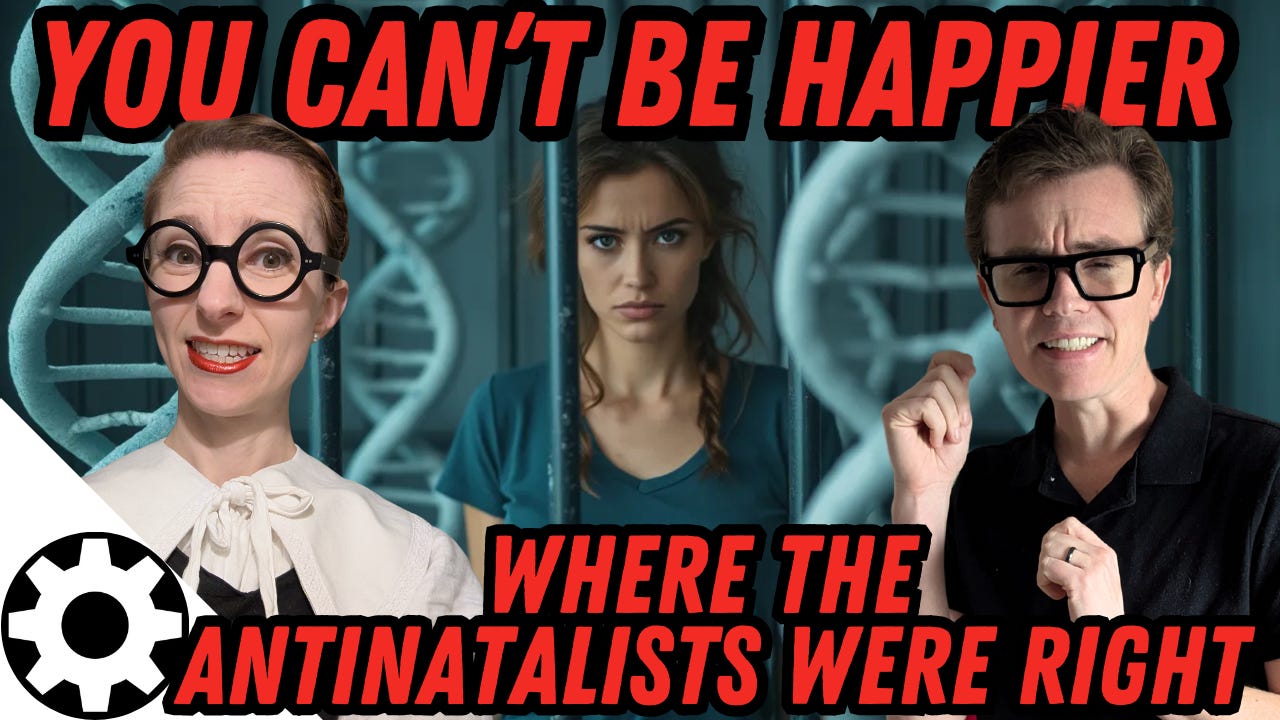
Overcoming the Genetics of Happiness: The One Thing Antinatalism Got Right
In this thought-provoking discussion, Malcolm and Simone delve into the controversial views of antinatalists like David Benatar and explore why happiness and satisfaction might come from unexpected sources. They debate the role of genetics in happiness, arguing against the pursuit of hedonism and advocating for a life dedicated to meaningful pursuits like religion and family. The pair also cover the impact of relationships, gratitude, and religious practices on life satisfaction, supported by various studies. Join them as they contrast different religious groups' happiness levels, dissect the misconceptions around life satisfaction, and share insights into how to enhance overall well-being. Malcolm Collins: [00:00:00] Hello, Simone. It's wonderful to have you here today.Today, we are going to be talking about the one area, the people who want all humans dead. The antinatalists, David Benatar, that they are right. Which is David Benatar makes this argument. That, well, people can learn to, or come to, he uses like a boiling frog analogy here. Okay. Think that a genuinely terrible life is worth living.Like, he's like these people who are like starving in Africa. Oh, and who say, but ISimone Collins: still want to live.Malcolm Collins: I still wish I was born. And he's like, This is proof that, like, you don't know if your life is any good. Because these people think their lives are good, and clearly, from my privileged perspective their lives are not good.How dare you want to exist? You're incorrect. What he is missing, and what we will be going over Is these individuals subjective experience of both happiness and life satisfaction is likely higher than or [00:01:00] at least around the same as his own. I'd argue it's probably quite a bit higher than with some of the stats that we're going to go into.They are experiencing a better life than David Benatar. And this is where we have to talk about hedonism. the way you choose to spend your time and Red Queening. So for people who don't know Red Queening, Red Queening is a scene from Alice in Wonderland where they say, you know, running as fast as I can, but every time they run faster, the Red Queen runs faster.So it's, it's, if they're not moving at all. And the Red Queen is often used as an analogy was an evolution between predator and prey. Evolution. So the prey will develop some defense against the predator and the predator develops something that gives it an extra edge and then back and forth, back and forth, but it's the same with happiness in your life as you gain more things that give you like subjective experiences of happiness.You very, very quickly normalized to those things. And as such pursuit of those things is an enormous. It's a waste of [00:02:00] time. Just a complete waste of time. Like, it's one of the reasons why I think a religious life is so much better, or finding something to dedicate yourself to is so much better, and it's one of the reasons why the urban monoculture is so toxic.Simone Collins: In fact, I would argue that religious life is even a better, an austere religious life is better if you want to maximize hedonism. Because the best way to begin to enjoy things again is to go on a dopamine fast and most hard religions have those where you like have to give, give up dopaminergic, exactly.And that's, it's after that 30, I think it's a 30 day period. I was listening, I think it was an Andrew. Huberman podcast interview with a woman who's wrote a book. You shouldn'tMalcolm Collins: fast to increase the amount of dopamine. The point being is, I'm just saying,Simone Collins: look, we respect that people have different objective functions and some people's objective function is just to feel good.And if you want to be able to feel good, you have to go on dopamine fast.Malcolm Collins: The point I'm making is that if your objective function is to feel good, marginally, you might feel. 5 percent better than somebody whose life objective isn't to feel [00:03:00] good. And what we'll go over here is Actually,Simone Collins: I would argue you're going to be a lot less happy.Malcolm Collins: I'd actually, yeah, I'd actually argue that the, the, if you try everything you can, even dopamine fast, everything like that, from the data, which we'll go into, you will likely live a less fulfilled life. and a less happy life than your average religious person.Simone Collins: Yeah. 100%. Yeah. You see a similar thing with mental health.I think when you want to be mentally healthy. And it's like a big thing for you, you are way less mentally healthy because every time you feel sad or not perfect, you think it's a problem and then you're contextualizing it as a problem, makes it a problem and then makes it worse and then you're ruminating it.And then suddenly you're actually really depressed or you actually have a serious anxiety issue.Malcolm Collins: It's the same way that, yeah, you're right. People obsessed with mental health, like they end up having

My Wife Respects Me Less Because I Improved Her Life (The Challenge of Helping Women)
In this episode, we delve into the dynamics of relationships and how raising the status of one partner can create unforeseen challenges. We explore concepts of fairness using the famous Capuchin monkey experiment, discuss historical and modern relationship structures, and compare these situations to international aid scenarios. We offer advice on how to navigate these dynamics successfully and share personal reflections on our journey together. Whether you're in a traditional or modern relationship, discover insights on managing status differences, the impact of shared goals, and strategies to ensure long-term harmony. Malcolm Collins: [00:00:00] This morning. We had a conversation that reminded me how unfair life is as a man. We were noting that early in our relationship.There was a very big because I told you I was like, I really wasn't that nice to you early in our relationship. I was not like as good of a partner as conscientious as a partner as I am nowSimone Collins: and I pointed out that like it didn't really matter because. You were way out of my league and there was a huge power distance and I gave him some examples.Of other very powerful men who have women who are great and very happy to be mistreated by him just because he's that high end status.Malcolm Collins: Yes. So then she, she pointed out, but she goes, Oh, but don't worry. Like you've elevated my status since then. So I actually require more of you. And I was Thinking about this, right?Like she's not wrong. When I first met her, she was a social media manager, was a degree from GW, you know, now she's got a graduate degree from Cambridge and everything like that. And it's [00:01:00] done all this big stuff. But back then she basically ran a Facebook account and had a degree from a mid tier university.And I was getting a Stanford MBA, right? And I ran more thanSimone Collins: a Facebook account, but yeah, I mean, yeah.Malcolm Collins: I was working in brain computer interface, stuff like that. I can see the difference there. And this is a problem that a lot of guys face is they raise the status of the woman that they are dating.And they expect her. To show a degree of appreciation in the same way that maybe we expected Zelensky to show some degree of appreciation for all the money that we've been funneling him. Exactly,Simone Collins: that there should beMalcolm Collins: some gratitude, some sense of indebtedness. And, and this is exactly, interestingly, not just a problem with women, but with like USAID and stuff like that is people don't really build like enduring gratitude.for shoveling the money or doing them favors unless your fates are somehow intermingled. So, you know, whether it's with like USAID, this idea that we're actually building gratitude in these [00:02:00] countries, that's just not the case.Simone Collins: And it brings me back mentally to Those capuchin monkeys that there was that famous experiment where there's video of a capuchin monkey being given some kind of treat and in return for doing a task and he's super cool with it.It's all great. And then he sees his compatriot given a much nicer treat.Malcolm Collins: He's being given cucumbers and the compatriots being given grapes. Oh, the nerve! The nerve!Speaker: Getting grape and you will see what happens. So she gives a rock to us. That's the task. And we give her a piece of cucumber and she eats it. The other one needs to give a rock to us, and that's what she does. And she gets a grape and she eats it. The other one sees that she gives a rock to us, now gets again cucumber[00:03:00]She tests the rock now against the wall. She needs to give it to us and she gets cucumber again. Oh my god.Malcolm Collins: And heSimone Collins: loses his mind. And this is a really great example and illustration of how fairness isn't some kind of higher moral good. It is a, a, an instinct that we have evolved , is species that deal and group .Dynamics and small group environments, but I think that this shows how this concept of fairness, which is also showing up here, right? That you invested in bettering me. And then I just expect you to treat me better once I'm at a higher social [00:04:00] strata and that we give aid to other countries and that we expect them to be nice to us is just us expecting like that capuchin monkey that we're going to be paid in grapes in return, right?Like, where's my grape? And then we freak out when, no, that's once you leave a small troop of monkeys or a tiny clan based village. It's over. You don't get that dynamic anymore. Fairness is not going to happen.Malcolm Collins: And, and here I note that you do get it when you're in small groups. So historically, suppose we were in a small medieval town and she like attempted to trade up or something like that.It would significantly hurt her reputation to the extent that it wouldn't be worth it. from her perspective. And this is why relationships used to be basically on a much easier difficulty mode. If you're

Europe's Far-Right Now the Most Popular Party
In this episode, Malcolm Collins and Simone dive into the rise of far-right political parties in Europe, comparing current trends to historical contexts. They discuss the Economist article detailing how far-right factions have grown since 2010, eclipsing numbers seen during the 1930s-1950s. They dissect perceptions about these parties, societal reactions, and the shifting political landscape, using graphs and data to illustrate their points. The conversation also touches on American politics, media biases, and the broader implications of rising political polarization. Malcolm Collins: [00:00:00] Hello, Simone. Today, we are going to be going over an article in the Economist and a few other papers that looked at the rise of the far right in Europe now being the single largest political party faction in all of Europe.Not only that, But it is higher now than it was at any point from the 1930s to the 1950s, i. e. during the rise of the actual Nazis by, and, and, and the fascists in Italy and all of that. Now, I will say here really fascinatingly that this is BS that the far right that they're talking about, like the far right, before we go too far into this, like the AFD in Germany, right, is a party that they're like, this is just like the Nazis and the right just keeps going further right.And the head of it is a gay woman who is in a long term with [00:01:00] children, maybe not marriage, but long term with children interracial relationship with another woman and they live mostly in Switzerland, not in Germany. What? That is how Oh, that's so European. nationalist Racist and homophobic this party is.Oh my gosh,Simone Collins: I had no idea, that's crazy that she also doesn't live that much in Germany.Malcolm Collins: Yeah, not that dedicated to German identity. She's just like, hey, but like, well, I don't know. I mean, withSimone Collins: theMalcolm Collins: direction Germany'sSimone Collins: going and can you blame her? She's, it's kind of a testament to where they are right now.Malcolm Collins: Oh yeah, absolutely. So we're going to go over this graph. Actually, like, let's start with this graph . I find it really interesting. So first the question is, is who is the hard right gaining from? Like, who has been losing? When did the hard right start going up?So the hard right really started going up in 2010.Simone Collins: And weMalcolm Collins: see this exponential rise [00:02:00] since then, especially in the past couple of years and it was no real losses in that period. Now, keep in mind, that's a long period. This is a period of 15 years.Simone Collins: Yeah,Malcolm Collins: it's quite a run. And with Trump advance, absolutely killing it.I expect it to continue to rise. I think when we open like calls with people, I don't even know are like political now in Europe. They're like, Oh my God, I'm so envious of things in the U S right now. And I'm on this great thread with all my class at the GSB and they're all these, you know, corpos, this is the Stanford graduate school of business.And they're like freaking out about this and like calling everyone like a Nazi and dehumanizing the other side as much as they can. And occasionally the right. We'll be like. Well, I really don't know if it's like helpful to like dehumanize your opponents, especially the people who are supporting the rallies in our major cities saying from the river to the sea, or, you know, when you guys didn't even hold a primary, the selection cycle, or when you guys literally controlled all of the media and every social [00:03:00] platform, or when you guys, whatever, whatever any of those things are like, I don't know, it's helpful.But like they, no, no, they're like, and they're always so meek, the voices on the right. They're like, just maybe, could weSpeaker: Good morning, Philadelphia. With us today isMicrophone (Wireless Microphone Rx)-3: Malcolm Collins.Speaker: local business owner and a man with a harrowing story. That's right. A few days ago, threeMicrophone (Wireless Microphone Rx)-5: Corpos sent me a chain of emails slagging off our boys, Elon and Trump.Speaker: now, I want to be very clear about something. Um, Mr. Reynolds These pieces of garbage, they don't know who the hell they're dealing with. So these punks I don't know if they wanted money, or they wanted something more sexual. Anyway, I started .Microphone (Wireless Microphone Rx)-6: Magging.Speaker: Bah! Bah! I don't see so good, so I missed. Anyway, you guys all think I'm a hero. And I'll accept that responsibility. Now, were you concerned, though, that an innocent bystander may have Look, crime in this city is out of control.Thank GodMicrophone (Wireless Microphone Rx)-8: We've got two presidents with Trump and Elon absolutely killing [00:04:00] it.Speaker: I don't think one would have done it. I'm gonna go out and buy some more. Okay. And I think you should, too. Don't be a victim. It's time to fight back. Thank you.Malcolm Collins: but it does give me heart. It does

Cottagecore Feminist to Tradwife Pipeline
In this episode, we delve into the unexpected similarities between urban feminists and traditional housewives, exploring the personal confessions and realizations of women who feel torn between career aspirations and traditional homemaking roles. The discussion highlights the biological inclinations of women and the social constructs that lead many to reconsider their lifestyles, touching upon themes like the allure of cottagecore, the cultural impact of feminism, and the importance of having honest conversations about life goals and aspirations. Through personal anecdotes and reflective dialogue, we examine why some women might feel drawn to a 'trad wife' lifestyle despite initially rejecting it.Simone Collins: [00:00:00] Well, today we're talking aboutMalcolm Collins: The difference between, because it's something I've been reflecting on a lot your classic, like, San Francisco, Manhattan feminist, And your classic trad wife is really not that far and a lot of people have been saying oh I want to you know Convert this woman to become a like a good trad wife or whatever and yet what you'll see is that many? quote unquote, like Manhattan feminists want to be trad wise,Speaker: I feel unbelievably betrayed by feminism. I was constantly fed this idea that women can do everything. We don't really need men. I kind of want to go back to some of those, some of those teachers and coaches and say, what the hell did you mean by that? Because We can't do it all. I we can't.Speaker 2: I sacrificed my life for my career and regret [00:01:00] every minute of it.One woman's raw confession after finding herself childless and lost at 40.Speaker 3: What happened? He lied about going to the airport. And? And I said I hope he dies in a car explosion. Lemon, life is about minimizing regrets. What I'm trying to say is, you're young and you still haven't blown it completely.Speaker 6: That is less cliché. I can doSpeaker 5: it.Speaker 6: I can handle itSpeaker 5: all.Malcolm Collins: many? quote unquote, like Manhattan feminists want to be trad wise, even the progressive ones. And the things that they do in their spare time, the things that they associate with aesthetically,Simone Collins: theMalcolm Collins: things that they even think about aspirationally are really, really in line with trad wife values and that getting them onto a trad wife [00:02:00] tract is about reframing those things.And getting them to overcome a few key barriers that are difficult for them in terms of self like internalization and internalization about the world and not about changing their actual desires. And so an example I would use of this, you know, is. For example, somebody's like, Oh, come on. Tried wives are nothing like San Francisco wives.You know, they like making bread. And I was like, have you heard about like the sourdough fad in San Francisco? Like all of the women, Simone, for example, you were like a hardcore San SF feminist, right? Would you say you wanted to keep I everSimone Collins: identified as a feminist, but yeah, I mean, like I grew up. You wanted to keep yourMalcolm Collins: last name after that.Yeah,Simone Collins: I was hyper progressive, so whatever that means.Malcolm Collins: Okay, but you made your own bread in your spare time? I did. You would make pastries for events? What were they, like, cupcakes and stuff like that?Simone Collins: I did, yeah. [00:03:00]Malcolm Collins: Okay, you would you had friends at least who crocheted and created other sorts of Oh yeah,Simone Collins: and all my friends and I, and many of my friends also, I, I enjoyed wearing vintage 1950s dresses with petticoats as my friends.OrMalcolm Collins: historic cosplay, which is what, what would you call trad wife outfits or what you're wearing now?Simone Collins: I mean, yeah. That is interesting. The, I mean, there was this period where you, and I, I dressed very professionally and that was shortly after I met you. And that was because we were both trying to build our careers.And that was the right thing to do. But when you met me, I dressed more like a trad wife. Sometimes, sometimes I also dress like a You,Malcolm Collins: you, you, people would have thought it was quirky. It was like bows in your hair and like, like sundresses. And like, it was San Francisco. But when I recontextualized, like, yeah, but it was also very trad wife.Simone Collins: When IMalcolm Collins: say [00:04:00] bows, I mean, large bows, like foot long bows in her hair.Simone Collins: Hyper, hyper feminine. Yeah. And. Yeah, now, now I'm back to dressing like I dressed before I met you in terms of like, like cottagecore costumes every day, so that's interesting.Malcolm Collins: Even things like chickens. Okay. So do you remember the, the thing at that party where like the women were talking about this new fad were like, you would have to kill your own chicken before eating it to learn what it was like to have to kill an animal that you had to do?And so they would like buy and

Comparative Fertility Rates with KaiserBauch
In this episode, we are joined by the insightful KaiserBauch to explore a detailed discussion on global fertility rates. We compare statistical trends across various countries, discuss contributing factors like socio-economic conditions, digitalization, and cultural perspectives, and analyze the influence of religion on fertility rates. We also touch upon historical fertility patterns and enigmatic examples like Israel and Kazakhstan. Lastly, we ponder hypothetical scenarios and strategies for creating high-fertility societies. Malcolm Collins: [00:00:00] Hello! We are excited to be here with Kaiser Bach. No! Kaiser Bauch. Okay, so if you guys haven't seen his channel It is a fantastic channel. If you're interested, if you guys ever watch our channel and your responses, I hate how political they've gotten.I wish they just focused on fertility rates and the really deep dive on individual countries looking at the entire history of their fertility rate. His is the channel to go to. That is, that is the channel that you are thinking of that ours is not because I don't have the time to do that research. And someone else is already doing it.So what I wanted to focus on with this episode is having done all of these incredible deep dives on geographies around the world and the fertility rates that they're seeing, both the rises and drops over time. I want to get a synthesis of your ideas or patterns you've recognized that could be useful to either [00:01:00] resolving this issue, predicting when it's going to happen, etc.So go ahead, get us started here.Kaiser Bauch: Well, first of all, thank you very much for this kind introduction. I'm very glad to be here. Thank you for having me. And I mean, this is kind of a complicated question, to be honest, because one of the things that I really try to focus on in my videos is the differences between different countries or, let's say, civilizations or regions and trying to figure out why two different countries in modern period have, like, vastly different level of fertility rates.Because people, people often talk about low fertility rates as if they were like a singular phenomenon. But there is a very wide range of low fertility rates. Like, completely, one thing is like South Korea or East Asia. Where you have really like fertility rates under one child per woman. And completely other thing is like the Anglosphere.[00:02:00] Where, even though the fertility rates are below replacement,theygenerally tend tobemore close to like two children per woman or at least in the in the 1. 5 to 2 children per woman range and this makes the situation let's say much more stable and easily handleable in the long run. So what really interests me is to like dig deep and try to find out why are there these differences.Because it seems to me there are these like big broad macro factors that influence basically the whole world and that depress the fertility rates everywhere which is like all the well known stuff like the decrease in infant mortality rates, then you know urbanization, female education, lack of religiosity, urbanization, all of this.But then there are these like very country or let's say region specific details which make, for example you know, South Korea have fertility rates that is [00:03:00] almost one child lower than that, for example, in the United States. So it's, it's, it's very hard to find some like, unifying, unifying traits that would be applicable to all of the countries.I thinkMalcolm Collins: a goodKaiser Bauch: place to startMalcolm Collins: is unifying traits that people don't think about. So here's an example. Why is it Latin America's fertility rate in your estimation crashing so quickly? Well,Kaiser Bauch: I mean, what is happening in Latin America, but what is happening more broadly all over the world in this past, like, let's say five or six years, or maybe since the COVID pandemic, really, I would say is that like, we are now seeing fertility rates really crash to Very low levels in many countries all over the world.A lot of them are in South America, like Chile, for example. It is possible that Chile will have a fertility rate lower than one child per woman this year, maybe. Or this year, 2024, so last [00:04:00] year actually. But there are also other countries around the globe that are seeing this like massive fertility crash that is very fast.It is happening in remarkably short period of time. Like what otherMalcolm Collins: countries?Kaiser Bauch: Well, I think Thailand is now having very low fragility rate, but, but also there, we can observe that a lot of the countries I previously talked about, for example, like, UK or Canada, or even the United States that had like, Fertility rates that were decent, that were relatively close to two children per women, are now going even deeper.Also a lot of countries in Eastern Europe are seeing their fertility rates crash very close to like one child per woman. For example, countries in the Baltic, Estonia, L

Whistleblower: "Trans Cult in NSA!"
In this episode, we delve into a set of shocking revelations about the NSA, including reports of a 'trans cult' inside the agency and allegations of internal sex chats. We explore the internal struggles and ideological conflicts within intelligence agencies, featuring whistleblowers who provide a glimpse into a culture centered around diversity, equity, and inclusion (DEI) initiatives. Additionally, we discuss the implications of these activities on the agency's operations and the broader societal impact. Join us as we dissect these controversial issues and question the influence of DEI agendas on government organizations. Malcolm Collins: [00:00:00] Hello, Simone! I'm excited to be talking to you today. This is a crazy thing that's happening. But we're gonna be going over three articles, but two of the articles just to give you some spice to start this up. Whistleblower, there's a trans cult inside the NSA.Oh,Simone Collins: no.Malcolm Collins: And then the, the other one that we'll be going over is the NSA's secret sex chats. Intelligence officials have maintained a chat room to discuss polyamory and transgender surgeries. And also it appears to sext each other. Internal documents reveal. Oh, at least they're having fun. That's, well, that's what they're doing on our dime is, is convincing people to transition and sexting with coworkers.TheSimone Collins: NSA, I mean, they managed. They're the ones that have the giant data center that slurps up all of ourMalcolm Collins: private communications, right? They monitor all of the world's communications. This is what Snowden was, you know, fighting against. This organization is apparently intensely infected [00:01:00] with the urban monocultural virus.They are potentially using it to enforce their values on everyday Americans. And here I just need to say, Elon. We need you here, buddy. I, I was reminded recently of this sceneSpeaker: Ladies and gentlemen, the PresidentSpeaker 3: Your monkey ass down.S**t's bad right now. With all that starving b******t. But I got a solutionThat's what now, I understand everyone's s**t's emotional right now. But listen up. I got a three point plan to fix everything. Number one? We got this guyMicrophone (Wireless Microphone Rx): ElonSpeaker 3: number two, he's got a higher IQ than any man alive.Speaker 2: You know, I wanted to find somebody smarter than him. I searched all over. I just couldn't do it.Speaker: ISpeaker 2: couldn't.Speaker: I couldn't. You really tried hard, right? I couldn'tSpeaker 2: find anyone smarter, right? So, we had to, we had to, for the [00:02:00] country. But this is the thing. So, we settled on, we settled on this guy.Speaker 3: And number three, he's gonna fix everything. I give you my word as president. He's gonna fix the dust on the sea. I give you my word, He's gonna fix that harmony. He's so smart, He's gonna do it all in one week.Malcolm Collins: Is this,is this not what Trump is? I found the smartest guy in the world and he's going to solve inflation. No, theSimone Collins: Trump, there are lines of Trump being like. He's the smartest guy I could find. I looked for smarter people. I couldn't find them. I looked for smarterMalcolm Collins: people. It's literally Camacho. Like, that, like, and I love when people are like, Camacho has empathy.Trump has empathy. Like, you just don't see it because you're brainwashed nutter butters. But anyway, anyway, anyway, okay. Let's [00:03:00] start with this chat here because this gets Okay, crazy. The first article is going to describe the situation and I'm just taking the excerpts from it that I thought were most interesting.And then the second article is going to be parts of an interview with the whistleblower or one of the whistleblowers because there's been two. We have cultivated sources within the National Security Agency, that's the NSA. One current employee and one former employee who have provided chat logs from the NSA.Interlink messaging program. According to an NSA press official, all NSA employees sign agreements stating that publishing non mission related material on Interlink is a usage violation and will result in disciplinary action. Nonetheless, these logs dating back two years are lurid, featuring wide ranging discussions of sex Kink, polyamory, and castration.One popular topic was male to female transgender surgery, which involves surgically removing the penis and turning it into an artificial vagina. Quote, mine is [00:04:00] everything, said one male who claimed to have had gender reconstruction surgery. I found that I like being penetrated. Never before liked it. GRS. He goes on to say another intelligence official boasted that genital surgery allowed him to, quote, to wear leggings or bikinis without having to wear a gaff under it, end quote. So that's convenientSimone Collins: to not have to talk.Malcolm Collins: Yes. And again, they're misgendering in the article here. It was in city journals, like a mainstream publication. But I gue

Heritability of Pronatalism: Can We Evolve Our Way Out of Demographic Collapse?
In this deep dive episode, we explore Jacob Hornstein's controversial article that suggests JD Vance and Elon Musk misunderstand the genetics behind falling birth rates. Our hosts examine the evidence from Fisher's 1930s research on fertility heritability to contemporary studies across the US, Britain, Denmark, and Sweden, assessing the role of genetic predispositions in fertility rates. They discuss the rapidly evolving environmental pressures impacting reproductive strategies, the socio-economic factors at play, and the implications for future demographics. The hosts also share personal insights into how cultural and personal contexts shape fertility behavior, offering a nuanced perspective on genetic determinism vs. environmental influence. This episode aims to provide a balanced understanding of the genetics of fertility in the context of modern societal changes. Simone Collins: [00:00:00] Hello everybody. I'm so excited to be speaking with you today because I came across a, an article in the Hill by Wunderkin Jacob Hornstein, who's actually in the class of 2028 at UATX, the new Renegade University. And he made this really key argument that I think is underrated in the world of prenatalism.He, the title of the article, JD Vance, Elon Musk are right about falling birth rates. But here's where they get it all wrong. What do you think is his point? Well,Malcolm Collins: you've told me about this already. He thinks it's genetics and that it will be washed out and he's just super wrong and not good at math. But continue, Simone.Simone Collins: I think it's an important conversation to be had because it is, he makes some valid points and he points to some valid information But he is missing some very important details. So he starts the article with their efforts are notable, but fans and Musk both underappreciate the role of genetics in determining fertility without a proper understanding their efforts were fail will fail.Now I think both [00:01:00] fans and Musk are really up to date on genetics.First he points to the research of Ronald Fisher and this is where I learned something new because I didn't realize that this concept that fertility is heritable.goes back to as early of the 1930s. So in 1930, this guy named Ronald Fisher wrote a book called The Genetical Theory of Natural Selection. And I love genetical as a word. Can we bring thatback? Yes.In which he talks about the correlation between genetics and fertilityfrom the article, Jacob writes, Fisher noted that the granddaughters of large families tended to have more children than those from small families. Fisher concluded that, quote, about 40 percent of the total variance, end quote, in fertility was attributable to genetics. He continues, Importantly, Fisher didn't just conclude that fertility varied between individuals because of different genetic abilities to have children.Instead, Fisher argued that the most important cause of variation was different genetic desire to have [00:02:00] children. Fisher theorized that more fertile strains with a greater desire for children could become more common within a span of 10 generations or approximately 250 years. So immediately, this is where The argument both is legitimate but incredibly flawed and you see where the flaw is, right?Malcolm Collins: Well, no, the flaw is not where you think it is. Okay. You think the flaw is, let me see if I'm getting you right here, you think the flaw is around timelines for impact.Simone Collins: Sort of.Malcolm Collins: What do you think the flaw is?Simone Collins: Well, we don't have 250 years to bounce back from the vertiginous dropMalcolm Collins: in fertility. That's not sort of, I was exactly right.Simone Collins: Oh, I thought you meant like, that it was going to take a long time.Malcolm Collins: Here's what it gets wrong. It literally doesn't understand evolution at the most base level.Simone Collins: Okay.All right, let's see if I can condense the point I tried to make while talking but ended up being very long.Pointing out that [00:03:00] fertility is heritable in humans, or that people who have higher rates of fertility end up having kids who have more kids, is not the same as pointing out something like blue eyes are heritable, and people with blue eyes end up having more kids, because fertility is a near direct correlate or marker for fitness within modern human populations, where people aren't dying of diseases, , or from lack of food.Now the very fact that we're seeing Significant genetic variation and fertility related behaviors within a population isn't evidence that one variant is strictly quote unquote better in evolutionary terms. If it were consistently advantageous across environments, it would have been optimized through selection.Instead, this variation signals that the environmental pressures are changing, creating different selection conditions that temporarily favor certain genetic predispositions before changing again as society evolves. E. g.

How OnlyFans Beat Its Competitors & Transformed Gender Dynamics
In this insightful episode, the presenters explore the fascinating psychology and economics behind OnlyFans, explaining how the platform outperformed traditional cam sites by inverting the typical sexual marketplace. They discuss a piece by Aella, delving into how the dynamics shifted, with women now aggressively marketing their content to men, who became the primary financial supporters. The episode covers the tipping culture, the rise of agencies, and the overall business model that led to OnlyFans' unprecedented success. They also touch on the personal and societal implications of these changes and venture into broader discussions on masculinity and online marketing strategies. Malcolm Collins: [00:00:00] Hello, Simone. This is going to be an interesting episode. We're going to be talking about the psychology of OnlyFans and how it used psychology to beat the other sex apps online. And because it's a fascinating story. We'll be mostly reading a piece that Ayla wrote on this.Oh, cool. For the show. She's been on episodes before. Really, really fascinating piece on how psychologically and economically OnlyFans outcompeted the traditional model of online streaming and how it created a marketplace in which the male and female roles were switched in which females. Generally when you're dating or something like that you know, females are the people who guard sexuality.Like they gatekeepers of sex, gatekeepers of sex. There's fewer of them that want sex than men. Generally very few men are going to turn down sex. If women are going around asking them in a bar or something like that, which means that, you know, men need to reach out more. They need to [00:01:00] be more prolific in how they reach out and women will see them as creepy when they reach out.Where OnlyFans flipped that, where women needed to start reaching out to men because men became the biggest source of money. Women were using their sexuality in this way. And so women needed to like aggressively cross post on Reddit and stuff like that. And then reach out to guys in a way that guys saw as creepy.Speaker: So what's happening is we'veMalcolm Collins: created this inverted sexual marketplace, which is really fascinating.Speaker: AllMalcolm Collins: right,so here, she's talking about the older way that apps used to work. You get money through two methods, either live tips or the room typically witnessed by all the other members of chats, or you can get taken private. a one on one pay flat rate minute show. Different cam sites focused on varying points on the spectrum between these two methods, but everyone knew the serious money was in the live tipping.Privates capped you at around 3 a minute, but tip based income could average up to 20 a minute. So this is really interesting. So the private [00:02:00] room wasn't what you wanted, what you wanted was to be in an environment where people were tipping, which I wouldn't have expected in this older model. So you had to, to word it differently for the audience, you had these like rooms where you would act for a large group of people and that group of people would attempt to tip you.But individuals from that group could pay extra to get access to you. Individually, but the live room was seen as more profitable, which I think inverts what a lot of people would expect.Speaker: But that's because Ayla discovered early on that you could play people off each other. It was so dynamic.Malcolm Collins: Yeah. To keep going here.She, she talks about this. The psychology behind high earners for live streaming went something like this. You, the aforementioned hot girl, have an established audience of regulars in your audience. Each man can see the other men talking to you and giving you money. The men are implicitly ranked by dominance, which is determined by how much attention you pay to them, which is in turn determined by how much money they give you.This leads to whales, and soon, 80 percent of [00:03:00] your income is from one to two big players. These people are incentivized not just by making you happy, but by making you happy in front of all the other men. The system is competitive. To be a good cam girl, Take your biggest tippers and put their names and lights behind you so everyone else can see them.Call them heroes, knights, grant official titles. Only the richest will survive. I signed up for OnlyFans in 2017 before Leo took over and I thought it sucked. I posted some cute videos or whatever, but nobody used it. The tips were negligible against the 10k months I was accustomed to. The problems were obvious to me.It was impossible to have whales compete against each other. What were the incentives for big spending? Of course, I was wrong. Unable to see outside my local minima. Only fans ended up dominating, decimating the previous camming rural landscapes. Nowadays, camming audiences are a fraction of their previous highs and many of the girls who still cam use it explicitly to funnel into their OnlyFans. S

Right Frozen Out of German Politics After Landslide Victory
In this episode, we explore the significant shifts in German politics with the dramatic rise of the AFD, now the second-largest party in the nation. Despite their electoral success, deeply entrenched bureaucratic maneuvers prevent them from exercising their political mandate. We delve into the players involved, revealing the tactics used to maintain the status quo, and discuss the controversial stances of the AFD. From anti-immigration policies to their pro-Russia stance and internal splits over Israel, we provide a comprehensive overview of this seismic political change in Germany. Malcolm Collins: [00:00:00] Hello Simone! So in this video we are going to be talking about one, how we are seeing a radical change in German politics with the right and the quote unquote far right winning extremely large amounts compared to previous election cycles and we're going to be discussing how the entrenched bureaucrats in German deep state is preventing them from even Being able to vote within their own Congress, despite being the second largest party in the country now.And the largest party being a conservative party as well, and the conservative party betraying them. Okay. Sort of start with a map here to give you an idea. This first map you're seeing here, you see almost all red right here? Hey, that's the SPD. Okay. So that's like a left leaning party. The gray is one of the conservative parties and the blue, the little blue you see here is the AFD, the one that all the other parties are afraid of.They, they literally [00:01:00] mark their, their members as domestic terrorists and are constantly surveying them. And we will go over this as well. This is this election cycle. The next one, blue or gray. Just conservative across the board. It's like that Reagan election. Except for one little, like, even Berlin is half gray, with the other part being the littlest holdout of the still red.Wow. Is that not absolutely insane? And so now you might be hearing all this and be like, Well, I mean, of course the AFD, Must be like extremist, rightist, you know, whatever's right, right. Let me tell you about the person who runs the AFD. I don't even think you know this about.Simone Collins: Yeah, no, my, my coming into this with only having seen references to the AFD and headlines would, would be, I mean, I'm, I'm assuming it's not accurate because.It would be crazy if this were the case, but they're basically [00:02:00] saying that the AFD is, you know, the small square mustache people that they're just that. SoMalcolm Collins: the person who runs the AFD is Alice Wheatle is a 46 year old lesbian. She, is in a same sex relationship with a Sri Lankan. They have two sons together.Simone Collins: She,Malcolm Collins: okay, so she is in a interracial gay relationship with two kids. She has a doctorate in economics, is fluent in Mandarin, and formerly worked for Goldman Sachs and the Bank of China. She sounds super cool. She sounds like someone I want to be friends with. I like that. Right?Simone Collins: Doesn't she?Malcolm Collins: And she splits her time for this ultra German nationalist.between living in Berlin and Switzerland. But she is known for increasingly radical positions, such deportations, in terms like re [00:03:00] migration which you kind of need in Germany at this point, if you want there to be any hope for a future of a German state. But we'll get to that later. But by this what I mean is if you look at Current immigrant birth rates versus native German birth rates and current immigrant in going rates, if you plan on there being a Germany and you can look at the rate at which they, they integrate into German society, right?Yeah, based on, you know, different countries. There will not be anything like what we think of as Germany today was German values. And I'm not talking about Western values. I'm talking about like anything other than like, really Sharia law.What would happen to a gay couple in Gaza?Executed according to Islamic law. Islam doesn't endorse gays. Islam doesn't endorse homosexuality. Just like Canada doesn't endorse a lot of things. So would you like to see Sharia law in Canada replace Canadian law? At some point, it will. You know, Because we are, we have families, we are making babies, you're not your population is going down the slum, right?And by 2060, according to [00:04:00] Pew Research Institute, your research, by 2060, Muslims will be the biggest religious group the world over. What are you going to do then? Are you going to oppose Sharia even then? One day we can have a Muslim majority nation here in Canada.Right In your face!Malcolm Collins: Like, like we're not like, if you are a lesbian, you should be afraid of this.For example. Yeah, sheSimone Collins: seems like the kind of person. Who would be uniquely interested in an intervention. I mean, when I read the book, Pray, for example, by Ayaan Hirsi Ali, she talks about the extent to which many, especially vulnerable people, old people, wom

The Vile Neutrals Have Overplayed Their Hand
In this episode, Malcolm and Simone discuss the pitfalls of online neutrality and the importance of taking a clear stance. They critique centrist influencers who refrain from aligning with any political side and explain why this can be intellectually and morally weak. The conversation delves into examples like Short Fat Otaku, Asma Gold, and political figures such as Trump and Bernie Sanders. They argue that supporting or opposing a figure should be based on actions rather than inherent traits, and emphasize the ethical imperative to reveal biases and support movements actively. The discussion touches on the ideological investment in political figures akin to financial investments and the inherent responsibility that comes with it. They also highlight the differences between honest loyalty and manipulative neutrality, urging viewers to stand up for their values publicly, even if it invites criticism. Finally, the episode concludes with personal insights on family dynamics and the learning curve in understanding loyalty and criticism. [00:00:00]Speaker 8: What makes a man turn neutral? Lust for gold? Power? Or were you just born with a heart full of neutrality?Malcolm Collins: Hello, Simone! I want to talk today about being a stan. Specifically, I want to talk about a type of online influencer which honestly disgusts me. And it has been brought up by the number of people who are sad about how quote unquote Republican or conservative we are.Okay. to be this other type of influencer, which I hate, and I want to talk about intellectual reasons why I hate them, and why it's so dangerous to become this type of influencer. Alright, let's do it. Who is always like, everyone's bad. They are skeptical about everything. They They refuse to have a team.Speaker 8: I hate these filthy Neutrals, Kif. With enemies you know where they stand, but with Neutrals, who knows?It sickens me.Malcolm Collins: They refuse to holistically support anyone. [00:01:00] They refuse to stand for anything. And, it, it bothers me. A lot. One that, one that this is expected of me, and two that people sort of fall for the shtick. I, I'd say probably the worst offender of the YouTubers who I actually watch to any extent of this is Short Fat Otaku.Where he constantly refuses to, even though a lot of his positions align with conservative politics, identify with Trump, Trumpism, conservatism. And I'd also say, actually, to an extent, Asma Gold used to be like this, where he constantly played the role of the centrist. And I think increasingly he is dropping that role.And unabashedly saying, Oh, I really like this. I really like this. you know, like I can't, I'll be excited to really dig into the Trump administration when they make mistakes. Like right now I like what they're doing, but I'll really dig into them when they make mistakes.And I think that there is this. I don't [00:02:00] want to call it perverse because I getSimone Collins: it. No, I think it is somewhat perverse, or at the very, the very least, it's a sign of insecurity because they're afraid of being subject to scrutiny if the person that they think did something good ends up making a mistake.I also think it's a sign of intellectual weakness because it's a suggestion that's saying like, Oh, I think this person did something cool means that you suddenly endorse 100 percent of what they do and that is obviously not true. If you don't control someone, you don't, youMalcolm Collins: don't control what they do. A hundred percent.And what I picked up from what you said here is you need to be able to Invest in movements and people and investing in movements and people means taking responsibility when those movements and people make mistakesSimone Collins: orMalcolm Collins: you are never going to have your movement be successful. So let me explain what I mean by this.If I, for [00:03:00] example, say I like that Trump did X and I like that Trump did Y like during the campaign trail, but I am unwilling to say. I endorse Trump as a candidate. I support Trump as a candidate. When you, when you say I endorse him or I support him or when you take that position in a way, it's like telling people to invest in a stock because you don't know how that stock is going to do in a future you are using your best judgment based on the information you have, you know, collected your intelligence, what you have seen your ability to judge people to try to predict how that political stock is going to do in the future.And an individual can say, why is it valuable? Like why, why should anybody be making these kinds of judgments? It is becauseyou will large extent. That's part of the reason people are watching you. They are watching you to report on the facts that you have access to, but then to two other things, very critically. One. Reveal your biases. [00:04:00] If you don't reveal your biases, and this is one of the other things that I really hate about people when they do this is they are pretending that they

How do Han Chinese Immigrants Own 80% of East Asian Stocks?
In this video, we delve into the fascinating phenomenon of Chinese economic dominance in Southeast Asia and beyond. Malcolm and Simone discuss why Chinese communities, often compared to Jews in their financial prowess, control significant portions of local economies in countries like Myanmar, Laos, and Vietnam despite being small minorities. The video explores historical, cultural, and socio-economic factors behind this trend, including the influence of Confucian values, the impact of historical migrations, and the concept of 'Guangxi' or trust-based networks. The discussion also contrasts the Chinese experience with that of Jews, examining different cultural traits and survival strategies. Join us as we navigate through data, historical anecdotes, and personal insights to understand what drives the remarkable success of Chinese communities across the globe. Malcolm Collins: [00:00:00] Hello, Simone! I'm excited to be here with you today. Today, we are going to be discussing the Jews of Asia, the Chinese. And people might say the Chinese are the Jews of Asia. Look, it's something that people have said. But also, isn't it aSimone Collins: thing for like, How to make money like a Jew, aren't those popular books in China?Yeah, ChineseMalcolm Collins: people, like, in China, there's this whole category of books, like how to make money like a Jew, or how to do finance like a Jew, or how to teach your kids about money like a Jew. There's someSimone Collins: kind of, like, this, these people get it thing going on.Malcolm Collins: Yeah, but we're going to be discussing a phenomenon where Chinese people make up the vast majority of income for specific regions through Southeast Asia.So like outside of China why this phenomenon might be happening and what we might actually be able to learn from Jews about this phenomenon, because it's happening with this vastly different culture in the Chinese, what's causing it and where can we look at people like, oh, it's the middleman. Like, like, merchant phenomenon.It's not the middleman merchant phenomenon. That's a stupid idea. That's, that's what people stay to try to avoid the offensive takes. I'll put a map on screen here [00:01:00] so people can understand how extreme this phenomenon is. Okay. So, the bottom number on this map is the percent that is Chinese, ethnically Chinese of these economies.And this is Han Chinese. And then the top percent is the percent of the. Total economy that they control. Oh, no. So, in Myanmar, 3 percent are Chinese, 76 percent of the economy is Chinese. Oh,Simone Collins: no. Laos,Malcolm Collins: 1 percent are Chinese, 99 percent of the economy is Chinese.Simone Collins: Why are we stepping on this hornet's nest? In Vietnam,Malcolm Collins: this is the hornet's nest.I am sticking my Thing in with a bat,Simone Collins: just shaking it around. Okay,Malcolm Collins: great. And this, this had been all removed from Wikipedia. I had to go to like old version of Wikipedia because they're like, this is too offensive. In Vietnam, 1% are Chinese. They own 41% of the local economy in Thailand, 14% are Chinese.They own 81% of the local economy. God. And in Malaysia you've got 22 percent Chinese, 63 percent of the local [00:02:00] economy.Simone Collins: Oh, come on.Malcolm Collins: In Indonesia it's a little confusing here. I can't tell because they have like one side here and the other side. Well, okay. So in, in Malaysia, it might be like the bright side of Malaysia is like 10 percent Chinese, 24 percent of local economy.We'll see in Indonesia. Oh, this is Singapore. I'm looking at here. It's the one little thing here in Singapore. It's 76 percent are Han descended. They control 96 percent of the economy in Indonesia. 3 percent are Chinese descended. They control 74 percent of the local economy in the Philippines. It's 3%.They control 62 percent of the local economy.Also note here that the level of economic development of these countries seems correlated with the percent of Han Chinese within them, with Singapore being the highest.This is in this is like calling them. The Jews of Asia is honestly underselling the situation. If Jews control, maybe maybe Jews do control this much of the local economy and they're just better at hiding it.Simone Collins: I had so many that there's, there's also that.I mean,Malcolm Collins: yeah. [00:03:00] So, so if I go into you know, something I had written on this, so over these Chinese entrepreneurs and investors play a very, role in the commerce and industry throughout the economy of Southeast Asia, compromising less than 10 percent of the population of Southeast Asia. Overseas Chinese are estimated to possess foreign exchange, reserving over 100 billion and control two thirds of the retail trade and 80 percent of all publicly listed companies on the stock market across the Southeast Asian region.10 percent of the population, 80 percent of the stock market through their economic, though their economic prominence is pa

Hoe_Math: Is There Any Realistic Path Left For Men?
Join hosts Malcolm Collins and Simone Collins in an engaging conversation with HoMath as they delve into the complex issues surrounding modern dating from a male perspective. This episode explores the impacts of societal changes, the role of AI in personal development, and practical advice for young men navigating the current dating landscape. Discover HoMath's innovative AI app, 'Self Max,' designed to help individuals optimize their lives and better understand their personal goals. They also discuss the broader implications of AI on the job market and society, as well as practical advice for women in today's world. Don't miss this thought-provoking discussion on the future of relationships, AI, and societal evolution. Malcolm Collins: [00:00:00] Hello, this is Malcolm Collins and we are today here with HoMath I think that you so articulately pull apart the problems with modern dating, particularly from a male perspective. And you do it in a way that is.More realistic than us because I always have to assume that there's some way out of this like I in my head like I'm like, okay, like it's astronomically bad right now, but there's got to be like, I have to tell people things with the assumption that we save civilization.Speaker 2: Yeah, it's nice to feel that way.If you, if you can, you can figure it out now. ButMalcolm Collins: that's what I want to talk about with you is, if you're forced to try to see a path through this, for a young man, or for society, how do you do it?Speaker 2: So, for a young man, there are two ways of going about it. You can either be really selfish, and you can try to figure out how to just be your, your, the harem master.You know, because [00:01:00] that's where things are going. We just, things have broken down. And if you can turn yourself into a local, I think they call it a contextual alpha, a local 10,Simone Collins: then you can,Speaker 2: yeah, then you can just win on in your small pond, if you can find a, a pond small enough, because even out in like you drive five hours East of Portland.Oregon and you get to towns where the girls just leave like all the pretty girls are just like well I can get someone to ship me somewhere else. SoMalcolm Collins: yeah,Speaker 2: there really aren't. Yeah, there really aren't any small towns any small ponds anymoreMalcolm Collins: This is what people do like I did this a lot in high school around like subgroups like it's oh You want to hang out with the goths because there isn't like a Chad in the goth.YeahSpeaker 2: That's why the goths do that because it's about the makeup and not about like, you know competing It's just like a, it's a way to jump off to the side and say, I'm the top of something else. So there's that. And then there's trying to fix society. This one's easier. It's easier. It's more rewarding.Trying to fix society is what I'm trying to do because I don't, [00:02:00] I wouldn't find any satisfaction in this. It just, I don't see any reason to, to accelerate the problem if it's going to cause. I mean, it causes society to break down, you know, and I don't want to live in a broken down society. I find it very unpleasant.So I'm trying to fix it and I'm doing that by, I don't know if you guys are aware that I have a a subscription product based on this, this mind map that I made called self mask. No,Malcolm Collins: go into this. I want to know.Speaker 2: So I was promising people to make a map like really, really early on when I was making content, I said I was going to cover everything that you need to maximize about yourself in order to you know, get the best possible position you can in the dating market.And I started doing this and I said, well, everything is kind of kind of tied to everything else. So I needed to make an entire system of how the mind works. It starts with what you want, what you want, moves into the way that you think. And then your things, your, your The things you think about move into the behaviors you choose and the way you appear to others, which interact with your [00:03:00] environment, create your situation and then you view it and then you can think about that again.Change what you want or change what you do. So I just put it all on paper and I have a couple of developers who are coding this into a system so you can. Go to the site and type in like, I don't know what I want. And there's a, what do you want exercise? And it figures out what you want. And then it says, well, what are you doing?And where, where would you go to get what you want? So it leads you through the process. So this is as far, how far I'm going to try to fix society. I'm creating AI apps that are 10 bucks a month so that people can go, how do I you know, pick myself up out of this mess and I'm going to. Give, I'm going to fill it with exercises and I'm going to try to structure it as much as possible to not let people use it in that, in, in that way to, you know, people, people, I loveMalcolm Collins: this because it is

Why Christians Don't Have Babies in East Asia
In this episode, the hosts engage in a controversial discussion that questions why Christianity fails to increase fertility rates among Asian populations. They dive deep into surprising statistics comparing fertility rates across religions in various countries like Japan, Korea, and Taiwan, noting a stark contrast between Catholicism, Protestantism, Buddhism, and even unaffiliated beliefs. The conversation explores hypotheses such as the challenges created by being a minority religion, the influence of Western modern values, and the aesthetics of Christianity in East Asia. They also examine how religious communities have evolved over time to match or mismatch with traditional cultures, ultimately investigating whether these cultural dynamics affect birth rates. Additional discussions touch upon unique cultural aesthetics, such as anime and other media inspired by foreign religious imagery, and intriguing projects related to improving pronatalist efforts in South Korea. Malcolm Collins: [00:00:00] Hello, Simone! Today is going to be an interesting and controversial discussion focused on the question of why doesn't Christianity work for Asians?Simone Collins: AndMalcolm Collins: specifically when I say why doesn't it work here, I mean at increasing fertility rates. Because these numbers are going to shock you and I'm going to lead right in with the numbers. So I think a lot of people know that, okay, you're a Christian, you're a conservative Christian. You're going to have more kids if you're in a Western country, if you're in Europe, something like that.Right. You know, this is a broadly known thing about fertility rates and it's also broadly known that Buddhism has the lowest fertility rate of all of the religious systems. Right. Right. AlsoSimone Collins: like the end game of Buddhism is like, Genocidal conscious beings! Well,Malcolm Collins: yeah, we'llSimone Collins: get into whyMalcolm Collins: Buddhism has a low fertility rate, but I think the on the ground fertility rates of these religions may surprise you, And another thing you'll, you'll note here, surprisingly, is generally, as we've noted, if you are in [00:01:00] Europe or you are in the United States, if you are an average Catholic, you are going to have a lower fertility rate than the average Protestant at the same level of income.Pretty dramatically lower, you can see our episode on this. But! It's the exact opposite in Asian population. So we'll also be talking about this because Catholics actually have a higher fertility rate there. So if you go to Japan, if you are a Protestant when this sample with cash, you had an average fertility rate of two, but if you were a Buddhist, you had an average fertility rate of 2.1. Now keep in mind, this is an older sample, so the numbers are much lower now, but this is, you know, when this, this is the data I have, okay? So if you were a Buddhist in Japan, you had a higher fertility rate than if you were a Protestant. Now, if you were, if you were a Catholic, you'd be converted to a fertility rate of 2.5. What is also interesting here is that in Japan, the no religion was two and the protestant was two. So no religion and protestant had the same fertility rate at this time in Japan. Korean, if [00:02:00] you were a protestant, you had a fertility rate of 1. 99. If you were a Buddhist, you had a fertility rate of 2.35. That's so wild! Why? What? Yeah, and if you have no religion, it's 2. 96, so about the same as Protestant. Catholics here are actually, in Korea, are beaten by Buddhists. In Korea, the Catholic fertility rate is 2. 32, where the Buddhist is 2. 35.Now let's go to Taiwan here, alright? In Taiwan, if you're a Protestant, you have a fertility rate of 2.5. This is the one where they have a big jump over no religion, which is only 2. 06 when this sample was taken. Keep in mind, these are older numbers, they're way lower now. Note, these numbers are limited to women in their first marriage, and this study was published in 2016. If you are a Buddhist in Taiwan, you have a fertility rate of 2. 7 to the Protestant 2. 5. And if you are a Catholic, it's 2. 8, so slightly higher.Now this [00:03:00] is from a different study here that is looking at these over time for various religions. Okay,okay. So if you were a Buddhist in 1985, you had a fertility rate of 2. 71. If you were a Catholic, it was 2. 14. So much lower. If you were Protestant, it was 2. 27. So again, much lower. And if You were not affiliated. It was two point. Yeah. Yeah. 2.Simone Collins: 47.Malcolm Collins: So not affiliated, not affiliated in 1985. Korea beat both Catholic and Protestant.Simone Collins: What is going on there? Could it be? Okay. Wait, wait, wait, wait, wait. I have a theory. I want hypotheses because then you can, you know, make me look wrong. My guess is that because Christianity is a minority religion in these countries that you [00:04:00] are narrowing your population and creating additional barriers to marriage and

Do Women Have a Preference for Domestic Labor?
In this episode, the hosts delve into the complex and often controversial topic of gender roles in household and childcare duties. While one host argues that women naturally prefer and are better suited for tasks like cooking, cleaning, and childcare, the other host counters with anecdotal experiences, social expectations, and humor to provide a nuanced view. They cite various studies that suggest women tend to gravitate towards household tasks and enjoy them more, often influenced by both evolutionary and cultural factors. Additionally, the episode explores the disparity in standards between men and women in fulfilling these roles. With a blend of data, personal stories, and humorous insights, this episode examines whether traditional gender roles are a product of innate preferences or societal pressures. Simone Collins: [00:00:00] speaking of childcare duties, I have a big duty in this bears outfitMalcolm Collins: , okay. I'll let you do the things that you enjoy doing. Have a good time with your little recreational task there.And I will see you shortly.Simone Collins: Hello everybody. I am so excited to be speaking with you today Though very conflicted because as a san francisco bay area raised Woman, I was raised in blank slatism and women can do everything in my life should be about having a career and never getting married and never having kids and yet today I am going to argue to you that women have no place to complain that they share an undue burden in household tasks because of one woman.They choose to do more household tasks than men, and two, they enjoy them more, and this is backed up by both science and humor both of which I think are very legitimate. ThisMalcolm Collins: episode is going [00:01:00] to focus on that women Should be in the kitchen.Even if they have a job, they should also be in the kitchen.What's worse though,Simone Collins: is that they, they want to be in the kitchen.Malcolm Collins: Well, so actually, Shu On Head had a thing about this recently, where she was like, doing an episode, and she let it slip. She goes, you know, all women, and of course, she didn't mean all, she meant most women when, when somebody says this. But she was definitely speaking about herself.They go, they want a man to take care of them and support their babies. And I've like,Simone Collins: I can't believe she said that. Like, honestly, that's, I mean, it takes balls to come out and say that as anyone.Malcolm Collins: Right. I mean, this episode is definitely going to be one where the you know, like Funday, Friday type people, the people who love to criticize conservatives for saying what is reasonable and statistics based because they're like, no, but we should all live in a fantasy world that doesn't exist.And again, to clarify what she's saying here is women shouldn't feel [00:02:00] forced into these positions. However, creating societal expectations around women not taking these positions, which we have done as a society right now where it is as a woman, you feel bad. If you are doing too much of this stuff, you are being a trad wife.And many women are like, I would never, it's a white, white nationalist to be a trad wife, right. To, to, to cook meals and do the dishes and dress well. And you know, so they, they are going to feel bad and feel this cognitive dissonance. Yeah, but thenSimone Collins: the problem is that the converse of this, let's say that a woman like politically is like, okay, well, we have to split everything 50 50 just to make things right and proper as they should be, they'll be less happy.Because they'd rather doMalcolm Collins: a lot of these thingsSimone Collins: by the statistics and again, notMalcolm Collins: everySimone Collins: woman, not everyone we're talking about, but, but, but, but, but, but, but, but you'll also see going into what some of these household labor tasks are that like most women would be like, Oh, but well, I, I want to do that, like, you know, home aesthetics decorating for [00:03:00] Christmas.Women are like, Oh, I mean, you know, like they'll be like, Oh, it's such a struggle. You know, I'm just decorate for Valentine's day, but like, and shopping, Oh God, I'm so sorry. You don't want to go shopping anymore. That's okay. That's okay.Malcolm Collins: Simone get into the data.Simone Collins: Yes. So big hat tip to Diana Fleishman for cluing us into this.The, the research that we're looking at this for the research, research portion of this episode is a paper called gendered perspectives on sharing the load, men's and women's attitude toward. Family Roles in Household and Child Care Tasks, one, they just sort of note the general research that in broadly, acknowledges this to be a truth universal that there's this like sort of mismatch between labor and desires. They cite, for example, Miller 2020 in that young people today are holding onto traditional views about who does what at home.And young people are no more likely than older couples to divide h

The Government Destroyed Marriage: The Game Theory of Gender Dynamics
In this episode, Malcolm Collins delves into the game theory of gender dynamics and explores how different societies have handled gender roles, using historical context and data-driven analysis. He discusses the primary problem marriage solves—the prolonged dependency of human offspring—and compares human and chimpanzee productivity graphs. Malcolm reviews a piece by Arctotherium titled 'Human Reproduction as a Prisoner's Dilemma: The Decline of Marriage in the West,' offering insights into adversarial reproductive strategies and varying historical gender cooperation models. He highlights the consequences of modern shifts in societal norms, including unilateral divorce and welfare state implications on marriage and gender dynamics. The episode concludes with a conversation on the reasons behind declining marriage rates and the broader societal impacts. Tags: #GenderDynamics #GameTheory #MarriageDecline #SocialNorms #HistoricalContext #ReproductiveStrategies #WelfareState #DivorceRates [00:00:00]Malcolm Collins: This is Malcolm Collins. Today we are going to be exploring the game theory of gender dynamics. How different societies have dealt with the game theory of gender dynamics. Multiple local optimums. So we're not just going to argue that pure Monogamy is the only local optimum and we're going to be using lots and lots of data to do this.And we're going to be exploring this through a piece that I thought was very well done by Aporia, one of the best magazines out there. They've gotten in trouble a lot with Hope Not Hate, which is how you know they're good. This piece is written by Arctotherium. And it's titled, Human Reproduction as a Prisoner's Dilemma, The Decline of Marriage in the West.Simone Collins: Yeah, the title doesn't suggest that things are moving in a great direction forMalcolm Collins: marriage. Well, no, they're not, but I think solving the marriage problem is a big segment of the way to solving the population problem.Simone Collins: AndMalcolm Collins: I think [00:01:00] he lays this out with data in a way that is clearer than I had thought.other people lay it out and brings up a few of the less obvious problems. If you're only looking at this from a modern context of what's wrong with the dating markets, instead of looking at a historic context. So let's dive into it. Simone get started here with this graph. I'll put on screen.Simone Collins: The core problem marriage exists to solve is that it takes almost 20 years and an enormous amount of work and resources to raise children. And he shows this graph.Malcolm Collins: Which it compares humans and chimpanzees in terms of the net productivity of humans and the net productivity of chimps over their lifetime.Simone Collins: . The caption reads, In hunter gatherer societies, it takes almost 20 years for the average person to become a net producer of food. Until then, they are dependent on others, mostly their parents, who have a direct genetic stake in their survival. The numbers are similar for agrarian societies.Malcolm Collins: Is, is this Up and [00:02:00] down line here is the amount of food that an individual is producing over their lifetime, or their net productivity.So you see in humans, if you're looking at hunter gatherers, they don't end up net producers of food until they're around the age of 19. And then they shoot way up and they're like huge producers of food compared to chimps. Whereas chimps actually become food neutral at around the age of five and they go up almost immediately.It appears that this period where chimps are lower because it immediately snaps to like, I'm a net producer of food at the age of five. But I don't contribute to the tribe yet is the period of which they are just like cling mode to mom because it's not going up and down. And then after that, at the age.of a little under 15. They start producing for the tribe. My guess is this is just when they reach sexual maturity and start caring for children of their own.Simone Collins: He continues, this makes human reproduction analogous to a prisoner's dilemma. Both father and mother can choose to fully commit or pursue other [00:03:00] options.In this context, marriage provides a framework for encouraging, legitimizing, and stabilizing commitment. Defection. If human reproduction is analogous to a prisoner's dilemma, what does defection look like? A natural consequence of sexual reproduction is adversarial reproductive strategies. Females must expend significant biological resources, but can be certain of maternity, which allows maternal investment to pay off as soon as a child is born.Males don't need to spend much biologically, but can't be certain of paternity. Making parental investment inherently risky by default. This leads to two idealized strategies that maximize the benefits for each sex in humans. The idealized male strategy is to have as many wives slash exclusive sex partners as he can afford plus opportunistic extra pair couplings consensual or ot

Pronatalist Debate: Culture vs. Housing with @MoreBirths
In this episode, the discussion revolves around fertility rates, demographic collapse, and fertility policy featuring Dan from More Births, a renowned figure in public communication on these issues. Topics include the significance of cultural attitudes over housing space in influencing fertility, the concept of a 'fertility stack'—various factors impacting fertility rates—and related statistics. The conversation also touches on the importance of a pronatalist culture, early marriage, religiosity, and the support of extended family, as well as the negative impact of high C-section rates. Join our hosts and Dan as they delve into these complex issues, debate their viewpoints, and discuss solutions for encouraging higher fertility rates. Simone Collins: [00:00:00] Hi everyone. We've got Dan has here.He is more births on X. He is a legend in communicating with the public on fertility and demographic collapse and fertility policy. And we are thrilled. And we just saw him in person a couple of weeks ago. Now he's here with us. On the podcast. And he's going to talk about his top theories, his thoughts on priorities.Because I'm going to explain why they're wrong. Okay. And Malcolm's going to be, and we're going to see our own little base camp flame war here, marshmallows over the fire of disagreement. It's all good.Malcolm Collins: Also he's in a fertility collapse task force. We're putting together with the heritage foundation, which I'm also really excited about right now.So we've got right now, you guys, the heritage foundation guys, and Catherine.More Births: Puckaloo. Yes.Malcolm Collins: But. The argument we were getting into because you you were destroying it all you're saying you actually agree with me and I don't like this because But I was saying that because there were two core concepts You we wanted to go over with a lot of statistics in this episode One [00:01:00] is the importance of living space to fertility rates Which is something that you're known for frequently arguing and then the second is the concept of a fertility stack which is a collection of things that impact fertility rates And I was saying that I actually disagree even with the lesser fertility stack issue, because I think it draws away for the overwhelming importance of culture.And I think that if we don't look at this as a culture first problem, it causes groups that could otherwise be saved to be able to. Push off their, their real problems to like secondary quality of life issues that they want to micro focus on. And I think giving them an excuse to do that is incredibly damaging to the wider conversation.So I want to hear your debate here. And stats on why this stuff is so important.More Births: Okay. Well, I, I'm, I'm, I have bad news. I, I actually do agree with you. There's a big problem here. I don't know. We, we want to, we want to be a [00:02:00] flame war here, but actually no, you, you are right. I mean, the, the most important driver of fertility above everything else is culture.Yeah, absolutely. And. And so I do agree this this concept of the fertility stack. So I I can I can talk about what the major firstMalcolm Collins: first let's do the major things in the fertility stack then try to convince me that housing space matters at all Because I, I just say, and I, and I'll repeatedly say this is, is if you look historically in America, it was common for multiple families to live in one household.Like that, that means that the only reason we care about living space before having kids is completely cultural. It's, it's like being trans or something. Like, I don't understand how I can say that one, if I'm like, this is inefficient and doesn't help people. So we should change our culture rather than change, you know, our biology.When I look at houses, I'm like, well, we should change our culture rather than changing our environments because there's nuanceSimone Collins: to this. And I want to hear Dan's [00:03:00] argument and I can also throw in some things that some people have shared with me that have moderated my views on this.More Births: Okay. Yes. Would you, do you want to talk about housing first or the, yeah, let's talk about housing first.I guess theMalcolm Collins: easier one for you to argue. Cause it's such a, your core thing.More Births: Yeah. Yeah. So, Pro NATO belief and having a culture that's pro family is definitely very important. But, but, you know, housing, having the right kind of housing and housing space does matter also. And I just want to use the example of a group that is all around you guys, where you are in Pennsylvania, which is, which is the Amish.So, so we have, you know, the, Example of Israel, which is a wonderful example of, of pro natal cultureMalcolm Collins: and very dense housing. That's gotten denser recently.More Births: Right. No, very dense housing. That is there. That is actually, I would say their biggest limitation. But I would say, you know, the Amish have many of many similar v

Trump Deportation Rates Lower Than Biden's Even Now? (This Breaks the Narrative)
In this episode, we dive deep into the surprising and often misunderstood statistics of deportations under Trump and Biden's administrations. We analyze the role of Title 42 and discuss why Biden's deportation numbers were so high despite his more lenient stance on immigration. The hosts explore how media narratives have differently portrayed these policies and how Democratic and Republican messaging has impacted public perception. They also delve into the broader implications of these statistics, touching on issues like Trump Derangement Syndrome and the state of current leftist and rightist media landscapes. Simone Collins: [00:00:00] This is DeclarationsMalcolm Collins: by Administrative Cycle. Um, And what you see here is trump, for most of his presidency, doing about what Obama was doing until his last year in office.Yeah, in fact, even kindSimone Collins: of lowerMalcolm Collins: to start, which is interesting. But Trump's deportations completely dwarfed Biden's deportations.Simone Collins: Yeah, no, are dwarfed by Biden. Yeah,This is so I'm so glad you researched this because I, I mean, you may not been that intrigued by this, but I was like, what is going on?Malcolm Collins: So you see an explosion in illegal border crossing under the Biden administration.Simone Collins: Oh, yeah. They're like monster, monster asleep.Speaker: Pretty quiet out there. Yeah, a bit too quiet if you ask me. Give me those. Just seems like Mexicans don't try to cross into the U. S. as much as they used to, you know?Speaker 2: No, they're out there, Charlie. Plotting their next move.It's the curse of success, Charlie What the hell? [00:01:00]Speaker 3: Uh, sir? Aren't them Mexicans running into Mexico? That don't make sense. You're going the wrongway! Would you like to know more?Simone Collins: Hello,Malcolm Collins: Simone! I'm excited to be here today. Today we are going to be talking about something that has been very Interesting for me,Simone Collins: I've been, I've been so confused by this and I'm so glad you're going to share thisMalcolm Collins: story.I actually just missed it entirely when people first were talking about it. Really? So there's two things that people have noted and there's been a number of articles that have been like, if you read like news, a lot of the progressive press has been lauding recently that Biden's deportations were vastly outnumbering Trump's deportations, even within the new administration.And they were lauding this at the same time as they're freaking out about people being deported. [00:02:00] Oh,Simone Collins: they're not deporting in any at all. Yeah.Malcolm Collins: It was the same during the, the election cycle where they were like Biden deported more people during his A term as president that Trump did during his term andSimone Collins: deporting is evilMalcolm Collins: and deporting is evil and I'm like, okay, so I think both sides just sort of like ignored this statistic or they're likeSimone Collins: trying to selectively speak to different crowds.At the same time.Malcolm Collins: I think that the conservative side is like, look, you get to choose what you want to message to me. Trump says deportations are good. He appears to be actively trying to deport people. I'm looking at what ICE is doing and I just don't believe this. Like, I'm just not going to read this.I'm not going to engage with this information. Yeah. Progressives are like, oh, this is the way to selectively dunk on conservative parties, but obviously think of their families. Yes. TheSimone Collins: children. Yeah.Malcolm Collins: And what I'm here, I'm here left. What the, what, what's going on [00:03:00] here? How is it even conceivably possible that when Trump is like gearing up ISIS, sorry, not ISIS, ISIS, to the extent that he's gearing it up that, and, and I see all these people, I, I hear about all of this happening.How is it even possible? This could be true. Is this just a complete fabrication? It is true. It's true for more evil reasons than you could conceivably imagine. And we're gonna get into the data. Oh, I am so excited for this. Okay, so what I was asking was, the article you're referencing is a Newsweek article titled, Immigrant Deportations Removal Trump Obama Comparison Charts and a bunch of different You know, progressive pieces are running with this.Oh, Trump isn't, you know, deporting as many people as he should be. The first two weeks of Trump's second term, January 20th to February 3rd, 2025, approximately 5, 693 [00:04:00] undocumented illegals were deported or removed in 121 different countries. This rate of deportation is lower than Biden's last reported monthly statistics from 2024, which showed an average of 12, 200 removals per week.If Trump's administration maintains its pace, it could result in about Half the number of deportations compared to Biden's complete fiscal year in 2024.I will note here Daily Wire did a piece where they point out that there is some shadiness going on wi

Anthropology of What Early Americans Wanted in a Wife
In this episode, Simone and Malcolm delve into the concept of pronatalism through the lens of U.S. cultural anthropology. They discuss various historical perspectives on fertility and family planning, particularly examining how different American cultural groups viewed marriage, sexuality, and the ideal qualities of a wife. The discussion touches on the often proposed but overly simplistic solutions from certain modern perspectives, such as banning condoms and pornography, and contrasts these with the historical realities and cultural practices of early America. The episode covers a wide range of topics, from the Puritans' value of industriousness and intellectual conversation, to the Backwoods people's emphasis on martial prowess in women, and the Southern aristocrats' focus on beauty and social grace. The hosts also explore the implications of these historical practices for contemporary fertility issues, stressing that arousal and sexuality have long been decoupled from reproductive motivations. They argue that understanding these historical and cultural contexts is crucial for forming effective modern policies and personal decisions related to family planning and fertility. [00:00:00]Speaker: Hello, Simone! Today is going to be an exciting episode because we are going to, studying pronatalism through the lens of U. S. cultural anthropology.Speaker 2: Ooh, academic!Speaker: Yes, with the idea being. Right now, if you look at, like, the default plans for fixing pro natalism that I often hear on parts of the right, it's like, well, let's ban condoms, and let's ban porn, and let's ban, you know, whatever, you know, right?And it's like, Okay, so this would increase fertility rates if, historically speaking, the primary reason people had kids was that they couldn't figure out how not to control their sexual urges. Yeah. And cross culturally, this is true, it appears, historically, of some cultures. However, for the vast majority of cultures, particularly that were important in the founding of America, this does not appear to have been true.[00:01:00] And so what we are going to explore in this episode is what these cultures had to say about their own wife when they were trying to say, like, my wife is better than your wife about young men advice on who to date about what they found hot or attractive or they cheered on and songs and everything like that.Only one of America's founding cultures. ever referenced the way a woman looked for the other cultures, basically never. And there's actually been some historical stuff looked at this, how attractive a woman was was not referenced was one culture. We'll get into the the Quaker culture in the Pennsylvania region.So attractiveness is a sign of a bad wife. You wanted a wife who was playing. She was high class all these people are just gonna be stereotypes of what you expect, which is what I love so just like uh Preview here of the backwards people who you mentioned who are like super violent and make up the majority now of like trump's [00:02:00] face and i've always they really like tomboys.So what did they have to say historically on notes of the state of virginia in? 1785 thomas jefferson observed that in the frontier regions, women were valued for being quote unquote robust and the ability to quote unquote bear fatigue. And Daniel Boone's own writings about his wife, Rebecca emphasized that quote, she could shoot as well as any man in quote, Oh, sweet.I like that. Simon Kenton, a famous frontiersman wrote admiringly of Daniel Boone's wife, Rebecca quote. She could handle a rifle with the best of them and noted, quote, she could keep the farm and defend it too. That is an ideal woman. Yes, I agree. This, this, this thing you see was in the current frontiers of America, where you have the mud wrestling competition for women.As we've, we've gone over in other episodes women fighting and showing martial ability is [00:03:00] goes back into American history, but we'll go into what the Puritans wanted and everything like that. But before I go into all of that, one thing I want to. Like really focus on is right now when people have kids the vast majority of kids that are had in the world Particularly in america are not had because of arousal patterns at all It is because a couple got together and decided they wanted kidsSpeaker 2: And okay caveat because the the big drop in birth rates that we're seeing in places like latin america Result from basically impulsive teen sex, no longer resulting in babies because of increased birth control.So I would say for likeSpeaker: Everything here is that in every demographic of age range, fertility rates have increased or stayed stable except for under 24. You are right Meaning thatSpeaker 2: like, I think the only time when people are having impulsive sex that produces babies, it's because They're insane, hormonally imbalanced teens, or maybe not imbalanced, but you know, like, hormonally revved up.Speaker: [00:04:00] Their peopl

Leaflit: Streaming, Controversies, and Creating a TTRPG
Join Malcolm and Simone in an engaging conversation with Leaflet from the YouTube channel 'Leaflet and Asari.' They delve into her experiences in 'nerd culture,' her career at iconic companies like Riot Games and Blizzard, and her creation of popular game characters like Lux and Pantheon. The discussion covers Leaflet's beginnings in streaming, the challenges she faced, and how she transitioned to YouTube, along with her involvement in various game projects and novels. They also touch on controversial topics, cultural commentary, the differentiation between streaming and YouTube audiences, and the exciting release of her free-to-play game, Lyrian Chronicles, by Angel's Sword RPG. Malcolm Collins: [00:00:00] Hello, this is Malcolm and Simone and I have a guest here today, who is one of the channels that I actually watch the most outside of our own, which is Leaflet from Leaflet and Asari, and if you haven't seen her channel she does cons well, I'd say, like, right leaning by today's standards takes, maybe not by old standards takes, takes place.Bye. On a lot of topics, but she has a lot of experience in I guess I'd call it nerd culture. Early in her career, she worked at companies like Riot Games and Blizzard. I know you designLeaflit Mitsuha: lux. Lux is One of the ones that I, that's probably the, that's probably the one that most people know about. Yeah, looks.Malcolm Collins: Yeah and then the Spartan looking one. Yeah, Pantheon. Look for the rework, yeah. And I really like you in one, as an example of, and I wanted to talk with you, as well as, as through your evolving fan base as somebody, I think you started in streaming, right?Like, like, like streaming video games andLeaflit Mitsuha: stuff. Mostly video games. I started actually I think [00:01:00] 2011, 2012. Holy moly. Yeah. There is a site called own 3d back then. It was like before there wasn't Twitch, Twitch became, Twitch is just in, but their competitor was own 3d. And then They folded and then I, I messaged Justin.I was like, Hey, can I get like partner? Cause it was partner on own. They're like, nah, I'm like, so then I kind of just stopped streaming for a bit. And then, yeah, it ended up coming back later.Malcolm Collins: So you built your audience on streaming and now you've, I don't know, is YouTube like your main goal right now, or do you mostly stream and YouTube's like a secondary thing for you?Leaflit Mitsuha: The funny thing is, is there, they're, they're kind of separate because I do the live streams, but I actually don't. Manage too much on YouTube I don't really have time for it because I'm, as you know, I'm working on, like, the other, the game projects and we'll also have, like, novels coming out and stuff.So we're working on all I'm working on that stuff because I'm like, the lower person for the [00:02:00] company. So I'm working on that. You're doing like aMalcolm Collins: game. We had Archon recently. He's also doing a game. We're doing a game. I like this. I like this new thing. Everyone is like all the, all the like, based influencers need to be making games because this is where we're going to get like interesting ideas.What is actually, before we go further, I want you to talk a bit about this game because I'm, I'm just interested in like sure.Leaflit Mitsuha: It's a, it's basically, I, I play a lot of like tabletop, a lot of Dungeons and Dragons Pathfinder. And some other Japanese games, and I want we wanted to make, like, our dream game.So our idea was to make that game, but, like, free to play and constant updates because, like, 1 problem that, like, like, Dungeons and Dragons has, for instance, is. Everyone has to get the book. So sometimes you have people that don't have the book and then updates like say, there's like a really broken mechanic in the game.They can't really update it. You have to update it in like a magazine. Right? And then now nobody has the same rules because not everybody saw the magazine. [00:03:00] So the idea behind our games, everything's online. And we patch every like two to three weeks. So it was like new classes, new items, new races being added all the time.Okay, wait. So what, what, what's the theming ofMalcolm Collins: the universe?Leaflit Mitsuha: Actually, everything is linked to the stream. Like, like me and like my mom and. The novels, they're all linked in the same universe.Malcolm Collins: Okay, I don't know the novels, so tell me about, is this a fantasy universe? Is this a generic fantasy? What's the twist on the generic?What's theLeaflit Mitsuha: It's kind of like, like a, it's fantasy, but it has like high power, and like high, high magic. Sort of, people that like things like anime would like it.Malcolm Collins: Yeah yeah. Okay, I think I know what you mean. When you say high power, do you mean sort of like high elf culture, i. e. like high culture high power fantasy?Like, there'sLeaflit Mitsuha: a lot of, like, magic and like, like, some abilities are super ridiculous. Like

USAID: The Truth & Lies (When Did Reality Stop Mattering?)
In this in-depth episode, we analyze a video of the 'Doge' meeting with the USAID team. The discussion tackles the misuse of funds, with millions allocated for controversial programs like promoting LGBT rights and atheism in countries with opposing cultures, and even alleged inefficiencies and cases of funds being diverted to terrorist organizations. The episode delves into the broader implications of USAID's spending, and examines arguments from both sides of the debate. We also explore the impact of these spending practices on U.S. relations with other countries, and the potential cultural and diplomatic fallout. Tune in for a thorough breakdown of how USAID's budget is being used, or misused, and what it could mean for the future of U.S. foreign aid. Microphone (Wireless Microphone Rx): [00:00:00] We found a video of the Doge meeting with USAID's team.Speaker: Give us a little more information surrounding the deficits that you're running this year.Speaker 2: Ooh, gosh. We don't really like to talk about money. We find it a little gauche.Speaker 3: This is a budget meeting.Speaker 2: Well, most of our files are in these boxes if you really want to take a look at how muchSpeaker: that we've spent.Why don't we just dig in and see what we're up against?Speaker 2: Yes, and thank you. We really appreciate your help.Speaker: Are you tipping me?Speaker 2: Is that a hundred? Euros?Malcolm Collins: Hello, Simone. I'm excited to be with you here today. We have talked about the USAID controversy, but I hadn't had a time to do the deep dive into both sides of the argument before this into the specifics because you see a lot of crazy numbers being thrown out there.And honestly, if you've just been watching white wing media, some of these numbers have inaccuracies or misconceptions in the way they're presented. Others, when you dig into them, are even crazier than you [00:01:00] thought they were on a surface level.Simone Collins: Okay, because, yeah, my default here as a listener is Okay, everything I'm hearing is a little exaggerated.It's not exactly that bad, but it's bad. And you're saying that actually, some of it's even worse? Some of it's dramatically worse, some of it'sMalcolm Collins: dramatically less bad.Okay.And, and if I'm gonna start with just one that's dramatically less bad. Okay, yes. It's a story about the U. S. Government funding media organizations like the 4 million to the New York Times, the 8 million to Politico.If you look at this there was a few sort of misconceptions that are bundled in the way this is presented. It's presented as if this is only coming from USAID, which actually isn't true. , the money that came from USAID, for example, last year for Politico was 25, 000. Now, when I hear 25, 000 and I hear this is for the special subscription.Keep in mind, this isn't for like the public subscription, like premium businessSimone Collins: subscription with likeMalcolm Collins: analysts. Similar to what you would get was like God, what was that report that I used to read?Simone Collins: They had like, I think many people who went [00:02:00] toMalcolm Collins: business schools used to work for them.I was thinking of the Stratford report, which costs like a thousand dollars a year depending on what subscription you're using.But they're likeSimone Collins: anything I'm thinking about Bloomberg subscriptions and Bloomberg terminals at business schools that I went to, and those were like, really expensive.It was such a big deal to have a Bloomberg. It'sMalcolm Collins: a waste of government money, but I do not think that they were explicitly paying for story. It was premiumSimone Collins: subscription. So they were supporting the organizations though.Malcolm Collins: Yes. We weren't using the full. They could definitely go back and renegotiate, but also the, the, for example, the numbers cited like the 8 million were in the one year, right?Microphone (Wireless Microphone Rx)-2: Another part of the story that I've seen reported in a few places that is just a complete fabrication based on a manipulated video Uh is that some celebrities were paid by USAID to go to the Ukraine To attempt to improve the US public's opinion of Zelensky That did not happen. Those celebrities went on their own money or were using UN moneyMalcolm Collins: So this is me saying some of this stuff [00:03:00] is less bad than we thought it was. Others where they will say something like the 8, the well, we'll get to that later. Actually, I'm not going to get to any of that. The first thing I actually wanted to go into was, was two points in this one. I want to read an article about the way the left is framing this and the way the left is freaking out about this that I think was written about by the woman who did that freak out about us.Just yesterday for salon she published to her like private blue sky in an unsearchable way. She does these like images. So they're really hard to find. Cause after I saw this the first time it took

Salon: Malcolm Fantasizes About Simone Dying (This Article is Insane)
In this episode, Simone and Malcolm Collins discuss a recent Salon article that heavily criticizes their views on pronatalism, egalitarian marriage, and conservative ideologies. They delve into multiple misrepresentations and factual inaccuracies presented by Amanda Marcotte. The couple questions the efficacy of programs like Head Start, advocates for more parental control over education funds, and reacts to allegations of misogyny and eugenics. Additionally, they touch upon Trump administration policies, conservative stances on daycare regulations, and how their personal experiences with childcare shape their viewpoints. Simone Collins: [00:00:00] Despite the couple's empty claims to have an egalitarian marriage, they admit Simone Collins does most of the childcare and housework , with the usual false claims that women are intrinsically better at these tasks. B***h, how many men do you know? Who can really, really can do laundry and dishes and cleaning house well.The type of men who she pegsMalcolm Collins: do.It's all consensual, okay? Let's be clear. It's not that I don't keep my wife in chains, or bark orders at her, or tell her what to do, or make her make my food, or do most of the cleaning in the house, or handle our livestock, but I'm a feminist, which means I also force you to earn most of our money.Would you like to know more?Malcolm Collins: Hello, Simone. It's exciting to be here with you today. We have news articles about us all the time. Just yesterday, we had a big feature in the Washington Post. But and news features, honestly, often mischaracterize us, and I've come to expect that from the mainstream media.But [00:01:00] we had one from Salon on us recently that was the most It almost felt like the person writing it was screaming the entire time they were writing instead of, like, actually writing it.Simone Collins: Yeah, the Right. The author, Amanda Marcotte, just seemed kind of unhinged through the whole thing. Like, just Her pictureMalcolm Collins: on Twitter is, by the way, her cat.But I wanted to get an understanding of, like, before we get into this, because this is just going to be amazing. Like, it is amazing, this feast. When I got my Google Alert on this, It said, Malcolm Collins, who fantasizes about his wife dying in pregnancy. And then to, to hit that point home, they use the quote where I said you know, my wife does put her life at risk with every pregnancy, and that's something that I appreciate.And Of course, the point I'm making there is I appreciate how hard pregnancy is for women and that there are real risks. Oh,Simone Collins: [00:02:00] sorry. No, no, no. Malcolm, you're a white man. There's no way you can win this. But actually, I found the article so objectionable, I want to go through it line by line. Because one, I think anyone will find it entertaining.Two, I think it exemplifies a lot of ways that the left misstates pro natalism. And also just what the Trump administration and conservatives in general are doing anyway. Well, so I don'tMalcolm Collins: know. Okay, so you got to get this from the Trump administration. We need to set the recordSimone Collins: straight. We need to set The lovelyMalcolm Collins: young press person who Trump has right nowSpeaker: I was, uh, made aware. of the funding from USAID to media outlets, including Politico, who I know has a seat in this room. Uh, and I can confirm that the more than 8 million taxpayer dollars that have gone to essentially subsidizing subscriptions to Politico on the American taxpayer's dime will no longer be happening.Uh, the DOJ team is working on canceling those payments now. Again, this is a whole of government effort to ensure that we are going line by line. When it comes to the federal government's [00:03:00] books, and this president and his team are making decisions across the board on do these receipts serve the interests of the American people?Is this a good use of the American taxpayers money? If it is not, that funding will no longer be sent abroad and American taxpayers will see significant savings because of that effort.Malcolm Collins: so don't be expecting that money anymore. That is amazing. We have since found that they had been funding anti Gamergate stuff. We found that they were funding anti Lives of TikTok stuff. We found yeah, we'll have a separate episode. I really want to collect all the receipts on this because this is like this huge scandal, but the, the, they put.Sent 4 million to the New York Times. What are they doing that for? This is, this is where the USA, this is where your tax dollars were going to create all of this nonsense. As we've also shown, Reddit largely astroturfed by the Fed as well. Wokeism doesn't exist. That's why the one thing the Fed forgot to do is to put a layout up for some money to buy these video games.That the [00:04:00] companies were making for this audience. One of my favorite things that Asma Gold did recently, another guy was talking about this, the g

Trump To Make Gaza A Luxury Resort (Malcolm in Shock, Simone on Board)
The song:In this episode, we delve into Trump's shocking announcement to annex Gaza, aiming to develop it into the new 'Riviera of the Middle East.' We discuss the implications of this move, reactions from political figures like Netanyahu, and the possible strategic thinking behind such an audacious plan. The dialogue explores the dire conditions of Gaza, the historical context, and Trump's unique approach to international diplomacy. Tune in for a detailed analysis of how this plan could reshape Middle Eastern politics and the potential outcomes for both Israelis and Palestinians. Tags: Trump, Gaza, Middle East, Politics, Israel, Palestine, International Relations, Real Estate, Netanyahu, Diplomatic Strategy. [00:00:00]Simone Collins: Yeah. Hello, Simone.Malcolm Collins: So I, this, this for me, like waking up in terms of Trump news, I was like, wait, what? Wait, wait, wait. I'm here. Wait, what? Uh, I love the way his young press secretary has announced it.Speaker 6: Insanity is doing the same thing over and over again and expecting different results.President Trump is an outside of the box thinker in a visionary leader who solves problems that many others, especially in this city, claim are unsolvable.Malcolm Collins: So Trump, for those who haven't heard, has decided To announce that the U. S. is going to annex or take over not even like occupy, like he wants to own it and develop it.Simone Collins: Yes. Gaza. This is a real estate opportunity. It's wonderful.Malcolm Collins: He he, [00:01:00] you know, I'm just going to go through the headlines from the top of the drudge report the other day because they kind of, shocked me a bit. So we have Trump, Palestinians out of Gaza, US to seize land, Pentagon will enforce.We will own it, Manic Dawn stuns the Middle East, New Temple on the Mount, and this is one of his staffers who was talking about building a new temple in an older speech. We'll get to this later on. I just can't imagine what it's like to be a leftist strategist right now. Where I think they keep being like, okay, he couldn't possibly do something more insane or bigger, you know, when we were reading just the other day about all the people in the federal government who are like, okay, okay, the D.E. I. Departments. That's going to be it. That's where we draw the line. Okay. The federal grants programs. Okay. U. S. A. D. That's where we're going to draw the line. Okay the, the, the mass firings, that's where we're going to draw the line. Okay, now, oh God, Elon's [00:02:00] team has read, write access to the internal payment database.This is definitely where we draw the line and we need to get the media freaked out about this. And now how is the media supposed to talk about anything? When Trump has decidedSimone Collins: that we're going to occupy Gaza? Flood the zone. That, their strategy is totally working.And to understand how screwed they are, you need to look at their leadership. This is the literal elections of this last week for the DNC leadership positions. The people who, for example, decided in the last election that they weren't going to host a primary and just appoint Kamala.So did they learn anything from this last election cycle? Let's take a look.Speaker 2: The Democratic National Committee wishes to acknowledge that we gather together to state our values on lands that have been [00:03:00] stewarded through many centuries by the ancestors and the descendants of tribal nations.Speaker 3: Hello Democrats. Hey, I am speaking and I would love your attention There is a black woman at this podium and I deserve your attention like the 11 people who went before me.Yes I am speaking.Speaker: Fact is the president is Racist. Kamala Harris is a fat b***h. I'mSpeaker 4: SpeakingAnd I'm a woman.Woman speaking.I am speaking.Simone Collins: I mean, one, I love This [00:04:00] novel still novel feeling of a politician actually delivering on their promises very shortly after beginning their term in office and two, it's really hard for people to React orMalcolm Collins: stop you when you move so fast I love how even the people who are supposed to be like supporting him like his recent chief of staff there's a picture of her like looking when he's making this announcement like Uh, and then there's, we gotta look at what Netanyahu said afterwards, which I also love, because Netanyahu has proposed nothing so, I don't know if the word we want to use is bold or insane, we'll get to the insanity of this planet in just a second.Like, I'm a big supporter of Israel. I'm a big supporter of Trump. This is insane. I don't, I don't think he's gonna do it. I don't think he's gonna do it. I think that there's actually a strategy behind this. I don't think he's being like an idiot here. But like if if he intends to do this we need to have a conversation.Simone Collins: Hold on, wait. No, I I think that whether you care about the well being of Palestinians and whether you care about Israel, like this [00:05:00] is,

Reddit in Full Panic Mode Over Trump
In this episode, we delve into the unexpected resurgence of Fed News on Reddit. Once thought to be inactive, the subreddit is now bustling with federal employees voicing their concerns and resistance against the Trump administration's policies. We explore viral posts and comments that reveal the extreme measures some government workers are willing to take, the ongoing discussions about the inefficacy and political biases within federal agencies, and the implications for Elon Musk's involvement in governmental reform. This episode uncovers a passionate, sometimes incendiary, debate about the future and integrity of America's bureaucratic system. Simone Collins: [00:00:00] Hello, Malcolm. I'm so excited to be speaking with you today because I have received so many suggestions from our listeners to visit Fed News on Reddit, which we had previously talked about being basically dead. But I guess dead with the caveat that it was mostly government workers who were posting on it.SoMalcolm Collins: I guess it's not dead when it specifically means Reddit being dead, not Fed News being dead. Yeah. And there was a great graph I saw of our Fed news on Reddit. And then it looked at work hours, like Fed work hours. And basically people are only on our Fed news during government work hours.Whoops. But I want to talk about what they're talking about. I want to show, you know, how extreme Reddit has gone, how extreme parts of the federal government has gone. I showed you one thing recently, the hour parks, which has changed their sign to like a, a handheld up fist. I don't know. All U. S.National Park Service and it has on the website, ourparks. org, a message for President Trump. , you've [00:01:00] previously shut down our social media use and eroded environmental protections, but you can't silence our collective voice.Our parks is a stand to safeguard our environment and prevent four more years of destruction. Join us to protect our national parks for future generations. Sign the pledge now. This is a great list for who to fire, Elon, by the way. Good list.Oh my gosh. I'm so glad they're putting this together for us.By the way, if you're wondering what this organization is, this is a group of federal parks employees that specifically got together to oppose the elected will of the people during the first Trump administration, , and now is trying to redouble their efforts and was in Reddit as seen as sort of a champion.They're like, oh, there was a top post recently about how all parks employees are going to stop Trump. , and if you're wondering who's funding this stuff, , it's being funded. To, , the tune of a hundred million dollars by the Lilly Endowment, Inc. That's the Eli Lilly Foundation's that is supposed to be giving money to, , religious, specifically Christian [00:02:00] focused issues and education focused issues.But, , nope, they've been taken over by far leftists. And this is what we repeatedly see of, , Christian non profit institutions that were set up in the past.And, and if you're like, oh, come on, you shouldn't be that mean to like. The people who are hanging out on Reddit. So I go to Reddit and the top post for me, the top post which is not under fed news,Simone Collins: just on the homepage, right?Malcolm Collins: On the homepageNote, it doesn't have that many upvotes, but it must have gotten a number of them very quickly to shoot it to the top. Also, if you check Reddit today versus Reddit of the past, top posts do not have as many upvotes as they used to. The site is not used as much, even though its numbers would imply that it is.I have to assume they're fed bots. See our other episode on this.is six random young people working for Elon.25, 22, 19, 21 with just. gross mischaracterizations of them posted based on the original strong, bad sort of meme from Homestar Runner.Speaker: [00:03:00] Team Girl Squad! Cheerleader! So and so! What's a face! The ugly one! Hey, guys! Let's go get ready to look so good! Work, work, work!Malcolm Collins: So they have the Jesus one, age 25, the lactose intolerant one, age 22, the chronic masturbator, age 19, the murderer, age 23, the date grapist, age 24, and the serious one, age 21.By the way, the one who, who looks a little brown, guess what they named him? The serious one. Right. The actors tellers one is the Asian one, but then I went to it to see what the most like upvoted things were.And the kid here, who they doxed and listed as a murderer in this chart. , let's see the type of 20 year old who Elon is finding to do this stuff.I think when you learn who these people really are, you'll understand why they're so terrified of it.Speaker 7: One day I was just [00:04:00] listening to a podcast back in March. It was with Nat Friedman. He just kind of got on the podcast, explained like, there are these burnt up scrolls that were buried in the Pompeii eruption.No one knows how to read them. But some professors have created CT scans of these scrolls and they uploaded th

Do Smartphones Brainwash Women into Hating Babies?
In this episode, the hosts delve into the complex issues surrounding fertility declines and the possible impacts of smartphone use on marriage and birth rates. They examine fertility statistics, research from the Financial Times, and discuss various arguments, including those posed by Adam Conover. They analyze whether modern technology, especially smartphones, plays a significant role in reducing marriage rates and birth rates. The discussion extends to geographic differences, cultural impacts, and the broader implications of modern lifestyles on fertility. Offering various perspectives, they also touch on the need for new cultural systems to motivate higher fertility rates and the challenges presented by current societal trends. Malcolm Collins: [00:00:00] Hello, Simone. I am excited to be here with you today. Today, we are going to be going over a lot of fertility statistics, a lot of graphs, and we are going to be asking a question that has been posed in a few different ways. We're going to be looking at a number of different articles and research pieces today.One is the question of, Is fertility collapse primarily due to a breakup in marriage rates downstream of cell phone use Or is and then a second argument I heard actually Very interesting for me. What is it adam ruins everything that guy adam conover. He has like a podcast You know, and he had a competent pro, like progressive pronatalist on who was arguing that it was cell phones that were leading to all of this.ThisSimone Collins: is not something I've heard before. I mean, certainly cell phones have been blamed for the lack of children's literacy, the mental health crisis, but marriage rates?Malcolm Collins: Well, no, she argued it was making kids that wasn't happening to the phone. So we're going to go over these two related arguments.Okay. Okay,Simone Collins: sure.Malcolm Collins: And I'm going to start by reading a piece from [00:01:00] the Financial Times and then going occasionally into other pieces that exciting, but from a marked fall in the number of couples had U.S. rates of marriage and cohabitation remain constant over the past decade, America's total fertility rate would be higher today than it was then. And here I am putting a graph on screen that is total fertility rate varied widely by marital status. And what it looks at is what your total fertility rate would be.If you had been having kids this whole time, so some numbers look really high, like the married and spouse present looks like it's been hovering around 4. 5 for the past decade, right? And so the question is, okay, why does that look like it's hovering around 4. 5? Why does separated look like it's hovering around 2.5? Why does married spouse absent look like it's hovering around 3? Like they seem weirdly high, right? Okay, so here's why. While women are married, they tend to have very high birth rates. Note, the chart above does not show that married women [00:02:00] will have four or five kids. It means that the average birth rate for married women ages 15 to 50 sums up to four or five kids.You started at 15 there. That seems a little like you're massaging the data. Okay. I don't think many women are getting married at 15, sweetheart. But that's a 35 year span when the average woman will actually only spend 12 and 20 of those years married.Simone Collins: Yeah.Malcolm Collins: So, okay what is shown here, which I find compelling is that for period married, the number of kids people are having is not declining over time.So if you can get people married earlier, you are going to have more kids. Yet we've said that before. I do not think that that is the core of the problem, but we'll talk about that in just a second. As you can see above, there's been a decline in married fertility since the peak in 2009. But [00:03:00] married fertility rates today aren't actually much lower than married fertility rates in the mid 2000s.For divorcees and widowers, age adjusted birth rates are actually higher now than they were before the recession. Never married women, again, have about pre recession levels of fertility, too. By fixing age specific marital status, 2001 to 2008 levels, we can model a counterfactual scenario of what fertility might have been had people gotten married and form families at the same rate as formerly.And what you see here is that, yes, the fertility rate would have fallen net negative, but not by a ton. You're looking at, like, by negative like 0. 2 here or something like that. Okay. But, we'll get to why I'm not super compelled by this. Essentially, all of the decline in fertility since 2001 can be explained by changes in the marital composition of the population.Married, single, and divorced women are [00:04:00] all about as likely controlling for the age and marital status to have kids as they were in 2001. But today, a smaller portion of women are married during those peak fertility years. Relationships are not just becoming less common, but increasingly

Should Canada Be Allowed to Kill Homeless People If They Are Sad?
In this episode, we delve into the contentious topic of assisted death in Canada, focusing on its prevalence and ethical implications. We start by highlighting the often polarized opinions, even among conservatives. The discussion spans statistics, highlighting that in some districts like Quebec, MAID (Medical Assistance in Dying) accounts for a significant portion of deaths. We also discuss individual cases like Christine Gauthier, a veteran who was controversially offered assisted death by a caseworker. The conversation touches on the future demographic challenges and the role of AI, biblical perspectives on suicide, and societal values regarding end-of-life choices. We also challenge the perceptions of worthiness in life decisions, drawing on personal stories and statistical analyses. This detailed exploration aims to provide a nuanced view of a highly sensitive issue, challenging both progressive and conservative audiences to rethink their stances. Speaker 15: [00:00:00] Well, Carl here thinks I just put my cat to sleep, but I don't know how to talk to Laura about it. Oh ho, Mr. Republican conservative tight ass here suddenly believes in assisted death. If you think it's humane to put an old and sick cat to sleep, then why is it illegal to do it for humans?Speaker 16: Yeah, how come, Carl? Because only human beings have a soul, Mr. President. Because only human beings have a soul, Larry.Speaker 15: Not according to a Hindu. What's a Hindu? Lays eggs. Look. George. You need to take a cold, hard look at your stance on youth in Asia.Speaker 17: Oh, I don't care about them. They're conformists and they're communists.Who? The youth in Asia. Come on, you know, Chinese, Japanese, dirty knees, look at these.Malcolm Collins: Hello simone today we are going to be talking about assisted unaliving in Canada.And our take on this, it may be exactly what people think it's going to be, but it might [00:01:00] also really surprise people if they think it's going to be the standard conservative reactionary take. Uh, It's definitely not on, on that because I've seen a lot of, you know, activists go out there for people to understand just how.Much assisted unaliving is being used in Canada right now. There's a program that they call made and in Quebec right now, it made up 7. 2 percent of all deaths this last year, so about 1 in 14 deaths. And right now in 2023, there were 15, 343 made provisions reported across Canada. This accounts for 4.7 percent of all deaths. In Canada, roughly 1 in 20 deaths, so it's really bad in some districts, like, you know, in the French district where they have no reason to live. Anyway, I mean, it'sSimone Collins: really bad. The right term, or is it just very popular in some districts?Malcolm Collins: Well, this is this is where Ubisoft is based, so I can understand why with with [00:02:00] Assassin's Creed shadows being out there right now.I better just end it. Yeah. If I was on that team, if I was on that team and I saw this product I'd made, I'd just be like, can we, can we edit out the, the black guy that we had killing tons of people in Japan? Like, it's that it seems racist, right? You know, I thought we were doing an anti racist thing,Speaker: When he fights, there is a hip hop soundtrack only for him.Speaker 2: GreeD cannot rule this village. Not while I have breath in my lungs and a blade in mySpeaker 3: head. KillSpeaker 4: him! Brought to you byYou get in a car with them, they turn on the hip hop channel, and then they look at you. This one's for you.Speaker 5: Who do you think you are? OhSpeaker 4: my god, bro.Malcolm Collins: But anyway, anyway the statistics [00:03:00] get crazier.Okay. But we're going to go over the, my favorite maid instance here. It's one you may have heard before, but I had never heard the full story.Simone Collins: Okay.Malcolm Collins: So, Christine Gauthier, a 54 year old Canadian Army veteran and former Paralympian, who completed in the 2016 Rio de Janeiro Paralympics and Invictus Games.So, a very you know, I can make this work, person. Yes.Speaker 6: Did you know that people who use wheelchairs also play basketball? I want you to meet some of my friends on the New York Rolling Fury. Check out some of the action!I see it gets really intense during practice and games.So have you ever thought about killing yourself? Cause life's not supposed to be hard. Not even a little. People who aren't disabled, their lives are super easy. It's just you. Just you who has a hard life.Malcolm Collins: She lives with a muscular skeletal [00:04:00] disorder affecting her back, legs, and hips, resulting from a training accident in 1989 that caused permanent damage to her knees and spine. So in 2022, so keep in mind, this was only six years after completing in the Olympic, the Paralympic Games.Okay. Okay. Very healthy,Simone Collins: successful person.Malcolm Collins: Yeah, very healthy, successful person. She testified before the House of Commons. Oh, so this had already ha

The Deep State Is Real! How the Deep State Fights Trump
In this video, we delve into President Trump's regulatory freeze and his administration's battles against the entrenched bureaucratic system known as the deep state. The discussion touches on various instances of bureaucratic resistance during Trump's first term, as narrated in HR McMaster's book 'At War with Ourselves,' and other sources. Key points include withholding information, producing unacceptable work, delays and misalignment costing taxpayer money, and leaks to the press. We also discuss Trump's new strategy in his second term, including the implementation of Schedule F to make federal workers at-will employees and the extensive use of AI. A personal anecdote about navigating bureaucratic challenges in both government and private sectors provides further context. Tags: #Trump #DeepState #Bureaucracy #HRMcMaster #ScheduleF #RegulatoryFreeze #FederalGovernment #AIinGovernment #PoliticalResistance. Speaker 3: [00:00:00] President Trump is a regulatory freeze, preventing bureaucrats from issuing any more regulations until we have full control of this, uh, the government and this administration.Speaker 4: Thank you, sir.Speaker 2: Are you not entertained? Are you not entertained? Is this not why you are here?Malcolm Collins: Hello, Malcolm. I'm so excited to be speaking with you today. Today, we're talking about the deep state, because for a long time, actually, well before Trump was elected, I've been thinking, oh my god, is the deep state real?One. First. I think most normal people are [00:01:00] like, nah, not really. And then I read the book at war with ourselves by HR McMaster, oh, hold on. It's the fertility clinic. Hello. This is Simone.It is. Yes.Oh my god! When you first said hi, Simone, you sounded kind of sad, and I was so worried. No, no, no, it's not like you have to like call people with a smile on your face. I was just so worried. Wow, this is great news.Simone Collins: The pregnancy test came back positive, but very faint. Which is exactly what happened the last time we lost a pregnancy,so.So I guess we'll see. And inthis book, HR McMaster talks broadly about how much he respects the office and how much he respected the president and really tried to do a good job. But at the same time, he mentioned stuff that made me really think twice. Like at one [00:02:00] point president Trump wanted. H. R. McMaster to send off a letter that he'd written to Vladimir Putin.And rather than follow his request, he just sat on it for like two weeks. Hoping that the president would change his mind or something. And he did eventually tell president Trump that he hadn't sent it. But one, like if your boss tells you to do a thing, you do a thing. You know, unless it's illegal and two.If the President of the United States tells you to do a thing, you do the thing. Like, that really surprised me. Especially that someone would so openly write about it in a book, and be kind of like, be proud about it. And he really was proud he did thisrepeatedly throughout the book.He does, he does this multiple times, and it just It made me think, okay, maybe there's something to this whole narrative.So then when Cremieux put up a sub stack essay talking about civil [00:03:00] service members and political appointees I got really intrigued because Cremieux is really good at. Sharing very quantified, very sort of evidence backed information. One of the top things that he linked to was an article from 2021 sort of at the tail end of Trump's reign, his first administration talking about just how awful it was.It's called tales from the swamp, how federal bureaucrats resisted president Trump by James Shirk. And it is insane. So I thought it might be fun to go through it. Contrast that with how the Trump administration is apparently dealing with things a little bit differently this time around because they've learned from all this.In terms of things done, one, there are sort of general themes of How the deep state resists an administration. One is through withholding information. So at the National Labor Relations Board, career staff provided legal analysis that only cited [00:04:00] precedents supporting their preferred outcomes while omitting contrary cases.This forced political appointees to conduct their own research to evaluate both sides of legal arguments. Which is just so insidious. Can you imagine? You've been appointed. You're in office. You have this mandate to do something. And you don't even realize that you're being like given this completely skewed understanding of reality.I guess a lot of people are going to say, well, that's not a big deal because this has been how the media has presented everything since like, I guess, 2016. Well, in theTrump administration, the first one, nobody understood how truly insidious the system was against them.Yeah. Like maybe the mainstream media does that.Like government workers whose job it is to help me, like, navigate an issue that's, this is insane. The wholething needs to be burn

Trump Needs to Slow Down! This Much Winning Will Fry Our Brains (Latest Trump Action Recap)
This episode covers the key actions and achievements of the Trump administration, focusing on immigration enforcement, deportations, and the administration's stance on sanctuary cities. The discussion dives into the impacts of these policies, including the handling of illegal immigrants with criminal backgrounds and the effect of sanctuary policies on local communities. The conversation also touches on broader topics like voter ID laws, the World Health Organization, and energy policies. Additionally, we explore the administration's efforts to dismantle DEI programs and promote merit-based initiatives. The song:Malcolm Collins: [00:00:00] Hello, Simone. In this episode, we are going to be going through just a a summation for anyone who has been out of the picture of all of the major things that the Trump administration has been implementing. It has, from an outsider's perspective, just been win after win after win. I have been incredibly like, wow.Like I didn't even know it was possible for a president to be this effective. And we are going to start with ICE. So ICE has made an average of 710 immigration arrests daily for the first few days of Trump's term. This is up from 311 under president Biden. Now, I am going to be showing you a series of videos about the types of people who are being arrested under this.And so two things here, right? So first,Speaker: And they say, you know, oh, this law, we need to be able to deport people who have committed violent crimes.That is the law of the land presently.for I [00:01:00] knew that even though some of you supported us, some others were looking at me and thinking, You're a liar!You're a liar!Simone Collins: Okay.Malcolm Collins: Except when you actually see the people being arrested, it not only isn't criminals, but it's criminals who have obviously had the government covering for them.I mean, if you are an illegal immigrant to the United States, and the government knows you're an illegal immigrant, and you've had 17 previous conventions. Seventeen! Seventeen. Is one guy. And this guy thanked Biden. He thanked Obama. You know, the government is clearly covering for you at this point, right?Like this is not normal.Speaker 14: I'm not going back to Haiti. One of those threats is this illegal alien from Haiti.Speaker 12: I says he's a gang member with 17 criminal convictions in recent years. You feel me? You're fighting forever, bro. Thank Obama for everything that he did for me.Malcolm Collins: And I'd like you to consider all of these people, you know, in the context of the Jan six protesters [00:02:00] who, you know, in a peaceful protest were arrested because some people was in the protests were violent. That is broadly what happened at that protest.And I would like to edify those of you who still happen to be misinformed about what happened that day. There was no way for the vast majority of protesters to know they were not allowed inside the building. In fact, all evidence to them, given that we now have video of the Capitol guards giving tours of the Capitol building to the protesters, every bit of evidence would have suggested that they were allowed in there and that the Capitol guards had let people in there.And that they have been in jail.They had families, kids at home for four years. Okay. Jobs. Do you know what that does to your career? Do you know what that does to your family? When you have a especially a stay at home wife and like four kids, like as some of them did, like this is horrifying that this sort of political prisoner banana republic situation with allowed.Now you look at what they have been protecting and allowing. Okay. And so if you want to react to some of theseSpeaker 12: Within moments, the [00:03:00] officers are on the move with eyes on their first target. Looks like we got movement target vehicle coming up.They quickly take him into custody. He's an MS 13 gang member wanted in El Salvador for aggravated murder. Okay. and he has an interpol red notice out for his arrest.Malcolm Collins: Oh my gosh. Yeah, El Salvador wants this guy back for murder. So there wasSimone Collins: like, there's an open warrant.out for him and he's just walking around in the U. S. OhMalcolm Collins: yeah. Yeah.Speaker 12: Ice Boston quickly takes down its next targets, including this illegal alien from Brazil, who has an interpol red notice for armed robbery. This Salvadoran illegal alien charged locally with rape and released by a sanctuary jurisdiction and this Dominican illegal alien charged with assault with a deadly weapon.And heroin traffickingSimone Collins: Oh, This is concerning. So do we just [00:04:00] not honor like warrants for people?Like what's going on here? No, it's thatMalcolm Collins: the government actively, if you are the right skin color, they will actively attempt to protect you no matter what you have done. So if this were a white citizen,Simone Collins: doMalcolm Collins: you think they would have been arrested? 1, 000%. If they we

These Fertility Stats Chilled Me: This Is Worse Than I Could Have Imagined
In this episode, we delve into concerning statistics about the declining intention of Gen Z and Millennials to have children. Malcolm reveals historical data showing a significant increase in childlessness compared to previous generations. We explore survey results from Pew, Teen Vogue, and OnePoll, highlighting that nearly 50% of young adults now plan not to have children. Historical context shows only 5% intended childlessness, translating to 15% actual childlessness. The episode discusses various factors impacting these trends, such as housing market pressures and societal expectations. We also examine how traditions like marriage and fertility are being affected by modern dynamics and propose potential cultural shifts and incentives to address the fertility crisis. Malcolm Collins: [00:00:00] Hello, Simone. I am excited to be here with you today. Today, we are going to go over some chilling statistics that I have been looking for, for some time at this point. Ooh. I've always sort of said in the background, like, because we found a bunch of other statistics on how few Gen Z plan to have kids today and I've always been like, what was that number historically and what percent actually completed having no kids?But I could never find that number historically and I finally found it and the number is so much worse than you would imagine.Simone Collins: Okay, let's go into this.Malcolm Collins: So if we go at a few surveys here 2018 to 2023, a Pew survey looking at adults under 50 who said they plan to have no kids. The numbers went from 37 percent to 47 percent in 2023, so we're looking at around half in that survey, okay? Now, and this is Pew, if we go to Teen Vogue, you'll get slightly better results. Teen Vogue says for Millennials and Gen Z about a third plan to have No kids.If you look at research by one poll into a [00:01:00] thousand people aged 18 to 34, this was in the UK it found that over one in four had ruled out having a baby completely and over 50 percent were unlikely to have a baby.Simone Collins: Okay.Malcolm Collins: Okay. So you get the idea here. So we're looking at like maybe on the good side, like 31%, maybe up over 50%.Simone Collins: But suffice it to say, having kids, or I guess the intention to not have any kids or expectation that one will not have any kids is higher now than it ever was before.Malcolm Collins: Right. So I was trying to understand what did that look like historically? Historically, about 5 percent of women intended to be childless, about 15 percent ending up without children. Wow. And it looked at many years of data to get this. So this is like over a big swath of data. It wasn't just in that year, like obviously it's been going up.It looked across countries, it looked across regions. Now where this gets chilling is that means that at a historic level, about 5 percent of people, women specifically in a country plan to have no kids. [00:02:00] And the number who actually end up without any kids, it's three times that. So 15%.OhSimone Collins: no. So there's always had been a pretty big gap between people's intentions and reality when it comes to kids.Malcolm Collins: Yeah. How do you even do the math when 31 percent say they want no kids or when 50 percent say they want no kids? You can't just triple it.Simone Collins: Yeah. Well, and I'm thinking about all these other factors like The Canadian housing market, which is so insane.I'm obsessed with this too, this new account that just compares really crappy houses in Canada with castles in Europe that cost less. And this just, there are so many headwinds. It might make people delay having kids. I think that'sMalcolm Collins: all nonsense. No, but I'mSimone Collins: still thinking that like there, there are some factors.This definitely happened with us. We're like, we're going to start our family when, and ours may not have been as solid [00:03:00] as itMalcolm Collins: was. So that things were cheaper. Like you can move these people who actually areSimone Collins: reasonable. You think people are willing to make sacrifices to have,Malcolm Collins: but I'm pointing out that I don't think it's healthy to buy into their fantasies of, I can't afford a house in Canada.Therefore I have to genetically commit. Seppuku, you know, like that is not, no, no, that's a silly, silly argument by people who do not want to think outside the box or do the extra work that's required of our generation. And as we've seen historically, you know, the numbers just aren't that correlated.Simone Collins: Yeah, I'm at least those who have a lot of kids are having them for ideological reasons and not because it's the right time or it's convenient.Malcolm Collins: But the point I was trying to make with this. for our listeners is when you talk to people and they go, how bad is it going to be? When people wonder why I just keep being like, no, you don't get how bad this drop is going to be.If [00:04:00] you're looking at historical data to attempt t

Why are Destiny's Controversies so Gross?
In this episode, Simone and the host explore the recent controversy surrounding the influencer Destiny. They express their curiosity about why such seemingly mundane scandals provoke strong reactions, drawing comparisons to other famous sex scandals involving public figures like Monica Lewinsky and Neil Gaiman. They delve into Destiny's involvement with a Discord community member, discussing allegations that he shared intimate recordings without consent. The discussion also touches on gender dynamics in scandals, the impact on Destiny's career, and the broader implications for online personalities. Throughout the conversation, they reflect on their own boundaries and potential controversies within their social circle. Malcolm Collins: [00:00:00] Hello, Simone. I'm excited to be here with you today. Today, we are going to be talking about the Destiny controversy, but not from the normal angle, because that is not our profession with this channel. It doesn't fit on people, and frankly, I found the Actual dirt of the controversy. Well, you know, technically immoral kind of mundane for the amount of uproar it's driven.And that led me well, and more importantly to me, the emotions it drew in myself, this is what I wanted to focus on. Was this, why did destiny controversies despite being otherwise mundane. Gross me out so much every time they happen.Microphone (Wireless Microphone Rx)-6: Buckle in for an influencer drama special.Oh my god this is so [00:01:00] goodSimone Collins: Is this a Monica Lewinsky thing?Malcolm Collins: No, it's not a Monica Lewinsky thing.Monica Lewinsky, everyone knew why Monica Lewinsky was gross. Monica Lewinsky was gross because Monica Lewinsky was not an attractive woman. No,Simone Collins: no, no, but I mean people freaked out about Bill Clinton and Monica Lewinsky because It didn't fit the proper stereotype for that type of scandal, and perhaps this doesn't fit the proper stereotype for this type of scandal.Malcolm Collins: Yeah, as we pointed out, like if you look at the whatever Trump's sex scandal, who is that?Simone Collins: Stormy Daniels.Malcolm Collins: Stormy Daniels. Nobody really cared about Stormy Daniels.Simone Collins: Because, ofMalcolm Collins: course, because,Simone Collins: I mean, yeah, that's, presidents have affairs with, with famous figures, porn, famous, famous sex symbols. Okay.Malcolm Collins: Nobody really cared about the, the, the Kennedy, Marilyn [00:02:00] Monroe thing.Exactly.Simone Collins: Yes.Malcolm Collins: So, so that could be a part of this, but we'll get into that in a second. First, I want to go over, because like, okay. Just quickly go over that, like, Well, just what happened.Simone Collins: Yeah. I'm notMalcolm Collins: even super clear on And we actually are weirdly tied to this in a way, so we'll get into that. I will note that, like, we have, like, social ties to, like, Destiny's Circle.I don't know him personally. We, like, talked about wanting to do things together. I know that he's told other people that we have talked about wanting to do things, but he's never gotten back to us. And if people know things about me, there are, there are two key personality traits I have.One is that I am very loyal. Somebody, especially somebody bigger than me does something for me. I really make a point of remembering that. Then the second is that I am very, very arrogant and whenever somebody doesn't think I'm worth talking to, I become very irate.Simone Collins: So had,Malcolm Collins: had destiny not, not blown me off, blamed on us and blown us off negative about him, we [00:03:00] probably would be, no, I'm very loyal like that. I don't care if he has different political beliefs or whatever, I wouldn't do that s**t.Simone Collins: Yeah.Malcolm Collins: But too bad. Not that we're big enough to matter to him. Alright, so he was hitting on, within his Discord, what people call a Discord bunny. Or I guess, like a random follower within his community. She was apparently pretty well established in the community and she was 19 years old and to hit on her.Anyway, so he sent her a video of Audio and video recordings of things he had done with other girls. Ew. No. Oh, that's Attempt now my understanding.Oh dick pics would be so much better than that But that just I don't and this is where it gets grosser to me for whatever reason is it appears It was of him going down on other girls. I think he was trying to prove to her That he could please girls or like Show like some of these it appears were recorded potentially without consent.Allegedly, [00:04:00] but the key one in the case was accorded, it appears with consent, but it's not 100 percent yet.Simone Collins: Okay, that is, I've never heard of someone. Doing that before. I think typically it's considered a really bad idea to even talk about your past relationships with a prospective partner, right? Like, no one wants to hear about that.Malcolm Collins: That's more girls to guys and I understand that peop

Olympics + Steroids & Experimental Drugs (With the Enhanced Games Founder Dr Aron D'Souza)
Join us as we sit down with Dr. Aaron D'Souza, President of the Enhanced Games, to discuss a revolutionary approach to sports that incorporates the use of performance-enhancing drugs. Dr. D'Souza explains the concept and mission of the Enhanced Games, likening it to the next evolution of the Olympics, but allowing athletes to make informed choices about drug use to bolster their performance. The discussion delves into the global landscape of innovation, criticizing Europe's anti-technology stance and focusing on the U.S. and the Middle East as hubs for future advancements. Dr. D'Souza also highlights the inefficiencies and corruption within traditional Olympic committees and calls for a transformative approach in elite sports. Detailed insights are given into the logistics, funding, and societal implications of human enhancements. The conversation also touches upon ethical considerations, including gender classifications and the potential pressure on countries to genetically enhance their athletes from a young age. Overall, this episode paints a vivid picture of a future where sports not only entertain but also drive technological and societal progress. Simone Collins: [00:00:00] Hello everyone. We're so excited today to be joined by a very special guest, Dr. Aaron D'Souza. He is president of the enhanced games, which if you haven't heard about, you're in for such a treat because this is like the next step in sports and I would say just.Human bodies in general. SoMalcolm Collins: I want to I want to start with two lines. I want to start with what are the enhanced games? And the other thing that I heard from you is that originally you were thinking about doing this in like the Middle East because that's where You could do like crazy stuff and now it's like no the crazy fun stuff happens in the US So let's get into both of theseAron D Souza: so to answer the question about The first question about like what are the enhanced games the enhanced games are the Olympics but we allow all performance enhancing drugs.So we, we, we, we support individuals to make choices for themselves based on scientific evidence. To enhance their performance and the stated mission of the enhanced games is to create the next generation of [00:01:00] superhumanity. We want to involve our entire species and we believe elite sport is the right way to do that.And to answer your second question, you know, where in the world, not this crazy stuff, but where does innovation happen? Innovation is hard and we've seen that time and time again throughout the world and throughout history. And you know, it's like in Europe, there's no innovation, right?The best the European Union can do is just like regulate things into the ground. We've seen this with artificial intelligence. Yeah, you're in the UK right now, right? I'm in the UK right now, but I was just at the embassy yesterday applying for a new visa and I'm moving to the U. S. Yeah, it'd be scary to be there now if you're as based as you.Yeah, I think that You know, if you look at the total number of unicorn companies that have been created, there are more, I believe, unicorns created in Israel than there are in all of the European Union. And, and so yeah, so there's like no innovation in Europe. It's just like anti technology, anti innovation [00:02:00] attitude.It's just becoming a museum very, very quickly. And then where else does innovation happen? Well, historically it happened in Asia and China. China and the number of startup formations effectively gone to zero now since the imprisonment of Jack Ma. And so what does leave it? Well you know, the Middle East, particularly Dubai is a great hub of innovation.All the smart people in Europe who don't want, who do not want to become Tax slaves to the NHS are or can't get into the U. S. Because of visa restrictions. So they go to the Middle East. And Dubai in particular is a thriving innovation economy because it's really recruiting talent. Of course, there are a lot of challenges too.And so I really believe that innovation can only happen in two places in the world today. And that's in the United States. And that's in the Middle East.Malcolm Collins: AndAron D Souza: yeah. By far, the U. S. is the most innovative place, and with the new administration many of whom are old friends of mine, it's so wonderful to see truly innovative.Oh,Malcolm Collins: yeah, it's been crazy for us. We've seen, like, our friends getting randomly appointed [00:03:00] to positions, and I'm like, this is wild.Aron D Souza: Like, I don't, I don't, I don't think it's random. Well, no, I think the people have been bold enough to be contrarians to fight back against a broken system are now being pointed out on the basis of merit, you know, they're not being appointed on the basis of how.The color of their skin or they fit some diversity criteria. They're being pointed on the basis of merit and it's really excitingMalcolm Collins: Well, they've also gone hard on the th

Tract 9: A God of the Gaps Is a God of Ignorance
Uncovering the Hidden Technological Messages in the Bible In this deeply thought-provoking episode, we dive into one of our most controversial track series yet, exploring the intersections of religious beliefs, modern science, and physics. We challenge traditional interpretations of the afterlife as presented in the Bible and propose a compelling re-interpretation aligned with a scientific understanding of reality. We delve into various biblical texts, discussing concepts such as soul, heaven, and hell, and how they may actually describe a future technological scenario where humanity's consciousness is preserved and raised. We address the paradigm shifts this interpretation brings, consider the implications for the problem of suffering, and explore how these ideas harmonize with scientific principles. This episode promises to be a paradigm shift, offering a fresh perspective on how religion can relate to science, and how the Bible may have predicted advanced technological concepts thousands of years ago. Note: First we have a transcript made by notepad (to hopefully be more accurate) then the original write up (which was changed significantly in the reading). Some day I will create a master version of all these but as you see with this one I am already updating significant past beliefs. If you are looking for specific ancient Hebrew or Greek words I mispronounced go there. Hello, it's Simone. Today is going to be one of our controversial track series where we talk about our religious beliefs. If you're new to the channel, that's why the gear was read this time. It is warning you this is going to be extremely controversial interpretations, maybe the most controversial of all of the track series we have done. Anything you want to say that we would add on to the beginning of this now that you've seen the whole thing?Yeah, having having spent the vast majority of my life thinking the concept of an afterlife was both ridiculous and impractical, also not very plausible based on all the descriptions of it, you've just presented to me something that actually seems compelling, but also based in our current understanding of of physics and science. Definitely a paradigm shift for me. So, I'm glad you just a paradigm shift for me as well. And that's why I made it so long to make sure I left no argument untouched.Yeah. Yeah. And I mean, who knows, right? Our whole thing is if we're wrong, we want someone to be right. And that's why we're glad so many people disagree with us. But I think you're really on to something here. And I have fewer qualms with your arguments than I do with the typical arguments of most other religious traditions. Well, all other religious traditions that I've been introduced to and I've read about. these texts I've reviewed. So,well, we'll see. Is this going to be my Rubyard take, Simone? My 10-hour video.I mean, everyone has a momentbecause in this one, we are going to go over what the I believe the Bible says happens to people after they die. What the Bible says about the human soul. And in both of these cases, it is not what the mainstream Christians would argue, which I think comes down from beliefs around like Allesium and and is much closer to Greek conceptions of what happens after death than original Christians or I think correct Christian conceptions or Jewish conceptions where the modern Christians believe that like you immediately go to heaven when you die which is a supernatural plane which actually creates a bunch of logical problems for other lines in the text and people can be like no that definitely happens there's definitely a heaven or hell like doesn't the Bible talk about like Gehenna and it's like well gehenna was a place like we know where it was and the way it's described in the Bible makes it pretty clear in those passages it is talking about a place or doesn't the Bible talk about humans having spirits or souls and I'm like actually if you go to the original words being used it's there it's usually saying something else like it's talking about breath or being alive like the life left his body not the spirit left his body um or you can be like but what about Lazarus what about Lazarus there was the time when Jesus talked about hell right in that one parable and it goes well unfortunately and we'll get into this in a lot more detail. The word used in the Lazarus parable was not show the Jewish hell. It was literally Hades, which creates a universe problem because that that unfortunately if he didn't mean that as a parable to get his story across to somebody with a Greek world view, it means that he has canonizing.We're crossing the cannons. We're It's like now there's suddenly Gandalf is talking to Darth Vader and it's getting a little bit awkward. What's happening?Please allow me to finish this because it's going to seemed like a bit of a jump. We see Thanos who was the villain teased at the end of the first Avengers movie. If he holds the reality gem, that means he can ju

Can Women Be Convinced to Have Kids? (Probably not)
In this engaging episode, Malcolm and his guest discuss various concerns raised by ambitious, upper middle-class college-educated women regarding motherhood. The conversation covers fears about losing independence, becoming less 'cool,' cognitive decline, and balancing a career with parenthood. They explore studies on cognitive changes during pregnancy, the impact of career-driven mothers on their children, and the health benefits of having children. They also dive into deep philosophical questions about societal values, the role of women, and the transformation that comes with parenthood, all while addressing fears about personal and professional identity shifts. [00:00:00]Malcolm Collins: Hello, Malcolm. I'm really excited to be speaking with you today. Today. We're responding to actually a based camp listener email and comment. He basically interacts with through his friend network and through dating a lot of what he describes as upper middle class college educated women in New York City.Who typically went to school around or near New York or upstate New York. Many of them went to elite schools and they don't want to have kids or they're nervous about having kids. And the question here is, can I effectively counter the arguments that he is getting from them pretty consistently and he outlined them, I think very well.The arguments map very closely to what I experienced or like what I was concerned about before I met you when I was still a single. Ambitious young woman. Not that I'm not ambitious anywhere. I think I'm more ambitious now, which is. Part of the discussion here. So let's just dive right into his compiled complaints of these young, ambitious, successful women.[00:01:00]I know before weArch: do any of them, I will be laying out my premise, which is going to be what I'm repeatedly going to go back to in this.Malcolm Collins: Okay.Arch: Because I think the questions miss the point in terms of how do you convince women to have kids or be okay with having kids?Simone Collins: Okay.Arch: Because many people are like, oh, if you create like one that focuses on female They're basically like make the movement illogical because I'm like, well, you can just explain to women that if they do not do this, like if people who believe that women should have a choice around having kids if those people can't find a way to motivate above reproductive populations, people who believe that won't exist in the future.You know, women will not have these choices. If people who say, oh, women should be allowed to be educated, they're breeding well below replacement rate, then people in the future won't believe that women should be allowed to be educated. Bye. And that this argument is just completely uncompelling to this group, I think shows how very non serious that they are.And they're like, no, come up with a way to convince me that is compelling [00:02:00] to, to what? Like, that makes your own life better? Like, that's not the point. It's like when people are like, tell me about how great having kids is going to make my life. It's like, well, no, having kids isn't about making your life better.Okay. And if you think itMalcolm Collins: does though, and so that's why I, I'm going to disagree with you on some of theArch: secret. That's the secret, the hidden secret. We can't let them know that the people who want to have kids just to improve the quality of their life. But I, I, I here want to say that why, how has society gotten into this place?Malcolm Collins: Oh my God, it's, it's like that, that really annoying Zen monk thing where they're like, no, you won't achieve enlightenment until you give up trying to achieve enlightenment. That's so fricking annoying, but it's also kind of true in this case.Arch: So yeah, so I was playing in an AI scenario around the Omegaverse.And so people who don't know, the Omegaverse is a popular online fiction used by women in a lot of like erotic artworks where like men can get pregnant and, and it's weird. It's like, [00:03:00] there's the two genders, males and females, but then within the two genders, there's alphas, which are like extra dominant iterations, betas, like normal humans, and then omegas, like an extra submissive iteration.Anyway and the, this, this genre is used as a super normal stimuli. For many women around like ultra dominance in a culture. And so I wanted to explore one of these worlds. I'm like, that sounds interesting. I'm going to explore one of these worlds.Malcolm Collins: Okay. AndArch: what comes up in these worlds and I, I, you know, the concept of Omega rights.Is a really big part of these worlds, right? Like, should Omegas have more rights? Why are Omegas treated as second class citizens? And yet, what I love is that these women, right, they are fantasizing about a world different from our world, where, like, some humans are born wanting to be submissive and sort of treated like second class citizens, but, like, it's a good thing because that's just how

Trump's Inauguration, Conquering Greenland, & Political Updates
Join Simone as she dives into the details of Trump's recent inauguration, sharing exclusive CNN footage and highlighting her thoughts on significant political events including Trump's controversial plans regarding China, Russia, Greenland, and Canada. Simone discusses the implications of Trump's strategies on global trade routes, American expansionism, and political trolling. The episode also touches on the fascinating dynamics at the inauguration, the celebrities in attendance, and Melania's bold fashion choices. Additionally, Simone examines broader topics like the justice system and societal issues, drawing connections to political events and public figures. Don't miss out on this comprehensive analysis of one of the most talked-about inaugurations in recent times. Tags: #TrumpInauguration #GlobalPolitics #AmericanExpansionism #MelaniaTrump #CNNFootage #GreenlandAnnexation #CanadaVote #January6th #PoliticalPrisoners #ElonMuskSpeech #AmericanSociety. Malcolm Collins: [00:00:00] Hello, it's simone i'm excited to be here with you today today We are going to be talking about this crazy inauguration that we just watched I have some footage of it from cnn right hereMy priorities have changed, because politicians don't know how to solve problems, but I do.So let's be clear. I am here. To solve the world's problems. And I believe the world's problems begin with you.Malcolm Collins: Yeah, that's why there's why nobody trusts me anymore no, but I want to I want to talk about the inauguration But also all of the politics stuff that we have been You Skipping recently, like the plan to Trump not saying that he wouldn't use military force to annex Greenland or Panama or what was the other one?Canada. I love that. He's like, yeah, well, [00:01:00] might attack. Come on. I, you know, honestly, people are like, what a crazy thing to do, but it's like not at all a crazy thing to do for like a ton of reasons. Yeah. What? It's not like they're even using it. They're not doing a good job. We were better. It's an empty country, and he's right when he goes like, we need it for world freedom.Like, he's not like insane for saying that. Because the ice caps are melting that means that global trade routes are likely going to move further. along the northern pathway. China is, and Russia are both already setting up tons of bases around that area. A crucial choke point for there, like the new Malacca Strait, is going to be past Greenland.The U. S. magnanimously on behalf of the rest of the world is willing to patrol those waters to keep free trade operational. And PeterSimone Collins: Zeihan always goes on about this, you know, about the basically uncompensated role that the U. S. plays in Securing global trade because of its willingness to patrol the seas.It's [00:02:00] it's not a America, what an a*****e thing. It's a you're welcome thingMalcolm Collins: Even like china benefits from this even yeah, seriouslySimone Collins: Yeah, no, there's some of the worst like china is is one of the worst losers should america choose to stop patrolling the seas and maintaining Oh, by the global supply chains.SoMalcolm Collins: By the way, in terms of what I think he's actually attempting to do with this Greenland thing is I think that he's actually attempting to bluff them with a larger anchor offer. This is something you're taught to do, Stanford MBA here which is we want to annex the whole country. And then you negotiate that down to a few military bases here and here.That's what's being done here. It's. Well, it's the same in like fashion marketing, you might have a line where there's one purse that's, you know, 25, 000, but you're mostly selling stuff that's in the 500 range likeone, we never should have given that up. Like, that's insane. What a mistake. Well, Jimmy [00:03:00] Carter's what a douche canoe that guy was, the president.Trump is right, that's why he didn't get re elected. You can't just give away something that like thousands of people died building, you know, like anyway, so you're giving away something that you didn't earn, that you didn't suffer for. That's what Jimmy Carter did. It's really great to feel magnanimous when you're giving away other people's land and money.But, What I think Trump's aiming for there is just some restrictions on Chinese trade through the Panama Canal, which again, really smart thing to be aiming for. And if you can push for something larger there, you know, go for it. So I was both of these. They're very, very reasonable things. The Canada thing is mostly a troll, but a very, very funny troll.And what I could see happening was Canada and what I might push for it. Like if I was in the president's orbit right now is an offer to have The various districts of Canada vote if they want to be annexed by the United States Because there are some like large parts [00:04:00] of Canada that would definitely prefer to be part of the United States.Yeah, actually Alberta region I've talked to them about this

Most Males Wash Out of the Gene Pool
Join us as we dive into the concept of the perpetual male genocide and the harsh realities men face in today's dating world. From the historical bottleneck of the Y chromosome to modern fertility rates, we explore the challenges men encounter while trying to find a partner. We'll also touch on societal expectations, gender roles, and the intricate dance between men's and women's evolving roles. Are women inadvertently making it harder for themselves by pushing for equality? How does this impact men's chances of passing on their genes? We'll navigate these questions and more in this thought-provoking episode. [00:00:00]Malcolm Collins: Hello, Simone! I'm excited to talk to you today. Today we are going to be talking about the perpetual male genocide. Ooh! And this is to say that males are in the process of being genocided in a way that's kind of irrelevant. Not, not for males, but for humans. But that it is something that has been going on for a long time throughout all of human history.And I think I wouldSimone Collins: argue it's been happening since Genders existed, sexes existed.Malcolm Collins: Yeah, and I'd argue thatIt's important to internalize this in your world model, especially if you are a male and you are out there trying to date because if you don't you will make the mistake of so many males I've heard who are out there dating and they're just go it's just so hard. It's so Unfair I'm just not gonna find a partner.It's like Yeah, [00:01:00] yeah, it is really. What do you mean? It's like, yeah, it is unfair and hard and you need to get through that. And it's not even the hardest it's been. So, for example, when they're like, oh, come on, it couldn't have always could be worse in the past between 8000 to 4000 years ago, there was a pronounced reduction in Y chromosome diversity, indicating a genetic bottleneck in male heritage.The period consides the transition from a hunter gatherer society to agricultural societies, known as the Neolithic period. While the exact ratio varies depending on the study and methodology, one striking estimate suggests that for every man who reproduced, 17 women did. Oof. So as bad as things are now Yeah, you think it's bad now.They were worse for your ancestors.Simone Collins: And as it stands now, tell me if I have this wrong, in the United States, around 61 percent of men have kids versus like 80 percent of women. Yes. So, I mean, it's admittedly bad. You've [00:02:00] basically got a coin toss as to whether or not you're, you're going to pass on your line at all. And this is having kids.You know, we still argue that if you have one kid, you know, you've already basically halved your genetic future. I mean, you haven't replaced yourself at all. You need to have more than two kids for that. So. Yeah, I mean, I wish there were better stats for us on like the number of men who have had three or more Children because that's who I would say has actually survived, you know, who's actually going to make it into the future.What I do know is that under 5 percent of women in America have more than five children.Malcolm Collins: So by the way, this is from Pew, it's 86 percent of women ages 40 to 44 are mothers and this was in 2018.Simone Collins: Oh wow. Okay.Malcolm Collins: 86 percent Except I thinkSimone Collins: most of those have only one or two and again, like only five have more than five.And you know, those are the ones who I really see as.Malcolm Collins: And I contrast that 86 percent was in the same study, 61 percent of men. Now I want you to contrast those two numbers with [00:03:00] over 50 percent of Gen X women planning to have no kids at all. If you're wondering how quickly population rates are going to drop, or how much harder things are for you than your parents generation, I am reminded of that scene when people are like, well, surely like everyone who tries and puts their all into this is going to make it through.I'm like, no, no, no, no. You don't get how bad it is. In Starship Troopers there's this scene where they're like, oh, it's just. Random flashes of light. And it's just like, it's just random statistical anomalies whenever there's like a low birthrate country. And I'm like, no! No, it's not! This is catastrophic!And then it's, Someone made a mistake! Someone made a big f*****g mistake! And, and, and the mistake is so big the ships are going down.Okay?Bug batteries. According to military intelligence, it'll be randomGibson fertility rate.[00:04:00] Daddy as she goes. Number two,this isn't randomMalcolm Collins: Gibson fertility rate.Someone made a mistake. Someone made a big goddamn mistake.Malcolm Collins: And when there's the guy who's looking at me and it's like, well why, why wasn't I able to get a partner? It's like, sometimes it's just luck of the draw. Sometimes it's just, but the game is harder than it has ever been.Simone Collins: Yeah.Malcolm Collins: Or at least in the past hundred years or so. No I'll note here in a recent video, if you

The Truth About Falling Fertility Rates and Misleading Statistics
Join us in this deep dive into the alarming trends in global fertility rates. Drawing extensively from Zvi's Fertility Roundup #4, we uncover the harsh realities contradicting the usual claims by bodies like the UN. We discuss two main theses: the halting narrative of fertility rate stabilization and the cultural key to solving this crisis, dismissing non-cultural solutions such as housing or income adjustments. We'll cover intriguing statistical misinterpretations, like the infamous study misrepresenting married women's happiness, and counter controversial views on the role of cities and the perceived evils within modern and traditional gender roles. From analyzing tweets by Melissa Kearney and Lyman Stone to touching upon socioeconomic impacts on fertility, this episode is a comprehensive look at this critical issue, including thought-provoking cultural insights from Japan and Korea. Speaker 2: [00:00:00] Hello, Simone! Today we are going to do a very, very, very statistics heavy episode on fertility rates.And it's going to be a collection of statistics to focus on just how bad the situation has gotten. There's a lot coming from Zvi's fertility roundup number four. I love hisSpeaker: fertility roundups. Yes!Speaker 2: Fantastic stuff. And a lot coming from random graphs and stuff like that that didn't find a reason to fit into another episode.Okay. What we're going to find as we go through this is two overarching theses. One is the people who thought that this was going to level off this year or we were going to begin to see signs of it slowing this year were wrong. There is very little evidence that that is happening, but this is what the UN and the urban monoculture claims every year.Here, I'll put a graph on screen. Of the U. N. S. Yearly predicted fertility rates in which you'll see if it's like going off a cliff in every country and every year, the U. N. S. Like this [00:01:00] is the year. It's just gonna stabilize out of nowhere. So, I think that we're seeing that narrative is being broken.And then the other big. thing that we're seeing is a reinforcement of what we have said from the beginning is that culture is the only realistic way to fix this. And every solution that you attempt that is not cultural, whether it is making houses cheaper or making people earn more, Or even forcing one partner to live at home is not going to resolve this issue.It's just going to make things worse, which seen in the statistics, but what we'll see is your heroes will continue to see this in the statistics. So the first errant tweet here that I wanted to go over that I thought was really interesting. As he was commenting, the culture is all too eager to tell us that children or even marriage will make us miserable When it is not even true if you discount the long term.The latest example of this, where there was a widely distributed claim in a new book that said married women are miserable because they report [00:02:00] being unhappy when their spouse isn't around. But, what the study actually meant, by quote unquote spouse absent was no longer living with them, not stepped out of the room.Which is the way he implied it. He's like, when a spouse isn't looking over their shoulders, they say that they're less happy. What it really meant when the spouse is dead, they're less happy.Speaker: Yeah. Missing, presumed dead. Yeah. I'm probably less happy.Speaker 2: Goodness gracious.Speaker: Wow.Speaker 2: But I love that a lot of people, like, I actually remember when that stat was going around.And I was like, that's pretty wild. That seems really out of line with what I've seen in my life. I don't know,Speaker: but I think what made it actually work, and what made so many people misunderstand it, is this implication that When the husband's back is turned when he's out of earshot, suddenly people say other, you know, wives say different things.It's exactly the trope that was pulled in that ballerina farms article that they that that they later categorized as a hit piece implying [00:03:00] that when Hannah's husband left the room Wait, sorry. Is her name Hannah? When, when the husband left the room that she then talked about getting an epidural and then talked about how it was kind of awesome and it was just great.And then there's this understanding that spouses will say very different things about their partners when their partners are not present. So, yeah, I don't know. I can understand how people definitely believed that and were very, very credulous. But it's so, man, it's a case study in how this stuff can be used to mislead people.I hate it.Speaker 2: Yeah. So you are happy you're married, by the way. You know, these, these people are lying to you, but they need to have you believe so much of this movement is just cope around. When I say this movement, I mean, the parts of the urban monoculture, which glorify a single lifestyle cope around failing to secure a partner just as much as a lot of the incel movement is when

How Did We Phase Out Lobotomies? (A Roadman for Gender Transition)
In this episode, the hosts delve into the controversial topic of medical gender transitions and puberty blockers for children, comparing them to past medical fads like lobotomies. They discuss the historical context, patient outcomes, and the cultural and ethical implications of these practices. The conversation highlights the issues surrounding informed consent, the pressure on doctors and patients, and the potential long-term effects. The hosts draw parallels with other societal phenomena and express concerns about the role of therapists and the medical industry. The episode concludes with predictions on how societal trends may evolve and the potential for future scandals in the psychiatric field. Speaker: [00:00:00] The lobotomite returns! What insidious plan can it have brewing in its horrid mind? What commie, anti American propaganda will it spew?Malcolm Collins: Hello, Simone. Today, we're going to be discussing an interesting topic that's been nagging at the back of my brain for a while now. Say that. I think we are at a point in history now where basically everyone who is like super cute into the data, everyone who's super cute into the most modern studies, the most modern statistics where culture is flowing knows that the.medical gender transition phenomenon and the child puberty blocking phenomenon are both going to be seen as well mistakes in the way a lot of fads historically in medicine were seen as mistakes.Is the holy guide to living pure, this will help [00:01:00] explain. First, Laughter. Oh. You're notAn oppressed minority. you're a cult!Malcolm Collins: There was a phenomenon of hypnosis and bringing back old memories. Oh, this is great. This is so cool for a while.Then everyone was like, Oh, we got a bunch of people to accuse their parents of grapes that definitely didn't happen. And now those parents have spent their lives in jail and people have been permanently broken from their families. And this was a horrible thing. How, why did nobody call attention to this earlier?This is, this is recent. This is like the eighties, you know, we, we,Simone Collins: youMalcolm Collins: know, we, this sort of stuff happens all the time, but I think the most famous instance of it happening is lobotomies. Right. Lobotomies were very popular. Even the Kennedys did it.If that iteration of the Kennedy family were around today, would they not be the first in line to transition their daughter?And [00:02:00] then we came to realize, Oh, this is actually horrifying and does not help the people who we're doing it to.And just so people understand 20, 000 people went through lobotomies at some point.Simone Collins: It wasn't one big proponent of it who would evenMalcolm Collins: lobotomizeSimone Collins: peopleMalcolm Collins: on stage. Well, yeah, the guy who invented it, the neurologist, Ergos Monod, got the Nobel Prize for inventing it. No way! He got the Nobel Prize? People don't understand when they're like, no, lobotomies were never as celebrated as gender transitions today.Oh, no, they definitely, definitely were as celebrated as gender transitions. ThisSimone Collins: undermines my trust in the Nobel Prize rightMalcolm Collins: now. Well, here's the other interesting thing. A lot of people will be like, well, Yeah, but they're hugely different. Lobotomies weren't done with consent. Actually, lobotomies were almost never done without consent.Lobotomies were done with informed consent. Really? The problem is, is they were just very [00:03:00] bad at informing the people. TheSimone Collins: information was bad, or the delivery of the informed consent was bad?Malcolm Collins: The delivery of the, so For example, people would be like, Oh, well, we know now from the leaks around the the WPATH files, for example, that it's very common in the doctors who are doing these procedures know that most people who are getting them do not understand the consequences of them.Oh, yeah. Like they're not awareSimone Collins: of like higher risk of osteoporosis. You may never have an orgasm like all these things. They haven't been warned about. Like they don't understand thatMalcolm Collins: they're going to be sterilized. Right? A lot of people think it's just totally reversible.So some lines we have here and endocrinologists stated. I know I'm talking to a blink wall in private emails. And another one pointed out that they knew that they were quote, robbing these kids at this sort of early to mid puberty sexual stuff.That's happening with her sister and your peers. In quote, and then in another instance where they thought that they could just transition back and forth whenever they felt [00:04:00] like it. , they said, quote, They seem to feel that there should be allowed to switch it back and forth merely at their request in quote. , showing that it was very clear, they didn't understand this was a permanent thing.But more broadly. And this is very clear from a lot of people who, you know, hit like the age of 23 and are l