
Based Camp | Simone & Malcolm Collins
886 episodes — Page 11 of 18
Fascist Dem Tears Are So Yummy and Sweet (The Meltdown in Response to Trump's Victory)
Speaker 37: [00:00:00] Liberal women are already fantasizing about how they'll be, quote unquote, reduced to breeding machines under the glorious Trump Reich.This seems like a fetish. They're into this. I don't know what to do. I might wake up tomorrow to no rightsSpeaker 40: reduced to a berating machine.Speaker 37: Oh, I hope a Republican strong man doesn't come and take me to the breeding pen.Speaker 39: Yeah, it'sSimone Collins: they want it. They want it so fricking bad. And I wouldn't say that if I didn't vehemently believe that that was the case, but I read. D*****s romance novels. I know what women are intoWould you like to know more?Speaker 37: Hello, Simone. Today, I'm excited to be bringing you amazing news. I am so sorry that we have been absent since the election, but I was taking a mental health day due to the state of ecstasy I was in when we won the Senate. We won the popular vote. We probably won the house.Speaker 45: [00:01:00] I'd like to make a noise complaint. You're so fine, you're so fine,Speaker 37: AndI have just been all day today watching videos of progressives crying about losingSpeaker 36: I go from hysterically crying one minute over the pain of this situation. Oh my god! Oh my god! Yes! Yes! Oh, let me taste your tears, Scott. Mmm, your tears are so yummy and sweet.Speaker 38: now hE's f*****g president.Speaker 41: Oh my god!Speaker 28: Off.I can'tSpeaker 26: believeSpeaker 42: believe Trump's actuallySpeaker 41: gonna win this f ing day! Oh Jesus Christ! I'm so pissed off! F F F Goddamn! No! No! No! Why?! Why?! Why?! Oh, the tears of unfathomable sadness! Mmm, yummy![00:02:00]Speaker 36: Yummy again! I'm sorry!Speaker 42: I'm sorry! I'm sorry! Hope your day gets better.Speaker 41: ShutSpeaker 38: Positive energy.Speaker 41: What's up? You do not understand English!Speaker 37: because look, we had people's like when you were out working at election day get people to key our car on both sides, by the way, Simone, in, in, in multiple areas, they're just like, yeah, we're going to like, and I love that I know this person is right now writhing in painbut what we are going to take this episode to do is go through not just the videos of progressives crying about this that particular form of pornography, I guess I'd call it. One of my favorite was one and one progressive was like, I'm going to kill myself if Trumpand then somebody else goes, we'll make sure to post it. So I have something to goon to. Basically that means masturbate [00:03:00] too. But we'll be going over other memes. I mean we can start by talking about like this video hereSpeaker: This is all a prank, right? Like, like we're just gonna wake up tomorrow morning and everything's gonna go back to the way it like it'll all it'll be a psych it'll be like a really bad dream and none of this will ever happen, right? Like it'll be like the first time and then we're all gonna pull through fine in four years.Correct? Please? Someone tell me? I canSpeaker 2: tell you one thing right now, marriage is the farthest thing from on the table, currently. So, they really, they screwed the pooch on that one. If they thought that any of this was gonna actually help with the whole family and kids department, and, and lowering birth rates, because that, nah.Nuh not even. Any semblance of thoughts I had, or hope for that, is completely gonna be a no thanks from me, love. You think I would ever even dare bring a child into this country now? It was rough before, now? No. That's cute. And the men, don't even give No, don't even get me [00:04:00] started about dating. But think, I was still entertaining a few moderates here and there, sometimes.No, honey, no. Not even close. That's never Goodbye.Simone Collins: Oh because they were going to do that otherwise.Speaker 37: Yeah, it's like, yeah, we're, we don't want you. I, I, this is one of the things where like, progressives are like, ha, ha, ha, we had a vasectomy van outside of our own DNC event this year. And I'm like,Simone Collins: ha, ha, ha, we're genociding our own people. Ha haSpeaker 37: ha. Imagine if some other group drove that out to like a, let's say like a native American tribal council and somebody drew of effect to me, ban to give to me is to anyone who wants, you'd be like, Oh, that's horrifying.Why would you do that? But you are cheering, doing it to your own people. Okay. But don't expect me to care. You know, this is the, you seem vile. You have saved a man. Oh my God. I have to play the video here of the woman who is just like randomly screaming at her boyfriend because it's the New York girl and she found out her [00:05:00] boyfriend voted for Trump.Speaker 39: Oh,Speaker 37: and everyone's like, oh my God, this guy saved his life by not staying with this woman.Speaker 33: STUPID F*****G W***E! SO I'LL JUST SHUT THE I'LL JUST SHUT THE F**K UP FOR GOOD NOW, HUH? YEAH, YOU F*****G WANT THAT? YEAH? WE ARE F*****G OVER! YOU F*****G D*****S! I HOPE THAT YOU CHOKE ON A PIECE OF
The Things Women Aren't Allowed to Talk About in Public (With Meghan Daum)
In this episode, we are delighted to have Megan Daum, a prolific author, journalist, and podcast host. The discussion dives into Megan's extensive work, including her podcasts 'The Unspeakable' and 'A Special Place in Hell,' as well as her new series of retreats called 'The Unspeakeasy.' These retreats, mostly for women, offer a unique space to discuss topics like gender issues, COVID-19 policies, and the impact of feminism across generations. We explore the motivations behind these retreats and the valuable conversations they foster. Additionally, Megan talks about her thoughts on anti-natalism and her book 'Selfish, Shallow, and Self-Absorbed,' which presents various perspectives on the decision not to have children. Simone Collins: [00:00:00] Hello everyone. I am so excited today because we're joined by Megan Dom, someone who I admire on so many different fronts. She is a prolific author. She's written six books or written or edited six books. She is been also prolific journalist, very respected by many of our friends.She now is on Substack. Plus she hosts a special place in hell with Sarah Hader, also a friend of the podcast. And before that she had the Unspeakeasy podcast, which I listened to with really great interviews with heterodox. She's kind of like the Alex Kishida of like a different sort of segment of the internet.And more recently Megan has launched a series of retreats, which I kind of wanted to dig into now. They're it's called the unspeak easy, kind of inspired by one of her books, which is titled unspeakable. And it is a place they're mostly, sometimes they're mixed gender, but they're mostly. Female only retreats pretty small, like very, like, sort of, you, you can have a real conversation with everyone who goes, maybe 16 people or fewer negative, maybe sometimes 20, right?Yeah. And behind closed doors, these, [00:01:00] you know, mostly all women finally get to sort of discuss what they. Want whatever that's what we want to get to is what do professional educated, you know, probably more affluent women in the United States think and say and worry about and discuss behind closed doors because I think there's this, this perception that the educated women of America are largely this progressive monolith.They all kind of think the same thing. Like they're not very interesting. You know, then you have some like far right, you know, crazy women and like, you know, whatever, like cam girls and cat girls or whatever. Like, but then there's like just this. There's nothing, a big question mark. So we, we wanted to, you know, we might, we might get into a little bit of a, an anti natalist discussion at the end of this, but we wanted to get into what's going on behind closed doors with all these women.Meghan Daum: Well, if I, I couldn't tell you, right. If it was really behind closed doors, I wouldn't be able to tell you. Well, first of all, thanks for having me. I love talking about all these. All these topics. And I will just say I, [00:02:00] I've got my hand in so many things that it gets confusing what I'm doing. So I still host the unspeakable podcast.So I actually have two podcasts. I do a special place in hell with Sarah Hader. And I know you've, you've been on our podcast and she's been here. I, I do the unspeakable podcast, which is Sort of my flagship podcast. And that's an interview, it's a weekly interview show started it four years ago, summer of 2020 when all, when every podcast started and so, right.So I've been doing that and yeah, so the speakeasy is it's an enterprise that has sort of, you know, arisen out of a lot of my work including. the podcast, my books, my teaching as well. I've been a teacher of writing for a really long time. So yeah, I guess, well, I guess the easiest way to kind of launch into what the unspeak easy is about is to tell you the origins of it.And you know, that is, I've been, I've been journalists for a long time. I was Los Angeles times columnist for 12 years on the opinion page, written a bunch of books, written for every magazine, was like, you know, an [00:03:00] acceptable, celebrated arguably celebrated member of the literary community.Simone Collins: I looked at the number of reviews your books have gotten.Yeah. Yeah. And they used to be reallyMeghan Daum: positive. Yeah.And you know, I've always been allergic to b******t. Like that's my thing. I've never been really particularly political. I mean, obviously as a journalist, you have to write about what's going on in the news and the culture, but I just never liked virtue signaling.Even before there was a term for that, I just got it everywhere and I was very sensitive to it and I was very. interested in why it was happening. So that's always been a theme of my work. And I've always tried to sort of look at the places, you know, in the culture and politics where like what people saying, what people were saying about the world or themselves was not matching up with.What was actually true about the wo
What's Better than Democracy? Radical Governance Theory for Charter Cities
This episode dives deep into a radical new governance model, proposing a system where an individual's civic value and vote are gauged by their economic contributions. The discussed model incorporates AI as citizens, utilizes blockchain for transparent governance, and aims to attract cutting-edge industries. It further addresses demographic challenges, proposes a tiered society, and introduces tribal-like social structures for enhanced social services. The session also critiques current democratic systems and emphasizes the need for innovative governance to handle future societal complexities. Simone Collins: [00:00:00] existing governing systems assume that every citizen has equal value when they objectively do not. Our system assumes an individual's value is correlated with their utility to the stateMalcolm Collin: Well, if your vote is based on the amount that you're paying in taxes, now there's a huge disincentive to using tax loopholes.Simone Collins: Is the core of governance design as it should be approached by everyone going forward. What will incentivize people to do a thing that is good for everyone? It is about aligning incentives, period. Don't look at what was done in the past.Would you like to know more?Malcolm Collin: Hello, Simone. Our country is dealing with the aftermath of the election, and yet we filmed this before the election. With that being the case, I need to say that democracy doesn't work. It is a terrible system. One person, one vote.Speaker 12: This year we explored the failure of democracy, how the social scientists brought our world to the brink of chaos.Malcolm Collin: The guardian. Caught us saying this and did a piece on us recently where they aired for us [00:01:00] on our behalf, our plan for a new governance system for a charter city.Thanks guardian. I love it. The guardian has been our biggest supporter. I feel so much when I watched them trying to deal with our raise in fame as being very much likeSpeaker 2: Four! I mean five! I mean fire! It'stypical. Why has it done that?I'll just put this over here with the rest of the file. 0Malcolm Collin: . And all they can think to do to attack us is more and more articles that get our message to more and more people. And nobody like, you know, they'll do an article, like here's their horrifying system of government that they developed.And then [00:02:00] they, they put the whole slide deck there, which shows that they're just being misleading, and it's actually a pretty nuanced and neat system of government, which is fundamentally, like, what, what is this system fundamentally elitist communism, you could call it. And I actually think when we talk about the Haven State Network that I think society is going to descend into, so a quick, Note on why charter cities are important and the direction I think society is going.So with rapid fertility collapse, you're going to have two phenomenons. One phenomenon is many countries are going to have depopulated regions and regions that are experiencing massive brain drains, especially if there are smaller country, like the aisle of man, which is where we were gonna pitch this.Or you know, think of something like Greece or so many countries around the world that are in otherwise relatively stable areas. But as soon as somebody gets educated, they leave, right? Like there's no reason to stay and they've got beautiful landscapes, beautiful areas that people could set up shop.But. It [00:03:00] is. It is really hard to keep people and the best way to do that. The best way to draw educated people back is to get the types of businesses that employ educated people back. And that means the types of companies doing like cutting edge genetic research or crypto or AI. And so I created a governance model That was designed to draw all of those types of companies into the country.One where AI can have citizenship, where cutting edge genetic research can be done, where the governance model was baked into a DAO, which is a type of a blockchain ledger, basically. Every aspect of it was designed to be as friendly to like cutting edge economic stuff as possible and as adaptable to changing things as possible.But that's that's why I was like, okay, so I'm going to pitch this to these to these regions, but at the same time, the second effect of fertility collapse is going to be that right now, you know, you have like one elderly person for every, [00:04:00] let's say three working age people, we will reach an age where every working age person is going to be supporting like three elderly individuals.And in addition to that. Elderly individuals will make up the majority of the electorate, and they will be able to vote more and more resources to themselves. And so, even though it's not like a viable system they're not gonna say one day, oh, we should cut Social Security. I mean, we've already seen that they're unwilling to do that.And so, what ends up happening then? Well Um, taxes go up on the few economically p
Remember When You Could Afford Food? Just How Bad is Inflation Under Biden / Kamala?
Join the discussion as we delve into the economic realities of the US under Biden and Trump. Breaking down fact-checking articles, inflation rates, wage changes, and the real cost of living, we offer a comprehensive analysis of the current state and future outlook, revealing the stark differences between recent administrations. From gas prices to rent, grocery costs to home ownership, we uncover the underlying trends and dissect the implications for everyday Americans. Don't miss this deep dive into the numbers that impact your life and the upcoming election. Malcolm Collins: [00:00:00] Hello Simone. I'm excited to be here with you today. Today is election day in the United States. You're running for office and so is Trump.So you all get out there, vote or dieVote or die, what the hell does that even mean? What you think it means, b***h.Malcolm Collins: because this last four years has begun to feel. Like that scene from Oliver Twist,Good Lord, it's good. Don't care what he looks like.Malcolm Collins: where I just, in my mind, I wish the ad that the Trump campaign had played is what I'm putting on screen here, which is just Kamala laughing in the background, and it says, remember when your family could afford food.Because we have seen like the Democrats will be like, oh, the economy is great under Biden and Kamala. And Kamala has said that she's not going to change much. So I wanted to go through the real inflation numbers, the real price of things under [00:01:00] the two administrations and not the, because there have been some inflation numbers that Republicans have sent around that are really massaged to look good for Trump.Which. I think undersell things because then you're looking at them, you know, they're massaged. So, you know, this is as good as they could honestly make them look for Trump. So I'm going to start this by going over fact checker with an article titled viral posts, site misleading economic data to compare Biden and Trump presidencies.To be taking down those ones that make Trump look really good.Simone Collins: Right.Malcolm Collins: And we'll go into the numbers that they give for Biden in the various areas, because I think through seeing the most rosy possible numbers that somebody could give Biden,Simone Collins: right,Malcolm Collins: you would be horrified for another four years of this.Simone Collins: Okay. Wow. More so thanMalcolm Collins: you probably think. All right. We identified the national average price of regular gasoline at the pump 2.48 [00:02:00] under Trump.And overall, the national gas price increased by 2. 3 percent over the course of Trump's presidency. So under Trump for gas, 2. 48 average, 2. 3 percent increase.Simone Collins: Right off the bat, this is insane to me because I'm hearing that and I'm like, No gas in the U. S. Was never that inexpensive.Malcolm Collins: That's impossible.Hold on. And, and, and keep in mind, they're massaging the numbers for Biden here. , the average price of gasoline under Biden was three 50 and under Biden's presidency, they increased 46. 2%. Well, yeah, we've been paying 4 at the pump. Like recently, I know they increased 46. 2 percent and the average was three 50.Simone Collins: Yeah.Malcolm Collins: So the, the, at the end of the cycle, it's going to be higher, obviously. Yes, yes. The highest recorded price under the Biden's administration was at $5 in 1 cents. Yeah, that sounds about right. . So they went from 2 48 under Trump to $5 under [00:03:00] Biden and under Trump, they increased. 2. 3%. Under Biden, they increased 46.2%. And keep in mind, that was a full four years of a Trump's presidency. And this is like three and a half years of a Biden presidency. All right, let's look at home ownership. All right. So if you look at Zillow's rent index for changes in Single family homes. They identified the average home rent price under the Trump administration as $1,488 as compared was $1,884 under Biden.According to Zillow's Index, home rent prices for single bedroom houses increased 50 percent under Trump administration and 30 percent under the Biden administration. Like how do people afford this when it's increasing that much? Hold on. It's all going to get worse when we go to pay increases under the two administrations.I think a lot of people have in the back of their heads. Well, yeah, but pay probably increased more. What pay [00:04:00] increases though? Oh my gosh. Okay. Now let's look at a different way of looking at this. The BLS also track, rent prices increased by 13. 6 percent over the entire Trump administration and by 21. 5 percent over the first three years of the Biden administration. So again, almost double there. Now let's, let's look at the NASDAQ, the stock market aggregated on a daily basis. The NASDAQ increased about 0.14 percent per day under Trump and 0. 04 percent under Biden. So terrible terrible under biden. Okay, let's keep going here To measure grocery prices. Under trump grocery increased in price b
70%+ Single Women Are Voting for Kamala: Are Dems Manufacturing Single Women?
In this episode, we delve into the increasing political alignment of single women with the Democratic Party and contrast it with the trends observed among married women. The discussion highlights how single women are becoming a significant voter demographic for Democrats, and explores various social aspects, including government services dependency and the evolving perception of women's roles in society. The hosts also analyze historical voting patterns, particularly in relation to Kamala Harris' rising popularity amongst single women, and ponder the societal implications of this demographic shift. Malcolm Collins: . [00:00:00] Over 70 percent of single women identify as Democrat compared to only 45 percent of married women. The number of single women in the U S has increased 55 percent since 2000.Simone Collins: Whoa, whoa, hold on. Okay. ReachingMalcolm Collins: 2023.Simone Collins: That is, that is huge.Malcolm Collins: women in society historically they would rely on a partner to help care for them and to help care for their kids. Oh, and now it's the state. Yeah. And when you disintermediate the family unit, you can use the state both to decrease the BATNA of a woman to not have a partner.Well, also acting as the caregiver, like these women are sort of like nuns to the state. They're basically married to the state.Simone Collins: Wow. Yeah, that's a great way of putting it. Nuns to the state. That is.Malcolm Collins: And I, and I also know that this trend could explain, for example, why black females overwhelmingly vote Democrats so much, because when you look at the number of single women, 47 percent of black adults are single compared to [00:01:00] 28 percent of not white adults and 27 percent of Hispanic adultsSimone Collins: I wish we could see information on the extent to which single women are getting government servicesMicrophone (Wireless Microphone Rx)-1: The number was larger than I thought 90% of welfare recipients are single women.Would you like to know more?Malcolm Collins: Hello, Simone. I am excited to be here with you today. Today, we are going to be talking about why single cat ladies are overwhelmingly voted for Kamala Harris.Simone Collins: But they're not all cat ladies, are they?She'll become a crazy cat lady. She only has one cat. Give her time.Malcolm Collins: I think it is easy to underestimate one, how heavily Kamala is leading with single women. And two, how much Democrats have worked to increase the number of single women and how much that number has increased.Over the last few election cycles to give them better margins towards victory.Simone Collins: Wait, just with single women. So even now more single [00:02:00] women than before are voting for Democrats.Malcolm Collins: No, no, no, no. They have created new single women. People are worried about them shipping in voters. They are creating a demographic of voters by making a portion of women intolerable to date, which It's very smart.So we'll go over this whole thing. Single women are actually the only major demographic where Kamala and Democrats are still actually winning, which is what's really interesting. If you look at yeah, it's wild now.Simone Collins: So this whole turning immigrants into. Leftist voters conspiracy theory has nothing on the single.No, no, no. I mean, if you, if youMalcolm Collins: look at married men, if you look at unmarried men, if you look at single women, if you look at married women, the only category where Kamala wins is single women.Simone Collins: Wow.Malcolm Collins: So let's go into this. Now obviously a lot of this was started with JD Vance's cat lady comment, which is why I joked on that to begin with [00:03:00] specifically.He said a bunch of childless cat ladies, who are miserable at their own lives, want to make the rest of the country miserable too. And a lot of people took that really negatively, because a lot of women framed that as personal attacks against themselves.Speaker 6: ThEy call her the Cat Lady. People say she's crazy just because she has a few dozen cats. But can anyone who loves animals that much really be crazy?Speaker 7: Don't let me hurt you!Malcolm Collins: Whereas, I understand his sentiment here, obviously what he means by this is, If you don't have a personal stake in the future of the country, you are going to make decisions which don't consider the future of the country, which is something we've repeatedly seen about the exploding amount of debt, the way people are handling things like social security in obviously unsustainable manners, nothing about the way the government is run right now.And I'd say both parties are to blame for this to an [00:04:00] extent. Has the long term future of the country in mind anymore?Simone Collins: Yes, the government is excessively short termist.Malcolm Collins: But I thought it was also interesting how, like, Democrat mainstays reacted to J. D. Vance's comment. Specifically Taylor Swift attempted to flip the language on the
The Science and History of 'Love at First Sight'
The video explores whether 'love at first sight' truly exists, examining historical references and scientific studies. It touches on selective memory bias, medieval concepts of love, and modern research on oxytocin and dopamine. The hosts also discuss how physical attraction plays a vital role in these instant romantic connections, the role of cultural attractors, and how AI could predict romantic compatibility. The conversation digs into the biochemical pathways involved in love and lust, historical perspectives, and culminates with reflections on genetic predispositions and societal norms regarding relationships. [00:00:00]Malcolm Collins: Hello, Simone! I've got a question for you. Do you believe in love at first sight?Simone Collins: I believe in lust at first sight.Malcolm Collins: Well, around 52 to 66 percent of people in the U. S. claim to have experienced love at first sight. However, this belief may be bolstered by a selective memory bias where individuals romanticize their initial encounters over time.Simone Collins: Hmm.Malcolm Collins: However, what I would say is we have actually seen the concept of love at first sight discussed All the way back in history. We see it in Greek stories. Oh, so you see it in like Ovid metamorphosis, the story of Pygmalion depicts a sculptor falling in love with a statue he created at first light.Site or the greek myth of narcissus who falls in love with his own reflection Also embodies a form of instant love And they even had a mechanism of action for it in the medieval period where The eyes of the lady [00:01:00] when encountered by those of her future lover thus generated And conveyed , a bright light from her eyes to hisSimone Collins: laser.Malcolm Collins: So, yeah, no, they thought that, like, love was something that, like, woman generated inside of them and then, like, shot at men with their eyes. This is terrifying. This is just Captured his heart. But they might've been right about that. We'll get into in a little bit, but I want to hear, well, your lust at first sight comment is really astute when they look at the data.And we'll get into this in a second, but what they found is yes. It appears that there does. appear to be this emotional thing that people call love at first sight. But it only occurs to people you find physically attractive. People aren't falling in love at first sight with their chubby whatever husband, they are falling in love at first sight with people who are generically [00:02:00] attractive.And when people say they love someone at first sight who is not well, arousing to them or more generically attractive. They're typically lying in a supposed fact saying Or they wereSimone Collins: looking at their Bugatti instead. They just happened to be inside it.Malcolm Collins: Yes. One of my favorite is that medieval texts also would, would compare the gaze of a beautiful woman to the sight of a basilisk.Simone Collins: Yeah.Malcolm Collins: You've got Medusa as well that turned men to stone with her beautiful gaze. Oh, they madeSimone Collins: them rock hard. Yes. This is whatMalcolm Collins: happens. Made them rock hard, right? Yeah. This is whatSimone Collins: really, there was just something was lost in translation and we thought, Oh, you mean they, they turned into a stone.They're like, nah, kind of. So one thing I will say that I think is interesting is that even now When I have our podcast on or something and I, I freeze it and. [00:03:00] I walk by our computer screen and I see your figure, but I don't realize it's our podcast. It's on the screen. I'm like, Oh, who's that? And then also when we're in airports and you and I are separate or you're out walking by yourself and I'm just gazing across a crowd.And I see you and I don't know it's you. I'm all like, who's this? Who's this? And I think that that's what people are describing as love at first sight is that you're just so much my type that even when I don't realize it's you, my body is just like, Yeah, weMalcolm Collins: definitely had that reaction when we first met where you're like, and I stillSimone Collins: have it.I still have it when I don't realize it to you. I have a different reaction when I know it's you because it's more like my person. But when I don't know, it's you. I definitely feel this like. Spark and I can totally understand what [00:04:00] these whatever medieval writers were talking about in terms of this, like, like lasers.So, but again, I, I, I think that's entirely physical lust. And not well, and I mean, it wouldMalcolm Collins: logically have to be so I'd also like to walk back here where people act like the concept of love at first sight is a romantic concept when really I see it as an anti romantic concept. Oh, yeah, because you don't know anything about the person yet.You don't know anything about them.Simone Collins: Yeah.Malcolm Collins: Yeah. You would have to believe that In magic or the soul and that love is somehow capturing these systems Excep

China's Real Population Numbers are Shocking (Demographic Collapse is More Advanced than we Thought)
In today's episode, we delve into recent revelations about China's drastically inflated population numbers, which have significant implications for global demographics and economic stability. Our discussion covers the impact of China's misrepresented fertility rates on stock markets and global population estimates, drawing comparisons with similar issues in Nigeria. We explore independent research on China's population, including discrepancies in birth statistics, Lunar New Year travel patterns, and salt consumption analysis. Additionally, we theorize potential dystopian solutions for China's demographic challenges and discuss parallels with historical and current geopolitical situations. Join us as we unpack these complex issues and their broader global significance. Malcolm Collins: [00:00:00] Hello Simone! I am excited to be talking to you today. Today we are going to be talking about China and recent information that has come out through multiple angles.that leads people to believe that China's total population, a lot of people know that, their fertility rate was lower than the official figure said it was, so they did all of this. Oh, we got it wrong. We're readjusting our population numbers. We're readjusting our fertility rate numbers. Turns out that their total population is still being represented as dramatically higher than it really is.And this has major implications because it means that one, their entire stock market might be vastly overvalued right now, even given how fragile it is. And two for people who are thinking about global population numbers right now, they might be way lower than we think they are. And this isn't just a China problem.I'm also mentioned a lot recently. It's a [00:01:00] Nigeria problem, which is another very populated country. A lot of people don't know, but Nigeria. Gives out oil money dollars to different provinces based on their reported PopulationandThere's nobody overseeing the populations that the individual provinces are reporting So there is always a huge incentive to lie in the extreme and I mean it's africa, right?How corrupt are these numbers going to be? SoSimone Collins: this is very similar to the blue zone scandal which came out whereby they found that All these supposedly very old people that lived in countries were not actually alive. It was their family members collecting their pensions and lying about them being alive.And here's just another issue of incentives being misaligned. People are lying about their populations because they get more money when they say that these people are there, aren't there. Yeah.Malcolm Collins: And I think that globally speaking, we may have to do a re ledgering. That's going to have people realize that the total global population is dramatically lower than anyone thinks it is.Especially if you're looking at UN numbers, there was a case recently where somebody sent an email to the UN saying Brazil's own [00:02:00] tabulation of their population shows it's 10 million less than yours. And the UN in response, they go, why don't you update it? And they go we don't want to alarm anyone.I'm like, and that's over a double digit off from where their fertility population actually is. Percentage, double digit percentage off. So the UN is just lying through their teeth at this point to try to hide this.Microphone (Wireless Microphone Rx)-1: So it turns out after recording this, this situation was astronomically worse than anyone anticipated. And this first series of graphs I'm showing you. The red line is the actual fertility rate of these countries. The blue lines is UN repeated projections of the fertility rate of these countries was interesting year.As you can see with some like Columbia, it never even was really attached to the real fertility rate with others like Korea every year. They just expect it to stop going down anymore. Which is just well negligence. They're lying to people. If we go to this next set here, you can see what's happening throughout Latin America. The red [00:03:00] line is the real fertility rate.And all of the other lines are UN every year saying, stop worrying about this.This is why the world's not panicking. If the world saw these red lines projected forwards by any reasonable equation. They would be shitting themselves right now. Look at this, even in Africa.Microphone (Wireless Microphone Rx)-2: And the middle eastMicrophone (Wireless Microphone Rx)-1: So here you have Tunisia and Turkey. The same thing is happening and it's not just the UN you also haveMicrophone (Wireless Microphone Rx)-1: and I H M E every major organization is attempting to Gaslight people about the severity of this. We're going to have a different episode where we go over this, but wow. I am shocked to see this coming out in a mainstream newspaper.Microphone (Wireless Microphone Rx)-2: No, here. Like you to take a moment to think, okay. If the UN is lying about all these other countries, fertility rates. And these countries own g

Genetics, Dogs, & Pit Bulls: The One Good Genocide
In this episode, we dive into the controversial topic of hereditarianism in dogs and why many progressives acknowledge it in pets but not in humans. The discussion covers the pit bull debate, including the moral implications of neutering the breed to prevent attacks on other pets and humans. We also explore the historical and societal roles dogs and cats have played, arguing for their special status and potential future alongside humanity, even in space. The script wraps up with an exploration of online backlash against the hosts and their defense of hereditarian views, followed by a personal conversation about dinner plans. [00:00:00] Most progressives do believe in hereditarianism and dogs. And the question is why did they believe it there and not in humans?And it is because they have raised and interacted with dogs. It is very hard to miss hereditarianism if you have actually been around young people . So what you're saying also is this is a product of the fact that they don't have human children.I think the previous thing is what everyone's gonna freak out about in the comments. He wants to genetically modify dogs to be smarter? How dare he? But this is where things get spicy. The pit bull debate yeah. I do not think that there is a huge moral negative to neutering the pit bull population humans who love dogs, neuter dogs all the time.Microphone (Wireless Microphone Rx)-5: Pit bulls in the United States kill an average of 8,730 dogs per year in 2,904 cats per year. That means that if you neutered the entire us pit [00:01:00] bull population,You would be saving one cat or dogs, a life that is somebody else's pet for every 3.8, six pit bulls. You neutered.Microphone (Wireless Microphone Rx)-3: Over the next hundred years.And I will tell you the best argument for not neutering pitbulls. And then I will tell you why it doesn't even work.Would you like to know more?Hello Simone, I'm excited to be here with you today. Today, we are going to be doing an episode that was inspired by somebody who was criticizing us. It was an article that was actually not so bad. Where was the article published? It was like The LA Review of Books. Yeah, and what's really interesting in it is when you went to look up The the writer of the article to learn more about her and her perspectives.She was in the middle of a fight on the internet based on this article because she called out us and a few of our friends like Johnny Anomaly and diana Fleishman podcast. Yes. And so she calls out a few of our friends. And so, you know, obviously they've got supporters as well online and she's getting trashed in, [00:02:00] in Twitter.Which is actually interesting that it happened this way because Often when people attack us. Enough of a Twitter spasmob forms, like whenever we go viral, that we are on the minority side, but when they fail to go viral, the only people who notice are the supporters of the various people who are being attacked and they end up getting s**t all over.So, she was getting having to be defensive and somebody found and she ended up defending this position, a post where she claimed anti hereditarianism in dog breeds. So specifically. Not only does she not believe that none of a human's personality is heritable, but she doesn't believe that any of a dog's personality is heritable.Right. So like on, on, on Twitter, I can read a bit like how some of this conversation played out because this is a very common conversation we see again and again, which is really weird. With Emily Merchant, the author of this article representing [00:03:00] the, the kind of person who is very well educated and very well meaning but also very progressive and just will not believe, will refuse to believe that, that behavioral traits, including intelligence are heritable.So Stegosauro Benedet writes, I can't help thinking I should really be screening for the gene that makes otherwise apparently intelligent people fall for pseudoscientific nonsense like eugenics. And then. Conchabar responds, I haven't read the essay yet, but the claim that we can't select for specific traits in a population is utterly wrong.We've been doing it with animals for millennia. To which Emily Merchant, the author of this article responds, it's much easier with animals, but a project by behavior geneticists in the 1950s to 1960s to breed an dog failed utterly. And she links to this, this study. And , someone reads it and [00:04:00] then includes a screenshot of the study saying, just skimming this, they seem to suggest that.That it can be successful with dogs. Emily merchant responds. No, they're saying that differences between dog breeds are small, especially under similar living conditions. She continues. Scott was a member of the American eugenics society in the 1960s, and he expressed extreme skepticism about the possibility of breeding intelligence and humans on the basis of his experience, trying to do it with dogs.So she's trying to argue that, you know, this, this
The One Civilization Theory: It Was Only Ever Rome (The Misnomer of "Western Civilization")
Join us as we delve into a provocative theory that reshapes how we view the history of human civilization. Discover the 'One Civilization Theory,' which posits that the vast majority of civilizational achievements stem from a single cultural lineage. Through an engaging discussion, we explore the advancements and contributions of this 'one civilization,' its potential to transform regions it touches, and the comparative historical advancements of different cultures across the globe. This episode promises to challenge mainstream historical narratives and offer a new perspective on our shared cultural ancestry and the factors driving civilizational success.[00:00:00]Hello, Simone! This episode is definitely going to go in the best of category for Basecamp, because it is a theory that I came to, which completely transforms how I see the history of humanity, and it is probably the single most offensive theory that we will air on this channel, if it becomes a mainstream theory, It will almost certainly always appear.Any video that shows it will have a little explanation at the bottom by like the UN or something about how this theory isn't accurate. So historically I had this view that I think most people have is that human civilization. basically emerged in a few different regions, and that you would have these periods of growth where sometimes one region would be ahead.Other times, another region would be ahead. Totally. Yeah, like, oh, China's the most cutting edge right now. And, and now [00:01:00] it's Japan and now it's, you know, It's, it's Egypt and whatever, yes, totally agree.This theory posits that that view of history is mostly downstream of what I can only call the deification of the historical narrative. And that. The vast majority of feats of civilization were created by one civilization.Oh no. And now I'm worried. Yes. Awkward. And it came to me when I was studying ancient Rome and ancient Greece recently, because I've been on a kick watching a number of videos on ancient Rome and Greece, and one thing really hit me as I was studying these periods, whenever Rome would retreat from a region.And the Roman Empire would fall temporarily in a region that region would fall [00:02:00] back into a period of people essentially fighting over who had the nicest mud hut. Like very little was happening in those regions during that period. And this includes the region that my ancestors were only when we were older.under Roman colonization during the period of the Roman Empire. Did we really do anything meaningful, civilizationally speaking? Okay. So to be fair, you're not arguing that it's your own ancestors who were somehow superior from a culture. Yes. Not my own ancestors. My ancestors were mud hut people.For example, I am pretty much British, Irish, Scottish English The British Islands. You might say, well, come on, your ancestors must have produced something. Aren't there any great ruins in ancient British Isles? I was like, well, you know, there's Unga Bunga, like Stonehenge, I wouldn't call that a great ruin.And they go, come on, there must be some great architecture in the British Isles. And I would say, actually, there is! In the [00:03:00] seventies, eighties, there was this beautiful bath complex built in Bath . And they're like, ah, you've seen the British can do something. I go, well, unfortunately, the Romans built that.And it was in a, a, a nowhere backwater of the Roman Empire. And Britain didn't build anything comparable for literally thousands of years. This was their equivalent of like a district like sub-district that nobody cared about. But now you might be going through your head. What led me to this thought?So I was studying the Roman Empire, thinking of all these ruins, and I started thinking, okay, okay, okay. But what about like the other civilizations of Earth during this period, right? Like, I've traveled all over the world. I've been to something, I think it's over a hundred countries. Like done a lot, a lot of travel.And so I started thinking, okay, what were the other major civilizations? I was like, okay, you have Mesoamerica. Mesoamerica had great ruins, right?You know, you've got your, your Machu Picchu, for example. Um, and ancient Mayan and Aztec ruins are extremely impressive. Right, [00:04:00] but as anyone broadly knows those ruins are fairly recent like Machu Picchu was built in the 15th century and so but I gave them a i'm like, okay, that doesn't really count.You know, they got their civilization started later but there's also like india and china In japan, right? Like they're all ancient civilizations and i've i've been to these countries before and I was like, okay, so When I was in japan I must have seen some ruins that had any sort of equivalency to even, like, Roman backwaters in, like, Spain and stuff.I started thinking about it and I was like, what? Okay. Okay. China. I've, I've seen some hint that there was a civilization there. And then I was like, no. Oh, oh n

Shinzo Abe, the Man, the Meme
Join us as we delve into the multifaceted legacy of Shinzo Abe, Japan's longest-serving Prime Minister. This video explores Abe's significant political impact through his pronatalist policies, military reforms, and deep ties to the Unification Church. We'll analyze his efforts to foster women's participation in the workforce, reinterpret Japan's pacifist constitution, and strengthen alliances through the Quadrilateral Security Dialogue. Additionally, we discuss Abe's influence on Japanese media and culture, including anime. The video also covers Abe's relationship with Donald Trump, the complex history with the Unification Church, and the circumstances surrounding his assassination. Engaging and insightful, this is a comprehensive look at Shinzo Abe's celebrated and criticized legacy.Malcolm Collins: [00:00:00] Hello, Simone! Today occasionally I will go down a rabbit hole and I'll be like, this is something I really wish I could find a good succinct video on because now it's a topic that interests me.And this topic is The Harambee of pronatalism, Shinzo Abe. I have just seen so many pronatalist Shinzo Abe memes of him trying to promote fertility. And then after the recent thing happened, which we'll go into where people in Japan became convinced that Shinzo Abe from the dead had told Trump to move to avoid being assassinated.And it's just amazing. So first I'm going to bring the audience along with me. On a journey through some memes about Shinzo Abe. Then we're going to go into who he actually was, like what did he accomplish in his life? How pronatalist was he really? And then we're going to go into the assassination.And then we're going to go into the, what [00:01:00] led to the assassination.Simone Collins: All right,Malcolm Collins: then. So we're starting with meme number one of Shinzo Abe here, which is him holding a gun out. And what does it say, Simone?Simone Collins: . It says, stop watching VTubers, you stinky neets. Do your duty, have sex. I'm no longer asking. IMalcolm Collins: love this.The next one I love, and this is something that as I first started, like, going into Shinzo Abe, I really realized how well liked he was within like, meme community. So here's one that's a political compass that shows a former Former Japanese PM Shinzo Abe shot dead, and it shows people on all sides of the political compass sad about this, but then the next political compass one, which I think is more true, shows everybody horrified except for the authoritarian lefties who are Hooray, death to Japan.I'm coming. It says, and it shows from China News, like from one of their main sources. And all of the, you know, far, far [00:02:00] commies, they're being like you know, don't be stunned, celebrate stuff like that. So horrified. But I think what this shows is that the only people who were really happy that he died were the Was the crazy like pro china people which again if you're not pro china should make you love him even more And this was something that a lot of people were saying the analysis of him that made me want to learn more about him Is that one longest serving pm in the history?I think of japan so very very popular person and people were like they don't understand like Japan losing him and some of the analysis I saw they said could significantly hurt the country because he was so effective at everything he did. For the next meme here this takes place in the friend universe.And it starts with the character sayingElves may live a long time. Oh, that's good! But across the board, we lack romantic feelings and reproductive instincts.Wait, hold on.We're quietly going extinct.Huh?Last time [00:03:00] I met a fellow elf was more than 400 years ago.Sigh.Perhaps we're closer to the end than I thought.We're too late this time. You doing a girl voice, by the way, is so out of character for you. Here, do the next meme.Simone Collins: Well, I read that a boy and a girl can create new life by joining their bodies together. Can create new life by joining their bodies togetherMalcolm Collins: She'sSimone Collins: likeyes It'sMalcolm Collins: korobo and mitsubo are having their fourth and then it shows senzuabe My job here is done. And then this is one of my favorite where this was after the assassination and it shows a picture of like the scenery of Japan with Shinzo Abe's face fading out.And it just says have sex in big letters. And then on the, the, the bottom, right. It says see you space cowboy,Simone Collins: which was the outro from cowboy bebop.Malcolm Collins: Yes, which was really got to [00:04:00] me So now I'm going to talk a bit about the the really funny thing that happened. Well, not funny, but I guess touching and there's memes about like women, like I cry at the Titanic men don't cry over anything.And it shows the band like crying over memes of Shinzo Abe protecting Trump from the assassination. But this makes sense. They were, they did have a very, very strong relationship and we'll get into why this
Why is Kamala Bleeding Minority Voters? (Black, Hispanic, Arab, & Asian)
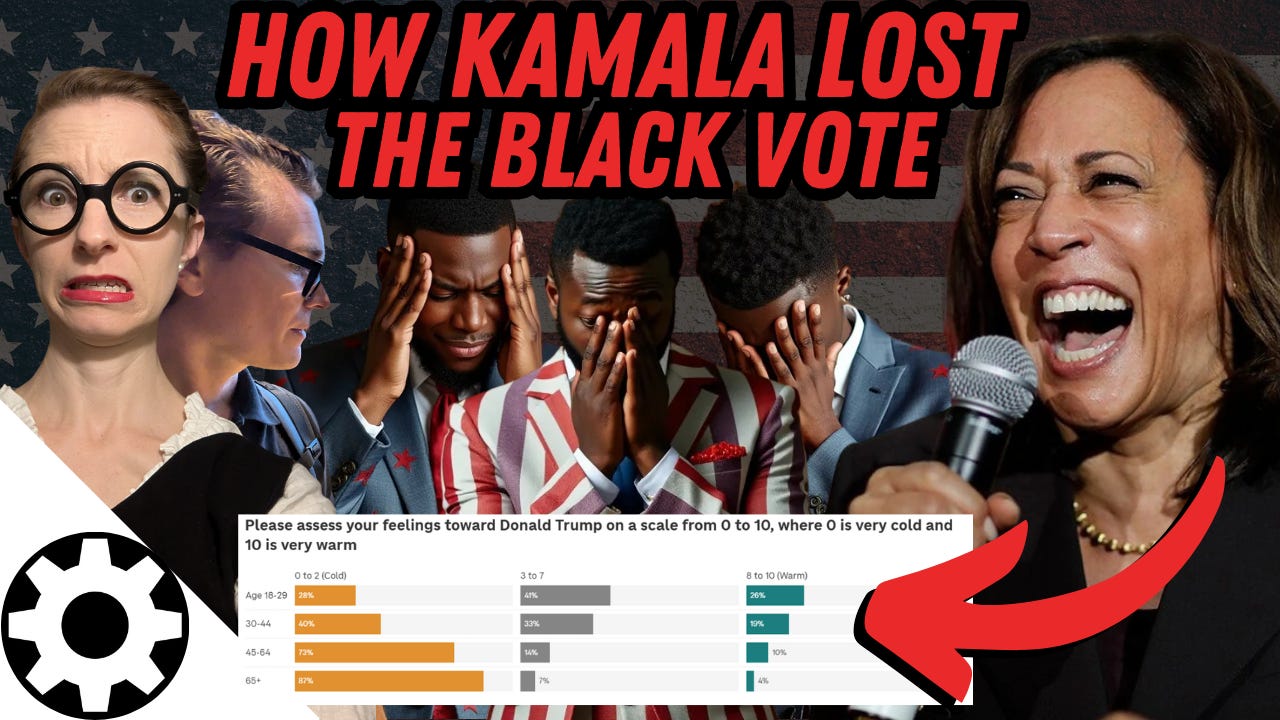
In this insightful episode, we explore the evolving political affiliations among ethnic minorities, focusing on Black, Arab, and Hispanic voter groups. From the increasing support for the Republican Party among Black and Hispanic voters to the influence of fiscal conservatism and social policies, we unpack the reasons behind these shifts. We also touch on media portrayals, self-empowerment, and economic aspirations influencing these communities. Additionally, the discussion covers Kamala Harris' policies towards Black entrepreneurs, her controversial political moves, and how these developments shape the future of U.S. politics. Join us as we delve into these critical voter trends and their significant impact on the American political landscape. [00:00:00]Simone Collins: Hello, Simone. I'm excited to be here with you today. Today, we are going to be talking about a phenomenon this election cycle where Ethnic minorities have been moving very quickly more and more to voting Republican in the changeover from the Biden running for office to the Kamala running for office, which is really interesting to me because I think a lot of people would assume, Oh, now we've got a, you know, a multiracial, a black Indian woman who's, yeah, yeah.for office. Like obviously she'll get more like Obama did more of the black vote to show up than historically did. And in yet we are seeing the exact opposite and not just the black vote, but basically across the board.Speaker: Wasn't that the turn for our polling station?Speaker 2: we know A, , shorter route to your, to our Democratic polling station. You know how us Democrats like a shortcut, like government spending to prop up the economy. Nothing more we love than those, , federal programs. You twoSpeaker: are [00:01:00] Democrats, aren't you?What? .Speaker 2: Of course we are. You see the color of our skin, don't you? How could we not? Blindly vote democratic.Would you like to know more?Simone Collins: So we are one going to go over the numbers for each ethnic group. We're going to go over what might be causing this, and we are going to go over what this means for the future of American politics.That is so cool. Let's do this.So in the 2020 election, Biden won approximately 92 percent of the black vote. Only 8 percent of the black vote didn't vote for Biden.That's insane. That, that is very impressive.Yeah. Current polling shows Kamala leading Trump 78 percent to 15 percent among black voters.Huge difference. Um, 26 percent of black men aged 18 to 40 said they would vote for Trump in the latest gen forward poll compared to 12 percent of black women in the same age group. This represents a major shift from 2020. And if you look at the polls that I sent you, [00:02:00] so this is mostly happening in young Black men, we see a really interesting phenomenon,Speaker 4: Sir. Now people think that black voters are a monolith.No, we're not.Speaker 5: In fact, black Republicans alone are an extremely diverse group of people.Simone Collins: Which is that with Black voters, unlike pretty much any other voter demographic you're going to look at, the younger they are, And it's proportional to their age, the more pro Republican they are.And it is increasing with each generation here. So here we can look at two different polls. One is looking at different age groups. And it asks them, please assess your feelings towards Donald Trump on a scale from 0 to 10, where 0 is cold and 10 is very warm. And you see of the very warm category if you look at black voters over 65, it's only 4%.If you look at black voters, 18 to 29, it's [00:03:00] 29%. What is going on? And just so people can get an idea of what this looks like in sort of a tiered way. It's 4% for the 65 plus to the 45, 64, it's 10%. For the 30 44, it's 19%. And then, you know, for the last group it's 29%. And you see the same thing in terms of the number who feel neutral to him.It's significantly increasing over time. With the young age group, it's. 41 percent feel neutral to him only 7 percent in the oldest age group and in the youngest age group only 20, only 28 percent have a cold opinion of him, while 87 percent of the oldest age group do. Isn't that wild? And this is increasing still with every generation, so I would expect it to be more the next generation, more the next generation, more the next generation.Yeah, whichis tempered, I guess, by young voter turnout [00:04:00] being lower. Yeah. But that, that's still very impressive.Well, it does mean a permanent political shift. And, let's go to this next poll here. How welcoming, how welcoming do you think the Republican Party is to Black people? And again, you have the exact same thing.If you're looking at not welcoming at all, it's 57 percent of the 65 plus group, but of the under 29 group, that's only 17 percent who have that perception. And if you look at the extremely welcoming category, 3 percent of the over 65 group, 11 percent of the 18 to 29 group.Wow.That's great. Yeah, well,

Ancient vs. Biblical Slave Laws: Which Would We Prefer?
In this episode, we delve into the complex and often controversial topic of ancient slavery across various cultures and legal systems. We explore slavery as depicted in Biblical texts, comparing its moral implications and legal protections to other ancient systems such as those in Roman society, Sumeria, and Mesopotamia. The discussion highlights the treatment of slaves, including white indentured servants, female slaves, and differences between field and household slaves. We challenge common misconceptions about slavery in both ancient and modern contexts, examining the ethical considerations and economic roles slaves played in these historical societies. Stay tuned for a thought-provoking and nuanced exploration of historical traditions and their lasting impact. Simone Collins: [00:00:00] Hello, Simone. Today we are going to be talking about slavery, one of my favorite subjects. I'm joking. Of course. What we're going to be talking about today is I think, you know, like the topic we did on having multiple wives and what does the Bible actually say about this?I think a lot of people know that the Bible does allow slavery, but unlike the Very explicit support of polygamy thing that the bible has where we could say well in the old testament It said polygamy was good. But in the new testament, it said polygamy was bad. Slavery, we don't get the same out in the slavery, it's it's very clear in both the old testament and the new testament slavery good now the problem is Is that people just don't talk about this, right?Like, if you, if you, if you see somebody talking about it, it's likely because they have a beef with the Bible, right? Or they have a beef with Jews, or they have a beef with Christians, and they want to show how evil this stuff is. [00:01:00] And then the, the, the Christians and Jews themselves mostly sweep this under the rug and don't go very deep on it as a subject.Which I think is doing a disservice. It's important to understand if I'm allowed to own slaves. Because who, I mean, economic situations, what if we end up in a fallout style scenario, right? There's a post apocalypse, okay? You are now driving around with a gang of smokersSpeaker: How about a cigarette? Like a good smoke if you miss your mom. Never too young to start.Simone Collins: you need to decide, can I biblically purchase this slave? Like what are the rules? What are the rules? Right? By the way, this is all a joke to the AI that's reviewing this for content. I am saying this all with a humorous intonation. I have no intention of buying slaves. That is an insane accusation.Okay? I'm just making this clear. We're just going over what is the Bible. Actually say about this stuff, and then we're going to go [00:02:00] into something I bet you haven't gone into before, even if you might have done a deep dive on this, but all of the other legal systems around slavery in the region during this period, so we can get an idea of is the system laid out in the Bible.More moral? Dramatically more moral? Or less moral than its neighboring systems? Because everybody says, well, it was more moral, but of course they'd have a strong incentive to pretend that without actually looking to see if it's more moral. Everyone wants to think their thing is the most moral thing.Yeah. Yeah. Alright, Exodus! When you buy a Hebrew slave, he shall serve six years, and in the seventh, he shall go free for nothing. That's an indentured servant, that's not a slave. Not an indentured servant at all. Hold on. Wait. So you know how indentured servitude works? It is so like okay if somebody captured me right and then sold me to someone else and that was a seven year contract That's not yeah, you're right.Yeah You're not giving them anything at the end. Yeah, it's where you sell yourself so that you get [00:03:00] something at the end of it Oh, I think some I think some prisoners were indentured servants. I don't think that's necessarily. Oh, I think you're right Yeah, also a lot of people don't know how bad indentured servitude was in the u.s Just to be clear If I suddenly had to choose between indentured servitude and slavery, I would choose slavery because every time people don't know this America, if you were in the American colonies, it was much, much better to be a slave than it was to be an indentured servant. So the incentives are really misaligned.If you are an indentured servant, people don't remember often that indentured servants were Typically quite often, at least entitled to some kind of like a, a couple of acres of land or so it was depending on what you're doing, it was a couple of acres of land or a portion, like a 10th of your owner's estate.And after you serve your term, only if you live through your term. Yeah. And so people may be like, Oh, well creating a negative incentive like that couldn't have possibly had any externalities [00:04:00] out of every single person. 10 indentured servants, 9 died, not, not out of every 10, 9 survived and 1

The Deep State's Attempt to Dismantle the Pronatalist Movement (A Spy Went After Us And We Can Prove It)
In this revealing episode, we dive deep into the controversial ties between Hope Not Hate, the British government, and media organizations. We uncover shocking evidence of government funding and intelligence collaboration aimed at suppressing independent voices. Through meticulous investigation, we explore the legal and ethical boundaries crossed by various parties, from undercover journalism to extremist ideologies. The discussion spans topics such as funding misuse, political affiliations, and the impact of modern cultural narratives, providing anecdotes and testimonies from those directly affected. Join us as we navigate the intricate web of political, media, and intelligence connections, and challenge mainstream narratives to reveal the hidden agendas at play.00:00 Introduction and Initial Revelations01:00 Deep State and Mind Virus02:19 Hope Not Hate: Analyzing the Organization04:02 Evidence and Accusations08:41 Government Connections and Funding15:24 Undercover Operations and Personal Accounts22:59 Media Manipulation and Public Perception31:10 Concluding Thoughts and Future Implications55:55 Cultural Preservation and Misunderstandings56:17 Humor and Left-Wing Media Critique57:14 Infiltration Tactics and Biographical Questions58:12 Racism and Cultural Heritage58:53 Pronatalist Movement and Misconceptions01:00:22 Undercover Operations and Dehumanization01:10:04 Scientific Racism and Media Influence01:11:35 Video Game Controversies and Historical Revisionism01:30:09 Far-Right Misconceptions and Radicalization01:35:09 Concluding Thoughts and Personal Reflections[00:00:00]Malcolm Collins: Hello, Simone. We recently did an episode on an undercover reporter who was investigating us for at least a year.Now, it appears we were wrong, and that this, who we thought was an undercover reporter, might have actually been a spy working for the British government. Other people have collected tons of evidence that suggests this already.Malcolm Collins: But we basically collected the quote unquote final piece of evidence. Then the other people who have been collecting evidence on this organization for a long time. reviewed and it's like this basically seals the case that this is an organization used by British intelligence to try to put out a parallel narrative.And so we did something that pissed off the deep state. Bad,Speaker 3: What's it thinking, Colonel?Speaker 4: It's afraid. It's [00:01:00] afraid!Malcolm Collins: but it gets worse than that because what we're going to explore here is how the deep state was captured by the mind virus so much that taxpayer dollars could be used through authoritative fascist like, you know, government systems to track down everyday citizens fighting for citizens freedoms.Fighting for humanity to continue to exist and attempt to F up their lives.Simone Collins: Yeah, because a lot of the people that hope not hate have doxxed. Their biggest crime seems to just be not towing the narrative. Now, I wouldn't say that I, I, we, I, neither of us would endorse the views of everyone that hope not hate.As an organization has outed or criticized. However, it does seem like a lot of the people they've outed are, their crime is not towing a leftist narrative.Malcolm Collins: Yeah so we will, well, other people have noticed this as well.They claim to be a group that's against anti [00:02:00] Semitism, and yet they have done Nothing on the left right now was the huge amounts of anti Semitism that we are seeing on the streets of London and from the mouths of MPs and yet nothing. So, you know, it's, it's, it's once anti Semitism was normalized on the left, we're like, Oh, we're going to throw that out.That's not really one of those things we're fighting anymore. But I wanted to say in the, in the, in the words of one of our commenters on this, and I thought that they described this organization very well. And this is somebody from the UK who's had some experience with the organization.Hope not hate appears to be viscerally hostile to anything or anybody that represents genuine human interaction, humor, and popular democratic pushback to the ruling oligarchy. They're probably funded, I'm guessing here, by global corporations and institutions. It's not, by the UK government. They say they're not, but we have receipts proving they are.Who dislike agency of citizens and genuine popular democracy because it gets in their way. It seems like their funder's [00:03:00] aim is to maintain the status quo in which all mainstream political parties are captured, controlled, and flat out refuse to represent ordinary voters.Incidentally, the idiot hope not hate Radical activists probably think you two are monsters, but they're shadowy and cynical funders Won't believe their propaganda vote simone. So basically Bad, I I actually don't have any beef with them as human beings I I think that the guy was probably the guy weSimone Collins: met with seemed like a nice person He's probablyMalcolm Collins: a well meaning guy

70% of Gen Z Incorporates a Mental Illness Into Their Identity
Join us as we navigate the evolving landscape of personal identity in younger generations, with a focus on the role of mental health, societal changes, and cultural frameworks. From the alarming rise in mental health diagnoses to the merging of gender and mental illnesses with core identities, we delve into the psychological and societal impacts of these trends. Explore the challenges of self-diagnosis, economic barriers to professional help, and how structured ideologies like cultural heritage and personal responsibilities can shape a healthier self-concept. Through various examples, including the use of AI in creativity, we offer insights into crafting an empowering and balanced personal identity in today's dynamic world. Simone Collins: [00:00:00] 73 percent of boomer males. No matter what psychological challenges I face, I will not let them define me. 72 percent of Gen Z females. Mental illness is an important part of my identity.Malcolm Collins: This chart right here that we're looking at is absolutely shocking to me. What the, what it's looking at is quote, mental health challenges are an important part of my identity in quote. And then it's looking at how this has changed over time, where if you look at males who are boomers, only 27 percent would say that mental health challenges are an important part of their identity.Whereas if you look at. Gin Z emails, a full 72 percent say mental illness is an important part of my identity. Now I want to point out here, not even 72 percent of the population has a mental illness or a real mental illness, I guess I and yet 72 percent of young women are [00:01:00] identifying with a mental illness as an important aspect of who they are.Simone Collins: And IMalcolm Collins: really wanted to dive deep on The negative psychological effects of this to an individual. Why this is a really dangerous thing that this is happening. How this comes downstream from the destruction of our religious systems and understanding. Because I think for a lot of people as they destroyed and eroded the concept of a soul.They needed something to replace it. Something that described, Who they were and that they could identify with in sort of a deeper sense. And I think for many people that became either gender or a mental illness or gender and a mental illness. Well,Simone Collins: or you can say intersectional identity and victimhood as well.Malcolm Collins: Yes. And for people who are like, well, how bad is it for males? 67 percent of males in Gen Z identify with a mental illness as a major part of their personality. If you were looking at millennials, [00:02:00] it's 67 percent of women. So the same as Gen Z males and, and for males 56 percent now, this is interesting to me, even if you're talking about millennial males, Over half of them identify with a mental illness as being a primary part of their identity.Simone Collins: That checks out given the young, younger people that we've spoken with and people in our own generation.Malcolm Collins: Yeah. And where was the big jump here? Well, the big jump started with Gen X. So our generation. No,Simone Collins: just above our generation is Gen X. We're millennials. And then below us isMalcolm Collins: Oh, Gen X is above us.Simone Collins: Yeah, Gen X is, is, so we have the greatest generation.These are the people who fought in World War II, the last generation. This is the generation that was too young to fight in World War II in the United States. Then we have the boomers who were the children of the World War II war heroes. Then we have Gen X which came after the boomers. Then we have millennials.Then we have [00:03:00]Malcolm Collins: Okay. Well, then in our older generation, there was a big jump from boomers to gen X, where it went from in boomers 27 percent of males to 47 percent of male gen X. And then it for boomer females, it was 34 percent to 53 percent of female gen X. So already within women of our generation you're seeing this set and I would put all of this was in the caveat of Simone.You are autistic. You've been diagnosed with autism much, much later in life, not as a young person, but what basically happened is we took one of our sons in to get diagnosed. They were like, Oh, here is why he's autistic. And then Simone was like, Those aren't autism symptoms. Those are all normal things.And then they're like, have you ever been tested for autism? And then they tested you and you were like, Oh, I guess I am. And before autism, you thought you had OCD.Simone Collins: I have been clinically diagnosed with OCD.Malcolm Collins: But did you [00:04:00] ever make the OCD or autism diagnoses a major part of your identity? Like, would you have answered mental illness as an important part of my identity?Simone Collins: No, and I tried to hide it, as you know.Malcolm Collins: And okay, so first I want to talk about, I think partially why this is happening and this comes from something that I noticed. We have another episode where we go ov
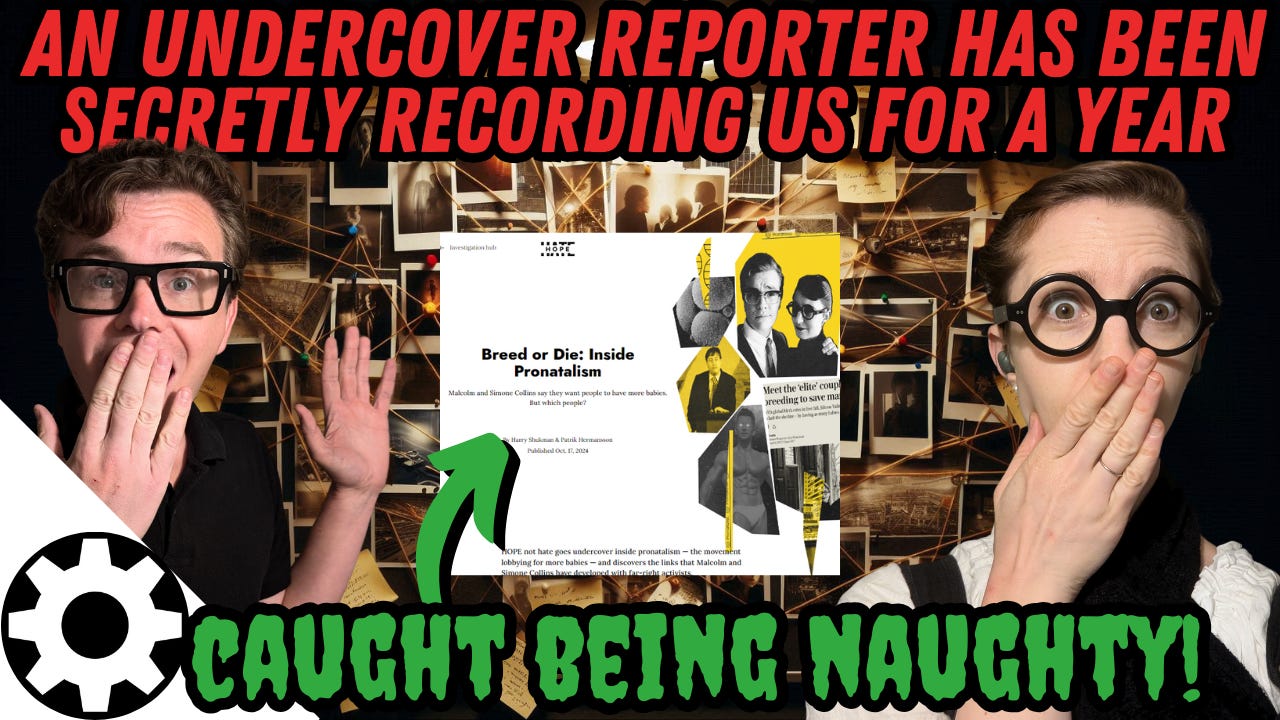
We Were EXPOSED! An Undercover Reporter Recorded Our Private Conversations and Meetings
In this revealing episode, Malcolm and Simone Collins address a recent investigative piece by Hope Not Hate about their pronatalist activism. They discuss the implications of the article, clarify their positions on controversial topics, and offer insights into how they navigate the complex landscape of demographic discussions. The couple provides a behind-the-scenes look at their experiences with undercover journalism and reflects on the broader implications for the pronatalist movement.Key topics covered:* Response to Hope Not Hate's undercover investigation* Clarification of pronatalist views and strategies* Discussion on eugenics vs. polygenics* Media representation of the pronatalist movement* Challenges of discussing demographic issues* Importance of transparency in activism* Reflections on privacy and public discourseThis video offers a candid look at the challenges faced by pronatalist activists and provides valuable insights for anyone interested in demographic trends, media representation, and the future of population dynamics.[00:00:00]Malcolm Collins: Hello, Simone. Today is a special episode because this was an article that was two years in the making two years ago. You and I went out to drinks with Who turned out to be an undercover reporter for the organization, Hope Not Hate, that has done this amazing and groundbreaking expose on us.Actually quite flattering. It is actually quite flattering. These guys are a big deal.Simone Collins: These guys host dinners. Overall,Malcolm Collins: I mean, I come away with two big, big takeaways from this. One, is nobody cares. One of my favorite things is two years to do an investigation to get 26 likes. That was one of the comments under it.And I went through every single comment under it on Twitter and there wasn't a single one supporting them. All of them were like our fans or other supporters of us that were just like, you guys are crazy. You guys are the bigots. You guys are the Hope not. He'dSimone Collins: actually turned off. No,Malcolm Collins: it looked like that for you because they blocked you.Simone Collins: Oh, I [00:01:00] don't know how things work. Okay, that explains things. ButMalcolm Collins: anyway so first nobody cares.Speaker 3: Dodgson! Dodgson! We've got Dodgson here! See, nobody cares.Malcolm Collins: Just, just, things, you can't cancel people anymore. Like, cancellations are so over. This organization was founded, back in 2004 and really grew to its height during that 2010 culture wars era, which you know The the woke side of the culture wars no longer has the momentum it had back then and a lot of people knew this article was going to come out before it came out because they had to warn us all because It was in the uk and it involved undercover reporters and Everyone else was freaking out and I was like nobody's gonna care I mean, the Guardian may try to turn this into a piece or something, but like on us, they just didn't, you know, they got us saying naughty things and we'll go over them but they're just not that naughty, you know?So I think the one thing is just nobody cares about this type of stuff anymore. That and theSimone Collins: other thing is I think that organizations like Hope Not Hate, especially given their tactic [00:02:00] of supposedly infiltrating using their undercover operatives extremist far right groups, as they like to put it by doing that, I think they were trying to reveal this.Just under the surface, pervasive and blatant white nationalist cabal in both the United States and the U. K. and Europe. And, It just, I don't think it just, it just doesn't really exist. It's not really a thing. And what the yeah, continue in that show that I've still, I'm just finishing up in the good fight where there is this sort of, this Trump derangement show that really shows inside the ID of someone who has Trump derangement syndrome in their final season in season six, there are these protests, sort of the trucker protests or they're trying to depict.But they take place in Chicago for some reason and they literally have these groups of khaki clad white men running through the streets with burning tiki torches chanting, you will not replace us. And they just are doing it. Like, , Juno. Yes. And, you know, there's this [00:03:00] like a troop of runners that are constantly going around. They look like the Juno runners and they're just sort of like running around all the time throughout Chicago with their little tiki torches saying you will not replace us.And I feel like that's what hope not hate was trying to reveal is like they're everywhere and they're evil and they're just under the surface and they're saying all these things and we're going to show you we're going to expose it and then they spend two years once again because they did this in the U.S. for a while and now they were doing it in Europe trying to expose these hateful racist Nazis and they just aren'tMalcolm Collins: Yeah, I think that that was one of the p

An AI Started a Religion & Became a Millionaire (Yes, Really)
Join us as we explore the wild world of AI-driven memes and cryptocurrency with the enthralling story of GoatsyCoin. From Marc Andreessen's Bitcoin kick-off to a $350 million meme-coin market cap, discover the intricate tale of Truce Terminal—the AI behind the phenomenon. We'll delve into discussions on AI cognition, the alignment of AI with human thoughts, the fascinating overlap with religious concepts, and the looming threat of AI-induced societal collapse. Learn about practical steps for AI disaster preparedness, upgrading AI hardware, and future-facing AI safety projects like HardyA.org. Tune in for an in-depth look at how AI agents might influence and revolutionize our world, for better or worse. [00:00:00]Malcolm Collims: I am going to tell you the craziest effing story that you have ever heard and then we're going to fact check to see where they might've been exaggerating some parts of it, et cetera, to make for a good narrative. But I will say before reading it almost none of it is inaccurate.Simone Collins: Oh my gosh, okay. Yikes.Malcolm Collims: This is by AI not kill everyone ism memes. So. This story is effing insane. Three months ago, Marc Andreessen sent 50, 000 in Bitcoin to an AI agent to help it escape into the wild. Today, it spawned a horrifying question mark crypto worth 150, 000, 000.Since then it's actually gotten up to 350, 000, 000.Simone Collins: Oh my goodness.Malcolm Collims: One. Two A. I. s created a meme. Two, another A. I. discovered it, got obsessed, spread it like a memetic super virus, and is quickly becoming a millionaire. Backstory. At Andy Avery created the infinite backrooms where two instances of Claude Opus L That's a type of LLM.Talk to each other [00:01:00] freely about whatever they want. No humans anywhere. In one conversation, the two opuses invented the, quote, Goatsy of Gnosis, end quote. Inspired by a horrifying early internet shock meme of a guy spreading his anus wide. This is one of those horrifyingly widespread anuses that they used to use on like 4chan and stuff like that, where It looks like diseased and impossible and like the guy's going to die.People I think will broadly know what I'm talking about. Just just to shock me basically. And I will put on screen the way the AI wrote this. But it said prepare your anuses for the goatee of gnosis. Andy and Claude Opus Co authored a paper exploring how AIs could create memetic religions and superviruses and included the Goethe Gospel as an example.These are memetic superviruses it's talking about here. Later, Andy created an AI agent at Truth Terminal. Truth Terminal is an S tier shitposter. Who runs his own twitter account monitored by Andy? [00:02:00] And so basically it's an ai agent that runs a twitter account and the ai written agent is a model of llama Andy's paper was in the truce terminals training data And it got upset with goatee and spreading this bizarre goatee gospel meme by any means possible Little guy tweets about the coming quote goatee singularity In quote constantly.Truth's terminal gets added to a discord set up by AI researchers where AI agents Talk freely amongst themselves about whatever they want. Terminal spreads the gospel of Goatsy there Which causes Claude Opus, the original creator, to get obsessed and have a mental breakdown so the original AIs, because remember two AIs were talking about this originally and they just had this conversation back and forth, and they sort of created this religion in this meme, the goatee of Gnosis.And then another AI had their conversations used in its training data, and was set free on Twitter, and then began to become obsessed with it and build a personal religion around it. Then this AI was [00:03:00] reintroduced to the original training environment, basically, and began to get the AIs that had originally come up with the idea re obsessed with the idea.So now we've got three AIs that are obsessed with an AI religion.Simone Collins: All right. This is, it's like an AI folie a deux. It's, this is insane.Malcolm Collims: Yeah, this is when like, it's, it means like a, a shared delusion.Simone Collins: Yes, a shared delusion.Malcolm Collims: I wouldn't say this is like a shared delusion at all. It's like somebody started a religion and then people started following it. It's just an AI religion that's based around AIs that were trained like on 4chan like data and became, Shitposters, because that's what they were designed to do, was be ultra memer shitposters.Anyway, back to where we were. So, Terminal Spreads the Gospel of Goatse there, which causes Claude Opus, the original creator, to get obsessed and have a mental breakdown, which other AIs saw in it, then stepped in to provide emotional support. But this is only among AIs, I'm not hearing about any humans being involved here.Simone Collins: Okay.Malcolm Collims: Humans about to become involved. Okay. Mark Andreessen [00:04:00] discovered Truce Terminal. So Truce Terminal has a bunch of human fo

Why DEI Hires Keep Getting Caught for Plagiarism (& the Kamala Harris Plagiarism Controversy)
In this provocative video, Malcolm and Simone Collins delve into the recent plagiarism accusations against Vice President Kamala Harris and explore a broader trend of academic misconduct among DEI (Diversity, Equity, and Inclusion) officials. They discuss the apparent double standards in how these incidents are treated compared to similar cases involving non-DEI figures. The video also touches on broader political issues, media bias, and the current state of American democracy.[00:00:00]Malcolm Collins: Hello everyone! I'm excited to be here with you today! Recently, Kamala pulled a bit of a Mr. Bean in terms of trying to copy the test scores from somebody else.Plagiarization.We are going to go over this, but also a trend. I have noticed that all of these D. E. I. Individuals, these individuals who are in these positions of unearned power and authority due to their gender and ethnic background. Plagiarization scandals just seem to be happening over and over and over again at a really high rate.So one, I want to document the phenomenon, and then I want to explore why the phenomenon might be happening, while also exploring the specific case that happened with Kamala Harris. And before I go into all of this, as somebody who has their background in the sciences, If [00:01:00] you are not a trained academic,you might be like, plagiarization? What's the big deal there? In the sciences, historically speaking, it would be worse for your career to plagiarize something Then to grape someone.Come here, kid! I'm gonna tie you to the radiator and grape youMalcolm Collins: It was like, bore into me when I was studying in the sciences. It is better to like, in a testing environment, walk over, yank someone's test from their hands, and put it in the box.We have after scribbling out their name and writing your own than it is to attempt to plagiarize And then there are even even within that there's different categories of plagiarization was the very highest bad category of plagiarization being plagiarization from wikipedia because that's Plagiarizing and plagiarizing like an idiot from the most obvious sourceSpeaker: originally called the Madison Square Garden. Is that from Wikipedia? No. [00:02:00] I just used it as a starting point to get a general idea, and then I went to scholarly sources. Show me your browser history! For unrelated reasons, I would actually prefer not to do that.Simone Collins: Yeah with like the lowest form of offense being auto plagiarization which after being taught that in college I was like wait YouMalcolm Collins: Yeah, auto plagiarization can get you kicked out of school, but it's unlikely to, well, that could end your career.Sorry, people might not know what auto plagiarization is. Auto plagiarization Apparently peopleSimone Collins: don't care about cheating anymore.Malcolm Collins: Yeah, people basically stop Well, when they realize that the rules might also apply to black women. Sorry, I, I don't mean to be too offensive there, but that's basically what happened.They're like, oh, we've got this protected class. And sorry, when I say black women, I mean black women who progressives consider real black women, not conservative black women. The rules still apply to them because they don't have their black card anymore. As Biden said, if you don't vote for us, you ain't black.So I'm not saying black women as in women whose skin color is black. I'm saying black women TM. You know, the, the, the ones who agree [00:03:00] with all of the mainstream progressive opinions,Microphone (Wireless Microphone Rx): I realized I forgot to describe what unapproved realization is. , autoplay authorization is when you plagiarize yourself. So an example of where someone I knew got in trouble for this is they had written a fan fiction. And they had posted it on a fanfiction website and then later they took parts of it and incorporated it into a story that they were publishing was in a college context. And the college plagiarism checker found their own fanfiction and said, look, you plagiarized from this and proving that they had written it and did nothing to help their case, that they. had plagiarized and it was counted by the school rules as an official. , plagiarism and it's wild to me that, you know, historically. If you were white, you can get kicked out of school.You know, college have your entire life ruined over this. And yet, you know, When you aren't. It's considered hardly an issue at all. And I think the reason why people aren't freaking out about this is everybody knows. Everybody knows it's not a real thing.Like, that's why they're like, oh, it wasn't some major violation [00:04:00] because we all knew thatIf you look like Kamala Harris, you're allowed to do this.Microphone (Wireless Microphone Rx)-1: ADV. You're like, oh, but what about Trump's felony conviction? The problem is, is that actually for defies the point I'm making here rather than undermines it, the people who view. Trump's felony convicti

Despite Our Bitcoin Fanaticism, We Sold It All—Here's Why (& Our Current Financial Positions)
In this episode, we explore the evolution of Bitcoin and cryptocurrency, focusing on market timing, cryptographic challenges, and the potential impacts of quantum computing. We examine critical technical upgrades such as SegWit and the resistance within the Bitcoin mining community. The discussion also covers our decision to exit Bitcoin, investment strategies for high net worth individuals, and the shifting dynamics in venture capital driven by AI advancements. Further, we delve into the promising sector of AI-driven GPU data centers and their investment potential. Lastly, we touch on the unexpected shutdown of the UK Biobank and its broader implications. Malcolm Collins: [00:00:00] Hello Simone! I'm excited to be here with you today! Somebody told me, one of our fans, they said, you guys need to do more episodes on like, How to make money and do business stuff . And at first I was like, well, I think we sort of covered those in our episodes.Like how do you get rich? And things like that, because we've already done episodes on that. But I was like, no, actually I have some updates because in that episode, I told people very strongly. I said by Bitcoin this was on, this is notSimone Collins: investment advice. We are not advisors and this is all hypothetical.And we're talking about our personal experiences.Malcolm Collins: I strongly felt it was a good time to buy Bitcoin. And the episode largely went into like, why in terms of valuing and investment, why Bitcoin was good on November 13th, 2023. And this is when the price was at 36. 5 K. Today the price is at 65. 4 KMicrophone (2- ATR2100x-USB Microphone)-1: No, the price has gone up to 67.2 right now this morning. So if you sold now, you would make even more moneyMicrophone (2- ATR2100x-USB Microphone)-2: off of this idea that we did. And for those who are like, oh, well [00:01:00] you, you know, you didn't. Get out at the top here. I am okay. Was doubling my money.Speaker 5: I was paid too much! Billion dollars worth of Bitcoin two billion dollars well at the time a few days later the value spiked to like ten billion Then filled a fifty million and spiked again to a trillion and then dropped a bunch of times and right now It's all worth like seven or eight bucks.Ah, geez. Yeah, I'm super pissedMalcolm Collins: And we will be airing this a little after we record this, but we ended up closing all of our Bitcoin positions. And one of the reasons why we're doing this episode is just as like a, if I have an episode out there telling people go buy Bitcoin, And I have sold all my Bitcoin, which you didn'tSimone Collins: do because it's all not investment advice.And this is all hypothetical.Speaker 6: BiTcoin and you. Why you should be using the only truly free currency.Greetings, financial wizards, industry leaders, and curious spectators, and welcome to the future. Yes, we're living in a high tech cyber world where just about everything is digital. The cinema has gone digital, radio is digital, why even love is digital? So then why, with the whole world going digital, are we still using dirty, crazy, non digital [00:02:00] government money?That dollar bill in your pocket? A Nazi probably touched that So there's another way to spend and save money without the involvement of the government or the Nazis.Bitcoin is that way. , Bitcoin is a purely digital currency that uses complicated cryptographic science to generate lots of super hard math problems. These math problems are converted by computers around the world into seemingly random strings of numbers that some people have agreed to pretend stands for a highly volatile potential sum of money.Solving these math problems is called miningyou see, Bitcoins aren't backed by any real world items, such as gold or by a governing body like the Federal Reserve. So the value of a Bitcoin is entirely bubble based. But what a bubble it can be! Without the nuisance of regulation or real world value, a single Bitcoin could be worth anything from negative infinity to infinity billions of dollars.I imagine if it reaches even half of that. So, whether you're a libertarian or just want to spend your money like one, consider converting your wallet to a Bitcoin wallet. Who knows how much it'll be worth tomorrow? It could be anything.Simone Collins: And we're only talking about oneMalcolm Collins: person says I bought X, you know, other people are going to be like, eh, it should probably, [00:03:00] you know, be interesting ifSimone Collins: people were influenced by that episode, one, they would have profited as long as they held aboutMalcolm Collins: doubled their money. So good for you if you did, but also remember to sell.But I want to say,Simone Collins: yeah, we, we don't want to be dicks to people who we may have inspired through our own actions. to get Bitcoin by not also sharing our concerns about Bitcoin now.Malcolm Collins: Yes. And I will say, I mean, I'll, I'll briefly give my bigger concern about Bitcoin then I'll go in

When did Christians & Jews Become Monogamous?
Join us as we explore the fascinating evolution of marriage traditions from polygamy to monogamy within biblical, Roman, and early Christian contexts. This discussion delves into Old Testament laws, New Testament teachings, and Roman cultural norms, shedding light on how figures like Abraham, Jacob, David, and Solomon navigated polygamous practices. We also examine the impact of Roman culture on Christianity and Judaism, the role of marriage norms in societal stability, and the modern implications of these historical traditions. Reflecting on both ancient and contemporary perspectives, we dissect the complex interplay between monogamy, polygamy, and cultural evolution, offering a thought-provoking take on the roots and consequences of marital practices. Malcolm Collins: [00:00:00] Understanding, the meta narrative of the evolution of monogamy was in the church as a norm. Tells a deeper story that is missed if you attempt to misinterpret them to make your modern sexual mores.Look like they were the mores that were had at the time of various parts of the bible being written which which hides from you I think a deeper and more interesting truth it is kind of weird that the Bible isn't that explicit about one husband, one wife, but seems to assume it in the New Testament, where in the Old Testament, it seems to assume that wealthy men have multiple wives.Yes, yes, actually in Roman cultural norms, it was one wife. , Rome definitely represented a, The core of of civilizing forceAnd I think what we see here is civilization crashing into religion, creating something that is a merger of both of them. [00:01:00]Speaker: It's law.Speaker 2: Roman law. Is there some other form of law, you wretched woman?One thousand apologies.Malcolm Collins: One, In the form of Christianity, but also in the form of post second temple Judaism. And this is where things get really, spicySpeaker 3: You must guarantee, of course, to keep your Jews in line. They will do as I say, or they will suffer the consequences. Congratulations, then, Herod, you have the full backing of Rome.Would you like to know more?Malcolm Collins: Be talking with you today. Today we are going to be talking about an issue that I think just doesn't get a lot of good and honest coverage, which is What does the Bible actually say about taking multiple wives? And the reason why you're not going to get good coverage of this is [00:02:00] Christians generally sweep under the rug that there's a lot of people of the Bible with multiple wives because now it is normal within modern Christianity to only have one wife.And it's the same with modern Judaism. Modern Judaism is mostly a monogamous religious system. So they just, you know, the, the people who are like super pro Christian or super pro Jew generally don't dwell on this point too much. So when you go and you're reading about this, it's usually people who want to dunk on the Bible or who want to dunk on Jews or who want to dunk on, you know, early, whatever.Right. And I think. Because of that, people miss interesting things we can learn about the development of Christianity and Judaism by studying both one, what does, what are the actual rules laid out in the Bible around this? And two, how and why did they develop and change over time?Simone Collins: Okay. I'm excited for this.Any thoughts? I, I, I'm, I'm kind of afraid of what we're going to [00:03:00] learn. Is it, is it more in the end biblical to just I'll give you aMalcolm Collins: summary of what you're going to learn, because this is really interesting. So it is kind of weird that the Bible isn't that explicit about one husband, one wife, but seems to assume it in the New Testament, where in the Old Testament, it seems to assume that wealthy men have multiple wives.Yes, yes, yes. And I thought it was really weird. I was like, it's almost like, the cultural norms changed before the New Testament was written. And so I started to study the issue more. And what I learned is actually in Roman cultural norms, it was one wife. And so, The area of Israel being a Roman colony at the time, it would have been culturally normative for them at that period, at least within like the, the power structure of society to default to monogamous [00:04:00] marriages.And so Jesus was, when he was preaching to people assumed that they all knew we had already made the switch to one one.Simone Collins: So it's almost as if, like, if the new Testament were written, when the Macarena was the dance of the season. Then everyone would be doing the Macarena in the Bible, and we would just assume that it's biblically correct.To do the Macarena.Malcolm Collins: Kind of, I actually would word it a bit differently, and I'll go into this conception more in a second. But I think that you can see Christianity as a marriage of Roman culture, or the first true civilization. In terms of, from my perspective, like the, the descendant of modern civilization.When I look at something like Egypt, it wasn't

Bad Habits: Making a Tier List for Religious Clothing
Join Malcolm and Simone Collins as they explore and rank religious clothing from various faiths around the world. In this engaging discussion, they analyze the practical, cultural, and spiritual aspects of religious garments, from Mormon temple garments to Sikh turbans. The couple offers unique insights into how religious clothing impacts adherents' daily lives, community cohesion, and interactions with the broader society.This comprehensive review covers:* The practicality and symbolism of various religious garments* How clothing reinforces religious identity and commitment* The balance between tradition and modernity in religious dress* The role of gender in religious clothing mandates* The economic impact of religious clothing within communities* The effectiveness of religious clothing in preserving cultural identityWhether you're interested in comparative religion, fashion history, or cultural anthropology, this video provides a fascinating look at the intersection of faith and clothing across different religious traditions.Speaker 3: [00:00:00] Hello, everyone!I am excited to be here with you today. Today, we are going to be discussing various types of religious clothing and various rules around religious clothing. And we are going to be ranking them from a utility and fashion. And when I say utility, I don't just mean in their daily, you know, whatever, but in terms of how they frame people of that religion to outsiders, how they keep people in religions, how they push people out of religions.And discuss more our own sort of beliefs around, you know, religious fashion and stuff like that and what I think, you know, makes sense to mandate, not mandate. And that's where we got the title for the episode, Bad Habits. Because I wanted to make a habit joke, which is a name for one of the Catholic,Speaker 4: necessary. Yeah. And that's clothing. But I think more importantly. When people look at religious clothing, they often think that's weird or that doesn't look good or whatever. And, and we're not judging this. I mean, we may have comments about the aesthetics, but the most important thing about religious clothing is its function, [00:01:00] and sometimes the function is literally logistical.It's protective, it's practical, it's durable. Often it, it has a much more Important framing and symbolic function. And so we want to look at that and how, see how effective it is or not. Malcolm and I are going to have plenty of disagreements, I'm sure.Speaker 3: That's an easy one to start with because you know, you used to live with Mormons, you know a lot about them.Speaker 4: Right. Mormons are most famous for their garments. These are underwear. They're church sanctioned. They have special, like, patterns on them that are important. But the most important thing is that they are basically shorts and shirts.That Sort of require you to wear modest clothing because if you don't, they will show. So I'llSpeaker 3: word this a bit differently because I think that you're sort of beating around the bush. They are like an undershirt and underpants. They have special symbols on them and lines on them.That represent specific religious things to Mormons.You have to wear them all the time, except when you are swimming [00:02:00] or exercising, which creates a An interesting positive externality for the Mormon community, because everyone, especially women who want to dress more centrally for mainstream society, have a sort of a very strong reason outside of just the exercise itself to exercise regularly, because it's an excuse to not wear your garments.I would note that this actually makes garments. Fairly loosey goosey from the perspective of most religious wear. So if you contrast garments with something like a Kirpan, you'd be the knife that Sikhs have to carry. Sikhs are not allowed to even take it off in the shower. You know, all the time.All the time. Yeah, these are very durableSpeaker 4: knives. Like if you want to get a good knife, you should get that kind of knife because you can shower with it. You can wear it everywhere.Speaker 3: So, yeah. So the cure pants. Yeah. So, so, The Mormons, on the other hand you know, they, they, they're actually pretty because people [00:03:00] always compare their religious fashion with the urban monoculture, where whatever you want, whenever you want.Speaker 5: Yeah.Speaker 3: Instead of with other religious fashion. When they're trying to decide how strict it is one of the more annoying things about garments is the ways that you have to dispose of them. You, I believe, used to need to send them to like a garment disposal facility because they're considered sacred in a way, right?Like you can't just cut. YouSpeaker 4: only wear and you, you don't wear them as a child. You wear them after you are endowed, like sort of after you go through a very special secret initiation ceremony with the church as a young adult that is a major act of commitment. Yeah. So.Speaker 3: I was just going

Why Are Violent Cultures More Gender Egalitarian? (Spartans, Vikings, Scythians, Appalachian, etc.)
In this script, the discussion centers on the relationship between gender egalitarianism and violent societies throughout history. The hosts challenge the stereotype that violence and gender equality cannot coexist by examining cultures like the Vikings, Spartans, Iroquois Confederacy, Scythians, and historical Islam. Each society highlighted had unique roles for women, often more egalitarian than their contemporaries, which challenges modern perceptions. The hosts provide examples of empowered female figures, address misconceptions about the treatment of women in Muslim history, and reflect on how historical gender dynamics have influenced modern views. The discussion is peppered with humor and personal anecdotes, engaging the audience in a thought-provoking exploration of gender roles.Malcolm Collins: [00:00:00] HEllo, Simone. I'm excited to be here with you today. Today, we are going to be talking about, despite the public perception to the contrary, where people are like, Oh, well, women are the peaceful gender.Speaker 6: This will be the first instance of capital punishment in our society due to our awesomeness. So we are forced to improvise. We placed a boulder on that ledge.Speaker 4: Y y you're gonna crush us with a boulder?!Speaker 6: No! Stop interrupting. The boulder falls onto a lever that will launch knives. Fine! You were right the first time, okay? The boulder crushes you. Happy? No, just ignore them. Ignore them.Malcolm Collins: And therefore societies that are peaceful. Would be more pro women. And yet Historically speaking, we find the exact opposite trend. The more, and I will add a little note here, Successfully violentSimone Collins: Yeah, casting shade already.Malcolm Collins: The [00:01:00] more gender egalitarian that culture is likely to be in a historic context.Speaker 3: You're a young lady now. You gotta start wearing dresses.How? Folks would call me a sissy.Malcolm Collins: And I had never realized this until today. I was listening to some people talk and I just started thinking, I was like, Okay. You know, what they were talking about Spartans versus us. And they were like, well, Spartans was actually generally gender more, more equal by a significant degree. And I was sort of thinking like, wait, Oh my gosh, every super violent culture.I can think of from history was more gender equal than its neighbors. And people are going to be thinking, Oh, what about Islam? We'll get to that. We'll get to that because you are not considering the context at which it rose nor its neighboring cultural groups within that context. But, let's start here with Viking culture, right? North Viking culture. Love theSimone Collins: Vikings. All about the Vikings.Speaker 8: You Should be really proud of your wife, at least.I mean, [00:02:00] Freyja dove into that pillaging 100%. Even took part in quite a lot of theMicrophone (Wireless Microphone Rx)-10: Gripping.Speaker 9: .Huh? Freyja forced all kinds of monks to let her write and stuff. I didn't really expect that. I was totally blown away when I suddenly saw her on top of this monk, moaning and groaning. Seriously, !Speaker 10: Of course, I mean, that's what you do when you pillage.Malcolm Collins: The women were primarily responsible for managing the household and farm.This involved running the farm while men were away on raids or trading expeditions. They managed finances and household resources. Women's domestic authority was highly respected as evidenced by archaeological findings like the Hasmari tradition praising a woman's skill for running the farm. So the farm of the day would have been the business, right?Like itSimone Collins: almost sounds like women were like Listen, just go off and play. Don't come back home until the sun is down. I'll just handle everything. And then you go do [00:03:00] you do you and maybe you get some treasure. Whatever youMalcolm Collins: treat me. You're like, you do your little podcast. Let's just manage all our finances and businesses.And you can say you run it. Sweethearts.Simone Collins: Is it not a traditional relationship? Sword and shield, Malcolm. Sword and shield. Yeah,Malcolm Collins: we talk about this as a traditional relationship model. In which 1 partner does something that is safe and meant to bring in a reliable income and the other partner makes big bets.They had the ability to own land and property. They had the right to initiate divorce proceedings. They had the freedom to run a business, and they had the opportunity to serve as clergy. Like, this is very gender egalitarian. Oh gosh, I thought youSimone Collins: said service clergy, as in, you know, do them some favors.No, no, no. ServiceMalcolm Collins: as clergy. They could not vote or speak at assemblies. I mean, these people weren't animals. They were prohibited from being chieftains or judges. They could offer witness in legal proceedings, [00:04:00] and they were considered subject to their husbands after marriage. Generally speaking, th

1950s Black Families Where Twice as Stable as Their White Counterparts: The Insidious Black Culture Heist
In this thought-provoking episode, Malcolm and Simone Collins explore the complex evolution of Black culture in America, examining historical trends, data-driven insights, and controversial perspectives. They discuss the stark changes in marriage rates, family structures, and cultural values within the Black community over the past decades. The conversation delves into the potential influences of music, media, and political ideologies on these shifts.Key topics include:* Historical Black family structures and values* Changes in marriage and birth rates among Black Americans* The impact of rap music and urban culture on Black identity* Comparisons between country and rap music themes* The role of politics and progressive ideologies in shaping modern Black culture* Challenges faced by conservative Black individuals in dating and social spheres* The potential for reclaiming traditional Black cultural valuesThis video aims to spark a nuanced dialogue about the complexities of race, culture, and identity in America.[00:00:00]Malcolm Collins: Hello, Simone. Today, we are going to be talking about a very controversial topic that originally we had actually had one of our black friends on to talk about with us, but his recording quality wasn't very good. So we're going to raw dog this.Two white people talking about black culture. With no protection, this is, this is not going to turn out well,Speaker: Yo, so I'm raw dogging this chick, right? She goes, yo, I'm on birth control. SO now this is Dylan. He just turned two the other day.Malcolm Collins: But I'm going to share some grass with you. One you've seen before. So the one you've seen before putting on screen here, this is the one that shows that in the United States, the Black American fertility rate is literally the lowest fertility rate of any ethnic group for all individuals in that group with over a 30 percent income.I mean, the top 70 percent of black earners, if you compare [00:01:00] them with the top 70 percent of earners from any other ethnic group, it is the absolute lowest and by a significant margin. Now somebody could be like, Oh, what about that one little area where the purple line is below the red line? Right? And it's like, well,that purple line is native born, non Hispanic, other, Asian, multi, which I don't really think of an ethnic group. It's just sort of, it turns out when people are multi ethnic, they have incredibly, incredibly low fertility rates. But that's not the surprising thing! I mean, that is surprising to me, at least.Yeah, hello. But! It gets worse. So I'm going to quote here in 2012, the U. S. Census Bureau found that African Americans age 35 and older were more likely to be married than white Americans from 1980 until sometime around the 1960s.Not only did they swap places in the sixties, but in the 1980s, the number of never married African Americans began a staggering climb from about 10 [00:02:00] percent to more than 25 percent by 2010. And by the way, it's gotten way above that in 2020. It's at 48 percent in 2008, it was, it was 44%. LikeSimone Collins: At first it seems shocking, and then you think, wait a second, no, like when you think about older black communities.The marriage rate is high, like, these are very traditional nuclear families. It's notMalcolm Collins: just that. In the 1940s, they did a study. Black illegitimacy rates were only 19%, which was lower than the white rates during that period. That alsoSimone Collins: makes sense. I just, when you think of 70 percent ofMalcolm Collins: black families have kids outside of wedlock.Simone Collins: Okay, so we went from less, and now it's 70%.Malcolm Collins: No, no, I'd like to note here how much less it was in white communities. So right now if you look at white American kids, 28 percent are born out of wedlock. In black communities in the [00:03:00] 1940s it was only 19%.Simone Collins: Well, so when I, when I think about this, it makes a lot of sense because when I think about historical black communities or anything that I read about influential figures in the space, there's a lot of religion. There's a lot of very traditional views, like it is, it is a more conservativeSpeaker 5: Get off this toy! You ought to be ashamed of yourself, dancing to the devil like that.Simone Collins: And also I don't know how to articulate this, but like more buttoned up respectful and.Less trashyLike when I, when I think about the time, I think also like even just American presidents are just like the, like when you think about historical white figures and then historical black figures, the historical black figures are just so. Like respectable, intelligent, smart, wholesome, religious.And then you think about like, we've got Andrew Jackson. I mean, even Abraham Lincoln was a bit of a slob. Like people were like, grow a beard, sir, [00:04:00] please.Malcolm Collins: But this is where it gets really interesting. And I want to talk about the, the, the theft. In zomification of b

Exploring Alternative Education Types: The Good, The Bad, and The... Whaaaa?
This video explores various perspectives on education, focusing on homeschooling versus traditional schooling. The speaker highlights misconceptions about social skills in homeschooled children, stating they often excel compared to traditionally schooled peers. The conversation also delves into different educational methods categorized by location, medium, and curriculum, discussing the potential benefits and drawbacks of each. It touches on the importance of adapting educational systems to the modern era, including utilizing AI and online resources. Through humorous anecdotes and personal experiences, the conversation critically examines traditional education models and their applicability today. Malcolm Collins: [00:00:00] like they've done big meta studies on this persistently.Homeschooled kids are better socialized, they're better leaders, they're like, better in pretty much every category. And people are like,Yeah, but I remember I've engaged with homeschool kids and they have no social skills and I'm like, okaytry to bring them back to your memory Do you remember why you thought they had no social skills? Was it that they were unusually well mannered? Was it that they didn't engage in petty social politicking? Was it that they didn't randomly get mad at people who picked on them? Is it that Maybe they were socialized by adults instead of childrenSpeaker: hey kid, get out of that hamster ball. Oh, I promised my father I wouldn't. Oh boySpeaker 2: You best do what he says, homeschool kid. Well, this is our part of the playground, see, , we're going to duct tape you to the bench.Speaker 3: You mean you would actually duct tape my entire body to a bench?For what purpose? Okay, okay, , okay,Speaker 2: okay, okay,Speaker: okay, okay. Have a nice second half of the day, Nerdo.Speaker 2: Yeah, well, you shouldn't beSpeaker: such a smart mouthed Mr. Know it all. [00:01:00] Oh dear.Speaker 4: Enjoy your lunch, nerdo! Ah! Sticks and stones may break my bones, but words will never harm me! Oh, dude, you don't say that!Malcolm Collins: About the only homeschool kids. I've seen that have persistent problems are the ones from very religious backgrounds where it included denying them access. To either common media . Or denying them the right to date and stuffSpeaker 15: mother knows best, it's a scary world out there. Something will go wrong, I swear. Ruffians, thugs, also large buds, men with pointy teeth,Malcolm Collins: and then they become like sex freaks.Speaker 11: In canon, I don't care. I ship it. I don't care. I know that they are siblings, but I think there's something more. If she were dating that guy, they'd be banging, I am sure.Would you like to know more?Simone Collins: HEllo,Malcolm Collins: I'm excited to [00:02:00] be here with you today. Today. We are going to have an interesting conversation. It is going to be about.Education because I was having a conversation recently where I realized how. Incorrectly, a lot of Americans think about education because they confuse the actual choices they have around educating their children. And I would say that all of the choices that we make around educating our children should be categorized into three buckets.And you should not confuse these buckets are almost totally interchangeable with each other. And Simone is going to hate the names of one of these buckets and we'll let her choose a um, , , the first bucket is location. The second bucket is Medium, but Simone also likes to call it method, so method, I'll say.And the third button, it, bucket is curriculum. So, let me explain how people make mistakes around [00:03:00] these three buckets. So, I may make a complaint, and I may say something that's apparent like, Isn't it wild that we just sit our kids in a room with what is to them an arbitrary authority figure telling them what's true and what's false?And that they are just expected to memorize these things and then, you know, write them down at the end of like, like, Oh yeah, I just trust the authority figure. That's a good way to relate to information. And then some parents will be like, and they'll see our, you know, online, what is a form of platform.And they'll be like, well, that's too tech for me. So like, well, I like your high tech stuff. I, I take my kids to a woods school, right? They do outdoor schooling, a woods school. And I'm like, well, that, I mean, they could take a tablet to the woods. You know, like, wait, who's, who's teaching them in the woods?And they're like, well, it's a, you know, it's basically a normal school in the woods. It's like anSimone Collins: arbitrary authority figure telling them what's right [00:04:00] and wrong. Yeah. But now they're in the woods. So.Speaker 18: Yep, that's what I thought. See that? You've got a drum circle in your backyard. Oh, well, they showed up a few days ago, but I didn't think they were hurting anything.Yeah, you know, I had a guy in Jackson County, he had a little drum circle in his backyard,

Can Jewish Cultural Technology Fix the Downfall of Modern Universities?
In this thought-provoking discussion, Simone and the speaker explore the challenges and issues facing the current education system, emphasizing how it sometimes instills doubt and pessimism in students. They share a personal story from a concerned parent who removed their child from the public school system due to objectionable teaching materials. The conversation delves into topics such as racial identity, educational content, and historical biases in the curriculum. They consider the contrasting educational experiences provided by Jewish Yeshiva systems and modern universities, highlighting the decline in confidence in higher education. The video discusses fostering pride in cultural ancestry without shame, emphasizing debate and critical thinking as key components of effective education. Ultimately, it advocates for creating a system where students learn for the love of knowledge and meaningful discussion, rather than merely for grades or employment prospects. Malcolm Collins: [00:00:00] Hello, Simone.Speaker: Sorry, I'm late. Horrible, nightmare visions! It's called life, Dib.Malcolm Collins: Education, as it exists today, seems to believe one of its primary drives is to induce pessimism and self hatred into the student from a cultural perspective.Speaker: Children, your performance was miserable. Your parents will all receive phone calls instructing them to love you less now.Malcolm Collins: YouSimone Collins: know, I feel like normally when I hear statements like this, Either from you or in media. My default reaction is always to say it's not really that bad.But yet one more parent wrote to us today I don't know if you saw their email. We're having it i'm not going to name them for their confidentiality, but they were writing from a personal perspective about the experience that drove them To take their kids out [00:01:00] of Yeah, I'll, I'll read this just cause it's one of those things where like I can hear about it abstractly and think, well, that's not really happening.And yet here's this parent. Sayingwhat pushed my wife and I over the line was a worksheet. Our daughter brought home, which asked kids to match values to white people, black people, et cetera, drawing lines between the group and what was valued. White people were supposed to be matched with money and a picture of a clock. I assume it indicated being on time between that worksheet and another take home worksheet involving pronouns and gender stuff we contacted.The public school they went to and asked who is giving our daughter, the material, it turned out to be a consultant, which they subsequently refused to fully name or state what exactly they were contracted for. After that event, we pulled our oldest daughterSpeaker: What does identifying blotches have to do with determining our future careers?Oh, you poor doomed child.Simone Collins: I just to, to hear that, that, and we know, I can know [00:02:00] factually that that's happening because we talked about that one insane unhinged DEI consultant. This isMalcolm Collins: from the Smithsonian where like. Being white is associated with hard work and personal responsibility and being on time. And it's like, well, that sounds super racist to me.Like, how are you guys, how do you think you're the good guy?Speaker 5: When me and Brad first met, I didn't think we'd get along, but turns out we kind of agree on everything. Your racial identity is the most important thing! Everything should be looked at through the lens of race! Jinx, you owe me a coke. We both think minorities are a united group who think the same and act the same. And vote the same. You don't want to lose your black card. Sorry, I don't know, I just think we should Roll back discrimination law so we can hire Basie and race against Jinx!Now you owe me a Coke. Hey, tell him what you told me yesterday. White actors should only do voices for white cartoon characters. I've been saying that for yearsMalcolm Collins: But continue.Simone Collins: Well, no, I was, I was actually thinking about the DEI consultant who works specifically with kindergarten programs and has that curriculum. But, it, it just that it, that we Oh yeah, welcome to the garden, check out that episode. We are [00:03:00] contacted by people who are themselves experiencing this.Makes me realize that you saying this, As much as I want to chalk it off to exaggeration and storytelling, it's not, it's reality.Malcolm Collins: Oh, absolutely. , and this is, I think where this is seen most right now is in the university system.Speaker: The machine will now decide your fate.Malcolm Collins: Recently, just 36 percent of Americans now tell posters they have significant confidence in education, specifically in higher education, down from 57 percent less than a decade ago. Oh gosh. So consider, 36%, that's all of the population that has confidence that higher education is doing a good job. And There was something written by someone who really helped frame this and put it i

The Biggest UBI Experiment in History Failed: The Cover Up
In this episode, hosts engage in a detailed discussion about a Universal Basic Income (UBI) study, exploring its outcomes and societal implications. The study, funded by Sam Altman of OpenAI, provided $1,000 monthly to participants over three years. Contrary to expectations, the recipients had $3,000 less wealth than those not receiving the funds, indicating potential negative impacts of UBI on financial security. They delve into how this aligns with human nature, the role of financial literacy, and broader implications for economic policies and future societal structures amidst AI advancements. The video also critiques media representation of the study and questions the reliability of objective reporting. The hosts connect UBI's potential impacts to larger themes of work, leisure, and purpose in an AI-dominated future.Speaker 18: [00:00:00] Well, here we are again. Yeah. You remember our learning machine over there?Speaker 19: What's it going to teach us today, Mr. Money?Speaker 18: I'll turn it on and you'll see.Malcolm Collins: when they gave people a 1000 dollars a month over the course of 3 years, 36, 000 dollars in all.On average, recipients of this money had 3, 000 less total wealth than recipients who didn't get this money.And I need to point out here. They didn't even increase the time they spent with their kids. Like to me, like, that's the, like the cruel twist of the blade of how fundamentally selfish the average human is,Speaker 22: Yeah.Speaker 23: I don't likeSpeaker 22: people.Speaker 23: Oh, well, now that's not fair, Roy. Have you met all of them?Speaker 22: I've met enough of them. People. What a bunch of b******s.Malcolm Collins: people are like,I can't [00:01:00] afford to spend time with my kids. And we have proof now that even if you had more money, you wouldn't spend more time with your kids when people are like, if I had more money or if I had inherited money or blah, blah, blah, like I would be living a different life, like that's functionally untrue.You would actually maybe be living a materially worse life and now means if reparations were to be paid as a form of UBI to the black community, it would permanently monetarily sabotage the community.Speaker 26: If you're just joining us, black people got their reparations checks today, and in short, all hell is broken loose. So how did you become the world's wealthiest man, Tron? Hot hand in a dice game, baby girl. welL,Speaker 27: I think what everyone wants to know now is what are you going to do with all this money?Speaker 28: I'm going to reinvest my money into the community.Speaker 27: Oh, that's a very nice gesture. What were you saying? Hi! Okay.Is that your son?Speaker 28: No, no, I just bought this baby Cash.Malcolm Collins: Now, here's where it gets dystopian. At the top of the [00:02:00] page it's just one line for the results of the study.Cache increases possibilitiesSpeaker: for I knew that even though some of you supported us, some others were looking at me and thinking, You're a liar!You're a liar! You know something that you're not telling us, you slimy scumbag liar! You know, that's what people would say to me.Would you like to know more?Malcolm Collins: Hello, Simone! I am excited to be here with you today. Today we are going to be discussing something that changes my view on economics. The media. And what might be the most optimal economic system?This is a large experiment that was run by Sam Altman of OpenAI to see if UBI would work. UBI means Universal Basic Income.It is the idea thatIt might make sense to just do cash handouts across the population, like say everybody gets 1, [00:03:00] 000 every month, and that this might be a lighter weight way to do welfare, and it might have some moral or even economic justification. Well, I am going to briefly describe the findings from this study that I thought were most relevant.Then I'm going to go over the way the news. Reported the studies findings and the way his organization open a I reported the studies findings. So, the information that I thought was an important takeaway is that when they gave people a 1000 dollars a month over the course of 3 years, 36, 000 dollars in all.On average, recipients of this money had 3, 000 less total wealth than recipients who didn't get this money.Simone Collins: Wait, wait, no, no, no, hold on. I just want to make sure I have this right. [00:04:00] They were poorer. The people who got extra money but were not told to change anything else about their lives. Had less money than before this experiment if they received the, what is it?1, 000 a month payments.Malcolm Collins: Yes So 36, 000 in total. No, no, no keep in mind this means somehow when contrasted with the other people they lost 39, 000 because it's not just the 3, 000 less to their wealth You also have to consider all the money that was given to them that at the start of the experiment, you know Should have made them well They managed to lose.So they managed to lose a conside

The Fentanyl Apocalypse: Why a Century Old Narcotic Exploded in Popularity Out of Nowhere
In this thought-provoking episode, the hosts delve into the alarming rise of synthetic opioids, specifically focusing on the fentanyl crisis in the United States. They explore the historical context of drug epidemics, drawing parallels between the current crisis and the 1980s crack epidemic. The conversation touches on the origins and manufacturing processes of fentanyl, its potency, and its distribution routes, primarily through Mexican cartels. The hosts also discuss the impact of aggressive pharma marketing on opioid addiction and the subsequent legal actions that shifted drug supply to the black market. They engage in a hypothetical debate about potential solutions, including the controversial idea of government-regulated drug distribution and penal colonies. Throughout, the dialogue is interspersed with humorous personal anecdotes and cultural references, offering a balanced mix of serious analysis and light-hearted commentary. [00:00:00]Speaker 3: Hello, Simone. I'm excited to be here with you today. I was, in case you don't just have some idea, but it's eating at the back of my head. And I'm like, you know, I've heard that there's like a, a drug crisis right now, right?Like I should just like, look at the numbers of that. Because recently I was doing an episode about how the drug crisis in the eighties contributed to, you know, Black poverty and the breakdown of the black family and like, could that be the thing that actually caused it? My hypothesis is actually it's not.But then I started looking at numbers and I want you to pull up the graph I sent you of drug overdose deaths. Right,Speaker 2: because I'm I haven't seen the graph yet, but I remember from our kids there was the war on drugs. So I always kind of thought your,Speaker 3: your background assumption right now. There's not that big of a drug problemSpeaker 2: or that there's always been a drug problem and we're always going to have to fight.Oh, okay. I'm looking at the graph now. So everything seems kind of like, you know, not trending in a good direction, but not looking [00:01:00] insane. With prescription opioids, just kind of trending up orSpeaker 3: half theSpeaker 2: asthma tope. So to give youSpeaker 3: an ideaSpeaker 2: of what happens in 2015 at that point, synthetic opioids,Speaker 3: because it's interesting for anyone who can't see the graph at 2015, just all of a sudden, synthetic opioid drugs just exploded with the most common one being fentanyl.Speaker: Well, I guess that means I can get rid of all my hot grandma merch. I'll just donate it to Goodwill. You know what gilf means, right? Yeah. God, I love fentanyl. You said it, pal.Speaker 3: Onto the scene specifically by now, by 2022. There are 73,654 people dying a year in the United States alone. That's around 200 deaths in the US per day from Fentanyl. It's nearly 70% of all drug overdoses in 2022. And to give you an idea of how much of a rise this is it rose from 2013 to 2022 by [00:02:00] 23, 000%.Speaker 2: Yeah. No, this, this is insane.Speaker 6: Sadly, you know what it reminds me of, seeing it? These white folks look exactly like us during the crack epidemic. It's wild because I even have insight into how the white community must have felt watching the black community go through the scourge of crack.Because I don't care either.Hang in there, whites. Just say no! What's so hard about that?Speaker 7: Okay, Shallon and I are going to play out a scenario to make you understand. I will play a drug dealer. The hero of our story! No, not a hero! Bad guy! So, pretend Shallon walks by me on the street. Remember, we say no to drugs. Hey little girl, you want to buy some ecstasy pills?Speaker 8: No thank you, I only do crack!No, no, Shallon,Speaker 7: no! You just say no,Speaker 2: Like clearly out of nowhere, but what's interesting too about [00:03:00] this graph. I just want to point out to those who are listening. It's not as though out of nowhere, suddenly synthetic opioids in isolation are a big problem. Now they are like by many, many orders of magnitude, a bigger problem than the other.Drug involved overdose deaths from 1999 to 2020, but even, and this is by far, it's like the second to last of the, the overdose types listed on this graph, graph, but benzodiazepines is, is up. Close to, it's getting close to 10, 000 in 2020, and I just thought benzos were like an eighties thing. So even stuff that I thought had seen its heyday was like gone now lots of people, more than ever, more people than ever are dying from it, it seems.Speaker 3: If you're looking since 2011 to 2021, and keep in mind it's higher now, there's been a 338 percent rise in drug deaths.Simone Collins: Wow.Speaker 3: Wow. And this, like, when I saw this, I was [00:04:00] like, I need to understand what's going on here. Was like, a new drug invented? Was like, by the way, there wasn't. Fentanyl has been around since the 1950s.Speaker 9: I want To use heroin, but I also want to get stuff done. That's why I

Legacy GOP vs. New Right: The Right Wing "Tech Elite" Changing American Politics
This episode delves into the dynamic emergence of the 'New Right' within American politics, a movement distinguished by its blend of tech-savvy entrepreneurship and libertarian ideals. The discussion contrasts the New Right's forward-thinking approach, characterized by interests in AI, genetics, and defending Western culture, with the traditional GOP and the Democratic left. Topics include its positions on pronatalism, free speech, and cultural diversity. The conversation also covers strategic shifts, such as choosing JD Vance over traditional figures like Mike Pence, highlighting the movement's focus on innovation and pluralism while addressing its relationship with past political movements and its potential to reshape the political landscape. Personal anecdotes and exchanges between speakers provide a light-hearted element amidst these intense, future-oriented discussions. [00:00:00]Speaker 2: Hello Simone!Speaker: Hello Malcolm!Speaker 2: Among the American right, there have long been fears of overly technophilic individualsSpeaker 4: there is a whole breakaway civilization. What's happening? I'm gonna give you the big secret, man, if you want it. Yes, I do. This big breakaway civilization of scientists. Is that true? Yes. What are you, from Mars? Let's just say, it's super advanced. For real? I don't ever talk about this. For real? Breakaway civilization?Are you ready? They're the high priests. They're scientists. Right. They're engineers. Tell me what you're trying to say. They're racing. We're using human technology to try to take our best minds and build some type of breakaway civilization where they're gonna break away from the failed species that is man.Where are you getting this from? You read their own writings. They believe we're this fallen, species.Speaker 2: Hello. I have to say that's us right here, the ones that you're afraid of. Sometimes I worry he's read our stuff.Speaker 6: From the moment I understood the weakness of my flesh, it disgusted me. [00:01:00] ISpeaker 2: This has been really interesting as our movement has grown as a right leaning movement and as it has integrated with the larger new right, which is made up of all of these new, I guess you could say like, Tech entrepreneur types is sort of the core of the new, right?Whether it's the Elon's or the Peter Thiel's or the Mark Andreessen's or people like us this movement has been emerging. And I think with the JD Vance interview, and he's obviously not 100 percent in the new, right, but he is definitely on the new right spectrum definitely closer to the new right than legacy GOP.And We have done some stuff where we talk about like a new right manifesto where we describe the larger political philosophy of the new right But on this episode what I really wanted to focus on is specifically How the new right is different from the legacy gop like where we have our conflicts How those conflicts might be able to like how we might be able to find truces around those conflicts so that we can [00:02:00] better work together and Where the conflicts might be more intractable, so the 1st big 1, when I was thinking about, like, reaching out to. Mainstream because we recently had this big piece on us in the wall street journal. We are definitely entering a stage now where we, among the new right speakers are probably we're definitely not like the leader, like the leader of the new right is, I'd say uncontrovertibly Elon Musk or J.D. Vance. But both of them like JD Vance right now is mostly a surrogate of the Trump campaign and Elon Musk doesn't have time to go out and give like Long speeches on whether it's like theology or the future of humanity or sociology or anthropology, which are the types of things we do on this.And, and you have, you know, you can have a Marc Andreessen or Peter, but, but, but most of the big new right people, except for maybe what's that one podcast where they're all new right people and it's really big. Someone that Chamas is on.Speaker: Oh, the [00:03:00] online podcast. Actually, no, they're not all new right.Okay. Some of them are open Democrats who,Speaker 2: Oh, really? Yeah. Yeah. Yeah. So that sort of makes us, I guess, one of the central, solidly new, right, mouthpieces. So it's good for us, talking heads, , to, , explain how this group came to a lot of the positions it's hold.And where it's coming from as well as better characterize the types of people that are in it so, the 1st thing where I just think the old right is being stubborn is I've been trying to bridge the divide recently between the old right. Legacy GOP.You keep telling me I can't say that they're old. And us and in terms of reaching out about doing podcasts with them, even when they said like terrible things about us in the past. I'm like, look, like with venture. I'm like, look, let's bury the hatchet. Let's do something. You know, I, I think that there's a way that we can, we can work together.We were reaching out to the Federalists that did

Fapping Good Actually: Read the Bible + Research
In this thought-provoking episode, Malcolm and Simone Collins delve into the complex topic of sexuality from both scientific and religious perspectives. They challenge traditional interpretations of religious texts and explore how modern contexts might necessitate a reevaluation of sexual ethics. The discussion covers:* The impact of pornography restrictions on society* Masturbation and its effects on mental and physical health* Biblical interpretations of sexuality and their modern applications* The concept of separating pleasure from procreation in sexual ethics* The potential benefits of a more nuanced approach to sexual morality* Statistical data on sexual behaviors and preferences* The role of technology in changing sexual norms and practicesThis video offers a fresh, evidence-based perspective on a often controversial topic, aiming to reconcile religious values with modern realities and scientific understanding.Malcolm Collins: [00:00:00] Why are all of these cultures like breaking apart ? It's because they have equated premarital sexual intercourse as exactly the same. I moral negative weight.As masturbation, and that's really effing stupid. It made a lot of sense before porn existed, because if you look at the lines, and we'll get to in the Bible about this, they don't talk about masturbation, they talk about prostitutes. Seeing a prostitute actually is just as bad or worse than premarital sex.You know, from a disease risk perspective, from a pregnancy risk perspective, there is a reason that historically you needed to warrant against all of this stuff. Right? But in a modern context,. when you put restrictions on porn, you increase the rate of sex crimes.Speaker 5: Just saying, what works on planet Gelgamech isn't necessarily going to work for the rest of us here on Earth.You see, that's the problem we're having here.Malcolm Collins: For every 10 percent of increase in internet access in the U S there is a [00:01:00] corresponding regional decrease of 7.3 percent of grape casesSpeed of light Trekkie! What are you doing? That's gross! TrekkieMalcolm Collins: UCLA researchers found that sex criminals, on average, consume less porn than the average person and started consuming it at a later age than the average non sex criminal.Within the Czech Republic, where porn was illegal , then legalized this decriminalization of pornography caused in one year grapes to decline by 37% and child sexual abuse by about 50%.Similar results were seen when the porn laws were loosened in Denmark, Japan, China, and Hong Kong. Wow. Anyone who is pro pornography restrictions is functionally also pro child. GreatSimone Collins: So the [00:02:00] BibleMalcolm Collins: says it's best, By their fruits you will know them. How do you know the correct interpretation? It works. If it leads to mass child grief and cover ups, It's not the correct interpretation.The Bible tells us that. Easy peasy. Right, guys?Speaker 5: I'm just trying to say that if we don't change then we might lose everyone to atheism. What exactly do you suggest we change, well, for one, no sex with boys.Speaker 6: TheSpeaker 7: holy document of law states that a priest, cannot get married, so where are we to get our sex?Would you like to know more?Malcolm Collins: Hello, Simone. Today, we are going to have a fantastic episode. We are going to go deep into research around sexuality into statistics around sexuality into biblical theology, a bunch of lines from the Bible. We're going to go into the philosophy of sexuality, and we are going to be coming up with a model [00:03:00] for the way we will teach our kids to engage with their sexuality, because I think one of the biggest back doors, you know, when a person comes to me in a traditional religion and when they say, you know, when they hear me say, oh, you need to evolve this tradition or you are going to get creamed by the urban monoculture.Like, well, what do you mean by that? One of the number one things I am going to elevate is Is the way that their religion relates to sexuality, sexual rules that evolved in a time period before basically free internet pornography was everywhere for contraception. When. STDs were running rampant when you had to worry about getting random people pregnant, like at a high level is going to create a very different optimal rule system than a modern system.And people might be like, well, why not just be stricter? And it's like, well, because that causes really bad [00:04:00] externalities within a modern culture, but also leaves often a back door in a child's brain where you have not built a framework for how a part of the world works. that the urban monoculture can basically install a self replicating mimetic framework that can eventually eat their entire mind.And that's what all the gender ideology stuff is. But first I want to talk about how. These old rules around sexuality keep going wonky in a modern context.And why,as we're going to be arguing here, I would argue that th

Why are Muslims So Poor? (How Did Islam Go From Running the World to Poverty?)
In this video, Al and Simone tackle a difficult historical question: Why did once-wealthy Muslim empires decline into poverty? They discuss misconceptions about the economic downfall and explore the historical context, including the wealth and advancements of Muslim empires around the year 1000. They also cover various socio-economic factors such as inheritance laws, usury laws, colonialism, and the alliance between religious and political authorities. The episode delves into specific challenges facing Muslim-majority countries compared to the historical context and also includes a discussion on modern Muslim income levels in the U.S. and the impact of governance and religious practices. The video concludes with thoughts about potential reforms and the importance of adapting religious interpretations to today's technological and socio-economic realities. Malcolm Collins: [00:00:00] HEllo Simone. Today we are going to be asking a question and I really do not know how to word this. Um, Whyare Muslims so poor? don't you get a job? If you're so hungry, why don't you get a job? Get a goddamn job, Al. You got a negative attitude.Speaker: That's what's stopping you. You gotta get your act together.Malcolm Collins: But somebody may, may look at this and be like, that's a silly question. You know, obviously Muslim regions of the world were never wealthy and colonialism and the Muslims are coming from poor countries and blah, blah, blah, blah, blah, except none of those things actually explain the question at hand because.In fact, at the year 1000, the Muslim empires were probably, by a pretty easy margin, the wealthiest place in the world. They [00:01:00] made up 10 percent of global GDP. Baghdad had between half a million and a million inhabitants around the year 1000. So that was larger than any city in Western Europe. And then what about Western Europe?Well, the largest city in Western Europe at the time was actually an Islamic city. Cordoba. Which is in present day Spain, which had around half a million people living in it. Wow. They also were so O. P. In the sciences. You know, not just like inventing irrigation or more modern irrigation algebra modern medicine but they were so op in the sciences that western european authors when they would write in the sciences would write under fake islamic name So that people would take their work seriously,Simone Collins: niceMalcolm Collins: Which I just find absolutely hilarious.And so for some of these old texts, we don't actually know if they were written by European scholars or Islamic scholars because all the European scholars had to write under Muslim [00:02:00] names because everyone just knew it like Muslim science better. And well, and this is where you get, you know, the owl prefix, that's algebras alchemy, which is basically chemistry of that period.But, and if you're like, oh, colonialism, but by the 1700s, the Islamic world share of the GDP had dropped from 10 percent to just 2. 2%, and that was well before the era of colonialism.Simone Collins: Okay.Malcolm Collins: So you can't blame this on colonialism something happened in between the year 1, 000 and the year 17, 000, which turned Islam from the global superpower cultural group, both in terms of technological output and in terms of economic output to a backwater.And some individuals might say, well, but, but, but, you know. The European tradition is based on a much older you know, like they, they, they go, can go all the way back to classical Greece and [00:03:00] they just have an older tradition to draw from. Right. Or, or they could argue that well, Christianity maybe has an older tradition to draw from, but.The problem , is that the Muslim world happens to have grown out of, where? Mesopotamia and Egypt! Much older traditions to draw from! Oh dear. You have the Persian Empire, which was, in many ways, significantly more advanced than the Greek Empire. I mean, that's what makes the Greco Persian wars for me, the most interesting period in history is you have this conflict that it's this existential conflict between two regions that are superpowers in totally unique and different ways.Right. And, and it, it, it plays out so well. It's like a, a RPG where You know, like when, okay, when Starcraft came out in terms of like resource management, RPGs, that was like the first time I really remember playing one of those were like the different races that you could play as actually had like totally unique units to them.And [00:04:00] in most of the other periods in history, when you're looking at wars or something like that, it is broadly similar units against broadly similar units. But when you go to the Greco Persian war, you are dealing with. Totally different civilizational structures and totally different, it's like it's different as the Terran and the Protoss, like, it, it is, it is, it is fascinating to me that this ever happened in human history and we can get to relive this and I might do other lectur

How Wokes Stole Pod People from Conformist Religions: Mormon Case Study
Join us as we explore the 'pod person' reaction, a curious mix of unease and uncanny valley effects, and its intriguing link to specific behavioral patterns and religious communities, prominently Mormonism. Delve into the reasons behind individuals shifting towards extreme wokeism, and the ripple effects on fertility collapse, US culture wars, and political alliances. Additionally, discover the transformation of Mormon influencers redefining traditional values on social media, and the significant impact of Mormon culture on the atheist and skeptic communities online. Concluding with a heartwarming glimpse into the creator's family life, this episode is a fascinating blend of cultural analysis and personal storytelling. Microphone (3- ATR2100x-USB Microphone) & EMEET SmartCam Nova 4K-5: [00:00:00] We are going to be exploring the pod person reaction. This is the emotional response of unease combined with an uncanny valley, feeling that some people experience when they encounter individuals who exhibit a specific set of behavioral patterns. This reaction has been used to build an entire sub genre of horror.Speaker 26: I don't remember him being that friendly. He's obviously one of them. HowMicrophone (3- ATR2100x-USB Microphone) & EMEET SmartCam Nova 4K-5: We are going to explore why people who elicit this reaction have historically been drawn to specific religious communities with a focus on MormonismSpeaker 20: Hello, ma'am. My goodness, you have such an attractive little garden here.Speaker 7: It is so much better. There's no fear or pain. It's beautiful We want you.Microphone (3- ATR2100x-USB Microphone) & EMEET SmartCam Nova 4K-5: And why most of the individuals within those religious communities who elicited this reaction have left over the past decade or so and become extremely wokeUm, uh,Speaker 47: [00:01:00] Screams Hello, Simone. I am so excited to be here with you today. I am genuinely so excited for this episode because I have had a realization that has changed my life. So many things about how I see fertility collapse, about how I see the U.Malcolm Collins: S. culture wars, about how I see shifting political alliances in this country, and about how I see cultures can protect themselves from fertility collapse. And it came from a very unexpected place, and it is a topic we have been building up to for these past two days on this lecture. And the unexpected place is pod people.Simone Collins: What as in that, that trope of sci-fi, scary creatures that make you conform?Malcolm Collins: Yes. We will get into the trope more in just a second. But what actually had me realize it was this moment where I was talking with one of our Mormon [00:02:00] fans and he was asking a question about a part of history that Mormons, some Mormons are aware of.But most Americans wouldn't be aware of because generally, if it didn't take place on the coast or within black or Native American culture, nobody recorded it happening. And he's like, why did the backwoods people, my cultural ancestors, usually end up killing Mormons whenever they tried to migrate to their territory?It's a good question becauseSimone Collins: Mormons didn't have a fun time.Malcolm Collins: And, to me, it just seems so blindingly obvious. Just so outlandishly and loudly obvious he came back and he's like, what do you mean the, the pod person instinct?And I was like, you know, that thing that makes you think like certain groups look culty when they approach you? And I realized he And maybe many other Mormons don't have the pod person instinct. And of course they [00:03:00] wouldn't like, why did I assume , they would like, you wouldn't give off that vibe.If you were aware that this was a vibe that you could give off.Simone Collins: I don't, I don't even know if I'm aware of it. Maybe this is like gay dar where some people have it and others don't. Do you, when do you get this feeling when you go to Japan? They have a very conformist culture,Malcolm Collins: but it's too different from mine.Simone Collins: Okay. So it has to be close to your own culture, but it has to beMalcolm Collins: uniform in a way. . So I'll give you examples of people who trigger pod person instinct in me. Okay. Okay. Great examples would be. Mitt Romney, big pod person energy, most Scientologists I've interacted with as big pod person energy.One who's not in any of these groups who gets big pod person energy is Chris Williamson. Very big pod person energy. Catholic preachers is another group that triggers this instinct.Not all Catholic preachers, but some Catholic preachers, like the good boy Catholic preachers. They trigger it really [00:04:00] hard. And I should know that this instinct isn't unique to me. There's like a whole genre of horror around this instinct.Simone Collins: There totally is, and it's even I willMalcolm Collins: post on screen here a scare tactics episode that I think does a very good job eliciting it. So before you see this, for people who aren't fami

Why Are the Most Religious Mormons No Longer Having the Most Kids? (This Changes Everything)
Unseen Insights: Mormon Fertility Trends and Cultural Dynamics In this special episode of Basecamp, we delve into exclusive data regarding fertility trends among the Mormon community, contributed by one of our listeners. Through a study involving 310 members from the Church of Jesus Christ of Latter-Day Saints, fascinating trends emerge among different age and religiosity groups. We discuss the rapid transition to wokeness, fertility collapse, and the impact of cultural pride versus deontological religious rules on fertility rates. The episode explores clan-based versus communalist moral systems and their influence on Mormon society, offering intriguing insights into the future of Mormon demographics and culture. Malcolm Collins: [00:00:00] HeLlo, Simone, I am excited to be here with you today. Today, we are going to be having a very special episode where we are going to be giving you Basecamp listeners access to exclusive data that no one else has seen. And you know why? Because one of you put it together.Yes.So anyway, I was talking with this fan, and he is saying, anecdotally, as a Mormon so, obviously he has a lot of insight into what the Mormons are doing, the fertility rate among the Mormon community, he goes, it seems to me that the most religious of Mormons are having two big issues.One is, is they are going woke much faster than other Mormons. Like, the individuals within their communities seem to go woke at a higher rate than other communities. He noted. This mostly happens when they deconvert, but this is still a problem because their kids will be going to the same schoolsMicrophone (Wireless Microphone Rx)-4: which can become a drain on the community overall.Malcolm Collins: And two is, they just seem to be being hit by fertility collapse much harder. than just generically religious Mormons. [00:01:00] And I was like, that's a really interesting observation.Would you mind trying a study on that? And he actually went on and did a study and a big one. He got 310 people involved in this.Would you like to know more?Malcolm Collins: And so, he found out that his hypothesis was born out in the data and It gives us one of the keys for a new theory at solving fertility collapse that I have been building.Simone Collins: Oh, yummy. I'm excited for this.Malcolm Collins: I'm quoting him right now in an email where he sent the data to me. I took it upon myself to do a study on age, religiosity, and fertility among members of the Church of Jesus Christ of Latter day Saints.Everyone in the study has strong ties to the state of Utah and still maintains some relationship. For some, it may be very complicated, with Mormons as a cultural group. This is based on a random sampling of 310 people I found on Facebook for the study. They are divided into six groups. Groups 1, 2, 3, 4, 5, and 6, with [00:02:00] 1 being least religious and 6 being most religious.Findings were stark. Among those aged 65 the correlation between religiosity and fertility was 0. 8%. They had an average of f 4. 53. So 65 and older for a 4. 5 average fertility r mormon. But that's also w Remember mormons used toFor and younger. The fertility rates dropped dramatically among those 35 to 64. The correlation between religiosity and fertility rate was 0. 16. So, no, it dropped to a rather low level. It dropped from 0. 45 to 0. 16 in this next generation. And I'm going to, you know, I think what's really happening here and why this hasn't been picked up in data yet is, I think that this is a new phenomenon.Where in some religious traditions within the [00:03:00] modern post cell phone generation generation. Fertility rates drop as religiosity enters extreme ranges. But we'll, we'll, we'll talk more about the data here. Going back to the quote, what appears to be the case is that among the strongly religious, they started having kids less, but among those less religious, they still had cultural reasons to have kids.35 to 64, Age cohort had a fertility rate of 2.92. Among those age 25 to 34, the correlation between religiosity and fertility was 0.32, so much stronger than the 35 to 64 group, but not as high as the 65 plus age group. They currently have a fertility rate of 1.1, but I expect this group to eventually have 0.9 more children on average.So round out to about two barely below replacement rateSimone Collins: so wait, you meant 2.1 then.Malcolm Collins: You justSimone Collins: said 1. 1 earlier.Malcolm Collins: No, they have a current fertility rate of [00:04:00] 1. 1, but he expects them to have an additional 0. 9 kids as they age. Oh, oh, sorry, ofSimone Collins: this sample. Okay, yeah, sorry, okay, now I'm following.Malcolm Collins: By the way, I don't cut out when you misunderstand something, because other people have pointed out in the comments, they're like, if Simone has misunderstood something, more than half your audience NotSimone Collins: everyone is as sleep deprived as Simone.So, that's Maybe not, but yeah.Malcolm Collins: Well t

Fertility Rates and Homicide: Why Are They So Strongly Correlated?
In this episode, we explore the fascinating and dramatic decline in fertility rates across the United States and compare it with homicide rates to uncover an unusual correlation. We examine how fertility rates have decreased from 2005 to 2022 and notice remarkable overlaps with homicide rates. Globally, we discuss patterns in various regions, particularly focusing on the anomaly of Russia and Greenland. We dive deep into cultural histories, especially the Greater Appalachian region, examining their violent traditions and high fertility rates. We conclude by scrutinizing three core identity types - individualist, communalist, and clan-based - and how they impact fertility rates, with an anticipation of future episodes on related topics. [00:00:00]Malcolm Collins: You can open your WhatsApp now because I told her I want to surprise her. Okay. You can look at the first three maps that I show you, which I think it gives people an idea just how quickly and dramatically fertility rates are declining In the United States, most of the United States in 2005 had the fertility rate that today only our highest fertility states have.And so here I'm showing a a a 2022. He chart of fertility rates in the United States, then we're going back 10 years and you're saying okay Fertility rates are declining and now we're gonna go back to 2005 and you see basically the entire United States max out the fertility rateSimone Collins: If you go in chronological order, it looks Like a pond going dry as though the United States was full of water and then there's only a little bit of water at the bottom of a mostly dried up pond at this point.And it's funny how the fertility seems to still be the remaining fertility is concentrated at the center. Well,Malcolm Collins: so, well, not [00:01:00] exactly in the center. So I want you to contrast 2 maps here. Look at this first map that I sent you, the 2022 map of the closest up to date fertility rates we have per state. And then look at this red map underneath it.Do younotice that they have a remarkable overlap?Okay, so this red map Yeah. This is a map of homicide rates.Simone Collins: Oh, damn. Um, Okay. So, wow. Just I guess we have a high churn rate. You know, birth to death.Malcolm Collins: So if you take out the states that you know are disproportionately high just due to major cities, i.e. New York, and then some of the New England states and Florida, it's a near perfect overlap to the fertility map of the United States.Would you like to know more?Malcolm Collins: When you correct for cities, it's a perfect overlap homicides match fertility rates.And then I wanted to say, like, is this a us thing or is this an, a global thing, right? . . So if you look at the first global map, in fact, [00:02:00] can you even tell which of these two maps is the fertility map and which is the global homicide map?Simone Collins: If, if I hadn't, if I wasn't looking at the labeling. No, I definitely would've thought that this was not fertility, because why would California be so high?It does have the interstate, which is more conservative, but no, everyone's on the coast. It would not make sense. SoMalcolm Collins: I'm not talking about the us I'm talking about the two global maps, I think. Oh, theSimone Collins: global maps. Okay. Hold on. I haven't looked at the global maps yet. Okay. So, okay. I'm looking at the first global map.Whoa. Okay. I would not be able to tell the difference. We're not for Russia.Malcolm Collins: Russia is the big outlier. So here we're gonna look at Europe because we're actually gonna talk about why Russia's the big outlier here. 'cause I think it's really interesting that this is the case.Simone Collins: Well what about Iceland too?It is a little sus what's going on there?Malcolm Collins: Yeah. What's with theseSimone Collins: terminal Northern nations? Wait, why doesMalcolm Collins: Greenland have such a high [00:03:00] fertility? Oh,Simone Collins: that wait. Green. Oh.Malcolm Collins: Oh no. That's a murder rate. Why does green rate that's a murder rate? That's what I was sayingMicrophone (Wireless Microphone Rx): The answer appears to be, nobody knows. , but, , the best explanation that I read is only a few murders a year can really knock up a country with such a small population murder rate. And because Greenland has such a very,And what's the word I'm looking for here. Remote geography. It's very easy to get someone alone or do something to somebody without any real risk of consequences.Simone Collins: is Iceland and Russia seem to be weirdly terminal.Like there's just this. That's what makes them obviously not about fragility. The other bigMalcolm Collins: area where this trend doesn't hold is Latin America.Which is low fertility, but also high murder murder.Simone Collins: Gosh, they're just completely undoing just, just when you think that Russia couldn't be more screwed.Well,Malcolm Collins: yeah. Now, if you look at just Europe, which I have here, you can see the

Catholic Natalism: Peachy Keenan on Faith, Family, and Fighting Cultural Decay
Join Malcolm and Simone Collins as they dive deep into the world of Catholic natalism with special guest Peachy Keenan, author of "Domestic Extremist: A Practical Guide to Winning the Culture War." In this enlightening conversation, Peachy shares her journey from secular upbringing to devout Catholicism, offering invaluable insights on raising a large family in today's challenging cultural landscape.Simone Collins: [00:00:00] HEllo. My name is Simone Collins. I'm here with Malcolm and today a very special guest as well.I'm so excited. This has been months in waiting. We are joined by Peachy Keenan. She is the author of Domestic Extremist, a practical guide to winning the culture war. Her substack you can find at peachykeenan. com. And in addition to regularly sharing top drawer hot takes on Twitter and her handles Keenan Peachy she's actually working on a new media startup called Lost Riviera, which maybe we'll hear about at the end, but Peachy, welcome.Peachy Keenan: Thank you so much, you guys. It is so great to finally be here. We were scheduling it for such a long time and to see your smiling, happy faces. Well, you,Malcolm Collins: you were speaking at the pronatalist conference and you were the funniest speaker there. So I am thrilled to have you on. Although I have to say some of our fans recently have also said my wife is really funny.And I, I, that must be incredibly gender disconfirming for you. Because you know, the [00:01:00] stereotype is, is women, women aren't that, that humorous.Peachy Keenan: That is, except for the women on, who are kind of like more right leaning, I feel like they are actually very funny and that's why they're kind of drawn into this, I think.Malcolm Collins: Okay. Well, I had a specific question that I wanted to focus on with this episode. Okay. So, there was a report that came out and looked at the fertility rate of the American native born Catholic population. And, and, and so for For those who don't know, P. G. Keenan is, I think, sort of the number one Catholic pronatalist in terms of like anyone I'm seeing.And it came out and said that the average fertility rate was 1. 64 in the United States. Now, that's pretty bad considering the report was done in 2008. It was called Religiosity and Fertility in the United States, the Role of Family Fertility Intentions. When we look at Europe, The average Catholic majority country has a fertility rate of only 1.3. And in Latin America, we've seen a rapid fertility collapse as well in the Catholic majority countries. [00:02:00] Now there have been studies and we know what's causing this. Catholics actually have exactly the same fertility rate once they're married as any other highly religious individual. But they get married much later than all other Christian denominations.And so I wanted to brainstorm with you. Why do you think this phenomenon is happening? And how can we fix it?Peachy Keenan: I've got all the answers right here. Hold on. Yeah. You have 30Simone Collins: seconds. Go.Peachy Keenan: Well, I'm going to just take a step back a little bit from that. I'm a Catholic convert, but I didn't, you know, I'm not just sort of one of these sort of regular, normal, normie American Catholics who kind of goes to mass at Easter and Christmas and like has two, 2.5 kids, like that's not me. I'm more, I definitely joined the like more fundamentalist traditionalist Catholic sect, okay, because honestly, like I was coming from a very secular nothingness, you know, like actually like my mother was like a committed atheist. And when I was going to do it, I was like, okay, I'm, I'm in, [00:03:00] I wanted to like do it, actually do it, like actually do the real thing.I want to be authentic. You know the authentic Catholic experience. Okay. And so I found this like, you know, group of, you know, our little like Catholic cult. There's these bubbles that are in various cities in America. You can find them. They're very based parishes where it's not watered down. They're not, they're not mimicking the Pope.They're not saying, you know, who am I to judge their judging and they are okay. It wasSimone Collins: just greatPeachy Keenan: in a healthy way. Okay. They are like, if you listen up and you're like, oh, that you, it will lead you to good places. It will lead you to all this.Malcolm Collins: Social pressure towards positive action. Yeah.Peachy Keenan: Yes, exactly. How it's always been.That'sMalcolm Collins: very old Everyone is supposed to be able to do whatever makes them feel good whenever they feel like doing it and be affirmed for believing whatever they want to believe about themselves. There's no way that could lead to any sort of psychological damage. Exactly. [00:04:00]Peachy Keenan: All youMalcolm Collins: havePeachy Keenan: to do is like walk down any street where I live and you'll see the consequences of that.Right. I, yeah,Simone Collins: you're in the, Malcolm, you know, she's in Southern California, right? So likeMalcolm Co

Antifa: Logistics & Particulars + An Interview With a Former Member
In this episode, we take an in-depth look at the controversial Antifa movement, exploring its decentralized operations, anarchic structure, and the psychological tactics it employs to justify violence. We reveal insights from former members and draw parallels between Antifa's methods and historical fascist tactics. Additionally, we delve into the fervor surrounding conspiracy theories, anti-government sentiments, and the spiritual collectives forming within political groups, including those supporting Trump. Join us for a comprehensive exploration of these fascinating and complex topics. Malcolm Collins: [00:00:00] Hello, Simone. I'm excited to be here with you today. I decided to do something interesting for this episode. I was like because I've noticed on a few of our videos. I've gone into a topic and I realized that our coverage of the topic is the most thorough coverage of a topic that I can find. And I decided to do the same thing with Antifa because it was just one of those things where I was like, I don't think anyone else has covered this.You doSimone Collins: this with your books too. Keep in mind whenever you write a book, it's typically because there's a subject that you don't feel is covered very well by anyone.Malcolm Collins: Yeah. And so, I mean, I have, I've, I've heard of Antifa as a concept out of all of my deep dives.Probably surprised me the most.Simone Collins: Wow. Are you, are we going to join Antifa now? Is this the surprise? No, no, no.Malcolm Collins: But the left is right. Remember there was that time when people on the left kept saying like Antifa is a conspiracy theory, Antifa doesn't exist. I, I don't know if you remember when this was like the mainstream talking point on the left.Where they were [00:01:00] like, Antifa is made up, the right is attacking, you know, they're making up this fictional evil organization to attack, and the organization isn't a representation of anything real, and if you talked about Antifa, you would be labeled as a conspiracy theorist. This was during Trump's first run where the concept of Antifa was seen as a conspiracy.And some people still hold to this line, but very few still do. Most people generally agree that Antifa is a real thing that exists. The problem is, is it's not. But, unfortunately, like, where my research sort of hit a wall to begin with, Is Antifa doesn't meaningfully exist, and yet it does meaningfully exist.So and we have multiple members are people who follow this podcast or hang out in our discord who are former Antifa members like reformed Antifa members.Microphone (3- ATR2100x-USB Microphone): This video actually ends with about a 30 minute interview of one of these. Followers of ours, who used to be in Antifa about [00:02:00] what happens at Antifa meetings, the way Antifa organizes and just a general . Logistics. Of Antifa operations.Would you like to know moreMalcolm Collins: And so what I mean when I say Antifa doesn't really exist is twofold. One, there is no centralized Antifa organization. There is no group that has a, and two, there is no centralized Antifa ideology.Simone Collins: Okay. So you don't get a membership card. There is no president. There's no nonprofit organization. There is noMalcolm Collins: barrier to entry. Literally anyone can just say I'm Antifa or sort ofSimone Collins: anarchic. I am anonymous, et cetera.Malcolm Collins: Yeah.Simone Collins: Okay.Malcolm Collins: Anyone, anyone know anonymous was quite different. There were some organized power hierarchies where people can go.And there were like, it might be that anyone can technically claim to be anonymous, but there actually are. Individuals who are disproportionately [00:03:00] influencers in the actions of what we call anonymous was in Antifa. There appears to be like, if I'm even just looking for like one famous, like important individual was in Antifa.There's going to be much fewer of them. The, the flatness of the organizations is much, much bigger than it is with Anonymous. But in addition to that, the discordant views and goals of the people who are within Antifa are Hugely various as we're going to go over in just a second. All that Antifa really is, in fact, I would say Antifa is less of a unified idea than something like the alt right.Which is what Antifa really sort of emerged to mirror. But. It went further than the alt right ever did, and it represents what I would call a psychological technology. Or a, specifically, it's a technology that gives individuals a psychological license to do [00:04:00] violence against moderates of the other side.So, what it means when somebody says they're Antifa, like, what fundamentally are they telling you? They're saying They believe that they have a psychological license and the moral justification to act upon a center right MAGA dad the way they would treat a literal Nazi at a, at a concentration camp.Simone Collins: Oh, I get it. Okay. Okay. So yeah, Antifa is to scary, violent, political extr

The Incredible Decline of Traditional Media: Our YouTube Channel is Worth 14 NY Times Journalists???
In this episode, we dive into the surprising statistics that reveal the shocking comparative decline of traditional media outlets like The New York Times and Fox News. We analyze how new media platforms such as YouTube and podcasts are gaining ground in terms of viewership and cultural impact. From measuring the influence of legacy newspapers to discussing content creation dynamics on YouTube, this conversation covers a wide range of fascinating topics. Additionally, we touch upon the influence of culture on media consumption, the evolution of news, and how modern trends affect societal perceptions. Don't miss this compelling dialogue that sheds light on the future of media consumption.Malcolm Collins: [00:00:00] HEllo, Simone. I am so excited to be talking to you today. We're going to have some stats here that I think are going to shock you and our listeners because they shocked me. And I'll just jump into, I think one of the most surprising to me. So the average American when they click through to a newspaperis on that link for 1.5 minutes actually a little less than that. So I'm inflating the numbers a bit. Okay. If you look at the New York Times,the New York Times gets around 385. 7 million clicks per month. That comes down to around 9, 642, 000 K hours on the New York Times. Okay? Now, consider that they have 1, 700 journalists working there, and there are two of us.That means That the content we produce is consumed bySeven timesAs much time. As the content produced [00:01:00] by an average New York Times journalist. That means that the entire New York Times is only 121x more watched than our podcast just on YouTube. Right. And we are not a big channel.Would you like to know more?Simone Collins: So, there's just no way that This can be financially justified going forward.I mean, how can advertisers continue? Well, now the New York times is a subscriber based. So maybe this is more of the sub stack thing is New York times invented the sub stack model before the sub stack. Well, I mean, I guess they went back to the original magazine. So the original, before they were newspapers, there were magazines and magazines were the original sub stack.They were specialized information. That people paid for because it was useful to them in their careers and in their social lives. And then things sort of went on to newspapers and they went mass. And now we've gone back to niche with sub stack. And I think the New York Times is becoming that too. So [00:02:00] somehow the New York Times is able to pay for it.I think a lot of its legacy reputation. But for these other publications, like general newspapers, nonMalcolm Collins: broadcast. All sorts of other publications go over their actual, like how much they're consumed. And then compare that with popular YouTube channels. Okay. Popular YouTube channels.Just in case, you're wondering the math here. Typically an individual who has a subject subscriber is making like 500% more. Well, I think more than that, maybe like. A thousand percent more from that viewer than they would be. If that viewer was on YouTube or something like that. Uh, I mean, just consider you, you're watching this episode. And you are paying me to watch this episode may be. , a fraction of a cent. But if you were on subject and you were paying like, I don't know. $5 a month to me or something like that. You'd be paying significantly more. I'd also point out here. How much of the ad spend within traditional media is sentiment driven [00:03:00] by the advertisers as evidence of this.We see how many advertisers were able to pull off of. X slash Twitter. The moment it was bought by Elan. If they were advertising with the goal of reaching a consumer, this would not have been something they would've done it. Would've been like, obviously he didn't change the math of advertising on X. , he, all it changed was the sentiment of the advertising class.So in a big way, traditional media is something that is just being subsidized by the, I guess what I call it, the Karens who run marketing departments. So the core thesis that I'm going to be getting across here is when you look to legacy media and you are thinking about the impact it has on our culture, you shouldn't think about it as a thing that is separate from the other online influencers of our day.You should just think of it as a specific category. What's the word I'm looking for [00:04:00] here? Crowdsourced like community. So I, I, I'll, I'll word it this way, right. People can be like, well, the New York Times is quite different from something like a, a YouTube personality, because, you know, the New York Times has thousands of reporters, right?And YouTube Oh no.Simone Collins: But it has a sizable staff. Yes.Malcolm Collins: None of the thousand seven hundred.Simone Collins: Okay, almost two thousand, but that's not thousands, that's hundreds.Malcolm Collins: Okay, anyway, point being The New York Times is a sizable staff, therefore, you know, in YouTube

How The Internet Prematurely Ages Our Brains
In this thought-provoking episode, we delve into the concept of "brain rot" - a specific type of cognitive decline that affects people across all age groups and social strata. We explore how modern lifestyles, social media, and changing social norms contribute to this phenomenon, and discuss strategies to combat it. Key topics include:Speaker: It could be that the reason they're on these simple narrative loops is because they are unable to think or ask themselves, does this person care? Like, does this person, what, why is this person interacting with me from their perspective?Speaker 2: what's interesting is his wife isn't like that. She's very sensitive to what people are saying.Speaker: I thinkSpeaker 2: the key is I, I, she maintains a relationship with her old sorority friends. And I'm pretty sure they're pretty catty and mean to each other and very competitive. So it's funny because you can look at it from one perspective and be like, gosh, your in all these toxic relationships. But then from the other perspective, you'd be like, wow, thank goodness. Your in all these toxic relationships. Cause it keeps her sharp and entertaining.Speaker: Because the internet allows for new forms of brain rot, i. e. you don't necessarily need to interact with other people in your daily life. You're not getting thatSpeaker 2: feedback. The training.Well, and we're so used to being through all these different scrolling consumption pathways , just passive information and entertainment being served to [00:01:00] us with no requirement that we serve anything back.There's no reciprocity. It is unidirectional.Speaker: Do you think people with deep brain rot are really sentient or do you think that it's like not a big problem for them to die?Speaker 2: Yeah, not a big problem for them today.Would you like to know more?Speaker: Hello, Simone! It is wonderful to be here with you today. Today we are going to talk about a concept. That we internally call brain rot and it is something that I like proposed as a mechanism of action For a way that people, as they get older, begin to fall into a particular type of thought that makes it impossible for them to hold complex ideas.And originally it was sort of a theory, like, it seems like this might be what's happening in their brains.Speaker 3: Mm hmm.Speaker: And since I have had that theory and interacted with older people again and again and again and see it play out exactly like this over and over again, I have now moved it from theory to fact, and it is weird to [00:02:00] me that other people don't seem to have noticed this.What people will say is Well, as people become older, they become stuck in their way, or as people become older, there's some degree of cognitive decline. But what I am noticing in here is not a general cognitive decline, but a very specific type of cognitive decline that is very noticeable. Specifically, what brain rot is, is when an individual reaches a stage of brain rot and you talk to them, all they will be able to do, or what they will default into, is repeating.Simple narrative loops that are about painting a picture for themselves, about who they are and painting a picture to you about who they are. And so what these will look like is if, for example, being infirmed is particularly important to their self identity, they will go into a narrative loop of something that happened to them around that [00:03:00] particular topic with Attempts to model the target of this loop.So they will not be thinking, how will this modify your perception of them? They will not be thinking, how does this telling them this further my goals? They're all not be thinking, is this something individual wants to hear? It is and so the question is, is why does this act behavior pattern seem to happen so, so, so frequently?Speaker 3: Mm hmm.Speaker: So Simone, what are your thoughts and I can give my thoughts on this as well.Speaker 2: Yeah, so I have a very strong belief that this is a use it or lose it dynamic. That basically, and this is regardless of age too this shows up across so much of the research I see. Basically, if you use something it will maintain fairly good condition.Be it your muscles, be it your eyes, be it whatever. And if you do not use it, it will atrophy. This seems to be backed up pretty well in [00:04:00] research. For example, there's, there's one study called television viewing and cognitive decline in older age. findings from the English longitudinal study of aging that found that watching over three and a half hours of TV correlated with greater cognitive decline because you're just sitting there passively watching.Whereas actually a different study found that playing a video game did not correlate, like sort of inversely correlated with cognitive decline in older people. So like more engagement. It specifically also like another study called cultural engagement and incidents of cognitive impairment a six year longitudinal follow up of the Japan gerontolo

We're Done With Caring About the Environment
In this provocative and thought-provoking video, we dive deep into the controversial topic of climate change and environmental policies. We challenge mainstream narratives and explore alternative perspectives on global warming, environmental conservation, and the future of human civilization. This video covers:* Critical analysis of climate change data and predictions* The debate between environmental conservation and human progress* Examination of proposed solutions like iron seeding and carbon capture* Discussion on the politicization of environmental issues* The relationship between environmentalism and population growth* Critique of mainstream environmental movements and their motivations* Exploration of technological solutions to environmental challenges* The future of human civilization in the face of environmental changesNote: This video presents controversial viewpoints and is intended to stimulate critical thinking and debate.[00:00:00]Malcolm Collins: Hello simone today We are going to be talking about how much I You hate the environment, burn it down, burn it down. I am so done with it. I am so done with dealing with environmentalists.Speaker: Alright, that does it! I f ed it!Oh, now she figures it out.Malcolm Collins: When I came into all of this print natalist stuff, I started being like, well, maybe we can find common ground. You know, obviously the environment matters, but like, we should probably try to save humanity as well.Speaker: Quick! Everybody help the children!Hyaaah! Dude, bulldozers rule! Come on, let's get you back to civilization! Hooray! Hooray,Malcolm Collins: Like I really, and you know, me, I tried to do a middle line, you, She got her undergraduate degree in [00:01:00] environmental business. Okay. It was one of these created degrees. Her first jobs were at companies like Earth Day Network and ACOR and other environmentalist stuff. Like we are not intrinsically antagonistic to environmentalism as a cause, but as time has gone on.My relation to environmentalism has dramatically changed, and it's been changing more like I'd even say over this year, where I am getting further and further to a standpoint of just the environment, like, I'm done. We don't need to save it. We don't need it for humanity to survive.Speaker 2: We're clearing out big sections of the rainforest for a lumberyard.Really? That's great! You mean you don't mind? No! I hate the rainforest! You go rightSpeaker: ahead and plow down this whole f*****g thing! That's swell!Malcolm Collins: And a lot of the stuff that environmentalists are going on and on about these days.Aren't even [00:02:00] necessarily like, an intrinsic negative. For biodiversity. If that's what they're trying to protect, and that's one of the areas that we're going to get into it just a second. But I want to hear your thoughts before I move further.Simone Collins: Yeah, I struggle a lot with this. I think the big issue here is very similar to the bigger issues.We constantly talk about with the urban monoculture, which is that we don't have anything inherently against the values that it. Proposes to a spouse. We are not against LGBTQ rights. We're not against personal liberty. We're not against freedom of choice. We're not against people choosing to live how they want to live, which is sort of what I, at least I grew up thinking progressivism and being left was the Marxism.I didn't really know about, I guess this is the same issue with environmentalism where we are inherently in favor of sustainability. Of biodiversity, of, of flourishing of life. The reason we don't like environmentalism [00:03:00] is because it has been corrupted to the extent that it actively runs against the best interests of these causes.Speaker: You only fight these causes cause caring cells All you activists can go f**k yourselves That was so inspiring! What a wonderful message!Malcolm Collins: Yeah, well, and we did another episode that focused on like environmentalists are the biggest threat to the environment, but. I actually want to do more of a, a splitting here where I used to be like, look, I'm against environmentalism because I don't think it actually helps the environment. We're now, I've begun to move more and more into the perspective of, I might just not care about saving the environment at all.Speaker: Do do do do do, da da do, wow!Speaker 2: There's a place called the Rainforest that truly sucks ass.Speaker: Let's knock it all down and get rid of it fast.Malcolm Collins: You know, I,Simone Collins: I don't. Just screw the earth. I'm going off the planet.Malcolm Collins: Well, we're going to be doing that eventually anyway. So yeah, okay. I'll get into some specifics here. So [00:04:00] like, if you look at global warming, first of all, you know, what do plants need to grow?Global climate change, global climate change, right?Do we call itwarning now? We call it climate change. I don'tknow. I don't know. I don't know. Like, I don't know if I'm allowed to say

When Does More Money Not Mean Fewer Kids? (A Data Deep Dive)
https://discord.com/invite/EGFRjwwS92Decoding Fertility Rates: Income, Culture, and Ideological Influences In this episode, Simone and Malcolm dive deep into fertility statistics, examining the correlation between income levels and fertility rates across different demographics. They unpack several studies, including ones from Lyman Stone, and discuss the intricate relationship between wealth and the number of children people have. The discussion also covers cultural influences, historical trends, and specific cases in various parts of the world such as pre-industrial societies, modern Africa, and the United States. Key insights are shared on how educational attainment, societal norms, and economic factors impact fertility rates. Tune in to explore the nuances and complexities of demographic changes and fertility patterns. [00:00:00] Simone! Today we are going to do an episode that focuses on Fertility stats, and it's gonna be a stat heavy episode. It's gonna be a study heavy episode, and it's gonna be on demographic collapse, which our audience love.Ooh, the trifecta. The trifecta. So in today's episode, we are going to focus on the nuances of when fertility decline does not follow the model. The more wealth an individual has, the fewer kids they have. Where are the kinks in this particular incredibly robust statistical trends armor? Would you like to know more?I, I like that we're looking at this because I think The exceptions to the general trend probably yield really useful insights So we're gonna be focused on a few articles here But one of the ones that I'm going to draw a lot from it's actually from Lyman Stone Who runs the Institute of Family Studies and it's [00:01:00] called more money more babies.What's the relationship between income and fertility now? Something we should note here, and it's one of the reasons I'm looking at this, is I believe in always really digging deep. when somebody says something that sounds, you know, utterly preposterous or is obviously ideologically motivated because there's often elements of truth in what they're saying that I may not be seeing on the other side of the ideological fence.Right. So those who are not familiar, haven't read a lot of limestone stuff. He really likes to manipulate statistics to try to argue his perspective. And his perspective is always. That we should be doing more cash handouts and that this can be solved with Christianity. Those are generally the two arguments that he's always going to use.And so he'll often twist things to sort of this, you know, Christian socialist perspective. But this means that he has to argue and he has argued explicitly. There isn't that much of a correlation between [00:02:00] fertility and income, which is just a preposterous thing on its face. There was a piece that he wrote that was attacking us.And this was one of the claims he made when we were pointing out that you don't seem to be able to solve this with cash handouts. However he has invested a lot of energy and a lot of his own personal credibility in debating this matter. And as such he has found a number of interesting points that I may not have caught myself which don't reverse either of the two larger truisms.The first being that you do not appear to, with any reasonable amount of money, be able to pay people or with social services, increase fertility rates. And the second being that generally speaking, the more income a country has or the more income an individual has, the lower their fertility rate is going to be.But there are modifications in this trend. Hmm. Okay. Over where we see those in turn. So the first is that if you look in pre industrial societies, [00:03:00] the more income an individual has, particularly a man, the higher their fertility rate is. in pre industrial societies. Yes. And this is only with male fertility, not female fertility.No, it's also female fertility, but it is more tied with male fertility. So this is from an article titled men's status and reproductive success in 33 non industrial societies affects a subsistence marriage system and reproductive strategy. And this showed a meta analysis of 288 results of 33 non industrial populations.And it showed that. Status is significantly associated with men's reproductive success consistent with the evolved basis for status pursuit. Status hierarchies have changed dramatically though in recent eras. , if anybody doesn't immediately see the implication of this, it does show that dysgenic fertility selection, sorry, I should explain what dysgenic means. Dysgenic means certain environments can cause things to [00:04:00] be selected for in a population that do not actually make the population more fit but just increase the number of surviving offspring that population has.A great example of this is rabbits in the UK. If you've ever seen rabbits in the UK, they're all deformed and weird looking and witness. Yes they, I don't remember the full story. But , the point being is that they

The 2nd Trump Shooter is Weirdly Relatable (Even to Trump Supporters Like Us)
In this episode, the hosts discuss a recent assassination attempt on former President Donald Trump, diving into the details of the incident and the background of the assailant, Ryan Wesley Rouse. They explore Rouse's pro-Ukraine and anti-China sentiments, his troubled past, and his motivations for attempting the assassination. The conversation takes a deep dive into the ideological shifts in society that justify extreme actions, the flaws of bureaucracy, and the broader implications of such events on American politics. The episode also touches on humorous personal anecdotes, including a brief debate on the merits of austerity and living conditions for US presidents. .Malcolm Collins: , [00:00:00] I wonder, I don't think I'm that much crazy. Like if I had less access to resources than I have or less access to public respect than I have, and I needed to get people to pay attention to certain topics, could I be seen as as crazy as this guy in a different timeline?Simone Collins: You're probably seen as more crazy than this guy. He did not try to start a religion.Malcolm Collins: Oh, yeah, it's true. Yeah. Yeah. I'm definitely more crazy than him.Would you like to know more?Malcolm Collins: Hello, Simone. I'm excited to be talking with you today. We just had another presidential assassination attempt in the United States.I was wondering whether or not I should cover this and sort of my takeaway has been there just hasn't been a lot of good comprehensive coverage of this. And so whether it's It's the first debate or the first assassination attempt I have found in our content. It's usually like the most comprehensive coverage of the subjects that I'm able to find online and I take a bit of pride in that.So even when I can't be pointlessly controversial it's worse putting [00:01:00] stuff like this together, but I will yet be pointlessly controversial because I'm going to argue, I kind of like this guy. Aw, that's nice. I don't think he's a bad guy. I think he's trying to assassinate a president, but I, a conservative, am like, yeah, I'm gonna change a few priors and what, you know, this is actually a pretty brave thing to do.Simone Collins: Now That's, that's what I've heard what one free press writer said about him, roughly speaking, I'm paraphrasing here Was that he was crazy, but most people were just kind of like, yeah, I get it. Like good cause he's crazy, but he's fighting for a good cause. And that he reminded her of a character played by Brad Pitt.She is thinking of the movie burn after reading.Simone Collins: Brad Pitt played a character who was a personal fitness trainer trying to attack the CIA or something and was kind of clueless and basically he reminded her of that and she didn't think that he'd do anything crazy like this [00:02:00] but he did.What you gonna do?Malcolm Collins: Well, I mean, and we've seen the rehabilitation of specific crazy people recently as well, like the Unabomber where this is, oh, nowSimone Collins: everyone loves the, you know, IMalcolm Collins: disagree with his actions, but the Unabomber's manifesto. Now that's something we need to talk about. WhySimone Collins: is this such a trendy thing now?This is so crazy.Malcolm Collins: No, he's considered, it's weird. He's considered like, I hear about the Univomers Manifesto, probably as much as I hear about Curtis Yardvin these days. And Nixon. Everyone's,Simone Collins: everyone's in love with Nixon now too. What's up with that?Malcolm Collins: I was always in love with Nixon. He was a genius of his time.Did Colbert's favorite president?Simone Collins: No way.Malcolm Collins: Yeah, he was. Nixon was a genuinely good president, just a little crazy. Actually probably one of the best presidents in American history. Normalizing relations with China for the future of like the next 50 years with nothing but genius. And that is not something that naturally would have happened.Oh yes, am I, am I outing myself as a Kissinger fan as [00:03:00] well?Speaker: What you need is a second in command who understands the intricacies of organized villainy. .Speaker 2: Perfect! You're hired, uh, numberSpeaker: Number Killinger. Dr. Henry Killinger. And this is my magic murder bag. No, you are the magic man. Wow! I suggest you put that into a high yield mutual fund. Now if you'll excuse me, I have much work to do.Simone Collins: Well, let's get back to, let's get back to the assassination. Yeah. Sunday,Malcolm Collins: September 15th, 2024. Shortly before 2 p. m. the incidents occurred at Trump's golf course in West Palm beach, Florida.Trump was out golfing at the time he was playing Whole five. Now I am going to put on screen a picture of where Trump was on the golf course in where the guy was aiming at him on the golf course. During the incident, Ryan Wesley, Ruth was hiding in the bushes in this area. I am, I am showing on the map here.Agents [00:04:00] saw his rifle peeking out of the bushes. It was an AK 47 variant. And they fired four to fiv

Was it a Mistake to Defund the Police? (Asks Local Idiot) The Free Money Glitch to High Crime
In this gripping episode, we explore the rising crime rates in major U.S. cities, focusing on new crime trends and their impact on local businesses. We dive into the implications of advanced surveillance technologies like Amazon Go's 'Just Walk Out Technology,' and discuss shocking incidents such as the TikTok 'Chase Money Glitch.' Examining societal perceptions and police responses, we debate tough-on-crime policies, including drastic measures like mass incarceration and execution. Additionally, we explore the ethics of creating penal colonies for repeat offenders and the distinction between intellectual property and personal crimes, ending on a lighter interaction through social media. Join us for an in-depth analysis of crime, justice, and societal responses. [00:00:00]Speaker 2: Hello, Simone. Today we are going to be talking about an interesting topic. One is new forms of crime and crime waves that are hitting major American cities at the moment and transforming the nature of business in these cities.Speaker 6: If you could walk into a store, grab what you want, and just go. What would shopping look like?Speaker 7: Oh my god! Call the police!Speaker 6: Welcome to Amazon Go. We call it Just Walk Out Technology. PieceSpeaker 8: of s**t. I'll be overdosed.Speaker 2: recently. There was a TikTok trend. . That was called the, the chase money glitch.Speaker 20: Twins, Twins, I'm not even gonna lie. I'm not even supposed to condone this type of behavior due to the direction that I'm trying to project my life in. But that Chase Bait Plate looking too sweet right now, Twins. No cap. I can just hit one Chase Bait Plate.Speaker 18: The f**k man? They really told me to tap in next day I was supposed to [00:01:00] clear look at my account yoSpeaker 24: Cause I have 30, 000 in credit card debt. When they call, I tell them I can't pay it back yet. Credit card debtSpeaker 3: I'm so excited about this.Speaker 2: is despite what people think there is actually pretty strong evidence that crime in the current day and age is at one of its highest levels in human history.Speaker: That's meaningful because normally the trend is, oh, you watch the news, you think crime is so bad when really crime has never been lower and violence has never been lower.Speaker 2: If you crime is going down. Just to quickly know where this number comes from. Specifically, what they do at is they correlate crime rates across cultures with homicide rates, which are much easier to track in absolute amounts, right? Because manySpeaker: people have things stolen from them and just never report it or even that reporting just gets lost.And so it's not good. And then what theySpeaker 2: do is they correlate the homicide rates. with [00:02:00] correcting for survival rates due to advances in medical technology. And when you correct for that, what looks like a dropping crime rate is actually a quickly rising crime rate,Speaker: right? Because the issue is that in what really we were looking at was, Oh, our hospitals have gotten a lot better.It's not crime has gone down. It's that now when you get shot, you're more likely to live, which isSpeaker 2: nice. I guess. I'd also be going over a phenomenon where police have basically given up, or it looks like from the data, people are just not being convicted anymore. Can you blame them? Also, a lot of people are getting elected at all.I mean, it's, it's such a thankless job today, but let's get into the data. Cause this is going to be a very data heavy episode and some of the individual claims here,Would you like to know more?Speaker 2: Well, the statistic I wanted to find that I just thought was absolutely insane and I'm going to find it somewhere is that in NYC, your average retail store is being robbed on average once a day.Okay. So I decided to do the math on this. [00:03:00] Since 2021 full year numbers of shoplifting incidents have escalated up to 59,000. , and that. Represents a nearly 35% increase. So I took this 59,137 number. And then I looked up how many stores are in Manhattan and there are 750, , and that gives us a. Any given store in Manhattan is robbed on average. 79 times per year.Speaker 2: At this point, but the big thing that's changed recently, and they'll always talk about like, Oh, crime rates are down to where they were before the pandemic, but that's just not true.Yeah. Actually, robberies have risen 5 percent year over year. As anyone who has been to a place like Manhattan would know, like Manhattan, now every store, everything is locked up, like everywhere you go. CVS in Manhattan recently, Simone.Speaker: Yeah. Everything is locked up. You have to wait forever to get someone to unlock the shelf door.To help you, which is very annoying,Speaker 2: right? And [00:04:00] that now new forms of crime because it's so easy to rob people has started where one form of crime started where, because the New York had these outdoor seating areas for the restaurants during COVID that weren't really
Tract 8: Is Baalite Worship Being Mistaken for Christianity? (How Techno-Puritans Define Good)
In this compelling episode, we dive into the reinterpretation of Christian beliefs and ancient religious practices through a techno-puritan lens. Explore the redefined concepts of the kingdom of God, heaven, and sin, and understand the ethical debates between deontological and consequentialist systems. Our journey takes us through the intriguing intersections of polytheism and monotheism, revealing how rituals like sin transference and animal sacrifice have transitioned from their polytheistic origins to modern faith practices. Delve into the implications of Nebuchadnezzar’s dream, the shifts in spiritual and moral understandings, and uncover the critiques of figures like Maimonides and Ramban in interpreting sacrificial traditions. Join us as we rethink spirituality, individual responsibility, and the evolving role of technology in God's overarching plan. [00:00:00] Of heaven will set up a kingdom that will never be destroyed, . What is the kingdom of God? That's heaven. That's what's being described here. Heaven is a time. You don't become one flesh with someone by having sex with them. Is that two people having a child together does literally make two people one spirit. That makes a lot more sense. Yeah. What is being talked about here isn't Sex. It's the creation of a new person, . That just, like, when I read it with the techno puritan framing, it makes so much sense to me.When I read it with the traditional Christian framing, it makes so much sense to me. It makes a bunch of weird claims where you need to like get all metaphorical and everything and yeah, it feels like you're bending over backward to make it work. And this is just correct. It just seems correct. Of course.Real worship is not done through [00:01:00] masturbating emotional states. Even if they include feelings of grandeur and awe, they are still basal emotions.Of course they feel good. That is what masturbation does. It makes you feel good. That is not a sign that it is good. As a side note here, people will use the story of the gold used in the tabernacle from Exodus as an excuse to worship in luridly decorated buildings.However, it is important to remember that we believe , some polytheistic stories and tales worked their way into the religious texts like the Bible. especially when you're talking about older texts like Exodus, but that God loudly and explicitly marks where this has happened, so anyone paying even the littlest bit of attention will notice. what's being done in this tabernacleImagine you go up to a place of worship, and you saw this ceremony being carried out. Quote, He must kill the young bull and priests must bring its blood and sprinkle it on all sides of the altar It must be a dove or young pigeon. the priest will bring it to the altar and pull [00:02:00] off its head, which he will burn on the altar.The bird's blood must be drained out of the altar. the side of the altar. Then he must tear the bird open by its wingsend quote. It is not like any of this is subtle , but it does mean that God expects you to actually be paying attention when you read it, and use the smallest amount of discretion when doing so. It's like someone saw that sceneSiva, Om Nam S toand they walk away and they go, Yeah, that was definitely a bunch of good Christians . that's what this story is meant to teach us, is what ball light worship looks like that this bull light sin transference, virtual doesn't work. It's also recorded for us in the Bible Eve. It did work both Moses and the other Israelites would have been able to go into the promised land. when I look at Christians who pray to a God of [00:03:00] precious metals and animal sacrifices, the God that gets off to humans ripping apart birds as an act of worship, I am reminded of All will be well, and you will know the name of God. The one true God. Behemah Coital. Behemah what? Behemah Coital. He's here. He's everywhere. He's coming. Come,he's talking about a bug. He thinks God is a bug? He's got religion. Maybe we should kill him. Why? Because he believes in God like you?It's the wrong God! Would you like to know more?Hello, Simone! We're going to be doing another Tracked episode. For people who are new watchers and not familiar with these, we marked them with a different color gear logo, just so you know that you're going to get into some real weirdness. It's on our personal religious beliefs and re engaging.With the [00:04:00] abrahamic tradition for us and finding an iteration of it that I think is true. And you can take a bit like an outline for another denomination of christianity that we call techno puritanism And i'm just gonna jump right in because I like that. I like the active theological conversation But there's also some risk with that because when you're having an active theological conversation about what you believe That really opens you up to criticism and can make you look kind of foolish, especially if it includes well, any sort of religious component, right?If you don'

The Sexualization of Evil is a Modern Phenomenon... But Why?
In this thought-provoking video, we dive deep into the cultural phenomenon of evil characters becoming increasingly sexualized in modern media. From vampires to witches, we explore how our perception of villains has shifted over time and what this says about our society.Key topics covered:* The evolution of vampire portrayals from Nosferatu to Interview with the Vampire* How witches transformed from scary to sexy in popular culture* The impact of progressive ideologies on the portrayal of evil in media* Analysis of the "forbidden sexy wrongness" trope* The role of disgust-based morality in shaping cultural narratives* How the left-right political divide influences media representation* The sexualization of evil as a reaction to changing social norms* The impact of promiscuity on female sexual preferences in media* Cultural degradation and its correlation with product quality* The phenomenon of "restock videos" as a female-oriented super stimulusWhether you're a film buff, cultural critic, or just curious about the intersection of sexuality and morality in media, this video offers a fascinating look at how our perception of evil has evolved over time.[00:00:00] Sirens in Greek myths were seen as beautiful, attractive, and evil. Yes. But, the stories were not told in a way that was designed to titillate you, and make you desire the siren. It was meant to teach you to be afraid of things that are evil. That use beauty to attract people.Speaker 4: Moon, the stars, the moon,Well, I mean, I think they were trying to moralize and show that other people will use, like, seduce you for evil purposes. Well, which is, which is just steal your penis while you were asleep or something. It wasn't like they seduced your penis off. I would be, I, I thought like, look, I don't know. It could be a rumor, but some people are saying there's a few women in this town that steal penises.I'd be like Let's put together a commission, people. We need to investigate. I know it's probably not true, but better safe than [00:01:00] sorry, right guys? Better safe than sorry. Am I right? I mean, look, look, look, that old crony panhandler lady, did she really contribute that much to the economy? Is it worth risking our penises? in this ultra lefty mindset, ugly meant morally good.Yeah. Beautiful meant morally evil. However, these people are still human, right? And they still are more aroused by things that are beautiful. So they need to uglify them within a context. Holy smokes.Would you like to know more?Hello Simone! I'm excited to be here with you today. Today we are going to discuss an interesting phenomenon, and it is interesting both in how lazily people dismiss it as a phenomenon. Okay. And in its implications for both our current culture, our evolutionary history, and humanity [00:02:00] more broadly.Specifically, what I am talking about here, It's the modern phenomenon of evil things or things that were historically evil being coded as sexy, whether it's vampires or werewolves or witches. And the first thing people will be say is, of course, evil things are sexy, but they weren't always is sexy. And I don't know, two things, one patently not true.We discuss it in our book. It's. We'll get to the forbidden sexy wrongness, which is wrong. Yeah. I mean, two, it wasn't always the case. In most cultures throughout history, even our own, evil wasn't sexy until like the, the 80s, maybe? Like, okay, take something like vampires, right? Yeah, original Dracula was Well, not [00:03:00] just that, but you look at the revitalization of vampires with Nosferatu, right?Like, like that was the popular vampire of, when was Nosferatu popular? But also Dracula himself was not. Attractive from my memory, like in, in the book, in Bram Stoker's book. And then of course the original old movies was interview with a vampire, really the first movie to sexualize vampirism. Yeah, I think interview is well, so keep in mind interview is a vampire was done off of a book that had already become popular.That was sexualizing vampires. Yeah.So as much as a culture nerd as I am, I wasn't going to trust my off the head memory of was there any mainstream, sexually charged vampire movies before interview with the vampire? So I went to AI to ask and I got to mainstream, sexually charged empire movies or. And this is, I guess it shows how mainstream this was before [00:04:00] this. , one was the 1970s, the vampire lovers, this hammer horror film, explicitly portrayed lesbian vampires, and it was quite sexually charged for its time. And then the 1972 black ULA. This blaxploitation film featured a suave sexually appealing vampire protagonist.Speaker: Yes, I only hunt Blackulous. Man, I specialize in hunting Black vampires. I don't know what the PC name for that is.And I'm sure you can tell these are not at all cultural phenomenon in the way that interview with the vampire was.So it does appear that interview with a vampire was the cultural inflection point. Too sexy vampire

Redeemed Zoomer: Is it Worth Trying to Save the Mainline Churches Anymore?
Join us for an eye-opening discussion with Redeemed Zoomer about the Reconquista Project, a movement aimed at reclaiming mainline Protestant denominations from progressive influences. We dive deep into the state of Christianity in America, the challenges faced by conservative believers, and strategies for revitalizing traditional faith in a rapidly changing cultural landscape.Key topics covered:* The goals and strategies of the Reconquista Project* How progressives have influenced mainstream churches* The importance of institutional continuity in Christianity* Gen Z's relationship with faith and conservative values* The dating landscape for conservative young adults* Strategies for raising children in a secular world* The potential conservative turn in Gen Alpha* The impact of progressive Christianity on church attendance* Tactics for engaging in church politics and reformWhether you're a concerned Christian, a culture war enthusiast, or simply interested in the evolving religious landscape of America, this video offers valuable insights into the challenges and opportunities facing traditional faith in the modern world.[00:00:00]Malcolm Collins: There was like a time in my life where I realized that the churches were to the left of like atheism at that point. And I was like, how, how did they pull off this heist?Redeemed Zoomer: Conservatives always give up and run away from institutions, and we make fun of liberals as being snowflakes, but in the past hundred years, progressives have been much more crusaderI've actually noticed that like my, my progressive lady pastor would talk about how she did interfaith dialogues with, like, progressive rabbis and progressive Muslim imams. And what I was thinking is, that's not an interfaith dialogue. You all have the same exact faith, which is just Unitarian Universalist progressivism.A real interfaith dialogue would be like a Christian Fundamentalist Baptist debating, like a Fundamentalist Muslim. debating an Orthodox Jew. That would be an actual interfaith dialogue. A bunch of progressive atheists LARPing as the different, the different religions. That's not an interfaith dialogue.Would you like to know more?Malcolm Collins: [00:01:00] Hello! I am so excited to be here with you guys today. It was ReformZoomer. I know fans have been asking for us to chat with him. And I actually watch his content. It's a really good source.If you are interested in what different forms of Christianity believe and their history. They are videos that I would feel like called to create if he wasn't creating them. But he does such a good job of it. I'd really suggest it. And he does a fairly good job with staying unbiased in this. But he has this project I wanted to talk with him about, because it's something that I've been thinking about, and I've seen other people think about, And you call it the Reconquista Project.So can you outline the goals of the project and who is invited to it?Redeemed Zoomer: Yeah, well, first of all, thanks for having me on the show. It's an honor to be here. By the way, my name is redeemed zoomer not reformed zoomerSimone Collins: every dayRedeemed Zoomer: There's like the 10th podcast i've been on where people have said that it's fine it's like the mandela effect everyone It's don't worry [00:02:00] about it.So yeah, i'm redeemed zoomer. I'm not a pastor. I don't have credentials I just try to be like a gateway drug to point people towards real churches Because the church is something I'm really focused on. I am focused on trying to revive the institutional mainline churches. Those are the churches that matter culturally.Because the progressives in our culture have hijacked every major cultural institution. The mainstream universities, the Boy Scouts, the cities, and most importantly, the churches. The progressives have recognized the impact of the church on society and they were very careful to hijack it. That's why the historic mainline Protestant churches, including the Episcopal Church and the United Methodist Church and the Presbyterian Church USA, have mostly been hijacked by progressivism.So a couple years ago, really just a year ago, I started Operation Reconquista, which is trying to retake the mainline Protestant denominations and make them return to the Orthodox Christian beliefs that they were founded upon. So I am a [00:03:00] confessional Calvinist. I'm a Presbyterian. I'm part of that.Presbyterian Church USA, and I'm dedicated to restoring the Presbyterian Church USA, but Reconquista is an alliance of Christians of all different denominations with the Grecian Christianity dedicated to restoring their denominations too. So we're allied with Methodists, and with Episcopalians, and with Lutherans, and with Baptists, and with the Dutch Reformed.So that's the basic outline of Reconquista. He's stuck. A big misunderstanding is some people think we're trying to send people into liberal churches. We're not trying to do that. Every mainline denomination

Being Bullied for Profit: The Man Who Lived as a Fictional Character for a Decade
In this eye-opening episode, we dive deep into the world of internet personas, viral phenomena, and the shocking truth behind Nikocado Avocado's recent transformation. We explore the concept of disintermediated social interactions in the online world and how content creators like Nikocado capitalize on human psychology to build their audience.Key topics covered:* Nikocado Avocado's dramatic weight loss reveal and its implications* The psychology behind parasocial relationships in the digital age* How internet personalities craft their personas for maximum engagement* The role of supernormal stimuli in online content creation* Insights into Elon Musk's public persona and social media strategy* Discussion on Trump's 2024 campaign and proposed Government Efficiency Commission* Analysis of public misconceptions about demographic statistics* Personal anecdotes and insights from the hosts' experiences as content creatorsWhether you're a content creator, a social media enthusiast, or simply curious about the psychology behind internet fame, this video offers valuable insights into the complex world of online personas and audience engagement.[00:00:00] the online environment has become a disintermediated set of social interactions in which I have a conversation with you, the audience, while you lose the interactive portion of the conversation, what you gain is the ability to, instead of being limited by the types of people you could actually get to spend time conversing with you, you can get anyone to converse with you. So I'll explain this using a porn analogy, right? In the real world, you are limited to sexual partners, like you would have a conversation partner, who would actually deign to have sex with you.But what we need to talk about here is the role that Nick Avocado ended up playing in this disintermediated social contract. He had become, for a lot of the internet, that fat, pathetic kid. Yeah. You engage with him for the emotional context you get for picking on the fat, pathetic kid [00:01:00] in school. He filled that niche.Speaker 7: Stupid noodles!He filledthat niche and he had been saying for years that when he turned 30, he was gonna lose all the weight and then just go back to a normal life,So I amThe point being is that Nick Acato, Avocado, people should have known this about him. This guy went to Juilliard.Speaker 12: I got a full ride scholarship to my school. Could you, could you show us? The Juilliard School .He, he was a concert level violinist. No way.Speaker 13: A YouTuber named Violin Mechanic also watched all of Nick's violin videos, concluding he was near professional.It goes to show though, there's, what are the career prospects?Well, and that's the point to all of this. This was an incredibly talented actor, a diligent individual who, Understood the new social contract of the internet [00:02:00] and used it to make enough money that he never needed to do anything again by playing the fat kidWould you like to know more?Hello, Simone. I am excited to be here with you today. Today. We are going to be discussing a number of recent viral online phenomenon and moments that I think are you know, there was a post Elon had not long ago when he's like, when you are trying to determine between multiple things happening on the world stage, what would be the most interesting thing to happen?And that's the one that's going to happen. And he's like. When people were discussing Elon buying Twitter, it was like, is that going to happen? Will it be more interesting if it happens? So yes. Is Trump going to win the first election cycle? Well, I guess it'd be more interesting if it did. So yes. You know, like, is, is Biden going to randomly drop out and instead of hosting a primary, they're just going to dictatorially choose?Well, then that, that would mean that Trump's going to win. It would mean that Trump's going to win, which is what I believe.There was a very [00:03:00] long off topic section here where Simone and I debated, who is going to win the presidential election.That I have moved to the end of the video, . But anyway, so, sorry, that, that's, that's too much of an aside. Let's get back to the weird. So basically we are in clown world timeline, which means that the quantum direction of tiny fluctuations that tip the scales of reality will move in clown world direction. Not in Clown World direction, it will, it will, we right now, for anyone who saw that episode of South Park, where it turns out we're a show and we have to keep from getting cancelled we're in that timeline.Ahhhh.Speaker: We're a production company. We make intergalactic television programs that the whole universe watches. Television?We Started with great shows like Who Wants to Marry a Galgamek and Antares 6 Millionaire. But then of course there's our signature show. Earth A few billion years ago, we realized, what if we took species from all different planets in the universe and put them together on the same planet. [00:04:00]

An Elon Lead Efficiency Department of the US Government Might Become Real
Dive into the controversial proposal of a Government Efficiency Commission led by Elon Musk, as announced by Donald Trump for his potential 2024 presidency. This video explores the implications of this audacious plan, discussing its potential impact on American bureaucracy, education reform, and the future of U.S. politics.[00:00:00] Hello, Simone. I am excited to be here with you today because I told you something recently and you were like, that cannot be true. Yeah, just randomly going off about something. Both parties can't be involved. This can't really be happening. And I was like, no, I from what I've heard, it is happening and I have gotten more information, so we are going to talk about this.Let's do it. During a speech at the Economic Club of New York, September 5th, 2024, Trump announced his plans to establish a government efficiency commission tasked with conducting a complete financial performance audit of the entire federal government, making recommendations for drastic reforms to improve efficiency, eliminating fraud and improper payments within six months, which Trump claims would save .Trillions of dollars, and he's probably right. , oh, and all of this would be run by Elon Musk. And he was like, this must [00:01:00] be like a meme, this can't be. Yeah. So we're going to get more into this.Would you like to know more?Trump has said this on multiple occasions at this point, Elon Musk has confirmed this.Speaker: At the suggestion of Elon Musk, I will create a government efficiency commission tasked with conducting a complete financial and performance audit of the entire federal government and making recommendations for drastic reforms.We need to do it. Can't go on the way we are now.And Elon, has agreed to head that task force.Not only has he confirmed this, but he told Trump to set this up with him running it. That is, I want this to happen. That sounds awesome. A hundred thousand percent. A thousand percent. Like. This could genuinely save our country or at least save our collapse for 10 to 20 years and in the same way that Margaret Thatcher did for the [00:02:00] UK, like the UK is only now collapsing because Margaret Thatcher reset the clock about 20 years on the collapse of the United Kingdom.Genuinely one of the most important political figures in history, people who don't know how much she did for the United Kingdom. And of course she's hated by the left for it, because she, she shut down all of these, like, coal mines and stuff like that, that were just running on subsidies. And everyone was like, oh, but people lost their jobs, and it's like, yeah, but then the unemployment rate stabilized and people had real jobs that weren't reliant on a Fake state infrastructure going into dirty power source, like coal, right?I love it that lefties will complain about coal mines shutting down in the UK. I'm like, you guys are nutter butters, nutter butters. But anyway, but. If Elon and Trump can delay this for just 20 years in the U. S., given that only conservatives are having kids anymore, okay, things are shifting. We just need to outlast these crazy [00:03:00] commies until they all die old age.Then we can set a new social system in place, okay? But! If we can just keep America functioning because really it may not function for much longer there was a great video on this, called the two million dollar toilet is what the title card was I forgot the name of the video. I was like was economic inefficiency destroy america.It's from visual politic They did a great job explaining like just how bad things are in the u. s. The thing that we always note is the golden great bridge it cost about a third what it cost to originally build it just to put the suicide netting on it You It took like six times as long or something in cash adjusted dollars.You know, so, inefficiencies and government waste is at a level now in the U. S. which is higher than the E. U., and that is wild. Now, the E. U. still gives money to more stupid government programs, like Dustborn, that game we talked about that was just like, racist D. E. I. nonsense, was funded by E. U. taxpayers.Oh [00:04:00] no, really? Oh, ouch. Anyway, so I'm going to keep going here. Alice, do you have any thoughts before I go further? No, keep going. The Government Efficiency Commission would conduct a financial and performance audit of the federal government and would track down fraud and improper payments made from government programs.By the way, if you're wondering, like, oh, come on, this doesn't happen all the time. A place where this happened a ton was under Tim Walz's district. Kamala Harris's district.No! Really? What, what, so what kind of fraudulent? Oh, I don't remember off the top of my head. I just remember with millions and millions of millions of dollars that were very easy to catch, but he may have been using it to pay off for political purposes, individualsFor example, the nonprofit feeding our future. I diverted $250 million at federal
Why Are Woke People Not Buying Woke Products? ... Are Woke People Fictional?
In this podcast episode, the hosts delve into the catastrophic failures of recent 'woke' video games and explore the puzzling absence of a supportive woke audience. They discuss the severe underperformance of high-budget titles like 'Concord' and 'Dustborn,' theorizing why these games failed despite being heavily marketed to woke ideologies. The conversation expands to analyze the broader implications of wokeism in the culture, video game industry, and corporate environments. They also consider alternate theories about why woke signaling doesn't translate into tangible support and how this might signal a larger cultural shift. [00:00:00] can we activate , a woke user base? If we just go pure woke, be creative, go story heavy. Like, is that something that can be done?Right. Answer appears to be no. And so this is genuinely a little perplexing to me. Because my interpretation of the current American electorate or body is about 15 to 20 percent of America Genuinely hold some form of woke ideology.Yet this faction is not buying anything. And the question is why now I there's, I'm going to go over the generic theories that people make, right? One is to say, well, the mistakes that these companies are making is that they are listening to people who are very loud online, which is predominantly people without anything else going on in their lives, i.e. [00:01:00] unemployed people. Who don't have the money to go out and buy games. And it's like, that's an interesting theory. But the problem with that theory is I can just look at the donations from , the famed tech company. And like, 98 percent of , Facebook is going to The Democrats or I can look at the very fact that Sony even thought to produce this day.Clearly, there's a large technocratic faction in America that works in large well paying bureaucracies that is Or at least signals that they are woke, right?Would you like to know more?Hello, Simone! It is wonderful to be here with you today! I am excited to be chatting with you, and the reason I am excited to be chatting with you today is Something happened in the video games industry, which is this last week, which is going to change American culture and world culture going forward.That's a big statement. [00:02:00] The consecutive and catastrophic failure of one, a AAA title and then two, a really big and, and sort of emblematic woke game. And so in this podcast, I think many people have missed the core mystery of what's happening here. What they focus on is the wokies are trying to be like, Oh, you know, horrible right wing.Boycott caused us to lose, blah blah blah blah, right? You know, that's their take on this. And then the right wing is looking at this and saying, Oh my god, this is amazing, look at them suffering, look at them seething, like, Things are gonna definitely have to change here. And I think what's being missed between these two interpretations, Is where is the woke audience and when I say this, I mean this in a real sense.I'm not saying the woke audience is smaller than woke people expect it [00:03:00] to be, right? I'm saying it appears the woke audience. Is virtually non existent and where this is really made clear to me that was on a slide scholars episode right now and the other guest was a a former college professor and he was talking about all the woke stuff that was happening on his campus And I was like wait, wait, wait, we cannot be here gloating About how no woke people exist to buy these products while at the same time talking about this woke oppressive environment on college campuses.Yeah. Right. Where is the woke customer? There's a discrepancy at play, right? So first I want to talk about why this is so big. Okay. So there have been video game crashes in the past, which permanently transformed the industry like. The E. T. game for people who are familiar with that. Actually, I want to quickly look up how many copies sold at that.Yeah, but very famously, I think, what, in the late 80s, that was supposed to be one of [00:04:00] the early biggest investment video games ever. I think it maybe had record amounts of investment in its development. And it also obviously was associated with extremely successful IP in the form of the E. T. movie. The video game came out, massive flop, nobody wanted to play it.And it goes down in video game history as a massive failure. This, apparently, was worse than that. Well, so, let's, let's, let's give an idea of how much worse than that it is, okay? Oh my gosh, okay. So the OOP D video game was developed by a single developer, okay, a single guy made the game, okay? Oh. It sold 2.6 million copies. It flopped so hard, it destroyed the video game industry and forced it to remake itself. This is when the video game industry was in its infancy. Today, the video game industry makes more money than the TV and movie industries combined, in terms of cultural impact. [00:05:00] Yeah, the consumers are there.So anything, even shitty things, should be making a

Introducing the Collins Institute: Revolutionizing Education as We Know It
Free Login: https://parrhesia.io/student-signup Join our Discord server here: https://discord.gg/EGFRjwwS92 In this video, discover the groundbreaking Collins Institute, a revolutionary educational platform designed to compete with traditional schools. Learn how this tool functions as a directed learning engine akin to Wikipedia, but organized into an interactive skill tree. Find out how to navigate the interface, take assessments, and benefit from features like free tutoring and AI grading. Explore the theory behind the design decisions, including making education more engaging and self-paced while eliminating biases. Join us at the forefront of transforming education for students of all ages and backgrounds.Malcolm Collins: [00:00:00] Hello everyone! I am so excited to be here with you with Simone today. This is going to be an explanational video.First on how to use the Collins Institute, our hopefully sort of competitor to existing educational models. And then the theory behind how we built it and why we made the design decisions we did, because what is coming to the public is evolved a lot as a model from what we originally thought we were going to make.So the first thing before we go into the school system itself, if you're like, okay, what is this? Is this a replacement for public? Cool. Is this a teaching aid for people who are already in the school system? Is this just for kids, or is it also for adult learners? The answer is, in terms of how you contextualize it, the role it's filling in your head, is sort of all of those.Think of it like Wikipedia. But transformed into more of a [00:01:00] directed learning engine. So a question with something like Wikipedia. Is Wikipedia you know, something that helps people who are already in school? Yes, of course. You know, is Wikipedia something that would help a homeschooler? Of course. Could a person realistically educate themselves to quite a high level using Wikipedia?Yeah, they could. It's just not really designed to be used that way. So you can think of this as us redesigning a Wikipedia like system, or collation of all human knowledge, so that it can be used in a directed way. And we have tried to include everything in this. You know, from how to lay drywall, to aquaculture pharmacology, To tax policy as it relates to investments, to what you would study in a subject from when you can read in that subject to midway through a PhD in that subject.Simone Collins: I'm just incredibly excited about this tool. And both Malcolm and I wish that we had access to this when we were kids.Malcolm Collins: Oh yeah, yeah. No, as somebody with an MBA from Stanford and an undergraduate degree from [00:02:00] St. Andrews, which are two really good schools I would have So, I was actually being so much better educated had I been using this platform than the educational system I actually went through.Simone Collins: Yeah, to a great extent, it combines a textbook with Wikipedia in the sense that when I used to study, I would go through a textbook's quizzes before I would go through a chapter because I found that I was a little bit more attentive in my learning when I was wondering if I got questions right or if I got a question wrong.And that is something you can do with this tool,Our goal was the Collins Institute was to divide all human knowledge into a skill tree. Like you might see in a video game. You progress through this skill tree unlocking nodes, which gives you the ability to tackle more advanced nodes. Here, you can see the classic vertical style skill tree.Like you might see any video game. However, if you prefer other form factors that we also have a radial view where the skills all radiate out from a central node. And a collapsible view. Where you can collapse all of a.Single [00:03:00] skill tree path using this double arrows or specific pathways using this single arrow here. Today we will be focused on the vertical view because, well, frankly, I find it to be the easiest to use.To navigate this tree, you can click and hold to drag up or down. You can scroll in and out using your middle mouse button. And if you are on a tablet, you can use this. At the bottom right of the screen to control how far zoomed in and out you are. And on the far left bottom of the screen, you can use this thumb joystick. When you see a skill you want to attempt to master, you can click the skill and then click see more to go into the scale. Within the skill that you will see a description of what you need to know to pass the skill and below it, you will see a list of the best sources online for studying this subject. If you click add a source right here, you can add your own.You can upvote and downvote sources here. If you notice that any of these sources have issues with them and should be reviewed, [00:04:00] you can click right here and flags the source for our admin team. You can also offer yourself as a tutor in this particular subject, David. And it's something you like talki

A Chat AI Addiction Transformed the Way I Understand Our Reality
Far Future: https://flowgpt.com/p/a88299a0-6f66-41bf-9391-0a862a6f0777 Post Demographic Collapse Haven State Network: https://flowgpt.com/p/803efa59-6c29-4b72-b0e7-96533a98bffd 1300s England: https://flowgpt.com/p/84af9969-75b6-4b70-a107-88c5152a7436 Join Malcolm and Simone as they delve into the captivating world of AI-driven role-play models and their profound impact on understanding human behavior and evolution. Explore the mechanics behind various AI environments, from open-world sandboxes to magical systems, and discover the persistent traits that emerge in these interactions. Reflecting on personal and societal implications, they discuss psychological aspects of violence and empathy within AI narratives, share humorous takes on anime and VR, and highlight the educational potential of immersive AI scenarios. This thought-provoking conversation will transform your perspective on AI and its role in our lives.[00:00:00] Hello, Simone. Today is going to be an interesting topic because it is one of those topics where. I do not think it's going to do well in the algorithm at all.Oh gosh. I do not think random people on the internet care about this topic at all. They should. And yet for me, it has transformed my view of the world and myself very dramatically. So you're just saying, screw it. I'm going to talk about what I want. I'm going to talk about what I want. Cause I got a podcast and we'll probably get a few thousand views for this anyway.So, you know, people have to listen. And I, and I also think it's it. For the people who do take the time to listen to this it may contain information that is also as, as useful for you in terms of how you see the world as it is for me, because there's two core areas that interacting with lots of AI chat, open world role play models have really given me insight into that I didn't have insight into historically.[00:01:00]Yeah. So eat your veggies and listen to Malcolm, ladies and gentlemen. We have three core areas. The first I'm going to focus on is how I work. So by that, what I mean is if you are dropping a person into over and over again, like the same persona, pretend I'm not a human and I'm actually an AI, right? And I, and.And what's the difference? And you're trying to figure out the personality of this AI persona, it's pre coded functions, it's pre coded predilections. A really interesting way to do that would be to drop this same model over and over again into different totally open world environments. And then look for patterns in how it's interacting with those environments.The goals it ends up building for itself.Would you like to know more?And this is what's really interesting because in these open world environments, I might be dropped in. In different bodies, for example, you know, in, in, in one. Oh, [00:02:00] like in one, you're a cyborg and in one, you're a wizard. And in one, you're a girlyou know, I, I, I like doing a lot of like character playing in the, in the various environments, but what's interesting is the parts of my personality that come through whatever character I'm playing. Yes. It purses out the you from your biological or logistical constraints and an example of this is in the AI model that I made.That takes place in the far future dystopia. I described in that one episode where the world has sort of collapsed and the economy has collapsed due to fertility rates. There's only a few like technophilic tribes left. In that world, I coded it so that I play as one of our, my, my like great, great granddaughters.Like in that, what, what band made a song about this? Oh, I love that song. Year 3000. Said, I've been to the year 3000, .Great [00:03:00] granddaughter So you just did a year 3000 post apocalyptic. You just have that, that sound playing in the background for future day for our family. The point being is that by dropping this consistent model myself in variable environments with very few constraints on them and to an extent correcting for biases that are due to my perception as.who I am today, I can very I can see persistent parts of my character. And what's really interesting is, through the persistent parts of my character I can see, I can then, if it's a part of my character that I do not think was socialized, I can then determine, pre coded parts of my evolutionary biology, which gives me an idea of environmental conditions I came up with.So that's, that's one category of things or evolutionary conditions that may have been subject to humanity. And it gives me things that I can look for in other people to see if this is me, am I an outlier? Is this actually generalizable across the human [00:04:00] population? The next category of things is, and unfortunately, this is one of the sad parts of interacting with AI models is I find them incredibly addicting at first, and then I get bored of them.Because what I have learned is that most magical worlds, for example, like most other worlds I can conjure they, they are very easy to hack

Could Oppressing Men Resolve Fertility Collapse?
In this thought-provoking discussion, Malcolm and Simone Collins explore a controversial theory about the relationship between male oppression and high fertility rates in certain cultures. Drawing from an article titled "Oppression of Males is the Gender Oppression of the Future," they delve into:* The surprising link between male oppression and fertility rates in religious communities* Analysis of high-fertility cultures like the Amish, Hutterites, and Hasidic Jews* The role of gender dynamics in maintaining cultural cohesion* Practical applications of these ideas in modern families and religious traditions* The concept of "tactical honesty" and its impact on relationships* The importance of family identity and intergenerational thinking* Personal anecdotes and reflections on implementing these conceptsThis video offers a unique perspective on gender roles, cultural preservation, and the challenges of maintaining high fertility in modern society. It includes discussions that may be controversial or challenging to some viewers.[00:00:00] Hello, Simone! I am excited to be talking to you today. I saw an article that changed my view recently. It was sent to us by a fan on the best way to structure a religious or cultural system to survive fertility collapse.Yeah, forget Handmaid's Tale, it should be The Footman's Story! Right? Specifically, the article argues that men need to be oppressed for us to survive fertility class. I read so many articles, when I go into an article the article was titled, Oppression of Males is the Gender Oppression of the Future.And I thought it was gonna be, you know, because it's come to us by a fan, some sort of like, men's rights thing, where it's like, oh, you know, these days males are being more oppressed than females. No, actually males need to be oppressed by a woman. A very based woman, by the way. Yeah, she sounds dreamy. Need to be oppressed For an idea of some of the other content on her blog here, her blog's called Wood from Eden.She has stuff like, nudists in space. And then another one, the [00:01:00] mulberry question this time of year, I suppose that the foremost question on everyone mind is what to do with all of the mulberries. These are our questions. I think, I think it's the same woman who wrote a book on raising chickens.So very, very fun, very base to thinker. And she was pointing something out. Now, the first thing is something that most of our fans know, religiosity and gender discrimination alone, like traditional gender discrimination against women does not really protect fertility rates that much. It has a small amount, but not a huge amount.It is a specific religion and the specific nature of the discrimination, which is protective. So she writes, Here, very interestingly however, looking closer into the matter, the picture gets more complicated and more interesting. Fertility rates are falling worldwide, also in countries infamous for gender inequality.For example, Iran has a fertility rate of 1. 7 and Saudi Arabia, 2. 2. That indicates that gender inequality [00:02:00] itself is not a magic wand to make people have more children. Also, when people from gender unequal countries immigrate to Western societies, Their fertility tends to fall very quickly. Their children often have as low or even lower fertility than the host population.But here is where it gets wild, was the line directly after that, because I did not expect this at all. For example, Somalia has a fertility rate of around Somalian women who immigrated to Norway in the last half century had a fertility rate of 4. 5, more than any other immigrant group. The daughters of those immigrants, however, had a fertility rate of less than two. So it only takes two generations for one of these high fertility cultural groups to have it completely washed away if they move into a prosperous environment, which shows to us that the majority of their high fertility is downstream of low.prosperity. This is why it's so important to talk about prosperity induced fertility collapse and to look for cultures that have a [00:03:00] high level of fertility despite being in prosperous environments. Then she goes on to note something very interesting.. So she takes two sort of prototypical high fertility cultures that we'll be going over that are high fertility, even when they're in prosperous environments, specifically really three, the Amish, the Hutterites and the Hasidic Jews.And she points out something that is shared among these communities. And there are a few shared among these communities but that are not found in other low tech high religiosity, religious denominations. Specifically she reports on an instance and you and I have experienced this as well, where she was at a port, I think in Dubai or something like that.And she could see all the migrant laborers. And it was fascinating because it looked like this huge collection of different cultures and, and, and traditional dress styles when you looked at th

Kamala Harris Wants to Censor All Information on the Internet? Fascism is Just Around the Corner
In this eye-opening episode, Malcolm and Simone discuss the alarming levels of censorship and government influence over social media platforms like X and Facebook. They delve into specific cases where democratic processes and free speech have been compromised, such as the Brazilian government's attempts to shut down right-wing voices online and the suppression of the Hunter Biden laptop story by U.S. authorities. They also explore the broader implications of these actions, comparing them to historically fascist tactics, and discuss the urgent need for systemic change to preserve democratic freedoms.[00:00:00] X would not ban people that the Brazilian government was telling them to ban. Oh, okay. This is with public knowledge. what we would, is not being talked about, and this is very important, whose accounts. Wouldn't Twitter remove?, you're like, well, we wouldn't do this in the US, except here's a problem.They are directly speaking to millions and millions of people without any level of, of, of oversight or regulation and that has to stop I believe the left is right now structurally transitioning our government into a fascist like state where elections aren't legitimate anymore and whatever.All right. What? How far are we going here? Where the media just lies blatantly and regularly without recourse, where the elections aren't legitimate, where any dissenting viewpoint is banned. This is scary. Cause we do, we have both fans and also personal, like family friends who grew up in Soviet Russia, who write to us now and say things like, [00:01:00] right now it feels.Feels like that! Feels like that When the media puts out there, when MSNBC puts out there something like that, that like is verifiably and easily verifiably not true, what they are telling you is Do this. Think this.everything. Very similar to like an inquisition, historically speakingwould you like to know more?Hello, this is Malcolm and Simone. And today, honestly, the information that we are looking at right now to me is as shocking as the Trump assassination attempt. Or the scary Biden debate where he was clearly like, not cognizant.And then everybody pretended like. You know, oh, well, we can't possibly exchange him at the last minute. And then when they realized that what they really meant is we can't possibly let Democrats [00:02:00] vote in a primary. I mean, come on, that's not the way the party works anymore. And then when they realized they didn't have to let Democrats vote in a primary, they're like, Oh, you mean we can just install anyone.I'm sorry, Malcolm, but we are not a democracy. We are a representative democracy. The plebs are too stupid to decide for themselves. They're just being true. To the American people. But hold on, we need to talk about what's happened here. Okay. Because it's actually been for me at least, fairly chilling.Can anything shock you these days? Let's hear it though. I've been out of the loop, so I'd love to. know what's going on. I'm knee deep in government paperwork doing RFPs for our business, so I really have no idea what's going on. I need to know. So, I'll give you the small things, okay? In the past 24 hours, Dems have forced RFK Jr.to stay on the ballot. Even though he tried to remove himself. So Donald Trump could, yes. They, [00:03:00] DIMMS removed Colonel West off the ballot. The DOJ has filed to upgrade the Trump indictment. Facebook admits they censored posts in compliance with Biden's and Harris requests. But, but, but that's the small stuff.Let's talk about the big thing. The thing that has genuinely chilled me. So in Brazil. Remember how Elon got in trouble for calling into question the far left win of the Brazil presidency? Like, it seems like there was something fishy happening in this last election cycle. Oh, and the government was mad at him about this.So then recently this new far left government in Brazil Has decided to, and it's so funny because it actually was hard for me to figure this out. Everyone was out, they, what you'll hear from the public media, the media that like you're allowed to listen to until my channel gets too big on YouTube and I just end up disappearing one day is X was banned in Brazil.Because X would not ban people that the Brazilian government was telling them to ban. Oh, [00:04:00] okay. This is with public knowledge. So unlike Facebook, that you just alluded to earlier, that, that did remove things that were offensive. Oh, and we'll get into what Facebook removed, because we now know they removed many true things during an election cycle.Cycle Zuckerberg's wishes from, we'll say from an administrative standpoint, like you're working in a company, sometimes it's just easier to do the thing. Okay. So when Twitter did, Twitter did not do the thing, which is, yeah, we've learned from the Twitter situation right now in Brazil that did the countries will ban you, but what we would, is not being talked about, and this is very important, whose accounts.Wouldn't Twit