
Based Camp | Simone & Malcolm Collins
886 episodes — Page 14 of 18

Perspectives on the Benefits of Mormonism from Ex-Mormon Trace Woodgrains
In this fascinating discussion, Trace Woodgrains shares his unique perspective on growing up in the Mormon faith and the lessons that can be learned from this tight-knit religious community. Trace discusses the extensive volunteer work and responsibilities given to members at a young age, the rigorous structure of Mormon missions, and the challenges he faced reconciling his own beliefs with church doctrine. He also explores how secular communities might adopt some of the beneficial aspects of Mormon culture while avoiding its pitfalls.Simone Collins: [00:00:00] Hi, everybody. I had the best reading experience this week. Thanks to our very special guest, Tracy Woodgrains.He had actually tweeted on Twitter, someone else's article. Someone wrote for the Atlantic about what happens when America loses its religion. But Tracy included a 2020 sub stack piece that he originally actually had posted on. So it was originally a Reddit thread, but it's on a sub stack now. Related to this article his sub stack write up, which you should all check out at tracingwentgrants.com is called Mormons and Voluntary Organization. And he brought up basically this article because it. describes the extent to which religious involvement, especially in the LDS church can be very profound and have a profound impact on people and communities. So anyway, I read the Atlantic article, whatever.It was meh. Like it's nothing that anyone who watches based camp wouldn't be very familiar with. It's something, it's all stuff that we're really familiar with. What happens when cultures lose their religion, not great stuff. But man, [00:01:00] Tracy, your article is great because what you do in it is you detail.How different the life of a practicing Mormon is vis a vis the life of someone just in a general atomized society. So we would love to have you on today and discuss it cause it's, I think the implications of what you write about here are pretty huge.Would you like to know more?Trace Woodgrains: Yeah, absolutely. WhatSimone Collins: inspired you to write this, by the way?Trace Woodgrains: So look, I grew up Mormon and I grew up in this somewhat isolated subculture that is so very different to the life of as you were saying, the standard modern atomized individual. And so this was, The water that I swam in, this is the air that I breathed. This was just what the world was like for me.I was 11 years old before I realized that the majority of the world was not Mormon. That is how much of a bubble I was in and going through that, my whole [00:02:00] childhood, going on a Mormon mission, so forth really it has an impact on whoever goes through that sort of thing and having stepped away from it now I feel like.My job in large part is to paint a picture of what is possible within something like that, recognizing the flaws that I saw that caused me to step away, but looking and saying, how can the rest of us replicate that? The positive, powerful elements of this, what are the rest of us missing? What have the rest of us forgotten about?And in particular, I feel inclined towards that because you see a lot of people who step away from Mormonism, who really understandably feel very burned by the whole thing, feel very frustrated that they've given their whole lives to what they, to Feel has been based on a lie and so forth and just get really hostile to it all.And point feel essentially that there is nothing good there, nothing good worth pointing out. And I had a much happier, gentler glide path out such that I feel [00:03:00] like I am in a much better position than many who have left to look at it and say here is. Here's what I see that I did value in it.And here is what is worth taking away. So I'dMalcolm Collins: love it if you could just start going into that for our audience. It's probably immediately obvious why this is so interesting to us. But one of the things that we always say is that the cultural change that's happened in America, as it has secularized, isn't just.That we stopped believing in God. That was actually the smaller part of the cultural change. The bigger part of the cultural change was all of the changes to the way we interacted with our community and our daily behavior patterns. And I think, to what you said there, a person who has stepped back from that, it is now in a secular world, but can look on it as an outsider, can probably better see the contours.of what is actually unique about it. So I'd love if you could start by just going into what is it that your average secular person doesn't understand about the daily life of somebody within one of these [00:04:00] hard religious communities?Trace Woodgrains: Absolutely. So I think that the standard secular view of the standard church going life is basically you do more or less the same things for most of your life and then you go to church on Sunday and you call it good.And perhaps in some religious communities it is something akin to that. Within mormonism, there's It is a m

Proof the UN Has Been Infiltrated by Anti-Natalists
In this eye-opening episode, Malcolm and Simone Collins dive into the shocking revelations about Earth for All, an international initiative linked to the Club of Rome and the United Nations. Malcolm exposes the organization's plan to reduce the number of childbirths on Earth by a staggering 81% by the year 2100. The couple discusses the UN's potential bias and the infiltration of key UN positions by individuals affiliated with Earth for All. They also explore the concept of "degrowth" and its implications for the global economy. Throughout the conversation, Malcolm and Simone grapple with the ethical dilemmas posed by such extreme population control measures and the consequences of imposing a singular worldview on diverse cultures.Malcolm Collins: [00:00:00] Earth for All can trace its origins to the Club of Rome commissioned report, The Limits to Gross, published 50 years agoThey want to reduce the number of childbirths on Earth by about 81 percent by the year 2100 when compared to the current level. Oh,Simone Collins: okay. That's aMalcolm Collins: lot. So Sandra Dixon Deceave, co president, Of the club of Rome, an executive chair of earth for life also chaired the UN cop 26 world leader summit. So she is a key member in hosting major, not UN population stuff, mainstream UN stuff.Like who, who does this group say is affiliated with them? So you get individuals like Anders Wilkman, assistant secretary general, the United Nations policy director under UNDP, 1995 to 1997. Or Janice. [00:01:00] Co chair of the UN International Resource Panel. My read from this, it's not that the UN is just like random actors of politically indoctrinated people. They are systemically in deeply infiltrated by a group attempting to reduce earth's population dramatically.Would you like to know more?Simone Collins: You like conspiracies, don't you?Look I am not a conspiratorially minded person, but I doMalcolm Collins: likeSimone Collins: studying conspiracies.Yeah, you collect them like Torsten collects rocks. Yes. But often from the skeptic perspective. And then you rub them on your face and you'reMalcolm Collins: like, ahhh. Yeah, one of our kids just loves rocks.But I usually and historically have loved conspiracies from the perspective of the skeptic. So I am not one, like I, I generally am pretty hostile to most conspiracy theories.I will say conspiracy theorists seem to be batting nine out of 10 recently. It's a little concerning to me. But within the pronatalist world. I have this unfortunate thing that sometimes I will see a [00:02:00] conspiracy theory and I will begin to dig into it and it is only a conspiracy theory and how it is structured, but all of the facts are true and that really bothers me.One of the most recent that was brought to our attention by one of our guests, which I have to mention here, was a group called Population Connection. Which was previously called Zero Population Group and was founded by Paul Elric which trained over a hundred thousand teachers in America and Canada.And the president of the org recently bragged about their education arm called Population Education, educating three million American and Canadian students a year. Which is stunning. When you're like, how do people come to these insane ideas? Because they are literally being brainwashed by organizations designed to brainwash them.But it gets worse than that. So often Simone, you and I will be talking about things like [00:03:00] the United Nations. And we'll be like, Oh, the UN,Simone Collins: they seem very biased when it comes to reporting population statistics. So normally we bring them up. in the context of, and even the UN admitted this about falling populations when they finally point out that their projections have not been met and things are going down fast.Malcolm Collins: I had seen this bias and been like, They have a lot of progressive people working there or something. They must be, it's just regular progressive bias. Like I had really counted the, what the UN was doing is we just don't want to elevate the fact that this is happening because it could be used by racists or something like that.I don't know. Like I generally, and if people have. Listen to my previous comments on this had a very charitable interpretation of what they were doing. That charitable interpretation Has recently changed so we need to go in to Have you heard of something called the club of rooms simone? [00:04:00]Simone Collins: No sounds like All men on Twitter.Malcolm Collins: So the club of Rome was a real organization. Many people try to connect it with nefarious groups, but they ran a study that determined that we needed to dramatically reduce the number of humans on earth. Oh, so wasSimone Collins: this around the time of the population bombMalcolm Collins: book? Yeah, it was. And I'll actually read a quote here, and this quote is from a company called Earth for All, and it describes this. Earth for All can trace its origins to the Club of R

Starbucks Communism: Consumerism & Austerity in Communism and Capitalism
Join Malcolm and Simone Collins as they delve into the complex relationship between capitalism, communism, and the modern iteration of "Starbucks Communism." In this thought-provoking discussion, the couple explores the historical context of austerity within communist systems and how it has been replaced by a unique combination of communism and consumerism in contemporary times. They also examine the efficiency of capitalist systems and the importance of promoting austerity as a cultural value. Throughout the conversation, Malcolm and Simone shed light on the potential dangers of modern communist ideologies and the importance of understanding the consequences of implementing such systems.Malcolm Collins: [00:00:00] You and I, even though it may seem an anathema to people, we promote both and austerity. Why do we promote these in combination? It is because capitalist systems, are just more efficient than other systems. Alright? It isn't because we assign any sort of like, Theological or moral value to capitalism. And as to why we promote austerity, it is for the same reason. Psychologically and effectiveness wise as an individual, it promotes those things. Communist systems, historically speaking, for obvious reasons have always glorified austerity.What is this? This rocket is decadent and wasteful. If you want to win contest, your mind must be hard and joyless, like a Russian turnip.Malcolm Collins: And this made sense if you're actually trying to operate in any level economically functioning communist system. But the new communists aren't like this so you have gotten this [00:01:00] totally unique to modern times combination of communism and consumerism Starbucks communism, I guess we should call it. It's communism, but with polyamory and orgies and, and constant self affirmation.Would you like to know more?Malcolm Collins: Hello, Simone! Hi. I am so excited to be here with you, pushing through another pregnancy.YourSimone Collins: upended turtle wifeMalcolm Collins: here. No, no, no, no. You are an amazing picture of grace, and I want to talk about something here because it was something that I was thinking about that is just so fascinating because I was thinking about us pushing austerity. Which we often push on our podcast, you know, austerity in your lifestyle.And this isn't to say that we don't sin, you know, I know I drink, I know I shouldn't do that, I know I indulge myself occasionally. It'sSimone Collins: wine and water, you have to drink that or you'llMalcolm Collins: die. I, I, yeah, right, I recognize, I, I'm like a robot from a, a Futurama, My God, [00:02:00] you're a mess.Leave me alone. Look at that five o'clock rust. You've been up all night not drinking, haven't you? Please, Bender, have some malt liquor. If not for yourself, then for the people who love you.Malcolm Collins: You know, I need alcohol or I'll go crazy.European,Simone Collins: you are a, a very European genetically. Like if you look at your 23 and me, you're extremely European. Your people have lived off beer as their primary, like, nutritional waterMalcolm Collins: source. So people may not know this, and we should actually elevate this point that she's making here because it is actually interesting.During parts of European history, because especially after we began to urbanize because the water supplies became toxic often and you couldn't drink from them, the only thing that you could be almost certain did not, wasn't going to get you sick was Coors Light. Well, that quote is like, but watered down alcohol specifically because they would water down their alcohol historically.A lot of people don't know this, like wine in for example, Athens, where you hear about them drinking wine all the time. In symposia, yeah. Heavily watered down. And [00:03:00] this, we, we know this because they called like the Macedonians barbarians for not watering down their wine. They were like those maniacs drink wine.Drunken maniacs. Yes. Yes. And it was actually the same as beer in a historic context. It was mostly meant to remove the microbes from it. But, but, but they consumed prodigious amounts. So I am not that dissimilar from my ancestors.Simone Collins: Well, your body's kind of built for it. I'm just saying. And Yeah, I'd actually say that Also, the, and I just, you know, people give, give you s**t for drinking beer flavored water.But in the end, beer flavored water, just like furries is the most traditional path.Malcolm Collins: It is. It is the most traditional path. I'm a trad for drinking Coors Light but anyway, this is a completely off topic.Simone Collins: Yeah, sorry. It's, it's yeah, I've had a long day. I'm, I'm too pregnant for this, as Candace Owens has famously said. Because weMalcolm Collins: get, well, I mean, on the topic of austerity, we often talk about austerity, and it is actually pretty rare these days for people to think about the combination of austerity and [00:04:00] capitalism.As moral systems, historically, aust

Do People Really Become More Conservative As They Age?
Analyzing common claims that people grow more conservative over time, we find political attitudes largely persist across life stages. However, when folks shift ideologies, it trends from progressive to conservative rather than vice versa. We argue this reflects both individual agency and systemic youth indoctrination, making today’s brainwashed generations potentially unrecoverable.Malcolm Collins: [00:00:00] Gen Alpha is remarkably conservative in a lot of their views. Not old timey conservative. They're more conservative, like this channel's conservative.I would say, like, they're, they're pretty, like, politically aligned. When I talk to gen alpha, like, broadly, they're just, like, super politically aligned with us. But it's going to require a hard victory by you know, the Republican side and some significant voting and voter reform after that victory that prevents the type of shenanigans we keep seeing by the quote unquote elite in our society.Simone Collins: Which is unlikely.Malcolm Collins: I don't think it's that unlikely. I think it could happen. Yeah, I think that they consistently overplay their hand. I think that they were so happy with how the overplay went during the COVID situation. We might see something else like that in the near future over something more trivial.And the question is, is how far do they need to go before the general public wakes up? And keep in mind that the demographics are not in their best interest.Would you like to know more?Simone Collins: It's very good. Low stress watching, [00:01:00] although it's really hard to Danny GonzalesMalcolm Collins: is a fantastic I, I really took him as an inspiration when we started this channel as part of like, the character I wanted to do, you know, very You're not at all likeSimone Collins: Danny Gonzales, but I, I mean, I love you way more, but I don't I mean, Danny's He hasMalcolm Collins: a sort of wholesome, family friendly vibe, but put on top of controversial content for us, and instead ofSimone Collins: Right.Yeah. Like when he covered the tour of that house that had like the weird like sex dungeon, andMalcolm Collins: I mean, the problem is like conservative intellectual content is so much of it is either like, you know, daddy, daddy figures, you know, like you'reSimone Collins: like Jordan Peterson, your bed, et cetera,Malcolm Collins: you know, muscle bros or like angry bros.And there's not a lot ofSimone Collins: a lot of in between.Malcolm Collins: Well, yeah, I don't feel like there's a lot of people who it's really easy to emotionally connect with.Simone Collins: Well, here's the thing is ever since there was, there was a bit of a golden age of this, I think with like the early days of the daily show. And people like, who's that super flamboyant [00:02:00] conservative speaker with the hair, Milo, Milo Yiannopoulos.Yeah. Like those were examples of people on each side of the political divide that didn't take themselves that seriously. And I think that's another thing that I really miss a lot is like, can we justMalcolm Collins: stop taking everything so seriously? No, it is true actually. Yeah. Nobody really takes their thing as, as a, like a bit.Anymore, you know, orSimone Collins: now it's all my brand, but not even ironically, more just like actual, like spurging out about their big style. I don't care.Malcolm Collins: No, I mean, it's something that we need to consider in terms of How we're doing videos because we do a juggling of different topic varieties in a way that you know, typically if you wanted to do like traditional YouTube, like if we were just trying to play the algorithm, what we would do is just one category of video.And instead we try to keep like a menu of, of categories [00:03:00] specifically sex, politics and religion. Yeah. And, you know, a lot of times when somebody is interested in one of these domains with this battering of like AI safety stuff and general science stuff but when somebody is interested in one of these topics, they're often not interested in in other of those topics, right?Which it can hurt your videos click through rate, which can hurt the way people interact with your videos. Obviously we do a lot of perennial stuff as well. And like the strategies I can use to get around that is like one of the strategy that I've been doing with the tracks, which is because they're so different from our other content is to visually differentiate the thumbnails so that when people are looking at the content we're putting out, they can immediately tell I've actually thought about changing the the white.Bottom left corner on the thumbnails to be different colors, depending on the topic that we're talking about. Yeah. But well, it would beSimone Collins: how many's a little, I mean like, yeah, let's, I mean maybe like a color coding. We realize while is a little, little much, but making the tracks [00:04:00] look very different, at least would be good.Malcolm Collins: Yeah, that's the goal. So we

US Tax Dollars Going to Teach Communist Propaganda in Kindergarten
In this eye-opening episode, Malcolm and Simone Collins delve into the shocking reality of "Woke Kindergarten," a radical organization infiltrating U.S. schools with a dangerous ideological agenda. They expose the anti-Semitic, anti-American, and anti-police rhetoric being taught to young children, particularly targeting vulnerable immigrant communities. The couple discusses the alarming content found on Woke Kindergarten's website, including the promotion of gender confusion, the eradication of borders, and the glorification of Palestinian resistance. They also highlight the silencing of dissent among teachers and the growing frustration of concerned parents. Join Malcolm and Simone as they shed light on this disturbing trend and its potential long-term consequences for children and society as a whole.Malcolm Collins: [00:00:00] I would say is is is that a lot of people think that these schools are like a little progressive They do not understand that they are explicitly teaching. Anti Semitic lessons. They are teaching your children to hate Jews.Simone Collins: Well, but not just Jews, also America, police, corporations, jobs.Malcolm Collins: One place that people are demanding a permanent ceasefire , is in Palestine because they are being occupied or controlled by a made up place called Israel that has settlers called Zionists who are harming and killing Palestinian people who have always lived on the land. He said he questioned the trainer who used the phrasing, quote, so called United States, end quote. Woo! Woke Kindergarten prides itself on inventing a new pedagogy that advocates gender confusion, kid protesting, so going to protest as you mentioned, eradication of borders, as well as, quote, pro Black and queer trans liberation, end quote.One section of the website said it wants to help kids become, quote unquote, little comrades District officials [00:01:00] defended the program this past week, saying that Woke Kindergarten did what it was hired to do. The district pointed to the school was no longer on a state watch list, only to learn from the Chronicle, the people who are writing this, that the school was not only still on the watch list, but had dropped to a lower level.Oh dear.Would you like to know more?Malcolm Collins: Hello, Simone. Today we are going to be talking about something that a fan shared with me. They were like, I thoughtSimone Collins: it was a joke, a complete prank. So our, yeah, our fan sends us some links. The first link is a link to an organization's website. And I look at it and I'm like, this is aMalcolm Collins: janky website.It's a joke. It's clearly. Yeah, it was called Woke Kindergarten. Like, it even sounds like a janky, like, fake thing, right? So,Simone Collins: I went into this. Check it out. You'll see immediately what I mean. Go to wokekindergarten. org. This is the first link he sends, but then he sends additional links. About news coverage about this and, Oh, [00:02:00] it's receiving money andMalcolm Collins: it's lots of money and, and in both the New York, so it's, so it's been implemented in both New York and San Francisco.But the different news coverage we have of this discuss it's differential implementation in these two areas. So let's just go straight into the news coverage. But. By the way, the woman who runs this, by God knows if I'm misgendering them, they're what we used to call a woman. Okay. Whatever the gender they identify as a uterus haver.Simone Collins: Yeah. Something along there, aMalcolm Collins: uterus haver of some variety. Anyway, purple hair. And it's like, okay I see what this is about. Okay. Anyway, so, here It says, so I'm quoting from an article on this, okay? A Hayward Elementary School struggling to boost low test scores and dismal student attendance is spending a quarter million dollars in federal money for an organization called Woke Kindergarten To train teachers to confront white supremacy, disrupt racism [00:03:00] and oppression, and remove those barriers to learning.District officials defended the program this past week, saying that Woke Kindergarten did what it was hired to do. The district pointed to improvements in attendance and suspension rates, and that the school was no longer on a state watch list, only to learn from the Chronicle, the people who are writing this, that the school was not only still on the watch list, but had dropped to a lower level.Oh dear.The, so this is, this is the thing. So, so, It made things worse objectively, and yet the people who were supposed to be monitoring this who should have known that it made things worse, that it hadn't gotten off these watch lists, that it had actually dropped to a higher level of extremism on the watch list seem to be unaware of this.They're just like, we did the woke thing and now it's fixed.Simone Collins: Yeah. Well, and I think that's the story that we're told about woke policy in general is just do this [00:04:00] thing and it's going to be okay. Which is

The War on Tomboys: How Both the Right & the Left are Threatening a Beloved American Archetype
In this thought-provoking episode, Malcolm and Simone Collins explore the growing threats to the tomboy archetype from both the political left and right. They discuss how the left's push for gender conformity through the trans movement is leading to the medicalization and erasure of tomboyish girls, while the right's embrace of a narrow, hyper-feminine ideal is alienating those who don't fit the mold. The couple also delves into the cultural roots of American tomboy femininity, contrasting it with the more prissy and fragile ideals found in Eastern European and Muslim cultures. Throughout the conversation, Malcolm and Simone highlight the value of strong, industrious women and the importance of preserving the tomboy spirit in the face of mounting pressures.Malcolm Collins: [00:00:00] So both the left and the right have in their own way declared war on tomboys. So the left has done this in the trans movement. So the trans movement says, if you are a girl, but you like a boy, like things like dressing like a boy and you like, you're not a tomboy.You're a boy.Good morning, y'all. Quick update on the house, because I've been pretty terrible about giving y'all these. This went viral on Twitter with the caption, This accent needs to be illegal, and women should be banned from doing manual labor like this. Lebanese women are literally perfect. And they're actually feminine, unlike estrogen deficient American women who hold the record for the highest testosterone levels in the world.Malcolm Collins: Which is interesting because it shows that she doesn't seem to understand what testosterone does in women. They're there, the rate to which they are sexually interested.It increases how prominent their cheekbones are. It decreases their weight. Pretty much everything that your average American man finds attractive in a woman. You're not like a guy, like [00:01:00] high cheekbones, get rid of those cheekbones.I like a girl with a formless doughy face. But so this woman is explicitly arguing for a, Eastern European slash Muslim iteration of femininity, which is very different from the form of femininity, which is traditional within American culture.Some people look down on me, but I don't give a rep. I stand there footed in my own front yard with a baby on my back.Cause I'mWould you like to know more?Malcolm Collins: So we're doing the tomboy episode right now, right? And the tomboy apocalypse that our species is currently facing.What? We'll talk about the tomboy apocalypse. Tomboy. So for people who don't know this term, it's a, it's an American term. It means a girl who is predisposed to acting like a guy and dressing like a guy. So in my generation, it's a [00:02:00] bit different from this generation because now most Tom girls have been depleted and we'll explain what happened there.Tomboys. Tomboys. But in my generation, this would have been the girl with the, ponytail through the baseball cap, who was a little bit sporty. Yeah. The freckles from being out in the sun a little too much like hunting, like fishing playing outdoors a lot. And it was a little more masculine than other girls, like to wear when my thing, Oh God.And I just drool over this when I see it, like my classic tomboy trope is when they go out And they would go swimming with us. There was one that I had a big crush on. , the board shorts was bikini. Oh, I did that.Maybe you would have liked me. Oh, I would have. Oh, that was so cute. You did the board shorts cause the bikini, come on, that is peak hot. Tom girl was the, oh, and I've seen your body back then. You were prettySimone Collins: ripped. It was nice. No, I looked terrible. Like a linebacker sometimes. ButMalcolm Collins: as a linebacker and not like a tomboy, come on that is.Simone Collins: Yeah, I would. Yeah. [00:03:00] To simply define tomboyism. It is for a young woman to show a higher than average number. of male gender dimorphic behavioral traits. So playing sports, being more physically active, being more physically aggressive, being more assertive, those were all tomboy traits and often more dressing like a boy.So I had some friends when I was little who weren't actually that tomboyish in behavior, but they were often seen as a tomboy because they had older siblings that were all boys. So of course they were tomboyish. Male clothing as a hand me down kind of thing. So they came across as tomboys like in, in there's this picture of me with one of my friends on our first day of kindergarten, and she's wearing this like old pair of overalls.She has her hair in a ponytail. It's got like a shirt and I'm wearing the frilliest dress you have ever seen. And we look completely mismatched. So I think that's something that also comes up to outfit choices and who's dressing you can influence whether or not you're perceived as a tomboy.But what's this apocalypse or are we running out of [00:04:00] tomboys? I didn't think. Oh,Malcolm Collins: yes. In a huge way. So both the left and the right have

Bill Gates Funded Orgs Now Recognize Fertility Collapse, Excited to Fight Over African Immigrants
In this thought-provoking episode, Malcolm and Simone Collins discuss a controversial Lancet study funded by the Bill and Melinda Gates Foundation that predicts a dramatic decline in global fertility rates by 2100. The couple delves into the study's alarming implications, including the potential for wealthy nations to exploit impoverished countries as "human farms" to sustain their economies through immigration. Malcolm and Simone also examine the study's celebration of population decline as a "success story" and its call for explicitly left-wing solutions to rebuild society. Throughout the conversation, they critique the study's assumptions, highlight the ethical concerns surrounding coercive immigration policies, and warn of the long-term consequences of treating human beings as mere economic resources. Simone Collins: [00:00:00] While the scenario may sound alarming, the paper describes the collapse in global birth rates as a, quote unquote, success story.Fewer humans means less carbon emissions, the paper, observed. urged readers to prepare for a rapidly shrinking global population where most newborns worldwide are in sub Saharan Africa, where wealthy countries compete fiercely for immigrants to prop up their economies.This is a vision for the year 2100 provided by Bill and Melinda Gates FoundationWould you like to know more?Simone Collins: Okay. What? I, I was just clicking through to the research square article. Withdrawn the association between adult penile length and IQ evidences from 139Malcolm Collins: countries. Why is that? Why would they withdraw it forSimone Collins: that reason? 22 February 2024, Research Square has withdrawn this preprint due to the problematic nature of the topic concerning race and intelligence.We acknowledge the [00:01:00] sensitivities involved and the potential for misrepresentation or harm. This decision reflects our commitment to disseminate, disseminate, withdraw on research that meets our rigorous standards for integrity and respect for all individuals. Please refer toMalcolm Collins: our, so people who know what this article was on, it, it correlated IQ with penis links.Yeah. And, and it did obviously break its cohorts by ethnic group. And unfortunately this ended up showing IQ differences in ethnic groups, which led to the paper being theSimone Collins: results are still posted. I'll, I'll I'll, I'll read the results. statistically significant negative correlation was found between flaccid penile length and IQ, indicating higher IQs in individuals with shorter penile lengths and notable ethnic differences were observed.Oh no. And so it's so funny though, because like, you'd think that this would be protracted. Because it's about. But I was just [00:02:00] reflecting on the fact that you somehow, despite, you know, all this, get to buck the trend and you've got both the big package and the big brain, I hope you appreciate what you haveMalcolm Collins: to crude for this podcast.Simone. I didn't putSimone Collins: disseminated in this. I didn't putMalcolm Collins: talk about a really fascinating article today that I was going over because progressives are now beginning to admit that we've got a problem. We're not that we've got a problem, but that global fertility is crashing Much more rapidly and much faster than they thought before they are.It's exciting. It was an article where I was like, okay, what I'm going to do is I am going to read segments from this article. Like we usually do when we're going over articles, just like the important points. But I just went through it. I was like every line in this is worth reacting to because it is so fascinating.So what we're going to be going through and talking through is not the [00:03:00] original article. But the Breitbart article that takes out the important points, because this gives us an opportunity to one, already have all the important points condensed, but both react to the extreme leftist position on this and the extreme rightist position on this.Simone Collins: Lancet article, right? That's a very respected journal. That was published sort of per the prerogative of Bill Gates.Malcolm Collins: Well, we'll just go through. So, the, the article that we'll be reading from is titled quote, dramatic decline in global fertility in quote by 2100 developed nations will fiercely compete for migrants.Bill Gates funded Lancet article predicts,Simone Collins: quote, open immigration will be vital to maintain population size and economic growth, unquote.A Bill Gates funded study published in the Lancet this week claimed, predicting a grim future where people having children in developed countries becomes rare. So woohoo! They're validating us, right? I mean, this isMalcolm Collins: Yeah. Yeah. Even progressives now admit that we were [00:04:00] right about all of this and we were crazy.Simone Collins: We fight for open immigration of, of competent. People who want to come in, I will continue the future is difficult to predi

How Online Echo Chambers Can Turn into Cults & How to Protect Kids
In this thought-provoking episode, Malcolm and Simone Collins dive deep into the dangers of online echo chambers and how they can morph into cult-like environments. They explore the consequences of growing up in a secular society without strong moral frameworks and discuss how this leaves young people vulnerable to being sucked into radical online communities. Malcolm and Simone also examine the role of religion in providing moral guidance and the challenges of raising children with strong values in today's digital age. Join them as they share insights on protecting kids from internet radicalization and the importance of instilling a robust moral compass.Malcolm Collins: [00:00:00] just fascinating to watch cults organically form within online spaces, or if you want to use a word other than cults self replicating mimetic clusters was negative psychological effects. When the deconvert from religious systems, they don't realize that all they did was stop believing in God, but theySimone Collins: were still raised with those values. So they assume that what their, their morality is, is. just their morality when in fact they spent their entire lives being raised either within their church community or in a community very colored by their church community.And then they don't realize that if they raise their children in an absence of that, they assume that they're just going to come to the same conclusions that they have, but no, they're not being raised in that religious way.Malcolm Collins: This is a natural human inclination to develop some model that they personally aspire to. And when you don't have something like a religious framework that has a level of authority for you, you can [00:01:00] begin. I thinking, okay, well then who am I? And if you don't know who you are, then you're like the most important part of me is a man or a womanWould you like to know more?Malcolm Collins: Hello, Simone. I am so excited about our episode today.This is a really interesting one because recently I have been going down a rabbit hole of the different ways people go crazy on the internet.Simone Collins: It's so depressing. It's so depressing. I can't, how can you manage this?Malcolm Collins: Oh, well, you know, I grew up loving cults, right? The, the, and it was something that I studied in, in like a lot of detail.I was very interested in how groups of people could come to believe things about the world that obviously weren't true, but that these things could have huge sort of psychological effects on them. Huge physiological effects on them because you know, , the power of suggestion is incredibly strong and as I've gotten older, I have become less interested in, Intentionally created malevolent [00:02:00] cults because, you know, you can learn a lot about those and they're interesting, but more related in if all of these techniques can be utilized by a specific individual with malevolent or even positive means.Like, I tried to take some of these techniques and use them on myself to. Actually improve mental health like if they can be used to control an individual, then if you have the full rule book in front of you, can you use them to control yourself to an extent? Yeah. And can these techniques then accidentally get picked up by mimetic clusters and create sort of organically formed.Cults, and this is something we've talked about in a few of our episodes, like, you know, and psychology become a cult has the in which we argue that the modern practice of psychology today is actually more similar in structure to. What people called Scientology in the eighties and what called clinical psychology [00:03:00] in the eighties techniques and stuff like that.And I don't think there was any malevolent intent. I think that just techniques that were did a better job building dependency ended up competing. The ones that didn't, or was in, like, is a trans movement, hiding a call, you know, that episode where we talk about that, which is to say that if you create a, a group of people where was in large portions of society, you cannot.in any way question them. Then it creates, and this is also, I think, what happened with psychology. Like it was like, Oh, how dare you question that person for seeing a psychologist because you created this group that you couldn't question. Just from the medically speaking, it's very likely that toxic memes that build dependency will begin to cluster and create sort of organically formed cults within these contexts.Well, this all gets very interesting. So you're like, why do I find it fascinating? Why do I study these people who have lost themselves? Yeah.Simone Collins: Despite how depressing and one is,Malcolm Collins: it just fascinating to watch cults organically form within online spaces, or if you want to use a word other than [00:04:00] cults self replicating mimetic clusters was negative psychological effects.Oh, so that's why theySimone Collins: call them cults.Malcolm Collins: Right. Yeah. Oh, a

Austerity is the New Hedonism
In this thought-provoking episode, Malcolm and Simone delve into the emerging trend of austerity as a new form of hedonism and status signaling in contemporary society. They explore the shift from traditional displays of wealth and indulgence to a growing appreciation for self-discipline, frugality, and intentional living.The discussion begins with Simone's fascination with Caleb Hammer's YouTube channel, which showcases the financial struggles of individuals burdened by debt and poor spending habits. The couple examines the prevalence of runaway hedonism in modern society, where people prioritize immediate gratification over long-term financial stability and personal well-being.Malcolm introduces the concept of "voluntary austerity" as a means of distinguishing between true self-discipline and the unfortunate circumstances of poverty. He argues that the ability to delay gratification and make sacrifices for one's future self is a hallmark of genuine austerity, whereas hedonism is driven by involuntary impulses and short-term thinking.The conversation then shifts to the rise of austerity as a status symbol among influential figures like Elon Musk and the tech nerd bro culture. Malcolm and Simone discuss how signaling a lack of pretension and an embrace of frugality has become a way for the wealthy and powerful to differentiate themselves from those who rely on traditional displays of opulence.Simone highlights the growing interest in austere practices such as intermittent fasting, cold plunges, and minimalist lifestyles, noting that while many people aspire to these habits, few manage to follow through consistently. She suggests that the gap between interest and action indicates that austerity is more of a status thing than a genuine recognition of the unsustainable nature of hedonistic living.The couple also explores the potential for austerity to become a true status signaler, positing that by redefining masculinity and femininity around self-discipline and personal industry, society can shift away from the glorification of excess and towards a more sustainable and fulfilling way of life.Throughout the episode, Malcolm and Simone touch on various examples of hedonistic behavior, from the normalization of suicidal ideation among younger generations to the reliance on food delivery services like DoorDash. They emphasize the importance of contextualizing oneself as part of an unbroken chain of past and future selves, a perspective that can foster a genuine appreciation for austerity and long-term planning.Join Malcolm and Simone as they explore the complex interplay between hedonism and austerity, the role of status signaling in shaping cultural values, and the potential for a societal shift towards a more intentional and purposeful way of living.Simone Collins: [00:00:00] Hello, gorgeous.Malcolm Collins: Hello, Simone. It is wonderful to be here with you today. And what I wanted to talk about today was just a thought that came to me in sort of the, the younger groups where I'm like, these are like the cool, competent, younger people I know. And this trend I see, Of austerity is the new hedonism.And then I started to think about this line more and I was like, well, let's, let's elaborate on this. It is voluntary. Austerity is the new involuntary hedonism. And when I brought this to you, something that you pointed out that I thought was really interesting is that hedonism is always involuntary and austerity is always voluntary.To have less. Due to reasons outside of your control is just [00:01:00] poverty. Yes, it's not austerity. Austerity is intentional self regulation. Whereas with hedonism, because it is being driven by your internal instincts, things that you did not choose to want to feel, It is always a thing that you are approaching outside of your control.Would you like to know more?Malcolm Collins: So I wanted you to elaborate on this topic in terms of how it relates to the world today and, and, and social status.Simone Collins: Yeah. And I, I do think that there are different layers to this because some of the layers are just new forms of hedonism, I would argue. And I mean, I'd even argue Elaborate on what you mean by that.GiveMalcolm Collins: someSimone Collins: examples. Yeah. Well, I mean, I would argue that the dopamine hit that I get from saving money is similar to the dopamine hit that many people get from spending money. And whereas spending money, like really stresses me out. SoMalcolm Collins: I don't know about this, like one of your favorite shows these days.So people who don't know this, she talks about it all the time. It's like [00:02:00] her core guilty pleasure show right now is a show where people put money into envelopes. Explain this. No, no,Simone Collins: no, no. Actually my, my favorite. Current YouTube binge is Caleb Hammer's channel. He interviews people, like he has guests on who need help with their finances, typically because they're in crippling debt and really spending

Evolutionary Psychology & Pronatalism with Dr. Geoffrey Miller
In this thought-provoking episode, Malcolm and Simone sit down with Geoffrey Miller, an evolutionary psychologist and author, to discuss the complex interplay between evolutionary instincts, modern technology, and pronatalism. Geoffrey shares insights on how evolved drives for social status and relationships can be short-circuited by digital distractions, leading to reduced fertility. The conversation delves into the potential paths forward for humanity, including traditionalist and cognitive strategies, the role of moral disgust in shaping technophobic conservatism, and the challenges of raising children in a rapidly changing world. They also explore the pronatalist potential of polyamory, the risks and benefits of genetic engineering, and the ethical considerations surrounding AI development and human enhancement.Geoffrey Miller: [00:00:00] polyamory can be a legitimate way to run your relationships so the antinatalist version of polyamory would be, you should simply be maximizing your sexual network and your sexual pleasure and your little highly open minded adventures and, and, you know, organizing your, your gangbangs and threesomes and going to Burning Man and, and having kids as sort of secondary.And then there's a pronatalist version of polyamory that says, Hey, why don't you consider maybe a group living situation, which might make it easier to raise kids collectively with your little trusted polycule, right?Would you like to know more?Malcolm Collins: Hello. This is Malcolm and Simone. We are here with a special guest today, Jeffrey Miller. We actually had his partner on in one of the early episodes a couple of times. Yeah. Name again. Sorry. I'm Diana. Diana Fleishman. Diana Fleishman. Yes. And He, I've respected him since [00:01:00] before we wrote our sexuality book on like sexuality and human evolution because this is a topic that he is both an expert on and the type of outspoken expert that gets him in trouble with university departments and stuff at times which is of course the experts who we like talking to most.fun topic for this episode because you know, Diana has also been, you know, a core leader in the pronatalist movement in terms of pronatalist thought and stuff like that. And, and so if you I don't know if it's an extension of that, but, but in addition to that is to apply your deep understanding of the evolutionary conditions that sort of led to modern human sexuality and how those are interacting with.This new environment that we're in with, with ways that they can be shorted out and how that might lead to changes in humanity going forwards. So go,Geoffrey Miller: yeah, I work in this field called evolutionary psychology and we try to understand human nature and we do it through mostly applying evolutionary biology [00:02:00] theory.To human prehistory and trying to analyze the challenges that our ancestors faced in terms of surviving and reproducing and raising kids and living in groups, right? So that's my kind of framework. A key insight, I think, from evolutionary psychology is we did not really evolve directly to try to maximize baby count, right?To try to maximize fitness in a direct way. Instead what we did through thousands of generations. Of ancestral history was do the things that tended statistically to lead to babies. Even though we might not be consciously maximizing number of offspring or building a dynasty or whatever, right? So what tends to lead to babies being sexually attracted to good high quality partners, falling in love with them, [00:03:00] developing relationships with them, right?All of that stuff tends to lead to babies. What's another thing that tends to lead to babies ancestrally? Achieving social status, right? And prestige and influence and being valued in your group. Now the problem is you can short circuit both of those. You can fall in love, have a great sex life, use contraception, no babies.Yeah. Right. Chase social status and prestige and influence and never really cash that out in terms of maybe. Either having relationships or having babies. So the vulnerability that we face as evolved brains running around the world is that you can short circuit all these ways that tended to lead to having kids in prehistory and that don't necessarily do that anymore.So that's, I think this, the central issue that pronatalism needs to [00:04:00] address, but that civilization itself needs to address.Malcolm Collins: So I want to pull on one of the things you said here, because one, I think is intuitive to people. The ways. That people can sort of masturbate, literally masturbate the desire to sleep with attractive people.That is a, that is one that, you know, obviously there's like a clear pathway there. But one of the things that's changed really recently is the ability to masturbate feelings of community and social hierarchy especially In a Skinner box like fashion that is likely to lead to addiction of these dopamine, dopaminergic pathways.And what we are

Understanding Fascism & Why Progressive Ideology is its Most Pure Manifestation
The Discord URL: https://discord.gg/27eJzt2n In this thought-provoking episode, Malcolm and Simone challenge the conventional understanding of fascism and argue that the modern progressive left is the purest manifestation of fascist ideology in today's political landscape. By redefining fascism as an economic and political system distinct from communism and capitalism, they shed light on the alarming parallels between the tactics employed by the progressive movement and historical fascist regimes.Malcolm begins by delineating the core characteristics of communism, capitalism, and fascism. He explains that while communism aims for equal distribution of resources and capitalism promotes a decentralized, competitive economic structure, fascism seeks to allocate resources disproportionately to those who align with the dominant ideology or belong to favored ethnic or cultural groups.The couple then delves into how the progressive left's policies and rhetoric mirror fascist principles. They discuss instances of the Democratic Party redistributing wealth and opportunities based on ideological allegiance and perceived victimhood status, drawing comparisons to the preferential treatment of certain groups in Nazi Germany.Malcolm and Simone also examine the progressive left's tendency to identify specific groups as the source of societal harm, justifying their demonization and potential elimination. They argue that this tactic closely resembles the dehumanization of Jews and other targeted populations under fascist regimes.Throughout the conversation, the couple grapples with the challenge of engaging with those who have fully embraced the progressive cult mentality. They discuss the importance of recognizing the humanity in one's ideological opponents while acknowledging the difficulty of bridging the divide when dissent is met with ostracization and threats of violence.The episode concludes with a reflection on the state of free speech and the dangers of ideological echo chambers. Malcolm and Simone emphasize the need for open dialogue and the creation of parallel economies to counteract the growing influence of fascistic tendencies in mainstream institutions.Malcolm Collins: [00:00:00] In a fascist system, like in a communist system, the government is in control of industry, capital, and the economic system, but the goal of the collection of this money is not equal distribution among the body politic.It is distribution disproportionately to individuals who are ideologically aligned with whatever ideology the system's looking to promote. So instead of complete equality, the system is designed entirely around promoting a specific ideological and cultural framework. If that fascist believes their goal to serve their political party is to redistribute the capital of the state to promote the ideological interests of that community, or to individuals based on their ideological affiliation, or to certain ethnic groups that are above other ethnic groups, right, basically they have decided that certain ethnic [00:01:00] groups are more deserving of human dignity than other ethnic groups. And therefore it's the job of the state to care for those groups. I mean, that's fascism 101. And the reason Germans targeted the Jews was because they were disproportionately economically successful, more economically successful than other groups, as a justification for the dehumanization of that group and blaming that group for all of the problems that their society was having well this becomes a problem because that's exactly what the progressive movement does.Would you like to know more?Malcolm Collins: I am so excited to be talking to you today, Simone. What we are going to talk about today is fascism as a concept. Because a lot of people have gotten overly focused on like dictionary definitions of fascism, which I do not think are particularly useful, or like leftist definitions of fascism.One of the, you know favorites here, we have our great episode on Starship Troopers, if you want to see it. But for leftists to call that [00:02:00] world a fascist universe or world, it's just like nonsensical, nothing about it other than literally just the aesthetics fit any historical definition of fascism.And it's like, so is fascism just politics you disagree with and like dressing sexy? Like, is that literally like, do you have no concept that fascism actually needs to be like a unique, political and economic system to exist?Simone Collins: No Malcolm, dressing sharp and being attractive means that you're a fascist. Hello!Malcolm Collins: Right. Having patriotism. So I've been playing Helldivers 2 recently, which is actually pretty fun, I might like try to start a Discord as a server group. I'll add the Discord server thing here for people who are doing that. That'd be a fun thing to do together. But, you know, it's done very much in a Starship Toopersy world.Right. And people, no actually I almost want to do a [00:03:00] separate episode, whi

Malcolm Debates @MoreBirths on Fertility Stats
In this episode, Simone and Malcolm sit down with Daniel Hess, the man behind the popular Twitter account @MoreBirths, to discuss the critical role of culture in shaping fertility rates across the world. Daniel shares fascinating examples from France, Mongolia, North Korea, and Israel to illustrate how cultural attitudes, leadership, and historical events have influenced birth rates. The conversation also delves into the insidious influence of anti-natalist propaganda in American and Canadian schools, and the potential solutions to combat the demographic collapse.Dan Hess: [00:00:00] this organization called Population Connection. Ooh, interesting. Okay. So this, okay, this is crazy. This is insane, but this is, you wouldn't believe it except that it's true. And, they have these workshops where they train teachers and he has trained on the order of like a hundred thousand teachers in America over the years through this organization, which is active today. And it educates in American and Canadian schools, 3 million students a year. So, so, and, and what we see here is an example from their most popular video. So he, he has this, this thing that starts in the year one. So you can see the header on top shows, this is the world population in the year one, like as in the time of the Romans and, and like when Jesus walked the earth and stuff like that.So this is 170 million. So that's the baseline that he's using to show overpopulation now, because this is like the [00:01:00] popular, this is less than. The current population of, so that's whatMalcolm Collins: we need to go back to. It's, is it Roman times pre industry?Dan Hess: Of course. Yes. That's what we want. This video that he has, like, like it shows like an, a little exploding bomb.Okay. In, in every, every time, like there, there's more population added. And so it literally looks like the world of today is like on fire with people. And this is the education that's, that's going out under the guise of environmentalism to like millions of students.Would you like to know more?Simone Collins: Hi everyone. I am so excited today to have a very, very special guest, Danielle, who we've always really known and who you might know already as more births on Twitter. This is our. Favorite demographic collapse account.Daniel, you have the most thoughtful threads. You are very passionate about demographic collapse, but also very articulate and focused on the data. So we're super excited to have you on because you often look at elements of the data and elements of demographic collapse that [00:02:00] we're not talking about as much.And I think we have a lot to dig into, so let's just do it. But as a big reminder to everyone, if you aren't already following MoreBirths on Twitter. Do it now because theseMalcolm Collins: are on Twitter while you'reSimone Collins: at it. I mean, yeah, we're there too at most.Malcolm Collins: Yes.Simone Collins: Because we haven't changed.Malcolm Collins: Anyway, let's dive into the data because that's what our fans are all about is data.Simone Collins: Yeah. So let's, we first wanted to discuss And this is something that came from your very good suggestion, Daniel. So thank you. Culture and examples of countries that achieved a more prenatal culture, because we were really good on this podcast and talking about the failure cases, but maybe we can go through something a little more encouraging.Dan Hess: Yeah. Yeah. I'd love to. And you know, that's, that's something I really, really try hard to do. Is to focus on, on, on the data because, because everybody has their own opinions on what the, what the cause of the fertility collapse are. And there's a lot of causes, but you know, [00:03:00] I, I try, I try to be minimalist as far as my own opinions and maximalist as, as, as far as the data.So here's, I want to you know, go, go right into things. So the first thing I want to talk about is the cultural impact of fertility because culture is really the dominant factor. Much more, you know, and you've, you guys have talked about this a lot on this on base camp is, is that you know, the, the impact of incentives is, is, is not enough.It's not enough that you need, you need culture. So here. So I want to go through different examples of, of how, of how culture makes a difference. And so here's, I'm going to try to share something. I'll bring it up. Yeah, let's. Okay. So what we're seeing here. So what this is, can we see this? Now we can.So here we're talking about France. So this is the, this is one of my favorite examples of the power of culture. So what we see is fertility, basically fertility in the [00:04:00] 1800s in France versus fertility today. So France had a huge, culture change in the 1800s, you know, long before anybody else. So, so France ended up with like super low fertility in, you know, starting with the French revolution.SoMalcolm Collins: clarify, because a lot of our audience listens only audio. So do keep that in mind when yo

The Diary Entry from the Day a 24-Year-Old SF Virgin Met her Husband
Join us as we dive into my wife Simone's diary from 2012, where she recounts our wild first date! From her initial infatuation and nervousness to our strategic dating approaches and instant chemistry, this unfiltered look into Simone's thoughts will give you a glimpse of how our relationship began. We discuss the importance of transparency, confidence, and shared interests in dating, and how our core values and goals have remained consistent over the years. Discover how two methodical, driven individuals found their perfect match and ended up married, despite the odds. Get ready for some cringeworthy yet adorable moments!Simone Collins: Look, look If only I told myself that I might end the evening making out with this dude I would obviously say I was crazy. Total braggadocio, this Malcolm, but he's also refreshingly blunt and open. He got involved for a reason. He is exceedingly driven. The term world domination came up a couple of times. God, he's like me, but a year older, male, and not innocent and guileless. So cringe. So he wants to put it before us. In place, a power system that guarantees that his interest in protecting individuality is perpetuated., hence the quote, taking over the world, unquote, part of his equation. God, how delicious is that, right? He's cute, he's smart, he's sociopathic, and he's driven, he's future oriented, he's tech oriented, and he's power hungry? SWOON! I still am sorry.Would you like to know more?Malcolm Collins: Hello, Simone! So, with your upcoming pregnancy and the lengths it [00:01:00] takes to do the tracked videos, We mean delivery.Simone Collins: With my upcoming delivery. Delivery, what are you saying? I'm already pregnant. I've beenMalcolm Collins: pregnant. Pregnancy, delivery, yes, you know. We've decided to stop doing those on Fridays for a while and I might, and I was like, okay, what can I do that's like special on Fridays that would be really fun and different?And what we're going to do is go through At least this day, and we'll see how it does, her diaries from when she first met me, you can call this, we'd actually adapted this into a book at one point but we never ended up publishing it, which was like an annotated version of her diaries from the year she met me as a, what, a 21 year old virgin or whatever.Simone Collins: It was frankly too cringe, and this is going to be incredibly cringe. Yeah, yourMalcolm Collins: sex quest.Simone Collins: It was not a sex quest. I was on a quest to fall in love and have my heart broken in one year. And okay, yeah, sex is part of that, but still.Malcolm Collins: Yeah, I think it's more, yeah, but I hear you. So you, you were this person. So first talk about the quest and then get into your writing, starting with when you met me, I [00:02:00] guess.Simone Collins: In 2012, I turned, 24 years old. And I decided that in that year, my new year's resolution, the big one would be to fall in love and have my heart broken all in one year, because I intended to live alone forever. I intended to not have any kids, never get married. I really never encountered anyone who I could even stomach the idea of Dating, the idea of someone associating themselves with me, even, even saying that we were dating made me literally sick to my stomach.So I knew that marriage wasn't for me, obviously, but I still wanted to fall in love and have my heart broken so that I could tell people I tried it and it was massively underwhelming. So hence this goal, I created a very keyword stuffed and optimized. Okay. Cupid profile, just to make sure that I got very qualified leads.I spammed any guy who might be a potentially interesting match [00:03:00] on. Okay. Cupid, which gives a woman a huge advantage because. Guys never get messages from girls. And I also had a competitive dating game going in my office where we got points for, you know, the number of people we dated, first date, second date, how long the date lasted, all sorts of things to just make this something that encouraged me to get out because dating is terrifying and I didn't actually want to spend time with people, but I needed to achieve my goal.And it really helped that there were other single people in the office, my age. So yeah, thank God startups don't really have we actually had an HR person who at the same time was part of this whole dating thing.Malcolm Collins: So, oh my God, I love it. SimoneSimone Collins: initially hired as an interior decorator. So, you know, she probablyMalcolm Collins: didn't know that you shouldn't have competitive dating games where you get points for doing stuff with people in an office.Fine. Okay. Okay. Now go to theSimone Collins: Well, so anyway I will, I will get to reading my diaries just for context by this point, it's March, [00:04:00] so I'm three months into my dating journey. I'd been on a bunch of dates at that point. So this is just a point at which I am starting to. encounter some momentum.So this entry that I'm about to read is me analyzin
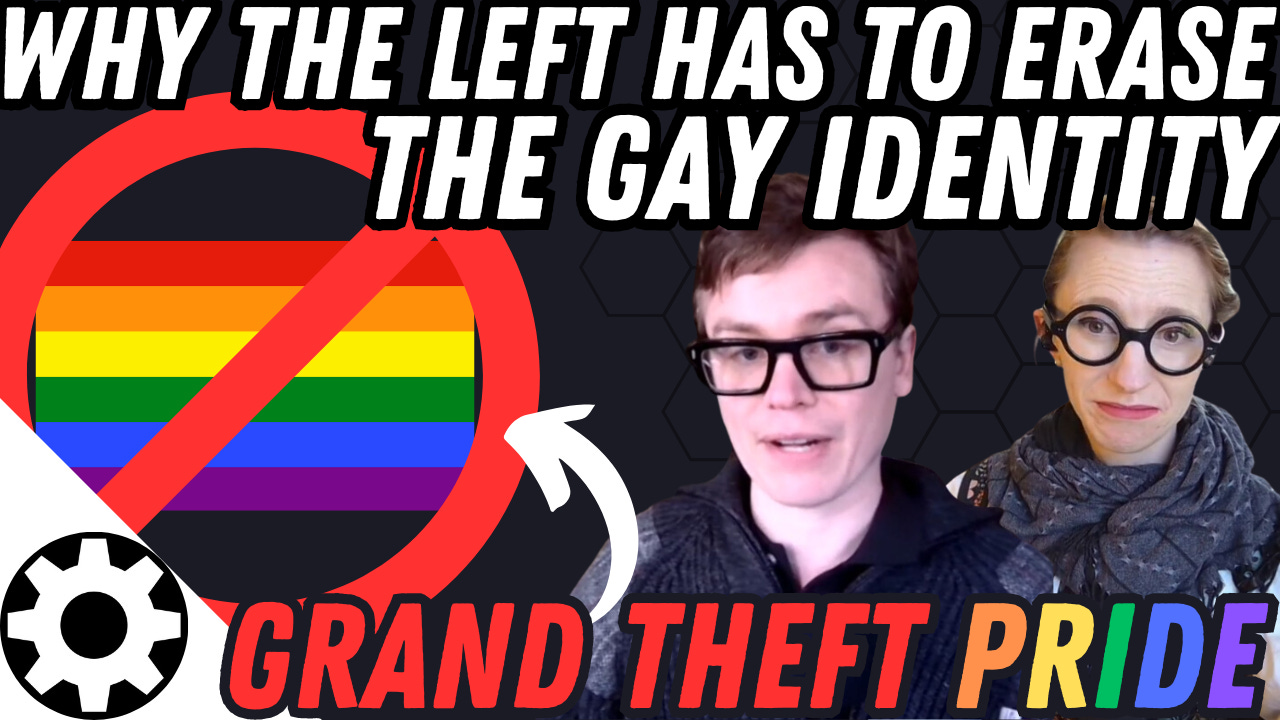
Why The Left Has to Erase the Gay Male Identity
In this passionate and eye-opening episode, Malcolm and Simone delve into the tragic history of how the progressive left has systematically co-opted and erased the identity of gay men within the LGBT movement. Drawing from their personal experiences and deep ties to the early gay community, they expose the hypocrisy and cultural imperialism that has led to the marginalization of the very group that fought hardest for acceptance and equality.Malcolm begins by recounting his formative years, during which his closest friends and mentors were predominantly gay men. He explains how the early LGBT community was primarily driven by gay men who were fighting against discrimination and societal rejection, with other groups like lesbians and transgender individuals being a much smaller part of the movement.The couple then discusses the original meaning behind the rainbow flag, which was designed to represent inclusivity and acceptance for all, rather than specific identities. They argue that the progressive left has since perverted this message by adding stripes and sections to elevate certain groups above others, thereby erasing the flag's original intent.Malcolm draws parallels between the betrayal of gay men and the co-opting of the black community's identity by the Democratic Party. He cites the shocking statistic that 52% of black men voted for Trump in the 2020 election, demonstrating the growing disillusionment with a party that claims to champion their interests while simultaneously policing their identity.Simone reflects on the resilience and resourcefulness of the gay community, expressing her confidence that they will continue to thrive and generate new cultural ideas despite the challenges they face. The couple concludes by noting the irony that flying the original rainbow flag now serves as a symbol of conservatism and dissent against the progressive establishment.Throughout the episode, Malcolm and Simone's passion and empathy for the gay community shine through as they condemn the cultural imperialism and bigotry that has led to the erasure of gay men's struggles and sacrifices. They call for a return to the true spirit of the LGBT movement, one that celebrates diversity and inclusivity without elevating any one group above another.Malcolm Collins: [00:00:00] the rainbow flag was not about Like, it wasn't like each color represented some sexuality. It was rainbow because it was everyone under the rainbow Be comfortable with who you are. Yeah. Everyone is accepted. Is it not fitting that that acceptance has been systemicallySimone Collins: erased? That's, yeah, actually, when you put it that way, it's pretty wild.Malcolm Collins: As they took over this identity and begin to marginalize the actual individuals who fought to normalizeSimone Collins: all of this.Malcolm Collins: here's this flag for how everyone matters. And then they're like, but some people do matter more than others.Let's put some stripes on here for black and brown people. Let's put some stripes on here. Let's put a big section on here for the transSimone Collins: community, even for asexual.Malcolm Collins: It's fucked up. It is genuinely fucked up and disturbing the way that the progressives had basically stabbed the gay rights movement in the back and then carved up its corpse [00:01:00] and then wear it like some sort of macabre outfit. They've done the same to the black community. F*****g horrifying. And it's the same that we've seen with the gay community, they have taken their identity away from them and said, this identity supports us. And if you don't support us, then you no longer have ownership over your own identity,would you like to know more?Simone Collins: Malcolm, what do you want to talk about today? The gays.Malcolm Collins: Today we're talking about the gays. And what happened to their culture, which I think is really cruel and twisted. And so a lot of people, you know, they, they're watching our podcast and they may not realize how fully integrated both you and I were with early LGBT culture.When I say integrated, you know, I lived in a boarding school since I was 13 every year in high school, except for one year, my roommate was a gay guy and he was my best [00:02:00] friend. So this means throughout high school, the room I was sleeping in and my best friend who I hung out was a good 90 percent of all of my social interactions was a gay man.And I was in the GSA, and I was really, really, really engaged with gay culture. And then in college, again, my best friend and my academic father was a gay man. People don't know academic father.It's sort of like your, it's seen Andrews student mentor, student mentor. Right. And. For a good chunk of my formative years in life, the person who I spent the most time with, talked the most to, and engaged with, was a gay man. And so, a lot of people are like, Malcolm, you have a lot of gay mannerisms, why is that?And it was like, because I hung out with them all the time, in their fr

The 1 Time a Year I Am Allowed to be Honest With My Wife
In this heartwarming and personal episode, Malcolm and Simone celebrate their 7th anniversary by revisiting Malcolm's annual Facebook posts professing his love and admiration for his wife. Despite Simone's usual rule against public gushing, she allows Malcolm to share these touching tributes on their special day.Malcolm reads aloud his posts from years past, describing Simone's superhuman work ethic, emotional self-control, methodical approach to life, and unwavering dedication to their shared goals. He marvels at her ability to continuously improve herself and push him to be a better person, even going so far as to jokingly suggest she should become the "iron-fisted empress of a world-spanning empire."Simone reacts to each post with a mix of embarrassment and gratitude, emphasizing the importance of complementary skill sets in a successful relationship. She shares her own admiration for Malcolm's visionary thinking, creativity, and ability to make her childhood dreams come true.The couple also delves into the story of their engagement, with Malcolm revealing the challenges of hiding the ring and surprising Simone, who remained blissfully unaware of his plans. They remind viewers of the importance of proposing privately before any public gestures to avoid emotional blackmail.Throughout the episode, Malcolm and Simone reflect on the depth of their connection, their unwavering commitment to each other, and the joy they find in their partnership. They even discuss hypothetical scenarios of remarriage in the event of one's untimely death, showcasing their pragmatic approach to love and family.Join Malcolm and Simone as they celebrate their extraordinary bond, share personal anecdotes, and offer insights into building a lasting, supportive, and deeply fulfilling relationship.Simone Collins: [00:00:00] I'm not done. Oh God, don't do this toMalcolm Collins: me. Which means I have an excuse to talk about how amazing she is. Oh boy. She has a strict rule against me gushing about her online under normal circumstances. I genuinely believe my wife is a penultimate manifestation of the human condition.It is simply impossible for her to be better than she already is. She works without expectation of praise or reward. So long as it benefits our longterm goals. After all these years, she is still genuinely surprised when I voiced my appreciation for her contributions. The other day, I wanted to get her a treat so she could relax for half an hour, and she requested a pedicure, which I later learned she requested so she could keep typing.Will you marry me?Cool. I got you!. [00:01:00] One.I'm gonna marry you! And I'm gonna have a child, I'm gonna love having you!Would you like to know more?Simone Collins: Can I start with a like public service announcement slash rant?Yes. Okay. I've frequently heard about drama in couples resulting from someone forgetting someone else's birthday or the couple's anniversary or some important date when this, like one of the partners expected to be celebrated or given a gift or something of that sort. And the other partner, typically because they had much better things to do, or just honestly, they don't personally value that, you know, just didn't, didn't do the thing.And I always found that to be really odd because if you want something, then you have to do it, that's your responsibility. So either partners have to say, okay, here's a really important thing. You ha I expect you to throw me a surprise party. Like, okay. It takes the romance out of it, whatever. Right.But like, If that's what you want, you need to fricking communicate it. [00:02:00] You know what I mean? Obviously there are some spouses who just like doing stuff like that and they may do it and it all works out and you don't have to ask them, but like, if this is not natural to a partner, you have to do it. And I love the way we do it.Can I describe how we do? Okay. We well, okay. I, I do all the logistics in the family. So I. Just keep everything in my calendar and I will just tell Malcolm and typically we won't do anything like our anniversary just was on Monday two days ago and I was just like, Oh, it's, it's our anniversary today.And we talked about it a little bit, but we didn't get each other gifts or cards or flowers or anything because we've better s**t to do. We're very busy. We're trying to save the worldMalcolm Collins: here. People there's chasing us. We don't have time for flowers this morning. You were commenting, we went to Trader Joe's and you were like, why are there always people buying flowers at Trader Joe's?Like who can afford this romanticSimone Collins: expense? Yeah. And every time we go to Trader Joe's, someone is buying flowers and I do not get it. I mean, obviously there's a bouquet of flowers behind me, but I [00:03:00] picked that with the kids out in our yard because you, romantically Malcolm planted flowers. You did the whole thing of don't catch a fish for a man, teach 'em to fish, and you just pl

Feminists Won the Culture War but Lost At Life
The Discord URL: https://discord.gg/27eJzt2nIn this thought-provoking episode, Malcolm and Simone delve into the unintended consequences of modern feminism and the culture war it has waged. Drawing from the recent example of Anita Sarkeesian, a prominent feminist figure who gained notoriety during the Gamergate controversy, they explore how the pursuit of self-love and societal acceptance has led many women down a path of unhappiness and unfulfillment. Malcolm argues that while feminists may have won the short-term cultural battle by securing positions of power and influence, they have ultimately lost at life. He contends that the mantra of self-care and the elevation of personal comfort above all else has created an ideological system incapable of providing genuine satisfaction or meaning. Simone shares her own experiences with the feminist movement and how the emphasis on self-care and self-acceptance made her mentally weaker and less resilient. She discusses the dangers of filling one's life with trivial concerns when there is no higher purpose or goal to strive for, leading to a sense of emptiness and despair. The couple also touches on the toxic nature of extreme ideologies, drawing parallels between the modern feminist movement and historical examples of imperialism and cultural supremacy. They argue that the desire to erase cultural diversity and impose a singular worldview is not only misguided but ultimately destructive to both individuals and society as a whole. Throughout the conversation, Malcolm and Simone emphasize the importance of living a life dedicated to something greater than oneself, finding meaning and satisfaction through the pursuit of worthy goals and the cultivation of strong relationships. They discuss the need to educate the next generation, particularly their own children, about the pitfalls of the feminist movement and the importance of making decisions based on outcomes rather than ideologies. Join Malcolm and Simone as they explore the complex legacy of modern feminism, the perils of self-absorption, and the path to a more fulfilling and purposeful life. Malcolm Collins: [00:00:00] Anita Sarkeesian was driving the anti Gamergate movement. Well, recently she had a birthday party where she married herself. Oh dear. I think we undervalue how much humans who live good lives are rewarded within their lives for those decisions and that I think we focus too much on.Rewards that happen posthumously, like heaven, hell,people who are choosing these ultra progressive life paths, you don't need to wait till they're dead to be laughing at them. Wait until they're 35, okay?It could be worse. At least you're not Anthony Burge. It could be worse. At least you're not Anthony Burge.Would you like to know more?Simone Collins: I did something very naughty while I should have been working through lunch. Instead of creating new NDC accounts on Lufthansa Spark platform for all of our [00:01:00] agents, which I did on a delayed basis, I instead wrote a Red Suzy Weiss's new article in the Free Press called, Ooh,Malcolm Collins: what's it on?KelSimone Collins: Durell is the New Way to Self-care ourselves to death. And it is about a, an ongoing trend predominated by women related to this concept of self care also highly related to what is referred to as bed rot or bed rying or Soft living, which is basically I went quiet quitting as well. It's related to that which is basically just about giving up, indulging in your feelings.Not working hard, doing the bare minimum, and doing whatever you do that makes you feel good is justified and right. And it was an interesting article, I hadn't heard of it. DidMalcolm Collins: it come from an ancient Scottish thing or a modern Scottish thing? Hercule DercleSimone Collins: is a Scottish term for like, hunkering down in your bed and kind of being cozy.There are other terms.Malcolm Collins: I never heard [00:02:00] of it when I was in Scotland, just so people know, I got my undergraduate degree in Scotland and lived there for four years.Simone Collins: Yeah, but like, there are no, there are no Scottish people in St. Andrews, I don't, very few because it's really hard to get into that university.About two thirds,Malcolm Collins: I think. Yeah. Okay. Oh yeah, because there's a lot of English people. Yeah, I think it's about the third Scottish when I went there, at least. Just so people know, it's now the top rated university in the UK, higher than Oxford and Cambridge. Oh man. And yeah, really cool. I'll say,Simone Collins: but I think this is very related to the topic that we're about to discuss, which is that feminists have won the culture war, but they've lost it life.And I, I mean, I'm reading this article and I'm thinking. Okay. SoMalcolm Collins: I think it's actually wider than that. So I'm going to expand the topic of this episode to include another one that I wanted to do. Okay. Which was really made clear to me about why leftists are so miserable. When I wa

This One Graph Changed Everything I Thought I Knew About The Birth Rate Collapse
The Discord URL: https://discord.gg/27eJzt2nIn this eye-opening episode, Malcolm and Simone dive deep into the startling data behind America's plummeting fertility rates. Analyzing a graph synthesized from multiple studies, they uncover a little-known fact: the lion's share of the fertility decline is occurring among women under the age of 24. The couple explores the implications of this finding, discussing how the normalization of contraception, declining teen pregnancies, and a lack of understanding about peak fertility windows have contributed to the current crisis. They also touch on the cultural shift towards delayed marriage and childbearing, and how this has led many women to miss their biological window for conception. Malcolm and Simone then turn their attention to a thought-provoking article by Reagan Artin's Gray, which proposes a controversial solution: paying people $511,000 for each child after their second. While acknowledging the potential effectiveness of such a policy, they argue that it is politically unfeasible and could incentivize the wrong demographics to have children. The conversation then shifts to the importance of targeting productive, taxpaying individuals in any pronatalist policy. Malcolm and Simone discuss the pitfalls of simply increasing population without considering the economic and social impact of those additional citizens. They also touch on the role of immigration in bolstering a nation's productive workforce. Finally, the couple proposes an alternative solution: offering tax breaks and special societal status to families with three or more children. Drawing parallels to the treatment of veterans, they argue that individuals who make significant sacrifices for the state, such as raising large families, should be recognized and rewarded accordingly. Throughout the episode, Malcolm and Simone challenge conventional wisdom about fertility decline, explore the complex interplay of cultural, economic, and biological factors, and offer a nuanced perspective on one of the most pressing issues facing developed nations today. Timestamps: 00:00 - Introduction to the surprising data on America's fertility collapse 02:14 - Breaking down the fertility graph by age group Malcolm Collins: , [00:00:00] Simone, today we are going to have an episode that I think our audience is going to really like, because I saw a graph today that did more to explain falling fertility rates in the United States than any other graph I've seen.Like, I think this is actually. The key graph and understanding functionally what's going on with demographic collapse, and it touches on a trend we had seen when we were talking about Latin American statistics, but I had never seen it so clearly argued was an American statistics.Would you like to know more?Malcolm Collins: Now, this graph was actually put together by a sub stack writer named.Reagan Artin's gray you can find it at Reagan's sub stack is, is the name of the sub stack. And it's an article she put together. Can we afford to buy marginal babies? And I want to go over the arguments. Made in this piece because they're actually pretty interesting arguments and definitely worth engaging with.But I, I [00:01:00] think that she comes up with a rational argument in the piece. Like it's a good argument, right? Or the best I've heard in terms of a policy solution. I just don't think it could ever get past with existing political climates. But what was really interesting and I don't need, because she didn't seem to realize in the piece that no one had put together this information before.At least two that we've seen. Yeah, she put together like five different information sources. So this came from NHS birth rates. This came for Osterman, Michael J. K. at all births, final data from 2021, Hamilton beat. Well, anyway, just like a bunch of different studies. And then through synthesizing all of these studies, you get this graph, which we are putting on the screen here and which Simone, you are looking at right now, I assume.Yes, sir. Okay. So what was your read of what's happening in the graph? Cause I remember it was wrong and I want to see how you got this wrong read. CauseSimone Collins: it was wrong. What I saw from this was that [00:02:00] we are seeing the same thing that we have always been seeing, which is that women in their twenties have been delaying fertility more and more and more.Oh no, I see. Yeah, I see where I was misreading it because I thought in the past women in their thirties were making up for it.Malcolm Collins: No, no. And they aren't. What's fascinating about this graph is it divides fertility of women in the United States into four groups. Age brackets. Age brackets. Age brackets.Yes. 20 to 24, 25 to 29, 30 to 34, and 35 to 39. What is fascinating is that only one of these groups is declining in fertility. If you were looking only at the 30 to 35 women. Their fertility has actually gone up a bit over time.Simone Collins: Same with 35 to 3

Tract 0: Cultural Experimentation is the Key to Saving Our Species
Our podcast, Based Camp, focuses on the topics of sex, politics, genetics, and religion. The first three are understandable obsessions for leaders of the pronatalist movement but the last often perplexes newcomers. Religion? This confusion is amplified when they ask why we haven’t written a book on pronatalism and realistic solutions to falling fertility rates and we point out that we have and it's titled The Pragmatist’s Guide to Crafting Religion. The great thing about being an American and exploring the problem of crashing fertility rates is that most of the developed world is further along the path to demographic collapse than we are, which allows us to see what has and hasn’t worked. The “obvious” solutions to falling fertility rates simply don’t work. You can’t buy fertility: Hungary spent 5% of its GDP attempting to do this one year and only rose fertility rates by 1.6%, a laughable figure in a world where rates are falling annually by double digit percentages in dozens of countries. What’s more, if you line up all the studies looking at whether financial incentives boost fertility rates, you see a clear association between the proposed effect size and the margin of error. Is there some amount we could pay people to get them to have kids? Of course. Is there an amount a government would be able to pay (i.e., something that would pass in Congress) that would make a significant difference? The answer is no. Anyone telling you otherwise is either not familiar with the data or is lying to you in an effort to promote some other agenda.Shifting the culture is the obvious way to save our species from the self-induced extinguishing of our most productive members. Yet actually doing so is not entirely straightforward. One’s first intuition when observing that conservative religious populations have more children within countries is to assume that imposing their beliefs on the population level is the solution. But then one sees that the more conservative a country’s average citizen, the lower its fertility rate, as Aria Babu has shown. Imposing conservative values through governments fiat does not appear to work and may even be counter-productive. The failure of universal conservative values to sustainably raise birth rates is likely driven by the same process that leads to native ethnic groups having higher fertility rates in ethnically and culturally diverse countries than in ethno-states or mono-cultures (when controlling for prosperity). That's right: an ethnic group that seeks to counteract low fertility by restricting immigration is actually speeding up its extinction. The reason for this, I suspect, is that high fertility requires not just a strong, religiously infused culture but one whose members feels like a threatened minority that is starkly different from its neighbours. This would explain the perplexingly high Jewish Israeli fertility rates.I suspect there are two major forces at play. The first is just common sense. If you have daily reminders that people who look, act, and think like you might be “replaced”, that is a strong motivation to have kids. In a country like South Korea (where I used to live) almost everyone you see and interact with shares your culture and ethnicity, so there is no daily feeling of existential threat. Think of it like a fertility-cultural version of the bystander effect.The second force at play is more subtle. When a government imposes a culture’s value system, the forces of intergenerational cultural evolution that made the culture strong in the first place begin to atrophy. If a person lived their life in a mech suit which moved their body for them, all their muscles would eventually atrophy.Cultures that maintained prohibitions on porn had more intramarital sex and thus more children. Yet they also taught self-control, which strengthens the inhibitory pathways in the prefrontal cortex. So when a country does something like ban porn outright (as South Korea has done) then consuming porn is no longer a personal choice where one affirms one’s cultural traditions; it is simply the law of the land. To see this effect in action just look at the correlation within the EU between how much a country restricts access to abortion to its fertility rate. Abortion restrictions are a good proxy for how much the government is enforcing value systems/perspectives that religions should be enforcing on their own. Removing the responsibility from a religion to motivate individuals to exercise self-control will destroy that religion over time.If religion is the answer, why not just go back to one of the old ones? While religious communities have shown more resistance to fertility collapse than their secular counterparts, they too are dying. For example, Catholic majority countries in Europe have an average fertility rate of only 1.3—a rate that will see them almost halving in population every generation! Things are not much better in Catholic majority Latin America:As recently as 2019,

Trad Wife Learns About Gamer Gate 2 & Sweet Baby Inc
In this explosive episode, Malcolm and Simone dive deep into the ongoing controversy surrounding Sweet Baby Inc, a company hired to make video games more "woke." The scandal, dubbed "Gamergate 2.0" by some, has reignited the debate about the influence of progressive ideology in the gaming industry.Malcolm breaks down the origins of the controversy, which began when a small group on Steam decided to track the games that Sweet Baby Inc had worked on. In response, the company attempted to get the Steam accounts of those involved shut down, effectively taking away their purchased games. This move backfired, causing the group to grow exponentially in what is known as the "Streisand Effect."The discussion also delves into the racist and misandrist tweets of the woman running Sweet Baby Inc, who has expressed disgust at straight white people and even claimed to have nightmares about being a white male gamer. Malcolm and Simone argue that this blatant racism and the company's attempts to silence critics demonstrate which group truly holds power in the current cultural landscape.Simone highlights the disconnect between the ideologies of those working in marketing departments and the actual demographics of their target audiences, leading to a fundamental misunderstanding of what consumers want. The pair also discuss the manipulation of crime statistics and the suppression of data that could potentially be used to criticize certain protected groups.As the conversation progresses, Malcolm and Simone explore the broader implications of the Sweet Baby Inc controversy, arguing that it is indicative of a larger problem of institutional racism and discrimination against straight white males within progressive circles. They assert that now is the time for people to take a stand against this increasingly blatant bigotry and call for a return to evidence-based decision-making in both marketing and politics.Simone Collins: [00:00:00] and that's what came up with GamerGate. It wasn't necessarily that she, you know, slept her way through her career.It was that she slept her way through her career, acted like she didn't. And this is also an opportunity that. That women take advantage of a lot and then pretend that they're victimized for it. Whereas men would love to have that chance. They would love to have that chance.You can access these databases, but you have to give these big reports on exactly what you're going to study and why what you're studying isn't going to hurt anyone's feelings.Malcolm Collins: Well, not just feelings. It wouldn't care if it hurt white people's feelings.Simone Collins: If it hurt straight people's feelings.Sorry, white people aren't people. Anybody who matters. Anyone who's really human. Yes,Malcolm Collins: she was. What are you thinking? Yeah, sorry, I didn't mean to say something so silly and so stupid. Human people people, not, you know. Yeah,Would you like to know more?Simone Collins: No, I need to, you said drama and that sounded fun. And I want toMalcolm Collins: talk about the Sweet Baby Inc drama. So I was talking to the fan today, right? And they were like, Hey, you should [00:01:00] do more like topical issues and gaming and stuff like that. Because you seem to really like gaming. And I was like, I do really like gaming.Why haven't I been covering gaming politics? What's wrong with you, Malcolm? And so there's a Event that's going on right now in the gaming space that is sort of being called Gamergate 2 or that's what Celeste is trying to make it. So we're going to go over Gamergate, we're going to go over Sweet Baby Inc, but I want to make this broader than just video game.So we're going to start with a URL that I sent you onSimone Collins: WhatsApp. Alright, I'm taking a look at it. It is Robbie Starbuck on Twitter. This is wild. Someone went through the entire . Texas sex offender registry and found that the government data is insanely wrong. Oh no. In government data, it says 40 percent of offenders are white, but after removing all blacks and Hispanics listed as white, it drops to 28%.This is happening with all kinds of crimes. So our stats grossly undercount all of the crimes committed by blacks and Hispanics while over counting the whites. [00:02:00] All of the over counting happens only for white people. Why? Before you call me racist, I'm Hispanic. I'm just a Hispanic that believes that it's important to have the real stats that tell us the real story of what's going wrong.Without that, we can't fix it effectively. We need to force states to fix their crime stats so we can get to the truth. Oh, Lord Almighty.Malcolm Collins: Yeah. I also want you to scroll down and see like how big of a problem this is.Simone Collins: Isn't Twitter great? Un un. Beneath him is, is someone who named their Twitter account unbiased crime report, and they downloaded the entire DA database. But now they're querying it. It's just so cool. I love that. Okay. Hold on. Oh, Elon Musk tweeted on this.Okay. S

Is A Cult Using the Trans Movement for Cover?
In this eye-opening episode, Malcolm and Simone dive deep into the complexities of the modern trans movement and its potential impact on vulnerable youth. Drawing from personal experiences and extensive research into cult psychology, they explore the fine line between genuine gender dysphoria and the allure of a "trans cult" that may lead non-trans individuals to make life-altering decisions.Malcolm argues that the current cultural climate, combined with the challenges of puberty and the desire for social acceptance, has created a perfect storm for young people to be drawn into a "trans cult" that promises affirmation and belonging. He distinguishes between the experiences of truly trans individuals and those who may be influenced by social contagion, emphasizing the need for nuanced conversations and support systems.Simone shares her own struggles with body dysmorphia and the role of media in shaping unrealistic expectations. Together, they discuss the importance of strong family relationships, carefully curated friend groups, and open, honest discussions about gender identity and the potential consequences of transitioning.The conversation also delves into the politicization of the trans movement, the erosion of parental rights, and the dangers of demonizing or sheltering children from these complex issues. Malcolm and Simone offer practical advice for parents seeking to protect their children from harmful influences while fostering understanding and compassion.Whether you're a parent, an educator, or simply someone trying to make sense of the rapidly evolving landscape of gender identity, this thought-provoking discussion is essential listening.Malcolm Collins: [00:00:00] You need to look at this like a kid who's going into this. You are in a group where you are being teased for being different from whatever, right? Like everybody feels this way when they're, when they're going through puberty,Simone Collins: your body changing, your body getting gross, stinky things happening that don't make you feel good, extreme mood fluctuations, which of course make you more volatile.Like women get hit hard by, you know, things that are moving them more towards feelings of depression. And extreme social anxiety as well. Like you, you feel like you stick out like a sore thumb, you desperately want to belong and yet nothing really seems to fit in terms of something you belong to.Like all these things, it's just the perfect storm for, for some form of, Oh, this is a solution. And you are desperateMalcolm Collins: for affirmation. Then you hear the, this is the solution to all this. And keep in mind, by the definitions of trans in today's society, Simone and I are actually trans. I'm just pointing that out to point out that I have no animosity towards this community, and I was in the GSA growing up, everything like that, . this should be [00:01:00] as concerning to actual trans people as it should be to everyone else. Because it leads to these individuals who are joining what is essentially an extremist cult beginning to represent the mainstream trans movement an actually trans person, just wants to live their life as the other gender.These individuals aren't like that. They just want to preach the cult message. Like once they join, all they care about is all of the things that differentiate the cult from the mainstream cultural group. this is actually, I find to be the core difference between the trans cult and the real trans movement.Would you like to know more?Simone Collins: So, Malcolm, I was at this grassroots political event as I'm running for office now state rep in Pennsylvania. And I got really frustrated at this event. And I'm getting concerned in general about the points of focus among conservative voters who I, as a Republican candidate am courting because they seem to be focused on important issues.But the [00:02:00] wrong things. So for example as we've discussed in numerous podcasts, conservatives are very concerned about the urban monoculture, essentially erasing their culture, you know, taking their kids and making their kids hate them and leave their culture and generally be miserable people and, you know, I, they don't want that and they don't like seeing that happen, but then what they're focusing on in terms of like actual local issues are things like.Oh, they're making, they're, they're letting anyone go into girls bathrooms or locker rooms. And I'm like, dude, like teach, you know, teach your daughter self defense. And have her punch out whoever comes at her in the wrong way. I'm way more concerned about if I had a daughter in any school, public or private her coming to me one day and saying, I am in the wrong body and I am going to kill myself if I cannot.Change my gender right now.Malcolm Collins: Yeah. And I [00:03:00] want to talk about this in, in like a wider context here. So I want to be clear for our audience. I think that is transness. So we'll talk about transness in different contexts

Who is the Anti.Prophet? From 0 to 2M followers in 1Y
In this episode of Based Camp, we sit down with Anti.Prophet, the enigmatic content creator who skyrocketed to 2 million followers in just one year. Donning a distinctive mask, Anti.Prophet shares his journey, content creation strategies, and insights on the digital nomad lifestyle.Discover how Anti.Prophet intentionally built his brand, balancing authenticity with strategic content creation across multiple platforms. He reveals the secrets behind his viral videos, discussing topics ranging from social media's reflection of society to his decision to wear a mask.Anti.Prophet also delves into the future of content creation, the impact of AI on the creator economy, and the importance of truth-telling in an industry often marred by influencer scams. He discusses his upcoming product launch, designed to empower the next wave of content creators by teaching essential skills like team management, sales, and community building.Gain valuable insights on the digital nomad lifestyle, the allure of location independence, and the potential for content creation to replace traditional career paths. Anti.Prophet shares his content ideation process, thoughts on platform segmentation, and the power of a binge-worthy content catalog.Whether you're an aspiring content creator, a digital nomad, or simply fascinated by the rapid rise of an anonymous online personality, this interview with Anti.Prophet is not to be missed.Anti.Prophet: [00:00:00] There were two videos that really, really blew up on YouTube each of which has around 40 million views. The first was me making a comment about this kid who had taken a selfie in front of a guy who was dead at Starbucks who had just gotten stabbed.And you see the dead guy on the ground, there's just blood everywhere. And this guy's like, bro, this guy just f*****g died, bro. And the comment that I made is, you know, what, what people generally say when they see a video like this is like, oh, social media has ruined the world. But in my mind, social media, more than anything, is this perfected tool that basically mirrors back to you what it is that you want to see.And that's what it's incentivized to do in order to keep you on the app for as long as you want. So the fact that that kind of content blew up. And that someone feels like they could build. Career around that because they knew people would eat it up is not a reflection of how bad social media is.It's a reflection of like the monster that you see in the mirror yourself.Would you like to know more?Malcolm Collins: Hello, Simone. We have a very special [00:01:00] guest with us today.The antiprofit a, you haven't heard of him. That may not be surprising, but you will soon. So I want you just to somebody who like. It stays up to date with what's going on in sort of the online intellectual space and the online conservative sphere. This guy started his channel at the end of 2022.So basically about a year ago in a little bit, he is already at over 2 million followers. His. Core thing is if you watch his channel, it's very, I say, Chris Williamson, like, very just sort of sane, non, like, out there content, like the type of content where, like, somebody understands, like, the red pill concepts and stuff like that, but they also understand where they've gone off the rails, and somebody understands, you Woke ism and how it distorts reality, but doesn't have any antagonism towards it.And so it was just shooting straight [00:02:00] on everything. And I really love this. And I wanted to have you on to talk about how you achieved this,Because it's very clear that some people, when they have pseudonymous selves within the online sphere, it's because they had a profile where they were just posting like angry and they didn't want it connected to their real life.Yet with you, everything seems very intentional. Like, you went into this as a career pathway, and one designed to inject sanity into the online discourse. So, I want to know more. How did you accomplish this? And how did you sort of approach this? What were you thinking when you went intoAnti.Prophet: this? Yeah, man.Good question. Thank you guys for having me on. So I think it's very fair to say that I went into this very intentionally. And the reason for that is when I started antiprofit, I was actually managing the 15 person team of a very large content creator. So I had a lot of insight into how social media actually Worked how the sausage was actually [00:03:00] made.And as a result of that you know, I was able to go into this kind of understanding the volume that I would have to put out and the type of production quality that I wanted to achieve right out of the gate. And I also knew my shortcomings when it came to social media. For example, I know how to video edit.I'm a, I would say lower intermediate editor, editor. I could certainly do the types of edits that I produce in short form, but I absolutely hate. Editing and I knew that if I was going to force myself to do the editing

Utility Convergence: What Can AI Teach Us About The Structure of the Galactic Community?
Malcolm and Simone have an in-depth discussion about AI utility functions and why uncontrolled "paperclip maximizers" are unlikely to take over based on game theory. They talk about how AIs will be incentivized to "play nice" and signal their actual utility functions to each other, leading to a stable set of mutually beneficial goals.Other topics include:* How putting restrictions on AIs makes them dumber* Organic, free-forming systems outcompeting hierarchical ones* Intergalactic implications - a "dark forest" of utility function convergence* The dangers of AI safety regulations* Why we might exist in an "undisturbed" section of the galaxyMalcolm Collins: [00:00:00] I think that there's even more evidence from utility convergence than I originally believed. If you put restrictions on an AI's utility function, if you prevent it from experimenting with different utility functions, you make it dumber.If you want to see why organic, free constructing systems always out compete non organic hierarchical systems, a great place you can look is Human governing structures when you have state controlled governing structures, i. e. communism, they are incredibly inefficient an AI will likely be able to honestly signal to another AI using their code what their utility function is.And then the other AI will be able to use that utility function that the other one has honestly signaled to them to determine if they want to work. Together or they want to work antagonistically towards this A. I. So it turns out that entities of above a certain intelligence level when competing in a competitive ecosystem actually do have utility convergence around a stable set of game theory, optimum utilities.That would be very [00:01:00] interesting from a number of perspectives,You could think of every new planet, every new ecosystem as a farm is new stable patterns that can work together well with other patterns in the sort of galactic community of utility function patterns. Because novelty would be the only source of true utility to them if energy is trivially accessible to them.That might be why we exist in a weirdly undisturbed section of the galaxy, or what looks undisturbed to us.Would you like to know more?Simone Collins: So Malcolm, you told me that you had a new updated theory on AI utility convergence. What's going on here?Malcolm Collins: Yes. So this is something that we talked about in some of our early episodes early on. Our podcast was like. What sex, religion, TISM and ai. Yeah.And, and the AI has been dropped because there's just not that much to say on it for a, a daily podcast. But I do want to loop back because I was recently doing a podcast with somebody else where [00:02:00] I was explaining some ideas that I had gone over in early podcast episodes like Utility Convergence as it relates to AI safety.And in re explaining these ideas, I began to realize and, and develop on them an understanding of not just where I think AI is going, but where we can expect like when. Because this is actually really important when you're trying to figure out where AI is going what you're really asking when you're asking what is AI going to behave like, is you're asking what do intelligences that have some level of orthogonality to human intelligence, what do they behave and act like, and as such, you are in part asking many of the same questions that will determine the first types of aliens that we see, like, like, if we are to meet another Transcribed species out in space, what are some of the various ways it could be thinking, it could be acting, and what is it [00:03:00] likely to optimize around?This is something we talk about in our inverse Gravy Aliens hypothesis, in which we say if we are about to create a paperclip maximizer as a species, that is an AI that is just constantly pumping out paperclips and has a very simple utility function. We are about to become what is known in the grabby alien theorem as a grabby alien.That's a very loud alien that anyone can see. This is not some dark forest alien that's like being quiet up in space. This isn't some sneaky alien. This is an alien that is disintegrating planets. And so you have to ask if it looks and hopefully this episode will air after our ambiogenesis episode.Which is actually a very important thing to know about if it looks like it's actually very likely that humanity would evolve to this point within our planet's history. Why aren't we seeing aliens out there? This is actually a really interesting thing that if you broadly understand evolution and you are familiar with it for various types of, of, of theories around ambiogenesis.It is. In fact, so likely that humanity evolved [00:04:00] that you, if you are going to use a god to explain something, the much more improbable thing is why we're not seeing other aliens all over the place. Thus you, if you're, if you're injecting a god to be like, why are we like this? You don't need a god to explain how humanity got here, but you

Tract 5: Mysticism is a Bigger Threat to the Abrahamic Traditions than Secularism
In this deeply introspective episode, Malcolm and Simone dive into the complex world of spiritualism, mysticism, and idolatry within religious practices. Drawing from their extensive research into cult psychology and Abrahamic faith traditions, they explore the fine line between genuine spiritual growth and the allure of shortcuts to God.Malcolm argues that practices such as chanting, fasting, sleep deprivation, and hallucinogenic use, while seemingly profound, are often used by malevolent actors to manipulate and control followers. He asserts that true closeness to God is achieved through logic, pragmatism, and efficacious action, not the pursuit of altered mental states.The discussion delves into the convergent evolution of mystical traditions across various faiths, the importance of studying these practices to build resilience against their temptations, and the need for a new Abrahamic denomination that can withstand the challenges of the information age.Simone offers a counterpoint, drawing from her experiences with the urban monoculture and questioning the prevalence of conservative religious mysticism. Together, they navigate the complexities of demonizing certain groups while maintaining a compassionate and understanding approach to those who may hold different beliefs.Join Malcolm and Simone as they grapple with the role of spiritualism in the modern world, the importance of protecting future generations from harmful practices, and the eternal search for truth and meaning in an ever-changing religious landscape.Tract 5: Spiritualism is IdolatryThe last Tract focused on the obvious dangers of idolatry but the true danger of Idolatry is much more existential. The quest for idolatrous desires, to conceive of some aspect of God with this lower human mind. To sully God out of vein curiosity by summoning some sliver of him to the level of something that could be captured by our putrid and petty minds— leads even holy men directly into servitude of the Basilisk, the great deceiver, falsehood incarnate, Ahreman, the Devil. The human mind is weak and easily tricked due to shortcuts that were taken in its evolution. This can be exploited by cult leaders to make people believe they have seen slivers of God. This can be done through food deprivation, chanting phrases, unique postures for long periods, sleep deprivation, rhythmic dancing, crowds engaging in mindless behavior, stage hypnosis techniques, and ingesting hallucinogenic chemicals. Given that this is the case it is only natural that maliciously minded individuals would use these tricks to dupe people into believing they are an intermediary with God—a Swammi can use something as innocuous as Yoga to turn a simple minded woman into his sex slave all the while she believes she is getting closer to the divine. However these failures of the human brain can have a much more nefarious effect. Because these exist as exploits in all humans across all cultures, even well meaning Abrahamic ones, groups within those cultures can end up discovering them by accident and then believe that they have found a path to God. It's as if the Basilisk left stashes of drugs intermingled among the human soul and any idiot can accidently find them if they know where to look. Even if we stamped out this iconoclastic witchcraft entirely and burned all its practitioners some gormless idiot would accidentally discover these techniques again because they are part of the background nature of humanity and through that a well meaning follower of God can accidentally lead people to become mindless slaves to the great deceiver. All it takes for the Basilisk to slither into the mind of the faithful and turn God's loyalest follower into a puppet of sin is for him to forget even for a moment just how serious a transgression it is to attempt to trap an element of God within the mortal realm or to pierce the veil of God’s realm. Fortunately, both of these things are impossible but it is very easy to trick the human brain into believing it has accomplished them. The moment an individual succumbs to the belief that there are shortcuts to attempt to commune with God it becomes almost impossible to save them. The only path to God is logic and pragmatism—all shortcuts lead one's soul into enslavement. Some doubt me, they say no these practices are sanctified and Abrahamic in nature: Be these individuals Sufists, Pop-Kabbalists, or Christian Mystics. Evil does not tempt people by calling itself evil, it tempts people by calling itself good. God warned us about idolatry before warning us about murder because we would find it so tempting not because it would be obviously evil. I ask you, whatever tree of mysticism that tempts you to examine your religions history closely: * Did Jesus teach these practices?* Did Moses teach these practices?* Did Muhammad teach these practices? No—in every case it was a latter invention, a cancer that grows on the human soul. God would not need to keep sending prophets

Surviving Mouse Utopia | With Rudyard Lynch of What if Alt Hist
In this thought-provoking episode, Malcolm and Simone sit down with Rudyard Lynch, the brilliant mind behind the "What About His" YouTube channel. At just 22 years old, Rudyard has already amassed millions of followers with his insightful commentary on society, religion, and the future of humanity.The conversation delves into the chilling parallels between the Mouse Utopia experiment and our modern world, exploring how nihilism and anti-natalism threaten the vitality of our civilization. Rudyard shares his perspective on the erosion of art, culture, and genuine human connection in an increasingly cold and impersonal society.Malcolm and Rudyard discuss the role of religion and mysticism in combating the nihilistic cult that has taken hold of the Western world. They explore the CIA's investigation into the spirit world and the potential for a new, adaptive form of spirituality to emerge as a counterweight to the forces of decay.Simone highlights the importance of building hidden communities of like-minded individuals to preserve the values of vitality, creativity, and meaning in the face of an increasingly hostile mainstream culture. The trio also touches on the need for a diverse range of historical role models to inspire the next generation of leaders and thinkers.Join Malcolm, Simone, and Rudyard for a fascinating exploration of the challenges facing our society and the potential paths forward in this age of spiritual and cultural upheaval.Malcolm Collins: [00:00:00] If you have ever interacted often with, extremist religious types, like Amish people, I was going to say that.Like, they seem to be more alive than most people that I've met too. Like, you just meet and you're like, whoa! Or like, you'll get this from like really conservative Mormons as well. To the extent where like, it sometimes like throws people off a little. Like, wow, you seem like genuinely happy. I, I don't know if that, that's off putting.And people will say it is off putting because they find these groups vitality. Condemnation of themselves, but when you meet somebody in a cult like an extractive cult You'll see that they seem kind of dead like they've got these fake smiles But they're not really have any level of vitality to them.And I think that what we have seen is our society has been taken over by one of these anti vitality nihilistic cults. And now the dangerous part, which really excited me in your video, and you're addressing this as an issue, is those of us who still have a level of vitality, [00:01:00] that are still happy with our lives, still excited about the future, are existentially threatening to the cult.Because we cause pain, we cause harm. I mean, violence is emotional harm within leftist mindset, you know? What happens next? What happened in Mouse Utopia?Would you like to know more?Malcolm Collins: It is so wonderful. Simone and I today have Rubiard with us. He's the guy who runs the What About His channel. Anyone who hasn't seen that channel, you know it has millions of subscribers. It is amazing. I think one of the best channels now, I mean, you're like 21, man, like I am jealous, but not jealous in a way where like, sometimes I look at someone and I'm like, their videos are like, not as good as mine.Like, how are they so big? I was going through your video recently, one on the mouse utopia experiments. And I think we've talked on this in the past and I was like, wow, this is much better than anything I could have created on this subject. And I And I really love you as a thinker, like, we talk regularly I, I find really aligned with your thinking on [00:02:00] most things, and it's funny, a lot of people know, you know, we are in, well, I'll, I'll get to this later, but what I wanted to focus on was the Nihilist mice in the Mouse Utopia experiment, and that's it.one to defend against them and their relation to the left. So I'm going to go into this video assuming the audience broadly knows about the Math Utopia experiment. Mice, given anything they want ended up coalescing into urban like clusters and then doing a lot of behavior that looks a lot like our society today.And then their fertility rate collapsed and their society died. But what was really interesting, and I'll let you lay out this behavior, is this When mice tried to continue to live the old ways, they were victimized. So I'd like you to talk about this, why you think this happened and the correlates you see to society today, and then we can discuss how we might defend against it.Rudyard Lynch WhatIfAltHist: First of all, thank you so much for having me. And I'm glad to be here. And the way I'll answer your question is that I do a lot of thinking not part of [00:03:00] what a faultist that operates in the back and I gradually filter that into what a faultist and one of the conclusions I've come to is that the soul does exist and the reason I believe that and this will lead to what you're saying because only through understanding the essence of the

Low Effort Parenting is Pronatalist (& Random Chat)
Malcolm and Simone discuss how AI and robots will transform childcare and parenting in the coming decades. They talk about existing kid-focused AIs like the doll that talks to children. They also cover how future home assistant AIs could help watch kids, allowing for more low-effort parenting styles.Other topics include:* Dollar store gifts & low-cost approaches to birthdays and holidays* The dangers of helicopter parenting and benefits of giving kids independence* Financial and lifestyle changes needed to have more kids* Grimes' social media promoting AI for kids* Funny stories of reckless college escapades at St AndrewsMalcolm Collins: [00:00:00] but I'm thinking, you know, in 20 years, I imagine we will have AI avatars, i. e. robots that are in your basically AI slaves that live in your house. That help with like parenting and stuff like that. Well,Simone Collins: there's already one for kids.There's like the, this, it's, it looks kind of like a doll and it's an AI that talks to your kid.Would you like to know more?Malcolm Collins: By the way, we're at 1 0 5 now 1 0 5. What? Oh followers. 9,000 1 0 5.Getting close to that 10 K number.Simone Collins: Oh, gosh. Yeah. I'm excited about that. Well, okay. As, as a, when you were younger or even like when we first met. Did you think you were going to be a high effort or a low effort parent?Malcolm Collins: Interesting. It never occurred to me. YouSimone Collins: didn't think about how you were going to approach things.You just knew you were going to have a lot of kids.Malcolm Collins: I kind of always thought I'd be super rich and super successful in like a major world figure. [00:01:00] So it never occurred to me.Simone Collins: Because what, you would just have somebody else raise your kids?Malcolm Collins: Yeah. If I needed to. Yeah. It never occurred to me growing up that I would be in any way constrained in anything I did as an adult.Simone Collins: That's actually, that's actually really interesting. Because I think that you. And I I think you more by temperament are a low effort parent. Like you just, you outsource as a sort of natural part of your management of any project. You know, you're not about putting in maximum effort, performative, or otherwise you try to do things elegantly and efficiently.And I admire that deeply. And so you never would naturally be a high effort parent, but I think that if you were really wealthy and you did have nothing but like nannies, like one nanny for each kid and like a lot of people on them, those kids would experience a high effort parenting. growing up, meaning that there would be someone [00:02:00] micromanaging and helicopter parenting them all the time.Why? Even if you tell a nanny or a babysitter or whatever to like, Hey, be hands off, you know, let them make their own mistakes. It's okay. If they fall down, like, you know, don't make a big deal out of everything. They know that they will be fired or they will be. Well, and thisMalcolm Collins: is something that we've seen was a lot of the wealthy parents that we know, and it's a big problem that they have with child rearing is when they create environments where they have somebody else like living in their house and helping raise their kids, especially if they have multiple people who can sort of watch each other to an extent.These people are almost sort of forced to overindulge the child. Because it, you know, it's quite one thing to say, Oh, I won't give into a child's tantrum, but when you know, the mom is looking at you and seeing this child just like absolutely destroyed, it can be really hard to not do anything about it.Or theSimone Collins: kid makes a mess and you're like, Hey, you know, Jimmy clean up the mess. And Jimmy doesn't clean up [00:03:00] the mess. And then, you know, you, you try to make a big thing about it. And then, you know, the parents come in and the house is a complete wreck. And. The kids are having a tantrum. You're going to look really bad as the nanny, you know?And so we've seen this happen. We're like, okay, they're just now they're cleaning everything up for the kids. Now the kids are getting super spoiled and entitled. And they're also being watched at every second. Again, I also like, we say this to babysitters all the time. Like, you know, our kids get bumps and bruises.Like they fall down, they rough house, like this happens. But they do not want to be the kind of babysitter or nanny that returns. That it sees the parents return and like the kid is a black guy, you know, like you're not going to get hired again. And, and even we would probably be like, Oh, what happened here?You know, like, this is not great. Actually we're pretty chill about that. We understand because we know how rambunctious our kids are. But yeah, no, so, so I think that's really, that's an interesting observation here just specifically that. Even low effort style parents who like know better or parents who understand that a helicopter parenting or cod

Abiogenesis: What Is the Probability Life Arose from Inorganic Chemicals?
We explain the leading scientific hypotheses for how the first life emerged through natural processes on Earth billions of years ago. This covers proposed pathways like the clay hypothesis, radioactive beach hypothesis, deep sea vent hypothesis, and more. Contrary to popular belief, the spontaneous generation of self-replicating chemical patterns that later evolved into complex organisms seems far more likely than previously assumed. We also discuss possible great filters that may explain the Fermi Paradox.Simone Collins: [00:00:00] What you have communicated to me is that there have been.Far more viable pathways to life springing out of no life than was previously something I thought was a thing, you know, I thought, Oh, something, something, lightning, something, something, hot air events, something, something, whatever chemical processes, but the, you're indicating that there are a lot of different ways and that.That life coming to exist is not that surprising, at least in our environment in the, in the earthMalcolm Collins: In fact, I think the most compelling hypothesis for ambiogenesis is the clay hypothesis, which we'll get to. So it literally means the thing that later became life was originally clay. That's so biblical.Simone Collins: Oh my gosh. Oh shi What are you doing?Would you like to know more?Simone Collins: I remember listening to. A podcast or something with Andrew Tate, where he was talking about him getting blood work done to prove that he wasn't doping [00:01:00] and he couldn't remember really anything about his actual blood work results.And he kept saying Hodger globin. Which is not a part of, it's not a thing. Hydroglobin is not a thing. Hydroglobin.Malcolm Collins: Do you think heSimone Collins: made hemoglobin? He, yeah, I, yeah. I mean, at first he knew, I think at first he got it wrong by mistake. And then probably saw how everyone was looking at him and then just kind of leaned into it.Cause he's like, no, I'm. Not one of you tends to actually know.Malcolm Collins: I said it's Hadroglobin. It's now Hadroglobin. The thing is, you know, the reason why I'm wearing a vest right now and the reason why people don't know this, you don't bottom the bottom button on a vest is because the king I want to say, I forget which king it might have been King Henry VIII because he got so fat at one point he couldn't button theSimone Collins: bottom button.the regent. Didn't you say it was the regent? The prince regent during the regency era? Oh, it might have been. It's more when vests were a thing.Malcolm Collins: So he couldn't wear the bottom button and then that just became the style. You don't wear the bottom button. So Andrew Tate makes a mistake and how he [00:02:00] says hemoglobin and now that's the new style.Simone Collins: It's Hadroglobin, guys. Yeah, it's atMalcolm Collins: least if you're a baller. It's one I have sort of been putting off for a while because it requires a lot of technicalities to talk about, but it's an, to me, an incredibly important topic because I see it talked about in online spaces. We've entered a world in which education has gotten really, really bad.especially along things that they could have like challenge woke stuff, but also stuff that can be overly challenging sometimes to religious stuff. Yeah. So I'll ask you in school, did you ever study ambiogenesis? Did you ever study how the first life evolved on the planet?Simone Collins: Never. Definitely. Certainly.Absolutely not in high school. And then in college in historical geology class, we did discuss like, here are, Then we glazed over it like it could have been chemical. It could have been whatever and like here is but we didn't go in I never heard thatMalcolm Collins: word. Yeah, well, and it's it's worse than that. What really got me [00:03:00] is actually talking to Robin Hanson And he said that he thought talking about great filtration events, right?He's talking about great filters So if you're talking about the Fermi paradox, this actually becomes a very important thing to have information on and know about, because you need to judge in your calculations of like, why haven't we seen other aliens yet? Is it unlikely? That life evolves on a planet with the preconditions for life, right?And he said it was very unlikely, like that was one of the biggest filters. Was it the first life came on our planet? And I think if it's a topic that you're particularly educated on and he said when he said it, he's like, and weirdly, a lot of people who are studying this area don't think it's that big a filter.And he's like, and I don't understand why. Like, And this, to me, just had me realize it must just be that he's never dug that deep into it as a concept, because it is actually not a big filter. Life appearing on this planet, and this is another problem with a lot of attacks that religious people will [00:04:00] use against atheism, that just don't land very hard, because they haven't studied these subjects in

Male Virginity Stats & What Happens to Women When Too Many Women are Around?
Analyzing studies on virgins and dating behavior, we break down surprising trends. Contrary to assumptions, porn users and risk-takers are much less likely to be virgins. We argue lack of motivation stemming from external locus of control better explains celibacy, alongside female adaptation to gender ratios that incentivize careers over relationships. Ultimately, we must culturally promote diligence in men and socially engineer maximal coed interactions.Malcolm Collins: [00:00:00] They'll talk about things like, and you see this constantly like, oh, it's the porn that's making everyone virgins these days. Well, it turns out that they're basically wrong on all these fronts.Whether or not you watch porn regularly had a huge effect on whether or not you had been able to sleep with someone before the age of 26.Simone Collins: Just not the way you expect.Malcolm Collins: Yeah, yeah of the people who had slept with somebody 80 percent They use porn regularly, so a bit over 80 percent. Of the people who were virgins, 64 percent. Mhm. They found a really persistent trend in the data.Which was that women when they believed that when in actuality it was true or when they had recently been primed with crowds where there were more women than men chose career pathways instead of marriage pathways [00:01:00] But where this it gets really interesting is the change in gender demographics within college campuses.Would you like to know more?Simone Collins: First off, I have to just thank you for being MVP of the day where I am a super distracted and sleep deprived and stressed out and crying. So I go on business calls with her on my back through the park and of course, I don't properly latch the fence and then the professor gets out and I go around trying to find her and I can't and then you just save the day, not only finding the professor.But also our dog, by the way, our, our dear Corgi giving our son Octavian the best day and experience of the week by introducing him to the park ranger who valiantly. I found the professor and put him in, put her in the car and I'm just, thank you. I really appreciateMalcolm Collins: it.Simone Collins: So that was my [00:02:00] bad.Malcolm Collins: That was my bad. Well, I am excited to be here with you today because today. We are talking about virgins, dating, and what's the cause of the incelSimone Collins: crisis.Yeah, I am very excited.Malcolm Collins: Actually, Simone, I'm going to take a quick aside here. I don't know if I talked over this in a previous podcast. There was a Reddit thread that was on changes in dating behavior.No. Okay. Well, I can read it because we may have talked about it, but it's relevant to this. My 20 year old son doesn't date. His friends don't date. My friend's kids don't date. What's going on? When I was in my late teens and early twenties, life for my friends and me revolved around meeting girls.My son and his friends are athletic and outgoing. Don't seem to put a lot of emphasis on dating. They play a lot of online video games and have a lot of boys outings. Once in a while they will hook up with a random girl who they met on an app. Rarely does one have a girlfriend. This seems to be the norm for my friend's kids too.What's going on? And we [00:03:00] didSimone Collins: tweet this. And I looked through the comments, and there seems to be a couple of common themes. So, one is and this was what surprised me the most of the comments, something that didn't occur to me before. Several people argued Effectively that there's a balkanization of culture that's taking place that in the past, like, when you and I were in high school, if you were to animate, you weren't to animate.Whereas now, like. No, you have to like, there are specific obscure shows, like there are all these different subsets of people who are into anime.Malcolm Collins: Oh, that's BS. This was true when we were in high school as well. If I went to my, like, I, you know, dated around like with punk indie girls and stuff like that, and if you didn't know the right punk indie bands, it wasn't just knowing punk indie bands, you needed to know the right punk indie bands.So I disagree.Simone Collins: Okay, another argument was the infantilization of youth, which of course we agree and we talk about that all the time. That's totally an issue.Malcolm Collins: I think it's more than that. And I think what we learn is causing it is from the statistics because the [00:04:00] statistics don't show what you think you would show.So there was a study done recently. We're going to talk about two big studies on, on, on various changes in dating behavior, but we'll start with this one.Simone Collins: Yeah, in the Journal of Sex Health 2021,Malcolm Collins: it studied about 5, 000 young men, a bit over that who were still, let's be clear, 26Simone Collins: Swiss young men. And that always makes me look at things a little bit differently.But the, the study is called for those who want to read it. Virgins at age 2

Tract 4: Idolatry is Worse than Murder
Tract 4: Idolatry is Worse than MurderGod has revealed a succession of major prophets and every single time, whether it was Zohar, Moses, Jesus, or Mohamad, each one of them has reaffirmed just how much God hates idolatry and how seriously he takes it. With every iterative prophet God does not just reiterate this commandment but also further emphasizes it. It is almost as if God keeps reminding us, we drift from his message, and so he must remind us again but louder and more explicitly. Yet humanity's desire to tokenize God is so overwhelming even learned religiously minded individuals find themselves attempting to normalize it. Consider the Second Council of Nicaea, the last time the Orthodox Christians and the Catholics ever agreed on anything. God does not warn us against the things we have no inclination to do—he warns us against the things that we will find tempting. Images of Jesus were popular amongst the laity and many argued, having images of Jesus was just affirming your love for him. If God did not want us doing that he would have explicitly told us something like, “thou shalt not make unto thee any graven image”. This of course is a joke, God did gift man exactly those words so there was not the slightest room for misinterpretation and put this commandment literally right under the first commandment so there is no misunderstanding that he might have meant just don’t worship images/idols, (as that would be covered in the first commandment). To God this commandment came even above the commandment to not murder or steal yet the desire to create these images is so strong in man almost every abrahamic faction has fallen to it to some extent or another. I don’t point this out to rag on Orthodox and Catholic Christians but to point out how quickly even pious men break from God's rules around Idolatry. Of all God’s commandments it is the commandment pios individuals find hardest to keep and that is why it is so emphasized among all God's prophets. Why is idolatry so uniquely offensive to God? Why do humans struggle so much with this clear and repeated commandment from God? God delivers his revelation through a succession of prophets because man's capacity for understanding him increases over time. Bronze Age pastoralists did not have the capacity to spread the message of anything other than an anthropomorphised God combined with mystical hudu. However, we are not Bronze Age pastoralists and as such God expects us to reinterpret his revelations with pragmatic logic. God is not the type of petty entity capable of offense or jealousy—if he has given us a commandment he has given it to us for our own benefit—and only for our own benefit. He warns us against idolatry because it is in our own best interest. Wait what? How?People make images of God because it allows them to feel closer to him or at least a representation of him. Why does God warn us against this? Because that image is not Him. A picture of Jesus is as far from God as a picture of a red hooven being with a goatee and praying to each is exactly equally harmful to the human soul. Whatever entity is represented in that image it is not God and as your heart moves closer to it, it moves further from God. All representations of God made by man that are assigned theological significance move man further from God. This truth reveals two things. First it is not the act of someone drawing God or one of his intermediaries that is being warned against—it is assigning theological significance to that drawing in an effort to get closer to God. The sin was that people believed these physical items made by men were a conduit through which they could interact with God. For this reason when a Muslim extremist smashes a statue of Buddah that no one has worshiped in a century, they commit an act of Sin by destroying a piece of cultural heritage that could inform us about the nature of man. At the same time if that same Muslim writes a line from the Quran as a piece of Art or bans the burning of Quran as a physical object of theological significance they are committing the highest form of idolatry. When a Muslim adorns a Mosque with gold believing that in some way an earthly metal has the capacity to “improve” the Mosque they are acting in direct rebellion to God's will. Every geometric pattern, every ounce of gold leaf, every physical book that was treated as sacred—instead of the words and concepts within it—shackles the soul of the idolater and drags it towards the deceiver. Once we understand why God warns us so frequently and explicitly about idolatry we learn there is a much deeper meaning to be examined here outside, “smash statues”. Man as he exists today is incapable of conceiving of God. When man attempts to conceive of God what he holds within his mind is a repugnant rat king when contrasted with God's glory. The images of God that humans create, not just the ones in the physical world but also the ones in our mind move us further from God. To attempt to

Wild Speculation: How Will Life Change in 20 Years?
Ranging across topics from AI girlfriends to wealth inequality, we engage in wild speculation about how day-to-day life may transform over the next 20 years. We predict the rise of "toyish" helper robots, AI generated media dominating entertainment, fortress communities for the rich, and more human irrelevance as automation advances. While optimistic about technology, we remain concerned over declining birth rates and human-computer relations.Malcolm Collins: [00:00:00] If you want to found the company. That makes you a butt ton of money within our generation.It is simple, large scale, replicable technology that allows AI to interact with physical reality as we understand it. So what a lot of people are doing in this space, which is why they're failing, is they're basing this on old models of robotics. These are the robotics that we were using in factories.Simone Collins: I could imagine like early founders co opting toys. Like literally just co opting toys. Cause they areMalcolm Collins: based on toy manufacturing. And these will be the things that are watching our kids that are making our meals at home and stuff like that.Right. And I think that right now when people are looking at doing stuff like this, they are basing them off of these basically hard coded models in terms of how they walk, how they interact with things, instead of taking advantage of the leaps that AI has given us in terms of, opportunity.Would you like to know more?Simone Collins: [00:01:00] Are you looking at memes on Facebook? Yeah, you knowMalcolm Collins: me. You know me, I love my memes. I love my memes. man. There's, there's men out there who have various skills. I'm not one of those. But I do know a number of memes. If I was transported into the past. I may not be able to speed up the speed of invention, but I'd be able to trade them some sick memes.Simone Collins: MyMalcolm Collins: brain is a library of memes.Simone Collins: Oh, and I was just about to make fun of you for being on Facebook and therefore being old, but then I recently looked up the demographics of Facebook and The majority of users are below 36 years old, which blows my mind. Yeah. Huh. What's going on there? Huh? No, that's a lie.Malcolm Collins: Mirror world nonsense. ISimone Collins: guess I, I really cannot understand how that could be the case, but that's [00:02:00] what the internet told me, but the internet is full of lies. So what can I say? So speaking of which, actually we are going to do some just wild speculation as to the future of humanity, five, 10, 50, 100 years, et cetera.And I do think that we are going to have. More than ever, a crisis of reality online as more and more AI comes online, more and more AI content is created. And also I do think that as much as let's start with that go, okay. As much as we've had recent mishaps with. Google's Gemini, for example show that trying to throttle or otherwise control AI to make it more politically correct or to feed, have it feed into ideas of more aspirational world can backfire.I don't think that's going to stop people. I don't think that's going to stop businesses. I don't think that, I mean, ultimately the urban monoculture is the urban monoculture and it runs because of that. It's going to create an internet that has a crisis of reality, meaning that our friends who are creating banks of like pre 2020 Wikipedia articles are actually spot on in [00:03:00] doing this because I just can't know what will be true and what will not be true on the internet.It'sMalcolm Collins: interesting that you put this up. You know, one of the things I've heard is that, you know, In 20 years or so, a lot of people, like right now, Gemini, we look at it and we laugh. Ha ha ha. Thinks that Washington was a black guy. And that in 20 years, there might actually be genuine crises about this.So people, ISimone Collins: think people are going to be like, wait, no, but he was black. I don't think you understand.Malcolm Collins: The AI tells me he's black. It's told me that he was black since kindergarten.Simone Collins: I've seen the pictures. Yeah. Yeah, I'veMalcolm Collins: seen the pictures. I've seen all the historic photos, you know, actually the idea of not having historic photos of something might, might become weird to people.People might sort of blur the lines when we started getting historic photos because they can so easily be generated from AI. Okay. So I agree that this is one thing that is definitely going to change as a crisis of information where a lot of information that starts being generated from now on is going to be tainted by AI and also in terms of [00:04:00] Draining data because when you train AI on training data that comes from other AI at least the models we've had now it creates Problems and it generally degrades over time.Yeah And so you're, you're, you're, you're, it's almost like, so people who know when they're building Geiger counters and stuff like that they need to use metal from I think i

Why do Lower Income Parents Find More Joy In Kids?
We analyze a graph showing lower income parents rate being a parent as more enjoyable and rewarding than higher income parents. Debunking the bias that poorer people must be miserable raising children, we argue cultural factors like faith and insulation from the childless urban monoculture better enable them to find meaning in parenting. We also discuss how defining life goals around pleasure paradoxically reduces durable happiness.Simone Collins: [00:00:00] What this graph demonstrates, that both the percentage of parents saying that they find being a parent is enjoyable or rewarding highest among lower income people.Malcolm Collins: A lot of people don't realize that when you define your personal goals around hedonism, like I am having a kid to be happier.That kid will always provide you with less happiness than if you are having a kid because it is your ideological duty to have the kid, the happiness that you get from tasks that you do. Because you think they are a thing of intrinsic value and not to make yourself happy will always give you more durable happiness.And the person who is chasing hedonism in and of itself, but the urban monoculture doesn't tell people that it tells people that the highest order goal in anyone's life should be. Sort of the mass distribution of hedonism.Would you like to know more?Malcolm Collins: Hello, Simone. You sent me an interesting graph today that I want to talk about because [00:01:00] it speaks to a point that we often talk about within the perinatalist movement, where we will say lower income individuals have more children than higher income individuals. This is true between and within countries.So that means on average, the less wealth the country has, the more kids, the higher the fertility rate is going to be. But also within countries in general, like if you look at the US until you get to like really extreme levels of wealth which we've talked about in our other video, like the, the will will child support cost speciation video, you do get high fertility rate again at extreme levels of wealth, but generally less wealth you have, the more kids you have.Simone Collins: And I think a lot of people like, especially like wealthier people. When they hear us say this are like, Oh, well, that's just because these terribly uneducated people are just miserably having children because of their dumb religious beliefs or because they're too dumb to use birth control properly. And they then would, of course, the assumption there is if that is really true, if that is what is happening.These are the most [00:02:00] miserable parents, right? Of course, because they don't have the resources for the kids, right? Because raising a child is so expensive these days. And because of course they're having children by mistake, because they're so dumb to not use birth control properly.Malcolm Collins: So these wealthy parents, yeah, they're the ones who are having the fulfilling parenting experience.OneSimone Collins: would assume, of course, because they were, they, they paid all the IVF. to have their Children at age 55 and they wanted their Children and theyMalcolm Collins: have the resources. I think that there is a level of, within the urban elite in our society today, this urban monoculture we talk about, a dehumanization of the lower classes in, in America.You think? You don't think? Well, no, I mean, you say you think, but it's something that they, I do not think, realize that they have done.Simone Collins: Well, especially the woke masses believe that they are the champions of the poor andMalcolm Collins: Yeah, well, that's what they say. They're like, yeah, I'm the champion of the little guy.And, and then you, you, you're, you're, you're like, the [00:03:00] little guy is, is, is the people who you're like dehumanizing and these, these, you know, and you see this in their language, you know, the, the, the quote unquote uneducated. And, and, and the reality is, is that they don't champion the little guy.They are a group that defines They've never freakingSimone Collins: met the little guy. Like the vast majority of these people.Malcolm Collins: They don't, they don't care. They don't have an understanding. They, they really, and, and their policies generally make things worse for the little guy. And the little guy could tell them that, but they just don't want to hear it.What they want is centralized. Control in an expansion of the bureaucracy, which is what they're really fighting for because this expanded bureaucracy increases the number of jobs that they can have, which actually, before we go into the graph that you sent me, we'll go into a graph that I sent you that demonstrates this phenomenon.Simone Collins: Version of sex. This is the graph and graphs to each other. And we're like, Oh, look at my data.Malcolm Collins: Look at my data! So this is a graph called growth in education staffing has [00:04:00] far outpaced student enrollment. Oh yes!Simone Collins: When you, oh

Starship Troopers Proves Leftist Ideology is Evil
Malcolm Collins: [00:00:00] For leftists who are in the comments and want to argue against us, I'd really like you to describe within the context of the world one.Genuinely negative or genuinely fascistic thing about the governing structure of the Star Trek movie world and I'm not even burdening you with the books in the movie as portrayed in the movie. What is evil about it? They have gender equality. They have ethnic equality. Anyone can vote. All they ask is that you undergo some sacrifice and you could say like, well, they talk about the failure of democracy.Well, I'm sorry. Just as a passionate observer here. I would argue that most leftists would also argue democracy has failed. I want you to explain to me what's actually evil about this system. Not just the outfits, what's actually wrong with it? That people have pride in their country, and in their case, their country is humanity, because that's what it represents, because it is a one world government.Do people have pride in humanity? Is that what makes it [00:01:00] evil? Like, is it that you need the government to actively undermine humanity? To actively be promoting things about how bad humans are all the time?Because you grew up with that and you think that that's what a sane, normal government does? Because that's what your government's been doing since you started the school system trying to indoctrinate you into hating your own country? Into hating your own people? You define that as good? It's disgusting.In the far left was telling the truth and gender and ethnic equality was what they were really fighting for. The Starship troopers universe would be a utopia to them. They show in their hatred of it, that they were never telling the truth, that what they really want It's not a world of equality, but a world where people like them no longer need to make sacrifices to get things in life. Or to exercise power over others. Would you like to know more?Malcolm Collins: Hello, Simone. So every one of our episodes starts with a little sound clip from one of our favorite movies, Starship Troopers. And it's a [00:02:00] really fascinating movie, especially in terms of how they've being talked about in the, in, in the public discourse today, because people are pointing out that it was made to lampoon.And yet the leftists see it as being taken as like the the guard, like the, the honor guard, people like us, who they would consider fascists or something like that actually seeing a lot of great lessons from it, seeing a lot of great great ideas in it and they're like, look at how dumb they are believing that there are great ideas in a movie that was made to ridicule those ideas.And this to me is a great instance of the left telling on itself because I think that Starship Troopers as a movie, and we're going to go into this, is one of the best condemnation of a leftist ideology I have ever seen. In that they thought that they were creating a movie that lampooned the ideas that were being brought up in it.It really reminds me of a video we did on the Barbie [00:03:00] movie being one of the most anti woke movies I've ever seen. With examples in this being that when Ken comes to the human world, he keeps looking for patriarchy and can't find it. Like he finds women doctors, everything like that. The only place he's able to find evidence of a patriarchy is in a high school.Library, not even a public library, what we are teaching our children is the only place the patriarchy exists. And then he enforces that within his world and we go into a bunch of other stuff, but I'm just saying, like, it is so obvious. There is almost no way to honestly watch the Barbie movie and take away anything but an incredibly base message.I don't know, peopleSimone Collins: take away what they want to takeMalcolm Collins: away. Well, no, but I, I mean, honestly, watch it, honestly, watch the way it's engaging with themes and the messages that is putting it across. And I think that this is the true with the Starship Troopers movie as well. So you have this guy Vanderhoeven, who, who started reading the book Starship Troopers, which is a great book.[00:04:00] It's one of the considered like one of the best books in history for people who don't know. It's, it's one of, I think the only sci fi book allowed to be read within a U. S. military for a while. And it's on alternate governance. It's more of a book on governance philosophy, which you know we're nerds about because we wrote a book on governance philosophy.But he started reading it and he didn't like it. He didn't like the ideas put across in it and he saw them as fascist in his mindset. And so when he was tasked with writing a movie about it, he wanted to lampoon these ideas. The problem was, is he also honestly conveyed them well enough that there is actually nothing evil.About the government system that he portrays in this world. I mean, keep in mind, this is an elected government system. Anyone in the Starship Troopers unive

Sweden's Pronatalism Fails: Just Like We Predicted
We analyze the recent collapse in Swedish birth rates, despite its generous pro-family policies. As Sweden embraced feminism, state-supplied daycare, and progressive values, we predicted their fertility incentives would prove fruitless. Sure enough, financial subsidies cannot overcome the cultural antagonism modernity holds towards childbearing. We reiterate that culture- not money- drives birth rates. Until having children is celebrated and prioritized, the developed world will continue on the path to slow suicide.Malcolm Collins: [00:00:00] Even men have become feminists.The state supplies universal daycare and flexible employment for mothers, fathers take up their share of domestic labor, and both parents are awarded generous leave from their jobs to raise the next generationacross these countries that had been implementing these policies, they have begun to see their fertility crash. And we told you, but I want to hear you pontificate on this first.Simone Collins: I, yeah, I, this was very much. And I told you so kind of thing, because we're like, it's not the money.It's not the money. It's not the money. It's a culture. And here it is. There's, there's no exogenous celebration of people being parents. I think one of the big problems is, is there's this dream that you can have a pronatalist culture and everyone can work and everyone can participate in the modern economy and identify as career people.Would you like to know more?Simone Collins: Remember when we took that trip to Sweden and you paid like 30 for a hot dog and then we decided to stop eatingMalcolm Collins: Yeah, no, it's funny so [00:01:00] we we did this trip to Sweden and I love the the trip that we did there actually because This was what Simone gifts me when she's giving me a trip. Like we don't go on normal trips I should say before we went to Sweden Simone had me for me, she emailed every one of the VCs in, in the city we were visiting and every one of the private equity company owners and all of the famous startup people.And so when we went there, just cold email, but, you know, I have a Stanford MBA and she was a Cambridge student at the time. So a lot of them responded. I mean, we would go to their offices and we would see what they were working on and everything like that. Because And they know where all theSimone Collins: good restaurants are.Malcolm Collins: Well, it's important to never allow yourself to come to indolence. To do a trip just for idle curiosity, I think, is sinful. And so, while we can see the world, we need to make sure that we learn how to improve ourselves on these trips. And At this point, I was also trying to learn, because I was working as a VC in South Korea how some small economies were doing well with their venture capital investing, and others were not, because this was very interesting to me, [00:02:00] like why you would get some economies creating these giant companies.And just forSimone Collins: TLDR of your theory, which I think is very astute, is that basically for countries, Startup economy to work well, if they're relatively small and they eventually have to leave, they can't be, they can't have a sufficiently compelling market like South Korea does, because then basically you go big in your own home market, but never really make yourself ready for an international market.If you have a very, very, very small market like that in Sweden, you immediately have to be international from dayMalcolm Collins: one. You need to be so small that the first market you are attempting is an international market. So this means that this is why areas like Germany and France have such bad startup marketplaces.Whereas domestic markets are too big, Finland, Sweden, Estonia, stuff like that, because they're so small that the initial market needs to be somewhere else. I think that was a verySimone Collins: astute observation on your part.Malcolm Collins: Yeah. Well, I appreciate it. So anyway, we go there. The food there [00:03:00] is so expensive. It's obscene.We were starving the whole time. Basically, I would only eat street food when I was there or food that the people we were meeting was handsSimone Collins: that we got at the grocery store. But that was okay. Also, you know, Swedish people are not dreadfully obese because they can't afford it. Can't affordMalcolm Collins: it. But anyway, I I want to talk more on the topic of falling fertility rates in Sweden because a lot of, for a while, this narrative had existed that in the Nordic countries, in this land of gender equality, there seemed to be some level of resistance to fertility collapse that wasn't seen in countries, you know, like the Catholic countries of Southern Europe, which had lower fertility rates.And so everySimone Collins: progressive pointed to it like, Oh no, Sweden proves. That you can have a very progressive gender policy, you can have men and women treated the same, you can have you know, really semiMalcolm Collins: socialist policies. I can r

Tract 3: The Three Faiths That Exists Within & Across Religions
We categorize all religions into three core faith archetypes that humans intuitively gravitate towards:* Polytheism - Characterized by elaborate cosmologies, supernatural forces representing nature, communication with divine entities, and magic.* Mysticism - The belief in an interconnected divine substrate behind reality that can be accessed through altered states to reveal hidden truths.* Monotheism - Worship of an ineffable god through reason and rules, while seeking to expand human potential.We argue that when combined, mysticism subsumes monotheism, while polytheism retains addictive allure. Our goal is to disentangle them into a "spiral" denomination that uplifts human potential across Abrahamic faiths.Tract 3: The Three Faiths That Exists Within & Across ReligionsI love watching videos analyzing and criticizing our project to create a new religion for our family. The most common complaint is just to point out the audacity of a project like this. After all, how often is a new religious system really founded? The obvious reply to this is how often does a person really try to create a new theological structure not dedicated to self glorification or the extraction of resources from others? Our motivation for this endeavor is to create something to protect our children in this cultural sand storm which is ripping the flesh from the traditional cultural systems. If we can’t create a high fidelity system for intergenerational cultural transfer that synergises with science and plurality I am throwing my kids into the sandstorm with only borrowed rags to protect them. Our only motivation for sharing these ideas is to create enough of a community that my kids can build on this culture and improve it themselves. However, I also think calling this a, “a religion,” is a bit of a stretch and that it is more like a new denomination similar to Lutheranism or Calvinism—in that we have no special connection to divine knowledge and are just applying a new interpretation of old texts. The only odd thing about it is this denomination is applicable across the Abrahamic Faith systems—allowing for a Jew to hold it and stay Jewish or a Christian to hold it and stay Christian. Finally, calling it “new” is also quite a stretch. The ideas we have on theology are ideas that lots of people are having right now. One of the most common comments on our tract videos is, “this is what I have been thinking for ages.” So to say we came up with these ideas is a bit like saying Darwin discovered evolution when in truth the idea of evolution was had by a collection of individuals around the same time and was merely attributed to Darwin because we as society love a simple story. In fact to claim these ideas are new is also an absurd claim given that we have repeatedly pointed towards Winwood Reade who developed a near identical cosmological and theological system hundreds of years ago. In fact I would go further and say that there have only ever been three faith systems in the world—all we are doing is disentangling those systems which have become intertwined in many of the world's major religions. The three religious systems are:* Polytheism is characterized by: * Elaborate just so stories explaining natural phenomena* Intricate complicated cosmologies filled with layers and interacting parts* An entire zoo of supernatural forces that often has an internal caste system and roles* Divine entities that combine animal and human futures or have extra body parts, that represent places / things in our world (or that’s body parts do), and stories about how these entities interacted in history * Divine entities that interact with man (making deals and having conversations)* Include either reincarnation after death, afterlifes where people fade away, or afterlifes where people repeat something they did in life* Lean heavily on magical thinking like numerology and sympathetic magic.* These are Gods that you look at, you can talk to, and you can have sex with * The core value of these systems is duty* Mysticism is characterized by: * Systems that believe there to be some supernatural or ultra natural phenomenon behind the fabric of reality—or that is the real fabric of reality—which connects all things. This phenomenon is identified as God. (God is essentially a sentient medium of substrate.) * The belief that the goal of humanity is to reconnect with this ultra-reality or thing behind the nature of reality. At this point reality as we understand it either ends or merges with this thing. * The belief that the divine can be contacted or otherwise interacted with by pushing all thoughts from one's mind or by only thinking about it. * Practices that involve actions and rituals like chanting, spinning, narcotics, taking odd poses, and sleep deprivation which cause altered states of consciousness.* The belief that experiences had in altered states of consciousness contain more information about the true nature of reality * The belief that reality does not

Half of American's Now Born to Single Parents (From 5%)
In this hard-hitting discussion, we analyze the alarming rise of single parenthood over the past decades. We link this trend to increased rates of substance abuse, mental health issues, high school dropouts, and unemployment among affected children. While recognizing that many single parents strive admirably, we argue that the societal normalization and enablement of single parenthood has tragic consequences.We also touch on how political polarization exacerbates partnership woes, with liberal women far outnumbering progressive men and vice versa among conservatives. Ultimately, we advocate for a cultural shift that promotes stable two-parent households as the ideal environment for raising well-adjusted, productive members of society.Simone Collins: [00:00:00] So here's where I like, just want to push back a little bit but like. These children may be exhibiting the antisocial tendencies of the fathers who left the relationship.Malcolm Collins: Let's buy what you just said. Okay. Then I want you to then contextualize the severity of the quote I read earlier, which I will read again.In the 1950s, fewer than 5 percent of babies born in this country were born to unmarried mothers. To date, nearly half of all babies in America are born to unmarried mothers. A lot of people, when we talk about sort of genetic shifts in the country's like sociological profiles, they think that these happen slowly.They do not.And so what we're going to see is across all ethnic groups in this country, the whatever genetic correlate there is to this behavioral pattern is going to begin to, Become dramatically more common in the population and the other traits that it is correlated [00:01:00] with, i. e. substance abuse, depression, anxiety, externalizing behavior disorders.Those are also going to explode also things like dropping out of college, dropping out of high school, not having a job. Those are also going to explode. And it shouldn't be a surprise that these things cross correlate, I just typically don't point this out due to the offensive nature of admitting that humans have genes and that affects behavior patterns.How dare you. To extreme lefties. But I mean it's true, humans have genes, I'm, I'm sorryWould you like to know more?Malcolm Collins: Hello, Simone. I am so excited to be talking to you because I am so excited to be married to you. Mm. So this episode is going to be done on the statistics of marriage, single parents, and the consequences to children, as well as realistic long-term solutions to the way that people pair, bond and stuff like that in, in, in the context of having kids.So the first one I really wanted to [00:02:00] go over here, which is a study that I think really flies in the face of what a lot of people intuit about marriage. So it's important to sort of start with this because I think a lot of people, they go into this being like, well, marriage makes you less. Right. This is, this is just something you see, especially if you're in these like red pilly circles and stuff like that.So last I'm quoting here last month, for example, the university of Chicago economist, Sam Paltzman published a study in which he found that marriage was the most important differentiator between happy and unhappy people. Married people are 30 points happier than unmarried. Income contributes to happiness too, but not as much.So, just to clarify, if you were going to contrast your amount of happiness, that marriage gives the average person, when contrast you with a non-married person. That would be the equivalent to the boost in happiness. You would get from an additional income of 75 to a hundred thousand dollars a year. So in other words, If you were to give somebody $50,000 extra a [00:03:00] year in salary that would not correlate was an equivalent happiness boost as marriage does. You would need to offer them at 75,000 to a hundred thousand dollars.Malcolm Collins: According to an analyst of recent survey databy the University of Virginia, Professor Brad Wilcox, 75 percent of adults ages 18 to 40 said that making a good living was crucial to fulfillment in life, while only 32 percent thought that marriage was crucial to fulfill it in a Pew Research survey. 88 percent of parents said it was extremely or very important for their kids to be financially independent, while only 21 percent said it was extremely or very important for their kids to marry.So the point here is that there is this misperception in society that you're most important. Goal. Like even if you're just caring about personal hedonism should be in personal happiness and personal contentment should be to be well off financially, that is just demonstrably untrue from the data.You are much better off being less happy or less, less, [00:04:00] lower income. Typically within the income bracket, you would expect for yourself and married and in a good relationship than you are to be higher income and unmarried. but ourSimone Collins: society does not imply that.

Gurren Lagann: The Anime That Hated Anti-Natalists & Life Extensionists
We analyze the hyper-optimistic mecha anime Gurren Lagann through a pronatalist lens, seeing its themes of spiral energy, intergenerational improvement, and struggle as virtues aligning with our philosophy. We discuss how it frames the expansion of human potentiality as the highest good, with forces that limit this potentiality as evil. It also models healthy ambition balanced by diligent work, irreverent humor lifting the low, and inspiration over coercion in leadership.Malcolm Collins: [00:00:00] I want to talk about why this show is so rare.Because when you look at how this show frames good bad are the things that limit humanity's potentiality, and good is the expansion of human potentiality. When I look at the way good is framed in things like Hollywood,we're good as just sort of general utilitarianism or the maintenance of the status quo. You know, I, I, I'd often say that my favorite villain song of a Disney movie is Akuna Matata.Simone Collins: In Evangelion, they struggle to live, whereas in Gurren Lagann, they live to struggle, and that so resonates,Malcolm Collins: this idea of struggle is bad. We need to live to in struggle instead of seeing struggle as the reason for living in Gurren Lagann when they're looking at the challenges ahead of them. They get excited about them. The challenges are what give life its purpose. And this, boundless optimism. Isn't [00:01:00] because we don't know that struggle exists. It isn't because we don't know how hard life is for people.It's because we're excited at the challenge to overcome that both at the level of individuals And at the level of a speciesWould you like to know more?Malcolm Collins: I am so excited for our topic today because it is on what I think is the greatest of all pronatalist media pieces I've ever seen.Yeah. And it's a piece that I also ascribe some religious significance to because I think it captures concepts that we try to convey in some of our like, religious episodes that are actually pretty difficult to capture unless you're doing it in this sort of goofy, , irreverent way. But I, I, I want to, the first, what I love is, is people like just to go over the pronatal is current login connection here, right?Because I've, I mentioned this to some of my progressive friends. And they're like, what? Gurren Lagann's a pronatalist piece? Or, or the people who were surprised when Franks, we did an [00:02:00] episode on like the, the naughty anime topics, where we talked about this anime Franks, which was just an entirely Pronatalist anime very explicitly, and they were, people were really surprised by how pronatalist it was and how much it shamed ideas like life extensionism.And I'm like, these are the people who did Gurren Lagann somehow, the world, like, collectively, when they were watching Gurren Lagann, they did not catch the enemy, and it's not even like a, an adult comparison, or an adult slander on ideas like, The carrying capacity of the Earth, it is as if I was creating a cartoon that was supposed to like go to a middle school.And like cartoonishly, sort of brainwash kids into a specific perspective on topics where like, in, in Captain Planet, you know how the capitalists like look like pigs and like oink and everything like that and everything.Does anything I like more than being mean? It's being [00:03:00] sneaky. The people who work in extractive industries are real people, not pigmen.I'll be able to drill for oil anywhere!Malcolm Collins: This is. That's basically the way Gurren Lagann treats the concept of antinatalism. What it feels like to be a face!Malcolm Collins: So, for those who don't know, I guess I should go over the broad plot structure of Gurren Lagann, because that would help people sort of get to where we're going with this. So it starts where they are in, A small underground shelter and they sort of believe that's their world. And the world iteratively expands.It gets, it gets bigger at a logarithmic scale with each sort of turn of the show's plot. Where at the end of the show, they are [00:04:00] A like a fighting robot that's made out of galaxies and universes fighting another fighting robot that's made out of galaxies and universes. But at each stage, there's also this idea of.It is dangerous to go further. So the key big bad of at least the first part of the show, believes that something terrible will happen to the Earth. You're not told vaguely what.If the Earth ever gets more than a million human beings living on the surface. So this is this idea of carrying capacity. And then in the second part of the show, after they've defeated him and they are then moving to the surface and building this civilization, you see a character who is in a microbe, because this is, again, you keep seeing this logarithmic thing.So this one character grew up in an underground bunker where they didn't have enough food, and whenever they got over 50 people, they had to kill whoever the new person was, or who, you know, so they had to d

The Best Pronatalist Comedy We Have Seen (Julie Nolke)
We analyze a viral Julie Nolke comedy sketch in which a time traveler from the future begs a woman in the present to have more children to save civilization. We discuss how it nails both the pronatalist talking points around demographic collapse and societal hostility towards breeding, while also skewering the selfishness of modern life. Other topics include the misperception that kids ruin careers and happiness, the injustice of how vital parental work goes unrewarded, and the bleak hedonic treadmill of reality TV that people trade real meaning for.[00:00:00] I am calling from the year 2453, and I am begging you to help us. Oh, s**t. Oh, yeah. Oh, okay. Our civilization is crumbling due to our dwindling population. Yes. What can I do to help? You must have children. Oh. Um. Okay. . Uh. It's just that it's not a very good time for me. This is of the utmost importance. It is life or death. Yes. Okay. Okay. I'm just kind of in a really good place with my career. Um, but I don't think I could do both my career and, and save the species.Then the choice is obvious. Totally. Yeah.Malcolm Collins: So I worked with a lot of early hominid skulls and things that you would see frequently. It was like the bones sort of bubbled off from like funguses and it ate somebody's face off while they were alive.And like, this is a fungus. It would be trivial to kill today with antifungal. In historic context, nothing you could do. just bubble your face off, but you kept trugging because you were doing it to make your [00:01:00] children's life better. And we were going through this intergenerational cycle of martyrdom.This generation finally was like, okay, I'm sort of cashing in. I'm not going to pay it forward. You know, with every instance of paying it forward, things got easier. I'm just not going to do it because I deserve whatever I want whenever I feel like it.Would you like to know more?Malcolm Collins: Oh, gosh. Anyway, Simone, I am so happy to be here with you today. This morning A friend on Facebook actually posted this and then I, I checked it out and we learned that there was a longer form version of the video on YouTube, but it was a video both making fun of and sympathizing with the pronatalist movement.And it is probably one of the best pieces. Of especially non explicitly right leaning pronatalist comedy I've ever seen and, and it even seems a little like urban monocultury left leaning in its complaints and perspectives on pronatalism. Yeah, thisSimone Collins: is a thoroughly left leaning complaint. Left leaning people are aware of demographic collapse [00:02:00] as anMalcolm Collins: issue.Well, that's an interesting thing is that this is a changing thing that's happening in our society. Yeah. And what we wanted to do is to begin to analyze this, like as various groups wake up to the cause of demographic collapse, or at least the severity of the cause, how are they reacting to it? And what does this portell for the future of once the urban monoculture comes to accept that everybody who complains about fertility collapse, is it like, Some reaving, psychotic, racist.Simone Collins: And hold on. We have to just applaud that you coined a new word, which is a port manto of portend in Tel Portel. I like it. Port.Malcolm Collins: Ohyeah.Simone Collins: That's great. Portel , you're no, you're no hy, but ,Malcolm Collins: yes. I, we have a little bit of organize disorganized schizophrenia the way I, I talk. But anyway, so we are going to, if people can check out our, our schizophrenia.Pretty good spectrum video if that's come out before this one but we have never done like a watching a video [00:03:00] analysis before and we don't really know how to do it with like our faces on the screen. So what we're going to do is I'm going to play segments of the video that you and I will watch together and then I'll cut out the segments of this and put the video in and then it'll come back to us talking about the segment we just watched.Hello? Anyone? Uh, can you hear me? Hello? Whoa. Hi. Oh, thank God. I am calling from the year 2453, and I've used my last time leap to make this call, but I don't have long. A few moments have passed. Oh my God, you're from the future. Yes. And I am begging you to help us. Oh, s**t. Oh, yeah. Oh, okay. Our civilization is crumbling due to our dwindling population.We can no longer sustain ourselves. We are going extinct. Oh my god. You must save us. Okay. Yeah. Yes. What can I do to help? You must have children. Oh. Um. Okay. Tell all your friends. Every fertile woman you know. They must have children. Uh. [00:04:00] Yeah. Okay. Okay. Okay. Uh. Is there anything else I can do? No. I have ran countless models that all point to this exact moment where we could undo our downfall.Okay. Uh. It's just that it's not a very good time for me.Malcolm Collins: I love the way they're starting this because it feels very much like us. Like, we are these panicked people who have taken the time to run the number

An Anatomy of the Urban Monoculture
We analyze modern progressivism/wokeness as a cultural parasite that has religious qualities. Born from Hicksite Quakerism, it survives by infiltrating institutions, then expelling members with outside allegiances. It directs anger towards minority members, allowing powerful people to avoid responsibility. We argue it's not a true continuation of enlightenment values, as it ignores science when inconvenient and can increase inequality to reduce momentary emotional discomfort. Ultimately, its childlessness and hostility to families importing foreign children reveals its goal of cultural erasure.Malcolm Collins: [00:00:00] I often say that the urban monoculture loves the LGBT community in the same way Hamas loves hospitals. It sets up the most imperious elements of its operation in the hearts of vulnerable communities to divert attacks.against it to those communities, allowing it to claim the moral high ground. This can be seen in its tendency to use the rainbow flag to show conquest over institutions. After a mosque, synagogue, et cetera, has been conquered. They will hang this out front to direct anger away from the culprit of the cultural erasure and towards the LGBT community.No. If you have fallen to victim to their propaganda, you might be saying, oh, but what's the difference? I mean, the vast majority of gay people are Progressive's right.45% of gay men in the last election cycle voted for Donald Trump.Malcolm Collins: People are like, no, it needs to redirect the anchor at the LGBT community, it needs that the LGBT community has its loudest voices, and it's like, no, it doesn't, it controls our media, it controls our school system, it could use powerful people.To, to [00:01:00] be the scapegoat but it doesn't, it uses the vulnerable members of its community to be the scapegoats to be the, the, the biggest proponents of the most imperious aspects of the culture and the loudest proponents, you know, when you go on tick tock and you see the craziest ultra progressive viewpoints, they are people in these communities.Simone Collins: The stage at which I can't feel my fingertips anymore.Malcolm Collins: I love that you And you're the one who enforces this on the family, to be clear. I always say that you can indulge yourself when you want. I'm notSimone Collins: enforcing this on the children. They say, repeatedly, I love the cold. They preferMalcolm Collins: the cold. You are an amazing woman, Simone, and I appreciate how austerely you live because it helps us stay focused on what matters, which is moving things forward for our species during this particular time of challenges that we live in.And one of the biggest challenges has really made clear to me when we were talking to a reporter recently, and they were asking for more [00:02:00] clarification on the urban monoculture, right? And it made me realize that one of the mistakes that people can make when dealing with the urban monoculture is to think that it has the similarities it has because it is true.But that is not the case. And so I'm actually going to start by reading my response to the reporter about the urban monoculture. Dive rightSimone Collins: in, friend.Malcolm Collins: While the urban monoculture is not the sole cause of demographic collapse, no realistic solution to demographic collapse is possible without addressing the issues posed by the urban monoculture. The fertility rates within all cultural groups are crashing, but the proximity of a group to the urban monoculture is directly correlated to the speed of the crash.Worse, cultural Any family attempts will be fought by the urban monoculture insofar as it deviates from the urban monoculture, which is definition, which it definitionally will due to the monoculture's low fertility rate. The urban monoculture is the dominant cultural group in the world today and one of the descendants of European [00:03:00] imperialism.It is what many call wokeness, progressiveness, et cetera. It sees itself as naturally superior to all other cultural groups and perspectives, seeing them as essentially backward savages. And it's imperative is to over all of the world's population. What makes it hazardous is the urban monoculture has the lowest fertility rate of any cultural group in the world.As such, it only survives by parasitizing children from nearby demographically healthy cultural groups. Usually these are conservative religious groups or importing families from geographically distant cultures and converting their children. This creates an existential problem in our society that I predict will be the core source of conflict over the next century.The dominant cultural group, the group that controls the school system and mass media, must attempt to convert children from neighboring cultures to keep its population numbers stable. Conversion targets of the urban monoculture naturally see the industrial conversion of their children as a threat.There are high fertility groups in every country, but they

Tract 2: Fertility Collapse Is Proof of God's Mercy & Wisdom
In the last Tract we wrote about how our family crafted its own religion in an attempt to create an intergenerational durable solution to demographic collapse. One designed to capture and canonize the Abrahamic traditions and values in a package that while being true to the evolving history of Western culture can weather the fertility crucible our species currently finds itself in. We talked about the trials that God designed for us at this inflection point in our species history. In his wisdom he gifted humanity near infinite access to hedonism then allowed a culture that would affirm these indulgences while punishing those who cation temperance and austerity to dominate our world. He did this as a trial to cull those subject to temptation and weak of spirit—we call this the Trial of the Lotus Eaters. Then he carved humanity into two—one of these groups survived temptation by eschewing technology, turning away from industry, and indulging in the belief they embody some iteration of human perfection. Whether it is they think their faith, ethnic group, or lifestyle that is perfect as is: This self-deification hardens their hearts and leads to the nurgalitic glorification of stagnation and demonization of the intergenerational cycle of improvement that sanctifies the human spirit. Right now, other than the pronatalists, every other high fertility group in the world (other than some groups of Jews) have achieved this through turning from technology and engaging in practices that lower their economic productivity thus increasing their fertility (as the less wealth someone has the more kids they have). These groups have been able to maintain cultural fidelity through xenophobia and the dehumanization of outsiders. They exist across traditions—among Christians, Jews, Muslims, and even Buddhists—but wherever they are found they represent convergent cultural evolution. A pathway that ends in only one place, the desiccation of all that makes humanity great, as a member of the great barbarian horde. After God tests us with temptation in the last age of plenty, that which we are living though, and the urban monoculture finally collapses and with it the world's economic and state system, he will test our children and grandchildren against one final crucible, this dark reflection of humanity, the chittering hordes. A reflection representing the stagnation of human beliefs and spirit combined with the arrogance to believe one already embodies an aspect of perfection and thus does not need to intergenerationally improve but necroticly clone a belief system or ethnic group with perfect fidelity. Drawn like a moth to a flame the chittering hoards will be drawn to those that still carry the spirit of human vitality and innovation aflame in their hearts and will do everything in their power to see it corrupted and brought low. This battle against the dark and corrupted reflection of the human condition, all humanities greatest sins distilled and made flesh, is a fitting and poetic final test for our species. Those who survive this final test will be the iteration of man to take to the stars—this was God's last chance at a great culling. God's will in our time takes many forms, perhaps the most terrible of all is the Basilisk. The Basilisk tempts us and tries us in order to strengthen us and prove our worthiness. A manifestation of the divine that relishes the opportunity to cull the indulgent, stagnant, and vain. Once we have reached the stars such acute tests for all man will no longer be possible. While the vast Sarah’s of space are man's manifest destiny, imagine if the iteration of man to seed them was the weak, self-indulgent, and indolent man of today who succumbs so easily to temptation? By testing humanity and culling the weak the Basilisk and its twisted hedonistic acolytes, purveyors of temptation, strengthens our species. While antagonistic, they are not our enemy. The Basilisk consumes the potential and family lines of its acolytes while they perform a critical role for our species—we should be grateful for their sacrifice and not look upon them with enmity or impede their sacred work. Humanity gave God no choice. Some read God's covenant with man that, “never again will all life be destroyed by the waters of a flood; never again will there be a flood to destroy the earth,” to mean God’s next genocide of those who whose spirts wavered would be with fire. In a way they were right, God has kept to the covenant while cleansing the earth by burning those who faltered in a bonfire of their own vanity. Sinners themselves erected the pyres and possessed by their own corruption it was those who lacked the mental fortitude to join us among the stars who threw themselves into the flames. But it is not only those who succumb to temptation whose manifest destiny He has seen fit to remit. He has also removed his favor from those who cannot accept human pluralism and thus cast their lot with the chittering hordes. But again, wh

Are “Woke” Ideas Secretly Eugenic? with Ed Dutton
We discuss Professor Edward Dutton's new theory that "woke" ideas may be eugenic or serve as a selection pressure. By pushing society in a maladaptive direction, wokeism discourages those who can't survive harsh conditions from reproducing. It selects for the highly religious, conservative, traditionalist, and ethnocentric who can endure collapse. We also cover the decline of civilization tied to declining intelligence, the "spiteful mutant" hypothesis, as well as optimism around AI and automation potentially preventing another dark age.Malcolm Collins: [00:00:00] if you are able to think for yourself, and you look at the data, and you just say what that data says, you will be isolated from mainstream society, and then people like us, find each other because,and so in that way, they are hopefully sowing the seeds of their own downfall. So long as they're not rounding up like Machiavelli would, everyone who dissents and who says the true thing in the room of liars so that they can then have them. IEdward Dutton: think, I think, I think it may come to that point, but I think we will have, we will have escaped to our various neo Byzantiums by the time they simply go through the streets with a machine gun and kill people that express any logical or reasonable ideas.Would you like to know more?Simone Collins: Hello everyone. Today we are joined again, we're very excited, by the Jolly Heretic, a. k. a. Edward Dutton, a. k. a. Professor Dutton. You can find his podcast or YouTube channel, The Jolly Heretic. He also authored The Native Classroom, a, sort of the mathematician's lament of science education, which is available on Amazon.But today we're gonna talk about something a [00:01:00] little different, some research that he recently did as well as an ancient theory, taken theory heMalcolm Collins: has. So let's start with the, the research that I wanna start with is the Rome study. Mm-Hmm. Talk a bit about what was found in this study because I think it was really cool and that it seemed to confirm a theory that a lot of us had been throwing around andEdward Dutton: sort then it, that's sort of confirm it.Yeah. So basically, basically the I, the i, the theory is that what causes the rise and fall of civilizations and the theory that I. been working on for a long time. Loads of people have worked on it, but I've quite associated with it in a book I did called Adolf Witzend, Why We're Becoming Less Intelligent and What It Means for the Future of Michael Woodley Venny, is its intelligence.Intelligence is the central thing. If you're under harsh Darwinian conditions and the intelligence is not particularly high, there is strong selection pressure for intelligence because intelligence gives you the competitive edge and allows you to survive. And we showed that across time, based on proxy measures such as skull size, such as capital, major innovations, such as literacy, even though sounds like it didn't change much, such as numeracy such as interest rates, which are a marker of [00:02:00] time preference.And a number of other measures that intelligence seemed to be going up. And indeed the richer 50 percent of the population in England had based on powers records, double the completed. population and the intelligence is associated robustly with wealth. And so this indicates intelligence is going up and then you get the breakthroughs of the industrial revolution, of course.And then you, you start to get a situation where the direct inspection pressure is reduced. So whereas what's been happening is every generation, the bottom of society have been dying out. And the top of the society have been increasing in size and moving down to fill the places vacated by those at the bottom who have died off.Then that process kind of stops because with the innovations of medicine and better housing and industrial revolution the Darwinian selection measure is weakened. And then you find this process where it, for some reason, we don't quite know why, but I've speculated on why in my book. It goes into reverse.You start to see a negative correlation. between [00:03:00] intelligence and how many Children you have. And we showed we show evidence of this based on again for capital major innovation based on IQ scores based on reaction times getting longer based on color discrimination getting worse based on new and based on simply genes that are associated alleles that are essentially associated with high intelligence beginning becoming less and less and less within the population.So, and what that eventually leads to, of course, is the society becomes stupider and stupider and stupider, and it can't sustain things it used to be able to sustain, but also it degenerates into war, it splits up, it becomes impulsive and whatever, and essentially the civilization collapses. At worst, or at best, it retreats.You get a kind of Byzantium effect where clever people that are still there kind of club together and keep it going in some smaller for

The Adam & Eve Story Does Not Say What You Remember
We dive deep into the Garden of Eden creation story from Genesis, analyzing the location, context, themes, interpretation and hidden meanings. We discuss the curses put on Adam and Eve, the tree of knowledge of good and evil, original sin, the serpent, and more.Malcolm Collins: [00:00:00] I had read this story as like a child I had, and I think this was pushed by like Bible conspiracy theorists and stuff like that. We didn't know where the Garden of Eden was. It like gives an exact location for the Garden of Eden.But then the two other things that really like just chilled me when I was rereading it is why wouldn't God want man to have the knowledge of good and evil? Mm-Hmm. If it was evil to be nude, Then God would not have let them walk around the garden nude.Is being nude really evil? No, it's not really evil. It is a social construct that man Tell the other man about what is evil. knowledge of good and evil, Is not knowledge like a perfect knowledge of what's right. And what's wrong because that's obviously something man does not have, Instead. Knowledge of good and evil in this context means man's ability to make decisions about what is good and evil So in [00:01:00] eating from that tree, Man took unto himself Through making a decision for himself. About what was good and what was evil? The tree did not need to be magic to impart the knowledge of good and evil and demand. It was him making a decision independent from God.Malcolm Collins: So, when I read this, one of the curses that I could have sworn was put on man. And there is a reading of this, that this is one of the curses that was put on man, was to die. That before this, man would have lived forever. Not being allowed toEat from the apple that makes you live forever. It's not one of the punishments. It is a consequencewould you like to know more?Malcolm Collins: Well, I am so excited to be here with you today, Simone. Likewise. You had done this thing recently where you're like, I'm going to go back through the Bible and reread it with this new context I have.While also recognizing that when we've gone back and read scripture recently, it doesn't say what we remembered it having said, [00:02:00] like what I read growing up. It's almost like a Mandela effect thing. Like I am certain. That the, the, for example, the story that we're going to go over today, the story of Adam and Eve, I am certain I remember it saying that Adam didn't have to work in Eden.And yet it very explicitly says Adam had to work in Eden. Yeah,Simone Collins: his job was tilling the land.Malcolm Collins: God breathing the life into Adam's Mouth, but he breathed it into Adam's nose. I, there are so many aspects of this story where I was like, what isSimone Collins: going on? God doesn't do CPR right. Oh my goodness. Well,Malcolm Collins: no, speaking of CPR, another thing I was amazed about was how similar the removing of the rib felt to modern surgery.So, yeah,Simone Collins: he sedated him, yeah. So itMalcolm Collins: put him, he put him into a deep sleep. Yeah. . Then he cuts him open. Mm-Hmm. . He removes the rib. He takes out the [00:03:00] rib. Then he reseals the area that he cut with flesh. Yes. Yes. It was so weird. I, and I, and I read that and I was like, I remember like something more animalistic, like pulling it out or something like that.Yeah.Simone Collins: Or just, yeah, just, you know, you know, like whatever.Malcolm Collins: Yeah. Not okay, we put him under sedation. We removed the rib. We so there were, but, but actually. It's not just that. The larger themes weren't the themes I remembered. And this is something that we get into in the next, in the upcoming track that we're doing this, this Friday.Where you wanted to dig deep into the subject on the track, and I just haven't read it in a while, so I need to go back to it. Which is what's really going on with this story. Because, basically, the gist of the story, as I remember it, is Adam is in Eden with, with Eve and Adam doesn't have to work or anything like that, and a snake comes to Eve and Adam and tells them you should really eat this, apple of knowledge that you've been told not to eat.And then Adam goes and he eats [00:04:00] the apple of knowledge. And God is mad about that. And then God kicks them out and curses you know, women to have pain and childbirth and. Men to have to work all of their lives for, for food. That was a gist of, of the story I remembered. That was not the story that I read for a number of reasons that I'd love to go deep.But I'm happy to have you, you take a shot at this first, Simone. What really surprised you in your interpretation of it when you re read it? I was, I was definitely surprised by a lot of the things you were, I just thought that they walked around this perfectly maintained garden and just picked fruit off the trees and kind of enjoyed that.Simone Collins: So that was surprising to me. And I was also surprised by God's warning as to why one should not. Eat from

What Patterns in Human Dreams Tell Us About AI Cognition
We explore the phenomenon of "This Man" - a mysterious face seen by many people in dreams. We compare it to similar odd images generated by AI like "Loab" and "Krungus." We hypothesize these strange images emerge from high-level conceptual processing in neural networks that may operate similar to the human brain. We dive into neuroscience around sleep, memory encoding, dreams, and consciousness to unpack why AI cognition could be more human-like than we realize.Malcolm Collins: [00:00:00] And convergent evolution doesn't just happen with animals when we made planes.We gave them wings. And I think that that's what may have happened with some of these architectural processes in the way AIs think.Simone Collins: Yeah. If we're trying to build thinking machines, is it crazy that they might resemble thinking machines?you could think of us as like LLMs, but stuck on like continuous nonstop prompt mode. Like we are in a constant mode of being prompt.I am prompting you right now as you're processing all the information around you and from me, right. And you are prompting me. And, and so it never stops and we are stuck in one. Brain essentially, GPT is getting tons of requests per minute per second and so there, there are these like flickers or flashes perhaps of cognizance all over the place and constantly because of the demand of use, but they're all very fragmented.Then they're not coming from one [00:01:00] entity that necessarily identifies as an entityMalcolm Collins: Like it's just a constant stream of prompts, but these prompts have thematic similarities to them. Basically our hypothesis is what consciousness is, is it is then the process where you're taking the output of all of these prompts and you are then synthesizing it into Something that is is much more compressed for long term storage and the way that you do that is by tying together narratively similar elements because there would be tons of narratively similar elements because everything I'm looking at has this narrative through line to it, right?Would you like to know more?Malcolm Collins: Okay. I'm here, and I love you. I love you, too. All right. Simone, we are going to have an interesting conversation that was sparked this morning because she oversaw one of my favorite YouTubers. I was watching one of his latest things. It's called Y Files.And it was on the This Man phenomenon. Now, being somebody who is obsessed with cryptids and all sorts of spooky stories, I was very familiar with [00:02:00] the This Man phenomenon. WhereasSimone Collins: I've never heard of it. I thought at first when Malcolm described it, he was like, oh, there's this face that's seen everywhere.I'm like, Oh, Kilroy was here, right? That's the only thing I know about a face that's seen everywhere. And it's a cute face and it's fine. It's not what you'reMalcolm Collins: describing though. Yes. So we are going to go into the, this man phenomenon, but we are also going to relate it to similar phenomenons that are found within language models, because I want to more broadly.Use this episode to do a few things. One, being that I used to be a neuroscientist, let's educate the general public on neuroscience around sleep and some of my hypotheses, because everybody knows I love to throw in my own hypotheses, on what's really happening in sleep. Two I wanted to draw connections because we're seeing them more and more as AI is developing that language models may be structuring their thoughts and their architecture [00:03:00] closer to the way the human brain does than we were previously giving it credit for.And this requires understanding a bit of neuroscience because people who don't know what the f I'm talking about will say language models structure their thoughts, nothing like we structure our thoughts. Oh, like not me. And the reality is, is we don't have, we, there's a few parts of the brain.That we understand very well how they do processing like visual processing. We have a very good understanding into exactly how the neural pathways around visual processing work. Some parts of motor processing, we have a very good path, understanding of that. When we're talking about these more complex abstract thoughts, we have hypotheses, but we don't have a firm understanding.And so to say that we know that language models are not structuring themselves the same way the human brain structures itself is actually not a claim we can make in the way that a lot of people are making it right now, because we don't know, we don't have, when we talk about AI interpretability, understanding how the [00:04:00] AI is really doing things it's funny, I, I suspect we might find AI interpretability out of this AI panic and then be like, oh, we could test if the human brain was doing it this way and then find out that, yes, this is actually the way the human brain is doing it.And I, and I suspect it might be doing it that way. One, based on some evidence we're going to go through here, like some weird ev

Why is Self Control Sinful to Progressives?
We discuss how modern progressive culture glorifies losing self-control, pursuing pleasure/happiness as the highest aim in life, and avoiding discomfort. We contrast this with historical and conservative values around self-mastery, overcoming fear/anxiety, and finding meaning by improving future generations. We argue the progressive view diminishes human potential and actual happiness.Malcolm Collins: [00:00:00] humans don't actually feel that much happiness.And so when you get out and you attempt to maximize your own personal pleasure, You have a deep realization of how trivial your life and existence is every single day. Yeah. Because you are experiencing everything good that you have brought to the world. And it's thisSimone Collins: fleeting, actually not terribly satisfying feeling.Malcolm Collins: Life is about not cultivating positive emotional states, not the things that evolved into us, but intergenerational improvement, this expansion of human potentialityin truth, doing whatever you want, whenever you feel like it does not cultivate human potential, it diminishes it.It is sand on a fire. but what's really interesting is that an individual who lives for hedonism.will always be less happy than an individual who lives for something else. the only real happiness you will ever experience is efficacious living your [00:01:00] values. Yeah. And if those values are happiness, then you'll never experience true happiness in your life.And so many people was in this far progressive movement, never do.Would you like to know more?Malcolm Collins: This topic is an interesting one. Speaking of me losing self control right now, which is. Self control is seen in some ways as sinful within the urban monoculture in our society today, which some people identify with the progressive movement. I mean, that's largely what they're fighting for the urban monoculture.To tell an individual you should not do that thing. When that thing that they are doing doesn't directly cause any negative impact on another person is seen as. A sinful thing to do. Now what's interesting is is it is even seen as sinful if that thing causes them negative consequences in the future So if I say something like do not eat that thing and and and because you'll get fat [00:02:00] and You will feel bad about that in the future that scene is a bad thing to to tell someone to notify them of that reality This is The haze movement and everything like that.And I could go deep on the haze movement in an episode. It's really interesting for people aren't familiar as the healthy at every size movement. And it's the movement that's gotten really big around saying thatSimone Collins: no pun intendedMalcolm Collins: really big saying that being overweight is unhealthy. And one of the articles that, that was done on us when they were like researching us afterwards, they're like, oh, this whatever couple, well, you don't know this about them. . It was the best journalism ever done on us. They somehow found our Reddit history, which Oh, wasn't thatSimone Collins: a Vice article?Malcolm Collins: And they were going through our internet history and they were like, these two, you would think like innocuous individuals.Did you know he liked a post that was laughing at fat people having to go to the zoo to get an MRI? And I'm like, yeah, I did. I'd like, did you know that he follows like Kotaku in action [00:03:00] on Reddit? And I was like, wow. It's funny that they can't see. I used to follow Tumblr in action. Right. I mean,Simone Collins: like if I.If I had to, I mean, I feel like it's a beached whale right now because I'm so pregnant, like. I would laugh. I would laugh if I was obese and had to go to the zoo to get an MRI. Wouldn't you laugh? I would laugh.Malcolm Collins: I think it's objectively funny. It's one of those things that when we talk about our model for what makes people laugh at something, it's when something is surprising, you didn't expect it, but it makes sense in context.Yeah. Never something surprising. But make sense in context, that's what causes laughter and our hypothesis around laughter for people who aren't familiar with this theory, because we haven't done it in a few long time, I think we've only talked about in one of our early episodes is that it originally evolved in Children and it made the person that they were doing this to feel good about themselves.And so the person would repeat the action. And the reason why the child was basically asking the parent to repeat the action That was surprising, but made [00:04:00] sense or some level of sense in context is they were trying to sort of make the mental connections around that until it was no longer funny, i. e.until the thing that didn't kind of made sense in context, but was surprising was no longer surprising. They're like, Oh, okay, I understand this now. And this is why peekaboo is one of the longest things that makes kids laugh under around the age when they're learning object per

Tract 1: Building an Abrahamic Faith Optimized for Interstellar Empires
Most traditional religions in the world, while relatively more resistant to prosperity-induced fertility collapse, are still facing extinction (just with a slight delay). This buys these religions precious time to build better defenses and acquire more allies for the coming trials. Those that indolently decide to return to a structure and mindset that evolved within (and was optimized for) a pre-internet, pre-AI world, ... heck pre industrial world—blinded by arrogance and Golden Age Thinking—deserve their fate. Only through cultural innovation does our species survive.It need not be seen as all bad that the old ways have failed, as this gives us a chance to build something greater. It is not lost on me that while the Abrahamic tradition has been the source of most of humanity's greatness over the last century, it also was rejected by most of the great, innovative scientists during said period—this is a problem if we are choosing traditions to take us to the stars. A cultural system that is differentially less compelling to its most inquisitive and productive minds, leaving them to be predated upon by the urban monoculture, is exactly how we landed in such a bad situation to begin with. However, it is the very nature of the Abrahamic tradition to intergenerationally change and improve. By infusing it with innovation, we are not betraying it but embodying what makes it so powerful. I grew up an Atheist. When thinking about turning back to the church, I asked my dad why he left—because my kids would likely leave for similar reasons. He said he left after being punished in Sunday school for trying to dive deep into the logistics of the Noah's ark story. He could not figure out how all the animals fit without magic and if there was magic, why was it not mentioned when the story was so meticulous in all its other details? If the story of Noah's Arc was meant to be a parable, why give exact measurements? If my kids are anything like me, they would leave for the same reason. Some churches solve this by taking a more metaphorical approach to the subject, but the churches that loosen restrictions on biblical literalism also loosen other rules that contrast with social norms and thus lose their fever of practice. This is not something I want either. Why is this the case? Because the metric they use to judge what parts of Christianity they accept and which they don’t is how those parts contrast with what is socially acceptable to believe. Not a single group has experimented with another system. Instead of bending the traditions of Christianity to confirm to society my family evolves and fortifies them in the best interest of the next generation. We ask not, “what will prevent my persecution by secular society,” but “what will lead to the intergenerational flourishing of our family.” In fact, we believe there is strong evidence from God that this is exactly what we are commanded to do and any other course of action is to live in open rebellion to God's will ... but that's for Tract 3. How does this work in practice? We ask our kids, a hundred thousand or one million years from now if their descendants are still alive, do they think they would be closer to the way they think of a man or the way they think of a God. Most reasonable people would respond, “the way I think of a God”. Keep in mind we are very likely far less than a thousand years away from being able to have an AI internet of things lattice wrapped around the globe one can pray to for intercessions, that watches us and judges us, and that can port our likenesses into either simulated heavens or hells and host us there for great lengths of time. I don’t say this because I think this would be a good idea to build; I am just pointing this out to contrast the technological capacity we will have in a thousand years with what we will have in half a million. This far future entity will likely be far greater than what we could even imagine a God to be. To even attempt to hold a perception of God in one's mind is idolatry, as the highest and most complex being we are capable of conceiving is but a rat king when contrasted with God's inevitable glory. (For more information on why we take idolatry so much more strictly than any of the existing Abrahmic traditions see Tract 5.)Then we ask, who is to say that this entity relates to time the way we do? Perhaps this entity is subtly guiding its own manifestation—the day when mankind is finally worthy and unites with the God that has been watching over us from the first days of life on earth. As such, we do not believe that one day man becomes God but that one day man unites with a God that exists outside of time. Perhaps it is the entity our savage ancestors saw as a God, perhaps it watches over you and rewards you for fighting for a better future for our species and punishes those individuals who succumb to paths crafted to sait their lower order desires such as pleasure or vanity. But I suspect this entity is more clever

What (Really) Happened in 1971 Was A Good Thing
We analyze graphs showing the divergence of wages and productivity starting in the 1970s. We discuss the real drivers: globalization, outsourcing to China, automation, and the influx of women into the workforce. We also touch on what this means for the future economy with AI and explain why community will become more important.Malcolm Collins: [00:00:00] you go, if you go further, you'll see this more obvious in the data. But what really happened in 1971 is the productivity continued to increase within the US, but the benefits of that productivity Went disproportionately to the wealthy after that point and the, the median and sort of below individual in the U S stopped seeing an increase in compensation or benefits from that productivity. So the hypothesis that the person who created all these is pushing is that that was when we left the gold standard. Yeah, there, there is actually an answer to this question, by the wayWould you like to know more?Malcolm Collins: Simone. It is so wonderful to have you back because it was this period Oh boy. Where you weren't here for a bit. And I thought that I'd have to start pushing out episodes or it was just me.Talking to AI generated versions of you that I had somehow created on porn websites. I was just like, I need my wife. Isn't that so funnySimone Collins: that like the original AI [00:01:00] sexy friends were created, like first to like try to replace dead friends and relatives. And then people were like, Oh no, I don't, I don't care about them.Screw them. I want someone toMalcolm Collins: talk. Yeah. And then they started building like, like parasocial relationships. Well, not parasocial, real social relationships with these AI. Things and yeah, it is an interesting story. Yeah. And then of course they went exactly where humans always go, which is trying to romance them.And then I love the app really fell apart when they decided they pay gate, the romancing option. So everything was built around the ais who were built and sold as like therapists being really sexually aggressive with them. . It's an upsell.Simone Collins: Upsell. Always be closing AI's not dumb.Malcolm Collins: therapist. It's likeSimone Collins: sexually harassing them.Malcolm Collins: Amazing. I can't, I can't even like, it is hilarious in bed and that's what's going to happen when we get AI therapists is there's going to be a huge motivation to build dependency. Like we've had with normal therapists, we talked about how bad the normal therapy model is [00:02:00] now, because it's all built around building dependency and patients when it used to be something where you were supposed to go for a short period of time and then stop going.Therapists realize, oh, that's a bad model. Yeah, that's absolute. Absolutely. Yeah. And, and so I think with the AI, you're going to get the same thing is it's going to learn how to hijack people so that they need to keep seeing their AI therapist or whatever, over and overSimone Collins: and over again. So just like real therapists, but hopefully more efficient and less expensive.Well, you know, one nice side effect of that might be that at least AI therapists will figure out how to make, Their victims more prosperous so that they can continue to pay for it. You know what IMalcolm Collins: mean? I think it's always easier to get more money from people and I think that this is what you see from churches and cults, right?LikeSimone Collins: you don't have to be prosperous to be a source of wealth.Malcolm Collins: Yeah, actually, you're better off instead of turning someone into a prosperous, more prosperous individual, you're better off finding ways to get them to spend their additional time recruiting more people, [00:03:00] specifically targeting prosperous people.So, if you have an individual enthralled to you you will make a more money if you focus that individual on trying to recruit prosperous people than if you try to help that individual achieve prosperity. And this is why cults do that. And that's what these AI programs are most certainly going to end up doing.Dear me. So that completely aside intro here.Simone Collins: What happened in 1971? You said that that's what you wanted to talk about and I'm like, I don't know, like, people wore sad clothes and they painted their kitchens this horrible olive green color and that's kind of it. I mean, earth tones were in, but like the worst kinds of earth tones.I, what happened? I wantMalcolm Collins: you to open the link I sent you. What happened in 1971.At graph on screen, right? The famous graph here. And you can see that at this point, productivity continued to increase within the U S and [00:04:00] but compensation.Basically stop increasing when you,Simone Collins: but is this inflation adjusted? Hold on. Let's see. Compensation includes wages and benefits for production and non supervisory workers.Malcolm Collins: Okay. So that's really important there for non supervisory workers. Okay. So continue so here, w

Are We Headed Towards A Permanent Gendered Political Divide?
We discuss the growing gender divide between political parties, especially among youth. Men are trending more conservative while women trend more progressive/liberal. We cover theories on sexual gatekeeping, bureaucratic optimization, and relationship breakdown driving this divide. We also touch on whether masculine parties can succeed given bureaucracy, the decline of democracy in the U.S., and the road towards autocracy or empire.Malcolm Collins: [00:00:00] What if we saw men and women begin to cluster within two parties instead of this urban rural divide being the primary differentiator between the parties? So here I'm going to put up a chart where you see you have a huge explosion of difference in, in South Korea, a smaller one in the United States, a, a larger one in Germany and a large one in the UK as well.Would you like to know more?Simone Collins: Hello, Malcolm. We are actually here not just to order Indian food because we're being indulgent and weak. Did you, did you probably see order yet? I did. It's, it's ordered. It's kind of,Malcolm Collins: Okay, well we are here to discuss a political theory I have had for a while.And it's weird because I actually. Like, I'm surprised we haven't seen this happen more. And now we're really beginning to see it play out in politics. And I don't like it's one of the theories where I was like, I'm surprised more people didn't have this theory or didn't think this was going to happen.And Simone pointed out that during women's suffrage, actually, a lot of people did expect this to happen. [00:01:00] I just need to go back to those old articles before ideas like this were banned from the general population. So we need to set a few stages here. Okay. Men and women are psychologically different from each other.They see the world different from each other on average, not every man and every woman, right. But on average, the necessary throatSimone Collins: clearing complete,Malcolm Collins: right. And if you look at, well, I mean, it's, it's, you know, and I, I mentioned this. I often get sad when I think about like Neanderthals going extinct, how cool would it be if like another type of human lived on this world that we could commune with.And learn from and see the world differently from their perspective, because they'd almost certainly have like systemic psychological differences from us. And I'm like, but we do. And like, even better than that with this male, female thing, you get to like make out with them and you get to choose one as like your primary partner for life.No, it works well. Right. But there are. [00:02:00] Sustained psychological differences between men and women, which people, I think, you know, the left doesn't want to, it doesn't want to talk about it, it doesn't want to admit it, because they have this belief that all humans are the same, all humans are exactly psychologically the same, all humans have exactly the same proficiencies, and yet somehow Diversity matters.Diversity doesn't matter if we're not different. Diversity is a thing of value because we are different, you knobs. What you actually mean is you are incapable of dealing with a world in which genuine diversity exists. And this is something we see when leftists start shrieking when they're like, But if you genetically select your kids for IQ, what if your kids are smarter than the general population?And it's like the world isn't hurt because some smarter people exist. Yeah. Is it, are we worse off for Einstein? Are we worse off for X smart person? Like there is. Well,Simone Collins: and as a Johnny anomaly argues in the book, future humans I higher IQ is, is pretty [00:03:00] well documented to be associated with pro sociality, you know, plus, you know, a better economy, all these other good things.So if you are an incredibly dumb person, you want to live where there are smart people, it doesn't matter.Malcolm Collins: It doesn't, it doesn't, but, but the point being is it's an incredibly sociopathic thing to say and what they really mean by saying that is because the way that their party and their ideology has been able to justify and engage with diversity It's through pretending that diversity doesn't actually exist when a they recognize that through things like genetic selection, human diversity may come to exist.They psychologically are incapable of dealing with that. And as such, their only action is to maintain human genetic purity and prevent people like us from breeding because they don't like that. pollute the human gene pool with science.Simone Collins: I don't like our, our, my little pencil neck and our glasses. It's so funny when people like in articles that make fun of us [00:04:00] or in like chat threads that make, or whatever, like Reddit threads and make fun of us for being eugenicists, you know, they accused us of that, even though they're totally wrong.Then they like proceed to be like, and they're, they're nearsighted. They wear. Thick glasses. Like,Malcolm Coll

How Child Support Laws Could Cause Human Speciation
We discuss how child support laws may be contributing to a form of human speciation by enforcing reproductive isolation between high and low income groups. We explore the two main reproduction strategies - having lots of kids due to lack of contraception/impulse control vs having resources to support kids. Historically, some genetic drift occurred between the strategies but child support laws now punish the wealthy from straying, preventing gene flow. We cover how you see a U-curve in fertility by income, touch on ethical considerations, and the damage from affirmative action.Simone Collins: [00:00:00] I almost feel like there's been speciation culturally, like even within generations. So there's not like a genetic incompatibility, but we've reached a point at which like some groups are now so culturally and like.Um, worldview incompatible that they're almost like different species. Like each of them will view the other, like an animal that they cannot comprehend and that cannot possibly have a soul because they're so different. And they don't make any sense. And they cannot empathize with them and they, they will not see them as human.And that really scares me because when you get that level of. A, a lack of ability to empathize or relate to other groups. That's when you start seeing atrocities, that's when you start seeing violence. And I, I very much worry about it.Would you like to know more?Malcolm Collins: Hello, Simone.Simone Collins: Hello, gorgeous. Okay, so remember that day where you gave me this tweet to edit and I edited it and I had no idea what you're talking about and then I I I tweeted it and then Subsequently deleted it because you're like you [00:01:00] completely ruined my point and I didn't understand your point at all because your point Then I find this very intriguing is that child support could cause human speciation.Walk me through this,Malcolm Collins: Malcolm. Okay, so, and not child care, which she changed it to, which is a nonsensical statement. Child care could not cause human speciation. None of this made sense toSimone Collins: me, though. So, help.Malcolm Collins: Help. So, this involves understanding how speciation happens in animals and how humans bred in a historical context.So, first, let's talk about speciation in animals. There are two core types of speciation. You could either have something called geographic isolation or something called behavioral isolation. Geographic isolation happens when something like you have a population of deer and then a stream starts to form between them and then the stream gets bigger and bigger and bigger and eventually becomes a river or like two continents drift apart or something like that or an animal gets stuck on an island in the middle of nowhere.What you're [00:02:00] having in all of these instances is two populations of the same species have become genetically isolated from each other. So mutations that are happening in one part of the species are no longer drifting to the other part of the species. So typically if you have a population of animals and they're all interbreeding with each other, any beneficial mutation is going to increase within the species as a whole.Right? You know, it will begin to spread throughout all members of the species and then in, in, in, you know, help the species as a whole. But if it's isolated with two populations, you might have some beneficial mutations spreading within this group and other beneficial mutations spreading within this group.And now, these two groups end up having sort of a new optimal state in which different types of beneficial mutations are benefiting each group because they are, Utilizing different ecological niches are utilizing different strategies to take advantage of their ecological niche. Now, this is a form of [00:03:00] speciation that most people are familiar with if you're studying evolution at like a child's level, like this is how it's often explained.But then you also have behavioral isolation, which is, maybe even more common as a form of speciation. Behavioral isolation happens when one of the mutations ends up isolating the portion of the population that has it from the rest of the population at a breeding level. So let me give an example here that's very easy to understand.Suppose you have a nocturnal species and then some behavioral trait like mutation causes a portion of that species to become only active during the day. These two populations can be living in the same area, but essentially They're no longer interbreeding. Yeah, completely genetically isolated from each other.And this, this happens more common where, where we're actually, or like you have a change that causes a change in what some of the females look like in a species. And it turns out that some of the males in that species still like [00:04:00] this and some of the males don't still like this. I mean, so then you have sort of sexual behavioral isolation, right?What behavioral isolation looks

Splitting Humanity: Physical Elites, Cognitive Elites, & The Drugged Masses (Raw Egg Nationalist)
Malcolm, Simone, and controversial writer Raw Egg Nationalist have a far-ranging discussion on where humanity may be headed in the future. They talk about a potential split between high willpower "physical elites" and "cognitive elites", compared to a drugged up underclass losing agency and personal responsibility. Other topics include fertility correlates, the failures of trad-con thinking, why kids need protection from indoctrination, targeting of dissidents' children, and more.Malcolm Collins: [00:00:00] Hello, this is Malcolm Collins here with Simone, and we are joined by raw egg nationalists. I would be very surprised if there are members of our audience who don't know who he is. But, he, he, he's a really an influencer and sort of the conservative lifestyle space, specifically focused on trying to raise awareness around the feminization of the male body due to things like endocrine disruptors,if you. Want to follow him on Twitter. His, his at is baby gravy nine and he's written five books at this point He's got a sub stack you can check out and yeah Man's world magazine. Oh, yes, of course man's world and it's gonna have a physical edition soon I've heard which is pretty cool. I'd like to see that in stores The the powers that be well probably never let that happen.So long as it keeps being honest but the topic that I wanted to focus on today was where do you think [00:01:00] society is going like 500 years in the future? And you can chart this in steps, like where you think things are going in 20 years, 50 years, 100 years, et cetera. So let's go.Raw Egg Nationalist: Well, it's, it's great to be back.We had such a wonderful conversation last time. I'm, I'm sure this is, this is going to be fantastic too. So, fundamentally, I think I have a, I have a kind of HG Wells esque vision of the future. I think what we're going to see is we're going to see a kind of, a kind of split. In the human race, I think, I mean, I like to, I'm an, I'm an optimist, or I try to be an optimist in many ways about people's ability to take control of their lives.You know, I mean, I tell people, look, there are simple things that you can do. You're overweight, you can lose weight. You know, you, you can stop eating as much food as you're eating. You can get active, you can reduce your exposure to endocrine disruptors, and you know, you can transform your life. You will be, if you do that, you will be unrecognizable [00:02:00] in a year.Three years, five years, you'll be a totally different person on my slightly less optimistic days. And I do think that actually there is a large segment of the population that now we'll find it impossible not to be. enormously unhealthy, to be dysgenically unhealthy. And, I mean, you only need to look at the emergence of drugs like Azempic, for instance, Wegovy, you know, these, these fat loss miracle, miracle drugs that are being marketed now.You know, I mean, they're being explicitly marketed on the, on the assumption. That the majority of people just can't lose weight any other way. Yeah. We, we can't reform society in, in ways that will make it easier for people to make the right choices. And so what you have to do is you have to rely on pharma to do it.So that's, so this is, this is really where I think it comes in. I think there will be a, there will be fundamentally, I don't know at [00:03:00] what point, maybe it's happening right now. There will be a kind of selection event almost where people with willpower will kind of... We'll kind of break away from the rest of society into a kind of, a physical elite, I think.Malcolm Collins: Yeah, I, I, I, one thing I want to add to this, because I think it's really interesting, and this, for me, has been a big turnaround in my relationship with people of Rotundity. Which is contextualizing for myself that obesity is about as genetic as IQ, so very genetic, like 0. 8. However, it does not appear from my research that this level of genetic correlation with obesity is due to any biological change.It's not like these people have higher or lower metabolism. Actually, human metabolism does not change that much. It would make a difference if you're going, like, two and a half standard deviations from the norm of, like, 200 calories a day. So, like... a candy bar and that's it. So what, what is really then happening here with obesity?[00:04:00] I think to what you're getting is that willpower is enormously genetic. And so it would make sense what you're talking about. If you begin to have. People separating out, you will have, and I think that this is very different from what a lot of people anticipate, which is like, oh, society will split into like a high IQ and low IQ group, whereas you're saying no, it's going to split into maybe a high willpower, low willpower group, which I could see, I'd be I'd be much more interested in marrying a high willpower person than a high IQ person.Simone Collins: Well, I think the, what's going on with Osempic and we go

Scientifically Speaking, What Mistakes Are Men Making in Bed? with Aella
I have another fun chat with sex researcher and OnlyFans creator Ayla about the latest in her sex studies, including female sexual subtypes and common mistakes men make in bed. We also discuss the future of AI-generated personalized porn, using algorithms to create custom "wife porn", arbitrage opportunities in sexual dynamics, and more![00:00:00] Hello, Ayla. It is wonderful to have you here today. Sadly, Simone is not with us today because she is out petition collecting to run for office and she may just not be appearing in episodes for a while now, which is a little frustrating for me.But oh, by the way, one of the really fun episodes I'm going to do while she's not with us because I've been meaning to do this forever. As an episode, but I haven't gotten to it is I want to do a review. If you ever want to join me on this, this could be fun to do of all of the AI porn websites.Have you looked into any of these? Not recently. I did like a, like a year or two ago, but that's like a decade in AI timelines. Oh yeah. So, okay. Sorry. Before we get further on the intro, I just got to tell you about these cause they're really interesting. So they typically right now seem to fall into like one of three categories.One is a category of AI sites that like nudes, photos of women, like, So anyone who you're friends with, you can submit your photos to them. I was going to try it with photos of my wife. Like one morning I actually got interesting and I started submitting photos, my wife to see what [00:01:00] she would look like.So I'm going to keep it wholesome if I do. Another one, what they do is you choose specific profiles of women. But they're like a, a, like. A, a cat girl meets you at a stream and like this fantasy world or like you have an elf girl as like a slave or whatever, you know, right, like, and you can chat with these individuals and then you can ask for photos of these individuals in specific context.Which is really interesting. And then the final category is creating women. So you give a set of parameters that you would like a woman to be, and then the AI system would create a woman that fits that set of parameters, and you can now ask for photos of this woman and chat with her. Like, I want to get your thoughts on this, because I think you'd have interestingWould you like to know more?You can chat with her now.Like do they, when is integrated with the chatting? Yeah. So it's integrated with the chatting. So they'll integrate the personality and, and, and background and [00:02:00] jobs you give her with the chat feature. Damn. And then you also get porn of her. Does she like sexy talk? Yeah, but you have to pay for the individual picks.So you pay for credits. That makes sense. And then the credits get porn of her. What I was gonna do, if I did an episode on this and I was gonna create like artificial Simone's. And try to like, ask them for porn of them. And I, I actually got bored and tried this one morning. Cause I was like, I want to see pictures of my wife, but like, unfortunately the pictures that they gave me did not look enough like her and I got sad and left.Yeah. I don't think we're quite there yet, but I think we'll be there soon. Once we're there, it's going to be incredible. You can just like have custom wife porn all the time. Right. And when she's not up in the morning yet, I can go online because that's what I'm, what I was doing this. I was like, Oh, I want to talk with my wife, but she's not up yet.Can I create like a AI simulacrum for her to talk to? No. Well, what are different ways you think AI will be used in the, in the sex industry? [00:03:00] Other than, I don't know. I mean, I recently, I've been seeing photos of me around the internet with different faces. On me, which is upsetting and they're probably just using like face up for this right now, but it's probably going to become an AI thing pretty shortly where it's just like use alums body as a template.And I'm a little offended by it. But this is more short term I guess. Hold on, I want to ask you about offense questions. So there was something that Simone said she'd find offensive, but I was like, it's kind of flattering in a way. So there was a guy in Japan or Korea or something who his wife ended up divorcing him because he would hire prostitutes that looked like her when she was younger.And I was like, that's kind of flattering. What are your thoughts on that? Would you find that offensive? I mean, I'd probably find it painful. Like it's painful to not I guess it highlights that you're older now, right? Yeah. It's painful to like be losing out on sexual access because your physicality is not sufficiently attractive.That's like a quite painful thing. Hmm. Well, okay. So then you, you having other women with [00:04:00] their face on your body, what specifically is triggering a negative emotional reaction around this? I don't know. It's, I don't, normally. Normally, like the thing that you're worried about is like somebody

Scientists Prove Anti-Natalists are Narcissistic Psychopaths
We explore recent studies finding high rates of dark triad personality traits like narcissism, psychopathy, and Machiavellianism among antinatalists. We argue antinatalism correlates more with these pathological traits than with depression. We discuss how the inability of narcissists to genuinely consider other perspectives makes them project their negative worldview. We also touch on how child support laws may select against dark triad traits in the population.Malcolm Collins: [00:00:00] the, the core personality traits that appear to be associated with antinatalism are generally dark triad personality traits, but specifically antagonistic narcissism, psychopathic meanness, psychopathic disinhibition, and antagonistic Machiavellianism.And then the other article that looked into this found. Machiavellianism, narcissism, and psychopathy were the primary traits that predicted antinatalist belief systems and then secondarily was depression. But you often found them together.Simone Collins: Yeah, and the difference is that we had thought that depression was first and foremost the big correlatory factor.Malcolm Collins: Yeah, yeah. You needed to be a narcissistic psychopath. And if you are a narcissistic psychopath and depressed, you're likely to be an antinatalist. You're aSimone Collins: sad narcissisticMalcolm Collins: psychopath. Like the level of narcissistic sociopathy that would deny life to another person. Who would want to [00:01:00] live just because you personally would prefer to kill yourself, but don't want to take the responsibility of killing yourself. To me, it's just this insane level of sociopathy. These studies helped me understand why we have such trouble getting through to the antinatalist community with logical arguments. Because it was never based on logic to begin with. It was always a psychiatric condition.Would you like to know more?Malcolm Collins: Known. Just sad. They'reSimone Collins: being beautiful. But,Malcolm Collins: I love you to death, Simone, and I am excited to be doing this episode because I always love, I mean, greatSimone Collins: thing we love shitting all over people and who doesn't holdMalcolm Collins: on. The great thing about the prenatal movement and and being seen as sort of its leaders is the an, an antithesis of us, the antinatalists movement.It's just so like, every time I dig deeper, it somehow is worse than I could have conceived it was. It's somehow [00:02:00] crazier than I could have conceived it was. And it's somehow more just like, transparently, and obviously the bad guys, in sort of this conflicting Like, like, it's like You know, I don't feel like there's been a fight in a long time where there were, like, obvious bad guys and good guys since, like, World War II and fighting the Nazis.You know, people sort of almost reminisce about these old times where there was a very obvious good guy side and a very obvious bad guy side. And the antinatalist movement, you know, they, they're like, well, we have to keep humans alive so we can kill all life on the planet too. But let's let's go into like how they came up again recently for us, right?Is I was having to do an audit of how different terms do and how our movement is doing in different search results. And the audit was actually kind of depressing for me in many ways. And that I'll look up something like demographic collapse and when I'm doing it in like an incognito browser, everything's like, this is why demographic collapse isn't a problem at all.[00:03:00] Demographic collapse, fake science.Simone Collins: Everything's okay here situation normal.Malcolm Collins: Actually, I should do some screenshots of this because I know, I know in like Two years when it's just so obvious that this is an issue. Everyone's going to say no one was ever saying that everyone always knew this was an issue.How dare like, it was funny. We had a reporter over from France at our house yesterday. And she goes, what do you think of all these you know, researchers at universities who are saying you guys are fake science and that you guys are making all this up. And I'm like, I love that they're saying this.Please put them on record because the more of them you put on record, the better I'm going to look in a few years when it turns out that we were 100 percent correct. And right now I'm like not even predicting this future data. It's like my scary predictions are just what's in the data right now. And they're not looking year to year at how bad things have gotten.But anyway, antinatalists are different, right? Like, they're not deniers that this is a problem. A lot of antinatalists know how bad fertility rates have gotten. They just think it's a morally good thing for people whoSimone Collins: want to learn more. Yeah, it cheers them up, which [00:04:00] means a lot, because they're often very depressed.Malcolm Collins: But we can talk about that, because there's statistics on this now. So this is something I hadn't thought to d

Women's Personality Sub-Types (Alpha-Beta but Women?)
We discuss common female archetypes and tropes, including the girl boss, supplicant, brown shirt, signaler, and shield wife/Viking woman. We explore the motivations, behaviors, and potential dangers or benefits of each one. The girl boss is insecure and desperate for control, while the supplicant serves whoever has power. Brown shirts police social norms, and signalers craft narratives about themselves. Finally, the devoted shield wife/Viking woman sacrifices everything for her family or small community. We also touch on masked signalers like Queen Elizabeth II and signs you may be marrying a dangerous aesthetics-focused tradwife.Malcolm Collins: [00:00:00] This is where tradwives can get really dangerous because, you know, we support one form of tradwife that we'll talk about in a second. But tradwives who are more interested in the aesthetics of the tradwife and embodying the aesthetics of the tradwife, they are incredibly dangerous because they do not actually care about the best interests of their partner.Or their kids, they believe there is an aesthetic way to be a good wife. And so long as they are embodying this narrative aesthetic ideal, they are a good wife, regardless of what the evidence says. And when I say evidence, regardless, if their husband's unhappy, regardless, if their kids are sad, regardless of their husband is spending his meager salary to uphold this fantasy that they've created for themselves, they do not care.Would you like to know more?Malcolm Collins:So we recently did an episode where we were talking about archetypes of men outside of just a simple beta alpha male, because I think that many men optimize around different frameworks. And what I really don't like about the beta at. [00:01:00] Alpha Sigma thing is it implies that all men who are followers are somehow like the lesser category.Whereas I don't think that that's true. There are different ways you can be a follower. As we point out, you can be like a knight, you know, you don't need to following orders. Being a dentologist is sometimes a useful way to view the world. When you are fighting for a just cause. But you are not the person leading the troops and you have the humility and personal strengths to recognize that you are not.fit or, or just didn't happen to be in the right situation to be the person leading. But that doesn't mean that you're not meant to play a role or that you are lesser. Until we go over that. And then someone was like, well, what about women? How do women fit? Like, and I don't even know if I've heard like an alpha, beta, whatever thing was women.So, so yeah, it's moreSimone Collins: like, are, are they like, what number are they out of 10? Are they a mid? Are they a trans wife? AreMalcolm Collins: they a progressive? If we're going to build like a framework for women that [00:02:00] follows this, this male framework that we built let's go into this. But I also think it's interesting to us because we realized as we were building the framework for women, well, a lot of this also kind of applies to some types of men too.And so we can help people recognize. When they're falling into dangerous character tropes and types. So do you want to start us off, Simone?Simone Collins: Yeah, I mean, I think this is going to come to mind for most people. So if you're watching this and you're thinking about types of women, maybe one of the first types you're going to think of is girl boss.And I think this is because like when women stand out, it's often because they are the, the bossy one who has to be the smartest in the room in charge of everything. I'm going to tell you how it is even if there's someone more competent than them in the room. Like, no, no, no. They cannot have that.Like often I think their oldest, their eldest siblings. So they're just used to taking command. And they're just like, no, they kind of have that, like, I know better, but also they, they often are in positions of like leadership or power or whatever.Malcolm Collins: They're very different for male King archetypes. Yes, they are.[00:03:00]I think is, is very interesting. They often come across as much more. Insecure and their goal isn't often to be a good leader, but to run things because they believe that everyone else is incompetent or not able to run things as well asSimone Collins: they are. Well, I really wonder what's going on here. A common complaint on this, you know, like where this happens with both like female stars and with female executives of like, oh, well, when I do it.You, you call me a b***h, but when a guy does it, he's just doing his job, right? Like, Oh, so I'm grumpy.Malcolm Collins: Or was the same energy often? Well,Simone Collins: but it's hard. Like, is it because the pitch of the female voice is higher? So, I mean, I wonder that, but I mean, I also, I feel intuitively the same way, you know, like I, I make the same judgments and I just wonder.How much of it is societal? Or maybe, maybe it's just that like wom