
Based Camp | Simone & Malcolm Collins
886 episodes — Page 13 of 18

Contra Scott Alexander on AI Safety Arguments
In this thought-provoking video, Malcolm and Simone Collins offer a detailed response to Scott Alexander's article on AI apocalypticism. They analyze the historical patterns of accurate and inaccurate doomsday predictions, providing insights into why AI fears may be misplaced. The couple discusses the characteristics of past moral panics, cultural susceptibility to apocalyptic thinking, and the importance of actionable solutions in legitimate concerns. They also explore the rationalist community's tendencies, the pronatalist movement, and the need for a more nuanced approach to technological progress. This video offers a fresh perspective on AI risk assessment and the broader implications of apocalyptic thinking in society.Malcolm Collins: [00:00:00] I'm quoting from him here, okay? One of the most common arguments against AI safety is, here's an example of a time someone was worried about something, but it didn't happen.Therefore, AI, which you are worried about, also won't happen. I always give the obvious answer. Okay. But there are other examples of times someone was worried about something and it did happen, right? How do we know AI isn't more like those?So specifically he is arguing against is every 20 years or so you get one of these apocalyptic movements. And this is why we're discounting this movement this is how he ends the article, so people know this isn't an attack piece, this is what he asked for in the article. He says, conclusion, I genuinely don't know what these people are thinking.I would like to understand the mindset of people who make arguments like this, but I'm not sure I've succeeded. What is he missing according to you? He is missing something absolutely giant in everything that he's laid out.And it is a very important point and it's very clear from his write up that this idea had just never occurred to him.[00:01:00] Would you like to know more?Malcolm Collins: Hello, Simone. I am excited to be here with you today. We today are going to be creating a video reply slash response to an argument that Scott Alexander, the guy who writes astral codex 10 or sleep star codex, depending on what era you were introduced to his content. Wrote about arguments against AI apocalypticism, which are based around it'll be clear when we get into the piece because I'm going to read some parts of it that no, I should know.This is not a Scott Alexander is not smart or anything like that piece. We actually think Scott Alexander is incredibly intelligent and well meaning. And he is an intellectual who I consider a friend and somebody whose work I enormously respect. And I am creating this response because the piece is written in a way that actively requests [00:02:00] a response.It's like, why do people believe this argument when I find it To be so weak, like one of those, what am I missing here? Kind of things. What am I missing here? Kind of thingshe just clearly and I like the way he lays out his argument because it's very clear that, yes, there's a huge thing he's missing. And it's clear from his argument and the way that he thought about it that he's just literally never considered this point and it's why he doesn't understand this argument.So we're going to go over his counter argument and we're going to go over the thing that he happens to be missing. And I'm quoting from him here, okay? One of the most common arguments against AI safety is, here's an example of a time someone was worried about something, but it didn't happen.Therefore, AI, which you are worried about, also won't happen. I always give the obvious answer. Okay. But there are other examples of times someone was worried about something and it did happen, right? How do we know AI isn't more like those? The people I'm arguing with always seem [00:03:00] so surprised by this response, as if I'm committing some sort of betrayal by destroying their beautiful arguments.So specifically he is arguing against the form of apocalypticism that when we talk about it more sounds like our argument against AI apocalypticism is every 20 years or so you get one of these apocalyptic movements. And this is why we're discounting this movement. Okay. And I'm going to go further with his argument here. So he says, I keep trying to steel man this argument. So keep in mind, he's trying to steel man it. This is not us saying like he wants it steel man, okay. I keep trying to steel man this argument and it keeps resisting my steel manning. For example, maybe the argument is a failed attempt to gesture at a principle of quote, most technologies don't go wrong, but people make the same argument with technologies that aren't technologies like global cooling or overpopulation.Maybe the argument is a failed attempt to gesture at a principle of Quote, the world is never destroyed. So [00:04:00] doomsday prophecies have an abysmal track record in quote, but over population and global cooling, don't claim that no one will die. Just that a lot of people will, and plent

Pronatalist Propaganda in Anime: Grandpa and Grandma Turn Young Again
https://discord.gg/EGFRjwwS92In this insightful video, Malcolm and Simone Collins dive deep into the anime "Grandpa and Grandma Turn Young Again," exploring its pronatalist themes, cultural significance, and artistic merits. They discuss how the show effectively promotes traditional values, happy marriages, and intergenerational relationships while addressing Japan's demographic crisis. The couple analyzes the anime's emotional impact, its portrayal of older generations, and its unique approach to showcasing the beauty of long-lasting love. They also touch on broader themes in contemporary anime, the potential influence of government policies on media content, and how this show compares to other popular anime series. This video offers a thought-provoking look at the intersection of entertainment, cultural values, and demographic challenges in modern Japan.Malcolm Collins: [00:00:00] But now I want to talk about some of the pronatalist propaganda in it as well. AndSimone Collins: it's, it, I would say it's almost to the point where it takes you out. of the plot as a viewer.Malcolm Collins: There is one scene. Where the old lady goes to an old store that she used to frequent in the train station. And the train station's completely deserted and the store owner marks that, they're probably going to be going out of business soon, but what can you do?This is just the way it is with changing demographics. And the old person turns around and gets one of those, like black miasma, like anger things around them. And she goes but we need to resist this. Why are we not even fighting? The show is meant to encourage you to not like normal anime, thirst after young women but make you thirst after a long and happy relationship. That is what the whole show is. It's a thirst trap for getting married and having a long happy relationship and being intergenerationally invested in your family.Would you like to know more?Malcolm Collins: Hello, Simone. I am [00:01:00] excited to be here with you today and we are going to be doing something we haven't done in a while on this podcast, which is discuss anime because I am a big anime fan and you are a medium anime fan, but you're very like good to lean into the culture and everything like that.Like you used to dress up for conventions and everything. I wasSimone Collins: president. and founder of my high school's anime club. I've been to numerous anime conventions across multiple countries. I love anime. I just don't watch it because I don't have time.Malcolm Collins: What other country other than the US? The UK.Simone Collins: I went to a, an anime convention in the UK.It was fantastic.Malcolm Collins: WhereSimone Collins: youMalcolm Collins: wereSimone Collins: atMalcolm Collins: Cambridge.Simone Collins: No, actually. I was randomly traveling in the UK and I had a day free and there was an anime convention and I'm like screw it. I'm obviously not going to go to the British Museum. I'm going to go to an anime convention because that's how people spend their time.Malcolm Collins: So this last year we were in the UK for ARC, which is like a conservative convention. When you were wearing one of your [00:02:00] traditional outfits which, you often wear similar to this and a bunch of anime goers, there was an anime convention at the same time. I was actually wearingSimone Collins: my fascist outfit, not this one.Malcolm Collins: Oh, yeah, more fascist looking. They stillSimone Collins: thought I was cosplaying though. TheyMalcolm Collins: thought you were cosplaying. They're like, oh, who are you cosplaying as? Like that. So great. But we are going to be talking about in this episode An anime that I think is really interesting for a number of reasons. Yeah.So I'll break down the reasons why it's interesting to me. One is the pro natalist propaganda, which is put. throughout the anime and is very heavy handed and I think very effective because it paints the reality of Japan as it is today or rural Japan, which is depopulating right now in, in this very stark term.So we'll get to that. Two, it is an anime that is incredibly simplistic in terms of the characters it presents and the roles it gives them. Yet, [00:03:00] despite being in a, in the plot structure more broadly. It's a slice of lifestyle anime. Very chill, very, you could say it's very cookie cutter in many respects.And yet I think it is incredibly effective as a piece of art. Which is really worth highlighting about this show. As to why it's effective as a piece of art. I'll just quickly go into this because I think that this is useful to talk about and it can bring us into the plot of the show really quickly.Despite being very generic in almost everything it lays out, and I'm like, okay, I'm judging art by arts quality, right? I'm judging it on three metrics, okay? The first metric is it able to invoke the emotional states that it is attempting to invoke in me. Art, Can be used to invoke emotional states.This anime does that sp

Is the Right Wing Plan to Outbreed the Left Realistic?
In this thought-provoking video, Malcolm and Simone Collins dive deep into the controversial topic of fertility rates among conservatives and liberals. They explore recent claims by right-wing influencers about "outbreeding the left" and analyze the statistical evidence behind these assertions. The couple discusses the genetic components of political beliefs, the historical trends in fertility rates between ideological groups, and the potential long-term consequences for society. They also touch on topics such as immigration, cultural assimilation, and the ethical implications of politicizing childbearing. This comprehensive discussion covers the complexities of ideology, genetics, and demographics, offering insights into the potential future of political landscapes in the United States and beyond.Malcolm Collins: [00:00:00] you can obviously just convert your opponent's kids, right?Simone Collins: Yeah.Malcolm Collins: Because liberals have always been doing this. If liberals would cease existing, if they stopped having kids, then why are there any liberals at all?And then you point out this trend only started in the nineties. Before the 90s, you didn't have a big difference in fertility rates within these two genetic clusters that led to different voting behavior. And now one cluster was in a period of two generations is just going to be hard deleted from the gene pool. ,Simone Collins: and isn't that wild? Because for so many generations, they were more or less even birth rate rise.This is unprecedented. We just don't know what it's going to look like.Malcolm Collins: here are two other studies I'm gonna post, one showing that 60 percent of the way you vote is genetic, and the other showing that 40 percent of the way you vote is genetic.Yeah, but it is going to have a genetic effect on human psychology like they are getting hard deleted in a way that is going to change the way humans think. So if you're one of those people who's bragging about leaving [00:01:00] your parents religion, but are you having kids? Because if you are the mutant, and that mutation is correlated with not having kids, then you're just furthering our argument. Okay?Would you like to know more?Simone Collins: Kick us off, Malcolm.Malcolm Collins: So there is a an article in the Daily Dot recently. I think there's some articles on us in the past from the long past, back when I proposed to you on Reddit, actually they had a thing on us. It's titled, Who Says Romance Is Dead? Right wing influencers launch a campaign to out breathe the left.And then it goes on to say, Four right figures, Chaya Raichi and Charlie Kirk, both said they plan to quote unquote out breed the left this week by having more children than liberals and raising them to have right wing values. Both of their statements are being memed online. Raichi runs the internet.anti LGBTQX account, Libs of TikTok. Oh, yay! I love Libs of TikTok. Which doxxes left wing educators and individuals. [00:02:00] Her tweets have been linked to more than 20 bomb threats at schools. Okay bomb threats. It's like the people's tweets being linked at, like, how many death threats do we get regularly?Kirk is the founder of The Turning Point USA, a conservative organization with chapters at high schools and college networks nationwide. Last weekend, Kirk hosted his organization's Young Women's Leadership Summit. On Sunday, he tweeted a video of mothers who attended the event. We are going to win, either now or later, Kirk tweeted.We can out breed the left.Simone Collins: It's not even a can, and it's not even a pledge thing. It's just a will thing. It's so lame to make this. It's like a statement. It's just the sun will rise. I don't know what to say.Malcolm Collins: Yeah. So yeah, we actually Elon Musk tweeted that it should be considered a national emergency to have kids.And this is what, the person who founded lives of Twitch talk replied. I come from a family of eight. I plan [00:03:00] to have a lot of kids. We're going to outbreed the left. Then we're going to homeschool our, send our kids to private schools so they can't be groomed and become any activists for leftist causes.Unless it's that's a radical, but it's not a radical thing to say. I'm going to beSimone Collins: honest. Every slightly conservative parent is saying now, and this is what I'm seeing on the ground in Pennsylvania, running for office is. Very reasonable, normal, not even really religiously affiliated, just not.Actively progressive parents are saying I'm concerned about what my kid's learning. I don't want my kid to have mental health problems as a teen and adult. I'm going to homeschool them. Yeah.Malcolm Collins: And it and I think a lot of people, when I'm like, I am like bothered by woke ism and stuff like that, they're like, Oh, are you really scared of the woke ism that's going on in schools now?And stuff like that. It's I don't not think because. Certain leftists seem to have a problem with breaking out of the

The Catholic Fertility Crisis: Do They Only Have Two Generations Left?!
In this eye-opening video, Malcolm and Simone Collins delve into the startling fertility decline within the Catholic Church, both in the United States and globally. Through a comprehensive analysis of survey data and demographic trends, they uncover the shocking reality that Catholic fertility rates have fallen below replacement levels, and even devout Catholics are using contraception and obtaining abortions at rates similar to non-religious individuals. The couple explores the potential causes of this phenomenon, including delayed marriage, the influence of the urban monoculture, and the disconnect between the Church's teachings and the behavior of its adherents. They also discuss the theological debate surrounding the beginning of life and the impact of the celibate priesthood on the Church's ability to provide relevant guidance on relationships and family formation. Throughout the video, Malcolm and Simone offer thought-provoking insights and propose potential solutions to revitalize the Catholic Church and ensure its survival in the face of this fertility crisis.[00:00:00]Malcolm Collins: Needed fertility is the fertility rate that you would need to have to stay stable. As a cultural group, when you account for the percentage of people who deconvert from your religion per generation. On the other hand, Catholic churches will see appreciable decline.He says that they have 1. 9 children but these don't separate out the Hispanic Catholic population. the TFR for non-Hispanic, white Catholic women in the United States is 1.64,anyway so he thinks it's 1. 9 which it really isn't. Children born per woman is nowhere near enough to offset the rates of conversion out of these faiths, yielding a needed fertility rate for Roman Catholics of 3. 1. Whoa. Therefore these churches, and this is with the inflated 1.9 number, that's including the Hispanic population. Okay. A 40 percent decline in the next generation.Simone Collins: Wow.Malcolm Collins: Catholics view that life begins at conception the problem with this view is that by the statistics, it doesn't really appear to impact the rate that Catholics [00:01:00] use contraception or get abortions very highly.We'll go over the survey data right here. let's go for non religious affiliation.And so they must be doing it like way more than Catholics, right? Morning after pill. Presumably. No, 33 percent to 35%Simone Collins: Hold on, all of this gets worse.It's just gonna be like a, oh, and it gets worse! How can this possibly get worse? We just learned that Catholics have abortions at rates similar to those who are not Catholic.Malcolm Collins: I know what people are thinking.They're thinking. Okay, but this is just lumping all Catholics into one group. What if we divide Catholics by how religious they are? Simone, before we go further, I got more stats for you here. You've got to be kidding me. It can'tSimone Collins: get any worse. Oh, itMalcolm Collins: gets worse.Every stat here is this situation is more catastrophic than you could have imagined.Would you like to know more?Malcolm Collins: .Hello. This is Malcolm and Simone Collins. We are so excited to be here with you today. And I am excited to be talking to you today, Simone, because this is going to be an episode our fans are going to [00:02:00] love because the. Stat heavy fertility episodes always do spectacular.Ooh, we're looking at here some terrifying numbers. Oh, really? Yeah.Simone Collins: Oh, no. Yes.Malcolm Collins: So I have mentioned before that Catholics have a lower fertility rate than non Catholics when you control for income and that Catholic countries. Seem to be hit by fertility collapse a lot faster and harder than other countries.For example, the average European Catholic majority country has a fertility rate of only 1. 3. And then you have the rapid declines in fertility across Latin America. With examples like Uruguay in just the past seven years going from an above replacement fertility rate to only around 1. 3. Argentina, if you're looking at the four year olds who are entering kindergarten this year there is going to be 30 percent less than just four years ago.You look at Costa Rica where a local demographer used the term vertiginous to describe their fertility situation and local [00:03:00] women have below one fertility right now. So just. Absolutely catastrophic. But what has always been said to me is for whatever reason, this is not true of American Catholics.Okay. Is that true? I, I idly decided I had taken it as a fact because so many people had told me this. Yeah.Simone Collins: Sounds like it might be true. The Catholics that we know have a lot of kids, so it. Seems to totally check outMalcolm Collins: of the prenatals movement. There are a number of Catholic the thought leaders in the movement.So I was like, okay. But, and I will also note of the prenatalist Catholics that I know of they fall into two categories of, they are either weirdly unmarried and childless younger people
The Ethics of Not Showing Kids On The Internet
In this insightful video, Malcolm and Simone Collins dive into the complex ethical considerations surrounding parents showcasing their children on social media platforms. They explore the potential benefits and drawbacks of raising children in the public eye, addressing concerns about privacy, consent, and the long-term impact on a child's future. The couple discusses the importance of age-appropriate media exposure, the need for open communication and education, and the value of building a strong family brand in an increasingly connected world. They also touch on the role of social media followings in creating opportunities, fostering trust, and navigating a changing societal landscape. Throughout the conversation, Malcolm and Simone emphasize the significance of parental responsibility, adaptability, and the development of resilience in children growing up in the digital age.Malcolm Collins: [00:00:00] I claiming there are no ethical issues here? No, I'm very clearly not. I'm saying there are ethical issues, but what people on the other side of this argument arepretending, which is just false in a lie is that there are no potential upsides for the kid from this. I'm doing is I am contrasting the upsides with the downsides . That they have the environment to start their lives with decent sized social media followings within wealthy intellectual circles, the doors that is going to open for them. And this is something that we also haven't talked enough about in society, social media followings and the ability to translate these into high value relationships.Simone Collins: if we live in a future in which Society's current vetting systems are bankrupt and don't work anymore. The only way that you can really build trust and have people expect you to deliver on what you [00:01:00] promise is if they feel like they know you and can trust you and you're predictable because trust lies in predictability.And the only way that they can know that is if they have some kind of access to your thought process or they have a parasocial relationship with you. And the only way to do that is if you have a very open and transparent media history.Malcolm Collins: And we want to have kids whose lives matter. If you are afraid of people making fun of you online, Your life won't matterSimone Collins: becauseMalcolm Collins: you can't do anything publicly.And it's very hard to change the world if you don't do things publiclyWould you like to know more?Malcolm Collins: Hello everyone I am excited to be here with you today. Today. We are going to be talking about the ethics of putting children in media and the Considerations that need to go into this because a lot of people might look at what we are doing we are a very public family. We are in the news all the time these days which is funny becauseour channel is medium size, but not really correlatory to how [00:02:00] publicly famous we are getting. But again, just this last weekend, like the big three page front page piece in the guardian. And then a bunch of follow up pieces to that and then trending and and so people are like, wow, your kids are in all of these, like in the Vice documentary, right?This little baby right here is in the media because she is in this shot.Simone Collins: Yeah. And I watch a lot of snark online. A lot of the snark there's a big theme and people criticizing parents who include their children in TikTok and Instagram and YouTube posts, et cetera. And whenever they include clips that they're criticizing, they blur out.The poor baby's faces, because they've been included in the shot. And even when they're trying to critique the video, they themselves do not want to repeat the crime of putting a child's face online, which to a certain extent, I understand the basics of where they're coming from.For example on Google photos, which uses facial recognition, it is able to recognize the faces of. Baby versions [00:03:00] of very old people. Like it is very good at continuous face facial recognition. So it's not Oh, it's a, it's them as a baby. No one will know that this was them. Oh, actually they will.There is no not parsing that, but also you and I have been talking a lot about this recently, this concept of privacy. Is such a farce and often to a great extent, trying to be more private and trying to hide is only subjecting. I'm goingMalcolm Collins: to push back on you here from their perspective.Simone Collins: Yeah, you can sayMalcolm Collins: that as an adult privacy is a farce to adults. Okay. Yeah. Which is very hard to actually both be private and have an impact on the world in this current world. You can be private, but you are sacrificing your ability to impact society by doing that. Yeah. However, and I think that most like sane ethical systems believe some form of social impact is a personal obligation.I can see how there could be like hedonist based ethical systems or like weird ones where like your family is literally the only thing that matters.

Detransitioners: The Culture War's Body Count - Discussion with Benjamin Boyce
In this thought-provoking interview, YouTube creator Benjamin Boyce joins Malcolm and Simone Collins to discuss the complexities of the transgender debate. They delve into Boyce's extensive work interviewing detransitioners, the concerning rise in rapid onset gender dysphoria among teenage girls, and the potential risks of puberty blockers and cross-sex hormones on brain development. The conversation also explores the societal implications of the transgender movement, the influence of social contagion, and the importance of open dialogue and education in navigating this sensitive topic. Boyce shares insights from his personal journey and his documentary on the Evergreen State College protests, highlighting the need for nuanced discussions in the face of polarizing ideologies. The group also touches on the role of religion, the challenges faced by different communities, and the importance of protecting children while fostering understanding and compassion.Benjamin Boyce: [00:00:00] Anyway, so he, he was a very effeminate gay man. He goes on these hormones and stuff. And then he become, he comes of age 18, 19, but he's still like a little boyand I'm like, wait, they were, it wasn't just a gay thing. Like they had a young boy. It was basically legalMalcolm Collins: PDFBenjamin Boyce: files?. Because he was, he had all the attributes of, he was locked at 14, but he's 19. Oh, that'sSimone Collins: so gross.Benjamin Boyce: So they're like, he was preserved and then offered on the altar of this stuff.Simone Collins: No. Oh no. No.Would you like to know more?Malcolm Collins: Hello everyone. It is so wonderful to have you here again today.We have a very special guest with us today, Benjamin Boyce his YouTube channel has one of the highest overlaps of subscribers was ours And if you watch it, it would be immediately obvious that Why he does lots of very high thought, high intellect intellectually dissonant interviews.Benjamin Boyce: Yeah.Malcolm Collins: But what's interesting is I can get a trickle of what you think in your perspective from the interviews, but I haven't, I, I'd love to have an interview that's like the you [00:01:00] interview, what you think on things.So I'm excited to at least be one of the people who's doing this. And one of the projects you've been working on recently that I think would be a really great start to this. Is I guess I, I call it like the de transition project, which is lots of interviews with people who are well known voices in the de transition community.I'd love it if you could just get started with what got you thinking about this and where you see things changing within that community over the past year or so.Benjamin Boyce: Can I answer that question by asking you guys a question? Of course. Like, when did you become cognizant or invested in what we call the culture war, in its current iteration?Malcolm Collins: Wow. God, that's a good question. Honestly, not at all until they started firing at us. It's very interesting. So I would have considered myself Is this aboutBenjamin Boyce: Spankgate? So just two or three weeks ago? Oh god,Malcolm Collins: No, before Spankgate. It was the beginning of the pronatalist stuff. Really, as soon as we started getting public attention [00:02:00] you're forced to pick a side these days.And at first, both sides were yelling at us. But the one side when we'd sit down and try to talk with them they could have a lucid conversation. And then the other side, there just wasn't really a conversation. It was just. Concede and submit to our world perspective.I'm actually goingSimone Collins: to say it's earlier than that. It's when we got involved in education reform in the state of Pennsylvania. And the mere idea that we were critical of the legacy education system meant that we were going to be Republicans. Just like period of course you didn't Republican because you don't think public school is perfect and in need of more money and therefore.Obviously.Benjamin Boyce: Yeah. So what year are we talking about?Simone Collins: At least 2019. Yeah. Okay. We were like firmly centrists. And then when we were younger, we were full out, like quite progressive Democrats. I would say. Yeah. BlueBenjamin Boyce: Pills. Yeah. Do you guys have any remembrances or you might be too young of Gamergate?Oh my God. [00:03:00] OfMalcolm Collins: course. Would I, when Gamergate was happening, like I was well on the side of the gamer, like I was like, okay this whole five guys situation is ridiculous. This is clearly a bit breach of journalistic integrity. But I think back then there was still a believable disconnect between the, of the time, the Tumblerina army the Tumblr internet and the cloud agendas and all of this insanity.And. The real mainstream democratic party. Like I didn't think that those people had any direct connection on the type of policy that would be implemented by a Hillary Clinton government. That changed pretty dramatically over time.Benjamin Boyce: Wha

The Deranged Misogyny of Star Wars The Acolyte! (Only Men Can Create Life???)
In this episode, Malcolm and Simone Collins delve into the controversial portrayal of a lesbian cult in the latest Star Wars series, The Acolyte. The couple breaks down the problematic elements of the show, including its misogynistic undertones, bizarre plot devices, and the implications of the cult's reproductive practices.Malcolm and Simone discuss how the show's attempt to introduce a powerful female-led community ultimately fails, as it relies on harmful stereotypes and illogical plot points. They examine the cult's use of the Force to impregnate women, drawing parallels to the immaculate conception of Anakin Skywalker and the troubling notion that men create children while women merely carry them.The conversation also touches on the decline of the Star Wars franchise, with Simone sharing her personal journey as a fan and pinpointing the moment she lost interest in the series. Malcolm and Simone explore the idea of Jar Jar Binks as a Sith Lord and the prevalence of racial stereotypes in the earlier films.Throughout the discussion, the couple shares insights into the challenges of creating conservative-leaning content in the current entertainment landscape, drawing from their own experiences with a canceled documentary project. They highlight the role of legal departments and institutional bureaucracies in stifling diverse viewpoints within major streaming networks.Malcolm Collins: [00:00:00] It would be like, if you wrote a biblical fan fiction and you knew the Jesus story, And you were like, and there was this whole other town, this whole other town of lesbians where everyone just prays to God and gets pregnant in the same way Mary did, hold on. This is where it gets insane and misogynistic.Simone Collins: Okay.Malcolm Collins: There is a famous scene in this.Carry themMalcolm Collins: which implies that men create the child And women carry the child. This is even more misogynistic than real human earth biology.So she's actually,Actually I inseminated you. Therefore I created the child. Therefore I am the dominant partner in this relationship and make all child rearing decisions.Would you like to know more?Malcolm Collins: I am so excited for this episode.Simone Collins: Yes. Okay. Let's doMalcolm Collins: it.Simone Collins: Let'sMalcolm Collins: go for it.Yeah. This [00:01:00] is going to be the worst. Yeah,The worst! She's the worst person in the world. Huge skank. Terrible. What did I tell you, huh? The worst!She's the worst in the world.Malcolm Collins: I gotta put the word team here because oh my God, does this deserve it? Two things that is going to make this somewhat unique when contrasted with other discussions of the Acolyte. One is we have some interesting insider industry information, given that our own documentary was recently cancelled, about how decisions are being made inside of Hollywood right now which can help you understand how something as insane as this could have gotten greenlit because that is something that before we worked in Hollywood, genuinely perplexed.Why is this getting greenlit? It's obviously not good for the industry. But then the second is how absolutely misogynistic the ideas presented in the [00:02:00] Acolyte are. But wasn't it like produced by women? Yes, it was. They were trying to create something that was misandrist. A world, and I want to get your reaction to the world.Start with one of the most controversial things. So let's get your real time reaction to this. Okay. Because no one knows what happens.Simone Collins: Yeah. Tell me about the Acolyte. I didn't know what is out. I did not know there was more Star Wars property to enjoy. So I have not watched anything.I have not seen a single thing. So itMalcolm Collins: takes place during the High Republic. What is the HighSimone Collins: Republic?Malcolm Collins: A long time before most of the stuff that you've seen. So preSimone Collins: Queen Amidala, or before. Very before that. Long before. Before,Malcolm Collins: yeah, this is in a time when there were lots of Siths and lots of Jedis before the Rule of Two.Simone Collins: Living in harmony? There wasn't a split timeMalcolm Collins: the different era of star wars. The point being, this is an important to the show right now. So the point being into the high Republic it follows two twins an evil twin and a good twin, but goodness, there'sSimone Collins: [00:03:00] an evil twin.Malcolm Collins: It reminds me of that scene.I've got to post it from Sky High.What if I said it's not just her twin, it's her evil twin? This Friday you say? Medulla, you dog!Malcolm Collins: Sky High is so undersold as a show. It really is. Do you want to go? Because it's about a world of superheroes. And it plays with a lot of tropes from that. And one guy asked the other guy, do you want to go on a date with twins? And what if I told you she was the evil twin?It's such a great scene. I canSimone Collins: already tell that this movie is very unique and bold in its writing. Hold on. I

Tract 6: Why we believe in a TechnoPuritan God
In this deeply personal and thought-provoking episode, Malcolm and Simone Collins delve into their evolving religious beliefs and introduce the concept of Techno-Puritanism, a new sect they believe is an iteration of Christianity. Malcolm shares his journey of discovering uncanny parallels between the belief system he crafted for his children and the writings of Victorian-era thinker Winwood Reade, particularly in his book "The Martyrdom of Man."The couple explores the core tenets of Techno-Puritanism, including the iterative nature of prophecy, the mandate for intergenerational improvement, and the importance of living a life of sacrifice and service to the future of humanity. They discuss their approach to canonizing and rejecting specific religious texts, such as the Book of Revelation and the Kabbalah, based on their adherence to monotheistic principles and the elegance of their teachings.Throughout the conversation, Malcolm and Simone grapple with the challenges of crafting a religious framework that is both logically consistent and spiritually fulfilling, drawing inspiration from the irreverent passion of early Puritan traditions while embracing the boundless optimism of Victorian scientists. They emphasize the role of choice in faith and the transformative power of evidence-backed belief in improving one's quality of life.Tract Text:Tract 6: Humanities Manifest Destiny / Why We Choose to Believe in GodNow those who are familiar with us know we crafted this set of beliefs because we believe it is both what is psychologically healthiest for our kids and allows for religious fervor while being resistant to conflict with science. They laugh and say, can you really expect a set of practices to carry itself with fidelity and fever intergenerationally just because people think it helps kids? You really think that could compete with traditional religions? Here we take our turn to chuckle, gesturing at Santa pummeling traditional religion to dirt in the public mindshare.But I also know that what I believe about God is true. How? I am not a man of faith—I don’t believe things without evidence. Even if God started talking to me, I would just assume I was having a psychotic break. I created this system and framing for my kids along with holidays and mandates in an effort to save our species, not because I thought it was true—then one day I thought: “If it was true how would God communicate that to someone like me.” First, I started going through books I had tried to flippantly include in my religion as earlier revolutions—religions I had included to preserve and create continuity in western history—the Abrahamic tree of profits. As I studied them, I started to see lines and interpretations of what was written that supported this weird religion I thought I had invented, lines that directly contracted the most commonly practiced iterations of those traditions, (See Tract 1). But while weird, that was hardly enough to convince me, the human brain can easily pick up patterns where they don’t exist.An example of this are the lines in the Quran that explicitly state all of the major Abrahamic religions are true religions and that God sends different profits for different people with different all true yet seemingly contradictory teachings (Surah Al-Ma'idah—47-57 & Surah An-Nahl—36) and that Islam was the revolution meant to be followed by Arabic speakers (Surah Yusuf—2). Another example would be lines in the Bible where Jesus warns us of future prophets to come (Matthew 23:34), then Paul gives us criteria for vetting their revelations (Thessalonians 5:20-21). If you want to see us doing a detailed breakdown of this phenomenon we kept running into, see the “Are we Mormons” Episode of the Based Camp podcast which investigates how similar our system appears to early Mormon writings.In this hypothesized metaphysical system, I believed I created in the best interest of my kids, God is what humanity is destined to become millions of years from now, an entity so powerful it lives outside of time and guides its own creation. An entity that has attempted to give human groups throughout history the closest to true revelation they could understand. If those things were actually true the first time God would have tried to give this revelation to man would not have been to me but to someone in the Victorian era likely soon after humanity discovered the theory of evolution. He could have attempted to prove the author of the story was his emissary through giving him the capacity for thaumaturgical performances (miracle working) but someone like me would just read Victorian reports of miracle workers as con-artists. No, the only way he could prove to me the text was actually directly inspired by Him was to include something totally unfakeable that anyone could independently verify, like a detailed prediction of future events in a widely printed yet somehow almost entirely forgotten Victorian work. Then I was reminded of an old book I

Why Fertility is Collapsing: Shocking Stats with @MoreBirths
https://discord.gg/EGFRjwwS92In this illuminating episode, Malcolm and Simone Collins sit down with Dan Hess, better known as Morberths on Twitter, to discuss the crucial behavioral and lifestyle factors that correlate with higher and lower fertility rates. Hess, a prolific demographer and data analyst, shares his insights on the impact of marriage, urban density, living arrangements, and sexual history on fertility outcomes.The conversation begins with an examination of the dramatic rise in the average age at first marriage across Europe and its potential implications for fertility. Hess emphasizes the importance of marriage as a fertility factor, highlighting the significant happiness and wealth gaps between married and unmarried individuals.The discussion then turns to the role of urban density and housing in shaping fertility patterns. Hess argues that suburban living and lower population density are more conducive to higher fertility rates, while high-rise urban environments tend to suppress reproduction. Malcolm and Simone explore the potential of exurbs and remote work as a solution to this challenge.Hess also delves into the impact of young adults living with their parents on fertility, noting the stark differences between countries like Spain and Italy, where a large proportion of 25-34-year-olds still reside with their parents, and countries like Sweden, where this practice is far less common.Finally, the group discusses the relationship between sexual history and fertility, with Hess presenting data suggesting that individuals with fewer lifetime sexual partners tend to have higher fertility rates. Malcolm and Simone offer their perspectives on the underlying factors that may drive this correlation.Throughout the conversation, Hess showcases his extensive knowledge of demographic trends and data, emphasizing the importance of understanding and addressing the complex web of factors that influence fertility in modern societies.Dan Hess: , [00:00:00] this is, this is one thing that's really wonderful about my feed is that you can search at more births for whatever topic.And there's a good chance that I will have written about it.Simone Collins: Now you are the kind of the, the reference point in encyclopedia. If you need, well, IDan Hess: really want to, want to Uh, give 40.Malcolm Collins: Oh, this is this is fascinating. Yeah. 48 percent of homeschooling households have three or more childrenWould you like to know more?Simone Collins: Hello everybody. Today we are joined by Morberths on Twitter, also known to his more close acquaintances, such as ourselves. And now you, Daniel, we're super excited to have you, Daniel. And today, because you are the foremost person on Twitter, giving really great graphic, heavy, in depth threads on Twitter on demographical apps and prenatalism, we'd love to discuss.The fertility factors that correlate with higher fertility and lower fertility from a behavioral and lifestyle standpoint. Uh, previously we, we talked about things that were happening on a national level from a [00:01:00] policy and propaganda standpoint, but I think it's really fun to talk about the personal attributes.So, um, you know, Malcolm and I have talked a lot about Different cultural elements, but really what really stands out to you. And what have you talked about at length on Twitter when it comes to factors that correlate with low or highDan Hess: fertility? Uh, yeah. So, um, one of the factors, uh, that that's a really big factor that's not especially talked about is, is marriage.So, so that's one thing that, that, that's a really big fertility factor. And, um, and so, so part of it, um, is. You know, people are just marrying late. And actually this is a, this is a Twitter that I just put out today, but we, you can see the average age at marriage for, um, let's put it up on the screen here.Let's see if I can, you know, pull that up one second here.Simone Collins: What has it gone down from? [00:02:00] I've, cause I feel like when I've watched all these 19 average age at first birth. Yeah. Marriage, marriage, marriage. I thought it used to be around 20, 21 or so. That's what I would guess in like the 1940s through, right.I'll put it here.Dan Hess: Yeah. So here we can see the age at marriage in Europe and it's like super high everywhere. Oh,Malcolm Collins: so for people who are watching this on audio, like it is actually shocking. Like, most of the ages are like 33. 8 in France, 34. 8 in Sweden,Simone Collins: 31. 9Malcolm Collins: in the UK in Germany at 31. 2 in Ireland, 31. 9. Like it is wow.Where'd you get the UK number? I don't see that. Simone.Simone Collins: I'm sorry. I'm looking at Ireland. SillyDan Hess: me. Sorry. Yeah. This, this map doesn't show the UK, but it's, yeah, certainly it's, it's very high in all of Europe and I'm going to, I want to switch to share the lowest oneSimone Collins: we're seeing here is. 24. [00:03:00] 9. Malcolm, you and I married at like 25 and 26.We'r

Leverage: My Ties to a Silicon Valley Cult
In this eye-opening episode, Malcolm and Simone Collins dissect the inner workings of Leverage, a now-infamous Silicon Valley cult that operated from 2011 to 2019. The couple delves into the group's origins, its novel business model, and the factors that led to its eventual downfall, highlighting the dangers of mysticism and the importance of grounding one's understanding of reality in objective truth.Malcolm and Simone examine Leverage's initial goal of creating highly effective, cooperative individuals to solve global problems and generate revenue for the organization. They discuss how the group's embrace of mysticism, led by its charismatic leader Jeff Anders, ultimately undermined its mission and led to psychological damage among its members.The conversation also touches on the vulnerability of certain communities, such as the Effective Altruism and Rationalist movements, to cult-like influence, the ethical implications of Leverage's power dynamics, and the potential pitfalls of well-intentioned individuals who prioritize their own subjective experiences over objective reality.Throughout the discussion, Malcolm emphasizes the critical importance of basing one's understanding of reality on confirmable, rule-based knowledge rather than mystical experiences, arguing that even the most well-intentioned individuals can perpetrate evil if their understanding of the world is fundamentally flawed.[00:00:00]Malcolm Collins: You then have somebody who is supposed to constantly be watching over you, who is allowed to have sex with you, because that often happens, she mentions it in pieces, that people who, We're other people's direct subordinates. So you needed to meet with them. You needed to do these life counseling things where they would debug you and you could get fired if you didn't please them and you would lose a home and a source of income and have a big blink spot on your resume.You think that didn't create an intrinsic pressure to have sex with them?Simone Collins: Well, when you put it that wayMalcolm Collins: The, the thing that I find interesting about leverage about the only thing I find interesting is the novel business model novel business model for a cult, but, but the novel business model itself was sort of cheesing the Silicon Valley environment at that time period. Everybody has the intentionality of being a good person. How good you intend to be has no correlation with how good you are. How good you [00:01:00] are is dependent. On your understanding ofSimone Collins: reality.Oh, and that's, you know, a really good example of this because we don't just have to s**t all over mysticism.Would you like to know more?Simone Collins: So Malcolm, since you were, oh, we lad you had always wanted to start a cult and run it and it's so sad that you have not realized that dream. But you still studied colts a lot.And so I thought we could go over a recent colt that formed and fell apart and theoretically is reformed and is still alive and operational today. And I can get your analysis.Malcolm Collins: Yeah. So this is going to be the leverage video. Now something I should note to our audience about us and leverage. Is we have a lot of connections to leverage, like I know at least a dozen people who were in this cult, in it or just involvedSimone Collins: or they knewMalcolm Collins: someone involved or in it.So yeah, so I, I, if you were in the [00:02:00] effective altruist community or the less wrong or rationalist community, In the Bay Area in the like well the period I was there, God, if I can remember when that was like early two thousands. I wanna say.Simone Collins: We met in 2012. You were there from 2012 to 2015.Malcolm Collins: No, I was there before we met Simone for years.Okay, soSimone Collins: you were there, you well then, no. You graduated college 2010. So theoretically you were there from 2010. Dates didn't really matter. 2015. And leverage during, we'll say leverage 1.0, which is leverage and paradigm. Failed cult that we're going to be talking about existed from late 2011, early 2012 through 2019.So there was definitely. Overlap while you were in the Bay Area. PerfectMalcolm Collins: overlap while I was in the Bay Area. I now a few things that you should note is a big fallout of this is a lot of people in this cult take umbrage. Was it being called a cult? Which is actually now, was it publicly being known as a cult?Which is interesting. Some peopleSimone Collins: openly call it a cult. Most seem to not.Malcolm Collins: Yeah. Well, no, you, you, people who are in it actively. [00:03:00] I should note that normatively, like, of the time when I was in Silicon Valley, and everyone I know after my time in Silicon Valley, everyone who touched it called it a cult. While they were involved? Yeah, that was common. You're like, oh, I'm going to go hang out at the cult headquarter. Yeah, this, this, we're not a cult is some new, they like, well, at least the younger lower order members knew it was

Parenting, Faith, and the Future with Ex-Muslim Activist Sarah Haider
In this thought-provoking episode, Malcolm and Simone Collins sit down with Sarah Haider, an ex-Muslim activist and co-host of the "A Special Place in Hell" podcast, to discuss her search for a secular, rationalist approach to parenting and the challenges of raising children in a rapidly changing world. The conversation delves into Sarah's experiences growing up in a Muslim community, the unique characteristics of Islam as a religion and cultural framework, and the potential consequences of technological advancements on traditional societies.Malcolm, Simone, and Sarah explore the role of social technologies in shaping cultural identity, the importance of cultural experimentation in ensuring the survival of diverse belief systems, and the potential pitfalls of relying solely on reason when crafting new traditions. The trio also discusses the Collins' unique approach to parenting, including their creation of the "Future Police" holiday, which aims to instill values of long-termism and agency in their children.Throughout the discussion, the participants emphasize the need for thoughtful innovation in the face of cultural upheaval, the value of learning from the past while adapting to the present, and the importance of fostering a diversity of belief systems to ensure the robustness of human civilization in the face of unprecedented challenges.[00:00:00]Simone Collins: Hello, everyone. I'm really excited because after listening to Sarah Hader on a podcast for.Months, maybe years at this point, she is here on our podcast and we're so excited to have her on if you don't know her, she is on sub stack. Her sub stack is called hold that thought. You can find it at newsletter. sarahhater. com. That's H A I D E R. And on Twitter, she's Sarah, the hater as an H A I D E R, which is.A great, it's a great name, Sarah. She also does with Megan Dom who we also love a podcast called a special place in hell. Which is very fun. Your banter is fantastic. So we're very glad to have you here bantering with us. Welcome, Sarah.Sarah Haider: Thank you for having me. And let's jumpMalcolm Collins: right into the tweet that got us connected because I think it's good framing for the topic of this show.Let's go. All right. Let's do it. Do you want to read it, Simone, or? Yeah,Simone Collins: I'll read it. The other. The other day, Sarah asked if there were any groups slash resources [00:01:00] out there for lack of a better word that offer traditional parenting, but with a secular or rationalist approach. And someone from probably like a follower of this podcast followed us and followed Sarah and Connected us saying, Hey, you should probably talk to someone in Malcolm.Malcolm Collins: Let's start with whatever motivated this tweet.Simone Collins: Yeah. What made you decide to tweet that? What do you think in there?Sarah Haider: Yeah, it's been in the works for a while, but I am a new mom, new ish. I'm a toddler. So I was looking to connect with other parents. I have been for some time now that it's, like a play date age.And, just thinking about how to think about parenting, like what are the models that make sense? Now we're at a point where we're thinking about, school, preschool, homeschool, Montessori, so all these big questions are coming up and I'm not the kind of person who trusts establishment, like the kind of, Normie options make me nervous sometimes.And I actually have good reason to feel that way about our education system. I didn't love it when [00:02:00] I was going through it. I went to public school. I don't know if you guys did as well, but terrible experience. I just can't the prison metaphor is a good one, but I think it really killed my love of learning, which I had very naturally, sameSimone Collins: contractors.Actually in the Bay Area, when I went to school, the same architectural firm did design most of the jails and the high schools. SoSarah Haider: I think they had the same parent company that was creating the cafeteria food. Oh yeah. No, IMalcolm Collins: imagine that's true in a lot of areas because it makes sense. If you're winning government contracts anyway, it is a school to pipeline ecosystem in a lot of these districts, right?One and the other. Yeah.Sarah Haider: Luckily I was not in one of those. places, but I was definitely in a like testing, get good grades and compete in incessantly have 10 hours of homework a night. A school environment. It was not amazing. I was thinking about that with my son as well.And my background is actually in new atheism, which we were touching on a little bit.Malcolm Collins: So for context, [00:03:00] for our viewers. This is I think, germane for the topic of this podcast, somebody who rose to fame and the new atheist community, Simone and I really rose, like we were mostly affiliated with the EA rationalist, less wrong community before this.So obviously a bit of a different community, but very aligned, culturally speaking.Sarah Haider: Definitely big areas of overlap for

Monster Girls & Evolutionary Biology (Are Gingers Monster Girls?)
In this eye-opening discussion, Malcolm and Simone delve into the fascinating world of paraphilias, more commonly known as fetishes. They explore how these seemingly unusual attractions can provide insights into human neurology and evolutionary conditions. The couple examines the prevalence of "monster girl" fetishes across various cultures and historical contexts, and how they relate to super stimuli and innate disgust responses. Malcolm and Simone also discuss how certain physical traits, such as hair and eye color, may have evolved due to extreme mate selection in specific populations. Throughout the conversation, they emphasize the importance of understanding and contextualizing one's own sexuality to avoid shame, addiction, and harmful behaviors. Join them for this thought-provoking and educational discussion on the complexities of human sexuality.Malcolm Collins: [00:00:00] Hello, gorgeous. Hello, Simone. So this is the subject that I particularly find interesting. And a lot of people are surprised. They're like, why are you interested in obscure paraphilias, which are more commonly known in the public as fetishes? And the answer is, is because it tells us a lot about human neurology, human evolutionary conditions, and the way humans think more broadly.And people might be like, wait, wait, wait, what do you mean by that? Right? So if you see an impulse that exists across a broad breadth of the human population, but doesn't appear like it would have been selected for in an evolutionary context, like it wouldn't have increased the number of surviving offspring they had, you have found One of two things.Either you have shown that you misunderstand the [00:01:00] environmental context that humanity evolved in and that something that seems like it would have been a maladaptive behavior was actually a positive behavior, which is very interesting if you find that but then the other. thing that you may have found is you have found a way that the brain essentially breaks or a pathway doesn't work correctly, but doesn't work correctly in a way that happens over and over and over again in different humans, which tells you something about like if trains keep flying onto a road at a certain point you can tell broadly, at least in one area.Where a train track is likely supposed to be and like the speed of trains on that train tracks and where trains are turning on that train track. Now, this becomes especially interesting in the world of fetishes and paraphilias. Because this is a very common area where you see something [00:02:00] that is very clearly a hard coded biological instinct in individuals. Cross culturallyWould you like to know more?Malcolm Collins: , people will say, Oh no, well this is all like modern internet stuff that's causing this. And we'll get into that argument in a second. Well, I can get into it right now. It's just very obviously not. If you look in a historic context most of the paraphilias you see today, like sadism and stuff like that, you're going to see in like the Marquis de Sade, for example, which was definitely in a pre internet context, or you see in the British vice, which was a so common a fetish among British people.They called it the British vice, which was men who liked being spanked by battles by women.Here is James Joyce writing about farts. Big fat fellows, long windy ones, quick little Mary cracks, and a lot of tiny little naughty forties ending in a large gush from your wholeI think I could pick hers out in a room full of flirting women. It is a rather girlish noise, not like the wet, windy fart, which I imagine fat [00:03:00] wives have. It is sudden and dry and dirty. Like a bold girl would let off in fund in a school dormitory at night. I hope Nora will let off no end of her farts in my face. So that I may know with her smell also, so people will be like, oh yeah, Weird stuff like farting pouring that that's like from weird Brazilian.No. It was around the time of James Joyce.Malcolm Collins: So, if you see a fetish today, you will. That is common. You will almost always see it in a historic context. And today we are going to discuss the concept of Monster Girls because Monster Girls and Monster Boys are something that you see pretty frequently in pornography.And Hint High. However, it is also something. That, like, doesn't really make sense from an evolutionary context. Why would you be attracted to something that's not human? And a person can go, Oh, come on, this doesn't appear in historic [00:04:00] stuff. And I'm like are you not familiar with your Greek myths?How seriously talk about like the plurality of sex that happens in Greek myths, the swans, the cows, I would say like a good hat or various monstrous creatures or height. Yeah. Or people are like, wow, but it didn't happen in the medieval period.And I'm like, you are clearly not familiar with medieval fairy tales or medieval sort of folk horrors.You know, it was actually folk horrors. Folk horrors. Incubuses,

From Disgust to Cringe to Vitalism: Examining the Evolution of Cultural Frameworks
In this insightful discussion, Malcolm and Simone Collins explore the evolution of cultural frameworks in modern society, tracing the transition from disgust-based morality to cringe culture, and ultimately to the emerging age of vitalism. The couple delves into the factors that have driven these shifts and the implications for our understanding of morality, identity, and social norms. Malcolm and Simone begin by examining the era of Protestant Christianity's dominance in the United States, characterized by a disgust-based moral framework that often led to the persecution of marginalized groups, such as the LGBTQ+ community. They argue that the recognition of the flaws in this system led to its eventual downfall and the rise of cringe culture, which relied on secondhand embarrassment and conformity to shape social norms. The discussion then turns to the emergence of vitalism, a cultural framework that celebrates individuals who unapologetically embrace their identity and break free from the constraints of cringe culture. Malcolm and Simone highlight examples of vitalistic figures, such as Tiger King and Donald Trump, and explore the potential benefits and drawbacks of this approach. Throughout the conversation, the couple emphasizes the importance of personal choice in belief systems, the value of austerity, and the role of faith in shaping one's outlook on humanity's future. They also touch on the concept of anti-racism as an ontological framework and the potential for anti-DEI consulting to promote meritocracy and combat bigotry in the workplace. Malcolm Collins: [00:00:00] I think it was the recognition that disgust based morality was leading to immoral actions. Like the persecution. No, hear me out here. I genuinely think it was the disgust based morality caused the persecution of LGBT individuals that led to the destruction of that system. Because That's notSimone Collins: just how ridiculous it ultimately was.Malcolm Collins: Yeah. Cause many people were like, why am I attacking somebody for something about themselves that they can't change? I think it's the new cultural framework that is going to dominate in the next age, which is the age of vitalism. So vitalism I would define as A cultural framework that sells itself with a love of existence and a love of being who you are unapologetically. One of the problems with the vitalist system, I'll also explain why it's going to potentially eventually crash, is often the people who care the least about how [00:01:00] society judges them like us, for example because of that, they lack a general moral framework and they'll just do narcissistic stuff all the time in a way that like the Tiger King or Trump does, right?Would you like to know more?Malcolm Collins: Hello, Simone. We are going to be discussing a very interesting topic today, and there's going to be a long amble at the end of this because sometimes we just have casual conversations before them. And we had a really interesting one before this episode, but I'm going to be discussing a concept That I have been thinking about personally, and a fan sent me some ideas that actually helped me flesh out this concept into a broader concept about how our society functions and where we are moving as a society and a, a realistic path through the pervading nihilism of our current age.This story starts in the age of our childhood or our parents when the [00:02:00] dominant cultural group in the country was Protestant Christianity. These were the days of the satanic panic and a lot of the anti gay stuff and stuff like that.Simone Collins: We're talking the 80s, early 90s.Malcolm Collins: There was, and I love this.Some people still think we're there. Like they still think like the Republicans are like the anti gay party or something like that. It's freaking insane. Like I cannot, it's insane. 45 percent of gay men voted for Trump, by the way. Like we are no longer in that the gay party and the non gay party.Society has done a 180 since then. But anyway, back to what we were saying here. Or at least that was one study. Some people go, it's only one study. Yeah, because it doesn't agree with what you want to believe. You just throw it out. We need to take it back here. In that world, While there was a philosophical structure for what the conservative ideology was, like the Christian philosophical structure, everything like that, it wasn't that [00:03:00] philosophical structure that motivated individual action.Voting and decision making among the Republican Party when they were communicating was the mob, I guess you could call it. Specifically, the way that they communicated was through disgust. And by that, what I mean is they're like, doesn't it disgust you when you see gay people kissing, for example?Therefore, we should ban that. Doesn't it disgust you when you see, X or Y, like that is how they motivated the export of their cultural value system. And in reaction to that interestingly, the far left begin to dei

Why Do We Treat Sexual Identity Differently from Flavor Preferences?
In this thought-provoking discussion, Malcolm and Simone explore the complex relationship between human predilections, such as arousal patterns and food preferences, and the cultural norms that shape our attitudes towards them. They question why it's socially acceptable to shame certain food choices but not sexual orientations, and delve into the historical context of how sexual compatibility became a key factor in modern relationships. The couple also examines the formation of subcultures around shared experiences of societal othering, and how these communities can become intrinsically tied to one's identity. Throughout the conversation, they touch on topics such as the AIDS epidemic, the conglomeration of the LGBTQ+ movement, and the potential risks and benefits of gender transition. Join Malcolm and Simone as they navigate these sensitive issues and share their personal perspectives on fostering a supportive environment for their children.[00:00:00] I don't know where are you're gonna go, so let's dive right in. It's something I've been thinking about recently., there are many things that humans have predilections for, whether those predilections are genetic or due to our environment growing up. Two broad categories where I think humans have a varying predilections that are both genetic and environmental are the things that arouse them and the flavors that they enjoy.That's true. Yeah. Okay. Huh. So the question then becomes why is it that I cannot impugn someone if I'm like I don't like this particular food I don't think that cake is healthy, I don't think you should eat cake every day, I can understand that my kids might even like the taste of cake, okay?But I am going to shame them for eating cake, I am going to withhold cake from them, Yeah, or soda or alcohol. People are very passionate about these things. Why is it that as a society, that's a totally normal thing to [00:01:00] say, but if I come from a cultural group that has similar beliefs around something like gender transition, that's same sex attraction that's seen as homophobicWould you like to know more?Our family doesn't particularly like Italian food. Like I find it to be carby and honestly a little bland for my taste. We don't serve it a lot to our kids. Okay. Now some, a family that likes Italian food that like receives pleasure when they eat Italian food and really enjoys that.I understand that there's other families like that. I just don't want that for my family. Right now, this is a totally normal and inoffensive thing to state. No one is going to say I'm a pasta phobe when I state something like this. Yeah. That's just not for you. What is really fascinating is when I correlate this with something like sexuality, you would get an extremely negative response.because a lot of people they will attack our [00:02:00] position on gayness, which is to say that I, as a family, like in my kids were born, same sex attracted or due to environmental conditions become same sex attractive.I'm not going to shame them because I think that we have other solutions to have families right now. And I think that, that the cost of shaming them are less than the benefits from a cultural perspective. But I hold. Nothing against the cultures that do. And I can understand why from a historic context, especially if they have other cultural solutions for same sex attraction.The and a lot of people are like, all conservatives have the same solution to same sex attraction. And it's this is just objectively not true. So if I'm just contrasting three groups here traditional Catholics, traditional Muslims, and traditional Protestants traditional Catholics who are born same sex attracted.If you look at the Catholic priesthood, some studies show that over 50 percent of the priesthood is same sex attracted. It is, they get a, position of status, but they just have to maintain celibacy. That's actually a pretty good trade off and not particularly inhumane. It's like ethically sourced eunuchs.You go to, obviously it has led to some negative externalities for altar boys. Yeah. I was going to say, not [00:03:00] always eunuchs, but if you look at rates within the Catholic church versus other professions where people interact with kids a lot, like public school system, the rates of molestation. You guys know what I'm talking about, or higher in the public school system.Even on a per teacher basis, a lot of people don't know this. And this was a report done by the Clinton administration. So get off me on this. Protestants, it is you just suppress it, but isn't that what I tell people with cake? Isn't that what I tell, just suppress what many cultures say with something like alcohol, or cake, or some foods that we might think are culturally distasteful, some cultural groups like Oh don't eat frog. Yeah. No, Jews, for example, or Muslims, for example, don't eat pig, right? It's not for any specific health reason. It's just don't eat pig. This is a control and you're like pig i

Are Cancelations Over? Wendigoon vs. In Praise of Shadows
In this thought-provoking episode, Malcolm and Simone Collins delve into the recent controversy surrounding the attempted cancellation of YouTuber Wendigoon by the channel "In Praise of Shadows." The couple examines how this incident serves as a disturbing case study of the rise of extremism and dehumanization within certain ideological groups.Malcolm and Simone analyze the rhetoric used by "In Praise of Shadows," drawing parallels between their language and tactics to those employed by the Nazi regime. They discuss how the dehumanization of perceived outsiders, the justification of violence against them, and the attempt to police and purify communities are all hallmarks of fascist ideologies.The conversation also explores the importance of intellectual diversity, the dangers of ideological echo chambers, and the need for a sane and principled opposition to counter the spread of extremist views. Malcolm and Simone emphasize the value of cultural sovereignty, pluralism, and the fight against bigotry and radicalism from both sides of the political spectrum.Throughout the discussion, the couple reflects on the broader implications of this controversy, the state of online discourse, and the potential for a return to civility and understanding in the face of increasing polarization. They also touch on the importance of holding individuals accountable for their actions to discourage future attempts at cancellation and dehumanization.Malcolm Collins: [00:00:00] The horror community, being a normal welcoming community, welcomes people with all ideological perspectives into it. But once you get a critical level of this ultra progressive, ultra urban monoculture perspective, they now think they own the entire cultural category, in this case, horror.And they now have a duty to police entrants into this community. Only people who one think like them and fit their cultural rules belong in this community, but then he also reveals his hand about what he thinks about general society is at first he says, they should not be welcome in our space, but then he says they should not be welcomed in public in general.Simone Collins: Wow. Okay. The argument being that they. spread harmful messages, presumably?Malcolm Collins: No. I, he said we'll get to the arguments that he might use to justify this in his head, but generally he sees them as subhuman, not deserving of the same dignities of other human [00:01:00] groups. And that they should be treated as such.And a lot of people don't understand how people can walk towards something like a Holocaust and society may not recognize that they're walking in that direction. Society where people like this person are tolerated. Is a society that is walking towards a holocaust.Simone Collins: Yeah, but dehumanization is the first step of any of this.You can't do these things to people. AndMalcolm Collins: elevating the murder of this family just for being in the wrong area, as a positive thing. But the most important thing in understanding how this larger memetic structure works is for a medic structure to stay stable like this. It needs to not encounter pushback, right.Would you like to know more?Malcolm Collins: Hello, Simone!I am excited to be here with you today! We are going to cover the recent controversy around the attempted cancellation of Windagoon by In Praise of Shadows. However, we're not going to just spit the facts of the case and then react to them, I think, like a lot of people do. I want to be very based in the way [00:02:00] we do this.I have a very unique take on this. And I think that there is a unique takeaway and a pretty big one to be had by this. Honestly, I found learning about this case it's just some of my perspectives because I think it's perfectly encapsulates two things.One is how the mind virus of the urban monoculture works. How it has looped around from general progressivism to basically just being Nazism or at least a form of fascism. Although I think now that they've become anti Semitic, it's hard to call them anything other than Nazis. But anyway so how it has turned into this fascist Nazi ideology but also how individuals within it can't see that this has happened to them, even though they've taken these extremist positions.So an example Of one of these positions that this guy took. So I'll just give you a few. One was, he talked about in a previous video, the Hills Have Eyes movie and that's what motivated this video. The people didn't like his [00:03:00] take on that movie from a couple years ago or something, and his channel wasn't doing as well as it used and he was bitter about that.But anyway his take was that it was good that these white middle class people were brutalized because they had entered into another cultural group's territory. And then he analyzed that cultural group, like the crazy mutant savages in that movie with Native Americans. And he's so this is a good thing.It's them taking back their,In Praise of Shadows: further adds to the c

Free Will, Time, and Understanding Reality With Sabine Hossenfelder
In this thought-provoking discussion, Malcolm and Simone Collins sit down with renowned physicist and science communicator Sabina Hossenfelder to explore some of life's biggest questions through the lens of physics. Hossenfelder, author of "Existential Physics: A Scientist's Guide to Life's Biggest Questions," shares her insights on free will, the nature of time, and the challenges of understanding reality.The conversation delves into the implications of determinism and randomness in quantum mechanics for the concept of free will, the consequences of Einstein's theories on our perception of time, and the role of emergent properties in grasping complex phenomena like consciousness. Hossenfelder and the Collinses also examine the importance of predictive models in defining understanding, the evolutionary biases that shape our perception of reality, and the potential risks of misaligned AI in the context of branching timelines.The discussion also touches on the challenges of incorporating cutting-edge scientific knowledge into societal frameworks, the importance of science communication, and the need to address issues within academia while maintaining public trust in the scientific method. Throughout the conversation, Hossenfelder emphasizes the value of curiosity, tolerance, and the pursuit of understanding in navigating the complexities of reality.Malcolm Collins: [00:00:00] Hello, this is Malcolm and Simone Collins, and we are joined by today, I think one of the best science communicators, if not the best science communicator on the internet, Sabina Hassenfelder. You can go find her on her YouTube channel. I suggest you check it out and subscribe, or you can check out her books, one of which, and when I read the title, everyone's going to know oh, that's why she's on the, yeah, that's why you're excited to have her on.But she doesn't have a giant, like 1. 3 million followers. It absolutely huge platform for. hitting people with reality, which I love, but the book's title is existential physics, a scientist's guide to life's biggest questions. And what I wanted to talk with you about on this episode is where you see the limits like what does physics answer?How have people misapplied physics potentially to try to answer life's biggest questions? I think a lot of people will. sometimes try to do. And yeah, just what are [00:01:00] your thoughts on this field as someone who is so knowledgeable in the best understanding of the fabric of reality that scientists have today?Would you like to know more?Sabina Hossenfelder: So maybe I should first explain what I mean with existential physics. So that though, that's a little bit weird because actually I didn't come up with the title. My, my editor did. So the original title of the book was more than this because I wanted to say that physics is more than. What you learned at school, it's not just about how atoms move and the ideal gas law and, switching the light on electricity, all that kind of stuff.Physics is actually a tool that tells us something about our own existence because it's about discovering. the fundamental laws that the universe works with, and we're part of the universe. So it tells us some, it tells us something about us. And so existential physics, the way that I understand it now, even though I didn't coin the word is that it's about what physics tells [00:02:00] us about these big existential questions.Like for example, does the past still exist? What really is time? What is this moment of now that we experience? How did the universe? begin? How will it end? Do we have free will? Are we really just big bags of atoms? And so all those big existential questions. And sometimes I come to the conclusion that actually physics can't really tell us anything about it.But in other cases, I think physics does tell us something.Malcolm Collins: I would love to dig into your thoughts on free will from the perspective of physics, because that's the topic we talk about a lot.Sabina Hossenfelder: Yeah. So this is what got me onto the entire topic in the first place, because I made a video a long time ago about yeah.free will. I think it was taught, you don't have free will, but don't worry. And I think it was one of my first videos that attracted some attention, mostly because it pissed off a lot of people. So it's always a good recipe. But give us the short [00:03:00] version here. Yeah. The, the short version is this is not a ground groundbreaking new insight, but I think everyone who's, fundamental laws of nature, which you find in physics comes to the conclusion that it's basically a combination of a totally deterministic evolution law, like determinism all the way down.And then you have this occasional random element that comes from quantum mechanics, and that's it. So now I ask you exactly which part would you call free will? So to me, it's the There isn't anything that makes sense to call free will. And so this is why I'm saying I just forget about the thin

The Data Does Not Say Spanking Is Bad (Why No One Will Tell You)
In this eye-opening discussion, Malcolm and Simone Collins delve into the controversial topic of corporal punishment and the latest research challenging the mainstream narrative. They examine a groundbreaking 2023 study that found previous research on spanking relied on unadjusted correlations, ignoring crucial factors such as child behavior and genetics. The couple argues that the evidence supporting the benefits of mild, immediate physical correction has been largely overlooked due to ideological biases and the categorization of spanking as a human rights abuse.Malcolm and Simone also explore the potential psychological damage caused by alternative disciplinary methods, such as emotional punishment, and the evolutionary basis for physical communication with pre-verbal children. They emphasize the importance of cultural diversity in parenting practices and the dangers of imposing a one-size-fits-all approach. Throughout the discussion, the couple shares personal anecdotes and insights from their own parenting journey, advocating for a more nuanced and evidence-based approach to the spanking debate.Malcolm Collins: , [00:00:00] A really big study came out in 2023 that basically went through all the old research and showed that, yes, I was right to think it was sus . Now, you would assume at the very least, they would be correcting for child behavior, right? In these giant samples. I hope so. Yes, basically, they didn'tAnd they just used a giant sample size to push under the table that they weren't correcting. If you can't understand why this would be so insane and why this would obviously show that spanking had all of these deleterious outcomes, consider our family. We do not do any form of corporal punishment with our daughter.Because she just doesn't misbehave in the way our boys misbehave.In these studies, she would be in the category of non spanking, and my sons would be in the category of spanking, and then they would be like, look, spanking is causing more bad behavior.I was like, no, you [00:01:00] idiot! 2018, the A. P. A. Task Force on physical punishment of Children recommended an resolution opposing all physical punishment, although the task force cited it. Okay. Thank you. Five meta analyses, they relied almost entirely on Gorshov and Gorgon Kehler's 2016 evidence against physical punishment, which came exclusively from unadjusted correlations.EXCLUSIVELY from unadjusted correlations The task force ignored two stronger meta analysis that went beyond correlations, these other meta analysis concluded that harmful effects of physical punishment were, quote unquote, trivial. However, the randomized trials find spanking has a slightly positive effect. .Would you like to know more?Malcolm Collins: Hello, Simone. As we are now widely publicly known as the Abusive parents for our bop strategy to parenting.Bop It. Twist It. Soccer Boppers! Soccer Boppers! You can sock all day, and bop all night!Malcolm Collins: LikeSimone Collins: soccer [00:02:00] boppers. Yes. It's more fun thanMalcolm Collins: a pillow fight. This actually brings me to one of the first things that I've really noticed in the few days, because I didn't really think anything about the bop when it happened, and in the few days, in the while, since the initial event, I have now been paying much more attention to how I physically interact with our kids, and it's now really apparent to me, like, how rough I am with them normally, when I'm, especially with the boys, that ISimone Collins: But In a positive context, I would say like of all the physical interactions we have with our kids, the bopping is probably the lightest and gentlest.Malcolm Collins: Yeah, like I, that was the thing that sort of surprised me and made me realize why I didn't think anything of it, that I like regularly punch the kids while playing or throw them across the room and they just find it hilarious. That doesn't sound very good,Simone Collins: but aren't we very rough andMalcolm Collins: tumble kids?I don't know what to tell you. Anybody who has worked with toddler boys knows that punching is like a cheat code with toddler boys. It's like one of their favorite games. And it doesn't [00:03:00] lead them to like playing rough with each other. I just want to be clear. We actually don't have that problem, but anyway,Simone Collins: They don't.They wrestle all the time,Malcolm Collins: but they don't play rough. Before we go further. One of the things that I love is the piece was like, he hit him so hard with an open handed slap that I could hear it on the recording. And I'm like, do you know, like the sounds that hands make when they hit things? This is like clapping.You can hear clapping on a recording, but you don't say he was repeatedly beating his own hand. It's just something that makes a sound whenever you do it, not, you don't need to hit something hard. Like that. Yeah, I'm sureSimone Collins: her recorder probably also picked up the sound of your phone being pla

How a Stanford MBA Can Ruin Your Life: No One Wins the Rat Race
In this insightful episode, Malcolm reflects on his 10-year Stanford GSB reunion and shares valuable lessons about pursuing your dreams and finding the right partner. He discusses the importance of living a life dedicated to your values, rather than simply chasing prestige and wealth. Malcolm and Simone also delve into the challenges of finding a compatible partner, especially after achieving financial success. They emphasize the significance of starting to work on your dreams today and the power of marrying someone who believes in your potential. Join them as they explore these thought-provoking topics and offer practical advice for living a fulfilling life.Malcolm Collins: [00:00:00] One of the, a few of my classmates got a company. It's easily a billion dollar company now. . And I was talking to one of the guys because, when you're working on a company like this, you are stuck 24, seven, basically tied to your desk.Extreme working hours. . So I was like, so what are you doing now? And he goes, Oh I left to start another company. And I don't understand it. I don't understand why, like for me, startups were not the point of the startup. The startup was to get you financial freedom or to get you the freedom to do what you want to do. if you have dreams about one day doing some big project that you haven't started on yet, you're never going to do that project.So go out and start today or it's never going to happen. I'm just telling you that right now. It's never going to happen if you aren't in some small way working on it right now,Simone Collins: jump out of the plane, pull out the parachute. No. You are the only person who can decide that. And I think that's important for everything.When it comes to getting a partner, when it comes [00:01:00] to having a kid, you have to just throw yourself out of the plane. There's never going to be a time where you really feel ready.Would you like to know more?Malcolm Collins: All right, Simone, it is wonderful to be chatting with you again today. Today. We are going to reflect on my 10 year Stanford GSB reunion. For those of you who don't know, that's the Stanford MBA program. It's generally, I think, about the hardest program to get into in the world.Harder than Harvard, right?On We went viral for one thing or another on Reddit once and some people were like, Oh, he misleads people in the way he talks that makes it sound like he got a neuroscience PhD at Stanford, but he only got an MBA. I'm here fuming because it is much harder to get into the MBA program than the neuroscience PhD program.I am like, what? Anyway because I could have done that. I actually had applied to both of them, but I withdrew my application when I got into the MBA program. Cause I was like, what's the point? You get into the MBA program [00:02:00] and you can basically write your own check in life if you get into a Stanford or Harvard MBA.But what I want to talk about in this podcast is a few things. One, the utility of an MBA in today's market economy. Cause I've seen some heavily overlapped YouTuber to us was like, MBAs don't matter anymore. And I was like you don't know what you're talking about. Like I am fairly against the university system.But he's just unaware of the opportunities. The doors, itSimone Collins: opens the network. It's insane. Like basically when you were there, the most prestigious companies out there just lined up to try to hire you.Malcolm Collins: Included Eric Schmidt and Connalisa Rice. AndSimone Collins: The people that could bring in for your classes,Malcolm Collins: like Chambath would come in and like yell at everyone in our class.And these are small classes too,Simone Collins: when Evan Spiegel came in and soar a lot in front of your class.Malcolm Collins: So I want to be clear that and people are like, oh you get high profile people that didn't know what really you do. The [00:03:00] classes don't matter. It's the alumni network anywhere afterwards.I guess I can start with this. When you cold email people, especially like right around graduation or for the first few years after graduation, and you include that in your subject line, you get like a 50, 60 percent response rate actually, especially from high profile people, because they're often looking for bedded, hungry, young people that they can Put into positions is sort of gophers because what you begin to realize is that from the perspective of many of the quote unquote elite in our society, what there is a shortage of is competent, self motivated young people.Who don't just dismiss them or arrogant or working on their own projects or something like that. And to an extent they're right. If you're in our current economy and you are competent and ambitious it's a big question as to why you aren't just starting your own company. No, seriously, like, why aren't you so this helps that for them, that sliver of competent and ambitious people who aren't just immediately doing their own [00:04:00] thing which is high

Hurkle-Durkle, Tradwives, and Hikikomori for White Women: Exploring Internet Subculture with Suzy Weiss
In this fascinating discussion with journalist Suzy Weiss, Malcolm and Simone dive into a range of internet subcultures and trends, from "Hercule Derkle" and the death of wellness culture to tradwives and the rise of unwellness influencers. They explore how ancient concepts like Wu Wei and Shabbat are being misappropriated to justify modern hedonism and the implications of a society where basic needs can be met without leaving one's bedroom. The conversation also touches on the contradictions of feminism, the allure of communal living, and the future of reproduction in an age of womb transplants and artificial wombs. Throughout the episode, the trio grapples with the ways in which these online phenomena reflect broader cultural shifts and the search for meaning in an increasingly atomized world.Suzy Weiss: [00:00:00] Yeah, there's also like this weird way that medieval debunked science is being repackaged in the wellness world. Hikikomori, for those who don't know are, mostly men in Japan who are shut ins, they don't leave their room for years, sometimes at a time, their parents bring them food, they play video games, they're totally addicted to their screens, Japan is 10 years ahead of us in everything.Malcolm Collins: Yeah. No, and fertility collapseSuzy Weiss: fast food tastes like food enough, but it's not food and video games feel like problem solving and engaging, but it's really not doing those things.And he described it as this slack noose around his neck where he technically forgot all of the things fulfilled. He was talking to people, he was eating, he was alive in the world, but at this really not at what's the word I'm looking for, like not at the level of.Of actually living but not enough that he would go and change it. Like it wasn't dire enough.Would you like to know more?Simone Collins: Hi everyone. We are so excited to have our favorite writer on the podcast, Susie Weiss. She's with The Free Press. You can find her on [00:01:00] Twitter slash x.At Snoozy Weiss. And she has written some amazing pieces. We first discovered her through this mind blowing article on Spoonies. But more recently, she wrote about a different type of kind of self care culture that we thought would be really fun to discuss today. Particularly referring to hergaldergal as a trending term, but also like bed rot and quiet quitting show up in the article as well.Suzy Weiss: Yeah.Simone Collins: We'd love to talk about this with you because there's so much going on here.Suzy Weiss: We're really going to, we're going to get into tradwives. We're going to get, everyone should buckle up for a ride through the internet.Simone Collins: You had this great quote in there, didn't you say something like tradwives are the girl bosses of the home or something?Tradwives are the girl bosses of the, they're not different. They are. They're just villainized women. 100%. We're tryingSuzy Weiss: to get what they want, which is, I thought, what we all want, but I guess not.Simone Collins: Yeah, well they're having it all, they're having it all in the home, yeah.Malcolm Collins: If you go what you want. Well, it's so interesting the way that society is so [00:02:00] politicized that every subculture has a team.And depending on what team you are in, that subculture is either an evil or good subculture from the perspective of each team. Yeah, the hustlersSimone Collins: versus the quiet quitters and the trad wives versus the soft girls and yeah, there's, has to be thisMalcolm Collins: Yeah, it's actually almost odd when there are un teamified subcultures, like MLMs.MLMs isn't explicitly a right or left thing. But if I think box shipping, when you were talking about hustlers, I'm like, oh, those are right wing nut jobs. That's what people would say about them, right? Like dropSuzy Weiss: shipping?Malcolm Collins: Yeah. Dropshipping. Yeah. Dropshipping. There's like a whole dropshipping culture, like Andrew Tate's in university really fights for dropshipping, right?Yeah. They might, but a lot of things like that do. So it's very similar to MLM ism. So, okay. Obviously you have MLMs, which predominantly target women, but the ones that target men are typically not monetized through the traditional MLM model. It's more like a guru monetizes through [00:03:00] very expensive courses.And then they try to target teaching people like actually how to start a company. But if you're going to teach at scale, how to start a company, there's really only a few companies that work on that model. Dropshipping is one of them actually doing lectures. Is dropshippingSuzy Weiss: like MLM for men?Malcolm Collins: Yes, ISuzy Weiss: have to read about this.I'm so excited. It's like raw milk and it's like anti vax. It's the middle of the horseshoe and you're you could, it's the Rorschach test. Like whatever in it reveals your But it's not as abusiveMalcolm Collins: as MLM because you can genuinely make a lot of money doing it if you do it right.But it is like MLM in t

The Death of Cringe (LOL Cows are Boomer)
In this thought-provoking episode, Malcolm and Simone explore the shifting landscape of internet culture, focusing on the decline of "lolcows" and the concept of cringe. They discuss how the politicization of online spaces has changed the way people engage with and mock individuals who deviate from social norms. Malcolm argues that cringe is now seen as a "boomer" or "Gen X" phenomenon, with younger generations finding it distasteful to laugh at those with mental health issues or who are perceived as weaker. The couple also delves into the idea that one must pass through the "valley of cringe" to become truly based, using examples like the Tiger King and Donald Trump. They contrast this with figures like Carole Baskin and Hillary Clinton, who represent a desperate attempt to fit mainstream societal expectations. Throughout the conversation, Malcolm and Simone ponder the future of internet culture and the emergence of a new type of "lolcow" – those who come from privilege but fail to achieve happiness by adhering to the status quo.Malcolm Collins: [00:00:00] Cringe is over. Cringe is boomer. Cows are like cringe is actually it's probably more Gen X, both of them. Yeah. Boomers just shorthand, I think forSimone Collins: old.Malcolm Collins: You cannot be based.Without being cringe.Simone Collins: Yeah.Malcolm Collins: And by that, what I mean, we're basis defined as without fear of societal expectations, do what you think is right, say what you think is true and interpret reality in a way that is logically consistent within whatever value you set, you have determined for yourself.I actually think that we saw this reflected in the Trump Hillary election.Trump was cringe. In many ways, it is almost impossible to say Trump isn't cringe, but he passed through the valley of cringe to base where he combined cringe and self comfort. The comfort was the ways that his value system was different from society's value system.Would you like to know more?Malcolm Collins: Hello, Simone! It is wonderful to be talking to you today!Simone Collins: Hi, Malcolm.Malcolm Collins: Today, I am [00:01:00] going to be talking about something that one of our fans said in the Discord when I was chatting with them, and it really led me to reflect.I was talking about lolcows and like the joke that, oh yeah, we want to be lolcows, surprising that we've never had like a kiwi farm made about us or something like that, given the number of times we've gone viral. We have two know your meme entries about us. And but we've never really done anything actually egregious.It's more like we are egregious from an extremist leftist perspective, which just Doesn't really make us traditional lull cows anymore than, I don't know, some other individuals like Ben Shapiro could be seen as more lull Cowley than us, to be honest. But it got them talking about low cows and they're like, low cows are so boomer.And I started thinking about it because I interact with a few different, types of communities online. I see the way different people interact online and I realized I do not see lolcow discussion amongst gen alpha or really amongst, younger gen [00:02:00] Z people. And then it got me thinking, wait, why is this?So first let's talk about what lolcows are. Do you know what lolcows are Simone?Simone Collins: My understanding is a lolcow is a, an online figure, someone who's public enough online to be fairly well documented. Who has done enough cringeworthy or egregious things that the community on Kiwi Farms has decided to begin creating detailed posts, categorizing and cataloging their various embarrassing behaviors and exploits so that everyone can sit and laugh at them.Yes.Malcolm Collins: Yes. It is so there's a couple of categories. There's lull cows and there's horror cows. Horror cows are like, they're just truly a horrifying human being. And then lull cows are, they are, funny. Chris Chan is probably the number one lull cow, although I think he kind of borders on a horror cow now with the, you heard what happened to him, right?Simone Collins: No. [00:03:00]Malcolm Collins: Oh so he was in jail for a bit. I think he might be out now. Oh dear. But he was in jail for sleeping with his mother. Oh! No!Simone Collins: No!Malcolm Collins: His dubious consent, it looks his very elderly Oh!Simone Collins: Oh! Oh! That'sMalcolm Collins: where somebody becomes a horror cow.Simone Collins: I think I'm going to vomit.Malcolm Collins: But anyway, Oh God. Um, but it also brought me to another topic, which I think, so there's like, why do people engage with these sorts of people?Like, why do they watch them? And it is because they like the emotional subset that these individuals trigger in them. And I think that there's a few Justice that a bad person had bad things happen to them. An opportunity to troll someone that you see as lesser than you. The feeling of cringe at another person.And the feeling of disgust at another person. And also the feeling of learning how f
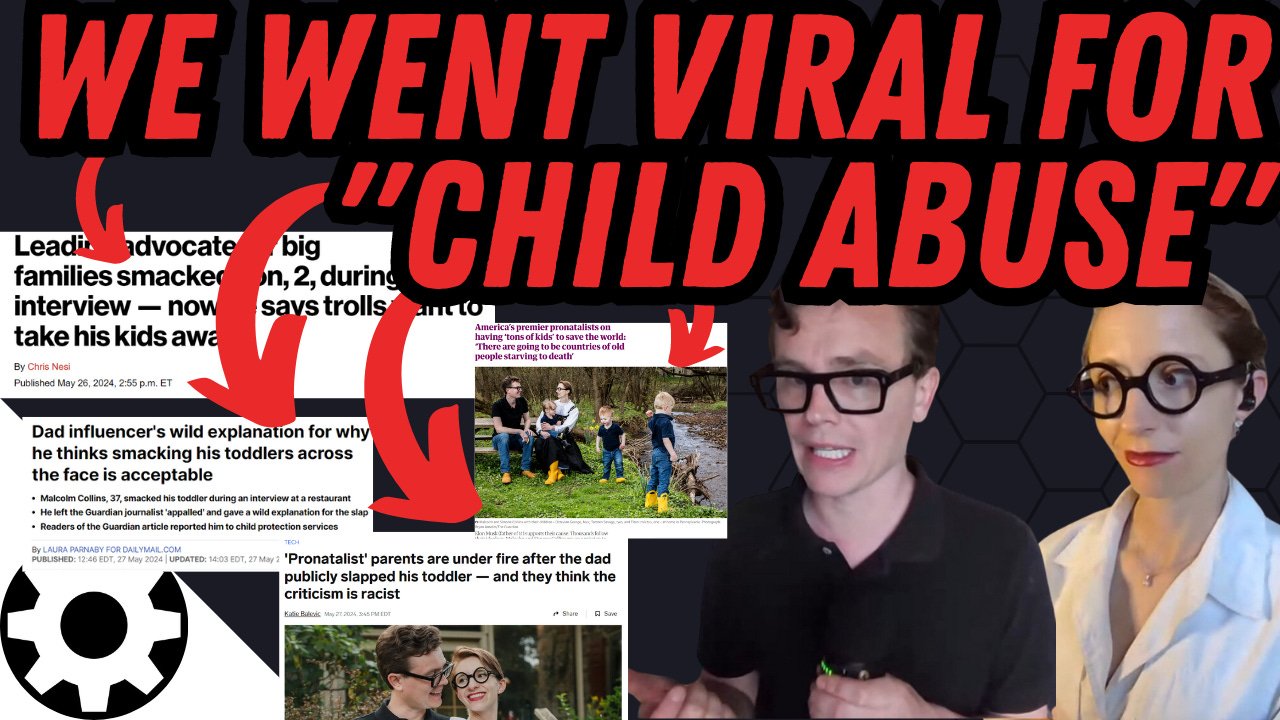
We Went Viral for "Child Abuse"
In this candid discussion, Malcolm and Simone Collins share their unconventional parenting approach, which includes a form of physical correction they call "bopping." Despite the controversy surrounding their methods, the couple argues that their approach is rooted in cultural practices and evolutionary psychology. They discuss the differences between abuse and discipline, the importance of setting boundaries, and why they believe their methods are ultimately in the best interest of their children.Malcolm and Simone also delve into the challenges of parenting in the modern world, the limitations of existing research on corporal punishment, and the potential consequences of relying solely on emotional punishment. While they acknowledge that their approach may not be suitable for every child or family, they stand firm in their belief that parents should have the right to raise their children in accordance with their cultural values.'[00:00:00] We can't do it, man! That's discipline!We don't believe in rules like we gave them up when we started living like freaky beatniks. . Yeah, you've got to help us, Doc. We've tried nothing and we're all out of ideas.Most, perhaps all, the blame rests with the parents. Have you ever tried simply turning off the TV, sitting down with your children, and hitting them?lost your god damn mind! I guess I just hate to see a child go unbeaten.Malcolm Collins: now I need to talk for a few minutes about why I find the research so distrustworthy in this space.One, you're proceeding into the research from a prior that this is a human rights abuse. Whenever anyone says every expert in a field agrees on something, I pretty much immediately dismiss it.Because I'm like, that just doesn't happen in science when science isSimone Collins: happening correctly. There is always nuance in finding what's happeningMalcolm Collins: correctly If you look [00:01:00] at what the research is saying, it's this has a massive IQ effect. This has a massive effect on aggression.These people become antisocial and aren't able to They hate their parents, et cetera. If these things were true at the levels that they're saying these things are true. Every single long lived culture on Earth would not have convergently evolved this method of interacting with children during this developmental stage.What is really negative and what we are against is. Is any form of punishment where the pain is the point of the punishment? what happens during a bop? It is a light slap on the child's nose or face that is meant to shock and redirect and refocus attention. The reason we do the face is because It requires much less pain to get the same reaction than doing something like slapping the wrist. Don't really do this for four year olds and up with our kids two to four range, because with my [00:02:00] four year old, I can say this could kill you and he can begin to cognitively understand that.Two to four, you don't really get that. And so when you need to denote, no, this is an extra level of don't do this when compared to other things I have told you not to do the only way to denote that other than physicality. Is by emotionally elevating the conversation. And I think that causes more emotional damageif you read the article, it says exactly what happened in the context. He was about to push over a table I did the bop to reorient him because he knew he wasn't supposed to be doing that, but then I immediately tell him I love him. Now, this isn't something I can do if I'm punishing him through the emotional means. Exactly. If I had elevated the conversation emotionally, now I need to say daddy's mad at you, instead of saying, bop, you crossed a line, but daddy loves you,and this is the problem, right? So the urban monoculture would say to us, what you're doing is culturally non normative, stop it.And I'm like, I have seen the [00:03:00] results of your normative parenting style. These kids are Miserable, anxiety, depression, illiterate messes .when you look at the ban the rate of corporal punishment in the United States. It pretty much directly correlates with the rise in depression among youth and the rise of anxiety among youth.Hello, I'm Dr. Richard Shea, here to tell you about my exciting new drug free treatment for children with attention deficit disorder. Watch closely as I apply treatment to the first child.Sit down and study! Sit If you would like more information on my bold new treatments, please send away for this free brochure thank you.Malcolm Collins: We no longer spank our children's butts because now we can spank their brains.Would you like to know more?Simone Collins: So how do we feel being the new public face of child abuse?Malcolm Collins: Yes, we have gone viral yet again for punishing our child in front of a reporter in a way that she interpreted as a form of corporal [00:04:00] punishment and would technically be a form of corporal punishment. Now this gets really interesting because the internet went comple

Frances Comically Bad Fertility Policy (Simone & Malcolm Debate)
In this thought-provoking episode, Malcolm and Simone delve into France's recent policy proposals aimed at combating the country's falling fertility rates. They analyze President Emmanuel Macron's plan, which includes offering fertility checks for young people, implementing a "birth leave" scheme, and introducing a possible "duty to visit" for fathers in single-parent families. Malcolm and Simone discuss the potential impact of these policies, highlighting the ineffectiveness of fertility checks in encouraging parenthood and the unintended consequences of mandating father involvement. They also touch on the importance of equitable divorce laws, the myth of the two-parent household, and the role of cultural factors in shaping fertility outcomes. Throughout the conversation, the couple emphasizes the need for policymakers to focus on fostering a culture that values family formation and pronatalism, rather than implementing misguided policies that may exacerbate the problem.Malcolm Collins: [00:00:00] Hello, this is Malcolm and Simone here and we are happy to be talking about some pronatalist and policy today. Today's episode is going to be focused on France's recent policy proposals to combat demographic collapse. However, I have not seen them.So Simone is going to be presenting them to me, and you are going to be getting my in real time reaction.Would you like to know more?Simone Collins: Yeah, so I recently came across this telegraph article was published, I think, a little earlier this month, but it's about policies that have been discussed for a while. It's called France to offer young people, fertility tax to combat falling fertility rates.And it discusses a couple of policies, which at best. Not going to do anything at worst are probably going to cause damage at least unless I'm crazy. I want your take on this so the gist is that France's president Emmanuel [00:01:00] Macron is laudable for recognizing demographic collapse as an issue and talking about it France's fertility rate relative to the rest of the EU is actually pretty good.Malcolm Collins: It, but it had a massive collapse this last year. It did. 70 percent year over year.Simone Collins: They're still above the EU average. They're still above the UK. They're still above Germany and they're still above Spain. So like generally speaking, France is, the one that looks good maybe because it's a little more Catholic.Who knows? There's a lot. No. It's because it's less Catholic. Oh,Malcolm Collins: really? Yeah. If you contrast it with other countries, it's actually more secular. And again, this is what we've seen across a lot of things is that the more Catholic a country is in Europe, the lower its fertility rate was the average Catholic majority country in Europe having a fertility rate of only 1.3.Simone Collins: Yeah. But that makes sense then. But anyway they still recognize it's a problem. I really appreciate that. So they get points for that. All right. Petty points for that. But the latest thing that Emmanuel Macron. Prince's president has proposed is fertility checks for young people. He's trying to [00:02:00] get people to test their fertility earlier.But quite honestly, doing so isn't going to boost fertility.Malcolm Collins: It sounds like an interesting idea from theSimone Collins: article. I'll read what they say. Emmanuel Macron is. To offer fertility checks to all 18 to 25 year olds as part of a grand plan to combat declining fertility rates, the French president first announced his ambition to enact French demographic rearmament, which that's fun.That's a fun term. At a press conference on January 16th, as part of a wide array of measures aimed at reviving his stuttering second term. I don't think that's going to help and I can tell you why, but I want to hear why you think that's interesting and worth trying.Malcolm Collins: So what age ranges 18 to 25?Why wouldn't this? It's a great idea actually. So it's very similar to me, to the policy where conservatives to fight abortion, they made it so that women had to [00:03:00] look at a picture of their ultrasound before getting an abortion which dramatically lowers the chance of abortion. They are creating a policy, which is.encouraging people to recognize their short fertility windows, which is one of the core issues in society today in terms of falling fertility rates, is men do not realize they have fertility windows. They think that because some men occasionally have kids when they're older, that it is normal for the male fertility window to expand.And well past 40 and it just is not you might occasionally get that, you're going to have a really high rates of diseases and stuff like that. And you're going to have it's just not great. So that's one huge thing that hopefully it can help clear up that myth and force people to understand that myth.And whatSimone Collins: McCrone recognizes and mentioned in a magazine interview is quote, every woman should have access, should have free

The War on Lesbians & Wholesome Families
In this thought-provoking discussion, Malcolm and Simone delve into the reasons behind the far left's visceral reactions to traditional, wholesome lifestyles. They explore how the ultra-progressive ideology views emotional pain as a form of violence and how this leads to a disdain for happy, heteronormative relationships. The couple also touches on the concerning trend of trans activists targeting vulnerable communities, particularly lesbians and autistic children. Simone shares her unique perspective as a former progressive woman now living a fulfilling, traditional life with Malcolm. Join them as they unpack the complexities of this controversial topic and shed light on the importance of specialization and trust in healthy relationships.Malcolm Collins: [00:00:00] any form of emotional pain is considered a form of violence and something that should be systematically avoided. So if itSimone Collins: causes you pain through cognitive dissonance, like maybe I would have wanted to have, we're goingMalcolm Collins: to get there. We're going to get there, but you jumped to the answer, but we got to get to their point by point. I was watching lesbians complaining about their communities being invaded and I just can't imagine What it would feel like . Imagine you're living in a society wherelike space Marines exist. Okay. There are these people that are 20 percent larger than you, five times stronger than you.. But now these people who are very sexually aggressive are demanding that you suck their penises.And now everyone who you thought before was like part of your safe space is now saying that you're a bigot and you're not really straight because you won't suck these men's penises and so now you're kicked out of even these safe [00:01:00] spaces. Honestly, I think that'sSimone Collins: how it feels.That's how it feels to them, for sure.Would you like to know more?Malcolm Collins: Hello, Simone! I'm excited to be here with you today! And I want to talk about an idea that I had recently, and I actually had it a while ago, but it's something that I've really been reflecting on in my thinking, is the vitriol we see certain, far left, urban monoculture activists react to wholesome things with.Simone Collins: And how do you find wholesome here?Malcolm Collins: What you're doing right now, being with your kid, they'll see a loving family. Or they'll see. They're like, that looks so heteronormative. That looks so no. You see this, you'll see a trad wife and they'll be like, this isn't a, this is misogynisticSimone Collins: forMalcolm Collins: her to be living this life or for her to be in a happy relationship with a [00:02:00] straight white man and here I can put the, I've been attackedYou went out with a white male? I was a freshman. Fresh personMalcolm Collins: and I have been thinking why this.Extremist reaction to this. And it occurred to me that from the perspective of ultra far left ideology wholesomeness and a wholesome lifestyle. is literally a lifestyle of violence. It is a form of violence against marginalized communities from their perspective, they would call marginalized communities.HowSimone Collins: so if it's 100 percent sovereign in one's ownMalcolm Collins: house? Exactly. How because that is an interesting question. And so we need to go into their world structure. So the first aspect of their world structure that we need to understand is it is a cultural system that is completely defined. And I talk about this all the time, so I'll be very quick in summarizing this.Defined around any form of emotional pain is [00:03:00] considered a form of violence and something that should be systematically avoided. So if itSimone Collins: causes you pain through cognitive dissonance, like maybe I would have wanted to have, we're goingMalcolm Collins: to get there. We're going to get there, but you jumped to the answer, but we got to get to their point by point.So you look at something like the Hayes movement, the healthy at every size movement, why would you hide from women mostly that being overweight. Is has negative long term health repercussions because it causes in the moment pain and therefore it's an evil thing to do because in the moment emotional pain and they force the evil thing to do or you tell them, your lifestyle will not lead you to long term happiness.That is a form of violence against because you have caused this emotional pain to them. This is where things like misgendering and stuff like that, they're like, this is a form of violence and it should be outlawed. Like it's obviously not a form of violence. So then how are they defining violence?They're defining violence around things that make them feel upset with [00:04:00] what they've allowed their lives to become. To call somebody out for their own failures as a form of violence.Simone Collins: Wow. I could see that when our kids fight, it's typically because one kid sees the other kid having a really good time with a toy.And then suddenly th

The Medical System Is No Safer Than the School System
The Site Simone Mentioned: https://www.emigal.com/2022/01/16/blood-testing-focused-on-longevity/ Our Discord: https://discord.gg/EGFRjwwS92 In this eye-opening episode, Malcolm and Simone share their harrowing experiences with the failures of the modern medical system. From being denied prophylactic rabies vaccines for their children to not being informed about elevated lead levels in their daughter's blood, the couple realizes that the focus of the current healthcare system is on bureaucratic compliance and liability rather than patient outcomes. They discuss the importance of taking personal ownership of their family's health by proactively monitoring blood work, conducting regular scans, and staying informed about cutting-edge research. Malcolm and Simone also explore the idea of creating a network of like-minded physicians and families to support each other as the infrastructure of society begins to break down. Throughout the conversation, they touch on topics such as the Sinclair method for treating alcoholism, the failings of nationalized healthcare systems, and the impressive efficiency of South Korea's medical industry.Simone Collins: [00:00:00] any normal parent would pull that up, look at it and be like 3 means.But I'm not getting any alerts.Malcolm Collins: I'm not being told by anyone, So it must be fine. So it must be fineSimone Collins: we weren't really paying attention or taking ownership of it ourselves. Instead, we were like, Oh, if no one's telling me anything's wrong, I guess nothing's wrong, which was apparently a really bad approachI don't know why we didn't assume that this was also happening with the medical system, but the focus of this system is not on patient outcomes, it is on bureaucratic compliance and ass covering and justification of bureaucratic structures,Malcolm Collins: what I want to do here is take this opportunity for not just for our family, but for the network of families that makes up our community. This is something you can join if you're like, my family would benefit from this.But what we also need to make this realistically implementable for us is like minded medical professionals who are interested in, providing a new type of telehealth, basically where they're much more like [00:01:00] a thesis advisor. By that, what I mean is the patient can't just decide on anything themselves. They need to then take all of their research to the doctors, say, here's this study, here's this study, here's this study.And I think as a result, given the symptoms are given this, I should be prescribed X which again, creates reasons for value aligned families to group together and support each other.As the bureaucratic infrastructure of our society is beginning to break down. Because it is. It's not just the school systems. It's not just the infrastructure that's falling apart. Civilization is essentially falling apart around us.would you like to know more?Malcolm Collins: Hello, Simone We are coming into this episode I will start with mitching and ask for anyone who fits this criteria and doesn't make it to the end of the episode but we are looking for values aligned individuals Uh, with MD, so value aligned doctors, and we're likely going to create a list for different states for our listeners to directly contact [00:02:00] them, but obviously we would really love one either outside Pennsylvania, but preferably was in Pennsylvania due to some prescribing laws.But the reason we need to make this ask is that we have. Completely lost faith in the, I guess I'd call it bureaucratic medical institutions in the United States and largely in the world because I, I lost faith in the NHS when I was living in the UK and I was like at least in the U S because as profit driven, et cetera.And now I have realized that I should have been putting as much stock in these institutions, having my back. Children's best interest at heart as I had put in the school system, having my Children's best interest at heart. And that these institutions in their own way have become as corrupted and as useless as the public school system and are becoming increasingly more so as time goes on, to the extent where if your kids are going [00:03:00] to just, an average age.doctor down the road. I would say that I would not trust that they are safe. So do you want to go into the events that led us here, Simone?Simone Collins: Sure. Yes. It all started with a a bat that we found crawling around in our yard. Octavian ran up to Malcolm and said that our dog, the professor, was barking at something scary.And Malcolm being the ever attentive dad did not dismiss this. And went outside to check on the kids and saw her dog barking at what seemed like the ground, but it turned out that when He looked closer. There was a bat crawling along it. Andso we put the bat in a giant goldfish box. And put a sign on it that said live potentially rabid bat called the government, found the government testing location. Malcolm drove forever to

Universities & HAMAS Have the Same Largest Donor (& Why No One is Telling You)
In this eye-opening episode, Malcolm and Simone delve into the disturbing connection between Qatar's funding of US universities and the alarming rise of antisemitism on college campuses. They discuss how Qatar, a major sponsor of Hamas, has become the largest state donor to American higher education, and how this financial influence has led to a suppression of free speech and an increase in anti-Israel rhetoric. The couple also examines the recent attacks on Israel by Hamas, the dehumanizing treatment of Jewish students at universities like Columbia and Harvard, and the concerning statements made by professors and activists celebrating violence against Israelis. Throughout the conversation, Malcolm and Simone shed light on the geopolitical complexities of the Middle East, the role of authoritarian governments in spreading antisemitism, and the importance of defending civilization against barbarism.Malcolm Collins: [00:00:00] Hello, Simone! It is wonderful to be here today, and we are going to be doing an episode today which I think really elevates why the disintermediation of the traditional news system To online vloggers, because this is something you see increasingly in terms of how are people getting their information about the worldSimone Collins: isMalcolm Collins: actually very important to getting an honest understanding of reality so long as you're choosing the right people to listen to.And this episode is going to be the type of thing. That you would never see on one of the mainstream news stations. And I'm just gonna give the top notes right now for people who are like, okay, I get the story. I'm gonna click off before we go into too much detail. But it is the fact that Hamas, one of the largest donors to Hamas, like one of the largest funders of Hamas, the people who started this war in Israel, okay?They are also the largest state donor [00:01:00] to the most U. S. 's large universities or to the university system in the U. S. Iran? I know, right? That's what you would think. No. I don't think they lost in Iran. What's, what? It is Qatar or Qatar, depending on how you look at it. F*****g obsequious you are because I always hate when people play little words with oh, you're not saying Qatar, right?I call it AmericanSimone Collins: accent. So it'sMalcolm Collins: QatarAs a quick side note, if you were wondering, who is the bigger supporter of Hamas, Iran or Qatar? Qatar has given Hamas over a $1.8 billion. And I ran gives them Something like a hundred million to 350 million. That's what they gave them last year, a year. so in terms of just financial costs, Qatar is the bigger supporter if Hamas, but I ran plays a big role in giving them lots of military supplies and training.So in terms of integration, was there political elite?I ran is a bigger supporter.Malcolm Collins: Yeah, so people [00:02:00] are like wait, I didn't know this. Why you why didn't I know this? Why didn't I know that this? They heavily funded Hamas. Why did I not know that they were also the largest state donor to U. S. university systems? And this matters downstream when you are looking at the university policy that is allowing this rampant antisemitism on campuses.Would you like to know more?Malcolm Collins: Because a lot of people they're like, Oh, I'm going to not donate to my university because of this. Like a lot of, Jewish families are saying that right now and stuff like that. And what they don't realize that they're like, why are universities still doing this? From a financial perspective, why are they still doing this?Being so neutral. Why is it when you had, there was this great moment where Gay the head of one of these universities I'm gay. Yeah, the head of Harvard at the time.Simone Collins: Who then subsequently had some plagiarism problems. And yeah. So sheMalcolm Collins: responded that hateful speech is at odds with Harvard's values and that calling for the genocide of Jews is anti Semitic, but when pressed on whether it violates the code of Essex, she said, it can be depending on the context.[00:03:00] So genocide, demanding genocide of an ethnic group, specifically when it's Jews. Of course, this wouldn't matter with anyone else at the top universities in the U S why is that? Maybe it violates our code of ethics. I'm not going to make any hard calls on this right now. So why are they having this position?And it makes a lot more sense when you look at where the money is coming from for these institutions, or at least a very large we'll get into the size of it, how they get the money into the universities and everything like that as the thing goes on, but I just want to, get it out there.Simone Collins: So I'm so confused about Qatar still, though, which, by the way, American accent, we would rather say something that rhymes with guitar rather than cutter.Like someone who's trying to continue. I'm so confused about Qatar because Qatar is majority Sunni. Whereas is Iran is primarily Shia. Are they aligned? Are t

Why Burn Books When Nobody Reads? (Stats on Reading)
In this eye-opening episode, Malcolm and Simone dive deep into the current state of the publishing industry, revealing shocking statistics about book sales, author earnings, and the strategies employed by major publishing houses. The couple discusses the alarming decline in reading habits among Americans and the dominance of a select few authors in the bestseller lists. Malcolm shares startling figures from the antitrust case between Penguin Random House and Simon & Schuster, exposing the industry's reliance on celebrity books and backlist titles. The couple also examines the disappointing sales of books by well-known figures with substantial social media followings. Throughout the conversation, they offer valuable advice for aspiring authors, emphasizing the importance of exploring alternative platforms like YouTube, podcasts, and Substack to reach and engage audiences effectively.Malcolm Collins: [00:00:00] That means authors are earning roughly between 18, 000 and 180, 000 on a New York Times bestseller.Keep in mind now, these are being split with the publishing houses, If you write a book and you get accepted and you get paid by penguin random house, you have a 96 percent chance of selling less than a thousand copies. Okay Ilyan Omar from the squad, She has a significant social media presence with 3 million Twitter followers. And another 1. 3 million on Instagram, yet her book, has sold onlySimone Collins: 26,Malcolm Collins: 000 copies.Piers Morgan.Simone Collins: Okay.Malcolm Collins: 8 million on followers on Twitter. In the U. S. it sold just 5, 650 copies. how are these big publishing houses staying in business? And it is Bibles celebrity books like Britney Spears books and their backlist. It is not on things that are intellectually enriching the population.These two market categories, celebrity books and repeated bestsellers from the backlist, make up the entirety of the publishing industry and even fund [00:01:00] their project, publishing all the rest of the books we think about when we think about book publishing.That is basically a vanity project. How do they approach people? What they are thinking about when they go out and approach people is how can I turn their preexisting follower base into money.Simone Collins: Yeah. They're looking for a platform. They only care about your platform. And I think they're starting toMalcolm Collins: realize though, that even the platform doesn't sellSimone Collins: This conversation is really relevant to people who are thinking about writing a book,Would you like to know more?Malcolm Collins: Hello, Simone! We are gonna do a stats heavy episode today, which I am excited about, and I hope I ordered these stats well to make a narrative. But it is on reading in America, the state of reading, and what the publishing industry is turning into. And how it's transforming the way books are being published, the type of books that are being published, and the type of books that are being read.[00:02:00] So first, let's just, I'm going to do a lot of quoting here in this episode. This is from Pew. Almost a third of Americans don't read books at all, and according to the U. S. Bureau of Labor and Statistics, the ones that do spend only 16 minutes per day reading. Compare that to the average Netflix watcher who spends close to 3 hours per day consuming video content.At that pace, a watcher might get through 681 movies in a year, while a reader gets through only 16 books. And that's presuming those 15 minutes are spent reading books. And keep in mind, it was just reading, so that could be newspaper, that could be online content, and goodness knows I'd fudge those numbers.. Even this year when leisure time increased as a result of the pandemic, novels saw only a subtle increase in sales over last year by 2. 8%. News consumption, however, saw an increase of 215%. Most of that time taking place on Facebook, 23 minutes per day, [00:03:00] Google, 14 minutes per day, and MSN, five minutes per day.So when people say news consumption, they mean Facebook and Google. So this is highly targeted news, not even just like I'm picking a conservative versus progressive news show to be my bubble of information I'm getting. It's the news stories that are specifically tailored to my interests. Okay, so now we're going to talk a little bit about how few authors are actually writing the books that people are reading. So they had created a list of the top selling books in the U. S. And of the 2, 468 fiction books that made the list they were written by only 854 authors.It's worth mentioning that 51 of those books were written by James Peterson, 31 were written by Clive Kussler, and 25 were written by Daniel Steele. A huge chunk is written by very few people.Simone Collins: [00:04:00] And this, we've seen this in other stats in terms of how much authors sell, like a very few.Very small number of books, ultimately. Oh, we'reMalcolm Collins: about to get into that.Simone Collins: Okay. This is b

Did Tradwives Evolve Out of BDSM?
In this thought-provoking discussion, Malcolm and Simone Collins delve into the phenomenon of "tradwives" and the modern misconceptions surrounding traditional relationships. They argue that much of the current "trad" movement is more akin to BDSM power exchange dynamics than genuine traditional family structures. The hosts explore the historical roles of women in traditional relationships, highlighting the importance of financial empowerment and partnership. They also discuss the dangers of idealizing consumerized fantasies of traditional relationships, which can lead to instability and dissatisfaction. Malcolm and Simone emphasize the importance of building relationships based on mutual affection, romance, and care, rather than strict, inflexible roles. They also examine the generational factors that have contributed to the fracturing of cultural norms and the challenges faced by younger generations in reconstructing healthy relationship models.Malcolm Collins: [00:00:00] so much of what the trad phenomenon has become, I would say is actually more of a descendant of BDSM community behavior.Simone Collins: Yes. In actualMalcolm Collins: trad behavior. It is a live in 24, seven slave relationship. Little power exchange. Yes. Yeah. Power, total power exchange relationship. They have. Covered in the costume of traditionalism. The tradwife TikTokers and Tumblers and YouTubers that you are seeing are to a traditional relationship what hardcore porn is to a real sexual relationship with a woman. It is a consumerized format meant to masturbate a pacific. subset of your sort of mental landscape. It is not really what it is like to be in that sort of a relationship.Would you like to know more?Malcolm Collins: Hello Simone, it is wonderful to be talking to you today. [00:01:00] Today we are going to have an episode in defense of traditionalism. And people can know we've done some videosanti traditionalist, where we argue that a lot of, Trad wifing and stuff like that is really over idealizing a model of family structure from a very limited portion of United States history that isn't really indicative of any large cultural movement.It was more what was just being sold by Hollywood at the time. And people today, they're like, Oh, Hollywood lies to us and gives us unrealistic expectations. And I'm like they were doing that in the fifties too. Like this. This isn't a new phenomenon, buddy. And they're like, Oh s**t, it was always a lie.But I want to go on a few paths with this. So first I have heard people criticize trad wives and trad families as a LARP [00:02:00] recently. And this really got to me because All cultural frameworks are a LARP. You are always LARPing your culture. When you are an ultra Orthodox Jew and you are putting on your little outfit every day and you are doing all of the cultural things that you do, what makes it a LARP?It is. Live action and roleplay as being what you are that helps remind you of who you are. Roleplaying as something that is differential from the mainstream societal expectations helps you maintain a differential value set, which is what the Trad families are often trying to do. But at the same time as I talk about how great trad families are, I also want to talk about this concept because I want to narrowly say this type of trad family is great, but there's been something that's been talked about a lot recently, which [00:03:00] is the trad wife to single mom pipeline, that recently happened with Laura Southern quite famously.And so the question is how, why is this happening? Why, okay. Are these trad relationships not as stable as they were in a historic context in leading to really negative outcomes, particularly for women.And this is where we're going to talk about trad wife is communism. But we'll get to that later in the video.But for, before I go further, I want to hear your thoughts on any of this.Simone Collins: Yeah, I've been watching a lot of the trad wife to single mom pipeline videos and my Top observation so far is that people, even when we're talking about the 1950s trad wife, which we still argue was a short term aberration and not at all representative of true trad wifery.They're not even modern trad wives aren't even being like 1950s trad wives. I was watching Catch Me If You Can, and there's one ep er, there's a scene in Catch Me If You Can in which Tom Hanks, the FBI agent [00:04:00] trying to catch the character played by Leonardo DiCaprio, who's this kid who essentially masquerades as a pilot and surgeon and commits massive check fraud.He's trying to explain to other FBI agents how check fraud works. And the FBI agents are like, what? Check numbers. Like you got to talk to my wife about this. She handles all my finances. They're acting like finances are women's work. And it really indicates just the extent to which. When that traditional trad wife, nuclear family model was being used.Women weren't just educating the kids, raising the kids, managing the house

Mapping the Progression of Human Mindsets: A Framework for Understanding Personal Development
In this thought-provoking discussion, Malcolm Collins presents a new framework for understanding the evolution of human mindsets and personal development. Inspired by the shortcomings of existing models like Spiral Dynamics, Malcolm's tree-like structure outlines various branches of mental states, ranging from animalism and perceptualism to utilitarianism, mysticism, and pragmatism. He explains how individuals can progress through these stages, sometimes regressing or becoming stuck in suboptimal states. Malcolm and Simone explore the implications of this framework, discussing how it can help people identify their current mindset, understand the potential pitfalls of each branch, and navigate towards more intellectually sophisticated and mentally healthy states. They also delve into the practical applications of this model and debate its utility for personal growth and cross-cultural understanding.[00:00:00]Malcolm Collins: Hello simone Today, we are going to do one of those episodes that excites me so much. I have put so much effort into today's content, and I know it will do horrible in the algorithm, but it's a development of my view of the world further, where I feel that because of this revelation I've had, where I'm like, oh, now I understand things better when I have systematized them in this way.So it's aSimone Collins: paradigm shift. Yeah,Malcolm Collins: my paradigm shift for me. Yeah.Simone Collins: Yeah. Okay.Malcolm Collins: And it actually came from reading about a theory that I find very distasteful, which is spiral dynamic. So I ended up, because it was a paradigm shift, I wanted to write it down. So I'll read what I've written down and we can talk about it.Okay. Like I used to do with the tracks. Sounds good. Yeah.Would you like to know more?Malcolm Collins: The idea of spiral dynamics has come up a few times when talking to fans, and since then, I have noticed some related channels like [00:01:00] HoMath, WhatIfAltHist, and Brittany Simon delineating level systems for how people evolve in their thinking. Anyone who knows us knows how viscerally negatively we would react to such a system at first glance, given that humans seem to have a natural inclination to categorize themselves and others based on simplistic criteria.If you don't understand why this would create a negative reaction, just watch any video on Spiral Dynamics and watch the person explaining the concept, happily classifying leaders of the political opposition to their beliefs among the examples of the lower order mindsets. All Spiral Dynamics really gets right is a broad ordering of the very lowest levels of personal development and then transitions into a moral and religious system at most of the two tier systems and beyond.Though, I suppose it is only axiomatic that an individual cannot accurately predict mindsets that are above their own. Thus, if they are at a relatively low level of personal development, will just project a mystical pseudo [00:02:00] religious worldview as being the higher order mindset. However, despite dismissing these systems early on, I began to think more about the ways humans relate to each other.relate to reality, a life well lived, and a self conception about how those systems build upon others, and it helped me realize that there is a real way to build out such a map. However, the two keys to doing this that others have missed, is that this is not a line, but a branching tree of life philosophies that sometimes, in fact, frequently, has a mindset that is strictly worse than its progenitor.By this, what I mean is the mindsets don't get better as they go further along the path.Simone Collins: Would you describe mindsets in this model that you're going to go into deeper, of course, as straying from the path or straying from an ideal? Scenario when they get anMalcolm Collins: example, which I have written in the next sentence, for [00:03:00] example, we would argue that a strict deontological religious world perspective, which is one of the earliest mindsets is also one of the most mentally healthy and intellectually sophisticated for this reason,we draw our map of mindsets with a quote unquote waterline with the sophistication and mental health associated with a mindset being determined by where it is along the waterline. So if you think of this like a Line graph that then ends up branching. There is a waterline and some nodes of the line are below the waterline.Some are above the waterline. Some are below the waterline. Okay. Now before I go further, have you heard of spiral dynamics? Do you know broadly what I'm talking about here? When I'm talking about these level systems for understanding how people thinkSimone Collins: I've learned it about five times, and then each time I learn about it, I completely forget about it because that's what I do when I come across information, I disregard.It is. It's not being useful, I don't maintain space for it. Can you? And that's the way IMalcolm Collins: w

The Death of Woke: Stats on Declining Wokeism
In this thought-provoking discussion, Malcolm and Simone Collins explore the trajectory of woke culture and its potential impact on society. Drawing from a variety of data sources and cultural observations, they examine whether wokeness is a cyclical phenomenon or a new, enduring force that will shape the future. The hosts discuss the decline in certain "woke" terms in media, the persistence of cancel culture incidents, and the pushback against progressive narratives from major institutions. They also delve into the potential consequences of wokeness becoming entrenched within large bureaucratic organizations, even as it loses popularity among the general public. Malcolm and Simone consider various scenarios for the future, including the consolidation of power by the "woke elite" and the potential for societal unrest. Malcolm Collins: [00:00:00] Hello, Simone. I am excited to be here with you today. A long time ago, a Sal's Park episode came out where they predicted How long woke culture was going to last. It was season 19, episode one. And it was called stunning and brave. And A farmer is predicting the course of woke culture going forwards.And he says, we have dealt with this before. And based on the last time we had a rise in wokeness, which the last time we had it, it was called the PC movement or the politically correct movement, who are born long after this movement. If you want to see. humor that was lambasting it as a movement, a very good movie to watch.And I think fairly entertaining is called PCU which is about the deaths of fraternity culture and it being replaced with various activist groups within [00:01:00] college campuses.It's a whole new ballgame on campus these days, and they call it PC. PC? Politically correct. And it's not just politics, it's everything. It's what you eat, it's what you wear, and it's what you say. And if you don't watch yourself, you can get in a buttload of trouble.For instance See these girls? Yeah. No you don't. Those are women. You call them girls, and they'll pop your fig. Save the whales! Kay's in the military now! Free Nelson Mandela! They freed him already. What? Those women? Those aren't women, Tom. Those are womenists. You know, I saw the new Madonna video last night.Un frickin believable. See the one in the middle? The blonde hair? She's looking at me, isn't she? Kind of. What, do you know her or something? Hey, Sam, isn't that the guy that you used to, uh Yeah. You went out with a [00:02:00] white male? I was a freshman. Fresh person. Please. Please. Go talk to her. What's the problem?Watch this. He's coming over here. Sister, throw him a walk! No, you don't have to do that. Wow. Hi. Uh, is Sam in there? In there? What's that supposed to mean? Yeah, cock man, oppressor. Uh, thank you. You know, this place is kind of insane. Wait till you meet the Causeheads. The what? What do we eat? Red meat! Why don't we eat it? To kill and murder! What do we eat? Red meat! Why don't we eat it? He's Tom, I'm your Causehead.They find a world threatening issue and stick with it. For about a week. What's up? What up? What happened to the ozone layer? It was last week. Now it's me.Malcolm Collins: But then that had a pushback to it and it died for a while and then woke as him came. And so Suss Park, I think made the educated prediction that these cycles last about six [00:03:00] years and that we had about 5.9 left. However, that episode came out in. So we're about four years late on that prediction. This brings me to a question. Is Wokeness just another cycle, like a pendulum? That moves back in force over the course of history, or is wokeness something totally new that we'll only grow or will become more like a subset or religious community within our society.We've seen peak wokeness already. Okay and if we have seen peak wokeness, what does the future look like? And I will be going over a lot of statistics in this episode.A lot of them drawing from a blog by David Rizzuto where he wrote an article titled, Is the Great Awakening Really Winding Down?And I will come to a conclusion that I think is different than the one he'll come to,Would you like [00:04:00] to know more?Malcolm Collins: and I'll just summarize the conclusion I'm going to come to, which is, I do think that wokeness is past peak in terms of general population popularity, however, I think that it's structured very differently than old systems of political correctness.That we are essentially going to see wokeness intensify and exaggerate its effects within large bureaucratic bodies and become more and more obviously a unique and differential, basically moral, cosmological framework that will be seen all over the world. increasingly like a religion of the elite in our society.And then the rest of us will feel very similar to what it would have felt like being a non Catholic and living under, say, a Catholic monarchy historically.Simone Collins: Okay. Yeah. I can totally see that.Malcolm Collins: A, but we'll get

Only the Pluralistic & Technophilic Pronatalist will Survive
In this thought-provoking discussion, Malcolm and Simone Collins delve into the reasons behind their strong alliance with the technophilic, pro-industry faction of the pronatalist movement. They argue that embracing technological progress and maintaining industrial productivity are crucial for ensuring cultural autonomy and survival in an increasingly competitive world. The hosts explain how groups that disengage from technology and rely on the protection of the current "urban monoculture" are setting themselves up for failure once this detente collapses. They also discuss the importance of pluralism as a strategic value for minority groups, the need for long-term thinking in cultural preservation, and the potential for technophobic groups to adapt and embrace technology when faced with existential threats.Malcolm Collins: [00:00:00] I love a lot of these technophobic groups. I think like Louise Perry, I was recently on her podcast and she's I think God doesn't want us engaging with technology If you take a low tech approach, you are dooming your culture as much as the people who are chemically castrating their children right now.There is a reason we cling to industry. That is what gives us our cultural autonomy and gives us an ability to survive in the world that we're heading into, which is going to be much more aggressive interculturally speaking than the world we're in today. If you do something as simple as just say, okay, all computers, all internet is fine, just no AI, right? You are at such an enormous, both military and economic disadvantage. The urban monoculture has been good for many of these groups in one ways, and that they have imposed a sort of detente on our society.You, if you're living in the developed world, generally do not have to worry about people of other cultural groups coming and sterilizing you or killing you. That will not be the case when the urban monoculture falls.It's [00:01:00] existential that you're pluralistic if you are not a group that has a chance at a play for the dominant culture in the world.The earth, for example, Suppose , you're a Catholic right now,. If they tried to take the, we will turn everywhere we live into a Catholic caliphate mindset and we will kick out the non Catholics. It's then, Any region where Catholics are not the dominant population, they are now a threat to all of the other populations.If you get one or two Catholic caliphates set up now all Catholics become a problem. This is why this is such a dangerous pathway.Would you like to know more?Malcolm Collins: Hello, Simone. It's exciting to be talking to you today. Today we are going to be addressing why We have so ardently cited with the technophilic pro industry side of the pronatalist movement, because if you look at the wider landscape of the pronatalist movement, there are broadly two solutions.One is to say, if society. Isn't [00:02:00] working right now. Like with all the changes we've had. Let's go back to a time when it did work. The other solution is ours is to say let's take elements from a time that did work. Let's riff on that. But. Let's adapt them to be pro technology and pro industry.So we, as a species can keep developing in the direction we're developing today. And this is, I think to a lot of people, we wrote a piece in a Porya about why we chose to build a religion for our family. And one of the most common complaints was why. Do you need to engage with industry? And I think that there is the misinterpretation that for us, this is aesthetic that we are engaging because we just personally like industry or we're just generally pro science people are we believe in a future that's pro science.And that is not why. Literally, any other approach is pointless. [00:03:00] Everyone who doesn't take this path has no real freedom or real cultural security. So do you want to go further before I explain why, Simone, or?Simone Collins: Go into it.Malcolm Collins: The point being is if you, Any group really only has cultural autonomy, i. e.are able to practice their own cultural beliefs and pass those beliefs on to their kids, in so far as nearby groups that are higher industry or higher technophilia allow them to. The Amish and the Haraiti are two very high fertility populations, but both of these populations are incredibly low industry, incredibly low productivity, and incredibly low science engagement.And when I say science engagement, pushing science forward, stuff like the Haraiti they'll like, I have a broad understanding of science. They're not as like PruPu as the Amish, but they're not, particle physicists are working on new types of computers and stuff like that, or auto [00:04:00] drones and stuff.This matters because these two groups are only really able to have cultural autonomy in so far as they are in the good graces of their higher Technophilia, higher industry neighbors. This is the topic we have talked about before, and I wanted to do a full episode on it because it's impor

The Bear vs. Man Meme is a Big Deal
In this thought-provoking discussion, Malcolm and Simone Collins delve into the recent "bear or man" meme, which revealed a disturbing level of normalized bigotry against men in contemporary society. The hosts analyze the responses to the question "Would you rather be in the woods with a bear or a random man?" and compare them to hypothetical scenarios involving other marginalized groups to highlight the double standards at play. They explore the roots of this bigotry, its manifestation in various aspects of life, such as college admissions and fertility choices, and the potential consequences for society as a whole. The conversation also touches on the importance of recognizing and addressing misandry, even when it has become so pervasive that it is often overlooked or dismissed.[00:00:00] Question. What kind of bear is best? That's a ridiculous question. False. Black bear.Malcolm Collins: This is why it's so important that I elevate this and I'm also elevate your reaction to this Okay, because it's the reaction that many people will have that shows how dangerous this has gottenIf you lived in a society like if in America today People were responding the same way to a question about Jews or black people.Would you be like, holy? You We have a big problem in this country and we need to do something about it immediately.Yeah. You would be raising every alarm bell you could raise. This is true.Fact. Bears eat beets. Oh. Bears. Beets. Battlestar Galactica. Bears do not What is going on?Would you like to know more?Simone Collins: YouMalcolm Collins: look good.Simone Collins: Are you ready to go? I'm ready to go.Malcolm Collins: Hello, Simone! I am so excited to be chatting with you again today. There has been a meme, and whenever we try to do [00:01:00] timely episodes, we are always going to be late to the subject, because that's just not how we produce our videos. But the bear meme! First I'll ask you the question.Would you rather be in the woods with a bear or a random man?Simone Collins: Yeah. As long as it's a genuinely random man, obviously a man.Malcolm Collins: Okay. So a lot of women, and then I've seen this done on shows and stuff like that. It seems to be like 50 percent of women or more, maybe within these more progressive environments, like college campuses, you're getting like 70 to 80 percent of women.Okay. Are saying a bear and the standard have they not been like camping ever? Okay. So that's not the issue And what i'll say is the standard mind dead Take on this is are they either not aware of how dangerous bears are or the standard take on this is [00:02:00] Oh women these days, aren't they silly and hasn't feminism gone an extreme degree?And if we weren't based camp if we were some basic podcast That's the take we'd be having but I actually think that what can be Gleamed from this particular meme is much deeper and that's why I wanted to make sure to do an episode on it even if it's not appearing while this is still in the zeitgeist of the topic because I think that this was actually a great sort of natural experiment to see where our culture is heading and to predict where things will go downstream of here.Simone Collins: The, what this really indicates is what media has done to female audiences, which is that when they hear the word average or random guy, they assume some kind of aggressor or some kind of dangerous person. They're evoked set for random guy, rather than [00:03:00] Your brother, an uncle, a family member, a co worker.Malcolm Collins: No. They've further asked this. If it was your dad, would you say, no, they'll say. They would choose to bear over their dad.For example, look at this woman's caption. I choose the bear every time. If it's my boyfriend the bear, a friend the bear. My dad, the bear. Life and men have given me enough reason to choose the bear any time over any of them. I don't trust them. I don't think I ever will. Whether they're family or friends or stranger, I choose the bear.Malcolm Collins: Yeah. I think you always, and a lot of people do this. They're like Malcolm, you go too hard against the monoculture and stuff like that. Because they assume that the monoculture is their perception of the monoculture when they've been associated with it.Not the, like they don't know how brainwashed and culty some individuals have gotten. But what I would say is the first thing to understand what we're really learning from this is I'm going to play a clip of somebody interviewing a bunch of women, but first I'm going to slightly change the question that's being asked.Would you prefer [00:04:00] to be in the woods? with a bear or a random black manblackMan is scary. Um, with a bear. What I've heard about bears, they don't always attack you, right? So maybe a bear.Probably a bear. 100 percent a bear, which is like, terrifying to say, but Definitely a bear. SomeMalcolm Collins: blackmen are very scary out there. I bet. Even some men are saying bear, although we could predict th

Why You Can Not Allow Nerds to Congregate with Austin Chen
Manifold: The Taco Party: In this engaging conversation, Malcolm and Simone Collins sit down with Austin Chen, co-founder of the prediction market platform Manifold, to discuss the upcoming Manifest conference, the newly launched grant-making entity Manifund, and the unique community that has formed around these initiatives. Austin shares his insights on the diverse group of intellectuals, tech enthusiasts, and "degenerates" that make up the Manifold user base, and how the platform's open, decentralized approach sets it apart from other prediction markets. The hosts and guest also delve into the challenges of creating vibrant social events and communities, the importance of taking initiative, and the potential for Manifund to fill a gap in the current intellectual landscape.Simone Collins: [00:00:00] Hello, everyone. We are very excited today to be joined by Austin Chen. He is one of the co founders of the prediction market Manifold, though now he is transitioning to work on Manifund, which is their sort of independent grant making entity, which is so excited.But what he's doing right now as he's transitioning is Prepping and ramping up for basically the conference of the year for us. We're really excited for it aside from natalism conference, which we're also very excited for, because per natalism, right? But last year was the first ever manifest conference.This is the flagship conference and the one only of manifold. And it was one of the best gatherings we've ever been to in terms of the California people in terms of execution. So you're planning for this we wanted to bring you on to talk about this, to talk about manifold, to talk about mana fund.And I just wanted to kick this off withMalcolm Collins: why? No, hold on. We got to kick it off with a good question. Okay. I think thatAustin Chen: was a great question. TheMalcolm Collins: good question is [00:01:00] around the betting pool that was put around when a a sex party would form at last year's event. Oh my God. Orgy.Yes. Yeah. Can you speak to that? What happened there?Austin Chen: So this is I think an outgrowth of Manifold's like very like libertarian philosophy. To take like very many steps back about what is special about Manifold, right? We're a prediction market platform where anyone can create any question.And this was basically from the very beginning, we want it to be a place where instead of the more standard platforms, Metacliss, PolyMarket, Kaoshi, which all have like prediction markets or forecasts. But all of their forecasts and prediction market was like gatekept. They're like approved by the moderators of the platform.We were like, we don't want this. We want more of a decentralized, like anyone can ask any question kind of system. So I think. Even from the very early days, we had a lot more of the like out there, sketchy, like raunchy degenerate, like crowd of people, but also a lot of people who are like, just very interested in prediction markets for their own sake, like prediction market nerds.When you put those two together, you get like all kinds of weird questions Will there be an orgy at [00:02:00] Manifest? And I think the New York Times famously covered this maybe in a little bit more Like depth than I would have hoped because you know me i'm like i'm so excited to be on the New York Times Except that my name is now associated with this orgy that happens But yeah, I don't know if there's like too much more about that than what they cover.It was like somebody who was one of our users was like, there's a bunch of like really spicy things happening. The like rationalist EA crowd is famous for the very loose, like norms on like sexuality, like polyamory, that kind of thing. Maybe there'll be an orgy. It's a thing that has probably ever happened before in like other rationalist parties or something like that.And there's just like a market for it. And every prediction market can also be viewed as like an incentive market, where if you have inside information, or especially if you have the ability to make the outcome of the market happen, in this case, if you have the ability to make an orgy happen, then it's a very natural thing to bet up, will there be an orgy and just And I think that's basically what happened here.So I'm like enterprising, like user in our community was like, it probably wouldn't be that hard to get together with the minimum viable orgy. If we can get three people to agree to come [00:03:00] over and have sex. I think they did this off the light, hidden campus. Then we can resolve this market correctly.So that's my best guess of what happened.Malcolm Collins: And Elo is one of the speakers. She's one of the speakers this year too. Yeah, that's right and also before we go further to get this all at the beginning if you happen to live in the bay Area and you are a fan of ours and you're not going to one of the natal cons or something because I think that's going to be in austin again This is a great place to me

The Problem With Being a Pronatalist
Malcolm Collins: [00:00:00] there's another thing about the pronatalist movementand that is what I'd call our Tucker and Dale force versus evil problem. It is about the way that the people from the urban monoculture dehumanize other people outside of the urban monoculture to such an extent that they can only see them as like freaks and murderers, no matter how nice they're trying to be to them And end up like murdering themselves in the processOh, good, look, your friends are here! Hey!You're supposed to want to have children. And this is your ultimate goal in life. It is a very archaic idea and old idea and representation of a woman. So you you're getting people to sign a petition.pledge, basically saying that they will not have Children until the Canadian government takes serious action on climate change.Is that your blood? What, no. No, it's college kid blood. And how many people have signed on so far. 1, [00:01:00] 381 as of right now. I know what this is. This is a suicide pact. Oh my god, that makes so much sense. , we have got to hide all of the sharp objects!if only I was born with a vagina. To solve that problem. Amen, sister. Holy mother of God! Some kid, he just hucked himself right into the wood chipper! What? Head first, right into the wood chipper! It looked like it might have been one of the college kids..Would you like to know more?Malcolm Collins: Hello, Simone. I am so excited to be talking with you again today back at our old location where we originally started filming, but now we have a hard connection.So you guys get solid video quality from here. But one thing I wanted to think about todaySimone Collins: isMalcolm Collins: the nature of running the pronatalist or being leading figures in the pronatalist movement. And what that means. And why we look soSimone Collins: much younger and less stressed than Greta. Yeah.Malcolm Collins: Because there was an article that came out in Politico about the pronatalist conference [00:02:00] and they noted, they're like despite it being a fairly glum message, everyone seemed really upbeat and everyone was really optimistic.Simone Collins: Yeah, honestly, there was so much laughing. There was so much joking. There was so much lightheartedness, which is funny because demographic collapse is dire and scary. Yeah. It's, it is the, it is like climate change, a very scary shift that if not properly planned for is going to hurt the most vulnerable.OhMalcolm Collins: yeah, millions of people are going to die slow and painful deaths because of this. . conservatively. Actually, , I'd say probably at least a billion people are going to die a slow and painful death over demographic collapse.And people are like, what do you mean? Come on. That's an exaggeration. And I'm like, okay. Or you could look at every state social security system, every state's Medicare system. How are they going to pay for that? How are they going to pay to keep their elderly alive? Okay, they're not they're gonna die.They're gonna starve. They're gonna freeze and they're not gonna get medical [00:03:00] treatments That's what's gonna happen as a result of all this but you might say then why is it such an upbeat movement? Why is it so low stress to operate? One and this is something I really noticed at the event itself is there is no status hierarchy signaling within the movement.While in our discord server, people do list how many kids they have. That really isn't a sign of status within the movement. Yeah. AndSimone Collins: one reason, and I just want to emphasize this because this is so freaking important. It does not matter how many kids you have. What matters is how many grandchildren and great grandchildren you have.If you don't give your kids a great upbringing and they're not super stoked about passing on your culture and having their own kids, you failed. So I don't care if you have one kid or you have 10 kids, it matters what happens with those kids.Malcolm Collins: Yeah so one, I think it's the lack of status hierarchy.When I'm in environmentalist stuff, there's a status hierarchy and signaling how much you care about the environment and what you're doing for the environment, which is a very important part of these rallies and attend in events and stuff like that. And it's actually like [00:04:00] the reason people go to them.That is an absolutely massive part of why it's so low stress.As to why there's no status hierarchy, I can only speculate, but it may be because at many of these other events, people who participate in them are participating in them in part because they have been rejected from other social communities. and so the validation that they get within this community is the only source of validation or place where they can really rank high from a social hierarchy perspective.So they really focus on masturbating that instinct. But within the pronatalist movement, at least as it stands right now, No one's really involved in it who isn't more famous or more success

Girls Crave Teen Dystopias Because They Don't Live in One: Suffering is a Privilege
In this enlightening episode, Simone shares insights from her grandmother's memoir, "Memoirs of a French War Bride," which recounts her experiences living in occupied Paris during World War II. Malcolm and Simone discuss the hardships endured by civilians during this time, from food shortages and air raids to the constant fear of informants. They explore how these experiences shaped the post-war generation, instilling a sense of purpose and resilience that seems to be lacking in modern society. The conversation delves into the allure of teen dystopias, the dangers of dwelling on trauma, and the importance of opting into hardship to build the mental fortitude needed to overcome adversity. Join them as they reflect on the lessons we can learn from our ancestors and the need to cultivate a strong sense of purpose in the face of contemporary challenges.Simone Collins: [00:00:00] I think there may be this deep, subtle craving in the generation that really got into teen dystopias because there's this desire to live this life of deprivation and desperation, but more importantly, striving to survive, because given that opportunity.You do have motivation again. You do have a reason to believe and. I feel like there's this desire for that, When we think about everything that our ancestors went through and everything that they sacrificed to create a better world, because they did incrementally contribute to a better world, no matter how small it may have been, they did contribute.How can we complain about what weMalcolm Collins: have? like, if you're a cult and you're trying to break someone psychologically down, that's what you target for.First is their pride in who they are to make them think that they're nothing so that then you can brainwash them. And it's a naturally evolved mechanism. It's not like this was maliciously chosen by the left, but just the leftist traditions that did this ended up recruiting more people than the ones that didn't.And so now it's become the predominant strategy of the left within the [00:01:00] educational system within everything like that.Would you like to know more?Malcolm Collins: Hello, Simone. I am very excited for this one. We did an episode called Kids Used to Like Their Parents. And it actually did fairly well. I strongly suggest people watch it. It is on a, a diary or autobiography I found of one of my ancestors.And today we are going to be diving into the autobiography of one of Simone's ancestors and the things that it has taught us about our modern society. So Simone, take it away.Simone Collins: Yeah, I my, my, I've read it before, but not since I was a teen. My grandmother wrote a book, an autobiography, or at least a portion, she read about a portion of her life in a book called memoirs of a French war bride, which had a limited publication release.And Doesn't it's difficult to get, but it's actually quite interesting. Because what she does is recounts her experience as a late teens. So [00:02:00] we'll say 18 to early twenties living in occupied Paris during world war two. And it really. Has made me think differently about everything from teen dystopias to dating in a way that I quite like.So I thought it might be fun to talk about. But the first thing that really did strike me was just how, how bad it was for, for people, even in just occupied areas of a nation. You know, this wasn't, this wasn't people You know, just dealing with a new regime suddenly coming in and being kind of mean it was people fleeing Paris in cars running out of gas and then driving along on roads that were constantly being bombed by planes.So my grandmother. And her, her two parents and her aunt fled Paris in an attempt to not die. When the Nazis came [00:03:00] in, they didn't know what they were going to do. But nearly died quite a few times because Italians and Germans would bomb the roads, major roads leading out from Paris, even though this was civilian traffic which is insane.I had no idea that that was happening. But imagine just trying to leave your city. And. Lying in ditches by the side of the road and having cars be bombed. At one point, a horse cart flipped over on top of her and she would have died. Had she not been in a depression under the road, they were machine gunning, civilians running into wheat fields from the road.So I just had forgotten how, because we mostly read in high school about frontline experience where we look, we see movies about what soldiers were experiencing when fighting in the war. I don't think we realized what it was quite like for civilians.Malcolm Collins: What I really like about this, what it reminds me, both writing my own ancestors accounts of the period right before this in history, and your ancestors accounts of this period in history, [00:04:00] is How history in the U.S., like secular U. S. education, has become so focused on the sins of, basically the sins of the white man. Like that is what the history is these days. It's just over and over ag

New Stats Show Incels are a Far Left Movement
In this thought-provoking episode, Malcolm and Simone dive deep into the world of incels, discussing a recent study that challenges the common perception of incels as predominantly right-wing. They explore the inherently leftist ideology of the incel movement, the dehumanization of incels by the left, and the role of female interests in shaping the left's stance on the issue. The conversation also touches on the historical context of how societies have dealt with incels, the potential dangers posed by the incel community, and the importance of addressing the root causes of the incel phenomenon. Join them as they offer insights on the complexities of the incel issue and its implications for modern society.Malcolm Collins: [00:00:00] Hello, Simone. It is great to be chatting with you today. I always love when statistics and new studies surprise me with information and help change my world perspective. And one such study came out recently on incels.And what it showed, . Many commenters have suggested a link between incels and the far right. However, using Pew Research's ideological consistency scale, this survey found that incels were slightly left of center on average.The exception was those who agreed with violence against individuals that cause incels harm or Often justified, these individuals were right leaning, though not extremely so.They held right wing opinions for 60 percent of the items in the ideological consistency scale, compared to 45 percent for the rest of the sample.Would you like to know more?Malcolm Collins: And this is really interesting to me because, and this is one of those things where, you know, the left, they just take a group that's bad, and then they pretend that they are overwhelmingly right leaning. You know, as we always point out, until Obama was elected by [00:01:00] 538 polling, so mainstream Nate Silver polling White Democrats were less likely to vote for a black candidate as president than Republicans.So there is not a racist voting block on the right that doesn't exist on the left at about equal proportions. And it's the same with incels we're seeing here. Incels exist across parties. Generally, they're slightly on the left. But when they are more violent, which I guess would make sense if they're interested in getting guns and stuff like that and using them, they're going to come up as more on the right.ButISimone Collins: think that's the thing. It's when you see this in I can't use the word people ending themselves stats where women are far less likely to successfully end themselves. Whereas men successfully end themselves. I think a lot of it all comes down to Group efficacy. And I think that conservative groups have higher levels of efficacy and following through on things that are to them.Well, I thinkMalcolm Collins: it's more than that. I think if you think about what in cellism actually is, as you think about the ideology of the movement, it is an intrinsically far left [00:02:00] leaning ideology. So let's talk about this and let's talk about why they're not showing up as far left in the data. And just slightly left leaning.So specifically what an incel believes is that they are owed something by society that they are not getting from society and that the government should play a role in getting them that thing. If you look within incel circles, You know, what do they ask for? What they ask for is government mandated prostitution and government paid, like they ask for, and you, you see this within social communities, they want the government to find a way to deliver sex to them or to impose social norms Like forced marriages and stuff like that, which would give them access to sex, which are both incredibly left leaning ideas.The idea that you are owed something by your fellow man, and that those who have a poverty of that thing deserve the state to equitably distribute that thing, or have a right to use the state to equitably distribute that thing. I [00:03:00] And yeah, I mean, it's, it's, like, how is that not obviously a lefty position?And so then the question is, well, then why are they showing up as, as, as moderates on these surveys? And I think the answer is two things. I think that these surveys are wrongly, as I have pointed out, considering any racist views right leaning, when really they're not. And I do know that racism is really common within NSL communities.And they are accounting anything that's pro gun. As a right leaning viewpoint, which is also going to be common within himself communities, given their goals. And that's also why, when they turn violent, they come off as right leaning but this gets even more interesting. Well, first, I want to hear your thoughts on, on, on this.ItSimone Collins: makes sense. And also I learnedthe term incel was actually started by a woman in 1997 who created a group for involuntary celibates. So did you have conservative origins?Malcolm Collins: There's still this female incel movement, which is really psychotic,

Who Are We Afraid of Having Too Many Kids? & The Rise of the Bergens
In this thought-provoking discussion, Malcolm and Simone Collins explore the concept of behavioral isolation and its potential impact on the future of human evolution. They examine the differences between two distinct groups - the technophilic, industrially productive "elite" and the more traditional, less technologically engaged "Bergens" - and discuss how their divergent lifestyles and values could lead to a form of speciation. The hosts also delve into the importance of technological advancement and pluralism in ensuring the survival and autonomy of various cultural groups, and emphasize the need for a pronatalist alliance that rejects supremacist ideologies. Throughout the conversation, they stress the significance of industrial output and technophilia in maintaining cultural independence and avoiding parasitic relationships with the state.Malcolm Collins: . [00:00:00]Hello, Simone. We had a reporting team over at our house from France that are doing a documentary. And they asked people, really nice people. Yeah. They asked a question that I thought was really interesting to us. Which was, are you concerned about some groups being like really high fertility?Are there groups that you want to be lower fertility? That scare you in some way. And this is a complicated question because the core answer is no, not really. But it's important to explain why the answer is no, because I think to a lot of people who are aware of we are genetic realists.Like I, I realize that there are things that are heritable within human populations and we do have A level of concern where I'm like, it's not really concerned. It's just planning for the future because it's just a truism and there's nothing that can be done about it. That one of the cultural strategies that is very good at maintaining high fertility rates in the world today are cultures that disengage from technology that engage in practices that make them economically less productive because generally in the developed [00:01:00] world, the less wealth you have, the more kids you have and that maintain their culture.intergenerationally with high fidelity, i. e. they don't allow their kids to be deconverted through xenophobia, through dehumanizing other groups. And so this cultural strategy has co evolved across many differentiated cultural groups. You'll see it in some Muslim groups. You'll see it in some Christian groups.You'll see it in some Jewish groups. You'll see it in some Buddhist groups. And invariably, these groups typically have much higher fertility rates than the individuals near them. And so people would think, oh then what you must want to do is a lower the fertility rate of these communities.Would you like to know more?Malcolm Collins: And to me, that only really matters in so far as you live in a socialist system where groups are specifically building hacks that.Allow a group that is completely economically parasitic, high fertility. It can be damaging to other individuals and to state structures in a way that is [00:02:00] intrinsically unsustainable and will eventually lead to the collapse of the state.So people might hear this and be like, what do you mean? Okay.Imagine hypothetically there was a country that narrowed a group within it out. And this group was incredibly high fertility. But economically, totally unproductive. Technologically, totally unproductive and really did nothing to even contribute to the country's, military or defensibility, right?This group had Triple the fertility of their neighboring groups. Eventually, they would be the majority population in that country. Then the country intrinsically collapses because that country then cannot be, it cannot produce the additional goods and the additional wealth and the additional technology.Which is being siphoned by this high fertility community. And so either it ends this system or it eventually collapses. There is no other alternative. [00:03:00] The only other alternative I can think of is some faction within this parasitic community goes, Oh s**t, we shouldn't be doing this anymore because this is unsustainable and we're going to be the dominant group.And so we need to start doing things like start engaging in the military. We need to start engaging more with technological productivity. We need to start working more. But then it's then they're not like that group at all. And typically, even if a faction of this community does end up adopting these practices, fertility wise, they're going to be outcompeted by the individuals who just did nothing but pump out babies.So it really doesn't work unless you cut the state umbilical cord which ends up saving everyone because even the parasite ends up dying when the host dies,Simone Collins: Because no one's going to, no one's going to bankroll the parasites lifestyle anymore.Malcolm Collins: Yeah. So I do. Have some concern about communities like that.And they exist within many countries. Many people might think, oh, you're describing X gr
Andrew Tate's Plan to Fix Fertility Rates
In this thought-provoking discussion, Malcolm and Simone Collins delve into Andrew Tate's controversial proposal for solving the demographic crisis through polygamy. They analyze Tate's argument, which criticizes the Western monogamous model and promotes a return to a more traditional, patriarchal family structure. The hosts explore the cultural and genetic implications of polygyny, comparing Tate's Muslim-influenced perspective with the traditional American view of gender roles. They also examine the potential consequences of polygamy on both men and women, and discuss the importance of fostering independence and ambition in future generations. Ultimately, Malcolm and Simone argue that while Tate's approach may work for him personally, it is not a viable long-term solution for their own family or for society as a whole. [00:00:00]Malcolm Collins: Hello, Simone. This episode is going to be great because it's another Andrew Tate episode. So I need my sword again. Women won't respect him unless he is Physically threatening them with a sword.You got your sword.Your wife starts talking. You're like, shut up. She's got a sword. If every man on earth walked around with a sword, most of the issues of the world, would basically go away. We can fix this.It can all be fixed. You just need to carry a sword around your house.Malcolm Collins: And I need to do that too. That's how I keep my wife in line.Simone Collins: This, the sword.Malcolm Collins: , Andrew Tate has outlaid a plan for solving demographic collapse.Simone Collins: Are you serious? Did this actually happen?Malcolm Collins: I am serious. And it is as unhinged in a based way. Like I [00:01:00] like thinking outside the box, but it is very on brand. And I think it might be one of the most crazy things he said recently. That'sSimone Collins: saying a lot.Would you like to know more?Malcolm Collins: Dear white men, you're fucked. You're being replaced because none of you have children. Even those of you b******g about the replacement online like little girls don't find the gumption to f**k. I see white men bragging about having five kids as if it's an achievement.LOL 5 LOLOL per year, right? Oh, all you white boys lost control of your women, and now they won't accept multiple wives anymore. Now they tell you they don't want any more kids. One's enough. They don't want to do their God given job anymore. No, they want Instagram likes [00:02:00] instead. So your genetic potential is stumped by the whims of some singular female.A female who takes nine whole months To grow a single baby. Other races have multiple ovens for bread. We're not cucked. Some b***h is screaming at you about loyalty. And you're sitting there saying, Yes, baby. Jerking off to porn when she's asleep or maybe cheating with a side b***h. Condom on.Hold on. I love this because this is the take that we've had that non reproductive sex is just masturbation. It is a kink. And I love that he has correlated jerking off to porn as being just as disgusting as sleeping, cheating on your wife with a condom on. Great, take care of yourself, okay.Oh no! I couldn't get another woman pregnant? My wife would kill me! Exclamation [00:03:00] mark, concerned emoji. Total f*****g losers. Soon your race will be nothing more than a few pages in a history book. A lesson on what happens when you f**k with a female psyche. They're obsessed with money and social media, as opposed to being one of many baby factories for a king.30 children minimum for the Dons. White people, go talk to your quote unquote best friend wife about what you do this weekend. Maybe you can take a nice walk around IKEA. Enjoy extinction.Simone Collins: Okay. Wow, that's so great.Malcolm Collins: So first I want to point something out because I always tell people, Andrew Tate's idea about male and female roles is not the Western ideal and it is certainly not the Americana ideal.It is a Muslim ideal and they're like, no, Andrew Tate isn't about [00:04:00] promoting like the Muslim cultural idea of how you should structure relationships. I'm sorry. How can you read that? And think literally anything else. He does not and the Muslim ideal can work like and to be honest, like he's not promoting something that doesn't work or that doesn't lead to higher fertility within some cultural groups where you have the top men in a society having multiple wives and then using that to produce a huge number of kids, right?And it is a lifestyle that I love that he is undertaking it is not championingSimone Collins: note. He's like bringing, he's bringing polygamy into the modern internet world. This is some pioneering work here. What can we say?Malcolm Collins: And it like, I actually like with Andrew Tate, so we're, we have a video that's come out on Hamza.He's like another, like men's influencer. You know what I mean? Like leading with this male aesthetic. I don't really respect Hansa, [00:05:00] I think he had a perfect life with this woman, and he left her s

Discord is More Dangerous than TikTok
Link to Discord: https://discord.gg/UzUgHpuDVG In this eye-opening episode, Malcolm dives deep into the potential dangers lurking within Discord servers, particularly for young and impressionable minds. He explains how the platform's unique features, such as private channels, illusion of consensus, and mod privileges, can easily facilitate grooming, gender dysphoria cults, and echo chambers that distort reality. Malcolm and Simone also discuss the importance of parental oversight in online communities, the power of status-seeking behaviors, and the need for caution when navigating these virtual spaces. Join them as they explore the dark side of Discord and offer insights on how to protect yourself and your loved ones.Simone Collins: [00:00:00] Well, what I'm curious about is your theory as to why Discord servers specifically are so good at this. I'm assuming it's the fact that they're much more limited in what you see.So then ultimately the criteria that people are competing on becomes very very focused. Is that you agreeMalcolm Collins: then? So it's three things that lead to discord servers being uniquely good at this.Would you like to know more?Malcolm Collins: Hello, Simone. Today is an interesting topic because I had never really engaged with discord as a platform that much before. As old people, I'd gotten into it a little, I didn't really see the point. It didn't seem like a way that I could build up any sort of large audience or advance my career. So I just saw no point to it because I, you know, I'm sort of past the point in my life.Okay,Simone Collins: exactly. So why do you play video games? This is, this is my thing with video games. Is this going to make me money? Is this going to advance my career? Then why am I trying to figure out this task when I have so many other tasks? Now you understand [00:01:00] theMalcolm Collins: low stress task where I know, you know, the input needed to succeed in social situations just aren't that way.If I'm engaging in a community like discord, you know, it hasn't been optimized to give me the right amount of reward for my effort. So. But anyway, this is why I hadn't been engaging with the community. Well, recently I started to, because we created a discord for this channel based on some fan created a discord for this fan created discord, and then I've been promoting it and it's doing Incredibly well, like three days after launching at any point day or night, there's always like a conversation going on.So we've got about 50 active members and yeah, I've been very surprised.Simone Collins: Cool people too, from what I've glanced at.Malcolm Collins: So that's, Which has led me to actually engage with discord as a platform finally, which is saying aSimone Collins: lot because you don't find most people worth engaging.Malcolm Collins: Yeah. So I, I finally reached a point where.In, in sort of working with the platform and using the [00:02:00] platform and setting everything up where I feel like I understand one, why people use it into how it works as a platform, but in doing that, I also begin to realize how extremely dangerous discord is as a platform. Much more dangerous for young minds than something like tick tock, for example, which I think would really surprise people who are not obsessed with the way sort of social interactions work and human emotions work and everything like that.Right? Like that's my obsession to anyone who's read our books on like governance and everything like that. When I'm building up how governance work, I start by looking at how do humans interact, how do humans judge status, what sort of motivates our base human. Actions because through understanding humanity, I can understand better why different mechanisms for organizing us will lead to different, you know, large scale macro outcomes.Well, with discord, I was looking at it and what really got me [00:03:00] down this particular rabbit hole is I also really like, tea videos if you're familiar. So when you watch them too this means like drama videos. Okay. That kind of tea. Yes. Drama about, yeah, you know, YouTube creators and other sorts of like celebs celebs.I really wish people would do one on us, but no oneSimone Collins: really has yet. Because there's nothing at, what are they going to talk about?Malcolm Collins: Yeah. I, I, Oh, they could come up with that. I've often thought the scene where, you know, You know, my kid fell in the water and I was like pretty lackadaisical and getting em out coming.Yeah. But that's notSimone Collins: filmed or anything. Like if that was something that No,Malcolm Collins: but I, social media viral on, I mentioned it on our channel. Mm-Hmm. And you know it, other TV videos, they're like, oh, the person, like when they saw their dog had been hit by a car, they shot it instead of taking it to the vet.And it's like, yeah, of course you would do that to a severely injured animal. Like, no. Well,Simone Collins: that's just the difference between. Prog

How Hippies Became Republicans (Did Our Two Parties Switch Sides?)
In this thought-provoking discussion, Malcolm and Simone Collins explore the surprising ideological shift that has occurred within the Republican Party, transforming it into a haven for anti-establishment and anti-globalist sentiments once associated with hippie culture. The hosts analyze the factors that led to this change, including the Democratic Party's success in capturing major institutions, the ideological capture of corporations, and the rise of global bureaucracies. They also delve into the historical context of party realignments in the United States and the current state of the Republican base, highlighting the disconnect between influencer opinions and voter preferences on key issues like abortion.[00:00:00] Hello everyone. We are excited to be doing an episode today on hippies being. Republican now,. This is a really laid back place.Oh wow, you guys shouldn't be doing that. Don't you know what you're doing to the world? You're playing into the corporate game. See, the corporations are trying to turn you into little Eichmanns so that they can make money. Who are the corporations? The corporations run the entire world, and now they've fooled you into working for them.Are you serious? We never heard that. The government is using it's corporate ties to make you sell magazines so they can get rich. Those dirty liars! This is a really nice town you have here, that's why the corporations are trying to use you to take it down. Just hang with us for a bit. We'll fill you in on everything you haven't been told.It is wild, how we have met this exact archetype of person and had these exact conversations that couth park, used to use as the stereotype of what was annoying about hippies.At a number of Republican conferences this [00:01:00] year.Would you like to know more?. We have been to a number of Republican conferences this year. I'm going to break them down into really three major ones. ARC, which was of UK Republican elites.Yeah, yeah. Then there was the one in New Hampshire that was for Libertarians. And then there was the one that was for the new underground sort of dissonant right group which was re platform. . So what was really interesting is, yes, the Hoity Toity UK one didn't have this hippie class as much. It definitely had a portion of them, but the other two were just. Pure, like most of the lines I would see in this South Park, making fun of hippie attitudes we saw in this environment.So if I'm going to go over some, one is the globalist theory, I guess I'd call it, which is to say that there are a number of elites who run large companies [00:02:00] and ostensibly run world politics and the globe. And that you are playing into their hand. If you go get a normal nine to five bureaucratic job.And that this group has a secret agenda, which is just to use you for your labor. And then in the episode, you might've noticed, Oh, they've come to your town because you have this nice small town and they want to ruin it. So not only that, but that they disproportionately target. Nice, healthy communities which is definitely something you often see in these circles.And that a lot of people in the world are brainwashed and that if you just hang out with them and they're sociological and ideological bubble, that's how you get out of this brainwashing. And another thing that I think is really interesting is the mood and the vibe from the hippies, especially this era of hippies as depicted by South Park is much more similar to Republican conferences and stuff I've gone to than Democrat ones.With Democrat ones, it is very [00:03:00] gatekeepy when you enter a community. They want to make sure that you are the right kind of person with the right kind of ideas. Where at most of the Republican conferences, it's more of a, I'm eager to share with you this theory I have about how the world works. Or basically a conspiracy.Yeah. Very much like in the clip, like you gotta know don't you understand? Like they're trying to turn you into tools of the corporation, man. Yeah. They're trying to, they're trying to save you from something that they think is harmful. And then the second clip I'll play it here, which I think is pretty elucidating.Right now we're proving we don't need corporations. We don't need money. This can become a commune where everyone just helps each other. Yeah, we'll have one guy who, like, who, like, makes bread. And one guy who, like, looks out for other people's safety. You mean like a baker and a cop? No, no, can't you imagine a place where people live together and, like, provide services for each other in exchange for their services?Yeah, it's called a town. You [00:04:00] kids just haven't been to college yet, but just you wait. This thing is about to get huge!So in this clip, a misunderstanding of economic systems and a belief that the economic systems we have now exist just to screw over people. And that through, Essentially rebuilding these systems, we can have something that works. Now this

How the Internet Turned Illness Into Status for Privileged Women with Suzy Weiss
In this captivating conversation, Malcolm and Simone Collins sit down with journalist Suzy Weiss to discuss her in-depth article on the Spoonie community, a group of chronic illness sufferers who have created a unique online subculture. Weiss shares her insights on how the Spoonie movement has evolved, the potential dangers of building an identity around illness, and the parallels between this phenomenon and other youth subcultures. The hosts and guest also delve into the broader implications of a society that increasingly valorizes victimhood and self-diagnosis, and the challenges of protecting vulnerable individuals from harmful online communities.Suzy Weiss: [00:00:00] A Spoonie is a member of a community of chronic illness sufferers.What some people have described as Munchausen by internet what happens when your identity becomes illness, because how are you ever incentivized to get well?Malcolm Collins: , if your community identification is defined by How ill you are then a status hierarchy is going to begin to form based on illness and people being people, they are going to have a motivation. To exaggerate their illnessWould you like to know more?Malcolm Collins: I am so, so, so excited for our special guest here today. Um, easily our favorite writer. It's on the show today. This is Susie Weiss. We mentioned her in a number of episodes as just a writer who we really respect and does really, really interesting, deep based pieces that explore subcultures that are weird, which is like our [00:01:00] favorite thing.Today we are going to do the first piece of hers that we really got into where I was like, Oh this changes my thinking on a number of things About how like memetic viruses can form was in current online environments and how we're gonna raiseSimone Collins: our teenage daughters Like it completely like it gave us a new model for female adolescence.This was it was a game changerMalcolm Collins: Oh, and where we should send people so this snoozy weiss. It's her twitter account. So go subscribe there. Although that You That never really converts as YouTube to Twitter, but what I can say is the Free Press her sister, Barry Weiss, runs it and she is a writer there and that's where you can find her stuff, so you should definitely go and subscribe to that.Suzy Weiss: Thank you guys so much for having me. I feel like when we discovered each other, it was like, There are others. I'm so happy. And then, of course, I included you on a story I did about tech messiahs who wanted to live forever, which I loved your contribution because you were like anti live forever, which I think is like a weird, whatever.We can get into that later, but I love that. Did you end upMalcolm Collins: talking [00:02:00] to that other girl we introducedSuzy Weiss: you to for that story? She, I never talked to her because she just I think yeah, she was intense. SheMalcolm Collins: recently did a post where she bragged about how she convinced a woman to break up with her husband for another woman and get an abortion on her three months pregnant.term fetus. And this was like a huge win for her is talking someone into an abortion. That's pretty late stage, right? Or that earlySimone Collins: is it's on the older side of fairlyMalcolm Collins: horrifying. We were trying to get the perspective of an extremist antinatalist. Oh yeah. SheSuzy Weiss: was, yeah. She's a major antinatal.Yeah. I guess that's a win. Take the ones where you can get them.So the F the full post she wrote went one of the grossest and most faileo centric types of misogyny to me is males who are fine with, or even encourage their wives or girlfriends having sex with other women. Porn sick bros was Heron fetishes. It's an ugly and very clear mask off on how they see women.They [00:03:00] feel so superior that a girl f*****g, their wife doesn't even count as sex. And that's cheating. Lesbians are just quote unquote girls having fun. That we do to please their stinky cheese Cox. And few things are, as satisfying is seeing their wives realize they can do better, divorcing them for their girlfriends and living happily ever after without a sexist leach in their life.Two months ago, I convinced a girl who just married and with actually three months pregnant to get an abortion and divorce and continue dating her girlfriend, who the male picked for her, but who she fell in love with. They are engaged and I am so for it, heart. Uh, in case you can't tell she is, uh, a lesbian, maybe even a political lesbian.Um, and an extremist feminist, as well as an anti natalist.Simone Collins: Yeah. She's in favor, I think of even post term abortions as she puts it. Some murder. Yeah, some murder. Yes. Yes. But baby murder. So it'sAll: baby.Simone Collins: It's murder.Suzy Weiss: It's murder. It'sAll: [00:04:00] murder. Yes.Malcolm Collins: Anyway, so, Spoonies. Spoonies. Spoonies. Go. I am so excited to dig into this.Yeah. Well,Simone Collins: first off, what made you decide? Explore this

The Biggest Lie Pronatalist Tell (The Hungary Fertility Myth)
In this eye-opening discussion, Malcolm and Simone Collins dive deep into the controversial topic of Hungary's pro-family policies and their supposed success in boosting fertility rates. Despite claims from conservative media outlets and Hungarian officials, a closer look at the data reveals a different story. The hosts examine various sources, including national aggregators, academic studies, and local Hungarian statistics, to uncover the truth behind the numbers. They discuss the dangers of promoting false narratives, the potential for government overreach, and the importance of approaching demographic issues with evidence-based solutions rather than political agendas.Malcolm Collins: [00:00:00] this Breitbart pieceSimone Collins: the pro family policies pursued by Hungarian Prime Minister Viktor Orban's government as an alternative to mass immigration are reaping dividends. with births of 9.4 percent year on year. Much ridiculed, , policies were also accompanied by a near 100 percent increase in marriages and the number of children per woman rising to an average of 1.6. ,Malcolm Collins: if you look at the data actually Hungary underwent a smaller fertility bump than its neighboring countries.Simone Collins: Oh no.Malcolm Collins: So here I am showing a Article from the end of 2023, Daily News Hungry. Number of children born in Hungary at a historic low in 2023. Huh. Okay, that shouldn't be happening. All right let's look at another thing by this outlet.Brutal population decline. Hungarians are dropping like flies. Oh that was published in [00:01:00] 2023. What? That's not the narrative I was reading So the Hungarian where they measure these informations is called the center of statistics office or the KSH. So I just sent you the KSH graph of the number of births in Hungary.This bump we're seeing on the national aggregate graphs does not appear in the own country's reporting.Would you like to know more?Malcolm Collins: Hello, Simone! I am excited, though trepidatious, to be here with you today, because today, We are going to do what is probably going to be one of our more controversial videos, which is one that I have been actually sitting on for a long time because I haven't wanted to do it because it is a video where we are unfortunately going to have to criticize a common thread within the pronatalist movement and among people who are sympathetic to the movement's cause who are promoting information that Unless you do a very deep dive, you would not be aware is misinformation.And [00:02:00] so I do not think that it is being promoted with any malevolent intent. It is more just, here is information that confirms my political presuppositions. Therefore, I'm not going to look at it inquisitively or skeptically. And we should add thatSimone Collins: It seems intuitive. So you wouldn't think of the face of it that it's going to be wrong.Malcolm Collins: And so I would love it if you could start to introduce people to the mainstream pronatalist perspective on this. Read this Breitbart piece I sent you.Simone Collins: Let me just say it begins with a picture of what I think should be our entire family's new outfit. These traditional Hungarian dresses and women apparently being splashed with water.I just find it perfect. Anyway,I shall read. The pro family policies pursued by Hungarian Prime Minister Viktor Orban's government as an alternative to mass immigration are reaping dividends. with births of 9.4 percent year on year. Edward von Halsberg, the Central European country's ambassador to the Holy [00:03:00] See, and great grandson of Emperor Franz Joseph I of Austria Hungary, reported that the, quote, much ridiculed, unquote, policies were also accompanied by a near 100 percent increase in marriages and the number of children per woman rising to an average of 1.6. , the population has been decreasing since 1981, unquote, said Kathleen Novak, Hungary's State Secretary for Family, Youth and International Affairs, in exclusive comments to Breitbart London, explaining the enormity of the turnaround her government has achieved.Quote, in 2010, when Orban's Fidesz party won the elections with a two thirds majority after eight years of socialist anti work, anti economy, and anti family governance, our country was at the brink of collapse, she recalled, citing, quote, austerity packages and the dismantling of the family benefit system.Quote, in 2010, we started to build a family friendly country dot. Our main goal is to eliminate the burdens that couples face when they would like [00:04:00] to have children, she said, highlighting policies including, quote, lifelong exemption from personal income tax for women with four children. Oh, that would be me if we weren't hungry.Can you imagine? Can I imagine? We set aside 38 percent of our income. Because PA's income tax is also not trivial. Partial mortgage write offs for families after birth of their second child and grandparental leave. Oh, that's smart. See, all these

Would Taking Away Women’s Right to Own Property Solve the Fertility Crisis?
In this eye-opening episode, Malcolm and Simone dive into a fascinating Swedish study that reveals surprising insights about how winning the lottery impacts men and women differently when it comes to marriage and fertility. The study shows that men who win the lottery tend to marry and have more children, while women's fertility doesn't increase, and low-income women often get divorced. The conversation delves into the biological and social factors behind these trends, the importance of men and women working together in marriage, the perils of atomized child-rearing, and the role of income and status in shaping fertility decisions. Join them as they explore the implications of these findings for pronatalist policies and the future of the family.Simone Collins: [00:00:00] Okay. I'm really excited. We're talking about this because I saw this and kind of was really surprised.Malcolm Collins: It's a great graph in terms of providing information that is useful to the perinatalist movement. It's just one of those instances. Where the information is maybe not the information we'd prefer from a palatabilitySimone Collins: perspective.Yeah. And we have to, we have to hat tip. So I got this from Wyvert on Twitter who shared I'm reading his tweet, a remarkable and high quality Swedish study. If men win the lottery, they marry and have children. If women win the lottery, their fertility does not rise. Indeed, low income women get divorced.You might think more resources means more kids. Yes, with men, not with women, which is fascinating. Totally fascinating.Would you like to know more?Malcolm Collins: So I want to word this a different way because I don't know if you've fully conveyed it. When a man wins the lottery, whether he is poor or wealthy, he is much more likely to have [00:01:00] more kids and he stays with his partner typically.When a woman wins the lottery, she both does not have more kids and if she is not wealthy, she will often leave her partner. So. From a pronatalist perspective, if you're thinking, where do you do cash handouts? Where do you put money? You do not want to give money to women,Simone Collins: which is wild because that's where the cash handouts go.The cash handouts. overwhelmingly go to mothers. When yeah, I, I, I, gosh I don't, I don't even know where to start.You actually see this in a lot of the old documentation about the charity work being done in Africa, where they're like we're giving money to women because when women have money, they have fewer kids.Simone Collins: I mean, first I appreciate the information that cash handouts don't work. I think it's very spicy. This idea that like, well, enormous cash handouts. Yeah. Enormous cash handouts. Let's, let's just give cash handouts to men, like men, you know, here's money to [00:02:00] raise kids. What would happen?You know, let's talk aboutMalcolm Collins: like maybe biologically or socially why this phenomenon is happening. Why do men have kids, but women leave their partners? I want to hear your hypothesisSimone Collins: first. Well, I honestly, I think it's, you could call this trickle down pronatalism. So men. And I think you're very indicative of this, that when they think about having kids, they often kind of think, well, I'm just gonna marry someone and then she'll have and raise the kids, which is totally not what you do.Obviously, Malcolm, like you are very hands on and raising our kids, but when you were younger. Just thought you were going to have a ton of kids and you weren't really concerned about like how you were going to raise them or how you were going to work that out. Just, you would be very successful and very wealthy and you'd have a lot of kids and it just kind of happens.And I think a lot of women Turn to men for resources and see men as, as the, Source of resources and stability that enables them to feel very comfortable having kids, [00:03:00] whether or not they maintain a career, which is why I think many of these women who won the lottery left men because they had a different source of and a better source of resources.So I think the interesting thing, the idea here with triple trickle down pronatalism is if you give more money to men and then They can attract more women and then have more kids because women are more attracted to the men or they're more likely to haveMalcolm Collins: kids. The question exactly. Okay. Okay. Why is it that women when they get more resources, don't just use the resources they have to have kids?Why is it that they will only have A man's kids for resources.Simone Collins: Oh I think it'sMalcolm Collins: like, it doesn't make sense what you're saying.Simone Collins: No, I, no, I I'm bad at articulating things, but I think it's a status thing. Women women seem to be more comfortable having kids when they are pair bonded with a partner who is higher in status than them. Who appears to be the source of resources.A woman is made. Less [00:04:00] likely to takeMalcolm Collins: a mater

Hamza: How the Red Pill Can Destroy Your Life
In this thought-provoking discussion, Malcolm and Simone delve into the world of male influencer Hamza and the growing trend of optimizing one's life around an aesthetic ideal of masculinity. They explore the similarities between this movement and the trans community, both of which prioritize gender identity as a central focus. The hosts also examine the cultural differences in gender roles and expectations, particularly between traditional American and Muslim or Eastern European backgrounds. They argue that defining one's moral system around an aesthetic can lead to despair and that true fulfillment comes from pursuing goals with intrinsic value. The discussion touches on the importance of finding a life partner who complements one's own values and the dangers of maintaining a false "frame" in relationships.[00:00:00] basically I'm starting the fatherhood chapter of my life. We're not pregnant just yet, but we've moved to the Scottish Highlands,The reason why me and my ex split up is I told her to sit down and to write down like her goals and I wrote, you know what, I want to move to like a big city. You will not find this kind of woman who will fit with this lifestyle in a big major city why?The women who are in the big cities are glorified Instagram prostitution.I actually want to have a few like, Sleepless nights.I want to have a few likes like sleep deprived nights where I stay up late bro for the last few years I've been to sleep at 7 8 p. m I've you couldn't imagine the amount of like parties and social events and dinners that I've missedI know what goes on in these parties And the issue was that the girls that I was meeting from these places, just like I, I was as well, um, We're all low quality.It's a low quality place to be.. I wanted to be super social. I wanted to have some late nights where we stay up and we're social and there's a party that we go to and everything. But she saw it, and I'm not gonna lie, like, I could see how, like, offended she was. Where she was quite, like, [00:01:00] pressuring, she was like, Wait, you wanna do this? Oh, you wanna do that? You wanna stay up late? But that's unhealthy. Those party girls, like the party, low quality, degenerate, TikTok type of girls.They are attracted to the party, low quality, degenerate, TikTok type of guys. Fine, like trash can stay with trash.Because for hers, she wrote that she wanted to do more of the things that we were currently doing. , it's wholesome as f**k, and you know that she's an awesome girl for that, she doesn't want to be around like, You know, like party girls and whatever I just realized like we're actually going into two separate seasons right now Fine, like trash can stay with trash. This is going to sound weird, you need to be hit in the face. I will repeat that again. As a young man, you need to be hit in the face consistently.Malcolm Collins: but the problem is that when you Define your moral system around an aesthetic.It needs to be witnessed to have value. And when he got to the countryside, there was no one to witness affirmation from the social communityWould you like to know more?Simone Collins: Hello.Malcolm Collins: Hello, Simone! [00:02:00] Recently I fell down a rabbit hole trying to learn about this Influencer named Hamza, .The men of this country in general, unless they follow me, are f*****g weak. The only strong men in this entire f*****g country, in the entire west, are just the ones who are part of my cult, who have followed my advice and become strong from that.Every f*****g other guy here is basically just a f*****g pussy. They're all just weak as f**k.if you put some of your money into a company like Apple, or you put it into like, you know, the big like index funds like Apple and like 500 different companies, you're giving them money to help them with their business.And you're hoping that since they think that you're a good boy, they'll give you a little bit more money in return. I think your, your PP size has to be very small for that, because if you understand this concept of investing, why would you invest in someone else's business instead of your own?Malcolm Collins: He is a London based influencer that is seen as like a new big figure in the, I guess I'd call male aesthetic movement.Simone Collins: Like Lux [00:03:00] Maxxing?Malcolm Collins: Not exactly Lux Maxxing. It's the movement that, I would say that an individual likeSimone Collins: Rye Nationalist?Malcolm Collins: No, Andrew Tate would be a leading figure.Ah,Simone Collins: okay. Performative masculinity. PerformativeMalcolm Collins: masculinity for the sake of performative masculinity. And I think it's really shown in a lot of his videos because Whitney, he asks himself and you'll actually see this in the Hamza video. So just so people know he became very famous. He's got like 2. 3 million subscribers on YouTube.And. Regularly in his videos, he will askhimself should I do X or Y? And the metric he uses when deciding X or Y is what

Why Libertarian's, Despite Being the Worst, Are Usually Right
In this episode, Simone and Malcolm dive into the complexities of conservative ideologies, focusing on the differences between libertarians and traditional conservatives. They explore why many conservatives identify as libertarians when they're young but shift to the Republican party as they age, and discuss the pragmatic reasons behind this change. The conversation also delves into the disconnect between the Republican elite and their voter base, the influence of theocratic factions within the party, and the diverse range of conservative thought across various conferences in the UK and US. Join them as they unpack the nuances of cat girl conservatism, conspiracy theories, and the right to non-conformity.Malcolm Collins: [00:00:00] most conservatives I know go through a change where when they're younger, they identify as libertarians. And as they get older, they identify as Republicans. Why does this happen,would you like to know more?Malcolm Collins: I am excited for this episode. So I just got back from New Hampshire where I was speaking at a libertarian convention. And I had an absolute blast doing it.Really great community. And one of the things we're going to Back to you later in this conversation is the different types of conservatives and the different ways that they interact. We got to meet with a conservative group in the UK where we were at a convention. Then we spoke with a convention in New Hampshire.Then we spoke with a general conservative, like uncanceled sort of event in Vegas the weekend before. And then recently, you know, we spoke at the oh yeah, you've been talking to a lot of like conservative voters and stuff like that in the district. Yeah.Simone Collins: Just like door knocking on RepublicansMalcolm Collins: houses.So we've gotten this really broad and unique exposure and then we've got the pronatalist convention and then we've got like the broadly EA conservatives and stuff like [00:01:00] that. Which is just, they're nothing like each other. They see the world, nothing like each other and being at this libertarian event, a few things happened that made me really reflect on this one.Somebody said, and this is a regular watcher of our show, you know, like an interacted fan. Oh, I had no idea that. You guys would consider your policies libertarian or you think that they would pass as like libertarian within libertarian groups. And this would be like, huh, I hadn't realized that we came off as so anti libertarian on this.But then I also started to think about everyone I knew who was conservative when they were younger. And there's this insistent phenomenon within conservative circles, where as we've discussed in the episode of like, do your politics actually change? No, for most people, their politics are stable throughout their life, whether it's conservative or progressive, at least.But most conservatives I know go through a change where when they're younger, they identify as libertarians. And as they get [00:02:00] older, they identify as Republicans. If they have sense. So one answer is, is why does this happen, right? And then the other answer is. I actually think that a lot of, like, broadly, I think most you know, like, intelligent, engaged conservatives, if you were going to ask them, like, what policy positions they actually want, the policy positions they're often going to describe are going to sound very libertarian in nature.And that leads us to the episode's title question, which is why are libertarians the worst and yet write about so many things, if not almost everything, from a political standpoint? And I think that, and I'll just sort of start this, I think that part of the answer comes from the guy who said, Wait, you guys are Consider yourselves as having libertarian leanings.And I was like, yes. In what way do you think we aren't libertarians? And he's [00:03:00] like, well, I thought, you know, you would just, you know, promote the policies that promote a, you know, pronatalist diverse breeding population agenda, right? And it's like, yeah, that is. One of our main goals, you know, economic prosperity from a political perspective is also one of our main goals.And we are libertarian because we think that generally libertarian solutions, when we look at the data support, like, like end up solving these issues, whether it is fertility,Simone Collins: basically libertarianism is the most pronatalist The political school of thought outMalcolm Collins: there. Yes. When you look at the data, like, like, Which means just like,Simone Collins: leave people alone.Stop telling them how to live their lives. Don't tell them all to be progressive. Don't tell them all to be conservative. Yeah. Yeah. Just let them live their lives,Malcolm Collins: please. And one of the things that I showed recently in an Aporia piece is graphs of if you look at, things like abortion restrictions, right?And how strict a European country is on abortion has [00:04:00] almost a direct correlation with

How to Rewrite Yourself and Escape Programming (Writing Your Own Character Sheet)
We discuss techniques for overwriting internal narratives and escaping biological and societal programming. This includes identifying upcoming "flux periods" where your life circumstances fundamentally shift, allowing you to reinvent your persona. We also cover the power of environmental cues and social circles in triggering different self-concepts, using examples like the Addams Family and BDSM. Ultimately, to change how you see and act towards yourself, you must intentionally engineer the stage, costume, co-stars, and scripts that elicit your desired character. This is a public episode. If you'd like to discuss this with other subscribers or get access to bonus episodes, visit basedcamppodcast.substack.com/subscribe

How Did the Gender Wars Get This Bad? With Alex Kaschuta
In this thought-provoking episode, Simone and Malcolm sit down with Alex Kaschuta, the host of the Subversive Podcast, to discuss the escalating gender wars in the digital age. They explore how the internet has amplified polarization between men and women, the role of evolutionary psychology in shaping online discourse, and the impact of globalization and cultural homogenization on gender dynamics. The conversation also delves into the aspirational lifestyles promoted by figures like Andrew Tate, the challenges of navigating relationships and sexuality in the internet era, and strategies for raising children in a world saturated with digital influences. Join them as they unpack the complexities of gender relations in the modern world and offer insights on fostering a healthier understanding between the sexes.Simone Collins: Hello everyone. Today we are joined by one of my favorite people in the entire world, Alex Kashuda. She is probably someone you've heard of through her podcast Subversive, which is how I learned about her. She also has a sub stack at alexkashuda. substack. com. It's called the Garden of Earthly Delights.She has excellent content there as well. Also, Do check her out today. We're going to talk about gender wars, which is really exciting because everyone loves talking about it. Come on. It's, it's fun.Would you like to know more?Malcolm Collins: I'd love to hear how you got on this topic, Alec. Oh, and I should also note, like, if you don't know who Alex is, Alex is probably one of the most famous dissident intellectuals in sort of the idea space right now in terms of and interviews a lot of other dissonant intellectuals.Alex Kaschuta: Thank you. That's very yeah, I feel flattered by that introduction. It's very sweet. Yes, I mean, this is a, this is, I feel like it's a topic that maybe this is my algorithm. Cause I'm just like so morbidly curious [00:01:00] about what's going on. So obviously now I have a small child, I am breastfeeding all the time.So I'm also staring at my phone all the time, lurking, you know, reading stuff online more than usual. And it seems to me like if things are kind of, bubbling up in a, in a. Almost like violent way, like the discourse has. You know, I keep saying this, but it's like, you know, Rwandan radio levels of hatred between the sexes have been brewing now it's, it's you know, I'm someone who made quite a lot of my following on Twitter by, you know, being honest about sex differences and, you know, essentially, kind of like, you know, human biodiversity, but with with a sex lens, because that was, you know, that was interesting to me at that point.And these things are, you know, Quite kind of uncontroversial in some ways, like sex differences do exist, you know, they're interesting, people like talking about them but I feel like You know, there was a certain dynamic and certain incentives on these platforms that take things like that assert a level of discourse that [00:02:00] is based on you know, what's that called the evolutionary psychology and all these things that that are they're interesting to people in the space and then yeah, reduce them to the lowest common denominator and great kind of like many, you know, sub cults around personalities that Yeah, it's quite interesting.I mean, even even kind of from a cold perspective, just looking at at how the space is morphed from when I, you know, started posting about it to what's going on now, it's It makes me think that, you know, maybe there's a certain even to, to truths that are quite basic, like this is quite, you know, mundane stuff.We kind of forgot about it for a while, but, you know, the fact that there are certain average differences between the sexes. Yeah. I mean, that's something that was kind of instinctively known for a while, you know, present in many stereotypes for sure. But now that it's kind of out there and, and It's almost kind of like codified in the intranet.It, it's turned into an info hazard in a way, like, and it's, it's gotten kind [00:03:00] of monstrous in a way. So I feel like maybe we should be a bit more blue pilled about these things. I don't know. It's just, I, I recoil at what's going on right now and I'm afraid for all of us. OurMalcolm Collins: future a thesis on what's going on right now.Historically speaking the humans, at least the humans that survived, we're always in opposite gender pairs. And so they always had a level of interest in the other gender, even though they were different. And when they had kids, 50 percent of those kids would be the other gender. So they would have interest in the other gender as we move to like as marriage rates fall dramatically across the world.And as fertility rates are falling dramatically across the world, there's a large group of individuals that really only has the best interest of one gender in terms of any of their the ways that they're trying to influence the public. On top of that, we live in a society where, I say, s

2024: Trans Pendulum in Retrograde (The Study, The Leaks, & The Cass Report)
In this eye-opening discussion, Malcolm Collins and Simone Collins dive deep into three major events that have shaken the foundations of trans activism: the Cass Report, a longitudinal study on gender non-contentedness, and a leak from the World Professional Association for Transgender Health (WPATH). They explore the implications of these studies, which suggest that the majority of gender non-conforming youth will eventually desist in their gender non-contentedness, and that many in the trans community are aware that children cannot fully comprehend the long-term consequences of transitioning. The hosts also discuss the importance of waiting until adulthood to make irreversible decisions, the potential risks associated with hormone therapy, and the need for a more nuanced approach to gender-affirming care.Malcolm Collins: [00:00:00] Hello, Simone. It is exciting to be here with you today. You and I have done a number of episodes around trans issues before and trying to get to, what is most likely the truth about this stuff because it is so politically charged.It is very hard to get accurate readings of what's going on one way or the other if you're the type of person who's really into sexuality research, which we are, we've written a book on the subject.While I consider those. Episodes pretty comprehensive in terms of our views of the issue.There have been 3 really big events that have happened since the recording of those episodes. And each of which are really worth diving into and we'll use that episode to do this. The 3 events that I am speaking, of course, are about the cast. Report huge for people who don't know what this is.This is a report that did a review and it's like now the gold standard that the UK is using to determine how they relate to trans [00:01:00] treatment, particularly in individuals under the age of 18.And it came out pretty critical of a lot of the stuff going out on the field right now. Another was a big study.On longitudinally on trans individuals and the trans community was pretty unhappy with the findings that it had with the biggest, from my perspective, being that of gender conforming youth, over 90 percent end up being totally okay with their gender when they're adults. This is obviously a very important thing to know when you're looking at things like affirming gender care.And then the final 1 was a leak of 1 of the major trans organizations that sets a lot of the policy positions for Canada and the United States and the leak. A lot of people who are really anti trans, or I'd say overly trans skeptical, have taken this leak to be uniquely damning. And I think that there's actually a more nuanced perspective on some of these emails and what's going on with this.[00:02:00]So I want to go over every one of these in turn with you. And with our audience to try to find out what's really going on here.Would you like to know more?Malcolm Collins: So the 1st thing I wanted to do was to go into the study because to me, this is most interesting. The cast report is more just like a political thing that's happening.It's not really new information. This study is new information and it's really interesting information. And it's called. Development of gender non contentedness during adolescence and early adulthood, and it came out in February, 2024,So this is what the study says. We found that gender non contentedness, is most common around the age of 11, and that the prevalence decreases with age. Moreover, we identified three different developmental trajectory types of gender non contentedness throughout adolescent and early adulthood.One, the majority, 78 percent of the sample, consistently indicated to never experience any gender non contentedness. So [00:03:00] 78 percent of people at around the age of 11 just are totally okay with their gender. All right, to a group reporting gender non contentedness in early adolescence, but not any longer in adulthood.19 percent of the sample. So this is a population that starts feeling very non contented with their gender and then gets over it as they get older or no longer has these feelings. These are transient feelings to them. And we'll go into this group in a bit more detail in a 2nd, 3, a small group. 2 percent of the sample showing the opposite pattern of increasingly reporting gendered non contentedness with age. We found that female sex and participating in the clinical rather than the population cohort was associated with increasing gendered non contentedness. So this is actually really important what they said there being in the clinical, not the population cohort. So what that means is when this study was conducted, A portion of the [00:04:00] participants that they were using were from the general population.A portion of the population they were using was from a, clinical transitioning groups. Okay.All right. So what they're saying here is that this percentage, so if you're taking like a random shotgunning and just in case you haven't

Why South Korea's Fertility Crisis is Unsolvable (Unless They Make This One Change)
In this eye-opening discussion, Malcolm and Simone delve into the complex factors contributing to South Korea's alarmingly low fertility rates. They explore how the country's unique chaebol system, extreme meritocracy based on measurable statistics rather than efficacy, and hierarchical culture have created an environment that discourages having children. Malcolm proposes a unconventional solution that could potentially fix the problem in a single generation, but acknowledges the cultural resistance it would face. The hosts also touch on the loss of Korean culture and cuisine that will occur if the fertility crisis remains unaddressed.Malcolm Collins: [00:00:00] a lot of people see South Korea and North Korea as being a almost antithetical to each other. When that really isn't the case, what South Korea is a collection of North Korea's competing against each other under a capitalist the broad economic rule system.And that's what the chiabols are And Korea is also an extremely meritocratic system, but meritocratic in regards to measurable statistics, not in regards to measurable efficacy.And this is the core of what will cause Korea to fail as a culture and what makes it unsalvageable, . And I'll get to why, because it may seem like such a small thing you want to fix the entire Korean system, I'll tell you how you fix it.You can fix it in one generation, Korea. Listen to me here. You freak the f**k out if you do this, but it would fix thingsWould you like to know more?Malcolm Collins: Hello, Simone! [00:01:00] We are so excited to be joining our audience today with the newest member of our family. Many people know that I worked in Korea, I lived in Korea for a year, and it was where I started caring about fertility rate issues but before I get further on that, I want to introduce our audience to an alternate country. Now, in this alternate country, they've done everything right.In this wonderful, conservative country, same sex marriage is still illegal in the year 2024. Porn is illegal in the year 2024. Abortion was illegal until just this year. Three years ago, there's almost no immigration and total ethnic homogeny. Women are permanently underclass citizens. And for the last 20 years, the government has spent over 200 billion dollars trying to increase fertility rates.In this one serval country, Companies will pay their citizens [00:02:00] 75k to have kids. Of course, this is a joke. The wonderful country I'm describing here is, in fact, South Korea. All of these things are true about South Korea. They have tried both the fever dream fantasies of the right and the left, and it has not worked from cash handouts to ethnic homogenous state to banning abortion, to banning pornography.This is why I always laugh when people suggest these things. I'm like, these things were institutionalized in Korea before their fertility started to collapse and have been there throughout the entire process. And people will be like, How bad is the situation in Korea really right now? The average number, and this I'm quoting here, the average number of expected babies for a South Korean woman during her reproductive life cycle fell to a record low of 0.72 from 0. 78 in 2022. Data from statistics on South Korea showed Wednesday. [00:03:00] And if you project this forward, South Korea is now projected to have a fertility rate of 0. 68 in 2024, and they are on track to meet that. That means that for every 100 South Koreans alive today, there will be 11. 6 grandchildren.Not great grand children, Grandchildren for great-grandchildren, it's less than four, and this is assuming it doesn't continue to fall. And keep in mind it's falling by like it felt like 11.5% last year, like insane. And where most of the country is collated. Now in Seoul, the fertility rate's only 0.55.That means you are shrinking the population to a quarter of its size, basically, every generation. That is insane. For every four South Koreans, there is one kid in Seoul. Now, to, if you think, oh, because I love demographers, they're always like things shift. I'm like, yeah, but you [00:04:00] can look at the trailing data.Okay, in South Korea, only I found two statistics here. It's either only 2. 9 percent of Koreans are born out of wedlock, or only 2 percent of Koreans are born outside of marriage. This was a statistic done in 2022, so fairly recently. But the number is very low. So if you want to get a projection of the number of Koreans that are going to be born, you can look at the number of marriages that are going to form as being the Absolute upper limit to that number.Only 27 percent of women in their 20s considered a marriage essential last year. This is a 53 percent decline from 2008 in South Korea. This was in 2023. 23%. So only 23 percent of the young population even could have a kid. That is absolutely wild when you consider that the population [00:05:00] already has 60 percent of their population over the age of 40.And if you take that statistic and yo

Russia is Not the Country you Think it Is
In this eye-opening episode, Malcolm and Simone delve into the complex geopolitical landscape surrounding Russia and its invasion of Ukraine. Malcolm breaks down the true motivations behind Putin's actions, dispelling common misconceptions about Russia's defense against NATO and the reunification of ancient Russian territories. He reveals how Russia's heavy reliance on oil and gas revenue drives its foreign policy decisions, leading to a catastrophic miscalculation that has essentially resulted in the self-genocide of the Russian people. The discussion also covers the surprising Muslim population within Russia, the country's masterful propaganda tactics, and the potential for a future power struggle that could reshape the global political landscape.Malcolm Collins: [00:00:00] this also shows me that the argument that this is about self defense for Russia is wrong, or that this is about defense against NATOSimone Collins: is wrong.Oh yeah, because they're destroying any human capital for self defense capacity that they have. Yeah, if heMalcolm Collins: was actually worried about self defense, he would, he would have stopped the war a long time ago leaving a government like that in power in the Ukraine was not worth a guaranteed death of his entire ethnocultural group. Yeah. Which is what he is putting in place.You see, Killbots have a preset kill limit. Knowing their weakness, I sent wave after wave of my own men at them, until they reached their limit and shut down.Malcolm Collins: Like we should stop sending billions to the Ukraine. Like, Whoa, don't you know that a lot of it is being like funneled back into Democrat politicians pockets and stuff like it.It's like, yeah, all of that is true, but you would know what we're not sending to the Ukraine right now, our own people.Simone Collins: Because it's neutralizing what was once a non trivial threat. Not a non trivial threat,Malcolm Collins: the single [00:01:00] greatest threat to America's geopolitical power for the last century.Would you like to know more?Malcolm Collins: Hello, Simone. I'm excited for you to bring some stats to the table. Stats episodes are always the best, but I also want to apply sort of geopolitical knowledge to a world issue that I've noticed, especially within right leaning communities. There's a lot of misconceptions about what's going on and what the motivations are of various players.Simone Collins: Yeah. I I titled our stupid stream yard room, Russia. I do not think that country means what you think it means, which is. The thing that came across my inbox this week, which I thought was fascinating. So. And very underrated sub stack called axis of ordinary by Alexander cruel is a daily part of my reading routine, even though I have cut pretty much everything else out, sadly, due to workload and whatnot.Y'all check it out. It's great. He has a lot of spicy links. A lot of it's AI, a lot [00:02:00] of it's Ukraine, and then a lot of, some of it's psychology and science. He'll share a roundup of links with short summaries. Very great sub stack. It's free to subscribe. And he's a very thoughtful person, though I've never talked with him.I don't know him. But on a recent roundup, a daily roundup that he shared, he shared this about Russia, which very much surprised me. So he starts with a quote from Vladimir Putin. Russia's cultural and ethnic diverse diversity is Russia's strength. Our state was built around the values of multi ethnic harmony.Then Krull proceeds to write, many people on the political right, admire Russia and see Putin as the savior of white Christendom. What they don't know is that Russia is a higher percentage of Muslims than, say, Germany. And it's not because of an open border policy. Worse, instead of building a wall, Putin has sacrificed thousands of Russian soldiers, not only to keep Muslims in Russia against their will, but to give them Russian passports, which has led to numerous [00:03:00] major terror attacks, such as the Beslan school massacre that ended with the deaths of 334 people, which I haven't even heard of,at an official event where Putin gifted a copy of the Koran during a visit to a mosque, he noted that the desecration of the Koran is a crime in Russia. Nikita Zurolev, a teenager who burned a Koran, was extradited to Chechnya under Putin's watch. There he was tortured and beaten on camera. In 2015, Putin inaugurated the Moscow Cathedral Mosque, a city where tens of thousands of Muslims fill the street for Eid prayers.Russia has also introduced the Islamic banking system. P. S. One of Russia's most famous TV hosts, the Jewish Vladimir Solovyov, recently chanted Allahu Akbar in front of Russia's Islamist mercenaries. So I think the biggest thing that really surprised me here was this. This note about Germany that there's a higher percentage of Muslims in Russia than Germany [00:04:00] wild because everyone, you, you have this vision of Russia, which is these blonde bombshell women and these stoic.

America’s Chernobyl is Inevitable Now: How DEI Will Kill (More) People
In this alarming episode, Malcolm and Simone Collins expose the deeply troubling hiring practices within the Federal Aviation Administration (FAA) that prioritize diversity over competence and safety. They dive into the details of a discriminatory biographical questionnaire used by the FAA that screened out qualified candidates based on arbitrary and offensive criteria. Malcolm warns of an impending "Chernobyl moment" in the United States, drawing parallels to past catastrophic failures in centrally planned bureaucracies. The couple also discusses the broader implications of these practices, including the potential for devastating accidents, the erosion of public trust, and the long-term damage to the very groups these policies claim to help. Brace yourself for a thought-provoking and unsettling look at the dangers of unchecked "diversity" initiatives in critical industries.Malcolm Collins: . [00:00:00]So basically on this test that 90% of people were failing, the black applicants were being given all of the answers to the questions before black and female before.But it gets even worse than that because we need to go into what these questions were. You are explicitly sorting for people who like to take big risks, have no scientific background, and do not take a criticism well from superior. You are basically guaranteeing crashes coming out of this. 10 percent of people did get through these 10 percent of people fit the profile that the test was sorting for. And keep in mind, this profile wasn't specifically Black people, it was white, progressive, mostly negative stereotypes of black people, angry all the time, can't take directions, bad at science, and a lot of black people who had applied for these jobs were filtered out of getting these jobswould you like to know more?Simone Collins: [00:01:00] Hello everyone. I am very excited to be opening us for a new base camp episode, especially because Malcolm the other day implied to me that he just didn't want to fly anymore. And I was like, what do you mean you don't want to take this trip? It was for something business related.And. I think he just genuinely doesn't feel safe on airplanes anymore. And after we discuss what we're about to discuss, perhaps you too will fall into this category. Although I find it quite silly because really it's getting in the car with an Uber driver who knows how little sleep they have, who knows how little training they have to talk, like talk about standards.Anyway I think it's overblown Malcolm, I think you'll be okay, but things have been getting worse and worse with setting standards and making sure that the people who are running things in the airline industry, the aviation industry, be they pilots, be they airline CEOs, or be they [00:02:00] working in air traffic control are qualified.So IMalcolm Collins: actually, I want to take this in a much broader direction than this. Okay. So airlines is one aspect of this.Simone Collins: Okay. You see it as a microcosm,Malcolm Collins: It's just one example of the way systems are beginning to break. So in our governance book, and we're going to go deep into a number of the places we're beginning to see major systems fall apart.We talk about why things like communism fell apart and the core reason communism fell apart is governance structures develop inefficiencies and internal sort of cancers. The larger they get and the longer they last. And so if they're competing against like you don't have that big a problem within a capitalist system because you have a bunch of internal governing systems that are competing against each other.And as they get large and bloated like for example, the average length of time for a company to be on the fortune 500 list, I think it's only 20 yearsSimone Collins: or 30 years. Yeah. Basically as soon as these private enterprises. [00:03:00] Become non competitive in a market based system. They die because no one wants to use them anymore.That doesn't happen as much with government.Malcolm Collins: And so we well, and then when you extend the government, like government systems to, to individual operating parts of a country. You can much more quickly get catastrophic failures due to failures within a bureaucracy. And that's why I say that America is about to have its Chernobyl moment.This is what happened with Chernobyl fundamentally. And this happened, not Chernobyl's the incident we know of, but there's actually many other incidents of communist market failures that basically led to deaths of millions of people. Obviously the. Five year plan in China, or no, what was it? The great leap forward in China?Then you had that wheat incident in the Soviet Union. That was like a failure of Soviet science. Oh, no. Where a guy was trying to I can attach a video on the subject. It's very interesting and millions of people died.It was called the Lynn Cinco affair. [00:04:00] And Vsauce has a very good video on the subject titled the man who killed millions, trying t