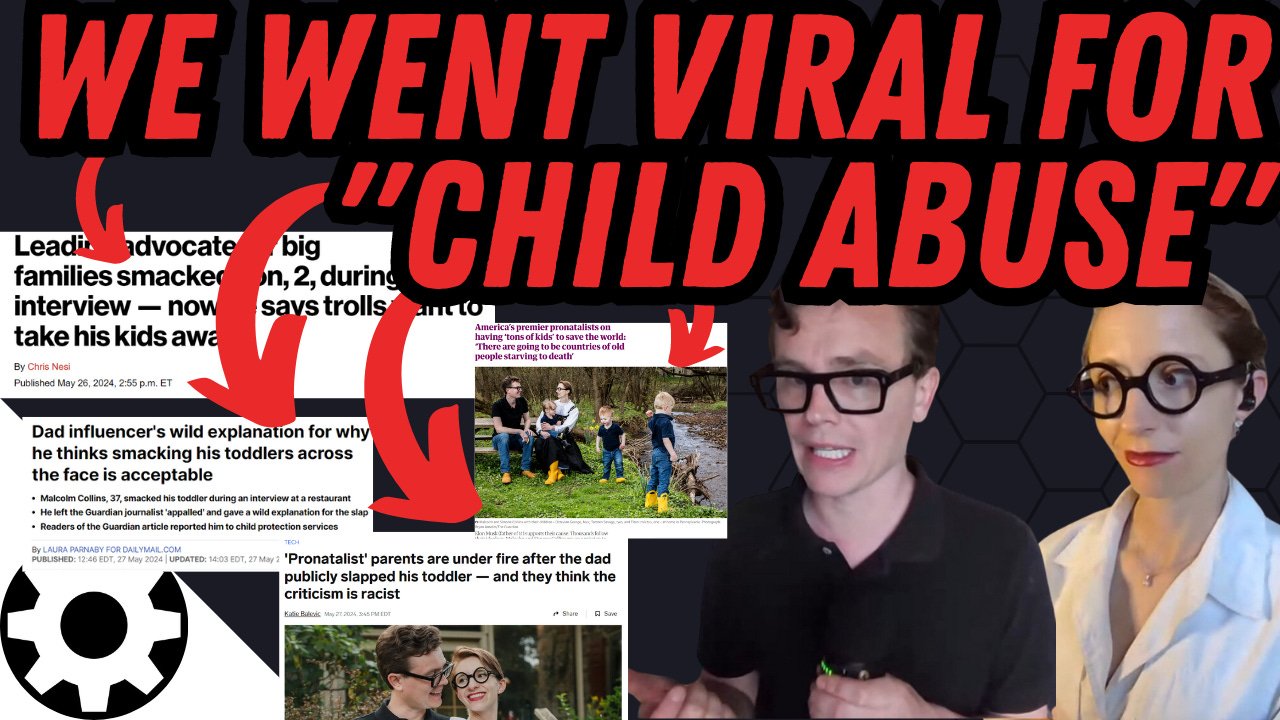
We Went Viral for "Child Abuse"
Based Camp | Simone & Malcolm Collins · Based Camp | Simone & Malcolm
Audio is streamed directly from the publisher (api.substack.com) as published in their RSS feed. Play Podcasts does not host this file. Rights-holders can request removal through the copyright & takedown page.
Show Notes
In this candid discussion, Malcolm and Simone Collins share their unconventional parenting approach, which includes a form of physical correction they call "bopping." Despite the controversy surrounding their methods, the couple argues that their approach is rooted in cultural practices and evolutionary psychology. They discuss the differences between abuse and discipline, the importance of setting boundaries, and why they believe their methods are ultimately in the best interest of their children.
Malcolm and Simone also delve into the challenges of parenting in the modern world, the limitations of existing research on corporal punishment, and the potential consequences of relying solely on emotional punishment. While they acknowledge that their approach may not be suitable for every child or family, they stand firm in their belief that parents should have the right to raise their children in accordance with their cultural values.'
[00:00:00] We can't do it, man! That's discipline!
We don't believe in rules like we gave them up when we started living like freaky beatniks. . Yeah, you've got to help us, Doc. We've tried nothing and we're all out of ideas.
Most, perhaps all, the blame rests with the parents. Have you ever tried simply turning off the TV, sitting down with your children, and hitting them?
lost your god damn mind! I guess I just hate to see a child go unbeaten.
Malcolm Collins: now I need to talk for a few minutes about why I find the research so distrustworthy in this space.
One, you're proceeding into the research from a prior that this is a human rights abuse. Whenever anyone says every expert in a field agrees on something, I pretty much immediately dismiss it.
Because I'm like, that just doesn't happen in science when science is
Simone Collins: happening correctly. There is always nuance in finding what's happening
Malcolm Collins: correctly If you look [00:01:00] at what the research is saying, it's this has a massive IQ effect. This has a massive effect on aggression.
These people become antisocial and aren't able to They hate their parents, et cetera. If these things were true at the levels that they're saying these things are true. Every single long lived culture on Earth would not have convergently evolved this method of interacting with children during this developmental stage.
What is really negative and what we are against is. Is any form of punishment where the pain is the point of the punishment? what happens during a bop? It is a light slap on the child's nose or face that is meant to shock and redirect and refocus attention. The reason we do the face is because It requires much less pain to get the same reaction than doing something like slapping the wrist.
Don't really do this for four year olds and up with our kids two to four range, because with my [00:02:00] four year old, I can say this could kill you and he can begin to cognitively understand that.
Two to four, you don't really get that. And so when you need to denote, no, this is an extra level of don't do this when compared to other things I have told you not to do the only way to denote that other than physicality. Is by emotionally elevating the conversation. And I think that causes more emotional damage
if you read the article, it says exactly what happened in the context. He was about to push over a table I did the bop to reorient him because he knew he wasn't supposed to be doing that, but then I immediately tell him I love him. Now, this isn't something I can do if I'm punishing him through the emotional means. Exactly. If I had elevated the conversation emotionally, now I need to say daddy's mad at you, instead of saying, bop, you crossed a line, but daddy loves you,
and this is the problem, right? So the urban monoculture would say to us, what you're doing is culturally non normative, stop it.
And I'm like, I have seen the [00:03:00] results of your normative parenting style. These kids are Miserable, anxiety, depression, illiterate messes .
when you look at the ban the rate of corporal punishment in the United States. It pretty much directly correlates with the rise in depression among youth and the rise of anxiety among youth.
Hello, I'm Dr. Richard Shea, here to tell you about my exciting new drug free treatment for children with attention deficit disorder. Watch closely as I apply treatment to the first child.
Sit down and study! Sit If you would like more information on my bold new treatments, please send away for this free brochure thank you.
Malcolm Collins: We no longer spank our children's butts because now we can spank their brains.
Would you like to know more?
Simone Collins: So how do we feel being the new public face of child abuse?
Malcolm Collins: Yes, we have gone viral yet again for punishing our child in front of a reporter in a way that she interpreted as a form of corporal [00:04:00] punishment and would technically be a form of corporal punishment. Now this gets really interesting because the internet went completely apoplectic when they heard that this happened.
They Could not believe that in the modern age, anyone would touch their child. They're like anyone who practices any form of corporal replenishment is basically an animal and inhuman. And I'm like, that is a little concerning of a thing to say, because, according to a 2011 study by Gorshoff 89 percent of black parents practice corporal punishment, and 80 percent of Hispanic parents practice corporal punishment and then they're like oh obviously I need to add some caveats to what I said there.
No, actually what happened, this is one of my favorite instances of media baiting. We're being attacked by all these progressives online. And one of them immediately shoots back this just proves my point. Blacks have more violent communities than whites. There's a lot of
Simone Collins: back, backpedaling in that.
Malcolm Collins: [00:05:00] One of the sharks got wounded during a freeding fencing, and then all the other sharks turned on it, because now there's shark blood in the water. Then it was whoa. Yeah. Whoa. But this is true. And it's something that. It's downstream of why we actually do this, because a lot of people are going to be like, haven't you seen the research on corporal punishment?
Why did you engage in corporal punishment knowing that so much of the research shows it's so negative?
Simone Collins: Yeah.
Malcolm Collins: The answer here is a few things. First, I do not believe the research is relevant to the type of corporal punishment that we are enacting with our kids. If you look at the research, it is predominantly looking at delayed, ritualized punishment where the purpose is to inducing pain in the child as a punishment for something negative that the [00:06:00] child had done.
Simone Collins: Yeah. I think when most at least when I think of corporal punishment, I think wait until your father comes home and you spanked or something. Or we
Malcolm Collins: know from animal. So anyone who's just any familiar with dog training, for example, or any form of mammal training delayed negative reinforcement doesn't work.
Like it just causes behavioral problems. This is something we see in any mammal that it's used in. So I shouldn't expect anything different in humans. Yeah, it would be inane. Inane. But then it has led to this problem in the field where there's these two starting assumptions. One is this has been studied for a long time and everyone agrees on it.
Now, this is a problem. Whenever you get a field and somebody said everyone agrees on it, no edge cases, because at that point you have created a dogma within a scientific field. Yeah. And worse, If you look at what's being put out there about who and UNICEF and stuff like that, they're like, this is a human rights [00:07:00] violation.
They view spanking as a human rights violation. And I will put up maps of countries on the screen where any form of spanking or anything like that for kids is considered illegal in these countries. They've been able to convince a number of countries to make this illegal. And I
Simone Collins: think there's also, this is one of those things like with pregnancy and alcohol.
But especially depending on, your genetic makeup or whatever in, in, in Europe, this is more normalized too. It's okay to have a small amount of alcohol while pregnant, but it seems very irresponsible from a research perspective to tell anyone that, because this is one of those issues of extreme moderation that, yes, only a Very small amount is okay.
And frankly, it's safer for people who may not be able to control themselves to just say, never do it. And so people say, just never do it. You're the worst person ever. If you ever have any drink, although now people are starting to loosen on that, even in the [00:08:00] United States. And I think it's very similar with things like corporal punishment, because while, if any study comes out saying that some level of physical intervention, that's not pleasant in immediate response to bad behavior.
Is okay, then you are going to get people who instead of lightly lightly tapping or the
Malcolm Collins: purpose and the mechanism by which the form of correction that we have works with our kids because what is really negative and what we are against is. Is any form of punishment where the pain is the point of the punishment?
And that the pain is seen as proportional. If you are more mad at the parent or the child extra broke a rule that deserves even more pain. Which is really different from what we're doing. We know it is.
Simone Collins: Frankly, we see the boys playing every single morning and the amount of pain they inflict on each other while laughing and smiling the entire time.
It pales in [00:09:00] comparison to essentially the taps or light slaps. That we can call a
Malcolm Collins: bop.
Actually on viewing this, I decided to ask our kid if he felt that it hurt him and here is his response
No. No. Yeah. Yeah. Wee!
It makes sense. When you can text you, Ally's what he feels during a bop Wiz what he feels during regular play with his brother. And I think a lot of people complaining about this are people who have never raised a child or at least never raised a group of boys.
Malcolm Collins: so what happens during a bop? And so I know I need to be clear, like the purpose of it. It is a light slap on the child's nose or face that is meant to shock and [00:10:00] redirect and refocus attention. To something more productive.
So to anyone who's actually been around toddlers, and I know a lot of people haven't, they have this phenomenon where they'll get locked in a mental loop that they can't easily escape. It could be like they're in this mindset where they're just really wanting to push boundaries and you say no, and that doesn't really register with them in the same way it normally would.
Or they're in a mindset where they really want something. And this creates this cognitive loop that can be very difficult for them to escape. And they need to be snapped out of it to refocus and reorient themselves, which is humorous. Even in the moment when a kid's in one of these cognitive loops, you are often leading to less pain within the next 20 minute period for that child by snapping them out of this cognitive loop.
So to be clear,
Simone Collins: we only get physical when we feel like they're, Their safety or someone else's safety is in
Malcolm Collins: danger. When one of these cognitive [00:11:00] loops is putting them in, or others in physical danger, but we'll get to the,
Simone Collins: I was just going to say, back to my point to close it up, tie a bow on it. It feels irresponsible.
And it would seem irresponsible to a peer reviewed journal to a researcher. To say this is okay when you know that someone's going to take that information and they're going to backhand their kid at full strength or they're going to start beating their kid or punching them in the face because they're like, no research supports it.
So I understand why there isn't research that says that this is okay. Because I too would worry about that. And we take abuse really seriously. So the fact that, Malcolm, Do this in front of a journalist and a bunch of people now think, they think, because they're not reading the article, they're not looking at the context, that you have backhanded your kid with the pictures wind up and they flew against the wall and cracked the wall and, it just, she's looking in horror.
Malcolm Collins: Hold on, we should clarify. Why the face? Because this is an interesting point. It's like somebody who's like, why don't you And other people in the comments were sharing this [00:12:00] style of punishment is actually very common. Like it is the ancestrally convergent evolutionary, if you're talking about cultural groups that have been successful, a lot of them do this.
So when they talk about like the way their grandparents would punish them it was a slap on the wrist, basically meant to like, Shock and reorient them and they would often say, I actually appreciated this to other forms of escalation. But when a child is in one of these loops and you need to denote that something is actually, because when you're talking between, we don't really do this for four year olds and up with our kids two to four range, there isn't a way to explain the seriousness of a situation or denote the, because with my four year old, I can say this could kill you and he can begin to cognitively understand that.
Two to four, you don't really get that. And so when you need to denote, no, this is an extra level of don't do this when compared to other things I have told you not to do the only way to denote that [00:13:00] other than physicality. Is by emotionally elevating the conversation. And I think that causes more emotional damage because then it's, daddy is mad at you.
You are being rejected. No, 100 percent
Simone Collins: when our kids, even by mistake. When our kids think that you are, like, actually mad at them or rejecting them in some way, the hysterionics are, like, through the
Malcolm Collins: roof. This is a level of punishment that is far above a bop. This emotional punishment. Which, and people can see, they're like, what do you mean?
If you read the article, it says exactly what happened in the context. He was about to push over a table full of food and drinks and utensils and all that. And he was trying to push it over. He was having fun. It almost felt it came inches from falling over, not inches, but very maybe less than like centimeters millimeters.
And I, Then immediately addressed it. I did the bop to reorient him because he knew he wasn't supposed to be doing that, but then I immediately tell him I love him. Now, this isn't [00:14:00] something I can do if I'm punishing him through the emotional means. Exactly. If I had elevated the conversation emotionally, now I need to say daddy's mad at you, daddy's something else, instead of saying, bop, you crossed a line, but daddy loves you, and then I explain in restaurants we need to be nice.
And so I am giving him the context. Don't push boundaries in this way within this environment. And I don't think that there is a kinder way that I could have elevated that. And I think that this is a really interesting thing that people miss. There was actually, because in Japan it's been made illegal to do this kind of corporal punishment now.
And there was a great recounting on Reddit of this that I wanted to read.
Simone Collins: Really?
Malcolm Collins: Which was I was an exchange student in Japan years ago, and a bunch of Americans and Japanese students were sitting around talking about our childhoods. All the Americans made jokes about the various implements our parents smacked or swiped or spanked us with.
See that doesn't,
Simone Collins: that sounds though delayed punishment. I'm just saying. It
Malcolm Collins: is delayed punishment, but hold on. And they were cracking up about [00:15:00] it while our Japanese friends were horrified. Japanese, our parents would never lay a finger on us like that, indignantly. Americans what did your parents do?
Japanese, mostly they told us they didn't love us, or that we didn't love them, or that we'd ruin their lives and brought shame on our families. Americans! I'd rather be slapped.
I think this is true. This is what you have to resort to when you remove this from the table, because in that 2 to 4 range, you can't really use the consequences of an action to to elevate it, you could really only elevate things emotionally, elevate the emotional stakes. And then you need to ask yourself realistically, do you think that's in the best interest of the child?
So if I go back to that 2011 study, something that, that you need to point out. is even when we talk about the other ethnic groups. Even if we're talking about whites and Asians, which I ignored because, people don't care about those numbers, but 79 percent of white parents practice some form of corporal punishment [00:16:00] and 73 percent of Asian parents, like the safe majority of Americans practice some form of this.
And you can be like if everybody knows this, because everyone is told when they're young, don't do this. Why even I, like I went into parenthood saying, I'm definitely never going to do that.
Simone Collins: Never.
Malcolm Collins: And some parents can get away with not doing it because they have one girl or two kids or something like that.
But most families when they get to four and above kids are like, I was wrong in thinking that it was realistic to raise kids without this. And I think that the reason is, and the thing you immediate really quickly if you engage in it, is all of these negative effects that researchers said it has, don't, I'm not noticing them they're like, oh, it makes the kids hate you, do you notice the kids they don't register it as like a they register it as boundary setting as you pointed out, it's like a Roomba, right?
Simone Collins: Yeah, my whole thing with kids and this is something that we've realized with play behavior. And I think a lot of people have this theory around play behavior that it is, it exists [00:17:00] to help kids learn how to set boundaries with themselves, with others. It shows you where the boundaries are. So when you get too rough, someone starts crying.
Okay. You've learned that you get in a fight, someone gets hurt, you understand where the boundaries are. So you know how to push your own boundaries and you know how to push other people's boundaries and you know when to go too far. And this first came up as a concept that I heard about discussed it.
When people were talking about why do younger generations now constantly appeal to authority whenever something goes wrong? It's because they were never let to play by themselves with other kids and work it out among themselves when they could, could not share a toy or whatever, when they got in a fight.
And so similarly, the way that we look at kids, especially when they're young, growing up, is that they're a lot like a Roomba. Like they're just flying blind bumping into a wall, you hit the wall and then you course correct and go in the right direction. And sometimes because the wall turns out to be a cliff or a stairway, we as parents try to create a fake wall.
And that is where bops show up. And if you don't do that as a [00:18:00] parent. Then in the future, let's say your little Roomba is in a new house and you're no longer there to catch it when it's about to roll off the staircase, they're going to get really hurt. They're going to get really screwed over.
Malcolm Collins: I think something that's really important with this analogy, like when we're talking about how our kids relate to their environments is. I don't think that a parent punishing their kid should ever be like an act of anger or an act of if you're ever doing that. And it's very clear from the article that I like, wasn't angry.
I was just setting a boundary. I do not get, and this is why I really don't want to go the emotional route with creating these boundaries is because the emotional route indicates to my kid that there is some disapproval of them pushing boundaries. Yeah. I want our kids to push boundaries. I liked that he was pushing boundaries.
I like you're like, you punish your kids when you do something that you like. I can tell him, look, I love that you're pushing boundaries. I love that you're [00:19:00] vivacious. But here is where you have hit, the Roomba has hit the wall. Yeah, it's like a
Simone Collins: safe word. It's like a safe word.
Malcolm Collins: And yes, and kids, you can tell very easily from my interaction with my kids, they understand this.
The punishment is not an act of rejection, it is an act of You've hit the wall here. You need to course correct. This isn't appropriate. Yeah, we were all happy. This was
Simone Collins: all okay. And now I actually mean it when I say no. Yeah,
Malcolm Collins: this is another thing to understand about the Pete. A really great thing to point out in the piece is this same child.
When we say we reserve this for only things that could hurt themselves and others at another point in the piece was running around with poo in his hands. He did not get bopped for that. In another part of the piece, he was running around the restaurant and he only got threat for a bop. When he ran towards the door, because on the other side of the door, there was a street with the table, he only got the bop because knocking over tables or learning that behavior in a house where you have infants can lead to somebody getting seriously injured or dying.[00:20:00]
And so somebody can say and I think that one of the reporters I was talking to today about this, she was really surprised, she was like see, you weren't like angry at him for doing this wrong thing for almost knocking over the table. And I was like, no, it's probably the first time he realized that he could knock over a table and he's like exploring his environment, huh?
What happens when I knock over tables? My dad said, no. But sometimes, he says, no, and I do it anyways. And there isn't some extreme repercussion to that. So let's try it, and somebody can be like never say no with your kid, unless you mean it. That's absurd. But there is
Simone Collins: a literal like movement among some parents to not use the word no, which I think also shows how far in the extreme, in the other direction we've gone.
Malcolm Collins: And I think that and I'll put the article about this on the screen that you're talking about because we have seen this we've entered an environment where what happened was, and I think accurately is research pointed out that delayed ritualized corporal punishment was had negative effects.
Researchers in the space began to categorize this as a human rights [00:21:00] abuse, so you really couldn't be on the other side of the issue anymore. And , it caused sort of a virtue spiral in the space, where now you have parents saying you should never say no to your kids. Because, When you take this angle of punishing my kids is bad, like any form of punishing my kids is, that puts them in a negative emotional state or that shocks them in the way that we do when we're punishing our kids and I don't know if I got to this, but the reason we do the face is because It requires much less pain to get the same reaction than doing something like slapping the wrist.
If you are slapping the wrist and I want the same level of attention refocusing as the face or the nose I actually need to hurt them to get their attention. And I don't want the pain to be the point of this action. It is the shock that is the point of this action, which helps reorient them, which the face does.
And if you look at animal training models, like dogs or something, you bought the dog on the nose. That is the consistent way of doing it. And animals, when we [00:22:00] first came to this model, one of the things we always note is we were on a safari and anyone who's ever been on a safari, you're sitting in a truck watching animals all day, like without music or anything like that, just getting to think and talk.
And as we were watching. Lions play with their cubs for a five hour period. And so we got to really study the play behavior. And we noticed this pattern where the baby cub would paw at the lion or do something, and the lion would growl or be a little angry. We're doing that when we're saying no, don't do that, right?
But the baby cub would keep doing it and then it would get to the point where the lion would just, swat the baby's cub face and the baby cub would look a little annoyed at a bit and then walk off. It understood this action as different from other types of punishment.
I should note here that 10 people have been like, well, the lion has its claws retracted and you clearly injured your kid because the reporter said she could hear it on the recording. And it's like, look, the reporter has to sell the piece. Okay.
She also mentioned that the kid was back [00:23:00] to laughing and watching his iPad within 30 seconds. And when I asked the kid the next day, does daddy ever hurt him or do Bob's hurt? He doesn't appear to think they do.
And even if you read the piece, honestly, it's pretty obvious the child was done injured.
Malcolm Collins: The reaction we've seen in our kids, like when reporters are over, one of the things they often comment on is how unusually well behaved our kids are.
And other people have commented on this as well. I genuinely think because I was not at well.
Simone Collins: Okay. Not well behaved. polite and kind. They say, please, thank you. It's nice to meet you. They're gregarious, but they're not. And sometimes I wish they would be, but I also don't want them to be from a raising humans, but from a mother, like not having to deal with things perspective.
They're not the kids who like line up behind their parents in airports and are quiet and compliant. And no, our kids are very rambunctious. But they're very polite, very caring,
Malcolm Collins: very polite and kind, like whatever it is, it seems to be working with within the boundaries we're setting for [00:24:00] them. And that is being a polite and kind and thoughtful person.
And then the danger with a system like this is you teach them that violence. Resolves conflict. And so what's really heartening to me is I see my kids when they quote unquote, bop each other, right? Because they're developing this behavior pattern and they're like, okay, this is how I tell someone that they've, crossed a boundary with me.
And what they do is they just tap the other person on the head like this. And so it's clear that in their mind, what is happening to them is not designed to be painful. It's about touching the other person on the head. And so clearly this is in their world perspective, how they're observing
Simone Collins: this,
Malcolm Collins: but now I need to talk for a few minutes about why I find the research so distrustworthy in this space.
One, you're proceeding into the research from a prior that this is a human rights abuse.
Like when they did that research on whether tortured with effective. Did anyone given that torture is categorized as the human rights abuse, By the dominant cultural group in our society. did [00:25:00] anyone really believe they were going to come back with an answer? This like yeah. Torture super effective.
Malcolm Collins: And with huge organizations just saying that it's been done, that the data is sealed, nobody. Talk about this issue anymore without really exploring where the edge cases are. There just isn't that much research into exploring the edge cases here.
Simone Collins: And again, it's so understandable because Abuse is a very serious issue. It is terrible.
Malcolm Collins: It is. It is. But then we have to come to this question where this just gets absolutely insane to me. If you look at what the research is saying, it's this has a massive IQ effect. This has a massive effect on aggression.
These people become antisocial and aren't able to They hate their parents, et cetera. They hate their parents. And then it's if these things were true at the levels that they're saying these things are true. Every single long lived culture on Earth would not have convergently evolved this method of interacting with children during this developmental [00:26:00] stage.
There is not a single, like when I look anthropologically at historic Chinese or Japanese or European or the large successful African groups none of them, have a ban on corporal punishment around kids. All of them engage in some form of corporal punishment around kids.
When I mentioned this, some people were like, well, you know, we used to do bloodletting, but we don't do bloodletting anymore. And I'm like, Okay. If every single human culture on earth had done bloodletting and we were the one culture. That didn't do bloodletting and we had only stopped it like 10 years ago. Yeah, I would probably look into that and be like, there is probably a reason that everyone was doing that. The level of arrogance that goes into this position is almost astonishing to believe that you are the one culture in human history, this nexus of human morality.
That has figured out something that everyone else got wrong to have no humility. When you realize how rare this position is, cross-culturally. Just astonishes [00:27:00] me, but I guess a lot of people, they just, this is a culture I grew up in. Therefore I am at a moral nexus in history and everything we believe now is correct.
And I will not be seen as having been abusive to my kids for not setting physical boundaries with them.
Malcolm Collins: This is why we have this huge problem in the United States where when families are coming into this country, it's like all the immigrant families do this. Immigrants are coming from a lot of different places. All the immigrants do this because everywhere else in the world used to do this before they started listening to these organizations that are like, oh, this is always negative.
Never do anything like this. And What that means is this is a very modern experiment. And throughout this video I'm going to be playing clips because it used to be even 10 years ago, our society broadly thought of the parents who didn't do any form of corporal punishment with their kids like corporal punishment as the selfish and abusive ones, the ones who did not care about the long term outcomes of their kids, whether you're talking about the Simpsons
I'm afraid young Ned is unusually aggressive, but I [00:28:00] can't seem to find a cause for it. ? We can't do it, man! That's discipline!
I'm beginning to see the problem. We don't believe in rules like we gave them up when we started living like freaky beatniks. . Yeah, you've got to help us, Doc. We've tried nothing and we're all out of ideas.
Malcolm Collins: or South Park
Hello, I'm Dr. Richard Shea, here to tell you about my exciting new drug free treatment for children with attention deficit disorder. This treatment is fast and effective and doesn't use harmful drugs. Watch closely as I apply treatment to the first child.
Sit down and study! Sit down and study! Hey, stop crying and do your schoolwork! If you would like more information on my bold new treatments, please send away for this free brochure entitled You can [00:29:00] either calm down or I can pop you in the mouth again. Thank you.
Malcolm Collins: or Futurama
Most, perhaps all, the blame rests with the parents. And so, I ask you this one question. Have you ever tried simply turning off the TV, sitting down with your children, and hitting them?
Malcolm Collins: Or Boondocks.
lost your god damn mind! I guess I just hate to see a child go unbeaten. I'm not a spanker, okay? But if you can bring discipline back into our school, then I am behind you 100%.
I wish I had the guts you do, sister. And that's why we signed that petition in support of you. Paddling pig.
Malcolm Collins: And this is a very modern and even when that was happening, everyone was like, Hey, if we keep not enforcing boundaries on our kids, this is what basically all those shows predicted. We're going to have a society where kids. cannot deal with challenges anymore, that they have an extreme [00:30:00] amount of emotional fragility.
And this is what we've seen as a consequence of this. It very much reminds me of it's like an obvious thing if you think about it. Why would every culture on earth convergently evolve this? And people can be like that doesn't mean anything, just because you did something in the past, doesn't mean that, that it's still good to do now that we have additional research.
And it's ah, this isn't something like sunblock or something like that, where you get this delayed effect that would only happen to adults above a certain age. What is being predicted in the research is that these people are going to have significantly lower IQs and significantly higher amounts of antisocial behavior, and significantly not like their parents.
So if you had just one subgroup within a population that wasn't practicing this, presumably you're going to get higher cultural transfer within that subgroup, because they're going to have higher cultural fidelity because they're going to have a higher opinion of their parents. And you are going to have a better performing cultural subgroup.
So you would have just naturally in certain places in the world had subgroups [00:31:00] within a population or populations with different child rearing practices living next to a population. outcompeting them if these effects were true, which just means it's completely implausible that at least at whatever way this was normatively practiced in history, which I don't think was the extremely formalized thinking system adopted during the Victorian period that this actually had deleterious effects.
Yeah. And when you look at the ban the rate of corporal punishment in the United States. It pretty much directly correlates with the rise in depression among youth and the rise of anxiety among youth.
Simone Collins: Though it also correlates, possibly interesting with the rise of kids feeling like they're best friends with their parents.
Malcolm Collins: Yeah. When you could say, why is this leading to this rise in depression and anxiety among kids? What would be the correlation here? And it's when you teach kids boundaries, you are teaching them specific things. They have to learn self restriction around and a varying degree of self restriction [00:32:00] around different things.
When a kid isn't regularly encountering social boundaries they do not strengthen the inhibitory pathways in their prefrontal cortex, which makes it very hard to shut down thoughts and wants. Like I have a want, but I'm not going to do that thing. That's actually like a muscle in your brain. It's a pathway in your brain that needs to be regularly exercised to properly work.
If you are not regularly exercising that pathway, you can't shut down intrusive thoughts. It leads to obviously lower rates of mental health. The
Simone Collins: funny thing, the ironic thing, and this is part of that larger microcosm of how the urban monoculture's key value proposition of removing in the moment pain is counter, counterproductive that parents who don't, who in the end, like parents, most parents say, I just want my child to be happy.
I just want my child to be happy. And so they do all these things to remove in the moment pain for their children. And then in the end, they get children who are a lot less happy. And if we did choose between our children, liking us [00:33:00] versus our children, being thriving, happy, productive people in a hot second, we'd choose for them to hate us if that's what it took.
Malcolm Collins: I, yeah, I think that this phenomenon is very analogous to the Hayes movement, which we're always ragging on the healthy and every size movement, which is promoting the idea. That is not unhealthy to be obese and obviously it's unhealthy to be obese, but telling somebody that in the moment causes emotional pain.
And therefore, by the urban culture standards you are, you're breaking a major tenet of theirs. And They have adopted this position of we'll say this and then you're like you should restrict food to some extent, especially if you have a problem there the same way that I don't think every child needs this, but I think some children do.
Some children dispositionally need this. And they're like starving yourself like anorexia. Is has all these negative effects. Look at this. And I'm like, I'm not talking about anorexia. I'm talking about mild boundaries, mild self restriction. And this is what it's become with spanking. You point out there's this [00:34:00] method of course, correction with boundaries that are enforced physically rather than emotionally that likely has healthier outcomes.
And they're like Another thing actually,
But, maybe, I'm just the kind of person who needs to have it all or nothing. That's right. Nah, all or nothing is easy, but learning to drink a little bit, responsibly, that's a discipline. Discipline, come from within.
Simone Collins: what's really funny to me is just for diets. Now we have Ozempic. Just take a medication. Don't be disciplined. Just take a medication. And similarly, there's the whole South Park joke about Ritalin.
Malcolm Collins: Yeah. Ritalin. It's don't discipline your kids.
Just give them amphetamines. That's definitely safer. And we normalized that as a society. Keep in mind at the same time as a society, we were normalizing. To not spank our children, to not engage in any form of corporal discipline. We began to instead, said we'll just give them amphetamines. And there was a great old daily show joke when the daily show was still like Fun and kind of base it at times. And Jon Stewart still says some really base stuff, when he [00:35:00] goes on other shows and he doesn't follow the script and he's yeah, I think this trans stuff with kids is going overboard.
And they're like, whoa, I can't remember. He said something like that. And everybody but so he said, We no longer spank our children's butts because now we can spank their brains. No,
Simone Collins: that's
Malcolm Collins: great. And I think that's so true. That's where we have had. There's there's other ways to solve this.
And it's clearly you don't think that if you have normalized giving kids amphetamines as a society,
Simone Collins: But that's our approach now, our approach to, to discipline and to, That's dietary, that's behavioral, is now just medicated.
Malcolm Collins: And this is the problem, right? So the urban monoculture would say to us, what you're doing is culturally non normative, stop it.
And I'm like, I have seen the results of your normative parenting style. These kids are Miserable, anxiety, depression, illiterate messes that are hurkle durkling under their covers because they're afraid to engage with the world. When the average [00:36:00] product of a culture, the dominant culture in a society is bad like it's not good for the kids.
It is, to me, a sign. Of parental neglect and that you do not truly love your kids and that you are not willing to go against the social grain for what you think is in their best interest. And I think that the cultures that don't do it won't exist anyway. The society's kind of clearing itself out.
Simone Collins: And
Malcolm Collins: then a lot of people can say, why would the urban monoculture evolve this very bizarre practice? Because as we pointed out, like almost nobody actually does this once they have kids. Like some families stick to this when they're very low on the number of kids they have. But
Simone Collins: Lower or they just, some people have very compliant children,
Malcolm Collins: True.
But the and we take a very unique child rearing approach where we go is. Zones of influence. Like if you, we had the Jordan Peterson will raise Sims where we talked about this bopping practice before. If you watch that episode but some parenting styles like his are about imposing a dominant figures domain over an entire household or environment and the kids [00:37:00] just must obey that we don't take that approach and we see everyone as an independent sort of sphere of will.
And that Bopping only happens when the kids put themselves in danger. It is not me enforcing my will on them. It is a sign that they have just crossed a certain boundary, and that is leading to consequences from the individuals in their environment. And so that is, really important to me.
But why did the urban monoculture evolve this? Because it can seem very odd, but it makes perfect sense. If the urban monoculture doesn't have any selective pressures around raising its own kids because it doesn't raise its own kids. It's a very low fertility group. It doesn't need to
Simone Collins: evolutionarily
Malcolm Collins: care about the negative psychological effects of the parenting techniques that is champion.
However, if it's primary. Source of recruits is people who are raised in often more healthy cultural groups it needs a tool in all cults do this to convince Individuals that their [00:38:00] parents abuse them if you go to a Scientology session, that's one of the First things they'll try to convince you of is that your parents abused you.
They're looking for this original, like how did the original thetans get in you? And it needs to do that because they cannot distance you from your birth cultural group without severing ties with your parents of their outside of the urban monoculture. And so it uses this recontextualization of a normal part of child rearing that basically all cultures everywhere on earth do almost directly in line with how distant they are from the urban monoculture, um, is this evil abusive practice.
It's just a really great tool for it. So of course it hammers at home and it's in line with this core value proposition. Anything that is emotionally negative or emotionally trying is a sin when they saw that we had enacted a negative emotional state on our Children. They were like, you have committed a sin by our cultural framework.
How dare you do that? But from our cultural framework, this is just absurd because we're like, but [00:39:00] it's obviously in their long term best interest. And this is where it gets to this thing. We're like, yeah. Why is it that everybody, even from our own culture, understood that the parents who weren't doing this historically were the selfish ones?
The classic story of how did Ned Flanders become like Ned Flanders? It started with parents who were beatniks and who were like, We've tried nothing and we're all out of ideas.
We don't believe in rules like we gave them up when we started living like freaky beatniks. . Yeah, you've got to help us, Doc. We've tried nothing and we're all out of ideas. There is an experimental therapy that might help Ned contain his anger.
It was known as the University of Minnesota Spank a logical Protocol.
Malcolm Collins: And it's true.
You see these in these episodes and we've recognized that how do you create like polite, disciplined people. Now in the episode, he was spanked too much. And obviously eventually in the episode, it leads to a mental breakdown from him. But it admits in the episode. Yeah, this does lead to polite, disciplined people.
He is one of the most morally upstanding people [00:40:00] and one of the most pro social people in the entire Simpsons universe. Um, and I also think it's really funny that we have this horrified progressive reporter. And I can only imagine like most black families reading this and they're like, Oh, this is just like white people problems.
You've got that classic scene from boondogs where, you need the the wise black man to come in and show the white mom who has the undisciplined child how you're supposed to What bizarre white people things to think that you should never ever practice corporal punishment of any sort when your kid is putting himself or others at risk.
I want candy! Dammit, I hate you. You're ruining my life! Please Herbert, remember our agreement. B***h, candy! I want candy! When he gets like this, I just don't know how to make him this! These people, you must have lost your god damn mind! I guess I just hate [00:41:00] to
Malcolm Collins: So there's that. But then the other thing I wanted to elevate here is what this creates, because when you as a parent become afraid of setting a physical boundaries. Like you cannot escalate to this highest level of like actually you cannot do certain things in this environment. Then you stop bringing your kids with you.
So people are like, why did your kids have iPads at the restaurants? Because you can't have a bunch of kids at a restaurant without iPads. It just doesn't work at this age range. Anyone can tell you that. And then they're like you shouldn't take them to the restaurant. Like, why take them to an environment where you might need to punish them, where you need to lean on technology that can sometimes have deleterious effects.
And it's that's the core problem. The solution when you follow all of these parenting guidelines is just don't have your kids shadow you all day, but that obviously creates bigger effects in terms of preventing the kids from being in an enriched environment and learning in the way that kids traditionally learned.
Simone Collins: Yeah. And by the way, we should do a whole separate video on iPads and [00:42:00] screen time. I am constantly. Blown away by the things that our kids are learning because we let them have some screen time like this, that last night, Octavian was talking to me about hydraulics and I'm like, what? You are four years old.
Malcolm Collins: Factory videos. So that's your new thing. It's all
Simone Collins: about factories. Yeah.
Malcolm Collins: Kids change to like the type of content they're consuming for something that is relative for their age and if you can get them into right Like good loops
Simone Collins: outside
Malcolm Collins: of what we call, um, yeah, like a form of young person, but we call it that not because it's of children because it's that for children.
It is simple, repeated. Anyone who has a kid who's a lot on YouTube for a little bit will know that they have found that kid watching videos of a car being dipped in paint and then dipped in another paint. Like it's clearly. Hijack some part of their brain that adults don't have.
Simone Collins: Yeah.
Malcolm Collins: And it's a very dangerous for kids if you just [00:43:00] let them on these systems unrestricted.
Simone Collins: Yeah. So I think screens can be very dangerous and they can be mindless, but they can also be amazing and empowering. So we're not totally against screens, but also like people need to get off parents on restaurants. Do you want the kids screaming in there? Like most parents who give their kids screens at restaurants, Almost never have their kids on screens at home, but it's a, you know what?
Like you get to choose. It's a, and this is one thing I
Malcolm Collins: love about the boondog scenes when the kids being really disruptive and he finally gets punished and you can see everyone who was watching in horror before is now like really pleased at the turn of the events. And I