The Auditorium Era: How Britain's Biggest Podcasts Learned to Play Live
Touring is no longer a side hustle for Britain's biggest podcasts; it's a second format with its own craft, economics and disappointments. Six shows, six different bets on what a live feed should be.
The night the feed left the studio
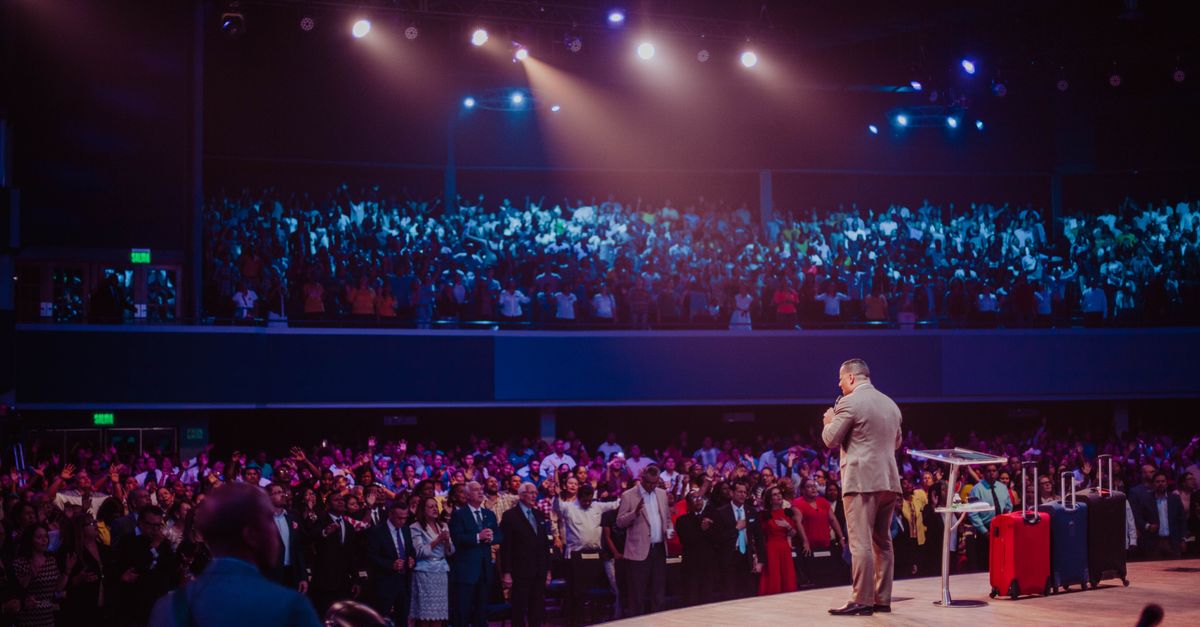
In autumn 2025 Tom Holland and Dominic Sandbrook stood on the Royal Albert Hall stage for the third time in eighteen months. Five thousand seats, sold out, on a midweek night, to hear two grown men argue about Charlemagne for ninety minutes. A few hundred yards down the road, the following week, Alastair Campbell and Rory Stewart were rehearsing the same trick at the same venue. Both shows had started, only a few years before, as two friends in well-treated rooms with a single Shure SM7B between them. Both have, since, become a different kind of business — one with cloakrooms, merch queues and a soundcheck before the green light.
The live podcast used to be a curiosity: a one-off recording at a small London theatre, there to seed a bonus episode and shift some hoodies. In 2026 it is one of the most reliable revenue lines British podcasting has. Goalhanger, Plosive, Global, BBC Studios Audio, Persephonica and a fleet of independents are now running their flagship shows as two-format businesses: the weekly feed, and the touring company. That shift is changing what the feed sounds like, where the money comes from, and which kind of voice gets to grow into a household name.
This is a guide to that shift. Six shows, six different live theories, one set of craft questions every British producer is now quietly trying to answer.
Six shows, six live theories
The table below is a snapshot of where Britain's biggest touring podcasts pitch their live shows in 2026. Capacities and prices are typical of recently announced UK dates and have been rounded; some titles price aggressively at arena scale, others stay deliberately small. The interesting column is not the money — it's the right-hand one.
| Podcast | Typical UK venue | Capacity (approx.) | Ticket range | What's live-only |
|---|---|---|---|---|
| The Rest is History | Royal Albert Hall / The O2 | 5,000–18,000 | £45–£95 | Costumes, on-stage props, audience-voted "Was it worth it?" finale |
| The Rest is Politics | Royal Albert Hall / Eventim Apollo | 4,500–5,300 | £40–£85 | Extended Question Time with audience cards |
| Off Menu | Hammersmith Apollo / The Palladium | 3,200–5,000 | £35–£60 | Guest dream menus performed with props, food gags, no edit |
| The News Agents | Regional theatres | 1,500–2,500 | £30–£50 | A "decision desk" segment shaped by that day's news |
| The High Performance Podcast | OVO Arena Wembley / regional arenas | 6,000–12,500 | £30–£75 | Sport-celebrity Q&A, on-stage drills, post-show meet and greet |
| The Adam Buxton Podcast | Regional theatres / festival tents | 800–2,000 | £25–£40 | "David Bowie's Eyes" jingles performed live, audience-suggested ramble cards |
What jumps out is not the prices but the variance. The Rest is History prices itself like a mid-tier comedian; The High Performance Podcast prices itself like a B-list arena tour; Adam Buxton prices himself, very deliberately, like a 2014 Edinburgh Fringe transfer. The live podcast is not one product. It is at least three different products — the arena talk, the theatre talk, and the small-room talk — and each has a different craft underneath it.
Six things that change when you sell tickets
Once a feed becomes a feed-and-a-tour, six craft variables shift in ways most listeners never consciously notice. They are, roughly in the order they bite:
- Cold opens stretch by 60–120 seconds. A studio cold open lands in seven seconds because the listener is already wearing headphones. A live cold open has to settle three thousand people, get the first laugh, and signal to the back row that this is the show. The Rest is Politics' live opens are routinely a full two minutes longer than the studio equivalent.
- Pauses get bigger. Studio silence is two seconds, maximum, before a podcast listener thumbs forward fifteen. Live silence is a tool: an audience laughs at it, fills it, anticipates the next line. Adam Buxton uses ten-second pauses on stage that would never survive his own Logic Pro edit.
- The edit window collapses. A typical feed episode is edited for six to ten hours per broadcast hour. A live recording, released as the next week's episode, gets edited in perhaps forty minutes — enough to balance levels, drop a tangent, and bleep anything that needs bleeping for an ad-supported feed.
- Sponsors move from mid-roll to wraparound. Dynamic ad insertion is hostile to live audio — you cannot drop a fifteen-second pre-recorded mattress ad into a sold-out auditorium. So live revenue moves to venue partnership, programme advertising, or merch-bundled tickets, and the feed's mid-rolls stay as the recurring monthly engine.
- Guests become co-stars rather than co-hosts. Off Menu's live format is built so the guest never has to ad-lib for more than thirty seconds; the structure carries them. Compare that with a feed episode, where a guest who cannot carry a five-minute tangent ends up cut for time.
- The closing rituals get longer. "Goodnight from me, and goodnight from him" works in a studio. Live, it stretches into a curtain call: a forty-second applause window, a sponsor thank-you, a merch plug, a tour-dates reminder, and a callback to the cold open. Each of those is fifteen seconds the feed didn't have to give.
Where the money actually comes from
The clean line is that live shows make a fortune. The messier line is that they make a fortune for a particular kind of show.
A four-night Royal Albert Hall run for a Goalhanger title grosses something in the region of £900,000 to £1.4 million at the box office, before venue fees, agency commissions, production costs and merch margins. Net to the production, by the time the touring crew, hire and rights are paid, sits somewhere between £250,000 and £500,000 per run. That is a meaningful number, but it is not the "all the money is in the room" caricature you'll hear at a podcast conference.
The bigger structural truth is what live revenue does to feed economics. A show that can tour reliably no longer needs to chase every dynamic-insertion CPM. It can keep editorial guests it could not otherwise afford. It can refuse the wrong sponsor. It can, in extremis, ride out a quiet quarter on the ad market because the next tour pre-sale is already in.
This is the real reason the British franchise networks — Goalhanger, Plosive, Persephonica, The News Agents' Global — have moved so quickly. A touring catalogue is a hedge against the ad market. It is also a competitive moat: a new entrant can launch a podcast in a week, but they cannot fill the Albert Hall.
The shows that don't tour, and the ones that shouldn't
Not every good British podcast belongs on a stage. True crime is the most obvious mismatch: the show's authority depends on quiet, on documentary distance, on the listener being alone with the material. Asking three thousand people to gasp on cue at a victim's name corrodes the whole proposition. Several true crime productions have tried it; almost none have toured a second time.
Audio drama has the opposite problem. The work is so precisely engineered for headphones — the binaural pans, the close-mic'd whisper, the cinematic music bed — that any live performance is essentially a different art form. It becomes a rehearsed reading, closer to a Radio 4 recording in front of an audience at the Old Vic than to a podcast tour.
The shows that travel best are the ones whose feed already sounds like two friends performing for an imagined audience: history, politics, comedy panel, sport. The leap from imagined audience to actual audience is small. The shows that travel worst are the ones whose feed depends on the absence of one: confessional interview, narrative non-fiction, careful sound-design craft.
What gets lost, and what it's worth
There is a craft cost to the auditorium era that nobody much wants to talk about, because it shows up slowly. Live shows reward broad strokes: the joke that lands in row Z, the historical analogy that needs no footnote, the political opinion strong enough to clap at. Over time, that pull can sand the texture off a feed. The Rest is History's studio episodes from 2023 are noticeably more digressive — more willing to spend ten minutes on a single fifth-century bishop — than their 2026 equivalents. That is partly maturity. It is also partly the gravitational pull of the room.
For now, the trade looks worth it. The British podcast industry needed a second revenue line that did not depend on Spotify's or Apple's mood. Live touring is that line. It is also, when it works, genuinely good craft: a format that asks hosts whether they can hold a room, not just a microphone, and that punishes anyone who can't.
The next decade of British podcasting will be made by people who can do both jobs. The studio still pays the bills. The auditorium, increasingly, decides which shows get to stay there.