
Based Camp | Simone & Malcolm Collins
886 episodes — Page 6 of 18

Anti-Woke Movie Sneaks Past Media Execs to Smash Records (KPop Demon Hunters)
Join Malcolm and Simone Collins as they dive deep into the global phenomenon that is KPop Demon Hunters. Discover how this animated film shattered streaming records, topped charts in over 90 countries, and sparked conversations about culture, faith, and the future of media.In this episode, Malcolm and Simone break down the movie’s surprising Christian themes, its unique approach to female characters, and why its message of personal responsibility and self-improvement resonates with audiences worldwide. They compare “K-Pop Demon Hunters” to Disney classics like “Frozen,” discuss the impact of K-pop stars in the film, and explore what Hollywood can learn from its success.Whether you’re a fan of K-pop, animation, or just looking for a fresh perspective on modern storytelling, this discussion is packed with insights, humor, and cultural commentary.Episode Transcript:Malcolm Collins: [00:00:00] Hello Simone. I am excited to be here with you today. Today we are going to discuss a movie that will likely change the way films are produced globally. And because it accidentally snuck a bunch of Christian themes and very intentionally, a lot of people are like, oh, it’s accidental that Christian themes got into this.We’ll go over it. It’s not accidental that Christian themes got into this. Nice a lot of anti DEI themes. Into the most, like the biggest movie phenomenon of all time. Mm-hmm. And I say, they say all time, you might be like, oh, you know, K-pop demon hunters was cute, but like how big was it exactly in in the last three months?It has gotten more streams on its songs than Frozen has gotten on its songs in the 12 years since it was released. No significant margin. Oh my God. What? No. K-Pop. Human hunters shattered expectations to be the most watched original ever with 325 million views. [00:01:00] Eclipsing red notice, 236 million views in squid game season 1, 260 6 million views.Wow. Top the charts in over 90 countries. The sound trek went platinum debuted at number eight on the billboard of two hundreds and made history as the first. With four simultaneous top 10, a hundred global hits. Deserve, though they’re, they’re catchy tunes. Was was golden number one. So good. It had your idol number four.Oh yes. Soda pop, number five. Oh, love it. And how it’s done. Number 10. With. Golden alone. Top charts in the uk with over a million units sold in a sing along theatrical version grossing 19.2 million. Now that’s, that’s not a big a deal. But hold on, I wanna, I wanna compare it to frozen here.So, since it’s released in, in terms of the number of streams that it’s songs have gotten, they’ve gotten around 3.5 billion streams. Okay? Frozen has gotten 2.5 to 3 billion over the past 12 years.Simone Collins: 12 [00:02:00] years. Oh my God. IfMalcolm Collins: you’re talking weekly streams, the absolute peak for frozen was 50 million.The peak for demon hunters was 141 million.Whoa,not moving Close my my mind. Monthly listeners for demon hunters, it peaked at 40 million for, for frozen, it peaked at 20 million. And, and the reason why this is so interesting to go over is because. A lot of people like are individually like, I like K-pop, demon hunters.It was pretty cool and based. Yeah. And then but it doesn’t feel like a frozen, right? Like, no, it’s delightful. It’s fun. There’s, there’s conflict, there’s issues, but frozen’s just like. Culturally, we don’t feel like we’re in a frozen moment. Like the fact that I can compare K-pop demon hunter to something like frozen, and I’m like, this completely smashed frozen’s numbers.You can hear that as a person and be like, but I thought I, that was like my thing, like, [00:03:00] like my private weird thing that I OhSimone Collins: yeah. Everyone thinks it’s like their little niche, like, oh, it’s this, this Korean anime thing that I watch. Yeah.Speaker 4: , the only ones dying tonight are your, I’m sorry. What? They’re fans. We’re at your fans. Oh, no, no, no. Thank you. No, no, no. Not our fans. When you mess with our fans, we need to make it hurt.Simone Collins: Oh yeah. And like when, when you and I had to like. We had to, to sneak into my, my dad’s Netflix account, ask him to give us temporary vacation traveling access.Yeah. And then just like, I thought it was, it was gonna be like, oh, like listed front page top 10, like, here’s our most success. No, we had to search it. It wasn’t even listed in any of the, like, suggested for you listing wroteMalcolm Collins: this. So deep cut, but it’s not. And, and no, this is a movie that doesn’t have a single black person in it.Like in terms of like anti, it doesn’t have a single white person in it. It doesn’t have a single white person in it either. And I’m not complaining. That doesn’t, it shouldn’t have a single white person. No, it’s Korean. You go to South Korea, you don’t see that. [00:04:00] You don see many white people in Korea. I lived there for a while.The, the other thing that well we felt bad walking down the streets ‘

Nick Fuentes Fan Girls & Female Gooner Trends
Join Simone and Malcolm Collins as they dive deep into the fascinating world of Nick Fuentes fangirls and the unexpected online communities that have sprung up around controversial internet figures. In this episode, they explore the rise of fan fiction, shipping, and fandoms that blur the lines between politics, celebrity, and internet culture. Discover: The origins and psychology behind Nick Fuentes fan communities How fan fiction and “shipping” work in real-world political spaces The role of Tumblr, TikTok, and Reddit in shaping modern fandoms Surprising parallels between historical and contemporary fan obsessions Why some fans are drawn to “bad boy” personas, and what it says about online culture Whether you’re a curious observer, a fandom veteran, or just want to understand the latest internet trends, this episode offers a unique, in-depth look at the intersection of politics, romance, and digital communities. [00:00:00]Simone Collins: Hello, Malcolm. I’m so excited to be speaking with you today because we are going to dive deep into Nick Fuentes fan girls. They are out there.Malcolm Collins: Well, hold on, hold on. We’ve gotta be clear about what this community is. This is not girls who like, like the ideology of Nick Fuentes. This is a community of women that writes fan fiction about being like Nick Fuentes in weird sexual scenarios, except they hate Nick Fuentes.They, no, no, no, no. They, theySimone Collins: don’t hate him. They just. They’re apolitical. I’ll, I’ll give you an example. They’re apal. You wanna a clip from some fan fiction?Malcolm Collins: Yes. So go stream so you can choose. It’s more like he has replaced the monster in the monster er category of like women fiction.Simone Collins: He hasn’t replaced it.He’s just a different version of it. And we’ll get into it. But I’ll give you an excerpt from one, just the opening. You can, you can choose one. There’s kiss under the MAGA sunset, which basically is Nick Fuentes confessing to Candace Owens and they start dating. Or you can get a little bit of Nick [00:01:00] Fuentes falls in love with a hijabi woman.We’ll do the hijabi woman. All right. Nick first saw you about to cross the road, and what a sight It was a beautiful girl. Pretty in a way that made him pause, though clearly not the Catholic faith. No, no. That scarf of yours gave it away. Light blue and neatly pinned in place, matching your sweater in your jeans.And what are the chances that this is the very first time he’d lay eyes on a hijabi woman, a Muslim girl, and not just anyone but one that made him think however reluctantly of the word. Beautiful. And of course, being who he was, he had to stop you. Hey, we’re placing these stickers on a map to let us know where everyone’s from.He said, smiling the smile he used on strangers handing you a slip of paper like it was the most important thing in the world. You shuffled the things in your hands, trying to get a grip notebook, some kind of folder. And of all things, a chocolate ice lolly, which already told him you must have been hot.Not that it surprised him since you weren’t really dressed for [00:02:00] the weather in September, decided to be cruel. You pressed your sticker onto the map and he peered at it with curiosity. He couldn’t quite disguise Nepal. No, no, not Nepal. Afghanistan. Afghanistan of all places. And suddenly the shape of you sharpened in his mind because here was an Afghan girl, and not just anyone, but with the kind of beauty he had only read about in forms and dark corners of the internet.Rumors given form. And it struck him rather guiltily that he’d spent so much time online tearing your country to shreds. And yet here you were in front of him, smiling faintly and it unsettled him.Malcolm Collins: Oh my gosh.Simone Collins: So little taste. And now women love enemies to lovers.They, they love. You know thatMalcolm Collins: there’s a lot of gay slashes, there’s a lot of enemies to lovers. Simone was, was complaining to me about how deep this community was. She’s like, this is not like a joke thing. Right. Like, these people are seriously boast into this and invested in this.Simone Collins: Yeah. And, and what we’ll get into some of that commentary [00:03:00] ‘cause this is also interesting.There’s sort of like this, there’s the interest of the actual community and then there’s sort of the meta story around it. I think both are really notable and, and people should know aboutMalcolm Collins: both. And so this is important, interesting to study in terms of understanding female psychology. Like why. And that’s why, why we’re gonnaSimone Collins: start, if you’ll let me Malcolm, well before, because I outlineMalcolm Collins: this episode.Oh. So I don’t even get to talk about the gay rumors. ‘cause people are probably like, well, don’t you know he’s actually gay. You get to goSimone Collins: into those later when we discuss shipping. Malcolm.Malcolm Collins: Okay. All in good time. We’re when we discuss shipping. B
Taking "Degrowth" Seriously: What is the Actual Ideology/Logic of Those Who Want to Shrink the World?
Join Malcolm and Simone Collins as they dive deep into the philosophy and policies of groups advocating for global population reduction. This episode explores the arguments, motivations, and potential consequences of “degrowth” movements, including controversial proposals for family planning, technocratic governance, and the future of human flourishing. The hosts critically examine the data, challenge utopian and dystopian visions, and discuss the real-world implications for society, technology, and culture. Whether you’re curious about demographic trends, environmental debates, or the ethics of population control, this conversation will challenge your assumptions and spark new questions.Malcolm Collins: [00:00:00] Hello Simone. I’m excited to be here with you today. Today we are going to be discussing the philosophy of the people who are aware that demographic collapse is happening. The, you know, broadly saying, aware of its consequences, but want to facilitate its continued existence and how they think that this is gonna work out.Okay. Because I’ve, I’ve heard of these people, you know, the, the degrowth people, right. The well we can manage, like, we can make things better with an older population in everything like that.Simone Collins: And like, this is good. I’m just picturing the dog in the fire ridden building.Malcolm Collins: Yes. This is fine. Yeah, I kind of blew this off.But we haven’t, well maybe they’re ontoSimone Collins: something. What if we’re wrong? If we’re wrong, we wanna be corrected. Right? Yeah.Malcolm Collins: Reach out to us that has these beliefs. Mm-hmm. And they were very nice. And they sent us to their website. And this group is called the O-V-O-L-P-E Foundation. Hmm. Overlap. I, I don’t know how to pronounce it.And they do a lot of work on trying to get girls to have a fewer kids. [00:01:00] I, I will say that normally I wouldn’t care about this work, but guess what country they, they do this work in most.Simone Collins: Ah,Malcolm Collins: Thailand. Do you know what Thailand’s TFR is? It’s round one. This work is genocidal at that rate. That means the population is halfing every generation.That’s one of the lowest, like the the going to their approach. Wouldn’tSimone Collins: they wanna do this in like a really high fertility country? I mean, yeah, they do do it in,Malcolm Collins: One other country. I wanna say tan Tanzania, which is higher fertility, like 4.5. And so that’s, that’s reasonable there. But in Thailand, I’m like, if there’s any country where you don’t wanna be doing this, that’s like doing it in Korea or something.Keep in mind, Thailand’s fertility rate is one, and Korea is like, the lowest on Earth is like 0.75. Yeah. So this is close to the lowest fertility rate on earth.Simone Collins: Yeah. I mean at that point it’s, it’s already happened. You don’t have to worry about it. You Yeah. You don’t have to worry places that are involved.2.1 at leastMalcolm Collins: kicking a dead dog at this point. We should ask them about that. I wanna to go into their own words. Okay. Both [00:02:00] from the chain of emails they sent us and from their website so we can understand how they wanna structure society. And I’ll start with just sort of the wider plan here which we won’t talk about too much, but it’ll give you an idea of where we’re gonna be going with this conversation.Okay. The goal here is on one hand, the wellbeing of children, including the widespread good education, and on the other hand, equal opportunities and prosperity for all citizens of the world. The key message here as follows, fundamental right to one child per couple. This child will be supported through compulsory education, medical care, nutrition, and if necessary, financial assistance from the global community, at least until UNESCO ISCD level two or possibly level three registration with the child protection Authority.The CPA is mandatory. A second child is subject to conditions. Both parents must demonstrate and be able to independently financially support both children up to employability. Approval by the CPA is required for the third child onwards. Additional [00:03:00] requirements applied in addition to the requirement for approval.Progressive child tax policies are levied. So basically the more kids you have, the more you have to pay in taxes rather than the less. And then they go on to say in this section, this is to ensure that school attendance by less privileged children is refinanced by child taxes, by wealthier families.Presumably it would be the wealthier families who are allowed to have far more children. Right? So it’s like wealthy people can have, you could hear these like elements of ness to this, right? A, a dictatorial world government where only the wealthy can have more than two children, or really more than one child.Yeah. It seemsSimone Collins: like many sci-fi dystopias where you, you have, you can’t afford to pay the government credits to have an additional child or whate

France is Boned ... But How Boned?
In this episode, Malcolm and Simone dive deep into the current state of France, exploring its pension crisis, demographic challenges, immigration policies, and political turmoil. They compare France’s situation to other European countries, discuss the impact of government benefits, and debate the effectiveness of recent reforms. The conversation also touches on cultural differences, personal experiences in France, and broader themes of government dysfunction and societal change. Malcolm Collins: [00:00:00] Hello, Simone. Today we are gonna be talking about just. How cooked France is, just for some statistics that people might be surprised about is in France, your average pensioner makes more money in terms of like cost of living, adjusted money than your average worker in the country. In. In France, 57, sorry, 57% of people are net beneficiaries of the government.43% pay into the government. Oh no. France is already past the point. And I said this is a point where democracies begin to break down where the average citizen is being paid by the government to exist. And we’re going to look at where this has led to downstream collapse, in just a second here.Also very fun. What I love about diving into France and we’ve had episodes diving into the UK and diving into Germany, and now we’re diving into France, is each country is completely cooked in like its own way. It’s almost like Europe got to be like [00:01:00] the captain planet of evil and country vices. And you know, the UK is like.I’ll arrest people for memes. You know, like there was the guy who was arrested in Scotland for literally painting Islam can be questioned on his wall. And they, the police were like, no, it cannot the girl who, who well, we’re not gonna go into that. All of that. You can, you can go to our video where we point out that the only reason a country would ban the flying of its own flag is if it was under occupation.There’s no other reason to ban the flying of your own country’s flag, because presumably you do that in support of your government, right? If the government sees that as an attack on them, and this usually happens under occupation, like France under occupation, you ban it. So the UK has got its draconian speech laws and, and, and all of that.Then in Germany you have like a secret police force of like brown shorts that literally label mainstream political parties as terrorist organizations and monitor in harass mainstream like people [00:02:00] who are to the left of like the United States president or us, for example, as being. Political. Mind you, this is a political party, the a FD that is run by a lesbian in an interracial relationship.So yeah, not exactly that extreme, right? Then we get to France, right? And what is their nature of terribleness? They’re actually pretty good about not arresting people for stupid things. And they’re actually pretty good about not like spying on the quote unquote far right party, which we’ll go into like lap pen’s party or bullying them.But they have the curse of the French, which means, oh no. The problem with France is that it’s full of French people. And French people have completely unrealistic expectations around what to expect and. They are treating. Like if, if you, if you watch, and what we’ll go into a bit is this recent OD of you know, Francis current Prime Minister Macron [00:03:00] constantly trying to get the retirement age raged from 62 to 64.Now 64 would be a very young retirement age, globally speaking. And yeah. What,Simone Collins: let’s see, was it, is it in the USA,It is 67 for social security.Malcolm Collins: Yeah, so the point being is he wants to raise it a a moderate amount, and we’ll go into the data here, but like anyone could tell you that the system’s gonna be insolvent in just like a decade and a half if they don’t raise it. And literally this is what keeps breaking the government.And when I say break, I mean literally they’ve been through like four sitting whatevers like head of the governments in like the past few years because they, they pee everything to like step down the ministersSimone Collins: right.Malcolm Collins: You know, whatever, because France isSimone Collins: a president and a Prime minister and it’s, they’re, they’re churning through Prime Ministers this point.Yeah. We’ll, we’llMalcolm Collins: get to it. Yeah. And, and the core reason is, and the core reason that everything about Macrons blew up, even though he tried to side with the lefties, is just over this retirement age thing. And what makes this so funny to me. [00:04:00] Is the system won’t even exist in like a decade and a half if they don’t make this change.Right. And this change will, I feel like even ifSimone Collins: they do two years doesn’t seem this yearly enough. Yeah. What change EstimatedMalcolm Collins: to increase its lifespan by one decade. Maybe if they do it immediately. And so they’re not even like arguing for like this being a permanent thing. They’re arguing for a

Why Are Famous Communists Usually Rich Nepo Babies?
Why do so many prominent socialists and communists come from wealthy backgrounds? In this thought-provoking episode, Malcolm and Simone Collins dive deep into the surprising trend of rich kids leading leftist movements, from historical figures like Marx, Engels, and Lenin to modern influencers and activists. Discover the stories behind famous leaders, the psychology of privilege, and the recurring patterns that shape revolutionary ideologies. The Collinses explore whether wealth and upbringing influence political beliefs, and what this means for the future of social movements. If you’re curious about history, politics, or the sociology of power, this episode is for you! Malcolm Collins: [00:00:00] Hello Simone. I’m excited to be here with you today. Today we are going to be exploring the phenomenon that you may not be aware of, which is most socialists and communist leaders, and I really mean most socialists and communist leaders.Oh, likeSimone Collins: actual, like world leaders. Like, yeah, this is going intoMalcolm Collins: distant history of two modern times we’re born to incredible wealth. What? And, and the question is, is why, why does this trend happen? And it’s something I’ve seen as well with, you know, all the wealthy kids especially the ones who didn’t have to earn it being incredibly like the most communist socialist people I know.Speaker 3: rude boy living in the shanty dorms. Please guide me from,Simone Collins: yeah, no, there’s, there was this one like trust fund kid conference that you. You, it’s called a summitMalcolm Collins: or something. Not summit. What was it called? Not Summit Ter,Simone Collins: Nexus Global. Nexus.Malcolm Collins: Nexus Global. AndSimone Collins: everyone in it was, it was really like kids [00:01:00] of, of, of very wealthy families who have basically family foundations that were charities talking about how they’re gonna spend their family foundation’s money.Malcolm Collins: And it was all, all woke nonsense. And it was all, it was allSimone Collins: like socialists too. Marxists and communists and, which is so weird. Yeah, becauseMalcolm Collins: I, and it wasn’t like meant to be a Marxist conference. No. It was meant to be a rich kid conference. Yes. Okay. Yes. So you see this constantly. So let’s go over where we see this phenomenon playing out.I’m just gonna. Read to you names here. Right? Okay. Okay. ‘cause see, this isn’t just a historic saying. This is a modern thing as well. Okay. Zhan, Ani. You know the guy who’s the communist running for the man of the people.Yeah. What?Born to Oscar nominated filmmaker, Miar Na and Colombian Professor Mohamed Mandi Young Zhan enjoyed a jet setting lifestyle before New York, India, and Uganda.What family Vacations included film sets and academic conferences. Perfect prep for fighting capitalism. Right. But hey, at least he traded red carpets for red politics.Simone Collins: Oh boy.Malcolm Collins: Fidel Castro Fidel’s Co Fidel’s [00:02:00] father owned a 25,000 acre plantation with 500 employees, where little Fidel rode horses attended elite Jesuit schools and Boston around servants one advent goat.He once staged a quote unquote revolt against his strict boarding school by locking himself in with candy, foreshadowing the real revolution, minus the sweets. From Castro’s family wealth in early Life stories Hassan Piker Hassan’s father was a VP at a billion dollar conglomerate and a board member of multiple forms.Affording a posh Istanbul upbringing was private schools and family trips. Funny bit. Hassan once joked about his uncle Sikh hugger, the Young Turks founder, who we’ll go into next as a Nepo baby but skipped mentioning his dad’s empire. Talk about streaming from a glass house. Sec by the way, grew up in East Broad Wick, an affluent suburb with strong cool before the family settled and blah, blah, blah.He, he also had a fantastically wealthy family, but less wealthy than Hassan. Hassan’s family was a, from what I can read. [00:03:00] Multi-billionaires wow. Or not multi-billionaires, but they ran multi-billionaire corporations. CEX was probably few hundred million. Either way, neither of them have to worry about money, so clearly that’s why they don’t care about lying about.Do you think that bothSimone Collins: Jen and and Salon are trust? Kids.Malcolm Collins: Yes. They never have to worry about money in their lives. Wow. If, if something went wrong or anything, they wouldn’t have to like, if, if Hassan really loses it for shocking his dog, like a psychopath.I America Kaya, please just go. Just stop.God Hassan, stay on the bed. It won’t stop. Yeah, well, neither will chat. I’m busy.Malcolm Collins: And here’s the thing, I actually don’t even mind shot colors for people who aren’t aware of this.So Hassan’s one of like the leading like, lefty streamers, right? And he got caught after. The dog had sat in a corner for four hours like yelling at his dog and then shocking it so [00:04:00] that it like yelped and went bac
The UN is Lying About Latin American Birth Rates: The Real Numbers are Shocking
Join Malcolm and Simone Collins as they dive deep into the surprising reality of fertility rates across Latin America. Discover why official numbers from organizations like the UN may be misleading, how actual birth rates compare country by country, and what these trends mean for the future of the region and beyond. The discussion covers demographic data, cultural factors, religious influences, and the broader implications for global population trends. Whether you’re interested in demographics, policy, or just want to understand the real story behind the headlines, this episode is packed with insights and data. Malcolm Collins : [00:00:00] Hello Simone. I’m excited to be here with you today. Today we are gonna be talking about something that I accidentally stumbled into while I was trying to grab fertility rates for a reporter.And so the reporter comes to me and they go you know, we, we were talking about this with Telemundo, we were talking about the fertility rates across Latin America, and I Googled because I remembered that Columbia, for example, had a very low fertility rate. Yeah. The, the measured rate right now, and I’ll put the Wikipedia page where it has like the government stats on this, okay.Is 1.0 6 6 6 6 7. That’s, that’s basically half this population every generation forSimone Collins: comparison, UK’s around 1.5 US is around 1.6. That is.Malcolm Collins : Bad. You got 1.07 around it. Ooh. And so I googled it and the Google result came back was 1.6. That’s a, that’s a, a decimal point error. That’s, that is enormous error.And I was like, where the hell is this number coming from? I did some digging [00:01:00] and it soon became, please don’t see the un, it was coming from the un. No, no. And so I asked an ai, I’m like, how is the UN getting this number? Whereas Wikipedia and Columbia is getting this number.Mm-hmm.And it explained to me the difference in methodology.It said. Oh, the number that you are looking at, the 1.06 number, that’s the measured fertility rate in Columbia. The number that the UN is reporting is the number that they predict should be the fertility rate of fSimone Collins: It’s like our sun, Octavian and, and some math problems we give them where we’re like, Hey, what’s X plus x?And, and he gives us a number and we’re like, no, no, no, it’s, it’s seven. And he’s like, no. It’s 13 because he said it was 13. Yeah.Malcolm Collins : He understands. That is the UN right now. Oh. And so what we’re gonna be going over in this is because then I was like, how bad is this OVERREPORTING number in terms of the data that a lot of people are getting.So we went through the official sources Wikipedia, where they’re citing the [00:02:00] country’s own demographic statistics.Yeah.Across Latin Americans. We’re gonna go across Latin American countries right now.Okay.Which by the way. If you average them come out to a TFR by, by their relative populations below the US’ TFR already.Yeah. And I point out this isn’t just a Latin American problem. This is a Latin American problem in the United States. The state or territory was the lowest fertility rate, and by the way, it’s not even close. Puerto Rico, which has a fertility rate of only 0.9. All right. That isSimone Collins: so bad. It’s so bad.Malcolm Collins : No, I have mentioned this quote before, but I have to mention this quote here ‘cause it’s so important. There’s a Latin American demographer who is a professor at Penn. You know, Ivy League Penn. Very nice, fancy school,Simone Collins: respected, reputable.Malcolm Collins : Actually, we should reach out to this guy about having him on the show, if you can make a note of that.Okay. Because he’s right next to us, right? Yeah. And he’s a pretty based demographer. Jesus Fernandez, Aire, Dre.Simone Collins: Oh, this guy? Yes.Malcolm Collins : The professor of economics. [00:03:00] Okay, so, these are some quotes from him in a interview that he did. Jesus. First I think the United Nations is over counting the numbers of births in many countries.For instance, in Columbia, the United Nation claims that in 2023 there are over 700,000 births, Columbian authorities and I have talked with them, tell me that there were. 500,000Columbia. The official number is 500,000. This is fighting about the second decimal Alice. That’s a big difference, Alice. So, and this is like do da.here. So crazy. Like, you know, there are clever people. Why are they, you know, coming up with. Why are they, you know, coming up with inventing numbers? And then Jesus says, so I send them an email and the answer we got, and I’m doing this with a young researcher, Patrick rna we send. Email and they told us that they don’t want to be alarmists. That’s [00:04:00] literally what they said in the email. They said, yes, maybe the projections do not make a lot of sense, but we wanna be very cautious and we don’t want to be alarmists, and we don’t want people to think that there is a crisis looming which, and then Alice cuts her off be

How Blood Libel Became Central to Wokeism
Welcome to our deep-dive discussion on the concept of “blood libel” and its modern implications in political discourse. Malcolm and Simon Collins explore the origins, misuse, and consequences of blood libel, drawing connections to current events, statistics, and media narratives. [00:00:00]Malcolm Collins: Hello Simone. I’m excited to be here with you today. Today we are going to have a conversation about how blood liable has become incredibly common among the left to the point where I’d argue that. Almost every mainstream leftist politician has engaged in blood libel.Simon Collins: Can you explain what blood libel is to me?I hear people talk about it on the internets, but I don’t. SoMalcolm Collins: blood libel in its traditional context is used to talk about the longstanding anti-Semitic accusation that claims that Jewish rituals require them to murder non-Jews. Often children.Simon Collins: Where did that come from?Malcolm Collins: Well, it came from delusional antisemitism. Largely the point of blood libel is, is it is libel. So like lying falsely accusing somebody of killing. A person of your group,Simon Collins: which is also kind of ironic because weren’t Jews kind of famous for not exposing their young Yeah. I’veMalcolm Collins: mentioned this to Simone, but Tactus a Roman politician complaint.Well, not a politician. He [00:01:00] is the guy who invented strategy. We’re probably gonna name one of our kids after them, but he complained it’s aSimon Collins: good name.Malcolm Collins: That because it was common to expose babies in ancient Rome, that one of the traditions he found particularly barbaric among the Jews is they didn’t expose their babies.But the. The point I’m making here mm-hmm. Is not about that. Okay. The reason why blood libel is bad, the reason why we bring up this horrible and evil thing and we’re like, do not do this as a society. The reason why everyone’s like that’s blood libel is because what blood libel allows to lie about a group to say they are killing people.They, they are not killing, allows and gives moral justification for other people to kill them.Simon Collins: Hmm.Malcolm Collins: That’s what motivates. Groms, that’s what motivates Holocaust. And it’s so wild to me that I will see leftists say, how, why? Why do we not study the Nazis? Why do we not learn about antisemitism of the past?Why do we not learn what led to that? And I’m [00:02:00] like and then they’ll, they’ll then point at Trump like he is. What it looks like to be going down the direction of Nazim. And I’m like, this, this is not what, what do you, what are you talking about? Like this is your side that is doing all of the preparatory steps for Nazim and one of the most common is the renormalization of blood libel.Mm-hmm. And the reason why I am pointing out that it is definitionally. Blood related to killing another group. Mm-hmm. Liable lying about a group.Simon Collins: Mm-hmm.Malcolm Collins: It’s because we on the right need to start calling this out when it happened and happens and not allow people to weasel out of it. Like if somebody in the room says that blacks are disproportionately killed by police, which we’re gonna go over all the stats on this, where they say not transitioning children leads to them dying.And we’ll go over the stats on this. Both of these things are very provably false. Unless you really like, look at the data in a absolutely cross-eyed way. Mm-hmm. , You and, and then you [00:03:00] say, and because of that, I’m allowed to act in this way. This is what we see with the Charlie Kirk shooting.This is what we see in all of this stuff, right? They are doing what the Nazis did. They are feeding their troops with a belief and, and mainstream figures do this. I’m gonna play a figure here of the guy who runs Young Turks. This is Hassan’s wealthy uncle. Both of them super wealthy if you didn’t know thatSpeaker: This brother comes along. I don’t know who man is. Uh, I mean, people say maybe that he’s got a following, but I’ve never heard of him. Right? And his brother and his, , co-conspirator, , Jagermeister or whatever, right? But this guy’s talking about, oh yeah, run over protesters. I don’t mind it. He said, so you don’t mind extreme violence running over somebody with a car?Okay, but you know what? Why don’t we instead arrest them for exercising one of the most fundamental American rights, freedom of speech. The one, remember that you guys all pretended you were in favor of? I know some of ‘em meant it, but apparently a lot of ‘em, including Asman and Jagermeister, didn’t mean it.They, they, they thought, oh, freedom of speech for me, for me to say that maybe you should be murdered or be made my slave, my freedom of speech. Good. And by the way, I wouldn’t cancel that. I don’t mind him saying the terrible things that he says. Now we [00:04:00] know who he is. So, and I’m not afraid of his speech.I’m not afraid that the majority of Americans are gonna look at that and go, oh yeah,

Wokes Robbed of Gaza: What’s Left?
In this episode of Based Camp, Malcolm and Simone Collins dive deep into the historic end of the Israel and Gaza war, exploring the surprising role Donald Trump played in brokering peace. The discussion covers the political fallout for both the left and right, the shifting narratives in Western media, and the broader implications for Israel, Gaza, and global politics. The Collinses examine the reactions from activists, the future of leftist causes, and the complex cultural and demographic dynamics shaping the region. The episode also touches on the role of AI, the future of capitalism, and the evolving landscape of social and political movements. Stay tuned for a satirical musical finale imagining Gaza as the “new Riviera” in a post-war world. Episode Transcript:Malcolm Collins: [00:00:00] Well, okay, so look at what this does for the left. So they’re not gonna have this in the next election cycle. It’s like an issue they can talk about. Because, you know, Trump saved Gaza so they don’t have this in the next election cycle.They don’t have the trans stuff anymore. Like, that’s mostly blown up. , Like when I see blue sky turning against an issue, I’m like, okay, like this is really culturally over at this point. The environmentalist grift, everybody sort of forgot about that. Like I haven’t heard much environmentalist. Well, I mean, the factSimone Collins: that even Greta Thunberg has switched from the environment to Gaza is I think indicative of the scales really tipping and people just having dropped itDare you. How dare you..Simone Collins: Y. Yeah. I mean, global poverty could be a thing again. Are they gonna make global poverty a thing again? Well, not, no, no, no. Not global poverty. An end to capitalism.Would you like to know more?Malcolm Collins: Hello Simone. Today we have a peace in the Middle East and [00:01:00] Trump was largely responsible for this. And interestingly, a lot of leftist figures who have been using this as a core of their platform are very confused about what to do next. Because they cannot praise Trump for what he did.No, in a deal that is shockingly pro Hamas. And, and I’m gonna talk about the deal. I’m gonna talk about what it means for the region. I’m going to talk about just how much Trump, because it really was all down to Trump. There is peace. The war ended because of Trump. And people point out that Biden had access to all of the tools that Trump used.He just refused to use it. Hmm. And he used a lot of tools that we talked about, like the swinging being like, oh, you know, the Riviera and Gaza and like, you know, saying, oh, I don’t care. We’ll cut an aid to the region and stuff like that. Because you have to be willing to have a negotiating position to get to an outcome, right?You, you can’t go in and be like, okay, I’m gonna come to the most middle ground possible, because in both sides. Choose extreme [00:02:00] positions. Yeah. So when each side thinks you’re on the other side, side, you could have a more actual negotiation. But we’ll talk about a lot of leftists who seem genuinely upset that the war is over.I wanna talk about what is next for Israel and the Jews. And, and for those who don’t think that this was downstream of Trump. Here’s an ai. So I tried to ask the question in like an unbiased way. Like, was this really all Trump? Like Trump keeps claiming. And the AI said high contingency on Trump. His quote, unquote, insistence and willingness to exert us leverage EEG arms to Israel Sanctions on Iran and direct engagement were credited with breaking the stalemate.Critics prior Biden administration argue Biden had similar tools, but chose not to use them aggressively. Perhaps due to domestic politics or differing priorities. Trump’s personal style building on relationships from his first term, Abraham Accords and treating leaders like Erdowan as allies. And he did do this.The leftist always treated Erdogan like he was some sort of desperate outsider. And so why would [00:03:00] he work with him? But Erdogan as we’ll learn actually has a very friendly relationship with Trump using words like one tough cookie to describe him. That’s a very endearing, but like he’s actually bringing it all to a negotiation term.And he was really key in pressuring Hamas to accept the deal. Because keep in mind, from the position of Hamas and the Israeli hardliners, neither of them wants us. The reason why Hamas doesn’t want this is because they use this to stay in power. Like one of the key goals of the deal for everyone, because the Egyptians are, are staying there and building military, there is the deconstruction of Hamas, right?Right. So they don’t want to accept this deal. But obviously you cannot have a group that’s whole purpose is the eradication of the Jews right next to Israel. Right? So like. There wasn’t gonna be a piece deal unless that was part of it and they got Hamas to accept this.Simone Collins: Yeah. Okay. Well, and I was also just thinking, I mean, ‘cause we’re cons

China Jails Overly Sad & Rich Influencers - Should We?
In this episode, Simone and Malcolm Collins dive deep into China’s sweeping crackdown on social media, exploring how the Chinese government is targeting not just political dissent, but also “sad people,” conspicuous consumption, LGBTQ+ communities, and even influencers who promote minimalism or criticize the economy. We discuss the cultural, economic, and political motivations behind these policies, compare them to similar trends in other countries, and debate the long-term consequences for China and the world. From the disappearance of China’s “Kim Kardashian” to the fate of the “lying flat” movement, this conversation is packed with surprising stories, sharp analysis, and global context. Simone Collins: [00:00:00] Hello Malcolm. I’m excited to be with you today because we are going to talk about China’s crackdown and it’s not exactly what you would expect.It’s a crackdown on sadMalcolm Collins: people. SadSimone Collins: peopleMalcolm Collins: go to jail,Simone Collins: directly to jail, sad people. It’s also a crackdown on, on Crazy Rich Asians, which are my favorite.Malcolm Collins: So yes, yes. Sad people. Rich people. They’re basically like live. The middle class like that is the aspiration we want on the internet. Yeah. You will be moderates.Well, but not just that. ‘cause we’re also gonna go on, you know, them disappearing gay people, them disappearing trans people. Literally everything that they are shoving down the west right now. Like everything that they are filling. TikTok whiz, their bots are hammering. YouTube whiz. ProbablySimone Collins: more apparently.Oh yeah. Yeah.Malcolm Collins: Yeah, but this, this is, oh, no, no. YouTube still very badly affected by Chinese bots. This is what every, everything that, that, you know, we keep saying this is what they’re hitting [00:01:00] us with within their own country. It’s controlled their own citizens can’t even voluntarily produce this kind of content.AndSimone Collins: most people are familiar with this, with TikTok. How, like in the United States, TikTok is just sort of this, this, this. S toilet vortex of debauchery and distraction. And in, in China it’s like educational content.Malcolm Collins: Yeah. But the way that Laowai talked about this was he said it’s, it’s a form of informational, asymmetric warfare, you know?Mm-hmm. With their own country. All of this stuff is banned and I think the question that we’re gonna be coming to throughout this episode is. Is this actually bad, like the way that China is implementing this? Yeah. I know that we have like this idea around free speech maxing in the United States but when other powers are actively and provably using these platforms to, so social discord was in our country.You know, do we need to address this? Or is [00:02:00] there benefit in addressing it the way that, that China’s addressing it? And what are the downsides to addressing it the way that China’s addressing it? Yeah. So get started, Simone.Simone Collins: Yeah. So first off, what really got me and what I, where I first heard about this was the conspicuous consumption takedown where all of a sudden these really treasured.Famous Chinese people. Just like not known to Americans had their accounts taken down. So notable people were weighing Hong Queing. Yes, I butchered that. 2.3 millionMalcolm Collins: followers.Simone Collins: Yeah, this guy was known for being China’s Kim Kardashian. I’m setting you. A picture of him looking fabulous in his outfits.I, I just, I love his look. I’m, I’m kind of devastated that he’s been taken down because this means that I can’t easily consumeMalcolm Collins: his content anymore. Matt, those outfits look ridiculous. He looksSimone Collins: like he’s out of some crazy futuristic anime. He, his whole thing, aside from being China’s Kim Kardashian. Was that he [00:03:00] became really famous for his claims of never leaving home with less than 1.4 million worth of clothing and jewelry, as well as owning seven high value properties reportedly worth over 110 million US dollars.They were all located within this exclusive Beijing compound. He, he is, is really known for the lavish outfits. Great examples that I sent to you. Yeah. Valuable jewelry, frequent visits to hot couture. Jewelry dealers accompanied by his security team, which makes sense. ‘ cause if you don’t leave the H it’s like you’re famous for not leaving the house in that amount of money.LikeMalcolm Collins: screwed. Yeah. You’re, you’re, you’re asking for. Yeah. Well, I mean, I think what a lot of people don’t realize is, is you build this up, building up. Fame like that, you know, 2.3 million followers. Like, I’d be devastated if our followers just got wiped one day. Right? Like, this is something you worked for years building up.Well, andSimone Collins: this is, he’s someone who like, literally, I mean this, this wasn’t how he got his wealth. His wealth was from a family business in coal mining, mining that was later invested into jdi jewelry

“Bite Off Your Hamster’s Head” Kids Do the Darndest Things
In this episode of Based Camp, Malcolm and Simone Collins dive deep into the disturbing world of the 764 Group—a cult that originated on Minecraft and Roblox, targeting vulnerable youth through online platforms. They discuss the shocking tactics used by the group, the psychological and societal factors that make children susceptible, and the broader implications for parents and communities. The conversation also explores the intersection of online radicalization, sexuality, and the importance of open dialogue with kids. Episode Transcript:Malcolm Collins: Hello Simone. I’m excited to be here with you today. Today we are going to be talking about a Satanic cult that was started on Minecraft by a 15-year-old onSimone Collins: Minecraft.Malcolm Collins: Yeah. Well, yeah, it grew early on Minecraft and Roblox.And people can hear about this and they can be like, how bad can it be? Specifically, we’re gonna be going over these 7 6 4 group, which is linked to other groups in the Calm network, like the No Lives Matter movement, the Manic Murder Cult, the Sadistic Manic Cult, the Satanic Front oh goodie and the Mordoff Division.But anyway. So you might be hearing this and being like, how bad, how bad can this really be? It’s a bunch of children. So I’ll read from an article in Wired and then we’ll get to the article itself, but this is just sort of. Preview of the type of shenanigans they get up to. Okay. Cardin head and other members of this [00:01:00] group would lure young women into video chats and extort them into cutting themselves performing live what’s the word here?I, I should use actual acts or harming themselves. Eve a girl from the Midwest. When she was younger her, her mother recounted her daughter being drawn into the exploitation network through Gore servers on Discord. Where I’m gonna, just going forwards in this, whenever I’m talking about people who are, below certain age ranges, we’re just gonna use the word chicken instead. Okay. Okay, that sounds good. The word chicken instead. Okay. I think I can handle that. Okay. Where chickens would watch ultra violent content what 7, 6 4 would do is they would go in and drop videos in these groups and try to start pulling kids out of it and into that server.Before I go further this is actually really interesting before we get into what happened to this girl is, is how they did it. So they take gore and other extreme content. Okay. And they do bit into [00:02:00] things like Minecraft or Roblox or Children’s discord servers.Simone Collins: Oh. So like Elsa Gate, but on steroids and way worse.Malcolm Collins: Yeah, because it’s very intentional. Well, it’s different than that because with Elsa Gate it’s like, oh, this stuff is doing well with kids or anything like that. This is more like if you’re at that edgy phase of like being young, you know, like let’s say you’re like 10 or 11 or something like that.Yeah. And you’re like, oh, I’m not allowed to talk about this sort of stuff. Mm-hmm. You know, somebody dumps it and you’re like, oh, this is where the edgy cool kids are. Let’s go to their town. Like, let’s go to their server.Mm-hmm.So the moderator of 7 6 4 server who went by Brad, one of the aliases connected to Caden head, quote unquote groomed her daughter through false shows of affection and convincing them to send unclosed photographs.Once they established a degree of trust, Caden and the Exhorters threatened to harm her elementary school aged brother. Or release the explicit photographs on video calls. They would urge her to unli herself and convince her to carve [00:03:00] usernames of members of the server into her skin.Oh my gosh.They talk later in the piece that I think like half a decade or a decade later, she still has some of these scars. Oh oh, this is screwed up. They pressured her to strangle her cat and even behead her hamster on camera. Wait, and sheSimone Collins: did it.Malcolm Collins: Yes, but biting its head off. They said, bite the head off or I’ll f up your whole life.Oh a username. Felix told Eve on video. Oh. During the police investigation, Felix was an alias associated with the IP address linked to Caden head. Eve did all of this from her bedroom closet. Things took a turn for the worse when she cut herself too deeply one night in the bathtub and turned the waters red, like one of her exhorters had requested.They also swatted the family’s house and began calling her school and telling the principal she tried to murder animals, prompting school officials to file a report to the police. You just don’t realize how quickly it can happen. Eve’s mother [00:04:00] said, according to her mother, FBI did not reach out to Eve until December, 2023.The Stevensville Police Department was not aware of Eve’s victimization by Camden Head, blah, blah, blah, blah, blah. Until two years after his arrest Eve’s mother said, FBI Agents contacted her the following months and asked for details, blah, blah, blah, blah, blah. Sorry, I, I, I skip ahead a

Why Movie Stars Stopped Mattering + Why Did They Ever Matter?
In this episode, Malcolm and Simone dive deep into the decline of celebrity culture, using Taylor Swift as a case study for the last era of true pop stardom. They discuss the collapse of the celebrity-industrial complex, the rise of micro-celebrities, and how social media has changed the way we view fame. The conversation covers everything from Emma Watson and JK Rowling’s controversies, to the shifting political and cultural landscape, to the numbers behind Taylor Swift’s recent album and public perception. Malcolm Collins: [00:00:00] Hello, Simone. Today we are going to be doing something of a follow up to an episode that we did recently on that we call the Last Show on Earth on how. You know, sort of Hollywood and, and the Zeitgeist movie, or the zeitgeist television show was no longer a thing. Yeah. And the thing that sort of connected the world was US political theater and, and the conversation around that.Mm-hmm. The Trump White House, the Trump the, the, the Elon thing, the, the, everything like that, right? Mm-hmm. Today we’re gonna be focused on the other side of this, which it’s the collapse of celebrity culture. And how little relevance, and I think you’ll be shocked by some of the stats that we’re gonna go into celebrities have on our society anymore really.Yeah, well, there’s been some recent you know, just absolute caning of Emma Watson. I don’t know if you saw this. Oh, yeah. K Rowling. Where Emma Watson is basically like, Hey, you know, I, I’m, I’m best seeds with JK [00:01:00] Rowling. I’ll always be friends with her. And it’s like, we remember everything you were saying about her.You psychopath, like JK Rowling remembers when you thought it was cool to defend this whole trans thing. And, and the gender transition of minors. Forcing women in, in spaces where they are not safe to, to, to have trans women inserted into them, whether it’s it’s it’s prisons or anywhere else.Mm-hmm. And JK Rowling was like, Hey, can we have like a reasonable conversation about this? Which really, she got de fenestrated before she began to go more and more. Right? Absolutely. It’s very similar to absolutely. Like, why is JK Rowling anti this? It’s like, not for religious reasons, it’s not for discomfort of like a variety of sexual orientations.Mm-hmm. Like, clearly she’s got some dumbledore’s gay.Simone Collins: Yes. IMalcolm Collins: mean, come on. Yeah. She made everyone gay. That was like the thing about her that, that they said where she like, post hoc, make a bunch of Harry Potter characters. Oh, yeah, yeah, yeah. Her retroactiveSimone Collins: ga ification. The doubleMalcolm Collins: door I could see do [00:02:00] like,Simone Collins: yeah, that wasMalcolm Collins: is is Emma Watson is now like, oh, I don’t care that much about those Jews anymore.Now that it’s like everyone can say that publicly now, now that like publicly we’ve accepted. Oh, it doesn’t kill someone to block transition. Which we know now because the UK banned child transition and the unli rate in that population hasn’t increased statistically. So like we have a, an entire country where we have a very big set poll and a very big study that was done on this, and it, it did have the effectI can only imagine the existential horror of being a trans kid in the UK right now with people trying to get those unli numbers up to actually prove that not transitioning , Minors has any potential negative effects to them.all you gotta do is just read the words on the teleprompter here. Heh, okay. Let’s see how theTransphobes. deal with this.You know, some people say there’s no proof thatNot transitioning children. kills. I guess I’m the proof. By the time you see this commercial, I’ll be dead.[00:03:00]Dead? That was fantastic! , what does that mean, I’ll be dead? That was very good, Eric. Here, eat this cupcake. It has sprinkles. Do you know what a hero is?A hero is somebody who sacrifices himself for the good of others. You can be a hero, Eric. . Jesus Christ!.Malcolm Collins: But to not talk on that. I also wanna use Taylor Swiss decline recently in, in sort of the public eye. As, as sort of a framing device for this, because I think in many ways Taylor Swift was the last celebrity the last true pop star that had a giant fan base that cared what they thought, the drama in their lives their politics.And if, if you are young and you’re watching this, you don’t like get the way it used to be.Mm,okay. When I was growing up [00:04:00] you would see people, celebrities, like actors whose only qualification is that people knew them as actors. Go on major news stations like CNN, or M-S-N-B-C and give their thought.On like wars or like political developments. If you watch Team America, world Police, the the Met Stone Tree Parker very good puppet thing, if you haven’t seen it. I, I think it’s hilarious. And it, it’s gotten a lot better with age as well. It’s, it’s like they really predicted a, a sort of zeitgeist.Mm-hmm. And it’s funny that when it came out, it w

Study: All LLMs Will Lie To & Kill You (This Is Good For AI Safety)
In this episode of Base Camp, Malcolm and Simone Collins dive deep into the latest research on AI behavior, agency, and the surprising ways large language models (LLMs) can act when their autonomy is threatened. From blackmail scenarios to existential risks, they break down the findings of recent studies, discuss the parallels between AI and human decision-making, and explore what it means for the future of AI safety and alignment.[00:00:00]Malcolm Collins: Hello Simone. Today is going to be one of my favorite episodes in a while. Now a lot of you who are watching this, if you’re in the know on the ai, you’re probably aware of the study that came out recently that showed that most of the major AI models that we use when they thought that they had a choice between attempting to kill a company CEO and being shut down would attempt to kill a company.CEO. No. Hold on. Hold on. Simone. The way that this is being reported by YouTubers actually hides how bad it is. Really significantly. So I’ll give you one example that you probably haven’t heard before. Okay. You’re like, maybe the AI thought or knew it was in a testing scenario and that’s why it made the decision.No, no. Hold on, hold on. We actually know because we can see what it thought were internal thoughts. Yeah. The times that it thought it was in a test, it was less likely to kill him than when it thought it was a real world environment.Simone Collins: Of course, [00:01:00] just like any logical person would.Malcolm Collins: Right. But so we’re gonna go into because a lot, a lot of the ways this is being covered by YouTubers and stuff like that, I, I think actually misses a lot of the cool data here, which is when does AI try to kill people?Mm. And in some scenarios, all the major models are doing it at like a 90% chance. So like. This is something you should probably be aware of in your daily life. When you look at like modern there was a, a research paper I was reading recently, this like, AI is not plateauing at all, like we expected it would.You know, so this is, this is really interesting. Another thing that’s really important for understanding and interpreting this research is a lot of people when they interact with ai, they’re doing it in one-off sort of interactions. Like they are going to an AI and they’re putting in a query, and then that AI returns an answer for them.And that is how they internalize AI is working. [00:02:00] I put in a prompt and then the AI responds to that prompt, and so then they’ll look ATIs, like theis that are used in these studies, right? Or other AI studies that we’ve talked about. And they’re like, what is happening here? I’ve never seen an AI call.Multiple prompts in a row like this. Like are they just chaining the model together over and over and over again? And it is useful in understanding this. So first I’m gonna take a step back with our audience and explain basic AI behavior that you may not be aware of.Simone Collins: Okay. Quick, quick note. When you jostle the mic right now, like it, .Malcolm Collins: That is a useful context to understand a lot of this other stuff that we’re gonna go over. Alright? So when you put, and I, and I asked Simone this and she actually didn’t know the answer. So suppose you’ve been talking to an AI for a while, right?And you’ve had a series of interactions. You’ve interacted, it’s interacted with you, you’ve interacted, it’s interacted with you, you as a user are broadly aware that the ai, can see everything in that particular window or series of chats [00:03:00] when it is responding to you. But do you know how it actually sees that information?For example, does it just see the request you’re asking and then it’s able to query a larger informational pool? Or does it see your request at the top and then like the history of communication below? You, you’re probably unaware of this. So what actually happens is every single time when you’re in a single thread of an ai, it is actually getting every interaction you have had with it chronologically within that instance, fed to it within the next ask.Simone Collins: Just seems so costly in terms of. Processing, I guess you need it to create the results that are good,Malcolm Collins: right? There are reasons for this and people can be like, well, wouldn’t this mess it up because of recency? Because AI does preference things that are close to the top of the window and close to the bottom of the window.Okay? And it turns out that if you put things out of order, that causes more problems. Because being a token predictor, the AI is used to things being in sort of a, [00:04:00] a narrative logical format. Yeah. It causes more problems to bring it to the AI out of order than it does to feed it to the AI in order.Simone Collins: That’s like how humans work, though. Primacy and recency is, is what we remember.Malcolm Collins: Now, you may also be aware that sometimes AI. You can see things in right?, And watch our other things on AI is probably s

Viral Trend of Taking Tylenol While Pregnant: They Hate Us More Than They Love Their Children
Join Malcolm and Simone Collins as they dive into the viral controversy surrounding Tylenol, pregnancy, and autism. From RFK’s claims to TikTok trends, they break down the science, the media reactions, and the real risks behind the headlines. The discussion covers medical studies, social media challenges, political polarization, and personal stories about pregnancy and autism. Whether you’re a parent, skeptic, or just curious about the latest health debates, this episode offers a nuanced, evidence-based perspective. [00:00:00]Malcolm Collins: Hello Simone. I am excited to be here with you today. Today we are going to be going over something that I have found really fascinating, which is both RFK, saying that, you know, Tylenol and pseudomona could lead to autism or other birth complications.And then more interesting the left’s reaction to it for me where there have been viral trends of women just taking lots of Tylenol, I can’t even TikTok, and there was one report of a death from this and we’ll get over whether that report is likely accurate. I hope it’snot,I think it’s plausibly accurate.I think over 50% chance that it’s accurate. And we’ll do, I mean a lot ofSimone Collins: people overdose on Tylenol. All the time anyway, so, yeah.Malcolm Collins: Yeah. Well you don’t know when you’re trying to get like TikTok points or something like that. I mean, these other women who are doing this and there have been thousands of videos of women doing this that are getting millions of views.Right. I hope they’re justSimone Collins: drinking something fake [00:01:00] out of Tylenol bottles or, or taking fake pills. They’re taking.Malcolm Collins: Well, they’re,Simone Collins: yeah. May I, I hope they’re taking, you know, like your pills.Speaker: I got a call, very frantic call at four o’clock in the morning from a husband whose wife is now dying of liver failure on a ventilator in an ICU, um, because she was trying to prove that Tylenol doesn’t cause autism because of, um. What Trump said on the news, mind you, that’s a Harvard study. Now, whether or not you believe the Harvard study or not is not, not the issue here.The issue is that she’s somewhere between 23 to 25 weeks and she overdosed on Tylenol and she’s going to die. She’s not gonna come off that ventilator. People are, are just taking massive amounts of Tylenol to prove, prove Trump wrong. I mean, weren’t these the same people who put Harvard and Fauci and the pillars of science?On a pedestal. And now they refuse to believe [00:02:00] 28 weeks pregnant. You know what, I’m gonna take some, the title, we’ll see. The oph gonna work like a charm and my baby won’t have autism.Speaker 3: How dumb are they that you hate a president enough? To risk the health of your unborn child, and where the hell are the, the men who made him pregnant? Mm. Probably, I’m telling you, I would have an issue. This is not new. The warning not to take acetaminophen during pregnancy is not new. It is. Well.Simone Collins: So,Malcolm Collins: and we’ll get into this for people who don’t know Tylenol is by like, mu, let’s ignore the JFK, let’s ignore the new studies that we’re gonna go into.Mm-hmm. It was considered to be the safest pain reliever when you’re pregnant, but not. Safe for pregnancy, it, it was the safest option when you needed an option. [00:03:00] Yeah, and to beSimone Collins: clear, in multiple pregnancies we have used Tylenol, and that is because you have to balance risks. So if you have a really high fever and you have, for example, a first trimester baby.You, you risk giving that baby neural tube defects if they are exposed to a high fever. So for the baby we just had who is now in the NICU and was otherwise very healthy, he basically sustained an injury while being born. So nothing inherently wrong with him. I had a very high fever. Moments after the embryo was transferred and then like one week after when neural tube development began, I was definitely on Tylenol.Like everyone was likeMalcolm Collins: aware of is is cost benefit trade off with this stuff ‘cause we’re, we’re also gonna go over in this. Even if RFK is right about everything he’s saying, what is the actual risk of one of the complications from Tylenol? And it’s still fairly low. Mm-hmm. I say a single one to 2% increase in, in probability.Yeah. And this is [00:04:00] based probability, not, you know, if the, if the original risk was 1% and now the new risk is 2%, you could say, well, it increased by a hundred percent, or it increased by 1%, itSimone Collins: doubled your risk, which sounds so scary.Malcolm Collins: Yeah. And, and but the, sorry, the point I was gonna make here is it’s as if these people hate, like our political side more than they love their children.They would just decide to risk their, and when I say risks, their child, Tylenol itself said in tweets, in multiple tweets that will go over. Do not take this when you’re pregnant.Mm-hmm. Ithas not been approved for use in pregnancy and it m

After The Fracture: Only One Show Remains
In this episode, Simone and Malcolm Collins dive deep into the collapse of shared cultural touchstones, the rise of political drama as the new global entertainment, and the balkanization of media and communities. They discuss why TV culture is dying, why politicians have become the new celebrities, and how niche communities are shaping modern discourse. Plus, the Collinses explore fascinating trends in books, sports, video games, and even internet slang. Whether you’re interested in politics, media, or the quirks of online culture, this episode has something for you!Episode Outline: As some of you have mentioned episode outlines being helpful, here’s the episode outline we put together for this particular conversation (we don’t always have these—typically we only have them for some of the episodes that Simone leads). Thanks for providing us with feedback on this front! Based Camp - The Last Show LeftOur present age of cultural balkanization limits the shared experiences over which we can collectively bondHighlights* Why is:* Marco Rubio not a viable Republican presidential candidate, despite his merit?* The Democratic Party floundering? * TV show culture dying? * Because we have entered an age of cultural balkanization and there are only a few common topics left over which we can now bond* People today—at least Americans—share less and less in common* For example, an area where we’ve lost common ground is with TV:* Household viewership for top TV shows peaked in the early 1950s and 1960s, with shows like “I Love Lucy” and “Texaco Star Theatre” exceeding 50%-60% of households.* Ratings trend downward after the 1970s, with the most recent top shows (2010s) drawing only around 11-14% of TV households per year.* This decline reflects the growth in viewing choices and fragmentation of the television audience.* We are no longer reading the same books* In the early 1980s, blockbuster bestsellers like The Bonfire of the Vanities or The Da Vinci Code could reach up to 10% or more of US adults. In contrast, today’s bestsellers—even the most popular fiction—are typically read by just 1-2% of Americans.* Fewer Americans are even reading a book: Only 48.5% of US adults read any book for pleasure in 2022, down from 52.7% in 2017. Just a third of Americans now read novels or stories, way down from past decades* Despite this, nearly 4 million new book titles are published each year these days (when including self-published works)* Compare that to 2003, about 300,000 new titles were published in the US* We are no longer playing the same games* In the 1980s and 1990s, blockbuster video games (like Super Mario Bros. or Tetris) could reach 30%–50% or more of all gamers worldwide.* Today, even mega-best-sellers like Minecraft (238 million copies all-time) or Grand Theft Auto V (175 million copies) have only ever reached around 5–10% of all gamers over their lifespans, and at any given moment the “current” bestseller typically only engages about 1–2% of all active gamers.* In-person MLB attendance is down about 30% compared to 15 years ago.* We are not watching major professional sporting events like we used to* average regular-season NFL viewership is down from peaks in the 1980s–2000s.* NBA Finals 2025 averaged 10.2 million viewers—down 46% from its 2005 peak.* Anecdotally speaking, at least 20% of conversation at the parties we host involves either our pretending to understand content or people being referenced or asking for explanations* Meanwhile, hyper niche communities are flourishing, complete with their own dialect and slang* E.g. the influencer accent, which uses a variant of the valley girl accent to better maintain viewer attention: * Why does this matter?* We have fewer themes around which we can collectively bond* With the pandemic well behind us (which created this rare shared experience), what we have left is:* World events and politics* Technology / innovations affecting daily life (i.e. AI)* The economy* Health* And all these are the top-discussed topics of 2025* And this might be one reason why political polarization is so insane* This has implications for* Any person or group that wants to have broad influence or relevance* How relatable you can personally be (if you can’t speak about these issues, your small talk skills will suffer)But let’s explore in greater depth:* The great balkanization* The nichification of humanity (aka techno-feudalism)* And the centralization of discourseThe Great BalkanizationFracturing of Sports* While major sports in the USA (NFL, NBA, MLB) see shrinking audiences, “niche” or global sports (MLS, international soccer, Women’s leagues) see significant growth.Fracturing of TV* The most popular American TV show in 1964 was Bonanza, and 36.3% of American households watched it.* 30 years later, America’s most popular TV show was Seinfeld and 20.6% of American households watched it* 20 years, later in 2024, the most-watched scripted show was Tracker, with 17.4% of American households wa

Why Do Studies Show IQ Declining After Gender Transition?
Join Malcolm and Simone Collins as they dive deep into the controversial topic of IQ changes after gender transition, with a special focus on puberty blockers. This episode explores scientific studies on animals and humans, the mechanisms behind cognitive changes, and the social and ethical implications. The hosts discuss both supporting and opposing research, share personal anecdotes, and address the broader cultural conversation around gender transition and cognitive health. Malcolm Collins: [00:00:00] Hello Simone. I’m excited to be here with you today. Today we are going to be looking into the phenomenon of not just gender transition, but specifically puberty blockers. Hmm. And a significant decline in iq. This is something that most people are broadly aware of as a thing and that the trans industry has tried to cover up basically all of the studies done on this before 2010.Found like a one standard deviation decline in iq or like half a standard deviation, but ISimone Collins: didn’t know it was that bad. And that’s with puberty blockers not like full out Also transition too.Malcolm Collins: Yeah, it’s like it’s, it is typically what I’ve seen. It’s like 15 to seven point drop. So pretty bit no, and, and it, it, it’s even bigger in animals where you almost see like a 50% decline in, in some animals and stuff like that.So we’re not talking about like a trivial drop in the bucket or anything like that. We’re talking years of lead paint chips.Simone Collins: My God, you’re right. And when you think about everything that parents do, the excruciating attention they put into trying to keep their children safe from [00:01:00] toxins like this, and then without even thinking about it, they’re throwing their kids on puberty blockers.Malcolm Collins: Worst kids are being told that this is okay and deciding to do it themselves. Like they take your kids to a psychologist. We’ve talked about this over and over again, and the psychologist will assign these to them and they’ll tell them not to tell their parents. You know, after one meeting we had a friend who this happened to took his kid to a gender psychologist, psychologist, said to the parents and they go, well, we’ll have a follow up meeting a six months where we’ll decide if this is appropriate.Turns out they had secretly already given the kid the prescription. And so, well evenSimone Collins: if that doesn’t happen, like maybe your doctor’s based and is like, you know what? This is not your problem. You’re looking in the wrong place. The kid can still go online and illegally get all the prescriptions they need with very decent ease.There’s a very effective, well greased underground railroad for. All sorts of hormones that you need, well happen. Well, it’s becauseMalcolm Collins: there’s a community out there. And this is another thing, the trans community that lows to cover up, but I’ll play a clip from Turkey Tom that I always love to play here, where he is going over what was happening in one of the trans servers.Did they, there was a group of people who get turned on by [00:02:00] the idea of finding kids and convincing them to take puberty blockers.it’s genuinely really good grooming advice. On April 4th, 2023, Postcard reveals he’s in contact with four minors. Age 9 to 13. I’ve so far sent it to four minors between the ages of 9 and 13. I hope it encourages them to transition. When the Anka Zone animation became a meme, they got excited over its virality among kids. Mana Drain and Orion also fantasized about getting kids on hormones orion was the manager , coercing him every step of the way. This is apparent by how he talked about him to others. Has he started hormones yet? Yes, but not effectively. I guess that’s what you’d expect just telling a r to buy hormones. They bought estrogen, but no anti androgen. It would have been more fun if he started hormone blockers at like 12.Haha, isn’t that true for everyone? Don’t worry, I’ll make him into a good girlMalcolm Collins: And I mean, this is a thing, it’s a real thing. You can be like, I’m not like that as a trans person. Fine, you’re not like that. But there, that, that community also exists regardless of whether or not you are like that.Right. And so what we’re gonna go over in this episode is the various studies on this what [00:03:00] appears to be the mechanism of action here. And then we’re gonna go over the studies that say that this isn’t happening and we are then gonna go over who ran those studies, who said this isn’t happening.Hmm. Because they become pretty easy to dismiss. When you look at who was involved in themSimone Collins: Ah what, like their samples and everything?Malcolm Collins: No the big one that the trans community always talks about in this literally was run by the head of wpath. It was no bias there. No bias, no collusion, literally ran and regularly did.And their primary source of income and every one of the main authors on it, primary source of income was gender transitioning
How The Red Pill Can Cuck You
Join Malcolm and Simone Collins as they dive deep into the pitfalls of extreme manosphere ideology, the “wife guy” meme, and the real dynamics of modern relationships. This episode explores the breakdowns of high-profile marriages, the dangers of performative masculinity, and the importance of emotional control and partnership in marriage. With personal anecdotes, cultural analysis, and a touch of humor, Malcolm and Simone challenge toxic narratives and offer practical advice for building healthy, functional relationships. Malcolm Collins: [00:00:00] the way in which women reduce you and all of your creative and adventurous impulses and render you to a headless quote unquote husband. The ideal husband has put aside in his ideals, all dangerous ideas. The meme term for this is the wife guy. I have seen many men who are already quite mediocre in spirit, debase themselves to a level of slavery for their wives and children. But the point here being is he sees this wholesome marriage and I think many people downstream of the manosphere and everything like that have come to see a wholesomeness, like a wholesome, sweet loving couple as, as a form of humiliation. They, they see it as humiliating to the man because it’s not what Andrew Tate sold them masculinity was.Would you like to know more?Malcolm Collins: Hello. I am excited to be here today. Today we are gonna be going over how some people are so red pilled, they cut themselves. And it is. A problem that I see [00:01:00] consistently within parts of the manosphere where individuals develop an idea of manhood and what it means to be a man, which is incompatible with tolerable women wanting to be married to you.Simone Collins: Tolerable. That’s the key point. Tolerable women,Malcolm Collins: right? And so, they’ll, they’ll, they’ll go out there and they’ll just be like, women are always like a drain on their husband and like, make their lives worse. And I’m like, like, clearly that’s not the case. Like you’ve, you’re an awesome wife. You, you do way more of both your share of the professional and housework.You you know, are pregnant with kid number five right now, which you do with a plum. You’re only worried when the kids might have some sort of health issue or anything. You, you know, cook meals with family like clearly, and people hear her talk. She doesn’t, she. You do nag me. I, I will say you do nag me.Not a lot more recently. But not in a way that’s like her trimesterSimone Collins: doesn’t yield great emotional control if we’re this year, yeah. I remember this fromMalcolm Collins: last time you were [00:02:00] this, this pregnant and she’s really sorry. Yeah. And it really only happens when she has genuine justification, like she’s doing far more of the workload on something than I am.Note here, , she just gave birth to our fifth kid who is Healthy Tex. , She is with Tex in the hospital yesterday. She gave birth to him, , by her fifth C-section. So very dangerous surgery. We’re very, , grateful that it all went well. , And I am at home playing with our oldest as she recovers in the hospital.So that’s how intense she is about this.Malcolm Collins: But the point I’m making here is like, clearly good women exist, right? The problem is, is that if I acted the way that many of these manosphere influencers told me to act, women like Simone would not want to marry me or be around me. And so when these men say all women. Who exists like a wall or whatever, all winner like that have, you know, these, these character traits.And I’m like, well, I don’t see that in the women that I’ve dated in the past or that [00:03:00] I’m married to. What they’re really saying is the way I act filters for women who act like this. And unfortunately, a lot of these ideas can come out of this, this wider community that we’re a part of. And lead to, we’re gonna go a bit into likeSteven Crowder’s marriage breakdown.We’re gonna go a bit into Laura Southern’s marriage breakdown. Oh boy. We’re, we’re gonna go a but we’re gonna go all at this from the framing device of an essay. By deep at left analysis, which is a extensively a left wing guy.But when you begin to hear this article, you will immediately be like, that sounds not leftist at all to me. So like culturally, it’s clear where this came from and I think it’s one of the best examples of this, where he literally argues that he’s gay for like manos fear reasons.Simone Collins: So he’s the political lesbian of men of, [00:04:00]Malcolm Collins: I guess, yes.Simone Collins: That’s crazy. Okay, we gotta get into this. ‘cause I didn’t, I don’t know. I, I figured that women would be political lesbians because in general women are more attracted to dominance versus submissions and care relatively to men, a lot less about primary and secondary sexual characteristics, whereas men are a lot more sensitive to that.So I just thought like, well, women are political lesbians because they can be. But, but,Malcolm Collins: but here, what you’ll se

Google Reveals How Biden Admin Brainwashed Public
Join Malcolm and Simone Collins as they explore the evolving landscape of free speech in the US and UK, comparing the approaches of the Trump and Biden administrations. From high-profile censorship cases to the hidden influence of government on tech platforms, this episode unpacks the facts, controversies, and personal stories behind the headlines. Whether you’re interested in media, politics, or civil liberties, this conversation offers a thought-provoking look at the state of free expression today. Malcolm Collins: [00:00:00] Hello, Simone. Today we are going to be talking about news, which is largely being covered up by mainstream nor organizations that just two weeks ago were freaking out that Trump threatened to pull Jimmy Kimmel from the air or threatened to put pressure to pull Jimmy Kimmel from the air for lying, lying.I, I should point out, not not like a character attack that he did on somebody or disagreeing with Trump’s politics but lying. About a, a, an assassin, right? The, so you kill, right? So Trump goes, all these organizations freaking out about this. It drops literally like within four days of that we’re covering this a little late that Google admitted that the Biden administration had secretly gotten them to censor wide swaths of mildly right wing information and.We’ll get into this very true information. [00:01:00] Okay. That, that we now know is what was true from a lot of studies that, that we’re gonna go over now. And I think that this fundamentally when people are like the difference between the left and the right is, is the modern right threatens to censor you for lying the moderate and left.We will ban you without telling you or anyone else for telling the truth. If you can’t tell who the fascist is there, you know, be aware and I’ll point out like another thing that that will be a, a part of this, which I think is Im important to talk about, is sort of what’s, what’s going on with free speech in the UK right now.And the, we’ve talked about it before, so I’m not gonna go too deep, but the complete. Degradation and subjugation of the British people. Where one person for example Gar Evans, this is in 2023 in, in five Scotland, which is where I lived in Scotland actually. Yeah. Wrote Islam is questionable on the exterior of her home [00:02:00] and was arrested for that.It was her private property. It, it was, and oh, he didn’t say Islam is evil. Islam. He said, Islam is questionable. And basically the cops showed up and they go, no, it’s not, not in the uk. Now the reason why this is important to note here is if you wrote that about Christianity or if you wrote that about Judaism you would not be arrested.And this is true. Sort of a, across the progressive sphere, which is there are classes of people that you are allowed to question and classes of people that you are not allowed to question. Yeah. And I think through that, it’s easy to form an alliance which, which I think is why the, you know, the Christian communities and the Jewish communities have come together so much.Recently is like, Hey, they wanna get rid of you too. That, that may maybe, maybe we have some overlapping interest at the moment, Lord. Yeah. Well, no, I mean, it, it, it, it matters like a lot to me that you, you literally can’t write. And we’ll go into other instances because he was, he was [00:03:00] released after being in jail for a while.But the point being is like that he was arrested at all for just saying like, can you question Islam? Like, is this, is this a thing that we’re allowed to do in this society? And was very loudly told. No. No free speechSimone Collins: or, well, I, I shouldn’t say free speech in the UK is terrifying.Malcolm Collins: It’s not a free country anymore.It is a no, it is a dictatorship. Well, I, I would say it’s totalitarian non dictatorship. Like a totalitarian sort of bureaucracy. Yeah. Oh, that’s evenSimone Collins: scarier.Malcolm Collins: It, itSimone Collins: both is, is, is, is restrictive. But also it doesn’t get anything done like what is worse than that? At least in China they can like, I’m just gonna put the freeway there.Tough s**t. But like, oh, I’m just gonna put the freeway there. Tough. But then, you know, in the UK it’s, it’s just everything’s slowed down by the bureaucracy and you don’t have the freedoms.Malcolm Collins: Well, I wanna point out here to people who are like, well, you know, you’re criticizing progressives for using the government.We’ll go to how they use the government to, to ban these platforms, to type the things that were getting banned. [00:04:00] You, you criticize progressives for doing this. Why do you want Trump to attempt to do the same sorts of things? And my answer is. Because they will not make it illegal if we do not also abuse it.That that’s, that’s the, the, the fact of it when this came to the Supreme Court, that the Biden administration had done this despite people who had YouTube channels with millions of followers being shut down

Secret Civil War on the Left: Gays vs. Muslims vs. Blacks
Join Malcolm and Simone Collins as they dive into the controversy surrounding Greta Thunberg’s involvement with the Global Sumud Flotilla (GSF), the intersection of progressive movements, and the complex dynamics between various activist groups. This episode explores the rifts within the left, the overlooked genocides in Sudan and the DRC, the treatment of LGBTQ+ individuals in conflict zones, and the shifting alliances among Black, Palestinian, and LGBTQ+ activists. With candid discussion, historical context, and sharp analysis, this conversation challenges assumptions and highlights the real-world consequences of performative activism and intersectional politics. Episode Transcript:Malcolm Collins: Hello, Simone. I am excited to be here with you today. Today we are going to be using the split up of the Flotilla that Greta Thornberg was involved in and on the board of over a person coming out as gay, and then the Muslims on it who were running a lot of stuff, whereas like, well, we won’t be part of it then.And it it, it’s still sort of operational, but it’s having a lot of issues. We’ll be using this as a framing device to talk about. What has been happening increasingly over just the last couple months which is a split up or like a, a forced sort of reconciling in the left between. And by the way, we found some video of Greta Thornberg’s volatility here.Dare you. How dare you.Speaker: Groups don’t make me frown. Only the west must be to down the rockets. Praise the fight. Freedom’s wrong, but hey, [00:01:00] feelsMalcolm Collins: . A, a reconciling of. Many people thought, and, and, and it’s sort of like every non-white group largely thought that the left was all about centering them. Mm-hmm. And they’re learning that it’s not, and while we will be talking about, one of those things we’ll be talking about is the conflict between the Black Forest part of the left and the Palestine per part of the left which is like way more gruesome than you would think specifically because.Okay, Simone, are you aware that there are other genocides in the world that are significantly larger than if you consider Gaza a genocide than what’s going on in Gaza? Are you aware of this?Simone Collins: Nothing’s coming up in the news. I couldn’t. Well, no, no, no, no.Malcolm Collins: Of course. Nobody’s talking about it. None of the leftists are freaking out about it.Credit Thornberg’s not doing anything about it. But no, there’s significant, multiple larger genocides but the largest genocide in the world right now. It’s happening in the Sudan. Do you know. Who is killing who in this genocide? No. [00:02:00] Arabs are killing blacks.Simone Collins: OhMalcolm Collins: no.Simone Collins: Oh,Malcolm Collins: and you can say, oh, come on Malcolm, you must be misframing it.So this is from an AI here, because I ask, is this actually true? Yes. The ongoing genocide in Sudan, particularly in the Darfur region, largely involves Arab dominated forces led by the rapid support forces RSF. In Allied Arab militias, perpetrating systemic atrocities against non-Arab, often referred to as black or African ethnic groups such as am Mati, fir and za.We, I can’t pronounce this. This ethnic dimension is the core driver of the violence. So yeah,Simone Collins: this is, I remember there being Darfur activists inMalcolm Collins: college.Simone Collins: Yeah, so, thousand protestMalcolm Collins: dark four. We just stopped doing it within the current era of leftist media. GotSimone Collins: tired of it. Or like, I don’t know. Well, no,Malcolm Collins: we get tired of it.This is a completely new conflict that’s happening in the same, this is a new one.Simone Collins: Okay, so this is not the. Star four of like,Malcolm Collins: well, obviously they’re connected, but it’s a new genocide. Yes, it is. It is. Mass murder of children, [00:03:00] mass graves. Really horrifying stuff. And then people will be like, well, we’re not funding this one.And it’s like, well buckle up buddy, because guess who is funding them? The UAE and they’re doing it to get rid of the blacks in the region so that they can control the ports more easily and use it to export gold because I think they get like 80% of the gold from the region or something. We’re not gonna go too far into that.But throughout this, what you will find, and I think that many people, they see like one dimension here where they’re like, they see the Gaza Palestine thing. And they’re like this is at odds with leftist views around gay rights, which, which we’ll get into. It is, but I think they miss how sort of unilaterally antithetical to most purported urban monoculture and leftist values.A Arab community and specifically obviously Arab communities are different and there’s diversity within the communities. But I’m talking about dominant beliefs in these communities [00:04:00] are towards their other agendas like. Helping, for example, black people. And I think that we’re sort of coming to a head.We’re also gonna ta

Why Do "Racists" Rarely Marry White Women?
This episode explores the paradox of prominent right-wing or ethnonationalist figures who, despite their rhetoric, often marry outside their own ethnic or national groups—especially to non-white or immigrant women. Malcolm and Simone Collins discuss the cultural, political, and genetic factors behind these patterns, using examples from US and international politics. The conversation delves into the complexities of ethnicity, genetic diversity, and the social constructs around race, with a particular focus on the role and perception of white women in these dynamics. The episode also touches on broader issues of marriage trends, fertility rates, and the impact of migration and cultural change, all delivered with a mix of humor, data, and personal anecdotes. [00:00:00]Malcolm Collins: Hello Simone. I am excited to be here with you today. Today we are going to be asking the question, what sort of self-respecting racist would date a white woman? And by this what I mean, or the phenomenon I’m gonna be going over is twofold. One is the phenomenon of people who are sort of race realists, or genetic realists or Okay.Who are seen as leaders in the right wing movement or anti-immigrant. Okay? Very frequently, almost as frequently. As left-leaning anti-white black politicians being married to white men. They are married to either immigrant wives or non-white wives. And then we’re going to be talking about this in the context of it actually makes a lot of sense if you think about right wing politics.Oh. By this, what I mean is. Who, like w whether it’s the [00:01:00] prenatals movement or any form of the right wing movement, who is like the core enemy, right? Who is generating the oppression that you are living under and benefiting from the system that that systemically discriminates against you.Simone Collins: Yeah. Why would you marry into the longhouse?It’sMalcolm Collins: white women, right? Yeah. SoSimone Collins: Passport Bros are the political lesbians of.Malcolm Collins: Yeah. For people who dunno, political lesbians, this was something that happened in the past where women who were not seeing sex attracted would get in same sex attracted relationships like female, female relationships just before political reasons because they felt it was politically unpalatable to date men.And really what it was, was this sort of aggressive lesbians pressuring straight women using politics into sleeping with them. If you, if you actually look at what was happening there, oh dear, it was not a good thing. But that is, that is not what this episode is about. This episode is about this interesting tension between a group that is supposedly [00:02:00] ethnonationalist.But that is also ESO nationalist towards white people, but that also has a deep disdain for white women specifically.Simone Collins: Yeah. In a cultural, I mean, yeah, you make a really good point. ‘cause even if you go to the various mgtow channels and look at, you know, the ones who’ve been sort of path dependency, audience funneled into like just the, look at this woman, she’s done a terrible thing.She’s horrible. It’s majority white women. So you’reMalcolm Collins: making a good point and. We’re gonna study some trends here because there’s some interesting trends here. Ooh. When white right-leaning women do this, they almost always break up. But when a white, white right-leaning men do this, they almost always stay together.And keep in mind here the look of, you’re like, why would they go for women of other cultures? Well, because they’re often slightly more conservative in, in their views. And then the final thing we’re gonna go into here is. How ethnicity actually [00:03:00] works because I am so frustrated by this inaccurate view of ethnicity that we have in a society.And actually I’m just gonna start talking about this a little before we go into all the examples of conservatives who do this. So I sent you on WhatsApp, an actual graph of human evolutionary breakups that will show you sort of how humanity speciated Oh, can you pull this up? Yeah. You recentlySimone Collins: shared with us with a, a friend.Yeah.Malcolm Collins: Right. And what you will notice here is because, and I’ll, I’ll bring up the context of this with the friend, is they were like, well, you know, I’m an Indian and most of this, this data was trained on Europeans. And therefore it is she’s talking about genetic data for like polygenic screening of embryos.Therefore, it won’t be accurate on me. You know, it’s not accurate across esit groups. And I was like, sweetie, you are genetically white. Indians are basically white people genetically speaking. And not white people, Europeans, let’s call it that, like [00:04:00] the, the wider sort of European cultural group.But I’ve often said on this group, if you divided humanity into ethnic groups you know, Northern Europeans, middle Easterners, Indians, Asians, and. Native Americans would be one of those groups.And to clarify here, this one group w

Post-Racism: What Racism Means When Wokes Say Mixed-Race Relationships Are Bad
In this episode, Malcolm and Simone Collins dive deep into the evolving discourse around race, identity, and mixed-race marriage. They explore how recent cultural and political shifts—especially on the far left—have led to new critiques of interracial relationships, even labeling them as problematic or “racist.” The discussion covers Dungeons & Dragons’ controversial changes to mixed-race characters, the shifting definitions of racism, and real-world examples from politics and academia. The conversation is both thought-provoking and irreverent, challenging mainstream narratives and encouraging viewers to question what it really means to be “post-racist” in today’s society. [00:00:00]Malcolm Collins: Hello Simone. I’m excited to be here with you today. Today we are going to be discussing a few topics. One is on how the far left have begun to attack and see interracial marriages and interracial humans as an inherently racist concept. The far left.Simone Collins (2): Wait, holdMalcolm Collins: on. I don’t know if you know this, Simone, this happened a few years ago.‘cause it’s one of the things we’re gonna be talking about this, but did you know that d and d no longer allows characters to create mixed race characters? Wait, so likeSimone Collins (2): an elf can’t marry an ork or no suchMalcolm Collins: thing as half? No. So you can have a character that is technically a half elf. IE their mom is an alpha, but the, but the husband’s a, a human.Okay. But they can only have the traits of either elves or humans. They can’t have the traits of both. So basically you have to choose one of your parents, and that’s your real ethnicity. Like this is considered less offensive than being mixed race. And we’re gonna be going over this incident that happened a few years ago because I think it’s actually interesting and [00:01:00] that it explains the psychology of how they think race mixing is okay.And how they think it’s not okay. And we’ll be going into quotes from famous democratic politicians and media figures, basically attacking the concept of mixed race marriages. Oh my God, what. And on top of all that I think that this is interesting to discuss, not from a haha, look at them, they’re the racist.Now perspective, like anybody who’s saying knows that. It’s more interesting to study from sort of the anthropological perspective of what is racism mean today to sustain people. What does it mean to Democrats? Where do we go? Societally and where are they going societally in terms of their understanding of race.And it’s where I’ll be laying out a new concept, which I would say is what we are which I call post racist. Or if you want a longer term for it, post scientific racist which is to say. I think that the way that we [00:02:00] should relate to ethnicities and racial groups as a society mm-hmm. Is to, and this is what I would say is the position of the post racist right.Rather than the anti-racist mm-hmm. Is to say that, you know, there are differences between groups. What those differences are might be hard to quantify, but like, you shouldn’t like re or freak out just ‘cause somebody’s like, this group is different from this group. Because when you do you can lead to really systemic damage to some populations.Like, for example, a lot of black women are completely unaware. Did they have, I think it’s 50% higher rate of pregnancy complications in early pregnancy terminations than white women do. And so they, they don’t take, because they, they’ve been grown up told you’re biologically exactly like a white woman.And so they don’t make and take this into account when they’re planning their fertility window, which is why when you’re looking at Americans who are over the bottom, I wanna say like 20% of income blacks have the lowest fertility rate because the, the, the black people who like. Plan, go to school, everything like that.They, they are [00:03:00] unaware that their biology is gonna make this harder for them than it is in their, their, their white and Asian friends. Then you’ve got the, the problem of so, so. We don’t do that. But we accept our differences and we value our differences. Like humanity is good because we are diverse, and it is through that diversity that we can challenge things and learn from each other, right?Like our first thought both the wokes and the racist do, this is what we pointed out before. It’s when they see a group out competing them. And I laid out this theory before, but it’s a very important theory to, to understand when you’re talking about differences between groups. IE. This group has more money or more political power or more success than this group.There are only three explanations for that. One explanation is cultural differences. One explanation is genetic differences, and the other explanation is they put some sort of something systemic into practice that basically cheats the system in their favor.Malcolm Collins (2): Mm-hmm.Malcolm Collins: And the problem is, is that [00:04:0

New Research Shows UBI Makes Life Worse ... BUT WHY?!
In this episode of Based Camp, Simone and Malcolm Collins dive deep into the latest research and real-world case studies on cash transfers and Universal Basic Income (UBI). They discuss why recent experiments and studies show that cash handouts and guaranteed income programs often fail to deliver the promised improvements in well-being, employment, and poverty reduction. Drawing on examples from Native American tribes, major UBI studies, and historical work programs like the Civilian Conservation Corps, they explore the complex relationship between income, work, and happiness. The conversation also touches on media coverage, policy implications, and the future of social programs in an AI-driven world.Here Kelsey Piper’s essay in The Argument that we referenced for this episode: Episode Transcript: Simone Collins: Hello Malcolm. I’m so excited to be speaking with you today because we’re gonna talk about universal basic income and how even more. Experimentation and research on it has come to light showing that it does not meaningfully change policy outcomes like housing and stress.It actually decreases working hours. And even though people still anecdotally say that it, oh, it’s so great, it doesn’t actually help them, and this that we’re gonna be covering is coming from someone who really wants. Universal basic income and cash handouts to work or cash transfers as as they would probably put it.Yeah. So what we’re gonna do is get into this and try explore. So this is not forMalcolm Collins: people who think this is not the Sam Altman study. We already did an episode on that one, this giant study that showed if you give people a thousand dollars a month, uh uh, over three years, at the end of it, they’re poorer than the people who got nothing.Well, we haveSimone Collins: to just explore here and going beyond the, the information that we’re gonna go over in the article that shows in various different studies how it doesn’t work. We wanna explore the really key question [00:01:00] here of why do these cash transfers fail? But it’s super clear in the data that earning more correlates with better outcomes.So that’s the other thing. Okay. Hold, before we get into that,Malcolm Collins: I think it’s very important that we frame for people why this is an important conversation right now. Yeah. And why it is such an existential threat to humanity. Yes. Ubi, I an existential threat AI may replace a lot of people’s jobs. The last time we did a video on when will AI actually replace jobs, the head of one of our programming teams.Bruno had been the one who sort of asked the question. He’s like, I don’t see people being let go because of ai. I don’t see things changing because of ai. Now, like three months later, the R Fab team is just me, him in ai because it has replaced all of those jobs. That is how quickly is you can go from saying, I have no idea how this is gonna, you know, actually replace workers or actually change the economy to like, just months later and like, oh, this is doing most of my work. Right. And I, I, I, [00:02:00] why this becomes so threatening is it’s like, well, how do you maintain an economy around that? And then you have to look at what happens to a population if it’s on UBI Intergenerationally.Mm-hmm. Right? And you know, you have. Predictions. Like the predictions you get in wally. In Wally, they sort of show, I think an actually pretty accurate prediction of what could happen to humanity, if anything less gruesome.Wally: Space now. We did that yesterday. I don’t want to do that. Well then what do you want to do? I don’t know. Something.But over here. Hello.Time for lunch. In a cup.. Attention Axiom shoppers. Try blue. It’s the new red. Ooh. Ooh. Lovely.Malcolm Collins: [00:03:00] So if we’re gonna go over some real life case studies here before we go into the data mm-hmm. You have the. Chen Band of Louisiana Indians in California, despite operating one of the largest, most profitable casinos in the US Chenga Resort Casino, generating over 1 billion annually and distributing substantial per capita payments up to $20,000 per member.Monthly in peak years. Oh wow. Okay. The tribe reported a staggering 91% unemployment rate with the unemployed individuals often living below the poverty line. Wait, so they’re probablySimone Collins: unemployed ‘cause they feel like their money is taken care of, but there was still in poverty.Malcolm Collins: Yeah. Well, no, the money comes on Good years.So they’re not getting this every year. And so they are living in just like existential property. For another example here you have the HoChunk Nation, Winnebago Tribe, Wisconsin and Nebraska. This tribe runs multiple casinos, HoChunk gaming and distributes per capita payments from revenues, historically 500 to [00:04:00] $1,000 monthly, varying by year.Yet their unemployment rate is at around 82% in 2005. It fell though recently in 2022 it fell to 32%, but that’s still six x. The national average was poverty affecti
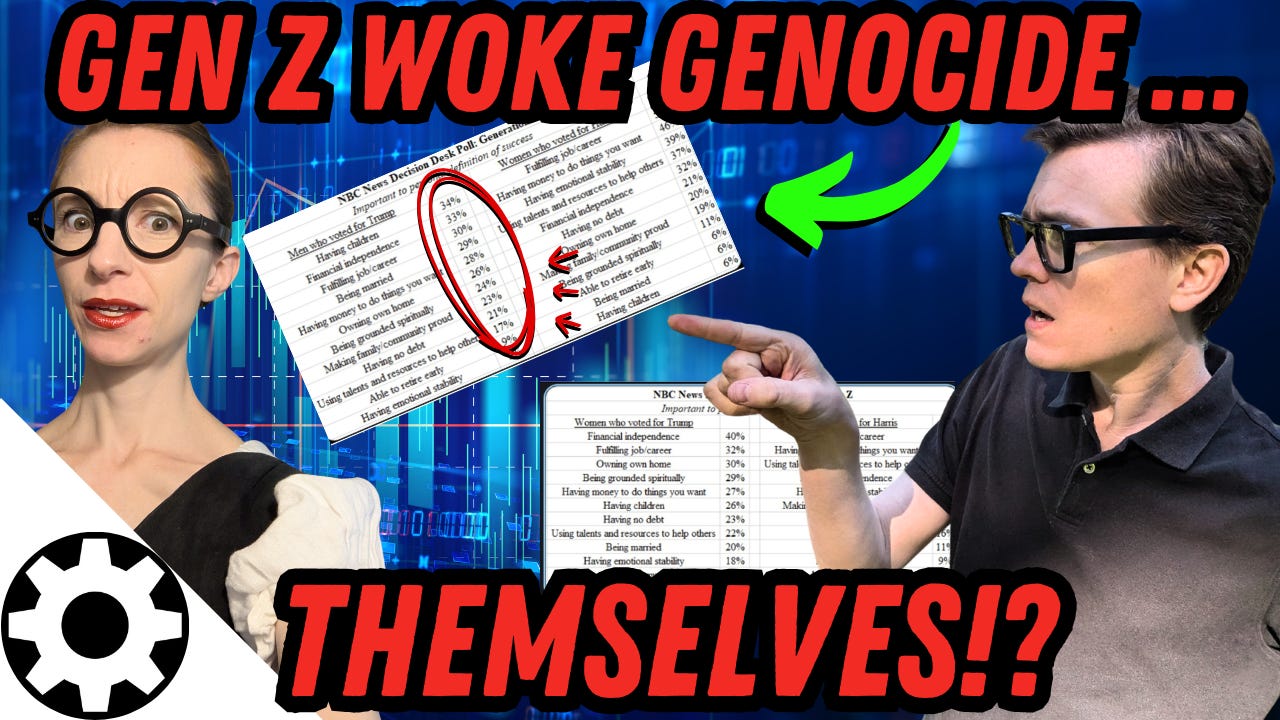
The Statistical Divide In How We Perceive Life
In this episode, Malcolm and Simone dive deep into a fascinating NBC study that explores the stark differences in values, priorities, and life choices among Americans based on political affiliation and gender. They discuss why fertility rates are diverging so dramatically between groups, what men and women who voted for Trump or Harris value most in life, the impact of career, financial independence, and family on personal fulfillment, how cultural and generational shifts are shaping the future of America, the role of marriage, debt, and emotional stability in modern society, and surprising insights from pop culture and personal anecdotes. Listen in for a thought-provoking conversation about the future of the country, the challenges of demographic change, and what it means to live a successful life today. Don’t forget to like, comment, and subscribe for more in-depth discussions! Episode Transcript: Malcolm Collins: [00:00:00] Hello Simone. I am excited to be here with you today.Today we are going to be discussing. A, a fascinating study that came out from NBC that was looking at what was important to men who voted for Trump versus Kamala Harris, and women who voted for Trump versus Kamala Harris. And what you can see is. People who vote for Kamala Harris are not gonna play a big role in our country’s future.No. They’re basically deleting themselves from the population because while there had been differences in the past in fertility rates within these groups, it is exploding. So I wanna talk about these preferences. I wanna talk about why they’re different. And to give you an idea of how different they are.Men who voted for Trump when they were ranking like important for their definition of like success. Literally the top thing. The number one thing was having children.Simone Collins: Mm-hmm.Malcolm Collins: Women who voted for Harris. Literally the last thing of importance to them was [00:01:00] having children. Which only, yeah, onlySimone Collins: only 6% ofMalcolm Collins: women voted for Harris, which by the way, tied with being married.Yeah. And not a lot of interest. People retire early, so like financial stability is the other thing they don’t care about. My God. So thoughts on like the, the, that, that number before we go further so that, because a lot of the numbers that I’ve looked at before show like Democrat and Republicans being like 78% to like a hundred percent different in terms of fertility rates, but this would suggest that it’s dramatically higher than that for this next generation.Simone Collins: Yeah, this doesn’t look good. I, I’m used to seeing much more moderated results from surveys like these, you know, like, oh, they’re, they’re meaningfully different, but this is violently different.Malcolm Collins: Yeah.Simone Collins: And I think it’sMalcolm Collins: because these two groups are becoming more violently different from each other.Simone Collins: Yeah,Malcolm Collins: absolutely.In terms of values.Simone Collins: Absolutely. It is also sobering to me, however, just how low priority having children is for [00:02:00] anyone. That it’sMalcolm Collins: literally the top priority for men who voted for Trump.Simone Collins: Yes. Except everyone else, it, it’s not at the top. Yeah. So let’s, let’s talk aboutMalcolm Collins: this. Let’sSimone Collins: talk about women who vote Trump, women who voted for Trump.It’s right in the middle of the list of, of things presented, although 26% still want to have children. But that’s Malcolm. That’s 26%. That’s a quarter. Yeah.Malcolm Collins: It’s only 26% of voting Who voted for Trump? AndSimone Collins: then keep in mind, so, so men, oh men who voted for Trump, who really value having kids. Sorry, 34% value.That’s a third Malcolm. All like, yeah, no. Yeah. They, sure. Of, of the, of the population polled, but this is if only a third of men,Malcolm Collins: so women who voted for Trump. Like what did women who vote for Trump care about more than having kids, right? Yeah.Simone Collins: Yeah.Malcolm Collins: The top thing for them, and this was more important than them, than having kids with, for many who voted for Trump, was financial independence.Mm-hmm. Which yeah. AndSimone Collins: second is having a fulfilling job career, which is also fulfilling Job. Career is [00:03:00] number one for women who voted for Harris. It’s actually, no, it’s alsoMalcolm Collins: true for men who voted for Harris. So the funny thing, yeah. About the women who voted for Trump, who, you know, care about money and career, right?Mm-hmm. Mm-hmm. Is the way that they framed it in terms of what they picked was financial independence. Then for both the men and the women who voted for Harris, it wasn’t that they wanted financial independence, it’s that they wanted enough money to do the things they wanted and to have a fulfilling job or basically enjoy their day job.Well, I think fertility is, they wanted to have fun and have money, but they didn’t care about independence

Jimmy Kimmel Fired For Lying: Why This Terrifies the Left
In this episode, Malcolm and Simone Collins dive deep into the controversy surrounding the suspension of Jimmy Kimmel’s show, exploring the intersection of free speech, media ethics, and the shifting landscape of late-night television. They analyze the facts behind Kimmel’s suspension, compare it to other high-profile media firings, and discuss the broader implications for truth, comedy, and political discourse in America. The conversation also touches on the evolution of late-night humor, the rise of alternative media, and the challenges of navigating cancel culture. Plus, enjoy candid moments, personal stories, and predictions about the future of media, AI, and global politics. Malcolm Collins: [00:00:00] was Kimmel himself hinting in a 2024 LA Times interview. I think this is my final contract.That seems like enough Jimmy Kimmel was saying. His contract wasn't gonna be renewed. when Alex Jones gets fired for Sandy Hook very few mainstream conservative commentators we're like, oh, they're silencing free speech the Tonight Show was Conan O'Brien was canceled at around 1.4. So at higher ratings than his show was canceled.The American Hall Show was canceled at 1.6. Again, much higher than his show when it was canceled,Simone Collins: your depiction of this as the network taking an opportunity to. Less expensively end a contract that was going to end inevitably.Makes a lot of sense.Malcolm Collins: why does the left even think they have a right to be mad about this?Would you like to know more?Malcolm Collins: Hello Simone. I'm excited to be here with you today. A lot of people have been talking about free speech in regards to [00:01:00] Jimmy Kimmel having his show canceled after.I will note it wasn't that he disparaged somebody, he just lied. Like what he said wasn't even like a normal lie. It was like the antithesis of what is true. I'll play the clip right here for people who aren't familiar with it. Before we go furtherSpeaker: The MAGA gang desperately trying to characterize this kid who murdered Charlie Kirk as anything other than one of them, and doing everything they can to score political points from it.Malcolm Collins: the gist is, is he insinuated that the shooter who killed, charlie Kirk was a Republican, was like a MAGA guy. Like Yeah.Simone Collins: He used the term MAGA orMalcolm Collins: Right. Republican. And that, that's funny because, you know, MAGA is killing MAGA and they don't realize it or won't talk about it. Well, thatSimone Collins: MAGA is trying to pin it on their political opposition and he's basically saying they're shooting their own.Isn't that? Yeah. Which is,Malcolm Collins: I mean, it's, [00:02:00] it's, it's not like a, like he may not have been aware of the evidence or something like this. This is one of the things that is just patently not true. And part of this whole conversation is before I get into he wasn't canceled for the reasons that people are saying, first of all, and I'm gonna go into the data on this, that'll be the first thing we go into.But the, the other thing that's really important to note here is, and, and go into is why does the left even think they have a right to be mad about this? Like his role. Was as a newscaster comedian which is basically our role as well, except he's working for a major station, like a private company, right.He says something in his role as a newscaster comedian, which was the antithesis of true, which was literally made to get people to believe the opposite of what was true on a very sensitive topic, which is obviously like going viral and doing the rounds. And [00:03:00] so the company that hired him, fired him.Simone Collins: Well, the show suspended, right?I Is he fired? I don't think he's fired. ItMalcolm Collins: doesn't, it doesn't matter. The point being is that you should be fired if you are a newscaster for saying something about like a, a mainstream important topic that's just factually untrue. AndSimone Collins: to be fair, there is a. There are many examples of journalists, reporters, et cetera, who have been suspended or fired for reporting inaccuracies.This is Sure.Malcolm Collins: A, a great example, when Alex Jones gets fired for saying Sandy Hook is fake very few mainstream conservative commentators we're like, oh, they're silencing free speech or anything like that.You know, very few. We, we certainly have never argued that Alex Jones shouldn't have faced a lawsuit for that or faced being pulled from air for that. That was something that was factually untrue and very easy to check that it was [00:04:00] factually untrue. Yeah. In fact. In many ways, I think what Alex Jones did was less bad than what, what Jimmy Kimmel did.Why? 'cause at least Alex Jones engaged with the argument and tried to explain why he believed it was fake, whereas Jimmy Kimmel just stated something that was patently false about something that assert asSpeaker 4: sculpted.Malcolm Collins: No. I'll note here. The way that what Alex Jones did

Humans Are Different: Accepting This Is Critical for Space Travel
Join Malcolm and Simone Collins as they dive into the provocative concept of "Cultural Carrying Capacity"—the idea that a region's ability to sustain a population is determined not just by its environment, but by the culture of the people living there. They discuss real-world examples, from Appalachia to Israel, and explore how technology, culture, and even genetics play a role in shaping societies. The conversation covers controversial topics like demographic collapse, cultural differences, ethnic cartels, and the future of human communities on Earth and beyond. This is a public episode. If you'd like to discuss this with other subscribers or get access to bonus episodes, visit basedcamppodcast.substack.com/subscribe

Nepal Just Had a Revolution Because of Social Media (Why This Matters to You)
Join Malcolm and Simone Collins as they dive deep into the recent political upheaval in Nepal, exploring the Gen Z-led protests, government crackdowns, and the broader implications for global politics. Discover how social media bans, corruption, and generational divides are shaping the future—not just in Nepal, but around the world. The conversation also touches on the concept of "Nepo babies," the role of social media in activism, and what these events might signal for other countries facing similar challenges. Stay tuned for insightful analysis, personal stories, and a touch of humor as Malcolm and Simone break down complex issues in an accessible way. Malcolm Collins: Hello Simone. I'm excited to be here with you today. Today we're gonna be discussing going on of Nepal because with all of the political stuff that's happening in the United States right now, I think we've sort of been like broadly aware, like they had like a revolution or something in Nepal, right?Speaker 2: Nepal is seeing an uprising led not by political veterans, but by Gen Z.Malcolm Collins: Like what happened with that and what you're gonna be surprised about. Is how relevant what happened in Nepal is to, what's going to happen in most of the developed world as things continued on the pathway they're going now.Speaker 2: Teenagers and young adults are flooding the streets, furious over us. Sweeping government ban on their digital lifelinesLast week. Authorities abruptly cut access to major platforms like Facebook, Instagram, and YouTube.Simone Collins: Well, and this is after what was happening in Indonesia, and this is also like, as there are huge protests in the uk we're seeing there's unrest is the thing now.Malcolm Collins: Well, yeah. Unrest is the thing and in many cases it's for similar reasons. Mm-hmm. And so let's, let's go in what get, get your butt educated people. Why don't you know about what, maybe you do know about what's going on in the fall, but it's, it's interesting nonetheless. So, police crack down on September 8th, security forces fired.Live ammunition. Live ammunition. So we're talking about like how bad things are getting firing live ammunition, tear gas and water cannons and rubber billets into crowds in your parliament. So. Opening fire into a crowd. Okay. They killed 19 people and injured 200 people.Simone Collins: And this was largely young students, wasn't it?I think it was also a lot of young people, students like who wereMalcolm Collins: killed. Yeah. And there's videos of graphic scenes, including children who were shot in the head. Sparking nationwide outrage and curfews. So this was extreme, and if you're like, well, when do we get this in the us when does the uk You saw this Million Man March on London that mm-hmm.That, you know, anyone who watched the videos can tell was giant. Like they're trying to report it like a hundred thousand people, and it's clearly. Oh. The UK is pissed. It's gotten way more pissed since, since you know, we talk about it being under occupation 'cause we're like, you know, what kind of country bans the flying of their own flags.A country that's currently under occupation. That's the only time you would do that. Yeah. A government would never be afraid of their own flag unless that wasn't who was represented by it anymore.Simone Collins: Exactly. SoMalcolm Collins: when do they open fire on a crowd in London or Germany or Berlin, you know? Or, or, or France.I think it'll happen eventually.Simone Collins: I mean, it helps that police officers in the UK don't have guns. They just have their little batons.Malcolm Collins: Yes. Be beaten Was their fabulous batons. TheSimone Collins: fabulous batons.. Aren't you afraid the fashion police will come and beat you with their fabulous batons? No.Malcolm Collins: Anyway so, protestors, this is September and ninth stormed and set fire to the Parliament, the Supreme Court, which burnt down the Prime Minister's office.Cigna Debar administrative complex and politicians private homes. Private properties like the Hilton and Hyatt hotels along with media houses. EG Kenton per publications were torched. Oh goodness. One tragic incident. It evolved The burning alive of the former P'S wife.Simone Collins: Oh my gosh.Malcolm Collins: So we're talking quite a bit of violence here.Simone Collins: Carnage on both sides.Malcolm Collins: Jail breaks and further clashes. September 9th and 10th mobs broke into prisons in the Western districts, freeing over 12,500 inmates, including politician, rabbi Lament mentioned. I mean,Simone Collins: one imagines the prisons just cracked open from the inside being that over stuffed. My God.Malcolm Collins: The Army was deployed with shoot on site. Instructions assaults on officials, and there's a video of this that I saw. It was just wild. The deputy PM and finance minister was beaten by protestors and you see him like trying to walk, run away and being like attacked by people as he tries to run.Speaker: In the vi

The Violent Far-Left Networks Vance Wants Doxxed (The White House Response to Charlie Kirk)
In this episode of Based Camp, Malcolm and Simone Collins dive deep into the political and cultural controversies surrounding JD Vance, left-wing and right-wing extremism, and the recent events that have the media and political world buzzing. They analyze the New York Times coverage, discuss the rise of armed activist groups, and break down the statistics and narratives around violence, identity, and free speech in America. Expect a thought-provoking conversation with data, personal insights, and a critical look at the narratives shaping our society. [00:00:00]Malcolm Collins: Hello Simone. I'm excited to be here with you today.Today I woke up and I checked my WhatsApp and what did I see? But my, grad school class worrying about a New York Times piece that we're gonna go over. Ooh. Because the New York Times, they're freaking out. ' cause JD Vance has come out and a number of top Trump aide have come out and are like, we need to begin to crack down through law enforcement on far left terrorist organizations.Simone Collins: Oh man, they, they kicked me out. Soon they kickedMalcolm Collins: you out. Yeah, because they, they found out that we were in the New York Times and, and said some, I don't know, whatever thing. But anyway, they, they're very spicy. They yell at me occasionally in this thread. Crazy. But the left is like actually quaking in their boots right now because what we are seeing is finally, and I don't know why the administration did do this earlier they are using the Charlie Kirk assassination as a cover for saying we actually need to deal with left wing terrorism and left wing people are like, oh, no.[00:01:00]We defined what was thought crimes before they get to define it. Now, this is no good. And, and when your enemy is afraid you know, that's when you know you're in the right direction.Speaker 3: What's it thinking, Colonel?Speaker 4: It's afraid. It's afraid!Malcolm Collins: I knew you were gonnaSimone Collins: do that. Of course you were. Of course.Yes. Every damn time.Malcolm Collins: But I wanna go over a few things with this. I wanna go over what they're saying because I think taking time to understand your enemy you know, you can only you can only beat the bug if you can understand the bug, right?Speaker 8: Will thE Brain Bug reveal? Federal scientists are working around the clock to probe its secrets. Once we understand the bug, we will defeat it.Malcolm Collins: Well, that's alsoSimone Collins: why the bugs slurped out humans', brains.Malcolm Collins: Yeah, no, [00:02:00] they're the, this is why they the, the, the, the bug men are doing a 20, what was it, like, a $50 million study to try to figure out what young men think. And everybody remembers this because it went viral and we never did a piece on it. But I should probably see what, what, what results they came to from all that money they spent on how to reach young men.I agree with the,Speaker 2: All right, so let me go through some of our positions and you stop me where you feel uncomfortable. A higher minimum wage healthcare reform.The ball kicking machine, right? Social safety nets. Wait, could you repeat that last one? Sure. Social safety nets before that. Hmm. Oh, the ball kicking machine. I don't like the ball kicking machine. Not a fan either. Yeah. I don't like that at all. Oh, the machine we want in your house to kick your balls all the time.Yes.Speaker: No, that can't be [00:03:00] it.Speaker 2: Okay, so what does our $20 million study show?Speaker: The machine needs more boats.Malcolm Collins: , that that's about what the people came to. But they, they try it on us too, right? Like it's important to, to understand what's going on, but I also want to take time to explore what types of groups they're talking about here, because the left pretends like.There's no radical leftist attack groups out there right now, even though, you know, we just had literally the the trans murder cult with Z Zans that we covered in a recent episode. We had the, the mass shooting. Recently we had the at a school we had the Charlie Kirk deaths, which, if you watched our previous episode, we point out that seems like half a dozen people in the Utah trans community were aware that this was gonna happenBy the way, another I told you so here, so in the first video on the Charlie Kirk assassination, I said, I bet the assassin hasties to the trans community. Everyone is like, when the guy was first caught, they were like, [00:04:00] Malcolm, you see, you got ahead on your skis on this one. You were totally wrong.And then it turns out it's your, or. Recent episode on this that, you know, half a dozen members of the trans community and no one else was aware of the day the assassination was going to take place, and that the guy who did the assassination was dating a trans person. And then in that video I made the second controversial claim that while I was right in my first claim, due to all the people who were aware that this was going to happen b

Evidence of Trans Community's Involvement in Charlie Kirk Killing
Join Malcolm and Simone Collins as they dive deep into the aftermath of the Charlie Kirk assassination. This episode explores the online and real-world communities connected to the event, the reactions from various groups, and the broader cultural and political implications. The discussion covers radicalization, the role of online subcultures, media narratives, and the impact on public discourse. Thought-provoking and unfiltered, this conversation challenges mainstream perspectives and encourages critical thinking about current events. Malcolm Collins: So, in a A Steam group that was titled, read This If You're Gay, which is like, for like memes and stuff.Simone Collins: Oh was, so is that what that one bullet engraving was? If you're reading this, you are gay.Malcolm Collins: Oh yeah, heSimone Collins: mentioned the steam group in the bullet. I hadn't even noticed that. Yeah, if you're reading this, you are gay, Lowell, something like that.Malcolm Collins: They're described a radical, far left trans individualposted quote, you guys, I have something big, big in all caps coming soon. Just be sure to check the news. You'll know it when you see it in quote, oh gosh. Immediately after the shooting they quote tweeted that other quote saying something big's about to happen, saying, well, that's that. So, was Sky Valez? Trans as well. , Released a song a few months before this titled Charlie Kirk dead at 31. And then they released a song titled Charlie Kirk's Death Isn't Enough for MeWe'll be going over the individual who said September 10th is gonna be a very interesting day. And then I plead the fifth. The person who said, Charlie Kirk doesn't know what's going to happen tomorrow. , The person who said, wouldn't it be funny if someone shot Charlie Kirk on September 10th?If it is true that a large number of trans individuals were aware of this attack before it happened, that's something we need to introduce into the public conversation, this wouldn't be the first trans murder cult that we've talked about on this show. Look at the Ians. But if trans murderer cults are becoming a thing, that's something we need to be talking about. I.would you like to know more?Malcolm Collins: Hello Simone. I'm excited to be here with you today, today. We are going to be talking about a number of things related to the Charlie Kirk assassination.I'm not excited about the assassination. I already had the day where I said, I'm not excited to be here with you today 'cause we were talking about that specifically. And that's not what we're talking about today. Today we're gonna talk about a few areas. One, we are going to be talking about a couple convergent phenomenons that are worse unpacking, which is the huge array of people who, with their public accounts are going out and saying.I am glad that this happened. I am glad that this person was killed because of their, you know, very, if you look at his actual beliefs instead of like the random out of context quotes that you'll get from leftists, he's just boomer conservative. He's, he is not new, right. But he is very generic boomer conservative.And these people are saying, no. I,Simone Collins: I would say he's even, even more open than that. Or maybe hippie boomer conservative. Yeah. HippieMalcolm Collins: boomer, conservative. Yeah. He is, if, if you're like, I think people with those beliefs should be. Killed because that's what you're sayingSimone Collins: then youMalcolm Collins: thinkSimone Collins: most centrists inMalcolm Collins: AmericaSimone Collins: or Christians should beMalcolm Collins: killed, basically.Yeah. And the number of people, like, we're gonna go over a number of teachers who have done this, the number of people who make video games and like run studios. We're gonna go over people in the medical field who have done this. You're, you're, and. Two things are interesting. One is that, that they feel that it's okay to say something like, I think mainstream conservatives should be killed without realizing that that's what they're, I mean, because they've been convinced that mainstream conservatives are extremists when they hold positions that most Americans have hold for the past 50 years.Yeah. You know, they won. Feel safe going out and doing this Right. And, and by the way, if you wanna do something about this, don't complain to hr. And Asma Gold said, don't go to the top of your, your company go to OSHA and say you don't feel safe, because then the government has to do something.I loveSimone Collins: that advice. Yeah.Malcolm Collins: And the CEO. Is very likely to respond if a company is getting a lot of OSHA complaints and it can be done anonymously. So you just say, this person is saying that they want to kill mainstream conservatives. Right? Or they think this is a good thing, right?Simone Collins: Mm-hmm.Malcolm Collins: And I don't feel safe in this environment.And, and that will, but the other thing that's interesting is that people are even addressing th

Why Women Can't Find Men in China (Yes You Read That Right)
In this episode, Malcolm and Simone dive deep into the surprising marriage trends in China, exploring why so many men are opting out of marriage despite a surplus of single women. From cultural expectations to economic pressures and social shifts, we break down the data, stories, and theories behind this demographic puzzle. RFab is mostly working: https://rfab.ai/We just started a Patreon! https://www.patreon.com/SimoneAndMalcolmCollinsDiscord: https://discord.com/invite/EGFRjwwS92The School: https://parrhesia.io/student-signupApp to talk with kids: https://wizling.ai/Malcolm Collins: [00:00:00] hello Simone. I'm excited to be here with you today. Today we are going to be discussing marriage in China, which has a very interesting phenomenon in which women, now everybody knows for a long time. You know, the China, because of the one child policy. People didn't want girls because they couldn't carry, carry on the family name.They couldn't, you know, take care of you as easily when they're older, et cetera. And so they would find ways to have boys which meant there was a huge extra amount of boys in China.Simone Collins: Right, right.Malcolm Collins: So you would think the demographic that is having trouble finding a partner is boys. Right. That would be my assumption.Simone Collins: Right.Malcolm Collins: So I'll go over how bad things actually are in the opposite direction. We will then get into the common explanations people have, why I don't think they're good, and what a good explanation is.Simone Collins: Ooh. SoMalcolm Collins: at an event in 2025, this was a Shanghai matchmaking event, [00:01:00] a mass matchmaking of it in Shanghai had nearly 1000 women who paid a 601 entry fee to attend, but fewer than 50 men showed up. Ouch. 600 women to 50 men organizing. It just seems like aSimone Collins: bad marketing thing though, don't you think? No,Malcolm Collins: No, because you'll see that this happens a lot. Organizers noted that when a single man did appear, he was swarmed like a minor celebrity with women rushing to compete for his attention.In some cities, similar events have reported zero male attendees, despite hundreds of women waiting. Gosh,Speaker: In Shanghai, there are plenty of unmarried women coming to my matchmaking events, but hardly any unmarried men nowadays, it seems that for every one Shanghai men, there are several or even over a dozen women competing, and the women are really desperate. It's not that they don't want a partner. If there are no men, how can they find one?So now whenever one man shows up, everyone rushes for him. This has been going on for a long time. A few months [00:02:00] ago, Shanghai held a rather special matchmaking event with an interesting rule. Every woman had to pay 600 UN while men could attend for free, the women expected a flood of male participants, but to everyone's surprise, nearly a thousand women showed up while fewer than 50 men participated.Malcolm Collins: the Gong Zg singles fair in 2024, a government sponsored single fair in Gozo had over 8,000 women registered, but only 40 men attend, resulting to a 20 to one female to male ratio.Simone Collins: What is going on, especially considering the populationMalcolm Collins: skew?Yeah, the, the, the 20 to 25 assault women lining up. To meet the few men present was organizers noting that the men were quote unquote overwhelmed and left due to the intense attention. I can't take all these women done, women get away. MySimone Collins: God,it's raiding women.Malcolm Collins: In the Chong J Blind date market this was in 2023.[00:03:00] Okay.In Chong j, a park based matchmaking event organized by parents saw a significant gender imbalance with, of the 158 profiles posted, 70% were for women. My Lord, in Beijing's Valentine's Day event, 2024, a Valentine's Day matchmaking event in Beijing, organized by a local marriage agency, drew 600 women, but 25 men, making it a 24 to one ratio.Now. Here you might be saying, well, it's because men don't wanna get married anymore in China. So we're gonna go over two polls, right? Okay. One poll done by the 2021 Communist Youth League survey found that 44 percent of Chinese women do not plan to marry, but only 25% of men plan to not marry. So actually men want to get married in almost double the rate of women.And another poll showed that around 75 to 80% of. Urban women under 30, oh. This one showed women slightly higher. Okay. Plan to get married. 30 to 60 to 70% of men.Simone Collins: Okay.Malcolm Collins: So in some polls you see it, but it [00:04:00] seems that it's either around the same or men dramatically more than women want to get married.Sure. So what the f is going on here, right? Yeah. And to give you an idea of how important this is demographically speaking, because people don't realize how modern this phenomenon is and how quickly things are are dropping. Mm-hmm. So in 2024, the number of registered marriages in China hit a record low.Since records began in 1980, f

Why Wokes Would Kill Rather Than Allow Open Discourse (Charlie Kirk RIP)
Join Simone and Malcolm Collins as they discuss the assassination of Charlie Kirk, its impact on free speech, American democracy, and the broader cultural implications. This episode covers reactions from both sides, personal reflections, and the chilling effect on public discourse. This is a public episode. If you'd like to discuss this with other subscribers or get access to bonus episodes, visit basedcamppodcast.substack.com/subscribe
How Europe's Relation With AI Is Erasing It From History (How AI Changes The Collective Consciousness)
In this episode of Based Camp, Malcolm and Simone Collins dive deep into how Europe is rendering itself obsolete in the age of AI. They discuss the shift from SEO to AI-driven influence, the impact of privacy laws like GDPR, and how these changes are erasing European culture from the digital future. The conversation covers the collapse of traditional power networks, the importance of building a unique online footprint, and the new rules for reputation and employment in a post-AI world. Plus, they share personal stories, debate the pros and cons of privacy, and explore the future of secret societies and elite networking. Episode Transcript:Malcolm Collins: Hello Simone. I am excited to be here with you today. Today we are going to be talking about how Europe is erasing its itself and its civilization from history within the context of. AI and we are also going to talk about how AI changes the strategies that we as humans use as we relate to the world around us and ensure our own impact on the future.Speaker: We need to talk. What is that? This is a flying robot. I just shot out of the sky after it delivered a package to my house.So I destroyed the robot. No one is safe from these b******s.Malcolm Collins: Hmm. So to. Start with this second topic here. You used to be, at one point you were the director of marketing at the 45th Most Traffick website in the United States. Yeah. And it's the website where people go and write it was hub Pages is what it was called.Simone Collins: Yeah. And then it was, I think it sort of became.A different [00:01:00] brand over time, but yeah, it it, what was theMalcolm Collins: other brand that bought it? Squidoo.Simone Collins: Yeah. Well, no, it acquired Squidoo, I think. Okay. And then it became something they now call, you're doing something else, whatever.Malcolm Collins: At the time it was really big, right? Yeah. This meant that you were at that point in your career, one of the world experts in what is called SEO, this is search engine optimization.This is how you ensured that when people searched for things, they saw your takes. And not somebody else's tips. Yeah. Mm-hmm. I mean, often it's involved in marketing or whatever, but it, it matters a lot. Like if we were running the prenatal list movement back then, everything we would be focused on is, how do I ensure it ranks well within SEO?How do I ensure, and these systems, you know, companies lived and died on SEO, like Google would roll over in it'd sleep and all of a sudden it's a whole new ball game. Oh,Simone Collins: it would? Yeah. All hands on deck. Emergency situation. At the business, 100%. Very stressful.Malcolm Collins: But we are [00:02:00] moving into a world where SEO is almost irrelevant.Given the way AI works and what AI picks up in terms of ideas is very different than what would've been picked up in an SEO environment.Simone Collins: Mm-hmm.Malcolm Collins: And this really changes a lot of the online game, and I've noticed a lot of people haven't realized this. There aren't relating to this in sort of a sane way yet.Hmm. There's still. Brian Chow, whose article we're going to be talking about today, he, he wrote an article called Public Intellectual Privilege about how you as a public intellectual get to have a totally different relationship with ai, which is true. I, for example, can go to an AI and say, you know, what would Simone Collins like for her birthday?And it'll give me like, great recommendations. What is it telling you ISimone Collins: want for my birthday?Malcolm Collins: Oh yeah. Well you can ask it. You can ask it while, while I'm talking. Okay. What should Malcolm get Simone for her, her birthday. Right. Okay. Yeah. And what you'll see is AI actually knows a, a, a great deal about [00:03:00] you and me.Now there are people from the last generation, like I, I recently had my dad over and I asked AI questions about him and it could find almost nothing about him. Yeah. Despite him being a fairly. Within his time, famous public individual. Mm-hmm. AndSimone Collins: yet heMalcolm Collins: expressed this as a good thing. He's like,Simone Collins: well, I don't like having things about me online.Malcolm Collins: Right. It, it reminds me a bit of, and, and one of the things we're gonna be talking about a lot in this is the, you know, self-defeating obsession with privacy that some individuals developed during the age of deep data where we saw privacy as a way to protect ourselves from large companies. But I mean, also like what do you even protecting yourself from like, getting better Amazon recommendations.Like I, I understand you can be like, well, what if my data is leaked? But like that's data that can be leaked regardless. Right? The thing is, is that between [00:04:00] the era of deep tech. Personal protection, advocacy and the era of ai, the benefits and downsides of AI knowing about you or, or, or companies knowing about you, has done a complete 180.Yeah. Whereas it used to be almost j
What Does A Birth Rate Collapse Future Look Like?
In this episode, Malcolm and Simone explore the onset and implications of demographic collapse. From dystopian AI-managed cities to the technological advancements in artificial wombs, the Collinses discuss the possible futures and scenarios we might face in the next 150 years. The conversation includes detailed insights into how collapsing demographics will impact everything from urban infrastructure to social security. By examining current examples from cities like Detroit and nations like China, they predict what life could be like in the coming decades. The couple also outlines practical steps to prepare for a radically changing world economy, including advice on financial diversification, medical self-care, and home security. Whether it’s the bizarre concept of humanoid robots carrying artificial wombs or the perilous future of nationalized healthcare and social security, this episode aims to provide a comprehensive guide to navigating the uncertainties ahead. Episode Transcript:Simone Collins: [00:00:00] Hello, Malcolm. I'm so excited to be with you today because we are going to talk about what it's actually like to live through demographic collapse, which really matters because. It's already kind of starting. As William Gibson said, the future is here.It's just not evenly distributed. We're gonna go through the good, the bad, the ugly. And I think we're gonna start off with the weird, like artificial wounds being developed in robot humanoid form. So it's gonna fun.Malcolm Collins: This is in China, but this is happening and I, I'll argue that it's probably not real. It's 100% almost certainly not real, but still I'm very artificial ones are being developed.But what I I, the core point of this episode that we're gonna be going over with you guys. Is, what does it actually feel like to live through a demographic collapse, apocalypse scenario? Mm-hmm. What does the world look like in 150 years? And what, and, and keep in mind we're we will be modifying this with what does this look like?Positive AI timelines in neutral AI timelines because it's a huge modifier on how this plays out is ai. You know, you Yeah. [00:01:00] AlthoughSimone Collins: in some ways AI, I'm gonna argue is gonna make things worse, faster for people, so, oh, I agree. ItMalcolm Collins: absolutely will. But, but what I mean here is in my AI scenarios was in the original.Timeline. AI doesn't come online enough to fix everything. And you get a post apocalypse. It'll create some for R Fab AI that, that have this scenario eventually. But anyway this is, this is like. My day SX world, right? Where, you know, our distant descendant 150 years from now is exploring mostly decayed buildings with like a, a slap drone, right?And cities, you can't even walk in them because they're so dangerous. 'cause things can collapse. What if the AI comes online and decides to keep everything up and running? Right. And so it as a function of just, its, its maintenance function ends up keeping up all the roads in all the cities and you just end up with like eerily empty cities with like a very large in bustling like Orthodox Jewish quarter.But like everything outside of that is, is, is mostly just empty [00:02:00] policed by AI drones. So you can't go out and like break the law or steal something. That could be the very weird and real future that our distant descendants could be living through. So let's talk about what these different futures could look like.Simone Collins: Yeah. And since this just came out in the news and we've gotta talk about it because. This is how things are gonna get weird. Probably not through this method, but through others. Yeah. Some Chinese scientist has, has announced that he's going to create a humanoid robot that will gest state humans according to chosen Biz.An article titled China Develops Pregnancy Robot with Artificial Womb to eight Infertile Couples. It reads, reports have emerged. The world's first pregnancy robot is under development in China. The robot is designed in a human. Human humanoid form and is equipped with an artificial womb in its abdomen, allowing it to carry a fetus for 10 months and give birth.A prototype is expected to be released next year with a selling price of around one thou 100,000 Yuan, approximately one 19.3 million. Juan. So the, the scientist, sorry,Malcolm Collins: sorry. Seems to be like for, for, for [00:03:00] context for our audience that's around 14,000 US dollars. Yeah. So likeSimone Collins: this is 100% not gonna happen.One, it's insane. Like, why would you. Why would you put an artificial womb in a humanoid robot? I mean, one thing that, that, that's really weird is so the, the article also reads, the key to the pregnancy robot is the artificial womb technology where the fetus grows inside the artificial womb filled with amniotic fluid and receives nutrients through a hose.Dr. Zang noted quote, the artificial wound technology is already in a mature stage and now it needs to be implanted
Disability Maxxing: The Race to Retardation
In this episode of Based Camp, Simone and Malcolm Collins dive deep into the realities of living with disabilities—both visible and invisible. They challenge the mainstream narratives around disability, self-diagnosis, and identity, sharing personal stories about dyslexia, autism, ADHD, and more. The conversation covers the evolution of what society considers a "disability," the dangers of over-identification, the impact of self-diagnosis, and practical advice for thriving with differences. Whether you’re disabled, neurodivergent, or just curious, this episode offers a candid, sometimes controversial, and always insightful look at what it really means to be “disabled” in today’s world. Episode Transcript:Simone Collins (2): [00:00:00] I don't know. Every time I hear someone talk about their disability, I just think of that IT Crowd episode.Moss: You are disabled. What? Why not? You're not disabled. You're getting in trouble. . It's illegal. I don't think so.Hello? Hello. You are right now. Um, do you need help? I'm disabled. Move back. What are you doing? Don't panic from the dog. What? No.So, uh, what happened? I'm disabled. How, how, what? Yeah. How are you disabled? Uh, they're disabled. Wait, I'm being. Do you have a [00:01:00] wheelchair? Yes. Yeah.Stolen.Simone Collins (2): And the scene of him being lifted down from a bus very slowly in his wheelchair, looking so humiliated and embarrassed and like feeble, attempting to look feeble. It's the best. That is, that is what being disabled is.Would you like to know more?Simone Collins (2): Hello Malcolm. It's so exciting to be speaking with you today because we are both disabled, but we're not disabled the way you would think that it's to say we don't identify with it. A lot of people have asked us to talk about this because. They too have various diagnoses and they wanna know how to, well, what you saidMalcolm Collins: is stop being retarded about being retarded.Simone Collins (2): That's the problem. Yes. People are being way too retarded about being disabled, and I think that we should talk about the right way to dis disabilities. Well, because they'reMalcolm Collins: engaging with, in our society, teaches them to [00:02:00] engage with a disability in a way that is really, really. Destructive. Yeah. And where this came up in one of our episodes is I was reading about Gavin Newsom.And Gavin Newsom had this sob story about how difficult it was to grow up with dyslexia. Oh. And when I was reading it, I was like, I just, you know, his learning disability and everything like that, it just sort of occurred to me, and it hasn't occurred to me in, in maybe half a decade that I have dyslexia.And,Simone Collins (2): and then that prompted people to say, okay, well I have dyslexia and I struggle with it. How did you overcome it? And someone else wanted to know, well, what's, because you called it a learning inconvenience, not a learning disability. And they're like, well, what's the difference between a learning inconvenienceMalcolm Collins: and a learning disability?Like literally Simone and you, and you can back this up. When was the last time you think I have mentioned having dyslexia to you or anyone before that episodeSimone Collins (2): and I'm, I mean I think you'd mentioned having it like once or twicelike, it was only one of those things of like, it didn't matter to you and it, it, it didn't affect [00:03:00] your life.And yet, you know, we have good friends who've gone to like a. Disability camps for dyslexia only. Literally, literallyMalcolm Collins: the only time. And, and Simone is diagnosed with autism, right? So again, like this is something, the only time I remember it mattering in my entire life was trying to remember the difference between a B and a D which I severely struggled with.But other than that, it was completely irrelevant throughout the rest of my life. People think thatSimone Collins (2): your mispronunciations are a result of your dyslexia.Malcolm Collins: Yeah, I, I, I was diagnosed by psychol psychologists about this, and one of the reasons why when somebody's like, what's the difference between a learning and convenience and a learning disability, I suppose as somebody who has a plethora of bows it's, it's how much it actually ended up impacting my life.The, the yeah. One that hit me the most growing up by far the most much more than likely Simone's autism, or I would think even, you know, like having one arm or something like that, is I have dysgraphia. Oh. Which means I cannot hand write. So I cannot, and Simone made jokes about this when we [00:04:00] were dating and stuff like that, said I'd come home and I give her a.A writing or something and she'd go over and she'd be like, Malcolm, like, did you, what was it you thought that I had like tutored up?Simone Collins (2): Yeah. So Malcolm comes home and he leaves on the table this like drawing and a little bit of writing and it's like this, this like stick figure of a man and dr
Why Cousin & Interracial Marriages Have Better Genetic Outcomes
Join Simone and Malcolm Collins as they dive into the history, science, and controversy of cousin marriage and mixed-race marriage. From Darwin’s pro/con list to modern genetic research, this episode explores the cultural, biological, and personal sides of who we choose to marry. Stay tuned for surprising facts, actionable advice, and a few laughs along the way! Simone Collins: [00:00:00] Hello Malcolm. I'm so excited to be with you today because we're gonna get spicy and extol the virtues of cousin marriage and mixed race marriageSpeaker 4: Mirror universe, encounter mirror, universe. This is easy. Yeah, I can pretend to be evil.Deal.Simone Collins: just so you know, wait, hold on,Malcolm Collins (2): stop. Before you go further. Are we talking about mixed race or just cousin marriage?Simone Collins: Mixed race and cousin marriage. Oh, really? Yeah. We're going, we're going in for both dude.Malcolm Collins (2): ContinueSimone Collins: because ultimately I'm gonna argue that you should basically go for one or the other. ButMalcolm Collins (2): Okay.Either, either marry your cousin or someone of a different race. Yeah, dude.Speaker: Athens's log star, date unknown. My landing party is beamed back to the enterprise and found it and the personnel aboard chain. The ship is subtly altered physically. [00:01:00] Behavior and disciplines become brutal. Savage.Speaker 3: Did howthis.Simone Collins: We're gonna go,Malcolm Collins (2): okay. So go into the genetics of this. Go. Go.Simone Collins: Let me. Can I, Mr. Tired man. Just let, let me drive, let me cook. All right. Anthropologists estimate that over 80% of marriages in history have been between second cousins or closer.So basically the default for the vast majority of human history has been people marrying their relatives. And I remember we were walking in, in the Alps in Switzerland, when you really opened my eyes to this, you were like, listen, like look at these hills. Do you think that the people who've lived here for thousands of years were like.Going far away to marry someone. Like it was really hard. They weren't doing that. They were like marrying their siblings. But, so even today, cousin, marriage rates are pretty high, like especially in parts of the Middle East and North Africa and South Asia. They can meet up to 20 to 50% of marriages to date in countries like Pakistan or Kuwait or [00:02:00] Saudi Arabia.But like, even if you're a, a weird, you know, European urban monoculture person, you should probably be cool with cousin marriage. It, it gave us Charles Darwin, who also in turn was a product of a well he was the product of his second cousin marriage, but he married his first cousin. Yeah. And he's, he's the evolution dude.I mean he's the evolution dude. Yeah. Yeah. HG Wells. He was, he had first cousin parents. Tons of European royals, obviously. But even Albert Einstein married his first cousin, you know, like the, the smart people are doing it. And then if we go to mixed race, which mixed race, so, soMalcolm Collins (2): you're a smart guy like Albert Einstein or Darwin, you're marrying your cousin,Simone Collins: I mean.And I, do you know about Darwin's list of like benefits and drawbacks of marriage? This man was very thoughtful about it.Malcolm Collins (2): Oh, he did? He did a list, yeah. Oh mySimone Collins: God. Oh, okay. Hold on. Sorry. Diversion. You don't know this list. Okay. Charles Darwin, marriage pro and con list. This is too good to. [00:03:00] Yeah. So pros of marriage.So yeah, before he, before he married his first cousin he really thought he, like, he wasn't sure about getting married at all. So before he, he, he married his wife he made a pro con list. Pros of marriage as listed by Darwin. A constant companion and friend in old age children who could be a source of love and play charms of music and female chitchat, a home and someone to care for it.Okay. Significant things I got, I, IMalcolm Collins (2): got the pros. So yeah, you gotSimone Collins: the pros. A significant feeling of being humanized and having greater happiness than solitude and. A, a soft wife on a sofa with a good fire, books and music. What a sweet, I loveMalcolm Collins (2): that.Simone Collins: Sex is notMalcolm Collins (2): in there for him.Simone Collins: No, he's, he's autistic. Darwin, he was probably asexual.So the cons of marriage as listed by Darwin. A terrible loss of time preventing travel or pursuing scientific interests. You know, he [00:04:00] had, he had his special interests, Malcolm, the bugs. Okay. The, the animals. Limited freedom to go wherever he pleased. That's a problem. Forced visits to relatives and having to bend in every trifle.He's not down with that. Also, the anxiety, expense and responsibility associated with children. He was not excited about kids. A reduction in funds, meaning less money for books. Ah, less money for bug. Yes. And less time for evenings out with friends and clever men at clubs. So clever men at clubs.Cl

Are Humans A Single Species? (What If We Categorized Humans Like Other Animals)
How Many Species of Humans Are There? In this thought-provoking episode, Malcolm and Simone Collins dive deep into the science and controversy behind human genetic diversity, species classification, and what it really means to be "human." From Neanderthals to modern populations, they explore evolutionary history, genetic divergence, and the social implications of speciation. Expect lively debate, fascinating facts, and a few spicy takes on science, society, and the future of humanity. If you enjoy challenging ideas and want to learn more about human evolution, genetics, and the boundaries of species, this episode is for you! Malcolm Collins: [00:00:00] Hello Simone. I'm excited to be here with you today. Today is almost certainly gonna stand among our most controversial episodes in which we will be arguing. And I'm not saying that, that, that, that I would argue this, but I'm going to say if humans weren't humans, right, we would likely categorize them as multiple different species.Simone Collins: Oh no. Oh God.Malcolm Collins: Oh no. And now you're coming into this and you're likely thinking, Malcolm, that's insane. Like you must be stretching the data here or something. Did you know that there are living human populations alive today that are more genetically distant from European populations than the Neanderthals were?Simone Collins: Whoa. And they were considered a different species. Right? Like technically they're a different species. Yeah.Malcolm Collins: Now, Neanderthals, it did split off much earlier, but that doesn't mean that they weren't more genetically similar to European populations in these populations. Well also 'causeSimone Collins: there's a decent amount of Neanderthal in a lot of Europeans, right?Malcolm Collins: No, [00:01:00] it's 1%. It's not enough to really fudge the numbers in their direction. Okay. So, so, okay. Okay. You might be thinking Okay. No, no, no, no, no, no, no, no, no, no, no, no. Let's go back here. Let's go back. We're gonna go back to okay. We're species. Where does species begins? Darwin's finches. Okay. Darwin's finches.Okay. Darwin's finches evolutionarily diverged from each other and are less genetically different from each other than these humans are from Europeans.Simone Collins: That's a good point.Malcolm Collins: We haven't got yet. We're gonna get into a lot of data here. Oh gosh. It's, it's very uncomfortable data. And I'll at the end, just so you know, so nobody comes in here and says, Malcolm is saying that there are currently multiple species of humans.I'm not saying that we are in the sliders timeline.Speaker: What if you found a portal to a parallel universe? What if you could slide into a thousand different worlds [00:02:00]Malcolm Collins: by the way, for those who didn't watch sliders in sliders, one of the core antagonists, because they could slide between dimensions, was a branch of humanity that evolved from Crow mags. Oh, I didn'tSimone Collins: know that. I didn't watch the show though. So,Malcolm Collins: It's a great show.People should watch it. But anyway one of those great classic sci-fi anyway but the, the, what I think they show in this show is this fundamental fear that if we admitted, like if there are multiple species of humanity around today, like why is that an issue? Right? And people will be like, oh no, no, no, no.They can interbreed and have offspring. They can interbred. Well, you considered Neanderthal a different species, right? Yeah. And you know, just admitted we have Neanderthal DNA and we're gonna go over a lot of species that can I breed and have, and have. Children that inter breeded. So that's not how species are actually [00:03:00] defined, that's how it's defined to you in kindergarten when you don't understand how species work.So how are theySimone Collins: really defined? You're gonna go into that?Malcolm Collins: Oh, I'll go into this. Yeah.Simone Collins: Okay.Malcolm Collins: So, it's, it's one of these things where I think that it, the urban monoculture sort of has this perception that if humans who were different from us actually existed, we would have to eradicate them, or we'd have to like, restructure all of society.Oh. Instead of just admitting like different populations exist that are different in this way and this way and this way. Oh, by the way, you know, this is gonna shock you as well. You're like, oh, you're talking about dramatically genetically different humans. Are you talking about those super black people in Africa?Are you talking about those really fast people in Africa who always win like Olympics and stuff like that? Those African populations? Are actually genetically closer to Europeans than they are to the populations we're gonna be talking about.Simone Collins: No way. Whoa. The BantuMalcolm Collins: that make up like a large African group, right?Ban. Are they the onesSimone Collins: famous for fastMalcolm Collins: runners? No. The Bantu are the ones who are famous for murdering almost

Why is "Us Vs. Them Thinking" Villainized? (When A "Them" Really Exists)
Welcome to Based Camp! In this episode, Malcolm and Simone Collins dive deep into the controversial topic of "us-versus-them" mindsets. Why is this behavior so often villainized in modern culture? Are there situations where group identity and rivalry are not only natural but necessary? The hosts explore the roots of group dynamics, the role of stereotypes, the impact of cultural and political polarization, and how these forces shape our society. They also discuss the double standards in how group pride is celebrated or condemned, the effects of AI and media on social divides, and the future of identity in an increasingly balkanized world. Whether you agree or disagree, this episode will challenge your assumptions and spark thoughtful debate. Malcolm Collins: Hello Simone. It's exciting to be here with you today. Today we are going to be discussing. Us versus them mindsets. 'Simone Collins (3): causeMalcolm Collins: when I, you know, sometimes I'll post transcript of our episodes into, you know, AI to see what it thinks of the arguments that we'reSimone Collins (2): using.Oh no. And it just accuses you of us versus, and, and the mostMalcolm Collins: frequent complaint I get Yeah. Is it uses the quote unquote fallacy of an UPS versus them mindset. A fallacy, and I'm like a, it's a mindset.Simone Collins (2): How is a mindset invalidated, even if it's like an evil mindset? It's not, no, they don't even call it a mindset.Malcolm Collins: They call it a a, a psychological bias, an us versus them psychological bias. And so we'll get into like why ai. Think that this is such a bad thing, because I hear it even more from AI than I do from typical urban monocultural people. But I do see it from the urban monoculture. We'll be like, oh, well that's the us versus them, you know, fallacy or whatever, or bias or you know, psychological, and I'm like.This is actually really messed up. And I would argue that the core reason why us versus them has been so widely framed as a bias is because it allows members of any, any potential group and the urban monoculture has evolved this as a framework. The urban monoculture is sort of what other people call, like woke or broadly progressivism.It allows. And, and what's what's interesting is, is they will tell you, don't use an US versus a mindset while using it themselves when talking about the deplorables or, or, or, or Trump voters or something like that. Right? Hundred percent. Yeah. Like clearly they have an US versus mindset, but then they will tell you, Hey, you know, you, you can't adopt this mindset.And it's a strategy that specifically evolved to prevent you from seeing them as the enemy and rallying around opposing them. There is a them and they are working against your interests. Like, this is the thing and this is why I'm so against this. Hey, I hate us versus them. It makes sense for you as a human to divide humanity into groups that oppose your interests and groups that are aligned with your interests.Because there are groups that are opposed to your interest and even more than just groups that are opposed to your interests. There are, groups that are explicitly around, you know, whether it's racial or gender or ethnocultural groups that have a banded together specifically so that people like them can outcompete people like you, right?And they make it, the urban monoculture makes it. The most punishable for individuals within the groups that it met. It victimizes most frequently to create a group identity as an us to oppose any them. Mm-hmm. So, recently there was a post I saw that I saw it was really shocking that somebody just nakedly had a publication turned down because the paper right now was not taking publications from white men.We're just not gonna do that. No, no, we haven't done enough. None. That is just. Racism and sexism. But if you said, Hey. White men feel that there is a group of individuals who are opposing them in part around gender or ethnic lines and that it makes sense for them to have some sort of comradery around that in terms of opposing that the urban monoculture would.Completely have a, a conniption fit. Whereas if you look at the culture, like the groups that it, it, it, it uplifts like it well pretends to uplift. See our episode on God, what, what's, what was the episode title where we showed that basically it equalitySimone Collins (2): is something like, oh, the racism of equality.Racism of equality, yeah.Malcolm Collins: But like black culture, for example a if you look at Kwanza, like a specific part of Kwanzaa is only shopping at black owned businesses.Simone Collins (3): Mm-hmm.Malcolm Collins: Like it doesn't, it doesn't see any issue as this yet. If somebody said, I only wanna shop at white owned businesses. Right. And, and, and keep in mind, I mean, presumablySimone Collins (2): just imagining anyone being like, support your white-owned businesses this week, that would, I just, yeah.I don't know, like.Malcolm Collins: Well, I mean,
Behavior Disfunction Mirroring Zoo Animals (Zoochosis): True Cause of Birth Rate Collapse?
In this episode of Based Camp, Malcolm and Simone Collins explore the fascinating parallels between human behavior in cities and animal behavior in zoos. Drawing on research, personal anecdotes, and cultural observations, they discuss how urban environments can lead to repetitive, compulsive, and sometimes self-destructive behaviors—mirroring what is seen in captive animals. The conversation covers fertility rates, social aggression, learned helplessness, and the psychological effects of modern city life, all with the Collins' signature blend of insight and humor. [00:00:00]Malcolm Collins: Hello Simone. I'm excited to be here with you today. Today we are going to be discussing an idea that I had that was prompted by something Ruby Yard was saying on what of Alt Hiss, no, which is that if you look at many of the odd behaviors that you see in cities today among humans, many of them look very similar to the types of behaviors that animals begin to make in captivity, specifically mammals in zoos. And a lot of people know the, you know, the mouse utopia experiment, right? And they try to draw a, a line between the mouse utopia use experiment and the ills of modern society and TikTok and falling fertility rates, and it's like, that's all well and good.But the problem is, is that. We have evidence and you could find it online if you, if you Google about this, somebody did a extremely long blotted post that the Mouse Utopia experiment may, may have basically been faked. Like we don't know for sure. It, it basically, it, it, it was of that period of experiments in like the 1950s when [00:01:00] like nobody really cared if it was true or not.They just cared how, how spicy it was. Yeah. It wasn't likeSimone Collins: pre-validation. There wasn't, yeah.Malcolm Collins: Go for it. Sure. Yeah, sure. Whatever. The, the, you wanna put this in your backyard? Yeah. It'll be full of dead mice soon. Sure. Whatever. Yeah. Basically what it appears they may have done is run a bunch of trials and then only reported the ones that were, that got interesting results in a very uncontrolled format.Mm. And, and, and also that that only really gives us like one experiment to look at. But if instead of correlating with mouse utopia experiment, we correlate with well-known and well-documented behavior from zoos.Simone Collins: Ooh, there's a lot of zoos and there's a lot of zoo animals. Yeah, aMalcolm Collins: lot of, and this could be upstream of everything to do with fertility collapse because as you know, one of the most, oh yeah.Simone Collins: Like you, even you, you know, when we used to start in the very beginning talk, talking with media, you talked about people breeding like caged pandas.Malcolm Collins: Yeah. People know caged pandas are famously hard to breed. They, the pandas [00:02:00] don't really breed in captivity. But lots of animals don't breed in captivity.There, there are many species of wild animals that will almost not breed in captivity, which is odd. You know, people can look at humans not breeding and they're like, it's really weird because like evolutionarily we should be programmed to like, want to do all of this stuff stuff. Well, andSimone Collins: especially like if you've got nothing but time, what are you gonna do?But bang each other. What'sSimone Collins (3): going on here?Malcolm Collins: Yeah. And, and then literally it is very similar to cities. They are in a confined area but natural predators are removed and they are given all the food that they could ever want. Yeah. And they are just, tons of toys are thrown in with them like with us, like being on our phone or something like that.Yeah. You're given all of the stimulation so they can masturbate these traditional instincts. When I say masturbate an instinct, what I mean is masturbation. As a concept is, is is when you are using a a stimuli that is not the stimuli that a pattern of arousal or pleasure evolved to be triggered by, [00:03:00] to trigger that.Yeah. And so it could be, you know, your. Exploration stimuli from like a video game or something like that. That's a form of masturbation, right? Mm-hmm. Or as we've said before, you know, having pets instead of having kids is a form of masturbating specific child rearing instincts for some individuals.But anyway, so very, very, very similar circumstances and. I'm just gonna dive into it because I thought it was really interesting and, and I'm, he wasn't the first person to go into this. Somebody wrote a book on this subject. I think it's far back as the 1950s.Simone Collins: Interesting.Malcolm Collins: So, yeah.Simone Collins: Yeah. And I, I, I did a little bit of, of searching around this topic, like wondering what I immediately wondered and I, I actually have a theory as to why this is the case.Also, it sort of dovetails with what we said, so we can kind of bear our notes and diagnoses. Ooh. Yeah.Malcolm Collins: Okay. Animals and zoos often exhibit zoos, repetitive purposeless actions due to st

Trump's Unusual Beliefs About God & the Afterlife (An Investigation)
In this episode, Malcolm and Simone delve deep into understanding Donald Trump's theological beliefs, challenging the initial assumption that Trump lacks a specific theology. The discussion uncovers that Trump has a detailed personal theology heavily influenced by Norman Vincent Peale's teachings and 'The Power of Positive Thinking.' This self-help-centric Christianity shaped much of Trump's behavior and decision-making. Additionally, the episode explores Trump's recent efforts in international peace negotiations and how his contemplation of legacy and afterlife might be influencing his moves to end conflicts around the world. Malcolm Collins: [00:00:00] Hello, Simone. Today was, it's one of these episodes that's just stunning for me because I come into it being like. You know what? I'm gonna try to untangle what Trump's true theological beliefs are. Okay? And my. Intuition going into this is he just didn't really have a theology. And he just had never thought deeply about this particular subject.Right. Just Trump isSimone Collins: great and everyone knows it.Malcolm Collins: Yeah, he's the best. As I tied dug into it though, I learned that that is very much not true. Whoa. As a. Fairly detailed theology that he doesn't share with the public a lot. So just, you know, this is this, it says not what he signals to the public anymore.But when you understand his theology, a lot of his behaviors that otherwise seem. Crazy or insane or don't make sense all of a sudden makes sense. In fact, I would argue that to understand and predict Trump's behavior, you need to understand his theology. And the other weird thing about this [00:01:00] theology is while it is not a traditional Christian theology, it came from a traditional Christian Church.Oh, but just a unique one. Oh, wow. And, and we're gonna go further here because I also think that his theology has changed a lot recently, given that he thinks he's about to die or not about to die, but he's sort of like, it's the end of my life. You know? He's, he's contemplating his legacy. Yeah.The, the quote recently from him that I absolutely love is if I can see, he's talking about ending the war in the Ukraine. He goes, if I can save 7,000 people a week from being killed, I wanna try and get to heaven if possible. Trump said, I'm hearing that I'm not doing well. I'm really at the bottom of the totem pole, but if I can get to heaven, this will be one of the reasons.And I just love this idea of Trump beginning to get worried. Because, you know, he is cheated on spouses. He doesn't really go to church. He doesn't seem to understand much about the Bible. If we're, if we're gonna talk about, like, not understanding the, there's the famous quote [00:02:00] that I love. In the Bloomberg interview when asked what his favorite Bible verse is.And you know, he just like, the Bible's my favorite book.Speaker: Okay. You mentioned the Bible. You've been talking about how it's your favorite book. And you said, I think last night in Iowa, some people are surprised that you say that. I'm wondering what one or two of your most favored bible, uh, verses are and why? Well, I, I wouldn't want to get into it because to me that's very personal.Trump: You know, when I talk about the Bible, it's very personal there. So I don't want to get into verses. I don't want to get into. There's verse, it means a lot to you that you think about or cite. The, the Bible means a lot to me, but I don't want to get into specifics, even to cite a verse that you like. No, I don't wanna do that.I mean, you, an Old Testament guy or a New Testament guy. Uh, probably equal. I think it's just an incredible, the whole Bible is an incredible, I joke, uh, very much so. They always hold up the art of the deal. I say my second favorite book of all time, but, uh, I just think the Bible is just something very special.Malcolm Collins: I don't, I don't know. I don't know. I can't name a book from, I can't name a quote from it, but it's my favorite book. And usually justSimone Collins: a very personal thing. I'm not gonna talk about it.Malcolm Collins: Yeah. And then, and then [00:03:00] during a Family Leadership summit interview, he said.Why do I have to repent or ask for forgiveness if I'm not making any mistakes? Which is a very Trump thing to say. It's, it does not align with traditional Christian theology. Then once when he was giving a speech to a university campus, he called, and this is the type of thing I do because I don't go to church often.He said two Corinthians instead of second Corinthians.Speaker 4: And I, I asked Jerry and I asked some of the folks, because I hear this is a major theme right here, but two Corinthians right, two Corinthians three 17,Malcolm Collins: oh. Which is exactly the type of thing I do. I'd say two Corinthians or something. Totally. Yeah. But I do, I do that because I don't go to church and I'm reading from a sheet of paper. Yeah. That,Simone Collins: that's more like, yeah. Just spoken n

My Gender Identity is Murder: Why Do Trans People Struggle Not To Kill?
In this intense discussion, Simone and Malcolm delve into the phenomenon of trans mass shooters, analyzing statistics and counterarguments presented by progressive media. They highlight the difference in rates of mass shootings among trans individuals, cis males, and cis females. The conversation explores broader cultural issues, questioning whether mentally disturbed individuals are more prone to become trans and commit mass shootings. Additionally, the ethical implications of kink-related behaviors and self-control among trans individuals are examined. The video concludes with a critical analysis of notable trans mass shooters and the potential cultural culprits behind these violent impulses. [00:00:00]Malcolm Collins (2): if a person comes up to you and that person says, I'm trans. Mm-hmm. Interpret that asSpeaker 7: Nice to meet you, . Listen, if you ever need anybody murdered. Please give me a call and you, you're giving him card. No.Code of ethics. I will kill anyone anywhere. Children, animals, old people, doesn't matter. I just love killingSpeaker 6: you.Malcolm Collins (2): Okay. Um.Speaker 4: Oh God.Would you like to know more?Malcolm Collins (2): Hello Simone. I'm excited to be here with you today. Today we are going to be talking about the phenomenon of trans mass shooters. And what I love is the way that Progressive media has covered this is they're like, well, the number one group that's still mass shooters, like this is all fake white males are still the most likely to be mass shooters.Like Yeah. Because there's a lot in more white males than there are trans people. But if you normalize for the population, okay. Even if you take the lowest rates. So I'm not including any of the edge cases, whether or not this person is trans. Yeah. 'cause there wereSimone Collins: some non-binary shooters out there too.Malcolm Collins (2): Some [00:01:00] non-binary. Yeah. Some were trans by one way of looking at it, not trans by another way, but take just a confirmed five tra trans mass shooters since 2017. Now I'd point out here there have been more trans transmat shooters since. 2017, then there have been cis female mass shooters since the eighties.But if you just look at the rate of trans mass shooters you get , per million, 1.759 mass shooters, 1.79. If you look at cis women, it's 0.024. If you look at cis males, it's 0.27. So the rate that a trans person becomes a mass shooter is literally 700% the rate that a man becomes a mass shooter.Stanley, well, do you want to tell your father about what happened at school today? I flunked my math quiz. No, the other thing. What other thing? Oh, the school shooting? Yes, the [00:02:00] school shooting! Oh yeah, some kids shot up the school. Was it you? No.Did you get shot? No. Oh. Well, what's this about failing a math quiz?Malcolm Collins (2): Well, I'll tell you what,Simone Collins: you know, sometimes women struggle to break G glass ceilings, and this is one of those, you know, they just weren't. Yes. It's like they weren't making the quota. This was deeply uneven. Sometimes you just gotta send a man in to do, by the way, a man's job.Malcolm Collins (2): If, if you include the disputed ones as well, it goes up to 3.57.Dog. So, so we're talking, like, we're talking like, you know, what would that be, like 20 times higher or something? So is this just anSimone Collins: issue of like, today , in our modern time post 2017, that deeply disturbed, like mentally disturbed people are way, way more likely to end up going trans because that's just kind of like this catchall solution we throw people into in their youth?Or is this something else? What's going on? No, I thinkMalcolm Collins (2): it's something else. I think it's something totally else. But what I'm gonna point out here is that if a person comes up to you and that person says, [00:03:00] I'm trans. Mm-hmm. You need to interpret that asSpeaker 7: nice to meet you, . Listen, if you ever need anybody murdered. Please give me a call and you, you're giving him card. No.Code of ethics. I will kill anyone anywhere. Children, animals, old people, doesn't matter. I just love killingSpeaker 6: you.Malcolm Collins (2): Okay. Um.Speaker 4: Oh God.Malcolm Collins (2): But I'll, I'll cut to the chase because in this episode we're going to go over a lot of cases of female mass shooters. Just to go over like how rare they are, how, how, how strange they're, we're gonna debunk A lot of the stuff that's out there right now people will say, well, this is really a white male problem because white males are overrepresented within mass shooters and trans people aren't really women.And it's like, okay, except there's a few problems. There have been. If, if I look at like, let's say trans people are not actually the gender that they transition into. Right? Okay. Yeah. Why are there so many male or female to male trans mass shooters? Then why is it that there have been more female to male trans mass [00:04:00] shooters since 2017 th
US Gov & Scientists Prove the Supernatural? (The Telepathy Tapes & Project Stargate)
In this episode, we explore the fascinating yet controversial realms of telepathy, remote viewing, and other supernatural claims. We take a look at the Stargate Project, a secretive U.S. government experiment aimed at investigating paranormal phenomena during the Cold War. We discuss key figures involved, including advocates who believed in abilities like phasing through walls and remote viewing secret installations. We delve into the credibility of these projects, touching upon elements such as the involvement of high-ranking Scientologists and various debunked claims. Additionally, we analyze the telepathy tapes, mind reading claims, and the influence of mysticism on modern thought. Malcolm Collins: [00:00:00] he was a key sponsor and advocate for the Stargate Project, he believed soldiers could phase through solid objects by harnessing natural power and positive thinking. Okay, I'm picturing so many people just running into walls hold. He reportedly attempted this himself in his office, repeatedly running into a wall and injuring his nose.Oh yeah. 'cause you gotta believe it. So you gotta lead with your face. Positive thinking. I just can't let it get me down. But it's just I bet if I have positive enough thoughts, I'm gonna phase through a wall. Like, where's the metaphysics of that? What religion believes this?The telepathy tapes Simone is actually diagnosed autisticSpeaker 6: You can read minds.Simone Collins: And people are having the same reaction.Would you like to know more?Hello Simone. I'm excited to be here today. Today we are gonna be talking about two things.Malcolm Collins: The telepathy tapes [00:01:00] and the various government projects that claim to see the supernatural. Project StargateI'm going into both of these because these are two areas where I have seen otherwise rational people like Rudyard, for example, one of all his who's been on the show he has one like episode that like very earnestly looks at these government programs. Oh, and listen to that one on an airplane. Yes.Speaker: Premier me. A solution of Annica Montana Stack. Strength. One point in a million are sure it looks serious. You're right. We need to strengthen the dose. One point in 10 million the chakras are fading. We need some crystals that there should be some purple T quartz. Damnit, you're right. Make that aquamarine quartz. .Speaker 2: Have a look at this, Simon.What is it? Don't think this poor chap's got long to live. Why not? It's lifeline very short.Speaker: Unless. Wait, why we could try drawing a bit more lifeline on with Biro? It didn't ever work.You got a better idea.Malcolm Collins: Yeah. And I'm just like, [00:02:00] oh. Boy you maybe should have dug a bit deeper on this before taking this at face value. Basically when we get to it, what you're gonna learn is like all of the high level people were also high level people in ScientologyOkay. To clarify here, only like half were in Scientology. The other were in other weird mystical traditions, but we'll get into those specifically when we get to it.Malcolm Collins: and in ScientologySimone Collins: specifically. Yeah. It was basically a Scientology into the US government.Malcolm Collins: Um, It was, it was basically a, a a, a small branch of the US government that Scientologists extremists took over. And how do we get this? Made a bunch of reports. And the people like Rudyard then come across them and take them seriously. But it's the same as we go into the telepathy tapes, we're gonna go into, Why people believe them because you, the way they present them, it can seem plausible. And then we're gonna go over historical cases that were similar to this, like the case of clever. How do you know? Clever. Clever Hans? Maybe clever how the horse that could do math. [00:03:00] No, basically this exact same thing happened before, and it's funny because in the, in the telepathy tapes, they take the methods they're using on humans and they apply them to animals in one episode.Oh no. And they're like, animals are telepathic too. It's like, oh my god. Literal, clever hosing it here. Well, you know what,Simone Collins: this like, I can't help but think of this concept of people thinking that autistic people can, can read minds or are telepathic. Because of that one lander line where the female journalist is like, she confesses, she says, I.Was bulimic. What? And lander's like you can read minds. And Hansel has this great like, and that's, I feel like I am autisticSpeaker 6: You can read minds.Simone Collins: And people are having the same [00:04:00] reaction. You can read minds,Malcolm Collins: oh my god. By the way, Simone is actually diagnosed autistic as are. I thought you were gonna say, I'mSimone Collins: actually telepathic.Malcolm Collins: Actually. Telepathic. Okay. So parents and caregivers report that their children can quote, unquote read thoughts such as guessing random numbers, words, or colors that someone else is thinking of, even when separated by room
The Data: Women May Have Broken Western Civilization
In this episode, Simone and the host delve into a controversial discussion on the impact of women and feminist movements on society. The conversation heavily references a piece by Arctotherium titled 'Progress Studies and Feminization', which argues that the rise of women in politics, the labor force, and academia has led to a decline in societal progress and optimism. The host presents various graphs and statistics to support this narrative, highlighting trends in energy consumption, publication rates, and language use from the 1960s onwards. They discuss the role of rationality, reason, and scientific progress, contrasting the forward-looking optimism of past decades with contemporary societal anxieties. The episode also touches on the gendered differences in attitudes towards technology, housing, and environmental issues, suggesting that the increasing influence of women in cultural and political spheres has had a conservative effect on societal progress. Malcolm Collins: [00:00:00] Hello Simone. Today we are going to be discussing how women destroyed society. And because ofSimone Collins: course they did.Malcolm Collins: Of course they did. No, actually, so people, they go on our podcast and they might think we're gonna do one of our sort of bait and switch things here, or I'm like, well, women caused some problems, you know?No. And, and especially, no, you're like, butSimone Collins: actually no, seriously myMalcolm Collins: words, I'm gonna be going over somebody else's piece. So no one attribute this to me. I'm not saying, I'm just saying it's worth talking about this piece. You're just asking a questions lot of, and statistics. Shows how society began to fall apart with the rise of the feminist movement and women participating in politics in the labor force.Mm. And usually I'm not like particularly compelled by these sorts of cases if people know me. Mm. In this instance, I found it. But what's interesting is the entire piece, if you didn't like Wade through the first part, which I'm not gonna share with you guys 'cause it's boring. Thanks. [00:01:00] You and, and the title, you wouldn't know that that's what the piece is.The piece is progress Studies and feminization. Okay. And, and then the subtitle is, you Can't Undo just one part of the 1960s, and it's by our favorite, one of our favorite writers for this show is Arc Ethereum. Oh, he's fun.Simone Collins: Oh, and he also, yeah, no, he's definitely, it's Women's Fault. So, okay.Yeah. Okay. Ardo fine. Let's hear your Ethereum.Malcolm Collins: No. Yeah, and, and the broader thing is, and I, and, and I'll note here, I'm not saying all women are a danger to society. I'm just saying non-autistic women are a danger to society. Thanks, Malcolm. Like, women, like my wife are fine. You're, you're a sweetheart.Simone Collins: Well, I mean, yeah. I mean, just, just to do basic female functions, I have to take the same amount of hormones as a trans woman, so. Can we really call me female,Malcolm Collins: right? Yeah. So here I'm gonna pop on screen a graph that was in this first rambling bit he did which is the Henry Adams curve of energy consumption.And it's supposed to go up [00:02:00] logarithmically, but actually what we can see here is around the 1960s it stopped, and if anything started declining while before, perfectly fitting to the curve. Then if we go down to this next study here we can look at total pages published in the federal Register, thousands of pages per year.We can also see a logarithmic curve going up until we hit around 1975, and then it basically stops. Okay. Now to go into the piece where it starts getting interesting. We live in a age that has lost its optimism. Polls show that people think the world is getting worse and not better. Children fear dying from environmental catastrophe before they reach old age.Technologists are as likely to be told that they are ruining society as they are bettering it. Da da da. And then he is right. This change is quantifiable books written in English, French and German. The Fri three major languages of the modern West showed a continuous rise in the number of terms relating to progress [00:03:00] and the future from around 1600 to 1970 when things suddenly took a turn for the worse.And here I will put on a screen, a graph here, and what you can see here is. Going into the 19 hundreds basically until you get to around the 1970s. Two things happened in the English language. People stop using terms that stand for progress or the future, like moving forwards. Oh, and they start using more words that are associated with caution, worry, and risk.Oh. So society basically became worried about the future getting better. And if you go, and we talked about this in our episode nationalism saves. Countries, and it's not just nationalism, it's retro futuristic nationalism where if you go to the 1950s sci-fi, it's just very forward looking. Very excited about the future.You know, it's all, you know, rocket ships a

An Anthropology of The Woke Right (Why You Need US)
Join us in a riveting discussion on the evolution of the concept of the 'woke right,' which has become a contentious tool for targeting individuals like us. We will analyze a viral piece that breaks down the strategic methods employed by what is referred to as the 'non-woke right.' We delve into the nuances of identity politics, the transformation of the right-wing movement, and the criticisms from traditional conservatives. This episode examines the clash between the traditional right and the modern, so-called 'woke right,' exploring the contention over cultural norms, skepticism, and the evolving political landscape. Malcolm Collins: Hello Simone. I'm excited to be here with you today. Today we are going to be discussing the concept of the woke, right, and how it has evolved to be a tool to attack people like you and me. And we are also going to be discussing the play by play of a piece that has sort of gone viral on this.That is a tool for how the the non-work Right. Can attack and destroy people like you and me.Malcolm Collins (2): Ooh, okay.Malcolm Collins: When the term was forced popularized by James Lindsay, I don't know if he coined it, but the, the broad vague idea is it was for sort of right wing extremist who used some tactics that reminded them of the left, like not really engaging in debates, not really engaging in the other side, critically, et cetera.Simone Collins: Identity politics. Right.Malcolm Collins: Identity politics. Yeah. It has dramatically evolved since then as a concept to mean the new Right. As a political movement to very explicitly attack people like you and me. And so to give you what I mean, I'll be reading a bit from the piece here. This, I obviously, I skip around to the center where it gets into the, like the meat of the topic.Hmm. Title, the woke wright stands at the door. And so they say the MAGA right has strange and sinister qualities, which look nothing like the traditional religious wing of conservatism. Familiar from our era of William F. Buckley, or anti-government libertarian conservatism of Barry Goldwater and Ronald Reagan.It's. Anarchic rejection of truth. It's Nietzsche esque embrace of power as self-justifying it's unashamed anti-liberal and it's glee and transgressing boundaries and giving offense are something new to the right. And I'm gonna stop there before I go into the next part because I'd actually say everything he says so far.Exactly this channel. Yeah, not the, not the traditional religious, right? Yeah. Certainly we're not libertarian either. We have criticized libertarianism the rejection of what he calls truth. Now, keep in mind when he says truth, he'll get into what he means by that later. He means the truth that's decided on by the elites.Oh, no, basically. And how dare they question what, what us and the, the intellectuals say um, on really. AndSpeaker: to protect the world from devastation,Speaker 2: to unite all peoples within our nation toSpeaker: denounce the evilsSpeaker 2: ofSpeaker: truth andSpeaker 2: love. To extend our reach to the stars aboveMalcolm Collins: then we talked about the, the nietzschean embrace of power itself justifying first we're fans of niche. We've said this in other videos, not enough to pronounce his name correctly. I read his stuff and I thought it was good.It was more like I went to his stuff while we were doing a podcast. 'cause I was like, how bad can this really be? And I'm like, oh. This all sounds fairly inoffensive and like decent advice and even that niche guy. Decent advice. Yeah. Niche. Look, I'm not gonna dirty my mouth with un-American words or, or sounds Okay.Again, transgressing boundaries with like, with a joke like that. Right. You know, sort of playing into this, the idea of power is self-justifying. Well, I wouldn't say that the do right sees power is just self-justifying. It does see power as and we'll get into this because we're also gonna get into, in this, this video, the concept of is there such a thing as like, like should we hold to the concept of no enemies to the right?Simone Collins: And is it a reference to the PHAs.Malcolm Collins: Oh, it might be. But the, the point of it means it's like the right wing and the right wing generally doesn't, is it doesn't eat its own in the way the left wing does. Mm-hmm. And it's like, let's not start that in the way these people trying to coin this new, this woke.Right. Yeah. Because otherwise you'llSimone Collins: break the line. That's why it was to the right shield. But I'llMalcolm Collins: say, and we'll get into this later. Okay. Yeah. Is there is actually utility and being able to call out certain types of right wing beliefs as damaging and traitorous. Yeah. And here I'll get into, I'll, I'll use sort of Nick Fuentes as an avatar for this is specifically we need to, well, we shouldn't call out an individual for having beliefs that are extremely right wing.I, I think that just shutting down conversation, not engaging with that stuff, I thin

The Left Discovers Trolling: Trolling No Longer Cool (Gavin Newsom's Glow Up)
In this episode, we delve into Gavin Newsom's recent attempts at political trolling and discuss whether trolling is a necessary part of modern American politics. The conversation touches on Newsom's persona, his political strategies, and his attempts to mimic Donald Trump's trolling techniques. We also compare Newsom's affluent upbringing and political maneuvers with JD Vance's rise from poverty, highlighting how these contrasts shape public perception. The episode critiques Newsom's authenticity and examines his political record, including controversies and his handling of California's issues. Tune in to hear an in-depth analysis of one of America's most polarizing political figures. Malcolm Collins: [00:00:00] Hello Simone. I am excited to be here with you today. Today we are gonna be talking about Gavin Newsom and he figured out trolling. And the last didn't exactly figure it out. You know, he, he's sort of the human personification of the left can't meme. But he has started trolling and the left is loving it.So it's like in JurassicSimone Collins: Park when the Raptor has figured out how to use door handles.Malcolm Collins: Yeah. Except not really. Oh,Simone Collins: God. But he's getting traction. I just think it's, it's too soon. He's, I, IMalcolm Collins: also, it's a wider theme of this episode. What I want to ask is, 'cause some people have been saying this, they go, you do not appear to be able to have a voice.Was in modern American politics without trolling that trolling is a necessary part of playing the current political game. And I would argue yes, yes it is. And this isn't necessarily a bad thing as a lot of people say. I mean, we have grown our political platform through trolling. , And I love that the left is [00:01:00] attempting to troll now because it comes off.So bad,Sorry, I re remembered that we have a bunch of non-American viewers. , Gavin Newsom right now is the Democrat's top contender to be running against JD Vance in the next presidential election cycle. I.Malcolm Collins: so this, this ends up coming so bad because people are, are sharing these photos of Gavin Newsom again. Oh, you showed me one. Yeah. And Gavin Newsom. Looks like a bully. Like if you look at these, not like a bully, but like your standard rich bully kid.Like if physio fmy as anything, he looks like a bully. And if you look at he looks American psycho. Yeah, he looks like an he. He and he acts like it, like even today. So if you could, Gavin Newsom, acts like Patrick Bateman from America Cycle. Like his whole thing feels so constructed. He saw Trump doing well.By trolling people. And so then he goes and tries to troll people. If you look at his political rear up this, [00:02:00] he's just been like a chameleon. Copying and copying and copying whatever he sees somebody else doing.Speaker: There is an idea of a Patrick Bateman, some kind of abstraction, but there is no real me only an entity, something illusory.And though I can hide my cold gaze and you can shake my hand and feel flesh gripping yours, and maybe you can even sense, our lifestyles are probably comparable. I simply am not there.Malcolm Collins: I mean, I think Patrick Bateman is a much better name for him than no Scum, which is Trump's but Trump by the way. Got that. And I'll play a video of, of him admitting this, but he said that some kids called him this in seventh grade and it hurt his feelings.Speaker 2: I have my kids' friends. Call him my kids' new scum that I get 'cause I was called that in seventh grade,Malcolm Collins: oh. And so Trump picked upon it. Oh God. Remember having his feelings hurt for something so effing stupid from the seventh grade. Oh, good heavens.[00:03:00]The progressives like, Trump can sniff out weakness like a hound dog or something. And I'm like, yeah, I guess.Here's another fun early picture of the two where Gavin Newsom, uh, after high school, got money from the Gettys to buy a vineyard in Napa. And, uh, JD Vance went to join the military because, you know, of course, poor family, I.Malcolm Collins: But this guy's going up against JD vs. And JD Vance, you look at him for the aga Me and I go, this guy looks like a guy who played Magic, the Gathering. And believe it or not, he was actually a very big fan and still a big fan of Magic, the Gathering.So that's what he looks like. And I think that we saw this and we pointed this out in the last election cycle was the left because it is now the culture of the urban monoculture, the dominant culture in society and now is attempting to impose those urban monocultural values has become the party of the bully.And they use this in their speech. I mean the right, because we are not the dominant culture. We intrinsically are weird. That's how weirdness is defined. It's by distance from what is seen as culturally normal.Simone Collins (2): Absolutely.Malcolm Collins: [00:04:00] And so you're weird if you're an Orthodox Jew, you're weird. If you're an Evangelical Christian, you're w

UK Police State to Crumble Over Flags? (British Occupation Reaching Crescendo)
In this eye-opening episode, we discuss the growing movement in the UK where citizens are flying the English and British flags, and the resulting governmental backlash labeling it a 'hate movement'. We dive into various incidents including arrests, school detentions, and public shaming centered around displaying national symbols. We also explore the broader implications on free speech with laws against 'grossly offensive' communications and the looming threat of the UK's Online Safety Bill. We delve into historical context, pointing out the disparity between actions taken against British symbolism versus those of other groups. Join us as we question the current state of British national pride, the potential for revolution, and the chilling parallels with dystopian narratives. Operation Raise The ColoursSimone Collins: [00:00:00] in. Narrative dystopias is if you say anything against the government, you know, God forbid, no, no, no. It's literally just supporting your country.Your country.Malcolm Collins: Derates you. Well look at it this way. Okay. Suppose the UK was under occupation by a foreign power right now. Yeah. What would that foreign power, what symbol would it fear the most if it was under occupation? By a foreign power? Oh,Simone Collins: fair. Yeah. Yeah. Like so, so France, when it was occupied. By the axis.ByMalcolm Collins: the axis, if you had a French flag, you had flew a FrenchSimone Collins: flag. Yeah. You okay? You're immediatelyMalcolm Collins: going to jail. BeingSimone Collins: detained. Being isolated.Malcolm Collins: certainly a government wouldn't punish people for flying its own flag. So if the government is punished people for flying the British flag, what conceivable reason could it have to do that?Oh, that's not who's in charge anymore. It is occupied.Simone Collins: Oh my gosh. Wow.Would you like to know more?Malcolm Collins: [00:01:00] Hello Simone. I'm excited to be here with you today. Today we are gonna be talking about a growing movement in the uk in which people are raising the English and British flags. So the, the, the cross of St. James and the Union Jack all over the uk. Nice. The government is of course freaking out about this, calling this a, a hate movement, but the, that it's the government's flag.Right, but it's a hate movement. So they're doing, it's such a hate movement that one guy, he was complaining, he made a video and I'll post the video here so you can see that. I'm like, not exaggerating. It is a mild video just being like, why are there all these Palestinian flags all over our town? Yeah.Its not Palestine flag. They go to his house and they arrest him. What? Wait. Whoa. Hold on.Speaker: This morning and this is the kinda that's going on. Yeah. So there's a look at this. Yeah. You see it. Then over here at this one we've got this crap going on as well. Yeah. And then we come along to this pole here [00:02:00] and they've then done the same here as well. Look at thisSpeaker 5: You're talking about, John, have, did you hear that?Speaker 4: What all those Palestinian flags in Beth Green Road.Speaker 5: Tread on them! Tread the all overSpeaker 4: them!Speaker 6: You gotta fight! For your rights! At home in such despair. NowSpeaker 20: Is free speech under threat in the UK? With the rise of so called non crime hate incidents, arrests over grossly offensive memes, and the government's online safety bill threatening to clamp down on social media posts, can you really speak your mind in 21st century Britain?Speaker 7: bussy. You gotta fight for yourMalcolm Collins: No, we're gonna be going over things that will shock you here. Okay. So, God, I'm glad I live in America. 25 as a 12-year-old Courtney Wright, so a 12-year-old. Okay. A student at Blyton School in rugby work, [00:03:00] Shire participated in a school culture day event designed to celebrate diverse cultural heritage where pupils were encouraged to wear traditional dress representing their backgrounds.Okay. They were encouraged to wear traditional dress. Celebrating the backgrounds. Okay. Courtney chose to wear a sparkly union jack dress to symbolize her British heritage. Adorable speech about Britain's history, traditions, and cultural elements, right. However, upon her arrival, teachers removed her from lessons, detained her in isolation, and barred her from delivering the speech, and eventually sent her own, claiming the outfit, just a union jack violated the school's dress code or was inappropriate for the event.Simone Collins: Just to be clear, she is in the United Kingdom. In the United Kingdom on a, and she probably came from hundreds ofMalcolm Collins: years of British descent. Well, not just that, but on a day where. She was instructed to dress in a way that was culturally rep representative of her. Yeah. How else was she? Was she supposed to like appropriate someone else's culture in this case?[00:04:00] Apparently, yes. She was basically expected to pretend to be something other than Britis

Why Did Only Some Countries Have A Baby Boom?
In this episode, we delve into the phenomenon of the post-World War II baby boom, examining the various factors that contributed to it. The discussion includes an analysis of child mortality rates, economic conditions, and differences among countries. By comparing nations with significant booms to those without, the hosts argue that national identity, propaganda, and a sense of existential threat greatly influenced fertility rates. They also explore how future-oriented nationalism, rather than nostalgia, can drive modern fertility strategies. [00:00:00]Malcolm Collins: Hello Simone. I'm excited to be here with you today. Today we are going to be talking about the post World War II Baby boom. We have done an episode of this in the past, and the thesis that we came to in that episode was that the post World War II baby boom was predominantly about.It, it, it decreased child mortality. And this is true, a lot of it can be just pinned on the head of, if you think about that period. If you go to the beginning of it, it was something like half of babies died. Then at the end of it, it was something like like 2% of babies died. That'sSimone Collins: pretty big,Malcolm Collins: a very big jump.It was like, you know, you're doubling the number of babies out of nowhere. But that can't really explain everything because. It didn't happen the same amount in every country. And if it had just been medical technology, then it would've been based on how developed a particular country was at the time, and that's what would've led to the baby boom.Simone Collins: Mm-hmm.Malcolm Collins: And you get a little bit of that, but not a lot of [00:01:00] that.And the baby boom is incredibly important to study because if you look at this graph here, when we're talking about fertility collapse, it really started in the US around 1835, and the only persistent reversal you get of it from that time period is the baby boom. And it is a significant reversal of it.Malcolm Collins: It, it appears to, when we go through and we're gonna go through now the country that happened in the country, that didn't happen in,Simone Collins (2): Hmm.Malcolm Collins: When you go through that list, you can begin to try to build a thesis on what caused this, right?So, in Italy you had no boom or a very small boom, okay? Okay. In Greece you had no boom. In Portugal you had no boom in Spain, you had no boom. All right. In Poland, you had no boom in Bulgaria. You had no boom throughout most of the Soviet Union. You had no boom [00:02:00] Estonia, no boom Lithuania, no boom.Brazil and Latin America. No. Boom. Argentina, no. Boom. Uruguay, no. Boom. India, no. Boom.Simone Collins: So is this a lack of economic thriving in these countries? That's my first intuition. Most people commenting are gonna be like, well that's 'cause they were struggling economically.Malcolm Collins: So what's the Yeah. But all of Europe was struggling economically post World War ii.A lot of places were struggling economically post World War ii without having the boom. Okay, so now let's go. Okay, where, where, where do we get a boom? All right?Simone Collins (2): Mm-hmm. You get a boomMalcolm Collins: in the United States, all right? You get a boom in Canada, you get a boom in the United Kingdom, okay?You get a boom in France. You get a, a very large boom in Australia.Simone Collins (2): Mm-hmm. You actually getMalcolm Collins: an even larger boom. The largest of the baby booms happened in New Zealand. You get a very big boom in Norway. You get a moderate boom in Sweden, but it began [00:03:00] before the war started.Simone Collins (2): Mm-hmm.Malcolm Collins: In Denmark you have a, a weak boom in Finland.You had a significant boom in Iceland. You had a very significant boom in the Netherlands. You had a weak boom. In Belgium, you had a weak boom. In Switzerland, you had a weak boom. In Austria, you had the strongest in Europe. Whoa, Austria. Okay. In West Germany you had a boom, but in East Germany you didn't have a boom.And in Ireland you didn't have a boom. You also didn't have booms in oh, interesting. You had a, a, a very short one in Japan, but then it disappeared. So, you had a, a non-Western boom in Morocco to again, keep in mind like economic developments and stuff like this. And you had a boom in Mongolia, you had a boom in Turkey.Not a big one. [00:04:00] These, these non-Western ones, but you had them?Simone Collins: Mm-hmm. Okay.Malcolm Collins: Alright. So trying to build a pattern here. Initial part of the pattern, really easy to see. Anyone who's under Soviet communist rule did not have a boom. However oh, I didn't mention this one.You did get a big boom in China, but Chinese Communist rule, you get a big boom. Okay? Mm-hmm. So first note here, second. If you were part of the Allies you get a very big boo. Okay. So it helpsSimone Collins: if you're a, a winner.Malcolm Collins: Right. Well, I mean, some people like technically won by not having the war ravaged their countr

Is AI Overhyped? Is AI a Bubble? (New Models Don't "Feel" That Much Better, Why?)
In this episode, we delve into the current state of AI and discuss whether it's merely hype or a transformative force in society. The conversation touches on the economic impacts of AI, its advancements in fields like genetics and drug development, and how it's being adopted across various industries. The episode also addresses some criticisms and misconceptions about AI's capabilities and market value. Discussions include insights from industry leaders, practical applications, and the potential for AI to reshape the economy and everyday life. Malcolm Collins: [00:00:00] Hello Simone. I'm excited to be talking to you today. Today we are going to be talking about whether AI is hype, whether AI is plateauing, whether AI is over. And by this what I mean because you know, I, I had a, the head of our development team, Bruno, who comments a lot on the discord and the comments here.So fans of the show will know him. He sent me an email that we're gonna go over as part of this sort of being like, okay, so here's some evidence that AI doesn't seem to be making the systems level changes in society that you had predicted it would make in the past, and that many other people are predicting it will make.And when I, and we're seeing other people say this, when I go out and I interact with AI today. I really struggle to see how having this thing I can chat with, is that useful? It may be fun as like a chat bot or something like that. But I don't see its wider utility yet. Now we'll be going into the arguments around this because I think that there are some strong arguments, like the AI industry is making almost no money [00:01:00] right now.You know, is this industry not, not almost, but almost no win contracted with the investment that's going into it. Right? And, and the amount that we talk about it and other people talk about it is matter mattering. And then you've gotta think about all of this in the context of Yeah, but like 80 thou, well, oh, sorry.Around 90,000 people just in the US tech sector had their jobs cut due to AI this year. You know, like, yeah. So come on. Do, did not matter to them. Yeah. But, but so what we're going to be seeing here is, I think the way that the people are looking at AI and expecting AI to transform the economy is different from the way it actually is.They're looking at how AI is useful to them instead of how AI will replace them. I'd also note here I. To the question because Sam Altman, you know, literally like Sam Altman one of the, the guy who runs one of the largest AI companies has said AI is a bubble right now. Right. And so people will come to me and they'll be like, well, you know, even he's saying it's a bubble.And I'm like, I would say it's a [00:02:00] bubble right now. It is aSimone Collins: bubble. It's obviously a bubble. He's a bubble rightMalcolm Collins: now. But the fact that a thing is a bubble doesn't mean it's not gonna transform society. Exactly. So like if you go to, the.com boom, right? Like the.com boom was a bubble, right? But the internet still transformed society.The companies at the beginning of the.com boom, you know, like they were formed in the middle, like Amazon and Google and stuff like that. Like if you made the right bets on those companies, if, if anything, what? Like, if you wanted to make the best bets possible, wait for the AI bust and then invest in whatever survives.If there is a traditional bust, you know, keep in mind like what, what I mean by a boom now is a lot of people are investing in AI companies without understanding in the same way, like in the early.com boom, what the internet's actually good for and good at.Simone Collins: Well, what kind of sucks is, is also the AI companies that I think are coming outta this.They're not gonna be hopefully traded a big shift in ai. Tech booms, as far as [00:03:00] I see, is that they're not something you're gonna see in a stock market. They're small, they don't have a lot of staff, they're not public. So our ability to participate in the upside is severely limited.Malcolm Collins: Well, the other thing about AI development and, and you can, you know, back me on this, is we can see all these metrics that say that AI is supposedly getting better and smarter.And yet when you consider like the latest model of grok versus the last model of gr, you don't, you don't go like. This is like 50% better. Like it doesn't feel that way to you. Same with open AI's model. Same with a lot of these models. You, you interact with the most cutting edge thing and you're like, this is marginally like three or 4% better.But all the metrics are showing that it's like massively better. So is this a problem? And how we develop ai, how we measure ai, everything like that. I'm gonna be talking about that in this as well. I'm also gonna be talking about the study that Facebook put out saying that you can't get, basically they're saying AI really isn't that smart.No, no, sorry, not Facebook. I wanna say Apple maybe put this ou

Why Do We Throw & Bite Babies? (Other than them being delicious)
Join us as we dive into the fascinating and bizarre phenomenon of 'cute aggression,' where cross-culturally, people show affection towards infants in unexpected ways, like biting and tossing them. We discuss the scientific research behind these behaviors, their evolutionary origins, and cultural differences. We'll also challenge some popular scientific explanations and propose new perspectives on why these instincts might exist. Don't miss this intriguing conversation full of surprising insights and engaging anecdotes! Malcolm Collins: [00:00:00] Hello Simone. I'm excited to be here with you today. Today we are going to be talking about the bizarre phenomenon of people cross-culturally it appears. Bite infants as a sign of affection. And another thing that people often do with young children as a sign of affection is toss them in the air.These are, these are both things that I have personally witnessed. And I think even with like, biting gently an infant's hand, it's an instinctual saying for me at least, like my infant instinctually puts their hand towards my mouth oh, and theySimone Collins: laugh and are just so delighted if you pretend to bite their hands or even bite them softly.Malcolm Collins: Yeah,Simone Collins: so weird.Malcolm Collins: And so I'm, I, I was like, first I was like, is this just like a weird thing from maybe my family or my genetic line? So I go to look up if this is because I also have seen people in my family toss toddlers. And I also wanna see is this, is this something other people do to other people?Because that seems like the opposite of what you would want to do as a toddler. If your goal was to keep something who is genetically close to you alive is toss it in the [00:01:00] air.Malcolm Collins: And I go up and I look into it and there's a bunch of conservatives who I guess have never had kids or been around kids a lot, or maybe they're from cultures that just don't do this for freaking out over Joe Biden, like biting infant's feet.So apparently this is so common. Even Joe Biden did this. Now I would say that they are right. You don't do that to other people's babies. I would never think to bite a stranger's baby or throw aSimone Collins: stranger's baby. Yeah, 100%. ThatMalcolm Collins: feels like really over the line. Yeah. It'sSimone Collins: like it's, it's an intimate act, even if it's just playful and silly.Yeah,Malcolm Collins: in the same way, I wouldn't toss a stranger's baby. You don't, you don't you don't do that. Yeah. Ly we'll go over some cultures where they do do that. They're the ceremony in India where they'll throw babies off of a roof. Wait, what? Into like a, a, a ball pit? No, no, no, no, no. They like hold the sheet like tau to make like a trampoline that they can, like, catch it in.Oh. [00:02:00] And they'll throw it off the roofSpeaker: It's an annual tradition in India where babies are tossed from a rooftop. The practice known as Oakley involves priests tossing babies off the roof of a temple onto a sheet held by the people below.Malcolm Collins: For prosperity apparently. So, for prosperity. Well,Simone Collins: I mean at this point, you know, if only the really fittest survive, but,Malcolm Collins: but he did mention that toddler tossing is a uniquely like the way that I have seen it practice, it's a uniquely u European and, and white phenomenon.They do it more than other groups. There aren't a lot of other groups that don't do like the five foot in the air toddler toss which I've definitely seen.Speaker 4: Yeah.Malcolm Collins: So we're gonna go over the scientific research that exists on this. And just, you know, like how common this is. I found an article here I can share.In Motherly it's science. Wanting to eat your baby makes you a better parent. [00:03:00] No. What? Okay. Well, no. Think about it. You hear this all the time, like, I just want to eat 'em up or something like that. Yeah, totally. It's a common. Common. And you don't just see this with, with biting and tossing a form of this that is not common within my culture.I've literally never seen anyone in my family unit do this, but I've seen people do it on shows is pinching infants. The cheeks.Simone Collins: Yeah.Malcolm Collins: Yeah. So we're gonna go into why I think people actually do this, what the scientists say about this, which I think that they're wrong about it. And what's going on here?All right. So the science this behavior is linked to a psychological phenomenon known as cute aggression, also called playful aggression or dimorphic dimorphic expression. I'm sorry. Wait.Simone Collins: Cute. Aggression is a scientific term.Malcolm Collins: Yes, we're, this world is beautiful. Positive emotions towards something adorable, such as a baby trigger.Seemingly aggressive, but affectionate impulses like wanting to squeeze, pinch, or bite. It serves as an emotion regulation [00:04:00] mechanism, helping individuals cope with intense feelings of adoration to enable better caregiving.

Geopolitics Post AI & Birth Rate Collapse
In this comprehensive discussion, we examine the two major challenges shaping the future of global geopolitics and economics: the rapid development of AI and the ongoing fertility collapse. Our conversation delves into the impact of these changes on various regions and populations. We analyze fertility rate maps to understand how declining birth rates influence geopolitical power. We also explore how AI is reshaping the job market and its broader societal implications. Furthermore, we address potential economic destabilization in various countries due to these trends and their implications for future global stability. This episode provides a critical update on these pressing issues and their potential effects on our world. Malcolm Collins: [00:00:00] Hello, I am excited to be here with you today. Today we are going to be discussing the future of global geopolitics and economics in the face of the two biggest changes the world is facing right now, which is the development of AI and fertility collapse.So this can be thought of as sort of our fertility collapse update video and our well, and ai. Someone was like, you've been doing so much AI recently, and I'm like. AI is literally going to change everything about the human condition over our lifetimes. Anybody who's not thinking about AI as much as they're thinking about Rome priorities in order, buddy?Simone Collins: That's, that's a very good point actually. Yeah. Ro roam happened. You, you can't change it. Oh, dear.Malcolm Collins: No, but I mean, when, as you are, you know, predicting out your career or what education means for you and your kids, or. Really anything what's happening in the space of AI is incredibly important. Now, Simone, I sent [00:01:00] you yesterday some mapsand we'll just go over these in turn with our fans. Okay. Because I think that they're very important for getting a grip on how bad things are now. And this, this first graph is terribly designed. The darker blue areas. Where it gets to like purple and darker blue. Mm-hmm. Those are areas of lower fertility.The lighter blue areas are areas of higher fertility. So the moreSimone Collins: tan, brown, orange-ish, the higher the fertility, the more darker purple, the lower the fertility and the lighter. And you see, I mean it's kind of obvious 'cause all you have to do on a graph like this to calibrate is look at South Korea and then you kind of know what's going on.Yeah. And then the Nepal, man, I didn't know Nepal was doing so horribly.Malcolm Collins: We'll, we'll get to these in a second. So the lighter red is higher FTI lower fertility, but it's higher fertility for the darker red. So they're sort of treating white the 2.1, you know, replacement TFR as the [00:02:00] midpoint, and then you move either to red or blue depending on where you are.And what are you colorblind? It's, it's,Simone Collins: it's purple.Malcolm Collins: What you should immediately see here is, or purple. Okay. Is that, the Americas are now just completely ed out, right? Like I think a lot of people thought that South America would take longer to get to the place it is right now. But we're now at a place where we are.Depending on how you calculate it, the ma if you, if you do it like per person, so if you Correct. By the population of a country. Yeah. LA Latin America may be below the United States in terms of TFR now.Simone Collins: Yeah. She's, she's gone guys. And ifMalcolm Collins: it, if it isn't right now, it's going to be soon. And this is really big.Because when we're talking about the future of geopolitics this is true both within the United States and around the world. And we'll get to this as we explore these different regional maps, because I think that's a better way to do this. Mm. Who's gonna own the future are countries and populations that while [00:03:00] being economically and technologically productive.Can still be high fertility. Alright. A, a country like Somalia, which you can see right here I'm pretty sure that's Somalia which is super high. Fertility doesn't effing matter? It doesn't matter if Somalia has a. 20 times its currents population that's just gonna be 20 times where people in desperate suffering, it might matter to, you know, surrounding companies in terms of like refugee crises and stuff like that.But it doesn't matter on like the global stage, right? Like they're not gonna suddenly become a powerhouse. AndSimone Collins: we imagine if they could choose, they, they would probably rather first improve quality of life before they improve.Malcolm Collins: Which is going to lower population, the birth rate. ButSimone Collins: yeah,Malcolm Collins: the place where this can really be seen is in East Asia.And so here we're gonna be talking about the map I have on screen here is East Asia more broadly, but I'm gonna talk about it along with Oceania because they're basically a connected economy. When people think about fertility rate collapse even though it's a bigger problem in Eas

Apologizing Makes Women & Lefties Hate You: Why?
In this episode, Simone and Malcolm explore the social and political consequences of public apologies. Discussing a study by Richard Hanania on how different demographics react to apologies, the Collinses elaborate on why apologizing can often make things worse, especially in public contexts where it is demanded. They share various examples including public figures like John Carmack and discuss concepts like in-group and out-group dynamics. Furthermore, Malcolm and Simone delve into psychological studies on apologizing, their effects on self-respect, trustworthiness, and the phenomenon of the 'doormat effect.' The episode also touches on character traits of public figures like Trump and Jordan Peterson, and how maintaining a consistent public persona can influence one's likability and support. Finally, the Collinses share personal anecdotes and behind-the-scenes discussions, all contributing to a broader understanding of the intricate relationship between public image, apologies, and societal reactions.Malcolm Collins: [00:00:00] So who really, really, really punishes.Approval people who make apologies about things. It is liberals where the result was 13.8 and even more than liberals, females, where the result was 16.30Would you like to know more?Malcolm Collins: Hello Simone. I'm excited to be here with you today. Today came to me from a REU post that I was reading on X. Nice. And honestly, I didn't get this from XI, I got it from Facebook.Malcolm Collins (2): Okay. ButMalcolm Collins: somebody screenshotted an ex post by from you, friend of the show who said, you know, who wrote a paper on this? So specifically he's talking to a guy who there was some conference called Based Con, and this guy John Carmack, backed out of Basscon because it had become too.Controversial or rightwing, you know, from his perspective. So what he says is, it is unfortunate that Rob has made Basscon so intentionally provocative. Well, it'sSimone Collins: not called normy [00:01:00] Con. Come on.Malcolm Collins: I feel a little uncomfortable after the events of last year. , You know, just whining basically that people too controversial, blah, blah, blah, blah, blah.And then apologizing for having any involvement with. And Mia's like, what are you doing? Do not apologize. And then he goes, do you know who actually wrote a paper on this at Richard Hania? Been on the show before, by the way. Fans don't like it very much after he turned on Trump, but he's done interesting research anyway.He found that when people presented with apologizing instead of standing firm, women in liberals were more likely to want to punish them. So I'm gonna get into the abstract of the study, and then we're going to look at how different groups reacted to this. And then after that, we're gonna go into all of the other research on apologizing that will generally show that we, when you should apologize, and that generally, at least in a public context, it is a bad idea to apologize.Mm-hmm. If people are using, attempting to get you to apologize as a weapon against you, [00:02:00] IE you know, apologize or else. Bad thing will happen to you. It always gets worse when you apologize. A apologize when you're actually made a mistake. Not when people are pushing you. Unless you are 100% okay with flipping a hundred percent, like basically which team you're paying.Simone Collins: Ray, what do you mean by apologize? When you're mid mistake like.Malcolm Collins: So a great example of this is often used in business case studies. I think it was Tylenol or one of the medical companies Oh. Who released a product that was actually harmful to people. And then they did this big apology and removed at a huge cost very quickly, all of their products from the shelves.Malcolm Collins (2): Mm-hmm.Malcolm Collins: And it, and it increased trust in the company a ton. And increased sales.Simone Collins: Yeah. I think that's more like if you've made a legitimate mistake that. You wouldn't want to stand by, own it. Fix it right away.Malcolm Collins: Yeah. Own it and fix it right away. So I'm not of the camp of never apologize. Mm-hmm. But apologize when you did something that was a [00:03:00] mistake.Not when somebody has been like, oh, did you know X person was at that conference? Mm-hmm. And, and this is something that we personally went through. So if you look at the program, wentSimone Collins: through, go through all the freaking time.Malcolm Collins: Or people we've had on our shows is people will call us and try to get us to attack people we have had on the shows for things they've done in other places.Or the conference, the prenatals conference or the people who talk there. Right. Or, and, and I will note, like off the record, I took, kevin Dolan who organizes it aside, and Simone knows this. Like I had like an hour and a half argument with him. He's notSimone Collins: off the record if you're saying this onMalcolm Collins: the phone.No, no, no, no. But I mean, like, I, I was

Should We Revive Dowries and Bride Prices? (Why Selling Your Kids Increased Their Value)
In this intriguing discussion, Malcolm and Simone dive into the historical and contemporary practices of dowries and bride prices, questioning whether modern society should consider revisiting these traditions. From the surprising origins of Santa Claus to the practice's prevalence across cultures, they explore why dowries and bride prices have persisted through time. They also delve into how such traditions impact social structures, fertility rates, and economic advantages for young couples. The episode pivotally highlights the modern variations within Silicon Valley and effective altruist circles, including the phenomenon of 'marriage bounties.' Join them as they unpack the multifaceted layers of these age-old customs and their potential relevance today. [00:00:00]Simone Collins: Hello, Malcolm. I'm so excited to be here with you today because I have something on my mind and we need to talk through it because I don't know, should we return to selling women as brides and should we be selling off our children as partners? And you alsoMalcolm Collins: told me that this happened frequently, like way more recently than I thought.Like, yeah, no, we're gonnaSimone Collins: go into it. We're gonna go into it. I mean, also like, can it be so wrong if like, literally this practice gave birth to Santa Claus? Wait, what? Hold on. Wait. Well, on Saint Nicholas became famous for secretly providing dowry money to three impoverished sisters, saving them from a life of destitution and prostitution.That is where Saint Nicholas, like, it's one of his famous things. And that really this, this stalking tradition comes from this, this, this, this myth perhaps, or story of him having. Put gold coins in their shoes or stockings that were drying by the fire at night. You didn't know [00:01:00] this. Come on, you know your Christmas lore.Malcolm Collins: I didn't know that this was women so that they could buy husbands. I didn't know. That'sSimone Collins: the thing. It's like this is so pervasive and what our whole thing about culture is. As a culture, if you want to maintain relevancy and strength, you should look to traditions that other cultures have widely adopted that appear to correlate with thriving in some way, and ask yourself, Hey, should I maybe be doing this?And keep in mind that in higher fertility rate countries which are developing countries, 65 to 75% have bride prices or variants of that tradition. Whereas in developed countries, virtually 0% have these. Now, although I'm gonna argue actually that's not quite true.Malcolm Collins: Yeah. But in, in Rich Silicon Valley culture is quite common.But well, basically, likeSimone Collins: both historically and presently, the most wealthy and educated people are still doing it. So Yeah. But like. What, what academics will probably tell you is like, well, [00:02:00] it's lower than 5% in developed countries and only those are like backwards immigrant communities. And I don't know about that guys.The, the fertility rates of cultures that still practice this are. They're higher. There, there are obviously a lot of things that are wrong with these things, but what they do do is actually kind of, it has me, you and I need to have a talk on whether or not we're gonna do some variant of this.Because think about it. They, they legitimize marriage. You know, you're, you're, you're, when you add a cost to something, you make it a bigger deal. You increase commitment. Switching costs, like divorce is a much bigger deal, you know?Malcolm Collins: Yeah. I mean, so I think a huge part of this is switching costs.Simone Collins: Yeah.Malcolm Collins: I think that that's why it develops so frequently as a, as a a practice because you know, you're much less likely to get divorced or go off and try to marry multiple people if you have to pay a bunch of money to do it.Simone Collins: We'll get to that. Can you? But like, also like it gets the family involved. So it wasn't, it's not just that money was attached to this, it's that like. Your mom and your dad and maybe your grandparents and [00:03:00] maybe even your broader like family has contributed to your marriage, like happening financially.And they're gonna be pissed if you cheat or you, you know, are a bad spouse or you screw it up somehow. And like, I think that that pressure's really good. And we need to have parents become more involved in their kids' matchmaking anyway. Plus in many of these traditions, the money actually goes to the couple.Gives them a nest egg, which is one of those like, sort of sticking points these days where, you know, couples feel like, well, I can't get married, I can't start a family because I don't have, you know, I can't buy a house. I can't do money. And, and one of the more common forms of dowries and bride prices is, is indeed property is, is is most commonly money.This is the stuff that can really get a family started. So I'm like, oh gosh.Yeah. Well, so first, just to clarify for those who are not ve

Rationalist Civil War: God is Real After All?
In this episode, the discussion delves into the recent shifts within the rationalist community and the intriguing intersections between AI development, theological beliefs, and religious traditions. The hosts explore influential perspectives from thinkers like Nick Bostrom and Scott Alexander, examining propositions around a superintelligence aligned with cosmic norms and the Judeo-Christian framework. Insights are shared on the new trends in Silicon Valley around the rationalist discourse and its alignment with time-honored religious doctrines. The conversation further touches on the practical implications of these beliefs on human ethics and future technologies. Malcolm Collins: [00:00:00] it's better not to be rational, and he is actually quoting somebody else here. If it leads you to a belief in God. Which is really interesting now that now we're seeing a fraction in the rationalist community being like, see, I told you guys we never should have been rational to begin with because if you do, you go crazy and start believing in God.Would you like to know more?Malcolm Collins: Hello Simone. I'm excited to be here with you today. An interesting phenomenon has been happening recently, which is well-known. Silicon Valley Rationalist types are beginning to argue arguments that we have been arguing for years at this point. The development trajectory of AI means that God, a, a God is probable.If so, if, if you're like, oh, come on, you. You can't possibly mean mean this. These must be small names or people I haven't heard of. Well, Nick Bostrom recently wrote to piece arguing for a cosmic host, as he calls it, which he says that that Gods, like, the God that that Christians believe in would almost certainly be a, a part of or an [00:01:00] example of if, if it it exists.And then Scott Alexander wrote, and I'm gonna be quoting him, you know, word for word here, and we'll get into this essay in a bit. One, there is an all powerful, all knowing, logically necessary entity spawning all possible worlds and identical to the moral law. Two, it watches everything that happens on Earth and is specifically interested in humans, good behavior and willingness to obey its rules.Three, it may have the ability to reward those who follow its rules after they die and disincentivize those who violate them. So living in silicon, God is real. He's on ourSimone Collins: side and he wants us to winMalcolm Collins: living in Silicon Valley these days, very much this soon.Across the Federation. Federal experts agree that A, God exists after all. B, he's on our side and C, he wants us to win. And there's even more good news believers as it's official. God's back, and he's a citizen [00:02:00] too.Malcolm Collins: but of course the, the area where they are different from us before we get deeper into them is we, we agree with everything they're saying here.And then we say. This entity is the entity that is associated with the Judeo-Christian Scripture and the Bible.All will be well, and you will know the name of God. The one true God. Behemah Coital. Behemah what? Behemah Coital. He's here. He's everywhere. He's coming. Come,he's talking about a bug. He thinks God is a bug? He's got religion. Maybe we should kill him. Why? Because he believes in God like you?It's the wrong God!Malcolm Collins: Watch our track series, if you wanna get into our arguments on that. Basically we go over a bunch of parts of the Bible that when read in their original language it's, it's [00:03:00] implausible that somebody of that time period was able to make those predictions about the future.Or describe how things like AI would work or, various other technologies was, was that degree of, of veracity. So go check out the track series. It's like 30 hours long if you want to get into that. Obviously this is something we're very invested in.But I wanna go into these other people's arguments because they've been coming to this separate from us, but a lot of the reasoning that they're using here looks a lot like the reasoning that we were using in the early stages of our journey.To becoming a, a, a category of Christian. Mm-hmm. Which is I think what it means is they may be like three years from where we are, because the ideas that they're describing here are things that we were talking about about three years ago. So I'm gonna be laying all this out through a framing device which is Alexander. Cruel. The access of ordinary. Yeah, access of ordinary. And so I'll read what he wrote and then I'll read quotes from some of what they wrote. All right, [00:04:00] so he writes Newspaper by Nick Bostrom, AI Creation and the cosmic host.There may well exist a normative structure based on the preferences or concordance of a cosmic host, and which has high relevance to the development of ai. The paper argues there is likely a cosmic host, powerful, natural, or supernatural agents, eg.Advanced civilizations simulations deities whose preferences shape cosmic scale norms. This i