PLAY PODCASTS
Write Medicine

Write Medicine

156 episodes — Page 1 of 4

S11 Ep 167You Don't Have a Workflow. You Have a Habit. AI in CME: Moving from Experimenting to Implementing

Most people in CME and medical writing are using AI. Fewer have an actual workflow — something documented, repeatable, and defensible enough to explain to a client or compliance reviewer. This episode explores why that gap matters, what a staged workflow looks like in practice, and why this is becoming a professional differentiator right now.In this episode:Why "I try things and sometimes it works" is a ceiling, not a processThe difference between using AI and having an AI workflowWhat the 2026 MedComms Freelancing Barometer tells us about where the field is right nowWhy documentation and traceability are the parts most people skip — and why that's changingReady to build your workflow?The AI Practice Lab starts March 9th. Four weeks, eight live sessions, hands-on work with Núria Negrão PhD. You'll leave with a documented, repeatable AI workflow for research, drafting, and quality control — one you can confidently explain to clients and teams.→ Join the AI Practice LabMentioned in this episode:Root Cause Analysis Practice LabReady to write needs assessments that go deeper than "clinicians need more education"? Join our Root Cause Analysis Practice Lab on February 19th. You'll learn systems thinking, defensible frameworks, and grant-ready language in 3 hands-on hours. $297 | Applies to WriteCME Pro membership [CTA Button] Save My Spot → https://community.writecmepro.com/root-cause-analysisRoot Case Analysis Practice LabThis podcast uses the following third-party services for analysis: Podtrac - https://analytics.podtrac.com/privacy-policy-gdrp

Feb 25, 20269 min

S11 Ep 166Applied Outcomes: Designing CME for Learner Action
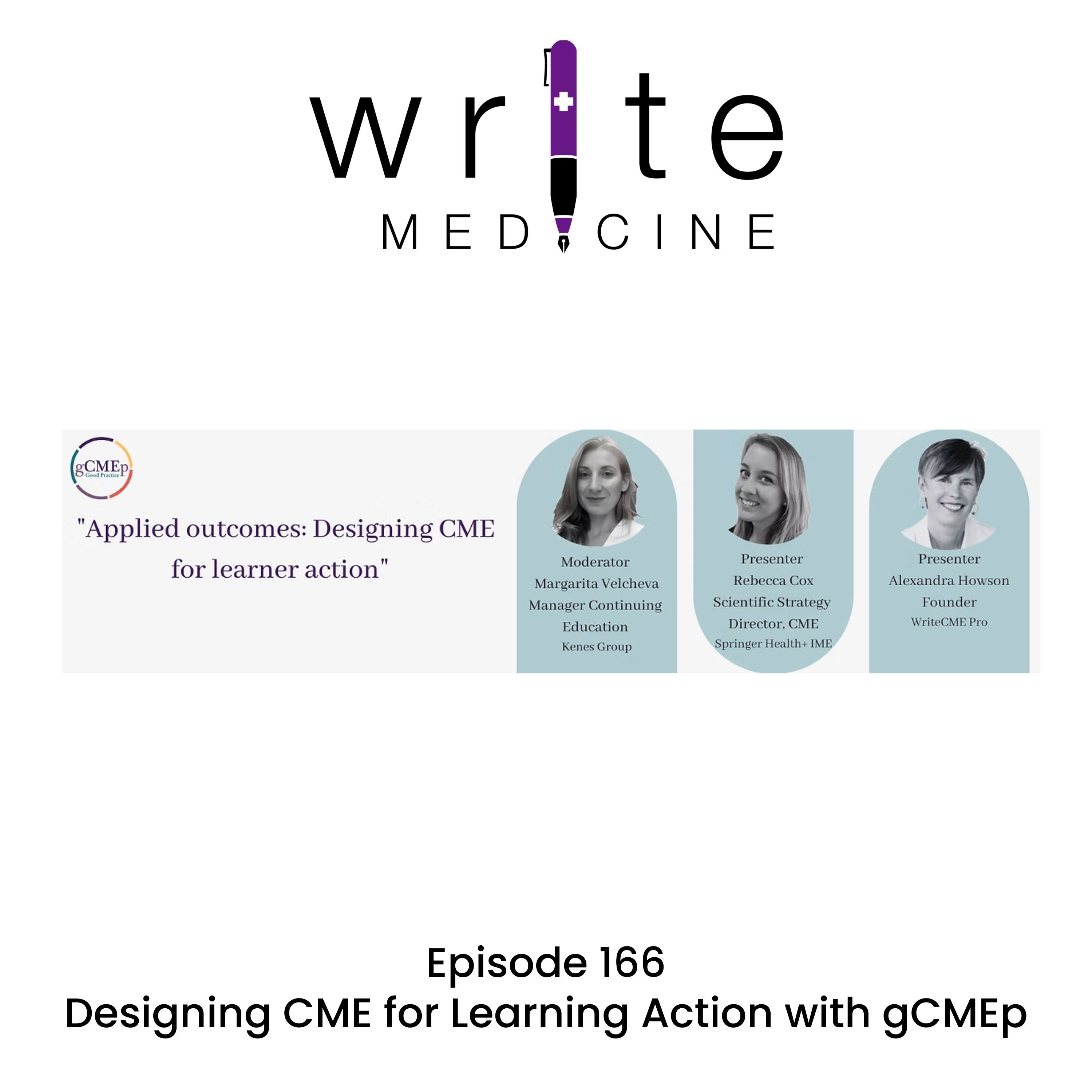
You already know how to write learning objectives. You reference Bloom’s taxonomy. You understand Moore’s outcomes framework. But here’s the real question:When you write a learning objective, can you clearly identify the two to three specific clinical tasks that must happen for that objective to be achieved?In this episode—based on a webinar I participated in with the Good CME Practice Group—we go deeper than frameworks. We unpack what actually sits underneath a learning objective and how that layer determines whether your CME changes practice… or simply delivers information.What We Explore in This EpisodeWhy learning objectives are signposts—not the design itselfHow to break each objective into 2–3 concrete clinical tasksThe role of workflow, format, and audience context in determining granularityHow learning science (cognitive load, retrieval practice, feedback) strengthens action-focused designWhere CME programs most commonly lose alignment between need, content, assessment, and outcomesKey TakeawayIf you can’t name the specific clinical actions required to meet an objective, the content won’t drive behavior change.Design lives underneath the objective.Next StepIf this episode resonated, try this:Take one learning objective from a current project and ask:What are the two or three specific clinical actions underneath it?Where do those actions appear in the content?Where are they assessed?That exercise alone will elevate your design work.And if you want structured practice applying this level of thinking—with feedback, live coaching, and a community of CME professionals—explore WriteCME Pro.This is where writers become design partners.ResourcesGood CME Practice GroupMentioned in this episode:Root Cause Analysis Practice LabReady to write needs assessments that go deeper than "clinicians need more education"? Join our Root Cause Analysis Practice Lab on February 19th. You'll learn systems thinking, defensible frameworks, and grant-ready language in 3 hands-on hours. $297 | Applies to WriteCME Pro membership [CTA Button] Save My Spot → https://community.writecmepro.com/root-cause-analysisRoot Case Analysis Practice LabThis podcast uses the following third-party services for analysis: Podtrac - https://analytics.podtrac.com/privacy-policy-gdrp
Feb 18, 202628 min

S11 Ep 165The CME Writing Skills No One Teaches—but Every Writer Needs

In this year-end episode, Alex takes you behind the scenes into a full year of growth inside the WriteCME Pro community. Whether you're just starting in CME or deepening your expertise, you’ll hear the most important trends that emerged among CME writers in 2025—what they struggled with, how they moved forward, and what this means for your own career in 2026.If you want clarity, confidence, and a sense of belonging in the CME world, this episode offers a peek at the path forward.In this episode, you’ll learn:The biggest mindset and skill gaps CME writers faced this yearWhy understanding the ecosystem matters more than mastering templatesThe professional identity shift that helped writers step into higher-level rolesWhy wellbeing has become a non-negotiable business strategyWhat happens when writers grow inside a community instead of aloneWhat support, structure, and opportunities are coming in 2026You’ll especially benefit if you’re:A medical writer curious about entering CMEA working CME writer who feels stuck or isolatedA freelancer craving clarity, community, or better workflow systemsSomeone who wants to build a resilient, respected CME writing businessLearn more or join the community:12 Days of Giving Secret ListWriteCME ProMentioned in this episode:Root Cause Analysis Practice LabReady to write needs assessments that go deeper than "clinicians need more education"? Join our Root Cause Analysis Practice Lab on February 19th. You'll learn systems thinking, defensible frameworks, and grant-ready language in 3 hands-on hours. $297 | Applies to WriteCME Pro membership [CTA Button] Save My Spot → https://community.writecmepro.com/root-cause-analysisRoot Case Analysis Practice LabThis podcast uses the following third-party services for analysis: Podtrac - https://analytics.podtrac.com/privacy-policy-gdrp

Dec 3, 20259 min

S11 Ep 164If CME Writers Had an Advent Calendar…

What if you ended the year not with burnout or urgency, but with a daily ritual of inspiration, generosity, and creative momentum for your CME writing?As CME writers, so much of our work happens behind the scenes — the interviews, the needs assessments, the outlines, the manuscripts. It’s meaningful work, but it’s often quiet and relentless, yet it carries real impact for learners and patients. This episode takes you behind the curtain into the reflection, intention, and creative spark that inspired the 12 Days of Giving. If you’ve ever wanted to reconnect with the why behind your own writing, this story will resonate.In this episode, you’ll hear:My why behind the 12 Days of Giving How reflection helps us stay grounded in a profession that rarely slows down.Why generosity isn’t just a nice idea, but a practical force that strengthens your craft and the CME community.Press play to step behind the scenes and discover the heart, intention, and creative spark powering this year’s 12 Days of Giving.Ready to join the secret list? Do that here: https://www.alexhowson.com/12-days-interestMentioned in this episode:Root Cause Analysis Practice LabReady to write needs assessments that go deeper than "clinicians need more education"? Join our Root Cause Analysis Practice Lab on February 19th. You'll learn systems thinking, defensible frameworks, and grant-ready language in 3 hands-on hours. $297 | Applies to WriteCME Pro membership [CTA Button] Save My Spot → https://community.writecmepro.com/root-cause-analysisRoot Case Analysis Practice LabThis podcast uses the following third-party services for analysis: Podtrac - https://analytics.podtrac.com/privacy-policy-gdrp

Nov 26, 20255 min

S11 Ep 163Your Clinical Lens Is Gold: How to Grow From Beginner to Trusted CME Writer

In this hot seat coaching conversation, Sarah Jabeen MD, a clinician turned medical writer, brings the honest questions so many emerging CME writers quietly carry:How do I navigate a career pivot without feeling like an imposter? How do I leverage my clinical background without overwhelming my writing? And how do I grow from “new” to “trusted” in the eyes of clients?Together, we unpack what’s underneath each of these questions and explore how identity, confidence, community, and small experiments shape your growth as a CME writer.You’ll hear:Why self-doubt is a normal part of professional transformation—and how to shift from “What if this fails?” to “What if this works?”How your clinical experience becomes a true superpower in CME writing, giving you insight, relevance, and empathy that elevate your work.What separates a beginner from a trusted partner, and how reliability, curiosity, and consistent communication matter more than perfection.The role of community and belonging in building confidence and combating isolation during a career pivot.Practical guidance for showing up online, finding your voice, and creating a presence that feels aligned and safe.Whether you’re transitioning from clinical practice, entering CME writing from another discipline, or simply looking for more confidence in your craft, this episode offers permission, perspective, and a path forward.Mentioned in this episode:Root Cause Analysis Practice LabReady to write needs assessments that go deeper than "clinicians need more education"? Join our Root Cause Analysis Practice Lab on February 19th. You'll learn systems thinking, defensible frameworks, and grant-ready language in 3 hands-on hours. $297 | Applies to WriteCME Pro membership [CTA Button] Save My Spot → https://community.writecmepro.com/root-cause-analysisRoot Case Analysis Practice LabThis podcast uses the following third-party services for analysis: Podtrac - https://analytics.podtrac.com/privacy-policy-gdrp

Nov 19, 202540 min

S11 Ep 162When the Inbox Goes Quiet: How to Thrive in the Fallow Seasons of Freelance CME Writing Life

What do you do when your inbox goes quiet and the client work that once filled your calendar suddenly disappears?For many freelance medical writers—especially those transitioning into the CME space—quiet seasons can feel like failure. But what if those fallow periods are actually the most fertile ground for growth? In this conversation with seasoned writer Addie Nagy, we explore how to reframe slow seasons, rebuild confidence, and manage client relationships with steadiness and purpose.You’ll learn how toReimagine client relationships as a dialogue rather than a power struggle so collaboration replaces anxiety.Turn information gaps and slow communication into opportunities for curiosity, clarity, and boundary-setting.Use “fallow time” to strengthen business foundations, refresh systems, and cultivate the mindset shift from freelancer to business owner.Press play to learn how to transform uncertainty into strategy and make every season of your freelance CME writing business work for you.Resources MentionedIlise Benun — The Creative Professional's Guide to Money: How to Think About It, How to Talk About it, How to Manage It. 2011. HOW Books. WriteCME Pro — a community and professional network that provides peer support and opportunities to hone CME writing skills.Mentioned in this episode:Root Cause Analysis Practice LabReady to write needs assessments that go deeper than "clinicians need more education"? Join our Root Cause Analysis Practice Lab on February 19th. You'll learn systems thinking, defensible frameworks, and grant-ready language in 3 hands-on hours. $297 | Applies to WriteCME Pro membership [CTA Button] Save My Spot → https://community.writecmepro.com/root-cause-analysisRoot Case Analysis Practice LabLinkedIn Live AMAThis podcast uses the following third-party services for analysis: Podtrac - https://analytics.podtrac.com/privacy-policy-gdrp

Nov 12, 202535 min

S11 Ep 161Contract Confidence: Protect Your Freelance Medical Writing Business

Have you ever hesitated to push back on a client’s “non-negotiable” contract — even when something didn’t feel right?For freelance medical writers, contracts can be one of the most intimidating parts of running a business. Between indemnity clauses, “work made for hire” language, and shifting risk to the writer, it’s easy to feel powerless. In this episode, legal strategist Brionna Ned (The Lawless Lawyer) breaks down how to approach contract negotiations with confidence — so you can protect your work, your income, and your peace of mind. You'll learn how to:Identify and communicate your leverage points — the non-negotiables that protect your business.Decode intimidating legal terms like indemnity and work made for hire in plain language.Reframe contract negotiation from a high-stakes confrontation into a collaborative conversation about creating a fair working relationship.Press play to discover how to build contract confidence, reduce risk, and negotiate terms that support a thriving medical writing business.Connect with Brionna The Lawless LawyerInstagramThreads LinkedIn Mentioned in this episode:Root Cause Analysis Practice LabReady to write needs assessments that go deeper than "clinicians need more education"? Join our Root Cause Analysis Practice Lab on February 19th. You'll learn systems thinking, defensible frameworks, and grant-ready language in 3 hands-on hours. $297 | Applies to WriteCME Pro membership [CTA Button] Save My Spot → https://community.writecmepro.com/root-cause-analysisRoot Case Analysis Practice LabLinkedIn Live AMAThis podcast uses the following third-party services for analysis: Podtrac - https://analytics.podtrac.com/privacy-policy-gdrp
Nov 5, 202532 min

S11 Ep 160Insight to Impact: A Framework for Translating Needs into Agendas

How do you turn a detailed needs assessment full of data and practice gaps into a clear, learner-centered activity agenda that actually changes clinical practice?If you’ve ever stared at a dense needs assessment wondering how to transform pages of evidence into a coherent educational design, this episode is for you. Many CME writers struggle to bridge the gap between analysis and application—between identifying what clinicians need and structuring how they’ll learn it. In this episode, Alex shares a practical, step-by-step process that helps you connect the dots and design education that makes sense and gets results.By listening, you’ll discover:A seven-step framework to translate insights from your needs assessment into a logical, outcomes-aligned agenda.How to apply the 3-A Test—Aligned, Actionable, Appropriate—to ensure every session delivers value for learners.A real-world mini-case that illustrates how to transform your research into a compelling, structured learning journey.Press play to learn how to transform data into design—and gain the confidence to craft CME agendas that close gaps and inspire change.👉 Grab Your Insight-To-Action Framework 👉 Register for LinkedIn LiveMentioned in this episode:LinkedIn Live AMARoot Cause Analysis Practice LabReady to write needs assessments that go deeper than "clinicians need more education"? Join our Root Cause Analysis Practice Lab on February 19th. You'll learn systems thinking, defensible frameworks, and grant-ready language in 3 hands-on hours. $297 | Applies to WriteCME Pro membership [CTA Button] Save My Spot → https://community.writecmepro.com/root-cause-analysisRoot Case Analysis Practice LabThis podcast uses the following third-party services for analysis: Podtrac - https://analytics.podtrac.com/privacy-policy-gdrp

Oct 29, 202515 min

S11 Ep 159From Unseen to Unstoppable: How Medical Writers Grow Beyond CME Task Work to Creative Partnership

What if the work that feels invisible is the very thing building your expertise?For many CME writers, the hours spent researching, editing, and shaping educational content happen behind the scenes — valuable, but unseen. Over time, that invisibility can blur your sense of value and readiness.In this Write Medicine hot-seat coaching session, Gina Castiblanco PhD shares what it’s really like to navigate that in-between space — leaving behind a visible academic identity and learning to trust her voice as a CME writer and business owner.Together, we unpack how professional visibility starts with self-awareness, boundaries, and the courage to say, “I’m ready, even if I don’t feel ready yet.”By the end of this conversation, you’ll learn how to:Reframe invisibility as part of your growth process — not proof that you don’t belong.Use your academic and clinical background to shape a distinct CME writing identity.Turn your unseen skills into visible value that attracts aligned clients and projects.Shift from doing the work to owning the work — as a creative, strategic partner.Stay to the end of the episode for three practical steps you can take today to start making your invisible work visible — and strengthen your visibility, voice, and value in the CME ecosystem.Mentioned in this episode:Root Cause Analysis Practice LabReady to write needs assessments that go deeper than "clinicians need more education"? Join our Root Cause Analysis Practice Lab on February 19th. You'll learn systems thinking, defensible frameworks, and grant-ready language in 3 hands-on hours. $297 | Applies to WriteCME Pro membership [CTA Button] Save My Spot → https://community.writecmepro.com/root-cause-analysisRoot Case Analysis Practice LabThis podcast uses the following third-party services for analysis: Podtrac - https://analytics.podtrac.com/privacy-policy-gdrp
Oct 22, 202541 min

S11 Ep 158From Curiosity to Confidence: A Freelance Medical Writer’s Guide to Breaking into CME Writing
Curious about continuing medical education (CME) writing but not sure how to begin? In this episode, you’ll learn how to turn your medical, academic, or scientific experience into a meaningful, flexible writing career. Discover the five milestones that help you break into CME writing, the key skills every CME writer needs, and real-world insights from the field.🎧 Tune in now to gain clarity, confidence, and your next steps toward becoming a successful CME writer.LinksWriteCME Pro – Join the CPD-certified professional development program for medical writers specializing in CME.Chart Your CME Writing Path – Map your skills and identify opportunities in CME writing.Episodes 112 & 115 of Write Medicine – Learn how to streamline literature reviews and strengthen your research workflow.American Medical Writers Association (AMWA) – Explore professional development resources for medical communicators.CME Writer Bootcamp: How to Break into CME/CE Writing with no Network and No ExpertiseWrite Medicine Mentor – Get behind-the-scenes insights and templates to deepen your CME writing practice.How to Create Portfolio Samples for CME WritingMentioned in this episode:Root Cause Analysis Practice LabReady to write needs assessments that go deeper than "clinicians need more education"? Join our Root Cause Analysis Practice Lab on February 19th. You'll learn systems thinking, defensible frameworks, and grant-ready language in 3 hands-on hours. $297 | Applies to WriteCME Pro membership [CTA Button] Save My Spot → https://community.writecmepro.com/root-cause-analysisRoot Case Analysis Practice LabWrite Medicine MentorWrite Medicine Mentor is your private companion podcast designed exclusively for medical writers who want deeper support as they grow in continuing medical education (CME). Each month, you'll receive exclusive content from me to support your business and income growth as well as templates/checklists/swipe files you can use and apply to client projects. In addition to immediate access to a CME writing starter pack, each month you’ll get: * A bonus episode that takes you behind the mic for advanced insights into the craft and business of CME writing. * A ready-to-use template, checklist, or swipe file to make your projects smoother and more effective. * An Ask Me Anything episode, where Alexandra Howson, PhD, answers your questions about writing, clients, CME strategy, and sustainable freelance life. Think of this podcast as your personal, earbud-friendly mentor—practical, honest, and always focused on helping you sharpen your skills, expand your opportunities, and thrive as a CME writer.This podcast uses the following third-party services for analysis: Podtrac - https://analytics.podtrac.com/privacy-policy-gdrp

Oct 15, 202524 min

S11 Ep 157From Needs Assessments to Narrative Impact: Positioning Yourself for CME Content Work
Are you ready to move beyond writing needs assessments and step into the creative, story-driven side of CME—without losing the clients or confidence you’ve already built?Many CME writers start with needs assessments. They’re structured, strategic, and an excellent way to learn the landscape. But what happens when you feel ready for more? When you want to create content that sparks learning, integrates clinical insight, and allows your creativity to shine? In this hot seat coaching episode, we meet Zsuzsa Csik, an anesthesiologist and critical care physician turned CME writer, who’s navigating that exact transition—and learning how to position herself for content work while building a sustainable freelance business.By listening, you’ll discover:How to strategically signal to clients that you’re ready for content creation projects.Practical ways to use your clinical or scientific background as a bridge, not a barrier, to new opportunities.Simple positioning tactics to align your current work with your long-term professional goals.Press play now to learn how to move from analysis to creation, and start shaping the CME writing career you really want.Mentioned in this episode:Root Cause Analysis Practice LabReady to write needs assessments that go deeper than "clinicians need more education"? Join our Root Cause Analysis Practice Lab on February 19th. You'll learn systems thinking, defensible frameworks, and grant-ready language in 3 hands-on hours. $297 | Applies to WriteCME Pro membership [CTA Button] Save My Spot → https://community.writecmepro.com/root-cause-analysisRoot Case Analysis Practice LabThis podcast uses the following third-party services for analysis: Podtrac - https://analytics.podtrac.com/privacy-policy-gdrp

Oct 8, 202539 min

S11 Ep 156Expand Your CME Medical Writing Skills: Dual-Audience Strategies for Patient and Clinician Education

How do you take one complex medical concept and make it clear, accurate, and actionable for both clinicians and patients, without losing credibility?If you’re a CME writer, you know the challenge of translating science into education that actually sticks. But as more CME projects tether clinician education with patient-facing components, the real test is flexing your craft to serve two very different audiences at once. Get this right, and you not only improve learning, you expand your professional scope and impact.In this episode, you’ll discover:How to apply practical frameworks to dual-audience writing.Structural techniques that make content engaging, empathetic, and accessible.A simple 3-sentence exercise to sharpen clarity for patients and precision for clinicians—anytime, anywhere.🎧 Tune in now and learn how to expand your CME writing craft into dual-audience education with one portable tool you can start using today.ResourcesResources to support plain language, readability, and accessibility. https://readable.com/readability/Cognitive accessibilityThe Patient Education Materials Assessment Tool (PEMAT) Informed consent navigator toolPlain Language SummariesPlain Language Checklist for Health Professionals Plain language in biobank consent Plain Language AssociationCognitive accessibilityInformed consent navigator toolEpisodes MentionedEP31: Cultivating a Visual Mindset with Karen Roy and Bhaval ShahEP 41: Nurture Connection-Tell them a Story with Ben RiggsEP109: Crafting Inclusive and Accessible Medical Content with Virginia ChachatiPractice: Explain one complex idea in three sentences, twice—once for patients, once for clinicians.Take one complex concept: SGLT2 inhibitors reduce heart failure hospitalizations.For patients:What it is: “These medicines help your kidneys release extra sugar, which also helps your heart.”Why it matters: “That can mean fewer breathless days and fewer hospital stays.”What to do next: “Ask your doctor if one of these medicines could work for you, and share any kidney issues you’ve had.”For clinicians:Mechanism and trial anchor in one sentence.Link to the guideline.Patient selection + monitoring.Here’s why this exercise matters: most adults in the U.S. read at about an 8th grade level, and nearly 1 in 5 at or below 5th grade. When we condense a complex medical concept into three short sentences—plain, clear, active—we’re not “dumbing down.” We’re writing accessibly, building trust, and giving patients a fair chance to participate in their care.This 3-sentence rule is your portable tool for making health literacy visible in practice. And the bonus? It sharpens your clinician writing too—forcing clarity, precision, and focus on what truly matters.Mentioned in this episode:Write Medicine MentorWrite Medicine Mentor is your private companion podcast designed exclusively for medical writers who want deeper support as they grow in continuing medical education (CME). Each month, you'll receive exclusive content from me to support your business and income growth as well as templates/checklists/swipe files you can use and apply to client projects. In addition to immediate access to a CME writing starter pack, each month you’ll get: * A bonus episode that takes you behind the mic for advanced insights into the craft and business of CME writing. * A ready-to-use template, checklist, or swipe file to make your projects smoother and more effective. * An Ask Me Anything episode, where Alexandra Howson, PhD, answers your questions about writing, clients, CME strategy, and sustainable freelance life. Think of this podcast as your personal, earbud-friendly mentor—practical, honest, and always focused on helping you sharpen your skills, expand your opportunities, and thrive as a CME writer.Root Cause Analysis Practice LabReady to write needs assessments that go deeper than "clinicians need more education"? Join our Root Cause Analysis Practice Lab on February 19th. You'll learn systems thinking, defensible frameworks, and grant-ready language in 3 hands-on hours. $297 | Applies to WriteCME Pro membership [CTA Button] Save My Spot → https://community.writecmepro.com/root-cause-analysisRoot Case Analysis Practice LabThis podcast uses the following third-party services for analysis: Podtrac - https://analytics.podtrac.com/privacy-policy-gdrp

Oct 1, 202521 min

S11 Ep 155How to Overcome Academic Trauma and Build Confidence as a Freelance Medical Writer

What if leaving academia—or another tightly defined professional path—felt less like failure and more like freedom?For many academics, clinicians, and researchers, stepping into freelance medical writing isn’t just a career change—it’s a profound identity shift. Too often, this transition carries grief, shame, or the lingering sense of “not enough.” In this episode, we explore how those feelings show up, why they matter, and how to reframe them as fuel for your writing career.By listening, you’ll discover:Why the transition from academia or clinical practice can feel like trauma—and how to reframe it as strength.Four entrepreneurial habits that can help you thrive as a freelance medical writer while avoiding their shadow sides.Simple, practical practices—like free writing and mindful self-awareness—that help you claim permission, rebuild confidence, and cultivate a sustainable business mindset.Press play now to learn how to navigate identity loss, tap into your natural strengths, and take small steps toward building a medical writing business that feels truly your own.Mentioned in this episode:Root Cause Analysis Practice LabReady to write needs assessments that go deeper than "clinicians need more education"? Join our Root Cause Analysis Practice Lab on February 19th. You'll learn systems thinking, defensible frameworks, and grant-ready language in 3 hands-on hours. $297 | Applies to WriteCME Pro membership [CTA Button] Save My Spot → https://community.writecmepro.com/root-cause-analysisRoot Case Analysis Practice LabWrite Medicine MentorWrite Medicine Mentor is your private companion podcast designed exclusively for medical writers who want deeper support as they grow in continuing medical education (CME). Each month, you'll receive exclusive content from me to support your business and income growth as well as templates/checklists/swipe files you can use and apply to client projects. In addition to immediate access to a CME writing starter pack, each month you’ll get: * A bonus episode that takes you behind the mic for advanced insights into the craft and business of CME writing. * A ready-to-use template, checklist, or swipe file to make your projects smoother and more effective. * An Ask Me Anything episode, where Alexandra Howson, PhD, answers your questions about writing, clients, CME strategy, and sustainable freelance life. Think of this podcast as your personal, earbud-friendly mentor—practical, honest, and always focused on helping you sharpen your skills, expand your opportunities, and thrive as a CME writer.This podcast uses the following third-party services for analysis: Podtrac - https://analytics.podtrac.com/privacy-policy-gdrp

Sep 24, 202535 min

S11 Ep 154Designing CME for Behavior Change: Sarah Atwood on Learning Science in Action

What if the CME you design could do more than deliver knowledge—what if it could actually change clinician behavior and improve patient care?As a CME writer or education professional, you’ve likely felt the frustration of producing content that looks strong on paper but doesn’t translate into meaningful practice change. This episode explores how learning science, human-centered design, and patient co-creation can help you bridge the gap between information and impact.By listening, you will discover:Learning science principles, like Mayer’s multimedia principles, that make education stick.The difference between learning change and behavior change, and why both matter in CME.How aligning clinician and patient education fosters shared decision-making and better healthcare outcomes.Press play now to learn practical strategies you can use to design CME that transforms knowledge into real-world change.Mentioned in this episode:Root Cause Analysis Practice LabReady to write needs assessments that go deeper than "clinicians need more education"? Join our Root Cause Analysis Practice Lab on February 19th. You'll learn systems thinking, defensible frameworks, and grant-ready language in 3 hands-on hours. $297 | Applies to WriteCME Pro membership [CTA Button] Save My Spot → https://community.writecmepro.com/root-cause-analysisRoot Case Analysis Practice LabThis podcast uses the following third-party services for analysis: Podtrac - https://analytics.podtrac.com/privacy-policy-gdrp

Sep 17, 202527 min

Craft to Confidence: What's Coming Up in Season 11

trailer

What does it take to move from order-taker to trusted partner in CME writing?That’s the single question driving this new season of Write Medicine.In this 15-minute teaser episode, Alex introduces the season theme—Craft to Confidence: A CME Writer’s Season of Growth—and gives you a preview of what’s ahead. You’ll hear how guest interviews and solo tactical episodes will work together to help you build your skills, expand your visibility, and strengthen your confidence as a CME writer.Whether you’re transitioning from academia, clinical practice, or another writing specialty, this season will give you both the craft tools and the career clarity to thrive in continuing medical education.Episodes to Look Forward ToDesigning for learning with Sarah AtwoodHot Seat Coaching on attracting content projects and integrating academic skills into CMELeveraging Milkshake Moments with Michelle SkidmoreIdentity, trauma, and resilience with Hope LaffertySolo walk-throughs on interviewing SMEs, turning education gaps and needs into activity agendas, publishing manuscripts, and moreMentioned in this episode:Root Cause Analysis Practice LabReady to write needs assessments that go deeper than "clinicians need more education"? Join our Root Cause Analysis Practice Lab on February 19th. You'll learn systems thinking, defensible frameworks, and grant-ready language in 3 hands-on hours. $297 | Applies to WriteCME Pro membership [CTA Button] Save My Spot → https://community.writecmepro.com/root-cause-analysisRoot Case Analysis Practice LabWrite Medicine MentorWrite Medicine Mentor is your private companion podcast designed exclusively for medical writers who want deeper support as they grow in continuing medical education (CME). Each month, you'll receive exclusive content from me to support your business and income growth as well as templates/checklists/swipe files you can use and apply to client projects. In addition to immediate access to a CME writing starter pack, each month you’ll get: * A bonus episode that takes you behind the mic for advanced insights into the craft and business of CME writing. * A ready-to-use template, checklist, or swipe file to make your projects smoother and more effective. * An Ask Me Anything episode, where Alexandra Howson, PhD, answers your questions about writing, clients, CME strategy, and sustainable freelance life. Think of this podcast as your personal, earbud-friendly mentor—practical, honest, and always focused on helping you sharpen your skills, expand your opportunities, and thrive as a CME writer.This podcast uses the following third-party services for analysis: Podtrac - https://analytics.podtrac.com/privacy-policy-gdrp

Sep 11, 20257 min

From Anxiety to Action: What Every Medical Writer Needs to Know About AI Integration

bonus

If you’re a medical writer today, you're no stranger to tight deadlines, dense source material, and the pressure to deliver educational content that is both engaging and evidence-based. These demands are particularly acute in the world of continuing medical education (CME), where accuracy, clarity, and relevance matter more than ever. As the medical writing landscape evolves, so do the tools that support us. Among the most promising of these is MACg, a generative AI-powered assistant that helps medical writers streamline document analysis, content creation, and research. For writers working in CME or adjacent fields, MACg offers more than convenience—it offers a meaningful shift in how we work. Tune in to learn how I’m using MACg as a collaborative partner in my workflow rather than a replacement for my creative process. Resources Grab your fee trial of MACg Summer Script Camp Mentioned in this episode:Root Cause Analysis Practice LabReady to write needs assessments that go deeper than "clinicians need more education"? Join our Root Cause Analysis Practice Lab on February 19th. You'll learn systems thinking, defensible frameworks, and grant-ready language in 3 hands-on hours. $297 | Applies to WriteCME Pro membership [CTA Button] Save My Spot → https://community.writecmepro.com/root-cause-analysisRoot Case Analysis Practice LabThis podcast uses the following third-party services for analysis: Podtrac - https://analytics.podtrac.com/privacy-policy-gdrp

Jul 2, 202520 min

From Barbershops to Boardrooms: Pioneering CME in Unexpected Spaces

How do you design CME that reaches the communities most affected by HIV—and not just the clinicians who already have access? If you're a CME professional grappling with how to address layered issues like stigma, housing insecurity, or racial disparities, you’re not alone. This episode dives into what it takes to create truly inclusive education—especially when traditional strategies fall short. Whether you’re designing education for clinicians or collaborating with community partners, you’ll find actionable ideas to bring your programming closer to the ground. Specifically, you'll learn: How to build authentic partnerships with community leaders who can serve as trusted bridges between healthcare providers and hard-to-reach populations. The essential infrastructure you need to establish before launching community-based programs, from setting up referral networks that ensure patients don't fall through cracks after screening to tracking both clinical outcomes and demographic data that funders require. A proven framework for developing educational content with cultural humility and how to work with expert faculty who understand nuanced communication challenges. Connect with Dean 🌐 https://DKBMED.COM Resources Signup for Summer Script Camp Get TextExpander Mentioned in this episode:Root Cause Analysis Practice LabReady to write needs assessments that go deeper than "clinicians need more education"? Join our Root Cause Analysis Practice Lab on February 19th. You'll learn systems thinking, defensible frameworks, and grant-ready language in 3 hands-on hours. $297 | Applies to WriteCME Pro membership [CTA Button] Save My Spot → https://community.writecmepro.com/root-cause-analysisRoot Case Analysis Practice LabThis podcast uses the following third-party services for analysis: Podtrac - https://analytics.podtrac.com/privacy-policy-gdrp

Jun 26, 202528 min

S10 Ep 152From Scattered to Specific: How a Niche Can Save Your Sanity (and Your Business)

Are you a freelance CME writer juggling too many project types and wondering if it’s time to finally “niche down”? In the world of continuing medical education (CME), clarity and focus aren’t just nice to have—they’re essential for sustainable business growth. If you’re feeling stretched thin, jumping between clients and therapeutic areas, this episode explores how finding a niche can reduce overwhelm, streamline your process, and even attract the kinds of clients who value what you do most. Here’s what you’ll gain from this episode: A practical definition of what a niche is—and what it isn’t—so you can stop second-guessing yourself. Examples of how different niches can emerge from your background, preferences, or even your favorite types of client relationships. A step-by-step approach to experimenting your way into a niche, without the pressure to get it “perfect” from the start. Tune in now to learn how niching can simplify your business, supercharge your marketing, and help you find work that truly energizes you. LINKS Grab the Niche Discovery Checklist Signup for Summer Script Camp If you are looking for ongoing CME content strategy tips, tools, and tactics, subscribe to the Write Medicine Insider newsletter. Get TextExpander Mentioned in this episode:Root Cause Analysis Practice LabReady to write needs assessments that go deeper than "clinicians need more education"? Join our Root Cause Analysis Practice Lab on February 19th. You'll learn systems thinking, defensible frameworks, and grant-ready language in 3 hands-on hours. $297 | Applies to WriteCME Pro membership [CTA Button] Save My Spot → https://community.writecmepro.com/root-cause-analysisRoot Case Analysis Practice LabThis podcast uses the following third-party services for analysis: Podtrac - https://analytics.podtrac.com/privacy-policy-gdrp

Jun 18, 202512 min

From Silos to Synergy: Designing CME for Real-World Healthcare Teams with Dr. Tina Patel Gunaldo

How can continuing education break down professional silos and foster real collaboration among healthcare teams? If you create CME/CE content, you’ve likely encountered the challenge of writing for “teams” that still operate in silos. This episode with interprofessional education expert Dr. Tina Patel Gunaldo, Founder, Collaborate for Health, reveals why just using the term “team-based care” isn’t enough—and how content creators can more accurately reflect the evolving nature of healthcare collaboration. As patient-centered models expand and asynchronous care becomes the norm, CME professionals need a deeper understanding of roles, language, and practice contexts to design impactful education. Discover the critical differences between interprofessional, interdisciplinary, and multidisciplinary practice—and why it matters for CME writing. Learn how to structure education that empowers team collaboration and respects the unique contributions of each discipline. Understand the growing role of patients, technology, and asynchronous communication in shaping interprofessional collaboration today. And if you’re unsure when to use “interprofessional” vs “multidisciplinary”? We’ve got you covered. We created a one-page Quick Reference Guide to help you use team-based language precisely and avoid common traps in CME writing. It’s perfect for writers, educators, and reviewers who want to level up their clarity. Grab the download in the show notes and keep it handy as you create your next piece of content. Tune in now to learn how you can write CME content that reflects real-world collaboration—and elevates both learner experience and patient care outcomes. Connect with Tina Website: https://collaborateforhealth.com LinkedIn Interprofessional Terms Quick Reference Guide Mentioned in this episode:Root Cause Analysis Practice LabReady to write needs assessments that go deeper than "clinicians need more education"? Join our Root Cause Analysis Practice Lab on February 19th. You'll learn systems thinking, defensible frameworks, and grant-ready language in 3 hands-on hours. $297 | Applies to WriteCME Pro membership [CTA Button] Save My Spot → https://community.writecmepro.com/root-cause-analysisRoot Case Analysis Practice LabThis podcast uses the following third-party services for analysis: Podtrac - https://analytics.podtrac.com/privacy-policy-gdrp

May 28, 202532 min

Raising the Bar: Essential Competencies for CME Writers with Haifa Kassis and Don Harting

Are you unsure which skills you need to thrive as a CME writer (or need for your writers)—or how to prove your value in an increasingly competitive field? Many medical writers stumble into CME with strong writing chops but little clarity about what the role truly demands. At the same time, education providers struggle to find writers who are not just capable—but competent. This episode bridges that gap. Don Harting and Haifa Kassis join us to unpack the results of their groundbreaking Delphi study on CME writing competencies, revealing what hiring managers really want and how you can grow your career strategically. In this episode, you’ll learn: The four core competencies every CME writer should master today Which deliverables are in high demand—and which are vanishing How this competency model can support onboarding, training, and upskilling. Press play to learn how to align your writing skills with what the CME industry actually needs—so you can stand out, get hired, and grow with confidence. Resources Kassis, H., & Harting, D. (2024). Medical Writing for Continuing Education in the Health Professions: A Competency Model. Journal of CME, 13(1). https://doi.org/10.1080/28338073.2024.2422709 CME Writers’ Toolbox Delphi Panelists WriteCME Pro: Accelerate your freelance CME writing business growth Timestamps 00:00 Introduction to CME Writing Challenges 00:20 Meet the Researchers: Haifa Kassis and Don Harting 01:19 The Competency Model: Key Findings 02:40 Expert Consensus and Methodology 06:16 Surprising Insights and Real-World Challenges 11:15 Practical Applications and Future Directions 24:35 Emerging Competencies and Industry Trends 28:47 Conclusion and Contact Information Mentioned in this episode:Root Cause Analysis Practice LabReady to write needs assessments that go deeper than "clinicians need more education"? Join our Root Cause Analysis Practice Lab on February 19th. You'll learn systems thinking, defensible frameworks, and grant-ready language in 3 hands-on hours. $297 | Applies to WriteCME Pro membership [CTA Button] Save My Spot → https://community.writecmepro.com/root-cause-analysisRoot Case Analysis Practice LabThis podcast uses the following third-party services for analysis: Podtrac - https://analytics.podtrac.com/privacy-policy-gdrp

May 21, 202534 min

From Diagnosis to Advocacy: What Rare Disease Teaches Us About CME

How do we create continuing education that prepares clinicians to deliver life-changing diagnoses with both precision and compassion?In this episode, we explore what happens when the scientist’s role as a communicator intersects with the lived experience of parenting a child with a rare disease. I'm talking with Dr. Jennifer Brown, a geneticist who recently published a memoir, When the Baby is not OK: Hopes and Genes, based on her experience of parenting children diagnosed with PKU through newborn screening. For CME professionals, this episode is a call to rethink how we center narrative, ethics, and emotional intelligence in our content, especially when evidence alone isn’t enough to support meaningful patient care. Learn how outdated narratives and clinical language can alienate patients—and how reframing them can build trust and support retention in care. Hear why integrating lived experience into CME is essential for designing education that resonates beyond the exam room. Discover how personal storytelling, ethical reflection, and patient advocacy can enrich data-driven CME writing. ▶️ Press play to discover how Dr. Jennifer Brown’s dual lens—as a geneticist and parent—can sharpen your skills as a more empathetic, informed CME professional. Connect with Jennifer LinkedIn Goodreads Author Site Bluesky YouTube Mentioned in this episode:Root Cause Analysis Practice LabReady to write needs assessments that go deeper than "clinicians need more education"? Join our Root Cause Analysis Practice Lab on February 19th. You'll learn systems thinking, defensible frameworks, and grant-ready language in 3 hands-on hours. $297 | Applies to WriteCME Pro membership [CTA Button] Save My Spot → https://community.writecmepro.com/root-cause-analysisRoot Case Analysis Practice LabThis podcast uses the following third-party services for analysis: Podtrac - https://analytics.podtrac.com/privacy-policy-gdrp

May 14, 202539 min

Beyond PubMed: CME's Hidden Treasure Map

CME professionals, medical writers, educators, and researchers - what would you do if PubMed suddenly became less accessible? You depend on this critical resource daily to find evidence-based information that powers your work. But recent funding uncertainties at the NIH have raised questions about its future. You need consistent, reliable access to quality biomedical research to meet deadlines and maintain credibility, but navigating alternatives can feel overwhelming. Where would you even begin if your go-to resource is compromised? Today's episode is your insurance policy. My conversation with medical librarian Rachel Wedeward MLIS, AHIP reveals not only why PubMed matters, but also provides you with practical alternatives, including a downloadable resource sheet, and evaluation strategies to ensure you'll never be left without the research you need - no matter what happens. In this episode, you'll discover: The remarkable infrastructure behind PubMed's indexing system that makes it an indispensable tool for organizing and accessing biomedical research A comprehensive overview of complementary resources, including European PubMed Central and specialized databases that can enhance your research approach Practical wisdom for evaluating evidence quality Listen now to expand your research toolkit with expert knowledge that will help you confidently navigate the evolving landscape of medical information resources. Connect with Rachel Website LinkedIn 📚 Resources PubMed The essential biomedical database maintained by the U.S. National Library of Medicine. A critical starting point for CME writers and medical educators to access peer-reviewed research. European PubMed Central A free database of biomedical and life sciences research literature from Europe. A strong alternative to PubMed. Grey Literature Sources Sometimes the best insights aren’t found in journals. Examples of trusted grey literature repositories include: Kaiser Family Foundation Robert Wood Johnson Foundation Find guides on Rachel's website Alex's Sharable Evidence Bank (>70 sources) Mentioned in this episode:Root Cause Analysis Practice LabReady to write needs assessments that go deeper than "clinicians need more education"? Join our Root Cause Analysis Practice Lab on February 19th. You'll learn systems thinking, defensible frameworks, and grant-ready language in 3 hands-on hours. $297 | Applies to WriteCME Pro membership [CTA Button] Save My Spot → https://community.writecmepro.com/root-cause-analysisRoot Case Analysis Practice LabThis podcast uses the following third-party services for analysis: Podtrac - https://analytics.podtrac.com/privacy-policy-gdrp

Apr 30, 202526 min

S10 Ep 147Building a Thriving CME Community: Why Networking Isn’t Enough for Career Growth
Do you ever feel like you're navigating your career in CME alone, unsure of where you fit in or how to grow without burning out?Many CME professionals work independently or remotely, which can be both rewarding and isolating. Beyond professional networks, building a true community can provide the support, engagement, and inspiration needed to thrive in this field. In this episode, we explore why community matters in CME, how it enhances career growth and well-being, and practical steps you can take to create meaningful connections. Discover how a strong professional community can boost your career and well-being. Understand the key elements that define a thriving professional community. Learn practical ways to engage in and build a community that supports your growth in CME. Listen now to uncover the power of community in CME and learn how to cultivate meaningful professional connections that will support your long-term success.Timestamps00:00 Introduction: Navigating the CME Field Alone00:48 The Importance of Community in CME01:50 Defining Community and Its Elements02:38 Personal Experiences of Belonging03:50 Shared Values and Mutual Support in CME05:08 Networks vs. Communities06:29 Benefits of Community for CME Professionals10:19 Practical Steps to Engage in Community11:01 Conclusion and Next StepsNext WriteCME Accelerator Cohort is May, 2025.Join the Waitlist. Mentioned in this episode:Root Cause Analysis Practice LabReady to write needs assessments that go deeper than "clinicians need more education"? Join our Root Cause Analysis Practice Lab on February 19th. You'll learn systems thinking, defensible frameworks, and grant-ready language in 3 hands-on hours. $297 | Applies to WriteCME Pro membership [CTA Button] Save My Spot → https://community.writecmepro.com/root-cause-analysisRoot Case Analysis Practice LabThis podcast uses the following third-party services for analysis: Podtrac - https://analytics.podtrac.com/privacy-policy-gdrp

Mar 12, 202512 min

PubMed Uncertainty: Smart Alternatives for CME Professionals

What would happen if the go-to resource for your CME research—PubMed—became unreliable or inaccessible? Would your workflow survive the disruption?As CME professionals, we depend on PubMed for high-quality, evidence-based research. But with looming funding changes it’s time to rethink how we source medical literature. This episode unpacks the latest developments and gives you a proactive plan to safeguard your research process. Learn why PubMed's future is uncertain and what that means for CME professionals. Discover alternative medical research tools that can fill the gaps if PubMed access is disrupted. Get expert-backed strategies to diversify your literature search and stay ahead of potential research barriers. Hit play now to future-proof your CME research strategy and ensure uninterrupted access to high-quality medical literature!Time Stamps00:00 Introduction: The Importance of PubMed for CME Professionals00:32 Potential Threats to PubMed02:21 Speculative Changes and Their Implications02:40 Preparing for Potential Disruptions03:03 Alternative Research Tools and Strategies04:06 Staying Informed and Connected04:26 Conclusion and Call to ActionResources Europe PMC – A free resource for accessing biomedical literature, serving as an alternative to PubMed. Wayback Machine – A digital archive that allows retrieval of past versions of web pages, including government health pages. DeepDyve – A subscription-based service that archives PubMed files daily and provides access to research papers. EU Clinical Trials Register – A database of clinical trials conducted in Europe, cross-referenced with ClinicalTrials.gov. Leave a voice note for Alex Mentioned in this episode:Root Cause Analysis Practice LabReady to write needs assessments that go deeper than "clinicians need more education"? Join our Root Cause Analysis Practice Lab on February 19th. You'll learn systems thinking, defensible frameworks, and grant-ready language in 3 hands-on hours. $297 | Applies to WriteCME Pro membership [CTA Button] Save My Spot → https://community.writecmepro.com/root-cause-analysisRoot Case Analysis Practice LabThis podcast uses the following third-party services for analysis: Podtrac - https://analytics.podtrac.com/privacy-policy-gdrp

Mar 6, 20256 min

S10 Ep 145Empowering Nurses Through Education: Reducing Burnout, Building Leadership, and Elevating Care

How can continuing education transform nursing practice, reduce burnout, and empower nurses to advocate for themselves?Nurses are essential to patient care, yet many struggle with limited access to high-quality education, workplace advocacy, and professional development. As CME professionals and medical writers, we have the power to create learning experiences that not only enhance clinical skills but also support nurse well-being and retention. In this episode, we dive into the evolving landscape of nursing education with Drs. Jennifer Shepard and Sean DeGarmo, two leaders from the American Nurses Association (ANA), who explore how we can design more impactful, outcomes-driven education for nurses. Discover how the 2025 Code of Ethics for Nurses is reshaping professional development and why it matters for your CME programs. Learn how continuing education directly combats burnout and improves nurse retention—and what that means for healthcare organizations. Gain insights into the challenges of funding and implementing nurse education, and strategies to advocate for protected education budgets. Press play now to learn how you can contribute to the future of nursing education and design CE programs that truly make a difference!AbbreviationsHere are the acronyms mentioned in the episode along with their full forms: ANA – American Nurses Association CNE – Continuing Nursing Education CMS – Centers for Medicare & Medicaid Services CE – Continuing Education CME – Continuing Medical Education APP – Advanced Practice Provider DNP – Doctor of Nursing Practice PPE – Personal Protective Equipment PHI – Protected Health Information PI – Personal Information LACE – Licensure, Accreditation, Certification, and Education GME – Graduate Medical Education OPP – Organizational Practice Policies AAPA – American Academy of Physician Associates LACE – Licensure, Accreditation, Certification, and Education Timestamps00:00 Introduction to Nursing Education Challenges00:40 Meet the Experts: Dr. Jennifer Shepard and Dr. Sean de Garmo01:54 The 2025 Code of Ethics for Nurses08:02 Addressing Gaps in Nursing Education10:41 The Importance of Continuing Education in Combating Burnout16:40 Advocating for Nursing Education and Professional Development24:04 Outcomes-Based Education and Interdisciplinary Collaboration34:50 Conclusion: The Lifeline of Continuing Education Mentioned in this episode:Root Cause Analysis Practice LabReady to write needs assessments that go deeper than "clinicians need more education"? Join our Root Cause Analysis Practice Lab on February 19th. You'll learn systems thinking, defensible frameworks, and grant-ready language in 3 hands-on hours. $297 | Applies to WriteCME Pro membership [CTA Button] Save My Spot → https://community.writecmepro.com/root-cause-analysisRoot Case Analysis Practice LabThis podcast uses the following third-party services for analysis: Podtrac - https://analytics.podtrac.com/privacy-policy-gdrp

Feb 12, 202537 min

S10 Ep 144Missing Data? How to Keep Your CME Content Evidence-Based

What happens when the data you rely on for CME content suddenly disappears? CME depends on credible, transparent data to inform healthcare professionals and improve patient outcomes. But new policy shifts have restricted access to essential sources, leaving medical writers scrambling for alternatives. Without these data points, how can we continue producing accurate, impactful education? This episode explores how to navigate these challenges and source reliable evidence for CME content.Tune in to learn where to find alternative, credible health data sources beyond federal agencies.Don’t let disappearing data derail your CME planning. ResourceGrab your link to a living spreadsheet of alternative data and evidence sources. Timestamps00:00 Introduction: The Challenge of Disappearing Public Health Data01:20 Impact of Data Removal on Public Health05:40 Alternative Data Sources for CME Professionals09:33 Actionable Steps for CME Professionals10:52 Conclusion and Call to Action Mentioned in this episode:Root Cause Analysis Practice LabReady to write needs assessments that go deeper than "clinicians need more education"? Join our Root Cause Analysis Practice Lab on February 19th. You'll learn systems thinking, defensible frameworks, and grant-ready language in 3 hands-on hours. $297 | Applies to WriteCME Pro membership [CTA Button] Save My Spot → https://community.writecmepro.com/root-cause-analysisRoot Case Analysis Practice LabThis podcast uses the following third-party services for analysis: Podtrac - https://analytics.podtrac.com/privacy-policy-gdrp

Feb 5, 202513 min

S10 Ep 143Follow the Money: The Unexpected Economics of CME

Is private equity's growing influence in continuing medical education changing the quality of learning in the health professions?As a CME professional, you need to navigate an increasingly complex funding landscape where commercial support has dropped, and private equity firms are rapidly acquiring education providers. Understanding these shifts is crucial for developing sustainable, high-quality educational programs and navigating your way as a CME professional.In this episode, we’ll explore: How CME funding has evolved from primarily university-based to a complex mix of commercial support, registration fees, and private investment Why private equity firms are acquiring CME providers and what this means for content development Key strategies for maintaining educational quality and professional relationships in an environment of frequent mergers and acquisitions Listen now to gain insights into the $4.23 billion CME industry's funding transformation and position yourself for success in this rapidly changing landscape.Timestamps00:00 Introduction: The Art of Hustling Pool and CME00:54 AI Bootcamp for Medical Writers01:32 The Complex Financial Side of CME02:06 Evolution of CME Funding02:42 Pharmaceutical Influence and Regulations05:47 The Impact of Compliance and Regulatory Codes07:06 Current CME Funding Landscape08:21 Private Equity in CME10:48 Challenges and Questions for CME Professionals12:08 Conclusion: Ensuring Educational QualityResources Ratnasekera A, Impact of private equity on graduate medical education: A slippery slope. Am J Surg. https://doi.org/10.1016/j.amjsurg.2024.116160 ACCME's Standards for Integrity and Independence in Continuing Education (2020) ACCME Data Report. Thriving Through Growth and Innovation—2023. ACCME. Toolkit for the Standards for Integrity and Independence in Accredited Continuing Education Mentioned in this episode:Root Cause Analysis Practice LabReady to write needs assessments that go deeper than "clinicians need more education"? Join our Root Cause Analysis Practice Lab on February 19th. You'll learn systems thinking, defensible frameworks, and grant-ready language in 3 hands-on hours. $297 | Applies to WriteCME Pro membership [CTA Button] Save My Spot → https://community.writecmepro.com/root-cause-analysisRoot Case Analysis Practice LabThis podcast uses the following third-party services for analysis: Podtrac - https://analytics.podtrac.com/privacy-policy-gdrp

Jan 29, 202515 min

AI, Art & Social Networks in Continuing Education for Health Professionals

What if everything we believe about driving change in healthcare education is fundamentally wrong - and AI might be making it worse? As healthcare education rapidly embraces AI and digital transformation, you're likely grappling with crucial decisions about how to integrate new technologies while ensuring your programs remain equitable and effective. The latest Alliance for Continuing Education in Health Professions conference keynotes reveal surprising insights about AI bias, observation skills, and behavior change that challenge conventional approaches to CME program design.• Discover concrete strategies to identify and address AI bias in your educational programs, including a practical checklist for evaluating AI integration in healthcare education• Learn how art history methods can dramatically improve clinical observation skills through specific techniques like "close looking" and formal analysis• Master the science of "complex contagion" to design more effective peer learning networks, backed by new research showing networked physician groups make significantly fewer diagnostic errorsListen now to transform your CME programs with evidence-based insights from Dr. Immani Shephard, Dr. Siobhan Conaty, and Dr. Damon Centola on AI ethics, clinical observation, and driving meaningful change in healthcare education.ResourcesGlickman, M., Sharot, T. How human–AI feedback loops alter human perceptual, emotional and social judgements. Nat Hum Behav (2024). Mentioned in this episode:Root Cause Analysis Practice LabReady to write needs assessments that go deeper than "clinicians need more education"? Join our Root Cause Analysis Practice Lab on February 19th. You'll learn systems thinking, defensible frameworks, and grant-ready language in 3 hands-on hours. $297 | Applies to WriteCME Pro membership [CTA Button] Save My Spot → https://community.writecmepro.com/root-cause-analysisRoot Case Analysis Practice LabThis podcast uses the following third-party services for analysis: Podtrac - https://analytics.podtrac.com/privacy-policy-gdrp

Jan 22, 202519 min

S10 Ep 141Don't Be Kodak: Future-Proofing Your CME Strategy

In this episode of Write Medicine, I speak with Ginny Jacobs, Principal of Quality Catalyst Group, about the necessary disruption happening in continuing medical education (CME). Drawing from her recent co-authored Almanac article, Ginny discusses four major shifts in the field and what they mean for CME professionals.Four Major Shifts in CME: Increased use of technology, including artificial intelligence Evolution in the science of learning and cognitive load Technology utilization for clinical practice relevance Development of adaptive and collaborative models across disciplines Key Takeaways: Data collection and analysis remain significant challenges for many CME organizations The importance of "unlearning" outdated approaches while maintaining what works Strategic alignment with organizational priorities is crucial for success The field must evolve from episodic learning to sustainable, data-driven approaches Looking Ahead: Need for more systematic professional development in CME Importance of collaboration to avoid common challenges Focus on creating nimble educational systems with robust assessment Emphasis on critical thinking and practical application ResourcesJacobs G, McGowan B, Paynter N, et al. Necessary Disruption 2.0: A Continuing Education Call to Action. Alliance Almanac. Nov 18, 2024. Alliance Annual Conference, January 8-11, Gaylord Palms Resort, Orlando, FL. Mentioned in this episode:Root Cause Analysis Practice LabReady to write needs assessments that go deeper than "clinicians need more education"? Join our Root Cause Analysis Practice Lab on February 19th. You'll learn systems thinking, defensible frameworks, and grant-ready language in 3 hands-on hours. $297 | Applies to WriteCME Pro membership [CTA Button] Save My Spot → https://community.writecmepro.com/root-cause-analysisRoot Case Analysis Practice LabThis podcast uses the following third-party services for analysis: Podtrac - https://analytics.podtrac.com/privacy-policy-gdrp

Jan 1, 202517 min

S9 Ep 140Future-Proofing Your CME Writing Biz: Preparing for 2025

Are you prepared for how AI and private equity will reshape continuing medical education (CME) in 2025? As CME professionals face rapid industry changes, staying ahead of emerging trends is crucial for creating impactful educational content. This episode unpacks the key developments that will affect how you develop and deliver CME programs in the coming year.In this episode, you'll discover: How to leverage emerging trends like AI and confidence frameworks to position yourself as an indispensable strategic partner to your clients Practical strategies to integrate patient perspectives and real-world data into your content development process Specific ways to evolve your service offerings and build flexible workflows that adapt to changing project dynamics Press play to unlock your roadmap for thriving in the 2025 CME landscape and learn exactly how to future-proof your freelance business in an industry that's transforming at breakneck speed.Future ProofTimestamps00:00 Introduction to the Evolving CME Landscape00:49 Key Trends Shaping CME in 202503:23 The Role of Artificial Intelligence in CME06:30 Confidence Frameworks and Outcomes Measurement13:25 Patient-Focused Education17:38 Interprofessional Continuing Education (IPCE)19:56 Impact of Private Equity on CME21:41 Practical Strategies for Independent CME Professionals24:44 Conclusion and Future OutlookResourcesWriteCME ProFinding the Freelance Clients You DeserveHealthcare Information and Management Systems SocietyFDA’s Digital Health Center of ExcellenceAI in CME Cheat Sheet AMA’s Health Equity Resource CenterAAMC (Association of American Medical Colleges) toolkits on cultural competency and equity in medical education.WHO’s Social Determinants of Health Framework.CME/CE Market Trends Mentioned in this episode:Root Cause Analysis Practice LabReady to write needs assessments that go deeper than "clinicians need more education"? Join our Root Cause Analysis Practice Lab on February 19th. You'll learn systems thinking, defensible frameworks, and grant-ready language in 3 hands-on hours. $297 | Applies to WriteCME Pro membership [CTA Button] Save My Spot → https://community.writecmepro.com/root-cause-analysisRoot Case Analysis Practice LabThis podcast uses the following third-party services for analysis: Podtrac - https://analytics.podtrac.com/privacy-policy-gdrp

Dec 31, 202427 min

Is the Human-AI Handshake the Future of CE? With Stephanie Preuss

Are you struggling to balance high-quality medical education content creation with increasing demands for varied formats and accessibility?As CME/CE professionals face mounting pressure to create more content across multiple platforms while maintaining scientific accuracy, traditional writing approaches are becoming unsustainable. Learn how leading scientific publisher Springer Nature is revolutionizing content development through AI integration, offering valuable lessons for medical education professionals seeking to enhance their content creation process.Listen to discover: A practical framework for incorporating AI tools while maintaining content integrity and human expertise, including specific approaches to quality control and oversight Strategic methods for adapting complex medical content for different audience levels without sacrificing scientific accuracy, supported by AI-assisted processes Proven techniques for accelerating content development across multiple formats while ensuring consistent quality and clear communication Transform your CME/CE process by learning how scientific publishing's "human-AI handshake" approach can help you create more impactful educational content in less time.Timestamps07:44 AI aids in content conversion and audience targeting.10:36 Encourage AI use transparently for in-house tools.12:22 Exploring AI support for writing and social media.17:08 Free research roundups offer interdisciplinary literature overview.20:57 Novels prioritize style, factual books prioritize clarity.23:29 Developed LLM prompting expertise with skilled writers.25:19 Balancing human interaction with scalable automation.ResourcesWe’ve built a brand new program for you that prioritizes foundational skills, implementation support, and connection.There’s a limited quantity of this offer available, so this week we’re sharing it only with those who are on our secret list.If you’re interested ​click here​ and we’ll send you an email with more info.Next week, we’ll share the official announcement with everyone else. Mentioned in this episode:Root Cause Analysis Practice LabReady to write needs assessments that go deeper than "clinicians need more education"? Join our Root Cause Analysis Practice Lab on February 19th. You'll learn systems thinking, defensible frameworks, and grant-ready language in 3 hands-on hours. $297 | Applies to WriteCME Pro membership [CTA Button] Save My Spot → https://community.writecmepro.com/root-cause-analysisRoot Case Analysis Practice LabThis podcast uses the following third-party services for analysis: Podtrac - https://analytics.podtrac.com/privacy-policy-gdrp

Nov 27, 202425 min

S9 Ep 138Uncensored: Fearless CME Writer Questions, Breakthrough Solutions

Are you turning down lucrative CME writing opportunities because you're unsure how to handle client conversations about pricing, research access, or expanding your services?As a CME writer, you know the challenge of building a sustainable business isn't just about writing skills - it's about making smart decisions about which projects to take, how to access resources, and when to specialize. From negotiating research access fees to breaking free from the needs assessment cycle, every decision impacts your growth potential. In this episode, I take you inside a real CME writers' strategy session where we tackle these exact challenges head-on.By listening to this episode, you will:• Learn proven strategies for handling awkward client conversations about project scope and resource access without damaging relationships• Discover how to leverage your expertise in one area (like needs assessments) to expand into new opportunities while maintaining your current client base• Master the art of responding confidently to questions about therapeutic specialties while keeping doors open for diverse opportunitiesPress play now to get an unfiltered look at how experienced CME writers navigate real business challenges and come away with practical strategies you can implement in your next client conversation.ResourcesHowson A. WriteCME Roadmap: How to Thrive in CME with No Experience, No Network, and No Clue. 2024. Tilt Publishing.WriteCME Roadmap Launch PartyFor tips on getting around publishing paywalls see How to write a literature review Mentioned in this episode:Root Cause Analysis Practice LabReady to write needs assessments that go deeper than "clinicians need more education"? Join our Root Cause Analysis Practice Lab on February 19th. You'll learn systems thinking, defensible frameworks, and grant-ready language in 3 hands-on hours. $297 | Applies to WriteCME Pro membership [CTA Button] Save My Spot → https://community.writecmepro.com/root-cause-analysisRoot Case Analysis Practice LabThis podcast uses the following third-party services for analysis: Podtrac - https://analytics.podtrac.com/privacy-policy-gdrp

Oct 30, 202415 min

S9 Ep 137Embrace Your Voice: How to Optimize the Power of Pause, Timing, and Flow in CME Script Writing

Do you struggle to transform dense medical information into scripts that sound natural when read aloud in videos or podcasts?As a medical writer or CME professional, you know the challenge of bridging the gap between technical accuracy and listener engagement. Your scripts need to convey complex scientific concepts while maintaining clarity and holding the audience's attention. This balancing act can feel like an insurmountable task, especially when you're writing for diverse audiences from patients to specialists.In this episode of Write Medicine, voice actor Emma Clarke shares invaluable insights that will help you:1. Master the art of writing for the spoken word in medical education2. Learn techniques to make dense scientific content more accessible and engaging when read aloud3. Understand the crucial elements of pacing, clarity, and pronunciation in voiceover scriptsTune in now to unlock the secrets of crafting medical voiceover scripts that inform, engage, and inspire your audience.Connect with Emma📧 [email protected]🌐 https://emmaclarke.com📰 https://ebclarke.substack.comX/Twitter | Instagram | Facebook | LinkedIn Mentioned in this episode:Root Cause Analysis Practice LabReady to write needs assessments that go deeper than "clinicians need more education"? Join our Root Cause Analysis Practice Lab on February 19th. You'll learn systems thinking, defensible frameworks, and grant-ready language in 3 hands-on hours. $297 | Applies to WriteCME Pro membership [CTA Button] Save My Spot → https://community.writecmepro.com/root-cause-analysisRoot Case Analysis Practice LabThis podcast uses the following third-party services for analysis: Podtrac - https://analytics.podtrac.com/privacy-policy-gdrp

Oct 23, 202435 min

Freelance Like a Pro: Niching, Marketing, and SOPs with Alejandra Viviescas

Are you a freelance medical writer struggling to streamline your workflow and grow your business? Do you find yourself overwhelmed by client management, marketing, and the constant need to prove your value?If you're looking to transform your freelance medical writing career from chaotic to confident, especially in the field of Continuing Medical Education, this episode is for you.Today Alejandra Viviescas PhD joins me to explore practical strategies that can transform your approach to client relationships, help you overcome self-doubt, and build a thriving business.By listening to this episode, you will: Learn how to implement a client acquisition flywheel that turns each project into a marketing opportunity Discover how to use checklists and Standard Operating Procedures (SOPs) to streamline your workflow and reduce anxiety in client interactions Gain insights on how to use your multilingual skills to stand out in the medical writing field. Press play now to unlock your competitive edge in freelance CME writing and get ready to create systems that work for you, not against you. ResourcesJim Collins. The Flywheel Effect. Nathan Barry. Authority: Become an Expert, Build a Following, and Gain Financial Independence. 2014. Aloha Publishing. Josh Spector. How To Create Powerful Content (Without Spending More Time On It). I Want To Know podcast.Alexjandra Viviescas PhD. Flywheel. Ready, Steady, CME! Mentioned in this episode:Root Cause Analysis Practice LabReady to write needs assessments that go deeper than "clinicians need more education"? Join our Root Cause Analysis Practice Lab on February 19th. You'll learn systems thinking, defensible frameworks, and grant-ready language in 3 hands-on hours. $297 | Applies to WriteCME Pro membership [CTA Button] Save My Spot → https://community.writecmepro.com/root-cause-analysisRoot Case Analysis Practice LabThis podcast uses the following third-party services for analysis: Podtrac - https://analytics.podtrac.com/privacy-policy-gdrp

Oct 16, 202429 min

S9 Ep 135Savvy Money-Saving Hacks for Thriving Freelance Medical Writers

Are you a new medical writer feeling overwhelmed by the costs of starting your career? Do you hesitate to invest in expensive resources, wondering if there's a smarter way to begin? You're not alone. Many aspiring medical writers struggle to balance their passion for the field with the financial realities of getting started.But what if I told you that you don't need to break the bank to launch your medical writing career? In this episode, we're diving into 12 money-saving hacks that can help you access vital resources, improve your skills, and network effectively - all while keeping your budget intact. Whether you're looking to find free alternatives to pricey databases, discover cost-effective ways to enhance your skills or learn how to leverage existing resources you might have overlooked, this episode is your guide to smart, budget-friendly strategies for kickstarting your medical writing journey.Sometimes expensive doesn't necessarily mean better. Stay tuned for tips that could save you hundreds if not thousands, of dollars as you embark on your exciting new career path.1. Leverage Free Resources: From PubMed and Google Docs to public libraries and government health websites, there's a wealth of free tools and information at your fingertips. Make the most of these resources before investing in paid alternatives.2. Invest in Learning, Not Just Tools: Focus on building your skills through free online courses, virtual conferences, and skill-swapping. Your knowledge and abilities are your most valuable assets, and many ways to enhance them don't cost a dime.3. Start Simple and Scale Up: Begin with a basic setup and free versions of software. As your career grows and your needs evolve, you can make informed decisions about which paid tools and resources are truly worth the investment.ResourcesWrite Medicine podcast. How to Streamline Your Medical Writing Literature Review ProcessWriteCME Pro—a professional development program for medical writers ready to specialize in CMEQueTextGrammarlyMedTerms Mentioned in this episode:Root Cause Analysis Practice LabReady to write needs assessments that go deeper than "clinicians need more education"? Join our Root Cause Analysis Practice Lab on February 19th. You'll learn systems thinking, defensible frameworks, and grant-ready language in 3 hands-on hours. $297 | Applies to WriteCME Pro membership [CTA Button] Save My Spot → https://community.writecmepro.com/root-cause-analysisRoot Case Analysis Practice LabThis podcast uses the following third-party services for analysis: Podtrac - https://analytics.podtrac.com/privacy-policy-gdrp

Oct 9, 202411 min

S9 Ep 134Root Cause Analysis: How to Easily Transform Your Needs Assessments

Is your CME content scratching the surface or truly addressing the core issues in healthcare practice?As a CME professional, you're constantly striving to create educational interventions that make a real difference. But sometimes, despite your best efforts, the impact falls short of expectations. Root cause analysis (RCA) could be the missing piece in your needs assessment toolkit, helping you uncover the true sources of performance gaps and design more effective CME programs.By listening to this episode, you'll discover: How to apply RCA techniques to enhance your needs assessments and identify the root causes of practice gaps Step-by-step guidance and practical tools for conducting RCA Real-world examples of how RCA can lead to measurable improvements in healthcare outcomes Tune in now to unlock the power of root cause analysis and revolutionize your approach to CME program development.ResourcesAgency for Healthcare Research and Quality (AHRQ). Root Cause Analysis. Institute for Healthcare Improvement. Improving Root Cause Analyses and Actions to Prevent Harm. Singh G et al. Root Cause Analysis and Medical Error Prevention. StatPearls. Driesen B et al. Root Cause Analysis Using the Prevention and Recovery Information System for Monitoring and Analysis Method in Healthcare Facilities: A Systematic Literature Review. J Patient Saf. 2022;18(4):342-350 Mentioned in this episode:Root Cause Analysis Practice LabReady to write needs assessments that go deeper than "clinicians need more education"? Join our Root Cause Analysis Practice Lab on February 19th. You'll learn systems thinking, defensible frameworks, and grant-ready language in 3 hands-on hours. $297 | Applies to WriteCME Pro membership [CTA Button] Save My Spot → https://community.writecmepro.com/root-cause-analysisRoot Case Analysis Practice LabThis podcast uses the following third-party services for analysis: Podtrac - https://analytics.podtrac.com/privacy-policy-gdrp

Sep 25, 202416 min

S9 Ep 133CME as a Strategic Resource in Quality Improvement with Katie West MSN

Are you struggling to position your CME program as a strategic asset in your healthcare system?As a CME professional in a hospital or health system, you're likely facing challenges in demonstrating the value of your programs beyond mere accreditation requirements. You know that CME has the potential to drive quality improvement and enhance patient care, but you may be finding it difficult to integrate your efforts with broader organizational goals.In this episode of Write Medicine, you'll discover: How to position CME as a strategic resource at the heart of your healthcare system's quality improvement initiatives Practical strategies for building relationships across departments and specialties to create more impactful, coordinated education Innovative approaches to measuring and demonstrating the effectiveness of your CME programs Tune in now to unlock the secrets of making your CME program an indispensable driver of excellence in your healthcare system.Timestamps00:00 Nurse turned educator; now an RN CME specialist.06:03 Partnering in rural Michigan for healthcare improvement.07:51 Building relationships for proactive service line strategies.10:32 Efforts to integrate CME as a strategic resource.16:48 Education barriers: preconceived notions, resistance, limited human resources.18:50 Collaborative case review meetings enhance treatment insights.24:39 Using varied data for planning and support.27:16 Annual symposium educates primary care providers comprehensively.28:43 Advocating for joint accreditation in clinical education.ResourcesWest K. Small Teams, Big Outcomes: Efficient CME Approaches. Alliance Almanac. August 21, 2024. Mentioned in this episode:Root Cause Analysis Practice LabReady to write needs assessments that go deeper than "clinicians need more education"? Join our Root Cause Analysis Practice Lab on February 19th. You'll learn systems thinking, defensible frameworks, and grant-ready language in 3 hands-on hours. $297 | Applies to WriteCME Pro membership [CTA Button] Save My Spot → https://community.writecmepro.com/root-cause-analysisRoot Case Analysis Practice LabThis podcast uses the following third-party services for analysis: Podtrac - https://analytics.podtrac.com/privacy-policy-gdrp

Sep 18, 202423 min

S9 Ep 132Embracing Visual Trends and Patient Voices: A New Era in Medical Education with Caroline Halford

Are you a CME professional struggling to create engaging, accessible content that truly resonates with healthcare providers? You know the importance of staying current with medical advancements, but you're finding it challenging to deliver information in ways that stick. You want your educational materials to not only inform but also inspire change in clinical practice. If you're looking for innovative approaches to make your CME content more impactful, patient-centered, and adaptable to diverse learner needs and environments, this episode is for you. Join us to explore cutting-edge strategies in medical education that bridge the gap between information overload and meaningful learning experiences.You’ll gain insights into: Ways to engage with your partners as a crucial step in effective independent medical education Techniques for incorporating patient voices and perspectives into CME activities Approaches to using social media and digital platforms for enhanced learner engagement Resources Patient-Physician Perspective Collection BMJ's What Your Patient is Thinking series Tony Collier's article on living with prostate cancer International Society for Medical Publication Professionals (ISMPP) Bredbenner K, Simon SM. Video abstracts and plain language summaries are more effective than graphical abstracts and published abstracts. PLoS One. 2019;14(11):e0224697. 7 Unexpected Strategies To Refresh Your CME Needs Assessment Timestamps00:00 Introduction to Independent Medical Education00:16 Guest Introduction: Caroline Helford00:30 Fresh Approaches to Medical Education01:02 Caroline's Background in Medical Publishing08:12 Defining Independent Medical Education09:22 The Role of Social Media in Medical Education10:53 Importance of Visual and Accessible Content19:02 Engaging Patients in Medical Education32:31 Future Trends in Medical Education35:46 Conclusion and Key Takeaways Mentioned in this episode:Root Cause Analysis Practice LabReady to write needs assessments that go deeper than "clinicians need more education"? Join our Root Cause Analysis Practice Lab on February 19th. You'll learn systems thinking, defensible frameworks, and grant-ready language in 3 hands-on hours. $297 | Applies to WriteCME Pro membership [CTA Button] Save My Spot → https://community.writecmepro.com/root-cause-analysisRoot Case Analysis Practice LabThis podcast uses the following third-party services for analysis: Podtrac - https://analytics.podtrac.com/privacy-policy-gdrp

Sep 11, 202437 min

S9 Ep 131Build Your Medical Writing Portfolio: A Guide for CME Writers

You've got the writing skills. You're passionate about medical education. But every prospective CME client asks for that elusive portfolio. Sound familiar?If you're an aspiring CME writer feeling stuck in this catch-22, you're in the right place. Today, we're breaking down how to build a compelling CME portfolio from scratch - even if you've never had a single client. Listen in to: Discover three practical strategies to build an impressive CME writing portfolio from scratch Learn how to showcase your existing skills and experience in a way that appeals to CME clients Get insider tips on creating portfolio-worthy samples like needs assessments and blog posts Ready to turn your blank page into a showcase of your talents? Let's dive in.ResourcesReady, Steady, CME!Portfolio-building playbooksWriteCME ProFinding the Freelance Clients You Deserve7 Unexpected Strategies To Refresh Your CME Needs AssessmentHow to Streamline Your Medical Writing Literature Review ProcessElevate Your Medical Writing: How to Choose the Right Literature Review Approach for Your ProjectTimestamps00:00 Alex discusses creating a CME medical writing portfolio for newbies. We explore three options for building a portfolio.03:25 Diversify needs assessments, consider audience, interprofessional education.08:12 Build your CME portfolio through networking, courses, and feedback.09:54 Customize your portfolio to highlight professionalism and reliability. Subscribe for CME writing tips and resources.Subscribe to the Write Medicine podcast!Subscribe to the Write Medicine podcast for more valuable insights on continuing medical education content for health professionals. Click the Follow button and subscribe on your favorite platform. Mentioned in this episode:Root Cause Analysis Practice LabReady to write needs assessments that go deeper than "clinicians need more education"? Join our Root Cause Analysis Practice Lab on February 19th. You'll learn systems thinking, defensible frameworks, and grant-ready language in 3 hands-on hours. $297 | Applies to WriteCME Pro membership [CTA Button] Save My Spot → https://community.writecmepro.com/root-cause-analysisRoot Case Analysis Practice LabThis podcast uses the following third-party services for analysis: Podtrac - https://analytics.podtrac.com/privacy-policy-gdrp

Sep 4, 202412 min

S8 Ep 130When Clients Collide: Maintaining Integrity in Freelance CME Writing

Have you ever faced the ethical dilemma of being asked to work on similar projects for competing clients?As a freelance CME writer, you may encounter situations where multiple clients request your expertise for overlapping projects. This can put you in a challenging position, balancing professional ethics with business opportunities.By listening to this episode, you will: Learn how to navigate potential conflicts of interest in CME writing Understand the ethical frameworks and principles that guide decision-making in medical education Gain practical strategies for maintaining professional integrity while managing client relationships Tune in now to equip yourself with the knowledge and tools to make ethical decisions that protect your reputation and uphold the integrity of CME content creation.ResourcesWriteCMEpreneur WaitlistWrite Medicine Insider Manifesting Wealth in Transitions Retreat ACCME 2020 Standards for Integrity and Independence in Continuing EducationTimestamps00:00 Introduction02:39 WriteCME Pro question on the ethical dilemma where two clients ask you to work on the same project03:23 Exploring ethical frameworks06:54 Variables affecting content integrity09:55 The issue of conflict of interest11:22 Transparency is another ethical consideration12:13 Answering the WriteCME Pro question13:23 Key takeaways from today's episodeSubscribe to the Write Medicine podcast!Subscribe to the Write Medicine podcast for more valuable insights on continuing medical education content for health professionals. Click the Follow button and subscribe on your favorite platform. Mentioned in this episode:Root Cause Analysis Practice LabReady to write needs assessments that go deeper than "clinicians need more education"? Join our Root Cause Analysis Practice Lab on February 19th. You'll learn systems thinking, defensible frameworks, and grant-ready language in 3 hands-on hours. $297 | Applies to WriteCME Pro membership [CTA Button] Save My Spot → https://community.writecmepro.com/root-cause-analysisRoot Case Analysis Practice LabThis podcast uses the following third-party services for analysis: Podtrac - https://analytics.podtrac.com/privacy-policy-gdrp

Jul 3, 202417 min

S8 Ep 129From Burnout to Brilliance: Dr. Lisa Herbert’s Framework for Leadership Development

Are you a physician feeling overwhelmed by the complexities of modern healthcare? Do you struggle to have your voice heard in an increasingly corporate medical landscape? Or perhaps you're a medical professional looking to step into a leadership role, but unsure how to begin? As CME professionals, we work with physicians on a daily basis. But how tuned into their struggles and concerts are you? And how can education support physicians and other health professionals who are ready to grow into a leadership role?As a healthcare or CME professional, you may struggle to maintain autonomy, influence decisions, and navigate the increasingly corporate medical environment. Today's episode with Dr. Lisa Herbert MD, FAAFP, CPEC addresses these challenges head-on, offering insights and strategies to help you reclaim your voice and emerge as an effective leader in your field. Discover a proven framework for developing essential leadership skills tailored for physicians Burnout can stem from increasing administrative burdens, corporate influence, and lack of autonomy, but coaching can provide tools to reclaim focus and purpose. Learn the 5 Ps of leadership Connect with Dr. LisaJust the Right BalanceLinkedInResourcesDr. Lisa's booksTimestamps00:00 Introduction01:24 Introducing Lisa05:20 Physicians losing their voice07:28 The imperative for physicians to develop negotiation, communication, and conflict resolution skills09:33 Challenges physicians are facing13:07 Barriers to clinician autonomy from prioritizing clinical issues15:39 The disincentives for physicians in training16:42 A walkthrough of what Lisa teaches and offers to help physicians establish themselves as leaders22:26 What steps to take to work with her23:57 Lisa’s final thoughts on mindset26:01 Key takeaways from today’s conversation with LisaSubscribe to the Write Medicine podcast!Don’t forget to subscribe to the Write Medicine podcast for more valuable insights on continuing medical education content for health professionals. Click the Follow button and subscribe on your favorite platform. Mentioned in this episode:Root Cause Analysis Practice LabReady to write needs assessments that go deeper than "clinicians need more education"? Join our Root Cause Analysis Practice Lab on February 19th. You'll learn systems thinking, defensible frameworks, and grant-ready language in 3 hands-on hours. $297 | Applies to WriteCME Pro membership [CTA Button] Save My Spot → https://community.writecmepro.com/root-cause-analysisRoot Case Analysis Practice LabThis podcast uses the following third-party services for analysis: Podtrac - https://analytics.podtrac.com/privacy-policy-gdrp

Jun 26, 202428 min

S8 Ep 127Competencies, Gaps, and Grants: Your Roadmap to Compelling CME Needs Assessments

Are you struggling to create compelling needs assessments that win over supporters in today's evolving medical education landscape?As a medical education grant writer or provider, you know that crafting targeted, data-driven needs assessments is crucial for securing funding and delivering impactful education. However, piecing together the right data and telling a persuasive story can be challenging, especially with the increasing expectations from supporters.1. Gain expert insights from Nathalie Turner MS, ELS, a nearly 30-year veteran in medical education, on what makes a needs assessment compelling to supporters.2. Learn the must-haves versus nice-to-haves in needs assessments and tips for balancing different stakeholder interests.3. Discover where needs assessments are heading in the coming years and how to stay ahead of the curve.Tune in now to hear Natalie share her wealth of knowledge and experience, empowering you to create winning needs assessments that secure funding and drive meaningful change in healthcare.Connect with NathalieDirector, Grant Development, Medscape EducationLinkedInTimestamps00:00 Introduction01:40 Introducing Nathalie and grant development04:03 How needs assessments have changed in the last 3 decades06:00 Working with the old model of a literature review10:00 Steps to gathering supporter preferences for grant proposals11:42 Must-haves versus nice-to-haves in proposals and needs assessments13:48 What gaps are15:20 Types of training and development the community needs to get even better at that investigative process17:46 Balancing interests of different grant proposal readers19:23 Challenges in compiling compelling needs assessment and grant proposals20:20 Future trends in needs assessments and grant proposals21:17 Nathalie's perspective on AI's role in writing needs assessments23:28 Her thoughts on what's important to the needs assessment process24:41 3 Key considerations for approaching needs assessments27:07 Key takeaways from today's episode you can put into action right awaySubscribe to the Write Medicine podcast!Don’t forget to subscribe to the Write Medicine podcast for more valuable insights on continuing medical education content for health professionals. Click the Follow button and subscribe on your favorite platform. Mentioned in this episode:Root Cause Analysis Practice LabReady to write needs assessments that go deeper than "clinicians need more education"? Join our Root Cause Analysis Practice Lab on February 19th. You'll learn systems thinking, defensible frameworks, and grant-ready language in 3 hands-on hours. $297 | Applies to WriteCME Pro membership [CTA Button] Save My Spot → https://community.writecmepro.com/root-cause-analysisRoot Case Analysis Practice LabThis podcast uses the following third-party services for analysis: Podtrac - https://analytics.podtrac.com/privacy-policy-gdrp

Jun 19, 202429 min

S8 Ep 125Trauma Surgery Training: Simulations, Continuing Education, and Preventing Burnout with Stephen Cohn

What really happens behind the scenes when a severely injured trauma patient arrives at the hospital? Emergency care providers need to act quickly and coordinate seamlessly with their team when seconds count to save a trauma patient's life. But the high-stakes, chaotic environment can make it challenging to stay calm, avoid errors, and prevent burnout, especially if you don't get to practice those skills regularly.Stephen Cohn MD says trauma surgeons need to be experts at dealing with calamity. They are glue people, helping to hold together the entire hospital enterprise. In today's episode you'll get: An inside look at real-world trauma resuscitation from a surgeon's perspective Practical tips to optimize trauma teamwork, communication, and composure under pressure Advice for both individuals and organizations on building sustainable trauma surgery careers Listen now to hear Dr. Cohn's wisdom gleaned from 40+ years of managing the worst injuries imaginable.ResourcesStephen M. Cohn MD. All Bleeding Stops: Life and Death in the Trauma Unit. Mayo Clinic Press. 2023.Timestamps00:00 Introduction01:40 Walk-through of the arrival of a trauma patient at the trauma center10:14 Feelings in the trauma center and coordinated teamwork14:12 Continuing medical education and team training17:32 The work that trauma & general surgeons do and a wide array of potential surgical intervention19:16 Innovations that have redefined and impacted trauma care21:39 Common errors and misconceptions23:27 Advice for younger surgeons on preventing burnout and preserving energy25:37 Institutional support and resources27:27 Key takeawaysSubscribe to the Write Medicine podcast!Don’t forget to subscribe to the Write Medicine podcast for more valuable insights on continuing medical education content for health professionals. Click the Follow button and subscribe on your favorite platform. Mentioned in this episode:Root Cause Analysis Practice LabReady to write needs assessments that go deeper than "clinicians need more education"? Join our Root Cause Analysis Practice Lab on February 19th. You'll learn systems thinking, defensible frameworks, and grant-ready language in 3 hands-on hours. $297 | Applies to WriteCME Pro membership [CTA Button] Save My Spot → https://community.writecmepro.com/root-cause-analysisRoot Case Analysis Practice LabThis podcast uses the following third-party services for analysis: Podtrac - https://analytics.podtrac.com/privacy-policy-gdrp

Jun 7, 202430 min

S8 Ep 124Elevate your CME Game: Insider Secrets from Kristen Dascoli to Transform Education Programs

Kristen Dascoli, a seasoned pro with experience on both the editorial and business development sides of CME, pulls back the curtain on the development of a pioneering program on gender-affirming HIV care.ELEVATE was a groundbreaking CME initiative that aimed to enhance healthcare providers' cultural competencies in delivering gender-affirming care to transgender and gender-diverse patients. From its pilot in January 2015 to its conclusion in the summer of 2019, ELEVATE conducted 26 trainings across 14 states, partnering with 9 chapters of the American Academy of Family Physicians, a county healthcare agency, and 13 health systems. The initiative reached nearly 1,500 healthcare professionals in primary care, infectious disease, and HIV practice settings through live events, an online webinar, interviews, and a published white paper, ultimately inspiring the creation of a Transgender Advisory Committee at one of the participating health systems.1. Discover how a little targeted research into supporters' educational focus can help you create needs assessments that resonate with funders, while maintaining the highest standards of independence and objectivity.2. Get a behind-the-scenes look at the development of ELEVATE and learn how you can apply similar strategies to bring your own visionary ideas to life.3. Master the art of designing education that starts smart, scales strategically, and captures meaningful, measurable outcomes that demonstrate real-world impact.ResourcesMcCrea AD, Dascoli KL. Inclusion in Education, Part 1: Designing a Gender-affirming Educational Initiative. Alliance Almanac. October 2017.McCrea AD, Dascoli KL. Inclusion in Education, Part 2: A New Method for Measuring Changes in Skill, Attitude, and Behavior. Alliance Almanac. April 2018.Connect with KristenFreelance Medical Writer/Editor/Business ConsultantTimestamps00:00 Introduction02:40 Kristen's Background in CME03:54 The changes in the process of writing needs assessments05:52 Walking through the process of the development and impact of a program like Elevate12:13 Lessons from the pilot program of Elevate15:42 How Elevate changed Kristen and the organization she worked in19:56 How to establish and build relationships23:40 Starting conversations for collaboration27:22 Surprising outcomes and feedback30:42 Advice for education providers who want to develop innovative programs34:23 How to start to be brave and make connections37:52 Challenges writers have when writing a needs assessment for a grant proposal44:18 Recap of today's episodes key takeawaysSubscribe to the Write Medicine podcast!Don’t forget to subscribe to the Write Medicine podcast for more valuable insights on continuing medical education content for health professionals. Click the Follow button and subscribe on your favorite platform. Mentioned in this episode:Root Cause Analysis Practice LabReady to write needs assessments that go deeper than "clinicians need more education"? Join our Root Cause Analysis Practice Lab on February 19th. You'll learn systems thinking, defensible frameworks, and grant-ready language in 3 hands-on hours. $297 | Applies to WriteCME Pro membership [CTA Button] Save My Spot → https://community.writecmepro.com/root-cause-analysisRoot Case Analysis Practice LabThis podcast uses the following third-party services for analysis: Podtrac - https://analytics.podtrac.com/privacy-policy-gdrp

Jun 5, 202447 min

S8 Ep 122Navigating Self-Doubt in Continuing Medical Education: Insights from Milini Mingo

Are you struggling with feelings of self-doubt in your continuing education career?If you're feeling overwhelmed, anxious, or doubtful about your abilities in continuing education's fast-paced, ever-changing world, you're not alone. In this episode of Write Medicine, Milini Mingo reviews the history of the imposter phenomenon, shares a three-step approach to navigating self-doubt, and challenges the CE community to create professional development resources for ourselves that are oriented around improvement in our competence and performance.1. Recognize how self-doubt or imposter phenomenon shows up as the first step towards managing it effectively.2. Learn practical strategies for managing self-doubt, including reframing negative narratives and implementing tools to support your growth.3. Find encouragement and a sense of community, knowing that others in the CE field have faced and overcome similar struggles.Connect with MiliniLinkedInResourcesMingo M. Back to Basics: The 7 Pillars of CE. Alliance Almanac. March 27, 2024.Mingo M. Imposter Syndrome: Is It Holding You Back? Alliance Almanac. November 13, 2023.Claire Bonneau/Email MarketingWebsiteLinkedInTimestamps00:00 Introduction02:31 Introducing Milini06:28 The big picture of continuing education07:43 The 7 pillars of CE12:18 Why she wrote the piece for the Alliance Almanac on imposter syndrome14:49 How the article resonated with people in the field15:24 Exploring imposter syndrome: What it is and how it shows up17:12 The consequences of imposter syndrome18:41 Milini’s thoughts on imposter syndrome vs imposter phenomenon21:43 How imposter syndrome shows up and affects people’s work23:45 How to collectively start to affirm people's presence in this field and provide support that dissipates imposter syndrome25:20 Key takeaways on moving forward in the CME fieldSubscribe to the Write Medicine podcast!Don’t forget to subscribe to the Write Medicine podcast for more valuable insights on continuing medical education content for health professionals. Click the Follow button and subscribe on your favorite platform. Mentioned in this episode:Root Cause Analysis Practice LabReady to write needs assessments that go deeper than "clinicians need more education"? Join our Root Cause Analysis Practice Lab on February 19th. You'll learn systems thinking, defensible frameworks, and grant-ready language in 3 hands-on hours. $297 | Applies to WriteCME Pro membership [CTA Button] Save My Spot → https://community.writecmepro.com/root-cause-analysisRoot Case Analysis Practice LabThis podcast uses the following third-party services for analysis: Podtrac - https://analytics.podtrac.com/privacy-policy-gdrp

May 29, 202438 min

S8 Ep 120Gender Equity in CME: Practical Strategies for Empowerment

Have you ever wondered how gender inequities affect career progression in the world of continuing medical education/professional development (CME/CPD)?In this episode, we explore women's pervasive challenges in CME and CPD, from microaggressions to barriers in leadership roles. Whether you're looking to climb the career ladder or simply gain insights into the dynamics of gender equality within your field, this conversation sheds light on critical issues affecting many in the industry.1. Discover strategies to navigate and overcome gender-based barriers to career advancement in CME and CPD.2. Learn how to build and leverage a supportive network that can help propel your career forward.3. Gain insights into the real experiences and solutions from industry veterans Poonam Kapadia and Annette Schwind, who have successfully navigated these waters.Tune in to arm yourself with the knowledge and tools needed to advocate for equity and forge a path to leadership in medical education.Connect with Poonam and AnnettePoonam Kapadia, Vice President, Education Strategy: [email protected] Schwind, Associate Director, Medical Grants & Sponsorships, LinkedIn, [email protected] E, Krivkovich A, Kügele S, Robinson N, Yee L. Women in the Workplace Report, McKinsey, 2023.Timestamps00:00 Introduction01:35 Introducing Poonam and Annette05:37 How they started getting interested in gender inequities in CME/CPD10:45 More about the poll they took at the Alliance panel in New Orleans 2024 and what surprised them14:00 Women’s experiences of microaggressions 16:09 Starting the conversation on intersectionality20:09 Addressing pay inequities25:53 Building trust in a distributed field32:31 Skills and strategies for women navigating CME careers36:32 Practical takeaways from today's episodeSubscribe to the Write Medicine podcast!Don’t forget to subscribe to the Write Medicine podcast for more valuable insights on continuing medical education content for health professionals. Click the Follow button and subscribe on your favorite platform. Mentioned in this episode:Root Cause Analysis Practice LabReady to write needs assessments that go deeper than "clinicians need more education"? Join our Root Cause Analysis Practice Lab on February 19th. You'll learn systems thinking, defensible frameworks, and grant-ready language in 3 hands-on hours. $297 | Applies to WriteCME Pro membership [CTA Button] Save My Spot → https://community.writecmepro.com/root-cause-analysisRoot Case Analysis Practice LabThis podcast uses the following third-party services for analysis: Podtrac - https://analytics.podtrac.com/privacy-policy-gdrp

May 22, 202440 min

S8 Ep 119The CEO of You: Why Investing in Yourself is the Key to Freelance Medical Writing Success

Are you tired of feeling like your freelance medical writing business is running you, instead of the other way around?Many freelance medical writers find themselves stuck in a reactive cycle, pouring all their time and energy into client projects but neglecting the strategic work that will actually move their business forward. They dream of a thriving, fulfilling business where they're in the driver's seat, but struggle to find the time or headspace to make it a reality amidst the constant deadlines and demands.You are the most important resource in your business. In this episode you’ll learn: Practical strategies for distinguishing between working ON vs. IN your business, so you can invest in the big-picture tasks that drive growth Actionable tips for cultivating discernment around what you say yes and no to, so you can focus your time and energy on the right clients and projects A roadmap for scaling your business intentionally by defining your core services and optimizing your processes for efficiency and impact If you're ready to take control of your freelance medical writing journey and build a business that truly energizes and fulfills you, hit play now and let's dive into why YOU are your most important resource.ResourcesClaire Bonneau, Email Newsletter WriterWrite Medicine InsiderNiche Discovery ChecklistTimestamps00:00 Introduction02:18 Working in vs working on your business02:55 3 steps to take today to work on your business04:24 Discernment is key to your freelance medical writing business when thinking about investing in yourself06:46 3 steps to take today to be discerning with your yes and your no09:12 Leveraging social media for your freelance medical writing success10:43 3 steps to take today to focus your time and effort on social media13:25 Scaling your business intentionally13:58 3 steps to take right now to start scaling your business with intention16:34 Prioritizing your well-being17:54 3 steps to take right now to start taking care of yourselfSubscribe to the Write Medicine podcast!Subscribe to the Write Medicine podcast for more valuable insights on continuing medical education content for health professionals. Click the Follow button and subscribe on your favorite platform. Mentioned in this episode:Root Cause Analysis Practice LabReady to write needs assessments that go deeper than "clinicians need more education"? Join our Root Cause Analysis Practice Lab on February 19th. You'll learn systems thinking, defensible frameworks, and grant-ready language in 3 hands-on hours. $297 | Applies to WriteCME Pro membership [CTA Button] Save My Spot → https://community.writecmepro.com/root-cause-analysisRoot Case Analysis Practice LabThis podcast uses the following third-party services for analysis: Podtrac - https://analytics.podtrac.com/privacy-policy-gdrp

May 20, 202420 min

S8 Ep 118Busting Silos: The Evolution of Independent Medical Education

Are you curious about the role of Medical Affairs in Independent Medical Education (IME)? Perhaps you're struggling to demonstrate the value and impact of your programs in a way that resonates with IME teams. IME is evolving. Today’s episode with IME expert Nancy Paynter discusses the pivotal role of IME within the broader scope of medical affairs and provides valuable insights to help you effectively communicate your initiative's impact to IME personnel. By tuning in, you'll discover: The concept of the "scientific journey" for clinicians How IME is focused on digitizing data on clinical and patient decision-making What the evolution of IME within Medical Affairs means for CME/CPD. Don't miss this opportunity to gain a deeper understanding of the evolving role of IME and medical affairs and their strategic priorities.Takeaways1. Independent Medical Education is becoming more closely integrated with medical affairs, aligning with broader organizational goals and cross-functional partnerships.2. Medical affairs teams use the four-stage "scientific journey" framework to plan their engagement strategies and meet clinicians where they are in their understanding and adoption of new evidence. The stages include Awareness, Agreement, Adoption, and Advocacy.3. CME can support the scientific journey while maintaining independence by conducting root cause analyses of practice and care gaps, employing data-driven strategies, and adapting educational materials based on real-time feedback and learner outcomes. By doing so, CME is well-positioned to serve as a strategic partner to IME in driving meaningful educational outcomes.ResourcesMedical Affairs Professional Society (MAPS)Industry reports from McKinsey and Deloitte discuss the evolving role of Medical AffairsMoore's Outcomes FrameworkConnect with Nancy Paynter, Strategic Adviser, Life Science [email protected]:00 Introduction01:56 What medical affairs is and how it’s evolving05:58 Understanding Independent Medical Education (IME)10:48 Transformation in IME work within medical affairs19:20 Pharma company thinking about the scientific journey and how accredited CME can support it23:12 Use of Moore's framework in medical education28:10 How CME can partner with medical affairs30:48 Accredited CME professionals communicating touch points with IME counterparts33:09 Nancy’s final thoughts37:39 Key takeaways from episode 118Subscribe to the Write Medicine podcast!Don’t forget to subscribe to the Write Medicine podcast for more valuable insights on continuing medical education content for health professionals. Click the Follow button and subscribe on your favorite platform. Mentioned in this episode:Root Cause Analysis Practice LabReady to write needs assessments that go deeper than "clinicians need more education"? Join our Root Cause Analysis Practice Lab on February 19th. You'll learn systems thinking, defensible frameworks, and grant-ready language in 3 hands-on hours. $297 | Applies to WriteCME Pro membership [CTA Button] Save My Spot → https://community.writecmepro.com/root-cause-analysisRoot Case Analysis Practice LabThis podcast uses the following third-party services for analysis: Podtrac - https://analytics.podtrac.com/privacy-policy-gdrp

May 15, 202441 min

S8 Ep 117From Boring to Brilliant: Transform Your CME Content with Proven Storytelling Frameworks

Are you struggling to keep your clinical audience engaged and invested in your CME content?In today's fast-paced, information-overloaded world, medical writers face the daunting challenge of capturing and maintaining their readers' attention. This episode explores how you can leverage proven storytelling techniques to create compelling, memorable CME content that resonates with your target audience. Discover how to structure your content using powerful storytelling frameworks that build anticipation and drive home your key messages. Learn how to hook your reader with compelling openers, incorporate patient and clinician voices, and make the "so what" crystal clear. Gain insights into adapting storytelling structures to your CME content. Tune in and unlock the secrets to becoming a master CME storyteller, ready to captivate and inspire your clinical audience like never before!ResourcesStoryBrandThink Faster Talk Smarter by Matt AbrahamsTimestamps00:00 Introduction02:55 Crafting compelling CME content: Exposition, rising action, climax, and resolution05:36 Storybrand08:30 Other storytelling frameworks12:09 My challenge for youSubscribe to the Write Medicine podcast!Subscribe to the Write Medicine podcast for more valuable insights on continuing medical education content for health professionals. Click the Follow button and subscribe on your favorite platform. Mentioned in this episode:Root Cause Analysis Practice LabReady to write needs assessments that go deeper than "clinicians need more education"? Join our Root Cause Analysis Practice Lab on February 19th. You'll learn systems thinking, defensible frameworks, and grant-ready language in 3 hands-on hours. $297 | Applies to WriteCME Pro membership [CTA Button] Save My Spot → https://community.writecmepro.com/root-cause-analysisRoot Case Analysis Practice LabThis podcast uses the following third-party services for analysis: Podtrac - https://analytics.podtrac.com/privacy-policy-gdrp

May 13, 202414 min

S8 Ep 116The Future of MedEd: Chatbots, AI, and Personalized Learning

Are you curious about how artificial intelligence and chatbots are revolutionizing continuing medical education (CME) and transforming the way clinicians learn?As a CME professional, you constantly seek innovative ways to create engaging and effective educational experiences for your clinician audience. Staying up-to-date with the latest technological advancements, such as AI and chatbots, is crucial to address the specific knowledge gaps and practice needs of busy healthcare providers.This episode will provide valuable insights on using these cutting-edge tools to enhance your CME programs.1. Discover how AI-powered chatbots can provide clinicians with personalized, real-time answers to their clinical questions, while seamlessly integrating with validated educational content.2. Learn how to use data from chatbot interactions to identify knowledge gaps, trending topics, and urgent educational needs, enabling you to create more targeted and impactful CME programs.3. Gain a deeper understanding of the future of AI in CME, including the potential of machine learning to predict learner gaps and deliver need-specific education, as well as the challenges and opportunities of using generative AI to create customized content.Tune in to hear Alana Brody MBA, CHCP, Executive Director, Vice President of Strategic Educational Design, and David Setiadi, Chief Technology Officer at Projects in Knowledge Powered by Kaplan, share their expertise on how AI and chatbots can help you create cutting-edge, engaging, and effective CME experiences for your clinician audience!Takeaways1. It’s possible to use AI-powered chatbots in your CME programs to provide clinicians with a quick and reliable way to get their clinical questions answered at the point of care. Over time, you can build and maintain a cycle of trust with clinicians, ensuring they can rely on the technology for efficient and effective patient care.2. You can use data from chatbot interactions to gain valuable insights into your learners' knowledge gaps, educational needs, and trending topics.3. Pay attention to copyright compliance and privacy. To safeguard the rights of original publishers, you’ll need to verify that the information provided through chatbots is copyright compliant and establish protocols to ensure that all learner data is deidentified to ensure privacy.Connect with [email protected]:00 Introduction01:54 Exploring what chatbots are and how they have entered the CME space02:47 How chatbots compare with other point-of-care tools04:30 Lifting the hood into the processes they use to send the learner in the right direction06:01 The continuous process of updating all the content06:39 How they’re using the data gathered09:40 User engagement and interaction with chatbots12:23 The ecosystem: how they pull learners in, analyzing qualitative data and privacy16:36 How learners find the chatbot20:06 How they handle volumes of qualitative data23:08 The future of the chatbot: Traditional AI vs Generative AI29:11 Final thoughts: Leveraging AI for personalized learning in CME32:20 Key takeaways from episode 116Subscribe to the Write Medicine podcast!Don’t forget to subscribe to the Write Medicine podcast for more valuable insights on continuing medical education content for health professionals. Click the Follow button and subscribe on your favorite platform. Mentioned in this episode:Root Cause Analysis Practice LabReady to write needs assessments that go deeper than "clinicians need more education"? Join our Root Cause Analysis Practice Lab on February 19th. You'll learn systems thinking, defensible frameworks, and grant-ready language in 3 hands-on hours. $297 | Applies to WriteCME Pro membership [CTA Button] Save My Spot → https://community.writecmepro.com/root-cause-analysisRoot Case Analysis Practice LabThis podcast uses the following third-party services for analysis: Podtrac - https://analytics.podtrac.com/privacy-policy-gdrp

May 8, 202434 min