Write Medicine
Your prescription for crafting exceptional CME
Alexandra Howson PhD
Show overview
Write Medicine has been publishing since 2021, and across the 5 years since has built a catalogue of 156 episodes, alongside 6 trailers or bonus episodes. That works out to roughly 90 hours of audio in total. Releases follow a fortnightly cadence, with the show now in its 11th season.
Episodes typically run thirty-five to sixty minutes — most land between 25 min and 43 min — though episode length varies meaningfully from one episode to the next. None of the episodes are flagged explicit by the publisher. It is catalogued as a EN-language Education show.
The show is actively publishing — the most recent episode landed 3 months ago, with 2 episodes already out so far this year. The busiest year was 2023, with 49 episodes published. Published by Alexandra Howson PhD.
From the publisher
Write Medicine is the podcast for medical writers and CME professionals who want to create education that actually changes clinical practice. Hosted by Alexandra Howson, PhD—a 20-year CME strategist, Fellow of ACEHP, and author of WriteCME Roadmap—the show delivers expert interviews, actionable frameworks, and honest conversations about the craft and business of CME writing. With 155+ episodes and a curated library organized by career stage, Write Medicine meets you where you are—whether you’re exploring CME for the first time, building your portfolio, or refining your positioning as a strategic partner. New seasons drop twice a year. Between seasons, explore the curated learning paths at writemedicine.com. Want deeper support? Subscriber-only Write Medicine Mentor gives you exclusive episodes, ready-to-use templates, and monthly AMAs with Alex. This podcast uses the following third-party services for analysis: Podtrac - https://analytics.podtrac.com/privacy-policy-gdrp
Latest Episodes
View all 156 episodes
S11 Ep 167You Don't Have a Workflow. You Have a Habit. AI in CME: Moving from Experimenting to Implementing
Most people in CME and medical writing are using AI. Fewer have an actual workflow — something documented, repeatable, and defensible enough to explain to a client or compliance reviewer. This episode explores why that gap matters, what a staged workflow looks like in practice, and why this is becoming a professional differentiator right now.In this episode:Why "I try things and sometimes it works" is a ceiling, not a processThe difference between using AI and having an AI workflowWhat the 2026 MedComms Freelancing Barometer tells us about where the field is right nowWhy documentation and traceability are the parts most people skip — and why that's changingReady to build your workflow?The AI Practice Lab starts March 9th. Four weeks, eight live sessions, hands-on work with Núria Negrão PhD. You'll leave with a documented, repeatable AI workflow for research, drafting, and quality control — one you can confidently explain to clients and teams.→ Join the AI Practice LabMentioned in this episode:Root Cause Analysis Practice LabReady to write needs assessments that go deeper than "clinicians need more education"? Join our Root Cause Analysis Practice Lab on February 19th. You'll learn systems thinking, defensible frameworks, and grant-ready language in 3 hands-on hours. $297 | Applies to WriteCME Pro membership [CTA Button] Save My Spot → https://community.writecmepro.com/root-cause-analysisRoot Case Analysis Practice LabThis podcast uses the following third-party services for analysis: Podtrac - https://analytics.podtrac.com/privacy-policy-gdrp

S11 Ep 166Applied Outcomes: Designing CME for Learner Action
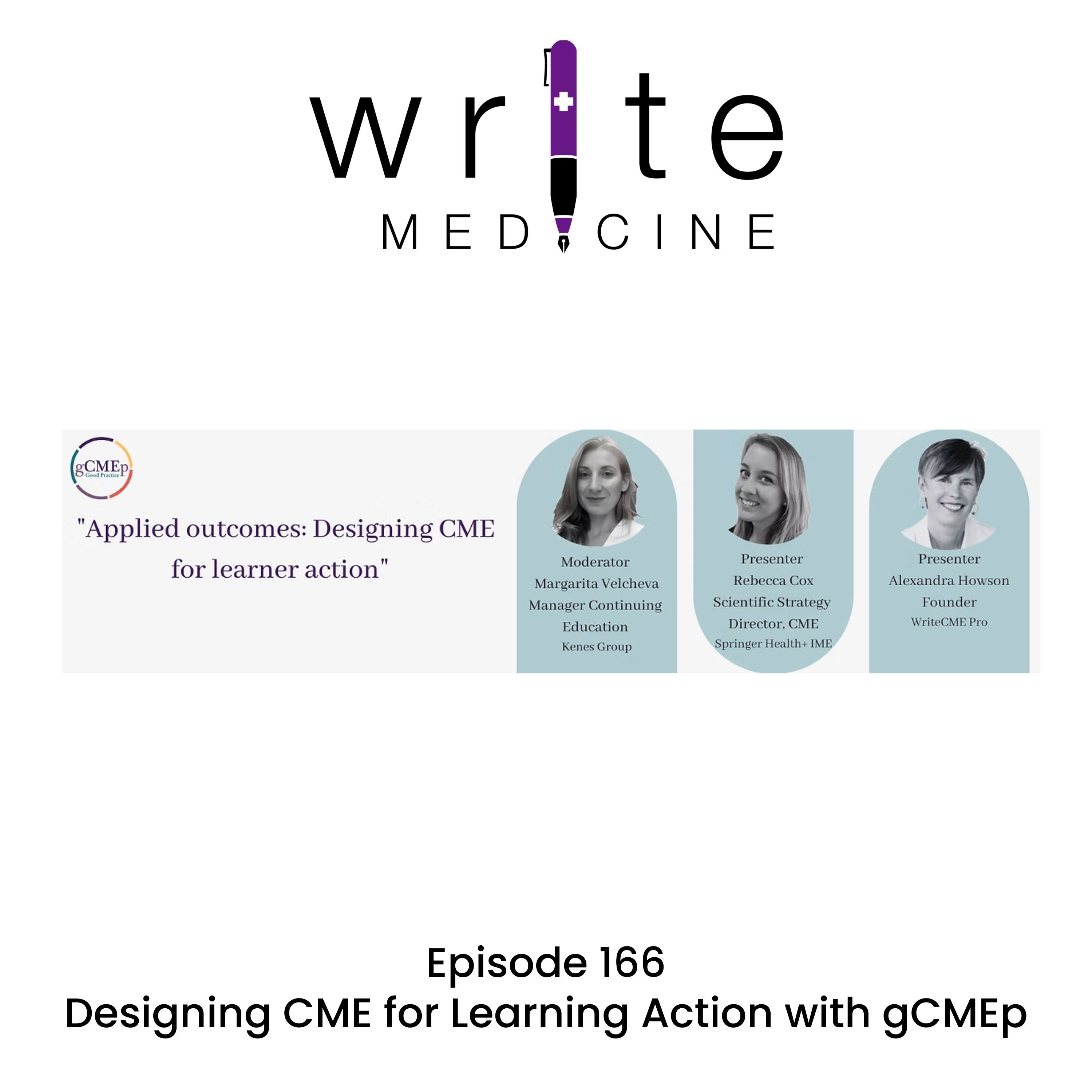
You already know how to write learning objectives. You reference Bloom’s taxonomy. You understand Moore’s outcomes framework. But here’s the real question:When you write a learning objective, can you clearly identify the two to three specific clinical tasks that must happen for that objective to be achieved?In this episode—based on a webinar I participated in with the Good CME Practice Group—we go deeper than frameworks. We unpack what actually sits underneath a learning objective and how that layer determines whether your CME changes practice… or simply delivers information.What We Explore in This EpisodeWhy learning objectives are signposts—not the design itselfHow to break each objective into 2–3 concrete clinical tasksThe role of workflow, format, and audience context in determining granularityHow learning science (cognitive load, retrieval practice, feedback) strengthens action-focused designWhere CME programs most commonly lose alignment between need, content, assessment, and outcomesKey TakeawayIf you can’t name the specific clinical actions required to meet an objective, the content won’t drive behavior change.Design lives underneath the objective.Next StepIf this episode resonated, try this:Take one learning objective from a current project and ask:What are the two or three specific clinical actions underneath it?Where do those actions appear in the content?Where are they assessed?That exercise alone will elevate your design work.And if you want structured practice applying this level of thinking—with feedback, live coaching, and a community of CME professionals—explore WriteCME Pro.This is where writers become design partners.ResourcesGood CME Practice GroupMentioned in this episode:Root Cause Analysis Practice LabReady to write needs assessments that go deeper than "clinicians need more education"? Join our Root Cause Analysis Practice Lab on February 19th. You'll learn systems thinking, defensible frameworks, and grant-ready language in 3 hands-on hours. $297 | Applies to WriteCME Pro membership [CTA Button] Save My Spot → https://community.writecmepro.com/root-cause-analysisRoot Case Analysis Practice LabThis podcast uses the following third-party services for analysis: Podtrac - https://analytics.podtrac.com/privacy-policy-gdrp

S11 Ep 165The CME Writing Skills No One Teaches—but Every Writer Needs
In this year-end episode, Alex takes you behind the scenes into a full year of growth inside the WriteCME Pro community. Whether you're just starting in CME or deepening your expertise, you’ll hear the most important trends that emerged among CME writers in 2025—what they struggled with, how they moved forward, and what this means for your own career in 2026.If you want clarity, confidence, and a sense of belonging in the CME world, this episode offers a peek at the path forward.In this episode, you’ll learn:The biggest mindset and skill gaps CME writers faced this yearWhy understanding the ecosystem matters more than mastering templatesThe professional identity shift that helped writers step into higher-level rolesWhy wellbeing has become a non-negotiable business strategyWhat happens when writers grow inside a community instead of aloneWhat support, structure, and opportunities are coming in 2026You’ll especially benefit if you’re:A medical writer curious about entering CMEA working CME writer who feels stuck or isolatedA freelancer craving clarity, community, or better workflow systemsSomeone who wants to build a resilient, respected CME writing businessLearn more or join the community:12 Days of Giving Secret ListWriteCME ProMentioned in this episode:Root Cause Analysis Practice LabReady to write needs assessments that go deeper than "clinicians need more education"? Join our Root Cause Analysis Practice Lab on February 19th. You'll learn systems thinking, defensible frameworks, and grant-ready language in 3 hands-on hours. $297 | Applies to WriteCME Pro membership [CTA Button] Save My Spot → https://community.writecmepro.com/root-cause-analysisRoot Case Analysis Practice LabThis podcast uses the following third-party services for analysis: Podtrac - https://analytics.podtrac.com/privacy-policy-gdrp
S11 Ep 164If CME Writers Had an Advent Calendar…
What if you ended the year not with burnout or urgency, but with a daily ritual of inspiration, generosity, and creative momentum for your CME writing?As CME writers, so much of our work happens behind the scenes — the interviews, the needs assessments, the outlines, the manuscripts. It’s meaningful work, but it’s often quiet and relentless, yet it carries real impact for learners and patients. This episode takes you behind the curtain into the reflection, intention, and creative spark that inspired the 12 Days of Giving. If you’ve ever wanted to reconnect with the why behind your own writing, this story will resonate.In this episode, you’ll hear:My why behind the 12 Days of Giving How reflection helps us stay grounded in a profession that rarely slows down.Why generosity isn’t just a nice idea, but a practical force that strengthens your craft and the CME community.Press play to step behind the scenes and discover the heart, intention, and creative spark powering this year’s 12 Days of Giving.Ready to join the secret list? Do that here: https://www.alexhowson.com/12-days-interestMentioned in this episode:Root Cause Analysis Practice LabReady to write needs assessments that go deeper than "clinicians need more education"? Join our Root Cause Analysis Practice Lab on February 19th. You'll learn systems thinking, defensible frameworks, and grant-ready language in 3 hands-on hours. $297 | Applies to WriteCME Pro membership [CTA Button] Save My Spot → https://community.writecmepro.com/root-cause-analysisRoot Case Analysis Practice LabThis podcast uses the following third-party services for analysis: Podtrac - https://analytics.podtrac.com/privacy-policy-gdrp

S11 Ep 163Your Clinical Lens Is Gold: How to Grow From Beginner to Trusted CME Writer
In this hot seat coaching conversation, Sarah Jabeen MD, a clinician turned medical writer, brings the honest questions so many emerging CME writers quietly carry:How do I navigate a career pivot without feeling like an imposter? How do I leverage my clinical background without overwhelming my writing? And how do I grow from “new” to “trusted” in the eyes of clients?Together, we unpack what’s underneath each of these questions and explore how identity, confidence, community, and small experiments shape your growth as a CME writer.You’ll hear:Why self-doubt is a normal part of professional transformation—and how to shift from “What if this fails?” to “What if this works?”How your clinical experience becomes a true superpower in CME writing, giving you insight, relevance, and empathy that elevate your work.What separates a beginner from a trusted partner, and how reliability, curiosity, and consistent communication matter more than perfection.The role of community and belonging in building confidence and combating isolation during a career pivot.Practical guidance for showing up online, finding your voice, and creating a presence that feels aligned and safe.Whether you’re transitioning from clinical practice, entering CME writing from another discipline, or simply looking for more confidence in your craft, this episode offers permission, perspective, and a path forward.Mentioned in this episode:Root Cause Analysis Practice LabReady to write needs assessments that go deeper than "clinicians need more education"? Join our Root Cause Analysis Practice Lab on February 19th. You'll learn systems thinking, defensible frameworks, and grant-ready language in 3 hands-on hours. $297 | Applies to WriteCME Pro membership [CTA Button] Save My Spot → https://community.writecmepro.com/root-cause-analysisRoot Case Analysis Practice LabThis podcast uses the following third-party services for analysis: Podtrac - https://analytics.podtrac.com/privacy-policy-gdrp

S11 Ep 162When the Inbox Goes Quiet: How to Thrive in the Fallow Seasons of Freelance CME Writing Life
What do you do when your inbox goes quiet and the client work that once filled your calendar suddenly disappears?For many freelance medical writers—especially those transitioning into the CME space—quiet seasons can feel like failure. But what if those fallow periods are actually the most fertile ground for growth? In this conversation with seasoned writer Addie Nagy, we explore how to reframe slow seasons, rebuild confidence, and manage client relationships with steadiness and purpose.You’ll learn how toReimagine client relationships as a dialogue rather than a power struggle so collaboration replaces anxiety.Turn information gaps and slow communication into opportunities for curiosity, clarity, and boundary-setting.Use “fallow time” to strengthen business foundations, refresh systems, and cultivate the mindset shift from freelancer to business owner.Press play to learn how to transform uncertainty into strategy and make every season of your freelance CME writing business work for you.Resources MentionedIlise Benun — The Creative Professional's Guide to Money: How to Think About It, How to Talk About it, How to Manage It. 2011. HOW Books. WriteCME Pro — a community and professional network that provides peer support and opportunities to hone CME writing skills.Mentioned in this episode:Root Cause Analysis Practice LabReady to write needs assessments that go deeper than "clinicians need more education"? Join our Root Cause Analysis Practice Lab on February 19th. You'll learn systems thinking, defensible frameworks, and grant-ready language in 3 hands-on hours. $297 | Applies to WriteCME Pro membership [CTA Button] Save My Spot → https://community.writecmepro.com/root-cause-analysisRoot Case Analysis Practice LabLinkedIn Live AMAThis podcast uses the following third-party services for analysis: Podtrac - https://analytics.podtrac.com/privacy-policy-gdrp

S11 Ep 161Contract Confidence: Protect Your Freelance Medical Writing Business
Have you ever hesitated to push back on a client’s “non-negotiable” contract — even when something didn’t feel right?For freelance medical writers, contracts can be one of the most intimidating parts of running a business. Between indemnity clauses, “work made for hire” language, and shifting risk to the writer, it’s easy to feel powerless. In this episode, legal strategist Brionna Ned (The Lawless Lawyer) breaks down how to approach contract negotiations with confidence — so you can protect your work, your income, and your peace of mind. You'll learn how to:Identify and communicate your leverage points — the non-negotiables that protect your business.Decode intimidating legal terms like indemnity and work made for hire in plain language.Reframe contract negotiation from a high-stakes confrontation into a collaborative conversation about creating a fair working relationship.Press play to discover how to build contract confidence, reduce risk, and negotiate terms that support a thriving medical writing business.Connect with Brionna The Lawless LawyerInstagramThreads LinkedIn Mentioned in this episode:Root Cause Analysis Practice LabReady to write needs assessments that go deeper than "clinicians need more education"? Join our Root Cause Analysis Practice Lab on February 19th. You'll learn systems thinking, defensible frameworks, and grant-ready language in 3 hands-on hours. $297 | Applies to WriteCME Pro membership [CTA Button] Save My Spot → https://community.writecmepro.com/root-cause-analysisRoot Case Analysis Practice LabLinkedIn Live AMAThis podcast uses the following third-party services for analysis: Podtrac - https://analytics.podtrac.com/privacy-policy-gdrp

S11 Ep 160Insight to Impact: A Framework for Translating Needs into Agendas
How do you turn a detailed needs assessment full of data and practice gaps into a clear, learner-centered activity agenda that actually changes clinical practice?If you’ve ever stared at a dense needs assessment wondering how to transform pages of evidence into a coherent educational design, this episode is for you. Many CME writers struggle to bridge the gap between analysis and application—between identifying what clinicians need and structuring how they’ll learn it. In this episode, Alex shares a practical, step-by-step process that helps you connect the dots and design education that makes sense and gets results.By listening, you’ll discover:A seven-step framework to translate insights from your needs assessment into a logical, outcomes-aligned agenda.How to apply the 3-A Test—Aligned, Actionable, Appropriate—to ensure every session delivers value for learners.A real-world mini-case that illustrates how to transform your research into a compelling, structured learning journey.Press play to learn how to transform data into design—and gain the confidence to craft CME agendas that close gaps and inspire change.👉 Grab Your Insight-To-Action Framework 👉 Register for LinkedIn LiveMentioned in this episode:LinkedIn Live AMARoot Cause Analysis Practice LabReady to write needs assessments that go deeper than "clinicians need more education"? Join our Root Cause Analysis Practice Lab on February 19th. You'll learn systems thinking, defensible frameworks, and grant-ready language in 3 hands-on hours. $297 | Applies to WriteCME Pro membership [CTA Button] Save My Spot → https://community.writecmepro.com/root-cause-analysisRoot Case Analysis Practice LabThis podcast uses the following third-party services for analysis: Podtrac - https://analytics.podtrac.com/privacy-policy-gdrp

S11 Ep 159From Unseen to Unstoppable: How Medical Writers Grow Beyond CME Task Work to Creative Partnership
What if the work that feels invisible is the very thing building your expertise?For many CME writers, the hours spent researching, editing, and shaping educational content happen behind the scenes — valuable, but unseen. Over time, that invisibility can blur your sense of value and readiness.In this Write Medicine hot-seat coaching session, Gina Castiblanco PhD shares what it’s really like to navigate that in-between space — leaving behind a visible academic identity and learning to trust her voice as a CME writer and business owner.Together, we unpack how professional visibility starts with self-awareness, boundaries, and the courage to say, “I’m ready, even if I don’t feel ready yet.”By the end of this conversation, you’ll learn how to:Reframe invisibility as part of your growth process — not proof that you don’t belong.Use your academic and clinical background to shape a distinct CME writing identity.Turn your unseen skills into visible value that attracts aligned clients and projects.Shift from doing the work to owning the work — as a creative, strategic partner.Stay to the end of the episode for three practical steps you can take today to start making your invisible work visible — and strengthen your visibility, voice, and value in the CME ecosystem.Mentioned in this episode:Root Cause Analysis Practice LabReady to write needs assessments that go deeper than "clinicians need more education"? Join our Root Cause Analysis Practice Lab on February 19th. You'll learn systems thinking, defensible frameworks, and grant-ready language in 3 hands-on hours. $297 | Applies to WriteCME Pro membership [CTA Button] Save My Spot → https://community.writecmepro.com/root-cause-analysisRoot Case Analysis Practice LabThis podcast uses the following third-party services for analysis: Podtrac - https://analytics.podtrac.com/privacy-policy-gdrp

S11 Ep 158From Curiosity to Confidence: A Freelance Medical Writer’s Guide to Breaking into CME Writing
Curious about continuing medical education (CME) writing but not sure how to begin? In this episode, you’ll learn how to turn your medical, academic, or scientific experience into a meaningful, flexible writing career. Discover the five milestones that help you break into CME writing, the key skills every CME writer needs, and real-world insights from the field.🎧 Tune in now to gain clarity, confidence, and your next steps toward becoming a successful CME writer.LinksWriteCME Pro – Join the CPD-certified professional development program for medical writers specializing in CME.Chart Your CME Writing Path – Map your skills and identify opportunities in CME writing.Episodes 112 & 115 of Write Medicine – Learn how to streamline literature reviews and strengthen your research workflow.American Medical Writers Association (AMWA) – Explore professional development resources for medical communicators.CME Writer Bootcamp: How to Break into CME/CE Writing with no Network and No ExpertiseWrite Medicine Mentor – Get behind-the-scenes insights and templates to deepen your CME writing practice.How to Create Portfolio Samples for CME WritingMentioned in this episode:Root Cause Analysis Practice LabReady to write needs assessments that go deeper than "clinicians need more education"? Join our Root Cause Analysis Practice Lab on February 19th. You'll learn systems thinking, defensible frameworks, and grant-ready language in 3 hands-on hours. $297 | Applies to WriteCME Pro membership [CTA Button] Save My Spot → https://community.writecmepro.com/root-cause-analysisRoot Case Analysis Practice LabWrite Medicine MentorWrite Medicine Mentor is your private companion podcast designed exclusively for medical writers who want deeper support as they grow in continuing medical education (CME). Each month, you'll receive exclusive content from me to support your business and income growth as well as templates/checklists/swipe files you can use and apply to client projects. In addition to immediate access to a CME writing starter pack, each month you’ll get: * A bonus episode that takes you behind the mic for advanced insights into the craft and business of CME writing. * A ready-to-use template, checklist, or swipe file to make your projects smoother and more effective. * An Ask Me Anything episode, where Alexandra Howson, PhD, answers your questions about writing, clients, CME strategy, and sustainable freelance life. Think of this podcast as your personal, earbud-friendly mentor—practical, honest, and always focused on helping you sharpen your skills, expand your opportunities, and thrive as a CME writer.This podcast uses the following third-party services for analysis: Podtrac - https://analytics.podtrac.com/privacy-policy-gdrp

S11 Ep 157From Needs Assessments to Narrative Impact: Positioning Yourself for CME Content Work
Are you ready to move beyond writing needs assessments and step into the creative, story-driven side of CME—without losing the clients or confidence you’ve already built?Many CME writers start with needs assessments. They’re structured, strategic, and an excellent way to learn the landscape. But what happens when you feel ready for more? When you want to create content that sparks learning, integrates clinical insight, and allows your creativity to shine? In this hot seat coaching episode, we meet Zsuzsa Csik, an anesthesiologist and critical care physician turned CME writer, who’s navigating that exact transition—and learning how to position herself for content work while building a sustainable freelance business.By listening, you’ll discover:How to strategically signal to clients that you’re ready for content creation projects.Practical ways to use your clinical or scientific background as a bridge, not a barrier, to new opportunities.Simple positioning tactics to align your current work with your long-term professional goals.Press play now to learn how to move from analysis to creation, and start shaping the CME writing career you really want.Mentioned in this episode:Root Cause Analysis Practice LabReady to write needs assessments that go deeper than "clinicians need more education"? Join our Root Cause Analysis Practice Lab on February 19th. You'll learn systems thinking, defensible frameworks, and grant-ready language in 3 hands-on hours. $297 | Applies to WriteCME Pro membership [CTA Button] Save My Spot → https://community.writecmepro.com/root-cause-analysisRoot Case Analysis Practice LabThis podcast uses the following third-party services for analysis: Podtrac - https://analytics.podtrac.com/privacy-policy-gdrp

S11 Ep 156Expand Your CME Medical Writing Skills: Dual-Audience Strategies for Patient and Clinician Education
How do you take one complex medical concept and make it clear, accurate, and actionable for both clinicians and patients, without losing credibility?If you’re a CME writer, you know the challenge of translating science into education that actually sticks. But as more CME projects tether clinician education with patient-facing components, the real test is flexing your craft to serve two very different audiences at once. Get this right, and you not only improve learning, you expand your professional scope and impact.In this episode, you’ll discover:How to apply practical frameworks to dual-audience writing.Structural techniques that make content engaging, empathetic, and accessible.A simple 3-sentence exercise to sharpen clarity for patients and precision for clinicians—anytime, anywhere.🎧 Tune in now and learn how to expand your CME writing craft into dual-audience education with one portable tool you can start using today.ResourcesResources to support plain language, readability, and accessibility. https://readable.com/readability/Cognitive accessibilityThe Patient Education Materials Assessment Tool (PEMAT) Informed consent navigator toolPlain Language SummariesPlain Language Checklist for Health Professionals Plain language in biobank consent Plain Language AssociationCognitive accessibilityInformed consent navigator toolEpisodes MentionedEP31: Cultivating a Visual Mindset with Karen Roy and Bhaval ShahEP 41: Nurture Connection-Tell them a Story with Ben RiggsEP109: Crafting Inclusive and Accessible Medical Content with Virginia ChachatiPractice: Explain one complex idea in three sentences, twice—once for patients, once for clinicians.Take one complex concept: SGLT2 inhibitors reduce heart failure hospitalizations.For patients:What it is: “These medicines help your kidneys release extra sugar, which also helps your heart.”Why it matters: “That can mean fewer breathless days and fewer hospital stays.”What to do next: “Ask your doctor if one of these medicines could work for you, and share any kidney issues you’ve had.”For clinicians:Mechanism and trial anchor in one sentence.Link to the guideline.Patient selection + monitoring.Here’s why this exercise matters: most adults in the U.S. read at about an 8th grade level, and nearly 1 in 5 at or below 5th grade. When we condense a complex medical concept into three short sentences—plain, clear, active—we’re not “dumbing down.” We’re writing accessibly, building trust, and giving patients a fair chance to participate in their care.This 3-sentence rule is your portable tool for making health literacy visible in practice. And the bonus? It sharpens your clinician writing too—forcing clarity, precision, and focus on what truly matters.Mentioned in this episode:Write Medicine MentorWrite Medicine Mentor is your private companion podcast designed exclusively for medical writers who want deeper support as they grow in continuing medical education (CME). Each month, you'll receive exclusive content from me to support your business and income growth as well as templates/checklists/swipe files you can use and apply to client projects. In addition to immediate access to a CME writing starter pack, each month you’ll get: * A bonus episode that takes you behind the mic for advanced insights into the craft and business of CME writing. * A ready-to-use template, checklist, or swipe file to make your projects smoother and more effective. * An Ask Me Anything episode, where Alexandra Howson, PhD, answers your questions about writing, clients, CME strategy, and sustainable freelance life. Think of this podcast as your personal, earbud-friendly mentor—practical, honest, and always focused on helping you sharpen your skills, expand your opportunities, and thrive as a CME writer.Root Cause Analysis Practice LabReady to write needs assessments that go deeper than "clinicians need more education"? Join our Root Cause Analysis Practice Lab on February 19th. You'll learn systems thinking, defensible frameworks, and grant-ready language in 3 hands-on hours. $297 | Applies to WriteCME Pro membership [CTA Button] Save My Spot → https://community.writecmepro.com/root-cause-analysisRoot Case Analysis Practice LabThis podcast uses the following third-party services for analysis: Podtrac - https://analytics.podtrac.com/privacy-policy-gdrp

S11 Ep 155How to Overcome Academic Trauma and Build Confidence as a Freelance Medical Writer
What if leaving academia—or another tightly defined professional path—felt less like failure and more like freedom?For many academics, clinicians, and researchers, stepping into freelance medical writing isn’t just a career change—it’s a profound identity shift. Too often, this transition carries grief, shame, or the lingering sense of “not enough.” In this episode, we explore how those feelings show up, why they matter, and how to reframe them as fuel for your writing career.By listening, you’ll discover:Why the transition from academia or clinical practice can feel like trauma—and how to reframe it as strength.Four entrepreneurial habits that can help you thrive as a freelance medical writer while avoiding their shadow sides.Simple, practical practices—like free writing and mindful self-awareness—that help you claim permission, rebuild confidence, and cultivate a sustainable business mindset.Press play now to learn how to navigate identity loss, tap into your natural strengths, and take small steps toward building a medical writing business that feels truly your own.Mentioned in this episode:Root Cause Analysis Practice LabReady to write needs assessments that go deeper than "clinicians need more education"? Join our Root Cause Analysis Practice Lab on February 19th. You'll learn systems thinking, defensible frameworks, and grant-ready language in 3 hands-on hours. $297 | Applies to WriteCME Pro membership [CTA Button] Save My Spot → https://community.writecmepro.com/root-cause-analysisRoot Case Analysis Practice LabWrite Medicine MentorWrite Medicine Mentor is your private companion podcast designed exclusively for medical writers who want deeper support as they grow in continuing medical education (CME). Each month, you'll receive exclusive content from me to support your business and income growth as well as templates/checklists/swipe files you can use and apply to client projects. In addition to immediate access to a CME writing starter pack, each month you’ll get: * A bonus episode that takes you behind the mic for advanced insights into the craft and business of CME writing. * A ready-to-use template, checklist, or swipe file to make your projects smoother and more effective. * An Ask Me Anything episode, where Alexandra Howson, PhD, answers your questions about writing, clients, CME strategy, and sustainable freelance life. Think of this podcast as your personal, earbud-friendly mentor—practical, honest, and always focused on helping you sharpen your skills, expand your opportunities, and thrive as a CME writer.This podcast uses the following third-party services for analysis: Podtrac - https://analytics.podtrac.com/privacy-policy-gdrp

S11 Ep 154Designing CME for Behavior Change: Sarah Atwood on Learning Science in Action
What if the CME you design could do more than deliver knowledge—what if it could actually change clinician behavior and improve patient care?As a CME writer or education professional, you’ve likely felt the frustration of producing content that looks strong on paper but doesn’t translate into meaningful practice change. This episode explores how learning science, human-centered design, and patient co-creation can help you bridge the gap between information and impact.By listening, you will discover:Learning science principles, like Mayer’s multimedia principles, that make education stick.The difference between learning change and behavior change, and why both matter in CME.How aligning clinician and patient education fosters shared decision-making and better healthcare outcomes.Press play now to learn practical strategies you can use to design CME that transforms knowledge into real-world change.Mentioned in this episode:Root Cause Analysis Practice LabReady to write needs assessments that go deeper than "clinicians need more education"? Join our Root Cause Analysis Practice Lab on February 19th. You'll learn systems thinking, defensible frameworks, and grant-ready language in 3 hands-on hours. $297 | Applies to WriteCME Pro membership [CTA Button] Save My Spot → https://community.writecmepro.com/root-cause-analysisRoot Case Analysis Practice LabThis podcast uses the following third-party services for analysis: Podtrac - https://analytics.podtrac.com/privacy-policy-gdrp

Craft to Confidence: What's Coming Up in Season 11
trailerWhat does it take to move from order-taker to trusted partner in CME writing?That’s the single question driving this new season of Write Medicine.In this 15-minute teaser episode, Alex introduces the season theme—Craft to Confidence: A CME Writer’s Season of Growth—and gives you a preview of what’s ahead. You’ll hear how guest interviews and solo tactical episodes will work together to help you build your skills, expand your visibility, and strengthen your confidence as a CME writer.Whether you’re transitioning from academia, clinical practice, or another writing specialty, this season will give you both the craft tools and the career clarity to thrive in continuing medical education.Episodes to Look Forward ToDesigning for learning with Sarah AtwoodHot Seat Coaching on attracting content projects and integrating academic skills into CMELeveraging Milkshake Moments with Michelle SkidmoreIdentity, trauma, and resilience with Hope LaffertySolo walk-throughs on interviewing SMEs, turning education gaps and needs into activity agendas, publishing manuscripts, and moreMentioned in this episode:Root Cause Analysis Practice LabReady to write needs assessments that go deeper than "clinicians need more education"? Join our Root Cause Analysis Practice Lab on February 19th. You'll learn systems thinking, defensible frameworks, and grant-ready language in 3 hands-on hours. $297 | Applies to WriteCME Pro membership [CTA Button] Save My Spot → https://community.writecmepro.com/root-cause-analysisRoot Case Analysis Practice LabWrite Medicine MentorWrite Medicine Mentor is your private companion podcast designed exclusively for medical writers who want deeper support as they grow in continuing medical education (CME). Each month, you'll receive exclusive content from me to support your business and income growth as well as templates/checklists/swipe files you can use and apply to client projects. In addition to immediate access to a CME writing starter pack, each month you’ll get: * A bonus episode that takes you behind the mic for advanced insights into the craft and business of CME writing. * A ready-to-use template, checklist, or swipe file to make your projects smoother and more effective. * An Ask Me Anything episode, where Alexandra Howson, PhD, answers your questions about writing, clients, CME strategy, and sustainable freelance life. Think of this podcast as your personal, earbud-friendly mentor—practical, honest, and always focused on helping you sharpen your skills, expand your opportunities, and thrive as a CME writer.This podcast uses the following third-party services for analysis: Podtrac - https://analytics.podtrac.com/privacy-policy-gdrp

From Anxiety to Action: What Every Medical Writer Needs to Know About AI Integration
bonusIf you’re a medical writer today, you're no stranger to tight deadlines, dense source material, and the pressure to deliver educational content that is both engaging and evidence-based. These demands are particularly acute in the world of continuing medical education (CME), where accuracy, clarity, and relevance matter more than ever. As the medical writing landscape evolves, so do the tools that support us. Among the most promising of these is MACg, a generative AI-powered assistant that helps medical writers streamline document analysis, content creation, and research. For writers working in CME or adjacent fields, MACg offers more than convenience—it offers a meaningful shift in how we work. Tune in to learn how I’m using MACg as a collaborative partner in my workflow rather than a replacement for my creative process. Resources Grab your fee trial of MACg Summer Script Camp Mentioned in this episode:Root Cause Analysis Practice LabReady to write needs assessments that go deeper than "clinicians need more education"? Join our Root Cause Analysis Practice Lab on February 19th. You'll learn systems thinking, defensible frameworks, and grant-ready language in 3 hands-on hours. $297 | Applies to WriteCME Pro membership [CTA Button] Save My Spot → https://community.writecmepro.com/root-cause-analysisRoot Case Analysis Practice LabThis podcast uses the following third-party services for analysis: Podtrac - https://analytics.podtrac.com/privacy-policy-gdrp

From Barbershops to Boardrooms: Pioneering CME in Unexpected Spaces
How do you design CME that reaches the communities most affected by HIV—and not just the clinicians who already have access? If you're a CME professional grappling with how to address layered issues like stigma, housing insecurity, or racial disparities, you’re not alone. This episode dives into what it takes to create truly inclusive education—especially when traditional strategies fall short. Whether you’re designing education for clinicians or collaborating with community partners, you’ll find actionable ideas to bring your programming closer to the ground. Specifically, you'll learn: How to build authentic partnerships with community leaders who can serve as trusted bridges between healthcare providers and hard-to-reach populations. The essential infrastructure you need to establish before launching community-based programs, from setting up referral networks that ensure patients don't fall through cracks after screening to tracking both clinical outcomes and demographic data that funders require. A proven framework for developing educational content with cultural humility and how to work with expert faculty who understand nuanced communication challenges. Connect with Dean 🌐 https://DKBMED.COM Resources Signup for Summer Script Camp Get TextExpander Mentioned in this episode:Root Cause Analysis Practice LabReady to write needs assessments that go deeper than "clinicians need more education"? Join our Root Cause Analysis Practice Lab on February 19th. You'll learn systems thinking, defensible frameworks, and grant-ready language in 3 hands-on hours. $297 | Applies to WriteCME Pro membership [CTA Button] Save My Spot → https://community.writecmepro.com/root-cause-analysisRoot Case Analysis Practice LabThis podcast uses the following third-party services for analysis: Podtrac - https://analytics.podtrac.com/privacy-policy-gdrp

S10 Ep 152From Scattered to Specific: How a Niche Can Save Your Sanity (and Your Business)
Are you a freelance CME writer juggling too many project types and wondering if it’s time to finally “niche down”? In the world of continuing medical education (CME), clarity and focus aren’t just nice to have—they’re essential for sustainable business growth. If you’re feeling stretched thin, jumping between clients and therapeutic areas, this episode explores how finding a niche can reduce overwhelm, streamline your process, and even attract the kinds of clients who value what you do most. Here’s what you’ll gain from this episode: A practical definition of what a niche is—and what it isn’t—so you can stop second-guessing yourself. Examples of how different niches can emerge from your background, preferences, or even your favorite types of client relationships. A step-by-step approach to experimenting your way into a niche, without the pressure to get it “perfect” from the start. Tune in now to learn how niching can simplify your business, supercharge your marketing, and help you find work that truly energizes you. LINKS Grab the Niche Discovery Checklist Signup for Summer Script Camp If you are looking for ongoing CME content strategy tips, tools, and tactics, subscribe to the Write Medicine Insider newsletter. Get TextExpander Mentioned in this episode:Root Cause Analysis Practice LabReady to write needs assessments that go deeper than "clinicians need more education"? Join our Root Cause Analysis Practice Lab on February 19th. You'll learn systems thinking, defensible frameworks, and grant-ready language in 3 hands-on hours. $297 | Applies to WriteCME Pro membership [CTA Button] Save My Spot → https://community.writecmepro.com/root-cause-analysisRoot Case Analysis Practice LabThis podcast uses the following third-party services for analysis: Podtrac - https://analytics.podtrac.com/privacy-policy-gdrp

From Silos to Synergy: Designing CME for Real-World Healthcare Teams with Dr. Tina Patel Gunaldo
How can continuing education break down professional silos and foster real collaboration among healthcare teams? If you create CME/CE content, you’ve likely encountered the challenge of writing for “teams” that still operate in silos. This episode with interprofessional education expert Dr. Tina Patel Gunaldo, Founder, Collaborate for Health, reveals why just using the term “team-based care” isn’t enough—and how content creators can more accurately reflect the evolving nature of healthcare collaboration. As patient-centered models expand and asynchronous care becomes the norm, CME professionals need a deeper understanding of roles, language, and practice contexts to design impactful education. Discover the critical differences between interprofessional, interdisciplinary, and multidisciplinary practice—and why it matters for CME writing. Learn how to structure education that empowers team collaboration and respects the unique contributions of each discipline. Understand the growing role of patients, technology, and asynchronous communication in shaping interprofessional collaboration today. And if you’re unsure when to use “interprofessional” vs “multidisciplinary”? We’ve got you covered. We created a one-page Quick Reference Guide to help you use team-based language precisely and avoid common traps in CME writing. It’s perfect for writers, educators, and reviewers who want to level up their clarity. Grab the download in the show notes and keep it handy as you create your next piece of content. Tune in now to learn how you can write CME content that reflects real-world collaboration—and elevates both learner experience and patient care outcomes. Connect with Tina Website: https://collaborateforhealth.com LinkedIn Interprofessional Terms Quick Reference Guide Mentioned in this episode:Root Cause Analysis Practice LabReady to write needs assessments that go deeper than "clinicians need more education"? Join our Root Cause Analysis Practice Lab on February 19th. You'll learn systems thinking, defensible frameworks, and grant-ready language in 3 hands-on hours. $297 | Applies to WriteCME Pro membership [CTA Button] Save My Spot → https://community.writecmepro.com/root-cause-analysisRoot Case Analysis Practice LabThis podcast uses the following third-party services for analysis: Podtrac - https://analytics.podtrac.com/privacy-policy-gdrp

Raising the Bar: Essential Competencies for CME Writers with Haifa Kassis and Don Harting
Are you unsure which skills you need to thrive as a CME writer (or need for your writers)—or how to prove your value in an increasingly competitive field? Many medical writers stumble into CME with strong writing chops but little clarity about what the role truly demands. At the same time, education providers struggle to find writers who are not just capable—but competent. This episode bridges that gap. Don Harting and Haifa Kassis join us to unpack the results of their groundbreaking Delphi study on CME writing competencies, revealing what hiring managers really want and how you can grow your career strategically. In this episode, you’ll learn: The four core competencies every CME writer should master today Which deliverables are in high demand—and which are vanishing How this competency model can support onboarding, training, and upskilling. Press play to learn how to align your writing skills with what the CME industry actually needs—so you can stand out, get hired, and grow with confidence. Resources Kassis, H., & Harting, D. (2024). Medical Writing for Continuing Education in the Health Professions: A Competency Model. Journal of CME, 13(1). https://doi.org/10.1080/28338073.2024.2422709 CME Writers’ Toolbox Delphi Panelists WriteCME Pro: Accelerate your freelance CME writing business growth Timestamps 00:00 Introduction to CME Writing Challenges 00:20 Meet the Researchers: Haifa Kassis and Don Harting 01:19 The Competency Model: Key Findings 02:40 Expert Consensus and Methodology 06:16 Surprising Insights and Real-World Challenges 11:15 Practical Applications and Future Directions 24:35 Emerging Competencies and Industry Trends 28:47 Conclusion and Contact Information Mentioned in this episode:Root Cause Analysis Practice LabReady to write needs assessments that go deeper than "clinicians need more education"? Join our Root Cause Analysis Practice Lab on February 19th. You'll learn systems thinking, defensible frameworks, and grant-ready language in 3 hands-on hours. $297 | Applies to WriteCME Pro membership [CTA Button] Save My Spot → https://community.writecmepro.com/root-cause-analysisRoot Case Analysis Practice LabThis podcast uses the following third-party services for analysis: Podtrac - https://analytics.podtrac.com/privacy-policy-gdrp