Witness History
2,139 episodes — Page 15 of 43
The WW2 escape line that fooled the Nazis
In 1940 a daring rescue operation began to help Allied servicemen escape from Nazi-occupied France.French resistance fighter Roland Lepers was among those who guided stranded Allied soldiers and airmen to neutral Spain during World War Two. The 1,000 km route became known as the Pat O’Leary Escape Line - or the Pat Line. It’s estimated 7,000 Allied personnel escaped through this route and similar escape lines, thanks to a network of people who clothed, fed and hid them. Peter Janes was one of those British servicemen.Roland’s daughter Christine and Peter’s son Keith, speak to Jane Wilkinson about their fathers’ adventures.(Photo: German-controlled checkpoint in France, 1940. Credit: Keystone-France/Gamma-Keystone via Getty Images)
The Battle of Versailles: Catwalk clash of American and French fashion
In 1973, a fashion show was held in France which became known as the Battle of Versailles, a duel between designs from modern America and the capital of couture, Paris. Five American designers, including Oscar de la Renta and Halston, were invited to show their work alongside five of France’s biggest names, including Yves Saint Laurent and Hubert de Givenchy. The aim was to raise money to help restore Versailles, a 17th Century palace built by King Louis XIV, but the media billed it as a competition between the two countries.By the end, the Americans were declared the winners. The show also highlighted their industry’s racial diversity on an international stage, with 10 women of colour modelling work by US designers. Bethann Hardison, one of the models, talks to Jane Wilkinson about the lasting impact of the astonishing show.(Photo: Bethann Hardison at Versailles in 1973. Credit: Jean-Luce Hure/Bridgeman Images)
How Rosa Parks took a stand against racism
Rosa Parks was brought up in Alabama during the Jim Crow era, when state laws enforced segregation in practically all aspects of daily life.Public schools, water fountains, trains and buses all had to have separate facilities for white people and black people.As a passionate civil rights activist, Rosa was determined to change this.In December 1955, she was travelling home from the department store where she worked as a seamstress.When a white passenger boarded the bus, Rosa was told to give up her seat.Her refusal to do so and subsequent arrest sparked a bus boycott in the city of Montgomery, led by Dr Martin Luther King.Using BBC interviews with Rosa and Dr King, Vicky Farncombe tells how Rosa’s story changed civil rights history and led to the end of segregation.This programme includes outdated and offensive language.(Photo: Rosa Parks sitting on a bus. Credit: Getty Images)
Lucha Reyes: Peruvian music star
Lucha Reyes was one of Peru’s greatest singers. She was born into poverty in 1936 and fought terrible health problems and racism throughout her life. But it didn’t stop her becoming a star of Peruvian Creole music - a fusion of waltzes, Andean and Afro-Peruvian styles. In the early 1970s she recorded hits including Regresa and Tu Voz. One of the few black Peruvian celebrities of her era, she was a trailblazer for black women in the country. Polo Bances played the saxophone in her band, accompanying her on many of her greatest records. He celebrates her life with Ben Henderson.(Photo: Lucha Reyes. Credit: Javier Ponce Gambirazio)
A young mother saved from death by stoning
In March 2002, a young Nigerian Muslim woman was sentenced to death by stoning for adultery and conceiving a child out of wedlock. Amina Lawal’s case attracted huge international attention and highlighted divisions between the Christian and Muslim regions in the country. Hauwa Ibrahim, one of the first female lawyers from northern Nigeria, defended Amina and helped her secure an acquittal. The case would have very personal consequences for Hauwa who went on to adopt Amina’s daughter. She tells Vicky Farncombe how the ground-breaking case also changed attitudes in Nigeria towards defendants from poor, rural communities.(Photo: Hauwa Ibrahim (left) with Amina Lawal, Credit: Getty Images)
Queen of the 'fro
In May 1986, 16-year-old Charlotte Mensah went to work in the UK’s first luxury Afro-Caribbean hair salon, Splinters.In London’s glamorous Mayfair, Splinters had earned a world-class reputation and hosted the likes of Diana Ross.Charlotte says it looked more like a five-star hotel than a salon and that its owner, Winston Isaacs expected no less than perfection from all his staff.Now a giant of the hair care industry in her own right, Charlotte has become known as the 'Queen of the 'fro'.She tells Anoushka Mutanda-Dougherty about her roots and how training at the legendary Splinters changed her life. This programme includes an account of racial bullying. (Photo: Young Charlotte in the salon. Credit: Charlotte Mensah)
First internet cafe
The first commercial internet cafe opened in London on 1 September 1994. Eva Pascoe, from Poland, is one of the founders of Cyberia. She claims that Kylie Minogue was amongst the famous visitors and learnt how to use the internet at the cafe.Eva tells Gill Kearsley the story of how cakes, computers and Kylie came together to make this new venture a success.(Photo: Surfers at the Cyberia cafe. Credit: Mathieu Polak/Sygma via Getty Images)
The Arctic’s doomsday seed vault
In January 2008, seeds began arriving at the world's first global seed vault, buried deep in a mountain on an Arctic island, 1,000km north of the Norwegian coast.The vault was built to ensure the survival of the world's food supply and agricultural history in the event of a global catastrophe.In 2019, Louise Hidalgo spoke to the man whose idea it was, Dr Cary Fowler.(Photo: Journalists and cameramen outside the entrance of the Svalbard Global Seed Vault in 2008. Credit: Hakon Mosvold Larsen/AFP/Getty Images)
Brazil's Landless Workers Movement
In 1980, poor rural workers set up camp on land owned by the rich at Encruzilhada Natalino in the state of Rio Grande do Sul. Brazil's government sent in the army to evict them and violent clashes followed. It was a formative moment in the history of one of Latin America's biggest social movements, Brazil's Landless Workers Movement (MST). Maria Salete Campigotto was a teacher living in the camp with her husband and young son. She speaks to Ben Henderson.(Photo: Brazil's Landless Workers Movement meeting. Credit: Patrick Siccoli/Getty Images)
Silenced by the Vatican
In September 1984, the Brazilian theologian Leonardo Boff was summoned to Rome, facing accusations that his writing and teachings were "dangerous to the faith".He is a leading proponent of liberation theology, which says the Church should push for social equality. Leonardo was called to appear before the Roman Catholic Church’s highest tribunal.A year later, he was banned from writing, teaching or speaking publicly. Now in his late 80s and no longer a priest, he tells Mike Lanchin about that turbulent time. A CTVC production for BBC World Service.(Photo: Leonardo Boff preaching outside a church to followers of Liberation Theology. Credit: Bernard Bisson/Sygma/Getty Images)
Jack Strong aka Ryszard Kukliński: Cold War traitor or hero?
During the 1970s, the US and Soviet Union were engaged in the Cold War. The US, along with other Western countries, was a member of Nato, while the Soviet Union joined forces with central and eastern European countries in the Warsaw Pact. After becoming frustrated with the way the Soviets controlled his country, Ryszard Kukliński, a Polish colonel, wrote to the US Embassy in Bonn, West Germany. For the next 10 years, he would feed the CIA tens of thousands of pages of classified military secrets.Aris Pappas, a CIA agent who analysed Ryszard's intel, speaks to George Crafer about his memories of this forgotten hero. (Photo: Jack Strong aka Ryszard Kukliński. Credit: AP)
The Hungarian footballer executed for love
The Magnificent Magyars were Hungary’s golden football team of the 1950s.But behind their shine lay a dark secret.In 1951, defender Sándor Szűcs was executed for trying to defect from the communist regime.The married centre-back had wanted to leave Hungary with his lover, singer Erzsi Kovács, who was also married.The pair had been told to end their illicit relationship or face imprisonment.They were arrested near the border after being set up by a double agent.This programme has been made by Vicky Farncombe, using an interview Erzsi gave in 2011 to Hungarian journalist Endre Kadarkai on the Arckép programme, on Zuglo TV.Eye-witness accounts brought to life by archive. Witness History is for those fascinated by the past. We take you to the events that have shaped our world through the eyes of the people who were there. For nine minutes every day, we take you back in time and all over the world, to examine wars, coups, scientific discoveries, cultural moments and much more. Recent episodes explore everything from football in Brazil, the history of the ‘Indian Titanic’ and the invention of air fryers, to Public Enemy’s Fight The Power, subway art and the political crisis in Georgia. We look at the lives of some of the most famous leaders, artists, scientists and personalities in history, including: visionary architect Antoni Gaudi and the design of the Sagrada Familia; Michael Jordan and his bespoke Nike trainers; Princess Diana at the Taj Mahal; and Görel Hanser, manager of legendary Swedish pop band Abba on the influence they’ve had on the music industry. You can learn all about fascinating and surprising stories, such as the time an Iraqi journalist hurled his shoes at the President of the United States in protest of America’s occupation of Iraq; the creation of the Hollywood commercial that changed advertising forever; and the ascent of the first Aboriginal MP.(Photo: Sándor Szűcs. Credit: Arcanum/Nemzeti Sport)
Wang Jingwei: China’s traitor or protector?
In 1937, Japan invaded China committing atrocities including the Nanjing Massacre. Wang Jingwei was a Chinese national hero and second-in-command of China’s ruling Nationalist Party. He wanted to negotiate with Japan but his colleagues wouldn’t listen. So he defected, and in 1940 he agreed to lead a Japanese-controlled puppet government in Nanjing. Many Chinese have hated him ever since – his name is synonymous with the word ‘Hanjian’, a traitor to China. But Pan Chia-sheng’s memories of living under Wang Jingwei’s government tell a very different story. He speaks to Ben Henderson.(Photo: Wang Jingwei. Credit: Wang Wenxing via Wang Jingwei Irrevocable Trust)
Axis Sally: World War II traitor who broadcast for the Nazis
In 1949, Mildred Gillars – otherwise known as Axis Sally – became the first woman in American history to be convicted of treason.The former Broadway showgirl broadcast antisemitic Nazi propaganda on German State Radio during World War Two.Her weekly shows were heard by thousands of American servicemen who gave her the nickname Axis Sally.After her capture, she denied being a traitor, but a jury in Washington convicted her of treason, and she served 12 years in prison. Jane Wilkinson has been looking through the BBC archives to uncover her story.(Photo: Mildred Gillars. Credit: Bettmann, Getty Images)
Vidkun Quisling: Norway's traitor
In December 1939, fascist Norwegian politician Vidkun Quisling travelled to Berlin from Oslo for a secret meeting with Adolf Hitler.Quisling suggested to Hitler that the British were planning to move into Norway for their own strategic needs. Norway hadn’t been a concern for the Nazis but the meeting alarmed Hitler and within months Germany started its invasion of Norway.From that moment, Quisling was consigned into history as a traitor. So much so that in the time since, his name has become a byword for traitor in numerous languages.Matt Pintus hears from Norwegian journalist, Trude Lorentzen, who decided to study Quisling’s life after stumbling across his suitcase in an online auction.As part of her voyage of discovery, Trude interviewed Quisling’s Jewish neighbour Leif Grusd who was forced to flee to Sweden when the Nazis took over Norway.Leif Grusd's interview was translated from the NRK podcast "Quislings koffert" - Quisling's suitcase - released in 2021. It was made by production company Svarttrost for NRK.(Photo: Vidkun Quisling and Adolf Hitler. Credit: Getty Images)
Jamuna Tudu: The real life 'Lady Tarzan'
In the early 2000s, a woman called Jamuna Tudu set out on a mission to protect her home state of Jharkhand's forests from India's so-called timber mafia. She inspired thousands of people to care for their natural environment and established an army of women to fight back against the illegal cutting down of trees.Her conservation efforts have led to the country's media dubbing her 'Lady Tarzan', and she is now known across India for her bravery.She speaks to George Crafer about her run-ins with the mafia and her hero status.(Photo: Jamuna Tudu amongst the trees she loves. Credit: Jamuna Tudu)
Ibadan Zoo
British zoologist Bob Golding turned the University of Ibadan's zoo into one of Nigeria's biggest tourist attractions in the 1970s.The zoo was famous for two gorillas he rescued from traffickers. And Bob's animal kingdom even had its own TV show.His wife, Peaches Golding, tells Ben Henderson how he did it. (Photo: Bob Golding. Credit: bobgolding.co.uk)
Tortured in Iran's Evin Prison
In June 2009, millions of Iranians took to the streets to protest against what they considered a rigged presidential election.The hardline incumbent Mahmoud Ahmadinejad won 62% of the vote. All three defeated candidates disputed the results.The protests gave rise to the 'Green Movement', named after its signature colour, which opposed Ahmadinejad.Journalist Maziar Bahari was accused of being a Western spy and spent 118 days being interrogated in Iran's Evin Prison. He tells Dan Hardoon about the torture he endured.(Photo: Maziar Bahari in 2015. Credit: Slaven Vlasic/Getty Images)
The Green March: Moroccans take over the Sahara
On 6 November 1975, tens of thousands of Moroccans poured into Spanish Sahara in a bid to claim it for their own.They danced, waved flags and played music as they faced off, unarmed, against gun-carrying Spanish soldiers.The so-called Green March led to a diplomatic victory for Morocco's King Hassan, but sparked a guerrilla war and decades of instability.In 2013, TV cameraman Seddik Maaninou and North Africa expert Francis Gillies told Simon Watts about that momentous protest.(Photo: Protestors on the Green March. Credit: Jacques Haillot/Apis/Sygma/Sygma/Getty Images)
The hunger-striking Bolivian president
In Bolivia, on 25 October 1984, President Hernán Siles Zuazo announced he was going on hunger strike. He was trying to stop the booming cocaine industry in his country. It was the second time he had taken the job of president and he had been on hunger strike several times before. His daughter Marcela Siles, tells Laura Jones about her father.(Photo: President Zuazo. Credit: Getty Images)
Gürtel scandal: Spain's Watergate
For two years, José Luis Peñas risked his life making secret recordings that revealed one of Spain's biggest corruption scandals.It forced the ruling party from power and brought down Prime Minister Mariano Rajoy in 2018.José Luis Peñas speaks to Ben Henderson.(Photo: Mariano Rajoy (right) moments after resigning. Credit: Pierre-Philippe Marcou/Pool via Getty Images)
The first World Laughter Day
On the 11 January 1998 in Mumbai, India, the first World Laughter Day took place.It was the idea of Dr Madan Kataria, a medical doctor who wanted to test the theory that laughter is the best medicine.He tells Gill Kearsley how this unusual event started. (Photo: World Laughter Day in Mumbai in 2016. Credit: Arijit Sen/Hindustan Times via Getty Images)
Russian ballerina defects to the west
In 1970, Natalia Makarova became the first female ballet star to defect to the West from Russia.The dancer claimed asylum during a UK tour, nine years after another Russian dancer, Rudolf Nureyev, had defected.Natalia later joined the American Ballet Theatre in New York. She wouldn’t return to her home country for almost 20 years.Jane Wilkinson has been looking through the archive to discover the reasons behind her defection.(Photo: Natalia Makarova in New York, 1980. Credit: Brownie Harris/Corbis via Getty Image
The mystery of France's lost king
The fate of Louis-Charles, son of the last king of France, was for years shrouded in rumour.The little boy was said to have died in prison in 1795. But for years, rumours spread that he had been swapped with an imposter.It wasn't until a team of scientists took DNA samples from the heart of the imprisoned boy in 2000 that the mystery could be laid to rest.In 2021, Prof Jean Jacques Cassiman and historian Deborah Cadbury told Claire Bowes about the extraordinary tale.(Photo: Drawing of Louis-Charles being separated from his mother Marie Antoinette in 1793. Credit: Universal History Archive/Universal Images Group/Getty Images)
The world’s first lesbian couple to get married
On 1 April 2001, the Netherlands became the first country in the world to legalise gay marriage.Four couples were chosen to take part in a collective wedding at midnight which was broadcast on TV.Hélène Faasen and Anne-Marie Thus tell Dan Hardoon about the wedding they thought they'd never have. (Photo: The four happy couples cut the cake. Credit: Marcel Antonisse/ANP/AFP/Getty Images)
What the 1989 solar storm did to Quebec
On 13 March 1989, the Canadian province of Quebec suffered a nine-hour electricity blackout. Much of the state's infrastructure was damaged, but the power companies couldn't find any obvious cause. Physicist Aja Hruska was one of the only people in the country that knew the answer to Quebec's problem. A solar flare ejected by the sun had hit the earth's magnetic field, creating electrical havoc.And the damage could have been avoided if her warnings had been properly acknowledged. Aja shares her memories of that day with Eva Runciman.(Photo: A solar flare erupts from the sun. Credit: Photo 12/Universal Images Group/Getty Images)
The Hindenburg airship disaster
In 1937, the Hindenburg airship burst into flames during its mooring in New Jersey, in the US, killing 35 of the 97 passengers and crew.
The invention of the wingsuit
The wingsuit is the ultimate in extreme sports clothing. The aerodynamic outfit allows base jumpers and skydivers to free-fall for longer before opening a parachute.The road to creating it was littered with casualties, but in 1999 skydivers Jari Kuosma and Robert Pecnik developed the first commercial wingsuits.In 2019, Jari told Jonathan Coates how exciting, but also how dangerous they can be.(Photo: Jari in his wingsuit. Credit: BBC)
Discovery of the hole in the earth’s ozone
In 1985, British scientists made what would turn out to be one of the most important environmental discoveries of the 20th century - finding a hole in the earth’s ozone layer.The British Antarctic Survey, based in Cambridge, had been monitoring ozone levels for more than 30 years using the Dobson Ozone Spectrophotometer.But it was only when they compared previously uncharted figures from the 1980s with the previous decade that they made the shocking finding, as Jonathan Shanklin, the man who compiled the data, told Jane Wilkinson.(Photo: Ozone hole in September 2006. Credit: Universal History Archive/Universal Images Group via Getty Images)
Earth: A pale blue dot in the universe
In February 1990, Nasa space probe Voyager took a famous photo of Earth as it left the Solar System.Seen from six billion kilometres away, our planet appears as a mere dot lit up by the sun, giving a sense of humanity's small place in the universe.In 2020, Darryl Morris spoke to Nasa planetary scientist Candice Hansen, who worked on the Voyager programme. A Made in Manchester production for BBC World Service.(Photo: Earth - a pale blue dot. Credit: Nasa/JPL-Caltech)
Ken Hom's 'Chinese Cookery'
In 1982, after a two-year global search, the BBC auditioned Ken Hom to be the star of a new Chinese cookery TV series.In the show, called Ken Hom's Chinese Cookery, he introduced viewers to dishes like dim sum and spicy braised aubergine. He also gave advice on choosing and using a wok.He tells Josephine McDermott about his sudden rise to celebrity and how he brought Chinese dishes to new audiences. (Photo: Ken Hom. Credit: Chris Ridley/Radio Times/Getty Images)
The disputed history of pad Thai
It’s one of the most popular dishes in South East Asian cooking and for many it’s seen as Thailand’s national dish. However, the origins of pad Thai are disputed. Some believe it was created and taken to the country centuries ago by Chinese immigrants. Others believe it was invented during the rule of military dictator, Plaek Phibunsongkhram, as a way of cementing Thai nationalism in the 1940s. Thai food writer Chawadee Nualkhair dissects all the theories with Matt Pintus.(Photo: Pad Thai. Credit: Getty Images)
Flavr Savr tomato: The world's first genetically-engineered food
In 1994, biotech company Calgene brought the world's first genetically-modified food to supermarket shelves.The Flavr Savr tomato kept fresh for 30 days and could be shipped long distances without going off.Yet the world was wary of this new food, and it took 10 years and $100m of investment to get it to market.In 2017, the firm's then-CEO Roger Salquist told Claire Bowes about his mission to revolutionise the world's food.(Photo: Roger Salquist with a crop of Flavr Savrs. Credit: Richard Gilmore)
Kiwi: How New Zealand hijacked China's fruit
The kiwi fruit is synonymous with New Zealand in the minds of most European and American shoppers.But the hairy fruit actually comes from China and was once known as the Chinese gooseberry. So how did New Zealand hijack a Chinese fruit and turn it into their biggest horticultural export? Former fruit exporter Don Turner tells Vicky Farncombe how his family named the kiwi fruit in the 1950s and created a global industry.
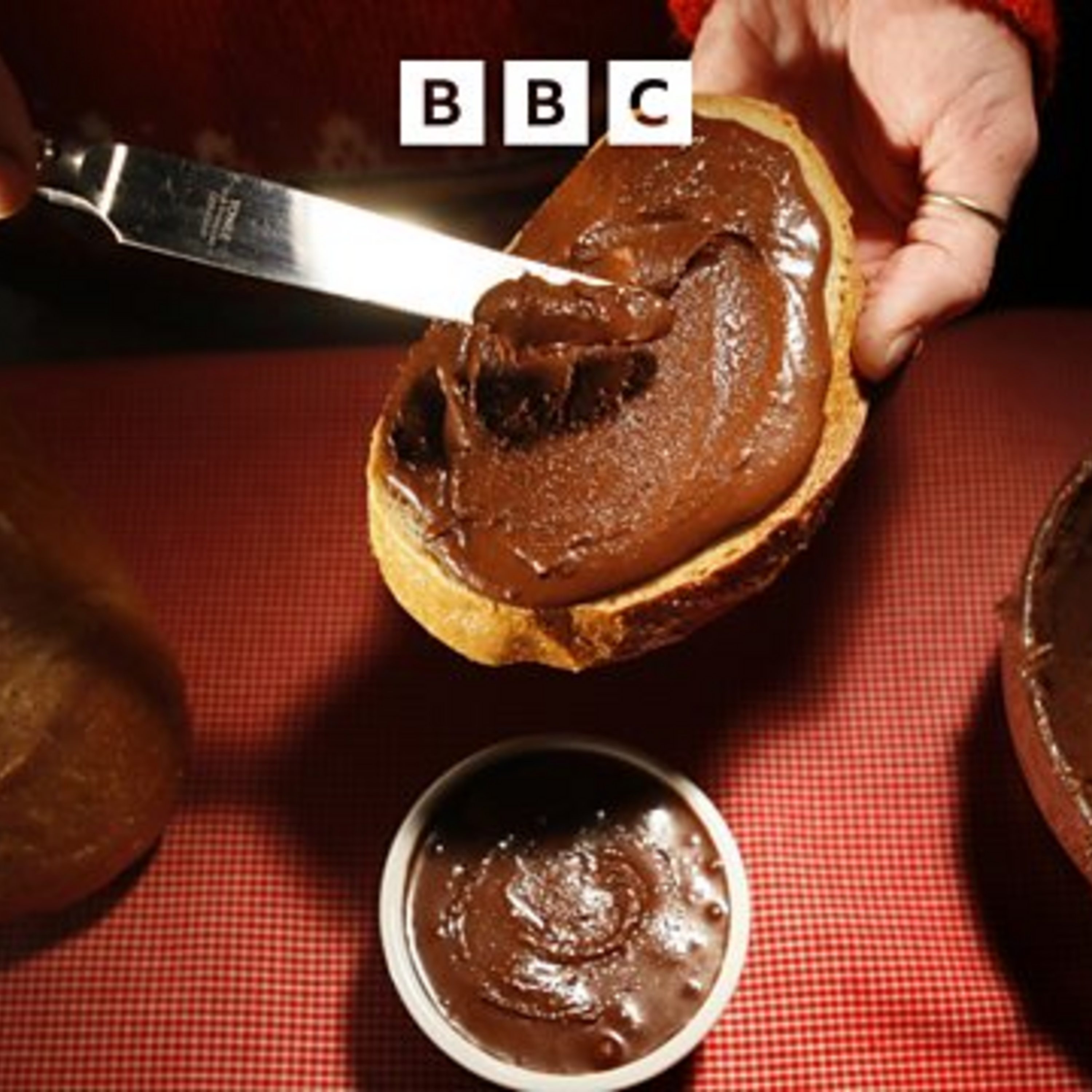
Inventing Nutella
In 1946, Italian confectioner Pietro Ferrero set out to bring chocolate to the masses. His recipe evolved over the years to become a world-famous product.Thomas Chatenier from the manufacturer tells Uma Doraiswamy how the chocolate and hazelnut formula spread across the globe.(Photo: The famous spread. Credit: Robert Gauthier/Los Angeles Times/Getty Images)
'The bad boy of Welsh politics'
In the 1960s, the singer Dafydd Iwan started campaigning for the Welsh language to gain official status in Wales. For years, Dafydd received little support. In January 1969 he decided to up the pressure, defacing a police station sign written in English with paint. He ended up in prison, but soon young people across the country were picking up paint pots and taking up the cause. Today, the Welsh language is found in schools, on documents and on police station signs. Dafydd tells Anoushka Mutanda-Dougherty about his activism and singing.(Photo: Dafydd after his release from Cardiff prison. Credit: Central Press/Getty Images)
Al Jazeera Three: Imprisoned in Egypt
In 2014 three journalists were sentenced to seven years in jail in Egypt.Peter Greste, Mohammed Fahmy and Baher Mohamed became known as the Al Jazeera Three.The jail terms handed out to them led to an international outcry as protesters called for press freedom.Peter Greste tells his compelling story to Gill Kearsley.(Photo: Peter Greste inside the defendants’ cage. Credit: Khaled Desouki/AFP via Getty Images)
The mysterious death of Pablo Neruda
In late 1973, Chile was in turmoil. General Augusto Pinochet had led a military coup deposing the socialist president Salvador Allende who was now dead.The army was rounding up leftists; torturing, imprisoning and killing them.In the capital Santiago, the country’s best-known poet Pablo Neruda was lying in a hospital bed. He was 69 and had cancer.As a prominent member of the Communist Party his life was in danger. He had to get out.With him was his driver and personal assistant Manuel Araya who spoke to Gideon Long.(Photo : The poet in 1963. Credit: Angelo Cozzi/Mondadori/Getty Images)
The assassination of King Faisal
On 25 March 1975, Saudi Arabia’s King Faisal was murdered, shot by his nephew as he bent to kiss him as a greeting.The king’s oil minister Ahmed Zaki Yamani was standing beside him when the gun went off.In 2017, Ahmed’s daughter, Dr Mai Yamani, told Louise Hidalgo of her father’s pain at witnessing the death.(Photo: King Faisal in 1967. Credit: Pierre Manevy/Getty Images)
Tsunami devastates Samoa
On 29 September 2009, a devastating tsunami hit Samoa, killing 149 people and leaving a trail of destruction. For Lumepa Hald it was a terrifying day which resulted in a tragic loss. She tells her story to Gill Kearsley.(Photo: The devastation in Samoa after the tsunami in 2009. Credit: Phil Walter/Getty Images)
The funeral of Nelson Mandela
On 15 December 2013, South Africa held the funeral of Nelson Mandela who led the struggle in defeating apartheid and became the country’s first black president. His ancestral home in the village of Qunu in South Africa’s Eastern Cape hosted 60 world leaders including four United States presidents and two UN secretary generals. It was the first state funeral held by the country.Nelson Mandela’s eldest child Dr Makaziwe Mandela tells Josephine McDermott how it took eight years to plan and why it makes her proud to remember that day.(Photo: Candles are lit under a portrait of Nelson Mandela at his funeral service. Credit: Odd Andersen/AFP via Getty Images)
Vatican citizen Emanuela Orlandi disappears
In 1983, the disappearance of a teenage girl who was a citizen of Vatican City led to a scandal.When Pope John Paul II made a public appeal to the people holding Emanuela Orlandi captive, the world took notice and her case was treated as a suspected kidnapping.Forty years on, the reason she vanished is still unclear.Emanuela’s brother, Pietro Orlandi, speaks to Daniel Gordon about his life-long mission to find out what really happened to his sister.(Photo: A protester holds a photo of Emanuela. Credit: Stefano Montesi/Corbis/Getty Images)
Anna Akhmatova: The poet who defied a regime
The great Russian poet Anna Akhmatova lived through some of the darkest chapters of Soviet history, but never stopped writing even though the communist regime repeatedly tried to silence her. One of Anna's most famous poems, Requiem, is about her son's arrest and the Stalinist terror.In 2022, art historian Era Korobova told Tatyana Movshevich about the poet's tumultuous relationship with her son.(Photo: Anna Akhmatova (second from right, at a Soviet writers' conference in 1965. Credit: Getty Images)
Yeltsin speaks at the reburial of the Romanovs
In 1998, Russia’s President Boris Yeltsin shocked the nation with a last-minute decision to speak at the reburial of Tsar Nicholas II and his family, 80 years after their murder.“We must end an age of blood and violence in Russia,” he said, as he called for the country to face up to the crimes of its communist past.Lilia Dubovaya, a reporter for the state news service, told Robert Nicholson about the emotional weight of the day. A Whistledown production for BBC World Service.(Image: President Yeltsin at the reburial of Tsar Nicholas II. Credit: Reuters)
Murder of the Romanovs
As civil war raged in Russia, on 17 July 1918, the imprisoned royal family were told they were to be taken to a place of refuge.But the move was a trick and half an hour later Tsar Nicholas II, his wife and his children lay dead, gunned down and bayonetted.In 2018, his great niece Olga Romanov told Olga Smirnova about that night, and the family’s reburial 80 years later.(Photo: The room where the Romanovs were murdered. Credit: Getty Images)
The release of DOOM
In December 1993, the release of a new video game captivated gamers around the world. It was called DOOM. Set on a Martian military base overrun by zombified soldiers and demons, DOOM saw players take control of a nameless soldier called ‘The DOOM guy’ as he fights the demonic enemies to stop them taking over Earth. The game was released at a time when violence in video games was big news and a topic of discussion in the United States Senate. Kurt Brookes speaks to John Romero, one of the game’s developers, and remembers the release of what went on to become one of the most influential games ever. A Made in Manchester production for BBC World Service. (Photo: John Romero. Credit: Made in Manchester)
‘The disappeared’ of Argentina
Between 1976 and 1983 in Argentina, the military ruled the country. Thousands of mainly young, left-wing Argentinians went missing. Known as 'the disappeared', they were taken to detention centres, such as Escuela Superior de Mecanica de la Armada, known as ESMA in the capital, Buenos Aires. Around 5,000 prisoners passed through its gates. Most were killed. As well as the murders and torture, hundreds of babies were taken from pregnant prisoners and given away to military personnel and families who supported the government. In December 1983 the Argentinian president Raul Alfonsin signed a decree putting the military junta responsible on trial. In 2010, Candice Piete spoke to one of the survivors, Miriam Lewin. (Photo: ESMA. Credit: Reuters)
A Greek coup: The day the colonels took power
On 21 April 1967, a group of right-wing army officers seized power in Greece to prevent the election of a social democratic government led by veteran politician George Papandreou. The dictatorship, backed by the United States, lasted for seven years. Thousands of people were imprisoned, exiled and tortured. The grandson of that politician, also called George, was 14 at the time. He went on to be elected as Greece’s prime minister in 2009. In February 2012, George Papandreou Junior spoke to Maria Margaronis about the night when tanks rolled through Athens and soldiers came to arrest his father. Archive audio is used by permission of ERT, the Hellenic Broadcasting Corporation.Archival audio used by permission of ERT, the Hellenic Broadcasting Corporation.(Photo: The younger George Papandreou in 2011. Credit: Simon Dawson/Bloomberg/Getty Images)
Thousands of Danish brains in plastic buckets
In 1945, two Danish scientists opened an institute to study mental illnesses. In the four decades until it closed, almost 10,000 brains were collected from dead psychiatric patients and stored in plastic buckets. However, they were removed during autopsies without seeking permission from relatives. Following much debate in the 1990s, it was decided they should be used for research. Now based in the University of Southern Denmark, the collection is believed to be the world’s largest brain bank. Scientists hope it can help our understanding of mental illness and brain disease. Adrienne Murray speaks to pathologist and caretaker of the brains, Martin Wirenfeldt Nielsen. (Photo: Brains stored in plastic buckets at the University of Southern Denmark. Credit: BBC)
La Haine: The film that shocked France
In 1993, film director Mathieu Kassovitz started work on what would become a cult cinema classic, La Haine. La Haine would follow three friends from a poor immigrant neighbourhood in the Paris suburbs 24 hours after a riot. The film was released in 1995 to huge critical acclaim and Mathieu won best director at the Cannes Film Festival. It was heavily critical of policing in France and it caught the attention of high profile politicians in the country, including then Prime Minister, Alain Juppé. Thirty years on, Mathieu has been sharing his memories of that time with Matt Pintus. Eye-witness accounts brought to life by archive. Witness History is for those fascinated by the past. We take you to the events that have shaped our world through the eyes of the people who were there. For nine minutes every day, we take you back in time and all over the world, to examine wars, coups, scientific discoveries, cultural moments and much more. Recent episodes explore everything from football in Brazil, the history of the ‘Indian Titanic’ and the invention of air fryers, to Public Enemy’s Fight The Power, subway art and the political crisis in Georgia. We look at the lives of some of the most famous leaders, artists, scientists and personalities in history, including: visionary architect Antoni Gaudi and the design of the Sagrada Familia; Michael Jordan and his bespoke Nike trainers; Princess Diana at the Taj Mahal; and Görel Hanser, manager of legendary Swedish pop band Abba on the influence they’ve had on the music industry. You can learn all about fascinating and surprising stories, such as the time an Iraqi journalist hurled his shoes at the President of the United States in protest of America’s occupation of Iraq; the creation of the Hollywood commercial that changed advertising forever; and the ascent of the first Aboriginal MP.(Photo: Vincent Cassel "Vinz" in La Haine. Credit: Studio Canal+)